Category: John Fitzgerald Kennedy

Reviews of books treating the assassination of John F. Kennedy, its historical and political context and aftermath, and the investigations conducted.

  • Joan Mellen, Faustian Bargains

    Joan Mellen, Faustian Bargains


    In 1998,  the late JFK researcher Jay Harrison had a brainstorm. It was simple in concept.  He would secure a fingerprint impression left unidentified by the Warren Commission from one of the boxes on the sixth floor of the Texas School Book Depository. He would then secure the fingerprints of Malcolm Wallace, the man accused by ex-con Billy Sol Estes of being a hit man for Lyndon Johnson.  Estes had accused Wallace of killing John Kennedy.

    Once Harrison had these two fingerprint samples, he would then enlist a fingerprint analyst to examine them.  If it was Wallace’s print on the box, then one could safely assume that he was on the sixth floor either during, or immediately after, the Kennedy assassination.  This would indicate that somehow Johnson was involved with the JFK hit; or else why would Wallace be there?

    As many have noted, it was really Estes who had drawn the crime in this manner, i.e., with Johnson as the prime mover and Malcolm Wallace as the assassin, or chief of the hit team. He had done the first part—LBJ as the prime force behind the JFK hit—in an aside to a man named Clint Peoples, a Texas lawman who had escorted him off to jail.  (Joan Mellen, Faustian Bargains, p. 230) The second part—Wallace as assassin—was done years later, when Estes got out of jail and testified before a grand jury.  That grand jury had been called to reopen the 1961 murder of another Texas law man, Henry Marshall.  Marshall was investigating some of Billy Sol’s crimes in Texas.  Right before the case was about to explode, Marshall was murdered by rifle fire.  He had been shot multiple times.  Incredibly, the local sheriff ruled the death a suicide.  In 1984, Estes got out of prison, after his second stay there.  He appeared before the Marshall grand jury.  He implicated Malcolm Wallace as the killer of Henry Marshall. Wallace had done this at the behest of Vice President Lyndon Johnson. For whom he had also killed President Kennedy.

    If Harrison’s concept turned out to be true, then it would give new credibility to the accusations of Billy Sol Estes, who many observers had severe doubts about. Estes had promised things like tape recordings and phone records to bolster his case, but he had never produced these exhibits, even when he was asked for them by Stephen Trott of the Justice Department. 

    Harrison enlisted two fingerprint analysts to confirm or deny that the prints matched.  One was Nathan Darby; the other was Harold Hoffmeister.  Darby went first.  After examining the prints he decided they matched at 14 points of identification.  Which would be good enough for a criminal legal action.  Hoffmeister then said he agreed.  But a day later, he recanted.  He said that after doing a re-examination, he felt that since both men worked with photocopies, the identification points were not adduced in a reliable manner.  (Mellen, Faustian Bargains,  p. 256)  As we shall see, Hoffmeister’s complaint was a legitimate one. But Harrison felt that he had recanted out of fear, since he had now found out who the print examination involved.

    So Harrison went ahead.  A press conference was called.  Darby’s work was submitted to the homicide division of the Dallas Police Department and to the FBI. (ibid)  The Bureau ended up disagreeing with Darby, but they did not submit any specific critique of his work. Harrison and his coterie therefore continued along in their mini campaign about Johnson and Wallace killing Kennedy.

    And it caught on.  In fact, it caught fire in 2003 for the fortieth anniversary of the Kennedy assassination.  In that year, a man named Barr McClellan wrote a book—this reviewer would call it a novel—about the same topic. Blood, Money and Power said Johnson had organized the JFK assassination and Malcolm Wallace was the chief of the hit team.  McClellan claimed inside knowledge from his work for a law firm that handled some of Johnson’s affairs in Texas.  McClellan’s book sold well, and it featured an appendix with the alleged Harrison/Darby fingerprint match.  In fact, Harrison had helped McClellan on his book—although, to be fair to Jay, he did not at all approve of the final draft of the volume.  (ibid, p. 265)

    During the fortieth anniversary media extravaganza, McClellan got more television and radio time than any other conspiracy advocate.  This was topped off by the ever-gullible documentary producer Nigel Turner. The laughably uncritical Turner made McClellan the main talking head on his pretentiously entitled program The Guilty Men. Needless to say, the Austin conspiracy demagogue Alex Jones also bought into McClellan.

    But that was not all. The Harrison/Darby cooperation now seemed to spawn a bevy of books that, retroactively, endorsed the Billy Sol Estes paradigm of Johnson/Wallace. Among others, these included later editions of The Men on the Sixth Floor by Glenn Sample and Mark Collom, LBJ: Mastermind of JFK’s Assassination by Philip Nelson,  and Roger Stone’s The Man Who Killed Kennedy: The Case Against LBJ. These books all endorsed, to various degrees, the Harrison/Darby print analysis.

    But  the longer the parade marched on, the odder a certain aspect of this acceptance began to appear. First, no one had done an independent analysis of the print match.  After all, Hoffmeister had recanted based upon the quality of the materials he and Darby had to work with.  Apparently this did not mean much to the leaping exegetes ready to board the ”LBJ did it” train.  Second, no one worked on a real biography of Malcolm Wallace.  Was he known as a professional killer?  Did he have a close association with the people Estes said he did:  like LBJ’s factotum in Texas Cliff Carter, Estes himself, and Johnson? Was he politically committed to everything JFK was against?  If not, was there any way to see if he had monetarily profited from all the murders that Estes said he had performed for LBJ? And perhaps the most important evidentiary point of all: Was there any evidence that Wallace was elsewhere on the days that both Marshall and Kennedy were murdered?

    Incredibly, no one seriously posed these questions for well over a decade.  Innocent outsiders who listened to the LBJ cacophony were, understandably, impressed:  with all that noise emanating from so many bongo drums, there had to be a real signal in there somewhere; it couldn’t all be much ado about nothing. Could it?

    II

    This reviewer, among several others, always had some reservations about the Harrison/Darby identification. One being: Why would Johnson use someone who was—however tenuously—associated with him in the assassination? Another was:  If Johnson and Wallace decided to go ahead and kill Kennedy anyway, would not a professional hit man use gloves to make sure he left no fingerprints behind?

    Joan Mellen decided to take the issue the proverbial whole nine yards.  In 2013 I heard her speaking about the subject of the LBJ/Wallace nexus at the Cyril Wecht conference in Pittsburgh.  To her, there was something suspicious about the entire enterprise.  Why had so many people mindlessly enlisted in the ranks without asking any of the skeptical questions mentioned above, or making any serious attempt to cross check the Harrison/Darby work?  Since it appeared no one else was going to do it, she did.

    The result of her years of work is a book called Faustian Bargains: Lyndon Johnson and Mac Wallace in the Robber Baron Culture of Texas. The book has several notable achievements. First, the portrait of Lyndon Johnson she draws is, quite simply, indelible.  It is so unremitting that, by the end of the book, it had me saying to myself: enough already. For, as I will explain, I think she might have overdone it.  Secondly, for the first time, we actually get a biography of Malcolm Wallace.  He is not a cipher anymore.  Third, in the supporting cast, we get a full look at the character of wheeler-dealer Billy Sol Estes—and to a lesser extent Bobby Baker.  And finally, Mellen has enlisted a professional reassessment of the Harrison/Darby fingerprint identification.  It is unfortunate that it took nearly 20 years for this to occur.  But that says something about the JFK critical field, does it not?

    This reviewer has read several biographies of Lyndon Johnson.  But few, if any, go as far in their indictment of his character and crimes as Mellen does.  Mellen begins at a familiar point: Johnson going to Washington in 1931 as secretary to congressman Dick Kleberg. (Mellen, p. 5) Kleberg was part of the King Ranch clan, so Johnson was not exactly siding with the little guy during the Great Depression.  But once Franklin Roosevelt was inaugurated, Johnson enlisted in the ranks of the New Deal.  And he insisted that Kleberg vote for the New Deal programs he was personally  against.

    In 1935, Johnson left Kleberg’s office to take a position he had been offered in Roosevelt’s National Youth Administration. (ibid, p. 6)  Then in 1937, Johnson ran for Congress in an open seat election.  He won and maneuvered to be appointed to the House Naval Affairs Committee. It is at this point that the young Johnson began his close association with the infamous construction company Brown and Root.

    Founded in Texas in 1919 by Herman Brown and Daniel Root, when the latter died, it came under the control of the Brown brothers, Herman and George.  Once Johnson was in Congress, he began a quid pro quo program with the brothers.  He would steer lucrative federal contracts their way, and benefit in turn from large cash contributions made to his political campaigns.  By the end of World War II, Brown and Root had done over 300 million dollars worth of work for the Navy. (p. 9)  In return, the brothers contributed over 100,000 dollars to Johnson’s 1941 Senate campaign, which he narrowly lost, even though he spent $750, 000 total, the equivalent of over $12 million today. And the population of the state at that time was slightly more than six million.

    In 1941, Johnson purchased KTBC radio in Austin for seventeen thousand dollars, or well over a quarter of a million today. (Mellen, pp. 11-12) This was done in his wife Lady Bird’s name, and allegedly with her money.  But Mellen unearthed a long buried report by Life magazine reporter Holland McCombs. His work was done during the Johnson/Goldwater campaign of 1964.  McCombs went to Texas and did some on-the-ground sleuthing.  According to his reports, Lady Bird did not have that kind of money back then either.  The implication being that the Brown brothers facilitated the purchase as a payoff to their man LBJ. After an appeal to the FCC, the station was allowed to raise its wattage, alter its frequency, and broadcast 24 hours.  This greatly increased its profit margins and it later became a CBS affiliate.  That purchase was the beginning of the Johnson media kingdom.

    This is all a prelude to the infamous Senate election of 1948, one which Johnson and his backers were determined not to lose.  Johnson had previously helped George Parr, a Texas political chief from the southern end of the state, gain a pardon on a tax evasion charge. (ibid, p. 47)  He also helped Parr gain revenge on Dick Kleberg who had resisted the pardon. LBJ recruited a candidate to run against Kleberg, and Johnson’s candidate won.  Along with his continued illicit favors for Brown and Root, this put him in a good position for the 1948  senatorial race.  When it was all over, Herman Brown had invested a half million to get Johnson elected to the Senate. (ibid, p. 53)

    The problem was that his opponent, Governor Coke Stevenson, was quite formidable.  Stevenson had been a long term Speaker of the Texas Assembly, then Lt. Governor, and then a two-term governor. In fact, Parr had helped Stevenson in previous elections steal hundreds, if not thousands, of votes in his tri-county area. (ibid, p. 51) But Parr was quite appreciative to LBJ about his pardon.  He agreed to do all he could to help him win this election. (ibid, p. 50)  Did he ever.

    A lot was at stake.  Whoever won the Democratic primary was pretty much guaranteed to win the seat in Washington since, at that time, the Republican party was pretty weak in Texas.  When the first tallies came in, Stevenson was winning by about 20,000 votes.  But when San Antonio came in, Stevenson’ s lead was cut in half.  And as the Parr-controlled counties in the south came in, Stevenson’s lead was eroded further.  As Mellen notes, Duval County, under Parr control, cast well over four thousand votes. Surprisingly, only forty were for Stevenson.  (p. 51)  LBJ went on the radio and declared himself the victor, even though, officially, Stevenson was still in the lead by over a hundred votes.

    Then came Precinct 13 in Jim Wells County, also under Parr control.  Officially only six hundred votes were cast.  Yet in the first tally, Johnson got over seven hundred votes.  Later, in an amended tally, Johnson got over nine hundred votes, wiping out Stevenson who got less than a hundred. (Mellen, p. 51)  Johnson won the state primary by 87 votes.

    It turned out, of course, that Parr had stacked the vote with people who had not voted.  Stevenson tried to fight back. But at a later meeting of the executive committee of the Democratic Party, he narrowly—by one vote—lost a motion to file an official protest. A federal district judge then ordered Johnson’s name off the ballot pending an inquiry.  But Johnson’s legal crony, Abe Fortas, got Hugo Black of the Supreme Court to void the order.  (ibid, p. 55)

    In the general election, Johnson crushed his GOP opponent by a margin of 2-1.  In rather short order, LBJ rose to become one of the most powerful Senate majority leaders in history. It was from that position that he became a player on the national political stage.

    III

    Malcolm Everett Wallace was born in 1921 in Mt. Pleasant, Texas.  He had five siblings.  The family moved to Dallas in 1924.  Wallace was  a participant in many extracurricular activities in high school.  He was the vice-president of his class and played quarterback on the football team. (ibid, p. 15)

    In 1939, he joined the Marines.  But he was forced to leave after ten months due to a serious back injury. (p. 17)  When he tried to reenlist, he was turned down.  He ended up at the University of Texas in 1941.  To say he was active in college life does not do him justice. Among a few other groups, he joined the debate club and worked on the yearbook.  He also was a member of the student assembly.  (p. 18)

    It was in Austin where he met his first, and most long lasting, romantic interest.  Her name was Nora Ann Carroll.  They exchanged Christmas gifts and letters.  He even wrote her poems.  This was the beginning of a relationship that would last, on and off, for about twenty years. (p. 23)

    Wallace ended up being president of his class at Texas.  He seems to have been quite liberal in his orientation.  He wanted the voting age lowered to 18—many years before the Vietnam War.  And he was all for using the power of the government to economically ease the lives of those in poverty.  He was also friendly with Black Americans.  (On his mother’s side, Wallace was one fourth Cherokee Indian.)

    Wallace was a strong president.  He insisted on meeting with the university administrators about matters that concerned him and his constituents. (p. 26)  And he was also interested in liberal candidates in national politics.  For instance, he was quite agitated when Henry Wallace was dropped from the Democratic national ticket in 1944. But Malcolm voted for him in 1948 for president. (p. 76)

    The problem Wallace had at Texas was that the controlling board of the university , the regents, was McCarthyite before the rise of Senator Joe McCarthy. They asked the university president, Homer Rainey, to remove three economics professors because they were too pro-labor.  Rainey refused.  They were removed anyway. (See pp. 29-30)  Rainey wanted to start a school of social work. This was turned down.  After two more confrontations, Rainey was asked to resign.  Rainey refused. Both the faculty and class president Malcolm Wallace backed him.  Wallace hitchhiked to Houston to appear before the Board of Regents.  He spoke for 45 minutes. Rainey was removed anyway.  Wallace then organized a mass demonstration. He led a march of 4000 students to the state capitol building.  Governor Stevenson met with him while the crowd waited outside. (p. 33)  But the regents refused to meet with him. Wallace then led an even larger demonstration, this time with 8,000 students—which was over 90% of the student body.  This failed also.  So Wallace grabbed the microphone at halftime of a Texas/SMU football game to promote his cause.

    Wallace’s extraordinary efforts in the Rainey case actually got him some national exposure in the Chicago Sun. (p. 38) It also earned him an FBI investigation.  But it was all for naught.  Rainey did not return.

    Wallace temporarily left Texas after the Rainey affair.  He went to New York City and attended Columbia and the New School for Social Research.  He earned a degree in economics from the latter.  (Mellen, p. 71)  Wallace returned to Texas to work in Rainey’s unsuccessful bid for governor.  In 1947, Wallace gained a second degree from UT in business.  That same year, Wallace married a woman named Mary Andre Dubose Barton.  (Who will be called Andre from here on.)  Nora had warned him against marrying.  She felt he had done so simply because she had married someone else.  (ibid, p. 74)  Nora turned out to be right.  To say the least, Andre caused Malcolm Wallace a lot of problems.

    It turned out that Andre had an alcohol problem, and was bisexual. When Wallace went to Columbia to pursue an instructor’s position, Andre was rumored to have had a lesbian affair.  So he returned to Texas and the couple had a child, named Michael.  This was unfortunate for Malcolm Wallace since, by all reports, he was quite a good instructor.  (p. 75)

    In 1948, Wallace met Cliff Carter.  In return for working in Johnson’s campaign, Carter got him a job in the Agriculture Department.  Wallace moved to Arlington, Virginia where his wife joined him.  Wallace published three academic papers in the early fifties. Andre decided to return to Austin.  It was at this time that she took up with a former actor and nine hole golf course owner named John Kinser.  (p. 87)

    Wallace returned to Texas and heard about the Kinser/Andre association.  This was further complicated by both men’s relationship with Josefa Johnson, the sister of Senator Johnson.  Wallace had been invited to a gathering at the Johnson residence while he lived in Arlington.  He briefly met the Johnsons—and presumably Josefa—but he always told his children and friends that he actually talked more with Lady Bird than he did with the senator. (See p. 237)

    Horace Busby, a Johnson lackey, told several writers that Wallace had some kind of dalliance with Josefa.  But as Mellen points out, Busby seems to have had it in for Wallace.  During the FBI inquiry for his Agriculture Department job, Busby was the only source that gave him a negative evaluation. (p. 77)  Kinser, a playboy type, was indeed having some kind of an affair with Josefa.  He was trying to charm her so he could get a government loan to expand his golf course.  (p. 83) 

    Wallace felt that Kinser had ruined his wife’s chances for her recovery from her alcohol problem. On October 22, 1951 he went to Kinser’s golf course and shot him.  Witnesses identified his license plate and he was pulled over. The paraffin test determined he had fired a gun. (p. 88)  Nora’s brother, Bill Carroll, recruited one Polk Shelton to defend her sister’s former boyfriend.  Shelton brought in his friend and colleague John Cofer. (p. 96) 

    One of the most interesting parts of the book is Mellen’s explication of how Malcolm Wallace ended up walking away from the resultant murder charge. It was not through any court room pyrotechnics by Johnson’s pal Cofer.  It was through the maneuvering of Shelton with a jury ringer by the name of Deckerd Johnson. To start the trial, Cofer moved for a dismissal on technical and procedural grounds.   This was declined by the judge.  But then Shelton moved for a suspended sentence based on the fact that Wallace had no prior criminal record.  This was also declined, but it was in the record.  (p. 99)

    Johnson was from a small Texas town which contained a few of Mac Wallace’s relatives.   During jury selection, Wallace phoned his uncle who lived in that town.  The uncle called a man named Gus Lanier.  Lanier was an attorney who also was Johnson’s first cousin.   Lanier then went down to the court and sat at the defense table for a few days. He made sure that Johnson saw him shaking hands with Wallace. (ibid)  Johnson did well for his friends and relatives.  He told his fellow jurors that if it was not a unanimous verdict, Wallace would not be retried.  As jury foreman this carried some weight. But it was a false statement that the jurors mistakenly believed. With the first part of his secret agenda achieved, Johnson now went along with the guilty verdict phase of determinations.  But then Johnson, in agreement with Polk Shelton, demanded a suspended sentence.  The others disagreed and wished to send Wallace to prison for a 10-20 year term.  But Johnson threatened them by saying if they did not come back with the suspended sentence, he would change his previous vote, letting Wallace walk without a guilty verdict or any sentence at all.  Johnson’s maneuverings worked.  And this is why the Kinser jury did what it did.  (pp. 103-04)

    IV

    When Lyndon Johnson got to the Senate he continued his old vices.  He developed a close working relationship with the secretary  to the majority leader, Bobby Baker.  Baker was, by his own admission, a professional wheeler-dealer. He had no problem manipulating votes in the Senate for future payoffs, outright bribes, and using his position to advance his private business interests.  Baker and Johnson were close for several years.  But when Baker’s illicit activities caught up with him, Johnson denied any such relationship.

    Baker’s career began its collapse with a lawsuit by one Ralph Hill.  Hill was a business partner of Baker in a vending machine enterprise. Baker demanded high kickbacks with the promise of future defense contracts. When the contracts did not appear, Hill threatened to file a lawsuit.  Baker then made some ominous remarks about Hill’s future health.  In the fall of 1963, Hill filed the action anyway.  (p. 158) This opened up the flood gates.  Shortly thereafter, in early November, Life magazine published a cover story exploring Baker’s activities.  This led Don Reynolds, an insurance salesman, to come forward.  He said that through Baker, he sold LBJ and his wife two large insurance policies.  But then Johnson had requested a gift of an expensive stereo system as a reward for the sale.  This now brought Johnson into the Baker scandals.  (p. 161)  But, by this time, Baker had already stepped down from his position.  This took some steam out of the Senate inquiry, which was not really zealous to begin with, since many senators were associated with Baker’s rackets.

    Then there was Billy Sol Estes.  Estes was a large contributor to Johnson’s Texas campaigns and the 1960 Kennedy/Johnson ticket.  To say that Estes was a con man and fraudster does not really describe the nature and scope of the man’s swindles.  He first specialized in cotton allotments.  He convinced farmers who had their land taken away by eminent domain to purchase land for cotton from him.  He would then lease it back.  Once, a year later, when the first payment was due, by pre-arrangement, the farmer would default.  In other words, Estes had purchased the allotment through lease fees.  But since the transaction was not a genuine sale, the deal was illegal.  He took the money from this fraud to build another fraud. This was in the anhydrous ammonia business—fertilizer.  He sold mortgages on nonexistent fertilizer tanks by convincing farmers to buy them sight unseen. He would then lease them from the buyer for the same amount as the mortgage payment.  He used these phony mortgages to get large bank loans.  The aim was to corner the anhydrous ammonia business.  As many have said, approximately 80% of the fertilizer warehouses were empty.

    The problem with the schemes was that, in his attempt to corner the fertilizer market, Estes was underselling the product so low that he was losing millions in the process.  Not even his cotton allotment scam could bail him out.  (Mellen, p. 140)  The lending companies grew suspicious. They began to suspect the fertilizer warehouses were non-existent.  On top of that, in 1961, even though he said he was worth millions, Estes had paid no income tax in four years. (ibid, p. 141)  As with Baker, an unhappy business partner, Harold Orr, was the first to expose Estes.  He declared that there was no fertilizer in those warehouses.

    A local agriculture official, Henry Marshall, also grew suspicious of Estes’s scams, especially the cotton allotment swindles.  He theorized that Estes was paying farmers a pittance for cotton allotments he could then use to grow abundant amounts of cotton. Which tripled the value of the land. He had been persuaded by Cliff Carter to go along with over a hundred of these deals.  But he now announced that he would not do it again, unless both the buyer and seller appeared before him with all the papers in place.  (p. 141)  Estes had bribed other Agriculture officials. But Marshall was determined. Appreciating Estes’ campaign contributions, Carter and Johnson tried to influence Marshall with a promotion. It did not take.  In early June of 1961, Marshall arranged a meeting with Attorney General Robert Kennedy on June 5, 1961.  He would present his evidence, and Kennedy would now indict Estes and end his scams. (p. 143)  The meeting never took place as Marshall was murdered on Saturday June 3rd.  Although there were indications of attempted carbon monoxide poisoning, the victim died of six gunshot wounds from his own bolt action rifle. The local sheriff, Howard Stegall, proclaimed the case a suicide.  Even more surprising, he got the local coroner to go along with it.

    But the stench was too strong.  Estes was ready to fall anyway. In 1962, a local biweekly newspaper, the Pecos Independent, now began a series of reports on Estes. These exposed both the cotton allotment and fertilizer scandals.  Johnson was upset since he understood that Bobby Kennedy could use this and the Baker scandal to have his brother remove him from the ticket in 1964. (p.  147)  LBJ had J. Edgar Hoover intervene to have the author of the articles removed from the story.  But the owner of the newspaper persisted in his efforts.  He forwarded this information about the fertilizer scam to the FBI through the Justice Department.  Bobby Kennedy now descended on Estes with 75 agents, including 16 auditors and IRS agents.  It was the beginning of the end for Billy Sol. (ibid)

    Estes was convicted in both state and federal courts. He exhausted his appeals in 1965. He then went to prison and was paroled in 1971.  In  1979, he was convicted of tax fraud and went to prison for four more years.  As many authors have noted, including Mellen, Estes always blamed Johnson for his legal problems.  He somehow expected LBJ to help save him, though it is difficult to see how that could have happened after the newspaper series was published and then sent to Washington. To put it mildly, Johnson had very little, if any, influence with Bobby Kennedy.  Once the publisher sent the article to Washington, Estes was doomed—and LBJ could not save him.  Yet, irrationally, Estes seemed to think that he could.  He became obsessed with this idea, and as Mellen shows in an interview, Estes became quite embittered toward Johnson.  It was a bitterness that never left him. (See pp. 242-43)

    V

    And this is how the lives of Mac Wallace and Estes intersected—posthumously.   After the Kinser trial, Wallace sued for divorce from Andre, specifically citing her alcoholism.  (p. 107)  The judge must have believed him since he got custody of the two children, Michael and Meredithe.  He then went to work as a personnel manager in 1952 for Jonco Aircraft in Shawnee, Oklahoma. Evidently, Wallace did not want his kids to grow up without a mother. He and Andre remarried and lived together in Oklahoma.

    Two years later, the family moved back to Texas and Wallace went to work for another defense plant called TEMCO.  This company was founded by D. H Byrd, a longtime friend and backer of Johnson. Mellen notes that there is no direct evidence that Johnson intervened to get Wallace his position there.  But there is circumstantial evidence, since Johnson appears to have secured his secretary’s father a job with TEMCO.

    In 1960, Andre filed for divorce again.  This time, she accused her husband of molesting their daughter. (p. 132 . ONI, which did Wallace’s security clearances, never bought into this; see p. 171)  Wallace now decided to leave TEMCO and Texas for a job in California with an acquisition of TEMCO called Ling Electronics.  He left his two children with Andre and moved to Orange County.

    Wallace spent most of the rest of his life in California working as a control supervisor for Ling.  He married a young woman named Virginia  Ledgerwood.  (p. 169).

    Later on, ONI lowered his clearance from SECRET to CONFIDENTIAL.  This may have been due to a DUI charge Wallace had gotten. It resulted in a demotion at work. Wallace reacted poorly to this.  He got depressed and began drinking even more.  In 1969 he and Virginia divorced and sold their house.  (p. 218)  He used the money to take out insurance policies on his three children—he had a third child with Virginia.  He decided to return to Texas.

    Wallace was dealing with severe health problems at this time. On the ride back to Texas, he passed out in a diabetic coma and sustained a concussion.  A hitchhiker he picked up saved him from even worse injuries. (p. 219)  Because of this, Wallace made out a will in April of 1970.  In the last months of his life, he taught part-time at Texas A&M, and worked part-time at his brother’s insurance office.

    On the evening of January 7, 1971 Wallace died in a single car accident.  He had driven off the road and into a concrete bridge abutment. The policeman who wrote out the accident report felt that Wallace was dead at the scene.  And, in fact, he was pronounced DOA at the hospital. (p. 221) Jay Harrison  questioned whether or not Wallace died that night. But Mellen documents the fact that several of his family members saw the body at the funeral parlor in an open casket.  It was Malcolm Wallace.  To further this idea, Harrison had also stated that Wallace visited his first wife in 1980. Also not true. This was their son Michael, who resembled his father.  (p. 251)

    VI

    In 1979, as he was being carted off to prison the second time, Billy Sol Estes began to carve out the foundation for the LBJ/Wallace murder of Henry Marshall construct.  Estes told his escort, former Texas Ranger Clint Peoples, that Marshall had not killed himself.  The authorities  should be looking in another direction. Peoples assumed this to mean Washington DC.  When Estes got out of jail, he appeared before a grand jury called on the Marshall murder.  Estes would now be represented by attorney Douglas Caddy.  Caddy had been trying to get Estes’s story out even while he was in prison—through the auspices of Galveston rightwing millionaire Shearn Moody. (p. 232)  Estes now told Peoples that Mac Wallace killed Henry Marshall.   Peoples contacted  John Paschall, DA of Roberson County, where Marshall had been killed.  Peoples convinced Paschall to reopen the Marshall case by calling a grand jury.

    On March 20, 1984, over 20 years after Marshall’s murder, Estes testified that Johnson had ordered the murder of Henry Marshall at a meeting in Washington with Carter, Estes and Wallace.  Caddy then brought these charges to the attention of the Justice Department.  But later, in addition to Marshall, Estes and Caddy now listed eight other people who had been killed by Wallace at the behest of LBJ.  This included Josefa Johnson, Kinser, and John Kennedy.  Like Joe McCarthy and communists in the State Department, the Caddy/Estes number was later raised up to 17.  (Ibid, p. 236)

    Just on the material we have gone over already, let us raise some questions about the Estes’ allegations about Marshall, and JFK.

    1. Why would Estes be so angry with Johnson if LBJ had ordered the death of Marshall? How much more could LBJ do than kill someone for Estes?
    2. There is no evidence that Wallace was a sharpshooter.  So why would Johnson and Carter use him to kill JFK?
    3. If Wallace pulled off all of these murders, why did he die with such a tiny estate?  Did Wallace commit all these killings, repeatedly putting his life and family at risk, for nothing?
    4. If these were not performed for money, then what was the political angle?  Wallace was more liberal than Johnson.

    But Mellen goes beyond these points. For instance, she establishes a solid alibi for Wallace for the dates on and about the murder of Marshall.  Marshall was killed on Saturday June 3, 1961.  On that Friday, Wallace had filled out and signed a security clearance form at work. On that weekend, his brother had brought both his children, and Wallace’s son Michael, out to see Malcolm.  The party arrived Friday evening.  That weekend they went to the beach and then Disneyland. (pp. 235-36)  There are two other points to be made in this regard.  The inquiry into Henry Marshall’s death concluded that he was killed somewhere in the middle of his farm, meaning that the person or persons who killed him knew how to get to him after they came in the gate.  There is no evidence that Wallace knew Marshall. (ibid) Finally, when Estes began to broadcast his story, he described the scene where Johnson and his co-conspirators had made the decision to kill Marshall.  Unfortunately, Johnson had not moved into that home, called The Elms, at that time. (ibid)

    Concerning the death of Josefa Johnson, she was married to a man named James Moss at the time of her death in 1961.  The evening before, she had been at a Christmas Eve gathering at Johnson’s ranch.  The only other guests were John and Nellie Connally.  The cause of death was first announced as a heart attack, but was changed to a cerebral hemorrhage, or stroke. (pp. 144-45)  Again, Wallace was living in California at the time.  And further, are we to assume that he took a quickie course in inducing cerebral hemorrhages and making them look like natural deaths?

    As per the assassination of John F. Kennedy, again Wallace was in California at the time, working for Ling Electronics.  And in 1963, his son Michael had moved in with him.  Michael recalls his father being home for dinner and trying to console him about Kennedy’s murder, which occurred in his home state of Texas. (p. 257)

    Then there is Billy Sol’s and Caddy’s relationship with the Justice Department.  Caddy tried to get an interview with Stephen Trott, a prosecutor in the Justice Department, after Estes had testified before the grand jury in 1984. (p. 238)  According to Caddy, Estes now said that Wallace recruited Jack Ruby, and Ruby then recruited Oswald.  During the actual assassination, Wallace was on the grassy knoll.  Recall, even though the list kept on growing, Estes and Caddy could produce no real evidence for any of the killings.  And Caddy had never seemed to seek out what the exculpatory evidence was.  As New York City prosecutor Bob Tanenbaum said to this author, as a DA, this is something you always allow for since you do not want to be blindsided at trial.

    Taking all this into account, its remarkable what Estes and Caddy wanted in return for a deposition.  Estes demanded a pardon for his past crimes, immunity from prosecution, relief from his parole restrictions, and his tax liens removed. (p. 240)  Very sensibly, Trott countered that he would agree to immunity if Estes would forward any evidence he had in advance, name his sources, and agree to a polygraph.  Trott actually sent three FBI agents to Texas for a preliminary interview.  When Estes saw them arrive in the lobby of the hotel, he walked out. (ibid)

    But there was the Darby/Harrison fingerprint, which both men swore by, but which no one had ever cross checked.  Mellen got a copy of Harrison’s fingerprint file from author Walt Brown, who maintained Harrison’s collection.  She then got Wallace’s Navy prints from the days he was in the Marines. She secured the services of one Robert Garrett as her analyst.  She approached Garrett in the summer of 2013. He had been the supervisor of the Middlesex County prosecutor’s office crime scene unit.  He had been trained in fingerprint analysis by the FBI headquarters in Washington and then at their lab in Quantico, Virginia.  In 2013 he was in charge of the certification programs for the International Association for Identification (IAI), which still certifies fingerprint examiners and is the one accrediting agency. (p. 258)

    An important matter that Garrett discovered was that neither Darby nor Hoffmeister was accredited by the IAI at the time they did their work for Jay Harrison in 1998.  One must renew one’s license every five years.  This is done by taking education credits, continued work experience, and by passing a test.  According to Garrett, who had been in charge of the IAI certification programs, Darby’s certification had expired in 1984, fourteen years before Harrison recruited him.  Hoffmeister’s expired in 1996.  (p. 261) Why Harrison did not check on this issue in advance is extremely puzzling, especially since Harrison had been a policeman for a number of years, and had to have known what the IAI was, and how its trademark—or lack of—impacted the credibility of the work done by Darby and Hoffmeister.

    Another problem that Garrett had with the Harrison/Darby file was the same issue that Hoffmeister raised: the quality of the reproductions that Darby had worked with.  Garrett actually told Mellen that he would not have proceeded if this is what he had had to base his judgment on. (p. 258)  First, the quality of the copy of the unidentified box print from the Warren Commission was simply inferior, to the point that it was unreliable.  So Mellen got an actual first generation photograph of this print from the National Archives. And in her book she shows the difference between the two, which is quite considerable. (See the last photo in photo section.)

    But further, Garrett did not want to utilize the Wallace print from the Kinser case, which Harrison had secured from the Texas authorities. These had been smudged since “the roller used to make the inked print had not been thoroughly cleaned off after its use with the previous subject.” (p. 259)  So Mellen attained Wallace’s Navy fingerprints.

    Using high technology, including a 256 shade gray scale that Darby did not have, Garrett now went to work.  He concluded that the unidentified box print was not a match with the Wallace print.  First he noted eight points of discrepancy between the two—that is, specific mismatches.  And he described these in detail. (p. 259)  Beyond that, he brought up problems with all fourteen of the alleged matches that Darby had made.  Some of these were due to the poor copies he had to work with.  But also part of it was the black and white methodology employed.  Garrett indicated where the “plotting” was off due to incorrect alignments. (p. 260) Garrett therefore concluded that there was no doubt that the unidentified Warren Commission box print did not belong to Wallace.

    It’s discouraging that we had to wait 15 years to correct this historic misjudgment.  Meanwhile, people like Roger Stone, Barr McClellan, Philip Nelson and Nigel Turner used this evidence in their books and films.  But due to the better original quality, the higher technology, and Garrett’s certification, the Darby/Harrison identification must stand corrected.

    The remarkable part of Mellen’s book is this: I have not touched on everything yet.  I have rarely read a book of less than three hundred pages that contains so much interesting content.  The last instance I can recall is with Larry Hancock’s Nexus back in 2011. Most of what I have left out deals with other aspects of Johnson’s career and life.  But I should add, as others have pointed out, what Johnson did in Texas in 1948 was not at all unprecedented.  As some have argued, Johnson and Parr stole the 1948 election because LBJ felt he had his previous run for Senate stolen from him.  And, as mentioned, Parr had stolen votes for Coke Stevenson’s races. Further, as she notes, Billy Sol Estes was also backed by the liberal Senator Ralph Yarborough.  And finally, although she notes instances of Johnson using the word “nigger”, this was all too common in the South at the time Johnson was growing up. It should not impact Johnson’s work on the issue of civil rights, which, in my opinion, he deserves credit for.  But on the plus side, the book includes a quite informative chapter on the USS Liberty and Johnson’s part in that horrific tragedy.

    To this reviewer Faustian Bargains seems to me a unique, almost singular book in the field.  And although I have noted some reservations about parts of the volume, most of it seems exceptional to me, and I would recommend the book to the reader.


    Addendum:  Note from the Author

    Joan Mellen informs us that she attained Wallace’s Navy fingerprints through his NARA military file, not through the Navy.

  • An Introduction to the Book Excerpt: The Incubus of Intervention

    An Introduction to the Book Excerpt: The Incubus of Intervention


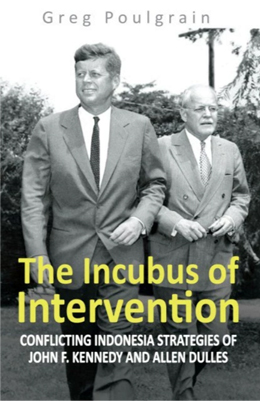
    CTKA is proud to excerpt a chapter from Greg Poulgrain’s new book about the Indonesia coup of 1965.  The full title of the volume is The Incubus of Intervention: Conflicting Indonesia Strategies of John F. Kennedy and Allen Dulles.  Poulgrain is a professor of History at University of the Sunshine Coast in Australia. In 1998, Poulgrain wrote The Genesis of Konfrontasi.  That book was about the conflict between President Achmed Sukarno of Indonesia and the proposed union of Malaysia in 1963. There, Poulgrain unfolded a new thesis about that conflict: namely, that it was not motivated by Sukarno’s desire to dominate the Southeast Asian archipelago area. Rather, it was a conscious provocation, created largely by the British to both strengthen their brainchild of Malaysia, and weaken Sukarno. By doing so, they expected to benefit financially.  They succeeded spectacularly in both aims.

    Poulgrain has now published an even more important book. It deals directly with the epochal, yet underreported, Indonesia coup of 1965. That overthrow is commonly referred to as the bloodiest CIA coup in history. To this day, no one knows how many people perished as a result of it. Various estimates range from 350,000 to 500,000.  It was not until 1996 when Lisa Pease wrote her milestone articles about Freeport Sulphur (today called Freeport McMoRan) that anyone focused attention on how the murder of President Kennedy paved the way for this horrendous operation. (Click here for that memorable essay: http://www.thesecrettruth.com/freeport-indonesia.htm)

    What Lisa did was to examine American foreign policy towards Indonesia and its leader Sukarno through three presidents: Dwight Eisenhower, John Kennedy, and Lyndon Johnson.  Through that examination, it was obvious that a familiar pattern manifested itself:  the Dulles brothers and Eisenhower were hostile to Sukarno (actually attempting to overthrow him in 1958); Kennedy tried to establish better relations and had planned a state visit in 1964; Johnson then halted Kennedy’s policy and decided to revert back to 1958 and the coup attempt.  Except, this time, it was successful.

    Since that excellent essay was published in Probe magazine, others have built on it.  This includes Denise Leith’s book The Politics of Power: Freeport in Suharto’s Indonesia. Jim Douglass treated the subject in his fine JFK and the Unspeakable, and I discussed the issue in the second edition of Destiny Betrayed.

    But Poulgrain’s new book goes further than anyone has before.  In fact, it appears to be a milestone on the subject. Through extensive research into books and documents, plus new in-depth interviews, this book seems to have rearranged the calculus on what happened in Jakarta in 1965. And, rather appropriately, Poulgrain sees that massive slaughter through the prism of two personal profiles: CIA director Allen Dulles and the fallen president John F. Kennedy.

    To show just how rich this book is, and how new and unique its perspective is, I beg the reader to take note of just three highlights in this one chapter.

    First, Poulgrain reveals that Kennedy was working with United Nations Secretary–General, Dag Hammarskjold.  Not just on the Congo crisis, but on a solution to the Indonesia problem.  This was new and I consider myself pretty well informed on Kennedy’s foreign policy. This is arresting in two ways.  First, Hammarskjold must have appeared to be an even greater threat to the power elite in this light. Second, we all know how reluctant contemporary American presidents are to work with the UN, especially GOP ones.  But here you have JFK working with Hammarskjold on two key fronts in the third world.  

    Second, he reveals that, as with the Kennedy assassination, Harry Truman clearly suggested that he did not buy the airplane accident story about Hammarskjold’s death. In fact, he even went further in the Hammarskjold case than he did with Kennedy.  He actually said he had been murdered. In other words, Truman knew what happened to Dag, and he likely knew what happened to Kennedy.  In the case of Kennedy, he wrote a timely and suggestive editorial about the CIA which Allen Dulles tried to get him to retract—but he did not. In the Hammarskjold case, when asked to elaborate, he said in effect, I will let you guys figure that all out.  In other words, he was not going to go further, hoping they would.  

    Third, through information in Susan Williams’ book, Who Killed Hammarskjold? it appears that Dulles’s name was on some documents secured by Desmond Tutu through the Truth and Reconciliation Commission in South Africa. These indicate that he would be willing to cooperate in a plot against the UN leader. He was even offering information about the type of plane the UN chief would be flying and the date Hammarskjold would arrive. If Dulles was willing to cooperate in a plot against Hammarskjold in 1961 over Congo, why would he not do the same in 1963 over both Congo and Indonesia?  Since as we know, Kennedy continued the struggle for a free Congo after both Patrice Lumumba and Hammarskjold were murdered.

    Poulgrain’s work is part of a new path in Kennedy studies.  This began with Richard Mahoney’s landmark volume JFK: Ordeal in Africa.  It continued with Philip Muehlenbeck’s Betting on the Africans, and Robert Rakove’s Kennedy, Johnson and the Nonaligned World. Now, Poulgrain extends that horizon line even further, one which finally shines light on who Kennedy really was and why he was killed.


    Chapter 2: The Incubus of Intervention | Buy The Incubus of Intervention on Amazon

  • Greg Poulgrain, The Incubus of Intervention

    Greg Poulgrain, The Incubus of Intervention


    The sub-title of Professor Poulgrain’s book is “Conflicting Indonesia Strategies of John F. Kennedy and Allen Dulles.” In this author’s opinion it is a valuable book because, although it does not deal directly with the 1965 CIA-inspired coup against Achmed Sukarno of Indonesia, it traces the major events and crises that caused that epic slaughter, which is usually labeled the bloodiest CIA coup in history.

    To this day, no one can say for certain how many people perished in the overthrow of Sukarno. The estimates range from 350,000 to a million. But almost everyone who has written about that event agrees that it was the most cleverly disguised coup d’état the Agency ever executed in a foreign country.  It literally took years to even begin to really understand what had happened. Over fifty years later, there is still much to be uncovered about what happened, and why, on September 30, 1965, and how this caused the mass murders that were then enacted all the way into the summer of the next year.

    As former CIA officer Ralph McGehee once said, the Agency very much guarded how it achieved the overthrow of Sukarno. They considered it such a near masterpiece of covert action that they used it as a model to teach certain tactics and strategies. (The Nation, April 11, 1981) In fact, the Agency has so clouded its own role in the twisted affair that to this day there is no single book that comes close to constituting a definitive study of the coup, which is not the case with say, the overthrow of Arbenz in Guatemala or Mossadegh in Iran.

    In fact, one of the first hints of what really happened in Indonesia in late September of 1965 was almost inadvertently delivered by James Reston in the New York Times.  On June 19, 1966, Reston was trying to defend Lyndon Johnson’s escalation of the Vietnam War and the failure of that escalation to achieve its goals.  Therefore, he wrote that this should be balanced by more “hopeful political developments elsewhere in Asia.”  Reston then pointed to the “transformation of Indonesia from a pro-Chinese policy under Sukarno to a defiantly anti-Communist policy under General Suharto.”  Reston, of course, was lying about Sukarno being a pro-Chinese communist; he was nothing of the sort. But, as with Patrice Lumumba in Congo, this is what the CIA used to justify the overthrow of his government.  Reston then hinted that such was the case when he wrote, “Washington is careful not to claim any credit for this change…but this does not mean that Washington had nothing to do with it.”  If the reader can comprehend it, Reston’s column was entitled “A Gleam of Light in Asia.”  No comment can underscore the sick inappropriateness of that rubric.

    In his introduction to the book The Silent Slaughter, Bertrand Russell wrote that according to two witnesses he knew, the 7th Fleet was in the waters off the coast of Java at the time, and General Nasution, who led the communist crackdown along with his colleague General Suharto, had a mission in Washington; therefore, the US “was directly involved in the day to day events.”

    On February 12, 1965, the New York Times, almost eight months before the cataclysm, partly explained why the USA was determined to overthrow Sukarno. They wrote that when “Sukarno threatened the Federation of Malaysia, he placed himself in the path of U.S. and British interests to contain communist China. Washington has left active defense of Malaysia to the British Commonwealth…” but seeks to influence Indonesia by aiding her army “against the expected Communist bid for power.” Again, this is another deception. There was no bid for power by the communist party on the archipelago called the PKI.  But the CIA used this specter–first conjured up by CIA Director Allen Dulles and his brother Secretary of State John Foster Dulles–to begin the planning for the coup. 

    And, in fact, that planning may have begun the year before.  Peter Scott in an article for Lobster, (Fall 1990), quoted a letter from a former researcher who had seen a certain letter from a former ambassador who had a conversation with a Dutch intelligence officer assigned to NATO. According to the researcher’s notes, the ambassador’s letter was dated from December of 1964.  It said that Indonesia would soon fall to the west like a rotten apple. Western intelligence agencies would organize a “premature communist coup [which would be] foredoomed to fail, providing a legitimate and welcome opportunity to the army to crush the communists and make Sukarno a prisoner of the army’s goodwill.”

    According to several writers, in the early spring of 1965, the Agency sent in the so-called first team.  And according to at least one author–Donald Freed–David Phillips was part of this advance team.  One of the things they did was to organize an informal alliance of conservative generals–led by Nasution and Suharto among others. It eventually numbered over two dozen. As the months went by, it was formally called the Council of Generals. It was this body that reportedly plotted against Sukarno. Part of the point of this subterfuge was to try and provoke a response by the PKI.  In anticipation of that response, Bradley Simpson has written, “the CIA organized covert operations and propaganda efforts for the better part of a year.” As he also notes, the CIA had a role in encouraging and aiding the mass killings of PKI supporters through Moslem groups, youth gangs, and other anti communist forces. (For a gripping recreation of how this was done locally, see the acclaimed documentary film The Act of Killing)

    But Washington’s covert aid was consciously kept as secret as possible, since it would have provided a great propaganda boon to Sukarno in reining in the bloody chaos that was consuming his country. In the face of the massacres, National Security Advisor Walt Rostow recommended a policy of silence by the White House. But secretly the CIA was sending cash, small arms and communications equipment to aid the slaughter, since Nasution and Suharto had requested them. If that wasn’t enough, the American Embassy was furnishing the army with lists of PKI members. (See Monthly Review, December 2015)

    After placing Sukarno under house arrest, the Council of Generals eventually took complete power in 1966. Once the PKI was liquidated, the Council sold off their fabulously rich country to American and European imperialists. Suharto, for one example, became a billionaire; while the great mass of Indonesians lived in brutal, grinding poverty.

    As I said, I am not going to attempt to elucidate in any serious detail the chilling events that occurred in September and October of 1965 in Indonesia.  Authors who have studied it for years still have yet to convincingly explicate all of its complications. And that is not Poulgrain’s aim either.  What his book does is explain the long back-story as to why the horror of 1965 happened.  And it does so mainly through the figure of Allen Dulles.

     II

    In narrating this discouraging, sometimes depressing, tragic epic, it is imperative to understand that it was Sukarno who convened the first conference of non-aligned nations in Indonesia in 1955, which was actually arranged by his foreign minister and held in Bandung. For Sukarno, the term “non-aligned” meant just that.  These were nations that did not want to commit themselves one way or the other to the Cold War competition between the U.S. and Russia. They wanted to be neutral and to stay neutral.  They also wanted to be free to accept aid from both superpowers without the acceptance showing a commitment to Moscow or Washington. 

    This was not satisfactory with the Eisenhower administration, especially with Secretary of State John Foster Dulles and his brother, CIA Director Allen Dulles.  Yet the irony is that Sukarno and many of his allies like Nasser of Egypt staged the conference for the specific reason that they did not trust the Dulles brothers.  (Robert Rakove, Kennedy, Johnson and the Non-Aligned World, p. 3)  One could understand that readily after watching what happened in Iran and Guatemala in 1953 and 1954. Foster Dulles’s State Department issued a paper calling Sukarno’s conference and the growing non-aligned movement, “one of the most dangerous political trends of the fifties.” (ibid, p. 6) The Secretary seriously contemplated staging a shadow Bandung conference with conservative, sympathetic American allied nations. (ibid, p. 9)  In a speech Foster Dulles gave in Iowa in 1956, he called neutrality in the Cold War a false pretense and he said he had constructed his string of alliances across the world, such as SEATO, the Baghdad Pact, to eliminate neutrals. Because of this, Allen Dulles began secretly funding the Masjumi Muslim party to the tune of a million dollars in one year. In fact, the Church Committee did find some evidence that the CIA may have been behind the assassination attempt of Sukarno in 1957. (op. cit. Scott)

    This was one point of contention between Sukarno and the Eisenhower administration. Another one was the dispute between the Netherlands and Sukarno over the territory of West Irian (also called Irian Java, West Papua and West New Guinea). This was part of an island territory that the Dutch maintained control of after Indonesia won its independence a few years after World War II. As Rakove notes, although Foster Dulles was neutral about this dispute in public, privately he did not want to give the territory over to Sukarno. (p. 15)

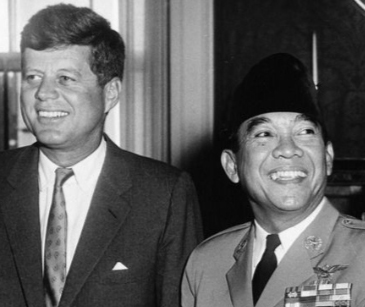
    Kennedy and Sukarno meet at the White House

    The first researcher to fully integrate this dispute over West Irian into a comprehensive essay on the Indonesia overthrow of 1965 was Lisa Pease.  She did this in her landmark essay entitled “JFK, Indonesia, CIA and Freeport Sulphur.”  That scintillating essay was first published in the May/June 1996 issue of Probe magazineIt was Part Two of her series on the huge mining company Freeport Sulphur, today called Freeport McMoran. And although some have said that her essays are in the book The Assassinations, they are not. One has to purchase the Probe CD to read that excellent series. (Oddly, Poulgrain does not source Lisa’s work in his notes or bibliography.)

    In her essay, Lisa was one of the first to point out the importance of the Ertsberg lode and how it figured into the dispute between the Dutch and Sukarno. And further, how it later figured into the overthrow of Sukarno’s government, which he called a “guided democracy.” 

    In 1936 a Dutch geologist named J. J. Dozy discovered two enormous mineral deposits in West Irian.  One was called the Ertsberg and the other, only two kilometers away, was called the Grasberg.  The former was a mountain, the latter an elevated meadow.  (Poulgrain, p. 6) The political ramifications of this find have extended over the decades to this very day because the Dozy report was both kept hidden and also deliberately distorted.  One of the reasons for this is that Dozy discovered that the concentration of gold ore at Ertsberg was twice as rich as the wealthiest gold mine in the world at that time, which was located in South Africa. But further, the same gold ore at the Grasberg appeared to be even richer than the Ertsberg. (Ibid, pgs. 6,7)

    Needless to say, this discovery significantly altered the geopolitical importance of Indonesia—especially for the so-called Power Elite. A central reason for this was that one of the main architects of the Dozy expedition was Allen Dulles through his law firm Sullivan and Cromwell. (Poulgrain, p. 7)  Dozy was instructed not to formally announce the results of his findings for the simple reason that the Dutch control of West Irian was weak.  But further, the consortium of companies that arranged and financed the three-man expedition was a dual Dutch/American operation. On the American side, the two partners were two divisions of the Rockefeller-controlled petroleum colossus, Standard Oil. Since Sullivan and Cromwell organized the expedition, it was Standard that had a 60% controlling interest in the enterprise. (ibid, p. 17)

    As the author notes, in its decades long struggle to hang on to West Irian, the Dutch never made public the true facts of what Dozy’s expedition had discovered. But also, the American side of the consortium never accepted the Dutch offer to begin to actually break ground and exploit the mining potential of both areas. As Poulgrain postulates, the Ertsberg and Grasberg were at high elevations (about 14,000 feet) and in difficult locations for mining operations.  The Dutch did not have the wherewithal at the time to pull off such an engineering feat. In fact, as Lisa Pease points out, when Freeport Sulphur finally did break ground, they had to go to Bechtel Corporation to construct the engineering aspects of the mining.

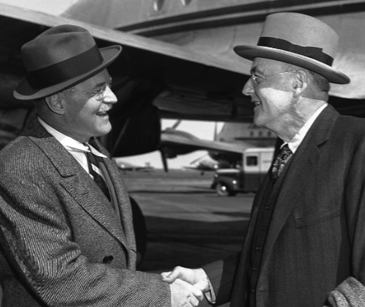
    The Dulles brothers

    In a subsequent report about the expedition that was technical in nature, the gold potential of the Ertsberg was greatly discounted, while its copper content and remoteness was played up. (ibid, p. 24)  With this camouflage in place, the next objective for Sullivan and Cromwell was to force the Dutch out of the deal.  By refusing to cooperate with them on the mining engineering, Standard was attempting to do just that.

    In 1962, a second expedition ascended the Ertsberg. This was on the occasion of Sukarno and Indonesia taking control of the area.  This second mission actually discovered a notebook deliberately left behind by Dozy but again, the content of this notebook was kept shrouded in secrecy. In fact, Dozy lied to Poulgrain about it being returned to him. (p. 31)  Even at this late date, both Dozy and Freeport Sulphur’s geologist Forbes Wilson continued to discount the gold and silver deposits there and to exalt the copper deposits. Dozy’s secret report said that the gold at Ertsberg amounted to 15 grains per ton. In reality it was 15 grams per ton, which makes for a large difference. (ibid, p. 37)

    Around this time, something else was afoot. In interviews Poulgrain did with two Indonesian officials, they both revealed that secret money began to be siphoned to the Indonesian government. It was earmarked for the struggle with the Dutch over West Irian.  The funds were from American sources. (p. 33)  As Standard did not want to help the Dutch mine the area, the Americans did not want the Dutch to take permanent control of West Irian. Standard Oil could find its own partners and the mining company Freeport Sulphur was another Rockefeller-controlled company.

    III

    One of the most interesting parts of the book is the chapter concerning John Kennedy’s relationship with United Nations Secretary General Dag Hammarskjold. Until reading Poulgrain, much of what most observers knew about this relationship was based upon the pair’s interplay in the monumental Congo crisis. Author Richard Mahoney had made that conflict the basis for his milestone book on Kennedy, JFK: Ordeal in Africa.  Kennedy had developed a strong interest in the issues of colonialism and Africa while he was in the Senate. His stance on the two was quite different than the Eisenhower administration’s, for he did not see the emerging countries of the Third World through the “with us or against us” lens that the administration did. For instance, he understood why Nasser did not join the Baghdad Pact.  And Kennedy looked at Foster Dulles’ reaction to this–his attempt to isolate Nasser, favoring Saudi Arabia, and pulling out of the Aswan Dam project–with disdain, since, for one thing, it threw Nasser into the arms of the Russians to get funding for the dam. But Kennedy also thought that America should actually favor someone like Nasser who was more of a socialist/secularist rather than the Saudis who were more Moslem fundamentalists. (See Philip Muehlenbeck’s Betting on the Africans, p. 10ff)

    Dag Hammarskjold was a Swedish economist who worked on the Marshall Plan for Europe. He later became chair of the Swedish delegation to the UN General Assembly.  In 1953 he was elected Secretary General of that body.  Kennedy had nothing but respect and admiration for Hammarskjold.  Upon his death in 1961, he called him the greatest statesman of the 20th century.  As Mahoney pointed out at length and in depth, the two men had much in common during the Congo crisis, and Hammarskjold’s death in a suspicious plane crash in 1961 seemed to galvanize Kennedy on that front.  He was determined to back the followers of Patrice Lumumba and to prevent the mineral rich province of Katanga from splitting off from the country.  He backed a UN military action to prevent the latter. Kennedy’s Congo policy was drastically altered after his death.

    What Poulgrain adds to this equation is that Kennedy and Hammarskjold were also working on a plan for Indonesia. (p. 77)  In interviews the author did with Hammarskjold’s friend and colleague at the UN, the late George Ivan Smith, Smith told Poulgrain that JFK and Hammarskjold were discussing a solution to the West Irian crisis; the Netherlands wanted to hang onto the territory, while Sukarno thought it should be part of Indonesia. Considering the contents of the Dozy report, one can understand the motivation of the Dutch.  

    But further, Smith revealed that those discussions included a back channel by Kennedy to former president Harry Truman. (ibid)  In fact, Truman was well informed enough about the progress that upon hearing of Hammarskjold’s plane crash, he commented: “Dag Hammarskjold was on the point of getting something done when they killed him.  Notice that I said, ‘When they killed him.’”  When asked to develop that point, Truman replied with, “That’s all I’ve got to say on the matter. Draw your own conclusions.” (ibid, p. 78)  In itself, this is remarkable, but it is even more so when coupled with Truman’s famous editorial in the Washington Post a month after Kennedy’s assassination. That column was about how the CIA had strayed too far from what Truman imagined its original mission was. (James DiEugenio, Destiny Betrayed,  pgs. 378-79) With this new revelation about Indonesia, it now becomes apparent that Truman knew something–and if the Warren Commission had been a true fact finding body, which it was not, he would have been a witness before  it.

    As readers of the second edition of Destiny Betrayed know, Allen Dulles visited Truman in April of 1964.  Although Dulles was sitting on the Commission at the time, the visit was not formally related to that body. Dulles was there to try and get Truman to retract his editorial about the CIA becoming a rogue agency.  By the end of the conversation, it had become apparent that the former CIA director suspected that Truman had written the column because he felt the Agency was involved in the JFK murder. (ibid, pgs. 379-81)

    Poulgrain, using Susan Williams’s book Who Killed Hammarskjold?, adduces evidence that Dulles was involved with the murder of Hammarskjold. During the proceedings of the Truth and Reconciliation Commission in South Africa, Desmond Tutu discovered documents concerning a covert project called Operation Celeste. This appears to be a plan to murder the UN Secretary General and there were records of communications from Dulles in the file. The proposed plot machinations included planting a small bomb to disable the outside steering mechanism.  One of the communications stated that the UN had become troublesome and it is felt that Hammarskjold should be removed. Dulles agreed and “has promised full cooperation from his people…” (Poulgrain, p. 74)  And as Williams pointed out, there were two CIA planes on the same runway Hammarskjold was supposed to land on that night. Congruent with this, Dulles had also forwarded information describing the plane the Secretary General would be traveling on and the date of his arrival.  Smith, needless to day, told Poulgrain that he thought Hammarskjold was murdered.

    There was one other project Kennedy was working on with Hammarskjold.  This was something called OPEX.  Hammarskjold was determined to help colonized peoples free themselves, but as an economist, he was also going to try and aid their development once they were free of colonialism. OPEX was a UN group that would send professionals into newly freed states to aid their development–not as advisors, but as adjuncts to the new governments. (ibid, p. 80) Poulgrain writes that this was the concept Dag had in mind for West Irian.  He was planning on turning over the territory to the natives on the island called Papuans. After Dag’s death, Kennedy had to soldier both the Congo and Indonesia crises more or less alone.

    In this author’s opinion, the Hammarskjold assassination (I will not call it a plane crash anymore) has been gravely overlooked by JFK researchers and with the work of Williams, Poulgrain, and Lisa Pease, it should not be. (https://consortiumnews.com/2013/09/16/the-mysterious-death-of-a-un-hero/)  Dag’s assassination, and the Congo crisis, are of key importance in the saga of John F. Kennedy’s career and his murder.

    IV

    Allen Dulles had been working the Indonesia terrain with covert operations for six years when Kennedy became president. It is strongly suspected that the Agency was behind the use of the Moslem extremists Darul Islam in an attempt to assassinate Sukarno in 1957. As Poulgrain notes, it is important to understand that Darul Islam later morphed into Jemmah Islamiah, the terrorist group linked to the Bali bombing of 2002. (p. 86) In other words, the work of the Dulles brothers in backing Saudi Arabia against Nasser, and Darul Islam against Sukarno, had sinister and pernicious future consequences.

    In his work on the background of Allen Dulles, Poulgrain found that in working for the State Department in 1920, one of his functions was to monitor the progress of the Russian Civil War. One reason for this was American interest (read Standard Oil) in the great oil fields at Baku. (ibid, p. 97)  It was here that Dulles met Sergius Alexander Von Mohrenschildt. Sergius was a director of the Nobel family oil fields in Baku, and he was also modernizing the Russian army. Sergius was the father of George DeMohrenschildt.  At the time, George and his mother were living in Baku at the domicile of Sergius. George’s brother Dimitri was in the Russian navy and would soon emigrate (actually escape) to the United States.

    Since Sergius was a White Russian, he was arrested by the Reds but he escaped to Poland with his wife and George.  They lived on a large estate in Poland, but George’s mother died soon after the move. George served in the Polish cavalry for a period of 18 months.  He then went to Belgium for university studies. (p 98)  In 1938, like his brother, George also emigrated to the U.S. He changed his name by dropping the Von and changing it to “de.”

    Standard Oil had targeted the petroleum in the Dutch East Indies since the twenties. They even established a phony Dutch front company to do so. But it was not until 1928 when Standard got concessions for exploration from the Netherlands. Allen Dulles worked on this by telling the Dutch they might lose everything to an outside force, like Japan, because their hold of the archipelago was tenuous.

    During World War II, Dulles arranged for Standard Oil to sell petroleum to Vichy France, effectively selling it to the Germans and that case involved George DeMohrenschildt. (p. 110)  In 1938, George lived with Dimitri on Park Avenue in New York.  It is there that he met Mrs. Bouvier, the mother of Jackie Kennedy.

    The International Cooperation Administration (ICA) was frequently used for CIA cover duties. It was established by Allen and his brother in 1955.  DeMohrenschildt worked for this unit when he went to Yugoslavia as an oil and gas specialist. His job was to recruit workers for a job in Egypt using American equipment.

    Poulgrain makes the case that because of some of his controversial work for Standard Oil  (like with Vichy France), Dulles got DeMohrenschildt out of the country and working for another Rockefeller oil subsidiary called Humble Oil.  He makes a circumstantial case that George was transferred to West Irian in the Dutch East Indies to work on Standard’s oil drilling there. It turned out that in addition to the Ertsberg and Grasberg, West Irian was the home of what turned out to be the largest oil deposit in all of New Guinea. (p. 121)  It was called the Vogelkop, and again, the Dutch tried to keep this hidden. Humble Oil did some preliminary drilling and thought the prospects were promising.  But as Poulgrain shows, this was kept a secret among the Power Elite.  Like the Ertsberg and Grasberg, the idea was to not let Sukarno know about these deposits. In fact, the author makes the case that not even Kennedy knew about them; it puzzled him that the Dutch would want to hang on to what he thought was such a desolate area as West Irian.

    V

    Poulgrain has written a book about the CIA-aided rebellion of the Outer Islands military forces against Sukarno and the central government located at Jakarta.  I have not read the book yet, but he incorporates some of that work into his chapter on the rebellion. The ostensible cause of the uprising was the fact that, for example the island of Sumatra was responsible for about 70% of GDP, but only got about 30% of it back in revenues. In fact Mohammad Hatta, who was Sukarno’s second in command when Indonesia was set free in 1949, resigned from the government in late 1956 over this issue.

    Another perceived problem for the military was the growing influence of the PKI.  Which by 1955 was the fourth largest party in Indonesia. (p. 142)  Sukarno did not really perceive the party as being communists and thought they were more nationalists; this is what he told President Kennedy later. But what accented this for Allen Dulles was Sukarno’s turn toward what he called Guided Democracy. This amounted to taking advice from certain groups in society like veterans and laborers. (p. 148) which to Dulles, looked like a class-oriented government, and not, as he preferred, from the Power Elite down.

    Guy Pauker, a professor at Berkeley and an expert of Southeast Asia, was a consultant for Dulles on Indonesia.  He recommended using the Outer Island dispute to play up the threat of the PKI. (p. 152)  The problem for Allen Dulles was John Allison who was the American ambassador in Jakarta.  He did not see the PKI as a real threat to take over and he did not see Sukarno as a communist or even a pinko. The problem was that many of his reports never got through to John Foster Dulles. In fact, Allen Dulles had installed his man at a new position called the Bureau of Research and Intelligence at State. This is where the directives inside the department came to support the rebellion (p. 153) and there was a working group set up inside this agency that included navy admiral Arleigh Burke that was in direct communication with Sullivan and Cromwell. (p. 155)  Finally Allen Dulles sent a friend and colleague in the Agency named Al Ulmer to visit Jakarta.  He came back and told Foster Dulles that Allison was soft on communism. Allison was now removed as ambassador and sent to Czechoslovakia.  (p. 159)

    Allison was removed in January of 1958. The rebellion began in February.  The story of the rebellion, and its failure, was well told in the book Subversion as Foreign Policy back in 1995.  Poulgrain has clearly read that book, as he refers to it often. But his thesis is different and revisionist.  He argues that Allen Dulles never really wanted the rebellion to succeed for the simple reason that the Dutch still controlled West Irian.  His plan was to have Indonesia take control of West Irian first, and then dislodge Sukarno and decimate the PKI. For that to happen, the main tool would be the army. Dulles felt the army was not a unified force at this time, as exemplified by the dissidents on the outer islands.  Therefore, he would use the rebellion to centralize the army in Jakarta. Once that was done, the possibility of dislodging the charismatic Sukarno was much stronger but only after West Irian was part of Indonesia.

    Poulgrain argues this thesis vigorously with some interesting points that have either been ignored or which he dug up on his own. For instance, Dulles helped General Nasution (who led the counter attack for Sukarno) recover a huge weapons drop originally meant for the rebels. (p. 148)  Also, there was never any serious discussion about rescuing American personnel. Third, a CIA officer named Sterling Cottrell called Nasution four times in one night.  The reason? To be sure he was aware that there was an arms drop for him at Pekanbaru airfield on Sumatra. (p. 204)  Dulles then camouflaged this to the National Security Council by saying the arms were delivered by an unknown third country.

    But further, after the rebellion was defeated, Dulles kept supplying it at a low level even though it had no chance of success. Poulgrain argues that the aim of this was to 1) Maintain martial law, which Sukarno had declared at the outbreak; and 2) Stop any elections from being held so the PKI could not increase its power in the government.

    VI

    Joseph Luns

    In January of 1961, Nasution was in Moscow reviewing a large arms purchase from the Russians. The purchase included bombers, fighters, torpedo boats, submarines, warships and cruisers. (p. 213)  These were to be used in an amphibious assault against the Dutch on West Irian. At the same time, Nasution was talking to Australia who owned the eastern part of New Guinea. He and Sukarno wanted Australia to stay neutral in the coming conflict which they agreed to do. And finally to round off the triangular arrangements, Nasution wires Washington that there is nothing more to his visit to Moscow than an arms deal and he has no sympathies towards the Soviets. (p. 215)

    Dutch foreign minister Joseph Luns visited Washington in April of 1961. He told President Kennedy that Foster Dulles had told him that the U.S. would support the Netherlands if it came to a military confrontation. Kennedy clearly was not sympathetic to this at all.  As stated previously, he could not understand why the Dutch were so determined to maintain such a faraway and desolate island. Luns, of course, was not going to tell him about the Dozy mission and what they found there. (p. 219)

    Luns later proposed a trusteeship that would be administered by the Netherlands. Kennedy and Hammarskjold had discussed a genuine trusteeship, one that would be administered by a neutral third party. They would then allow the Papuans to vote on what they wanted in a referendum. (p. 220)  In fact, Kennedy wanted Hammarskjold to handle the issue. But when the Secretary was killed in September of 1961, the issue fell to him.

    In November of 1961, an event occurred which worked against the trusteeship/referendum concept. Nelson Rockefeller’s son Michael disappeared off the coast of New Guinea. His body was never found after his boat overturned. Although he was collecting primitive art artifacts, Michael was in direct contact with a Standard Oil exploration team. They started a rumor that Papuan cannibals had eaten him. (p. 223)  Since the story was front-page news, it seriously damaged the image of the Papuans.

    Kennedy now wrote Sukarno and told him to hold off on any military attack but Sukarno did call for a general mobilization and launched a small torpedo boat attack, which was met by two Dutch destroyers.  How did they know this was coming?  In a preview of his role in the future, General Suharto relayed the information to Clark Air Base in the Philippines. The military wanted their NATO ally, the Dutch, to be prepared.  (p. 232)

    Kennedy now arranged a conference in New York in which the U.S. would moderate between the two sides. The two representatives for the U.S. were veteran diplomat Ellsworth Bunker and Attorney General Robert Kennedy.  Luns later reported on how vociferous the U.S. was in favor of Sukarno, especially Robert Kennedy.

    Click image to see larger version

    Two notes should be added about the New York Agreement. First, President Kennedy insisted on a clause maintaining a plebiscite for the Papuans in 1969. At that time, they would choose to be independent or stay a part of Indonesia.  Since Suharto had taken control of Indonesia by then and signed a deal with Freeport Sulphur in 1967, this vote turned out to be a military-controlled sham. Second, although Indonesia was not supposed to take over the territory until 1964, they actually took control in May of 1963. This may have been to ensure that the official lease on the Ertsberg expired when it was outside of Dutch control. This was probably urged on by the numerous American allies and CIA agents inside Sukarno’s entourage, like Suharto and diplomat and economist Adam Malik, a highly paid CIA agent.

    After the New York Agreement was signed, Kennedy sent out memos to every relevant agency of  government. He wanted a full-court press in sending as much developmental aid as possible to Sukarno. (p. 236)  He wanted the economy stabilized and growing in order to keep Sukarno friendly with the west.

    A painting of Suharto

    But these good relations were short-circuited by Sukarno’s enemies in government, in Congress, and in the UK. Specifically, these included Dulles’ friend General Lucius Clay and Representative Gerald Ford.  They used Sukarno’s confrontation with the British over the creation of the state of Malaysia to begin to criticize Sukarno over his belligerence with our British friends. Sukarno now began to expel and expropriate foreign businesses, including Standard Oil’s Caltex and Stanvac. Kennedy insisted that they stay, but they negotiate profit sharing deals with Sukarno on a 60/40 basis favoring Indonesia.  Kennedy sent two trade representatives to successfully negotiate the deal. (p. 242)  In comparison, after Suharto, the split Freeport McMoran has with Indonesia today is reportedly 90/10 in Freeport’s favor. The reader can only imagine what Sukarno could have done for the people of Indonesia with the tens of billions he would have gotten in a 60/40 split over the Ertsberg and Grasberg mines.

    The Malaysian confrontation started riots in Jakarta at the British embassy. Kennedy insisted that this should not influence congressional approval over how much aid should go to Sukarno. (p. 244)  But it did and the aid package started to be pecked apart. Sukarno now told the American ambassador in Jakarta, Howard Jones, that he thought the CIA was out to topple his regime. To try and save the situation, Kennedy and Sukarno arranged a state visit for the president to Jakarta in 1964.  One of Kennedy’s goals was to wind down the tensions between Malaysia and Indonesia. In fact, he stated, why stop aid to Indonesia ”because of its attitude toward Malaysia, when three months from now it may or may not be the same as it is today?” (p. 247)

    Kennedy, of course, never got to visit Indonesia or halt the Malaysian crisis. Without Kennedy’s help, Sukarno’s prediction to Jones about the CIA toppling him came true. Sukarno said about JFK’s murder: “Kennedy was killed precisely to prevent him from visiting Indonesia.”

    Greg Poulgrain has written a provocative revisionist history of why the epochal coup in Indonesia happened as it did in 1965.  Along the way he has enlightened us on the crucial figures of Allen Dulles, Sukarno, Dag Hammarskjold and John Kennedy and how they played with and against each other and how this nexus led to a horrible tragedy.

  • Jeffrey H. Caufield, M. D., General Walker and the Murder of President Kennedy

    Jeffrey H. Caufield, M. D., General Walker and the Murder of President Kennedy


    Part One

    Before I begin reviewing Jeffrey Caufield’s very long book about General Edwin Walker and the Kennedy assassination, I think it’s necessary to make some general introductory comments about the volume. Not just because they are relevant to the book itself, but because they accent general tendencies in current JFK assassination tomes as a whole. I don’t consider any of these tendencies beneficial to the field. Therefore, it’s time to sound a warning alarm about them, before they become an incurable epidemic.

    1. Bigger does not mean better. In any field. Look what happened to the Titanic. How about the notorious movie bomb Heaven’s Gate? Do I even have to mention Vincent Bugliosi’s Reclaiming History? On the other hand, Jim Douglass’ book JFK and the Unspeakable contains less than four hundred pages of text. Caufield’s book is about twice as long. For what the author has to say about the JFK case, there is no way this book should have been anywhere near that verbose. Why Caufield did not hire a professional editor escapes me. The idea seems to be that if you make your book longer, somehow it’s better. Wrong. In this case, and many others, heading back to Lamar Waldron and Thom Hartmann, longer is not better: it’s just longer. And length for length’s sake translates into tedium for the reader. To make it even worse, Caufield is not a very good writer. So the tedium is accented further.
    2. Caufield also suffers from Philip Nelson Syndrome. As I mentioned in Part 2 of my discussion of James Fetzer, Nelson had a repeated pattern of trumpeting an upcoming section of his book as being startlingly significant, even mind-boggling. But upon examination, this did not turn out to be the case. Well, Caufield makes Nelson look like an amateur at self-inflation. No less than four times—probably more—Caufield trots out his cannon, lights it up, and screams about a bombshell that is about to explode. The problem is that, in each case, Caufield ends up resembling Charlie Chaplin. Recall the Tramp with his ears covered, when the cannon does not explode, and the cannonball only rolls out of the mouth of the cannon a few inches in front. Because the author had cried “Wolf!” so often, near the end of the book, I just started ignoring these advance warnings and yawned.
    3. Perhaps most importantly, either by accident or by design, Caufield worked in a cocoon. That is, he seemed to be unaware of many other developments in the field pertinent to the material in his inflated book. At times, this had a very serious impact – to the point that it rendered his own tenets and beliefs dubious. I really don’t understand how this happened. Did Caufield feel that what he was doing was more important than what anyone else was doing, and thus he could ignore it? Or did he just think that the state of the case did not merit checking in on any new discoveries? Whatever the excuse, it does not reflect well on the author.

    I

    Like several authors before him, including the late Harry Livingstone, Caufield’s book propagates a JFK conspiracy that was brought about by the Radical Right. In 2006, Livingstone published a book that has a similar title to this one: The Radical Right and the Murder of John F. Kennedy: Stunning Evidence in the Assassination of the President. (The subtitle to Caufield’s book is The Extensive New Evidence of a Radical-Right Conspiracy.) But this is not at all a recent concept. In fact, way back in1964, Thomas Buchanan’s Who Killed Kennedy? discussed such a scenario. And a few years later, James Hepburn’s mysterious tome Farewell America did the same. In the nineties, Jerry Rose, the former editor and publisher of The Third Decade, was also in this camp.

    The scenario has been revisited so often that, in his book Reclaiming History, Vincent Bugliosi set aside a separate section to discuss the topic. (see pp. 1260-72) And in that survey, he mentions many of the major groups and personages that Caufield talks about in his volume: the John Birch Society, the Klan, the H. L. Hunt network, General Walker and his sidekick Robert Surrey, and Georgia extremist Joseph Milteer. As we will see, Caufield is especially focused on Walker and Milteer.

    Caufield’s effort in the Radical Right field is distinguished by two characteristics. An obvious one is its length. He surpasses the long Livingstone book quite easily. Which, as noted, has little or nothing to do with quality. But secondly, and rather disturbingly, there is clearly a not-well-hidden agenda to the book. One that needs a bit of explaining to understand.

    Since about the late eighties, there has been a growing consensus in JFK critical studies that, of all the suspects in the case—the Mob, the military, the Secret Service, LBJ, the Radical Right, Cuban exiles—the one suspect that seemed necessary to include in any theory was the Central Intelligence Agency, for the simple reason that, the more one looked at Lee Harvey Oswald, the more his intelligence connections tended to stick out all over the place. Way back in the mid-seventies, Senator Richard Schweiker of the Church Committee said that Oswald had the fingerprints of intelligence all about him. (Henry Hurt, Reasonable Doubt, p. 192) In 1990, Philip Melanson published his revolutionary biography of Oswald, Spy Saga. This was the first full-scale portrait of Oswald’s role as a probable CIA agent provocateur.

    In 1991, when Oliver Stone’s film JFK was released, and the book on which it was based—Jim Garrison’s On the Trail of the Assassins—became a number one national best-seller, that consensus opinion became even more pronounced. In fact, at the conferences being held around this time, most of the attendees, and many of the panels, discussed the role of the CIA in the assassination.

    Caufield’s book, like Livingstone’s, and like Philip Nelson’s on LBJ, is a conscious reaction to this. He is out to demean and denigrate those who hold the opinion of CIA primacy in the Kennedy case; e.g., Jim Garrison or Oliver Stone. He does this almost right out of the chute. How? Caufield is going to argue that Oswald had no connection to Washington intelligence, or the CIA. He is going to argue something that, literally, I have never heard anyone seriously argue previously at any real length or depth. Please sit down. Caufield is going to argue that Oswald was a Nazi. (see pp. 75 ff.)

    Now, before we begin to analyze this unique and fantastic theorem, let us keep in mind the evidentiary axiom that applies in this type of situation: extraordinary claims require extraordinary evidence. If one is going to be a revisionist, one has to have the ammunition to do so. As far as I could see, Caufield provides three pieces of evidence for his “Oswald as a Nazi” hypothesis.

    The first is that Oswald had the name of Daniel Burros in his notebook. As labeled in Oswald’s notes, Burros was a member of the American Nazi Party. (p. 75) Please take note, because the following is going to be a constant refrain in Caufield’s book. The author will now write about four extraneous pages about Burros, which have no impact on whether or not Oswald actually knew him, or, more importantly, if Oswald was a Nazi. And, in fact, Caufield never demonstrates how, or if, the two men actually knew each other. There are many notations in Oswald’s 45 page notebook—both from Russia and the USA—for which, as Diane Holloway shows, there exists no evidence that Oswald ever knew the person or the agency, or firm. (see Appendix 3 of her book, The Mind of Oswald.)

    The second piece of evidence is a 12/16/63 FBI report. That report states that a bus driver named Muncy Perkins had observed people waiting in the morning for another bus driver named Ray Leahart at the Carrolton Avenue Station. Perkins “thought that possibly Lee Harvey Oswald may have been among” those people. (p. 79, italics added.) Need I even comment on this one? I italicized the two conditional qualifiers in the report. But as most of us know, Oswald did not have a car. He allegedly had a bus pass on him when he was apprehended. So what is the significance of Oswald possibly waiting in a crowd for a bus driver in the morning at the station? Especially if it may not even be Oswald?

    Do I need to add that Caufield now goes on for four pages on the ties of bus driver Leahart to the Nazi Party? Without ever demonstrating that Oswald actually knew the man?

    The third piece of evidence that the author advances in this regard is that Oswald demonstrated anti-Semitic and anti-Black attitudes. The evidence for this? Oswald used the term “nigger” in an interview with reporter Aline Mosby in Moscow. Secondly, he told Marina he did not want to name their child Rachel because it sounded too Jewish. (pp. 88-89) In Caufield’s judgment, this qualifies Oswald as a Nazi. I guess I was also since I used the “n” word as a youth growing up in Pennsylvania. By Caufield’s standard, one can imagine how many millions of prospective Nazis there were in the south in the fifties. So much for the author’s revisionist revolution.

    The above, in itself, is bad enough. But it is only half the story. Actually it’s less than that. The larger part is what Caufield leaves out of his portrait of Oswald. And this refers us to point number three from my introductory remarks: Caufield seems to be working in a cocoon, because the new material we have on Oswald since Melanson’s book was published makes for some of the most interesting and important information that has surfaced since the creation of the Assassination Records Review Board. With that information, the study of Oswald has bounced a quantum leap forward. For the author to leave all this information out, and then to write that a major problem with any CIA concept of the assassination is that Oswald had no demonstrable ties to the Agency – this is either written out of pure ignorance, or Caufield was deliberately rigging the deck to shortchange the reader. (see p. 47) And I actually don’t know which is worse.

    This reviewer incorporated much of this fascinating new Oswald information into the second edition of Destiny Betrayed. It takes up two lengthy chapters in that book, and many have stated it is one of the best parts of that volume. (see pp. 117-166) Those fifty pages constitute a mini-biography of Oswald, one that ends approximately at the time he returned to Dallas from his alleged trip to Mexico City. I won’t compare Caufield’s treatment of Oswald with mine in any systematic way. But I do wish to bring out certain key points that he either minimizes or eliminates.

    Caufield deals with Oswald in three major places in his book. In Chapter 1, entitled “Lee Harvey Oswald and Guy Banister”, he describes Oswald joining the military, serving in the Marines, and then defecting to Russia—an interval of about five years—in three sentences! This in a book that has 790 pages of text. Then, Caufield spends less than a paragraph on Oswald in Russia. (p. 33) In an astonishing exemption, at no point in the book does Caufield deal with the false defector program that Philip Melanson first outlined back in Spy Saga back in 1990. (Melanson, p. 25) Nor does he mention the name of Robert Webster, the suspected false defector that Marina Prusakova also met in Russia right before she met Oswald. (DiEugenio, pp. 139-40) By not mentioning Webster, he can ignore the incredible coincidence this represents.

    At this point in the book, Caufield also fails to mention the Russian test that Oswald took while in the military. He therefore avoids another compelling indication that Oswald was being groomed by the Office of Naval Intelligence for a CIA assignment as a false defector to Russia. Later on, when Caufield does mention this test, he deals with it in a remarkable manner. In his ongoing vendetta against Jim Garrison, he tries to weaken the former DA’s argument about Oswald getting training in the Russian language in the Marines. (see p. 227)

    He states that Garrison held that Oswald was being schooled in the Russian language in the service, but there is no evidence of this. Again, this is either symptomatic of Caufield working in a cocoon, or it is a deliberate omission, because over 25 years ago Melanson discussed in detail the report that the Warren Commission had about Oswald being instructed in language acquisition at the Monterey School of Languages while he was in the Marines. (Melanson, p. 12) Caufield then writes that although Oswald did take a Russian test, he did not do well on it. As Garrison noted in his book, this is what the Warren Commission witness said about it. (On the Trail of the Assassins, p. 23) To which Garrison replied: it would be like saying your dog is not very bright since you can beat him three games out of five in chess. But it also ignores the report of Rosaleen Quinn. Quinn was being tutored in Russian for a State Department position. She met with Oswald after his Russian test, and said that he now spoke excellent Russian. (DiEugenio, p. 131)

    The author then continues in his hopeless jihad by saying that once he arrived in Russia, Oswald did not speak the language very well. Which, from Quinn, we know is wrong. But it is further vitiated by author Ernst Titovets. In 2010, Titovets wrote a book called Oswald: Russian Episode. By all accounts, Titovets was Oswald’s closest friend in Russia. When I interviewed him in Washington at the AARC Conference in 2014, I asked him about Oswald’s Russian language skills. He told me that Oswald spoke Russian fluently. In the face of all this evidence, only someone with an agenda would argue the contrary.

    It will not surprise the reader to know that the names of John Hurt and Otto Otepka do not appear in this book. Hurt was the former military intelligence officer Oswald tried to call from jail on Saturday night, hours before he was shot by Jack Ruby. Otepka was the State Department employee who wrote a request to the CIA asking whether or not Oswald was a false defector. By not presenting any of this—and much more—or by distorting the parts you do present, then yep, one can say that Oswald was not connected to the CIA.

    Let me conclude this section of the review by noting a memo that Caufield repeats at least three times throughout the volume. (Repetition, and inclusion of extraneous material, are two methods by which Caufield inflates his page count.) The memo is from Hubert Badeaux, a New Orleans police intelligence officer, to state senator William Rainach (p. 273, 791) In this letter, the following two sentences appear in paragraph five:

    “I have been in contact with an out-of-town person whom I have been grooming to come here to take over the establishment of infiltration into the university and intellectual groups. I will tell you in detail about this when I see you in person.”

    Caufield actually tries to make the argument that Badeaux here is referring to Oswald. But Oswald was not out of town at the time, April of 1957. He was out of the state. He was in Jacksonville, Florida, being trained in avionics to become a radar operator. Five months later he would be out of the country and on another continent. He was shipped to the Far East, stationed at the giant CIA base at Atsugi, Japan, home of the U-2. Are we to think that both Badeaux—and Caufield—were unaware of this? Or that Badeaux did not know that Oswald had contracted with the service until December of 1959? Was Badeaux going to tell Rainach when he saw him that he had a prospect they had to wait for until 1960, over two and half years in the future, to cultivate? And then, in 1960, he would presumably tell the senator, well we have to wait another two and half years, since he’s going to Russia. But, hey Mr. Senator, that’s OK, because his fluency in Russian is going to help him infiltrate those integrationist groups in Louisiana, which used that language.

    This all strikes me as nonsense. It shows how desperate the author is to place Oswald in this rightwing milieu as an operative. Which parallels his desperation to make Oswald into a Nazi. But that doesn’t stop Caufield from going even further in this regard. He actually tries to say that state senator Rainach took his own life in January of 1978 because he may have feared having to testify before the HSCA! (Caufield, p. 697) If anyone can show me where there was any imminent move inside the HSCA to call Rainach as a witness, I would love to see it. I would be willing to wager that almost no one on the committee even knew who he was. And for good reason.

    To show just how confusing and muddled the plan of the book is, consider the following. On page 90 the author says that Oswald’s pose as a communist was not related to the murder of JFK, but to a segregationist plot, which was separate and distinct from the assassination plot. But by the end of the book, he switches this around. At the end, he now says that it was decided to use Oswald in the Dallas plot and eliminate him from the raid on the offices of the integrationist Southern Conference Educational Fund in New Orleans in October of 1963. (see pp. 778-79) And this dichotomy is not explained, or even acknowledged.

    II

    As bad as this book is in its portrayal of Oswald, it is almost as bad in its portrait of Jack Ruby. In fact, I actually think Caufield’s section on Ruby is one of the worst in the literature. Granted, there has not been the crush of new material on Ruby through the declassification process as there has been on Oswald. But still, Caufield makes do with what he has to foreshorten and distort matters.

    There is little or nothing in the book about Ruby’s extensive ties to the Dallas Police. Instead, at one point, Caufield recites the Warren Report version—via Police Chief Curry—that Ruby only knew perhaps 25-50 Dallas cops. (see p. 497) As Sylvia Meagher noted way back in 1967, this was a preposterous statement. Because, of the approximately 75 policemen who were in the police basement when Oswald was killed, Ruby knew at least forty of them. Applying that ratio to the entire force of 1,175 men, Ruby likely knew over 500 cops. And even that was conservative. Because as Ruby’s friend, boxer Reagan Turman noted to the FBI, “Ruby was acquainted with at least 75%, and probably 80% of the police officers on the Dallas Police Department.” (Meagher, Accessories After the Fact, p. 423) Caufield does cite a contradictory source on this, but his total dealings on the subject of Ruby and the DPD amount to one paragraph.

    Why is that important to note? It’s not just because of the extensive and deep ties to the force that Ruby had, but how these were used on the weekend of the assassination. Caufield all but eliminates the stalking of Oswald by Ruby – how Ruby almost staked out the station that weekend – that is, the visits by Ruby to the station in the late afternoon on Friday, and then on Saturday, and then early Sunday morning. (Meagher, pp. 435-41)

    This might be part of an architectural design. Such is suggested by the fact that, on Sunday morning, before the murder of Oswald, Caufield has Ruby walking up to Main Street from the Western Union office and then entering the police basement from that ramp. (Caufield, p. 508) In other words, it happened just like in the Warren Report.

    If there is one thing we know today about Jack Ruby’s wild weekend, it is this: He did not enter the police basement through the Main Street ramp. The Dallas Police had tried to conceal a prime witness to this event from the Warren Commission. His name was Sgt. Don Flusche. Flusche was standing diagonally across from the Main Street ramp, leaning against his car to watch the transfer of Oswald to the county jail. Flusche knew Ruby. He told the House Select Committee on Assassinations (HSCA) there was no doubt in his mind “that Ruby did not walk down the ramp, and further, did not walk down Main Street anywhere near the ramp.” (James DiEugenio, Reclaiming Parkland, pp. 203-04)

    What makes this even more convincing is that policeman Roy Vaughn, who stood guard over the ramp, also said Ruby did not come in that way. He passed his polygraph test. (Meagher, p. 407) Yet the two policemen, who many suspect—including the HSCA—of helping Ruby into the building from a rear door, did not do well on their tests. William Harrison, who Ruby can be seen hiding behind before Oswald entered the corridor to the parking lot, took tranquilizers to disguise his reactions to the polygraph. Consequently, his test turned out inconclusive. Patrick Dean, the officer in charge of security for the Oswald transfer, failed his test—even though he wrote his own questions! (DiEugenio, Reclaiming Parkland, p. 205) During the HSCA investigation, Dean repeatedly failed to respond to a summons for a deposition or to even reply to written questions. (ibid) Remarkably, none of this key information is in this book. Rather, Caufield uses Dean as a witness against Ruby (see pp. 508-09) – without adding that the HSCA felt that Dean was a key figure in the shooting. (op. cit. DiEugenio, p. 205)

    What about Ruby’s links to organized crime? Whereas some authors have spent large parts of entire books on the subject, Caufield deals with these in about a page. (see pp. 498-99) In his hands, they mean little or nothing. In fact, what he does with this is say that if New Orleans mobster Carlos Marcello had anything to do with the assassination, because he was a racist, it was probably by association with rightwing extremists. And herein lies one of the most unbelievable tales in this unbelievable book.

    Caufield states Jim Braden had an office in the Pere Marquette Building in New Orleans. G. Wray Gill, an attorney who David Ferrie did some work for, also had an office in that building. Braden was a former east coast criminal who was out on parole and was now in the oil business. Gill was one of several lawyers that Marcello employed. Caufield tries to make something out of the Pere Marquette connection. And the fact that Braden had a visit with Lamar Hunt scheduled while he was in Dallas the weekend of the assassination.

    To a leaping exegete like Caufield, “this is evidence of conspiracy between the Hunts, Braden, and Milteer…” (Caufield, p. 303) To the not-so-leaping, as with the Badeaux memo, it was another Chaplinesque cannon moment. Recall, the tramp loads up the cannon, he lights the fuse, he plugs his ears: but the cannon does not go off, while the cannonball rolls out a few inches from the mouth of the cannon.

    First of all, if Caufield had read Bill Kelly’s fine work on Braden, he would know that Braden did not actually have an office at the Pere Marquette Building. A man he worked with, oil geologist Vernon Main, had an office in that rather large office building. (Kelly, JFK Countercoup, post of 12/19/09) Braden had a legitimate reason to be in Dallas and talking to Hunt. He owned two oil companies, and his partner, Roger Bowman, lived in Dallas. Braden told his parole officer about his business trip and checked in with the probation office in Dallas on November 21st. He was actually part of a group of five men who were proceeding to Houston on more oil business after they met with Hunt. (ibid) As Kelly notes, Braden said he did not know Gill.

    How does Caufield fit Milteer into his Pere Marquette circle of conspiracy? He says that the business card of G. Wray Gill’s son was in Milteer’s belongings when he died. I’m not kidding; this is what he says constitutes “evidence of conspiracy”. (Caufield, pp. 302-04)

    As the reader can see, there is no connection between Milteer and Ruby. Therefore, Caulfield has to double down on anything connecting Walker and Ruby. And now comes a very odd dichotomy in this chapter. The sole witness that Caufield produces as to a Ruby/Walker nexus is a man named William Duff, a temporary personal employee of Walker. As the author notes, Duff’s testimony on this point is erratic. In his first interview with the FBI, in January of 1964, Duff said he was certain that he had never seen Ruby before the murder of Oswald. Ten weeks later, in April, he reversed field. He now said that he had seen Ruby at Walker’s 3-4 times, from December of 1962 to March of 1963. (Caufield, p. 394) But then one month later, in June of 1964, Duff reverted back to his original story: he had never seen Ruby before the murder of Oswald. (Caufield, p. 396; see also Michael Benson, Who’s Who in the JFK Assassination, p. 118)

    In addition to the inconsistency, the other problem is that there is no corroboration for Duff’s seeing Ruby at Walker’s home. Walker was not exactly a private person, and he lived next door to a church. If Ruby had been at his home 3-4 times, why would no one else have recalled it?

    The other way that Caufield tries to connect Ruby with Walker is through Ruby’s visiting the “Impeach Earl Warren” sign and taking a photograph of it. This was on the weekend of the assassination. Finally, Ruby also had copies of the “Welcome Mr. Kennedy” newspaper ad, and a copy of a transcript of one of H. L. Hunt’s Life Line radio scripts in his trunk. He picked up the former at the newspaper office he ran ads at, and the latter was picked up at a Texas Products convention Ruby attended weeks previously.

    So Caufield has a problem. He hasn’t successfully connected Ruby with Milteer or Walker. What he is left with is the stuff in Ruby’s trunk at the time of the assassination. Remember the old saying? If you have a lemon, make lemonade. So the ever inventive author now writes that the stuff in the trunk indicates that Ruby knew who was behind the plot to kill Kennedy and he was trying to point in that direction. You can read this for yourself on page 503. The obvious question is: Why would he do that if he was part of a Radical Right conspiracy? Straddling a giant crevice with both legs, Caufield never explains the mystery.

    But none of the lacunae, pretentiousness, and utter vapidity described above stops Caufield from plunging even further into the wilderness. In the autumn of 1966, Jack Ruby was granted a new trial, in a new venue. Before being transferred to the new locale, it was noted by the outside authorities that Ruby was clearly ill. The transfer was postponed, and Ruby was transported to Parkland Hospital. He was diagnosed with pneumonia, and cancer in both lungs. After Ruby was hospitalized, Walker wrote a letter to Billy James Hargis of the Christian Crusade, with whom he had done various speaking engagements. In this letter he said that Ruby was allegedly dying of cancer and might talk, and he would probably not leave the hospital alive. (Caufield, p. 538)

    This gives the author a pretense for another cannonball moment. He calls this letter “astonishing”. He then shifts into fourth gear: “It is inconceivable that Walker meant anything in the message to Hargis other than he would murder Ruby before he allowed him to leave the hospital… .” (ibid)

    Even for Caufield, this one was the equivalent of self-herniation. What person would not suspect that, with cancer in both lungs and pneumonia, Ruby was in very bad shape? Did Caufield never hear of Dr. Louis J. West? The infamous CIA MK/Ultra doctor who once killed an elephant with an overdose of LSD? (Benson, p. 475) He was treating Ruby in jail. Does Caufield think he was giving him vitamin C and B complex? Many authors have concluded that Ruby’s case was likely one of induced cancer. (Which, after a review of the scientific literature, author Ed Haslam has said was possible at that time.) As for fearing Ruby would talk, well Ruby did talk. FBI asset Lawrence Schiller did an interview with Ruby before he died. During which Ruby denied being part of a conspiracy. I would say that there must have been literally scores—maybe hundreds—of people who were movers and shakers in Dallas-Fort Worth who predicted that Ruby would die in the hospital and could talk before that. But since Jolly had treated him extensively, and by all accounts, Ruby was becoming delusional, there was really not much to fear. Needless to say, because of his cocoon, West’s name is not in the book.

    III

    As the reader can see, in regards to Oswald and Ruby, this book is pretty much empty. But before we get to the actual genesis of the volume, we should deal a bit more with Caufield’s treatment of the alleged assassin, for the simple reason that the author makes some rather extraordinary claims about Oswald and the Walker shooting, and Oswald’s role in the assassination.

    Concerning the former, Caufield pretty much buys the Warren Commission case about Oswald firing a shot at Walker. He says that Marina Oswald took the notorious Backyard Photographs of Oswald with rifle and handgun. (see p. 382) He writes that the shooting was done with a Mannlicher Carcano rifle ordered by Oswald. He says that Oswald took photos of the outside of Walker’s house on March 10, 1963. (ibid) He even writes that Oswald sent a backyard photo to the staff of The Militant. (Caufield, p. 386) He then adds that it is unfortunate that the left-leaning publication disposed of it, because had they not, then Oswald probably would have been caught and the case against him in the Walker shooting would have been air-tight. His thesis is that Oswald did this as part of a publicity stunt for Walker (even though he has not established any credible connection between Oswald and Walker).

    This last reference, about Oswald sending the backyard photo to The Militant, is footnoted to Dick Russell’s book, The Man Who Knew too Much. But I could not find the information there. And Caufield does not supply a page number to that reference. The usual source for that information about The Militant is to Gus Russo and his book Live by the Sword. Fortunately for us—unfortunately for Caufield—Jeff Carter exploded this myth in his masterful treatment of the Backyard Photographs for CTKA. In Part Four of that series, at footnote 25, Carter notes that the publisher of The Militant brought all exhibits concerning communications between Oswald and the SWP [Socialist Workers’ Party], the paper’s close affiliate, to his Warren Commission appearance. These exhibits were then placed in evidence. He did not bring that photo.

    As per Oswald ordering the rifle used in the Walker shooting, this whole issue has been pretty much torn asunder by the latest work on the subject by John Armstrong. To put it lightly: with the state of the evidence today, it is highly unlikely that Oswald ever ordered that rifle. Each link in the transaction’s chain—both in the mailing of the coupon and the retrieving of the rifle—has been rendered dubious.

    Caufield also writes that when the Warren Commission tested the bullet fragments from Walker’s house, they matched the physical characteristics of the bullets used in the Kennedy assassination. (Caufield, p. 392) I have no idea what the author is talking about here. And he does not footnote that sentence. If he is talking about any spectrographic or neutron activation analysis done for the Commission by the FBI, that whole chemical process has been forensically discredited. If he is talking about the lands, grooves and twists to the bullet markings, then he appears to have fallen for another crock delivered by the FBI. For the great majority of rifles have a four groove, right-hand twist. (Jim DiEugenio, Reclaiming Parkland, p. 80)

    Then there is the problem of the actual caliber and color of the bullet recovered from the Walker home. As anyone who knows anything about this case understands, the alleged rifle in this case used Western Cartridge Company’s copper jacketed military style ammunition. The evidence states that this was not the bullet fired into the Walker residence. As Gerald McKnight notes in his fine section on the Walker shooting in Breach of Trust, the police always referred to the Walker bullet as being a steel-jacketed, 30.06 projectile. (McKnight, p. 49) And in the report filed by the investigating officers they refer to the bullet as being steel-jacketed. (John Armstrong, Harvey and Lee, p. 507) Both local papers and an Associated Press story referred to the bullet as being a 30.06. (Reclaiming Parkland, p. 76) It was only after the assassination—almost 8 months later—that the Walker projectile was changed to match Oswald’s alleged rifle. Yet none of the officers who originally identified the slug were called to testify before the Warren Commission. (ibid)

    But further, as has since been discovered, in a March 27, 1964 FBI memo, the Bureau admitted that the lead alloy of the bullet recovered from the Walker shooting was different from the lead alloy of a large fragment recovered from the Kennedy limousine. Two FBI agents, Henry Heilberger and John Gallagher, did the tests on the bullets for the FBI. The Commission never called Heilberger, and Gallagher was not asked about this matter. (ibid, p. 77) Based upon these fundamental forensic matters, which he ignores, I don’t know how on earth Caufield can write that “The evidence presented here overwhelmingly suggests that Walker and Oswald were working together.” (p. 398) To put it mildly: unless Oswald had another 30.06 rifle, no it does not.

    Let us now turn to Caufield’s portrait of Oswald in the Kennedy assassination. Even though he has not proven his thesis about the Walker shooting, Caufield tries to use the same paradigm for Oswald and the Kennedy assassination, namely, that Oswald was some kind of willing participant. Consider this statement: “Oswald expected to be arrested after the assassination, just as he had in the Walker shooting incident.” (see pp. 467-68) He then writes this howler: “Oswald ran for his life when he discerned from those around him that the president had been shot.” (ibid, p. 468)

    The Warren Report—which Caufield trusts more than he does not—states that when Oswald first learned of the assassination, instead of running toward the closer back door, he used the more distant and dangerous exit: the main door on Elm Street. This is where the police and the public had mostly gathered. But he first dispensed a bottle of soda and then walked across the second floor. He then walked down the stairs and out the front exit, but stopping to give some directions to a pay phone to two reporters. (op. cit. Reclaiming Parkland, p. 99) Oswald then walked down Elm Street to catch a bus, which was headed in the wrong direction from his rooming house. So he had to get off the bus. He then walked back to the Greyhound Bus Terminal and tried to find a cab. All of this took at least ten minutes. (WR, p. 160) He then hailed a taxi and got in. However, when an elderly lady peered in the window, and asked for a ride, Oswald was ready to get out. But she said it was all right, she could get another taxi. (ibid, p. 162)

    As Sylvia Meagher later wrote—perhaps tongue in cheek: “It is increasingly difficult to reconcile Oswald’s demeanor with what the Commission calls ‘escape’. Whaley [the taxi driver], testified to the ‘slow way’ Oswald had walked up to the taxi, saying, ‘he didn’t talk. He wasn’t in any hurry. He wasn’t nervous or anything.’” (Meagher, p. 83) So how do his acts and demeanor constitute “running for your life”?

    In a smugly self-fulfilling way, Caufield then writes that the only scenario which explains Oswald’s behavior that day was that he was supposed to shoot but miss. Hence, that someone else would actually kill Kennedy. And Oswald would only go to jail for just a few days. He says that since both weapons used—the handgun for the Tippit slaying and the rifle for the assassination—had been rechambered, it would have been hard to convict Oswald. (He is wrong about the latter point. Mannlicher Carcano expert Robert Prudhomme informed me by e-mail that both versions of the MC rifle, the 6.5 and 7.35 mm, had the same chamber, but the larger caliber rifle used a modified type of ammunition.)

    He then writes something that is a bit shocking: “Oswald deliberately left his own traceable rifle on the sixth floor for it to be discovered and traced to him, which was another scripted act that supports the postulated shoot-and—miss scenario.” (Caufield p. 469) To go into all the arguments that undermine this would take an essay in itself. But just to mention one: in addition to the strong indications he did not order the rifle, there is also the evidence that the disassembled rifle could not fit into the bag that Oswald carried to work that day. (Meagher, pp. 54-57)

    Just when I thought this whole wild and woolly tangent could not get any worse, it did. Like the Warren Commission, Caufield actually uses the testimony of Charles Givens to place Oswald on the sixth floor. Let us be candid: Givens was a damned liar. His WR testimony about coming down the elevator to the first floor, realizing he left his cigarettes on the sixth floor, then going back up and seeing Oswald there at about 11:55, having a brief conversation with him in which Oswald said he was not going down right now—this is all perjury. Givens never went back upstairs, and Oswald was downstairs before 11:55. It has been proven false by writers like Sylvia Meagher, Pat Speer, and Gil Jesus. With the Commission’s own sworn testimony from Givens, Gil shows that, in his first story to the FBI, Givens himself said that he saw Oswald downstairs reading a newspaper in the domino room at 11:50. The Commission let Givens deny this under oath. In other words, they suborned perjury.

    Can Caufield really not be aware of this? I mean, Meagher’s classic essay, “The Curious Testimony of Mr. Givens“, has been around for 45 years. It was published in The Texas Observer, it has been collected in anthologies, and anyone with a computer can find it online. Again, I don’t know what is worse; for if Caufield did not know about this issue, that is a bit scary for someone who says he has been on the case for over 20 years. The other alternative is that he did know, but this is how much he is wedded to his bizarre theory. If it’s the latter, then a legitimate question arises: How does his handling of evidence significantly differ from that of the Warren Commission?

    Caufield then tops this off by saying that, after Givens’ phony sighting, Oswald was not seen on the lower floors until after the assassination. (Caufield, p. 473) He therefore writes off Carolyn Arnold, who says she saw him on the second floor at about 12:15, maybe even later. (op. cit. Benson, p. 17) Like the Warren Report, Caufield’s index shares the dubious distinction of not containing an entry for Carolyn Arnold’s name.

    Neither does it have one for Victoria Adams. Recall, Barry Ernest’s book on Adams—The Girl on the Stairs—has been out since at least 2011. She and her friend Sandy Styles ran down the depository stairs just seconds after the last shot. They neither heard nor saw Oswald. Which, in Caufield’s case, they would have had to, because the author also buys into the Patrolman Marrion Baker/Oswald meeting at the second floor soda machine right after the assassination. (Caufield, p. 474) Oblivious to new developments in the case, Caufield never mentions the differences between the Warren Report version of this incident and Baker’s first day affidavit, where the whole thing goes unmentioned. (DiEugenio, Reclaiming Parkland, pp. 192-96)

    The scary thing is I could go on further in this regard; but I will stop there for a brief evaluation. For if one demonstrates all the lies in Givens’ testimony; if one then includes Carolyn Arnold’s FBI report; the evidence of both Adams and Styles; and finally Baker’s first day affidavit, then how is Oswald on the sixth floor at 12:30? The unexpurgated facts will simply not support Caufield’s bizarre thesis.

    By now, the reader will not at all be surprised when I note that Caufield writes that Oswald likely murdered J. D. Tippit—who probably had it coming to him since he was one of the assassins in Dealey Plaza—and he was going to kill Officer Nick McDonald at the Texas Theater. (see pp. 479, 481, 483) That’s quite a sentence is it not? But this is what happens when one is religiously wedded to a theory, has no real editor to advise him, and apparently feels like he does not have to keep up on the recent discoveries in the case.

    Since Caufield’s book is almost 800 pages long, it necessitates a second part to this review.


    Part Two

    IV

    Caufield’s book would likely not exist if it were not for the well-known, and often written about, Somersett/Milteer tape. (click here for a transcript) William Somersett was a local police informant from Miami. He was then used for a while by the FBI. In November of 1963 he was visited by the peripatetic Joseph Milteer. Milteer was a rightwing extremist who was part of the National States Rights party, the Congress of Freedom, and the White Citizen’s Council of Atlanta. This tape has been written about for years by many authors; e.g., Robert Groden, Anthony Summers, Henry Hurt. Among other mainstream media reports, the tape was extensively excerpted and discussed in an article by reporter Dan Christensen in the September 1976 issue of Miami Magazine.

    Caufield presents this as a central part of his rightwing plot: that Milteer was saying these things because he had a hand in setting up Kennedy’s assassination. (Caufield, p. 108) Let us first make this comment: as many have observed, Kennedy’s murder was probably the most predicted large event in modern American history. There were many persons—both men and women—who seemed to have had advance knowledge it would occur. There have been essays written about that particular subject, and seminar talks delivered on it. To mention just one example: Mark North wrote a whole book about it, Act of Treason, based upon such a prediction from the Mafia angle. Todd Elliot wrote a small book on the Rose Cheramie case, A Rose by Many other Names. In David Scheim’s book, Contract on America, he makes much of the Jose Aleman quote about Santo Trafficante saying words to the effect: Kennedy is going to be hit, he is going to get what’s coming to him. This only scratches the surface; there are several more of course.

    Caufield reprints the Milteer/Somersett transcript at great length. Rereading it, I noted some things that I had overlooked previously. First, Milteer offers the information about killing Kennedy from an office building with a high-powered rifle only after Somersett actually solicits it from him. (Caufield, p. 103) Milteer then says Kennedy has as many as fifteen doubles on duty to mask where he really is. (ibid) No information has ever been revealed about this in the last 53 years, so it is evidently not the case.

    Milteer then offers up an actual assassin, Jack Brown, a Klansman from Tennessee. Again, in 53 years, no one has ever even mentioned Brown as a suspect in the JFK case, let alone an assassin. (And, as we shall see, Brown differs from the assassins named by Somersett himself in a different rightwing milieu.) Also, when Milteer talks about the assassin carrying a broken down weapon to avoid the Secret Service, he is talking about the shooting taking place from a hotel room across the street from a White House veranda in Washington. (ibid, p.104) Caufield actually argues for the accuracy of this by saying that the Warren Commission deduced that Oswald had broken down the rifle used in the assassination before he brought it into the depository. (ibid, p. 108)

    Somersett also said that when he saw Milteer afterwards, he told him that the patriots had outsmarted the communists because they had infiltrated Oswald’s group, the FPCC. (Caufield, p. 114) This statement creates problems for the author, because 1) Oswald was the only member of the Fair Play for Cuba Committee in New Orleans, so there was no group to infiltrate; and 2) How could Milteer have outsmarted the communists if Oswald was not a communist? Caufield himself has argued that Oswald was not a real communist. Realizing this reveals that Milteer really did not know what was going on, and was garnering information from the newspapers, he claims that Somersett must have misconstrued what Milteer had said to him.

    Caufield wants the reader to believe that Milteer was in Dallas on the day of the assassination. That is putting it too lightly. Caufield demands the reader buy into this—almost as if his life depends on it. I cannot help but wonder, thinking logically, why this would be the case, if he was a central part of a conspiracy. Wouldn’t it make more sense for him to avoid being there, knowing there would be many Kodaks, Polaroids, and movie cameras on hand? The House Select Committee on Assassinations (HSCA) looked into this. In a photo taken by James Altgens, as Kennedy’s limousine heads down Houston Street, Robert Groden pointed to a man whom he thought resembled Milteer. The height analysis done by the HSCA is problematic. But the other two comments they make seem genuine. Milteer had a remarkably full head of hair in 1963. This was not at all the case with the man in the photo. Second, Milteer had a thin upper lip; the man in the photo had a full, thick upper lip. (HSCA, Vol. 6, p. 247)

    The other main point Caufield makes about Milteer being in Dallas is that Somersett said he told him about this afterwards. But the problem here is that this was not on tape. It was simply stated by Somersett that Milteer had called him from Dallas. (Caufield, p. 127) It was first presented years after the fact. Somersett first said it to reporter Bill Barry of the Miami News, and then attorney Bud Fensterwald, who was moonlighting for New Orleans DA Jim Garrison. (Caufield, p. 126, Garrison memo of 6/5/68) Yet, opposed to this is a report given to the Miami Police on November 26, 1963. There, Somersett makes no mention of such a call from Dallas, even though he was asked if Milteer had been there recently.

    This brings up the issue of Somersett’s reliability. And whether or not Milteer knew that Somersett was an informant. These are important issues that Caufield does not really deal with in any substantive way. For the FBI eventually dropped Somersett from its informant rolls. Chapter six of this book is entitled, “Joseph Milteer and the Congress of Freedom, New Orleans, 1963”. Somersett reported that at this conference, held in April, there was a large—and I mean large—assassination plot discussed. Targets included Averill Harriman, wealthy Jews at Wall Street firms like Lehman Brothers, Goldman Sachs, and Kuhn and Loeb. Others on the list were the heads of major American corporations like GE, Kroger, and Boeing. Also targeted was the Business Advisory Council, the Bilderberger Group and the Council on Foreign Relations. Caufield writes that President Kennedy was a member of the last. (p. 143)

    At this point, any reader should have some real trepidation about not just Somersett, but Caufield. First, Kennedy was never part of the CFR. And all one has to do is read the best book ever written on the subject to know that. It is called Imperial Brain Trust, by Laurence Shoup and William Minter. (see p. 247) But beyond that, does Caufield know how many people such a plot would entail? One would need a calculator to add up the number. It would be well into the thousands. Way beyond even what Hitler did during the Night of the Long Knives. Further, how could one find out who was Jewish and who was not in all those Wall Street firms? Were they going to line them up against a wall, pull out their wallets, and if the name sounded Jewish, shoot them firing squad style? And after several hours of this, going from building to building, neither the police nor FBI would be aware of all the noise, blood and dead bodies piling up on the street?

    Even the Miami Police had a hard time with this one. They asked Somersett if he really believed they were going to kill all those people. The informer stood by what he said. (Caufield, p. 144) (In my notes I wrote, “Caufield is destroying Somersett’s credibility.)

    And it was here that Somersett first said that a man named Ted Jackman was also an assassin in Dealey Plaza. (In addition to the aforementioned J. D. Tippit.) He later added a man named R. E. Davis. Davis was 73 years old in 1963. Back then the life expectancy for a male was 66. If we translated Davis’ age to today, with life expectancy much longer, he would be 80 in 1963. Hopefully Milteer was giving him his arthritis pills regularly.

    As author Larry Hancock conveyed to me, and as various FBI and Secret Service memos relate, from about 1962 onward, Somersett’s reliability became more and more questionable. Hancock co-wrote a book with Stu Wexler on the rightwing in relation to the Martin Luther King case. So they looked at various documents concerning Somersett. Hancock said that, at first, when Somersett was informing on local rightwing bomb throwers in Miami, he was well regarded. But as time went on, he began to spread himself out and attend many conventions. At this point, he started reporting “literally all the gossip he heard anywhere.” As a result, the FBI got tired of following up bad leads. Also, as time went on, his information was mostly in the form of hearsay not directly tied to an original source.

    Later, he was found out as an informant. In 1962, National States Rights Party Chairman J. B. Stoner wrote to some of his cohorts that Somersett was a likely snitch. Somersett now became a channel to supply false leads through and he eventually became a liability. By 1964, Somersett was being used as a conduit for a combination of good info mixed with bad. As Hancock noted to me, Milteer and Stoner were close associates. (e-mails from Hancock to the reviewer dated 2/25 and 2/26/16)

    V

    Loran Hall is notorious for, among other things, his alleged association with the Sylvia Odio episode. As everyone recalls, Odio was the daughter of Amador Odio, a Castro foe who was imprisoned on the Isle of Pines off the coast of Cuba. She was living in the Dallas/Fort Worth area at the time of the assassination. Three men visited her in late September of 1963. She said one was a caucasian who was called Leon Oswald. The other two appeared to be Cubans, who used the war names of Angelo and Leopoldo. They came from New Orleans for the ostensible reason that they wanted information about raising money for the Cuban exile cause. Since Odio did not recognize them as members of her exile group JURE, she did not cooperate.

    But two days later Leopoldo called back and made some memorable comments about Leon Oswald. In fact, he first asked Odio what she thought of him. She said, since he said so little, she really did not know. Leopoldo then took the lead in making an indelible impression on Odio about who Oswald was. He said that Oswald felt the Cubans should have knocked off Kennedy after the Bay of Pigs, but they did not have the guts; that Oswald was an ex-Marine sharpshooter and a little crazy, so they were going to cut off ties to him. (James DiEugenio, Destiny Betrayed, Second Edition, p. 351)

    As is depicted in the record, Odio’s story was so credible, and had so much corroboration, that the FBI did its best to ignore it. But once the Warren Commission found out about it, they felt they had to deal with it. So her deposition was taken in Dallas by junior counsel Wesley Liebeler. Odio stuck by her original story. Chief Counsel J. Lee Rankin now became worried about the significant impact of Odio’s compelling testimony. After all, it looked like some element of the Cuban exile community was traveling with Oswald seven weeks before the assassination. And they were trying to make an impression on Odio that Oswald was going to kill Kennedy. And that she would then be a witness to this when it happened. So Rankin sent a memo to FBI Director J. Edgar Hoover saying that Odio’s allegations had to be proved or disproved. Consequently, Hoover concocted a completely false scenario about Hall, William Seymour and Laurence Howard being at Odio’s door. (ibid, p. 352)

    Before we look at what Caufield does with this, let us take note of something that is important to his allegations about it, but which he does not mention. Writers like Jim Douglass have noted that, after the Cuban Missile Crisis, President Kennedy began to cut back significantly on the funds he allowed the CIA to tender to the exile groups, to the point that if they did not find alternative funding elsewhere, many of them would have folded. (ibid, pp. 69-76) Therefore, former Agency affiliated soldiers of fortune, like Hall and Howard—who were part of the CIA associated group Interpen with Frank Sturgis and Gerry Hemming—began to solicit funds from people who would be interested in keeping the battle against Castro in play. Some of these sources were from California, like members of the Minutemen; some were from Texas, like oil man Lester Logue, who Hall later said was interested in funding a plot against Kennedy, an offer which Hall turned down. (see Caufield, pp. 445, 46)

    Since Hall said he met with Walker once, and because some of the Texas people he met with knew Walker, this gives Caufield another “Chaplin’s cannon” opportunity. He now says that, because of his meetings with these Texas people, Hall’s false claim of being at Odio’s was given at the request of Walker’s group in order to conceal the validity of Odio’s allegations. (p. 446)

    Again, I have never seen this anywhere. Let us examine it. Caufield says that there is no evidentiary trail to trace how the FBI got to Hall, Seymour and Howard in the first place. That might be true, but it is fairly obvious that Hoover was looking for someone in the anti-Castro underground who was traveling in Texas at around the time of the Odio incident, which was late September of 1963. Both Hall and Howard were Hispanic, and Seymour was Caucasian, so there was a superficial match to the Odio story. In addition, Hall had been to Dallas twice that fall. He had been arrested for possession of drugs (actually pep pills). And he had met with both an FBI agent, and a CIA agent while he was incarcerated. (Hall’s HSCA deposition of 10/5/77, pp. 123-24) He had also been involved with the preparations for the infamous Bayo-Pawley raid into Cuba which had CIA support. (ibid, pp. 114-119) Therefore, it is rather easy to see how the FBI would have known about him.

    Very significantly, Caufield also ignores the above-cited HSCA executive session testimony of Hall on the subject. (HSCA Vol. 10, p. 19) Dated October 5, 1977, it is quite revealing of what actually happened in this whole affair. Hall said that the FBI visited him in the autumn of 1964. The agent asked him if he recalled a Mrs. Odio. Hall said he did not. He did recall a male professor with the last name of Odio. Hall said it was possible he may have visited the woman but he did not recall it. He further said that he asked the agent for a photo of Sylvia Odio, but he did not have one! Further, when he was in Dallas in September of 1963, he was with Howard, but not Seymour. Hall testified under oath that he never told the FBI that he was in Dallas with Howard and Seymour. He then said the FBI report that the HSCA gave to him was simply false and contradictory as to what happened when he was interviewed in 1964.

    In other words, the idea that Caufield is conveying, about somehow Walker’s group being involved in Hall’s perjury for the FBI, is simply not supported by the record. For if one looks at the testimony by Howard and Seymour, they back up Hall. What becomes clear from Gaeton Fonzi’s fine work on this topic—both for the Church Committee and the HSCA—is that the Warren Commission and the FBI cooperated in an effort to try to undermine Odio’s fascinating evidence. And we have this from the direct testimony of the people involved: Odio, Hall, Seymour, and Howard. This effort went as far as Wesley Liebeler telling Odio that he had orders from Chief Justice Earl Warren to cover up any leads indicating a conspiracy, and then trying to seduce the woman in his hotel room. (DiEugenio, p. 352) Again, why Caufield would ignore all of this direct evidence, and instead make another of his unjustified and unsound leaps is quite puzzling.

    VI

    Another unusual treatment of a Cuban exile figure by the author is the case of Carlos Bringuier. Bringuier was a member of the DRE, clearly a CIA-backed Cuban exile organization that, as John Newman discovered, actually originated in Cuba. Once transferred to America, it gained a CIA subsidy, and was also a tool of conservative activist Clare Booth Luce, wife of magazine magnate Henry Luce. As author Jefferson Morley has shown, there seems to have been an attempt made to conceal from the HSCA how close the DRE was involved in the cover-up of President Kennedy’s death. Because in the last year of that investigation, the CIA liaison for this aspect of their inquiry—and also Mexico City—was one George Joannides. Joannides was a specialist in CIA psywar operations. And he was the funding officer in 1963 for Bringuier’s DRE branch in New Orleans, as well as other branches. The amount he disbursed was 51,000 dollars per month. This program was codenamed AMSPELL. The DRE had relations with Oswald in the summer of 1963 in New Orleans. As most of us know, this resulted in a confrontation on Canal Street, where Bringuier threw some punches at Oswald.

    Immediately after the assassination, the DRE circulated stories throughout the media saying that Oswald was a supporter of Fidel Castro. These stories got into major newspapers like the Washington Post. Castro denounced these reports as being the work of the CIA. It appears he was correct, since Bringuier and the DRE were being paid by the CIA at the time. When the HSCA inquired into the DRE, the CIA’s liaison, Joannides, never revealed that he was their handler in 1963. (click here for more on this) This is a live story since author Jefferson Morley has a lawsuit ongoing against the CIA to find out more about Joannides and his secret association with the DRE. The Agency is mightily resisting this attempt at full disclosure.

    By now, the reader will not be surprised when I tell him that Caufield does not mention Luce, AMSPELL, Joannides or Morley in his discussion of Bringuier and the DRE. As with Hall, and others, he tries to divorce Bringuier and the DRE as much as possible from the CIA. He does the same with Ed Butler, who along with Bringuier, also participated in a debate with Oswald that came about as a result of the Canal Street altercation, and the subsequent arrest, detention, and fine lowered on Oswald. According to Caufield, Bringuier is connected to rightwing publisher Kent Courtney and Butler to private investigator Guy Bannister. As shown above, with Bringuier, this is simply not at all the full story.

    As per Butler, by about 1960, he was friends with CIA agent Clay Shaw and wealthy conservative New Orleans doctor Alton Ochsner, who was a cleared CIA source since 1955. (click here for the evidence of that)

    In that year, Butler dropped out of public relations and became a Cold War propagandist in New Orleans. He had the backing of people like Ochsner and Shaw. In fact, one of the groups he was associated with, the Free Voice of Latin America, was housed in Shaw’s International Trade Mart. His association with Ochsner led to the formation of INCA, a propaganda mill that distributed something called Truth Tapes throughout the Western Hemisphere. As New Orleans scholar and historian Arthur Carpenter wrote, at this time, Butler established relations with Deputy CIA Director Charles Cabell, and legendary CIA covert officer Ed Lansdale. (see Carpenter’s essay, “Social Origins of anti-Communism: The Information Council of the Americas”, in Louisiana History, Spring 1989) Lansdale helped him get access to Cuban refugees who were featured on these tapes. The CIA circulated these tapes to about 50 stations throughout South America, with the help of Miami CIA station chief Ted Shackley and also Howard Hunt—working under an assumed name. (click here for a bio of Butler)

    William Stuckey, host of the Oswald debate, called Washington and got information from the FBI about Oswald’s earlier defection and return to America. Stuckey, Butler and Bringuier then used this information to ambush Oswald during the debate. After the assassination, tapes of the studio confrontation were televised by CBS before Oswald was even charged with the murder of Kennedy. Like the DRE, Butler and INCA now churned out press releases the night of the assassination to blame the murder of Kennedy on Oswald and the communists.

    Butler then got in contact with Senator Thomas Dodd, a conservative Democrat who opposed Kennedy. Dodd invited Butler to testify before his Senate Internal Security Subcommittee about Oswald. A couple of days later Butler turned over his Oswald tapes to the then number three man in the FBI, William Sullivan. (e-mail communication with Bill Simpich) As the CIA admitted in a 1966 memo uncovered by Simpich, Butler was a very cooperative source for them through their New Orleans field office. Butler also informed on Jim Garrison to the Agency with information garnered from Bringuier through his friend Alberto Fowler.

    Virtually none of this information on Butler is in Caufield’s book. I could easily do the same with the author’s treatments of both Guy Bannister and Gordon Novel. But I should mention one other (lesser known) person in this regard. On page 642 of Caufield’s book, he describes a memo written to Banister from one Edward Hunter. It is relevant to mention the subject of the memo. Hunter told Banister he was interested in finding out what kind of literature a college student would pick up in a library if he were interested in learning about communism. Hunter was writing a book on the subject and wanted to do an experiment.

    Garrison commented on this memo by writing in the margin that Hunter was probably an agent. Caufield uses this to unload on Garrison by denying this was the case; and that Hunter was associated with those on the radical right; and that this shows how contrived Garrison’s case against the CIA really was.

    Recall, Hunter wanted to do an experiment. Does that not suggest that he was involved with some type of social science endeavors? So although Hunter knew some members of the radical right, all one has to do is look at Chapter 8 of John Marks’ classic book on MK/Ultra, The Search for the Manchurian Candidate. There, one will read that Edward Hunter was “a CIA propaganda operator who worked under cover as a journalist…” Marks interviewed Hunter a few times before he passed away. Hunter wrote articles and books on mind control. (see Marks, chapter 8) Are we really to believe that Caufield never bothered to look that up before he wrote his arrogant insult about Garrison?

    VII

    That provides for a neat segue into some of the matters dealing with both Garrison and New Orleans, and also Caufield’s treatment of where Walker was during the assassination.

    To show the reader how careless Caufield is, and how in need of an editor he was, he writes that Garrison’s 1979 book on the case was called On the Trail of the Assassins. (see p. 203) Garrison did not write a book in 1979. His first non-fiction book was A Heritage of Stone, which was published in 1970. His second book was a novel called The Star Spangled Contract, which was released in 1976. He then wrote his memoir about his JFK inquiry, On the Trail of the Assassins, in 1988. This mistake is symptomatic of the author’s entire treatment of the DA.

    The author titles this section of his book, “Three Versions of the Jim Garrison Case”. For his purposes, these are represented by: 1) Garrison’s case against Clay Shaw; 2) the DA’s 1967 Playboy interview, and his book On the Trail of the Assassins; and 3) the evidence as presented in Garrison’s files. Let us deal with these in order.

    In his discussion of Shaw’s trial, Caufield literally sounds like James Phelan or Paul Hoch. He says that it soon unraveled and ended in complete disgrace. (p. 199) A few pages later he then adds that Garrison’s case was poor and the DA was thoroughly discredited. (p. 203) He then throws this in: “It is entirely possible that Clay Shaw may have been set up as a straw man to deflect attention away from the significant evidence of Oswald’s ties to the Bannister operation.” (ibid)

    To anyone familiar with the Garrison inquiry, this is simply ridiculous. Garrison began his field investigation of the JFK case with his discovery of the address of 544 Camp Street on one of Oswald’s pamphlets. That led him to Guy Bannister’s office housed at that address. He then started to interview anyone he could find to give him information about who was at that address in the summer of 1963. On his memos, when he discovers that, say, Kerry Thornley was there, he writes things like, “part of the Bannister menagerie”. It took him months to tease out all the ramifications of this important find. For example, when Jack Martin told him that Sergio Arcacha Smith was at the address, Garrison asked him, “Who was that?” So the idea that Garrison ignored the Bannister operation is simply malarkey. It was the first important stepping-stone he crossed. The problem was that, when Garrison discovered this in 1966, both Oswald and Bannister were dead, and this seriously hindered the presentation of any of this evidence at the trial of Clay Shaw.

    Secondly, it is obviously true that the DA lost the case against Shaw in court. But Caufield leaves out two important matters here that have been elucidated by dozens of ARRB releases. First, that Shaw clearly committed perjury numerous times at his trial, and that Shaw’s lawyers cooperated in an extraordinary ex parte scheme to get Garrison’s subsequent perjury case into the court of Judge Herbert Christenberry, a dear friend of Shaw’s. (DiEugenio, pp. 313-15) And, contra to the spirit of the law, that case was switched to Christenberry’s federal court. In an extraordinary hearing, at which Christenberry made Garrison the defendant, the case was thrown out without being decided on its merits. For during a three day hearing, none of Garrison’s perjury witnesses testified. (ibid, pp. 315-16)

    But further, in his discussion of the Shaw case, Caufield does not address the issue of blatant and extensive CIA interference with Garrison’s prosecution—and to a lesser extent, the role of the FBI and Justice Department. Of course, this would attenuate his polemical theses that Garrison had no case against the Agency. For if he didn’t, why would they go to such enormous lengths to short-circuit him? That effort included Allen Dulles recruiting Gordon Novel to wire Garrison’s office, (ibid, pp. 232-33) and the CIA paying Novel’s attorneys so he would not have to be returned to New Orleans after Garrison discovered he was an Agency plant in his midst. (ibid, pp. 262-64)

    The revelations of the ARRB have been extremely powerful in this regard. The CIA sent infiltrators into Garrison’s office in 1966, almost as soon as he started his inquiry. (ibid, pp. 226-35) They then cooperated with Walter Sheridan, a former National Security Agency officer, to bribe and threaten witnesses not to testify for Garrison. (ibid, pp. 237-43) When Garrison still struggled on, the CIA set up a Garrison Group at Langley at the request of Richard Helms because, as officer Ray Rocca stated, if they did not, Shaw would likely be convicted. (ibid, pp. 269-71) Part of that effort included interfering with the legal process by working with judges and DA’s to prevent witnesses from being served by Garrison’s subpoenas, and also to talk witnesses out of their stories. (ibid, pp. 271-78)

    In the face of all this, for Caufield to simply say that Garrison’s case was discredited, a disgrace, and so forth—this simply doesn’t cut it anymore. There was way more to it than that. In many ways, the disgrace was what happened to Garrison both during the trial and after. Caufield deals with none of this in his 790-page book. Not one sentence.

    Quite the contrary. Caufield even echoes the cover story the CIA furnished about Clay Shaw to the HSCA: namely, that Shaw was simply a businessman informing about his travels abroad to the Agency’s Domestic Contacts Service, just like tens of thousands of other businessmen. Again, this reflects Caufield hibernating in his cocoon. (p. 579) Bill Davy first exploded this cover-up in 1999, in his book Let Justice Be Done. Declassified documents of the ARRB had revealed that Shaw had a covert security clearance. (Davy, p. 195) As former CIA employee Victor Marchetti told Davy, one doesn’t need such a clearance for the Domestic Contacts Service. Davy also discovered that Shaw’s Y file had been destroyed. (ibid, p. 200)

    Joan Mellen then dug deeper into the Agency cover-up about this issue. She discovered a document from the CIA’s Historical Review program that named Shaw as a highly compensated contract agent. According to Mellen, that historical review operation was eliminated after this document was released. The document was reprinted in her book about George DeMohrenschildt, Our Man In Haiti. That book was published back in 2012. In other words, Shaw lied about this issue, his employment by the CIA, at his trial. The HSCA covered up for him, and Caufield repeats that camouflage, years after it has been exposed as such.

    Caufield then discusses the version of Garrison’s case as presented in his Playboy interview and in his book On the Trail of the Assassins. He says what Garrison was portraying here was a multi-agency theory of the crime which included the Office of Naval Intelligence, the FBI, the CIA, the Secret Service and NASA. Since this was unwieldy, Garrison later winnowed it down to the CIA. Caufield then concludes that, contrary to this theory, none “of the proposed key members of the plot were affiliated with the government or the CIA.” (p. 203) As I have just demonstrated, he makes this argument work by eliminating declassified information about Clay Shaw and the CIA. Another way he makes it work is by maintaining his peculiar myth that Guy Banister was not involved with the Agency. Even though there is evidence that CIA officer and prime suspect in the JFK murder David Phillips was in his office trying to promote a TV telethon to benefit local Cuban exiles. (Davy, pp. 22-24) Even though David Ferrie’s raid on an arms bunker in Houma, Louisiana, transported weapons back to Banister’s office, and those weapons were then used at the Bay of Pigs. (ibid, pp. 25-26) Caufield actually depicts Garrison saying that this arms bunker raid was the most patriotic burglary in history. Except Garrison did not say this. Gordon Novel, who was there, said it. (James DiEugenio, Destiny Betrayed, First Edition, p. 136) Moreover, Novel said he was told to participate in the arms transfer by his CIA handler. (ibid)

    In further relation to Banister and the CIA, Joe Newbrough, who worked in Banister’s office, said that his boss was a conduit for Agency funds to the Cuban training camps. (Davy, p. 20) As HSCA Deputy Counsel Bob Tanenbaum recalled, he saw a film of Banister, Phillips and Oswald at one of these camps. (ibid, p. 30) David Ferrie was a trainer at a Bay of Pigs preparation camp at Belle Chasse Naval Station. And that camp was completely Agency operated. We know this because, in a CIA review, David Phillips admitted to it in his own handwriting. (Davy, p. 31) We also know that Ferrie participated in Operation Mongoose, because he told a business associate about it. Ferrie tried to get his godson Morris Brownlee to join the Agency. Ferrie recommended it because of his own long association with the enterprise. (ibid, p. 28)

    In other words, contrary to what Caufield writes, all three of Garrison’s chief suspects—Shaw, Banister, Ferrie—had definite ties to the Central Intelligence Agency.

    VIII

    Let us now turn to Caufield’s so-called “third version” of Garrison’s case, the one that is revealed in the DA’s files. Caufield writes that those files reveal virtually no evidence of U. S. government involvement, but they are filled with evidence of a radical right plot. (Caufield, p. 203) Let me reveal my involvement with how the author came to write that sentence. Back in the nineties, I visited with Caufield at his home on the outskirts of Cleveland. I had met him at a JFK conference, and he had subscribed to Probe. Later, Lyon Garrison, Jim Garrison’s son, wrote me a letter saying he was going to let me copy what he had left of his father’s files. I told Caufield about it, and he joined a few of us in the Crescent City as we copied as many of the files we could at a Kinko’s center. We couldn’t copy them all. So Caufield took some of these home with him and then mailed them back. I was the only one who had all of what Lyon gave to us.

    But that does not constitute all of what was left of Garrison’s files. As this reviewer told the ARRB, the HSCA found out that Harry Connick, the then DA of New Orleans, had one cabinet of Garrison’s files sitting in his office. The ARRB got into a legal struggle with Connick, which they eventually won and they secured those files. (James DiEugenio, Reclaiming Parkland, p. 147) In addition to that, there are files that Garrison left with his driver, Steve Bordelon, when he left the DA’s office. As Garrison wrote his book editor Zach Sklar, these were somehow misplaced and lost. There were also files Garrison left at the AARC that also went missing. Harry Connick admitted to incinerating some files, and there were files that were stolen by infiltrators in Garrison’s office, e.g., Bill Boxley aka William Wood. (ibid, p. 149)

    So here is my question: How in God’s name can Caufield make any kind of judgment on what was in Garrison’s files from his tiny sample? I would say that what we have today is maybe 40-45% of what an intact collection of those files would be. And that figure is being liberal. What Caufield had would be perhaps 10 per cent of that, and that is probably too high an estimate.

    Now, there is no doubt that there was evidence of rightwing involvement in some of Garrisons’ files. But to write that 1) Garrison ignored this, and 2) there was no evidence of U. S. government involvement, this is simply not supportable. Let us begin with the latter.

    Bill Davy’s fine book about Jim Garrison, which postulates a CIA conspiracy, literally has dozens of source notes attributed to Garrison’s files. My book, the second edition of Destiny Betrayed—which also agrees that thesis—has even more. There are whole areas of the JFK case that began with material dug up by Jim Garrison’s investigators and indicate a CIA connection. For example, Oswald’s function as a low level intelligence agent, the Rose Cheramie angle, the remarkable Freeport Sulphur connection, Gary Underhill’s death, the startling evidence of Richard Case Nagell (who Garrison once referred to as the best witness in the case), Sergio Arcacha Smith and his alleged maps of Dealey Plaza left in his apartment in Dallas, Bernardo DeTorres and his pictures taken in Dealey Plaza during Kennedy’s assassination.

    I could go on and on, but let us just mention a May 24, 1967, Garrison memo that focuses on the connections of the CIA station in New Orleans to the local law firm of Monroe and Lemann. The DA discovered that Monte Lemann, a former partner in the firm, was a CIA counsel who exercised control over who the local station chief would be. Steve Lemann, another partner, handled certain clandestine payments by the CIA locally. This included funds to certain defendants and witnesses in the Clay Shaw case. Which—to anyone but Caufield—would be a CIA connection to the case. But that is not the capper. In the memo, it is stated that Monte Lemann had approval over the appointment of the former chief of the New Orleans station, one William Burke. With an arrow pointing to Burke’s name, Garrison scrawled across the margin of the memo the following: “Had lunch reportedly with Andy Anderson recently.” This is startling. Why? Because if it’s the same Andy Anderson, he was the CIA officer who, according to John Newman, first debriefed Oswald upon his return from Russia. But that was not revealed until Newman found the memo in 1993 for the PBS documentary Who was Lee Harvey Oswald? How on earth did Garrison know about Anderson 27 years earlier?

    To me, there is more solid evidence concerning a conspiracy in just the few areas I have mentioned above than there is in all 790 pages of Caufield’s text, with its recurrent “Chaplin’s cannon” syndrome. But again, if you don’t tell the reader about it, then you can claim there is nothing there.

    IX

    Contrary to what Caufield writes, Garrison did not stop investigating leads that pertained to the radical right in the Kennedy assassination in February of 1967. The quandary he had was the same one Caufield has in his book: ultimately, they did not pan out. And also, in the case of Farewell America—which propagates such a scenario—that 1968 volume turned out to be a “black book”, i.e., an Agency creation. (DiEugenio, Destiny Betrayed, Second Edition, pp. 281-84)

    Then there was the whole Edgar Eugene Bradley fiasco. Bradley was a member of the radical right, working for Carl McIntire, the president of the American Council of Christian Churches. Caufield writes about this episode as if it were something that Garrison did not investigate enough, some kind of blown opportunity. Thus was not the case. Since Bradley lived in California, the case was worked on by the late William Turner and, strangely enough, Bill Boxley, who was supposedly renting an apartment in New Orleans. During one of Garrison’s trips to California, these two men had convinced the DA to sign an arrest warrant for Bradley—which, unfortunately, Garrison did. But Governor Ronald Reagan had refused to sign the extradition papers.

    In February of 1968, with the controversy in the papers, members of the DA’s legal staff finally interviewed Bill Turner about the Bradley case. It turned out that they really did not have any legal jurisdiction to bring a case against the man. Whatever case there was against him was based in California. As revealed by his files, Garrison extensively interviewed Bradley after this review. (Probe, Vol. 3, No. 6, p. 19) And he came to the same conclusion. As researcher Larry Haapenen told this reviewer, the witnesses in the Bradley affair were simply not very good. In fact, one can make a case that this was fueled by some internecine rivalry in the ranks of the radical right. The ultimate effect of the Bradley episode is that it gave Garrison another black eye in the press, and it began to create dissension inside the volunteer ranks of those in Garrison’s office. Some people now became suspicious of Boxley, and to a lesser degree Turner. The former merited such suspicion since he was undoubtedly a CIA agent in Garrison’s office. Which does not stop Caufield from actually using him in his book as if he were a credible investigator. (Jim DiEugenio, Destiny Betrayed, Second Edition, pp. 280-85)

    What Caufield does with the whole Clinton-Jackson incident is, even for him, a bit surprising. These witnesses were first presented to the public at Clay Shaw’s trial in early 1969. There has been an unfinished documentary made about them called Rough Side of the Mountain (which this reviewer has seen twice). They were interviewed by the HSCA, and one of them, Sheriff John Manchester, testified in executive session. Jim Garrison depicted the incident concisely in his book, On the Trail of the Assassins. (see pages 105-09) But since the declassification process of the ARRB, there has been much more documentation available on the episode; both the Garrison memoranda, and the HSCA interviews are now available. Plus, William Davy, myself, and Joan Mellen all went to the area and interviewed the surviving witnesses and some of their offspring.

    Briefly, this is what happened. Shaw and Ferrie drove with Oswald to East Feliciana Parish, a bit over a hundred miles northeast of New Orleans. Oswald first appeared in Jackson, which is a few miles east of Clinton, the county seat. He struck up a conversation with local barber, Ed McGehee. Oswald seemed to be looking for a job at the state hospital in Jackson. So McGehee referred him to Reeves Morgan, the state representative. Oswald saw Morgan at his home and he told Oswald he would have a better chance if he was registered to vote. The next day Oswald appeared in Clinton with Shaw and Ferrie to register. Unbeknownst to them, the civil rights group CORE had arranged a voter rally that day. Therefore, literally scores of African-Americans were signing up to vote. Oswald, Shaw and Ferrie stood out like sore thumbs. But when Oswald talked to voter registrar Henry Palmer, he was told he did not have to register to apply for a job at Jackson. So the trio left and Oswald went to the hospital to file an application.

    Caufield wants to make the whole episode an instance of Oswald “infiltrating” CORE. But why would they have to travel that far away to do such a thing? And, in the process, risk exposing Shaw and Ferrie? For in New Orleans—contrary to what Caufield writes on page 676—there was a CORE boycott action going on in the fall of 1963. (click here for the proof)

    Ignoring that, the author ridicules the idea that the visit ended up at the hospital. Yet, upon Oswald’s first appearance, he was asking McGehee about a job at the hospital. (Davy, p. 102) This is how he ended up at Reeves Morgan’s. And it was Morgan who referred him to the voter registrar’s office in order to sign up so he could have a better chance for a job there. (ibid) If Oswald had not gotten that (incorrect) advice, he would not have been at the CORE rally. The idea that Shaw, Ferrie and Oswald wanted to be seen by scores of people during a civil rights voter registration drive in the summer of 1963 does not make a lot of sense to me—or to anyone, I think. Also, I don’t know how one can say that standing in line for a voter sign-up constitutes a case of “infiltration” of the Congress of Racial Equality. At one point, Caufield even describes Garrison’s idea that the aim of the excursion was to get Oswald’s files into the mental hospital as “ludicrous”.

    The problem with these cheap polemics is that they amount to nothing but empty rhetoric. Because whatever argumentative technique Caufield wants to use—and he avails himself of several—Oswald did end up at the hospital. There are four witnesses who saw him there. And Maxine Kemp—who worked in the personnel department—actually saw Oswald’s application. (Davy, p. 104) Furthermore, contrary to what the author maintains, the FBI did know about Oswald’s presence there, and sent an agent to the hospital. (Joan Mellen, A Farewell to Justice, p. 234)

    In an evidentiary point completely distorted by Caufield, Oswald knew the names of at least one—perhaps two—of the doctors at the hospital. Caufield writes that Palmer forgot the name of the doctor Oswald named. (Caufield, p. 661) Not accurate. When Palmer asked him where he lived, Oswald lied and said he lived at or near the hospital. Palmer tested him and asked him to name a doctor there. Obviously prepared for this question, Oswald did know the name of a doctor there. And Palmer recalled it as Dr. Person. (DiEugenio, Destiny Betrayed, Second Edition, p. 91; Davy, p. 106) When the HSCA got a list of doctors residing at the hospital at that time, Person’s name was on it. In the face of these facts, it is both perverse and nonsensical to deny that the ultimate destination of the excursion was the hospital.

    Caufield also writes that Palmer asked someone to check the ID on the driver of the Cadillac. (see page 661) Again, this is not accurate. Palmer specifically asked Sheriff John Manchester to check the ID of the driver of the car. (Davy, p. 105) Manchester did do that. And in an executive session of the HSCA, Manchester testified that the driver’s name was Clay Shaw, which matched his driver’s license. Caufield then writes that when Manchester reported back to Palmer, and Palmer asked him what the car was doing there, Manchester replied, “Trying to sell bananas I guess.” (ibid, p. 106) That is true, but Caufield tries to make this into a racial slur on the voter drive. Not the case. Manchester got the info that Shaw worked at the International Trade Mart when he talked to him. And that is very likely what he was referring to.

    But Caufield is still not satisfied. He repeats the charge—more than once—that these witnesses were lying. I awaited his attempt to demonstrate how this was so. But he simply does not lay a glove on the actual activities that were reported in the (probable) two day visit by the trio. In fact, he even adds a witness to the episode, storeowner Thomas Williams. (p. 661) Since he cannot mount a frontal attack, he questions some of the background material. He says that, unlike what he maintained, Henry Palmer could not have known Banister in the service because Banister did not serve during the war. Which might be technically true. But it is obvious that the Bureau was shifting Banister around the country during the war years. In his mini-biographical sketch, Banister mentions at least three different cities that he served in at that time. So why would it not be possible for Palmer to run into him during one of those temporary intelligence assignments? (DiEugenio, Destiny Betrayed, Second Edition, p. 103)

    Caufield also says that Palmer initially told Garrison that, after seeing Banister in the service, he did not see him again. But later, he recalled seeing him at the state legislature in Baton Rouge. Incredibly, Caufield uses this to call Palmer a liar. If we disposed of any and all witnesses who recalled something about a person (or incident) after their first interview, how many people could we have testify in court? Especially when it is something as minor as that. (Caufield, p. 663)

    But the author is still not done with his rhetorical barrage. He now says McGehee was lying when he said local Judge John Rarick asked him about the incident in 1964 or ’65. The reason for this? According to Caufield, it is because Rarick had seen the black Cadillac himself during the drive. Thus he need not have asked. (I’m not kidding, that is what he says.) But according to Joan Mellen, that is not the way it happened. She writes that, in his shop, McGehee is the one who volunteered the information to Rarick. Furthermore, it is clear that Rarick was helping publisher Ned Touchstone put together an article on the subject. So why would he not ask, especially since McGehee was not one of the voter registration witnesses? (Mellen, pp. 211-14)

    To put it simply: Caufield’s discussion of Clinton-Jackson is worthless.

    X

    Let us now go to what Caufield maintains was really important about New Orleans. Actually there are two points to review here. First, there is Walker’s visit there from November 20-22nd. Like several matters in the book, the author trumpets this in advance as being of great evidentiary importance. In fact, he writes in his usual over-the-top manner that his presence there is, in and of itself, inescapable evidence of conspiracy. (p. 465)

    By this time, I was aware of the author’s bloviating techniques and his undying efforts to inflate little or nothing into “bombshell evidence”; for instance, his Pere Marquette Building conspiracy. Well, the same thing happens here. Walker was in New Orleans attending a meeting of the woman’s auxiliary of the Chamber of Commerce. (Caufield, p. 458) This was followed up by a series of meetings with some of his financial backers, including Leander Perez. With one exception—the meeting with Perez—all of them took place in public places, with dozens of people present. Banister was not there. But Caufield tries to make up for this by presaging that Jack Martin and Joe Newbrough were. Yet, when he produces the informant report on this, it turns out that Martin is only mentioned as an appendix to the report, not as being at any of the hotel or bank meetings Walker held. And further, there is no mention of Newbrough meeting directly with Walker; he is one among anywhere from 35-90 persons in attendance. (see pp. 460-61)

    The other New Orleans aspect of what Caufield labels his conspiracy is the raid on the Southern Conference Education Fund (SCEF) office in New Orleans, which was run by the liberal integrationist James Dombrowski. As noted, earlier in the book, Caufield writes as if this were the culmination of Oswald’s undercover activities. But he then switches it around to say that, no, Walker decided to use him in the Dallas plot. (As I showed in part one, his ideas on this are patently absurd.) When I read Caufield’s chapter on the SCEF raid, I understood why he switched it around. Let me explain.

    The segregationist forces in Louisiana had passed what was called a Communist Control Law. This was aimed at limiting communist influence in pubic affairs. The law said that if the state could prove an organization was directly related to a known communist, then the group could be fined and its officers placed in jail. Caufield ratchets up his rhetoric again and says the successful prosecution of this law could have ended any hopes for integration in the state, and the south. (Caufield, p. 754) The idea was to show that integration—like water fluoridation—was some kind of communist-inspired plot.

    In his usual hyperbolic treatment, the author leaves out a couple of important points. First, there was such an act on the federal books since 1954. No one had tried to enforce it since almost all lawyers suspected it was unconstitutional. In Joan Mellen’s treatment of the subject, she writes that, far from being some kind of solution to integration, the Louisiana version of the act—and the Dombrowski case—was nothing but a delaying action against the inevitable destruction of the segregation system. (Mellen, Jim Garrison, His Life and Times, p. 169) And in fact, Senator James Eastland of Mississippi, who was part of the effort to raid SCEF, admitted in a letter that, “The staff has nothing on these people.” (ibid) As Mellen makes clear, and Caufield does not, Jim Garrison took on the role of the prosecution to avoid the state Attorney General having to do it, since he would have prosecuted the case in a much more vigorous, aggressive manner. As she details, Garrison did only the absolute minimum necessary, since he thought the raid was unconstitutional. On appeal to the Supreme Court of the Untied States, that was the verdict. (ibid, pp. 168-69)

    But more notably, in neither treatment of the case—Mellen’s nor Caufield’s—does it appear that the activities of Oswald and the FPCC were brought up during any court hearing or petition. Perhaps this is why Caufield switched horses later on in the book as to Oswald’s role in his muddled mess of a plot.

    I could go further in my critique of this pipe dream of a book. I could mention Caufield’s use of Harry Dean as an insider to his “plot”. But I would be doing more of the same—unveiling more nonsensical and seriously flawed claims. Instead I refer the reader to Ernie Lazar’s excellent site on Dean, which features most of the declassified documents in existence on Harry and his story. Yet Caufield prefers this treatment of Mexico City to the magnificent Lopez Report, which I could not find a reference to in his index.

    Let me make one more critical point about the book before concluding. In more than one place, and in his earlier mentions of the SCEF raid, the author states that the main motive of his plotters was to stop Kennedy from implementing his civil rights agenda. If that were the case, killing JFK would be completely and utterly stupid, since Vice-President Lyndon Johnson would then have had an even greater opportunity to pass civil rights legislation than Kennedy did, due to the national grief over Kennedy’s death. Which is what happened. This is a fact that Caufield never confronts.

    This is a book that fails to prove any of its main theses as far as an assassination plot goes. As I noted in part one, there is no credible evidence produced as far as Ruby or Oswald’s connections to Walker or Milteer. The idea of Oswald being a Nazi, or a willing distraction on the sixth floor is simply nonsense; as is Ruby’s pointing toward the plotters with the literature in his car trunk. The idea that Loran Hall was mucking up the Odio story for Walker can only live without reference to the actual testimony that is in his HSCA deposition. The smears of Jim Garrison are made possible only through a very limited view of what was actually in his files. The author’s portrayal of the Clinton-Jackson incident if so slanted as to be useless. And as detailed throughout, in all the instances where Caufield trumpets some powerful new evidence, upon examination it turns out to be, at best, anemic, at worst, non-existent.

    Maybe something will turn up someday to reveal that either Walker or Milteer had some kind of role in the JFK murder. But Caufield has not come even close to proving it, what with his equivalent of an 80-year-old assassin, and his plotters wiping out all the Jews on Wall Street. In fact, after reading what I have written here, and looking back through my notes, I am certain that it is mild compared to what someone equally knowledgeable would have written. (The author takes cheap shots at Fletcher Prouty, and Victor Marchetti as being disinformationists. See pp. 577-81.)

    If the reader is interested in knowledge about the inner workings of the radical right back in the fifties or sixties, then this is a useful book. But as far as relating that group to the murder of JFK, it is simply a dud. And a pretentious, bombastic, overlong and tedious dud at that. In this reviewer’s opinion, it is the worst book on the JFK case since Ultimate Sacrifice.
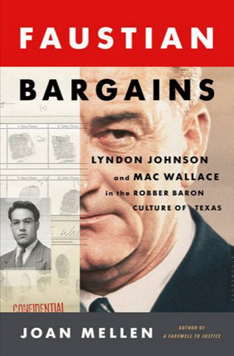
  • John Newman, Where Angels Tread Lightly, Volume 1

    John Newman, Where Angels Tread Lightly, Volume 1


    I

    In this reviewer’s opinion, Professor John Newman has written two of the most important books on the JFK case in the last 25 years.  The first was published in 1992. Since Newman was a professor of Asian history, he had done a lot of work on America’s struggle in Indochina.  He had come to the conclusion that the mainstream media’s belief that President Johnson had continued President Kennedy’s policies in Indochina was false. So he decided to prove, in a scholarly way, that the MSM was wrong on this point.

    Newman’s work was finally published in 1992.  Entitled JFK and Vietnam, it was the first book length study to vitiate the establishment view that there was continuity between the Kennedy and Johnson administrations on the conduct of the Vietnam War. Newman’s book was the first systematic and categorical rejection of the Kennedy/Johnson continuity concept. In 460 pages of sober, careful, and documented text, Newman essentially rewrote the history of 1961-63 as far as American involvement in Vietnam went. He showed, among other things, that  Lyndon Johnson was in the pocket of the Pentagon on this issue as far back as 1961. Unauthorized by Kennedy, but influenced by the military, he had offered the leader of South Vietnam, Ngo Dinh Diem, the introduction of American troops into the theater.  (See p. 72)

    In addition to that, Newman also proved that while Kennedy was trying to disguise his withdrawal plan around the rosy and unrealistic reports of Diem winning the battle on the ground, LBJ knew the truth.  From his military aide Howard Burris, Johnson was getting the actual intelligence reports, which showed the contrary: Diem was actually losing the war.  (See pp. 225-27)

    By the end of the book, Newman had exposed one of the great historical lies of the second half of the 20th century:  namely, that American involvement in Vietnam was an inevitable tragedy.  A myth that had been sustained, not just by the MSM, but also by self-proclaimed historians like David Halberstam and Stanley Karnow. Others have further mined the field Newman pioneered, and today we have good books by people like Gordon Goldstein and James Blight—Lessons in Disaster, and Virtual JFK—that have furthered Newman’s milestone thesis.

    Newman had worked as a consultant on Oliver Stone’s film JFK.  He was also commissioned by PBS to do some work on the Lee Oswald files, then just beginning to be declassified at the National Archives. This was in regard to the PBS 1993 anniversary program about Oswald. Stone’s film had created such a national outcry that congress created the JFK Act of 1993 to begin declassifying tens of thousands of records that had been, either wholly or partly, classified.  That experience caused Newman to write his second book, Oswald and the CIA. Which was another milestone in the field. This time it was in the study of Lee Harvey Oswald’s relations to the intelligence community: from his defection to Russia to his return to Dallas from Mexico in 1963.  Originally published in 1995, it was reissued in 2008.  In his Afterword to the later edition, Newman squarely pointed his finger at James Angleton, the CIA’s longtime chief of counter-intelligence, as the ultimate control agent for Lee Harvey Oswald.  In my opinion, the MSM deliberately ignored the revolutionary findings in this important book. (For my review of the reissue, click here).

    There is a difference between the two books.  Not just in subject matter.  The first book was artfully organized and written.  Therefore, although it was dealing with highly complex persons and issues, and it was dense with new information, it was quite readable.  Newman had an editor on that book.  As I wrote in my review, Oswald and the CIA is not as easy to read—perhaps because it was written in a much shorter time, maybe because it lacked a strong editor.

    A few years after the publication of this book, Newman retired from the field of JFK studies.  He resigned from his position as an instructor at the University of Maryland, and migrated to James Madison University in Virginia.  He also became a yoga instructor. He then wrote a book about the historic parallels of that subject with mysticism and Christian theology.  This was called Quest for the Kingdom.

    Three years later, in 2014, Newman decided to re-enter the JFK field.   Before he had left, he was planning a comprehensive study of the Kennedy administration’s relations with Castro.  That book was tentatively entitled Kennedy and Cuba, and was to be issued in tandem with a re-release of JFK and Vietnam. Once John left the field, that endeavor was, in part, abandoned.  I say in part, because in speaking to the author, he is now updating his first book in a plan to have it reissued.  But secondly, it seems that the author kept many of his research files from his Cuba project, because they seem to form the backbone for his planned multi-book series entitled Where Angels Tread Lightly.  We will discuss part one of that series here.  But before beginning, it is important to note that because this is a multi-volume series, that is, a work in progress, any ultimate evaluation will have to be delayed until the last volume is published.  So the reader should see this review as something of a descriptive marker, a buoy in a channel on the way to land.

    II

    In the preface, the author reveals that the title comes from a phrase in a letter that one Catherine Taafe wrote to Bobby Kennedy in late April of 1961.  She figures in the book.  For she had been a CIA asset involved in Agency dealings inside of Cuba. She was writing the Attorney General about the humiliation he and his brother had just experienced over the Bay of Pigs debacle.  In the following Prologue, Newman says this book will be about something he calls “dark operations”.  Later on, he will describe this specifically as the CIA’s attempts to kill Castro being a pretense for the boomerang theory:  that is, the idea that these attempts formed the pretense for the murder of President Kennedy. And specifically the CIA’s plotting around Oswald, i. e., building a pro-Castro legend around him, while also manipulating his files concerning the Mexico City episode; this was all done while inbreeding the threat of nuclear war from his alleged visits to the Cuban and Russian embassies there. These were all elements of the plot.

    Newman also writes that it is necessary to break into the CIA’s codes, that is, its pseudonyms and cryptonyms, in order to unmask these “dark operations”.  For as he says:

    Without unmasking the CIA’s pseudonyms, cryptonyms, and multiple identities, it will not be possible to find out … who was behind the assassination in Dealey Plaza, and how they got away with it.

    As the author sees it, this is the key to unraveling the murder of President Kennedy.  And at the end of the first volume, he assembles a long appendix, which features his deciphering of the multiple names, identities and cryptos used by say, Howard Hunt—along with several others.

    Newman begins Chapter 1 with what he considers the bungling of the Eisenhower administration in the handling of a dual problem: the weakening of the regime of Fulgencio Batista in Cuba, and the growth of overt civil disturbances against him. He notes that, even in the middle of 1958, the CIA was still funneling money to Castro’s forces.  Castro was using men like Frank Sturgis to get weapons from a supplier in Miami.   Sturgis was caught smuggling arms twice but released with the help of the CIA.  He then was a captain in Castro’s army.

    Castro grew bolder throughout 1958. He abducted personnel from Guantanamo Bay and seized the Nicaro Nickel Plant, a huge subdivision of powerful Freeport Sulphur.  The CIA now stopped arms shipments to Batista, since they perceived him as being ousted soon. But they also begin to investigate if Castro was part of the international Comintern.  The CIA and businessman William Pawley dreamed up a couple of last minute Hail Mary schemes to stop Castro from gaining power, but they both failed.  In December of 1958, CIA Director Allen Dulles told the president that the indications were that Castro was a communist.  But it was too late to stop his march to Havana. (Dulles would not inform Eisenhower until late March of 1959 that Castro was running a communist dictatorship.)

    Chapter 2 begins with Castro’s takeover and the evacuation of thousands of Americans out of Cuba.  Santo Trafficante was arrested, but he made a deal with Raul Castro. Castro declared martial law. Eisenhower now relieved the American ambassador, Earl Smth.

    Castro was careful in the beginning to disguise who he really was.  He distanced himself from the existing Cuban communist party.  But some remnants of the anti-Batista movement suspected Castro was at least a commie sympathizer.  Some of these men, like Pancho Varona, Rolando Cubela, and Carlos Tepedino actually were informers for the Agency on Batista.  Once they began to realize who Castro was, and suspecting he would install a leftist dictatorship, those men now become the opposition to Castro.  They will soon meet with two CIA officers. This was the beginning of the DRE, or the Directorio Revolucionario Estudiantil.

    III

    FBI Director, J. Edgar Hoover, was shocked by the rise to power of Castro in Cuba. In his files, Newman found evidence that Richard Nixon’s lifelong friend, Bebe Rebozo, fronted as a funnel for Mob money and investment in business ventures between Ambassador Earl Smith and Batista. Nixon was also getting a cut of this graft.  The author has three sources for this. (Newman does not note it, but this makes three fonts of dirty money Nixon was getting prior to becoming president: from the Shah of Iran, from Romanian industrialist Nicolae Malaxa, and now Batista.  JFK researchers like to point out how corrupt LBJ was. He had nothing on Nixon.)

    Parts of the CIA, and a larger part of the State Department, were willing to wait on Castro. But another part of the Agency developed other informants on him. This included Sturgis—a relationship that was actually approved by CIA HQ—and military commander Camilo Cienfuegos.

    When Sturgis had a falling out with Raul Castro, he was instructed to visit the American embassy in Havana.  From there he was told to meet two CIA officers in Miami.  It is there that he began his relationship with Bernard Barker. Barker and Sturgis were assigned to William Kent of the psy-war branch. Sturgis now began work with James Noel, chief of the CIA office in Havana, along with psy-war expert David Phillips. Phillips was undercover as one “James Stewart”, working for an advertising agency. (As the author notes, whenever one hears that the CIA had no formal relationship with Sturgis, we can now show this is a  deception.)

    Castro, at first, closed the casinos, and their gambling operations.   But there were so many foreigners still on the island that he decided to reopen them temporarily.  Castro asked Sturgis to work as his liaison to the casinos.  It is here that Sturgis got to  know Juan Orta, Castro’s secretary.  Santo Trafficante will later recruit Orta to take part in the CIA-Mafia plots to kill Castro.  But Sturgis had already volunteered to plant a bomb in the second floor conference room at an Air Force Base he regularly visited.

    The author now introduces another female protagonist. She is June Cobb.  Readers of Oswald and the CIA will recall that Newman spent a good deal of time with Cobb there, since she was a CIA infiltrator—one among many—inside the Fair Play for Cuba Committee.  It seems that Cobb began her intelligence career as a double-dealing drug peddler.  That is, she was dealing drugs in Cuba, but also working as an informant for the Federal Bureau of Narcotics.  This began as far back as 1957, when she actually informed on her boyfriend.

    In 1959, when Castro first visited America, Cobb landed a job as a translator for Fidel.  She actually translated his famous “History Will Absolve Me” speech.  Castro liked her work and invited her back to Cuba. He put her in charge of English publications.

    Frank Sturgis was also hard at work as an informant.  In March of 1959, he went to Washington to inform the FBI about Castro.  He did this at the behest of Pedro and Marcos Diaz Lanz, two commanders in Castro’s military.  Sturgis told the Bureau that all three were alarmed about the growing communist influence in Cuba. They worried that Cuba could now become a communist forward base in the Caribbean, e.g., against Rafael Trujillo in the Dominican Republic and Anastasio Somoza in Nicaragua.  Both men were backed by the USA. In fact, Cuba did make very small incursions into both countries, along with Panama, in 1959.  When this happened, certain soldiers of fortune now joined up in the battle against Fidel; e.g., pilot Leslie Bradley, trainer Gerry Hemming, and the man the FBI would wrongly accuse of being at Sylvia Odio’s door, Loran Hall.  After joining the Cuban army, Hemming later engaged in training Nicaraguans.  Hall did also.  While in Cuba, Hall got to know Mafia Don Santo Trafficante.

    n June of 1959, Raul Castro began to purge the military of all suspected informers and double agents.  This included later CIA assets like Sergio Sanjenis.  He especially concentrated on the higher ranks. Lanz took over Radio Havana on June 29, 1959 and criticized Castro’s leftward drift in a lengthy speech. Castro was outraged. He ordered Diaz Lanz under house arrest, and gave Juan Almeida his job as commander of the Air Force.  Sanjenis and Pedro Diaz Lanz defected with the help of the CIA in June of 1959.  Diaz Lanz became a prized asset of the CIA.  He testified in public before Senator Thomas  Dodd’s Internal Security committee.  He would later take part in the Bay of Pigs invasion.

    The Diaz Lanz defection really hit home with Fidel. He now turned even more to the left.

    IV

    The first drastic piece of legislation moving Cuba toward a communist state was the Agrarian Reform Program.  At first, this bill did not allow for compensation when Cuba confiscated property for future redistribution.  As a result, the minister of agriculture, Sori Martin, resigned.

    Castro’s program set up a body of local cooperatives that he labeled INRA (the National Institute for Agrarian Reform). Now, only Cubans could buy land on the island.  INRA was a very powerful agency that shaped land distribution and all infrastructure projects in Cuba.  Manuel Artime ran Zone 22.

    It was the creation of INRA that now drove American business interests to lay siege to the White House, especially in light of the lack of promises by Castro to pay compensation for land. (Castro did tell the new ambassador Philip Bonsal that he would pay later, but not right now.)  In the summer of 1959, these business interests wanted Eisenhower to start a formal program of counter-revolution.  And now, people like Bernard Barker joined up with Manuel Artime (before his defection) to aid Mario Lazo.  Lazo was a high level Cuban attorney under Batista.  He served as corporate counsel for Freeport Sulphur on the island.  Taafe used her contacts to steal inside documents from INRA.

    In the fall of 1959, Castro came out of the closet. After keeping the communist party at arm’s length, he now appointed the leader of the party as Minister of Labor.   He then began to appoint members of the party to all levels of his government.  Thereafter, he announced that Cuba would be a fully communist country in three years.  The CIA heard about this meeting announcement through Artime.

    Through the Havana CIA station, David Phillips and Dave Morales now worked on the defection of Marcos Diaz Lanz.  This decision went all the way up to Chief of the Western Hemisphere, J. C. King.  Phillips and Morales were assisted on this by Bernard Barker.

    The author now addresses a weird episode.   Both the Dominican Republic and Cuba had plans to invade each other almost at the same time in the summer of 1959.  Because he was informed of the Trujillo action in advance, Castro struck first by about four days. But he was not informed of the CIA backing of Trujillo’s invasion of Cuba.  The American Ambassador to Cuba, Philip Bonsal, did not back the Dominican Republic invasion, since he thought it had little chance of success, and would therefore strengthen Castro.  Through informants and agents, Allen Dulles pushed for the Cuban invasion of the Dominican Republic, but said little to the NSC about the Dominican Republic invasion of Cuba. Both attacks were failures.  But Trujillo’s was much worse since Castro rounded up about a thousand POW’s.  After this there were even more defections to the USA, since Castro now started a purge of the military of all suspected American allies.

    After this victory, in September of 1959, Castro announced that Freeport Sulphur’s 75 million dollar plant at Moa Bay would come under property review. Since the regime needed money, Raul Castro actually wanted Fidel to directly expropriate the property. In reaction, business leaders now called for an emergency meeting with both the State Department and Senate Majority Leader Lyndon Johnson.  As a result, David Phillips became a PR advisor for the business interests still on the island. But he reported back that these interests wanted more than PR, they wanted action.

    Short of an American invasion, it was probably too late. For, in October of 1959, Castro wearied of all the defections by people like Sturgis, Sanjenis, and Diaz Lanz. The last one was Manuel Artime, a project that, again, Phillips and Morales worked on. Fidel now made his brother Raul minister of defense.  Bonsal wired Washington that, in and of itself, this was a disturbing development, since Raul was considered even more leftist than Fidel. Further, Fidel Castro cracked down on all suspects who he thought were about to defect:  for example, jailing former Commander Huber Matos.   A week later, Artime began the MRR, an anti-Castro exile group, with Sergio Sanjenis.

    Also in October, the State Department announced a new policy paper in regards to Cuba.  It was titled “Current Basic United States Policy Towards Cuba”.  Part of the objective entailed the removal of Fidel Castro from power by no later than the end of 1960. President Eisenhower adopted this paper in November, along with CIA Director Allen Dulles.  In January of 1960, it extended to the Pentagon.

    At the White House, Vice-President Richard Nixon demanded an action plan.  From the outside, William Pawley—former diplomat and now businessman—wanted another invasion of Cuba through the Dominican Republic. But Allen Dulles vetoed that move.  In December of 1959 Dulles, Deputy Director of Plans, Richard Helms, and Western Hemisphere Chief J. C. King now began to devise a covert action plan against Cuba. When it was completed, Dulles presented it to the National Security Council.

    After Phillips worked on the exfiltration of Artime, he began work on getting Rolando Cubela out of Cuba. Cubela was another government employee who became disenchanted with Castro’s leftward drift.  But the CIA decided that Phillips was becoming overexposed.  So they recalled him back home.  Two cohorts of Phillips handled the Cubela operation: the Cuban friend of Cubela, Carlos Tepedino, and CIA official Tony Sforza.  In talks with Cubela, the CIA learned that government official Manolo Ray was also disenchanted with Castro. But, as time went on, Cubela decided to stay on the island to fight Castro.  Sforza then focused on Juanita Castro, sister of Fidel, as a possible exfiltration target.

    Newman notes that in the middle of all these fateful and furious debates about Cuba, the Russians had stayed hidden in the shadows. This minimized the specter of a Cuban/Russian alliance.  But in late 1959, through Air Force General Curtis LeMay and former Air Force Secretary, and now Senator, Stuart Symington, there began to be talk about a Missile Gap—in favor of the Soviets.  Since Symington was planning on running for the White House the next year, this is probably what motivated him to take part in this nonsense.  As it did Lyndon Johnson, who said the Russians would have a 3-1 advantage in three years.  The facts were that the USA was already two generations ahead of the Soviets in ICBM technology.  The USSR was still testing its first delivery systems while Eisenhower was debating whether to bypass the Atlas rocket for the Minuteman and the Polaris.  This gap in America’s favor would, of course, set the stage for the Missile Crisis.

    This book is exceedingly rich in detail.  Much more than I can begin to convey in a relatively concise review.  What the author is doing has three layers.  First, he is giving us a history of the Castro revolution.  At the same time he is showing how the USA reacted to that epochal turnover, stage by stage in its evolution. Third, he is tracing certain people and movements who will return to the stage in 1963, after Kennedy changes policy, and begins a détente attempt with Cuba.  Other authors have tried this before, but never on this scale or with this intricacy.

  • David Talbot, The Devil’s Chessboard


    David Talbot’s The Devil’s Chessboard has a massive scope to it. It deals with three main figures. The first, and the main character, is CIA Director Allen Dulles. The second, and a supporting character, is his brother, Secretary of State, John Foster Dulles. The third major character, who is dealt with in the last 270 pages of the book, is President John F. Kennedy.

    Beyond focusing on three historical giants, because the framework is a biography of Allen Dulles, the book deals with some extraordinarily complex, controversial, even convoluted, historical events. Because, as the subtitle of the book states, perhaps no other single individual did as much to create the so—called “secret government” of the United States. The one that the mainstream media refuses to recognize, but which the public, in growing numbers, has grown to accept as a fact of life. This dichotomy has done much to feed the growing disbelief by the populace in both the American government, and the American media.

    Before we begin, it is important to place Talbot’s book in a historiographical framework (something which, to my knowledge, no reviewer has done yet.) For surprisingly, even though Allen Dulles passed away well over forty years ago, Talbot really did not have many antecedents. There were two previous, what I should call “group biographies”. That is, volumes dealing with Allen Dulles and his brother, and to a lesser extent his sister Eleanor (who also worked in the State Department.) In 1978, about ten years after Allen Dulles’ death, the prolific author Leonard Mosley wrote Dulles, about all three siblings. In 2013, former New York Times reporter Stephen Kinzer wrote The Brothers. There have been two biographies that were solely about Allen Dulles. In 1994, Peter Grose wrote Gentleman Spy: The Life of Allen Dulles. This was, more or less, an official version of Dulles’ life, befitting the fact that Grose was a member of a body that Allen Dulles himself very much controlled, the Council on Foreign Relations. In 1999, James Srodes wrote Allen Dulles: Master of Spies. Srodes has been a business writer for journals like Forbes, before becoming a contributor to conservative journals like American Spectator and the Washington Times.

    (I should mention that one other attempted Dulles biography, by Richard Harris Smith, does not appear to have been actually published. In an e-mail communication with this reviewer, Talbot wrote that he did find this mysterious manuscript at the Hoover Institute in Palo Alto. He called it a work in progress, and, as he recalled, Grose had gleaned the best parts of it for his volume. Many years ago, when professor Donald Gibson was trying to secure this biography, he asked Mr. Smith—author of a good book on the OSS—what happened to it. Smith replied that he was not in the mood to talk about conspiracy theories.)

    In this reviewer’s opinion, Talbot’s book is a leap beyond these. I don’t want to convey the idea that Talbot is independent of them, for he does reference the previous books. But in this reviewer’s opinion, Talbot goes much further than these previous authors in his attempt to excavate just how involved Allen Dulles was in some of the unsavory aspects that helped create and maintain the Cold War state. Many of these aspects were ignored or minimized in the previous books. But Talbot does not shy away from detailing Dulles’ role in attempting to undermine some of America’s allies, like France during the revolt of the French generals in 1961. Beyond that, he goes much further than they do in explaining Dulles’ dismissal by President Kennedy (it was not all about the Bay of Pigs). And, most interestingly, he highlights Dulles’ rather bizarre insistence in maintaining something like what the author calls an anti-Kennedy government in exile. (Talbot, p. 7) That is, Dulles continued to have regular meetings with high-level CIA officers for years after Kennedy removed him from office. And he does not shy away from the question of Dulles’ involvement in both the assassination of, and the cover-up surrounding Kennedy’s murder.

    Criticism should be nothing if not comparative. Therefore, in these ways, The Devil’s Chessboard is a milestone in the field. This is good in itself of course. But one has to wonder: Why did it take nearly a half-century to write such a book? Talbot’s work is not without flaws—which I will detail later. But it is so far ahead of its competitors, and it deals with such a wide variety of important subjects, that I strongly recommend reading it. Most books I review in this field I read once, and then walk outside and throw them in the dumpster. Talbot’s book is so large in scale, so rich in detail, so wide-ranging and relevant in its gallop through time, that I read it twice—all the while writing 43 pages of notes in preparation for this review. It was the only way to do the book justice. And anyone who says they can grasp and appreciate the 620 pages of text in one reading is not being candid.

    I

    Unlike Srodes and Grose, Talbot does not spend a lot of pages on the formative years of Allen Dulles. I assume that, since the book was quite long in its present form, the author did not think it was necessary to fill in the man’s boyhood, schooling, even his spy services in World War I. Talbot does little more than just mention these matters.

    He begins the book in a rather daring way. After the Prologue, we start the story proper in 1942, with Dulles in Bern, Switzerland. He was working for the OSS, ostensibly against the Third Reich. But revealingly, Talbot entitles this chapter, “The Double Agent”, because despite the fact Dulles was supposed to be working to topple the Reich, he was not obeying the orders issued by his president, Franklin Roosevelt, on that all-important matter. In January of 1943, Roosevelt had decided on a policy of unconditional surrender for the Nazi regime. (p. 29) That is, there would be no negotiations by, or for, the Germans in quest of a truce. This was a sharp and visionary stricture by FDR. As the author notes, it was meant to reassure Josef Stalin—the almost pathologically insecure and paranoid Russian dictator—that his allies, the USA and England, would not cut a separate peace with the Nazis, and then turn on him.

    With that in mind, Talbot begins the book with a scene between Prince Maximilian Egon von Hohenlohe and Dulles. This meeting directly contravened FDR’s instructions. For the two men were discussing a possible deal that would sacrifice Hitler, but save a large part of the Nazi government. (pp. 31ff) And—exactly what FDR wanted to prevent—they saw Russia as the enemy, and they wanted to use Germany as a bulwark against Stalin. Meanwhile, they would dispose of the genocide problem by sending the surviving Jews of East Europe to Africa. During these rather bizarre, and definitely insubordinate conversations, Dulles told the prince that he had the president’s complete support. Which, of course, he did not. These discussions went on for over two months. And as the author reveals—in what is probably the most shocking aspect of the entire negotiation—the prince was representing none other than Heinrich Himmler, chief of the SS. In other words, Himmler was betraying Hitler, and Dulles was betraying Roosevelt. But further, the implications are stunning: Dulles had no problem working out a truce with the man who was running the Final Solution, thereby leaving him alive and free and running a largely Nazi state.

    This opening is both daring and quite suitable. For, like a musical prelude, it sets the thematic overtones of the book at the outset. Dulles will not abide by the wishes of his superior in the White House. He then begins to formulate his own personal foreign policy, oblivious to how it violates the policy of his president. Further, it does not matter to him if he is, literally, dealing with the devil. This is all appropriate and, in a structural way, thematically sound—because this same concept will be repeated in 1961. Except then, Dulles will be insubordinate, not once, but three times within the first year of the presidency of John F. Kennedy. With just cause, Kennedy will then terminate him. However, as the author notes, Dulles had been in power for so long that he began to manage and control what the author outlines as an “anti-Kennedy junta” in exile. Except it was not really in exile; it operated within the confines of the USA, but in secret.

    Why was Dulles predisposed to negotiate with a representative of Himmler’s? In addition to seeing Marxism as the enemy around the corner, Allen Dulles and his brother, future Secretary of State John Foster Dulles, had made a lot of money serving the business interests of Nazi Germany. (pp. 19-28) Their law firm, Sullivan and Cromwell, was one of the largest and most powerful international corporate firms in America. And they had extensive dealings with Germany, way past the date when others had refused to deal with the Nazis since it had become obvious what Hitler was up to. In fact, Sullivan and Cromwell went as far as to set up phony shell companies to disguise the identity of IG Farben, along with Krupp, two of the largest business supporters of the Reich.

    Very pointedly, as he is outlining all of this double-dealing with Nazis and their agents, Talbot also makes another telling observation about the personality of Allen Dulles. While having no qualms about dealing with the Nazis, even Himmler, Dulles essentially sat on more than one early warning about what the Reich had planned for the Jews of Eastern Europe. These were credible reports by Edward Schulte, Fritz Kolba, Rudolf Vrba and Alfred Wetzler. These men all had direct testimony about what the Nazis were doing after rounding up all these Jews. Schulte had witnessed an early demonstration for Himmler of what zyklon gas could do in a shower chamber. (p. 48) Kolbe stole documents about what Hitler planned on doing with the Hungarian Jews being transported by night on trains. (pp. 53, 54) Vrba and Wetzler escaped from Auschwitz and wrote a 40-page report on what was happening there. (p. 56) Dulles sat on the first, summarized the second falsely, and he sent the last one to Cordell Hull, knowing he would be hesitant to act.

    But trying to preserve a large part of the Third Reich, while delaying any rescue attempts of the Jews, was not enough for Dulles. Near the end of the war, Allen Dulles began his attempts to save certain members of the Reich from the hangman’s noose at Nuremburg. Near the end of the war, with the allies tracking him down, Himmler tried to get to Dulles in Switzerland, thinking he could find sanctuary there. He failed in this attempt, was captured, and killed himself by taking a cyanide capsule.

    General Karl Wolff, Himmler’s chief of staff, was more fortunate. At the end of the war, Wolff was chief of all SS forces in Italy. As with Himmler, Dulles was trying to arrange a separate peace with the SS man prior to the end of the war. As the author notes, the aim of this was to prevent any influence from the Russians who were torrentially driving into Germany. Dulles wanted the Soviets to have no influence in Austria or the northern city of Trieste in Italy. (p. 76) As with his earlier dealings with Hohenlohe, Dulles falsely told Wolff that he was representing Roosevelt in these negotiations. (p. 77) Dulles told him he would probably be the Minister of Education in a new Germany after the war. (p. 87)

    But the fall of the Reich changed all this. The Italian uprising against fascism literally endangered Wolff’s life. A cohort of Dulles saved him. Dulles then kept Wolff out of the first two rounds of trials at Nuremburg, even though the man arranged transportation to places like Treblinka and supervised some medical experiments there. Wolff also arranged for slave labor from the camps to large private contributors to the SS. (pp. 82-84) While in a rather comfortable detention—Dulles actually got him the use of a yacht—Dulles defended the SS manager from the worst of the charges brought against him by the Nuremburg prosecutors. These negotiations went on for month after month. Meanwhile, Dulles said Wolff should be in a hospital since he was suffering from nervous exhaustion. (p. 88)

    When the charade was over, Dulles got Wolff’s penalty reduced to time served—less than four years. By the fifties, Wolff was fully rehabilitated. To the point that the State Department, under Foster Dulles’ control, granted him a visa. (p. 93) This same pattern was largely repeated with Eugen Dollmann, an assistant to Wolff.

    But probably the most infamous Nazi who Dulles helped escape Nuremburg was Reinhard Gehlen. Talbot devotes a chapter to Hitler’s former chief of espionage on the eastern front. He begins it in a novel way: with Gehlen and a friend (also a former Nazi) watching the legendary 1951 World Series between the New York Giants and the Yankees, after which Joe DiMaggio retired. Dulles had helped arrange for the CIA to get the pair tickets, with a CIA escort.

    From here, the author flashes back to the rescue of Gehlen from the Russians at the end of World War II. Like Himmler, Gehlen was making his way toward Dulles in hopes he could persuade the OSS spymaster in Bern to rescue him. For Gehlen was involved in a very large and heinous crime: the torture and sometimes murder of thousands of prisoners of war on the Russian Front. It turns out that Gehlen did not really have to seek out Dulles, as Dulles was searching for him. (Ibid, pp. 270-71) Other voices involved, like Army Intelligence, saw no point in enlisting Gehlen. But Dulles won the debate. After setting up a deal with Gehlen to be part of American intelligence after the war, the Nazi now began to recruit former SS officers into his organization, e.g., Konrad Fiebig, later charged with killing thousands of Jews in Belarus. (p. 275)

    But this did not matter to the Dulles brothers because Gehlen delivered the goods they wanted: an inflated and venomous view of the USSR as a juggernaut intent on world domination. Except the Nazi went beyond that: “We live in an age which war is a paramount activity of man with the total annihilation of the enemy as its primary aim.” (p. 278) Yet even the leaders of West Germany did not want Gehlen around after the country was declared an independent republic. But again, Dulles resisted the efforts of Konrad Adenauer to dump Gehlen, probably because Gehlen had contingency plots to take over the West German government if it drifted too far left. (pp. 282-83)

    II

    After World War II and his salvaging of so many former Nazis, Dulles went back to work for a while at Sullivan and Cromwell. These previous political moves helped his clients of course, because now they could rebuild business relations with Germany, while Dulles used some of these former Nazis to crank up the Cold War with Russia—something even more beneficial to his clients.

    One of the key moves Dulles made was with the Noel Field affair. This has been one of the most puzzling aspects of Cold War history. Noel Field was a rather naïve State Department employee who was very much impressed by the anti-Fascist heroism during the Spanish Civil War. In 1940, he resigned and worked for the Unitarian Universalist Service Committee’s Relief Mission in southern France. During the war he worked as an informant for Dulles.

    After the war, Field moved from Switzerland to Prague. He had allegedly been offered a teaching position at a university there. Shortly after he arrived in 1949, he was arrested. After Noel disappeared, his brother Herman began to search for him. He was also arrested. When his wife went looking for him, she was arrested. (pp. 140-43) The question all three detainees were asked during interrogation was, “How do you know Allen Dulles?”

    It turns out that Dulles was using Noel Field. And his family. With the helpful ear of his protégée Frank Wisner, who ran CIA intelligence operations at the time, Dulles had concocted something called Operation Splinter Factor. (p. 151) Taking advantage of Stalin’s paranoia, Dulles had spread the word that the Fields’ going to Eastern Europe was part of a plot to destabilize the USSR. When the Fields did not confess—since there was nothing to confess to—Stalin went batty. He arrested over 170,000 Communist Party members. Show trials and executions followed. (p. 155) The Fields were not released until Stalin died in 1954.

    A useful tool for Dulles to ratchet up the Cold War stateside was a young California congressman named Richard Nixon. Nixon first met Dulles in 1947 on a trip to Europe to promote the Marshall Plan. Representative Christian Herter was also on that voyage via the Queen Mary. These two men seduced Nixon into going along with the Marshall Plan, which most Republicans questioned. (pp. 158-161)

    But Talbot writes that this was probably not the first time Nixon met Dulles. Borrowing from author/investigator John Loftus, he says that the introduction probably occurred in 1945. Nixon was an ensign about to leave the Navy, but he was wrapping up some matters when he discovered some documents relating to the Nazis and the Dulles brothers. He contacted Allen Dulles and the OSS chief told him to hush it up. In return, he and his brother would help him run for political office in California once he was decommissioned. Dulles came through—in spades. He had to, because Nixon’s opponent, Jerry Voorhis, wanted to shine some light on Wall Street’s cooperation with the Nazis during and prior to the war. (pp. 162-63)

    With tons of cash at his disposal, Nixon began one of the great smear campaigns in American political history. The casting of Voorhis as a commie or commie sympathizer was complete fiction. And Nixon knew it. He later said, “Of course, I knew Jerry Voorhis wasn’t a communist. I had to win. That’s the thing you don’t understand. The important thing is to win.” (p. 166) This Machiavellian code, combined with barrels full of money, helped launch one of the most pernicious political careers in post-World-War-II history. And with it, the Second Red Scare.

    In August of 1948, congressman Nixon met secretly with a small coterie of inside-the-beltway high rollers. Among them were the Dulles brothers. Nixon’s House Un-American Activities Committee (HUAC) had just accused Alger Hiss of being a Soviet spy. This was largely based on the word of one Whitaker Chambers. Chambers said he was a former communist who broke with the party. He then turned into a conservative Time magazine writer, as well as a communist fear monger. The problem for Nixon was that Hiss had denied Chamber’s accusations of them knowing each other in the communist underground. Appearing before the committee, Hiss had done well. Some members of the runaway committee thought they should abandon the matter. Nixon was not one of them.

    But he wanted to check with some heavy hitters in the Republican Party before proceeding, because he knew he needed their backing and support. John Foster Dulles was important since he ran the Carnegie Endowment for Peace where Hiss now worked. (p. 169) Nixon brought the committee’s files to this meeting, which indicated to him, and the HUAC, that Hiss was lying when he said he did not know Chambers. These files convinced the Dulles brothers that Nixon was correct and they approved his efforts to corral Hiss. As Foster Dulles later said, “It was clear he did not want to proceed until people like myself had agreed that he really had a cause to justify going ahead.” (p. 170) After all, it was a presidential election year.

    As Joan Brady makes clear in her new book, America’s Dreyfus, Nixon had choreographed the proceedings perfectly, because at the time he made his denial, Hiss had not seen Chambers. When he asked to see him, Nixon always found a reason to avoid such a confrontation. Nixon knew, as Hiss did not, that the two men did know each other—except, at the time they did, Chambers went by a different name (one of many he used, perhaps as many as thirteen). That name was George Crossley. Further, in the 12-year interim, Chambers had gained something like fifty pounds, lost some hair, and greatly cleaned up his appearance, including extensive dental work. Which is why Hiss demanded a face-to-face meeting. He did not want to rely on photos—although Hiss suspected it was probably Crossley. On cue, when they did finally meet, Hiss asked Chambers if he used the name Crossley. Chambers denied it. This was a lie. (Brady, p. 123)

    In fact, Chambers told so many lies that it was almost laughable that Hiss was the one indicted for perjury. But HUAC was a completely politically motivated apparatus. They were responsible for the infamous Hollywood Ten. As Talbot notes, they might have been responsible for the death of Harry Dexter White, a brilliant New Deal economist who was not in the best of health when he appeared before them. After he rode home by train, he died of a heart attack. (Talbot, p. 184) The chairman, J. Parnell Thomas, was later convicted for fraud. (Brady, p. 158)

    At Hiss’ first trial, the prosecutor made a mistake. In his opening comments he said that if the jury did not believe Chambers, he had no case. (Brady, p. 228) Hiss’ first lawyer, Lloyd Stryker, caught Chambers in so many lies that one commentator wrote: getting another lie out of Chambers was like squeezing juice from an orange. But Prosecutor Murphy had the infamous typewriter. This was the legendary Woodstock #230099. Allegedly, Hiss’ wife used this typewriter to replicate the documents Hiss stole before giving them to Chambers to pass on to the Soviet underground in America.

    Which is idiotic on its face. If Hiss were a spy he would just photograph the documents. But for Nixon to make a case, there had to be a direct connection between the documents, Hiss and Chambers. As Joan Brady comments—and every follower of the case now knows—Woodstock #230099 was the wrong typewriter. The serial number betrayed it had not been manufactured at the time the prosecution said it came into the hands of Hiss. (Brady, p. 315) Unfortunately for Hiss, his lawyers did not find this out until after the second trial, where he was convicted of perjury. Suffice it to say, if Stryker had known about this subterfuge, this combined with his demolition of Chambers would have been enough to stop Nixon right there. And then perhaps, as Brady and others have pointed out, the Frankenstein of Joe McCarthy might never have been unleashed.

    When confronted with these troubling facts, the late author Allen Weinstein—the Gerald Posner of the Hiss case—always insisted: But the typewriter was found by the Hiss camp. The problem is that it had been found previous to that. (Brady, p. 218-19) Realizing it was the wrong typewriter, the FBI then built a machine itself. According to John Dean, Nixon actually admitted this to him. (ibid, p. 316) What makes that so compelling is this: the alleged Hiss investigator who found the typewriter and delivered it to the defense was a double agent. (ibid)

    A point brought out by Brady which supports Talbot is that early on, Hiss asked Foster Dulles if he should go over to where Chambers was working and confront him. At least he would now be able to see the man in person. Dulles advised him not to. (Brady, p. 79) At the second trial, Foster Dulles appeared as a witness against Hiss. And Allen Dulles furnished Nixon with various intelligence files on the case. Indeed, “Nixon was impressed by the Dulles brothers’ bold decision to politically exploit the Hiss affair rather than run from it.” (Talbot, p. 171)

    The author delves into something that Brady takes much further. A mystery about the case has always been why Hiss did not allow his stepson Timmy to testify at either trial. Talbot theorizes that there may have been a homosexual tryst between Hiss and Chambers. But in Brady’s book she suggests that the target of Chambers’ raging homosexuality was Timmy. The FBI discovered this apparently through Chambers, who reported it as a rumor, one he did not deny. (Brady, pp. 270-71) It was the discovery of this child abuse—Timothy was only 8 or 9 at the time—that caused Hiss to split from Chambers. If this is true, it greatly explains why Chambers told so many lies for Nixon. And why Timothy did not testify.

    All in all, Nixon did a good job for his masters. He had successfully unleashed the fear of communist spies in our midst, even in our government. In turn, the Dulles brothers recommended him to Eisenhower as a VP candidate. (p. 185) Another Red Scare was on, and it would help the Eisenhower/Nixon ticket win in 1952. Allen Dulles further rewarded Nixon later, during the final stages of that election. It was then discovered that Nixon had taken a six-figure bribe from Romanian industrialist Nicolae Malaxa. But in a brilliant stroke of luck, the teller at the bank where it was deposited turned it over to some rivals of Malaxa. Unsuspectingly, they gave it to their CIA handler. When Drew Pearson reported the story, Dulles promptly arranged to have the evidence deep-sixed. (Talbot, p. 191) Which cinched the election for the Republicans. And guaranteed the Dulles brothers would be prominently featured in the upcoming administration.

    III

    As Talbot notes, James Forrestal got Allen Dulles on the Jackson-Correa Committee to recommend ideas to reform the CIA. This secured him a job as Deputy Director. (This was about the same time Dulles was creating the National Committee for a Free Europe by plundering Nazi gold. See Talbot, p. 150) Once Eisenhower was elected, it was just a matter of time until Foster Dulles got the president to promote his brother from Deputy Director to DCI. Once this was accomplished, with Allen at CIA and Foster as Secretary of State, as Talbot notes, the Dulles Imperium was on.

    An advantage the brothers had in setting up their regime was that, with the Hiss case, they had done a good job in bringing the New Deal into question. Hiss had been part of Franklin Roosevelt’s Ivy League brain trust. He even helped form the United Nations for Harry Truman. Therefore, the establishment of the Red Scare at home now justified the fear of what Foster Dulles called “Godless communism abroad”.

    But there was one more element to setting up this new imperial order. That was the Dulles connection to the Power Elite. Talbot adroitly introduces this by using the man who actually coined that term, C. Wright Mills. As the author writes, for the Dulles brothers, “Democracy … was an impediment to the smooth functioning of the corporate state.” (p. 197) Franklin Roosevelt was well aware of this oligarchy and its advocates. He once wrote, “The real truth … is that a financial element in the larger centers has owned the Government ever since the day of Andrew Jackson.” (ibid) Therefore, their backing of Nixon, and the creation of the Red Scare, all of this was a great opportunity for them to “prove masters of exploiting the anxious state of permanent vigilance that accompanied the Cold War.” (p. 195) As Mills referred to men like the Dulles brothers and Nixon, they believed in a “crackpot realism”; and in the name of that realism, “they have constructed a paranoid reality of their own.” (p. 198)

    How far would they go in this respect? As the author notes, in 1952, Allen Dulles tried to convince DCI Walter B. Smith to assassinate Stalin at a Paris summit meeting. He also funneled funds from CIA front groups to the Eisenhower/Nixon ticket. (p. 203) This is how realpolitik worked for the Dulles brothers. In comparison to them, Henry Kissinger was an amateur. But Talbot does a nice job of sketching in the fact that as Nelson Rockefeller was a benefactor of Kissinger, the relationship between the Dulles clan and the Rockefeller brothers went back much further, and was intricately intertwined. (See pages 550-59) And to his credit, Talbot mentions the open letter from David Rockefeller to President Kennedy, which was suggested by publisher Henry Luce. In this letter, Rockefeller (the real chairman of the Eastern Establishment) criticized many of Kennedy’s economic policies. And he also expressed disdain for the Alliance for Progress. Even after Kennedy was dead, Nelson Rockefeller made a speech criticizing his foreign policy.

    In his treatment of the two great disasters that the Dulles brothers orchestrated—the overthrow of the democratic governments of Iran and Guatemala—Talbot tries a different approach. He writes from a more personal level on both coups. For example, he notes that when the Shah fled Iran, he went to the same hotel Allen Dulles was staying at in Rome. This was no coincidence. Dulles was there to relay the progress of the overthrow and to firm up the resolve of the deposed dictator. In fact, Dulles actually flew back to Tehran with the Shah after the dirty work had been done. (p. 237) Dulles then manipulated the American press coverage of the coup, while covert officer Kim Roosevelt—who ran the operation on the ground—got a nice job with Gulf Oil afterwards.

    With Guatemala—the following year—Talbot poignantly concentrates on the unfortunate personal fate that befell the family of Jacobo Arbenz after Howard Hunt arranged his family’s flight out of Guatemala. In the face of a CIA manipulated civil war, Arbenz had abdicated. His family became a band of wandering minstrels, going from country to country, until Jacobo died in Mexico City from an electric shock at the age of 57. But not before his daughter committed suicide. Arbenz’ only mistake was that he wanted more of his nation’s wealth to go to its citizens and less to United Fruit. If he had gone along with the wishes of the North Americans, he would have been a rich man, since they offered him two million dollars to shut his mouth. (p. 260) Instead, the fascist dictatorships that followed Arbenz ended up killing about 250,000 Guatemalans—in order to save the country from communism. Apparently, this is what Foster Dulles meant when he announced that their regime would be a A Policy of Boldness.

    But the Dulles brothers were not just brutal abroad, they were also quite curt and short with their own employees. In this regard, Talbot provides nice summaries of the deaths of both Frank Olson and Jimmy Kronthal. Most readers understand the story of the former. Olson was part of the CIA’s MK/Ultra drug experimentation program, part of the aim of which was to produce a mind-controlled assassin. After Olson was doused with a dose of LSD, he allegedly fell to his death from the tenth floor of a Manhattan hotel. James McCord, part of the CIA’s Office of Security, called the case a suicide. (p. 296) The family did not buy it. Decades later, they had the body exhumed. The panel doing the examination ruled (with one exception) that there were traces of blunt force trauma on the head and chest area—before the fall. Dr. James Starrs, leader of the panel, told the press afterward, “I am exceedingly skeptical of the view that Dr. Olson went through the window on his own.” (ibid) In the latter case, Kronthal was a promising CIA officer who Dulles personally liked. The problem was that the Soviets found out he was a homosexual. They set up a honey trap for him, and then successfully turned him. (p. 298) The CIA found out about his doubling. In a private meeting at his personal residence, Dulles confronted him with the evidence. Kronthal then walked home, which was just two blocks from Dulles’ residence. Trailing him were two Office of Security agents. He left a note saying he was not to be disturbed the next morning. But later on, two men came to his house and told his housekeeper he had to attend a crucial meeting. When they went to his bedroom door, they found his dead body, fully clothed, with an empty vial next to it. (p. 299) Curiously, the autopsy failed to determine the cause of death, or what was in the vial next to his bed. CIA officer Robert Crowley came to believe that his suicide was assisted.

    One of the highlights of the book is Talbot’s chronicle of what was probably the first case of extraordinary rendition on American territory. It occurred in 1956. This was the too little mentioned case of Jesus de Galindez, a professor at Columbia University.

    After serving on the Republican side in the Spanish Civil War, Galindez decided to move to the Dominican Republic. There, he decided to become an academic. The problem is that someone as intelligent and democratic as Galindez would find it hard to swallow the bizarre and dissolute rule of Rafael Trujillo. As authors like Jim Hougan have noted, the word bloodthirsty seems to have been created for the reign of Trujillo, who State Department employees often referred to as a Central American Dracula in their memos. (Hougan, Spooks, p. 104) Trujillo was one of the early appreciators of snuff film pornography. He was also an inhabitant of the outer limits of torture; e.g., he would often order the suspected traitor’s eyebrows sewn to their brows so they could not close their eyes. Once he was deposed, palace films were found of children being forced to mate with animals. All this while he was looting his country. He reportedly had $840,000,000 on deposit in Swiss banks, a mind-boggling sum for 1960. (Hougan, p. 109)

    The Dulles brothers, as well as Nixon, not only tolerated Trujillo; they embraced him. Nixon once said that Americans needed to back the Dominican dictator because, after all, “Spaniards had many talents, but government was not among them.” (Talbot, p. 318) Which is an odd comment coming from a man who ended his career with the Watergate scandal.

    As if Trujillo did not have enough money on hand, the CIA and State Department passed on millions more to him each year, much of which he pocketed himself. After he left the country, Galindez wrote a 750-page expose on Trujillo. And he was also critical of the tilt of Foster Dulles’ foreign policy. (Talbot, p. 321) When Trujillo’s agents heard about the manuscript, they first tried to bribe the professor to prevent it from being turned into a book. When that failed, two Dominican thugs sat in on a class. When that did not do the trick, Allen Dulles helped the despot by farming out the Galindez kidnapping to Robert Maheu. The infamous Maheu was a former FBI man who left the Bureau to set up a CIA front company called Robert Maheu and Associates. Like Guy Banister’s operation in New Orleans, this was supposed to be a private detective agency. But it did little of that sort of work. Rather, it carried out domestic covert operations, like this one for the CIA, which was not supposed to perform covert ops stateside. After Galindez was kidnapped, he was flown to the Dominican Republic. He was confronted with his manuscript, and when he refused to renounce it, Trujillo ordered up his specialty. He first had the man boiled in water; he then fed him to his sharks. (p. 322)

    But there was a problem that lingered after the murder. The pilot Maheu hired did not know what the end result of the rendition would be. So he began to talk. He was sent to see Trujillo. He then disappeared. This caused a lot of headlines in the papers that Dulles did not like. Neither did the Justice Department. So the authorities now arrested John Frank, who worked for Maheu as an agent on Trujillo’s estate. To make the Frank saga short: he was arrested, tried and convicted, but released on appeal. There was a lot of pressure placed on witnesses not to show up at the second trial. Therefore, the charges were plea-bargained down to Frank not registering as a foreign agent. In other words, although the authorities had a very good idea what had really happened, no one was ever arrested for the two murder/kidnappings.

    IV

    Talbot begins to segue into the major topic of the last part of the book by briefly outlining the close relationship between Dulles and his counter-intelligence chief James Angleton. Today Angleton is the man who many experts, like John Newman, believe to be Lee Harvey Oswald’s ultimate control agent. And later in the book Talbot devotes a long section to the indications that Oswald was some kind of lower level intelligence agent. Dulles gave Angleton many top-flight assignments. For instance, he was the CIA liaison to the foreign desks of major countries like France, West Germany, Turkey, Taiwan and, most importantly, Israel. He also had liaison duties with the FBI, and, at times, with the Mafia. (pp. 336-37) Talbot notes that in his approach to Meyer Lansky to attempt to kill Castro, Dulles did not use Angleton. He employed a lower level officer named Sam Halpern. (In his previous book Brothers, Talbot exposed Halpern as blaming these machinations with the Mafia on the Kennedys.)

    And this forms the introduction to one of the most interesting passages in The Devil’s Chessboard. One that this reviewer had never read about before. Let us call it the Shelburne vs. Hotel Theresa incident. In 1960, Fidel Castro visited the USA for the second time. By then, Allen Dulles and the White House—Foster Dulles had died in 1959—had decided that Castro was a communist and there was no point in dealing with him. When Castro and his entourage tried to book a suite of rooms at the Shelburne Hotel near the United Nations, the management demanded a twenty thousand dollar deposit. As Talbot clearly implies, this was on orders from Washington. Castro refused to pay. And in a beautifully directed turnabout, he moved his company to the Hotel Theresa in Harlem. (p. 339) Once ensconced there, leaders like Nasser, Nehru and Khrushchev visited him at the hotel. The man who took charge of the transfer was none other than Malcolm X. (p. 342)

    Castro delivered what none other than I. F. Stone called a tour de force speech at the UN. The spectacle at the Theresa, and Castro’s powerful speech, caused the Fair Play for Cuba Committee to sponsor a party in his honor in the ballroom of the hotel. It was attended by such leftist luminaries as Allen Ginsberg, Langston Hughes and C. Wright Mills. (p. 345)

    In other words, the Dulles/White House operation was not just blunted. It was routed. After this September 1960 incident, two things happened which Talbot uses masterfully as a lesson in foreshadowing. First, the CIA now gets in contact with Maheu again. This time, the target is Castro. But secondly, the Theresa incident occurred in the middle of the presidential race. Two weeks after Castro left Harlem, candidate John Kennedy decided to book a room at the Hotel Theresa. He then spoke to a large crowd outside. (p. 349) He was joined by Eleanor Roosevelt and Representative Adam Clayton Powell. He gave an altogether memorable speech. One that revealed that it was Kennedy, not Nixon, who understood the temper of the times. Talbot quotes much of it verbatim:

    I am delighted to come to Harlem and I think the whole world should come here and the whole world should recognize we all live right next to each other, whether here in Harlem or on the other side of the globe. We should be glad that Castro and Khrushchev came to the United States. We should not fear the twentieth century, for the worldwide revolution, which we see all around us is part of the original American Revolution. (p. 350)

    To put it mildly, this is not what Dulles and Eisenhower would have had Nixon say. But it presages the clash of ideas between Kennedy and Dulles that would take place almost immediately upon Kennedy assuming power. Actually, the clash began before Kennedy was inaugurated.

    One of the most poetic and elegantly written sections of the book is Talbot’s reverie on the final days of Patrice Lumumba. During the campaign, it became obvious that Kennedy opposed the Dulles/Eisenhower alliance with European imperialists to keep control of the Third World. As historian Philip Muehlenbeck noted in his study of the subject, Kennedy referred to Africa over 400 times during his 1960 campaign. He once even asked Democratic foreign policy advisor Averill Harriman if he should openly back Lumumba. Lumumba was a dynamic, anti-colonial leader who was trying to shake off the Belgian colonialist shackles from his native Congo. He was deemed to be so dangerous to American interests that Eisenhower ordered Dulles to hatch a plot to kill him. Like Arbenz, his true crime was that he wanted to use the enormous mineral wealth of his country to enrich its citizens and not European and American corporations.

    On August 18, 1960, the NSC, under the guidance of Eisenhower and Allen Dulles, decided that Lumumba had to be eliminated. At first, the CIA went to the ceremonial president, Joseph Kasavubu, the man Lumumba had beaten in a democratic election. They asked him to stage a coup. He refused. (Jonathan Kwitny, Endless Enemies, p. 63) CIA station chief Larry Devlin then went to Josef Mobutu, an army colonel, to do the job. Some reports say Devlin wanted a wholesale disposal—that is, the elimination of Lumumba and his two closest political allies. Later Kasavubu swung over to the CIA’s side. On September 14th, the American inspired and designed coup succeeded.

    After he was deposed by Mobutu, Lumumba was placed under house arrest. But he escaped. As Talbot describes it, he was running for his life. But right before he got to the sanctuary of his followers, he was separated from his wife and child. He then crossed back across the river to get them. It was this that allowed him to be captured. (Talbot, p. 382) Once this occurred, Lumumba was as good as gone. For Dulles had assigned two upper level officers to make sure Lumumba was now killed. These were Leopoldville station chief Devlin and Director of Plans, Dick Bissell. Dulles actually flew Bissell to Rome so he could monitor events more closely. Bissell assigned two hired assassins, codenamed QJ WIN and WI ROGUE, to kill Lumumba by either poison toxin or by rounding up an execution squad. (Talbot, p. 380) But these plots were called off in favor of one that afforded more plausible deniability.

    While Dulles was getting the New York Times to print smear after smear about Lumumba, Lumumba’s captors decided to ship him to his direct opposition in Katanga province, the political base of Mobutu and his ally Moise Tshombe. Devlin knew about this three days in advance. Since he was in constant contact with Bissell and Devlin, Dulles had to have known also. (pp. 384-85) They allowed it to happen, knowing Lumumba’s fate. In fact, it later came out that the CIA picked up Lumumba’s corpse and pondered how to dispose of it.

    As the author points out, Kennedy was racked with pain when he heard the news of Lumumba’s death. But he did not find out about it until almost a month after it happened. The CIA—Dulles, Bissell, and Devlin—deliberately kept it from him. As did the ambassador to Congo in the State Department. All these men had to know they were contradicting Kennedy’s announced reform policy for both Congo and Lumumba. Indeed, it is likely that Dulles speeded up the plot to make sure Lumumba was dead before Kennedy was inaugurated—which he was. It’s hard to believe that Kennedy did not later understand what had happened here. For the tragedy of the people of the Congo was truly epic. As with Arbenz and Guatemala, Congo fell under the claw of Josef Mobutu’s dictatorship, which lasted for well over three decades. Mobutu was simply a stand-in for European imperial powers, allowing them to sack the country, while he became perhaps the richest man in Africa. Congo has never really recovered from the death of Lumumba. As Jonathan Kwitny once wrote:

    … the precedent for … the very first coup in postcolonial African history, the very first political assassination, and the very first junking of a legally constituted democratic system, all took place in a major country, and were all instigated by the United States of America. (Kwitny, ibid, 75)

    As good as the writing on Lumumba is, Talbot’s section on the CIA’s aid in the April 1961 attempt to overthrow Charles DeGaulle might be even better. Truth be told, it’s one of the absolute pinnacles of the book. This dramatic encounter has been touched on tangentially in other JFK- or Dulles-related volumes. But I have never seen it treated as thoroughly, or at this length before. At a talk he did in Los Angeles, the author mentioned that he found a book published in France, and had it translated into English. It must have been a good book, because the details Talbot provides were almost all new to this reviewer.

    What Talbot is describing is the bold attempt by the leaders of a dissident military faction in Algeria to invade Paris, in order to force DeGaulle to abdicate. There were four main generals who formed the axis of French soldiers who vehemently opposed DeGaulle’s policy to cut loose the French colony of Algeria, a policy on which Kennedy was in agreement with DeGaulle. Recall that in 1957, Senator Kennedy made a brilliant speech from the Senate floor harshly criticizing France’s colonial war to maintain control of Algeria. It was this speech, more than anything else, which brought Kennedy into direct conflict with the Dulles brothers and Vice-President Nixon. Kennedy predicted that if France did not voluntarily give up Algeria, she would find herself in the same situation she just emerged from after her defeat in Vietnam. The Algerian war caused the fall of the Fourth Republic and the return to power of DeGaulle—who understood the wisdom of Kennedy’s words. Just as the military veterans in Algeria did not.

    On April 22, 1961, the dissident French generals seized power in Algiers. They immediately spread the word that they would next strike in Paris. (Talbot, p. 412) The plan was a combined paratrooper and tank attack. Once these assaults were in process, the Elysée Palace would then be seized as well as other key government outposts. Anticipating the attack, DeGaulle prohibited air traffic over Paris, and cinemas were shut down.

    The leader of the coup was Maurice Challe. Challe had been a top figure in Algeria and then a NATO commander in 1960-61. Through that association, he had relationships with high-ranking French officers. NATO also helped him meet American Pentagon and CIA representatives. As Talbot notes, the French papers stated that both Dulles and Bissell backed the coup. (p. 414) In fact, one paper called the coup attempt, “The Strategy of Allen Dulles.” The CIA did not like the many disagreements DeGaulle had with NATO policy, and they thought the Soviets would move into Algeria if France left. What’s more, the CIA actually tried to drum up corporate support for the coup and American aid for it in Paris. One counselor to the Henry Luce press stated, “An operation is being prepared in Algiers to put a stop to communism and we will not fail as we did in Cuba.” (ibid) Challe ignited the coup because he thought he had American backing all the way up to JFK.

    In this, he had been duped. And since we have seen this MO before, it was probably by Dulles. Scotty Reston of the New York Times reported that in spite of Dulles’ denials, the CIA was indeed “involved in an embarrassing liaison with the anti-Gaullist officers.” This had contributed to the growing perception at the White House that the Agency “had gone beyond the bounds of an objective intelligence gathering Agency and has become the advocate of men and policies that have embarrassed the Administration.” (p. 415)

    The conflict between Dulles and DeGaulle went back to World War II. As OSS chief in Bern, Dulles opposed the segment of the French Resistance headed by DeGaulle. He preferred a more rightwing leader. (Considering that DeGaulle was, at most, a moderate, this shows how far right Dulles was oriented politically.) DeGaulle himself accused Dulles of scheming against his Resistance leadership at the end of the war. Dulles backed a more conservative rival. In typical Dulles methodology, this man had betrayed DeGaulle’s assistant to the Gestapo. (ibid) Once assuming power again, DeGaulle had grown so suspicious of Dulles he had tried to purge CIA influence in the capital of Paris, which was difficult to do since Dulles journeyed there each year to personally pay off informants and agents. The relationship was so chilly that DeGaulle refused to see the DCI personally. Dulles then wrote distorted reports to Kennedy, one which presented the possibility of a coup over DeGaulle’s mishandling of Algeria. In another memo, Dulles predicted DeGaulle would be gone by the end of 1961. And the basis for removal would be Algeria. (p. 417)

    During the coup attempt, Kennedy called Hervé Alphand, the French ambassador in Washington. He told him that America supported DeGaulle. But he could not vouch for the CIA, because “the CIA is such a vast and poorly controlled machine that the most unlikely maneuvers might be true.” JFK also asked for information on suspected Americans aiding the coup so he could deal with them after. Finally, Kennedy told Ambassador James Gavin that the USA should extend help to DeGaulle in resisting the coup. (In some versions—which Talbot does not explicitly cite—it is stated that Kennedy offered France the use of the Sixth Fleet.) Although he appreciated the offer, DeGaulle declined. But after the calls, Kennedy went public with this support for the embattled French premier.

    The plot fizzled because DeGaulle resorted to the airwaves. In a dynamic speech, he appealed directly to the people to preserve France. (p. 420) His ringing plea rallied the populace, especially on the left. A general strike was called; there were massive demonstrations against the Algerian war; hundreds of people went to airfields to stop any troops from landing from Algeria; civilians went to government buildings to protect them from attack. In the face of all this—which promised a brutal and bloody civil war—Challe surrendered.

    But that is not the end of the story. Because later, Talbot actually caps this gripping chronicle. After the author relates the events of Kennedy’s murder, he quotes a much-suppressed interview of DeGaulle. This was made by one of his ministers upon DeGaulle’s return from Kennedy’s funeral in Washington. The French premier compared what happened to JFK with what almost happened to him over Algeria. He said Kennedy’s security forces were in cahoots with a renegade military. And the plotters invented Oswald as a cover story to cover their tracks. He continued in this vein by saying that Oswald was probably supposed to be shot. When he was not, Jack Ruby became the clean-up guy. DeGaulle concluded by explaining the rationale of the plotters: “Better to assassinate an innocent man than to let a civil war break out. Better an injustice than disorder.” (p. 567) It’s amazing that this analysis was made within days of Kennedy’s murder. The only political leader I know who had a comparable rapid understanding of what really happened was Fidel Castro.

    Talbot’s description of the support by Dulles for the attempted coup against DeGaulle is written in tandem with his summary of Operation Zapata, the failed Bay of Pigs invasion—quite appropriately, since they happened at almost the same time. Talbot here conveys what has now become the accepted wisdom of those who have studied the declassified record of Zapata: namely, that the CIA deliberately tricked Kennedy into going along with it, knowing it had almost no chance of succeeding. Dulles and Bissell misjudged Kennedy. They thought that once he saw the assault crumbling, he would send in the Navy, which Admiral Arleigh Burke had stationed right off the coast of Florida. Unauthorized, he placed two battalions of Marines on board. (p. 401)

    But he does bring in some fresh insights. He writes that the Zapata operation was staffed with some of the lowest graded officers in the CIA. In fact, almost half of them were graded in either the lowest third, and some of them in the lowest tenth percentile. Robert Amory, who wrote a book on amphibious landings, was not asked to join. (p. 397)

    When Kennedy refused to send in American forces, after more than one personal plea, the operation was doomed. Immediately after, two reports were commissioned. One was by General Maxwell Taylor and one by Lyman Kirkpatrick of the CIA. Bobby Kennedy’s presence on the former panel sunk Dulles as a witness, and even Burke. President Kennedy was distraught, and then angry. He ordered a Reduction in Force—almost one in five CIA employees were retired. Afterwards Lyndon Johnson said, “You don’t hardly ever see the chiefs of staff around the White House anymore.” LBJ went on to say that the new first advisor to President Kennedy was RFK: “It isn’t McNamara, the chiefs of staff or anybody like that. Bobby is first in and last out. And Bobby is the boy he listens to.” (p. 412) Which was a keen observation by a man who thoroughly understood the workings of power in Washington.

    When Kennedy digested the results of the two reports, he fired Dulles, Bissell and Deputy Director of the CIA, Charles Cabell. In each instance described above—Congo, the Paris coup, Zapata—Dulles had served his president poorly. More significantly, in each instance, Dulles had actually deceived Kennedy about important matters. It’s as if he did not work for John Kennedy. As a matter of fact, as Talbot points out, Dulles never hung a portrait of Kennedy at CIA Headquarters. (p. 403)

    As the author further indicates, the fundamental problem was that 1.) Kennedy really thought he was president, and he wanted to run his own foreign policy, and 2.) His view of the world did not at all coincide with the Dulles/Nixon/Eisenhower view. Indeed, they were actually opposed on many issues. Therefore, if Kennedy was going to run his own foreign affairs, he had no choice but to fire Dulles. For what is truly remarkable about the above record of insubordination is this: It all happened in just four months! What was to be expected in four more years?

    There was a problem with retiring Dulles, though. Powerful people don’t have to accept retirement. Dulles now set up his own mini government, one that was outside normal channels, and unbeknownst to Kennedy.

    V

    We now encounter the penultimate part of The Devils’ Chessboard. The part that has caused the most controversy. The part that has gotten Talbot boycotted by the major media—and Hollywood. For as the author told me, George Clooney requested the first press copy of the book. But as of today, Talbot has not heard from Clooney about the volume. As the author said to this reviewer, “It’s part 3 Jim.” Which is where Talbot outlines his case for Dulles being the CEO of the plot to kill President Kennedy.

    I have seen some critical comments about this aspect of the book. Most of them, for example in The Daily Beast, begin by saying that this part is not as strong as the rest of the work. The problem with these critics is this: None of them deal with Talbot’s evidence in any kind of comprehensive way. Which, of course, makes what they write into a self-fulfilling prophecy. It also indicates that they are dealing the readers a stacked deck. Let us deal the readers a full deck. That is the only way to be honest with them, and to treat the author fairly.

    After his termination, Dulles was, quite naturally, distressed for awhile. But this did not last very long. Through his extensive press contacts he began to attack Arthur Schlesinger, who was always opposed to Zapata, and who Kennedy had tasked with outlining a giant reorganization of the CIA. (p. 431) At this time, Dulles began having private meetings at his home with high-level CIA officers. James Angleton, Richard Helms, Des Fitzgerald, Howard Hunt, and Thomas Karamessines—Helms’ top aide—began to drive up to his Georgetown home and meet with the lion in exile. (p. 449) In addition, Dulles also met with Arleigh Burke, who Kennedy had pushed out of service after his performance during the Bay of Pigs. (ibid, p. 450) We know all of this through the man’s own desk calendars and notebooks.

    In 1963, after Kennedy’s peaceful settlement of the Missile Crisis, Dulles now said he could never work for Kennedy again. Further, he publicly announced that Kennedy would never oust Castro because, he said, Kennedy was too concerned with America being loved in the world, rather than respected. He concluded by saying there could be no compromise with communism, it was the equivalent of appeasement. (p. 456)

    Although his travel records are redacted, it’s pretty obvious that Dulles did a lot of hopping around the country in his “retirement”.

    Consider the following: in the summer of 1963, a young English professor named Peter Scott had begun a second career as an academic at UC Berkley. Scott’s first career had been as a Canadian diplomat who worked in Poland. Because of that link, he had been invited to a gathering of Polish emigres at the Palo Alto home of W. Glenn Campbell. Campbell had been placed in charge of the Hoover Institute on the campus of Stanford University. Campbell was a very conservative Harvard trained economist—a Milton Friedman clone—which is why Herbert Hoover had chosen him to shake up the institute that bore his name. To say he succeeded does not begin to do him justice. A longtime personal friend of Ronald Reagan, he grew the endowment from about 2 million, to well over 135 million when he retired. He did this by appointing conservative stalwarts and friends of Reagan to the staff. Campbell was also known as a very combative personality, one who did not shy away from confrontation. Therefore, at the gathering at his home that night Scott was surprised at how virulent the anti-Kennedy talk got. Scott was actually shocked by the tenor of the talk, which seemed to drag on incessantly. Finally, a Russian Orthodox priest stood up and commanded everyone’s attention. Very quietly, and confidently, he said they had nothing to worry about: “The Old Man will take care of it.” (p. 458)

    At first, Scott thought that the priest was referring to Joe Kennedy, JFK’s father. But he later learned that Joseph Kennedy had been felled by a stroke in late 1961. He was bedridden, or in a wheel chair much of the time. He even had great difficulty speaking. Years later, Scott was told by another researcher that, in intelligence circles, Allen Dulles was often referred to as The Old Man. The dropping of Dulles’ name was enough to calm the heated discussion.

    As noted, Talbot places this meeting in the summer of 1963. A couple of months prior to this, Dulles had taken another meeting. This one was in Washington. And it might explain why the priest said what he did about the Old Man taking care of the problem. That April 1963 meeting was with a Cuban exile named Paulino Sierra Martinez. Of late, Sierra Martinez is becoming a figure of more intense study by people like Larry Hancock, for the simple reason that he seemed to come out of nowhere to become an influential player in the Cuban exile community in 1963. Sierra Martinez had worked under Batista as a foreign diplomat, though some figured he was really a hit man. (Talbot, p. 459)

    When he came to the USA he first lived in Miami, but he then moved to Chicago. He became a legal consul for Union Tank Car Company, founded by the Rockefellers. He then became a major figure among the exiles. A month after his meeting with Dulles (the third man at the meeting was General Lucius Clay), Sierra Martinez convened a conference at the Royalton Hotel in Miami. This was a crucial moment since, after the Missile Crisis, Kennedy made it clear that he was not going to have the CIA back the exiles anywhere near the extent they had done previously. With Kennedy’s stricture in place, Sierra arrived in Miami like a gift from the gods. He said he now represented a consortium of large corporations who wanted to recover their lost investments in Cuba. (ibid) He told the audience that his backers were willing to put up 30 million if they could reorganize and launch a new invasion of the island. Although this invasion would not have approval from the top, it would be backed by officers in the military. They would provide weapons and training facilities.

    After this conference, Sierra then traveled around the country spreading around money in hopes of forming a working coalition, which he called the Junta of the Government of Cuba in Exile. (ibid, p. 460) The source of his money, which was passed through Union Tank Car, was ill defined. Some reports suggested that some of the cash came though organized crime sources. In an interview with this reviewer, Larry Hancock said that the Mob money appeared to originate with Meyer Lansky. Lansky made tons of money for the Chicago Outfit through his interest in The Flamingo in Las Vegas. As Talbot points out, this is interesting because one of the plots against Kennedy in the fall of 1963 originated in Chicago. But further, after the failure of the Chicago plot, Sierra was negotiating an arms deal for one Homer Echevarria. This was in the days leading up to the successful Dallas murder. The day before JFK was killed, Echevarria supposedly said to an informant that his group—a part of Sierra’s umbrella junta—now had the money to mount a major Cuban operation since they had some Jewish money. (Lansky was Jewish.) And they would do so as soon as they took care of Kennedy. (Reuters dispatch of 12/20/95) Which sounds a bit like the troubling words used by the Polish priest with Scott.

    How does a former judo instructor from Miami rise to the near top of the exile community? And with reputed backing from large corporations and the Chicago mob, in just a matter of months? Most objective people would think that the lunch with Dulles had something to do with it. And let us not forget, as Talbot noted, years earlier, Dulles had tried to get Lansky to do away with Castro.

    In a fascinating dual discovery, Talbot sheds light on an ignored aspect of Kennedy’s foreign policy, and the role of a top CIA officer in obstructing it. As many know, Richard Helms got William Harvey out of the country after the Missile Crisis. He got him transferred to Rome. Bobby Kennedy was furious with the man since he had disobeyed orders by trying to launch offensive operations into Cuba during the crisis. In the summer of 1963, President Kennedy visited Italy in what was to be the final European tour of his life. Schlesinger had been badgering JFK to formally back something called “l’apertura a sinistra”—the opening to the left. This would allow the Socialist Party to split from the Communists and allow a center-left coalition with the ruling Christian Democrats. (Talbot, p. 464) As far back as Eisenhower, both James Angleton and Italian ambassador Clare Booth Luce opposed this strophe. After all, Dulles and Angleton worked on a covert operation—right out of his offices at Sullivan and Cromwell— to rig the 1948 Italian elections so the communists would not win.

    But Kennedy ignored these protests. He even arranged for the United Auto Workers to back the socialists. (Talbot, p. 466) What must have made it worse for the CIA is that the Socialist leader in 1963 was the same man Dulles and Angleton defeated in 1948. They were not going to take this lying down. Their man on the scene, Bill Harvey, began working with Italy’s security forces to torpedo the diplomatic move by bombing the Christian Democratic Party offices and newspapers. (p. 475) Harvey even wanted to recruit mobsters to assassinate Communists. Harvey’s second in command, Mark Wyatt, objected to this. When he did, Harvey pulled a gun on him. (ibid)

    In 1998, after an interview with a French journalist in Lake Tahoe, Wyatt off-handedly said, “I always wondered what Bill Harvey was doing in Dallas in November of 1963.” (p. 477) As Talbot later discovered, Wyatt bumped into Harvey on a plane to Dallas at that time. When Talbot talked to Dan Hardway of the House Select Committee on Assassinations, he told him that he tried to get Harvey’s travel vouchers and his security file, but the CIA always blocked this. If this is valid, I don’t have to tell the reader how important it is. Because as Dulles himself admitted, he was in Dallas about three weeks before the assassination, ostensibly on a book tour. (James DiEugenio, Reclaiming Parkland, p. 273) In a tearful admission to his brother, David Phillips acknowledged that he was in Dallas on the day of the assassination. (DiEugenio, Destiny Betrayed, p. 364) And as writers like Lisa Pease have demonstrated, James Angleton once wrote that the CIA had to construct an alibi for Howard Hunt being in Dallas on the day of the assassination. (ibid, p. 363) Can this sudden attraction of CIA officers for the dusty cow town just be a coincidence? Even when they are flying in from Italy? Or maybe all four men were Cowboys fans? (But the Cowboys were pretty bad that year: 4-10)

    In September and October of 1963, Dulles met with Angleton and Angleton’s first assistant Ray Rocca. Both men would later figure as strong influences on the Warren Commission cover up. He also met with Des Fitzgerald, who was in Charge of Cuba operations at the time; and with Dick Helms top assistant, Thomas Karamessines. (Talbot, p. 545) Helms would helm the CIA relationship with the Warren Commission.

    The week before Kennedy’s murder, Dulles had been in Boston and New York on his book tour for The Craft of Intelligence. (On which Hunt had been a major ghostwriter.) On the day JFK was killed, Dulles landed in Washington in the morning, made a speech at the Brookings Institute, and after getting the word of JFK’s murder, he went to Camp Peary. (ibid, p. 546) This was a CIA location sometimes called The Farm. As Talbot writes, this was an alternative Agency headquarters, in which Dulles had built an office from where he could direct covert operations. He was there from Friday in the early evening until Sunday. What could he have been doing there? Of course, one thing he could have been doing was coordinating with Phillips, Hunt, Harvey and Angleton. And when Oswald survived, perhaps Lansky. After all, high stakes gambler Lewis McWillie—a close friend of Jack Ruby— had worked for Lansky in Cuba. (Michael Benson, Who’s Who in the JFK Assassination p. 272)

    What makes this a bit more credible is another hidden point Talbot brings up. As we know through the sterling work of Donald Gibson, the idea of setting up a blue ribbon commission to inquire into the death of President Kennedy was not LBJ’s idea. It was forced upon him by Eugene Rostow and Joseph Alsop. Well, once that was done, Dulles began a lobbying campaign to get named to the Commission. (pp. 573-74) Among the sources for this was Agency military attaché William Corson, who knew Dulles, and also Dean Rusk. To my knowledge, no one else did this. Quite to the contrary, people like Earl Warren and Senator Richard Russell had to be coerced into joining.

    Why is that significant? Because as author Walt Brown has demonstrated, Dulles quickly became the most active member of the Commission. As Warren later said, “I don’t think Allen Dulles ever missed a meeting.” (p. 575) And as Talbot shows, Dulles worked with Angleton, and others, to make sure that any tie by the CIA to Oswald was kept secret. (p. 578) Moreover, Dulles himself leaked stories that Oswald may have been a KGB agent. (p. 583) Dulles insisted that most of the report be consumed by a biography of Oswald, rather than the facts of the case. With his longtime friend John McCloy, and up and coming insider Jerry Ford, this trio controlled the Warren Commission pretty much completely.

    We should now briefly add three more points to adequately summarize Talbot’s case. In December of 1963, Harry Truman wrote a newspaper editorial questioning how the CIA’s mission had evolved from what he had envisioned it. Dulles flew down to Missouri to meet with Truman and tried to get him to retract the statement. When this did not work, Dulles wrote a deceitful memo, which others could use to discredit Truman’s editorial. (pp. 565-72) In 1965, at UCLA, David Lifton attended a talk with Dulles. Bruin student Lifton stood up and began to question the Commission’s statement about there not being any evidence of a conspiracy in the JFK case. (p. 591) To say that Dulles was vehement in his denial does not even begin to describe his tenor. Suffice it to say, this reviewer never saw any of the six other members of the Commission react like this. Finally, when the Jim Garrison investigation was heating up, Dulles did what he could to monitor the proceedings. (p. 597) Again, I know of no other Warren Commissioner who did such a thing.

    The above approximates Talbot’s case. Note that it follows through from the months in advance of the murder, to the day of the murder, to the aftermath of the murder. Do not trust anyone who describes it as “weak” unless they describe it in toto.

    Because no one has.

    VI

    In a book of this size, scope, and depth, there were bound to be flaws, especially since the book was essentially a pioneering effort. Chief among these was the section on the Rolling Stone article devoted to one Saint John Hunt. (p. 496)

    Saint John is the son of Howard Hunt. In 2007, he cooperated on a story with Rolling Stone magazine. Talbot essentially relates that story, along with references to his book Bond of Secrecy and Howard Hunt’s posthumously published book An American Spy. The worst thing about this section is that Talbot uses it to underline the battle between the MSM and alternative media for the truth about the JFK case. I agree on the general point that the MSM has utterly failed the nation on the Kennedy assassination—with horrific results. But this Rolling Stone article was a poor choice to point out that failure.

    In 2007 when I first read the article, I noted that Saint John said that on the night of the Watergate burglary, his father woke him up and said he needed some help. They wiped the fingerprints off of some electronics equipment. They then stuffed the equipment into two suitcases, drove to the Chesapeake and Ohio Canal, and dropped them into the water.

    I had read several books on the Watergate caper by 2007. In fact, Probe devoted a special issue to the subject when Oliver Stone’s Nixon was released. At that time, the best book on Watergate was Jim Hougan’s Secret Agenda. When I looked this incident up in that masterful book, I could not find it. According to Secret Agenda, Alfred Baldwin, James McCord’s assistant, told Hunt that he was returning the electronics equipment to McCord’s home in a van. (Hougan, pp. 210-11) As per Hunt, Hougan writes that he returned to the White House first, and then the Mullen Company (where he had worked prior to being employed by the White House). He was preoccupied with arranging a legal defense. (ibid, pp. 216-17) This discrepancy was enough to raise my antennae about this Rolling Stone article.

    Then there was the five million dollar sum. The article said that Kevin Costner offered Howard Hunt five million dollars to tell the secret history of the JFK assassination—and what he knew about it. Since I had studied films a very long time, I understood that no producer would offer his main source that kind of money for a historical documentary, especially as an offer before production began, or any deals were in place. Because the vast majority of documentaries, even controversial political ones, simply don’t merit that kind of investment.

    It’s surprising to me that Talbot did not talk to Costner. Or perhaps, Costner’s associate in this enterprise, Canadian writer and TV journalist David Giammarco, since it was the latter who initiated the whole discussion of the subject with Hunt. Giammarco did a talk on this very subject at a JFK Lancer Conference back when the article surfaced. There, he revealed that he had worked on trying to get Howard Hunt to talk for over ten years. Saint John and his brother David only came in toward the very end. I also talked to Giammarco myself. He told me that the sum of five million dollars was never, ever mentioned. He said that Costner offered Hunt 250,000 dollars up front and a share of the profits. Which is the only sensible way such a deal could be bartered. Although there is much more to the rather sordid tale, we can end it now. This is enough to convey the fact that Talbot made a needless mistake here.

    There are other, more minor, errors. Talbot writes that Oswald was given a Rosenberg flyer as a youth. (p. 511) As I wrote in Destiny Betrayed, this is highly unlikely. Oswald said this while in Russia, at the wired-for-sound Metropole Hotel. He specifically said he was fifteen at the time this happened. But when he was fifteen he was in New Orleans. Who would deliver Rosenberg literature in that southern town? Further, the couple had been executed the previous year. (DiEugenio, p. 145) On page 562, Talbot writes that “The so-called magic bullet that delivered the fatal blow to Kennedy’s skull before proceeding on its improbable course … .” This is wrong. The Magic Bullet did not hit Kennedy’s skull. It entered his back, and then proceeded on its wild ride forward through both Kennedy and John Connally.

    On page 493, the author mentions a photo of LBJ on a horse with Dulles standing beside him. Talbot says the photo was taken in the summer of 1963 when Dulles visited with LBJ at his ranch. The visit may have happened. But the best research on the photo—by David Lifton and Larry Hancock—says the picture was not taken at that time, but in 1961.

    When mentioning Oswald’s move to New Orleans in the spring of 1963, the author writes that he moved there with Marina and “the girls”. (p. 540) At this time, Oswald had one daughter. It was not until October of 1963 that Marina had a second daughter. Talbot writes that the Warren Commission questioned George DeMohrenschildt longer than any witness. According to Walt Brown, who did a very detailed study of the Commission, it was really Ruth Paine who was questioned the longest. And although Talbot deals with the Paines, I think he is a bit soft on them.

    And finally, Talbot brings up the, by now, dated episode of H. R. Haldeman meeting Richard Helms during Watergate. President Nixon asked him to question Helms about the Bay of Pigs. The usually cool and unflappable Helms lost his composure and got very belligerent. (Talbot, p. 494) Haldeman later wrote in his book The Ends of Power, that he came to think that the “Bay of Pigs” matter was really Nixon’s backhanded code for the JFK assassination. Although Talbot allows for another interpretation, he would have been better off just ignoring the mildewed incident. It happened, but the meanderings about what Helms meant by his explosion is just that, meandering.

    And that is really not good enough for The Devil’s Chessboard. The book is a major achievement in more than one way. It should now become the standard biography of Allen Dulles. In its stark excavation of the evil he represented, the book stands beside, and actually surpasses, Kai Bird’s biography of John McCloy. To think that these two men served on the investigatory panel to find out who killed President Kennedy—that fact is just not palatable today. This book proves that the Commission was doomed from the start.

  • Greg Parker, Lee Harvey Oswald’s Cold War: Why the Kennedy Assassination Should Be Reinvestigated

    Greg Parker, Lee Harvey Oswald’s Cold War: Why the Kennedy Assassination Should Be Reinvestigated


    Volume Two: New Orleans, Fort Worth, California, Japan, Indonesia & Santa Ana

    Excerpt from Part 1

    Reprinted with author’s permission

    Creation of the CAP

    The Civil Air Patrol was formed by Administrative Order 9 on December 1, 1941 to provide civilian air support during WWII. In July, 1946, it was incorporated as a benevolent non-profit organization and made the auxiliary of the newly created US Air Force with mission areas set as aerospace education, cadet programs and emergency services. [xxxiv]

    In New Orleans, the Wing Headquarters and AF-CAP Liaison Office of the CAP Louisiana Wing moved from Building T-232 New Orleans Airport to the International Trade Mart on February 1, 1950. [xxxv]

    The CAP and Col. Cord Meyer, Sr.

    Col. Cord Meyer, Sr. was Northeast Regional Director of the CAP from January 1, 1952 to May 27, 1955 at which time his title changed to Regional Commander. He retired from the CAP on May 21, 1956. [xxxvi]

    Meyer was born in New York City, owned a business in New York City, had his CAP headquarters in New York City, was Commander of American Legion Air Service Post 501 in New York City, headed a draft board in New York City and as at 1954 was living at 116 East 66th St. This was only one and a half miles from the Pic apartment on East 82nd St. [xxxvii]

    Loyalty Police

    In 1948, Norman J. Griffin, Information Officer for the Pennsylvania CAP (part of what would become Meyer’s regional responsibility), prematurely announced a plan being hatched at the national level. What follows is the complete text of the story as published on page 8 of the February 22 issue of the New York Daily News titled Publicity Stalls ‘Loyalty Police’.

    The intention to set up the Civil Air Patrol as a sort of “Loyalty Police” with overtones of a strong-arm squad for American industry may have been scotched because of premature release of the idea through the Pennsylvania Wing of the CAP.

    The National CAP has been a bit coy about the whole business, declaring that the press release, issued by Norman J. Griffin, Public Information Officer of the Pennsylvania CAP, was inaccurate and not in keeping with the national organization’s policy. The Civil Air Patrol, originally under the wartime office of Civilian Defense, is an official auxiliary of the US Air Force.<

    However the national CAP admits that some sort of plan using the CAP for “espionage” work to act in case of a national emergency is now in the tentative stage, and is awaiting the approval of US Central Intelligence and FBI.

    The plan released by the Pennsylvania Wing indicated the organization was getting set to send selected CAP recruits to the Army Counter-Intelligence School at Holabird Signal Depot, Baltimore, Md. It declared that these recruits would be taught the Russian language, Russian military tactics, Russian politics and all characteristics of the Russian people.”

    The release further stated that Col. Philip F. Neuweiler, Commander of the Pennsylvania Wing, had asked the cooperation of the FBI and the State police in screening candidates for this training.

    According to the release Col. Neuweiler was quoted thus:

    “We are asking the industrialists and business men of Pennsylvania for three things” first, that they enlist one member of their firm in CAP and have them take this course; second, report via this enlistee, all persons in the organization known to have Communistic leanings or subversive tendencies; third, lend any financial support they are able to so that CAP can carry out this program”

    Col, Neuweiler is quoted further:

    “This is the first opportunity the business men have had to do something about this growing menace of Communism. We, of the CAP, are going to call a spade a spade and do something about it.”

    In backgrounding the idea, Col. Neuweiler stated:

    “We feel that someday, and, possibly sooner than we expect, an attack may be made against the shores of the US by some unfriendly foreign nation. Many of us in CAP are certain that any open and violent attack against the peace of the US will be preceded by an intensive enemy-guided ‘softening up’ campaign utilizing sabotage, espionage, propaganda, and many other underground subversive activities. It is against activities of this type that CAP with adequate and proper training, can help…”

    Col. Neuweiler did not explain why such work would be done by volunteers, rather than the regular security force of the USA, nor did he have any suggestion as to why industrialists were to recruit candidates and pay the bills.

    Industrialists in central Pennsylvania, asked for their reaction, said they had not yet been approached. Some thought it might be a good idea, and they indicated an understanding of what they might expect for their financial support, especially with their own handpicked recruits doing the job.

    Griffin’s premature release of the scheme seems to have put the quietus on it for the time being. However, neither the national CAP nor the Pennsylvania Wing stated that the idea has been dropped. [xxxviii]

    The CAP and Col. Harold Byrd

    (David) Harold Byrd was Commander of the Texas Wing of the Civil Air Patrol from December 1, 1941 through May 25, 1948. He had been among a small group who had established the CAP in Washington [xxxix], and was appointed Texas Commander by another co-founder, Fiorello La Guardia, who happened to also be Roosevelt’s Director of the Office of Civil Defense. [xl] Byrd rose in rank from Major to Colonel in 1943 when the CAP was transferred from the Office of Civilian defense to the Department of War.

    During the war, Byrd personally oversaw and guided the activities of the CAP in Texas which included border patrols, antiaircraft training, radar testing, fire patrols, courier services, anti-sabotage patrols and search and rescue missions.

    In 1948, Byrd was made Coordinator (later retitled Regional Commander) for CAP’s Southwest Region which is comprised of Texas, Oklahoma, New Mexico, Louisiana, Arkansas and Arizona. That same year he was also made Vice Chairman of the National CAP Board and took over as Chairman in 1959. [xli]

    Also in 1948, Byrd, along with Earle L. Johnson helped establish the CAP cadet program. [xlii]

    Following WWII, when there was talk of disbanding the CAP, Byrd’s political influence was instrumental in the organization’s incorporation and in fact, he was one of the signatories to that legal instrument. [xliii]

    Byrd and the TSBD Purchase Scam

    Byrd is widely said to have purchased the building at 411 Elm St. in Dallas at public auction on Independence Day, 1939 from the previous owner, the Carroway-Byrd Corp. Thomas Carroway and Harold Byrd had started up as Carroway-Byrd Engineering, but changed the name circa 1936. The corporation was involved in air-conditioning and had purchased the building for $400,000 to use as a manufacturing plant. [xliv]

    The whole auction deal was a scam. It would have taken some string-pulling to run an auction on a 4th of July holiday, revered at the time probably more than Christmas Day – the one day you could guarantee virtually no opposition bidding. The ostensible reason for the sell-off was that the company had defaulted on its loan. As a result, Byrd got the building for $35,000 – less than a tenth of the price his company had paid for it. [xlv]

    The CAP and David Ferrie

    David William Ferrie was born on March 18, 1918 in Cleveland, Ohio, the son of a police captain turned attorney. Originally studying to become a priest, he was forced to leave Saint Mary seminary and later, St Charles seminary over what was delicately termed “emotional difficulties”. In between, he had obtained a Bachelor of Arts degree from Baldwin-Wallace University in 1941.

    Ferrie obtained a student pilot license in 1945 and two years later, as a fully-fledged pilot, became a CAP instructor at Hopkins Airport. According to Stephen Roy, who has spent many years researching the life of Ferrie, a year or two after joining, he was chased out of the CAP for some unorthodox flying activities and taking a group of underage boys to a whorehouse. Roy goes on to say that by 1950 Ferrie had joined the US Army Reserve and began writing letters to the Secretary of Defense as well as to the Commander of the First Air Force, asking for a direct commission to train pilots (“I want to train killers…”) . This bravado should be considered however alongside his letter to St Charles seminary seeking to speed up his admission to avoid the draft for WWII. In any case, he certainly was not volunteering to be a fighter pilot himself, though in fairness he may well have had the capacity to be a very good instructor. The HSCA bio on Ferrie quoted noted aviatrix Jean Naatz as saying that Ferrie had done more for the [Cleveland] Civil Air Patrol than anyone else and built up the squadron to one of the biggest squadrons in the state of Ohio.

    In 1951, with the Korean War in full swing, a civilian pilot shortage saw him land a trainee position with Eastern Air Lines and he was soon transferred to New Orleans via Miami. A year after arriving in the Big Easy, Ferrie became an instructor, and later, a commander of the CAP Lakefront Cadet Squadron, but in April, 1955, he was advised that he had failed to gain reappointment. This is where the story becomes muddied through lack of inquisitiveness by the WC and HSCA, as well as by interference being run by more recent individual efforts. Ferrie’s next CAP activity was via an “unofficial” relationship commencing in June with the smaller Metairie squadron out of Moisant Airport. This relationship apparently terminated later that same year. From here, the official history shows that Ferrie was allowed back into the Lakefront squadron in 1958, but was booted out again in June, 1960. In September, he formed his own cadet squadron without CAP accreditation, but oddly, was allowed to base his group called “Falcon Squadron” at Metairie’s CAP base at Moisant.

    Something doesn’t add up.

    On November 23rd, there was Ed Voebel in the media stating that he had …served in the same CAP Metairie Falcon Squadron with Oswald under the command of Captain David W. Ferrie. If the official story is true, this would have been impossible. Oswald was in the Soviet Union at the time we are led to believe was the only time the Falcon Squadron existed, and Voebel was attending the Marion Military Institute in Alabama.

    Jack Martin, a private investigator working for Guy Banister, heard the media reports and passed the information on to the FBI. [xlvi] The FBI duly caught up with Voebel on November 25 after confirming with WWL-TV that they had interviewed him. Voebel repeated that Oswald had been in the CAP under Ferrie, but was not apparently pressed for any details. On the 27th however, Voebel was interviewed by Sergeant Horace Austin of the New Orleans Police Department and was explicitly asked if he had heard of the Falcon Squadron. Voebel flat out denied ever hearing of it. [xlvii] Given that Voebel had used that name in the media, he most assuredly had heard of it – but since he could not have been involved in the 1960 version, it follows that there must have been an earlier incarnation.

    On the same day that the police were interviewing Voebel, the FBI interviewed Joseph Ehrlicker, Commander of the Louisiana Wing CAP. He located records showing that Oswald was enrolled as a CAP cadet at Moisant on July 27, 1955 with Serial Number 084965. There was no termination date listed. Regarding Ferrie, Ehrlicker stated he had been able to determine that Ferrie’s first period as Squadron Commander was terminated on December 31, 1954 and that Ferrie was working at Moisant Airport at this time. The Wing Commander added that it was later found that Ferrie, subsequent to this date, was working with the squadron at Moisant without official connection with the CAP and that as of late 1955, he was no longer with the squadron. Ehrlicker added that Ferrie was again connected with the CAP in late 1958 and was terminated on December 31, 1960 and that afterward Ferrie had set up a “spurious” CAP squadron – that being described as one with no connection with, or recognition by, the CAP. [xlviii]

    In researching Ferrie’s Falcon Squadron it was noted that some of the literature references an elite inner-circle known as “the Omnipotents” while other sources refer to an elite group called “the Internal Mobile Security Unit” (IMSU). One might be forgiven for thinking that these were just different names for the same group, or that two separate elite groups existed within the Falcon Squadron simultaneously – but no source and none of the literature has ever suggested either possibility. The closest we get to any explanation that actually might work is from Ferrie researcher Stephen Roy, writing under his internet pseudonym of “David Blackburst”. Roy claimed in an online discussion group that Ferrie had merely considered forming the Omnipotents and that this was around September, 1960. Instead, he went on to form the IMSU from his squadron the following month. According to Roy, the purpose of the IMSU was to respond in the event of an attack on the US. According to the HSCA, based on testimony provided at Ferrie’s FFA fitness hearings (conducted following a morals arrest and a number of other complaints), it was the Omnipotents who were formed to respond to any attack upon the US. In its footnote however, the committee clarified (or muddied further, perhaps) by saying that despite would-be members being approached to join, Ferrie associate and former FBI SAC (Special Agent in Charge) in Chicago, Guy Banister, had testified that there never was any group by that name. Not even the footnote accurately reflects the record though. What it actually shows is that Mrs. John F. Barrett had complained to her employer sometime in early August, 1960 that her 14 year old son had been influenced to join an organization called “Omnipotent” and that her son had to swear allegiance and obedience to a 19 or 20 year old male. Mrs. Barrett’s son had told her that a Dr. Ferrie was behind the organization. That information speaks of an existing group – not one merely being contemplated.

    IMSUs actually did exist in other states. The idea was not the brainchild of Ferrie, but of unknown individuals in Chatauqua County in New York who formed the first one in August, 1956. In 1959, after three years of operating in the shadows, it partnered up with the local Office of Civil and Defense Mobilization. [xlix]

    Whatever the truth, it shows Ferrie had a propensity for organizing kids with civil defense and counterintelligence operations in mind. It also reinforces the possibility of Oswald being utilized in similar fashion in NYC as contemplated in volume one. Clearly, kids were not off limits in Cold War operations.

    Further evidence surfaced in 1968 when the ONI interviewed a Marine who had been one of Ferrie’s teenagers in 1961. The Marine, whose name is redacted, was used by Ferrie as a messenger and delivery boy for the Cuban Denocratic Revolutionary Front and was soon requested by Ferrie to obtain a passport with the intention of sending the youth to an unnamed South American country for training in “infiltration” into Cuba. [l] This somewhat follows Oswald’s trajectory of being a delivery/messenger boy in New Orleans before joining the Marines where training could take place for his coming “defection” to the Soviet Union. Beyond all of that, we have the HSCA interview with former CAP member, Robert Boylston. On October 17, 1978 Boylston told Bob Buras and L.J. Delsa that

    • Ferrie had paid a $1,000 in tuition fees for him (Boylston) to study at the University of Loyola and had never asked for repayment. [li]
    • Ferrie was always hinting about “secret” orders of a military or intelligence nature. Two examples were given, one relating to the 1958 Lebanon Crisis [lii] and the other relating to Cuba circa 1961 (most likely a reference to the Bay of Pigs).
    • Ferrie talked a great deal about a group who knew what was going on in this country and was going to take care of it.
    • Ferrie knew people in Dallas.
    • Ferrie had once hopped a lift on an Air Force C-47 and that,
    • He (Boylston) felt back then and still did, that some of the people around Ferrie, as well as Ferrie himself were not playing around when they talked of “taking care” of something.

    Boylston’s friend, Van Burns added to the concerns during a May 21st 2001 interview with author, Joan Mellen. Burns told Mellen that in September of 1959, he had seen Lee Oswald with Ferrie. This was just prior to Oswald leaving for Europe. Burns also stated that he had been interested in the CAP in those days and had learned that some cadets were studying the Russian language. Jim di Eugenio has also written about some of the same issues. In Destiny Betrayed: JFK, Cuba, and the Garrison Case, di Eugenio informs his readers that Ferrie told his cadets he was going to control their outside activities and their destinies. [liii]

    Marguerite Oswald & the Recruiting Officer

    Young Oswald commenced 10th Grade at Warren Easton High on September 8, 1955. Barely a month into the term Lee (or a third party) forged a letter in his mother’s name stating that he had to leave school due to a looming relocation to San Diego. He dropped out a few days later, not quite having attained the age of 16.

    During Marguerite’s second session before the Warren Commission, the following colloquy occurred:

    Mr. DOYLE. Tell them about the defection.

    Mrs. OSWALD. Would you please consider that I can’t go any more today? It is 4 o’clock. The defection is a very long and important story that leads into a story where a recruiting officer at age 16 tried to get Lee to enlist into the Marines. And it is a very important story, gentlemen. And I think you would be quite interested in it for the record.

    The CHAIRMAN. We will recess now until tomorrow. Mr. Doyle, I understand in the morning you have a court appearance that you must make. But you will be available at 2 o’clock.

    Mr. DOYLE. Two o’clock, Your Honor.

    The CHAIRMAN. Very well, we will recess now until 2 o’clock tomorrow afternoon.

    Mrs. OSWALD. I appreciate it, because I was up until late last night trying to get the papers for you. It wouldn’t do you any good if I break down.

    The CHAIRMAN. Well, we don’t want to overdo the situation in any way. So we will adjourn until 2 o’clock tomorrow.

    Marguerite had handed the commissioners a key to understanding the path her son had taken, but as already suggested, she would prove abysmal during future appearances, at laying out the details. This was possibly due in part to withholding self-implicating information, given the past roles played by her third husband, Edwin Ekdahl, and eldest son, John Pic in the real Lee Harvey Oswald story. This failure made it easy to marginalize her testimony and to paint her in the most unflattering light.

    Margurerite’s major contention has some support from a surprising source. Donald Monier was with Military Intelligence and was interviewed by the Assassinations Record Review Board on August 12, 1996. Monier covered topics such as the activities of the 112th Military Intelligence Detachment, Military Science and the art of deception, espionage at home and in the Soviet Union, and Civil Rights. Monier also stated that he recalled Navy Code 30 operations relating to a “fake” defector program run by ONI. [liv]

    Unfortunately we are left with two alternatives here. “Code 30” is the Navy operations department dealing with programs for the recruitment of enlisted, officer and reserve candidates. But there is also a Code 30 Department within the Office of Naval Research (ONR). It is unclear at the time of writing if ONR Code 30 existed in 1959, and if it did, whether its role was the same then as it is now and which incorporates Human Performance Training and Education, as well as Intelligence, Surveillance and Reconnaissance, among other streams. It should be added here that Robert Webster, who defected to the Soviet Union shortly before Oswald’s arrival in Moscow, was employed by Rand Corp, and that Rand Corp had a close working relationship with ONR.


    Notes

    [xxxiv]  http://www.gocivilairpatrol.com/about history of Civil Air Patrol

    [xxxv]  The CAP National History Program Website, File #819: General Orders No. 3 January 24, 1950. The author gratefully acknowledges researcher, Paul S. Vine as the finder of this document

    [xxxvi]   Northeast Region CAP website, history page

    [xxxvii]   earlyaviators.com, Cord Meyer, Sr. page

    [xxxviii]  The York Gazette and Daily of January 19, 1948 referred to the plan in its editorial column as “Fascism wrapped in the American flag” and a “gestapo” whereby the CAP would be turned into an organization of stool pigeons recruited and financed by industrialists who would in turn also provide the victims. This editorial also gave the additional information that the plan included the provision of classes in military intelligence and internal security by the state units. It is no doubt this type of adverse publicity which delayed the program. Secrecy would be forced upon it for the same reason, but more so by the very nature of any “off the books” operations it might undertake.

    [xxxix]  Ever since the assassination, there has been an effort by some supporters of the Warren Commission to try and limit Byrd’s historical involvement with the CAP to that of founding the Texas Air Wing. Byrd’s autobiography along with other sources, puts the lie to that. Byrd was indeed a co-founder of the organization in Washington and was so heavily involved from day one that he earned the nickname of “Mr. CAP”.

    [xl]  I’m an Endangered Species, David Harold Byrd, p98

    [xli]  Ibid

    [xlii]  Ibid p99

    [xliii]  Information obtained in 2005 by Duke Lane via telephone interview with Col. Len Blascovich, CAP National Historian.

    [xliv]  Refrigeration Engineering 1937 volumes 33-34, p328

    [xlv]  The Handbook of Texas Online, Texas School Book Depository entry

    [xlvi]  Admin Folder L9: HSCA Administrative Folder, LHO Incoming Communications, volume III, p81

    [xlvii]  Warren Commission Document 365, p37

    [xlviii]  Oswald 201 File, volume 3, Commission Document 75, Part 3, p23

    [xlix]  The Rifleman in Civil Defense, Gun Magazine, p42, Apr 1959

    [l]  ONI Investigative Report by WE Davis. Special Agent, ONI and dated April 17, 1968

    [li]  This was from a man who purchased religious and scholastic credentials from diploma mills for himself.

    [lii]  Eisenhower authorized Operation Blue Bat to deal with the crisis in what was the first test of the Eisenhower Doctrine where US intervention would be restricted to protecting regimes considered threatened by “international communism”.

    [liii]  There was more than a shade of the Athenian System in Ferrie’s sexual attraction to teenaged boys, and his desire to “control their destinies” – specifically to turn them into Spartan warriors. In ancient Athens, shy teens in particular, were attractive to the older males – and we see time and time again, Lee’s apparent shyness described by former CAP cadets. An axiom among those ancient Greek “mentors” was the absolute identification of friends and enemies. Help friends, hurt enemies is ubiquitous in Greek literature. It may be no coincidence that Lee wanted to name a son (should he have one) David and dub (misspell?) his own political system the “Atherian System”

    [liv]  NARA Record No 10772 – Sound Recording of Monier (misspelled as “Moneir” by NARA) interview conducted ARRB 8/12/96

  • John T. Shaw, JFK in the Senate


    As readers of this site know, the last few years have been a very interesting time for the developing scholarship on the foreign policy of President John F. Kennedy. Indeed, the picture that emerges from this new scholarship has done much to alter the portrait of who President Kennedy really was. That adjustment has in turn both highlighted the deficiencies in the prevailing view of Kennedy, and perhaps also illuminated the question of why he was killed.

    To trace some of this new and valuable literature: there was the book and the film entitled Virtual JFK. Those two efforts depicted John F. Kennedy leading a withdrawal from Vietnam in 1963. And the book showed that this concept had actually accumulated some momentum in the hardest arena to impact: that of academia. (click here)

    Related to this, we also had the work of Gordon Goldstein. Goldstein was a scholar who was working with Kennedy’s National Security Advisor McGeorge Bundy. They were at work on a volume that would be Bundy’s equivalent to Robert McNamara’s In Retrospect. (click here) That is, a book that would show that Bundy had been wrong in his advice to JFK on Vietnam, and Kennedy had been correct in his attempt to withdraw, which culminated in the issuance of NSAM 263 in October of 1963. Unfortunately, Bundy passed away before the work was finished. But Goldstein later published it on his own. Lessons in Disaster was a milestone book in the field, because Bundy, even more than McNamara, made it clear that Kennedy was not going to order combat troops into Vietnam. After reviewing the entire declassified record, Bundy was utterly convinced of that fact. It was such an important book that the presidential staffers who were against the USA entering the Afghanistan theater of war passed it around the White House in 2009 (click here).

    These works were all welcome and well done. And they further certified facts and truths that previous scholars had already made obvious to all but the most skeptical – namely, that President Kennedy was not going to enter American combat troops into the morass of a civil war in Vietnam, and that at the time of his death, he was implementing a withdrawal plan. Jim Douglass’ book, JFK and the Unspeakable, did a nice job summarizing the scholarship pertaining to Kennedy’s policies in Cuba, Vietnam and toward Russia, demonstrating, with ample evidence, that Kennedy was working on a rapprochement with Castro, getting American personnel out of Vietnam, and constructing a détente with the USSR.

    Douglass’ book touched on the subject of Africa, as did this reviewer in his 2012 edition of Destiny Betrayed. But in March of 2014, Philip Muehlenbeck published Betting on the Africans, an overall review of Kennedy’s policy on that continent. It turns out that Kennedy was essentially overthrowing the previous administration’s policy on Africa. As the head of African affairs in the State Department said, Kennedy’s administration wanted no part of colonialism or imperialism. What it wanted was – as much as possible – for Africans to own and run their own national affairs. This was a revolutionary departure from the policies of President Eisenhower and Secretary of State John Foster Dulles. And it was crystallized by Kennedy’s stance in the struggle of Congo to be free from European imperialism. (click here)

    About a year before Muehlenbeck, Robert Rakove published Kennedy, Johnson and the Non-Aligned World. This work was similar in its findings to Muehlenbeck. But its scope was broader, extending from Africa to the Middle East, all the way to India. After some serious archival study, Rakove agreed with Muehlenbeck. Kennedy had consciously reversed the previous administration’s policies toward the Third World. And this reversal did not happen in 1963. It started right out of the gate, in 1961. (click here for summaries of these books)

    But further – and just as interesting – both authors found that, unlike what one would expect, the Democratic Vice President under Kennedy did not hew to the paths JFK had forged. In almost every case, Lyndon Johnson slid backwards into the heritage of Dulles and Eisenhower. For this reason, the legacy of Kennedy’s revolution in foreign policy was lost within about 18 months of his assassination.

    In other words, today, there is a lot of new information about who President Kennedy really was. And this newly discovered information demonstrates that JFK’s new approach to foreign policy did not really begin to assert itself in 1963. It started right after Kennedy’s inauguration. If that is so, then Kennedy must have been gestating his new ideas many years in advance. A new look at his senatorial career would therefore be in order, because many of the more standard biographies of Kennedy do not prepare us for what he actually did in the White House in 1961. In fact, to a large degree, they ignore it (for example, the works of Robert Dallek, Richard Reeves, and Herbert Parmet).

    II

    In light of all the above, John T. Shaw’s JFK in the Senate seemed like a good idea for a book. If one thoroughly traced Kennedy’s career in the Senate, one could get a very good idea of who he was and what he was going to do in the White House, since, as many have noted – including Tip O’Neill –, very few men grew the way Jack Kennedy did in his years in the Senate. (Shaw, p. 6) Shaw’s book is not without its virtues. Foremost among them is its originality. For, as the author notes early on, there is no other book about Kennedy that focuses solely on his Senate career. But when all is said and done, what I think Shaw has written is sort of a Cliff Notes version of what a senatorial study of Kennedy should have been at this point in time.

    The book begins with a presentation in 1959 in the Senate Reception Room. The presentation was for the results of a poll taken by a special committee headed by Senator John Kennedy. Vice-President Richard Nixon was there, as was Senate Majority Leader Lyndon Johnson. The committee’s job was to find the five most important and accomplished senators in the chamber’s history. Lyndon Johnson had first headed the assignment, but he bowed out due to health reasons. (ibid, p. 3)

    The first of the featured speakers was Nixon, the titular head of the Senate. The second speaker was Johnson, the actual leader of the body. The third speaker was Kennedy, the man who had set up the committee and managed it through its long life to its ultimate conclusions. The five senators that Kennedy’s committee decided to honor were Henry Clay of Kentucky, Daniel Webster of Massachusetts, John Calhoun of South Carolina, Robert LaFollette Sr. of Wisconsin, and Robert Taft of Ohio.

    As Shaw sees it, this presentation was both a coming of age and a notice of leaving event for Senator Kennedy. (p. 5) It was the former because it was the only committee of any long life – it took three years – which Kennedy ran during his Senate years of 1952-60. And, as Shaw notes in his book, almost anyone would have to admit that Kennedy did a fine job in helming this rather difficult and thankless task. But Shaw also points out that this may be the only committee Kennedy helmed because he did not feel like the Senate was going to be his home base, and this may have been the cause of his “reluctance to immerse himself in the drudgery of legislative affairs.” (p. 6)

    Shaw uses this unveiling in the Senate Reception Room as a sort of preview of what will come. He then begins the book proper with Chapter Two. Here he gives us a short synopsis of Kennedy’s life before he entered the Congress as a representative. Young Kennedy subscribed to the New York Times at age 14. And after a long discussion about politics with family friend and political science professor William Carleton, Carleton came away quite impressed. He later said about this conversation, “It was clear to me that John had a far better historical and political mind than his father or elder brother; indeed that John’s capacity for seeing current events in historical perspective, and for projecting historical trends into the future, was unusual.” (pp. 12-13)

    Shaw now summarizes the major events in Kennedy’s life before running for Congress. This would include his graduation from Harvard with the manuscript thesis that would end up constituting the 1940 book Why England Slept. Shaw briefly mentions Kennedy’s years of service during World War II, and his adventures in the Pacific on PT boat 109. When Kennedy was released he thought about going into journalism as a career. He worked for both the Chicago Herald American and International News Service. But he ultimately decided not to be a reporter. As Shaw states it, “He found it too reactive; he wanted to make decisions, not write about those made by others.” (p. 14)

    And this, of course, becomes the segue into Kennedy’s decision to run for John Michael Curley’s empty Massachusetts congressional seat. He formally announced his candidacy in April of 1946. He was 29 years old. During this campaign, Kennedy vowed to strive for peace, provide housing for veterans, work for national health care, advocate the rights of workers, provide a fair minimum wage and to secure the survival of the United Nations as the best hope for tranquility in the world. (p. 16) Concerning the last, Kennedy regretted that the USA had given in to Soviet demands to provide veto power to members of the UN Security Council. And, as Shaw notes, Kennedy “even envisioned a scenario in which the atomic bomb might be turned over to the United Nations.” This last is rather important since it shows just how early Kennedy was declaring himself to be an internationalist in the field of world affairs. And further, that he was willing to give up certain aspects of state sovereignty to the United Nations.

    Kennedy won the Democratic primary by a large margin, outpolling his closest opponent by a margin of 2 to 1. He then won the general election in a huge landslide. When he entered the House of Representatives, Kennedy was a mini-celebrity. He was a well-publicized war hero and a published author (Why England Slept sold 85,000 copies). Or as Shaw puts it, “He was the glamorous young bachelor, the most enticing new figure on Capitol Hill in many years.” (p. 18)

    As Shaw writes, the issue that Rep. Kennedy really fought for, and spent a lot of time on, was more and better housing for returning veterans. (Shaw, p. 19) There was a huge shortage of this commodity for returning vets and Kennedy wanted to move fast to correct it. JFK hammered the GOP for stalling eventual approval of a housing bill that he backed. He particularly hit hard at the American Legion which, he claimed, was being used as a stooge for the real estate lobby. He actually said that the leadership of the American Legion had not had a constructive thought since 1918. (p. 21)

    Shaw points out a little known fact about Kennedy at this time. There had been a wave of strikes in America from 1945-47. Even President Truman thought the power of unions at this time was too dominant. Kennedy was for some labor reform, but he was against the Taft-Hartley Act. As he commented, “In seeking to destroy what is bad, they are also destroying what is good.” (p. 23) During the raging controversy over the draconian Taft-Hartley Bill – which would seriously weaken unions – Kennedy debated fellow representative Richard Nixon in McKeesport, Pennsylvania over the issue. As Shaw notes, this is unusual today because neither man was from Pennsylvania, let alone McKeesport. As most of us know, Truman vetoed Taft-Hartley, but it was passed over his veto. Kennedy, of course, voted against it. (ibid)

    Shaw notes two other issues Kennedy acted on in the domestic arena. Kennedy was quite interested in federal aid to education, but he was against direct public support for parochial schools. He was also a member of the House’s District of Columbia committee, and he supported home rule for DC. (p. 24)

    Shaw briefly outlines Kennedy’s foreign policy views as they were discernible at this time. According to the author, Kennedy backed the George Kennan concept of containment of the Soviet Union. This had been fully adopted by Truman and his Secretaries of State George Marshall, and Dean Acheson, although not in the form that Kennan had envisioned it. Kennan always insisted that he never wanted this policy to be accented by a military build up. But, in 1950, it was so accented with NSC-68. Which, as Mike Swanson shows in his fine book The War State, was pushed through by Paul Nitze. According to Shaw, Kennedy also did not like the loss of China to the communists, and he criticized Truman and the State Department for it. At this time, Shaw notes that Kennedy seemed to believe in the Domino Theory.

    In this reviewer’s opinion, Shaw should have made more of this than he does. Or, at least, he should have flashed a preview card here as to the change that was coming around the bend. Because, as a senator, and then president, these views about the Domino Theory and containment were going to be altered. In fact, Kennedy would become a real maverick in that regard – especially as opposed to his predecessors, Truman and Eisenhower, and the man who followed him into the White House, Lyndon Johnson.

    III

    In preparing to run for the Senate, Kennedy tried to visit every major city and town in Massachusetts. He almost never turned down an invitation. And every association or agency was glad to have him because he never charged for an appearance, not even for expenses. (p. 30) On these weekend trips, the millionaire’s son got by with hamburgers and milkshakes, and he once shaved in a bowling alley rest room. Because of his bad back, he was often on crutches and at night he would soak in a warm bath in a hotel room. Finally, in April of 1952, Kennedy announced he would run for the Senate against the formidable Henry Cabot Lodge. In this race, after Joe Kennedy fired Mark Dalton, Bobby Kennedy served for the first time as his brother’s campaign manager. (p. 36)

    Lodge wasted a lot of time in this race, because he was dedicated to convincing Eisenhower to run as a Republican for president. He needed to do that for the simple reason that he felt the early favorite, Robert Taft, would lose a national race. After he convinced Eisenhower to run, Lodge was then instrumental in advising his campaign. (p. 40) As many have noted, Lodge underestimated both John Kennedy, and the apparatus that Bobby Kennedy and Larry O’Brien had constructed with the money given to them by Joseph Kennedy. Towards the end, Lodge did something that an incumbent rarely does: he demanded a debate with Kennedy. Kennedy and he debated twice. (Shaw, p. 42) But this did not strongly impact the head start Lodge had given young Kennedy. Kennedy won with about 51.5% of the vote.

    When Kennedy entered the Senate, Eisenhower and Secretary of State John Foster Dulles were proffering the New Look for the Pentagon. That is, an arsenal with smaller conventional forces, but a much larger atomic stockpile. The number of atomic weapons under these two men went from less than a hundred to 18,000. (Shaw, p. 50)

    In South Vietnam, Eisenhower and Dulles eventually budgeted a billion dollars per year and 1,000 advisors to prop up the remnants of the French colonial empire. (p. 51) Much of this was given to the CIA, run by Foster Dulles’ brother, Allen. The field advisor to the enormous agency mission was Edward Lansdale.

    The Democratic leader of the Senate was LBJ. He was first elected whip in 1951, and Democratic leader in 1953. He then became Majority Leader in 1955. Senator Robert Taft helmed the GOP leadership. But on the floor, Robert Kerr and Styles Bridges usually led the Republicans in debate. Southern senators controlled seven of the nine most important committees. The old joke was that the Senate was “the only place in the country where the South did not lose the war.” (p. 59) There was an informal insiders’ club made up of southern Democrats and conservative Republicans from the Midwest. They met frequently and had much control over the agenda.

    As Shaw notes, Kennedy never showed any interest in being a part of this club. And, almost from the start, he began to dismiss Eisenhower’s leadership as slow-moving and backward looking. (Shaw, p. 52)

    IV

    Kennedy in the Senate took on some of the domestic issues that he was interested in in the House: subjects like labor reform, education and housing. He was also interested in the Hoover Commission reforms to make the actual government apparatus run more efficiently. (p. 65) He promoted about a dozen of these reforms. He was interested in lowering the voting age to 18 and repealing the requirement of taking a loyalty oath, something that Truman had installed.

    One of the biggest issues Kennedy advocated for on the domestic side was his New England economic plan, which was directly related to the St. Lawrence Seaway proposal by Canada. The former was an attempt to diversify the economy of New England in order to revivify and renew what Kennedy perceived as an economic decline. The aim was to stop the flow of business relocation and to help those hurt by chronic unemployment. (p. 67)

    Kennedy’s ideas on this were rather forward leaning. He wanted to create regional industrial and development corporations, practice job retraining, and teach technical assistance programs, among other ideas. But he also wanted to practice something he called fair trade. And he thought the federal government had a role to play in keeping a level playing field among states and regions in the national economy. (p. 68) For instance, Kennedy pointed out the natural advantages southern states had in the textile industry, which was now declining in New England due to those advantages. (p. 69)

    Kennedy organized a bloc of 12 senators from New England. He met with them bimonthly to pass legislation on important area industries like textiles, fishing and small business expansion. He also recommended programs to help farmers, veterans and senior citizens. Kennedy drafted over 300 pieces of legislation based on his working relationship with this group. As Shaw notes, dozens of them eventually became laws. (p. 70) As he further relates, this took up an enormous amount of his time. It was not uncommon for Kennedy to be found working as late as 7 or 8 in the evening. (p. 72) This, along with his extensive travel schedule, prevented him from belonging to any of the cliques that formed in the Senate.

    The St. Lawrence Seaway project was a large construction project meant to link all of the Great Lakes through a system of canals, locks and channels. The idea was to be able to float a ship all the way from the Atlantic Ocean to the furthest, northwest reaches of Lake Superior. President Eisenhower had endorsed it when it was first introduced. As a congressman, Kennedy had opposed it. (pp. 73-75)

    As Kennedy first saw it, by making it possible to navigate the entire Great Lakes region, the project could hurt the port of Boston and other New England harbors. But the problem was that 1.) It would help the economy of the Northeast as a whole, and 2.) Canada was going to build it if the USA went along or not. Therefore, Kennedy changed his mind. But he did some horse-trading in order to get votes for his New England economy program. (p. 78) Thus Kennedy was instrumental in getting programs of unemployment insurance to last 39 weeks. He also proposed a bill to have participants in welfare and pension plans be given annual reports upon request. (p. 80)

    Sen. Kennedy also served on the McClellan Committee. This was a Senate investigatory body that explored the issues of management malpractice, labor corruption and organized crime influence in unions. Bobby Kennedy was the lead counsel on this committee, and it captured a lot of sensational headlines – especially when Teamster leaders Dave Beck and Jimmy Hoffa were called to testify. Sen. Kennedy was asked to design legislation based on its recommendations. Kennedy brought in authorities like Archibald Cox and Arthur Goldberg to write these bills. (Shaw, p. 80) But although Kennedy’s bill passed the Senate, it was thwarted in the House. The next year, he tried to pass it again. This time, the House attached so many counter amendments to it that Kennedy had to chair a conference committee. The ultimate bill that emerged was so different than the one Kennedy proposed that he eventually took his name off the bill. (p. 85)

    I was rather disappointed with Shaw’s treatment of Kennedy and civil rights in this book. He calls Kennedy’s views on the issue tactical, and even timid, although unlike Fox News, he does say that Kennedy did support the 1957 Civil Rights Act.

    As I have noted before – in my review of The Kennedy Half Century by Larry Sabato – it’s true that Kennedy did break with some of his fellow liberal senators who did not want the bill to go to James Eastland’s Judiciary Committee. They did this for the simple reason that Eastland was a strong segregationist. JFK opposed this, not because he was against the bill – he was for it – but because he thought this procedural tactic could then be used against people like himself to block future progressive legislation. Kennedy always felt that if Eastland bottled up the bill, the Democrats could just use a discharge petition to get it onto the floor for a vote. In fact, in a letter he wrote at the time, he actually said he would lead the discharge petition himself. But further, in that letter – addressed to one Alfred Jarrette – he also said he was one of a minority who voted for an extraordinary Title III clause. This allowed the Attorney General to step in in cases of discrimination, not just in voting rights, but also in cases of school segregation. It also allowed the use of civil actions against towns and cities if a pattern of discrimination could be established.

    So, unlike Shaw’s characterization, as Kennedy wrote to Jarrette, he wanted a good, strong civil rights bill. Shaw compounds this misjudgment when he also writes that Kennedy was timid and tactical because he wanted to retain support in the South. One can argue the opposite was the case. As Harry Golden pointed out in his book Mr. Kennedy and the Negroes, Kennedy was so outspoken about Title III that it actually started to erode his support in some states in the formerly Solid South. (See Golden, p. 95) And, of course, it was Title III which the president and his brother Bobby used to begin to file lawsuits in the South to bring down the walls of segregation. (See Golden, pp. 100-105)

    V

    Shaw devotes a chapter in his book to Kennedy’s evolving foreign policy views while in the Senate. He calls it “The High Realm of Foreign Affairs”. In some ways Shaw is fair and insightful on this important issue. For example, he mentions Kennedy’s trips to Western Europe and to Asia and the Middle East in 1951. He also notes that, while there, Kennedy met with some men who did not agree with the Dulles/Eisenhower position on Vietnam.

    For instance, the author mentions Kennedy’s meetings with men like Seymour Topping of the Associated Press and Edmund Gullion of the State Department. He also adds that, armed with this new information, Kennedy had difficult, confrontational meetings with American diplomat Donald Heath and the French military commander, Jean de Latre. He also mentions a radio address Kennedy made about our precarious position there, and how the USA was becoming a colonialist in the minds of the populace abroad. (Shaw, p. 92)

    Shaw also details the debate in 1954 over the expected collapse of the French position at Dien Bien Phu. Shaw quotes some of Kennedy’s speeches at this time, and how they attracted a lot of attention both in the press and by his colleagues. Kennedy assailed the administration for offering years of rosy predictions about the French position there, while extending aid and succor to France. He predicted that all this was now about to come naught. Which was an accurate prophecy.

    But Shaw scores Kennedy for not fully thinking through the French dilemma. He says that France could not stay engaged in a war where its ultimate aim was withdrawal. (p. 97) Therefore, the alternatives were either defeat or surrender. But this disallows what, for example, France did in Africa when it withdrew its formal colonial apparatus. There, France set up a commonwealth, or federation, in which it granted limited independence at first with trade privileges, and then ultimate freedom. That would have been a much less expensive and bloody alternative than France fighting an eight-year war in Indochina.

    Shaw follows what happened in South Vietnam after the collapse of Dien Bien Phu – that is, the creation of the American role there at the Geneva Conference of 1954. The author then states that Kennedy at first backed the government of Ngo Dinh Diem. Shaw then asks: How did Kennedy lose his skepticism when it came to how the USA would fare in Indochina after the French defeat? (p. 100)

    As John Newman notes in is masterly book JFK and Vietnam, Kennedy was acutely aware of the political dimensions of that struggle. Therefore, he understood that, even if Diem was not a good choice to lead the fight against Ho Chi Minh – and he was not – we were stuck with him for the interim. Therefore, the fair and wise thing to do was to give him an opportunity to succeed at first. To call for his abandonment, without giving him any time to fortify his position – this would be a dangerous political stance to take in 1957. Further complicating things, by this time, Kennedy had already thrown his hat in the ring for Vice-President at the 1956 convention. And he almost won. Hence he would not want to have to defend prematurely abandoning Diem in the 1960 primaries. This is an unfortunate fact of our political system, one which Kennedy did not like, but was acutely aware of.

    From here, Shaw goes on to note Kennedy’s further stance against Foster Dulles on the subject of Algeria in his remarkable speech of July, 1957. (p. 101) He does an adequate job on this immense issue. But he also stresses Kennedy’s policy ideas on the Eastern Bloc nations. Which was a parallel to his ideas about French colonialism. In other words, he wanted to offer aid to Poland, behind the Iron Curtain. (pp. 108-09) He even wrote a letter to Foster Dulles extending that idea to him. He also brought a motion to the floor of the Senate on this issue. It failed to pass by one vote. But in 1959, Kennedy managed to push it through. (p. 110) This allowed the extension of loans and grants “to Poland or other communist satellites seeking to resist Soviet and Chinese domination.” Shaw praises him for this. He says that it showed “Kennedy’s ability to find tangible ways to break free from rigid Cold War thinking.” (p. 110)

    Shaw concludes this chapter by writing, “John Kennedy used the Senate as a platform to challenge the Eisenhower administration’s foreign and national security policy and to outline his own vision of America’s role in the world.” He continues with, “As his stature grew, he became one of the Democratic Party’s most visible spokesman on national security issues.” (p. 110)

    In sum, this is not a bad book. And I think some of its faults can be explained by Shaw’s association with the Wall Street Journal and the Hoover Institute.

    But in my opinion it could have been much better. For instance, the author did very few original interviews for the book. As a matter of fact, I counted less than ten of them. Yet, in my opinion, that process would be necessary in order to understand what was happening to Kennedy during these formative years. Also, in what amounts to a shocker, Shaw does not list Richard Mahoney’s landmark book, JFK: Ordeal in Africa in his bibliography, when, in my view, there is no better book on Kennedy’s evolving foreign policy ideas from 1950-59.

    In fact, I would have to say that the vast majority of the book’s references are to secondary sources. And some of those secondary sources are ones I would not consult if I had been writing such a book. For example, the works of Robert Caro are not even really about Kennedy. Robert Dallek’s books on Kennedy do not even mention either his transformation in the Senate, or Edmund Gullion. Christopher Mathews’ books on JFK are pretty much useless, as is Richard Reeves’ book on the JFK presidency. These very questionable secondary sources are all in Shaw’s bibliography. Yet he couldn’t find time for Mahoney’s book? I let the readers make up their own mind on that point.

    As I said, this book amounts to a decent enough starting point for the next author to build on.

  • Flip de Mey, Cold Case Kennedy: A New Investigation Into the Assassination of JFK (2013)

    Flip de Mey, Cold Case Kennedy: A New Investigation Into the Assassination of JFK (2013)


    Landing on the 50th anniversary of JFK’s murder alongside scores of other new or reprinted volumes, author Flip de Mey attempts to set his new book, Cold Case Kennedy, apart from the rest. “If so much ink has already flowed on the assassination of Kennedy,” he writes, “what is the point of yet another book? Cold Case Kennedy places the emphasis on what the whole thing is supposed to be: a murder investigation. The emphasis is on what the evidence says, not on what believers or conspiracists claim.” (p. 9) (emphasis in original) True to that pledge, de Mey emphasizes evidence, while skewering the distortions that have come from both Warren loyalists and skeptics alike. Ultimately concluding that Lee Harvey Oswald was a patsy, de Mey argues for a conspiracy that involved oil men, the mafia and the CIA. (p. 386)

    Although novices will doubtless find the detail in the book daunting, de Mey writes entertainingly and well, and he does a credible job of making his work accessible even to those with only limited background. His sweep is wide, but throughout he keeps his focus on hard evidence, possible suspects, and the flaws in the original investigation.

    Borrowing from the work of Walt Brown, his analyses and insights are particularly astute regarding the weaknesses of what might have been the legal case against Lee Harvey Oswald, had he survived his encounter with Jack Ruby while in police custody (pp. 376-380). Echoing the official conclusions of the Church Committee and the House Select Committee, de Mey answers Earl Warren’s oft heard remark, “Truth was our only client,” with, “The necessary cooperation between the FBI, the CIA, the Secret Service and similar institutions was therefore established in circumstances in which uncovering the truth was not a priority – to put it gently.” (p. 46) Or, as the Senate Select Committee (“Church Committee”) put it, “[T]he Commission was dependent upon the intelligence agencies for the facts and preliminary analysis … The Commission and its staff did analyze the material and frequently requested follow-up agency investigations; but if evidence on a particular point was not supplied to the Commission, this second step would obviously not be reached, and the Commission’s findings would be formulated without the benefit of any information on the omitted point.”1 And, “although the (Warren) Commission had to rely on the FBI to conduct the primary investigation of the President’s death … the Commission was perceived as an adversary by both Hoover and senior FBI officials … such a relationship was not conductive to the cooperation necessary for a thorough and exhaustive investigation.”2 This poisonous atmosphere proved disastrous to the believability of Earl Warren’s work.

    “Reading the volumes and the many underlying, unpublished documents does not bring clarification,” de Mey writes, “Quite the opposite. Gaps, distortions, contradictions, nonsensical window-dressing, legal trickery, deception of witnesses, ambiguous wording … there is no end to it.” (p. 54) de Mey concludes that, “Many of the most ardent critics, in fact, became relentless critics after they had thoroughly read and re-read the (Warren) report, after they had studied and re-studied thousands of documents, after they had searched for years on end for the answer to a specific question … (only then) they became more convinced that the official truth is teeming with errors, manifest lies and omissions … .” (p. 54) The House Select Committee agreed, concluding, “It is a reality to be regretted that the Commission failed to live up to its promise.”3

    de Mey’s analysis will both delight and annoy both skeptics and loyalists alike. Skeptics will delight in his excellent, succinct summary of the “improbabilities” that are the sine qua non of the Warren Commission’s case for a lone gunman (pp. 364, 371-372). Many skeptics will also warm to his conclusion, “The conspirators could be found amongst the higher echelons of the oil industry and the mafia, and certain elements within the CIA,” groups who had “a powerful motive to eliminate Kennedy (p. 386).” Warren Commission loyalists will cheer his embrace of the controversial Single Bullet Theory, the theory that a single bullet fired from behind (Commission Exhibit #399), struck both JFK and Governor John Connally, inflicting seven non-fatal wounds in both men. (p. 300-303).

    Photo of Governor John Connally’s jacket showing location of bullet hole.10

    But loyalists will cringe at his claim that the first shot at Z-160 missed, and that the second, “magic bullet,” shot, must have hit circa Z-211. This latter conclusion rests on his rigid vertical and horizontal trajectory constraints, which he says only permit such a “Magic Bullet” to have hit between Z-207 and Z-211 (p. 300 – 303). So much, then, for Connally’s “lapel flip” at Z-224, held by many loyalists as proof #399 exited the Governor’s chest at that moment, and therefore that Z 223-224 was the moment of impact.4 5 6 And so much for the House Select Committee’s conclusion that the nonfatal shot hit at Z-190.7

    Besides the problems de Mey’s proposed trajectory has with a hit at Z-224, Governor Connally’s hand, he says, “was not even in the correct position (at Z-224). How could the bullet that exited Connally’s chest ten centimeters below the nipple enter his right wrist when it was not there?” (p. 274) However, de Mey does not explain how he knows exactly where Connally wrist was in Z-224, since it is not visible in frame 224, nor any of the frames before or after 224.8 But he does point out that, “Connally was still moving his uninjured hand and his snow-white cuff and Stetson above the edge of the limousine in Z-230 and Z-272.” (p.330) He might also have asked, as Cyril Wecht, MD, JD and Wallace Milam asked, how it was that Connally’s lapel flipped when the presumed exit wound in the Governor’s jacket was decidedly below the lapel of his jacket; or why no flying blood and bone debris is visible in Z-224-225 from the exiting bullet that supposedly flapped the lapel.9 (The expected spray of debris would not have been visible when de Mey says both men were hit, at Z-211, as the Stemmons freeway sign blocked the view.)

    de Mey further insists that #399 did not inflict all of the non-fatal wounds in both men – JFK’s back and throat wound, as well as Connally’s back, chest, wrist and thigh wounds – as per the Warren Commission’s Single Bullet Theory. Rather, de Mey argues that #399 caused JFK’s back and throat injuries as well as Connally’s chest and thigh wounds. But it was a fragment from another “magic bullet,” one fired from the “sniper’s nest,” striking JFK’s head at Z-312-313, that caused Connally’s wrist injuries. I say “magic” because de Mey claims the Z-312 bullet did a lot more than just break bones in JKF’s skull and Connally’s wrist.

    In all, he claims to have identified eight fragments from that amazing shell: One damaged the chrome above the limo’s windshield. A second hit the front windshield. A third fragment scratched a sewer cover and then left a hole in the grass at the edge of Elm St. A fourth fragment struck Connally’s wrist, leaving fragments in the wound after fracturing his heavy radius bone. A fifth fragment flew across the front windshield and struck a curb 80 meters down range, kicking up a concrete fragment that injured bystander James Tague. (Tague himself has said that he was not hit by the last shot; he heard a shot after the one that hit him.11) And three smaller fragments eventually ended up underneath Mrs. Connally’s jump seat. (p. 383)

    de Mey is strapped to this peculiar conclusion because he says only three bullets were fired toward the limousine and one of them missed entirely. And that no shots were fired from any other direction, including a frontal shot many claim came from the “grassy knoll.” That left but two shells to explain all the wreckage. One of them, #399, passed through JFK and the Governor’s chest, ending up in his thigh, de Mey argues, without striking the latter’s wrist. A paucity of ammo means that the bullet that struck JFK’s skull is all that’s left to explain Connally’s wrist injuries, James Tague’s injuries, the scratched sewer cover, the dented chrome strip in the limo, as well as the three fragments found in the limo. In all, he says, “eight fragments from the (bullet that hit JFK’s) head … were projected forward.” (p. 331) de Mey needn’t have embraced this improbable scenario. For, as he acknowledges (p. 148-9), the long-heralded neutron activation analysis “proof” that all the recovered bullet evidence traced to but two bullets, both firearms-matched to Oswald’s rifle, has been debunked. As Lawrence Livermore Lab scientists Eric Randich, Ph.D. and Pat Grant, Ph.D. have shown in the peer-reviewed literature, the recovered fragments may have come from as many as 5 bullets, including non-Mannlicher Carcano ammunition.12

    The Bottom Sling Mount
    Oswald “backyard photo” holding a Mannlicher Carcano13

    Perhaps one of de Mey’s more imaginative speculations is that the murder may have been “executed by an experienced sniper using a sound weapon with bullets that had been prepared in advance with the above-mentioned Carcano” (that is, shot through Oswald’s ’museum piece’ so as to lay a trail to the patsy, then later fitted with a sabot to allow the incriminating rounds to be fired through a more reliable weapon on 11.22.63) (p. 365) This “scapegoat hypothesis,” he says, explains the absence of fingerprints on the weapon, since it was planted. It explains why Oswald never bought or possessed bullets (three shell casings and a live round in the rifle’s chamber were the only rounds that ever surfaced in evidence). It also explains why Oswald, who was right-handed hadn’t adjusted the gun sight, which was set for a left-hander.

    More importantly, it also supposedly explains one of de Mey’s more ambitious claims: why the Carcano seen in Oswald’s hand in the “backyard photographs” is not the same Carcano found in the Book Depository, presumably Commission Exhibit #139. The only difference he specifies is what ambiguously appears to be an object of some sort on the bottom of the weapon’s barrel in the backyard images, which he says is the “fixing ring for the strap.” (p. 171) This object is absent in the photos of the Carcano in evidence. But it’s possible that the “fixing ring” on the barrel’s underside is actually a shadow from an object in the background, as there are other nearby shadows in the images. Moreover, the backyard photos appear to show that the strap is attached, fore and aft, to the side of Oswald’s rifle. If indeed the fixing ring was on the underside of the barrel of Oswald’s rifle and not the side, as he claims, there would have been a matching rearward fixing ring on the rearward underside of the stock of the weapon. No such object is visible in the backyard photos; nor is one evident in Commission Exhibit #139. Rather, the strap in the backyard photos seems to attach to the side of the stock, not the bottom, as it does in #139.


    de Mey makes much of Kennedy’s botched autopsy, placing much of the blame on the Kennedys, particularly Robert. “The Bethesda autopsy was poorly conducted by physicians without any pathological experience, was poorly documented and some of the autopsy findings that were contrary to the desired scenario were adjusted accordingly, even after Kennedy had already been buried.” (p. 247) “The incomplete and inaccurate autopsy was arranged by Admiral Burkley at the request of the Kennedys … [t]he errors in the autopsy were largely due to the lack of experience of the pathologists who carried out the autopsy. This, again, was a consequence of the Kennedys’ interference in the procedure.” (p.39) While de Mey is on solid footing arguing Kennedy’s autopsy was botched, he’s unconvincing on why. A case can be made he aims fire in the wrong direction.

    First, it’s false that JFK’s surgeons had no pathological experience. All three were board-certified pathologists with lots of experience, but in “natural death,” death due to heart attacks, strokes, cancer and so on. What they were shy of was experience in forensic pathology, deaths from “unnatural” causes, such as gun shots, stabbings, etc. But one of them, Commander Pierre Finck, did have proper forensic credentials; he was board certified in forensic pathology. de Mey’s point should have been that JFK’s autopsy was error-ridden because none of the surgeons, not even Finck, was up to the task at hand on 11/22.

    The famed New York City coroner Milton Helpern, MD, laid out the problem particularly well: “Colonel Finck’s position throughout the entire proceeding was extremely uncomfortable. If it had not been for him, the autopsy would not have been handled as well as it was; but he was in the role of the poor bastard Army child foisted into the Navy family reunion. He was the only one of the three doctors with any experience with bullet wounds; but you have to remember that his experience was limited primarily to ’reviewing’ files, pictures, and records of finished cases. (Finck had not done an autopsy himself in ~2 years before 11.22.63) There’s a world of difference between standing at the autopsy table and trying to decide whether a hole in the body is a wound of entrance or a wound of exit, and in reviewing another man’s work at some later date in the relaxed, academic atmosphere of a private office … .” 14

    JFK’s postmortem wasn’t helped by the fact the pathologists probably felt under the gun to finish quickly. On the 17th floor of the hospital sat the mortified and exhausted Kennedy family entourage. More than once there were calls down to the morgue to inquire about the progress of the examination and how much more time would be required. Might the military have buckled to Kennedy family pressure?

    There was at least one good reason to suppose it had. Although the Armed Forces Institute of Pathology was by far the best place for a murder autopsy, and although the Institute was recommended to the Kennedy family, Jackie picked the less expert Naval hospital at Bethesda instead. Her reason? Not because she could control the Navy, but merely because Jack had been a lieutenant in the Navy. This is not to say Bethesda was a bad hospital; it wasn’t. It was an active teaching hospital with an active autopsy service in 1963. But its cases came overwhelmingly from deaths due to natural causes, not murder. So the pathology staff had little experience with the types of injuries JFK sustained, and there was no “on-campus” forensic pathologist handy when they needed one.

    Historian William Manchester,15 author Gus Russo,16 and John Lattimer, MD, a urologist who has published articles and a book about the Kennedy case,17 have all argued that Kennedy family interference goes a long way towards explaining the failings of JFK’s autopsy. However, the weight of the evidence, including some new evidence, suggests that the Kennedy family cannot be faulted for the most important failings of JFK’s post mortem. (Not even the discredited18 19 20 21 22 23 24 25 26 Warren Commission loyalist Gerald Posner believes they can.27) It is more likely that the military deserves that distinction.

    For example, one cannot rule out the possibility that the Kennedy family tried to prevent an examination of JFK’s Addison’s disease-ravaged adrenal glands, then a dark family secret. But in 1993 in JAMA, Finck recalled that, “The Kennedy family did not want us to examine the abdominal cavity, but the abdominal cavity was examined.”28 29 And indeed it was. Kennedy was completely disemboweled.30 So while there’s no indisputable proof, perhaps the family did request that JFK’s abdominal cavity, which houses the adrenals, be left alone, especially since JFK suffered no abdominal injuries. If Finck was right, so much for the military’s cutting corners to kowtow to the Kennedys’ need for speed. (The doctors were not entirely insensitive to family wishes, however. They kept mum about JFK’s atrophied adrenal glands, even 30 years later, in JAMA. But by then Kennedy’s Addison’s disease was an open secret, having already been discussed by John Lattimer in his 1980 book.31)

    Though they might have been unsuccessful in keeping the military out of JFK’s belly, it is not unreasonable to wonder if the family might have otherwise interfered. The likely ` answer is that they probably didn’t, at least not in any way that influenced the outcome. Under oath to the ARRB, Humes admitted that JFK’s personal physician, Burkley, seemed keen to move things along, but “as far as telling me what to do or how to do it, absolutely, irrevocably, no.” By way of explanation, Humes made the obvious point that, since Burkley was not a pathologist, “he wouldn’t presume to do such a thing.”32 Boswell told the ARRB that they were “not at all” in any rush or under any compulsion to hurry.33 “It was always an extension of the autopsy,” that was encouraged, “rather than further restrictions.”34 Similarly, after an interview with the Commanding officer of the Naval Medical Center, the HSCA reported that, “[Admiral Calvin B.] Galloway said that he was present throughout the autopsy,” and that, “no orders were being sent in from outside the autopsy room either by phone or by person.”35 (emphasis added) In a sworn affidavit executed for the HSCA on November 28, 1978, JFK’s personal physician, Admiral George Burkley, claimed, “I directed the autopsy surgeon to do a complete autopsy and take the time necessary for completion.”36

    The family didn’t, for example, select the sub-par autopsists; military authorities did. Realizing how over their heads they were, JFK’s pathologists told Lattimer that they (wisely) requested to have nonmilitary forensic consultants called in. Permission was denied.37 The Autopsy of the Century was thus left in the hands of backbenchers. Given the “can do” mentality so prevalent in the military, this shortcut isn’t surprising. But it is one the family didn’t take. Had the government but asked, it is impossible to imagine that any expert forensic pathologist in the entire country would have refused his duty during this time of national tragedy, or that the family would have objected.

    The HSCA explored the question of the family’s role in considerable detail in 1978, concluding that, other than (reasonably) requesting the exam be done as expeditiously as possible, the Kennedys did not interfere in the autopsy.38 Moreover, in an important legal matter, RFK left blank the space marked “restrictions” in the permit he signed for his brother’s autopsy.

    While a compelling case for family interference is difficult to sustain, a case can be made that there was at least some interference in JFK’s autopsy. The most glaring errors – the selection of inexperienced pathologists and the exclusion of available, experienced ones, the failure to dissect JFK’s back wound, and the failure to obtain his clothing – had nothing to do with camouflaging JFK’s secret disease, or even with significantly speeding the examination. (Dissecting the back wound would have taken not much more than one hour. JFK was in the morgue more than eight.) Nor is it at all likely the Kennedys would have imposed those specific restrictions, in the off chance they had even thought of them. Instead, these peculiar decisions are more likely to have come from the military.39


    Without so much as even acknowledging, to say nothing of refuting, the extensive acoustics work of Don Thomas, including that which was published in the British peer-reviewed forensics journal, Science and Justice,40 de Mey entirely discounts all evidence, including the HSCA’s acoustics-based conclusion, that there was a shot from the right front. He thus has to explain how a shot from behind fits with JFK’s rearward head snap following Z-312. To do that, DeMey embraces the twin theories favored by loyalists: a “jet effect” of forward-exiting brain and skull matter, as well as a “neuromuscular reaction,” are responsible for driving Kennedy’s head back and to the left. On page 325 he writes, “The kinetic energy is transferred into the impact on the skull, the fragmentation of the bullet and the projection of the fragments. There is also a massive blast out (sic) of brain tissue and blood. (In the case of Kennedy, 35 percent of the content of the right cerebral hemisphere and large sections of the skull were projected and sprayed out at high velocity.) (sic). Such an explosion not only absorbs kinetic energy, it also causes a backwards momentum … The contraction of Kennedy’s back muscles explains the further backwards movement. Professor Kenneth A. Rahn calculated scientifically and in detail how this happened on the Academic JFK Assassination Site.” (emphasis and italics in the original) (p. 325)

    There are so many problems with those sentences that a proper discussion much longer than this entire review could easily be devoted to exploring them. But in short, de Mey admits that kinetic energy may be imparted to a skull on bullet impact. But in the JFK case any forward energy was more than compensated for by rearward momentum resulting from the “massive blast out” of debris exiting from the front – a classic restatement of Nobel Laureate-physicist, Luis Alvarez’s, famous theory.


    Although he couldn’t have known it when he wrote “Cold Case,” Alvarez’s ’proof of concept’ – his melon-shooting experiments demonstrating a “jet effect” that throws blasted melons backward, toward the rifle – have been largely debunked. In his “peer-reviewed” American Journal of Physics article (9/76) Alvarez asserted, “It is important to stress the fact that a taped melon was our a priori best mock-up of a head, and it showed retrograde recoil in the first test … If we had used the ’Edison Test,’ and shot at a large collection of objects, and finally found one which gave retrograde recoil, then our firing experiments could reasonably be criticized. But as the tests were actually conducted, I believe they show it is most probable that the shot in 313 came from behind the car.”41

    Recently, author Josiah (“Tink”) Thompson made an amazing discovery. He gained first-time access through Alvarez’s former graduate student, Paul Hoch, to the actual photos taken during the shooting tests Alvarez had conducted in the 1970s. They showed that Alvarez had, in fact, pretty much used the “Edison Test,” meaning that he had shot at numerous objects, including coconuts, pineapples, plastic jugs filled with water, rubber balls filled with gelatin, etc. All his targets, except the melons, were driven downrange, something he never mentioned.

    Thompson pointed out another problem with Alvarez’s jet effect: “Whether taped or not, a bullet will cut through the outside of a melon like butter. A human skull is completely different. The thick skull bone requires considerable force to be penetrated and that force is deposited in the skull as momentum … A much closer ’reasonable facsimile of a human head’ is the coconut.” When Alvarez used it in his tests, it did not show recoil motion, but was instead blasted down range.”42

    Ida Dox Drawing of an actual photograph of JFK’s brain taken at autopsy. House Select Committee on Assassinations Exhibit, #302.50
     

    Even if we were to grant de Mey that forward-moving ejecta explains JFK’s rearward jolt, another problem immediately pops up: If de Mey is right that that 35% of JFK’s right cerebral hemisphere was blasted out, a claim that is consistent with what witnesses at the autopsy have said,43 what missing ejecta explains the “jet effect?” The University of Washington puts the weight of a complete, undamaged brain at 1300 to 1400 grams.44 At Kennedy’s brain autopsy, after fixation with formaldehyde, his brain weight was measured at 1500 grams.45 Even if we were to assume JFK’s brain weighed more than average, and/or that formaldehyde had somehow increased the weight of JFK’s brain, it’s hard to imagine that a brain missing “35% of its right cerebral hemisphere” would weigh 100 grams more than an average, complete brain. Autopsy witnesses gave telling accounts.

    FBI Agent O’Neill told the ARRB in 1997 that when JFK’s brain was removed, “more than half of the brain was missing.”46 (The assistant autopsy photographer, Floyd Riebe, recalled things much the same way. When asked by ARRB counsel, “Did you see the brain removed from President Kennedy?” Riebe answered, “What little bit there was left, yes … Well, it was less than half of a brain there.”47) Moreover, in JAMA, Dr. James Humes reported that, “Two thirds of the right cerebrum had been blown away.”48 Dr. Boswell recalled that one half of the right cerebrum was missing.49 The Zapruder film shows a massive explosion of Kennedy’s head, with such a shower of brain matter being ejected from the right side of the skull that no one would dispute these autopsy witnesses. And yet the photos of what is supposed to be JFK’s brain show considerable disruption, but very little in the way of actual tissue loss.

    One possible explanation for the discrepancy between the witnesses and the brain in the official autopsy report was one that was proposed by Assassinations Records Review Board analyst, Douglas Horne. Namely, that there were two different JFK “brains,” and that the one that measured 1500 grams and is pictured in the autopsy photographs was not actually Kennedy’s.51


    Flip de Mey’s well written and entertaining book makes valuable contributions. But in the end it must be said it is far from completely satisfactory. However, there is great material in the book and students are encouraged to read it, and then decide for themselves about his timing of the shots, his neo-Single Bullet Theory and his hypothesis a bullet fired through Oswald’s rifle was then fitted with a sabot to allow the incriminating rounds to be fired through a more reliable weapon on 11/22/63.


    1  Final Report of the Select Committee to Study Governmental Operations, 1976, Book V, p 46. http://www.history-matters.com/archive/church/reports/book5/html/ChurchVol5_0026b.htm

    2  Final Report of the Select Committee to Study Governmental Operations, 1976, Book V, p 47. http://www.history-matters.com/archive/church/reports/book5/html/ChurchVol5_0027a.htm

    3  House Select Committee on Assassinations, Final Assassinations Report, p. 261. http://www.history-matters.com/archive/jfk/hsca/report/html/HSCA_Report_0146a.htm

    5  “Experimental Duplication of the Important Physical Evidence of the Lapel Bulge of the Jacket Worn by Governor Connally When Bullet 399 Went Through Him”, Journal of the American College of Surgeons, Vol. 178(5):517-521 (May 1994).

    6  Dale K. Myers, “Secrets of a Homicide.” http://www.jfkfiles.com/jfk/html/concl1.htm

    7  Report of the Select Committee on Assassinations of the U.S. House of Representatives, p. 47: http://www.archives.gov/research/jfk/select-committee-report/part-1a.html

    8  Costella Combined Edit Frames (updated 2006) http://assassinationresearch.com/zfilm/z224.jpg

    9  C.H. Wecht and W. Milam, “THE GREAT LAPEL FLAP: A Rebuttal of Dr. John K. Lattimer’s Interpretation of the Kennedy and Connally Wounds”: “In the actual assassination, a transiting bullet would have produced debris not only from dried ribs (as in Lattimer’s test), but from blood and other chest tissues as well, so that the resulting spray should have been far more conspicuous than is seen in Lattimer’s test. The absence of any such spray at frame 224 is persuasive evidence that no such chest shot occurred at that point.” http://22november1963.org.uk/governor-john-connally-lapel-flap, http://jfk.hood.edu/Collection/Weisberg%20Subject%20Index%20Files/L%20Disk/Lattimer%20John%20Dr/Item%2003.pdf

    12  E. Randich and P.M. Grant, “Proper Assessment of the JFK Assassination Bullet Lead Evidence from Metallurgical and Statistical Perspectives,” Journal of Forensic Sciences, Vol. 51(4):717-728 (July 2006). http://www.dufourlaw.com/JFK/JFKpaperJFO_165.PDF

    14  Quote cited in: Josiah Thompson, Six Seconds in Dallas (New York: Bernard Geis Associates for Random House, 1967), p. 198.

    15  William Manchester, The Death of a President (New York: Harper & Row, 1967), p. 419. Note: Manchester makes the flat statement (quoted by Russo’s in his book on p. 324): “The Kennedy who was really in charge in the tower suite was the Attorney General.” But the decisions Manchester attributes to RFK had nothing whatsoever to do with autopsy limitations.

    16  Gus Russo, Live by the Sword (Baltimore. Bancroft Press, 1998), pp. 324-328. (Russo cites Livingstone’s assertion, in High Treason [1992, p. 182], that Robert Karnei, MD – a Bethesda pathologist who was in the morgue but not part of the surgical team – claimed the Kennedys were limiting the autopsy. However, the ARRB released an 8/29/77 memo from the HSCA’s Andy Purdy, JD [ARRB MD # 61], in which, on p. 3, Purdy writes: “Dr. Karnei doesn’t ‘ … know if any limitations were placed on how the autopsy was to be done.’ He said he didn’t know who was running things.”)

    17  John Lattimer, Kennedy and Lincoln (New York: Harcourt Brace Jovanovich, 1980), p. 195. (“He [Dr. Humes] was severely limited in what he was permitted to do by constraints imposed by the family.”)

    18  While Posner’s book, not unexpectedly, won praise in the New York Times (J. Ward, NY Times Book Review, 11/21/93), University of Wisconsin historian David Wrone, a legitimate JFK authority who Posner approvingly cited repeatedly in Case Closed, described Posner’s book as “so theory driven, so rife with speculation, and so frequently unable to conform his text with the factual content in his sources that it stands as one of the stellar instances of irresponsible publishing on this subject.” See Journal of Southern History, V.61(1):186 (2/95).
    However, another historian, Thomas C. Reeves – whose credentials on the JFK case are so meager that he is nowhere cited in any book on the JFK subject (including Case Closed) – did write a favorable review in the Journal of American History, Vol. 81:1379-1380 (12/94). Michael Parenti described Reeves’ review as “more like a promotional piece than an evaluation of a historical [sic] investigation.” (M. Parenti, History as Mystery [San Francisco: City Lights Books, 1999], p. 195; Parenti provides an extensive review of the peculiar media flattery of Posner in this book.)

    19  Notre Dame Law professor, and former HSCA chief counsel, Robert Blakey, another legitimate authority Posner repeatedly cited in Case Closed, wrote: “Posner often distorts the evidence by selective citation and by striking omissions … (he) picks and chooses his witnesses on the basis of their consistency with the thesis he wants to prove.” (In: G. Robert Blakey’s article “The Mafia and JFK’s Murder – Thirty years later, the question remains: Did Oswald act alone?”, The Washington Post National Weekly Edition, November 15-21, 1993, p. 23).

    20  Case Closed cited in extenso, but selectively, the work of Failure Analysis Associates, Inc. (FaAA) of Menlo Park, California, which prepared evidence for both sides of an American Bar Association mock trial of Lee Harvey Oswald in 1992. On December 6, 1993, FaAA’s CEO, Roger McCarthy, swore out an affidavit in which he declared that Posner had requested FaAA’s prosecution material, but not the defense material; that Posner failed to disclose that FaAA had also prepared a defense, and that the jury that heard both sides “could not reach a verdict.” McCarthy’s affidavit is available on the web at: http://www.assassinationscience.com/mccarthy.html

    21  In testimony before the Congress, Posner reported that both Humes and Boswell had told him they’d changed their minds, and that the autopsy report was wrong about JFK’s skull wound being low. Posner claimed they had admitted to him that they’d come around to the view the wound was high, and so consistent with a shot from Oswald’s position. But as author Aguilar first reported in the Federal Bar News and Journal, Vol. 41(5):388 (June, 1994), both Humes and Boswell, in recorded conversations (now available at the National Archives), denied having ever changed their minds that JFK’s skull wound was low. (They repeated their assertion that they had never changed their minds JFK’s skull wound was low under oath to the ARRB.) Boswell also told Aguilar, twice, that he’d never spoken with Posner. Aguilar gave the recordings, which suggested Posner had perjured himself, to the ARRB. Aguilar also sent the ARRB a copy of a letter calling Posner’s testimony into question, a letter that had been published by a committee chaired by Rep. John Conyers. (See letter in: Hearing before the Legislation and National Security Subcommittee of the Committee on Government Operations House of Representatives, One Hundred Third Congress, First Session, November 17, 1993. Washington, D. C.: U.S. Government Printing Office, 1994. It appears on the final 5 pages of the report.) Subesquently, the ARRB asked Posner for his notes and records substantiating his claims regarding Humes and Boswell. As the ARRB reported on page 134 of the Final Report of the ARRB, Posner declined to cooperate.

    22  Peter Dale Scott, “Case Closed? Or Oswald Framed?” The San Francisco Review of Books, Nov./Dec., 1993, p.6. (This review is perhaps the most eloquent, concise, authoritative and damning of all the reviews of Case Closed.)

    23  Jonathan Kwitny, “Bad News: Your Mother Killed JFK”, Los Angeles Times Book Review, 11/7/93.

    24  Mary Perot Nichols, “R.I.P., conspiracy theories?” Book review in: Philadelphia Inquirer, 8/29/93, pp. K1 and K4.

    25  George Costello, “The Kennedy Assassination: Case Still Open”, Federal Bar News & Journal V.41(3):233 (March/April, 1994).

    26  Jeffrey A Frank, “Who Shot JFK? The 30-Year Mystery”, Washington Post – Book World, 10/31/93.

    27  Summarizing what appears to be his own view, Posner writes, “The House Select Committee concluded that Humes had the authority for a full autopsy but only performed a partial one.” G. Posner, Case Closed (New York: Anchor Books/Doubleday edition, 1993), p. 303n.

    28  Dennis Breo, “JFK’s death, part III – Dr. Finck speaks out: ‘two bullets, from the rear.’” JAMA Vol. 268(13):1752 (October 7, 1992).

    29  Without citation, this episode was also cited by Gus Russo in Live by the Sword, p. 325.

    30  Dennis Breo, “JFK’s death – the plain truth from the MDs who did the autopsy”, JAMA, Vol. 267(12):2794 ff. (May 27, 1992).

    31  John Lattimer, Kennedy and Lincoln, pp. 223-224.

    32  ARRB testimony James H. Humes, College Park, Maryland, pp. 32-33.

    33  ARRB testimony J. Thornton Boswell, College Park Maryland, 2/26/96, p. 29.

    34  ARRB testimony J. Thornton Boswell, College Park Maryland, 2/26/96, p. 30.

    35  Interview of Admiral Calvin B. Galloway by HSCA counsel Mark Flanagan, 5/17/78. HSCA Record Number 180-10078-10460, Agency File # 009409.

    36  Sworn affidavit of Vice Admiral George G. Burkley. HSCA record # 180-10104-10271, Agency File # 013416, p. 3.

    37  Lattimer writes, “Commanders Humes and Boswell inquired as to whether or not any of their consultants from the medical examiner’s office in Washington or Baltimore should be summoned, but this action was discouraged.” In: John Lattimer, Kennedy and Lincoln, p. 155.

    38  HSCA. Vol. 7:14: “(79) The Committee also investigated the possibility that the Kennedy family may have unduly influenced the pathologists once the autopsy began, possibly by transmitting messages by telephone into the autopsy room. Brig. Gen. Godfrey McHugh, then an Air Force military aide to the President, informed the committee that Attorney General Robert F. Kennedy and Kenneth O’Donnell, a presidential aide, frequently telephoned him during the autopsy from the 17th floor suite. McHugh said that on all occasions, Kennedy and O’Donnell asked only to speak with him. They inquired about the results, why the autopsy was consuming so much time, and the need for speed and efficiency, while still performing the required examinations. McHugh said he forwarded this information to the pathologists, never stating or implying that the doctors should limit the autopsy in any manner, but merely reminding them to work as efficiently and quickly as possible.” (emphasis added)

    39  For a more extensive discussion, see “The Medical Case for Conspiracy,” Chapter 8 in: C. Crenshaw, Trauma Room One (New York: Paraview Press, 2001).

    41  Alvarez, Luis, “A Physicist Examines the Kennedy Assassination Film”, American Journal of Physics, Vol. 9:813-827 (1976). Available on line at: http://jfk.hood.edu/Collection/Weisberg%20Subject%20Index%20Files/A%20Disk/Alvarez%20Luis%20Dr/Item%2002.pdf.

    42  Personal communication, 3/2014.

    43  See “The Medical Case for Conspiracy,” op. cit. Crenshaw.

    46  Washington Post, 11/10/98, p. A-3.

    47  Deposition of Floyd Albert Riebe, 5/7/97, pp. 43-44.

    48  JAMA, Vol. 267(12):2798 (May 27, 1992).

    49  ARRB testimony J. Thornton Boswell, College Park Maryland, 2/26/96.

    51  George Lardner, “Archive Photos Not of JFK’s Brain, Concludes Aide to Review Board”, Washington Post, 11/10/98, p. A-3.

  • Ed Souza, Undeniable Truths


    I was looking forward to Ed Souza’s book on the JFK case. Souza has had a long career in the field of law enforcement. He has served as a police officer, a homicide investigator, and today he works as an instructor. It’s always good to get a viewpoint on the JFK case from a man who has spent his professional life in the field of forensics. For the simple reason that, in the normal course of murder investigations, the myriad anomalies that appear all over the JFK case, don’t occur. Therefore, I was eager to see how a professional in the ranks would confront them. As Donald Thomas showed in his book Hear No Evil, the previous course of some law enforcement professionals had been to avoid or discount those anomalies at all costs. To the point of revising the strictures of previous professional practice.

    I

    At the beginning of his book, Undeniable Truths: The Clear and Simple Facts Surrounding the Murder of President John F. Kennedy, I was pleased by Souza’s approach. And also on the evidence he was relying upon to prove his points. For example, in his introduction he reveals that, unlike some other previous investigators, Souza had actually visited Dallas more than once. While there he took many photographs with which he illustrates his book. And from his experience there on the ground, he had concluded “one man with a rifle could not have committed this crime alone.” He then comments that the sixties turned out to be the “decade of death”, not just for three important and progressive leaders – John Kennedy, Martin Luther King, and Bobby Kennedy – but also for the United States as we knew it. Most people would agree, the author is off to an auspicious start.

    Souza opens Chapter 1 by proclaiming that neither the Dallas Police nor the Secret Service fulfilled their first professional duty at the venue of the crime. Neither one of them secured the crime scene. The Texas School Book Depository was not immediately locked down. And the Secret Service actually took a pail and sponge to the presidential limousine at Parkland Hospital. (p. 1, all references to e book version.) He also notes that for the official version to be true, with Oswald firing from behind President Kennedy, the mass of blood and tissue from Kennedy – or a large part of it – should have gone forward, onto the rear of the front seat, and the backs of the two Secret Service agents in front of him. Yet, once one looks at the extant photos of the limousine, much of this matter seems to be behind the president and beside him. (p. 3) Souza writes that things like this strike him as odd. Because in all the years he investigated homicides for the LAPD, he never encountered the laws of physics violated as in the JFK case. (p. 5)

    He continues in this vein by saying, if the official version is true – that is, all the shots coming from the rear – then why was the back of Kennedy’s head blown out? (ibid) And, beyond that, why is the president’s face intact? (p. 9) He brings up a point that has received scant attention. If one goes to Dealey Plaza and looks at the kill zone from, say, a block or two away from the side, the angle from the sixth floor to the first shot seems too steep for what the Warren Commission says it is. And recall, in the FBI report on the autopsy, the angle of the back wound into Kennedy is registered as 45 degrees, or more than twice the dimensions the Commission says it is. (p. 7) And like Ryan Siebenthaler, and Doug Horne, Souza brings up the possibility that there may have been more than one wound in Kennedy’s back. (Click here and scroll down) He completes Chapter 1 by bringing up two more salient points. First, from his military records, Oswald had no training at all in aiming at and hitting moving targets. (p. 10) Secondly, there appears to be a time lapse between when Kennedy experiences his throat wound and the instant that John Connally is being hit for the first time. (He could have added here, that in the intact film – with the excised frames restored – it appears that JFK is hit before he disappears behind the Stemmons Freeway sign.)

    Again, so far, so good. These all seem to me to be truths that are pretty much backed up by the evidentiary record. And they contravene the official story.

    In Chapter 2, Souza now begins to hone in on the medical evidence, an aspect of the case that has become a real thorn in the side of Warren Commission advocates. He begins by quoting some of the Parkland Hospital witnesses, those who saw Kennedy immediately after the assassination in the emergency room. Dr. Gene Coleman Akin said that the throat wound appeared to be one of entrance, and the rear of Kennedy’s skull, at the right occipital area, was shattered. He further added that this head wound had all the earmarks of being an exit wound. (pp. 19-20) Nurse Diana Bowron talked about a large hole in the rear of Kennedy’s skull. (p. 23) Dr. Charles Carrico also witnessed a large, gaping wound in the right occipital/parietal area that was 5-7 centimeters in diameter, and was more or less circular in shape. (pp. 24-25)

    As Milicent Cranor has pointed out, Kemp Clark is an important witness. For the simple facts that he was a neurosurgeon and he officially pronounced Kennedy dead. Souza dutifully quotes Clark as describing a large, avulsive wound in the right posterior part of the skull, with cerebral and cerebellar tissue being damaged and exposed. (pp. 26-28)

    Souza concludes this part of his case with Margaret Hencliffe and Ronald Jones. Nurse Hencliffe stated that the bullet hole in the neck was an entrance wound. Doctor Jones also stated the neck wound was one of entrance and the rear head wound was an exit. Or to be explicit, Jones said: “There was a large defect in the backside of the head as the president lay in the cart with what appeared to be brain tissue hanging out of his wound ….” (p. 32)

    In summing this all up, the author states that twenty witnesses in Dallas said there was a hole in the back of Kennedy’s head. Further, at least seven of these witnesses saw cerebellum, which means the wound in the rear of the skull extended low in the head. Not only does this indicate a shot from the front, but if Kennedy had been shot from the rear, there would have been an exit in the front of the skull. Yet, on the autopsy photos, there is no such wound. (p. 33)

    From here, Souza now goes to the civilian witnesses in Dealey Plaza. He begins with two deceptive quotes from the Warren Report. The first is this one: “No credible evidence suggests that the shots were fired from the railroad bridge over the triple underpass, the nearby railroad yards, or any other place other than the Texas School Book Depository.”

    The second one is as follows: “In contrast to the testimony of the witnesses who heard and observed shots from the Depository, the Commission’s investigation has disclosed no credible evidence that any shots were fired from anywhere else.” (p. 42)

    Souza calls both of these statements lies. He then lists several witnesses who proffered evidence of shots from the front, specifically the grassy knoll: Sam Holland, Richard Dodd, patrolman J. M Smith (who really is not a civilian), James Simmons, Austin Miller, and , of course, the capper to all of this, the railroad crane worker, Lee Bowers. Bowers, of course, goes beyond giving evidence of shots from the front. With his observations of the phased timing of three cars coming in behind the picket fence and in front of the railroad yard, Bowers may have actually seen some of the preparations for the hit team operation. (See pp. 43-50)

    Souza then lists witnesses who say the second and third shots were fired almost on top of each other. And some of these men are police officers – Seymour Weitzman and Jesse Curry – and one was an unintended victim; John Connally. Others he lists as indicating shots came from the front are either spectators or part of the motorcade: Bill and Gayle Newman, Dave Powers, Ken O’Donnell, and J.C. Price. He notes that Powers and O’Donnell, worked for Kennedy, and were intimidated into changing their testimony. Price actually saw a man running from the fence to the TSBD, and was not called as a witness by the Commission. (See pp. 50 ff.)

    Again, all of this is fine. Like a responsible legal investigator, Souza has collected valid physical evidence from the crime scene, linked it with the autopsy evidence, and then corroborated it with witness statements. Its been done before, but Souza performs it with skill and brio and he brings in a few witnesses others have ignored.

    II

    Unfortunately, we have now reached the high point of the book. And we are only about twenty per cent into the text. For here, in my view, Souza now makes a tactical and strategic error. He shifts gears ever so slightly. He now begins to try and go one step up the investigative ladder. That is, how did the actual operation work? For about the next fifty pages the book now becomes a decidedly mixed bag – which the first fifty pages were not. Also, mistakes now begin to creep into the book – mistakes which should have been rather easily detected if a proofreader or fact checker had been employed.

    Let us begin with the better material. In order to show that something was going on inside the TSBD, the author uses witnesses like Arnold Rowland, Carolyn Walther and Toney Henderson to reveal the possibility that there may have been more than one gunman in the building Oswald worked in, and that they may have been elsewhere in the Texas School Book Depository. Most readers are familiar with Rowland and Walther, who both say they saw suspicious persons elsewhere than the sixth floor. Henderson said she saw two men on the sixth floor about five minutes before the shooting, and one had a rifle. We know it was five minutes before the shooting because she said an ambulance had just left the front of the building. This had to have been the transport for the man who had the epileptic seizure. And that occurred at 12:24 PM (p. 59)

    Souza then moves to the presence of Secret Service officers in Dealey Plaza post-assassination, when in fact none were actually there at that time. He uses law enforcement witnesses like DPD patrolman Joe Smith and Sgt. D. V. Harkness to demonstrate this point. And he culminates his case against the Warren Commission by using Chief of Police Jesse Curry to criticize the incredibly bad autopsy given to President Kennedy. (p. 117)

    But in this section of the book, the author now begins to do two things that will mar the rest of the work. He begins to rely on some rather dubious witnesses – who he apparently does not know are dubious. And he also begins to make some errors. Concerning the former, it is one thing to use a dubious witness, but if one is going to do so, one must be willing to shoulder the load of rehabilitating him or her. Souza does not do that. Therefore, when he used the rather controversial Gordon Arnold, and coupled that with the even more controversial Badgeman photo, I began to frown. (Click here for a brief expose of this controversy. Click here for a discussion of the Gordon Arnold debate.)

    He then mentioned the testimony of a man whose evidence he did not footnote. He calls him Detective De De Hawkins. Souza says this officer met two men in suits outside the TSBD who said they were from the Secret Service. (see p. 69) I had never seen this name anywhere. So I went searching for it. I could not find it in the Warren Report. I could not find it in Walt Brown’s The Warren Omission, which lists every single witness interviewed by the Commission. I began to panic when I could not find him in Michael Benson’s quite useful encyclopedia Who’s Who in the JFK Assassination. After looking in Ian Griggs’ book No Case to Answer and Jim Marrs’ Crossfire I was about to give up, since those books are strong on the Dallas Police aspect. I then decided to look at the late Vince Bugliosi’s behemoth Reclaiming History, which, although not a good book, has a very good index to its over two thousand pages of text. I came up empty again. Either Souza made a serious error, or he found someone who no one else has found. If the latter, he should have noted the interview.

    But if this was a mistake, it’s not the only one in the book. Not by a long shot. On page 89, Souza begins a brief discussion of the controversy between FBI agent Vince Drain and DPD officer J. C. Day about a print being found on the alleged rifle used in the assassination – except, it’s not, as Souza writes, a fingerprint, but a palm print. On page 95 of his book, he puts quotation marks around words attributed to Pierre Finck discrediting the magic bullet. When I looked up his source, the words were not in quotes; they were a paraphrase. (Benson, p. 137)

    In Chapter 6, properly entitled “The Autopsy Cover Up”, Souza makes three errors in the space of about one page. He says the autopsy doctors wrote that the president had a small hole in the upper right rear of his skull, which was an entrance wound. The hole was in the lower part of the right rear. He then says that there was a large hole in the right front part of the president’s head. According to the autopsy, it’s on the right side of the head, forward and above the ear. He also says that Dr. Charles Crenshaw was the first attending physician at Parkland Hospital to work on the president. (p. 100) But in looking at Crenshaw’s book, Trauma Room One, one will read that, before Crenshaw ever got inside the emergency room, Malcolm Perry and Chuck Carrico had already placed an endotracheal tube down the president’s throat. (Crenshaw, p. 62) Once Crenshaw got there, Perry made an incision for a tracheotomy.

    It was in this chapter that I felt that Souza began to lose control of his subject. Since the release of Oliver Stone’s film JFK, there has been a deluge of books and essays published on the medical aspects of the Kennedy case. In fact, Harrison Livingstone quickly published a sequel to High Treason called High Treason 2. David Lifton’s Best Evidence, the book and DVD, was back on the shelves.

    Why? Because, Stone, for the first time, exposed a large public audience to the utter failure of the Kennedy pathologists. Largely relying on the devastating testimony of Dr. Pierre Finck at the trial of Clay Shaw in New Orleans, hundreds of thousands of viewers now began to see that President Kennedy’s autopsy was not meant to find the cause of death. Because the pathologists were controlled by the military, neither Kennedy’s head wound nor his back wound was tracked for transience or directionality. For many people, including the autopsy doctors, it was a shocking thing to witness.

    Now, some of this subsequently published material on the autopsy material has been good and valuable. But there has been so much of it that it is easy to lose track of where the weight of the evidence lies. For example, Souza uses Paul O’Connor to say there was no brain in Kennedy’s skull to remove. (Souza p. 102) Yet many witnesses at Parkland Hospital said that, although Kennedy’s brain was damaged, a sizable portion of it was still present. And James Jenkins, among several others, who was at Bethesda that night, says about two thirds of it was intact. Here, Souza is relying on an outlier, not the weight of the evidence. (For a catalog of these witnesses see James DiEugenio, Reclaiming Parkland, p. 137) Further, Souza seems overly reliant on the work of Lifton. This was understandable decades ago, but today, there are several other authors who have done very good work on the medical side of the JFK case e.g. Milicent Cranor, David Mantik, Gary Aguilar. I could find none of these very respectable names in Souza’s book. I don’t understand why they aren’t there.

    III

    And to me, from here on in, the bad begins to outweigh the good in Undeniable Truths. Thus rendering the book’s title ironic.

    In Chapter 7, in a discussion of the attempted shooting of General Edwin Walker, Souza calls him a “former right-wing radical.” In 1963, Walker was anything but a “former” extremist. He then says the Walker shooting happened “just prior to the assassination ….” (Souza, p. 113) I think most people would say that a time-span of nearly eight months is not “just prior” to the assassination. According to the work of Secret Service authority Vince Palamara, the presidential motorcade route was not finally decided upon by the Secret Service and Dallas Mayor Earl Cabell’s office. (Souza, p. 115) It was decided upon by the Secret Service, and a small delegation from the White House, including advance man Jerry Bruno and presidential assistant Ken O’Donnell.

    From approximately this point on, Souza now begins to try and dig into the how, why, and who behind the assassination. And for me, the more he tried to do this, the more his book dissipated. This kind of exploration has to be handled quite gingerly, for the simple fact that the Kennedy assassination literature is not formally peer reviewed. Further, there is no declassified library for the likes of Sam Giancana or H. L. Hunt. One therefore has to be very discerning, scholarly and careful in picking over this evidence. It constitutes a giant swamp with large areas of quicksand beneath. To put it mildly, I was disappointed that Souza exhibited very little discernment in this part of his book.

    One startling example: he actually takes the book Double Cross by Chuck Giancana seriously as a source. This 1992 confection was clearly a commercially designed project; one that was meant to capitalize on the giant national controversy created by Oliver Stone’s film. And the idea that Sam Giancana was behind the JFK murder is simply a non-starter today. That book is currently considered a fairy tale. Yet Souza uses it as a source, and even recommends it to the reader. (See pp. 183, 295)

    Souza also considers the long series made by British film-maker Nigel Turner, The Men Who Killed Kennedy, as “one of the best documentaries on this subject.” (See pp. 300-02) I could hardly disagree more. Moreover, Souza heartily recommends Turner’s segment in the series called “The Guilty Men”, which featured none other than Barr McClellan. Apparently Souza missed the fact that in McClellan’s book, Blood. Money and Power, the author had Oswald on the sixth floor of the depository firing a shot at Kennedy, which elsewhere Souza says Oswald could not have done, because Oswald was not on the sixth floor. (p. 165)

    Souza is so enamored with the untrustworthy and irresponsible Nigel Turner that he can write, “It is a clear and solid fact that Malcolm Wallace’s fingerprint was found in the so-called sniper’s nest on the sixth floor ….” (p. 223) No, it is not such a fact. And, with state of the art computer scanning, Joan Mellen will show that in her upcoming book. But further, Souza is so uncritical about the Kennedy literature that he does not even take Turner to task for buying into the discredited Steve Rivele’s French Corsican mob concept in his first installment, and then switching horses and buying into Barr McClellan’s Texas/LBJ concept in his 2003 series. To me, Nigel Turner wasted one of the best opportunities anyone ever had in the Kennedy field to get a large segment of the truth in this case out to the public. Instead, Turner settled for the likes of Tom Wilson, Judy Baker, Rivele, Barr McClellan, et al. But Souza stands by this dilettante and poseur. And I shouldn’t even have to add the following: by this part of the book, Souza is also vouching for the likes of Madeleine Brown.

    If you can believe it, Souza says that Howard Hunt operated out of 544 Camp Street in 1963. (Souza, p. 175) This is a ridiculous overstatement. There is some evidence that Hunt was in New Orleans to set up the Cuban Revolutionary Council with Sergio Arcacha Smith, but that was not in 1963. (William Davy, Let Justice be Done, p. 24) And the idea that he “operated” Guy Banister’s office in 1963 is completely divergent from the adduced record. Yet Souza is so feverish in his conspiratorial invention that he doesn’t realize he is also writing that Sam Giancana enlisted Guy Banister in setting up Oswald. (See p. 182) That is due to his reliance on Chuck Giancana and Double Cross. How “all in” is Souza with this facetious book? He also quotes Giancana as saying that he knew George DeMohrenschildt, and the Chicago mobster enlisted George in helping to set up Lee Harvey Oswald. If someone can show me any evidence of this outside of the Chuck Giancana fantasy, I would like to see it.

    Now, right on this same page, and in this same section, Souza – in a book on the JFK case – groups Howard Hunt with Richard Nixon as potential players in the JFK case. Like the work of John Hankey, who Souza is now beginning to resemble, the author bases this simply on the fact that Hunt was one of the burglars caught at the Watergate complex in 1972. Souza then quickly shows that he is as circumspect on Watergate as he is on the overview of the JFK case. For he now says that Nixon ordered the Watergate break-in. Like many of his weighty disclosures, he does not footnote this. Probably because there is simply no credible evidence ever found by either the court system or the Senate Watergate Committee that Nixon did any such thing. Souza then compounds this by writing that Charles Colson was one of the planners of the break-in who Nixon hung out to dry. Again, there has never been any credible evidence adduced to substantiate this claim.

    I don’t have to go any further do I? As the reader can see, a book that started out promising, obeying the laws of criminal forensics, has now all but sunk in the lake of specious Kennedy assassination folklore. Souza’s book now began to remind me of nothing more than that monumental, nonsensical and misleading tract commonly called the Torbitt Document, more precisely entitled Nomenclature of an Assassination Cabal. As I argued in the second edition of Destiny Betrayed, that pamphlet looks today like a deliberate attempt at misdirection. It was designed to confuse and to stultify by amassing a large number of names and agencies in front of the reader and stirring them up in a blender. The problem being that there was very little, if any, connective tissue to the presentation, and even less genuine underlying evidence. (See Destiny Betrayed, second edition, pp. 323-24)

    I can assure the reader that I am not exaggerating by drawing that comparison. Just how unsuspecting is Souza? Because Chuck Giancana used Dallas police officer Roscoe White in his fable Double Cross, Souza uses White as one of the assassins in Dealey Plaza! (See page 187) The whole Roscoe White matter was exposed as another financially motivated fraud back in the nineties in an article entitled “I Was Mandarin” in Texas Monthly (December 1990). And that was not the only place it was exposed. Apparently, Souza was not aware of these exposures. Or if he was, he wanted to keep the mythology alive. Either way, it does not reflect very well on his professional scholarship or the quality of his book.

    As I have often said, what we need today is more books based upon the declassified files of the Assassination Records Review Board. And any book that does not utilize those records to a significant degree should be looked upon with an arched eyebrow. I have also said that, if everyone killed Kennedy – the Mob, LBJ, Nixon, the Dallas Police, the CIA – then no one killed Kennedy. Giving us a smorgasbord plot is as bad, maybe worse, than saying that Oswald killed Kennedy. It leads to a false conclusion that, in its own way, is just as pernicious as the Warren Commission’s.

    About the first fifty pages of Undeniable Truths is pretty much undeniable. The next fifty pages are a decided mixture of truth and question marks. Most of the last 200 pages do not at all merit the title. In fact, that part is, in large measure, nothing more than conjecture. And much of that conjecture is ill-founded.