Category: John Fitzgerald Kennedy

Reviews of books treating the assassination of John F. Kennedy, its historical and political context and aftermath, and the investigations conducted.

  • The House of Kennedy, by James Patterson and Cynthia Fagen

    The House of Kennedy, by James Patterson and Cynthia Fagen


    There is no reason for anyone to read this book. On the other hand, there are a lot of reasons not to read it. In its own way, the James Patterson/Cynthia Fagen book, The House of Kennedy, redefines the rubric “hatchet job.”

    This volume portrays itself as telling the entire story of the Kennedy clan from two generations before Joseph P. Kennedy, to the death of John Kennedy Jr. in a plane accident in 1999. It is hard to believe that Patterson, who at least started his career as a detective novelist and has written dozens of those kinds of books, actually wrote and researched it, or even designed it. I write that for two reasons. As many people know, Patterson has become so incredibly successful as a writer that he really does not have to write anything anymore. He sells more books than Stephen King, John Grisham and Dan Brown combined. In fact, the inside joke in the industry is that Patterson can write two novels in 12 hours. Based on that kind of information, I would be willing to guess that the TV producer and print journalist Fagen probably did most of the work on the book. From what I could garner, she worked on Inside Edition, Bill O’Reilly’s old program, and she wrote for the New York Post. The Post is owned by Rupert Murdoch and it is a tabloid. If one recalls, during the Jeff Bezos divorce scandal, it ran the infamous front-page headline “Bezos Exposes Pecker”. Referring, of course, to The National Enquirer’s David Pecker’s role in catching Bezos cheating on his wife.

    The House of Kennedy is written at about the New York Post tabloid level. When an author writes a non-fiction group biography that is supposed to tell the story of an entire clan, each chapter needs to be guided architecturally, in order to create some kind of narrative arc. To be mild, that does not happen here. For all the planning and design in The House of Kennedy,,it might have been clipped from a series of New York Post articles. And that does not include the clumsy composition and graceless writing.

    Yet that is only the beginning of the problems with this weak excuse for a book. Although it spends time on the assassinations of both President John Kennedy and Senator Robert Kennedy, you will learn next to nothing about how each of those two men died. And, in fact, what you will read about those matters is sometimes false in its own terms. That is, Fagen and Patterson abide by the official stories in both cases, but at times they go beyond that, in order to hammer home their verdicts that both Lee Oswald and Sirhan Sirhan acted alone.

    But before we get to that part of the book’s utter failure, let us deal with the three main biographies contained within the covers of the book. Those would be Joseph P. Kennedy and his two sons, John F. Kennedy and Robert F. Kennedy. If you want to learn anything about those three men, you won’t in this book. For the simple reason that I could find no original research in it. For example, in David Nasaw’s biography of Joseph Kennedy, The Patriarch, one will learn—in extraordinary detail—how Joe Kennedy built his enormous fortune, especially how he made millions in the film business through distribution deals and the fact that his success made him much in demand as an executive. He was an executive who could request and receive both a large salary and stock options. Nasaw was very specific about which companies hired Kennedy and what his salary and option plans were. Also, he was allowed to run one company, while investing in other film companies. There is next to none of that in The House of Kennedy. Nasaw also found evidence that countered the recurrent charge that Joe Kennedy was some kind of rabid anti-Semite. Well, you won’t find that here either. This book does not deal in the creation of three-dimensional character portraits. Not even two dimensional. Every person described comes out like a cardboard cut out used as a stage prop.

    But Joe Kennedy is just where this book gets started. The section on John Kennedy is the longest and, in my view, probably the worst. How can anyone today write any kind of sustained narrative about John F. Kennedy without bringing up the topic of Vietnam? I would have thought that impossible. Even Ken Burns and Lynn Novick had to deal with the subject in their crushingly disappointing PBS mini-series on the subject. They had to for the simple reason that Congressman Kennedy visited Vietnam in 1951 and that visit had a strong impact on not just his view of the French Indochina conflict, but his perspective on the Third World in general.

    The House of Kennedy does something I would have thought no writer, or team of writers, could possibly do in 2020. In the long section dealing with JFK, I detected not even the mention of the Vietnam conflict. This is astonishing—for two reasons. First, there have been many important documents released by the National Archives that help define President Kennedy’s intentions and policies in Vietnam. If the authors did not want to read those documents—and it’s pretty clear whoever the team was behind this product did not—then there were books based on those documents that one could consult. Patterson and Fagen did not do that either.

    Here is my question: how on earth can anyone write any kind of biography of John Kennedy, or description of his presidency, and leave that subject out? That leads to my second reason as to why this is hard to fathom, because under Kennedy’s successors—Lyndon Johnson and Richard Nixon—that war escalated beyond recognition and it expanded from Vietnam into Laos and Cambodia. And if one goes by the most current estimates, that Johnson/Nixon escalation and expansion took the lives of close to 6 million people—about 3.8 million in Vietnam, and about 2 million in Cambodia. (See the June, 2008 British Medical Journal study by Zaid Obermeyer for the former, see this link for the latter). The fact that this book ignores all this, I believe that tells us a lot about what its agenda was from the start.

    But what is remarkable about The House of Kennedy is this: except for the appearance of Senator John Kennedy with his brother Robert on the McClellan Committee—commonly referred to as the Rackets Committee—you will not learn anything about what Jack Kennedy did in his 14-year congressional career in this book. That is quite a negative achievement, because author John T. Shaw wrote an entire book about that subject. Although Shaw’s book is called JFK in the Senate, the book covers his house years also. Shaw came to the conclusion that Kennedy’s most important achievement on Capitol Hill was his forging of a new foreign policy toward countries emerging from the bonds of European colonialism. This policy grew directly out of Kennedy’s opposition to what had come before him in the form of both the administrations of Harry Truman and Dean Acheson and that of Dwight Eisenhower and John Foster Dulles. (See Shaw’s book, page 110)

    As everyone who studies that record comprehends, the great schism between Senator Kennedy and Eisenhower/Dulles came in the form of Kennedy’s famous Algeria speech of 1957. In that speech, the senator denounced the Eisenhower administration’s inability to break away from loyalty to France in the colonial war then taking place on the north coast of Africa. (Shaw, p. 101) Kennedy said that the White House did not seem to understand that what was going to happen in Algeria was a reprise of what had just happened in 1954 at the siege of Dien Bien Phu in Vietnam. That is a resounding French defeat, with the USA on the wrong side of history again. Senator Kennedy said that the American objective should be to free Africa and save the French nation, which was coming apart over this war. (See, The Strategy of Peace, edited by Allan Nevins, pp. 66-80) Are we to presume that Patterson and Fagen never heard of the most famous speech Kennedy ever gave in the senate, one that provoked comment—most of it negative—from literally scores of newspapers throughout the country? (For a review of the Shaw book, click here)

    If the reader can believe it, this methodology continues into JFK’s presidency. There is very little discussion of what President Kennedy tried to achieve or what he did achieve. You will not read anything about Kennedy’s stand against the steel companies, his attempt to get Medicare through congress, the signing of the Manpower Training Act, the forging of affirmative action, or Kennedy’s Aid to Education Act. (For a description of what Kennedy did achieve in office, click here). Again, are we to believe that a writer who has sold 300 million books and a publisher as large at Little, Brown could not perform the most perfunctory kind of research as this?

    And when Patterson and Fagen do try to describe one of President Kennedy’s policies, as with Cuba, they get it wrong. In fact, their description of the Bay of Pigs invasion is so bad its risible. They say that the master plan was to attack Castro while he was lounging at a beach, follow this with an air strike, and then culminate with an amphibious invasion. (Patterson and Fagen, p. 95) To be kind, this is not what the final plan entailed. As anyone can figure through any number of books that have been published on the subject, the final plan consisted of preliminary air strikes against Castro’s Air Force, followed by a diversionary amphibious attack, culminating with a real landing at the Bay of Pigs. And contrary to what this book says, it did not all end in one day. (ibid, p. 97) The actual conflagration went on for three days, but the back of the invasion was defeated in about 36 hours. (Peter Kornbluh, Bay of Pigs Declassified, pp. 307-19)

    Our Dynamic Duo of Patterson and Fagen want to include President Kennedy in some kind of plot to kill Castro as part of the invasion. This was not part of the invasion plan and nothing has ever been declassified that says it was. Patterson and Fagen also want to include the myth of the cancelled D-Day air strikes—that is an air attack on the morning of the invasion—as part of the book. (op. cit. p. 97) Again, the declassified files reveal this to be false. Kennedy only permitted these strikes from a strip secured on the island. Since no beachhead ever secured that strip, this is why they did not occur. (Kornbluh, pp. 125-27)

    By now, the reader understands what kind of book this is. So, predictably, it also includes the Judith Exner tall tale story from People Weekly in 1988. That, somehow, Exner was a go between for President Kennedy and Mafia Don Sam Giancana to arrange both the Castro assassination plots and to swing elections, e.g. the 1960 West Virginia primary. That particular story has been discredited in so many different ways that its inclusion contributes to the unintentional humor of this book. First of all, although the references in the book attribute that Exner article in People to Kitty Kelley, this is not accurate. According to author George Caprozi in his biography of Kelley called Poison Pen, she did not write the article. The editors at Time/Life did. Kelly and Exner did not get along, so in order to salvage their sizeable monetary investment, the story was manufactured in New York. Second, most authors—except Patterson and Fagen—realize today that Exner should not be taken seriously. By the time of her death in 1999, she had simply told too many different versions of her ever expanding tall tales, all of which differed from her original book, My Story. (Click here, for a good summary of her credibility problems)

    Third, the Assassination Records Review Board (ARRB) declassified the CIA’s Internal Inspector General Report on the plots to kill Castro. That report dealt with whether or not the Agency had White House or Department of Justice approval for their outreach to the Mafia to kill the Cuban leader. That report concluded, in several places, that such was not the case. In fact, the report concluded that there was a deliberate attempt inside the CIA not to inform the White House or the Attorney General—Robert Kennedy—about the plots. (See pages 62, 64, 118, 130-32) Therefore, the factual basis for what the book is conveying is impugned.

    The authors are so desperate to involve the Kennedys with unsavory characters, that they actually go ahead and use another discredited source: the novel produced by the late Chuck Giancana back in 1992. It was entitled Double Cross. (Patterson and Fagen, p. 85) The idea behind that earlier fabrication was that, somehow, Joe Kennedy was in the bootlegging business and he had Mob contacts, because of that past partnership. Therefore, in order to arrange for Jack Kennedy’s victory in 1960 over Richard Nixon, he had a meeting with Sam Giancana, the Chicago Boss. In return for the Mob stealing votes in the 1960 election—in both the West Virginia primary and the Illinois general election—Joe would get his other son Robert to lay off the Mafia when he became Attorney General. Later, Sy Hersh tried to fill in this design with his hatchet job of a biography of John Kennedy, The Dark Side of Camelot. Predictably, Patterson and Fagen, use the Hersh book as a source, perhaps because it was also published by Little, Brown.

    Hersh’s book was so bad, and used so many dubious sources, that even Garry Wills—no fan of the Kennedys—went after it on those grounds in his long review in The New York Review of Books. (See the article entitled The SecondAssassination in the 12/18/1997 issue.) For example, Hersh relied on a disbarred lawyer, one who was also an ex-alcoholic and who had been convicted of both bribery and forging money orders, as his source for the meeting between Joe Kennedy and Giancana.

    But beyond that, as both Daniel Okrent in Last Call his definitive book on Prohibition and David Nasaw in his previously mentioned biography of Joe Kennedy show, there was never any credible evidence that Joe Kennedy was ever mixed up in bootlegging or knew any mobsters. How do we know this? Because as Okrent demonstrated, every time Joe Kennedy was appointed to a government position—as he was six times in his life—he had to undergo an investigation. Each one of those inquiries occurred after Prohibition was lifted, therefore there was ample opportunity for anyone to reveal Joe Kennedy’s illicit activity. In hundreds of declassified pages that Okrent secured, there is nothing about any such Mob relationship. (Okrent, p. 369)

    If either Patterson or Fagen had read the CIA Inspector General Report I mentioned above, they would have realized another problem with Chuck Giancana’s novel. At a 1959 meeting with the Kennedys, including Jack, Sam Giancana revealed to the senator that he was working with the CIA to kill Castro. (Double Cross, p. 279) This poses a large time continuum problem for that Chuck Giancana novel. For the Inspector General report reveals that the CIA/Mafia plots did not begin until the next year, 1960. (See IG Report, p. 3) With these two facts, furnished by Okrent and the declassified IG report, Double Cross is exposed for what it is: deceitful rubbish. And the question now becomes: Why on earth would Patterson and Fagen use Giancana’s discredited book?

    And this is a serious problem for The House of Kennedy. I detected only one mention of any use of declassified files by the ARRB in the book, which speaks reams in and of itself. The overwhelming number of sources that the authors use are books by the likes of Ron Kessler, Sy Hersh, Edward Klein, John Davis, and Thomas Reeves, among others of dubious merit. As I and others have shown, these books all have serious critical problems. If one relies on this kind of problematic sourcing, one naturally ends up with a problematic book, one that no one should rely upon for factual data or conclusions.

    But there is another point that needs to be made about using this kind of sourcing. One definition of a hatchet job is when a work goes beyond even the official flawed record in order to present a slanted view of the subject. This book does not just wish to present a completely distorted view of the Kennedys. It wants the reader to believe that there is really no question about the assassinations of either John Kennedy or Robert Kennedy. That proposition, on its face, is ludicrous in light of what we know today about those two murders. But to indicate the quality of this book consider what it says about the alleged assassin in the JFK case, Lee Harvey Oswald. The authors say that Oswald was fully aware of the routing and timing of the Kennedy motorcade through Dallas on 11/22/63. Therefore, Oswald was primed and ready to kill JFK that day. (Patterson and Fagen, p. 111) Their ostensible source for this is a general reference to Chapter Four of the Warren Report. In perusing that chapter, I can inform the reader that there is no information at all there about what this book has presented as a fact.

    The same stunt is pulled with Sirhan Sirhan and the Robert Kennedy assassination. Patterson and Fagen say that Sirhan concealed his handgun in a rolled-up poster, while waiting for Bobby Kennedy in the pantry of the Ambassador Hotel. Again, this is not true. Sirhan had no poster to conceal the weapon with. I consulted on this issue with Lisa Pease, who wrote the most recent and best book on the RFK assassination, A Lie Too Big to Fail. (E-mail communication with Lisa Pease on April 20th) Secondly, Patterson and Fagen use the testimony of garbageman Alvin Clark to say that Sirhan had told him in advance he would shoot Robert Kennedy. Again, Patterson and Fagen should have read A Lie Too Big to Fail before including Clark. As Lisa notes in her book, the FBI recruited Clark to testify against his will. But further, the Los Angeles DA’s office worked on Clark, who claimed he was being harassed. But the LAPD found out about certain problems Clark had with the law, including burglary and child molesting which could explain his reluctance to testify. And, as Pease notes, this may have provided some leverage for the police to overcome his reluctance. (Pease, pp. 168-69) Can one imagine using Clark against Sirhan and not providing this important context?

    Since this is a tabloid type of book, Patterson and Fagen write that both John Kennedy and Robert Kennedy were having affairs with Marilyn Monroe up to the time of her death in 1962. Again, this can only be concluded if one ignores the best work in that case, which, predictably, our Dynamic Duo does. In 2018 and 2019, author Don McGovern wrote the first and second editions of his outstanding book on the Marilyn Monroe case entitled Murder Orthodoxies. In that fine piece of objective scholarship, one will see all the Monroe mythology that The House of Kennedy wants to impose of its readers—Fred Otash, Jack Clemmons, George Smathers, Robert Slatzer—disposed of quite cogently.

    There is one other key point about this poor book. As most biographers of Robert Kennedy note, he was the first Attorney General to enforce the milestone Brown vs. Board decision, which banned school segregation. This is saying something, because that case was decided in 1954. This means that President Eisenhower and Vice President Richard Nixon, who were in power for eight years and had two Attorney Generals who could have enforced that law, did next to nothing about it. In a speech Robert Kennedy made at the University of Georgia in 1961, he made it clear that this would not be the case under him. In all the chapters on Bobby Kennedy, you will not see any mention of that important speech in this book. And you will not read anything about Robert Kennedy’s face-off with governors Ross Barnett of Mississippi or George Wallace of Alabama in order to get Ole Miss and the University of Alabama integrated. Nor, as with his duel with the steel companies, do the authors write about John Kennedy’s June 11, 1963 watershed national speech on civil rights. One which many historians agree was the most important speech on the subject since Abraham Lincoln.

    This almost monomaniacal one-sided approach extends to what the authors call “the Kennedy cousins”. This includes the Michael Skakel/Martha Moxley case, about which Robert Kennedy Jr. wrote a book exposing that for the fraud it was. (Click here for a review of that book)

    I could go on and on. Paragraph by paragraph, chapter by its many chapters, this is a worthless book. The agenda behind it is pretty clear. The idea is to present the Kennedy clan as a bunch of useless wastrels, whose two most prominent political representatives were murdered by lone nuts. Therefore, those murders have no political or historic importance. The problem for the authors is that one can only come to that conclusion if one does major alterations in the historical record:  censoring important material, depriving the reader of information he has to know in order to make an informed judgment. When one does those kinds of things, one is not writing history. He or she is producing a dramatic construct, without labeling it as such. And that is really one of the last things this country needs at this time.

  • Mark Shaw, Denial of Justice

    Mark Shaw, Denial of Justice

    A little more than two years ago Mark Shaw published his book about the life and mysterious death of reporter Dorothy Kilgallen. I wrote a review of The Reporter Who Knew too Much which—with reservations—considered it creditable, and worth reading.

    Shaw has now produced a sequel to that volume called Denial of Justice. From the minute I removed the book from its package I had trepidations. Why? Because this follow-up volume is actually about a hundred pages longer than the original. Yet, from the title, and from what I had read about Shaw’s attempt to get the Kilgallen case reopened and reviewed—which was unsuccessful—I thought this book would be much shorter. I mean, what could be so long and involved about his attempt to get the case before a grand jury?

    The answer to that question explains why the book is such a disappointment. Only a small percentage of the work is about the author’s dealings to reopen the Kilgallen case. I would estimate that this topic takes up about 10% of the 456 pages of text. So what is in the rest of the book?

    Well a lot of it is a recycling of the Kilgallen biographical materials from the previous book. I would say that about the first 85-90 pages is more or less taken from the first book. At that, it is quite adulatory. Shaw is so intent on making Kilgallen into a female Sherlock Holmes that he simply glides over such things as her agreement with the guilty verdict in the Bruno Richard Hauptmann case. (p. 18) This, of course, concerned the kidnapping and murder of the 20-month old infant child of Charles and Anne Morrow Lindbergh. That case was one of the most sensational American trials in the first half of the 20th century. Books by authors like Lloyd Gardner and the multi-volume set by Mike Melsky certainly put the idea that Hauptmann was guilty into limbo, if not to bed. (See this for one reason why.) Yet Shaw does not even hint that Kilgallen could have been wrong on this case.

    In another effort to inflate his subject, Shaw quotes from a story she wrote in the summer of 1959 about the new Castro regime in Cuba. From two rather terse paragraphs—five sentences total—Shaw concludes that Kilgallen was the first reporter to reveal that the Mafia was cooperating with the CIA to kill Castro. (p. 66) I have read and reread this passage four times. I disagree that this is what she was saying. And since those plots did not actually get underway until the summer of 1960, Shaw is doubly wrong. (See the CIA Inspector General Report, p. 3)

    Kilgallen did do a good job on the famous Sam Sheppard murder case. That case, which took place in Cleveland, dragged on for over a decade. Kilgallen was correct: Sheppard did not kill his wife. (p. 54) She also played a part in getting his case successfully appealed. It was his performance in this case that made F. Lee Bailey one of the most prominent criminal defense lawyers in America. It also helped Kilgallen get a publishing contract for her book called Murder One, which was issued posthumously.

    Early on in Denial of Justice, Shaw says that Kilgallen was good friends with President Kennedy. (pp. 1, 6) The problem is that he provides little or no evidence for that idea. The closest I could find is that she brought her son to visit the White House and Kennedy granted them a brief visit and gave him a couple of souvenirs. (p. 77) I fail to see how this establishes them as good friends.


    II

    Right after this, Shaw gives us a hint at what this book will really be about. He devotes a chapter to the alleged affair between Bobby Kennedy and Marilyn Monroe. He then tries to say that the FBI had investigated this and found it to be a fact. (p. 80) Not so. And in the memo he uses it is quite clear that the source is that frightful piece of rightwing fruitiness, Frank Capell’s pamphlet, “The Strange Death of Marilyn Monroe.” It is natural that the Bureau would do this, considering J. Edgar Hoover’s sour relationship with Bobby Kennedy. Further, as more than one author has noted, Hoover and Capell often shared information since they were both intent on continuing the legacy of the McCarthy era. (Probe Magazine, “The Posthumous Assassination of John F. Kennedy”, Vol. 5 No. 1, p. 8) But, beyond that, both men used entertainment reporter Walter Winchell as an outlet for distributing their slanders. FBI executive William Sullivan wrote that Hoover encouraged the Bureau to disseminate Capell’s smear. Sullivan then observed that it was a baseless libel. Hoover had agents tail RFK and they discovered he was both a social drinker, and a Puritan. (Sullivan, The Bureau, p. 56)

    Shaw then goes on and uses another discredited document, this time from the CIA. In this one, Monroe allegedly phoned Kilgallen and said that President Kennedy had discussed with her a visit to a secret air base designed for outer space creatures. The author tries to qualify this exhibit by saying it is open to conjecture. It’s worse than that. As intelligence analyst John Newman told me years ago, the document is a fraud. (“Posthumous Assassination,” Probe, p. 33) He explained to me that there are things in it that should be redacted and are not, while there are things that should not have been that were. Shaw should have never used it. For as writers like Seamus Coogan have shown, people in the UFO community have manufactured such CIA documents in the past. And like this one, they have used the name of James Angleton as a signatory.

    Right after this, Shaw describes J. Edgar Hoover phoning Bobby Kennedy about his brother’s assassination. He then writes that, on the day of the assassination, Kilgallen began to wonder why President Kennedy was killed. (p. 87) He adds that she watched the Dallas Police press conference with Oswald (which was on at after 1 AM on Saturday on the east coast where she lived). Now, I must note here that Shaw’s footnoting is quite skimpy and violates several tenets of academia. One of which is that the reader should be able to locate a literary reference from the footnote. In violation of that rule, Shaw often references information by just noting the book title, without any page number. He will also attribute information to a newspaper, without any date! (See p. 461 for examples of both.) In the incidents above, in describing Kilgallen’s thoughts and actions on the day of Kennedy’s murder, he goes beyond that: there is no footnoting at all. If there is no source for this information, then why did the author use it? If there is a source, then why not list it?

    This occurred again just a few pages later. (p. 95) Shaw writes that when Lyndon Johnson announced the members of the Warren Commission, Kilgallen “began background checks on each one.” Again, this is an important point that goes unreferenced. President Johnson’s announcement occurred on November 29, 1963. Was Kilgallen really that interested in the JFK case, and that suspicious, at this early a date? If Shaw thought it was important enough to include, then why did he not give the reader a source? In the same vein, Shaw also writes that Kilgallen was immediately suspicious of attorney Melvin Belli entering the case on behalf of Jack Ruby. (p. 93) Again, this is an important point. Again, it goes unreferenced. Several pages later, Shaw repeats the pattern. He writes that Kilgallen had a meeting on January 22, 1964 with her editor at the Journal-American. She told him that Ruby was the key to solving the case. (p. 104) Why be so specific about the date of the meeting and then leave it unsourced?

    The next major part of the book concerns the trial of Jack Ruby. In this section, Shaw decides to focus on Melvin Belli. For example, he says that Jack Ruby’s idol was west coast mobster Mickey Cohen. (p. 104) As anyone who has studied Ruby for any length of time understands, this is not accurate. Ruby idolized Lewis McWillie above any organized crime associate. (Michael Benson, Who’s Who in the JFK Assassination, p. 272; Jim Marrs, Crossfire, first edition, p. 393) The source for that information is Ruby himself. But since Shaw is going to try and somehow insinuate that Belli’s defense of Ruby was influenced by the Mafia, and since Belli represented Cohen, then Shaw prefers Cohen as Ruby’s idol. Even though Ruby is on record with McWillie.

    On the eve of Ruby’s trial, Kilgallen wrote an important story about an arrangement that the court had made which allowed the defense to get documents from Washington about Ruby, as long as they asked for nothing about Oswald. (p. 106)

    Kilgallen deserves credit for writing this story, but I think Shaw underplays its importance. After all, the reporter wrote, “It appears that Washington knows or suspects something about Lee Harvey Oswald that it does not want Dallas and the rest of the world to know or suspect.” She then added that it looked like Oswald had passed on to the status of a “classified” person, about whom only a few government agents know the whole truth. In and of itself it would appear that Washington had more on Oswald that it wanted to conceal than it had on Ruby. But the second reason this is important is that it appears that the goal was to prevent any connection between the two. Yet even the Warren Commission had suspicions that Ruby and Oswald could be connected. The two lawyers who worked on the Ruby angle—Burt Griffin and Leon Hubert—wrote memos in March and May of 1964 saying that if there was a connection between the pair it was through the anti-Castro netherworld of arms dealings. (James DiEugenio, The JFK Assassination: The Evidence Today, pp. 350-51) The exposure of that netherworld was something that Washington wanted to avoid. The Commission certainly did.

    Concerning the Ruby trial, Kilgallen was granted a five-minute interview with the defendant by co-counsel Joe Tonahill. Shaw labels this discussion as “secret information”. The reader has to ask: How does he know what the information is? Shaw writes that Kilgallen had pages of notes and she went into a nearby anteroom to check and recheck what she had written down. (pp. 112-13) Again, he gives no references for these actions. And since in The Reporter Who Knew Too Much he says her files disappeared, how can he call this “secret information” or know how many pages of notes she wrote about it? He also writes that “hour by hour, day by day, Kilgallen was on the prowl.” (p. 115) The unavoidable meaning of this is she was investigating the JFK case continuously. Again, Shaw supplies little or no evidence to show such was the case. Kilgallen was simply doing too many other things for her to be on the JFK case every day 24/7. As he describes, she was doing a TV show, a radio show, and a syndicated column. Plus she was covering other criminal cases. I think any knowledgeable, objective reader would have to say that—without the proper annotation—the author is indulging himself in too much dramatic license. If only that were the sole flaw in the book.

    But he then goes beyond even his previous hyperbole. He writes that her upcoming book, Murder One, would be “the dagger that would expose the conspirators.” (p. 115) Again, if Kilgallen’s files on the JFK case disappeared after her death, then how on earth does Shaw know what she thought about who killed Kennedy? And beyond that, what her evidence was to prove her case? In the space of two books, clocking in at over 800 pages of text, Shaw does not come near to adducing anything close to a case that Kilgallen could have brought forth in any criminal proceeding. Taking trips to New Orleans to meet with nameless, faceless people, of which there are no records in existence concerning what was discussed, does not amount to a case. I am not disparaging Kilgallen’s efforts. They were clearly singular and commendable for a member of the MSM. What I am questioning is why Shaw feels it necessary to aggrandize them to the extent he does.


    III

    Shaw is clearly in the “Mob killed Kennedy” camp. Therefore, he makes Melvin Belli—a man he wrote a book about—a supporting player in his volume. He spares little time or effort to insinuate that Belli was negatively influenced by underworld figures in his defense of Jack Ruby. Shaw notes that Belli was really a personal injury lawyer; so why did he take on a criminal case? Belli began his career as a criminal lawyer and did criminal cases, thereafter switching over to the civil side. Anyone can gather this by reading his autobiography. But every so often he would try a criminal case. (My Life on Trial, pp. 82-83) This is not at all uncommon. A lawyer friend I know is mainly a civil attorney. But he takes on one criminal case per year just to stay in practice. Both Robert Tanenbaum and Richard Sprague began as criminal attorneys. But later in life they took on civil cases. To further darken Belli, Shaw quotes what the San Francisco lawyer told an acquaintance. Belli said words to the effect that the Ruby case was rigged, and he was going through the motions. If Belli said this, it does not necessarily mean what Shaw implies it to mean. The reason why it does not is an important factor that the author minimizes.

    From the beginning, Belli felt that the whole court procedure in the Ruby case was stacked against him. And he saw this as a reflection of the city’s power structure working through the judicial system. It is a recurrent theme throughout Belli’s book on the Ruby trial Dallas Justice. In fact, Belli states this clearly on pages 2 and 3 of that book. There he writes that the fact that he was not granted a change of venue to San Antonio was a serious error by the judge, since he did not feel that he could find a fair jury in Dallas. He repeats this halfway through the book: “We of the defense were convinced that we had already lost the case—had lost it the moment our change of venue motion failed….” (p. 138) When the jury came in, Belli told Ruby not to be upset with the verdict. He told him he had tried the case for an appeals court and he would win there. (Belli, p. 256) This is what happened. Ruby’s verdict was overturned on appeal. Phil Burleson, Belli’s assistant, was part of the appellate team.

    Belli was so disturbed by the unfairness of the proceeding that he shouted and screamed about the verdict to the press. He refused to shake hands with the judge. He declared that his client had been railroaded, the trial had been a kangaroo court, and that the city had covered itself in shame. He got so angry and frustrated he was shouting through tears. (p. 257) Does this sound like a lawyer who threw a case?

    To go through the whole catalogue of unfairness in the proceedings would take another essay. But to point out just one angle: the reason Belli tried to secure a change of venue was because he was not going to find a fair jury in Dallas. In 1964, you could only serve on a Dallas jury if you were married and owned property. (Belli, p. 134) Of the first 162 jury candidates, there were 8 African Americans. Since he ran out of challenges, Belli had to accept a member of the Dallas police reserve. (Belli, p. 137) He also had to accept the aunt of the DPD public relations officer. (Belli, p. 143) When he requested extra challenges, the motion was denied. But even at that, Belli was convinced some candidates had lied to get on the jury. (Belli, p. 132) As we know today, through exposés of the Henry Wade regime—and as Belli had figured out back then—DA Henry Wade had an investigative team that screened jury candidates in advance. This helped him win a remarkable percentage of convictions, some of them returned in 5-7 minutes. (Belli, pp. 110-11)

    Belli tried to get his client off on a plea of psychomotor epilepsy. He had four doctors who would testify to this defense. (Belli, pp. 63-76) Belli did not believe that Ruby was a part of any conspiracy. To my knowledge he never changed his mind on this issue. Like many previous critics, Shaw states that Belli should have pleaded his client guilty and arranged a lower charge, like manslaughter. Belli notes in his book that the police would have countered that with 4 statements that would have undermined that defense by showing premeditated murder. The most damaging was Officer Patrick Dean’s claim that he overheard Ruby saying he wanted to kill Oswald since Friday night. (Belli, p. 167) Belli decided to gamble on what amounted to an insanity defense, which really technically was not insanity. As any psychiatrist will tell you, and unlike what Shaw states, epilepsy does not denote a state of insanity.

    Shaw quotes extensively from the transcript of the Jack Ruby trial. He makes much of a witness named Garnet Claude Hallmark. Hallmark testified that on November 23rd, he overheard Ruby using a phone at a private parking lot to call someone about the expected transfer of Oswald to the county jail and how it might be delayed. Ruby then added that he would be there for the transfer. This is interesting testimony. But Hallmark testified before the Warren Commission. So it was not available to Kilgallen simply because of her presence at the Ruby trial. And disagreeing with Shaw, Ruby was not using any kind of reporter “cover” at this time. (Shaw, p. 148) What he was doing was calling a reporter friend, Ken Dowe, at radio station KLIF. This is why he told Hallmark he was “making” like a reporter. Later on, Shaw admits that Hallmark’s testimony is in the Commission volumes, but he adds it is not part of the conclusions. (Shaw, p. 178) That is because, of course, the Commission concluded there were no conclusions to draw about a plot. Both Oswald and Ruby did what they did acting alone.

    A large part of this section of the book seems to me to be just a recycling of The Reporter Who Knew too Much. Shaw simply quotes witnesses like Bob Bach, and Carmen Gebbia, Marc Sinclaire, and Charles Simpson. This is about the New Orleans trip she was arranging and her comments on how important the JFK case seemed to her. When it comes to recording the date of her death, November 8, 1965, Shaw now raises his elegiac rhapsody to its zenith:

    As if to signal a distress from the heavens concerning the passing of one of the most remarkable women in history, what became known as the “Northeast blackout of 1965” happened the next day, the ninth. (p. 189)

    Are we now to shove aside the likes of Cleopatra, Queen Victoria, Catherine the Great, Eleanor Roosevelt, Indira Ghandi and Queen Elizabeth for…Dorothy Kilgallen? After all, her passing was symbolized in the heavens by a power blackout of 8 states plus parts of Ontario, Canada. This kind of silliness makes one ask the question: Did anyone edit this book?


    IV

    To be fair to Shaw, he does introduce a couple of new aspects in his research on Kilgallen’s death. Kilgallen’s daughter Jill said that she felt their phone was tapped. (p. 172) This information was gained through another writer, Susan Edelman, since Shaw did not talk to Jill. (pp. 282-85) Also new are a series of interviews Shaw conducted with a woman named Brenda DeJourdan, the daughter of Kilgallen’s deceased butler James Clement. According to the daughter, Clement was aware of Kilgallen’s writings and research on the JFK case and warned her to be cautious. He even discussed that topic with Marc Sinclaire, one of her hairdressers who also knew about these endeavors. Another rather curious note she brings up is that her father told her the FBI was also there after Kilgallen passed on. This is something that was not mentioned in the previous book. As Shaw acknowledges however we do not know how Clement was aware of this. (Shaw, p. 295)

    As I said earlier in regards to the whole Marilyn Monroe imbroglio, since there is not much new about the Kilgallen case in the book, Shaw now begins to inject materials not directly related to her to fill in the book. What he brings in is his own personal ideas about the assassination of President Kennedy. As noted above, Shaw is a devotee of the Mob did it school. Because he spends so many pages on this issue, I had to go back and read his previous book on the subject called The Poison Patriarch. To put it mildly, I am not a better person for that experience. That previous work relies upon two other books, Frank Ragano’s Mob Lawyer and Chuck Giancana’s Double Cross. Surprisingly, John Newman also used the latter in his book, Countdown to Darkness. Because of that carelessness, this might be a good place to discuss why no one should even read those books, let alone use them as references. And along the way, we will show the serious problems with The Poison Patriarch.

    Both the Ragano and Giancana books were published back in the nineties: the Giancana volume in 1992, the Ragano book in 1994. What apparently happened is that Chuck Giancana, Sam’s brother, decided to capitalize on the publicity surrounding the film JFK to unleash his “memoir” on the public. Because of its success, Ragano then thought he should do the same. (Attorney Ragano was also having personal problems since he had been charged and convicted for tax evasion in 1990.) This Mob literature postulates that Joseph Kennedy was in bed with organized crime via bootlegging. Without any analysis at all, Shaw adopts this idea as a given in The Poison Patriarch. Hence the title of that book. He then re-uses the thesis in his current volume.

    Before buying into this idea, Shaw should have done some research and field investigation on the subject. As both Daniel Okrent—in his history of Prohibition—and David Nasaw—in his biography of Joseph Kennedy—have shown, there is simply no evidence for this Joe Kennedy/Mob association at all from any credible source prior to 1960. Joseph Kennedy did get in the liquor sales business, but it was after Prohibition was repealed. (Okrent, Last Call, p. 367) As Okrent notes, there were numerous times when Joe Kennedy was under investigation, since he was being appointed to prominent federal positions. In fact, he was ultimately appointed to six offices, all the way into the fifties. Each time, he was subjected to inquiries by executive intelligence agencies, and Congress. He was also the subject of prying journalists like Drew Pearson, who had no affection for him or his family and wrote some negative articles about the man. As both Okrent and Nasaw write, not once in any of those six instances was there any word from any quarter about Joe Kennedy and his bootlegging activities. What is especially interesting is that in his first three positions—chair of the SEC, the Maritime Commission, and ambassador to England—these appointments all occurred in the thirties, which was right after Prohibition ended. Everyone’s memories were fresh, investigations were still under way, and people were still in prison. And no one registered a peep about this multimillionaire who was off scot-free and now working for FDR? Okrent actually looked at many of the investigative files and found nothing. (Okrent, p. 369)

    What makes the case even more spurious is the fact that the charge was first mentioned in October of 1960, in the St Louis Post Dispatch. (Okrent, p. 369) From the context it is pretty clear what happened. Coming into the home stretch of a very tight race, one of Richard Nixon’s hatchet men—of which he employed many—planted the story to spin the election. It was after this that the mythology was latched onto by rather unsavory characters like mobsters Frank Costello and Joe Bonanno. Costello’s book was published while Joe Kennedy was on his deathbed. And since the MSM is so lacking in journalistic standards, no one questioned it or did a cause-and-effect analysis. Nobody even said: Hey, this is a prime opportunity for all those mobsters to get back at Bobby Kennedy for making their lives so miserable for three years. How bad did it get? As Okrent notes, Al Capone’s 93-year-old piano tuner said that Joe Kennedy came to Capone’s house to trade a shipment of Irish whiskey for a load of Capone’s Canadian variety.

    What gave it all a gossamer thin cover was the fact that there was a Joseph Kennedy in the transcripts of the Royal Canadian Commission on Customs from 1927. But this was a different Kennedy, one based in Vancouver. That Kennedy, however, did not even own that liquor business. It was owned by Henry Reifel of British Columbia. (Okrent, p. 370) So even though there was no credible evidence to back the idea that Joe Kennedy was a bootlegger, and the people making the claim were murdering criminals who Bobby Kennedy had tried to put in jail, the idea gained currency. This is due to the non-existent standards of our publishing business and MSM. Mark Shaw jumps on the bandwagon. In fact, he goes beyond this. He actually says that this information is in the House Select Committee volumes. (Shaw, p. 50) If one goes through those volumes, especially volumes 5 and 9, where this Mafia angle is explored, the reader will find no mention of Joe Kennedy’s alleged bootlegging. But in book five, it is noted that, by 1963, the Mafia was falling apart due to Bobby Kennedy’s unrelenting pressure tactics. (HSCA, Vol. 5, p. 455) And make no mistake, the House Select Committee pulled out all the stops in investigating this Mob-did-it angle. They used all kinds of official records, not just in Washington, but also from various local police departments. Again, did no one do any editing of this book?

    As per Ragano, his book was exposed as a tall tale back in 1994 in the pages of Vanity Fair by Anthony and Robbyn Summers. Ragano wrote that before he died his client Santo Trafficante made a confession to him by calling him up from Tampa. Ragano picked him up and the Don told him that they should have killed Bobby Kennedy and not JFK. As the article notes, HSCA Chief Counsel Robert Blakey found this claim credible. But as the authors showed, Trafficante did not even live in Tampa at that time—March of 1987. He was living in Miami. He only visited Tampa at Christmas. The idea that he would have flown there is made ridiculous since he was on kidney dialysis and had a permanent colostomy bag. On top of all that, Summers and his wife came up with three witnesses to furnish an alibi for Trafficante. (“The Ghosts of November”, 12/94, Vanity Fair) In the face of this, it is shocking that Shaw is at pains to defend Ragano. But somehow he does not reference this essay.

    Now, how do Joe Kennedy’s fictional mob ties fit into Shaw’s dubious saga of JFK murdered by the Mob? Well, according to Chuck Giancana—brother of Sam—the Kennedys owed their fortune to their bootlegging. (Chuck Giancana, Double Cross, p. 268) In 1959 Joe Kennedy wanted some help to win next year’s primaries for his son. (Giancana, p. 270) But in addition to that, the Mafia had blackmail material on John Kennedy through Jimmy Hoffa. Hoffa had tapes and photographs of a sexual nature on JFK. (Giancana, p. 276) In a scene out of Saturday Night Live, everything is settled between Giancana and the Kennedys in advance of the election. Sam is brought down to Florida for a big conference at the Kennedy compound and they all agree to let bygones be bygones. (Giancana, p. 279) This is the man, Sam Giancana, who Bobby Kennedy had already grilled and humiliated on the stand while serving as chief counsel for the McClellan Committee. In the pages of this book, how close is Giancana to John Kennedy? He tells him he is working for the CIA. Except, there is a little problem here. The time frame on this farcical exchange is late 1959. The CIA/Mafia plots to kill Castro—which Sam Giancana was part of— did not begin until August of 1960. (CIA Inspector General Report, p. 3) Double Cross now goes further. Giancana now gloms onto the whole Judy Exner legend. Building on what People Weekly did in 1988, he now has Exner serving as a messenger between him and Jack Kennedy over the Castro plots—which have not started yet! (Giancana, p. 283)

    In the fanciful world of Double Cross, the Chicago Don met with JFK and his father four times during the 1960 primary season. As in many of these tales, the accent is on what the Mafia did to steal the Democratic primary election in West Virginia. In all of these renditions, West Virginia is somehow deemed key to the 1960 primary race. In fact, spread over two months, there had already been ten primaries up to the May 10th West Virginia contest. JFK had won seven of them. The only ones he did not win are the ones he did not run in. The ones he did run in, he won. The lowest percentage vote he gained was 56% in Wisconsin. Which many considered good, since it was right next to rival Hubert Humphrey’s home state of Minnesota. Many had favored Humphrey to win Wisconsin.

    Mark Shaw is all too eager accept the spins and inventions of people like Exner, Chuck Giancana, Sy Hersh, and Frank Ragano about West Virginia. When none of them were on the scene. (Shaw, p. 216) But there are much more reliable versions of what happened there. Predictably no one in the MSM has consulted them. Less predictably, no one in the research community has either. It seems time to do so.


    V

    There are two good books on the West Virginia primary. They are hard to get, but both are worth reading and referencing since they were both written by observers on the scene. Dan Fleming was a young man who lived in West Virginia before becoming a university professor. He then went back and did a lot of field investigation in digging up witnesses—80 of them—and supplemented that with archival research. He used this to publish his excellent book on the subject: Kennedy vs Humphrey, West Virginia, 1960.

    What John Kennedy wanted to do in West Virginia was to prove a Catholic could win in an overwhelmingly Protestant state. (Fleming, p. 1) In Wisconsin, there were actually large newspaper ads published urging Protestants not to vote for the Catholic Kennedy. (Fleming, p. 25) West Virginia was only 6% Catholic. In fact, egged on by the Klan, the religious factor was so strong that many in the media again predicted Humphrey would win. (Fleming, pp. 3-4) Bobby Kennedy realized that this Catholic factor would be hard to overcome. So, as campaign manager, he started organizing in West Virginia the year before. (Fleming, p. 7) RFK divided up the state into six regions with a chairman in each. That chairman would organize a “West Virginians for Kennedy” committee.   Bobby would have his brother call the chairman once this was established. Once they were up and running, JFK would actually go down and visit them—in 1959!

    Humphrey’s advantages were that he was a Protestant, he was backed by the Teamsters, and was friendly with the powerful Senator Harry Byrd. Bobby Kennedy was quite cognizant of all this and, in fact, he was not sure JFK should even run in the state. The problem was, he did not know what Humphrey was going to do. Bobby thought that if Humphrey ran then JFK had to run, or else it would look like he was running away from a contest he could not win. Therefore, RFK had to plan for that contingency. On the day Humphrey declared he was running, Kennedy did the same. (Fleming, p. 26)

    As Fleming makes clear, one of the benefits that JFK had was his brother’s organizational skills. The fact that RFK had spent one year in advance on planning and gathering information about how to win through his local chairmen was very important. Bobby decided on a dual level plan. On the micro level, he would have his chairmen enter into agreements with local Democratic Party leaders, like Ray Chafin. He would then go ahead and purchase slate mailers for them to either mail, print in newspapers, or pass out. At that time, this was a popular method of campaigning in the state. (Fleming, p. 13) The other angle RFK would pursue was a mass media campaign, with TV ads culminating in a final infomercial. (Fleming, p. 1)

    Another advantage that Bobby Kennedy had was that West Virginia was a strong union state back then. Many labor leaders believed that Humphrey could not beat Lyndon Johnson, but Kennedy could. LBJ was not perceived as being a friend of labor. (Fleming, p. 12) This idea was boosted by the fact that Kennedy had already won so many state primaries, while Humphrey had only won the local primary in Washington DC. In fact, some of the people in Kennedy’s campaign thought that Humphrey was hanging around in order to play the spoiler role for LBJ, Adlai Stevenson or Stu Symington. (Fleming, p. 31)

    The campaign lasted a month on the ground. From the start, JFK took on the religious issue in his speeches. The last ten days he brought in his family members and more staffers. This was supplemented by mailed literature and phone banking to an extent not seen before in the state. By April 13th, less than a month before the May 10th election, Bobby Kennedy had sent out 750,000 pieces of mail. (Fleming, p. 47) The infomercial that the campaign produced and broadcast the Sunday night before the election was described by Teddy White as “. . . the finest TV broadcast I have ever heard any political candidate make.” Again, it partly addressed the religious factor. (Fleming, p. 53) In fact, Bobby Kennedy had so assiduously taken on the religious issue that there began to be a backlash in his brother’s favor. West Virginians now did not want to be considered religious bigots.

    JFK won in a landslide, 61-39%. The press looked bad since many of them predicted Humphrey would win a close election. (pp. 66-67) There is no doubt that the Kennedy fortune played a role in all this. Fleming notes that the most credible figures he was able to find were from a Kennedy state campaign manager. Claude Ellis said that the Kennedys spent about 200-300 thousand dollars. (Fleming, p. 120) The media expenditures were not expensive, since back then mass media was very cheap. The more expensive aspect was for the local campaigning. This is where people like Democratic leader Ray Chafin came in.

    Chafin published a book in 1994 called Just Good Politics. He told the story at the micro-level. He had been involved in West Virginia politics since the thirties. He did an oral history for the JFK Library in 1964. He noted that, at the beginning, many local political leaders were for Humphrey. One reason for this was that John Kennedy’s Catholicism could sink the ticket in the fall. But, as time went on, many were impressed by the organization that Bobby Kennedy had created. Chafin was also impressed by the way JFK took on the Catholic issue. In his book, he quotes Kennedy as saying, “Nobody asked my brother if he was a Catholic or a Protestant before he climbed into an American bomber plane to fly his last mission.” (Chafin, p. 124) Chafin comments that it was these speeches that really turned the tide in the race—to an extent that few state leaders expected.

    Chafin was important in Logan County. And he had been for Humphrey. But as JFK picked up steam, he requested a meeting with Chafin. Kennedy told him that if he won and became president, he would arrange to meet with him in the White House. There they would discuss how to attack the problems in the southern part of the state. (Chafin, p. 129) This is what changed his mind. He returned the money that Humphrey had given him and went to a meeting with the Kennedy campaign. They agreed to support his local slate and he now began to advise them on an entire state strategy. He told them to spend their money on planning and executing a get-out-the-vote campaign: drivers, poll workers, slate cards with JFK’s name at the top. (Chafin, p. 136) He was asked how much that would cost in Logan County. He said, 35. Meaning 3,500 dollars. The last week of the campaign, he was sent by plane 35,000 dollars in cash. Due to this misunderstanding, Chafin got in contact with many other county leaders who did not have anything like this amount and he now mobilized their get-out-the-vote drives as well. (Chafin, pp. 143-46)

    But here is the coda to that individual testimony. Once Kennedy was in the White House, his secretary called Chafin. He was flown up to Washington. Ken O’Donnell escorted him into the Oval Office and said he had ten minutes with the president. Kennedy replied, “I called this man to see me. He has all the time he needs.” (Chafin, p. 153)

    As both Chafin and Fleming note, John Kennedy kept his promise. Logan County got a new courthouse. In addition, Kennedy increased the allotment of surplus food to the state. When Chafin complained about that–since it was not far-reaching enough and lacked certain elements of nutrition–Kennedy sent advisors to the state and they devised the origins of the food stamp program for the poor. Defense contracts were increased to bring West Virginia from 50th place to 25th in that category. Unemployment was cut in half by 1963. The I-79 turnpike was extended to West Virginia in 1961. More federal aid went to the state in three years under Kennedy than in 8 years under Eisenhower. (Fleming, pp. 167-68) As Chafin concludes, “With John F. Kennedy’s death, West Virginians lost just about the best friend they ever had.” (Chafin, p. 158)

    As Fleming demonstrates, no subsequent inquiry by the FBI or the state Attorney General ever showed any illegality performed in the election. Barry Goldwater then hired former FBI agent Walter Holloway to investigate. He came up empty also. (Fleming, pp. 107-112) Various publications, e.g., the Wall Street Journal, also tried to find illegalities. No one was ever convicted of any violation of the law. (Fleming, p. 116) As a Humphrey advisor told Fleming, Bobby Kennedy ran a very smart race. He did what he had to do, “and if we had the money they had, we would have spent it too.” (Fleming, p. 151) Humphrey himself later said that it was not just money that beat him. He said that Jack Kennedy was at his best in West Virginia and when he was at his best, he was simply not beatable. Humphrey continued that JFK overcame the conventional wisdom about his background and religion and proved the CW was wrong. (ibid)

    Chuck Giancana claims that his brother sent Skinny D’Amato to West Virginia to work with local sheriffs and officials. (Giancana, p. 284) Fleming did 80 interviews. No one recalled anyone named D’Amato. Fleming even went to some very shady underworld characters and still nobody recalled him. (Fleming, pp. 170-71)

    This is what actually happened in West Virginia. But the lie about mob assistance is worse than that. For, as John Binder has shown, there is not even evidence in the Chicago-mob-dominated wards that Giancana delivered any advantage to Kennedy in 1960. So when one listens to the late Gore Vidal droning on about Sam Giancana and Joe Kennedy and West Virginia, one can dismiss it as nothing but anti-Kennedy drivel. I might also add that this is one of the dangers of the Deep Politics approach. At times, there are no Deep Politics involved. And it just takes good old-fashioned research to figure that out. As biographer David Nasaw describes in detail, at the beginning of Prohibition Joe Kennedy was investing his money in the stock market and in real estate. He then decided to get into the movie business. He set up a distribution and exhibition company. He even purchased theaters in the northeast. (Nasaw, The Patriarch, pp. 59-76) Since he worked at Hayden/Stone, a high-level stock trading company, Kennedy made lots of money on a boom market and turned it over into the film business. Further, at that time, insider trading was legal. (Nasaw, p. 78)

    Joe Kennedy resigned Hayden/Stone in 1922 and opened his own banking business. By the time he was 36, he had a Rolls Royce and a chauffeur. (Nasaw, pp. 87-89) In the film business, he made even more money and moved to New York City where he hired a whole staff of servants for an estate. He then bought a second estate with a second staff of servants on Rodeo Drive in Beverly Hills. In one year, 1927, his company distributed 51 films. (Nasaw, p. 107) He also invested in the stocks of certain film companies. Utilizing his insider knowledge, he made millions more. At one time, in the twenties, he was running three film companies. In all of these situations, he received a huge salary—today in the millions—plus stock options, plus he would invest in certain film companies himself. (Nasaw, pp. 119-127) The idea that he would jeopardize all these legal millions to get into criminal bootlegging is simply ridiculous. It is rendered even more ridiculous by the fact that he wanted his children to have political careers. This is why he worked so hard to make money: so they would not have to spend time on that and could just concentrate on politics. As we can see, it worked out pretty well with John Kennedy in 1960.

    The last twist of Shaw’s theory about the Mafia and the murder of JFK is the old chestnut about Joe Kennedy insisting that Bobby Kennedy be Attorney General. In Shaw’s superheated cauldron of Deep Politics and Greek-style revenge, this is what triggers the death of JFK: Bobby prosecuting the Mafia, which broke the deal with Giancana. As I have noted previously, Bobby Kennedy was not even JFK’s first choice for Attorney General. Senator Abraham Ribicoff was. (Arthur Schlesinger, A Thousand Days, p. 141) So if Ribicoff had said yes, where would Shaw be? Add that to Joe Kennedy’s broken deal with the Chicago Mob, which we can now see is nothing more than pure moonshine. Because, plain and simple, Joe Kennedy was not a bootlegger. As we have also seen, the Mob did not win West Virginia for JFK. As noted above, they did not even do anything in Chicago. Please, no more Mark.

    With this information, we can flush this part of the book where it belongs: down the garbage disposal.                                                           


    VI

    The last part of the book gets back to Kilgallen. After assuming his sieve-like Mob-did-it theory is accurate, Shaw now makes a Bob Beamon-size leap and assumes it was Kilgallen’s belief that the Mafia had killed both JFK and Oswald, specifically Carlos Marcello. (Shaw, p. 310) He then outdoes Beamon and says that Kilgallen entered the final phase of her inquiry with the intention of connecting Oswald, Ruby and Marcello into her investigation. And this would be the centerpiece of the book she was writing, Murder One.

    How he knows Kilgallen’s evidentiary progression into the final phase of her inquiry, how he knows she thinks the Mafia killed Kennedy, how he knows she is visiting New Orleans to check out Carlos Marcello—these are all nothing but naked assumptions. What makes them even more questionable is that they are assumptions tinted by the author’s own beliefs—not his subject’s.

    Shaw now adds information gained through DeJourdan. The problem is, this new information seems to contradict what was in his first book. She tells Shaw that Kilgallen came home with someone the night she was killed. She then adds that her butler/father found her body in the bathroom. (Shaw, p. 325) Shaw then acknowledges that this is not where Marc Sinclaire said he found her, which was in a bedroom on the third floor.

    There are two questions this brings up: 1) If this is true, then who brought the body into the bedroom after James Clement discovered it? 2) If this is true, then why did Clement not tell Marc Sinclaire about it? In no other source of this story have I ever seen Sinclaire say that he did not discover the body. Consequently, Clement did not tell him that he had discovered it previously. Shaw adds another assumption: that Clement told Kilgallen’s sleeping husband Richard Kollmar about the dead body in the bathroom. (Shaw, p. 329) This would mean that Kollmar is the one who moved the body and arranged it in the bedroom and that is how Sinclaire found it in the odd position noted in the first book. Shaw then writes: why did Richard wait to inform the police about the discovery of the body hours after he did this? He then qualifies that by saying, we do not really know who alerted the police. But I would add another question: Why would he move the body around and rearrange it in the first place? If DeJourdan is telling the truth, then it would seem to minimize Kollmar as the killer. Why do something that, if discovered, would cast suspicion on you? In other words, if Clement would have talked, the police would have had to ask Kollmar those questions.

    Shaw says that it is possible Kilgallen woke her husband and asked for pills to sleep, and he accidentally poisoned her. The problem with this is the same problem as if her boyfriend at the time, Ron Pataky, killed her. Cyril Wecht told me that Nembutal—one of the three drugs found in her body– was so powerful that it was actually used in executions in several states. How Pataky could have drugged her with it without her knowing it is puzzling. (Shaw says it could have been disguised with tonic water; Wecht disagreed.) The idea that Kilgallen would have used all three at the same time in one night is hard to believe.

    The last part of the book deals with Ron Pataky, the chief suspect in the case. Shaw writes that two witnesses who knew Pataky attest to a sexual affair between him and Kilgallen—which Pataky had always denied. Further, that he was the last one to see Kilgallen alive. These two witnesses would not talk to Shaw. One of the witnesses was Pataky’s cousin. Shaw admits that this is hearsay removed since neither witness would talk to him and he is getting the info from another party. (Shaw p. 403) He also says that Pataky saw the completed manuscript of Kilgallen’s interview with Jack Ruby during his trial, which was to be a chapter in her book. When asked what it revealed, Pataky replied, “Nothing anybody should know about.” (Shaw p. 407) Again, this is something said to another party, in this case author Donald Wolfe. Shaw does not even say if he called Wolfe about this conversation. If not, why didn’t he? I mean just to see if Wolfe had it on tape.

    He now indulges himself in several pages of a scenario as to how Pataky could have killed Kilgallen. He then ends the book with what should have been the beginning: his attempt to re-open the case. That is, his contacts with the DA’s office in New York in August of 2017. He talked with a detective and an assistant DA. They said they would pursue his leads but ended up concluding there really was no new evidence with which to re-open the case. (p. 436)

    Does this end result justify a book? Everything that is new concerning the Kilgallen case—DeJourdan, the two hearsay interviews about Pataky and Kilgallen, his attempt to reopen the case and its termination—this could have all been dealt with on his web site. The rest of the book—which is the overwhelming majority of the text—was, for me, simply filler. It was largely a combination of recycling Kilgallen’s biographical material, his past writing about Melvin Belli, and trying to sell the reader on his remarkably unconvincing ideas about a Mob hit on JFK. Which he then unjustifiably transfers to his subject.

    As far as Dorothy Kilgallen goes, Mark Shaw should have quit while he was ahead.

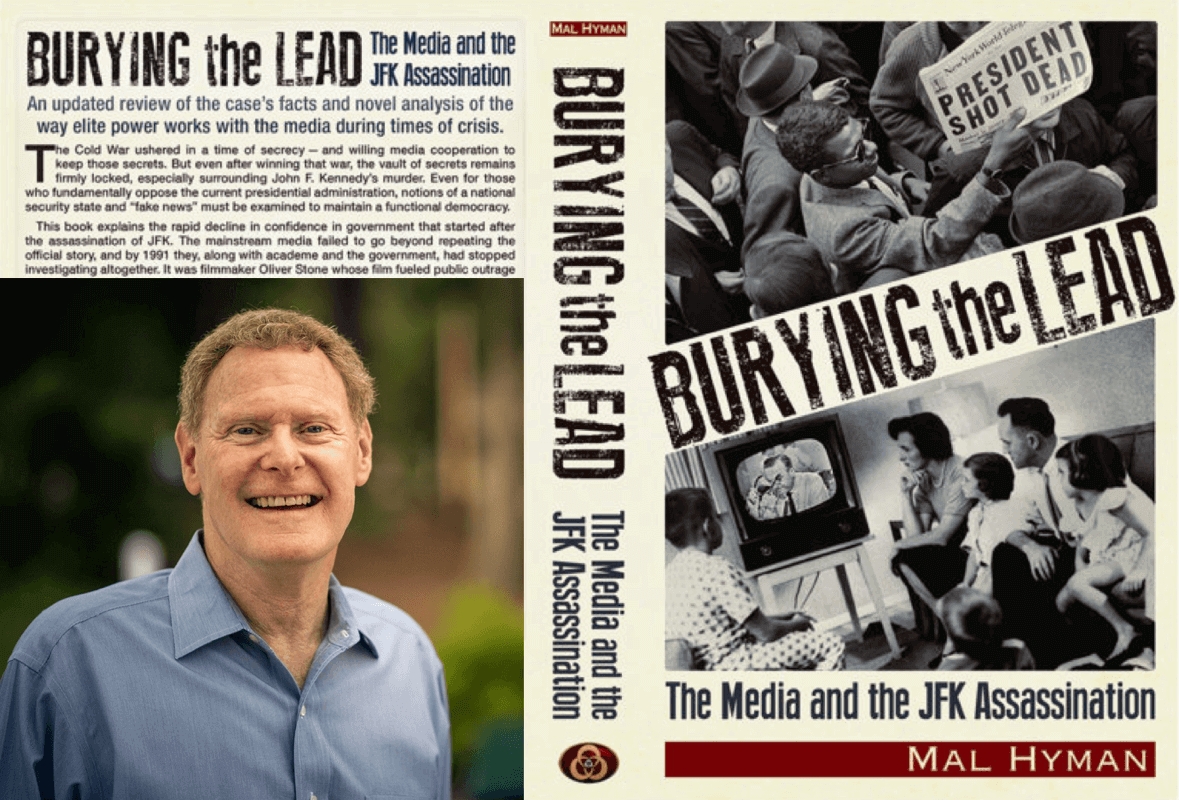
  • Mal Hyman, Burying the Lead: The Media and the JFK Assassination

    Mal Hyman, Burying the Lead: The Media and the JFK Assassination

    I

    Burying the Lead is an exceptionally readable history of the half-century of deception and propaganda surrounding the JFK assassination that has been promulgated by the mainstream media, who as Hyman aptly demonstrates, were instrumental in maintaining the “Big Lie”. Chronologically structured, Hyman centers his survey of the media on their coverage of events immediately after President Kennedy’s death and extends his analysis to the later congressional probes into the CIA’s dirty tricks bag, the Reagan and Bush administrations’ handling of the declassification of sensitive documents, and the eventual breakthrough event that was Oliver Stone’s 1991 film JFK, which led to a renewed public interest in the psychic trauma of the assassination and, eventually, the further release of thousands of sealed documents. The book succeeds in doing what so many like it have failed to do: 1) It circumscribes the players likely involved in the crime of the century; 2) Provides a cogent and compelling motive that even die-hard true believers in the official version of the JFK narrative will be hard pressed to refute; and 3) Manages to keep the reader not just glued to the page, but emotionally invested in a case whose repercussions directly affect us today.

    II

    Mal Hyman—former public school teacher, U.N. liaison and U.S. Congressional candidate, and current college professor—draws on a lifetime of reading and primary source research to bring readers one of the most robust and compelling sagas of the United States at mid-century. He is particularly interested in the inclusion of foreign views on both U.S. foreign policy and the conclusions of the Warren Commission. The first chapter, “Crisis Coverage,” is written in a racing, almost stream of consciousness fashion, with Hyman describing AP wires which at first were sending dramatically conflicting reports of the mayhem unfolding in Dallas following Kennedy’s assassination. From the four different rifles cited as the murder weapon—an Argentine Mauser, a .30-30, a British Enfield with a high power scope, and finally the infamous Mannlicher-Carcano; to wildly divergent motives cited (Cold War Soviets, a pathological loner, the Mob sick of harassment, a Castro revenge plot)—Hyman shows that left to their own devices, there were some serious journalists questioning the curious events and findings that afternoon in Dallas. Many accurately cited the dozens of witnesses who heard shots from the grassy knoll or the triple overpass. Some reporters tried to get a closer look at the bullet hole in the limousine’s windshield before being turned away by the Secret Service. But within hours of the assassination and the subsequent arrest of Lee Harvey Oswald, the propaganda and disinformation apparatus spooled up to high gear and successfully silenced any and all opposing narratives of those six fateful seconds in Dealey Plaza.

    Consider the following, which Hyman expounds on throughout the opening chapters: FBI Director Hoover immediately phoned a recently sworn in Lyndon Johnson to tell him “we have our man.” This is fascinating given the actual reports flooding FBI headquarters which directly contradicted this. No one, to my knowledge, can also explain unless the obvious setup was already firmly in place, just how or why Lee Harvey Oswald was picked up at the Texas Theater. No reliable witness saw him in the sixth floor window of the Texas School Book Depository building. The excuse that he was the only employee not at his post has also been refuted. The official tip-off for the APB has never been identified. People like Aquila Clemons, who witnessed the later Tippit shooting in nearby Oak Cliff, saw two people shoot the officer, neither of which resembled Oswald; automatic shell casings were first reported at the site of the Tippit shooting, yet Oswald had a .38 revolver, which does not eject shells. Law enforcement paraffin tests concluded Lee had not fired a rifle that day, regardless of his whereabouts. Why did seven police cars rush to the Texas Theater during a presidential assassination to investigate a man who didn’t pay for a movie ticket? None of it makes sense. And yet, despite all of these clearly established facts, which were known that day or shortly thereafter, the mainstream media conveyed almost none of them.

    What we got, instead, was a ready-made, Life magazine profile of a lone Marxist weirdo who, in a final disgruntled act of defiance, shot JFK—perhaps the most progressive and pro-détente president in American history—because he … um … well, he was a nut! As Michael Paine, Oswald’s Dallas acquaintance who was part of a State Department/CIA related family, told the Washington Post (a CIA-infiltrated newspaper) in the following few days:

    After the assassination there were reports that the killer took his time and aimed his rifle deliberately. That would be characteristic of Lee Oswald … He had little respect for people … He saw them as pawns. (Hyman, Burying the Lead p. 39)

    The irony of that statement really can’t be topped considering it was Michael’s FBI friendly wife Ruth Paine and himself who moved the intelligence community pawn Lee Oswald and his wife Marina into the Fort Worth area and helped him find the job in the TSBD. And the list goes on, but this minor vignette showcases what Hyman so well outlines in dramatic fashion: a massive cover-up whose perpetrators reach deep into the corporate, military, intelligence and media organizations of the United States. As he notes:

    The CIA has at times owned or subsidized more than 50 newspapers, news services, radio stations, periodicals, and other communications entities, sometimes in the country, but mostly overseas … At least 22 American news organizations had employed, though sometimes only on a casual basis, American journalists who were also working for the CIA. The organizations included ABC, CBS, Time, Life Newsweek, the New York Times, Associated Press and United Press International, the Scripps-Howard chain of newspapers, the Hearst newspaper chain, the Christian Science Monitor, the Wall Street Journal, the Louisville Courier-Journal, Forbes … College Press Service, Business International, the McLendon Broadcasting Organization, and the Copley News Services, among others. (Hyman, p.56)

    All of this was part of CIA Deputy Director of Plans Frank Wisner’s Operation Mockingbird, colloquially referred to in the agency as “Wisner’s Wurlitzer”. With this apparatus, he could make the press dance to whatever tunes best fit the intelligence community’s agenda. It’s interesting to note that propaganda was officially outlawed by Congress in the United States under the U.S. Information and Educational Exchange Act of 1948.

    Understanding that Cold War tensions might give rise to the continuing expansion of WWII-style propaganda, the Smith-Mundt Act, as it became known, enjoined the State Department to

    … tell the truth; explain the motives of the United States; bolster morale and extend hope; give a true and convincing picture of American life, methods, and ideals; combat misrepresentation and distortion; and aggressively interpret and support American foreign policy. (Sarah Nilsen: Projecting America, 1958. p. 4)

    And while this thoughtful and prescient legislation had good intentions, little did those signing it understand the monster that was forming right down the block out of the remains of the OSS.

    III

    Hyman spends a considerable amount of time balancing a fascinating and nuanced history of the formation of the CIA with the media’s contemporaneous reporting on both the agency’s dirty deeds and the critics of the Warren Commission. He also includes some previously—at least to my knowledge—unexplored clippings from international newspapers around the time of the assassination, including some prescient Indian and French takes on things like the ease with which Jack Ruby shot Oswald, the conspicuous lack of Secret Service protection in Dallas that day, and the almost cartoonish serendipity with which CE399 -the pristine magic bullet—was found in Parkland Hospital after the fact. Concurrent with his coverage of this is his survey of the history of the media’s infiltration by, and increasingly close ties with, the CIA. With only a few dissenting voices during the height of the Cold War, Hyman does an excellent job showing readers just how rare it was for anyone in a position of influence in the media to challenge the dominant narratives of the age. John Swinton, Chief of Staff for the New York Times, in a bold gesture at the 1953 New York Press Club gala, told the audience:

    There is no such thing, at this date in history, as an independent press. You know it and I know it. There is not one of you who dare to write your honest opinions, and if you did, you know beforehand that it would never appear in print … any of you who would be so foolish as to write honest opinions would be out on the streets looking for another job. (Hyman, pp. 54-55)

    The author also cites Walter Karp of Harper’s, who lamented, “It is a bitter irony of source journalism that the most esteemed reporters are precisely the most servile. For it is by making themselves useful to the powerful that they gain access to the ‘best’ sources.” (Hyman, p.46)

    And yet the vast majority of the MSM, both then and now, did precisely that. This reinforced the myths promulgated by the power elite and advanced the belief that if any major abuses of power from the top were actually as grotesque and far-reaching as what the evidence surrounding the assassination of JFK suggests, Americans would have turned on the evening news or opened the morning newspaper over breakfast to discover the truth of the matter. Let’s not forget that it was around this time that the CIA, in an internal memo, advised its embedded sources in the press to promulgate the buzzword “conspiracy theory” to discredit anyone challenging the Warren Report. As this declassified 1967 cable explains:

    Conspiracy theories have frequently thrown suspicion on our organization, for example by falsely alleging that Lee Harvey Oswald worked for us. The aim of this dispatch is to provide material for countering and discrediting the claims of the conspiracy theorists, so as to inhibit circulation of such claims in other countries.

    In other words, legitimate investigations—which by definition seek to expose conspiracies of one sort or another—are to be attacked.

    Abraham Lincoln was assassinated by an extensive conspiratorial network involving overseas agents; Austria’s Archduke Franz Ferdinand was shot by conspirators in an open car in broad daylight, which precipitated World War I; secret backroom deals between the OSS, the Vatican, U.S. politicians and other opportunists secured the release and expatriation of thousands of high-ranking Nazi war criminals to South America and the U.S. at the end of World War II. The 1954 overthrow of Jacobo Árbenz in Guatemala was a CIA-planned conspiracy involving hundreds of people sworn to secrecy. An international conspiratorial cabal involving officials from U.S., Belgium, and Katangese rebels planned the capture and murder of Patrice Lumumba seven years later. All of these are demonstrably provable conspiracies. But in the face of all that, the evidence that might erode the great shining lie surrounding the assassination of our nation’s progressive leadership in the 1960s, this evidence is shunted off as “conspiracy theories.” And, of course, no one can prove theories, which in actual scientific discourse are not qualitatively less significant than say “laws,” but actually denote a separate but equally sound paradigm based on complex natural or physical interactions rather than the direct relations of say two objects in a gravitational field. Darwin’s concept of evolution by natural selection is a theory. Newtonian gravity is a law. Einstein’s notion of General Relativity is a theory, but is understood as true. As I’ve always said, I am a proud conspiracy theorist, as should any historian be. It’s our job to investigate the relationships of human beings, some of which have ulterior motives. The above-cited memo is itself proof that conspiracies are real; a secret team of intelligence officers decided to discredit critics of a major American mystery. We were not privy to this meeting and it was intended to obfuscate the truth. A textbook conspiracy if ever there was. But only if you believe in that sort of thing.

    Hyman also does a fine job detailing the various congressional committees that during the mid to late seventies first opened Pandora’s box and discovered that the CIA’s surveillance of American citizens’ mail was just the tip of the iceberg. From assassination units, both domestic and foreign, to witch doctors like Sidney Gottlieb—who from a CIA-sponsored laboratory had cooked up his exotic poisons and killing devices—to the CIA’s bizarre but very real trauma-based mind control experiments on unwitting American subjects, it wasn’t looking good for the intelligence community. And yet, as Hyman notes, the fallout was essentially inconsequential. What could and should have been a legal mandate for the Central Intelligence Agency to come forward with its tax-payer-funded ledger of dirty deeds turned into the smug reply of people like Counterintelligence Chief James Angleton, who famously told committee members, “It is inconceivable that a secret arm of the government has to comply with all the overt orders of the government.”

    IV

    Perhaps the most significant achievement of this book, besides its comprehensiveness and exquisite delivery, is Hyman’s treatment of JFK’s foreign policy. Only a handful of authors, I feel, have sufficiently addressed just how much John Kennedy diverged, both practically and philosophically, from his Eastern Establishment colleagues and advisers in the White House and Pentagon. Hyman takes readers through each of the struggles of the Third World that faced a young JFK during his brief tenure in office, from the inherited Congo Crisis, to Sukarno’s bid to nationalize Indonesia’s natural resources, to the infamous thirteen days of the Cuban Missile Crisis, which brought the United States and the Soviet Union to the brink of nuclear war.

    There is now enough evidence, both from declassified documents and in the form of fine secondary sources, to adamantly make the case that JFK’s primary antagonism with the power elite– and what ultimately led them to assassinate him—stemmed from his radically progressive views of the developing world. While he and his brother Robert strove to effect tangible street-level change on America’s domestic race issue—and did, to a large extent through things like affirmative action, legal investigations of racist hiring practices and meetings with prominent civil rights leaders—they attempted to apply their visions of a better human future most boldly in the Third World. Consider, as Hyman does, Kennedy’s absolutely prescient analysis of the Middle East in 1951:

    The fires of nationalism are ablaze … A Middle East Command operating without the cooperation and support of the Middle Eastern countries … would intensify every anti-western force now active in the area, [and] from a military standpoint would be doomed to failure. The very sands of the desert rise to oppose the imposition of outside control on the destinies of these proud people … Our intervention on behalf of England’s oil interests in Iran directed more at the preservations of interests outside of Iran than at Iran’s own development … Our failure to deal effectively after three years with the terrible tragedy of more than 700,000 Arab refugees [Palestinians], these are things that have failed to sit well with Arab desires, and make empty the promises of the Voice of America.

    Already, just years after its creation, the CIA had overthrown the secular democratically elected leader of Iran, Mohammad Mossadeq in their first ever orchestrated coup. This ushered in nearly three decades of violent oppression and torture under Shah Reza Pahlavi, who happened to be future CIA Director Richard Helms’ pal from Swiss boarding school. The proximate motive given was that Iran was exhibiting strange communist tendencies in its decision to keep the profits of its own oil sales from Britain, a nation that had extorted billions from what it essentially viewed as a backwater desert satrapy.

    Thus was born a classic CIA playbook: using the mantra of an international communist conspiracy to disguise its ulterior motives of protecting corporate interests. Similarly, Jacobo Árbenz, the 25th president of Guatemala, exhibited these same nationalist economic tendencies in 1954. When he requested a fair return on land owned by the United Fruit Company—which had been ripping off Guatemala to the tune of millions in back taxes for years—the CIA-backed paramilitary army of Carlos Castillo-Armas marched into Guatemala City and staged a coup. With CIA assets going so far as to plant Marxist literature in Árbenz’ private study, later dumping a large crate of Soviet weapons near a beach, just in time for CIA-approved reporters to discover them. President Eisenhower presided over this operation, codenamed PBSUCCESS, which he viewed as a spectacular covert feat. Castillo-Armas, a brutal ex-chief of police who had been living in exile in Honduras, was featured on the cover of Time magazine a year later, with a glowing review of his visit to the United States entitled, “Guest from Guatemala.” (Time, Nov. 7, 1955)

    Kennedy had already recognized the folly of this behavior. Consider his 1957 speech on Algeria to the U.S. Senate:

    The most powerful force in the world today … is man’s eternal desire to be free and independent … We did not learn in Indochina … Did that tragic episode not teach us that whether France likes it or not, or has our support or not, their overseas territories are sooner or later, one by one, inevitably going to break free and look with suspicion on the Western nations who impeded their steps to independence … The time has come to face the harsh realities of the situation and to fulfill its responsibilities as leader of the free world. (Hyman, p.457)

    Secretary of State John Foster Dulles, along with brother and Director of CIA Allen Dulles, both suggested to Eisenhower that dropping nuclear bombs on the Vietnamese threatening to overtake the French forces trapped at Dien Bien Phu could win the war. To say that Kennedy’s and the viewpoints of figures like Allen Dulles slightly differed, as is so often regurgitated in the mainstream histories of his presidency, is not just inaccurate but dishonest. They were diametrically opposed. And this played out in dramatic fashion when the two were forced to work together after the 1960 election. Similarly, the author notes this sentiment of solidarity with the Third World was a theme running deeply throughout Kennedy’s tenure as both a senator and as president, not a grandstanding ploy or an appeal to the far-left voter base. As he told the Senate two years later, in 1959, regarding Central African turmoil, “Call it nationalism. Call it anti-colonialism … Africa is going through a revolution … The word is out—and spreading like wild fire in nearly a thousand languages and dialects—that it is no longer necessary to remain forever poor or forever in bondage.”

    These words eerily parallel the 1960 victory speech given by president elect Patrice Lumumba to throngs of ecstatic Congolese:

    We are deeply proud of our struggle, because it was just and noble and indispensable in putting an end to the humiliating bondage forced upon us. That was our lot for the eighty years of colonial rule and our wounds are too fresh and much too painful to be forgotten. We have experienced forced labor in exchange for pay that did not allow us to satisfy our hunger, to clothe ourselves, to have decent lodgings or to bring up our children as dearly loved ones. (“Speech at the Ceremony of the Proclamation of the Congo’s Independence, June 30, 1960”)

    President Eisenhower refused to meet with Lumumba when he flew to Washington, and later signed off on his assassination.

    Too often critics of non-mainstream JFK assassination theories smugly resort to arguing lack of motive for a non-Oswald shooter, or intelligence community backing. Why, we’ve heard again and again, would other rich white Eastern Establishment power elites assassinate one of their own? Even I, who have an extensive background in 20th-Century foreign policy, was reminded of this in my graduate training, with a few memorable professors conceding that basically Jack Kennedy was a cooler, younger version of say, Eisenhower, or a more sophisticated version of Johnson with a better tailored suit. But he was not fundamentally any less hawkish than either of his presidential bookends. Yes, Oliver Stone suggested Kennedy’s likely withdrawal of advisers from Vietnam as the contributing cause of the military-industrial complex’s decision to remove him. But, they would remind me, we all know that’s just a theory. Had they read NSAM 263? Did they not also realize there were no combat troops in Vietnam in November 1963 when Kennedy was killed? Kennedy presided over Operation Mongoose and the “failed” exile-invasion of Cuba, they often repeated, so he was no stranger to using gunboat diplomacy.  

    Let’s examine these claims, as Hyman does to a great extent in his final and excellent last chapters. As authors like James DiEugenio, Richard Mahoney, Col. Fletcher Prouty and others have shown, President Kennedy had an immediate, actionable withdrawal and de-escalation order effective upon his return from Dallas that month. This was not a verbal agreement or handshake over drinks that has been anecdotally passed through the research community. It’s all clearly spelled out in NSAM 263, a National Security Action Memorandum that concretely establishes JFK’s divergence from the Joint Chiefs of Staff and the Central Intelligence Agency’s cold warrior, Manichean view of the free and communist worlds.

    As we know through John Kenneth Galbraith’s biographer Richard Parker, Kennedy had previously tried for an appeal to Hanoi for a neutralist diplomatic solution to the Vietnam problem with Nehru of India playing the broker. As Gareth Porter showed in his book The Perils of Dominance, this effort was sabotaged by the State Department’s Averill Harriman. Similarly, we know, from a variety of his foreign policy dealings in the Third World, that President Kennedy was entirely more nuanced in his understanding of nationalism than most people in the room during briefings. Kennedy correctly understood that the quick and sloppy conflation of liberation, decolonization, or resource-redistribution movements in places like the Congo, Indonesia and ultimately, Vietnam, with Soviet Communism, was a dangerous game to play. Because it dismissed the forces of nationalism.

    The fallout from the intelligence and military communities’ efforts to prop up pro-U.S. dictators has been much explored by authors like William Blum, (Killing Hope), David Schmitz (Thank God They’re On Our Side), and Max Friedman (Rethinking Anti-Americanism), and is beyond the scope of this review to accurately survey. Suffice it to say, Hyman does an excellent job of unpacking these critical departures between an increasingly isolated John and Robert Kennedy during times like the 1962 Cuban Missile Crisis. Or to use another example, in a June 20th, 1961 meeting, General Lemnitzer and Allen Dulles “proposed an official plan for a surprise nuclear attack on the Soviet Union.” (Hyman, p. 424.) Like he did before and would do again, Kennedy, according to aides present, walked out in disgust. Around this same time, people like General Lucius Clay in West Berlin were mobilizing their tanks to make a move against the Soviets. Strategic Air Command, without the president’s authority, began deploying nuclear-equipped long-range bombers, even going so far as to cross established international airspace parallels which essentially signaled to the Soviets that this was not a routine drill. It’s amazing, at least to me, that not only did the nuclear-armed superpowers not destroy humanity during the Missile Crisis, but that the world’s most important two-week vigil landed in the lap of figures like John and Robert Kennedy. Replay the events with Eisenhower/Nixon in power. It doesn’t end well. We now know that had a full blown invasion with U.S. air support taken place it would have faced over a quarter of a million Cuban and Soviet ground troops who had dozens of tactical nuclear missiles poised to repel an amphibious invasion.

    It also cannot be stressed enough that the Bay of Pigs invasion was both thrown in his lap due to its delayed planning during the Eisenhower/Nixon administration, and designed to fail without full-blown U.S. naval and carrier-based air support—and likely the landing of 100,000 ground troops. The myth that Kennedy got “cold feet,” as my grandpa Marcel used to tell me back in Florida, was a pure creation of … wait for it … the CIA! Allen Dulles and E. Howard Hunt paid a CIA-cleared journalist to ghostwrite their completely honest, objective, 100-percent transparent evaluation of President Kennedy’s failure of nerve in Fortune magazine, a journal run by … wait for it … a CIA asset on payroll! We know this through documents revealed in Allen Dulles’ personal papers at the Princeton University collection. And Kennedy knew this intuitively. As Hyman cites him telling his friend, Undersecretary of the Navy Paul Fay:

    Now in retrospect, I know damn well they didn’t have any intention of giving me the straight world on this … Looking back at the whole Cuban mess, one of the things that appalled me was the lack of broad judgment by the heads of the military services. They wanted to fight and probably calculated that if we committed ourselves part way and started to lose, I would probably give the OK to pour in whatever else was needed. (Hyman, p. 424)

    We are arguably all still here because of JFK’s acumen during the Cuban Missile Crisis, yet this is almost never explored by the media, who portray the harrowing events and their unspectacular, negotiated resolution as somehow inevitable. Nothing could be further from the truth, and Hyman spends considerable time hammering this point home in his final chapters. Which, I should add, follow a lengthy and extremely interesting unpacking of Lyndon Johnson’s behavior after the events of Dealey Plaza, which should appeal to those on the fence regarding his culpability and seeming complicity at times with the conspirators.

    Philosophically, as Hyman conclusively shows readers, John F. Kennedy represented a psychic break from the entrenched corporate/military/industrial power elites, whose post-traumatic irrationality, myopic reductionism and retrograde colonial opportunism dominated American politics at mid-century. Shaken to the core by the implications of Soviet dominance over vast reaches of Europe and Asia in the wake of the Second World War, and seeking a much-needed bogey man to fulfill their Hegelian negative-identity criteria, by which national worth can only be defined in opposition to a foreign adversary or internal enemy, U.S. policy makers at the height of the Cold War largely viewed the Kennedys as traitors. Traitors to the great mantle of tremendous military might fortuitously bequeathed to an otherwise backwater new nation called the United States in the wake of the Second World War’s global carnage. Traitors to the corporate interests who cared little what a million Congolese suffered under CIA-backed dictators like Mobutu, so long as their diamond and cobalt mines in Katanga poured forth abundance. Traitors to the then-as-now accepted postwar view that the United States is an exceptional nation with an exceptional, quasi-religious historical mission which despite hundreds of overthrows, embargoes, assassinations, lies, and disinformation campaigns by its politicians and intelligence officers, is fundamentally well-meaning and just.

    Anyone interested in tracing the origins of this dark legacy will be doing themselves a favor by picking up Burying the Lead. It is one of those rare things: a balanced, engaging, fascinating look at the slimy underbelly of the American power structure. And the hired guns of the media who cover up for them.


    Addendum, May 30, 2019

    The John Swinton quote used in the above review is misattributed in time. John Swinton passed away in 1901. He made the statement in 1880, after he had concluded his employment with the New York Times and was working at the New York Sun. Please see the following for more information: https://www.constitution.org/pub/swinton_press.htm

  • Paul Blake Smith, JFK and the Willard Hotel Plot

    Paul Blake Smith, JFK and the Willard Hotel Plot


    When I was asked to do a review of this book, I was quite hesitant. I do not like to comment on other people’s work, especially when a lot of effort has been put into it. The reason I accepted this time is that it was related to research I have been doing over the last two years on prior plots to assassinate JFK and the framing of other potential patsies.

    Some who have read my articles wondered why I had not included an attempt in Washington in my analysis. Paul Blake Smith’s book subtitles itself as The Explosive Theory of Oswald in D.C. I felt this could perhaps add yet another plot to the long list of those already exposed. However, Blake Smith’s pitch that he would present compelling evidence that Oswald was in Washington as part of a squad of shooters taking aim at Kennedy from the Willard Hotel is just one of the things he promises to deliver. He states that his book is unique in that it “utilizes the revealing treasury report on Oswald-at-the-Willard”, and many other small clues: “The document is the lynchpin that holds together a solid conspiracy theory and is nearly a Rosetta Stone for deciphering the overall scope of the historic mystery.” The book would also reveal how Mafia chieftain Carlos Marcello was behind this plot and the eventual, successful Dallas assault plan. Extravagant promises, tempered by his admission that we need more facts and that a lot of his evidence is circumstantial.

    I had been expecting to read a tightly knit exposé of a Washington cabal. Instead, when the book arrived, I was faced with 433 pages that covered so much ground about not only the alleged plot, but a whole parallel look into the Lincoln assassination, the similarities between the two, and the author’s analysis of who was behind JFK’s assassination—from the orchestrators to the shooters.

    In the introduction (p. 5), the author takes precautions not to be labeled a conspiracy theorist: “In other historic dramas, like the RFK or MLK murders in mid-1968, there doesn’t seem to have been any conspiracy at all, just a true lone gunman responsible. I certainly do not see conspiracies behind every bush …”

    This is really too bad because the author has blocked himself off from potential comparative case analysis where the conspiracies behind them are perhaps as easy to demonstrate as with the JFK assassination. The MLK assassination was also judged a conspiracy by the HSCA and the RFK assassination was proven one by the autopsy alone. Even the late Vincent Bugliosi was greatly troubled by the RFK investigation. By negating these plausible conspiracies, the author has blocked off a source of information that relates to the JFK assassination—certainly when it comes to analyzing motive, media cover-up and shoddy investigations. Many of the authors Blake Smith lists in his bibliography have just signed a petition to have these cases, along with Malcolm X’s murder, re-opened. Lisa Pease just launched her book about RFK’s assassination, A Lie Too Big to Fail, which has received excellent reviews from no less than the Washington Post. In it, she presents Robert Maheu’s and John Roselli’s links to that case. Sound familiar?

    Also on the back cover, the author promotes another of his books, MO-41: The Bombshell Before Roswell. I took the time to do a little web research and found Amazon comments on it: some good and some less so. This comment got my attention:

    The narrative flows along, but there are no footnotes; and there is too much hearsay reported, especially from online chat rooms and email, which is not substantiated. More needs to be done, before I’ll buy this book’s premise/theory. The Roosevelt information is another matter altogether. The author asserts that F.D.R. shot himself due to his knowledge of the aliens, etc. of the UFO events previously described in the previous chapters.

    I had to put the book down many times and fight off my instincts to pre-judge it because I could see that it quickly staked out positions that were diametrically opposed to where I stand on the case. By the time I was through the first chapter I was dejected and regretted my decision to accept this mandate. However, a promise is a promise, so I read on. The more I read, the less I regretted taking on this endeavor, not because this was by any means a masterpiece. It is not. However, there is useful information which the author deserves credit for underscoring.

    After thinking somewhat about how to evaluate his work, I decided to focus on three basic theories that he advances: 1) That there was a plot in the works to terminate JFK in Washington in early October 1963; 2) That Oswald was in Washington leading this mission at around this time; and 3) That Carlos Marcello was the leading figure behind this plot and the eventual assassination in Dallas, “with some insider help”.

    So before analyzing the author’s evidence, let’s first get an idea of what some of his key positions are, which I must admit is not easy, as many seem to evolve from chapter to chapter and sometimes from page to page. We will first look at his views on the nature of the conspiracy.


    A Mob-led conspiracy

    At the beginning of chapter 1, Carlos Marcello’s famous rant is quoted: “Yeah I had that Sonuvabitch killed”, and then the author states shortly after: “This book aims to tell more precisely how Carlos got just what he wanted”.

    As for motive, we are given the usual litany of mob frustrations with the Kennedys. They helped get JFK elected and instead of having their guy in the White House, they were double-crossed when Bobby aggressively went after them; Marcello had been exiled to Guatemala by Bobby in 1961, etc.

    Therefore, “Carlos was determined to pay back the young president (and his cocky brother) in the most violent and extreme way he could think of: By having John F. Kennedy gunned down right at his precious White House, maybe even from the very same attractive Willard Hotel of 61”. He explains the importance of choosing cold-blooded, scummy killers that were not traceable to the Mafia: “It was just a matter of finding the most greedy, unprincipled persons” (p. 22) Remember this last line when we explain why Blake Smith believes the assassins had Kennedy in their sights from the Willard Hotel but decided not to shoot.

    He goes on to state that Carlos got buy-in from a few of the top hoodlums and came to realize he needed to hire a guilty-looking oddball who could not be tied directly to the Marcello “outfit”. By page 31, Blake Smith begins presenting a Mafia/KKK partnership since they also shared a hatred of Kennedy.

    On page 33, he makes the following statement: “Thus it seems pretty accepted today that Marcello recruited his oldest Mafia contacts, Giancana and Trafficante, to help him rub out the president.”

    The author has taken it upon himself to identify Marcello, Giancana and Trafficante as “the Big Three” of the Mafia in the early sixties. This seems both arbitrary and questionable, as it eliminates men like Meyer Lansky, and all the heavy hitters from the East Coast. In fact, none of these men were members of the governing commission of the Mafia at this time. (HSCA, Volume 9, p. 18) Marcello was not particularly tight with Giancana. He was actually in competition with Trafficante for the drug traffic in the Gulf area. Why propose a hit to someone who will have leverage over you?

    The CIA in all this? In 1960, the Big Three:

    … accepted CIA cash in exchange for assassinating Castro, but instead they took the money, gave lip service in return but no real effort and then chocked up [sic] another marker to call in for future schemes. A kind of blackmail to expose unless the CIA cooperated on certain future Mafia proposals: Like murdering their own commander in Chief. (p. 37)

    Actually, they did not give lip service. As the CIA Inspector General Report shows, there were three different attempts to poison Castro and the last one may have worked had the CIA not screwed it up by putting Tony Varona on ice during the Bay of Pigs landings. (These are described in the CIA Inspector General Report, pp. 31ff, and are termed the Phase 1 plots.) In addition, the mobsters refused to take any payment for their efforts. (p. 16)

    Blake Smith then broadens out to say a rotten apple was recruited from within the Secret Service to help in the plot. However, the number grows significantly in a couple of later chapters.

    When it comes to describing Lee Harvey Oswald, the author is consistent, direct and does not pull any punches.

    Blake Smith takes everything negative ever said about the alleged assassin and kicks it up a notch: “rat-faced fellow from Marcello’s New Orleans”; “Perpetually unemployed Marxist-spouting, ex-Marine defector”; “Had problems getting along with others, the high-strung abusive oddball, was obsessed with the anti-American hero … pro Fidel Castro”; “Lonely Lee”; “Lazy Lee”; “Handed out pro-Marxist sheets making a fool of himself”; “Arrogant L.H. Oswald was of course the same southern-fried, rifle-clutching, wife-beating school drop-out”; “Miscreant Lee in the summer of 63 was so obsessed with Soviet-linked Castro he spoke only Russian at home”; “LHO often padded around “The Big Easy” with his old military training manual … and around house with his .38 caliber pistol … plus his Mannlicher Carcano …”; “a lazy little mouse who wanted to roar”; “Lee really didn’t have the size, education, the guts and strength to accomplish anything positive”; “Puny Lee craved money, recognition, respect”… “Chronic Creep Lee had to get out of Dallas that mid-April to escape the heat from his brazen attempted assassination of retired General Edwin Anderson Walker”; “Lee had himself photographed by his wife posing with a pistol and a rifle and communist literature”; “Anyone who criticized and threaten his beloved Castro was an imperial fascist who deserved to be shot …” The author also shows us some of his prowess in psychiatry by diagnosing Oswald as semi-psychotic: a qualifier he uses throughout the book. This comes in handy, because now he can explain almost anything Oswald does henceforth in his exposé, no matter how illogical.

    According to the author, Oswald was brainwashed into killing Kennedy by figures connected to Marcello, by telling him the president wanted Castro dead and the American Mafia out of power for good.

    The Warren Commission could not find any motive for Oswald. Blake Smith spells out what it missed: Oswald would “help kill Kennedy to save Castro and expect rewards including legal passage to Cuba as an accepted resident there outside of extradition.”

    Blake Smith opines that Oswald did fire twice at Kennedy and then once at Connally, nailing both men in the back (page 324). His third shot hit the curb. He then killed Officer Tippit before Marcello had Ruby rub him out. And there is this peculiar statement: “Lee’s shots were in reality only to get people—especially JFK’s Secret Service Agents—to look the wrong way, a distraction for the knoll gunman’s crucial kill shot.” Never mind that it appears the throat shot from the front preceded the back wound shot.

    Lee Harvey Oswald in Washington

    Concerning this aspect of the Willard Hotel plot, the author does not waste any time summarizing ten clues in Chapter 1 that “reveal the reality of Lee Oswald in Washington and some aspects of the two planned “Willard Hotel Plots” in Washington.

    These include:

    1. What he calls a formerly buried Willard Hotel Secret Service report.
    2. The Joseph Milteer tape where the white supremacist can be heard predicting the assassination.
    3. Richard Case Nagell’s letters warning the FBI of a Washington plot towards the end of September.
    4. Lee Harvey Oswald’s letters talking about moving to Washington at this time.
    5. J. Edgar Hoover’s memos stating that Oswald had been in Washington.
    6. David Ferrie’s rants about killing Kennedy in Washington.
    7. Statements made by a Cuban exile made in Miami before the assassination.
    8. Documents retrieved from a pile of burned leaves in Pennsylvania.
    9. A scorched memo sent to a researcher that “supposedly” was retrieved from James Angleton’s fireplace.
    10. A Secret Service report on Marina Oswald.

    After reading the whole book, my opinion is that there is a good argument to be made that there were many contingency plans in place to kill JFK at locations he visited throughout the last three quarters of 1963 and perhaps even earlier. That Washington was on the list is probable and can be based not only on the author’s (and others) writings, but by the numerous other plots that have been documented. The idea that Oswald was being maneuvered to be a patsy there is plausible. However, Oswald’s pro-Marxist behavior was a matter of sheep-dipping by intelligence and not, as the author writes, an expression of his ideology. Washington was not the original plot to bump off JFK as claimed by the author, as cabals in L.A. and Nashville preceded it. Finally, the proof that Oswald was in fact in Washington in late September and early October 1963, as laid out in this book, is a lot weaker than what the author argues. We will discuss this later, as well as the case made about the Willard Hotel being a place that the shooters actually occupied when they had Kennedy in their sights.

    Summary

    I don’t think kennedysandking readers need me to find arguments against much of the author’s often debunked and rehashed mob-led conspiracy theory. Many of the arguments the author presents in his “Marcello mastermind” scenario only demonstrate mob involvement as a very junior partner in the conspiracy. As a matter of fact, he could have put more emphasis on Ruby’s probable visit to Trafficante in Cuba, the analysis of his phone calls during the days leading up to the assassination, as well as the fact that one of Ruby’s first visitors while in jail was alleged Dallas mobster Joe Campisi. Other arguments the author presents are on shaky ground. When it comes to the hierarchal structure of the coup, his pecking order needs revising. If he is looking for arguments to do so, I will refer him later to his own sources.

    In this day and age, the fact that the author does not even want to entertain the notion that Oswald may not have been a commie nut is faintly ludicrous, and has been ever since the following famous statement was published:

    We do know Oswald had intelligence connections. Everywhere you look with him, there are fingerprints of intelligence.

    ~ Senator Richard Schweiker, The Village Voice, 1975

    From 1975 to 1976, Schweiker was a member of the United States Senate Select Committee to Study Governmental Operations with Respect to Intelligence Activities. According to Blake Smith, Oswald would kill any who would dare threaten Fidel Castro. Yet Oswald spent the latter years of his life in the Marines, with White Russians, and right wing extremists like David Ferrie and Guy Banister, Cuban exiles hostile to Castro, perhaps with Mafiosi who wanted the island back, CIA contacts … the crème de la crème of Castro hostiles. When he was arrested on Canal Street, Oswald asked to meet with FBI agent Warren de Brueys, who was responsible for monitoring the Fair Play for Cuba Committee and Cuban exiles. This may be why Gerald Ford wrote about a Warren Commission meeting presenting information that Oswald was a government informant.

    One would also wonder whom from the Mafia, or the Secret Service, would even risk exposing themselves and their roles in a plot by conferring so much responsibility to such a loose cannon. Blake Smith also speculates Oswald is capable of quite the accomplishments for such a loser: sending one or two of his doubles down to Mexico City to set up an alibi, receiving inside information from Secret Service agents in Washington, placing two shots in the back of both JFK and Governor Connally with a terrible weapon …

    Schweiker was not alone in having his doubts about Oswald’s Warren Commission persona, and who was really behind the assassination. HSCA Chief Counsel Richard Sprague, attorney Mark Lane, investigator Gaeton Fonzi and New Orleans DA Jim Garrison all expressed similar opinions. These later snowballed into a consensus that we can now read in the recently written Truth and Reconciliation joint statement, signed by many of the researchers Blake Smith refers to. In it, you will not see a whiff of consent around a mob-led conspiracy scenario. You will see that these writers think the mob figures were themselves being led! The first paragraph speaks for itself:

    In the four decades since this Congressional finding, a massive amount of evidence compiled by journalists, historians and independent researchers confirms this conclusion. This growing body of evidence strongly indicates that the conspiracy to assassinate President Kennedy was organized at high levels of the U.S. power structure, and was implemented by top elements of the U.S. national security apparatus using, among others, figures in the criminal underworld to help carry out the crime and cover-up.

    We will return to flaws in the author’s logical construction later. I did find some positive contributions in this work, at least points useful in my own investigative objectives. Here is what I feel are some of the stronger points of the book:

    1. The author does cover either numerous areas that reminded me of interesting anecdotes or issues I had read a while back but I had forgotten about, and some I had not heard of.
    2. He presented arguments around the work of some reliable researchers that have convinced me that there could well have been a plot to assassinate Kennedy in Washington that would have framed Oswald. This is of strong interest to me because of my research in the prior plots to assassinate Kennedy.
    3. Related to this point, the author presents some context on the goings on in D.C. during the period Oswald was scheduled to be there.
    4. While his attempts to link the KKK to a Mafia-led plot are weak, his writings allowed me to better understand some of the history and structure of American hate groups and the arguments others have put forth about their alleged contribution to the coup.
    5. Some of the writings around the mob, and I say some, could be interesting to novice readers.
    6. I, along with a growing number of researchers, concur with his conclusions that Oswald never visited Mexico City. I also applaud his attempt to answer the obvious question that arises because of this: Where was Oswald during these crucial dates? This is an important debate that researchers must have.
    7. While his writings about Secret Service participation are at times contradictory, he did a smart thing in relying heavily on Vince Palamara in his research, which resulted in two of his best chapters.

    Unfortunately, these also included two major negatives. He contaminated them somewhat with some of the worst of the Dark Side of Camelot and other TMZ-style gossip about Kennedy’s private life. And then, for some very weird, unexplained reason, he decided to use the pseudonym Trip-Planner Perry to identify (or hide) one of his leading suspects from the Secret Service. I will speculate later on why I think he chose this very unfortunate writing strategy. Whatever the reason, as a reader I felt very manipulated and frustrated.

    I also have written about how the CIA, Mafia and Cuban exile network involved in the assassination had roots going back many decades. I am now interested in how the Secret Service could have logistically worked with this network. Blake Smith does present some good leads to follow up on.

    My philosophy about reading in general is that if, at the end of a book, I have learned something new and important, or my view about an issue has evolved, there has been progress. However, the struggle to get there can be often very demoralizing—talk about mixed emotions!

    Research and analysis

    One of my frustrations with Blake Smith’s book was trying to make sense of the author’s sources. His footnote management is very inconsistent; his exhibits, especially the documents, are poorly identified and made almost impossible to read because of poor reproduction; his sources are difficult to consult and he is often guilty of citation malpractice. Trying to figure out the soundness of his research was quite time-consuming and represented a heavy burden for readers like me who like to evaluate the solidity of the argument or dig to find out more. Throughout the book, I felt the author was playing a game of hide-and-seek with his primary data. I will give a few examples later. If you are going to make a case on circumstantial evidence, you really need to back up your observations with solid, easy to consult references.

    Blake Smith’s sources and evidence are often so scrambled, mysterious and sketchy that the real sleuthing related to this work is trying to figure out what they are. All too often, you cannot try to expand your knowledge or verify the authenticity of the evidence. We are left to trust his evaluation of evidence that we cannot explore. On many occasions, he uses the National Enquirer technique of presenting an unidentified source as his basis for making a claim. We are left guessing who-the-heck said what and how credible this informer is.

    Here are some examples of the vagueness and lack of sourcing that goes on throughout the book: “On May 15th, 2006, five knowledgeable JFK assassination experts were invited to a special conference …” (we never find out who); exhibit on page 17—FBI report about Marcello that is illegible; page 17, incriminating quotes made by Marcello with no footnotes. Then there is this citation: “He wanted that particular American leader dead in 1963 and hired others to do the job. (source: an FBI report dated the following 3/7/85); “Some legal and media investigations have shown that Marcello had upset the Kennedys; At one point in 1963, researchers have now learned, the devious Mafia plan was becoming so increasingly whispered; According to biographers, for a few weeks spiteful, unstable Oswald ran wages and numbers to gamblers for Murrett; Undoubtedly some Cuban refugees and two key private investigators also worked on Lee Oswald that summer, hammering away at his psyche”—with not one footnote to the entire passage. This is just chapter one. Sometimes, when we are lucky, a whole book is mentioned as the source.

    The author could have profited from a reliable editor, one who would have helped with grammar, fact checking and general guidance. I cannot say how many times this has helped me for articles I have written that are less than one tenth the length of his book. Even though the author has an energetic, whimsical style that can be entertaining, the number of punctuation errors, faulty page breaks, misspelled words (assasin, guiilt, coup d’eta to name but a few) and especially name identification errors (Dan Hardway becomes Don Hardaway, Douglas Dillon is at times Douglass, Douglas Horne is also spelled Douglass, Hersh is Hirsh, Harold Weisberg is Weisburg, ZR Rifle is at times just Rifle, and Robert Maheu is misspelled Mahue throughout). This laxness permeates the entire book.

    A good editor would have also helped with fact checking and helped avoid blunders, or strongly urged the author to provide the evidence for some of the questionable claims that are often made. The next two sections furnish examples.

    The Sylvia Odio incident (page 90):

    Blake Smith: (at Odio’s residence on September 25) “Leopoldo and Angelo spoke in Spanish on his (Oswald’s) behalf around sundown, talking about how loco he was in his pro-Castro, anti-Kennedy views.”

    Now compare this to what Sylvia Odio said in her testimony to Wesley Liebeler in 1964:

    He (Leopoldo) did most of the talking. The other one kept quiet, and the American, we will call him Leon, said just a few little words in Spanish, trying to be cute, but very few, like “Hola,” like that in Spanish.

    … I unfastened it after a little while when they told me they were members of JURE, and were trying to let me have them come into the house. When I said no, one of them said, “We are very good friends of your father.” This struck me, because I didn’t think my father could have such kind of friends, unless he knew them from anti-Castro activities. He gave me so many details about where they saw my father and what activities he was in. I mean, they gave me almost incredible details about things that somebody who knows him really would or that somebody informed well knows. And after a little while, after they mentioned my father, they started talking about the American.

    He said, “You are working in the underground.” And I said, “No, I am sorry to say I am not working in the underground.” And he said, “We wanted you to meet this American. His name is Leon Oswald.” He repeated it twice. Then my sister Annie by that time was standing near the door. She had come to see what was going on. And they introduced him as an American who was very much interested in the Cuban cause. And let me see, if I recall exactly what they said about him. I don’t recall at the time I was at the door things about him.

    I recall a telephone call that I had the next day from the so-called Leopoldo, so I cannot remember the conversation at the door about this American.

    I asked these men when they came to the door—I asked if they had been sent by Alentado, became I explained to them that he had already asked me to do the letters and he said no. And I said, “Were you sent by Eugenio,” and he said no. And I said, “Were you sent by Ray,” and he said no. And I said, “Well, is this on your own?”

    And he said, “We have just come from New Orleans and we have been trying to get this organized, this movement organized down there, and this is on our own, but we think we could do some kind of work.” This was all talked very fast, not as slow as I am saying it now. You know how fast Cubans talk. And he put the letter back in his pocket when I said no. And then I think I asked something to the American, trying to be nice, “Have you ever been to Cuba?” And he said, “No, I have never been to Cuba.”

    And I said, “Are you interested in our movement?” And he said, “Yes.”

    This I had not remembered until lately. I had not spoken much to him and I said, “If you will excuse me, I have to leave,” and I repeated, “I am going to write to my father and tell him you have come to visit me.”

    And he said, “Is he still in the Isle of Pines?” And I think that was the extent of the conversation. They left, and I saw them through the window leaving in a car. I can’t recall the car. I have been trying to. …

    So Blake Smith has the residence meeting all wrong. Let us see how he does with the follow-up call (which he speculates was made from the Willard Hotel) where he states: “That on the evening of the 27th (48 hours later), one of the two Cubans with Oswald called Sylvia Odio and said Oswald wanted to shoot the president.”

    Here is Odio’s testimony:

    The next day Leopoldo called me. I had gotten home from work, so I imagine it must have been Friday. And they had come on Thursday. I have been trying to establish that. He was trying to get fresh with me that night. He was trying to be too nice, telling me that I was pretty, and he started like that. That is the way he started the conversation. Then he said, “What do you think of the American?” And I said, “I didn’t think anything.”

    And he said, “You know our idea is to introduce him to the underground in Cuba, because he is great, he is kind of nuts.” This was more or less—I can’t repeat the exact words, because he was kind of nuts. He told us we don’t have any guts, you Cubans, because President Kennedy should have been assassinated after the Bay of Pigs, and some Cubans should have done that, because he was the one that was holding the freedom of Cuba actually. And I started getting a little upset with the conversation.

    And he said, “It is so easy to do it.” He has told us. And he (Leopoldo) used two or three bad words, and I wouldn’t repeat it in Spanish. And he repeated again they were leaving for a trip and they would like very much to see me on their return to Dallas. Then he mentioned something more about Oswald. They called him Leon. He never mentioned the name Oswald.

    Mr. LIEBELER. He never mentioned the name of Oswald on the telephone?

    Mrs. ODIO. He never mentioned his last name. He always referred to the American or Leon.

    Mr. LIEBELER. Did he mention his last name the night before?

    Mrs. ODIO. Before they left I asked their names again, and he mentioned their names again.

    Mr. LIEBELER. But he did not mention Oswald’s name except as Leon?

    Mrs. ODIO. On the telephone conversation, he referred to him as Leon or American. He said he had been a Marine and he was so interested in helping the Cubans, and he was terrific. That is the words he more or less used, in Spanish, that he was terrific. And I don’t remember what else he said, or something that he was coming back or something, and he would see me. It’s been a long time and I don’t remember too well, that is more or less what he said.

    And then there is this:

    Mr. LIEBELER. Now, a report that we have from Agent Hosty indicates that when you told him about Leopoldo’s telephone call to you the following day, that you told Agent Hosty that Leopoldo told you he was not going to have anything more to do with Leon Oswald since Leon was considered to be loco?

    Mrs. ODIO. That’s right. He used two tactics with me, and this I have analyzed. He wanted me to introduce this man. He thought that I had something to do with the underground, with the big operation, and I could get men into Cuba. That is what he thought, which is not true.

    When I had no reaction to the American, he thought that he would mention that the man was loco and out of his mind and would be the kind of man that could do anything like getting underground in Cuba, like killing Castro. He repeated several times he was an expert shotman. And he said, “We probably won’t have anything to do with him. He is kind of loco.”

    When he mentioned the fact that we should have killed President Kennedy—and this I recall in my conversation he was trying to play it safe. If I liked him, then he would go along with me, but if I didn’t like him, he was kind of retreating to see what my reaction was. It was cleverly done.

    In a nutshell, the author in just a few lines of copy, confuses who spoke, what was said during the meeting at the residence, when the follow-up call took place, the claim that Oswald was described as pro-Castro, and while Leopoldo claimed that Oswald said that the Cubans should have killed Kennedy because of the failed Bay of Pigs, he did not say Oswald wanted to shoot the president.

    In fact, he is depicted as one who could kill Castro. (WC Vol. 11, p. 377) On the surface, why would three persons seeking (or pretending to seek) to collaborate with an organization that has as its objective the overthrow of Castro, and talk to a person whose father is languishing in a Cuban prison, present Leon as pro-Castro? It is more likely that they were hoping to link the future patsy with JURE an organization favored by the Kennedys for when a potential overthrow took place, but clearly despised by the intelligence apparatus and the other stakeholders.

    Throughout the book, the author often distorts evidence, to the point that it appears he has not examined the primary data closely and wants it to point to Oswald being pro-Castro at the Willard Hotel in late September. This tendency is recurrent to the point that the presentation becomes biased and exaggerated.

    Jack Ruby and the Mob

    On page 376, he makes the claim that Ruby’s motivation to kill Oswald (in part) was his own impending death: “Oswald’s stalker—murderer had been diagnosed with cancer before Kennedy came to Dallas”. His source: talk show host Morton Downey Jr. (1932-2001), who claimed to have interviewed Dr. Alton Ochsner, who would have diagnosed Ruby with cancer in August 1963. Consequently, he knew his time on earth was limited. Never mind that Ruby was based in Dallas and Ochsner in New Orleans, or that there is no corroboration in the literature for this information. Need I also point out that Downey is known for having pioneered Tabloid TV?

    In addition, a solid editor would have suggested that he leave out many of his stories that were based on hearsay, outdated evidence and are often irrelevant. I believe that his focus should have been a 200-page analysis of the Washington plot instead of 420 pages on every anecdote there is about the assassination, no matter how wild.

    In reading his bibliography, I began to understand why his writings are skewed towards the discredited Mafia-did-it theory. It contains a long list of some 60 books. Among the authors referred to, you will find Waldron, Stone, Chuck Giancana, Shenon, Davis, Hersh, Janney, Aynesworth and Bugliosi. Having read some of the work he includes such, as JFK and the Unspeakable, The Devil’s Chessboard and Survivor’s Guilt, I could not understand his conclusions about the assassination motive or logistics. If he did read them, he seems to have very little regard for the evidence they put forth, since it is at odds with his theories of the crime. Books that seemed to have made a strong impression on him include Double Cross, some of Robert Morrow’s work and Ultimate Sacrifice, since these are among the most referenced. The Robert Blakey (HSCA) quotations he uses are the ones that most support his theory, certainly not the ones Blakey made after coming to terms with the fact that the CIA had duped him by placing obfuscator George Joannides as CIA liaison during the HSCA investigation. This probably goes a long way in explaining his “the Mafia killed Kennedy” view of things.

    That bibliography is also notable for what it does not include: None of the work by Newman, Prouty, Simpich, Hancock, DiEugenio, Mellen, Davy, Armstrong, Fonzi, McBride, Ratcliffe, or Lane is listed! How most of these highly respected researchers are not in one’s top sources is difficult to fathom. It explains, in my opinion, why this author’s analysis is mired in the past.

    The author’s key theories under the microscope: A Marcello-led Plot

    On page 23, the author relates this old tale to us: “You must get a nut to do it.” Marcello allegedly told an FBI informant, who reported those words back to the Bureau and eventually to the press. On page 25, he quotes Marcello as saying he wanted it done so that it could not easily be traced back to him. “If you cut off the tail of a dog, he lives. But if you cut off his head he dies,” Marcello famously explained to his trusted visitor.

    For some reason, as he often does, the author presents no footnotes, does not tell us who the informant was and accepts this story at face value. I wondered why a Mafioso would incriminate himself so pointlessly.

    According to a 1993 Washington Post article, the informant alluded to here was Las Vegas “entrepreneur” Ed Becker. The following lines prove this: Ed Becker was told by Marcello in September 1962 that he would take care of Robert Kennedy, and that he would recruit some “nut” to kill JFK so it couldn’t be traced to him, according to several accounts. Marcello told Becker that “the dog (President Kennedy) will keep biting you if you only cut off its tail (the attorney general)” but the biting would end if the dog’s head was cut off. Becker’s information that Marcello was going to arrange the murder of JFK was reported to the FBI, though the FBI says it has no records of the Marcello or the Trafficante threats, nor of wiretapped remarks of Trafficante and Marcello in 1975 that only they knew who killed Kennedy.

    Becker, who became a key source in Ed Reid’s 1969 book, The Grim Reapers, was shown to be problematic by the HSCA. Here are a few key lines that seriously undermine Becker (follow the link for the whole report on the debunked Marcello threats):

    ALLEGED ASSASSINATION THREAT BY MARCELLO

    • As part of its investigation, the committee examined a published account of what was alleged to have been a threat made by Carlos Marcello in late 1962 against the life of President Kennedy and his brother, Robert, the Attorney General. The information was first set forth publicly in a book on organized crime published in 1969, “The Grim Reapers,” by Ed Reid. (160) Reid, a former editor of the Las Vegas Sun, was a writer on organized crime and the coauthor, with Ovid Demaris, of “The Green Felt Jungle,” published in 1963.
    • In a lengthy chapter on the New Orleans Mafia and Carlos Marcello, Reid wrote of an alleged private meeting between Marcello and two or more men sometime in September 1962. (161) His account was based on interviews he had conducted with a man who alleged he had attended the meeting. (162)
    • According to Reid’s informant, the Marcello meeting was held in a farmhouse at Churchill Farms, the 3,000-acre swampland plantation owned by Marcello outside of New Orleans.(163) Reid wrote that Marcello and three other men had gone to the farmhouse in a car driven by Marcello himself. (164) Marcello and the other men gathered inside the farmhouse, had drinks and engaged in casual conversation that included the general subjects of business and sex. (165) After further drinks “brought more familiarity and relaxation, the dialog turned to serious matters, including the pressure law enforcement agencies were bringing to bear on the Mafia brotherhood” as a result of the Kennedy administration. (166)

    Reid’s book contained the following account of the discussion:

    It was then that Carlos’ voice lost its softness, and his words were bitten off and spit out when mention was made of U.S. Attorney General Robert Kennedy, who was still on the trail of Marcello. “Livarsi na petra di la scarpa!” Carlos shrilled the cry of revenge: “Take the stone out of my shoe!” “Don’t worry about that little Bobby, son of a bitch,” he shouted. “He’s going to be taken care of!” Ever since Robert Kennedy had arranged for his deportation to Guatemala, Carlos had wanted revenge. But as the subsequent conversation, which was reported to two top Government investigators by one of the participants and later to this author, showed, he knew that to rid himself of Robert Kennedy he would first have to remove the president. Any killer of the Attorney General would be hunted down by his brother; the death of the president would seed the fate of his Attorney General. (167)

    No one at the meeting had any doubt about Marcello’s intentions when he abruptly arose from the table. Marcello did not joke about such things. In any case, the matter had gone beyond mere “business”; it had become an affair of honor, a Sicilian vendetta. Moreover, the conversation at Churchill Farms also made clear that Marcello had begun to move. He had, for example, already thought of using a “nut” to do the job. Roughly 1 year later President Kennedy was shot in Dallas—2 months after Attorney General Robert Kennedy had announced to the McClellan committee that he was going to expand his war on organized crime. And it is perhaps significant that privately Robert Kennedy had singled out James Hoffa, Sam Giancana, and Carlos Marcello as being among his chief targets.

    FBI investigation of the allegations:

    • The memorandum goes on to note that a review of FBI files on Reid’s informant, whose name was Edward Becker, showed he had in fact been interviewed by Bureau agents on November 26, 1969, in connection with the Billie Sol Estes investigation. (185) While “[i]n this interview, Marcello was mentioned * * * in connection with a business proposition * * * no mention was made of Attorney General Kennedy or President Kennedy, or any threat against them.” (186)
    • The memorandum said that the agents who read the part of Reid’s manuscript on the meeting told the author that Becker had not informed the Bureau of the alleged Marcello discussion of assassination. (187) In fact, “It is noted Edward Nicholas Becker is a private investigator in Los Angeles who in the past has had a reputation of being unreliable and known to misrepresent facts.” (188)
    • Two days later, in an FBI memorandum of May 17, 1967, the Special Agent in Charge (SAC) of the Los Angeles office reported some additional information to Hoover. (194) In the memorandum, the Los Angeles office set forth some alleged information it had learned regarding Becker, who, the memo noted, claimed to have heard “statements supposedly made by Carlos Marcello on September 11, 1963, concerning the pending assassination of President Kennedy.”(195) The FBI memo stated that 1 day after the Bureau first learned of the Reid information, its Los Angeles office received information regarding Edward Becker which was allegedly damaging to his reputation. (196) According to the information, Sidney Korshak had been discussing Becker and:

      Korshak inquired as to who Ed Becker was and advised that Becker was trying to shake down some of Korshak’s friends for money by claiming he is the collaborator with Reid and that for money he could keep the names of these people out of the book. (197)

    • The memorandum also stated that Sidney Korshak had further stated that “Becker was a no-good shakedown artist,” (198) information which in turn became known to the Bureau. (199)
    • Where Becker is referred to as an “informant,” it should be noted that this applies to his relationship to Reid and not to a Federal law enforcement agency.
    • On May 31, 1967, according to the same memorandum, a special agent of the Los Angeles office was involved in a visit to Reid’s (208) in a further effort to persuade him of Becker’s alleged untrustworthiness. (209) During this visit, the Bureau’s possible confusion over the time periods involved in the matter was further evidenced in the memorandum, which said that “in November 1969” Becker had “not mentioned the reputed * * * statements allegedly made by Marcello on September 11, 1963.” (211) Again, both Reid and Becker have maintained consistently that they made clear that the meeting was in September 1962, rather than September 1963 (212), and that the specific reference in the Reid book stated “September 1962.” (213) Additionally, the Bureau’s own files on Becker (while not containing any references to assassination) clearly indicated that Becker had been interviewed by agents in November 1962, following a trip through Louisiana that September. (214) Committee investigation of the allegation.
    • Becker was referred to in a second FBI report of November 21, 1962, which dealt with an alleged counterfeiting ring and a Dallas lawyer who reportedly had knowledge of it. (222) This report noted that Becker was being used as an “informant” by a private investigator in the investigation (223) and was assisting to the extent that he began receiving expense money. (234) The Los Angeles FBI office noted that the investigator working with Becker had “admitted that he could be supporting a con game for living expenses on the part of Becker * * * but that he doubted it,” as he had only provided Becker with limited expenses. (225)
    • The November 21, 1962, Bureau report noted further that Becker had once been associated with Max Field, a criminal associate of Mafia leader Joseph Sica of Los Angeles. (226) According to the report, “It appears that Becker * * * has been feeding all rumors he has heard plus whatever stories he can fit into the picture.” (227)
    • On November 26, 1962, Becker was interviewed by the FBI in connection with its investigation of the Billie Sol Estes case on which Becker was then also working as a private investigator. (228) Becker told the Bureau of his recent trips to Dallas, Tex., and Louisiana, and informed them of the information he had heard about counterfeiting in Dallas. (229) At that point Becker also briefly discussed Carlos Marcello:

      He [Becker] advised that on two occasions he has accompanied Roppolo to New Orleans, where they met with one Carlos Martello, who is a long-time friend of Roppolo. He advised that Roppolo was to obtain the financing for their promotional business from Marcello. He advised that he knew nothing further about Marcello. (230)

    • Becker was briefly mentioned in another Bureau report, of November 27, 1962, which again stated that he allegedly made up “stories” and invented rumors to derive “possible gain” from such false information. (231)
    • Three days later, on November 30, 1962, another Bureau report on the Billie Sol Estes case made reference to Becker’s trip to Dallas in September and his work on the case (232). The report noted that Becker was apparently associated with various show business personalities in Las Vegas (233). Further, a man who had been acquainted with Becker had referred to him as a “small-time con man.” (234)

    And the report goes on and on in undermining this entertaining but dubious saga.

    Becker’s reliability took another sharp turn for the worse just recently when in December 2018, on BlackOp Radio, a show Blake Smith should listen to in order to evaluate his sources, Len Osanic interviewed Geno Munari. Geno knew someone who met Carlos Marcello with a very nervous Edward Becker. In that interview, Geno explains how his acquaintance met Marcello and got to interview him years after the assassination, how he was accompanied by Becker and how it was quite obvious that Becker and Marcello had never met before.

    In itself, this casts much doubt on the Marcello accusations which have circulated for decades and that Blake Smith has rehashed as one of his foundational arguments. This analysis, along with the Sylvia Odio section, point to another problem I have with the author’s research efforts: He does not seem to seek corroboration from primary sources when this is easily available. Furthermore, neither Reid nor Becker (who later co-wrote a book on John Roselli) are in his bibliography. So one must ask, with this many layers between the author and the primary data, where does he get his information?

    It is very difficult to recount what the author’s position on a subject can be, because he speculates in so many directions that it can leave your head spinning. Here are some examples:

    • If Marcello wanted to create distance between the assassination and the Mafia, you would think this would be reflected in the hit-team that was put together. In his top ten suspects in Dallas, the author names in fourth place Johnny Roselli, in fifth place Sam Giancana’s top enforcer Charles Nicoletti and Trafficante’s personal bodyguard Herminio Garcia Diaz is in third.
    • Blake Smith expresses doubt that Alpha 66 leader Antonio Veciana ever met David Phillips because he only confirmed this after Phillips passed away. He does not believe the Veciana claim of having seen Oswald with Phillips in Dallas (p. 105). However, to prove that Oswald was never in Mexico City, he relates how Veciana said that Phillips offered him a large sum of money to lie about Oswald visiting a relative in Mexico City, and concludes that if Oswald were in Mexico City, why would one need to bribe someone to lie about it?
    • And remember Marcello’s short list of cold-blooded, scummy killers that would be recruited to do the job? Here is one of the author’s reasons the hit team decided not to fire when they had Kennedy in their sights with his family close by: “one would think that women and children would be off limits to any shooter with an ounce of self-respect, when pondering firing a kill shot at the president, from afar or just from the sidewalk, behind the fencing. A sniper with a clear shot could not very well plant a bullet into the skull of a president in front of his loving spouse and offspring and expect safe quarter from any citizen or sympathetic anti-Kennedy supporter in the aftermath, when trying to escape capture. The whole country would have turned on such a heartless, coldblooded villain. Thus the “South Lawn Plot” was a total flop.” (p. 398)
    • On page 164, he further confuses matters by writing: “But it had to be the president who had to be lured into place too, into the open somehow, in this scenario. Perhaps at an outdoor welcoming ceremony, or concert, or playtime with the children.”
    • The author also states that a reason for the failure was that Oswald chickened out (page 321). Question: Did all the shooters chicken out simultaneously? Other question: What made Marcello think that he would not chicken out again firing from his place of work in Dallas?
    • Then we have the October Surprise: “anyone who longed to gun down the president, at the White House or in his Washington parade. And it was all due to the power of chlorophyll: a healthy bright green. Nature’s green leaves and thick shrubbery saved the day” … ”Very large, full trees lined the South Lawn in particular, blocking the view from the sturdy Willard Hotel, and even in some locations the ground-level views from the sidewalk.” … “foiled by foliage.”

      I do not even know where to begin with this one. How long did it take for these Keystone-Cops plotters casing the joint since September 26 to figure this out? Would the leaves having begun to turn orange improved the view that much? Not where I come from! Finally, living significantly farther north than Washington D.C., I highly doubted that the leaves begin changing colors a full two weeks before those in Quebec City. This is what is confirmed on any website for autumn tourists: “Fall is especially beautiful in the District of Columbia, Maryland, and Virginia. Leaves begin to turn red and yellow in the middle of October. The timing and intensity of colour depend on temperature and rainfall. The peak of fall colors can be seen till the end of October, and then the trees start losing leaves.”

    • As for his one bad apple in the Secret Service: this is a point he makes in his relatively good work in his Secret Service chapters and elsewhere. But the list kept growing to include Trip-Planner Perry, Kellerman, Greer and possibly others. And even here, the author tends to fall into the trap of using debunked sources, something that happened to me in some of my early writings.

      Way back, I too fell for the Mafia-connected Judith Campbell hoax. Campbell claimed to be Kennedy’s mistress who acted as courier between Sam Giancana and Kennedy. One of the persons who edited my work convinced me to put a stop to this because she simply could not be trusted. In a list of ten outrages, the author explains why some in the Secret Service turned on JFK, including his alleged affairs with Mary Meyer and Judith Campbell, involvement in group sex and homemade porn, hotel hookers, the president’s gay lover, and drug abuse. While he does use the word “alleged” at times and also the qualifier “according to”, he rarely shows an inclination to explore the debunking of these sensationalistic claims. Not to say that JFK was a choirboy, but after reading “The Posthumous Assassination of John F. Kennedy—Judith Exner, Mary Meyer and Other Daggers” by Jim DiEugenio, I realized how much I had fallen for some of the worst exaggerations out there. Blake Smith continues to do so.

    • In his chapter 4, on hate groups, he underscores links between them and the Mafia-linked persons of interest, such as the alleged ones between Joseph Milteer and Guy Banister that we will talk about below. Since I had not looked into this area very closely in the past, I found myself interested in the anecdotes presented. But here again the author provides little primary data when it comes time to proving meaningful links between them and the Marcello gang. It all becomes tenuous and fragile.
    • Sometimes the author uses a source and then candidly puts on the brakes to point out serious credibility problems with the source. But he then keeps coming back to it. On page 196, he tells us about how Terri Williams, in a small town in Mississippi, remembered her classmates and teachers whooping it up after learning of the JFK assassination. The excited principal went from class to class proudly announcing his death. The principal even singled out a ten year-old boy’s father’s expert marksmanship in Dallas. And the Williams family was also congratulated for their Uncle Albert Guy Hollingsworth being part of the team. Terri’s story goes on to implicate the unstable, ex-marine uncle. She claims he became the Zodiac Killer. Since the Zodiac Killer was never caught, the author opines, “Who knows? Miss Williams might be right”. Terri did, however, “concede that her uncle was in reality a lousy shot, having once blown off one of his own toes.”

      This goes on for seven pages, then eventually the author transparently states: “Her tale is compelling but she has not produced a shred of evidence to back it up … Some other online allegements [sic] by Terri Williams seem to become more suspect and farfetched-sounding [sic].”

      Seven pages on an online source like that … Really! What’s worse is that after completely undermining her credibility, he still goes back to her at least twice in later sections to emphasize points. Now guess who makes it on to his list of top ten suspects in Dallas? In eighth place: Al Hollingsworth!

    • His attitude towards the CIA’s involvement with this whole cabal is difficult to pin down. Sometimes we get the feeling that they are just a little bit pregnant, but then he will anecdote-drop key points that he leaves undeveloped and fluffs over their significance. On page 296, he dabbles a little bit in William Harvey, who helmed the ZR Rifle assassination program and who was close to John Roselli and hated the Kennedys. However, he then comes to a sudden stop around this intelligence subject. On page 248, he uses The Devil’s Chessboard to allude to Dulles perhaps conniving with Treasury Department head Douglas Dillon, but does not develop it much further. He alludes to some suspicious behavior by the CIA’s David Phillips around the Mexico City charade (p.81).

    It now appears that Jim Garrison has been vindicated with respect to Clay Shaw, whose role as a well-paid CIA asset has been confirmed; moreover, many witnesses, judged credible by the HSCA, saw him in the company of Oswald and David Ferrie. Yet Clay Shaw is barely mentioned. He does describe the Bethesda military autopsy room on the night of the assassination as being filled with military men, but without understanding the implications.

    Had he taken a little trouble to reflect on these important observations and added to them a consideration of both the timely propaganda efforts conducted in the blink of an eye by key CIA assets such as Hal Hendrix, Ed Butler and DRE members, all in synch with one another, as well as the ensuing cover-up, he would have seen that there is little probability this conspiracy was Marcello-led.

    The Willard Hotel Plot

    It goes without saying that I have issues with the author’s overall scenario. However, my interest in his book had more to do with his theory that there was a planned Washington plot in the works and that Oswald was there with a team of shooters who were in position at and around the Willard Hotel to fire away at the president. Let us see how he does in these areas.

    We do not have to wait very long for the author to make his case. The author deserves credit for describing the goings-on in the Capital during the time that Oswald was scheduled to move there. The fact that there was a motorcade on October 1 with Ethiopia’s Haile Selassie is important. The discussion around the Kennedy use of the South Lawn for ceremonies, playtime with the children and other activities is also useful. The descriptions of what the two possible Willard Hotel plots —one involving triangulated firing at the motorcade, the other involving sniping at JFK on the South Lawn from the Willard Hotel and locations close to it—these deserve our attention and are a first step for us to debate a potential Washington plot.

    One area that I found interesting was the actual description of the Willard Hotel and its potential for such plots. The author sometimes uses vague expressions like “potentially” or “in theory” in ways that made me believe he had not done much groundwork in sizing up the feasibility of actually carrying out an assault from a place in proximity to the White House. I was skeptical about the mere notion that a president could be picked off like a sitting duck from a hotel window near his home. I would have liked to see more pictures of the hotel and the views it offered as well as diagrams and distance measurements. I would have welcomed more information about the standard security arrangements to counter such an obvious, omni-present threat. I would have appreciated knowing more about the getaway challenge. It would have been good if the author had conducted his own interviews of hotel workers and even current Secret Service representatives. Steps like these are what made James Douglass’ description of the Chicago plot persuasive. The author visited potential patsy Thomas Arthur Vallee’s place of work and covered Secret Service agent Abraham Bolden’s account of security sabotage in detail. When you consider that the Willard Hotel figures prominently in the title and throughout the book, you would think that the geography and spatial relationships of the edifice deserved more scrutiny.

    In chapter one he provides his list of ten clues. Let us look at some of the main ones:

    (1) The Joseph Milteer tape (Page 47)

    Here the author quotes the following passages from this right wing extremist when he talked to an informant (William Somersett) about the assassination he predicted: “It’s in the works” “with a high powered rifle” “in Washington” from “a hotel across from the White House” … “when he steps out on the veranda”.

    Then he follows up on this by alluding to possible links with Guy Banister through their common links to brutal extremist groups. The problem is that no one has ever been able to produce any direct link between the two men. Jeffrey Caufield wrote a 700 page book on his inquiry into a Radical Right plot to kill Kennedy. He never even touched the subject of a direct link between the two.

    Instead of talking about Terri Williams for seven pages or providing a bonus chapter, the author really should have reproduced the complete exchange:

    Somersett: … I think Kennedy is coming here on the 18th … to make some kind of speech … I imagine it will be on TV.

    Milteer: You can bet your bottom dollar he is going to have a lot to say about the Cubans. There are so many of them here.

    Somersett: Yeah, well, he will have a thousand bodyguards. Don’t worry about that.

    Milteer: The more bodyguards he has the easier it is to get him.

    Somersett: Well, how in the hell do you figure would be the best way to get him?

    Milteer: From an office building with a high-powered rifle. How many people does he have going around who look just like him? Do you now about that?

    Somersett: No, I never heard he had anybody.

    Milteer: He has about fifteen. Whenever he goes anyplace, he knows he is a marked man.

    Somersett: You think he knows he is a marked man?

    Milteer: Sure he does.

    Somersett: They are really going to try to kill him?

    Milteer: Oh yeah, it is in the working. Brown himself, [Jack] Brown is just as likely to get him as anybody in the world. He hasn’t said so, but he tried to get Martin Luther King.

    Milteer: Well, if they have any suspicion they do that, of course. But without suspicion, chances are that they wouldn’t. You take there in Washington. This is the wrong time of the year, but in pleasant weather, he comes out of the veranda and somebody could be in a hotel room across the way and pick him off just like that.

    Somersett: Is that right?

    Milteer: Sure, disassemble a gun. You don’t have to take a gun up there, you can take it up in pieces. All those guns come knock down. You can take them apart.

    Milteer: Well, we are going to have to get nasty …

    Somersett: Yeah, get nasty.

    Milteer: We have got to be ready, we have got to be sitting on go, too.

    Somersett: Yeah, that is right.

    Milteer: There ain’t any count-down to it, we have just go to be sitting on go. Countdown, they can move in on you, and on go they can’t. Countdown is all right for a slow prepared operation. But in an emergency operation, you have got to be sitting on go.

    Somersett: Boy if that Kennedy gets shot, we have got to know where we are at. Because you know that will be a real shake …

    Milteer: They wouldn’t leave any stone unturned there. No way. They will pick somebody within hours afterwards, if anything like that would happen, just to throw the public off.

    Somersett: Oh, somebody is going to have to go to jail, if he gets killed.

    Milteer: Just like Bruno Hauptmann in the Lindbergh case, you know.

    Not only does this admittedly eerie conversation take place on November 9th after the purported Washington plot; you can see that Milteer knows nothing about Oswald, Dallas, Marcello, or any definite plans about Washington. Washington is simply name-dropped as a hypothetical example of where it could potentially be done.

    (2) The FBI memos

    Most researchers by now are aware of Hoover’s communications to Lyndon Johnson and other information that has emanated from the Lopez Report, which has convinced most of us that Oswald was impersonated in Mexico City and that he quite possibly never even went there. But with this clue, the author makes an incredible claim: In another memo from hours after the assassination, Hoover dropped an even bigger bombshell: “Oswald has visited the Soviet Embassy in Washington D.C.” He repeats this claim on page 98. “And finally the coup de grace: It was learned in that an unsigned FBI memo was sent to new President Lyndon Johnson in the hours after the murder … One of those stunning facts was that Lee H. Oswald had visited the embassy in Washington D.C.”

    No timing, context or peripheral info about the purported meeting, nor anything around the document itself. Question: As was the claim in Mexico City, were the cameras pointed on the Washington embassy also malfunctioning?

    If ever a detailed footnote, or a full memo exhibit, or a link to a bombshell piece evidence was needed, this was it. But the author decided to leave out a cornerstone of his argument. He does not even print a full transcript. Out of the hundreds of points he tries to make in his book, this would have been the most important to cover in a serious, detailed fashion.

    Why had I not ever heard of this memo? I went into a mad scramble trying to find it—without success. I did find reports that spoke of Oswald making contact with the embassy by mail in 1962 to take care of issues pertaining to Marina; another report about a likely fake letter implicating Oswald and the Russians sent to the Russian embassy just a few days before the assassination. This letter was shown to be suspect by Russian representatives who correctly argued that it was the only typed letter Oswald ever sent them (Douglass, JFK and the Unspeakable, page 231). I had no luck confirming, or coming close to confirming, that Hoover had made such an explosive claim.

    So I tried networking. I got in contact with Larry Hancock, one of the top experts in documentary analysis in connection with this case and a writer of noted books on the assassination, communicated the following to me:

    Hi Paul, I’m afraid I can’t help you on the Soviet embassy visit; personally I would be very suspicious of such a document for a variety of reasons, including the fact that Hoover would have loved to tie Oswald to the Commies and actually asked LBJ to let him put something of that nature in the FBI report on the assassination. Johnson just ignored him. I think if he had a document as described we would have seen it … and there is nothing terribly suspicious about it given that Oswald had written them and was clearly trying to get Marina back into Russia (or at least give that impression, not sure how much she knew about his efforts).

    Forgive me for not taking this documentary clue for granted. If the author, or someone out there, can produce this document, I am certain it will be much appreciated by the research community.

    (3) The Nagell letters

    Before analyzing this clue, let me begin by quoting a passage from Dick Russell’s The Man Who Knew Too Much:

    Who was Richard Case Nagell? A decorated Korean War veteran, Nagell was in a plane crash in 1954 which left him in a coma for weeks. Despite this, he was subsequently granted a Top Secret clearance and served for several years in Counter-Intelligence in the Army. Was Nagell’s later strange behavior a sign of brain damage or psychological difficulties, or was he sheep dipped for a role in undercover work?

    The Nagell story is truly one of the strangest in the JFK assassination literature. Critics of it point to Nagell’s inconsistencies, his failure to ever come up with the hidden-away evidence he claimed he had, and his tendency to “let out” information just at a time where he might have acquired it through public channels. But some of his knowledge remains unexplained. The FBI inquired of the CIA about seven names found in a notebook in Nagell’s possession at the time of his arrest. A review determined that all of them were involved in intelligence, and the CIA wrote back to the FBI asking “How the above names came into the possession of Nagell.” The question was never answered.

    Dick Russell is certainly the author who knows the most about Nagell, having interviewed him a number of times. There is compelling evidence that links Nagell to Oswald. Nagell even fired shots in a bank to have himself arrested and protected from being implicated in the JFK assassination. He then waited around to make sure he was arrested.

    Blake Smith recounts how Nagell claimed to have tried to talk Oswald out of the Washington plot and how he typed up warning letters sent by registered mail in mid-September stating that “Lee Harvey Oswald of New Orleans” was currently taking part in a scheme “to shoot the president”, probably “in Washington” “in late September”.

    This is important information to argue that there was a plan in the works, but this should be tempered by what Dick Russell confirmed to me just recently: These letters were never seen by researchers.

    (4) Oswald’s letters

    Here the author refers to LHO letters stating his intention to move to Washington. He refers to a September 1 letter to the American Communist Party inquiring about how to contact “the Party in the Baltimore/Washington area, to which I will locate in October” (page 92). Another letter was sent to the SWP saying he wanted to get in touch with “their representatives in the Baltimore/Washington area,” where “I and my family are moving in October.”

    These letters dovetail with the Nagell claims and are significant in arguing that a plot for Washington was being planned. To many it smacks of Oswald being set up to leave traces of his fake Marxist persona that could tie the SWP, ACP and FPCC to him if something went down.

    Therefore, while these last two clues are evidence of a possible plot brewing for Washington, they in no way prove that Oswald ended up there.

    (5) Marina’s Secret Service report

    This clue is interesting in that the documents do exist and the Secret Service asked Marina about Oswald’s trips to Washington and Mexico City. Her response, according to the author, showed no knowledge of his journey to the capital.

    Here are some judicious comments from Larry Hancock on this issue:

    What we do know is that Oswald wrote a series of letters at the end of August to CPUSA and SWP, maintaining he was moving to the DC area and offering his services, even volunteering to do photographic and layout work for publications, brochures etc. Beyond that, he actually asked CPUSA for advice on going underground. Based on those letters we certainly know he was at least thinking about Washington. Another item of documentation is that in the very first FBI interview with Marina after the assassination, specific questions were asked about Oswald’s travel to both Washington D.C. and Mexico City. We have no concrete idea of what prompted the questions but it may have been that they came from the FBI’s having obtained one or more of the letters.

    More than one author, including James Douglass, who Blake Smith admires, agree with the following denouement of the planned Washington plot as described on page 154 of JFK and the Unspeakable:

    Nagell’s shots in the El Paso bank gave his FBI letter a public exclamation point … Up to that point Oswald had apparently been scheduled to be moved into position in the Washington D.C.—Baltimore area … After Nagell was arrested in El Paso, Oswald was redirected to Dallas.

    Another problem around the Oswald in Washington theory between September 26 and October 2 comes from the recollections of Sylvia Odio’s friend and confidant, Father Walter Machann, who was interviewed by Gayle Nix Jackson and who places the date of the Leon visit with his Cuban colleagues to Odio on September 27. Machann said:

    The one thing I did tell them was that I remember that date because Sylvia and Lucille were going to a celebrity party with that actress (Janet Leigh) … and I felt slighted. I wondered why they didn’t ask me to go. I would have liked to have gone. I just remembered when she called and told me … I connected it to that party I didn’t go to … I do know she told me the day she said they came was the day they were going to the party.

    Gayle found a Tuesday, September 24, 1963, newspaper report on the Galaxy Gala Ball that was scheduled for the following Friday, September 27, setting the date of the visitors with some precision.

    Even this account requires inspection, as the Odio encounter was supposed to have happened at around 9 in the evening and Odio believed that Leopoldo’s call was the next day after she had come back from work. More would have to be known about the gala hours and if Odio worked on Saturdays.

    (6) David Ferrie’s rant

    Here the author refers to what he saw in the movie JFK by Oliver Stone where, after a night of drinking, David Ferrie rants at a party, with Oswald, Clay Shaw, and some Cuban exiles. Ferrie says, “I’ll kill him! Right in the (expletive) White House.” This is based on the recollections of Garrison witness Perry Russo. I don’t think we can base too much on a drunken rant about where he would kill Kennedy from this account. The more important point was the intention of murder being discussed with a person of interest like Clay Shaw present. This hardly constitutes a plan, and does not even come close to placing Oswald in Washington D.C.

    Now let us look at the clue that gets top billing, used on the back cover of his book to promote it:

    The Treasury Department report

    (7) The Willard Hotel Secret Service report

    This particular document is reproduced in the book in its entirety (page 44). It is quite difficult to read because of small font size, blurriness and poor contrast. I wonder how many readers would take the time to go through it. After buying a magnifying glass, I did. I later found it on a website. It seems to have been originally posted by Vince Palamara on his website on September 14, 2017. In an Education forum exchange he says it is courtesy of Bill Simpich.

    This document is important in my view, but for very debatable reasons. Reasons that many readers cannot figure out because of a very confusing writing strategy the author uses which we will discuss later. This almost caused me to overlook a critical element of information that the author could have pounced on. However, by doing so he would undermine the argument that Oswald was in fact in Washington D.C. in late September 1963.

    I strongly suggest that the reader take the time to read and interpret the article in the following link, before going on. We will see what is said by the author about the document, compare it to what is written and I will propose what I think it really means.

    1. The author identifies it as the Willard Hotel Secret Service report on page 43. Much later he says the file is named Harvey Lee Oswald (page 141), whereas the actual name is:
      Comment: Note the word alleged.

    2. He describes the witness as a trusted chauffeur (Bernard Thompson) for a Kennedy Cabinet Secretary.

      Comment: Kennedy’s chauffeur Greer, and other Secret Service people of interest, were also “trusted.”

    3. The witness describes an encounter where an agitator stuck out as very high-strung:
    4. Blake Smith then states that the chauffeur even selected Lee Harvey Oswald’s photo from a stack of suspect pictures, convinced he was the stranger in question, nearly in the shadow of the U.S. Treasury Building. He then speculates that this strongly indicates that Oswald or one of his handlers was being tipped off with insider information.

      Comment: The last point is very speculative and presumes that this is in fact Oswald. There is nothing surprising that he picked out Oswald because when he saw Oswald’s picture after the assassination he thought he recognized him.

      On page 141 Blake Smith states that “President Kennedy’s accused and slain assassin was once seen by three different government employees on a street in Washington D.C. on Friday afternoon, September 27” of 63. A government chauffeur. A policeman. And a Secret Service agent—(not certain how he knows the occupation). This really gives the impression that three people identified Oswald in front of the Willard Hotel. Now read the report:

      Comment: The description of the incident should state that the chauffeur thought he recognized Oswald and thought that a picture of Oswald shown to him closely resembled the agitator. This claim would also be more accurate: though Thompson knew of two people he felt closely saw the agitator (a Policeman and a possible Secret Service agent)—no one is known to have corroborated that the agitator was in fact Oswald in Washington D.C. on November 27, 1963.

    So while this document is important, the author gives it his usual bend by cherry-picking and distorting what it relates instead of just letting the facts speak for themselves. On why the author is certain this agitator could not have been an impostor: “A fake Lee Oswald, a double, would likely have fit the pattern of overt bragging about money he was going to come into soon, or how much he loved Russia and or Cuba over America and how much he wanted to kill the president … This was the real Lee Harvey Oswald alright.”

    Question: Why would the real Oswald, a person who, according to the author, may have been getting inside information in this area from Secret Service traitors, make himself so visible in front of the very place he planned to shoot the president from?

    Blake Smith makes a point “that agent Floyd Murray Boring took this information on LHO in D.C. very seriously in early December of 63, interviewing the main eyewitness. (Agent Boring has been described as an extremely serious, experienced lawman, wanting to be like his two older brothers, who patriotically served their country in the military)”…“The witness was a U.S. government chauffeur and also a trusted friend to agent Boring.” We can see that it was important for the author to establish the credibility of the interviewer and the interviewee. Like the author, I am a fan of Vincent Palamara; his studies on the Secret Service are unmatched. I remembered vaguely an article he wrote about Boring: not a very positive one, but it was vague. I decided I would explore this later.

    The author did not have much else to say about him … or did he?

    Let us flash forward to the two best chapters of the book. Those that focus on the Secret Service. In these chapters I felt he was on more solid ground referring often, and rightly so, to Palamara’s excellent work. Here, he talks about how Kennedy came to suspect people close to him were plotting against him. He takes us through ten steps that were taken to weaken security. He chronicles how the Russians suspected there was a conspiracy involving weakened security. He references previous plots, how the FBI cancelled special security surveillance of Oswald, how Oswald was seen getting packages from possible agents in New Orleans, how the Secretary of the Treasury, Douglas Dillon, was in communication with Allen Dulles. He summarizes how Secret Service agents manipulated evidence.

    He also points out the roles of persons of extreme interest. Greer, Kellerman and, tum ta ta tum, Our Number One Suspect, “in collaborating with the Mafia-based public assassination plan”. Here is where something really weird happens: the author decides to exclusively use the pseudonym Trip-Planner Perry to identify him! The only time he does something like this in the entire book.

    He clearly does not trust Trip-Planner Perry:

    • He was very much involved in setting up the president like a bowling pin;
    • His motivation was likely patriotism, to remove the “National Security threat”;
    • This was a very real Treasury Department employee;
    • A high-ranking 48-year-old Secret Service man who had close access to the president and agency files in planning JFK motorcades;
    • … had served Roosevelt, Truman and Eisenhower;
    • … had been aghast at the adulterous president;
    • Had used his .38 to shoot and kill a man in defense of a past president;
    • He sure seems to be the main federal agent who arranged John F. Kennedy’s complete lack of safety in Dallas;
    • He even makes it on the top ten list as possible shooters in Dallas;
    • The author suggests Perry is misleading in saying that he found “nothing unusual” to protect Kennedy in his Texas visit;
    • He also volunteered to protect Kennedy in Washington D.C.;
    • He also handled security in Chicago;
    • Perry denied totally he had anything to do with security in Dallas—a blatant lie;
    • The author suspects Perry of getting the FBI to scale back security;
    • He believes that he may have been contacted by someone like Banister;
    • He led the cover-up efforts;

    and so on and so forth.

    So who was this lying, murderer, key plotter, traitor? I think that if you rely on Vince Palamara’s research or read the Wikipedia profile, you can only conclude that Trip-Planner Perry and Floyd Boring are one and the same: One of the people whose credibility is crucial in the whole Secret Service report about Oswald in D.C.!

    By hiding the real identity of Trip-Planner Perry, most readers are left with the impression that the agent who interviewed the chauffeur was reliable, as he is portrayed when identified as Floyd Boring. This artificially augments the perceived value of Boring’s acquaintance’s testimony. It blocks all critical thinking one can have around this whole scenario which perhaps was another of many ruses to frame the supposed Marxist Oswald.

    The significance of this masked information seems to have been on the mind of none other than Vince Palamara during his online exchange:

    Posted September 20, 2017

    As I detail in my first and third books, there were credible threats to JFK’s life on 3/23/63 (Chicago), 11/2/63 (Chicago again), and Florida on 11/18/63 (technically, 11/9/63 onward—the Joseph Milteer prediction/threat, etc.). This statement—ORIGINATED BY AGENT FLOYD BORING, of all people—just adds more grist for the mill, so to speak.

    Was this the real Oswald?

    Was it an impostor setting an Oswald trace, in a plan that had been aborted?

    Was it a miss-identification?

    Was it a fabricated story made by an acquaintance under the direction of Boring?

    Was Boring trying to close up loose ends when the W.C. was fully in lone-nut mode? For now, this is open to interpretation.

    Was Oswald in Washington on September 27, 1963? Perhaps—since he was most likely not in Mexico City, we do not know where he was. As the author points out (p. 407): LHO “told no one about his Washington D.C. trip.” There are no photos, film footage, documents or witnesses that can corroborate what an acquaintance of a suspicious Floyd Boring recollected. To go from the clues the author puts forth and opine that there was a plot in the works for Washington is logical, to actually place Oswald there is a long stretch but possible, to go on and describe a full-fledged aborted attempt on October 1, 1963 from the Willard Hotel is pure speculation at its wildest.

    A new lead?

    When I tried to find the FBI memo the author referred to, I came upon a report that underscored a startling piece of information I had not seen before. Jim Douglass did write about how a singularly-typed letter (supposedly by Oswald) had been sent to the Washington Soviet embassy that contained incriminating writings that could serve as evidence to show that Oswald was guilty, had met the head of assassinations (Kostikov) in the Soviet consulate in Mexico City, and how the Russians were complicit.

    This recently released report adds even more meat to the frame-up strategies and for a second time connects Oswald to a Soviet assassination operative. According to this FBI memo—the letter was addressed to the “man in the Soviet Embassy in charge of assassinations”:

    This, over and above the Mexico City hoax, seems like a brazen attempt to connect Russia to the assassination as per the ZR Rifle assassinations template.

    For now, I am just throwing this out there. At the time of this writing, I have not been able to confirm its authenticity or whether it has been analyzed in the past. I am currently awaiting comments from some esteemed researchers. Perhaps the readers can weigh in.

  • John Newman, Countdown to Darkness, Volume 2

    John Newman, Countdown to Darkness, Volume 2


    John Newman has just released the third part of his series on the murder of John F. Kennedy. Titled Into the Storm, we are running an excerpt from it on our site, while linking to another excerpt. This review deals with the second volume, Countdown to Darkness. It is indefinite as to how long this series will be. I originally heard it would be a five-volume set. But now I have heard from other sources it may be six. (I will comment on this length factor later.)

    Countdown to Darkness assesses several subjects. Some of these the author deals with well. Some of his treatments disappoint. The point is the book is wide-ranging in scope, as I imagine the rest of the series will be. It does not just deal with topics relating to the JFK murder. There are subjects dealt with that are more in keeping with a history of Kennedy’s presidency. Therefore, the book is broad based.

    Countdown to Darkness begins with the peculiar arrangement surrounding the dissemination of Oswald’s file at CIA. This valuable information is a combination of Newman’s examination of the file traffic, plus insights gained by the estimable British researcher Malcolm Blunt. Those insights were achieved through Blunt’s discussions with the late CIA officer Tennent Bagley. In this analysis, Newman repeats his previous thesis that although the first Oswald files went to the Office of Security, they should have gone to the Soviet Russia Division. (p. 3; all references to the e-book version) He expands on this by saying this pattern appears to have been prearranged. The mail distribution form was altered in advance to make this happen. (p. 2) One effect of this closed off routing was that there was little chatter about Oswald’s implied threat to surrender radar secrets. When Blunt talked to Bagley, Malcolm told him about this dissemination pattern. Bagley asked Blunt if he thought this was done wittingly. When Malcolm said he was not sure, the CIA officer replied he should be—because it was set up that way in advance. Blunt said that this disclosure was “a significant departure from Bagley’s normal cautious phrasings.” (p. 30)


    II

    From here, the book turns to Cuba and President Dwight Eisenhower’s intent to overthrow Castro. CIA Director Allen Dulles with Vice President Richard Nixon first discussed this idea in 1959. The initial planning on the project was handed to J. C. King and Richard Bissell; the former was Chief of the Western Hemisphere, the latter was Director of Plans. (p. 32) The author traces the familiar story of how the original idea—to integrate a guerilla force onto the island to hook up with the resistance—began to evolve into something larger in January of 1960. This was coupled with the Allen-Dulles-inspired embargo, which extended to include weapons from England. This was meant to force Castro to go to the Eastern Bloc and the USSR for arms. (pp. 36-37) Dulles also wanted to sabotage the sugar crop, but Eisenhower turned that request down.

    Bissell turned over the architecture of the overthrow plan to CIA veteran officer Jake Esterline. (p. 48) Esterline had been a deputy on the 1954 task force in the coup against Arbenz in Guatemala. Like David Talbot before him, the author points out the fact that warnings about the overall design problems, and how the objective differed from Guatemala, were deep-sixed. (p. 55) By March of 1960, Eisenhower started talking about a different approach, a strike force type invasion. The president wanted OAS support for this plan. And here the author introduces something new to the reviewer: his concept of Eisenhower’s Triple Play. That is, in order to achieve such outside support, the White House and CIA would rid Latin America of a thorn in its side, namely, the bloodthirsty dictator of the Dominican Republic, Rafael Trujillo. (p. 90) This will later expand into an attempt to also get NATO behind the overthrow. Hence, Ike’s Triple Play will include the assassination of Patrice Lumumba of Congo.

    One of the contingencies upon which Eisenhower based his overthrow of Castro was the establishment of a government in exile. This consisted of the banding together of several individual groups of Cuban exiles under an umbrella called the Revolutionary Democratic Front, or FRD. (p. 127) This endeavor ended up being quite difficult, for two reasons. First, some prominent exile members, like Tony Varona, did not want to join. Second, a principal officer involved for the CIA, Gerry Droller (real name Frank Bender), had rather poor organizational skills. The author gives us more than one example of this trait. (pp. 129-32)

    As the operation morphed from a guerilla-type incursion into a brigade invasion concept, more managers were grafted onto the project. The author first names Henry Hecksher. (p. 140) Hecksher worked with David Phillips on the Arbenz overthrow, then went to Laos, and then was assigned to Howard Hunt’s favorite exile, Manuel Artime, in 1963-64. (pp. 142-44) Another person named by the author as part of this expansion is Carl Jenkins.(p. 147) Jenkins worked at the Retalhuleu military base in Guatemala. A base was also set up in Nicaragua and some of the Alabama National Guard pilots were enlisted.

    As the brigade concept was escalating, false information was entered into the information flow. Undersecretary of State Douglas Dillon said only 40% of the Cuban populace would end up supporting Castro. (p. 170) Which, to put it mildly, turned out to be almost ludicrously wrong. Castro now began to import a flow of Eastern Bloc arms through Czechoslovakia. (p. 171) As this occurred, Eisenhower, through Dulles, began to activate the Trujillo aspect of the Triple Play. This appears to have been set in motion between February and April of 1960. (p. 172)

    When Castro began to seize oil companies like Texaco, Esso and Shell, Vice President Nixon began to urge Eisenhower into action. He recommended “strong positive action” to avoid becoming labeled, “uncle Sucker” throughout the world. (p. 174) National Security Advisor Gordon Gray said much the same thing: “… the U.S. has taken publicly about all it can afford to take from the Castro government ….” (p. 174)

    On July 9, 1960, Nikita Khrushchev threatened the USA with ICBMs over Cuba. Eisenhower replied that America would not be intimidated by these threats. (p. 176) The author mentions that at this time there was an attempt by the Agency to solicit a Cuban pilot to assassinate Raul Castro. Newman scores author Evan Thomas for distorting this as the pilot’s idea, when the impetus was clearly from the CIA. (p. 182) General Robert Cushman, working on the staff of Richard Nixon, urged Howard Hunt to use as much skullduggery as possible to get rid of Castro. (pp. 184-85)

    But as the Inspector General report by Lyman Kirkpatrick later revealed, the attempt to arm and supply the dissidents on the island was not working. In fact, at times, it was counter-productive, since Castro’s forces would recover the supplies and arms. As the threat grew, Russia sent in more arms to the island: tanks, mortars, cannons. With these advantages Castro began to close in on the resistance. And this was another reason the original guerilla plan was modified into a brigade-sized invasion. (p. 185)


    III

    We now come to what this reviewer feels is probably the highlight of the first two books in the series: the author’s work on the assassination of Patrice Lumumba of the Congo. Newman devotes four chapters to this subject. In my opinion the result is one of the best medium-length treatments of the Congo crisis I have read. As noted above, Eisenhower felt that by getting involved in Belgium’s colonial problems, this would encourage NATO allies to stand by him in his attempt to overthrow Castro. After all, the NATO alliance began in 1948 with the Brussels Treaty.

    As early as May 5, 1960 Allen Dulles was aware that Belgium was attempting to set up a breakaway state in the Congo called Katanga. This was two months before the ceremony formalizing the Belgian withdrawal from its African colony. (p. 153) Katanga was the richest region in Congo, and perhaps one of the richest small geographical areas in the world. If the Katanga secession were successful, it would do much to benefit Belgium and its covert ally England, at the same time that it would damage the economy of the new state of Congo.

    Dulles was predisposed to favor Belgium because of his prior career as a corporate lawyer with the global New York law firm of Sullivan and Cromwell. That firm represented many companies that benefited from low wage conditions in the Third World. Therefore Dulles and his deputy Charles Cabell began to smear independence leader Patrice Lumumba at National Security meetings in advance of his assuming power. Combined with the fact that the Belgian departure was not total, this pitted Lumumba against both the former imperialists and the growing malignancy of the USA. (p. 154)

    Lumumba’s stewardship was not just hurt by the Katanga secession, but also by the fact that Belgium had removed Congo’s gold reserves and placed them in Brussels prior to independence being declared. (p. 155) With little cash on hand, Lumumba’s army mutinied and spun out of control. This created the pretext for Belgium to send in paratroopers. The Belgians now began to fire on the Congolese. On July 11th, Katanga declared itself a separate state. By July 13, 1960, two weeks after independence, the Belgians occupied the Leopoldville airport and Lumumba decided to break relations with Brussels. The next day the United Nations, under Secretary General Dag Hammarskjold, passed a resolution to send troops to Congo. In the meantime Allen Dulles was working overtime to tell anyone on the National Security Council and in the White House that Lumumba would tie Congo to Egypt’s Gamal Abdel Nasser, Castro and the Communist Bloc. (pp. 162-63)

    This tactic worked. When Lumumba arrived in Washington to ask for supplies, loans and aid in expelling the Belgians, Eisenhower was not on hand to greet him. Instead, Lumumba talked to Secretary of State Christian Herter and Under Secretary Douglas Dillon. They lied to him by saying they were working through Hammarskjold. (p. 220) This left Lumumba little choice but to ask Russia for supplies. The USSR sent him transport planes and technicians. (p. 222)

    When the Russians sent Lumumba the military aid, it sealed his fate. On August 18, 1960 Leopoldville station chief Larry Devlin sent a cable that was drawn in the most hyperbolic terms imaginable. Devlin told CIA HQ that Congo was now experiencing a classic communist takeover, and there was little time to avoid another Cuba. (p. 223) This was clearly meant as a provocation. It worked. On the day this cable arrived, Eisenhower instructed Dulles to begin termination efforts against Lumumba. This was kept out of the meeting record. It was not revealed until the investigations of the Church Committee. The recording secretary to the meeting, Robert Johnson, told the committee that it was too sensitive to be included in the minutes. (p. 227)

    The plot began the next day. Director of Plans Dick Bissell told Devlin to begin action to replace Lumumba with a pro-Western leader. On August 26, Allen Dulles sent an assassination order to Devlin that authorized a budget of $100,000 to terminate Lumumba, the equivalent of close to a million dollars today. (p. 236) Bissell now called in the head of the Africa Division, Bronson Tweedy, and they began to assemble a list of assets they could employ in order to do the job. (p. 246) One of these was the infamous Dr. Sydney Gottlieb, who began to prepare poisons for use in the assassination. Devlin also got President Joseph Kasavubu to remove Lumumba from his position as prime minister. At this point Hammarskjold sent his own emissary, Rajeshwar Dayal, to Congo to protect Lumumba.

    This was necessary because, in addition to Gottlieb, Devlin now bribed the chief of the army, Josef Mobutu, to also assassinate Lumumba. (p. 265) At around this time, two CIA-hired killers, codenamed QJ WIN and WI ROGUE, both arrived in Leopoldville. Not knowing each other, they both stayed at the same hotel. Gottlieb then arrived in Congo. (p. 268) In September of 1960, with a multiplicity of lethal assets on hand, Tweedy now cabled Devlin to produce an outline of how he planned on terminating Lumumba.

    The use of the two codenamed assassins in Congo marks the beginning of the ZR/Rifle program. This was the CIA’s mechanism for exterminating foreign leaders. It began under Eisenhower in September of 1960. (p. 280) The next month it was taken over by CIA officer William Harvey. ZR/Rifle was sort of like the reverse side of Staff D, which was a burglary program to break into embassies and steal codebooks. Harvey and his assistant Justin O’Donnell recruited safe crackers, burglars and document forgers for that part of the program. (pp. 284-85) When Harvey testified before the Church Committee, he lied about the use of ZR/Rifle in the Lumumba case. He was fully aware of what the two men were doing in Congo. (p. 290)

    Mobutu now tried to arrest Lumumba, but Dayal blocked the attempt. Three things happened in November of 1960 that penned the final chapter. CIA officer Justin O’Donnell arrived in Congo to supervise the endgame. John Kennedy, who the CIA knew sympathized with Lumumba, was elected president. And third, America and England cooperated in seating Kasavubu’s delegation at the United Nations. This last event provoked Lumumba into escaping from Dayal’s house arrest. O’Donnell had decided that the CIA should not actually murder Lumumba. But they would help his enemies do the deed. Therefore, Devlin cooperated with Mobutu to cut off possible escape routes to Lumumba’s base in Stanleyville. He was captured, imprisoned and transferred to Elizabethville in Katanga. (p. 295) Lumumba was executed by firing squad and his body was soaked in sulphuric acid. When the acid ran out, his corpse was incinerated. (p. 296) Thus was the sorry end of the first democratically elected leader of an independent country in sub-Saharan Africa.

    As I said, for me, this section on Lumumba is the highlight of the first two volumes.


    IV

    Another topic that the author spends significant time on is the CIA/Mafia plots to kill Castro. The author traces this idea from Allen Dulles to Dick Bissell. He believes that Eisenhower gave his tacit approval to the plots. He also believes that Bissell dissembled in his testimony on how the plots were hatched, and he mounts several lines of evidence to demonstrate this. (p. 327) Bissell dissembled in order to conceal the fact that it was he who approved of giving the assignment to the Mafia through CIA asset Robert Maheu. By mid-August of 1960, the CIA’s Technical Services Division was at work manufacturing toxins to place in Castro’s cigars.

    Maheu offered gangster Johnny Roselli $150, 000 to kill Castro. (p. 331) Both Allen Dulles and his deputy Charles Cabell were briefed on this overture in late August by Chief of Security Sheffield Edwards, who was part of the Mafia outreach program. Meetings were arranged with Roselli in Beverly Hills and New York City. Maheu and CIA support officer Jim O’Connell masqueraded as American businessmen who wanted to protect their interests by getting rid of Castro. But Maheu eventually told Roselli that O’Connell was CIA. Therefore, the veneer of plausible deniability was lost. (p. 333) Roselli now began to recruit Cubans in Florida for the murder assignment. He also arranged a meeting in Miami for Maheu to be introduced to Sam Giancana and Santo Trafficante, respectively the Mafia dons for Chicago and Tampa. When this occurred the author writes that, because of the reputations and history of these two men, the plots and the association should have been reassessed and approval cancelled. They were not.

    They should have been. Because the recruitment of Giancana was a huge liability. Not just because of his history of being a hit man; but also because of his inability to keep a secret. Feeling emboldened, since he was now in the arms of the government, he bragged about his role in the plots to at least two people. From there the word spread to others, including singer Phyllis McGuire. Giancana revealed both the mechanism of death—poison pills—and the projected date of the assassination—November of 1960. (p. 334-35) Through his network of informants, FBI Director J. Edgar Hoover found out about Giancana’s dangerous chatter. But Hoover did not know that the CIA had put him up to it. The Director told Bissell about it, but Bissell did not inform Hoover about his role as recruiter.

    Maheu now arranged to have McGuire’s room wired for sound in Las Vegas. This was done for two reasons. First, to see if she was talking about the plots; and second, as a favor to Giancana, who suspected she was cheating on him with comedian Dan Rowan. The police discovered this illegal bugging. In addition to the security problem, this all had disturbing repercussions when Attorney General Robert Kennedy began his crusade against organized crime in 1961. (p. 336)

    Along with these assassination plots, on November 3, 1960, National Security Officer Gordon Gray came up with the idea of using Cuban exiles dressed as Castro soldiers to stage an attack on Guantanamo Bay as a pretext for an invasion. (p. 346) As the author suggests, the very fact that the murder plots and this false flag operation were contemplated show that those involved in managing the strike force invasion understood that its chances for success were low. (pp. 345-46) To further that miasma of doubt, at this same meeting, a question was asked about “direct positive action” against Fidel, his brother Raul and Che Guevara.

    There was good reason for both the doubt and the fallback positions, because about two weeks later, CIA circulated a memo admitting that there would not be any significant uprisings on the island due to any incursion, and also that the idea of securing an air strip on the island was also not possible unless the Pentagon was part of the attempt. (p. 348) This memo was not shared with the incoming President Kennedy. The author deigns that it was not shared because the internal uprising myth was used to manipulate Kennedy into going along with the operation. It thus became part and parcel with the new “brigade strike force” concept. (pp. 352-53)

    On January 2, 1961, Castro broke relations with the United States. The favor was returned two days later. These actions caused the training of the exiles in Central America to be expanded, and also for the action against Trujillo to be accelerated. (p. 355) On January 4th, Chief of the CIA paramilitary section wrote a memo to one of the operation’s designers, Jake Esterline. The memo said the invasion would be stuck on the beach unless an uprising took place or there was overt military action by the USA. (p. 355) As the author notes, this is another indication that the people involved at the ground level understood that, left to its own devices, the prospects for the invasion were fey. Hawkins added that Castro’s military forces were growing. They would soon include featured tanks, artillery, heavy mortars and anti-aircraft batteries. Given those facts, Hawkins warned that:

    Castro is making rapid progress in establishing a communist-style police state that will be difficult to unseat by any means short of overt intervention by US military forces. (p. 356, Newman’s italics)

    Since Bissell was a supervisor of both the assassination plots and the invasion, one wonders if he was banking on the murder of Castro to bail out what looked like an upcoming failure on the beach. In fact, as the author notes, at NSC meetings of January 12 and also January 19, the idea of overt intervention was brought up again. What made the time factor even more pressing was that the CIA had information that the shiploads of these munitions would reach Cuba in mid-March and continue with daily arrivals after that. This is why Hawkins urged that the invasion be launched in late February and no later than March 1. (p. 356) This would not happen, since Kennedy rejected the first proposal for the operation, namely the Trinidad landing site.


    V

    Kennedy had two meetings on the subject during his first week in office. At neither did he appear enthusiastic about it. On February 3, 1961 the Joint Chiefs wrote a ten-page report in which they viewed the plan favorably. This was something of a reversal from their previous assessments. But they cautioned that the plan was reliant on indigenous support from the island, meaning defections from Castro. They foresaw that if the force retreated to the mountains it might need overt American intervention. But even with these reservations, the executive summary at the end was positive. (pp. 363-64) Newman comments that one way to explain this reversal is that the Joint Chiefs felt that if the CIA plan failed, they would be called in to save the day and collect the glory.

    Kennedy now chimed in with his reservations about having the operation look too much like a World War II amphibious assault. He asked if it were possible to configure it more like a guerilla operation. (p. 366) This was a harbinger of what was to come from the president, who clearly never liked the operation in the first place. Knowing this, those pushing the plan tried to convince Kennedy that the strike force would ignite a rebellion on the island, even though they knew that such was not the case. (p. 383) Newman writes that this manipulation was done so that JFK would not cancel the operation—the gamble being that he would feel obligated to send in the Pentagon once he saw the invasion faltering. This hidden agenda to the Bay of Pigs episode was pretty well established in 2008 by Jim Douglass in his fine book JFK and the Unspeakable.

    At White House insistence, the location of the plan was moved away from Trinidad, 170 miles southeast of Havana, at the foothills of the Escambray Mountains. (p. 389) The reason for the switch was that Trinidad had a population of about 26,000 people. This decreased the odds of surprise and opened up the possibility of civilian casualties. Trinidad also did not have a proper length airfield for B-26 bombers. For these reasons, the locale was shifted to the Bahia de Cochinos (Bay of Pigs), east of the Zapata Peninsula. The CIA now went to work tailoring a plan for the new location.

    There was a serious problem with these delays. The longer it took to launch the operation, the more time Castro had to import weaponry from the USSR. The arms supplies began arriving in earnest on March 15. After that, one or two ships would unload per day. (p. 392) At this point, both Esterline and Hawkins wanted to leave the project.

    As the author notes, another important alteration was that the air cover and assaults were gradually whittled down in frequency and scope. This was owed to the reluctance of Kennedy and Secretary of State Dean Rusk to reveal the hand of American involvement. The first Hawkins-Esterline plan featured well over one hundred sorties in five different waves. (p. 390) When Kennedy asked Bissell how long it would take for the invasion force to work its way off the beachhead, he replied about ten days. In light of what actually happened, this was absurd, since no beachhead was ever established to break out of.

    As late as an April 4 meeting, Kennedy was still trying to argue for an infiltration plan. Inserting groups of 200-250 men and developing a build-up from there. Kennedy was trying to make it appear less as an invasion and more as an internal uprising. The CIA replied that this would only alert Castro, and each group would then be eliminated. (p. 394) The next day Kennedy asked assistant Arthur Schlesinger what he thought of the project. Schlesinger said he opposed it. He felt that Castro was too entrenched to be displaced by a single landing force. And if the landing did not cause uprisings, logic would dictate American intervention. The author notes the late date of this cogent observation: ten days before the launch from Central America. Newman also notes the fact that no one from the Pentagon pointed this out at the meeting; just as there was no real discussion of the air cover plan. Making it all the worse: Kennedy had instructed Bissell to tell the brigade leaders that no American military forces would participate or support the invasion in any way. (p. 393)

    But further, Kennedy drastically cut back on the amount of air sorties he would allow. And this is what had Esterline and Hawkins ready to depart the project. (p. 396) As stated previously, they insisted there had to be five waves of air strikes and over 100 individual sorties. Kennedy and Rusk opposed this aspect. Newman blames the Joint Chiefs for not stepping in and pointing out the difference between the Esterline/Hawkins design and what was happening to it. The author, citing Bissell, now says that what was left was the strikes scheduled the day before, and also the D-Day air strikes. Newman, citing Bissell, says that Kennedy then cancelled the latter the day before they were scheduled. (pp. 399-400) I was surprised to see the author adopt this interpretation of the controversial issue. This is a point of dispute which I will delve into later.

    The invasion was an utter failure and the battle was decided within the first 24 hours. There was no surprise. There were no defections. And in the first 24 hours there was no Allen Dulles. Bissell had encouraged him to keep a speaking engagement in Puerto Rico. Dulles did keep it. Newman makes an interesting observation about this. Dulles kept the engagement to give the appearance that the operation was really Bissell’s. Therefore, after the Navy saved the day, he should be forced to resign while Dulles kept his job. (p. 402)

    What no one thought would happen did happen at midnight on April 18. Joint Chiefs Chairman Lyman Lemnitzer and Navy Chief Arleigh Burke tried to convince the president that he must intervene. (p. 403) Kennedy turned down this last attempt to get him to commit American power into the failed beachhead. Dulles’ plan to overthrow Castro and save his position had failed.

    Burke was relieved of duty in August of 1961. Later in the year, Dulles, Bissell and Cabell were also terminated. Lyman Lemnitzer was moved to NATO command and replaced by General Maxwell Taylor. In a conclusion, the author writes that after doing the research for this book, he has now downgraded his opinion about Eisenhower as a president. (pp. 404-405) After doing my own work on the man, I would have to agree. But I would make this judgment not just on foreign policy but also with civil rights. Eisenhower had some remarkably good circumstances accompanying his presidency; for instance, a growing economy, positive net trade balance in goods and services, a great military advantage over the USSR, and a unified populace behind him. In retrospect, he had a lot of political capital to make some daring decisions with, both abroad and on the domestic scene. For whatever reason, he chose not to. He passed those decisions on to his successor.


    VI

    I might as well begin the negative criticism with the subject of the Bay of Pigs. As the reader can see from my above synopsis, the author advocates for the stance put forth by Allen Dulles and Howard Hunt in their Fortune magazine article, saying that Kennedy cancelled the D-Day air strikes. (September, 1961, “Cuba: The Record Set Straight”) And that somehow this was the fatal blow delivered to the enterprise. (Newman, p. 400)

    I would have thought that by now, this stance would have been discredited. In the penetrating report delivered by CIA Inspector General Lyman Kirkpatrick, he poses the hypothetical: Let us assume that Castro’s air corps had been neutralized. That would have left about 1,500 troops on the beach against tens of thousands of Castro’s regular army, reinforced by a hundred thousand or more men in reserve. And the Russians had been delivering shiploads of artillery, mortars and tanks every day for over a month, the very weapons one uses to stop an amphibious invasion on the ground. (Peter Kornbluh, Bay of Pigs Declassified, pp. 41, 52. This book contains most of the Kirkpatrick Report and its appendixes.) What made this aspect even worse is something Newman barely mentions: the element of surprise. One reason Kennedy moved the operation out of Trinidad is that the area was too populated, which would mitigate against that element. The Zapata peninsula was sparsely populated and the CIA said there was no paramilitary patrol there. This turned out to be false. There was a police force at Playa Giron beach the night of the landing. (Kornbluh, p. 37) They alerted Havana. Castro had his troops, with armor and artillery, on the scene within ten hours. But it’s actually worse than that. Castro had so thoroughly penetrated the operation by his intelligence sources that he knew when the last ship left Guatemala. (Kornbluh, p. 321) Therefore, on high alert, he was literally waiting for the landing. To top if off, the other element that the CIA said would be important to the invasion’s success, mass defections from the populace, was non-existent. In fact, Castro later crowed about how even the small number of people on the scene had backed him against the exiles. (Kornbluh, pp. 321-22) Therefore, with no defections, no surprise, being massively outnumbered, and with mortars, tanks and artillery shelling the force on the beach, as Kirkpatrick wrote: What difference would it have made with or without Castro’s air corps in operation?

    But I would further disagree with the author’s presentation. There is today an ample body of evidence that the so-called D-Day air strikes were not actually cancelled. They were contingent on being launched from an airfield on the island, which is one reason the Zapata Peninsula was chosen. Prior to the invasion, the CIA had agreed to this in their March 15th outline of the plan. In fact, they mention the issue three times in that memo. (Kornbluh, pp. 125-27) Further, both the Kirkpatrick Report and the White House’s Taylor Report mention this stipulation. (Kornbluh, p. 262; Michael Morrisey, “Bay of Pigs Revisited”, The Fourth Decade, Vol. 1 No. 2, p. 20) In the latter, the report states that National Security Advisor McGeorge Bundy explicitly told CIA Deputy Director Charles Cabell that such would be the case. (p.23)

    This speaks to another issue directly related to the alleged cancellation of the D-Day air strikes. Newman says that both Cabell and Bissell went to the office of Dean Rusk and pleaded their case for the strikes. Rusk was against it and he then got Kennedy on the line and he was also against it. This disagrees with both Dan Bohning’s book, The Castro Obsession, and Peter Kornbluh’s fine volume, Bay of Pigs Declassified. Both of those works say that Rusk offered to get Kennedy on the line, but the offer to talk to JFK in person was turned down. (Bohning, p. 48, Kornbluh p. 306) There is a good reason why Cabell would not want to talk to Kennedy about this subject. It comes from an unexpected source, namely Howard Hunt. In his book on the subject, Give Us this Day, he describes being at CIA headquarters monitoring the operation. He writes that Cabell actually stopped the D-Day strikes from lifting off. Cabell did so because he knew this was not part of the final plan! (Hunt, p. 196)

    Newman’s source for much of this rather controversial material is Dick Bissell’s memoir, Reflections of a Cold Warrior. To put it mildly, between his role in the CIA/Mafia Castro plots and the Bay of Pigs—and his dissembling about both—one would think that any author would look at what Bissell had to say about those topics with an arched eyebrow. Larry Hancock, who is quite familiar with the Bay of Pigs, actually called Bissell an inveterate liar on the subject. For instance, he kept on lying to Esterline and Hawkins about his meetings with Kennedy and about the cutting down of the air strikes. He also told them that if there was too much cut back, he would abort the project. He did not. (e-mail communication with Hancock, 2/23/19)

    If for some reason the author feels all of this information is wrong and Bissell was correct, then he should have at least acknowledged the discrepancy and explained why he felt such was the case.

    But probably worse than this are the two chapters Newman devotes to Judith Exner, Sam Giancana and Kennedy. Before I read this book, I would have thought I would have never seen anything like that topic in a book penned by Newman, for the simple reason that he has almost always been circumspect about the sources he uses for his writing. What caused him to drop his guard on this topic is inexplicable to this reviewer. But whatever the reason, he did.

    And he dropped it all the way down. He buys into just about everything Exner ever authored. To the point that he actually writes that the Church Committee allowed her to get away with lying to them. But that somehow, some way, she did tell the truth to—of all people—Seymour Hersh for his hatchet job on JFK, The Dark Side of Camelot. (p. 203) And I should add, it is not just Hersh. The author’s sources for these two chapters include people like Tony Summers on both Exner and Frank Sinatra, and Chuck Giancana on Sam Giancana. I don’t know how he missed the likes of Randy Taraborrelli and Sally Bedell Smith.

    If one is going to buy Exner’s stories, one has to examine them in order and be complete about the inventory, or relatively so. The first time she ever spoke in public about her affair with JFK was in her book, My Story, published in 1977. That book was co-authored by Ovid Demaris, an experienced crime author who wrote a fawning book about J. Edgar Hoover called The Director. He also co-wrote a book called Jack Ruby, which pretty much takes the stance toward Oswald’s killer that the Warren Commission did. In that work, he also went out of his way to criticize the Warren Commission critics, like Mark Lane. So right from the beginning, one could at least find evidence that Exner was being used as a vehicle.

    My Story was 300 pages long. Demaris was anti-JFK, and he made this clear in his own introduction. If Exner had anything significant to say beyond her Church Committee testimony, she had the opportunity and, in Demaris, the correct author to do it with. She did not. But eleven years later, she did. In a February 29, 1988 cover story for People magazine, Exner was now billed as “the link between JFK and the Mob.”

    What did that title signify? Exner was now telling America that, since she knew both Giancana and Kennedy, they were using her as a messenger service for things like buying elections and also the CIA/Mafia plots to kill Castro. But this was all done with Exner being unaware of what she was doing. Newman writes that Exner likely first talked about this in 1992 with talk show host Larry King. (Newman, p. 203) The author apparently never looked up this 1988 story. This allows him to miss some important aspects of the Exner saga.

    There was another key point in the Exner tales. This came in 1997 with a double-barreled blast from both Liz Smith in Vanity Fair and Hersh in his hatchet job. All one needed to do is compare the installments for an internal analysis to see if they were consistent with each other. One easily finds out they are not. For instance, in 1977 Exner said the idea that she had an abortion was a lie spread about her by the FBI. She denies it in the most extreme terms. She actually said she wanted to kill the agent for slandering her. (The Assassinations, edited by James DiEugenio and Lisa Pease, p. 336) But in 1997, she now said she did have an abortion and beyond that, it was JFK who impregnated her. Major revisions like that should raise serious doubts in anyone’s mind about Exner and how she was being used.

    But that’s not all. For People magazine, Exner said she was not cognizant of her role as a message carrier. She never bothered reading any of the messages between Giancana and Kennedy, or opening any of the containers. But as Michael O’Brien later wrote, this was contradicted in 1997 for Smith, to whom she said that Kennedy showed her what was in one of the large envelopes. Supposedly it was $250,000. Somehow, in 1983, she forgot about being shown that much money. (Washington Monthly, December 1999, p. 39)

    There is another whopper in this trail of horse dung. In 1992, when asked by Larry King if Bobby Kennedy had anything to do with this message-carrying service or if she had any kind of relations with him at all, she said no she did not. Either Exner lost track of all the lies she told, or her handlers didn’t give a damn, because in 1997 this was reversed. Now she said that when she was at the White House having lunch with JFK, Bobby would come by and pinch her on the neck and ask if she was comfortable carrying those messages back and forth to Chicago for them. (Washington Monthly, p. 39)

    If Newman had done his homework on this, he would have discovered just how and why the 1983 fantasy version started. Exner knew she could make money off her story. Contrary to what Newman writes, she ended up making hundreds of thousands of dollars selling her tall tales to the anti-Kennedy press. (DiEugenio and Pease, p. 330) She was paid $50,000 to sit down with Kitty Kelley for the People story in 1983. (O’Brien, p. 40)

    As biographer George Caprozi later revealed, the two did not get along at all. The problem was that Kelley kept on trying to pump Exner for information about Frank Sinatra. She was preparing one of her biographies about him at the time. Exner did not like this and so the two fought like cats and dogs. Nothing productive came out of the meetings. Since they had to pay both women, the editors decided that they themselves would pen the story. (DiEugenio and Pease, p. 334) I should not have to ask Newman, or anyone reading this review, who owns People magazine. The purview of the cover story would come under the aegis of Time-Life. The people who hid the Zapruder film for eleven years; who edited the stills from the film so as not to reveal the head snap; the same people who, on February 21, 1964, placed a dubious photo of Oswald on their cover with the alleged weapons he used to kill Officer Tippit and JFK. In 1983, the time of the story’s publication, the principals were all dead: Sam Giancana, John Roselli and John F. Kennedy. With Exner bought off, the story was libel-proof.

    Finally, to prove that Exner was being used as an anti-Kennedy vehicle, consider the Martin Underwood appendage to the saga. By 1997, Exner had gone hog-wild with her mythology. She now said she was carrying money and messages to Chicago from the White House and she would deliver them to a train station with Giancana waiting for her. This was so silly on its face that Hersh knew he needed a corroborating witness for it. So apparently, with help from Gus Russo, he tried to recruit Martin Underwood to accompany Exner in this film noir scenario. Underwood had worked for Mayor Richard Daley in Chicago and then did some advance work in 1960 for the Kennedy campaign. But the Exner follies now collapsed. Under questioning from the Assassination Records Review Board, Underwood would not go along with the scheme and said he knew nothing about such train travel or Judith Exner. (O’Brien, p. 40; see also “ Who is Gus Russo?”)

    I could go on and on. But I think the above is enough to expose Judy Exner for what she was: a lying cuss. Someone who would sell her soul for money and tinsel to the likes of Hersh, Smith and Time-Life. She did not deserve one sentence in this book, let alone two chapters.

    Let me make one final overall criticism. I have reviewed parts one and two of the series. Countdown to Darkness ends with the debacle at the Bay of Pigs. That took place in April of 1961. Kennedy had been in office for all of three months. I don’t have to tell the reader how long this series could be if the author keeps up this pace. The overall title of the series is The Assassination of President Kennedy. That is not what the series is really about. The book is really about the Kennedy administration. For instance, Volume 3, Into the Storm, features chapters on the association of the Kennedy administration with Martin Luther King. Unless the author is going to say the Klan killed Kennedy, I fail to see how that fits the overall rubric.

    When I was talking about and reviewing Vincent Bugliosi’s elephantine Reclaiming History, I wrote that because something is bigger does not make it better. In my opinion, with an astute and sympathetic editor, these first two volumes could easily have been collapsed into one—with the Exner garbage completely cut. More does not automatically connote quality. Sometimes it’s just more. I had the same complaint about Doug Horne’s five volumes series. Our side does not have to compete with the late Vince Bugliosi to exhibit our knowledge or bona fides. This is a long way of saying that I really hope Newman contains himself, or finds a decent editor who he respects and will listen to. He should stop at five volumes.

    There is a saying among actors: Sometimes, less is more.


    SEE ALSO:


  • The Canadian Archives, Michele Metta, and the latest on Permindex

    The Canadian Archives, Michele Metta, and the latest on Permindex


    67df04ded316a5b3c8f749febe0cedd2 SA review of

    CMC: The Italian Undercover CIA and Mossad Station and the Assassination of JFK

    by Michele Metta

    with two Appendices

    In his book, Michele Metta has provided his readers with a glimpse into the world of Centro Mondiale Commerciale (CMC). But along with that, the author gives us an insight into the politics of post-war Italy that is quite encompassing and incisive. It’s very clear that Italy was a hard target of American interests in the Cold War. With the help of some books published in Italy that would not normally be available to an Western audience, Metta takes us further into those attempts to control Italian politics.

    Centro Mondiale Commerciale came to the attention of Jim Garrison’s investigation into John F. Kennedy’s assassination because Clay Shaw, the man he would accuse of participating in a plot to murder Kennedy, was a member of its board of directors. As more than one author had noted, that shadowy corporation had a rather curious background prior to opening in Rome amid much hoopla. They had previously been thrown out of Switzerland due to the controversial nature of some of its members, and also due to the mystery surrounding the company’s financial backing.

    The charge made by Garrison against Shaw is one of the reasons why there is so much discussion on the internet about CMC, located in Rome Italy, and its associated company Permindex, located in Basel, Switzerland. The discussion has also included much unreliable and/or unverified information that is rooted in accusations made by Lyndon Larouche’s Executive Intelligence Review (EIR) and David Copeland, aka William Torbitt, who wrote Nomenclature of an Assassination Cabal. This includes stories depicting Permindex as a front company operated by Montreal lawyer, Louis M. Bloomfield, from which Bloomfield supervised assassinations. These stories have been circulating for many decades and for some people these stories about Bloomfield and Permindex are considered as fact.

    When I discovered that an Italian journalist, Michele Metta, had done research on CMC, I was hopeful. Finally, a study of this company that would not build on the falsehoods created by Larouche and Copeland, and instead would provide the reader with a narrative supported by actual evidence. What I found however, was a bit of both. Metta provides evidence that actually proves that Shaw was on the board of directors of CMC, that CMC member Ferenc Nagy was a CIA asset, and that another CMC member, Georges Mandel, aka Giorgio Mantello, was connected to Israeli intelligence. The author further describes connections between CMC and the notorious Italian organization, Propaganda Due (P2), that is linked to the “Strategy of Tension” that was responsible for a wave of bombings and violence in Italy. He also provides connections to persons involved in Kennedy’s assassination. But the book falls short in another aspect of its story. Metta attempts to link CMC to the “Strategy of Tension” and the assassination of John F. Kennedy. Although he makes some interesting connections in those regards, he does not really achieve his aim.

    The book however does an excellent job at showing connections. Metta’s research links many members of CMC to Mussolini’s old fascist guard and neo-fascists associated with the “Strategy of Tension.” He does this by providing names of CMC members and then describing their personal histories. He demonstrates that these ardent cold warriors dreaded socialist and communist parties controlling the Italian government, and were prepared to go to great lengths, including violence, to stop them from achieving power. These are the same people who would also oppose Kennedy’s soft-on-communism foreign policy, including his conciliatory attitude towards leftists in the Italian government. These numerous right-wing connections to CMC make it apparent that it could be used as a vehicle for promoting subterfuge in Italian politics and perhaps even play a role in Kennedy’s assassination. But connections alone do not constitute proof. The fact that one person knows another, and that person is somehow connected to CMC is not proof that CMC played a role in the Dallas plot. These numerous right-wing connections, however, create a lot of suspicion about this company’s activities, a suspicion so great that it demands further investigation into its operations. It also shows that Garrison’s interest in the organization was merited and that later attempts to somehow demonstrate that this was all a KGB disinformation ploy are not founded. But more research is needed to provide the actual details of how CMC participated in Kennedy’s assassination. Metta does not provide this important evidence. For example, when he attempts to link the financing of the plot to Valerio Borghese and CMC, he offers only more connections, instead of how money went into CMC’s bank account and then out to the assassination team.

    The author informs us of other events he tries to link to the members of the CMC: for example, interfering with President Jimmy Carter’s re-election bid in 1980 and an assassination attempt on his life. He also tries to tie CMC to the assassination of Italian politician, Aldo Moro, in 1978. But again Metta offers only connections between people as proof that CMC played a role in these events.

    Before examining his book in more detail, we must first examine the question mentioned earlier: why all the interest in CMC/Permindex, and why it has continued to be a topic of interest for Kennedy researchers for such a long time.


    II

    As previously stated, this interest in CMC began with Jim Garrison’s prosecution of Clay Shaw for conspiracy in the death of President Kennedy. In his investigation he found out that Shaw, who had been the manager of the International Trade Mart (ITM) in New Orleans, had also served on the board of directors of CMC. To the casual observer, Shaw’s appointment made sense. CMC, like Permindex and the ITM, were both created to provide a showcase for goods produced by different companies. Given his many years of experience managing the ITM, he appears to have been a good candidate for work with CMC. But Garrison’s suspicions were raised when he discovered that Montreal lawyer, Louis M. Bloomfield, who he believed was a former member of the Office of Strategic Services (OSS), a precursor to the CIA, was a major stockholder in CMC.1 Garrison also indicated in his book that Le Devoir, a French-language Canadian newspaper, had published an article in 1967 that stated that Bloomfield had done espionage work for the United States government and was a major stockholder in Permindex.2 While I have yet to see credible evidence that Bloomfield was an OSS agent, Garrison was right about his suspicions regarding CMC. Once the public found out about them it was only a matter of time before stories, ever the more wild, began to circulate about both Permindex and Bloomfield. These accusations came to Bloomfield’s attention, and in a letter to I. G. Alk in 1979 he lamented:

    There is an outfit calling itself the North American Labour Party run by some fellow called Larouche, apparently whose propaganda is not treated seriously, but whose propaganda accuses me and other prominent Canadians of all sorts of heinous crimes. (Exhibit 13 )

    These attacks and the perceived damage to his reputation, along with other misinformation about him, were the probable reasons for his wife to ask Library and Archives Canada (LAC) not to release his papers to the public. The archive’s compliance with her wishes resulted in two lawsuits against them. (A discussion of these two lawsuits and a third one brought by me can be found in Appendix 1.)

    Metta continues in this vein. He believes Bloomfield to be a stockholder in the companies and states that he founded Permindex. (p. 7) The evidence from LAC does not support these statements. He is not a direct shareholder nor a founder of Permindex. (A description of his actual role with these two companies can be found in Appendix 2.)


    III

    One of the insights I gained about the anti-Kennedy forces in Metta’s book is found in a pact made between Italian and American Freemasons against Kennedy, which included a member of CMC and the CIA. This is an important assertion, since it is implying that CMC is involved in an anti-Kennedy plot. It also shows a connection between a member of CMC’s board of directors and the CIA. (p. 10) This pact involved Dr. Gigliotti, who was a CIA agent, and was organized by Giuseppe Pièche. (p. 13) Pièche was a member of CMC’s board of directors. (p. 15) The purpose of this pact was to oppose Kennedy’s bid for the 1960 presidential election. In a letter from the Grand Master of the Freemasons, Enzio Milone, to the Christian Democratic Member of Parliament, Elio Rosati, dated September 24, 1960, he told them to:

    … propagate as much as possible the protestant idea—influence Italian immigrants in the USA to vote against Kennedy … (p. 10.)

    But is the pact subversive? To many people, including this reviewer, it looks like typical election politics: encouraging a certain ethnic group to vote a certain way. The fact that it stemmed from a foreign country, Italy, is also not that unusual.

    Giuseppe Pièche, who organized the above-mentioned anti-Kennedy pact, also provides a link between CMC and far-right Italian politics. This connection is important because CMC has always been a suspicious entity, the suspicion being that the company owed its existence to a motive other than profit. And Metta does provide the reader with reasons to be suspicious. Pièche was a general in Mussolini’s army. If this isn’t enough of a fascist credential, Metta goes on to state that he and Mario Scelba “created and directed” the Servizio Antincendio [Fire Service]. He was assisted in the Fire Service by Edgardo Sogno who was connected to P2 and who later told the press that the Fire Service was a NATO organization linked to the Gladio network. (p. 13.4) The author also informs the reader that Pièche and Sogno created and ran an organization called “Pace e Libertà” [Peace and Freedom], which received funding from Allen Dulles. (pp. 14-15) These are credentials that should make any reader be wary. But then Metta makes a strained conclusion. He states that Pièche was a member of the CMC Board of Directors; that Antonio Trabuchi, who was present at the signing of the Freemasons’ pact, was a also a member of the government led by Fernando Tramboni, who wanted to make Italy into a dictatorship (pp. 9, 15); and finally, that Tramboni’s son-in-law, Franco Micucci Cecchi, was also a member of CMC (p. 15).

    From these facts he concludes: “Therefore, there is ample evidence so far to sustain that CMC was behind the pact against JFK.” (p. 15) Yet, he has already told us that the pact against Kennedy was between American and Italian Freemasons. (p. 9) If CMC was the catalyst for the pact, he should have demonstrated how CMC’s board of directors had created and implemented it.


    IV

    Metta then introduces a new statement into his narrative. It is an assertion which is truly sinister, one that implies Freemason participation in Kennedy’s death. At a meeting of the Sacro Collegio del Rito [Sacred Panel of Rites] held on December 5, 1981, which Metta describes as “… the high assembly of top Italian Freemasons,” there were concerns about a document in the possession of Enzo Milone, whose letter described the anti-Kennedy pact of 1960 mentioned above. (p. 16)

    At this meeting, Milone stated: “Everything happening [today] had its matrix in what occurred in 1962.” (p. 18) During this meeting, Franco Nataloni stated that: “If these papers were to get into the hands of the D.C. Tina ANSELMI, this could put all of us in trouble.” (p. 19)

    The Freemasons had a good reason to be concerned about Tina Anselmi. She led an Italian government commission of inquiry that could connect Italian Freemasons to P2 and other subversive activities. (p. 9) Metta then reminds us that the statement regarding what happened in 1962 was after Kennedy was elected and was residing in the White House at the time, so it does not have anything to do with their pact to block his election to the presidency. He goes on to state: “Milone says 1962; when Kennedy is already in the White House, and to stop him means something else; it means things like Dallas.” (p. 18)

    Is he implying that 1962 was the year that the Freemasons began their plot to assassinate Kennedy? It certainly seems like it because he mentions Dallas. But what actually did occur was a lot less sinister. The author also states: “Besides, in 1962 the plot against JFK started involving a key figure of the Italian Intelligence and Freemasonry: Giovanni De Lorenzo, an individual who was closely linked to the CMC …” ( p. 24)

    But the plot was not an assassination plot; it was a five-point plan to oppose left-wing parties in Italy. These are enumerated by Metta (pp. 34-35):

    • Point 1. Program diverse actions for possible emergency situations.
    • Point 2. Intensify finances to the forces which oppose the political swing [to the left].
    • Point 3. Support single leaders in the Christian Democratic Party (DC) and political lobbies willing to rally around the new President of the Republic Antonio Segni (Segni, like Gronchi before him, placed full trust in General De Lorenzo), who did not like the party’s opening to the left.
    • Point 4. Support any action which seeks to weaken the structure of the Socialist Party and favor any kind of internal split.
    • Point 5. Strengthen voices in the media who are able to influence public opinion in the field of economics and politics.

    As can be seen, this was a plan to disrupt the attempt being made by left-wing parties to gain the confidence of Italian voters. As David Talbot mentioned in his book on Allen Dulles, The Devil’s Chessboard, Kennedy thought that the ruling party in Italy, the Christian Democrats, should open itself up to the Socialists. This “plot against Kennedy” thus was in opposition to “l’apertura a sinistra”, the opening to the left that Kennedy would propose on a trip to Rome the next year. (Talbot, p. 464)


    V

    Metta does however create some suspicion about CMC’s connections to the Masonic Lodge P2. P2 was, according to the author, linked to the “Strategy of Tension,” which was responsible for much violence in Italy, including the Bologna railway station massacre that killed 85 people and injured over 200 people in 1980. The goal of these attacks was to terrorize the Italian public into accepting an authoritarian government. (p. 21) Led by Licio Gelli and financier Michele Sindona, P2 was declared by the Anselmi Commission to be a criminal organization. P2 was a remarkably dangerous and secret society. Their influence extended beyond Italy, as far away as Argentina. As a result of the Anselmi Commission, it was eventually outlawed.

    Metta believes that the P2 lodge and CMC were so closely linked that: “In fact, we are now about to discover in how many infinite ways the CMC is indistinguishable from the Masonic Lodge P2 …”(p. 21)

    The evidence he cites to connect CMC to P2 is a company called IAHC, which was a subsidiary of CMC. (p. 21) He then tells us that its board of directors meetings were held at the office of Roberto Ascarelli, whom he also links to Licio Gelli, found guilty of the Bologna massacre. (pp. 21-22) Anselmi’s commission stated that P2 also met at Ascarelli’s office. (ibid)

    This is important evidence. It certainly creates a link between P2 and CMC’s subsidiary IAHC, and therefore to CMC itself. Sharing the same offices is similar to the situation Lee Harvey Oswald found himself in, sharing office space with Guy Banister at 544 Camp Street in New Orleans. But while this is evidence of possible collaboration between CMC and P2 through its subsidiary, IAHC, it does not prove conclusively that CMC is indistinguishable from P2. Metta is relying on a connection, and while that is important, it does not tell the reader what subversive activities IAHC participated in. Although this is definitely a step forward in describing CMC, more research is needed to show how IAHC participated in P2 operations and how it participated in the Dallas plot.


    VI

    Metta also tries to explain to the reader another aspect of the assassination plot; how it was financed. His attempt to link Valerio Borghese to the Dallas plot gets mired in a large number of connections. It does create suspicion that certainly warrants further research, but does not prove that CMC was somehow connected to Kennedy’s murder.

    Borghese was a naval officer under Mussolini. After the war he was rescued and then mentored by James Angleton. Nicknamed the Black Prince, he became a hardline fascist political figure in postwar Italy. He took part in an attempted coup in 1970. After it failed, he fled to Spain where he lived out the last years of his life.

    Metta introduces the reader to a bank called Credito commerciale e industriale, which is abbreviated to Credicomin. Credicomin was bought by a company called Società finanziara italiana (SFI). On the board of directors of SFI is a man named Antonio Covo, whose brother-in-law is Giovanni Gronchi, who is linked to CMC members, (p. 47). He then tells us that Credicomin came into the hands of Ramfis Trujillo (p. 50), the son of Rafael Trujillo, the former dictator of the Dominican Republic. Borghese then became Credicomin’s president and Trujillo deposited 10 billion lira into Credicomin. This money promptly disappeared. (p. 50) He also adds to the mix the story Gerry Hemming gave to a newspaper in 2005, in which he said that Ramfis Trujillo and Johnny Abbes Garcia, Rafael Trujillo’s former intelligence director who tried to assassinate Fidel Castro, met in Haiti in February 1963 to finance Kennedy’s assassination. (p. 49) He also mentions that the telephone number of Marcella Borghese, a cousin of Valerio Borghese, was found in Clay Shaw’s telephone book. (p. 50)

    Though some have doubts about Hemming, if this is all accurate, it does look sinister. Shaw, the accused Kennedy plotter, knows Borghese’s cousin. Money is disappearing from a bank controlled by Ramfis Trujillo, who Hemming accused of meeting in Haiti to finance the Dallas plot. These are certainly interesting links; but there is a problem. Metta does not tell us how CMC participated in the financing of the assassination. Yes, Shaw was on CMC’s board of directors and Gronchi is connected to CMC, but what exactly did CMC do to facilitate the financing of Kennedy’s murder? These connections between SFI, Credicomin, Borghese, Trujillo and Shaw also do more to implicate Credicomin than CMC in Kennedy’s assassination, because money disappeared from a Credicomin bank account, not from CMC’s bank account.


    VII

    Metta does however produce real evidence that links CMC to the CIA. Here he provides a document from which the following facts emerge: Dr. Ferenc Nagy, President of Permindex, had asked the CIA to place an American businessman on the board of Permindex and also that a CIA agent be placed on the staff of Permindex. Nagy then goes further. He even asks CIA to invest money in Permindex so that it can have input into the management of the company. (p. 87 fn. and p. 88, Exhibit 25) This evidence is very important because it confirms that this company’s purpose was not just to provide an exhibition hall for companies wanting to sell their products, but that there was also an intelligence aspect to it. This evidence is further corroborated by a document provided by Metta that shows that CIA asset Clay Shaw was a member of CMC’s board of directors.6

    Metta establishes another link between CMC and an intelligence agency. Georges Mandel, aka Giorgio Mantello, a member of CMC, was connected to the Israeli Intelligence Service (ILS). Quoting a CIA memorandum, the author states: “ … at Point 5, makes a very detailed but also formidable revelation: witnesses identified Georges Mandel alias Giorgio Mantello, as belonging to the Israeli spy network.” (p. 114) He also informs us that he was employed by the Banque Pour le Commerce Suisse-Amérique Centrale in Geneva that hired ILS agents. (p. 114)

    There are now three persons linked to Permindex and CMC—Nagy, Shaw and Mandel—who have or had intelligence connections. It is getting harder to believe that this company’s only purpose was commercial. But once again it must be said that these intelligence connections alone do not support Metta’s theory that CMC played a role in the Dallas plot. What is needed is evidence that the intelligence assets used CMC as a conduit to carry out the plot.


    VIII

    In his narrative Metta tries to link the Organisation de l’Armée Secrète (OAS) to Kennedy’s murder and CMC. The challenge here is to see if he offers proof that the OAS, the same organization that was behind assassination attempts on Charles de Gaulle, was involved in Kennedy’s murder, and then connect the dots to CMC.

    He does offer some proof about a possible OAS involvement in the Dallas plot. He provides the reader with the contents of a CIA memorandum which states that Jean Souetre was:

    … in Fort Worth the morning on 22 November and in Dallas in the afternoon. (p.128)

    The memorandum also states that Souetre: “… is believed to be identical with a Captain who is a deserter from the French army and an activist in the OAS.”

    He then presents us with more incriminating information. He reminds us that Fernando Tamborini, who was linked to the masonic pact against Kennedy and whose son-in-law, Franco Micucci Cecchi, was a member of CMC, had a “special office” that was, quoting SISMI papers: “… probably, also the headquarters for OAS activities in Italy (at least at the high level).” (p. 131)

    The Souetre presence in Dallas on November 22, 1963 has always been fascinating, for more than one reason. For instance, the OAS had been bitterly opposed to Kennedy since 1957, when he advocated for Algerian independence. Metta does make a connection between the OAS and Tamborini, but this connection is attenuated because the SISMI paper qualifies the identification of Tamborini’s office with “probably”. He then attempts to connect the OAS to CMC using Tamborini’s son-in-law but does not provide evidence to show how Cecchi involved CMC in the Dallas plot. Again, this is new and interesting evidence, but it does not go as far as it should in the details.


    IX

    Connections, connections, connections; this is the core of Metta’s book. He attempts to show that a myriad of connections between the far-right of Italian politics, the CIA, Israeli intelligence and CMC all came together to plot and carry out the assassination of John F. Kennedy. The author even states after describing still more connections between members of CMC and various right-wing personalities: “Yes, for the umpteenth time, everything is connected.” (p. 139)

    But connections are a double-edged sword. Connections can draw the attention of the reader to important relationships between members of the CMC and fascists, and perhaps even to the Dallas plot because the likely suspects were members of the far-right. But connections alone are not enough, because they do not show the crucial details of how Kennedy was murdered: who gave the orders, how the plot was organized, how the snipers were recruited, and what role CMC played in this tragic event.

    Metta does make an interesting connection between the P2 and CMC subsidiary IAHC, but this needs more work because he does not tell the reader what subversive activities it was involved in.

    He also fails to show the reader how CMC was used as a conduit in the Dallas plot. For example, he attempts to link the financing of the assassination to Borghese, Trujillo, Credicomin, Shaw and CMC, but here again we have that double-edged sword. These connections are interesting: missing money, Shaw on the board of directors of CMC and Shaw with Borghese’s cousin’s telephone number. But he does not show how the money went from Credicomin’s bank account to CMC’s bank account and from there to the actual plotters. These connections do raise suspicions, and they should be investigated further. But by themselves they do not prove that CMC acted as financier for the Dallas plot.

    He also provides evidence to establish that there were at least three people, Nagy, Shaw and Mandel, who were connected to intelligence agencies. This is important because it confirms the suspicions of the newspaper Paesa Sera that there was more to CMC than just providing exhibition space for companies to sell their products.

    Metta also includes CMC links to events that occurred after the assassination. He attempts to connect CMC to election meddling by participating in a plot to scandalize President Carter’s brother and to an attempt on Jimmy Carter’s life. He also tries to connect CMC to the murder of Aldo Moro, but CMC’s alleged role in these two events does not inform us about the events of 1963 in Dallas.

    Metta’s book also has a problem with its format: the book does not have an index. This creates a lot of difficulty for the reader because so much of what the author writes about is connections. Attempting to follow the histories of different persons mentioned in his book is difficult without knowing on which pages a person is mentioned. This requires the reader to re-read whole sections of the book to locate information about an individual and this is frustrating. Particularly for a reviewer. Hopefully, this will be improved in a later edition.


    Appendix 1: The Bloomfield Papers Law Suits

    In 1978, Montreal attorney Louis M. Bloomfield donated his personal papers to Library and Archives Canada (LAC). His papers contained a wide variety of items, including a large number of his letters, articles and manuscripts written by him, including photographs. A complete list of what he donated to LAC can be found in the archives finding aid. (Exhibit 3)7 When he donated his papers to LAC he stipulated that all items donated by him were to be released to the public, without any restrictions whatsoever, 20 years after his death. In the intervening years, between the time of his death and the papers’ release date, his wife, Mrs. Justine Cartier, now remarried, would act as literary executrix. Her control of the documents would cease 20 years after his death.

    In 1984, while on a trip to Israel, Bloomfield passed on. In 2004, Maurice Philipps, author of a book about Kennedy’s assassination called De Dallas à Montréal, asked LAC to grant him access to Bloomfield’s papers. According to his will, this should have been done automatically because 20 years had elapsed since his death. The archives consulted with Bloomfield’s widow and asked her about granting Philipps access to her husband’s papers. She told them to deny Philipps access. The archives complied with her wishes, even though her request contravened her husband’s stipulation. Philipps, after being informed that he could not access Bloomfield’s papers, asked the Federal Court of Canada to review the archive’s decision to not allow him to review Bloomfield’s papers. In 2006 the Court ruled in Philipps’ favour and ordered LAC to review their decision.8

    In 2007, after consulting with Mrs. Cartier, the archives made a decision to release some of Bloomfield’s papers, and to hold others back. The papers that were held back were those deemed by LAC to be subject to “solicitor-client privilege” (SCP). This was due to Bloomfield’s status as a lawyer, and they would therefore be released 50 years after the last date in the file in which those papers were contained. The archives created a document that listed all items in the Bloomfield papers and indicated which ones were open for public review and which ones would only be released when the documents were 50 years old. (Exhibit 4) Philipps appealed this decision and asked that all files be released immediately. This time the Court ruled in favour of the archives. Their decision to hold certain files back for 50 years would stand.9

    As a result of his actions, Philipps was finally able to review some of Bloomfield’s papers. He created a website called “I Have Some Secrets for You” in which he provided copies of letters written by Bloomfield in regard to his work with Permindex. Philipps discovered some interesting communications in this first release, specifically between Bloomfield, Permindex and David Rockefeller. Apparently, Ferenc Nagy was trying to solicit funds for Permindex from one of the richest men in America. There was also a CIA connection since Nagy had invited the Agency to use this new company in Rome for any purposes it wished. There is more, as the reader can see by clicking through to his web site.

    I began my own research into Bloomfield’s papers in 2012. The examination began with those files that were already open and then continued with those papers that could only be reviewed after they were 50 years old. This required me to return to LAC as different papers, which had reached 50 years of age, were opened by LAC for review by the public. I accessed them on a number of occasions, and as late as 2017 had been granted access to them. In January 2018, I asked for those papers that were now available for review and was told by the archives that they could not be viewed by the public. The reason given by LAC was that those files were considered to be covered by SCP. In an email from Guy Berthiaume, Librarian and Archivist of Canada, he stated that it was not Mr. Bloomfield’s prerogative to donate his legal papers to the archives because SCP protects communications between a lawyer and his client from being divulged to the public. In response to this decision by LAC to not release his papers to me I submitted an “Application for Judicial Review” to the Federal Court of Canada asking the Court to review the archive’s decision.10 In my case I argued that Bloomfield’s papers were not subject to SCP because they did not meet the legal test for privilege that can be found in Canadian case law. The archive agreed to do a second review of those files they deemed to be subject to SCP. They subsequently released over 2,000 documents to me and held back just 69 documents. The archives also agreed to update the access forms on their website so future researchers would be aware that, except for the 69 documents held back by them, his papers can now be accessed without waiting for them to reach 50 years of age.

    But what would cause the archives, after two previous court cases, to again try to block public access to Bloomfield’s papers? I do not have a definite answer to this question but do have a theory. The most likely cause of this problem was the October 2017 release of Kennedy assassination documents as stipulated by the Assassination Records Review Board in Washington. The release of these documents is rooted in the decision by the United States government, taken in the 1992 President John F. Kennedy Assassination Records Collection Act, to declassify all documents pertaining to Kennedy’s murder in 25 years. Therefore all documents were to be released in 2017. When the time came for the documents to be open to the public, the media was full of stories about the releases. I was still able to access Bloomfield’s documents as late as November 2017, but with all of the media attention given to the JFK documents release, a decision was made to block access to them. The reason for blocking access to them, using the excuse that they were subject to SCP, was most likely caused by all of the media hoopla in America.


    II

    On December 18, 2018, LAC released to me over 2,000 documents previously deemed subject to SCP. These files had been reviewed by the archives and deemed to be not subject to SCP. Only 69 documents from the Bloomfield papers were not released because LAC claims they are subject to SCP. A list of Bloomfield’s correspondence that will not be released is in Exhibit 5.

    A review of the papers that were released did not reveal anything new. The documents found there were the same ones that had previously been considered subject to SCP and held back for 50 years, and these I had reviewed on a number of occasions since 2012. The papers released in 2018 are comprised of letters and cablegrams from Bloomfield to his business associates and other personal contacts. The fact that interesting connections were found but nothing incriminating is not surprising because it appears that Bloomfield was not actually a shareholder in either Permindex or Centro Mondiale Commerciale. His role with these two companies was to protect the interests of certain other shareholders who may have been from the class of the Power Elite. If he had dealings with Director Clay Shaw, or was aware of the company’s intelligence connections, he did not include these documents with the papers he donated to the archives. A review of the correspondence in Exhibit 5 also reveals that important Permindex and Centro Mondiale Commericale figures such as Georges Mantello, Joseph Slifka, Hans Seligman and others, do not appear as recipients on the list of 69 documents that will not be released.


    Appendix 2: Bloomfield’s Role in Permindex and Centro Mondiale Commerciale

    For a long time Bloomfield has been the object of suspicion on many internet forums, and also in some books. Some have insinuated he was the mastermind behind the creation of Permindex, which has allegedly organized a few assassinations. These rumours began during the Jim Garrison investigation. Garrison had been given articles written about Permindex by writers like Ralph Schoenmann and the late Paris Flammonde. But Garrison, for whatever reasons, never brought this information up at the trial of Clay Shaw. After the acquittal of Shaw, a man named David Copeland, using the alias of William Torbitt, wrote a pamphlet called Nomenclature of an Assassination Cabal. This pamphlet began to circulate widely in the research community. And it was here, for the first time, that both Bloomfield and Permindex were accused of being part of the JFK assassination. In fact, the very first chapter of the pamphlet focuses on Permindex and names Bloomfield as the top supervisor of the plot. As Jim DiEugenio, in his book Destiny Betrayed, Second Edition notes, there are many, many scholarly problems with this pamphlet, one being that its few references do not check out.

    Years later, in 1981, Lyndon Larouche—in an issue of Executive Intelligence Review written by Jeffery Steinberg and Peter Goldman—published at length about Permindex. Again, Bloomfield was a central focus of that long essay. For the most part, author Michele Metta thankfully does not go that far. He does not accuse Bloomfield of being the leader of an assassination team, but the evidence does indicate that he made some skewed assumptions about Bloomfield’s role with Permindex. He also raises some suspicions about him because he corresponded with the late George H. W. Bush.

    In his book, he states that Bloomfield was the founder of Permindex. But he does not supply a source for the statement. Without evidence from the author to support it, we need to look to the Bloomfield papers for an answer. What does Bloomfield have to say about his relationship to Permindex?

    In a letter from Bloomfield to J. Metzger dated April 8, 1960, he informs him: “…I am not the Treasurer of Permindex but am acting solely in the capacity of lawyer for certain shareholders.” (Exhibit 611 ) Who these shareholders are, he does not tell us, but we now know he is stating that he is not an investor in Permindex.

    In a letter to Enrico Mantello dated January 21, 1960 he writes: “I would have never undertaken this job if I had not been assured of your cooperation.” (Exhibit 712 ) Those are not the words of a founder, they are a statement being made by a representative.

    In a letter to Tibor Rosenbaum dated July 12 1961, Bloomfield discusses ownership positions in a syndicate created to buy the shares of a development called Marina Reale (Exhibit 813 ):

    … so the position today…

    George Mantello 25%
    Enrico Mantello (and Tim Fales) 25%
    Dov Biegun 10%
    Joseph Slifka 15%
    L.M. Bloomfield (in trust for clients) 10%
    Max and Moe Pascal 7 ½%
    Nate Dolin 7 ½%
    Total 100%.

    Again it appears from the evidence that Bloomfield is acting on his client’s behalf and does not have a financial stake in Marina Reale.

    Metta also tries to raise suspicion about Bloomfield’s correspondence with George H. W. Bush, a director of the CIA, who later became both Vice President and President of the United States. His cites as evidence Bloomfield’s connection to Bush, the implication being that since they knew each other, there must be wrong-doing here. He also states that the correspondence between Bloomfield and Bush has been blocked from public access. This is not accurate today. The files are available for public review because LAC only blocked access to those files that they deemed to be subject to SCP. Given that Bloomfield was not Bush’s lawyer, their correspondence is open for review. He also states that the correspondence is “dense”, suggesting that they exchanged many letters. (p.110.) This writer could find only 18 items in Bush’s file and they do not discuss Permindex or CMC, or conspiratorial matters. All of these items can be found in Exhibit 9.14  This does not mean that we can automatically excuse President Bush, or Bloomfield for that matter. It is simply stating that the evidence is not there in these files.

    A question that must also be posed is why Larouche and Copeland would accuse Bloomfield of such major crimes. In Copeland’s case the reason seems to be to simply obfuscate the Kennedy case. At the early date he began to circulate his pamphlet, very little was known about Permindex or the CMC. Thus the field was wide open to attribute all kinds of illicit actions to those bodies. A review of available literature can provide some insights into Larouche’s motivation. His organization and much of his writing tends to accuse the United Kingdom for many international problems. It is not an exaggeration to say that, to the editors of Executive Intelligence Review, Great Britain is the locus of much of the evil in the world. In the 1981 article we mentioned earlier, the authors attempted to connect Bloomfield to the legendary Canadian/British intelligence officer William Stephenson. In 1940, Winston Churchill sent Stephenson to New York as the chief of British Security Coordination. He was also the chief liaison to American intelligence during that conflict. His office was located in Rockefeller Plaza in New York City. There is no evidence in Bloomfield’s war file that he worked with Stephenson; his correspondence, however, indicates that he may have known Stephenson in the 1950s. (Exhibit 10)15 Bloomfield felt that there was also a tinge of anti-Semitism in these accusations. For instance, the Anti-Defamation League had written that, “The LaRouche operation has been marked since 1978 by continuous emanations of anti-Semitism. Its publications single out prominent Jews, Jewish families, and Jewish organizations for particular abuse.”16

    Bloomfield was affected by this anti-Semitic campaign because only a year later, in 1979, in a letter to I. G. Alk, he told him what Larouche was saying about him and other prominent Canadians. (Exhibit 1)


    Exhibits

    Exhibit 1 – Bloomfield letter to I. G. Alk

    Exhibit 2 – Nagy asks CIA to make Permindex a CIA front company

    Exhibit 3 – Bloomfield collection finding aid

    Exhibit 4 – Bloomfield collection file release dates

    Exhibit 5 – Bloomfield collection files not released by Library and Archives Canada

    Exhibit 6 – Bloomfield role with Permindex/CMC

    Exhibit 7 – Bloomfield role with Permindex/CMC

    Exhibit 8 – Bloomfield role with Permindex/CMC

    Exhibit 9 – Bloomfield Bush Correspondence

    Exhibit 10 – Bloomfield connection to William Stephenson


    Notes

    1 Jim Garrison, On the Trail of the Assassins, Warner Books Edition, New York 1991, p. 101.

    2 Garrison, p. 102.

    3 Library and Archives Canada, Louis M. Bloomfield, MG 31-E25, Container 29 File 16, General Business Correspondence 1979.

    4 Gladio in Italy was part of a larger group of secret armies under the command of NATO that operated in different countries using different names. In Denmark it was called “Absalon”, in Norway it was called “ROC” and in Belgium it was called ‘SDRA8.” They were set up by the CIA and MI-6, and their job was to act as a stay-behind orce that would operate in countries that might be occupied by the Soviets after an invasion of Western Europe. Their objective was to help local resistance movements in occupied territories, evacuating pilots who were shot down and sabotaging enemy supply lines. This network was modeled on the British Special Operations Executive that sent soldiers behind enemy lines during World War II to fight a secret war. Daniele Ganser, NATO’s Secret Armies: Operation Gladio and Terrorism in Western Europe, Frank Cass, London 2005, pp. 1-2.

    5 Metta’s source for this document is CIA. HSCA Segregated CIA Collection, (microfilm—reel 17: Ruiz-Webster), Memorandum: Subject—Trace results on persons connected with Centro Mondiale Commerciale (World Trade Center). NARA Record Number: 104-10181-10114. The document in exhibit 2 was sourced from The Black Vault website.

    6 On p. 8 of Metta’s book is a link to a website that contains documents provided by the author. One of the documents shows that Clay Shaw was on CMC’s board of directors.

    7 Library and Archives Canada, Louis M. Bloomfield, MG31-E25.

    8 Philipps v. Librarian and Archivist of Canada, Date: 2006-11-14, File numbers: T-1517-05. A copy of the Court’s decision, including the facts of Philipps’ case and legal issues can be found on the Federal Court’s website.

    9 Philipps v. Librarian and Archivist of Canada, Date: 2008-09-16, File numbers: T-1192-07. A copy of the Court’s

    decision, including the facts of Philipps’ case and legal issues can be found on the Federal Court’s website.

    10 John Kowalski v. Guy Berthiaume, Librarian and Archivist of Canada, File numbers: T-381-18. While documents have been released, the facts of this case and legal issues has not been published on the Court’s website.

    11 Library and Archives Canada, Louis M. Bloomfield, MG 31-E25, Container 23, File 1, Letter Book 14, 1960.

    12 Library and Archives Canada, Louis M. Bloomfield, MG 31-E25, Container 23, File 1, Letter Book 14, 1960.

    13 Library and Archives Canada, Louis M. Bloomfield, MG 31-E25, Container 23, File 3, Letter Book 16 1960-1961.

    14 Library and Archives Canada, Louis M. Bloomfield, MG 31-E25, Bush, George (Sr.)—Correspondence 1976-1984, Container 16, file 1.

    15 Library and Archives Canada, Louis M. Bloomfield, MG 31-E25, Container 19, File 1, Letter Book 3, 1953-1954.

    16 The LaRouche Political Cult: Packaging Extremism A case study, Anti-Defamation League of B’nai B’rith, New York, Spring 1986, p.2.

  • Gayle Nix Jackson, Pieces of the Puzzle: An Anthology, (2017)

    Gayle Nix Jackson, Pieces of the Puzzle: An Anthology, (2017)

    While there is nothing particularly groundbreaking in her conclusions, the strength of her work lies in its systematic and powerful refutation of any attempts by naysayers or the mainstream media to explain away the numerous discrepancies between the ballistic, forensic, eyewitness and historical evidence of the case and the “official” story we’re spoon fed every anniversary of the tragedy by paid MSM actors standing in Dealey Plaza. While the book focuses heavily on the events surrounding the unsolved case of the alleged attempt on General Walker’s life in his home in Dallas, it also includes the author’s lengthy interview and subsequent correspondences with one key witness who heretofore had remained silent. Overall, while not a book for those not already deeply invested in the case–given how much research it presumes readers are already bringing to the table–it should appeal to those who are still interested in some of the finer details of the assassination, despite the hundreds of theories, allegations and mysteries that still are so much a part of this, the crime of the century.

    Pieces of the Puzzle is written mostly by the author, Gayle Nix Jackson, whose grandfather’s (Orville Nix) grainy 8mm home video of the motorcade stands beside the Zapruder film as one of at most three total films of the incident captured that day. Four contributing members of the JFK research community also weigh in with individual chapters on their respective experiences or research findings: James Wagenvoord, Steve Roe, Doug Campbell, and Chris Scally all do a fine job in adding their unique perspectives to the book. The chapters dovetail together neatly, and more than anything, they paint a vivid and compelling picture of the bizarre tapestry that was early 1960s Dallas. From disgruntled Cuban exiles shuttled across the Gulf of Mexico and placed in strange intelligence-gathering asset roles through organization’s like the Cuban Catholic Committee, to Jack Ruby’s frantic dealings with underworld contacts and the CIA, to homegrown American Nazi factions seeking political recognition in this turbulent time of desegregation; more than anything, Pieces of the Puzzle presents a fascinating and often disturbing window into the dark side of the United States at mid-century. What readers will probably take away from this extensively researched work is the sense that the United States–far from ever being a stable nation with a strong identity based around a unified populace that somehow came “unhinged” during the 1960s–has really never found peace with itself. From the horrible legacy of a failed Reconstruction, to the lackluster federal civil rights initiatives prior to Kennedy, to the seemingly intrinsic destructive nature of the intelligence communities which have, since their inception in the postwar period, sought to undermine what limited democracy we already had, Nix and her colleagues leave readers with a painful reminder of why America was never “great,” in any fair sense of the word. That it could have been, had JFK, his brother, Dr. King and Malcolm X lived, is another story; but by this point, I don’t think I have to convince readers why they did not.

                                                                                     II

    The book opens with a fascinating first hand account by James Wagenvoord, who worked for LIFE Magazine at the time of the assassination. He details in thrilling fashion how he came to learn of the events that fateful day and how only eighteen hours later, the Zapruder film came into his company’s headquarters in New York. Delving into the whirlwind of activity at the office that day, he makes an important point about how events seemed oddly pre-planned to implicate Oswald despite less than a day having elapsed from his already strange arrest, his identification in the window by a still-unknown caller tipping off Dallas police, and no serious investigation into his past. An FBI agent visiting Wagenvoord that day presented him a manila envelope. “ ‘This is Oswald material’, he said.” Wagenvoord continues, “The film was footage, shot weeks earlier by a New Orleans television station news cameraman, of Oswald handing out Pro-Castro flyers on Canal Street near the World Trader Center in New Orleans. An hour later The Fat Lady sang an encore. Jack Ruby shot Oswald.” (p. 23)

    As researcher John Allen Stern noted in his excellent book C.D. Jackson: Cold Warrior for Peace, Time-LIFE, owned by Henry Luce, a dear friend of CIA Director Allen Dulles, and headed by C.D. Jackson, a CIA asset and one-time special adviser of war propaganda to President Eisenhower, was fully in bed with the intelligence community as part of Operation Mockingbird, the CIA’s wildly successful disinformation and propaganda initiative that sought to compromise the, thousands of local, and the handful of major newspapers in America from the early 1950s onward. That LIFE was immediately in possession of the “facts” surrounding Oswald’s alleged Communist and pro-Castro ties only hours before he was murdered in a police headquarters parking garage should not be surprising. Wagenvoord was allowed to view the Zapruder film in a brief screening, and watched in disgust and shock as the now-infamous kill shot struck home. As he recalls, “I had seen it, an unspeakable piece of pornography.” (p.25) He notes:

    “An avalanche of images was already rolling in to the Time-LIFE building. Oswald standing next to a clapboard house holding a rifle, a folded newspaper in his right hand. Pictures of his Russian wife, Marina, were in transit. The magazine’s entertainment editor, Tommy Thompson, had rushed to Forth Worth, located her, and put her up in a motel the night of the assassination.” (p.25)

    Wagenvoord was also present when Orville Nix, whose own 8mm home movie of the events in Dallas was of interest to LIFE, found his way into his office.

    Also of note in this engaging first chapter is the payola racket Wagenvoord witnessed in his four years at LIFE. Recalling how company checks for minor, even inconsequential work found their way into the hands of active Warren Commission members Allen Dulles and Gerald Ford, he remembers the curious way they were justified:

    The check for Congressman Ford was ordered by Arthur Keylor, General Manager of the LIFE magazine division. I was called into his office and introduced to the Congressman’s senior aide. Keylor wanted a check for $5,000 from the department made out to Gerald Ford. My job? Rush the request through the corporate accounting office, turn it into a check payment ‘re: editorial services’, and have it back to his office within an hour. Sure. Got it. A frantic hour and I was back in the Keylor office with the check and a release for Ford’s man to sign, or at least initial, giving the money a reason to be transferred, e.g. translation publishing and licensing world rights to the Ford signed text and any upcoming work as a writer or signature. Actually, there had been no overseas action on the already published staff-written Ford-signed Warren Commission Results essay. (p.36)

    Upon being asked to deliver a visiting Allen Dulles a $1,500 check for rights to a 1500-word excerpt of his own book about spy craft that had been published in LIFE, Wagenvoord recalls, “I thought, ‘Holy shit!’ It was another of those ‘within an hour’ check runs. I handed a $1,500 check in an envelope to a Master Spy and said, ‘Great to meet you.’ He did not offer a hand to shake.” (p.38)


                                                                                   III

    The following few chapters spend considerable amount of time looking through the bizarre kaleidoscope of Dallas at the time of the assassination, and touch on many of the odds and ends surrounding the alleged attempt on ultra-right wing US Army General Edwin Walker’s life. As contributing author Steve Roe observes:

    If Dallas was a bowl of gumbo, here’s what went into that recipe in the early 1960s: part old antebellum southern tradition, part western cowboy, part jet-set businessman, part old time religion, part military patriotism and a big dash of ‘grab the bull by the horns’ mentality. (p.48)

    Roe traces the rise and reach of the John Birch Society, and exhaustively details its connections to figures like Walker and other prominent members of Dallas society. A small group of staunch anti-communist, largely racist and retrograde white men who sought in part a return to the pre-Reconstruction halcyon days when life was simpler:

    Dallas Birchers preferred a low profile with small gatherings or meetings held in homes or local civic clubs. An informal network was set up through personal contacts or friends. Occasionally an avowed Bircher would invite the general public to a talk. (p.52)

    Allied with these folks were the Cuban exiles driven from their land by Fidel Castro’s 1959 revolution and eventual takeover of the island from Fulgencio Batista. As Roe estimates:

    119,922 Cuban exiles entered the U.S. Legally from 1959-1962. After 1961, Castro still allowed Cubans to leave, but with only $5 cash and surrendering (sic) all their property to the new communist government. In the Dallas area, various churches provided assistance to the new emigres; however the most notable with the Cuban Catholic Committee. (p.54)

    I think this is an important fact to consider, as I feel too often we forget just how large in scope the Cuban exile population really was in Dallas. From these disenfranchised many, it would not be difficult to pull together a team with the full cover and backing of both the intelligence communities that had been training them for the failed Bay of Pigs invasion, and the various religious congregations that facilitated their ingress and egress from the area.

    The presence of prominent White Russians like George DeMohrenschildt and others further complicated the picture, given their own avowed hatred for communism in the wake of the Russian Civil War and the rise of totalitarian terror under Lenin and Stalin. Neo-Nazi groups were also found passing out anti-Semitic pamphlets in Dallas in 1963, and at one point, plastered a series of Jewish-owned businesses on Elm Street and Commerce Street with swastika-ridden decals which read, “We Are Back!” (p.117) I think some of the cryptic remarks Jack Ruby made about the assassination before his death which alluded to Nazis are a direct result of his personally seeing these stickers near the shops be frequented and his own Carousel Club, located on Commerce Street. The Holocaust was, after all, only eighteen years in the past at this point, and Jews like Ruby were no stranger to anti-semitism. Indeed, whether these fringe groups played a direct role, we cannot say for sure, and one of the strongest points of Nix’s book is just that: her and her co-contributors’ refusal to jump to conclusions without substantial evidence to support them. Yes, there were a lot of strange players in town that weekend. No, we are not attempting to tell you who killed Kennedy, all these years later. As the title aptly denotes, these are all “pieces of the puzzle” as it were.

    But what a puzzle indeed. Dallas in the 1960s was a hotbed of both disgruntled exiles and homegrown “patriots” who largely conflated nationalist decolonization attempts and socialist reforms, both abroad and at home, with the looming specter of real totalitarian communism as practiced in China, the Soviet Union, and to a lesser extent, Castro’s Cuba. For many of them, John F. Kennedy, rather than a figure for peace, Third-World independence, social justice in the inner city, and reconciliation with the Soviet Union, was a communist traitor. Thus, in light of the assassination plots which were either aborted or thwarted at the last minute in places like Miami, Tampa, and Chicago, the successful one pulled off that November 22 in Dallas had a significant proportion of the city who did not mourn JFK’s untimely end. That Dallas Mayor Earle Cabell, brother of CIA Deputy Director under Allen Dulles, Charles Cabell – who Kennedy fired, along with Dulles, after the Bay of Pigs disaster – was a CIA asset is also troubling, given that he was on the phone with Dallas Chief of Police, Jesse Curry, immediately following Oswald’s arrest.

    General Edwin Walker, a far-right former U.S. Army officer who lived off Turtle Creek Road in Dallas was sitting in his study one April evening, having returned from a coast to coast anti-communist speaking tour, when a single shot rang out from the darkness outside his home. Missing his head by only a few inches, the infamous Walker shooting, as it became known after the JFK assassination, was of course attributed to Lee Harvey Oswald, despite an extremely tenuous explanation of his whereabouts that night, contradictory eyewitness testimonies of the shooting, and as Gayle Nix Jackson explains, Walker’s own bizarre back story.

    While many have detailed the life and times of General Walker, including his role as a sort of agent provocateur at Ole Miss, where, in 1962, he helped incite a large race riot in his attempt to preserve the legacy of a segregated South, Pieces of the Puzzle presents a few more strange clues as to what may or may not have happened that fateful night of the shooting. Nix claims she was given a taped interview in 2013 of one David Surrey, son of Robert Surrey, General Walker’s aide-de-camp during his time in Dallas as a rabble-rouser and right-wing public speaker and author. Robert, who flew the Nazi flag outside his Dallas home, and whose wife wrote under more than twenty aliases in her own propaganda efforts to prop up fellow American Nazi Party and John Birch Society initiatives, stated four separate times during his Warren Commission testimony that he arrived at Walker’s house after the shooting. However his son clearly remembers the family being in General Walker’s Turtle Creek residence when the shot rang out, since his father shouted for him and his brother to hit the floor. David also distinctly remembers he and his father driving off immediately after and pulling up behind a parked car about three blocks away shortly after circling the neighborhood. “My dad got out and went up to this car. A guy got out of this car. It was dark and I couldn’t see at night. He (Surrey) says, ‘Did you get him?’ And he said, ‘No I missed.’ At the time I thought he meant he didn’t see the guy who shot at him, they looked for him and just missed him.” (p.218)

    Interestingly, a Dallas Police Department report of the night of the shooting states Robert Surrey was indeed present at the home when they arrived. Why Surrey would concoct a story for his Warren Commission testimony is strange; if there were not some alternative explanation of who was really responsible for the Walker shooting, or any of the events that transpired that night, why not just say you were there? Also of note is that during his Warren Commission testimony, he offhandedly mentioned that when he “arrived,” at Walker’s house and saw police digging the bullet out of the wall, he facetiously asked if they’d found a bug:

    Mr. Jenner: Would you explain your facetious remark? I don’t get the fact that it is facetious.

    Mr. Surrey: Well, actually, it may not be. It is a common joke around the General’s house that there may be microphones. (p.220)

    The Surreys, who also helped Walker run the American Eagle publishing company, which promulgated fascist literature around the Dallas area, were convinced that a looming Communist menace threatened the Western way of life, going so far as to construct a doomsday home deep in the Oklahoma wilderness, complete with rotating machine gun turrets high on the roof, with the compound accessible only by fording a shallow creek, complete with a military-grade field telephone and other survival systems. Robert Surrey’s Dallas home was later found to contain an elaborate and hidden audio surveillance system which the FBI dismantled and confiscated decades later before a new homeowner was allowed to move in.

    This is curious enough, but as Nix discovered, both of Surrey’s surviving sons distinctly remembers their father, Robert, shooting rifles in the backwoods of what is now Richardson, Texas with a friend he introduced as “Lee.” Dad insisted that the kids, who he took separately on multiple occasions, pick up the spent shell casings. That Oswald’s notebook was found to have both General Walker’s and Robert Surrey’s phone numbers scribbled in it is another issue we are not able to square away with the Warren Commission’s ridiculous description of Lee Oswald as a disgruntled ex-Marine turned Communist. It’s another of the glaring discrepancies the MSM could never bother to explain. The “backyard photo” of Oswald (Which many rightly believe was doctored), showing him with rifle in hand brandishing two diametrically opposed “Communist” newspapers is just as sloppy a frame-up job as the official story, which has him taking a pot shot at an ultra-right wing U.S. Army general on the one hand, and months later, assassinating probably the most progressive president in U.S. history on the other. It only makes sense if the public is never made aware of these facts, just as Oswald’s “radical” and “Pro-Castro” life and times in New Orleans only make sense – and barely at that – if you ignore the fact that he was working out of hard-line anti-Communist Guy Bannister’s office at 544 Camp Street.

    Nix’s final chapters are especially strong, given her personal involvement with her grandfather’s missing original footage of the assassination, and her own recent interview of one Father Walter Machann, a lead coordinator for the Catholic Church’s efforts to relocate and employ Cuban exiles in Dallas and its surrounding suburbs. Of particular import is the fact that Machann remains adamant that the night Silvia Odio met Lee Harvey Oswald, along with two of his associates, was the same night Janet Leigh, a prominent actress, was in town. He remembers this because he was upset that Silvia, a close friend of his, did not invite him out with her. Since that night was September 27, 1963, this makes it impossible, logistically, for Oswald to have been where the Warren Commission said he was that evening: in Mexico City. Most of the evidence now strongly indicates that Oswald was not there, that someone impersonating him actually visited the Cuban consulate, as evidenced by the fact that there is no single picture of him being taken by the CIA hi-tech cameras located around the area he was alleged to have visited. Further, the FBI concluded it was not his voice on any of the retrieved tapes of his visits to the consulate, that is also a major blow against the Warren Commission’s conclusions. But to have a corroborating eyewitness who is still alive and who clearly remembers that night is one more piece of the puzzle, so to speak. And for Nix to have tracked him down and cultivated a relationship with him that culminated in an extensively documented interview on his life at the time of the assassination is a really strong part of what makes this book important. As Father Machann, himself a doubter of the official narrative bestowed upon the American people in the wake of the assassination, told Nix, “I think it was power at the very highest levels.” He continues, “I’m just afraid this was a power elite type of conspiracy. They have the confidence of power. They can do all kinds of things.” (p.308).

    While it is beyond the scope of this review to detail all aspects investigated in Pieces of the Puzzle, suffice it to say that the reader is left not only with a profound sense of bewilderment at the intertwining of so many colorful characters, agencies, and henchmen who either directly or tacitly facilitated or possibly orchestrated the assassination of JFK, but a real sense of disappointment that it is up to private citizens like Nix and her associates to solve what should very plainly have been solved in its immediate aftermath. And yet, as we have seen in countless other instances, books, and articles, the true genius of those who planned this tragic affair, lies in the cover up. Instead of refining the details and curiosities of a monstrous crime against the American people, prosecuted by a fair and balanced panel of experts, physicians, and eye-witnesses, we are left, in the wake of the Warren Commission and the actively-sabotaged Jim Garrison trial of Clay Shaw five years later, with a nearly impossible task. Piecing the puzzle together, as Nix and her colleagues remind us through their painstaking work, is a potentially impossible undertaking, given the time elapsed, the deaths of key players, the CIA’s continual and illegal refusal to fully declassify in unredacted form its full catalog of JFK files, and a complicit US mainstream media whose agenda, if not fully sinister, is so averse to truth, that it remains unwilling to seriously engage with any version of the JFK narrative that runs contrary to the lies upon lies we have been forced to endure for fifty-five years. As James Wagenvoord argues:

    …the mystery continues; lower-case details add texture and dimension to the story as it continues to unfold. Now, more than half a century after bullets smashed into a young President, individual jig-saw pieces are still being fitted in place, filling out the truth of how and why. (p.12)

    I would recommend this book to those already heavily invested in this case, as there were numerous caveats and lacunae that, while perhaps just that, could truly open up doors to those who specialize in that particular field. Those interested in the minutiae of the Cuban exile population’s comings and goings in Dallas in the early 1960s will definitely enjoy that chapter, and for anyone seeking a comprehensive timeline of the wanderings of Orville Nix’s original film, Gayle Nix Jackson’s final chapter is a must-read. Overall, I enjoyed Pieces of the Puzzle, despite the few times it seemed to bog down in extraneous details, particularly in the Machann chapter– we don’t really need to know what kind of furniture he had in his house during the interview, or what his son is doing overseas. But overall, especially in comparison with the myriad of disappointing manuscripts that should have never been published on the JFK case, this is a serious book, for serious researchers, written at an expert level.

  • Major Ralph P. Ganis, The Skorzeny Papers: Evidence for the Plot to Kill JFK

    Major Ralph P. Ganis, The Skorzeny Papers: Evidence for the Plot to Kill JFK


    I

    When I heard that a previously undiscovered collection of personal correspondences from SS Colonel Otto Skorzeny had recently surfaced, I was truly interested. Besides his famous exploits in WWII, including the daring mountaintop rescue of Benito Mussolini and the kidnapping of Hungarian regent Miklós Horthy’s son from his Bucharest palace, Skorzeny was infamous for his postwar dealings with a number of intelligence agencies the world over. As a child, my grandfather, Marcel, a French resistance fighter, used to tell me stories of Otto’s exploits during car rides. I thought I was in for a real treat when I found this book. That Skorzeny could have had a hand on the team that killed President Kennedy was also an interesting hook.

    The subtitle of this book is “Evidence for the Plot to Kill JFK,” and therein lies its true problem: if by evidence we are referring to clear-cut forensics, incriminating memos, newly declassified documents, newly discovered tapes, or reliable eyewitness testimonies that place Skorzeny either at the scene or in a position directly responsible for the assassination of JFK, then we have little to no “evidence” to justify the book’s subtitle. What the author of the book, Major Ralph Ganis, USAF (retired) seems to suggest is largely tangential to the actionable plot that took Kennedy’s life; that is, Skorzeny, from his position in Madrid as a jack of all trades with ties to postwar Nazis, Texas oil moguls, the Mossad, and French intelligence operatives, could have been a link in a long and winding chain of figures who eventually connected to those who executed the crime of the century. And yet, as we will see, even that supposition is largely based on fantastical leaps of logic, a primary source base that we are never allowed to verify—or see a picture of, or direct reference to—and a conclusion that is not only ridiculous but insulting to the JFK research community.

    Dick Russell, who wrote the introduction to The Skorzeny Papers, rightly claims that the book provides a “chronological tracing of the dark alliances that sheds fresh light on how long-suspicious CIA officials like William Harvey and James Angleton wove Otto Skorzeny into their tangled web, or vice versa.” I will give Ganis and Russell that—most of the book is largely this, an extremely dry, almost colorless list of dozens and dozens of figures who were responsible for placing Skorzeny in a secure position from which to run his operations after the war: within only a few pages in chapter seven we have “Enter Major General Lyman L. Lemnitzer and the NATO Link,” “Enter Clifford Forster,” “Enter Don Isaac Levine.” I like to think I have a pretty good memory, but the sheer volume of second- and third-string players in this book is bewildering, with connections seemingly drawn from any and all personnel affiliated with anything remotely clandestine, few of which are ever revisited, and none of which seem truly important given the book’s central thesis, which is that Otto Skorzeny was somehow a key aspect of the Kennedy assassination.

    The so-called “Skorzeny Papers,” which Ganis acquired through an American auction house bid in 2012, are alleged correspondences between Skorzeny and some of these underworld and intelligence-based figures, along with letters to his wife, who aided him in his dirty work to some degree. “As the story goes, many of the papers were burned over time, but a fragmentary grouping of documents (the ones used for the research in this book) survived. The archive ranges from 1947 to around the period of Skorzeny’s death.” (xv).

    But since we are not allowed to view them or translate them from the German ourselves, we must take the author’s word that they are not mistranslated or even fraudulent.

    Ganis begins his book’s preface with a bold proclamation: “Why was President John F. Kennedy killed and who carried it out? All of the investigations, commissions, and academic works have not answered these questions. This book integrated startling new information that does resolve the mystery.” (p. xxi) Let’s unpack that for a moment. Not all commissions are equal. The Warren Commission is not the same as Jim Garrison’s investigation of Clay Shaw, the HSCA, or the later ARRB. The latter three found quite compelling evidence that a domestic intelligence outfit indeed murdered JFK. The former was staffed by Allen Dulles and was essentially a disinformation campaign whose objective was to obfuscate the truth and put the story to bed for the nightly news, which had also been compromised through the Central Intelligence Agency’s media liaisons. As much has been exhaustively detailed in scholarly works, from John Newman’s Oswald and the CIA, to Jim DiEugenio’s Destiny Betrayed, to Jim Douglass’ JFK and the Unspeakable. That we cannot say with certainty who pulled the trigger on the fatal shot so vividly captured in the Zapruder film is ultimately inconsequential; for all intents and purposes, given the time elapsed since that fateful November afternoon fifty-five years ago, we do have a clear picture of the likely suspects behind the plot’s orchestration, along with compelling motives for why JFK was targeted. Bold claims like Ganis’s require even bolder evidence, and to open with a whopper like that, one would presume that Skorzeny’s purported personal papers contain something akin to the map of Dealey Plaza’s sewer system that investigators found in Cuban exile Sergio Arcacha Smith’s apartment, or a handwritten “thank you” note from James Angleton after the Warren Commission had ended for services Skorzeny rendered to the CIA. And yet not only is Otto Skorzeny himself only a tangential part of a book entitled The Skorzeny Papers, but the “evidence for the plot to kill JFK” is awkwardly squeezed into the last two pages of a 346-page work, with a final revelation that made me both angry for investing hours of my life reading the tome, and confused as to how an author with a true breadth of working knowledge about postwar intelligence networks could presume so myopic an assassination motive.


    II

    Otto Skorzeny was an Austrian by birth who joined the Nazi party somewhat reluctantly, mainly as a way to make a living as the outbreak of the Second World War ramped up in the late 1930s. A mechanic by trade, and a semi-professional fencer, his notorious scar across his face from a missed parry and his 6’4 stature made him something of an icon in the German army. Skorzeny was known for his fearlessness, guile and unconventional approach to commando warfare. As he once said in a postwar interview, “My knowledge of pain, learned with the sabre, taught me not to be afraid. And just as in dueling when you must concentrate on your enemy’s cheek, so, too, in war. You cannot waste time on feinting and sidestepping. You must decide on your target and go in.” (Charles Whiting, Skorzeny, 1972, p. 17) In many ways, his belief that small units could actually move world history in a similar or even greater fashion than regiments and divisions was affirmed after his thirty-man glider-borne SS unit spirited away Mussolini from the Gran Sasso Hotel with not even a single shot fired. Even Winston Churchill heaped praise on him for his bravery in the face of incredible odds.

    Rearranging signposts during The Battle of the Bulge, his commandos, who wore captured American uniforms and spoke fluent English with almost no accent, attempted to sow chaos behind Allied lines, seeking to misdirect troops and armored units away from key areas. While the entire Wacht am Rhein [“Watch Along the Rhine”] operation, which was the German code name for Hitler’s last desperate gamble to capture the Belgian port of Antwerp and cut the British and American forces in two, was ultimately a futile dying gasp of an already-defeated Nazi war machine, it proved so devastating to Allied morale (and killed 75,000 Americans) that some planners did reconsider whether the war would be over any time soon. And when a handful of Skorzeny’s men were captured in their false uniforms during that bitterly cold winter of 1945, panic spread throughout SHAEF (Supreme Headquarters Allied Expeditionary Force), leading to a comical scene in which General Eisenhower frantically argued with his staff who insisted he station twenty guards with sub machine guns around his Paris office at all times in case Skorzeny tried to kill or abduct him. In the middle of the night, the future Director of the CIA, Walter Bedell Smith, Eisenhower’s aide-de-camp, ran out with his staff in pajamas and started firing his carbine into the brush just beyond the headquarters’ window.

    He and his men later found the dead cat that had been scurrying about in the dark, but the legend of Otto Skorzeny had taken hold.

    Dubbed “the most dangerous man in Europe,” Skorzeny finally surrendered to the Allies in occupied Germany, after seeing the futility of carrying out Hitler’s final order for his “werewolves” to continue the war after the end of hostilities. He was summarily booked and processed, and awaited trial for his role as a top Nazi official and a one-time personal bodyguard of Adolf Hitler. He was later approached by OSS officers as he languished in his holding cell at Darmstadt Prison and it is from this first contact that Ganis believes the true exploits of Skorzeny began. While stories differ as to the mechanics of his escape—Skorzeny claimed in his memoirs that he stole away in the trunk of a car and had a German driver unwittingly smuggle him through the checkpoints; while Arnold Silver, his American point of contact and debriefer said he was released on official terms—he nonetheless was a free man by 1948. After relocating to Paris, where he was unofficially used as a conduit through which CIA officials could monitor communist activity in postwar Europe, Skorzeny was quickly identified due to his conspicuous face and looming profile, and was outed by the French press during one of his many strolls down the Champs-Elysée with his wife Ilse.

    Relocating to Madrid, it is here that Ganis believes his real work began, work that—Ganis believes—would ultimately find him involved with dark forces that killed JFK a decade later. Set up in a comfortable office that saw Skorzeny ostensibly managing a construction company that also handled imports and exports of mechanical parts to places in Central Africa and elsewhere, he for all outward purposes seems to have lived a quiet life. Writing memoirs, consulting with foreign governments for a variety of clandestine work, and running a low-key commando training school whose members included some of his former comrades from the SS, French OAS soldiers, American special forces officers, and a rogue’s gallery of other unsavory characters, his postwar life had little in common with his daring exploits during WWII.

    The bulk of The Skorzeny Papers deals with the nebulous formation of both the CIA and its shell companies from the remains of the OSS, with familiar figures like Frank Wisner, Arnold Silver, Bill Harvey, and William Donovan featured prominently in Ganis’ narrative. The central portion of the book meanders from French anti-communist hit teams and their American handlers, to the also newly-formed Mossad and its eventual use of Skorzeny for the removal of Egyptian nuclear scientists, to a whole host of West German ex-Nazi intelligence personnel and their largely dull exploits passing mostly fabricated evidence of an impending Soviet invasion to Washington in exchange for their freedom and a career on the American payroll. Somewhere in this tangled web, Ganis situates Skorzeny who, because of his extensive contacts and personal daring during the Second World War, seems—in Ganis’ estimation—uniquely positioned to wrangle these disparate forces into something of a rogue network that is totally off the books. Ganis reiterates this throughout the book, seeking to distinguish ostensible layers of the spy world from what he considers its truly dark realm, which he identifies as a series of assassination teams bankrolled through corporate shell organizations like SOFINDUS, which eventually morphed into the World Commerce Corporation (WCC). In The Skorzeny Papers the WCC is akin to SPECTRE from the old James Bond novels; a looming, impenetrable evil menace whose tentacles reach into almost every aspect of Cold War politics and planning, Ganis spends a considerable amount of the book detailing its creation, key operators, possible ties to international Nazi groups and ultimately its potential role as the dark budget from which Skorzeny was able to fund his various international commando operations after the war. In reality, while I’m sure this is all very interesting to someone truly looking for an exhaustive account of postwar dirty money, it has very little to do with Skorzeny, and almost nothing to do with the domestic assassination of John F. Kennedy in Dealey Plaza.

    The book then delves into the French OAS, focusing on the enigmatic Captain Jean René Souètre, who of course was allegedly deported from Fort Worth, TX, the afternoon of the JFK assassination. And while I am not denying that Souètre could have indeed been on the ground in Texas in some capacity, Ganis goes to great lengths—even putting him on the book’s cover next to Skorzeny and Kennedy—to implicate him in the plot: “The actual sniper, or team of snipers, was directed by Jean René Souètre, the former OAS officer wanted by French security services for an attempt on the life of President Charles de Gaulle in 1962.” While Souètre was a known paramilitary outlaw who hated the idea of Algerian independence from France—which Kennedy firmly championed from the Senate floor in the mid 1950s—he seems from the available evidence to have been a rogue player who drifted through these turbulent times, training commandos, taking exotic posts with his OAS buddies, and advising the CIA on a handful of ultimately uninteresting developments in the Third World. To suggest, as Ganis does, that he was the lynchpin of the ground operations in and around Dealey Plaza, while ignoring the more probable Cuban exile culprits, seems strained.

    The Souètre chapter ends with a few lines that reveal a frustrating and repeated aspect of this book, where the author assumes that one’s proximity to a situation necessarily guarantees association and willing complicity. For example, Ganis argues:

    The movements of Skorzeny during this period point to his being in attendance at the Lisbon meeting between Souètre and the CIA. In fact, Skorzeny made several trips to Portugal between March and July 1963 concerning his businesses. With the OAS cause now unsustainable, it appears Souètre left the meeting with a new option for employment, signing on with Skorzeny. Captain Jean René Souètre was now a soldier of fortune working for Otto Skorzeny in one of the most guarded secret organizations in the history of American intelligence.” (p. 248, italics added)

    It’s not at all clear that these conclusions can be verified, and as Skorzeny’s whereabouts are only deduced from “the Skorzeny Papers,” which are never directly quoted—here or anywhere in the book to my knowledge—one must once again have faith that Ganis is being honest and accurate.

    III

    The book then spends a considerable amount of time on the Third World and its myriad decolonization movements, with a quite lengthy digression into Ganis’ analysis of the Congo Crisis, exploring the potential for Skorzeny to have been the mysterious QJ/WIN assassin the CIA hired to kill Patrice Lumumba. Ganis takes a fairly condescending approach to his analysis of Lumumba’s rise to power, claiming “As well-founded as Lumumba’s words may have been, they were politically ill-advised. This tense atmosphere was further compounded by the lack of a plan for the organized transition to power.” (p.279). As I have detailed in my article, “Desperate Measures in the Congo,” the United States destroyed any hope for a free Congo before Lumumba had risen to anything nearing real power. In fact, both Belgium and the CIA had planned on separating Katanga, the Congo’s richest area, from the country before it became independent. Belgium had stolen the country’s gold reserves, brought them to Brussels and refused to return them. President Eisenhower refused to meet with Lumumba after the Belgians had landed thousands of paratroopers inside the country. By the time Lumumba’s plane had landed back in Africa, Allen Dulles and friends all but marked Lumumba for death. For Ganis to say he had no plan for an “organized transition to power” smacks of paternalism: given his eloquence, popular appeal and vision of a new dawn for his recently unshackled nation, Lumumba may well have succeeded if he had not been undermined in advance.

    The assassination mission was later aborted when the CIA and Belgian intelligence aided Katangese rebels with Lumumba’s capture after he fled his UN protection in a safe house. While I can see where Ganis is going, and how it could be possible, given that Skorzeny seems to have been in the Congo around this time, to my knowledge it’s been pretty strongly established that QJ/WIN, the CIA digraph of one of two selected assassins for the Congo plot, was actually Jose Marie Andre Mankel. To have sent a person as instantly recognizable as Otto Skorzeny into an unfolding international crisis involving the Soviet Union, Belgian and Congolese troops, U.N. officials from multiple nations, and American station personnel seems, to put it mildly, unwise. Indeed, WI/ROGUE, another CIA-sponsored hit man and agent sent on the assignment, had had plastic surgery and was said to be wearing a toupee during his visit. No matter Skorzeny’s connections to Katanga Province’s mining operations, which were real, he was more likely a visiting business opportunist rather than an actionable agent during the Congo Crisis, if he was present there those critical weeks surrounding Lumumba’s capture and execution at all.

    Ganis then details Skorzeny’s one brief interview with a Canadian television program in September 1960, in which he boasts about being in high demand by both the enemies of Fidel Castro and Fidel himself, explaining a plot which he takes credit for being the first to discover. This was Operation Tropical, in which the CIA was allegedly training Skorzeny and his commandos for a kidnapping of the Cuban premier in early 1960. Ganis bases his description on an unnamed newspaper clipping found in the papers he secured in his winning auction bid. Curiously, I happened upon Operation Tropical in a perusal of the CIA’s online reading room months before I’d read this book, and searched in vain for the newspaper they cite as having outlined the plot, which they claim is the Sunday supplement edition of the Peruvian newspaper, La Cronica, dated August 7, 1966. I would be interested to read it if anyone can secure a copy. It would go a long way in verifying the validity of Ganis’ main body of evidence, and would be an interesting find for researchers more broadly. In any case, with the aborted Castro plot and a mainstream boilerplate description of the “failed Bay of Pigs invasion,” which of course Ganis attributes to Kennedy’s refusal to release nearby carrier-based air support (something Kennedy staunchly forbade before the operation was underway, a point which Ganis’ omits), we now enter the final stretch of the book, which looks directly at Skorzeny’s role in the JFK assassination.

    Spoiler alert—there is none.


    IV

    “General American Oil Company,” “Colonel Gordon Simpson,” “Algur Meadows,” “Sir Stafford Sands,” “Colonel Robert Storey,” “Jacques Villeres,” “Permindex,” “Judge Duvall,” “Paul Raigorodsky,” “Thomas Eli Davis III,” “ Robert Ruark,” “Jake Hamon,” and about twenty other sub-headings flash across the first dozen or so pages of the final chapter of The Skorzeny Papers. The organization of the book centers on these disjointed, one-to-two-page sub-chapters which give the reader the disorienting and queasy feeling of reading it through glasses with the wrong prescription. Not only did Ganis miss the opportunity to style the life and times of Nazi Germany’s most infamous commando personality along the lines of a thrilling narrative, with exotic locales and shady deals over drinks and cigars, but he arranged the book in so awkward a fashion that he constantly has to end sentences with “and we will get back to him shortly,” or “and I will show you how this ties in later.” Even if one were to storyboard his entire panoply of tertiary personalities, it would look more like a Jackson Pollock art installation than a coherent plot with a compelling impetus culminating in the JFK assassination as we understand it. A story should be clear enough to draw the reader in with its simple facts, and should sensibly unfold on its own accord so as to prevent the need to constantly handhold during the descent into the labyrinth.

    Conspicuously absent in The Skorzeny Papers are any substantial sub-headings detailing Cuban exiles, Allen Dulles, the Joint Chiefs of Staff, or any of the genuine suspects of the JFK assassination, save for meanderings on James Angleton’s and Bill Harvey’s roles in the creation of Staff D, the CIA’s executive action arm. Ruth and Michael Paine are nowhere to be found. Neither is a description of the aborted Chicago plot, or any substantive explanation of how Lee Harvey Oswald was moved into the Texas School Book Depository, or a note about David Phillips’ role in the whole affair from his Mexico City station. While these very real aspects of the actual JFK plot are infrequently touched upon in passing—Ganis cannot ignore the entire body of evidence, despite his best efforts—he insists on crow-barring his newfound “primary source data” into a story that at this point doesn’t permit much unique interpretation. It’s safe to say, in 2018, that President Kennedy was assassinated by a domestic, military-industrial-intelligence apparatus that viewed his foreign policy as anathema to both the “winning” of the Cold War and to their image of the United States’ role in world affairs. That Kennedy was a staunch decolonization advocate, a friend and champion of Third World leaders like Sukarno in Indonesia, Nasser in Egypt, Lumumba in the Congo, and sought diplomatic solutions to prevent the impending nuclear Armageddon with Nikita Khrushchev’s Soviet Union is all but ignored in Ganis’ conclusions as to why JFK was shot in Dallas. None of it is suggested. What ultimately led to the tragedy in Dealey Plaza, according to Ganis, is something much bigger.


    V

    It all comes down to JFK’s sexual indiscretions, folks. That’s right. Jack Kennedy just couldn’t resist the advances of the hundreds of femme fatales who threw themselves at him, and according to Ganis, the high command had to take him out when he cavorted with the ultimate Cold War honeypot.

    I wish I were kidding. But unfortunately I’m not.

    The author submits to the reader that the act to assassinate President Kennedy was carried out for reasons that far exceeded concerns over U.S. National security. In particular, they arose out of a pending international crisis of such a grave nature that the very survival of the United States and its NATO partners was at risk. At the source of this threat was breaking scandals that unknown to the public involved President Kennedy. To those around the President (sic) there was also the impact these scandals had on the president’s important duties such as control of the nuclear weapons and response to nuclear attack. It also appears the facts were about to be known. The two scandals at the heart of this high concern were the Profumo Affair and the Bobby Baker Scandal. (p.294)

    I will spare anyone reading this a rebuttal of the relevance of this assertion, but suffice it to say, Ganis places the final straw at Kennedy’s—demonstrably disproven—affair with Eastern Bloc seductress Ellen Rometsch. Ganis claims, “Historians are taking a hard look at this information, but preliminary findings indicate Rometsch was perhaps a Soviet agent.” (p.295) He continues, “Her potential as a Soviet agent is explosive since Baker had arranged for multiple secret sexual liaisons between her and President Kennedy.” (p. 295)

    He then scrapes together a weird narrative of how Attorney General Robert Kennedy was pleading with J. Edgar Hoover and the FBI to withhold these revelations in a “desperate effort to save his brother and the office of the presidency.” (p.296), He argues that “As President Kennedy was arriving in Dallas, Texas, on November 22, 1963, a very dark cloud of doom was poised over Washington, and the impending storm of information was hanging by a thread.” (p. 296). That’s when Skorzeny—from Madrid—was activated to save the Western world. It seems pointless to add that retired ace archive researcher Peter Vea saw the FBI documents on this case. The agents had concluded there was no such liaison between the president and Rometsch. In other words, to save himself, Baker was trying to spread his racket to the White House. Bobby Kennedy called his bluff.

    Ganis pretentiously concludes, “In the end, the assassination network that killed JFK was the unfortunate legacy of General Donovan’s original Secret Paramilitary Group that included as a key adviser from its early inception—Otto Skorzeny. Furthermore, the evidence would seem to indicate Skorzeny organized, planned and carried out the Dallas assassination, however, we may never know what his exact role was.” (p. 342)

    Indeed we may never, because there does not seem to be any. Ganis continues, “On November 22, 1963, an assassination network was in place in Dallas; it was constructed of associates of Otto Skorzeny and initiated by his minders in the U.S. Government and clandestine groups within NATO.” Wrapping up, the author reiterates, “The events that led to this killing were triggered by a limited group of highly placed men in the American government. They were convinced that the West was in imminent danger and posed to suffer irreparable damage, and, for some of them, imminent exposure to personal disgrace beckoned. All of this sprang from reckless debauchery in the White House and beyond. With the situation breached by Soviet intelligence and ripe for exploitation, it became untenable for this group. They took action.”

    I’ll give you a few minutes now to wipe the tears from your eyes. Okay, good. Are you still with me? Overall, The Skorzeny Papers could, I suppose, serve as something like a compendium or glossary for those who just have to know the minutest details of the inner workings of this or that shell corporation that may or may not have had a hand in some world affair during the Cold War. But there are much better books on that. Ultimately, Ganis’ book is an uncomfortable, freewheeling careen down strange dead-end tracks, with unannounced detours through cold dark streets full of faceless characters, and later, journeys through mirror-filled fun houses of speculation, with a final twist and turn that spits you out right over Niagara Falls, barrel and all.

  • Robert A. Wagner, The Assassination of JFK: Perspectives Half A Century Later

    Robert A. Wagner, The Assassination of JFK: Perspectives Half A Century Later


    In the Courtroom with Robert Wagner

    by David W. Mantik, MD, PhD

    February 18, 2018
    Revised August 27, 2018


    NOTE: This is my second review of Wagner’s 2016 book; the first was dated December 4, 2017.1

    My first review, and Wagner’s response to it, can be found at my website: http://themantikview.com/pdf/Wagner_Response_1.pdf2


    “German judges, very respectable people, who rolled the dice before sentencing, issued sentences 50% longer when the dice showed a high number, without being conscious of it.”

    ~ The Black Swan: The Impact of the Highly Improbable (2010), Nassim Nicholas Taleb

    “If logic and reason, the hard, cold products of the mind, can be relied upon to deliver justice or produce the truth, how is it that these brain-heavy judges rarely agree? Five-to-four decisions are the rule, not the exception. Nearly half of the court must be unjust and wrong nearly half of the time. Each decision, whether the majority or minority, exudes logic and reason like the obfuscating ink from a jellyfish, and in language as opaque. The minority could have as easily become the decision of the court. At once we realize that logic, no matter how pretty and neat, that reason, no matter how seemingly profound and deep, does not necessarily produce truth, much less justice. Logic and reason often become but tools used by those in power to deliver their load of injustice to the people. And ultimate truth, if, indeed, it exists, is rarely recognizable in the endless rows of long words that crowd page after page of most judicial regurgitations.” 

    ~ How to Argue and Win Every Time (1995), Gerry Spence

    “There is no such thing as justice—in or out of court.”

    ~ Clarence Darrow3

    “Initially, Admiral Burkley said that they had caught Oswald and that they needed the bullet to complete the case and we were told initially that’s what we should do, is to find the bullet.”

    ~ J. Thornton Boswell, Testimony before the HSCA Medical Panel (9/16/1977)4


    In my first review, twenty specific Wagner statements were taken to task. This second review raises more fundamental questions about Wagner’s overall approach, discusses a host of specific JFK issues, cites Wagner’s many logical fallacies, and (again) lists many corrupted evidence items. Wagner’s response to my first review is addressed in the text below. The plan is to also post his response to this second review at my website.

    I shall first describe fundamental flaws in Wagner’s model (the legal system), and then explicitly address Henry Wade’s personal travesties in the Texas justice system. Wade was the District Attorney who would have prosecuted Oswald. I then summarize my personal encounters with the legal system—they are consistent with Darrow’s opening quote (above). We begin with a real case.


    Incompetent prosecutors and judges in the courtroom

    The Innocent Man (2006) by John Grisham relates a case in which Pontotoc County District Attorney Bill Peterson was woefully ignorant of science and was eventually voted (by the Bennett Law Firm) one of “The 10 Worst US Prosecutors of 2007.”I have written a detailed critique of this egregious miscarriage of justice.5 Grisham describes the hostile and foolish mission of the Ada (city), Oklahoma Police Department and Attorney Peterson to solve a murder case at all costs. Peterson and the police used forced “dream” confessions, untrustworthy witnesses, and hair evidence to convict Ron Williamson and Dennis Fritz. The Innocence Project aided Williamson’s attorney, Mark Barrett, in exposing the prosecution’s far-fetched case. Frank H. Seay, a US District Court judge, ordered a retrial. After eleven years on death row, Williamson and Fritz were exonerated by DNA evidence and released on April 15, 1999. According to Wikipedia, Williamson was the 78th inmate released from death row since 1973.


    Science in the courtroom

    Based on DNA evidence, the work of the Innocence Project has led to freedom for 351 wrongfully convicted persons and the discovery of 150 real perpetrators. The Innocence Project was established after a landmark study, which found that incorrect identification by eyewitnesses was a factor in over 70% of wrongful convictions. The original Innocence Project was founded in 1992 by Barry Scheck and Peter Neufeld (of O. J. Simpson fame), as part of the Cardozo School of Law of Yeshiva University in New York City.


    Reversals on appeal

    How can we decide whether the courts serve justice and truth? Well, we can ask a simple question: What happens during appeals? Here is a startling statistic: The Supreme Court reversed about 70 percent of the cases it took during 2010-15. Among cases it reviewed from the 9th Circuit Court of Appeals, it reversed about 79 percent. The reversal rate for defendant appellants (typically the so-called guilty party) was 40 percent, compared to 20 percent for plaintiff appellants. So, given this shocking rate of reversal, we can immediately question the legitimacy of Wagner’s model for discovering Truth.

    Since Wagner is concerned about Texas courts, we shall ask this: How well is Texas doing now? According to a new study, appeals court judges in Texas have become increasingly hostile to jury verdicts in civil cases, especially when the jurors rule in favor of plaintiffs.6 The report, which examined a full year of decisions during 2010-11 by the state’s 14 courts of appeals, found that these judges reversed more than one-third of all civil jury verdicts, and that they are more likely to overturn jury verdicts that favor plaintiffs than verdicts that favor defendants.

    The Texas courts of appeals also reversed 50 percent of the jury verdicts that favor plaintiffs in consumer fraud and general tort cases, but the judges overturned only 11 percent of the jury verdicts that favored defendants. This study was titled “Reasons for Reversal in the Texas Courts of Appeal.”


    Death sentences in Texas

    In the past year, the Texas Supreme Court heard three appeals from inmates on death row, and in each case the prosecutors and the lower courts suffered stinging reversals.7

    But what about Henry Wade, the man who would have prosecuted Oswald? We also know this answer, thanks to Mary Mapes:8 “When Henry Wade Executed an Innocent Man,” in D Magazine (May 2016).9 The legendary Dallas DA ran a conviction machine that was results-oriented (i.e., not truth oriented).10 In 1954, he persuaded a jury to send Tommy Lee Walker to the electric chair just three months after his arrest. But a new look at the case uncovered one of the worst injustices in Dallas history.

    Then there are the 19 convictions obtained by Wade that were later overturned. Oswald might well have been #20.11 Here is a quotation from the Associated Press.12

    DALLAS — As district attorney of Dallas for an unprecedented 36 years, Henry Wade was the embodiment of Texas justice. A strapping 6-footer with a square jaw and a half-chewed cigar clamped between his teeth, The Chief, as he was known, prosecuted Jack Ruby. He was the Wade in Roe v. Wade. And he compiled a conviction rate so impressive that defense attorneys ruefully called themselves the 7 Percent Club.13

    But now, seven years after Wade’s death, The Chief’s legacy is taking a beating.

    Nineteen convictions — three for murder and the rest involving rape or burglary — won by Wade and two successors who trained under him have been overturned after DNA evidence exonerated the defendants. About 250 more cases [in Texas] are under review [emphasis added].

    No other county in America — and almost no state, for that matter — has freed more innocent people from prison in recent years than Dallas County, where Wade was DA from 1951 through 1986.

    Current District Attorney Craig Watkins, who in 2006 became the first black elected chief prosecutor in any Texas county, said that more wrongly convicted people will go free.

    “There was a cowboy kind of mentality and the reality is that kind of approach is archaic, racist, elitist and arrogant,” said Watkins, who is 40 and never worked for Wade or met him ….

    The new DA and other Wade detractors say the cases won under Wade were riddled with shoddy investigations, evidence was ignored, and defense lawyers were kept in the dark. They note that the promotion system under Wade rewarded prosecutors for high conviction rates [emphasis added].

    “Now in hindsight, we’re finding lots of places where detectives in those cases, they kind of trimmed the corners to just get the case done,” said Michelle Moore, a Dallas County public defender and president of the Innocence Project of Texas. “Whether that’s the fault of the detectives or the DA’s, I don’t know.”
    John Stickels, a University of Texas at Arlington criminology professor and a director of the Innocence Project of Texas, blames a culture of “win at all costs.”

    “When someone was arrested, it was assumed they were guilty,” he said. “I think prosecutors and investigators basically ignored all evidence to the contrary [emphasis added]14 and decided they were going to convict these guys.”15

    And this same Henry Wade, in Wagner’s model for Truth, would have prosecuted Oswald.16


    About majority decisions

    Wagner routinely decides an issue via majority vote.17 But as a scientist I am dumbfounded—and horrified—at the fantasy of the American Physical Society voting on whether the 2012 Higgs particle was the real thing—or merely a masquerade. In this nightmare, whatever happens to objective data?

    But can we trust the majority to be right? In Indonesia the majority would vote for Islam, but in America, Christianity would win hands down. So, who is right? How does a majority vote help us here?

    Of course, the most notorious case of science on trial occurred on April 12, 1633. For espousing “heresy,” physicist Galileo Galilei was found guilty by a majority vote under the reign of Pope Urban VIII. The Catholic hierarchy finally cleared Galileo on October 30, 1992. (This date is not a joke.) The red-hot issue now though is whether his chief inquisitor, Father Vincenzo Maculano da Firenzuola, should be tried (in absentia) for “heresy.” The Church has yet to address this issue.


    Papal infallibility

    Ironically enough, this was another majority decision! Infallibility was formally defined in 1870, but bishops Aloisio Riccio and Edward Fitzgerald dissented. Before 1870, belief in papal infallibility was not a requirement for Catholic faith. Here is a painting to commemorate papal infallibility, following the definition of 1870 (Voorschoten, 1870).

    papal-infallibility
    Right to left: Pope Pius IX, Christ, and Thomas Aquinas

    Following the First Vatican Council (1869–1870) a few Catholic dissenters arose among some Germans, Austrians and Swiss. This resulted in the formation of communities in schism with Rome, so they became known as the Old Catholic Churches. The dogma of papal infallibility is rejected by Eastern Orthodoxy. The Church of England and its sister churches also reject papal infallibility—so unanimity is surely lacking. Even a few contemporary Catholics, such as Hans Küng (author of Infallible? An Inquiry) and historian Garry Wills (author of Papal Sin) deny papal infallibility. Küng has been sanctioned by the Church, but Wills has escaped (so far).


    American history

    During reconstruction, and for decades afterwards, southern juries excluded persons of color, yet these jury verdicts of murder (typically against black men) stood unchallenged—and unappealed. This was also rule by majority, just as Wagner prefers.18

    During the Vietnam War, LBJ’s “Wise Men” persistently voted (essentially unanimously) to continue the war. Meanwhile, even the protestors on the streets knew better.19 This illustrates the logical fallacy of deferring to so-called authorities, a trait often displayed by Wagner.


    Can we trust the courtroom? Some personal experiences

    Wagner overtly admits that his model for discovering Truth is the courtroom.20 So, Wagner and I are immediately at loggerheads. My model is distinctly not the courtroom. Rather, it is science—which is very different indeed. In this review I examine where such a courtroom approach might take us, especially in Texas, but first some personal comments.

    I have served several times as an expert witness—both in physics and in medicine. I have seen my mother win a modest sum in a malpractice case (against her radiation oncologist), in which expert witnesses testified on both sides. I have been a plaintiff in a civil lawsuit against a subcontractor—in which my general contractor sided with me—but I still lost the case. I have protested two traffic tickets. In the first one, I presented my phone bill, which proved that I had not used my cell phone. Such hard evidence did not matter to the judge; I still had to pay the fine. I eventually won the second case (with a generous refund from the state of California), but only after the Appellate Court recognized the lower court’s frivolous decision. That appeal should never have been necessary, and I am still trying to get my well-deserved DMV refund. With the legal aid of Bill Simpich, I have assisted my son in a suit against his landlord, which ended in a draw.21 Based on personal experience, I can say—without a moment’s thought—that justice is oddly rare in the halls of justice. Too often, basic common sense—and even truth—are deliberately excluded. Just ask any attorney what they learned about truth and justice from their philosophy courses while in law school. They will respond with blank gazes. Instead, they are primed to advocate for the views of individuals and diverse interest groups within the context of the legal system.


    Junk science in the courtroom

    In my acerbic, online critique of John McAdams, I have summarized the (dishonest) use of fingerprints in the courtroom, with special emphasis on its abuse in the Oswald matter.22 Very recently we have learned even more about junk science in the courtroom: forensic scientists have often overstated the strength of evidence from tire tracks, fingerprints, bullet marks, and bite marks.23 This is the very same evidence that Wagner so desperately wants us to accept. It is indeed noteworthy that some of this information became known while he was writing his book, but some was even known well before that. Why did he fail to inform his readers of these remarkable new developments? And John McAdams committed the same fallacy in his book.

    To illustrate the issue about bullet grooves (which Wagner heavily relies upon in the Oswald case), consider this. In 2000, Richard Green was shot and wounded in his neighborhood south of Boston. About a year later, police found a loaded pistol in the yard of a nearby house. A detective with the Boston Police Department fired the gun multiple times in a lab and compared the minute grooves and scratches with the casings at the crime scene. They matched, he said at a pretrial hearing, “ … to the exclusion of every other firearm in the world.” So how could the detective be so certain that the shots hadn’t been fired from another gun? 

    The short answer, if you ask any statistician, is that he couldn’t. There was an unknown chance that a different gun could cause a similar pattern. But for decades, forensic examiners have claimed in court that close, but not identical, ballistic markings conclusively link evidence to a suspect—and judges and juries have (gullibly) trusted their so-called expertise. Examiners have made similar statements for other pattern-type evidence, e.g., fingerprints, shoeprints, tire tracks, and bite marks.24

    In 2009 a committee at the National Academy of Sciences (NAS) concluded that such claims were ill-founded. “No forensic method has been rigorously shown to have the capacity to consistently, and with a high degree of certainty, demonstrate a connection between evidence and a specific individual or source.” In other words, judges and juries have sent (many) people to prison (and some to their deaths) based on bogus science.25 And this is the kind of evidence that Wagner wants us to accept.

    My conclusions, on the other hand, rarely rely on majority votes. Rather, actual data are preferred, such as optical density data. And if I say that an issue has been (essentially) decided, as I do in my first review of Wagner, then that conclusion is not based upon a majority vote, but rather on fundamental scientific data. (Wagner seems unaware of this distinction, or perhaps is unable or unwilling to grasp it.) A good example, of course, is the 6.5 mm (fake) object on JFK’s frontal X-ray. It matters not a whit what so-called experts say—especially since they routinely evade the actual data. But I do care about genuine experts, such as Kodak physicists.26 For example, the phrase “optical density” does not even appear in Wagner’s book. Despite this, Wagner quickly disposes of this OD data, which was taken directly from the extant X-rays at the Archives.27 Furthermore, in Wagner’s comments about my work, this distinction (i.e., majority vote vs. scientific data) persistently eludes him. Now, because neurologist Michael Chesser, MD, has validated so many of my OD data,28 we should soon be able to separate believers in science from the post-modernists. So far, Wagner has been very careful not to comment on Chesser’s observations.


    What about Wagner’s scenario for his own Marvelous Bullet?

    He is jubilant about rejecting the Magic Bullet of the Warren Commission (WC), but then instead proposes an even more marvelous (and hitherto unknown) trajectory of his own.29 (Ironically, by doing so he leaves the notion of a majority vote in the closet—his is, after all, a highly iconoclastic speculation.) He suggests that a bullet struck JFK’s back, then somehow (no cause is stated) was deflected upward, exited the throat, flew over the windshield, struck the curb, after which some particle found its way to Tague’s face, but then that bullet got lost. There are some problems with this:

    1. The pathologists, via probing, found only a superficial wound in the back. James Jenkins watched this probe as it indented the pleura—but did not penetrate the pleura.30
    2. The pathologists found no pneumothorax, i.e., the lung was not deflated by external air due to penetrating trauma of the lung.
    3. X-rays showed no pertinent damage to vertebrae or ribs.
    4. The WC printed photographs31 that showed the remarkable penetrating power of Western bullets fired from the Mannlicher-Carcano. These bullets were fired through 72.5 cm (29 inches) of gelatin blocks. The bullets passed through 1.5 blocks (22 inches) in a straight line, before the trajectory curved. So, in view of this remarkable stability, especially without striking either lung or bone, how exactly was Wagner’s Marvelous Bullet deflected to the throat? Did the thymus gland deflect it?
    5. No copper was discovered on the curb. So, where did the copper jacket go? The only reasonable possibility is that the copper was left inside of JFK’s chest or throat. Unfortunately for Wagner, the X-rays show no copper (or any other metal).

    But perhaps, in view of Wagner’s (likely limited) science background we should not be surprised by his indifference to these issues.

    Then there is Josiah Thompson’s alternate proposal (made in 1967 in Six Seconds in Dallas, and possibly no longer supported by him): the curb was struck by a fragment from the headshot. Wagner initially considers this option, but then ultimately rejects it (or maybe not—as Wagner seems ambivalent32), but without ever offering a detailed analysis. There are good reasons to reject it:

    1. This is the same bullet that (purportedly) deposited the 6.5 mm cross section on the back of JFK’s head.
    2. The nose and tail of this same bullet were found inside the limousine—meaning that these two (large) fragments did not fly far.33
    3. On the other hand, if a (separate) metal fragment struck the curb, it first had to fly through JFK’s head, zoom over the windshield, and alight on the curb. But we know that smaller fragments (which this must have been) do not travel very far through tissue, so why would that 6.5 mm “fragment” stop abruptly (at the back of JFK’s head), while this smaller Tague “fragment” flew through JFK’s brain—and well beyond?
    4. This same bullet (in this madcap scenario) must have produced the metal fragment trail across the top of the head. If that bullet entered at the cowlick site—as selected by the HSCA34—then it likely exited through the forehead! (After all, that trail intersects JFK’s forehead on the lateral X-ray.) But any rational WC loyalist would give up at this point—these loyalists see no forehead wound.
    5. Since no copper was found on the curb, the entire copper jacket must have been left inside of JFK’s head—or inside the limousine. But none was found in the limousine, and none is visible on the X-rays.

    Wagner’s basic premise.35

    As he argues for Oswald’s guilt, he is indeed a clone of Vincent Bugliosi.36 After “proving” Oswald’s guilt, Wagner (like Bugliosi) then uses this conclusion to insist on many other items:

    1. Oswald carried a package into the book depository.
    2. The wrapping paper fit the disassembled weapon.
    3. Handwriting analysis (more junk science) proved that Oswald ordered the weapon.
    4. Marina confirmed that Oswald owned a rifle (even though she never saw a scope).
    5. Oswald killed Tippit.
    6. Oswald shot at General Walker.
    7. The palm print (more junk science) belonged to Oswald.

    By taking this approach, Wagner’s house rests on very thin reeds indeed. Should only a few of his initial premises (of Oswald’s guilt) be refuted, his house would promptly collapse. Moreover, we know that much of the Oswald evidence is corrupted (although this is mostly overlooked by Wagner). So, if the reader can first accept Oswald’s guilt, then the remainder of Wagner’s book may appear conceivable. On the other hand, many readers will promptly be derailed by this approach—of overt circular reasoning.


    Wagner’s Grand Pronouncements

    The initial statements (at each number) are direct quotations from Wagner’s book. For each, my response follows.

    1. It is clear, however, that this record can be properly arranged in such a way that reconciliation occurs, so certain truths can be stipulated to by reasonable minds.

      RESPONSE: This is the lawyers’ approach. For this JFK case, on the other hand, I am only concerned with the truth, but never with reconciliation. Reconciliation is strongly recommended for social and political causes, e.g., racial injustice in South Africa. But it is grossly inappropriate for science.

    2. Oswald had visited the Cuban and Russian embassies in Mexico City.

      RESPONSE: It is quite unclear how Wagner decided so effortlessly that these Mexican appearances were the genuine article. Even J. Edgar Hoover knew that an imposter had played a role: “We have up here the tape and the photograph of the man who was at the Soviet Embassy using Oswald’s name. That picture and the tape [sent by the CIA] do not correspond to this man’s voice, nor to his appearance. In other words, it appears that there is a second person who was at the Soviet embassy down there.”37 According to Mark Lane (who had interviewed Marina), she was incredulous when FBI agents told her that Lee had been in Mexico from September 26 until October 3, 1963. She added that she had been in contact with Lee during that entire period.38 Moreover, a recent record release (too recent for Wagner’s book) states that the CIA had two informants inside the Cuban embassy. Each one told the CIA that neither had seen Oswald there during any of his supposed visits.39 Even if some of these appearances were by an authentic Oswald, most likely not all were—and that alone reveals fingerprints of an intelligence operation. It implies that Oswald was being framed as a patsy.

    3. It [Bugliosi’s book] is a well-done and impressive work, and I think for the most part, it’s right on the mark ….

      RESPONSE: It is merely a lawyer’s brief, with science mostly omitted. Many critical reviews besides mine40 concur with this conclusion. Bugliosi’s knowledge base (outside of politics and the law) was unmasked in my critical review41 of his Divinity of Doubt. His mistakes there are legion.

    4. Pure chance placed Oswald at the Texas School Book Depository (TSBD) in perfect position to kill the president …. Mrs. Paine made a phone call on Oswald’s behalf.

      RESPONSE: Marina said the reason she was advised by the Secret Service to stay away from Ruth Paine was that “she was sympathizing with the CIA.” Ruth Paine was asked more questions by the WC than anyone else. She failed to advise Oswald that he could have had a better job than the TSBD. Allen Dulles was a close friend of Michael Paine’s mother, Ruth Forbes Paine. Michael Paine worked for Bell Helicopter, where his stepfather had designed the first commercial helicopter. The Minox camera (a spy camera not available to the public) found in the Paine garage belonged to either Lee Oswald or to Michael Paine, so one of them must have had ties to American spies. On October 23, 1964, Hoover wrote the WC: “Making … such documents [about the Paines] available to the public could cause serious repercussions to the Commission.” Another potential scapegoat (see below), Thomas Arthur Vallee (most patsies have three names), also had a job that placed him directly above a presidential motorcade. What is the probability that two potential scapegoats were both positioned randomly above such a route?42

    5. Oswald hid the rifle because he knew it was easily traceable to him.

      RESPONSE: See my first review—most likely he knew nothing about the weapon. Imputing motive here demonstrates the logical fallacy of the argument from motives.

    6. If innocent, why would he immediately flee the depository to his room, collect a pistol, “go to the movies,” and then at the theater draw the pistol on arresting officers?

      RESPONSE: Possibly because he quickly realized that he had been set up? By this time, Oswald was likely merely trying to survive the day. He got his weapon from his room, but started walking five blocks south, probably to ascertain that he was not walking into a trap.

    7. WC members took the position on the fifth floor and could easily hear shell casings drop to the floor directly above them. This fact alone confirms that shots were fired from the sixth-floor window and that no planting … occurred.

      RESPONSE: Here we see another logical fallacy. Without a visual sighting, Wagner cannot possibly know whether the shells were dropped by conspirators or by Oswald. And hearing such shells surely can tell us nothing about planting of evidence.

    8. There is little question that Oswald killed Tippit.

      RESPONSE: So, in a few short sentences, Wagner dispenses with Joe McBride’s entire 674-page tome, Into the Nightmare (2013), which focuses on the Tippit murder. As expected, this book is not listed in Wagner’s “Selected Bibliography.” (If only McBride had known he could have saved himself years of hard labor.) On the other hand, WC counsel David Belin wrote: “The Rosetta Stone to the solution of President Kennedy’s murder is the murder of Officer J. D. Tippit.”43 If so, perhaps McBride was right, after all, to focus so intently on this case. After 674 pages, McBride does not accept Oswald as Tippit’s murderer. On the other hand, after a few sentences, Wagner finds Oswald guilty.

    9. … strong circumstantial evidence supports HSCA medical panel report findings that the Kennedy assassination research community has largely ignored.44

      RESPONSE: On the contrary—I have focused squarely on their findings; so also has my colleague, Gary Aguilar, MD. The panel’s conclusions, of course, were critically based on a single autopsy photograph, in which the panel placed the wound at the “red spot,” the same one that none of the pathologists saw! Furthermore, the camera/lens combination (which was located by the HSCA) did not match the photographs.45 Even worse, the panel was not told about this lack of provenance! The HSCA also claimed that all the Bethesda witnesses confirmed an intact back of the head. Only via the Assassination Records Review Board (in the 1990s) did we learn that this was a complete fabrication. On the contrary, these witnesses, via their words and their diagrams, reported a large posterior hole in the skull. Of course, based on my observations at the Archives (of JFK’s back), we also now know that at least one autopsy photograph must be a copy. But if one is a copy, the door is opened wide to more copies, especially that astounding photograph of the intact back of JFK’s head.

    10. … there is absolutely no corresponding explanation of what happened to that bullet upon its entering President Kennedy’s throat if it was fired from the front.

      RESPONSE: This is clearly false, as Wagner should have known from my work. Long ago, I proposed a glass shard from the windshield as the cause of the throat wound, and I offered several lines of evidence for this, including the perforations of JFK’s right cheek. The recently reported (additional) bullet in the limousine (i.e., described in the Dr. John Young document) may represent the windshield bullet. Furthermore, other bullet holes were seen in the presidential limousine (my roommate’s father is one source for these reports).

    11. … the bullet fragments later recovered from the presidential limousine were indisputably tied to Oswald’s rifle ….

      RESPONSE: This conclusion was based on the junk science of bullet grooves (discussed above). And now there is Dr. John Young’s bullet, found in the back of the limousine, whose grooves are unknown. (This Young document became public after Wagner’s book was published.) I have already cited Floyd Boring, who could not even initially recall finding these very same bullet fragments!

    12. The theory that a bullet was planted at Parkland Hospital is thus a highly interesting bit of intrigue but falls apart rather quickly ….

      RESPONSE: Of course, that bullet could have entered the scene well after Parkland, so this is another logical fallacy. See the brilliant analysis by John Hunt46 (of two bullets at the FBI that night), and also note the distinguished detective work of Thompson and Aguilar on the (sharp-tipped) bullet that Darrell Tomlinson found at Parkland.47 Wagner does not even cite Hunt’s work, and he simply refuses to accept the research results of Thompson and Aguilar. As expected, Hunt’s and Tomlinson’s names appear nowhere in Wagner’s book.

    13. There is no reasonable doubt that Oswald [alone] fired a rifle from the depository’s sixth-floor window.

      RESPONSE: If so, then why do American polls still strongly suspect a conspiracy? If Oswald acted alone, why then are his tax returns still being withheld for “national security reasons”? And, why did Gerald R. Ford, my fellow Michigan alumnus and fellow resident of Rancho Mirage,48 tell the former French president (Valery Giscard D’Estaing) in 1976 that “It wasn’t a lone assassin. It was a plot. We knew for sure that it was a plot. But we didn’t find who was behind it.”49 Even Dallas Police Chief Jesse Curry became a vocal doubter of the single-gunman theory: “We don’t have any proof that Oswald fired the rifle, and never did. Nobody’s yet been able to put him in that building with a gun in his hand.”50

      “We’ve never, we’ve never been able to prove that, but just in my mind and by the direction of his blood and brain from the president from one of the shots, it would just seem that it would have to [have] been fired from the front rather than behind,”51

    14. There is simply no reasonable evidence of Dealey Plaza assassins other than Oswald.52

      RESPONSE: So why did Admiral George Burkley, MD, refuse to admit that there had been only one shooter?53 Furthermore, Wagner initially admitted that he had overlooked my e-book, JFK’s Head Wounds, which contains a rather long discussion of frontal head shots. And what about that second arrest (of an Oswald doppelgänger) at the Texas Theatre? (See more discussion below.) During the Assassination Records Review Board (ARRB), Noel Twyman discovered a receipt for a 7.65 Mauser shell recovered from Dealey Plaza. And, of course, the first reported weapon in the depository was a 7.65 Mauser.54 Or was Oswald so skilled that he fired two weapons that day? Then, in 1975, a maintenance worker found a spent (and rather old) 30.06 shell casing on the roof of the Dallas County Records Building, facing Dealey Plaza. It appeared to have been used as a sabot slug, which can be used to fit smaller bullets into larger shells (e.g., a 6.5 mm bullet inside a 30.06 shell). Of course, we now also have Dr. Chesser’s recent observations of tiny metal fragments just inside the forehead bone (on the extant JFK X-rays)—surely Oswald did not fire that bullet. In corroboration of this forehead wound, Tom Robinson saw a tiny wound at precisely this site, as did Quentin Schwinn in a possible missing autopsy photograph.55 Immediately after the assassination, Robert Knudsen and Joe O’Donnell also saw such a hole in photographs. In view of these many extant clues, we would expect Wagner to be more circumspect about claiming “no reasonable evidence” of assassins other than Oswald.

    15. … most [doctors] have differing recollections and opinions on the critically important question of Kennedy’s head wounds.

      RESPONSE: This is surely false. Gary Aguilar, MD, and Robert Groden have convincingly shown the remarkable agreement among Parkland witnesses about the large posterior hole. And many Bethesda witnesses concur with these Parkland witnesses. My e-book lists up to eight Bethesda physicians who recalled a large posterior defect. And the recent documentary “The Parkland Doctors” (which Wagner viewed at the same time I did), provides overwhelming evidence that these doctors are still bewildered by that autopsy photograph (of the intact back of JFK’s head). For Wagner to claim that doctors had differing recollections about the wounds is disinformation, at the very least.

    16. … there can be no definitive account such that common ground can be found for all reasonable people.

      RESPONSE: Hmm, isn’t this the opposite of #1?

    17. Oswald had attempted to kill Major General Edwin Walker.

      RESPONSE: This is the logical fallacy of the a priori argument. In fact, the Walker ballistics evidence is very much in doubt. Walker himself claimed repeatedly that CE-573, the bullet fragment supposedly retrieved from the scene of the shooting, was not the fragment he had held in his hand and examined.56 Furthermore, how could Oswald miss such an easy shot, but then be so precise with much more difficult shots on November 22?57 Was he trying to miss on purpose, so as to create his own legend? Or had he practiced in the interim (between these two events)? Most likely, he had not. Between May 8, 1959, and November 22, 1963, despite diligent efforts by the FBI, no evidence was ever unearthed to show that Oswald fired a weapon during those 1,600+ days (which is even longer than US involvement in WW II).58 Moreover, Marine Colonel Allison Folsom,59 testifying before the WC, characterized Oswald (while he was in the Marines and using a Marine-issued M-1) as “a rather poor shot.”

    18. Oswald meticulously planned his act as much as he could in the few days available …. Oswald also planned his escape.

      RESPONSE: Here Wagner displays his ESP (as he often does). Since I have no ESP, it is difficult to critique this. Perhaps someone who has such ESP talents can do so.

    19. As of early November 1963, Oswald did not intend to kill the president.

      RESPONSE: How does Wagner know something that no one else knows? Did he conduct a séance—or is this just more supernatural ESP? Or does Wagner mean to suggest that Oswald killed JFK by accident? In any case, did Oswald misguidedly divulge to a fair number of individuals, well in advance, that he was planning this escapade?60 This eccentric throng includes John Martino, Silvia Odio, Joseph Milteer, Richard Case Nagell, Rose Cherami (prostitute), Adele Edisen (PhD in physiology from the University of Chicago61), and others.

    20. … Oswald hid in a theater until he was apprehended ….

      RESPONSE: Wagner fails to tell us about the second person (an Oswald doppelgänger), who was also captured by the police, and led out the rear door of the Texas Theatre—in handcuffs!62 This is the logical fallacy of availability, i.e., the use of easily available information, while ignoring other critical evidence. Furthermore, Oswald migrated from person to person while in the theatre, as if trying to reach his contact. Many would say that, rather than hiding, he made himself painfully obvious. James Douglass reports the following details, based on his personal interviews. Butch Burroughs saw Oswald’s arrest, but then saw a second arrest of an Oswald lookalike “three or four minutes later.” The latter was taken out the rear door, while Oswald was taken out the front door. Bernard Haire stood outside the rear door, and saw the double come out. In 1987, he was finally shocked to learn that Oswald had gone out the front door; before that, he had always thought that he had seen Oswald at the rear door. According to the Dallas Police Department’s official report (on J. D. Tippit), “Suspect was later arrested in the balcony of the Texas Theater at 231 W. Jefferson.”63 Furthermore, police detective L. D. Stringfellow also reported to Captain W. P. Gannaway: “Lee Harvey Oswald was arrested in the balcony of the Texas Theater.”64 Of course, the official version is that Oswald was arrested in the orchestra, not in the balcony.

    21. A fatal flaw overlooked by assassination researchers who promote the patsy theory is that framing a patsy requires that the patsy have no plausible or solid alibi.

      RESPONSE: Surely Wagner knows about the Chicago (patsy) plot against JFK.65 But a search of Wagner’s book fails to find “Chicago.” If other patsy plots existed against JFK, why is it so difficult to believe in yet one more?66 Furthermore, given the lies often told by many witnesses while under government duress (e.g., Kenny O’Donnell, Malcolm Perry, Sam Kinney67), and the FBI’s pastime of materially altering witness statements, why would Oswald even need an alibi?

    22. I have nothing to add to the question of Oswald’s motivation.

      RESPONSE: Did Wagner fail to read Oswald’s speech (July 1963) at the Jesuit House of Studies at Spring Hill College near Mobile, Alabama? In this rather private setting, where he presumably shared his real opinions, Oswald has little good to say about communism or communists, whom he describes as “a pitiful bunch.”68

    23. The Walker incident obviously revealed a murderous mindset (further on display with the Tippit slaying) ….

      RESPONSE: This is more ESP; see prior comments about Walker and Tippit, which come close to exonerating Oswald of both murders. This is the logical fallacy of the a priori argument.

    24. … there is no evidence of this third bullet.

      RESPONSE: My (University of Michigan) medical school roommate recently visited us. He reminded me that his father had worked at the Ford plant, where JFK’s limousine had been delivered shortly after the event. His father reported that several bullet holes were found in the limousine. Furthermore, we now have the newly discovered report of navy Dr. John Young: another bullet was found in the back of the limousine.69 In Wagner’s response to my first review, he admits that this could be the missing bullet. And what about the recollections of Sheriff Roger Craig: “One .45 mm slug was found on the south side of Elm Street, outside on the grass. It was lying amongst … part of the hair, and blood, and bone matter.”70 As expected, “Craig” does not appear in Wagner’s book.

    25. If the entire case against Oswald boils down to proving each and every facet of the case beyond a reasonable doubt, I have to acquit.

      RESPONSE: So be it.

    26. No evidence of any bullets not fired from Oswald’s rifle was located in the body of Kennedy or Connally, or in the limousine.

      RESPONSE: Well, what about Dr. Chesser’s recent observation of a hole in JFK’s forehead (on the X-ray at the Archives)? And what about Dr. Young’s bullet? What about the Belmont (FBI) memo (also missing from Wagner’s book) of a bullet found behind the ear?71 What about Tom Robinson’s report (to the ARRB) of about 10 bullet fragments removed from JFK’s head?72 What about Dennis David’s typed memo about four bullet fragments? What about that transparent plastic bag of bone and bullet fragments that James Jenkins saw lying next to JFK’s head during the autopsy? You will not learn any of this from Wagner. Neither Dennis David nor James Jenkins appears in the book,73 and Robinson’s account (of bullet fragments) is also missing. Wagner tried to use an argument from silence (i.e., absent evidence) but instead fell victim to the logical fallacy of the argument from silence (the fallacy that if sources are silent then that offers good proof of absent evidence).

    27. The question of an assassination conspiracy can be conclusively settled by determining whether three shots or more than three shots were fired, assuming that Oswald himself fired three shots.

      RESPONSE: What? —the first step is to assume that Oswald fired three shots? Some might suspect circular reasoning here.

    28. Wagner quotes Clint Hill: “I jumped from the follow-up car and ran toward the Presidential automobile. I heard a second firecracker type noise but it had a different sound … I saw the President slump more toward his left.”

      RESPONSE: Although Wagner seems oblivious to this paradox, it is a real zinger for him. Hill speaks loudly and clearly: he hears (and sees) JFK hit by a bullet well after Z-313.74 Unfortunately for Wagner, by this time Oswald has long since shot his wad (of three bullets). Yet Wagner (and Hill, too) overlooks this major paradox. My e-book includes an extensive review of the arguments for a shot well after Z-313. This includes documents, sketches and data tables—contained in the WC files! Many eyewitnesses also corroborate such a scenario. Wagner ignores all these ancient data sources.

    29. Wagner quotes David Powers: “ … there was a third shot which took off the top of the President’s head.”

      RESPONSE: Like virtually all the Dealey Plaza witnesses, Powers saw no head snap! Tip O’Neill added his own striking comments, which strongly suggest conspiracy.75 For what actually occurred, listen to James Altgens,76 who saw JFK struck while he was sitting erect! This is clearly not JFK’s orientation at Z-313. This issue is extensively discussed in my e-book. Furthermore, many witnesses saw JFK struck well after Z-313. (See footnote 75 in my e-book.)

    30. The president was struck in the head at frame 312.

      RESPONSE: No shot at Z-312—from the front or from the back—is consistent with the bullet trail on the X-rays. I have explored this issue, with detailed images in my Nalli critique. So far Wagner seems not to have grasped the spatial concepts in this argument.77

    31. Josiah Thompson refers to Milton Helpern, a prominent New York City pathologist, who said that if he were permitted to see the X-rays, he “would look for traces of metal indicating the presence of another head wound.” Wagner adds this: There is simply no evidence of a bullet entry wound to the front portion of the president’s head.

      RESPONSE: Of course, there was another head wound—an entry at the hairline, above JFK’s right orbit. This is discussed in detail in my e-book (which Wagner initially had not read). More importantly though, Mike Chesser, MD, has recently discovered precisely what Helpern had suggested: many tiny metal fragments just inside JFK’s forehead bone. Wagner was in the audience at Oswald’s Mock Trial in Houston in November 2017, when Chesser presented his findings. What Wagner thought about this amazing discovery (made directly on the extant X-rays at the Archives) remains a mystery.

    32. Wagner quotes the HSCA: “It is the firm conclusion of the panel members … there is no bullet perforation of entrance any place on the skull other than the single one in the cowlick area.”

      RESPONSE: This conclusion, of course, was based on autopsy photographs that had no legal provenance. Even worse, the panel members did not know this.78 Of course, we now also know that the HSCA lied about what the Bethesda witnesses saw, i.e., in fact they reported a large posterior hole in the skull, like the Parkland wound.79 Wagner never tells his readers about the abysmal provenance of the autopsy photographs. This is the logical fallacy of deliberate ignorance. Furthermore, Chesser has noted a hole in the forehead bone, consistent with the tiny metal fragments that he saw.

    33. Thus, by all appearances, Agent Frazier had possession of the pristine bullet before there was an opportunity for the FBI to fire Oswald’s rifle to recover a bullet to illicitly substitute for the alleged pointed-tip bullet.

      RESPONSE: This is merely a straw man argument—and it is unintentionally hilarious. Wagner has committed another logical fallacy—he merely assumes that the cover-up had no planning (because he is overly focused on Oswald). On the contrary, perhaps this bullet substitution was an original back-up plan, i.e., the bullet had already been prepared, so that no last-minute antics were required.

    34. There is no reasonable conclusion other than that Kennedy’s back wound—and the throat wound were the result of the same bullet.

      RESPONSE: First, many professional observers recalled that the back wound was far too low to exit the throat. Second, this is true poverty of imagination and illustrates the logical fallacy of the either-or argument (the false dilemma). As I have already suggested, the throat wound may have been caused by a glass shard from the windshield. The evidence of a penetrating hole in the windshield derives not only from four reliable Parkland witnesses (and one Secret Service witness), but also from the Ford Motor Company supervisor, George Whittaker, who received the windshield.80 Of course, neither “Whitaker” nor “Whittaker” appears in Wagner’s book. The back wound, of course, was likely caused by shrapnel from the street. Several WC witnesses reported that something had struck the street.81 Furthermore, clothing on JFK’s back—but not his front—tested positive (via low energy X-rays) for metal.

    35. If the X-rays were faked, how could they have been faked?

      RESPONSE: Wagner obviously failed to review my online JFK Lancer lecture (2009).82 These are indeed JFK’s X-rays, but they have been critically altered at precisely known sites. This omission by Wagner (again) demonstrates the logical fallacy of deliberate ignorance.

    36. As Dr. McDonnel explained to the HSCA, this almost inconceivable feat could not have occurred; the president’s head X-rays are authentic.

      RESPONSE: That is mostly true; the JFK X-rays are, after all, only altered at specific sites—but it is far from an inconceivable process, as I have shown. Unfortunately, McDonnel (who worked in downtown Los Angeles, only miles from me) died shortly before I entered the case, or we would have had a most interesting discussion about optical densitometry, which he never mentioned (and likely never considered). He was, after all, not a medical physicist. The argument invoked here by Wagner is the logical fallacy of the argument from incredulity (rejecting an argument merely because it initially appears incredible).

    37. There is no reasonable basis to claim that Zapruder was demonstrating the location of an entry wound.

      RESPONSE: Elsewhere Wagner seems to side with the HSCA, which concluded that the posterior bullet exited through the top of the skull. But here, paradoxically, Wagner seems to imply that a bullet exited through JFK’s temple. He can’t have it both ways. More importantly though, many, many witnesses reported an entry wound in the right temple. (See Headshot #3 in my e-book.) As expected, Wagner ignores these witnesses.

    38. The doctors [up to nine altogether] said they saw cerebellum tissue, which the autopsy photographs and X-rays indicate would have been impossible.

      RESPONSE: Wagner should view Figure 34A in my e-book. Even John Ebersole, the official autopsy radiologist (who does not appear in Wagner’s book), disagrees here with Wagner. Ebersole told me83 that he saw the posterior hole in the skull; he would also have agreed about seeing cerebellum, but Wagner ignores him. Wagner does not even disclose that Ebersole saw the posterior defect. This is the logical fallacy of the a priori argument (beginning with a false premise to reach a wrong conclusion).

    39. We know that the president’s body was not altered prior to the autopsy.

      RESPONSE: In that case, it is incumbent on Wagner to explain the astounding evidence for three different casket entries.84 Of course, he fails to do this. This is the logical fallacy of the a priori argument again (assuming a false premise to reach a conclusion). Wagner would have had a very interesting discussion about wound alteration with Robert Knudsen. According to Popular Photography (August 1977), Knudsen photographed the autopsy. He was deposed by the HSCA in 1978, and the ARRB later interviewed his family. His son Bob reported that his father told him that “hair had been drawn in” on one photograph to conceal a missing portion of the top-back of JFK’s head. Knudsen’s wife added that her husband saw wounds [in photographs] that did not represent what he had seen. Knudsen’s name does not appear in Wagner’s book.

    40. The autopsy doctors never wavered in confirming the authenticity of that photograph.

      RESPONSE: Well, not exactly. None of them recognized the “red spot” near the cowlick area.85 And they all placed the posterior entry wound far inferior to the red spot (where the photograph showed no wound) so how exactly does that authenticate the photograph? Furthermore, Humes (for the ARRB) oriented the mystery F8 photograph so that the large skull defect was located posteriorly. Consistent with that, even if the photograph (of the back of the head) shows intact scalp, that does not mean that the bone was intact. In fact, it is far more likely that both scalp and bone were absent. Wagner persistently evades this issue as well.86

    41. Boswell testified [a better word would be “speculated,” since he made this claim to the ARRB on February 26, 1996—about 32 years after the event] that the scalp was pulled forward to demonstrate the entry wound.

      RESPONSE: What entry wound is he citing? Surely not the “red spot.” But there is no other wound in the photograph! And why would anyone manipulate the scalp so that it obscured the critical missing tissue? Furthermore, it is absurd to believe that Boswell could have done that so seamlessly as to leave absolutely no trace of the large defect. Finally, we know that Boswell later elevated the back wound to please his interrogators—so how do we know that this odd statement (about pulling the scalp) is not just another sycophantic obeisance—made 32 years later? When asked if there was any scalp remaining in the right rear of the head behind the ear, Jan Gail Rudnicki (Boswell’s assistant) said, “That was gone.”87 He had previously told Mark Flanagan (05/02/1978) of the HSCA that the “back-right quadrant of the head was missing.”88

    42. Indeed, reliance on whatever Humes and Boswell said or represented through the years—after the night of the autopsy … is nothing short of perilous. [This statement appears in Wagner’s response to my first review.]

      RESPONSE: This is a stunning reversal for Wagner (who otherwise accepts their statements). It is totally inconsistent with Boswell’s speculation about pulling the scalp over the wound! It also negates Bowell’s subsequent elevation of the back wound. In Wagner’s reply to my initial review, he also admits that Humes and Boswell succumbed to political pressure. So why should we believe that Boswell was not again under political pressure—when he speculated about pulling the scalp over the large defect?

    43. … for many the HSCA’s expert panel was wrong.

      RESPONSE: No, they were merely misled. That is quite another matter. Wagner has just committed another logical fallacy (the false dilemma). The photographs, whose provenance was never established, had been altered to cover the posterior hole—as shown by stereo viewing at the Archives. Robert Groden (the photographic consultant for the HSCA) and I have both observed this in the photographs of the back of JFK’s head—at the Archives. Given Groden’s magnificent collection of photographs it is stunning that his name is also absent from Wagner’s book.

    44. … the three pathologists … were unaware of … a gunshot wound in Kennedy’s throat.

      RESPONSE: That is surely false. My good (now deceased) friend, Robert Livingston spoke to Humes on the telephone well before the autopsy—and specifically emphasized this fact. (Livingston testified to this—under oath—for the JAMA lawsuit brought by Dr. Charles Crenshaw.) In a telephone call with me, John Ebersole (the autopsy radiologist) stated that they knew about the throat wound during the autopsy—based on a telephone call with Dallas. In addition, a rather long list of evidence contradicts this disgraceful misstatement. (See footnote 101 in my e-book.) This can only be feigned ignorance by Wagner. Furthermore, Boswell himself admitted that they knew about a bullet-related wound to the throat (i.e., not just the tracheostomy).89 But it is even worse than that for Wagner. Richard Lipsey recalled that, during the autopsy, the pathologists speculated that a fragment had exited from the throat. This makes absolutely no sense unless they were aware of a throat wound. Furthermore, in a WC Executive Session,90 J. Lee Rankin (General Counsel for the WC) stated: “We have an explanation there in the autopsy [report] that probably a fragment came out the front of the neck …. ” What more needs to be said?

    45. Pathologists … were the only medically trained witnesses to examine the president’s body ….

      RESPONSE: This is clearly false. Wagner, as usual, has forgotten the official radiologist, John Ebersole, who told me, despite being the only physician responsible for reading the X-rays, that he saw a large hole at the back of JFK’s head. This can only be more deliberate ignorance by Wagner.

    46. Down in the morgue, the president’s casket was opened, and the autopsy began around eight p.m.

      RESPONSE: This is an astounding statement, which overlooks much contrary evidence that the casket first arrived at about 6:35 PM. Does Wagner not believe Custer and Reed that they were en route to the radiology suite on the fourth floor (to develop X-rays) when they saw Jackie Kennedy enter the lobby around 7 PM? (I interviewed Custer in person and on the telephone multiple times.) Does Wagner not believe Pierre Finck, who recalled that he arrived after X-rays had already been taken—or that Humes had called Finck at 8 PM and told him that they already had skull X-rays (and had viewed them)?91 And if Wagner accepts only one casket entry, which one is it? And then, how does he explain away the other two? Finally, he must account for Humes’s admission to the ARRB that the body arrived at about 6:45 PM.

    47. In total, O’Neill and Sibert’s 302 report lists twenty-six people in the autopsy room at some point during the night.

      RESPONSE: And none of them saw the 6.5 mm object on the X-rays? In his response to my first review, Wagner admits that Larry Sturdivan and I have been correct—that the 6.5 mm object was not a bullet fragment. However, he still argues that it was on the X-ray that night (as an artifact), but that none of these 26 witnesses saw it. This is sheer nonsense. Even my 5 and 7-year old children promptly identified it. I have already noted that John Ebersole, the official radiologist, abruptly curtailed our conversation as soon I asked him about this forgery.

    48. After he found the fragment, Harper took it to his uncle, who happened to be a medical doctor ….

      RESPONSE: Dr. Harper was not merely a doctor—he was a pathologist. Furthermore, he—and two other professional pathologists—confirmed that this Harper bone derived from the occiput, exactly where the large posterior hole existed. Of course, Wagner is reluctant to tell us what these pathologists concluded. I have spoken to one of them (Noteboom), who confirmed his initial findings. My e-book is focused mostly on this critical Harper fragment. For Wagner to minimize Dr. Harper’s role (and then also to omit the other two pathologists), in such a central issue, can only have been deliberate. None of these three pathologists (Harper, Cairns, and Noteboom) is cited in Wagner’s book.

    49. They made paper cutouts and fit four pieces together … such that one of the three fragments … was shown to have adjoined the Harper fragment.

      RESPONSE: Only three pieces (officially) arrived late in the autopsy. The Harper fragment was not present, but the large triangular piece (sometimes called “delta”) was present. However, it is pure inspired nonsense that these pieces fit together. Read my e-book (with images) about what an incredible misfit this proved to be.92

    50. Like so many aspects of this case, that four-inch error is more than a minor matter.

      RESPONSE: Of course, it was not a mere error—it was a deliberate obfuscation. Even my 5 and 7-year-old children would not have missed this. It is simply not conceivable that three trained pathologists would—simultaneously—make such a shameful error on an issue that is manifestly obvious on immediate inspection. At this point, Wagner has left the universe I know.

    51. The autopsy doctors simply never entertained the notion that an exit wound had been obscured by a tracheostomy.

      RESPONSE: So, why did Boswell tell the HSCA that they did know about the throat wound at the autopsy?93 And was my friend Robert Livingston lying when he recalled (under oath during the JAMA lawsuit) that he had told Humes about the throat wound? Was Ebersole senile when he told me about phone calls with Dallas during the autopsy? And was J. Lee Rankin fantasizing during the WC Executive Session when he noted a throat wound in the autopsy report? Furthermore, we now know that Malcolm Perry lied to the WC—he had seen an entrance wound, as recently reported by his colleague, Donald W. Miller, Jr., MD, of the University of Washington.94 In fact, Perry had previously told Robert Artwohl, MD, the same story.95 We also know that nurse Audrey Bell, a close colleague of Dr. Perry, reported her conversations with him to the ARRB.96 He had complained on Saturday morning, November 23, that he had had phone calls all night to persuade him to change his statement about the throat entry wound. Perry even initially recalled that he had spoken to Bethesda on Friday, November 22!97 Also see my first Wagner review for threats made to Perry.

    52. … the burning of the notes was nothing nefarious.

      RESPONSE: This is more mind reading by Wagner—how would he know what Humes was thinking? On the other hand, Douglas Horne has shown that three different versions of the autopsy report once existed, likely done on different dates. This is not nefarious? And, if not, why was this information deliberately kept hidden?98

    53. The FBI Director, Hoover, was interested in solving the crime.

      RESPONSE: Nothing, but nothing, could be more preposterous than this statement. Many agents afterward confessed that Hoover had only one goal—which was to indict Oswald. Furthermore, Nicholas Katzenbach issued a prompt statement (within hours of the murder) to Bill Moyers: “The public must be satisfied that Oswald was the assassin; that he did not have confederates who are still at large; and that evidence was such that he would have been convicted at trial.” Did Hoover fail to notice this?

    54. … the facts indicate that the Humes autopsy report was not fabricated after the fact.

      RESPONSE: So, why the three different (and secret) versions—with at least one written well after that weekend? Of course, Wagner does not tell us any of this.

    55. The brain was not properly examined and sectioned.

      RESPONSE: That is not what John Stringer said about the brain autopsy he attended; he recalled sections!99 And what about that report of a section of JFK’s brain at the Armed Forces Institute of Pathology?100

    56. … most of the seven members of the commission had full-time jobs.

      RESPONSE: This is all too reminiscent of the government’s investigation of the Challenger disaster. Perhaps solely due to the fearless and private efforts of physicist Richard Feynman, the culprit O-ring was exposed—on national television, no less. Feynman’s account of his detective adventures while in government land goes far to explain what happens when lawyers lead the charge. Feymann’s behavior was many standard deviations outside the usual government pattern—and that explains why the WC and the HSCA both failed so disastrously. It should always have been science, not consensus, but with layers of lawyers perpetually hovering about, the only target they could see was consensus.101 To really nail this to the church door though, think about this: Feynman—often proclaimed as the successor to Einstein—literally had to rewrite his own addendum (for the Challenger report) zillions of times before government officials found it acceptable.102 (And we know that Feynman can write just fine.) That is all you really need to know about government investigations. Naturally, the 9/11 Commission displayed the same mind-numbing mischief many times over. One thing is certain: the next government investigation (independent of political party) will surely repeat this process, which is happening even as I write. It will always be consensus—and so Wagner will always get his wish.

    57. … how could any conspirator assume that the crime could be made to look like it was the responsibility of just one shooter … ?

      RESPONSE: Here we have another logical fallacy: how does Wagner know what the goals of the conspirators were? What if they wanted the world to know that it was a conspiracy (as some have claimed)—in order to serve as a lesson to future American leaders? Their goals may well have been very different from those imagined for them—by the WC, or by researchers, or even by the media. This is simply more mind reading by Wagner. Imputing motives in this case demonstrates the logical fallacy of the argument from motives.

    58. … the medical evidence is not subject to error …

      RESPONSE: This is a truly bizarre statement, especially since Wagner admits that Boswell “corrected” his placement of the back wound (he elevated it—years afterwards, as if his memory had improved). If Wagner here refers to the photographs and X-rays (he doesn’t say), then that would be false—because both were subject to alteration in that era, which is another matter entirely. But Wagner evades the evidence for alteration, in which case his job becomes rather trivial. Here we see (again) the logical fallacy of the a priori argument, along with echoes of the false dilemma fallacy.

    59. No, a government-wide conspiracy was not responsible for President Kennedy’s assassination.

      RESPONSE: “Hoover knew that Nagell knew the CIA was planning to kill Kennedy in Washington around the end of the month. Nagell said he had secretly taped a meeting he attended in late August 1963 with three other low-level participants in the plot to kill Kennedy. He identified the three voices on the tape beside his own as those of Oswald, Angel, and ‘Arcacha’—very likely Sergio Arcacha Smith.”103

      “We have no evidence as to who in the military-industrial complex may have given the order to assassinate President Kennedy. That the order was carried out by the Central Intelligence Agency is obvious. The CIA’s fingerprints are all over the crime and the events leading up to it.”104

      “We know the CIA was involved, and the Mafia. We all know that.” ~ Richard Goodwin, former Deputy Assistant Secretary of State for Inter-American Affairs.105

    60. We should remember that even after half a century, there is still no hard evidence of a conspiracy.106

      RESPONSE: Well, if we take that tack, then there is still no hard evidence of Oswald’s guilt either. More to the point though, here is how Gregory Henkelmann, MD (a physics major and practicing radiation oncologist for 30 years) reviewed my e-book: “Dr. Mantik’s optical density analysis is the single most important piece of scientific evidence in the JFK assassination. Unlike other evidence, optical density data are as ‘theory free’ as possible, as this data deals only with physical measurements. To reject alteration of the JFK skull X-rays is to reject basic physics and radiology” [emphasis added]. Since Wagner had not read my e-book he also missed this crisp summation. Moreover, if optical density (obtained directly from the extant JFK X-rays at the Archives) is not “hard evidence” then what is?107


    Conclusions

    Although Wagner relies heavily on many of the following evidence items, they should never be admitted into the courtroom.108 Their provenance is highly questionable—or else they manifest outright corruption:

    1. Autopsy photographs
    2. Autopsy X-rays
    3. Oswald items (including the weapon and the Magic Bullet)
    4. Palm prints on the Mannlicher-Carcano109
    5. The Zapruder film110

    For many critics of the lone gunman theory (it is, after all, only a theory), the question of Oswald’s guilt is not primary. Most of us suspect instead that US intelligence was involved (with or without Oswald), so that is why we care about this case. That also explains why Wagner’s book is anathema to many knowledgeable researchers, i.e., they loathe his (probably naive) role as the currently fashionable Exculpator-in-Chief for the wayward American intelligence services of the 1960s.111


    ADDENDUM 1: Eighty persons and/or items missing from Wagner’s book112


    1. James Jesus Angleton
    2. John Armstrong
    3. Guy Bannister
    4. Belmont memo
    5. Russ Baker (M. L. was located)
    6. Richard Bissell
    7. Malcolm Blunt
    8. Abraham Bolden
    9. Floyd Boring
    10. Walt Brown, PhD
    11. Michael Chesser, MD
    12. Chicago (plot)
    13. John Costella, PhD
    14. Roger Craig
    15. Milicent Cranor
    16. Charles Crenshaw, MD
    17. Dennis David
    18. James DiEugenio
    19. James Douglass
    20. John Ebersole, MD
    21. Fabian Escalante
    22. Sam Giancana
    23. Robert Groden
    24. Larry Hancock
    25. Drs. Harper, Cairns, and Noteboom
    26. William King Harvey (i.e., not the medical scientist)
    27. Richard Helms
    28. Gerry Patrick Hemming
    29. E. Howard Hunt
    30. John Hunt
    31. James Jenkins (Dr. M. T. Jenkins was located)
    32. George Joannides
    33. Robert Knudsen
    34. Edward Lansdale
    35. Meyer Lansky
    36. William Law
    37. Robert Livingston, MD
    38. JM/WAVE
    39. Joe McBride
    40. Joan Mellen
    41. Minox camera
    42. Mary Moorman
    43. David Sanchez Morales
    44. Jefferson Morley
    45. Marie Muchmore
    46. Richard Case Nagell
    47. Fred Newcomb
    48. Bill Newman (John was located)
    49. Orville Nix
    50. Yuri Nosenko
    51. Paul O’Connor
    52. Joe O’Donnell (Kenny was located)
    53. Bardwell Odum
    54. Optical Density (OD)
    55. Michael Paine (Ruth was located)
    56. Vincent Palamara
    57. Lisa Pease
    58. Gary Powers (Dave was located)
    59. Fletcher Prouty
    60. Johnny Roselli
    61. Dick Russell (Richard Russell, Jr., is also absent)
    62. Quentin Schwinn
    63. Peter Dale Scott
    64. Theodore Shockley
    65. Bill Simpich
    66. Wayne Smith
    67. Larry Sneed
    68. Pat Speer
    69. John Stringer
    70. Larry Sturdivan
    71. David Talbot
    72. Tampa (plot)
    73. Don Thomas
    74. Darrell Tomlinson
    75. Noel Twyman
    76. Thomas Arthur Vallee
    77. Jack White
    78. George Whittaker
    79. O. P. Wright
    80. David Wrone

    ADDENDUM 2: More about that hole in the windshield …


    On August 3, 2018 at 7:44 PM, Vince Palamara said:

    JFK Secret Service Agent Joe Paolella, who passed away in 2017, admits that he saw a bullet hole in the windshield of President Kennedy’s bloody limousine the night of the assassination AND that Gerald Blaine [Secret Service agent] omitted this from his book, The Kennedy Detail!!! Author William Law is coming out with the book they were working on—Paolella thought there was a conspiracy, questioned Oswald’s abilities, and was no fan of Blaine’s book.

    Paolella’s video interview is here:

    http://educationforum.ipbhost.com/topic/25116-jfk-secret-service-agent-hole-in-windshield-of-limo/?page=2

    And here are the Altgens photographs:

    Altgens #6
    Altgens #7

    NOTES

    1 Also see Martin Hay’s brilliant and caustic review at the “Kennedys and King” website: https://kennedysandking.com/john-f-kennedy-reviews/robert-a-wagner-the-assassination-of-jfk-perspectives-half-a-century-later. It is unique for me to write a second review, but too much remained unsaid after the first review. Wagner’s book clearly required more attention, especially since his profound mistakes are so often duplicated by the unenlightened mainstream media.

    2 With deepest appreciation to Bernard Wilds, who maintains the website from the UK.

    3 Associated Press, “Law is ‘Horrible,’ says Darrow, 79,” New York Times, April 19, 1936.

    4 7HSCA263; this is volume 7, page 263 of the report of the House Select Committee on Assassinations.

    5 Now in my personal files.

    6 https://www.dallasnews.com/business/business/2012/04/30/texas-appellate-courts-often-reverse-civil-jury-verdicts-study-finds.

    7 “Death Sentences in Texas Cases Try Supreme Court’s Patience,”

    8 Mapes broke the Abu Ghraib prison story (which won a Peabody Award) and the story of Strom Thurmond’s unacknowledged biracial daughter. In 2005, she was fired from CBS (Dan Rather was later fired, too) for her role in essentially proving the misadventures of the junior George Bush while he was (occasionally) in the National Guard.

    9 https://www.dmagazine.com/publications/d-magazine/2016/may/henry-wade-executed-innocent-man/. “There is no way to know the exact wrongful conviction error rate. But several studies put the lower estimate in the 2%-5% range. In Texas, that could mean hundreds of wrongful convictions each year” (https://www.innocencetexas.org/the-problem/). We can only imagine the rate under Henry Wade.

    10 Wade had obviously forgotten (or more likely had never learned) the Canons of Professional Ethics, Canon 5 (1908): “The primary duty of the lawyer engaged in public prosecution is not to convict, but to see that justice is done.”

    11 Or maybe not! “Preliminary reports indicated more than one person was involved in the shooting.” ~ Dallas District Attorney Henry Wade (6 PM, November 22, 1963).

    12 http://www.nbcnews.com/id/25917791/ns/us_news-crime_and_courts/t/after-dallas-das-death-convictions-undone/.

    13 In Arthur Conan Doyle’s “The Sign of the Four, Sherlock Holmes describes his cocaine injection as “a seven-per-cent solution.” So, are these (frequently losing) defense attorneys hinting at cocaine use here? Or: defense lawyers in combat against Wade achieved one of the lowest acquittal rates in the country—was this about 7%?

    14 Government commissions on the JFK case often used this same tactic—of ignoring contrary evidence. Wagner makes a great spectacle of claiming to correct this error, but inevitably he falls victim as well.

    15 From the movie, The Thin Blue Line (1988, Errol Morris): “Prosecutors in Dallas have said for years—any prosecutor can convict a guilty man. It takes a great prosecutor to convict an innocent man.” Henry Wade was District Attorney when Randall Dale Adams, the subject of this documentary film, was (wrongfully) convicted in the murder of Robert Wood, a Dallas police officer. Adams, who received no compensation (as often happens in these cases), died of a brain tumor on October 30, 2010, nine years after the death of Wade. Due to the taxpayer-supported efforts of Wade, Adams had spent twelve (unnecessary) years in prison. Despite this (and other atrocities), the Henry Wade Juvenile Justice Center was named in Wade’s honor; wronged victims were not consulted about this. Mother Nature ruled differently, however; in 2000, she gave Parkinson’s disease to Wade. Incidentally, one of Wade’s convictions was Jack Ruby; as expected though, the appeals court also threw this one out, but Ruby died before a new trial could be held.

    16 Including his three years as assistant district attorney, he asked for death sentences 30 times, and got them in 29.

    17 “The father of liberalism: Against the tyranny of the majority. John Stuart Mill’s warning still resonates today,” The Economist, August 4, 2018 (https://www.economist.com/schools-brief/2018/08/04/against-the-tyranny-of-the-majority). Mill favored wide exposure to ideas (contrary to today’s extremes on the right and on the left), supported the vote for women, and espoused free trade, but worried that individual freedom could become more restricted under mass democracy than under the ancient despotic regimes. Mill famously referred to this as “the tyranny of the majority.”

    18 For a more recent example, read Just Mercy: A Story of Justice and Redemption (2014) by Bryan Stevenson. In 1983, a 23-year-old Harvard Law School student encounters a black man (who is innocent) on death row in Georgia.

    19 I have written a long critique of In Retrospect (1995) by Robert McNamara. In this astonishing confessional, he essentially admits that JFK would not have gone to war in Vietnam.

    20 For the Warren Commission (WC), J. Lee Rankin (the general counsel) chose twelve lawyers to lead the investigation—but no MDs, no PhDs, no engineers, and no scientists were considered worthy.

    21 Despite persistent appeals to his landlord, orally and in print, about the nightlong ruckuses of his overhead neighbors (often just before long and critical trips for medical school interviews), the revelry persisted. Ultimately, sleeping became impossible—especially after physical threats from these neighbors—so my son moved out before his lease had expired. As a result, his landlord sued him. That is called justice in America.

    22 https://kennedysandking.com/john-f-kennedy-reviews/mcadams-john-jfk-assassination-logic-how-to-think-about-claims-of-conspiracy-1. Regarding fingerprints, for Frontline in 1993, Vincent Scalese (the HSCA fingerprint expert) offered the perfect example of misleading testimony, when he used the word, “definitely”: “ … we’re able for the first time to actually say that these are definitely [sic] the fingerprints of Lee Harvey Oswald and that they are on the rifle. There is no doubt about it.” To make matters even worse, John McAdams’s oxymoronically titled book endorses this view even though, given the state of the literature in 2011, he should have known better: JFK Assassination Logic: How to Think about Claims of Conspiracy, p. 161, note 27.

    23 “Reversing the legacy of junk science in the courtroom,” by Kelly Servick, March 7, 2016: http://www.sciencemag.org/news/2016/03/reversing-legacy-junk-science-courtroom.

    24 Just this week (August 23, 2018) I observed a supposed expert on a forensic television program touting his ability to identify a criminal based on his shoeprints. In fact, he had no idea of the total universe of possible footprints. Worse yet, he was oblivious to this critical fact.

    25 “When somebody tells you, ‘I think this is a match or not a match,’ they ought to tell you an estimate of the statistical uncertainty about it.” ~ Constantine Gatsonis, Brown University statistician. We have seen this scenario before; for the HSCA, Robert Blakey once declared that neutron activation analysis was the “linchpin” of the ballistic evidence against Oswald. Unfortunately for Blakey, that evidence is no longer even permitted in the courtroom.

    26 Wagner seems to cite Randy Robertson, MD, as an expert on optical density (OD). Robertson has, however, never published anything (for the lay public—or for the peer reviewed literature) about optical density, so Wagner has thereby committed a logical fallacy (citing an opinion as authoritative). The expert opinion he should seek is from physicists at Kodak. I have discussed my (fruitful) encounters with them in Assassination Science (1998), edited by James Fetzer. Another authority he could consult (but has not cited) is Michael Chesser, MD, who spoke at the 2015 JFK Lancer Conference, well before the 2016 publication of Wagner’s book. He has corroborated my OD data on the extant JFK X-rays (while at the Archives), but Robertson has never taken even one OD measurement—despite many opportunities to do so. Furthermore, one would not expect a diagnostic radiologist to be an expert in optical density analysis; such expertise would more likely characterize a medical physicist. As obvious proof of this, none of the very many diagnostic radiologists for the government ever raised the possibility of optical density measurements (or even considered it)—and no medical physicist was ever consulted. Robertson clearly wants no part of optical density data either.

    27 Wagner, chapter 9.

    28 http://assassinationofjfk.net/category/by-dr-michael-chesser/.

    29 Wagner, chapter 5.

    30 John Stringer, the autopsy photographer, watched as Humes jabbed his finger into the back wound, but could not advance it very far (ARRB Testimony of July 16, 1996, pp. 191-192). James Sibert (FBI) also specifically recalled that pathologist Pierre Finck palpated the deep end of this wound and likewise could find no exit.

    31 Warren Report (2004) p. 421. See Commission Exhibit 844 (https://www.history-matters.com/archive/jfk/wc/wcvols/wh17/pdf/WH17_CE_844.pdf).

    32 This is the logical fallacy of “Equivocation.” Here is another curiosity from Wagner: “I wish there was [sic] more to sink our teeth into to definitively answer this important question.” Nonetheless, Wagner concludes that, one way or another, only Oswald could have caused Tague’s injury.

    33 Oddly enough, the man who found these critical fragments in the limousine (Secret Service Agent Floyd Boring) could not recall doing so! See Douglas Horne’s personal interview with Boring (Inside the ARRB, Volume IV, p. 1097). Horne also recounts that Boring found a skull fragment in the follow-up car, but then the next day, Boring’s memory had improved—he then recalled that he had instead found the fragment in the presidential limousine! Since Wagner relies heavily on these two limousine fragments, it is striking that Boring’s name does not appear in his book. According to my Kindle, “boring” occurs in the phrase “ … that Oswald was surely no boring nine-to-fiver.” Likewise, Vincent Palamara, renowned Secret Service historian, is absent from Wagner’s book. And, regarding Oswald’s less than boring career, Paul Bleau shows that Oswald had either plausible, probable, or definite intelligence links to at least 64 individuals. Does that seem like more than average? See https://kennedysandking.com/john-f-kennedy-articles/oswald-s-intelligence-connections-how-richard-schweiker-clashes-with-fake-history. Senator Richard Schweiker (The Village Voice, 1975) had stated: “We do know Oswald had intelligence connections. Everywhere you look with him, there are fingerprints of intelligence.”

    34 This was the House Select Committee on Assassinations (1976-1979).

    35 Wagner repeats his mantra so often that he might well be accused of the logical fallacy of confirmation bias.

    36 Bugliosi adores the a priori logical fallacy, i.e., beginning with a false premise to reach a wrong conclusion. Here is an example: “Because we know that Oswald was the sole gunman, we know that that there were no frontal shots.” Wagner often follows his example. Bugliosi and Wagner both present ponderous, tendentious prosecutor’s briefs. Where data is fundamentally irrefutable (e.g., OD data and Chesser’s observations) they typically ignore or trivialize it. After all, in the face of such data, no honest approach would suffice. Bugliosi is the example par excellence: he evaded nearly all my critical observations, even though he promised his readers that he would never duck serious issues. Wagner does the same with the 6.5 mm object on the AP X-ray; he is simply unable to face the issue head on.

    37 https://whowhatwhy.org/2017/11/13/jfk-files-new-light-oswald-mexico-city/. Rex Bradford notes that this portion of the tape has been erased, although LBJ’s conversations before and after this are still intact. Also see JFK and the Unspeakable: Why He Died and Why It Matters (2008) by James W. Douglass, chapter 2. Many students of the case regard this book as foundational for understanding the historical origins of the assassination—just as The Federalist Papers provide the backdrop for the founding of the US republic. Oddly enough, considering its central role, the book does not appear in Wagner’s “Selective Biography.” As I wrote this, Douglass’s book had 730 reviews while Wagner’s had 4 (counting mine). Douglass’s book was endorsed by Robert F. Kennedy, Jr.; Wagner’s was not.

    38 See footnote 686 in the book by James W. Douglass, who did not begin his twelve-year journey (of writing his book) as a believer in conspiracy. According to Wikipedia, he is a theologian and Catholic worker; he was formerly a professor of religion at the University of Hawaii.

    39 https://kennedysandking.com/john-f-kennedy-articles/max-holland-says-enough.

    40 https://www.assassinationscience.com/v5n1mantik.pdf.

    41 http://jamesfetzer.blogspot.com/2011/07/doubts-about-bugliosis-divinity-of.html and http://www.assassinationscience.com/DoubtReview.pdf.

    42 For more on (multiple) patsies in this case, see “The Three Plots to Kill JFK,” by Paul Bleau: https://kennedysandking.com/john-f-kennedy-articles/the-three-failed-plots-to-kill-jfk-the-historians-guide-on-how-to-research-his-assassination. His detailed table of patsy comparisons is particularly impressive.

    43 November 22, 1963: You Are the Jury (1973), David W. Belin, p. 466.

    44 Preface, Wagner’s book. He repeats this argument so often that it might be called the logical fallacy of “The Big Lie Technique.”

    45 https://history-matters.com/essays/jfkmed/How5Investigations/How5InvestigationsGotItWrong_1a.htm.

    46 http://www.jfklancer.com/hunt/mystery.html.

    47 https://www.history-matters.com/essays/frameup/EvenMoreMagical/EvenMoreMagical.htm and https://www.youtube.com/watch?v=aJ1ecDXbkRs. WC Exhibit 2011 (a memo) asserts that both Darrell Tomlinson and O. P. Wright told Agent Bardwell Odum that the bullet “appears to be the same one” they found on the day of the assassination, but that neither could “positively identify” it. On the other hand, Odum told Aguilar, “I didn’t show it to anybody at Parkland. I didn’t have a bullet …. I don’t think I ever saw it even.” Nonetheless, the WC relied on Exhibit 2011, so … case closed.

    48 http://jfkfacts.org/president-ford-spoke-jfk-plot-says-former-french-president/. I asked Ford to autograph his Oswald book for me, which he promptly did, reminding me (while he signed with his left hand) that he was the last surviving member of the WC. Perhaps I got lucky—he did not seem to recognize me.

    49 https://www.facebook.com/killjfk/posts/586489194733140.

    50 Dallas Morning News, November 6, 1969, Tom Johnson. Curry’s interview is on YouTube: https://www.youtube.com/watch?v=ImNhmLcrXi0.

    51 https://www.dallasobserver.com/news/declassified-jfk-documents-show-show-feud-between-fbi-and-dallas-police-10015830.

    52 Even LBJ was quoted: “I never believed that Oswald acted alone …. ” He added that the government “had been operating a damned Murder Inc. in the Caribbean”: https://www.theatlantic.com/magazine/archive/2013/08/lbj-oswald-wasnt-alone/309486/. Despite Wagner’s protests, my essay (“The Medical Evidence Decoded”) in Murder in Dealey Plaza (2000, edited by James Fetzer) includes a long list of well-informed individuals who have believed in conspiracy. Does Wagner truly know more than each one of these individuals?

    53 George Burkley’s attorney, William F. Illig, told Richard A. Sprague (1977) “ … that he has information in the Kennedy assassination indicating that others besides Oswald must have participated”: https://www.history-matters.com/archive/jfk/hsca/numbered_files/box_23/180-10086-10295/html/180-10086-10295_0002a.htm.

    54 Reclaiming Parkland (2013), James DiEugenio, p. 92.

    55 This image (a reconstruction) appears in my e-book.

    56 For his correspondence, see Justice Department Criminal Division File 62–117290–1473.

    57 http://22november1963.org.uk/lee-oswald-speech-in-alabama.

    58 As a more current example, Tiger Woods has now gone 1700+ days without a major tournament win.

    59 Frazier, R.A.: Testimony of Robert A. Frazier before the Warren Commission (http://mcadams.posc.mu.edu/russ/testimony/frazr1.htm).

    60 https://www.maryferrell.org/pages/Foreknowledge_of_the_Assassination.html.

    61 Dr. Edisen’s strange encounter occurred in April 1963, seven months before November. See A Secret Order: Investigating the High Strangeness and Synchronicity in the JFK Assassination (2013), H. P. Albarelli, chapter 3.

    62 https://ratical.org/ratville/JFK/Unspeakable/TwoLHOs.html#fn444; especially see footnote 444.

    63 Dallas Police Department Homicide Report on J. D. Tippit, November 22, 1963. See With Malice: Lee Harvey Oswald and the Murder of Officer J. D. Tippit (2013), Dale K. Myers, p. 447.

    64 Letter from Detective L. D. Stringfellow to Captain W. P. Gannaway, November 23, 1963, Dallas City Archives. See Harvey and Lee (2003), John Armstrong, p. 871.

    65 http://22november1963.org.uk/jfk-assassination-plot-chicago.

    66 The patsy was to be Thomas Arthur Vallee: http://22november1963.org.uk/jfk-assassination-plot-chicago. “Vallee” does not appear in Wagner’s book, but Vallee (like Oswald) had served at U-2 bases in Japan as well as in other covert operations in Asia. Both of their U-2 bases were prime recruitment stations for the CIA. Both men had recent intelligence connections with anti-Castro Cuban exiles. Both had relocated in the late summer and fall, and each potential scapegoat found a new job in a building overlooking an upcoming presidential motorcade route—near a dogleg turn. The registration for the New York license plate on Vallee’s car (a 1962 Ford Falcon) at the time of his arrest was classified—restricted to U.S. intelligence agencies. In January 1995, the Secret Service promptly and deliberately destroyed all records of the Chicago plot to kill JFK—even though the ARRB had previously requested access. (See chapter 5 in the book by Jim Douglass.) This was not a random act of record destruction—as duly noted by the ARRB in their final report.

    67 Gary Loucks, a former marine, first met Sam A. Kinney [Secret Service agent and driver of the follow-up limousine], in October of 1980 when he moved next door to him in Palm Springs, FL. Sam stated that he had “no doubt that a shot came from the grassy knoll and it did happen just as many witnesses described.” He said, “I saw it (the smoke) and heard it (the sound of the shot).” See https://www.intellihub.com/jfk-ss-agents-deathbed-confession/.

    68 http://22november1963.org.uk/lee-oswald-speech-in-alabama.

    69 https://whowhatwhy.org/2017/10/06/navy-doctor-bullet-found-jfks-limousine-never-reported/.

    70 Inside the ARRB, Douglas Horne (2009), Volume IV, p. 1107.

    71 http://hollywood-elsewhere.com/2013/08/out-of-the-past-the-belmont-memo/.

    72 https://www.aarclibrary.org/publib/jfk/arrb/master_med_set/pdf/md180.pdf.

    73 James Jenkins will publish his own book in October 2018: https://www.amazon.co.uk/Shoulder-History-James-Curtis-Jenkins/dp/1634242114/ref=sr_1_fkmr1_1?s=books&ie=UTF8&qid=1534799047&sr=1-1-fkmr1&keywords=Standing+at+the+cold+shoulder+of+History.

    74 http://jamesfetzer.blogspot.com/2011/01/whos-telling-truth-clint-hill-or.html and http://www.youtube.com/watch?v=lYpY8zI_wwA. In this video, Hill clearly describes such a late shot. Z-343 is when the FBI said that Clint Hill first placed his hand on the limousine—30 frames (nearly two seconds) after Z-313. According to the FBI, his foot did not reach the bumper until Z-368; both feet reached at Z-381.

    75 From Man of the House, Tip O’Neill (1987), p. 178: “I was never one of those people who had doubts or suspicions about the Warren Commission’s report on the president’s death. But five years after Jack died, I was having dinner with Kenny O’Donnell and a few other people at Jimmy’s Harborside Restaurant in Boston, and we got to talking about the assassination. I was surprised to hear O’Donnell say that he was sure he had heard two shots that came from behind the fence.”

    “That’s not what you told the Warren Commission,” I said.

    “You’re right,” he replied. “I told the FBI what I had heard, but they said it couldn’t have happened that way and that I must have been imagining things. So, I testified the way they wanted me to. I just didn’t want to stir up any more pain and trouble for the family.”

    76 https://www.youtube.com/watch?v=wNQeEClGSDc. (Begin viewing Altgens at about 4:22 minutes.) Of course, neither witnesses in Dealey Plaza, nor early viewers of the Zapruder film, reported a head snap. Altgens was hardly alone in not seeing this dramatic event. Moreover, many, many witnesses reported that JFK was erect when hit. (See Assassination Science, p. 285, for my 1998 compilation.) The head snap only appears in later versions of the film.

    77 Before completing this second review, my critique of Nicholas Nalli appeared here: https://kennedysandking.com/john-f-kennedy-articles/the-omissions-and-miscalculations-of-nicholas-nalli. Figure 10 (composed by David Josephs) contains a composite image that emasculates the WC verdict of one shot to the skull. Perhaps Wagner will grasp the overt paradox when he views this. My Nalli review was a chief cause for the delay of this second review, although during that time interval I also saw way too many cancer patients.

    78 Even worse, the HSCA panel employed no experts on forged X-rays and only rather few experts on forged photographs. Unfortunately, in 1963 (the pre-digital era) there were no experts on X-ray forgery (and few experts on photographic forgery)—especially in human forensic cases. On the other hand, if Rembrandt paintings had been in doubt (or forensic documents, for that matter), the HSCA could have located many forgery experts. For example, of Rembrandt’s supposed original 600 paintings, only 300 are now considered authentic. Even today as I write, my online search fails to identify forensic classes on detection of X-ray forgery, e.g., search on “forgery of X-rays.” So, when my critics complain that I have no forensic experience in identifying forged X-rays, who exactly do they cite instead? Surely not diagnostic radiologists, who have no training (or experience) with such forgeries. In fact, some years ago, when a patient X-ray in a trauma case was questioned as a possible forgery, Cyril Wecht asked me to visit Nebraska to view it. Surely, he would have asked someone well known in the field of X-ray forgery detection, but clearly no such experts exist. (That X-ray turned out to be authentic.)

    79 http://www.assassinationweb.com/ag6.htm.

    80 https://www.youtube.com/watch?v=ShWMSkNwNug. Evalea Glanges, MD (once the Chairperson of the Department of Surgery at John Peter Smith Hospital in Fort Worth, Texas) can be seen in the DVD, The Men Who Killed Kennedy (2003). In this live interview, she describes a through-and-through bullet hole in the windshield. In this same DVD, my friend, Bob Livingston, MD, also describes his telephone conversation (about the throat wound) with James Humes. The actual hole in the windshield can be seen in this same DVD: go to “The Smoking Guns” episode, between times 14:02 and 14:04. This consists of 84 video frames. The hole is best seen with a high definition screen, via frame by frame advance. This cannot be appreciated via YouTube. Douglas Horne comments here: https://www.lewrockwell.com/2012/06/douglas-p-horne/photographic-evidence-of-bullet-hole-in-jfk-limousine-windshield-hiding-in-plain-sight/.

    For those who still doubt, I have cited the recollections of the father of my University of Michigan Medical School roommate, i.e., JFK’s limousine indeed did go to the Ford plant (where George Whittaker worked, and where he might well have seen it). For an introduction to the windshield issue, see “The Kennedy Limousine: Dallas 1963,” by Douglas Weldon, JD, in Murder in Dealey Plaza (2000), p. 129ff. Finally, if glass shards did not cause the tiny holes in JFK’s right cheek, then some other explanation must be forthcoming. What will it be?

    81 Warren Report, p. 116 and 7H508. The latter is Volume 7, p. 508 of the accompanying WC volumes. Altogether about five witnesses recalled that something struck the street. One final comment about the windshield: my friend Robert Livingston, MD, while director of two NIH agencies (in Bethesda, MD) heard stories about multiple windshields being ordered—when only one replacement windshield was actually needed.

    82 https://www.assassinationscience.com/JFK_Skull_X-rays.htm. For a correction, see http://assassinationofjfk.net/wp-content/uploads/2014/03/Correction-David-Mantik.pdf. My presentation for the Mock Trial is here: https://statick2k-5f2f.kxcdn.com/images/pdf/david-mantik-houston-2017.pdf. I discuss the three major clues to alteration of the JFK skull X-rays (typically overlooked by government investigators): The White Patch, the 6.5 mm object, and the T-shaped inscription.

    83 Wagner admits to speaking to no witnesses.

    84 There were three mutually exclusive casket entries—with different actors at different times. Furthermore, a Coast Guard corpsman made contemporaneous notes about a wild goose chase (several times around the hospital).

    85 James Humes said, “I don’t know what that [red spot] is. It could be to me clotted blood. I don’t, I just don’t know what it is, but it certainly was not a wound of entrance” (7HSCA254).

    86 Of course, according to J. Thornton Boswell, the occipital bone was not intact under this scalp. See Boswell’s diagrams for the HSCA. John Hunt’s high-resolution photographs (of Boswell’s drawings on a skull) appear in my e-book (Figure 8B). So, the issue then reduces to a simple question: Which is more important for assessing damage from a bullet—the scalp or the bone? Supporters of the lone gunman, such as Wagner, persistently evade this question. In fact, of course, scalp was also missing—photographic alteration merely covered this defect, but it could not erase Boswell’s recollection of missing bone—nor the absence of right occipital bone on the X-rays.

    87 High Treason II (1989), Harrison Livingstone, p. 207.

    88 HSCA rec # 180-10105-10397, agency file number # 014461, p.2.

    89 Inside the ARRB, Douglas Horne, Volume III, Chapter 11.

    90 Whitewash IV: The Top Secret Warren Commission Transcript of the JFK Assassination (reissued 2013), Harold Weisberg. Also see Inside the ARRB, Douglas Horne, Volume III, p. 865. This is also available at the Mary Farrell website (search on Inside the ARRB: Appendices).

    91 See my e-book, JFK’s Head Wounds.

    92 Ibid.

    93 https://www.maryferrell.org/showDoc.html?docId=601#relPageId=1&tab=page. Also see Horne’s (confirmatory) comments in the next footnote. Boswell also confirmed their suspicion of a bullet exit via the throat wound in his ARRB testimony. Richard Lipsey, who was at the autopsy, recalled a three-shot scenario (discussed by the pathologists during the autopsy), with a bullet exiting through the throat. So, almost certainly, the pathologists were aware of the throat wound at the autopsy, although they were embarrassed to admit this.

    94 https://www.lewrockwell.com/2013/11/donald-w-miller-jr-md/jfk-thought-control-and-thought-crimes/.

    95 Gary Aguilar reports: “On 2-14-92 an emergency room physician in Baltimore, Robert Artwohl, M.D., told an interesting tale in a ‘Prodigy’ on-line post: Dr. Artwohl said that he had had a private conversation with Dr. Perry in 1986 …. speaking with Dr. Perry that night, one physician to another in [sic] Dr Perry stated he firmly believed the wound to be an entrance wound.” See https://kennedysandking.com/obituaries/malcolm-perry-md-falls-into-the-kennedy-vortex.

    96 For a wonderful summary of the medical evidence, with sources, as compiled by Rex Bradford, see https://www.history-matters.com/medcoverup.htm.

    97 https://history-matters.com/archive/jfk/wc/wcvols/wh3/html/WC_Vol3_0194b.htm

    98 Inside the Assassinations Review Board (2009), Douglas Horne, Volume III, Chapter 11, “Three Autopsy Reports—a Botched Coverup.”

    99 http://mcadams.posc.mu.edu/russ/testimony/stringer.htm, p. 150. Finck, on the other hand, recalled no sections, which is consistent with two different brain examinations (on two different dates). In his report to General Blumberg, he specifically stated that no sections had been taken. In yet one more bizarre event, Finck complained privately that his autopsy notes had disappeared (forever) immediately afterwards. In a private conversation with Cyril Wecht, he clearly suggested that events that night were a bit surreal—the implication was that all was not quite standard operating procedure. He was, however, not forthcoming about precisely what he meant. Stringer also noted that the (extant) brain autopsy film was not the brand he had used; this is also consistent with two different brain examinations.

    100 http://www.aarclibrary.org/publib/jfk/arrb/master_med_set/pdf/md260.pdf.

    101 Recall those silicone breast implants and the Dow Corning bankruptcy—which was facilitated by our “justice” system. Dow Corning ended up in bankruptcy for nine years, ending in June 2004. Eventually, several independent reviews (fortunately not managed by lawyers) showed that silicone breast implants do not cause breast cancers—or any identifiable systemic diseases. This scientific result led to a great loss of income for these lawyers.

    102 https://motherboard.vice.com/en_us/article/nz7byb/the-challenger-disasters-minority-report. See What Do You Care What Other People Think? (1988) by Richard Feynman, who wrote from the perspective of science and engineering, while the Rogers Commission wanted a (much more favorable) political conclusion. William P. Rogers, the chairman, concluded that Feynman, for telling the truth, had become “a real pain in the ass.”

    103 Richard Case Nagell had been a US counterintelligence officer from 1955 to 1959. Oswald’s path converged with Nagell’s in Tokyo, where both worked in an operation code named “Hidell.” In 1963, Nagell worked with Soviet intelligence in Mexico City. (See chapter 4 in the book by Jim Douglass.) On October 31, 1995, the ARRB mailed Nagell a letter from Washington, DC, seeking access to documents about the JFK conspiracy. The very next day (November 1, 1995) Nagell was found dead in the bathroom of his Los Angeles house. For more about Nagell (and his remarkable parallels with Oswald), see The Man Who Knew Too Much (1992), by Dick Russell (i.e., not Richard Russell, Jr., the WC member).

    104 Douglass (2008), Chapter 4.

    105 Brothers (2007) by David Talbot, p. 303.

    106 Major Ralph P. Ganis has just published The Skorzeny Papers: Evidence for the Plot to Kill JFK (2018), in which he identifies Otto Skorzeny as the long-mysterious CIA operative QJ/WIN. The latter was identified by the top-secret CIA Inspector General’s Report as the “principle asset” in the CIA’s assassination program ZR/RIFLE. Skorzeny was Hitler’s Chief of Special Forces; in that role, he often consulted directly with Hitler. At Hitler’s request, he led the famous rescue of Mussolini after “Il Duce” was deposed. After the war, he offered his services to the US. President Eisenhower was so impressed that he kept Skorzeny’s photograph on his White House desk. Ganis reports: “William Harvey and James Angleton [both counterintelligence experts] wove Otto Skorzeny into their tangled web …. ” Allen Dulles and John J. McCloy (both WC members) helped Skorzeny establish his secret network. Ganis also shows that the OAS assassin, Jean Rene Souetre (most likely the leader of the nearly successful assassination of DeGaulle), worked as one of Skorzeny’s trainers. (Since his earliest days in the Senate, JFK was publicly and passionately in favor of Algerian independence, which made him a natural enemy of the OAS.) In March-April 1963, Souetre met with E. Howard Hunt in Madrid, which was Skorzeny’s home base. In April-May 1963, Souetre probably met with Gen. Edwin Walker in Dallas. According to a May 1963 memo from CIA Deputy Director for Plans (Richard Helms), Souetre approached the CIA as the OAS “coordinator of external affairs.” It has been reported that Souetre met with William King Harvey at Plantation Key, Florida some months before JFK was killed. Credible sources suggest that Souetre trained that summer with Alpha 66, in which Antonio Veciana and David Phillips were both active. Finally, Souetre was apparently in Dallas during the main event and (per a dentist, Dr. Lawrence Alderson) was promptly deported by the FBI via private plane to Canada or Mexico. Ganis also demonstrates that the person who met with Thomas Eli Davis (who often used the alias “Oswald”) a few weeks before November 22 was Skorzeny’s business partner. And the man who assisted Davis’s escape from a North African prison was QJ/WIN (i.e., quite possibly Skorzeny himself). For a brief biography of Davis (and his gun-running connection to Jack Ruby) see http://spartacus-educational.com/JFKdavis.htm. For a judge’s recent refusal to release CIA records on Souetre, see https://www.courthousenews.com/cia-need-not-release-files-on-kennedy-assassinations/.

    107 For the history of optical density as a science, see Appendix 10 in my review of John McAdams: https://kennedysandking.com/john-f-kennedy-reviews/mcadams-john-jfk-assassination-logic-how-to-think-about-claims-of-conspiracy-1

    108 “Most JFK Medical Evidence Would Not Be Admissible at Trial,” by Douglas P. Horne: http://assassinationofjfk.net/most-jfk-medical-evidence-would-not-be-admissible-at-trial-doug-horne/.

    109 When the FBI asked Dallas Police Lt. J. C. Day to sign a statement about finding this palm print (on the Mannlicher-Carcano), he refused to do so (26H289). Day would not even claim that this palm print dated to November 22, 1963. In fact, he labeled it an “old dry print” that “had been on the gun several weeks or months” (26H831 and Conspiracy (1980), Anthony Summers, p. 54). No matter, Wagner relies heavily on this print. So did Vincent Scalese.

    110 Among the throng of suspicions about an altered Zapruder film, audio interviews from 1971 by Fred Newcomb (with four motorcycle men near JFK during the motorcade) report specific events no longer seen in the extant film: http://jamesfetzer.blogspot.com/2015/09/jfk-escort-officers-speak-fred-newcomb.html. Also see Murder from Within: Lyndon Johnson’s Plot Against President Kennedy (originally 1974), by Fred Newcomb.

    111 That the CIA was indeed ill-disciplined, reckless, and habitually ineffective is documented extensively in Legacy of Ashes (2008) by Timothy Weiner. Also see Secrecy and Democracy (1985) by Stansfield Turner, former CIA director (under Jimmy Carter). The case of Oswald’s would-be acquitter, Yuri Nosenko, as well as Nosenko’s amoral and enigmatic accuser, James Jesus Angleton, are highlighted by Turner. Despite Angleton’s unrelenting and ruthless punishment of Nosenko (three years of solitary confinement), in the end Nosenko was formally acknowledged to be a genuine defector, and was released (with financial compensation) from the CIA. Despite Angleton’s suspicions, Nosenko always claimed that the Soviets never tried to recruit Oswald.

    112 This is based on my Kindle searches. Wagner’s book contains a reading list and footnotes, but no index.

  • Jim DeBrosse, See No Evil: The JFK Assassination and the U.S. Media

    Jim DeBrosse, See No Evil: The JFK Assassination and the U.S. Media


    In his brief review of the extant historiography and the persistent mainstream media obfuscation surrounding the JFK assassination, Jim DeBrosse’s See No Evil  succeeds in offering readers a concise and penetrating analysis of the myriad ways in which the powers that be have upheld the great shining lie of the crime of the century despite a preponderance of evidence to the contrary. Focusing initially on a chronological piecing together of the aftermath of the Warren Commission and the early works by figures like Mark Lane and other inquisitive personalities not persuaded by the half-baked official narratives offered up by the government, DeBrosse then proceeds to offer some of his own theories on other culprits who may have been complicit in the plot. While the first half of the book is impressive in its persuasive appeal to those who might be not entirely convinced of how a lie so big could be successfully maintained, the latter half of See No Evil feels less inspired, and tends to meander, which is unfortunate for such a well-researched and heavily footnoted work as this. Also, while DeBrosse takes issue with the often biased favoritism expressed in the American MSM towards anything Israel, and attempts to rope the Mossad into the JFK assassination through circumstantial evidence, his approach and ultimate conclusions on this collusion seem convoluted, misguided, and ultimately do not hold up.

    Today in 2018, it almost goes without saying that President Kennedy was murdered in November of 1963 as the result of a conspiracy to remove him from office. At this point, the accumulated forensic, ballistic, circumstantial and physical evidence, along with the hundreds of eyewitness accounts, reliable insider testimonies and peer-reviewed publications, have reached a point where the official Warren-Commission story of an embittered “lone nut” Marxist firing one of the least accurate, least reliable bolt action rifles available from a sixth-floor school book depository window and successfully assassinating Kennedy, is rendered absurd. To believe it is not is to say that entire a posteriori truth-categories on which human beings rely to make informed decisions in the material world are suspect; or that all extant legal cases in which anyone was tried and convicted of anything must be reviewed if their defendants’ sentences were in any way premised on jurisprudential integrity, evidentiary chains, logical deduction, or physical evidence. To accept the official story is to admit that you have actually never read the literature or documented record of the case, which most critics of so called “conspiracy theorists” have not. If that assessment makes me one, I proudly bear the title as a theorist of conspiracy origins, since of course, everyone knows that conspiracies don’t exist, and that every history book was written by a first-person eyewitness with omniscience.

    The Gulf of Tonkin Incident, the fake nukes in Iraq, Israel’s attack on the U.S.S Liberty, the United States’ blaming Cuba for the sinking of the U.S.S Maine, the FBI’s infiltration of the Black Panthers, the FBI’s bugging of Martin Luther King’s hotel rooms, the Joint Chiefs of Staff’s Operation Northwoods proposal, the CIA’s MK Ultra mind-control experiments on unwitting subjects, their helping the OAS in the failed overthrow of  Charles de Gaulle, their successful overthrows of Arbenz, and Mossadegh, their complicity in the assassination of Patrice Lumumba, their five dozen attempted assassinations of Fidel Castro, their dosing of strip-joint patrons with LSD, their overthrow of Chile’s Allende government and the elected leadership of Haiti, the coups in Brazil, Nicaragua, and Indonesia. How about America’s recent role in the coup in Ukraine? And on and on. These are all demonstrably provable conspiracy plots. But of course conspiracies don’t exist. See no evil, hear no evil. Only those who “theorize” about them exist.

    DeBrosse begins by claiming as much, and does a truly fine job bringing even newcomers to the JFK research community up to speed on the historiography of the incident, beginning with its immediate aftermath and concluding  with President Trump’s tepid 2017 release of a number of declassified but often still-redacted documents. Based on the author’s doctoral dissertation while attending the E.W. Scripps School of Journalism at Ohio University, the 192-page book is an exploration of how the corporate media and its CIA handlers have kept the American public in the dark about one of its most heinous truths: that their own elected leader was very likely killed in a sinister domestic plot hatched by elements of the nation’s own intelligence community and associated forces.


    II

    DeBrosse’s own journey, he claims, began on that fateful November 22, 1963 afternoon, when as an eleven year old boy he was already expressing doubts about how quickly the case had been “solved.”  Two days later, when he and his parents watched Jack Ruby rush out of the crowd of nearly seventy Dallas police officers and shoot Lee Harvey Oswald at point-blank range on live television, he says his doubts were all but confirmed, along with his father’s. (DeBrosse, p. 3) Like many people who are interested in the case, DeBrosse claims he only later came to seriously investigate it, while subtly registering at an intuitive level that something fundamental had changed in America with Kennedy’s death and his replacement by Lyndon Johnson. He goes on to detail the climate of despair that befell him and his circle of friends in the later aftermaths of the King and Robert Kennedy assassinations and the Vietnam quagmire that dragged on until 1975.

    Framing his argument, DeBrosse cites a few lines from eminent historian John Lewis Gaddis as an intellectual and investigative influence on how he came to view world events and the various ways in which they may be interpreted:

    We have no way of knowing, until we begin looking for evidence with the purposes of our narrative in mind, how much of it is going to be relevant: that’s a deductive calculation. Composing the narrative will then produce places where more research is needed, and we’re back to induction again. But that new evidence will still have to fit within the modified narrative, so we’re back to deduction. And so on. That’s why the distinction between induction and deduction is largely meaningless for the historian seeking to establish causation …. “Causes always have antecedents,” Gaddis writes. “We may rank their relative significance, but we’d think it irresponsible to seek to isolate—or ‘tease out’—single causes for complex events. We see history as proceeding instead from multiple causes and their intersections.”

    This is, I think, the most important aspect of the book. It is a foundational concept in the honest and accurate writing of history, and it is so far removed—as DeBrosse amply demonstrates in his case studies—from the ways in which the MSM and its corporate-shill news anchors portray reality as to be entirely forgotten. At least in the United States, where I live, the idea that a multifaceted plot at the highest levels of government agencies could lead to a spectacular and world-historical moment like the JFK assassination is not accepted. To understand that would require things like the nuanced and painstaking work of folks like the authors published here at Kennedys and King and their predecessors like Mark Lane, Vincent Salandria, Jim Garrison and others. DeBrosse argues, quite convincingly, that the historic lens, as it were, must be focused correctly—not too widely, not too myopically—for the most accurate picture to emerge in a case as complex and byzantine as the JFK assassination:

    It can also be filtered or unfiltered to ignore or trace the connections among the evidence in its view. An investigative lens is therefore highly subjective; its view is focused and/or filtered according to one’s theories, prejudices, and even intuitions, often without the investigator’s awareness. Regardless of their subjectivity, some investigative lenses are clearly superior to others in making sense of past events for which there is imperfect knowledge. (DeBrosse, See No Evil, p. 16)

    What most of us are spoon-fed at the MSM dinner table is a carefully packaged, very safe and easily digestible nightly story that requires little attention, less thought, and which evokes plenty of reassurance or fear, depending on the intent of the programmers. This was understood at an intimate level by figures like Edward Bernays and other early practitioners of social programming who sold the First World War to an unwitting public, leading up to entrance, in 1917, of US forces into the European theater of combat. The basic premise of social engineering is that human beings are motivated by fear and reward, easily convinced of the guilt of one group and the righteousness of themselves, and susceptible to even the grandest lies if they are handled properly and if consent is manufactured. (George Creel: How We Advertised the War, 1920) Hitler infamously reverse-engineered the United States’ World War I propaganda machine for his own rise to power in World War II ; the Nazi’s own Minister of Propaganda, Joseph Goebbels distinctly cites the American model as a uniquely effective and admirable one. The very idea of a corporately managed, “fair and balanced” media is itself an ideological imposition. The truth is very often skewed, and distorted; purposefully fraudulent scholarship and criticisms ought not to be fairly treated. Orwell’s Ministry of Truth viewed itself as fair and balanced, as did the Soviet Union’s own Central Committee and associated media organs. We must decide based on the best evidence at our disposal and our critical acumen as what to include and what to dismiss, and See No Evil does a commendable  job of communicating this point.

    DeBrosse, after circumscribing his theoretical framework, then proceeds to analyze in chronological order the ways in which networks like CBS, and major newspapers like the New York Times and the Washington Post were complicit in the defense of the Warren Commission’s findings. Having been penetrated and compromised by the CIA through Operation Mockingbird since the early 1950s;  often employing intelligence agents directly or hiring witting and unwitting “assets”, these organizations, DeBrosse argues, did not merely fail in their journalistic endeavors, but purposefully participated in the perpetual obfuscation of the evidence. His brief summary of Jim Garrison’s trial of Clay Shaw and its infiltration by intelligence operatives is a concise and articulate precis for newcomers and veterans alike. In this overview chapter, See No Evil really shines, and reads as a kind of “Who’s Who” of the JFK research community, with a broad and detailed list of scholarly citations of relevant and timely pieces by researchers like David Mantik, Jim Douglass, James DiEugenio, Lisa Pease, Jefferson Morley, David Talbot, and others in an attempt to discredit the lone gunman/magic bullet thesis that remains the official JFK narrative. It is interesting to see, given this comprehensive and compelling chapter, how anyone who has not truly looked into the case could then argue that the evidence points to Oswald, as Dan Rather and others, as DeBrosse notes, maintain. Indeed, in a personal email exchange in 2014 with Noam Chomsky, we see that even an esteemed MIT linguistics professor and fifty-year critic of U.S. foreign policy can fall victim to the “see no evil” mantra: Chomsky replied to DeBrosse,

    There is a significant question about the JFK assassination: was it a high-level plot with policy implications? That’s quite important, and very much worth investigating. I’ve written about it extensively, reviewing all of the relevant documentation. The conclusion is clear, unusually clear for a historical event: no. That leaves the question open as to [who] killed him: Oswald, Mafia, Cubans, jealous husbands …? Personally, that question doesn’t interest me any more than the latest killing in the black ghetto in Boston. But if others are interested, that’s not my business.

    That response is pregnant with contradictions, and leads one to reconsider just how Professor Chomsky got as far as he did in his career. Again, what is “all the relevant documentation?” Does Chomsky have a special magnifying glass that can penetrate blacked-out redactions? Or a seer stone which can magically reveal the completely blank white pages that the CIA photocopies thirty times and slaps a barely legible cover page on before “declassifying?” Similarly, just what does Chomsky consider relevant? Is the Warren Commission relevant? Is Orville Nix’s video relevant? Zapruder’s? The testimony of Roger Craig? It’s mind-numbing to read this from a person I once admired, but goes to show you how deeply the lie is ingrained in the psychic consciousness of our nation. We simply cannot admit it happened. It’s too cognitively dissonant.


    III

    DeBrosse’s book then proceeds, after ending the first few chapters with the recent JFK document dump in 2017—a double entendre if ever there was one—and how disappointed he is with Trump’s concessions to the intelligence community. Duly noting that perhaps no further digging will truly result in a conclusive smoking gun revelation, he still laments the CIA’s intractability in congressional and executive requests for documents and evidence. He also delves deeper into the clever ways the investigative research community is marginalized, and cites a few common techniques in which the scope of debate on topics like the political assassinations of the 1960s is narrowed to preclude a true discussion of the evidence on a national level. Among these are familiar psychological phenomena like our predisposition to self-censor to avoid ridicule, threats to our job security, a  lack of access to the original records and untampered evidence of the event, and of course, the constant drum-beat and clarion call of “OSWALD DID IT, FOLKS” that is proclaimed from the high towers of the MSM every time the event is discussed. DeBrosse correctly notes that one of the major hurdles even scholars like Chomsky cannot get over is the idea that Kennedy’s foreign policy—in particular—was sufficiently different from Johnson’s to warrant his murder at the hands of the intelligence community. He credits Oliver Stone’s film JFK for reigniting his and others’ curiosity of the case, and commends Stone for being brave enough to suggest what we now know is beyond a doubt true: Kennedy was withdrawing all combat troops from Vietnam.

    However, it is the second part of the book which ultimately is the most disappointing, as DeBrosse weirdly veers off into his own wilderness of mirrors, to quote James Angleton’s famous expression, in his attempt to rope the Mossad and powerful Israeli forces into the already broad list of suspects in the JFK assassination. While it is unquestionable that the Mossad  has been involved in numerous false flag attacks, impersonations, kidnappings, murders, hijackings, and state-sponsored terror, it seems a bit strange to push for their complicity as hard as DeBrosse does. But there is a kind of loose logic which DeBrosse brings to bear to explain his case.

    It is a well known fact now that Israel originally hid the true purpose of its Negev Nuclear Research Site in Dimona—a site ostensibly for the generation of nuclear energy—and weeks after Kennedy’s assassination, successfully brought the reactor online.  All the while, their major backers were France and to some extent, Britain. A few years later, they had a working nuclear bomb. Similarly, it is now pretty common knowledge that James Angleton, the head of the CIA’s counterintelligence division from 1947 to 1974 was also a liaison of sorts between his office and the Mossad, going so far as to meet regularly in the King David Hotel with such notable figures as Shimon Peres and other foundational Israeli zionist operatives. We now also know that the Oswald file, which originated in Angleton’s SIG unit (Special Investigations) of his counterintelligence outfit, was carefully guarded by his secretary Ann Egerter, and was not accessible until a later 201 file was opened that could be viewed in the CIA’s central file index. This has always cast doubt on the official story that the CIA was not aware of Oswald prior to the assassination of Kennedy.  To take one example, his “defection” to the Soviet Union in late 1959 and his offer to divulge secrets to the Russians about the U-2 spy plane and US radar parameters and capabilities ought to have triggered multiple alarms at Angleton’s office. For the simple fact that it was primarily tasked with protecting the CIA and the national security state from infiltration and from leaks to foreign states and their own intelligence agencies.

    And yet none of this, in my view, implicates Israel. It definitely calls into question Angleton’s role in the cover up, particularly in light of the fact that he was the official liaison to the Warren Commission, which was de facto run by his dear friend, the former Director of Central Intelligence and avowed enemy of JFK, Allen Dulles. That is a definite problem to the official story and one which could still shed light on the mysterious person researchers continue to scratch their heads about, Lee Harvey Oswald. Yet to jump, as DeBrosse does, from French OAS assassins—professional hitman (Jean) René Souètre was reportedly deported by U.S. authorities from the Dallas/Forth Worth area on the day of the assassination—to their Mossad co-conspirators, and make the deductive claim that it could have benefitted the Zionist agenda to continue their nuclear program, seems much less plausible. The major suspicious figures in the actual operations of the plot, like Ruth Paine, Guy Bannister, and David Ferrie, to name a few, have, to my knowledge, no connection with either Zionism or the Israeli intelligence services. While DeBrosse stresses that Jack Ruby, who was a Jew and who made a few bizarre allusions to how the assassination might be blamed on his people, could have had ties to Israel, this is more speculation than even loosely circumstantial evidence.

    There is no way to accurately say who indeed benefitted the most from JFK’s assassination, any more than there is an accurate way to say who benefitted the most from the Second World War, Vietnam, or the Iraq War. Diverse and multiple parties are often always involved, some knowingly and explicitly, and others the lucky benefactors of a chance event they at best intimated, or could have prevented, but did not orchestrate. In closing, I would recommend this book to anyone who is on the fence about the case through a sheer lack of time to piece together the story—which as many know, requires years—since See No Evil’s index also contains a handy compendium of books that DeBrosse deems relevant and of those which defend the Warren Commission or push a “the mafia did it” thesis. It is clear he has done his homework, read widely and deeply in the primary and secondary literature, and understands the challenges of conveying the assassination’s complexity given the journalistic barriers imposed from within and from the outside. As a professional journalist of nearly forty years who teaches the craft at a university level, Jim DeBrosse is more than qualified to speak from personal experience, and on that tip, he also succeeds.