(Click here if your browser is having trouble loading the above.)
Reviews of books treating the assassination of John F. Kennedy, its historical and political context and aftermath, and the investigations conducted.
Andrew Cohen had a fine idea for a book. How many people realize that John Kennedy’s famous “peace speech” at American University—in which he tried to break the vise-like grip of the Cold War– was followed up the next evening by his nearly as famous address on race. In this one he made the first moral appeal to break the bonds of racism and segregation since Abraham Lincoln. I would be willing to wager that even most informed readers did not recall that the two milestone speeches were made in such close proximity to each other. In fact, this reviewer—who knows a thing or two about Kennedy’s presidency– did not realize the two speeches were delivered within 48 hours of each other. Yet they were.
The first one was delivered at around midday on June 10, 1963. (Click here http://www.americanrhetoric.com/speeches/jfkamericanuniversityaddress.html) Kennedy’s equally epochal address, making segregation a moral issue, was delivered the following evening at 8 PM in the east. In other words, Kennedy became both the first president to publicly try and soften the grip of the Cold War by proposing rapprochement with the Soviet Union; the next day he was the first president in a century to publicly say America had a serious race problem, and that he was now sending legislation to congress to break the barriers of segregation everywhere. (Click here to read that speech http://www.americanrhetoric.com/speeches/jfkcivilrights.htm)
But as Cohen points out, it was not just Kennedy’s courage and boldness in addressing these two highly charged issues that make their closeness to each other so remarkable. It is not even the fact that Ted Sorenson was the major wordsmith in crafting each address. What really makes them notable is the fact that they were not just examples of the president using the bully pulpit; they weren’t just speeches. In both cases, Kennedy acted upon the sentiments he was expressing. And he did so with alacrity. By the end of the year, Kennedy had signed onto the Nuclear Test Ban Treaty, gotten the Russians to do the same, and shepherded the treaty through congress. By the time of his death, Kennedy had submitted his civil rights bill to the House of Representatives, gotten it through committee, and was arranging for a full vote there. After his assassination, the bill was passed. The first proved that arms control limitations could be negotiated and signed with the Russians. The second began to methodically and legally break the grip of the nearly hundred-year reign of Jim Crow in the south. To my knowledge, no president–before or since–had ever matched such a large domestic landmark with an equally monumental foreign policy landmark in anywhere near such a brief period.
 |
| Kennedy leaves Hawaii |
Cohen begins the book with a talk President Kennedy gave in Hawaii to a conference of mayors on Sunday, June 9th. It had been his first visit there as president. That little noticed speech was very much about the civil rights struggle. Governor John Burns had declared June 9th President’s Day in the islands. He had hoped Kennedy would make a “policy statement of major significance” during his brief visit there. (Cohen, p. 18) Kennedy did not disappoint the governor.
Kennedy had arrived in Hawaii on Saturday night. Ten thousand jubilant residents greeted him at the airport. On Sunday, he attended mass, and then laid a wreath at the Pearl Harbor memorial. On his way back, over a quarter of a million people stood on either side of his motorcade to cheer him on. Congressman Spark Matsunaga declared that never in the history of the islands “has there been such a reception for anyone, barring none.” (ibid) Not bad for what had been a last minute addition to a western tour culminating in Los Angeles. (ibid, p. 17)
That Sunday, at the Hawaiian Village Hotel, Kennedy addressed what he referred to as a growing national problem. He asked the audience, “The question is whether you and I will do nothing, thereby inviting pressure and increasing tension, and inviting possible violence; or whether you will anticipate these problems and move to fulfill the rights of your Negro citizens in a peaceful and constructive manner.” (ibid, p. 19)
He then moved on more dramatically, “It is clear to me that the time for token moves and talk is past…” He then said that the rights of black Americans are going to be won, “…and that it is our responsibility–yours and mine–to see that they are won in a peaceful and constructive way, and not won in the streets.” (ibid) He then called on the mayors in attendance to begin to form biracial local committees to eliminate all segregation laws, to promote equal opportunity in hiring practices, and to also create high school dropout prevention programs.
He ended his speech with what can only be called a peroration. He said, “Justice cannot wait for too many meetings. It cannot wait for the action of the Congress or the courts. We face a moment of moral and constitutional crisis, and men of generosity and vision must make themselves heard in every section of this country.” (ibid) He then concluded that all men “should be equal in their chance to develop their character, their motivation, and their ability. They should be given a fair chance to develop all the talents that they have, which is a basic assumption and presumption of this democracy of ours.” Cohen deserves credit for pointing out this obscure but powerful and important address. It serves as a neat prelude to his book.
From here, the author moves to the creation of the peace speech delivered the next day at American University. Cohen credits Saturday Review editor Norman Cousins with the originating impetus for Kennedy’s decision to make the speech. Like Jim Douglass, whose JFK and the Unspeakable he does not credit—a point we shall return to later—Cohen notes the role of Cousins in creating a non-official back channel between Kennedy and Russian premier Nikita Khrushchev. This began a month after the Missile Crisis when Cousins alerted the White House that he would be making a journey to the USSR and probably talking to high officials there, including Khrushchev. Kennedy assigned presidential assistant Ralph Dungan to the matter. (Cohen, p. 50) Before Cousins left for Russia in December, Dungan invited him to meet with the president.
Kennedy knew that Cousins had been a lifelong crusader for nuclear arms reduction. So he realized that, in the shadow of the Missile Crisis, the subject would come up when Cousins arrived in Moscow. Kennedy advised Cousins to tell the premier that, “…I don’t think there’s any man in American politics who’s more eager than I am to put Cold War animosities behind us and get down to the hard business of building friendly relations.” (ibid) When Khrushchev heard this from Cousins, he said that if such was the case, then the first thing they should do is to negotiate a treaty limiting nuclear weapons testing. They then should start work on limiting their proliferation.
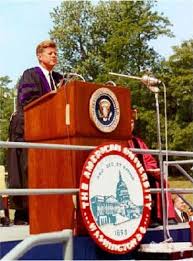 |
| Kennedy at American University |
When Cousins returned to Russia in April of 1963, he brought news that Kennedy would do all he could to get the treaty signed. The Russian premier was ready to sign on to a total test ban if it allowed a minimum amount of on site inspections. Kennedy favored that kind of ban also. But his problem was that he knew he could not get that through the senate, where you needed a two-thirds vote to ratify a treaty. The extremists in America wanted much more inspection. (ibid, p. 51) Therefore, the two men had to settle for a partial ban. This one banned testing in the atmosphere, outer space, and underwater, but still allowed for testing underground. Khrushchev was disappointed in the compromise. Kennedy understood the disappointment. He told Cousins, “He would like to prevent a nuclear war but is under severe pressure from his hard-line crowd, which interprets every move in that direction as appeasement. I’ve got similar problems.” Kennedy then continued in this vein by saying, the lack of progress “gives strength to the hard-line boys…with the result that the hard-liners in the Soviet Union and the United States feed on one another, each using the actions of the other to justify its own position.” (p. 52)
Cousins replied that it was not just the hard-liners in the USSR. The Chinese also felt that Khrushchev’s efforts at conciliation were unrealistic. And that once the negotiations broke down, they thought there would be a move towards closer friendship between China and the USSR. In fact, a delegation from Bejing was scheduled to visit Moscow in June. Kennedy understood this and was worried about it. He saw the test ban as a way to derail it. (ibid)
Cousins told the president that “what was needed was a breathtaking new approach toward the Russian people, calling for an end to the Cold War and a fresh start in American–Russian relationships.” This kind of approach would insinuate that “the old animosities could become the fuse of a holocaust.” Kennedy took all of this in, digested it and understood it. He told the editor to write him a memo on both their meetings and his visit with the Russian premier. Which Cousins did. (ibid, p. 53) Two weeks later, in early May, Ted Sorenson–Kennedy’s main speechwriter–called him to his office. Sorenson told him that Kennedy was going to use some of his arguments and he wanted some more notes. The Kennedy/Cousins connection was the beginning of the American University address.
Sorenson wrote a rough draft first. It was reviewed by National Security Advisor McGeorge Bundy, Bundy’s assistant Carl Kaysen, fellow speechwriter Arthur Schlesinger, and Adrian Fisher from the Arms Control and Disarmament agency. On June 6th, Sorenson took all the suggestions and turned out a second draft overnight. After another go-round with the same circle he refined it again. On June 7th, he gave that final draft to Kaysen for the necessary security clearances. Kennedy advised Kaysen on this process. When handed the speech, the Chair of the Joint Chiefs, Maxwell Taylor decided not to show it to the other service branch chiefs.
On the return plane ride back from Hawaii, Sorenson showed the speech to Kennedy. JFK suggested some changes but, overall, he liked it. Kennedy also showed the speech to Senator Mike Mansfield and Averill Harriman from the State Department, who he would later choose to negotiate the test ban treaty. (ibid, pgs. 26-27) It was ratified in the senate in late September of 1963 and took effect on October 10th.
After JFK arrived at the White House from Hawaii at a little after nine in the morning, Bobby Kennedy called his brother. He congratulated him on his speech in Hawaii. The Attorney General then asked him when he was speaking at American University. The president replied that it would be at 10:30 that morning. Bobby asked if he could come to the White House after that. He needed to talk to him about the crisis at the University of Alabama.
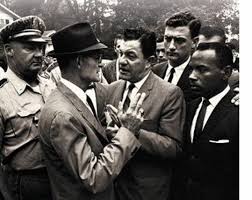 |
| Meridith at Ole Miss |
This is another point that most of us have forgotten about. Sandwiched between these two epochal speeches, a gripping televised drama was playing itself out. The University of Alabama was the last major institution of higher learning in the south to remain segregated. At Ole Miss, the previous year, President Kennedy had to send in federal troops when Governor Ross Barnett had resisted admitting black student James Meredith. During that violent conflict, two people were killed, cars were burned, and federal marshals were pelted with rocks. Barnett resisted even though Meredith’s case had been ruled upon by both a federal appeals court and the U.S. Supreme Court. When he did so, the governor was then found in contempt of court. He was given five days to comply or he would be arrested and fined. The problem for Barnett was that he had proclaimed, “No school will be integrated in Mississippi while I am your governor.” Therefore, the Kennedys and the legal system had to go into high gear to gain entry for Meredith. And because Barnett wanted to satisfy the racist element of the electorate, he resisted until the end. Because of this, violence ensued. RFK later came to the conclusion that if Barnett could not stop Meredith from registering, his fallback plan was to make it appear that only the Kennedys sending in thousands of federal troops made him do so. And for Meredith’s protection, troops stayed on campus for eight months. In other words, as in the Civil War and Reconstruction, the North was occupying the South. Afterwards, Bobby Kennedy understood that this had been Barnett’s plan from the start. (Robert Kennedy in His Own Words, edited by Ed Guthman and Jeffrey Shulman, p. 160)
In Alabama, Governor George Wallace had taken a similar pledge. His was to stand in the schoolhouse door to stop the University of Alabama from being integrated. The last thing the Kennedys wanted was another Ole Miss conflagration. But as with Meredith, two young black students–Vivian Malone and James Hood–had been cleared by the courts to attend the publicly financed state university. In addition to his public pledge, Wallace had made a political calculation after he lost the 1958 race for governor to the rightwing, Klan backed John Patterson. Prior to that loss, Wallace had been–comparatively speaking–rather moderate on civil rights. As both a state representative and circuit judge, he had done things that would not pigeonhole him as a racist, like granting probation to black prisoners.
But after he lost to Patterson he reportedly told aide Seymore Trammell, “Seymore, you know why I lost …..? I was outniggered by John Patterson. And I’ll tell you here and now, I will never be outniggered again.” (Dan Carter, The Politics of Rage, p. 2; this incident is also depicted in John Frankenheimer’s award winning TV film, George Wallace.) In other words, like Barnett, Wallace was putting on what was partly a theatrical performance. He was playing to his constituency. And his constituency was the Democratic Party in Alabama, just as Barnett’s was the Democratic Party in Mississippi. In other words, the Kennedys were bucking up against what was supposed to be their own political colleagues. I wish Cohen had given us a bit of historical background on how this happened. He does not. (Which is a shortcoming of the overall book I will elaborate on later.)
In a nutshell, it was Lincoln, a Republican, who had declared the Emancipation Proclamation. He then passed the Thirteenth Amendment. And it was the Radical Republicans who had then passed the Fourteenth and Fifteenth Amendments. Further, Andrew Johnson, a southerner, had been nearly impeached and removed from office by the Radical Republicans when he resisted their program for military occupied Reconstruction.
Therefore, when the Klan began to organize around the remnants of the Confederacy and the southern army, their natural allies were the local and regional Democrats. To their everlasting shame, those Democrats made a decision based upon nothing but arithmetic–as if the Civil War and its hundreds of thousands of casualties had never happened. They casually and simply added up the number of white residents in the various states and compared them with the number of black residents. Since the former outnumbered the latter by a margin of at least two to one, it was easy to see where political success lay. Therefore, the local Democratic authorities united with the local racist groups and put together what historians today call the Mississippi Plan. In its most extreme form, on the eve of elections, white paramilitary groups would ride on horseback, processional style, through the center of towns and villages carrying torches, with weapons in their saddles. The message was clear: if the newly liberated black slaves tried to vote they would do so at their own risk. And the fact that these processions openly rode through towns certified that the local legal authorities would do nothing about enforcing federal laws, like the Fourteenth and Fifteenth Amendments.
This was followed by the infamous Compromise of 1877. In that backroom deal, the presidential victory of Democrat Samuel Tilden was negated. Republican Rutherford B. Hayes became president. The Democrats again were practicing arithmetic. In this horse trade, the Republican Hayes and his predecessor President Grant now removed the last northern armies from the south. Reconstruction was now ended. When that occurred, the last Republican governments in the south collapsed. That geographic area now become a bastion of Democratic electoral strength in national elections. It came to be called the Solid South. With these two events, things like the Black Codes now morphed into Jim Crow. Jim Crow then became a systematic and methodical plan of complete segregation. No American president had seriously challenged this system before Kennedy. And since he had spoken out on the issue as a senator and a candidate, he had lost six states in the Solid South in the 1960 election—before he was even inaugurated. Most historians see this as the beginning of the great transformation of the south from a Democratic to a Republican stronghold.
What made it all the worse was that the presidents who should have done something about this appalling situation did little or nothing. That is, the so-called Progressive presidents (Taft, Teddy Roosevelt, Woodrow Wilson), and Democratic liberals like Franklin Roosevelt, and Harry Truman. The last two understood something should be done. But they both made the practical decision that if they acted on the subject in any real or forceful way, the other parts of their political agenda would be torpedoed by the power of the so-called Dixiecrats in the House and especially in the Senate i.e. the southern Democrats who controlled the chairmanships of so many committees in congress. Therefore Roosevelt did as much as he could symbolically by appointing black Americans to his administration. Truman integrated the military services.
But what is the excuse for Dwight Eisenhower? The reason I express the question that way is because he had the sanction of the Supreme Court. In 1954, the Warren Court passed down the Brown vs. Board decision. This crucial case reversed the 1896 Supreme Court decision in Plessy vs. Ferguson, that had sanctified local Jim Crow laws, and therefore separate facilities were now deemed equal before the law. The Supreme Court had ratified segregation. But the 1954 decision very clearly overturned that case and dictated that the system of segregation should be now taken apart with all due speed. But as many commentators have stated, the Eisenhower/Nixon regime proceeded with the speed of a turtle with arthritis. For instance, Eisenhower’s Justice Department never filed a civil rights case in Mississippi during his entire administration. In the six years after Brown vs. Board, Eisenhower filed a grand total of ten civil rights cases based up on either equal accommodations or voting discrimination. To say this was a snail’s pace is an insult to snails. As many commentators have pointed out, this hesitance was the beginning of Vice President Richard Nixon’s Southern Strategy: the deliberate courting of the racist element in the south for political gain. In other words, the Republicans were–not very subtly–reversing the heritage of Lincoln. (The one exception in the six year span was the 1957 crisis at Central High in Little Rock, Arkansas.) Therefore, because of the political calculation of Eisenhower and Nixon, Kennedy had an even more uphill climb in front of him. He had to overcome the nearly one hundred year institutional basis of segregation, which had now become ingrained in southern culture in every way: socially, politically, and psychologically. But further, he had to find a way to get around the Dixiecrat control in congress e.g. Senator James Eastland of Mississippi.
I wish Cohen had detailed some of the above in his text. It would have placed the dramatic reversal President Kennedy was about to enact in a more accurate context.
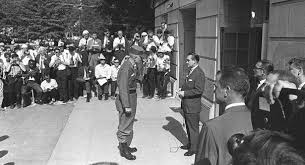 |
| Wallace in Tuscaloosa |
As authors Irving Bernstein, Harry Golden and Harris Wofford have noted, Kennedy understood that there were simply not enough votes in congress to get a civil rights bill enacted his first year. Therefore, in 1961, the White House did what Eisenhower and Nixon had not done. Attorney General Bobby Kennedy concentrated on school integration with the Brown vs. Board decision backing him. (Guthman and Shulman, pgs. 147-48) The Kennedys sent Justice Department officials like Ramsey Clark, Burke Marshall and John Siegenthaler to local districts where they thought black families would have difficulty registering their children in public K-12 schools. As Bernstein notes in Promises Kept, in 1961, Kennedy proceeded to do as much as possible through executive orders in order to build momentum, instead of sustaining a legislative defeat or filibuster. In 1962, the administration did send up a modest voting rights bill. As Bobby Kennedy later said, it went nowhere. It was filibustered and the White House did not have anywhere near the votes to get cloture. (Guthman and Shulman, p. 149) So the White House continued with administrative actions, like local lawsuits under Brown vs. Board and Title III of the 1957 Civil Rights Act, and equal employment through the Equal Employment Opportunity Commission. With the last, the Kennedys were determined to make sure that companies doing business with the government were active in hiring minority groups.
Then came the Birmingham spectacle, with Sheriff Bull Connor facing off against Martin Luther King and the Southern Christian Leadership Conference. The sight of white firemen slamming black children against buildings with fire hoses, of German Shepherds leaping and biting innocent civilians, of police officers smashing demonstrators’ skulls with billy clubs, these nightly TV images created a sensation. As JFK told his brother and Dr. King, the bill he sent to congress should have been called Bull Connor’s Bill. (Guthman and Shulman p. 171) Washington watched and listened as people in the north were now repulsed by what a century of segregation had done to Americans in the south—even after the Civil War amendments had legally made former slaves equal to whites. Such was simply not the case; not even close. The actions of Ross Barnett in Oxford, and Bull Connor in Birmingham now formed the background for President Kennedy versus Governor Wallace in Tuscaloosa.
Cohen uses what is today a little known source for the backbone of his description of this conflict. The late Robert Drew was a committed documentary film director who was one of the first—along with Emile de Antonio—to make cinema verite films. That is, documentaries that did not use the device of breaking up the action of the story with a posed and well lighted sit down interview with a subject. Drew had previously made the film Primary in this way. That was about the Wisconsin Democratic primary election of 1960, which featured Kennedy against Senator Hubert Humphrey. (The only author in the JFK assassination field who has mentioned that film to any degree is Joseph McBride in his book Into the Nightmare.) Kennedy had seen the film and liked it. He asked Drew what he wanted to do next. Drew said he wanted to make a film about his administration during a particularly stressful period of time. (Cohen, p. 78) They eventually decided upon the racial crisis between Kennedy and Wallace over the integration of the University of Alabama. In addition to filming the Kennedy brothers and the two students, Governor Wallace agreed to allow cameras to follow him around also. The film, naturally entitled Crisis, aired on ABC in the fall of 1963. Its candor created quite a controversy. Two of the points the film makes are that 1.) It was Kennedy who was pushing for sending a civil rights bill to congress ASAP, and 2.) It was RFK who was pushing his brother to make a national speech in primetime before he did that. (Cohen, pgs. 82-83) Cohen not only saw the film, he saw hours of outtakes from it.
The confrontation at the schoolhouse door was weeks in the making. In April, Robert Kennedy had visited Wallace in Birmingham to try and ward off another violent, life threatening spectacle as with Barnett. As Bobby said later, that meeting was “unhelpful….We really didn’t get very far.” (Guthman and Shulman, p. 185) In May, another meeting took place between the AG and Wallace, again with no real result. Wallace was intent on being as unhelpful, and as unpredictable, as possible. Even though the university’s board of trustees wanted to let the students register, since Wallace was the titular head of the board, they could not overrule him. (ibid, p. 187)
To give an example of this, on the evening of Saturday June 8th, Wallace had sent the White House a telegram telling the president that “out of an abundance of caution” he was calling up about 500 state guardsmen. Kennedy replied that he was “gratified by the dedication to law and order expressed in your telegram” informing him of the potential use of the National Guard at Tuscaloosa. But, the president continued, the only foreseeable threat of violence came from Wallace’s “plan to bar physically the admission of Negro students in defiance of the order of the Alabama Federal District Court, and in violation of accepted standards of public conduct.” (Cohen, p. 74) On Tuesday June 11th, Wallace flew from Montgomery to Tuscaloosa. He had a motorcycle escort to the Hotel Stafford where he constructed his headquarters. Wallace was going to make real his promise to stand in the schoolhouse door. The problem for the White House was that the courts had ruled on May 21st that the students had to be enrolled for the summer session, which began on June 11th. (ibid, p. 236)
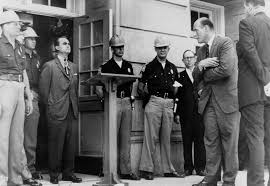 |
| Katzenbach and Wallace |
On the scene, the point man for the White House was Deputy Attorney General Nicolas Katzenbach. He had arrived on Monday, and set up his office on campus. RFK and he had decided that Malone and Hood would not accompany Katzenbach to the gate. Since the two had already been admitted he decided to escort them to their rooms. The problem was the actual registration, which Wallace was holding up. (Cohen, p. 85) The White House had out manned Wallace. President Kennedy had 3,000 soldiers on the scene if Wallace refused to yield, was arrested, and violence broke out. They were under the command of General Creighton Abrams who was in dress clothes so as not to suggest a military commander. Colonel Albert Lingo, Alabama’s director of public safety, raised a force of 825 law enforcement officers.
One of the valuable insights Cohen brings to the fore in his analysis of the Tuscaloosa showdown is the role of Louis Martin Jr. Martin was a longtime reporter and editor for black newspapers like the Chicago Defender. He was recruited into Kennedy’s campaign by his brother-in-law Sargent Shriver. He became one of the president’s main advisors on race issues. And Kennedy consulted with him in the early days of the conflict. (Cohen, p. 226) Kennedy was trying to decide just how wide his civil rights bill should be. He originally wanted a bill that included integration of public accommodations, school desegregation, and voting rights. Some Republicans, like Senator Everett Dirksen, wanted to stop short of privately owned facilities like restaurants. Previously advised by Martin, President Kennedy disagreed with this. Martin had told him the bill had to include all public accommodations or “we’re going to have one hell of a war in this country.” (ibid, p. 227) Therefore, at a private conference with Kennedy, when the Republicans objected to this aspect, Kennedy replied that all restaurants must be integrated. Martin also recommended a billion dollar program for job creation and development of job skills for inner city youth.
 |
| Katzenbach, LBJ, RFK |
Cohen also deals with the role of Lyndon Johnson in all this. Kennedy included LBJ in a meeting with Republican leaders on Monday, the tenth. And he also describes the long discussion that many authors have mentioned between Sorenson and Johnson from a week before, which was taped by the vice-president. Johnson also recommended that the president get on national television to push the issue. But he was not sure that this was the proper time because, like Larry O’Brien and Ken O’Donnell, Johnson thought that pushing the issue might endanger the rest of Kennedy’s program. (ibid, pgs. 227-29) In light of that, the subtext of Cohen’s work in this regard is that it was really Robert Kennedy who was the driving force in the Wallace crisis and also the speech on race.
The Kennedys had two tactical advantages over the governor. The first was that Frank Rose, the president of the university, was in favor of admitting the students. (ibid, p. 239) Therefore, he was providing the Kennedys with inside information about what Wallace was doing. Secondly, if Wallace resisted admittance, the White House could attempt to nationalize the state national guard. This was the step that the Kennedys realized they had to take before sending in federal troops under Abrams, which the White House always looked upon as a last resort. (ibid, p. 249) With over 300 journalists in attendance from all over the world, and a national TV broadcast, that is the way the conflict played out. President Kennedy made the decision to nationalize the guard. (ibid, p. 267) Therefore Brigadier General Henry V. Graham asked Wallace to step aside upon orders of President Kennedy. Katzenbach and his assistant on civil rights John Doar now had the students registered. Graham and his detachment stayed on campus, actually in the students’ dorms, for protection purposes.
It was with the peaceful conclusion of this conflict that President Kennedy decided to go ahead with the speech that evening. Or as Ted Sorenson later related: as Wallace left the gate, JFK turned to him and said, “I think we’d better give that speech tonight.” The problem was that Sorenson had not prepared a speech. What existed were some notes put together by RFK and the Justice Department. And here, Cohen inserts something that was new for this reviewer: the figure of Richard Yates.
Today, Yates is known as one of the most distinguished novelists of his era. But like many other fiction writers, his fame and recognition only arrived after his death in 1992. While alive, none of his books ever sold more than twelve thousand copies. His most famous novel, Revolutionary Road, was made into a film in 2008 by director Sam Mendes. In 1963, Yates was freelancing as a speechwriter for Bobby Kennedy. Anticipating, and in fact, pushing his brother to make a forceful nationally televised address on race, Bobby had told Yates to prepare a speech on the subject. At the time the speech was telecast, June 11, Yates had only been working for RFK for a couple of weeks. (Cohen, p. 287) On the evening of June 9th, Yates began working on a speech. He completed in two days later, the day JFK went on television. Sorenson did not hand the president a speech until less than an hour before he went before the cameras. As Cohen notes, there is no evidence that Sorenson used the Yates draft in his work. But there is evidence that he used some of the themes that Yates sounded. (ibid, p. 289)
 |
| JFK Civil Rights Speech June 11, 1963 |
As Cohen notes, Kennedy only had a few minutes to look over the speech before going on camera. He delivered it without a teleprompter. (ibid, p. 331) And he actually extemporized the last four paragraphs. Kennedy chose to accent the events of the day, the showdown with Wallace, as the lead. And he especially wished to highlight the facts that it was an Alabama guardsman who removed Wallace, and it was an Alabama judge who wrote the order to do so. And they did this so that two Alabama citizens could enter the university. Although Cohen includes a neat and incisive summary–impressing the fact that Kennedy was the first president since Lincoln to make race a moral, not a legal issue–I cannot do better than to recommend the reader watch this milestone speech for himself. (http://abcnews.go.com/Archives/video/june-11-1963-jfk-promises-civil-rights-bill-9295675) In my opinion, among Kennedy’s several memorable speeches, it seems to me to be significantly underrated: both as a speech, and as part of the fabric of a dramatic historical revolution. It is almost impossible to imagine Eisenhower or Nixon making such a speech. In fact, as Cohen notes, Martin Luther King was overjoyed after he heard it. He told Walter Fauntroy, a friend he was watching it with, “Walter, can you believe that white man not only stepped up to the plate, he hit it over the fence!” (ibid, p. 339)
But there were some who detested the speech, and the movement that had brought it on. Cohen closes the book proper with the wife of Medgar Evers watching the speech with her children in Jackson, Mississippi. (Cohen, p. 350) She was riveted by the things the president was saying. Evers himself was at a mass meeting at the New Jerusalem Baptist Church. In the very early minutes of June 12th, as he was driving up his driveway, he was shot and killed by Klansmen Byron de La Beckwith. At his second trial for murder, which ended with a hung jury–as did the first–Ross Barnett approached Beckwith at the defense table and shook hands with him, as his wife Myrlie was testifying from the stand. As with the Civil War and Reconstruction, the forces of segregation and Jim Crow were not going down without a fight. De La Beckwith was not convicted for another thirty years.
But it was this speech that really turned the conscience of America. Because it was spoken by a president who was a wealthy white man. Kennedy used it to submit his Civil Rights Bill. Bobby Kennedy attended the funeral of Medgar Evers. After which the president invited Evers’ family to the White House.
 |
| JFK signs Equal Pay Act with American Association of University Women |
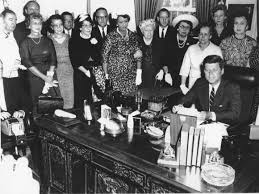
I don’t wish to leave the impression that these two speeches and their immediate background are all the author covers in the book. He also touches on other significant accomplishments during Kennedy’s brief presidency. For example he deals with the Equal Pay Act for women; Kennedy’s very close ties to the labor movement ( as one labor lobbyist noted, “We lived in the White House” p. 113). He also deals with Kennedy’s attempt at stressing physical fitness programs, reforming immigration, and even touches on Kennedy’s attempt to soften the exit of some industries from Indonesia, American industries that President Sukarno had expelled. (p. 310) And the author also notes that Kennedy held a press conference almost every sixteen days. Which is amazing in light of their frequency today.
At the beginning I said that Cohen had a fine idea for a book. And as noted above, the volume has some good (and some new) attributes to it. But ultimately I cannot fully endorse it like I did Robert Rakove’s Kennedy, Johnson and the Nonaligned World, or Philip Muehlenbeck’s Betting on the Africans. There are two reasons for this.
As touched upon previously, Cohen is not really an historian. So unlike Rakove and Muehlenbeck, he does not give you the historical backdrop to either the race issue or the rapprochement with the Soviets issue, which are his two main topics. Above, I tried to barely outline the backdrop to the race issue. The latter is even more complex. And unlike the former, the scholarship in this area—how the Cold War originated and then aggrandized itself—is still growing. Cohen does not even try to map any of this out. To give just one example: it is hard to believe, but you will not see the name of either of the Dulles brothers—neither John Foster, nor Allen—in the entire book. Any true historian—like Rakove or Muehlenbeck, if they had been writing this book– would have included them. In one central aspect, history is finding a through line. That is a combination of balanced background, cause and effect relationships, and, from there, searching for patterns and origins of new behavior and actions. From all this one then finds, as Arthur Schlesinger once said, “currents”. There definitely were shifting currents in JFK’s presidency, especially on these two issues. And if Cohen had done a fuller job as historian, the reader would more fully understand the quantum leap that Kennedy was making in both areas. And why it was so difficult? Along with this failing, there is also a lack of information as to the central mystery: Why, psychologically, did Kennedy do both of these things? Again, the answer to that question is also in the record, but Cohen fails to excavate it for the reader.
 |
| Kennedy in Dallas |
Because of these shortcomings, it leads to what I believe is the flawed conclusion he makes in his epilogue. Cohen writes there that because of these two speeches, “For the first time in his whiplashed presidency, he came to inhabit his office.” (p. 373) This is echoed on the rear cover: a description reads, that in “Kennedy’s crowded hour, he begins to see things differently.” I could not disagree more. On both points. The reason Kennedy’s early presidency was “whiplashed” was that he was being duped by the CIA over the Bay of Pigs issue, and he was starting a truly revolutionary program in foreign policy. And an only slightly less revolutionary one in domestic policy. There was no way that was going to be easy, especially at the start. Because there was no way the opposition was not going to resist strongly.
On the second point, I would say that Kennedy came to inhabit his office almost immediately. In the sense that he knew what he wanted to accomplish at the start. And he set out to achieve it. The first and, I think, foremost example is one Cohen ignores: the situation in Congo. Again, you will not see the name of Patrice Lumumba in this book. Even though he was a black man striving to free his country from imperialism. Describing that struggle—even briefly—would have highlighted and dramatized the conflict Cohen is describing domestically. I have explained in my review why Kennedy’s bill was not sent up until 1963; it would have been filibustered effectively. The reason the attempt at détente took place in 1963 was due to the Bay of Pigs drama; which as many have noted was due to Allen Dulles misleading President Kennedy. This is called creating a balanced historical backdrop.
Which relates to another failing of the book. Like Thurston Clarke, Cohen is and wants to be an upstanding member of the MSM. He has written for Time, UPI and, since he is a Canadian, the Globe and Mail, which is the USA Today of Canada. He has been described by the New York Times as one of “Canada’s most distinguished authors.” In his book he actually praises Sally Bedell Smith’s Grace and Power as “groundbreaking”. Which is about the last word I would use to describe it. I would call John Newman’s JFK and Vietnam, groundbreaking. I would describe Richard Mahoney’s JFK: Ordeal in Africa as groundbreaking. I would also call Irving Bernstein’s Promises Kept and Donald Gibson’s Battling Wall Street groundbreaking tomes. No surprise, you will not see any of those books in his bibliography. But there you will see Ben Bradlee’s worthless book Conversations with Kennedy, and you will also see the late (and lying) David Heymann’s even more worthless biography of Robert Kennedy. See, real historians like Robert Rakove and Phil Muehlenbeck are academics. They are not part of the MSM propaganda machine. Therefore, they are not beholden to it for favors. Cohen is a part of it. Therefore he dutifully spends a senseless amount of space on Mary Meyer. (Although, thankfully, he does not buy the Timothy Leary aspect of that story.) We are also told—Bradlee like–that Kennedy was endlessly interested in the John Profumo sex scandal in England. The author actually gives space and credibility to Mimi Alford. Even though Australian researcher Greg Parker has shown her story to be, at best, dubious. (Click here http://www.reopenkennedycase.net/reopen-blog/a-storm-in-a-mini-teapot) If you can comprehend it, as with Heymann, even stripper Tempest Storm makes an appearance in Cohen’s pages. What any of this has to do with race relations or nuclear arms control is Cohen’s secret. (Or maybe Tempest Storm’s?)
This is all part of a publishing industry subdivision I have called the “Posthumous Assassination of John F. Kennedy”. It’s a way of demeaning Kennedy’s character and legacy and, as a byproduct, killing off interest in his assassination. As we shall see–and as I mentioned in that essay—Bob Loomis of Random House was one of its ringleaders. (The two-part essay “The Posthumous Assassination of John F. Kennedy” is available on the Probe CD collection, and in the book The Assassinations. Many readers considered it one of the finest essays Probe ever published.)
The problem for Cohen is his book was distributed by a subsidiary of Random House. It was Random House and the notorious Loomis who originated the work of Gerald Posner on the JFK murder. To the point of having CIA asset Loomis actually arrange interviews for Posner with the likes of Yuri Nosenko. (Loomis was in prime position to do that. When I called his office in 1997, his secretary said he was in Washington, since he spent about two days a week there.) As anyone who has followed the Kennedy saga knows, Loomis has been one of the most pernicious behind the scenes operators in the field. Some of his and his company’s clients—besides Posner—have included James Phelan, Sy Hersh, Alford, and Norman Mailer. (The Assassinations, edited by James DiEugenio and Lisa Pease, pgs. 369-70. See Destiny Betrayed Second Edition, p. 244, for Loomis’ handiwork on the MLK and RFK cases.) And as Sally Bedell Smith herself once admitted—as was the case with Posner—her book was not her idea. It was pushed on her by the bigwigs at Random House—while Loomis was still there. (See SF Gate, May 23, 2004, interview with Carolyne Zinko) Therefore I have little doubt Loomis helped stage interviews for Vanity Fair’s answer to Kitty Kelley. And as we have learned about this cottage industry—with both Kelley and Heymann—some of these “interviews” did not happen. And that is why Smith’s book got such a big sendoff. Just like Loomis gave Posner a huge publicity binge. (Another Loomis client, Robin Moore, had his book, The Hunt for Bin Laden, partly fabricated by a false witness. The fabrication was done with direct authorization by Loomis.) As they say in that industry, you scratch my back and I’ll scratch your book. Cohen wanted to get his ticket punched. So he played the game. No matter how badly it marred his work.
Therefore what could have been an important and sterling volume is seriously compromised with a lot of litter. Instead of being up there with Rakove and Muehlenbeck, it stands a couple of steps downward, with Thurston Clarke’s mixed bag of nuts.
I have to admit that when I was asked to review the book in question, I did not recognize its author. The name Charles E. Hurlburt did not ring a bell, as it was a name that I have never encountered in the JFK assassination research community. I do not consider it to be a bad thing (I am not one either) since all citizens should study and try to join the quest for the truth. So I was curious to find out what he had to say.
Charles E. Hurlburt is a senior citizen who, at the time of the assassination, was employed by ITEK Corporation as a software programmer (Yes the same ITEK that analyzed the Zapruder film for the House Select Committee on Assassinations). He first became interested in the case after reading Mark Lane’s book Rush to Judgment back in 1966. By that time he had left ITEK and he was working for MIT University, where he discovered in the library, Ed Epstein’s book Inquest and later the Warren Commission (WC) Report. After reading the two books and the Warren Report itself, he became convinced that the Commission’s work was inadequate. Further, that it contained serious omissions, misrepresentations and fallacies. Later it was Oliver Stone’s movie JFK that re-awakened his interest in the case, and he became a serious student of the assassination ever since.
The book consists of twelve chapters that examine both the micro and the macro aspects of the assassination, but not in a detailed manner. In my view, he tried to juggle too many different aspects of the assassination in a small book. Therefore, it was not possible to examine each one detail. So it is very difficult to write a critique based on brief and basic explanations of very complex matters. So, this reviewer decided to concentrate on some aspects since it will be very difficult to examine every single aspect.
Chapter Two examines the autopsy of the dead president. Hurlburt summarizes the evidence which proves that the doctors tried to cover up the truth and comply with the official version: namely that only two shots hit JFK. He correctly points out that the bullet that caused the back wound entered below the shoulder at an angle of 45 to 60 degrees, did not exit and that it was never located inside the body. It would have been impossible to have penetrated the neck to exit the throat, an invention that Arlen Specter created well after the autopsy with his now infamous “Magic Bullet Theory.” However this is where Hurlburt makes a serious mistake when he states that the Bethesda doctors did not know anything about the wound in the front of the throat during the autopsy procedure. He further states that “it was not until the following morning after the body was no longer available for examination that Dr. Humes spoke on the phone with Dr. Perry, and learned of this small ‘puncture’ wound in the throat.”
Hurlburt may not be aware of the late Dr. Robert. B. Livingston’s testimony in a 1993 lawsuit against the Journal of the American Medical Association (Breach of Trust, Gerald McKnight, p. 411). Livingston, who had lectured at Harvard and Yale Universities and had experienced all kinds of wounds during WW II while treating Japanese prisoners of war. Following the first media reports, he recognized the wound in the throat was one of entry that had originated from the front. So Livingston called Humes to advice him about the nature of the wound but Humes left the phone and when he returned told Livingston, “I can’t continue this conversation, and in fact, the FBI won’t let me.”
He then touches on the controversial subject that JFK’s body was surgically doctored according to David Lifton’s theory as described in his book Best Evidence. Another noted author who has expressed a similar view is Douglas Horne, a former staff member of the ARRB who had examined the medical evidence in detail. Horne presented his conclusions in his five volume book, Inside the Assassination Review Board.
This subject is quite controversial so I would suggest that anyone can read the above mentioned books and make up his (or her) own mind regarding the subject of a pre-autopsy doctoring of the body. Hurlburt concludes that the autopsy was surrounded by controversy over a number of contradictory statements, for example “the body was enclosed in sheets/a body bag,” or “the brain was/was not severed from the brain stem…” etc. This author believes that contradictory statements followed the doppelganger pattern that so often pops up in the JFK assassination and their purpose is to create cognitive dissonance to confuse and frustrate researchers, to inveigle the truth and preserve doubt.
In chapter three he does a fair job to show that all the investigating bodies, the police, the FBI, the Warren Commission and the HSCA did not perform as they should, and they all contributed to the cover up and to the mess that the JFK investigation is today. Again this is done very briefly and does not analyze any of it them in depth. In doing so he makes a few mistakes; like his assurance that convicted felon Charles Harrelson was a “dead ringer” for one of the three tramps photographed after the assassination (p. 53). It is an assumption based on the controversial work of Lois Gibson, a forensic artist who’s work and findings many dispute, and there are not many researchers who agree with her on the identification of the tramps. In 1979, Harrelson was arrested and charged for the murder of Judge John H. Wood. He was eventually found guilty and convicted of the murder of Wood and sentenced to two life sentences. When he was arrested he confessed that he was one of the shooters that killed Kennedy. But he later withdrew his confession. He was accused of being the tall tramp photographed in Dealey Plaza, but after examining the photos he stated that the there is no resemblance between him and the tall tramp. He stated to Nigel Turner that at the time of the assassination he was in Houston with a friend and that even if he was offered the job he would have never accepted because he knew that he would end up dead as well. In 1992 the Dallas Police revealed the identities of the tramps and claimed that they were Gus Abrams, John F. Gedney and Harold Doyle. Ray and Mary LaFontaine did their own research and agreed with the police’s view regarding the tramps. This author is not convinced that the above mentioned individuals were the three tamps and believes that their identities will remain forever obscure. The late Fletcher Prouty believed that their identity was not important since they were “actors” whose job was to help with the cover up.
In the section describing the last official investigation by the House Select Committee of Assassinations (HSCA), there are a few inaccuracies regarding Chief Counsels Richard Sprague and Robert Blakey. Regarding Sprague, the author asserts that it was his disagreements with Congressman Gonzalez that eventually led to his downfall. He writes that “A clash of egos erupted between Gonzalez and Sprague.” This clash along with media attacks led Gonzalez to try to fire Sprague. He did not succeed, and as a result Gonzalez resigned. Sprague tried to keep his position but he was fired. Yes, partially. But it was also his unwillingness to play the Washington political game and his call for an unrestricted investigation that that led to the above confrontation. Hurlburt somehow, in his above narration of the events, forgot to mention the real cause that forced Sprague to resign (p. 68). Sprague later said “But when I looked back at what happened, it suddenly became clear that the problems began after I ran up against the CIA.” It all started when Sprague asked for complete information about the CIA’s operation in Mexico City regarding Oswald’s visit there and total access to its employees who may have had anything to do with the photographs, tape recordings and transcripts. The CIA finally agreed only if he would sign a CIA Secrecy Agreement. Sprague refused and said “How can I possibly sign an agreement with an agency I am supposed to be investigating?” (Gaeton Fonzi, The Last Investigation, p. 197).
Hurlburt then discusses Sprague’s replacement as Chief Counsel, Robert Blakey, and he correctly states that he held the firm opinion that the Warren Commission had been right all along. He writes that Blakey, “as an experienced Washington insider, he was much more concerned with producing an acceptable report within the allotted time than with uncovering new leads” (p. 68). Blakey believed that Oswald had fired the shots and that the Mafia had planned the assassination. He continues that “In fairness, it must [be] pointed out that Blakey’s Committee was severely restricted…by the continued ‘stone walling’ of the CIA, who refused to release many of the relevant files on the grounds of National Security” (p. 69).
This is again only partially true. The real problem with Blakey was that he was unwilling to confront the CIA, and instead he did exactly what they were asking him to do. If one wants to find out more about Blakey’s days in the HSCA, should read Gaeton Fonzi’s The Last Investigation and The Assassinations by James DiEugenio and Lisa Pease. In the latter book there is a whole chapter devoted to the chief counsel, titled “The Sins of Robert Blakey” (pp. 51-89). At the end of the chapter one can read an incident that perfectly summarizes Sprague’s obsequious attitude towards the CIA. There were some objections to the interrogation of Richard Helms, the CIA officer that Sprague wanted to “go at”. Blakey assured the CIA that they will be given in essence, the opportunity to review and rearrange the evidence on the eve of the trial. Similarly in Fonzi’s book there is a similar incident, where Tanenbaum and Fonzi wanted Sprague to prosecute David Phillips for perjury. Fonzi tried to convince Blakey and said to him “Do you realize that David Phillips lied in his testimony?” Blakey raised his eye brows. “oh really,” he said. “What about?” “I gave him the details. He listened carefully, thought silently for a moment, shrugged his shoulders and walked away” (The Last Investigation, p. 277). However, if you read Hurlburt’s book, none of the above is mentioned and you don’t have a clear picture of the HSCA investigation and Robert Blakey’s actions.
Hurlburt, while discussing the Warren Commission, reports the incident where Senator Russell asked for a footnote to be added to the report stating that he disagreed with the single bullet theory. But Warren insisted on unanimity and his footnote was never included. This is not really accurate since it was Lee Rankin; not Warren; who orchestrated the deception and led Russell to believe that it would be included on the Warren report (Gerald McNight, Breach of Trust, pp. 282-297, and DiEugenio, Reclaiming Parkland, pp. 257-260).
In chapter 9, titled “The Enigma of Dealey Plaza” he examines the micro-aspects of the assassination regarding bullets and trajectories. He does a good job explaining the absurdity of the single bullet theory. But the then took on the improbable task of constructing the shooting sequence. There are many theories trying to recreate what exactly happened in Dealey Plaza but due to the lack of evidence and the subsequent cover up, it is virtually impossible to find out the truth. Any theory is as good as the next and in this author’s opinion; unless there is a major breakthrough; we will never find out the exact location of the shooters and the exact firing sequence. To come to his conclusions Hurlburt has taken three factors into consideration: Eye witness testimony, the Zapruder film and the Dallas Police audiotape.
The eye witnesses are not very reliable when it comes to identifying shots because sound suppressors were very likely used and the landscape of the Plaza combined with reverberation might have played tricks on the ears pointing to false locations. Our eyes, and subsequently the Zapruder film, are the most reliable indicators, although there are researchers who believe that the film is altered. This author is an agnostic when it comes to that issue but I cannot exclude the alteration theory, especially if we consider that the film was in the hands of C.D. Jackson of Life Magazine, a cold warrior and psy-ops expert. It would make sense that such a person would have used the film as a weapon to obfuscate the truth and confuse researchers, creating cognitive dissonance and making certain that the researchers will be fighting among themselves, arguing the film’s authenticity, in the years to come.
The Dallas Police tape was taken into account by the HSCA to reach its conclusions that there was probably a conspiracy and that a shot was fired from behind the grassy knoll that missed. Many believe that it is authentic and have the backing of scientific experts, while others dispute the acoustic evidence and claim that these are not shots and that sounds were recorded further down and not in Dealey Plaza.
Before the HSCA investigation there were two theories regarding the origin of the shots, the official theory that supported the three shots from the sniper’s nest and the researchers’ theory that the headshot came from the grassy knoll. Upon reflection one cannot fail to notice that the HSCA’s acoustics evidence marries the two conflicting theories to satisfy everyone, but with a Catch 22. The grassy knoll shooter missed which meant that researchers were half right and in essence the WC was correct; a limited hangout. If we then consider that the acoustics evidence was disputed then it would make sense for the perpetrators to have it designed similarly to the WC report, to fail. Thus, they could not only create more endless arguments and cognitive dissonance, but also cast a cloud above the HSCA’s cornerstone that it was “probably a conspiracy” based on the acoustics evidence. Because if the Dallas Police tape was not recorded in Dealey Plaza, then by definition we are no longer certain that there was a conspiracy and the HSCA conclusion is in doubt.
Closing the parenthesis, we go back to Hurlburt’s shooting scenario where he proposes seven shots. Shot 1, at Z 168, probably from the County Records Building that struck JFK in the upper back and only penetrated a couple of inches; Shot 2, at Z 177, from the Dal-Tex Building that missed; Shot 3, at Z 207 from the sniper’s nest that also missed; Shot 4, at Z 229, from the western end of the TSBD that wounded Connally; Shot 5, at Z 313, from the grassy knoll that struck JFK in the right temple and blew out a large hole in the upper rear of the head; Shot 6, at Z 324 that struck JFK’s head just above the large exit wound, and Shot 7, at Z335, from the western end of the TSBD that missed.
First, his scenario is based on the acoustics evidence that many dispute, and second, I disagree with his two headshots theory and the absence of a throat wound. Most researchers agree that a shot from the grassy knoll would have exited the left side of his head, which did not happen and the second headshot near the external occipital protuberance (EOP) is based on the autopsy doctors’ report, and the erroneous belief that there was a shot from the rear at Z 312 just before the Z 313 frontal shot. Sherry Fiester, in her book Enemy of the Truth makes a good case that this did not happen. This forced researchers who supported a shot in the EOP to change the timing and claim that it occurred around Z327-Z329 after the frontal shot in the temple.
Hurlburt also believes that the throat wound was not a wound of entrance and it was caused by a bone fragment from the head shot that struck from the rear. Jerol Custer, the X-ray technician testified to the ARRB that he took a C3/C4 X-ray showing bullet fragments in and around the circular throat wound that has gone missing. If we add to that the testimonies of the Parkland doctors and the fact that the throat trajectory was 0 degrees, i.e. horizontal then it is most likely that a shot from the front caused that wound.
In this author’s view, and taking into account the ARRB testimonies this is what most likely happened during the autopsy. The doctors were aware that there were only three bullets found in the sniper’s nest, and that one had struck Connally, and two bullets had struck Kennedy, all from behind. Upon examining JFK’s body, they discovered three entrance wounds, one in the lower back that did not penetrate all the way, an entry wound in the throat and an entry wound in the right temple that exited in the rear causing the big gaping wound at the occipital. So they were faced with serious problems. Not only was JFK hit by three instead of two bullets, but only one had come from behind (the back wound). To conform to the FBI theory they decided to reduce the three shots to two by eliminating the throat shot and reversed the direction of the head shot to the rear instead of the front. Now they had two shots that hit JFK, both from the rear. This is what I believe started the EOP entrance wound (one low in the skull) and the second headshot. Thanks to the ARRB revelations we learn that the EOP entry identification was based on assumptions rather than evidence. The entry wound was only partial wound that was later completed to a circular defect by a fragment that arrived later. The Doctors have positioned the fragment without an anatomical landmark so we are not even sure if the fragment was from that part of the skull. Dr. Pierre Finck said that bevelling in the wound indicated wound of entrance but according to new research bevelling is not considered as reliable as it used to be (Fiester, Enemy of the Truth, chapter 6).
For what it is worth, in this author’s opinion, this is the most likely scenario, a headshot to the right temple that originated from the South Knoll, a shot in the throat from somewhere in the front and a shot that struck the back, probably from the Dal-Tex building, not counting the shots that hit Connally or the missed shots.
Hurlburt informs us that the real motive of the plotters was not so much Vietnam but Cuba, which he names as the Rosetta Stone to the assassination. He states that the evidence to support the Vietnam motivation is “rather sketchy compared to the weight of the evidence for the other motive: his policies towards Cuba, combined with his brother Robert’s crusade against the kingpins of organized crime” (p. 97).
Many would not agree with him. On the contrary, JFK’s Vietnam policy was reversed and the country was later invaded; while Castro is still alive and Cuba was never attacked by the U.S. Likely however, Vietnam was not the only motive but Kennedy’s entire foreign policy, as researcher and historian James DiEugenio has argued in his latest presentations both in the Wecht and JFK Lancer conferences.
Hurlburt begins the identification of the conspirators at level 1, the shooters, who among them are Charles Harrelson, Charles Rogers, the Frenchmen Lucien Sarti, Jean Souetre, Sauver Pironti and Bocognoni, Roscoe White, Jack Lawrence, Eugene Brading, even John Thomas Masen the well-known Oswald look alike. It is a cosmopolitan blend of villains, more likely the world and his wife were shooting at Kennedy that day.
At level 2 is the support team that includes among others E.H. Hunt, Frank Sturgis, Pedro Diaz Lanz and Antonio Venciana. At level 3 the team framed Oswald as a patsy. Among them were Guy Banister, David Ferrie, Sergio Arcacha Smith, David Phillips and Clay Shaw. At level 4 is Jack Ruby who was responsible for eliminating the patsy, and also a few policemen who helped him. At level 5 the most likely Mob organizers, Johnny Roselli, Robert Maheu, Santos Trafficante, Carlos Marcello and Sam Giancana. At level 6 the probable CIA planners, William Harvey, Edward Lansdale, Sheffield Edwards, the Cabell brothers, Richard Bissell and David Morales. Finally at level 7, are the accessories before and/or after the fact, like Allen Dulles, LBJ, J. Edgar Hoover, H.L. Hunt, Clint Murchison, James Angleton, Richard Helms, Gerald Ford and Richard Nixon. In Hurlburt’s words “level 7, in my opinion, played no part in the plot either, but each person mentioned had strong reasons to cover up the truth” (p. 234).
You could argue that some members from level 2 to 6 were somehow involved in the plot, although there no real evidence to prove that the Mafia dons planned the assassination. However, when it comes to his above mentioned assessment about level 7, in all probability, he could not be more wrong, especially about Allen Dulles and James Angleton. It is widely believed that Allen Dulles was one of the highest conspirators and you only need to peruse Jim DiEugenio’s second edition of Destiny Betrayed, George M. Evica’s A Certain Arrogance and or David Talbot’s talk at last year’s “Passing the Torch” conference in Pittsburgh to learn more about Dulles. Historian and former intelligence analyst John Newman believes that Angleton orchestrated the Mexico incident to frame Oswald and similarly John Armstrong believes that it was Angleton back in Washington and David Phillips doing the field work in Mexico.
Hurlburt concludes that “A group of extreme right-wing cold warriors killed JFK. High ranking elements of the U.S. military and intelligence community planned, organized and approved the assassination. It was then carried out by a team of CIA operatives, Mafia hit-men and anti-Castro Cuban exiles” (p. 226).
I don’t entirely agree with his conclusions because it is not put in the right context. Right wing military and intelligence officers were certainly part of the plot but they did not approve and instigate the assassination. In this author’s opinion, to properly identify the culprits and to assign them their role in the assassination, one has to use what is known as the Evica-Drago model, although some would disagree with me and they are entitled to do so. This particular model separates the participants into various categories, beginning at the top with the Sponsors, i.e. those who instigated the assassination, the Facilitators who carried out their will by organizing and planning the assassination, the Mechanics who were the actual shooters and finally the False Sponsors who were set up to take the blame.
The Mechanics will remain forever obscure, but we have some very good suspects for the facilitators, among them Dulles, LBJ, Curtis LeMay, Phillips, Angleton, C.D. Jackson, to name just a few. The difficult task is to identify the sponsors of the crime but they are so powerful and untouchable that it is unlikely that we will ever know their names. They are more likely to be found among Winston Churchill’s Cabal, George Michael Evica’s Supranational Elite above Cold War differences, James Douglass’ Unspeakable and Donald Gibson’s Eastern Establishment. The military as a whole, the CIA as an organization, the Mafia, the Cuban exiles, Castro, USSR, George Bush, Hoover, LBJ and the right wing extremists were the false sponsors designated that way to protect the true identity of the Sponsors.
In Chapter 11, he identifies first the villains who through choice, ignorance and patriotism played a role in the plot and/or the cover up, and then the heroes who have been battling on for decades. Surprisingly enough, there is one person, who he does not think deserves a place among the heroes, and that is Jim Garrison. Yes you have heard well, of all people, Jim Garrison. In his own words he states “this is because there are reasons for including him on both lists, and it is debatable which label he deserves the most. In one sense, Garrison was a ‘hero’ for using the Shaw trial as a vehicle for bringing many things about the case to the light of day…On the other hand his repeated, self-serving boasts, during the trial…that he would solve the assassination for the American people, followed by his pitifully weak case against the man he was prosecuting, made him a laughing stock…talk of conspiracy in Kennedy’s murder, for years, became the stuff of tabloids, held in the same esteem as stories of UFO abductions” (p. 270). He even blames Garrison’s failure to convict Shaw that was “one of the principal reasons for the continued reluctance of the news media to admit that there might be some truth to the critics’ allegations of a plot behind the death of JFK.” (p. 64). He continues by saying that “Those few pillars of the news media that might have been starting to exhibit some doubt about the official verdict felt that Garrison had duped them and they became even more determined not to be led astray again. This determination remains intact for most of the media today” (p. 67).
There you have it, we finally learned the truth that eluded the researchers all these years; the true reason as to why the mainstream media continue to avoid the JFK case like a leper and insist on the ongoing cover up. It’s all Jim Garrison’s fault. Which ignores the fact that the cover up about Kennedy’s murder held steadfast in the MSM from late 1963 through 1967, when Garrison’s inquiry was first proposed. So how could Garrison be responsible for that? In fact, one could cogently argue that it was that willful ignorance which predisposed the MSM against Garrison. And it was the willingness of the MSM to ally itself with the intelligence community that then allowed media assets like Hugh Aynesworth, James Phelan, and Walter Sheridan to do their hatchet jobs on Garrison.
Hurlburt would do well to read The Assassinations and especially the second edition of Destiny Betrayed by DiEugenio to understand who Garrison was and what made his a Quixotic struggle against the CIA and the tragic failings of the media. Hurlburt concludes his remarks about Garrison by saying that he is not one of those who thinks that “he was a government plant…for the express purpose of discrediting all conspiracy buffs. He was steadfast over the years in his support of the critics…and continued until he died to promote the theory that JFK was killed by a plot…To this author (Hurburt) anyone who was that close to the truth can’t be all that bad” (pp. 270-271). To which one can reply: who exactly did think Garrison was a government plant?
One last point to discuss is the role of Jack Ruby in the assassination. Hurlburt correctly identifies Ruby’s connections to the world of organized crime, but if he had read the latest research he would have also added that Ruby was involved with CIA operatives and CIA gun running activities.
John Armstrong’s article “A New Look at Jack Ruby” at CTKA, shows that Ruby had connections to former Cuban President Carlos Prios Soccaras, and to gun runners like Robert McKeown and Thomas Eli Davis. It is clear now that Ruby did not only have connections to the Mob, but also to CIA operatives that establishes his involvement with the US intelligence community. After his arrest, Ruby warned, “They’re going to find out about Cuba. They’re going to find out about the guns, find out about New Orleans, find out about everything.” And he believed that he was blackmailed into killing Oswald by people who threatened to reveal his gun running activities to Cuba. To quote Armstrong “Ruby warned Howard (his Lawyer) about this CIA connection and feared that, if this information were revealed by an investigative reporter or a witness, it would blow open the CIA’s role in JFK’s assassination.”
This book is really an entry level book for the novice, an overview of the assassination that tries to touch all of its aspects. In doing so, each subject is only examined superficially and not presented in detail. Its major themes, like the shooting sequence and the identification of the conspirators are not well constructed and some of his conclusions are not supported by the latest findings. And his criticism of Jim Garrison was unfortunate and unjustifiable. After finishing the book you are left with the impression that it was probably written in the 90s and not in 2013.
Michael Swanson’s book, The War State, seems to me to be a unique and worthy volume. This is not a book on the Kennedy assassination. It’s not even mainly about Kennedy’s presidency; although it does deal with that subject in the second half of the book. What it really is about is the construction of the Military Industrial Complex (MIC) after World War II. How that complex, as in no other country, then became a permanent and an integral part of our society. And how it then began to siphon and strangle parts of the American economy. It also deals with how two presidents helped start the phenomenon, Franklin Roosevelt and Harry Truman; and how two presidents then crashed into it, Dwight Eisenhower and John Kennedy. But the author makes clear that the crash by the latter was much more extensive. In other words, Swanson has written a Big Picture book, one in the tradition of, say, Fletcher Prouty. In my opinion, we need more of these types of books these days. Especially in light of what has happened to the USA since 1963.
Swanson begins the book with a telling quote by statesman and author George Kennan. Kennan writes that if the USSR would disappear tomorrow, the American military-industrial complex would remain unchanged, “Until some other adversary could be invented. Anything else would be an unacceptable shock to the American economy.” The remarkable thing about this quote is that Kennan wrote it in 1987, two years before the collapse of the Berlin Wall, and four years before the collapse of the USSR. And true to form, the MIC did hang on for a decade. And then, almost to fulfill the dreams of Project for the New American Century (PNAC), came Osama Bin Laden and the 9-11 attacks. The MIC now had its new nemesis. And, as per PNAC, American foreign policy demanded an invasion into Central Asia (Afghanistan) and one into the Middle East (Iraq-twice). PNAC also demanded a reshaping of that area into republics; something they were not at all ready to be. That stipulation created a new Perpetual War to replace the Cold War. All of this was predicted in advance by Kennan.
From here, the author flashes forward to the Cuban Missile Crisis. (Pgs. 3-9) And he shows how the extremes in both the Russian and American camps made it difficult to settle that nightmare peaceably. To the point that President Kennedy had to use his brother to create a back channel to Ambassador Anatoly Dobrynin to come to a peaceful conclusion to the crisis. Swanson then comments that this may be why Kennedy allowed director John Frankenheimer to use the White House while filming Seven Days in May, a book and film which depicts an attempted military takeover of America.
For his theme, Swanson now segues to Eisenhower’s famous Farewell Address, in which, for the first time, the MIC, as we know it, was named and described, and its dangers outlined. (p. 10) And now, Swanson begins to describe just how powerful and sprawling the MIC has become. The USA spends 15 times as much on the military as does Russia. It spends 6 times as much as China. (p. 11) If one adds up all global spending on arms and the military, the USA is responsible for 40% of it. More than the next 20 countries combined.
How was this monster created? Prior to World War II, the USA had always demobilized after major wars. For example, in the thirties, the USA had an army of 140,000 men. We had only 80 tanks and 49 bombers. The total arms budget was only 243 million dollars. As Swanson comments, no one, not Huey Long, not John Maynard Keynes, could get Roosevelt to spend enough money to counter fully the Great Depression. But the threat of Germany and Japan did that in spades. By 1944, unemployment went from 14.6 % to 1.3 %. In constant dollars, FDR spent over 840 billion on the military. That figure dwarfed what he spent on the programs of the New Deal. By the end of the war, the USA had built 88,000 tanks, 97,000 bombers, 400 destroyers and cruisers and an amazing 22 aircraft carriers. (p. 13) Military spending was now 36% of GDP and had reached 86% of total budget expenditures in its biggest year. (p. 13)
Prior to World War II, very few people paid income tax, and it was usually the rich who did. But this war was much more expensive than World War I, therefore bonds were not enough to finance it. Therefore, taxes had to be supplemented by the withholding income tax feature on middle class people. By 1945, that tax had now surpassed the corporate income tax as the base of operations for the American budget. (pgs. 14-15)
When Roosevelt began to taper the economy to switch over to a wartime basis, he felt he had to go to the Eastern Establishment to man the high positions in this new behemoth. Therefore, the heads of companies like Sears and GE were placed on the War Production Board. And these men told Roosevelt only big companies could ramp up production fast enough to create a great war machine. Which, the author points out, may or may not have been true. (p. 18) These men also recommended the no-bid contract for much of the work to be done. Almost 75% of all contracts since have been of this variety. Further, they have also been cost plus contracts. Which means all costs of production are paid with a profit built into the contract. As the reader can see, this was the beginning of corporate socialism in military contracting. The biggest companies got even bigger and the MIC was now created. (p. 20)
As the author notes, these abuses eventually led us down the path to Ronald Reagan and the Pentagon’s $435 hammers, $600 toilet seats, and $7000 coffee makers. Many of these men FDR appointed, like Charles Wilson, urged him not to demobilize after the war. Others, like historian Charles Beard, saw the danger this created and said it was necessary to demobilize. Since FDR died before the end of the war, he did not make that decision.
As many scholars have noted, including the illustrious Barton Bernstein of Stanford, Harry Truman was responsible for many of the excesses of the national security state. Whatever his regrets were later, whatever New York Times hagiographers like David McCullough may write about him, Truman is popular with Republican mouthpieces like George Will for a reason. The reason is that, along with Winston Churchill, he bears a large part of the responsibility for the Cold War. (As I previously pointed out, the best book on this subject is Frank Costigliola’s Roosevelt’s Lost Alliances.)
As Swanson sees it, the Cold War began in earnest with the dropping of the atomic bombs on Hiroshima and Nagasaki. Swanson agrees with authors Gar Alperovitz and Stewart Udall that the dropping of these bombs was completely unnecessary. He also quotes people in the government at the time who agreed with that view. For example, Herbert Hoover, Curtis LeMay, Dwight Eisenhower and Douglas MacArthur. (pgs. 38-39) That is quite a conservative gallery for the allegedly populist Truman to be out of step with.
As Swanson incisively writes, the arms race was accelerated because of the influence of Secretary of State James Byrnes. Byrnes was as much a contrast to Secretary of State Cordell Hull as Truman was to FDR. Byrnes pushed Truman into using the atomic bomb as leverage over the Russians at Potsdam. Which was an incredible misjudgment of Josef Stalin. Truman and Byrnes also looked askance at Stalin’s attempt to control Poland after the war; something that even Churchill understood and privately agreed to in principle. (pgs. 60-61) As Alperovitz postulated, one reason for the dropping of the atomic bomb on Nagasaki was to thwart any more Russian influence in Japan since Roosevelt had agreed to have Stalin open a second front in Asia. Something Stalin did. But the Russians were so easily successful that this alarmed many of the White House hawks, who Hull and FDR had overridden. With the second bomb, and the closing off of the Russian military drive in Manchuria, Stalin now saw the handwriting on the wall. The USSR now had to build its own atomic bomb. In a monumental miscalculation, Truman thought this would take the USSR many, many years to do. (pgs. 66-67) He was wrong. They did it in four.
As Swanson astutely comments, this was not all to the origins of the Cold War. There were two other distinct elements. First, there was the Bretton Woods agreement of 1944. Named after the town in New Hampshire where the representatives met, this was the creation of the economic internationalist system that would mark the post war world. Bretton Woods marked the beginning of incredibly influential agencies like the IMF and the World Bank. In other words, the Western financial centers of London and New York would now have a reach that would be truly global. (p. 48)
The second distinct aspect outside the creation of the bomb was the Truman Doctrine. Swanson mentions the struggle in Greece between the monarchists and the socialists after the war. The United States sided with the monarchists. (p. 69) Both Bill Donovan, former OSS chief, and George Kennan backed this move. Although Kennan did have his reservations about the USA becoming the policeman of the world. Senator Arthur Vandenberg, a former isolationist, urged Truman to use the aid to Greece issue as a fear tactic against the Russians, to herd the American people into following him. (p. 72) Needless to say, the tactic was successful. The Truman Doctrine passed in 1947 by the large margin of 67-23. The USA was now allowed to direct aid and weapons to any nation perceived to be in danger of being taken over by communists. This gave the president a huge new power that really did not require a lot of consultation with congress. Therefore, as his advisers told him, Truman now had a great issue in his hands, that of anti- communism. These men did not understand how ogres like Joe McCarthy and J. Edgar Hoover would now demagogue that point.
The Truman Doctrine was followed up by the Marshall Plan and the creation of NATO. Both of which Stalin felt threatened by. Therefore, he joined neither one. As he did t join Bretton Woods. (p. 76) But when Stalin actually tried to act against this new coalition, he failed. Swanson describes here the attempt by the Russians to seal off West Berlin and force the USA out of the city and therefore make Berlin one, under Russian influence, inside of East Germany. The attempt failed due to the Berlin Airlift. And Swanson rightly states that, in practical terms, this was the extent of the Russian challenge to NATO in Europe. Which is why, for example, Kennan recommended unifying German as early as 1957. His doctrine of containment had won out.
Kennan, of course, with the famous Long Telegram from Russia, had predicted a struggle with communism and the Soviets. But he always regretted the fact that his message had been taken over by the hawks in the White House and turned into an excuse for higher military budgets. He felt that struggle would be much more of an economic, diplomatic, and cultural one. (p. 77)
Now comes one of the highlights of the book. After the Russians exploded their atomic bomb in 1949, Truman ordered a review of national security policy. (ibid) The wrong person was placed in charge of this review. The result was one of the great mistakes in modern American history. The man in charge was Paul Nitze, and the Frankenstein monster he composed was NSC-68.
Nitze is one of the most ignored figures present at the creation of the Cold War. Because not only did he play a major role in its construction, he was such an inveterate and unrepentant Cold Warrior that he stuck around for decades. He then revived it all under Ronald Reagan 30 year later.
He is one of the worst examples of the Eastern Establishment. Educated at Harvard, he went into investment banking and made a fortune before he was thirty. He then joined Dillon, Read, before founding his own company. But he returned to Dillon Read from 1939-41 as its president. His first wife was a member of the Rockefeller clan. Nitze therefore was one of the members of a privileged class of wealth who navigated between Republican and Democratic presidents for forty years. He had no real political convictions except 1.) to stay in a position of power and 2.) to exacerbate the Cold War. He achieved the last with spectacular success.
When Truman commissioned his review, Nitze was in charge of Policy Planning at State. He chaired a study group, which featured Dean Acheson and Chip Bohlen, among others. But as many authors agree, Swanson included, Nitze was the driving force behind NSC-68.
This infamous document recommended a huge, spectacular expenditure on new atomic bombs; a tripling of the conventional defense budget; and a raising of Kennan’s containment policy to levels that Kennan never dreamed of or contemplated. Nitze did this by exaggerating the Russian threat out of all relation to its real military capabilities. But he also did so by attributing to it designs on Europe which it simply did not have. (pgs. 81-82) He then presented his report to Truman with three options: withdraw from Europe, attack the USSR, or follow his recommendations. A skilled bureaucrat, Nitze did his work behind Truman’s back. He himself understood that many of his claims were unsubstantiated at best, and pure hyperbole at worst. But by going to each service chief separately, by getting their support for a huge budget increase, and then telling them he was doing the president’s bidding, he had cornered Truman. He also went to the press to tell them how much this program was needed. (p. 84) Truman resisted, and then relented. (Swanson could have added that Nitze repeated this performance again in the late 70’s with the Committee on the Present Danger. See Jerry Sanders fine book, Peddlers of Crisis.)
As a result of Nitze’s handiwork, by 1952, defense spending had gone from 13 billion annually to 56 billion. As Swanson comments, NSC-68 made the MIC created by World War II a permanent industry. For example, in 1953, 75% of the national budget was devoted to the military. In the first decade of the Cold War, over 60% of the national budget was devoted to defense spending. (p. 85) But beyond that, Nitze wrote in NSC-68, that even if there was no USSR, it was the purpose of the USA to keep “order” in the world. In fact, this was one of the Nitze’s favorite themes: America’s duty to keep a world order.
When NSCA-68 was declassified in the seventies, the Russians were aghast at just how wrong the information it was. Later, the Russian military estimates for Nitze’s Committee on the Present Danger were also shown to be wrong. In other words, instead of the media treating him like a Wise Man of the establishment, Nitze was nothing more than a rightwing shill. He did his shilling for his beloved Wall Street brethren’s economic interests. His lies ended up bankrupting two countries: Russia and the USA.
Previewing his next chapter, Swanson writes that the CIA would now become the chief mechanism for American control in all reaches of that world order.
Swanson begins his chapter on the CIA by quoting from a speech Dick Bissell gave about the Agency at a CFR meeting in 1968. There, Bissell talked almost exclusively about the methods and goals of covert action programs. In other words, there was very little discussion of the collection and collating of intelligence. Swanson then observes that in a covert action program, sometimes things come up that are unforeseen. These command spur of the moment further covert actions. In fact, in an internal CIA 1972 report, it was observed that presidential authority had approved only 25% of all covert actions. (p. 101) In the formative years of the Agency, the 40’s and 50’s, some senators who were supposed to be practicing oversight, really did not want to hear about the Agency’s cloak and daggers activities. Therefore, the Agency had almost a blank check to do what it wished. An example of this was the extensive network of airlines the CIA developed over time. Which Director Richard Helms did not even know the extent of. He had to commission an officer to summarize their holdings. (p. 104)
From here, Swanson traces the history of the Agency from the Central Intelligence Group led by Sidney Souers to the formation of the CIA under the National Security Act. He notes the influence of Allen Dulles in the shaping of the National Security Act, especially those paragraphs dealing with the Agency. (p. 113) Some of the early employees of the Agency were Frank Wisner, E. Howard Hunt, James Burnham, and Bill Buckley (the last two would go on to found the National Review). One of the early propaganda projects these men worked on was the construction of the Congress for Cultural Freedom and its flagship British magazine, Encounter. (p. 116) Some of its early covert action projects took place in Italy and Greece. But Frank Wisner, head of covert action at the time, utterly failed in his operations to undermine Russian control in Eastern Europe. The CIA also failed to predict the Korean conflict or the creation of the atomic bomb by the USSR.
Truman, gravely disappointed by these intelligence failures, now appointed Walter B. Smith as CIA Director. Smith had read the Dulles-Corrrea-Jackson report on CIA reorganization. So he brought in Dulles as Deputy Director of Plans, and then made him Deputy Director. Wisner’s Office of Policy Coordination, where covert action was planned, was now brought out of the State Department and into the CIA. (p. 122)
Dulles had been friendly with the Rockefeller family for many years. Through them, he had met the Shah of Iran. Therefore, he was instrumental, along with his brother, Secretary of State, John Foster Dulles, in recommending the overthrow of the nationalist Mossadegh in Iran. (p. 125) The CIA chief in Tehran suggested this was an attempt at Anglo-American colonialism. Dulles had him transferred out and replaced him with the head of the operation, Kermit Roosevelt. (p. 126) Needless to say the coup worked. But the warnings of the CIA chief turned out to be correct in the long run. In 1979, with the Iranian revolution, radical Islam began to sweep through the Middle East, along with radical anti-Americanism.
Allen Dulles now became CIA Director due to Smith’s health problems. At the request of United Fruit, he and his brother advocated for the overthrow of Jacobo Arbenz in 1954 in Guatemala. United Fruit hired advertising wizard Edward Bernays to control the press coverage about Arbenz prior to the coup. Bernays of course played up the Red Menace angle. (p. 129) In reality, there were about 4,000 communists in the country, and only four members of congress were communists. The coup succeeded. But as with Iran, the long-term effects on Guatemala and the region were horrific. Some estimates state that the number of Guatemalans eventually killed by a series of fascist dictators mounted into the tens of thousands.
Eisenhower began to get reports about Allen Dulles that portrayed him as being ruthless and a less than competent administrator. So Ike set up the 5412 group to supervise CIA activities and report back to him. But since Dulles gave this group incomplete information, they were never able to get a real grip on the CIA. Swanson writes that it was at this point that Eisenhower began to get disgusted with the intelligence community. And he now issued his famous warning about the USA’s intelligence apparatus being a mess since Pearl Harbor, and that he would bequeath his successor a “legacy of ashes.” (p. 140)
Swanson now veers off into a subtheme of, “the Road not Taken.” He writes a chapter about Republican senator Bob Taft of Ohio. Like many in the Eastern Establishment, Taft was an Ivy League graduate of Yale and Harvard. But unlike, say Nitze, Taft did not migrate to Wall Street to make his fortune after graduation. He returned to Cincinnati and practiced law. He then went into government service to resupply Europe with food after World War I. Observing the Versailles Treaty, in which the Dulles brothers were involved, he disliked what he saw. He did not think it was a just peace, but an imperial peace. (p. 148) On his return to Ohio, he went into state politics and then entered the US senate in 1938. Opposing Roosevelt’s New Deal, he became known as Mr. Republican. He opposed the concentration of power in the White House during World War II and the New Deal. He also feared the growing trend of the American president to be a czar in the field of foreign policy. Which tended to make the USA into a major player in international affairs. Taft called himself a non-interventionist. (p. 154) He frowned on the growing armaments industry. He felt that because of its geography; being bound by the Atlantic and Pacific Oceans; the USA only needed a strong navy to protect itself from invasion. Prior to Pearl Harbor, he was against American intervention in World War II. He felt that America should supply England and Russia with the money and weapons to defeat Hitler.
Taft saw the growing power of the presidency as making future wars more likely. He also felt that the growing spending on defense would weaken the economy by raising taxes and causing inflation. (pgs. 156-57) Taft’s ideas caused a split in the Republican Party in the fifties between the Eastern Establishment and the Midwest non-interventionists. In 1952, when Taft ran in the primaries, Thomas Dewey got Harold Stassen to serve as a stalking horse for Eisenhower and he branded Taft an isolationist.
Taft’s ideas did have an influence on Eisenhower. Ike wanted security with solvency. He complained that when he was in the military, no general ever wanted to get rid of anything, including horses, which stuck around 50 years after they were obsolete. (p. 171) But for all his efforts, by the time Eisenhower left office, military spending had declined only from 70% of the budget to 60%. Eisenhower and Foster Dulles wanted to rely more on atomic weapons, as a cheaper option to conventional armies. (This was called the New Look.)
But even at that, there were complaints about American weakness versus Russia. Curtis LeMay talked about a bomber gap. Senator Henry Jackson talked about a missile gap. Nitze now went to work on 1957’s Gaither Report, formally titled Deterrence and Survival in the Nuclear Age. Nitze did all he could to promulgate the LeMay/Jackson myths about Russian strength versus American weakness. His report said that the Russians had 1,500 nuclear weapons, 4,500 bombers, and 300 submarines, all aimed at the USA. Nitze also said the Soviets could knock out our SAC with ICBM’s. Therefore, the report asked for 44 billion dollars over five years to repair the difference.
This was all a wild exaggeration. The Soviets only had four ICBM’s that could reach America at the time. Their nuclear bomber and submarine capability was primitive compared to the USA. (p. 191) But Nitze again leaked part of the report to the gullible media, which swallowed it. But much to his credit, Eisenhower rejected most of the Gaither Report. Which very much angered Nitze who wrote a very harsh letter to Foster Dulles at the time. (ibid) If one is to the right of Foster Dulles on national defense, where does that leave one?
But the damage was already done. By 1960, the USA had over 18,000 nuclear warheads. This was an incredible 2,000% increase from Truman’s era. Yet, as we have seen, the military still wanted more. Swanson sees this endless appetite, and Eisenhower’s rejection of Nitze, as one of the causes for Ike’s unforgettable Farewell Address, with its pregnant warning about the growing might of the Military Industrial Complex. (p. 193)
When Eisenhower briefed John Kennedy before JFK was inaugurated, the incumbent warned the senator about two trouble spots, Laos and Cuba. He said that Kennedy should be ready to send American troops into Laos. Eisenhower had already authorized a program of covert action against Cuba because of the large amount of American investment there. He also told him that contrary to what Kennedy said during the campaign, there was no missile gap. The upcoming Polaris submarine missile was invulnerable. (p. 203) Kennedy was disturbed by how calm Eisenhower was when the discussion broached the possibility of atomic warfare.
Swanson now discusses the shocking saga of the Bay of Pigs invasion. How it went from a small-scale guerilla operation to a large scale, big budget strike force. He brings up the key point that Allen Dulles and Director of Plans Dick Bissell, never left Kennedy any written plans to study. And how they stressed a reliance on thousands of defectors, and also the contingency of guerilla war in the Escambray Mountains if need be. Bissell even said that perhaps as much as one fourth of the Cuban population would rebel. (pgs. 222-24)
Kennedy requested a shift in the landing location and demanded a location with an air strip. The problem was that the CIA did not foresee that the new landing site contained a coral reef. It was also now 85 miles from the mountains. These two factors caused serious damage to two ships during the landing, and the impossibility of retreat to the mountains for prolonged guerilla warfare. (p. 225) Importantly, Swanson mentions the key fact that Kennedy wanted D-Day air strikes to proceed from an airstrip inside of Cuba. (p. 235)
The operation was a disaster from the beginning. Secretary of Defense Robert McNamara offered to resign. Kennedy declined since every person in the room was also for the operation. The one exception was Senator Bill Fulbright, who was not on the White House staff. In retrospect, Kennedy told Dave Powers: “They couldn’t believe that a new president like me wouldn’t panic and try to save his own face. Well they had me figured all wrong.” (p. 241)
After the Bay of Pigs, Kennedy learned to pull in others from his personal staff to consult with on major operations e.g. Bobby Kennedy and Ted Sorenson. This ratcheted up the tensions between military mainstays like General Lyman Lemnitzer of the Joint Chiefs and LeMay on one side, and the White House.
I have one serious disagreement with Swanson in this section. He writes that the program which followed the Bay of Pigs, Operation Mongoose, included assassination plots. I have not seen any of these Mongoose plans which did this. We do have the CIA-Mafia plots to kill Castro. But those were not part of Mongoose. They were done secretly without presidential authorization. Something which the CIA admits itself in the Inspector General Report on the plots.
From here, Swanson segues to the USSR and its new leader Nikita Khrushchev. Unlike Stalin, Khrushchev actually consulted with the Presidium on a regular basis. Khrushchev also did away with the terrorist tactics Stalin used against perceived rivals. But the Russian was intent on holding onto Eastern Europe and encouraging wars of national liberation. Therefore, this entailed a rivalry with the USA.
Economically, Russia could not afford to build a huge navy. Therefore, Khrushchev concentrated on finding a way to build an atomic arsenal. The main nuclear bomber Russia had, the Bison, could not reach the USA since it had only a 5,000 mile range. Further, the USSR had only four of these. As per ICBM’s, the Russians were still reliant on liquid fuel boosters. These took hours to prepare. And in 1960, the Russians had only two launch pads and four rockets. (p. 267) It is debatable if they had a rocket that could reach the USA at that time. And they would not have one for certain until early in 1962.
Khrushchev requested a summit with Kennedy over Berlin. It was scheduled for June of 1961 in Vienna. Before this, JFK called a meeting with several advisers. Russian Ambassador Chip Bohlen was struck by how much Kennedy wanted to try for a peaceful co-existence strategy with the USSR. (p. 278)
The summit was unsuccessful because of the cross purposes involved. Khrushchev wanted an agreement on Berlin, which Kennedy would not give him. Kennedy wanted to talk about a nuclear test ban treaty and Southeast Asia. But Khrushchev would not seriously broach those areas without Berlin. Both sides were stymied. (p. 283)
On his return, many hawkish advisers, like Walt Rostow, Vice-President Lyndon Johnson, and former Secretary of State Dean Acheson, recommended a large defense build-up. They thought the USSR would move on West Berlin. Some even talked about a nuclear threat. Put off by these dire warnings, JFK eliminated Johnson and Acheson from the second stage of talks about the Berlin Crisis. Kennedy decided on a reserve call up, and a speech on Berlin. He then called back Acheson and Johnson and announced his policy at an NSC meeting. When he left, Acheson said, “This nation is without leadership.” (p. 294)
The result of all this was twofold. The Russians now built the Berlin Wall to stem the tide of refugees fleeing to West Berlin. Secondly, they exploded the Tsar Bomba atomic bomb. This was the largest atomic explosion ever detonated before or since: 50 megatons. (p. 295) The Pentagon now asked for more missiles and more testing. The requests were for as many as 10,000 more ICBM’s. Kennedy granted them only a thousand. At that time the USA had hundreds of missiles that could reach the USSR; plus thousands of bombs on submarines and planes that could do the same. The mismatch was more underlined with the launching of Corona, an intelligence spy station in the sky. The Russians had all their ICBM’s at one installation; therefore they could be knocked out in one strike. Secondly, they had three bombers, which perhaps could reach the USA. They had only 12 atomic submarines and they were in port most of the time. (p. 297)
In July of 1961, in light of this information, Chairman of the Joint Chiefs Lemnitzer and Allen Dulles presented Kennedy with a plan to launch a first strike on Russia. They said they had a window of superiority, which would close within two years. Kennedy was disgusted by the proposal. He walked out of the meeting and told Secretary of State Dean Rusk, “And we call ourselves the human race.” (p. 300) After the meeting, Kennedy put together the Foster Panel to place a cap on the construction of atomic weapons. He then approved a speech by McNamara’s assistant, Roswell Gilpatric, to demonstrate that he USA had a large superiority over the Soviets. Therefore, there was no need for a big build-up. Also Kennedy began to replan American atomic tactics. This was based upon having a formidable second strike if the Russians would launch first. He thus began to phase out a first strike strategy. (pgs. 303-308)
Swanson closes out the book with a chapter long discussion of the Cuban Missile Crisis. I won’t detail this section since there have already been many summaries of this episode, along with several books on the subject. I will only enumerate things which I think are new or revelatory.
Swanson sees the origins of the scheme as a counter to the American missiles in Turkey and Italy. (p. 308) Khrushchev would secretly install the missiles. He would then announce the installation in advance of the November elections and then sign a treaty with Castro.
Khrushchev was successful in the installation since there was a lull in U2 flights over Cuba for a five-week period. Once they were detected, the CIA predicted they would be ready to launch in ten days. This turned out to be wrong. The Russians had installed all the missiles by the time the blockade was set up. It would only take hours to ready them for launch. It was Kennedy’s settling on the blockade option which allowed the time for both sides to come to a settlement short of warfare. For as Swanson notes, the Russians had given Cuba short-range tactical nukes which would have demolished any invading army.
Very adroitly, Swanson points out the difference between LBJ and JFK during the crisis. Johnson was clearly more militant and hawkish on the issue than Kennedy was. In fact, Johnson actually grew tired of the debate and called for action to be taken. (p. 321) Acheson also called for an immediate bombing strike. (p. 323) The Joint Chiefs also called for an immediate bombing strike followed by an invasion. (p. 327) General Maxwell Taylor also wanted a bombing strike. And later on National Security Adviser McGeorge Bundy agreed with him, which disappointed Kennedy. Even Bill Fulbright and Sen. Richard Russell wanted an attack.
The night he ordered the blockade, Kennedy ordered his wife and children to the White House from there home in Glen Ora. (p. 333)
The break in tension occurred with two events. First, Khrushchev sent a letter asking for a pledge by JFK not to invade Cuba. Second, Kennedy sent his brother to see Ambassador Dobyrynin. RFK told the Russian that an exchange of the missile sin Cuba for a pledge, plus a removal of the American missiles in Turkey, would be acceptable. But the offer must be taken soon. Bobby did not know how long his brother could hold out against the Pentagon. Who he feared would act unilaterally if the situation was prolonged. (p. 348) Again, Kennedy cut Johnson out of these back channel communications. (p. 347) Incredibly, even after the offer was accepted, the Joint Chiefs still recommended an air raid. (p. 349)
Afterwards, Kennedy said, “But the military are mad. They wanted to do this [an invasion]. It’s lucky we have McNamara over there.” (p. 354)
After this, Kennedy moved for a wheat sale to Russia, the installation of a hotline to Moscow, a limited test ban treaty and a joint exploration agreement to the moon. He was successfully building toward a detente with Russia. It all ended in November of 1963.
Mike Swanson has written a valuable Big Picture book. One with many new sources for study, which bring in much fascinating information. The light he sheds on men like Nitze and Acheson show just what hollow clowns the so-called Wise Men of the media really were. It’s a book that also demonstrates just how powerful and dangerous the Military Industrial Complex has become. By showing Kennedy’s opposition to it, he may have also shown why Kennedy was killed.
“I’d like to once again say ‘thank you’ to Jean for an exemplary book, which offers up just about as good a biography on President Kennedy’s assassin as you’re likely to find.”
David Von Pein
Jean Davison published her book Oswald’s Game back in 1983. To date, it remains the only book she has ever written on the Kennedy assassination. Further, one will Google long and hard to find any articles or essays she has published on the JFK case.
Which is not to say that she is not an active participant in the Kennedy murder debate. She is. She has been a frequent poster at many forums since at least the early nineties. And she continues to do so to this day. As the reader can see from the above quote, Warren Commission zealot David Von Pein is a firm believer in the efficacy of her book. Von Pein, of course, was also a staunch advocate for Reclaiming History. His critical acumen and honesty were found lacking in that instance. As we shall see, his critical faculties are also found in abeyance in the case of Oswald’s Game. This retrospective review is meant to elucidate what Davison does today, but also to show how bereft of critical analysis the Krazy Kid Oswald Camp is.
Before I begin I wish to add a word to the lexicon. It will be the second addition from the JFK debates, after the word “Fetzering.” Fetzering; owing to former philosophy professor Jim Fetzer; usually means disagreeing by using rancor, name-calling and just plain arrogance i.e. “I think you’re wrong therefore you are.”
In rereading Oswald’s Game for the first time in over 20 years, I was struck by the author’s recurring pattern of making sweeping, but specious, generalizations with the utmost confidence and authority. Therefore I will use the term “davisonism” throughout this review to denote these occurrences of Davisonism: presumed certainty which, upon analysis, are almost always exposed as pretentious gas passing.
In her Introduction, Davison begins in an odd, but emblematic way. She only deals very briefly there with the assassination and the appointment of the Warren Commission. After four pages, she centers on her encounter with Mark Lane’s book Rush to Judgment. Why would she do that? Because one, of her subthemes throughout the work is to minimize and marginalize the efforts of the Warren Commission critics. As we will see, she does this through a variety of propaganda techniques. At the outset, she goes after Lane and his depiction of the testimony of Jack Ruby. Specifically, she says that Lane shortened the context of Ruby’s testimony to try and show that he was asking to leave Dallas so he could tell his whole story in Washington.
Her reply to Lane is that this is not really accurate. She says that what Lane “didn’t say however, was that the ‘tests’ Ruby wanted to take were simply a lie detector test; and the reason Ruby wanted to take one was to prove that he was not part of a conspiracy.” (Davison, p. 18, italics in original) She then continues with this: “The following month Ruby was allowed to take a polygraph test in his jail cell, and he showed no signs of deception when he denied being part of a conspiracy.” (ibid, p. 19) Thus, the kibosh is placed on Lane as representative of all critics. The message is: You can’t trust them. The subtext is: Trust me, Jean Davison. I will give you the full picture.
Thus we have the first davisonism. Since her book was written years after the House Select Committee on Assassinations published its volumes, it may be even worse than that. Because in those HSCA volumes is a report by a panel of experts on the polygraph exam given to Ruby by FBI agent Bell Herndon. That report is highly critical of Herndon and therefore impacts negatively on the credibility of Oswald’s Game. The panel concluded that Herndon’s test violated at least ten accepted practices of good polygraph technique. (James DiEugenio, Reclaiming Parkland, p. 244) These ranged from having way too many people in the room; which could lead to distractions and false readings; to actually misusing important equipment.
Another key violation by Herndon was the sheer number of questions given to Ruby. Which was over a hundred. The panel blistered the FBI agent on this point. They wrote that the number of questions “showed total disregard of basic polygraph principles.” (ibid) The problem was simple: “…the more a person is tested, the less he tends to react when lying. That is…liars become test-tired, they no longer produce significant physiological reactions when lying.” (ibid) In other words, because of the length of the test, Ruby could get away with lying without being detected. Under these circumstances, the panel said a second test should have been given as a crosscheck to the faulty technique of the first one. After all, the entire proceeding lasted over five hours. (ibid, p. 245)
The panel also said they had a real problem with how Herndon categorized the three types of questions polygraph technicians use. These are: relevant questions, control questions, and irrelevant questions. A control question is one that the operator offers up knowing the probability is high that the subject will lie about it. He does this in order to get a reading on what a lie will look like on his chart for this particular subject. Irrelevant questions are just that; questions which are not germane to the case but will give a good reading for answering honestly. The third category, relevant questions, are those asked that are germane to the case, and about which the authorities wish to know if the subject is lying about. The panel concluded that Herndon mixed up the categories for the questions. Therefore it was hard to decipher the landmarks in his chart as to what constituted deceptive criteria. (ibid, p. 245)
As I wrote about Herndon in Reclaiming Parkland:
There was a method to the madness. First, by wearing Ruby down the charted physiological responses would be less detectable. Second, by confusing the three types of questions, there would be no accurate landmarks with which to make an accurate chart.
But this was not enough for Herndon. The panel concluded that he set the Galvanic Skin Response (GSR) machine to only a quarter of its maximum reading at the beginning. This machine is sensitive to internal stimuli indicating deceptive criteria. He then actually lowered the setting. (ibid) This was the opposite of accepted practice. The setting should have never been that low at all. But it should have been raised as the test went on because of its overlong length. Because of this, the panel concluded that the GSR reading was completely useless.
All of this is quite relevant to the davisonism that Ruby showed no sign of deception when asked if he was part of a conspiracy. For instance, the panel noted that Ruby’s negative reaction to the question, “Did you assist Oswald in the assassination?” recorded the largest GSR reaction in the first test series. In other words, when Ruby was relatively fresh and the GSR was set at its highest point. To accompany that indication, there was also a suppression of breathing and a rise in blood pressure at the time. (ibid, p. 246)
Now, when one looks at the footnotes to Oswald’s Game, one will see that there are references to the HSCA volumes. But when she refers to the Ruby polygraph, she only uses the Warren Commission. (See page 304, footnotes 18 and 19) In other words, at the outset of her book, to the unsuspecting reader, it appears that 1.) Ruby was an honest person 2.) He was not a part of any plot, and 3.) The Commission was a reliable fact finding body. When, in fact, the HSCA report cited above indicates the opposite was the case for all three.
But actually, it’s worse than that. Every Warren Commission zealot, which Davison is, needs to camouflage a central part of the cover up. Namely, that the investigative agencies of the Warren Commission gave that body unreliable and incomplete information. Because, obviously, if that is so, then the Commission’s fact finding procedure can be proven to be both flawed and incomplete. Knowing what we do today about J. Edgar Hoover; through, for example, the works of Curt Gentry and Athan Theoharis; the Bureau has lost much of its reputation for honesty and objectivity. In fact, today, Hoover’s career; from the Palmer Raids to his harassment of Martin Luther King; is looked upon as a necessary aberration. It was necessary because the man was a blackmailing adder who exercised almost total control over his agency. Why is that an important point to make? Because it is not credible to assume that Herndon would have done what he did unless it was sanctioned from above. By not telling the reader about this report, or about Hoover’s character, Davison can hide that crucial point from her readers.
Which brings us to two more davisonisms. First, by beginning with this strophe, namely that the Commission was credible and its critics were not, Davison stands the revealed factual record on its head. With what we know today, in fact back in 1983 when Oswald’s Game was published, the Warren Report was a massively flawed proceeding from its inception. Actually, from before its inception. And one of its most grievous errors was relying on men like Hoover at the FBI, Richard Helms and James Angleton at CIA, and James Rowley and Elmer Moore of the Secret Service. The result was that the Commission did things like tailoring testimony, eliminating important information, and altering evidence. (Click here as to how and why)
The second davisonism that extends from this opening is her depiction of Jack Ruby. It can only be termed a whitewash. Recall, this book was written after the HSCA volumes were released and after Seth Kantor’s biography of Ruby was published. (In fact, Kantor’s book Who was Jack Ruby? is actually in Davison’s bibliography.)
Near the end of her book, she picks up Ruby again at DA Henry Wade’s infamous Friday night press conference, after Oswald had been apprehended. She admits that Ruby was in the room. (Davison, p. 246) But she leaves out two important pieces of information. First, that he camouflaged himself as a journalist. Second, that he corrected Wade as to the one-man operation Oswald was involved with in New Orleans. Wade said it was the Free Cuba Committee, and Ruby corrected him as to the Fair Play for Cuba Committee. (Kantor, 1992 edition, pgs. 101-02)
Here, Davison also adds something that is just inexplicable. In a whopper of a davisonism, she writes that Ruby was “a police buff who knew several dozen members of the local force.” This could be lifted straight from the Warren Report. (See p. 24, where they say Ruby knew maybe 50 cops) It is one reason the report has fallen into disrepute. For as Sylvia Meagher pointed out in her classic Accessories After the Fact, the Warren Report tried to “remodel Ruby” into an “antiseptic portrait.” (Meagher, p. 391) Because in the 26 volumes there was evidence that Ruby had “ties with the underworld, gamblers and hoods, [and] narcotics traffic.” (ibid) But further, Meagher asks, why was Ruby allowed to wander freely through the Dallas Police station throughout the entire assassination weekend? Once, he even got an officer’s help in paging a TV station employee. (ibid, pgs. 422, 423) Meagher also shows that Ruby had been protected in the past from being charged by the police for felonies.
The truth is that Ruby knew over half of the 75 or more cops who were in the basement when he shot Oswald. (ibid, p. 423) If we apply that ratio to the entire department, Ruby probably knew over 500 members of the force. In fact, that figure is probably too low. Ruby’s friend, Reagan Turman, told the FBI that Ruby “was acquainted with at least 75%, and probably 80% of the police officers on the Dallas Police Department.” (Commission Exhibit 1467) And as many others have written, one probable reason for this is that Ruby was a front man for organized crime when it moved into Dallas. (Meagher, pgs. 423-24) In fact, an FBI informant said that for Ruby to carry on as a courier for mob gambling, which he did, the man had to have police connections in both Dallas and Fort Worth. (FBI report of 12/6/63) This informant, William Abadie, had briefly worked for Ruby writing up gambling “tickets” as well as serving as a “slot machine and jukebox mechanic.” He went on to say he had observed policemen coming and going while acting as a bookie in Ruby’s apartment.
This could go on and on. (Click here for more on Ruby) But the point is that Davison, as with Ruby’s polygraph, is not candid with the reader about Ruby’s background and the extent of his police connections. Needless to say, she also eliminates the credible reports of Ruby being at Parkland Hospital. Which Ruby unconvincingly denied. (Meagher, pgs. 394-95)
But alas, Ruby is not the main focus of Oswald’s Game. That status belongs to Oswald. As we will now see, Davison is as biased and incomplete about him as she is about Ruby.
If one were going to write a biography of Oswald in 1983, one would want to make it as complete and thorough as possible. Or else, why write such a book? To make your effort as complete as you could would mean collecting as much information as possible from as many places as possible. This would mean, at a minimum, making trips to Washington, New Orleans, Dallas/Fort Worth and New York City. Washington is where the declassified record is located. Oswald had lived in the other three cities. One would also want to check up on Oswald’s military records, and interview as many former service colleagues as one could locate. And this would just be the beginning. Since, in any field investigation, leads pile up once an interview is done.
The shocking thing about Oswald’s Game is this: There is no evidence that Davison did any of the above! For instance, in her footnotes there is not one reference to either an original phone interview she did, or to an on the scene, in person interview. Which is incredible. But further, I could find no reference to any newly declassified documents she secured. The overwhelming majority of her footnotes come from four sources: the Warren Report, the Commission’s accompanying 26 volumes, Edward Epstein’s book Legend, and Priscilla Johnson’s book, Marina and Lee.
In and of itself, that tells us much about both who Davison was and is, and her book. Because, as many commentators have noted, the summary of Oswald’s life presented by the Warren Report had some serious lacunae in it. And the objectivity of Epstein and Johnson is, to put it mildly, circumspect. To be candid, they have both been credibly accused of being close to the CIA. (For Johnson, click here) In fact, Legend was written with consultation from James Angleton, who many believe today to have been Oswald’s control officer. (Click here for info on Epstein) Throughout Oswald’s Game, Davison does not say one word about any of this controversy. Why?
It’s probably the same reason she begins her book as she does. After the introduction, she spends a short chapter on Oswald’s defection. She then begins the book proper with Chapter 2. It’s titled “Marguerite’s Son.”. The chapter is an echo of Jean Stafford’s book, A Mother in History. Which most of us realize today was a laborious and demeaning exercise in which a gifted novelist was made to do a hatchet job courtesy of FBI informant Hugh Aynesworth. We must also not forget what Arlen Specter said to Jean Hill. When she resisted changing her story about hearing too many shots, Specter said words to the effect, we can do to you what we did to Marguerite Oswald. Stafford’s book; really an expanded magazine article; was an out and out hatchet job. On the cover, it showed Marguerite standing over Oswald’s grave, with the subtitle, “The Mother of the Man who killed Kennedy.”
What was Marguerite’s vice, which condemned her to brutal caricature at the hands of the Commission and Stafford/Aynesworth? They had two problems with her. She thought her son may have been innocent, and she also thought he was probably an intelligence agent. In retrospect, those two beliefs should have brought her praise for her honesty, insight, and courage. But since the politics of the JFK case are so pervasive, Marguerite had to be macheted in public. Which, no surprise, Davison has no problem with.
But there is unintentional humor to be had here. Davison is so agenda driven, so monomaniacal in her condemnation of Oswald and his mother, so obsessed with showing some kind of early personality defect Lee inherited from his mom, that she spills over into unconscious self-parody. When Oswald went to Russia, one of the things he told one of the reporters in his room at the Metropole Hotel was that he first got interested in communism when a woman handed him a pamphlet meant to save the Rosenbergs. (Destiny Betrayed, Second Edition, by Jim DiEugenio, p. 145; Davison, p. 54) Davison uses this incident throughout the book to somehow indicate that a large and latent psychic chasm was unleashed in Oswald by reading this pamphlet. For her, this is a huge milestone in Oswald’s mental evolution, one that started him down the road to murder.
Which, upon analysis, is funny. See, the Metropole was used for many state services in Moscow. As John Newman has shown, it was furnished with infrared cameras, for spying on its residents. Therefore, it’s natural to suspect it was also wired for sound. (DiEugenio, ibid) When Oswald surfaced this story about the Rosenberg pamphlet, he was trying to convince the Russian authorities to let him stay in Moscow. Clearly, by letting him hole up at the Metropole, the Russians were deciding on whether Oswald was a genuine defector, or on an espionage mission. Oswald issued many B movie platitudes trying to convince the KGB he was genuine. In one of his interviews with American journalists, he said at age 15 he became seriously interested in communism when “an old lady handed me a pamphlet about saving the Rosenbergs.” (ibid)
It was probably this statement that convinced the KGB Oswald was on a spy mission. For they then kicked him out of Moscow and sent him 450 miles away to Minsk. They set up a ring of human intel around him, and also wired his state furnished apartment for sound. (Ibid) Why? Because Oswald did not have his story straight. Oswald has to be referring here to his sojourn in the liberal New York City. Since it’s hard to believe there were Rosenberg committees in New Orleans or Dallas. But when Oswald turned 15 in 1954 he was living in New Orleans, not New York. Further, why would anyone be distributing “Save the Rosenberg” literature at that time? The couple had been executed in June of the previous year. The KGB officers watching and listening to the surveillance tapes must have been both smiling and frowning at Oswald’s performance. But Davison is so intent on indicting Oswald she presents this dead on serious. She then follows it with this davisonism:
Whether through force of example or inherited disposition, Lee Oswald had acquired an egocentricity resembling his mother Marguerite. What made the Rosenberg pamphlet memorable to him, surely was that he saw himself in it…Here he held in his hand a message that said to him: Here are allies you can identify with… (Davison, p. 56)
To the professional KGB of course, the reaction was quite different: they saw through the little playlet. But really, Davison’s five and dime story psychoanalysis based on faulty assumptions is so strained, so heavy handed, that it reminded me of Woody Allen’s hilarious mockumentary Take the Money and Run. With very few alterations, this part of Oswald’s Game could serve as a scenario for that type of film.
The above points out another grave failing of Oswald’s Game. The writer’s repeated tendency to leave out important information that the reader needs in order to render an accurate judgment. As noted above, Davison is hell-bent on keeping Oswald out of the hands of the CIA. Therefore, she simply eliminates or greatly discounts key information that could lead the reader to consider that hypothesis, since it fits into a complete portrait of the man.
Consider Oswald’s acquisition of the Russian language. She says he learned it in the service on his own. I could find no reference to the executive session report of the Warren Commission in which they say Oswald was at the Defense Language Institute in Monterey, California. (Executive Session transcript of 1/27/64) That transcript was declassified through the efforts of Harold Weisberg in 1974. Ten years before Oswald’s Game was published. Some readers may think that is important information. For the simple matter that Russian is a very difficult language to learn. And it’s not credible that someone could acquire it on his own through listening to records or reading periodicals. (Davison, pgs. 73 and 76) Coinciding with this failure is the missing name of Rosaleen Quinn. In the service, a colleague of Oswald’s set up a meeting between Lee and his aunt, Ms. Quinn. Quinn had been studying for a State Department job. She had therefore been tutored in Russian for over a year. After Quinn came away from the meeting with Oswald, she said he spoke Russian at least as well as she did. Any language expert will tell you that you simply cannot become fluent in something like Russian by listening to the radio or records. You must be privately tutored or take part in classes. (DiEugenio, Destiny Betrayed, p. 131) If one combines the instruction in Russian with the defection, with the phony platitudes uttered by Oswald at the Metropole, and the KGB cynicism about him, then one could at least suspect that maybe Oswald was being prepared by the Navy to go to Russia as a false defector. But you cannot do this if you cut out Quinn, the Defense Language Institute, the difficulty in learning Russian, and the KGB suspicion and surveillance at the Metropole.
Davison also does not explain why the KGB would be suspicious of Oswald in the first place. In other words, she does not place Oswald’s defection into its proper backdrop. Oswald left the USA for Russia in the fall of 1959. Prior to 1958, American defectors to Russia had been a rather rare occurrence. In 1958, there had been four. In 1959, prior to Oswald, there had already been two of them, Robert Webster and Nicholas Petrulli. It is stunning, but it’s true: You will not see either of those names in the index to Oswald’s Game. By the end of 1960, the number of defections had ballooned to the high teens. (Ibid, Destiny Betrayed, p. 139) The KGB noted the trend. Just as they noted that many of these defectors were from the military. Which is unusual in itself. Robert Webster had worked for Rand Corporation, which had ties to the CIA. And Rand was one of the first companies to sell products inside of Russia. It was at a trade fair that Webster had defected.
But yet, once one understands what Davison is up to in this book, one comprehends why all this is left out. For instance, although Oswald was not supposed to have known about the Webster case, before he left the USSR to return to the USA, he asked American embassy officials “about the fate of a young man named Webster who came to Russia at about the time he did.” (ibid) And by not dealing with Webster, Davison avoids something that she almost has to avoid. Webster met the 19-year-old Marina Prusakova in Moscow in 1959, before she met her future husband Lee Oswald. And Webster spoke to her in English! Which is a language Marina was not supposed to have acquired yet. After the assassination, the address of Webster’s Leningrad apartment was found in Marina’s address book. (ibid, p. 140) When any curious, interested reader is confronted with this kind of information, he or she would naturally ask: 1.) What are the odds of a 19-year-old girl meeting two of three defectors in 1959 in the huge expanse of Russia? 2.) Why would Marina have learned English and why would she later lie about it? Clearly, Davison does not want the reader to contemplate those questions. Which is why she does not tell you about Marinaís uncle, who was a high official in the Russian equivalent of the FBI. Or that Marina once confused her meeting with Webster with her meeting of Oswald. (ibid, p. 140) All of this suggests the probability of an American “false defector” program being set in place. It also suggests the KGB was on to it. And with Marina, may have been designing countermeasures for it.
The proof of this is the Otto Otepka case. Otepka was an investigator in the State Department. In late 1960 he noticed this quite discernible uptick in suspicious defections from the USA to Russia. So he sent a cable to Dick Bissell at CIA. He wanted to know which of the defectors were real and which were not. Bissell turned this request over to James Angleton and his Counter Intelligence staff. This is interesting because, as author John Newman found out, many of Oswald’s CIA documents at this time bear the label CI/OPS, which means Counter Intelligence Operations. The eighth name on Otepka’s list was Lee Oswald. When the CIA assigned the list to a researcher, he was told to work on some but not others. One of the “others” was Oswald. When CIA sent backs its reply to State, the name Oswald was marked SECRET. But Otepka was persistent. He wanted to know the truth about both Oswald and the program. For that he was harassed, persecuted and eventually thrown out of his office. (DiEugenio, Destiny Betrayed, p. 164) A State Department intelligence analyst suspects Oswald is a false defector. He cannot get an answer to this from the CIA. He persists and eventually loses his job. Once he is out, his safe is drilled into to find what he knew about Oswald. This was on November 5, 1963. Somehow, that information about her subject did not seem important to Jean Davison.
But if that is a puzzler, the following is a complete baffler. As noted, Oswald did not defect until the fall of 1959. Otepka made his request to CIA in late 1960. It was only after this request that the CIA opened up a 201 file on Oswald, over a year after the defection. This delay was so weird to the HSCA that it inquired about it to more than one CIA official. For the 201 file is a common file at the Agency. It is an information file on any person of interest to them. Oswald had to be such since he had shown up at the American Embassy in Moscow and hinted he could give secrets of the U-2 to the Russians. (Ibid, p. 143) But neither Ann Egerter, Angleton’s assistant, nor Richard Helms, former Director of the CIA, could explain why it was not opened promptly.
Now, the combination of the Otepka persecution, with this inexplicable 201-file delay could lead one to conclude that the 201 file was not opened because Oswald was a false defector for Angleton. But again, the reader cannot even ponder this since it’s not in this book. The information about the 201 was unearthed by the HSCA. The HSCA shut down four years before Oswald’s Game was published. A good summary of the Otepka affair is in Jim Hougan’s book Spooks, which was published in 1978. The Ordeal of Otto Otepka, a book length treatment of the matter, was published a decade before that, in 1969. Therefore, as the reader can see, there was really no excuse for this fascinating and important data not to be included in Oswald’s Game. The only apparent excuse is that it did not fit in with the writer’s agenda. Considering how large and consuming that agenda was, the book’s more apt title would have been Davison’s Game.
As noted above, it’s pretty clear that Davison did not do any traveling to anywhere in America to investigate Oswald’s life. In fact, it’s not certain that she even made any phone calls. So it obvious that she did not try and replicate Oswald’s journey overseas for his defection to the USSR. If she had, she may have discovered at least a couple of interesting things that would have prevented her book from being a museum piece upon publication.
Oswald was never known to have any solid finances. So when his service pal Nelson Delgado was asked, he replied that he had no idea how Oswald could afford to travel across Europe. Delgado said this cost anywhere from eight hundred to a thousand dollars. (Destiny Betrayed, p. 137) Which a study of his bank records reveals he did not have. But in addition to this, Davison could have told us about the hotels he stayed in while in Helsinki. British investigator Ian Griggs actually stayed in them. The first was the Hotel Torni. Griggs described this as no less than a five star hotel. The rough equivalent of the Savoy in London or the Four Seasons in San Francisco. How and why would someone as low status as Oswald choose to stay at such a place? Someone must have alerted him to this dilemma because he soon checked out. He went to the Klaus Kurki Hotel. Griggs described this as maybe a notch below the Torni. A four and a half star hotel. Since, as I said, Davison never went anywhere for a field investigation, she cannot inform us of this dichotomy. And therefore, the reader cannot ask the obvious questions: Where did Oswald get the money to stay in the kinds of hotels that Nelson Rockefeller and Jean Sibelius booked? (ibid, p. 138) And second, why would the usually frugal Oswald become a spendthrift in Finland?
But beyond that, outside the pages of Oswald’s Game, with normal rationality, the question also arises: Why did Oswald even go to Helsinki? Davison says that he placed an educational facility destination adjacent to Helsinki on his passport application. Which does not really explain it, since Oswald wrote several places on the application. Some of which he never went to. It appears he went there because that particular Russian Embassy had close ties to Intourist, the Russian state-owned travel bureau. Oswald applied for a visa to Intourist on October 13th. He got it the next day. (ibid, p. 138) Again, this is notable for the saga of Oswald. Because the Helsinki embassy was the only one in Europe which granted these visas that fast. The US Embassy there had direct ties to their Soviet counterparts and sent people who needed expedited visas to them. Did Oswald know this? Is this why he went there? If so, who told him about it? Since Davison deals with the matter of Helsinki in about two sentences, those questions also do not arise in Oswald’s Game. (See Davison, pgs. 81, 84)
This brings us to the matter of how Oswald began his journey to Helsinki. Once he was fluent in Russian, as proven through his conversation with Quinn, Oswald did something unusual. He applied for a hardship discharge. Again, Delgado could not understand it. For these were notoriously hard to get and took a long time to process. (Second Edition, Destiny Betrayed, p. 136)
Now, let us make the mystery about this transparent, which Davison really does not do. Oswald’s actual application was submitted on August 17th. At this point, his service contract had less than four months to run. The HSCA discovered that these proceedings took as many as six months to finalize. (ibid) Therefore, under normal circumstances, Oswald would have been better off just waiting out his service contract rather than gambling with the complex process of discharge. Why do I say that? Because, usually there were thorough investigations made at both ends to make sure the application was not a bogus attempt to get out early. And if there had been normal inquiries done, Oswald’s filing would have been exposed as ersatz and he would have been busted.
But he wasn’t. One reason he was not was this: instead of taking six months, or even three, his application was approved in just ten days! The way Davison deals with this is rich. She says that Oswald’s application “was approved fairly quickly.” (Davison, p. 82) Well, that’s one way of putting it. But by not telling us about the actual time lapse, she avoids the question of what kind of inquiry could the Navy have made in just ten days. Because the main reason the application was granted was the excuse that Marguerite had a candy box at work fall on her nose. She needed to get a doctor’s affidavit to collect on workmen’s compensation since the company she worked for did not think the injury was that serious.
One of the doctors that Marguerite visited to collect information for her workman’s compensation claim was Dr. Milton Goldberg. He called the FBI on the day of the assassination and said he could not go along with her claims for injuries and referred her to other doctors. But he also told the FBI that on one of her early visits she told him her son wanted to defect to Russia. (DiEugenio, Destiny Betrayed, p. 136) Now, her first visit to Goldberg was on January 9, 1959. Which was a full nine months before Oswald was discharged. It was six months before he reported to the Red Cross to begin the process of the dependency discharge. Of which there was no dependency. The Navy could have discovered this just by interviewing Robert Oswald, who was living in Fort Worth at the time. There is no evidence that he was helping his mother at the time. And, of course, when Oswald did get out, he spent all of three days in Texas. Clearly, something was going on behind the scenes with this hardship discharge. But you would never get any suggestion of impropriety from Oswald’s Game.
One of the most bizarre things about this bizarre book is that Davison cannot bring herself to admit the obvious paradox about Oswald. Here you have a supposed Marxist who decides to join the Marines. On his return from Russia he chooses to live with first, the rightwing White Russians in Dallas/Fort Worth. These people wanted to overthrow the communists and restore the czar. In New Orleans, he had various associations with the Cuban exiles. These men wanted to overthrow Castro and make Cuba an ally of the USA again. If Oswald was a communist, he was one of the weirdest communists ever. But further, like every other inquiry into his life, Davison fails to produce one communist friend that Oswald worked with or shared time with on the ground in the USA. Does this not make his associations with the White Russians and Cuban exiles even stranger?
If you can believe it, in the 300 pages of her book she never admits to this fact. Probably because it so plainly flies in the face of her thesis about Oswald being a communist. And, in fact, Richard Snyder who worked out of the American Embassy in Moscow, and interviewed Oswald, worked for the CIA on Operation Redskin. This was a program designed to recruit Ivy League Russian speaking graduates to travel behind the Iron Curtain. (DiEugenio, Destiny Betrayed, p. 141) Three days before Oswald showed up in his office to try and renounce his citizenship, Snyder wrote a letter to a fellow State Department employee on his experience with American “defectors.” There are quotes around that word because Snyder did the same. And he was referring to the Webster case. (ibid)
How did Oswald begin this strange masquerade as a communist Marine, false defector, FBI informant, and CIA agent provocateur? Well in any serious study of his life, which Oswald’s Game is not, the figure of David Ferrie and Oswald’s teenage years in the Civil Air Patrol under his supervision must loom large. To use one example, John Armstrong spends four oversized pages on this episode in his biography called Harvey and Lee. (See pages 122-25) Again, the way Davison handles this key episode is so rich as to be humorous. Referring to June of 1955, she writes, “That summer he joined the Civil Air Patrol and attended several meetings at which one of the leaders was an eccentric pilot named David Ferrie. Ferrie would become a central figure in many conspiracy theories.” (Davison, pgs. 62-63) I kid you not, that is it.
But even she cannot keep the lid on how important this episode is. Because, right after this, she writes that it was this time period when Oswald began to exhibit an interest in Marxism. Now, a true biographer who really wanted to be honest with the record and his reader would have to equate the two. For anyone who studies Ferrie quickly understands he was not just your usual CAP instructor. He had an inordinate interest in the lives of his cadets. And if Davison had gone to New Orleans and interviewed some of these subjects she could have written about this. But, in fact, she did not even really have to do that. Because Jim Garrison had donated many of his files to Bud Fensterwald’s AARC (which was under a different name at the time.) So all she had to do was drive down to Washington to look at these interview transcripts and affidavits. If she was too lazy for even that, then she could have interviewed the two New Orleans investigators for the HSCA, Bob Buras and Lawrence Delsa. They would have told her that Ferrie had a tremendous influence over these youths. And he also seemed to have clearance from above to do things with them that required special permission. Like camping out with them at Keesler Air Force Base in Biloxi, and having military planes fly them back form drill competitions. He also convinced a number of them to join the Marines. (Author’s interview with Delsa in New Orleans in 1994; Destiny Betrayed, p. 84) I could go on and on in this regard, but suffice it to say, many writers have deduced that David Ferrie was a powerful influence on Oswald’s life. If he was not, then why was Ferrie so obsessed with hiding his relationship with Oswald in the CAP in the days following the assassination? (Destiny Betrayed, pgs 176-77)
Sticking with New Orleans and Garrison, she spends about a page in a bare bones, less than cursory discussion of the Clinton/Jackson incident. She concludes this with a shattering davisonism. She says that if the event occurred it was certainly Guy Banister, not Clay Shaw who was the driver of the car. She then says that since the witnesses there were confused about Banister and Shaw they may have been mistaken about Oswald as well. She also adds, and they did not come forward until 1967. (Davison, pgs. 284-85)
Where does one begin to dissect this drivel? Again, it exposes Davison as the totally amateur researcher she is. For if she would have collected the primary resources on this incident; something she has a phobia against; she would not have written such foolishness. The witness statements make it clear that it was not Banister with Ferrie and Oswald, it was Clay Shaw. For instance, Henry Burnell Clark said the driver of the car was unusually tall, well over six feet. Banister was about 5′ 9,” Shaw was 6′ 4.” (William Davy, Let Justice Be Done, p. 105) If that is not enough, Sheriff John Manchester said he approached the car and asked the driver to identify himself. When asked what name he gave, Manchester said under oath, “He gave Clay Shaw, which corresponded with his driver’s license.” (ibid, p. 106) The witnesses were not confused at all. In her usual lazy way, Davison decided to accept reporters’ spin instead of using the primary sources. And if she had gotten out of her living room, she would have discovered that the witnesses did not come forward in 1967. They all talked about the event in the wake of the assassination. Reeves Morgan called the FBI. And local rightwing publisher Ned Touchstone interviewed them in 1965, and wrote about it in his publication called The Councilor. (Joan Mellen, A Farewell to Justice, pgs. 214-15, p. 234)
Let us now proceed to the payoff of the book. The reason I think Davison actually wrote the thing. That is, her discussions of the Odio incident and Mexico City. Davison wants us to buy into something pretty unpalatable. She wants us to think that Oswald was both at Sylvia Odio’s apartment door and in Mexico City. That is, there was no mistaken identity and no imposters involved. She does this by employing the same trick that Vincent Bugliosi does. Before the Commission, Sylvia twice said that three men; two Cubans and Leon Oswald; visited her during the last week of September. It was on a Thursday or a Friday. (WC Volume XI, pgs. 370, 386) This means the date could be either the 26th or 27th. Even if we accept the earlier date, this contradicts the Warren Report. For they state that on that date, Oswald was on a bus headed from the Mexican border town of Nuevo Laredo to Mexico City. (WR, p. 733)
So, to avoid this serious problem; which clearly suggests the use of an imposter in one or the other place; Davison did in 1983 what Vincent Bugliosi did almost 25 years later. She moved the date back to the 25th. Even with that, there is a problem. The incident took place at around 9 PM in Dallas. The Warren Report has Oswald in Houston that night calling the socialist editor of a magazine. But the call came at nine or a bit later. There is no indication the call was long distance. The drive from Dallas to Houston is about four hours. (DiEugenio, Destiny Betrayed, p. 352)
All of this is discounted by Davison. She says that it’s Oswald at Odio’s. But she says that it was really Oswald manipulating the Cubans there. She says “if the real Oswald was used, how did the anti-Castro plotters get their Marxist enemy to stand at Odio’s door to be introduced as a friend of the Cuban exiles.” (Davison, p. 194) Well Jean, the same way Oswald was in Guy Banister’s office and in Clinton/Jackson with Shaw and Ferrie. Because anyone who knows this case and has any objectivity realizes that Oswald was not a Marxist. Davison makes great pains to compare this incident with what she calls Oswald’s attempt to infiltrate Carlos Bringuier’s Cuban exile group, the DRE in New Orleans. But if Bringuier and his assistant Carlos Quiroga were supplying Oswald with the flyers for this Trade Mart leafleting incident, then this “infiltration” idea of hers collapses. And that is what a neutral witness, Oswald’s landlady Jesse Garner, seems to indicate. (DiEugenio, Destiny Betrayed, p. 162) This silly comparison of hers is further undermined by Quiroga’s polygraph test for Jim Garrison. Quiroga was asked: “You have said you tried to infiltrate Oswald’s ‘organization.’ Isn’t it a fact that you knew his Fair Play for Cuba activities were merely a cover?” Quiroga replied in the negative. That reply indicated he was lying. So did his negative reply to the following: “Is it not a fact that at that time Oswald was in reality a part of an anti-Castro operation?” (Ibid) Again, Davison’s attempt at being a researcher is a bit embarrassing.
But she carries on her concept further. She now says that Oswald was actually manipulating the Cubans he was with. Again, this is silly. On two counts. First, why would Oswald put himself forth as a possible assassin of Kennedy in advance of the murder? If you believe Davison, that is what happened here. But secondly, if Oswald was doing the manipulating, then why was it the Cubans who called Sylvia back to make the incident more indelible?
Finally, like many Commission advocates, Davison leaves out the fact that Odio belonged to JURE. This was a liberal anti-Castro group that was a favorite of Kennedy. And it was hated by Howard Hunt because he called its leadership by Manuelo Ray, “Castroism without Fidel.” In other words, the under text here is that the Cubans were trying to ingratiate Oswald with a leftist exile group in advance of the assassination. This is made manifest by the fact that the two Cubans masqueraded as JURE members but were not.
Let us conclude with what Davison now says is her proof that Oswald planned on killing Kennedy. She uses the hoary, mildewed Daniel Harker story. This was a newspaper account of an interview with Fidel Castro in which he was reported as saying that if “US leaders should think that if they are aiding terrorism plans to eliminate Cuban leaders, they themselves will not be safe.” (Davison, p. 22) The problems with this story are manifold. First, as she notes, there is not any evidence that Oswald saw the story. Second, with the evidence we have now, it’s clear that Kennedy was trying for detente with Castro at this time. The attacks on Cuba had dwindled away to almost nothing. And the declassified Inspector General report makes it clear that Kennedy never authorized any of the CIA-Mafia plots to kill Castro. Third, as she acknowledges, the evidence says that Oswald liked Kennedy. Fourth, if Oswald killed Kennedy for the Castro cause, why did he deny it afterwards?
Davison couples this with something even weaker. It’s the report from an FBI informant in the communist party that Oswald walked into the Cuban consulate and said he was going to kill Castro. These have come to be called the SOLO documents. And this part of them, the Castro threat is almost surely a forgery. As John Newman told this reviewer, this is allegedly a part of a letter from the informant to Gus Hall, leader of the communist party. Newman said, this kind of information would not be part of that letter to Hall. SOLO was too experienced to do that. (Author interview with Newman, 11/29/13) Second, why would Oswald, on the occasion of having problems with his visa blurt out in the consulate that he was going to kill Kennedy. When, in fact, it was his own fault he was having problems. He was not prepared with the proper documentation. Third, if Oswald said this, then why did not the incoming or outgoing chief counsel there hear him? And for that matter, neither did Sylvia Duran. Fourth, Oswald needed clearance for his in-transit visa from both Cuba and Russia. Why would he say something like this knowing that if the Russians call for a check, someone will tell them, “He said he was going to kill Kennedy.” Fifth, Castro did not mention this threat in either his nationally televised radio/TV appearance of November 23rd of during his speech at the University of Havana on November 27th. And since no one at the embassy heard Oswald say this, then Castro would have had to manufacture the quote. Why would he do such a thing? (ibid, Newman interview.)
Newman says that he does not think the informant manufactured the quote either. He thinks someone in the FBI did and pasted it into the letter. Quite naturally, every one of these cogent points is absent from Oswald’s Game. I mean, Davison’s Game.
Needless to say, Davison does not list the plentiful evidence that Oswald was not in Mexico City. Namely, the voice on the tapes sent to Dallas, was not his. The CIA has never been able to produce one picture of Oswald entering either embassy in over 50 years. Even though a total of five cameras covered both embassies. Four of the five embassy workers who encountered this man called Oswald, said he was short and blonde. In 1978, when consul Eusebio Azcue was interviewed by CBS news about Mexico City, he produced photos taken by the Cuban surveillance cameras of the man who identified himself as Oswald. The man was short and blonde. (Armstrong, op. cit. p. 646)
I have saved the most thundering davisonism for last. Let us luxuriate in its pure arrogance:
To argue, as some critics have, that Oswald was merely posing as a leftist from the time he was 16 until, literally the day he died, one must unravel the story of his life presented in this book and attempt to reweave it into an entirely new pattern. I can’t say that it is impossible to do so, but thus far it hasn’t been done. (Davison, p. 285)
A statement like that is literally requesting a pie in the face. That pie, a coconut/custard one, was delivered to Davison seven years later. It was by Philip Melanson and it was called Spy Saga. That book revolutionized our thinking about Oswald. And the thing to note is that no great discoveries were made between 1983 and 1990. Therefore, Jean Davison could have theoretically done what Melanson did. But her agenda would not allow it. Today, Spy Saga has been furthered by John Armstrong’s Harvey and Lee and John Newman’s Oswald and the CIA. So today we know much more about Oswald than the Commission would ever tell us. In the light of those works, Jean Davison’s book looks today like a smoking pile of rubbish. Useless to anyone except maybe David Von Pein or John McAdams.
As demonstrated above, Oswald’s Game really tells us more about the biases and obsessions of Jean Davison on the Kennedy case than it does about its ostensible subject. Which is really the worst thing one can say about a biographer.
Many years ago, in an America that seems very remote from the country we inhabit today, Jeff Greenfield co-wrote an interesting and valuable book. That book was co-written with journalist Jack Newfield. Both men had worked for Senator Robert Kennedy. In 1972, they published a book entitled A Populist Manifesto. It was subtitled, “The Making of a New Majority”. The book’s title echoed off of the Marx/Engels volume, A Communist Manifesto. It wasn’t quite as extreme as that volume, since the American populist movement was never communist in nature. But there is no doubt it had a leftist agenda. For instance, it decried the failures of the tax code to properly collect tax receipts from corporate giants like General Electric. The overall aim was to forge a new majority: a “coalition of self-interest” among the young urban middle class, poor racial minorities, and the Democratic labor movement. There was no denying the egalitarian theme of the book. The aim was to redistribute wealth and power through things like medical insurance for all, reorganization of the legal system, the splitting up of giant corporations, nationalization of large major public utilities, reducing national defense expenditures, and, ironically, in light of Greenfield’s position today, diversification of the broadcast media.
As I said, I read the book as a young man. At the time I was working in the George McGovern campaign. I recall wrestling with several of its large, radical ideas. Many of which seemed attractive and almost common sensical to me. And back in the political environment of 1972, neither the title, nor the ideas, seemed out of place. But, of course, in a huge landslide, Richard Nixon crushed George McGovern later that year. And if one follows the career of Mr. Greenfield, it appears that the Yale Law School graduate got the message. Greenfield was 25 when his boss Senator Robert Kennedy was gunned down in Los Angeles. He was 29 when he co-wrote A Populist Manifesto. Socially and culturally, Woodstock signaled the end of the sixties: the anger and frustration of the betrayal and murders of the sixties would now transmute into an ethos of rock music and drugs. But in historical terms, the McGovern campaign was really the last stand for the sixties liberalism Bobby Kennedy represented in 1968. In fact, at the 1968 Democratic convention, McGovern was nominated as a kind of stand-in for Robert Kennedy’s constituency. And Frank Mankiewicz, who announced the death of RFK in Los Angeles, was one of the top managers of McGovern’s campaign. The Democratic Party has never really been the same since. Neither has the nation.
As noted above, after his boss was killed and McGovern was swamped, Greenfield got the message. Books like A Populist Manifesto were not the way to get your ticket punched in a polity headed by RFK’s antithesis, Richard Nixon. Greenfield then went to work for several years in the office of political consultant David Garth. Garth was one of the most successful consultants in the history of New York City. He was a key figure-perhaps the key figure– in helping to elect Mayors John Lindsay, Ed Koch, Rudy Giuliani and Michael Bloomberg. Garth was a master of the use of television and what came to be called, “the sound bite”. Garth kept a low profile for himself. He shunned publicity and operated under the radar as he molded the city’s fate. Therefore, he was something of a political chameleon who worked for both Democrats and Republicans. Whatever his own political beliefs were, they remained a mystery. But its safe to say this: If Greenfield was now working for a man who’s main goal was winning, and if some of his winners included the likes of Giuliani, then its pretty clear that the law school graduate was now moderating the ideas he once advocated in A Populist Manifesto.
After his work for Garth, Greenfield was now ready to start on a third career. With the lessons learned in Garth’s office, he repackaged himself as a “political analyst”. And he now sold himself as such to the media. He started at ABC News in the eighties, working primarily on Nightline. He then went to CNN for about a decade. In 2007, he was hired as a “political correspondent” at CBS. Today, he does things like conduct public discussions in New York with people like Fox’s Charles Krauthammer and Time’s Joe Klein. In other words, after starting his career as being concerned with challenging the establishment, Greenfield has now become a part of that establishment. To see this in bold letters, one has to go no further than his book on the 2000 election heist in Florida, Oh Waiter: One Order of Crow. That tome just might be one of the very worst published on that disastrous election: superficial, breezy, lazy, and worst of all, accepting of almost everything the MSM broadcast about the episode. If one wants to see just how bad Greenfield’s book really is, just read Greg Palast’s The Best Democracy Money Can Buy, or Jews for Buchanon by John Nichols. The first actually shows how the conspiracy to steal that election worked; the second is a good catalogue on all the irregularities which occurred during the entire months long drama. Which, of course, concluded with one of the worst Supreme Court decisions in recent memory. In 2005, Lance Dehaven-Smith wrote The Battle for Florida, a very good retrospective on all the failures of local and federal government that allowed a crime like this to occur. All of these works, and many more, make Greenfield’s book look like a grade school reader. And let us not forget, it was the heist of this election from Al Gore that directly caused the invasion of Iraq in 2003. Which was a completely manufactured and unnecessary war. That war’s repercussions are still being felt today. In both Iraq and the USA. Greenfield’s book does not even begin to fill in the outlines of that crime or its epic tragic results.
All of the above is appropriate background to Greenfield’s attempt at an alternative history of the Kennedy presidency. Before we address the work itself, the reviewer should note a bit about the genre. Alternative history tries to imagine what the world would have been like if some crucial event had not occurred. There are two ways to approach the subject. One is in a fact based, scholarly manner in which alternative information is argued and debated for value. A good example of this would be James Blight’s excellent book about whether or not President Kennedy would have pulled out of Vietnam, Virtual JFK. A looser, more narrative type of alternative history would be exemplified by Philip Roth’s The Plot Against America. In that book, a fine novelist reimagines America if isolationist and closet anti-Semite Charles Lindbergh had been elected president in 1940. According to Roth, Lindbergh then negotiated a non-aggression understanding with Hitler and embarked on his own Jewish pogroms. The second method allows for more fictional devices and looser interpretations.
Greenfield’s is much more in the second category than in the first. In fact, he wrote a previous book of alternative history called Then Everything Changed in 2011. I did not read that book, and after reading this one I am glad I did not. First, Greenfield does not have the literary gifts to do this kind of thing well. As noted above, Philip Roth was a fine novelist. To put it kindly, Jeff Greenfield is not. There is very little in this book to mark the gifts of fine narrative construction. Some traits a good novelist should have are the ability to draw characters, to depict credible and memorable dialogue, to make a narrative flow, to construct a believable backdrop to his story, and to build drama (and perhaps suspense). For me Greenfield’s book is written at the level of The Novel 101 in all of those categories. And even at that level, it is the work of only an average student. Therefore, intrinsically, the book has very little gripping power.
Which leaves us with the choices Greenfield made in his version of a Kennedy presidency that lasted two terms. First of all, Greenfield has Kennedy surviving the assassination attempt because the Secret Service put the plexiglass bubble top on the limousine. Kennedy then goes on to Parkland Hospital where his life is saved by the doctors there. In his version, Oswald is then shot at the Texas Theater. Robert Kennedy then ponders if anyone else was involved in the murder attempt. But according to Greenfield, he is the only man of consequence who does so. In fact, one of the more bizarre things about the book is this: it’s President Kennedy who tries to discourage Bobby from investigating the case. In other words, Greenfield has JFK offering up the Warren Commission’s case against Oswald.
This takes us up to about the end of Chapter 2. And even at this early point in the book, any responsible reviewer has to note some odd choices Greenfield made. In the author’s introduction to the book, remembering who Greenfield is and was, he says two predictable things about what will follow. First, he finds the case against Oswald to be compelling. Remember, this is a Yale Law School graduate saying this. Secondly, he is not going to be writing a hagiography about the Kennedys. These two qualifications clearly mark the book throughout. And the first one seriously discolors the opening two chapters.
For instance, although Greenfield’s version of Oswald, like the real Oswald, never had a trial, its pretty clear where Mr. MSM stands on that issue. In his discussion of the Women’s Center or the Trade Mart as Kennedy’s ultimate speaking destination that day, he writes that if the former had been chosen, there would have been no sixth floor sniper. The author has Oswald also killing Officer Tippit. At the Texas Theater, Greenfield has Oswald pulling a gun before he is killed by Officer McDonald. As more than one commentator has demonstrated, including Gil DeJesus, this whole scenario, with Oswald trying to take a shot at a policeman, was very likely manufactured by the Dallas Police to make Oswald appear like a belligerent defendant who was capable of killing someone. (See here for the case.)
But along the way in these opening two chapters, Greenfield shows us even further how questionable and weakly scaffolded his alternative history really is. In depicting the assassination, he says that Roy Kellerman’s first reaction was to throw himself over President Kennedy. One wonders how many times the author has seen the Zapruder film. Because there is no evidence on that film for Kellerman ever contemplating any such act. And further, he would have had to throw himself over Governor John Connally to get to Kennedy.
And Greenfield has no qualms about walking over the dead body of his former boss. In his discussion of who Robert Kennedy may have thought killed his brother, he writes that the Attorney General knew about the CIA plots to kill Castro. As many, many others have written the problem with this is that is clashes with the best evidence we have on the matter. That is the CIA’s own Inspector General report, which says such was not the case. (The Assassinations, edited by James DiEugenio and Lisa Pease, pgs. 327-28) And also, there is J. Edgar Hoover’s memorandum of his meeting with Robert Kennedy. Hoover had stumbled upon the plots 2 years later and alerted RFK to his knowledge of Sam Giancana’s participation in them. This occurred when the Bureau found out about Robert Maheu’s illegal attempts to help Gianacana with a personal problem. When the FBI found out about their past association with the CIA plots to kill Castro, Hoover briefed RFK about the matter. Kennedy revealed nothing but surprise and anger. (ibid, p. 327) When he called in the CIA for further briefing, the same reaction was exhibited. As the briefer wrote, “If you have seen Mr. Kennedy’s eyes get steely and his jaw set and his voice get low and precise you get a definite feeling of unhappiness.” (ibid) The CIA had to brief him because he didn’t know about the plots.
As this reviewer noted in his essay, “The Posthumous Assassination of John F. Kennedy”, since about 1975 and the Church Committee hearings, there has been an orchestrated, never-ending campaign to reverse both the CIA’s and the Committee’s finding in this regard. Which was that the CIA planned and executed these plots independently. Greenfield goes along with this campaign against his former boss.
In Chapter 3, Greenfield has Vice-President Lyndon Johnson resigning office over scandals involving his former assistant Bobby Baker and insurance salesman Don Reynolds. In Greenfield’s scenario, Abe Fortas and Clark Clifford go to Johnson and tell him that Bobby Kennedy is bringing pressure on Life Magazine to go ahead and publicize these charges against Johnson. Therefore, Johnson resigns in January of 1964. Its clear that Greenfield got most of his material for this episode from Robert Caro’s book, The Passage of Power.
In Chapter 4, Greenfield has President Kennedy, now healed, returning to Washington and addressing congress. But he also returns to the idea of Robert Kennedy wrestling with the possibility that Oswald may not have been working by himself. But they way the author presents this is classic MSM cliché:
It was unimaginable to him that a single insignificant twerp of a man like Lee Harvey Oswald could have struck the most powerful figure in the world. But the more he and his team of investigators looked, the harder it was to fit any of the likely suspects with the facts.
Note first, Greenfield uses the whole banal adage of the psychological difficulty of accepting a loser like Oswald as the assassin of a great man like Kennedy as his starting point. In other words, it’s not the evidence that is the problem, it’s the paradigm. Well, a writer can do that if he recites the whole warmed over Warren Commission creed as gospel.
Which is what Greenfield does next. He presents the whole Commission case to the reader. Just as someone like Arlen Specter, or more in line with Greenfield’s profession, Tom Brokaw, would. He says CE 399, the Magic Bullet, was traced to the rifle found on the sixth floor. He then adds that the rifle was traced to Oswald who ordered it under an assumed name. He then goes even further and writes that it was this rifle which Oswald used to fire on retired General Edwin Walker. Then, apparently using Howard Brennan, Greenfield writes that witnesses saw a man fitting the Oswald description on the sixth floor moments before the assassination. He then tops it all off with a crescendo that would have had David Belin beaming. He writes that it was an undeniable fact that Oswald shot and killed Officer Tippit, and had tried to kill the officer who arrested him at the Texas Theater.
Now to go through this whole litany of half-truths and outright deceptions would take much more length and depth than this book deserves. I have already linked to a source which discredits the last claim. But briefly, to say that the Tippit case leaves no room for doubt is a bit daffy. For instance, the bullets used in that shooting could never be matched to the alleged revolver used by Oswald. (James DiEugenio, Reclaiming Parkland, p. 101) And further, there is no evidence that Oswald ever picked up that handgun from Railroad Express Agency, as the Commission says he did. (ibid, p. 104) And perhaps Greenfield does not know it, but someone dropped Oswald’s wallet with an Alek Hidell alias in it at the Tippit scene. Because according to the Warren Commission, the Dallas Police took Oswald’s wallet in the car driving away from the Texas Theater. (ibid, pgs. 101-102) And to say that Oswald shot at Walker ignores the fact that Oswald was never accused of doing that until eight months afterwards. And the only way you can accuse him of that is by changing the bullet that was recovered from the scene of Walker’s house. (ibid, pgs. 79-80) Further, the best witness to the Walker shooting, young Kirk Coleman, said he saw two men escaping from the scene after the shooting. Both drove separate cars and neither resembled Oswald. Further, according to the Commission, Oswald did not drive.
To further cut off any possibility of a conspiracy, Greenfield writes that Oswald’s only link to anti-Castro Cubans was a clumsy attempt to infiltrate them. This, of course, refers to Oswald’s confrontation with Carlos Bringuier on Canal Street. An incident which drew a lot of publicity for Oswald, even though it was quite innocuous. But this can only be categorized as the “only link” if one disregards a rather important piece of evidence. Namely the Corliss Lamont pamphlet which was stamped with the address “544 Camp Street”. This was found among Oswald’s belongings upon his arrest for the altercation with Bringuier. As anyone who has studied this case knows, that stamped address was a ticking bomb. Because it happened to be one of the addresses to Guy Banister’s office. And that office housed many Cuban exiles. Further, there were numerous credible witnesses who placed Oswald at that address and/or with Banister. And since Banister was involved with both the Bay of Pigs invasion and Operation Mongoose, Oswald had many opportunities to intersect with Cubans working for the CIA, for example Sergio Arcacha Smith. (See Destiny Betrayed, Second Edition, by James DiEugenio, pgs. 109-16)
As noted above, one of the most repugnant parts of the book is that the author actually has President Kennedy trying to talk the Attorney General out of investigating further. So in addition to smearing RFK with the Castro plots, he tries to put the seal of approval on the preposterous Warren Report with John F. Kennedy speaking from the grave.
From here, Greenfield now covers all the MSM tracks. Like Philip Shenon, he writes that the FBI and CIA were careless in their surveillance of Oswald. And this is what allowed him to kill President Kennedy. He specifically says the CIA lost track of Oswald when he returned to Dallas. In the sentence before this, Greenfield writes something artfully inaccurate. He says that Oswald had visited the Cuban and Russian embassies in Mexico City “just a few months before the shooting of the president.” (p. 60 of the e-book edition.) Oswald was in Mexico City seven weeks before the assassination. Not a few months. But that “error” makes it easier to say the CIA lost track of him in the meantime. When, according to the Commission, Oswald returned to Dallas right after leaving Mexico City. This allows Greenfield to avoid the whole can of worms that Mexico City opens up for defenders of the official story.
Greenfield then notes the whole James Hosty incident with the destroyed note allegedly left at FBI HQ in Dallas by Oswald before the assassination. Hosty was ordered to deep-six the note about three days after the assassination. Greenfield writes that if this information about Oswald leaving a threatening note at FBI HQ had been given to the Secret Service, they may have been interested in knowing Oswald’s whereabouts during the motorcade. Well, maybe, maybe not. After all, what happened with the Secret Service in the wake of the thwarting of the plot to kill Kennedy in Chicago? Answer: Nothing. (Jim Douglass, JFK and the Unspeakable, p. 266) Greenfield avoids that problem by not mentioning a word about the Chicago attempt.
The above summarizes the lengths Greenfield goes to in camouflaging the true circumstances of Kennedy’s murder. Let us now review what the author does with his version of Kennedy’s two terms in the presidency. Make no mistake, for the most part, Greenfield continues the agenda he showed on the assassination as he deals with Kennedy’s presidency. For instance, the author provides a brief and sketchy annotation section at the end in which he lists some of the sources he used in the book. Two of his main sources for Kennedy’s presidency are Richard Reeves’ President Kennedy: Profile of Power, and Nick Bryant’s The Bystander: John F. Kennedy and the Struggle for Black Equality. Again, if one wanted to present a Fox version of President Kennedy, one could hardly do better than this choice. First for his overall presidency, second for his civil rights campaign.
Dealing with the latter, in my review of Larry Sabato’s book, The Kennedy Half Century, I demonstrated just how much Kennedy did for the civil rights struggle in less than three years. And how this was previewed by what he did in the senate. I also named three good books on this subject. All of them are ignored by Greenfield. I then presented the evidence that Kennedy had done more for civil rights in less than one term in office than the previous 18 presidents had done in a century. A combination of the regressive right and the loopy left (Bryant was the foreign correspondent for the The Guardian), wants to disguise that historical fact. They cannot. (Click here for that review and scroll to section 3.)
As for Reeves, his book was so bad I couldn’t finish it. It seemed to me to largely be a response by an establishment journalist to the depiction of Kennedy as shown in Oliver Stone’s film JFK. And when Tom Brokaw presented his 2-hour special on Kennedy’s assassination last year, Reeves was trotted out to neutralize the effect of NSAM 263 on the Vietnam War. Reeves said that if only concerned things like cooks and kitchen help. Which is nothing but fiction. But these are the kinds of people who Greenfield uses as sources in his book.
So its little surprise that the image presented of Kennedy here is that of a moderate conservative. For instance, because he does not want to be perceived as being too “out there” on civil rights, Greenfield’s Kennedy proposes a welfare-to-work program. This way he can negate any white backlash by saying the program is not targeted or black Americans. At his 1964 acceptance speech, Kennedy names a new theme for his second term. He dumps the title New Frontier for the New Patriotism. Greenfield actually then has Kennedy using a line from Ronald Reagan: “Are you better off than you were four years ago?”
But that is not enough for Greenfield. He actually has Kennedy proclaiming, “This is a conservative country at heart…Why can’t these damn conservatives understand a tax cut will give us so much growth, we’ll actually have more revenue. Its so obvious.” If Kennedy ever said anything like this, I have never come across it. The story behind Kennedy’s tax cut was not at all similar to what the Reagan tax cut was. Walter Heller, a Keynesian economist, designed Kennedy’s tax cut. Heller would have never gotten within ten miles of Reagan’s White House. Why? Because he used to poke fun at Milton Friedman. Kennedy’s tax cut was designed to speed up both growth and productivity. It was not weighted towards the upper classes. In fact it slightly favored the working class and middle class. After discussing the issue with Heller, Kennedy thought this was the best way to get the economy moving immediately, with a demand-side stimulus program. (In fact, Kennedy first thought of a New Deal type government-spending program.) And if Kennedy ever thought the program would pay for itself, I have never seen that quote either. In fact, it did not. (See Timothy Noah, The New Republic, 10/12/2012) As for promoting his tax cut, this speech is about as far as he went rhetorically in catering to the business class. (http://www.presidency.ucsb.edu/ws/?pid=9057)
Greenfield’s take on Vietnam is a decidedly mixed bag. He does have Kennedy withdrawing from Southeast Asia and flying to Moscow to cement a deal about this. But this is only after he writes “As president, he had pressed the military for a more assertive strategy in Vietnam.” Since the Pentagon wanted to insert combat troops, and Kennedy refused to do so, then this “assertive strategy” did not amount to much. In fact, it was fairly marginal. He then adds, “In his inclination to take the offensive, Kennedy was reflecting a long-standing national consensus that the loss of any territory to a communist insurgency was a threat to every other nation in the region.” In other words, Kennedy was a believer in the Domino Theory. As no less than McGeorge Bundy concluded after much study of the declassified records, this is simply not true. (See Gordon Goldstein’s Lessons in Disaster, a good book that, predictably, Greenfield ignores.) In fact, Greenfield actually implies that the reason Kennedy did do a deal in Vietnam was so the government of South Vietnam could not do one first.
According to Greenfield, Kennedy could not get his civil rights bill through congress. (An idea that is neutralized by Thurston Clarke who used interviews with congressional leaders of the time for his information.) So LBJ calls Kennedy and recommends going with a crew of black Americans who were war heroes to shame congress into acting. As the reader can see, Greenfield is now stage-managing JFK like Dick Morris did Bill Clinton.
Greenfield does mention that Kennedy was going to try an opening to Red China. (p. 174) And this, plus the Vietnam deal, ignites a plot to get rid of Kennedy. Headed by James Angleton, it threatens to expose his dalliance with Mary Meyer to the press. And, of course, Greenfield buys the Timothy Leary drug angle to this story also. One which Leary himself forgot about for almost two decades. The plotters decide to use reporter Clark Mollenhoff to expose the story. But Bobby Kennedy hears about it first. He then brings pressure on the newspaper not to print the tale. This kills the story.
But because people in the press heard about what RFK had done, they give the Kennedys a bad press until 1968. Therefore, RFK does not run in 1968. The two men who do run are Hubert Humphrey and a man who Greenfield apparently very much admires, Ronald Reagan. We don’t learn who won. At the very end, Jackie Kennedy decides to leave her husband.
This is the worst kind of alternative history. Because it’s an alternative that is seriously colored by the view from the present. More specifically, those who won and those who lost. With a decided bias in favor of those who won. Therefore it tells us more about today than about the past. What makes it offensive is that the author got his start in politics by working for one of those who lost. And today, that seems to mean little to him.
Here, Jeff Greenfield shows us just how bad the MSM can be. Even with the freedom to write an imaginary history, he still can’t come close to telling the truth.

Jeffery Sachs is a professor of economics at Columbia University. He is a Ph. D. graduate of Harvard. At the age of 28, he became a tenured, full professor of economics at Harvard. Sachs spent about two decades there before switching to Columbia in 2002. He is the author of three bestselling books: The End of Poverty, Economics for a Crowded Planet, and The Price of Civilization. He is quite controversial in his third career: as an advisor to many different countries on shifting over from a collectivist to a free enterprise system. This includes the nations of Poland, Slovenia, Estonia and the USSR. He has been named, by both Time and Vanity Fair, as one of the hundred most influential people on the contemporary American scene. Today, he is very much concerned with creating what he calls sustainable environments. That is economies, which grow, benefit all citizens, are non-polluting, and use energy that is not solely hydrocarbon based. He is clearly one of the most influential economists in America. Perhaps in the world.
Last year, he authored a book called To Move the World: JFK’s Quest for Peace. In the Preface to his book, he writes that he based part of a series of 2007 lectures for the BBC on Kennedy’s famous 1963 American University speech. (Sachs calls it the Peace Speech) This, of course, is the speech that so influenced Jim Douglass’ JFK and the Unspeakable and which he included as an appendix to the book. (Sachs includes it as one of the four speeches he appends to the end of this book.) He also adds that he met Ted Sorenson at Columbia and the two became friends. Sorenson told him that the American University speech was his favorite. The two were then going to cooperate on a book, but Sorenson passed away. So Sachs completed the work on his own.
The result is an uneven work. Sachs is a first-rate economist. In my view, he is not a first-rate historian. For instance, in his Preface, he calls Kennedy a Cold Warrior when he entered office. As this reviewer has stated previously, this is simply not the case. In relation to Presidents Truman, Eisenhower, Johnson and Nixon, Kennedy was not a Cold Warrior in 1961. Using a multiplicity of sources, this issue has been dealt with by this reviewer in the second edition of Destiny Betrayed. (See pages 17-33) When Kennedy entered office in 1961 he was already a complex and sophisticated thinker on foreign policy. And he did not see the world’s problems through the lens of anti-communism. And he criticized those who did, e.g. Eisenhower’s Secretary of State, John Foster Dulles. This is why JFK reversed the Eisenhower/Dulles policy in more than one place in 1961, for example, in Congo and Laos. If he had really been a Cold Warrior, he would have kept those policies in place.
In Chapter 1, Sachs tries to briefly sketch in the problems Kennedy had in office in 1961. Therefore, he naturally discusses the Bay of Pigs invasion. And here, this reviewer has another disagreement with the author. In writing on the Bay of Pigs, he calls the operation naive, and incompetently designed and managed. The most recent scholarship and declassified records on this issue would seem to paint a different picture. As Jim Douglass wrote in his book, using an important essay from the academic journal Diplomatic History, CIA Director Allen Dulles never really expected the operation to succeed. What he was banking on was that Kennedy really was a Cold Warrior and he would send in the Navy when he saw the operation was going to fail. (Douglass, p. 14)
Sachs also writes in Chapter 1 that Kennedy denied the Cuban exiles air support during the first day of the invasion. As the declassified record now makes clear, this is a myth. It was created by Dulles and Howard Hunt during the White House Taylor Commission hearings on the Bay of Pigs. Hunt ghostwrote an article for reporter Charles Murphy of Fortune Magazine. That article tried to switch the blame for the failure of the Bay of Pigs from the CIA to Kennedy. Hunt and Dulles therefore created this story about the canceled D-Day air strikes. The problem is that Kennedy never approved these D-Day strikes to be launched until a sufficient beachhead bad been secured on Cuba. (DiEugenio, Destiny Betrayed, p. 46) Since no such beachhead was ever achieved, the strikes did not go forward. But, as Lyman Kirkpatrick wrote in the CIA’s Inspector General Report, these would not have made any difference anyway. Because Castro had brought too much heavy artillery, tanks and troops to the front within 10 hours. The exiles were greatly outnumbered and outgunned before the first day was over. (pgs. 40-41)
Further, Sachs notes an exchange between Kennedy and Eisenhower on whether or not this capitulation should have happened. He quotes Eisenhower as saying that Kennedy’s attempt to keep American forces out was wrong headed because the world was going to know that the Cubans could not have launched such an amphibious assault on their own anyway. So America had to be involved. This shows a lack of understanding of Kennedy’s version of the Truman Doctrine. Kennedy differentiated between aiding and abetting forces resisting communism, and the United States actually directly involving itself in a conflict through the insertion of American combat troops. This is something Kennedy resisted for his entire term of office. On the other hand, Eisenhower committed troops into Lebanon, Johnson into the Dominican Republican and Vietnam, and Nixon into Cambodia. Therefore, Kennedy was not a classic Cold Warrior.
But to further try and portray Kennedy as something he was not in 1961, Sachs also notes that Jupiter missiles were inserted into Turkey at that time. This is accurate. But this deployment had been agreed upon in 1959 under Eisenhower. Kennedy was only implementing a predetermined agreement. And Kennedy had actually wanted the Jupiters removed almost immediately and replaced with Polaris undersea missiles which would not be so open to a first strike. (Arthur Schlesinger, A Thousand Days, p. 807)
In Chapter 2, Sachs shifts to the Vienna summit and the dispute over West Berlin. He notes that Kennedy had decided in advance not to give atomic weapons to Konrad Adenauer and West Germany. He traces the subsequent Berlin Crisis and the construction of the Berlin Wall in August of 1961. Sachs adds that the stemming of the flow of refugees from East Berlin to West Berlin by the construction of the wall did much to lessen the tension over the refugee issue. So, in an ironic way, the construction of the wall actually helped solve a practical problem as it created a large, dark symbol of the Cold War.
Afterwards, Kennedy told O’Donnell that he thought the whole crisis was overblown. To risk so many lives over access rights on the autobahn was simply ridiculous.
As a result of the crisis, Russia now announced it was resuming nuclear testing. And on October 30, 1961, the Tsar Bomba test explosion took place at the Novaya Zemyla archipelago. This hydrogen bomb device had a yield of 55 megatons. To this day, it is the largest nuclear explosion ever recorded. It had ten times the power of all the bombs ever dropped during World War II. Sachs writes that, to Kennedy, this resumption of testing was the greatest disappointment in his first year in office. As a reaction, the president had Asst. Secretary of Defense Roswell Gilpatric spell out America’s distinct advantage in nuclear weaponry. Sachs now says that this was a precipitating cause of the Cuban Missile Crisis. Again, this reviewer cannot recall interpretation noted elsewhere. In The Kennedy Tapes, which is probably the best volume on the subject, this is never even mentioned as a cause of the crisis.
From here, Sachs begins to chronicle the Missile Crisis. Again, he says something questionable. He writes that Kennedy favored an air strike at the beginning of the Ex Comm meetings. In the strictest sense, this may be true. But by questioning what would happen as a result of stray bombs during an air strike, Kennedy then searched for another option. He was not willing to risk thousands of dead civilians over a superpower conflict. One in which these civilians would be innocent bystanders.
Sachs then proceeds to the conclusion of the crisis. The exchange included the Russians removing their atomic weapons on the island for a public pledge by Kennedy not to invade Cuba, combined with a secret agreement to remove the obsolete Jupiters in Turkey.
The author sees this conclusion to the Missile Crisis as the prelude to both Kennedy and Khrushchev now seeking a way to deter the threat of nuclear Armageddon in the future. For instance, in an exchange of letters, the Russian leader told the American president that he appreciated the restraint he had shown during the crisis.
And this is how the author essentially sums up the first two years of Kennedy’s foreign policy forays. When I read this summary I wrote in my notes, “Sachs leaves out Congo, Indonesia, India, Ghana, all of Africa, Nasser, Sadat, Iran and several others.” And it is this lack which allows him to write that JFK was now a changed man in 1962. If, for instance, Sachs had reviewed the Congo policy, he would have seen that Kennedy was really not a changed man at the end of 1962. He entered office with revolutionary ideas about American foreign policy and the Cold War, especially in the Third World. And he enacted those ideas almost immediately. What delayed any rapprochement with the USSR was the Bay of Pigs fiasco. Which many felt impacted the Cuban Missile Crisis. Khrushchev was determined not to lose his outpost in the Caribbean, which the Russian could use as leverage in Germany. Therefore, he misjudged Kennedy’s restraint during the Bay of Pigs and moved the nuclear triad into Cuba. If Kennedy had not been mislead about the Bay of Pigs, it is an open question that he would have gotten off to such a slow start with his rapprochement to Russia.
In Chapter 3, Sachs gets to the heart of his volume. And this is the section of the book that is the most valuable. Here the author begins to outline what he thinks were Kennedy’s goals in office concerning the Soviet Union in 1963 and how he thought they could be achieved.
Number one on this list is arms control. After the fearsome explosion of Tsar Bomba, Kennedy was determined that the arms race be brought back under control. But Sachs notes that he was also worried about how atomic warfare could be kicked off by mistake. Kennedy was always reading. And one of his favorite books was Barbara Tuchman’s The Guns of August. This was a microstudy of the military decisions that led up to the start of World War I. It was published in 1962 and became an immediate bestseller through most of 1963. In it, Tuchman pointed out all the miscalculations made by leaders on both sides that resulted in the tragedy of trench warfare and the astronomical casualties consumed on the Western Front. Kennedy was so impressed by the book he gave copies to his cabinet and military advisors.
Sachs also says that by 1963 Kennedy understood that peace with the USSR was going to be a process, a series of understandings taken step by step. He also knew that it had to be achieved by recognizing what the interests of the other side were, and where there was a mutuality of interests to share and cooperate upon. Therefore, another value was that the president knew he had to be a good listener. And that he should also utilize go-betweens, which he did with Saturday Review editor Norman Cousins. Cousins served as a courier of messages between Kennedy, Krushchev and Pope John XXIII. (This extraordinary circle is captured by Cousins in his book, The Improbable Triumvirate.)
As Sachs notes, Kennedy told Cousins that both he and Khrushchev were partly imprisoned by the militant right-wingers within their governments. And these two groups, whether they realized it or not, aided each other. Kennedy tried to assure Khrushchev, who was worried about atomic war over Germany, by not giving nuclear weapons to West Germany. And according to Sachs, this decision hurt the militant Adenauer and led to the ascension of the more reasonable Ludwig Erhard in late 1963.
Finally, Sachs writes that Kennedy understood that only strong and vigorous leadership could work toward peace. Or as he puts it, “only active presidential leadership would overcome the doubts, fears, and provocations of the military and hardliners and the public.” Sachs then continues with, “Both Kennedy and Khrushchev gave ground to each other to enable his counterpart to force down his own domestic skeptics and critics.” (He could have added here, that Castro offered to do the same with Lyndon Johnson in order to keep up Kennedy’s attempt at détente.)
In Chapter 4, Sachs talks about speeches that he thinks may have influenced Kennedy in his American University address. I almost fell off my chair when he mentioned Winston Churchill’s 1946 Iron Curtain speech. This was made at the invitation of President Truman in Fulton, Missouri. Sachs tries to disguise this declaration by calling it the “Sinews of Peace” speech. But clearly, when read as a whole, Churchill was calling out the Russians for their domination of Eastern Europe, even though, this had been largely been arranged in advance by the infamous Percentages Agreement between Stalin and Churchill in 1944. A call for a new Cold War is clearly how Stalin viewed the speech.
Sachs is on a bit stronger ground when he mentions two speeches by President Eisenhower. These were both delivered in 1953. One was called the “Chance for Peace” speech and the other was the “Atoms for Peace” speech. The first was made in April of 1953 to the American Society of Newspaper Editors and broadcast on TV and radio. It was made in the wake of Stalin’s death and called for a winding down of the Cold War, saying that the money spent of weapons, could help each side to build things like schools and power plants. The second speech was made before the UN at the end of 1953. In it Eisenhower called for peaceful uses for atomic energy and a non-proliferation of warheads. There has been a debate about the reasons for the speech. Some have said that Eisenhower was really just trying to soften the image of nuclear energy being only a destructive force.
The last speech Sachs names is the famous Eisenhower Farewell Address. Most of us are familiar with this speech because Oliver Stone used it as the prelude to his film JFK. It is indeed quite a memorable speech. Yet Sachs does not make the irony as clear as he should: If Eisenhower was really serious about the first two speeches, then why did he have to make the ominous warning about the Military-Industrial Complex in the last speech?
In point of fact, none of these speeches goes as far as Kennedy’s did in forging a new vision of understanding based on mutual interests as the America University speech. That speech, excerpted by Sachs here and Jim Douglass in JFK and the Unspeakable, was probably the first by an American president to actually try and recognize the USSR as something less than a permanent opponent, as something like a necessary partner, and as such, a nation that the USA needed to understand in order to cooperate with. As Sachs says in Chapter 5, Kennedy really tried to humanize the Soviet Union and its citizenry. And as Douglass noted, the reaction to the speech in the USSR was more congratulatory than the one in the USA.
From here, Sachs goes on to trace the push by Kennedy for the Limited Test Ban Treaty. As Thurston Clarke had noted, the president made this a very high priority. And he literally covered all the bases in advance to make sure the treaty would pass. Which it did in a resounding vote of 80-19. And about 90 other countries signed onto the treaty. But Kennedy could not get a comprehensive ban through. For the reason that he and the USSR could not agree on the number of on-site inspections per year. Evidently, the Russians thought that too many inspections would allow for American spying. Therefore, underground testing was allowed to proceed.
But as Sachs notes, Kennedy’s technical advisers on the treaty, like Adrian Fisher, said that they felt that Kennedy saw this as just a beginning. It was just a first step in a disarmament program. Sachs also notes that after the treaty passed, Kennedy continued in his attempt at détente with the USSR. The author mentions things like cultural exchanges, the installation of the hotline for crisis management, the large sale of wheat to Russia and Kennedy’s proposal for cooperation with Russia on a project to get to the moon.
When Kennedy was murdered, Nikita Khrushchev was overwhelmed with grief. He wrote President Johnson a moving letter saying that Kennedy’s death not just a blow to America by a loss for the whole world, including the Soviet Union. And as Sachs notes, after Kennedy’s death, Khrushchev was deposed the following year.
Sachs closes the book with the insight that, if Kennedy lived, the nuclear arsenals would not have grown to the astronomical heights they later did. And it would not have taken as long to draw them down to a more reasonable number. He also notes that Kennedy was very interested in non-proliferation, that is that other countries not gain nuclear arsenals either. Kennedy’s vision did not come to pass in any way near the form he wanted. The USSR went on a nuclear building binge that eventually passed the size of the American arsenal. At one time, the Soviets had over 40,000 warheads. In fact, in 1974, Henry Kissinger observed, “One of the questions we have to ask …is what is the name of God is strategic superiority? What is the significance of it politically, militarily, operationally at these levels of numbers? What do you do with it?”
It was probably that comment that got Kissinger neutralized by the hawks in the Ford administration, namely Dick Cheney and Don Rumsfeld. Which was the true beginning of the neoconservative movement. Cheney and Rumsfeld wanted the USA to maintain whatever “superiority” they could. Thus began the whole Committee on the Present Danger campaign led by people like Jeanne Kirkpatrick and Paul Nitze, to drum up support for the growing mythology of Soviet military superiority. (That whole aspect, which Sachs ignores, is well described by Jerry Sanders in Peddlers of Crisis.) Therefore, it was not really until 1991 and START I that a serious step toward arms control and the lowering of numbers was actually taken. But yet, by the nineties, Kennedy’s other goal, non-proliferation, was violated since 6 other countries now had nuclear weapons. Including Israel, which Kennedy was very much opposed to.
In October 1962, a U-2 American spy plane covertly took pictures of the nuclear missile sites that the Soviet Union was building on the island of Cuba. However, President Kennedy didn’t want Cuba and the Soviet Union to know that he had found the missiles. He arranged a secret meeting with his advisors for a number of days to talk about the issue. There are plenty of causes of the missile crisis in Cuba (also known as the Fidel Castro Cuban missile crisis) including America’s naval blockade, the discovery of Soviet missiles in Cuba, the arms race, the Bay of Pigs Disaster, and the Cuban Revolution.
The implied claim on these pages that both bone and brain are missing is fallacious, or that the brain is proven gone by so much darkness and the bone is still there is a non sequetor [sic] and quite wrong.
~Harrison E. Livingstone [henceforth, HEL], Panjandrum (p. 138)
So she went into the garden to cut a cabbage-leaf to make an apple-pie; and at the same time a great she-bear, coming up the street, pops its head into the shop. “What! No soap?” So he died, and she very imprudently married the barber; and there were present the Picninnies, and the Joblillies, and the Garyulies, and the grand Panjandrum himself, with the little round button at top, and they all fell to playing the game of catch-as-catch-can till the gunpowder ran out at the heels of their boots.
~Samuel Foote
This [DM: i.e., the above gibberish by Foote – not the initial babble from Livingstone] introduced the nonsense term “The Grand Panjandrum” into the English language and the name was adopted for the Panjandrum or Great Panjandrum, an experimental World War II-era explosive device.
~Wikipedia on Samuel Foote
NOTE: Quotations from Panjandrum in this review are in italics; page references are to Panjandrum.
In essence, Panjandrum is merely about two questions, both related to the anterior portion of JFK’s skull X-rays:
The answers (my answers) are also simple:
Although HEL seems to hint otherwise, I would emphasize that neither of my two answers is due to (or in any way related to) altered X-rays. HEL claims (p. 50) that I “jump around,” and also states (p. 36) that I have changed my mind. He even cites the “corrupt turn-about” of Mantik and Wecht (p. 46) and goes on to claim (pp. 134-135) that I have “walked away from [my] densitometer findings…” Of course, none of this is true – my opinions on these issues have not changed.
Neither of my two above answers, however, directly addresses a slightly different issue: What was the condition of JFK’s right “face”? Livingstone struggles valiantly to state his question clearly, but the following is as clear as he ever gets (although not until p. 139): “It seems to me quite clear that both brain and bone are missing on the front right of the at least partly false [sic] double-imaged [sic] skull X-rays.” So after many pages, we finally learn that, by “face,” he does not mean the periorbital area or the maxillary bone, which most laymen would consider to be the face. Although his syntax fails to make his distinction clearly, his image of JFK’s lateral X-ray (p. 93) decisively clarifies this issue: his white arrow points to the forehead/temple, not to the maxillary area. (The latter includes the area around the nose and above the jaw.)
The issue of missing “facial bone” totally possesses HEL. But here is what is most curious: my image of the forehead/temple area (p. 10) and JFK autopsy pathologist Thornton Boswell’s sketch (p. 11) are in remarkable agreement with each other-i.e., this area is indeed absent. That should have satisfied HEL, since that is his point! Although Livingstone rants endlessly about this, stating that the right temple/forehead is absent (assuming that his syntax can be deciphered), he does not seem to recognize that my image shows precisely that bone to be absent. In other words, since we agree about this, he did not need to write this book. Even Boswell’s sketch agrees with me (and HEL) that the right temple/forehead was absent. If, on the other hand, HEL’s clamor is about the sphenoid bone (which is near the front of the skull behind the eyes) then we (Boswell and I) may actually disagree with HEL: Boswell and I agree that the sphenoid bone is present. Curiously enough, though, HEL never actually discusses the sphenoid bone, nor does he ever use that word. This means that his entire book is a tempest in a teapot. There is literally nothing more to say about his repeated and frenzied fears about Mantik and Wecht (pp. 1, 3, 7, 27, 32, 33, 34, 36, 46, 50, 51, 55, 75, etc.).
On p. 2. HEL quotes Boswell, who stated that one of the late arriving fragments formed part of the EOP entry hole. But Boswell is the only pathologist to state this-none of the others ever endorsed that interpretation. In fact, the OD data for these fragments renders such a conclusion quite unlikely. The average OD of the large triangular fragment (likely frontal bone) is 0.92. But both of the other two fragments have average densities consistent with thinner bones: 1.24 and 1.31. Occipital bone, however, should be thicker (i.e., have a lower OD) than frontal bone. Most likely therefore, Boswell was wrong about this, i.e., neither of these two smaller fragments likely formed part of the entrance hole. p. 6. HEL states that Humes and Boswell recalled removing the brain before taking X-rays. In fact, taking X-rays after the brain was gone would serve little purpose; the point was to visualize metallic particles within the brain. HEL also recalls that I estimated the amount of brain present via OD data-which is mostly what the Mantik/Wecht (M/W) essay is about. Later (p. 52) HEL strongly implies that no brain was present in the skull X-rays. And this statement is made despite all of the OD data presented (to the opposite conclusion) in the M/W essay, i.e., that essay estimated the fraction of residual brain at multiple measured sites. HEL repeats his claim that the skull X-rays contain no brain (pp. 81 and 140), but he does not even hint at why the OD data might be incorrect (in showing the presence of some brain); in fact he totally ignores the OD data. p. 8. “…but he [Mantik] failed to tell us that the two images [i.e., the lateral and AP skull X-rays] were in conflict.” This is absurd, inasmuch as this was precisely the point of my presentation in NYC (pp. 106-107, 133) at HEL’s own press conference (Assassination Science, 1998, edited by James Fetzer, pp. 153-160). This same issue recurs later (p. 29). Paradoxically, after that (p. 39), HEL recalls that I told him that the two X-rays were “incompatible.” He has thereby stated two directly opposite opinions about this matter.
pp. 8-9. HEL claims that I describe the back of the head as intact, but then on the very next page, he quotes me as saying that the Harper fragment derived from the back of the head. He cannot have it both ways-only one of these statements can be true. For more detail see my upcoming essay, “The Harper Fragment Revisited,” at the CTKA website. There can now be little doubt that the Harper fragment was occipital.
pp. 19-20. HEL claims that “David Lifton never subscribed to the idea that the X-rays and photographs of the body were forged…” But on the next page (p. 20), we read “Yet a few investigators bought into Lifton’s whole ball of wax: Horne and Mantik among them.” HEL here is not even consistent. After all, Horne and I do have an opposite opinion (from HEL’s depiction of Lifton)-we believe that some critical X-rays and photographs indeed have been altered.
pp. 20-21. “The large head wound did not change at all before the autopsy, contrary to the claims of David Lifton. Dr. Mantik agrees with my findings that the wound did not change before Bethesda.” But the head wound did change (purely as a side effect) of the illicit efforts of James Humes at Bethesda to remove bullet fragments from the brain before the official autopsy began. In retrospect, this was the most important deception in the entire medical cover-up. Absent this step, a conspiracy would have been obvious to all.
p. 21. “This led to Lifton’s biggest lie of all: that the body had been stolen and altered, which was bought hook, line, and sinker by …Horne and Mantik…” Also note this (p. 54): “Mantik buys into Lifton’s body theft and alteration theories lock, stock, and barrel, and shows you that Horne accepts most of it.” This is, of course, nonsense; neither Horne nor I believe in body alteration as described by Lifton. More to the point, Horne and I strongly suspect that Humes illicitly removed the brain before the official autopsy began. This was done, not to alter the appearance of the body, but solely in order to remove bullet fragments from the brain (to eliminate evidence for multiple head shots).
p. 22. HEL believes that the Parkland MDs cut the cerebellum loose and that they also probed the throat wound. This is pure drivel; there is absolutely no evidence for either of these statements-and HEL cites none.
p. 24. HEL quotes from his own book Killing the Truth (where he had stated his personal opinion): “The lateral X-rays show no significant loss of bone whatsoever on the rear of the head…” Of course, if HEL truly believes that the occiput was intact, then he disagrees with virtually all of the Parkland and Bethesda witnesses, who saw a large hole there.
p. 30. “So the term that needed to be better defined was ‘frontal.’ I was correct in saying that the frontal area down to the floor of the right orbit seemed to be missing in at least the AP X-ray.” HEL astonishingly claims (p. 138) that I once said the right orbit was missing. Even worse, he claims that “all other doctors” believed that the right orbit was missing (p. 141)! This is more rubbish-the AP X-ray clearly shows the entire right orbit. After all of this, it is only appropriate that we read HEL’s final comment on the right orbit (p. 139): “…because we know that it was impossible that any of the frontal or even forehead and orbital area bone or the vertex of the head was in fact lost, which it was not.” [DM: I did not make this up.]
p. 33. HEL wonders if the X-rays have been enhanced too much [DM: for the original X-rays this would be an oxymoron], or possibly whether there was too much light [DM: another oxymoron-light is not used to expose original X-ray films] or whether the exposure of the X-ray beam was wrong. Regarding the latter, see a detailed analysis in my critique of Pat Speer, who raised the same question. (See item 10: “Were JFK’s X-rays overexposed?” at JFK Autopsy X-rays: David Mantik vs. Pat Speer.) In fact, the X-rays were properly exposed. None of this makes any sense.
p. 45. HEL believes that the 6.5 mm fragment represents the base of a bullet. This is more than astonishing. Based on my extensive OD data (Assassination Science, pp. 120-137), HEL once seemed convinced that this 6.5 mm object was merely an artifact. This was, after all, the chief result of my OD data. But now HEL seems to have forgotten his prior agreement with me. In any case, the official story is that the nose and base of this bullet were found inside the limousine-so how can the base be visible on the X-ray? Larry Sturdivan, the HSCA ballistics expert has also stated that the 6.5 mm object must be an artifact. HEL disagrees with both of us.
p. 49. “No right lateral X-ray survives-just two left ones…” This is more drivel -one of each side exists in the Archives. If they were both from the same side I would have been able to visualize a 3D image (of metallic particles) via my stereo viewer, which I did try to see. That did not happen. Furthermore, radiology assistant Jerrol Custer unavoidably omitted the back of one of the laterals because of space constraints in the morgue; that alone demonstrates asymmetry between the two lateral X-rays. But numerous radiologists have likewise attested to both a left and right lateral. I agree with them.
p. 54. “A primary reason for altering the skull X-rays was that the large defect or hole in the back of the head created by an exiting bullet (seen by nearly all witnesses) had to be obliterated…” He repeats this again (page 75). The need for such a cover-up is totally false, as I discuss in detail in upcoming Harper fragment essay at the CTKA website; the defect caused by the Harper fragment lies at the very rear of the skull. Missing bone due to the Harper fragment is not (and never was) obvious on the X-rays, so it did not need to be covered up. I have never held (or stated) any other position, although others have misinterpreted my position on this matter.
p. 59. HEL implies that the M/W essay was suppressed, which is why he (HEL) could not obtain a copy. Our editor, Jim DiEugenio, however reports that this is false. Rather, the book is out of print and can only be purchased via e-book format.
p. 74. HEL asks how JFK’s brain got out of the skull. For this, he should read Horne’s discussion (Volume IV, e.g., p. 1005). Although HEL later (pp. 152-153) takes severe umbrage at my generally favorable review of Horne’s Volume IV (http://assassinationscience.com/HorneReview.pdf), HEL missed the fundamental point: Humes had to remove the brain (illicitly, before the official autopsy began) in order to extract bullet fragments-or a conspiracy would have been obvious.
pp. 75-154. The discussion over these many pages is often repetitious; rather little new is introduced. However, some of these pages have already been cited above.
p. 155. HEL states that the Boyajian casket entry is a fantasy that ends with a bronze casket. He recalls Dallas doctor Kemp Clark’s description (in the Warren Report) of a “bronze colored plastic casket.” Horne has discussed these issues in great detail (Volume IV, pp. 988-1013). HEL does not wish to address this evidence.
p. 159. HEL accepts some witnesses for a tangential shot from the (right) front. See my Fiester review and my Harper fragment essay (previously cited) for more about the (almost certain) tangential headshot from the right front, which is consistent with Kemp Clark’s description (and much other evidence).
p. 160. “…it was not necessarily Kennedy’s head, but someone else’s who they killed to manufacture this evidence.” [DM: I did not make this up-also see p. 165.] HEL does not tell us here that the HSCA experts confirmed that the skull X-rays were, in fact, JFK’s (p. 117). I, too, confirmed this, which HEL also fails to say. In addition, he does not tell us who “they” were, nor does he offer any details about when or who was substituted for JFK. And if it really was someone else, what are the odds that the substitute body also had no adrenal glands-and also had myelogram contrast dye in the lumbar area? And where did JFK’s actual body (or head) go? Although HEL accuses me of ignoring “many complexities” (p. 159), perhaps HEL is merely describing himself.
p. 163. “The X-rays are what is called ‘subtraction,’ which is a composite made from several different pictures.” HEL once seemed to understand (from me) that they were actually prepared via a double exposure (i.e., addition-not subtraction) in the dark room, but his memory has now faded.
p. 166. “All I know is, we do not need optical densitometry to prove any issue…” If HEL is correct about this, then all of the following conclusions go into the trash can: (1) the artifactual character of the 6.5 mm object, (2) the White Patch, (3) the near total absence of frontal brain, (4) the surprising amount of missing brain on both left and right sides of the skull, (5) the optical densities of the background air (which prove that the X-ray exposures were indeed reasonable), (6) the absence of a bullet entry or exit on the back of the skull, (7) the absence of soft tissue (brain, in particular) lying on the outside the skull, and (8) objective evidence for the location of the Harper fragment. HEL seems blissfully ignorant of how full his trash can would become.
HEL was once a heroic pioneer in the medical evidence. His books (and Lifton’s contributions, too) were invaluable introductions for me. For that I am still grateful to both. Unfortunately, I see little of value in this book, but rather lots of pointless confusion. The book should not have been written-and it should not be read.
The historiography of the presidency of John F. Kennedy has taken a notable curve over the five decades since his passing. In the wake of his assassination, from about 1965 to 1973, there were a number of books published from former members of his White House staff. For example Ted Sorenson’s Kennedy and Arthur Schlesinger’s A Thousand Days were released in 1965. Pierre Salinger published With Kennedy in 1966. Ken O’Donnell and Dave Powers published Johnny We Hardly Knew Ye in 1973. These books all had value, and still are useful books. But the problem with them as history is that they are not, in the best sense, scholarly works. By and large they are memoirs. None of them have bibliographies in any sense. And none of them, except Schlesinger’s book is annotated – and even that is very sparse. Consequently, if one wanted to pen a book – for whatever reason – that was anti-Kennedy, one could dismiss these works as being non-objective books which, because of their personal ties to the president, paint a one-sided view of the man.
Well, the anti-Kennedy movement did come. And with a vengeance. As I noted in my essay, The Posthumous Assassination of John F. Kennedy, it began right after the revelations of the Church Committee. (The Assassinations, edited by James DiEugenio and Lisa Pease, pgs. 324-73) That committee implicated Dwight Eisenhower and Allen Dulles in at least one attempted assassination plot of a foreign leader. But it could not do the same with President Kennedy. Although it did produce plenty of evidence that the CIA on its own, and with help from the Mafia, did try and kill Fidel Castro.
As a reaction to this verdict, which was perceived by many on the right to be partisan – even though it was partly based on the CIA’s own Inspector General Report – there began to be an effort to reverse the image of Kennedy portrayed in these previous insider books. And also an attempt to reverse the verdict of the Church Committee: that somehow Kennedy was actually involved in assassination plots. In that essay, I mentioned four books published from 1976 onward in this vein. The first was The Search for JFK by Joan and Clay Blair and in 1984, the late John Davis published The Kennedys: Dynasty and Disaster. The Blair book concentrated on Kennedy from his youth until he decided to run for congress. The Davis book went into his presidency, and used an array of questionable witnesses and twisted testimony to implicate him in the Castro plots. Also in 1984, those reformed leftists Davis Horowitz and Peter Collier published an equally lopsided and untrustworthy volume called The Kennedys: An American Drama. Collier and Horowitz used people like Tim Leary and Priscilla Johnson to portray Kennedy as nothing more than an empty headed playboy upon his arrival in the White House.
In 1991, Thomas Reeves published A Question of Character, the worst of the four. Reeves did almost no original research. He just crammed as much of the anti-Kennedy literature he could between the covers of his book. Even though he was a Ph. D. in history, he used some of the most specious sources one could imagine, for example John Davis on the Castro plots and Kitty Kelley and People Weekly on the likes of Judith Exner. As I pointed out in my essay, Reeves had an agenda. And the agenda did not include writing good history. Because I exposed why any real historian, if he was looking, should have seen through the falsities in both Davis and Exner. Reeves was not looking.
But already in 1983 there had begun to be a twist in the curve. Richard Mahoney published his landmark book JFK: Ordeal in Africa. This book could not be dismissed as an insider memoir because Mahoney had spent about a year at the Kennedy Library going through all they had on the immense Congo crisis. He then produced a book that told us more about the origins and design of Kennedy’s foreign policy than any previous tome. Then in 1991, UCLA historian Irving Bernstein published Promises Kept, a reassessment of President Kennedy’s domestic policies dealing primarily with the economy and civil rights. In 1992, John Newman published JFK and Vietnam, which was the most detailed and convincing book written to that time – and perhaps since – on Kennedy’s intent to withdraw from Vietnam. In 1994, Professor Donald Gibson published Battling Wall Street, a volume dedicated almost exclusively to an examination of Kennedy’s economic policies at home and abroad, e.g. The Alliance for Progress.
The impact of these four books was considerable. They began to turn the tide. Because, unlike the earlier books, these works were scholarly in approach and tone. They were filled with footnotes and sources and therefore could not be easily dismissed. And much of the footnoting was to primary sources, which had just recently been declassified. In the light of this impact, other authors now began to mine this field. One which authors like Davis, Reeves and Sy Hersh had done all they could to muddy the waters about. We therefore got valuable work on the Kennedy presidency by authors like David Kaiser, Jim Douglass, James Blight, David Talbot and Gordon Goldstein. By and large, what these books prove is that the first wave of authors, if scanty in their sourcing, were correct in their judgment. The Kennedy presidency really was a break from what had preceded it. And what came after it.
In the last two years, we have seen the arrival of two books that go even further in that regard. They deal with a rarified but important subject: Kennedy’s approach to, and his dealings with the Third World. First there was Betting on the Africans by Philip Muehlenbeck. This was an acute and comprehensive look at Kennedy’s foreign policy in Africa. That book is now out in paperback and it is well worth purchasing. (See my review)
After Muehlenbeck’s work, we now have Robert Rakove’s book on a similar subject. It is entitled Kennedy, Johnson and the Nonaligned World. The Rakove book is a good complement to Muehlenbeck’s for two reasons. First, although the book does not deal as extensively with Africa as Muehlenbeck, Rakove does deal with other countries outside of Africa e.g. India, and Indonesia. Secondly, Rakove goes into events well beyond Kennedy’s death, which helped reverse his Third World policies, e.g. Nixon’s famous Bohemian Grove speech of 1967.
Rakove begins his book on November 23, 1963. Depicting a state of official mourning in Cairo, he quotes Anwar El Sadat as saying Kennedy was the first American president who understood the Afro-Asian world. He then shifts the scene to India. There, Nehru addressed a special session of congress. He said that with Kennedy’s murder, a crime against humanity had been enacted. Not just against the American people but also, because of Kennedy’s sweeping and humane vision of the world, the crime had been committed against all mankind. In Jakarta, Sukarno delivered a heartfelt eulogy and ordered all flags lowered to half-mast.
Rakove then gets to the point of his book. He notes that just one year later, angry mobs attacked the American libraries in both Egypt and Indonesia. And President Johnson was maligned in no uncertain terms by all three leaders. Three years after that, Gamal Abdul Nasser, the charismatic leader of Egypt actually severed relations with the United States over Johnson’s break with Kennedy’s policy in the Middle East, which clearly favored Israel in the Six-Day War. These personal attacks in Africa and Asia were to become a recurrent event as time went on. Culminating, of course, with the physical attacks on the USA in September of 2001.
Rakove notes that, as an historical marker, the non-aligned movement began in 1955. This was the group of Third World countries who did not want to commit to either the east or west, and therefore become pawns in the Cold War. The man given credit for the first organizational meeting was Achmed Sukarno. His foreign minister organized that meeting, and it was held in Bandung, Indonesia.
One reason Sukarno did this was because neither he, nor many other Third World leaders, had any trust in Eisenhower’s Secretary of State John Foster Dulles. (Rakove, p. 3) These leaders looked askance at Dulles’ penchant of ringing the USSR with American inspired regional alliances to stop the spread of communism. Nehru called this “a wrong approach, a dangerous approach, and a harmful approach.” (ibid, p. 5) Dulles’ Manichean view of the world inevitably created conflicts in three areas: 1.) the Middle East 2.) Southeast Asia, and 3.) sub-Sahara Africa. For instance, Nasser clearly objected to the creation of the Bagdad Pact in 1955, which included Turkey, Iran, Pakistan, Iraq and the United Kingdom. (p. 6) Dulles’ State Department was so much enamored of the “with us or against us” Cold War mentality that it labeled the growth of the non-aligned movement as “one of the most dangerous political trends of the fifties.” (ibid, p. 6) In fact, Dulles even contemplated staging a shadow Bandung Conference with conservative, sympathetic American allied nations at the conference. (p. 9) In fact, at a speech in Iowa in 1956, Dulles actually spoke aloud about the false pretense of a nation pretending to be neutral. In fact, he said his alliance system had eliminated that possibility. So much for the idea of a non-aligned country steering clear of the Cold War. (p. 10) Dulles was so reviled in the non-aligned world that, after he died, he became known as the man who made their foreign policy immoral.
Like Muehlenbeck, Rakove begins with some choices made by Eisenhower and Dulles that clearly connote that they were not for the revolution in nationalism that was taking place in Africa and Asia at the time. Quite aptly, Rakove mentions Dulles pulling out of the Aswan Dam deal in Egypt and making Nasser go to the Russians for financing of the project. In the dispute between India and Portugal over the Indian Goa exclaves, the administration seemed to favor Portugal. (p. 14) And in Indonesia, Dulles tended to ignore the dispute between the Netherlands and Sukarno over the valuable island territory of West Irian. In fact, privately he was opposed to turning over the territory to Indonesia, and twice he refused to commandeer negotiations between the two countries. (p. 15) Rakove then describes how when Sukarno seemed to get too close to the Soviets, the Dulles brothers began to plan a coup against him.
In continuing his summary of the Eisenhower-Dulles policy in the Third World, Rakove states that in Southeast Asia, Eisenhower wanted to assume control over the fallen French Empire in Indochina. (p. 16) Rakove adds that John Foster Dulles and his brother Allen, the CIA Director, were also opposed to neutral governments in Burma, Laos and Cambodia.
Turning to Africa, Rakove states that Eisenhower had not even set up a State Department section dealing with African affairs until 1958. In a revealing aside, he writes that, before that time, African policy was run out of the European Bureau. (p. 18) Dulles was quite explicit about how wealthy certain areas of Africa were in mineral resources. He then added that the West would be in serious trouble if Africa were lost to the Free World.
Like Muehlenbeck, Rakove notes that when France ostensibly left Africa, DeGaulle tried to keep as much control and influence as he could over Francophone Africa. Only Sekou Toure of Guinea did not accept DeGaulle’s terms for aid in order to stay part of what was in essence a commonwealth. Therefore, France tried to isolate his country. Dulles went along with this by not recognizing its independence at first. (p. 19) He did later only when communist countries agreed to aid the country.
From here, Rakove now segues into the giant Congo crisis. As I have said several times, no author I know of did a better job of describing that struggle and America’s role in it than Richard Mahoney in his classic JFK: Ordeal in Africa. At this stage of his book, Rakove gives us a decent enough precis of that titanic struggle, up to the murder of Patrice Lumumba. He uses this as a mirror to show how angry most of the African leaders of the time were about, as with France, Belgium’s duplicity in announcing a withdrawal, but using that withdrawal to keep control of their former colony by other imperial means instead of direct colonization. Rakove writes that whatever Eisenhower and Dulles said in public about being neutral in the Congo struggle, their actions clearly betrayed their siding with Belgium against revolutionary leader Patrice Lumumba. (p. 21) Two other examples of this favoritism toward colonialism were the CIA’s role in the overthrow of Mossadegh in 1953, and the attempt to overthrow Sukarno in Indonesia. In these three cases, Eisenhower and Dulles clearly sided with regressive forces as opposed to the nationalists who wanted to be independent.
In the face of all this, and also the USA’s intervention in Lebanon in 1958, the USSR now began to make headway in the Third World. Rakove draws the above as background to what he is about to detail as a not so quiet revolution in foreign policy by President Kennedy. The word he will use to describe it is “engagement”.
In fact, Rakove begins the second chapter of his book with a promise by president-elect John F. Kennedy. This promise made explicit that JFK was going to break with the Eisenhower/Dulles vision of the Third World. Kennedy said that he would not support substituting a new kind of tyranny for the former shackles of colonialism. But further he said he would not expect these new states to support America’s view of the world in each and every instance; but he would expect them to support their own freedom. (p. 29) These comments, in direct opposition to what Dulles had stated, set the tone for the split that will now come from Kennedy versus Eisenhower and Dulles. To show just how big a divide Kennedy would launch, Rakove notes that, even Adlai Stevenson, the liberal icon of the Democratic Party, called Kennedy’s memorable 1957 speech on the French/Algerian civil war “a great mistake”. (p. 32) But today, this speech is seen as the baseline for JFK’s beliefs about colonial conflict and the state of the emerging Third World. And it was these beliefs that would now be set into action by what Rakove calls the policy of engagement. A revolutionary policy that the author says academia has not really recognized.
Rakove points out India as an example of a key state in the non-aligned world. Kennedy thought he could use India as a broker state to communicate with other non-aligned nations from Casablanca to Jakarta. Kennedy felt this way at least since 1958. For at that time, with Sen. John Sherman Cooper – a former ambassador to India – he co-sponsored the Kennedy-Cooper resolution, which featured expanded aid to India. (p. 33) But in addition to India, upon his inauguration, Kennedy wanted to develop better relations with both Nasser of Egypt and Sukarno of Indonesia.
The author now goes into the reason d’etre for engagement. Kennedy felt that the “get tough” attitude that Foster Dulles had displayed with these countries had been, quite often, counter-productive. To the point where it had provided openings for the Soviets or Chinese to gain a competitive advantage. (p. 40)
Rakove then makes an interesting distinction in the different attitudes toward engagement in the Kennedy administration. He points out one group of policy-makers who he calls idealists, that is men who acted as they did out of sheer fairness and charity over past Western crimes in the Third World. Rakove includes here Chester Bowles, African supervisor Mennen Williams and John K. Galbraith. Then he delineates a second group of men who he calls realists. These are policy-makers who acted as they did more out of a pragmatic view of the world. That is, if the USA repeated the excesses of Dulles/Eisenhower, then the USSR and China would make more inroads in the Third World. Rakove lists in this group Walt Rostow, George Ball and NSC staffer Robert Komer.
At this point, the author notes the central case of Secretary of State Dean Rusk, and his relations with first Kennedy and then Johnson. (p. 52) Rakove writes that Kennedy and Rusk only had the barest of formal relationships. For instance, JFK often called him “Mr. Secretary”. There was none of the personal bonding between the two that Kennedy had with say Secretary of Defense Robert McNamara, Galbraith or even George Ball. And, as others have noted, Rusk very likely would have been replaced in a second Kennedy term. He contrasts this with the warmer relations that Rusk had with Lyndon Johnson, who decided to keep Rusk on throughout his presidency. And unlike Ball, McNamara and National Security Advisor McGeorge Bundy. Rusk endured the entire build up of forces in South Vietnam, something Kennedy almost certainly would not have done. But Rakove also notes, Rusk was a key reason that Kennedy’s policy of engagement wavered and then died under President Johnson. For in Kennedy’s outreach to the Third World, Rusk was only following orders. He had no internal beliefs in the policy to parallel Kennedy’s. Therefore, when Johnson eventually dropped engagement, Rusk offered no real resistance.
But to further delineate what happened after Kennedy’s murder, Rakove outlines the working relationship between Foster Dulles and Johnson in the fifties. As Senate Majority Leader, LBJ had a close working relationship with the former Secretary of State. In fact, when Dulles was in the hospital dying of cancer, Johnson had sent him flowers and Dulles thanked Johnson for his many kindnesses and concern for his condition. (p. 55)
In addition to this, Rakove notes – as many others have – that Kennedy’s management style differed from Johnson’s. Kennedy encouraged open debate and the exchange of contrary ideas. To put it mildly, Johnson did not. Therefore, in relation to the non-aligned world, Kennedy’s successor tended to ignore the input of Williams, Bowles and Stevenson. (p. 58) For instance, when Stevenson once tried to advise Johnson on his China policy, LBJ told him that is not what he was paid for. That was what Rusk was paid for. (p. 59) It was this difference in style, plus Johnson’s view of foreign aid as granting America rights of return on investment, plus the soaring escalation in Vietnam, which eventually managed to kill Kennedy’s engagement policy
Rakove traces the beginnings of the formal engagement policy to a State Department paper issued in May of 1961. This paper recommended cooperation with neutralist countries, and also the necessity of countering Nikita Khrushchev’s January, 1961 appeal of Russian aid for wars of national liberation. (p. 166) Also, Kennedy drafted a message supporting the 1961 Belgrade Conference of non-aligned nations. This contrasts with Dulles’ strategy, which contemplated staging a rival conference of American-friendly states. (p. 76) After the Belgrade Conference, Kennedy began to direct attention to non-aligned states through the appointment of active and knowledgeable ambassadors like Galbraith in India and John Badeau in Egypt. (p. 83) Some of these men, like Galbraith, were personal friends of JFK.
In May of 1961, Kennedy sent a letter to the leaders of the Arab world asking for their help in seeking a solution to the Arab-Israeli conflict. (p. 85) Almost every reply was belligerent, especially that of Saudi Arabia. The exception was the one by Nasser of Egypt. Kennedy used that reply to begin a correspondence with the pan Arab leader. This friendship managed to tone down Nasser’s anti-American and anti-Israeli invective while JFK was president. Kennedy also began to use foreign aid, especially food aid packages, to nations like Egypt, India and Indonesia in order to further relationships in the non-aligned world.
But beyond these matters, it was Kennedy’s policies in places like Congo, Portuguese Africa, and West Irian that really brought him the appreciation and sympathy of the leaders of the non-aligned nations. These actions symbolized a clean break from the “with us or against us” attitude of John Foster Dulles. And it therefore acknowledged the desire of the non-aligned countries to go their own way with confidence. Knowing that the new president would understand that independence from Washington’s dictates did not mean automatic alliance with the USSR. In fact, in some cases, as with William Attwood’s posting to Guinea, Kennedy’s policies either lessened or even negated growing relationships in the Third World with the USSR. (pgs. 89-91)
By 1963, with Kennedy’s help to India during a Chinese incursion, Rakove says engagement was at its apogee. (p. 92) Especially in the wake of the Russian attempt to make Cuba a forward base for its atomic weapons. But according to the author, in 1963, the policy effectiveness began to wind down. Rakove’s opinion on this is that with Kennedy occupied with the big issues of Berlin, Vietnam and Cuba, a dispute broke out that was actually three sided. It was between the previously noted idealist faction, the realist faction, and on the third side Dean Rusk. Who, according to Rakove, never really had his heart in the policy. (pgs. 95-96)
But there were also external forces at work. As Rakove says, by 1963, the White House was getting it from both sides on this issue. From the Europeans for siding with the Third World, and from the non-aligned countries for not making anti-colonialism a clearly demarcated American policy. Concerning the former, both England and France advised Kennedy not to join in the UN military solution to the Congo crisis. (p. 104) JFK did so anyway. On the other side, India wondered why the USA did not formally back its military attempt to expel Portugal from Goa. Actually, the American ambassador tried to talk Nehru out of taking military action there. And, in fact, Adlai Stevenson opposed the Indian action in the United Nations. (pgs. 109-110)
Rakove now points out a third element that began to slow down the policy of engagement. Because Kennedy’s policy was now so out there, that it began to attract opposition from congress. Even from so-called liberal Democrats like Stuart Symington. (p. 110) And finally, struggles like the Congo and the West Irian dispute in Indonesia were so difficult and drawn out that they sapped the energy and the will of the White House to do more. The West Irian dispute necessitated Kennedy sending his brother Robert to The Hague for personal diplomacy with the colonialists.
According to the author, these factors set the stage for the eclipse of the engagement policy in 1964, under the stewardship of Johnson and Rusk.
To Rakove, a key point in the collapse of engagement was the change in policy under LBJ in Congo. (p. 128) After the death of Dag Hammarskjold, and under the influence of ambassador Edmund Gullion, Kennedy had gotten personally involved in leading the effort to keep the Congo intact. Thereby stopping the European attempt to split off the rich Katanga province and precluding a replacement of colonialism by European imperialism. The high point of this policy was Kennedy’s backing of a UN military mission in 1963 to prevent the succession of Katanga by Moise Tshombe. But in the fall of 1963, a leftist rebellion against Kennedy’s chosen successor to Lumumba, labor leader and Lumumba colleague, Cyrille Adoula, began in Stanleyville. Kennedy wanted to use special forces commandoes under the leadership of Colonel Michael Greene to train Adoula’s army, the ANC. But after Kennedy’s murder, this whole situation went completely awry.
The Pentagon did not want to back Adoula. They favored army chief Joseph Mobutu, a staunch anti-communist who was much friendlier with the Europeans than Lumumba or Adoula. They deliberately stalled Greene while Kennedy was alive. After his death, the hardliners at the Pentagon now took over. Exhausted and sensing a power shift after Kennedy’s death, Adoula resigned in July of 1964. President Kasavubu appointed Moise Tshombe in his place. (p. 128) Tshombe pulled out all the stops in putting down the Stanleyville rebellion. Including bringing in mercenaries from the whites controlled state of Rhodesia. When leftists kidnapped Belgians citizens and American diplomats, Johnson now reversed Kennedy’s policy and sided with Belgium. American aircraft flown by CIA backed Cuban exiles now begin a massive air bombardment around Stanleyville. This led to a firestorm of criticism from the non-aligned states in Africa, the Middle East and Asia. (p. 130) Which is why Rakove calls the Stanleyville operation a milestone in the turning around of America’s image in the Third World from Kennedy to Johnson and then Nixon. In fact, Rakove notes that the Stanleyville incursion sparked even more criticism of the USA than did the death of Lumumba. As Rakove notes, with the retaliation by Johnson over the Gulf of Tonkin incident, the United States was now seen by many of the non-aligned countries as becoming an imperial power. (p. 134)
Which leads to another distinction between Johnson and Kennedy. Kennedy risked relations with Europe in order to correct injustices in the Third World. And at times, he refused to go along with European allies on matters of principle outside colonial disputes e.g. the Skybolt affair with England, his refusal to give atomic weapons to Bonn. Johnson had little patience or appetite for these kinds of disputes. He was very conscious of the age-old American alliance with the United Kingdom.(p. 136) And in fact, very soon after the transition, Komer saw that LBJ would not be as sympathetic to the Third World as JFK was. For instance, Kennedy had always treated Nkrumah with respect. But now LBJ began to favor the more conservative African states who considered Nkrumah wild and unpredictable, or even worse. (p. 144) Nkrumah understood what was happening and he began to turn on the Europeans, for example, the British.
The same thing happened between Johnson and Sukarno. Sukarno was against the formation of the British union of Malaysia. This included the countries of Malaya, North Borneo, Sarawak and Singapore. England needed the USA to stop supporting Sukarno in order to establish Malaysia. It was created in September of 1963. England brought much pressure on JFK to back Malaysia and ignore Sukarno’s protests. (p. 148) In fact, when Sukarno sent one of his top generals to visit Kennedy that fall, Kennedy was set to tell him that he still backed Sukarno and considered the Malaysia dispute only a temporary diversion. (p. 149) But General Nasution arrived not to meet Kennedy, but as Sukarno’s emissary to his funeral. But during their meeting, LBJ told Nasution he would continue Kennedy’s policies in regards to Indonesia.
As Rakove points out, in light of what was about to happen, it is hard to believe that Johnson was doing anything but dissimulating with Nasution. For Johnson did not sign the aid bill that Kennedy was about to sign, which was still on the president’s desk. He now began to freeze out Sukarno and termed him a bully in private. And since Johnson favored England in the Malaysia dispute, he felt that if he talked to Sukarno it would show a sign of weakness. (p. 149) This played into the hands of the anti-Sukarno lobby in congress, which was growing fast. Kennedy had a state visit to Indonesia scheduled at the time of his death. Johnson never fulfilled that promise and never invited Sukarno to Washington. As Rakove notes, one reason LBJ changed Kennedy’s policy was in response to growing conflicts in Vietnam. He perceived Sukarno as too far left and to beholden to the PKI, the communist party in Indonesia. Kennedy’s attitude in this regard was the contrary. He was not afraid of Sukarno’s backing because he knew he was primarily a nationalist. But further if America froze Sukarno out, this would gravitate him to the communists.
Which is what happened. Sukarno was now driven into the arms of the Chinese. And the USSR now sold MIG-21’s to Sukarno. Sukarno now recognized North Vietnam, and condemned growing aid by Johnson to Saigon. By late 1964, Sukarno was in an open alliance with Bejing. (p. 151)
The same pattern occurred in Egypt. Three factors were at work that ended up poisoning the constructive work Kennedy had done with Nasser. First, Johnson was much more openly sympathetic to Israel than Kennedy was in the Israeli-Arab dispute. Second, unlike JFK, Johnson leaned toward the more conservative Arab states in the region, like Saudi Arabia, Jordan and Iran. Third, LBJ was not sympathetic toward Nasser’s ambition to lead the non-aligned movement. (p. 150) As Rakove points out, Kennedy’s moves toward friendly relations with Nasser were looked upon with a jaundiced eye by Israel, Jordan and Saudi Arabia. In the civil war in Yemen, Kennedy took Nasser’s side with the nationalist rebels versus the monarchy. He even tried to mediate the dispute. But England now openly sided with the monarchists and began to refer to Nasser as an Arab Hitler. (p. 156)
By 1964, Nasser decided that the United States was about to shift policy in the Middle East in favor of Israel. (p. 159) In anticipation of this, he decided to warm up to the Russians and invited Nikita Khrushchev to visit. His growing violent rhetoric inspired students to attack the US Embassy in Cairo. And seeing where the United States was headed in Congo, he demanded all American influence out of that country.
Finally, Rakove deals with the India/Pakistan dispute. Most commentators would say that Kennedy favored India. And again, the British did not like the fact that he did so. (p. 165) Now Johnson again began to reverse Kennedy’s policy in the area toward Pakistan. Predictably, India now began to buy arms from the Soviets.
As Rakove writes, by 1964, the image of the USA abroad was literally in flames. US libraries in Cairo and Jakarta were burned. That is how fast the perception circulated that Johnson was breaking with Kennedy.
As the author notes, Kennedy was very active in extending aid packages to Third World countries. Some of these programs he initiated, some he used to a unique and unprecedented degree: Alliance for Progress, Food for Peace, the Peace Corps. There were two views of foreign aid. One view said it should be used to help the economies of the undeveloped world grow and prosper. Therefore, if expensive, large-scale programs were necessary, Kennedy should go to congress and ask for the money. Which he did.
The second view of foreign aid was that it was really more like an insurance policy. If the USA gave someone aid, we expected loyalty back. The battle over these two views gained momentum as Kennedy took more and more risks with his engagement policy. (p. 180) As conflicts grew in places like Congo, Goa, Yemen, and Malaysia, Kennedy’s opponents began to make the argument that the lowering of foreign aid should be a way of punishing non aligned countries who would not heed Washington’s wishes. And the fact that Kennedy even extended aid to Tito of Yugoslavia, who was part of the Communist Bloc, made his program more vulnerable. (p. 182)
Again, men in his own party now challenged Kennedy. For instance, Democratic senator Bill Proxmire wanted to ban all foreign aid to communist countries. Stuart Symington opposed aid to India for construction of a steel mill. He cited the words of the Shah of Iran, a Kennedy nemesis, “No country could afford to stay neutral in the Cold War.” (p. 184) Ernest Gruening opposed aid to Nasser. (p. 189) So in his last year, Kennedy’s request for a large foreign aid package of nearly 5 billion was gradually whittled down while he was alive to about 4 billion. But when Johnson took office, it drooped even more, down to 3 billion. (p. 190) Simply because Johnson looked at the program through the second lens, as a way of rewarding friends and punishing perceived enemies. And then after this, Johnson never made the high requests for foreign aid that JFK did. As a result of this change in policy, the USA has little leverage in places like Egypt and Indonesia. And Rakove notes that by 1966, the whole Kennedy experiment with engagement was finished. Even Pakistan had moved closer to China, and India to the USSR. And as the Vietnam War now began to spin out of control, and non-aligned countries began to criticize the bombing program, Johnson began to cut even more aid programs to his critics. In fact, some countries now swore off any US aid e.g. Egypt and India. (p. 207-08) In fact Johnson actually created the Perkins Committee on foreign aid to explicitly recommend aid for political ends. (p. 212)
Near the end of the book, Rakove tries to find specific reasons for the cessation of engagement. He goes overboard when he says that the White House encouraged the overthrow of Ngo Dinh Diem in 1963. As both John Newman, and Jim Douglass have shown, the overthrow of Diem was a plot manufactured by a cabal in the State Department made up of Averill Harriman, Roger Hilsman and Mike Forrestal. They were aided and abetted in Vietnam by Henry Cabot Lodge and Lucien Conein. (See John Newman’s JFK and Vietnam, pgs. 345-56; James W. Douglass’ JFK and the Unspeakable pgs. 163-167)
Rakove gets more realistic when he writes that Johnson was never as interested in Third Word problems as Kennedy was. (p. 217) Some, like Komer, tried to tell Johnson what was at stake if Kennedy’s policy was not upheld and continued after his death. But it was no use. Johnson did not continue with state visits at the pace Kennedy had. He did not exchange correspondence as Kennedy did. And he did not have nearly the personal charm or warmth towards these leaders that Kennedy did. As Rakove writes, “LBJ lacked Kennedy’s intellectual interest in decolonization and his advisors had lost some of their enthusiasm for presidential diplomacy.” (p. 218) As the author notes, Johnson never met with any African non-aligned head of state. In fact, the new president began to meet with representatives of countries who were opposed to the non-aligned world, like Israel and Malaysia. And as the policy changed, Kennedy’s handpicked ambassadors now left their posts, like John Badeau in Egypt. And now the White House tried to actually discourage certain countries from attending the non-aligned meetings. (p. 221)
Then as three non aligned leaders were disposed of by coups – Ben Bella in Algeria, Sukarno in Indonesia, and Nkrumah in Ghana – Johnson looks at these as bad men getting their comeuppance. Rakove argues that these events encouraged Johnson to escalate even further in Vietnam. (I must point out another point of contention with the author. He argues that the great Indonesia overthrow of 1965 was completely internal. Many others disagree and believe Western intelligence has a role in it beforehand, since it was accurately predicted a year in advance.) And as Johnson senselessly escalated in Southeast Asia, the no aligned leaders now vilified him even more. Which, in turn, made Johnson cut off even more aid programs, which worsened relations. (p. 243)
In fact, the whole relationship with Egypt collapsed in 1966. Johnson had sold more and more arms to Israel in 1965 and 1966. (p. 246) And Johnson also favored the monarchy in Saudi Arabia over Nasser. When Israeli jets bombed the Egyptian Air Force on June 5, 1967, within 24 hours, Nasser broke relations with the USA. (p. 247) They would stay broken for six years. Two things now happened in the non-aligned movement. It became more Soviet backed. And also more of the members explicitly criticized Johnson’s support for Israel over the Arabs. But further, Johnson did next to nothing to try and get Portugal to dispose of her African colonies. Which was another reversal of Kennedy’s policy.
As Rakove points out, Johnson’s lack of respect and interest for the Third World continued under Richard Nixon. In a famous speech Nixon gave at eh Bohemian Grove in 1967, Nixon recommended only giving aid to nations allied to America, and noting the rioting against America abroad, he looked askance at Kennedy’s engagement policy and what it had achieved. (pgs. 253-55)
Near the end, Rakove maps out three turning points which turned around the engagement policy. These were the Stanleyville operation in Congo, Rolling Thunder in Vietnam, and Johnsons’ support for Israel during the Six Day War. (p. 256) But he says the main factor was probably not one of specifics. But it was the difference between the two men, Kennedy and Johnson.
Overall, this is an intelligent and worthy book on Kennedy’s revolutionary foreign policy. I have made a couple of criticisms , and I could add one more. Rakove writes that Johnson committed to Vietnam because Kennedy had. Which ignores the fact that Kennedy was withdrawing from Vietnam in 1963 and Johnson knew that and explicitly disagreed with that policy and therefore reversed it. But again, taken as a whole, this is a valuable book. When coupled with Muehlenbeck’s Betting on the Africans, much needed light has now been cast over the specifics of Kennedy’s dealings with the Third World. How these broke with the past, and how LBJ and Nixon then returned them to their previous state. Which made our relations in the undeveloped world much less humane. Or as Bobby Kennedy called it, America had now lost what it should always maintain, “A decent respect for the opinions of Mankind”
Robert Groden occupies a rather illustrious position in the research critical of the Warren Commission. First, he is undoubtedly one of the very foremost experts on the photographs and films in the JFK case. From the past, only people like the late Richard Sprague were in his league. Today, only say a Robin Unger, or Richard Trask can navigate in his territory. (See Unger’s collection.)
Secondly, Groden was the man who began showing first class copies of the Zapruder film in the early seventies. This culminated in his appearance with Dick Gregory on national television in 1975. On an ABC program hosted by Geraldo Rivera, Groden first revealed to all of America what was on the Zapruder film. Images that Time-Life, Henry Luce, Clare Booth Luce and C. D. Jackson wanted to conceal from the public. Namely that President Kennedy’s entire body rockets backward at Z frame 313, simultaneous with him getting struck in the head from what appears to be a projectile from the front. That signal event, which Gregory and Groden deserve much credit for, was largely responsible for creating a firestorm of controversy throughout the nation. That firestorm quickly led to the creation of the House Select Committee on Assassinations (HSCA). Groden served as chief photo consultant for the HSCA for its duration.
Groden was later a consultant for Oliver Stone on his film JFK. And then he served as a chief talking head on the TV series The Men Who Killed Kennedy. In 1993, at Abby Rockefeller’s Harvard Conference, he showed the complete Zapruder film, i.e. with no frames missing. That convinced this reviewer that Kennedy was undoubtedly hit before he went behind the freeway sign. Which meant the shot could not have been fired by Oswald, since his vision was obstructed by the branches of an oak tree at that time.
Groden then moved to Dallas to set up shop to sell his wares in Dealey Plaza. He was a counterweight to the propaganda put out by Gary Mack and The Sixth Floor. Since then the Power Elite in Dallas has harassed him legally by ticketing him over 80 times and actually arresting him. They have not been able to make the charges stick. And Groden has a lawsuit pending against the city at this time. Groden is clearly a heroic figure in the cause of demonstrating the truth about the JFK murder to the public.
All of which makes me really wish I could like his new book, Absolute Proof, more. Undoubtedly, there are many good things in the oversized, profusely illustrated, coffee table type of book. And I will mention some of those good things in this review. But there are also some very questionable things in the book. Ultimately, the volume comes out as a very mixed bag.
Groden leads off his book with what is by now the hotly debated McCone-Rowley document. He does here what he did at the Cyril Wecht Conference in Pittsburgh in October. He states that he thinks it is a genuine document. Others, to put it mildly, disagree. For example, Gary Buell has done much good work on it. (See his blog.)
Besides the document itself, in that link, please note the fax from the National Archives to attorney Jim Lesar. It says that they the archivist checked and there is no such document listed in their index with that date or title on it. Secondly, a document with this kind of information in it, namely that Oswald was trained for espionage work by the CIA and the Navy, would not be classified as just Confidential. Which this is. Because that is the lowest security clearance. Something like the McCone-Rowley document would be classified with the highest security clearance. Which, to my knowledge, is Above Top Secret, For Yours Eyes Only. Third, as Oswald expert John Armstrong has pointed out to this reviewer, in paragraph five, where McCone tells Rowley that Oswald was at Camp Peary in September and October of 1958, Armstrong’s files reveal this not to be the case. Oswald was in the Far East at that time. (E mail from Armstrong, February of 2014.)
In paragraph six, McCone seems to admit that certain agents of the CIA were involved in what he calls the “Dallas Action.” This is incredible. First, why would McCone ever admit to this in writing? Second, as most observers of the CIA know, McCone was not an insider, or part of the Old Boys Network. He was Kennedy’s personal appointee. The idea that those involved would either 1.) Tell him they were part of the plot, or 2.) Leave a trail that he could attribute it to them, that is, for this reviewer, kind of preposterous.
In paragraph 8, a real red flag leaps out. The document reads, “It is possible that Oswald, given his instability, might have been involved in some operation concerning Hoffa…” First, as an undercover agent, Oswald displayed little “instability”. From what chroniclers of his intelligence career note, he basically did what he was told. Also, what on earth could be the operation against Hoffa? Why would the FBI or Justice Department need someone like Oswald to use against Jimmy Hoffa? This is so nonsensical that, in and of itself, it should lend a pall of suspicion across the document. Finally, there is the common problem with these suspect documents: there is really nothing in the document information wise which one can verify as being new. Which would have to be the case if McCone really had unearthed the genuine secret files on Oswald.
In his text, Groden states that this document first surfaced during the Church Committee investigation of the CIA and FBI in 1975. But if the reader clicks through to the discussion of the document on the Randi forum, one will see that it seems to have first appeared in that year also. Originating with a tabloid reporter named James L. Moore. In his book, Groden proffers a document from the Church Committee requesting information from the Secret Service. (p. 8) But there is no proof he produces to show that they sent back this particular document upon the Church Committee’s request. In fact, that the Secret Service would do so seems quite far-fetched. Especially when one realizes the furor that the Church Committee created at the time e.g. with its exposure of the CIA-Mafia plots to kill Castro, and Frank Church calling the CIA an “out of control rogue elephant.”
In light of all the countervailing evidence suggesting the document is ersatz, the author gets a bit strained when, on page 13, he relies on the McCone-Rowley document to knock down specific “lies and denials’ about Oswald’s ties to intelligence. It gets worse when he then relies for corroboration upon the famous story leaked by the Commission about Oswald having an FBI payroll number of 179. (p. 15) Since many people also suspect that story to be suspect.
But if the McCone-Rowley document is dubious, it also appears another piece of evidence Groden features near the beginning of the book is also suspect.
For at least the last 3-4 years Groden has trumpeted a new witness who he says gives Oswald an absolutely airtight alibi. This reviewer actually heard the author talk about this person at the COPA Conference in Dallas three years ago. He again discusses this witness in Chapter 2 of Absolute Proof. Here, he calls this witness Geraldine Reid.
He begins his discussion by saying that Mrs. Robert Reid, who the Warren Commission interviewed, was named Delores Reid. He then says there was a second Mrs. Reid who also worked on the second floor of the Texas School Book Depository and her name was Geraldine Reid. (Groden, p. 20) It is important to detail from his book the importance that Groden gives Geraldine Reid. He writes that the Commission “avoided mentioning this Mrs. Reid like the plague.” Why? Because she was flown to Washington and interrogated by the Commission but her testimony “was so devastating to their preconceived conclusions of Oswald’s guilt that they buried all references to her.” (ibid) Referring to an interview he did with her, Groden writes, “I was threatened to keep my mouth shut, or else.” He then says that the Commission tried to keep Geraldine a secret and concealed the fact there were actually two Mrs. Reids. He then quotes more fully from his interview with the second Mrs. Reid which took place before she passed away relatively recently.
There were some unusual circumstances to the interview Groden did with this woman. For instance, no tapes were permitted, and Groden was not allowed to refer to her testimony before she passed away. Reid told Groden that about one minute before the shots rang out, Oswald walked into the office on the second floor across from the snack room. He needed some change for the soda machine. He went to Geraldine and gave her a dollar and asked her for change. At that moment they both heard the sound of gunshots. But, oddly, neither of them said anything about the sounds. She continued giving him change and he walked toward the snack room. She concluded her story with, “That’s the last time I saw him until he passed by me a few minutes later as he was leaving the building.” (Groden, p. 21) By this time she had learned what happened and told him that Kennedy had been shot.
Groden then says he was introduced to Geraldine Reid and her story by a man names David Thiess, a former investigator for the Office of Naval Intelligence. Thiess told him he knew she had been interviewed by the Commission and they had suppressed her story and wiped her out of the record. But further, he had seen the concealed documents about her. Both Reid and Theiss died, Theiss as Absolute Proof was going to press. (ibid)
After the book was published, Richard Gilbride talked about the Geraldine Reid story at Greg Parker’s fine forum, Reopen Kennedy Case. As the reader can see by reading this fascinating review of the facts, it appears that, to begin with, Groden got some of the details wrong. There was no Delores Reid working in the Depository Building. The Mrs. Robert Reid Groden refers to was first named Geraldean (at times spelled Jeraldean). And she passed away in 1973. So it turns out that there was no Geraldine Reid also, at least with his exact spelling.
What appears to have happened is that in an FBI report made on November 24th, a Mrs. Sanders talked about Geraldean Reid but the FBI agent incorrectly spelled it as “Geraldine”. But the giveaway is that Sanders gave the agents the phone number of Mrs. Geraldine/Jeraldean Reid, a key point Groden apparently missed. So they were talking about the same person. Obviously, if this was the only Geraldean/Geraldine Reid at the Depository, and she died in 1973, then this could not be the person that Groden talked to several years ago, and who died relatively recently.
What appears to have happened here is that Mr. Theiss, who conveniently died right before the book came out, somehow concocted a hoax to play on the research community. This is a problem that has plagued the community since 1964. And Groden did not do the proper follow-up to prevent himself from falling for the phony “Geraldine Reid” playlet. We owe thanks to Greg Parker and the frequenters of his forum for correcting the record on this issue.
Groden also apparently believes in the phenomenon called Badgeman. (See p. 302. I had not really investigated this issue until the 50th anniversary. About a month after that MSM pig out, Oliver Stone got in contact with me and gave me a short list of items he wanted clarified in the wake of that singular and monumental orgy of denial. One of the items on his list was Badgeman. Therefore, I actually began to investigate Badge Man in earnest for the first time.
For the record, Badge Man first came to the limelight in a big way on Nigel Turner’s original series The Men Who Killed Kennedy. The first go round for the now discredited Turner was broadcast in America in 1991. On that show, the soon to be turncoat Gary Mack, and the late Jack White greatly enlarged, enhanced and colorized an aspect of the famous Mary Moorman photograph which depicts the grassy knoll at the time of the fusillade in Dealey Plaza. After spending several days researching this image I wrote Mr. Stone a memo of about 1.5 pages. I will now excerpt from that memo since Groden accepts Badgeman as an image of a Dallas cop (or someone wearing the uniform)atop the knoll.
“The last matter you wanted me to look at was Badgeman. I am glad I did since I did not understand all of the problems with this image…it is not an easy matter to decipher.
First, there is a debate about where the Badgeman figure actually is. At first glance, it appears not to be behind the stockade fence, but behind the shorter retaining wall on the knoll, but not atop it.
If that is the case, then the problem is simple: How did no one see this guy if he is supposed to be doing what he is doing: shooting at Kennedy? Clearly, someone should have seen a policeman with a rifle there on the grass. The other problem is that when one sees the image here, the top part, head and shoulders, appear too small to be a normal sized person.
Because of these significant problems at this location – and it sure does seem to me to me to be the correct location – some have said that Badgeman is not really there. He is really behind the stockade fence. In other words, one must add depth perspective. But again, this creates problems. First of all, if one postulates this new position, its not where most observers, including me, think the actual shooting location was. I for one think the actual location was further down the fence, near the triple underpass. Where the fence juts out creating a kind of crease over a sewer grate. To me, that is the best position for an assassin on the stockade fence. This adjusted location for Badgeman is much more further down the knoll, toward the Depository, allowing for a more oblique angle. So much so that I am not sure if the “back and to the left” reaction, which was a keystone of your film, would apply.
Second, if one postulates this other position, then the problem of having him too small in the foreground now becomes reversed: for now the exposed portions appear much too large to be showing a above the fence line. Therefore, some defenders have provided explanations, like the man is standing on a car bumper further behind the fence.
Although Lee Bowers did not see what he testified to at this location, but the one further down, if someone had been on a car bumper, it would have been almost right in front of him here. Hard to believe Bowers did not see that.
It is a really complicated puzzle. Because of all the work done on Badgeman photographically by Jack White and Gary Mack, I agree the photo is suggestive. But I simply do not see how it can be viable with all these inherent problems attached to it.”
Groden does not even begin to mention these problems with the image. He simply vouches for it as being genuine.
All of this seems to me to bring up another problem with the book, a lack of sources. Which would be acceptable if the prose was just descriptive of the pictures, and did not relate to any other information besides the photos. But such is not the case. For example, the author places the infamous Dan Rather/Walter Cronkite CBS special in 1966. It aired in 1967. (p. 84) In discussing the treatment of Kennedy at Parkland Hospital, the author says some people turned over the body and saw the back wound. (p. 142) Something like that needed to be profusely annotated. Its not. Apparently under the influence of Philip Nelson, Groden writes that it was Lyndon Johnson who ordered Kennedy’s body to be removed from Parkland Hospital before an autopsy could be performed. (p. 145) Again, this needed to be annotated. Because much of the evidence says this was actually done by the Secret Service, on orders of the Kennedy entourage, e. g. Ken O’Donnell.
Groden also writes that the Harper Fragment, which many suspect was from the rear of Kennedy’s skull, was found 54 feet to the left rear of the point of impact. (p. 159) Yet in the first FBI reports about the discovery of the fragment, the description attributed to the man who discovered it was that he found it 25 feet to the south of the limousine. Which puts the location to the front of the car. (See this map for the fragment location and the Badgeman height problem.)
In his discussion of the autopsy, Groden proclaims that Robert Knudsen actually took a second series of photographs of Kennedy’s body. In my opinion, as I discussed in my review of Doug Horne’s book Inside the ARRB, this simply overstates the evidence for forgery. Knudsen may have done this, but it is far from a proven case. (Groden p. 162) Groden also says that Lt. Commander Bruce Pitzer filmed the entire autopsy on 16 mm black and white film. He was working on an edit when he was murdered in his office on October 29, 1966. He then adds that “the murderer stole the film and it hasn’t been seen since.” (ibid, p. 301) It took Pitzer three years to edit an autopsy film? But beyond that, the men Groden relies upon for this version of the Pitzer story, Dan Marvin and Dennis David, have some credibility problems. No one has done more work on the Pitzer case than the estimable Allan Eaglesham. And his final essay on the subject reveals the problems with the testimony of these two men.
Then there are the problems with Groden’s macro view of the conspiracy. He writes that Carlos Marcello was part of the CIA/Mafia plots to kill Castro. (p. 199) Not according to the Church Committee. This was actually added on later by Dan Moldea, a source I would avoid at almost all costs. Groden then writes like Bob Blakey and says that Oswald and Guy Banister were being supervised by Marcello in the summer of 1963. He offers no proof of this, and this reviewer, who has done much work on New Orleans, believe its balderdash.
After this, the author now turns to Dallas. Groden buys into the whole Murchison ranch assassination party scenario. (pgs. 201-02) And he buys into the most extreme versions, that is as rendered by LBJ did it zealots like Harrison Livingstone and Barr McClellan. That is he puts J. Edgar Hoover, Richard Nixon, H. L. Hunt and John McCloy in the midst of the festivities. Along, of course, with LBJ’s oh so late arrival. This is all recycled by these authors through none other than Madeleine Brown. And Groden adds that Brown’s son, Steven, was LBJ’s offspring. Yet, he does not reveal that mother and son waited until after LBJ was dead for 14 years to sue Lady Bird Johnson. (Dallas Morning News, June 19, 1987) That case was dismissed when Steven failed to show in court.
But years before that, Madeleine and Steven sued another man, lawyer Jerome Ragsdale, on the same charge: that Ragsdale was Steven’s father. Question: What is the worth of a witness like this? Who when the first lawsuit failed, which it did, then sues a “second” father and now begins to talk about the second father’s role in the Kennedy murder. I would say, it’s not worth very much at all. And we should not be dealing with such tales today.
As I said, there are good things in the book. Groden was the first to demonstrate–with photos of witnesses indicating the rear of the skull–where they saw a blasted out hole in the back of Kennedy’s head. That is in this book also. Except the author actually extends the number of medical witnesses who say they saw this phenomenon. One which would be impossible if the Warren Commission was correct. These photos of witnesses pointing to the rear of the skull extend from page 149 of the book to page 155. Groden snapped pictures of over 20 of them who saw this damage to the back of Kennedy’s skull. He then uses testimony of some witnesses he could not actually photograph, like Nurse Diana Bowron. Instead he uses a sketch by Bowron of the back of Kennedy’s head. She then wrote that she saw a large wound in the lower right quadrant. She said it was so large she could almost put her fist through it. (p. 152) Another example of testimony used by the author are the words of Petty Officer Chester Moyers at Bethesda Hospital. He said, to the HSCA, that he saw a massive wound of the dimensions of 3 inches by 3 inches in the rear of the head. (p. 156) All in all, the author has collected the testimony of close to 80 witnesses in this regard. Undoubtedly, some skeptics will question some of these people e.g. Jim Tague. But the overwhelming majority of these witnesses seem to me to be credible. When one combines this work with that of Dr. Gary Aguilar on the declassified HSCA depositions on the matter, then the evidence for this gaping rear hole in the rear skull seems to me to be simply overwhelming. This might be the strongest part of the book and the most relevant to the case.
Groden is a traditionalist in his method of deconstructing the Single Bullet Theory. That is, instead of arguing the provenance of CE 399, he relies on the absurdities of the trajectory analysis. Here he adds in a piece of evidence that is very often absent from the debate: the clothing of Governor John Connally. The entrance hole in the back is way to the right of the jacket, it actually seems beyond the shoulder seam. While the exit is well below the lapel in the front. But further, the author couples these with the Arlen Specter/FBI reconstruction of the motorcade. Clearly, someone told the lawyer about the true location of the back wound, since it was marked well below the president’s jacket collar. (p. 146) And the wound to the extreme right of Connally’s jacket is also marked accurately. Therefore, the question becomes: How did a bullet traveling from right to left hit Kennedy near the middle of the back, slightly to the right of the midline, and then emerge going rightward all the way over to the outside of Connally’s right shoulder? Connally’s comments to Groden about this is quotable. He told the author that the SBT was “absolutely ridiculous”. (p. 147)
Today’s excuse for this bizarre flight path is the Bugliosi/Dale Myers concoction of Connally sitting inward of Kennedy by six inches. That was pretty much vitiated by Pat Speer when he got the limousine schematic diagram which explicitly showed that the jump seat in front of Kennedy was only 2.5 inches inward from the door. But Groden here goes beyond that. Through a series of photos taken throughout the motorcade, some by Dave Powers who was traveling just behind Kennedy, he shows that Kennedy and Connally were pretty much lined up in tandem to each other. And any discrepancy between the two was pretty minimal. Certainly not enough to account for the bizarre flight path outlined above. (See the photos and discussion on pages 38, 47-48, p. 249 and on pgs. 255-56. This last series of photos seem to me to be quite convincing.)
Continuing with the medical and ballistics evidence, Groden shows the document which states that there was an FBI receipt for a missile recovered from JFK at the autopsy. (p. 86) He also displays a newspaper article I had never seen before. Here, Dr. George Burkley, the White House doctor, said Kennedy died of a bullet wound in the right temple. (ibid) This was from the Chicago Daily News of November 22, 1963.
Concerning the SBT, Groden also notes that Dr. Jim Humes wrote notes from messages he got from Parkland Hospital about the diameter of the throat wound as seen by Dr. Malcolm Perry in Dallas. Those notes say the wound was 3-5 mm. (p. 86) Which, if the Warren Commission was right, make the exit wound smaller than the entrance wound in the back. If so, this was pretty much unheard of prior to the Kennedy assassination.
In more than one place throughout the book, the author shows blown up photos of Kennedy’s back wound. (See pgs. 91, 97-99, p. 144) He makes an interesting argument that 1.) The actual pictures appear to show two wounds, and 2.) The HSCA doctored the original photos in their artistic renditions to show only one wound. Groden argues that the hole on top is an exit wound from the shot to the throat. The hole below it, by about 1.5 inches, is the entrance wound in the back. Groden adds that Humes took the projectile out of this wound and it’s the “missile receipt” mentioned above. I must say, Groden’s photos are so large and clear that this argument, which I had never really encountered before, has some cogency to it.
The author has always maintained that certain photos and frames from the Zapruder film do show a hole in the back of Kennedy’s skull. He does that here again with an extreme blow up of the Mary Moorman photograph. And it does seem to show some kind of cavity in the back of Kennedy ‘s head during the shooting sequence. (p. 179)
Groden has always been a believer in the acoustics evidence. This was a dictabelt motorcycle tape recording made in Dealey Plaza, supposedly of the shots ringing out. Professor Don Thomas gave the acoustics evidence some ballast when he published a peer reviewed paper supporting that evidence. Since then Thomas has jousted with critics of his work several times. By any objective means, he has defended himself adequately. Groden brings up the argument that if one buys the acoustics evidence, the shots are arranged too close together to be fired by Oswald. The time interim separating two of the shots is 1.7 seconds. Yet, when the FBI tested the rifle, it took them 2.3 seconds to recycle the weapon. (p. 82)
In relation to this point, Groden prints an FBI document from the day of the murder. It was from the agent in charge in Dallas, Gordon Shanklin. This document clearly implies that Shanklin is referring to two separate bullets which struck Kennedy and Connally. It was written before the cover story about the SBT had been enacted. (p. 253)
Furthering this quandary about the ballistics evidence, Groden chimes in on the debate begun by Noel Twyman concerning just how many shells and live rounds were found by the Dallas Police on the sixth floor of the Texas School Bok Depository. Through the work of Allan Eaglesham and his interviews with photographer Tom Alyea, we know that the crime scene as depicted in the Warren Commission photos was made up after the fact. It does not show what was really there in the early minutes after the shooting. (Destiny Betrayed, Second Edition, by James DiEugenio, p. 343) Groden devotes three pages to this issue. (Groden, pgs. 273-75) He features five photos and five documents. He makes a rather interesting case that there were two spent rounds and one live round found on the sixth floor, not three shells. For this author, this point has become an issue of real and vital contention in the evidentiary record.
Another good point Groden makes is about he configuration of witnesses in Dealey Plaza, and which way they ran once the shots were heard. Propagandists like John McAdams and Dave Reitzes try to say that there really was not much of a difference between the number of witnesses who heard shots from the grassy knoll, and those who heard them from behind the president. But the problem with this is that the FBI never made a systematic attempt to track down each and every witness in Dealey Plaza and elicit their best recollection about the direction and number of the shots. Clearly, what J. Edgar Hoover and the Warren Commission did was to cherry pick the witnesses who testified before the Commission in order to cover up what the real ear witness testimony would have been. Because, as Groden shows in his book, and as he did in Black Op Radio’s 50 Reasons for 50 Years segment, is that the vast majority of witnesses ran to the grassy knoll area once they heard the shots ring out. And it does not seem to even be really close in number to those who ran to points behind the limousine. (See the photos from pgs. 68-75)
There are also good things in the book about the media. Groden touches on the relationship between Bill Paley of CBS and the CIA. And he especially hones in on the recent wave of dubious documentaries (which should actually be called mockumentaries) on cable television, e.g. the Discovery Channel .
As I said, Bob Groden has been a true champion of the case for the public. He has devoted much of his adult life trying to show that the Warren Commission was nothing but a sham meant to conceal the true facts of Kennedy’s death. His current book is a decidedly mixed bag of virtues and liabilities. But taken as a trilogy, his last three books – this one, The Killing of a President, and The Search for Lee Harvey Oswald – form what is the best photo library available in book form on this case. Although this volume, as demonstrated above, is not up to the standard of the previous two, the series as a whole is very much worth having.