Tag: MEDIA

  • The Alex Jones Affair

    The Alex Jones Affair


    Alex Jones has been featured prominently in the news of late for a number of reasons. None of them very flattering to his cause.

    Jones has been removed from several social media sites, e.g., Facebook, Apple’s App Store, YouTube, iTunes, and Spotify. Twitter was holding out on removing him. But under pressure from the MSM and Congress, they also decided to remove him. This is probably related to the fact that Jones has been involved in several legal actions of late.

    Early last year, Jones was threatened with a libel suit by James Alefantis who owns the Comet Ping Pong pizzeria.   Jones had been pushing the wild Pizzagate conspiracy theory. A month later, Jones retracted his accusations and apologized. The same thing happened with Chobani yogurt. He accused them of employing refugees and being connected to child sexual assaults and a rise in TB. Again, Jones was threatened with a lawsuit. Again, he issued a retraction and an apology.

    But perhaps the most infamous accusations Jones has made concern the Charlottesville racist rally and the Sandy Hook shootings. In 2012, the latter took the lives of 20 first graders and 6 adults. Like Jim Fetzer, Jones took the stance that the incident was a government-backed hoax, and that the families of the murdered students were actually actors. And as with Fetzer, this accusation is wild, unfounded and easily shown to be ersatz.

    The parents’ lawsuits are based on the charge that in the five years since the event, they have been harassed and threatened by those who listen and buy into the radio and TV speeches of Mr. Jones. In fact, just recently, Jones has been accused by the lawyer for one of those plaintiffs of removing evidence from his site, Infowars, in which he did more of the same. (The Independent, August 18, 2018).

    This year, Brennan Gilmore also sued Jones. Gilmore took a video in Charlottesville of a car smashing backwards into anti-racist protestors at the 2017 Unite the Right rally. That assault killed Heather Heyer and injured almost 20 other persons. Gilmore happens to live in the city and was on the scene when it happened. He gave his cell phone video to the police and posted it on social media.

    As a result, Jones’ Infowars began to broadcast that ‘They had known CIA and State Department officials in Charlottesville … first being on MSNBC, CNN, NBC. The mayor is involved. … Everybody is a cut out.” They then insinuated that several of the participants in the operation were on the payroll of George Soros. (see this Washington Post article)

    Gilmore has stated that he has also been harassed and threatened by some of Jones’ listeners. And for the same reason. Jones accused him of being part of some kind of false flag operation in order to enable a coup against President Trump. (watch here)

    This is a complex and sensitive subject. Yes, there is the first amendment, which we all value and treasure. But as more than one writer has noted, the first amendment is not absolute. One cannot use it to harm another citizen or endanger his health and well-being. And this may be why these corporate entities heave decided to back away from carrying Jones: fear of legal exposure.

    As the New York Times has reported during his recent divorce proceedings, Jones had become a millionaire due to his radio and TV programming. His programs are distributed nationally though Genesis Communications Network to almost 100 AM and FM radio stations. It is estimated that he has about 2 million weekly viewers/listeners. The Rolling Stone estimated that he has a larger online following than Glenn Beck and Rush Limbaugh combined. (March 20, 2011)

    This site (CTKA) has reported on Alex Jones several times in the past. Our main author on that subject was Seamus Coogan. Seamus took the time to actually listen to the man’s program for hours on end and to investigate his various web sites. To say the least, when it comes to the JFK case, Jones does not review his information very well. What makes that so puzzling is that there is more good information out there on that case than almost anything else Jones covers.

    Jones is a very successful showman. No one plays the outrage card as well as he does. I saw him do this firsthand in Dallas at the 50th anniversary of the JFK assassination. Dealey Plaza had been completely cordoned off at all intersections. The police guarded the obstructed entryways. Jones had pinned up signs outside that area that accused Lyndon Johnson of killing Kennedy—he had bought Barr McClellan hook, line and sinker—and was yelling at the police guardians with his famous bullhorn. To put it mildly, I failed to see how this helped our cause.

    Jones has made millions off the exposure of his radio and TV shows and his online presence. He knows how to market products to the millions of visitors he gets each week. The reason he gets those visitors is not because of the quality of information he broadcasts. In fact, once the reader reads Seamus Coogan’s articles, he will see that Jones has very little aptitude for scholarship. That is not what he is about.

    What Jones has tapped into is the aimless skepticism that much of the public, especially youths, have about both the MSM and our political system. He often calls them discredited. Which is largely accurate. The problem with Jones is simple: So is he. It is one thing to blow apart the MSM. That is pretty easy. But with his millions, Jones could have built a true alternative to them, on the order of the late, lamented Ramparts magazine. He did not. In fact, he has failed to construct any kind of credible alternative: either in his work or his overall political philosophy. In his admiration of Donald Trump, he comes off as some kind of gadfly conservative Libertarian. One who is so maniacally pro-gun rights and NRA, that when you push the right buttons, he loses control and becomes his own worst enemy. (watch here)

    But the main problem for Alex Jones is the basis of his information. As Seamus shows, he is so scattershot in his approach and so careless in his renderings that he is hard to take seriously. Which is why he fails to offer any viable alternative.

    Of course, there is an element of national tragedy in all this. Pity the country that has to choose between Jones and CNN.

    ~Jim DiEugenio


    From the CTKA archives: Seamus Coogan on Alex Jones


  • Jim DiEugenio on the King Trial and Media Coverage

    Jim DiEugenio on the King Trial and Media Coverage


    OHH:

    James DiEugenio is the editor and publisher of kennedysandking.com and he’s the author of The JFK Assassination: The Evidence Today. He’s also a noted researcher of the Martin Luther King Jr. assassination and that’s what we’re going to talk about today. People are aware there was a civil trial in 1999 led by the King family in which the jury found that the assassination was a result of a conspiracy.

    I’ve been wanting to talk about this case for a long time so I found an article that Jim wrote at the time about the media’s reaction to the trial’s outcome.

    It’s sort of a timeless subject to see how the press deals with events that run counter to their narratives, and Jim is always brilliant at dissecting the tropes that the media uses to kind of get around things that run counter to what they want to say. So that’s what we’re going to discuss today but it’s a wider subject and I think we’re going to go a lot of places with it. But thank you Jim for talking today.

    JD:

    David, the article that you wanted to base this interview around was in Probe Magazine in the January/February issue of 2000.

    [see

    The Media Buries the Conspiracy Verdict in the King Case

    ~kennedysandking]

    I wrote the article and it’s about the media’s treatment of the conspiracy verdict in the civil trial in Memphis conducted by William Pepper in December of 1999.

    OHH:

    So William Pepper, who was James Earl Ray’s lawyer, and who was an acquaintance of Dr. King.

    JD:

    Now, the remarkable thing about the treatment of the verdict is this: the mainstream media did not have any reporter there for anywhere near close to the whole expanse of the trial. I know this for a fact because James Douglass, who was reporting on the trial for Probe Magazine and he filed his report with us a few months earlier. In fact, I think the prior issue. He was there every day.

    OHH:

    James Douglass, he’s the author of JFK and the Unspeakable.

    JD:

    Him and a local friend he knew from Memphis were the only people there for the majority of the days of the trial. He said nobody was there. Not one other single person was there every single day and most of the reporters were there for two or three days and then left. So here’s my question: How on earth do you discuss a trial where you didn’t have a reporter there? Well, this is something that was really kind of startling even for the MSM. So we decided to go ahead and round up these views of the trial and prepare an article for them, about them rather, for Probe, which is what we did. The New York Times

    OHH:

    Before you … Can you just kind of briefly tell what the facts of the trial and just briefly what they found just for people who aren’t familiar with it.

    JD:

    The trial itself was what is termed the civil trial, which means one private party is suing another private party over what’s called damages. So in this particular case, it was the King family bringing the charges against a man named Loyd Jowers who owned a tavern in Memphis at the time. Now, in 1993 Loyd Jowers had gone on national television with Sam Donaldson on ABC and talked about his part in a conspiracy to kill Martin Luther King. He said that his role was to receive the murder weapon from the guy running the show and then give it to an assassin and then have the assassin give the rifle back to him and then he would go ahead and give it back to his aider and abettor, who had given it to him in the first place.

    JD:

    Now, as time went on, William Pepper worked more and more on this angle and by around 1996-1997, he was ready to go ahead and reopen the King case as a criminal trial. In other words, the state versus defendant on a murder charge. So he actually did try and get the case reopened upon two sets of new evidence. One was the Jowers presentation, the other one was forensically to try and show that the murder weapon in evidence was not the weapon that was used to kill King.

    What happened was what the people in Memphis did not want it to happen. In other words, the power brokers in Memphis did not want this to happen. The judge who the case was assigned to, Judge Joe Brown, actually was in sympathy with Pepper trying to reopen the case.

    OHH:

    Judge Joe Brown, he later became the famous TV judge but he’s a very interesting character. I think if you have a chance, Len Osanic of Black Op Radio at blackopradio.com has several good interviews of him in his back catalog. If you go to his website you can find those interviews and get your hands on those. They’re really excellent. I suggest people listen to those.

    JD:

    So he actually was going to go ahead and sanction rifle tests to see if the rifle in evidence was actually the rifle used to kill King. They did a round of tests and they came back inconclusive. There was a scar in the track of the rifle on these tests that was not reported in the first round of tests done by the FBI. It was hard to explain how that got there. So Judge Brown was going to sanction a second round of tests. Did the scar come from a buildup of residue in the rifle in the intervening years? Because if it didn’t, then it’s not the rifle that killed King because that wasn’t there.

    So Brown said, “This is what we’re going to do. We’re going to go ahead and have a solution, a chemical solution, which will not damage the rifle barrel at all and we’re going to use that to clean the rifle barrel and then we’re going to retest. If the scar is still there, then I don’t think we have a match.” When Judge Brown said he was going to do that, the city of Memphis rose up in rebellion against him. The local DA’s office, the state attorney general, the major media, theMemphis Commercial Appeal. To make a long story short, what ended up happening was that the same thing that happened to Jim Garrison back in 1967 on the Kennedy case, the same thing that happened to Richard Sprague in 1976 on the JFK case, and the same thing that happened with Gary Webb in the late 1990s on the CIA and crack cocaine.

    So what happened was that when Brown was on vacation, there was a kind of unauthorized invasion of his office by a guy named Mike Roberts in cahoots with a Judge named John Colton. Colton was the guy whose court the original case was assigned to way back there in 1969. But during a routine rotation, it had been assigned to Brown in the ’90s. Colton and Roberts went ahead and hijacked the files out of Judge Brown’s chambers while he was on vacation. Judge Brown was very angry about this; he blamed in it on local Republican politics but this was more or less the beginning of the end for Brown’s reinvestigation of the Kennedy case. Excuse me, of the Martin Luther King murder case.

    Once he got back, he was removed from the case by the appeals court. The local prosecutor, John Campbell, was overjoyed at this because now the case would not have to be reopened and he wouldn’t have to go ahead and retry the case on a criminal ground. Now, I should add here that when this happened, when the criminal case was finished in Memphis, it more or less coincided with the death of James Earl Ray. He passed away around this same time period. Now, all the great work that Bill Pepper had done on this case … He wrote that good book, Orders to Kill. He had done all this wonderful research in Memphis, found these new witnesses.

    It seemed that it was now essentially going to go down the drain. Because now of course there was no defendant and the case, as far as being a conspiracy, was pretty much wrapped up in Memphis.

    So, the people you have to give the credit to for keeping the thing going and getting it into a civil court is the family of Martin Luther King. I don’t think there’s any question about that. They decided to go ahead with the case and they decided to file a civil suit in Memphis against Jowers. This trial took place in the latter part of 1999, I believe in November and December of 1999. I think the verdict came in on December the 8th of 1999.

    There’s actually a book that contains the entire transcript of the trial, it’s called The 13th Juror. A literal cascade of information came out at this trial. I mean, it’s really kind of incredible when you go ahead and look at all the great stuff that Pepper was able to introduce into the court record. Just to give you some highlights. There’s a fascinating couple of witnesses by the name of Floyd Newsum and Ed Redditt and a third one Jerry Williams who testified how somebody called off the private body guards that King usually had when he came to that city. They all said they really don’t know how the heck it happened.

    But whenever King had come to Memphis, and he had been there before a few weeks earlier of course, for the sanitation workers strike, he had his own private security detail. He also had a surveillance detail that his people would just watch out from across the street to see if anything was coming up. That whole detail was called off on this particular visit.

    Now, what Pepper did at the trial is he coupled that evidence with the testimony of a man named Leon Cohen who was a friend of the manager of the Lorraine Motel, Walter Bailey. Cohen testified that Bailey received a call from a member of Dr. King’s group in Atlanta the night before he arrived in Memphis, and the request was to change King’s room. Bailey was not interested in doing that. In fact, he didn’t want to do it, but the guy insisted that they wanted to change the room from an inner courtyard room to an outside balcony room.

    Now, I don’t have to tell you how important that is. I think anybody who knows anything about the King case understands how important that is. Because if the room had not been changed, then the assassination could not have taken place. At least not the way that it actually did, from allegedly a rifleman across the street hitting King as he comes out to the balcony of his room.

    When you couple the stripping of the security with the changing of the room, things start getting really kind of fishy, don’t they? So, in other words, now what Pepper did is he went ahead and he began to bring witnesses in who questioned the official story of where the fatal shot came from.

    See, if you believe the Memphis authorities, the shot came from a place called Bessie’s Boarding House, which is right above Jim’s Grill which was Jowers’ place. It came from a communal bathroom about something like about 210 feet away. First of all, who the heck would ever want to use a communal bathroom if you’re an assassin? Because what that means of course is that anybody could knock on the door or come in and want to use the bathroom or be waiting for you when you ran out. That’s got to be one of the dumbest things I’ve ever heard of.

    What Pepper did is he brought in about three witnesses who disagreed with the location of the shot coming from Bessie’s Boarding House. These were Earl Caldwell, a former New York Times reporter was one of them. Solomon Jones who was King’s chauffeur driver and Maynard Stiles who his testimony was really interesting. First of all Caldwell and Jones both said they thought the shot came from below the balcony, these bushes below the balcony. Now, Maynard Stiles received a phone call the next morning saying that the bushes had to all be trimmed and cut down. Get this, the next morning, he gets an order from the parks department saying, we want all the bushes trimmed and cut down.

    In other words, the next morning, they weren’t there. In other words, the idea of trying to say that the shot came from the bushes below was now really hard to make stick because there weren’t any bushes.

    OHH:

    This is a crime scene. They’re uprooting a crime scene…

    JD:

    Isn’t this really something? The next step in the trial was … By the way, I think you’re beginning to understand why the media didn’t want to talk about this trial. Was the testimony of a guy named Arthur Hanes. Arthur Hanes was going to be James Earl Ray’s original attorney. He was going to defend him back in 1968. Eventually what happened is that James Earl Ray made a terrible mistake and he got rid of Hanes and replaced him with Percy Foreman which, as Ray later said, was probably “the biggest mistake I ever made in my life.”

    But Hanes was prepared to go to trial, which Foreman was not going to do. So Hanes decided to do some investigation, which Foreman also did not do. And he found a witness by the name of Guy Canipe who owned a five & dime store underneath Bessie’s Boarding House. Because the strongest evidence against Ray was that he supposedly dropped a bundle of his belongings as he was running from the scene and this included the rifle. Canipe said to Haynes, “That bundle was on my foyer, my exterior foyer 10 minutes before the shot went off.” Now, you don’t get very much better evidence than that. In other words, somebody was trying to frame James Earl Ray by depositing his items there.

    Now, another very interesting witness that they produced was a man named William Hamblin who knew a cab driver named James McGraw. James McGraw was called to Bessie’s Boarding House to pick up a guy named Charlie Stephens. This was around the time of King’s assassination. He is supposed to drive him home because the guy was stone drunk. He said that when he went into the room to try and pick up Charlie Stephens that he looked into the communal bathroom across the way. He said the door was wide open. There was nobody there at that particular time. And he said Charlie Stephens was dead drunk. Of course, Charlie Stephens is a guy who was going to identify Ray as the assassin coming out of that bathroom for the authorities in order to get him sent back from London to the United States. How could he identify him, if the guy was dead drunk?

    Now, there was also evidence at the trial produced about the mysterious guy named Raoul. Raoul is the guy who James Earl Ray said that he met up in Canada in 1967. Raoul hired him in Montreal rather, in Montreal, Canada in the summer of 1967. Ray said he hired him to do odd jobs for him like delivering things, picking things up and he would do this all throughout the country from the east coast to the west coast. The whole idea was to try and locate Raoul because Jowers said that the guy who dropped off the rifle to him on the day of the assassination was Raoul, this same guy.

    So what happened is that Pepper decided to go ahead and try and find other witnesses who knew of this guy named Raoul and had seen him before, and to see if the witnesses all matched up—and they ended up doing that. In fact, Pepper went ahead and he found at least three witnesses who identified the very same picture of this guy named Raoul to the point that Pepper actually thought that he found Raoul. Who was living … It was either New York or Philadelphia in 1997. But he would never answer the door, he would always send his daughter or his wife to answer the door, he would never answer the door to be interviewed.

    If that’s not good enough for you, there was also some very interesting evidence introduced about the role of the military intelligence in the stalking and perhaps the shooting of King. Dougl Valentine is a pretty prominent author about CIA operations who wrote a book called The Phoenix Program in 1990. That of course was about the notorious program in Vietnam to snuff out and torture and kill sympathizers of the Viet Cong. When he was doing that book, Doug talked with some veterans who had been redeployed from Indochina to do surveillance on the ‘60s anti-war movement in the United States. He found out that the army’s 111th military intelligence group kept King under 24-hour a day surveillance. Its agents were actually there in Memphis in April of that year when King was killed.

    From this information, they reportedly watched and took photos while King’s assassin moved into position, fired and walked away.

    OHH:

    There are a couple things. There’s the Doug Valentine interview on Porkins Policy Radio which I will put a link to in the comments.

    JD:

    Now, what’s so interesting about that is that, also produced at the trial was a guy named Carthel Weeden who was a captain of the fire station across the street from the Lorraine Motel, the place where King was gunned down. He testified that he was on duty the morning of the 4th, April 4th and two US army officers approached him and they wanted to look out for the motel. They carried briefcases and indicated they had cameras. So Carthel Weeden showed them the roof at the fire station. He left them at the edge of the northeast corner behind the parapet wall. And from there of course you had a bird’s-eye view of the motel. In other words, the on the scene evidence matches with the information that Doug Valentine had dug up.

    So that’s very interesting, and a lot of people would consider it quite powerful. He also got a guy named Jack Terrell who had worked for the CIA during the illegal war against Nicaragua. Who knew a friend of his, a guy named J.D. Hill and J.D. Hill had actually been a member of the army sniper team that was supposed to shoot a so-called unknown target on April 4th. They were supposed to take up positions in Memphis but that mission was suddenly canceled. When he heard what happened to King the next day, he realized what he was going to be there for.

    All of this stuff came out including, and I have to mention this as the final summary of the trial, a guy named Walter Fauntroy was a very good friend of King’s. He had worked for the House Select Committee [on Assassinations] in the 1970s. The House Select Committee did an inquiry into both the King case and the JFK case. Fauntroy said that when he left Congress he had the opportunity to read through voluminous files on the King assassination, including stuff he had never seen before. He said among this material that he saw were reports from J. Edgar Hoover. He learned that in the three weeks before King’s murder, Hoover had a series of meetings with people in the CIA and military intelligence about the Phoenix Operation.

    So Fauntroy, of course, asked himself: What would J. Edgar Hoover be doing having meetings about The Phoenix Operation if he’s running the FBI in the United States? Kind of puzzling, isn’t it? He also discovered that there had been, like the other witnesses said, that there had been special agents and military intelligence officers in Memphis when King was killed.

    So Fauntroy decided that he was going to write a book on the subject. When the word got out that he was going to write a book, he was investigated and charged by the Justice Department about violating financial reports as a member of Congress. His lawyer couldn’t believe this because this was a technicality on a misdated check from years before. But he got the message. We’ll get you for something if you go ahead and write this book.

    So Fauntroy didn’t write the book. So that’s how big the cover-up is in Washington on this particular case. As I said, what happened is that Pepper ended up winning the case. And, in fact, the jury came in within two hours after the presentation was over and they said that there was a conspiracy in the King case. Now, I should add, to Pepper’s credit, that’s the second time he did this. Because back in 1993, he had done, and I have to say this, a very well done mock trial, for I believe it was HBO. That mock trial on the King case back then I thought was much better than the one done later with Vincent Bugliosi and Jerry Spence for Thames Television on the JFK case. It was much more realistic.

    For example, in that particular case, you actually had James Earl Ray able to take the stand. It was much more of what you would actually have seen if there had been a real trial. So Pepper won that particular case and now he won this particular case in 1999. And he was robbed of his opportunity to actually do the criminal case by the removal of Judge Joe Brown. So in other words, the guy had a pretty sparkling record.

    After he won this civil trial, the media had to find a way to go ahead and discount that because of course if it’s allowed to stand, it shows the public is right about this stuff. That James Earl Ray did not shoot King, that Lee Harvey Oswald did not shoot JFK, that Sirhan Sirhan did not kill Robert Kennedy. So this would have been another indication that all those, as they call them “wacky conspiracy theories”, are actually correct.

    So what did they do? Number one, they did not send any one single reporter to the trial to stay there day in and day out. Not one. But then they went ahead and … Let me add to that. Not even the local newspaper.

    OHH:

    Right. Not even the Memphis paper.

    JD:

    Right, the Memphis Commercial Appeal. Not even the local newspaper had their guy there every day. A guy named Mark Perrusquia. What Jim told me after I go, “Jim, how did he file these reports then?” He goes, “Jim, Marc Perrusquia was very, very seldom in the courtroom. What Marc would do is he would wait all day outside and wait for me to come out, and then I would have to brief him on what happened that day in court.”

    So Jim Douglass was giving the Memphis Commercial Appeal their information to print on the King trial. That’s how bad… to me, nothing illustrates just how bad the mainstream media is on these cases.

    But without having somebody there, they still had to find a way to go ahead and discount what had happened without reporting on it. Well, The New York Times decided to bury their story on page 25 and they reported well: What does this mean? There was a vast conspiracy that it was alleged but not proved. I have to tell you David, I think what I just summarized is pretty good proof that there was a pretty big conspiracy in the King case. But if you don’t report on it, then you can say that it was a vast conspiracy that was alleged but not proved.

    OHH:

    Well, when the jury accepts it, does not that mean it’s proved? Don’t know.

    JD:

    Same thing in the L.A. Times, they placed a story on page 24 and they also tried to go ahead and discount the verdict. They even put their resident black scholar, a guy named Earl Ofari Hutchison, they assigned him to write an editorial and his column said that Bill Pepper was one of those who has “worked up to victim hit angle especially hard.” He said that “James Earl Ray himself had stoked conspiracy flames by saying that he was framed and recanting his guilty plea.” Here it is, here’s the final summary by Earl Ofari Hutchison. “But despite the Memphis verdict, the evidence is irrefutable that Ray was a triggerman.”

    Now, how you can come to that conclusion without mentioning what went on in the courtroom is really, really hard to believe. But that’s how extreme and that’s how uninformed and that is how stubborn these people will be in order to stay with the MSM.

    Then there was the US News & World Report which said that “William Pepper was a man prone to bizarre conspiracy theories.” It said the Shelby County DA’s office was not at the trial. Well, of course not because it was a civil trial. It was not a criminal trial. So you’re not going to have the office there. Then they got another mainstream media guy David Garrow who wrote an article and said, “We don’t know who precisely aided and abetted Ray, but anybody who doesn’t accept Ray as the gunman is from Roswell, New Mexico.” Well. That’s an old one. That somehow if you believe in conspiracies, then you also believe in aliens coming here from other planets, abductions and all this other stuff.

    OHH:

    If you can believe someone was shot you also believe in Martians.

    JD:

    Then if you can believe it, to knock it all off, what happened? They got Jerry Posner, who was not at the trial, to go ahead and visit all of the major shows and to write a column that was distributed throughout the country, going ahead and criticizing the trial. I really couldn’t believe that but it really did happen. This is what he says, “The Memphis trial wasn’t a search for the truth but a ploy to obtain a judicial sanction for a convoluted conspiracy theory embraced by the King family.” I won’t even comment on that. “Lloyd Jowers is a man considered to lack credibility by every local, state and federal prosecutor who looked at the matter.” That’s what he says next. Then he says that “only the state prosecutors and their report in the case are credible because they said there was no conspiracy.”

    As I just mentioned earlier in the show, it was very obvious that the local DA’s office was an extension of the state DA’s office, and did not want to do the case at all. Because they, I think, sensed that if Brown had been allowed to go ahead and finish up the rifle test, that would have proven that that particular weapon was not the weapon that fired the bullet that killed Martin Luther King. Then he has to get personal, Posner says, “The pursuit of Jowers by the Kings will only diminish their standing as the first family of civil rights and permanently damage their credibility.” Then of course, they actually put him on a couple TV shows to go ahead and do the same thing.

    I don’t remember anybody saying, “Were you at the trial, Jerry?” I don’t remember anybody saying that. They never challenged his credentials to go ahead and write about an event that he had never seen. So that’s how crazy this thing got. By the way, let me add another point. The fact that the Commercial Appeal was not there, that meant that nobody was getting any day-to-day updates while the trial was going on. Because also, as Jim Douglass discovered, CourtTV—it was called CourtTV back then, it’s called TruTV now—they pulled out of the King case three days before the trial began. They were going to be set up and cover the case. So you would have had a video and audio record of the case. But Jim told me, “Jim, I couldn’t believe it, three days before the guy said we’re pulling out.” I asked him why, he said he didn’t know why. I mean, isn’t that really bizarre?

    So if anybody ever tells you that the media in this country is not rigged, that the media in this country is not controlled, that the media in this country is not one-sided, this is a great, great example that, that is all a bunch of BS and it’s all true. This coverage of the King case is wonderful evidence to prove everything that we’ve been saying all along about how bad the media is in this country. It was just … By the way, I have to add. When Jim Garrison conducted his trial of Clay Shaw back in 1969, both the local papers the States-Item and the Times-Picayune covered that trial. In other words—and what I mean is this—they had a reporter right down there in the courtroom every single day and they would rotate the reporters.

    Then when the breaks came, they would go ahead and transfer their notes over the phone to the main office of the newspaper and then that is how the day-to-day reports got in … I know this because I talked to somebody who actually was there, Jack Dempsey who covered the trial. So day by day, you would get daily reports if you wanted to watch that trial. Of course, if you want to subscribe from out of town, you could have followed the trial by their mail subscriptions. They’re mailing the paper to you. You couldn’t do that in this trial. That was such a disgrace. Thank God that, I think the King family, went ahead and I think they put up the transcript on the King website. Or the other way you can get it is from that book The 13th Juror.

    But Jim Douglass for Probe had the only contemporaneous report on all that terrific evidence that Pepper was producing at that trial, and that is just an utter disgrace. That our little magazine that we did on a five and dime budget was the only place you could read a summary of the King juror’s case because everything else was this BS that I’m telling you about or the Gerald Posner twisted stuff, from a guy who wasn’t even at the trial. This is what I mean about the media in this country. So excuse me if I get a little angry about it but I think I’m pretty justified in getting angry about it. This is a perfect example of why people don’t believe the mainstream media anymore and they deserve it.

    OHH:

    And this is the era of or that was in 1999. I mean, that wasn’t long after the OJ Simpson trial where that was on day in and day out on the news 24/7. So it wasn’t like courtroom drama was out of fashion.

    JD:

    Well, let’s put it this way. The King trial, I believe, was so important because the unearthed evidence that Pepper got, pretty much confirmed everything everybody who really studied that case believed. That King towards the end of his career … Let’s not forget this. King was killed something like about three weeks before the Poor People’s Campaign was supposed to begin. That was supposed to be his, remember 1963 in the March on Washington, this was supposed to be … That was for civil rights. This was supposed to be for economic rights. And I don’t think there’s any coincidence that the Poor People’s Campaign failed whereas The March on Washington succeeded.

    If you take out King as Vernon Young said in that HBO special, King in the Wilderness, he says, “After King was killed, things kind of fell apart.” No surprise. That’s another thing to remember about that, and also the fact that is what Pepper was saying, if Valentine is accurate, then the war in Vietnam with the Phoenix Program kind of directly impacted King’s murder. They transferred the operation to the United States, stateside.

    Now, I advise everybody, if you really want to try and understand this, I’ve kind of just skimmed it. But if you get the Probe CD, I think that has … I’m positive. It has Jim’s article in it. Or if you want to get the book, The Assassinations, that has Jim’s article in it.

    If you had to boil it down, its like a three-sided conspiracy between the CIA—I believe Raoul was a CIA operator—military intelligence as the hitmen, and the mob—a guy named Frank Liberto supposedly paid Jowers $100,000 to go along with the conspiracy. Now, today $100,000 doesn’t sound like a lot of money, but it’d be the equivalent back in 1968 of about 850 grand. So he got paid off really to just give somebody a rifle and give back somebody a rifle and that’s essentially how it worked. So I give Jim Douglass all the credit in the world for being the only guy in that trial day after day and he assembled a marvelous report on it.

    [The reader may also refer to this special we ran in 2017 which features Jim Douglass’s Probe article as well as links to David Ratcliffe’s annotated version of the trial transcript:

    https://kennedysandking.com/martin-luther-king-articles/martin-luther-king-jr-day-2017

    see in particular:

    https://kennedysandking.com/martin-luther-king-articles/the-martin-luther-king-conspiracy-exposed-in-memphis

    ~ kennedysandking]

    OHH:

    I think that was great. I think it was a great overview of the case and the media’s reaction to it.

    JD:

    Thank you so much David.

    OHH:

    Great. Thanks.

    JD:

    Bye-bye.


    This transcript has been edited for grammar and flow.

  • Ken Silverstein and Jeffrey St. Clair Get Counterpunched

    Ken Silverstein and Jeffrey St. Clair Get Counterpunched


    counterpunchAs more than one commentator has observed, generally speaking, the Right has so much power in America that it does not have to worry about things like accuracy and morality. A good example was the journalistic trumpeting about the false charge that Iraq had Weapons of Mass Destruction. After all, people do not go to conservative martinets like Rush Limbaugh and Sean Hannity for facts and honesty in reporting.  Usually it’s the left-of-center writers and reporters who are relied upon for such things.  For, as Michael Parenti once noted, reality tends to be radical. Which is the reason that it sometimes has to be propagandized.  Or else how does one provoke something as stupid as the 2003 American invasion of Iraq?  Those on the Left insisted there was no reliable evidence for that invasion, while the MSM pretty much accepted the (ersatz) words of Colin Powell at the United Nations.

    But what happens when the Left abandons its concern for such things as accuracy, morality and fact-based writing?  What does one call such reporting then?  Does it then not become—for whatever reason—another form of propaganda?

    The above reflection was instigated by the comments of a couple of the former founders of Counterpunch magazine, namely, Jeffrey St. Clair and Ken Silverstein.

    Counterpunch was started by Silverstein back in 1994. It was then based in Washington D. C.  Silverstein was later joined by St. Clair and Alexander Cockburn. At this point, in 1996, Silverstein left and Cockburn and St. Clair became the co-editors. Silverstein stayed on as a regular contributor.  The magazine’s headquarters now shifted to northern California.

    At times, Counterpunch does good work. This writer used some of its work about the Hollywood film industry for the The JFK Assassination: The Evidence Today.  But owing to the influence of the late Alexander Cockburn, when it comes to anything dealing with the Kennedys, they begin to abuse the profession.  That is, the guidelines of accuracy, morality and fact-based reporting go out the window. Counterpunch becomes the left-wing version of Fox News.

    This is clearly a recurrent syndrome for that journal. About three months ago, I reported on their last attack on JFK.  About three months prior to that, I answered the falsities in another article, this time by a man named Matt Stevenson.  In that piece, Stevenson actually tried to say that President Kennedy’s withdrawal plan for Vietnam was just “speculation”. Stevenson then said that President Johnson’s colossal escalation in Indochina was merely a continuation of Kennedy’s policies there; or as he wrote, Johnson was “singing from Kennedy’s hymnal together with his choir.”  As I noted in that article, the declassified records on this issue show that this is utter nonsense. And we have the evidence now in Johnson’s own words—on tape.

    So what makes Counterpunch, an otherwise respectable journal, debase itself on this issue? As noted above, it is most likely the influence of the late co-editor Alexander Cockburn. As most of us know, when Oliver Stone’s film JFK came out in late 1991, the Establishment went completely batty.  This included what I consider to be the Left Establishment, i.e., Noam Chomsky at Z Magazine and Cockburn at The Nation. The Cockburn/Chomsky axis reacted to the film pretty much as the MSM did.  The Dynamic Duo wrote that the central tenets of Stone’s film were wrong: Kennedy was not withdrawing from Indochina at the time of his assassination; JFK was not killed as a result of any upper level plot; and the Warren Commission was correct in its verdict about Oswald acting alone. For the last, Cockburn brought former Warren Commission counsel Wesley Liebeler onto the pages of The Nation. As if he was being interviewed by Tom Brokaw for NBC, Liebeler was allowed to pontificate on the fascinating flight path of CE 399, that is the Magic Bullet, as well as on how Oswald got off three shots in six seconds with a manually operated bolt-action rifle, two of them being direct hits.  When an allegedly muckraking journalist softballs an attorney who later became a member of the Charles Koch funded George Mason School of Law, something is bonkers someplace (see NY Times, May 5, 2018, “What Charles Koch and other donors to George Mason got for their Money”).

    What made that spectacle even worse was the fact that Cockburn had previously co-written an essay on the Robert Kennedy assassination.  That piece was penned with RFK investigator Betsy Langman. It ran in the January 1975 issue of Harper’s. The article carefully laid out the problems with the evidence in the RFK assassination and how those problems tended to exonerate the convicted killer, Sirhan Sirhan. But now, in 1991-92, Cockburn gave his previous essay the back of his hand. He now wrote that Bobby Kennedy had turned his head, and this is how Sirhan, standing in front of RFK, shot him from behind in the back of the skull. 

    In typical MSM manner, Cockburn never commented on the following:

    1. If that was so, why did no one see it?
    2. How did Sirhan get within one inch of Senator Kennedy’s rear skull from a distance of about five feet away?
    3. How could Sirhan shoot Kennedy in the head with hotel maître d’ Karl Uecker holding his gun hand down on a table? Wouldn’t Uecker remember such a thing?
    4. Who delivered the other shots into Kennedy’s back then?

    As the reader can see, by this time, Cockburn had joined up with his friend Chomsky—who had once harbored doubts about the JFK case.  They had now both learned that discretion was the better part of valor in the murders of the Kennedys. After all, look what happened to Oliver Stone. Both men now joyfully threw overboard the Left’s shibboleths about accuracy and morality.  I mean, what kind of morality is it to give safe harbor to someone like Wesley Liebeler?

    It would have been one thing to have just ignored the issue.  After all, if one did not think President Kennedy’s assassination was important, all right, just let it pass by.  But Cockburn and Chomsky deliberately went out of their way to attack and ridicule anyone who thought differently. And they did this on numerous occasions. Since Cockburn wrote regularly for The Nation, and Chomsky was widely distributed by Pacifica Radio and Z Magazine, many on the Left were exposed to their false assumptions and smears. And that impact persists until this day.

    In the August 10th issue of Counterpunch, St. Clair has a kind of round-up column that he labels, “Roaming Charges: The Grifter’s Lament”.  In that string of paragraph-long notices about current events, the reader finds the following:

    “Barack Obama is about to be presented with the Robert F. Kennedy Award for Human Rights. RFK, the red-baiting, anti-communist zealot who desperately wanted to assassinate Fidel? Sounds about right for the President of Drones.”

    This is an excellent and made-to-order example of what I mean about the Left losing its moorings on the cases of John and Robert Kennedy. As more than one commentator has noted, both of these charges about Robert Kennedy are simply false.  But St. Clair decided that he was not going to do any research. In order to stay the Cockburn/Chomsky course, he would just play the mindless stooge for them. 

    As William Davy noted in his fine talk at VMI University last year, the declassified version of the CIA’s Inspector General Report about the CIA/Mafia plots to kill Castro admits that the Agency had no presidential approval for enacting those attempts to kill Castro.  In those pages, it is easy to see this is especially clear with regard to Attorney General Robert Kennedy, since the CIA sent two men to brief him on the plots when J. Edgar Hoover found out about them in 1962.  The obvious question is: Why did Kennedy have to be briefed if he had approved them?  The answer is that he had not—that is why the CIA had to tell him about them.  But even more egregiously, the Agency briefers told RFK that the plots had been terminated when in reality they had not been.   Again, why would they lie if they did not have to?

    As the reader can see from the link above, this document has been declassified for a number of years.  It is available on the web in more than one place.  If St. Clair had any qualms about not being a dupe or, on the other hand, if he had thought, “Maybe I shouldn’t smear a dead man without checking the record?”, he could have easily consulted the adduced facts in the case without doing very much work at all.  He chose not to.

    But it’s actually even worse than that, because as part of the record that St. Clair chose to ignore, one of the authors of that report left behind his own comments on their investigation.  This man was Scott Breckinridge, who testified to the Church Committee about this issue.  He stated that they simply could not find any credible evidence that the CIA plots had any kind of presidential approval.  When asked who gave the approval to lie to Bobby Kennedy about the ongoing nature of the plots, Breckinridge said that this went all the way up to Richard Helms, the CIA Director at the time.  (see Davy’s talk)

    In other words, in this case, St. Clair is actually siding with the cover-up about these plots that was supposed to save the CIA’s skin.  It kept them ongoing by concealing them from Bobby Kennedy. And then later, through his trusted flunky Sam Halpern, Helms could put out a disinformation story saying that the Kennedys knew about them. (David Talbot, Brothers, pp. 122-24)  Helms knew he could get away with this since the documents revealing the actual facts were classified.  But today, such is not the case.  Which leaves Mr. St. Clair with no excuse, not even a fig leaf, for writing what he did about RFK. Helms and Halpern would have been smiling at their dirty work.

    The other half of the smear concerns Bobby Kennedy’s service on the Senate’s Permanent Subcommittee on Investigations.  This was done at his father’s request to his personal friend Senator Joe McCarthy.  McCarthy had appointed attorney Roy Cohn as the committee’s chief counsel.  Kennedy violently disagreed with the way that Cohn and McCarthy ran the committee.  And as anyone can see, he steered clear of their finger pointing tactics at certain targets like Annie Lee Moss and Irving Peress. The work that Kennedy did was actually praised even by the committee’s critics.  This was a study of how the trade practices of American allies helped China during the Korean War, thereby increasing aid to our opponent North Korea.  (Arthur Schlesinger, Robert Kennedy and His Times, pp. 104-11)

    Kennedy resigned over his disagreements with Cohn after six months.  He then was asked back by the Democrats on the committee when they were in a stronger position.  He now became their chief counsel.  He retired the Moss and Peress cases, dismissed the unfounded charges of defense plant infiltration, and furnished questions for the senators in their examination of Cohn and McCarthy. He then played a large role in writing the Democratic report, which strongly attacked both men.  In fact, that report was so critical that some Democrats would not sign on to it. (Schlesinger, pp. 114-19) It constitutes the beginning of the Senate’s maneuvering to censure McCarthy. In other words, the actual record states that it was RFK who helped exculpate the victims of Cohn and McCarthy.  And it was RFK who began their toboggan ride to ruin.  The Democrats knew this would be the case, which is why they hired him as their chief counsel.

    This information has been out there since 1978.  Anyone could have availed themselves of the facts, instead of MSM malarkey. That St. Clair decided not to print the facts—for the second time—shows us how worthless his writing is on the matter. This is nothing but playing to the crowd.  That, of course, is what the Right (e.g., Ann Coulter) is famous for doing.

    Which brings us to the third founder of Counterpunch, Ken Silverstein.  Previously, I have reviewed for this site the fascinating volume by Robert Kennedy Jr., entitled Framed.  That book was about the MSM hysteria over the Michael Skakel case, a hysteria induced by Mark Fuhrman and the late Dominick Dunne.  In that review I tried to show how Dunne had enlisted in the ranks of the right-wing echo chamber in order to find a way to convict a Kennedy, or any Kennedy relation, in the unsolved 1975 murder of Martha Moxley.  (Michael Skakel was Kennedy’s first cousin from Ethel Kennedy’s family.)  Dunne assiduously worked toward this goal for years, through a variety of flimsy and dubious methods, which I detailed in that review. Dunne then enlisted Fuhrman into the quest. He obediently did the same. Since both men had high profiles with both the MSM and the Right-wing Noise Machine, and across all platforms—radio, TV, magazines, and book publishing—they now managed to transform Michael Skakel into their prime target in the Moxley murder, despite the fact that at the time of her murder, Skakel was not considered a suspect.

    Bowing to the unremitting pressure of Dunne and Fuhrman, the local Connecticut authorities then employed some rather bizarre techniques in order to indict Michael Skakel.  For example, they used a one-man grand jury, rewrote the state law as to the statute of limitations, and then tried Michael as an adult even though they said he committed the crime as a youth.  Throughout all of this, the MSM followed the spectacle like a herd of lemmings, even though Dunne was really not an investigative reporter (he more closely resembled an exalted gossip columnist).  And, to put it mildly, Fuhrman had a somewhat checkered past as a detective. In spite of all this, not one journalist cross-checked their work. Meanwhile, the supermarket tabloids egged the spectacle on. Because of the compromising publicity and an incompetent defense attorney, in 2002 Michael Skakel was convicted.

    Finally, Robert Kennedy Jr. decided this was enough bread and circuses in the Colosseum.  In early 2003, he penned a long and detailed magazine essay on the case. Incredibly, this was the first public questioning of the writings of Dunne and Fuhrman in the twelve years they had been writing on the case. Kennedy’s essay made Dunne look like the aggrandized celebrity gossip columnist that he was; in some ways, it made Fuhrman look even worse.

    Robert Kennedy Jr. cooperated with the series of defense attorneys who helped to air the problems with the Dunne/Fuhrman posturings. In 2016, he wrote his book on the case.  That book clearly had an impact on both the public and the legal system in Connecticut.  It was really the first full-scale forensic study of both the murder and the (ersatz) work of the Dunne/Fuhrman team.  It made them look like the Keystone Kops—perhaps even more asinine.  This evidence was so compelling that the state Supreme Court has now decided to free Skakel because his defense attorney ignored a credible alibi witness who placed him far away from the crime scene.

    Returning to Counterpunch founder Ken Silverstein:  When Bobby Kennedy Jr. was finishing up his book on the case, he wanted someone to review it to see if everything was in place. Through David Talbot, he asked Silverstein if he wanted to act as his researcher and offered to pay him $12,500 dollars for a month’s work.

    Silverstein turned down the offer.  But with typical St. Clair/Cockburn snarkiness he decided to go public. And by doing that he made himself look like an ignoramus.  He said that Michael had been the boyfriend of Moxley, which was wrong.  But that was not enough for Ken.  He then had to add that Skakel was obviously guilty. What is so incredible about that statement is that he made it without reading the Kennedy book!  Again, this is just what the so-called Left is not supposed to do.

    But that still was not enough.  Without reading the book, Silverstein now said that there was “a wealth of evidence demonstrating beyond a reasonable doubt that Skakel is guilty”.  To show just how far Silverstein had bought into the Dunne/Fuhrman paradigm, he actually recommended for reading Dunne’s book on the case, A Season in Purgatory.  Can the man be real? Dunne’s book is a novel that insinuated that John Kennedy Jr. was Moxley’s killer.  With a straight face, Silverstein called the book “amazing”.  What is amazing is that Silverstein could be that much of a sucker for Dunne.

    But even that ludicrous display was not enough for Silverstein.  He then attacked Robert Kennedy Jr. personally.  How?  He goes all the way over and uses a book by Jerry Oppenheimer to do so.  Oppenheimer is the equivalent of, say, Randy Taraborrelli, or perhaps even David Heymann, in the field of literary biography.  After all, who else would write a book entitled The Kardashians: An American Drama?

    Back in 1992, when Cockburn bowed down to the Allen Dulles/John McCloy led Warren Commission and softballed Wesley Liebeler, The Progressive posed the question: Why is Alexander Cockburn shaking hands with the Devil? As the record shows, these are the kinds of people—Dunne and Oppenheimer—a writer has to jump into bed with once one discards one’s code of honor and enlists in the Cockburn/Chomsky abasement program.  After all, Dulles and McCloy were two of the worst Americans of that era, and in his mad mania to trash Oliver Stone’s JFK, Cockburn ignored all the evil they had done. Silverstein and St. Clair cannot go back and say:  “Well Alex was really all wrong about that film JFK.  He made a mistake and we apologize for that.”  No, that would be admitting too much.  So instead, they take the easy way out and continue to use spurious information and cheesy New YorkPost type writers.  To the point that they not only discard any standards of scholarship, but also rub noses with the worst parts of the MSM.  This is how much Chomsky and Cockburn scorched the earth on this issue:  up is down, Left is Right, and we don’t care who we mislead or smear. 


    See also this provocative article from 2012 by author Douglas Valentine.

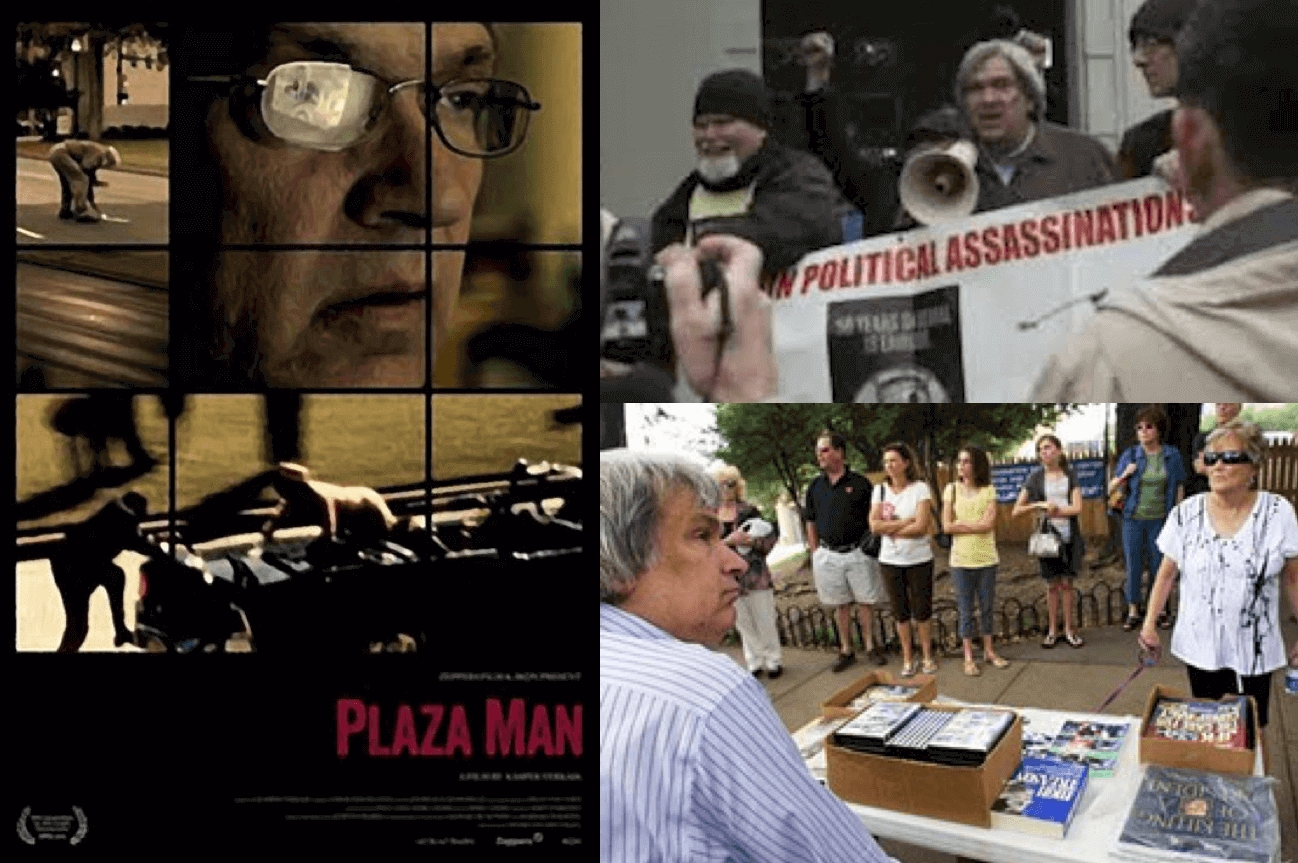
  • Plaza Man: Robert Groden vs. the City of Dallas

    Plaza Man: Robert Groden vs. the City of Dallas


    When a scribe sets out to write a review he hopes to be inspired by the topic under discussion. Inspiration makes the effort fun, even poetic. The people who end up reading the review will pick up on the good vibes and we all have a swell day. I was inspired by the documentary film Plaza Man. But not by the topic. The topic of the film is really the power and influence of the Sixth Floor Museum; and, by extension, the pernicious influence of the Power Elite in the JFK case. Pretty difficult to be inspired about that kind of subject matter. Even more difficult to be inspired by the Sixth Floor’s official hit man, the late Gary Mack.

    But odd as it may seem, I was inspired by Plaza Man, a film released in 2014 by Dutch director/ writer Kasper Verkaik. And I was inspired by the continuing fight and struggle of Robert Groden. Groden is the lonely protagonist of the film, opposed to the titanic forces that make up the awesome power of the Sixth Floor Museum. That awesome force is, of course, the Power Elite of Dallas. They are the ones who always tried to deny that Dealey Plaza, the site of JFK’s assassination, was the number one tourist attraction in the Dallas/Fort Worth area. When they could deny it no longer, they then talked of razing the Texas School Book Depository building—where from, as the Warren Report told us—Lee Oswald fired at President Kennedy. When that provoked a loud public outcry, they then pooled county funds with private and corporate money in order to buy the building. In 1989, when something called the Dallas County Historical Foundation opened the renovated site as the Sixth Floor Museum, it became a monument to the—oxymoron here—efficacy of the Warren Commission. And there has been no let-up in that message since. In fact, it was after visiting this spurious museum that the late actor Bill Paxton, and author Stephen King decided to launch film and literary projects on the JFK case. (For a review of the latter, see “Stephen King and J. J. Abrams Lay an Egg”; Paxton’s brainstorm turned into the movie bomb Parkland.)

    It’s a funny thing, this JFK case. We’re almost sixty (!) years along since the disturbing event of the President’s removal; one which literally changed the world. For the worse.

    It’s almost like watching a movie. You witness some diabolical villains concocting a murder plot. You watch as a man gets murdered. You see the politicians and the media scurry about to ram home the cover-up. You watch as their paid lackeys twist the facts and rewrite documented history. You see official investigations being hijacked by men in dark suits. Everybody can smell a rat, yet they just stand by and let it happen. Then the movie ends. Whew, you think. Thank goodness that could never happen in real life!

    But it has happened. And in just that way. What makes the whole thing even more unsettling is that it’s not just some fictional saga you could turn off as you rush to get back to your happy-go-lucky “all is right with the world” philosophy.

    This is an old story, one we’ve been over countless times; a broken record. Regardless of all our efforts, we’ve essentially been relegated to being helpless spectators; at the mercy of a diabolical evil. All we can do now is watch, in muted disgust, as they continue to make a mockery of principles we once held dear. We still believe in those principles, but they’ve become an anomaly before our very eyes. They no longer apply to real life. As much as we do not like to admit it: We’ve lost. They’ve won. As Groden notes in this film, prior to 1963, he believed in the old Western movie paradigm: the guys in white hats vanquished the guys in black hats. But that did not happen in the JFK case.

    Why was that the result? Well, they have the money. They have the power. But most of all, they control the media. As Jim DiEugenio showed with the work of CBS employee Roger Feinman, the MSM wants to preserve the cover up. Even when some of their employees wanted to do otherwise, those employees were either intimidated into knuckling under, or bought off. And management then lied about it. In the face of that level of secrecy, lies and power, there’s very little the rest of us can do about it.

    For the last twenty odd years there’s been the equivalent of a Gunfight at the O.K. Corral in the JFK case. Very few people are aware of it outside the city of Dallas. In 1995, Bob Groden left his home, wife and family in Pennsylvania. Alone, he moved to Dallas from the small town of Boothwyn. His objective was to give the Warren Commission critics a voice against the Sixth Floor Museum’s unalterable promotion of the Warren Report. By that time, the Museum was well on its way to its current status of treating hundreds of thousands of people per year, at sixteen bucks a crack, to what Michael Morrissey once called the Biggest Lie of the second half of the twentieth century: namely, that Oswald killed Kennedy. When Groden arrived is when the battle was joined. This gunfight has taken place at the intersection of Houston and Elm Street. Gary Mack was firing a bazooka, tossing out grenades, scorching the earth, using psychological warfare, setting boobytraps and snares from his walled fortress with its drawbridge and moat at the museum.

    On the other hand, Robert Groden was sitting out across the street on the legendary Grassy Knoll. He was exposed, out in the open, armed only with his books, magazines and DVDs. Talk about bringing a pea shooter to a gunfight. Bob Groden showed up armed with nothing but a deck chair, a folding card table and his research, which showed that just about everything that Mack and The Sixth Floor stood for was wrong.

    I doubt that’s where Bob thought this would all lead: a David (Groden) vs. Goliath/(Mack) mismatch. After all, as depicted in this film, he and Gary used to be friends. In fact, at one time, he considered Gary his best friend. They went on vacations together and he stayed at Gary’s home. But something happened. That something was two offers of employment. Both by the Sixth Floor. One was to Groden. He was offered the directorship from a man named Robert Hayes. The salary was $235,000 per year to start. There was one qualification. Bob had to stop saying anything about that conspiracy that killed Kennedy. Bob said, well, I can’t do that. So he did not get the job. Gary Mack was offered the opportunity to replace Conover Hunt as curator. That job did not pay as much as the one offered to Groden. But it didn’t matter to Mack. He had no reservations about reversing field on just about everything he had previously said about the JFK case. So now, the former friends became enemies. As the film shows, this went as far as the Sixth Floor having the police arrest and ticket Groden many, many times. It was a Battle Royale.

    A Battle Royale? Why should it be a battle to want to know why President Kennedy was removed, or to find out why the truth continues to be so aggressively suppressed at all costs?

    Why should it be a battle to want official documents released?

    Why should it be a battle to want to allow free, open, and wide distribution of books, articles, and documentaries? Isn’t that what democracy is all about, the free flow of information? For as Groden tells us, this is something that the Sixth Floor will not do. You will not find any of his books for sale there, or for that matter, any pro-conspiracy book.

    And this phenomenon extends outward from Dallas to New York. With very few exceptions, major publishers won’t touch the topic with a ten-foot pole. Yet they will readily green-light books written by the likes of Vincent Bugliosi, Gerald Posner, and Bill O’Reilly. An outright ban of critical books would be far too obvious. So “they” have done the next best thing—they’ve herded us outward to the farthest margins of the desolate wilderness. Way out there—where you’re free to wail away to your heart’s content—but where nobody will ever hear you.

    Do you feel you want to get the good word out? Go ahead! With very few exceptions (e.g., Robert Kennedy Jr.), here are the choices available to you: vanity presses, self-publishing, or signing with a teeny-tiny, microscopic publisher. This means no marketing, little distribution, no strong shelf presence, no inclusion on best-seller lists, no major reviews, and no major TV appearances to plug the book. But, hey, at least you can brag that you have a book out!

    Unfortunately, few will ever read it. And it’s pretty much the equivalent in other media. Same with movies. Same with documentaries. Same with articles. All pretty much blocked from public scrutiny. And without even breaking a single law. It was not always like this. As Groden notes in this film, back in 1989—the year the Sixth Floor opened—he and Harry Livingstone wrote a book called High Treason. That volume sold quite well. It was on the New York Times bestseller list for weeks, rising officially to number two. But as time has gone on, the Power Elite has pulled out all the stops to make sure something like that does not happen again.

    “Look,” they yell from their fortified garret: “How many times do we have to tell you people before you get it through your democracy-loving, thick heads. YOU MUST NOT PUT THIS STUFF OUT! PERIOD!!!!!!”

    We’ve lost. They’ve won. Everywhere except in the court of public opinion. It’s sort of like watching a heavyweight prize-fight and having the guy who was knocked out declared the winner. The Power Elite says, “The public be damned! Who cares what they think?” Well, we do. And so does Bob Groden.

    Robert Groden surely did his part. As mentioned, he replied with an emphatic “NO!” when offered the top job at the museum (it would have required that he lie through his teeth). Instead, he wrote books. He spoke out whenever and wherever he could. He got ticketed 82 times. As he relates in this film: He got handcuffed; he got thrown in jail. His commitment to the cause resulted in irreparable damage to his marriage. He wasn’t around to see his small children grow up—little kids who were too terrified to pick up the phone because of constant, anonymous threats. He lost his wife to cancer in the process.

    But, as the film shows, the most frightening display of power and intimidation broke out in Dallas in 2013, on the occasion of the fiftieth anniversary of the murder of President Kennedy. The Sixth Floor got in contact with city hall. And through Mayor Mike Rawlings—a former Pizza Hut executive—they decided to take pre-emptive action to cordon off Dealey Plaza so people like Groden could not get in. Actually, Groden and like-minded persons could not even get close to the place. In one of the most egregious deprivations of first amendment freedoms in recent history, all of Dealey Plaza was blocked off, along with every street leading into it from at least two blocks away. Gary Mack and the Sixth Floor knew that, at the fiftieth, the media would descend upon Dealey Plaza in droves from all over the world. This would offer a prime opportunity for the actual facts about Kennedy’s life and death to be disseminated by all kinds of people, who they considered heretics, to the furthest reaches of the planet.

    Gary Mack and the Sixth Floor were not going to let that happen. No way, no how. They had too much invested, in time and money, in their consecration of Allen Dulles’ fairy tale that Oswald did it. Therefore, any person who wanted to be in attendance that day in the Plaza had to submit his application in advance. His or her identity would then be passed through the Department of Homeland Security for clearance; sort of like being suspected of being a member of Al Qaeda. Only then could one enter the plaza and, at that, only a certain number of people would be allowed in. Mayor Rawlings then set up carpenter’s horses that blocked every thoroughfare going into Dealey Plaza. At every point, those obstacles were backed up by literally dozens of armed policemen. The city paid 200 of them overtime to come in that day. The police were deployed in a variety of ways: on foot, in cruiser cars, and some on horseback to guard if anyone broke through. As the film shows, the effect of watching the speeches that day was that somehow John Kennedy was not killed in Dallas on that dark day in November. All that mattered was his presidency. As if the two were not connected. That is how deep the denial extends in that city. And this is how much the MSM wants a controlled and unified message on this case. Every major broadcast media outlet reported this fabricated façade with no explanation as to how it was created: by the denial of freedom of assembly and speech. When Rawlings was asked if Robert Kennedy Jr. could speak that day, he replied, “as long as he stays on message.”

    Throughout all this, Groden never threw in the towel. On the contrary. He would have been throwing in the towel had he accepted the lucrative job which he ultimately refused. Instead, that dubious honor went to Gary Mack, who gladly accepted.

    He’s the guy who won.

    Groden lost. He’s now on the sidelines with the rest of us who don’t buy the Warren Report. That is, about 70% of the public.

    Had this been a real war, being fought to the death on some blood-spattered battlefield, and Groden and I were on the side that was being decimated, soon to be defeated, I would have preferred to go down fighting to the end—with him alongside me. Had someone said to me, “Hey, do you want to come over to the side of the winners? After all, Gary Mack is on that side. He knows people. He is GUARANTEED to win! They’ve fixed it that way!” If that would have happened, I would have spit in his face and prepared for my imminent death—with a wounded Groden beside me in the trenches. That’s what this quiet, understated film is about. But remember, it is only a coincidence that the year Mel Gibson’s Braveheart was released, 1995, was the year Groden moved to Dallas.

    Imagine for a moment that all modern-day humans were gone. The humans of a far off, future era are now in charge. Their scientists and archaeologists are looking back at the people of our generation, the same way we look back upon prehistoric cavemen. They’re trying to figure us out, striving to make sense of how we lived, how we thought. They analyze our cities, our food, our clothes, our politics, our economies, our wars, our art. Then they stumble upon the JFK murder, complete with its endless cover-up, and why it was allowed to continue on and on the way it has. What would their best and brightest make of it all?

    “Seems pretty cut and dried to me. Those ancient primitives were cowards.”

    “They did not possess bravery.”

    “Their leaders, organizers, and intellectuals should have stepped forward and protested more vehemently.”

    “Shocking that something so contrived, so blatant, could be allowed to occur without anybody intervening.”

    And they would have been absolutely correct in their assessments.

    But they would not have been referring to the losers—us.

    They would have been describing the winners.

    Plaza Man would have been a great title for a movie about a super hero; a mighty masked avenger who swoops in and rights the wrongs of society; while everybody cheers him on.

    Sadly, what Plaza Man tells us, is that real life has no time—and no place—for heroes. And anybody who dares try and thwart the arch villains will get his wings clipped. In a hurry.

    Maybe that’s why Hollywood has gone bonkers with endless movies based on comic books? Maybe we’re at the point where we’re that desperate for a super hero of our very own; one who fights for us, right here in our precious little world.

    We’ve witnessed years’ worth of covert political shenanigans, and corporate-sponsored crap of every sort on a daily basis. And while we politely discuss the unfairness of it all amongst ourselves—because, hell, even a two-year old could figure that much out!—we’re helpless to do anything about it. That’s when the fearless Plaza Man would appear out of nowhere and start bopping the bad guys on the head, administering justice, and restoring our hope for humanity along the way. “Yay! Get him, Plaza Man!”

    I suppose seeing a fictional comic book hero on a movie screen is better than nothing. And I’m afraid it’s the best we’re ever going to get.

    Don’t take my word for it—just take a look at your nearest wall calendar. My, but those pages sure keep flying off, don’t they? Just like in a scene from an old movie. Plaza Man is a filmed tribute to a guy who tried to stop those pages in mid air. And it shows the price he paid for it. It’s a film that could not be made in America. We owe thanks to Dutchman Kasper Verkaik for it being made at all. We don’t agree with everything in the film (for example, the authenticity of the McCone/Rowley memo about Oswald). But that is not what this film is about. This picture is about the maddening hypocrisy of America, its denial of first amendment rights, its refusal to acknowledge high crimes and misdemeanours in the JFK case, and how that brought on the weakening and alteration of democracy. It’s the subject Jim Garrison talked about at the end of his famous Playboy interview way back in 1967. There, he was addressing the complete sell-out by the MSM on the JFK case. And the concomitant muffling of dissent in America. He referred to “the clever manipulation of the mass media” and how it was creating a “concentration camp of the mind” that promised to be very “effective in keeping the populace in line.” The New Orleans DA warned back then that America was developing into what he called a proto-fascist state; in 1980, author Bertram Gross coined the phrase “friendly fascism” and wrote a book on the subject.

    For Garrison, the alteration of our democracy would not result in the unfurling of swastikas or the organized spectacle of massive, frenzied rallies glorifying the central government. For him the test was smaller and quite simple: “What happens to the individual who dissents?” He is not physically destroyed, because that would be too obvious, too “unfriendly”. Instead, he is marginalized, harassed, intimidated, caricatured, smeared. Which, as the DA stated, has the same effect as liquidating him.

    Plaza Man illustrates just how prescient that 1967 warning was.


    View the full-length documentary


    Addendum:  several years ago, the Washington Post ran this obituary concerning CIA officer Charles A. Briggs, Sr., which states: “A notable contribution was serving as liaison for the creation of the Sixth Floor Museum in Dallas”.

  • King in the Wilderness

    King in the Wilderness


    There were three documentaries prepared for the fiftieth anniversary of Martin Luther King’s assassination: Hope and Fury was a production of NBC; I am MLK Jr. was prepared by the Viacom network;  but perhaps the most interesting of the productions was HBO’s King in the Wilderness.

    Peter Kunhardt is an experienced filmmaker who has previously produced and directed documentaries on a wide variety of historical figures like Abraham Lincoln and Richard Nixon.  Kunhardt chose to direct this production and he collaborated with a writer he knew, Chris Chuang, who had worked with on a documentary from the previous year about Warren Buffett.

    King in the Wilderness has two defining qualities that differentiate it from the other two films and from previous King documentaries I have seen.  First, it does not deal with King’s entire career—not even close. It limits itself to the last years of his life. The focus is on the time interval from the passage of the Voting Rights Act in 1965 until his death in Memphis and the following funeral in Atlanta in 1968.  Second, it does not feature the usual professional pundits as talking heads.  So, thankfully, we are spared pretentious gasbags like Dan Rather and Tom Brokaw.

    The film begins with shots of the King home in Atlanta.  We then learn that several of King’s friends and working colleagues gathered there for the anniversary of his death.  They will be the interview subjects for the film. When they appear, we see them in close-up looking directly at the camera. Thus we listen to King’s attorney Clarence Jones, his close colleague in the Southern Christian Leadership Conference (SCLC) Andrew Young, his friend the actor and singer Harry Belafonte, Dianne Nash of the Student Non-Violent Coordinating Committee (SNCC), singer and activist Joan Baez, and SCLC Chicago representative Jesse Jackson, among others.

    I should note one other distinguishing feature.  In criticizing the documentaries of actor Tom Hanks, I have written that, aesthetically, they are purely assembly line productions.  As far as the way they are made, there is nothing at all distinguishing about them. With Hanks and his company Playtone, it is almost as if stylistically acute documentaries like The Power of Nightmares and The Kid Stays in the Picture had never been made.  Kunhardt’s film is not a cornucopia of new ideas in that respect, but it does have some visual panache and interest to it.

    In fact, it begins with the viewer going behind the scenes of a news interview with King.  Sander Vanocur, NBC’s national correspondent at the time, is seen rehearsing an interview with the civil rights leader—clapboard included.  King recalls his famous “I Have a Dream” speech made during the March on Washington in August of 1963.  That speech was made in aid of passage of the Civil Rights Act of 1964.  He comments that in light of what has happened to America in the meantime, the dream he spoke about has now become something of a nightmare.  The reference points he is speaking about are, of course, the escalation of the Vietnam War, and the recurrent rioting, and accompanying fatalities, that had become so frequent by 1967.

    The film tries to elucidate some of his chagrin by depicting both sides of a taped discussion of the 1965 Watts riot between King and President Johnson. He tells the president that unless he does something to give people in the black slum areas some hope, he fears that those areas will become tinderboxes of violence. Which, as we know, they did.  Johnson did not do very much to offer any change or hope for those living in places like Watts because of his escalation of the Vietnam War—a theme to be developed later.

    The film then sketches in another dispute that King was having in this time period.  Because of these recurrent riots, and because so many of them began with an instance of police brutality, and because of the continuing violent acts by white terrorists—for instance the shooting of James Meredith during his March Against Fear in Mississippi—King began to catch some heat from what many saw as an unlikely source.

    For instance, after Meredith was wounded and hospitalized by a white man, King’s group, the SCLC, stepped in to complete the march.  But so did other groups, like the SNCC.  By 1966, Stokely Carmichael had become the leading public figure in the SNCC.  During the completion of this march, Carmichael started to use a previously unmentioned term: “Black Power”.  This signaled the beginning of a different type of approach from King’s Gandhi-inspired civil disobedience through non-violent techniques (for example, lunch counter sit-ins).  Carmichael’s message, which he deliberately made in King’s presence, was closer to what Malcolm X had been preaching in New York, and would lead to the creation of the Black Panthers in the San Francisco/Oakland area.  King was placed on the spot by Carmichael’s provocation.  He replied that, while he supported Carmichael, he did not endorse the connotations of the message. The film depicts this colloquy with the two figures standing next to each other.  Carmichael then responds by saying that he is not as committed to non-violence as Dr. King is.

    After this point is addressed, the film takes up another pressure point on the civil rights leader.  In a taped phone call between Mayor Richard Daley and President Johnson, Daley tells the president that he knows that King is not with him on the war in Vietnam.  Daley knows this since King has now turned his civil rights demonstrations north into Daley’s city of Chicago.  This was in fact in response to an issue that Bobby Kennedy had been trying to raise awareness of for years prior to this move. As Kennedy had said at the time: What good does it do for an African-American to be able to sit at a lunch counter if he doesn’t have the money to pay for the lunch?  So King and SCLC coordinator James Bevel decided to target the city of Chicago to address a more insidious pattern of racism in the north.

    To say that King was not welcome in the north understates the antipathy that awaited him in the Windy City. During his marches he was greeted with rock throwing, loud racial slurs like “Niggers go home!”, and ugly signs. For instance, one placard said, “We Want Wallace”, meaning Alabama governor George Wallace. Another, in direct opposition to Carmichael, said “White Power”.  It got so bad that King needed police protection.  Further, Daley proved a formidable counter-puncher. Understanding his past successes, he was determined not to put King in jail. And when he heard the police had placed some of his demonstrators behind bars, he immediately ordered their release.

    As Young comments, he was not so sure that King should have taken this project on at the time.  Chicago was a huge city with a very entrenched power structure.  He did not think the SCLC had the money or manpower to manage such a crusade.  King did get an agreement after several months, concerning fair housing and integration of the city work force.  Whether or not the city abided by it afterwards has been a point of controversy among scholars and writers ever since.

    Around this time, in late 1966, King decided to meet with Carmichael to discuss precisely what he meant by the phrase “Black Power”.  Carmichael and another SNCC representative, Cleveland Sellers, countered King by asking him when he was going to come out against the war in Vietnam.  Carmichael memorably said, “No Vietnamese ever called me a Nigger.”  This was a risky step. As Johnson domestic aide Joe Califano observes, LBJ thought he had some compromising information on King, which the FBI had given him.  This referenced certain sexual activities by the civil rights leader and also presumed communist influences in his camp.  But by this time, the FBI’s COINTELPRO program was in full bloom.  Consequently, J. Edgar Hoover was now using spies in King’s camp and also arranging counter-intelligence programs against these kinds of groups.

    But as the film shows, it was actually Coretta King who began to push her husband into opposing the war.  She was actually speaking out against it and demonstrating before he was.  King therefore decided to make his famous attack on Johnson’s war policy at Riverside Church in April of 1967.

    Johnson, Hoover and the MSM did not appreciate King’s stand. Newspapers openly criticized him by saying that he had now “Crossed over the Line” or he had “Bordered on Treason”, claiming this now compromised his position as a civil rights leader.  Hoover used this to play on Johnson’s feelings about King.  But in addition to these, there were people inside the civil rights movement—like Roy Wilkins—who also questioned the open attack on the White House. The break with Johnson also hurt the finances of the SCLC.  The man who had been praised for his stand on civil rights was now being attacked and vilified for his opposition to the war.

    As King had warned Johnson, the slum areas in northern cities were piles of tinder waiting to explode.  They did so in the summer of 1967. At that time, over twenty cities erupted in riots.  Some of them, for instance Newark and Detroit, were among the most deadly in American history.  The final toll was over 100 people dead.  Oddly, the film does not discuss the appointment of the Kerner Commission by Johnson. Otto Kerner was the governor of Illinois. The White House requested he form a committee to study the causes of the riots and propose solutions.  Kerner appointed a distinguished panel consisting of people like Wilkins, Mayor John Lindsay of New York, and Senator Fred Harris of Oklahoma. Their report is one of the most honest and searing documents ever written on racial tensions in America at the time.  It sold over two million copies.  Its most famous line was, “Our nation is moving toward two societies, one black, one white—separate and unequal.”  Kerner focused on poor housing and education in the slum areas, but he also pointed criticism at the media for not devoting time or empathy to these problems.

    The important thing about this presidential report was this: Johnson ignored it.  He did not even do the customary photo opportunity with the committee once the report was done. Johnson’s reaction was defined by two parameters.  First, Hoover’s talking in his ear and supplying him dirt had estranged him from King.  And now this report concurred with what King had told him after Watts.  Secondly, what Kerner was proposing was going to be expensive.  Johnson’s escalation of the war had already caused budget deficits, which he was trying to disguise with accounting tricks and borrowing from the Social Security fund.   As many have commented, the goals of Johnson’s Great Society were run aground by the war in Vietnam.

    After Johnson’s failure to act, King decided to take Bobby Kennedy’s advice about a national demonstration against poverty. RFK had told NAACP attorney Marian Edelman that a good idea would be to have a mass demonstration in Washington as had been done with the March on Washington in 1963.  Not everyone liked the idea, but King did.  King appeared on the Tonight  Show in February of 1968.  The guest host was his friend Harry Belafonte.  He talked about this problem of poverty and how it had actually gotten worse in the last four years.  He also addressed fears of his mortality by saying it was not how long a person lived but what he did with that time—a message he would more or less repeat the night before his assassination in Memphis.

    The SCLC began to design the Poor People’s March as a coalition.  It would not include just African Americans, but also Mexican Americans, Native Americans and poor whites.  King now began to talk about a coalition of the poor and to bring back ideas from FDR’s New Deal program and the proposals of Senator Huey Long—specifically, a declaration of economic rights and a guaranteed annual income.  As King said at the time, when wealthy people or corporations get these things, it’s called a subsidy; when poor people get them, it’s called a dole.

    The film now transitions to 1968 and the Memphis sanitation workers’ strike.  King was reluctant to go to Memphis, but he did.  As the film notes, King’s first appearance there ended in a riot and looting and some bad publicity from city leaders.  Because of this black eye to the SCLC, King decided he had to return. As Andrew Young comments, the Riverside Church in New York, a huge and wealthy operation, now offered him a temporary pastorship, which King turned down.  The program then shows King’s famous speech on April 3rd, the night before his assassination.

    We then cut to news stories about the assassination of Martin Luther King at the Lorraine Motel and the national wave of assassination riots that broke out afterward. Regarding the Martin Luther King assassination, Carmichael urged it on by saying: “White America killed Dr. King. We declare war on America!”  The film underplays Bobby Kennedy’s role in the Atlanta funeral that followed.  Kennedy called Coretta King after the murder, arranged to have King’s body transferred to Atlanta, and then booked dozens of rooms for incoming dignitaries to attend. We watch a film of Jackie Kennedy walking up to the church, and there is a touching black and white picture of both widows facing each other in black dresses. Wisely, Kunhardt holds on to that phofor a few seconds to expand their loss into our loss.

    The film ends with a quite pithy remark by Young.  He says, “We were not able to stay together without him.  And the movement began to fragment.”  That comment, following the picture of Jackie Kennedy and Coretta King, sums up the loss of what should have been a great decade.

    This was the best of the three documentaries and it will be available on DVD soon.

  • VICE News Botches the King Case

    VICE News Botches the King Case


    What is one to make of a scenario whereby a journalist on the “fake news” beat of a highly-capitalized upstart media empire posts material which is not only factually-challenged but actually proposes the family of slain civil rights leader Martin Luther King have been motivated by selfish money interests and are easily led? Well, anyone who is unfortunate to encounter the VICE News article “A History of the King Family’s Attempt to Clear the Name of James Earl Ray”, from January 2016, can read it for themselves and discover what to make of it on their own.1 This review will offer a contextual response.

    VICE News is a subsection of VICE Media, which in turn was an outgrowth of VICE Magazine. VICE Magazine built a cachet in the 2000s as it was distributed free of charge and available in various bars, eateries, video stores, record stores, and the like which catered to a younger hipper clientele. The magazine was glossy, slick, full-color, and relatively substantial, with most editions averaging about 100 pages. Most notably, VICE’s content specialized in an edgy cynical amorality, veering at times into exploitation, which was somehow appealing and seemingly appropriate during the dark days of the W. Bush administration.

    From modest beginnings in the 1990s, VICE Media has since become a global presence with thousands of employees, a virtual network with numerous online platforms and streaming entities largely focused on its cultivated younger demographic. VICE News was launched in 2014 as a multi-platform news and information service, partnered with HBO and enjoying a wide international presence both in content and reach. However, despite claims that VICE’s news department would apply critical scrutiny to the state of the world, at a “certain level of seriousness”,2 VICE News has received criticism for biased coverage by its reporters in Ukraine, Syria, Venezuela, and other geopolitical hotspots,3 and also has been criticized for adopting tabloid-style simplifications of complex subjects, relying on “exaggerated characters that create an extreme view of reality.”4

    A brief examination of a recent VICE News story may help identify some of the worst tendencies of this brand’s take on journalism, and also help put the article of concern in due context. A May 4, 2018 posting was titled “Trump Just Pulled Funding for Syria’s ‘White Helmets’ Rescue Group”.5 In reporting an unexpected cut in funding shortly after the White Helmets participated directly in the aftermath of a disputed “gas attack” in Syria’s Douma region, the author lists a number of familiar talking points concerning the integrity of the controversial organization, leading him to state: “Though their work has largely gained them international recognition as brave rescue workers, they’ve come under attack from a propaganda campaign pushed by Russian state media to discredit their work.”

    This assertion of a Russian state media propaganda campaign gets sourced to a December 2017 opinion article from The Guardian: “How Syria’s White Helmets Became Victims of an Online Propaganda Campaign”, written by Olivia Solon.6 Solon claims that negative publicity attached to the White Helmets is simply a collection of “half-truths” and “conspiracy theories” propagated by Russian state media and repeated uncritically by a motley group of anti-imperialists, alt-right bloggers, and malicious “Twitter bots”. Evidence of the alleged “Russian influence campaign” amounts to a review of clusters and patterns of online activity, which appears to resemble the clusters and patterns of effectively all online activity featuring breaking news and analysis. In effect, Solon herself spins a conspiracy theory, which is repeated uncritically by the VICE News writer.

    More accurately, the single article which did the most to establish awareness of the controversial aspects of the White Helmets appeared on the Alternet site in October 2016, written by Max Blumenthal.7 Blumenthal, in the guise of an actual journalist, traced the funding streams, identified the myriad organizations which directly connect to the group, and made the case that, rather than simply a neutral volunteer rescue agency, the White Helmets have a second primary task producing audio-visual evidence of presumed Syrian government atrocities, which integrates seamlessly into a larger coordinated apparatus used to shape public opinion towards a regime-change policy in Syria. The White Helmets, therefore, could be accurately described as a propaganda operation. Blumenthal noted the group operated exclusively in “rebel” zones, including areas held by UN-designated terrorist groups out-of-bounds to other NGO personnel and journalists. Blumenthal’s article was widely shared at the time and the information he presented has not been disputed. Therefore, the focus on an alleged “Russian” propaganda effort can be seen as a dubious misdirection. The VICE News author disagrees, referring to his own attempt to investigate: “The first three results for a ‘White Helmets’ search on YouTube are videos posted by RT, Russia’s state news agency.” Case closed.

    Examining this brief VICE News article, the following pattern or tendency is suggested: the journalist appears unaware of the history and context of his subject; in place of history or context, the journalist echoes an objectively biased mainstream or establishment source; the journalist is lazy and content with one side or position to a story; in the face of controversy, the journalist will employ the term “conspiracy theorist”; the journalist will refer to results from unsophisticated Google searches or cite unscientific statistical data of his own making.

    Unsurprisingly, these tendencies are also on display in the 2016 article on the King family and the civil trial. The author is Mike Pearl, whose byline is lately associated with a VICE News subject header called Can’t Handle The Truth, which often is concerned with debunking the distribution and dissemination of false information (aka “fake news”). Many of his numerous stories are innocuous renderings of current trending information, presented in the irreverent VICE style, with often snappy enticing headlines. Chronologically, the King article appeared a few days after Pearl posted his “The Ted Cruz Birther Question Just Became a Central Issue in the 2016 Campaign”, and the day before Pearl posted “Has This Microbiologist Found the Answer to Antibiotic Resistance?”. The story presumes a “stranger than fiction” approach with the tag “Martin Luther King’s son and convicted killer were on friendly terms.”

    That the author probably doesn’t know much at all about this particular story is revealed in the second sentence of the article: “(Ray) was arrested at London’s Heathrow Airport of all places …” (emphasis added). While yes, that might seem unlikely, other details of Ray’s flight are even more so, particularly the mystery of how he found the resources for his international travel and how he managed to secure the false identity he was travelling with. The author does not seem aware of either of those two pertinent issues, which factor directly in an appraisal of Ray’s position and therefore directly to the “surprising” fact the King family “briefly devoted their lives to his cause.” According to the public statements of the King family, they devoted that time in hopes of establishing a true record of the death of their husband and father (and part of that effort might, yes, “clear the name” of the designated assassin). The author assumes a more limited view—that the family “allied themselves with the legal team hell bent on freeing Ray” and were “utterly sold on the most daring claim made by any of the King conspiracy theorists: not just that Ray hadn’t acted alone, but that he wasn’t even involved.” That this “daring claim” was articulated by close associates of King in the 1970s, and was a focus of the work by the House Select Committee on Assassinations in those same years, seems to be something the author is not aware of.

    This is not surprising, as can be quickly discerned by examining the author’s sources, which appear as links dispersed across the body of the story. The first link, apparently the source of the initial paragraphs, arrives at a BBC News “On This Day” story which reprints coverage from Ray’s conviction on March 10, 19698. An “In Context” sidebar attached to the story notes that “federal authorities insisted there was no evidence of a cover-up” (which is technically true, although information from the FBI and Memphis police compiled by others seems to provide exactly such evidence), that Ray had “a fanatical hatred of black people” (strongly denied by those who knew him), and that forensic tests in 1997 on the rifle “proved inconclusive” (not exactly correct, as the testing was in fact curtailed to prevent any conclusions). So, here too is the BBC contributing its own half-truth fake news on this controversial topic.9

    The author then turns his attention to the aforementioned “hell bent legal team”, namely attorney William Pepper, with one of the most egregious slurs since Vincent Bugliosi: “Pepper, who has in recent years devoted himself to the 9/11/ truther movement …” Most anyone aware of Pepper knows that recent years had seen him finish the third of his books on the King case, represent Sirhan Sirhan in a series of extensive court challenges, and research a proposed book on political assassinations through history. Not aware of this, the author instead consults a YouTube search of his own, which discovered a talk by Pepper from 2006 as the keynote speaker at a conference titled “9-11: Revealing The Truth, Reclaiming Our Future,” where he discussed his direct experience with a government cover-up and conspiracy in the King case.10 To claim that someone is “devoted” means to “give all or most of one’s time or resources”, a standard to which a single keynote address does not apply. The author apparently does not have a dictionary, or is simply careless with language, a poor trait for a journalist. William Pepper’s own website might have served as a better indicator of what he was up to, but perhaps the YouTube searches are what VICE’s editors believe their young demographic want. Still, even on YouTube, there are many more relevant examples of Pepper’s work.11

    This is followed by the author presuming motive in a scenario he seems to know little about, influenced presumably by an opinionated news story which appeared in the Washington Post in January 1995 concerning the then current dispute between the King family and representatives of the local Park Service over the future of the King Historic District in Atlanta.12 Written by veteran Post reporter Ken Ringle, the piece takes every opportunity to question the judgment and ability of the King family while portraying their opponents as model citizens with the best intentions. The information in the article presents the viewpoints from only one side in the dispute, which should raise red flags to a trained journalist considering using it as a source. Instead, the author accepts the article’s portrayal of King family members at face value and then proceeds to sketch out his own conspiracy theory postulating that Dexter King had become focused on “ways to derive revenue from the work and likeness of his father,” and this may have motivated his interest in Pepper’s work. The author appears unaware that Pepper was friends with Martin Luther King in 1967-68, that Pepper worked directly with King on a possible third-party political campaign in late 1967, that Pepper’s work as a journalist in Vietnam in 1966 had directly influenced King’s policy of opposition to the Vietnam War, and, again, Pepper’s own interest in the conspiracy aspects of King’s death were generated by close associates of the King family in the 1970s.13

    The author proceeds with a brief summary of the 1999 civil trial in which he complains that some information presented to the court “flies wildly in the face of accepted wisdom”, wisdom which he associates with the opinions of author Hampton Sides.14 The author makes light of the civil trial verdict, and stresses the Justice Department conducted its own probe which found “no conspiracy at all”, allowing him to cue the applause line: “unsurprisingly, (this) doesn’t impress conspiracy theorists much.” The Justice Department refused to test the “weight of all relevant information” in an adversarial courtroom at the King civil trial, which belies the confidence expressed by its report.

    This is simply a terrible article, although it is not apparent that the author holds specific animosity towards the King family or William Pepper, and might instead be reflecting a personal attitude towards “conspiracy theorists” assisted by his limited grasp of the historical record. More recently, Pearl wrote about the mandated JFK document release acknowledging there is “still quite a lot of unexamined and important history there,” even as he insists there is “zero proof” Oswald was in fact a patsy.15 Nevertheless, he maintains—in a VICE kind of way—the newly released information provides a “good example of deep-state shit the public has an interest in knowing.” Which is true, but the VICE News quasi-journalist crew are not really going to be the best sources to consult.

    If there are conclusions to be reached, I would suggest they rest less with the inadequacies of the author’s journalistic practice, and more with the core function of VICE News itself. It is part of a capitalized company whose core business is to exploit the value of its consumers: a lucrative hard-to-get young demographic. VICE Media is worth an estimated $6 billion based largely on the appeal of its “brand”. It has received capitalization from Hearst, Murdoch, A&E Network, and recently $400 million from Disney and $450 million from private equity firm TPG Capital. VICE (despite its origins in Montreal) is a version of a classic American business story: the upstart winner which, when examined up close, is much less than the sum of its marketing strategies. If the journalism does not meet professional standards, it is because journalism is not the actual product VICE News is peddling.


    Notes

    1 https://www.vice.com/en_us/article/av38ab/a-history-of-the-king-familys-attempt-to-clear-the-name-of-james-earl-ray.

    2 See the Columbia Journalism Review’s “The Cult of Vice” from 2015.

    3 For example, watch this Mint News interview on how VICE often promotes official narratives.

    4 “About That VICE Charlottesville Documentary”.

    5 https://news.vice.com/en_us/article/xw7edn/trump-just-pulled-funding-for-syrian-white-helmets-rescue-group.

    6 https://www.theguardian.com/world/2017/dec/18/syria-white-helmets-conspiracy-theories. The Guardian has an established partnership with VICE Media.

    7 https://www.alternet.org/grayzone-project/how-white-helmets-became-international-heroes-while-pushing-us-military.

    8 http://news.bbc.co.uk/onthisday/hi/dates/stories/march/10/newsid_2516000/2516725.stm.

    9 According to The Guardian’s Olivia Solon, two half-truths and an incorrect assertion is certain proof of a Russian disinformation campaign.

    10 https://youtu.be/bXgPnaQKcyw?t=2703. The term “9/11 Truther” is just the latest in a long series of “conspiracy theorist” smears, often employed as a form of ridicule. That the 9/11 events were subject to a massive cover-up and that strong evidence of what might constitute a high level conspiracy—including the failure of America’s air defense systems and the CIA’s deliberate withholding of information ahead of the attacks—has been hiding in plain sight since that day.

    11 Another poor trait for a journalist is bad reading comprehension, which the author displays as he misattributes the name of Ray’s handler Raoul to the civilian shooter in back of Jim’s Grill as he summarizes Pepper’s book Orders To Kill.

    12 https://www.washingtonpost.com/archive/lifestyle/1995/01/16/whose-dream-is-it-now-the-family-of-martin-luther-king-is-battling-the-government-and-atlanta-is-losing/04369405-b416-48d7-8670-93c728146c4a/?utm_term=.bebe4720b36d.

    13 https://ratical.org/ratville/JFK/WFP020403.pdf.

    14 Hampton Sides is described as an “enemy of conspiracy theorists everywhere,” and the author links to a Newsweek article by Sides which serves as a source for many of the James Earl Ray references in his VICE News article. Sides’ 2010 book Hellhound On His Trail is reviewed here.

    15 “The JFK Conspiracy Shows Us What’s Dumb About Today’s Fake News,” Oct 28, 2017.

  • Tom Hanks and 1968

    Tom Hanks and 1968


    As many of this site’s readers know, for the recently released book The JFK Assassination: The Evidence Today, this author did a lot of work on the career of actor Tom Hanks. In 1993, on the set of the film Philadelphia, Hanks met music producer Gary Goetzman. A few years after that meeting, Goetzman and Hanks decided to expand their careers into producing movies: both feature films and documentaries. They set up a company called Playtone and began to churn out products that—if one understands who Hanks is—were reflective of both the actor’s personal psyche and his view of the American zeitgeist. That view was accentuated when, in 1998, Hanks first worked with Steven Spielberg on the film Saving Private Ryan. It was while working on this film that the two met and befriended the late historian Stephen Ambrose, who was a consultant on that picture.

    As I wrote in my book, Ambrose turned out to have a real weakness for a historian: He manufactured interviews. Ambrose made his name, and became an establishment darling, due to his several books about Dwight Eisenhower. This included a two volume formal biography published in 1983-84. All of these books, except the first, were published after Eisenhower’s death in 1969. It was proven, by both an Eisenhower archivist and his appointments secretary, that Ambrose made up numerous interviews with the late president, interviews which he could not have conducted. (James DiEugenio, The JFK Assassination: The Evidence Today, p. 46) Late in his career, Ambrose was also proven to be a serial plagiarist by two different studies. (See David Kirkpatrick’s article in the NY Times, January 11, 2002; also “How the Ambrose Story Developed”, History News Network, June 2002)

    But the worst and most revealing issue about Ambrose’s career was his switching sides in the attacks on James Bacque’s important book, Other Losses. Bacque had done some real digging into the military archives of World War II. He had discovered that the Americans had been involved in serious war crimes against German prisoners of war, and had later tried to cover it up. Bacque sent his manuscript to Ambrose in advance of publication. Ambrose had nothing but praise for it. (DiEugenio, p. 47) In 1989, before the book was to be published abroad, Bacque visited Ambrose at his home and the two went over the book in detail. When Other Losses was published in America, Ambrose at first stood by the book, which, quite naturally, was generating controversy. But after doing a teaching engagement at the US Army War College, Ambrose reversed field. First, he organized a seminar attacking the book. Then, as he would later do with Oliver Stone’s JFK, he wrote an attack article for the New York Times. (DiEugenio, p. 47)

    As Bacque noted, the book Ambrose attacked was the same one the historian had praised in private letters to the author. It was the same book Ambrose read and offered suggestions to in the confines of his home. The difference was that the information was now public, and creating controversy. Bacque’s book was accusing the American military of grievous war crimes, including thousands of deaths, and since Eisenhower was involved in these acts, the pressure was on. Ambrose was the alleged authority on both Eisenhower and his governance of the American war effort in Europe. Could America have really done what the Canadian author was saying it did? To put it simply, Ambrose buckled. Under pressure from the military and the MSM, he did triple duty. Not only did he organize the panel and write the attack editorial, he then pushed through a book based on the panel. (See Bacque’s reply to this book)

    Reflecting on this professional and personal betrayal, Bacque later wrote that he could not really blame Ambrose for it all, because the American establishment does not really value accuracy in the historical record. What it really wants is a “pleasing chronicle which justifies and supports our society.” He then added that, in light of that fact, “We should not wonder when a very popular writer like Ambrose is revealed to be a liar and plagiarizer, because he has in fact given us what we demand from him above all, a pleasing myth.” (DiEugenio, p. 48)


    II

    I have prefaced this review of Playtone’s latest documentary 1968: The Year that Changed America, because it is important to keep all of this information in mind during any discussion of Hanks and his producing career. Even though he did not graduate from college, he fancies himself a historian. Thus many of his films deal with historical subjects: both his feature films and his documentaries. Yet Hanks—and also Spielberg—have set Ambrose as their role model in the field. In my view, it is this kind of intellectual sloth and lack of genuine curiosity that has helped give us films like Charlie Wilson’s War, Parkland, and The Post. These films all tried to make heroes out of people who were no such thing: U.S. representative Charlie Wilson, the Dallas Police, and in the last instance, Ben Bradlee and Kay Graham. And by doing so, these pictures have mislead the American public about important events; respectively, the origins and results of the war in Afghanistan, the assassination of President Kennedy, and the position of the Washington Post on the Vietnam War. (For details on all of these misrepresentations, elisions, and distortions see Part 3 of The JFK Assassination.)

    Since he wrote so often about Eisenhower, one of Ambrose’s preoccupations was World War II. He wrote at least a dozen books on that subject. As previously mentioned, Hanks and Spielberg took a brief vignette Ambrose had uncovered for his book Band of Brothers and greatly expanded and heavily revised it into the film Saving Private Ryan. (DiEugenio, pp. 45-46) From there, Hanks and Spielberg produced the hugely budgeted mini-series Band of Brothers. This was a chronicle of a company of American soldiers fighting in the European theater until the surrender of Japan. In addition to these two dramatic presentations, Hanks has produced three documentaries on the subject of American soldiers fighting in Europe. As anyone who has seen Saving Private Ryan knows, that film is largely based on the allied landing at Normandy in 1944. Ambrose wrote extensively on that event. In fact, one of his books was titled D-Day, June 6, 1944: The Climactic Battle of World War II. And in the films of Hanks and Spielberg, the import of that title is also conveyed: that America defeated the Third Reich.

    The problem with this is quite simple: it’s not true. Any real expert on World War II will inform you that it was not America that was responsible for the defeat of Hitler. It was the Soviets. And D-Day was not the climactic battle of that war. That took place in 1942 at Stalingrad, and to a lesser extent in 1943 with the tank battle at Kursk. Both of those titanic battles took place prior to the Normandy invasion, and Hitler gambled everything on them. His invasion of Russia in 1941 consumed 80% of the Wehrmacht, over three million men. To this day, it is the largest land invasion in history. (DiEugenio, p. 454) When this giant infantry offensive was defeated at Stalingrad, Hitler tried to counter that defeat with the largest tank battle in history at Kursk. This battle ended up being more or less a draw; but it was really a loss for Hitler since he had to win. The Germans lost so many men, aircraft and tanks on the Russian front that the rest of the war was a slow retreat back to Berlin.

    Due to the Cold War, the historical establishment in America largely ignored these facts. Like Ambrose, they chose to glorify and aggrandize what commanders like Eisenhower had done in Europe and, to a lesser extent, what Douglas MacArthur achieved in the Pacific. In both films and TV, Hollywood followed this paradigm. Pictures like The Longest Day, Anzio, and Battle of the Bulge were echoed by small screen productions like Combat, The Gallant Men, and Twelve O’clock High. Parents bought their children toy weapons and they played games modeled on these presentations of America crushing the Nazis.

    The social and historical problem with all this one-sidedness in books, films and network television was simple. It contributed to a cultural mythology of American supremacy, both in its military might and moral cause. That pretense—of both might and right—was slowly and excruciatingly ground to pieces in the jungles of Indochina. This is an important cultural issue that Ambrose, Hanks and Spielberg were not able to deal with in any real sense. I really don’t think that they ever actually confronted it. If one can make a film so weirdly lopsided as The Post, then I think one can say that, for whatever reason, it’s just not in them. After all, Hanks is 61, and Spielberg is 71. If you don’t get it after a combined 132 years, then it is probably too late. (This reviewer did some research into both men’s lives to try and ponder the mystery of this obtuseness. For my conclusions, see DiEugenio, pp. 42-44, 405-12)


    III

    This brings us to the latest Hanks/Goetzman historical documentary for CNN. It is called 1968: The Year that Changed America. HBO is the main outlet for the Playtone historical mini-series productions, e.g., John Adams, Band of Brothers, The Pacific. Cable News Network is the main market for their historical documentaries. This includes Playtone’s profiles of four decades—The Sixties, The Seventies, The Eighties, and The Nineties, and their awful documentary The Assassination of President Kennedy. This last was broadcast during the 50th anniversary of Kennedy’s murder in 2013. The two main talking heads on this program were Dan Rather and Vincent Bugliosi. One would have thought that Rather had so discredited himself on the subject that he would not appear on any such programs ever again. Playtone did not think so. Either that or Hanks was unaware of the discoveries of the late Roger Feinman. Feinman worked for CBS and exposed their unethical broadcast practices in both their 1967 and 1975 specials, in addition to their subsequent lies about them. (See Why CBS Covered Up the JFK Assassination) I would like to think Hanks unaware of all this. But after sustained exposure to his output, I am not sure it would have made any difference.

    This lack of scholarly rigor is reflected in some of the talking heads employed in 1968: The Year that Changed America. There is a crossover with that recent documentary bomb, American Dynasties: The Kennedys. (See my review) So again we get writers like Pat Buchanan, Tim Naftali and Evan Thomas. But in addition, we get Rather, plus the Washington Post’s Thomas Ricks, former Nixon appointee Dwight Chapin and Hanks himself. There have been many books written about that key year of 1968, but this documentary does not utilize most of the recent releases by authors like Richard Vinen, or even Laurence O’Donnell. Instead, it relies on authors who wrote their books long ago; for example, Mark Kurlanksy, whose book was published in 2003, and Charles Kaiser, who first published his volume in 1988. Readers can draw their own conclusions about these choices.

    The four-hour series is divided up by seasons: Winter, Spring, Summer, Fall. It begins with Rather discussing the fading presidency of Lyndon Johnson. He delivers the usual platitudes about LBJ’s passage of some good domestic legislation like Medicare, but how this was outweighed by the war in Vietnam. In addition to this standby cliché, the program misses a grand opportunity to elucidate a key point about that war. In 1966, author Michael Arlen termed it “the living room war”. This is because reporters on the scene were allowed almost unfettered access to military operations. This approach brought the war’s brutality into the home front. The Pentagon understood this was a liability, so in later wars, this was greatly curtailed. What took its place was the so-called press junket or pool: certain journalists were given restricted access accompanied by escorts. They reported back to their colleagues and that is how the news was distributed. To put it plainly, because of Vietnam, war reporting has now become controlled. This technique was used extensively during Operation Desert Storm and the invasion of Iraq (e.g., the siege of Fallujah).

    The film’s second lost opportunity concerns the fact that, by 1968, Johnson had escalated the Vietnam War to almost unfathomable heights since he had taken office in 1963. What made that worse is that he had run on a peace platform in 1964. In that campaign he had characterized his opponent, Senator Barry Goldwater, as the hawk on Vietnam. As Frederick Logevall noted in his book, Choosing War, if anyone had promised anything during that campaign, Johnson had promised the American people there would be no wider war. But not only did LBJ hide his true intentions in 1964, he also hid the fact that, unlike President Kennedy, he was determined not to lose in Indochina. (Logevall, p. 94) The fact that he had deceived the American public in 1964, then escalated the war to the point of inserting 500,000 combat troops in theater, while instituting Rolling Thunder, the largest aerial bombardment campaign in military history—all of this was too much of a reversal. Especially when it was accompanied by a draft, and resistance to that draft. In this reviewer’s opinion, this film downplays or ignores all of these key points. Yet they are all crucial in explaining why Johnson had become so unpopular in 1967 and 1968. To have Dan Rather, not Logevall, address this issue reveals early how honest this program is going to be.

    We then cut to the siege of Khe Sanh and the Tet offensive. Philip Caputo talks about the former, Hanks discusses the latter. Surprisingly, the program makes no attempt to link the two attacks. Many analysts of the war, like John Prados, have posed the questions: Was Khe Sanh a diversion for Tet? Or was Tet a diversion for Khe Sanh? Today, the consensus seems to be the former. Khe Sanh was in an extreme, almost isolated northern part of South Vietnam and was under siege by the regulars in the North Vietnamese army. Most of the Tet uprisings were in the south and were conducted by a combination of the Viet Cong supported by about 60 to 70,000 North Vietnamese regulars. The commander of the northern army, Genral Giap, later said that Khe Sanh itself was not important, but only served as a diversion to draw American forces away from population centers in the south, including Saigon. (See the essay “The Battle of Khe Sanh”, by Peter Brush.) Not only is this important issue not addressed, but the program again utilizes another cliché: namely, that Tet was a military defeat but such a shock that it succeeded psychologically.

    The reviewer begs to disagree. Militarily, what Tet revealed was two crucial points. The first was that the three-year escalation by Johnson, as supervised by General William Westmoreland, had been a failure. No major city in South Vietnam was secure from attack, not even the American embassy in Saigon. The enemy was everywhere and was armed and ready to kill. The Westmoreland/Johnson strategy of wearing down the opponent through a war of attrition had been misguided and pretty much useless. Secondly, it showed that the fabricated country of South Vietnam was a hollow shell. Without American troops, Tet would have probably collapsed the Saigon government. Johnson and Westmoreland had built no effective independent fighting force there. It was the exposure of these two failures that cashiered both Johnson and Westmoreland. On top of that, it stopped any further troop escalation of the war.

    A third result of Tet—also ignored by the program—was that it showed the almost astonishing lack of intelligence America had on the enemy. As CIA professionals like Ralph McGehee have written, the surprise of the Tet offensive was probably one of the greatest intelligence failures in American military history. Yet it did not seem to hurt the career of the CIA station chief in Saigon, Ted Shackley.

    The complement to this North Vietnamese success was that the American military was disintegrating. In fact, the My Lai Massacre took place in March, 1968. If the reader can believe it, I could detect no mention of this atrocity in this four-part documentary. I also could find no mention of what My Lai was probably a part of, namely Operation Phoenix. This was the CIA’s systematic and brutal program to torture and kill civilians who were suspected of being Viet Cong. Reporters like Seymour Hersh had denied My Lai was part of the Phoenix Program. But later authors like Doug Valentine have discovered new evidence which indicates it was. (The Assassinations, edited by James DiEugenio and Lisa Pease, p. 367)

    In addition to these shortcomings, there is almost no analysis of why President Johnson decided not to run in 1968. The program offers up the fact that Senator Eugene McCarthy had done well against LBJ in the New Hampshire primary—something that we all know and is about as sophisticated and penetrating as a high school history textbook. The program does not mention the now famous meeting of the so-called Wise Men that Johnson called after the Tet offensive. This meeting was attended by some outside luminaries like former Secretary of State Dean Acheson and General Omar Bradley. Johnson brought in a military briefer. The briefer tried to explain how Tet was a military loss for the communists. At this point, former Secretary of State Acheson got up and walked out. After, a Johnson aide called and asked why he left. Acheson replied that he would not sit through more canned Pentagon briefings. He wanted to see the raw reports and talk to people on the ground. After this call, LBJ sent Secretary of Defense Clark Clifford over to the Pentagon to look at those reports and interview the commanders. After about two weeks of review, Clifford—who had been a hawk—now decided the war was hopeless. He advised Johnson to seek a negotiated settlement. What makes this key episode surprising by its absence is that Evan Thomas is the co-author of the book the information first appeared in. Today, Thomas has become a hack. But in 1986, he and Walter Isaacson wrote an interesting book. (The Wise Men, pp. 683-89; see also Todd Gitlin, The Sixties, pp. 303-04)

    The other reason that Johnson decided to step down was first conveyed through journalist Jules Witcover’s book 85 Days, a chronicle of Robert Kennedy’s last campaign. After Senator Eugene McCarthy’s strong showing in the New Hampshire primary and Robert Kennedy’s announcement to enter the race, Johnson’s men on the ground in Wisconsin predicted he had no chance of winning the state primary. (Gitlin, p. 304; Milton Viorst, Fire in the Streets, p. 419) That is how unpopular LBJ had become. Indeed, realizing he had no chance of winning, authors like Robert Dallek and Joseph Palermo have shown that Johnson now schemed of ways to deprive Bobby Kennedy of both the nomination and a victory in November. Again, Dallek is one of the interviewees, but apparently this was too hardboiled for the Playtone scenario.


    IV

    After Vietnam, the second major subject the film portrays is the sanitation workers’ strike in Memphis that Martin Luther King was part of in March and April of 1968. It was this participation that led to King’s assassination on April 4th. Since this is Hanks and Goetzman, there is no discussion of any of the suspicious circumstances that took place that made his murder possible. Rather, the program uses the late Rev. Billy Kyles as a witness, a man who some believe may have been part of the set up to kill King. (See The 13th Juror, pp. 521-28) There is only a brief mention that, in 1967-68, King was trying to expand his movement beyond civil rights, of how this strained his relations with his more conservative political allies and how it was not enough for the more radical elements.

    The program then breaks from straight political history into a segment on African-American singers James Brown and Diana Ross. It thereafter cuts to the 1968 Academy Awards, where the Best Picture Oscar was won by the film In the Heat of the Night, a tricky race-relations police mystery. If the reader can fathom it, the program then follows with a few moments on the science-fiction film Planet of the Apes. Author Rick Perlstein says something like, well the riots in the cities were reflected in the destruction of the Statue of Liberty at the end of that film. I will not comment on the silliness of that cultural comparison. Except to say that this is Playtone.

    Instead of the sci-fi interlude, I wish the program would have given more time to the establishment and aftermath of the Kerner Commission. As a result of the terrible race riots in Watts, Chicago, Newark and Detroit, President Johnson appointed Governor Otto Kerner of Illinois to chair an 11-member panel to study the causes and possible cures for these riots, which had taken the lives of scores of citizens. That 1968 report ended up being a national bestseller and was one of the most acute and candid analyses of the race problem written in that era. It revealed that police brutality instigated many of the riots and that the underlying issues were failed housing and education programs. It also assailed the media for having almost no insight into the causes of the conflagrations. The report’s most memorable quote was, “Our nation is moving toward two societies, one black, one white—separate but unequal.” The most notable aspect of this remarkable document is that, after appointing the commission, Johnson ignored the report. This was the beginning of the policy that White House advisor Patrick Moynihan and President Richard Nixon would later formalize as “benign neglect” toward the race problem. (Viorst, p. 508) Needless to say, one month after the report was published, over a hundred riots broke out in the wake of King’s assassination.

    The third large event that the film describes is the entry into the Democratic race for the presidency by Robert Kennedy. Tim Naftali says that Kennedy did not enter until Johnson had been already wounded by McCarthy in New Hampshire. As several authors have noted, Bobby Kennedy had been having discussions on whether to announce his candidacy for over a month prior to the New Hampshire primary. As journalist Jules Witcover wrote, he had decided to enter the primary race prior to New Hampshire. (Chapter 2 in the e-book version of Witcover’s 85 Days, specifically p. 70) But he did not announce until after because he did not want that announcement to have any effect on that state primary. The film then depicts Kennedy in Indianapolis announcing the news of King’s murder to an awaiting crowd, and his prominent role in helping Coretta King arrange the funeral in Atlanta.

    The student riots at Columbia are mentioned and depicted visually, but their anti-war origins are bypassed. One of the students involved, Bob Feldman, had discovered the university was supporting the war effort through its association with the Institute for Defense Analysis. The film also does not deal with the unusual bifurcation of that demonstration. The SDS students were dealt with separately from the university’s African-American demonstrators. The former were motivated by Columbia’s association with the war; the latter by the encroachment by the university into the nearby lower class area of Morningside Heights and the construction of a gym they felt would be segregated. The Columbia demonstration ended with the NYPD assaulting the students: over 100 were injured and nearly 600 were arrested. As author Todd Gitlin noted, the MSM—particularly the New York Times and Newsweek—turned against the students and did not denounce the brutality the police used in expelling them from the campus. (Gitlin, pp. 307-08)

    The film now begins to posit the two figures of Richard Nixon and George Wallace in opposition to these student and race disturbances. The series never makes explicit what was clearly the political objective of both presidential candidates: To capitalize on these inner city bonfires—over one hundred cities erupted in riots after King’s murder—in order to exploit the issue of “law and order” for political purposes. The idea was to ignore their underlying causes and exalt the effort of the police to stamp them out, which was made easier by LBJ ignoring the Kerner Commission. For example, Nixon began to cultivate a Southern Strategy around the race riots issue. Kevin Phillips, a Nixon strategist at the time, was open about this later. He had noted that in 1964, although Senator Barry Goldwater had lost in a landslide, the conservative Republican presidential candidate took five states in the south. The strategist chalked this up to the fact that Goldwater had voted against the Civil Rights Act of 1964. Phillips concluded that his party should enforce the Voting Rights Act because, “The more Negroes who register as Democrats in the South, the sooner the Negrophobe whites will quit the Democrats and become Republicans. That’s where the votes are.” He then added that without that aspect, “the whites will backslide into their old comfortable arrangement with the local Democrats.” (NY Times, May 17, 1970, “Nixon’s Southern Strategy”) For whatever reason, Phillips is not on the program to explain this strategy.

    A good way to have crystallized this moral and political quandary would have been to contrast the Nixon/Phillips strategy with what Bobby Kennedy was faced with in late 1963. The first scene of John Bohrer’s book about RFK depicts the Attorney General contemplating a letter of resignation to his brother in November of 1963. Kennedy felt that he had been too strong on the issue of civil rights and would now lose the entire south for JFK in the upcoming election. (The Revolution of Robert Kennedy, p. 1) In other words, since the 18 previous presidents had ignored the issue and allowed segregation and discrimination to fester in the south, when Bobby Kennedy faced the issue directly, white backlash had been unleashed. This painful moral and political issue is not addressed in this Hanks/Goetzman production.


    V

    The race for the Republican nomination is also outlined. Richard Nixon had a well-planned, well-organized campaign and he got in early. His two rivals were Michigan governor George Romney and the governor of New York, Nelson Rockefeller. In 1967, Romney made a bad mistake for a Republican: He told the truth about Vietnam. In explaining his early support for the war, he said he had been brainwashed by the army about it. (Gitlin, p. 297) This eventually forced him to leave the field in February. Rockefeller vacillated and did not enter the race until the end of April. Considering that tardiness he did fairly well, coming in second in the delegate count at the Miami convention. California Governor Ronald Reagan challenged Nixon in some of the primaries but only won in his home state. Spiro Agnew, the governor of Maryland was nominated for Vice President, reportedly on the strength of a scolding delivered to civil rights demonstrators. (Gitlin, p. 132)

    As many commentators have stated, this race constituted a milestone for the Republican Party. Nixon’s victory and the failure of Romney and Rockefeller to effectively challenge him from the center marked the beginning of the end of both the moderate and liberal wings of the GOP represented, respectively, by politicians like Senator John Sherman Cooper and Senator Jacob Javits. The next Republican to win the White House would be the man who challenged Nixon from the far right, Ronald Reagan. This historical landmark is only passingly noted in the film.

    In dealing with Bobby Kennedy’s June victory in California, the program has Tim Naftali say words to the effect that when Kennedy exited the Embassy Room and walked through the pantry, Sirhan Sirhan was waiting for him. It’s comments like this that keep Naftali on these programs. As anyone who has studied the RFK case knows, Sirhan was escorted into the pantry by the infamous Girl in the Polka Dot Dress after he shared coffee with her. Or as Sirhan himself said, “Then she moved and I followed her. She led me into a dark place.” (Shane O’Sullivan, Who Killed Bobby, p. 115) The program then shows some film of the aftermath of the shooting. In relation to Sirhan, who was being pummeled, one person cries out, “We don’t want another Oswald!” That exclamation bridges a five-year national psychic chasm extending from Dallas to Los Angeles.

    Kennedy’s death is followed by the subsequent mass at St Patrick’s in New York, featuring Ted Kennedy’s memorable eulogy. We then see the famous railroad car journey from New York to Washington where reportedly two million spectators lined the tracks to say good-bye and pay their respects to the senator. This touching moment is then dissipated by Hanks coming on and saying words to the effect: And that was the end of 1968. No Tom, that was the end of the second phase of the sixties, and for all intents and purposes it closed the promise of the decade down. The first phase of the sixties are sometimes termed the Camelot years, from 1960-63. It was brought to an end in Dallas in 1963. The second phase of the decade was the angry sixties, finished off by Robert Kennedy’s 1968 assassination in Los Angeles. The murders of both King and RFK were the last spasms of the once promising and hopeful decade. After this, American youth escaped into drugs and psychedelic rock epitomized by Woodstock in 1969. That sensational decade was therefore literally shot to death.

    During Kennedy’s funeral at Arlington, many inhabitants of Resurrection City, the site of the Poor People’s March, journeyed over to pay their last respects. This was fitting in more than one respect, because it was Kennedy, through Marian Wright, who had given King the idea for that Poor People’s March. (Arthur Schlesinger, Robert Kennedy and His Times, pp. 911-12) The film does not note that irony. Nor does it note that Tom Hayden, who was about to lead the demonstrations in Chicago, was weeping in a pew during the requiem mass at St. Patrick’s Cathedral. (Schlesinger, p. 956)

    And that would have been a good lead-in to the film’s presentation of the disastrous Democratic Convention in Chicago. Vice-President Hubert Humphrey had entered the race, but had bypassed competing in any primaries. In 1968, it was still possible to amass a large amount of delegates without going the primary route. Because he was closely associated with President Johnson, Humphrey—unlike Kennedy and McCarthy—had not denounced the war in public. On the contrary, as John Bohrer wrote, he had attacked Kennedy for offering diplomatic solutions to end the conflict. (The Revolution of Robert Kennedy, pp. 271-74) As the film notes, after the death of RFK, McCarthy essentially slid off the grid. There really was no genuine anti-war alternative to Humphrey in Chicago. And this was the cause of the demonstrations and rioting that took place there. Unlike what the film conveys, while the riots were ongoing, the networks did not really cover them very much. For instance, out of 19 hours of coverage, NBC only showed 14 minutes of the demonstrations and police beatings. (“Lessons from the Election of 1968”, The New Yorker, January 8, 2018)

    Resurrection City and the Poor People’s March had failed without King. And, as many have observed, without RFK there, the Democratic Party split apart in Chicago. Mayor Richard Daley was determined to show that, amid the chaos, he was in charge. The police even raided McCarthy’s headquarters at the Hilton Hotel. (Gitlin, p. 334) Humphrey won the nomination, but he was a severely wounded candidate. He did not announce his support for a bombing halt and negotiations until the last month of the campaign. McCarthy would not endorse him until the last week. He was gaining rapidly at the end, but he fell just short. The film tries to say that Illinois, which went for Nixon, made the difference. But doing the arithmetic in the Electoral College, that is not correct. Nixon still would have won. The difference was probably the Wallace campaign.

    To the film’s credit, it does mention the October Surprise of 1968: that is, Nixon’s actions through Republican lobbyist Anna Chennault to sabotage Johnson’s attempt to get negotiations going in Paris between Saigon and Hanoi. The subterfuge turned out to be effective and it might have cost Humphrey the election. But the film does not ask the next logical question. Since Johnson found out about Nixon’s subversion while it was in progress, why did he not make it public? Johnson also had evidence that the Greek junta had funneled Nixon $500,000 during his campaign. (NY Times, April 12, 1998, “Lone Star Setting”) This was clearly a bribe. Did Johnson not want Humphrey to win? In fact, as Sean Wilentz reported in the aforementioned article, Johnson actually preferred Nelson Rockefeller as his successor.

    The film ends with what one would expect of Hanks. Not with Nixon and the premature end of the sizzling Sixties, but with 2001: A Space Odyssey and the Apollo 7 and Apollo 8 missions, the latter of which orbited the moon. Hanks has always idealized those space missions. And he has always ignored their prohibitive costs and the fact that they ended up in the Challenger catastrophe. Which pretty much ended the wild ideas about manned space flights. This contravenes the film’s idea that somehow Apollo 8 redeemed the horrible disappointments and reversals of 1968, which helped bring about the coming of Richard Nixon. And neither does a film culture that went from 2001: A Space Odyssey to Wonder Woman and Black Panther. Those last two films treat the issues of women’s rights and black identity only a couple of notches below the depth with which In the Heat of the Night did. On the issue of race, I much preferred the quiet simplicity of Nothing But a Man.

    In sum, this is a thoroughly mediocre rendering of a tumultuous year. Mediocre in every way, including aesthetically. It is almost as if Adam Curtis and the daring things he did with documentary form in The Power of Nightmares never happened. What Playtone does here is simply slap together archival footage with people talking. Which would not be bad if the talking heads delivered original or insightful commentary. But they don’t. Not even close. And that is a real shame since what happened in 1968 casts a very long shadow. A shadow that cuts well into the new millennium.

  • UPDATED: CNN Disservices History –– American Dynasties: The Kennedys


    The documentary mini series, American Dynasties: The Kennedys had its first go round for CNN in March of last year. CNN has decided to rerun this thoroughly mediocre production, therefore we are reposting this review. Something we did not know at the time of its original broadcast was that the production company which originated the series is Raw TV. That company was purchased by Discovery Channel before it started this series. Discovery Channel has been involved with some of the worst pieces of drivel ever produced on the Kennedy case, e.g.Inside the Target Car. That company continues in that tawdry vein with this shallow, quasi tabloid look at the Kennedy family. From its choice of talking heads–with Van Jones and Randy Taraborrelli–to its cheesy recreations, this series redefined the word nondistinction. Since CNN decided to repeat it, we post this review as a warning to the viewer.

    CNN has devoted a six-part documentary to a project called The Kennedys. One would think that if one spent that much screen time on such a long series that somehow, some way, one would bring something new and interesting to the production. Or at least be able to create some sense of pathos, or perhaps even a sense of impending doom to a saga that clearly contains tragic dimensions on both a personal and national level. To say that this series lacks those qualities is too mild a criticism.

    The full title of the series is American Dynasties: The Kennedys. I am a bit puzzled whenever that title is utilized, as John Davis did in his book about the Kennedy family. President John F. Kennedy served less than three years of one term in office, and was killed under suspicious circumstances. His younger brother, Robert Kennedy, was killed amidst even more suspicious circumstances before he even got to the Democratic nominating convention in 1968. One can call the Bush family a dynasty, or the Adams family, but not the Kennedys.

    The spin of the series was guaranteed with the choice of talking heads. I would classify Sally Bedell Smith as perhaps one notch above Kitty Kelly on the scholar scale. Evan Thomas, a longtime veteran of Newsweek, wrote one book on the Kennedys, a biography of Bobby Kennedy. I stopped reading when I saw the book contained footnotes to the work of David Heymann who has been exposed as a biographical fraud. J. Randy Taraborrelli is an entertainment reporter who specializes in newsstand type celebrity biographies about people like Cher, Diana Ross, Michael Jackson, and Madonna. Larry Tye wrote a book about Bobby Kennedy that was jacket endorsed by, of all people, the post-war champion of genocides, Henry Kissinger. After reading it I understood why Kissinger liked it. Van Jones wrote a book called The Green Dollar Economy. How that qualifies him as a Kennedy authority escapes this reviewer. The series features a few female talking heads like Barbara Perry. I would like to say that they helped provide new and interesting information. But they didn’t. How could they if one of them was CIA asset Priscilla Johnson McMillan?


    I

    The plan behind the series is apparent by the middle of the second program. The concept is to make the Kennedy children pretty much empty vessels of their father Joseph Kennedy. Therefore, Joe Kennedy is turned into a caricature whose influence is extended throughout their lives and careers. By doing that one then dilutes their true achievements and aims. I recognized the paradigm since I dealt with it a long time ago in a review of the literature. Over twenty years ago as editor of Probe Magazine, I wrote a long two-part essay called “The Posthumous Assassination of John F. Kennedy.” For that travail I read many of the post-Church-Committee biographies of JFK and noted how these works used that design: for instance, volumes by Clay Blair, the aforementioned John Davis, and the team of David Horowitz and Peter Collier, among others. (See The Assassinations, edited by James DiEugenio and Lisa Pease, pp. 346-59; also available on this site) Joe Kennedy was obviously the prime financial backer behind the political campaigns of his sons. But it is clear that they rejected what those biographers considered Joe’s worst political trait: his isolationist foreign policy. (DiEugenio and Pease, p. 355) JFK broke with his father during his House of Representatives days. As denoted by his voting record, the young Kennedy was an internationalist, a motif we will return to later. Further, Congressman Kennedy voted to sustain Harry Truman’s veto of the Taft-Hartley bill. That bill would have weakened unions to the benefit of wealthy businessmen like his father. (p. 355) Neither of these is noted in the series.

    Further, The Kennedys tries to say that somehow Joe Kennedy wanted to be president. When he could not—due to his isolationist statements as ambassador to England during World War II—he passed this ambition on to his sons. Richard Whalen was hardly a sympathetic biographer of Joseph Kennedy. But in his 472-page, heavily annotated book, he characterizes the portrayal of these presidential ambitions as “the echo of the press talking to itself.” In other words, they were the amplification of rumors. (Whelan, The Founding Father, p. 217)

    And the documentary’s implication that somehow John Kennedy had to be goaded by his father to go into politics also does not hold very much water. If one reads enough biographies of JFK, one sees that, from his early journalistic days, the man was a political junkie. He subscribed to the New York Times at age 14. A visiting professor at the Kennedy home commented after talking to the teenager that, even then, his mind was more politically sophisticated than his father’s or his older brother. He was impressed by John’s ability to put current events in historical perspective and to project trends into the future. (John Shaw, JFK in the Senate, pp. 12-13) A few years later, one of his girlfriends, Bab Beckwith, threw him out of her room because he was ignoring her in order to listen to a news bulletin on the radio. Having seen pictures of Beckwith, I can say that young Kennedy had to have been a triple-distilled political junkie to ignore her for the news. (DiEugenio and Pease, p. 348)

    This is also borne out by the memories of his two close friends, Ken O’Donnell and Dave Powers. Very early, Kennedy told them the reason he got into politics was not due to the death of his older brother Joseph, or any pressure from his father. As an employed reporter, he once covered the birth of the United Nations and the meeting at Potsdam. After that, he decided he could influence events more by being in the arena than by reporting on them or writing about them in books. (Shaw, p. 14) Those were the other two professions—journalism and book writing—he had thought of taking up. The other reason he chose to enter politics was because of his experience in World War II. He was determined that such a conflagration should not happen again. In asking his acquaintance John Droney for help in his first campaign, Droney tried to put him off by saying he was eager to start his law practice. Kennedy replied, “If we’re going to change things the way they should be changed, we all have to do things we don’t want to do.” Stung by the sincerity of that response, Droney delayed his law practice and went to work for him. (O’Donnell and Powers, Johnny We hardly Knew Ye, p. 51; Ted Sorenson, Kennedy, p. 15)

    To really understand the spin of the program, one has to note two strophes that the show used in dealing with JFK’s service in World War II. First, how he ended up going to the Solomon Islands in the South Pacific, and second, his act of heroism there. The show makes much of young Kennedy’s affair with Inga Arvad while he was serving in Naval intelligence. (The show even features reenactments of her.) From all the evidence this author has seen, Kennedy really liked Inga Arvad, to the point of being almost in love with her. The program’s concept is to portray her as a German espionage agent.

    Let me summarize the actual episode succinctly and objectively. J. Edgar Hoover tried everything he could to make a case for Arvad being a spy: all kinds of surveillance, breaking into her room, and even planting stories in the press. He never could. (Nigel Hamilton, Reckless Youth, pp. 428-41) And she was not the prime reason JFK left his intelligence position. Kennedy found intelligence work boring; after Pearl Harbor, he wanted to go on active duty. (Whalen, p. 358; Arthur Schlesinger, A Thousand Days, p. 86; Hamilton, p. 450)

    This spin is a warm-up for the treatment of the whole PT 109 episode. Here, the program tries to deflate the bravery and heroism young Kennedy displayed. One commentator says Kennedy was not really proud of what happened with the incident, and another actually says that Kennedy should have been court-martialed. The following is what the program leaves out.

    The August, 1943 episode with Kennedy as skipper of PT 109 was part of a larger and more complicated action, including several other PT boats patrolling for Japanese destroyers close to land. The idea was to snuff them out and fire at them with torpedoes. The problem was that Kennedy’s division leader had left the area with their sole radar set. (Hamilton, pp. 558-59) Consequently, in the pitch black of night, with no radar, Kennedy was left with a dilemma: He did not want to turn on his lights, because that would alert the enemy to where he was. In addition to this, Kennedy was slowly cruising with bad intelligence. The Japanese were aware of the operation much sooner than anticipated. One reason for this was that a fellow PT boat, the one with radar, had already fired at a destroyer. That escaping boat had not alerted PT 109 concerning the destroyers in the vicinity or its action. (Hamilton, p. 559)

    The supporting intelligence was so bad that the PT boats left behind were unknowingly about to be attacked by both planes and destroyers. Without radar, the sailors thought the shells were coming from shore batteries. What made it all the worse is that one of the headquarters commanders was urging the remaining boats to go ahead and attack. (Hamilton, p. 561) But by now the destroyers were coming out to do battle. PT 109 was deliberately rammed by the destroyer Amagiri. With communications so poor on the American side, no one rushed to the rescue of a boat that had been cut in half and was burning in the water. Moreover, at least one other boat commander thought that no one could survive such a conflagration. (Hamilton, p. 571-72)

    Two sailors had been killed upon impact; eleven men were left. Kennedy had directed the survivors to try to board the floating hulk of the ship. He grouped some of the non-swimmers on a piece of timber from the wreck of the boat. JFK led his men away while swimming with a lifeboat strap between his teeth, towing a badly burned sailor behind. He did this for 4 hours, until they reached Kennedy’s destination, Plum Pudding Island. But Plum Pudding was barren and Japanese barges were floating by. Kennedy swam another 2.5 miles to Olasana Island. There he found some vegetation and water, and the crew transferred to Olasana. Kennedy scratched out a message on a coconut shell and gave it to some native Allied scouts in canoes. They managed to get it to their British scoutmaster. Six days later, with Kennedy and his men in very bad health, a large canoe with some food arrived to carry them to rescue. (Hamilton, p. 594)

    How anyone can say, as this program does, that Kennedy should have been court-martialed for his performance under these conditions is completely nutty. The men who should have been charged were those who organized that poorly planned and badly executed mission, as well as the officer who left three boats behind in the dark with no radar. Unlike what the program tries to convey, Kennedy was proud of his military service—as he should have been. He kept his three well-deserved medals; and the coconut shell he carved onto was on his presidential desk. (Sorenson, p. 19) Knowing the full facts, what this part of the program amounts to is nothing but a hatchet job.


    II

    The program skips over John Kennedy’s years in the House of Representatives. This is odd, but considering his policy program, predictable. Kennedy’s 1946 congressional campaign consisted of pledges to work for a national health care system, advocacy of workers’ rights to organize, housing for returning veterans, and securing the future of the United Nations as a hope for peace in the world. (Shaw, p. 16) Kennedy had a high profile for a first time congressional candidate because his first book, Why England Slept, had sold well, another point that is ignored by the program.

    Once he got to Congress, the issue he fought hardest over was affordable housing for veterans. JFK hammered the GOP for stalling a housing bill and he particularly attacked their ally, the American Legion. On the House floor he said that the leadership of the American Legion had not had a constructive thought about American progress since 1918. (Shaw, p. 21) That would have been an appropriate and humorous quote for the program. But it’s not there. In 1947 he debated Richard Nixon in McKeesport, Pennsylvania, over the Taft-Hartley bill , an act that would weaken unions: JFK was against it, Nixon was for it. (Shaw, p. 23) Again, this interesting and informative fact is rendered incommunicado during the six hours of The Kennedys.

    After all but ignoring his three terms in the House, the show picks up with JFK’s run for the Senate in 1952. Evan Thomas intones that at this time John Kennedy considered RFK something like a pain in the butt. Thomas can only say this because the program does not relate the journey the brothers made the year before to the Far East and Indochina. JFK did this in order to raise his foreign policy profile in his upcoming challenge to Senator Henry Cabot Lodge in Massachusetts. This is where the brothers met American diplomat Edmund Gullion in Saigon, who told them that the French could not win their effort to retake their colony. They also met with Nehru of India who told them the same. As Bobby later stated, these discussions had a major impact on JFK’s thinking. And the congressman began to express his doubts about America’s prosecution of the Cold War in public venues and in no uncertain terms. This again brought him into open verbal conflict with his father’s isolationism. (Arthur Schlesinger, Robert Kennedy and His Times, pp. 95-97)

    Because of these omissions and distortions, the show gets the episode of RFK replacing Mark Dalton as his brother’s Senate campaign manager mostly wrong. RFK was hesitant to take the position only because he had started a job as a Justice Department attorney, which he liked. Further, the real impetus for the request was not so much Joe Kennedy as it was the congressman’s friend and advisor Ken O’Donnell. O’Donnell told RFK that unless he took over, there was a real possibility his brother would lose. (Schlesinger, p. 98) This convinced Bobby to take charge and he did a fine job running a successful campaign. He worked 18-hour days and showed excellent organizational ability.

    The following segment, about John and Robert Kennedy on Capitol Hill, is so oddly conceived and off kilter that it amounts to little less than censorship. This section deals more with Bobby Kennedy as a Senate investigator than John as a senator. In fact, JFK’s senatorial career is more or less ignored. The show deals with Kennedy’s eight years in the senate through his several illnesses and operations, his attempt to secure the Vice-Presidency at the 1956 convention, and his wedding to Jacqueline Bouvier. Amazingly, the show calls JFK’s senatorial career non-descript except for his service on the McClellan committee. That committee investigated organized crime and the Teamsters Union and was helmed by Bobby Kennedy.

    If at this point anyone had lingering doubts about the deliberate myopia of the series, this section should end them. As John Shaw concludes in his study of JFK’s senatorial career, although it had several distinctive qualities, clearly the most significant achievement of those eight years was the formulation of Kennedy’s challenge to the reigning foreign policy orthodoxy governing both political parties. (Shaw, p. 110) The GOP Cold War militancy toward the USSR and its influence in the Third World was led by President Eisenhower, Vice-President Nixon, and the Dulles brothers: John Foster at State, and Allen at CIA. In the Senate, Lyndon Johnson and the southern Democrats offered no alternative to this; they were, at best, a pale shadow of that policy. As Shaw notes, the joke about the Senate was that it was “the only place in the country where the South did not lose the [Civil] war.” (Shaw, p. 59)

    Senator Kennedy continued his lonely crusade to create an alternative to this overwrought militancy by trying to point out that the real problem in the Third World was not communism but colonialism and the counterforce it created: simmering nationalism. Kennedy thought the USA should foster and mold that nationalism—even if it meant conflict with our European allies. What makes the program’s avoidance of this key issue so bizarre is that one of the talking heads in the series is Richard Mahoney. Mahoney is the author of the landmark volume on this subject, JFK: Ordeal in Africa. I don’t for five seconds believe that the producers were not aware of this book. They clearly decided to ignore it and not let Mahoney talk about his detailed descriptions of Kennedy’s opposition to the White House in this regard. (As we will see, this manipulation is a recurring motif.)

    Thus there is no mention of Senator Kennedy’s opposition to Foster Dulles’ attempt to bail out the French with atomic weapons at Dien Bien Phu, or Adlai Stevenson’s telegram to stifle Kennedy’s radical foreign policy statements during the 1956 presidential race, or even his milestone speech in the summer of 1957 against the Dulles/Eisenhower attempt to help France salvage another remnant of its overseas empire, this time in Algeria. Kennedy showed courage in making that speech because he was criticizing a long time American ally, one that had helped the thirteen colonies become independent from England. In addition to the White House, the speech was strongly criticized by literally scores of media outlets, and also members of his own party like Stevenson and former Secretary of State Dean Acheson. (See Mahoney, pp. 14-29) But as the French dilemma in Algeria worsened, Kennedy began to look like a prophet. And he also became an unofficial emissary to visiting dignitaries from Africa. (Mahoney, pp. 31-33)

    There is not one single sentence in the entire series about any of this. So how can one have any respect for its honesty or substance?


    III

    The program’s coverage of the 1960 race for the presidency between Nixon and Kennedy is pretty standard stuff. There is one exception to this, and it consists of something that is such an outlier that it should be noted. Commentator Tim Naftali states that the choice of Lyndon Johnson as Vice President was Joe Kennedy’s. Again, this is another attempt to somehow show the influence of their father on the lives of the Kennedy children.

    The problem with that declaration is simple. If one reads the two best insider summaries of the VP decision—by Arthur Schlesinger and Ted Sorenson—Naftali is wrong. The two strongest proponents of Johnson to Kennedy were Phil Graham, publisher of the Washington Post, and syndicated columnist Joe Alsop; particularly the former. (Sorenson, pp. 183-87; Schlesinger, A Thousand Days, pp. 41-57)

    Beyond that, courtesy of RFK biographer Larry Tye, the program obfuscates the split between John and Robert over the Johnson nomination. Bobby Kennedy clearly did not want Johnson on the ticket. He personally intervened in order to get him removed. (Robert Caro, The Passage of Power, pp. 136-38) This is an important part of the story that has to be noted, because of its later ramifications. Bobby’s backdoor actions deepened the antagonism between Johnson and RFK, and it presaged the coming split in the Democratic party after John Kennedy’s assassination. In fact, Jeff Shesol—who is notably absent from the series—wrote a book on the LBJ/RFK dispute and micro-analyzed this incident. It is poor history to ignore or minimize it, since it had such a negatively powerful impact from 1964 onwards—culminating in the disastrous Democratic convention of 1968, which helped usher Nixon into the White House.

    Upon JFK’s inauguration, the only cabinet appointment that gets any attention is Bobby Kennedy as Attorney General. Larry Tye says words to the effect that Bobby was the least prepared Attorney General in history. Oh, really? Herbert Brownell, Eisenhower’s Attorney General, was a state assemblyman for four years, and Chairman of the Republican National Committee for two years. The rest of his career he was a corporate lawyer. Homer Cummings, who served under Franklin Roosevelt, was the mayor of Stamford, Connecticut (population 50,000) and a state attorney in Fairfield (population 20,000). Bobby Kennedy had served in Washington as a criminal investigator in the Justice Department, and then a congressional counsel for ten years prior to being Attorney General. He had faced off and pursued some of the most deadly killers and organized crime members in America, e.g., Sam Giancana. His pursuit of the Mob in the Senate was unprecedented in American crime annals. His attempt to clean up corrupt labor unions was also unique. One could argue that it was Bobby Kennedy who really revolutionized both the position of Chief Counsel and the use of investigative techniques on Capitol Hill. In practical terms, what more could one ask for in an Attorney General?

    But this is part of the effort to portray the first year of Kennedy’s presidency as something less than anticipated. And if one considers only things like the Bay of Pigs invasion, and the construction of the Berlin Wall, then it can look that way. But it is what the program ignores that forms the really important part of JFK’s presidency.

    What Kennedy was doing that first year was what he had been speaking about for his previous nine years in Congress: altering America’s role in the Third World. It is why he had purchased 100 copies of the best selling book The Ugly American and given a copy to each senator. Because he believed so strongly in the book’s message, he then helped get the film made. Would that not be an interesting background story for the audience to hear? CNN didn’t think so.

    That first year he was reversing American policy in Congo and Indonesia. Again, the series had a good commentator for the former in Mahoney. They did not want him to talk about Kennedy’s support for Patrice Lumumba in the Congo, or how the CIA plotted to kill the democratically elected African leader before Kennedy was inaugurated. And since they ignored Kennedy’s great Algeria speech, they could not address an even more topical subject: Kennedy’s attempt to build a relationship with Gamal Abdel Nasser of Egypt. Foster Dulles had essentially burned that relationship because Nasser recognized China and refused to join the Baghdad Pact. Dulles then withdrew funding for the Aswan Dam, thereby giving Moscow a way to fill that breach. Which they did.

    Kennedy thought this was ill-advised for three reasons. First, generally speaking, he thought we could compete with the Russians in the Third World by peaceful means: befriending and aiding non-aligned, neutral leaders. Second, Nasser was clearly an articulate, charismatic leader who had a wide influence in the Middle East. Third, he was a secularist, a socialist and a progressive who directly opposed the Islamic fundamentalists, a force in the area that Kennedy feared. In fact, Nasser had members of the Muslim Brotherhood prosecuted, imprisoned and executed. (See Betting on the Africans, by Philip Muehlenbeck, pp. 122-40; also, this video)

    Would this not have been a fascinating exploration of Kennedy’s forward and revolutionary thinking about American policy in the Third World? And would it not have had powerful overtones for today’s conflict with Al-Qaeda? But it is obvious to the reader by now that scholarship, research, and new information is not what this program is about. So they discuss the debacle at the Bay of Pigs (code-named Operation Zapata). But they do not review what happened afterwards: that is, the appointment by the president of Bobby Kennedy to the investigating committee and his role in unraveling the real causes of the project’s failure. Namely that CIA Director Allen Dulles and Director of Plans Richard Bissell had deliberately mislead the president about the project’s chances of success. More precisely, they had never thought it would succeed; they were banking on Kennedy sending in American forces to avoid a humiliating defeat. Joe Kennedy then steered Bobby toward former Secretary of Defense Robert Lovett. Lovett explained how he and David Bruce at State had tried to get Dulles fired in the Fifties. When President Kennedy was informed of this he terminated the top level of the Agency: Dulles, Bissell and Deputy Director Charles Cabell. (James DiEugenio, Destiny Betrayed, Second Edition, pp. 41-47) This CNN documentary presents not one word about Bobby Kennedy’s role in the aftermath of Operation Zapata, or President Kennedy’s decision to fire the three leading figures in the Agency.

    From the Bay of Pigs, the program jumps to the Mercury and Apollo missions. Again, this is depicted as a “win at all costs” ambition instilled by Joe Kennedy. And again, the program censors information disputing that characterization reported by one of their own commentators. Back in 1997, Tim Naftali co-authored a book about the Missile Crisis called One Hell of a Gamble. In that book he wrote that, as early as May of 1961, Kennedy did not want to project the Cold War into space. (Naftali and Aleksandr Fursenko, pp. 120-21) He thought it would be a good idea to propose a co-sponsored mission. Kennedy originally thought the whole space mission was way too expensive. Only when the Russians refused a joint proposal by Secretary of State Dean Rusk—at a time when the Soviets were clearly ahead in the space race—did Kennedy commit to the Apollo mission. And even then, he later tried for a joint mission to the moon. (Naftali and Fursenko, p. 351) Obviously, if one has a win at all costs attitude, one does not look to launch joint space projects in the midst of the Cold War.

    One of the most shocking omissions in the series is that, in the discussion of the Kennedy presidency there is not one mention of Vietnam. And when the subject is mentioned—during a later discussion of Bobby Kennedy’s presidential campaign—Evan Thomas gets both clauses of his sentence wrong. He says that somehow Bobby felt badly about this early decision that sent American troops into Vietnam. First of all, President Kennedy never sent troops into Vietnam. He sent more advisors, but he drew the line at sending combat troops. And he was recalling the advisors when he was assassinated. (James DiEugenio, Destiny Betrayed, Second Edition, pp. 367-71) But its even worse than that for Thomas. In new evidence surfaced by author Richard Parker in his biography of John K. Galbraith, Bobby Kennedy was at the November, 1961 debates over Vietnam. Clearly arranged by JFK in advance, whenever someone would suggest inserting combat troops, Bobby would step forward and say words to the effect, there will be no combat troops in Vietnam.

    It is indeed unflattering when your CNN documentary comes up short in a comparison with Chris Matthews. In Matthews’ recent biography of Bobby Kennedy, he quotes his subject as saying in 1967 that his brother would never have sent combat troops into Indochina, because then it would become America’s war. (Matthews, Bobby Kennedy: A Raging Spirit, pp. 304-05) But further, as John Bohrer notes in his book, Bobby Kennedy was counseling President Johnson as early as 1964 not to militarize Indochina. (John Bohrer, The Revolution of Robert Kennedy, p. 70) This reveals that there was a split between Johnson and John Kennedy on Vietnam and RFK knew about it. CNN decided they did not want to delve into that, even though Bohrer is on for a very brief time.


    IV

    I could go on and on with an in-depth analysis of each and every issue brought up in this faux production. In the interests of length, I will deal more briefly with some of the other areas.

    Both Evan Thomas and Van Jones say that the Kennedys were not really interested in civil rights issues upon entering the White House. This is simply false and contradicted by the record. As journalist Harry Golden wrote back in 1964, John Kennedy was an advocate of a strong civil rights bill in 1957. He thought the bill proposed by Majority Leader Lyndon Johnson might be weak; but he voted for it anyway. (Harry Golden, Mr. Kennedy and the Negroes, pp. 94-95; see also Kennedy’s letter to constituent Alfred Jarrette, August 1, 1957) Kennedy said the same to an audience in, of all places, Jackson, Mississippi that same year. As Golden notes, it was these two instances that began a decline in Kennedy’s popularity in the South. But he did not hesitate. In 1960, he told his civil rights advisory staff that he was prepared to lose every state in the South at the Democratic convention in order to preserve a strong civil rights plank in the platform. (Golden, p. 95) As the fine historian Irving Bernstein wrote, between the 1960 election and his 1961 inauguration, President Kennedy asked his lead civil rights advisor Harris Wofford to write a detailed memo on how the issue should be attacked. (Bernstein, Promises Kept, pp. 47-48) This plan—made up of legal actions and executive orders—was what Attorney General Bobby Kennedy followed once he was sworn in. (See Golden, Chapter 6 and Bernstein, Chapter 3.)

    In other words, what Jones and Thomas are saying is, no surprise, simply wrong. In fact, in November of 1963, the Attorney General was penning a resignation letter because he felt his support for civil rights had been so prominent that he had lost the entire South for his brother’s 1964 campaign, thus endangering his re-election. (See the Introduction to John Bohrer’s The Revolution of Robert Kennedy.) As I have said before—and it is simply historical fact—in less than three years, the Kennedy administration did more to advance the cause of civil rights than the previous 18 presidents did in a century. This culminated in President Kennedy’s memorable national address on the issue in June of 1963. The Kennedys chose that time to go on national TV because—after Birmingham and Tuscaloosa—it was now possible to pass an omnibus civil rights bill over a filibuster in the Senate. And although the program says that the first draft of the speech was written by Bobby Kennedy, it was actually penned by his employee Richard Yates, who would go on to become a famous novelist. (Andrew Cohen, Two Days in June, pp. 287-89)

    The treatment of the Missile Crisis is so foreshortened and elementary that it would not pass muster in a senior high school class. None of the prior warnings that President Kennedy issued to Soviet premier Nikita Khrushchev about placing offensive weapons in Cuba are mentioned. From the program, one would think that all the information that JFK got about the movement of arms onto the island in the months preceding the advent of the crisis came through the Attorney General. This is nonsense. The first person in the administration to suspect the Russians were sending atomic weapons into Cuba was CIA Director John McCone; this was a month before the low-level U2 flights captured clear photos of the installations. (William Taubman, Khrushchev: The Man and His Era, p. 554) The president had a hard time believing that Khrushchev would do such a thing in the face of his prior warnings—which the program leaves out. Another implication of the program is that it was Bobby Kennedy’s secret talks with Soviet Ambassador Anatoly Dobrynin which forged a deal to get the missiles out. These were important, but Khrushchev had already sent a letter prior to the second RFK/Dobrynin meeting outlining a deal: he would remove the missiles if JFK pledged not to invade Cuba. The second meeting more or less formalized Khrushchev’s proposal. (Taubman, p. 569) The only new information in the treatment of the Missile Crisis is the confirmation that Jackie Kennedy never left the White House during the 13 days. She stated that if the worst happened, she wanted to perish with her husband and children together. Which throws a harpoon into the Mimi Alford story.

    And this leads to the Marilyn Monroe angle. The film shows the famous clip of Monroe singing Happy Birthday to Kennedy at his 1962 birthday party. Like many other presentations of the clip, it leaves out the following information. This took place at Madison Square Garden with a paid audience of 15,000 in attendance. The occasion was actually an excuse to stage a Democratic Party fundraiser, something Kennedy had done before. The reason there were 15,000 people there was because the roster of entertainers included not just Monroe, but Jack Benny, Danny Kaye, Ella Fitzgerald, Peggy Lee, Maria Callas, Jimmy Durante and more. In other words, some of the most famous comedians and singers in the world.

    For the previously mentioned essay in the book The Assassinations, this reviewer did a lot of work on this whole MM/Kennedys pastiche. This consisted of speaking to some people who were quite knowledgeable about her life—like Greg Schreiner, who ran her fan club in Los Angeles. Reviewing the rather wild batch of literature on the subject, I came to the conclusion that there was little or nothing there. It had become a cottage industry for poseurs like Jeanne Carmen and Bob Slatzer to furnish writers like David Heymann and Tony Summers with tall tales to burnish their tawdry books with. (See, The Assassinations, edited by James DiEugenio and Lisa Pease pp. 358-64; also this story)

    But these people never give up. After I wrote that article, a man named John Miner held a press conference in Los Angeles and said that he had unearthed long buried audiotapes of Monroe talking about her relationship with JFK. I did some work on Miner and found out he worked as a prosecutor for the Los Angeles DA’s office, helping with the Bobby Kennedy case. Having watched part of the 1996 civil trial of plaintiff Scott Enyart vs. LAPD concerning the RFK case—LAPD had lost or destroyed Enyart’s RFK crime scene pictures—I got a close look at how deep the cover up was within local law enforcement about that case. The defense witnesses were not allowed to leave the courtroom after testifying. At the rear of the room, near the exit door, each was debriefed by two men in suits. They were not allowed to leave until the debriefing was finished. One tried to and was forcibly jammed back into his seat. According to Enyart, when Deputy Chief of Police Bernard Parks testified, the courtroom was suddenly filled with officers and lawyers in order to get the message across.

    Understanding the above, authors Bill Turner and Jonn Christian revealed that the executor of the estate of the late William J. Bryan was none other than John Miner. To anyone who has studied the RFK murder, in addition to the above, this is crucial to understanding the depths of official malfeasance in that case. For as writers like Lisa Pease and Tim Tate have stated, Bryan is the prime suspect as the CIA/military associated psychiatrist who programmed Sirhan for his diversionary role in the RFK assassination. After Bryan died in a hotel room in Las Vegas, it was reported that Miner sealed off Bryan’s office and took possession of his personal and professional effects. (Turner and Christian, The Assassination of Robert F. Kennedy, p. 229) After studying Bryan’s career, I can state that there was a lot to conceal there. Miner was not taking any chances of it leaking out. Can one imagine anything much worse than a prosecutor in charge of the estate of a prime suspect in a murder case, one in which that suspect got off scot-free?

    Although the media trumpeted Miner’s find as being tapes of Monroe, they were not. There were notes on tapes Miner said he heard. And as blogger Michael Tripoli has written, there are some serious problems with these notes. Let me add this: Secret Service agents Clint Hill and Gerald Blaine have both said that there was no such Monroe liaison with Kennedy. And as anyone familiar with the Secret Service understands, they had no great love for JFK. (See report by TMZ of 10/16/17)


    V

    Before wrapping up the completely inadequate segment on the Kennedy presidency, I should add that another of the many omissions is one of the major domestic Kennedy presidency episodes: the Steel Crisis. I was surprised at this, since the illustrious economist John Blair called it “the most dramatic confrontation in history between a President and a corporate management.” (Donald Gibson, Battling Wall Street, p. 9) The only incident that rivals it was Harry Truman’s intervention in a steel strike ten years prior, but that was during the Korean War. The best I can do is refer the reader to the detailed study of this highly charged episode in Don Gibson’s fine book, Battling Wall Street.

    The program’s dealing with Kennedy’s assassination is equally sorry. From their presentation one would think that the greatest misfortune incurred in Dallas was the fact that, after the couple had lost their prematurely born child Patrick, their marriage relationship had improved. In other words, there is zero time spent on the worldwide epochal changes that took place after Kennedy’s murder: in Congo, in Indonesia, in Indochina, in Dominican Republic, and so forth. There is not a word of the impact his death had on the plans Kennedy had made for rapprochement with both Cuba and the USSR. In keeping with the schema of these omissions, there is also no mention of the reactions of both Fidel Castro and Nikita Khrushchev when they got the news of Kennedy’s assassination. Castro was stunned and said, “This is bad news, this is bad news, this is bad news.” When he got a second call, informing him JFK had died at the hospital, he said, “Everything is changed. Everything is going to change.” (Jim Douglass, JFK and the Unspeakable, pp. 89-90) When Khrushchev heard of the shooting he went into a state of shock. The next day, when he signed his condolences at the American ambassador’s residence, he appeared to be weeping. As his biographer, William Taubman wrote, Khrushchev needed Kennedy. Neither communist leader ever believed the official story about Oswald as the lone assassin. (Taubman, p. 604) In fact, Castro made a speech the next day in which he proffered his opinion as to what had really happened and why.

    This avoidance syndrome continues to be apparent as the program begins to address Bobby Kennedy’s reaction to the news of his brother’s death. The program deals with FBI Director J. Edgar Hoover’s calls to RFK’s home the afternoon of the assassination that alerted the Attorney General to his brother’s murder. But it only skims the surface of what he did that afternoon and a few days later. Like Castro, Bobby Kennedy immediately thought that his brother had been killed as the result of a domestic plot. He put calls out and confronted what he thought were the three most likely groups of conspirators: the CIA, the Cuban exiles, and the Mob. (David Talbot, Brothers, pp. 10-12) In retrospect, what is remarkable is how acute he was in this regard, since today, many knowledgeable people believe that these three were the real perpetrators—except they were working together.

    To put it more plainly: in disagreeing with the Dallas Police’s instant verdict and the emerging media whitewash, Bobby Kennedy was on the same page with both Castro and Khrushchev. A few days after the assassination, Bobby summoned longtime family friend William Walton to his home at Hickory Hill. He and Jackie Kennedy were waiting for him. They had a secret message they wanted him to convey to Bobby’s friend Georgi Bolshakov during Walton’s upcoming journey to Moscow. The message was that they both thought JFK had been killed by a large domestic conspiracy. Lyndon Johnson would not be able to fulfill President Kennedy’s grand design for détente since he was too close to big business interests. Attorney General Kennedy would therefore resign, run for a political office and then run for the presidency. When Bobby was back in the White House, JFK’s goals would be recovered. (Talbot, pp. 32-33)

    Again, the program had a suitable commentator to convey this gripping and revealing episode. Tim Naftali first reported it in his co-authored book on the Missile Crisis, One Hell of Gamble. (Naftali and Aleksandr Fursenko, p. 345) And again, I do not believe for five seconds the producers were not aware of this crucial exchange. They simply did not want this important information in the series.

    The program’s chronicle of what Bobby Kennedy did after his brother’s assassination is just as bad as, if not worse than, its severely redacted version of John Kennedy’s presidency. Once more, the producers loaded the dice. One of the best books on Bobby Kennedy is In His Own Right, by Professor Joseph Palermo. He is nowhere to be seen. The best recent book is John Bohrer’s The Revolution of Robert Kennedy. Bohrer is on the program for perhaps three minutes, maybe less. The series thus never goes into why RFK decided to resign as Attorney General in 1964.

    Bohrer makes clear that RFK quickly perceived what has been made evident by declassified tapes and memoranda: namely, that Johnson was going to both escalate and militarize the Indochina conflict. In doing so, he was knowingly going to reverse President Kennedy’s policy. (James Blight, Virtual JFK, pp. 309-10) The problem was that by 1963 Bobby Kennedy knew that JFK was withdrawing from Vietnam. For it was the Attorney General who supervised the rewriting of the report upon which the president based his withdrawal order, namely National Security Action Memorandum 263. ( John Newman, JFK and Vietnam, p. 401) As Bohrer notes in his book, Bobby Kennedy tried to discourage Johnson from his planned escalation as early as 1964. (The Revolution of Robert Kennedy, p. 70) This, plus the fact that Johnson invited the racist J. Edgar Hoover to the signing ceremony for the Civil Rights Act of 1964, was enough to convince him that Johnson’s promise he would continue with President Kennedy’s policies was not really accurate. As Clay Risen has revealed, it was really RFK, Burke Marshall, Nicholas Katzenbach and Hubert Humphrey who did the ground work to the get the bill passed.

    Instead of this relevant and important information, we more or less jump to Bobby Kennedy running for senator from New York. There is next to nothing in the program about what he did while in the Senate. None of the fascinating facets that are in Bohrer’s book about how Senator Kennedy stood up to the NRA, to the cigarette companies, how he wanted to repeal right to work laws which weakened unions. RFK’s trip to Latin America to see how Johnson had adulterated President Kennedy’s Alliance for Progress is slighted. This is the highlight of The Revolution of Robert Kennedy and Bohrer did some really impressive research in uncovering that remarkable story. Bohrer spends 24 pages explicating this journey south and showing how Bobby Kennedy was encouraging the peasants and the poor to stand up to the oligarchs running their lives. (Bohrer, pp. 231-254) He even encouraged a crowd in Brazil to march on the Presidential Palace. As you can easily discern by now, the series does not deal with Senator Kennedy’s other journey. That was to South Africa in 1966. Nor does it depict his famous Ripple of Hope speech made in Cape Town. This was the first time any American politician had addressed the apartheid issue in a public forum.

    The chronicle of Bobby Kennedy’s last campaign in 1968 is done without distinction of any kind. And that is bad, because RFK’s 1968 campaign for the Democratic nomination was really the last crusade of the generation of the Sixties. It was their last hope after the murders of President Kennedy and Malcolm X. Martin Luther King would not endorse either Lyndon Johnson or Senator Eugene McCarthy. After they had cooperated through Marian Wright on the Poor People’s Campaign, King was elated when Kennedy declared his candidacy, saying he could make an outstanding president. (Arthur Schlesinger, Robert Kennedy and His Times, pp. 911-12) So did Cesar Chavez and Dolores Huerta.

    Within three weeks, King was killed in Memphis. The program does show RFK going into downtown Indianapolis to calm a campaign crowd by delivering the news of King’s death. But there is very little about the remarkable California primary where, for the first time in the history of the city, the voter turnout on the poor east side was higher than the turnout on the wealthy west side, no doubt because RFK—backed by Chavez, Huerta and the memory of what he did for civil rights for African Americans—had given the poor and downtrodden a reason to vote. There is very little made of this before we cut to his victory speech and then his assassination. And needless to say, there is nothing said about what happened as a result of his death. To name just one troubling twist, Richard Nixon and Henry Kissinger continued the war in Indochina for four more years. And they expanded that war into Cambodia and Laos. The Cambodian expansion caused the overthrow of Prince Sihanouk, the eventual coming to power of the Khmer Rouge, and a genocide that took the lives of two million more people. (See After the Killing Fields, by Craig Etcheson.) Combined with the current surveys on how many perished in Vietnam from 1955-73, that makes for a total of six million deaths after the murder of JFK. (See the Reuters report by Will Dunham of June 19, 2008) Somehow, CNN thought that Kennedy’s falling out with Frank Sinatra over his underworld connections was more important than that fact. That conscious editorial choice tells us much about what our culture has devolved into.


    VI

    The segments on Eunice Shriver and Ted Kennedy are almost too brief to merit discussion. Eunice Kennedy married Sargent Shriver and they both became integral parts of the Kennedy administration and the Kennedy legacy. Joe Kennedy hired the latter to manage one of the crown jewels in his real estate empire, the Chicago Merchandise Mart. After JFK was elected, Shriver was one of the prime originators of the Peace Corps, Job Corps and the Head Start program. He ran the Office of Economic Opportunity under President Johnson. He was then the Ambassador to France from 1968-70. At his funeral in 2011, Bill Clinton said words to the effect that Shriver set the bar too high for those in public service.

    Eunice Kennedy worked in the field of juvenile delinquency for the Justice Department. She then moved to Chicago to continue that work and also contributed her time to a women’s shelter. She was a major advocate for special needs children and was very important in making the Special Olympics a national program. If there was ever a wealthy couple that did more for those in need than the Shrivers, I would like to know who it is. They get nothing more than lip service.

    A small segment, comparatively speaking, is devoted to Ted Kennedy. Predictably, much time is devoted to the tragedy at Chappaquiddick. In preparing my review of the late Leo Damore’s work on this subject, I read several books on the matter. I found the most astute and honest one to be Chappaquiddick: The Real Story by James Lange and Katherine DeWitt. That book showed that, contrary to what Damore was selling, Ted Kennedy received no special treatment in that case. Clearly, Kennedy had suffered a severe concussion in the accident, This is why his doctors considered doing a lumbar puncture (spinal tap) to see if there was brain damage. It is also why he had to wear a neck brace for weeks afterward. (Lange and DeWitt, pp. 47, 72), The concussion caused his shock and retrograde amnesia. Kennedy got a suspended sentence for leaving the scene of an accident, and he and his insurance company paid an indemnity to the family of Mary Joe Kopechne for her accidental death. Lange, an experienced personal injury lawyer, wrote that this is pretty much what usually happens in a first time case with a record as clean as Kennedy’s was.

    But The Kennedys has to pile on. Randy Taraborelli now says that Joan Kennedy, Ted’s first wife, attended Mary’s funeral with Ted, and this attendance was somehow directly related to a miscarriage in her pregnancy. What the show leaves out is that Joan had suffered two prior miscarriages, and she had a mushrooming alcohol problem for which she later received numerous traffic citations and rehabilitation. It was a problem she could never overcome.

    The show deals with Ted’s loss in the presidential primaries to Jimmy Carter in 1980. But it deals very little with his great moments in the Senate: his defeat of Robert Bork’s nomination for the Supreme Court, his lonely, spirited defense of Anita Hill, his ultimately successful attempt to cut off funding for the Vietnam War, his assailing of Nixon and Kissinger for the genocide in East Pakistan (Bangladesh), his push for a settlement in Ulster, and his calling the Iraq invasion George W. Bush’s Vietnam. Without these kinds of specifics, it does not mean much to call someone a “great senator.”

    This program is really the end result of a trend I first noted in that 1997 essay in The Assassinations.. It is the combination of the tabloidization of our mainstream media with the desperation of cable TV to garner a wider audience. This pairing is fatal to honest reporting and/or scholarly research. In sum, this series is pretty much a worthless time-filler. It ignored good scholars on the Kennedy presidency like Robert Rakove, for People Magazine types like Taraborelli and Sally Bedell Smith, and mainstream hacks like Tye and Thomas. As I mentioned earlier, it was nice to see a few women commentators, but when they are as mediocre as the males, what does it mean to have them on?

    What this program really proves is the opposite of what it tries to show. When you have to censor and curtail as much material as this series did, it reveals that the true facts of what the Kennedy brothers tried to achieve poses as much a national security problem for the country as the true facts of their assassinations.


    June 16, 2018—Discovery Channel, of course, was behind the late Gary Mack’s attempts to reassert the discredited Warren Report with such shows as Inside the Target Car and JFK: The Ruby Connection. I do not think it is a coincidence that the people who try and cover up the facts of the JFK murder are also those who disguise who he was and what his presidency was about.

    Our reviews of Inside the Target Car (first in a series of five)

    Our review of JFK: The Ruby Connection (first of three parts)


    As an antidote to CNN, our slideshow commemorating JFK’s 100th anniversary presents a detailed examination of who John Kennedy really was and what he stood for.


    For both a 4000 word critique of another MSM toady on Bobby Kennedy, Chris Matthews, and an unexpurgated version of what RFK was really about, we refer the reader to this essay at Consortium News.

  • Robert F. Kennedy Jr., American Values: Lessons I Learned from My Family

    Robert F. Kennedy Jr., American Values: Lessons I Learned from My Family


    When a book as fascinating, truthful, beautifully written, and politically significant as American Values: Lessons I Learned from My Family, written by a very well-known author by the name of Robert F. Kennedy, Jr. and published by a prominent publisher (HarperCollins), is boycotted by mainstream book reviewers, you know it is an important book and has touched a nerve that the corporate mainstream media wish to anesthetize by eschewal.

    The Kennedy name attracts the mainstream media only when they can sensationalize something “scandalous”—preferably sexual or drug related—whether false or true, or something innocuous that can lend credence to the myth that the Kennedys are lightweight, wealthy celebrities descended from Irish mobsters. This has been going on since the 1960s with the lies and cover-ups about the assassinations of President Kennedy and his brother Robert, propaganda that continues to the present day, always under the aegis of the CIA-created phrase “conspiracy theory.” A thinking person might just get the idea that the media are in league with the CIA to bury the Kennedys.

    Such disinformation has been promulgated by many sources, prominent among them from the start in the 1960s was the CIA’s Sam Halpern, a former Havana bureau chief for the New York Times, who was CIA Director Richard Helms’s deputy (the key source for Seymour Hersh’s Kennedy hatchet job, The Dark Side of Camelot), who began spreading lies about the Kennedys that have become ingrained in the minds of leftists, liberals, centrists, and conservatives to this very day. Fifty years later, after decades of reiteration by the CIA’s Wurlitzer machine (the name given by the CIA’s Frank Wisner to the CIA’s penetration and control of the mass media, Operation Mockingbird), Halpern’s lies have taken on mythic proportions. Among them: that Joseph. P. Kennedy, the patriarch, was a bootlegger and Nazi lover; that he was Mafia-connected and fixed the 1960 election with Chicago mobster Sam Giancana; and that JFK and RFK knew of and approved the CIA plots to assassinate Fidel Castro.

    Of course, whenever a writer extolls the Kennedy name and legacy, he is expected to add the caveat that the Kennedys, especially JFK and RFK, were no saints. Lacking this special talent to determine sainthood or its lack, I will defer to those who feel compelled to temper their praise with a guilty commonplace. Let me say at the outset that I greatly admire President John Kennedy and his brother, Robert, very courageous men who died in a war to steer this country away from the nefarious path of war-making and deep-state control that it has followed with a vengeance since their murders.

    And I admire Robert F. Kennedy, Jr. for writing this compelling book that is a tour de force on many levels.

    Part memoir, part family history, part astute political analysis, and part-confessional, it is by turns delightful, sad, funny, fierce, and frightening in its implications. From its opening sentence—“From my youngest days I always had the feeling that we were all involved in some great crusade, that the world was a battleground for good and evil, and that our lives would be consumed in the conflict.”—to its last—“‘Kennedys never give up, ’ she [Ethel Kennedy] chided us. ‘We have to die with our boots on!’”—the book is imbued with the spirit of the eloquent, romantic Irish-Catholic rebels whose fighting spirit and jaunty demeanor the Kennedy family has exemplified. RFK, Jr. tells his tales in words that honor that literary and spiritual tradition.

    So what is it about this book that has caused the mainstream press to avoid reviewing it?

    Might it be the opening chapter devoted to his portrait of his grandfather, Joseph P. Kennedy, who comes across as a tender and doting grandpa, who created an idyllic world for his children and grandchildren at “The Big House” on Cape Cod? We see Grandpa Joe taking the whole brood of Kennedys, including his three famous political sons, for a ride on his cabin cruiser, the Marlin, and JFK (Uncle Jack) singing “The Wearing of the Green” and, together with his good friend, Dave Powers, teaching the kids to whistle “The Boys of Wexford” (Wexford being the Kennedy’s ancestral home), an Irish rebel tune all of whose words John Kennedy knew by heart:


    We are the boys of Wexford

    Who fought with heart and hand

    To burst in twain

    The galling chain

    And free our native land.


    We see Joseph P. Kennedy sitting on the great white porch, holding hands with his wife Rose Kennedy, as the kids played touch football on the grass beyond. We read that “Grandpa wanted his children’s minds unshackled by ideology” and that his “overarching purpose was to engender in his children a social conscience” and use their money and advantages to make America and the world a better place. We learn, according to Joe’s son, Senator Robert Kennedy, that he loved all of them deeply, “not love as it is described with such facility in popular magazines, but the kind of love that is affection and respect, order, encouragement and support.” We hear him staunchly defended from the political criticisms that he was a ruthless, uncaring, and political nut-case who would do anything to advance his political and business careers. In short, he is presented very differently from the popular understanding of him as a malign force and a ruthless bastard.

    Portraying his grandfather as a good and loving man may be one minor reason that Robert Jr.’s book is being ignored.

    No doubt it is not because of the picture he paints of his paternal grandmother, Rose Kennedy, who comes across similarly to her husband as a powerful presence and as a devoted mother and grandmother who expected much from her children and grandchildren but gave much in return. Robert Jr. writes that “Grandpa and Grandma were products of an alienated Irish generation that kept itself intact through rigid tribalism embodied in the rituals and mystical cosmologies of medieval Catholicism,” but that both believed the Church should be a champion of the poor as Christ taught. The glowing portrait of Grandmother Rose could not be the reason the book has not been reviewed.

    Nor can the chapter on Ethel Kennedy’s family, the Skakels, be the reason. It is a fascinating peek into certain aspects of Ethel’s character—the daring, outrageous, fun-loving, and wild side—from her upbringing in a wild and crazy family, together with the Kennedys one of the richest Catholic families in the U.S. in days past. But there their similarities end. The Skakels were conservative Republicans in the oil, coal, and extraction business, who “reveled in immodest consumption,” were hugely into guns and “more primitive weaponry like bows, knives, throwing spears and harpoons,” and “pretty much captured, shot, stabbed, hooked, or speared anything that moved, including each other.” The Skakel men worked as informers for the CIA wherever their businesses took them around the world and they worked very hard to sabotage JFK’s run for the presidency. Ethel’s brother George was a creepy and crazy wild man. Once Ethel met RFK, she switched political sides for good, embracing the Kennedy’s liberal Democratic ethos.

    A vignette of Lemoyne Billings, JFK’s dear friend, who after RFK’s assassination took Robert Jr. under his wing, can’t be the reason. It too is a loving portrait of the man RFK Jr. says was “perhaps the most important influence in my life” and also the most fun. In his turn Billings said that JFK was the most fun person he had ever met. They referred to each other as Johnny and Billy and both were expelled from Choate for hijinks. But stories about Lem, JFK, and RFK Jr. would attract, not repel, the mainstream press’s book reviewers.

    Clearly the chapter about Robert Jr.’s early bad behavior, his drug use, and his conflicted relationship with his mother would be fuel for the Kennedy haters. “I seem to have been at odds with my mother since birth,” he writes. “My mere presence seemed to agitate her.” Mother and son were at war for

    decades, and his father’s murder sent him on a long downward spiral into self-medicating that inflamed their relationship. Moving from school to school and keeping away from home as much as possible, his “homecomings were like the arrival of a squall. With me around to provoke her, my mother didn’t stay angry very long—she went straight to rage.” His victory over drugs through Twelve Step meetings and his reconciliation with his mother are also the stuff that the mainstream press revels in, yet they ignore the book.

    The parts about his relationship with his father, his father’s short but electrifying presidential campaign in 1968, his death, and funeral are deeply moving and evocative. Deep sadness and lost hope accompanies the reader as one revisits RFK’s funeral and the tear-filled eulogy given by his brother Ted, then the long slow train ride bearing the body from New York to Washington, D.C. as massive crowds lined the tracks, weeping and waving farewell. And the writer, now a 64-year-old-man, but then a 14- year-old-boy, named after his look-alike father, the father who supported and encouraged him despite his difficulties in school, the father who took the son on all kinds of outdoor adventures—sailing, white water canoeing, mountain climbing—always reminding him to “always do what you are afraid to do” and which the son understood to be “boot camp for the ultimate virtue—moral courage. Despite his high regard for physical bravery, my father told us that moral courage is the rarer and more valuable commodity.” Such compelling, heartfelt writing, with not a word about who might have killed his father, would be another reason why the mainstream press would review this book.

    It is the heart of this book that has the reviewers avoiding it like the plague, perhaps a plague introduced by a little mockingbird.

    American Values revolves around the long war between the Kennedys and the CIA that resulted in the deaths of JFK and RFK. All the other chapters, while very interesting personal and family history, pale in importance.

    No member of the Kennedy family since JFK or RFK has dared to say what RFK, Jr. does in this book. He indicts the CIA.

    While some news outlets have mentioned the book in passing because of its assertion of what has been known for a long time to historically aware people—that RFK immediately suspected that the CIA was involved in the assassination of JFK—Robert Jr.’s writing on the war between the CIA and his Uncle Jack and father is so true and so carefully based on the best scholarship and family records that the picture he paints fiercely indicts the CIA in multiple ways while also indicting the mass media that have been its mouthpieces. These sections of the book are masterful lessons in understanding the history and machinations of “The Agency” that the superb writer and researcher, Douglass Valentine, calls “organized crime”—the CIA. A careful reading of RFK Jr.’s critical history leads to the conclusion that the CIA and the Mafia are not two separate murderer’s rows, but one organization that has corrupted the country at the deepest levels and is, as Kennedy quotes his father Robert—“a dark force infiltrating American politics and business, unseen by the public, and out of reach of democracy and the justice system”—posing “a greater threat to our country than any foreign enemy.” The CIA’s covert operations branch has grown so powerful that it feels free to murder its opponents at home and abroad and make sure “splendid little wars” are continually waged around the globe for the interests of its patrons. Robert Jr. says, “A permanent state of war abroad and a national security surveillance state at home are in the institutional self-interest of the CIA’s clandestine services.”

    No Kennedy has dared speak like this since Senator Robert Kennedy last did so—but privately—and paid the price. His son tells us:

    Days before his murder, as my father pulled ahead in the California polls, he began considering how he would govern the country. According to his aide Fred Dutton, his concerns often revolved around the very question thathis brother asked at the outset of his presidency, ‘What are we going to do about the CIA?’ Days before the California primary, seated next to journalist Pete Hamill on his campaign plane, my father mused aloud about his options. ‘I have to decide whether to eliminate the operations arm of the Agency or what the hell to do with it,’ he told Hamill. ‘We can’t have those cowboys wandering around and shooting people and doing all those unauthorized things.’

    Then he was shot dead.

    For whatever their reasons, for fifty-plus years the Kennedy family has kept silent on these matters. Now Senator Robert Kennedy’s namesake has picked up his father’s mantle and dared to tell truths that take courage to utter. By excoriating the secret forces that seized power, first with the murder of his Uncle Jack when he was a child, and then his father, he has exhibited great moral courage and made great enemies who wish to ignore his words as if they were never uttered. But they have been. They sit between the covers of this outstanding and important book, a book written with wit and eloquence, a book that should be read by any American who wants to know what has happened to their country.

    There is a telling anecdote concerning something that took place in the years following JFK’s assassination when RFK was haunted by his death. It says so much about Senator Kennedy, and now his son, a son who in many ways for many wandering years became a prodigal son lost in grief and drugs only to return home to find his voice and tell the truth for his father and his family. He writes,

    One day he [RFK] came into my bedroom and handed me a hardcover copy of Camus’s The Plague. ‘I want you to read this,’ he said with particular urgency. It was the story of a doctor trapped in a quarantined North African city while a raging epidemic devastates its citizenry; the physician’s small acts of service, while ineffective against the larger tragedy, give meaning to his own life, and, somehow, to the larger universe. I spent a lot of time thinking about that book over the years, and why my father gave it to me. I believe it was the key to a door that he himself was then unlocking …. It is neither our position nor our circumstances that define us … but our response to those circumstances; when destiny crushes us, small heroic gestures of courage and service can bring peace and fulfillment. In applying our shoulder to the stone, we give order to a chaotic universe. Of the many wonderful things my father left me, this philosophical truth was perhaps the most useful. In many ways, it has defined my life.

    By writing American Values: Lessons I Learned from My Family, Robert F. Kennedy, Jr. has named the plague and entered the fight. His father would be very proud of him. He has defined himself.