Tag: MEDIA

  • Was there a Wedding Ring?

    Was there a Wedding Ring?


    THE RING, Part One: An Untrustworthy Narrative

    I never expected my research on the provenance of Lee Oswald’s wedding ring to take so many twists and turns. I didn’t start with any expectations at all. It started as just a mental exercise in staying the course and following the evidence and new leads as they appeared; a necessary endeavor to discipline myself for larger tasks.

    It is a complex story, but only in the telling. As it played out, it was akin to a carnival shell game spread over 50 years where no one paid attention because no one knew the game was even being played. Each new story about which shell the ring was under became “the facts” and all previous sets of “facts” ceased to exist. Well, that’s not quite right. They still exist. They had just never been remembered, assembled, or compared, until now.

    The result of this work:
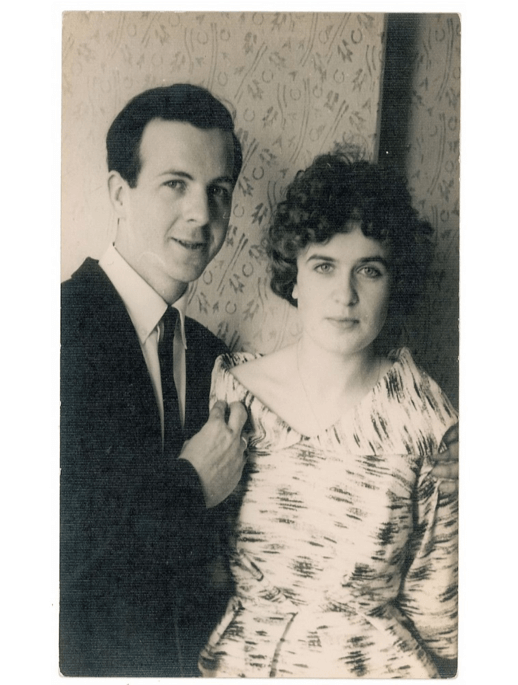
    Wedding photo showing ring worn
    on right hand per Russian tradition

    The wedding ring held and on exhibit through the Sixth Floor Museum as once having belonged to Lee Oswald, did not belong to him. It is most likely a Soviet era wedding ring of the type Oswald did indeed wear at his wedding—but as far as can be ascertained, never again thereafter. Leading to the conclusion that the ring he wore that day was borrowed for the occasion.

    The evidence leading up to the above conclusion, broken down into specific areas:

    Did Lee Oswald buy himself a wedding ring?

    What little evidence there is suggests he did not.

    Oswald made inquiries with Ella German about marriage customs in the Soviet Union—referencing silver engagement rings being swapped for gold wedding rings. He was clearly only talking about the bride-to-be. (Oswald’s Ghost, by Norman Mailer, p. 127). This fits with his noted frugality. Two rings for Marina is one thing. Another for himself is out of character.

    It should also be noted that Western males wearing wedding rings at all had only started to take off during the second half of the 20th century. (“Wedding rings: Have men always worn them?”, by Stephen Robb, BBC News Magazine, Dec 8, 2011) and that until the 1960s, wedding rings were frowned upon in the Soviet Union as a symbol of “bourgeois decay, ostentation and sanctimoniousness.” (The Land of Weddings and Rain: Nation and Modernity in Post-Socialist Lithuania, by Gediminas Lankauskas, p. 254)

    After this discussion with Ella, he purchased a silver engagement ring with a red stone, and for the wedding, a small plain gold band. After Lee’s death, undertaker Paul Groody was quoted in a newspaper account of Oswald’s funeral saying that the casket was open before burial and he had helped Marina place two rings on his finger but couldn’t get them “over the joint”. He described one as a “little ring with a red or black stone-maybe all they could get for an engagement ring in Russia.” (FBI 62-109060 JFK HQ File, Section A3, p12) The two rings placed on Oswald unquestionably belonged to Marina, with the second being her gold wedding ring. At the 2nd autopsy in 1981, the rings were taken from the little finger of the left hand. This confirms that the rings were too small to fit on Oswald’s ring finger—again indicating they had belonged to Marina.

    Tom Bargas was Shop Foreman at Leslie Welding. He told the FBI that he knew Oswald was married only because it said so on his application. (Oswald 201 File, Vol 3, Folder 9B, Part 1, p. 40) Bargas had interviewed Oswald for the job, (WCH Vol X, p. 163) so we know from this, that Oswald was wearing no wedding ring at the time of the interview—or at work at any other time.

    There are no photos available that clearly show Oswald wearing a wedding ring. There are very few photos showing a ring at all.
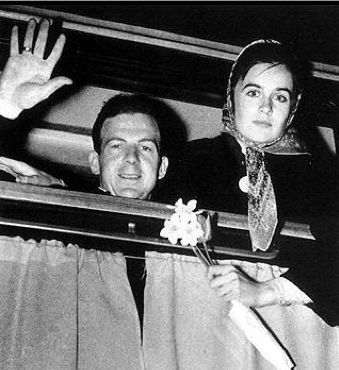
    Lee and Marina leaving Minsk

    The first of these is a black and white photo showing Lee and Marina leaving the Soviet Union. This shows a ring being worn on the right hand. Although some assume it is a wedding ring, it could just as easily be his Marine Corps ring. The assumption is largely based on claims made some days after the assassination when the ring-left-on-the-dresser story was developed. Marina buttressed the importance of this story by claiming that Lee never took his wedding ring off.

    The day before leaving Minsk, Oswald offered his friend, Ernst Titovets “a large silver ring that he had bought in Japan and wore constantly. Titovets told Oswald he was touched but could not accept the ring. It was too expensive. Oswald, we’re told, complied with his friend’s wishes and put the ring back on his finger…” (The Interloper: Lee Harvey Oswald inside the Soviet Union, by Peter Savodnik, unpaginated ebook edition).

    Since Oswald was following local traditions and wearing any rings he had on his right hand, we will logically assume that this is the “large silver ring” he had tried to give his friend just the day before. We also now know, as a result of that quote from Titovets, that it was his Marine Corp ring that was worn constantly and not a wedding ring.

    The next photos showing a ring are two of the Backyard photos. Without getting sidetracked by the authenticity debate of these photos, and that the ring seems to jump from one hand to the other, the consensus is that the ring is the Marine Corp ring.

    The last is one of the arrest photos and is something of a duel-edged sword. It clearly shows that the ring he is wearing—back on the left hand as per Western tradition—is his Marine Corp ring. It later appears in evidence lists under that description. The problem is that in not showing a wedding ring, the “ring-left-on-the-dresser” story gets additional support. It is a neat trick indeed, to use something you don’t see as evidence that it exists. God would be smiling.

    Was a ring left on the dresser on the morning of Nov 22, 1963?

    The short answer is “no, there was no ring left on the dresser of the morning of Nov 22, 1963”.

    A list of some of Marina’s purported statements on the subject, speaks for itself.

    …the following day (Friday) when she got up from bed, after the departure of her husband, she noticed his wedding ring laying on the top of their bedroom dresser. She stated that he never, to her knowledge, took off his ring before, and at that time she thought it a strange thing to do.” (CD 79, p. 3 Nov 30, 1963)

    “…she had not discovered Oswald’s wedding ring on the dresser in her room at the Ruth Paine home the morning of November 22, 1963, upon getting up that morning. She said she had not seen it until the police came to her house to search it, following the arrest of Oswald on November 22, 1963.” (CE 1820, Jan 14, 1964)


    Marina advised that on November 22, 1963, when the police came to the Paine house and searched it, they had found Oswald’s marriage ring on the dresser in the room which she, Marina used.” (FBI 105-82555 Oswald HQ File, Section 16, p. 93)

    MARINA: At one time, while he was still in Fort Worth, it was inconvenient for him to work with his wedding ring on and he would remove it, but at work—he would not leave it at home. His wedding ring was rather wide, and it bothered him. I don’t know now, he would take it off at work.

    RANKIN: Then this is the first time in your married life that he had ever left it at home where you live?

    MARINA: Yes.

    (WCH Vol 1, Feb 5, 1964)

    Juror: Did the ring have his name on it?

    Marina: I don’t know but I think I have this ring somewhere.

    (New Orleans Grand Jury testimony of Marina Oswald Porter, Feb 8, 1968, p. 69)

    “Marina later made a terrible discovery. She happened to glance at the bureau and saw that, again by a miracle of oversight, the police had left another of her possessions behind. It was a delicate little demitasse cup of pale blue-green with violets and a slender golden rim that belonged to her grandmother. It was so thin that the light glowed though it as if it were parchment. Marina looked inside. There lay Lee’s wedding ring. (Marina and Lee, by Patricia Johnson McMillan p. 544)

    Mrs. PORTERWell, I do not—I remember the demitasse, but it is missed. I don’t know where it is. Are you asking me did I find Lee’s ring?

    Chairman STOKESDid you find his ring?

    Mrs. PORTER—Yes, sir.

    Chairman STOKESAnd then did you tell Miss Johnson this: “Oh, no,” she thought, and her heart sank again, “Lee never took his ring off, not even on his grimiest manual jobs. She had seen him wearing it the night before. Marina suddenly realized what it meant. Lee had not just gone out and shot the President spontaneously. He had intended to do it when he left for work that day. Again, things were falling into place. Marina told no one about Lee’s ring.” Did you tell Miss Johnson that?

    Mrs. PORTERYes.

    (HSCA Report, Vol 2, p. 301)

    Marina Oswald is the sole witness to a ring left on the dresser that morning and as we can see, her statements about the ring have little or no consistency. Nor were they made early on. The claims did not start emerging until at least a week after the assassination, during a period in the protective custody of the Secret Service. We will look more closely at this later.

    Was a ring left on the dresser later that day?

    The closest statement to the truth made about this subject by Marina was possibly one made to Priscilla Johnson McMillan for her book, Marina & Lee. In this statement, she said that “by some miracle” the police missed seeing it in their search. Since the police took Marina, Ruth Paine and Michael Paine in for questioning immediately after the search, she most likely put her own ring there some time prior to leaving the Paine household for good. In short, it was not there at the time of the police search. This explains the police not taking it. It also explains why she did not lead them to it.

    What happened after that?

    The following day, November 23, Marina and Marguerite were given three rooms at the Adolphus Hotel paid for by Life Magazine. (WCH Vol 1, p. 444) After visiting Lee that day, Life moved the women to the Executive Inn to hide them from rival journalists. While there, Marina phoned Ruth Paine to advise her “about the ring” on the dresser. (CD 329, p. 116). Although this FBI report dated January 16, 1964 alludes to the ring as belonging to Oswald and that he had left it there before going to work, the truth is more likely to be that Marina phoned upon realizing that she had forgotten her own wedding ring and she was asking Ruth Paine to look after it until it could be picked up with her other belongings.

    Ruth Paine was not asked, nor did she volunteer any information about this call before the Warren Commission. On November 24, the mother, wife and daughters of the accused were taken into protective custody by the Secret Service. According to Marguerite, they were picked up after Lee was murdered. According to Peter Gregory, who was among the entourage who arrived at the Executive Inn, they only heard the news regarding Lee en route to Robert Oswald’s house, and this caused them to divert to the house of the Irving Chief of Police instead, where Marina again phoned Ruth. (WCH Vol 2, p. 345) I believe that Marguerite’s version is the more accurate regarding the timing of being picked up. It was done with great urgency, and with a Secret Service escort. Something triggered that urgency. That trigger could only be Lee’s death.

    Marina Oswald testified that “They [the entourage that had picked her and Marguerite up] stopped at the house of the Chief of Police Curry [it was actually the Irving Police Chief, but Marina would not have been familiar with either of them]. From there, I telephone Ruth to tell her that I wanted to take several things which I needed with me and asked her to prepare them. And that there was a wallet with money and Lee’s ring [or as more likely, her own wedding ring].” (WCH Vol 1, p. 81)

    Just a little while later, in the same session, the questions and answers seemed to get muddled as to sequence of events when she responded to the question, “what did you do after you went to the motel?” by saying, “I left with Robert and we prepared for the funeral.” This must be out of sequence because she had testified previously that Robert had left by then. It therefore must have occurred prior to going to the house of the Irving Police chief and phoning Ruth. Mortician Paul Groody is known to have gone through the same things he did with all bereaved by asking Marina about what clothes and jewelry she would like Lee to be laid to rest in.

    We then go to Ruth Paine’s testimony:

    Mr. JENNER—Do you recall an incident involving Lee Oswald’s wedding ring?

    Mrs. PAINE—I do.

    Mr. JENNER—Would you relate that, please?

    Mrs. PAINE – One or two FBI agents came to my home, I think, Odum was one of them, and said that Marina had inquired after and wanted Lee’s wedding ring, and he asked me if I had any idea where to look for it. I said I’ll look first in the little tea cup that is from her grandmother, and on top of the chest of drawers in the bedroom where she had stayed. I looked and it was there.

    Did Ruth take a lucky guess at where to look or did Marina tell her exactly where it was because she herself had put it (her own ring) there? We are not told when this happened, but we do at least know that the request by Marina was made on the afternoon of her husband’s murder. We also know from Marina’s testimony that she had advised Ruth that she “needed” the items requested. This is curiously as absent from Ruth’s testimony as the date for the pick-up is. The question is, was Marina ‘s need for the ring so that it could be placed on Lee’s finger for burial? Was Ruth deliberately vague on detail because, the ring having magically transformed from Marina’s ring to Lee’s ring, it now cannot be associated with the ring put on at the funeral?

    The real sequence of events would be:

    • Nov 22 am—Lee Oswald leaves for work. Marina gets up later
    • Nov 22 pm—JFK is assassinated. Paine home is searched. No ring is found on dresser because no ring is there. Marina and Ruth and Michael Paine are taken in for questioning
    • Nov 23—Marina and Marguerite are moved into rooms at the Adolphus Hotel before being moved again to the Executive Inn on the edge of town. Marina phones Ruth to let her know she has left her ring/s and savings behind and asks Ruth to look after them
    • Nov 24—Lee Oswald is murdered. Robert Oswald, Peter Gregory and some Secret Service agents hustle the women into moving quickly to another location. They are now in Secret Service protective custody. Robert takes Marina to the Mortician, Paul Groody, and she tells Groody she wants Lee buried in her wedding and engagement rings as the police have his ring and bracelet. They go to the home of the Irving Police Chief where Marina again phones Ruth, telling her she needs the ring and that someone is coming to collect it. It is picked up by FBI Agent Bardwell Odum. Ruth knows where the ring is because Marina has told her
    • Nov 25—Lee Oswald is buried after a quick service at Rose Hill Cemetery. The casket is open until just prior to internment and Groody assists Marina in placing the rings on Lee’s little finger as they are too small for the traditional ring finger (FBI 62-109060 JFK HQ File, Section A3, p. 12)
    Marina at City Hall on Nov 22. She is still wearing her ring

    What this timeline shows is the improbability of the ring/s (it was more likely both her wedding and engagement rings) on the dresser having belonged to Lee Oswald. Moreover, it makes sense of the phone calls to Ruth on consecutive days and shows that the second call fits with the need for the rings in time for the funeral. It is surmised that Marina took her rings off sometime before leaving the Paine household on Nov 23 as Marguerite testified that both babies had diarrhea. This would cause a lot of changing of nappies and wiping of bottoms—something best done without jewelry on the fingers.

    The three-ring circus
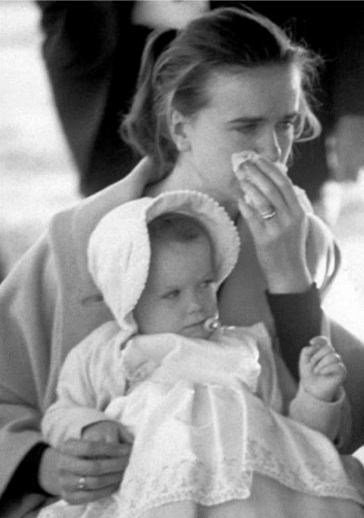
    Two rings on left hand and one on right

    As we can see above, on November 22, Marina wore one ring. Yet on the day of Lee’s funeral she was photographed wearing what looks like three almost identical plain wedding bands. I have no explanation for this other than to suggest that there were a number of rings left in that demitasse saucer picked up from the Paine’s by Odum and delivered to Marina—all of which belonged to Marina—as shown from they way that they fit.

    Where did the story originate that the dresser ring belonged to Lee?

    As shown above, the Secret Service took Marina and Marguerite into protective custody immediately after Lee Oswald was murdered. The day after the funeral, Nov 26, serious interrogations began, with both the Secret Service and the FBI. These went through until Dec 1, though further interviews were conducted periodically after that.

    The interrogators quickly realized that Marina was the person they needed to concentrate on. She was vulnerable on several levels, but more importantly, she was also more flexible and pragmatic of mind. It would be a mistake to suggest this made her submissive. She was simply a survivor first and foremost. Marguerite on the other hand, had a clear and immovable portrait of her son, and it was not the portrait that investigators wanted to hear. She would be set aside and marginalized as an avaricious, nutty and neglectful mother. In fact, Marguerite testified to the Warren Commission that “I was never questioned by the Secret Service or the FBI at Six Flags. My son, in my presence, was questioned and taped, and Marina was continuously questioned and taped. But I have never been questioned.

    The Reid Interrogation Technique

    The Reid Interrogation Technique is practiced throughout most law enforcement agencies and police forces in the US where suspects and witnesses are routinely interviewed. This includes the FBI and the Secret Service. It was developed in consequence to Brown Vs Mississippi (1936) which held that confessions obtained through physical violence would be inadmissible in court. It simply replaced the violence with social psychology involving isolation, induced despair, limiting opportunities for denials and alibis, and the delay of legal counsel at least until the person has been broken down and has provided a confession. Other tools used to get to this point include lying to the suspect, pretending to have witnesses or evidence that don’t exist, or showing evidence that is fraudulent, giving leading questions and finally, throwing a lifeline by offering excuses for the crime and offering support if they will only make the admission. Parallel to that is the construction of a scenario around the crime that goes to the guilt of the suspect.

    The method works. The method also does not discriminate. If you are the focus of an investigation, it may only be because your psychological reactions have not been within the “norm”. For example, a woman finding her husband or child dead would be expected to be an emotional wreck. Other signs of guilt are also looked for, such as an inability to make eye contact, fidgeting, stuttering etc. All too often, once police become convinced of your guilt, based solely on their psychological evaluation, lack of evidence is of secondary importance. They will either break you or frame you.

    Or in the case of Oswald, arrange your televised execution.

    The method is not confined to suspects. It is also used on witnesses to get them on board with a scenario that helps their case.

    Marguerite intuitively knew that something was happening, even if some of her conclusions may not have been accurate.

    Mrs. OSWALD. No. I am saying—and I am going to say it as strongly as I can—that I—and I have stated this from the beginning—that I think our trouble in this is in our own Government. And I suspect these two agents of conspiracy with my daughter-in-law in this plot.

    The CHAIRMAN. With who?

    Mrs. OSWALD. With Marina and Mrs. Paine, the two women. Lee was set up, and it is quite possible these two Secret Service men are involved.

    Mr. RANKIN. Which ones are you referring to?

    Mrs. OSWALD. Mr. Mike Howard and the man that I did not—did not know the name, the man in the picture to the left. I have reason to think so because I was at Six Flags and these are just some instances that happened—I have much more stories to tell you of my conclusions. I am not a detective, and I don’t say it is the answer to it. But I must tell you what I think, because I am the only one that has this information. Now, here is another instance——

    What Marguerite witnessed between the agents and Marina and assumed to be evidence of conspiracy between them in the assassination was really the Secret Service coopting Marina to assist with building the case against her husband. What Marguerite witnessed was initially Marina being isolated, threatened, asked leading questions and finally being offered all manner of assistance as her cooperation grew and she saw the money rolling in from a shocked nation. Meanwhile, Marguerite was being denied a ride home for more clothes and having her news clippings and mail confiscated. In all other respects, she was totally ignored.

    Marina’s cooperation with the Secret Service then was vouchsafed by early promises arranged through immigration that she would not be deported, and by having firemen sitting within view of her as they counted the money coming in from concerned citizens around the country—a reminder that the money was within reach—but not hers until the Secret Service was happy enough with her to hand the money over. Both measures infuriated the FBI as they left Hoover’s men no bargaining chips whatsoever—and that was probably another outcome the Secret Service hoped to achieve. They now owned Marina. (Assignment Oswald, by James P Hosty, p 89). The money ended up totaling $70,000—the equal of nearly $600,000 today. Given her parlous state, the murder of her husband, two small children, and poor prospects in a foreign and now possibly hostile environment, no one should blame Marina for effectively going along with the stage play. Taking the carrot in America was certainly a better prospect than facing the stick back in the Soviet Union.

    The sole purpose of the evolving ring story was simply to imply motive. Lee, it would be claimed, knew his marriage was over so he planned instead to make his mark in history. But the marriage was not over. The savings also found on the dresser—and often cited as another clue he was never coming back, had been an amount accumulating on that very dresser every pay day, not left all at once. It was money meant for an apartment to reunite the family and there is solid evidence he had found one. That information too, had to be buried and left uninvestigated. Unfortunately, it is also outside the bounds of this work.

    (With thanks to Ed Ledoux for the photos used.)


    THE RING, Part Two: Authentication, Sale & Acquisition

    If, as shown in Part One, it is likely that Lee Oswald never owned a wedding ring, it stands to reason such a ring could not be sold at auction.

    Yet a wedding ring purported to have belonged to the accused assassin was indeed sold at auction in 2013. Here, we will try and trace the history of how this came about.

    2004 and the Markward file

    Ring and receipt discovered by Dave Perry

    In July 2004, the Fort Worth law firm of Brackett & Ellis located the Marina Oswald file of retired lawyer Forrest Markward.

    At 90 years old, Markward was long retired and by now in the early stages of Alzheimer’s, so the law firm instead, called in local JFK assassination expert, Dave Perry to go through the material.

    Inside the file, Perry found an envelope containing a gold wedding ring and a receipt—allegedly from the Secret Service. This is suggested by the file reference at the top right which was the reference the Secret Service used for all JFK assassination related material. (Lost History episode, air date december 1, 2014).

    Stan Dane’s MS reproduction matches perfectly

    Issues with the receipt as photographed

    As can be seen, the receipt bears no signature or date and is not on Treasury or Secret Service letterhead. In short, it is the type of document that could easily be typed up by anyone. Indeed, it looks very much like it was typed using MS Word using 10-point fonts or, alternatively it was typed on an IBM Selectric typewriter using 12 pitch characters (all but identical to the 10-point fonts of MS).

    Author Stan Dane proved the point by reproducing the receipt using MS Word and comparing the result to the original.

    Issues with the ring as photographed

    Building on the work of Dane, Jake Sykes measured the ring size with the following formula:

    “Using 1/16″ (the 10-point font measurement) yields 9-1/2 lower case “s” letters. 9.5 x 1/16″ = .594″ for the ring diameter.” This means the ring is just below the average woman’s ring size of .60”. (reference.com article, What Is the Average Ring Size for a Woman?)

    What we are left with is a receipt that bears indication of fakery and a ring too small to have been worn by Lee Oswald, but quite possibly one that would fit Marina.

    The strange articles of Dave Perry and Hugh Aynesworth

    Before getting into those articles in detail, allow me to note one of the first things that struck me about the pair—they both spell lawyer Forrest Markward’s surname as “Marquart” indicating a certain amount of cribbing from each other. I have found no indication that the name was ever spelled any other way than “Markward”. It is for instance, spelled that way in Secret Service records dated Feb 7, 1964 and in online obituaries (findagrave.com, date of death Nov 30, 2009), so if Perry went through the lawyer’s file on Marina, how on Earth did he manage to misspell his name? I will leave that detail for others to ponder.

    Is This Lee Oswald’s Wedding Ring? By Dave Perry, undated

    Perry starts out appearing to be wearing his investigative reporter hat. He does this by going through some (but not all) of Marina’s different and contradictory statements concerning the ring. He then notes that Oswald was buried on Nov 25, 1963 before quoting Linda Norton, the doctor who headed the exhumation autopsy in 1981:

    “Upon entry into the casket a moderate malodor emanated from the decomposing body. As measured in the casket from superior skull to heel region on the left, a body length of 177cm (69½ in.) was obtained. A gold wedding band and a red stone ring were removed from the fifth digit of the left hand (subsequently identified by Mrs. Porter as representative of items placed upon the body at the time of initial burial).” (The Journal of Forensic Sciences, V. 29, N. 1, January 1984, p. 24)

    To get the full flavor of the Perry piece from this point, it would be best just to quote it directly.

    Originally, I believed the ring in the possession of Attorney Luke Ellis of Brackett & Ellis of Fort Worth, TX was the wedding ring removed by Dr. Norton. I thought a member of the firm, Attorney Forrest Marquart, had appeared with Marina at the exhumation autopsy.

    When I visited the law firm, I found documents showing that Marina was using the firm’s services in 1964—after the burial but well before the exhumation autopsy. Marina went to the law firm in 1964 to sign documents (for example: the contract with Priscilla McMillan and publisher Harper & Row for the book that would become Marina and Lee.) and at that time presented the ring to Attorney Marquart.

    With the ring is the following typed notation:

    CO-2-34, 030

    Receipt is hereby acknowledged of a gold wedding band which had been turned over to the United States Secret Service on December 2, 1963 by Mrs. Ruth Paine.

    _____________________________

    Date _________________________

    I surmised the law clerk that received the ring, transcribed Marina’s comment that this was the ring that Ruth Paine turned over to the Secret Service on December 2, 1963. The Secret Service then gave it to Marina who brought it to the law firm as payment for services.

    I now had no idea what ring the law firm had until I found the following:

    “The lid was raised. Forty reporters peered over the (police) officers’ shoulders. Marina, who had been following TV and was learning about images, kissed her husband and put her ring on his finger.” (The Death of a President, by William Manchester, p. 568)

    It would seem Marina put HER wedding ring on the body only to retrieve it years later at the exhumation. And this means the ring in the law firm’s possession is Lee Oswald’s wedding ring.

    The issues and items not mentioned are just as telling as his inevitable “nothing-to-see-here” conclusion. This includes the circumstances of his appearance to inspect Markward’s file on Marina, the exact date this happened, any description or photo of the envelope and any contact he had with Marina about the discovery.

    Coming Full Circle by Hugh Aynesworth, September 1, 2004

    This should have been subtitled “Wither Thou Goest” such are the ties that bind the two Keepers of the Warren Commission Flame, though carrying it on opposite sides of the street.

    Aynesworth, continuing the path beaten by his ally, opens with the hortative that a small gold wedding band

    believed to have been worn by Lee Harvey Oswald until just a few hours before he purportedly assassinated President John F. Kennedy has been locked in a safe at a law firm here for more than a generation.

    Is this really Aynesworth? “Believed”? “Purportedly”?

    “Oswald’s friends and family, and lawyers and doctors involved in the case, say that the ring may be the one that the suspected assassin wore.”

    And there is the trifecta—“may”. And we really don’t get told who these people are. Sure, Marina and Ruth. But who are the others? Markward had Alzheimer’s and had no memory of any of it. The other lawyers who called Perry in had no inkling regarding the history or ownership of the ring. The doctors is one doctor, not two or more—Linda Norton—and all they had from her was the quote made in the Journal of Forensic Sciences and that quote says nothing about who owned the ring. Aynesworth is stretching credulity big time.

    “JFK investigator Dave Perry, of Grapevine, Texas, believes that the ring was Oswald’s and might have been given to federal authorities in December 1963 either by Oswald’s widow, Marina, or by Ruth Paine, the Irving, Texas, woman who let Mrs. Oswald and her two young children live with her during the fall of 1963.”

    With five qualifiers in three short paragraphs, Aynseworth is suddenly in unfamiliar territory. And remember also that these qualifiers are about the history and ownership of a ring which would eventually be sold in 2013 as a bona fide historical artifact. Clearly though, as of 2004, there was far from any certainty about either ownership or history.

    The next few paragraphs just add to the uncertainty. Luke Ellis, representing the law firm that held Markward’s file, admits he has no clue about what to do with any of the material. Ruth Paine is contacted. She falls back on how long ago it all was but concedes it is possible she gave the ring to the Secret Service on the date noted. The fact is though that Ruth Paine consistently stated during the days of the various investigations, that she gave the ring to the FBI—moreover, she names the agent as Bardwell Odum. The only thing she never mentioned was when she gave it to him. But since Marina advised her that she needed it on November 24, and the likely reason for needing it was to place on her husband’s finger for burial the next day, it is a good bet that it was collected no later than the morning of November 25.

    The next piece of information of any value is that the Times contacted Marina during late August about the ring and was told by her that she did not recall seeing the ring after the police raid on the Paine home. When pressed as to what she thought happened to Lee’s ring, Marina simply replied “Oh, I don’t know. It’s been so long ago. If someone else has it, I don’t care.

    Compare that to what she told the Grand Jury in New Orleans
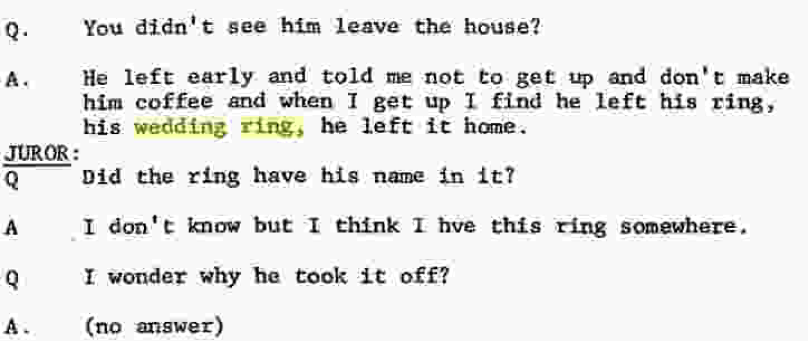
    So, in 1968, She thought she still had the ring somewhere but could not recall if it was even inscribed, then by 2004, her memory was that she had not seen it since November 22, 1963! And I again remind readers that her stories constantly changed on the subject beyond these two versions. We know this is not the only subject in which Marina has given mutually exclusive accounts, with most of those being in legal settings

    Back to Aynesworth:

    Though the ring having been stored along with several legal documents might appear to indicate that Mrs. Oswald had given the ring to Mr. Marquart as payment for legal services, Mrs. Oswald did not recognize the lawyer’s name and said that she could not recall having the ring at any time after the Kennedy assassination.

    Originally, Mr. Perry and another investigator, David Murph of Grapevine, Texas, conjectured that the ring might have been removed from the casket when the body of Oswald, who was killed by Jack Ruby two days after Kennedy’s death, was exhumed in 1981.

    But Mrs. Oswald and the doctor who led the team that exhumed the body dispute that theory.

    Dr. Linda Norton, a forensics specialist from Dallas, said last week that there was no male wedding band on Oswald when he was disinterred to confirm that the body buried under his name was indeed him.

    “There were two rings, one small wedding band and a ring with a small red stone in it,” she said. “The wedding band was too small even for his little finger—so that couldn’t have been his.

    “Afterward, I replaced both on his fingers before they closed the casket and reburied him,” she added.

    There we have it. It could not have been Marina’s ring from the corpse because it was placed back on the body before reburial. Not explained is how they could have ever considered this was the ring in the files when they maintain that the ring in the files was a male size and not female (as the ring on the body was). But as we have shown already, the ring in the files was indeed a ladies’ size. Moreover, it looks like Linda Norton’s memory of putting both rings back on the body was not accurate.

    Morgue: A Life in Death by Dr. Vincent Di Maio, Ron Franscel, pp. 114-122

    Dr. Norton was assisted in the 1981 autopsy by Dr. Vincent Di Maio. This is what di Maio tells us in his autobiography

    “First, we removed the rings on the corpse’s finger and gave them to Marina… Back in the autopsy room, before Oswald’s new casket was closed and he went back into the damp earth of Rose Hill, a grateful Marina gave Dr. Norton an odd gift: the red gemstone ring we’d taken off the corpse’s pinky. It was her way of saying thanks for the team’s work. But Linda was visibly uncomfortable with this morbid reward. As soon as Marina left the room, she inconspicuously slipped it into my hand. She didn’t want it. Neither did I. As well-meaning as it might have been, it was a sordid souvenir of a grim task and an even grimmer history. I wished for the whole wretched mess to just be buried once and for all. So just before they sealed Lee Harvey Oswald’s coffin for his next eternity, I dropped the ring into the box with him and then drove home to San Antonio in the dark.

    There is just too much detail here to have been made up. In any case, for what purpose would he make such a thing up?

    We can see here that both rings were given back to Marina, but only the ring with a stone was returned to the coffin. Put anther way, Marina kept the gold wedding band—which we know was hers.

    Where does this leave us? As of 1981, Marina had her own wedding band back in her possession. But we also know from Di Maio that Marina was keen to be rid of the rings and whatever memories they held. She in fact believed she had successfully given away the engagement ring. Given this mindset, Perry’s initial impression that she had given the band to Markward who was representing her interests at this autopsy, holds up perfectly well. This in turn, fits with the measurements showing the ring found was that of a female, not a male. Again, it was Marina’s own ring.

    “Mystery surrounds Lee Harvey Oswald’s ring”, by Hugh Aynesworth for the Dallas Morning News, October 27, 2007

    This is basically an updating of the 2004 story. The only new information apart from declaring that the Sixth Floor Museum has an interest in acquiring the ring, is the following.

    “A Secret Service document that Marina signed Dec. 30, 1964, indicates that federal agents returned the wedding ring to her on that date. The Secret Service had been given the ring, the memo said, on Dec. 2, 1963, by Ruth Paine, the Irving woman who had provided a home for Marina.”

    Since when does the Secret Service get the civilian subjects of memos to sign said memo? Nor does Aynesworth attempt to explain why it took from December 2, 1963 when it is alleged that the Secret Service took possession of the ring from Ruth Paine, until December 30, 1964 to return it to the rightful owner. In fact, the prejudicial word used in all the stories about the sale of the ring and its background, is “confiscated”—that is, the ring was “confiscated” from Ruth Paine—indicating that the Secret Service had taken it forcefully as “evidence”. This is at complete odds with what Ruth Paine maintained throughout 1964 and beyond. She has steadfastly stated that the FBI came to collect it at Marina’s request on an unspecified date, but in context, had to be November 24 or 25, 1963. It is only in recent years, under apparent pressure, that she has claimed she cannot recall, and so concedes it is possible that the Secret Service did pick it up on December 2, 1963. It became obvious a long time ago that Marina and Ruth had separated into different “teams”. Marina gave her allegiance to the Secret Service while Ruth gave hers to the FBI.

    As far as this writer has been able to ascertain, such a memo has never surfaced, and as stated above, it was not mentioned in the original story.

    It seems at some stage, the “memo” was dropped as quickly as it had been “discovered” because all it states in what purports to be the official ring timeline as published by the Dallas News is this:

    Dec. 30, 1964: The Secret Service returns the ring to a Dallas lawyer who once represented Marina Oswald; that lawyer included it in files transferred to a Fort Worth attorney, Forrest Markward of Bracket & Ellis, who represented Marina Oswald from late 1963 to early 1965. (“Lee Harvey Oswald’s wedding Band Heading to Auction Block” by James Ragland, July 2013)

    The only thing left of the claim is the date. But that is far from the only issue with this timeline entry. Who was the lawyer who supposedly took receipt of the ring? Why was the ring not passed on directly to Markward by the Secret Service since he was the one currently acting for Marina? The Secret Service certainly knew about Markward since he is named in a Feb 7, 1964 memo as attending a meeting with Marina, James Martin and his family, Secret Service agents and a Mr. Louis Saunders in the Grand Prairie office of John Thorne (CD 372, p. 12). Saunders was Executive Secretary for the Fort Worth Area Council of Churches—all-in-all, a diverse group meeting indeed. No doubt the agenda items would have been intriguing. Lastly, there is a key error of fact in that entry. Brackett & Ellis is on record as stating that Markward did not begin with the firm until the late 1970’s. (“Coming Full Circle”, by Hugh Aynesworth, Washington Times, September 1, 2004) Any files transferred to him in 1964 were not therefore transferred to him while working at Brackett & Ellis. The fact is that Markward not only represented Marina in the 1963-65 period, but also for the 1981 exhumation—a fact that Perry hints at early in his “investigation” of the ring, but then drops like the proverbial hot potato when it becomes an inconvenience to his predictable conclusion.

    The RR Auction sale of the ring

    Forrest Markward died on November 30, 2009. It took until July 24, 2012 for Brackett & Ellis to formally write to Marina and advise of the ring’s discovery. That is about 30 months after the death of the lawyer and a full 8 years after it was discovered in his old files. By the same token, Marina was in no rush to obtain it; not picking it up from the law firm until early 2013. Then in May of that year, she wrote a 5-page document outlining the history of the ring for RR Auctions—a history she has constantly rewritten through questioning under oath and through numerous interviews with various law enforcement officials, authors and the media. In that light, it is unsurprising that she wrote this history on the proviso that certain parts of it would not be made public. Five months later, the ring sold for $108,000. As a 14k gold ring, it has an intrinsic value of about point one or two percent of that amount.

    Authentication

    RR Auctions commissioned David Bellman of Bellman’s Jewelers to authenticate the ring. In 2017, Mr. Bellman posted a video to You Tube as part of a series called Jewelry in History. This episode was titled Lee Harvey Oswald—Authenticating His Wedding Band. What this video demonstrates is a basic process of showing it was a Soviet made 14 karat band by the markings inside it. But does this prove it belonged to Lee Oswald as claimed? Of course not. Marina’s secret statement was accepted as the sole authentication of that.

    By the time I found this video, someone else had already asked what size the ring was. The jeweler replied that as best he could recall, it was .95 (of an inch)—which is the average size of a male ring (the Sixth Floor Museum lists as having a diameter of 15/16”). He failed to respond to my request for personal contact regarding the matter.

    The Sixth Floor Museum

    Two years later, the Sixth Floor Museum acquired the ring. During my research for this essay, the museum was contacted to alert them to the issues surrounding the ring. Here is that email, along with the reply:

    Regarding the acquisition of Lee Oswald’s wedding ring:

    I understand that Marina Oswald wrote a 5-page history of the ring to go with the it when she sold it at auction. Did the museum acquire it, as well?

    I also understand that the ring you have was found in the files of a Fort Worth lawyer, in an envelope also containing a receipt from the Secret Service dated Dec 2.

    So as to provide accurate information to the public, you need to know that this story conflicts with past stories—which are themselves all mutually exclusive.

    Ruth Paine testified to the Warren Commission that the ring was picked up from her home by Bardwell Odum of the FBI.

    Marina herself is documented as telling the FBI that the police found the ring on Nov 22.

    But then during her testimony to the New Orleans Grand Jury, Marina testified that she found the ring after Lee went to work that morning and that she still had it “somewhere”.

    That is 4 different versions, when including the Secret Service version. Two of those conflicting versions came from Marina herself. I would like to know if the 5-page note contains yet another version or incorporates one of her earlier versions.

    In any case, the provenance of the ring you have, must be treated with some trepidation.

    The story that Oswald always wore the ring and therefore leaving it on the dresser that Friday morning, shows he knew he would not be coming home, in my opinion, is the reason for these conflicting stories. Marina did testify that she knew Lee had taken the ring off once at work.

    Here is what she said:

    “At one time while he was still at Fort Worth, it was inconvenient for him to work with his wedding ring on and he would remove it, but at work—he would not leave it at home. “

    I think a lot of manual laborers would take rings off while working. It makes sense to me that Oswald did not do this just once but did it as a matter of habit. Additionally, her claim that he would never leave it at home makes no sense. Why would he wear it to work, but then take it off and carry it in his pocket all day? Wouldn’t it make better sense to leave it at the Paines’—especially if he expected to be returning there that evening?

    What should have been regarded as evidence of his innocence (or at the very least, evidence of nothing either way), was completely turned on its head to make him look guilty.

    I also note that in his 2013 book, Mr. Fagin pushes the line that Oswald not only left his ring, but also $170.00. This is not true. He did not “leave” it there. That wallet was kept there, and he added to it every pay day—that is according to Marina’s testimony on it.

    Any museum needs to ensure it gets its facts straight and does not simply push official propaganda that is not supported by the evidence. Not unless the museum is in a totalitarian country, anyway.

    Five days later, I received the following reply from Stephen Fagin:

    Good afternoon Mr. Parker,

    Thank you for your interest in the Museum’s Collection. As our educational and public programs have demonstrated over the years, there is rarely one way of exploring evidence in a case that remains controversial and fiercely debated around the world. We value your feedback regarding Lee Harvey Oswald’s wedding ring, and the resources that you cite are available to students, researchers and the general public via our Reading Room.

    We do have the May 2013 letter from Marina Oswald that you referenced in your e-mail. In it, Marina indicates that she did not see the ring that morning but believes—based on records associated with the ring—that Ruth Paine gave it to the Secret Service. She assumed that the government had kept all of their personal belongings (including the ring) and did not learn that the ring had been returned until “receiving a letter from a Fort-Worth law firm in July 2012 stating that they had it in their files for past 49 years.” She recalled that Forrest Markward, the attorney who had possession of the ring, had provided her with some pro bono legal work following the assassination. Marina recognized the ring upon examining it.

    The Museum is confident, based on available documentation and research, in the provenance of the ring we currently have on display.

    Again, we appreciate your interest.

    Sincerely,

    Stephen Fagin | Curator

    Mr. Fagin failed to respond to two follow-up emails made in response to this carefully crafted, polite brush-off.

    So, let us put the reply under the microscope here:

    What does “there is rarely one way of exploring evidence in a case that remains controversial and fiercely debated around the world” even mean in terms of arriving at an accurate conclusion? It is nothing but a throw-away line meant to sound profound. Either the ring held is authentically one that belonged to Lee Oswald, or it isn’t. The next statement that “the resources that you cite are available to students, researchers and the general public via our Reading Room” is equally misleading in its banality. The resources cited would not be found unless specifically searched for and it is a painstaking exercise to run down all sources and all versions of and about the one story. The only version that is easy to find, is the official one because it is plastered all over the net. Mr. Fagin’s laisse-faire attitude to real history is offputting, yet still unsurprising. Being a water-carrier with only make-believe water does at least have the saving grace of being wryly amusing.

    it is, however, his description of the 5-page statement regarding the history of the ring, made by Marina in order to procure a sale, that is really telling.

    In it, Fagin states that according to Marina,

    • She did not see the ring that morning (of Nov 22, 1963). My response: Yet she is on record as saying otherwise in the past.
    • She believes, based on the records, that Ruth Paine gave it to the Secret Service. My response: Yet there are no such records that I have been able to find, apart from the alleged receipt found with the ring. And as already established, Ruth Paine testified she gave it to Mr. Odum of the FBI.
    • She did not know about the existence of the ring until receiving the letter from Brackett & Ellis in July 2012. My response: Yet we have seen that she was contacted by the NYT (possibly by Hugh Aynesworth himself) for Aynesworth’s 2004 story on the finding of the ring.

    Based on the results of this investigation, Mr. Fagin’s assertion that “The Museum is confident, based on available documentation and research, in the provenance of the ring we currently have on display” is a bit risible.


    THE RING, Part Three: Timeline & Conclusions

    1957-1958: Lee Oswald buys a Marine Corps ring while stationed in Japan

    1960-61: Lee is making inquiries about Russian marriage customs concerning silver engagement rings and gold wedding rings for the bride-to-be. He makes no inquiries about rings for grooms-to-be. (Oswald’s Ghost, by Norman Mailer, p. 127)

    Jan 1960-Nov 22, 1963: Lee takes his Marine Corps ring off while at work (WC testimony of Marina Oswald “At one time while he was still at Fort Worth, it was inconvenient for him to work with his wedding ring on and he would remove it, but at work—he would not leave it at home. His wedding ring was rather wide, and it bothered him. I don’t know now, he would take it off at work.” There is no reason to believe that Oswald ever wore a wedding ring at any job and the ring that he wore constantly was his Marine Corp ring—a wide ring, which is what Marina described)

    1961: Lee buys a silver engagement ring and gold wedding ring in Minsk for Marina Prusakova.

    April 30, 1961: Lee marries Marina. Speculation: Lee borrows a ring for the ceremony. This must be true since Marina testified as above that the wedding ring was inconvenient to work in because of its width. The wedding photo does not show a wide ring. As above, the wide ring could only be his Marine Corp ring—this being the same ring that Titovets said Lee wore constantly as shown in next entry)

    May 22, 1962: Lee offers to give his friend, Ernst Titovets his Marine Corps ring as he is departing the next day to the US and wants to leave his friend something to remember him by. Titovets refuses to accept it, noting that Lee wears it “constantly” (The Interloper: Lee Harvey Oswald Inside the Soviet Union, by Peter Savodnik, ebook, unpaginated)

    Nov 22, 1963: After the search of the Paine house, Marina is taken in for questioning by the DPD and provides an affidavit This statement contains nothing about a ring being left by Lee that morning. (affidavit of Marina Oswald, Nov 22, 1963). Just after 4:00 pm, Lee gives his USMC ring to Det. Sims during a body search.

    Nov 23, 1963: Speculation: Marina takes her own wedding ring off while changing nappies of her babies, both of whom have diarrhea and places it in a cup or saucer on her dresser. She then leaves the Paine household for good, initially being looked after by Life Magazine. She phones Ruth later that day to let her know she left a ring behind. (FBI report dated Jan 16, 1964). The report is non-specific about which ring is being referenced. Speculation: Specifically, this call is to let Ruth know she has left her wedding ring inside the cup on her bedroom dresser and asks Ruth to keep it until she is able to pick it up.

    Nov 24, 1963: Marina phones Ruth Paine again after Lee is murdered. She tells the Warren Commission on Feb 3, 1964 “I telephone Ruth to tell her that I wanted to take several things which I needed with me and asked her to prepare them. And that there was a wallet with money and Lee’s ring.Speculation: it is not Lee’s ring she mentioned at all since the only ring he had was a Marine Corp ring and it had been taken by police. She is referring to her own ring. This call is really to ask for the return of the rest of her belongings and for the return of her ring so it can be placed on Lee before burial. Ruth Paine testified that Robert Oswald came by for all Marina’s other belongings—but the ring and money were given to FBI agent Odum.

    Nov 25, 1963: Lee Oswald is buried at Rose Hill Cemetery. Marina’s wedding and engagement rings are placed on Oswald’s little finger on the left hand. Historian William Manchester tells us that “the lid was raised. Forty reporters peered over the (police) officers’ shoulders. Marina, who had been following TV and was learning about images, kissed her husband and put her ring on his finger.” (The Death of a President, by William Manchester, p. 568). And from Dr. Vincent Di Maio, one of the autopsy team at the 1981 exhumation, we have “…Groody placed two rings on Oswald’s fingers. One was a gold wedding band and the other a smaller ring with a red gemstone that Oswald’s wife had requested he be buried with.” (Morgue: A Life in Death, by Dr. Vincent Di Maio and Ron Franscell, p. 106). Paul Groody was the mortician who prepared the body for burial. He himself was quoted in a newspaper article saying that he assisted Marina in putting the rings on Lee. (Associated Press, Lee Harvey Oswald Casket Controversy Continues by Mike Cochrane, p. 36 Aug 16, 1981)

    Nov 26—Dec 1, 1963: Marina Oswald is subjected to intense interrogation by the FBI and Secret Service. (see especially, CE 1787) Speculation: It is during this period that the story of Lee leaving his wedding ring on the bedroom dresser first emerges. This is typical of the Reid Technique. Isolate a witness, create a narrative incriminating the accused and use any and all manner of psychological tools to get the witness to “own” that narrative. The incrimination was implicit in the alleged act because, claim the authorities, Lee knew his marriage was over and that he was not returning. He was instead, going to leave his mark on history. Speculation: The FBI and/or Secret Service built this part of the narrative based on finding out that Marina had left her own wedding ring at Ruth’s and had asked the FBI to pick it up for her so it could be placed on Lee’s finger at the funeral. All they had to do was act like the ring on the dresser had been Lee’s and truthfully say that the ring placed on Lee for the funeral was Marina’s. Now, instead of it being the same ring—Marina’s ring in both cases—they have transformed it into two different rings. From here on, Lee’s (fictional) wedding ring would be the one it would be claimed he never took off (when this was really his Marine Corp ring per Titovets). The last requirement would be to blur what happened to the (fictional) wedding ring. The fact of FBI Agent Odum picking up the “dresser ring” to give to Marina prior to Lee’s funeral, was replaced with the Secret Service “confiscating” the ring on Dec 2, 1963, before finally returning it to Marina on Dec 30, 1964. This in turn got changed to a scenario in which it was given to an unnamed lawyer who had been representing Marina who in turn passed it on to Forrest Markward.

    Dec 2, 1963: this is the day that the official time-line designates as the date that the Secret Service “confiscates” the ring from Ruth Paine. An exhaustive search of records in the Mary Ferrell Foundation data base has failed to locate any evidence of this. It is, however, the day following the FBI and Secret Service interrogations of Marina and is the day both agencies began serious investigations—largely based on the Marina Oswald interviews, as well as those of Ruth and Michael Paine, Buell Wesley Frazier and his sister Linnie Mae. Together, this group of witnesses provided, or agreed to, the dot points cobbled together to form the backbone of the case. The investigation was meant to add the flesh to this burgeoning false narrative.

    By 2004, Ruth Paine’s memory is a little fuzzy as she allegedly tells Hugh Aynesworth, that she may have given the ring to the Secret Service (“Coming Full Circle”, by Hugh Aynesworth, Washington Times, Sep 1, 2004). It is much more likely that Aynesworth told her it was the Secret Service and she simply agreed it may have been. She does stick solidly to the bit about it being done at Marina’s request.

    Dec 30, 1964: This is the day that the official timeline designates as the date that the Secret Service rids itself of the ring. According to a 2007 article—again by Aynesworth. This is supposedly based on a Secret Service memo signed by Marina. To quote from the Aynesworth article, “A Secret Service document that Marina signed Dec. 30, 1964, indicates that federal agents returned the wedding ring to her on that date. The Secret Service had been given the ring, the memo said, on Dec. 2, 1963, by Ruth Paine, the Irving woman who had provided a home for Marina.” (“Mystery Surrounds Lee Harvey Oswald’s Ring”, by Hugh Aynseworth, Dallas Morning News, Oct 27, 2007). Not explained is why it took from Dec 2, 1963 to Dec 30, 1964 to return the ring. Also not explained is what Marina is doing signing a Secret Service memo. It appears some of these issues finally dawned on those involved. In an article by Aynesworth written three years earlier on the same subject, there is no mention of any Secret Service document signed by Marina acknowledging the return of the ring. Now, in the official timeline, the only part left of these claims is the date. The alleged document signed by Marina acknowledging return of the ring on Dec 30, 1964 has disappeared and what we now have is “December 30, 1964: The Secret Service returns the ring to a Dallas lawyer…” No Marina—no Marina signing a memo…

    Oct 4, 1981: Lee Oswald’s body is exhumed through legal pleadings from author Michael Eddowes and Marina Oswald-Porter. Eddowes had written a book claiming the person buried was a Russian imposter, switched with Oswald while he was behind the Iron Curtain. Here we again run into differing versions of what transpired regarding the rings on Oswald’s fingers. In fact, there are even two different versions regarding Marina’s presence during the second autopsy. Dealing with the latter first, we have “Her [Marina’s] presence was unusual—most widows don’t attend their husbands’ exhumations and autopsies—but she didn’t seem to be shaken by the macabre nature of the moment.” (Morgue: A Life in Death, by Dr. Vincent Di Maio, Ron Franscel, p. 115). Then we have this, from a contemporaneous news report: “The 40-year-old Mrs. Porter, who married a carpenter, Kenneth Porter, refused to view the remains but had trusted friends do it.” (“Oswald’s Body Is Exhumed; An Autopsy Affirms Identity”, New York Times, Oct 5, 1981, p. 1).

    To the first part concerning the ring(s), we have these versions: “Dr. Norton explained that examiners found two rings on Oswald—one a small wedding band, the other a ring with a small red stone in it. The rings were re-buried with him. That small ring was ‘too small even for his little finger [and] could not have been his,’ said Dr. Norton.” (“Mystery Surrounds Lee Harvey Oswald’s Ring”, by Hugh Aynseworth, Dallas Morning News, Oct 27, 2007). Against that, there is this from Dr. Di Maio, “First, we removed the rings on the corpse’s finger and gave them to Marina… Back in the autopsy room, before Oswald’s new casket was closed and he went back into the damp earth of Rose Hill, a grateful Marina gave Dr. Norton an odd gift: the red gemstone ring we’d taken off the corpse’s pinky. It was her way of saying thanks for the team’s work. But Linda was visibly uncomfortable with this morbid reward. As soon as Marina left the room, she inconspicuously slipped it into my hand. She didn’t want it. Neither did I. As well-meaning as it might have been, it was a sordid souvenir of a grim task and an even grimmer history. I wished for the whole wretched mess to just be buried once and for all. So just before they sealed Lee Harvey Oswald’s coffin for his next eternity, I dropped the ring into the box with him and then drove home to San Antonio in the dark.(Morgue: A Life in Death , by Dr. Vincent Di Maio, Ron Franscel, pp. 114-122). What we see here is a key to the mystery. Marina was given both rings at the start of the 1981 autopsy. She later gives her engagement ring to Dr. Norton who did not want it and passed it surreptitiously to Dr Di Maio—who also did not want it, and he drops it back in with the corpse. Marina kept her wedding ring. Since we now know she tried to give away her engagement ring, it is plausible that she did give the wedding ring to one of her lawyers—just as originally suspected by the law firm and by Perry. We know she had more than one lawyer looking after her interests during this 2nd autopsy because we have this from the same New York Times story as previously cited; “Mrs. Porter spent hours yesterday in meetings with lawyers in Dallas planning the event. She recalled the years of work leading to it.”

    Jul 2004: The Markward Marina Oswald file is found. It is unclear as to the exact circumstances. This is what Aynesworth wrote in 2004, “Mr. Ellis said that Mr. Marquart had joined the firm in the late 1970s and just recently mentioned the materials in the firm’s safe.” Yet in 2007, Aynesworth was reporting that, “We (Brackett & Ellis law firm) have tried to get him to talk about the ring and his files, but he has refused… The firm had sent representatives to Mr. Marquart’s home ‘on several occasions’ to determine how the ring came to be with his materials, ‘but he apparently doesn’t remember,’ Mr. Ellis said.” Aynesworth goes on to say that “Marina Oswald used the services of Mr. Marquart shortly after the assassination to set up and manage a trust fund for her young daughters, June Lee, 2, and Rachel, 2 months…

    It is also noteworthy that Aynesworth claims Markward was used by Marina to set up trusts for the two girls from all the money donated post-assassination, while Perry claims the work done by Markward was sorting out the book contracts with Priscilla McMillan and Harper & Row. The end result of all of this important legal work? According to Aynesworth, McMillan “never heard of Mr. Marquart and couldn’t recall Marina discussing him during lengthy interviews with Marina in 1964.” And Marina “likewise has said she did not recall Mr. Marquart or what he might have done for her.” Miraculously however, Marina suddenly recalled who Markward was when writing up the ring history for RR Auctions in preparation for its sale. Meanwhile Markward was, as of 2004, over 90, suffering Alzheimer’s, didn’t want to discuss any of it and claimed no memory of any of it—all according to Luke Ellis. Yet we do know Markward did at the very least, meet with Marina (CD 372, p. 12 shows Markward met with Marina and Louis Saunders in the office of John Thorne at 6:10 pm on Dec 23, 1963. The nature of the meeting is not noted). The fact that Markward was one of the lawyers assisting Marina with the exhumation has been deep-sixed after the initial (and accurate) speculation that Marina had given the ring to this lawyer—just as she had given the engagement ring to Linda Norton.

    The ring itself is allegedly found by Dave Perry among the newly discovered files of the retired lawyer. This was stated in a 2014 History Channel show called “Lost History” and Perry himself confirmed it was true after the show aired—but again without revealing the circumstances of the find. In sum, we have Dave Perry finding a ring among files discovered in a law firm office, with said files belonging to an ex-partner in that firm and who it is claimed, did very important legal work for Marina in the 1963-64 period. The law firm itself, however, somehow missed seeing the ring among those files. The lawyer in question, Forrest Markward, had—or may have had—no memory of the files (reports on this are conflicting), nor of the ring and—neither Marina nor Priscilla McMillan recall Markward or what legal work he did for Marina, although Marina did finally recall him in 2013. These are the circumstances that the Sixth Floor Museum relies upon to verify the authenticity of the ring. Which is perfect. Perfect that is, that the ring is not found until after it becomes known that the owner of the files has Alzheimer’s and can’t recall a gosh darn thing! Sort of like Bob Woodward naming Mark Felt as Deep Throat when he is suffering from old age dementia.

    Perry claimed in his undated online article that “originally I believed the ring in the possession of Attorney Luke Ellis of Brackett & Ellis of Fort Worth, TX was the wedding ring removed by Dr. Norton. I thought a member of the firm, Attorney Forrest Marquart, had appeared with Marina at the exhumation autopsy.” Perry eventually ditched this theory on the basis that Dr Norton claimed to have placed the ring back on Oswald’s corpse—thus Marina could not have given it to anyone. Let us deconstruct this. Firstly, Perry would have been well aware that the ring placed on Oswald at the original burial was Marina’s wedding ring. For Perry to consider the ring found in the files could be this very ring, it would have been obvious it was not a man-sized ring, but one to fit a petite female. If it had been a man-sized ring, he would not have considered this theory for a nanosecond. Secondly, on what basis did he think Markward had represented Marina at the 1981 autopsy? Since the ring was found with files of the work Markward had done for Marina, maybe those same files revealed this work as well as the work done in 1963-64? If so, as previously suggested, that evidence would have been destroyed once the deception was mapped out.

    Oct 2007: Luke Ellis tells Aynesworh that “We could file a lawsuit, get a judicial determination of ownership, but that’s very time-consuming and nobody really wants to do it if you don’t have to.” Yet three years have already sailed by without any claimant to a ring which would eventually fetch over 100K at auction.

    July 24, 2012: A letter from Luke Ellis informs Marina Oswald-Porter of the ring’s discovery in Markward’s files making it another five years—eight in total, without a determination, before the most logical owner is formerly notified of its existence—yet still no court has determined legal ownership.

    Early 2013: Marina Oswald-Porter goes to Fort Worth and gets the ring back from Luke Ellis. It seems Marina’s word is good enough, despite the discrepancies and contradictions in her stories about the ring over the years being big enough to drive a truck through—and despite there being no paper trail for it, except a quite dubious, undated, unsigned receipt.

    May 5, 2013: Marina Oswald-Porter writes a five-page letter for RR Auctions documenting the ring’s history. She advises that only a very small specific section of this document may be released to the public.

    Oct 24, 2013: The ring sells at auction for $108,000.

    Oct 2015: The ring is acquired by the Sixth Floor Museum, Dallas, which had expressed interest in obtaining it since at least 2007.

    Conclusions

    I. Oswald did not buy himself a wedding ring.

    II. The ring left on the dresser was Marina’s and was not placed there until after her interview with Dallas police on Nov 22, 1963.

    III. After being taken away by Life Magazine, Marina phoned Ruth Paine on Nov 23 to advise she had left the ring behind and asked her to look after it and the wallet until she could pick up the remainder of her belongings.

    IV. After Lee is murdered on Nov 24, Marina phones Ruth again and advises she needs the ring and will arrange for it to be picked up. The wallet and ring are picked up that day or early the next morning by FBI Agent Odum. Other belongings of Marina’s are picked up on a later date by Robert Oswald.

    V. Marina’s wedding and engagement rings are placed on Oswald’s left little finger by Marina and mortician Paul Groody in preparation for the burial service on Nov 25.

    VI. The rings are removed from Oswald by Dr Linda Norton on Oct 4, 1981 in preparation for a second autopsy. They are given to Marina who is present during the whole procedure.

    VII. After the autopsy, Marina gives the engagement ring as a gift to Dr Norton. Once Marina is out of sight, Dr. Norton gives the ring to Dr Di Maio who likewise does not want it and places it back in the casket. Marina still has her wedding ring.

    VIII. In July 2004, a ring is discovered among files pertaining to Marina. The files belong to a by now retired lawyer named Forrest Markward who had done legal work for Marina in the past. Markward has no memory of the ring due to Alzheimer’s. The finder of the ring, Dave Perry, initially assumes that the ring was payment, or a gift for legal services during the second autopsy. This was possible because ( a ) we now know it did not go back into the casket and ( b ) we also now know that Marina gifted the engagement ring to the head autopsist, Dr. Norton

    IX. The ring found in 2004 was Marina’s wedding ring, either placed in the files by Markward after being given the ring by Marina in 1981, or it was placed there by someone else later for Perry to discover when he was called in to assess the legal documents. (Though the former seems more likely, it may be telling that the lawyers who found the files, missed seeing the ring themselves). Additionally, the receipt found with the ring is almost certainly a forgery to try and authenticate the original false narrative of the ring on the dresser as belonging to Oswald, and that it was picked up from Ruth Paine by the Secret Service and not the FBI as Paine testified

    X. The ring sold at auction was a male size ring and not the ring found and photographed with the alleged receipt which has been shown to have been a female ring size. Further it was misrepresented as belonging to Lee Oswald, making it a valuable historical item. The authentication of the ring done by a jeweler was simply authenticating it as a Soviet made wedding ring. The authentication that it belonged to Lee was solely on the say-so of Marina. The sale of historical memorabilia is a huge and largely unregulated industry where many fraudulent transactions have come to light in recent years. In this case, sourcing a Soviet made 14-karat gold wedding band, men’s size 9 1/2 would not be difficult as a quick search of the internet will reveal.

    Here is a size 13 Soviet 14K wedding band for sale on Ebay as at March 13, 2019. Asking price is $269.00.

    XI. In the end, the babies having diarrhea and needing lots of diaper changes on the morning of Nov 23, causing Marina to take her ring off and leaving without it, is what made a very questionable narrative about the ring possible. That narrative would lead to the sale of a ring presented as Oswald’s, with the only evidence being Marina’s word and a dubious, undated, unsigned receipt. As commented to me by a reviewer of this series of articles, Ebay wouldn’t even buy this story to satisfy the bona fides of the sale item. But it’s good enough for the auction house who sold it and the Sixth Floor Museum who later purchased it.

    Which shows that Mr. Fagin has enough money at the Sixth Floor where a hundred grand does not really mean that much. As long as it backs up the official story.

    The sale of this ring should be the subject of a police bunco investigation.

  • The Mysterious Life and Death of James W. McCord

    The Mysterious Life and Death of James W. McCord


    Usually when a high profile person in the field of entertainment, politics or news passes away, it is noted with almost lighting-like immediacy. We live in the Internet world, one with a 24/7 news cycle. That cycle does not sleep. It doesn’t even nap.

    For some reason it did in June of 2017.

    On June 15, 2017, James W. McCord of Watergate fame passed away. That’s correct. He passed on nearly two years ago. (here is one confirmation; here is another) If one can believe it, you will not find an obituary for him on the web. If one checks, say Wikipedia, he is still alive. You will only find a date of death through Ancestry or Find a Grave.

    Corroboration comes from Shane O’Sullivan’s book, Dirty Tricks. According to the author, McCord’s family wanted to keep his passing quiet. (O’Sullivan, p. 405) They succeeded to a remarkable, in some ways, an unprecedented degree. The logical question, which I am not sure O’Sullivan asked, is this: What was the purpose behind all the secrecy? Since today, nearly no one knows he is dead, no one can ask his family that question. But with help from genealogist Rob Couteau, and on the ground investigation in Pennsylvania by Steve Jones and Jerry Policoff, Kennedys And King can confirm that O’Sullivan is correct. McCord passed on nearly two years ago—in mystifying silence. This is therefore the first obituary anyone will read about him. Which is startling considering the impact James Walter McCord had on modern American history.

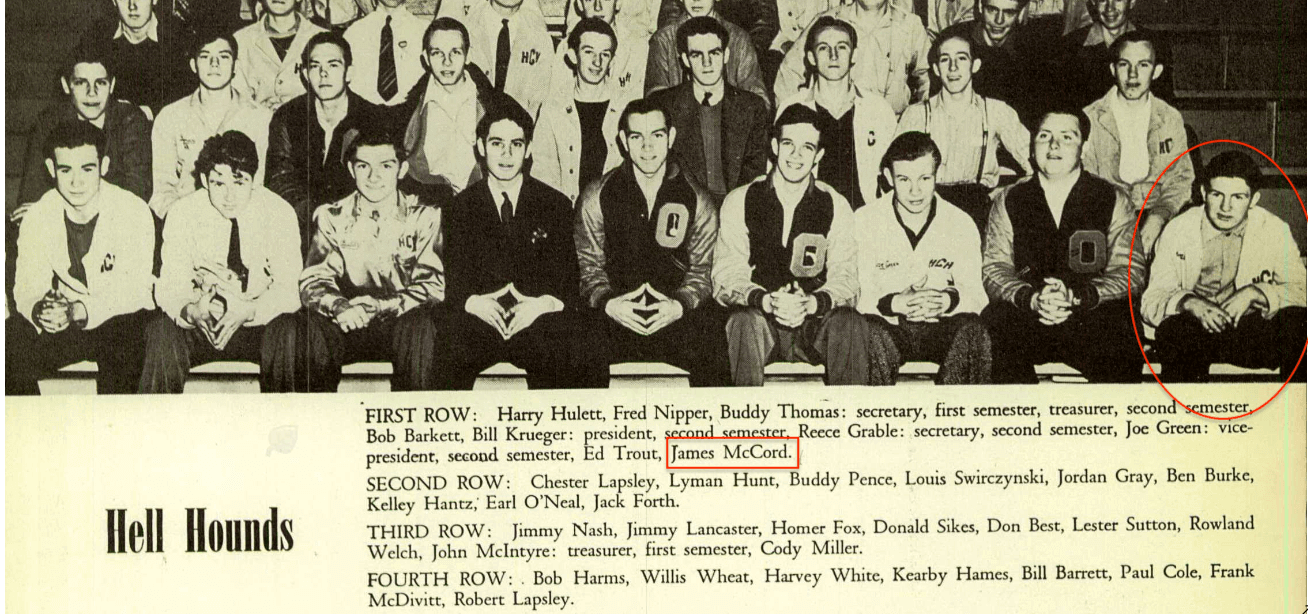
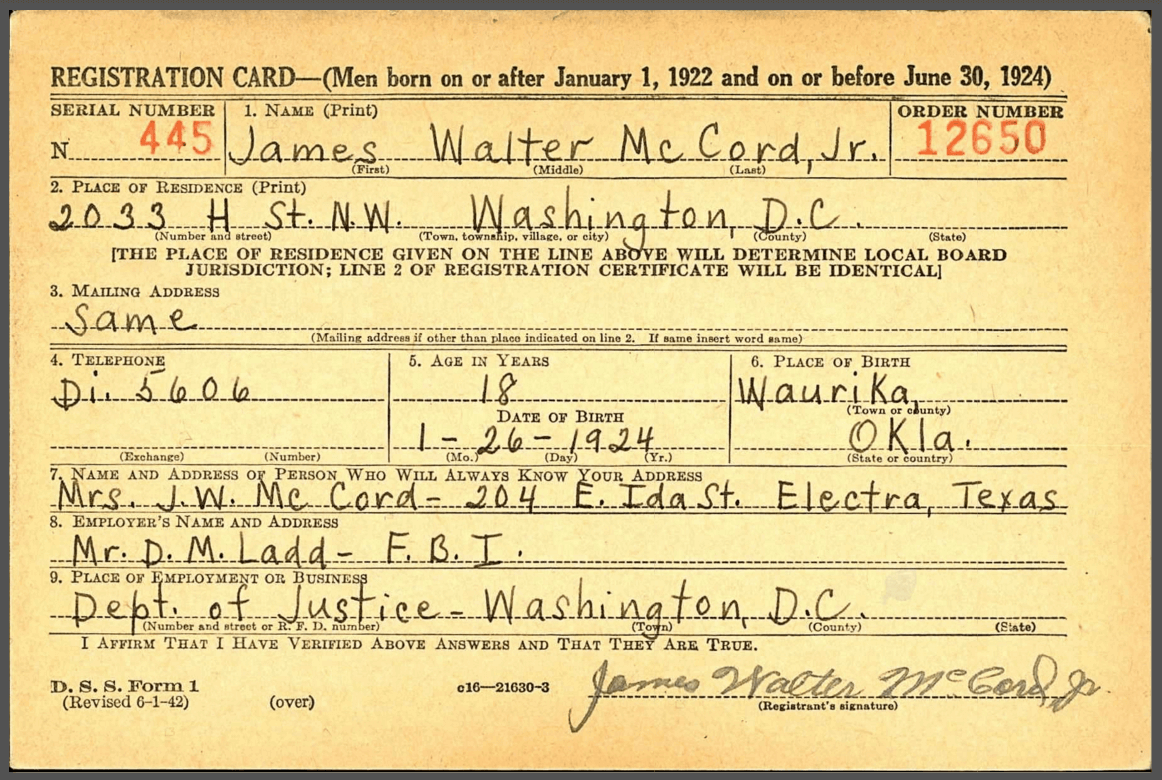
    Owing to Couteau’s work, we know that McCord’s family originated in Scotland. His great-grandfather served in the Tennessee militia during the War of 1812. McCord’s grandfather, James Allen McCord, was from Alabama and served in the Confederate army. Both his mother and father hailed from Texas. His father was a public school teacher. Although some entries place his date of birth in June, McCord was born in Waurika, Oklahoma on January 26, 1924. He attended public schools there. In 1943 he enlisted in the Army Air Corps in Miami, Florida. When that split off from the army to create the Air Force, he eventually attained Lt. Colonel status in the U. S. Air Force Reserve. After World War II, he attended Baylor before graduating from the University of Texas at Austin in 1949. He began his professional career by working briefly for the FBI. He was then employed for nineteen years by the CIA. He allegedly retired and went to work for the Committee to Reelect the President, commonly knows as CREEP, in late 1971. The man who hired him to work on the Richard Nixon campaign was Jack Caufield.

    Ambrose McCord, 
    James’s great-grandfather,
    served in the Tennessee militia
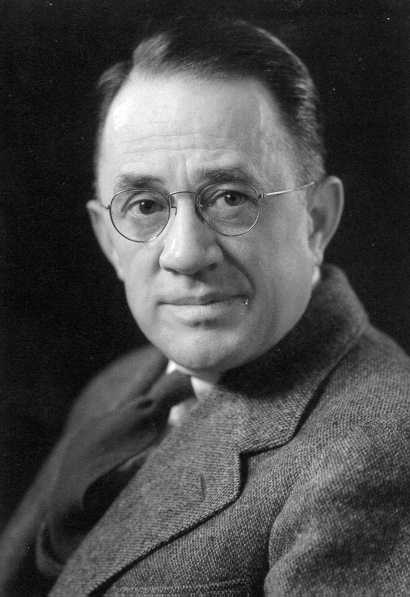
    McCord’s mother

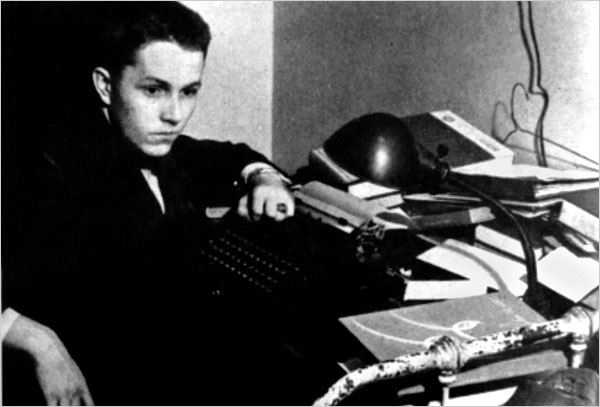
    McCord’ high-school yearbook

    McCord’s selective service card

    McCord’s wife Sarah’s tombstone

    Caufield was a former New York City police detective. He was invited by John Ehrlichman to set up a private security agency to provide intelligence on Nixon’s political opponents. It was Caufield who first suggested forming Operation Sandwedge: illegal electronic surveillance of Nixon’s political opponents focusing on their sex lives, drinking habits, tax records and marital problems. (The Telegraph, July 11, 2012) Later on, when the so-called Plumbers Unit was formed, McCord migrated there and joined Howard Hunt for their break-ins of the Democratic National Committee. It was called the Plumbers Unit because it was partly designed to plug leaks, like the Pentagon Papers. In fact, one of the first missions the unit executed was a raid on the Los Angeles office of Daniel Ellsberg’s psychiatrist. Ellsberg had leaked the Pentagon Papers to the NY Times and Washington Post. The objective was to dig up dirt on him and smear his character in the press.

    To say that McCord was a secretive and odd person understates both his character and career. He was one of the several personages who were involved in both the John F. Kennedy assassination and the Watergate caper: two seismic shocks to the system that occurred within a decade of each other. They were both so colossal in their impact that complex and multi level cover-ups ensued afterwards to conceal their true natures. In the JFK case, it took about three years to fully expose the official Warren Report as a cover-up.

    With Watergate, where McCord’s role was much more front-and-center, it took quite a bit longer. Most analysts of that expansive and complicated phenomenon would date the beginning of its true elucidation to 1984, ten years after Richard Nixon resigned the presidency. That was the year Jim Hougan published Secret Agenda, his watershed book on Watergate. Secret Agenda is now recognized as a classic in the field. Some would go even further and deem it as one of the finest pieces of investigative political reporting in the last 40 years. No objective observer can read the book without feeling the official story handed to them on Watergate was, to say the least, both faulty and incomplete.

    What was that official story composed of? It was a combination of two factors. First, the coverage by Bob Woodward and Carl Bernstein in the WashingtonPost. This was largely supervised by editor Ben Bradlee. It was made world famous by Robert Redford in his film of their bestselling book, All the President’s Men. The second element of this official story was then adduced by the Senate Watergate Committee. In the summer of 1973 that committee’s hearings were probably viewed proportionately by as many spectators as the 1954 Army/McCarthy hearings. Led by Senator Sam Ervin, the committee pretty much followed the story that had been laid out by the Washington Post. It was this unrelenting and massive media glare that paved the way for Nixon’s resignation in August of 1974.

    One of the worst things about Watergate was that the praise and fame heaped upon Ervin, Bradlee, Woodward and Bernstein left the impression that the system had worked. Through the political and journalistic process a grievous crime had been self-corrected. We all felt good. The system had purified itself.

    A few years later, Jim Hougan walked into the FBI research library and made a request. When his documents were delivered he quickly realized that someone had made a mistake. He was getting papers that were still classified. Realizing the error would be discovered, he immediately began copying hundreds of pages from the original FBI Watergate investigation, documents that had not seen the light of day. Stuffing them into his briefcase before they were recalled, he managed to take them home. They confirmed his suspicions about what had really happened.

    Hougan opens his book with an unforgettable chapter entitled “Of Hunt and McCord”. (pp. 3-26) It is clear from these pages that Hunt and McCord lied before the Ervin Committee when they said they did not know each other prior to going to work for the Plumbers. Hougan also pointed out that when Howard Hunt retired from the CIA in 1970, that was the third time he had done so. (Hougan, p. 6) At the recommendation of Director Richard Helms, he then went to work for a CIA associated PR group called the Mullen Company. That company would then be sold by Mr. Mullen to another CIA asset, Robert Bennett. Bennett and Hunt then badgered Nixon’s hatchet man at the White House, Charles Colson, into giving Hunt a job. (Hougan, p. 33) From there, Hunt went on to perform a series of alleged intelligence assignments that were so poorly conceived and badly executed that one has to wonder if they were just Keystone Kops hijinks or something worse. Yet even though Hunt was now supposedly retired and working for the White House, the CIA continued to technically support his efforts. In fact, the Agency reviewed and extended Hunt’s Top Secret security clearance prior to his retirement. (Hougan, p. 7) His security clearance was now the same one Clay Shaw had in New Orleans. (William Davy, Let Justice be Done, p. 196)

    Four months after Hunt joined the Mullen Company, James McCord decided to retire from the Agency after 19 years of service. Although he was later billed as a technician, he worked out of the Office of Security’s secretive Security Research Staff program (SRS). (Hougan, p. 9) As John Newman later discovered, it was here where McCord teamed up with David Phillips to supervise the Agency’s anti-Fair Play for Cuba Committee campaign, of which Lee Harvey Oswald had all the earmarks of being a component. (James DiEugenio, Destiny Betrayed, Second Edition, p. 158)

    Hunt reportedly worked with McCord on Manuel Artime’s “Second Naval Guerilla” operation out of Nicaragua and Costa Rica. This was attested to by Cuban exile Harry Williams to author William Turner. (Hougan, p. 10) But Hougan dug up evidence that the pair worked together even earlier than that, back in the fifties on the Asian mainland. (p. 19) He then showed that the two men had also worked together in a domestic surveillance operation in 1969. We should add one other point. When McCord arrived at CREEP, he did not have a picture of Nixon in his office. He had a photo of Richard Helms on the wall. It was inscribed, “To Jim, With deep appreciation”. The emphasis was in the original. (Hougan, p. 22. We will reveal later a possible reason for that “deep appreciation.”)

    So just from the little noted above, the questions come rapid-fire. Why did Hunt and McCord lie about not knowing each other prior to 1972? Why did the Agency let the lie stand? Were Hunt and McCord really retired when they eventually joined, respectively, the White House and CREEP? Why was Robert Bennett so eager to get Hunt into the White House? Why was McCord working for Nixon while his allegiance appears to be to Helms? But beyond that, why did it take ten years for anyone to ask these questions?

    It is not completely accurate to write that no one investigated this aspect of the caper until Jim Hougan. There actually were two inquiries that attempted to explore the role of the CIA in Watergate. The first was the minority report of the Ervin Committee. The Republicans, led by Tennessee’s Senator Howard Baker and Minority Counsel Fred Thompson, did try to inquire into things like the role of the Mullen Company and the true goal of the burglary at the Watergate complex. Thompson and Baker theorized that the burglars’ real goal was not political intelligence for the 1972 election. It may have been surveillance of Democratic Chairman Lawrence O’Brien’s representation of Howard Hughes. Nixon’s association with Hughes, and his past attempts to bribe the president, were fairly well known at the time. The White House may have feared that O’Brien had more evidence of the same. In fact, John Meier, who worked for Hughes, told Nixon’s brother Donald that he was thinking of turning over everything that he had on Hughes. This included his knowledge of a million dollar secret donation from Hughes to Nixon. According to Age of Secrets, Don then informed his brother of this. (Probe Vol. 3 No. 2, pp. 9, 11, 15)

    Besides Baker and Thompson, the other committee that explored the CIA angle was the House Committee on Intelligence. This was led by Representative Lucien Nedzi, until he controversially resigned his chairmanship. (“House Supports Nedzi”, Washington Post, June 17, 1975) This committee did produce a report that Hougan sourced several times in his book.

    But the fact was that very, very few people knew anything about these two investigations. This overall ignorance continued even when Fred Thompson published his 1975 book based on the Baker inquiry entitled, At That Point in Time. The fact that this book was all but ignored bears witness to the enormous torque created by the Washington Post, the Woodward/Bernstein best seller, and the Academy-Award-winning hit film. A veritable whirlpool was constructed, one which carried the entire MSM along with it.

    As Jim Hougan later told me, he just never thought very much of Woodward’s reporting skills. One of the most revealing sections of Secret Agenda is in Appendix V. There the author publishes documents describing Robert Bennett’s communications with his CIA case officer. It is revealed that Bennett was actively spinning reporters like Sandy Smith and Woodward away from the Agency’s association with the Mullen Company, and selling them on the angle that his newly purchased PR company was actually “clean”. For this “information”, Woodward had agreed that these stories would not be attributed to Bennett. Bennett also had access to Senator Ervin and he had been assured that the senator would conceal the Mullen Company’s overseas role in placing agents for the CIA. (Hougan, pp. 332-335)

    To put it mildly, that memorandum raised issues about Woodward’s independence and honesty. Hougan then raised questions about the Post’s major secret source. This was the man Woodward labeled “Deep Throat” in his book. Hougan specifically raised questions about the signaling system the duo would use when Deep Throat would request a nightly meeting in a parking garage. (Hougan, pp. 291-93) Hougan and others have also explored Woodward’s military background and his high-level security clearances as part of the national security state. This has led some to believe that one reason the reporter was so keen to assault Nixon was that, unlike Bernstein, Woodward was politically to the right of the president.

    Because of this enormous propaganda apparatus, both the public and press were diverted from an alternative view of James W. McCord. Far from being a mere put-upon technician, McCord may have been a central operator. Consider just two major instances in the two-year Watergate episode. After the discovery of the break-in, the case had reached an impasse at the trial of the burglars. If they all kept silent, the conspiracy would likely be limited to them only—it would not reach into the White House. But in March of 1973, McCord radically raised the stakes. He wrote a letter to Judge John Sirica stating that perjury had been committed in his courtroom and pressure had been brought to bear for the seven burglars to remain quiet. When Sirica read McCord’s letter in court, it created pandemonium. It seemed to affirm all the stories that Woodward and Bernstein had been writing, and Bradlee publishing, in the Post.

    But, in retrospect, the question should have been: If not for James McCord, would there have been a trial at all? As most analysts of the June 17, 1972 final break-in have noted, there was something odd about the way the burglars were caught. McCord had taped the locks on numerous doors to keep them open during the break-in. The security guard, Frank Wills, had found these doors and removed the tape. (Hougan, p. 196) When the burglars entered the building at about 1:10 AM, they found a previously taped door that was now stripped. McCord then conferred with higher-ups Hunt and Liddy. According to everyone but McCord, it was he who insisted on not aborting the mission. (Hougan, pp. 197-98) The door was retaped. But after McCord entered the building, he told his low-level cohorts that he himself had removed the tape on the doors. This was not true. (Probe, Vol. 3 No. 2, p. 14)

    But that is not all that McCord had done. On the previous break-in—there were four attempts in all—it appears that McCord also switched the informational photos that had been taken inside the DNC, which were supposed to be of papers inside O’Brien’s desk, to a set of innocuous ones taken inside a Howard Johnson’s hotel room. (Hougan, pp. 153, 157) He also placed a faulty bug inside O’Brien’s office. (pp 162, 166) This from a man who when he was arraigned said—truthfully—that he had been a security consultant for the CIA. These alleged faux pas made another break-in necessary.

    Wills discovered the new tape on the same door. It was almost impossible to miss it since McCord taped as many as eight doors that night—he even taped doors on floors that would never be used, like a floor above the DNC. (Hougan, p. 207) At 1:47 AM, Frank Wills called the Washington Police Department. Just a few minutes later, the police arrived at the scene. Reinforcements soon arrived. McCord, along with four Cubans recruited by Hunt, were arrested. They were Virgilio Gonzalez, Bernard Barker, Eugenio Martinez and Frank Sturgis. Things then got worse. Surprisingly, Barker and the others had been allowed to keep their hotel keys with them. And further, neither McCord nor Hunt had sterilized the hotel rooms. Therefore, when the police entered the rooms, they discovered a treasure trove of evidence. This included their notebooks with Hunt’s name and phone number, which included the abbreviation W. House next to it. (Probe Vol. 3 No. 2, pp. 14-15) Hunt was traced to the White House. Liddy was linked to CREEP.

    But the circus even went beyond that. Hunt had paid off the burglars in sequentially numbered hundred dollar bills. The money trail would lead from Miami, to Mexico City and back to CREEP. (Probe 3.2: 14-15) And that would lead to the chairman of that body, former Attorney General John Mitchell. The notebooks with Hunt’s name and phone in them would lead to Charles Colson who ran the Plumbers Unit at the White House.

    Once apprehended—as was the case with Bennett—McCord did all he could to keep the spotlight off the CIA and on the White House. His first lawyer, Gerald Alch, had proposed an Agency cover defense. (O’Sullivan, p. 268) He was later jettisoned and replaced by Bud Fensterwald. Fensterwald wasted little time in announcing, “We’re going after the president.” (Hougan, p. 307)

    When Alch first suggested his CIA defense, McCord began to write Paul Gaynor, chief of the SRS division at CIA. He advised Gaynor to pre-empt this attempt with multiple and effective leaks to the press before the CIA defense could gain traction. Meanwhile, he would keep Gaynor informed of the legal tactics planned by the defendants. (O’Sullivan, pp. 269-70) A few days later, McCord wrote Jack Caufield at the White House. McCord stated that if Watergate was dumped off on the CIA and Richard Helms was fired,

    … every tree in the forest will fall. It will be a scorched desert. The whole matter is at the precipice right now. Just pass the message that if they want it to blow, they are on exactly the right course. (Letter of December 28, 1972)

    In spite of this warning, Helms was terminated about a month later on February 2, 1973. Around six weeks after, Caufield met with McCord. He offered him money, a job and executive clemency if he would plead guilty and remain silent. Caufield said this offer came from the highest levels of the White House. (NY Times, June 23, 2012, article by Douglas Martin.) McCord refused the deal. His allegiance was to Helms and the CIA. Shortly after, he wrote the letter to Sirica about pressure being brought to bear and perjury in his courtroom. For all intents and purposes, that is what blew the case wide open.

    Because, as McCord had warned, the Nixon White house could easily be turned into a scorched desert. And it was. Through a steady stream of disclosures by people like McCord and White House counsel John Dean, the seamy underside of the Nixon White House was placed on public display. As McCord warned, it was not a pretty sight. The secret bombing of Cambodia, the August 1971 break in at Daniel Ellsberg’s psychiatrist’s office, Nixon’s attempt to form a super intelligence group to counter student protests (commonly called the Huston Plan), the proposed fire-bombing of the Brookings Institute, etc. And, in this author’s opinion, the worst went undiscovered, because this last caper, the fire bombing of the Brookings Institute, was first thought to be part of Nixon’s war against the leaking of the Pentagon Papers. As the late journalist Robert Parry discovered, such was not the case. That proposal was really designed to find out if the evidence of Nixon sabotaging President Johnson’s Vietnam peace plan was located at Brookings. Candidate Nixon had arranged for Saigon not to cooperate with President Lyndon Johnson in his attempt to arrange a truce in Indochina before he left office. This tilted the election to Nixon and extended the war. Once in office, Nixon was worried that this evidence, like the Pentagon Papers, could be leaked to the press.

    By the summer of 1973, Nixon seemed to realize what had really happened. He called up H. R. Haldeman at four in the morning, and asked him some pointed questions:

    • “Do you know anything about the Bennett PR firm, the Mullen Company?”
    • “Did you ever employ them at the White House? Were they ever retained by us for any purpose?”
    • “Did you know they were a CIA front?”
    • “Did you know that Helms ordered Bennett to hire Howard Hunt?”
    • “Did you know that Hunt was on the payroll at the Bennett firm at the same time that he was on the White House payroll?” (Probe, Vol. 3 No. 2, p. 32)

    It was too late.

    Because of his willingness to cooperate with the court and the Ervin Committee, McCord served by far the briefest prison time of the seven men directly involved with the break in: four months. Hunt served almost ten times that long. Gordon Liddy was in prison for almost five years before being pardoned by President Carter.

    Forty-five years later, the conventional view of Watergate still largely reigns in the MSM. This is partly due to Woodward’s occasional attempts to prop up that version. For instance, when FBI officer Mark Felt was close to dying, Woodward wrote a book saying that Felt was Deep Throat. In 2017, Mr. Hollywood Mythology, Tom Hanks, then had a hand in making a truly mediocre film based on an even more mediocre book about Felt.

    But, in 2009, Ed Gray, son of L. Patrick Gray, had published an interesting book about Watergate titled In Nixon’s Web. Patrick Gray had been appointed interim director of the FBI after J. Edgar Hoover died. He supervised the initial FBI inquiry into Watergate until he resigned. He passed away before he could finish the book. It was then completed by his son. In the epilogue to that volume, Ed Gray demonstrates that Deep Throat was a composite character. And he does it with Woodward’s own notes. He also proves that Mark Felt was leaking stories to the press that sunk Gray’s nomination. The reason was Felt’s own personal ambition: he wanted the Director’s position. Again, because of the MSM censorship on Watergate, very few people know these important facts.

    The idea promulgated by Hougan, that Watergate was really a trap set for Nixon, was also a part of John Meier’s book Age of Secrets. (Co-authored by Gerald Bellett) As Bellett wrote in the introduction to the Meier book:

    Watergate was a set-up, a classic ploy as old as espionage itself. In its favor it had simplicity of execution, an irresistible bait and a spy on the inside. It was flawless. So completely were the anti-Nixon conspirators in control, that they knew an intrusion into the Democratic Party’s national headquarters was being plotted, yet did nothing to prevent it. (Bellett, p. viii)

    That last sentence refers to the fact that Lawrence O’Brien was actually tipped off in advance that the Democratic National Committee was under surveillance. He was warned of this by a prominent Democrat and newspaper publisher by the name of William Haddad. (Hougan, p. 79) Haddad was apprised of this from a private investigator named A. J. Woolston Smith. Smith apparently gained the information from an agency called the November Group. This was a set of advertising executives working on Nixon’s campaign. Liddy was the agency’s incorporator and secretary. McCord was in charge of the November Group’s security. Haddad actually told a DNC representative in advance that they would be bugged and burglarized. And that McCord and Liddy were somehow involved in the effort. Further, that other operators would be recruited from Little Havana in Miami. (p. 79)

    One of the chief investigators for the FBI on the Watergate case was Angelo Lano. O’Sullivan quotes Lano from a previous interview where he stated that he always thought the caper was a set-up. He noted that the neat arrangement of the evidence the burglars left behind at the hotel felt planted—”everything was arranged like somebody knew it was gonna happen.” And Lano could not ignore the tape:

    You’ve got a guy who’s expert in key entry, burglary [Virgilio Gonzalez]. Why did they have to put the tape back on? You put the tape on one door; it wasn’t necessary to put it on six doors. There’s always been a question in my mind [about] the response of the police department—2:30 in the morning—the placement of the items in the hotel room, the tape. To this day I still think that one of those guys tipped off the police department and it was either Hunt or McCord. (O’Sullivan, pp. 404-5)

    In 2012, Max Holland published a book about Watergate called Leak. It largely focused on the FBI inquiry. Predictably, he could not find enough space to include Lano’s insightful quote.

    As more than one person said later, James McCord was not just a technician. He was an operator. But it’s something he tried to conceal. For instance, after he moved to Pennsylvania, a reader of this site got in contact with him. He asked him about his service with David Phillips and their campaign against the FPCC. McCord said he was not a part of that; it was the FBI’s function. Since the ARRB had released those documents, I said he should question him again with the papers in hand.

    But beyond that, when Lisa Pease and I were publishing Probe magazine in the nineties, we met up with former CIA pilot Carl McNabb. He said that prior to the Bay of Pigs, he had been briefed at the Miami CIA station, since he was part of the aerial facet. He noticed that McCord was in the room and he was struck by how taciturn he was. Afterward, he asked the briefer who he was. He told him his name. He then added that he was Helms’ Zap Man. McNabb later showed me the very old notes with this information recorded on it. I asked him what the term meant. He replied McCord was his liquidator.

    Which may tie in with a quite interesting piece of information in O’Sullivan’s book. Alfred Baldwin was a former FBI agent who was recruited by McCord for the Watergate operation. He was supposed to make a log of the surveillance coming out of the Democratic National Committee. O’Sullivan found out through James Rosen that McCord told Baldwin he was in Dallas on the day of the Kennedy assassination. (O’Sullivan, p. 405) If this is true, and I am not saying it is, then it makes a quite intriguing list of CIA associated personages in that city either on the day Kennedy was killed, or a few weeks prior:

    1. Allen Dulles (James Srodes, Allen Dulles: Master of Spies, pp. 554-66)
    2. William Harvey (David Talbot, The Devil’s Chessboard, p. 477)
    3. David Phillips (Dick Russell, The Man Who Knew too Much, 2003 edition, p. 272)
    4. Howard Hunt (Mark Lane, Plausible Denial, p. 152)
    5. James McCord (Shane O’Sullivan, Dirty Tricks, p. 405)
    6. Sergio Arcacha Smith (James DiEugenio, Destiny Betrayed, second edition, p. 329)
    7. Bernardo DeTorres (Gaeton Fonzi, The Last Investigation, p. 238)

    What makes the list rather striking, as I have arranged it, is that it goes from the top of the hierarchy, through the middle, down to the lower ranks, men who would act as foot-soldiers or mechanics. Does the above explain why the McCord family wished to keep the death of James McCord so quiet?

  • Life Magazine Warren Commission Issue, October 2, 1964

    Life Magazine Warren Commission Issue, October 2, 1964


    Findings of the Warren Commission

    “Like most of us who are interested in the Kennedy assassination, I was aware of the existence of different versions of the Life Magazine Special Warren Commission issue dated October 2, 1964. I had read that there were three versions of the issue. The explanation researchers have given for the different versions is that Life Magazine was trying to make the issue released to the public (the newsstand issue) support more clearly the lone assassin Warren Commission results.

    It turns out that I subsequently was able to confirm firsthand the existence of at least two different versions, by a bit of serendipity. I already possessed the newsstand version but wanted a copy in a better condition. I checked out the best issue on e-bay that was available and purchased it. When I received my newly acquired issue, I was surprised at this version’s Warren Commission results. They were indeed different from the newsstand issue that I previously owned. It appeared to be the first version of the three versions of this issue that Life produced.”

    The main purpose of this article is to demonstrate for the readers of Kennedys And King what those differences are. The three versions of this issue are as follows:

    • Version one [V1]: issue with different frame 6 of Zapruder film stills shown and different caption describing frame 6 shown (different from newsstsnd copy). This copy I possess.
    • Version two [V2]: issue with different frame 6 of Zapruder film stills shown (different from newsstand copy) and caption describing frame 6 the same as the newsstand copy. This is alleged since I do not own this version.
    • Version three [N]: newsstand issue. This one I possess.

    These were produced in the order shown above, with version three being the final result sent to subscribers and the newsstands.

    The following set of images are reproduced from the two versions I own. I have included here the cover of the October 2, 1964 issue, the first page of the Warren Commission article (p. 42), and the eight still frames of the Zapruder film shown directly after page 42. First, the final newsstand issue [N], with exhibits numbered one through seven:

     
    Exhibit 1: Newsstand Cover   Exhibit 2: Newsstand p. 42
     
    Exhibit 3: Newsstand Frames 1 & 2   Exhibit 4: Newsstand Frames 3 & 5
       
      Exhibit 5: Newsstand Frames 4 & 6  
     
    Exhibit 6: Newsstand Frame 7   Exhibit 7: Newsstand Frame 8

    Next, the copy of the earlier version [V1], with exhibits numbered eight through fourteen:

     
    Exhibit 8: Alternate Cover   Exhibit 9: Alternate p. 42
     
    Exhibit 10: Alternate Frames 1 & 2   Exhibit 11: Alternate Frames 3 & 5
       
      Exhibit 12: Alternate Frames 4 & 6  
     
    Exhibit 13: Alternate Frame 7   Exhibit 14: Alternate Frame 8

    The feature begins with a story by Gerald Ford on the workings of the Warren Commission. On this same page are also eight captions describing the corresponding eight still frames of the Zapruder film displayed on the next four pages.

    The difference between the two issues (I reserve comment on the putative second version [V2] since I have not seen it) centers on the frame 6 Zapruder film still and its corresponding caption. The earlier alternate version [V1] (produced before the final issue version was sent to the newsstands) shows JFK’s head and body up against the rear seat cushion, suggesting, when seen in sequence with the preceding frames, that he had moved backwards and to the left (see exhibit 12). This frame corresponds to Z-323. The caption for this frame on page 42 reads as follows: “The assassin’s shot struck the right rear portion of the president’s skull, causing a massive wound and snapping his head to one side” (see exhibit 9). The caption, however, seems to be telling you something different from what your own eyes tell you. Would you, from comparison with frame 5, exhibit 11, be led to conclude that JFK’s head was “snapping to one side” or backwards and leftwards?

    With the newsstand issue [N], this Zapruder frame has been swapped out in favor of Z-313, which shows the famous halo of red exploding on the right side of JFK’s head (see exhibit 5). The caption for this version now reads: “The direction from which shots came was established by this picture taken at instant bullet struck the rear of the president’s head, passing through, caused the front part of his skull to explode forward” [sic] (see exhibit 2).

    While arguments have been made that the preceding frame, Z-312, in sequence with this one, shows the head moving forward, that motion (which may not be due to a bullet strike) is so imperceptible as to be negligible to the normal viewer, much less one perusing a selected sequence of stills. In fact, judging from the motion of the head, there really is no unequivocal proof of a bullet strike from the rear in the film, much less so in the frame that was originally chosen to represent the fatal shot (Z-323). One can only conjecture here that this was recognized by redaction. The misleading description of what is depicted in Z-323 already raises the suspicion that the authors of the feature struggled to choose a frame for the fatal shot which would unamibiguously support the offical story. The further possibility that Z-323 might actually suggest just the opposite (motion backwards) must have eventually led them to opt for the more gruesome frame they were evidently avoiding, because the latter showed that some blood, brains and skull went forward, implying (for the non-expert, at least) a rear-to-front bullet trajectory.

    It is the substitution of this telltale frame and caption that suggests an effort to make the newsstand version of the Life issue better conform with the Warren Commission’s single assassin findings; the swap was ostensibly made both to be more visually consistent with them, and to mask from the public the motion of Kennedy’s head and body which could denote, even via a still sequence, a bullet fired from the right front.


    There is a rather bizarre déjà vu in this legerdemain by the editors of the October 2, 1964 Life issue: something very similar had already been done once before. On November 29, 1963, Life published an issue mainly dedicated to John F. Kennedy and the assassination. This was a regular issue in that it contained, along with the assassination reportage, the usual full-page ads, unrelated features, and so forth. Shortly thereafter, Life decided to excerpt and rerun the relevant material from the November 29th issue in a separate, ad hoc volume, the John F. Kennedy Memorial Edition, of about 80 pages in length (only about 20 pages less than the total number of pages in the regular issue). The date is not clearly given on the cover or credits page, but the issue appears to have been published December 14, 1963.

    As can be seen from the covers, these two versions are readily distinguishable.


    The special edition, while carrying over what was originally published on November 29 (including the insert on LBJ), has also greatly amplified the text and photos for its now multifeatured retrospective on Kennedy’s life, presidency, and assassination. But what is most noteworthy for our purposes is the difference between the two versions in their respective presentation of the Zapruder film. What was in the regular issue a black-and-white, fuller sequence of frames is swapped out for a more limited, in-color, and somewhat magnified sequence of frames. The captioning is also very different.

    The November 29, 1963 issue carries the caption for the entire sequence:

    SPLIT-SECOND SEQUENCE AS THE BULLETS STRUCK

    There is no explicit commentary on the direction of the shots in this issue, except for what has been underlined. Here is a partial reproduction of the frame sequence, which is spread out over four pages:


    The December 14th Memorial Edition, on the other hand, carries the caption for the entire sequence, now running across the first two pages of the four-page color spread:

    SPLIT-SECOND HORROR AS THE SNIPER’S BULLETS STRUCK

    One immediately notes the not-so-subtle variant, “horror”, and the addition of “the sniper’s” in the singular. The selected frames are now larger and fewer:


    One could, of course, argue that some of these changes were constrained by marketing choices. Color reproductions, something Life was famous for, would undoubtedly sell more copies. Given the relative expense of color vs. black-and-white, and the further magnification of some of the frames on the page, it might seem inevitable that parts of the previous frame sequence would be curtailed. On the other hand, the special edition contains a number of other color photos besides the full-page blow-up, also in the November 29th issue, of Jack and Jackie as they step off Air Force One at Love Field, which tends to undercut the idea that the change in the presentation of the Zapruder frames was guided by purely economic considerations. In any case, what was (quite conveniently) excised is telling: the frames following Z-323 depict JFK bouncing off the rear seat and Jackie scrambling out onto the hood, image sequences capable of raising questions in the reader about why JFK would move this way, and what Jackie actually might have been doing (other than crawling for help). The fuller sequence also hints at the embarrassing interval before Clint Hill reached the limo (we see in the special issue only three of those frames, two of which occupy the entire fourth of the four pages, not shown here). At the very least, providing answers to these questions would have embroiled the magazine in something more easily left to silence.

    But even if these frames were innocently removed as a result of some sort of design decision, one frame substitution cannot so be explained. Indeed, we may ask ourselves, how is the fatal shot indicated in the black-and-white sequence in the original issue? The captioning is vague, but given the absence of both Z-312 and Z-313, and the fact that it is one of the larger frames, the only candidate for this is Z-323 (marked in red in the reproduction above). But where is this frame in the Memorial Edition? It has once again been removed, with Z-312 (also in red, above) now being used to “demonstrate” the bullet strike to the rear of the head (Z-313 was probably considered just too shocking for public consumption at that time). Granting Life the benefit of the doubt and attributing this change to “clarifications” afforded by the passage of two weeks between the two editions, it is still remarkable that no frame from the fatal wounding sequence after Z-312—much less Z-323—is printed in the special edition.

    Aside from this sleight of hand with frame selection and elimination, the Memorial Edition also exchanges the original text for significantly modified copy, which names Oswald and clearly places him in the TSBD, firing three shots with a carbine, and in general adds details that follow the official story more explicitly. In this regard, one is tempted to reflect further on the main caption it has borrowed from the original issue, not only because it now declares the shots to be from a single gunman, but because the switch to “horror” there almost seems too glib. At first blush the new diction might suggest an effort to render more vividly the shared experience of Dealey Plaza witnesses, to invest the description with evaluative, rather than simply objective, content (and direct that judgment squarely at the sole perpetrator). But the word also serves as a trace, a verbal stand-in for what has been visually erased, naming the very emotion that is simultaneously denied the reader through a fuller graphic re-experiencing of the event. If this rhetorical ploy is not cynical in origin, its final effect is nonetheless ironic.

    That such editorial “rethinking” occurred twice at a distance of ten months, both times involving, among other things, the suppression of the same Zapruder frame (Z-323), is astonishing and, from the standpoint of what was going on internally at Time-Life, puzzling. But in connection with this peculiar repeat performance, let us not forget what Life reporter Paul Mandel wrote in the December 6, 1963 issue in another article on the assassination, “End to Nagging Rumors: The Six Critical Seconds”. Mandel realized that Kennedy’s treating doctor, Malcolm Perry of Parkland Hospital, had said the bullet hole in his throat was an entry. Since the moment of that impact was considerably past the time Kennedy’s limousine could have been in front of the Depository building, and in fact, Kennedy’s back was now facing the alleged sniper, Life and Mandel had a serious problem with directionality. They solved it by blatantly misrepresenting what is in the Zapruder film:

    Since by this time the limousine was 50 yards past Oswald and the President’s back was turned almost directly to the sniper, it has been hard to understand how the bullet could enter the front of his throat. Hence the recurring guess that there was a second sniper somewhere else. But the 8mm film shows the President turning his body far around to the right as he waves to someone in the crowd. His throat is exposed—toward to the sniper’s nest—just before he clutches it.

    As Life must have known, since they had the film, no such movement exists. On December 14, Life is still sticking to this story, as can be seen by the caption to frames 1 & 2 above:

    Past the book warehouse the President turned to his right to wave to someone (1). Just as his car passed behind the road sign shown in the foreground the first bullet struck him in the neck. He clutched at his throat (2).

    Though less clearly articulated here, one has only to read further in the issue to find Mandel’s article reprinted under a slightly different title (“First Answers to Nagging Rumors: What Lay Behind Six Crucial Seconds”), but with essentially the same text containing the crucial gloss quoted above. The only way to sustain this ruse was to omit the intermittent frames which would have given the lie to this explanation. The frame with Kennedy waving has purposely been made the focus here; interestingly, it was missing from the black-and-white sequence in the November 29th issue, which shows only three of the frames before the limousine emerges from behind the Stemmons Freeway sign. In just four more days, however, this entire charade will no longer be necessary: on December 18th, the NYT and Washington Post will relate “autopsy findings” which appear to derive either from the FBI or possibly some earlier, destroyed version of the autopsy report, where the wound in the back/shoulder does not exit and the puncture in the throat is from an exiting fragment from the head shot; see this article by Jefferson Morley from 2012.

    Together with the Mandel story, the frame sequence evidence we have presented above establishes that at least three times in less than a year Life colluded in deceiving the American public about the circumstances of President Kennedy’s assassination.

  • Jim Garrison vs. Fred Litwin: The Beat Goes On (part 2)

    Jim Garrison vs. Fred Litwin: The Beat Goes On (part 2)


    In the field of JFK assassination studies, those who advocate for the Warren Commission have always had a special and personal problem with Jim Garrison. After all, the New Orleans DA was an elected official who did not just challenge the Warren Commission; he actually put together an alternative theory of Kennedy’s assassination. That theory created intense interest and attracted a public following.

    This created a serious problem for the MSM. The press had embraced the Warren Report, all 800 pages of it. Now came an accomplished District Attorney who was saying that their much-ballyhooed report on the death of President Kennedy was rubbish. By doing that, Garrison was not just upsetting the MSM’s apple cart, but also the FBI, the Secret Service and the White House. After all, they had all cooperated and worked for several months on this much anticipated report. Could they all have been so easily taken in by the Dallas Police? Or was there something else at work? Perhaps a deliberate cover-up? If so, why? What could be behind such an evil act and its elaborate concealment?

    By raising these questions, Garrison was upsetting the establishment. Therefore, he was harshly attacked by all elements of the power structure. Almost no one in the media—except the LA Free Press, Ramparts and Playboy magazines—gave him a fair hearing. Every major newspaper, magazine, and TV network discounted or attacked him—none treated him fairly or even handedly. Elements of the government illegally spied on him, sent infiltrators into his camp, wired his office, tapped his phone, and launched subversive operations against his investigative efforts. (See William Davy, Let Justice be Done, Chapter 12) When Garrison complained about these actions, the MSM ignored him. Today, after the disclosures of the Assassination Records Review Board, they cannot be ignored. For the simple matter that the acts of subversion can now be proven with declassified documents.

    There is another important element to the cacophony enveloping New Orleans that has also been revealed. That is the incessant efforts of Clay Shaw’s attorneys to enlist as much help as possible from Washington DC. (James DiEugenio, Destiny Betrayed, second edition, pp. 261-78) What makes this secret solicitation so curious is that, for two solid years, the media portrait of Shaw was that he was as clean as the driven snow. If such were the case, then why were Shaw’s lawyers so desperate for help from the CIA and the FBI? And why did the Agency and Bureau give it to them? Was there something that those two executive intelligence agencies knew that they weren’t telling the public? If so, what was it?

    Through the ARRB, we have now discovered that there was a lot to hide about Clay Shaw. And neither the FBI nor the CIA had planned on letting the public know about it. If not for the ruckus created by Oliver Stone’s 1991 film JFK, no one may have ever discovered any of it.

    Now comes one Fred Litwin. Litwin has written two books. They have both publication and thematic similarities. The first was called Conservative Confidential. That book is about his coming out as a gay man and also traveling politically from left to right, eventually emerging as an activist conservative in the gay community in Ottawa, the capital of Canada. What I found interesting about the first book is that, although I had never heard of Litwin, evidently some powerful people had. The book was blurbed by the likes of Conrad Black, and Daniel Pipes. Black is a former international newspaper magnate who was convicted of fraud and obstruction of justice in America and banned from running a company or serving on any boards in Ontario. Pipes is a rightwing veteran of several think tanks who wrote a book labeling almost anyone who believes in political conspiracies as being inherently paranoid. In Chapter 1, Pipes specifically pointed to the African American community. Nice fan base. After making a lot of money in the computer field, Litwin is involved in lecture presentations, music, film festivals and publishing today. (For an example of the people he sponsors, go here)

    Litwin’s second book is called I Was a Teenage JFK Conspiracy Freak. Like his first, it was published through his own company, Northern Blues. From the title, one does not need much explication as to the similarity in theme. With the JFK case, as with his politics, Litwin has now seen the light. Like St. Paul on the way to Damascus, he had a vision. Except, unlike with Paul, his was not of a vision of a resurrected Christ appearing before him. It was Lee Harvey Oswald firing three shots in six seconds from the sixth floor of the Texas School Book Depository; scoring two of three direct hits to the head and shoulder area of JFK. A feat that, without cheating, no expert has ever been able to duplicate. One of those bullets went through Kennedy’s back, rising upward slightly, even though it was originally traveling downward. Without striking bone, it then went left to right, even though it was fired from right to left. It made a perforating exit from Kennedy’s neck, one that was smaller than its entrance—even though exits are supposed to be larger. It then went through Connally’s body and as it exited his chest it veered right towards his wrist, and then deflected left into his thigh. It emerged from his thigh and was found in the rim of a stretcher, except no one knows whose stretcher it was. (The Impossible One-Day Journey of CE 399; see also Was the CE 399 Magic Bullet Planted?)

    When it was found there was almost no deformation of the bullet, and no blood or tissue on it. After smashing two bones in Connally, it was missing only three grains of its mass. (WC Vol. III pp. 428-30) As Gary Aguilar and Josiah Thompson have shown, CE 399 was so specious as evidence that the FBI had to lie about its identification. (The Magic Bullet: Even More Magical Than We Knew?) As others have said, to believe all this, one must have had some kind of religious experience. Especially if one did not buy into it at first.

    But there is another oddity about Litwin. The present author has been in this field for going on three decades. I have read a rather large amount of material on the subject. This includes research journals from both America and abroad. I do not recall coming across Mr. Litwin’s name in any of them. Apparently, the man kept his beliefs about a JFK plot rather close to his vest.

    I am not going to deal with the entirety of Litwin’s book. Anyone who can propagate that the evidence for more than one gunman in the JFK case has weakened over time does not deserve extended scrutiny. Neither does anyone who is on friendly terms with the likes of Daniel Pipes. But there is a chapter of Litwin’s book available online. It happens to be his chapter on Jim Garrison. Since that is 16 downloadable pages, it should serve as an example of the quality of his work.

    As I have previously said in dealing with the anti-Garrison crowd, if there was one area that the Assassination Records Review Board did a decent job on, it was in declassifying a lot of interesting documents on the New Orleans aspect of the Kennedy case. In two previous review essays on the subject, I have been critical of the fact that none of these documents were anywhere to be seen in the work under discussion. Specifically, this would include the essay by Don Carpenter at Max Holland’s site (Max Holland and Donald Carpenter vs Jim Garrison and the ARRB), and Alecia Long’s essay at 64 Parishes (Jim Garrison: The Beat Goes On).

    Litwin continues to manifest that revealing trait. In the 16 pages, I could find no evidence that he used even one single piece of declassified documentation. When an author does this, it immediately tells the reader much more about him than the writer’s ostensible subject. That is, Mr. Litwin does not give one iota about the declassified record. He is not interested in what the new information is. He does not want to know what the CIA and FBI knew about Clay Shaw back in the sixties, or why it was deemed so taboo that the public had to be kept in the dark about it.

    Which leaves us with two alternative theorems. Either Litwin does not know about this new information; or he does know about it but does not want the reader to be aware of it. Both explanations are pretty unappetizing. But they tell us much about Litwin and his book.

    By the third paragraph, the author exposes the serious fault lines in his work. He writes that Jim Garrison cracked down on vice in the French Quarter by raiding gay bars. How anyone can write something like that is incomprehensible. Once Garrison became famous through the exposure of his JFK inquiry, many people wrote about this 1962 crusade. Almost ten years ago, there was a book written on the subject by author James Savage. What Garrison was cracking down on was a racket called ‘B girl drinking’. The B-girl would sit with a male customer and, as long as he paid for the liquor, she would entice him with hints of sex to be had. (Washington Post, 2/10/63) The girl’s drinks would be very watered down, and as the mark got inebriated, the host would then shortchange him. Afterwards, the poor guy was taken to a cab to get to his hotel; the house got 2/3 of the take, the girl got 1/3.

    I would like to ask Mr. Litwin the obvious question he is seemingly unaware of: If the racket involved a female employee with a male customer, how could these be gay bars?

    What Litwin does next is as bad as the above. He does all he can to denigrate the value of the information that Jack Martin relayed to Garrison’s office within 48 hours after the assassination. For instance, he does not fully explicate why Guy Banister exploded and pistol-whipped his former investigator/employee Mr. Martin. Martin had made some rather incriminating comments, like implicating Banister in the Kennedy assassination. Martin specifically said: “What are you going to do—kill me like you all did Kennedy?” Martin later said that if Banister’s secretary had not intervened, he thought Banister might have killed him. (HSCA Volume 10, p. 130) After the assault, Banister threw some money at his victim. On his way to the hospital, Martin told an acquaintance: “The dirty Nazi bastards did it to him in Texas, and to me here.” (Affidavit of Martin and David Lewis to Jim Garrison 2/30/68)

    Since Martin was describing events on the day of the assassination, who does Litwin think Martin was referring to when he said, “Did it to him in Texas?” In light of the Martin’s previous comment, it was probably President Kennedy.

    What was the specific reason for Banister’s assault? Again, Litwin does not fully reveal that aspect. As Garrison’s staff later discovered, the FBI in New Orleans—namely agent Regis Kennedy—later thought that Martin might have pilfered Banister’s files on Oswald. (Garrison memorandum from Andrew Sciambra, 10/28/68) In fact, a part-time employee at Banister’s office, Mary Brengel, told the House Select Committee on Assassinations (HSCA) that she felt that both Banister and his secretary Delphine Roberts knew what was going to happen in Texas that day. (HSCA interview of 4/6/78)

    It was Roberts who rescued Martin. Banister then swore her to secrecy and kept her out of the office after the bloody incident with Martin. (Anthony Summers, Conspiracy, p. 294) So when Garrison interviewed her, she was tight-lipped. Later she did reveal things to the HSCA, specifically to investigator Bob Buras. On his second attempt to get her to talk to him, Roberts told Buras that Oswald was at Banister’s office and had a few private meetings with him. He was allowed to use a second floor room to print up his anti-Castro materials. (HSCA interview of 7/6/78) Reporter Scott Malone later found a corroborating witness for this information. Brengel told him that Roberts said Oswald had been at 544 Camp Street, Banister’s office, that summer. (James DiEugenio, Destiny Betrayed, second edition, p. 111) When this author interviewed another Banister employee, Dan Campbell, he also revealed that Oswald had been in Banister’s office that summer. In a separate interview with this writer, so did his brother Allen. (Destiny Betrayed, p. 112)

    In other words, it makes perfect sense for Banister to have had a file on Oswald and for Martin to be interested in it on the day of the assassination. It also follows that, as Roberts told Buras, Banister was upset when he heard that Oswald had handed out flyers in New Orleans with Banister’s office address of 544 Camp Street on them. (HSCA Buras interview.)

    Litwin’s depiction of David Ferrie is about as limited and dubious as his work on Banister. Litwin writes that when the FBI and Secret Service questioned Ferrie, he denied knowing Oswald, or having anything to do with Kennedy’s assassination. Litwin leaves it at that. Which is rather uncurious of him. For as anyone who reads Ferrie’s FBI statement has to acknowledge, Ferrie lied his head off to the Bureau. And it is hard to buy the argument that they did not know he was lying. For instance, Ferrie said he never owned a rifle with a telescopic sight and would not know how to use one. This, from a man who was a trainer for both the Bay of Pigs invasion and Operation Mongoose. (HSCA interview of John Irion, 10/18/78; Davy pp. 28-31; CIA memo of October 1967, “Garrison Investigation: Belle Chasse Training Camp”)

    Ferrie also said that he did not know Oswald and Oswald was not a member of his Civil Air Patrol (CAP) unit in New Orleans. This was another lie that Litwin seems comfortable with. In this case, all the Bureau had to do was question some of the other members of that CAP unit to find out Ferrie was lying. Jerry Paradis, who later became a corporate attorney, told the HSCA that he knew Ferrie and Oswald were members of the same CAP unit because he was also a member and he saw them together at a meeting. (HSCA interview of 12/15/78) Anthony Atzenoffer said the same about Ferrie and Oswald at the CAP meetings. (HSCA interview of 1/2/79) As we all know, in 1993, PBS discovered a photo of Oswald and Ferrie at a CAP cookout and showed it on TV.

    But there is something even more incriminating about Ferrie which indicates that not only was he knowingly lying to the FBI but was also trying to scoop up evidence that would prove his perjury. For in the days immediately following the assassination, Ferrie was looking for that CAP picture of him with Oswald. He called a former CAP member, Roy McCoy, to find out if he had a copy. The FBI had to know Ferrie was doing this. Why? Because McCoy and his wife later called the Bureau and told them about Ferrie’s search for the photo of him with the alleged assassin of President Kennedy. In other words, the FBI was complicit in Ferrie’s cover-up. (New Orleans FBI report of 11/27/63)

    Somehow, Litwin did not think that any of this information about Banister, Ferrie and their ties to Oswald—or the attempts to conceal it—is worth conveying to the reader. Nor does he feel it necessary to note the FBI’s odd reaction to Ferrie’s perjury and attempts at obstruction of justice. This writer would beg to disagree with Mr. Litwin. And again, the fact that he does not reveal it says a lot about his intent as an author.

    Litwin trudges onward with Dean Andrews. Andrews was the New Orleans lawyer who said that a man named Clay Bertrand called him on Saturday, November 23, 1963, and asked him to go to Dallas to defend the alleged assassin of JFK, Lee Harvey Oswald. Again, it takes Litwin about two sentences to descend into travesty. First, he says that Andrews was in hospital and heavily sedated at the time he got this call—which is supposed to cast doubt on the credibility of the claim. Twenty-three years ago, the estimable William Davy checked on this point through the hospital records. Those records indicate that Andrews got the call at least four hours before he was sedated. (Davy, p. 52) Litwin then writes that the call was actually from a man named Eugene Davis. This is also wrong. The name of Eugene Davis did not enter the record until NBC produced its hatchet job on Jim Garrison in the summer of 1967. Davis subsequently denied this under oath. And Andrews was then convicted of perjury. (Davy, p. 302; Jim Garrison’s interview in Playboy,10/67)

    Today there is no doubt who Clay Bertrand was. And through the efforts of British researcher Martin Hay, we now know that Andrews admitted that Bertrand was Clay Shaw. The late Harold Weisberg did some work for Jim Garrison in New Orleans. He developed a friendly relationship with Andrews and talked to him on several occasions. In an unpublished manuscript, Weisberg wrote that Andrews admitted to him that Shaw was Bertrand. But the lawyer told him he was not to say anything about this without his permission. (See the unpublished book Mailer’s Tale, chapter 5, p. 11, at the Weisberg online archives at Hood College)

    Although Andrews’ word would have probative value in this instance, with the work of the Assassination Records Review Board there is simply no question today that Shaw was Bertrand. And, again, the FBI knew this. There are two declassified FBI reports from 1967 in which the Bureau is given information that such was the case. (FBI teletypes of February 24, and March 23, 1967) In a third FBI report of March 2nd 1967, Bureau officer Cartha DeLoach states that they had information about Shaw in relation to the Kennedy case in December of 1963! Somehow, Mr. Litwin did not find that interesting. Many people would disagree. They would also be upset to know that the public had to wait over 30 years to find out that the FBI agreed with Jim Garrison. In light of these revelations Litwin is unintentionally humorous when he writes that the FBI could not find out who Bertrand was. They did know who he was. They did not want to tell anyone because it would support Garrison.

    But Litwin is intent on trying to show that Garrison was somehow deluded by Andrews. So he trots out another discredited tale that is about fifty years old. He says that Andrews made up the name of Manuel Garcia Gonzalez and that Garrison ended up believing him. Again, this tells us more about Litwin than it does Andrews or Garrison. Andrews actually gave Garrison two names: Gonzalez and Ricardo Davis. Both of these were names of real people. (Larry Hancock, Someone Would have Talked, pp. 349-50) And if the reader wants to see just how interesting Gonzalez was, please read this. Dean Andrews was anything but ignorant or dishonest. This is why—as he told Garrison, Mark Lane and Anthony Summers—he was in fear for his life.

    Predictably, Litwin uses an old trick that reporter James Phelan and Shaw’s lawyers originated in the sixties to discredit Perry Russo. Russo told Garrison that he heard Ferrie and Shaw, at a gathering with a Leon Oswald, speak about killing Kennedy. Garrison had Russo undergo both truth serum and hypnosis. By mixing up Russo’s two interviews under sodium pentothal, Phelan made it appear that Dr. Esmond Fatter was leading the witness. But Garrison submitted the two transcripts to the HSCA, and he had them clearly marked and dated in his own files, which this author had access to. When read in their correct order, not backwards, there is no leading of the witness. Russo comes up with the name Bertrand and describes him as the big white-haired guy—which he was—on his own. (See Probe Magazine, Vol. 6, No. 5, p. 26) Again, this canard was exposed nearly twenty years ago.

    Like Donald Carpenter, Litwin is intent on not revealing the declassified record about Clay Shaw, even though the ARRB did interesting work in that area. It is clear now that, as declassified CIA documents reveal, Shaw was a valuable and well-compensated contract agent from the fifties. Joan Mellen prints the declassified document that proves this in her book about George DeMohrenschildt, Our Man in Haiti, on pp. 54-55. That book was published six years ago. Is there any reason for Litwin not to refer to it? That document also explains why Shaw committed perjury on the stand when asked about this issue. (Davy, p. 185) When you add in Shaw’s covert security clearance for the project QK ENCHANT and his probable clearance for ZR CLIFF, then it is obvious why the CIA considered him a valuable agent. It also helps explain why, as the ARRB discovered, the CIA destroyed Shaw’s 201 file. (ARRB Memo from Manuel E. Legaspi to Jerry Gunn, dated 11/14/1996) The internal lie about Shaw by the CIA—that he was only part of Domestic Contacts like 100,000 other businessmen—shows the lengths they felt they had to go to in order to construct a cover-up about their prized employee. Like the FBI, the last thing the Agency wanted to admit was that Jim Garrison was right about Clay Shaw—which he was.

    Litwin never acknowledges, let alone confronts, any of these documents. He tries to escape from Shaw’s CIA employment by using the excuse that Shaw’s service with the mysterious European entity called Permindex was a tall tale manufactured under Soviet influence and passed on to a leftist newspaper in Italy, the same excuse the likes of Max Holland uses.

    This is more malarkey. The State Department wrote up memos about Permindex at the time the organization was creating a large controversy in Switzerland. Due to the character and suspected criminal backgrounds of members of its board, the controversy got so disturbing it caused the entity to move to Rome. This information was declassified back in 1982 due to a Freedom of Information lawsuit by Bud Fensterwald. They extend from February 1957 to November of 1958 and Shaw is featured in these cables. Bill Davy and others have used these in their books about Garrison’s investigation of Shaw. Again, the FBI was aware of the CIA role in Permindex and how Shaw figured in it. (Davy, p. 100)

    Canadian researcher Maurice Phillips recently discovered even more interesting memos about Permindex in the Louis Bloomfield archive in Montreal. Shaw had been on the board of Permindex, and Bloomfield was a corporate counsel. It turns out that Permindex was likely operating not just as a CIA shell, but at a level above that. Phillips has discovered memoranda which show that Bloomfield was soliciting funds for the endeavor from some of the wealthiest people in the world, for instance, David Rockefeller and Edmond deRothschild. (Letter from Bloomfield to Dr. E. W. Imfeld of 2/10/60) Phillips also discovered a memo revealing that one of the founders of Permindex, Ferenc Nagy, was a CIA asset. Because of that status, he invited the Agency to use this new “business” entity in any capacity they wished. (CIA memo of March 24, 1967, released in 1998)

    Question for Mr. Litwin: did the Soviets manufacture those State Department cables back in the fifties? And somehow insert the Bloomfield correspondence into his personal papers? Once we dispose of this silliness, the obvious question all this leaves, and which Litwin wants to avoid is: What was Shaw doing in the middle of all this?

    The discoveries of Maurice Phillips were quite detrimental to the cover story about Shaw, Bloomfield and Permindex. So much so that, in violation of Bloomfield’s will, his heirs have now tried to stop any more information from being released from his papers. The totality of the declassified record reveals that the cover-up about Shaw was wide, deep, systematic and is ongoing a half century later. This is how fearful the Establishment was about Jim Garrison’s discoveries and where they would lead.

    And that is the fact that Litwin’s article is meant to divert us from. As noted, I could not find one single reference to a primary source record in the entire 16 pages of his essay. Instead of relying on these newly released documents, who does Litwin choose to trust? Well, how about Hugh Aynesworth? If that isn’t bad enough, then how about James Phelan? It’s one thing to use a discredited reporter; it’s another not to tell the reader that he is provably related to the FBI, the CIA, or both. Also that both men denied those relationships prior to the documents being released showing such was the case. Can one say anything worse about a journalist? But that does not seem to bother Litwin at all. (For Phelan, see Probe Magazine, Vol. 6 No.4, pp. 5 and 32, and FBI memo from Wick to DeLoach of April 3, 1967; for Aynesworth see a Western Union teletype of May 13, 1967 which he sent to both the White House and the FBI.)

    By using his discredited sources instead of the declassified record, Litwin is able to conceal the fact that Shaw committed perjury at least four times at his trial:

    1. He lied about his association with the CIA, as amply demonstrated above.
    2. He lied about his use of the alias Clay Bertrand, as is also amply demonstrated above.
    3. He lied about his relationship with David Ferrie. (Affidavits to the DA of 6/27/67, 10/9/68, FBI teletype of 3/5/67, Probe Magazine, Vol. 4 No. 4, p. 8. The last two sources refer to secretaries who saw the two together.)
    4. He lied about not knowing Oswald. (Interview of attorney Samuel Exnicios by Joan Mellen 1/8/02; Davy, pp. 101-17)

    Do innocent people tell this many lies under oath, thereby risking decades in prison? Shaw had to lie, because if he didn’t it would have exposed him to too many questions that he would not have been able to explain away. Like, “Why did you call Andrews and ask him to go to Dallas to defend Oswald?” And, “Why were you and Ferrie escorting Oswald around the Clinton/Jackson area attempting to register him to vote in a place he didn’t live?”

    In the face of all this—quite relevant—perjury, what does Litwin do? Besides avoiding it all, he runs to another risible source: Paul Hoch. Hoch had been misleading the critical community on New Orleans for so long that, when the ARRB opened its doors, he did not want to be exposed as a charlatan. He therefore stood in front of a crowd of about 300 people in Chicago in 1993 and told them to ignore any new releases that came from the Board about Clay Shaw. I wish I was kidding about that, but unfortunately I was there. For that reason, and many others, Hoch simply has no credibility on the issue today. By following Hoch’s advice, Litwin now has custard pie all over his face. Or as they say in the field of information technology, which both men worked in: garbage in, garbage out.

    Not that it matters. If this excerpt is any measure of his book—and from a preview I saw, it is—then Litwin did not write it to educate any members of the public. Neither did he wish to elucidate any of the issues that have now been accented by the releases of the ARRB. And he certainly doesn’t give a damn about the assassination of President Kennedy.

    What he has done is enhance his status with the kinds of people who backed his first book, that is, Conrad Black and Daniel Pipes. He has become a member in good standing of the Culture Warrior crowd. If one looks at his book from that Machiavellian perspective, then like George W. Bush and his disaster in Iraq: Mission Accomplished.

  • The Kennedys and Civil Rights:  How the MSM Continues to Distort History, Part 4

    The Kennedys and Civil Rights: How the MSM Continues to Distort History, Part 4


    Part 4: Assaulting the Ghetto: LBJ vs. the Kennedys

    As I have tried to show in this series, the gestalt message contained in the books under discussion—that President Kennedy had no vision of what he wanted to do in regards to civil rights—is not supported by the record. (For an expression of that idea, see Bryant, pp. 471-73) John F. Kennedy did have a vision. It was articulated as far back as 1956, when he stated in a New York City speech that Harry Truman must be given credit for trying to pass a civil rights bill and added that Democrats must not waver on the issue. (NY Times, 2/8/56) It was reiterated when he voted for Title III of the Civil Rights Act of 1957. He advocated for that part of the bill because it would have given the attorney general expansive powers to file lawsuits on both voting rights and school integration issues. (Golden, pp. 94-95) In 1960, he told his civil rights advisory team that they could use information garnered by the Civil Rights Commission to break the back of voter discrimination in the South. (Golden, p. 139)

    That goal was also contained in Harris Wofford’s memo, which was delivered to JFK in late December of 1960. (Nick Bryant writes that this was a thousand word memo; Wofford says it was 30 pages long, a rather significant difference. Since Wofford wrote it, I think we can trust him. See Bryant, p. 225; Wofford, p. 130) That memo advised he do as much as possible with executive orders and the judiciary, with the idea that this pressure would eventually cause something to break in the legislature. As we have seen, that is what President Kennedy did. When he placed an omnibus civil rights bill before Congress in February of 1963, he stated he felt he had gone as far as he could with executive orders; it was now time for the legislature to do its part. (Risen, p. 36) Contrary to what Bryant implies, the president then conducted one of the longest and most comprehensive lobbying actions ever in order to get the bill passed. (Bryant, p. 410; Risen, pp. 62-63) Based upon the actions of Bull Connor in Birmingham, and the president’s conversation with Dick Gregory, the February 1963 bill was revised and fortified. Again, contrary to what Bryant writes, the president did not lose interest in the bill that fall. (Bryant, pp. 450-52) He directly intervened in the legislative process in October. (Thurston Clarke, JFK’s Last Hundred Days, p. 249) He also told Philip Randolph, “I know this whole thing could cost me the election but I have no intention of turning back, now or ever.” (Golden, p. 98)

    Michael Harrington
    Michael Harrington

    The Other America

    At this point in the discussion, we should pay particular attention to the last part of that statement, as it is one more indication that Kennedy did have a vision. And he and his brother were ahead of almost everyone—as we shall see, most certainly James Baldwin and Jerome Smith. For as his bill was moving through Congress, he was already thinking beyond its parameters. In June of 1963, Kennedy told a group of labor leaders that something would have to be done for the Negro. He continued by saying that we all owed them a debt of gratitude for being “in the streets” and calling our attention to the American Dream. (Golden, p. 131) What did JFK mean by this?

    Walter Heller and JFK
    Walter Heller & JFK

    As several authors have written, earlier in the year, the president had read Dwight MacDonald’s 13,000-word review of Michael Harrington’s book about the poor, The Other America. It left an indelible impression on him. In October of 1963, Homer Bigart had written a long article in The New York Times about pockets of poverty in Kentucky. The impact of those two articles caused a series of discussions between the president and his chief economic advisor, Walter Heller. (Clarke, pp. 242-43) Heller had written him a memo well before the Bigart article appeared. In it he stated that although the economy was expanding overall, there were pockets of poverty that were resistant to growth. Over months of discussion, the staunch Keynesian economist had to admit that in those pockets, people were “caught in a web of illiteracy, lack of skills, poor health and squalor.” After giving the president some statistics on the matter, Heller suggested what he called an “attack on poverty”. Kennedy told Heller that he was going to make this an election issue and he would visit some blighted areas in order to enter it onto the national stage.

    In other words, the “War on Poverty”, or as some call it, the “Second Reconstruction”, was not President Johnson’s idea. But beyond that, there is something else lurking here as a back-story. Something that Thurston Clarke did not touch upon. And, in fact, few authors have ever discussed it. This back-story concerns the figure of David Hackett.


    II

    David Hackett and RFK
    David Hackett & RFK

    Like William Vanden Heuvel with the Prince Edward Schools crisis, Hackett was a friend of the Kennedy family. Specifically, he attended prep school with Robert Kennedy. He was such a good athlete that novelist John Knowles modeled the charismatic figure of Phineas in A Separate Peace on him. (See this bio)

    Influenced by the work of his sister Eunice Shriver, one of the first things Robert Kennedy did as attorney general was to take a dual interest in the rights of the poor to have attorneys and also the problems and causes of juvenile delinquency. (Edward R. Schmitt, President of the Other America, p. 68) The siblings convinced President Kennedy to issue an executive order creating the President’s Committee on Juvenile Delinquency. The committee had a three-year life span and JFK made Hackett the executive director. Hackett had a wide mandate. The attorney general wanted his friend to explore the issue in all of its dimensions and manifestations. Which he did. Sometimes he and RFK would just take a stroll through Harlem or the slum areas of Washington DC. Hackett would then introduce Kennedy to someone he knew, preferably a gang member, and the three would talk. Other times, Hackett would show RFK the shabby conditions of schools or recreation areas. The attorney general was moved by these and so he invited celebrities—Cary Grant, Chuck Connors, Edward R. Murrow—to come into those blighted neighborhoods to give talks to the kids who lived there. (Schmitt, pp. 69-70) The attorney general would also attain appropriations to repair some of these facilities.

    The question that Hackett eventually began to hone in on was this: What caused the problem of delinquency? In doing so, he first reviewed the literature. He then interviewed some of the authorities in the field: for instance, sociologist Lloyd Ohlin and psychiatrist Lawrence Kumrie. He then traveled outside the east coast to the Watts ghetto and East LA barrio. (Schmitt, pp. 71-72)

    Lloyd Ohlin
    Lloyd Ohlin

    After doing this research and field investigation, Hackett formulated two broad conclusions. First, he agreed with Ohlin and his approach to the subject. Ohlin co-wrote a book called Delinquency and Opportunity. That volume challenged the accepted paradigm that the problem was one of individual adjustment. It made the case that the real underlying problem was the poverty of the slum area and how that constricted opportunities for youth. To remedy the situation, one therefore had to supply more and better opportunities for youth in blighted areas. The second conclusion that Hackett came to was that this was not a simple phenomenon. What made it worse was the paucity of past efforts in the field, rendering it difficult to ensure that new programs would work. After all, Ohlin’s book had just been published in 1960. It was thus unlikely a solution could be found by the traditional remedy of starting up a series of FDR/New Deal-type programs. (Schmitt, p. 72)

    Leonard Cottrell
    Leonard Cottrell

    In the latter part of 1961, President Kennedy proposed a bill that would create 16 demonstration projects funded at 30 million dollars and provide Hackett a staff of 12 full-time employees. (Allen Matusow, The Unraveling of America, pp. 111-112) A year later, when Harrington’s book came out, Eunice Shriver recommended forming a domestic version of the Peace Corps. (When Johnson enacted his War on Poverty this ended up being called VISTA.) But there was one point that Hackett disagreed with Ohlin about. The sociologist suggested a top-down schedule of opportunities that those in the community could choose to participate in, e.g., jobs for teenagers, legal services, day care centers, or local centers offering government services. Hackett brought in a new expert, Leonard Cottrell of the Sage Foundation. They decided that the choice of options should not originate from the top down, but from the bottom up. In other words, the poor should choose what they wanted to pick from. Hackett called this “the competent community”. (Matusow, p. 117)

    With respect to this proposal, there are two points the reader should keep in mind. First, after doing his study, Hackett understood that there was no established meme via which to frame the problem—let alone cure it. Until the day he died, he always insisted that there needed to be continual assessment as to what was working and what was not. (Schmitt, p. 92) Related to this, Hackett wanted to expand the number of demonstration projects. He reasoned that it was necessary to test what would work with differing ethnic groups; that is, what worked in East LA might not work in South Central. After he expanded his focus from delinquency to the circumstances of poverty, he knew there was more work to be done. (Matusow, p. 121) Second, he also insisted that a pure influx of funds would not solve the problem. There needed to be research and planning behind it. He convinced Bobby Kennedy on that point. (Schmitt, p. 84)

    Both men understood the urgency of the problem. From what they had read and seen, America was sitting on a ticking time-bomb. This is not after-the-fact revisionism. While everyone was concentrating on the South, Hackett and Bobby Kennedy were examining sociological predicaments elsewhere that could not be solved by an accommodations bill or a voting rights act. In these places, the problems were not simple and the remedy was not as direct. In fact, RFK predicted that riots would erupt soon if nothing was done. (Schmitt, p. 86) He told a Senate committee in February of 1963 that America was “racing the clock against disaster … We must give the members of this new lost generation some real hope in order to prevent a shattering explosion of social problems in the years to come.”

    Two and a half years later, when Martin Luther King visited Watts after the riots, that was the message he had for President Johnson. (See the film King in the Wilderness) As we saw in Part 2, this was the subject—northern race relations—that Bobby Kennedy wanted to discuss with James Baldwin and his friends at their meeting in New York in May of 1963. Through the work of Hackett, the attorney general understood that the problems of discrimination in the northern ghetto were not the same as segregation laws in the South. After the riot at Ole Miss, in the fall of 1962, he told Arthur Schlesinger words to the effect: if you think this is bad, wait till you see what we are headed for up north. (Ellen B. Meacham, Delta Epiphany, chapter 3) Because the circumstances were so different, he and Hackett knew that creative ideas were needed. That is what he wanted from people like Baldwin, Lorraine Hansberry and Lena Horne. He and Burke Marshall were lawyers; they did not need any advice on whether or not they could arrest the likes of Bull Connor. But they were now about to set sail on uncharted waters and they wanted some input. The fact that authors like Larry Tye and Michael Eric Dyson completely miss the hidden epic tragedy of that wasted opportunity demonstrates the kind of writers they really are. The real truth of Dyson’s pitiful book could be illustrated with an aerial picture of the Watts riots on the front cover with RFK’s words of warning on the back. That, Mr. Dyson, is what truth really sounds like.


    III

    Needless to say, no other administration had ever gone this far in this specific field. As author David Farber has noted, Harrington’s book—which eventually sold over a million copies—surprised America. This is one of Harrington’s most quoted passages:

    The other America … is populated by failures, by those driven from the land and bewildered by the city, by old people suddenly confronted with the torments of loneliness and poverty, and by minorities facing a wall of prejudice. (The Age of Great Dreams, p. 18)

    As Farber observed, the reason the book had such an impact was that during the forties, fifties and early sixties, the topic of poverty was pretty much non-existent. But in 1943, the mechanical cotton-picker displaced tens of thousands of workers, mostly African Americans, in the south. The problem was that since these laid-off workers had little skill and less education, there was no real future for them in the north. This may have been what Richard Russell had in mind when he told his colleague Senator Harry Byrd that what he feared if John Kennedy got elected was that he would go beyond even the Democratic platform. (Brauer, p. 53) The insight may have originated from Russell’s personal exposure to Kennedy while they were in the Senate. And indeed, as we have seen, that is what the president was doing at the time of his death, before his civil rights bill passed.

    To crystallize how the Kennedys conceived the dilemma they would eventually face, let me quote Robert Kennedy:

    You could pass a law to permit a Negro to eat at Howard Johnson’s restaurant or stay at the Hilton Hotel. But you can’t pass a law that gives him enough money to permit him to eat at that restaurant or stay at that hotel. I think that’s basically the problem of the Negro in the North. (Guthman & Shulman, p. 158)

    That was not the entire problem of course. But the basic idea was that the matter was more complex and insidious once you got out of the South. As the president told Heller at their last meeting on the topic, “Yes, Walter, I am definitely going to have something in the line of an attack on poverty … I don’t know what yet.” (Schmitt, p. 93) To show how interested he was, at his final meeting with his cabinet, President Kennedy mentioned the word “poverty” six times. After his death, Jackie Kennedy took the notes of that meeting to Bobby Kennedy. The attorney general had them framed and put up on his wall. (Schmitt, pp. 92, 96)

    As with many of President Kennedy’s policies, once it was assumed by Lyndon Johnson, it was changed. One of the underlying traps was what Hackett warned the Kennedys about. This problem could not be solved by constructing a New Deal program and blindly throwing money at it. As intimated above, the reason for this was that an unambiguous or certain remedy for it had not been identified. Hackett was still managing and evaluating his experimental projects, and JFK was not ready to commit to a specific program either. He wanted to do something, but he was not sure what it was.

    FDR and LBJ
    FDR & LBJ

    A significant difference in the backgrounds of Lyndon Johnson and John Kennedy is that Kennedy did not arrive in Congress until after Franklin Roosevelt’s death, while Johnson was there in the thirties. He prided himself on being a New Dealer. He ran the National Youth Administration in Texas, which meant he supervised 20,000 youths. One of his proudest moments occurred during FDR’s visit to Galveston, when Johnson had all of his boys lined up for the president’s visit. (Nancy Colbert, Great Society, pp. 36-38) Unlike what Ohlin and Harrington were writing about—and what Heller was describing to the president—Roosevelt was not facing peculiar pockets of poverty amid a generally thriving economy. FDR was confronted with a massive, nationwide economic blowout that covered almost the whole country. He was facing a macroeconomic problem: how can I revive the entire economy by using Keynesian solutions? In the meantime, he had to provide aid to literally millions of people who were unemployed. And those people crisscrossed all kinds of economic, ethnic and racial boundaries. FDR’s New Deal was like a combination giant fire engine, ambulance corps, and cafeteria truck dropping supplies and services throughout the country in an attempt to stimulate the economy, give people jobs, and provide relief programs so they would not starve.

    As Hackett told RFK, this was not the situation America faced in 1962. It was much more localized and much more complicated. As we have seen, Kennedy was going to run on it in 1964 in order to transform it into a national issue. He did not plan on starting his program until after the 1964 election. (Bruce J. Schulman, Lyndon B. Johnson and American Liberalism, p. 71) What happened after his death shows how important one man can be in determining the currents of history.

    Walter Heller met with Johnson the day after Kennedy’s murder. The economist told the new president about the ideas he and JFK had reviewed for relieving poverty. Johnson told him that it sounded like his kind of program and he wanted to go full tilt on it. He then added that John Kennedy was a bit too conservative for his taste. (Schmitt, p. 96) When Heller got back to him with the demonstration projects that were running under Hackett, Johnson almost eliminated the entire program. In his eyes, such a project had to be big and bold in order to win congressional approval and make a rhetorical impact with the public. (Schulman, p. 71; Matusow, p. 123)

    But there was another aspect to why LBJ trotted the program out before it was ready. The new president understood that the civil rights act making its slow way through Congress was really Kennedy’s. As I have noted, Clay Risen’s book, The Bill of the Century, proves that point. But Kennedy’s poverty program had not been formally announced or written up. Therefore, Johnson could present it as his own. (Evans and Novak, pp. 431-33) Also, like a star athlete in sports, LBJ wanted to set records in getting bills passed. (Farber, p. 106) He ended up doing both.

    Just six weeks after he met with Heller, Johnson now appeared before the nation in an evening version of the State of the Union address. He announced to that nationwide audience that:

    This administration, today, here and now, declares unconditional war on poverty in America … It will not be a short or easy struggle, no single weapon or strategy will suffice, but we shall not rest until that war is won. The richest nation on earth can afford to win it. We cannot afford to lose it.

    This kind of rhetoric about a program whose specific points had not even been worked out yet! A bit over four months later, Johnson would announce the Great Society. Most analysts have differentiated the Great Society from the War on Poverty. The main agency for the latter was called the Office of Economic Opportunity (OEO). In five years, from 1965-70, OEO was granted 1.5% of the budget for all of its programs. Had that money been instead sent to each person living in poverty in America, the total would have come to about seventy dollars a year. (Maurice Isserman & Michael Kazin, America Divided, p. 192) How can you lift someone out of poverty spending that small sum? As many have said, the latter got lost and distracted by the former.

    The greater expenditure on the Great Society was of particular consequence in this regard, because programs like Medicare, highway beautification, the National Endowment for the Arts, the creation of the Department of Transportation, and public broadcasting generally favored the middle class. Programs like air and water purification, and consumer protection, these favored almost all citizens. The problem with this panoply of programs was that when Johnson announced the Great Society at the University of Michigan on May 22, 1964, he did it with the same, if not more, extravagant language that he did his War on Poverty. In retrospect, what makes that even more shocking is this: Johnson had not run for president yet! For that matter, he had not even been formally nominated as the candidate of his party in the 1964 election. That would not occur for three more months, in August at Atlantic City.

    In Johnson’s almost manic attempt to differentiate himself from his predecessor, what Hackett warned against was now going to happen. Johnson was going to play the New Dealer. He was going to create and pass an anti-poverty program well before the 1964 election. Yet before that was even passed, he was going to announce something even bigger: the Great Society. Needless to say, all this hubbub necessitated that the cautious Hackett be retired to the sidelines. Which he was. While Johnson was putting together his package, David Hackett—the man who ran the program for three years, who knew more about it than anyone—was now working on Bobby Kennedy’s senatorial campaign in New York. RFK tried to intervene. In January of 1964, he wrote the president a memo: “In my opinion, the anti-poverty program could actually retard the solution of these problems” unless Hackett’s basic approach was used. (Matusow, p. 123) At the time he was shunted aside, Hackett was working on something he called “competence and knowledge”. Using Ohlin’s opportunity approach, he wanted the people in these affected areas to have a complete knowledge of the opportunities at their disposal. And he wanted them to be able to designate their own leaders who could then competently use those opportunities in order to improve the lives of those they represented. It is safe to say that this was a continuation of Hackett’s dispute with Ohlin and his siding with Cottrell. Hackett wanted what he called his “community action experiments” to resemble something like a socialist democratic laboratory.

    It didn’t end up that way.


    IV

    Sargent Shriver and LBJ
    Sargent Shriver & LBJ

    With unwise alacrity, Johnson sent his program to Congress in March of 1964. (Matusow, p. 125) As Harris Wofford notes in his book, the choice Johnson made to replace Hackett with as supervisor of his War on Poverty surprised many people. On February 1, 1964, he appointed Sargent Shriver to lead it. (Wofford, p. 286) As Wofford further writes, what was so surprising about this was that Shriver already had a position in the administration. He was running what many saw as a great success: JFK’s Peace Corps. Why have him running two programs? Why not make directing the War on Poverty a full-time job? With someone like, say, Bill Moyers running it?

    Later in the year, Heller would also leave the White House. What made that decision worse was that Heller wanted to preserve much of what Hackett had done, whereas Shriver did not believe in the community action program, which was Hackett’s central idea. Shriver memorably said, “It will never fly.” (Wofford, p. 292) But he couldn’t kill it, since Robert Kennedy was still attorney general. Instead, he added other elements to it: a job training program, a summer jobs program, a work-study program, assistance to small farms and small business, and the aforementioned VISTA program. This brought in other parts of the administration, like the Department of Agriculture and the U. S. Office of Education. Bobby Kennedy had targeted help for pre-school children that would bypass the regular school system. This is how Head Start and Upward Bound entered into the overall program. (Schmitt, p. 114) These were probably the two best parts of the entire OEO schedule.

    But what quickly became one of the problems with the overall program was a lack of administrative oversight. When Johnson turned it over to Shriver, he said, “You just make this thing work. I don’t give a damn about the details.” (Isserman & Kazin, p. 109) As Bruce J. Schulman noted in his book about Johnson, the president did not speak very much or spend any amount on the oversight or administration of the Great Society or the War on Poverty. (Schulman, p. 95) He argues that Johnson understood that the sooner underlying problems were exposed, the sooner Congress would cut back on them. So, in essence, he tried to ignore them. The other problem was the visible and vocal disagreement about Hackett’s ideas for community action.

    As almost every commentator on the subject has observed, what came to be called the Community Action Program (CAP) fell prey to forces on the right and left. Hackett always said that he was not done fully defining what the program should be at the time he left. But he and Bobby Kennedy did agree on a stricture called “maximum feasible participation.” (MFP) This was their way of keeping the CAP democratic and also out of the hands of the local and state bureaucracies that had already failed their citizens in these areas. Another reason Kennedy tried to push MFP was that he knew that veteran local politicians would see the OEO money as simply a bounty they could get to and then spend on their own favorite programs, which did not benefit the people he and Hackett wanted to help.

    Richard Daley
    Richard Daley

    He was correct. Mayor Richard Daley said, “We think the local officials should have control of this program.” (Matusow, p. 125) Another city official said, “You can’t go to a street corner with a pad and pencil and tell the poor to write you a program. They don’t know how.” (Farber, p. 107) That last comment was nonsense. Hackett did not envision the citizenry writing the programs. He wanted the local poor to be able to vote on what kind of opportunities they should have through their community action grant. But it showed why Hackett and Kennedy feared that CAP would be taken over by already standing local agencies.

    When RFK arrived in the Senate, he had the opportunity to debate one of Daley’s cronies on this issue. Like Daley, the Chicago schools superintendent argued that the education programs of OEO should be taken over by his school district. Senator Kennedy then asked, if that occurred, what would safeguard the targeted children’s rights to get the benefits of the grants? The superintendent’s answer was that it would be the school community in the form of local groups of parents. From his experience in walking the streets of Harlem with Dave Hackett, the senator replied thusly:

    Many of them do not have parents. They do not have two parents anyway. They might have one parent, and maybe they have a group in the community that is going to come down and make their protest known; but a lot of times that is very difficult. They are working for seven or eight dollars a day and making forty or fifty dollars a week. It is difficult to take off and go down and protest … I think we have a special responsibility to those people who are less fortunate then we are, to make sure that the money that is being expended is going to be used so that the next generation will not have to have these kinds of hearings. (Schmitt, pp. 115-16)

    Later, RFK continued in this vein by saying:

    The institutions which affect the poor—education, welfare, recreation, business, labor—are huge, complex structures, operating outside their control. They plan programs for the poor, not with them. Part of the sense of helplessness and futility comes from the feeling of powerlessness to affect the operation of these organizations. (Matusow, p. 126)

    What Kennedy and Hackett were saying was rather simple: How can we trust the same people who allowed these inequities in the first place with the millions meant to cure them? (Schulman, p. 94) Author Schulman then listed a few examples that proved the Hackett/Kennedy warning. To cite one: a Camden New Jersey physical education program was subsidized with OEO money, yet it was a class for middle class students. I can also state from my own experience that such was the state of affairs. At the high schools I worked at which were entitled to what is called Title 1 funds, the administration tries to get the faculty behind a program that will benefit the majority of the students. As I recall, there was never any consideration given to targeting the students that Hackett and Kennedy wanted to single out and help. Many commentators concluded that this problem stemmed from the lack of oversight Johnson built into the program. (Schulman, p. 95)

    Kenneth Clark
    Kenneth Clark

    The other problem was something that was not foreseen by Hackett and Kennedy. In some cities, the CAP was taken over by, let us say, some persons on the left who also did not understand its original aims. In Harlem, respected sociologist Kenneth Clark was forced out and Livingston Wingate spent a lot of money producing the street plays of Leroi Jones. When the board argued about these productions, Wingate brought in some thugs to intimidate them. (Matusow, pp. 257-59) Wingate paid himself 25 grand a year, close to two hundred thousand today. When Kenneth Marshall, a civil rights worker who worked with Clark, examined the program records, he said he simply did not think that many of the offerings were useful. And most of the 20 million disappeared without a trace left behind. (Matusow, p. 260)


    V

    This is not to say that the whole thing was a boondoggle, as, for reasons of agitprop, some on the right have claimed. As noted, there were some good programs designed for the poor and underprivileged: Head Start, Upward Bound, and Legal Services, for example. And in some places, the CAP concept did succeed as it was designed. For instance, in Ellen Meacham’s book Delta Epiphany, she describes a community action center she was familiar with. It was in Mississippi and it was called Coahoma Opportunities. It offered what Hackett had envisioned. It maintained an array of services that would aid those who needed them: tutors who could help young children learn to read, Legal Services as a way to claim Social Security benefits, help with emergency food aid, placing a child in Head Start, a guide to gaining a summer job, job training that paid while you were learning, and help in finding a credit union. The reason it worked was because it had fine leadership. Aaron Henry was the head of the state branch of the NAACP, and his partner was a local white businessman who saw the program benefiting the business community and contributing to racial harmony. (Meacham, chapter 8) That is what Hackett wanted the CAP to be. The problem, as I have tried to state, was not so much the concept as its execution.

    Eventually the administration gave in to the local and business leaders on CAP. By 1967, Johnson had folded his cards on community action. He allowed them to be taken over by the local entities Hackett feared. Shriver left to become ambassador to France. In the end, LBJ had lost all faith in it and said it was being run by “kooks and sociologists”. (Matusow, p. 270)

    The beginning of Johnson losing faith started in Watts in the late summer of 1965. To his credit, I have never read anything that states that Bobby Kennedy had his “I told you so” moment at this time, even though, as we have seen, he did predict it. On August 11, 1965, a slightly drunken motorist, Marquette Frye, who was on parole for robbery, was stopped and pulled over by a highway patrolman, Lee Minikus. Frye resisted arrest. As he did, a crowd began to gather at the intersection of Avalon and 116th Street. It quickly swelled to a thousand. The police had to call in reinforcements. The crowd began hurling rocks and bottles. They then began to shout the chant that became the chorus to the hundreds of riots that would soon follow: “Burn, baby, burn.” (Matusow, p. 360)

    Watts Riots
    Watts 1965

    During the next six days, a 46-square-mile section of Los Angeles turned into a battle zone. The conflagration raged for the better part of this period. At one time or other, nearly 30,000 residents participated in the looting, sniping and torching. A crowd estimated at 60,000 cheered them on. The local authorities called in 2,300 National Guardsmen. They were sent in on the fourth day and this started to bring things under control. (Matusow, p. 361) They joined a force of about 1,700 local and state police. When it was all over, there were 34 dead, 1,072 injured, 977 buildings damaged, and nearly 4,000 arrests.

    Johnson was stunned by Watts. It exploded just one week after he had signed into law the Voting Rights Act of 1965. It was King’s Selma demonstration that had made that act possible. But both men had cooperated in the process. According to his chief domestic aide, Joe Califano, after Watts, LBJ refused to take King’s calls for a period of 24 hours: “He just wouldn’t accept it. He refused to look at the cables from Los Angeles describing the situation.” (Schulman, p. 112) When he came out of it, Johnson asked, “How is it possible, after all we’ve accomplished? How could it be?” (Schmitt, p. 120) Politically, the riots handcuffed the president. He had to issue a statement condemning the looting and lawlessness, but he also understood that if he went too far, a backlash would now ensue against the War on Poverty.

    Why did Watts explode? To its residents, the arrest of Frye seemed to symbolize what the white community of Los Angeles thought of the neighborhood. Nearly 2/3 of Watts high school students had flunked at least one grade; almost that many had dropped out. Forty per cent of its residents had no cars, which in a commuter city made it tough to find a job. African American unemployment was three times that of whites. (Farber, p. 113) Bobby Kennedy commented on this police symbolism when he said the law did not protect those in the ghetto from paying too much for inferior goods; from having their furniture repossessed, or “from having to keep lights turned on the feet of children at night to keep them from being gnawed on by rats.” (Schmitt, p. 120)

    Detroit Riots
    Detroit 1967

    The volcanic eruption in Watts initiated an annual series of rolling explosions of summer riots, most of them in the north. In 1966, 43 urban ghettoes went up in flames, in 1967 there were 167 incinerations, in 1968, there were over 125. (Farber, p. 115; “The Legacy of the 1968 Riots,” The Guardian, April 4, 2008) In 1967, eight American cities were occupied by the National Guard. (Matusow, p. 362)

    Neward Riots
    Newark 1967

    The 1967 Newark and Detroit riots actually surpassed Watts in their ferocity. In Newark, the violence resulted in a maelstrom: the Guardsmen were firing on police and the police returned fire. The Guardsmen then fired into a housing project, killing three women. The governor called in SDS leader Tom Hayden, who had done a study of inner-city Newark. Hayden told him to withdraw the Guard. A few hours later, things calmed down. (Matusow, pp. 362-63) One week later, on July 23, 1967, the worst riot in a century broke out in Detroit. Governor George Romney had to request the White House send in the army to quell the insurrection. It ended with 43 dead, 7000 arrested, 1,300 buildings burned down and 2,700 businesses looted. (Matusow, p. 363)

    Tom Hayden
    Tom Hayden

    By 1966, both King and longtime civil rights lawyer Joe Rauh had split with Johnson. (Randall Woods, LBJ: Architect of American Ambition, p. 699) One reason for this was that Johnson—with America going up in flames—continued to escalate in Vietnam, thereby contributing to student unrest and devoting a huge amount of money to a senseless war that neither Rauh nor King could understand. A war that, at that time, was killing or wounding an inordinate number of men of color. King later decided to memorialize the War on Poverty:

    A few years [ago] there was a shining moment, as if there was a real promise of hope for the poor. Then came the build-up in Vietnam, and I watched the program broken and eviscerated as if it were some idle political plaything of a society gone mad on war … So I was increasingly compelled to see the war as an enemy of the poor and to attack it as such. (Isserman & Kazin, p. 192)

    But Johnson insisted that he could still do all three; that is, wipe out poverty, build his Great Society and fight a large land war in Indochina—and win all of them. He said as much in his January 12, 1966 State of the Union address. This contributed to his growing credibility gap—for the simple reason that very few people saw it that way, especially with more and more cities being incinerated while more and more troops were coming home in body bags. All of this caused another sociological and historical milestone to manifest itself.

    Carmichael and Brown
    Stokely Carmichael & H. Rap Brown

    As the country seemed to be spinning out of control, not only did this contribute to the rise of rightwing backlash and demagoguery (e.g., Alabama Governor George Wallace entering the national scene); it also contributed to the rise of a leftwing militancy, both in the civil rights movement and the student protest movement. We thus witnessed the appearance on the scene of people like Stokely Carmichael and H. Rap Brown in the former and Bernardine Dohrn and the Weathermen group in the latter. In 1966, Carmichael directly confronted King on a march in Mississippi with his new slogan, “Black Power”. He later said that integration was a “subterfuge for the maintenance of white supremacy.” He then added that people of color would not be beaten up anymore: “Black people should and must fight back.” (Matusow, p. 355) Carmichael, and later Brown, meant this to be their version of the militancy and separatism of the late Malcolm X. First Carmichael and then Brown used this extremism to take over the Student Nonviolent Coordinating Committee. (Isserman & Kazin, pp. 174-75) Apparently, few members noticed that this approach contradicted what their acronym stood for. Carmichael—who wanted to start an “anti-imperialist guerilla war in the ghetto to free the Afro-American colony”—was directly responsible for inciting riots after speaking engagements. (Matusow, p. 365)

    Johnson responded to this by going first to the CIA and starting up Operation MH/CHAOS. When he did not like the results he got there, he went to the FBI, and reactivated COINTELPRO. These were illegal spying programs on these two groups, which also utilized subversive operations to destabilize them. (Schulman, p. 146) Coupled with this, in the fall of 1967, he also made an appearance in Kansas City for the International Association of Chiefs of Police. (Matusow, p. 215)

    Bobby Kennedy was not taking that path. In early 1967, he met with SDS founder Tom Hayden for an exchange of ideas. Hayden later said that Kennedy wanted to get the networks to run documentaries on what life was really like in the ghettoes. He also wanted them to broadcast what the real poverty statistics there were. (Schmitt, p. 175) Six months later, when Detroit erupted, Kennedy predicted this would be the death knell of the Great Society. When Senator Kennedy tried to propose a new package of bills, the White House refused to back it. (Schmitt, p. 190)

    The White House also failed to back its own proposals. In the wake of Newark and Detroit, Johnson had appointed what he called the National Advisory Commission on Civil Disorders. This was helmed by Illinois governor Otto Kerner and was therefore referred to as the Kerner Commission. It was composed of some visionary personages, for example Senator Edward Brooke of Massachusetts and Congressman Jim Corman of California. On February 29, 1968, they handed in their remarkable report. Its most quoted passage asserted that America was becoming “two societies, one black and one white—separate and unequal.” (Joseph A Palermo, In His Own Right, p. 161) One of its recommendations was to adopt ideas similar to RFK’s: a triangular union of private business, government grants and community leadership to rebuild impoverished communities. Both Robert Kennedy and Martin Luther King were disappointed that Johnson pretty much ignored the report and its guidelines. (Palermo, pp. 161-62)

    As many have commented, it was this splitting of the Democratic/liberal coalition over the issues of Vietnam and urban rioting which gave the GOP/conservative coalition their golden opportunity to break it asunder. Conservative strategists like Kevin Phillips and Pat Buchanan began to write up plans to do so. (Isserman & Kazin, pp. 216-17, 272-73) In 1967-68, the promise of 1963-64 became a distant memory. Politicians like Ronald Reagan and Richard Nixon now went to work on their “law and order” themes in the shadows and smoke of Watts, Detroit and Newark while the Living Room War raged each night on TV and the police clubbed SDS protestors in the streets. What caused it all to be even more made-to-order for the right wing is reflected in a comment by Johnson to Bill Moyers after he signed the Civil Rights Act of 1964. The president remarked, “I think we just delivered the South to the Republican Party for my lifetime and yours.” (Schulman, p. 76)

    Inspired by the example of George Wallace, Republicans like Nixon and Reagan strove to siphon off the racist vote in the South. This resulted in Nixon’s infamous Southern Strategy, and Reagan’s equally infamous appearance at the Neshoba County Fair in Mississippi in 1980 to kick-start his campaign. The location of that fair was just seven miles from the site where the bodies of three murdered civil rights workers had been found sixteen years prior (Read further about this here). This technique has been a standby for the GOP ever since, and has been amplified to new levels by Donald Trump.


    VI

    We will oppose … with every facility at our command, and with every ounce of our energy, the attempt being made to mix the white and Negro races in our classrooms. Let there be no misunderstanding, no weasel words, on this point: we dedicate our every capacity to preserve segregation in the schools.

     ~Virginia Governor James L. Almond Jr.

    I would like to close this series by discussing two fascinating and important projects that get little detailed attention, either by the MSM or even in academia. The first deals with a topic that we discussed in passing in Part 3: the Prince Edward County Schools crisis. The second is a subject not addressed yet: Robert Kennedy’s Bedford Stuyvesant restoration.

    As I, and many others, have shown, President Eisenhower and Vice-President Nixon did next to nothing to support or enforce the Brown decision. This holds true when it was first announced in 1954, and when it was restated in 1955. The decision made by the Republican administration was unfortunate, since without any enforcement, the Brown case now became a rallying cry for the rightwing establishment in the South. What is worse, as we have also shown: when Eisenhower and Nixon did mention it, it was with disdain.

    In Virginia, the state legislature mounted a policy of “massive resistance”. In 1958, following the Orval Faubus example in Arkansas, schools were closed rather than allow African American students to register. When this policy was overturned by the courts, Prince Edward County officials defied the decision. The County Board of Supervisors decided to cut off funding to the Prince Edward Schools altogether. Private academies for white students now opened which excluded pupils of color. This policy was upheld by Richmond newspaper columnist James Kilpatrick and his good friend William F. Buckley.

    As a result, Prince Edward’s African American students had no schools to attend. In other words, rather than integrate and obey the law, the power brokers in Virginia, egged on by Kilpatrick, resurrected the claims of John C Calhoun: interposition can override the central government. What made this all the worse was that, as Nancy Mclean notes in her book Democracy in Chains, it was a 1951 walk-out protesting segregated schools that caused Prince Edward to be included in the Brown v Board filing. (Mclean, p. 6)

    Harry F. Byrd
    Harry F. Byrd

    Consequently, students of color decided to cross over into North Carolina, or find relatives elsewhere who would let them move in, to continue their education. (Lee, p. 2) At this time, Senator Harry Byrd was one of the dominant forces in Virginia and he vigorously opposed the Brown decision. Along with Governor Almond, this made Virginia—even though it was in the upper South—quite reactionary. As analyst V. O. Key wrote at the time, “Compared to Virginia, Mississippi is a hotbed of democracy”. (Lee, p. 14) Local liberal leaders appealed to the White House to enter the fray in some way. Eisenhower actually encouraged the creation of the white private schools. (Lee, pp. 49-50)

    The Byrd/Almond nexus was quite powerful. Religious ministers did not speak out for fear of being transferred. When an education administrator complained, he was forced to resign. When Almond tried to sell the former schools, which were now empty, half the school board resigned. (Lee, pp. 68-74) Professors who wrote against these decisions were spied upon, harassed and sometimes fired. (Lee, p. 78) But that still was not enough. With the likes of Kilpatrick leading the way, laws were now passed to outlaw the NAACP in the state. And the agency was now forced to turn over its membership rolls. (Lee, p. 79) In 1960, when a 13-year-old who had been out of school for a year wrote the White House, the reply was he should express his feelings to the local officials. (Lee, p. 90)

    Two months after President Kennedy’s inauguration, Robert Kennedy called the Virginia attorney general to Washington for a meeting. When that did not get very far, a month later RFK and Burke Marshall filed a suit to join the legal action. As one commentator has written, the filing of the Kennedy/Marshall lawsuit all but stopped the Byrd/Almond movement to close down all public schools. (Lee, p. 156) The problem was that the Fourth Circuit Court of Appeals was not as law-abiding as the Fifth Circuit in the Deep South, so the progress in gaining favorable decisions was much slower, at least until President Kennedy was allowed to appoint two of his choices to that court. (Lee, p. 100)

    RFK at Prince Edward

    While all this stalling was going on, the Kennedys decided to make a bold, unprecedented move. JFK had told Burke Marshall he wanted to make Prince Edward a high priority. (Lee, p. 258) In February of 1963, after President Kennedy mentioned the Prince Edward case in his civil rights speech, the Kennedys decided to erect a new school system in Prince Edward, from grade school through high school. (Lee, pp. 33-34) As he did with Dave Hackett, Bobby Kennedy recruited a friend, William Vanden Heuvel, and gave him the assignment of creating the Free Schools system out of nothing in Prince Edward. (Lee, p. 292) By this time, four years had gone by. Some students did not even know how to hold a pencil. (Lee, pp. 314-15)

    William Vanden Heuvel
    William Vanden Heuvel

    Vanden Heuvel, with Bobby Kennedy and the president backing him all the way, did the seemingly impossible. He secured 1.2 million in grants and hired an integrated school faculty and staff with Dr. Neil Sullivan as his superintendent. Sullivan got threatening phone calls, and his car was shot at. Some children were afraid to come to school since they had no shoes or proper attire. Vanden Heuvel got them the clothes. There was a remarkable class ratio of 12-1 in the high school. The system opened on September 16, 1963 with nearly 1,600 students, including four whites. The Free Schools were an oasis in the desert. It showed what could be done in the face of complete adversity.

    RFK in Watts
    RFK in Watts

    RFK visited Watts in November of 1965. When he returned, he told a couple of his staffers, Ed Edelman and Adam Walinsky, to continue with Hackett’s research, but to take it a step further. He wanted ideas on how to address the entire phenomenon of the urban ghetto and how to structurally transform it. They did so, and in January of 1966, the senator gave three speeches on the subject of race and poverty. (John Bohrer, The Revolution of Robert Kennedy, pp. 255-61) Those speeches marked the birth of the Bedford Stuyvesant Restoration project. It was RFK’s answer to Lyndon Johnson and the New Deal.

    Bedford Stuyvesant was a ghetto in the Brooklyn area of New York. It had a population of 400,000. This made it the second largest ghetto in America outside the south side of Chicago. It covered 9 square miles. There was no hospital, college or local newspaper. After he gave his speeches, the senator asked Walinsky and Edelman to start fashioning a project for Bedford Stuyvesant that would put those ideas into action. Bobby Kennedy’s idea was to form a tripartite partnership between the federal government, businesses and foundations, and the residents, to transform the area and revive it.

    RFK in Bed-Stuy
    RFK in Bedford Stuyvesant

    He first got the business community to chip in by going to people like financier Andre Meyer and IBM chairman Tom Watson. He also secured foundation grants. (Schmitt, p. 151) He used that money to hire the local unemployed to do restoration for the fronts of local homes, a program that ended up being exceedingly popular. (Schmitt, p. 162) The plan’s next step was to push for tax incentives in order to get businesses to move there. He also attained a mortgage pool of money that allowed residents to secure low down payment FHA loans to finance real estate deals. He brought in a Dodge car lot. He got Watson to locate a factory there. He even convinced the City University of New York to open a branch, which was later named Medgar Evers College. (Schmitt, p. 165) John Doar became the chief executive officer of the restoration.

    Restoration Plaza
    Restoration Plaza
    The Bedford Stuyvesant Restoration Corporation
    was established in 1967 as one of the first community
    development corporations in the United States.

    He announced the formation of what he called the community development corporation on December 10, 1966 at Public School 305 in Bedford Stuyvesant. He said that he was now going beyond community action in order to gain the power to act with “the power to command resources of money, mind and skill.” (Schmitt, p. 155)

    The Bed-Stuy project was a qualified success, not a total success as the Prince Edward School District was. The reason it did not attain that instant stature was that Bobby Kennedy got involved in the 1968 race for the presidency. Yet, apart from whatever may currently be occurring there, no less than Michael Harrington once stated concerning this project, “It is extremely satisfying to witness a social idea that works.” (Schmitt, p. 166) The CDC idea was in fact widely imitated. Today there are over 4000 of them, and companies that specialize in that field. Bobby Kennedy and Dave Hackett made a formidable reply to Johnson’s New Deal. One that has echoed down through the decades.


    VII

    Whatever the ambitions of these four authors were, as the reader can see, their efforts to belittle what the Kennedys did for civil rights do not stand up to scrutiny. Instead, upon actual inspection, they simply reveal their own poverty. (Again, I would make a mild exception in this regard for David Margolick.)

    As Harrington said of RFK, “As I look back on the sixties, he was the man who actually could have changed the course of American history.” (Wofford, p. 420)

    Journalist Pete Hammill wrote RFK before the presidential race of 1968:

    I wanted to remind you that in Watts, I didn’t see pictures of Malcolm X or Ron Karenga on the walls. I saw pictures of JFK. That is your capital in the most cynical sense. It is your obligation in another, the obligation of staying true to whatever it was that put those pictures on those walls. (Schmitt, p. 221)

    As Brenda Luckett, one of the young African Americans Bobby Kennedy saw in the impoverished Mississippi delta in 1967, said after his death, “We felt like Kennedy was purged. He should have gotten out. It’s like we knew they were going to kill him for helping black people.” (Meacham, chapter 12)

    Charles Evers, brother of the murdered Medgar, said of him, “Mr. Kennedy did more to help us get our rights as first class citizens than all of the other US attorney generals put together.” (Arthur Schlesinger, A Thousand Days, p. 976)

    But this sentiment had been previewed several years earlier. During the Freedom Riders’ episode, when King arrived in Montgomery, the citizens rallied to him and realized that something new was afoot. One youth said, “President Kennedy is on our side.” A woman said, “Bless God! We now have a president who’s going to make sure we can go anywhere we want like the white folks in this country.” (Brauer, p. 103)

    Unfortunately, it did not last very long. One is left to imagine what America would be like today if President Kennedy had lived, and Bobby Kennedy and Dave Hackett had run the War on Poverty. Without Vietnam, and those men in charge, it is even possible that America would not have burned.

    rfk mississippi 1967


    A Summary of Major Points Made by this Essay

    1. Reconstruction ended up as a failure for the liberated slaves of the South. And due to several odd and adverse Supreme Court decisions afterwards, the Reconstruction laws and amendments were neutralized. (Part 1, section 1)
    2. From 1876 to 1932, no president did anything to alleviate what had occurred in the South thanks to the rise of the Redeemer movement. In fact, some of them clearly sided with that movement. (Part 1, section 2)
    3. Franklin Roosevelt and Harry Truman, respectively, passed the FEPC law and integrated the military under pressure from the prominent civil rights leader Philip Randolph. But they were constricted from doing much else by the southern bloc in Congress and the threat of a filibuster. (Part 1, section 3)
    4. Charles Hamilton Houston began the modern civil rights movement by initiating a systematic challenge to the Supreme Court decision in Plessy v Ferguson. This ended in the epochal Brown v Board decision. (Part 1, section 3)
    5. Because of the Brown decision, Dwight Eisenhower had an opportunity to move in a major way on the issue, since he won two resounding victories in 1952 and 1956. For political purposes, he and Richard Nixon largely avoided the issue. (Part 1, section 3)
    6. Senator John Kennedy was not enthralled by southern interests on the race issue. This is shown by his 1956 public statement of support for Truman’s civil rights bill; his speech declaring his support for the Brown decision in 1957; his vote for Title III of the civil rights bill, also in 1957, and his reference to the issue in several speeches in the 1960 campaign. (Part 2, section 1)
    7. Senator Kennedy addressed the issue during the 1960 campaign several times, accentuating its moral dimension. He spent several moments criticizing the Eisenhower administration on their performance during his second debate with Richard Nixon. (Go to the 13:45 mark here)
    8. President Kennedy did not delay in addressing the problem once he got into office. In fact, he got to work on it his first day, originating an affirmative action program that would eventually spread across the entire expanse of the federal government. (Part 2, section 3)
    9. It was not possible to pass an omnibus civil rights bill in 1961. The evidence in support of that conclusion is overwhelming. (Part 2, section 1)
    10. It was also not possible to alter the filibuster rules in 1961. The Democrats had tried to do this prior to Kennedy, and they tried to do it several times after Kennedy’s death. It was not achieved until 1975. (See pages 6 and 7 of this paper)
    11. Attorney General Robert Kennedy took on school desegregation within weeks of entering office and did things in that regard in New Orleans and Prince Edward County, Virginia that Eisenhower had never done. (Part 3, section 1)
    12. The Kennedys worked closely with the Fifth Circuit Court of Appeals in order to ensure voting rights, integrate colleges and enforce the Brown decision. Again, this had not been done prior to 1961. (Part 3, sections 2 & 5)
    13. JFK extended fair hiring practices to contracting companies who did work for the federal government and private colleges which got research grants from Washington. This helped integrate business and higher education in the South. (Part 3, section 3)
    14. The Kennedy administration did more to advance civil rights in three years than the prior 18 did in nearly a century. This is simply a matter of record. (See the chart at the end of Part 3.)
    15. Kennedy tried to get a civil rights bill on voting rights in 1962 but he could not defeat the filibuster. (Part 3, section 3)
    16. In February of 1963, Kennedy announced he had gone as far as he could through executive orders and the judiciary, and that he was submitting an omnibus civil rights bill to Congress. (Part 3, section 6)
    17. The implications of the encounter between RFK and James Baldwin in May of 1963 have been wildly distorted and pulled out of context. The discussion Kennedy wanted to have with those attending that meeting concerned what he had been working on with David Hackett: ways to approach racism and discrimination in the north. Baldwin and Jerome Smith hijacked the agenda and thereby wasted a golden opportunity. The danger of an eruption of inner-city violence, which Kennedy predicted and wished to talk about, was confirmed 27 months later with the Watts riots. (Part 2, section 3; Part 3, section 4; Part 4, section 2)
    18. Due to Fred Shuttlesworth’s highly publicized demonstrations in Birmingham, JFK’s confrontation with George Wallace in Tuscaloosa, and his televised speech on the subject, the February 1963 bill was redrawn and strengthened. It eventually passed in 1964 due to the efforts of RFK, Hubert Humphrey and Thomas Kuchel, not LBJ. This eliminated Jim Crow. (Part 3, sections 5 & 6)
    19. John Kennedy was working on an attack on poverty before his civil rights bill was sent to Congress. This effort had begun in 1961 with the research of David Hackett on the issues of poverty and delinquency. (Part 4, sections 1 & 2)
    20. LBJ appropriated that program as his own, and retired Hackett. He started it up before the research was completed. It ended up being taken over by interests who did not center it on the people it was designed for. The mishandling of this program, it could be argued, exacerbated the issue, and, as Bobby Kennedy predicted, America descended into a nightmare of riots and killings for four straight summers, 1965-68. (Part 4, section 5)
    21. Republican strategists Kevin Phillips and Pat Buchanan advised candidates on how to use this violence to manipulate white backlash and break up the Democratic Party coalition. Richard Nixon and Ronald Reagan did so, and this strategy, which has been used ever since, has risen to new heights under Donald Trump. (Part 4, section 5)


    A Selected Bibliography

    1. Jack Bass, Unlikely Heroes. New York: Simon & Schuster, 1981.
    2. Patrick Henry Bass, Like a Mighty Stream. Philadelphia: Running Press, 2002.
    3. Michael Berman, The Politics of Civil Rights in the Truman Administration. Columbus, OH: Ohio State University Press, 1970.
    4. Irving Bernstein, Promises Kept. New York: Oxford University Press, 1991.
    5. John Bohrer, The Revolution of Robert Kennedy: From Power to Protest after JFK.  New York: Bloomsbury Press, 2017.
    6. Herb Boyd, Baldwin’s Harlem. New York: Atria Books, 2008.
    7. Carl M. Brauer, John F. Kennedy and the Second Reconstruction. New York: Columbia University Press, 1977.
    8. Thurston Clarke, JFK’s Last Hundred Days. New York: Penguin Press, 2013.
    9. Andrew Cohen, Two Days in June. Toronto: Signal, 2014.
    10. Nancy A. Colbert, Great Society. Greensboro, NC: Morgan Reynolds, 2002.
    11. Charles Euchner, Nobody Turn Me Around. Boston: Beacon Press, 2011.
    12. Rowland Evans & Robert Novak, Lyndon B. Johnson: The Exercise of Power. New York: New American Library, 1966.
    13. David Farber, The Age of Great Dreams. New York: Hill & Wang, 1994.
    14. Eric Foner, with Joshua Brown, Forever Free. New York: Knopf, 2005.
    15. Harry Golden, Mr. Kennedy and the Negroes. Greenwich, CT: Fawcett, 1964.
    16. Lawrence Goldstone, Inherently Unequal. New York: Walker and Company, 2011.
    17. Edwin Guthman & Jeffrey Shulman, Robert Kennedy in His Own Words. Toronto: Bantam, 1988.
    18. Maurice Isserman & Michael Kazin, America Divided.  New York: Oxford University Press, 2000.
    19. William P. Jones, The March on Washington. New York: W. W. Norton, 2013.
    20. John F. Kennedy, Profiles in Courage. New York: Avon, 1956.
    21. Brian E. Lee, A Matter of National Concern.  Unpublished Ph. D. thesis.  Chapel Hill, NC: University of North Carolina, 2015.
    22. David Leeming, James Baldwin: A Biography. New York: Knopf, 1994.
    23. Nicolas Lemann, Redemption. New York: Farrar, Straus & Giroux, 2005.
    24. Nancy MacLean, Democracy in Chains. New York: Viking, 2017.
    25. Allen J. Matusow, The Unraveling of America. New York: Harper & Row, 1984.
    26. Ellen B. Meacham, Delta Epiphany. Jackson, MS: University Press of Mississippi, 2018.
    27. Diane McWhorter, Carry Me Home. New York: Simon and Schuster, 2001.
    28. Joseph Palermo, In His Own Right. New York: Columbia University, 2001.
    29. Clay Risen, The Bill of the Century. London: Bloomsbury Press, 2014.
    30. Arthur Schlesinger, Robert Kennedy and His Times. New York: Houghton Mifflin Company, 1978.
    31. Arthur Schlesinger, A Thousand Days. New York: Houghton Mifflin, 1965.
    32. Edward R. Schmitt, President of the Other America. Boston: University of Massachusetts Press, 2010.
    33. Bruce J. Schulman, Lyndon B. Johnson and American Liberalism. Boston: Bedford Books, 1995.
    34. Frank Sikora, The Judge. Montgomery, AL: River City Publishing, 1992.
    35. Theodore Sorenson, Kennedy. New York: Harper and Row, 1965.
    36. Harris Wofford, Of Kennedys and Kings. Pittsburgh: University of Pittsburgh Press, 1980.
    37. Randall Woods, LBJ: Architect of America Ambition. New York: Free Press, 2006.

    Go to Part 1

    Go to Part 2

    Go to Part 3

  • The Kennedys and Civil Rights:  How the MSM Continues to Distort History, Part 3

    The Kennedys and Civil Rights: How the MSM Continues to Distort History, Part 3


    Part 3: The Kennedys Tear Down Jim Crow


    John F. Kennedy “literally shook his head with incredulity” when he learned that Prince Edward County abandoned public education.

    ~ Brian E. Lee, A Matter of National Concern


    In speaking of the years 1961-64, there can be little doubt that the major impetus for the monumental Civil Rights Act of 1964—which eliminated Jim Crow laws in the South—was President Kennedy at the White House, and Robert Kennedy and his assistant Burke Marshall at Justice. In close support was a group of individuals who—like Philip Randolph and Charles Houston—almost never get the recognition they deserve. These were the judges of the Fifth Circuit Court of Appeals. That court encompassed six former states of the Confederacy: Alabama, Mississippi, Florida, Georgia, Louisiana and Texas. They worked in concert with RFK and Marshall to overturn lower court rulings that went against the attorney general, and to cite individuals—including governors—for contempt when they disobeyed court orders. The men on that circuit are so important that at least four books have been written about them. It is a measure of the historical value of the four volumes under review that I could find no reference to that court in any of them. Yet it was their cooperation with and support of the attorney general that kept the pressure on until 1963 when the tactics of Sheriff Bull Connor ignited the issue into national consciousness in Birmingham. By that time, May of 1963, JFK already had a civil rights bill in process.


    I

    Eisenhower and Earl Warren
    Eisenhower tried to persuade Earl Warren
    not to decide in favor of Brown

    Harris Wofford was an assistant to the Civil Rights Commission set up by the Johnson/Eisenhower bill of 1957. As he writes in his book, Of Kennedys and Kings, President Eisenhower resisted enacting every recommendation that the commission suggested. (p. 21) As we have also seen, both Eisenhower and Nixon failed to back the Brown v Board decision of 1954. In fact, Eisenhower actually tried to discourage Chief Justice Earl Warren from deciding in favor of the plaintiffs in the Brown case. As we have seen, the only time that Eisenhower acted to apply the decision was in Little Rock, Arkansas in 1957. In that case, Eisenhower had to be asked to join the case. And he waited three weeks to send in troops to protect the students after being badgered by the mayor to do so. (Brauer, p. 4) In the Autherine Lucy case at the University of Alabama in 1956, Eisenhower failed to back the NAACP court order that allowed Lucy to continue her education in graduate school. The college and the student body literally ran her off the campus. Eisenhower did not send in marshals to escort her to class, nor did he federalize the National Guard to maintain order on campus. (Bernstein, p. 97; Jack Bass, Unlikely Heroes, p. 64)

    This nod and wink by Eisenhower to the South encouraged their power brokers to find ways to dodge the court order or scheme around its objective. And this was something they were primed and ready to do. For example, in 1955, Senator James Eastland of Mississippi stated that the Brown decision wrecked the Constitution because it disregarded the law in deciding integration was right. He then closed with, “You are not required to obey any court which passes out such a ruling. In fact, you are obligated to defy it.” (Bass, p. 17) That kind of plea was made viable because Eisenhower had never stood up for the issue. For a Republican, Eisenhower had done well in the South in the 1952 election, and even better in 1956. As Charles Houston and Thurgood Marshall were closing in on Plessy v Ferguson, the Southern solution had been to build newer, nicer, separate schools for African American students. But when the Supreme Court restated the 1954 decision in 1955, it stressed that public schools should be integrated and there was no point in building new schools and arguing that these schools were equal.

    As we have seen, President Kennedy was already on record as supporting the Brown decision. After he was inaugurated, there were two specific cases that Eisenhower had dawdled on which fell to him. One was in New Orleans, the other in Prince Edward County, Virginia. As we shall see, the contrast with Eisenhower—who called these issues a local problem—could not have been more dramatic. Even in 1956—after the Brown restatement—when the governor of Texas called out Texas Rangers to stop African American children from registering at court-ordered integrated Mansfield High School, Eisenhower failed to act. (Bass, p. 122)

    Led by Senator Harry Byrd and columnist James Kilpatrick, Virginia was urged to abandon public education altogether. The state now passed laws decreeing any district that obeyed Brown would have funding ceased. (Nancy McLean, Democracy in Chains, p. 25) In January of 1959, higher courts overturned this action. (p. 65) The state schemed again, this time by using state vouchers for a segregated private system. This ultimately failed due to another court challenge. But in the meantime, 1,800 African American children in Prince Edward County had no schools to attend. What made this most notable was that Prince Edward was one of the five counties that Charles Houston had targeted to overturn Plessy v Ferguson. As Brian Lee wrote in his Ph. D. thesis, A Matter of National Concern, Eisenhower actually encouraged this scheme by saying that states were not required to maintain a system of public education, and therefore the president was “powerless to take any action.” (Lee, p. 50)

    The Kennedys disagreed. The attorney general called Prince Edward “a blight on Virginia” and “a disgrace to our educational system and to our country”. (Lee, p. 22) President Kennedy now began to remake the 4th Circuit Court of Appeals, governing Virginia and nearby states, altering Eisenhower’s composition in order to strike down these schemes. (Lee, p. 6) In the meantime the White House did something that is probably unprecedented. While the president altered the court, the attorney general asked William Vanden Heuvel to raise money to build a free school system to educate the Prince Edward African American students left behind. Further, Burke Marshall attempted to join the NAACP legal action in Virginia, not as a friend of the court, but as a plaintiff. This had never been done by Eisenhower in six years. (Lee, pp. 145-150)

    Ruby Bridges
    New Orleans: Ruby Bridges was the only
    student left at the school

    This unprecedented action in Virginia was paralleled by what the administration immediately did in New Orleans. That school district, after a successful lawsuit to integrate schools, at first stalled and then schemed. Finally, federal Judge J. Skelly Wright ordered integration to proceed in September of 1960. The state legislature now passed laws circumventing Wright’s order. The Eisenhower administration asked Wright to delay issuing his new order declaring the state laws unconstitutional until after the November elections. They did not want to deal with another Little Rock. (Bass, p. 132)

    New Orleans segregationists
    Across from the school:
    this is what she was being protected from

    The pathology sanctioned by the White House continued. The state legislature passed laws to oust school board members and to even fire teachers who agreed to work with black students. (New Orleans Magazine, “The Struggle for Education”, January 2016) Wright again struck them down. The judge then asked for federal marshals to escort the students of color to their new schools. Louisiana now took up a scheme inspired by Orval Faubus in Arkansas. The schools ended up being largely empty, since the white students boycotted them and their parents picketed them. (Bass, p. 129)

    As in Virginia, the legislature threatened to close down schools by withholding funds. Wright now called RFK’s assistant Burke Marshall. Marshall advised Bobby Kennedy of the situation. The attorney general replied, “We’ll have to do whatever is necessary.” (Bass, p. 131)

    Burke Marshall and RFK
    Burke Marshall & RFK

    The Kennedy administration again did something unprecedented. In February of 1961, Burke Marshall filed charges against the state secretary of education, Shelby Jackson. Marshall’s aim was to block the attempt by the governor to cut off funding for integrated schools. (Bass, p. 135) Wright set a trial date to begin proceedings against the secretary for contempt of court. Jackson backed off and said he would not interfere. He avoided a prison sentence by pleading he had a weak heart.

    Steven Levingston does not mention Shelby Jackson. Nor does he note the New Orleans schools case or Judge Wright. You will also not see the Prince Edward Free Schools listed in his index. But I should also note, these two cases were done without any consultation with King, though he would have endorsed them both, as other civil rights leaders did. Thus Levingston’s twin themes—that somehow King was the only focus of the race issue, and the Kennedys were denying his requests and did not understand his message—are simply not substantiated by the record. And this is in early 1961!

    The administration also began to finish up Charles Houston’s work that, again, Eisenhower had abandoned. Bobby Kennedy made it a point to speak at the University of Georgia Law Day on May 6, 1961. As historian Carl Brauer wrote, this was the first time in memory that an attorney general had directly addressed the civil rights issue in the South. (Brauer, p. 95) He did this partly in order to congratulate the university for its efforts in integrating the college with relatively little violence in January of that year; partly to aid the efforts of the Fifth Circuit, for they had completed the process of integration at that university. (Bass, p. 136) In that address, the attorney general said that he planned on abiding by and enforcing the Brown decision. He spent half the speech talking about civil rights. The Kennedys would also make good on the Charles Houston goal of completing integration of higher education—a goal Eisenhower abandoned with the Lucy case—and this address was part of achieving that goal.

    jfk and nixon
    Senator Kennedy compared his
    civil rights record to Nixon’s

    In a larger sense, these were the first steps toward fulfilling a campaign promise that Senator Kennedy made on November 1, 1960 in Los Angeles. Neither Levingston nor Margolick deal with this speech, so we are left with the impression that civil rights were not an issue in that race. That is not accurate. In that speech, Senator Kennedy compared his congressional record with Richard Nixon’s on civil rights. He also compared his stand on the minimum wage, which when boosted would help many African Americans. He concluded by saying that although not everyone can have equal abilities, “everyone should have the same chance to develop their talent.” Which was something he was trying to do with education.


    II

    In Part 2, we discussed the Freedom Rides of May, 1961. The end result of all this was that two lawyers from the attorney general’s office filed a petition to the Interstate Commerce Commission. In the latter part of May, a request went up to issue regulations eliminating segregation at bus terminals. Under pressure from Burke Marshall, the ICC issued these in September. Marshall convinced Senator John Stennis to get the last three towns in Mississippi to remove their discriminatory signs. (Brauer, p. 109) By the end of 1962, Jim Crow was eliminated in interstate transportation. (Bernstein, p. 68)

    In Wofford’s memo of December 1960, he wrote, “Ending discrimination in voting is the point of which there would be the greatest areas of agreement and the greatest progress could be made.” (Bernstein, p. 68) This was a primary goal of candidate Kennedy as opposed to Richard Nixon. In October of 1960, JFK proposed to his civil rights advisory group that they use access to voting records that the Civil Rights Commission had gained to file lawsuits in court based on voting discrimination. On the day Bobby Kennedy was confirmed as attorney general, the judiciary chairman, James Eastland of Mississippi, commented that his predecessor had never filed a civil rights case in Mississippi. This was true. It was also an understatement. During Eisenhower’s two terms, his administration had filed a total of ten civil rights lawsuits. Two of those were posted on his last day. (Golden, pp. 100, 104) The day after RFK’s confirmation, his brother sent him a note saying, “Get the road maps—and go!” Which meant: start sending your men into the backwoods of the South to secure those records and file cases.

    In one year RFK doubled the amount of lawyers in the civil rights section. During that same year he doubled the amount of cases that Eisenhower had filed in two full terms. By 1963, the number of attorneys in that section had quintupled. (Golden, p. 105) RFK then hired 18 legal interns to search microfilm records in suspect districts. That opened 61 new investigations—in just a year. Prior to the Kennedy administration, it is clear that neither the Brown decision nor the strictures of the Civil Rights Commission were being obeyed. To increase the tempo, Bobby Kennedy went from suing districts to filing against a whole state, e.g., Mississippi. Although the president got regular reports on this tactic, he memorably scrawled across the bottom of the Justice Department report for 1962, “Keep pushing the cases.” (Golden, p. 111)

    John Doar
    John Doar

    The weight of the residue of the previous administrations was staggering. When attorney John Doar attempted to interview people in Tennessee, he found that in 13 counties, none had registered. (Bernstein, p. 68) To show just how intent southerners were to stop this effort, some of the people who talked to the Justice Department were then evicted from their lands as tenant farmers. The White House then organized an effort to send aid to those who were evicted. (Brauer, p. 72)

    Useful in the voter registration regard was another mission that the Eisenhower administration never attempted. This was the voter registration drive. This presented a huge challenge. For example, in 1960, in the parish of East Carroll in northeast Louisiana, there were more African Americans of voting age than whites. But there were 2,845 whites registered to vote, and no African Americans. In the northwest parish of Bienville, almost every white voter was registered. Of the over 4,000 African Americans, only 25 were registered. (Golden, 136) The emerging problem was that these kinds of field projects are expensive, since one must send workers out with canvassing lists to knock on doors and get both information and documentation. The government itself could not supply the funds. So Marshall and Wofford went to various foundations in the north to get the money. (Bernstein, p. 72) They then parceled it out to the various civil rights groups like the NAACP, SCLC and CORE. The overall title given to the drive was the Voter Education Project (VEP). It cost $870,000, or about 7 million today. The VEP lasted until 1964. As one commentator noted, it gained an increase in its short duration that would have taken ten years to achieve under normal conditions. But more important, “It moved Negro registration off dead center, where it had been for most of the previous decade, and reestablished momentum.” (Bernstein, p. 73)

    Judge Frank Johnson
    Judge Frank Johnson

    In this regard, Kennedy and Marshall did something that most people would have found next to impossible. They actually got the FBI to help investigate cases of voting rights violations. This appears to be some kind of milestone for J. Edgar Hoover. (Brauer, p. 117) Extensive research in voting rights abuses were then presented to the judges of the Fifth Circuit Court. In Louisiana, with the help of Judge Minor Wisdom, the attorney general got the voting test requiring an interpretation of the Constitution thrown out in 21 parishes. That figure made up a third of the state. (Golden, p. 137) It was the Fifth Circuit’s Frank Johnson—who had worked with Robert Kennedy during the Freedom Riders crisis—who gave the attorney general his first win in a voting rights case. With Johnson’s help, the number of registered African American voters went from 13% to 42% in Macon County, Alabama. (Brauer, p. 118, 120) As Judge Johnson later said to his biographer:

    The Macon County case would be the one that began to erode Southern voting discrimination … The Middle District of Alabama federal court took the lead in voting rights and the Fifth Circuit and the Supreme Court consistently upheld those rulings. When the Selma demonstrations started in 1965, the black citizens in my section of the state of Alabama had already won the right to vote. (Frank Sikora, The Judge, e-book, chapter 12)

    Utilizing the Fifth Circuit, with judges like Johnson and Wisdom, plus the evolving Fourth Circuit in the upper South, and the Supreme Court sustaining their decisions, Bobby Kennedy thought he would be done securing voting rights in the South by 1968. (Golden, p. 131) The Selma demonstration, which caused the Voting Rights Act, hurried that up by three years. But as Johnson points out above, it was already happening. Clearly, this was a deliberate strategy by the attorney general. In his book on the Fifth Circuit, Jack Bass wrote that Bobby Kennedy urged civil rights groups to use the judicial process as a way to get them to their ultimate goal. (Bass, Unlikely Heroes, p. 25)

    That Levingston never mentions this crucial Fifth Circuit aspect shows the worthlessness of his book. As Judge Johnson later said, no one in Washington was doing anything substantial on civil rights in the fifties, including Eisenhower. He added that when Kennedy came in, “there was almost an immediate and dramatic change. He was like electricity compared to Eisenhower … [He] put the nation on notice that there were changes that were long overdue.” (Sikora, chapter 6)


    III

    Related to this, the administration tried to get a voting rights bill through Congress in 1962. Eisenhower called a press conference and labeled this modest proposal for voting rights “unconstitutional”. (Brauer, p. 135) As with Johnson in 1960, there were problems with the Southern bloc in the Senate. Due to their filibuster, the effort failed. (Edwin Guthman & Jeff Shulman, eds., Robert Kennedy in His Own Words, p. 149) But this did help inspire the 1962 congressional proposal to do away with the poll tax by amendment. The 24th amendment outlawing the poll tax was ratified in January of 1964. (Brauer, p. 132)

    In one of his lesser-known achievements, it was President Kennedy who began the idea of affirmative action. And it started on inauguration day. Kennedy noticed that, during the parade, there were no black faces in the Coast Guard detachment. That night he called Treasury Secretary Douglas Dillon and asked that something be done about it. (Bernstein, p. 52) Two days after Kennedy’s phone call, the academy began an all-out effort to recruit African Americans. One year later, the streak was broken and an African American student entered the academy. (Bernstein, p. 52) In 1963, the Coast Guard made it a point to visit 199 high schools, addressing 11,000 students and then interviewing 561 African American candidates. (Golden, p. 114)

    That was just the beginning. At his first cabinet meeting, Kennedy brought up the incident and told each member that he wanted the figures on the racial balance in his respective department. He did not like the results. For instance: at the Department of Justice, only 19 of nearly 1700 lawyers were African American. Kennedy also discovered that most of the people of color were at the lower rungs of the hierarchy. The president now told everyone that he wanted the situation remedied and he also wanted regular reports on their progress. (Bernstein, p. 53) Kennedy got so involved in the process that his administration became the first to appoint an African American ambassador, Clifton Wharton, to a European country. As Roy Wilkins later said, “Kennedy was so hot on the Department heads … that everyone was scrambling around trying to find himself a Negro in order to keep the president off his neck.” (Bernstein, p. 53) In fact, Kennedy assigned a civil rights officer to manage hiring and complaints for each department. He then advised the Civil Service Commission to begin a recruiting program to target historically black colleges and universities. (Brauer, p. 72, 84)

    The president then set up two interagency groups in order to monitor and push the issue forward. One was headed by Harris Wofford and it oversaw the entire federal government; Fred Dutton’s concentrated on the cabinet positions. On March 6, 1961—45 days after his inauguration—Kennedy issued an executive order outlawing discrimination in the workplace and making sure that affirmative action employment practices were followed.

    Galbraith and JFK
    Galbraith & JFK

    This concept of seeking out qualified people of color to serve in the government was complemented by another action. Together with his longtime friend, John Kenneth Galbraith, Kennedy decided to protest the color barrier at two posh clubs in the Washington, DC area, namely the Metropolitan and Cosmos clubs. (Richard Parker, John Kenneth Galbraith, p. 387) At the Metropolitan, Galbraith sponsored Kennedy as a member. But Kennedy refused to join when they declined service to a visiting African diplomat. At the Cosmos Club, Kennedy withdrew his application when the club refused to admit federal employee Carl Rowan. Kennedy got other government members and friends to follow suit and resign membership. Due to the bad publicity, both clubs later reversed policy. The notable thing about these episodes is that both were private clubs. (Washington Daily News, January 15, 1962, p, 21; Wofford, pp. 149-50) Kennedy then announced that neither he nor any member of his administration would attend functions at segregated facilities. (Bernstein, p. 53) To top it off, some of the members who resigned in protest then banded together to form a non-discriminatory club called the Federal City Club. (Brauer, p. 70)

    But Kennedy wanted to go beyond just the direct reach of government employment and the upper classes of Washington, DC. As noted previously, President Truman could not sustain the Fair Employment Practices Committee that Philip Randolph had pressed on Franklin Roosevelt. So first Truman, and then Eisenhower, set up advisory committees on the issue. The aim was to make the companies that won federal contracts adhere to non-discriminatory employment practices. In reality, if, say, the army contracted out to a textile company to manufacture rolls of cloth to make uniforms, that company would have to show that it hired some people of color. Kennedy established the Committee on Equal Employment Opportunity (CEEO) as part of his March 6, 1961 Executive Order on affirmative action. (Golden, p. 59)

    Under Eisenhower, Nixon had run their employment program, so President Kennedy put Lyndon Johnson in charge of the CEEO. Again, the contrast in activity is startling. In seven years, Nixon filed six suits. In a bit over two years, the CEEO heard almost four times as many complaints—1700—as Eisenhower and Nixon did in seven years, and acted favorably on over 70% of them. For example, there was a desegregation lawsuit filed against Socony in Texas. (Golden, p. 60; Bernstein, p. 59) Kennedy’s plans for retaliatory action went beyond Eisenhower and Truman. The CEEO allowed for the publication of the names of those who were violators, lawsuits by the attorney general, cancellation of the contract, and the foreclosure of future contracts. (Bernstein, p. 56) As a result, by 1963, you had people of color working alongside whites in the carding rooms of textile mills in the South. As a mill supervisor explained, “We work together for the simple reason we must if we want the government contracts. Without those contracts, we close down.” (Golden, p. 61) Its greatest achievement under Johnson was a settlement with Lockheed to integrate all of its facilities and begin a program of affirmative action in hiring. This was important since Lockheed was a large employer in Georgia. (Bernstein, p. 58)

    Kennedy’s stricter program also extended to funds given to institutions of higher learning. As Melissa Kean noted in her 2008 book:

    With the election of John F. Kennedy, the reach of federal nondiscrimination requirements in contracting finally extended into the admissions policies of private southern universities. Failure to comply meant ineligibility for the federal grants and contracts that were the life-blood of the advanced programs at these schools. (Kean, Desegregating Private Higher Education in the South, p. 237)

    As a result of Kennedy’s more rigorous policies, large private universities like Duke and Tulane chose to quietly and peacefully admit African Americans.

    The CEEO also developed a parallel program for non-discrimination in labor unions. This was called the Programs for Fair Practices. The AFL-CIO, covering about 11 million members, chartered it. (Bernstein, p. 60)

    Since Johnson ran the program, the sternest critic of the CEEO was Robert Kennedy. He thought Johnson was not aggressive enough. For instance, RFK filed a lawsuit in December of 1961 against hospitals who received federal funds but discriminated against doctors or patients. (Golden, p. 113) President Kennedy felt so strongly about this issue that in June of 1963 he issued another executive order that both strengthened and extended the mandate of the CEEO. This agency later became a permanent part of the government and was renamed the Equal Employment Opportunity Commission. Kennedy had achieved what Truman could not and what Eisenhower and Nixon simply were not interested in.


    IV

    At this point we should address an issue that some professional writers on the Left, like Paul Street, have brought up: the idea of federal protection for those struggling for rights. This was obviously an issue in the 1963 RFK/Marshall meeting with James Baldwin and Jerome Smith. In addition to the violence during the Freedom Riders demonstrations, there was also the riot at Ole Miss in 1962, which we shall discuss, and the nationally televised tactics used by Sheriff Bull Connor in 1963 at Birmingham which Baldwin mentioned in one of his telegrams to Robert Kennedy before the meeting. (Dyson, p. 25) As Robert Kennedy later said, in addition to Jerome Smith throwing the meeting off subject, the other problem was how little Baldwin and the others knew what the law was. (Guthman and Schulman, pp. 224-25)

    Burke Marshall had studied this entire field and examined the legislation that was on the books and how it fit into the system of federalism. In 1964, he wrote a brief book on the subject called Federalism and Civil Rights. To indicate his quality of scholarship, Michael Eric Dyson never mentions it anywhere in his book. Neither does Levingston. Professional historians Arthur Schlesinger and Carl Brauer do more than mention it: they spend several pages explaining Marshall’s book.

    No one can deny that the Birmingham images of youngsters being attacked by rabid dogs and bounced around by fire hoses were shocking to behold. Yet no one can deny that RFK and Marshall were on the protesters’ side. So the question then became: Why didn’t they do anything to preempt it?

    The answer that Marshall got sick and tired of giving was simple: America does not have a national police force. The police function is a local function. With very rare exceptions, the FBI is an investigative force, one that is supposed to help and support local and state police. Marshall then added, “There is no substitute under the federal system for the failure of the local law enforcement responsibility.” (Letter from Marshall to R. H .Barrett, 1/3/64) None other than Thurgood Marshall backed him in that judgment. The man who argued Brown v Board said that the police authority does not lie with the federal government, but within the states. That was a point that he, as a civil rights lawyer, could understand, “but the average layman cannot understand it.” (Schlesinger, Robert Kennedy and His Times, p. 318)

    What both men were saying amounts to this: Robert Kennedy could not go in and arrest Bull Connor and the entire Birmingham police force. There simply was no federal mechanism that allowed him to do so. But beyond that problem, there was also the matter that, before the Civil Rights Act of 1964 was passed, Connor was abiding by the state and local laws. In that regard, we must recall Part 1 of this series, where the author explained how the Supreme Court had neutered the Reconstruction laws and amendments. In addition to that, each locality has municipal laws guiding the administration of demonstrations. Fred Shuttlesworth, father of the Birmingham demonstrations, knew he was violating them. That was his point: to use civil disobedience and moral suasion to defeat misguided power.

    There was an exception in the law. And this allowed the White House ultimately to send in federal marshals and troops to Oxford, Mississippi and also to Alabama during the Freedom Rides. Sections 332-334 of Title 10 of the US Code allows the president to send in troops in instances of a large scale failure of law and order. Burke Marshall was hesitant to use Title 10. As the famous legal scholar Alexander Bickel once wrote, “As a regular and more or less permanent device, it is something from which we recoil, deeming it destructive of a free society.” John Doar also found that route to be a dangerous one: the federal government should not be a police state. (Schlesinger, p. 318-319)

    A good point of comparison would be the famous incident when Robert Kennedy heard that local police had arrested a Chicano demonstrator in Delano, California before he broke any laws. This was during the time that Cesar Chavez was trying to organize fruit pickers in the central valley area. Kennedy had flown there for a hearing on their organizational rights. When he heard that, RFK advised the police officer to read the Constitution during the lunch break. (Schlesinger, p. 826) As Attorney General Kennedy had said to Anthony Lewis, the investment of dictatorial powers in the executive branch might seem convenient or expedient during times of stress. But it should be resisted, since it would boomerang later. (Schlesinger, pp. 319-20)

    Today, living in the shadow of Dick Cheney, water boarding, drones, Edward Snowden and Guantanamo, I think we all understand what the attorney general meant. But the meeting with Baldwin and Smith was not the most appropriate time for Burke Marshall to take out a chalkboard and play law professor.


    V

    In addition to attempting to pass a voting rights act in 1962, the Kennedy administration was also working with the NAACP and the Fifth Circuit to complete the integration of colleges and universities in the South. As noted above, President Kennedy used restrictions on grants to private universities to shoehorn integration. With public universities, Burke Marshall decided to work with the NAACP to attain court orders from the Fifth Circuit. In 1963, Clemson and South Carolina integrated peacefully. Such was not the case with Ole Miss and Alabama.

    The day after JFK was inaugurated, James Meredith decided to become the first African American student at Oxford. Both the NAACP and Burke Marshall decided to take part in his attempt. (Brauer, pp. 180-81) Governor Ross Barnett now invoked a policy that southern universities had used many times before. He offered to pay for Meredith to go elsewhere. When that did not work, he started shouting “states rights” and John Calhoun’s specious claims about interposition.

    Robert Kennedy formally entered the Justice Department into the legal proceedings. President Kennedy began to lobby business leaders in the state. (Brauer, pp. 182-83) When the university tried to deny Meredith’s application, the Fifth Circuit, in an opinion written by Minor Wisdom, overruled the denial. (Bernstein, p. 77)

    But now, the trustees of the college transferred power over to Barnett. The Fifth Circuit first charged the trustees, then Barnett, with contempt. (Brauer, p. 184) At Millington air base in Memphis, the president now began to build up a force of federal marshals and draw up a military contingency plan which would eventually include 20,000 troops. (Bernstein, p. 81)

    James Mergedith and John Doar
    James Meredith & John Doar

    Ross Barnett ended up double-crossing the White House. And his stalling tactics had allowed General Edwin Walker to build up an angry crowd estimated at anywhere from two to three thousand rabid segregationists, including Klansmen. On the Sunday evening of September 30th, Deputy Attorney General Nicolas Katzenbach headed the escort to prepare for Meredith’s next day registration. Just before that was to occur, Barnett pulled the state troopers who were supposed to maintain order until Meredith was processed. (Bernstein, p. 83) A riot ensued and Walker’s crowd outnumbered the federal marshals. What made it worse was that Katzenbach’s communications network went down, and the troops that were supposed to arrive in a contingency failed to arrive when they were scheduled. Two bystanders were killed, scores of marshals were injured and 13 men were indicted. President Kennedy had marshals escort Meredith constantly until he graduated. (Brauer, pp. 195-97)

    The next year, at the University of Alabama, things went smoother. This was part of perhaps the most groundbreaking three days any president has had since FDR. On June 9th, President Kennedy had made a strong speech for civil rights at a mayor’s conference in Hawaii. (Andrew Cohen, Two Days in June, pp. 18-19) Coming back from Hawaii, on June 10th, the president announced his plans for détente with the Russians in his speech at American University.

    The next day, President Kennedy had his showdown with Governor George Wallace in Tuscaloosa. Robert Kennedy had tried to talk to Wallace in order to prevent anything like Ole Miss from happening. (Cohen, p. 235) Again, an associate of Frank Johnson, Judge Seybourn Lynne, had written the order for two African American students to enter the university. (Cohen, p. 236) Wallace had arranged for a combined force of 895 state troopers and police to back him. The White House brought in 3000 troops; this time they were only minutes away. (Cohen, pp. 243-47)

    Katzenbach and Wallace
    Wallace confronted by Katzenbach

    Contrary to what MSM hacks like Evan Thomas claim, no one knew what Wallace was going to do that day. The proof of this is that in the documentary film made of this event, Robert Drew’s Crisis, Bobby Kennedy is suggesting that they may have to shove the students through the furthest door at the main entry. That discussion went on as Katzenbach was preparing to confront Wallace. Andrew Cohen, who has written one of the longest and most detailed studies of the event, agrees with that view. According to Cohen, the plan was only finalized that morning. (Cohen, pp. 247-49) When Wallace refused to leave, President Kennedy nationalized the state guard. General Henry Graham threatened to arrest Wallace, so he stepped aside. The other point that had an impact on Wallace’s decision was that Lynne had promised to cite Wallace for contempt if he obstructed the students’ entry. (Bernstein, p. 97)

    That evening, President Kennedy gave what many believe was the finest speech given on the race issue since Abraham Lincoln. As Cohen writes, what makes that speech even more impressive is that it was written in two hours. (Cohen, p. 321) After King heard it, he told the person he was watching it with, Walter Fauntroy, “Walter, you believe that white man not only stepped up to the plate, he hit it over the fence.” (Cohen, p. 339)

    But Wallace was not finished. On July 22, 1963, Judge Johnson signed an order for 13 African American students to attend Tuskegee High School in Macon County, Alabama. In addition, the same would happen in Mobile and Birmingham. (Sikora, chapter 22) On the day those 13 students were supposed to be in attendance, there was a large force of state troopers awaiting them. Wallace also sent an order to the superintendent that the school would not open.

    Bobby Kennedy now convened a five-man panel of the Fifth Circuit to issue a restraining order enjoining Wallace from interfering with the integration of the three schools. Wallace tried to get around that by now sending the National Guard in to stop the students from entering. That afternoon President Kennedy ordered the guard to be nationalized, that is, placed under his control. (Sikora, chapter 23)


    VI

    At the end of 1962, President Kennedy issued his executive order to integrate housing. It inserted nondiscrimination clauses for all new public housing developments and urban renewal projects, and took action against housing contractors who practiced discrimination. Because it was an executive order, its scope was limited. (Brauer, p. 210) This relates to a criticism made by several writers, such as King biographer Taylor Branch, and which Levingston continues. (pp. 205-06, 213, 226) King wanted Kennedy to issue an executive order in 1963 as a new Emancipation Proclamation to strike down segregation in the South. Kennedy did not and writers like Branch and Levingston imply that this was some kind of missed opportunity that King offered the president.

    This author decided to get into contact with the Dean of the law school at Cal Berkeley, Professor Erwin Chemerinsky. I queried him, since he is one of America’s most illustrious constitutional scholars and has a liberal reputation. He replied that if Kennedy had done that, it would have only applied to the executive branch of government, not to private businesses and not even to state and local governments. (email communication, October 15, 2018) Since, as we have seen, Kennedy was already integrating the executive branch by other means, the Levingston/Branch implication is baseless.

    As noted previously, President Kennedy submitted a civil rights bill to Congress on February 28, 1963. (Risen, p. 36) He accompanied this with an address. That address, like other statements he had made on the subject—going all the way back to when he was a senator, and during the 1960 campaign—had a moral dimension to it. Which counters the idea of playwright Levingston: that JFK only understood the moral dimension in his June 1963 televised address. (Levingston, p. 405) The February bill was significantly revised as the year went on due to media pressures which finally made civil rights a continuing front page/TV news lead story.

    Birmingham
    Birmingham, May 1963

    As the conflict in Birmingham took hold and the media began to report on it, the opportunity presented itself to make the bill even stronger. The masterstroke at Birmingham was using schoolchildren in illegal demonstrations, knowing that Bull Connor would overreact. Which he did, using powerful fire hoses and attack dogs. It was those newspaper and TV images that altered the consciousness of this issue in the north. It also made John Kennedy understand the sick pathology of many of the power brokers in the South, and that he had been wrong in his characterization of Thaddeus Stevens in Profiles in Courage. (Brauer, p. 240)

    Bevel's kids
    It was James Bevel who organized
    Birmingham school children

    That maneuver was not proposed or executed by King. In fact, at this point, on his own, King could not get enough demonstrators in the streets. It was James Bevel who went on local radio and gathered scores of school kids in a church on April 24th, a move that King actually opposed at the time. (McWhorter, p. 361) Then, with King out of town, Bevel began to work with and organize the students. He told them to listen to a secret code word he would use on the radio. And on May 2nd, with King still mulling the idea over, Bevel launched his first student wave. Six hundred kids went to jail. But Bevel continued it a second day, with even more students involved. (McWhorter, pp. 368-71) The ugly media exposure was a body blow to the power structure in Birmingham. Vincent Townsend, CEO of the local newspaper, got someone in the sheriff’s office to call Burke Marshall. He flew down and that was the beginning of the city-wide settlement. (McWhorter, pp. 380-81)

    Both the president and Bobby Kennedy now realized that this was the time to stamp out Jim Crow in the South. In 2003, in an interview with Dick Gregory on the Joe Madison show, he said that President Kennedy had called him after he had visited Birmingham. After Gregory described just how bad it was, Kennedy replied: “We got those bastards now!” Consequently, the February bill was overhauled by the Justice Department to focus on public accommodations. (Risen, pp. 45-49) Once that was decided, the president now began an unprecedented, massive lobbying effort. He brought to Washington dozens of groups of people: lawyers, mayors, governors, business leaders and, most important of all, the clergy. This effort lasted from May 29 through June 22nd: in other words, right up until when the bill was presented to Congress. (Risen, p. 63) From those meetings, which were attended by 1,558 persons, spin-off groups back home were created. And those groups now traveled to Washington to lobby Congress during the long debate on the bill. Senator Richard Russell later noted it was this impact that won in the end. What JFK had done was something King could not do. He got a wide array of church leaders to back his bill. (Risen, pp. 96-97, 148-49) As Russell put it, “We had been able to hold the line until all the churches joined the civil rights lobby in 1964.” (Risen, p. 5) As Risen notes, King had little or nothing to do with the passage of the bill. (pp. 83-84)

    The even bigger myth is that it was LBJ who got the bill passed. This was a deception first advanced by Kay Graham and the Washington Post in order to aggrandize her friend and mentor President Johnson. It was then furthered by Robert Caro in The Passage of Power. Caro pretty much followed what his subject Johnson had written. (The New Republic, “The Shrinking of Lyndon Johnson”, February 9, 2014) The people who really got the bill passed were Hubert Humphrey, Bobby Kennedy and his Justice Department team, and Senator Thomas Kuchel. This is why RFK did not resign as attorney general until the bill was passed.

    Rustin and Randolph
    Bayard Rustin & Philip Randolph

    King made a charge at this time that was simply wrong. He said that President Kennedy wanted to call off the proposed March on Washington. (Risen, p. 83) Levingston’s lousy book takes a little lighter approach and tries to insinuate that JFK had nothing to do with the march. (Levingston, p. 423) First, as several books have pointed out, the March on Washington was not King’s idea or a product of the SCLC. It was the proposal of Philip Randolph and Bayard Rustin. (Charles Euchner, Nobody Turn Me Around, pp. 17-18; Patrick Henry Bass, Like a Might Stream, p. 107; Bernstein, pp. 112-13) It was meant as a fulfillment of what Randolph had negotiated away to FDR and Truman. Kennedy was not opposed to the idea. He was opposed to the first draft design. Rustin’s concept was to have a two-day mass demonstration aimed at Capitol Hill. Arthur Schlesinger was at the early meetings where it was presented to President Kennedy. (Schlesinger, A Thousand Days, pp. 969-972) Kennedy’s objection was that this was the wrong approach, it was too confrontational. Both Whitney Young and Roy Wilkins agreed with JFK. (Euchner, p. 77) So after the president got some of his own people on the organizing committee, like Walter Reuther, it was scaled back to a one-day event, and centered in front of the Lincoln Memorial. Rustin insisted he could live with these revisions since the important factors were the size of the live audience and the scope of the televised audience. (Euchner, pp. 77-78) Once that was done, President Kennedy became the first white politician in Washington to endorse the march. He then had his brother Robert assign men from the Justice Department to assist with the logistics and to arrange security. It is doubtful that the event could have come off as well as it did without that help. (Bernstein, pp. 114-16)

    March on Washington
    The March on Washington

    One last point on this event. Some have questioned why President Kennedy did not speak that day. The answer is simple: the principal organizer, Bayard Rustin, did not want him there. Not because he did not like Kennedy—he did. But because he thought it would detract from it being their moment, that is, the civil rights leaders’ time in the sun. So he and Wilkins made up an excuse that his life would be endangered, and they would see him afterwards instead. (Euchner, pp. 79-80)

    Kennedy realized his presidency was on the line with the civil rights bill. He had now become hated in the South. The joke after his showdown with Wallace was: Why does Alabama have so many Negroes and Massachusetts so many Kennedys? Because Alabama had first choice. (McWhorter, p. 380) By June of 1963, his approval rating there had plummeted from 60 to 33%. He was losing votes on his other programs because of his stand for civil rights. But as Kennedy told Luther Hodges, “There comes a time when a man has to take a stand and history will record that he has to meet these tough situations and ultimately make a decision.” (Brauer, pp. 247, 263-64)

    When the bill first went up, Humphrey had 42 votes, well short of the 67 he needed to force a cloture on the filibuster. (Brauer, p. 269) It was the full court press done by the president and then by the Department of Justice that finally turned it around through pressure on conservative Midwest Republicans. (Risen, p. 97) It is hard to exaggerate the impact of this bill. “It reached deep into the social fabric of the nation to refashion structures of racial order and domination that had held for almost a century—and it worked.” (Risen, p. 12)

    As the reader can see, no president before Kennedy ever confronted the civil rights issue as he did. No one was even close.  It was the preceding century of near inertia that created the immense problem that President Kennedy faced in 1961. But to his credit, Kennedy pressed the issue from the outset. Finally, the pressure from his administration, and the inspiration and support he gave the civil rights movement, provided the opportunity to pass what Clay Risen has called the “bill of the century”. What JFK achieved in three years is remarkable, especially when compared to his predecessors. As historian Carl Brauer wrote, what President Kennedy did was to pick up the narrow trail that Truman attempted and widen it into broad avenues. (Brauer, p. 315) And those avenues are still being traversed today. Yesterday (November 2, 2018), Kristen Clarke, the president of the Committee for Civil Rights Under Law, announced a victory for the Democrats in Georgia. Agreeing with Clarke, the court made a ruling weakening the state’s attempt to limit voting among the poor and minority groups. Clarke’s activist committee was founded in 1963 by President Kennedy for the express purpose of counteracting attempts at discrimination in the Deep South. (On the list of achievements following this essay, the reader can see it at number 20.)

    When the news of President Kennedy’s assassination reached Atlanta, King grew very quiet, thinking that a similar fate awaited him. During the funeral his six-year-old son asked him, “Daddy, President Kennedy was your best friend wasn’t he?” Coretta King replied, “In a way, he was.” (Wofford, p. 175)


    Four Presidents: A Comparison of Civil Rights Actions and Achievements


    FDR

    (13 years in office)

    TRUMAN

    (7 years in office)

    EISENHOWER

    (8 years in office)

    KENNEDY

    (3 years in office)

    1

    Fair Employment Practices in Defense Plants (FEPC)

    Integrated the Military

    Sent troops to Little Rock in 1957

    Orally committed to backing the Brown decision

    2

    Appointed African Americans as policy advisors

    Tried to pass a civil rights bill

    Established Civil Rights Commission

    Indicted school officials who defied court orders on Brown

    3

    Made speeches on civil rights in 1952

    Created a Free Schools district when Virginia decided to drop public education

    4

    First administration to join civil rights cases as a plaintiff, not a friend of the court

    5

    Petitioned the ICC to integrate interstate busing and terminals

    6

    Systematically began to file cases to break down denial of voting rights in the South

    7

    Financed voter registration drives in the South

    8

    Began the drive to ban poll taxes with the 24th amendment

    9

    Started a massive and rigorous affirmative action program in all branches of federal government

    10

    Announced that no member of his administration would join a segregated establishment or speak at a segregated event

    11

    Revived FDR’s FEPC with the CEEO

    12

    Established rigorous contract and grant requirements to integrate private colleges in the South

    13

    Established a program to make federal contractors follow non-discriminatory hiring practices

    14

    Carried out court orders to integrate the last public universities in the South

    15

    Exploiting an exception to the law, sent in federal marshals and troops to Oxford, Mississippi and to Alabama during the Freedom Rides

    16

    Signed the Housing Act of 1962

    17

    Negotiated a settlement to the Birmingham demonstration in 1963

    18

    Endorsed the March on Washington in 1963

    19

    In a nationally televised address of 6/11/63, made the most forceful presidential address on civil rights since Lincoln

    20

    Established the Lawyers’ Committee for Civil Rights in 1963 to represent victims of civil rights abuses in the South

    21

    Submitted the epochal Civil Rights Act of 1964 and began a massive lobbying program to pass it


    So much for the received wisdom that the Kennedy administration “moved cautiously on civil rights” until they were pushed into it.


    Go to Part 1

    Go to Part 2

    Go to Part 4

  • The Kennedys and Civil Rights:  How the MSM Continues to Distort History, Part 2

    The Kennedys and Civil Rights: How the MSM Continues to Distort History, Part 2


    Part 2: The Media Spin-Dries JFK on Civil Rights


    I. The MSM Vitiates the Record on JFK

    As I said in my introduction to Part 1, from the work of Larry Sabato in 2013, I suspected the MSM would attempt a preemptive strike against President Kennedy’s civil rights achievements at the 50th anniversary of the MLK/RFK assassinations, for the obvious reason that both of those men were strongly involved in that struggle. Steven Levingston, of the Wall Street Journal and Washington Post, led it off. I would like to give Levingston some career advice. He missed his calling. He should have been a playwright. His 2017 book Kennedy and King is such a carefully crafted confection it would have done Tennessee Williams or Edward Albee proud. As history, it is worthless; but that is not what Levingston is interested in. At the outset, he sets up an external dramatic agon between Martin Luther King and John F. Kennedy, declaring that “King had to overcome White House mistrust, disregard, and stonewalling before his message sank in.” (Levingston, p. xi)

    Steve Levingston:
    Missed his calling

    This is utterly false. As opposed to Eisenhower, the Kennedys began working on the racial issue quite quickly—without King. And they did not stop until they did something that neither Eisenhower nor Truman came close to doing—they got an omnibus civil rights bill into Congress and worked hard to see it through. (As we shall see, the idea that Lyndon Johnson got the milestone Civil Rights Bill of 1964 passed is a myth.)

    In Part 1, I described the terrible conditions that existed in the South due to the failure of Reconstruction. This created a huge obstacle in trying to correct the immense problem, since the power structure of the South was built upon it. How does Levingston assess this horrendous record that confronted the Kennedy administration? About all the horrible things done in the South from Reconstruction onward, Levingston is rather dismissive. He writes, “So far from being modernized, in many ways the Southern Mind has actually always marched away from the present toward the past.” (p. 16) Well, that is one way of dealing with the torture murder of Sam Hose, the massacre at Rosewood, and the destruction of a whole section of Tulsa. But as far as establishing a historical backdrop, it means zilch. On top of that, there is next to nothing about the paltry record of FDR, Truman and Eisenhower.

    Another part of the plan is to make Kennedy out to be rather timid on a number of issues, not just race. Like every other cheapjack writer on the scene, Levingston does what he can to make the worst of the Joe McCarthy episode for Senator Kennedy. He tries to say that somehow Kennedy’s failure to show up and vote during the censure roll call against Joe McCarthy in December of 1954 exhibits this character flaw. But he also acknowledges that Kennedy was in the hospital at the time, seriously ill, lapsing in and out of consciousness. (Levingston, pp. 22-23) As Harris Wofford relates in his book, Of Kennedys and Kings, Senator Kennedy had been through a near-death experience—he was given last rites—due to a back operation at this time. (Wofford, p. 35) Should he have been wheeled onto the Senate floor, with his doctor next to him? The vote was overwhelming for censure anyway; the final tally was 67-22. This makes the idea that somehow Kennedy should have called in and “paired” his vote with someone who was against censure silly. Why? In order to add one more vote to the landslide? But further, in his weakened state, his assistant Ted Sorenson had written a speech for him to give in favor of the censure vote. So there is no doubt where he stood on the issue.

    A key point Levingston completely leaves out is that it was the senator’s brother, Robert Kennedy, who had started the movement to censure McCarthy in the first place. Bobby Kennedy had been on McCarthy’s committee. He resigned since he did not like the direction in which Roy Cohn, McCarthy’s chief counsel, was taking that body. The Democratic minority later asked him back to be their chief counsel. In the summer of 1954, after both McCarthy and Cohn imploded during the Army-McCarthy hearings, Bobby Kennedy essentially took over that committee. He retired the cases against Irving Peress and Annie Lee Moss, dismissed the accusations of mass infiltration of defense plants, and then authored a report that was so critical of McCarthy and Cohn that some Democrats would not sign on to it. It recommended the Senate take action for their abuses. It was this report that led to the censure vote against McCarthy in December of 1954. (Arthur Schlesinger, Robert Kennedy and His Times, pp. 118-19)

    profiles in courage

    But that’s not enough for Levingston. He now does something worse. He says that Senator Kennedy wrote his book Profiles in Courage to somehow apologize for not showing up on a gurney to mark the 68th vote to censure McCarthy. (Levingston, p. 25) Even for a reporter who worked for the Wall Street Journal, this is really out there. Profiles in Courage is about men in politics who did things that had no political advantage for them; they did them anyway since they thought they were right. Now, since 1951, John Kennedy had been out there by himself—in both the House of Representatives and the Senate—harping away against the Truman/Eisenhower approaches to communism in the Third World. In other words, he was, in part, criticizing his own party. It may have been crowd-pleasing and popular to suggest that the communist threat was the monolithic monster that the domino theory suggested, but Kennedy said that was not true. The force of nationalism, the desire to be free from European colonialism, was really responsible for much tumult in the Third World. (See my Destiny Betrayed, pp. 17-25) Senator Kennedy made speeches on this subject, gave radio interviews, and wrote letters to his electorate about it. But he had no Capitol Hill or White House followers in this crusade at the time. Would it not therefore be logical to assume that this is what motivated him to write the book? I mean, was he not doing something that garnered him little if any political favor simply because he felt it was the right thing to do?

    But Levingston can’t go there. He can’t even mention it. First, it would illustrate the political and moral courage that Levingston wants to strip away from Kennedy. Second, it would also show that, from early in his political career, Kennedy had some understanding of the conditions of colonialism and imperialism that were imposed on people of color in places like Africa.

    In keeping with his preplanned construct, Levingston does not begin to address Kennedy’s actual involvement with the whole race issue until 1959 and his preparations to campaign for the Democratic presidential nomination. This eliminates a rather important fact: namely, that, unlike Eisenhower or Nixon, neither of whom endorsed the epochal Brown decision, Senator Kennedy did so in 1956:

    The Democratic Party must not weasel on the issue … President Truman was returned to the White House in 1948 despite a firm stand on civil rights that led to a third party in the South … We might alienate Southern support but the Supreme Court decision is the law of the land. (NY Times, 2/8/56, p. 1)

    That speech was made in New York, a liberal city and state. But in 1957, Kennedy went south to Jackson, Mississippi. He said the same thing: the Brown decision must be upheld. (Harry Golden, Mr. Kennedy and the Negroes, p. 95) The fact he did this in the Deep South would seem to denote the courage Levingston said Kennedy lacked. For, as author Harry Golden notes, it was at this point that Kennedy began to lose support in the South and even get angry letters about his advocacy of the Brown decision. But by not mentioning these incidents, Levingston can say that Kennedy exhibited little courage or morality on the issue. What makes it worse is that when one turns to his bibliography, Levingston lists Harry Golden’s book, which noted the incident way back in 1964. This is what I mean about being a playwright.

    In passing, the author mentions Senator Kennedy’s vote on the bill constructing the 1957 civil rights commission. Levingston writes that Kennedy sided with the segregationists on a complicated procedural matter that watered down that bill. (p. 58) Even for Levingston, this is sorry. What watered down the bill was the removal of something that Kennedy voted for. This was called Title III. It allowed the attorney general to sue cities in civil court over voting rights and school integration. Kennedy backed that part of the bill. So how does being for that aspect jibe with siding with the segregationists? That part of the bill was voted down. (Golden, p. 94) And as anyone who has read anything about that vote understands, the man who engineered its defeat was Majority Leader Lyndon Johnson.

    The bill originally sent up by Eisenhower’s attorney general was completely commandeered by Johnson, to the point that, when it was completed, it was really Johnson’s bill. He planned it that way because he observed the fate of his mentor, Senator Richard Russell of Georgia. Due to his segregationist stance, Russell could not advance his presidential ambitions on the national scene. Noting this, Johnson was intent on broadening his profile beyond the South; he did not want to be pigeonholed as a regional candidate. (Rowland Evans and Robert Novak, Lyndon B. Johnson: The Exercise of Power, pp 122-25) So he took over this bill, made it his own, and made sure it would pass the Senate. How did this occur?

    Strom Thurmond and Richard Russell

    Johnson made a deal with Russell and Senator Strom Thurmond: if he defanged the bill, they would not filibuster it. One way he did so was eliminating Title III. The other way was by adding a jury trial amendment. This meant that if there was an obstruction of voting rights, the accused would be tried by a jury. Which at that time in the South meant the defendant would very likely be acquitted. Johnson had specifically targeted Kennedy as a northern vote and he sent two people to convince him to vote for it. When Kennedy resisted, LBJ himself went to his office to lobby him. The issue was presented as follows: the amendment must be added or the bill would fail. Kennedy then consulted with some Ivy League lawyers and they told him that having some kind of a Civil Rights Commission—which was largely what was left of the bill—was at least a step in the right direction. (Evans and Novak, pp. 136-37)

    In contradistinction to what Levingston claims, what happened was not Kennedy siding with segregationists; it was a first term senator siding with the majority leader in order to get half a loaf instead of none. It should be added: even with Johnson’s severe alterations, Senator Strom Thurmond broke his agreement with him. He enacted a one-man record-setting filibuster. This was meant as a warning to LBJ: this was a one-time exception; don’t try it again.

    Abraham Ribicoff, JFK’s
    first choice for attorney general

    One of the silliest contentions in Levingston’s volume is that as president JFK appointed his brother Robert as attorney general because of his habit of turning to his older brother Joe in childhood tussles. In other words, he depended on his brothers to fight his battles for him. (p. 7, p. 168) Again, this fruitiness can only survive by not consulting the record. Bobby Kennedy was not JFK’s first choice for attorney general. Kennedy’s first choice was Senator Abraham Ribicoff. (Schlesinger, p. 237) So what would have become of Levingston’s argument if Ribicoff had accepted the position? And to show what a careful playwright the author is, Ribicoff is not mentioned in his book.

    Burke Marshall

    But even more damaging to Levingston’s attempt at pop-psychology is the following. President Kennedy’s first civil rights advisor, Harris Wofford, had written a long memo to him before the inauguration. That memo stated that since the upcoming civil rights battles would largely take place in court, the Department of Justice should be the focal point of the conflict. He therefore pointed out that the key spots in the administration on civil rights would be the attorney general, and his civil rights deputy. This prediction by Wofford ended up being correct. From this standpoint, Kennedy may be said to have been following Wofford’s memo, which turned out to be farsighted, especially when RFK made the fine choice of Burke Marshall as his deputy on civil rights. (Irving Bernstein, Promises Kept, pp. 40-41)

    The main body of Levingston’s confection relies on a thesis he borrows from one of the most bizarre, eccentric books on the Kennedy administration ever published. This is BBC reporter Nick Bryant’s 2006 volume entitled The Bystander. Both Levingston and Bryant argue that Kennedy should have moved for a civil rights bill faster then he did. Which would mean in 1961 or 1962. (Levingston, pp. 120-21)

    The problem with this idea is that there is simply no empirical evidence to sustain it. From the 1870’s to the late 1950’s, no civil rights bill had ever gotten through the southern bloc in Congress. (Evans and Novak, p. 121) And just from 1917 forward, there had been nine different attempts to do so. They all failed. (Bernstein, p. 39) As noted in Part 1, the Truman administration had tried in 1949. They were routed. As also noted, the only reason the 1957 bill got through was because Johnson had pretty much denuded it and told the southern Senate leadership—made up of Russell, Thurmond, and Sam Ervin of North Carolina—that he would do so in advance. But in 1960, when the administration tried to add to that bill to strengthen voting rights, Johnson could not defeat the filibuster. He did not even come close. (Evans and Novak, p. 221) If Johnson, the man who was the maestro, the Toscanini of the Senate, could not come close to breaking the filibuster in 1960, how could Kennedy in 1961?

    On top of that, Kennedy was assured this was indeed the unfortunate state of affairs by his advisors. In his long memo planning a civil rights strategy submitted in late December of 1960, Harris Wofford did not even mention passing a bill as a possibility. (Bernstein, p. 48) Joe Clark of Pennsylvania, one of the most liberal senators in the body and a strong advocate for the issue, also told Kennedy it was not possible. (Bernstein, p. 50) The president’s chief vote-counter in Congress, Larry O’Brien, also said the votes were not there, even in 1962. (Andrew Cohen, Two Days in June, p. 82) The new Senate majority leader, Mike Mansfield, did not think a civil rights bill would pass, and this was in 1963. At that time, Vice President Johnson felt the same way; further, he thought the very attempt would kill off other parts of President Kennedy’s program. (Carl Brauer, John F. Kennedy and the Second Reconstruction, p. 245) Yet we are supposed to think that a British BBC reporter today, like Bryant, knows better than the experts on the scene did at the time.

    But the ultimate proof that both Bryant and Levingston are wrong on this point emerges from the list of events that had to occur for the bill finally to pass in the summer of 1964.

    1. The Democrats gained four more seats in the Senate in 1963, all outside the South.
    2. The May 1963 televised violent demonstration in Birmingham, Alabama.
    3. The Kennedys’ televised showdown with Governor Wallace at the University of Alabama the following month.
    4. JFK’s televised watershed speech on civil rights in June of 1963.
    5. The murder of civil rights leader Medgar Evers on that same day.
    6. The televised Randolph/Rustin March on Washington in August of 1963.
    7. JFK’s massive, unprecedented White House lobbying effort for the bill.
    8. The president’s assassination in a southern city in November of 1963.
    Signing the 1964 Civil Rights Act

    Even with all of those momentous events, it took one year to pass Kennedy’s civil rights bill. It was the lengthiest debate in congressional history, featuring the longest filibuster in Senate history. This is how determined the South was to block it, since they knew it would mark the beginning of the end of the system this author outlined in Part 1. How do Levingston and Bryant surmount this overwhelming evidence that they are wrong? They don’t deal with it. Talk about profiles in courage. Levingston mentions the passage of the bill in one sentence (Levingston, p. 432), while Bryant does not even refer to it. In fact, in his usual manic, over-the-top manner, Bryant says that Kennedy was not really concerned with the bill’s passage at the time of his death. (Bryant, p. 452) This is completely contradicted by the record produced in Clay Risen’s book, The Bill of the Century, describing the passage of that act. (See pages 97-134) Need I add that playwright Levingston listed the Risen book in his bibliography?

    To characterize the value of the efforts of Levingston and Bryant: If the main thesis of your book—that Kennedy could have gotten a civil rights bill through earlier—is so weak and unfounded that you cannot even present the evidence that counters and neutralizes it, then, 1) How honest are you being with the reader? And 2) What is your book worth? I would add a third question: Why would you write such a book? Because to anyone familiar with the issue, the person who dawdled on civil rights was not Kennedy, it was Eisenhower.


    II. Taking Aim at RFK

    David Margolick

    David Margolick’s The Promise and the Dream and Michael Eric Dyson’s What Truth Sounds Like, deal much more with Bobby Kennedy than with President Kennedy’s role in civil rights. One of the strangest parts of Margolick’s book is where he actually seems to endorse Levingston’s flatulent volume as being accurate about JFK’s role in that cause. He calls President Kennedy’s position passive for the first two years. (Margolick, p. 112) As we shall see, this is not supported by the record.

    But in keeping with these questionable characterizations, Margolick, as with Levingston on JFK, wishes to shrink Bobby Kennedy in relation to King. So Bobby is represented as a committed Cold Warrior (similarly to the appraisal of his brother which has mistakenly prevailed), and that somehow, “like him and so many others, [RFK] had seen Vietnam as a place to take a stand against communism.” (Margolick, p. 235) His main source for this is a nearly fifty-year old book by David Halberstam. It is notable that he ignores the more recent research by Richard Parker which reveals that Bobby Kennedy was in the room during the November 1961 debates about committing combat troops to Vietnam. In newly discovered notes, Bobby kept insisting, “We are not sending combat troops.” This was clearly meant to back up his brother, who then said that if troops were ever sent it would only be as part of a multilateral force under the aegis of the United Nations. (The Nation, 2/24/2005, “Galbraith and Vietnam”)

    Bobby Kennedy’s role in 1961 is bookended by the fact that, in 1963, he served as the liaison between his brother and the writing team of General Victor Krulak and Colonel Fletcher Prouty, who actually composed the McNamara/Taylor trip report in Washington. When it was finished, it was then bound and sent to Hawaii so Secretary of Defense Robert McNamara and General Maxwell Taylor could read it on their return trip from Saigon, on the plane flight to Washington. RFK knew that this dictated report would serve as the backing for NSAM 263, Kennedy’s order for a military withdrawal from Vietnam. (John Newman, JFK and Vietnam, p. 401) Why Margolick would use the 1969 work of a man like Halberstam, whose writing on Vietnam is pretty much obsolete, and ignore Parker, is kind of odd.

    But there is some creditable work in Margolick’s book. He produces clear evidence that when Bobby Kennedy was killed in Los Angeles in June of 1968, both Jackie Kennedy and Coretta King journeyed to California to be on the plane that carried his body back to New York with Ethel Kennedy. It is as if they knew that with the murder of RFK, what their two husbands had done so much to build was now going to be dissipated. What makes this even more tragic is that Jackie Kennedy did not want RFK to run for president in 1968, because she felt he would also be killed. (Margolick, p. 312) On the plane back, Jackie said to RFK’s aide Frank Mankiewicz, “Well, now we know death, don’t we, you and I. As a matter of fact, if it weren’t for the children, we’d welcome it.” (Margolick, p. 380)

    The fact that Coretta King was there may partly be due to what her husband had said a few months before, namely that Bobby Kennedy would make a great president. (Margolick, p. 295) It may also owe to what RFK did in her time of need. After her husband had been killed two months previous in Memphis, Bobby called her and asked if she needed anything. She asked if he could arrange to have King’s body transported back to Atlanta. He said he would do so but he wanted no publicity about it. He then paid for more phone lines to be tied into her home, arranged for a jet to fly her to Memphis, and booked dozens of hotel rooms for celebrities and dignitaries flying in to attend the funeral. (Margolick, p. 347) When that was done, as he previously promised, he went and met with the youths who had organized his aborted rally in Indianapolis that evening. They called themselves the Radical Action Program. (Margolick, p. 348)

    I should add one more detail about RFK and the death of King. When Bobby first heard that King had been shot, he was in Muncie, Indiana. He heard about it as he was boarding a plane to fly to Indianapolis. He was not sure King was dead. But on the plane he already looked bereaved and ashen. He rejected the drafts for speeches offered by Mankiewicz and Adam Walinsky. Those were his own words he delivered. As many have said, it was probably the most memorable speech he ever gave. (Margolick, pp. 337-39) That night, as he spoke, he was wearing his brother’s overcoat.

    Kennedy & King Park, Indianapolis IN
    Plaques commemorating RFK’s speech
    delivered on this spot on April 4, 1968


    Kennedy & King Park, Indianapolis IN

    Landmark for Peace Memorial
    artist Daniel Edwards, design by Greg R. Perry

    Commenting on what RFK did that evening, the great decathlon athlete Rafer Johnson said, “Bob Kennedy knew better than anyone else, better than Martin Luther King, that if something wasn’t done … to somehow solve the racial strife, then we’re in deep trouble.” He continued by saying that no African American could have brought black militants and moderates together as Robert Kennedy could have, and no American could have spoken to both races as he did. He then concluded:

    Senator Kennedy proved that color doesn’t make any difference. He was—in terms of the Negro—as much a Negro as Adam Clayton Powell … As Ralph Bunche or Senator Brooke. He was as much a Negro as Jesse Owens or Joe Louis because he did right by people. (Margolick, p. 349)

    I should add that Margolick’s book is profusely illustrated with some powerful and rarely seen pictures. If one can discount the several specious passages, such as those quoted above, then the book is readable. If for some reason I had to recommend one of these four volumes, Margolick’s would be the one. But only with severe reservations—most importantly, concerning his statements that James Earl Ray killed King and Sirhan Sirhan shot Kennedy. But he worked for the NY Times for a number of years, so he has to say these things.


    III. Michael Eric Dyson Commits an Atrocity

    Michael Eric Dyson

    Michael Eric Dyson’s book might be the worst of the bunch, which is saying something. First of all, it is not even a book. Dyson slapped a series of disconnected essays together, put them into a small format book with large spacing between lines, and the publisher somehow had the temerity to call this a book.

    Dyson begins his confection with a description of Martin Luther King’s funeral in Atlanta. Right there, on pages 2 and 3, I sensed something was upside down. Why? Because he mentions some of the luminaries who were there, like Thurgood Marshall and Richard Nixon. But he does not mention Bobby Kennedy being in attendance. And he does not note RFK’s role in arranging the ceremony, as Margolick outlined above. Dyson then adds that President Johnson was not there since he did not “want to drape the service in the controversy of the Vietnam War …”

    These are hints of what Dyson is up to. Two of the goals driving his manufactured history are to do everything possible to smear RFK, and to be as soft as possible on Lyndon Johnson. For Dyson to write that Johnson was not in Atlanta because of some personal abnegation is simply not being honest about the relationship between King, Johnson and RFK, not only by 1968, but even before that. By this time, Johnson was involved in a bitter feud with both RFK and MLK. It was not just over what he had done with the Vietnam War. As we shall see, it was also over what Johnson had done with JFK’s plan to attack the problems of African Americans through a “war on poverty”, something which Bobby Kennedy had been at work on since 1961. In fact, according to Harris Wofford, the reason LBJ did not attend is because he thought he would be overshadowed by Robert Kennedy. Which is precisely what happened. According to Wofford, at the funeral, everyone understood that with King dead, RFK was their last best hope, since LBJ had blown it. (Wofford, pp. 221, 227)

    Peter Kunhardt’s film, King in the Wilderness, opens with King calling Johnson from the scene of the Watts riots in 1965. It is a tense, desperate call, with King telling the president that he has to do something about the economic aspects of the race problem in order to give youths in the ghetto some hope. As we shall see, by 1968, LBJ had all but abandoned the concept begun by JFK in 1963.

    But further, it is instructive to compare what King said about that riot with what Bobby Kennedy said. King saw it as a stirring of those in society who had been bypassed by the prosperity of the decade; he wished to minimize the racial aspect, since it was more the rumblings of the “have nots” inside of the affluent society. (LA Times, 8/12/15, “Viewing the Watts riots through different eyes”) Rhetorically, Bobby Kennedy went beyond King. When Eisenhower and Johnson used the word “lawbreakers” in regard to the riots, RFK replied with this: “There is no point in telling Negroes to obey the law. To many Negroes the law is the enemy. In Harlem, in Bedford Stuyvesant, it has almost always been used against them.” (Schlesinger, p. 815) Kennedy also said that too many civil rights leaders had ignored the problems in the north, so the larger population of the deprived in the north had no real leadership. He also stated that the tactics used in the south—marches and sit-ins—would not work in the northern cities. (LA Times, 8/12/15)

    Images of the Watts Riots

    The last observation by RFK is directly relevant to Dyson’s principal subject. So it makes perfect sense that he would ignore it. For besides RFK and Lyndon Johnson, the third main character Dyson deals with is author James Baldwin. And as we shall also see, because Dyson is intent on smearing RFK, he correspondingly inflates and elevates Baldwin.

    James Baldwin

    Dyson’s series of essays is superficially based on a meeting that was held in May of 1963 between Attorney General Bobby Kennedy and a group of African American intellectuals, writers and artists. It is a meeting that became famous when Baldwin revealed it afterwards to a reporter from the New York Times. (Dyson, p. 11) And it has been used by hack writers like Levingston and Larry Tye to disparage RFK. After reading further on the meeting and on Baldwin, I have come to a different point of view on this matter than the MSM, and certainly Mr. Dyson.

    Fred Shuttlesworth

    In setting the stage, Dyson shows what a poor historian he is. He says the Birmingham demonstrations were led by King. (Dyson, p. 12) Not so. Local leader Fred Shuttlesworth began the Birmingham demonstrations months before King’s group, the SCLC, ever got there. They were carried out by a group of students from nearby Miles College who were inspired by Shuttlesworth. (Diane McWhorter, Carry Me Home, pp. 265-72) It was Shuttlesworth who, in the summer of 1962, first suggested that the SCLC go to Birmingham to extend the protests. He suggested this because he thought (correctly) that Sheriff Bull Connor would play into their hands. Then, in June of 1963, Shuttlesworth pushed it on the SCLC again, but King was still noncommittal. Finally, the Birmingham leader made an impassioned plea: “We’ve been hammering away for 7 years with no impact. If segregation is going to fall, we’ve got to at least crack the wall in Birmingham!” That is what finally made the SCLC move. (McWhorter, p. 307)

    Dyson follows this up with another faux pas. He writes that it was Birmingham that forced JFK to submit a civil rights bill to Congress. On February 28, 1963, well in advance of the SCLC beginning its Birmingham action, President Kennedy made a speech on civil rights. He concluded by saying that action must be taken for the simple reason that it is the right thing to do. He also said that he had gone about as far as he could with executive orders. It was time for Congress to step in and fulfill its obligations. (Clay Risen, The Bill of the Century, p. 36) He then outlined a bill he was going to send to Congress. It was the draft of this bill, praised by leaders like Whitney Young and Roy Wilkins, which formed the basis of the Civil Rights Act that was passed in 1964. Again, Risen’s book was published four years before Dyson’s. If Dyson were serious about his subject, he would have consulted that book.

    But he didn’t. Dyson is only interested in polemical smears. From here, he writes one of the most preposterous passages I can recall in the literature. He says that:

    … the brothers claimed interest in race but let the moment pass, and they spoke out of both sides of their political mouths, to black leaders and conservatives alike, doing little to move the racial needle. (Dyson, p. 15)

    What a pile of bird dung. By the fall of 1962, with the calling in of 20,000 federal troops to quell the insurrection, partly organized by General Edwin Walker, at Ole Miss over the admittance of James Meredith, the Kennedys were now seen as the hated enemies of the South. During that battle, the rallying cry of the Klansmen was “2-4-1-3 we hate Kennedy”. Another one was “Go to Cuba, nigger lovers”. (Brauer, p. 192) The right-wingers in Alabama, knowing another showdown would occur there the next year, tried to vote out moderate Democrats who would side with the Kennedys; they had to “show the Kennedys we will not be kicked around any longer.” (Brauer, p. 201) This is why John Bohrer notes in the introduction to his book The Revolution of Robert Kennedy that the attorney general was writing a letter of resignation to his brother in November of 1963. He thought that by being too far out there on civil rights, he had lost the entire South for the 1964 election. How is this playing both sides?

    What on earth is Dyson saying when he asserts that JFK had “let the moment pass” on civil rights? President Kennedy was right about the filibuster issue, as proven with abundant evidence above. The spring of 1963 was the correct moment to submit a bill, since the issue was dominating the air-waves. As per the concluding remark, how any writer can say that the Kennedys “did little to move the racial needle” is absurd. What the Kennedys did with Brown v Board in 1961, at Ole Miss in 1962, at Tuscaloosa, Alabama in 1963, and with the Civil Rights Act of 1964—just those four achievements were enough to surpass any previous administration. But there is much more, and I will enumerate it in Part 3. What can be stated here is that with this kind of junk, Dyson already acquires little credibility for the informed reader, even before he gets to the main topic of his concoction.

    Baldwin had been sending telegrams and letters to RFK. (Dyson, p. 25) In May of 1963, Robert Kennedy met with Baldwin briefly at Kennedy’s home in Hickory Hill. Kennedy then asked him to bring some people he knew to his apartment in New York the next day. He would be there since he was lobbying some department store executives to give more positions in their southern stores to black applicants. (Schlesinger, p. 345) What RFK told Baldwin he wanted to discuss were ideas about attacking the racial problem in the north. (Robert Kennedy in his Own Words, Ed Guthman & Jeff Shulman, eds., p. 223)

    There is some confusion about who was at the meeting. But to be fair to Dyson, this is his roster of African Americans:

    • Clarence Jones—King’s attorney
    • Edwin Berry—member of the Chicago Urban League
    • Kenneth Clark—an illustrious social scientist studying urban poverty
    • Harry Belafonte—celebrity singer and actor
    • Lena Horne—celebrity dancer, actress and singer
    • Lorraine Hansberry—reporter and playwright, author of A Raisin in the Sun
    • Jerome Smith—activist for the civil rights group CORE, rode on the Freedom Rides

    There were four white persons there. Baldwin had invited the actor Rip Torn, and Kennedy was accompanied by two assistants, Burke Marshall and Ed Guthman.

    Since it was an informal meeting, there was no stenographic record. We are thus reliant upon people who were there to convey what happened. By most accounts, Kennedy started the meeting trying to state what the administration had done in the South up to that time. This was clearly meant as a segue to what he wanted to talk about now: addressing the urban cities in the north. Which, considering the series of devastating and deadly riots that occurred from about 1965-1967, seems rather prescient.

    By almost every account, the discussion never got that far. Smith shattered any kind of profitable discussion by saying that being in the room with Robert Kennedy made him want to vomit. (Risen, p. 51; Dyson, p. 43) Before we get to why Smith said something like that and why he was wrong in saying it, I wish to ask a pertinent question no one has ever posed before, namely: What was Smith doing there? If the discussion was to be about countering racism in the north, what did Smith know about that? Smith was born in the South and joined the CORE [Congress of Racial Equality] faction in New Orleans. The bill the Kennedys were revising for congressional passage was aimed at the eradication of Jim Crow in the South. As noted above, Bobby Kennedy stated, in his response to Eisenhower and Johnson about the Watts riots, that he knew it would take different leadership and tactics to address problems in the north. So what were Smith’s qualifications in this regard?

    Needless to say, Smith completely sidetracked the conversation. He seemed to be striking out at RFK personally because he had been attacked during the Freedom Rides in 1961. And this managed to turn the conversation into a kind of competition. Reportedly, Clark and Berry had come to discuss what Bobby Kennedy wanted to talk about. (Schlesinger, p. 345) But that all went out the window with Smith’s sideswipe and Baldwin’s encouragement of it. In fact, Hansberry actually said that the man RFK should be listening to was Smith, in spite of the fact that JFK’s bill was designed to eliminate discrimination in the South. (Schlesinger, p. 345)

    Dyson is such a cheerleader for Baldwin that he never even ponders the fact that Smith may have been wrong in his vindictiveness. For instance, one of the things that Smith reportedly said was that Bobby Kennedy’s men stood around taking notes while he was getting beaten up. This is not accurate. It was the FBI that stood around. And what makes it worse is that the informant the Bureau had inside the Klan cadre that performed the assault had actually told them a week in advance that the Freedom Riders attack was coming. That information never got to the attorney general. (Schlesinger, p. 307; Wofford, p. 152) When Bobby did learn about the attacks, he sent two of his men to the scene: John Siegenthaler and John Doar. Siegenthaler tried to help a fleeing victim who warned him he was going to get hurt. He was then clubbed unconscious and sent to the hospital. Doar was on the phone from Montgomery telling RFK what was happening. When Kennedy learned that the local authorities were not doing anything to keep order, the attorney general sent in five hundred marshals under the command of his assistant Byron White. (Schlesinger, p. 309)

    As Bobby Kennedy said more than once, he did not know the Freedom Riders were going to test the interstate buses when they did. (Schlesinger, p. 307) During an oral history interview for the JFK library, he once said that he first learned about it in the papers. And in fact, while the Riders had been in the upper South, there were no notable disturbances. But once they entered the Deep South, things got brutally violent. As the attorney general said, a mobile demonstration like this was pretty much unprecedented. He and Burke Marshall were working the phones willy-nilly trying to find ways to save the situation.

    But the attacks could have all been prevented. And it was not just J. Edgar Hoover’s fault. The organization Smith worked with, CORE, had chosen to make it a dramatic confrontation. As Harris Wofford wrote in his book, Bobby Kennedy had met with some civil rights leaders at his office in April. They had asked him about this very issue: when interstate transportation would be straightened out and the segregation signs pulled down at the terminals. A Supreme Court case had been decided in that regard two months prior. The attorney general said he was working on it at the time but the body involved with the details, the Interstate Commerce Commission, was slow in issuing its orders. CORE was one of the groups in attendance at that meeting. They did not tell Kennedy about their planned Freedom Rides scheduled for the next month. Why? As their leader James Farmer later explained, “Our philosophy was simple. We put on pressure and create a crisis and then they react.” (Wofford, p. 151) The first edition of Wofford’s book was released in 1980. Are we to believe that Dyson never read it? This is why his book is so mistitled. Smith’s outburst was not based on truth. Not even close. So the book’s proper title is: What Ignorance Sounds Like.

    Based on this false information, most everyone in the room either joined Smith’s side or stayed quiet, even when Bobby Kennedy said things that were clearly correct. For instance, that his department had helped King in Birmingham—which they had done by raising bail money and monitoring King’s treatment while he was arrested and imprisoned. They also sent Burke Marshall to arrange a settlement between the city and the civil rights demonstrators to begin integration. When RFK brought this up, they laughed and jeered. (Schlesinger, pp. 342-43, 47) After the meeting was over, Clarence Jones tried to make amends to RFK since he knew that this was the case. Belafonte also tried to explain his silence. His excuse was that if he sided with RFK he would forfeit his position with the others, whom he still had a chance to influence. (Schlesinger, p. 347)

    Some have tried to say, as Dyson does, that this meeting somehow helped the attorney general by sensitizing him. I disagree. By this point, Bobby Kennedy had been at this for going on three years. He understood the situation, and as Belafonte had told him, he had done more for civil rights than any prior attorney general. What this meeting did was convince RFK that he had to consult with men like King and Wilkins, and later Cesar Chavez, on minority rights, because those men had a degree of understanding, knowledge and vision about them. Baldwin was so misinformed on the racial issue that he once verbally attacked the perennial champion of that cause, Washington lawyer Joe Rauh, in his own house. (Michael Parrish, Citizen Rauh, p. 155) Even someone as moderate as Henry Louis Gates, who liked Baldwin and is featured in the writer’s last play, has said that as a civil rights leader Baldwin had neither a grasp on his role nor an unambiguous message. And when this was discovered later, “he was relieved of his duties and shunted aside as an elder and retired statesman.” (Herb Boyd, Baldwin’s Harlem, p. 156)

    After reading three books on Baldwin, I would have to agree. Baldwin simply did not possess the emotional or mental stability to be any kind of a political leader. Even his sympathetic biographer, David Leeming, understood this. He begins his volume by describing Baldwin as somewhat paranoid and not always psychologically or emotionally stable. (James Baldwin: A Biography, p. xii) He further notes that, by 1967-68, Baldwin thought that people like Stokely Carmichael, Huey Newton and H. Rap Brown were the new hope of the black movement. If the reader can comprehend it, Baldwin predicted that this new emerging black consciousness meant the beginning of the end of America. (Leeming, pp. 292, 311) This is why the celebrated African American journalist Ralph Matthews once called Baldwin the Genghis Khan of the civil rights movement. (Schmitt, p. 57) I could go on about Baldwin, but I really don’t think pointing out all of his personal and public failings is worth it, except to show that Dyson is intent on concealing them.

    Let me gladly conclude my discussion of Dyson’s sorry pastiche by addressing his points about Lyndon Johnson and civil rights. He gives Johnson credit for the Civil Rights Act of 1964, the Voting Rights Act of 1965 and the Fair Housing Act of 1968. (Dyson, p. 56) This makes Dyson one of the worst historians ever. As mentioned previously, Clay Risen’s book proves that Johnson did little to pass the 1964 act. The men who were most responsible for breaking the filibuster were Robert Kennedy, his Department of Justice team, Senator Thomas Kuchel, and Senator Hubert Humphrey. (Risen, pp. 222-23)

    As per the Voting Rights act of 1965, Johnson told King that he did not have enough capital left after the 1964 act to get that bill passed—unless King did something. So King did something in Selma. (Louis Menand, “The Color of Law”, The New Yorker, July 8, 2013) For this writer, that was King’s most significant achievement. For Dyson to give the credit to Johnson shows just how agenda-driven he is.

    As per the 1968 Fair Housing Act, this was an expansion and extension of what President Kennedy had signed into law in late 1962. Johnson sent this bill up in 1966. But it only passed in 1968, as a result of King’s assassination.

    Lorraine Hansberry
    reporter, playwright, author

    The rest of Dyson’s screed is just as useless as the first part. Since he has to fill out a couple of hundred pages, he now attempts to relate the African Americans at the meeting to modern day equivalents. Anybody who would parallel the work of someone like Hansberry with the films Black Panther and Get Out! is an even worse cultural critic than historian. He gets even sillier when he tries to say that Muhammad Ali—who was not there—was some kind of civil rights leader of the sixties. The man who really fits that bill is the great NFL running back Jim Brown. But Dyson does not want to go in that direction, since Brown has little but disdain for most of the black athletes of today.

    The worst thing about Dyson’s mess is that Amy Goodman of Democracy Now chose to feature it on the anniversary of Robert Kennedy’s assassination this year. In other words, the individual who did so much to get the 1964 Civil Rights Act passed, who came out strongly against Johnson’s mad pursuit of the Vietnam War, who faced off against Governor Wallace at the University of Alabama, who encouraged the peasants of Brazil to overthrow their government in 1965, who ran the incandescent progressive campaign of 1968—this figure was entirely ignored. On the fiftieth anniversary of Bobby Kennedy’s assassination, Amy Goodman wanted her listeners to remember RFK through Dyson’s completely lopsided view of his dispute with James Baldwin and Jerome Smith. And to also ignore the good that could have come out of that meeting if Smith and Baldwin had not been there.

    What a disgrace.


    Go to Part 1

    Go to Part 3

    Go to Part 4

  • The Kennedys and Civil Rights:  How the MSM Continues to Distort History, Part 1

    The Kennedys and Civil Rights: How the MSM Continues to Distort History, Part 1


    Part 1: The Rebel Yell Will Rise Again


    Books reviewed in this essay:

    1. The Bystander, by Nick Bryant, 2006
    2. Kennedy and King, by Steven Levingston, 2017
    3. The Promise and the Dream, by David Margolick, 2018
    4. What Truth Sounds Like, by Michael Eric Dyson, 2018

    Causes of the Civil Rights Movement

    Approximately five years ago, on the fiftieth anniversary of President Kennedy’s death, I reviewed Larry Sabato’s book, The Kennedy Half Century. In that review, I wrote about something that I had not really noted before in book form. One expects an MSM shill like Sabato not to recognize any of Kennedy’s clear alterations to President Eisenhower’s foreign policy: e.g., in the Congo, or with the Alliance for Progress. That would be par for the course. But Sabato did something that I had not really observed before. At length, the author tried to revise downward Kennedy’s record on civil rights. This was disturbing since Kennedy’s record on that issue was far superior to not just Eisenhower’s, but to all the presidents who had preceded him—both during and after Reconstruction. In my review of Sabato, I showed how silly this was by spending a few pages countering the obtuse arguments he had made (see section three of this review).

    Read more interesting civil rights movement facts here!

    At the end, I noted that this weird spin indicated once more that it was not enough for the MSM to deny the true facts of Kennedy’s murder. There was a concomitant effort to discount his achievements in the White House. In the back of my mind I was wondering: was Sabato’s goofiness on JFK and civil rights a preview of what was to come? After all, the next big milestone would be the dual anniversary of the murders of Martin Luther King and Bobby Kennedy. That would be made to order for the issue.

    Well, I was largely right, but a little wrong. That dual anniversary did produce at least three books on the matter. These are Steven Levingston’s Kennedy and King, David Margolick’s The Promise and the Dream, and Michael Eric Dyson’s What Truth Sounds Like. They all pretty much traversed the same path that Sabato did. And they all used the same tactics that Sabato employed: downplaying or completely eliminating the record, and/or not contrasting it with Kennedy’s predecessors. (But I should say from the outset: unlike the other two, Margolick’s book has some saving graces, since he actually did some research.)

    This last point, concerning contrast and presidential comparison, is crucial. Presidents should not be evaluated in isolation. In discussing their records, it is necessary to detail what came before and, at times, what came after. There can be no absolute value given to what a president says or does—as, say, there might be with anti-war leaders, or civil rights leaders—the reason being that the latter two groups are not running for office. A true presidential historian attempts to delineate and characterize words and actions in relation to other presidents, first by gathering as much of the pertinent data as necessary; then by sifting through it in order to find origins and patterns and to measure achievements; and finally by trying to make accurate comparisons with chief executives who came before and after. None of the authors mentioned even came close to doing this.

    Before comprehensively addressing this issue, it should be said that the struggle for civil rights is even larger and more complex than, say, the issue of the Vietnam War. This is simply because it extended back even farther in its origins, and therefore involved more major factors and participants. None of these books under review pays any respect to that backdrop either. One ought to deal with it nonetheless, for in my opinion, it provides one explanation as to why so many previous presidents did nothing about the serious problem the issue presented. (As we shall see, some of them in fact exacerbated the problem by symbolically allying themselves with the image of the Confederacy.) It also helps explain why, with the stirrings of the civil rights movement—which did not begin with Martin Luther King—presidents like Franklin Roosevelt, Harry Truman, and Eisenhower did so little. What that sorry record of inaction did was to create an abyss the size of the Grand Canyon that John Kennedy faced when he entered the White House.

    I would have more respect for these authors if they spent just a few paragraphs elucidating this crucial background. After all, that is the way the practice of history works. Recording accurate history is not, however, why these books were produced. But since this review will encompass all three of these volumes—plus a fourth that Levingston uses and relies on as a credible source—this author will first supply that missing background. This will help make clear both the failure of previous presidents in the face of this large and painful issue, as well as the reasons for it—presidents who, in other ways and on other fronts, have been praised by many authors (for instance, Teddy Roosevelt and Woodrow Wilson).


    I. A Hideous History of Shame and Horror

    Our exposition of this backdrop will not go all the way to the origins of the slave trade. What I will outline here is what happened during Reconstruction, since that created the historical foundation for the conditions of segregation, discrimination, and landless poverty that enveloped the existence of African Americans in the South after the Civil War. (I will not footnote this section, since it only pretends to offer a greatly abridged synopsis of what has been established in depth by an array of illustrious historians, such as John Hope Franklin, C. Vann Woodward, W. E. B. DuBois, Herbert Aptheker, Kenneth Stampp, and Eric Foner, among others.)

    It is an open question as to whether Reconstruction would have succeeded if Lincoln had lived. But there is little doubt that what did happen was a calamity for the newly freed slaves. President Andrew Johnson’s actions in pardoning so many of the former political and military leaders of the Confederacy outraged many of those who were against what the South stood for and was based upon. Johnson’s actions almost allowed the former vice president of the Confederacy, Alexander Stephens, to take a seat in Congress right after the war. Stephens was the man who, in 1861, declared that the cornerstone belief of the South was that the African American was not equal to whites and “that slavery—subordination to the superior race—is his natural and normal condition.”

    This was too much for the Radical Republicans in Washington. Men like Senator Charles Sumner of Massachusetts were simply not going to let Johnson do that. So they went to war with him. For a relatively brief period of time, these men passed several laws over Johnson’s veto in an attempt to aid the freedmen in the South and make it harder for former rebel states to return to the Union. The Civil Rights Act of 1866 and the fourteenth and fifteenth amendments were examples of laws they passed aimed at making the former slaves citizens who would be protected by the government. They also made it possible for teachers to go to the South, the creation of public schools there, the stationing of Union troops in the former Confederacy and the extension of the Freedmen’s Bureau—the only arm of government that gave direct aid to the newly freed slaves and their families.

    Thaddeus Stevens

    It is puzzling today as to why men like Senator Sumner, congressman James Hinds (who was murdered by the Klan in 1868), Senator Benjamin Wade and, of course, congressman Thaddeus Stevens, were called radicals. They were clearly correct in their ideas about what it would take to incorporate the Confederacy back into the Union. But they were opposed by formidable enemies in Washington and outside it, like the Ku Klux Klan. As DuBois first pointed out, the Union never had enough troops in the former insurrectionist states to occupy that wide expanse of territory. Consequently, former Confederate forces were allowed to roam free and organize militias to thwart the actions of those who wished to carry out a reconstruction of the South. The Klan was only one of these terrorist organizations. There were also groups like the White League, the Red Shirts, and the White Line in Mississippi. They constituted something called the Redeemer Movement, whose goal was to restore pre-war white supremacy to state power. As African Americans took office—a mere 17 in Washington during the period of 1870-76, but many more on the state and local level—these terrorist groups began to rise in reaction.

    Since they were well armed and organized, the only way to control them was by maintaining a much larger occupying force in the South for a longer period of time. That did not happen. The Reconstruction Act of 1867 allowed only 20,000 men to occupy ten former states. This included areas as large as Texas and Louisiana. President Ulysses S. Grant had to send additional military forces into the South for elections in 1870 and 1876.

    No high-school textbook, and very few American history college texts, detail the horrors perpetrated by the Redeemer Movement, so much of the brutality and ugliness in the following account will likely be new to the reader. But as shameful and hideous as that chronicle is, the historian must describe it in order for the reader to begin to approximate the extreme pathology—imbued by centuries of slavery—that possessed these men. It is the only way to explain the shocking outbreaks of violence that took place at this time: the Opelousas Massacre of 1868; 1871’s Meridian Race Riot; the Colfax Massacre of 1873; New Orleans’ Battle of Liberty Place in 1874; and the Hamburg Massacre of 1876. In the Meridian and New Orleans instances, the Redeemers’ aim was to overthrow, respectively, the local and state government. In Meridian Mississippi, the Redeemers shot and killed a judge during a trial, and massacred as many as thirty freed slaves, ultimately driving the mayor from office. A force of three hundred Redeemers then escorted the mayor to a train and literally packed him off to New York, thereby achieving their goal of overthrowing the municipal government.

    The Battle of Liberty Place

    The Battle of Liberty Place was enacted on Canal Street in New Orleans. It was a large-scale military insurrection. The Redeemers’ White League organized an army of five thousand men to force the Republican governor, William Pitt Kellogg, to resign. The governor was defended by a combined force of about 3,500, made up of state militia and local police. The White League defeated Kellogg’s forces, thereby overthrowing the governor. President Grant finally sent in federal troops, the White League dispersed and Kellogg was restored. But no one was arrested or tried. This paved the way for the White League to control the state once the Union army left.

    It is worth describing a smaller scale event in more detail in order to understand the murderous mania that possessed the Redeemers. In September of 1875, in Hinds County Mississippi, the Republican Party decided to hold a combination barbecue and rally for the upcoming elections. Freedmen had been voting for about eight years there, so this type of event was not uncommon. For purposes of policy debate, they invited the Democrats to attend. The Democrats sent a spokesman, accompanied by about 75 White Line men with concealed weapons. The Democrat spoke without interruption. The Republican speaker thanked and congratulated his opponent. But as he began to address the crowd, he was heckled. He was then accused of being a liar. The leading black politician in the area, Charles Caldwell, stood up and asked the former slaves not to let themselves be goaded into a confrontation. Then a Republican freedman, Lewis Hargraves, was shot in the head at point blank range. In what appeared to be a choreographed action, the White Line men let loose with a series of volleys. The Freedmen, some whom came armed, fired back. Mothers began gathering up their children and running for cover in the nearby woods. At the end of the first day, three White Liners and five freedmen were dead.

    The Redeemers called in reinforcements. In a move that had to be planned in advance, hundreds came in by rail. As one witness noted, they began to hunt down every black man they could see: “They were shooting at him just the same as birds.” Many freedmen were stalked to their homes, taken from their domiciles, shot to pieces, and their mangled corpses tossed into swamps. One of the victims was an old enfeebled grandfather. Some freedmen were forced to stand on tree stumps before they were killed. Caldwell escaped, but the posse told his wife that no matter how long it took, they would find him and he would perish like the rest:

    We have orders to kill him and we are going to do it, because he belongs to this Republican Party and sticks up for these negroes … We are going to have the South in our own charge … and any man that sticks by the Republican Party, and he is a leader, he has got to die.

    This anarchy and bloodlust eventually resulted in the infamous Mississippi Plan. What happened in Hinds County was repeated throughout the South by different terrorist groups. Once the violence had achieved its goal—which was to cower and intimidate the potential Republican voters—that result was often sealed by a bizarre, symbolic ritual. On the eve of an election, the Redeemers would mount up armed on horseback, usually in some sort of costume. At night, they would then parade through the main street of town with torches in hand. The idea was to remind any former slave or white sympathizer that there was no political order, no escape, and therefore that the Reconstruction amendments did not apply. The Redeemers held all power, and the opposition was not to be seen at the polls. The impact was overwhelming. During the peak years of Reconstruction, when the Republicans controlled parts of the South and freedmen were part of the state governments, African Americans had voted 90% of the time. Once the Redeemers took power, in some Mississippi townships, no Republican votes were tallied at all. In less controlled counties, the percentage declined by 75%.

    Due to the disputed presidential election returns from three states of the South in 1876, both parties agreed on a political compromise. This allowed the Republican, Rutherford B. Hayes, to become president. In this shameful bargain, neither political party had clean hands. In return for the White House, Hayes agreed to remove the last of the Union armies from the Confederacy. Hayes also agreed not to intervene in the future. The GOP now began to devote itself to the interests of big business in the north. As a result, the Democrats took over what would later be called the Solid South. As the Reconstruction governor of Mississippi, Adlebert Ames, wrote to his wife on November 4, 1874:

    What sorry times have befallen us! The old rebel spirit will not only revive, but it will make itself felt. It will roam the land, thirsty for revenge, and revenge it will have … the war is not over yet.


    II. The White House and Supreme Court Back the Redeemers

    Once Hayes agreed to remove the Union army, and the Mississippi Plan held, the Redeemers began to construct a social, political, and economic system that would approximate the ante-bellum South. To understand why, one must not just acknowledge the racial pathology prevailing there, but also slavery’s economic underpinnings. As one historian has noted, “the economic value of property in slaves amounted to more than the sum of the money invested in railroads, banks and factories in the United States.” (Eric Foner, Forever Free, p. 11) The former Confederacy did not want to develop a new economy to replace what they had. So local and state laws called Black Codes were inscribed. These stated, among other things, that the freedmen had to show evidence of employment while in the city. If not, this constituted proof of the crime of vagrancy. The codes were designed to force the former slaves out of the city and back into the rural areas. There, a new plantation plan was enacted: sharecropping. This system nearly guaranteed that the sharecroppers would never own their own land. The clear alternative to this new form of peonage was to have divided up the great plantations and given them to the newly liberated slaves. In one stroke of justice, this would have gravely weakened the fallen regime and given their former subjects a viable economic future, one which would have provided for the upward social mobility of future generations. This is what the freedmen thought would happen. As Eric Foner has shown, in very, very few instances did it occur. (Foner, p. 60) The Black Codes would later evolve into Jim Crow laws, and those laws would construct a new social system that would make the former slaves into third class citizens—if that. The sharecropping plan would provide much of the new economic system. It would keep the former slaves in the countryside, in debt, and unable to assert any claim to their rights.

    As DuBois wrote in his 1935 book, Black Reconstruction in America, the ultimate defeat of the Radical Republican version of Reconstruction was not just a national tragedy. It went further than that. It set an example for subjugation as far away as South Africa and Australia. For now, in a democracy, a standard was set to deprive nonwhite peoples of their political rights simply on racial grounds. (“Why Reconstruction Matters”, NY Times, 3/28/15)

    At this point, we come to an episode that resembles a dark fantasy. The Supreme Court of the United States now began to further the Redeemers’ goal in a political manner. Piece by piece, the high court undid what the Radical Republicans had achieved. That is, they neutralized the 14th and 15th amendments, and also the laws the Radicals passed making it illegal to obstruct the rights of the freedmen. The Supreme Court would, over a period of 20 years, in a methodical and systematic manner, negate it all. By doing so, it would reverse Alexander Hamilton’s dictum in the Federalist Papers. There, he wrote that the court would be the last bastion of protection for the weak against the strong. He then added that the lifetime appointment and lack of accountability would constitute a saving grace for liberty. To put it mildly, he was wrong. (Lawrence Goldstone, Inherently Unequal, pp. 10-13)

    Thaddeus Stevens had passed on in 1868, and Charles Sumner in 1874. As several authors have noted, partly due to that, the GOP began to drift away from any further interest in Reconstruction and more toward its ultimate business orientation. The Radicals had favored plantation confiscation and redistribution of land to the freedmen. But the moderate Republicans would not stand up for it. (Goldstone, pp. 28-36) Meanwhile, with their growing interest in big business, the Republicans became enchanted with the writings of Herbert Spencer and Yale professor William Graham Sumner (no relation to Charles). Both writers advanced the ideas of Social Darwinism, which, to put it in simplified terms, postulated that the rich were rich because they deserved to be. As author Lawrence Goldstone notes, it was this philosophy’s growing influence on the Republican Party that forged a spurious intellectual link between the northern industrialists and the planter class in the South. This was furthered by the fact that President Grant appointed two corporate lawyers to the Supreme Court who had both formerly represented railroads. Hence, over a period of 20 years, from 1876 to 1896, the Supreme Court certified and upheld the beliefs of the Redeemers. (Goldstone, p. 72)

    The Colfax Massacre

    The two cases that began this reversal were U.S. v Cruikshank and U.S. v Reese, both in 1876. The first case arose from the aftermath of the terrible Colfax Massacre, where an estimated 105 freedmen were killed. The Cruikshank decision set free the only three men who had been brought to justice for those killings. In a decision begun by one of the high court’s railroad lawyers riding circuit, the Supreme Court nullified the convictions. The basis for this, the court held, was that the 14th amendment, with its equal protection clauses, only applied to state actions, not to those taken by individual citizens. (Goldstone, pp. 91-96) In other words, if the Klan or any other terrorist group was going to harass, injure or kill anyone, the state would have to bring them to justice—something that, with the Union army gone, was not likely to occur. The Reese case had a parallel effect on voting rights. In that instance, a former slave tried to exercise his right to vote but was denied due to his alleged failure to pay a tax. The Supreme Court upheld the circuit decision against the plaintiff. This decision severely qualified the 15th amendment, which had granted the rights of citizenship to all, no matter of what race. It paved the way for states in the south to use all kinds of qualifying barriers like poll taxes, literacy tests and grandfather clauses to limit, or eliminate, freedmen from exercising the ballot. (Goldstone, p. 97)

    Justice Joseph P. Bradley

    Two more mortal blows followed. In 1883, the court gathered five cases that had been awaiting a hearing and combined them into one: The Civil Right Cases. These cases all concerned discrimination in public accommodations, which had been outlawed by the Civil Rights Act of 1875. Once more, the court ruled against the plaintiffs, even though the act was grounded in the 13th and 14th amendments. The opinion in this case was again written by former railroad lawyer, Joseph Bradley. His contention against the 13th amendment was that discrimination did not necessarily translate into a form of subjugation. With the 14th amendment, which provided equal protection to all citizens, Bradley wrote that Congress did not have the power to nullify private discrimination or overrule a state if it chose to ignore such a private or local law. Consider this statement: “Individual invasion of individual rights is not the subject matter of the amendment.” (Goldstone, p. 124)

    If the reader can believe it, the NY Times endorsed the decision (Goldstone, pp 127-28), even though the supposition would be that only when a state announces its intent to discriminate against a particular race, only then could the federal government step in. What was so bizarre about all this was the following: as the justices were diminishing the 14th amendment’s efficacy to maintain rights for the freedmen, which was its original intent, it was expanding the amendment for the purposes of corporations—which had nothing to do with its original purpose. (Goldstone, pp. 144-45)

    The coup de grâce in all this was the Plessy v Ferguson case of 1896. As everyone understands, this case concerned the rights of African Americans to travel on the same facilities as everyone else. The case arose out of state law that was inspired by the 1883 decision that segregated races in Louisiana on rail cars. The case went up to the Supreme Court where, once again, the high court decided against the plaintiff. This case established that separate facilities were not necessarily unequal. It was clearly a racist decision. One of the judges wrote, “If one race be inferior to the other socially, the Constitution of the United States cannot put them upon the same plane.” (Goldstone, p. 167)

    There were other cases, but these four politically nullified the post-Civil-War amendments and laws meant to correct the conditions in the South that caused that conflict. Goldstone writes that with these in place, the Redeemers’ aims were now achieved. Jim Crow, the separation of races in every respect, was now legal. For the freedmen, civil order in the South was neutralized. There was little fear of retribution or justice. Given these precedents, something like the torture execution of Sam Hose could take place—in public. In 1899, the African American Hose killed his boss in self-defense. The two had argued over money Hose felt he was owed, and the next day the employer came at Hose with a gun. The employee was chopping wood and threw his axe at him, killing the man. Quite naturally, Hose fled. The dead man’s wife now said that Hose had also raped her. A huge manhunt captured the accused and he was brought back to the jail in Newnan, Georgia.

    Lynching of Sam Hose (Wilkes)

    A large crowd estimated at almost 2000 people gathered around the jail and demanded the sheriff turn over his prisoner. Fearful of an assault on the building, he did. The wild, violent crowd marched Hose several blocks to the public square, yelling, “Burn him.” The governor, who lived there, and a judge pleaded with the crowd to return him to the sheriff. They refused. They then marched outside the town. He was roped to a pine tree and three or four men came at him with knives pulled. One man severed one ear and another the other. His body was stripped and mutilated further. He was dowsed with oil. He was then set afire, and as his body fell loose from the tree, he was kicked back into the flames. When the flames died out, his heart was carved into pieces and sold off as souvenirs. (Goldstone, pp. 5-8; also see this article)

    The Rosewood Massacre

    This was not the end of it. Not even close. The Supreme Court had unleashed a peculiar mass psychology that, for some, knew no bounds. What happened to Sam Hose was repeated on a much larger scale at places like Rosewood Florida, where an entire village was virtually incinerated; Tulsa Oklahoma, where a whole section of the city was charred in flames and perhaps 300 African Americans were killed; and in Ocoee, Florida, where approximately sixty African-American were killed, 330 acres were burned, and the survivors were forced to leave town. At Ocoee the crime was trying to vote. Whenever one hears a speaker droning on about American Exceptionalism, the reader should mention these incidents, and these Supreme Court decisions. In this author’s opinion, the pattern of these atrocities resembles the first outbreaks of violence against the Jews in Nazi Germany.

    The Tulsa Massacre

    (The following article from The Atlantic also reviews how a Republican dominated Supreme Court nullified, step by step, the achievements of Reconstruction, aiding the Redeemers. It then draws a parallel with the Roberts court and its approach to minority groups, including Muslims. See “The Supreme Court is Headed Back to the Nineteenth Century”.)

    But the myth of American Exceptionalism had to live on, at least with the masses. So a cover-up about Reconstruction was snapped on. It worked on two levels: one with the mass media, and one in academia. On the first level, best-selling authors, like Thomas Dixon and Claude Bowers, began to turn what had happened into an antiseptic fairy tale. The African Americans who briefly played political roles during the era were caricatured as aimless wastrels who bankrupted certain states. The Redeemers were glorified as the rescuers of southern sanctity. Thus the “Lost Cause” mythology was constructed. Dixon did this with a trilogy of novels called the The Leopard’s Spots, The Clansman and The Traitor. How bad were these books? Consider this: “The Negro is the human donkey. You can train him, but you can’t make of him a horse … What is called our race prejudice is simply God’s first law of nature—the instinct of self preservation.” (The Leopard’s Spots, p. 237)

    The Clansman was made into a popular play. In 1915, D. W. Griffith transformed it into a spectacularly successful film (Birth of a Nation). Former history professor and then President Woodrow Wilson screened the film at the White House. In the novels, play and film, the facts of Reconstruction are turned upside down. It is the white citizens who are preyed upon by the imperious blacks, and it is the Klan who rescues these poor people from the clutches of the primitives who—according to Dixon—had now descended into their natural state and ruined the South. The Klan saved them. (Foner, pp. 217-18)

    The other level of the cover-up was constructed through academics like John W. Burgess, James Ford Rhodes and, above all, William Dunning. The views of these authors were not as melodramatic as Dixon’s, but the picture was pretty much the same. For, as Burgess once wrote, “… a black skin means membership in a race of men which has never of itself succeeded in subjecting passion to reason, and has never therefore created any civilization of any kind.” (Foner, p. xxii) For Burgess, both the Mali and Songhai empires of Africa did not exist. From what was later termed the “Dunning school”, the dominant portrait of Reconstruction was a colorful tableau full of southern Scalawags, northern Carpetbaggers, and incompetent Negro legislators. They combined to run their state economies into the ground. The mad, homicidal mass murders of the Redeemer cause were nowhere to be seen. Because Dunning came from an Ivy League college, namely Columbia, and had his graduate students do advanced work on different aspects of Reconstruction, he was enormously influential. His work became the standard for adopted college and high school textbooks. In fact, author John F. Kennedy used Dunning’s foreshortened portrait of Stevens in his book Profiles in Courage. As we shall see, after a three-year ordeal with the modern Redeemers, Kennedy realized he had been taken.


    III. Houston Alters the Current

    This sorry record could not have continued unless one had a series of presidents who were willing to ignore it. Woodrow Wilson was not just willing to ignore it. He exulted in it. Birth of a Nation was not just screened at the White House; Griffith used quotes from Wilson’s history books as subtitles. (Foner, p. xxii) Another progressive president, Teddy Roosevelt, was not much better. Roosevelt once wrote (falsely) that, during the Spanish American War he had to fire a gun at his own African American troops to get them to join the battle in Cuba. There was also the Brownsville Affair where, after the shooting of a white bartender, Roosevelt dismissed all the African American troops stationed in three companies of the 25th Infantry Regiment. This amounted to discharging without honor 167 men who now lost their pensions and any opportunity for civil service jobs. Roosevelt’s idea of progress in race relations was to dine at the White House with Booker T. Washington. Washington was the man who urged African Americans to he happy with their lot and learn self-subsistence.

    Coolidge with Confederate veterans

    William Howard Taft, the third progressive president, also befriended Booker T. Washington. Taft once told a college graduate class at a historically black college, “Your race is meant to be a race of farmers, first, last and for all times.” Campaigning in the South, he said he would never enforce “social equality”. He then told a primarily African American audience that the white Southern man was their “best friend”. Later on, Republican presidents Harding and Coolidge failed to stop, or even criticize, parades of Klansmen before the White House. Herbert Hoover accepted covert backing from the Klan. So much for the party of Lincoln.

    The man who began to turn this sorry record around is someone who few people know about. But it was he, not Martin Luther King, who really started the modern civil rights movement. So important a figure does he seem to me that if I had the power, I would level every last Confederate monument and replace each with his image. His name was Charles Hamilton Houston. Because Houston worked in a much less spectacular manner than King, he does not get the attention he deserves. This is a failure of both our media and academia. Every person concerned with this issue should know who he was. He was that crucial.

    Charles H. Houston

    Houston graduated from Amherst and then served as an officer in World War I. He was greatly disappointed by discrimination in the military, so he decided upon returning to the USA that he would do something about it. As he noted, “My battleground is in America, not France.” He was accepted by Harvard Law School and wrote for the Harvard Law Review. Upon graduation, he decided to create his own version of Harvard at Howard School of Law. His objective was to train a generation of lawyers in order to—piece by piece—reverse the mockery of justice the Supreme Court had decreed in the cases described above. Houston visited the major cities of the southeast and decided his students should go there after graduation, since there were not nearly enough African American attorneys to defend all the cases that needed to be adjudicated.

    Houston’s reputation drew him to the attention of NAACP leader Walter White. He became, first, their unofficial lead attorney, and then their special counsel in civil rights proceedings. After participating in the famous Scottsboro Boys case, Houston set his goal as dismantling Plessy v Ferguson. He planned on doing this through challenging the underlying thesis of that decision: that facilities for his race were equal to those for whites. He decided to concentrate his efforts in the field of education. Houston felt that poor schools, especially in the South, were designed to make their students meekly accept an inferior lot in life.

    Houston knew he could not directly confront Plessy v Ferguson without creating his own precedents. He began his methodical campaign by attacking the wretched acceptance policies and study conditions for African Americans in graduate and professional schools. Houston observed that in 17 of 19 southern and border state universities there were no students of color in those graduate schools. Two of those states—Missouri and Maryland—paid to have African American students attend schools in the north instead. From 1936 to 1950, in a series of carefully chosen and cogently argued cases, Houston and his student Thurgood Marshall, among others, won a series of cases—e.g. Sweatt v Painter—that set the stage for the objective that Houston had planned for: a reversal of Plessy v Ferguson. Unfortunately, Houston would not live to see the ultimate justification of his life and career. In 1950, his heart failed him due to exhaustion and overwork. Thurgood Marshall paid Houston the ultimate compliment, “We’re just carrying his bags, that’s all.” (see this profile)

    There seems little doubt that, as circulated through the scores of African American newspapers—Chicago Defender, Pittsburgh Courier, Roanoke Tribune, among others—what Houston and the NAACP had begun was to awaken the conscience of many intelligent citizens, both black and white. And this national stirring—after 75 years of dormancy or worse—had an effect on the White House.

    A. Philip Randolph

    In 1941, union steward A. Philip Randolph and civil rights leader Bayard Rustin organized a large demonstration in Washington. The protest was about passing an anti-lynching law, integrating the military, and fair employment practices in the defense industry.   After meeting with President Roosevelt, the latter agreed to issue an executive order for the last demand. Randolph and Rustin reluctantly called off the demonstration.

    As a young man, President Harry Truman was quite prejudiced. But he managed to rise above it, at least in public, after FDR passed. He asked a panel of prominent authors and activists to present a series of reforms the government could take to break down the barriers of segregation. The report was called To Secure These Rights. Truman tried to get it passed as a civil rights bill. He was crushed by the southern bloc in both the House and Senate. (See William Berman, The Politics of Civil Rights in the Truman Administration, pp. 148-9; 162) The southern Democrats had decades of seniority in key committees of both the House and Senate. They had set up a system of barriers, especially in the Senate, to block any civil rights bill from making it through both houses. In the upper house, they had a very strong and disciplined corps that would filibuster any such bill to certain abandonment. This is what happened to Truman. But Philip Randolph managed to salvage one of the aims he lost with Roosevelt by doing the same thing to Truman as he did to FDR. He threatened the president and Congress with a massive display of civil disobedience in Washington unless the military was integrated. Truman signed the order. (Berman, p. 102)

    Dwight Eisenhower was never one to inspire the public with his belief in equal rights. Knowing this, Truman made some very strong speeches against Eisenhower in the 1952 presidential election. (Berman, pp. 226-28) Eisenhower even resisted Truman’s integration order by suggesting the army should just integrate intact African American platoons into white companies. (Berman p. 205) Eisenhower also did not like what FDR had done with the fair employment statute. (New York Times, 6/6/1952, p. 1) Commenting on it, he said, “I do not believe that we can cure all of the evil in men’s hearts by law … ” Which may be true, but at least a law could prevent that evil from killing someone.

    There was a civil rights section in the Justice Department when Eisenhower and Vice President Richard Nixon were in the White House. As Burke Marshall, Bobby Kennedy’s assistant on civil rights, later said, the section was small and seldom used. (Marshall interview with LBJ Library, 10/28/68) Eisenhower and Nixon only filed ten civil rights lawsuits in eight years, and two of those were filed on the last day of his administration. What makes that record so bad is that, for six of those years, the epochal 1954 Brown v Board case was in effect. (Harry Golden, Mr. Kennedy and the Negroes, p. 104) With Brown, Houston’s successors had succeeded in overturning Plessy v Ferguson. Separate facilities were not equal and the court ordered public schools to be integrated with deliberate speed.

    That decision sent a shock wave through the South. Segregated public schools and undergraduate education had been twin keystones of Jim Crow. But Eisenhower paid no real heed to the Brown case. In fact, he once told a reporter that the decision had set back progress in the South at least 15 years. (John Emmet Hughes, The Ordeal of Power, pp. 200-1) Nixon pretty much agreed. He said, “… if the law goes further than public opinion can be brought along to support at a particular time, it may prove to do more harm than good.” (Golden, p. 61) This was a self-fulfilling prophecy. The law was not going to go very far since the administration was not supporting it to any real degree. In the six years after the Brown case, neither man ever stated publicly that they were behind the decision.

    Elizabeth Eckford, one of the “Little Rock Nine”

    During Eisenhower’s two terms, two explosions ripped through the South: Brown v Board and the Rosa Parks/Martin Luther King Montgomery bus boycott. During those eight years, Eisenhower had two achievements in the civil rights field. In 1957, acting on the Brown decision, the Little Rock School Board voted to integrate Central High. Governor Orval Faubus decided to defy the board. On September 3rd, the first day of class, Faubus stationed the National Guard around the school to keep the designated African American students—called the Little Rock Nine—outside. While the court and the board were being defied, Eisenhower did not blame the governor and he did not consider the event Washington’s business. In fact, he went on vacation to Newport, Rhode Island. (LA Times, 3/24/1981, “Is Eisenhower to Blame for Civil Rights Explosion?”)

    Bill Clinton with Orval Faubus (1991)

    As the spectacle dragged on for days on end, Faubus visited Eisenhower in Newport. The president thought the governor understood he had to pull out the National Guard. He did not, and the nine students were left ostracized. Under threat of a court injunction, Faubus pulled out the Guard on Friday, September 20th. On the following Monday, with no authorities there, as the nine students tried to go inside, they were assailed, jeered and spat on by the angry crowd outside. It was not until the 25th that the White House finally decided, with the state authority gone, to send in federal troops to control the mob. The school was now integrated. (LA Times, “Is Eisenhower to Blame”)

    That 22-day standoff helped convince many people of color that the Republican Party did not have their interests at heart. As Robert Shogan wrote in the LA Times, Eisenhower was in a strong position to do something about the racial issue. He had won two landslide elections. He enjoyed strong popularity and trust in both the North and South. He could have assured everyone that this move towards reconciliation was in their interest. Ideas about the issue were in an emerging, moldable form. (LA Times, “Is Eisenhower to Blame”) What did he choose to do at this fateful crossroads?

    Not much. In 1957 his Attorney General, Herbert Brownell, sent a bill to Congress creating something called the US Civil Rights Commission. This was a six-person panel furnished with a chief counsel. It was supposed to submit a report on its racial findings to the White House. In its final form it was as much Senate Majority Leader Lyndon Johnson’s bill as it was Brownell’s or Eisenhower’s. Knowing that the bloc of southern Democratic senators would derail the bill in its original form, Johnson agreed to remove its most potent aspects. LBJ saw this as an opportunity to keep his own party united while making himself more palatable to northern and western liberals for a possible run at the White House in 1960. (Rowland Evans and Robert Novak, Lyndon B. Johnson: The Exercise of Power, pp. 122-25) Although it concentrated on voting rights, most informed commentators considered the bill largely symbolic, since it had little power to enforce its own recommendations. The bill also turned the Justice Department’s civil rights section Truman had established into a formal division. Later on, in 1960, the act was slightly modified by giving the Justice Department the power to inspect local voting rolls and introducing penalties for anyone who obstructed a citizen’s attempt to vote. Again, this was all Johnson could get through since he could not halt the filibuster. (For a chronicle of what the commission accomplished, see Harris Wofford, Of Kennedys and Kings, pp. 461-83) Many accused Eisenhower of leaving the whole civil rights imbroglio, now highlighted by bombing and assaults over the Brown decision, to his successor.

    To summarize: under pressure from Philip Randolph, Roosevelt issued a fair employment order for the defense industry and Truman integrated the military. (The former lapsed when Truman could not get it renewed.) After three weeks of state military resistance, Eisenhower sent troops to integrate Little Rock. He then, along with LBJ, created a civil rights commission with little enforcement power. This was the sum total of what had been done in 84 years for the sorry plight of African Americans in the South since the Redeemers’ bloody triumph in 1876.


    Go to Part 2

    Go to Part 3

    Go to Part 4

  • Jim Garrison: The Beat Goes On

    Jim Garrison: The Beat Goes On


    Would Jim Garrison have been forgotten if Oliver Stone had never met the late Ellen Ray? If the reader is unaware of who Ellen Ray was let me inform you of her importance in history. (her obituary)

    Ellen Ray was the wife of Bill Schaap. They ran a publishing company called Sheridan Square Press. Sheridan Square did not just release books. They also published magazines like the illustrious Covert Action Information Bulletin and Lies of our Times. If our readers do not know about those two periodicals, it is their loss. The first dealt with the Central Intelligence Agency and its allies; the second was concerned with media analysis. They were well done and important journals.

    Ellen Ray had known Jim Garrison a long time—going all the way back to his original investigation of the John Kennedy murder in the late sixties. She always thought highly of him and his work. So when Garrison thought of writing a book on his inquiry in the eighties, Sheridan Square was one of the houses he thought of releasing it through. But before that, Garrison had had an offer from a much bigger publishing house. That deal did not go through since the proofreader the house assigned to the book was Sylvia Meagher. Now as everyone knows, this site is a sincere admirer of Meagher and her fine book, Accessories After the Fact. But as most insiders also realize, Meagher was one of the early critics who developed a phobia—some would call it a mania—about Jim Garrison and his inquiry. (The others would include Josiah Thompson and Paul Hoch.) Even someone like Jerry Policoff, who was a close friend of Meagher, once said that Sylvia should not have been assigned to review Garrison’s book: “My God, she contributed money to Clay Shaw’s defense!”

    Well, predictably, Meagher’s analysis contributed to Garrison returning his advance. But that may have been fortunate, because now he turned to Ellen Ray and Sheridan Square Press. They assigned him Zachary Sklar as his editor. Zach was a distinguished journalism professor and contributor to Sheridan’s two publications. It was a fortunate pairing. Originally, Garrison had written his book from a third person point of view. But when he met Zach, the editor convinced him that since the DA was an actual participant in the story he was telling, it would be more effective if he wrote the book as a first person narrative. I think most people today would say that was a good choice.

    On the Trail of the Assassins sold about forty thousand copies when it was originally released in hard cover. The thoroughly annotated book revealed many new things about Garrison’s investigation that most outsiders did not know about. It also exhibited Garrison’s firm grasp on the entire evidentiary record of the JFK case and also Kennedy’s place in history. Overall, it was a real contribution to the library of books on the assassination of President Kennedy.

    But what happened later was probably even more significant. At a film festival in Havana, Ellen Ray met up with Oliver Stone. She told him words to the effect: “Have I got a book for you!” Stone read Garrison’s book and decided to bring it to the big screen. He did so in December of 1991.

    But this was the JFK assassination. And it was Jim Garrison. As the DA noted in his book, there were many media critics of his inquiry. And they struck at him in what can only be called a vicious and personal manner. Some of them hid their relationships with the intelligence community, e.g., James Phelan, Walter Sheridan, and Hugh Aynesworth. Even more buried was the cooperation between these men and Clay Shaw’s lawyers. (See Destiny Betrayed, second edition, chapter 11 for an analysis of this nexus.) That sixties wave of media critics was not going to let Oliver Stone bring back Jim Garrison and the JFK case in any kind of fair or salutary manner. So they decided to do a preemptive strike on Stone’s film.

    In what was probably an unprecedented campaign in the history of American cinema, the MSM attacked the film JFK seven months in advance of its release. In fact, Ben Bradlee and the The Washington Post sent George Lardner to Dallas to write a story as the film was being shot in Dealey Plaza.

    Lardner’s article began with one of the truly snarky remarks in recent journalistic history. In watching a rehearsal of the Dealey Plaza sequence, Lardner noted that Stone had ordered up five shots in the assassination sequence. The reporter then wrote: “Five shots? Is this the Kennedy assassination or the Charge of the Light Brigade?” Through their acoustical testing, the House Select Committee on Assassinations had concluded that there were four shots fired. But as researcher Donald Thomas revealed at Cyril Wecht’s Duquesne Conference in 2003, those same sound technicians told Chief Counsel Robert Blakey that they detected five shots. Blakey told Thomas that he did not think it was possible to sell that many shots to the committee, so their report only analyzed and accepted four. In other words, this was a political decision, not a scientific one. There is real evidence that there were five shots, but somehow that did not matter to Lardner. After all, it’s the JFK case.

    Lardner’s article was the first volley in a seven-month MSM campaign that was intended to make sure that the reception of JFK was jaundiced in advance. Many of the same people who attacked Garrison back in the sixties were brought back to do so again, like Aynesworth and Edward Epstein. The fact that neither of these men was at all credible or objective on the subjects of the Kennedy assassination or Jim Garrison was irrelevant. The goal was to savage the film before it had a fair hearing. That is how radioactive this subject was, even thirty years later.

    In spite of this assault, JFK did well at the box office, both at home and abroad. It was nominated for eight Oscars, including Best Picture. But to show the reader just how nutty the anti-JFK crusade was, consider the following. On the eve of the Oscars, an anonymous author bought an ad in the trade journal Variety. The ad asked that no voters cast their ballot for the film as Best Picture. Researcher Rich Goad did some detective work and found out that the ad was paid for by the late Warren Commission counsel David Belin.

    Besides bringing the Kennedy assassination back into the limelight, JFK was the main cause for the creation of the Assassination Records Review Board (ARRB). For at the end of the film, Stone added a subtitle revealing that the files of the House Select Committee were being kept secret until the year 2027. This created a sensation in Washington. Tens of thousands of citizens now called their representatives, sent them letters or faxed them in order to do something about this travesty. It worked. The Board was created. It was a unique agency that was made up of private citizens appointed by the president. That agency had a staff that read and researched documents that were now to be declassified. If an intelligence agency objected, that agency had to show why the document should be kept secret. This reversed the previous Freedom of Information Law, which put the burden of proof on the requester, who had to show why it should be declassified. But even today, twenty years after the ARRB closed its doors, the government is still maintaining secrecy over thousands of documents.

    That Board has a decidedly mixed record of achievement. But it did do some good work on the Garrison angle of the JFK case.   In fact, the Board even went to court with then New Orleans DA Harry Connick to salvage a file cabinet full of documents remaining from the Garrison investigation. After being shown up in the press, Connick resisted turning over the materials. But the Justice Department eventually secured the documents. The Garrison family also turned over thousands of pages that the late DA had in his personal effects.

    Garrison had always insisted that, for various reasons, he was never able to reveal most of the evidence he had secured from 1967-69. After authors like William Davy, Joan Mellen and myself went through what the ARRB attained, we had to agree. The Garrison files in the Archives today hold an abundance of utterly fascinating material on a wide array of subjects dealing with many aspects of the JFK case. Does the MSM reveal any of this to the public? Nope. One of the most embarrassing aspects of the three-week binge that the media went on last year in anticipation that the JFK files were finally going to be completely declassified was this: No one chronicled what the ARRB had already released. Which was significant. It was about 2 million pages of material that opened up new vistas on subjects like Rose Cheramie, Kennedy and Vietnam, and the medical evidence in the JFK case. Guests like Larry Sabato, Phil Shenon and Gerald Posner did not want to discuss those topics. Nether did their hosts like NBC stooge on JFK, Rachel Maddow.

    It is easy to understand why this would occur. As Upton Sinclair once said: It is hard to make journalists understand something when their paycheck depends on them not understanding it. Contrary to popular belief there is no such thing as a liberal media. In the twentieth century, and up until today, the American media has been controlled by an oligarchical class. Some authors call this class the Eastern Establishment. Some call it the Power Elite.   As sociologist Donald Gibson explained in his fine book Battling Wall Street, President Kennedy was not a part of that group. He never joined the Council on Foreign Relations; he did not join any secret societies at Harvard; he didn’t like working intelligence during World War II. He got transferred out to the South Pacific and served with a bunch of Joe Six Pack guys on what were close to suicide missions. As this author demonstrated in the second edition of Destiny Betrayed, both in the Senate and in the White House, Kennedy was opposed to much of what this Power Elite was doing abroad, especially in the Third World. (See Destiny Betrayed, second edition, pp. 21-33) After his death, the progress that he did make in the White House was largely halted, and then reversed. (pp. 367-77) Due in part to the ARRB, we know much more about these changes, especially regarding Indochina.

    Jim Garrison was probably the first critic of the Warren Commission who understood this matter. And it is probably one of the reasons the MSM decided to smear him beyond recognition. This goes on to the present day. In a recent article in a regional journal called 64 Parishes, a writer named Alecia Long decided to pick up the infernal and eternal anti-Garrison cudgel. The New Orleans Times Picayune has always liked to go after Garrison and so they are now carrying it on their web site.

    To anyone who is familiar with the territory, the first reaction is, “Oh my aching back!” The ten-page article is simply a compendium of every MSM caricature of Garrison and his Kennedy case that one can imagine—except Long does not even mention the ARRB. She only alludes to what they did in about a half a sentence. As we shall see, this was a wise choice on her part.

    The preposterous thesis of her essay is that somehow, by his clever use of the media, Garrison was able to advance his case, his cause and his reputation. She uses Garrison’s 30-minute talk on NBC as proof of this. She even opens her article by asking why NBC agreed to give the DA this platform. She does not answer her rhetorical question until several pages later. There, she finally says that in June of 1967, “NBC ran an hour-long special sharply critical of Garrison’s claims and the methods used by his investigators.” This is an understatement. Most objective observers considered the Walter Sheridan production a straight-out hatchet job. But she tries to bolster the program’s credibility by adding, “The special featured several witnesses who claimed to have been offered bribes in exchange for providing testimony damaging to Shaw.”

    What she does not note is that these so-called “witnesses” were later exposed, either in court, or by their own confessions, as being bogus. (DiEugenio, pp. 239-43) And more than one witness—for instance, Fred Leemans and Marlene Mancuso—testified as to the unethical and threatening tactics used by Sheridan for the program. It was Sheridan who fabricated these phony on-air statements by threatening and intimidating Garrison’s witnesses. Mancuso did not succumb to his bullying, so she was not on the show. Leemans did and went on the program. But both of them signed affidavits revealing the extent to which Sheridan and his cohorts would go to in order to flip Garrison’s witnesses. For example, Leemans was told, “… if I did not change my statement and state that I had been bribed by Jim Garrison’s office, I and my family would be in physical danger.” (DiEugenio, p. 240) Somehow, Long missed those statements, which gravely undermine her thesis because logically, they explain why the Federal Communications Commission decided to grant Garrison the time to counter Sheridan’s handiwork. But even at that, the FCC only gave Garrison a half hour, compared to Sheridan’s full hour, which contradicts the idea of equal time embedded in the now defunct Fairness Doctrine.

    She also questions why, when granted the time, Garrison did not answer Sheridan’s charges in more specific terms. As the DA stated throughout his Playboy interview, if he had done that, it would have given Shaw’s lawyers a pretext to move to get his case thrown out of court, since it would prejudice prospective jurors.

    With the release of Garrison’s files by the ARRB, the idea that Garrison did not have a factual basis for his case against Shaw is revealed to be utterly false. There is no doubt today that Shaw used the pseudonym of Clay Bertrand. The declassified files contain over ten witnesses who stated this was the case. It is further revealed that the FBI knew this as well. And finally, attorney Dean Andrews knew it—and lied about it.   As a consequence, Garrison never got to ask Shaw the key question: “Why did you call Andrews and ask him to go to Dallas to defend Oswald?” (DiEugenio, pp. 387-88)

    It is also now shown that Shaw lied about his association with the CIA. That association has turned out to be a long service and a lucrative one. Not only did Shaw lie about it at his own trial, the CIA continually lied about it, and Robert Blakey fell for it. In the HSCA volumes, Shaw is referred to as part of a large businessman’s contact program in the Agency. Not true. Shaw was a well-compensated contract agent from at least the fifties. (Joan Mellen, Our Man In Haiti, pp. 54-55) In the sixties, he had a covert security clearance code name that was the same as Howard Hunt’s. (DiEugenio, pp. 383-87) The CIA tried desperately to cover up these facts, even going as far as altering Shaw’s files. (William Davy, Let Justice Be Done, p. 200) The ARRB later discovered the CIA had gone even further and destroyed Shaw’s 201 file.


    (or open in a new window.)


    As the late Yale educated attorney Allard Lowenstein once said regarding the Robert Kennedy assassination: in his experience as a lawyer, people who have nothing to hide don’t hide things. Somehow, Long does not think any of this new material is relevant to any discussion of Jim Garrison today.

    In addition to this secrecy about Shaw, which hurt Garrison’s case, Long does not detail any of the other methods of obstruction that the CIA and the FBI used against Garrison. Nor does she elucidate any of the meetings that Shaw’s lawyers had in Washington soliciting this kind of aid, which ended up being bountiful. The declassified files of the ARRB contain literally scores of pages on this subject. This features interference with the serving of Garrison’s subpoenas. And further, the setting up of a special committee within the CIA to survey actions to take against Garrison before, during, and after the trial of Clay Shaw. At the first meeting of this super-secret group, James Angleton’s assistant, Ray Rocca, said that he felt that Garrison would convict Shaw in the Kennedy case. (DiEugenio, pp. 269-74) Perhaps in their quest to stop that from happening, on the eve of the trial, at least three prospective witness for the prosecution were physically attacked before they testified: Richard Case Nagell, Clyde Johnson and Aloysius Habighorst. None of these men ended up testifying. (p. 294)
    As mentioned previously, one of the most bizarre statements that the author makes is that Garrison was proficient at using the media and manipulating them for his own benefit. How anyone can make such a statement today is simply inexplicable. As authors like William Davy and myself have shown, the media utterly destroyed Jim Garrison. Before Garrison took on the Kennedy assassination, he had a promising career ahead of him as a Louisiana politician. Many thought he could have been governor or senator from the state. (DiEugenio, pp. 172-74) That career was utterly wrecked by the two-year roasting he took in the press from almost every outlet imaginable: CBS, NBC, NY Times, Life Magazine, Saturday Evening Post, to name just a few. Garrison was eventually defeated in his District Attorney re-election bid due to two sets of phony pinball kickback charges, which he defeated at trial. But the publicity weakened his position and strengthened his opponent Harry Connick, who defeated him in a close election in 1973. (See chapter 19 of Garrison’s book.) To most legal observers, Connick turned out to be a very poor DA compared to Jim Garrison.
    After Garrison was retired from the DA’s office, it took him years to recover from the ordeal he went through. At that time, people who visited him in New Orleans said he had a small office that he rented from a larger firm. This is the man who likely would have been residing in the governor’s mansion if not for the JFK case. That media manipulation Long describes did the DA a lot of good, didn’t it?

    Long is so utterly biased that she actually credits Judge Herbert Christenberry. This is the judge who threw out Garrison’s attempt to try Shaw on perjury charges after his acquittal. Today, there is little or no doubt that Shaw lied numerous times at his conspiracy trial. For instance, about his employment by the CIA, about his friendship with David Ferrie, about his use of an alias. And according to Garrison assistant Steve Jaffe, this time Garrison was not going to make the same mistake he did at the conspiracy trial. He was going to use every witness he had against Shaw.

    Judge Herbert Christenberry should never have presided over this hearing. Moreover, there should have never been a hearing in the first place. As Garrison notes in his book, the idea of a federal judge inserting himself into a state case was quite unusual, since there was a law against it. But that is what happened. Shaw’s lawyers moved to have a state case considered in federal court. (Garrison, p. 253)

    Why did they do this?

    Because Christenberry’s wife had written a letter to Shaw after his acquittal. This was also after Garrison filed the perjury charges. The letter uses the plural pronoun “we”, so it clearly describes both husband and wife’s sentiments. The Christenberrys congratulated Shaw on the outcome of the trial. They sympathized with him over what the DA had done to the poor man. They continued by saying how much better the proceedings would have been if the case had been allotted to federal court and Judge Christenberry. But unfortunately, Caroline Christenberry could not voice these sentiments during the trial for risk of being labeled prejudiced in advance. (Destiny Betrayed, second edition, p.315)
    If there was ever an attempt to solicit a case, this was it. That letter is in the National Archives today. It appears Long has never heard of it.

    This article proves the very worst about the JFK case. Everyone hoped that the declassification of the files would aid in the public’s understanding of what that case was really all about, what impact it had on the personages involved and also on American history. That will not happen with people like Long. At the end of her original essay as published in the periodical 64 Parishes, it is revealed that her piece is part of something called the “Democracy and the Informed Citizen Initiative”, which is sponsored by the Federation of State Humanities councils. The Andrew Mellon Foundation was part of the support for that initiative. In other words, the Power Elite Kennedy opposed is still thriving.

    But further, as Anthony Thorne discovered, Long made up her mind about this matter without looking at any documents. She said, “I don’t want to dig through CIA and FBI documents for the rest of my life.” She then gave the back of her hand to the myriad books on the JFK case: “I find the basic premise of many these books to be problematic and would then note [sic] take those as seriously as historical studies.”

    The books don’t matter. The documents don’t matter. Typical MSM historian on the JFK case.   Which is why her article is worthless. It is the vacuity and speciousness of work like this that helps drive readers to the likes of Alex Jones. Perhaps unbeknownst to her, Long is adding to his minions.