Tag: GARRISON INVESTIGATION

  • Michele Metta interviews Jim DiEugenio on JFK, the CIA, Shaw, and Italy


    Michele Metta is an Italian journalist whose recent discovery of documents concerning Centro Mondiale Commerciale-Permindex has resulted in a number of groundbreaking essays on the interconnections between Italian fascists, US and Italian politicians, and the intelligence communities.


    MM:

    Hi, Jim. First, let me say I am honored to interview one of the best experts in the world on the plot that killed JFK. Welcome. An introductory question, just to break the ice: your name suggests Italian roots. Is that so?

    JD:

    Yes, both my parents were Italian.

    MM:

    Where does your passion towards that fundamental watershed of history, John Kennedy’s assassination, come from?

    JD:

    One day, many years after it was published, I picked up the Playboy interview with Jim Garrison. I was really puzzled because the guy seemed to make so much sense to me, much more sensible than the Warren Commission. So it seemed to me that he had been unfairly attacked by the media. So that posed the question as to why he had been attacked. Which meant that the mainstream media was not interested in getting to the bottom of the JFK case. And that has been verified by the new document releases that came out this year. Unfortunately we had to wait fifty years for those documents.

    MM:

    You are author of several astonishing books that I strongly recommend to everyone. One of them, Destiny Betrayed, highlights the greatness of Jim Garrison. Would you please explain it to our readers?

    JD:

    In the second edition of Destiny Betrayed, we see two things at work. First, how a very small bit of information, the address of Guy Banister on a pamphlet Oswald was handing out in New Orleans, mushroomed into the first real investigation into the Kennedy assassination, three years after JFK was murdered. In other words, the peeling back of Oswald’s true role as an undercover intelligence agent began to rearrange the circumstances of the crime. Second, the massive force used by the CIA, the FBI and the mass media to smear and to squelch Garrison’s investigation was unprecedented on a domestic level at that time. It’s usually the kind of campaign the CIA would use abroad to attack a designated political opponent. That is how seriously they took Garrison as a threat.

    MM:

    Why did JFK have to die?

    JD:

    In my opinion, this is not just a matter of any one policy issue. Some people say it was over Cuba, some over Vietnam. Kennedy was breaking with the status quo over several issues, both domestically and in foreign policy. And he did it pretty quickly. For example, he changed Eisenhower’s Congo policy within a matter of days after being inaugurated. In Indonesia, he decided to back Sukarno, when the CIA had previously tried to overthrow him. Domestically, he wanted to open up more state banks as opposed to Federal Reserve branches to make it easier to borrow money, and, unlike Eisenhower and Nixon, he really was going to move ahead on civil rights, through his brother Bobby Kennedy. In retrospect, it’s really kind of remarkable how much he did in less than three years to further the liberal ideal of progressive change. And by 1963, the Powers That Be said, “Enough is enough.”

    MM:

    What are the biggest bombshells you reveal in your excellent books?

    JD:

    In the second edition of Destiny Betrayed, I think it’s the fact that Allen Dulles went to see former president Harry Truman in April of 1964, while Dulles was sitting on the Warren Commission. Truman had written an editorial for the Washington Post, which was published about one month after Kennedy’s death. But he started it about 8 days after the assassination. He said the CIA had gotten out of control and he never foresaw such a thing when he signed the National Security Act. Dulles wanted him to retract that editorial. Truman would not. But as Dulles left, he said words to the effect that Kennedy had not really chastised the CIA for usurping his policy in Vietnam. Meaning, Dulles thought that this is why Truman had written the editorial!Which is a remarkable admission, because no one at that time thought the JFK murder was over the Vietnam issue. The other aspect was the number of infiltrators the CIA sent to obstruct Garrison’s investigation, and the lengths they went to in their surveillance and in misleading him. One of them, Gordon Novel, was hired by Allen Dulles himself to bug Garrison’s office.

    MM:

    You do more than write books. You are also the soul of other projects. For example: websites. Do you want to talk a bit about this?

    JD:

    Me and a friend of mine, Al Rossi, maintain the website kennedysandking. com, and I think it’s a good site with news and stories and visual essays about the assassinations of the Sixties: both Kennedys, Martin Luther King and Malcolm X. The Internet is one of the last bastions of freedom of speech in America. And I think it’s important to take advantage of it while it lasts. Because, with very rare exceptions, the mainstream media does not cover these cases to any serious degree. But yet, they are central to history in my view. Things would have been quite different if those four men had lived.

    MM:

    Are you satisfied or disappointed with the very recent release of documents about John Kennedy?

    JD:

    I am not satisfied with the way it was done. I do not think President Trump should have yielded to pressure brought upon him at the last minute by the CIA and FBI to thwart the actual letter of the law. This has allowed literally thousands of pages of documents to be released in redacted form, or even with whole pages blanked out. This battle will now have to probably be waged in court because Trump gave in.

    MM:

    As you know, I uncovered the CMC documents. Centro Mondiale Commerciale was the Italian branch of Permindex. On the CMC Board of Directors there was Clay Shaw. Thanks to those exclusive documents, I demonstrated the importance of so many Italian characters for a real understanding of what’s behind November 22, 1963. However, to my surprise, on this I met with the hostility of some US researchers. Fortunately, there are excellent exceptions: one is Oliver Stone, who has openly praised my findings. Another excellent exception is you. After taking this opportunity to warmly thank you both, I also want to ask you please to explain the risks of an examination of the JFK Assassination too confined to the US side.

    JD:

    I think it constricts the picture. Because what Kennedy was doing was not limited to just the USA. Therefore, his murder had an impact that was worldwide. And the people who were opposed to him were very aware of the things he was doing in his foreign policy. In regards to that shadowy entity called the CMC, the revelations about it are still coming out today, through people like you. And as far as Italy goes, in David Talbot’s book, The Devil’s Chessboard, he shows how Kennedy was pushing for a policy to pull the socialists into the mainstream of Italian politics. A policy opposed by William Harvey, a CIA officer stationed in Italy, and also the publishing family the Luces. In my opinion, after Kennedy’s death, that policy was countered by the “strategy of tension” that began to terrorize Italy. See, it always puzzled me that Clay Shaw said he was a Wilson-FDR-JFK liberal. If so, why did he have the name and address of a member of the Borghese family in his address book?And why was he a part of this Permindex association with so many wealthy, and rightwing, worldwide members in it? Because, as the new documents reveal, Clay Shaw lied on the stand when he said he was not associated with the CIA. He was a highly compensated contract agent, and his role with the CMC was a part of that, according to FBI agent Regis Kennedy. But further, the CIA we now know did all they could to cover up this part of his life, including destroying documents about him that would show how useful he was to them. In my opinion, his association with Permindex in Italy was the key to opening the door on Shaw.


    (Slightly edited for continuity)

  • Film focuses on alleged media complicity of JFK assassination

     Video clip about John Barbour’s latest film and write up by George Knapp, on: Las Vegas Now

  • David Giglio interviews Jim DiEugenio

    David Giglio interviews Jim DiEugenio


    giglio

    Visit Our Hidden History for both the audio and a full transcript.  Or scroll down to listen to the audio here.


  • How Max Holland Duped the Daily Beast

    How Max Holland Duped the Daily Beast


    The year 2017 contains two important milestones in the mystery of the John F. Kennedy saga—one dealing with the man, the other with the mysteries of his assassination. The end of last month marked the centennial of Kennedy’s birth in Brookline, Massachusetts. This was commemorated with glossy news magazine special editions and a few TV programs—at least one with Caroline Kennedy, the last surviving member of the immediate family. There was also an act of Congress recognizing this event.

    This October, another act of Congress will be honored in regards to John F. Kennedy. This one relates not to his life, but to his death. On October 17th, the National Archives will release well over three thousand documents relating to the assassination of President Kennedy. In other words, fifty-four years after his murder, 53 years after the Warren Report was issued, the American public will finally be allowed to read what the American government wanted to keep classified for still another 22 years. Because if it were not for Oliver Stone’s 1991 film JFK, most of these documents would have remained classified until the year 2039. But due to the firestorm of controversy created by that film, an act of Congress was passed. That act created a citizens’ panel called the Assassination Records Review Board (ARRB). From 1994-98 it declassified over two million pages of documents dealing with the assassination of President Kennedy. But there were certain restrictions placed in the legislation that allowed for exceptions until the year 2017. Those exceptions will expire this October.

    The secrets already released by the ARRB from 1994-98 were underplayed by the news media, but in fact they were quite bracing. For instance, the records of a meeting in May of 1963 helmed by Secretary of Defense Robert McNamara showed that President Kennedy did have a plan to withdraw from Vietnam. Under questioning by ARRB chief counsel Jeremy Gunn, Kennedy pathologist James Humes revealed that he had burned both his notes and the first draft of his autopsy report. We learned from declassified records of the Church Committee that INS officers—on the trail of Cuban illegals—had followed David Ferrie to Guy Banister’s office in New Orleans. And they found Lee Oswald there.

    On April 28th of this year, Max Holland published an essay on the JFK case in The Daily Beast. Holland brought up a different milestone date. This one concerned the 50th anniversary of a story originally published on April 25, 1967 in the (now defunct) New Orleans States Item. Holland’s article was called “How the KGB Duped Oliver Stone.” Holland stated that the 50-year-old article—titled “Mounting Evidence Links CIA to Plot Probe”—was a triumph for Moscow.

    The article describes the arrest of Clay Shaw by New Orleans DA Jim Garrison on March 1, 1967. Holland characterizes the arrest of Shaw for conspiracy in the JFK case as “outlandish and baseless”. He adds that the reasons for Shaw’s arrest had already been reviewed back in 1963 by the FBI and found wanting.

    But the arrest of Shaw created headlines around the world. And this led to several articles about Shaw’s work in Rome for a mysterious business entity called Centro Mondiale Commerciale (CMC). One Italian newspaper, which produced a series of articles, Paese Sera, was a leftwing publication that eventually wrote that CMC might have been a creation of the CIA, and a center of funding for illegal covert activities. Jim Garrison received copies of these Paese Sera articles. According to the author, this is how the DA now centered his investigation on CIA complicity in the Kennedy murder. The article then concludes that Garrison was really an unsuspecting dupe of Moscow. How? Because Paese Sera was really a conduit for KGB disinformation. And because Oliver Stone based his 1991 film JFK on Garrison’s memoir On the Trail of the Assassins, Stone was also made a Moscow dupe.

    Holland’s source for this? The controversial Mitrokhin archives. Vasili Mitrokhin was a former archivist for the KGB. In 1992 he defected to the United Kingdom. As Russian scholar Amy Knight has noted, the story behind Mitrokhin and his defection strains credulity. But it began a whole new genre of academic studies and books. With a skeptical eye, she surveyed the books in all of their questionable aspects, i.e., the sales and marketing of former Russian intelligence employees who spirit out their notes on KGB files. (See this article in the Wilson Quarterly)

    This new area of trade and barter reached its apogee in the instance of Alexander Vassiliev, still another former Russian intelligence officer who defected to England. In that case, it was shown that Vassiliev’s “notes” at times actually distorted the original memorandum beyond recognition.

    Once in England, Mitrokhin was furnished with an official in-house British MI5 author. In turn, Christopher Andrew set up a syndication deal with Rupert Murdoch. The subsequent volume was called The Sword and the Shield. In 1995, the political angle behind the barter was accentuated. Based on the word of still another Russian intelligence defector, Murdoch and his subordinates accused former Labor Party leader Michael Foot of accepting funds from KGB agents. Foot promptly sued for libel. Understandably, Murdoch did not want to appear in court, so he settled the case in Foot’s favor.

    Mitrokhin’s notes said that the late Mark Lane had been aided by two secret donations from the KGB: one for 1500 dollars and one for 500 dollars. As Lane later replied, the only donation he received even close to those amounts was from the extraordinarily wealthy Corliss Lamont, an heir to the JP Morgan fortune. Not a likely candidate for a KGB agent. Further, according to the Mitrokhin notes, the transfer occurred in New York City in 1966. As Lane has noted, he was living in London that year, finishing up and editing his book Rush to Judgment, which was being published by a British house. (Lane, Last Word, pp. 92-93) Third, the next largest donation Lane got for further research was from Woody Allen. It was for $50. Lane kept records of his donations. In other words, the Mitrokhin charges against him were quite dubious. Consequently, he challenged the veracity of the book in a letter to the author. Andrew never replied. (ibid, p. 96)

    II

    Which brings us to the pretext for this article. Clay Shaw was arrested on March 1, 1967. Three days later, Paese Sera began publishing its six-part series on the mysterious and suspicious activities of the CMC in Italy. The author tries to imply that there was a cause-effect relationship between the two events. He bases this on one of the notes in the Mitrokhin archive. That note says that in 1967, the Russians started a disinformation scheme in that Italian newspaper that was later picked up in New York. (ibid, p. 73) That is it. In other words, there is no specificity to the accusation. There is no mention in the Mitrokhin note of Jim Garrison, Clay Shaw, the CMC or any New York publication that picked up the story. Realizing how that paucity presents a problem, Holland had once said that there was a mention of the Paese Sera series in the socialist New York weekly the National Guardian. But this was only done because they had a contributor who lived in Rome.

    In prior presentations, Holland had realized how thin this case was. So he added the testimony of CIA officer Richard Helms before a congressional committee concerning Paese Sera. The problem with this was that Dr. Gary Aguilar exposed Helms’ testimony as being rather faulty. It turned out that Helms, in order to discredit Paese Sera, used a story in which they said the CIA was complicit in the attempts to overthrow French president Charles DeGaulle. As Aguilar ably pointed out, this story was true. Even a sympathetic CIA author like Andrew Tully admitted this as far back as 1962, after the attempted coup of the French generals over the war in Algeria. The complicity was reported even earlier than that in The New York Times by Scotty Reston. (NY Times, April 29, 1961) More recently, David Talbot hammered the point home with multiple sources in his biography of Allen Dulles, The Devil’s Chessboard. (See pp. 412-24)

    Another implication of Holland’s essay is that, somehow, the KGB dreamed up the story and gave it to Paese Sera on the occasion of Shaw’s arrest. As anyone in the newspaper business knows, usually the next day’s paper is locked down the night before. Which would mean that the KGB put the story together in about 48 hours. This author had the opportunity to read the six part series in translation. The idea that a foreign intelligence service could put together such a story on such brief notice is hard to buy. Clearly, the quite lengthy, detailed reporting was the result of a weeks-long inquiry into the whole business enterprise of the CMC. So unless this was all made up in Moscow—and it is hard to see how it could be—the idea of a KGB “planting” of the story is simply improbable.

    Why would Paese Sera be interested in such a lengthy exposé? Because the CMC was a mysterious business agency with a suspect past. Prior to moving to Italy, the enterprise had been kicked out of Basel, Switzerland in 1957. The reasons were similar to those that Paese Sera complained about: murky financing and the questionable character of the company directors. Which included one George Mandel, who had been accused of working the Jewish refugee racket during World War II. When this unsavory fact surfaced in the Swiss press, Mandel threatened to sue the paper—but he didn’t. The editor was disappointed. He commented, “Too bad. We would have heard some great things at the trial.” (Paris Flammonde, The Kennedy Conspiracy, p. 216; State Department Memorandum of April 9, 1958)

    But further, as questions about the financing in Basel began to crest, another director of the firm, former Hungarian prime minister Ferenc Nagy, mentioned J. Henry Schroder Banking Corporation as a source of funds. He also mentioned J and W Seligman. As William Davy writes in his book Let Justice be Done, Allen Dulles had been general counsel to Schroder prior to becoming CIA Director. When the Dulles brothers law firm, Sullivan and Cromwell, was still dealing with the Nazis in the thirties, they used Schroder’s as their conduit. When Dulles became DCI, he opened up a fifty million dollar emergency fund with Schroder’s. It was later reported that Schroder’s served as one of the recurring cut-outs for the Agency to transfer funds. (Davy, pp. 96-97) If one consults the book Millionaires and Managers, a 1969 analysis of the large Wall Street investment houses and legal firms, one will see that both banks—Schroder and Seligman—come under the purview and control of what the author calls the Sullivan and Cromwell/Marine Midland Group. This important back-story in Switzerland is ignored by Holland.

    In 1958, because of all the controversy in Basel, the enterprise moved to Italy. This is when Clay Shaw entered the picture. The major board players in Italy were much the same as in Switzerland. But they were augmented by people like a former member of Mussolini’s cabinet, and the son-in-law of Hjalmar Schacht, financial guru of the Third Reich. They represented “a small cross-section of the aging royalists with whom Shaw liked to hobnob on his European jaunts and whose names and phone numbers were kept in his address book.” (Davy, p. 98)

    Paese Sera was not the only newspaper that reported on the controversial company. So did Corriere della Sera, Il Messaggero and Le Devoir in Montreal. The latter likely reported on the enterprise because its general counsel was Louis Bloomfield, a Montreal corporate and international lawyer. Looking through what has been released of Bloomfield’s papers, researcher Maurice Phillips has discovered that Bloomfield was an important player in the CMC scheme. He actually coordinated meetings and investments for Nagy from some of the wealthiest men in the world, who were somehow interested in the CMC; e.g., Edmund deRothschild, and David Rockefeller. (Letter from Bloomfield to Dr. E. W. Imfeld, 2/10/60) Phillips has also uncovered documents that show that Nagy was a CIA asset and that he queried the Agency, offering them the use of CMC in any capacity. (March 24, 1967 CIA memo, released in 1998.) Phillips is now involved in a legal dispute with the Bloomfield estate, who wish to cut off any further access to these papers. This, in spite of the fact that Bloomfield’s will said his papers should be opened to the public twenty years after his death, and he passed away in 1984.

    Finally, there is information about the CIA and the CMC from FBI agent Regis Kennedy, who, along with Warren DeBrueys, was J. Edgar Hoover’s man on the ground in the Cuban exile community in New Orleans. He reportedly stated that, “Shaw was a CIA agent who had done work of an unspecified nature over a five year period in Italy.” (Davy, p. 100) That description, of course, perfectly matches both the time span and the location of the CMC. Therefore, in two strands of Holland’s sixteen-year old yarn—concerning the CIA and the DeGaulle overthrow, and the Agency connections to the Centro Mondiale Commerciale—it turns out that Paese Sera was right and Holland was, shall we say, obtuse. After all the controversy in Italy, the CMC left and went to Johannesburg, South Africa. Thus the idea that CMC was somehow connected with the Central Intelligence Agency is anything but disinformation.

    III

    But Holland goes even further here. In defiance of the ARRB declassified record, he conceals from the reader the new documents about Clay Shaw. The author writes that both the Warren Commission and the FBI investigated the true identity of a man named Clay Bertrand, who New Orleans lawyer Dean Andrews said called him to go to Dallas and defend Oswald. Holland writes that the Bureau and the Commission determined that this allegation was false, and that Bertrand was not even a real person.

    First, there is no evidence that the Warren Commission itself ever did any kind of search for the true identity of Clay Bertrand. The FBI did investigate the issue. And the results were pretty much contrary to what Holland describes. In 1967, the Justice Department committed a faux pas about it. They admitted that the FBI had investigated Clay Shaw back in 1963. (Davy, p. 191) This announcement caused much consternation at FBI headquarters, because the obvious follow up question would be: Why was the FBI investigating Shaw as part of its original inquiry into the Kennedy murder? J. Edgar Hoover did not want to answer that question. So the Justice Department issued a second announcement: the FBI had not conducted any inquiry about Shaw in 1963.

    As the declassified record demonstrates, this was false. In fact, The New York Times actually printed the truth about this on March 3, 1967. They wrote, “A Justice Department official said tonight that his agency was convinced that Mr. Bertrand and Mr. Shaw were the same man … .” Behind the scenes, FBI official Cartha DeLoach admitted that, in December of 1963, several parties had furnished the FBI information about Shaw. (Davy, p. 192, italics added) Before Shaw was arrested, the FBI had multiple sources saying Garrison was correct: Shaw was Bertrand. (ibid, p. 193) The declassified record shows that the Bureau knew this and concealed it.

    One of the most questionable statements in Holland’s essay is that it was because of the Paese Sera article that Garrison began to focus on the CIA as his chief suspect in the Kennedy murder. Again, this does not align with the record, or even with what Garrison himself has written. It is very clear what led Garrison down this path: Oswald’s Russian language test in the military, and the flyers Oswald was passing out on Canal Street in New Orleans in the summer of 1963. The former was a strong indication Oswald was receiving Russian language training in the Marines. Which suggests he was being prepared in advance for his defection to Russia upon his early release. As per the latter, some of the flyers Oswald was handing out in New Orleans contained the address: 544 Camp Street. As depicted in Stone’s film, Garrison visited this building. It turned out that Oswald had been seen there at the office of former FBI agent Guy Banister. It turned out that, again, as depicted in JFK, Banister’s office was a clearinghouse for many Cuban exiles, along with Oswald’s longtime friend, David Ferrie. And Garrison later learned that both Banister and Ferrie were involved with both the Bay of Pigs landing, and Operation Mongoose, the secret war against Cuba, also depicted in Stone’s film. Both of these were CIA sanctioned, supplied, and backed. The more Garrison peeled back 544 Camp Street, the more he discovered how residents of the address, like Sergio Arcacha Smith, were related to the CRC. This was the CIA’s anti-Castro Cuban government in exile, created by Howard Hunt. Therefore, the only way to explain Oswald’s presence amid all these CIA agents and Castro haters was that he was an agent provocateur against the Fair Play for Cuba Committee, which was billed on the literature as being located at that address. Garrison goes through all of this in his memoir, On the Trail of the Assassins. (See Garrison, pp. 22-25 and 34-36)

    But another point that caused Garrison to consider the CIA as a chief suspect was the infiltration of his office. And also the fact that suspects and witnesses in his case were being furnished lawyers associated with the CIA. Again, this point has been reinforced with the release of declassified files by the ARRB. Through that process we have discovered that the CIA maintains what they call a Cleared Attorneys Panel in major cities. This panel is called upon when the Agency gets stuck in sensitive situations. The Garrison investigation caused word to get out in the New Orleans legal community about this panel, and soon letters were being sent to CIA Director Richard Helms to volunteer for work on it. (Letter from James Quaid, May 15, 1967)

    This directly relates to the article Holland mentions in The New Orleans States Item. The Paese Sera article takes up two paragraphs in the over thirty-paragraph article. The reporting team had talked to one of the witnesses Garrison was trying to extradite back to New Orleans. Gordon Novel had volunteered for Garrison’s probe masquerading as an electronics expert who could ensure his office was not bugged. He ended up doing the opposite. Again, as Stone’s film shows, he wired the office for sound and sold some of the tapes to the producer of an upcoming NBC special. (James DiEugenio, Destiny Betrayed, Second edition, pp. 232-34) When Garrison requested Novel testify before the grand jury, he fled the state. As the article reveals, Novel had worked for the CIA since the Bay of Pigs operation. And he planned on using those credentials for his defense—if Garrison ever got him back to New Orleans. Which he did not. In other words, a former CIA operative was ingratiating himself with the DA. He was then wiring his office and selling the tapes to an upcoming negative TV special. And, as Garrison revealed in his October 1967 Playboy interview, one of Novel’s attorneys was being paid by the CIA. Kind of interesting, no? But it is left out of Holland’s story.

    IV

    As one can see from what I have indicated above, the Mitrokhin Archives represents one notch of a string of former KGB agents who understood an important historical point in time had been reached. That, after the fall of the USSR, and especially after the rise to power of Boris Yeltsin and his disastrous economic policies, the writing was on the wall. One way to escape the oncoming socio-economic crisis was to curry favor with the American State Department, as depicted in the recent film, Ukraine on Fire. Another way was to win over the west with “notes” from the KGB Archives. (Evidently Mitrokhin did not have access to a copier for all those many years he was an archivist.)

    But the East/West exchange actually goes back before Mitrokhin. It stems from the relationship of former TV/Radio journalist Brian Litman with the KGB after the USSR began to collapse in 1991. At that time, while working for an American cable TV company, Litman was living in Moscow. It is there that he began a relationship with the KGB and sold the American rights to a book called Passport to Assassination. That book proposed that Lee Harvey Oswald actually did go to the Russian embassy while he was in Mexico City. There, he met with the embassy chief consul and two assistant consuls. This occurred even though no surveillance camera captured Oswald’s image upon entrance or exit; and there was no recorded tape of his voice inside the embassy. Even though the embassy was under multi-camera surveillance and the interior was bugged.

    The portrayal of Oswald in this book is that of a desperate man at the end of his rope. He carries a handgun with him since he thinks the FBI is following him around everywhere—even in Mexico. He says ominous things, like, “For me it’s all going to end in tragedy.” Or he breaks down and weeps, because he fears the FBI will actually kill him. This is allegedly due to the fact he wrote a letter to the Soviet Embassy in Washington over the possibility of returning to Russia. In other words, by actually placing Oswald in Mexico City, this book countered what Mexico City CIA officer David Phillips said in public: namely, that when all the information is finally produced, there will be no evidence placing Oswald inside the Russian embassy. (Mark Lane, Plausible Denial, p. 82) Thus began a long migration of convenient helpers from the KGB who would paper over problems in the CIA’s version of the Cold War—including its difficulties with the Kennedy assassination. For instance, in the Litman/Nechiporenko version of Oswald in Mexico, Oswald (oh so conveniently) pulls his jacket over his head as he leaves the embassy—as if the authors were aware that the CIA surveillance took no photos of Oswald entering or leaving. One wonders, did he also do that upon entering the compound? If so, how did he know about the surveillance?

    V

    But perhaps the worst part of the essay is the charge that it was Jim Garrison who caused a loss of belief by Americans in the democratic institutions of their government. Because it was not Jim Garrison who provoked serious doubts about the Warren Commission. It was a wave of books, articles, and radio appearances by the first critics of the Warren Report, who preceded Jim Garrison. That is, writers like Edward Epstein, Vincent Salandria, Harold Weisberg, and Mark Lane. By 1967, the Gallup Poll revealed that belief in the Warren Report’s Oswald-Did-It-Alone concept was at about 30%. What drove it even lower—to 11% in 1976—were three major events, which we all know about. They were, in order, the Vietnam War, the Watergate scandal, and the exposés of the Church Committee concerning the crimes of the CIA and FBI. This all began in 1965—with the first insertion of American combat troops into Vietnam—and continued until the last reports of the Church Committee in 1976.

    The unfolding of these three events on national TV, radio, and in daily newspapers, was incessant and, in its cumulative effect, oceanic. They literally dominated all news cycles for over ten years. Has Holland completely forgot about the Tet Offensive and the cover up of the slaughter of civilians at My Lai? What about Richard Nixon’s Saturday Night Massacre? Or the indictments of over sixty employees of his administration, and the convictions of over forty of them? Perhaps he missed the Church Committee’s exposure of the attempts by the CIA to assassinate Patrice Lumumba of the Congo? Or J. Edgar Hoover’s COINTELPRO programs to infiltrate, disrupt, and sometimes eliminate leftist groups?

    It was the tremendous impact of these three events that drove down all belief in government. And anyone can see this by looking at the graph in Kevin Phillips’ 1995 book Arrogant Capitol, which first appeared in US News and World Report. But interestingly, on that US News graph, the drop-off in belief begins in 1964, the year the Warren Report was issued, three years before Jim Garrison’s inquiry was made public. This would suggest that, from the beginning—and without any outside influence—the American public thought something was awry with the official story of President Kennedy’s assassination.

    As author Larry Sabato noted in his 2013 book The Kennedy Half Century, there is an underlying reason that Kennedy’s life and death is celebrated on so many occasions. Sabato commissioned extensive polling and focus groups for his book. At the end, he revealed that 78% of those polled thought that Kennedy’s presidency had a deep impact on the USA. Which is remarkable since Kennedy only served two years and ten months of his term. Even more remarkably, 91% of the public believes that Kennedy’s murder changed the country a great deal. The last polling result was that 75% of the public did not believe the Warren Report verdict of Kennedy’s assassination, namely that Oswald acted alone.

    The Daily Beast preferred printing this article instead of previewing the upcoming releases of the ARRB in October, or the mock trial of Oswald in November in Houston. Which is somewhat surprising, since those upcoming events are rather singular in more ways than one. Holland’s article is nothing more than a rerun of an essay he started marketing at least 16 years ago. In the Spring 2001 edition of Wilson Quarterly , it was entitled “The Demon in in Jim Garrison”. In 2004, he made a very similar presentation at the Assassination Archives Research Center Conference, which, as mentioned above, was rebutted by Gary Aguilar. In 2007, the piece was printed in the CIA’s Center for the Study of Intelligence. Any differences between the versions is marginal. So if The Daily Beast paid Holland, it was like a photographer dusting off photos in his drawer from 15 years ago—easy money. But what makes it worse is that they were all done after 1998—the termination date of the Assassination Records Review Board. As the reader can see, Holland ignored the new information on Clay Shaw and Jim Garrison. Instead, he went with records from an alleged KGB archives which are easily rendered dubious.

    For many, many years now Holland has been ignoring the declassified records of the ARRB. Even when he was supposed to be reporting on those files. The fact that he still does so, even on the eve of their final disbursement, tells us all we need to know about him.


    See also:  Max Holland and Donald Carpenter vs Jim Garrison and the ARRB

  • The Abstract Reality of Edward Epstein

    The Abstract Reality of Edward Epstein


    Part 1: “Focus on the Media: Edward J. Epstein”

    Part 3: “Edward Epstein: Warren Commission Critic?” (Probe vol 7 no 1, 1999)


    epstein leader 2On his web site, Edward Epstein preserved his article published in The Atlantic in 1993 on Jim Garrison. To my knowledge, that is the only place one can find it since (thankfully) it does not appear to be available at The Atlantic web site. A few months earlier, in late 1992, he had just published a hit piece on Garrison in the ever-accommodating New Yorker. This was written on the occasion of Garrison’s death. Epstein now used the excuse that Oliver Stone was coming out with a double VHS box set of his film JFK to justify a second hatchet job. This allowed him to widen his focus a bit. Now he could include both Stone and his consultant Fletcher Prouty in his machine-gun strike.

    And make no mistake. That is what these two pieces are, out and out drive-bys. One definition of a hatchet job is that the author ignores the record, distorts the record, or even worse, deliberately misrepresents it. All done in order to disguise what is an act, not of reportage, but of propaganda. As we shall see, there is no evidence that Epstein ever once consulted the original records of Jim Garrison’s investigation for either of these two articles.. These were available to him from three sources at that time. First, there was a collection of them at the Assassination Archives and Research Center (AARC) in Washington DC. Second, co-screenwriter of the film JFK Zachary Sklar had many of them. Third, Jim Garrison had what was probably the largest collection of them at his home. I never heard of any attempt by Epstein to consult these records for either of his two articles.

    Because of that, this allows him to say, in the second paragraph of his 1993 Atlantic piece, that the idea that Clay Shaw had participated in a conspiracy to kill Kennedy was based on nothing but the testimony of Perry Russo. So right out of the gate, Epstein commits a faux pas. For Garrison did not make Shaw a person of interest because of Russo. The way that Garrison came to be interested in Shaw was through the testimony of lawyer Dean Andrews in the Warren Commission volumes. There, Andrews said that he had been called by a person named Clay Bertrand within 24 hours of the assassination. Bertrand wanted him to go to Dallas and volunteer to defend Lee Harvey Oswald. That call was corroborated by at least four sources, including Andrews’ secretary and his investigator. (William Davy, Let Justice be Done, p. 51) When Garrison talked to Andrews, he refused to reveal who Bertrand was. Just as he had previously refused to reveal the man’s true name to Mark Lane, and he would later refuse to do so with Anthony Summers. He claimed he would be in physical danger if he did reveal the name. (James DiEugenio, Destiny Betrayed, p. 181)

    Consequently, Garrison sent out his investigators to find out who Bertrand was. It turned out to be Shaw. Again, there are plentiful references to this in Garrison’s files, which Epstein did not survey. (DiEugenio, pp. 387-88) But beyond that, even the FBI knew that Shaw was Bertrand. And they knew this as far back as 1963, because his name had come up in their original investigation. (Davy, p. 192) Since he is either unaware of, or wants to ignore, this information, Epstein can 1.) Deny this evidence and 2.) Attribute the whole Shaw/Bertrand case to Russo.


    II

    Before we begin to address Epstein’s over-the-top attack on Russo, let us lay down some facts, which Epstein does not do. Without these facts, there is no baseline to form any kind of informed discussion. And informed discussion is what Epstein wishes to avoid.

    Garrison’s assistant Andrew Sciambra first interviewed Russo in Baton Rouge on February 25, 1967. Russo stated that he had attended a gathering at David Ferrie’s apartment in September of 1963. During this gathering, the talk turned to an assassination plot to kill President Kennedy. Some anti-Castro Cubans were on hand as well as Ferrie, a man Russo called Clem Bertrand, and a man he called Leon Oswald. Sciambra gave Russo photos to identify, and he picked out photos of Ferrie, Shaw and Oswald. Sciambra took notes on a legal pad and marked the photos the witness had identified. He concluded by telling Russo he should come down to New Orleans for further discussion.

    In the office on Monday, Sciambra began transcribing his notes. He was in the process of doing this when Russo arrived. Garrison wanted to test his testimony, so he was taken to Mercy Hospital and given Sodium Pentothal (truth serum) and later placed under hypnosis by Dr. Nicolas Chetta. Russo told the same story to Chetta as he did to Sciambra in Baton Rouge. (Davy, p. 121) Chetta told Garrison assistant Alvin Oser that there was no chance one could lie under truth serum; what Russo said had to have happened. (Joe Biles, In History’s Shadow, p. 38) Russo’s story was partly corroborated by his friend Niles Peterson, who had left the gathering early but recalled the presence there of a Leon Oswald. On February 28, Sciambra drove Russo by Shaw’s apartment, where Russo identified Shaw from a parked car. Finally, posing as an insurance salesman, he greeted Shaw at his door. This finalized the identification.

    Sciambra then drafted his first completed memo based on the Chetta sessions. In fact, it is dated February 28, the day after the truth serum was administered. Later on he finished a second memo. This related the things outside the scope of that gathering at Ferrie’s, and was the actual second memo Sciambra composed. (See Biles, p. 44) When Lou Ivon typed up a search warrant for Shaw’s apartment, he referred to what Sciambra told him about the conversation he had with Russo in Baton Rouge, which was reaffirmed by the truth serum session. This information is right in the warrant, before Sciambra even typed up his second memo. Ivon could only have gotten the information from Sciambra. And Sciambra could only have gotten it from Russo. (ibid)

    What Epstein does to confuse matters is to borrow the same scheme that the late James Phelan used back in 1967. After reporter Phelan met with the DA in Las Vegas, Garrison unwisely let him copy the memos. The DA was obviously unaware that Phelan had been a conduit for the Saturday Evening Post to write government-sanctioned stories. And, in fact, Phelan had three meetings with the FBI about Jim Garrison, urging them to intercede with the DA. (James DiEugenio, Destiny Betrayed, p. 245) Phelan took his copies of the memos and said that, since one mentioned the gathering at Ferrie’s and one did not, this meant that the one that did not came first, and the one that did came second. Therefore all the information about an assassination discussion was induced into Russo by hypnosis. This is rendered false by both the date on the first memo and by Ivon’s search warrant.

    But let us go further with Phelan. Phelan went to visit Russo in Baton Rouge and he took photographer Matt Herron with him. He later said that on this occasion, Russo told Herron and himself that he never mentioned the assassination discussion in Baton Rouge, only in New Orleans. Phelan later told author James Kirkwood that Herron would back him up on this point. When this writer contacted Mr. Herron, this was exposed as a lie. Herron told me that Russo strongly stated that he first mentioned the gathering in Baton Rouge. (ibid, p. 246) Even further, Phelan said he had taped this conversation with Russo. Under cross-examination at the Shaw trial, Phelan admitted this was false also. (Biles, p. 46)

    But there was still another fallback position that Phelan and Shaw’s lawyers then took. They said that once you looked at the two sessions done by Chetta with Russo, the reader could see that Russo was prompted by Chetta to recall Bertrand. It turned out that this was another deliberate misrepresentation. Only when the second session is placed first and the first session placed second is that the case. But in Garrison’s files they are properly labeled as A and B. When they are read in this order, it is plainly seen that Russo recalls Bertrand’s name without any prompting. (DiEugenio, p. 247)

    Now, at the time Epstein wrote this article, in 1993, he could have discovered all this information on his own. He could have spoken to Matt Herron, Andrew Sciambra, and Lou Ivon. If he wanted written evidence, he could have asked Garrison for the memos and the search warrant. Apparently, he did not think that was important. And he also either believed Phelan, or thought that Phelan’s scheme could not be exposed. Well, it was exposed. This proves that 1.) Epstein did not do on the ground research for his article, and 2.) That he had an agenda from the moment he started writing it.

    But further revealing his shabby research methods, Epstein does not even seem to understand that Russo was not supposed to be Garrison’s lead witness. The lead witness was supposed to be a man named Clyde Johnson. Johnson was a preacher turned reactionary politician who told Garrison he had met with Shaw, Leon Oswald, Jack Ruby and a Cuban in a Baton Rouge hotel in 1963. Shaw gave him money for his campaign, two thousand dollars, the equivalent of about $17,000 today. When he went to the bathroom, he heard them talking about “getting someone”, and he became apprehensive. But it turned out they were talking about Kennedy, and using Johnson’s attacks on him to lure him to the south. Johnson had a witness who partly collaborated his story about Shaw’s support. He also had a contemporaneous address book, in which he had made notes about Shaw and Ruby. Johnson did not testify at Shaw’s trial even though Garrison had hid him outside of town. His office was so infiltrated and wired for sound that Johnson’s location was discovered. During the trial he was beaten to a bloody pulp. He was hospitalized and could not testify. (Davy, pp. 72-73) Again, Epstein could have found out about Johnson if he had asked Garrison for documents. He apparently did not think it was important.


    III

    Building on his foundation of sand, Epstein now decides to jump to a scene from the film JFK. This is a scene that focuses on the man who was Garrison’s chief suspect. The film shows us David Ferrie in a panic after Garrison’s investigation had been prematurely exposed in the local press. He calls Lou Ivon at Garrison’s office and says that this is a fatal development for him. Investigator Ivon, Garrison and a third assistant then go to visit him at a hotel room that Ivon has secured for Ferrie. Now, to be fair, let us grant the screenwriters a degree of dramatic license. In reality only Ivon was there (Davy, p. 66), since he was the one person in Garrison’s office that Ferrie trusted. But in terms of the film narrative, one had to have Garrison there since he is the central character. And contrary to what Epstein said at a debate in New York sponsored by The Nation magazine, Garrison did write about this incident in his book, On the Trail of the Assassins. (see pp. 138-39) Epstein can scream until the cows come home, but there is very little in this scene that stretches the facts about Ferrie. Let us do something that none of Stone’s critics have done. Let us break it down.

    Ferrie first says he worked for the CIA. This fact was reported to Anthony Summers by CIA officer Victor Marchetti for his book Conspiracy. Ferrie also mentioned it to at least one of his friends. (see Summers, p. 300; also Davy, p. 28) Ferrie then says that Shaw had a high clearance, and this is also true. Shaw had a clearance for the CIA’s Domestic Operations Division codenamed QK/ENCHANT. This was the same clearance Howard Hunt had. (Davy, pp. 195-96) Ferrie then adds that both the Cuban exiles and Oswald were also associated with the CIA. There is no doubt that Sergio Arcacha Smith, Ferrie’s closest Cuban friend, was a CIA operative. He had been sanctioned as such by Howard Hunt for the local leadership of the Cuban Revolutionary Council. This was a sort of a government in exile for Cuba that the CIA set up before the Bay of Pigs invasion. (ibid, p. 9) Eladio Del Valle, another Cuban exile, paid Ferrie for flights into Cuba. (Paris Flammonde, The Kennedy Conspiracy, p. 119)

    Ferrie then says that the CIA and Mob had been working together against Castro for years. This is such a commonplace, even back then, that it should not even be noted. But Ferrie was in a good position to know about it since he had a sideline of working for an attorney who represented Carlos Marcello. (Michael Benson, Who’s Who in the JFK Assassination, p. 135) And his aforementioned paymaster for flights into Cuba, Eladio del Valle, had ties to Santo Trafficante, who actually was part of the CIA/Mafia plots to kill Castro. (Summers, pp. 319, 491)

    “I have found that the assassination was much more complex than anyone believed, and that a corner of it—I’ve never pretended it was more—existed in New Orleans …. John Kennedy was killed because he was against the war in Vietnam. There is no doubt of that.” ~Jim Garrison

    Concerning Oswald and the CIA, the odds are high that, as Garrison wrote, he was acting as a CIA agent provocateur, especially in light of the revelations in John Newman’s book Oswald and the CIA. But even in 1993, with all that was known about Oswald being at Guy Banister’s office at 544 Camp Street through books by Garrison, Philip Melanson, and Anthony Summers, plus Oswald’s visit to the Clinton/Jackson area with Shaw and Ferrie, most objective people would have had to grant this. What else would a “communist” be doing hanging out with so many right-wingers?

    When Ferrie mentions that he knows things about Ruby, there is also evidence for that. This comes from Clyde Johnson, as mentioned above, and also Ferrie associates William Morris and Thomas Beckham. (See Joan Mellen, A Farewell to Justice, pp. 79, 124) As far as Ferrie saying that Ruby ran guns to Castro in the early days, there were records that Ruby did do that prior to the Cuban revolution. This was even written about by reporter Earl Golz in the Dallas Morning News. (See August 18, 1978; also John Armstrong, Harvey and Lee, p. 177) What this all exposes is not Stone’s flawed writing, but Epstein’s non-existent research.

    We now come to the exchange that drove Epstein up the wall. Garrison asks Ferrie, “Who killed the president?” It is clear that he does not mean that Ferrie was in on it. It is simply an exploratory query. Ferrie says he does not know. He says no one knows, not even the assassins. Because these kinds of things are all wrapped up in a layered cover operation. But the odd thing is this. If Epstein had looked, there was evidence in Garrison’s files that Ferrie at least planned an assassination attempt.

    Most us know from Garrison’s Playboy interview that Ferrie had a rather rare preoccupation. He measured trajectory angles and distances of shells ejecting out of rifles. (DiEugenio, p. 215) One would not need to do that for guerilla fighting or firefights during Operation Mongoose—which Ferrie was a part of. (Davy, p. 28) But you might need it for a covert operation that included assassination.

    Jim Garrison had planted a mole on Ferrie. Actually, two of them. One was named Max Gonzalez and one was Jimmy Johnson. Johnson said that he had gone through some of Ferrie’s documents and come across a folder marked “Files 1963”. In that folder he found a set of papers that looked like a diagram for an assassination plot against Fidel Castro. From the markings on the paper, the plot seemed to have to do with killing Castro from a plane. (DiEugenio, p. 215)

    But a different witness found a different diagram in Ferrie’s desk in attorney G. Wray Gill’s office. Clara Gay was a Gill client who knew Ferrie. After the assassination, she called Gill’s office: the word was that Garrison had questioned Ferrie about the Kennedy case. She heard what sounded like some panicky voices in the background. So she went over to Gill’s office. Walking over to Ferrie’s desk she saw what appeared to be a diagram of Dealey Plaza: it depicted a car from the perspective of a high angle with tall buildings around it. When Clara tried to pick it up, the secretary came over and pulled it back. But during the struggle, Clara noticed the words “Elm Street” written on the diagram. (Ibid, p. 216)

    Epstein’s idea that Ferrie would somehow be alien to crafting assassination plots is not backed up by the evidence. And clearly, Garrison made a mistake by not listening to Ivon and having Ferrie testify before a grand jury after this tense discussion with him. (Garrison, pp. 139-40)

    Once the record is referred to, we can conclude that there really is little or nothing in this scene that cannot be justified by information that the DA had about David Ferrie. Consequently, when the facts are adduced, Epstein’s howls about violations of the record are the equivalent of a stray dog barking in the night. What makes it worse is that there is really no excuse for his journalistic irresponsibility. Because when Stone and co-scenarist Zach Sklar released the volume The Book of the Film in 1992, it included the script’s research notes. On page 88, the text reads that although Garrison’s book refers to this episode in passing, the exchange is actually based on interviews with investigator Lou Ivon. This reviewer called Ivon back in 1993. When Garrison’s investigator was asked if a man named Ed Epstein ever got in contact with him about the Kennedy case, he replied that, back in 1968, yes. I asked him, what about more recently, since Stone’s movie came out? Ivon replied, no, not recently. Epstein thought it was unimportant to consult the primary source.


    IV

    Epstein couples his howls over this scene with similar complaints about one that shortly follows. After a scene showing Garrison discovering that his office has been wired for sound—which it was—Ivon gets a phone call. (For the electronic surveillance see DiEugenio, p. 232, and pp. 264-65) He is alerted that Ferrie has been found dead. Garrison and some of his assistants rush over to his apartment. As Garrison goes through the place, he discovers an empty bottle of Proloid, which is used for low metabolism. As the photographs taken at the time reveal, there are many other empty pill bottles around. When Garrison had the Proloid drug checked out, his expert said that excessive use of it in someone like Ferrie, who had hypertension at the time, could cause death without a trace. (DiEugenio, p. 225)

    What makes this even more suggestive is that two forensic pathologists reviewed the autopsy photos in advance of the film’s release. They both noted contusions on the inside of Ferrie’s mouth. Dr. Cyril Wecht and Dr. Frank Minyard said these could be indicative of someone inserting some kind of tube with the pills in solution down Ferrie’s throat. In fact, one of the cuts is on the inside of the lower lip, where the tube may have been inserted. (DiEugenio, p. 226; Sklar and Stone, p. 102)

    There were other oddities about the scene. According to one of the local newspapers, Ferrie’s body was first found by someone who said he did not know Ferrie. He told the police he just happened to wander in, even though Ferrie lived on the second floor. (New Orleans Times Picayune 2/22/67) Ferrie also left two typed, unsigned suicide notes. (Flammonde, on pp. 34-36, features their text) Also, there was the nearly concurrent death of Eladio Del Valle, who was shot and hacked to death within the same 24-hour period. Unknowingly, Garrison had sent CIA infiltrator Bernardo De Torres to find Del Valle in Miami. The note Garrison got back about his death read as follows: “He was shot in the chest and it appears ‘gangland style’ and his body was left in the vicinity of BERNARDO TORRES apartment.” (DiEugenio, p. 227)

    Then there was the time of death. First the coroner said that Ferrie had died late in the evening of the previous day. But then reporter George Lardner came forward and stated that he had been with Ferrie until four AM on the day his body was discovered, which was February 22, 1967. (Davy, p. 66) Because of this, the coroner now revised his estimated time of death—by over four hours. This is a real stretch. Most coroners will say that expanding the estimated time of death by four hours is unusual.

    Then there were the observations of Dr. Martin Palmer, Ferrie’s physician. He criticized the official verdict of a ruptured blood vessel, or beury aneurysm, as the cause of death. Palmer called the autopsy “slipshod”. He went on to say it was incomplete since they did not open the brain case. Further, there was no iodine test done, and Ferrie’s blood samples were not kept. (Mellen, pp. 106-07)

    So why did Coroner Chetta rule as he did, that the cause of death was a natural one, by beury aneurysm? As Minyard told this reviewer, no one could recall a case in which the deceased left a suicide note—in this case two of them—and then died of a seemingly natural cause. (DiEugenio, p. 226) Chetta apparently wanted to play it safe in the face of the tremendous publicity Ferrie’s death had caused. Which included a phone call to him from Robert Kennedy. (Mellen, p. 107))

    What Stone and Sklar do in this scene is to contrast Garrison and his staff going through Ferrie’s apartment while picking up some of the odd artifacts, like the two suicide notes, or the empty pill bottles. Stone then intercuts shots of what Garrison was thinking may have happened: some Cuban exiles forcing the drugs down Ferrie’s mouth. The first time we see this, Garrison (played by Kevin Costner) is staring in a mirror; the second time, the coroner literally asks him what he is thinking. These brief cutaways—which include a depiction of the death of Del Valle—are shot in high contrast black and white, as opposed to the actual film, which is in color. In the parlance of film grammar, these are called subjective scenes, since they depict what a character in the film is thinking. Given all the evidence I have presented here, they are completely justified. Epstein ignores it all.


    V

    Then there are Epstein’s transgressions about the character of Willie O’Keefe, played by Kevin Bacon. Epstein calls O’Keefe a fictional character. This is not accurate. He is a composite character. That is, the screenwriters collapsed certain real life characters into one. This is not an uncommon practice, and most film critics accept it as a way of getting information across while saving time. Again, it is very hard to believe that Epstein is not aware of this, because this information is clearly conveyed in The Book of the Film. This includes the shooting script plus the research notes. It was published in 1992, many months before Epstein’s essay appeared. On page 66 of that book, scenarists Stone and Zach Sklar reveal that O’Keefe is made up of four people: David Logan, Perry Russo, Ray Broshears, and William Morris. Logan was interviewed by assistant DA Jim Alcock. Logan is the source for the dinner at Shaw’s luxurious apartment where a homosexual party follows, which includes Ferrie. Logan’s testimony about Shaw’s sex habits was quite explicit and, if anything, is understated in the film. (Mellen, p. 123) William Morris was in prison when Garrison’s assistant DA found him and talked to him. This is why the first time we see O’Keefe he is in jail. Like Logan, he also knew Shaw as Bertrand. Shaw used him for sexual purposes and he was procured for Shaw by a man who appears to have been Shaw’s pimp, Eugene Davis. (ibid, p. 124) Broshears figures in Garrison’s book and also in the work of author Dick Russell. Except he was closer to Ferrie personally and had only been introduced to Shaw. Broshears said that Ferrie had confided in him what he knew about the JFK assassination. Namely, that he had been marginally involved, was supposed to be an escape pilot and that is what he was doing in Houston on the day of the assassination. (Garrison, pp. 120-21) Somehow we are supposed to believe that Epstein was not aware of any of this.

    Epstein ends his hysterical screed with a multiple-page rant against the Mr. X character in the film. This is the former military man who meets with Garrison in Washington. Mr. X, who was originally to be performed by Marlon Brando, is played by Donald Sutherland. This mysterious character is based upon Fletcher Prouty, who was one of the technical advisors on the film. Both Stone and Sklar understood that Prouty did not actually meet with Garrison until after the Shaw trial. But they wanted to convey information to the audience about the reasons for Kennedy’s assassination. And in The Book of the Film, the scenarists actually quote Garrison on this point:

    I have found that the assassination was much more complex than anyone believed, and that a corner of it—I’ve never pretended it was more—existed in New Orleans …. John Kennedy was killed because he was against the war in Vietnam. There is no doubt of that. (p. 106)

    This is why Prouty is portrayed in the film. Now, in the film, the Mr. X character details his past history in the military. Prouty was the military support officer for intelligence operations and he interfaced with the CIA when they needed arms and munitions they did not have in their supply depots. Therefore he had knowledge of certain of these secret operations, which are briefly described in the film. Since he served until the end of 1963, he had inside knowledge of the Bay of Pigs invasion, Operation Mongoose, and Kennedy’s withdrawal plan for Vietnam. And these are the main points he is meant to discuss.

    Col. Fletcher Prouty (1917-2001)

    Incredibly, Epstein pretty much ignores these. Which is kind of shocking, since the climax of the scene is X/Prouty’s participation in Kennedy’s withdrawal plan from Vietnam in the fall of 1963. Epstein deals with this keystone concept in exactly one sentence. And even that is done tangentially. With Epstein, there is no reference to NSAM 263, the Taylor/McNamara report which was the basis for that Vietnam withdrawal memo, nor does he refer to Lyndon Johnson’s NSAM 273, which, after Kennedy’s death, partly reversed that earlier action memorandum. Nor is there any reference to how the latter memorandum opened the door to direct American involvement in Vietnam, something that Kennedy consciously resisted. (See John Newman, JFK and Vietnam, pp. 445-49) To ignore all of this is simply inexplicable.

    As noted in the film, Prouty was directly involved with the Vietnam plans, along with his friend and colleague, Marine officer Victor Krulak. They were so intimately involved that they understood that the whole McNamara/Taylor report was not written in Saigon, which is where Robert McNamara and Maxwell Taylor had been sent in the fall of 1963. It was written in Washington by Krulak and Prouty, under the supervision of Robert Kennedy, upon the orders of the president. (p. 401) President Kennedy was not leaving anything to chance about his withdrawal plan. In October of 1963, he was taking control of it himself, even if he had to write it and ramrod it through some reluctant advisors. That ghost-written report, secretly written by Kennedy, would be the basis for NSAM 263. And that memo would begin a withdrawal of American troops that December, to be completed in 1965. This information is in John Newman’s landmark book on the subject, JFK and Vietnam. Again, since that book was published in 1992, Epstein could have found it in those pages. Or he could have called Victor Krulak, who was alive at that time. Apparently, Epstein had no intention of doing either. Because that would have meant the film was correct and Prouty’s information was accurate: Kennedy was withdrawing from Vietnam, as Garrison had figured out decades previously.

    Since he cannot launch a frontal assault, Epstein decides to discredit the information by doing a smear of Prouty. To call it a smear is actually being gentle. Prouty’s career is pretty much well described in more than one source. (Click here) He was a well-rounded, intelligent, candid, curious man. He dealt in banking, military affairs, and education. He wrote both articles and books about his past military experience. And he served as a consultant to several media projects, including JFK. For Epstein to deny some of these things is silly.

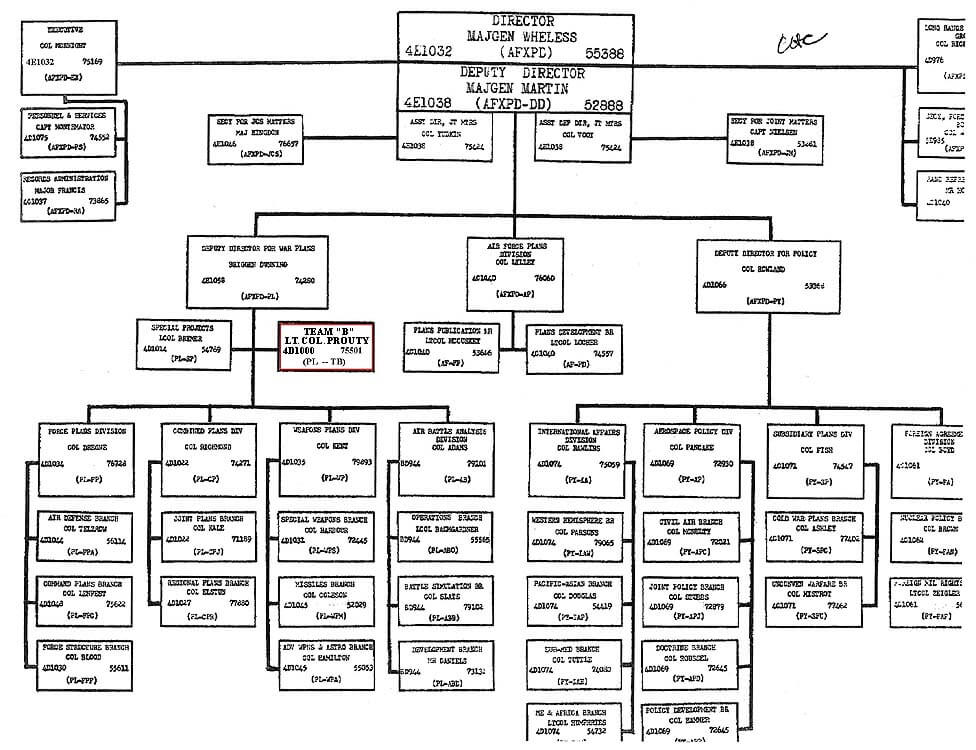
    Documents pertaining to Colonel Prouty’s service record

    But Epstein has to contest what Mr. X says about the Secret Service regulations in place at that time. Or else, what the film implies—that a huge Secret Service failure took place in Dallas—would be accurate. Which, as we know today, is the case. So Epstein says that, contrary to what Mr. X says, the Secret Service manual did not demand that all windows on the motorcade route be sealed, or that teams should monitor rooftops, or there should be a constant speed during motorcades. No one knows more about this aspect than author Vince Palamara. He has written two books on the subject and has a third coming out soon. In an email communication to this reviewer, Vince had the following to say about these topics. After consulting with two top-level Secret Service officers, one who authored the manual, he wrote: windows along a motorcade route were to be, at the least, monitored. Building rooftops were to be guarded. And the motorcade route was to be regulated at a top speed of 35 miles per hour. (Palamara email of April 6, 2017) Obviously, these strictures were all disobeyed in Dallas.

    Contrary to what Epstein writes, Len Osanic—who knew Prouty for over ten years—related to me that Prouty was not an editorial advisor to the Church of Scientology. They asked him to look at some documents about L. Ron Hubbard. He did and rendered his opinion. There was discussion of a book, but that never materialized. His association with the Liberty Lobby was that they republished his book The Secret Team. He delivered one of his standard addresses at a seminar of theirs, concerning the Kennedy case and the secret team. But Osanic does not recognize the quotes Epstein attributes to Prouty in his article. By including them, Epstein can now inject the rather standard smear of anti-Semitism. (For Prouty’s actual statements concerning the Arabs, Israelis and the price of oil, see chapter 3 of Understanding Special Operations; after clicking here, scroll down to “The Changing Nature of Warfare: From a Military to an Economic Basis”.) Further, contrary to what Epstein implies, Prouty’s meeting with General Edward Lansdale about sending him to the South Pole was not worked out months or even weeks in advance. As depicted in the film, it was a November, 1963 surprise to him. (Phone communication with Osanic, April 7, 2017) Probably no one alive knows more about Prouty than Osanic, and I refer anyone who is interested in the man to his web site, prouty.org.

    Epstein concludes his wild rant against Prouty by saying that the colonel thought that Leonard Lewin’s 1967 book Report from Iron Mountain was a work of non-fiction. This is supposed to show that Stone should never have trusted Prouty. He couldn’t figure out fiction from non-fction. But what it demonstrates is how abstract the reality of Epstein’s warped world is. For if one goes to Prouty’s web site, as posthumously managed by Osanic, one can click on the “more articles” tab and scroll down to the bottom. There you will see a link to a 1972 NY Times report of Lewin saying that the book is not a work of non-fiction. It is a satiric novel. Osanic told me that when he was setting up the site, Prouty insisted on this link. If one goes to the Black Op Radio site, and clicks Archived Shows, and scrolls down to Program 825, one will be able to listen to an interview Prouty did with Sean Mackenzie. If one goes to the 49:00 mark, one will hear a discussion of Lewin’s book. Prouty, no less than four times, calls it a novel. But he appreciated the satiric edge of the novel, since many people he knew in the Pentagon talked as Lewin depicted: we cannot abandon the warfare state.

    Anyone familiar with propaganda techniques can see what Epstein has done. To distract from the solid information about Vietnam in the film JFK, he has abstracted certain aspects from Prouty’s life to present them under the worst possible light. That The Atlantic printed this hatchet job says a lot about their editorial standards.

    But there is a larger issue here. And it relates not to just how bad the media is in America, but also to certain elements of the JFK critical community. Jim Garrison had his secret JFK murder probe exposed by the local media in New Orleans. From there on in, it was crippled, because the larger media decided to zero in on it, just as they would later target Richard Sprague when he took command of the House Select Committee on Assassinations. Reporter/agents like Phelan, Hugh Aynesworth and Walter Sheridan created a barrage of smears and phony stories that the MSM ran with, and much of the public swallowed. This now became the paradigm about the Garrison inquiry—even in the research community! There, the largest proponents of this paradigm were Peter Scott, Paul Hoch, and Josiah Thompson. It was not until the ARRB collected and declassified Garrison’s files that we had an opportunity to look at what his real evidence was. That release, combined with memoranda from other sources, has allowed a different paradigm to now circulate. As I have written elsewhere, we will never really know the complete extent of Garrison’s files, because so many of them were lost, stolen or incinerated by his successor, the disastrous Harry Connick. But what did survive reduces Epstein’s weird world to rubble.

  • Focus on the Media:  Edward J. Epstein

    Focus on the Media: Edward J. Epstein


    epstein leaderEdward Epstein began his career with a graduate thesis that he then sold as a book. It was called Inquest. He then wrote a book called Counterplot. The first was about the inner workings of the Warren Commission. The second was about the Jim Garrison investigation. These two books are discussed at length in the ProbeMagazine article we have excerpted.

    The important thing to remember about the books is that in the first one, Epstein takes the stance of an outsider trying to understand how a governmental body worked and came to some rather unusual conclusions. In the second book, which was originally a long magazine article, the outsider stance was abandoned. Epstein was no longer a graduate student. He became an insider, a working member of the club. And The New Yorker became a longtime haven for him.

    His career largely centered on two areas: the intelligence community, and the JFK case. He wrote three books on the latter. He wrote four books on the former. In addition to his books, he has published many articles in magazines like The Atlantic and The New Republic. Incredibly, he has managed to convince some people, like Ron Rosenbaum, that he actually knows something about the world of national security and intelligence. After all, he once tried to argue that James Angleton was not really duped by Kim Philby, but that Angleton was playing Philby. For these kinds of errands, he was well compensated by business entities like Reader’s Digest, which excerpted his useless book about Oswald entitled Legend.

    His latest book about Edward Snowden is equally pitiful. (Please click here for a good review) As the reader can see, Epstein is up to his old tricks. What is hard to believe is that anyone still believes him or pays for his work. In reading these two pieces one will see that the last thing Epstein is is an investigative journalist. Spending hours on the phone with the late James Angleton does not constitute investigation. Most people would call it visiting a victim of early senility. But that is what Epstein did for his books Legend and Deception. Finally, in 1991 and 1992, Tom Mangold in Cold Warrior and David Wise in Mole Hunt exposed Angleton for what he was: a truly imbalanced and actually a dangerous man. A man whose paranoia wrecked several lives and paralyzed the Agency. A man who should never had been the CIA’s counterintelligence chief in the first place.

    Epstein didn’t learn from his previous error. And maybe it really wasn’t an error. But if more people had understood who he was, then he would not be allowed to keep on his giant misinformation campaign. In its latest incarnation, Edward Snowden is really a Soviet spy. Just like Oswald. Oh, my aching back.


    The following is a letter written by Jim DiEugenio to the editors of The New Yorker. It was a reply to a nearly 8,500 word essay by Edward J. Epstein entitled “Shots in the Dark.” Epstein’s article was published in the November 30, 1992 issue. DiEugenio wrote this letter on December 10, 1992. The editors refused to print it. It was published in the January/February issue of Gary Rowell’s The Investigator. It appears here in a slightly edited and expanded form.


    Jim Garrison died on October 21, 1992. On November 30th, The New Yorker carried a nearly 8,500 word article about the New Orleans DA and his investigation into the death of President Kennedy. Allowing for editing, lead time, press run and distribution schedule, Edward Epstein’s piece must have been submitted at least 8 to 10 days in advance. Considering its length, the question inevitably arises: was the article being prepared before Garrison died? The fact of his long and serious illness had been popularly known in wide circles. If this is so, why did The New Yorker rush the hit piece onto its pages so quickly and rather tastelessly?

    Epstein states that his motive was to counteract the impact of Oliver Stone’s acclaimed and popular 1991 film JFK. The film starred Kevin Costner as Garrison in a recreation of the only conspiracy inquiry and trial into the murder of President Kennedy. Epstein calls the film a fiction event, even though it is based on two non-fiction books, Garrison’s On the Trail of the Assassins, and Jim Marrs’ Crossfire. Epstein, a former Warren Commission critic, has seemed to have had an astringent reaction to the film. He debated Stone, among others, in New York in a symposium arranged by The Nation magazine about the merits of the film. In the new compilation of his books on the subject, he added an Epilogue attacking the picture. He is now preparing another attack on the film and Stone to appear in the Atlantic Monthly, apparently timed for the video release of the longer version of JFK in January. It should be added that Epstein complained to Stone at that New York symposium that a scene depicted in his film was not depicted in Garrison’s book. If Garrison had written about everything in his files, his book would have been several volumes long. Which shows how familiar Epstein was with this raw data. (This author was shown these files by Lyon Garrison and can vouch for their volume.)

    To dispense with the specious argument over the historical accuracy of Stone’s film. Any historical film will, of necessity, rearrange events, settings, circumstances, and also often collapse characters to convey a dramatic whole. Stone’s film does this, but much less than other popular films dealing with historic subjects: e.g., Mississippi Burning, The Untouchables, Bugsy. Often, Stone prefaces speculative scenes by having Costner say, “Let’s speculate”, or shooting a sequence in sepia. But to anyone familiar with the actual facts, when all is said and done, Stone’s picture actually ranks with films like Lawrence of Arabia in its relative allegiance to the adduced record. As we shall see, it is Epstein’s unfamiliarity with that record that seems to be the basis for his specious article.

    It is strange that Epstein should be so flummoxed by this film which during its climax, tears to pieces the Warren Report, just as Garrison’s assistant DA’s did in New Orleans in February of 1969 at the trial of Clay Shaw. What makes it even more ironic is that Epstein’s article contains more “fiction” or distortion in relative terms than JFK. This begins with his portrayal of Garrison as a flamboyant, egomaniacal publicity hound who pursued the Kennedy case for his private purposes. This does not correspond to anyone who observed Garrison in his last years or watched his last two interviews when he was still healthy. The former DA was a reserved, intellectual, literary man who carried the painful scars of his two-year battle against the Washington-New York power center in his prosecution of Clay Shaw. He ended up with a tarnished reputation, a pile of bills, $5,000 in the bank—he financed some of the expenses himself—and many leftover death threats. The Kennedy case was the reason he was voted out of office. In fact, it ruined a promising political career where many said he could have been the governor of the state. Garrison later stated that if he had it all to do over, he probably would not have done it because of the personal and emotional toll.

    Epstein writes that Garrison, “artfully managed to stretch out the interval between the charge and the trial … while he engaged in a wide range of diversionary actions.” Precisely the opposite is true and documented. It takes author Paris Flammonde almost 13 pages to chronicle the delay tactics of Shaw’s lawyers, who were consorting with both media allies and friends in Washington in order to torpedo Garrison. Epstein actually scores Garrison for bringing charges against the likes of “media “ people like Walter Sheridan, even though affidavits reveal that Sheridan threatened and bribed important witness in the case. I guess this is OK with Epstein. After all, it’s only the murder of the president.

    The photos Epstein describes Garrison showing on The Tonight Show were furnished by researcher Richard Sprague. Epstein sometimes wears glasses. Perhaps this is the reason he feels the object being picked up in Dealey Plaza is a pebble. Most people I have talked to think it is a large caliber bullet. Epstein also has not kept up with research in the field, since he derides Garrison for saying the man retrieving the object was a federal agent. It turns out he was just that, an FBI agent to be exact. And if Epstein really thinks that both J. Edgar Hoover and Lyndon Johnson were dedicated to uncovering the facts in this case, he has not read the Church Committee report or interviewed any former FBI agents, like, for example, William Turner. This may be the single most ludicrous declaration in the entire article, which is saying something.

    Epstein relies on the House Select Committee X-rays and photos as his sine qua non that only three shots were fired, and all came from the rear. What he does not say is that the HSCA altered the Warren Commission findings on the autopsy. They moved up the entry wound in Kennedy’s skull from the bottom of the heard to the top, and they moved down the back wound. Further, the pathologists never dissected the track of either wound in Kennedy’s body. Therefore, the directionality and the trajectory of the wounds is not known. At any murder trial, these materials would be mercilessly attacked. And it is questionable if they would have been admitted into court, since some of the exhibits do not correspond to what the witnesses at the autopsy saw.

    Epstein implies that Jim Garrison failed to reveal any “hidden associates” of Oswald’s in New Orleans. This is simply balderdash. As depicted in the Warren Report, Oswald was supposed to be a Marxist oriented, pro-Castro sympathizer. Yet, as Garrison showed, here was a communist who had no communist friends. On the contrary, he associated almost exclusively with anti-communist extremists, intelligence operatives, and/or anti-Castro Cuban exiles in both New Orleans and Dallas: George DeMohresnchildt, Guy Banister, David Ferrie, Clay Shaw, Richard Case Nagell, Orest Pena. Which is an odd group for a communist to be hanging out with. You will not see most of their names in the Warren Report. But you will see them in Garrison’s files. In fact, if not for him, you likely would not have heard of them at all.

    Epstein tries to trivialize Garrison’s complaints about the extreme secrecy involved in the JFK case. He writes that this was essentially grandstanding and it was not really important to the facts of the case. Garrison disagreed and stated that it undermined public confidence in their government. The Warren Commission had the equivalent of one day of public hearings. (And that was because witness Mark Lane insisted on his hearing being open to fellow citizens.) The House Select Committee on Assassinations had about three weeks of open hearings. The combined lifespan of both investigative bodies was a bit over three years. The former locked up over 365 cubic feet of materials. The second inquiry left almost 800 boxes of files. Today, the federal government has over 2 million pages of material classified on this case. Even though the murder is three decades old and the official story is that Oswald alone killed Kennedy. Is Epstein correct in saying that most of it is unimportant? How can he possibly deduce such a conclusion before the files are declassified? We know from previous declassifications that such was not the case at all. For instance, the declassification of the FBI report on the JFK case revealed that Director J. Edgar Hoover did not agree with the Single Bullet Theory. He believed that a separate shot hit Governor John Connally. To use another example: the government is today holding a 300-page report about Oswald’s alleged activities in Mexico City. The problem, as the authors of that report have stated, is that the CIA could not produce a photo of Oswald being there, and the voice on the audiotapes the CIA made of Oswald is not his. You will not find any of that information in the Warren Report. Which never questions any of his activities in Mexico.

    Epstein writes that many documents that were originally classified have since been released. Yes, and many have been released only in response to public revulsion with the classification process. Many others have been released through the efforts of private citizens who have had to sue the government to get them. Further, many of these released documents have not been released in full. That is, they contain what is termed “redactions”, that is, much of the wording has been blacked out. Plus, the fact that the information was released later dilutes the impact and effect the information has on the case and the public. In fact, this contributes to the whole “too-late-to-solve-it” syndrome that afflicts the Kennedy case. One has to wonder: was this the intent from the start? If so, it succeeded.

    Epstein is familiar with these problems, since they impact on the mystery surrounding the man he wrote about extensively in his last book on the JFK case, Legend. This was George DeMohrenschildt, sometimes termed “The Baron” due to his upper class White Russian standing. Epstein was reportedly the last person to interview DeMohrenschildt in Florida before he died of a shotgun blast. Although the official verdict in the case was that The Baron took his own life, others who have investigated his death still have questions about it. Mr. Epstein, whose early attack on Garrison in The New Yorker was circulated by the CIA to worldwide station chiefs, was in Florida at the time to interview DeMohrenschildt for Legend. Epstein received a large half million dollar advance for the book, the highest ever in the JFK field. The book’s backers also furnished him with a research staff. Epstein offered DeMohrenschildt large sums of money for interview sessions. Epstein himself was quoted as saying he was involved in a “very big project, which involves a lot money.”

    Previously, Epstein had been involved in a campaign to clear the FBI of charges that it had used clandestine and conspiratorial methods to destroy the Black Panthers. In regards to my previous point, later declassified documents revealed that the FBI had done just that. Epstein’s book Legend had an odd—some would say perverse—spin to it. The thesis was that the KGB had recruited Oswald while he was in Russia and he was acting as their agent when he killed Kennedy. Epstein tried to fog this framework, but the book’s last section—dealing with Oswald’s return to America—is titled “The Mission”. And the last chapter is called “Day of the Assassin”. In an appendix entitled “The Status of the Evidence”, Epstein backs every dubious claim of the Warren Commission. He deals with complex issues, like the dubious capability of Oswald’s rifle, in a less than cursory manner: in this case, all of two sentences. Epstein’s interview subjects, like Jim Botelho, a service buddy of Oswald, insist that he distorted their responses on his way to his offbeat conclusion, namely that the Russians, through the KGB, killed Kennedy.

    DeMohrenschildt was important to this scheme. For the simple reason that he and his family came from the Soviet Union. So, in the upside down world of Legend, one could argue that somehow The Baron was acting as Oswald’s handler in the USA, as some kind of deep cover KGB agent.

    But Epstein’s most questionable decision was the liberal use of CIA counter-intelligence chief James Angleton as a major source. This is the same Angleton whose Cold War paranoia paralyzed the CIA to the point that Director Bill Colby backed a press leak campaign to force him to step down. The same Angleton who, once retired, started a defense fund for agents caught in “black bag” operations, or robberies. The same Angleton who actively encouraged destabilizing governments, not in Guatemala or Iran, but in allied countries like Australia and England.

    Understandably, many have read Legend as Angleton’s outlet for the defense of his—and the CIA’s—conduct in relation to both Oswald and the assassination. More cynical observers see it as a detour away from both Oswald’s and DeMohrenschildt’s secret status as American intelligence agents.

    Epstein’s activities with The Baron toward the end are notable. As stated, an inquest ruled that DeMohrenschildt took his own life. But Mark Lane talked to the state attorney who interviewed Epstein about the day of DeMohrenschildt’s passing. Epstein told David Bloodworth that he had paid his subject three thousand dollars and let him go after a rather short session. Lane’s report, published in Gallery of November 1977, went on to say that Epstein told Bloodworth that even though he spent all this money, he kept no notes and had no tape recordings. Bloodworth told Lane that he did not believe that statement, not after Epstein spent that much money. Bloodworth then added that Epstein showed The Baron a document that indicated he might be taken back to Parkland Hospital in Dallas for some electroshock treatments. (DeMohrenschildt had been suffering from depression.) Bloodworth then looked at Lane and said, “You know, DeMohrenschildt was deathly afraid of those treatments … DeMohrenschildt was terrified of being sent back there. One hour later he was dead.”

    This is the man who now writes in reflection of Jim Garrison and his investigation of Kennedy’s murder. Is it too much to suggest that Epstein is jumping into a “spin control” mode? People like Howard Hunt and J. Edgar Hoover also did this in relation to the life and death of John Kennedy. But they had the sense to wait a while so their efforts would not be seen as transparently self-serving. Epstein exercised no such self-control. Which makes his work not just inaccurate but offensive. And The New Yorker acted as his accomplice in this defamatory exercise.


    Part 2: “The Abstract Reality of Edward Epstein”

    Part 3: “Edward Epstein: Warren Commission Critic?” (Probe vol 7 no 1, 1999)

  • Max Holland and Donald Carpenter vs. Jim Garrison and the ARRB

    Max Holland and Donald Carpenter vs. Jim Garrison and the ARRB


    The first time I recall hearing of Max Holland on the JFK case was through the Wilson Quarterly. This was back in 1994, when he reviewed three books on the JFK case. It was quite clear from that article where Holland stood on the issue. But what was puzzling about Holland was this: What were his credentials on the Kennedy case? I could not figure out what his prior work on the case was. Or how long ago it originated.

    As time went on, it became clear that Holland had very few credentials on the JFK case. What he had was a position on the case. He would therefore pick and choose bits of information to back that position, ignoring other information that vitiated it. What was surprising about Holland’s dubious scholarship is that somehow it did not hinder him from expanding outward from Wilson Quarterly. For instance, for a time he actually was a reporter for The Nation. His ostensible beat was the progress of the Assassination Records Review Board and later developments in the JFK case. The predictable problem was that , to the best of my memory, Holland never reported on any of the bombshell information that the Board released. For example, the Lopez Report contained some fascinating information about whether or not Oswald was in Mexico City. The investigation by Chief Counsel Jeremy Gunn revealed some utterly bracing facts about what happened, or did not happen, at President Kennedy’s autopsy. Yet, I don’t recall Holland ever explaining the import of these discoveries to his readers. Just like I don’t recall other volumes he was supposed to be writing which never materialized, e.g., a biography of John McCloy.

    Holland also found a home for a while at the Miller Research Center in Virginia. At the time Holland subscribed to Probe Magazine. When I saw what he was up to, I wrote him a note and told him not to renew his subscription since I could not in good conscience keep him on our list. He wrote back saying that if I did that, he would have to subscribe under a false name. That is how desperate he was for us to do his research for him. (I later found out that Holland’s cohort, Patricia Lambert, subscribed under her husband’s name.)

    Holland spoke at the 2004 AARC conference in Washington entitled “The Warren Report and its Legacy”. At that conference Holland talked about a previously published paper of his concerning Jim Garrison and his knowledge about the mysterious Permindex operation in Italy and Clay Shaw’s connection to it. The implication of Holland’s presentation was that Garrison had been a dupe of KGB disinformation. At that conference, Gary Aguilar rebutted Holland’s talk and his paper. Through him and other sources it turned out that all the overtones of Holland’s thesis were wrong. Garrison’s ideas about the CIA role in the JFK plot did not come through a series of articles planted by the KGB in the Italian newspaper Paese Sera; the story about Clay Shaw and Permindex was not planted by the KGB; Shaw was arrested before the articles appeared, but the six part series was commissioned six months prior to that event; Shaw did serve on the board of that organization, as he himself admitted prior to the assassination; and there were indications in its financing that Permindex was CIA related. (James DiEugenio, Destiny Betrayed, pp. 385-86)

    Shortly after a coruscating letter to The Nation about Holland’s shortcomings by Zachary Sklar and Oliver Stone, Holland either left or was forced out of the journal’s pages. He then started up his own online magazine called Washington Decoded. In 2012 he wrote Leak, a book about Mark Felt’s role in Watergate. Of the three books written in that time period about Watergate—the other two being James Rosen’s The Strong Man, and Ed Gray’s In Nixon’s Web—Holland’s was the least distinguished. And it wasn’t really close. The major topic of Holland’s book was the motive that Felt/Deep Throat had for leaking damaging information to the Washington Post’s Bob Woodward about the nefarious activities of the Nixon White House. But with archival research, the Gray book showed that—contrary to what Bob Woodward was still saying—Deep Throat was a composite. And to this day, we don’t know who the other sources were. (To anyone interested in Watergate, this reviewer strongly recommends reading In Nixon’s Web.)

    Of course, Holland is still on the JFK case. In 2011, he produced a documentary for National Geographic Channel on the JFK case. This sorry pastiche was called The Lost Bullet, and Holland used some of the usual suspects to help him salvage the Single Bullet Fantasy. Among them were Larry Sturdivan and Robert Stone, who had previously done their best to shore up the fraud of the Warren Report (which Sturdivan actually worked on). This program was so poor that not only did this site pan it—as did fellow critic Pat Speer—but even Commission advocates like Dale Myers attacked it. (Read our review on this site)

    But Holland still persists. He was seen attending the Cyril Wecht Conference in 2013. And he still hosts his web site with articles from those who agree with him. Which brings us to the topic of this essay.


    II

    Jim Garrison was the first public official to denounce the Warren Report in no uncertain terms. Because of that the New Orleans District Attorney has always been a stone in the shoe of supporters of the official story. Today, over five decades after the fact, he remains the only DA in America to investigate the Kennedy assassination after Oswald was murdered. He made the first serious inquiry into who Oswald’s supporters and friends were, for the Warren Commission said he had none. In public, he called Oswald first a decoy, then a patsy, then a victim. (See his Playboy interview from 1967) He was the first and only DA to actually unearth evidence that convincingly contradicted the theses of the Warren Report about the actual role of the alleged assassin. For example, it was Jim Garrison who first investigated the strange life and death of Rose Cheramie. (James DiEugenio, Destiny Betrayed, Second Edition, pp. 181-82) It was Jim Garrison who first discovered that Oswald had been associated with David Ferrie in the Civil Air Patrol. And, after the assassination, Ferrie was calling CAP members to be sure that there was no evidence they had which would reveal that association. (ibid, p. 177) It was Jim Garrison who first investigated the Clinton/Jackson incident, the odd journey that Oswald, Clay Shaw and David Ferrie took to Feliciana Parish about 90 miles northwest of New Orleans in the late summer of 1963. (ibid, pp. 88-93) It was Jim Garrison who uncovered the mystery of the 544 Camp Street address, which was printed on some of the literature Oswald passed out on Canal Street in New Orleans during that summer—and which the FBI tried to eradicate from the record. (See John Newman, Oswald and the CIA, p. 310) Garrison was also the first person who interviewed the man who he would later call, “The most important witness there is.” This was CIA/KGB insider Richard Case Nagell, who was in prison at the time. (op. cit. DiEugenio, pp. 183-84) As revealed in his book, The Echo from Dealey Plaza, Garrison was the first person to send an investigator to interview Secret Service agent Abraham Bolden. I could go on and on, but in sum let us refer to an interview Joan Didion did with James Atlas for Vanity Fair: “It goes back to … the Garrison case. Remember, he had this elaborate conspiracy theory. The stones that were turned over! Fantastic characters kept emerging … this whole revealed world … .”

    My only dispute with Didion’s quote is that none of the items I refer to above is theoretical. It was all genuine evidence that clearly indicated that Oswald was being manipulated in New Orleans in the summer of 1963. It also showed who the people doing the manipulating were. And the Warren Commission—actually FBI Director J. Edgar Hoover—deliberately kept this information out of their 1964 official story. It is true that Garrison did formulate a theory from this, and the reams of other evidence he garnered. But I would argue that, as Didion implies, his evidence was much more credible, and his ideas much more logical, than the Warren Report. Which Garrison, on The Tonight Show, termed a fairy tale. (Listen to that show here)

    Garrison was challenging the Warren Commission, and by extension the FBI, and he ended up accusing certain aspects of the operational arm of the CIA for being closely involved in the Kennedy murder. For this, he was viciously attacked by certain power centers of the American establishment. The media, which had clearly sided with the Warren Commission, was glad to go along with it. Today, there can be no doubt about how this assault was organized, who was involved in it, and how it was executed. For the declassifications of the ARRB have been quite strong on this issue. So much so that I devoted no less than sixty pages to exposing several aspects of how it all worked in the second edition of Destiny Betrayed. (See especially pages 226-85) This belated exposure—which was lied about at the time—is all backed up with scores of footnotes. Therefore, actions that were previously assumed are now out in the open, names are mentioned, operations can now be described. Can we detail it all completely? No. But that is only because certain documents seem to have been elided from the record or, as yet, not declassified in full. But what we do have is copious enough. And it indicates that the reason for all of this obstruction—and the eventual destruction—of Jim Garrison was rather simple. In the fall of 1967, at the request of Director Richard Helms, the CIA convened the first meeting of what the Agency termed The Garrison Group. The meeting opened with counter intelligence chief James Angleton’s assistant Ray Rocca issuing a dire warning. After studying Garrison’s case for months, Rocca said that he felt “that Garrison would indeed obtain a conviction of Shaw for conspiring to assassinate President Kennedy.” (op. cit., DiEugenio, p. 270)

    Make no mistake: the creation of this Agency body is what Shaw’s lawyers, and Shaw himself, wanted. In fact, his lawyers went to Washington and pleaded their case for extralegal intervention. This is a point that Shaw’s lead lawyer, Irvin Dymond, lied about to this author and William Davy during a 1994 interview in his New Orleans office. Contrary to Dymond’s prevarications, there can be no question today that they got such aid. And in abundance. For example, in January of 1968, a CIA cable was sent out. It read in part, “[Garrison] case is of interest to several Agency components covering aspects which relate to Agency … office heavily committed to this endeavor.” A later memo states that certain offices will be “tasked”, as part of an ongoing review. (ibid, p. 277) One of these tasks was to provide any Garrison suspect or witness who switched sides with a lawyer. And since men like Walter Sheridan had bribed and intimidated several witnesses to defect from Garrison, these lawyers came in handy. In fact, after certain witnesses were talked into changing their stories, they were told to call Dymond. Dymond would then tell them that if Garrison should try and charge them with anything that he would get them an attorney and bond would be posted for them. (ibid, p. 241) When Gordon Novel, a CIA infiltrator in Garrison’s office, was called by Garrison before the grand jury, he fled from New Orleans before his appearance. He eventually employed four attorneys. Since he did not have a job at the time, he was asked how he paid for these four lawyers. During a legal deposition he stated that they were being “clandestinely remunerated”. (ibid, p. 263) As they should have been, since electronics expert Novel had been originally recruited to wire Garrison’s office by Allen Dulles. (ibid, pp. 232-33)

    The above is only a short précis of what we know today about what happened in New Orleans through both ARRB declassifications and by field investigation from people like William Davy and Joan Mellen. Suffice it to say, the literally tens of thousands of pages of new documents about the CIA, the FBI, the Justice Department and Jim Garrison, have led to three major reevaluations of Garrison’s inquiry by Davy, Mellen, and this author. Those three volumes amount to over a thousand pages of mostly new information. It is all quite fascinating in both its actions and overtones. Because, for example, Helms ordered the Garrison Group to consider what Garrison would do before, during, and even after the trial of Clay Shaw. As has been demonstrated in these volumes, the interference with Garrison went on both before and during Shaw’s trial. Robert Tanenbaum, House Select Committee on Assassinations (HSCA) Deputy Counsel, actually saw some of these documents. He said they came out of Richard Helms’ office which, of course, would be the highest level of the CIA. (ibid, p. 294) But, in addition to the CIA, the Justice Department was monitoring Shaw’s trial in real time. (ibid, pp. 299-306)


    III

    In light of the above, the question then becomes, how does one write a book today about Jim Garrison and/or Clay Shaw which sides with the official position of 1964? Namely that there was no conspiracy and Oswald was a lonely sociopath without friends and colleagues, let alone confederates. Well, leave it to Max Holland to try and do so. Currently up at his site is an article by one Donald Carpenter. Carpenter was a CPA for 25 years. He then turned to writing novels. In 2013 he wrote a biography of Clay Shaw entitled Man of a Million Fragments.

    I started reading the book at the time of its publication. I did not get very far. Because early on it became apparent to me that Carpenter’s writing was, shall we say, not very candid. For example, when I read what the author wrote about General Charles Thrasher, who Shaw served under as his aide de camp during World War II, I blanched. I deduced two things from this part of Carpenter’s work: 1.) He was determined to minimize or eliminate any ties Shaw had to intelligence work, especially covert actions, and 2.) He was going to color over the very real accusations against Thrasher of participating in war crimes against German POW’s. These charges had been covered up at the end of World War II. But through some extraordinary archival research, author James Bacque had uncovered them and assembled a startling expose of these crimes in his 1989 book Other Losses. From Carpenter’s maneuvering on this issue, I deduced that if the author was going to do something like that with Thrasher, then there would be no holds barred with Clay Shaw.

    After reading Carpenter’s current article at Holland’s web site, it appears I was correct. What Carpenter and Holland want to do is sort of like what H. G. Wells once wrote a novel about: place the reader in a time machine and transport us back to 1969. That way, the censorious duo can make believe that everything described above does not exist. Unfortunately for them, we live in the dimensions of time and space, therefore it does exist. One can make believe it does not exist, but then that means that what you are writing is make-believe history. This is something like attending the Paul Hoch College of Historical Studies. Let me explain what I mean by that.

    In Chicago in 1994, I sat in the audience at Doug Carlson’s fine Midwest Symposium on John F. Kennedy. Hoch spoke at this event. He assumed the role of grizzled veteran giving advice to the newbies who were about to go through the declassified ARRB files. One of his pieces of advice was to ignore anything in there on Clay Shaw. I never forgot that since it went against everything I had learned in graduate school. Namely that scholars are supposed to seek out as much new and relevant information as they can find. That is the way historians fill in gaps in the past. What Hoch was proposing was the historical version of prior restraint on free speech. To me, this was the opposite of what real scholarship was supposed to be about. All I can say is that Carpenter has written both a book and essay that satisfies Hoch’s See no Evil, Hear no Evil, and Say no Evil (Orwellian) dictum.


    IV

    Right at the beginning of the article, Carpenter shows just how much he is in disregard of the archival records of the ARRB. He pegs the beginning of Garrison’s inquiry to the famous conversation the DA had with Senator Russell Long on a plane ride to New York City. He then adds that the actual date of the November plane trip is not known, and that this marked the beginning of Garrison’s inquiry. Both assertions are wrong. William Davy tracked down the origins of the trip to NYC and the date. (Davy, Let Justice be Done, p. 57)

    But more importantly, this does not mark the beginning of Garrison’s inquiry. As almost everyone knows, except perhaps Mr. Carpenter, Garrison had inquired into the JFK case back in 1963. Then he did a brief investigation into the event because Oswald had lived in New Orleans for several months in 1963. He ended up by calling David Ferrie into his office for an informal interview. Garrison was curious about a seemingly inexplicable journey Ferrie made with two friends to Houston and Galveston on the day of the assassination. Ferrie said he took the car ride to go ice-skating and goose hunting. Except as Garrison had figured out: 1.) Ferrie did not go ice-skating once he got to Houston; 2.) He drove 400 miles through a pounding rainstorm not to skate; and 3.) His second excuse, to go goose hunting was vitiated by the fact that he did not take shotguns with him. (ibid, pp. 45-47) This ridiculous story seemed utterly strained and patently ersatz to the DA. So he turned over Ferrie to the FBI.

    The Bureau interviewed Ferrie. He lied to them as he had to the DA. For instance, he said he never knew Oswald, which was provably false. But even more ridiculous he said he had never used a telescopic rifle and would not even know how to use one. He also said he had associated with no Cuban exile group members since 1961. (DiEugenio, p. 177) Which was preposterous, since Ferrie had been involved in Operation Mongoose in 1962. (ibid, p. 115) As most people understand, lying to an FBI agent is a crime. Evidently, Ferrie understood that it did not matter. Someone in the FBI hierarchy would protect him. As they did. There is not even a hint of any of this FBI cooperation in Carpenter’s article.

    But returning to my main point about Carpenter’s inaccuracy about Garrison: it’s not really true that Garrison’s original inquiry was relaunched by the talk with Long. As Joan Mellen notes in her book A Farewell to Justice, Garrison was collecting various critiques of the Warren Report as they were published. And he urged his assistants to read them also. (Mellen, p. 4) But, beyond that, in the Garrison files donated to the ARRB by Lyon Garrison, one will see that there are some memos in the time period of 1965-66. When this author interviewed chief investigator Lou Ivon, he affirmed that Garrison would get interested in a certain assassination issue and send someone out to do an inquiry. (DiEugenio, 177-78) Therefore, right at the outset, Carpenter’s essay is marked by incompleteness and inaccuracy. And Max Holland had no interest in correcting any of it.

    Carpenter continues his march of folly by writing that, in 1966, Garrison picked up “three already spent leads.” One will understand how ridiculous that phrase is when Carpenter lists the first ‘spent lead” as Ferrie. Apparently, Carpenter is fine with Ferrie lying to both the DA and the FBI. Unlike our intrepid essayist, most curious and objective readers would have liked to know the following:

    1. Why did Ferrie lie about the purpose of his trip to Houston and Galveston?
    2. What purpose was served by denying he knew Oswald when it could so easily be shown that this was false?
    3. How on earth could he deny that he was not familiar with a telescopic rifle, or even known how to use one, when he participated in training for both the Bay of Pigs and Operation Mongoose?

    As any professional investigator comprehends, when a person of interest lies under penalty of perjury, it usually indicates that there are higher stakes involved. Today, there can be little doubt that this was the case with David Ferrie. Any real investigation of Ferrie would have uncovered a welter of incriminating evidence. Not just about him. But about Sergio Arcacha Smith, Clay Shaw, and Guy Banister. There are also links between Ferrie, Sergio Arcacha Smith and David Phillips.

    For instance, during a legal deposition for his lawsuit against Garrison, Gordon Novel described a meeting at Banister’s office. At the meeting were Novel, Banister, Arcacha Smith and a man who clearly fits the description of Phillips. (Davy, pp. 22-24) Secondly, in preparation for the Bay of Pigs, Ferrie trained Cuban exiles in underwater demolition at the abandoned Belle Chasse Naval Ammunition Depot, just south of New Orleans. Ferrie revealed that Sergio Arcacha Smith was the conduit for the arms coming into the camp. In an after action report, the CIA officer who summarized the types and dates of training, noted that the Belle Chasse base had now been sterilized; meaning no trace of CIA affiliation remained. That memo was written by David Phillips. (ibid, p. 31) Third, an INS agent named Wendell Roache told the Church Committee that they were tracking Ferrie because of his close associations with Cuban exiles illegally in the country. They had traced him to 544 Camp Street, and also found out he took films of a training camp. This may be the film that HSCA Deputy Counsel Bob Tanenbaum said he saw in the early days of the HSCA inquiry. If so, it featured Oswald, Banister and Phillips. (DiEugenio, p. 116)

    So much for Ferrie being a “spent lead”.

    Another so-called “spent lead” the author refers to is attorney Dean Andrews. As many authors have pointed out, someone put the fear of God into Andrews about revealing the true identity of the mysterious Clay Bertrand he referred to in his Warren Commission testimony. On at least three occasions—with Mark Lane, Anthony Summers and Garrison—he refused to reveal who Bertrand was. (ibid, p. 181) This was an important point because Andrews told his assistants that while he was in hospital, Bertrand had called him and asked him to go to Dallas to defend the accused assassin of JFK, Lee Oswald. Who Andrews knew previously, since Oswald had been in his office more than once that summer. (Davy, p. 49) Not only was Andrews threatened not to reveal Bertrand’s true identity, but his office was rifled after he got out of the hospital. (DiEugenio, p. 181)

    Further, the FBI visited him in the hospital and did all they could to intimidate him into retracting his statements about Clay Bertrand. (Davy, p. 50) Clearly, there were forces way above Andrews that did not want him to reveal the true identity of Bertrand. In fact, the FBI wanted him to say that he had dreamed the whole episode up while under hospital sedation. As William Davy has demonstrated with hospital records, on November 23rd, Andrews made a call to his secretary about going to Dallas to defend Oswald before he was medicated. And it was not even close. He made the call to his secretary at 4 PM. He was given a sedative four hours later. (Davy, p. 52)

    But further, there are multiple paths of corroboration for Andrews being called by the mysterious Bertrand. Andrews had talked about the call with his friend Monk Zelden, president of the New Orleans BAR association. He had called his secretary Eva Springer on the 23rd and reported it. He told his investigator, former Sgt. R. M. Davis, and he told his wife. (ibid, p. 51) In light of all this, it simply was not credible that Andrews could not recall the true identity of Bertrand. This selective amnesia was clearly caused by the threats of people Andrews said were from Washington and threatened to inflict serious bodily harm if he revealed who Bertrand was. (DiEugenio, p. 181)


    V

    Which leads to who Bertrand really was. In his obsolete article, Carpenter writes that Garrison figured that Shaw was Bertrand through a process of descriptive evaluation. In other words, through Andrews, he had information that Bertrand was close to some Hispanics, was a homosexual, and spoke some Spanish. All this was based on the fact that Andrews stated that Bertrand had sent him clients who were, as he termed it “gay Mexicanos”. Therefore, from this information, Garrison deduced that these traits fit the description of Clay Shaw. And, according to Carpenter, this is how Garrison fixed on Shaw as a suspect.

    There is a rather familiar problem with this statement by Carpenter. Namely, it is wrong. As anyone can see by going through Garrison’s extant files, the DA spent many hours sending his investigators out pounding the pavement trying to find out who Bertrand was. The process literally extended over a period of months. The reason being that many denizens of the French Quarter did not want to talk to Garrison or his agents. The reason for that being Garrison’s previous crackdown against B-girl drinking in the Quarter. That legal action closed several bars permanently, and many others temporarily, thereby putting many people out of work. But when Garrison stopped going on these inquiries himself, slowly, over time, his staff began to get results. Today, with the release of Garrison’s files, there is really no question that Shaw was Bertrand. The number of witnesses that attest to this is in the low double digits. (DiEugenio, pp. 387-88) And the information has nothing to do with “gay Mexicanos”. It was such common knowledge that the FBI knew it. The Bureau wrote three separate memos about this issue from 1963 to 1967. These memoranda say that Shaw was of interest to the FBI in December of 1963 in relation to the JFK case, and that they had at least three witnesses saying that Shaw was Bertrand. (ibid, p. 388)

    But the best source on this would be Dean Andrews. Who, unfortunately, was frightened out of his wits. Yet, thanks to the efforts of estimable researcher Martin Hay, we have now found out that Andrews did reveal the fact that Shaw was Bertrand to one source. That source was Harold Weisberg. While working with Garrison, Weisberg met with Andrews several times. Harold developed a rapport and trust with the lawyer. Andrews eventually told him that Shaw was Bertrand. But he told him so under the restriction that he tell no one else. Weisberg kept his word. It was not until many years later, in the manuscript for an unpublished book, that Weisberg wrote about this secret revelation. Hay found it by sifting through the late Weisberg’s investigative files at Hood College. (ibid)

    The obvious question that Garrison never got to ask Shaw was this: Why did you call Andrews and tell him to go to Dallas to defend Oswald? To put it mildly, the implications of that query are thunderous. By not consulting the declassified record, Carpenter avoids posing it.

    What Carpenter does with the trial of Clay Shaw is SOP for him. Carpenter admits that Shaw’s lawyers were the main cause of the long delay in getting the case to trial. What he does not say is that this was done in order for Shaw’s secret allies to infiltrate, clandestinely record, and intimidate and bribe Garrison’s witnesses. There are too many examples of this illicit behavior to even begin to describe them in this essay. I will describe just four.

    Bernardo DeTorres was a high level CIA agent who ended up working with weapons expert Mitch Werbell. He reportedly had photos of the Kennedy assassination stashed in a safe. He was one of the first infiltrators into Garrison’s office in late 1966. The unsuspecting DA sent him to investigate Cuban exile Eladio Del Valle, David Ferrie’s paymaster for flights into Cuba. Garrison never saw Bernardo after this assignment. But the report that Garrison got about the subsequent murder of Del Valle reads as follows: “He was shot in the chest, and it appears gangland style, and his body was left in the vicinity of BERNARDO TORRES apartment.” (DiEugenio, p. 227) Would you show up for work after your boss got such a report? Needless to say, Del Valle would have been a very important witness for Garrison.

    William Wood aka Bill Boxley, was a former CIA agent who volunteered for Garrison’s staff. Boxley wanted Garrison to do some very bizarre things. Like, on the fifth anniversary of JFK ‘s death, indict a man named Robert Perrin. Perrin had some visibility due to the fact that he had been the husband of Warren Commission witness Nancy Perrin Rich. The only problem with this idea was that Perrin had died a few years previously. Boxley then said, well, he wasn’t really dead, the authorities had mixed up his body with another. Boxley—along with the late William Turner—was also the main culprit in inducing the whole Eugene Bradley debacle. Where Garrison had to withdraw an arrest warrant when he discovered that Boxley had made some very dubious claims about Bradley that were not accurate. It later turned out that Boxley was, of course, a CIA agent who knew about the Garrison Group and how that desk operated. (ibid, pp. 278-81)

    I will briefly mention two other cases. From Garrison’s files, it appears that James Angleton had a whole book written simply to mislead Garrison. This, of course refers to the whole, elaborate Farewell America hoax. The uncovering of which, is also due to Harold Weisberg. From his extensive field inquiry he discovered that the book was actually supervised by a French double agent named Philippe De Vosjoli. De Vosjoli clandestinely worked for Angleton. (ibid, pp. 281-83) Finally, in his discussion of the Clay Shaw trial, Carpenter doesn’t mention the name of Clyde Johnson. Johnson was supposed to be Garrison’s lead witness. Since many of his witnesses were being terrorized—e.g., Richard Case Nagell had a grenade thrown at him, Aloysius Habighorst was almost run over by a truck—Garrison hid Johnson. This was at an out of town location. But to show just how infiltrated his office was, this location was discovered. Johnson was beaten to a bloody pulp, was hospitalized and could not testify. (ibid, p. 294)

    The point of all this is to show that the constant delays were strategic in intent. It gave the CIA, the FBI, and others a longer time frame in order to weaken Garrison’s case. Carpenter also brings up the old chestnut of Garrison not trying the case himself. Again, this shows his ignorance of Garrison’s files. Decades ago, Garrison explained to a correspondent that he was stricken by a painful back injury and also the Hong Kong flu during the trial. (ibid, pp. 292-93)

    As the reader can see, the entire prosecution of Clay Shaw was more or less sabotaged by several covert operations. But even at that, Shaw had to lie his head off on the stand to escape. In sum, Shaw deceived the jury on every material subject there was. He denied knowing Ferrie or Oswald, denied being in the Clinton/Jackson area with those two men, and he denied being associated with the CIA. He even denied using an alias. (ibid, p. 310) With what we know today, these denials under oath reduce his testimony to the level of grotesque black comedy.

    The deceit about his association with the CIA actually goes beyond his lies, because the CIA actually lied to itself on this issue. This is how ingrained the cover up was about Shaw at Langley. In many of their memos at the time, the Agency denied any connection to Clay Shaw. Which, of course, was false. Afterwards, they admitted he was only a business contact. Which was also false. It later turned out that Shaw had a covert security clearance for a project code named QK ENCHANT. As former CIA officer Victor Marchetti later said, this appears to have been a part of the Domestic Operations Division run by Tracy Barnes, and which also employed Howard Hunt. (ibid, p. 385)

    But actually it’s even worse than that. As Joan Mellen later discovered, the CIA had hidden away documents that proved that Shaw was a highly paid, valuable contract agent from early in the fifties. This document was not declassified until a historical review program did so in the nineties. (Joan Mellen, Our Man in Haiti, pp. 54-55) This information corresponds with what Gordon Novel revealed in a written communication made back in the seventies. There he wrote that, back in 1964, the CIA had sent out an order through Director of Security Howard Osborn to conceal Shaw’s true Agency status from inquiries into the JFK murder. To say this tactic was successful does not really do it justice. But it shows the price the public must pay for the almost maniacal secrecy the national security state demands.

    The most inadvertently humorous part of Carpenter’s pathetic essay comes at the end. There he praises Oliver Stone for helping create the declassification process of the ARRB. Why is that funny? It’s funny because this essay does not use any of those ARRB declassified documents it credits Stone for releasing.

  • Dr. Michael Marcades, with Norma J. Kirkpatrick, Rose Cherami: Gathering Fallen Petals

    Dr. Michael Marcades, with Norma J. Kirkpatrick, Rose Cherami: Gathering Fallen Petals

    Melba Christina Youngblood was born in Texas in 1923.  Her only son, Michael Marcades, has now written a book about his mother, who was posthumously made famous by film director Oliver Stone in his 1991 film JFK.  If one recalls, that film opens with Dwight Eisenhower making his epochal Farewell Address warning of the rise of the Military Industrial Complex. The film proper then opens with a long credit sequence. Near the end of the credits, the film crosscuts between Kennedy arriving in Dallas and a woman being thrown out of a car on a lonely highway.  We then see her in a hospital.  She seems hysterical with fear warning that the men who threw her out of the car are going to kill Kennedy in Dallas.  The doctor mumbles that she seems high as a kite on something, therefore implying that her warning will be ignored. Which it was—until after the assassination. 

    The woman was named Rose Cherami in Stone’s film.  This was accurate since this is the final alias that she used in her life.  And that was the name through which New Orleans DA Jim Garrison discovered her. Her Cassandra-like warning had been ignored by the Dallas Police, even though they were fully aware of it.  It had then laid dormant for the FBI and the Warren Commission. In the seventies, it had been pursued by the House Select Committee on Assassinations. In fact, one of their most famous reports, written by researcher Patricia Orr, incorporated some of Garrison’s information with some new work that committee had done.  In the annotated screen play of JFK entitled The Book of the Film, it was revealed that the script relied on Orr’s report for their information.

    It was not until the Assassination Records Review Board declassified the HSCA files that we finally got many of the records that the committee used in order to compose that report.  In a handy appendix to Rose Cherami: Gathering Fallen Petals, the authors supply several of these helpful documents.  But the book goes much further than that.  Because Marcades was so interested in finding out more about a mother he barely knew, but had read about in several sources, he decided to spend many years doing research in order to write the first full scale biography of Melba Youngblood, who only lived to be a bit over forty years old. 

    For a multiplicity of reasons, this was not an easy task.  First, from a forensic viewpoint, many of the important personages had passed from this world. Also, as this reviewer has mentioned previously, many of the files of the late Jim Garrison have been lost, stolen or incinerated.  Third, since Youngblood led such an offbeat, itinerant, peripatetic life, there was not a lot of paper data or tangible leads to follow.  But Marcades stuck it out. And with the help of two others, including journalist Norma Kirkpatrick, he has put it together in book form.

    Melba Youngblood grew up on a farm in a small town called Fairfield in east Texas.  Her father was named Tom Youngblood; her mother was Minnie Bell Stroud. She was the eldest of three sisters, the other two being named Mozelle and Grace. Melba’s nickname growing up was Crit.  The father was a stern disciplinarian and the girls were expected to do farm chores in addition to attending school and going to church on Sunday.

    From the rather young age of fourteen, Crit was unsatisfied with the simple, dirt farming rural life. At that time, she actually ran away after hitching a ride with the milkman.  Her parents managed to find her in a nearby small town.  The street waif had been taken in by a kindly old couple.

    A couple of years later, the family moved to Aldine, which was near Houston.  There, Tom managed a tenant farm for the owner.  They lived in a home that was much larger and modern. The father worked a second job on construction.  But even with the improved circumstances, Melba was unsatisfied. She ran away for the second time at age 16.  This time, she ended up in Houston.  She found work as a waitress at first.  But it is at this point that she fell into a life of hard partying in both Houston and Galveston.  And with the wrong people.

    She met a man named Al who gave her a job in his restaurant.  It was in this time period, 1941-42, that she fell into a serious heroin habit.   But, even worse, she met a bartender named Johnny who now began to hire her to do illegal errands for him.  This included delivering drugs, liquor and cigarettes to soldiers on military bases.  Sick of this kind of life, she decided to split by stealing his car. She did not think he would call the police because of his illicit black market dealing.  But he did.  And what made it all the worse was that she did not contact her parents to help her once she got apprehended.

    She was extradited to Shreveport, Louisiana since that is where Johnny actually lived.  Since she had no independent legal counsel, she did not know how to deal with the court. For example, she could have made a deal with the prosecutor for immunity and a pardon by turning state’s witness against Johnny.  She did not.  And she did not contact her parents until after she was incarcerated. Since she was in northern Louisiana, she was sent to infamous Angola.  There, because she was shapely and attractive she found out about being on the “cordiality detail”.   This meant going up to the big house on the hill and attending parties with guests of the state.  She was released after two years in 1944.

    Once she was out, she visited her parents.  She got a job as a switchboard operator, and was married for the first time.  She stayed clean and led a normal life for two years.  But she left her husband and went, first to Dallas, and then to New Orleans.  She became a stripper at a club called the Blue Angel.  It was here where she met a man named Edward Joseph Marcades.  Eddie ended up being her second husband and the father of Michael, who was born in 1953. But again, this marriage did not last very long.  Melba left her husband and took Michael to New Orleans.  After not hearing from her for awhile, her parents went looking for her.  She was living in such dilapidated standards that they decided to take Michael home with them.  A point that his mother did not strongly dispute.

    It was around this time, the late fifties, that Melba began to work as a stripper for Jack Ruby at a place called the Pink Door.  As Vincent Bugliosi states in his book Reclaiming History, there is no official record of Ruby ever owning a club by this name. He ignores the possibility that Ruby could either have been a silent partner, or owned a minority share of it. Bugliosi also does not inform his readers of Ruby’s activities at this same time, the late fifties. Maybe it’s because they provide a reason for a disguised ownership.  And they also match the kinds of things that Melba Christine was described as doing in this phase of her life. Ruby’s activities include the smuggling of narcotics across state lines, a call girl ring, and the transfer of pornographic films.  Ruby was very serious about this and he did research on how it could be done. He went into business with a man named Jim Breen. In fact, some of the call girls actually talked to the FBI to inform them of this activity.  (See Warren Commission exhibits 1761-62 in Volume 23)  Ruby’s activities in this regard later evolved to include gun running.  There are several FBI reports from different witnesses—for example, Blaney Mack Johnson and Ed Browder—that describe this in Volume 26 of the Commission exhibits.  (See especially exhibits 3055-3066) These exhibits also include reports of businesses—hotels and bars—that Ruby had an interest in but for which there is no record of him formally owning, at least not in the Warren Commission volumes.

    It was around this time period—late fifties, early sixties—that Melba Christine began to use the alias of Rose Cherami.  And it was under this name, and as part of drug, guns and prostitution runs from Dallas to Miami that Cherami became involved in the incident that Stone depicted in his film, that Orr wrote a report on, and that numerous writers—including this reviewer—have exhaustively described.  I won’t detail the incident at any length, since most readers are already familiar with it.  I will just summarize it.  At a sleazy bar called the Silver Slipper Lounge, Cherami’s two Latin cohorts began a vociferous argument with her.  She was thrown out by the bartender, Mac Manual, and began hitchhiking on route 190.  She was hit by a car and the driver transported her to a hospital.  On two occasions, with two different witnesses, she said the two men with her had talked about killing Kennedy.  Both of these declarations occurred prior to November 22nd. But no one took it seriously; they chalked it up to the ravings of a junkie in need of a fix.  After the assassination, it was a different story.  Louisiana State Trooper Francis Fruge, who had accompanied her to a state hospital, got permission from his superiors to turn her over to the Dallas Police.  But the police did not want to hear from her.  The doctor who talked to her in the hospital, while on a hunting trip revealed to a friend what she said.  And it was through this friend that Jim Garrison found out about her case.  But by then she had passed away.

    The authors are firmly in the camp that Cherami was murdered.  They believe that she was shot on one of these drug runs in 1965.  That the killer then ran her over to try and disguise her death as a matter of hit and run.  That the man who eventually found her body on the road, Jerry Don Moore, did not actually strike her.  (The investigating police officer did not think he did either.) Further, they show that there was apparently something wrong with the hospital report on her death, i.e., the report says she was DOA, yet this is provably false.  She was worked on in the ER room and then transferred to a private room and survived for about eight hours in critical condition.

    Michael Marcades put together the book by interviewing several surviving family members.  He also found a grocery bag full of letters that Rose wrote. And he has also read much of the source material on her case, though I was surprised he did not include Todd Elliot’s prior brief book on the subject, A Rose by Many other Names (actually a  pamphlet). Elliot discovered two other witnesses who heard his mother mention the Kennedy assassination prior to it happening.  This was at Moosa Hospital in Eunice prior to Fruge arriving.  But Elliot’s work was not anywhere near a full-scale biography as this book is.

    I would be remiss if I did not make a formal criticism of the book, as I did with Fernando Faura’s volume, The Polka Dot File.  Marcades and Kirkpatrick decided to use a lot of reconstructed dialogue in the scenes they drew.  Some of this is acceptable since they probably got it from family members who interacted with Rose.  But some of it is hard to fathom since it’s done without any surviving witnesses, at least that I know of.  Also, sometimes this extends into a stream of consciousness, where we actually read the thoughts of a character.  If I had been editing the book I would have advised the authors to be less liberal with this aspect of narrative license.

    The photos in the volume are extraordinary.  Almost all of them have never been seen before.  And the document annex, mostly made up from the ARRB declassification process is valuable.  Michael Marcades wanted to find his mother, whom he had met only three times before she died.  The last meeting was at a picnic at a lake. It was a time-consuming and courageous undertaking.  I should also add the word honesty to that voyage.  For he gives us a picture of this unfortunate woman warts and all.

  • Jim Garrison on the JFK Assassination (1967) with better audio

    Jim Garrison on the JFK Assassination (1967) with better audio


    Transcript

    (Click here if your browser is having trouble loading the above.)


    Jim Garrison Lecture on the JFK Assassination (1967)

    Prouty.org, BlackOp Radio and David Giglio