Tag: GARRISON INVESTIGATION

  • Mort Sahl 1970 Interview

    Mort Sahl 1970 Interview

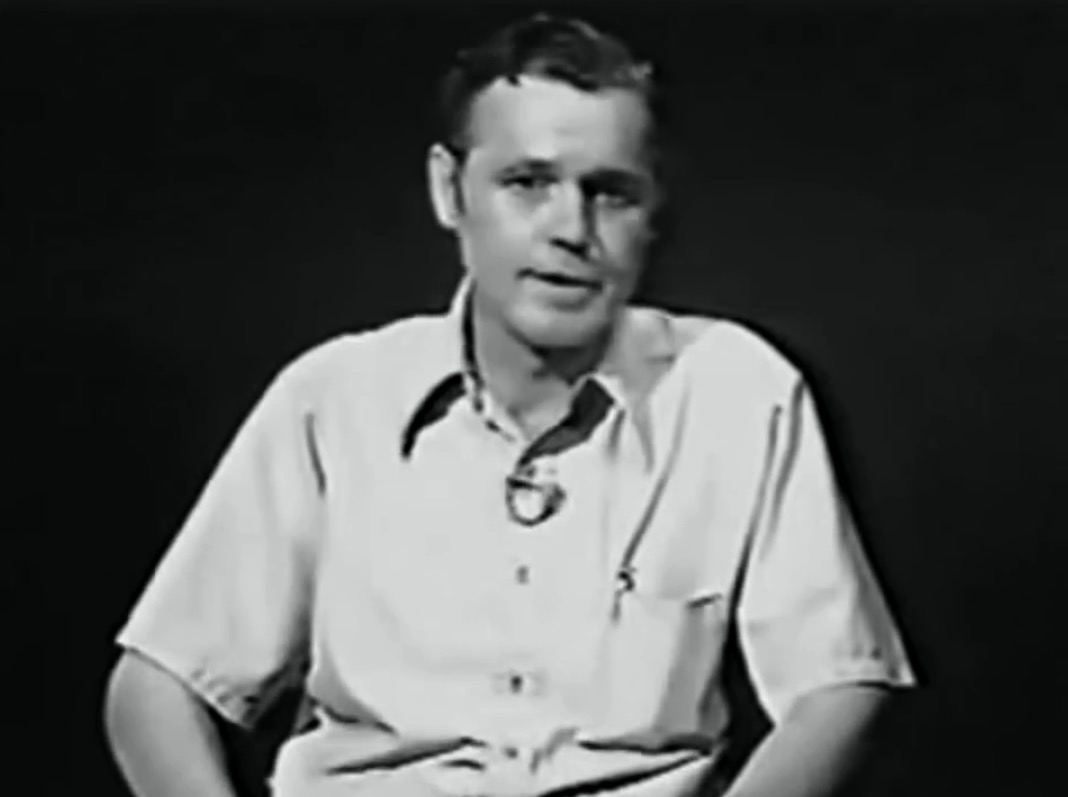
    David Giglio is a contributor to CTKA. He publishes regularly at Our Hidden History.


    From the period of about 1960-66,  Mort Sahl was one of the highest profile, in demand, and highest compensated comedians in America. In fact, in its issue of August 15, 1960, Time Magazine placed him on its cover.  He was a regular on such programs as the “Ed Sullivan Show” and “The Tonight Show”.  Sahl, more or less, redefined what stand up comedy would be from then on.  And men like George Carlin essentially followed in his footsteps.  Sahl’s brand of humor was both socially and politically conscious.  Although he would come on stage with a college sweater and the daily newspaper, he was far from the average man.  He was quite well informed and acute, and his satire came from a deep affection for America and what it was supposed to be about.

    Sahl was one of the very few Americans who actually knew and communicated with John and Robert Kennedy.  Kennedy appreciated Sahl’s humorous deprecations of him as a spoiled rich kid.  Although JFK once had the following conversation with Sahl on the subject: “OK, so how much do you think my father is worth Mort?”  Sahl replied, “I don’t know, maybe 300 million?”  Kennedy replied, “Alright.  Now how much do you think the Rockefellers are worth?” Sahl said he had no idea.  Kennedy responded with, “Try four billion Mort.” Kennedy paused to let the number sink in. He then jabbed his finger at the comedian and added: “Now, that’s money Mort.”

    Sahl was quite interested in Kennedy’s assassination.  Something did not sit right with him about the Warren Report.  He actually read long parts of it and the volumes of evidence that accompanied it.  He thought much of it was ludicrous. He actually used to quote from it in his stand up performances.  He would read parts of its most pointless and stupid depositions in a dead pan comic style, letting the ridiculousness hit home. He would then say, “And that’s how they found out who killed John Kennedy.”

    When the Jim Garrison investigation broke into the newspapers in 1967, Sahl had a talk show on the radio in Los Angeles.  Naturally, he was quite interested in what the New Orleans DA was discovering.  He actually journeyed to the Crescent City to talk to Garrison.  He was impressed with the man and wanted to have him on his show.  But station management insisted that if he did that, he would have to perform an attack journalism/hatchet job on the DA.  Sahl said he could not do that since he thought Garrison was pretty much right on about Kennedy’s murder.  He was then taken off  the air. He went back down to New Orleans and Garrison swore him in as a deputy.  Sahl wrote about some of his experiences working for Garrison in his book Heartland.  Especially bracing is a scene he describes with Clay Shaw’s lawyers trying to introduce the Warren Commission volumes into evidence at a hearing.  The judge was absolutely beside himself with indignation that any self respecting lawyer could take such a document seriously as evidence.

    With his connections in the entertainment world, Sahl did what he could to get some positive exposure for the DA.  The high point of this effort was the interview conducted for Playboy by Eric Norden in October of 1967.  (Click here to read http://www.jfklancer.com/Garrison2.html) The low point was when Mort Sahl appeared on The Tonight Show and suggested that Johnny Carson interview Garrison on his show.  The audience response was so positive that Carson had to agree to do so on the air.  But clearly, Carson’s bosses at NBC did not want to have any kind of fair and serious debate about the issues.  What Carson did was what Sahl would not do on his show: a premeditated attack to prevent any elucidation and education of the public on the issues surrounding Kennedy’s death.  Carson had been thoroughly briefed, and NBC lawyers had interviewed Garrison in advance. The lawyers furnished Carson with cue cards as to how to question Garrison.  But still, Garrison did fairly well and Carson came off like the hatchet man he was prepped to be.  The host was very angry with Sahl for getting him into this sticky situation. Afterwards, he yelled at him: “You will never be on my show again.” (Click here for that appearance https://www.youtube.com/watch?v=EZN2FGHKzQI)

    Carson kept his word. Sahl paid a stiff price for backing Jim Garrison.  His career went into a steep decline.  He was quite literally blackballed for several years.  It was not until the Watergate scandal, which was made to order for Sahl, that he came back.  And after Carson retired, Jay Leno had Mort Sahl on his version of The Tonight Show.  So, in the long run, Sahl had come full circle.

    We present here a rare interview with Sahl about his experiences in New Orleans and his present thoughts on the JFK case.

    ~Jim DiEugenio


    Transcript

    (Click here if your browser is having trouble loading the above.)

    [iframe width=”560″ height=”315″ src=”https://www.youtube.com/embed/bimrN5NCdJk” frameborder=”0″ allowfullscreen ]
  • Warren Hinckle and the Glory that was Ramparts

    Warren Hinckle and the Glory that was Ramparts


    Warren Hinckle passed away on August 25th,  at age 77. Hundreds at the Saints Peter and Paul Church in North Beach, San Francisco, attended his funeral service. He was buried on Tuesday the 30th. Some of the luminaries who attended his funeral were historian Kevin Starr, the founder of Salon David Talbot, and former San Francisco Mayor Willie Brown.

    CTKA carried a notice upon his passing, one from the online version of the Chronicle, the paper he used to write for. Among several others, there were notices in the New York Times, The Nation, and the online magazine Politico. This author read most of them. Not one even came close to recalling or measuring the journalistic brilliance of the man, or the eternal glory of his most significant creation, the last great American magazine, Ramparts.  Considering the standard set by that glossy monthly periodical, I understand the reluctance to remind us of Hinckle’s achievement.

    For those too young to recall it, Ramparts is hard to describe.  For the simple reason that there is nothing today that even resembles it. Which says a lot. Because today we live in the era of online publication; which means journals are much cheaper to produce and maintain, and therefore there is much more freedom  to create. The fact that, to this day, no one has equaled Hinckle’s 1964-69 editorial achievement at Ramparts is what makes what he did the stuff of legend.  After all, it was nearly half a century ago.

    Edward Keating

    Before trying to detail the pure excitement that Ramparts represented,  it is necessary to tell the reader a bit about Hinckle’s background. He was born in San Francisco in 1938.  His father was a shipyard worker.  He attended parochial schools before studying philosophy at the University of San Francisco. There he edited the student newspaper, The Foghorn. Under his editorship it became quite an unusual student newspaper. For instance, it was one of only 14 college newspapers classified as a daily. As editor of a daily, Hinckle went to Squaw Valley in Lake Tahoe for two weeks to cover the 1960 Winter Olympics.  From Tahoe, he ran The Foghorn via telephone and telegraph. As he later noted, its readers read little about their college in the college newspaper. For Hinckle featured Herblock cartoons, and headlines like “Dorothy Day Asks: Who Baptized Capitalism?”  (USF was a Jesuit college) He once stole the entire press run of the rival San Francisco State newspaper.  Needless to say, because of disputes with the college administration, he left USF without graduating.

    From there he took a job at the San Francisco Chronicle.  His first outpost was in Oakland, which Hinckle called the Siberia of the Chronicle stations.  Working the police beat, he discovered an unwritten rule about the paper’s Oakland coverage.  The coverage of a homicide  largely depended upon where the victim lived.  To quote from his memoir: “Ghetto murders, being regarded as natural black events, were rarely considered newsworthy.  White trash murders stood a poor to even chance of getting in the paper…..”   There was also a rule of thumb similar to this in the area of fatal car accidents: “No niggers after 11 PM on weekdays, 9 PM on Saturdays (as the Sunday paper went to press early).”  To this rule there was one exception, in the area of quantity: “If two black persons died in a late evening auto crash, that event had a fair chance of making the news columns.” (Hinckle,, If You Have a Lemon, Make Lemonade,  pgs. 31-. 32)

    Eventually, he made it back to San Francisco, where he was given a bit of leeway.  One of his favorite stories was about a former slave from Alabama who emigrated to California.  He got rich in the pinball machine business and  legally adopted the children of his former master.  Then, in the fall of 1961, Hinckle took a temporary leave of absence to help invigorate an ambitious and intellectual Catholic quarterly.

    Hinckle had been moonlighting in the public relations business.  A friend of his, Harry Stiehl, decided to introduce him to a man named Ed Keating.  Keating was a converted Catholic who wanted to start a quarterly periodical that was meant to begin a dialogue between laity and the clergy of the Catholic Church.  He also wanted to begin to spawn a new generation of Catholic intellectuals who had a gift for writing and communicating.  With his PR connections, Stiehl thought Hinckle could help promote Keating’s new journal. It was called Ramparts.

    Howard Gossage

    Keating had a wealthy wife and some famous contributors, like the Trappist monk Thomas Merton and John Griffin, who wrote the bestseller Black Like Me.  In 1964, Keating tried to raise his journal’s profile by defending the highly controversial play The Deputy which had just opened on Broadway. Hinckle arranged a huge press conference in Keating’s suite at the Waldorf Astoria hotel.  Keating and his magazine got exposure;  the play opened successfully and ran for a year.  As Hinckle wrote in his book, this episode became the model for what he later termed activist journalism.

    It also increased the circulation of the magazine.  Keating liked that and he appreciated what Hinckle had done.  So Hinckle did it again. But this time he channeled all the PR into an issue that very much interested him—the murders of three civil rights workers in  Neshoba County, Mississippi in June of 1964. Hinckle promoted a man named Louis Lomax as the Ramparts author of this sensational article.  Lomax did not come through. But like the British at Dunkirk,  Hinckle turned an expected disaster into a triumph by promising the details of the Lomax piece in a future issue.  (Although Hinckle does not deal with this episode in his book, Peter Richardson does in his chronicle of the magazine, A Bomb in Every Issue.)

    There were two factors that allowed Hinckle to gain control of the magazine from Keating.  First, because of the success Hinckle had in promoting Ramparts, Keating made him executive editor.  Second, Keating was becoming financially overextended.  Or as he told Hinckle, “I do have one shopping center left.”  (Hinckle, p. 95)  Therefore Hinckle now had to find alternative sources of funding himself.  Which he did.  Thus began Hinckle’s five year reign.  He was greatly aided by the PR skills and connections of one Howard Gossage.  Gossage was an advertising executive in the Bay Area who was generally described as an innovator and iconoclast in the field.  At age 36, he founded his own agency called Wiener and Gossage.   He would often have salons at his office headquarters, inviting many of the cutting edge thinkers in the San Francisco area, including Hinckle.  (Click here for more on Gossage http://www.howardluckgossage.com/)  

    To describe in detail the contents of what Hinckle produced in those five years would take a medium sized book. And I don’t mean the machinations that went on at the magazine headquarters, or just naming some of the big stories Ramparts produced.  But to detail the contents of what the magazine exposed about America, who Hinckle decided to take on, the methods he employed and the price he was willing to pay, all these—and more—were, to my knowledge, unprecedented before him, and unmatched afterwards. Ramparts was so effective and influential that it became a regular target of the MSM, especially Time magazine and the New York Times, which obviously did not like being exposed as the poseurs they were. Beyond that, the CIA launched operations against Ramparts.  These were commissioned by Desmond Fitzgerald, supervised by Richard Ober, and executed by Edgar Applewhite. As detailed in his book Secrets, the late Angus McKenzie showed how this program grew into MHCHAOS, the massive CIA spying on and infiltration of leftist protest groups in that decade.

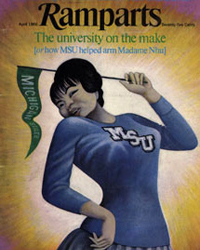
    Madame Nhu as depicted on cover of Ramparts

    What got the CIA so angry?  For starters, Ramparts exposed a program the Agency was running out of Michigan State University. (Click here http://la.utexas.edu/users/hcleaver/357L/357LMSUinVietnam.pdf) It taught CIA interns how to train interrogators in South Vietnam to torture dissidents in Saigon. This created an uproar. Not just for the story, but also because of the hilariously outrageous Ramparts cover, which featured the immortal image of Madame Nhu in an MSU  cheerleaders’ outfit waving an MSU flag.  The image suggesting the Vietnam War was now controlling the agenda of American colleges. (Click here for a time capsule reaction http://msupaper.org/issues/The_Paper_1966-04-21.pdf)

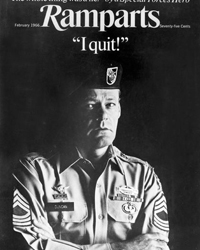
    Then there was Donald Duncan.  Duncan was a Special Forces Sergeant who served in Vietnam and taught at Fort Bragg, North Carolina.  He resigned his commission and returned to Berkeley, California. There, in February of 1966, Duncan graced another memorable Ramparts cover. He was pictured in a long sleeved uniform, topped with a Green Beret cap. Above him were the words, “I quit”. Above that was the quote: “The whole thing was a lie.”  In this emblematic story, Duncan described his ten years in the military, capped by a nearly two year tour in Vietnam.  He said he went to Vietnam to fight communism.  But what he learned there about the American effort forced him to retire from the service forever.  Duncan first focused on the fact that there really was no government of South Vietnam—it was simply constructed and propped up by the USA.  And it was in no way a democracy. Secondly, he wrote that the Ho Chi Minh Trail was wildly overrated as a source of supplies for the Viet Cong. Most of the material came over the border or from the sea. Thirdly, he said that the US military was involved in atrocities that violated the rules of warfare, and this extended to the civilian population.  Duncan was really the first former GI to open up the path for Mark Lane’s book Conversations with Americans, the Winter Soldier Hearings, and the exposure of the My Lai Massacre.  (http://vietnamfulldisclosure.org/wp-content/uploads/2015/04/1966-02-Donald-W.-Duncan-The-Whole-Thing-Was-A-Lie-Ramparts.pdf)

    In the March 1967 issue Hinckle exposed another instance of the CIA operating domestically. Ramparts now revealed that the Agency was secretly funding the National Students Association.  (http://www.unz.org/Pub/Ramparts-1967mar-00029) In other words the largest college student association in America–featuring a large annual convention picturing a celebration of youthful democracy–was secretly funded, infiltrated and channeled by the Agency. Many of the top officers knew about it and were briefed on that association.  Further, several of them had case officers, code names, and reporting requirements.  Incredibly, some of their overseas representatives were actually career CIA agents from Langley.  The aim of the program was multi-leveled.  First, the Agency would moderate any radical or leftist tendencies in the largest student organization in the world. Second, they would use the overseas voyages of the students to collect information and try and moderate any radical leaders abroad. And third, the propaganda  goal was to portray  our young representatives as independent citizens, while many of the people they met abroad were communist stooges programmed from Moscow. (Hinckle, p. 185)

    Eldridge Cleaver

    NSA officer Michael Wood had a pang of conscience about it and was talking to Hinckle. Unlike other top officers, Wood had not signed a non-disclosure agreement.  Further, Wood had records, not just about the NSA, but other related fronts that the CIA had established.  For example, Stephen Spender’s Anglo-American journal Encounter. Wood also showed how the CIA very often used large legal firms in big cities to channel their clandestine funding.  Usually these firms had a former OSS officer as a founding member.  (One is reminded here of the firm Monroe and Leeman in New Orleans, which helped fund Walter Sheridan’s hit piece on Jim Garrison.  See Destiny Betrayed, Second Edition by James DiEugenio, p. 238)

    MHCHAOS operations officer Richard Ober heard about Wood’s talks with Hinckle.  He tried to find a way to stop publication.  But he couldn’t find a legal pretext.  So he then arranged a press conference in New York.  At this conference the officers would pretend that this was all a thing of the past, and they were now reformed. Therefore, the Ramparts story was old hat.  Hinkle got wind of this plan.  He memorably said, “ I was damned if I was going to let the CIA scoop me.”  (Hinckle, p.  190) Ramparts then bought two full page ads in the New York Times and Washington Post to expose the illegal association (the CIA is forbidden by its charter to operate domestically) and what the Agency had done to cover it up.  When word of the ads leaked, Ober’s press conference collapsed. 

    The New York Times now started a couple of weeks of reporting on other CIA fronts here and abroad that was influencing cultural affairs. This was one of the many triumphs of Ramparts. In many ways, at many times, it  actually led the news cycle.  By repeatedly scooping the MSM, it became a model of what they were not doing. At the same time that—out of pure humiliation—the magazine became an object of attack. Ramparts did what the MSM was supposed to be doing but did not—actual investigative reporting.  It was showing what the real world around the reader was composed of and what it was all about. But the fact that it was camouflaged made it hard for the average person to detect. So Ramparts did it for them.  Which is why as Jeff Cohen, a student at Michigan, told Peter Richardson, Ramparts was passed around the dorm there to the point it was wrinkled and dog eared by the time he got it. “It really was a radicalizing tool of its own.  It ripped your head off. “ He added that it had turned his cousin’s fraternity into an SDS chapter.

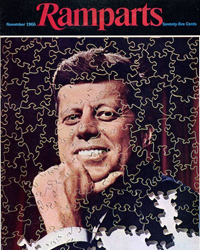
    Ramparts cover November 1966

    At its pinnacle, Ramparts had a circulation of about 250,000.  One can imagine how the CIA felt when Hinckle started featuring stories about the conspiracy to murder John F. Kennedy, and then putting such things on the cover. For this topic, there was another cover for the ages.  The November 1966 issue featured the face of JFK made up like a jigsaw puzzle, with several pieces missing.  That was followed  two months later by “The Case for Three Assassins” written by David Welsh and David Lifton. (Click here to view).

    The Welsh/Lifton article began with the following words: “No less than three gunmen fired on the Presidential motorcade in Dallas on November 22, 1963…” It was a long, illustrated, annotated examination of the ballistics, medical, and eyewitness testimony. It all indicated a triangulation of gunfire in Dealey Plaza.  To my knowledge, it was the first time such an intricate discussion reached a mass audience. That issue was then followed by two long pieces on the Jim Garrison investigation in New Orleans. (Click here for the first one).

    These were  both penned by former FBI agent William Turner, who was actually working with Garrison. Therefore, Turner had access to the DA and some of his files.  Ramparts  was one of the very few media outlets that actually treated Garrison and his evidence with respect. Until Jim Garrison published On the Trail of the Assassins, Turner’s articles were–along with Paris Flammonde’s book, The Kennedy Conspiracy—prime reference works for anyone interested in the non-MSM view of Garrison.

    Hinckle met resistance inside his office on this issue.  Reporters like Bob Scheer did not want to cover the assassinations of the sixties at all.  As he once told Turner, such writing amounted to “mental masturbation”.  Hinckle disagreed.  For the simple reason that he had read the official report and most of the accompanying volumes of evidence.  He concluded the Warren Report was impossible to believe:  “Anyone who has read those 26 volumes…knows that the function of the Warren Commission was not to ferret out the truth, but to put the citizens at ease that there was no conspiracy.” (Hinckle, p. 217)  About Jim Garrison, Hinckle wrote, “… no man I have known had more legitimate reasons to become paranoid than Garrison; there actually were people constantly plotting against him.”  (Hinckle, p, 209) With the declassified files of the Assassination Records Review Board, we know that to be, not just true, but an understatement.  (See Destiny Betrayed, Second Edition, Chapters 11 and 12)

    The Ramparts “I Quit” cover

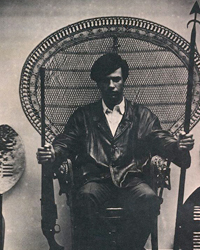
    To chronicle the endless triumphs of Hinckle’s editorship could go on and on, taking scores of pages. But to mention just two other exceptional aspects of Hinckle’s stewardship: Ramparts was the first and only widely read publication to champion the Black Panthers.  And again, there was an iconic cover design by art director Durgald Stermer to signify it:  Huey Newton in a wicker chair with a spear in one hand and a loaded carbine in the other.  Eldridge Cleaver actually became a contributing editor, and Ramparts released his book Soul on Ice through its publishing imprint.

    There was also a photo essay “The Children of Vietnam” put together by William Pepper.  (http://www.unz.org/Pub/Ramparts-1967jan-00045) That 1967 visual article showed just how extensive, indiscriminate and destructive the massive  American firepower unleashed in Indochina was. It was laying waste to the civilian population, including tens of thousands of women and children. Martin Luther King picked that issue up off a newsstand before taking a working vacation in Jamaica.  When he returned he began making his first speeches against President Johnson and his conduct of the war.  Again, Ramparts was leading the news cycle.

    The power and the glory all came to an end in early 1969.  For three reasons.  First, if Ramparts had one failing it was Hinckle’s lack of interest in the arts and the so called counter culture in San Francisco. For instance, there was no Dwight MacDonald or Robert Christgau at Ramparts to review movies or music. And many people wanted to read both.  Therefore, young Jann Wenner left Ramparts to start up something called Rolling Stone.  Which then became a competitor.  There was also an internal coup against Hinckle by new staff members who were tired of his profligate spending.  For instance, he had sent a team of 15 correspondents to cover the Chicago Democratic Convention in 1968.  And he had put up ten of them at the four star Ambassador Hotel.  Finally, when Hinckle found someone who was interested in bailing him out, Scheer got into a stupid and senseless argument with the man and his entourage.  (Hinckle, pgs. 371-78)  Hinckle was now out. The magazine declared bankruptcy and reorganized around new leadership.

    The new principals were Robert Scheer and David Horowitz.  This, of course, meant that Hinckle’s daring, “nothing sacred” approach would be abandoned.  Because those two men represented a much more doctrinaire, New Left approach. Therefore instead of writers like William Turner and Bill Pepper, we now got people who really were not all that unusual  or new e.g. Alexander Cockburn, Noam Chomsky, Sy Hersh, Jonathan Kozol. The subjects now also became those of the doctrinaire left: Earth Day and the environment, food safety, oil spills in Santa Barbara, and the plight of Native Americans. Without Hinckle, Ramparts had lost its singular, contemporary jazz riff.

    Huey Newton as he appeared in Ramparts

    Later, Scheer was moved out by Horowitz and replaced by a new second in command: Peter Collier.  The irony being that it was Scheer who brought both men to Ramparts in the first place.  But, predictably, the magazine now began to lose its  large circulation.  Seeing the writing on the wall, Horowitz and Collier decided to transition their way out.  In 1973 they met with Abby and Marion Rockefeller, part of the Rockefeller clan who were outsiders because of their contrary political beliefs—which is why they backed Ramparts.  The two men now contracted to do a history of the clan.  They got a sizeable advance, and then signed on a new management team for Ramparts.  Their book, The Rockefellers: An American Dynasty,  sold quite well.  It was published in 1976, the year after Ramparts went under for good.

    Ramparts was so unusual, so blindingly meteoric, so politically potent, that, when it fell, it actually dropped the seeds of its own reaction.  By 1975, the Sixties were pretty much killed off.  And Ramparts, in its new form, did not do a lot to preserve it.  Richard Nixon was now president, with the likes of Spiro Agnew as his VP.

    Men like Pat Buchanan and William Safire were writing his speeches.  And from 1969-75, Henry Kissinger was doing the final reversals of whatever was left of John Kennedy’s reformist foreign policy, specifically in Africa, the Middle East and the continuation and expansion of the Indochina war.

    It was within this new political milieu that men like Horowitz, Collier, Sol Stern and Martin Peretz began their  migration to what would become the New Right, neoconservative movement.  Financial backer Peretz did not like the evenhanded approach Scheer wanted to take in the Middle East.  So he pulled out of Ramparts.  He now purchased the liberal New Republic from Gilbert Harrison.  In a remarkably short time period, Peretz pretty much reversed the trajectory of that journal’s foreign policy pages. By about the mid-eighties, many were calling the New Republic a neoconservative bastion.  Which, for all intents and purposes, it was; most notably on the Middle East and Central America.

    Sol Stern, who actually wrote the Ramparts article on the NSA scandal, eventually found a home at the Manhattan Institute.  This is a New Right think tank that was actually co-founded by the deceased CIA chief Bill Casey. Manhattan Institute has sponsored books by Charles Murray, who was actually a fellow there when he wrote his anti-welfare polemic  Losing Ground.  Stern’s specialty today is to promote voucher system education, which would almost surely undermine the public school system.

    Peter Collier

    After their tome on the Rockefellers, Horowitz and Collier then wrote books on other wealthy families:  the Kennedys, the Fords, and the Roosevelts.  Their book on the Kennedys is so bad that this author included it in his review of the anti-Kennedy literature in the essay “The Posthumous Assassination of JFK.” Predictably, that book provided the occasion for the pair to proclaim their conversion to Reagan Republicanism.  This was announced in the Washington Post under the banner “Lefties for Reagan”.  (The Assassinations, edited by James DiEugenio and Lisa Pease, p. 357).  They then went on and became beneficiaries of the largesse of the wealthy conservative class.  They founded organizations like Encounter Books, FrontPageMagazine.com, the David Horowitz Freedom center, and Discover the Networks. All of these are meant to undermine the things that Ramparts represented: the liberal ideals of an open and more egalitarian society.  And with the collapse of the Sixties, and the killing off of its leaders—JFK, Malcolm X, RFK and King, plus the FBI sponsored extermination of the Panthers—that was not really difficult to do.

    Hinckle never did anything of the kind.  He tried to start up another monthly magazine called Scanlan’s Monthly.  But I have it on two sources that the Nixon administration used the IRS and the USPS to obstruct its  distribution and circulation. Consequently it closed down in less than a year.  He next edited Francis Coppola’s City magazine, which lasted until 1976.  He then did something that no one thought possible: he revived The Argonaut, which had closed down in 1956.  He did this in 1991, and that publication is still around in both print and online versions.

    Besides that, he ran unsuccessfully for mayor of San Francisco in 1987.  He also wrote about ten non-fiction books.  There are two that are mandatory reading for anyone interested in the Sixties and the assassinations. In 1974, on the eve of the final dissolution of Ramparts, Hinckle wrote a memoir about his editorship of that magazine.  It was called If You Have a Lemon, Make Lemonade.  To me, there is nothing at all like it in the literature.  It is, at once, funny, pungent, candid, and nostalgic without being sentimental. A definite must read. Then, in 1981, he co-wrote, with Bill Turner, The Fish is Red.  That book was later reissued as Deadly Secrets in 1992.  Up until that time, and until this day, it is one of the best JFK assassination books written from the point of view of the Cuban exiles’ association with the CIA.

    In the late nineties, this author considered reviving Ramparts. I won’t go extensively into why I decided against it. But one of the reasons I didn’t was because I thought that, with the surge of online journalism, surely someone, maybe more than one, would now use the opportunity to emulate Ramparts, or Art Kunkin’s LA Free Press.  The latter was an extraordinary newsweekly that complemented Ramparts. Together, they formed the last pinnacle of American journalism.  To say the least, those online expectations were not fulfilled by the likes of Jane Hamsher, Markos Moulitsas, and Josh Marshall.  In fact, this so called internet revolution was so stillborn that it made Ramparts and the LA Free Press look like even greater achievements.  (See here for my particular disputes)  In fact, that online result recalls Hinckle’s answer as to why Ramparts was so exceptional, he replied, “Because the rest of the media was so shitty.”  I would add: But it took Ramparts to show us how shitty they were.

    Today, to do anything like what Ramparts did, a single publishing journal would have to been the first to:

    1. Shown in detail how George W. Bush stole the 2000 and 2004 elections in Florida and Ohio
    2. Demonstrated how the FBI and CIA left us unprotected on 9-11
    3. Revealed the secrets of NSA illegal spying
    4. Exposed Colin Powell’s phony UN speech justifying the war with Iraq
    5. Visited Iraq with a camera crew to show us the terrible civilian toll Bush’s phony war took on the populace.

    And they  would have to have achieved the above in just five years, from about 2001-2005 I think the reader will agree that any such comparison suggests science fiction today.  But Hinckle did it.

    Therefore, Ramparts stands alone in the history of contemporary American journalism; much as Citizen Kane towers in the history of  the American sound film.  It is often written that, in that picture, Orson Welles took the art of  film direction to a point that no other American has since matched or surpassed. With the death of Warren Hinckle we can say  that no other American has produced or edited a magazine, or online journal, that has matched or surpassed what he did at Ramparts.  And, from my point of view, it looks like no one else will do so for a long time.  For that, among other things, he deserves to be properly saluted upon his passing.  He set a standard for us all by reminding us what real journalism can and should be.

    ~ Jim DiEugenio

  • JFK and the Unforgivable: How the historians’ version of the JFK assassination dishonors the historical record – Part 1

    JFK and the Unforgivable: How the historians’ version of the JFK assassination dishonors the historical record – Part 1


    In April 2016 CTKA published this author’s article[i] that revealed how history books portray the JFK assassination as a crime perpetrated by Oswald alone and how authors’ sources are restricted to the Warren Commission and a few books that mostly support the Lone Nut scenario. Information and conclusions coming from other major investigations and pro-conspiracy authors are almost completely ignored.

    The article went on to show how the historians violate their own code of conduct on this issue and looked into possible outside influences that may have affected their work and mindsets. The unfortunate result of the lack of diligence on this issue is that captive audiences of young students have been unfairly exposed to a biased, unsound and incomplete account of the Kennedy assassination in most history textbooks.

    Another point that came out was that many historians find that independent researchers that write about possible conspiracies lack credibility. There has been much propaganda to discredit them and their work. They are called zany, dishonest, and greedy and their claims are said to be baseless and off the wall. Furthermore they are accused of undermining their own institutions, government and country. Before a serious historian can zero in on whom the reliable researchers are and focus on the soundness of their arguments, they have to cut through clutter caused by hostile, omnipresent anti-conspiracy messaging as well as the cast of shaky researchers peddling low quality work.

    This article focuses on what interested historians can easily learn from the official investigations and the opinions and statements from the actual investigators, lawyers, and staff members who were involved in six investigations that were mostly (all but one) government initiated and managed. The Warren Commission was the first one, the one most historians count on almost entirely for their writings, and as we will see, it is the most obsolete and least reliable.

    For an historian who finds research on this issue very daunting, this should serve as a starting point – especially for those who, as they did with the Warren Commission Report, have faith in their government institutions and their representatives. What follows is what can be learned from not only the official investigation reports but from the mouths of those who were direct participants in them … the real insiders: Those who were mandated and given special powers to access witnesses and evidence! It therefore discounts the theories and opinions of independent authors.

    It may prove difficult to fluff off these sources as being zany, dishonest and greedy … Doing so would suggest a far-fetched governmental conspiracy to deceive its own people and undermine important American institutions.

    It is this author’s opinion that historians are disrespecting the American Historical Association statement of conduct about honoring the historical record when they assert that Oswald alone assassinated the president based on the conclusions of the Warren Commission. If they read this article and continue to do so, their actions cannot be blamed on mere ignorance of the facts, or confusion caused by obfuscators. Thereafter, if the historian does not feel compelled to dig deeper to find out what really happened, then the word unforgivable should be added to the word subservient – at least on this issue – when describing their performance. Especially when one considers the age of the subjects who are victimized in what is supposed to be a learning environment.

    If they continue to cite the Warren Commission as their key source, they may want to consider taking up smoking cigarettes; after all some of the first studies about this product concluded that it was good for your health.

    The President’s Commission on the Assassination of President Kennedy (aka The Warren Commission)

    Established on November 29, 1963, it was set up by President Lyndon Johnson to investigate the November 22, 1963 assassination of President Kennedy. The Commission presented an 888-page report[ii] and twenty-six volumes of evidence on September 24, 1964. Its major conclusions were that Lee Harvey Oswald acted alone in killing JFK and that nightclub owner Jack Ruby also acted alone in killing Oswald two days later.

    The Commission had “not found evidence” linking either Oswald or Ruby to a conspiracy. (WR, p. 21)

    The first hint of dissension among the members of the commission is the following bewildering statement in the report which points to a rift concerning the Single Bullet theory and Connally’s testimony: “Although it is not necessary to any essential findings of the Commission to determine just which shot hit Governor Connally, there is very persuasive evidence from the experts to indicate that the same bullet which pierced the President’s throat also caused Governor Connally’s wounds. However, Governor Connally’s testimony and certain other factors have given rise to some difference of opinion as to this probability but there is no question in the mind of any member of the Commission that all the shots which caused the President’s and the Governor’s wounds were fired from the sixth floor of the Texas School Book Depository.” (WR, Page 19)

    What is not being said directly here is that certain members of the Commission, as well as John Connally and his wife, did not believe that a single bullet caused all seven wounds, which is in fact necessary to the essential conclusions. Because if one bullet caused Kennedy’s head wound and another caused bystander James Tague’s injury, then for Oswald to be the lone shooter, he would have had to have caused all remaining seven wounds with his only other shot, because even the Warren Commission acknowledges that Oswald could not have fired more than three shots.

    Statements and opinions of Warren Commission members, consultants and investigators

    While most historians continue to place their faith in the Warren Commission, it is most noteworthy that an important number of important participants in the investigation had serious doubts about crucial elements in the report.

    Roger Craig – Dallas Deputy Sheriff

    Roger Craig was very well regarded up until the assassination. He was on duty and in Dealey Plaza at the time of the assassination. In a number of interviews he explains what he witnessed on November 22, 1963: He was in the Book Depository when the alleged murder weapon was found which he confirmed as a Mauser and not the Mannlicher-Carcano that the Warren Commission claimed Oswald owned. (Contrary to what some have written, the brand name Mauser and the calibre are stamped on some editions of the Mauser rifle; see here The Mauser, the Carcano and the Lt. Day Rifle ) Furthermore Craig claimed to have seen Oswald entering a station wagon a few minutes after the assassination, which would contradict the Warren Commission’s chronology of Oswald’s movements and implicated a getaway driver – the following is part of his Warren Commission testimony:

    Roger Craig: I drove up to Fritz’ office about, oh, after 5 … about 5:30 or something like that and talked to Captain Fritz and told him what I had saw. And he took me in his office … I believe it was his office … . it was a little office, and had the suspect sitting in a chair behind a desk … beside the desk. And another gentleman, I didn’t know him, he was sitting in another chair to my left as I walked in the office. And Captain Fritz asked me “was this the man I saw” and I said, “Yes,” it was.

    David Belin: All right. Will you describe the man you saw in Captain Fritz’ office?

    Roger Craig: Oh, he was sitting down but he had the same medium brown hair; it was still … well, it was kinda wild looking; he was slender, and what I could tell of him sitting there, he was … short. By that, I mean not myself, I’m five eleven … he was shorter than I was. And fairly light build.

    David Belin: Could you see his trousers?

    Roger Craig: No; I couldn’t see his trousers at all.

    David Belin: What about his shirt?

    Roger Craig: I believe, as close as I can remember, a T-shirt … a white T-shirt.

    David Belin: All right. But you didn’t see him in a lineup? You just saw him sitting there?

    Roger Craig: No; he was sitting there by himself in a chair … off to one side.

    David Belin: All right. Then, what did Captain Fritz say and what did you say and what did the suspect say?

    Roger Craig: Captain Fritz then asked … . “What about this station wagon?” And the suspect interrupted him and said, “That station wagon belongs to Mrs. Paine” … I believe is what he said. “Don’t try to tie her into this. She had nothing to do with it.”

    In Craig’s 1971 book When They Kill a President, he describes that many in the DPD despised Kennedy, and how the DPD was excluded from security duties the day of the assassination. The following is David Ratcliffe’s summary of the Book:

    … He was a member of a group of men from Dallas County Sheriff James Eric “Bill” Decker‘s office that was directed to stand out in front of the Sheriff‘s office on Main Street (at the corner of Houston) and “take no part whatsoever in the security of that motorcade.” Once he heard the first shot, Roger Craig immediately bolted towards Houston Street. His participation in the formative hours of the investigation during the rest of that day and into the evening included observations and experiences that would have singlehandedly destroyed the entire Warren Commission fairy tale before a grand jury or a Congressional investigation.

    Roger Craig was named the Dallas Sheriff‘s Department “Officer of the Year” in 1960 by the Dallas Traffic Commission. He received four promotions while he was Deputy Sheriff. Among the most important events he witnessed: At approximately 12:40 p.m., Craig was standing on the south side of Elm Street when he heard a shrill whistle coming from the north side of Elm and turned to see a man—wearing faded blue trousers and a long sleeved work shirt made of some type of grainy material—come running down the grassy knoll from the direction of the TSBD. He saw a light green Rambler station wagon coming slowly west on Elm Street, pull over to the north curb and pick up the man coming down the hill. By this time the traffic was too heavy for him to be able to reach them before the car drove away going west on Elm.

    Roger Craig

    After witnessing the above scene, Deputy Craig ran to the command post at Elm and Houston to report the incident to the authorities. When he got there and asked who was involved in the investigation, a man turned to him and said “I‘m with the Secret Service.” Craig recounted what he had just seen. This “Secret Service” man showed little interest in Craig‘s description of the people leaving, but seemed extremely interested in the description of the Rambler to the degree this was the only part of the recounting that he wrote down. Immediately after this Craig was told by Sheriff Decker to help the police search the TSBD. Deputy Craig was one of the people to find the three rifle cartridges on the floor beneath the window on the southeast corner of the sixth floor. Originally, all three were no more than an inch or two apart. One of the three shells was crimped on the end which would have held the slug. It had not been stepped on but merely crimped over on one small portion of the rim. The rest of that end was perfectly round.

    He was among those present after the rifle was found. And, along with Deputy Eugene Boone who had first spotted the weapon, was immediately joined by police Lt. Day, Homicide Capt. Fritz, and deputy constable Seymour Weitzman, an expert on weapons who had been in the sporting goods business for many years and was familiar with all domestic and foreign makes. Lt. Day briefly inspected the rifle and handed it to Capt. Fritz who asked if anyone knew what kind of rifle it was. After a close examination, Weitzman declared it to be a 7.65 German Mauser. Capt. Fritz agreed with him. At the moment when Capt. Fritz concurred with Weitzman‘s identification of the rifle, an unknown Dallas police officer came running up the stairs and advised Capt. Fritz that a Dallas policeman had been shot in the Oak Cliff area. Craig instinctively looked at his watch. The time was 1:06 p.m. (The Warren Commission attempted to move this time back beyond 1:15 to create a plausible claim Oswald had reached the Tippit murder scene in a more humanly possible time-frame than would be the case if Tippit had the encounter with his murderer earlier.)

    Later in the afternoon Craig received word of Oswald‘s arrest and that he was suspected of being involved in Kennedy‘s murder. He immediately thought of the man running down the grassy knoll and made a telephone call to Capt. Will Fritz to give him the description of the man he had seen. Fritz said Craig‘s description sounded like the man they had and asked him to come take a look. When he saw Oswald in Fritz‘s personal office Deputy Craig confirmed that this was indeed the man, dressed in the same way, that he had seen running down the knoll and into the Rambler. They went into the office together and Fritz told Oswald, “This man (pointing to me) saw you leave.” At which time the suspect replied, “I told you people I did.” Fritz, apparently trying to console Oswald, said, “Take it easy, son—we‘re just trying to find out what happened.” Fritz then said, “What about the car?” Oswald replied, leaning forward on Fritz‘s desk, “That station wagon belongs to Mrs. Paine—don‘t try to drag her into this.” Sitting back in his chair, Oswald said very disgustedly and very low, “Everybody will know who I am now.”

    The fact that Fritz said ‘car’ and this elicited Oswald‘s outburst about a station wagon—that no one else had mentioned—confirms the veracity of Roger Craig‘s story.

    Junior counsel for the Warren Commission Dave Belin, was the man who interviewed Roger Craig in April of 1964. After being questioned in what Craig recounts as a very manipulative and selective way, Belin asked “Do you want to follow or waive your signature or sign now?” Craig noted, “Since there was nothing but a tape recording and a stenographer‘s note book, there was obviously nothing to sign. All other testimony which I have read (a considerable amount) included an explanation that the person could waive his signature then or his statement would be typed and he would be notified when it was ready for signature. Belin did not say this to me.” After Craig first saw the transcript in January of 1968 he discovered that the testimony he gave had been changed in fourteen different places.

    Deputy Sheriff Roger Craig never changed his account of what he witnessed and experienced on Friday, November 22, 1963. The passage where he describes the methodology employed by David Belin in selectively recording his testimony is highly illuminating and provides us with a glimpse of how the Commission interviewed witnesses in a very controlled way. (And is echoed by the experience of Victoria Adams, another key witness, as described in Barry Ernst’s book, The Girl on the Stairs.) Craig remained convinced, for the rest of this life, that the man entering the Rambler station wagon was Lee Harvey Oswald. He was fired from the Sheriff‘s office on July 4, 1967, and from that day forward he never again could find steady work. Multiple attempts were made on his life, his wife finally left him, and in the end, he allegedly shot himself on May 15, 1975.

    Jesse Curry (Chief of Dallas Police)

    Jesse Curry – Dallas Chief of Police

    Curry who was in the motorcade just in front of the president and interviewed Oswald after the assassination is on the record for saying: “There is a possibility that one (a shot) came from in front of us … By the direction of the blood and the brains of the president from one of the shots, it just seems it would have to be fired from the front … I can’t say that I could swear that there was one man and one man alone, I think that there is the possibility that there could be another man … “. He also stated they were never able to place Oswald on the sixth floor with the rifle in his hands.

    James Sibert and Francis O’Neill – FBI agents

    Sibert and O’Neill witnessed the autopsy in Bethesda and wrote a report about it which disproves the Single Bullet theory and explains why junior counsel Arlen Specter, who interviewed them, prevented them from talking to the Warren Commission and also kept their report hidden.

    The eventually declassified report, Sibert’s deposition to the ARRB and his interview with William Matson Law for his 2005 book In the Eye of History: Disclosures in the JFK Assassination Medical Evidence do not help Specter’s case whatsoever:

    James Sibert (FBI)

    Law: Here’s a piece I don’t know what to think of. He said – Custer again – he’s talking about finding a bullet fragment in the autopsy room. I’ve talked to quite a few people and no one else remembers this: “I called one of the pathologists over and said, ‘Hey, we have a bullet here.’ As soon as they heard that, they came down off the raised platform, they ran over and then picked it up. Then Sibert and O’Neill also came over and said, `Well, we want that.’

    Sibert: We never … the only thing we took position of, William, was a little jar with bullet fragments that had been removed from the brain. You know, metal particles?

    Law: That’s the only thing I’ve ever had reported to me, and Mr. Custer has since passed away.

    Sibert: I don’t remember anything about a bullet – you know they couldn’t find that bullet wound in the back – and they probed that and there was no exit. So, I said, “Well, let me go and call over at the lab, see if there is any kind of an ice bullet that might have fragmentized completely.” That was when I called agent Killion over at the lab, and he said, “Have you learned about the bullet they found under the stretcher over at Parkland?” Now, I came back and reported that to Humes, the chief pathologist, and that’s the only – I never saw that bullet. They were sending that bullet in, but it didn’t come into the autopsy room. I think they flew it into the Washington area, and that went directly to the FBI laboratory, the firearms section.

    Law: I’ve talked to Mr. O’Neill quite a bit about this and asked him about his belief in the single-bullet theory, and he said, “Absolutely not, it did not happen!”

    Sibert: Well, you can put me in the same category! Have you read Arlen Specter’s latest book, Passion For Truth?”

    Law: No, I haven’t. I do not believe in the single-bullet theory from all I’ve read, and how can …

    Sibert: I told them before they asked me to come up for the [ARRB] deposition, I said: “Well, before I come up, I want to tell you one thing: I don’t buy the single bullet theory.” And they said, “We don’t expect you to.”

    Law: Yes, when I talked to Mr. O’Neill, he was adamant that it did not happen.

    Sibert: In the first place, they moved the bullet wound, the one in the back. See, I don’t know if you recall, but over at Parkland, they weren’t even aware of the back wound, because they had a big fight over there as to who had jurisdiction. Texas had a law that any kind of a murder done in Texas, the autopsy had to be performed there. They didn’t know about the back wound. But they get to Bethesda – here’s the pathetic part – they found the wound in the back, of course, they took the wound in the neck as a straight tracheotomy and they didn’t find out that it was a bullet wound until the next morning when they called Parkland.

    Law: Do you think it was a straight tracheotomy?

    Sibert: Oh! They said over there that the … I forget who the doctor was there but he said he made that tracheotomy right over a bullet wound.

    Law: That was Malcolm Perry.

    Sibert: Perry, yeah. And you know, a lot of them over there said first that they thought it was an entrance wound. So, you had Parkland not knowing about the back wound, you had Bethesda not knowing about the bullet wound in the neck, taking it as a tracheotomy; which really gets you off on the right foot.

    Law: Were you surprised you weren’t called before the Warren Commission?

    Sibert: I was at the time, but now I can understand why.

    Law: Why do you think you weren’t called?

    Sibert: Why? In other words, with that single-bullet theory, if they went in there and asked us to pinpoint where the bullet entered the back and the measurements and all that stuff, how are you going to work it? See, the way they got the single-bullet theory, was by moving that back wound up to the base of the neck.

    … Law: I was going to ask you to tell me your thoughts on Mr. Specter and the single-bullet theory.

    Sibert: Well I – that single-bullet theory – when they had me come up to the ARRB deposition there at College Park, I said, “Well before I come up there, I want you to know one thing. I’m not an advocate of the single-bullet theory.” I said, “I don’t believe it because I stood there two foot from where that bullet wound was in the back, the one that they eventually moved up to the base of the neck. I was there when Boswell made his face sheet and located that wound exactly as we described it in the FD 302.” And I said, “Furthermore, when they examined the clothing after it got into the Bureau, those bullet holes in the shirt and the coat were down 5 inches there. So there is no way that bullet could have gone that low then rise up and come out the front of the neck, zigzag and hit Connally and then end up pristine on a stretcher over there in Dallas.”

    Law: You don’t believe in the single-bullet theory. Period.

    Sibert: There is no way I will swallow that. They can’t put enough sugar on it for me to bite it. That bullet was too low in the back.

    Law: Where do you remember seeing it, exactly? Your partner, Frank O’Neill, if I remember right, credits you with finding the bullet hole in the back.

    Sibert: Well, let me clarify that. When they had the body over at Parkland, they had a shoving match between the fellow who was going to do the autopsy who said that the autopsy had to be done in Texas – and they were going to do it there – and you had Kellerman telling them that he had orders from the Secret Service and also from Bobby Kennedy that it was going to be done in Washington. At Parkland, they never knew there was a bullet wound in the back. That body left there and they did not know about the bullet wound in the back. Then, Bethesda did not know there was a bullet wound where the tracheotomy was made. So that is a pathetic situation. It could have been handled if they had made a phone call. The smart thing to have done – if there hadn’t been such animosity between the partners over there – put one of those Parkland doctors on Air Force One to come right into Bethesda and say, “Here’s what we did.” And the clothing should have come in with the body. But they held the clothing – they didn’t even undo the tie over there at Parkland and there was a nick in the knot – and here you had this entrance or exit wound in the throat where the tracheotomy was.

    Law also interviewed O’Neill:

    Law: Were you surprised you were not called before the Warren Commission?

    O’Neill: Yes. Because we had pertinent information and the information that was given to the Warren Commission as a result of our interview with Mr. Specter was not a hundred percent accurate ….

    Law: I have your testimony to the ARRB. They asked you about the bullet wound in the throat and you said, “Well, I question it. I’ll tell you more later.” Why did you question the bullet wound to the throat?

    O’Neill: Because there was no such thing as a bullet wound in the throat at that particular time. We only learned about the bullet wound in the throat in particular – well, let me see – we learned about that after the doctors – not “we” – but it was learned by the doctors who performed the autopsy after they had called down to Dallas to speak to the hospital. Ah, I think it was Malcolm Perry?

    Law: Malcolm Perry was the attending physician.

    O’Neill: That’s the only time that they became aware that there was a bullet wound in the throat.

    Law: Do you believe there was a bullet wound in the throat?

    O’Neill: I have no idea. It was not a question – I mean it was a question – there was not a question in my mind about a bullet wound in the throat, it just never came up. It was a tracheotomy, period, until we found out that it was performed over the bullet wound – over a wound – because they weren’t sure it was a bullet wound at that time.

    As Law concluded, “O’Neill and Sibert are adamant that the single-bullet theory is wrong. ‘That’s Arlen Specter’s theory,’ O’Neill told me. It’s quite evident from my conversations with them that they have no respect for the one-time assistant counsel to the Warren Commission, now Senator from Pennsylvania. When I questioned Jim Sibert about the single-bullet theory and Arlen Specter, he went as far as to say, ‘What a liar. I feel he got his orders from above – how far above I don’t know.’”

    The single-bullet theory is key to the “lone-nut” scenario. If, in fact, a bullet did not hit Kennedy in the back, come out his throat, hit Governor Connally in the back, exit his right chest, slam into his right wrist, breaking the bone and cutting the radial nerve, and then pierce his left thigh and fall out in remarkably pristine condition onto a stretcher at Parkland Hospital, then there was more than one assassin and, hence, conspiracy. The single-bullet theory is the linchpin of the government case against Lee Harvey Oswald. If the theory is false, the lone-assassin concept crumbles to dust.

    Alex Rosen – Former FBI Assistant Director

    Alex Rosen told the Committee (Church Committee testimony) that the FBI was not actively investigating a conspiracy, but was “in the position of standing on the corner with our pockets open, waiting for someone to drop information into it … “ (Source: Mary Ferrell Foundation)

    Charles Shaffer – Staff member – Former Justice Department Investigator

    In a 2014 Washington Post interview Charles Shaffer admitted that he now thinks that JFK was assassinated as a result of a mob-related conspiracy involving Santos Trafficante and Carlos Marcello. He also claimed that Warren’s biggest blunder was not allowing Ruby to testify in Washington where he may have exposed a conspiracy.

    Alfredda Scobey – Staff member – Law assistant to court of appeal State of Georgia

    Scobey wrote down notes taking the position of what a defense lawyer for Oswald could have argued with respect to the evidence presented by the Warren Commission. Her observations underscore many problems the prosecution would have faced including: The denial of Oswald’s right to legal counsel; the inadmissibility of his wife’s testimony; the poor quality of Helen Markham as witness to the Tippit assassination; the number of witnesses that refused to identify Oswald as Tippit’s assassin; the lack of pertinence of the Walker incident; the evidence obtained from the Paines’ without a warrant; the chain of possession of the rifle, etc.

    Burt Griffin and Leon Hubert – Assistant counsels

    Burt Griffin and Leon Hubert were charged with investigating Jack Ruby and while they had not concluded that Ruby was involved in a conspiracy, they were clearly not satisfied with the investigation and information transferred to them by the FBI or CIA. This is made clear by memos written by them and answers Judge Griffin gave in his HSCA testimony.

    Lisa Pease, in an August 1995 Probe article, gives a good summary of the memos:

    Assistant counsels to the Warren Commission Burt Griffin and Leon Hubert wrote, in a memo to the Warren Commission members dated March 20, 1964, that “the most promising links between Jack Ruby and the assassination of President Kennedy are established through underworld figures and anti-Castro Cubans, and extreme right-wing Americans.” Two months later, Griffin and Hubert wrote another memo to the Commission, significantly titled “Adequacy of the Ruby Investigation” in which they warned, “We believe that a reasonable possibility exists that Ruby has maintained a close interest in Cuban affairs to the extent necessary to participate in gun sales or smuggling.”

    Ruby had talked about it himself while in jail, reportedly telling a friend, “They’re going to find out about Cuba. They’re going to find out about the guns, find out about New Orleans, find out about everything.” Tales of Ruby running guns to Cuba abounded in the FBI reports taken in the first weeks after the assassination, yet neither the Warren Commission nor the House Select Committee pursued those leads very far. Griffin and Hubert expressed concern over this, saying that “neither Oswald’s Cuban interests in Dallas nor Ruby’s Cuban activities have been adequately explored.”

    Burt Griffin

    Hubert and Griffin expressed in their memo of May 14 to Rankin that “we believe that the possibility exists, based on evidence already available, that Ruby was involved in illegal dealings with Cuban elements who might have had contact with Oswald. The existence of such dealings can only be surmised since the present investigation has not focused on that area.” They expressed concern that “Ruby had time to engage in substantial activities in addition to the management of his Clubs” and that “Ruby has always been a person who looked for money-making ‘sidelines’.” They even suggested that since the Fort Worth manufacturer of the famous “Twist Board” Ruby was demonstrating the night after the assassination had no known sales, and was manufactured by an oil field equipment company, that “[t]he possibility remains that the ‘twist board’ was a front for some other illegal enterprise.” But what Griffin and Hubert kept coming back to is that there was “much evidence” that Ruby “was interested in Cuban matters”, citing his relationship to Louis McWillie; his attempted sale of jeeps to Castro, his reported attendance of meetings “in connection with the sale of arms to Cubans and the smuggling out of refugees“; and Ruby’s quick correction of Wade’s remark that Oswald was a member of the Free Cuba Committee, a group populated with such notables as Clare Booth Luce, Admiral Arleigh Burke, and CIA journalistic asset Hal Hendrix: “Bits of evidence link Ruby to others who may have been interested in Cuban affairs.”

    During his HSCA testimony, Griffin made it clear that the requests to investigate Ruby further were not followed up on.

    In the documentary The Killing of President Kennedy, Griffin is even blunter: “I feel betrayed … the CIA lied to us …” He goes on to state CIA concealed their efforts to kill Castro and their links with the mafia, which would have been very important for the investigation. Griffin is also on the record as saying: “In any area where Oswald’s relation to the FBI … We could not trust Hoover”. This is important because the Warren Commission had very little investigative resources and relied heavily on the FBI for information gathering.

    Senator Richard Russell – Warren Commissioner

    Senator Russell in a stunning phone conversation with LBJ on September 18, 1964 voiced his disagreement with the Single Bullet theory very directly:

    Sen. Richard Russell

    “They were trying to prove that the same bullet that hit Kennedy first was the one that hit Connally, went through him and through his hand, his bone, into his leg and everything else. … The commission believes that the same bullet that hit Kennedy hit Connally. Well, I don’t believe it.” … “And so I couldn’t sign it. And I said that Governor Connally testified directly to the contrary, and I’m not going to approve of that. So I finally made them say there was a difference in the commission, in that part of them believed that that wasn’t so. And of course if a fellow was accurate enough to hit Kennedy right in the neck on one shot and knock his head off in the next one … and he’s leaning up against his wife’s head … and not even wound her … why, he didn’t miss completely with that third shot. But according to their theory, he not only missed the whole automobile, but he missed the street! Well, a man that’s a good enough shot to put two bullets right into Kennedy, he didn’t miss that whole automobile.”

    Just before his death Russell said publically that he believed that someone else worked with Oswald.

    Senator John Cooper – Commissioner

    Sen. John Sherman Cooper

    Senator John Cooper is also on the record for having written about the Single Bullet theory: “it seems to me that Governor Connally’s statement negates such a conclusion.” He later confirmed his stance in an interview for the BBC documentary The Killing of President Kennedy.

    Congressman Hale Boggs – Commissioner

    Boggs was neither convinced that Oswald was the assassin, nor that Ruby acted alone. According to legal advisor Bernard Fensterwald:

    Rep. Hale Boggs

    “Almost from the beginning, Congressman Boggs had been suspicious over the FBI and CIA’s reluctance to provide hard information when the Commission’s probe turned to certain areas, such as allegations that Oswald may have been an undercover operative of some sort. When the Commission sought to disprove the growing suspicion that Oswald had once worked for the FBI, Boggs was outraged that the only proof of denial that the FBI offered was a brief statement of disclaimer by J. Edgar Hoover. It was Hale Boggs who drew an admission from Allen Dulles that the CIA’s record of employing someone like Oswald might be so heavily coded that the verification of his service would be almost impossible for outside investigators to establish.”

    According to one of his friends: “Hale felt very, very torn during his work (on the Commission) … he wished he had never been on it and wished he’d never signed it (the Warren Report).” Another former aide argued that, “Hale always returned to one thing: Hoover lied his eyes out to the Commission – on Oswald, on Ruby, on their friends, the bullets, the gun, you name it.”

    Congressman Gerald Ford – Warren Commissioner

    Pres. Valéry
    Giscard-d’Estaing

    In public Gerald Ford was a staunch defender of the Warren Commission’s findings and conclusions, describing the report as a Gibraltar of factual literature. However, in private he seems to have held a very different discourse.

    Gerald Ford

    Valérie Giscard D’Estaing, ex-president of France, claimed the following in an interview he gave to RTL:

    Gerald Ford (president of the United States from 1974 to 1977, editor’s note) was a member of the Warren Commission», he resumes. «Once I was making a car trip with him, he was then President as I was myself. I said to him: ‘Let me ask you an indiscreet question: you were on the Warren Commission, what conclusions did you arrive at?’ He told me: ‘It’s not a satisfactory one. We arrived at an initial conclusion: it was not the work of one person, it was something set up. We were sure that it was set up. But we were not able to discover by whom.’»

    In 1997 the Assassination Records Review Board (ARRB) released a document that revealed that Ford had altered the first draft of the Warren Report to read: “A bullet had entered the base of the back of his neck slightly to the right of the spine.”

    LBJ – President

    In a 1969 interview with Walter Cronkite, Lyndon Johnson said that he had not completely discounted the possibility of international connections to the murder.


    Comments about the Warren Commission

    As we can see, the conclusions of the Warren Commission are far from convincing, for they are belied by many of those who played important and direct roles in the investigation. Far from the Gibraltar that Gerald Ford referred to, it was on weak footing from the outset and things only went downhill from there.

    It is clearly unsound for historians to refer to the Warren Commission as their key and only source when describing Ruby and Oswald as lone perpetrators of the crimes related to the November 22, 1963 tragedy. Considering the other government investigations that followed which impeach its modus operandi and many of its conclusions, it is like ignoring a judgement reversal after an appeal and only citing the discredited judgement of the original trial.

    The Jim Garrison Investigation

    Starting in 1966, New Orleans DA Jim Garrison investigated the assassination. This led to the 1969 trial of Clay Shaw, a well-known local businessman, who was accused of being part of a conspiracy. While the jury found Shaw not guilty, according to Mark Lane – who had advised Garrison – most jurors felt there had nevertheless been a conspiracy.

    This investigation shed light on many, up to then under-reported, issues. Let us consider some of them:

    Pierre Finck
    1. Garrison demonstrated that Oswald, while in New Orleans in the spring and summer of 1963, was seen handing out Fair Play for Cuba flyers. For which he received a lot of negative publicity in conservative New Orleans. However, in what seems to have been a blunder, some of these flyers had the address of 544 Camp Street on them. That faux pas placed his supposed office virtually within Guy Bannister`s detective office, which was, according to Garrison, really a CIA-linked hub for organizing Cuban exile paramilitary operations to overthrow Castro, and also Communist witch-hunts.
    2. Many witnesses confirmed associations of Oswald with Bannister, David Ferrie and Clay Shaw, who Garrison linked with the CIA.
    3. Garrison argued that Oswald`s learning of the Russian language while a marine, and his journey into the USSR demonstrated his links to intelligence. He also concluded that Oswald’s Fair Play for Cuba role was an attempt to sheep-dip him as a pro-Castro villain.
    4. Garrison was also probably the first person to cast doubt on a strange trip Oswald allegedly made to Mexico in September 1963.
    5. Pierre Finck, who was part of the Bethesda autopsy team, during his testimony at the Clay Shaw trial demonstrated just how incompetently the autopsy was conducted and how the pathologists were being controlled by high-level military officers.
    6. During the Shaw trial, for the first time, Garrison showed the jury the Zapruder film, and demonstrated the weaknesses of the lone shooter claim.

    Francis Fruge – Garrison case investigator – Louisana State Police Lieutenant

    Francis Fuge’s entry into the case actually began a few days before the assassination when he first encountered and questioned Rose Cheramie, a heroin addicted call girl and drug courier, who predicted the assassination, and talked about her links with Jack Ruby while she was hospitalized from November 20-22, 1963. He met her again right after the murder. Fruge later became an important investigator for Jim Garrison. His account of this extremely incriminating story was summarized in a thoroughly documented July 1999 Probe Magazine article:

    As Fruge so memorably recalled to Jonathan Blackmer of the HSCA, Cheramie summed up her itinerary in Dallas in the following manner: “She said she was going to, number one, pick up some money, pick up her baby, and to kill Kennedy.” (p. 9 of Fruge’s 4/18/78 deposition)

    At the hospital, Cheramie again predicted the assassination. Again, before it happened on November 22nd, to more than one nurse. The nurses, in turn, told others of Cheramie’s prognostication. (Memo of Frank Meloche to Louis Ivon, 5/22/67). Further, according to a psychiatrist there, Dr. Victor Weiss, Rose “…told him that she knew both Ruby and Oswald and had seen them sitting together on occasions at Ruby’s club.” (Ibid., 3/13/67) In fact, Fruge later confirmed the fact that she had worked as a stripper for Ruby. (Louisiana State Police report of 4/4/67.)

    Fruge had discounted Cheramie’s earlier comments to him as drug-induced delusions. Or, as he said to Blackmer, “When she came out with the Kennedy business, I just said, wait a minute, wait a minute, something wrong here somewhere.” (Fruge, HSCA deposition, p. 9)

    He further described her in this manner:

    Now, bear in mind that she talked: she’d talk for a while, looks like the shots would have effect on her again and she’d go in, you know, she’d just get numb, and after awhile she’d just start talking again.” (Ibid.)

    But apparently, at the time of the assassination Cheramie appeared fine. The word spread throughout the hospital that she had predicted Kennedy’s murder in advance. Dr. Wayne Owen, who had been interning from LSU at the time, later told the Madison Capital Times that he and other interns were told of the plot in advance of the assassination. Amazingly, Cheramie even predicted the role of her former boss Jack Ruby because Owen was quoted as saying that one of the interns was told “…that one of the men involved in the plot was a man named Jack Rubinstein.” (2/11/68) Owen said that they shrugged it off at the time. But when they learned that Rubinstein was Ruby they grew quite concerned. “We were all assured that something would be done about it by the FBI or someone. Yet we never heard anything.” (Ibid.) In fact, Cheramie’s association with Ruby was also revealed to Dr. Weiss. For in an interview with him after the assassination, Rose revealed that she had worked as a drug courier for Jack Ruby. (Memo of Frank Meloche to Jim Garrison, 2/23/67) In the same memo, there is further elaboration on this important point:

    I believe she also mentioned that she worked in the night club for Ruby and that she was forced to go to Florida with another man whom she did not name to pick up a shipment of dope to take back to Dallas, that she didn’t want to do this thing but she had a young child and that they would hurt her child if she didn’t.”

    Francis Fruge

    These comments are, of course, very revealing about Ruby’s role in both an intricate drug smuggling scheme and, at the least, his probable acquaintance with men who either had knowledge of, or were actually involved in, the assassination. This is a major point in this story which we will return to later.

    Rose Cheramie

    Although Fruge had discounted the Cheramie story on November 20th, the events of the 22nd made him a believer. Right after JFK’s murder, Fruge “…called that hospital up in Jackson and told them by no way in the world to turn her loose until I could get my hands on her.” (Fruge’s HSCA deposition, p. 12.) So on November 25th, Fruge journeyed up to Jackson State Hospital again to talk to Cheramie. This time he conducted a much more in-depth interview. Fruge found out that Cheramie had been traveling with the two men from Miami. He also found that the men seemed to be a part of the conspiracy rather than to be just aware of it. After the assassination, they were supposed to stop by a home in Dallas to pick up around eight thousand dollars plus Rose’s baby. From there Cheramie was supposed to check into the Rice Hotel in Houston under an assumed name. Houston is in close proximity to Galveston, the town from which the drugs were coming in. From Houston, once the transaction was completed, the trio were headed for Mexico.

    How reliable a witness was Cheramie? Extermely. Fruge decided to have the drug deal aspect of her story checked out by the state troopers and U. S. Customs. The officers confirmed the name of the seaman on board the correct ship coming into Galveston. The Customs people checked the Rice Hotel and the reservations had been made for her under an assumed name. The contact who had the money and her baby was checked and his name showed that he was an underworld, suspected narcotics dealer. Fruge checked Cheramie’s baggage and found that one box had baby clothes and shoes inside.

    Fruge flew Cheramie from Louisiana to Houston on Tuesday, the 26th. In the back seat of the small Sesna 180, a newspaper was lying between them. One of the headlines read to the effect that “investigators or something had not been able to establish a relationship between Jack Ruby and Lee Harvey Oswald.” (Fruge’s HSCA deposition p. 19) When Cheramie read this headline, she started to giggle. She then added, “Them two queer sons-of-a-bitches. They’ve been shacking up for years.” (Ibid.) She added that she knew this to be true from her experience of working for Ruby. Fruge then had his superior call up Captain Will Fritz of the Dallas Police to relay what an important witness Cheramie could be in his investigation. Fruge related what followed afterwards:

    Colonel Morgan called Captain Fritz up from Dallas and told him what we had, the information that we had, that we had a person that had given us this information. And of course there again it was an old friend, and there was a little conversation. But anyway, when Colonel Morgan hung up, he turned around and told us they don’t want her. They’re not interested.

    Fruge then asked Cheramie if she wished to try telling her tale to the FBI. She declined. She did not wish to involve herself further.

    Aftermath of the Garrison case and general comments

    Perhaps no other person who believed there was a conspiracy was vilified more than Jim Garrison. He has been called a charlatan, a publicity-seeker and crazy, among other things. With time however, many of his claims have been vindicated. While some described his case as a farce, it is often overlooked that Garrison had presented his evidence beforehand to a three-judge panel who concluded that he was justified to bring it to court, and that the subsequent HSCA investigation concluded that Garrison and his office “had established an association of an undetermined nature between Ferrie, a suspect in the assassination of President Kennedy, and Clay Shaw and Lee Harvey Oswald” – a devastating blow to Garrison detractors.

    Other information from later investigations reveals that his efforts were sabotaged by adversaries who infiltrated his volunteer team and weakened his efforts; well-orchestrated propaganda attacking both his case and reputation; refusals to his subpoenas for out-of-state witnesses and the harassment, turning and untimely deaths of some of his key witnesses, including the suspicious deaths of star-witness David Ferrie and the murder of Eladio Del Valle. Other evidence that began to emerge showed that Clay Shaw, despite his denials, was in fact a CIA asset and part of a CIA organization of interest called Permindex.

    To form their own opinion about Garrison, historians who are not of a pre-judging nature or overly stubborn are advised to read his highly revealing Playboy interview and his book: On the Trail of the Assassins.

    The United States President’s Commission on CIA Activities within the United States (The Rockefeller Commission)

    After a 1974 New York Times report on illegal acts committed by the CIA, Gerald Ford set up the Rockefeller Commission headed by his Vice-President Nelson Rockefeller in 1975. It publicized the CIA MK/Ultra mind control experiments and revealed its illegal mail opening and US protester surveillance programs (MH/Chaos). It also held a very narrow investigation into the Kennedy assassination focusing on the Zapruder film, some of the medical evidence and whether Frank Sturgis and E. Howard Hunt, who had just gained notoriety because of their roles in the Watergate scandal, were involved in the assassination. In a short eighteen-page chapter about the assassination it concluded that the CIA had not been involved and that only three shots were fired from behind the motorcade.

    Many distrusted this Commission because of the involvement of key Warren Commission members such as Ford and David Belin. It was largely superseded by the Church and HSCA committees that succeeded it and that were much farther reaching.

    It was during this period that, as Daniel Schorr later wrote, Ford let slip the bombshell that the CIA had been involved in assassinations. Which, as we saw previously, he probably learned about on the Warren Commission. But CIA Director Bill Colby then spun this to mean the assassination of foreign leaders.

    United States Senate Select Committee to Study Governmental Operations with Respect to Intelligence Activities (The Church Committee)

    This U.S. Senate Committee was chaired by Senator Frank Church and issued 14 reports in 1975 and 1976 after interviewing hundreds of witnesses and studying thousands of files from the FBI, CIA and other agencies.

    It delved into U.S. assassination plots against foreign leaders, which were a key component of CIA regime control or change operations. Their targets included Congo’s Lumumba, Castro of Cuba, the Diem brothers of Vietnam, Gen. Schneider of Chile, President Trujillo of the Dominican Republic. Ex CIA leader Allen Dulles’ pact with the mafia to assassinate Castro was also part of their findings. This information, which could have impacted the Warren Commission investigation, was kept secret by Dulles while he was one of its commissioners.

    Volume 4 of the report sheds light on HT/LINGUAL, the illegal mail intercept programs involving both the CIA and the FBI.

    The Committee also reported on the extent the CIA partnered with media and academia, in an effort to control the media, later called Operation Mockingbird: “The CIA currently maintains a network of several hundred foreign individuals around the world who provide intelligence for the CIA and at times attempt to influence opinion through the use of covert propaganda. These individuals provide the CIA with direct access to a large number of newspapers and periodicals, scores of press services and news agencies, radio and television stations, commercial book publishers, and other foreign media outlets.”

    Lead by Senators Gary Hart and Richard Schweiker, the Church Committee also conducted a focused investigation (Book 5) of the Kennedy assassination, concentrating on how the FBI and CIA supported the Warren Commission. Its report was very critical of these agencies: ” … developed evidence which impeaches the process by which the intelligence agencies arrived at their own conclusions about the assassination, and by which they provided information to the Warren Commission. This evidence indicates that the investigation of the assassination was deficient.”

    If this conclusion does not shake historians blind faith in the Blue Ribbon Warren Commission, perhaps comments from the sub-committee leaders might help create some doubt.

    Senator Gary Hart

    An interview Hart gave to the Denver Post after his stint on the committee clearly showed that he did not buy the Warren Commission depiction of Oswald, nor did he find that the FBI and the CIA were transparent with what they knew:

    “Who Oswald really was – who did he know? What affiliation did he have in the Cuban network? Was his public identification with the left-wing a cover for a connection with the anti-Castro right-wing?”

    Hart believed that Oswald was a double agent which was one of the reasons why the FBI and CIA had made “a conscious decision to withhold evidence from the Warren Commission.”

    During the fiftieth anniversary of the Kennedy assassination Hart was interviewed by the Huffington Post and one can only deduce that his views about the inadequacy of the Warren Commission investigation and mainstream media’s efforts into getting to the bottom of things had hardened based on the following statements:

    “It’s amazing to me that American journalism never followed up on that story very much, because if you found out who killed those two guys, you might have some really interesting information on your hands.”

    “I went down to Miami when [Johnny] Roselli was killed and talked to this Dade County sheriff from the Miami Police Department, and they showed me pictures of him being fished out of the water in the barrel and how he’d been killed — nightmarish stuff. And [Momo Salvatore] Giancana was killed in his own basement with six bullet holes in his throat with a Chicago police car and an FBI car outside his house.”

    “I was always amazed in that particular instance of the CIA-Mafia connection and the Cuban connection 12 years — coming up 12 years — after Kennedy was killed that somebody didn’t go after that story … New York Times, Washington Post, anybody. And they didn’t. They reported the deaths and that was it, and the strange quirky coincidence, you know, but nothing more.”

    “You don’t have to be a genius to believe that they knew something about the coincidence of events — Cuba, Mafia, CIA and Kennedy — that somebody didn’t want that out in the public 12 years later.”

    Sen. Gary Hart

    The article also underscores the following intriguing insight: According to Hart, the Warren Commission — the presidential commission charged with investigating Kennedy’s assassination that concluded Lee Harvey Oswald acted alone — remained unaware of the connections between Cuba, the CIA, the Mafia and Kennedy. Only then-CIA director Allen Dulles, who was on the commission, knew, according to Hart, but Dulles said nothing to the other members.

    During a day-long symposium in May 2015 featuring former Church Committee members and staff, held by the Brennan Center for Justice at NYU School of Law at the Constance Milstein and Family Global Academic Center of the New York University in Washington, D.C, Hart on a panel with former Church Committee Colleague Senator Mondale, added this powerful affirmation:

    ” … THE THREE MAFIA FIGURES INVOLVED IN THE CASTRO PLOT WITH THE CIA. WE HEARD FROM ONE OF THEM TWICE. THE 2nd TIME – THE 1st TIME HE CAME AND WENT WITH NO PUBLIC NOTICE AT ALL. HIGHLY SECRET. THE QUESTIONS OBVIOUSLY WERE WHO ORDERED CASTRO KILLED, WHAT ROLE DID YOU PLAY SO FORTH. I FELT AT THE TIME THAT HE WAS GENERALLY FORTHCOMING HE STILL KNEW A LOT HE WASN’T TELLING US. HE WENT HOME TO MIAMI AND DISAPPEARED AND ENDED UP DEAD. HE WAS IN HIS 70s. AND MAFIA TIMES IN THOSE DAYS THAT WAS RETIREMENT. FOR THE REST OF US NOW IT’S MIDDLE-AGED. THE 2nd FIGURE WAS PROBABLY THE TOP MAFIA FIGURE IN AMERICA. PREPARED TO SUBPOENA HIM WITH THE HOUSE COMMITTEE. HE WAS KILLED IN HIS BASEMENT. KILLED IN HIS BASEMENT WITH SIX BULLET HOLES IN HIS THROAT. NEITHER OF THESE CRIMES HAVE BEEN SOLVED. NOW, BY AND LARGE THE MEDIA INCLUDED WITH THESE WERE DISMISSED AS MAFIA STUFF. THERE IS NO DOUBT IN MY MIND THEY WERE KILLED IN CONNECTION WITH OUR COMMITTEE. THE QUESTION IS WHY? WHO DID IT AND WHY? “

    Sen. Richard Schweiker

    Sen. Richard Schweiker

    Schweiker’s comments are even more explosive.

    In 1975 he made the following statement to the Village Voice: “We do know Oswald had intelligence connections. Everywhere you look with him, there are fingerprints of intelligence.”

    In 1976 he told CBS News that the CIA and FBI lied to the Warren Commission and that the case could be solved if they followed hot new leads. He also claimed that the White House was part of the cover up.

    In a BBC documentary the Killing of President Kennedy he made the following blistering statement about the Warren Commission investigation:

    “The Warren Commission has in fact collapsed like a house of cards and I believe it was set up at the time to feed pabulum to the American people for reasons not yet known, and one of the biggest cover-ups in the history of our country occurred at that time.”…

    “The most important thing was that the intelligence agencies did all the wrong things if they were really looking for a conspiracy or to find out who killed John Kennedy.”…

    “The key is why did they let him (Oswald) bring a Russian-born wife out contrary to present Russian policy, he had to get special dispensation from the highest levels to bring his Russian-born wife out, that in itself says somebody was giving Oswald highest priority either because we had trained and sent him there and they went along and pretended they did not know to fake us out, or they had in fact inculcated him and sent him back and were trying to fake us out, but he had gotten a green light no other American had gotten.”

    In the documentary he goes on to say that the highest levels of government were behind him and his committee being mislead, and were continuing the cover-up and also that Oswald was clearly involved with pro-Castro and anti-Castro groups, which smacks of an intelligence role as a double agent, and that these relationships were not investigated.

    In an interview Bob Tanenbaum (first Deputy Counsel for the HSCA) gave to Probe Magazine, here is how he describes an exchange he had with Schweiker where the senator directly accuses the CIA:

    Q: One of the more interesting subjects you’ve mentioned in some of your talks is this meeting you had with Senator Schweiker which, I’m assuming, you give a lot of weight to, because of the evidence and because of who it was coming from.

    A: Well, it was shocking! I went up there with Cliff Fenton and Schweiker told me in his opinion the CIA was responsible for the assassination. That’s a heck of a statement to come from a United States Senator and one who had even been Ronald Reagan’s running mate in 1976, even though they didn’t make it.

    Q: Was it just you in the room when he told you that?

    A: Yeah, it was just the two of us. I was stunned! He had asked Cliff to leave and he had his own staff people leave. I had that material he had given us which contained all that information about Veciana and the Alpha 66 group and this Bishop character.

    Q: When I interviewed Schweiker, one of the last questions I asked him was if he had been on the oversight committee, for which he had not been nominated, which avenue would he have pursued. And he said, “I would have gone after Maurice Bishop.”

    A: Well, as I said, I was stunned. Even after investigating this case, I’m not going to say that the CIA did it. He was saying it definitively. What the evidence suggested when we were in Washington was there were certain rogue elements who were involved with Bishop and others, the “plumber” types in the Nixon White House, who were involved with Oswald, who were substantially involved with anti-Castro Cubans who, the evidence suggests, were involved in the assassination. I keep saying that the evidence suggested it because we weren’t there long enough to make the case. So, there was a short-circuiting that occurred. But, that’s the area we were moving inexorably toward. And then I spoke with Gaeton Fonzi and Gaeton would corroborate this to the extent that he worked with Schweiker, he knew what Schweiker’s feelings were and he knew all about that file on Veciana. And that’s when we asked Gaeton to come on board, because he had worked on the Church senate oversight committee and he had a lot of connections that would be very helpful. And he’s a very honest guy.

    Comments about the Church Committee

    Any conscientious historian who has reached this point in the article and continues to cite the Warren Commission as the key historical record in their textbooks read by unsuspecting students to conclude that Oswald acted alone, that person deserves the scorn of all who entrust academia to help shape the minds of our youth. The case against the Warren Commission made by Government officials so far is devastating; things are about to get even worse. The HSCA investigation into the assassination will turn Gerald Ford’s Gibraltar into a bowl of Jello.


    [i] The JFK Assassination According to the History Textbooks, Part 1, Parts 2 and 3

    [ii]http://www.history-matters.com/archive/contents/wc/contents_wr.htm


    Go to Part 2

    Go to Addendum

  • Jeffrey H. Caufield, M. D., General Walker and the Murder of President Kennedy

    Jeffrey H. Caufield, M. D., General Walker and the Murder of President Kennedy


    Part One

    Before I begin reviewing Jeffrey Caufield’s very long book about General Edwin Walker and the Kennedy assassination, I think it’s necessary to make some general introductory comments about the volume. Not just because they are relevant to the book itself, but because they accent general tendencies in current JFK assassination tomes as a whole. I don’t consider any of these tendencies beneficial to the field. Therefore, it’s time to sound a warning alarm about them, before they become an incurable epidemic.

    1. Bigger does not mean better. In any field. Look what happened to the Titanic. How about the notorious movie bomb Heaven’s Gate? Do I even have to mention Vincent Bugliosi’s Reclaiming History? On the other hand, Jim Douglass’ book JFK and the Unspeakable contains less than four hundred pages of text. Caufield’s book is about twice as long. For what the author has to say about the JFK case, there is no way this book should have been anywhere near that verbose. Why Caufield did not hire a professional editor escapes me. The idea seems to be that if you make your book longer, somehow it’s better. Wrong. In this case, and many others, heading back to Lamar Waldron and Thom Hartmann, longer is not better: it’s just longer. And length for length’s sake translates into tedium for the reader. To make it even worse, Caufield is not a very good writer. So the tedium is accented further.
    2. Caufield also suffers from Philip Nelson Syndrome. As I mentioned in Part 2 of my discussion of James Fetzer, Nelson had a repeated pattern of trumpeting an upcoming section of his book as being startlingly significant, even mind-boggling. But upon examination, this did not turn out to be the case. Well, Caufield makes Nelson look like an amateur at self-inflation. No less than four times—probably more—Caufield trots out his cannon, lights it up, and screams about a bombshell that is about to explode. The problem is that, in each case, Caufield ends up resembling Charlie Chaplin. Recall the Tramp with his ears covered, when the cannon does not explode, and the cannonball only rolls out of the mouth of the cannon a few inches in front. Because the author had cried “Wolf!” so often, near the end of the book, I just started ignoring these advance warnings and yawned.
    3. Perhaps most importantly, either by accident or by design, Caufield worked in a cocoon. That is, he seemed to be unaware of many other developments in the field pertinent to the material in his inflated book. At times, this had a very serious impact – to the point that it rendered his own tenets and beliefs dubious. I really don’t understand how this happened. Did Caufield feel that what he was doing was more important than what anyone else was doing, and thus he could ignore it? Or did he just think that the state of the case did not merit checking in on any new discoveries? Whatever the excuse, it does not reflect well on the author.

    I

    Like several authors before him, including the late Harry Livingstone, Caufield’s book propagates a JFK conspiracy that was brought about by the Radical Right. In 2006, Livingstone published a book that has a similar title to this one: The Radical Right and the Murder of John F. Kennedy: Stunning Evidence in the Assassination of the President. (The subtitle to Caufield’s book is The Extensive New Evidence of a Radical-Right Conspiracy.) But this is not at all a recent concept. In fact, way back in1964, Thomas Buchanan’s Who Killed Kennedy? discussed such a scenario. And a few years later, James Hepburn’s mysterious tome Farewell America did the same. In the nineties, Jerry Rose, the former editor and publisher of The Third Decade, was also in this camp.

    The scenario has been revisited so often that, in his book Reclaiming History, Vincent Bugliosi set aside a separate section to discuss the topic. (see pp. 1260-72) And in that survey, he mentions many of the major groups and personages that Caufield talks about in his volume: the John Birch Society, the Klan, the H. L. Hunt network, General Walker and his sidekick Robert Surrey, and Georgia extremist Joseph Milteer. As we will see, Caufield is especially focused on Walker and Milteer.

    Caufield’s effort in the Radical Right field is distinguished by two characteristics. An obvious one is its length. He surpasses the long Livingstone book quite easily. Which, as noted, has little or nothing to do with quality. But secondly, and rather disturbingly, there is clearly a not-well-hidden agenda to the book. One that needs a bit of explaining to understand.

    Since about the late eighties, there has been a growing consensus in JFK critical studies that, of all the suspects in the case—the Mob, the military, the Secret Service, LBJ, the Radical Right, Cuban exiles—the one suspect that seemed necessary to include in any theory was the Central Intelligence Agency, for the simple reason that, the more one looked at Lee Harvey Oswald, the more his intelligence connections tended to stick out all over the place. Way back in the mid-seventies, Senator Richard Schweiker of the Church Committee said that Oswald had the fingerprints of intelligence all about him. (Henry Hurt, Reasonable Doubt, p. 192) In 1990, Philip Melanson published his revolutionary biography of Oswald, Spy Saga. This was the first full-scale portrait of Oswald’s role as a probable CIA agent provocateur.

    In 1991, when Oliver Stone’s film JFK was released, and the book on which it was based—Jim Garrison’s On the Trail of the Assassins—became a number one national best-seller, that consensus opinion became even more pronounced. In fact, at the conferences being held around this time, most of the attendees, and many of the panels, discussed the role of the CIA in the assassination.

    Caufield’s book, like Livingstone’s, and like Philip Nelson’s on LBJ, is a conscious reaction to this. He is out to demean and denigrate those who hold the opinion of CIA primacy in the Kennedy case; e.g., Jim Garrison or Oliver Stone. He does this almost right out of the chute. How? Caufield is going to argue that Oswald had no connection to Washington intelligence, or the CIA. He is going to argue something that, literally, I have never heard anyone seriously argue previously at any real length or depth. Please sit down. Caufield is going to argue that Oswald was a Nazi. (see pp. 75 ff.)

    Now, before we begin to analyze this unique and fantastic theorem, let us keep in mind the evidentiary axiom that applies in this type of situation: extraordinary claims require extraordinary evidence. If one is going to be a revisionist, one has to have the ammunition to do so. As far as I could see, Caufield provides three pieces of evidence for his “Oswald as a Nazi” hypothesis.

    The first is that Oswald had the name of Daniel Burros in his notebook. As labeled in Oswald’s notes, Burros was a member of the American Nazi Party. (p. 75) Please take note, because the following is going to be a constant refrain in Caufield’s book. The author will now write about four extraneous pages about Burros, which have no impact on whether or not Oswald actually knew him, or, more importantly, if Oswald was a Nazi. And, in fact, Caufield never demonstrates how, or if, the two men actually knew each other. There are many notations in Oswald’s 45 page notebook—both from Russia and the USA—for which, as Diane Holloway shows, there exists no evidence that Oswald ever knew the person or the agency, or firm. (see Appendix 3 of her book, The Mind of Oswald.)

    The second piece of evidence is a 12/16/63 FBI report. That report states that a bus driver named Muncy Perkins had observed people waiting in the morning for another bus driver named Ray Leahart at the Carrolton Avenue Station. Perkins “thought that possibly Lee Harvey Oswald may have been among” those people. (p. 79, italics added.) Need I even comment on this one? I italicized the two conditional qualifiers in the report. But as most of us know, Oswald did not have a car. He allegedly had a bus pass on him when he was apprehended. So what is the significance of Oswald possibly waiting in a crowd for a bus driver in the morning at the station? Especially if it may not even be Oswald?

    Do I need to add that Caufield now goes on for four pages on the ties of bus driver Leahart to the Nazi Party? Without ever demonstrating that Oswald actually knew the man?

    The third piece of evidence that the author advances in this regard is that Oswald demonstrated anti-Semitic and anti-Black attitudes. The evidence for this? Oswald used the term “nigger” in an interview with reporter Aline Mosby in Moscow. Secondly, he told Marina he did not want to name their child Rachel because it sounded too Jewish. (pp. 88-89) In Caufield’s judgment, this qualifies Oswald as a Nazi. I guess I was also since I used the “n” word as a youth growing up in Pennsylvania. By Caufield’s standard, one can imagine how many millions of prospective Nazis there were in the south in the fifties. So much for the author’s revisionist revolution.

    The above, in itself, is bad enough. But it is only half the story. Actually it’s less than that. The larger part is what Caufield leaves out of his portrait of Oswald. And this refers us to point number three from my introductory remarks: Caufield seems to be working in a cocoon, because the new material we have on Oswald since Melanson’s book was published makes for some of the most interesting and important information that has surfaced since the creation of the Assassination Records Review Board. With that information, the study of Oswald has bounced a quantum leap forward. For the author to leave all this information out, and then to write that a major problem with any CIA concept of the assassination is that Oswald had no demonstrable ties to the Agency – this is either written out of pure ignorance, or Caufield was deliberately rigging the deck to shortchange the reader. (see p. 47) And I actually don’t know which is worse.

    This reviewer incorporated much of this fascinating new Oswald information into the second edition of Destiny Betrayed. It takes up two lengthy chapters in that book, and many have stated it is one of the best parts of that volume. (see pp. 117-166) Those fifty pages constitute a mini-biography of Oswald, one that ends approximately at the time he returned to Dallas from his alleged trip to Mexico City. I won’t compare Caufield’s treatment of Oswald with mine in any systematic way. But I do wish to bring out certain key points that he either minimizes or eliminates.

    Caufield deals with Oswald in three major places in his book. In Chapter 1, entitled “Lee Harvey Oswald and Guy Banister”, he describes Oswald joining the military, serving in the Marines, and then defecting to Russia—an interval of about five years—in three sentences! This in a book that has 790 pages of text. Then, Caufield spends less than a paragraph on Oswald in Russia. (p. 33) In an astonishing exemption, at no point in the book does Caufield deal with the false defector program that Philip Melanson first outlined back in Spy Saga back in 1990. (Melanson, p. 25) Nor does he mention the name of Robert Webster, the suspected false defector that Marina Prusakova also met in Russia right before she met Oswald. (DiEugenio, pp. 139-40) By not mentioning Webster, he can ignore the incredible coincidence this represents.

    At this point in the book, Caufield also fails to mention the Russian test that Oswald took while in the military. He therefore avoids another compelling indication that Oswald was being groomed by the Office of Naval Intelligence for a CIA assignment as a false defector to Russia. Later on, when Caufield does mention this test, he deals with it in a remarkable manner. In his ongoing vendetta against Jim Garrison, he tries to weaken the former DA’s argument about Oswald getting training in the Russian language in the Marines. (see p. 227)

    He states that Garrison held that Oswald was being schooled in the Russian language in the service, but there is no evidence of this. Again, this is either symptomatic of Caufield working in a cocoon, or it is a deliberate omission, because over 25 years ago Melanson discussed in detail the report that the Warren Commission had about Oswald being instructed in language acquisition at the Monterey School of Languages while he was in the Marines. (Melanson, p. 12) Caufield then writes that although Oswald did take a Russian test, he did not do well on it. As Garrison noted in his book, this is what the Warren Commission witness said about it. (On the Trail of the Assassins, p. 23) To which Garrison replied: it would be like saying your dog is not very bright since you can beat him three games out of five in chess. But it also ignores the report of Rosaleen Quinn. Quinn was being tutored in Russian for a State Department position. She met with Oswald after his Russian test, and said that he now spoke excellent Russian. (DiEugenio, p. 131)

    The author then continues in his hopeless jihad by saying that once he arrived in Russia, Oswald did not speak the language very well. Which, from Quinn, we know is wrong. But it is further vitiated by author Ernst Titovets. In 2010, Titovets wrote a book called Oswald: Russian Episode. By all accounts, Titovets was Oswald’s closest friend in Russia. When I interviewed him in Washington at the AARC Conference in 2014, I asked him about Oswald’s Russian language skills. He told me that Oswald spoke Russian fluently. In the face of all this evidence, only someone with an agenda would argue the contrary.

    It will not surprise the reader to know that the names of John Hurt and Otto Otepka do not appear in this book. Hurt was the former military intelligence officer Oswald tried to call from jail on Saturday night, hours before he was shot by Jack Ruby. Otepka was the State Department employee who wrote a request to the CIA asking whether or not Oswald was a false defector. By not presenting any of this—and much more—or by distorting the parts you do present, then yep, one can say that Oswald was not connected to the CIA.

    Let me conclude this section of the review by noting a memo that Caufield repeats at least three times throughout the volume. (Repetition, and inclusion of extraneous material, are two methods by which Caufield inflates his page count.) The memo is from Hubert Badeaux, a New Orleans police intelligence officer, to state senator William Rainach (p. 273, 791) In this letter, the following two sentences appear in paragraph five:

    “I have been in contact with an out-of-town person whom I have been grooming to come here to take over the establishment of infiltration into the university and intellectual groups. I will tell you in detail about this when I see you in person.”

    Caufield actually tries to make the argument that Badeaux here is referring to Oswald. But Oswald was not out of town at the time, April of 1957. He was out of the state. He was in Jacksonville, Florida, being trained in avionics to become a radar operator. Five months later he would be out of the country and on another continent. He was shipped to the Far East, stationed at the giant CIA base at Atsugi, Japan, home of the U-2. Are we to think that both Badeaux—and Caufield—were unaware of this? Or that Badeaux did not know that Oswald had contracted with the service until December of 1959? Was Badeaux going to tell Rainach when he saw him that he had a prospect they had to wait for until 1960, over two and half years in the future, to cultivate? And then, in 1960, he would presumably tell the senator, well we have to wait another two and half years, since he’s going to Russia. But, hey Mr. Senator, that’s OK, because his fluency in Russian is going to help him infiltrate those integrationist groups in Louisiana, which used that language.

    This all strikes me as nonsense. It shows how desperate the author is to place Oswald in this rightwing milieu as an operative. Which parallels his desperation to make Oswald into a Nazi. But that doesn’t stop Caufield from going even further in this regard. He actually tries to say that state senator Rainach took his own life in January of 1978 because he may have feared having to testify before the HSCA! (Caufield, p. 697) If anyone can show me where there was any imminent move inside the HSCA to call Rainach as a witness, I would love to see it. I would be willing to wager that almost no one on the committee even knew who he was. And for good reason.

    To show just how confusing and muddled the plan of the book is, consider the following. On page 90 the author says that Oswald’s pose as a communist was not related to the murder of JFK, but to a segregationist plot, which was separate and distinct from the assassination plot. But by the end of the book, he switches this around. At the end, he now says that it was decided to use Oswald in the Dallas plot and eliminate him from the raid on the offices of the integrationist Southern Conference Educational Fund in New Orleans in October of 1963. (see pp. 778-79) And this dichotomy is not explained, or even acknowledged.

    II

    As bad as this book is in its portrayal of Oswald, it is almost as bad in its portrait of Jack Ruby. In fact, I actually think Caufield’s section on Ruby is one of the worst in the literature. Granted, there has not been the crush of new material on Ruby through the declassification process as there has been on Oswald. But still, Caufield makes do with what he has to foreshorten and distort matters.

    There is little or nothing in the book about Ruby’s extensive ties to the Dallas Police. Instead, at one point, Caufield recites the Warren Report version—via Police Chief Curry—that Ruby only knew perhaps 25-50 Dallas cops. (see p. 497) As Sylvia Meagher noted way back in 1967, this was a preposterous statement. Because, of the approximately 75 policemen who were in the police basement when Oswald was killed, Ruby knew at least forty of them. Applying that ratio to the entire force of 1,175 men, Ruby likely knew over 500 cops. And even that was conservative. Because as Ruby’s friend, boxer Reagan Turman noted to the FBI, “Ruby was acquainted with at least 75%, and probably 80% of the police officers on the Dallas Police Department.” (Meagher, Accessories After the Fact, p. 423) Caufield does cite a contradictory source on this, but his total dealings on the subject of Ruby and the DPD amount to one paragraph.

    Why is that important to note? It’s not just because of the extensive and deep ties to the force that Ruby had, but how these were used on the weekend of the assassination. Caufield all but eliminates the stalking of Oswald by Ruby – how Ruby almost staked out the station that weekend – that is, the visits by Ruby to the station in the late afternoon on Friday, and then on Saturday, and then early Sunday morning. (Meagher, pp. 435-41)

    This might be part of an architectural design. Such is suggested by the fact that, on Sunday morning, before the murder of Oswald, Caufield has Ruby walking up to Main Street from the Western Union office and then entering the police basement from that ramp. (Caufield, p. 508) In other words, it happened just like in the Warren Report.

    If there is one thing we know today about Jack Ruby’s wild weekend, it is this: He did not enter the police basement through the Main Street ramp. The Dallas Police had tried to conceal a prime witness to this event from the Warren Commission. His name was Sgt. Don Flusche. Flusche was standing diagonally across from the Main Street ramp, leaning against his car to watch the transfer of Oswald to the county jail. Flusche knew Ruby. He told the House Select Committee on Assassinations (HSCA) there was no doubt in his mind “that Ruby did not walk down the ramp, and further, did not walk down Main Street anywhere near the ramp.” (James DiEugenio, Reclaiming Parkland, pp. 203-04)

    What makes this even more convincing is that policeman Roy Vaughn, who stood guard over the ramp, also said Ruby did not come in that way. He passed his polygraph test. (Meagher, p. 407) Yet the two policemen, who many suspect—including the HSCA—of helping Ruby into the building from a rear door, did not do well on their tests. William Harrison, who Ruby can be seen hiding behind before Oswald entered the corridor to the parking lot, took tranquilizers to disguise his reactions to the polygraph. Consequently, his test turned out inconclusive. Patrick Dean, the officer in charge of security for the Oswald transfer, failed his test—even though he wrote his own questions! (DiEugenio, Reclaiming Parkland, p. 205) During the HSCA investigation, Dean repeatedly failed to respond to a summons for a deposition or to even reply to written questions. (ibid) Remarkably, none of this key information is in this book. Rather, Caufield uses Dean as a witness against Ruby (see pp. 508-09) – without adding that the HSCA felt that Dean was a key figure in the shooting. (op. cit. DiEugenio, p. 205)

    What about Ruby’s links to organized crime? Whereas some authors have spent large parts of entire books on the subject, Caufield deals with these in about a page. (see pp. 498-99) In his hands, they mean little or nothing. In fact, what he does with this is say that if New Orleans mobster Carlos Marcello had anything to do with the assassination, because he was a racist, it was probably by association with rightwing extremists. And herein lies one of the most unbelievable tales in this unbelievable book.

    Caufield states Jim Braden had an office in the Pere Marquette Building in New Orleans. G. Wray Gill, an attorney who David Ferrie did some work for, also had an office in that building. Braden was a former east coast criminal who was out on parole and was now in the oil business. Gill was one of several lawyers that Marcello employed. Caufield tries to make something out of the Pere Marquette connection. And the fact that Braden had a visit with Lamar Hunt scheduled while he was in Dallas the weekend of the assassination.

    To a leaping exegete like Caufield, “this is evidence of conspiracy between the Hunts, Braden, and Milteer…” (Caufield, p. 303) To the not-so-leaping, as with the Badeaux memo, it was another Chaplinesque cannon moment. Recall, the tramp loads up the cannon, he lights the fuse, he plugs his ears: but the cannon does not go off, while the cannonball rolls out a few inches from the mouth of the cannon.

    First of all, if Caufield had read Bill Kelly’s fine work on Braden, he would know that Braden did not actually have an office at the Pere Marquette Building. A man he worked with, oil geologist Vernon Main, had an office in that rather large office building. (Kelly, JFK Countercoup, post of 12/19/09) Braden had a legitimate reason to be in Dallas and talking to Hunt. He owned two oil companies, and his partner, Roger Bowman, lived in Dallas. Braden told his parole officer about his business trip and checked in with the probation office in Dallas on November 21st. He was actually part of a group of five men who were proceeding to Houston on more oil business after they met with Hunt. (ibid) As Kelly notes, Braden said he did not know Gill.

    How does Caufield fit Milteer into his Pere Marquette circle of conspiracy? He says that the business card of G. Wray Gill’s son was in Milteer’s belongings when he died. I’m not kidding; this is what he says constitutes “evidence of conspiracy”. (Caufield, pp. 302-04)

    As the reader can see, there is no connection between Milteer and Ruby. Therefore, Caulfield has to double down on anything connecting Walker and Ruby. And now comes a very odd dichotomy in this chapter. The sole witness that Caufield produces as to a Ruby/Walker nexus is a man named William Duff, a temporary personal employee of Walker. As the author notes, Duff’s testimony on this point is erratic. In his first interview with the FBI, in January of 1964, Duff said he was certain that he had never seen Ruby before the murder of Oswald. Ten weeks later, in April, he reversed field. He now said that he had seen Ruby at Walker’s 3-4 times, from December of 1962 to March of 1963. (Caufield, p. 394) But then one month later, in June of 1964, Duff reverted back to his original story: he had never seen Ruby before the murder of Oswald. (Caufield, p. 396; see also Michael Benson, Who’s Who in the JFK Assassination, p. 118)

    In addition to the inconsistency, the other problem is that there is no corroboration for Duff’s seeing Ruby at Walker’s home. Walker was not exactly a private person, and he lived next door to a church. If Ruby had been at his home 3-4 times, why would no one else have recalled it?

    The other way that Caufield tries to connect Ruby with Walker is through Ruby’s visiting the “Impeach Earl Warren” sign and taking a photograph of it. This was on the weekend of the assassination. Finally, Ruby also had copies of the “Welcome Mr. Kennedy” newspaper ad, and a copy of a transcript of one of H. L. Hunt’s Life Line radio scripts in his trunk. He picked up the former at the newspaper office he ran ads at, and the latter was picked up at a Texas Products convention Ruby attended weeks previously.

    So Caufield has a problem. He hasn’t successfully connected Ruby with Milteer or Walker. What he is left with is the stuff in Ruby’s trunk at the time of the assassination. Remember the old saying? If you have a lemon, make lemonade. So the ever inventive author now writes that the stuff in the trunk indicates that Ruby knew who was behind the plot to kill Kennedy and he was trying to point in that direction. You can read this for yourself on page 503. The obvious question is: Why would he do that if he was part of a Radical Right conspiracy? Straddling a giant crevice with both legs, Caufield never explains the mystery.

    But none of the lacunae, pretentiousness, and utter vapidity described above stops Caufield from plunging even further into the wilderness. In the autumn of 1966, Jack Ruby was granted a new trial, in a new venue. Before being transferred to the new locale, it was noted by the outside authorities that Ruby was clearly ill. The transfer was postponed, and Ruby was transported to Parkland Hospital. He was diagnosed with pneumonia, and cancer in both lungs. After Ruby was hospitalized, Walker wrote a letter to Billy James Hargis of the Christian Crusade, with whom he had done various speaking engagements. In this letter he said that Ruby was allegedly dying of cancer and might talk, and he would probably not leave the hospital alive. (Caufield, p. 538)

    This gives the author a pretense for another cannonball moment. He calls this letter “astonishing”. He then shifts into fourth gear: “It is inconceivable that Walker meant anything in the message to Hargis other than he would murder Ruby before he allowed him to leave the hospital… .” (ibid)

    Even for Caufield, this one was the equivalent of self-herniation. What person would not suspect that, with cancer in both lungs and pneumonia, Ruby was in very bad shape? Did Caufield never hear of Dr. Louis J. West? The infamous CIA MK/Ultra doctor who once killed an elephant with an overdose of LSD? (Benson, p. 475) He was treating Ruby in jail. Does Caufield think he was giving him vitamin C and B complex? Many authors have concluded that Ruby’s case was likely one of induced cancer. (Which, after a review of the scientific literature, author Ed Haslam has said was possible at that time.) As for fearing Ruby would talk, well Ruby did talk. FBI asset Lawrence Schiller did an interview with Ruby before he died. During which Ruby denied being part of a conspiracy. I would say that there must have been literally scores—maybe hundreds—of people who were movers and shakers in Dallas-Fort Worth who predicted that Ruby would die in the hospital and could talk before that. But since Jolly had treated him extensively, and by all accounts, Ruby was becoming delusional, there was really not much to fear. Needless to say, because of his cocoon, West’s name is not in the book.

    III

    As the reader can see, in regards to Oswald and Ruby, this book is pretty much empty. But before we get to the actual genesis of the volume, we should deal a bit more with Caufield’s treatment of the alleged assassin, for the simple reason that the author makes some rather extraordinary claims about Oswald and the Walker shooting, and Oswald’s role in the assassination.

    Concerning the former, Caufield pretty much buys the Warren Commission case about Oswald firing a shot at Walker. He says that Marina Oswald took the notorious Backyard Photographs of Oswald with rifle and handgun. (see p. 382) He writes that the shooting was done with a Mannlicher Carcano rifle ordered by Oswald. He says that Oswald took photos of the outside of Walker’s house on March 10, 1963. (ibid) He even writes that Oswald sent a backyard photo to the staff of The Militant. (Caufield, p. 386) He then adds that it is unfortunate that the left-leaning publication disposed of it, because had they not, then Oswald probably would have been caught and the case against him in the Walker shooting would have been air-tight. His thesis is that Oswald did this as part of a publicity stunt for Walker (even though he has not established any credible connection between Oswald and Walker).

    This last reference, about Oswald sending the backyard photo to The Militant, is footnoted to Dick Russell’s book, The Man Who Knew too Much. But I could not find the information there. And Caufield does not supply a page number to that reference. The usual source for that information about The Militant is to Gus Russo and his book Live by the Sword. Fortunately for us—unfortunately for Caufield—Jeff Carter exploded this myth in his masterful treatment of the Backyard Photographs for CTKA. In Part Four of that series, at footnote 25, Carter notes that the publisher of The Militant brought all exhibits concerning communications between Oswald and the SWP [Socialist Workers’ Party], the paper’s close affiliate, to his Warren Commission appearance. These exhibits were then placed in evidence. He did not bring that photo.

    As per Oswald ordering the rifle used in the Walker shooting, this whole issue has been pretty much torn asunder by the latest work on the subject by John Armstrong. To put it lightly: with the state of the evidence today, it is highly unlikely that Oswald ever ordered that rifle. Each link in the transaction’s chain—both in the mailing of the coupon and the retrieving of the rifle—has been rendered dubious.

    Caufield also writes that when the Warren Commission tested the bullet fragments from Walker’s house, they matched the physical characteristics of the bullets used in the Kennedy assassination. (Caufield, p. 392) I have no idea what the author is talking about here. And he does not footnote that sentence. If he is talking about any spectrographic or neutron activation analysis done for the Commission by the FBI, that whole chemical process has been forensically discredited. If he is talking about the lands, grooves and twists to the bullet markings, then he appears to have fallen for another crock delivered by the FBI. For the great majority of rifles have a four groove, right-hand twist. (Jim DiEugenio, Reclaiming Parkland, p. 80)

    Then there is the problem of the actual caliber and color of the bullet recovered from the Walker home. As anyone who knows anything about this case understands, the alleged rifle in this case used Western Cartridge Company’s copper jacketed military style ammunition. The evidence states that this was not the bullet fired into the Walker residence. As Gerald McKnight notes in his fine section on the Walker shooting in Breach of Trust, the police always referred to the Walker bullet as being a steel-jacketed, 30.06 projectile. (McKnight, p. 49) And in the report filed by the investigating officers they refer to the bullet as being steel-jacketed. (John Armstrong, Harvey and Lee, p. 507) Both local papers and an Associated Press story referred to the bullet as being a 30.06. (Reclaiming Parkland, p. 76) It was only after the assassination—almost 8 months later—that the Walker projectile was changed to match Oswald’s alleged rifle. Yet none of the officers who originally identified the slug were called to testify before the Warren Commission. (ibid)

    But further, as has since been discovered, in a March 27, 1964 FBI memo, the Bureau admitted that the lead alloy of the bullet recovered from the Walker shooting was different from the lead alloy of a large fragment recovered from the Kennedy limousine. Two FBI agents, Henry Heilberger and John Gallagher, did the tests on the bullets for the FBI. The Commission never called Heilberger, and Gallagher was not asked about this matter. (ibid, p. 77) Based upon these fundamental forensic matters, which he ignores, I don’t know how on earth Caufield can write that “The evidence presented here overwhelmingly suggests that Walker and Oswald were working together.” (p. 398) To put it mildly: unless Oswald had another 30.06 rifle, no it does not.

    Let us now turn to Caufield’s portrait of Oswald in the Kennedy assassination. Even though he has not proven his thesis about the Walker shooting, Caufield tries to use the same paradigm for Oswald and the Kennedy assassination, namely, that Oswald was some kind of willing participant. Consider this statement: “Oswald expected to be arrested after the assassination, just as he had in the Walker shooting incident.” (see pp. 467-68) He then writes this howler: “Oswald ran for his life when he discerned from those around him that the president had been shot.” (ibid, p. 468)

    The Warren Report—which Caufield trusts more than he does not—states that when Oswald first learned of the assassination, instead of running toward the closer back door, he used the more distant and dangerous exit: the main door on Elm Street. This is where the police and the public had mostly gathered. But he first dispensed a bottle of soda and then walked across the second floor. He then walked down the stairs and out the front exit, but stopping to give some directions to a pay phone to two reporters. (op. cit. Reclaiming Parkland, p. 99) Oswald then walked down Elm Street to catch a bus, which was headed in the wrong direction from his rooming house. So he had to get off the bus. He then walked back to the Greyhound Bus Terminal and tried to find a cab. All of this took at least ten minutes. (WR, p. 160) He then hailed a taxi and got in. However, when an elderly lady peered in the window, and asked for a ride, Oswald was ready to get out. But she said it was all right, she could get another taxi. (ibid, p. 162)

    As Sylvia Meagher later wrote—perhaps tongue in cheek: “It is increasingly difficult to reconcile Oswald’s demeanor with what the Commission calls ‘escape’. Whaley [the taxi driver], testified to the ‘slow way’ Oswald had walked up to the taxi, saying, ‘he didn’t talk. He wasn’t in any hurry. He wasn’t nervous or anything.’” (Meagher, p. 83) So how do his acts and demeanor constitute “running for your life”?

    In a smugly self-fulfilling way, Caufield then writes that the only scenario which explains Oswald’s behavior that day was that he was supposed to shoot but miss. Hence, that someone else would actually kill Kennedy. And Oswald would only go to jail for just a few days. He says that since both weapons used—the handgun for the Tippit slaying and the rifle for the assassination—had been rechambered, it would have been hard to convict Oswald. (He is wrong about the latter point. Mannlicher Carcano expert Robert Prudhomme informed me by e-mail that both versions of the MC rifle, the 6.5 and 7.35 mm, had the same chamber, but the larger caliber rifle used a modified type of ammunition.)

    He then writes something that is a bit shocking: “Oswald deliberately left his own traceable rifle on the sixth floor for it to be discovered and traced to him, which was another scripted act that supports the postulated shoot-and—miss scenario.” (Caufield p. 469) To go into all the arguments that undermine this would take an essay in itself. But just to mention one: in addition to the strong indications he did not order the rifle, there is also the evidence that the disassembled rifle could not fit into the bag that Oswald carried to work that day. (Meagher, pp. 54-57)

    Just when I thought this whole wild and woolly tangent could not get any worse, it did. Like the Warren Commission, Caufield actually uses the testimony of Charles Givens to place Oswald on the sixth floor. Let us be candid: Givens was a damned liar. His WR testimony about coming down the elevator to the first floor, realizing he left his cigarettes on the sixth floor, then going back up and seeing Oswald there at about 11:55, having a brief conversation with him in which Oswald said he was not going down right now—this is all perjury. Givens never went back upstairs, and Oswald was downstairs before 11:55. It has been proven false by writers like Sylvia Meagher, Pat Speer, and Gil Jesus. With the Commission’s own sworn testimony from Givens, Gil shows that, in his first story to the FBI, Givens himself said that he saw Oswald downstairs reading a newspaper in the domino room at 11:50. The Commission let Givens deny this under oath. In other words, they suborned perjury.

    Can Caufield really not be aware of this? I mean, Meagher’s classic essay, “The Curious Testimony of Mr. Givens“, has been around for 45 years. It was published in The Texas Observer, it has been collected in anthologies, and anyone with a computer can find it online. Again, I don’t know what is worse; for if Caufield did not know about this issue, that is a bit scary for someone who says he has been on the case for over 20 years. The other alternative is that he did know, but this is how much he is wedded to his bizarre theory. If it’s the latter, then a legitimate question arises: How does his handling of evidence significantly differ from that of the Warren Commission?

    Caufield then tops this off by saying that, after Givens’ phony sighting, Oswald was not seen on the lower floors until after the assassination. (Caufield, p. 473) He therefore writes off Carolyn Arnold, who says she saw him on the second floor at about 12:15, maybe even later. (op. cit. Benson, p. 17) Like the Warren Report, Caufield’s index shares the dubious distinction of not containing an entry for Carolyn Arnold’s name.

    Neither does it have one for Victoria Adams. Recall, Barry Ernest’s book on Adams—The Girl on the Stairs—has been out since at least 2011. She and her friend Sandy Styles ran down the depository stairs just seconds after the last shot. They neither heard nor saw Oswald. Which, in Caufield’s case, they would have had to, because the author also buys into the Patrolman Marrion Baker/Oswald meeting at the second floor soda machine right after the assassination. (Caufield, p. 474) Oblivious to new developments in the case, Caufield never mentions the differences between the Warren Report version of this incident and Baker’s first day affidavit, where the whole thing goes unmentioned. (DiEugenio, Reclaiming Parkland, pp. 192-96)

    The scary thing is I could go on further in this regard; but I will stop there for a brief evaluation. For if one demonstrates all the lies in Givens’ testimony; if one then includes Carolyn Arnold’s FBI report; the evidence of both Adams and Styles; and finally Baker’s first day affidavit, then how is Oswald on the sixth floor at 12:30? The unexpurgated facts will simply not support Caufield’s bizarre thesis.

    By now, the reader will not at all be surprised when I note that Caufield writes that Oswald likely murdered J. D. Tippit—who probably had it coming to him since he was one of the assassins in Dealey Plaza—and he was going to kill Officer Nick McDonald at the Texas Theater. (see pp. 479, 481, 483) That’s quite a sentence is it not? But this is what happens when one is religiously wedded to a theory, has no real editor to advise him, and apparently feels like he does not have to keep up on the recent discoveries in the case.

    Since Caufield’s book is almost 800 pages long, it necessitates a second part to this review.


    Part Two

    IV

    Caufield’s book would likely not exist if it were not for the well-known, and often written about, Somersett/Milteer tape. (click here for a transcript) William Somersett was a local police informant from Miami. He was then used for a while by the FBI. In November of 1963 he was visited by the peripatetic Joseph Milteer. Milteer was a rightwing extremist who was part of the National States Rights party, the Congress of Freedom, and the White Citizen’s Council of Atlanta. This tape has been written about for years by many authors; e.g., Robert Groden, Anthony Summers, Henry Hurt. Among other mainstream media reports, the tape was extensively excerpted and discussed in an article by reporter Dan Christensen in the September 1976 issue of Miami Magazine.

    Caufield presents this as a central part of his rightwing plot: that Milteer was saying these things because he had a hand in setting up Kennedy’s assassination. (Caufield, p. 108) Let us first make this comment: as many have observed, Kennedy’s murder was probably the most predicted large event in modern American history. There were many persons—both men and women—who seemed to have had advance knowledge it would occur. There have been essays written about that particular subject, and seminar talks delivered on it. To mention just one example: Mark North wrote a whole book about it, Act of Treason, based upon such a prediction from the Mafia angle. Todd Elliot wrote a small book on the Rose Cheramie case, A Rose by Many other Names. In David Scheim’s book, Contract on America, he makes much of the Jose Aleman quote about Santo Trafficante saying words to the effect: Kennedy is going to be hit, he is going to get what’s coming to him. This only scratches the surface; there are several more of course.

    Caufield reprints the Milteer/Somersett transcript at great length. Rereading it, I noted some things that I had overlooked previously. First, Milteer offers the information about killing Kennedy from an office building with a high-powered rifle only after Somersett actually solicits it from him. (Caufield, p. 103) Milteer then says Kennedy has as many as fifteen doubles on duty to mask where he really is. (ibid) No information has ever been revealed about this in the last 53 years, so it is evidently not the case.

    Milteer then offers up an actual assassin, Jack Brown, a Klansman from Tennessee. Again, in 53 years, no one has ever even mentioned Brown as a suspect in the JFK case, let alone an assassin. (And, as we shall see, Brown differs from the assassins named by Somersett himself in a different rightwing milieu.) Also, when Milteer talks about the assassin carrying a broken down weapon to avoid the Secret Service, he is talking about the shooting taking place from a hotel room across the street from a White House veranda in Washington. (ibid, p.104) Caufield actually argues for the accuracy of this by saying that the Warren Commission deduced that Oswald had broken down the rifle used in the assassination before he brought it into the depository. (ibid, p. 108)

    Somersett also said that when he saw Milteer afterwards, he told him that the patriots had outsmarted the communists because they had infiltrated Oswald’s group, the FPCC. (Caufield, p. 114) This statement creates problems for the author, because 1) Oswald was the only member of the Fair Play for Cuba Committee in New Orleans, so there was no group to infiltrate; and 2) How could Milteer have outsmarted the communists if Oswald was not a communist? Caufield himself has argued that Oswald was not a real communist. Realizing this reveals that Milteer really did not know what was going on, and was garnering information from the newspapers, he claims that Somersett must have misconstrued what Milteer had said to him.

    Caufield wants the reader to believe that Milteer was in Dallas on the day of the assassination. That is putting it too lightly. Caufield demands the reader buy into this—almost as if his life depends on it. I cannot help but wonder, thinking logically, why this would be the case, if he was a central part of a conspiracy. Wouldn’t it make more sense for him to avoid being there, knowing there would be many Kodaks, Polaroids, and movie cameras on hand? The House Select Committee on Assassinations (HSCA) looked into this. In a photo taken by James Altgens, as Kennedy’s limousine heads down Houston Street, Robert Groden pointed to a man whom he thought resembled Milteer. The height analysis done by the HSCA is problematic. But the other two comments they make seem genuine. Milteer had a remarkably full head of hair in 1963. This was not at all the case with the man in the photo. Second, Milteer had a thin upper lip; the man in the photo had a full, thick upper lip. (HSCA, Vol. 6, p. 247)

    The other main point Caufield makes about Milteer being in Dallas is that Somersett said he told him about this afterwards. But the problem here is that this was not on tape. It was simply stated by Somersett that Milteer had called him from Dallas. (Caufield, p. 127) It was first presented years after the fact. Somersett first said it to reporter Bill Barry of the Miami News, and then attorney Bud Fensterwald, who was moonlighting for New Orleans DA Jim Garrison. (Caufield, p. 126, Garrison memo of 6/5/68) Yet, opposed to this is a report given to the Miami Police on November 26, 1963. There, Somersett makes no mention of such a call from Dallas, even though he was asked if Milteer had been there recently.

    This brings up the issue of Somersett’s reliability. And whether or not Milteer knew that Somersett was an informant. These are important issues that Caufield does not really deal with in any substantive way. For the FBI eventually dropped Somersett from its informant rolls. Chapter six of this book is entitled, “Joseph Milteer and the Congress of Freedom, New Orleans, 1963”. Somersett reported that at this conference, held in April, there was a large—and I mean large—assassination plot discussed. Targets included Averill Harriman, wealthy Jews at Wall Street firms like Lehman Brothers, Goldman Sachs, and Kuhn and Loeb. Others on the list were the heads of major American corporations like GE, Kroger, and Boeing. Also targeted was the Business Advisory Council, the Bilderberger Group and the Council on Foreign Relations. Caufield writes that President Kennedy was a member of the last. (p. 143)

    At this point, any reader should have some real trepidation about not just Somersett, but Caufield. First, Kennedy was never part of the CFR. And all one has to do is read the best book ever written on the subject to know that. It is called Imperial Brain Trust, by Laurence Shoup and William Minter. (see p. 247) But beyond that, does Caufield know how many people such a plot would entail? One would need a calculator to add up the number. It would be well into the thousands. Way beyond even what Hitler did during the Night of the Long Knives. Further, how could one find out who was Jewish and who was not in all those Wall Street firms? Were they going to line them up against a wall, pull out their wallets, and if the name sounded Jewish, shoot them firing squad style? And after several hours of this, going from building to building, neither the police nor FBI would be aware of all the noise, blood and dead bodies piling up on the street?

    Even the Miami Police had a hard time with this one. They asked Somersett if he really believed they were going to kill all those people. The informer stood by what he said. (Caufield, p. 144) (In my notes I wrote, “Caufield is destroying Somersett’s credibility.)

    And it was here that Somersett first said that a man named Ted Jackman was also an assassin in Dealey Plaza. (In addition to the aforementioned J. D. Tippit.) He later added a man named R. E. Davis. Davis was 73 years old in 1963. Back then the life expectancy for a male was 66. If we translated Davis’ age to today, with life expectancy much longer, he would be 80 in 1963. Hopefully Milteer was giving him his arthritis pills regularly.

    As author Larry Hancock conveyed to me, and as various FBI and Secret Service memos relate, from about 1962 onward, Somersett’s reliability became more and more questionable. Hancock co-wrote a book with Stu Wexler on the rightwing in relation to the Martin Luther King case. So they looked at various documents concerning Somersett. Hancock said that, at first, when Somersett was informing on local rightwing bomb throwers in Miami, he was well regarded. But as time went on, he began to spread himself out and attend many conventions. At this point, he started reporting “literally all the gossip he heard anywhere.” As a result, the FBI got tired of following up bad leads. Also, as time went on, his information was mostly in the form of hearsay not directly tied to an original source.

    Later, he was found out as an informant. In 1962, National States Rights Party Chairman J. B. Stoner wrote to some of his cohorts that Somersett was a likely snitch. Somersett now became a channel to supply false leads through and he eventually became a liability. By 1964, Somersett was being used as a conduit for a combination of good info mixed with bad. As Hancock noted to me, Milteer and Stoner were close associates. (e-mails from Hancock to the reviewer dated 2/25 and 2/26/16)

    V

    Loran Hall is notorious for, among other things, his alleged association with the Sylvia Odio episode. As everyone recalls, Odio was the daughter of Amador Odio, a Castro foe who was imprisoned on the Isle of Pines off the coast of Cuba. She was living in the Dallas/Fort Worth area at the time of the assassination. Three men visited her in late September of 1963. She said one was a caucasian who was called Leon Oswald. The other two appeared to be Cubans, who used the war names of Angelo and Leopoldo. They came from New Orleans for the ostensible reason that they wanted information about raising money for the Cuban exile cause. Since Odio did not recognize them as members of her exile group JURE, she did not cooperate.

    But two days later Leopoldo called back and made some memorable comments about Leon Oswald. In fact, he first asked Odio what she thought of him. She said, since he said so little, she really did not know. Leopoldo then took the lead in making an indelible impression on Odio about who Oswald was. He said that Oswald felt the Cubans should have knocked off Kennedy after the Bay of Pigs, but they did not have the guts; that Oswald was an ex-Marine sharpshooter and a little crazy, so they were going to cut off ties to him. (James DiEugenio, Destiny Betrayed, Second Edition, p. 351)

    As is depicted in the record, Odio’s story was so credible, and had so much corroboration, that the FBI did its best to ignore it. But once the Warren Commission found out about it, they felt they had to deal with it. So her deposition was taken in Dallas by junior counsel Wesley Liebeler. Odio stuck by her original story. Chief Counsel J. Lee Rankin now became worried about the significant impact of Odio’s compelling testimony. After all, it looked like some element of the Cuban exile community was traveling with Oswald seven weeks before the assassination. And they were trying to make an impression on Odio that Oswald was going to kill Kennedy. And that she would then be a witness to this when it happened. So Rankin sent a memo to FBI Director J. Edgar Hoover saying that Odio’s allegations had to be proved or disproved. Consequently, Hoover concocted a completely false scenario about Hall, William Seymour and Laurence Howard being at Odio’s door. (ibid, p. 352)

    Before we look at what Caufield does with this, let us take note of something that is important to his allegations about it, but which he does not mention. Writers like Jim Douglass have noted that, after the Cuban Missile Crisis, President Kennedy began to cut back significantly on the funds he allowed the CIA to tender to the exile groups, to the point that if they did not find alternative funding elsewhere, many of them would have folded. (ibid, pp. 69-76) Therefore, former Agency affiliated soldiers of fortune, like Hall and Howard—who were part of the CIA associated group Interpen with Frank Sturgis and Gerry Hemming—began to solicit funds from people who would be interested in keeping the battle against Castro in play. Some of these sources were from California, like members of the Minutemen; some were from Texas, like oil man Lester Logue, who Hall later said was interested in funding a plot against Kennedy, an offer which Hall turned down. (see Caufield, pp. 445, 46)

    Since Hall said he met with Walker once, and because some of the Texas people he met with knew Walker, this gives Caufield another “Chaplin’s cannon” opportunity. He now says that, because of his meetings with these Texas people, Hall’s false claim of being at Odio’s was given at the request of Walker’s group in order to conceal the validity of Odio’s allegations. (p. 446)

    Again, I have never seen this anywhere. Let us examine it. Caufield says that there is no evidentiary trail to trace how the FBI got to Hall, Seymour and Howard in the first place. That might be true, but it is fairly obvious that Hoover was looking for someone in the anti-Castro underground who was traveling in Texas at around the time of the Odio incident, which was late September of 1963. Both Hall and Howard were Hispanic, and Seymour was Caucasian, so there was a superficial match to the Odio story. In addition, Hall had been to Dallas twice that fall. He had been arrested for possession of drugs (actually pep pills). And he had met with both an FBI agent, and a CIA agent while he was incarcerated. (Hall’s HSCA deposition of 10/5/77, pp. 123-24) He had also been involved with the preparations for the infamous Bayo-Pawley raid into Cuba which had CIA support. (ibid, pp. 114-119) Therefore, it is rather easy to see how the FBI would have known about him.

    Very significantly, Caufield also ignores the above-cited HSCA executive session testimony of Hall on the subject. (HSCA Vol. 10, p. 19) Dated October 5, 1977, it is quite revealing of what actually happened in this whole affair. Hall said that the FBI visited him in the autumn of 1964. The agent asked him if he recalled a Mrs. Odio. Hall said he did not. He did recall a male professor with the last name of Odio. Hall said it was possible he may have visited the woman but he did not recall it. He further said that he asked the agent for a photo of Sylvia Odio, but he did not have one! Further, when he was in Dallas in September of 1963, he was with Howard, but not Seymour. Hall testified under oath that he never told the FBI that he was in Dallas with Howard and Seymour. He then said the FBI report that the HSCA gave to him was simply false and contradictory as to what happened when he was interviewed in 1964.

    In other words, the idea that Caufield is conveying, about somehow Walker’s group being involved in Hall’s perjury for the FBI, is simply not supported by the record. For if one looks at the testimony by Howard and Seymour, they back up Hall. What becomes clear from Gaeton Fonzi’s fine work on this topic—both for the Church Committee and the HSCA—is that the Warren Commission and the FBI cooperated in an effort to try to undermine Odio’s fascinating evidence. And we have this from the direct testimony of the people involved: Odio, Hall, Seymour, and Howard. This effort went as far as Wesley Liebeler telling Odio that he had orders from Chief Justice Earl Warren to cover up any leads indicating a conspiracy, and then trying to seduce the woman in his hotel room. (DiEugenio, p. 352) Again, why Caufield would ignore all of this direct evidence, and instead make another of his unjustified and unsound leaps is quite puzzling.

    VI

    Another unusual treatment of a Cuban exile figure by the author is the case of Carlos Bringuier. Bringuier was a member of the DRE, clearly a CIA-backed Cuban exile organization that, as John Newman discovered, actually originated in Cuba. Once transferred to America, it gained a CIA subsidy, and was also a tool of conservative activist Clare Booth Luce, wife of magazine magnate Henry Luce. As author Jefferson Morley has shown, there seems to have been an attempt made to conceal from the HSCA how close the DRE was involved in the cover-up of President Kennedy’s death. Because in the last year of that investigation, the CIA liaison for this aspect of their inquiry—and also Mexico City—was one George Joannides. Joannides was a specialist in CIA psywar operations. And he was the funding officer in 1963 for Bringuier’s DRE branch in New Orleans, as well as other branches. The amount he disbursed was 51,000 dollars per month. This program was codenamed AMSPELL. The DRE had relations with Oswald in the summer of 1963 in New Orleans. As most of us know, this resulted in a confrontation on Canal Street, where Bringuier threw some punches at Oswald.

    Immediately after the assassination, the DRE circulated stories throughout the media saying that Oswald was a supporter of Fidel Castro. These stories got into major newspapers like the Washington Post. Castro denounced these reports as being the work of the CIA. It appears he was correct, since Bringuier and the DRE were being paid by the CIA at the time. When the HSCA inquired into the DRE, the CIA’s liaison, Joannides, never revealed that he was their handler in 1963. (click here for more on this) This is a live story since author Jefferson Morley has a lawsuit ongoing against the CIA to find out more about Joannides and his secret association with the DRE. The Agency is mightily resisting this attempt at full disclosure.

    By now, the reader will not be surprised when I tell him that Caufield does not mention Luce, AMSPELL, Joannides or Morley in his discussion of Bringuier and the DRE. As with Hall, and others, he tries to divorce Bringuier and the DRE as much as possible from the CIA. He does the same with Ed Butler, who along with Bringuier, also participated in a debate with Oswald that came about as a result of the Canal Street altercation, and the subsequent arrest, detention, and fine lowered on Oswald. According to Caufield, Bringuier is connected to rightwing publisher Kent Courtney and Butler to private investigator Guy Bannister. As shown above, with Bringuier, this is simply not at all the full story.

    As per Butler, by about 1960, he was friends with CIA agent Clay Shaw and wealthy conservative New Orleans doctor Alton Ochsner, who was a cleared CIA source since 1955. (click here for the evidence of that)

    In that year, Butler dropped out of public relations and became a Cold War propagandist in New Orleans. He had the backing of people like Ochsner and Shaw. In fact, one of the groups he was associated with, the Free Voice of Latin America, was housed in Shaw’s International Trade Mart. His association with Ochsner led to the formation of INCA, a propaganda mill that distributed something called Truth Tapes throughout the Western Hemisphere. As New Orleans scholar and historian Arthur Carpenter wrote, at this time, Butler established relations with Deputy CIA Director Charles Cabell, and legendary CIA covert officer Ed Lansdale. (see Carpenter’s essay, “Social Origins of anti-Communism: The Information Council of the Americas”, in Louisiana History, Spring 1989) Lansdale helped him get access to Cuban refugees who were featured on these tapes. The CIA circulated these tapes to about 50 stations throughout South America, with the help of Miami CIA station chief Ted Shackley and also Howard Hunt—working under an assumed name. (click here for a bio of Butler)

    William Stuckey, host of the Oswald debate, called Washington and got information from the FBI about Oswald’s earlier defection and return to America. Stuckey, Butler and Bringuier then used this information to ambush Oswald during the debate. After the assassination, tapes of the studio confrontation were televised by CBS before Oswald was even charged with the murder of Kennedy. Like the DRE, Butler and INCA now churned out press releases the night of the assassination to blame the murder of Kennedy on Oswald and the communists.

    Butler then got in contact with Senator Thomas Dodd, a conservative Democrat who opposed Kennedy. Dodd invited Butler to testify before his Senate Internal Security Subcommittee about Oswald. A couple of days later Butler turned over his Oswald tapes to the then number three man in the FBI, William Sullivan. (e-mail communication with Bill Simpich) As the CIA admitted in a 1966 memo uncovered by Simpich, Butler was a very cooperative source for them through their New Orleans field office. Butler also informed on Jim Garrison to the Agency with information garnered from Bringuier through his friend Alberto Fowler.

    Virtually none of this information on Butler is in Caufield’s book. I could easily do the same with the author’s treatments of both Guy Bannister and Gordon Novel. But I should mention one other (lesser known) person in this regard. On page 642 of Caufield’s book, he describes a memo written to Banister from one Edward Hunter. It is relevant to mention the subject of the memo. Hunter told Banister he was interested in finding out what kind of literature a college student would pick up in a library if he were interested in learning about communism. Hunter was writing a book on the subject and wanted to do an experiment.

    Garrison commented on this memo by writing in the margin that Hunter was probably an agent. Caufield uses this to unload on Garrison by denying this was the case; and that Hunter was associated with those on the radical right; and that this shows how contrived Garrison’s case against the CIA really was.

    Recall, Hunter wanted to do an experiment. Does that not suggest that he was involved with some type of social science endeavors? So although Hunter knew some members of the radical right, all one has to do is look at Chapter 8 of John Marks’ classic book on MK/Ultra, The Search for the Manchurian Candidate. There, one will read that Edward Hunter was “a CIA propaganda operator who worked under cover as a journalist…” Marks interviewed Hunter a few times before he passed away. Hunter wrote articles and books on mind control. (see Marks, chapter 8) Are we really to believe that Caufield never bothered to look that up before he wrote his arrogant insult about Garrison?

    VII

    That provides for a neat segue into some of the matters dealing with both Garrison and New Orleans, and also Caufield’s treatment of where Walker was during the assassination.

    To show the reader how careless Caufield is, and how in need of an editor he was, he writes that Garrison’s 1979 book on the case was called On the Trail of the Assassins. (see p. 203) Garrison did not write a book in 1979. His first non-fiction book was A Heritage of Stone, which was published in 1970. His second book was a novel called The Star Spangled Contract, which was released in 1976. He then wrote his memoir about his JFK inquiry, On the Trail of the Assassins, in 1988. This mistake is symptomatic of the author’s entire treatment of the DA.

    The author titles this section of his book, “Three Versions of the Jim Garrison Case”. For his purposes, these are represented by: 1) Garrison’s case against Clay Shaw; 2) the DA’s 1967 Playboy interview, and his book On the Trail of the Assassins; and 3) the evidence as presented in Garrison’s files. Let us deal with these in order.

    In his discussion of Shaw’s trial, Caufield literally sounds like James Phelan or Paul Hoch. He says that it soon unraveled and ended in complete disgrace. (p. 199) A few pages later he then adds that Garrison’s case was poor and the DA was thoroughly discredited. (p. 203) He then throws this in: “It is entirely possible that Clay Shaw may have been set up as a straw man to deflect attention away from the significant evidence of Oswald’s ties to the Bannister operation.” (ibid)

    To anyone familiar with the Garrison inquiry, this is simply ridiculous. Garrison began his field investigation of the JFK case with his discovery of the address of 544 Camp Street on one of Oswald’s pamphlets. That led him to Guy Bannister’s office housed at that address. He then started to interview anyone he could find to give him information about who was at that address in the summer of 1963. On his memos, when he discovers that, say, Kerry Thornley was there, he writes things like, “part of the Bannister menagerie”. It took him months to tease out all the ramifications of this important find. For example, when Jack Martin told him that Sergio Arcacha Smith was at the address, Garrison asked him, “Who was that?” So the idea that Garrison ignored the Bannister operation is simply malarkey. It was the first important stepping-stone he crossed. The problem was that, when Garrison discovered this in 1966, both Oswald and Bannister were dead, and this seriously hindered the presentation of any of this evidence at the trial of Clay Shaw.

    Secondly, it is obviously true that the DA lost the case against Shaw in court. But Caufield leaves out two important matters here that have been elucidated by dozens of ARRB releases. First, that Shaw clearly committed perjury numerous times at his trial, and that Shaw’s lawyers cooperated in an extraordinary ex parte scheme to get Garrison’s subsequent perjury case into the court of Judge Herbert Christenberry, a dear friend of Shaw’s. (DiEugenio, pp. 313-15) And, contra to the spirit of the law, that case was switched to Christenberry’s federal court. In an extraordinary hearing, at which Christenberry made Garrison the defendant, the case was thrown out without being decided on its merits. For during a three day hearing, none of Garrison’s perjury witnesses testified. (ibid, pp. 315-16)

    But further, in his discussion of the Shaw case, Caufield does not address the issue of blatant and extensive CIA interference with Garrison’s prosecution—and to a lesser extent, the role of the FBI and Justice Department. Of course, this would attenuate his polemical theses that Garrison had no case against the Agency. For if he didn’t, why would they go to such enormous lengths to short-circuit him? That effort included Allen Dulles recruiting Gordon Novel to wire Garrison’s office, (ibid, pp. 232-33) and the CIA paying Novel’s attorneys so he would not have to be returned to New Orleans after Garrison discovered he was an Agency plant in his midst. (ibid, pp. 262-64)

    The revelations of the ARRB have been extremely powerful in this regard. The CIA sent infiltrators into Garrison’s office in 1966, almost as soon as he started his inquiry. (ibid, pp. 226-35) They then cooperated with Walter Sheridan, a former National Security Agency officer, to bribe and threaten witnesses not to testify for Garrison. (ibid, pp. 237-43) When Garrison still struggled on, the CIA set up a Garrison Group at Langley at the request of Richard Helms because, as officer Ray Rocca stated, if they did not, Shaw would likely be convicted. (ibid, pp. 269-71) Part of that effort included interfering with the legal process by working with judges and DA’s to prevent witnesses from being served by Garrison’s subpoenas, and also to talk witnesses out of their stories. (ibid, pp. 271-78)

    In the face of all this, for Caufield to simply say that Garrison’s case was discredited, a disgrace, and so forth—this simply doesn’t cut it anymore. There was way more to it than that. In many ways, the disgrace was what happened to Garrison both during the trial and after. Caufield deals with none of this in his 790-page book. Not one sentence.

    Quite the contrary. Caufield even echoes the cover story the CIA furnished about Clay Shaw to the HSCA: namely, that Shaw was simply a businessman informing about his travels abroad to the Agency’s Domestic Contacts Service, just like tens of thousands of other businessmen. Again, this reflects Caufield hibernating in his cocoon. (p. 579) Bill Davy first exploded this cover-up in 1999, in his book Let Justice Be Done. Declassified documents of the ARRB had revealed that Shaw had a covert security clearance. (Davy, p. 195) As former CIA employee Victor Marchetti told Davy, one doesn’t need such a clearance for the Domestic Contacts Service. Davy also discovered that Shaw’s Y file had been destroyed. (ibid, p. 200)

    Joan Mellen then dug deeper into the Agency cover-up about this issue. She discovered a document from the CIA’s Historical Review program that named Shaw as a highly compensated contract agent. According to Mellen, that historical review operation was eliminated after this document was released. The document was reprinted in her book about George DeMohrenschildt, Our Man In Haiti. That book was published back in 2012. In other words, Shaw lied about this issue, his employment by the CIA, at his trial. The HSCA covered up for him, and Caufield repeats that camouflage, years after it has been exposed as such.

    Caufield then discusses the version of Garrison’s case as presented in his Playboy interview and in his book On the Trail of the Assassins. He says what Garrison was portraying here was a multi-agency theory of the crime which included the Office of Naval Intelligence, the FBI, the CIA, the Secret Service and NASA. Since this was unwieldy, Garrison later winnowed it down to the CIA. Caufield then concludes that, contrary to this theory, none “of the proposed key members of the plot were affiliated with the government or the CIA.” (p. 203) As I have just demonstrated, he makes this argument work by eliminating declassified information about Clay Shaw and the CIA. Another way he makes it work is by maintaining his peculiar myth that Guy Banister was not involved with the Agency. Even though there is evidence that CIA officer and prime suspect in the JFK murder David Phillips was in his office trying to promote a TV telethon to benefit local Cuban exiles. (Davy, pp. 22-24) Even though David Ferrie’s raid on an arms bunker in Houma, Louisiana, transported weapons back to Banister’s office, and those weapons were then used at the Bay of Pigs. (ibid, pp. 25-26) Caufield actually depicts Garrison saying that this arms bunker raid was the most patriotic burglary in history. Except Garrison did not say this. Gordon Novel, who was there, said it. (James DiEugenio, Destiny Betrayed, First Edition, p. 136) Moreover, Novel said he was told to participate in the arms transfer by his CIA handler. (ibid)

    In further relation to Banister and the CIA, Joe Newbrough, who worked in Banister’s office, said that his boss was a conduit for Agency funds to the Cuban training camps. (Davy, p. 20) As HSCA Deputy Counsel Bob Tanenbaum recalled, he saw a film of Banister, Phillips and Oswald at one of these camps. (ibid, p. 30) David Ferrie was a trainer at a Bay of Pigs preparation camp at Belle Chasse Naval Station. And that camp was completely Agency operated. We know this because, in a CIA review, David Phillips admitted to it in his own handwriting. (Davy, p. 31) We also know that Ferrie participated in Operation Mongoose, because he told a business associate about it. Ferrie tried to get his godson Morris Brownlee to join the Agency. Ferrie recommended it because of his own long association with the enterprise. (ibid, p. 28)

    In other words, contrary to what Caufield writes, all three of Garrison’s chief suspects—Shaw, Banister, Ferrie—had definite ties to the Central Intelligence Agency.

    VIII

    Let us now turn to Caufield’s so-called “third version” of Garrison’s case, the one that is revealed in the DA’s files. Caufield writes that those files reveal virtually no evidence of U. S. government involvement, but they are filled with evidence of a radical right plot. (Caufield, p. 203) Let me reveal my involvement with how the author came to write that sentence. Back in the nineties, I visited with Caufield at his home on the outskirts of Cleveland. I had met him at a JFK conference, and he had subscribed to Probe. Later, Lyon Garrison, Jim Garrison’s son, wrote me a letter saying he was going to let me copy what he had left of his father’s files. I told Caufield about it, and he joined a few of us in the Crescent City as we copied as many of the files we could at a Kinko’s center. We couldn’t copy them all. So Caufield took some of these home with him and then mailed them back. I was the only one who had all of what Lyon gave to us.

    But that does not constitute all of what was left of Garrison’s files. As this reviewer told the ARRB, the HSCA found out that Harry Connick, the then DA of New Orleans, had one cabinet of Garrison’s files sitting in his office. The ARRB got into a legal struggle with Connick, which they eventually won and they secured those files. (James DiEugenio, Reclaiming Parkland, p. 147) In addition to that, there are files that Garrison left with his driver, Steve Bordelon, when he left the DA’s office. As Garrison wrote his book editor Zach Sklar, these were somehow misplaced and lost. There were also files Garrison left at the AARC that also went missing. Harry Connick admitted to incinerating some files, and there were files that were stolen by infiltrators in Garrison’s office, e.g., Bill Boxley aka William Wood. (ibid, p. 149)

    So here is my question: How in God’s name can Caufield make any kind of judgment on what was in Garrison’s files from his tiny sample? I would say that what we have today is maybe 40-45% of what an intact collection of those files would be. And that figure is being liberal. What Caufield had would be perhaps 10 per cent of that, and that is probably too high an estimate.

    Now, there is no doubt that there was evidence of rightwing involvement in some of Garrisons’ files. But to write that 1) Garrison ignored this, and 2) there was no evidence of U. S. government involvement, this is simply not supportable. Let us begin with the latter.

    Bill Davy’s fine book about Jim Garrison, which postulates a CIA conspiracy, literally has dozens of source notes attributed to Garrison’s files. My book, the second edition of Destiny Betrayed—which also agrees that thesis—has even more. There are whole areas of the JFK case that began with material dug up by Jim Garrison’s investigators and indicate a CIA connection. For example, Oswald’s function as a low level intelligence agent, the Rose Cheramie angle, the remarkable Freeport Sulphur connection, Gary Underhill’s death, the startling evidence of Richard Case Nagell (who Garrison once referred to as the best witness in the case), Sergio Arcacha Smith and his alleged maps of Dealey Plaza left in his apartment in Dallas, Bernardo DeTorres and his pictures taken in Dealey Plaza during Kennedy’s assassination.

    I could go on and on, but let us just mention a May 24, 1967, Garrison memo that focuses on the connections of the CIA station in New Orleans to the local law firm of Monroe and Lemann. The DA discovered that Monte Lemann, a former partner in the firm, was a CIA counsel who exercised control over who the local station chief would be. Steve Lemann, another partner, handled certain clandestine payments by the CIA locally. This included funds to certain defendants and witnesses in the Clay Shaw case. Which—to anyone but Caufield—would be a CIA connection to the case. But that is not the capper. In the memo, it is stated that Monte Lemann had approval over the appointment of the former chief of the New Orleans station, one William Burke. With an arrow pointing to Burke’s name, Garrison scrawled across the margin of the memo the following: “Had lunch reportedly with Andy Anderson recently.” This is startling. Why? Because if it’s the same Andy Anderson, he was the CIA officer who, according to John Newman, first debriefed Oswald upon his return from Russia. But that was not revealed until Newman found the memo in 1993 for the PBS documentary Who was Lee Harvey Oswald? How on earth did Garrison know about Anderson 27 years earlier?

    To me, there is more solid evidence concerning a conspiracy in just the few areas I have mentioned above than there is in all 790 pages of Caufield’s text, with its recurrent “Chaplin’s cannon” syndrome. But again, if you don’t tell the reader about it, then you can claim there is nothing there.

    IX

    Contrary to what Caufield writes, Garrison did not stop investigating leads that pertained to the radical right in the Kennedy assassination in February of 1967. The quandary he had was the same one Caufield has in his book: ultimately, they did not pan out. And also, in the case of Farewell America—which propagates such a scenario—that 1968 volume turned out to be a “black book”, i.e., an Agency creation. (DiEugenio, Destiny Betrayed, Second Edition, pp. 281-84)

    Then there was the whole Edgar Eugene Bradley fiasco. Bradley was a member of the radical right, working for Carl McIntire, the president of the American Council of Christian Churches. Caufield writes about this episode as if it were something that Garrison did not investigate enough, some kind of blown opportunity. Thus was not the case. Since Bradley lived in California, the case was worked on by the late William Turner and, strangely enough, Bill Boxley, who was supposedly renting an apartment in New Orleans. During one of Garrison’s trips to California, these two men had convinced the DA to sign an arrest warrant for Bradley—which, unfortunately, Garrison did. But Governor Ronald Reagan had refused to sign the extradition papers.

    In February of 1968, with the controversy in the papers, members of the DA’s legal staff finally interviewed Bill Turner about the Bradley case. It turned out that they really did not have any legal jurisdiction to bring a case against the man. Whatever case there was against him was based in California. As revealed by his files, Garrison extensively interviewed Bradley after this review. (Probe, Vol. 3, No. 6, p. 19) And he came to the same conclusion. As researcher Larry Haapenen told this reviewer, the witnesses in the Bradley affair were simply not very good. In fact, one can make a case that this was fueled by some internecine rivalry in the ranks of the radical right. The ultimate effect of the Bradley episode is that it gave Garrison another black eye in the press, and it began to create dissension inside the volunteer ranks of those in Garrison’s office. Some people now became suspicious of Boxley, and to a lesser degree Turner. The former merited such suspicion since he was undoubtedly a CIA agent in Garrison’s office. Which does not stop Caufield from actually using him in his book as if he were a credible investigator. (Jim DiEugenio, Destiny Betrayed, Second Edition, pp. 280-85)

    What Caufield does with the whole Clinton-Jackson incident is, even for him, a bit surprising. These witnesses were first presented to the public at Clay Shaw’s trial in early 1969. There has been an unfinished documentary made about them called Rough Side of the Mountain (which this reviewer has seen twice). They were interviewed by the HSCA, and one of them, Sheriff John Manchester, testified in executive session. Jim Garrison depicted the incident concisely in his book, On the Trail of the Assassins. (see pages 105-09) But since the declassification process of the ARRB, there has been much more documentation available on the episode; both the Garrison memoranda, and the HSCA interviews are now available. Plus, William Davy, myself, and Joan Mellen all went to the area and interviewed the surviving witnesses and some of their offspring.

    Briefly, this is what happened. Shaw and Ferrie drove with Oswald to East Feliciana Parish, a bit over a hundred miles northeast of New Orleans. Oswald first appeared in Jackson, which is a few miles east of Clinton, the county seat. He struck up a conversation with local barber, Ed McGehee. Oswald seemed to be looking for a job at the state hospital in Jackson. So McGehee referred him to Reeves Morgan, the state representative. Oswald saw Morgan at his home and he told Oswald he would have a better chance if he was registered to vote. The next day Oswald appeared in Clinton with Shaw and Ferrie to register. Unbeknownst to them, the civil rights group CORE had arranged a voter rally that day. Therefore, literally scores of African-Americans were signing up to vote. Oswald, Shaw and Ferrie stood out like sore thumbs. But when Oswald talked to voter registrar Henry Palmer, he was told he did not have to register to apply for a job at Jackson. So the trio left and Oswald went to the hospital to file an application.

    Caufield wants to make the whole episode an instance of Oswald “infiltrating” CORE. But why would they have to travel that far away to do such a thing? And, in the process, risk exposing Shaw and Ferrie? For in New Orleans—contrary to what Caufield writes on page 676—there was a CORE boycott action going on in the fall of 1963. (click here for the proof)

    Ignoring that, the author ridicules the idea that the visit ended up at the hospital. Yet, upon Oswald’s first appearance, he was asking McGehee about a job at the hospital. (Davy, p. 102) This is how he ended up at Reeves Morgan’s. And it was Morgan who referred him to the voter registrar’s office in order to sign up so he could have a better chance for a job there. (ibid) If Oswald had not gotten that (incorrect) advice, he would not have been at the CORE rally. The idea that Shaw, Ferrie and Oswald wanted to be seen by scores of people during a civil rights voter registration drive in the summer of 1963 does not make a lot of sense to me—or to anyone, I think. Also, I don’t know how one can say that standing in line for a voter sign-up constitutes a case of “infiltration” of the Congress of Racial Equality. At one point, Caufield even describes Garrison’s idea that the aim of the excursion was to get Oswald’s files into the mental hospital as “ludicrous”.

    The problem with these cheap polemics is that they amount to nothing but empty rhetoric. Because whatever argumentative technique Caufield wants to use—and he avails himself of several—Oswald did end up at the hospital. There are four witnesses who saw him there. And Maxine Kemp—who worked in the personnel department—actually saw Oswald’s application. (Davy, p. 104) Furthermore, contrary to what the author maintains, the FBI did know about Oswald’s presence there, and sent an agent to the hospital. (Joan Mellen, A Farewell to Justice, p. 234)

    In an evidentiary point completely distorted by Caufield, Oswald knew the names of at least one—perhaps two—of the doctors at the hospital. Caufield writes that Palmer forgot the name of the doctor Oswald named. (Caufield, p. 661) Not accurate. When Palmer asked him where he lived, Oswald lied and said he lived at or near the hospital. Palmer tested him and asked him to name a doctor there. Obviously prepared for this question, Oswald did know the name of a doctor there. And Palmer recalled it as Dr. Person. (DiEugenio, Destiny Betrayed, Second Edition, p. 91; Davy, p. 106) When the HSCA got a list of doctors residing at the hospital at that time, Person’s name was on it. In the face of these facts, it is both perverse and nonsensical to deny that the ultimate destination of the excursion was the hospital.

    Caufield also writes that Palmer asked someone to check the ID on the driver of the Cadillac. (see page 661) Again, this is not accurate. Palmer specifically asked Sheriff John Manchester to check the ID of the driver of the car. (Davy, p. 105) Manchester did do that. And in an executive session of the HSCA, Manchester testified that the driver’s name was Clay Shaw, which matched his driver’s license. Caufield then writes that when Manchester reported back to Palmer, and Palmer asked him what the car was doing there, Manchester replied, “Trying to sell bananas I guess.” (ibid, p. 106) That is true, but Caufield tries to make this into a racial slur on the voter drive. Not the case. Manchester got the info that Shaw worked at the International Trade Mart when he talked to him. And that is very likely what he was referring to.

    But Caufield is still not satisfied. He repeats the charge—more than once—that these witnesses were lying. I awaited his attempt to demonstrate how this was so. But he simply does not lay a glove on the actual activities that were reported in the (probable) two day visit by the trio. In fact, he even adds a witness to the episode, storeowner Thomas Williams. (p. 661) Since he cannot mount a frontal attack, he questions some of the background material. He says that, unlike what he maintained, Henry Palmer could not have known Banister in the service because Banister did not serve during the war. Which might be technically true. But it is obvious that the Bureau was shifting Banister around the country during the war years. In his mini-biographical sketch, Banister mentions at least three different cities that he served in at that time. So why would it not be possible for Palmer to run into him during one of those temporary intelligence assignments? (DiEugenio, Destiny Betrayed, Second Edition, p. 103)

    Caufield also says that Palmer initially told Garrison that, after seeing Banister in the service, he did not see him again. But later, he recalled seeing him at the state legislature in Baton Rouge. Incredibly, Caufield uses this to call Palmer a liar. If we disposed of any and all witnesses who recalled something about a person (or incident) after their first interview, how many people could we have testify in court? Especially when it is something as minor as that. (Caufield, p. 663)

    But the author is still not done with his rhetorical barrage. He now says McGehee was lying when he said local Judge John Rarick asked him about the incident in 1964 or ’65. The reason for this? According to Caufield, it is because Rarick had seen the black Cadillac himself during the drive. Thus he need not have asked. (I’m not kidding, that is what he says.) But according to Joan Mellen, that is not the way it happened. She writes that, in his shop, McGehee is the one who volunteered the information to Rarick. Furthermore, it is clear that Rarick was helping publisher Ned Touchstone put together an article on the subject. So why would he not ask, especially since McGehee was not one of the voter registration witnesses? (Mellen, pp. 211-14)

    To put it simply: Caufield’s discussion of Clinton-Jackson is worthless.

    X

    Let us now go to what Caufield maintains was really important about New Orleans. Actually there are two points to review here. First, there is Walker’s visit there from November 20-22nd. Like several matters in the book, the author trumpets this in advance as being of great evidentiary importance. In fact, he writes in his usual over-the-top manner that his presence there is, in and of itself, inescapable evidence of conspiracy. (p. 465)

    By this time, I was aware of the author’s bloviating techniques and his undying efforts to inflate little or nothing into “bombshell evidence”; for instance, his Pere Marquette Building conspiracy. Well, the same thing happens here. Walker was in New Orleans attending a meeting of the woman’s auxiliary of the Chamber of Commerce. (Caufield, p. 458) This was followed up by a series of meetings with some of his financial backers, including Leander Perez. With one exception—the meeting with Perez—all of them took place in public places, with dozens of people present. Banister was not there. But Caufield tries to make up for this by presaging that Jack Martin and Joe Newbrough were. Yet, when he produces the informant report on this, it turns out that Martin is only mentioned as an appendix to the report, not as being at any of the hotel or bank meetings Walker held. And further, there is no mention of Newbrough meeting directly with Walker; he is one among anywhere from 35-90 persons in attendance. (see pp. 460-61)

    The other New Orleans aspect of what Caufield labels his conspiracy is the raid on the Southern Conference Education Fund (SCEF) office in New Orleans, which was run by the liberal integrationist James Dombrowski. As noted, earlier in the book, Caufield writes as if this were the culmination of Oswald’s undercover activities. But he then switches it around to say that, no, Walker decided to use him in the Dallas plot. (As I showed in part one, his ideas on this are patently absurd.) When I read Caufield’s chapter on the SCEF raid, I understood why he switched it around. Let me explain.

    The segregationist forces in Louisiana had passed what was called a Communist Control Law. This was aimed at limiting communist influence in pubic affairs. The law said that if the state could prove an organization was directly related to a known communist, then the group could be fined and its officers placed in jail. Caufield ratchets up his rhetoric again and says the successful prosecution of this law could have ended any hopes for integration in the state, and the south. (Caufield, p. 754) The idea was to show that integration—like water fluoridation—was some kind of communist-inspired plot.

    In his usual hyperbolic treatment, the author leaves out a couple of important points. First, there was such an act on the federal books since 1954. No one had tried to enforce it since almost all lawyers suspected it was unconstitutional. In Joan Mellen’s treatment of the subject, she writes that, far from being some kind of solution to integration, the Louisiana version of the act—and the Dombrowski case—was nothing but a delaying action against the inevitable destruction of the segregation system. (Mellen, Jim Garrison, His Life and Times, p. 169) And in fact, Senator James Eastland of Mississippi, who was part of the effort to raid SCEF, admitted in a letter that, “The staff has nothing on these people.” (ibid) As Mellen makes clear, and Caufield does not, Jim Garrison took on the role of the prosecution to avoid the state Attorney General having to do it, since he would have prosecuted the case in a much more vigorous, aggressive manner. As she details, Garrison did only the absolute minimum necessary, since he thought the raid was unconstitutional. On appeal to the Supreme Court of the Untied States, that was the verdict. (ibid, pp. 168-69)

    But more notably, in neither treatment of the case—Mellen’s nor Caufield’s—does it appear that the activities of Oswald and the FPCC were brought up during any court hearing or petition. Perhaps this is why Caufield switched horses later on in the book as to Oswald’s role in his muddled mess of a plot.

    I could go further in my critique of this pipe dream of a book. I could mention Caufield’s use of Harry Dean as an insider to his “plot”. But I would be doing more of the same—unveiling more nonsensical and seriously flawed claims. Instead I refer the reader to Ernie Lazar’s excellent site on Dean, which features most of the declassified documents in existence on Harry and his story. Yet Caufield prefers this treatment of Mexico City to the magnificent Lopez Report, which I could not find a reference to in his index.

    Let me make one more critical point about the book before concluding. In more than one place, and in his earlier mentions of the SCEF raid, the author states that the main motive of his plotters was to stop Kennedy from implementing his civil rights agenda. If that were the case, killing JFK would be completely and utterly stupid, since Vice-President Lyndon Johnson would then have had an even greater opportunity to pass civil rights legislation than Kennedy did, due to the national grief over Kennedy’s death. Which is what happened. This is a fact that Caufield never confronts.

    This is a book that fails to prove any of its main theses as far as an assassination plot goes. As I noted in part one, there is no credible evidence produced as far as Ruby or Oswald’s connections to Walker or Milteer. The idea of Oswald being a Nazi, or a willing distraction on the sixth floor is simply nonsense; as is Ruby’s pointing toward the plotters with the literature in his car trunk. The idea that Loran Hall was mucking up the Odio story for Walker can only live without reference to the actual testimony that is in his HSCA deposition. The smears of Jim Garrison are made possible only through a very limited view of what was actually in his files. The author’s portrayal of the Clinton-Jackson incident if so slanted as to be useless. And as detailed throughout, in all the instances where Caufield trumpets some powerful new evidence, upon examination it turns out to be, at best, anemic, at worst, non-existent.

    Maybe something will turn up someday to reveal that either Walker or Milteer had some kind of role in the JFK murder. But Caufield has not come even close to proving it, what with his equivalent of an 80-year-old assassin, and his plotters wiping out all the Jews on Wall Street. In fact, after reading what I have written here, and looking back through my notes, I am certain that it is mild compared to what someone equally knowledgeable would have written. (The author takes cheap shots at Fletcher Prouty, and Victor Marchetti as being disinformationists. See pp. 577-81.)

    If the reader is interested in knowledge about the inner workings of the radical right back in the fifties or sixties, then this is a useful book. But as far as relating that group to the murder of JFK, it is simply a dud. And a pretentious, bombastic, overlong and tedious dud at that. In this reviewer’s opinion, it is the worst book on the JFK case since Ultimate Sacrifice.
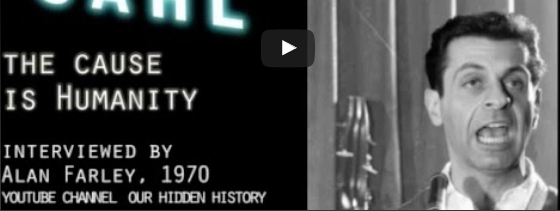
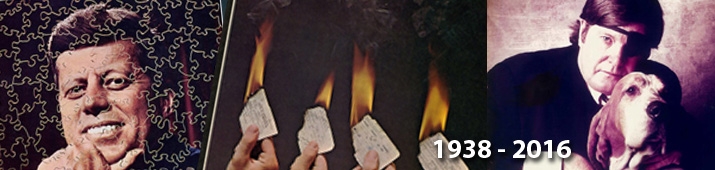
  • William W. Turner: In Memoriam

    William W. Turner: In Memoriam


    JFKturnerWPWilliam Turner passed away a few days ago.  The brief obituary in our news section at the right does not do his writing career justice.    So let us elaborate a bit on his achievements.

    Bill Turner was originally an FBI agent.  He decided to break from the FBI and began to write letters to certain congressmen complaining about certain practices by Director J. Edgar Hoover; e.g., his failure to go after, or even recognize, the Mob’s influence in America.  For this, he was drummed out of the Bureau.

    Thus began his writing career. One of the first notable books he wrote was called Hoover’s FBI.  According to Bill, he had a hard time publishing this volume.  He later found out the reason.  It was that the Bureau, specifically Cartha DeLoach, had visited the publishing houses it was at and discouraged them from releasing it.   When it appeared, it was one of the first major assaults on Hoover’s credibility and the Bureau’s reputation.

    Turner also wrote The Police Establishment, and Power on the Right.  These volumes, especially the latter, finely examined two bastions of the establishment that few writers wanted to tangle with.  But Turner did; and he showed how pernicious both groups were.

    The latter book came out of some research Turner did for the late, great Ramparts magazine.  And make no mistake, Ramparts was the last great glossy magazine this country ever had.  Along with Art Kunkin’s tabloid newspaper, the LA Free Press, it formed the pinnacle of American journalism in the sixties and early seventies.

    But not only were these two periodicals journalistically exceptional, they both had large circulations. 

    Therefore, they were difficult for the establishment to ignore.  In fact, as investigative journalist Angus McKenzie later discovered, Ramparts was a big worry for the CIA, because editor Warren Hinckle was not afraid of exposing covert operations, like the Agency’s infiltration of the National Students Association. And Hinckle was a fierce critic of America’s growing involvement in the Vietnam War.  (For a riveting chronicle of the halcyon days of this magnificent magazine, see Hinckle’s beautifully written memoir, If You Have a Lemon Make Lemonade.) Angus McKenzie, who was stricken and died of cancer at the young age of 54, posthumously published his book called Secrets.  There he revealed that the CIA’s covert operation MH CHAOS began as a way of monitoring and infiltrating the underground press, specifically Ramparts. Later, as Lisa Pease and myself were editing and publishing Probe Magazine, a subscriber sent us documents revealing the names of two infiltrators into Ramparts.

    As Hinckle notes in his book, Ramparts was also not afraid to address the assassinations of the sixties.  And since, at its peak, it had a circulation of 250,000 and was sold on newsstands all over America, those stories reached a lot of people.  In January of 1967, Hinckle published a disturbing, well-documented essay by David Welsh and David Lifton entitled, “The Case for Three Assassins”.  That memorable essay began with this sentence, “No less than three gunmen fired on the presidential motorcade in Dallas on November 22, 1963….”  One can imagine why the CIA would be upset.  I mean, they had to realize that over 250,000 Americans per month were reading this incendiary stuff.

    But what must have disturbed the Agency even more was this: Ramparts was actually covering the investigation of Jim Garrison in New Orleans.  Further, unlike the hatchet jobs unleashed by the MSM, Hinckle was treating that inquiry fairly and objectively.  In the space of seven months, Hinckle had published two long articles about Garrison, one in June of 1967, and the other in January of 1968.  Bill Turner wrote them both.

    Off of these articles, Turner had become an investigator for Garrison. They were two of the very few objective pieces written in any print media about the DA.   For as Hinckle wrote about Garrison in his book,  “…no man I have known had more legitimate reasons to become paranoid than Garrison; there actually were people constantly plotting against him.”  (p. 209) Covering Garrison fairly was not a popular decision inside the magazine.  For as Hinckle notes, there were people firmly opposed to delving into the JFK case, e.g. Bob Scheer.  (Turner once told me that Scheer called his JFK investigations a form of mental masturbation.)

    But both Hinckle and Turner viewed it differently. Hinckle saw the sudden outburst of a re-investigation into the Warren Commission’s tenets as “an extraordinary phenomenon of an extraordinary decade.” (p. 215) But also, Hinckle had read the Warren Report and most of the volumes.  He called it “impossible to believe.”  He then added that anyone could see that the Commission was not out to uncover the truth about Kennedy’s murder. But to deliver a syringe of amnesia medication to the collective conscience of America. (ibid, p. 217) Or to put it another way, the Commission was the equivalent of Leslie Nielson in one of the “Naked Gun” films reciting the mantra: “Nothing to see here, run along.”  As explosion after explosion is taking place in the warehouse behind him.

    Turner was already familiar with that terrain.  He told me that a couple of years after the assassination, Saga asked him to do an article on the JFK case.  As a former FBI man, he talked to some of the agents who worked on the case. They also managed to smuggle some documents to him.  After looking at these, Turner came to the conclusion that someone in a high position had deliberately short-circuited the FBI inquiry into the JFK case.  As he explained to me in the living room of his Marin County, San Rafael home, there were three steps in each FBI inquiry.  These were:

    1. The collection of all relevant leads,
    2. The following out of all leads to their final conclusion, and
    3. The collation of this information into a comprehensive report.

    Turner said, obviously, you could not do step three if step two was aborted.  And that is what he concluded had happened from talking to these agents and looking at their documents. (James DiEugenio, Reclaiming Parkland, p. 219)

    As a result of their mutual efforts and beliefs, in 1981, Hinckle and Turner wrote a good book pertaining to the JFK case from the Cuban exile angle. It was called The Fish is Red.  This was, in large part, based on information that Turner had uncovered as an investigator for Jim Garrison.   That volume was later updated and reissued in 1992 as Deadly Secrets. That reissue was timed for the release of Oliver Stone’s film JFK, which was based on Jim Garrison’s book, On the Trail of the Assassins.  Later on, Turner published his career memoir entitled Rearview Mirror, which devotes a long section to his service as an investigator for Garrison.

    But in spite of all the above, in this author’s view, Turner should be most remembered for the book he co-wrote with Jonn Christian on the Bobby Kennedy assassination.  It is called simply, The Assassination of Robert F. Kennedy. Originally issued in 1978, it was republished twice: once in 1993 and once in 2006.  In my opinion, it remains the best book ever written on that case.  And it will likely remain so until Lisa Pease’s long awaited and much anticipated volume is published.

    A division of Random House originally issued that book.  It was commissioned by illustrious editor Jason Epstein, with the encouragement of Vincent Bugliosi, who figures in the narrative.  This book, perhaps more than any other, exhibits what a good writer Turner was. It is not only enlightening, but also a pleasure to read.  In fact, Epstein insisted that Turner write every paragraph of the book., since he did not trust Christian’s judgment.  I know this for a fact since Turner showed me the memos between him and Epstein.  When Christian tried to get in a chapter on his own, Epstein immediately recognized it and said it had to be rewritten.

    That book is a milestone in the field.  It was so compelling that, in a power struggle at Random House between Epstein  and Robert Loomis—which Epstein lost—it was withdrawn and pulped.  For, several years earlier, Loomis had brought out Robert Houghton’s official LAPD statement on the RFK case, Special Unit Senator.  Which the later book completely harpooned.

    On the occasion of Bill Turner’s death, I can think of no better compliment to his spirit than to read that book.

  • Honor to Paris Flammonde


    By James DiEugenio

    Because Paris Flammonde lived in a small town and had retired long ago from his former rather high profile radio and writing career, his November passing went relatively unnoticed. CTKA belatedly found out about it through a posting by Albert Doyle at Deep Politics Forum. And even that was a rather non-descript notice. Flammonde deserves more. Much more.

    I got to know Flammonde back in the early nineties when I was writing my book, the first edition of Destiny Betrayed. At that time, there really was not a lot of information to be had in secondary sources about the New Orleans aspects of the JFK assassination, or about the inquiry into that case by Jim Garrison. The ARRB had not been set up yet and that hindered access to much of the primary data. And one must recall that, at that time, there was not very much of value in the published book length sources. Unless one wanted to read hatchet jobs like American Grotesque. (Which, we later discovered, had been commissioned by Clay Shaw.) The obvious exception was Garrison’s own book, On the Trail of the Assassins.

    I knew this since I had traveled all over southern California looking for a good and balanced book outside the DA’s own work. I couldn’t find anything. I did not know at that time that two books about Garrison, which were balanced and informational, had been aborted by the outcome of the Clay Shaw trial. One was by Bill Turner and one was by a Garrison assistant named Bill Brown. (These were not discovered until years later by the ARRB.) A previous and earlier effort by Garrison himself had also been killed, even after the DA had signed a contract. Garrison had to return the advance. Why? Because the editor gave the book to, of all people, Sylvia Meagher to critique.

    Why do I say “of all people?” Because although Sylvia Meagher wrote an absolutely first class book demolishing the Warren Commission, she was frankly, unhinged on the subject of Jim Garrison. Even those who knew her closely and liked her would admit that. This includes Jerry Policoff, Ray Marcus, and the late Roger Feinman and Margie Field. According to Policoff, Meagher actually gave money to Clay Shaw’s defense fund. How on earth could a publisher hire someone like that to critique a book by Garrison? Policoff said to me that Sylvia should not have taken on the assignment.

    But this indicates a very good reason why I could not find any book of real value with real information when I started working on my book. When Garrison’s investigation was first exposed, and then forcibly announced, most of the critics were joyous. But as the vitriolic and systematic attack on Garrison out of both New York (the media) and Washington (the CIA and FBI) took hold, many of the critics began to desert the DA. But not just desert him; they actually joined in the onslaught. In addition to Sylvia Meagher, there was also, for example, David Lifton. Lifton wrote two articles in the alternative press caricaturing Garrison. He did this largely because Garrison had seen a lot more in Kerry Thornley than Lifton did. For instance that Thornley had lied about not meeting with Oswald in the summer of 1963 in New Orleans. (For a good treatment of this subject, see Joe Biles’ valuable book, In History’s Shadow. For a shorter precis see Destiny Betrayed, Second Edition pgs. 187-93.) Lifton even helped Edward Epstein compose his hatchet job on Garrison in The New Yorker in 1968. This turned into the first entry on the anti-Garrison bookshelf, Counterplot.

    It was incredible, but true, that none of these critics understood what was happening. They actually took the likes of Hugh Aynesworth, James Phelan, and Walter Sheridan seriously. Garrison was a charlatan or worse, and Clay Shaw was a persecuted saint. There really was nothing to find in New Orleans. And the information Garrison had was not worth looking at.

    With the release of the ARRB records, we now know this was not at all the case. Not by a long shot. People like Paul Hoch, Josiah Thompson, Peter Scott and Tony Summers were buying into a CIA cover story. But because Garrison was “discredited,” they wanted to avoid any contact with him; so they could escape the tarring and feathering the DA had gotten in the press. The insinuation being that if they could avoid that association, then they would be taken seriously by the MSM.

    We now know of course that, with very few exceptions, such was not the case. The latest reissue of Summers’ book, for example, ended up on the cover of the National Enquirer. Today Summers says, well, the JFK case may be a conspiracy, but if it is, the Mafia did it. Paul Hoch, it turned out, had not disclosed the evidence that Luis Alvarez’ infamous experiment about the jet effect was something he assisted on and was, to put it mildly, flawed. (This was discussed by Thompson at the Passing the Torch conference in Pittsburgh in 2013.) Scott’s subsequent career; in which he extended praise to the likes of Lamar Waldron– suggests he never met a conspiracy theory on the JFK case he did not like. Except Garrison’s. Thompson, as late as December of 1967 was questioning Garrison’s statement that Kennedy’s murder was a coup d’etat. And defending the MSM’s silence on the issue! (ibid, p. 381) In other words, the idea was this: the further you separated yourself from New Orleans and Garrison, the more respectability one had in the research community. And in the MSM.

    My questions about this strategy back in the early nineties were these:

    1. Had the MSM given the critics a fair airing, even though they had scurried like rats from a sinking ship out of New Orleans? I could see very little evidence of that in all the years from 1969 to 1991.
    2. Was there valuable information to be had in New Orleans in the summer of 1963 about Oswald? As far as I could see, there was.
    3. Had these critics actually given Garrison a fair shake? That is, did they go through his materials and talk to his investigators and witnesses? Or were they doing the opposite, that is echoing the orchestrated choir that the media had assembled? They seemed to be doing the latter.
    4. Finally, in the interim, had these critics come up with anything better than what Garrison had, either in the gestalt–that is a macro view–or on the ground level, in the way of suspects and discoveries? In writing my first book, it seemed to me that they had not. Unless one agreed with Summers and Scott, that the Mafia was a major player in the JFK murder.

    I did not believe that was the case. Not then, and not now. Therefore, I didn’t buy this self-serving and reflexive phobia/mania about Garrison. So I kept an open mind.

    Then, one Saturday, I drove to the library at California State Dominguez Hills, near Long Beach. It was a long ride from where I lived at the time. But I figured I had to keep on looking for a major source book. On that day I found Paris Flammonde’s The Kennedy Conspiracy. I had not heard of this book before. In fact, many of the critics just ignored both the book and the man. Since it focused on the Garrison investigation, I checked it out and brought it home.

    As anyone who has read the first edition of Destiny Betrayed knows, Flammonde’s book was an invaluable source for me. My first book would not exist in the form it does without Paris Flammonde. There was extremely relevant information to be found there on Clay Shaw, David Ferrie, Gordon Novel, and Dean Andrews, among many others. Information one could not find anywhere else. Information that other writers in the interim; for bewildering reasons; had failed to use. When my book came out, many people who read it thanked me for exposing them for the first time to Flammonde’s book. One researcher went and got it from a library and said, “That’s a good book now.” This was in 1992, 23 years after The Kennedy Conspiracy was first published.

    I decided to contact Flammonde while doing research for that book. I wrote him a letter and told him to call me on the weekend. He did so and I was glad he did. When I asked him how he got all that wonderful information in his book, he told me something very interesting. He said, toward the end, on the eve of the Shaw trial, the DA was calling him up every weekend. He said, “I was the only source he could trust at that stage. He knew that what he was saying was being distorted, censored, and perverted. He felt I was the only person at that time who would treat him fairly.” Flammonde also told me that he subscribed to both New Orleans papers. And finally, he said that he had developed some good sources on his trips to New Orleans.

    When I asked him why he had written the book–and stuck it out to completion–he said it was simple: He had always been drawn to the offbeat things in the news. (He had spent awhile in radio in New York City.) Secondly, when he went to New Orleans, he was convinced by talking to Garrison that something had happened there in the summer of 1963. Therefore, he went the extra mile. For instance, he paid a ducal sum to have the articles in the Italian press about Permindex translated into English so he could use them in his book. I personally thanked him for that since it did much to peel back the cover story around Clay Shaw. I asked him how the book did in sales. He said it was simple. Before the Shaw verdict the book did well. After the verdict came in, it tanked. That hurt us all I think. Because the book was such a unique effort.

    When I was doing my early research, and making my first appearances at conferences, this negative attitude about Jim Garrison was still prevalent. I will never forget an occurrence at Doug Carlson’s conference in Chicago in 1993. I was on stage and I made a comment about the terrible preemptive strike made on Oliver Stone’s film JFK in the media, and also by some in the research community. Paul Hoch had a tantrum. He got up and asked Tink Thompson his opinion about Jim Garrison. That was a nice tag team act from two men who knew zilch about the subject. From the lectern, Hoch actually said that anyone who discovers anything about Clay Shaw in the new files should ignore it! I was stunned at this. It seemed to me to be the opposite of what doing academic research was all about. New information was new information. No matter who it was about. And William Davy’s fine book, Let Justice be Done, proved there was a lot of new information in the declassified files about Clay Shaw.

    Peter Scott said something just as bizarre. But more prolix. At that conference, I read the compelling Fred Leemans’ confession. This demonstrated how Leemans had been suborned to lie by Walter Sheridan on his NBC special. (See Destiny Betrayed, Second Edition, pgs. 240-41). Just recently declassified at the National Archives, and sent to me by Peter Vea, this was the first time the document had been read in public. It had a powerful effect on the audience. When I read the document, I had been on a panel with Peter Scott and John Newman. During the following Q and A, Scott felt he had to interject something about the Leemans confession. So he said it was a result of the war Bobby Kennedy had carried out against Jimmy Hoffa, through Sheridan, and somehow Garrison; and Leemans — got caught in the conflagration. I didn’t understand what that meant then. And I don’t understand it now. In fact, I don’t even want to think about it. But it helps illustrate just how reflexive and irrational the reaction, even at that time, was against Jim Garrison.

    Thank God, this has been largely reversed today. Further work by myself, Bill Davy, Biles and Joan Mellen have shown that, contrary to what Hoch and Scott and Summers were selling, Jim Garrison did have a lot of interesting evidence. So much so that his successor as DA, the disgraceful Harry Connick, incinerated much of it. He then lied about it. (ibid, pgs. 319-22) So, as much as we have from Garrison’s files today, no one will ever know what was actually there originally.

    It was Paris Flammonde who first alerted us to the fact that there was something in those files. Something valuable, revealing, sinister and dramatic. As Joan Didion once said, Garrison was turning over large stones and revealing a whole new dimension about the crime. Therefore, unlike what Summers said at the AARC Conference in Washington last year, Garrison did not conduct a circus. The circus was what went on around Garrison. For the FBI and CIA were determined not to let him proceed unimpeded. Because at the first meeting of the CIA’s Garrison Group, ordered up by Director Richard Helms, Ray Rocca said, if that happened, Clay Shaw would be convicted. (ibid, p. 270) So the CIA and FBI pulled out all the stops. To the point of secretly aiding Shaw’s lawyers. A fact that Shaw’s lawyers lied about forever. And a fact that Hoch, Scott and Summers ignore to this day.

    We all owe thanks to Paris Flammonde for sailing against the current. He didn’t care about being “respectable.” He understood that, with the MSM, there really was no such thing as being respectable on the JFK case. For the simple reason that they had prostituted themselves on the subject in every way, and from the very start.

    Paris Flammonde, in that respect, was a pioneer. And a courageous one. On his death, I salute him for his valiant, much ignored, but invaluable effort.

  • Master Class with John Hankey, III:  The Podcast

    Master Class with John Hankey, III: The Podcast


    This session of Fetzer’s podcast begins with Fetzer and King discussing how CTKA didn’t show up for the debate. They have their reality we have our own. Regardless of their claims that we backed off, one can see here in Part II I would be more than happy to oblige them should JH be willing to participate with the aforementioned questions.

    11 Min: Outtake of “The Jim Garrison Tapes”

    Gary King adds a segment from John Barbour’s “The Garrison Tapes” production. It discusses the Bay of Pigs invasion and uses Garrison, Prouty, and David Phillips. The segment has nothing whatsoever to do with GHWB but it serves to make out as if Hankey will somehow defend and champion Garrison and Fletcher Prouty’s cause. The problem is we do not have any real problems with either. Once again, people familiar with CTKA and our material will see through this diversion.

    14 Min: “And he’s Away.”

    Important Note: Hankey says he will go through the evidence point by point. Yet he does not run through a list of the topics discussed or give the reader a general time – frame. This is standard for a presentation because that is what Hankey’s rambling approach is. To call this farcical approach a debate of any weight is a grievance against standard debate procedure.

    Straight out of the blocks Hankey begins discussing the trials and tribulations Gary had getting us on. Without including the CIA agent baiting mentioned before. Wow, I thought this was about GHWB? Anyhow, salivating with sarcasm he thanks Jim Di and his friends (namely Frank Cassano and I) for attacking him, because, we have forced him to look at his positions. Cassano is involved because Hankey accused Jim of being a CIA agent on the aforementioned James Corbett show. Cassano and I called in to complain. But Hankey now says that after his re-evaluation, he now realizes his position was actually much stronger than he realized. (Yes, and I am the reincarnation of Mao Zedong).

    He now uses his old “Jim amasses a ton of irrelevant information to discredit me and never confronts the main stuff” routine. Which is a new take on his “my evidence was incorrect but my conclusions were correct” bull. This is interesting on two counts. First, Jim did not write the article he is contesting. I did. Jim only edited that article and most of what he did was edit for length. The actual substance is about 90% my own. Second, as noted, he has now changed his defense. On the “Murder Solved Forum”, he admitted to almost all of the mistakes I pointed out in my piece. And he was even repetant about most of them. But his defense there was he was still correct on his main thesis about Bush. Which obviously sidesteps the issue of: how can a guy who makes so many errors about so many topics be correct about a major thesis? When in fact, the standard of this kind of thesis is: Extraordinary claims demand extraordianry evidence.

    15 Min: How Many Years have you Been Researching John?

    “I’ve been researching the assassination in a pretty serious fashion for about forty years.”

    This is a vast improvement from JH claiming he had been a researcher for 50 years four years before the 50th anniversary.

    “It took me nearly 40 years to find these memos; and nearly another ten to figure out what they mean. Believe me, I’m not bragging. But I am advocating patience”

    JH will try denying this by saying we made it up (have a look at the 56:57 passage for a stellar example). Sadly for JH its right here 40 + 10 = 50. (http://911blogger.com/node/19864)

    As I explained in my first essay, Hankey says he got involved in about 1999 after JFK Jr’s plane crash. IMDB say JFK II came out in 2003 (I said 2004 originally). Hankey’s movie is officially 12 years old and John has been perfecting his stand-up routine for 15. He had only spent some 2-3 years looking at the case before he decided come through the curtain and be a big star. That is a rather substantial difference of 25 years in terms of his 40 years of research.

    Hell, at least he has dropped his banal story about holding talks at different campuses concerning the JFK case. Judging by what he is spouting now, those discussions would have been awful (if they ever happened).

    15 – 16 Min: Memo Madness

    On top of all we have written about his insane memo fetish and the denouncement of JH’s interpretation by Joseph McBride the man who found the documents. I really do not need to go on. Except to say Bush was not the head of the CIA in 1972. His tenure was from January 1976 to 1977.

    Wait… did he just say the memo states that George Bush is the supervisor of the killers again? Damn, I was hoping he would announce that he was bullied and had an unhappy childhood. That might explain his over engaged fantasy world and his distortion of the JFK case.

    18 Min: No Thanks to CTKA

    Hankey mentions the famous memo Angleton let Trento have a peak at which placed Hunt in Dealey Plaza that day. However, he won’t say anything about us correcting him on the issue. He originally said Helms wrote the memo, not Angleton. Remember, this is from “Plausible Denial”, a book he supposedly pores over, and then recently called “Rush to Judgement”. Indeed, JH as one will see, has apparently co-opted a lot of CTKA material with which he used to lecture us about.

    19 Min: The Bush Dulles Meeting

    Hankey has a particular obsession for a dinner Prescott Bush had with Allen Dulles. I discussed this meeting in my last Hankey article. JH had told radio host James Corbett that the “Pilot Project” was about “George Bush and the Bay of Pigs.” However, he is now saying the project refers to George Bush setting up his oil company. Both are hilariously off the ball. The document is dated April 1963. That’s two years after the Bay of Pigs, and to cap it off Bush Jr had set up his oil business in 1953-54.

    It is no big deal Prescott Bush was friendly with Dulles. A whole heap of wealthy elitiest were friends with Allen. For he was one of the them; hence, why be does JH get so excited over the association with Prescott? Was Prescott as close to Dulles as Helms, Phillips, Hunt, Edwards, Truscott, Bissell, Cabell, Angleton or CD Jackson. That is an extremely closed group of pals. I would like to know how Bush interacted with this group?

    As I said, if Hankey is going to try and use bluestering langauge he can at least get his facts right and keep his story straight. He can also get real about the relationships Dulles had with his intelligence cronies. As one will note throughout the guy can do none of this.

    20 Min: Hunt and Bush

    JH says the Bay of Pigs was where Bush met E Howard Hunt. He has said this for a long time. If perchance, Bush was involved in some of the smaller aspects of anti-Castro operations the two could have met. We have never said it was impossible; nevertheless, when one has an editor (which Hankey does not) we cut little pieces that didn’t ram home the point in “The Dark Legacy of John Hankey.” I wrote…

    “The viewer may have noted that in skipping over the nefarious American activities in Latin America at the time. Hankey has presented absolutely no evidence of Hunt and Bush working together on anything other than the Bay of Pigs, and even that is an unproven and indirect relationship.”

    I should have kept the line “the two could have met” and then added “but even that is an unproven and indirect relationship” in my first Hankey piece. It is hardly an admission and it changes nothing. The problem we have is that Hunt was a big player, an out and out intelligence hard core operative. Bush maybe was essentially a CIA business liaison with political ambitions. The CIA, like any intel agency, uses compatmentalization and delegates agents and contractors based on their abilities. You don’t just become a covert operator, you get chosen.

    In the past Hankey has tried to intimate Bush would have been higher up the chain for the Bay of Pigs than Hunt. He seems to have dropped this angle (for the time being at least) preferring to now say Bush was in charge of Dallas (check out the inanity some 24:00 minutes in). He has even gone so far to say Bush was a shooter!

    Of course, listening to JH we had nothing to do with his modifying this aspect of the story. Nor did my first article have anything to do with his abandoning the notion Bush and Hunt used Hunt’s oil platform at Cal Say as the staging point for the Bay of Pigs. Now he has something else to learn from us. JH ludicrously believes the CIA launched the Bay of Pigs with only two boats “Houston” and “Barbara.” In fact, there were four others.

    Atlántico, Rio Escondido, Caribe, and Braggart.

    Furthermore, one does not need to misquote Mark Lane concerning what Fletcher Prouty said about the Bush/BOP connection to prove Hunt and Bush could have known each other.

    Hunt potentially bumping into Bush is no big deal.

    21 Min: The old “Why aren’t you Attacking Lane/Prouty it’s his/their fault” Line

    Hankey pulls this old chestnut out again. Our reasoning, as I have said before, is very simple. I ask the reader to look at Mark Lane’s history and record compared to JH’s. Lane has bought some good work to the table, as has Fletcher Prouty. Hankey on the other hand provides accidental comedy. We have criticized Lane before. Indeed, we did in the very first Hankey review and we were slightly disappointed with his last book. But further, neither Lane nor Poruty have ever taken the Bush/Hoover memo nearly as far as Hankey has. That is, to have made a whole film about it. If they would have, and it was anything like Hankey’s, we would have criticized them also.

    What is hilarious is not once has he turned on Jim and I saying “Why don’t you attack Paul Kangas, Jim Fetzer, Russ Baker, or Murder Solved. I got my stuff from those sources.”

    Thus, if Hankey were ever to debate (and trust me I am very game). We want his beloved fall back line “Why don’t CTKA attack blah, blah” to be one of the questions.

    24 Min: Bush out of the BOP in Charge of Dallas

    We know there is a decent chance Howard Hunt, and David Phillips were in or near Dealey Plaza that day. Hunt’s appearance came via the Angleton memo, and his ninety percent dubious testimonies in his book and to his son. David Phillips came thanks to his brother. One has to ask why this bunch of pipe swinging intelligence professionals would hand the Dallas project over to an office junior like George. Because that’s what JH is saying around about now.

    The Parrot Memo (http://jfkmurdersolved.com/images/bushwarning.jpg) becomes a particular sticking point for JH here. Why isn’t there any FBI documentation of Hunt, and Phillips calling in for their alibis or calling up people to name as false suspects? Indeed, why didn’t they run advertisements they were in town giving speeches against fighting Communism? The whole scenario is juvenile and schoolyard. Bush, the supposed team leader in Dallas, has to call in with a fake report to create an alibi for killing the headmaster to his mother. That is what the whole thing plays out like.

    I would imagine the assassins of Kennedy being somewhat less accountable to the FBI than dear George appears to be. Hankey’s angle that Jim DiEugenio has kept quiet on Bush’s phone call is a boldfaced lie. Jim discussed and destroyed the Parrot Memo silliness and the idea of Bush leading a squad in his review of Russ Baker’s book.

    25 Min: Hankey’s Ever Changing Landscape and Bush a Shooter

    JH now discusses the Craig/Vaughn account he gave in his VT article concerning Bogus George arrest outside the Dal Tex building. He says he has known about the account for a long, long time. If so, he never used it until he got desperate for options. Adding new information is perfectly okay in a presentation like this but there are parameters. If JH had a shred of honesty, he would say to his listeners…

    “Jim and Seamus did not raise these points in their articles and interviews at the time but I would like to add…”

    He never does this and he brings up the Parrot memo. I never discussed the above Parrot phone call in my review because Hankey did not bring it up in the version of his documentary I watched.

    Anyhow, JH has added the Bush TSBD angle to his repertoire. Again, this was not in his catalogue of marital aids at the time I was first encountering him. CTKA reacted to JH, as we would to any bad JFK product. He got a bad review befitting the horror he created. He then got snarky (ridiculously so as you can see). Had he bought this dubious material up back then he would have received the same treatment he is getting now. So his attempts at intimating that somehow we missed something, for reasons stated above, fall flat.

    Anyhow, let us cap off a stunning barrage of fibs concerning CTKA, Bush’s arrest and his Parrott phone call. Hankey, almost beside himself with self-righteousness, now announces something absolutely shocking in its arrogance:

    “Bush was caught with a frigging gun in his hand.”

    Maybe this is just a figure of speech. I hope it is. For the man cannot be serious. Vaughn never said that to Craig. Indeed, we need a brief summary of Hankeyian events from 24-25 minutes to refocus, as there is so much wonderful, factual, and logical information to absorb.

    • Bush the leader of the hit squad is arrested with a gun outside the Dal Tex building. So was he shooting at JFK with a pistol?
    • Obtaining a quick release from the police GHWB then poses in a suit and tie outside the TSBD for a picture.
    • Then he leaps in a car and goes to the Blackstone Hotel in Tyler Texas where places a telephone call to the FBI concerning dissident James Parrott precisely ten minutes later.

    I am not saying all of this is impossible, noooo I would never say that. It is just incredibly improbable. I mean, take the third point. Tyler, Texas is something like 97 miles from Dallas. The driving time is about 90 minutes. Yet, this is John Hankey and therefore in his alternative universe, anything really is possible. As long as it makes George Bush a part of the JFK assassination.

    29 Min: Hunt a Sniper in China and Morales ran JM WAVE

    As one can see from the above rubric, this is turning into a vintage performance from the old master. Not even Saint John Hunt (his son) mentioned E. Howard training as a sniper in China and that guy can talk a lot of gunk. Sure Hunt was a killer, all active CIA black op types are. Nevertheless, if Hankey understood operations, he would know that to be a presidential level sniper Hunt would have had to be training every day for hours on end. Nothing in Hunt’s life and his activities in covert planning indicate the required marksmanship dedication.

    It appears judging by some of Hankey’s later comments concerning Bush being a , well any idiot can become an assassin. As for the ludicrous idea of Morales running JM WAVE, well that is to be expected of JH’s quest for accuracy and evidence. Unbeleivable carelessness. Ted Shackley ran JM WAVE.

    30 Min: Beatles Songs – Interval

    Thank you Jim Fetzer, your research is appalling but I have never appreciated the Beatles more.

    The first quarter is over, and it has been a torrid battle. Not between Jim and John. Hell, the chief hasn’t even made his appearance. It seems that Hankey has done a stellar job of beating himself up. If this train wreck does this to himself, one has to wonder what on Earth will happen when he battles samples of Jim?

    36 Min: Jim Finally Gets a Bite

    Prior to Jim’s debut JH insinuated that Jim is hard to follow because he goes off on tangents and jumps around topics. Hankey really needs to make like Michael Jackson and talk to the “Man in the mirror.” He also needs to “Beat it” because a number of the samples he has chosen are deliberately cut to make Jim come across as a blithering madman. Sadly, for JH there is only one blithering idiot and he is not moon walking out of this one.

    Anyhow, Jim discusses the problem of people over identifying suspects in the pictures and films of Dealey that day. When he mentions names, he is paying no particular attention to any one suspect. Nor is he actually saying none of them are there. It is a position bar one or two slight differences I share with Jim. Namely if we put everybody’s suspects into the mix, we have a grossly inefficient and rather silly conspiracy. Incidentally, the kind JH’s Godfather, JIm Fetzer, adores.

    37 Min: Hankey, Fletcher Prouty’s Brave Champion

    Hankey replies and states categorically that all the subjects Jim names are in there. However, it soon gets crazier. He discusses Ed Lansdale’s possible sighting as if he has been a long-time advocate. However, as with the Bush outside the TSBD his new Lansdale angle occurred well after my first and second articles, not to mention Jim’s BOR interview.

    As said in Part I, I am open to the Lansdale picture but I refuse go to the bank on any photo ID. JH now launches a grossly hypocritical diatribe about CTKA’s insensitivity towards all things Prouty. If CTKA is so insulting to the Colonel, I have to ask why Len has Jim on Black Ops Radio every other week. Surely Hankey knows Len’s background with Prouty? I mean Len had the charity to have Hankey on his show once. An interesting aside is a claim by Fetzer that Jim is running BOR. The result being Hankey and himself have been turfed. If Jim ran BOR, he certainly would not have Fetzer’s pal Mark DeValk on. Plain and simple, Len also got a lot of complaints about JH and Fetzer. Hence, it was a no brainer not to have them back. Further, Fetzer has begun to attack len in print. Why should Len genuflect to someone who is trashing him? Finally, Fetzer, with his participation in the zany OIP, his obsession with Zapruder film alteration, and his attacks on Tink Thompson, and his belief in the likes of Judith Baker and now Hankey and also Peter Janney, with all this, Fetzer has now occupied the very far out reaches of the JFK community. Black Op Radio is not about those Outer Limits. Its about what is provable in this case by the standard of civil law. That is, would a jury vote 9-3 in favor of the critical case in front of them. That later work of Fetzer, and now that of Hankey, does not qualify as such.

    40 Min: Sanctimonious + Insanity = Hypocrisy

    Hold the phone Martha! JH’s let loose another ripper. He’s scolding Jim for dismissing people without looking at the evidence adding, “Jim never does that.” My God, JH is pulling out all the hypocritical stops he can. The sound bites he has selected of course do not let Jim build any argument or evidence. JH also all forgets about the screeds of writing we have at CTKA dissecting his stuff, and on top of that, Jims Black Op Radio interview, and our stint on the Corbett Report. Jim by the way has written and edited four books. He has also written and edited hundreds of articles. If JH really wants proof there is a website called CTKA, the one you the reader are visiting right now, then he also needs to read this article an dmaybe, just maybe, learn something about journalistic standeards and th rules of logic and evidence.

    42-43 Min: Nixon Hired Hunt and other Fantasies

    What is interesting is that JH has dropped his inane Connally – Nixon angle. The one he assiduously pushed in his first documentary. Indeed, he was still pushing the Connally angle when Jim encountered Hankey over at Murder Solved.

    The Nixon angle is in my first article on JH. He completely ignores the points and evidence in that section, or does he? Hankey now says he agrees that Hunt set up Nixon, as if he has known that all along. If he did, surely a man of his integrity would have included this point in his documentaries. However, Hankey is not knowledgeable or honest. He only learned this from the original CTKA article I wrote and Jim’s interview. Hence, all JH can do now is scream something along the lines that “Nixon knew he was employing Hunt, because he hired him” Which is an illogical sentence to begin with.

    I wrote,

    For instance, Hankey states that Nixon brought Howard Hunt into the White House. Not accurate. As Jim Hougan points out in his brilliant and revolutionary Secret Agenda, prior to being hired by Charles Colson – not Nixon – Hunt worked at a CIA front called the Mullen Company. This was ostensibly an advertising and public relations firm. It was closely aligned with Howard Hughes. It was presided over at the time by CIA asset Robert Bennett. It was Bennett who mentioned Hunt’s name to Colson; Hunt then offered his services to him; and then Colson hired Hunt. (Hougan p. 33) It was an act that Colson came to regret. Why? Because Hunt appears to have been a CIA infiltrator in the White House who, along with James McCord, deliberately sabotaged the Plumbers at Watergate and helped collapse Nixon’s presidency. (ibid, pgs. 270-75)”

    It is clear Nixon learned of Hunt while he was at the Mullen Company, and then in the White House. And it is clear he did use him from time to time. And Nixon did mention Hunt on the White House tapes before the was hired. But there is still no proof or real evidence that Nixon hired Hunt. If I was Nixon and I was unsuspecting of his true motives too ultimately screw me I would have not done so as well. Hunt was a pro. Nevertheless, if Hankey was not such a knee jerk reactionary his comment concerning why Nixon would have a suspect in the Kennedy assassination hanging around the White House would actually merit discussion. Because it seems clear to some, like Hougan, that the CIA was infiltrating Nixon’s White House, the Plumbers, and CREEP. And as Jim DiEugenio and Lisa Pease have argued, one can make a credible thesis that many of the players invovled in murdering Kennedy, were also involved with removing Nixon.

    Indeed, Jim Hougan and Jim DiEugenio have discussed Watergate on Black Ops Radio. So too has Hankey’s new archenemy in his pantheon of victimisation Lisa Pease (check out Hankeys grand finale at 1H: 52).

    During JH sermon, about Nixon it is obvious he is once again trying to position CTKA to points of view we have either never held or have actually discussed before. Hence, we have another thing JH can add to his future arguments. Nixon apparently met Hunt during his trip to Latin America in 1958.

    44-45 Min: I Only Made Two Mistakes and CTKA Endorses Barr McClellan!

    JH is angry because Jim and I took the mickey out of him for his unfunny picture of Nixon holding a gun in Dealey Plaza. He begrudgingly admits this was a mistake and he should not have done it. Later he admits he made a mistake with the Nixon – Ruby memo (see below at 51-52 minutes). Declaring he only made these two mistakes. However, he will not tell you he has dropped his classic Prescott Bush funded Nixon into the White House gag. Not to mention a misdated photo he has of them shaking hands with Nazi armbands. Indeed, I spent over some 1000+ words explaining JH’s Nixon follies. He also won’t tell the reader that on his website he has a version of his debate with Jim in which he omits Jim’s post outlining some 20 errors he noted in the first half of JH’s JFK II. I mentioned this in my follow up article some years ago.

    He then asks what Nixon was doing in Dallas if not to kill JFK. Well Johnny Boy, Nixon was in Dallas for a Pepsi Cola Bottlers Convention. There was very little hoopla at all. He was not there merely to give speeches and bump Kennedy off as Hankey implied. Nixon’s comment about Johnson and his removal off the JFK ticket was essentially in passing to the press. Nixon could have made his statements anywhere; nevertheless, I personally think Nixon was not there by accident or by his design either. Hence, his presence that day provided another additional layer of mystery. Essentially, he was a red herring.

    CTKA Endorses the Johnson Hypothesis

    I thought this deserved a title. Simply because it is so ludicrous one must take note. Neither Jim nor I have ever fully advocated for the Kennedy ticket dumping Johnson in 1964. That is really up in the air as the sources for his scandals at the time have been poor and compromised. We have no doubt Johnson was dodgy to a degree. However, what Texas politician of the era, bar the odd Ralph Yarbrough, was not? As much of a liability as he was, LBJ was essential for Kennedy’s success in the South. Jim and I have written about this ad nauseam. Hankey, for the umpteenth time, appears to be lifting information off us and trying to lecture Jim about issues long known to CTKA.

    It is a shame he is so dodgy because he makes the point about Barr McClellan’s ties to GWB, a point of view people have. This is actually a clever use of the information I got from Alex Constantine’s site. I mentioned it in my article on Alex Jones. However, this was after apparently reading my article on Alex Jones (Hankey is not a good enough researcher to find this sort of good information himself). He then seemingly babbles on about Jim and I endorsing Barr McClellan. We have never endorsed McClellan. Nor any of the recent LBJ did it cul de sacs. Indeed, we have numerous articles discussing why we do not.

    Therefore, why is Jim Fetzer the kingpin of all the worst LBJ did it dross, endorsing Hankeys stance? He clearly hates us enough to have Hankey dump on his argument. Clever guy that Jim Fetzer. A man who has clearly lost his was from his former academic standards. Now, apparently, the end justifies the means.

    51-52 Min: Why Doesn’t Jim Attack Prouty

    It’s time for the old “Why do they always pick on me” routine. Hankey says he got the bogus Nixon – Ruby memo from Prouty. So why aren’t we attacking Prouty? Well, it is for the same reason we don’t go for Lane. Prouty has enriched the case, not detracted from it. The man could make one or two mistakes; he earned that right. Hankey has not earned that privilege and he likely never will. Furthermore, JH is responsible for the information he chooses to use. His deferment of responsibility is very immature and unprecedented in the field. One is not supposed to pass on questionable material, no matter who the source is. A true critical thinker cross checks materials that seem to good to be true.

    56:57 Min: Hankey’s Implausible Denial (You Have to Read This Folks)

    Now, until here, there have been some jaw dropping and hilarious moments. Nevertheless, this is the highlight of the entire charade. Hankey now plays an important segment of Jim’s BOR interview. This discusses Hankey’s ineptitude concerning Allen Dulles and his deep background in the spy trade.

    “I am not sure what it is that he’s (Jim) trying to say here, I mean besides that I’m incredibly ignorant, and that is his main point which is always his main point, always.”

    JH is correct about something: he is “incredibly ignorant.” He then rambles on about Dulles getting the CIA job, only because of his Nazi ties. This belittles the sound research many others have done concerning Dulles’ post WWII background. JH says these facts are niggling little annoyances that do not apparently amount to much. Nevertheless, JH’s actions at the 57 minute, mark indicate he took these niggling facts rather seriously.

    Hankey plays an excerpt from Jim’s interview in which Jim quotes Hankey from my piece.

    “Prescott Bush is the guy who during WWI was with Army Intelligence. Dulles was not with army intelligence during WWI and it’s a little bit surprising that he would be put in charge of the CIA instead of Prescott, given that they are more or less parallel in their power up until that time.”

    Hankey abruptly states …

    “He’s making that quote up! But never mind let’s move on.”

    I quoted Hankey directly from Black Op Radio on show 424, May 2009. The show is in Len’s archives. Why on Earth did he choose that particular statement and then act as he did? Was it to try to wound Jim’s credibility, or to save his own? Either way, he not only shoved a foot in his mouth, but he shoved the other in there also. And why did Fetzer accept this at face value?

    58:30 Min: If the Head of the CIA is a Front why the Boner about GHWB

    JH is angling for his old Prescott Bush was the power behind the throne line. To be honest he has not bought PB up yet; however, he starts pondering aloud inane stuff like “The head of the CIA is a front”, he is not naming names but he is clearly saying this about Dulles as he has used this line many times before in relation to Prescott, and he discusses him at 1H:02.

    If the head of the CIA is a puppet then why does he make such a huge deal about GHWB and his one-year gig as DCI? Furthermore, Prescott Bush must have been tripping on acid to let his son, whom never trained as a sniper take a shot at President Kennedy, as Hankey now insinuates. Indeed, if you hark back to 24-45, minute mark GHWB’s shooting at Kennedy was not the only dumb thing George did that day. He says his hypothesis “is a can of worms.” I can think of a few things to call it and it is not worms; thus, I can only wonder what Russ Baker is thinking. Baker tried vainly to bring credibility to the Bush did it hypothesis. I wonder how he feels to have his efforts smeared by JH.

    1H: 02 Min: Hankey and Zhou En-Lai

    This is very long so I have made it into a separate article, which can be found here [need link here]. Thank the lord for the Beatle interlude once again.

    1H: 30 Min: Hoover Beatles.

    The next 12 minutes or so is a bizarre ode to J Edgar Hoover. Hankey has long believed the CIA pressured Hoover concerning the Kennedy assassination. CTKA has known and understood all of the angles JH discusses, but more besides. JH has never read Anthony Summers work (and that’s just an entree). Thus, he fails to understand what 99 percent of researchers believe that Hoover did not need much cajoling to participate in the cover up. He also tries to swing it that CTKA endorsed the idea of Hoover as a main plotter. That might be good enough for Peter Dale Scott, Phil Nelson, or Jim Fetzer; but that type of analysis is not good enough for CTKA.

    1H:42 Min: “This Guy is so Full of Shit”

    So says the master of the art form after a snippet in which Jim disagrees with JH delusions about the memo. Hankey retorts “If Bush was contacted it was because he was in charge of the anti-Castro Cubans.” Remember what McBride said to me at the end of Part I folks. I don’t need to remind you all that we have written.

    1H:44 Min: David Morales JM Wave Boss Again

    Morales was good pals with his boss Ted Shackley. Hankey’s pals at Murder Solved must be blue in the face explaining this sort of stuff to him. They have a write up about him here.

    1H:48 Min: “All This Shit About Dulles”

    “Jim has gone on with all of this shit about whether Dulles really had any intelligence background or not I mean what has that got to do with anything? And when do we get to the real substance of the movie the mountain of evidence I am putting together”

    There are a lot of fools out there dribbling all manner of gibberish. Nevertheless, even individuals as inept as Fetzer do not find Dulles’ extensive intelligence background irrelevant. It was not Dulles’ ties to the Nazis that got him the DIrectorship. It was his long experince as an intel officer in World War I and II, the plan he submitted to Walter B. Smith to reorganize the CIA after World War 2 (which prompted Smith to make him Deputy DCI), and finally Smith falling ill and his brother, Secretary of State John Foster Dulles, convincing Eisenhower to make Dulles the new Director. All of this material is in the record on the several books about the Dulles brothers. But not only has Hankey not read them. He actually seems to think its not even important for him to do so! And its arrogance and presumptuousness like this that allowed him to make over 40 errors of fact in the first version of his film. As for JH’s mountain of evidence he is putting together: he has to be kidding. He has not structured even a hillock.

    1H:49 Min: “What the Fuck”

    Hankey declares “What the fuck?” after a brief snippet of Jim explaining that Bush’s links to the agency and Cubans were hardly unique amongst the blue blood set. Jim names Clare Booth Luce and Bill Pawley as examples. This leaves an exasperated JH bellowing…“ But these guys didn’t get mentioned in this memo.” He forgets the fact George Bush does not have his name redacted. This indicates to anyone with half a brain he was hardly a CIA higher up. Since Hoover was very sensitive to such matters. Even if he was, it is hardly sensitive information if Captain William Edwards of the DIA was running the Cubans? Was Agent F.T Forsyth? They are mentioned as well. Also, if Hankey saying that there were no communications at all with the FBI, CIA, DIA, NSA, about any Cuban renegade attack on Castro to any backers of any Cuban cadres in the wake of JFK’s death?

    If Bush was head of the CIA in 1976, why didn’t he destroy this memo? Surely, someone of his all seeing, all evil pedigree would eradicate all vestiges of his earlier wrongdoings running the Anti-Castro Cuban programme. Hell the guy couldn’t even get rid of his banal correspondence with George DeMohrenschildt. I have to say it is rather odd Hankey has not bought that old chestnut up yet. Is it because CTKA crushed that dream before he could grab it?

    1H:52 Minutes: Hankey’s Last Stand

    JH has been building for this for close to two hours, or has it been his entire life?

    What follows is a ramble that will echo through eternity. Its power is such that it conjures up an image of an illusionist actually believing he is the Human Torch, and then setting himself alight, and leaping off the TSBD to fly away. Is it a bird? Is it a plane? No folks it is just JH crashing and burning. Again.

    Anyhow, for your enjoyment, here are the highlights of what he screamed on the way down…

    Fuck you Jim DeYouhayneo! For Making me Think.

    “Fuck you Jim Deyouhayneo! He is not honest, he, he is not… an honest researcher and you shouldn’t pay any attention to anything that he says except that he may occasionally raise a point that is in fact worth investigating.

    And in fact makes us think about something harder than perhaps we have in the first place.”

    Hankey is essentially saying, “Fuck you Jim for making me think.” It is certainly an odd way of showing one’s appreciation. But shouldn’t John have done some thinking before he put together his film. And again, the article was not Jim’s. It was mine. Jim was just reading it.

    Hoover: the Subtle Hero of the Bush Memo

    “But Hoover wrote one memo and the memo that he wrote named George Bush and frankly I just love that he managed to write it in such a way he made it so innocent that it survived.”

    Wow, so is he actually saying that the document reads as it looks. If so, that is a complete somersault. He is now saying Hoover carefully coded the message so it could slip through Bush’s fingers. It’s a message only JH can see.

    Mark Lane Never Heard of GHWB

    “Mark Lane said he saw this memo when it was first discovered and he didn’t make anything of it because he had never heard of George Bush before. It didn’t draw Mark Lane’s attention in the least… but that’s why it survived.”

    Okay, Mark Lane is a prominent political and civil rights activist and lawyer. JFK is only one of his many interests. He has had more scrapes with the CIA than JH has had hot dinners. Yet Hankey is trying to say in the period 1985-1988 a time when knowledge of the document was growing, Lane had never heard of the ex-head of the CIA or George Bush, Reagan’s second, and Presidential candidate. With that logic, JH probably thinks Mondale won. He now returns to Hoover’s cunning ploy…

    Jim is “Full of Shit,” but Hoover is “Frigging Brilliant

    “Now if Hoover was in on the assassination why did he write this memo and well… Jim is just so full of shit. I can’t believe it. He does draw our attention into that question I think, at least he drew my attention to that question. That I haven’t thought about in a long time. Why did Hoover write this memo? You know that when Hoover died his files were immediately seized and destroyed. If he had put it in his files it wouldn’t have survived but he made it sound innocent and he sent it out again to all these people. I think the guys frigging brilliant.”

    I couldn’t be bothered telling the reader that earlier he had congratulated Hoover’s investigative ability. Something considered a joke in the modern era to all but JH. Nonetheless, we can see he is very keen on Hoover’s subtle abilities that once again all but JH the mystic can see or translate. But beyond that, consider this a bi tmore deeply. Is Hankey really saying what he seems to be saying? That Hoover wanted to expose the actual plotters of JFK’s death? Again, this is what happens when writers leap into the sea of the JFK case without doing their homework. Or even going to the corner library to pick up a book or two.

    Nothing could be furhter from the truth in this case. From the first day, Hoover was hard at work molding the cover up from the ground up. He never let up the pressure on framing Oswald. Not from the beginning until the end. At the end, he was trying to disguise what the Sylvia Odio story really meant. To go through every instance in which he did this would take a small book. In fact, many people think that the exposure of the FBI cover up in this case was the beginning of the end of Hoover’s impenetrable image as a crime stopper. (Of which, most would say he never really was. Except maybe Johnny Boy.) But now, all of that work by say Tony Summers and Curt Gentry will have to reevaluated. Because John Hankey says the FBI memo has a much deeper meaning than anyone has ever given it. Even Joe McBride. Hoover was talking in codes I guess. Codes that only Hankey could decipher. And maybe Fetzer.

    John Hankey the Measure of Rationality

    Then comes something that really had to be heard to be believed. Consider the following:

    “Generally speaking I try to avoid saying things that I think that are so out there that they will reflect badly on everything else that I say.”

    Can Hankey really have this little self-knowledge? I hate to say it John but that horse has already bolted. And it left you on the ground. Indeed anybody who has read Parts I & II of this article, and three others at CTKA would see the bizarreness of the above statement. It was nice to know that before JH made this hilarious comment, you agreed with Jim that your theory of Bush threatening Hoover in his office with a dart gun was irresponsible and stupid.

    The Ridiculous CTKA Conspiracy

    But he is not done. Hankey’s final tirade accuses CTKA of launching a conspiracy against him. He bizarrely claims that different versions of his videos were not available at the time I wrote my first article. As you will see I am in awe of JH saying this stuff. It is a sociopathic, face saving and utterly dishonest argument. As one will see, JH himself was the very person who sent out his documentary and created different versions of it.

    The Ring Master Lisa Pease Part 1

    Why Hankey gets angry about anyone distributing his videos is curious. Is he secretly ashamed? He alleges Lisa Pease disseminated the video. This begs the question: why would Lisa want to promote anything of his. She, like any CTKA contributor, thinks Hankey’s work sucks. Was she distributing the video to discredit JH?

    Now again, please sit down before you read this wild conspiracy theory. It makes Lamar Waldron look like an amateur.

    For Hankey now claims Lisa then sent the video to Jim, and during his interview with Len, Lisa was handing him notes.( Lisa and Jim were in different parts of LA that night.) Yet, despite Jim’s reviewing his lame “Dark Legacy”, he then claims Jim has never seen his movie “JFK II”? What on earth is he trying to suggest here? If Jim actually sat down and watched the film, he would agree with JH? Wow, that is incredible logic considering Jim has seen both “JFK II” and “Dark Legacy.” Jim edited my articles and rechecked my facts. Threefore, it is impossible for him not to have watched JFK II. And he did at at my instigation, not Lisa’s. Hankey is not just delusional about whe he is, he is now creating wild paranoid plots to distract from the shoddiness of his own work.

    “For the record, and to repeat what jim has said on the air, this is how I came to write my first essay on Hankey’s film. One night I began to send Jim a series of questions based upon my viewing of Hankey’s documentary. Even though I was not as well versed in Kennedy matters back then, I sensed some of the facts in the film were either wrong or hyperbolic. So I sent a series of questions about these disputed matters to Jim so he could settle the matters. After about four of my queries I saw that indeed, my doubt was well founded since Jim, in each instance, stated that the info I was sending to him was wrong. Finally, in exasperation, he said, “Where are you getting this malarkey?”

    I told him: “Its from Hankey’s film.”

    Jim then watched the film, and we decided that someone had to critique this since it would mislead to many people. This is one of the functions of CTKA. To expose flatulence and pretension on both sides: the Krazy Kid Oswald types, and those who advocate ill founded conspiracies.

    He Doesn’t Mention Prison Planet

    There were five people in total he sent the movie to Lisa Pease, his brother, Kris Millegan, and Wim Dankbaar. He plays dumb and say’s “I think I mentioned them all.” The fifth was Alex Jones and Prison Planet. If not JH is probably wondering how their logo got on the front of his production.

    Lisa Pease Ring Master Part II (This is Even More Nutty).

    He now says I, the writer of the article that drove him mad, I am just a straw man in all of this. Apparently there is no way I could have seen it without Lisa sending it to me. In other words, I was part of Lisa’s conspiracy.

    According to the Wayback Machine, the version of JH’s JFK II that I used to review “JFK II” and linked to Google Video, has now disappeared rather suspiciously. One can see it had been posted to Google Video in at least 2006. (See the screen shot below)

    Table 2: Hankey’s Deleted Video Posted on 2006

    seamus 02

    On the Education Forum there is a post dating from August 2006 from a guy called Wade Rhodes discussing the very “JFK II” video. Rhodes, by the way, had used the same link I had. It is also important to note what Rhodes asks concerning Alex Jones and the Prison Planet disclaimer on Hankey’s earlier versions.

    Table 3: JFK II-2007 on Google Video

    seamus 03

    Anyhow, just do a Google video search for “JFK II: The Bush Connection.” The earliest YouTube entry now appears to be Jan 9, 2007. Note underneath there are different versions by different people. Furthermore, there is one from Mar 12, 2009.

    All of the above dates I have discussed, 2006, 2007, and March 2009 are way, way, way before I began my first Hankey take down, which CTKA published in early 2010. I had worked on JH for 3-4 months prior, in 2009. I have no idea how it got viral in the period 2003-2006. Jones’ operation was still growing. One presumes it was posted to a forum or linked to his webpage at some point. Some crazed people obviously liked it and bingo.

    Two major problems

    1. JH has accused us at one time or another of circulating unreleased editions that we somehow apprehended. As seen, JH has had “JFK” out and about for some time. Who created all the different versions that were available before September-October 2009 when I began? Were JH’s fans so concerned about JH’s content they made their own subtractions, or were they concerned about time? I don’t know. But the idea of Lisa Pease, cutting up JH’s video’s to make a better presentation or decrease its length is absurd (see the different lengths below)
    2. Problem one, assumes JH was not also promoting JFK II prior to my starting to write my first CTKA essay in September-October. Noooo JH never promoted JFK II at all according to the great man. It was us, Lisa Pease or CTKA.

    Table 4: Different Lengths of “JFK” all Publically Available

    seamus 04

    Well it turns out John Hankey was promoting JFK II. On Black Op Radio twice circa 2005, 2006, and also 2009. It was the latter recording on BOR (show # 424 that eventually helped spur me into what I am still doing now: correcting the ersatz record of JH.

    Conclusion on JH’s JFK II Videos

    People reply to criticism in different ways. Some take it upon themselves to improve. Some take it personally and resent the message. Hankey is in the latter group. For he now maligns Lisa Pease to cover his own behind. He has been less than candid about who distributed the videos since this information seems to be in plain sight. He seems to have edited the videos himself on the advice of others. John Hankey was also promoting his film two years before he released it. I am sure he made noises elsewhere, but I cannot be bothered tracking them down. Nothing should surprise me about John Hankey anymore – but this “CTKA conspiracy angle” is bizarre behavior even for him.

    Here Endeth the Lesson

    Well thankfully, it is over. Fetzer as deluded as ever, and without a trace of sarcasm, now announces, “Hankey prevailed in this exchange.” The reality is one can clearly see JH was defeated by mere voice samples. In his battle with an inanimate adversary, one can see he manufactured events, and corrupted CTKA’s own research for his own means. He then exaggerated, abused, smeared and manufactured again.

    I wish this was all over and initially it was fun. But it is extremely tedious and I feel sorry for Hankey.

    I will catch you up when I discuss JH and Zhou En – Lai.


    Part 1

    Part 2

    Part 4


    “The Dark Legacy of John Hankey”

    “Onwards and Downwards with John Hankey”

    Hankey/DiEugenio Debate Murder Solved

    DiEugenio’s Review Update of “Dark Legacy”

    Coogan Reply to Fetzer at Deep Politics Forum

  • The State of the JFK case: 50 Years Out


    What occurred at the 50th anniversary of Kennedy’s murder was one of the most bizarre outbursts of controlled hysteria that the MSM has put on in years. Perhaps since its mad rush to protect the exposure of George W. Bush’s transparently phony excuses for invading Iraq. In fact, the basic underlying tension was evident everywhere. The most blatant example was the cordoning off of Dealey Plaza with 200 police officers. The public, and most of the media, both knew that what was being broadcast was false. But in order to fulfill their function as tribunes for the Establishment, the media was going to put their heads in the sand again.

    Another good example would be the Tom Brokaw/Gus Russo NBC special, Where Were You? This show interviewed several famous people about their initial reaction to the news President Kennedy was dead e.g. Jane Fonda, Steven Spielberg. But alas, if that is all the show had been about, Brokaw would not have needed Gus Russo. The big-name celebrities were there to pull in the ratings. The show made no bones about wanting to 1.) Reinforce the Warren Commission verdict that Oswald was the lone assassin, and 2.) insinuate fairly openly that all this residual affection the public has for Kennedy is misplaced. He really was not that good of a president. The ultimate proof of this was the interview done with film director Oliver Stone, the man who made JFK. His spot on the two-hour show ran about 15 seconds. Yet, when I talked to Stone about this program, he told me he was actually interviewed for about an hour. (Author interview with Stone, 12/20/2013.) The fact that almost all of this was cut shows that Brokaw and Russo had no intention of letting the other side have anything like equal time at this important point in the JFK assassination saga.

    What makes that undeniable element of MSM control so unbelievably bizarre today is this: There had been no change in the media’s attitude in this regard since 1964! To those old enough to recall, almost immediately after the Warren Report was issued, CBS News put together an evening special hosted by Walter Cronkite. Now, this program was broadcast within hours of the report being issued to President Johnson. In other words, neither Cronkite nor anyone else on his production staff had read the 26 volumes of supporting evidence, which would not be published until the next month.

    In 1967, due to the investigation by New Orleans DA Jim Garrison, the CBS network launched another special program on the JFK case. This ended up being a four night special. It again ended up siding with the Warren Commission in every significant aspect. There was a story behind this that CBS did not want anyone to know about. After a similar 1975 special, CBS employee Roger Feinman began writing letters to the network’s Standards and Practices department about how Cronkite and Dan Rather had violated the company’s code of ethics in both the ’75 and 1967 programs. Executives at the company moved to terminate him, but Roger did not go quietly. In subsequent hearings he asked for certain documents that he knew existed since he heard of them through other employees.

    Those documents showed that producer Les Midgley had originally planned for a real and open debate between the Commission counsel and some of the more prominent critics of the report. [Some of this is described in a 2009 CTKA articleEd.] He even wanted to spend one night interviewing witnesses the Commission had ignored. Then a panel of law school deans would decide the case. But as this proposal was passed up the corporate ladder to executives like CBS President Frank Stanton and News Chief Dick Salant, this idea became diluted. When the executives passed the proposal on to two northern California attorneys, Bayles Manning of Stanford, and corporate lawyer Edwin Huddleson, both of them cited the “political implications” and “the national interest” in shooting it down. Manning suggested that CBS ignore the critics, or even convene a panel to criticize their books. When Midgley persisted in critiquing the Commission, Salant did something behind his back. He showed his memo to former Commissioner John McCloy. McCloy now fired back a broadside at Midgley’s proposal. This was the beginning of Midgley becoming emasculated on the issue, and McCloy becoming an uncredited consultant on the program. Something CBS would keep secret. In fact, during Feinman’s dismissal proceeding, both McCloy and Stanton would deny this secret relationship.

    But some say, that was then. This is now. Surely with all the information that has surfaced in the intervening decades, the media would now grant the critics equal time. As Pat Speer showed in his valuable blog, “The Onslaught,” such was not the case. (Click here for that report) Not by a longshot. What is most disturbing today is that even alternative media, like PBS, now joined in the mass denial exercise. Online journalists who had a reputation for being mavericks, like Fred Kaplan also turned tail.

    What makes this all even more puzzling is the results of polls on the issue by first class professional Peter Hart. Done for the University of Virginia Center for Politics, the work of Hart essentially shows that, after decades of being pounded on this issue by both the MSM and the Establishment, the public still does not buy the official story. Either about the assassination, or about President Kennedy. A full 75% responded that they do not accept the Warren Commission verdict that Oswald acted alone. (Larry Sabato, The Kennedy Half Century, p. 416) That figure is stunning. Because since the last major poll by ABC in 2003, it has remained unchanged. Even though every aspect of the national media, has been unrelenting in their attempt to make the public believe the whole Commission propaganda tale about Oswald as the lone assassin. It hasn’t taken. But further, and perhaps even more stunning, Kennedy is, far and away, the most admired of the last nine presidents. (ibid, p. 406) Perhaps the most stunning number of all was this one: 91% said that Kennedy’s assassination altered the United States a “great deal.” The general reaction described by Hart was that a “deep depression set in across the country, and the optimism that had mainly prevailed since the end of World War II seemed to evaporate.” (ibid, p. 416) The respondents’ reactions when discussing President Kennedy were “eye-popping” to political scientist Sabato. Kennedy was perceived as “the polar opposite of the very unhappy views they have of the country today. Whereas contemporary America is polarized and divided, Kennedy represents unity and common purpose … as well as a sense of hope, possibility and optimism.” (ibid, p. 417) Brokaw and Russo tried to attack this image also in their tawdry special.

    So the question arises: Why is the country schizoid on this issue? Why does the Establishment and the MSM continue to hold these views of the Kennedy case, which the public simply does not believe, and have not since about 1966? What makes this even more puzzling now is the fact that the state of the evidence today is much more powerful with respect to the fact of conspiracy than it was back then in the sixties with Jim Garrison.

    II

    Due to the work of the Assassination Records Review Board, the database about the John F. Kennedy murder was greatly expanded. If one is talking only about sheer volume of paper, the document page count was doubled. But if one is talking about the actual knowledge base, the increase was much exponentially larger. Because as many people felt, what the government was hiding was of paramount importance. But secondly, the many authors who used these documents incorporated them with previous knowledge to create large advancements in the case. Some would call these quantum leaps.

    For instance, the ARRB finally declassified the HSCA’s Mexico City Report, commonly called the Lopez Report. Despite what Vincent Bugliosi has written, this legendary document has lived up to its reputation. The sheer quantity of information in the 400-page report was staggering. No one ever got inside a CIA operation – in this case the surveillance of the Russian and Cuban embassies in Mexico City – the way that authors Ed Lopez and Dan Hardway did. But besides the sensational disclosures in that report, at Cyril Wecht’s recent Passing the Torch conference, we learned that the HSCA had prepared three indictments over their inquiry into Mexico City. There were two separate perjury charges for David Phillips, and one for Anne Goodpasture. One would have thought that this would have merited some kind of attention by the media during their three-week extravaganza over the 50th anniversary of Kennedy’s death. In their attempt to reassert the Warren Commission, it was bypassed. Even though, the credibility of Phillips and Goodpasture are of the utmost importance to the Warren Commission’s story about Oswald in Mexico. For as Phillips himself later admitted, there is no evidence that Oswald ever visited the Soviet Embassy there. (Mark Lane, Plausible Denial, p. 82)

    In fact, today, one can question each aspect of the original report assembled by the Warren Commission of Oswald’s supposed purpose and itinerary in Mexico City. To the point that one can argue whether or not Oswald was there at all. And if that is the case to any degree – even if Oswald was only impersonated at the two compounds – then it is highly unlikely that there could be any benign explanation for such a deception. Which is why Phillips and Goodpasture risked going to jail. Mexico City looms more importantly today than it ever did. (Read the summary of these discoveries.)

    The attempt to kill Kennedy in Chicago in early November was also ignored during the three-week exercise in denial. This is incredible. Because before the publication of Abraham Bolden’s The Echo from Dealey Plaza, and Jim Douglass’ JFK and the Unspeakable, almost no one had done any real work on this very crucial topic. But thanks to the work of the ARRB and Douglass, Edwin Black’s exceptional 1976 report about Chicago was finally recovered and placed online. As Douglass pointed out, it is very hard to exaggerate the importance of both Black’s work, and the outline of the conspiracy in Chicago. Why? Because its outline unmistakably resembles the successful plot in Dallas. So much so that it is very hard to believe it could be a coincidence. If it is not, then it appears that the same forces that failed to kill Kennedy in Chicago, succeeded three weeks later. With a similar plan. Why would the MSM ignore such an important discovery dealing with the methodology of the crime?

    In another aspect, what we know about Oswald today, and his associations with the CIA and FBI, completely vitiates the paradigm the Warren Commission tried to sell to the public about him. Its quite clear now, as John Newman and Jefferson Morley have pointed out, that both intelligence agencies had much more information about Oswald than they ever admitted to in public. In fact, this began as soon as Oswald defected to Russia in 1959. At that time both the FBI and CIA began to keep files on Oswald. According to John Newman’s updated edition of his milestone book, Oswald and the CIA, counter-intelligence chief James Angleton was the man at the Agency who had access to all of the Oswald files. (Newman, p. 636) The fact that the CIA had so much paper on Oswald is something that the Agency had tried to conceal for three decades. One of these documents is quite tantalizing. Before Oswald returned from the USSR, the chief of the Soviet Russia division wrote, “It was partly out of the curiosity to learn if Oswald’s wife would actually accompany him to our country, partly out of interest in Oswald’s own experiences in the USSR, that we showed operational intelligence interest in the Harvey (Oswald) story.” (Destiny Betrayed, Second Edition, p. 150)

    Newman did much to rebuild this file on Oswald in his book and show what it revealed about who knew what about Oswald at both the FBI and CIA prior to the assassination. Along the way he revealed that the CIA and FBI had continually misrepresented what they knew about the man. This rebuilt file trail – which the Warren Report did not even approximate – raises the most compelling questions about Oswald, especially in conjunction with what happened in Mexico City. The surviving counsels of the Warren Commission have repeatedly said they saw these files. They most recently reiterated this antique plaint to Philip Shenon for his apologia, A Cruel and Shocking Act. Yet, none of those survivors, e.g. Howard Willens or David Slawson, has ever explained why they never noted the significance of this trail in the Warren Report. For example, why did the CIA not open a 201 file on Oswald until over a year after he defected? Why did it take over a month for the CIA to file its acknowledgement of Oswald’s defection? And then, when it did, why did it go to the wrong place at the Agency? (DiEugenio, Destiny Betrayed, pgs. 143-44)

    Today, the portrait we have of Oswald as an undercover intelligence agent is substantively more well-defined than when Philip Melanson published his important book on Oswald, Spy Saga, in 1990. This career began in the Marines with Oswald’s language training as part of the CIA’s fake defector program. (ibid, p. 139) To the KGB it was fairly obvious what he was up to in Russia. Therefore they shipped him out of Moscow and put up a security net around him in Minsk. (ibid, pgs. 145-46) After his return from Russia, he was working in New Orleans, out of Guy Banister’s office, as part of the Agency/Bureau attempt to discredit the Fair Play for Cuba Committee. That effort was being run on the Agency’s side by David Phillips and James McCord. (DiEugenio, Reclaiming Parkland, p. 155) Again, its truly remarkable that except for Shane O’Sullivan’s documentary Killing Oswald, there was no serious attempt to deliver to the public any of this new information we have about the alleged assassin of President Kennedy during the 50th anniversary. ()

    The ARRB conducted a rather lengthy inquiry into the medical evidence in the JFK case. Today, this is one of the most controversial areas of evidence in the case. The official story, as first assembled by the Warren Commission, is today riddled with so many holes it simply cannot be taken seriously. That spurious tale was assembled mainly by Commission counsel Arlen Specter, with help from chief pathologist James Humes. (DiEugenio, Reclaiming Parkland, p. 119) It is clear from Shenon’s disgraceful book that he had help on it from the deceased Specter, and also Specter’s former co-author and collaborator, Charles Robbins. One of the worst parts of Shenon’s travesty is his failure to confront the problems with the autopsy in the Kennedy case. This surely must be the only autopsy in which the official story had the victim hit by two bullets – but yet neither of those two bullet tracks was dissected! And Specter never explained why this was not done in the Warren Report.

    Further, the Warren Report never explains the crucial difference between the witness reports about the hole in the back of Kennedy’s head and the failure of the autopsy photos to reveal this fact. Through the work of the ARRB we now know that the House Select Committee lied about this by saying this hole was not seen at Bethesda Medical Center, when in fact it was seen. The problem was, apparently no one took a photo depicting this wound. Probably because it would clearly suggest an exit wound. Which would mean Kennedy was hit from the front.

    Then there is the problem with Kennedy’s brain, perhaps the most important exhibit in the medical side of the case. Why was the brain not weighed the night of the autopsy? Why are there no photos of the brain sections in order to trace directionality? Why is there no written description of the sectioning process? Why did photographer John Stringer deny he took the official photos of this exhibit? And finally, if so many witnesses saw a brain with so much matter missing and damaged, why do the photos and Ida Dox drawing of the brain show pretty much an intact brain? (DiEugenio, Reclaiming Parkland, pgs. 136-41) This problem is so inherent in the case that “Oswald did it” writers – like Shenon and Larry Sabato – talk about a severely damaged brain, without understanding that these statements vitiate the official story they are upholding. Again, the reader should ask himself, was any of this absolutely crucial evidence discussed during the anniversary extravaganza?

    Finally, as far as forensics goes, there are the questions surrounding the weapon and the ammunition. For many, many years the upholders of the official Commission mythology e.g. Tom Brokaw, would always maintain, that well, the rifle in evidence is the one that Lee Harvey Oswald ordered. Due to work by the late Ray Gallagher, and John Armstrong, this aspect of the case is also rendered dubious. In two respects. First, there are simply too many irregularities in the evidence trail of this rifle transaction – both in the mailing in of the money order, and in the sending and picking up of the rifle. Secondly, the rifle in evidence today is not the rifle the Commission says Oswald ordered. The Commission says Oswald ordered a 36-inch Mannlicher-Carcano carbine. The weapon in evidence is a 40.2 inch short rifle. The HSCA discovered that Klein’s Sporting Goods placed scopes on the carbine. But not the short rifle. Yet the rifle in evidence has a scope. Not only did the Warren Commission not answer this question. They never even outlined any of these problems. (DiEugenio, Reclaiming Parkland, pgs. 56-63)

    Then there is the shell evidence found at the alleged “sniper’s nest” on the sixth floor of the Texas School Book Depository. We now know that the photos found in the Commission volumes depicting these shells scattered in a haphazard way were staged. Police photographer Tom Alyea was the first civilian witness on the sixth floor. He states for the record that when he first arrived on the scene, the shells were spaced within the distance of a hand towel. They were then picked up and dropped by wither Captain Will Fritz or police photographer R. L. Studebaker. (DiEugenio, Reclaiming Parkland, p. 70) Which suggests that the police understood that for forensic photographic purposes the initial arrangement was not credible. It was too indicative of the shells being planted.

    What makes the shell evidence even worse is the condition of CE 543. This was the infamous dented shell. This exhibit cannot be explained away, and for multiple reasons. Unlike the other shells, it had markings on it indicating it had been loaded and extracted from a weapon three times before. The other shells did not have these markings on them. (ibid, p. 69) Further, of all the markings on this shell, only one links it to the rifle in evidence. And that mark comes from the magazine follower, which marks only the last shell in the clip. Yet, this was not the last shell since the clip contained a live round. This suggests that this shell had been previously fired from the rifle, it was recovered and then deposited on the sixth floor. (ibid)

    To further that thesis, as Josiah Thompson, the late Howard Donahue and British researcher Chris Mills have all shown, the dent on CE 543 could not have been made during normal usage. That is, from either falling to the floor or from ejection. Mills has demonstrated that this dent could have only originated during dry loading, that is with only the shell in the breech. (ibid) Finally in this regard, and also exculpatory of Oswald, there was never any evidence entered into the record that Oswald purchased any of the ammunition that was used in the assassination. The evidence trail the FBI did produce indicated he had not. (ibid)

    Finally, as we all know today, the evidence which the HSCA used as the “lynchpin” in its case against Oswald has now been thoroughly discredited. That would be the Comparative Bullet Lead Analysis, sometimes called Neutron Activation Analysis for bullet lead traces. That FBI procedure always had questions surrounding it. In fact, the first time it had been used was in the JFK case. Today, after the painstaking reviews by two professional teams of metallurgists and statisticians, it has been so vitiated that the FBI will never use it again in court. (ibid, pgs. 72-73) Unfortunately, that verdict came a bit late for Oswald.

    When approaching CE 399 today, the so-called Magic Bullet, one wonders how Warren Commission defenders can keep a straight face discussing it. All the desperate schemes used in the past decade on cable TV shows with their preposterous computer simulations and numerous trajectories all avoid the main point. And it is the similar problem that we have with CE 543. Today, the adduced evidence trail indicates that CE 399 was never fired in Dealey Plaza. The work of people like Gary Aguilar and Josiah Thompson, John Hunt, and Robert Harris, clearly indicates that CE 399 is, and always was, a plant.

    To quickly sum up this work, Aguilar and Thompson discovered that the FBI likely lied about showing CE 399 to the witnesses at Parkland Hospital, O. P. Wright and Darrell Tomlinson. Because the agent who was supposed to have done so, Bardwell Odum, said he never did. (ibid, p. 66) Secondly, Hunt discovered that the FBI lied again about this exhibit. The Bureau said that agent Elmer Lee Todd placed his initials on it. It turned out that Hunt discovered at the National Archives that Todd’s initials are not on it. (ibid, pgs. 224-26) But beyond that, Hunt also found out that, although the FBI was not in receipt of the magic bullet from the Secret Service until 8:45 on the evening of the assassination, the FBI lab had already checked in the “stretcher bullet” at 7: 30. Which indicates that either there were too many bullets and one was deep-sixed, or that someone later substituted the present CE 399 for another bullet. If the latter, that would jibe with Wright’s statement to Thompson in 1966 that the bullet in evidence today is not the bullet he gave to the Secret Service. Finally, Robert Harris has noted with quite compelling evidence, from witnesses like Henry Wade, that a separate bullet fell out of Governor John Connally’s body and was picked up by a nurse.. The FBI then covered this up, realizing it would create problems since this bullet was supposed to have been found on an empty stretcher. (ibid, p. 67)

    As noted above, all this new evidence strongly indicates that there never was any Magic Bullet trajectory through Connally and Kennedy. Just as there never was any miraculous minimal loss of mass from the bullet. For the simple reason that bullet was never fired in Dealey Plaza. In fact, all this so-called “hard evidence” is clearly so suspect today that it does not deserve to be seriously considered. Because in a real court of law, with adequate defense counsels employed, it would all be skewered and roasted like hot dogs on a griddle. And without this evidence, where is the case against Oswald?

    III

    The above is the actual state of the evidence today in the JFK case. There is such a split between the above and what was broadcast and printed for the 50th anniversary that it seems that America is divided up into two countries: a reality based one and a mythological one. The MSM is clearly in the latter. But a veteran newsman like Tom Brokaw is smart enough to employ people like Gus Russo to help him navigate through the ponderous and complex evidence trail. They know people like Russo will keep them from stumbling, however accidentally, onto the truth. After all, that is what Gus Russo gets paid to do these days.

    And this, as well as the above, shows a rather disturbing conclusion about the Kennedy case. Which is that even today, fifty years after the fact, there has never been a real investigation done of it by either the federal government of any MSM outlet. Today we know that the Warren Commission was a haphazard body at best. Most of the staff quit before the investigation was completed. Howard Willens then hired assistants that were barely out of law school, with no experience in criminal cases, to finish writing the document.

    But even before that, we know today that the FBI investigation was severely compromised. Even before Nicolas Katzenbach typed his memorandum about satisfying the public that Oswald was the lone assassin and he had no accomplice, J. Edgar Hoover had expressed similar aims the day before, on November 24th. (DiEugenio, Reclaiming Parkland, pgs. 252-53) But, as we have seen from above, Hoover actually was in a position to falsify the evidentiary record. And he did. We know this not just from the sorry chain of evidence, but also from people in the FBI who talked about the alterations later. This includes agents and employees like Harry Whidbee, William Walter, and most recently, Don Adams. Adams is especially interesting in that he was stationed in Dallas in the summer of 1964 while the FBI inquiry was still ongoing. He had an opportunity to see the Zapruder film with two other agents. Afterwards, he told them it was clear that Kennedy was hit from two different directions. They replied that they were aware of that but Hoover did not want them to go down that path. So they would not. (Ibid, p. 221) Since the Commission was overwhelmingly reliant on the FBI for their information, the Warren Report was doomed to be a counterfeit inquiry from the start.

    Most people today know what happened to the House Select Committee on Assassinations. It began as a promising, open-ended inquiry into the case led by two veteran criminal prosecutors, Richard Sprague and Robert Tanenbaum. When the MSM saw this was going to be a real criminal inquiry, which would expose the fallacies of the Warren Commission, they began to attack, and eventually derailed, the committee. Both Sprague and Tanenbaum then resigned. The handwriting was now on the wall for the new chief counsel Robert Blakey. And he ran a much more controlled operation. In its published volumes we know that the HSCA never really challenged the crime scene evidence noted above. When the Assassination Records Review Board declassified its working papers we discovered that the HSCA was even worse than we imaginedsince it knowingly lied and manipulated evidence e.g. about the location of the wound in Kennedy’s back, about the Zapruder frame where Kennedy was first hit, and, as described above, also about the condition of the back of Kennedy’s head.

    What we know today would indicate that, if anything, the first generation of critics on the JFK case did not go far enough. They erred in accepting pieces of evidence like Oswald ordering the Mannlicher-Carcano rifle, and that Oswald had been in Mexico City. Things like this were allowed to enter the record for the simple reason that the Warren Commission never obeyed any kind of rules of evidence or the adversarial legal procedure. Which is startling since the body was overwhelmingly made up of attorneys, including the Chief Justice of the United States. And Earl Warren was primarily responsible for advocating for the rights of the accused to have sufficient counsel so that justice would not be denied to them. But in this case, Oswald was never represented by any counsel. As far as being a fact-finding commission, the HSCA criticized the performance of those duties by the Commission in no uncertain terms. (See especially Volume11 of the HSCA volumes.) In fact, every attorney who has looked into this case in any official capacity since 1964 has nothing but disdain for the work done by the Commission. (DiEugenio, Reclaiming Parkland, p. 315) The fact that almost none of this coruscating criticism was aired during he MSM’s three week media blitz shows how deep the denial runs.

    In fact, it has become so bad that two staples of the Commission’s fraudulent case – Ruth Paine and Wesley Frazier – resurrected themselves for the occasion. They were revived, resuscitated and polished, as if there were no questions to be asked about their bona fides. When , in fact, in keeping with the mass ritual of denial, there were literally dozens of pointed questions that should have been posed to these two witnesses. But just like the prospective indictments of Phillips and Goodpasture, the MSM put up a sign saying, “Stop! Don’t go there!”

    The irony in all this is that the head in the sand attitude perfectly exemplifies the attitude of the MSM in “going down with the ship”. We all know today that the MSM is dying. Newsweek recently sold for a pittance. As Jefferson Morley revealed at the Passing the Torch conference in Pittsburgh, he tried to get the Washington Post to cover the Kennedy case repeatedly. They refused. Even though as he noted, their circulation numbers continued to decline. The Post was recently sold to Jeff Bezos of Amazon.com for the shockingly low price of 250 million dollars. The LA Times has also declined radically in circulation from a peak of 1.1 million to almost half of that today. The LA Times was purchased by Tribune Company, which filed for bankruptcy protection in 2008. There have been numerous reports about the precarious financial position of the New York Times. One of the problems of course has been a loss of readers to the Internet. Not just because it’s mostly free, but also because it offers a wider variety of information. For example, this year, CTKA.net broke all of its records for readership, with over 3.5 million hits. Much of this was aided by the blackout by the MSM in November. But the MSM still does not get the message. Not only does hardly anyone else believe them anymore on this and related subjects, but with the competition from the web, they are now on the endangered species list as financial entities.

    But that doesn’t appear to matter to them. That is how wedded they are to the Commission’s follies. Even when all the new evidence indicates they are wrong, they ignore it. In fact, as we saw with the case of Mayor Mike Rawlings in Dallas, he and the Power Elite did not even want to hear anything about it. Even if it meant violating the first amendment rights of American citizens.

    That is the state of the JFK case today. There is more evidence now of what really happened than there has ever been. The problem is that the general public is not aware of it. Because the MSM refuses to countenance it. Even if it is to the detriment of themselves, this country, and democracy. The MSM and the Power Elite continue to deny it all. That death wish, of course, says much more about them than it does the Kennedy assassination.