Tag: GARRISON INVESTIGATION

  • Jim Garrison vs NPR:  The Beat Goes on (Part 3)

    Jim Garrison vs NPR: The Beat Goes on (Part 3)

    Sticky Wicket is an NPR program series that is a co-production of two radio stations in Louisiana.  The series’ objective is to cover controversial subjects in that state’s political history between important figures and the press (e.g. Huey Long’s relationship with the media).  Quite naturally, the series decided to devote a segment to Jim Garrison and his inquiry into the assassination of President Kennedy.   The producer and hostess of the show is one Laine Kaplan-Levenson.  She is a reporter for WWNO in New Orleans. 

    One would think that a reporter/producer affiliated with NPR would have noted something as important as the creation of the Assassination Records Review Board (ARRB) and the fact that they declassified 2 million pages of documents on the assassination of John F. Kennedy in the nineties. Especially since many of those documents dealt with the New Orleans aspect of the Kennedy case. In fact, when the ARRB closed up in 1998, they kept on releasing documents on what was called a phased publication platform.  That is, a document would be delayed for release until say, 2005.  One would naturally have thought Levenson would have been interested in what was supposed to be the final releases scheduled for 2017.  Or perhaps there would be a question or statement as to why it has taken over fifty years to release all the secrets Washington has been keeping about the murder of President Kennedy. And since the show on Jim Garrison did not air until November of 2018, one would think that Levenson would have taken notice of the fact that President Trump reneged on his promise to release all the JFK documents.  After all, this happened in late 2017 and dominated the air waves for about three weeks.  Trump faltered and instead announced a panel to review the final documents and delayed their release until 2021.  Which means, as Jim Garrison predicted in his famous Playboy interview, two generations of Americans—nearly three—will have died off by the time of the last release of JFK documents.

    If you listen to Levenson’s program, you will not hear anything about the ARRB.  Or about what President Trump did in stopping the release of JFK classified documents.  You will not hear anything about how Jim Garrison predicted such a thing would happen back in 1967.  Nor will you hear anything about the new documents concerning Oswald’s activities in the summer of 1963 in New Orleans. In fact, in listening to the program and taking notes, I do not recall anyone uttering a sentence about Oswald being in New Orleans in the summer of 1963.  Let alone describing his rather odd activities there.  (If anyone can show me where I missed that information please let me know.)

    Why is all that important and relevant information ignored?  First of all, if Levenson read anything on New Orleans and the JFK case, she did not reveal it.  (She even gets the title of Garrison’s bestselling book on the case wrong.) Second, her two main interview subjects were Alecia Long and Rosemary James.  Long is a professor of history at LSU.  She was the subject of the first essay in this series. If one goes to the end of that article, the reader will see that Professor Long said that she does not intend to look through FBI and CIA documents for the rest of her life on the JFK case.  Her essay showed that she probably didn’t spend half an hour doing that kind of work. But if one does not at least spend some time on those pieces of evidence, then what does one base one’s research on?  Well, if one reads that article, one will see that Long recycled just about every ersatz cliché that the MSM constructed back in the sixties in its mad crusade to destroy Jim Garrison.  In Long’s ten-page essay, there was not a single reference to any of the treasure trove of declassified documents that the ARRB produced. And that is a huge lacuna in her work, because these documents tell us so much about what happened to Jim Garrison. For example, there was something called the Garrison Group at CIA headquarters. That body was created by order of Director Richard Helms. It was designed to calculate the implications of what Garrison was doing in New Orleans before, during, and after the trial of Clay Shaw. At the first meeting, Counter-Intelligence chief James Angleton’s first assistant predicted that, if left alone, Garrison would attain a conviction of Clay Shaw. (James DiEugenio, Destiny Betrayed, Second Edition, p. 270) As the documents then show, task forces were designed and there was much interference in the Shaw legal proceedings. (Ibid, pp. 271-78) This interference continued all the way up to and during the actual trial itself. It included the actual physical harassment of Garrison’s witnesses (e.g. Richard Case Nagell and Aloysius Habighrost). (Ibid, p. 294) At a talk he gave in Chicago in 1992, Deputy Chief Counsel of the House Select Committee on Assassinations, Robert Tanenbaum, said he saw the CIA documents describing these kinds of actions. They came out of Helms’ office. (Probe Magazine, Vol. 3 No. 5) If she had surfed the web, she could have found that interview. 

    Just how bad is this program?  Well, right off the bat, the intent to distort and demean is blatant. In speaking of Garrison’s campaign to clean up the French Quarter of B girl drinking, the show says that Garrison was actually picking up known prostitutes and then letting them go.  And that Garrison actually participated in the raids on the French Quarter.  This is almost as absurd as Fred Litwin saying that the raids were targeted at gay bars. Garrison was out to stop a racket by which the ownership of the club got some of its girls to more-or-less cozy up to a patron with hints at consensual sex. As the B girl got the mark more and more intoxicated, the drinks would be watered down.  At the end of the night, the guy was so drunk that the club would have to call for a taxi and the girl did not go back to the hotel with him.  There was then a split afterwards between the club and the girl.  (Washington Post 2/10/63)

    This practice had been going on for years. It is really difficult to believe that no one involved with this program, especially James and Long, could misconstrue it as prostitution.  Or that Garrison would go on the raids himself.  That would have tipped off the bar owner as to what was happening.  The reason it had been going on for years is that the previous DA and the police department were either on the take or just looked the other way.  Garrison did not.  He planned his campaign in advance using teams of undercover agents who would make notes of what happened.  This would be used as evidence and the DA would then make arrests.  But the real object was to shut down the illicit clubs in order to make the owners pay a financial price. Garrison would often go to civil court, where he could extract larger fines against the owners. His campaign went on for months and was exceptionally successful.  To use one example:  the DA shut down nine clubs in just two days! (DiEugenio, p. 170)

    I think the reason that the show wishes to completely distort Garrison’s achievement is simple:  because it makes it easier for the program to demean the man and then disfigure his Kennedy assassination probe.  Therefore, right here, in the opening moments we know this will not be journalism. 

    The program goes on to play a short snippet from Garrison’s appearance on NBC in the summer of 1967. Sticky Wicket tries to say that Garrison held himself out as the only person who could tell the truth to the American public about the JFK case. To anyone who knows the facts, what is so impressive about this appearance is how well this speech has held up in light of the facts revealed since.  Like Alecia Long, Sticky Wicket does not fully reveal the reasons why Garrison was on NBC.  The reason was that Garrison petitioned the Federal Communications Commission under the Fairness Doctrine. Producer/former intelligence officer Walter Sheridan and NBC had made a one-hour program that was such a hatchet job that Garrison was granted 30 minutes to reply. (The Fairness Doctrine does not exist today; it was eliminated by the FCC under the Reagan administration.)  As the ARRB has shown, Sheridan used all kinds of unethical and shocking practices in the production of this program. (DiEugenio, pp. 237-43) Sticky Wicket is so conceptually and intellectually shoddy that it tries to say a witness that Sheridan recruited against Garrison was actually suborned by the DA.

    Rosemary James was the reporter who took credit for first exposing Garrison’s inquiry in the New Orleans States Item. Her story ran on the front page for February 17, 1967.  This program states that James found out about the story through a combination of leaks and going through receipts the DA had filed to in order to pay for investigators travel expenses to inquire into the JFK case.  The program then says that she was shifted over to the DA’s office and that is how she ran into the Garrison inquiry. 

    In reality, what happened is that the newspaper’s original reporter on the police beat and the DA’s office had discovered that Garrison was calling witnesses before the grand jury for questioning on the Kennedy case. The paper had run a rather short notice on this on January 23, 1967, over three weeks before the James front page story.  The original reporter’s name was Jack Dempsey. William Davy and myself interviewed him at length in New Orleans in 1994. It turns out that, contrary to what James has tried to say, Garrison was very upset with the first story by Dempsey. He called him into his office and threatened him with a jail term if he refused to tell him who his source was.  When Dempsey said he could not reveal his source, Garrison threatened him with contempt. Clearly shaken, the editors decided to switch reporters.  Unlike what James has maintained, Dempsey said that Garrison was furious when James told him they were going to run the story as a feature.  He denied everything. (DiEugenio, pp. 221-22)

    The reason for this is easy to understand.  As the declassified files reveal, before Garrison’s probe was exposed, he was making a lot of progress. Afterwards, it was open season on him.  And he was targeted by the big guns of the media.  NBC sent in Sheridan, Newsweek sent in Hugh Aynesworth, and the Saturday Evening Post sent down James Phelan. Many writers have shown how these men obstructed Garrison once his inquiry was out in the open.  In fact, the only sensible thing that is uttered through the entire 30 minutes of this program is by James when she says if she had known what was going to happen, she would have recommended leaving that matter alone.

    One reason she may have said this is due to another matter that, surprisingly—almost shockingly—the program leaves out.  Five days after the James story ran, David Ferrie was found dead in his apartment. Although the coroner ruled Ferrie had died because of a ruptured berry aneurism, he left two typed, unsigned suicide notes.  A later coroner, Frank Minyard, pointed out that in photos, one could see bruising on the inside of Ferrie’s mouth and inside the lower lip. Minyard theorized that Ferrie could have been poisoned with some kind of solution that could have caused the aneurism. (DiEugenio, pp. 225-26) About three days prior, Ferrie had talked to Lou Ivon, Garrison’s chief investigator. Ivon later told William Davy that Ferrie seemed frightened to the point that he acted like “a wild man”.   He admitted he worked for the CIA and that he knew Lee Oswald. (William Davy, Let Justice be Done, p. 66) When one adds to this the fact that Oswald was seen with Ferrie in the summer of 1963 at the office of Guy Banister and in the Clinton-Jackson area north of New Orleans, then this would help demonstrate why he was Garrison’s chief suspect. (Davy, pp. 41, 103-110) After all, Oswald was supposed to be a communist.  He was the sole member of the Fair Play for Cuba Committee (FPCC) in New Orleans. He had stamped one of the FPCC pamphlets he was handing out in New Orleans with the address of Guy Banister’s offices. Banister’s place was a clearing house for anti-Castro Cuban exiles. Yet, the rightwing extremist Banister had given the allegedly communist Oswald a room there to print up his FPCC literature. (Davy, p. 39) If you leave out all of these key evidentiary details—which Levenson, James and Long do—then you can avoid the obvious question: Why would the rightwing nut Banister give a room to a communist?

    If you are this one-sided, you can also leave out how Garrison got on to Clay Shaw. The program tries to insinuate that somehow the media was losing interest in Garrison’s inquiry and, therefore, Garrison’s arrest of Shaw was some kind of ruse to gain attention.  As Bill Davy and others have demonstrated, Garrison had called Shaw in for questioning as early as December of 1966.  Davy analyzed why Shaw’s answers during questioning provoked Garrison’s further interest in the man. (Davy, pp. 63-64) As his inquiry began to pick up steam, Garrison discovered that Shaw knew Ferrie, Banister, and Oswald. And he was seen in the Clinton/Jackson area with Ferrie and Oswald. (Davy, pp. 93-94, 106) The idea that this program leaves, that somehow Shaw was an admirer of President Kennedy, is contradicted by no less than Ferrie himself. Ferrie said that Shaw hated JFK. (Davy, p. 66)

    How shoddy is this program?  It says that the name ‘Clay Bertrand’ is in the Warren Report as someone who plotted with Oswald to kill Kennedy. Question:  Does NPR employ fact checkers?  Anyone can check the index of the Warren Report and find that the name Bertrand is not there. The name of Bertrand came up because New Orleans attorney Dean Andrews mentioned him in his testimony to the Warren Commission.  (See Commission volumes, at Volume XI, pp. 325-39) Andrews told the commission that Bertrand had called him on November 23rd to go to Dallas to defend Oswald.  No one could find a Clay Bertrand in New Orleans.  Therefore, this had to have been an alias.  Sticky Wicket tries to say that Garrison also could not locate Bertrand, since Andrews was not going to reveal his true identity. This is misleading in two senses. First, it leaves out why Andrews would not reveal who Bertrand really was.  The reason being that he feared for his life if he did. (DiEugenio, p. 181) Secondly, Garrison found out that Bertrand was Shaw.  The evidence for this is simply overwhelming today and appears in more than one form. This includes declassified FBI reports that Alecia Long won’t read. (Davy, pp. 192-93; DiEugenio, p. 388) Those reports reveal that the Bureau was investigating Shaw in 1963 as part of their JFK inquiry. By not revealing any of this information, NPR does not then have to pose the questions as to:

    1. Why was the FBI investigating Shaw in 1963?
    2. Why did Shaw lie about using the Bertrand alias?

    The program also uses the same technique that James Kirkwood did in his abysmal and obsolete book, American Grotesque. Namely, that somehow Garrison’s prosecution ruined Shaw’s life. But Sticky Wicket goes beyond that and says that New Orleans high society dropped him like a hot potato. As anyone who studies Shaw knows, he had at least three sources of income during his career. These included his job as manager at the International Trade Mart (ITM), his real estate holdings in the French Quarter, and the fees paid to him by the CIA as a highly valued contract agent.  Shaw had retired from the ITM in 1965. Therefore, Garrison’s prosecution had nothing to do with that. The idea that this would impact his real estate holdings is simply a non-starter. (Click here for an example) The CIA eventually declassified documents which show he was well compensated for his services dating back to the fifties.  This was another point, Shaw’s declassified CIA career, which the defendant lied about and which the program completely ignores. (Joan Mellen, Our Man In Haiti, p. 54) As per the expenses for his defense, everyone except NPR knows that Shaw’s defense team was getting tons of help from Washington.  They refused to admit this, but in those pesky declassified documents that Long does not read, it is clear that his lawyers actually solicited this help. (The Assassinations, edited by James DiEugenio and Lisa Pease, pp. 33-50) And they ended up getting aid from the CIA and the FBI.  This included the CIA planting informants in Garrison’s office (e. g. Bill Boxley). (DiEugenio, pp. 278-85)

    As per the falling out with the Sterns, this tenet by Rosemary James would appear to contradict what Kirkwood wrote in his book. The Sterns hosted dinners at which they wined and dined incoming media in favor of Shaw after he was charged. (Destiny Betrayed, first edition, p. 157; Davy p. 78). Further, their local TV station, WDSU, served as an outpost for Garrison critics like Jim Phelan and Rick Townley. (Davy, p. 136; Destiny Betrayed, first edition, p. 202). Finally, the Walter Sheridan produced NBC attack program was partly produced out of WDSU and Sheridan used money funneled to him by the CIA associated local law firm of Monroe and Lemann for its creation.  (DiEugenio, Destiny Betrayed, second edition, p. 238). These all occurred after Shaw was charged.

    The idea that Garrison pursued publicity for his inquiry, proposed by Long and repeated here, is simply fatuous. As noted above, his appearance on NBC was provoked by Sheridan’s hatchet job under the Fairness Doctrine. His appearance on The Tonight Show, which is also mentioned, was prompted by Mort Sahl.  Garrison did not “pursue” either one.  The program actually says that Shaw’s home was “raided” in July. And this is how Garrison uncovered proof of Shaw’s far out homosexual practices.  In my interview with assistant DA Jim Alford, he told me that Shaw’s home was searched when he was arrested.  And Garrison did not say anything about this homosexual aspect in the two years between Shaw’s arrest and his trial. The idea that Garrison once proposed that Kennedy’s assassination was done as a homosexual thrill killing is something not backed up in Garrison’s files. The only place I have ever seen that subject proposed is in the work of the late Jim Phelan, who—with the release of declassified documents—has real credibility problems on this matter today. (Destiny Betrayed, Second edition, pp.243-49) And, of course, the program says that Perry Russo was hypnotically programmed to recall the name of Bertrand.  This worn out cliché was exposed in detail by both William Davy and also Joe Biles, in his book In History’s Shadow. (Davy, pp. 121-23, Biles, pp. 44-46) After reading those two accounts, it can be seen that this was a cheap trick put together by Phelan and Shaw’s lawyers.  The MSM, which I did not think NPR, was part of, then latched on to it.  Another error is that private investigator William Gurvich defected from Garrison’s staff toward the end of the investigation. Gurvich defected in 1967, on the eve of Sheridan’s broadcast special. (Davy, pp. 136-37). And, from reading his testimony before the Grand Jury, they did not take his charges against Garrison seriously.

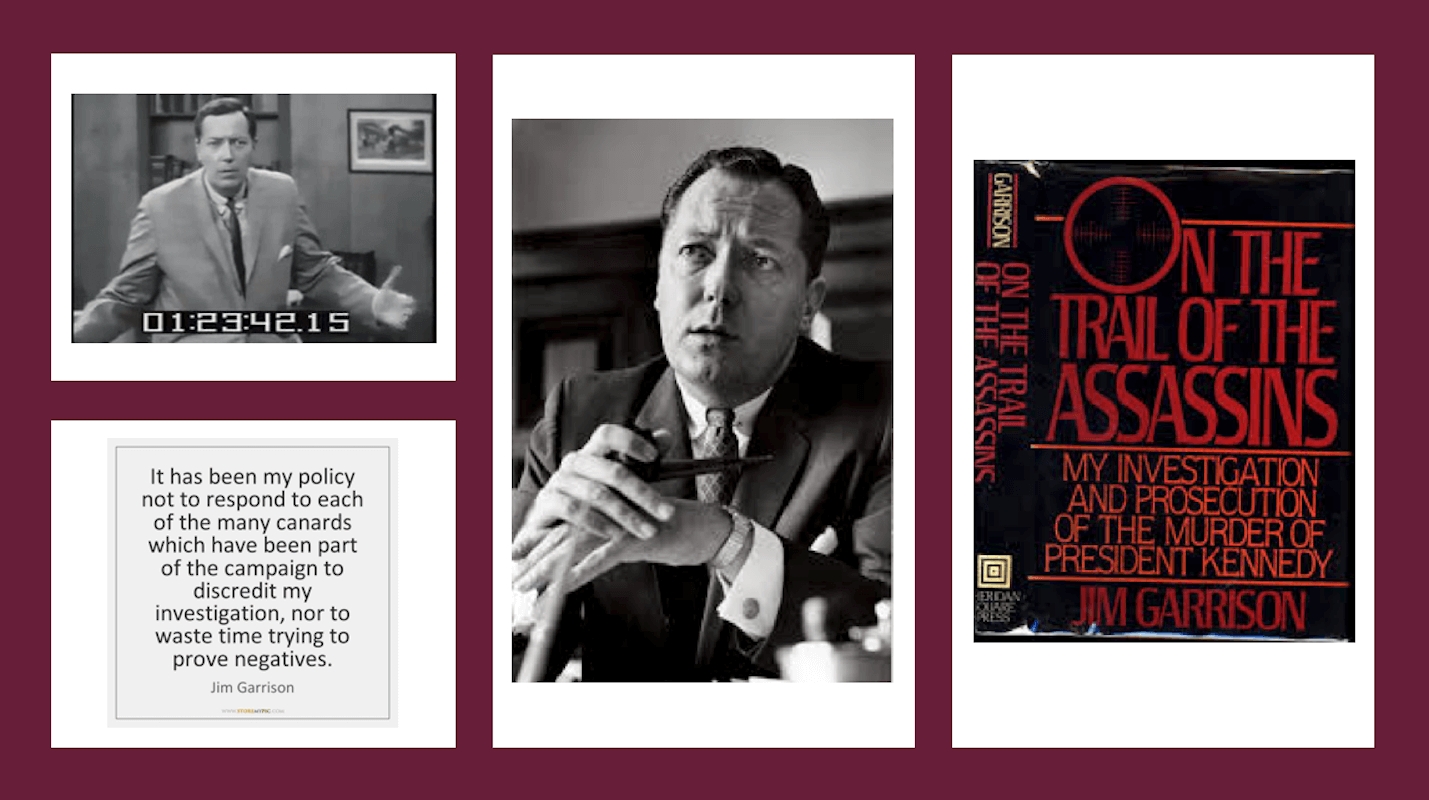
    Toward the end, the show goes bonkers.  Levenson does nothing to try and rein in the anti-Garrison mania of either James or Long. They propose the idea that Garrison did not suffer any consequences at all because of the pursuit of his case against Shaw. Pure bunk. Jim Garrison was one of the most popular figures in the state in 1966. Many commentators thought he could be either governor or senator. Because of his prosecution of Shaw, the Power Elite in New Orleans ganged up on him and backed the Justice Department attempt to remove him from office.  This was done through the candidacy of the DOJ liaison to the Shaw trial, Harry Connick. That was coupled with two phony prosecutions against Garrison originating from the US attorney’s office, where Connick worked. Garrison exposed these trials at length in his book, On the Trail of the Assassins. (See Chapter 19) It was the publicity from those trials that weakened him and eventually let Connick into the DA’s office. It is incredible that no one on the program notes that this was a calamity for the city of New Orleans.  For the simple reason that Connick was a disaster as a DA. (For just one serious problem, click here; click here for another)

    As a result of his case against Shaw, Garrison went from being a probable governor to renting an office in a large law firm and Connick became one of the most incompetent DA’s in America.  But the aim of the ordeal Garrison went through was not just to get him out of office.  It was also to serve as an example to others:  “See what we did to the guy who was set to be the governor of the state?  Try and mess with the JFK case and the same thing will happen to you.”  With one exception, Richard Sprague and the House Select Committee on Assassinations, it has worked. 

    There is barely a mention at all of what befell Garrison.  Alecia Long actually says that Clay Shaw’s civil liberties were violated.  This is ridiculous. Shaw was not just indicted by a grand jury.  He also had a preliminary hearing, after which the presiding judge could have thrown out Garrison’s case.  He did not.  Therefore, what civil liberties were violated in the criminal case? No one on the program mentions that Connick incinerated much of the evidence Garrison had left in his office after he left.  And he fought the ARRB in court not to give back what he had left. (DiEugenio, Destiny Betrayed, second edition, p. 320) In that respect, the American people were deprived of the results of one of the very few valuable inquiries into the murder of President Kennedy, which no one on this show seems to give one iota about.

    When asked by one reader about how bad her work was on Jim Garrison and JFK, Long replied that she had her sources and the reader had his. What she did not add is that FBI and CIA associated journalists like Phelan, Sheridan, and Hugh Aynesworth, are not credible sources. But ARRB declassified documents, which the government hid for generations, are. They tell us why the Kennedy case and the Garrison inquiry were so dangerous to the power elite. And they show us how NPR, Long, James, and Laine Kaplan-Levenson have produced a pile of irrelevant rubbish. Better no one broadcasting on the subject than tripe like this.

  • Jim DiEugenio’s 25-part series on Destiny Betrayed, with Dave Emory

    Jim DiEugenio’s 25-part series on Destiny Betrayed, with Dave Emory


    jd emory dbFor three months, beginning in November of 2018, Jim DiEugenio did one-hour-long interviews on Dave Emory’s syndicated radio show For the Record. Emory has been broadcasting for 40 years. These 25 programs constitute the longest continuous interview series he has ever done. The subject was a sustained inquiry into DiEugenio’s second edition of Destiny Betrayed. Emory was very impressed by the author’s use of the declassified record excavated by the Assassination Records Review Board and how it altered the database of Jim Garrison’s New Orleans inquiry into the assassination of President Kennedy. This series is also the longest set of interviews DiEugenio has ever done about the book. Emory read the book and took extensive notes, which made for an intelligent and informed discussion of what the present record is on the Garrison inquiry.


    December 3, 2018   For The Record #1031 Interview #1
    December 10, 2018   For The Record #1032 Interview #2
    December 14, 2018   For The Record #1033 Interview #3
    December 17, 2018   For The Record #1034 Interview #4
    December 21, 2018   For The Record #1035 Interview #5
    December 24, 2018   For The Record #1036 Interview #6
    December 28, 2018   For The Record #1037 Interview #7
    December 28, 2018   For The Record #1038 Interview #8
    January 7, 2019   For The Record #1040 Interview #9
    January 11, 2019   For The Record #1041 Interview #10
    January 14, 2019   For The Record #1042 Interview #11
    January 18, 2019   For The Record #1043 Interview #12
    January 21, 2019   For The Record #1044 Interview #13
    January 25, 2019   For The Record #1045 Interview #14
    January 28, 2019   For The Record #1046 Interview #15
    February 1, 2019   For The Record #1047 Interview #16
    February 4, 2019   For The Record #1048 Interview #17
    February 8, 2019   For The Record #1049 Interview #18
    February 11, 2019   For The Record #1050 Interview #19
    February 15, 2019   For The Record #1051 Interview #20
    February 18, 2019   For The Record #1052 Interview #21
    March 1, 2019   For The Record #1053 Interview #22
    February 25, 2019   For The Record #1054 Interview #23
    March 1, 2019   For The Record #1055 Interview #24
    March 4, 2019   For The Record #1056 Interview #25

  • The Canadian Archives, Michele Metta, and the latest on Permindex

    The Canadian Archives, Michele Metta, and the latest on Permindex


    67df04ded316a5b3c8f749febe0cedd2 SA review of

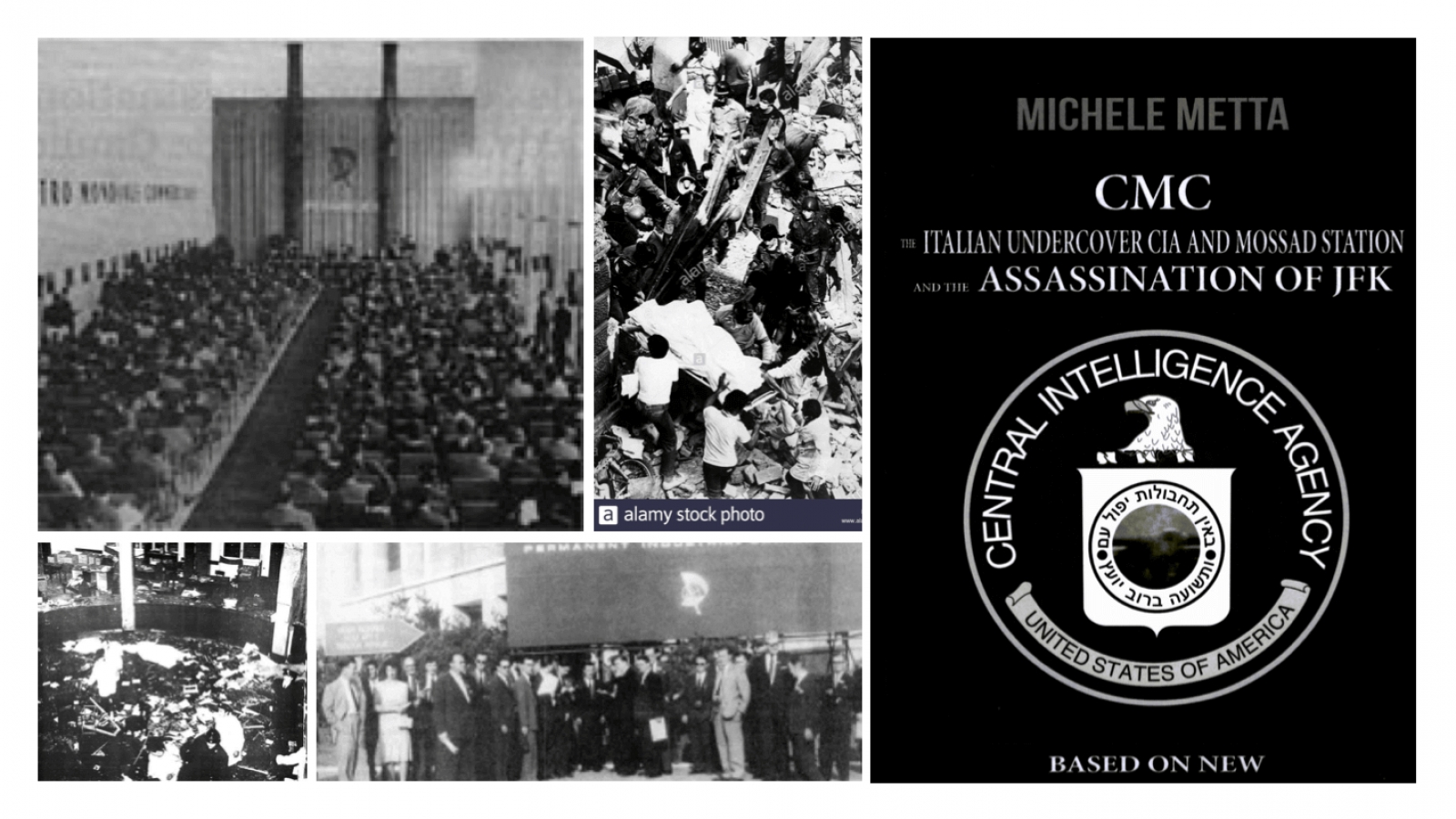
    CMC: The Italian Undercover CIA and Mossad Station and the Assassination of JFK

    by Michele Metta

    with two Appendices

    In his book, Michele Metta has provided his readers with a glimpse into the world of Centro Mondiale Commerciale (CMC). But along with that, the author gives us an insight into the politics of post-war Italy that is quite encompassing and incisive. It’s very clear that Italy was a hard target of American interests in the Cold War. With the help of some books published in Italy that would not normally be available to an Western audience, Metta takes us further into those attempts to control Italian politics.

    Centro Mondiale Commerciale came to the attention of Jim Garrison’s investigation into John F. Kennedy’s assassination because Clay Shaw, the man he would accuse of participating in a plot to murder Kennedy, was a member of its board of directors. As more than one author had noted, that shadowy corporation had a rather curious background prior to opening in Rome amid much hoopla. They had previously been thrown out of Switzerland due to the controversial nature of some of its members, and also due to the mystery surrounding the company’s financial backing.

    The charge made by Garrison against Shaw is one of the reasons why there is so much discussion on the internet about CMC, located in Rome Italy, and its associated company Permindex, located in Basel, Switzerland. The discussion has also included much unreliable and/or unverified information that is rooted in accusations made by Lyndon Larouche’s Executive Intelligence Review (EIR) and David Copeland, aka William Torbitt, who wrote Nomenclature of an Assassination Cabal. This includes stories depicting Permindex as a front company operated by Montreal lawyer, Louis M. Bloomfield, from which Bloomfield supervised assassinations. These stories have been circulating for many decades and for some people these stories about Bloomfield and Permindex are considered as fact.

    When I discovered that an Italian journalist, Michele Metta, had done research on CMC, I was hopeful. Finally, a study of this company that would not build on the falsehoods created by Larouche and Copeland, and instead would provide the reader with a narrative supported by actual evidence. What I found however, was a bit of both. Metta provides evidence that actually proves that Shaw was on the board of directors of CMC, that CMC member Ferenc Nagy was a CIA asset, and that another CMC member, Georges Mandel, aka Giorgio Mantello, was connected to Israeli intelligence. The author further describes connections between CMC and the notorious Italian organization, Propaganda Due (P2), that is linked to the “Strategy of Tension” that was responsible for a wave of bombings and violence in Italy. He also provides connections to persons involved in Kennedy’s assassination. But the book falls short in another aspect of its story. Metta attempts to link CMC to the “Strategy of Tension” and the assassination of John F. Kennedy. Although he makes some interesting connections in those regards, he does not really achieve his aim.

    The book however does an excellent job at showing connections. Metta’s research links many members of CMC to Mussolini’s old fascist guard and neo-fascists associated with the “Strategy of Tension.” He does this by providing names of CMC members and then describing their personal histories. He demonstrates that these ardent cold warriors dreaded socialist and communist parties controlling the Italian government, and were prepared to go to great lengths, including violence, to stop them from achieving power. These are the same people who would also oppose Kennedy’s soft-on-communism foreign policy, including his conciliatory attitude towards leftists in the Italian government. These numerous right-wing connections to CMC make it apparent that it could be used as a vehicle for promoting subterfuge in Italian politics and perhaps even play a role in Kennedy’s assassination. But connections alone do not constitute proof. The fact that one person knows another, and that person is somehow connected to CMC is not proof that CMC played a role in the Dallas plot. These numerous right-wing connections, however, create a lot of suspicion about this company’s activities, a suspicion so great that it demands further investigation into its operations. It also shows that Garrison’s interest in the organization was merited and that later attempts to somehow demonstrate that this was all a KGB disinformation ploy are not founded. But more research is needed to provide the actual details of how CMC participated in Kennedy’s assassination. Metta does not provide this important evidence. For example, when he attempts to link the financing of the plot to Valerio Borghese and CMC, he offers only more connections, instead of how money went into CMC’s bank account and then out to the assassination team.

    The author informs us of other events he tries to link to the members of the CMC: for example, interfering with President Jimmy Carter’s re-election bid in 1980 and an assassination attempt on his life. He also tries to tie CMC to the assassination of Italian politician, Aldo Moro, in 1978. But again Metta offers only connections between people as proof that CMC played a role in these events.

    Before examining his book in more detail, we must first examine the question mentioned earlier: why all the interest in CMC/Permindex, and why it has continued to be a topic of interest for Kennedy researchers for such a long time.


    II

    As previously stated, this interest in CMC began with Jim Garrison’s prosecution of Clay Shaw for conspiracy in the death of President Kennedy. In his investigation he found out that Shaw, who had been the manager of the International Trade Mart (ITM) in New Orleans, had also served on the board of directors of CMC. To the casual observer, Shaw’s appointment made sense. CMC, like Permindex and the ITM, were both created to provide a showcase for goods produced by different companies. Given his many years of experience managing the ITM, he appears to have been a good candidate for work with CMC. But Garrison’s suspicions were raised when he discovered that Montreal lawyer, Louis M. Bloomfield, who he believed was a former member of the Office of Strategic Services (OSS), a precursor to the CIA, was a major stockholder in CMC.1 Garrison also indicated in his book that Le Devoir, a French-language Canadian newspaper, had published an article in 1967 that stated that Bloomfield had done espionage work for the United States government and was a major stockholder in Permindex.2 While I have yet to see credible evidence that Bloomfield was an OSS agent, Garrison was right about his suspicions regarding CMC. Once the public found out about them it was only a matter of time before stories, ever the more wild, began to circulate about both Permindex and Bloomfield. These accusations came to Bloomfield’s attention, and in a letter to I. G. Alk in 1979 he lamented:

    There is an outfit calling itself the North American Labour Party run by some fellow called Larouche, apparently whose propaganda is not treated seriously, but whose propaganda accuses me and other prominent Canadians of all sorts of heinous crimes. (Exhibit 13 )

    These attacks and the perceived damage to his reputation, along with other misinformation about him, were the probable reasons for his wife to ask Library and Archives Canada (LAC) not to release his papers to the public. The archive’s compliance with her wishes resulted in two lawsuits against them. (A discussion of these two lawsuits and a third one brought by me can be found in Appendix 1.)

    Metta continues in this vein. He believes Bloomfield to be a stockholder in the companies and states that he founded Permindex. (p. 7) The evidence from LAC does not support these statements. He is not a direct shareholder nor a founder of Permindex. (A description of his actual role with these two companies can be found in Appendix 2.)


    III

    One of the insights I gained about the anti-Kennedy forces in Metta’s book is found in a pact made between Italian and American Freemasons against Kennedy, which included a member of CMC and the CIA. This is an important assertion, since it is implying that CMC is involved in an anti-Kennedy plot. It also shows a connection between a member of CMC’s board of directors and the CIA. (p. 10) This pact involved Dr. Gigliotti, who was a CIA agent, and was organized by Giuseppe Pièche. (p. 13) Pièche was a member of CMC’s board of directors. (p. 15) The purpose of this pact was to oppose Kennedy’s bid for the 1960 presidential election. In a letter from the Grand Master of the Freemasons, Enzio Milone, to the Christian Democratic Member of Parliament, Elio Rosati, dated September 24, 1960, he told them to:

    … propagate as much as possible the protestant idea—influence Italian immigrants in the USA to vote against Kennedy … (p. 10.)

    But is the pact subversive? To many people, including this reviewer, it looks like typical election politics: encouraging a certain ethnic group to vote a certain way. The fact that it stemmed from a foreign country, Italy, is also not that unusual.

    Giuseppe Pièche, who organized the above-mentioned anti-Kennedy pact, also provides a link between CMC and far-right Italian politics. This connection is important because CMC has always been a suspicious entity, the suspicion being that the company owed its existence to a motive other than profit. And Metta does provide the reader with reasons to be suspicious. Pièche was a general in Mussolini’s army. If this isn’t enough of a fascist credential, Metta goes on to state that he and Mario Scelba “created and directed” the Servizio Antincendio [Fire Service]. He was assisted in the Fire Service by Edgardo Sogno who was connected to P2 and who later told the press that the Fire Service was a NATO organization linked to the Gladio network. (p. 13.4) The author also informs the reader that Pièche and Sogno created and ran an organization called “Pace e Libertà” [Peace and Freedom], which received funding from Allen Dulles. (pp. 14-15) These are credentials that should make any reader be wary. But then Metta makes a strained conclusion. He states that Pièche was a member of the CMC Board of Directors; that Antonio Trabuchi, who was present at the signing of the Freemasons’ pact, was a also a member of the government led by Fernando Tramboni, who wanted to make Italy into a dictatorship (pp. 9, 15); and finally, that Tramboni’s son-in-law, Franco Micucci Cecchi, was also a member of CMC (p. 15).

    From these facts he concludes: “Therefore, there is ample evidence so far to sustain that CMC was behind the pact against JFK.” (p. 15) Yet, he has already told us that the pact against Kennedy was between American and Italian Freemasons. (p. 9) If CMC was the catalyst for the pact, he should have demonstrated how CMC’s board of directors had created and implemented it.


    IV

    Metta then introduces a new statement into his narrative. It is an assertion which is truly sinister, one that implies Freemason participation in Kennedy’s death. At a meeting of the Sacro Collegio del Rito [Sacred Panel of Rites] held on December 5, 1981, which Metta describes as “… the high assembly of top Italian Freemasons,” there were concerns about a document in the possession of Enzo Milone, whose letter described the anti-Kennedy pact of 1960 mentioned above. (p. 16)

    At this meeting, Milone stated: “Everything happening [today] had its matrix in what occurred in 1962.” (p. 18) During this meeting, Franco Nataloni stated that: “If these papers were to get into the hands of the D.C. Tina ANSELMI, this could put all of us in trouble.” (p. 19)

    The Freemasons had a good reason to be concerned about Tina Anselmi. She led an Italian government commission of inquiry that could connect Italian Freemasons to P2 and other subversive activities. (p. 9) Metta then reminds us that the statement regarding what happened in 1962 was after Kennedy was elected and was residing in the White House at the time, so it does not have anything to do with their pact to block his election to the presidency. He goes on to state: “Milone says 1962; when Kennedy is already in the White House, and to stop him means something else; it means things like Dallas.” (p. 18)

    Is he implying that 1962 was the year that the Freemasons began their plot to assassinate Kennedy? It certainly seems like it because he mentions Dallas. But what actually did occur was a lot less sinister. The author also states: “Besides, in 1962 the plot against JFK started involving a key figure of the Italian Intelligence and Freemasonry: Giovanni De Lorenzo, an individual who was closely linked to the CMC …” ( p. 24)

    But the plot was not an assassination plot; it was a five-point plan to oppose left-wing parties in Italy. These are enumerated by Metta (pp. 34-35):

    • Point 1. Program diverse actions for possible emergency situations.
    • Point 2. Intensify finances to the forces which oppose the political swing [to the left].
    • Point 3. Support single leaders in the Christian Democratic Party (DC) and political lobbies willing to rally around the new President of the Republic Antonio Segni (Segni, like Gronchi before him, placed full trust in General De Lorenzo), who did not like the party’s opening to the left.
    • Point 4. Support any action which seeks to weaken the structure of the Socialist Party and favor any kind of internal split.
    • Point 5. Strengthen voices in the media who are able to influence public opinion in the field of economics and politics.

    As can be seen, this was a plan to disrupt the attempt being made by left-wing parties to gain the confidence of Italian voters. As David Talbot mentioned in his book on Allen Dulles, The Devil’s Chessboard, Kennedy thought that the ruling party in Italy, the Christian Democrats, should open itself up to the Socialists. This “plot against Kennedy” thus was in opposition to “l’apertura a sinistra”, the opening to the left that Kennedy would propose on a trip to Rome the next year. (Talbot, p. 464)


    V

    Metta does however create some suspicion about CMC’s connections to the Masonic Lodge P2. P2 was, according to the author, linked to the “Strategy of Tension,” which was responsible for much violence in Italy, including the Bologna railway station massacre that killed 85 people and injured over 200 people in 1980. The goal of these attacks was to terrorize the Italian public into accepting an authoritarian government. (p. 21) Led by Licio Gelli and financier Michele Sindona, P2 was declared by the Anselmi Commission to be a criminal organization. P2 was a remarkably dangerous and secret society. Their influence extended beyond Italy, as far away as Argentina. As a result of the Anselmi Commission, it was eventually outlawed.

    Metta believes that the P2 lodge and CMC were so closely linked that: “In fact, we are now about to discover in how many infinite ways the CMC is indistinguishable from the Masonic Lodge P2 …”(p. 21)

    The evidence he cites to connect CMC to P2 is a company called IAHC, which was a subsidiary of CMC. (p. 21) He then tells us that its board of directors meetings were held at the office of Roberto Ascarelli, whom he also links to Licio Gelli, found guilty of the Bologna massacre. (pp. 21-22) Anselmi’s commission stated that P2 also met at Ascarelli’s office. (ibid)

    This is important evidence. It certainly creates a link between P2 and CMC’s subsidiary IAHC, and therefore to CMC itself. Sharing the same offices is similar to the situation Lee Harvey Oswald found himself in, sharing office space with Guy Banister at 544 Camp Street in New Orleans. But while this is evidence of possible collaboration between CMC and P2 through its subsidiary, IAHC, it does not prove conclusively that CMC is indistinguishable from P2. Metta is relying on a connection, and while that is important, it does not tell the reader what subversive activities IAHC participated in. Although this is definitely a step forward in describing CMC, more research is needed to show how IAHC participated in P2 operations and how it participated in the Dallas plot.


    VI

    Metta also tries to explain to the reader another aspect of the assassination plot; how it was financed. His attempt to link Valerio Borghese to the Dallas plot gets mired in a large number of connections. It does create suspicion that certainly warrants further research, but does not prove that CMC was somehow connected to Kennedy’s murder.

    Borghese was a naval officer under Mussolini. After the war he was rescued and then mentored by James Angleton. Nicknamed the Black Prince, he became a hardline fascist political figure in postwar Italy. He took part in an attempted coup in 1970. After it failed, he fled to Spain where he lived out the last years of his life.

    Metta introduces the reader to a bank called Credito commerciale e industriale, which is abbreviated to Credicomin. Credicomin was bought by a company called Società finanziara italiana (SFI). On the board of directors of SFI is a man named Antonio Covo, whose brother-in-law is Giovanni Gronchi, who is linked to CMC members, (p. 47). He then tells us that Credicomin came into the hands of Ramfis Trujillo (p. 50), the son of Rafael Trujillo, the former dictator of the Dominican Republic. Borghese then became Credicomin’s president and Trujillo deposited 10 billion lira into Credicomin. This money promptly disappeared. (p. 50) He also adds to the mix the story Gerry Hemming gave to a newspaper in 2005, in which he said that Ramfis Trujillo and Johnny Abbes Garcia, Rafael Trujillo’s former intelligence director who tried to assassinate Fidel Castro, met in Haiti in February 1963 to finance Kennedy’s assassination. (p. 49) He also mentions that the telephone number of Marcella Borghese, a cousin of Valerio Borghese, was found in Clay Shaw’s telephone book. (p. 50)

    Though some have doubts about Hemming, if this is all accurate, it does look sinister. Shaw, the accused Kennedy plotter, knows Borghese’s cousin. Money is disappearing from a bank controlled by Ramfis Trujillo, who Hemming accused of meeting in Haiti to finance the Dallas plot. These are certainly interesting links; but there is a problem. Metta does not tell us how CMC participated in the financing of the assassination. Yes, Shaw was on CMC’s board of directors and Gronchi is connected to CMC, but what exactly did CMC do to facilitate the financing of Kennedy’s murder? These connections between SFI, Credicomin, Borghese, Trujillo and Shaw also do more to implicate Credicomin than CMC in Kennedy’s assassination, because money disappeared from a Credicomin bank account, not from CMC’s bank account.


    VII

    Metta does however produce real evidence that links CMC to the CIA. Here he provides a document from which the following facts emerge: Dr. Ferenc Nagy, President of Permindex, had asked the CIA to place an American businessman on the board of Permindex and also that a CIA agent be placed on the staff of Permindex. Nagy then goes further. He even asks CIA to invest money in Permindex so that it can have input into the management of the company. (p. 87 fn. and p. 88, Exhibit 25) This evidence is very important because it confirms that this company’s purpose was not just to provide an exhibition hall for companies wanting to sell their products, but that there was also an intelligence aspect to it. This evidence is further corroborated by a document provided by Metta that shows that CIA asset Clay Shaw was a member of CMC’s board of directors.6

    Metta establishes another link between CMC and an intelligence agency. Georges Mandel, aka Giorgio Mantello, a member of CMC, was connected to the Israeli Intelligence Service (ILS). Quoting a CIA memorandum, the author states: “ … at Point 5, makes a very detailed but also formidable revelation: witnesses identified Georges Mandel alias Giorgio Mantello, as belonging to the Israeli spy network.” (p. 114) He also informs us that he was employed by the Banque Pour le Commerce Suisse-Amérique Centrale in Geneva that hired ILS agents. (p. 114)

    There are now three persons linked to Permindex and CMC—Nagy, Shaw and Mandel—who have or had intelligence connections. It is getting harder to believe that this company’s only purpose was commercial. But once again it must be said that these intelligence connections alone do not support Metta’s theory that CMC played a role in the Dallas plot. What is needed is evidence that the intelligence assets used CMC as a conduit to carry out the plot.


    VIII

    In his narrative Metta tries to link the Organisation de l’Armée Secrète (OAS) to Kennedy’s murder and CMC. The challenge here is to see if he offers proof that the OAS, the same organization that was behind assassination attempts on Charles de Gaulle, was involved in Kennedy’s murder, and then connect the dots to CMC.

    He does offer some proof about a possible OAS involvement in the Dallas plot. He provides the reader with the contents of a CIA memorandum which states that Jean Souetre was:

    … in Fort Worth the morning on 22 November and in Dallas in the afternoon. (p.128)

    The memorandum also states that Souetre: “… is believed to be identical with a Captain who is a deserter from the French army and an activist in the OAS.”

    He then presents us with more incriminating information. He reminds us that Fernando Tamborini, who was linked to the masonic pact against Kennedy and whose son-in-law, Franco Micucci Cecchi, was a member of CMC, had a “special office” that was, quoting SISMI papers: “… probably, also the headquarters for OAS activities in Italy (at least at the high level).” (p. 131)

    The Souetre presence in Dallas on November 22, 1963 has always been fascinating, for more than one reason. For instance, the OAS had been bitterly opposed to Kennedy since 1957, when he advocated for Algerian independence. Metta does make a connection between the OAS and Tamborini, but this connection is attenuated because the SISMI paper qualifies the identification of Tamborini’s office with “probably”. He then attempts to connect the OAS to CMC using Tamborini’s son-in-law but does not provide evidence to show how Cecchi involved CMC in the Dallas plot. Again, this is new and interesting evidence, but it does not go as far as it should in the details.


    IX

    Connections, connections, connections; this is the core of Metta’s book. He attempts to show that a myriad of connections between the far-right of Italian politics, the CIA, Israeli intelligence and CMC all came together to plot and carry out the assassination of John F. Kennedy. The author even states after describing still more connections between members of CMC and various right-wing personalities: “Yes, for the umpteenth time, everything is connected.” (p. 139)

    But connections are a double-edged sword. Connections can draw the attention of the reader to important relationships between members of the CMC and fascists, and perhaps even to the Dallas plot because the likely suspects were members of the far-right. But connections alone are not enough, because they do not show the crucial details of how Kennedy was murdered: who gave the orders, how the plot was organized, how the snipers were recruited, and what role CMC played in this tragic event.

    Metta does make an interesting connection between the P2 and CMC subsidiary IAHC, but this needs more work because he does not tell the reader what subversive activities it was involved in.

    He also fails to show the reader how CMC was used as a conduit in the Dallas plot. For example, he attempts to link the financing of the assassination to Borghese, Trujillo, Credicomin, Shaw and CMC, but here again we have that double-edged sword. These connections are interesting: missing money, Shaw on the board of directors of CMC and Shaw with Borghese’s cousin’s telephone number. But he does not show how the money went from Credicomin’s bank account to CMC’s bank account and from there to the actual plotters. These connections do raise suspicions, and they should be investigated further. But by themselves they do not prove that CMC acted as financier for the Dallas plot.

    He also provides evidence to establish that there were at least three people, Nagy, Shaw and Mandel, who were connected to intelligence agencies. This is important because it confirms the suspicions of the newspaper Paesa Sera that there was more to CMC than just providing exhibition space for companies to sell their products.

    Metta also includes CMC links to events that occurred after the assassination. He attempts to connect CMC to election meddling by participating in a plot to scandalize President Carter’s brother and to an attempt on Jimmy Carter’s life. He also tries to connect CMC to the murder of Aldo Moro, but CMC’s alleged role in these two events does not inform us about the events of 1963 in Dallas.

    Metta’s book also has a problem with its format: the book does not have an index. This creates a lot of difficulty for the reader because so much of what the author writes about is connections. Attempting to follow the histories of different persons mentioned in his book is difficult without knowing on which pages a person is mentioned. This requires the reader to re-read whole sections of the book to locate information about an individual and this is frustrating. Particularly for a reviewer. Hopefully, this will be improved in a later edition.


    Appendix 1: The Bloomfield Papers Law Suits

    In 1978, Montreal attorney Louis M. Bloomfield donated his personal papers to Library and Archives Canada (LAC). His papers contained a wide variety of items, including a large number of his letters, articles and manuscripts written by him, including photographs. A complete list of what he donated to LAC can be found in the archives finding aid. (Exhibit 3)7 When he donated his papers to LAC he stipulated that all items donated by him were to be released to the public, without any restrictions whatsoever, 20 years after his death. In the intervening years, between the time of his death and the papers’ release date, his wife, Mrs. Justine Cartier, now remarried, would act as literary executrix. Her control of the documents would cease 20 years after his death.

    In 1984, while on a trip to Israel, Bloomfield passed on. In 2004, Maurice Philipps, author of a book about Kennedy’s assassination called De Dallas à Montréal, asked LAC to grant him access to Bloomfield’s papers. According to his will, this should have been done automatically because 20 years had elapsed since his death. The archives consulted with Bloomfield’s widow and asked her about granting Philipps access to her husband’s papers. She told them to deny Philipps access. The archives complied with her wishes, even though her request contravened her husband’s stipulation. Philipps, after being informed that he could not access Bloomfield’s papers, asked the Federal Court of Canada to review the archive’s decision to not allow him to review Bloomfield’s papers. In 2006 the Court ruled in Philipps’ favour and ordered LAC to review their decision.8

    In 2007, after consulting with Mrs. Cartier, the archives made a decision to release some of Bloomfield’s papers, and to hold others back. The papers that were held back were those deemed by LAC to be subject to “solicitor-client privilege” (SCP). This was due to Bloomfield’s status as a lawyer, and they would therefore be released 50 years after the last date in the file in which those papers were contained. The archives created a document that listed all items in the Bloomfield papers and indicated which ones were open for public review and which ones would only be released when the documents were 50 years old. (Exhibit 4) Philipps appealed this decision and asked that all files be released immediately. This time the Court ruled in favour of the archives. Their decision to hold certain files back for 50 years would stand.9

    As a result of his actions, Philipps was finally able to review some of Bloomfield’s papers. He created a website called “I Have Some Secrets for You” in which he provided copies of letters written by Bloomfield in regard to his work with Permindex. Philipps discovered some interesting communications in this first release, specifically between Bloomfield, Permindex and David Rockefeller. Apparently, Ferenc Nagy was trying to solicit funds for Permindex from one of the richest men in America. There was also a CIA connection since Nagy had invited the Agency to use this new company in Rome for any purposes it wished. There is more, as the reader can see by clicking through to his web site.

    I began my own research into Bloomfield’s papers in 2012. The examination began with those files that were already open and then continued with those papers that could only be reviewed after they were 50 years old. This required me to return to LAC as different papers, which had reached 50 years of age, were opened by LAC for review by the public. I accessed them on a number of occasions, and as late as 2017 had been granted access to them. In January 2018, I asked for those papers that were now available for review and was told by the archives that they could not be viewed by the public. The reason given by LAC was that those files were considered to be covered by SCP. In an email from Guy Berthiaume, Librarian and Archivist of Canada, he stated that it was not Mr. Bloomfield’s prerogative to donate his legal papers to the archives because SCP protects communications between a lawyer and his client from being divulged to the public. In response to this decision by LAC to not release his papers to me I submitted an “Application for Judicial Review” to the Federal Court of Canada asking the Court to review the archive’s decision.10 In my case I argued that Bloomfield’s papers were not subject to SCP because they did not meet the legal test for privilege that can be found in Canadian case law. The archive agreed to do a second review of those files they deemed to be subject to SCP. They subsequently released over 2,000 documents to me and held back just 69 documents. The archives also agreed to update the access forms on their website so future researchers would be aware that, except for the 69 documents held back by them, his papers can now be accessed without waiting for them to reach 50 years of age.

    But what would cause the archives, after two previous court cases, to again try to block public access to Bloomfield’s papers? I do not have a definite answer to this question but do have a theory. The most likely cause of this problem was the October 2017 release of Kennedy assassination documents as stipulated by the Assassination Records Review Board in Washington. The release of these documents is rooted in the decision by the United States government, taken in the 1992 President John F. Kennedy Assassination Records Collection Act, to declassify all documents pertaining to Kennedy’s murder in 25 years. Therefore all documents were to be released in 2017. When the time came for the documents to be open to the public, the media was full of stories about the releases. I was still able to access Bloomfield’s documents as late as November 2017, but with all of the media attention given to the JFK documents release, a decision was made to block access to them. The reason for blocking access to them, using the excuse that they were subject to SCP, was most likely caused by all of the media hoopla in America.


    II

    On December 18, 2018, LAC released to me over 2,000 documents previously deemed subject to SCP. These files had been reviewed by the archives and deemed to be not subject to SCP. Only 69 documents from the Bloomfield papers were not released because LAC claims they are subject to SCP. A list of Bloomfield’s correspondence that will not be released is in Exhibit 5.

    A review of the papers that were released did not reveal anything new. The documents found there were the same ones that had previously been considered subject to SCP and held back for 50 years, and these I had reviewed on a number of occasions since 2012. The papers released in 2018 are comprised of letters and cablegrams from Bloomfield to his business associates and other personal contacts. The fact that interesting connections were found but nothing incriminating is not surprising because it appears that Bloomfield was not actually a shareholder in either Permindex or Centro Mondiale Commerciale. His role with these two companies was to protect the interests of certain other shareholders who may have been from the class of the Power Elite. If he had dealings with Director Clay Shaw, or was aware of the company’s intelligence connections, he did not include these documents with the papers he donated to the archives. A review of the correspondence in Exhibit 5 also reveals that important Permindex and Centro Mondiale Commericale figures such as Georges Mantello, Joseph Slifka, Hans Seligman and others, do not appear as recipients on the list of 69 documents that will not be released.


    Appendix 2: Bloomfield’s Role in Permindex and Centro Mondiale Commerciale

    For a long time Bloomfield has been the object of suspicion on many internet forums, and also in some books. Some have insinuated he was the mastermind behind the creation of Permindex, which has allegedly organized a few assassinations. These rumours began during the Jim Garrison investigation. Garrison had been given articles written about Permindex by writers like Ralph Schoenmann and the late Paris Flammonde. But Garrison, for whatever reasons, never brought this information up at the trial of Clay Shaw. After the acquittal of Shaw, a man named David Copeland, using the alias of William Torbitt, wrote a pamphlet called Nomenclature of an Assassination Cabal. This pamphlet began to circulate widely in the research community. And it was here, for the first time, that both Bloomfield and Permindex were accused of being part of the JFK assassination. In fact, the very first chapter of the pamphlet focuses on Permindex and names Bloomfield as the top supervisor of the plot. As Jim DiEugenio, in his book Destiny Betrayed, Second Edition notes, there are many, many scholarly problems with this pamphlet, one being that its few references do not check out.

    Years later, in 1981, Lyndon Larouche—in an issue of Executive Intelligence Review written by Jeffery Steinberg and Peter Goldman—published at length about Permindex. Again, Bloomfield was a central focus of that long essay. For the most part, author Michele Metta thankfully does not go that far. He does not accuse Bloomfield of being the leader of an assassination team, but the evidence does indicate that he made some skewed assumptions about Bloomfield’s role with Permindex. He also raises some suspicions about him because he corresponded with the late George H. W. Bush.

    In his book, he states that Bloomfield was the founder of Permindex. But he does not supply a source for the statement. Without evidence from the author to support it, we need to look to the Bloomfield papers for an answer. What does Bloomfield have to say about his relationship to Permindex?

    In a letter from Bloomfield to J. Metzger dated April 8, 1960, he informs him: “…I am not the Treasurer of Permindex but am acting solely in the capacity of lawyer for certain shareholders.” (Exhibit 611 ) Who these shareholders are, he does not tell us, but we now know he is stating that he is not an investor in Permindex.

    In a letter to Enrico Mantello dated January 21, 1960 he writes: “I would have never undertaken this job if I had not been assured of your cooperation.” (Exhibit 712 ) Those are not the words of a founder, they are a statement being made by a representative.

    In a letter to Tibor Rosenbaum dated July 12 1961, Bloomfield discusses ownership positions in a syndicate created to buy the shares of a development called Marina Reale (Exhibit 813 ):

    … so the position today…

    George Mantello 25%
    Enrico Mantello (and Tim Fales) 25%
    Dov Biegun 10%
    Joseph Slifka 15%
    L.M. Bloomfield (in trust for clients) 10%
    Max and Moe Pascal 7 ½%
    Nate Dolin 7 ½%
    Total 100%.

    Again it appears from the evidence that Bloomfield is acting on his client’s behalf and does not have a financial stake in Marina Reale.

    Metta also tries to raise suspicion about Bloomfield’s correspondence with George H. W. Bush, a director of the CIA, who later became both Vice President and President of the United States. His cites as evidence Bloomfield’s connection to Bush, the implication being that since they knew each other, there must be wrong-doing here. He also states that the correspondence between Bloomfield and Bush has been blocked from public access. This is not accurate today. The files are available for public review because LAC only blocked access to those files that they deemed to be subject to SCP. Given that Bloomfield was not Bush’s lawyer, their correspondence is open for review. He also states that the correspondence is “dense”, suggesting that they exchanged many letters. (p.110.) This writer could find only 18 items in Bush’s file and they do not discuss Permindex or CMC, or conspiratorial matters. All of these items can be found in Exhibit 9.14  This does not mean that we can automatically excuse President Bush, or Bloomfield for that matter. It is simply stating that the evidence is not there in these files.

    A question that must also be posed is why Larouche and Copeland would accuse Bloomfield of such major crimes. In Copeland’s case the reason seems to be to simply obfuscate the Kennedy case. At the early date he began to circulate his pamphlet, very little was known about Permindex or the CMC. Thus the field was wide open to attribute all kinds of illicit actions to those bodies. A review of available literature can provide some insights into Larouche’s motivation. His organization and much of his writing tends to accuse the United Kingdom for many international problems. It is not an exaggeration to say that, to the editors of Executive Intelligence Review, Great Britain is the locus of much of the evil in the world. In the 1981 article we mentioned earlier, the authors attempted to connect Bloomfield to the legendary Canadian/British intelligence officer William Stephenson. In 1940, Winston Churchill sent Stephenson to New York as the chief of British Security Coordination. He was also the chief liaison to American intelligence during that conflict. His office was located in Rockefeller Plaza in New York City. There is no evidence in Bloomfield’s war file that he worked with Stephenson; his correspondence, however, indicates that he may have known Stephenson in the 1950s. (Exhibit 10)15 Bloomfield felt that there was also a tinge of anti-Semitism in these accusations. For instance, the Anti-Defamation League had written that, “The LaRouche operation has been marked since 1978 by continuous emanations of anti-Semitism. Its publications single out prominent Jews, Jewish families, and Jewish organizations for particular abuse.”16

    Bloomfield was affected by this anti-Semitic campaign because only a year later, in 1979, in a letter to I. G. Alk, he told him what Larouche was saying about him and other prominent Canadians. (Exhibit 1)


    Exhibits

    Exhibit 1 – Bloomfield letter to I. G. Alk

    Exhibit 2 – Nagy asks CIA to make Permindex a CIA front company

    Exhibit 3 – Bloomfield collection finding aid

    Exhibit 4 – Bloomfield collection file release dates

    Exhibit 5 – Bloomfield collection files not released by Library and Archives Canada

    Exhibit 6 – Bloomfield role with Permindex/CMC

    Exhibit 7 – Bloomfield role with Permindex/CMC

    Exhibit 8 – Bloomfield role with Permindex/CMC

    Exhibit 9 – Bloomfield Bush Correspondence

    Exhibit 10 – Bloomfield connection to William Stephenson


    Notes

    1 Jim Garrison, On the Trail of the Assassins, Warner Books Edition, New York 1991, p. 101.

    2 Garrison, p. 102.

    3 Library and Archives Canada, Louis M. Bloomfield, MG 31-E25, Container 29 File 16, General Business Correspondence 1979.

    4 Gladio in Italy was part of a larger group of secret armies under the command of NATO that operated in different countries using different names. In Denmark it was called “Absalon”, in Norway it was called “ROC” and in Belgium it was called ‘SDRA8.” They were set up by the CIA and MI-6, and their job was to act as a stay-behind orce that would operate in countries that might be occupied by the Soviets after an invasion of Western Europe. Their objective was to help local resistance movements in occupied territories, evacuating pilots who were shot down and sabotaging enemy supply lines. This network was modeled on the British Special Operations Executive that sent soldiers behind enemy lines during World War II to fight a secret war. Daniele Ganser, NATO’s Secret Armies: Operation Gladio and Terrorism in Western Europe, Frank Cass, London 2005, pp. 1-2.

    5 Metta’s source for this document is CIA. HSCA Segregated CIA Collection, (microfilm—reel 17: Ruiz-Webster), Memorandum: Subject—Trace results on persons connected with Centro Mondiale Commerciale (World Trade Center). NARA Record Number: 104-10181-10114. The document in exhibit 2 was sourced from The Black Vault website.

    6 On p. 8 of Metta’s book is a link to a website that contains documents provided by the author. One of the documents shows that Clay Shaw was on CMC’s board of directors.

    7 Library and Archives Canada, Louis M. Bloomfield, MG31-E25.

    8 Philipps v. Librarian and Archivist of Canada, Date: 2006-11-14, File numbers: T-1517-05. A copy of the Court’s decision, including the facts of Philipps’ case and legal issues can be found on the Federal Court’s website.

    9 Philipps v. Librarian and Archivist of Canada, Date: 2008-09-16, File numbers: T-1192-07. A copy of the Court’s

    decision, including the facts of Philipps’ case and legal issues can be found on the Federal Court’s website.

    10 John Kowalski v. Guy Berthiaume, Librarian and Archivist of Canada, File numbers: T-381-18. While documents have been released, the facts of this case and legal issues has not been published on the Court’s website.

    11 Library and Archives Canada, Louis M. Bloomfield, MG 31-E25, Container 23, File 1, Letter Book 14, 1960.

    12 Library and Archives Canada, Louis M. Bloomfield, MG 31-E25, Container 23, File 1, Letter Book 14, 1960.

    13 Library and Archives Canada, Louis M. Bloomfield, MG 31-E25, Container 23, File 3, Letter Book 16 1960-1961.

    14 Library and Archives Canada, Louis M. Bloomfield, MG 31-E25, Bush, George (Sr.)—Correspondence 1976-1984, Container 16, file 1.

    15 Library and Archives Canada, Louis M. Bloomfield, MG 31-E25, Container 19, File 1, Letter Book 3, 1953-1954.

    16 The LaRouche Political Cult: Packaging Extremism A case study, Anti-Defamation League of B’nai B’rith, New York, Spring 1986, p.2.

  • The Crimes of Quillette

    The Crimes of Quillette


    I’ll say this for Fred Litwin: He knows where to go to advance his cause.

    On Steve Paikan’s Ontario TV show The Agenda, Litwin stated that nothing in the declassified files of the ARRB indicated anything about a conspiracy in the JFK case. This is simply and utterly false. As I wrote about Litwin’s essay on Jim Garrison, this statement proves one of two things: 1.) He did not read any of the declassified files, or 2.) He did read them and is deliberately misrepresenting them. In my review I proved that such was the case with several specific examples. This exposure reduces Litwin to the level of Leslie Nielson as Lt. Frank Drebin in The Naked Gun: proclaiming to a gatheringcrowd there was nothing to see as, behind him, bombs explode a fireworks factory. But this is the kind of poseur that Litwin is, except he is not nearly as funny as Nielson.

    In addition to his interview, Litwin has also done an article for an online journal. That online journal is something called Quillette, which I never knew existed until someone pointed out the Litwin article. I would have never found this journal on my own, and I would not have been missing anything.

    Quillette is a libertarian inspired anti-PC, anti-liberal journal founded by one Claire Lehmann. Journalist Bari Weiss grouped Lehmann as a member of the Intellectual Dark Web, along with the likes of Jordan Peterson and Ben Shapiro. (See this article for info on Peterson) Shapiro is the snarky right-winger who went on MSNBC to defend gun rights by handing the host, Piers Morgan, a copy of the constitution. Unfortunately Morgan, a Brit, did not reply with, “Ben, do you also believe that African Americans should count as 3/5 of a person for census purposes? Because that is what this document says. Should they, and also women, be allowed to vote? Because under this document they were not.” As Alice Dreger wrote, opinions are not scholarship, and that is what the members of this group generally offer. (“Why I escaped the ‘Intellectual Dark Web’’’, Chronicle of Higher Education, 5/11/2018) She could have added that snark does not denote intelligence. As with the Shapiro exchange, it’s often just an excuse for being a smartass. Quillette published the so-called “Google memo” by James Damore, in which he accused that company of practicing reverse discrimination which somehow hurt Asians and whites and males. The right loves this kind of thing since it is a way to repudiate the affirmative action policies originated by President Kennedy. Except, by reading some of their articles concerning JFK, I would be willing to wager than no one at Quillette even knows that JFK started that policy. The Intellectual Dark Web is really the cover layer for the rise of the Trumpian alt-right. If the reader understands all that, then everything that follows is as natural as water running over a rock.

    I

    On September 27, 2018, Quillette published an article by Litwin based on his book I Was a Teenage JFK Conspiracy Freak. That article tried to make the case that somehow the KGB was involved in fostering JFK conspiracy thinking in the USA by planting disinformation stories. Litwin, not the most original researcher, largely based his piece on the work of Max Holland. He labels Holland an historian—which he is not. Two of the three pieces that Holland says are KGB produced disinformation are not disinfo at all. I dealt with them in my critique of Holland’s original article that The Daily Beast was dumb enough to print. As I noted there, the late Mark Lane did not get secret donations from the KGB. And he proved this in his book, The Last Word. (pp. 92-96) As I showed in my critique of Litwin’s essay on Jim Garrison, the last thing in the world that Permindex was was a creation of the KGB. And Shaw’s association with it was something he himself acknowledged. I demonstrated this, not just in my previous essay on Litwin, but also in my lengthy exposure of Holland.

    The third piece of alleged KGB mischief that Litwin brings up is the famous “Dear Mr. Hunt letter”. In book form this was first produced in Henry Hurt’s volume Reasonable Doubt. It is a note dated November 8, 1963, and addressed to a Mr. Hunt. It is written in cursive and reads, “I would like information regarding my position. I am only asking for information. I am asking that we discuss the matter fully before any steps are taken by me or anyone else. Thank you.” Oswald’s signature follows. (See HSCA Vol. 4, p. 337) Again, Litwin says this was part of a Russian intelligence operation codenamed Arlington.

    One of the problems with that pronouncement is that the Dallas Morning News ran a story saying they had three handwriting analysts look at the note: Mary Harrison, Allan R. Keon and Mary Duncan. They compared it to samples of Oswald’s writing. All three concluded it was genuine. (NY Times, April 4, 1977) The trio belonged to a professional organization called the Independent Association of Questioned Document Examiners. Harrison said she would be comfortable going into court and presenting her analysis. Litwin gets around this problem by saying that the NY Times wrote of the note’s possible authenticity. As the reader can see, that is not what the Times reported. The HSCA did not make a conclusive judgment about the note because it was a photocopy. (Henry Hurt, Reasonable Doubt, p. 236) On this point, Ms. Harrison stated that reproductions are often presented in court.

    Most of the Litwin/Holland material was produced by KGB defector Vasili Mitrokhin. Making the Mitrokhin case look even worse on this matter is the work of researcher Greg Doudna. Doudna did his best to track down the evidence Mitrokhin had purloined from the KGB showing the note was a forgery. In Mitrokhin’s book, The Sword and the Shield, there is a footnote referencing some original papers at a British university. (Mitrokhin and Christopher Andrew, pp. 228-29) Greg got in contact with the curator at Churchill Archives Centre, Churchill College, and part of the University of Cambridge. To cut to the chase, there is no evidence for this forgery in the Mitrokin collection. All there exists to back up that footnote is a typed draft of the book. This is the kind of scholarship Litwin offered and Quillette accepted. (E-mail communication with Doudna, 11/28/2018)

    Mitrokhin was a former KGB archivist who became a defector. Apparently, neither Litwin, nor anyone at Quillette, ever read Amy Knight’s coruscating review of his role in the wave of alleged Soviet defectors finding their home with Anglo-American publishers and newspapers owned by the likes of Rupert Murdoch. As she points out, when first drafts by these defecting authors were not sensational enough, they were spiced up. And presto! They now included information like, well, how about Niels Bohr, Enrico Fermi and Robert Oppenheimer were giving atomic secrets to the USSR? And Oppenheimer recruited Klaus Fuchs—who actually was a spy—to Los Alamos, the location of the Manhattan Project. Knight, a real scholar in the field of Soviet studies, had some fun with that one. (“The Selling of the KGB”, Wilson Quarterly, Winter 2000) She had more fun with the source for both Holland and Litwin. The idea that an archivist did not have access to a copier for 12 years and therefore had to scribble down notes from documents, instead of copying the documents themselves, this simply strains credulity. But if one sees this new field of exchange as a marketable continuation of the Cold War—with impoverished KGB agents finding a way to make mucho bucks from an American/British Establishment that has a lot invested in the justification of that Cold War—then it makes sense. Somehow, the anti-PC Quillette fails to acknowledge that angle. Which indicates what their political correctness is all about.

    In fact, on the matter of the JFK case, Quillette is Establishment to the hilt—and beyond. On the 55th anniversary of the murder of President Kennedy, they gave Litwin an encore. They ran an echo to his book. One of the editors, Jamie Palmer, penned a piece called “My Misspent years of Conspiracism”. All I can say to Mr. Palmer is that if this was an audition for the big-time MSM, he should be getting a few calls from the Fox network in the near future.

    II

    In Litwin’s book, he says that what originally convinced him there was a conspiracy in the JFK case was ABC TV’s public showing of the Zapruder film in 1975. In Palmer’s Bildungsroman, it was his viewing of the film JFK. But even in describing that experience the reader can see why, as with Litwin, Palmer ended up being a Warren Commission shill. He writes that somehow the Mr. X character in that film turned out not to be credible. That character is based on Fletcher Prouty, and virtually everything he related from his own experience at the meeting in Washington with the Jim Garrison character has turned out to be accurate. That Mr. X/Garrison conversation on a park bench concerning Vietnam has revolutionized our thinking about that entire conflict. It inspired several books that have advanced the film’s thesis even further. Namely, that President Kennedy was not going to escalate the Vietnam quagmire any further, that no combat troops would be sent into theater, and the advisors America had there were going to be recalled. From what I have seen of Quillette, they would not print scholars like David Kaiser or Gordon Goldstein or James Blight. That’s not what they are about. Litwin is.

    Palmer is unintentionally funny when he gets to the turning point of his personal saga. He says that his original beliefs about the case were reversed when he watched the 2003 program on the assassination that was produced by Peter Jennings at ABC and broadcast in England by the BBC. This site carries an entire section consisting of 16 critical articles demonstrating why Jennings’ show was a three-ring circus. From Jennings’ hiring of Gus Russo as his main consultant, to the “computer simulation” of the Magic Bullet, the program was a set up to revivify the corpse of the Warren Report. Our articles expose that agenda in gruesome detail. Somehow, Palmer swallowed it whole. In fact, he calls this program “a masterpiece of methodical argument”.

    Palmer goes on to describe certain parts of that “methodical argument” for an entire section of his long essay. What is incredible about his recitation is that, with one exception, it is all recycled Warren Commission drivel used to convict Oswald in 1964. Are we to believe that in over ten years of his belief that Oswald was innocent Palmer never read any of this material? Not even in books critical of the Commission? For he now says that he sees that Stone was remiss by not including the shooting attempt at General Edwin Walker in his film. Palmer writes, “Oswald had tried to assassinate someone else in April 1963.” The case against Oswald in the Walker shooting has been well examined by, among others, Gerald McKnight in his fine book Breach of Trust. That book is 13 years old, so if Palmer wanted to check up on that incident, he could have.

    First off, the Walker shooting was investigated by the Dallas Police for over seven months and Oswald was never a suspect. Why? For one, the best witness was Kirk Coleman. He ran out of his neighboring house right after hearing the shot. He saw two men escaping, in two separate cars. Further, when he was shown pictures of Oswald by the FBI, he failed to identify him as either man. (McKnight, p. 57) But beyond that, a cursory look at the Warren Report reveals that Oswald did not drive, or own a car. Another witness, Robert Surrey, told the police that two nights before the shooting he had seen two men casing Walker’s house. They left in a Ford. Again, he said that neither man looked like Oswald. (McKnight, p. 58) Tough to go into court when the two eyewitnesses deny the defendant was there.

    But it’s worse than that. The bullet recovered from the scene of the crime, which missed Walker from about 25 feet away, was not the correct ammunition for the alleged Oswald rifle. In newspaper and police accounts it was reported as a 30.06 projectile, not 6.5 mm. Plus, it was steel jacketed, not copper jacketed as was the ammunition used for the Oswald rifle, and therefore was a different hue. (James DiEugenio, The JFK Assassination: The Evidence Today, p. 100) The reason the FBI and the Warren Commission had to pin the Walker shooting on Oswald was because there was next to nothing in his past to connect him to such an outburst of murderous violence as occurred in Dealey Plaza, and later, with the killing of Patrolman Tippit. In the Marines, Oswald accidentally injured himself when a derringer went off as he opened a locker. He then had a dispute with an officer and threw a drink in his face. (James DiEugenio, Destiny Betrayed, second edition, p. 130) What makes that sum total even weaker is that Oswald liked and admired President Kennedy. (Dick Russell, On the Trail of the JFK Assassins, p. 206)

    The one exception to his warmed over Warren Commission refuse is contained in Palmer’s final and thunderous J’accuse against Stone. The author concludes his conversion story by praising the ABC-produced Dale Myers computer simulation of the Magic Bullet done for the Jennings program. That simulation was supposed to show the Warren Commission was correct in saying that one bullet went through both John Kennedy and Governor John Connally, making seven wounds, smashing two bones, and emerging from its journey in pretty much unscathed condition, missing only 3 grains of its original mass. There have been several devastating critiques of this simulation. All Palmer had to do was search the web and he would have found them. In our section on this site, we feature three full-scale dismantlings of Myers and his cartoon. The Single Bullet Theory, the sine qua non of the Warren Report, simply did not happen. And when one has to cut as many corners as Myers does in order to create a Rube Goldberg contraption to say it did, then such is the proof of the plot. That Mr. Palmer did not consult any of these critiques says a lot about his personal bias and also his honesty with his readers. He actually writes that he found Myers’ simulation “too convincing to dismiss”.

    Robert Harris showed how easy it was to dismiss. He demonstrated that Myers deliberately misplaced the positions of Kennedy and Connally in the car for ABC. Harris proved this was the case by using actual images from the Zapruder film to demonstrate that Myers had jammed the two victims much closer together than they were, thereby foreshortening the firing trajectory. Myers also changed the position of the two men and altered the image of the car within the same traveling shot. He did this in order to conceal the fact that when placed in their proper perspective, the Magic Bullet comes in way too low to strike Connally in the right rear shoulder. In spite of all this, Palmer concludes this section of his essay by saying that if this same technique would have been used to demonstrate a frontal shot, he would have considered it “decisive and final”. I would like to inform Quillette that by using these techniques, one could simulate a sniper hitting Kennedy and Connally from the top of the Hertz sign in Dealey Plaza. But for Palmer and Quillette, in keeping with Mr. Litwin’s approach, it’s not the accuracy of the presentation that matters, it’s the result. Or to use an old realpolitik adage: the ends justify the means.

    III

    But Palmer has to maintain his whole “personal saga” pretense. So he now shifts gears into the New Orleans aspect of Stone’s film and also to Garrison’s book, On the Trail of the Assassins. But, like Litwin, Palmer refuses to acknowledge an important aspect of the overall calculus: the Assassination Records Review Board (ARRB). Litwin simply misrepresents the discoveries of that body. Palmer simply ignores them. As I noted in my review of Litwin, this tactic is convenient for Warren Report shills since so much of what Garrison was talking about back in 1967 has turned out to be accurate. In fact, because Garrison was correct on much of what he said, the FBI and CIA had to cover up the facts, and the CIA had to launch subversive operations against him.

    Part of the subversion was to launch infiltrators into Garrison’s camp. As Garrison describes in his book, one of them was a man he called Bill Boxley, his real name being William Wood. In Stone’s film, he and co-screenwriter Zach Sklar named him Bill Broussard. Palmer actually calls the character, “a composite of various Garrison staffers” and “is allotted the role of the villain in Stone’s film”. Wrong again. From talking with co-screenwriter Zach Sklar, Broussard was based upon Boxley. And if anything, Stone and Sklar underplayed the damage Boxley did to Garrison. This author spent several pages dealing with the havoc the man unleashed, and also the investigative files he stole—some of which were never recovered. (DiEugenio, Destiny Betrayed, pp. 278-85) If you can believe it, Palmer actually tries to make the guy some kind of hero. What is even more bizarre is that Palmer also relies upon Tom Bethell, the man who was supposed to be in charge of Garrison’s archive. On the eve of the Shaw trial, Bethell turned over the DA’s trial brief to Shaw’s defense. Through research into the Garrison files declassified by the ARRB, Peter Vea discovered that, unlike what Bethell tried to imply years later, he did not admit this to Garrison. Lou Ivon, Garrison’s assistant, conducted an investigation and found out Bethell was the culprit. According to Peter’s work, Bethell broke down and wept upon discovery. Before Garrison could decide what to do with his case, he fled to Dallas. As stated to this author in a conversation he had with the late Mary Ferrell’s estranged son, for whatever reason, Bethell ended up at her doorstep. With touchstones like this, you can do a lot to downgrade Jim Garrison.

    And Palmer cannot let go of Litwin’s false idea that somehow Garrison’s witness Perry Russo was drugged and fed leading questions to get him to identify Shaw as Bertrand. In my review of Litwin I showed this was not the case. It was a trick set up by Shaw’s lawyers with the aid of compromised journalist James Phelan. They rearranged the two sodium pentothal (truth serum) sessions to make it appear that this is what occurred. When read in their true order no such thing happens. Russo introduced the character of Bertrand on his own without being coached. The two best exposures of this charade are by Lisa Pease (Probe Magazine, Vol. 6 No. 5, p. 26), and Joe Biles in his book on Garrison entitled In History’s Shadow (pp. 43-47). Both have been available for over 15 years.

    But Palmer goes beyond Litwin. He says that Perry Russo flunked his polygraph test according to the administrator. The administrator he is referring to is one Ed O’Donnell. O’Donnell was a policeman who Garrison had tried to draw up on charges for police brutality against African American suspects. Both he and Ray Jacob, another technician used by the DA, were intent on unsettling Russo in order to get the wrong indications on the test. (Joan Mellen, A Farewell to Justice, p. 147) When Russo complained to Garrison about these tactics, Garrison called O’Donnell into his office. He asked him if he had a tape of Russo denying that Shaw/Bertrand was at a gathering at Ferrie’s apartment. The policeman said no he did not. Yet he had told Russo he did. Garrison terminated his services upon hearing this. (Clay Shaw trial testimony of 2/26/69) The proof of who O’Donnell really was is that he ended up being an advisor to Shaw’s defense team at the trial. (Mellen, p. 309)

    If you continually and falsely smear the DA’s investigation, and then assume that Oswald shot Kennedy—which we know today did not and could not have happened—then you can characterize Garrison’s inquiry as “inconsequential”. But you would have to add that the Richard Schweiker/Gary Hart investigation for the Church Committee was also meaningless, and the Richard Sprague/Robert Tanenbaum phase of the House Select Committee on Assassinations (HSCA) was also adrift. The problem with saying that is you are now dismissing two fine senators and two excellent prosecutors. Between them, Sprague and Tanenbaum prosecuted about two hundred homicide cases. The combined record was one loss in well over twenty years. Sprague was the lawyer who prosecuted the famous Jock Yablonski murder conspiracy case and convicted corrupt labor leader Tony Boyle. (DiEugenio, Destiny Betrayed, p. 326) According to Tanenbaum, when he was privately briefed on the Church Committee inquiry by Schweiker, the senator told him that, in his view, the CIA had killed Kennedy. He then handed him a research file compiled by his chief investigator Gaeton Fonzi. (Probe Magazine, Vol. 3 No. 5, p. 24) Need I add that this was the same conclusion that Garrison had come to a decade earlier? But Dale Myers and ABC have magically made this information “inconsequential”. And with a stroke of his pen, or keyboard, Palmer has made Schweiker, Hart, Sprague, Tanenbaum and Fonzi all disappear. In fact, from his perspective, they never existed.

    Without that backdrop, and without the relevant discoveries of the ARRB about New Orleans, then you may as well be writing about Jim Garrison from the viewpoint of some MSM hack journalist in 1968. For instance, like Litwin, Palmer wants to discount the fact that we can now prove that the mysterious Clay Bertrand, who called Dean Andrews, was really Clay Shaw. (DiEugenio, Destiny Betrayed, pp. 385-86) He fails to mention that we know today that it was Shaw and his friend David Ferrie who were escorting Oswald around the villages of Clinton and Jackson 100 miles north of New Orleans in the late summer of 1963. They were trying to register Oswald to vote in a parish far away from where he lived so he could get a job at a mental hospital. (Bill Davy, Let Justice be Done, pp. 101-17) Shaw lied about all these matters: that he knew Ferrie, or Oswald, that he used the Bertrand alias, and that he was in Clinton-Jackson with those two men that summer. Shaw also knew Guy Banister. (Davy, pp. 93-94) Oswald spent many days of that fateful summer of 1963 in Banister’s office preparing his Fair Play for Cuba Committee flyers and pamphlets, with Banister’s address on the early copies. (Davy, pp. 37-42)

    Somehow, Palmer does not understand that it was these activities in New Orleans that summer that were injected into the media within hours of President Kennedy’s murder and did much to convict Oswald in the public mind as the sociopathic communist who killed the president for ideological reasons. It thus makes sense that Shaw would call his acquaintance Andrews to go to Dallas to defend Oswald—not knowing Oswald was going to be killed within 48 hours of his apprehension. Shaw would know that Andrews could be compromised, or be used as an incompetent lawyer.

    This is where, as they say, the plot thickens, and again, Palmer leaves it out. Through the ARRB, we know today that Oswald was not a sociopathic communist. He was very likely working through Banister as a CIA agent provocateur. The CIA had set up an anti-FPCC campaign under the tutelage of David Phillips, who was one of the men running that operation. (Davy, p. 286) Further, a man fitting the description of Phillips was in Banister’s office in 1961 trying to arrange a citywide telethon for the Cuban exile cause. (Davy, pp. 21-24) Phillips’ was also seen in film made of one of the nearby New Orleans CIA training camps, a film which the HSCA temporarily had in their possession. Along with Oswald and Banister, witnesses also identified him as being in the film. (Davy, pp. 30-31)

    With this background now filled in a bit, Palmer may want to ask himself if it explains the curious provenance of Oswald’s pamphlet, “The Crime Against Cuba” by Corliss Lamont. Oswald stamped it with 544 Camp Street, Banister’s address. Oswald’s version of the pamphlet was printed in 1961. It had gone through at least four more printings by the time Oswald was leafleting with it in 1963. Yet his was from the first edition. The CIA purchased 45 copies of the original edition in 1961. Is this how Oswald got the outdated version, perhaps through Phillips who was running the subversive program against the FPCC? To make it all a bit more curious, Oswald wrote about his altercation with the Cuban exiles, which got him arrested and the pamphlet confiscated, before it happened. (Davy, p. 38)

    As the reader can see, these are the provocative questions that Oswald’s activities in New Orleans pose when they are presented with the full information we have today. Much of it was available at the time of the Jennings special. Mr. Jennings was not going to touch it. We explain why in our special section reviewing that very poor and unethical documentary. In a nutshell, in 1984, ABC Nightly News did a report on the exposure of a CIA front company in Hawaii and the Agency’s involvement in a possible murder plot. It was a fascinating two-part installment. CIA Director William Casey was very upset by that reporting. So he arranged to have some of his friends and colleagues at Capital Cities buy the network. Jennings, the host of the program, got the message. After Casey and Cap Cities bought the network, Jennings, who had originally stood by the story, now said he had no problem with the CIA’s denial of it.

    Palmer closes his essay with a reference to Litwin’s book, saying that somehow the technical panels set up by the HSCA on things like forensic pathology, photographic evidence and the rifle tests sealed the deal against Oswald. By now, one really wonders just what Palmer was doing in those ten years he doubted the Warren Commission. He certainly was not reading the journals on the subject. Because if he had been, he would have known that people like Dr. Gary Aguilar, Dr. David Mantik and this author completely took apart these very flawed tests made by the HSCA. And, in fact, the chair of the HSCA, Robert Blakey, also took one of them back, the one he relied upon as the lynchpin of his case against Oswald, namely the Comparative Bullet Lead Analysis (CBLT). He has now termed it junk science. (For a full scale, in-depth analysis, see The Assassinations, edited by James DiEugenio and Lisa Pease, pp. 69-85; pp. 250-91) Those 58 pages simply devastate the so-called findings that Litwin, in four pages, trumpets. And one will find evidence in those pages indicating that the HSCA simply and knowingly misrepresented some of their forensic findings.

    IV

    At the end of Palmer’s article, he sourced a previous piece in Quillette from 2017. This was from one Craig Colgan. Colgan fits right in with Quillette’s agenda. He once wrote an article about the National Museum of African American History and Culture and complained that although there was an exhibit for Anita Hill there was none for Clarence Thomas. Anita Hill was the first woman who actually brought the issue of sexual harassment into national consciousness. The fact that she was an African American testifying against the Establishment-backed Thomas made what she did even more courageous. (See this article)

    The title of Colgan’s November 25, 2017 piece was “Are the JFK Conspiracies Slowly Dying?” He begins his article with a reference to Dylan Avery and his film on 9-11 called Loose Change. He then says that since Avery has backed away from some of his more extreme statements, perhaps those who attack the Warren Report should also. Toward the end of the piece, he says he would allow a kind of Robert-Blakey-inspired Oswald-did-it-with-some help concept. And that is what the JFK critical community should be aiming for.

    I don’t know very much about the 9-11 controversy. But I do know that the official investigating committee issued a report without an accompanying set of volumes of evidence. The Warren Commission issued an over-800-page report with 26 volumes of testimony and evidence. The incredible thing about the early critics is this: some of them actually read those volumes. They came to a clear conclusion: the evidence in the volumes did not support the tenets of the report. The late Maggie Field wrote an unpublished book in which she reproduced pages from the report”s conclusions, then juxtaposed to them extracts from the supporting volumes of evidence that directly contradicted them. One could similarly refer to Sylvia Meagher’s classic study Accessories After the Fact. Unlike with 9-11, then, in the case of President Kennedy’s murder, there is nothing to retreat from. In fact, as tens of thousands of declassified pages have later been released, Field’s book has not just been ratified; it has been shown to be too mild, for we know today certain agencies were concealing evidence that would have indicated how parts of the plot and, even moreso, the cover-up, worked. (For example, see section III of this essay and the discoveries about David Phillips and New Orleans.)

    At this point, one must accentuate the fact that even though Quillette is known as a scientific and technically oriented journal, that is what is completely missing from any of its articles on the JFK case. For instance, Colgan mentions a conversation he had with Gary Aguilar about his critique—co-written with Cyril Wecht—of the PBS special Cold Case JFK which aired at the 50th anniversary of the JFK murder. But he does not devote a single sentence to the total demolition of that series that Aguilar and Wecht performed—in a peer review journal on ballistics! And he does not link to the two-part review. Nor does he note that, although Gary offered to pay for both their flight and hotel accommodations, the father and son team who were featured on that program refused to debate him in public.

    Colgan also notes the decline in the public’s belief that there was a plot behind Kennedy’s murder. This is accurate. At the fiftieth anniversary of Kennedy’s death, Hart Associates did a poll for Larry Sabato’s book, the Kennedy Half Century. It statedthat 75% of the public did not believe the Commission’s lone gunman verdict. This was down from the over 90% during the time that Stone’s film JFK premiered. (Sabato, p. 416) The reason for this is simple to discern. Due to Stone’s film, for about one year—from 1991-92—there was actually an open discussion in the media about Kennedy’s murder. And there were actually programs and front-page stories in magazines that addressed it in an even-handed way. The Power Elite was quite upset by that hubbub. They did three things to counter it. Random House, through editor Bob Loomis and publisher Harold Evans, decided to recruit Gerald Posner and give his book one of the most massive publicity barrages in recent publishing history. We know this from the lawsuit the late Roger Feinman launched against Random House concerning that book.

    Secondly, they decided that there would be no more open debate on the issue in the media—and there has not been. We know this from written communications between researcher Walt Brown and Loomis as well as from Alec Baldwin’s speech in Houston last year at a dinner during the JFK mock trial. Baldwin said he had approached NBC with a proposal for a documentary program on Kennedy for the 2013 anniversary. It was rejected without a hearing, with words to this effect: We have reconciled ourselves to the official version. Another example would be what happened in Dallas at the fiftieth anniversary. With the world’s media on hand, Mayor Mike Rawlings completely controlled and cordoned off Dealey Plaza so that no critic could be heard by them. (See our report on the subject as well as this one at jfkfacts.org)

    Third, virtually every single program since—and there have been more than a few—has endorsed the Warren Report, specifically the Single Bullet Fantasy and the no-frontal-shot concept. The problem with these productions is that each one has falsified the facts of the case. (See this video or read this essay)

    Judging from their articles, Quillette is really more of a politically oriented journal than a scientific or technical one. At that, they should have understood the politics of the Warren Commission. The policies of the most active member of that body, Allen Dulles, were opposed to those of President Kennedy. But from this review, the reader can see that both Litwin and Quillette were more in sympathy with Dulles than JFK.

  • Jim Garrison vs. Fred Litwin: The Beat Goes On (part 2)

    Jim Garrison vs. Fred Litwin: The Beat Goes On (part 2)


    In the field of JFK assassination studies, those who advocate for the Warren Commission have always had a special and personal problem with Jim Garrison. After all, the New Orleans DA was an elected official who did not just challenge the Warren Commission; he actually put together an alternative theory of Kennedy’s assassination. That theory created intense interest and attracted a public following.

    This created a serious problem for the MSM. The press had embraced the Warren Report, all 800 pages of it. Now came an accomplished District Attorney who was saying that their much-ballyhooed report on the death of President Kennedy was rubbish. By doing that, Garrison was not just upsetting the MSM’s apple cart, but also the FBI, the Secret Service and the White House. After all, they had all cooperated and worked for several months on this much anticipated report. Could they all have been so easily taken in by the Dallas Police? Or was there something else at work? Perhaps a deliberate cover-up? If so, why? What could be behind such an evil act and its elaborate concealment?

    By raising these questions, Garrison was upsetting the establishment. Therefore, he was harshly attacked by all elements of the power structure. Almost no one in the media—except the LA Free Press, Ramparts and Playboy magazines—gave him a fair hearing. Every major newspaper, magazine, and TV network discounted or attacked him—none treated him fairly or even handedly. Elements of the government illegally spied on him, sent infiltrators into his camp, wired his office, tapped his phone, and launched subversive operations against his investigative efforts. (See William Davy, Let Justice be Done, Chapter 12) When Garrison complained about these actions, the MSM ignored him. Today, after the disclosures of the Assassination Records Review Board, they cannot be ignored. For the simple matter that the acts of subversion can now be proven with declassified documents.

    There is another important element to the cacophony enveloping New Orleans that has also been revealed. That is the incessant efforts of Clay Shaw’s attorneys to enlist as much help as possible from Washington DC. (James DiEugenio, Destiny Betrayed, second edition, pp. 261-78) What makes this secret solicitation so curious is that, for two solid years, the media portrait of Shaw was that he was as clean as the driven snow. If such were the case, then why were Shaw’s lawyers so desperate for help from the CIA and the FBI? And why did the Agency and Bureau give it to them? Was there something that those two executive intelligence agencies knew that they weren’t telling the public? If so, what was it?

    Through the ARRB, we have now discovered that there was a lot to hide about Clay Shaw. And neither the FBI nor the CIA had planned on letting the public know about it. If not for the ruckus created by Oliver Stone’s 1991 film JFK, no one may have ever discovered any of it.

    Now comes one Fred Litwin. Litwin has written two books. They have both publication and thematic similarities. The first was called Conservative Confidential. That book is about his coming out as a gay man and also traveling politically from left to right, eventually emerging as an activist conservative in the gay community in Ottawa, the capital of Canada. What I found interesting about the first book is that, although I had never heard of Litwin, evidently some powerful people had. The book was blurbed by the likes of Conrad Black, and Daniel Pipes. Black is a former international newspaper magnate who was convicted of fraud and obstruction of justice in America and banned from running a company or serving on any boards in Ontario. Pipes is a rightwing veteran of several think tanks who wrote a book labeling almost anyone who believes in political conspiracies as being inherently paranoid. In Chapter 1, Pipes specifically pointed to the African American community. Nice fan base. After making a lot of money in the computer field, Litwin is involved in lecture presentations, music, film festivals and publishing today. (For an example of the people he sponsors, go here)

    Litwin’s second book is called I Was a Teenage JFK Conspiracy Freak. Like his first, it was published through his own company, Northern Blues. From the title, one does not need much explication as to the similarity in theme. With the JFK case, as with his politics, Litwin has now seen the light. Like St. Paul on the way to Damascus, he had a vision. Except, unlike with Paul, his was not of a vision of a resurrected Christ appearing before him. It was Lee Harvey Oswald firing three shots in six seconds from the sixth floor of the Texas School Book Depository; scoring two of three direct hits to the head and shoulder area of JFK. A feat that, without cheating, no expert has ever been able to duplicate. One of those bullets went through Kennedy’s back, rising upward slightly, even though it was originally traveling downward. Without striking bone, it then went left to right, even though it was fired from right to left. It made a perforating exit from Kennedy’s neck, one that was smaller than its entrance—even though exits are supposed to be larger. It then went through Connally’s body and as it exited his chest it veered right towards his wrist, and then deflected left into his thigh. It emerged from his thigh and was found in the rim of a stretcher, except no one knows whose stretcher it was. (The Impossible One-Day Journey of CE 399; see also Was the CE 399 Magic Bullet Planted?)

    When it was found there was almost no deformation of the bullet, and no blood or tissue on it. After smashing two bones in Connally, it was missing only three grains of its mass. (WC Vol. III pp. 428-30) As Gary Aguilar and Josiah Thompson have shown, CE 399 was so specious as evidence that the FBI had to lie about its identification. (The Magic Bullet: Even More Magical Than We Knew?) As others have said, to believe all this, one must have had some kind of religious experience. Especially if one did not buy into it at first.

    But there is another oddity about Litwin. The present author has been in this field for going on three decades. I have read a rather large amount of material on the subject. This includes research journals from both America and abroad. I do not recall coming across Mr. Litwin’s name in any of them. Apparently, the man kept his beliefs about a JFK plot rather close to his vest.

    I am not going to deal with the entirety of Litwin’s book. Anyone who can propagate that the evidence for more than one gunman in the JFK case has weakened over time does not deserve extended scrutiny. Neither does anyone who is on friendly terms with the likes of Daniel Pipes. But there is a chapter of Litwin’s book available online. It happens to be his chapter on Jim Garrison. Since that is 16 downloadable pages, it should serve as an example of the quality of his work.

    As I have previously said in dealing with the anti-Garrison crowd, if there was one area that the Assassination Records Review Board did a decent job on, it was in declassifying a lot of interesting documents on the New Orleans aspect of the Kennedy case. In two previous review essays on the subject, I have been critical of the fact that none of these documents were anywhere to be seen in the work under discussion. Specifically, this would include the essay by Don Carpenter at Max Holland’s site (Max Holland and Donald Carpenter vs Jim Garrison and the ARRB), and Alecia Long’s essay at 64 Parishes (Jim Garrison: The Beat Goes On).

    Litwin continues to manifest that revealing trait. In the 16 pages, I could find no evidence that he used even one single piece of declassified documentation. When an author does this, it immediately tells the reader much more about him than the writer’s ostensible subject. That is, Mr. Litwin does not give one iota about the declassified record. He is not interested in what the new information is. He does not want to know what the CIA and FBI knew about Clay Shaw back in the sixties, or why it was deemed so taboo that the public had to be kept in the dark about it.

    Which leaves us with two alternative theorems. Either Litwin does not know about this new information; or he does know about it but does not want the reader to be aware of it. Both explanations are pretty unappetizing. But they tell us much about Litwin and his book.

    By the third paragraph, the author exposes the serious fault lines in his work. He writes that Jim Garrison cracked down on vice in the French Quarter by raiding gay bars. How anyone can write something like that is incomprehensible. Once Garrison became famous through the exposure of his JFK inquiry, many people wrote about this 1962 crusade. Almost ten years ago, there was a book written on the subject by author James Savage. What Garrison was cracking down on was a racket called ‘B girl drinking’. The B-girl would sit with a male customer and, as long as he paid for the liquor, she would entice him with hints of sex to be had. (Washington Post, 2/10/63) The girl’s drinks would be very watered down, and as the mark got inebriated, the host would then shortchange him. Afterwards, the poor guy was taken to a cab to get to his hotel; the house got 2/3 of the take, the girl got 1/3.

    I would like to ask Mr. Litwin the obvious question he is seemingly unaware of: If the racket involved a female employee with a male customer, how could these be gay bars?

    What Litwin does next is as bad as the above. He does all he can to denigrate the value of the information that Jack Martin relayed to Garrison’s office within 48 hours after the assassination. For instance, he does not fully explicate why Guy Banister exploded and pistol-whipped his former investigator/employee Mr. Martin. Martin had made some rather incriminating comments, like implicating Banister in the Kennedy assassination. Martin specifically said: “What are you going to do—kill me like you all did Kennedy?” Martin later said that if Banister’s secretary had not intervened, he thought Banister might have killed him. (HSCA Volume 10, p. 130) After the assault, Banister threw some money at his victim. On his way to the hospital, Martin told an acquaintance: “The dirty Nazi bastards did it to him in Texas, and to me here.” (Affidavit of Martin and David Lewis to Jim Garrison 2/30/68)

    Since Martin was describing events on the day of the assassination, who does Litwin think Martin was referring to when he said, “Did it to him in Texas?” In light of the Martin’s previous comment, it was probably President Kennedy.

    What was the specific reason for Banister’s assault? Again, Litwin does not fully reveal that aspect. As Garrison’s staff later discovered, the FBI in New Orleans—namely agent Regis Kennedy—later thought that Martin might have pilfered Banister’s files on Oswald. (Garrison memorandum from Andrew Sciambra, 10/28/68) In fact, a part-time employee at Banister’s office, Mary Brengel, told the House Select Committee on Assassinations (HSCA) that she felt that both Banister and his secretary Delphine Roberts knew what was going to happen in Texas that day. (HSCA interview of 4/6/78)

    It was Roberts who rescued Martin. Banister then swore her to secrecy and kept her out of the office after the bloody incident with Martin. (Anthony Summers, Conspiracy, p. 294) So when Garrison interviewed her, she was tight-lipped. Later she did reveal things to the HSCA, specifically to investigator Bob Buras. On his second attempt to get her to talk to him, Roberts told Buras that Oswald was at Banister’s office and had a few private meetings with him. He was allowed to use a second floor room to print up his anti-Castro materials. (HSCA interview of 7/6/78) Reporter Scott Malone later found a corroborating witness for this information. Brengel told him that Roberts said Oswald had been at 544 Camp Street, Banister’s office, that summer. (James DiEugenio, Destiny Betrayed, second edition, p. 111) When this author interviewed another Banister employee, Dan Campbell, he also revealed that Oswald had been in Banister’s office that summer. In a separate interview with this writer, so did his brother Allen. (Destiny Betrayed, p. 112)

    In other words, it makes perfect sense for Banister to have had a file on Oswald and for Martin to be interested in it on the day of the assassination. It also follows that, as Roberts told Buras, Banister was upset when he heard that Oswald had handed out flyers in New Orleans with Banister’s office address of 544 Camp Street on them. (HSCA Buras interview.)

    Litwin’s depiction of David Ferrie is about as limited and dubious as his work on Banister. Litwin writes that when the FBI and Secret Service questioned Ferrie, he denied knowing Oswald, or having anything to do with Kennedy’s assassination. Litwin leaves it at that. Which is rather uncurious of him. For as anyone who reads Ferrie’s FBI statement has to acknowledge, Ferrie lied his head off to the Bureau. And it is hard to buy the argument that they did not know he was lying. For instance, Ferrie said he never owned a rifle with a telescopic sight and would not know how to use one. This, from a man who was a trainer for both the Bay of Pigs invasion and Operation Mongoose. (HSCA interview of John Irion, 10/18/78; Davy pp. 28-31; CIA memo of October 1967, “Garrison Investigation: Belle Chasse Training Camp”)

    Ferrie also said that he did not know Oswald and Oswald was not a member of his Civil Air Patrol (CAP) unit in New Orleans. This was another lie that Litwin seems comfortable with. In this case, all the Bureau had to do was question some of the other members of that CAP unit to find out Ferrie was lying. Jerry Paradis, who later became a corporate attorney, told the HSCA that he knew Ferrie and Oswald were members of the same CAP unit because he was also a member and he saw them together at a meeting. (HSCA interview of 12/15/78) Anthony Atzenoffer said the same about Ferrie and Oswald at the CAP meetings. (HSCA interview of 1/2/79) As we all know, in 1993, PBS discovered a photo of Oswald and Ferrie at a CAP cookout and showed it on TV.

    But there is something even more incriminating about Ferrie which indicates that not only was he knowingly lying to the FBI but was also trying to scoop up evidence that would prove his perjury. For in the days immediately following the assassination, Ferrie was looking for that CAP picture of him with Oswald. He called a former CAP member, Roy McCoy, to find out if he had a copy. The FBI had to know Ferrie was doing this. Why? Because McCoy and his wife later called the Bureau and told them about Ferrie’s search for the photo of him with the alleged assassin of President Kennedy. In other words, the FBI was complicit in Ferrie’s cover-up. (New Orleans FBI report of 11/27/63)

    Somehow, Litwin did not think that any of this information about Banister, Ferrie and their ties to Oswald—or the attempts to conceal it—is worth conveying to the reader. Nor does he feel it necessary to note the FBI’s odd reaction to Ferrie’s perjury and attempts at obstruction of justice. This writer would beg to disagree with Mr. Litwin. And again, the fact that he does not reveal it says a lot about his intent as an author.

    Litwin trudges onward with Dean Andrews. Andrews was the New Orleans lawyer who said that a man named Clay Bertrand called him on Saturday, November 23, 1963, and asked him to go to Dallas to defend the alleged assassin of JFK, Lee Harvey Oswald. Again, it takes Litwin about two sentences to descend into travesty. First, he says that Andrews was in hospital and heavily sedated at the time he got this call—which is supposed to cast doubt on the credibility of the claim. Twenty-three years ago, the estimable William Davy checked on this point through the hospital records. Those records indicate that Andrews got the call at least four hours before he was sedated. (Davy, p. 52) Litwin then writes that the call was actually from a man named Eugene Davis. This is also wrong. The name of Eugene Davis did not enter the record until NBC produced its hatchet job on Jim Garrison in the summer of 1967. Davis subsequently denied this under oath. And Andrews was then convicted of perjury. (Davy, p. 302; Jim Garrison’s interview in Playboy,10/67)

    Today there is no doubt who Clay Bertrand was. And through the efforts of British researcher Martin Hay, we now know that Andrews admitted that Bertrand was Clay Shaw. The late Harold Weisberg did some work for Jim Garrison in New Orleans. He developed a friendly relationship with Andrews and talked to him on several occasions. In an unpublished manuscript, Weisberg wrote that Andrews admitted to him that Shaw was Bertrand. But the lawyer told him he was not to say anything about this without his permission. (See the unpublished book Mailer’s Tale, chapter 5, p. 11, at the Weisberg online archives at Hood College)

    Although Andrews’ word would have probative value in this instance, with the work of the Assassination Records Review Board there is simply no question today that Shaw was Bertrand. And, again, the FBI knew this. There are two declassified FBI reports from 1967 in which the Bureau is given information that such was the case. (FBI teletypes of February 24, and March 23, 1967) In a third FBI report of March 2nd 1967, Bureau officer Cartha DeLoach states that they had information about Shaw in relation to the Kennedy case in December of 1963! Somehow, Mr. Litwin did not find that interesting. Many people would disagree. They would also be upset to know that the public had to wait over 30 years to find out that the FBI agreed with Jim Garrison. In light of these revelations Litwin is unintentionally humorous when he writes that the FBI could not find out who Bertrand was. They did know who he was. They did not want to tell anyone because it would support Garrison.

    But Litwin is intent on trying to show that Garrison was somehow deluded by Andrews. So he trots out another discredited tale that is about fifty years old. He says that Andrews made up the name of Manuel Garcia Gonzalez and that Garrison ended up believing him. Again, this tells us more about Litwin than it does Andrews or Garrison. Andrews actually gave Garrison two names: Gonzalez and Ricardo Davis. Both of these were names of real people. (Larry Hancock, Someone Would have Talked, pp. 349-50) And if the reader wants to see just how interesting Gonzalez was, please read this. Dean Andrews was anything but ignorant or dishonest. This is why—as he told Garrison, Mark Lane and Anthony Summers—he was in fear for his life.

    Predictably, Litwin uses an old trick that reporter James Phelan and Shaw’s lawyers originated in the sixties to discredit Perry Russo. Russo told Garrison that he heard Ferrie and Shaw, at a gathering with a Leon Oswald, speak about killing Kennedy. Garrison had Russo undergo both truth serum and hypnosis. By mixing up Russo’s two interviews under sodium pentothal, Phelan made it appear that Dr. Esmond Fatter was leading the witness. But Garrison submitted the two transcripts to the HSCA, and he had them clearly marked and dated in his own files, which this author had access to. When read in their correct order, not backwards, there is no leading of the witness. Russo comes up with the name Bertrand and describes him as the big white-haired guy—which he was—on his own. (See Probe Magazine, Vol. 6, No. 5, p. 26) Again, this canard was exposed nearly twenty years ago.

    Like Donald Carpenter, Litwin is intent on not revealing the declassified record about Clay Shaw, even though the ARRB did interesting work in that area. It is clear now that, as declassified CIA documents reveal, Shaw was a valuable and well-compensated contract agent from the fifties. Joan Mellen prints the declassified document that proves this in her book about George DeMohrenschildt, Our Man in Haiti, on pp. 54-55. That book was published six years ago. Is there any reason for Litwin not to refer to it? That document also explains why Shaw committed perjury on the stand when asked about this issue. (Davy, p. 185) When you add in Shaw’s covert security clearance for the project QK ENCHANT and his probable clearance for ZR CLIFF, then it is obvious why the CIA considered him a valuable agent. It also helps explain why, as the ARRB discovered, the CIA destroyed Shaw’s 201 file. (ARRB Memo from Manuel E. Legaspi to Jerry Gunn, dated 11/14/1996) The internal lie about Shaw by the CIA—that he was only part of Domestic Contacts like 100,000 other businessmen—shows the lengths they felt they had to go to in order to construct a cover-up about their prized employee. Like the FBI, the last thing the Agency wanted to admit was that Jim Garrison was right about Clay Shaw—which he was.

    Litwin never acknowledges, let alone confronts, any of these documents. He tries to escape from Shaw’s CIA employment by using the excuse that Shaw’s service with the mysterious European entity called Permindex was a tall tale manufactured under Soviet influence and passed on to a leftist newspaper in Italy, the same excuse the likes of Max Holland uses.

    This is more malarkey. The State Department wrote up memos about Permindex at the time the organization was creating a large controversy in Switzerland. Due to the character and suspected criminal backgrounds of members of its board, the controversy got so disturbing it caused the entity to move to Rome. This information was declassified back in 1982 due to a Freedom of Information lawsuit by Bud Fensterwald. They extend from February 1957 to November of 1958 and Shaw is featured in these cables. Bill Davy and others have used these in their books about Garrison’s investigation of Shaw. Again, the FBI was aware of the CIA role in Permindex and how Shaw figured in it. (Davy, p. 100)

    Canadian researcher Maurice Phillips recently discovered even more interesting memos about Permindex in the Louis Bloomfield archive in Montreal. Shaw had been on the board of Permindex, and Bloomfield was a corporate counsel. It turns out that Permindex was likely operating not just as a CIA shell, but at a level above that. Phillips has discovered memoranda which show that Bloomfield was soliciting funds for the endeavor from some of the wealthiest people in the world, for instance, David Rockefeller and Edmond deRothschild. (Letter from Bloomfield to Dr. E. W. Imfeld of 2/10/60) Phillips also discovered a memo revealing that one of the founders of Permindex, Ferenc Nagy, was a CIA asset. Because of that status, he invited the Agency to use this new “business” entity in any capacity they wished. (CIA memo of March 24, 1967, released in 1998)

    Question for Mr. Litwin: did the Soviets manufacture those State Department cables back in the fifties? And somehow insert the Bloomfield correspondence into his personal papers? Once we dispose of this silliness, the obvious question all this leaves, and which Litwin wants to avoid is: What was Shaw doing in the middle of all this?

    The discoveries of Maurice Phillips were quite detrimental to the cover story about Shaw, Bloomfield and Permindex. So much so that, in violation of Bloomfield’s will, his heirs have now tried to stop any more information from being released from his papers. The totality of the declassified record reveals that the cover-up about Shaw was wide, deep, systematic and is ongoing a half century later. This is how fearful the Establishment was about Jim Garrison’s discoveries and where they would lead.

    And that is the fact that Litwin’s article is meant to divert us from. As noted, I could not find one single reference to a primary source record in the entire 16 pages of his essay. Instead of relying on these newly released documents, who does Litwin choose to trust? Well, how about Hugh Aynesworth? If that isn’t bad enough, then how about James Phelan? It’s one thing to use a discredited reporter; it’s another not to tell the reader that he is provably related to the FBI, the CIA, or both. Also that both men denied those relationships prior to the documents being released showing such was the case. Can one say anything worse about a journalist? But that does not seem to bother Litwin at all. (For Phelan, see Probe Magazine, Vol. 6 No.4, pp. 5 and 32, and FBI memo from Wick to DeLoach of April 3, 1967; for Aynesworth see a Western Union teletype of May 13, 1967 which he sent to both the White House and the FBI.)

    By using his discredited sources instead of the declassified record, Litwin is able to conceal the fact that Shaw committed perjury at least four times at his trial:

    1. He lied about his association with the CIA, as amply demonstrated above.
    2. He lied about his use of the alias Clay Bertrand, as is also amply demonstrated above.
    3. He lied about his relationship with David Ferrie. (Affidavits to the DA of 6/27/67, 10/9/68, FBI teletype of 3/5/67, Probe Magazine, Vol. 4 No. 4, p. 8. The last two sources refer to secretaries who saw the two together.)
    4. He lied about not knowing Oswald. (Interview of attorney Samuel Exnicios by Joan Mellen 1/8/02; Davy, pp. 101-17)

    Do innocent people tell this many lies under oath, thereby risking decades in prison? Shaw had to lie, because if he didn’t it would have exposed him to too many questions that he would not have been able to explain away. Like, “Why did you call Andrews and ask him to go to Dallas to defend Oswald?” And, “Why were you and Ferrie escorting Oswald around the Clinton/Jackson area attempting to register him to vote in a place he didn’t live?”

    In the face of all this—quite relevant—perjury, what does Litwin do? Besides avoiding it all, he runs to another risible source: Paul Hoch. Hoch had been misleading the critical community on New Orleans for so long that, when the ARRB opened its doors, he did not want to be exposed as a charlatan. He therefore stood in front of a crowd of about 300 people in Chicago in 1993 and told them to ignore any new releases that came from the Board about Clay Shaw. I wish I was kidding about that, but unfortunately I was there. For that reason, and many others, Hoch simply has no credibility on the issue today. By following Hoch’s advice, Litwin now has custard pie all over his face. Or as they say in the field of information technology, which both men worked in: garbage in, garbage out.

    Not that it matters. If this excerpt is any measure of his book—and from a preview I saw, it is—then Litwin did not write it to educate any members of the public. Neither did he wish to elucidate any of the issues that have now been accented by the releases of the ARRB. And he certainly doesn’t give a damn about the assassination of President Kennedy.

    What he has done is enhance his status with the kinds of people who backed his first book, that is, Conrad Black and Daniel Pipes. He has become a member in good standing of the Culture Warrior crowd. If one looks at his book from that Machiavellian perspective, then like George W. Bush and his disaster in Iraq: Mission Accomplished.

  • Jim Garrison: The Beat Goes On

    Jim Garrison: The Beat Goes On


    Would Jim Garrison have been forgotten if Oliver Stone had never met the late Ellen Ray? If the reader is unaware of who Ellen Ray was let me inform you of her importance in history. (her obituary)

    Ellen Ray was the wife of Bill Schaap. They ran a publishing company called Sheridan Square Press. Sheridan Square did not just release books. They also published magazines like the illustrious Covert Action Information Bulletin and Lies of our Times. If our readers do not know about those two periodicals, it is their loss. The first dealt with the Central Intelligence Agency and its allies; the second was concerned with media analysis. They were well done and important journals.

    Ellen Ray had known Jim Garrison a long time—going all the way back to his original investigation of the John Kennedy murder in the late sixties. She always thought highly of him and his work. So when Garrison thought of writing a book on his inquiry in the eighties, Sheridan Square was one of the houses he thought of releasing it through. But before that, Garrison had had an offer from a much bigger publishing house. That deal did not go through since the proofreader the house assigned to the book was Sylvia Meagher. Now as everyone knows, this site is a sincere admirer of Meagher and her fine book, Accessories After the Fact. But as most insiders also realize, Meagher was one of the early critics who developed a phobia—some would call it a mania—about Jim Garrison and his inquiry. (The others would include Josiah Thompson and Paul Hoch.) Even someone like Jerry Policoff, who was a close friend of Meagher, once said that Sylvia should not have been assigned to review Garrison’s book: “My God, she contributed money to Clay Shaw’s defense!”

    Well, predictably, Meagher’s analysis contributed to Garrison returning his advance. But that may have been fortunate, because now he turned to Ellen Ray and Sheridan Square Press. They assigned him Zachary Sklar as his editor. Zach was a distinguished journalism professor and contributor to Sheridan’s two publications. It was a fortunate pairing. Originally, Garrison had written his book from a third person point of view. But when he met Zach, the editor convinced him that since the DA was an actual participant in the story he was telling, it would be more effective if he wrote the book as a first person narrative. I think most people today would say that was a good choice.

    On the Trail of the Assassins sold about forty thousand copies when it was originally released in hard cover. The thoroughly annotated book revealed many new things about Garrison’s investigation that most outsiders did not know about. It also exhibited Garrison’s firm grasp on the entire evidentiary record of the JFK case and also Kennedy’s place in history. Overall, it was a real contribution to the library of books on the assassination of President Kennedy.

    But what happened later was probably even more significant. At a film festival in Havana, Ellen Ray met up with Oliver Stone. She told him words to the effect: “Have I got a book for you!” Stone read Garrison’s book and decided to bring it to the big screen. He did so in December of 1991.

    But this was the JFK assassination. And it was Jim Garrison. As the DA noted in his book, there were many media critics of his inquiry. And they struck at him in what can only be called a vicious and personal manner. Some of them hid their relationships with the intelligence community, e.g., James Phelan, Walter Sheridan, and Hugh Aynesworth. Even more buried was the cooperation between these men and Clay Shaw’s lawyers. (See Destiny Betrayed, second edition, chapter 11 for an analysis of this nexus.) That sixties wave of media critics was not going to let Oliver Stone bring back Jim Garrison and the JFK case in any kind of fair or salutary manner. So they decided to do a preemptive strike on Stone’s film.

    In what was probably an unprecedented campaign in the history of American cinema, the MSM attacked the film JFK seven months in advance of its release. In fact, Ben Bradlee and the The Washington Post sent George Lardner to Dallas to write a story as the film was being shot in Dealey Plaza.

    Lardner’s article began with one of the truly snarky remarks in recent journalistic history. In watching a rehearsal of the Dealey Plaza sequence, Lardner noted that Stone had ordered up five shots in the assassination sequence. The reporter then wrote: “Five shots? Is this the Kennedy assassination or the Charge of the Light Brigade?” Through their acoustical testing, the House Select Committee on Assassinations had concluded that there were four shots fired. But as researcher Donald Thomas revealed at Cyril Wecht’s Duquesne Conference in 2003, those same sound technicians told Chief Counsel Robert Blakey that they detected five shots. Blakey told Thomas that he did not think it was possible to sell that many shots to the committee, so their report only analyzed and accepted four. In other words, this was a political decision, not a scientific one. There is real evidence that there were five shots, but somehow that did not matter to Lardner. After all, it’s the JFK case.

    Lardner’s article was the first volley in a seven-month MSM campaign that was intended to make sure that the reception of JFK was jaundiced in advance. Many of the same people who attacked Garrison back in the sixties were brought back to do so again, like Aynesworth and Edward Epstein. The fact that neither of these men was at all credible or objective on the subjects of the Kennedy assassination or Jim Garrison was irrelevant. The goal was to savage the film before it had a fair hearing. That is how radioactive this subject was, even thirty years later.

    In spite of this assault, JFK did well at the box office, both at home and abroad. It was nominated for eight Oscars, including Best Picture. But to show the reader just how nutty the anti-JFK crusade was, consider the following. On the eve of the Oscars, an anonymous author bought an ad in the trade journal Variety. The ad asked that no voters cast their ballot for the film as Best Picture. Researcher Rich Goad did some detective work and found out that the ad was paid for by the late Warren Commission counsel David Belin.

    Besides bringing the Kennedy assassination back into the limelight, JFK was the main cause for the creation of the Assassination Records Review Board (ARRB). For at the end of the film, Stone added a subtitle revealing that the files of the House Select Committee were being kept secret until the year 2027. This created a sensation in Washington. Tens of thousands of citizens now called their representatives, sent them letters or faxed them in order to do something about this travesty. It worked. The Board was created. It was a unique agency that was made up of private citizens appointed by the president. That agency had a staff that read and researched documents that were now to be declassified. If an intelligence agency objected, that agency had to show why the document should be kept secret. This reversed the previous Freedom of Information Law, which put the burden of proof on the requester, who had to show why it should be declassified. But even today, twenty years after the ARRB closed its doors, the government is still maintaining secrecy over thousands of documents.

    That Board has a decidedly mixed record of achievement. But it did do some good work on the Garrison angle of the JFK case.   In fact, the Board even went to court with then New Orleans DA Harry Connick to salvage a file cabinet full of documents remaining from the Garrison investigation. After being shown up in the press, Connick resisted turning over the materials. But the Justice Department eventually secured the documents. The Garrison family also turned over thousands of pages that the late DA had in his personal effects.

    Garrison had always insisted that, for various reasons, he was never able to reveal most of the evidence he had secured from 1967-69. After authors like William Davy, Joan Mellen and myself went through what the ARRB attained, we had to agree. The Garrison files in the Archives today hold an abundance of utterly fascinating material on a wide array of subjects dealing with many aspects of the JFK case. Does the MSM reveal any of this to the public? Nope. One of the most embarrassing aspects of the three-week binge that the media went on last year in anticipation that the JFK files were finally going to be completely declassified was this: No one chronicled what the ARRB had already released. Which was significant. It was about 2 million pages of material that opened up new vistas on subjects like Rose Cheramie, Kennedy and Vietnam, and the medical evidence in the JFK case. Guests like Larry Sabato, Phil Shenon and Gerald Posner did not want to discuss those topics. Nether did their hosts like NBC stooge on JFK, Rachel Maddow.

    It is easy to understand why this would occur. As Upton Sinclair once said: It is hard to make journalists understand something when their paycheck depends on them not understanding it. Contrary to popular belief there is no such thing as a liberal media. In the twentieth century, and up until today, the American media has been controlled by an oligarchical class. Some authors call this class the Eastern Establishment. Some call it the Power Elite.   As sociologist Donald Gibson explained in his fine book Battling Wall Street, President Kennedy was not a part of that group. He never joined the Council on Foreign Relations; he did not join any secret societies at Harvard; he didn’t like working intelligence during World War II. He got transferred out to the South Pacific and served with a bunch of Joe Six Pack guys on what were close to suicide missions. As this author demonstrated in the second edition of Destiny Betrayed, both in the Senate and in the White House, Kennedy was opposed to much of what this Power Elite was doing abroad, especially in the Third World. (See Destiny Betrayed, second edition, pp. 21-33) After his death, the progress that he did make in the White House was largely halted, and then reversed. (pp. 367-77) Due in part to the ARRB, we know much more about these changes, especially regarding Indochina.

    Jim Garrison was probably the first critic of the Warren Commission who understood this matter. And it is probably one of the reasons the MSM decided to smear him beyond recognition. This goes on to the present day. In a recent article in a regional journal called 64 Parishes, a writer named Alecia Long decided to pick up the infernal and eternal anti-Garrison cudgel. The New Orleans Times Picayune has always liked to go after Garrison and so they are now carrying it on their web site.

    To anyone who is familiar with the territory, the first reaction is, “Oh my aching back!” The ten-page article is simply a compendium of every MSM caricature of Garrison and his Kennedy case that one can imagine—except Long does not even mention the ARRB. She only alludes to what they did in about a half a sentence. As we shall see, this was a wise choice on her part.

    The preposterous thesis of her essay is that somehow, by his clever use of the media, Garrison was able to advance his case, his cause and his reputation. She uses Garrison’s 30-minute talk on NBC as proof of this. She even opens her article by asking why NBC agreed to give the DA this platform. She does not answer her rhetorical question until several pages later. There, she finally says that in June of 1967, “NBC ran an hour-long special sharply critical of Garrison’s claims and the methods used by his investigators.” This is an understatement. Most objective observers considered the Walter Sheridan production a straight-out hatchet job. But she tries to bolster the program’s credibility by adding, “The special featured several witnesses who claimed to have been offered bribes in exchange for providing testimony damaging to Shaw.”

    What she does not note is that these so-called “witnesses” were later exposed, either in court, or by their own confessions, as being bogus. (DiEugenio, pp. 239-43) And more than one witness—for instance, Fred Leemans and Marlene Mancuso—testified as to the unethical and threatening tactics used by Sheridan for the program. It was Sheridan who fabricated these phony on-air statements by threatening and intimidating Garrison’s witnesses. Mancuso did not succumb to his bullying, so she was not on the show. Leemans did and went on the program. But both of them signed affidavits revealing the extent to which Sheridan and his cohorts would go to in order to flip Garrison’s witnesses. For example, Leemans was told, “… if I did not change my statement and state that I had been bribed by Jim Garrison’s office, I and my family would be in physical danger.” (DiEugenio, p. 240) Somehow, Long missed those statements, which gravely undermine her thesis because logically, they explain why the Federal Communications Commission decided to grant Garrison the time to counter Sheridan’s handiwork. But even at that, the FCC only gave Garrison a half hour, compared to Sheridan’s full hour, which contradicts the idea of equal time embedded in the now defunct Fairness Doctrine.

    She also questions why, when granted the time, Garrison did not answer Sheridan’s charges in more specific terms. As the DA stated throughout his Playboy interview, if he had done that, it would have given Shaw’s lawyers a pretext to move to get his case thrown out of court, since it would prejudice prospective jurors.

    With the release of Garrison’s files by the ARRB, the idea that Garrison did not have a factual basis for his case against Shaw is revealed to be utterly false. There is no doubt today that Shaw used the pseudonym of Clay Bertrand. The declassified files contain over ten witnesses who stated this was the case. It is further revealed that the FBI knew this as well. And finally, attorney Dean Andrews knew it—and lied about it.   As a consequence, Garrison never got to ask Shaw the key question: “Why did you call Andrews and ask him to go to Dallas to defend Oswald?” (DiEugenio, pp. 387-88)

    It is also now shown that Shaw lied about his association with the CIA. That association has turned out to be a long service and a lucrative one. Not only did Shaw lie about it at his own trial, the CIA continually lied about it, and Robert Blakey fell for it. In the HSCA volumes, Shaw is referred to as part of a large businessman’s contact program in the Agency. Not true. Shaw was a well-compensated contract agent from at least the fifties. (Joan Mellen, Our Man In Haiti, pp. 54-55) In the sixties, he had a covert security clearance code name that was the same as Howard Hunt’s. (DiEugenio, pp. 383-87) The CIA tried desperately to cover up these facts, even going as far as altering Shaw’s files. (William Davy, Let Justice Be Done, p. 200) The ARRB later discovered the CIA had gone even further and destroyed Shaw’s 201 file.


    (or open in a new window.)


    As the late Yale educated attorney Allard Lowenstein once said regarding the Robert Kennedy assassination: in his experience as a lawyer, people who have nothing to hide don’t hide things. Somehow, Long does not think any of this new material is relevant to any discussion of Jim Garrison today.

    In addition to this secrecy about Shaw, which hurt Garrison’s case, Long does not detail any of the other methods of obstruction that the CIA and the FBI used against Garrison. Nor does she elucidate any of the meetings that Shaw’s lawyers had in Washington soliciting this kind of aid, which ended up being bountiful. The declassified files of the ARRB contain literally scores of pages on this subject. This features interference with the serving of Garrison’s subpoenas. And further, the setting up of a special committee within the CIA to survey actions to take against Garrison before, during, and after the trial of Clay Shaw. At the first meeting of this super-secret group, James Angleton’s assistant, Ray Rocca, said that he felt that Garrison would convict Shaw in the Kennedy case. (DiEugenio, pp. 269-74) Perhaps in their quest to stop that from happening, on the eve of the trial, at least three prospective witness for the prosecution were physically attacked before they testified: Richard Case Nagell, Clyde Johnson and Aloysius Habighorst. None of these men ended up testifying. (p. 294)

    As mentioned previously, one of the most bizarre statements that the author makes is that Garrison was proficient at using the media and manipulating them for his own benefit. How anyone can make such a statement today is simply inexplicable. As authors like William Davy and myself have shown, the media utterly destroyed Jim Garrison. Before Garrison took on the Kennedy assassination, he had a promising career ahead of him as a Louisiana politician. Many thought he could have been governor or senator from the state. (DiEugenio, pp. 172-74) That career was utterly wrecked by the two-year roasting he took in the press from almost every outlet imaginable: CBS, NBC, NY Times, Life Magazine, Saturday Evening Post, to name just a few. Garrison was eventually defeated in his District Attorney re-election bid due to two sets of phony pinball kickback charges, which he defeated at trial. But the publicity weakened his position and strengthened his opponent Harry Connick, who defeated him in a close election in 1973. (See chapter 19 of Garrison’s book.) To most legal observers, Connick turned out to be a very poor DA compared to Jim Garrison.

    After Garrison was retired from the DA’s office, it took him years to recover from the ordeal he went through. At that time, people who visited him in New Orleans said he had a small office that he rented from a larger firm. This is the man who likely would have been residing in the governor’s mansion if not for the JFK case. That media manipulation Long describes did the DA a lot of good, didn’t it?

    Long is so utterly biased that she actually credits Judge Herbert Christenberry. This is the judge who threw out Garrison’s attempt to try Shaw on perjury charges after his acquittal. Today, there is little or no doubt that Shaw lied numerous times at his conspiracy trial. For instance, about his employment by the CIA, about his friendship with David Ferrie, about his use of an alias. And according to Garrison assistant Steve Jaffe, this time Garrison was not going to make the same mistake he did at the conspiracy trial. He was going to use every witness he had against Shaw.

    Judge Herbert Christenberry should never have presided over this hearing. Moreover, there should have never been a hearing in the first place. As Garrison notes in his book, the idea of a federal judge inserting himself into a state case was quite unusual, since there was a law against it. But that is what happened. Shaw’s lawyers moved to have a state case considered in federal court. (Garrison, p. 253)

    Why did they do this?

    Because Christenberry’s wife had written a letter to Shaw after his acquittal. This was also after Garrison filed the perjury charges. The letter uses the plural pronoun “we”, so it clearly describes both husband and wife’s sentiments. The Christenberrys congratulated Shaw on the outcome of the trial. They sympathized with him over what the DA had done to the poor man. They continued by saying how much better the proceedings would have been if the case had been allotted to federal court and Judge Christenberry. But unfortunately, Caroline Christenberry could not voice these sentiments during the trial for risk of being labeled prejudiced in advance. (Destiny Betrayed, second edition, p.315)

    If there was ever an attempt to solicit a case, this was it. That letter is in the National Archives today. It appears Long has never heard of it.

    This article proves the very worst about the JFK case. Everyone hoped that the declassification of the files would aid in the public’s understanding of what that case was really all about, what impact it had on the personages involved and also on American history. That will not happen with people like Long. At the end of her original essay as published in the periodical 64 Parishes, it is revealed that her piece is part of something called the “Democracy and the Informed Citizen Initiative”, which is sponsored by the Federation of State Humanities councils. The Andrew Mellon Foundation was part of the support for that initiative. In other words, the Power Elite Kennedy opposed is still thriving.

    But further, as Anthony Thorne discovered, Long made up her mind about this matter without looking at any documents. She said, “I don’t want to dig through CIA and FBI documents for the rest of my life.” She then gave the back of her hand to the myriad books on the JFK case: “I find the basic premise of many these books to be problematic and would then note [sic] take those as seriously as historical studies.”

    The books don’t matter. The documents don’t matter. Typical MSM historian on the JFK case.   Which is why her article is worthless. It is the vacuity and speciousness of work like this that helps drive readers to the likes of Alex Jones. Perhaps unbeknownst to her, Long is adding to his minions.

  • Mort Sahl Interview with Elliot Mintz

    Mort Sahl Interview with Elliot Mintz


    Click here for the audio


    (This transcript has been edited for grammar and flow.)


    Elliot Mintz:

    KPFK listener-supported Pacifica Radio Los Angeles. My name is Elliot Mintz. This is Looking Out. Mort, this is just … I can’t tell you what a gas it is to have you here tonight.

    Mort Sahl:

    Well, we moved heaven and earth, Elliot, as you know and the listeners don’t know. There’s an abundance of riches, in addition to … First, I was doing nothing. I don’t know how many of the listeners know that. In addition to doing the show after you and I got together and we decided to do this, then of course, they called from New York and said they had a Johnny Carson show for me in that that way that they have of calling, it always sounds like Operation Headstart. They’re going to help me … Urban renewal. The fact is they have a lot of letters and they can’t hold the audience on a chain that much longer. They want to know if I’m dead or not, so they’re going to import for the show and they want to do it Monday. That would mean, of course, flying in Sunday because you have to report at noon in order to brief the producer.

    So there’s no way to do it. They won’t let you fly in that day because they’re afraid of weather delays. Then they wouldn’t let me … I said, “Well, I have a show to do in Los Angeles on Sunday.”

    And they said, “Cancel it.”

    And I said, “I can’t do that.” And then I said, “I’ll have to cancel this.”

    “Well, you’ve been canceling a lot of shows, you know, that wouldn’t look too good.”

    And then, of course, the singular morality … Then I said, “What about Tuesday?”

    They said, “Well, you couldn’t be on because Bob Hope is on Tuesday and he has a different position than you on Vietnam.” They told me that, so I couldn’t be on with him. And then I finally put it off until Thursday. I’ll be on the Carson show Thursday night for those of you who have a duality of purpose in listening to KPFK and watch NBC. Covering the full spectrum.

    Elliot Mintz:

    I think Jim Garrison once described NBC as the network who believes in the right of the people to know, right?

    Mort Sahl:

    He’s not afraid of them, which is enough in itself. And I spoke with Mark Lane this week who was in New Orleans and I’ll be down there later this week after the New York trip. And, as you know, he has a bribery, public bribery indictment against Walter Sheridan of NBC. Walter Sheridan has a strange history for a broadcaster. As a matter of fact, Bill Stout of CBS once put it this way to me, he said when it came to the Garrison case, NBC News had reported they hired a house detective. They hired one of Robert Kennedy’s lawyers on the Hoffa case to operate there.

    Mort Sahl:

    Yes. That’s who Walter Sheridan is. And he did the Frank McGee show, which was called The Case against Jim Garrison. And he went down there and Garrison has an indictment against him on the basis of trying to bribe Perry Russo; to defect to California where he would not be extradited and to discredit Garrison publicly. And Garrison also charges in that indictment that Sheridan used the phrase, “I will destroy Garrison. I’m here to destroy Garrison.” He used it many times around New Orleans. Now NBC turned that show over to Sheridan not to any of its other reporters. He felt, as he said in Playboy, Garrison that Sheridan had gone too far because they gave him equal time very quickly. They kind of backtracked.

    On the other hand we find Newsweek’s continual bias against Garrison. And I want to tell all the good liberals out there that that’s your journal. Phil Graham, the Washington Post, good social Democrat. Not Time Magazine, not a fascistic magazine, but a good liberal magazine. Newsweek hired Hugh Aynesworth to cover Garrison. They said he’s an outstanding scholar having worked for the Dallas Times Herald, an outstanding scholar. For instance, in his last exchange with Mark Lane in Dallas, he told Mark Lane something to the effect that Warren was not objective about Oswald because both of them were left-wingers, extreme left-wingers.

    Elliot Mintz:

    Wow.

    Mort Sahl:

    So that’s the guy that Newsweek feels is an authority on the case.

    Elliot Mintz:

    I want to begin at the beginning.

    Mort Sahl:

    All right.

    Elliot Mintz:

    And follow this thing very, very closely so we can really understand not only what’s surrounding the suppression of what Jim Garrison was doing in New Orleans, but also what has been done against you personally.

    Now, there was a time that you were appearing in nightclubs and making billions and billions of dollars and selling record albums and you were a comedian and the rest of it, and you didn’t talk about the assassination. Something then happened that obviously was to lead to the change of your entire life. When did it begin for you, Mort? When did you begin to begin to-

    Mort Sahl:

    Well, I began to ask questions about this case. I used to ask them socially and I couldn’t find anybody to answer me, but then I only mixed with liberals, you know. That’s like looking for an honest man and not having a lamp. Then, of course, I ran into … when I had the television show over at Channel 11. We had the … Mark Lane was coming to town. He was originally scheduled on the Joe Pyne Show and some benefactor steered him toward my program instead. And he did cancel the Pyne show and they were furious as well they might be, I suppose, about a commitment. And Mark Lane came on in October of 196-

    Elliot Mintz:

    6.

    Mort Sahl:

    6. Right. He came on with me and he made five appearances. Publisher’s Weekly and the New York Times agree that Rush to Judgment is a national best seller because of California and because of southern California and more specifically because of that program. And yeah, we sold a lot of books. I told people it was most important book in their lifetime. I told Lane when I met him that I thought he was the most important man in the country.

    Elliot Mintz:

    Rush to Judgment?

    Mort Sahl:

    Absolutely. And I think Garrison now has replaced him as the most important man in the country. Mark and I got along very well and the shows were good. We found we didn’t need the, you know, actors or fun and games or anything. We just have to talk and the people cared about it. We really got a storm going and because the people responded, I kept going with it. Then, of course, the KLAC show was in the works and I kept going with that. And when the KLAC show began to roll, of course, I got the first national interview with Garrison. I got 90 minutes on tape with Garrison and Lane, which I paid for my own trip to New Orleans because the station didn’t think it was worth it. After all, it was only a man investigating the murder of the President.

    Elliot Mintz:

    This is radio station KLAC?

    Mort Sahl:

    KLAC. And I went down there and I came back and I played that. Of course, there was great suppression. KTTV, the program director, Jim Gates kept saying to me, “Well, if theatrically …” So he would say he wasn’t suppressing me, it wasn’t a matter of censorship. It was a matter of showmanship and he said, “Theatrically, it’s boring. It just hearing you talk about Kennedy.” And even when I was finally fired at KTTV the first time, which was a year ago December, he came to my house and gave me my notice and said, “Your ratings are very bad and you’re going off.” And instead of leaving well enough alone, he then got nervous and said, “I think it’s because you just talked about the same thing all the time. Kennedy, Kennedy, Kennedy. We’re sick of hearing about Kennedy.” And I’m excising the profanity.

    You know, as we always say, speak for yourself. I haven’t found too many people in the American electorate who are really sick of talking about Kennedy. I find people who were cowed and who are fearful. Anything that happens other than having your head blown off in Dealey Plaza is somewhat anticlimactic. Sane men have grown insane on this subject. For Robert Vaughn to be quizzed by Senator Robert Kennedy, to be pursued around Senator Kennedy’s mansion, “Why was Mort Sahl fired? Why does he claim he was fired?”

    And for Robert Vaughn to say, “I was fearful of the interrogation, so I said I didn’t know.” And then for Robert Vaughn publicly to declaim , “As a matter of fact Senator Kennedy is a very busy man. He has the world on his shoulders and he doesn’t have time to even know who Mort Sahl is.” I know what makes people move this way, but I have found some continuity of integrity on the part of people in any issue but this issue.

    Now I’m skipping here chronologically, which I don’t mean to do on you, but-

    Elliot Mintz:

    Let me raise a question.

    Mort Sahl:

    Yes.

    Elliot Mintz:

    At its peak, your KLAC telephone talk show and the KTTV television show. What were the ratings like? What was the audience response?

    Mort Sahl:

    The ratings on the television show were good and healthy and I think that it’s important for the audience to know that we presented 30 to 40 minutes of sketches every week and I wrote them and I produced the program myself and I was in the office seven days a week and I did all the monologues in between and I booked the guests and I was on there for two hours. I spent seven days in that office and I made $600 a week gross.

    Now that’s a pretty cheap way to bring the show, which is sold out on sponsorship. No sponsors complained and you must be very guarded about that. When you hear remarks like KLAC made about our biggest goal is to have no sponsors. It has become a device in our society because there is an argument of the new left that capitalism will censure people it sponsors. It very seldom is the sponsors.

    Elliot Mintz:

    How were your sponsors on the program?

    Mort Sahl:

    I never had any trouble in television. We were sold out and they never complained. We even kidded them, especially the used car people. We were sold out. Gates himself said at the end of his show that when he finally discharged me for something he called insubordination, he said, “the ratings were healthy and the show was a good entertaining show, but this guy can’t follow direction”. That said many times, and of course that may be said with a gleam toward heading you off at the pass so that no one else will hire you because it is a limited industry to begin with. Limited in courage, limited in perspective, limited in goals.

    When the radio program was on at the same time, of course, I had Harold Weisberg on, I had Lane on, and we rang up tremendous ratings. Jack Thayer, who was the potentate at KLAC, brought their ratings by in the evening shift at KLAC, had a 17.7 the last time he brought them by, which meant that we passed KHJ. People were really listening. Why were they listening? Because I was talking about their President, whom they love. I was talking about the draft, which is every young man’s stake, and I was talking about where I thought it was at because I was taking their pulse. Now, because, so they … Of course, in the superstate, to paraphrase Garrison, they must drop you for not communicating.

    The fact is they dropped you because you do communicate. That’s the real grind. To reach other people. I was never such an extraordinary man until I became an ordinary man and joined the people. When I began to express really what was on their minds, but I took a different course of action. I took a course of action that satisfied me. Now when they dropped the radio program, they gave me no notice. The night they chose, I said to the audience, “Should I disappear it is not voluntary. I’ll stay here as long as you need me and you want to talk to me. And if I disappear, you must rise as an army. It is non-voluntary.” I played Kennedy’s inauguration, Roosevelt’s inauguration and a Garrison speech for 20 minutes. And the next day I was told not to report. The agency that represented me at that time did not contest this. We’re to gather they’re not interested in money in a capitalistic society?

    Elliot Mintz:

    Which agency was this?

    Mort Sahl:

    Creative Management Associates. They did not rise as an army. In fact, one of the executives up there quoted me a story by Jill Sharing in the [Los Angeles] Free Press. It’s good to know they read the Free Press, isn’t it? It’s amazing, huh? They don’t quote it when it’s not convenient though. It’s got to be the Free Press on their terms.

    Elliot Mintz:

    They’ve got to figure out some way, you know, of bringing it back home on a personal level.

    Mort Sahl:

    That’s right. Document it, bring it back home. Very well put. They dropped the show and somebody … I guess I shouldn’t betray the confidence. Somebody who’s influential here in town said to me, “You’re going to be dropped on television now. The only difference is the first time you were fired,” and a lot of you remember this. When I was fired on television, I talked about it on the radio.

    Elliot Mintz:

    Mm-hmm (affirmative).

    Mort Sahl:

    The station got 31,000 letters and reinstated me. This time-

    Elliot Mintz:

    31,000?

    Mort Sahl:

    31,000 in three days at one source, Jim Gates. I got a couple of thousand myself up in Las Vegas at Caesar’s Palace and other people at the station got letters. That was the core of them in three days. This time they cut the live show, the radio show.

    Elliot Mintz:

    Mm-hmm (affirmative).

    Mort Sahl:

    And then the television show was controlled by tape. So I immediately received a letter saying, “You’ve been fired on radio. That is regrettable. Do not discuss it on television. If you do, this will be insubordination.” And then I got a series of letters for record that would come every day, special delivery from Jim Gates at KTTV, and they would say, “Do not discuss this.” KLAC maintained that “Mort is gone but anybody’s free to … He has his platform at KTTV”.

    So Mark Lane then directed one of the young men on the Citizens Committee of Inquiry, which I want to talk about later, to call the station and say that it is obvious I’m the only public platform for the district attorney in New Orleans and therefore it is his opinion that that contributed to my being fired. They wouldn’t let the young man on the air. So since they had said I had my own platform on television, I put him on television. So they erased him from the television tape. They sent me another letter and said, “You cannot bring this up. You’re not to discuss the radio station.”

    So I checked with an attorney and the attorney said, “That means that in their interpretation for them to beat you with chains and for you to go on the air and if someone in the audience says, ‘What is that scar?’ And you said, ‘They hit me with a chain,’ that’s termed ‘disparaging’ by them. You have a right to express yourself under an FCC license granted to Channel 11 as long as you don’t disparage them.”

    So I went on the next week and I said, “That tape was erased.” The young man was on there, so they erased that tape.

    And they sent me another letter and they said, “If you mention anyone at this station by name or by title or refer to the fact that you have a radio program, you will be fired.”

    That day I was in the office and Garrison called me from New Orleans and he said, “I have an exclusive for you to break on the air. I have eyewitnesses placing Ruby, Oswald, and Shaw together in Baton Rouge. Eyeball witnesses.”

    So I went on the air and I told that on the air. And I mentioned for about three minutes, about the radio program that I isolated so that if it was cut out they could see the rest of the show, which was funny. It was a good show. Biff Rose was on. Phil Ochs was on. Hamilton Camp, Joyce Jamison. They erased the entire tape and sent me a letter the next morning firing me for insubordination in mid-contract at a time when they owed me $83,000. So that’s a capricious form of behavior you might think for a large organization.

    But they saw fit to do that over this issue. They saw fit not even to call me in, and I want to make a point here that this is not capitalism. You know, “shape up or ship out. This is the way we do things.” This is a different form. No one came to me and said shape up. It was just over. No one spoke to me. Nobody. Just the vast silence.

    Elliot Mintz:

    My guest is Mort Sahl and we’ll continue with much more.

    All right, so here you are at KTTV and KLAC with incredibly high ratings, 31,000 letters received in a period of three days, and having turned Los Angeles on to obviously the most important issue of the day. And you were fired you were through. What was it like after that, Mort. Did you start to go around and look for other jobs right away?

    Mort Sahl:

    See, KTTV, this pending legal action, I’m going to the union for arbitration through AFTRA, which I’m a member and have been for 15 years to settle this. So I’m not saying there’s a correlation between what I said about the assassination and what happened there, but the assassination is not my first experience at twisting the arm of the establishment and it’s not my first experience at being threatened or paying for it. I’m the same guy who was on the cover of Time Magazine August 8, 1960. I’m the same guy who emceed the Academy Awards with Laurence Olivier, Bob Hope, Jerry Lewis and Tony Randall in 1960. And I’m the same guy that had my own show on NBC a few years ago. I’m the same guy that’s been under contract to all three networks.

    Now, what was the attitude? You know, we have to use a very broad canvas, not a broad brush here, to see what the attitude is here. I am submitted to network shows at the same time because I have a national reputation. When I was submitted to the Dean Martin Show, the agent said, “Oh no, not that guy. Never. Because he’s making speeches and he’s gone crazy on that subject.” I’ve gone crazy. It’s only a couple of years that they were selling Kennedy to me. They thought I was for Stevenson. That’s because I like to know who I’m voting for. And I confess, when I meet a stranger, I don’t condemn them, but I ask who he is before I vote for him. That happened to me repeatedly. And of course, you know, I saw the whole liberal syndrome.

    I tried to call it the way I saw it in Los Angeles and there were many subjects on that program. And while I want to stay with the assassination tonight, I just briefly want to point out that everybody knows who they are and that since god put me into the role of holding the mirror up to Dracula, who knows very well what he looks like anyway. They didn’t stand up to be counted when they were needed. I made the appeal. I stood up there and I said, “You know who you are and you know the fight I’m in. What’s at stake is America.” That’s the reason that when Budd Schulberg went to Watts and sold the television show off it or two of the articles to Playboy, I pointed out that Bud Schulberg knows better. Before he knew the history of the Negro people, he knew the history of the Jewish people, and he knew the history of the Un-American Activities Committee and that we must all face ourselves.

    Now that wasn’t pleasant for everybody, but we have to say it on the air. I talked about all the ex-left in Hollywood and what they have become since they joined the establishment. They haven’t become right, they haven’t become anything. They had become eunuchs and I wanted to remind them and ask them if it was worth the price. Because as Garrison says, in the Faust legend, the price is you. I pointed that out. I pointed out that the country is going down the tube because we’re not … We have no hope. We have no optimism as we had under Kennedy and we’re trying to rationalize the war. I pointed out, as unpopular as it may sound, that there’s a vast store of Jewish people in this city who have turned their back on their commitment, which is survival, who have gone the other way, and who will give Ronald Reagan, a standing ovation in the Hollywood Bowl because he says the right things about Israel.

    Well, I suppose everybody will, including Omar Sharif and Danny Thomas, the only two Arabs in the show business community. But as hard as it is going down, again we have to point out that the Jewish people–and I know some here who even fled from Hitler–come full circle now and not only rationalize the war in Vietnam, but make the same error they made in Germany: that if they have enough money, they will buy out. Garrison is painting a picture of a neo-Nazi group and as Jack Ruby raved on toward the end in the jail: I helped them because it was a money deal, but I see I’m helping people who will burn my people.

    There are Jewish elements, Jewish liberal elements, that turn their back on the President and they know better. And I know some people out here and they’re in this industry and their answer to me is a large blue pencil drawn through my name in case I can get a job. And imagine that all they think they can do to a man in America is take away his right to make a living. In between, of course you’ve got the all the liberals with their knees knocking, looking the other way. I’d tell you something about the issue if I knew anything about it, but I don’t know. Well, I’m sure that they do. In fact, those who are most fearful are those who come up with the worst conjecture. Yes, I found myself completely unemployable. Completely.

    Elliot Mintz:

    You couldn’t get a job anywhere.

    Mort Sahl:

    Yeah, nowhere. You know-

    Elliot Mintz:

    What would happen when your agents would call the nightclubs, TV stations, or-

    Mort Sahl:

    What would happen is – America’s not Germany and it’s not well enough organized. So sometimes guys fall in the trap and a guy would call you and offer you a job on Friday and by the time I get back to him on Tuesday, he would’ve changed in his mind.

    Elliot Mintz:

    What happened in the interim, Mort? Who would make the telephone calls to the booking agents?

    Mort Sahl:

    Well, I did. Then after a while, I didn’t.

    Elliot Mintz:

    No, I mean, who spoke with the booking agents and the people who could give you employment and say, “Don’t touch Sahl?”

    Mort Sahl:

    Oh, you mean from the other end?

    Elliot Mintz:

    Yeah.

    Mort Sahl:

    Well, several people. A vice president of a network here in this city, and there are only three, said to my agent, “If I try to use Mort,” he said, “whom I respect, I’ll lose my job.” That’s a man with seniority I might add at the network.

    Vice president of a leading motion picture and television studio here said, “Don’t ever mention his name in this office.” That offended. That offended by it.

    Elliot Mintz:

    Were they functioning independently, Mort, because of their own hang-ups or with somebody … like who threatened the vice president of the network?

    Mort Sahl:

    Well, you don’t know… It’s hard to be both, as I told you the other night, a corpse and a detective too. 15% of this puzzle is missing because people won’t come out of the bushes and say … They will come out of the shadows and say, “We are conspirators.” I don’t believe that the government calls everybody. I think that people are sufficiently corrupt and enjoy a mutuality of interests that they will behave as they do.

    One of the leading television commentators said to me when I said, “What are you going to do about the Garrison case?”

    He said, “Oh, I’m going to stay away from him.” He told me that openly, but that would be his course. That would be his fearless course of informing the American people of who killed our President.

    The best way, of course, was for everybody to call me paranoiac and to look the other way. And I’ve had some pretty important people tell me that, because what can they do? Can they admit, again, that this is not the best of all possible worlds? Because then they might have to do a patch and we’ll have to do a repair job. But they’re not prepared sufficiently to even sweep the room and take care of it, be custodians of the room hygienically, let alone re-paper the walls and make some improvements on the property. They are all by and large a gutless breed. There are several levels here in Hollywood. There’s the level of “I’m not talented. He’s having bad luck. It might rub off on me and I’ll really be in trouble. I better keep away.” The straight opportunism. But there are some remarks that are hard to answer. There’s Bill Cosby who said, “I have a wife and kids. I can’t be seen with him.”

    Elliot Mintz:

    Wow.

    Mort Sahl:

    How’s that? How’s that? A wife and kids and I addressed my remarks to him one week. I said, “I’d like to know what you’re going to leave your wife and kids. What are you going to leave your kids in America?” We have America. That’s all we have. And the signs are that we are losing her.

    Elliot Mintz:

    Mort, what about your friends? What happened with them?

    Mort Sahl:

    My friends?

    Elliot Mintz:

    Your close friends, people who-

    Mort Sahl:

    Well, they vanished. I know they’re around because I go to see them in pictures all the time. But I’m glad that they’re still available to me on film as my memories are treasured.

    Elliot Mintz:

    Really? Was it really like that? I mean, right now-

    Mort Sahl:

    There was a social ostracism. What friends do I have now?

    Elliot Mintz:

    Yeah. How many people could you call now and say, “Hey man, I’d like to get together with you and rap,” you know?

    Mort Sahl:

    Well, you’re the newest. I would say Mark Lane, Jim Garrison, Maggie Field and Enrico Banducci at the hungry i.

    Elliot Mintz:

    I’m in pretty good company.

    Mort Sahl:

    Man. I wouldn’t go back for anything. Last week I was here negotiating for something and I had to go out to dinner. It was very interesting. I walked into a restaurant in Beverly Hills and you only have to, you know, take a flight of fancy with me now. You got to remember the breed which I was, I came down the pike and I was a great threat in 1956, ’57 and they denied me and then, of course, I made it stick with the people. So then they tried to absorb you and I was everywhere, you know, and put his footprints in the cement at Grauman’s Chinese. I emceed for television. I’m that guy, I’m the guy, I made pictures and I did television shows and I addressed people at campuses. Okay.

    So I went to the dinner and I walked into a Beverly Hills restaurant and my former manager was there, who still handles the affairs of Peter Lawford. He’s the guy who once threatened me with never working again in America.

    Elliot Mintz:

    Peter Lawford?

    Mort Sahl:

    Both of them. If I didn’t stop kidding President Kennedy. They loved him, you see. They also, these same people, then changed gloves from the left hand to the right hand and see that you continue not to work for asking who killed him. President Kennedy is very lucky that I can be objective, at least his memory is, that I can be objective about it. I didn’t love him so I can give full time to finding out who did him in. Fantastic.

    Elliot Mintz:

    You knew him, didn’t you?

    Mort Sahl:

    Yes, I did. And I wrote for him for 19 months. I said that on KLAC. Senator Kennedy, as I understand it asked Mr. Vaughn if I ever claimed that and Mr. Vaughn said, with the customary courage, “I don’t know what he said.” Well, I said it. In fact, Senator Kennedy’s had the opportunity to ask me. And for those of you who can’t get a framework on this, you must remember that I go into the White House at will. I repeat: at will. I ate with Senator Kennedy last May and I ate with Lyndon Johnson the May before that. I was in Washington for five days in July. I went to the White House. I walked through the gate. They know me, they know me and I refuse to go away. I’m like a very persistent epidemic.

    Now back to the point. So I walked into … Well, it’s interesting in light of having that access and then doing a local television show and having people running for Congress using me in the most opportunistic vein. If nothing else, they should not think that I’m a fool and they should not think I’m ambitious on the level of the House of Representatives. I’ve rejected the best, you know, so if I’m a neurotic, I’m neurotic A1. Zero cool. But anyway, back to back to the … Yeah, and I forgot to mention I used to sit in with Senator Fulbright in the afternoon at will, who I really dig. Although I’m sure that a lot of liberals out there think he’s a racist. That’s their way. At any rate.

    So I walked into Stefanino’s and I walked in with a good guy to talk some business and there sits a Mr. Evans, who doesn’t say anything to me. I’ve openly accused him on the air.

    Elliot Mintz:

    Who is Mr. Evans?

    Mort Sahl:

    Mr. Evans is Mr. Lawford’s manager, used to be my manager.

    Elliot Mintz:

    I see.

    Mort Sahl:

    Confidant to the President at a certain recreational level and who now thinks, “That guy’s killing himself by discussing the subject, the assassination. He’s doing himself in. He’s self-destructive. It’s a terrible thing to watch.” But they watched it every Friday night as long as it was on. He’s sitting in that restaurant. When people came through the door, actors who know me and know him and they refuse to speak to me during the evening. They averted their heads. There’s that much terror. And then a manager came over to me, he used to handle Georgia Harris and he said to me, “Hey, listen, I’m not with the hate group.”

    And I said, “The hate group?”

    She said, “I don’t care what anybody says, I’ll use you. I’m going to do a picture, there might be a part for you. I don’t care what anybody says.” That’s in reference to paranoia.

    The next night I was in a restaurant called Dominic’s to further conduct business, which is great in restaurants. Jim Arness came in, very jovial, good guy, but then he’s a conservative. You have nothing to fear. He couldn’t get near you because he couldn’t find your body beneath the liberals pounding it. There was a George Axelrod, who used to be my friend, who two years ago asked me to direct a film for him. He now says, “You used to be America’s conscience and now you’re America’s insanity.” That’s his reply to my plea to clean up the Kennedy case. Because it started as a toothache. It is now an abscess and eventually the patient is going to die. You have no way to get away from Jack Kennedy. You chose him and you rise with him as the phoenix or you go down in flames with him. Sorry folks. But that’s the deal.

    Now I watched all that last week. Those are all small examples, but they’re the microcosm of the whole thing. The people who are fearful to talk to you, who ask you questions and who run away from you. It goes all the way down to the actors who would run into me in Carl’s Market or the Mayfair on Santa Monica at two in the morning. It was open that late, and they’d say to me, “Hey, what’s with your friend Garrison? He better get his head examined.”

    And I’d say, “In essence, this is what’s with my friend Garrison,” because the Playboy thing was in the works, the interview was coming. I’d say, “The president reached an agreement with the Soviet Union about Cuba among other things. And he’s sent the FBI in to bust the anti-Castro Cuban exile groups’ training. And the next day the CIA gave them a blank check to go ahead and countermand his order. And that conflict is what brought the government down.”

    People say, “You’re preaching rebellion.”

    I say, “We had rebellion. The government was overthrown in Dallas for all we know.”

    And then they run off into the woods and I’ve got them coming and going, man. I got them boxed in both ways. If they accuse Johnson, which a lot of them want to do because they want to help Robert into the chair, then I say, “There’s no evidence connecting Johnson to the case and if there is, why are you nominating him and rationalizing the war in Vietnam?”

    Or then they come up to me and they say, “Well, if all of this is true, aren’t you afraid?”

    And then I say, “No, because a lone gunman did it in Dallas and he’s long gone.”

    I’ve got them coming and going because they have no position. But I tell you that I knew everybody in this town or know just that I don’t see them. And there is no studio open, there is no television, there is just a vast uneasiness because they have to meet you. They have to meet you because the plan isn’t complete. Eventually you’re going to get an invitation to a screening or a premier and you’ve got to meet them in the lobby. And that’s when they got to begin tugging at their collars. When Garrison came out here the last time to set up this thing on Eugene Bradley, everybody thought all he was doing was sitting in the Daisy. That’s what he was doing. I took him into Daisy, and we sat in there and all the actors who said I was crazy, and all the comedians, three or four of them in rebellion could have turned the tide, ran up to me and asked to meet him. They’re all on his side because he’s here.

    Can you imagine what’s going to happen if he wins? I’ll tell you all out there, and you all know who you are, what’s going to happen if he wins. First of all, we’re going to get the country back. I like that part.

    Elliot Mintz:

    Yeah.

    Mort Sahl:

    But there’s going to be a terrible retribution for those of you who denied him and think that your liberal credentials will let you change hats. You know, General Smedley Butler, the Marine Corps, talked about the revolution in Nicaragua. The vast majority of peasants had no political belief and they used to wear … the rebels had a red hatband and the fascists had a blue hatband. And most people who are smart had a hatband that was reversible.

    Garrison has charged that all the attorneys defending all the people in this case are retained by the CIA. And he stands flatly on that charge.

    Elliot Mintz:

    Now the cat defending Edgar Eugene Bradley was a former FBI man wasn’t he?

    Mort Sahl:

    I noticed that. Yeah, yeah, as a matter of fact, I noticed that too. Also the New Orleans States-Item pointed out this week, which our papers missed here, that Dr. McIntyre, Bradley’s associate there, has been active in a draft “J. Edgar Hoover for the Presidency” movement. I haven’t heard anybody bring that up since Walter Winchell. I’d hate to see Hoover step down to the presidency. But you know if that’s the will of the people let it be heard. Anyway, as Garrison always says to Mark Lane, he says, “Your sarcastic remarks about the director have made my job insufferably difficult.” But at any rate-

    Elliot Mintz:

    Let me interrupt for a second.

    Mort Sahl:

    Yeah.

    Elliot Mintz:

    Tell us just about J. Edgar Hoover.

    Mort Sahl:

    Hoover. Well, Hoover’s now 73. The mandatory federal retirement age, I should say, is 70. Johnson waived it for him. Well, of course everybody says … I mean the folklore is that he has so much on everybody that nobody can throw them out. He’s been in office 44 years.

    Elliot Mintz:

    44 years?

    Mort Sahl:

    44 years, which means that he looks upon the President as transient, for one thing, and as Garrison has said “he’s the finest director the Bureau has ever had”, and also the only director that the Bureau has ever had. So that’s fantastic. Of course the Bureau, who Mark Lane says is run, and most people agree, as a Gestapo like organization; because it reflects the views of that one man who runs it and nobody messes with him. No one ever has. All the Attorney Generals walk down the hall to his office. He doesn’t report to them. The only one to tangle with him was Bob Kennedy. That was about the only one.

    Elliot Mintz:

    What is the relationship like between Bobby Kennedy and J. Edgar Hoover.

    Mort Sahl:

    It isn’t very good. As reported in Look Magazine, when the president was killed, Hoover informed Bobby Kennedy; called him at Hickory Hill and he said, “Your brother’s dead,. He then hung up. Bobby Kennedy wanted to make certain that he realized that he was the boss; which is certainly right along with being Attorney General. By the way, as Garrison’s pointed out. Robert Kennedy had the right to arrest the members of the Warren Commission as accessories after the fact, and ask that they be hanged, which I do not believe he did, although I haven’t gone into the record.

    Elliot Mintz:

    Why? Why is Bobby Kennedy walking around with his mouth shut?

    Mort Sahl:

    I don’t know. There are several answers. One is that, of course, the best source would be him. We would have to ask him. The second is that the elements are so terror ridden that they would kill him if he said anything. The third is that it was a fait accompli and all the people in the government were then told, “It’ll be anarchy. You must go along for the good of your country.” In other words, it’ll bring the country down if they know what happened. Although ironically enough, the way they brought the country up, they brought the country down. We now not only doubt the CIA, we doubt everybody. There are people who say he has a deal with the President to carry on in 1972.

    But I will say that he has an amazing lack of inquiry about this case. When I was interviewed in Washington by Jeremy Campbell for the London Observer, funny how you’re heard in America. I was interviewed in Washington by the London Observer and the San Francisco Chronicle picked up the story and ran it on the front page on Sunday. The front page it says, “I know who killed Kennedy says Sahl,”; front page three columns with a photo headline.

    I never heard from Robert Kennedy about that even to admonish me for being irresponsible. Mark Lane has never heard from him, and certainly Garrison has never heard from him. In fact, there’s evidence that he’s tried to bulldoze the Garrison investigation. It was reported to me last May when Robert Kennedy was out here, was a dinner at which were present, Pierre Salinger, Andy Williams, Milton Berle, Robert Vaughn, and Ed Guthman, who used to be an administrative assistant to Robert Kennedy. He is now the national editor of the LA Times. And you know their view on Garrison.

    Elliot Mintz:

    Mm-hmm (affirmative).

    Mort Sahl:

    The only time they give up that cartoon section, they let Johnson offer it, is to go after Garrison. Guthman got up and said, “Gee, Mort’s through in the business and it’s a shame. He committed suicide by hanging out with Garrison and Lane.” First of all, I appreciate their concern for the postmortem about me and I appreciate the judgment that I’m through. And I wonder what would make them say that. I wonder why Garrison and Lane would be the enemy. They’re only acting as patriots. They’re proving that they love their president. Not because he’s a dead president. He’s not a remembered president or a spirit in this country.

    Elliot Mintz:

    Mort, so you believe Bobby Kennedy right now has a pretty good idea who killed his brother?

    Mort Sahl:

    I don’t know. I don’t have any idea. Garrison has said that there is no way that the President would not know what’s going on here, which is not to say he’s a conspirator. No way. I don’t know how Robert Kennedy, I don’t know what he knows. I have no idea. He’s quite enigmatic about it all.

    Elliot Mintz:

    You believe right now that President Johnson has a pretty good idea who killed Kennedy?

    Mort Sahl:

    President Johnson, of course, he must know. Just from an overlap of information, he must have some information. He must know that Lee Oswald did not do it. He has to know that. In order for this immense cover up to go on. So does the Vice President.

    Elliot Mintz:

    You’re listening to KPFK, listener supported Pacifica Radio, Los Angeles.

    Mort Sahl:

    So we walk up to the house, there’s a tricycle in the driveway, and we knock on a door and Garrison comes to the door in his bathrobe because he had the flu. And I put my hand out, I said, “I just came down to shake your hand.”

    And he said, “I hope you’re going to do more than that.”

    That was the beginning. And we sat down and we talked to him until about 4:00 in the morning, and we talked to him about everything. He’s got a great oratorical style, you know, and he’s a true believer. He really is in the liberal tradition of this country, which some people would call a liberal-conservative tradition, but prizing the individual against federalism. We went there on successive nights and he brought the detectives over to meet us, the guys working, among whom was Bill Gurvich, who later defected. You recall, he made a statement to the press defecting after he left Robert Kennedy’s office.

    Bill Gurvich who said, “Clay Shaw’s being railroaded and Garrison has no case,” was in the office and he told me with great relish how they got Clay Shaw. How Clay Shaw had come in. I asked him to come in and Garrison said, “I’m charging you with conspiracy to murder John F. Kennedy,” and Shaw said nothing. The perspiration broke out on his upper lip.

    And he said, “I’d like to go home and consider this.”

    And Garrison said, “I don’t think so.” After looking at Andy Sciambra, his assistant, because he knew that the guy wanted to clean out his apartment, they always know that. So they went to the apartment. Of course they got the whips and chains and the executioner’s gown and the shoes in the shape of coffins, which he said was a Mardi Gras costume. But of course the shoes had never touched the sidewalk. Nothing but a carpeted floor.

    Elliot Mintz:

    The shoes and the shapes of coffins?

    Mort Sahl:

    Of coffins. Then Gurvich told me that he was going to get Sergio Arcacha-Smith, another one of the Cubans who was in Dallas, but Governor Connally had not extradited. He was going to go down there. He said, “If we get the extradition, I want to go get him.” He said with great relish.

    I said, “How much is involved in going into Dallas to bring a guy back?”

    And he said, “There’s nothing involved.” He said, “I go down there and I knock on the door and he comes to the door and I say, “I got you Arcacha.’” And he said, “Then we come back.”

    And I said, “What if he resists?

    He said, “I hope so,” and we all laughed a lot.

    The detectives would come in Garrison’s den, which has a bust of Bertrand Russell up there, which the press doesn’t tell you. The press says to you Garrison has a picture of Napoleon. Yes he does, but he also has a bust of Bertrand Russell. And he quotes from Hamlet a lot. We found out a lot of things about him. We found out that when the Doubleday stores in New Orleans had James Baldwin’s book, Another Country, they censored it on the basis of pornography and were going to close the stores. And they asked the district attorney to prosecute the case. Garrison called the guys that had the store and he said, “What are you going to do? You’re going to fight this?”

    They said, “No, we’ll just pay the fine and reopen.”

    He said, “You can’t do that.”

    And they said, “Why?”

    And he said, “Because next time they’ll burn your books.” And he helped them win, even though he’s a prosecuting attorney.

    So we found out a good deal about him and his character. And the guys were walking in and out, a lot of the guys were voluntary because he only has a staff really of four.

    Elliot Mintz:

    Four people-

    Mort Sahl:

    Yeah, in the office. He’s got the greatest DAs office in the country before this case. I mean, he says he has no gray mice. They’re all lawyers who fight, who are very hard to come by, because if I wanted to name a profession that’s the lowest I would have to say the legal profession.

    Elliot Mintz:

    Why do you say that?

    Mort Sahl:

    Well, they really are the prostitutes of our time because their passion can be purchased. And because the ones I’ve met are all star struck. They talk about the scales of justice, but boy, it’s no accident that she’s blindfolded and that her dress is tattered. They are unbelievable. Anything goes.

    I had a lawyer out here for 10 years when the President was killed. He used to give presents to his clients at the end of the year. I mean, he’d send you a picture or plastic glasses. And when the President was killed, he sent a card out. It said, “Because of our great loss this year, we’re going to send the money to a donation and some of the gift to a clinic for mental health because it was a deranged person that took the life of our President.” Perfect liberalism. All looking the other way.

    There wasn’t one member of the American Bar Association who said anything about defending Lee Harvey Oswald. There wasn’t one member of the American Civil Liberties Union that went in to defend Lee Harvey Oswald. And because, as Garrison said to me in the den that night, we lost an adversary proceeding because the law wasn’t protected by lawmen. Then we not only lost our President, we lost our justice too.

    Elliot Mintz:

    Mort, we come to the point, I guess, in any discussion about this particular subject. The inevitable reality that we must confront ourselves with, however difficult that might be. Who killed John F. Kennedy?

    Mort Sahl:

    Well, as far as we can tell … I must tell you that Garrison has every confidence he’s going into court February 14th, which is a month away. I expect he will. But the scenario points toward a coalition of anti-Castro, Cuban exiles, oil rich psychotics, according to the district attorney in Texas, retired militarists, various voices of the right. That is at an operational level of the conspiracy and at the planning level. The Cubans were a good setup up because they were disenchanted with the Kennedy administration and also they were lawless. You’ve got to remember that these informants who worked for the CIA along the way, if you have government by hoodlum, what are you spawning? Every cop we know in LA has his contacts on Main Street or East 5th Street. He’s got junkies and pimps and peddlers, et cetera. But he knows what they are and he keeps them within perspective to work for the greater good as they say.

    The CIA keeps them on staff for 20 years and gives them a watch at the end of their service and that’s the difference. This undercover thing of doing what you want to, and countermanding orders of the President, and writing blank checks, and not being checked by the Congress, spawns a government by hoodlums. That is not to say that the government subsidized the assassination. We don’t know that and Garrison denies it. I said, “Why do you say ex-CIA men?”

    He says, “Because I can’t conceive of anybody in my government wanting to harm the President.”

    But the point is somewhere along the line we gave up. We gave in when the government said, “We know better what’s good for you than you know for yourself.”

    That’s why the liberalism of today, whether it’s Lawrence Sherman in the 28th District saying, “I’m going into the convention with a B-slate,” or Robert Vaughn saying, “The wars, the aberration of Lyndon Johnson and not Robert Kennedy is puny,” or Carl Reiner saying, “Dick Van Dyke and I are going to host a black tie party at the Daisy for Eugene McCarthy or dissenting Democrats.”

    This is 20 years too late, man. They’ve been drafting people like you for 20 years. So that eventually 435 honorable men in the Congress don’t even object, and nobody votes against the Un-American Activities Committee, and nobody says anything about the war, and nobody says anything about anything, and nobody says anything about murder in the streets. I’ve been crying fascism, fascism. How much success, how heady was the sensation, and how intoxicated with the fascists in this country to get to a point where they thought they could go ahead with this boldest stroke as killing him in the street? Well, obviously what makes them think they can get away with it? The experience of getting away with it over the years! They tend to get power drunk because they’ve been successful. It gets crazier and crazier. They’ve extended fascism without challenge for so long in this country, a generation since 1945, the dark days, this long night started with Roosevelt’s death. You can chart the whole thing and it gets to a point where a whole generation doesn’t know any better.

    Robert Kennedy talks about a massive retaliation and communism and capitalism and vehicular capability. You’re brought up on those terms, man. You can’t even tell when somebody is jiving you anymore because it’s 20 years of madness.

    As much as my Jewish friends aren’t going to like it, the German people weren’t born crazy. They were made so by their government. They were made in the form which is most convenient to that government, which is fascistic, which broke the backs of the unions and used the anti-Semitism as a dodge. Same thing is happening here. They’re trying to drive the American people crazy. I’ll tell you something: I think they’re succeeding. There’s great evidence in the barbarism of day-to-day life and in the lack of direction and the degree of a lack of mental health in this country.

    I’m not suggesting going to a psychiatrist because most of them are sellouts too. Sad to say because they know better, but all they want to do is to repair you and get you back on the line to keep punching out Mustang frames. That’s the trouble.

    Look what you have here. FDR dies. What was the plan? To make Germany an occupied agricultural state. But what happens afterwards? Truman goes into office and he forms the Defense Department, the Marshall Plan, he aids the fascists in the hills of Greece to “stop communism”. He founds the CIA in 1947. He gives J. Edgar Hoover a blank check, and they go ahead with the Un-American Activities Committee and they start the witch-hunts. And McCarthy comes on and bombs and the Japanese people, civilian areas, atomic bombs. And the Korean War, the bold stroke, anti-communism. We will not tolerate it anywhere. The Truman Doctrine outside the Western hemisphere. And Russia and Korea and China and Vietnam and Santa Domingo. You can see it step for step. 22 years of fascism. So that the country becomes a colonial power.

    Now, of course we’re not made for that because that’s not our tradition. So that’s the conflict. That’s why everybody’s hung up. And they say, “Well, why do the kids look so weird?” Because you’re driving their body in one direction, their head is going in another. They’re being pulled apart. We’re not made for it. We weren’t measured for an SS suit. Man, if I was going to form a fascist state, I would go to the Germans. They’re set up for it. It’s like Sinatra told me, “Buy a record company, don’t found one.” He bought one that was set up already.

    You have to be efficient. He had a commitment too, by the way.

    Elliot Mintz:

    Sinatra?

    Mort Sahl:

    I don’t hear from him anymore. I don’t hear from anybody anymore. Where are all of you or don’t you care? Because I don’t know where you’re going live. You only go to make a movie in England for three months. That’s almost closed. Where are you going to go? You can’t hide in Switzerland. You know you are an American. You’re not going to feel that good. Everybody says, “Well, if you’ve got enough money, you’ll feel good anywhere.” It’s really not true. There isn’t anything quite like America, and especially if you’re an American, you’re really going to miss it. I know you take it for granted, but you’re going to miss it. You’re going to miss the sun coming up in the morning. You don’t think so until you’re in the Holocaust and of course it’s too late.

    But to get back to your question, to stop theorizing for awhile, this group of neo-Nazis who have brought us fascism in the name of “National Security”. The facts on who shot the President are in the archives because of national security. Everything is national security. The CIA’s national security. The FBI is national security. And meanwhile you don’t recognize your own country. Look at what we have. Think of America as a body and think of the pressure points in a first aid class. Mark Lane is saying to you, “I’ve got his pulse in the left arm and it has an accelerated pulse.”

    And Jim Garrison has got the right arm and he says it. Mario Savio is up there by his right temple and he says it, and Stokely Carmichael is down by his left ankle and he says it. Adam Powell says it in his own way. Everybody tells him, and [Bob] Dylan tells them and none of these guys know each other. They don’t hang out together, as the saying goes. They say the same thing. They have that in common. The patient has a high fever and an accelerated pulse, and I can’t find anybody who cares about this guy.

    They talk about heart transplants. They don’t care what happened to America. That’s what it’s all about. You don’t have to love your parents. I’m not demanding that. Miss Liberty. What about it? What about the pursuit of the American dream? An awful lot of good men died so that a good many of you can sit out there and think about whether you want to sell out or not.

    I’m worried that it’s too late for you to sell in. That’s what really terrifies me. I don’t know whether we’re over the hill or not. Naturally, I’m going to get up tomorrow and go after it the same way. The bell rings, you come out of your corner swinging because we’ve got to keep trying because this is all we have. But it is evident, you know, nobody has to be naïve about the elements in this country. Why did I indict liberals earlier, the so-called Social Democrats in my routines when I say the far right? Because there aren’t enough evil men in this country. Their army, they are the generals, but the privates in their army, the vast ranks of the unwashed, are the liberals. In other words, evil men can only do evil because of the indifference of good men, to paraphrase a philosopher.

    And that’s what it is. The road to fascism was paved with those liberal bricks. Every young man who was headed for the left was castrated by a good liberal who wants him to fit in. And when you cock a gun and put it at the temple of a liberal, he signs the petition on the right, not on the left. There is no left in America. There is no dissension. A few university professors. How many people came up to you and said, “It’s a terrible thing what happened to Dr. Spock?” They’re just glad it didn’t happen to them. Right? The only reason I’m talking about Vietnam is because we’re talking about Kennedy. I know where they’re at. They have sold us out. That’s really what they’ve done. They’ve sold out a generation. Every time you meet a guy of 40, you have a right to spit in his face because he’s cast a shadow over your future.