

Courtesy Len Osanic and Black Op Radio
EPISODES:
- Play Episode 1
- Play Episode 2
- Play Episode 3
- Play Episode 4
- Play Episode 5
- Play Episode 6
- Play Episode 7
- Play Episode 8
- Play Episode 9

I really hope the answer to the question posed by this article’s title is no. Why? Because Street’s latest exercise in fruitiness is nothing but a recycling of two previous columns he wrote. His current article, which was supposed to be a salute to the memory of Martin Luther King, is really no such thing. It is actually a cheapening of King’s memory, because Street chose to elevate King at the same time that he denigrates President Kennedy. But beyond that, the article is ironically titled, “Against False Conflation: JFK, MLK and the Triple Evils”, since Street himself is guilty of conflating one column he did in January on King with another he did in February on Kennedy. The latter was posted at Truthdig; the former at Counterpunch. What he does in his current effort at the latter site is largely a cut-and-paste job of the two articles. Which is what I mean about hoping he does not get paid for this stuff.
I demolished his February piece on Kennedy at length already. (See Paul Street Meets Jane Hamsher at Arlington for the ugly details) But what he does now is make believe that demolition did not happen, and he simply modifies it slightly to serve as the first part of his worthless essay. So if he is getting paid, it’s easy money.
When I heard of what he had done, I emailed Counterpunch and asked if I could reply on site. After four days I received no reply. Therefore, I will reply here again. And to place Street on warning: whenever I hear about more of his nonsensical writing on the subject, I will reply in the future. Especially since his scholarship is so bad that this is like shooting fish in a barrel. In fact, Kennedys and King may end up with a special section called “Street is a Dead End”.
As I stated, Street slightly modified the first part of his hatchet job on President Kennedy. He opens his article by aseerting that he does not pretend to know the full stories behind who killed Kennedy or King. But he cannot help but list the lone gunman option first. Anyone who has the slightest interest in the subject would howl with laughter at anyone who would proffer that option today. That Street leaves it open tells us a lot about the argument he wishes to make. For if he did admit that JFK was killed by a high-level plot, it would tend to undermine his nonsensical thesis.
This is especially true in light of the fact that so many of President Kennedy’s policies were altered and then reversed after his death. For example, there were no American combat troops in Vietnam on the day Kennedy was killed. By the end of 1965, not only were there 175,000 combat troops in theater, but also Rolling Thunder—the greatest air bombardment campaign in history—was operating over North Vietnam. We can make other comparisons to the same effect from the scholarly literature that Street refuses to consult. For example, by reading Richard Mahoney’s JFK: Ordeal in Africa, one can see that a very similar trend followed in Congo. By reading Lisa Pease’s essay about the giant conglomerate Freeport Sulphur, one can see the same trend line in Indonesia. (See JFK, Indonesia, CIA & Freeport Sulphur) By reading just a few pages from Donald Gibson’s masterful volume, Battling Wall Street, one can see that it occurred in the Dominican Republic as well. (See pages, 76-79) By reading Robert Rakove’s fine overview of Kennedy’s revolutionary foreign policy, one can see that the same thing happened in the Middle East, where Kennedy favored Gamel Abdel Nasser. After his death, Johnson and Nixon moved back to favoring Iran and Saudi Arabia, with disastrous results. (See Kennedy, Johnson and the Non Aligned World.) The story of Africa outside the Congo also followed a similar plot line. And the reader can see that by reading Philip Muehlenbeck’s Betting on the Africans.
What is remarkable about Street’s articles is that there is no evidence at all in any of them that he read any of this material. Consequently, in addition to the ignorance he shows on the subject, there is also a tinge of arrogance involved. Does he think that since he knows better, somehow he is above reading the latest scholarship on the subject? Well, that is one way that he can keep his screeds coming, isn’t it?
The other point that he implies with his opening is that the assassinations of the Sixties are not really linked in any way. Again, this is quite a difficult thesis to swallow. Lisa Pease and I wrote a 600-page book on that very subject called The Assassinations. There, with rather intricate and up-to-date evidence, we tried to show how the four major assassinations of the decade—President Kennedy, Malcolm X, King, Robert Kennedy—all shared similar characteristics in both their outlines and design, and in the cover-ups afterwards. We also offered a final essay in which we tried to show that it was the cumulative effect of those murders that brought us to the election of 1968: the coming of Richard Nixon and the rise of the hard right to power—a phenomenon that drastically altered the social and economic landscape of this country, and from which it may never recover. One only needs to look at what happened after Nixon left office: how Jerry Ford allowed Donald Rumsfeld and Dick Cheney to bring the Committee on the Present Danger into the White House and do battle with the CIA over their estimate of the Soviet Threat, an unprecedented event. The people they brought in—Paul Nitze, Paul Wolfowitz—thought as Rumsfeld and Cheney did: namely, that Henry Kissinger, Nixon, and Alexander Haig were too moderate. (See Jerry Sanders, Peddlers of Crisis.)
That remarkable, little noted occasion had two effects. First, it gave birth to the neoconservative movement, and its later cast of characters, e.g., Jeanne Kirkpatrick and Richard Perle. Second, it was the final burial of Kennedy’s progressive, visionary foreign policy. And I do not just mean his attempt at détente with Cuba and the USSR. I also mean his attempt to mold a policy concerning the Third World which was not bound to Cold War ideology, but which was characterized instead by an effort to understand and ameliorate the problems of nations coming out of the debilitating state of European colonialism.
Indonesia and Congo offer the two most notable examples. And if Street had done a little bit of reading on the subject he would have known better. For as Susan Williams wrote in her study of the murder of Dag Hammarskjold, Harry Truman made a curious comment when he heard about the UN Secretary General’s death. He said, “Dag Hammarskjold was on the point of getting something done when they killed him. Notice, I said ‘When they killed him.’.” (Susan Williams, Who Killed Hammarskjold?, p. 232) Why on earth did Truman say this? We did not learn why until Australian scholar Greg Poulgrain published another book Street has never read. It is called The Incubus of Intervention. In examining how Kennedy’s Indonesian policy was opposed by Allen Dulles, the author talked to George Ivan Smith, a close friend and colleague of Hammarskjold’s at the United Nations. Smith revealed that Hammarskjold and Kennedy were secretly cooperating not just on the Congo, but on the problem of Dutch occupation of West Irian, which Indonesian leader Achmed Sukarno felt should be a part of Indonesia. Smith added that Kennedy had let former Democratic president Truman in on that cooperation. That is why Truman made the comment he did. (Poulgrain, pp. 77-78. For a fuller discussion of the Hammarskjold/Kennedy nexus, see Hammarskjold and Kennedy vs. The Power Elite)
What is so remarkable—in fact, admirable—about this revelation is this: Kennedy kept his pledge to Hammarskjold even after the UN Secretary General was killed! As anyone who reads Mahoney’s book, or Lisa Pease’s essay, or Poulgrain’s book will see, Kennedy was diligent throughout his abbreviated term on both fronts. He personally visited the United Nations on two occasions to ensure that the UN would not forget what Hammarskjold was doing in Congo after he died. And Kennedy allowed American troops into battle to stop the secession of the Katanga province, a move sponsored by Belgium and, to a lesser extent, by England. (See Desperate Measures in the Congo)
The same was true of Indonesia. Kennedy stuck by Sukarno until the end. He engineered the ceding of West Irian to Indonesia under the negotiated guidance of his brother Robert. President Kennedy had also arranged a state visit to Jakarta in 1964, in part to stave off the confrontation between Sukarno and the United Kingdom over the creation of the Malaysia federation. When Sukarno wanted to expel foreign corporations, Kennedy negotiated new agreements with them so that Indonesia would benefit from the profit split, which JFK requested be 60/40 in Indonesia’s favor. After Sukarno was overthrown, that split was 90/10 in favor of the companies. (Poulgrain, p. 242) Without Kennedy, Sukarno lasted less than two years. President Johnson now backed Malaysia in the dispute with Sukarno, and consequently, Sukarno withdrew from the United Nations. As Lisa Pease notes in her above-referenced article, President Johnson altered Kennedy’s policy towards Sukarno very quickly, and within 12 months the CIA started to plot his overthrow.
These are just two examples. But they typify President Kennedy’s overall foreign policy. If Street can show me another president since him who did these kinds of things in two separate instances—that is, attempt to foster a revolutionary, nationalist government against European imperialists, and work with the United Nations to do so—I would very much like to hear about them.
Ignoring the above two cases, Street brings up Vietnam in relation to the issue of Kennedy and the Third World. Here Street says that there has been since 1991 an ongoing debate on whether Kennedy was going to withdraw. He states that the debate was between Oliver Stone and Jamie Galbraith on one side, and Noam Chomsky and Rick Perlstein on the other. He then claims that, somehow, the latter two writers have won that debate. First off, Chomsky has not done any new work on Vietnam since before 1991. But secondly, other authors have done new and important work that is based on new material. Real historians like Howard Jones, David Welch and David Kaiser have uncovered new evidence to make the original argument, first offered by John Newman in 1992, even stronger. For Street to even bring up Perlstein shows just how threadbare he is. For Perlstein did nothing but reiterate Chomsky’s dated, musty and unconvincing polemics. To note just one difference in the quality of scholarship: Welch offered up declassified tapes of Lyndon Johnson actually admitting that he knew Kennedy was withdrawing from Indochina and thus had to cover up the fact he was breaking with that policy. (Welch, Virtual JFK, pp. 304-14) I ask the reader, how much more proof does one need? Well, how about Assistant Secretary of Defense Roswell Gilpatric revealing that his boss Robert McNamara told him that Kennedy had given him orders to wind down the war? (Welch, p. 371) Is Street, who was not there, going to say he knows better than Johnson and Gilpatric, who were in the room?
This relates to the overall comparison of King with the Kennedys. As anyone who studies American history understands, after the Civil War, the states of the former confederacy passed local and state laws which created the conditions of segregation throughout the southeast: from Texas to the Atlantic Ocean. No one wanted to challenge these laws out of fear of violent retribution from white terrorist groups, but also because of the political price that was going to be exacted. The most that any president did was Harry Truman, who decided to integrate the armed forces. Which really did not cost him much politically, since it was invisible stateside.
From the beginning, the Kennedys decided that they were going to take the issue on, no matter what the price. They decided they were going to use the Brown vs. Board decision as a legal basis to break down the structure of segregation. Kennedy announced this before he was elected. And he stated he was prepared to lose every southern state at the Democratic Convention because of that stand. (Harry Golden, Mr. Kennedy and the Negroes, p. 95) Which, of course, completely contradicts Street’s dictum that the Kennedys were constricted on civil rights because of votes in the South.
But prior to that, during the debate over the 1957 civil rights act, Kennedy stressed the prime role of Title 3 in the bill. That clause allowed the Attorney General to enter into a state to enforce school desegregation. When Kennedy, in no uncertain terms, came out for Title 3, he began to lose support in the South. It got worse when he made a speech in Jackson, Mississippi—let me repeat: Jackson, Mississippi—where he reiterated that he supported the Brown vs. Board decision as the law of the land. (Golden, p. 95) Again, this is before he entered the White House.
It did not change once he was elected. Kennedy had his civil rights advisor Harris Wofford draft a long memorandum on how to strategically attack the segregation problem. Wofford advised that the president use a series of executive actions to forge a path and build momentum until it was possible to pass a bill over a filibuster in the Senate. (Irving Bernstein, Promises Kept, p. 47) To anyone who studies Kennedy’s presidency, it is common knowledge that this memorandum furnished the design of his plan to attack the bastions of southern racism.
His brother, Attorney General Robert Kennedy, understood this out of the gate. To the Kennedys, civil rights were simply a matter of doing the right thing. As RFK said, “it was the thing that should be done.” (Robert Kennedy in his Own Words, edited by Edwin Guthman and Jeffrey Schulman, p. 105) The Attorney General announced this in public at his famous Law Day speech at the University of Georgia in May of 1961. In other words, three months after the inauguration, RFK went into the Deep South and said he was going to support Brown vs. Board in the courts. Does Street think this helped him get votes for his brother in the South?
Quite the contrary. But, as many have noted, what these pronouncements did was provide a catalyst for the civil rights movement. They finally had someone in the White House who was on their side. This sparked King and his allies to incite even larger displays of civil disobedience. As Bobby Kennedy noted later, the emerging images and films of Bull Connor’s actions to stamp out the Birmingham demonstration were the impetus that made his civil rights bill possible. JFK used to joke about it by calling it ‘Bull Connor’s Bill’. (Guthman and Schulman, p. 171) It was that, plus Kennedy’s showdown with Governor Wallace at the University of Alabama, that provoked Bobby Kennedy to suggest his brother go on national television and make his famous speech about civil rights. That powerful oration was then followed by the Kennedys helping King arrange the March on Washington in August of 1963. (Bernstein, pp. 103; 114-15) This provided the ballast to start Kennedy’s civil rights bill on its path through Congress.
One of the most bizarre things Street says in his article is that, somehow, the Kennedys were responsible for things like the killing of civil rights workers in the South. In his mad crusade, is he trying to blame the Kennedys for the rise of the Klan? That began about ninety years before Kennedy entered the White House. Or is Bobby Kennedy to be blamed for J. Edgar Hoover’s lack of rigor in counteracting white racists? As Burke Marshall, who was in charge of the civil rights division at Justice, once noted, it was Bobby Kennedy who had to push Hoover and the FBI into investigating civil rights matters. (Guthman and Schulman, p. 139)
In his zealous jihad, Street can do what he wants to rewrite history and rearrange the make-up of government bodies. He can blame the whole Reconstruction Era on President Kennedy. He can ignore what Hoover failed to do. He can discount all the previous Attorney Generals before RFK. He can erase the record of all the presidents from Lincoln to Kennedy who did next to nothing on civil rights issues. He can cast a blind eye to the virtual inaction of President Eisenhower and Vice President Nixon in the six years after Brown vs. Board. But there is one simple truth that no one can deny: the Kennedys did more for civil rights in three years than all the previous 18 presidents did in nearly a century. That is an ineradicable fact.
And Street’s hero, Martin Luther King, knew it. This is why, in March of 1968, King told his advisors that he would be behind Bobby Kennedy in the election. At this time, both McCarthy and President Johnson were in the race, but RFK had not formally declared. King preferred Bobby Kennedy over McCarthy for the specific reason that Kennedy had a stronger record on civil rights than the Minnesota senator. And he knew Kennedy would withdraw from Vietnam. (Martin Luther King, Jr: The FBI File, edited by Michael Friedly and David Gallen, p. 572)
But further, as Arthur Schlesinger revealed through Marian Wright, it was Bobby Kennedy who gave King the idea for the Poor People’s Campaign in Washington. He suggested it to her, and then she relayed it to King. (Schlesinger, Robert Kennedy and His Times, pp. 911-12) So much for Street’s charge that the Kennedys never wanted to redistribute wealth. King very much liked what RFK offered as a candidate. As he told his inner circle, Bobby Kennedy could become an outstanding president and there was no question that King was going to formally endorse him. (Schlesinger, p. 912) But I am sure Street would say: Well, King was wrong about that one. Even though he was there.
The judging of presidents is a comparative exercise. There is no absolute standard to propose. Mother Theresa, or an equivalent, would not have been a viable candidate. With the declassification process we have had—and which Street is apparently oblivious to—presidents like Johnson and Nixon have looked worse, Nixon much worse. But the more documents we get on JFK, the better his administration appears. Street does not read them, so he does not know. But whether he denies it or not, the bottom line is simple: King was right.
It’s always nice to be able to hoist a pretentious gasbag on his own petard.

Does Noam Chomsky have permanent foot-in-mouth disease? It looks like that. In his latest, he almost outdoes himself. Yet his acolytes still print his nonsensical meanderings. The question, as we shall see, is why. On March 22nd, Lynn Parramore at Alternet posted an interview Chomsky had done with her at the blog of the Institute of New Economic Thinking. Apparently neither Parramore nor Alternet believe in fact checking anything before they post it. Since they do not, then we must.
Parramore asked the professor emeritus about what he sees as continuities in politics and international relations. Citing Thucydides’ History of the Peloponnesian War, the esteemed linguist said that a general rule would be “the powerful do what they wish and the weak suffer what they must.” When asked how he saw the rule being modified, Chomsky immediately started in on something that was false in and of itself and even more false as a mode of historical comparison. And Parramore did not just fail to call him out on anything; she never even asked a clarifying question.
Chomsky said that there had been “some steps towards imposing constraints and limits on state violence. For the most part, they come from inside.” He then said that if you looked at the actions Kennedy and Johnson carried out in Vietnam, “they were possible because of almost complete lack of public attention.” He then went on to say that it was hard to stage an anti-war demonstration back in 1966 because it would be broken up with the support of the press.
Where does one begin with such malarkey? First of all, note how the linguist immediately equates what Johnson did in Vietnam with what Kennedy did. Parramore did not ask: But Mr. Chomsky, there were no combat troops in Vietnam under Kennedy, and there was no Operation Rolling Thunder—the greatest air bombing campaign in history—under Kennedy. It was LBJ who instituted both. I, for one, would have liked to hear Chomsky answer that. But it was not to be. In reality, there was not a heck of a lot to protest until after Kennedy was killed.
In fact, the protests really began in 1964. Maybe Chomsky forgot this, but planning began in March at Yale for demonstrations in May. The New York City socialist journal, The National Guardian, then announced its support for this movement. And in May, there were coordinated demonstrations all across the country including New York City, San Francisco, Seattle and Madison, Wisconsin. And, I don’t know how he missed it, but also in Boston. This was two years before Chomsky says it could not be done. That same month, the first draft card burning protest took place in New York City. That fall, Mario Savio began the free speech movement at UC Berkeley. This was a milestone in both campus organization and demonstrations. In December of that year, there was another coordinated series of anti-war demonstrations by several leftist groups. This time they occurred in more than a dozen cities across the country, from San Francisco to, again—need I add—Chomsky’s Boston. Maybe Chomsky was not part of these, and so he thinks they could not have happened without him?
I won’t even begin to enumerate all the demonstrations that took place in 1965. It would take up too much space. But to name just one, the Students for a Democratic Society sponsored a march in April in Washington DC that had 25,000 participants. It was hosted by journalist I.F. Stone and featured entertainers like Joan Baez, Judy Collins and Phil Ochs. But the point is made: this is what a poor and slanted historian Chomsky is.
The reason these demonstrations began to spread that year—and to grow in size and scope—was simple. President Johnson had now openly broken with Kennedy’s policy of no direct American military intervention in Indochina, something that professor James Blight has shown LBJ, in his own words, had been planning to do almost from the week after Kennedy had been killed. (See Blight, Virtual JFK, pp. 304-14) This is what most historians call the cause-and-effect view of historical events. Chomsky can avoid it since he pretty much simply denies the events took place. And the questioner lets his adulteration of history slide.
Chomsky then adds that by 1966, South Vietnam had been pretty much destroyed and the war had spread to other areas of Indochina. Again, to put it mildly, such a general statement is dubious. Operation Rolling Thunder had only been ongoing for a year and those bombing campaigns targeted the North. Further, when the North mounted the Tet Offensive in January of 1968, General Giap’s forces invaded well over thirty cities, all in the South. Therefore, many major population centers were in existence at that time—which was two years beyond when the professor says the country had been pretty much destroyed. What Chomsky is trying to state—that by the first year of Johnson’s escalation the country had been leveled—is pure polemical hyperbole. Which is why polemicists make very bad historians.
The other part of the statement, that the war had spread to others areas, specifically Cambodia and Laos, is, for Chomsky, relatively accurate. Johnson almost immediately exceeded the limits Kennedy had formed in cross-border intelligence operations. (John Newman, JFK and Vietnam, pp. 447-48) But the actual air strikes against Cambodia and Laos did not begin until mid-December of 1965. These were sporadic in nature, and meant to disrupt supply lines into South Vietnam. Johnson’s Ambassador to India, Chester Bowles, visited Prince Sihanouk of Cambodia in December of 1967 to tell him that America had no desire to run any kind of military operations against Cambodia. (William Shawcross, Sideshow, p. 70) As any serious student of the war in Indochina knows, the expansion of the war into Cambodia and Laos did not begin in earnest until Richard Nixon was elected president. Within two months of his inauguration, the secret bombing of Cambodia had begun. It would go on for fourteen months. Within a year of its advent, Sihanouk would be deposed. This was the beginning of the rise to power of the Khmer Rouge.
As the reader can see, Chomsky likes to use a loose form of historical revisionism. He transfers events that took place under LBJ to Kennedy; and those that took place under Nixon to Johnson. His is a kind of “anything goes” philosophy of historical study. Chomsky sticks everything into a blender and he comes out with a milkshake. Unfortunately for him, real historians do not work like this. A large part of what people like David Kaiser and John Newman have done is to draw distinctions so that there can be clear discernment of who was responsible for what.
From here, Chomsky does something that is bizarre. He says that the Reagan administration tried to duplicate what Kennedy had done in Vietnam by the issuance of a White Paper about Central America. But somehow the White Paper was proven faulty by the Wall Street Journal and therefore there was no invasion of Central America. First of all, Kennedy never issued any “White Paper” about Vietnam. What I think Chomsky is referring to here is the 1961 Taylor/Rostow report which Kennedy used to debate the merits of American involvement in South Vietnam. Kennedy ended up overruling its recommendations. Against the advice of almost all of his advisors, he refused to enter combat troops into Vietnam. (Newman, p. 138) But prior to that, as Gordon Goldstein notes in his book, Lessons in Disaster, Kennedy had rejected at least seven previous attempts to do the same. (See pp. 47-65) At the same time, Kennedy then dispatched John Kenneth Galbraith to Saigon to write a report to counter Taylor/Rostow. That report was then delivered to Secretary of Defense Robert McNamara in April of 1962. (David Kaiser, American Tragedy, p. 132) This constituted the beginning of Kennedy’s withdrawal plan. That plan culminated the next year with NSAM 263, which ordered the withdrawal of a thousand advisors. (Newman, p. 407) How one can compare a White House-commissioned and -backed public White Paper with a private trip report that the president himself ended up not just rejecting, but countering—this is Chomsky’s secret.
Unchallenged by Parramore, Chomsky then jumps to the American invasion of Iraq. Here, Chomsky gets even stranger. He actually tries to say that the demonstrations against the Iraq War were successful. No joke. That in some way, President Bush and Secretary of Defense Rumsfeld were restrained by these protests. Did Chomsky somehow forget ‘Shock and Awe’, Fallujah, Haditha?
It’s a little surprising that Chomsky could write such a thing in the wake of two important articles that were just published at Consortium News about the Iraq War. On March 22nd, Nicolas J. S. Davies wrote an important essay which tries to estimate the total casualties that had been sustained by the Iraq War after 15 years. He came to the conclusion that the figure is about 2.4 million. The number is not final since the war is still going on. The invasion caused an explosion of terrorism and the creation of ISIS which demanded a new battle for Mosul. How can this be considered a success for the pre-war demonstrations? As I argued in my four-part review of the Burns-Novick PBS series The Vietnam War, one can make a cogent argument that the massive 1968-69 anti-war demonstrations did help bring an end to the war because, as Jeffrey Kimball has shown, they discouraged Nixon from implementing his plans for a large expansion of the war effort. But this was almost five years after Johnson committed American combat troops. As a point of comparison, there was one anti-war demonstration in 2008, the fifth anniversary of the Iraq invasion.
The other article at Consortium News is by Nat Parry, the son of the site’s late founder Bob Parry. His article tries to measure just how bad the war has been for Iraq. As Parry notes, at the time of the 2003 invasion, “Iraq was a country that had already been devastated by a US-led war a decade earlier and crippling economic sanctions that caused the death of 1.5 million Iraqis.” But in addition to forgetting that, Chomsky also managed to forget that on the first day of the war America hurled 400 cruise missiles at Baghdad. On the second day, this was repeated. Then an air bombing campaign ensued which entailed 1,700 air sorties. To accompany the invasion, there were 10,800 cluster bombs dropped. Many of these were fired into urban areas in March and April of 2003. In Bush’s mad attempt to kill Saddam Hussein, four bombs were dropped on a residential restaurant, leaving a 60-foot crater.
Although the assault was officially over in April of 2003 and President Bush made his Mission Accomplished speech on May 1st, the war against the resistance was just beginning. Then there was also the residue of the illegal weapons that had been used, like phosphorus and depleted uranium. These kinds of weapons, plus the nighttime bombing that the Pentagon and CIA had kept from the press junkets at Fallujah, Ramadi and Mosul, hid the fact that, as Parry describes them, those three cities had been largely reduced to rubble. By 2014, a former CIA Director had conceded that the nation of Iraq had basically been destroyed. As Michael Hayden stated, “I think Iraq has pretty much ceased to exist.” Hayden went on to say that it was now broken up into parts, which he did not think could be placed back together again.
This was not the case with Vietnam. The war ended in 1975 and the country was reunified. Ten years later, Vietnam welcomed American investment. Does anyone think this will happen anywhere in the near future with Iraq? So what was Chomsky talking about with the “success” of those 2003 demonstrations? And the limitations placed on warfare? Can the man be serious?
As I have pointed out previously, Noam Chomsky is not a historian. He is a propagandist. Historians try to find the truth about an historical event or era by sifting through the facts: documents, exhibits and testimony. They then create a thesis by inductive reasoning from the evidence. Chomsky does not do this. He creates a conclusion first, and then grabs onto anything he can think of to sustain it. Which is why, as I have shown, he is easy to disprove.
But for me, that is not the worst part. The worst part are the people (like David Barsamian) and the forums (like Democracy Now) that have allowed him to ramble on, with no checks or balances on his blathering. The man needs an intervention, but none of his backers feel strong enough to give him one. Probably because they have been lulled into a zombie-like state by listening too long to his sputtering pontifications.

In his sweeping and revolutionary Lectures on the Philosophy of History, the 19th-century Prussian philosopher G. W. F. Hegel detailed a vision of history unfolding through the bold and decisive actions of what he deemed “world historical” personalities. Having seen Napoleon and his ornate retinue of generals parade through his hometown of Jena as a young man, Hegel was impressed by the singular power of individuals to shape history, and eventually developed this notion into his rarefied theory of how unseen forces find their expression in the actions of powerful leaders who themselves—unwittingly or actively—force the grand wheel of history to turn through its great dialectical arc.
So compelling was this vision to late 19th-century Europeans, who stood at the apex of technological achievement in contrast to the developing world, that even today few realize Hegel’s version of human history is but one narrative in a vast tapestry of explanations as to how societies have organized themselves throughout the centuries. We also forget, at our peril, the pernicious implications of Hegel’s theory concerning non-Europeans, especially the retrograde, even worthless qualities he ascribes to those inhabiting the African continent. As he noted in his series of lectures presented at the University of Berlin from 1822-30, “Negroes are enslaved by Europeans and sold to America. Bad as this may be, their lot in their own land is even worse, since there a slavery quite as absolute exists; for it is the essential principle of slavery, that man has not yet attained a consciousness of his freedom, and consequently sinks down to a mere Thing—an object of no value.” He concludes, after a lengthy digression on cannibalism, polygamy and the perpetual brutality among tribal sub-Saharan African groups, by claiming, “From these various traits it is manifest that want of self-control distinguishes the character of the Negroes. This condition is capable of no development or culture, and as we see them at this day, such have they always been.” (Lectures on the Philosophy of History, p. 98)
This patriarchal view held by many 19th-century European intellectuals was the cornerstone for the many justifications used to perpetuate the brutal colonization of the African continent. The colorful flags of Denmark, Germany, France, Belgium, Portugal, England and Spain all shimmered in the hot African breeze at some point, continuously reaffirming from the colonizers’ perspective Hegel’s enduring vision of the infantile and helpless African peoples and their European “civilizers.” In this sense, the abject horror many historians have detailed at length in the Belgian Congo was not an aberration, but was more a crystalline and total distillation of the tenets of European racial subjugation as practiced elsewhere.
In 1885 King Leopold II effectively declared the entire Congo basin his personal property, akin more to a medieval kingdom than a traditional colonial region like British India, for example, where to some extant the British were compelled to integrate aspects of local culture and politics into their own system. In the Belgian Congo, as Adam Hochschild and others have detailed, unrestrained brutality was normalized to such an extent that one might have forgotten that slavery had been universally abolished decades earlier. Established in 1885 at the Conference of Berlin, the “Free State of Congo” was ostensibly created to enrich the lives of its inhabitants, incapable, as Hegel noted, of managing their own affairs. And yet almost immediately this benevolent charter was reversed, with Leopold II using his mercenary Force Publique to maim, torture, and essentially re-enslave the native Africans of the Free State of Congo. Estimates vary, particularly due to the burning of records by the colonizers, but a conservative figure is that in his twenty-five year reign, nearly ten million Congolese were killed as a result of his policies, representing fifty percent of the 1880 population. During his reign of terror, Leopold and his provincial overseers extracted ivory, rubber, and other rare goods for export to Europe, personally enriching the king to the tune of 220 million francs ($1.1. billion today) by the estimates of the Belgian scholar Jules Marchal. (Adam Hochschild, King Leopold’s Ghost, p. 276) Incentivized through a tiered system of profit-maximization, the king’s men were rewarded with bonuses and promotions for resources gathered. Reluctant or underperforming Congolese were subjected to pitiless horrors, including having their limbs hacked off or enduring a hundred lashes of the whip, most of which proved fatal. The Force Publique also kidnapped villagers’ wives, who were frequently beaten and raped, holding them as ransom to induce workers to secure their release through reaching their rubber quotas. Herded like cattle into slave labor camps and paid just enough to purchase subsistence rations from their overlords, they remained powerless to resist Leopold’s private army, cordoned off in their remote Congo basin by armed outposts, attack dogs and a complacent international community at a time when information was the stuff of rogue travelers’ tales and stories told by escaped prisoners, rather than mass media headlines. In the United States, it was the lone voice of an African American military officer, Colonel George Washington Williams, who, having visited the Free State of Congo just years after its creation, felt compelled to openly criticize the regime in the international forums, declaring the Belgian king guilty of crimes against humanity:
All the crimes perpetrated in the Congo have been done in your name, and you must answer at the bar of Public Sentiment for the misgovernment of a people, whose lives and fortunes were entrusted to you by the august Conference of Berlin, 1884—1885. I now appeal to the Powers which committed this infant State to your Majesty’s charge, and to the great States which gave it international being; and whose majestic law you have scorned and trampled upon, to call and create an International Commission to investigate the charges herein preferred in the name of Humanity, Commerce, Constitutional Government and Christian Civilization. (Washington, “Open Letter to King Leopold of the Congo”, 1890)
Tales of his terrible and sinister exploits were the stuff of legend, and it was Leopold’s Free State of Congo that inspired author Joseph Conrad to write his famous novella Heart of Darkness, in which a distant and jaded Marlowe tells his shipmates his terrifying story of going up-river into the seething heart of colonial Central Africa. Yet from this tragic past, as the twentieth century dawned and Hegel’s dialectic of history moved the peoples of the world forward in the wake of the Second World War, the powerful and latent forces of human emancipation which had been awaiting their chance to check colonial oppression found their expression in a charismatic Congolese intellectual who intimately understood the powers arrayed against an autonomous Congo.
The President observed that in the last twelve months, the world has developed a kind of ferment greater than he could remember in recent times. The Communists are trying to take control of this, and have succeeded to the extent that … in many cases [people] are now saying that the Communists are thinking of the common man while the United States is dedicated to supporting outmoded regimes. (Foreign Relations of the United States, 1958—1960, XIV, Document 157.)
The Mouvement National Congolais (MNC) had been founded and led by Patrice Lumumba. Its aim was to seek the Congo’s independence from Belgium. In December of 1959, the MNC won a majority of local elections and participated at a conference in Brussels in late January of 1960. That conference set June 30, 1960 as the date for an independent Congo after national elections for new leadership were held in May. The MNC won the May elections. Lumumba was to be Congo’s first prime minister and Joseph Kasavubu the first president.
In an impassioned and catalyzing speech to a crowd of thousands of newly liberated Congolese men and women, the Democratic Republic of Congo’s newly elected thirty-five year old prime minister, Patrice Lumumba, captivated his constituents by recounting the significance of what had just been achieved:
We are deeply proud of our struggle, because it was just and noble and indispensable in putting an end to the humiliating bondage forced upon us. That was our lot for the eighty years of colonial rule and our wounds are too fresh and much too painful to be forgotten. We have experienced forced labour in exchange for pay that did not allow us to satisfy our hunger, to clothe ourselves, to have decent lodgings or to bring up our children as dearly loved ones.
Morning, noon and night we were subjected to jeers, insults and blows because we were “Negroes”. Who will ever forget that the black was addressed as “tu,” not because he was a friend, but because the polite “vous” was reserved for the white man? We have seen our lands seized in the name of ostensibly just laws, which gave recognition only to the right of might. We have not forgotten that the law was never the same for the white and the black, that it was lenient to the ones, and cruel and inhuman to the others.
We have experienced the atrocious sufferings, being persecuted for political convictions and religious beliefs, and exiled from our native land: our lot was worse than death itself. We have not forgotten that in the cities the mansions were for the whites and the tumbledown huts for the blacks; that a black was not admitted to the cinemas, restaurants and shops set aside for “Europeans”; that a black travelled in the holds, under the feet of the whites in their luxury cabins.
Who will ever forget the shootings which killed so many of our brothers, or the cells into which were mercilessly thrown those who no longer wished to submit to the regime of injustice, oppression and exploitation used by the colonialists as a tool of their domination?
All that, my brothers, brought us untold suffering. But we, who were elected by the votes of your representatives, representatives of the people, to guide our native land, we, who have suffered in body and soul from the colonial oppression, we tell you that henceforth all that is finished with. The Republic of the Congo has been proclaimed and our beloved country’s future is now in the hands of its own people.
Freed from human bondage by a reluctant King Baudouin of Belgium in June of 1960, the Democratic Republic of Congo stood poised to capture the imagination of still-colonized and recently decolonized regions throughout the African continent. With Kasavubu as president and Lumumba as prime minister, along with a freely appointed parliamentary body, the Congolese provinces were taking the first decisive steps towards freedom. In the post-Free State of Congo period, stretching from its dissolution in 1908 to the 1960 creation of the Democratic Republic of Congo, although the abject horrors of Leopold II’s slave-labor program had largely subsided, the people of the Congo were still living under the thumb of their European overlords. In this interregnum period, education for black Africans was provided by white Catholic missionaries who proselytized their vision of what good Christians were to endure in the face of hardship. No African living in the Congo during this fifty-year period could vote, and apartheid was the default social framework in which blacks and whites co-existed. For the Congolese, these times were “free” only symbolically.
But as many have pointed out, most recently John Newman in Countdown to Darkness, Belgium had schemed in advance to make sure that the free state of Congo would have an unsuccessful launch. The mechanism would be fouled to the degree that Belgium would have to retake the country in order to save it from a descent into chaos. As Newman points out, it was not just Belgium, but the USA that was unprepared to accept the success of a newly independent African country, especially one as large and as mineral-rich as Congo. Allen Dulles, Director of Central Intelligence, had smeared Lumumba’s character at a May 5, 1960 National Security Council (NSC) meeting. Dulles also suggested that there was “Some possibility that a movement might develop in the rich Katanga area for separation from the Congo.” (Newman, p. 152, all references are to the Kindle version) In other words, the foreign economic mining interests in Congo had planned the Katanga secession before independence day. And Dulles knew about it.
On the day of Congo’s independence, there was another NSC meeting. This time Dulles was accompanied by Deputy Director Charles Cabell. Cabell now stated that Lumumba’s government would be communist-oriented and that Lumumba had already “solicited communist funds to help him obtain his present political position.” (Newman, p. 155) In other words, the CIA was doing its best to poison Lumumba’s character at the higher levels of governance in Washington.
Within weeks of Lumumba’s pivotal June 30, 1960 speech, tensions within the Congolese state’s numerous and disparate factions and its multiracial army began to spill over into the general population. In sectors of the Congolese army, many black soldiers sought the removal of white officers, who they viewed as a cruel reminder of the colonial past, and demanded increased pay, commensurate with a professional army defending a newly unified and free nation. Katanga Province soon seceded from the Democratic Republic of Congo, only weeks after its creation, with its leader, Moise Tshombe, painting a picture of Prime Minister Lumumba as a radical. The mineral-rich region in the southeastern reaches of the Congo contained vast stores of precious metals, from copper to gold to the uranium used to build the atomic bombs the United States dropped on Japan at the end of WWII. Diamonds were also in large supply in Katanga, making it a truly invaluable region in the eyes of the colonizers. Indeed, the U.S. Central Intelligence Agency, along with Belgian military and intelligence support, began to get its hands dirty in Central African developments. Having sent cash, supplies, and the tacit support of intervention should their anti-Lumumba puppets fail to secure their tenuous hold during the crisis, the Western powers were instrumental in assuring the Democratic Republic of Congo would be stillborn. To tilt the scales even more against Lumumba, all of the country’s gold reserves had been transferred to Brussels prior to freedom day. And Brussels would not allow their transfer to Leopoldville. (Newman, p. 156)
On July 9, 1960 Belgium began to airlift paratroopers into Congo. With the Belgian troops already there, this now amounted to almost four thousand men. The next day, the provisional president of Katanga, Moise Tshombe, requested Belgian troops to restore order. To counter this, Lumumba and Kasavubu requested to meet with Tshombe, but the rebel leader of Katanga refused to let their plane land there. (Newman, p. 157) The Congolese troops now began to open fire on the Belgians and other Europeans. The Belgians returned the fire and shot scores of Congolese. (Richard Mahoney, JFK: Ordeal in Africa, p. 36) Lumumba now asked for American help in stopping the insurgency and the attempt by Belgium to reinstate control. Eisenhower turned the request down. (Mahoney, p. 37) On July 13, 1960 Belgian troops occupied the airport at Leopoldville, and shortly after this, Lumumba severed relations with Brussels. One day later, Dag Hammarskjold, Secretary General of the United Nations, shepherded through a resolution to send UN troops to the area. Hammarskjold also called on Belgium to remove its forces from the theater. This was the first time the UN had taken on such a mission. Hammarskjold was trying to make good on his intent to make the United Nations a forum where newly liberated countries could let their voices be heard against the established powers of the world.
But Hammarskjold had the deck stacked against him. The largest mining operation in Congo was Union Minière, a joint Belgian/British enterprise. When the struggle broke out, the Belgians now began to pay business taxes not to Congo, but to Tshombe and Katanga. The Russians had also expressed their disappointment in what Belgium and the United States had and had not done. Dulles used this proclamation to turn the conflict into a Cold War struggle. (Newman, pp. 158-59) Lumumba and Kasavubu did not make things easier for him; they sent Hammarskjold a written ultimatum that demanded the Belgians be removed by July 19th. Furthermore, if this did not occur, they would then turn to the USSR in order to accomplish the task. (See Foreign Relations of the United States, hereafter FRUS, Vol. 14, Document 32) As both Richard Mahoney and John Newman have noted, this demand sent the NSC into overdrive. It sealed the CIA’s objective of turning a nationalist independence movement into a Cold War crucible, and on July 19th, the American ambassador to Belgium sent the following cable to Allen Dulles:
Lumumba has now maneuvered himself into position of opposition to the West, resistance to United Nations and increasing dependence on Soviet Union … Only prudent therefore, to plan on basis that Lumumba government threatens our vital interests in Congo and Africa generally. A principal objective of our political and diplomatic action must therefore be to destroy Lumumba government as now constituted, but at same time we must find or develop another horse to back which would be acceptable in rest of Africa and defensible against Soviet political attack. (FRUS, Vol. 14, Document 136)
The problem with this cable as sent by diplomat William Burden—a Vanderbilt fortune heir who had bought his way into the State Department—was that almost every statement in it was false. As Mahoney has shown, Lumumba was actually still trying to communicate with the USA at this time. Similarly, he was not resistant to Hammarskjold; he just wanted the UN Chief to perform with alacrity. And he was not dependent on the USSR. But further, his request to Moscow for supplies would have been prevented if the United States had acceded to his earlier cable to Washington. Finally, Lumumba did not constitute any danger to American interests in Congo or Africa. In fact, Burden confabulated the first part of the cable in order to jump to the second part, namely that the USA should now be prepared to take terminal actions against both Lumumba and Congo and should begin to search for a new leader there.
As Senator John Kennedy once noted, it was this kind of State Department performance—backing the imperial powers while discounting the hopes of the native people—that was ultimately self-defeating, as France had seen at Dien Bien Phu in 1954. There, as Senator Kennedy had said, we had wrongly allied ourselves with “the desperate effort of a French regime to hang on to the remnants of empire.” (Mahoney, p. 15) This is a major reason why, in 1958, Kennedy purchased one hundred copies of that prophetic novel about Vietnam, The Ugly American, and passed it out to each of his Senate colleagues. But, unfortunately for Lumumba and the Congo, Kennedy was not yet president.
The Burden communiqué seemed to inspire Dulles to scale even further heights in smearing Lumumba as not just a communist, but in league with Egypt, the USSR and the communist party in Belgium. (FRUS, Vol. 14, Document 140). The allegation of Lumumba´s allegiance to Egypt was natural, since the CIA considered Gamel Abdel Nasser too leftist and, according to author William Blum, had contemplated overthrowing him in 1957. Nasser was also a pan-Arabist, and therefore it was claimed that the union of Nasser and Lumumba could unleash a Red Horde across Africa and the Middle East. This was all propaganda. As Jonathan Kwitny later wrote in his seminal essay on Lumumba, there was never any credible evidence that Lumumba was a communist, or that he had any interest in proselytizing that dogma either in Congo or across Africa. (Kwitny, Endless Enemies, p. 72) But Dulles was not going to let the minor matter of evidence get in his way. At this same NSC meeting of July 21st, he now said that with Lumumba “we were faced with a person who was a Castro or worse.” (FRUS, Vol. 14, Document 140) Since President Eisenhower had already approved a plan to overthrow Castro, and Dulles was privy to CIA plots to assassinate him, the CIA Director was now playing his ace in the hole. With that card, Dulles was now clearly in opposition to Hammarskjold.
In the latter part of July, Lumumba—further contradicting the Burden memo—decided to visit America. He arrived in New York to speak with Hammarskjold, and then went to Washington DC. Eisenhower avoided meeting him there by staying out of town in Newport, Connecticut. Lumumba told Secretary of State Christian Herter that Tshombe did not represent the people of Katanga and that Belgium has essentially stolen Congo’s gold assets and left the country with no treasury. (Newman, p. 218) He therefore requested a loan. Herter dodged all these requests by saying that these would all be considered by Hammarskjold and the USA would have input into these decisions—all the while Dulles, as previously noted, was working at odds with the United Nations.
Lumumba now expressed disagreement with Hammarskjold over the terms of UN intervention. He demanded that the UN expel all non-African troops and enter Katanga to stop its secession. (Newman, p. 221) If not, then he would turn to the USSR to do so. The Russian aid began arriving just after mid-August. This included military advisors and supplies, by both ship and plane. With this, all hope for Lumumba and Congo’s independence went down the drain. There was now open talk in cables about Congo experiencing a classic communist takeover, and how the United States must “take action to avoid another Cuba”, and how “the commie design now seems suddenly clear.” (Mahoney, p. 40; Newman p. 222)
All of this culminated in the August 18th NSC meeting. This meeting consisted of advisors like Maurice Stans and Douglas Dillon turning Lumumba into some kind of Red Menace. And this kind of talk eventually got the best of President Eisenhower. As Newman informs us, the turnaround time for NSC steno notes was usually a day. At the most it would extend to 3-4 days. In this case, the transcription took one week. In 1975, fifteen years after the meeting, the transcriber Robert Johnson decided to explain why the draft memo of that meeting took so long. Johnson testified that during the meeting Eisenhower gave an order for the assassination of Lumumba. (Newman, p. 224) After checking with a superior, Johnson decided not to include the order in the transcript. This issue was then followed up on a week later at another meeting. But as Newman has discovered, the Church Committee interview notes of a participant who conveyed Eisenhower’s interest in following up his assassination request with covert action have now disappeared. Luckily, however, Newman copied the notes back in 1994 before they were removed, so we know that after one week to think about it, Eisenhower had not changed his mind on the issue. (Newman, p. 232)
The day after the August 25th meeting, Allen Dulles composed what can only be called an assassination cable. It reads as follows:
In high quarters here it is the clear-cut conclusion that if Lumumba continues to hold high office, the inevitable result will at best be chaos and at worst pave the way to communist takeover of the Congo with disastrous consequences for the prestige of the UN and for the interests of the free world generally. Consequently, we conclude that his removal must be urgent and prime objective and that under existing conditions this should be a high priority of our covert action.
On the second page of the cable, Dulles authorizes the station chief in Leopoldville to spend up to $100,000 to carry out the operation without consulting headquarters about the specifics. On the same day Dulles sent the cable, Director of Plans Dick Bissell talked to the head of the CIA’s Africa Division. He told Bronson Tweedy to start thinking about “reviewing possibilities, assets, and discussing them with headquarters in detail.” (Newman, pp. 236-240)
On September 5th, 1960, only months after Lumumba’s grand speech, the President of the Democratic Republic of Congo, Joseph Kasavubu, dismissed him on Radio Brazzaville, officially of his own volition, but in actuality, with the urging of his CIA and Belgian intelligence handlers. (Stephen Weismann, “Opening the Secret Files on Lumumba’s Murder,” Washington Post 07/21/2002)
Kasavubu had been a reluctant supporter of Lumumba, and Western strategists were quick to play on his hesitations regarding Congolese independence. For months leading up to this announcement, UN Undersecretary in Charge of General Assembly, Andrew Cordier, later president of Columbia University, had been coaching the Congolese president, and carefully monitoring developments as he prodded him to fire Lumumba. (Carole Collins, “The Cold War Comes to Africa: Cordier and the 1960s Congo Crisis,” Journal of International Affairs, 6/22/1993) After this bold radio dismissal, Cordier ordered U.N. troops into the region, with orders to ostensibly shut down the airport and radio stations in Brazzaville. As Collins notes, however, there was a backhanded motive to this move:
These actions primarily hurt Lumumba because only Kasavubu enjoyed access to radio facilities in the neighboring state of Brazzaville. Similarly, Kasavubu’s allies were allowed to use the ostensibly closed airport to travel into the Congolese interior to mobilize support for the president while Lumumba’s supporters were grounded. Near the end of his three-week stay in early September, Cordier authorized the United Nations to offer food and pay to the Congolese Army. This action allowed Mobutu—a one-time Lumumba aide who had been appointed chief-of-staff of the army by Kasavubu just days earlier—to win credit for paying the soldiers their past-due salaries, and to pave the way for his coup attempt a few days later. The combination of U.N. and U.S. support was pivotal for Mobutu’s subsequent seizure of power.
Colonel Joseph Mobutu, another key figure in the tripartite struggle for indigenous Congolese independence, was, like Kasavubu, not altogether enthusiastic about Lumumba’s historic and sweeping proclamations of independence. Now the titular head of the Democratic Republic of Congo’s armed forces, after a recent promotion by Kasavubu, Mobutu was essentially an opportunist from all extant evidence. Carefully monitoring local political developments and the slow but steady marshaling of Western armed forces in the sweltering jungle basin, he hedged his risk and quietly stood poised to make his bold power play. As Brian Urquhart recalls from his station at Leopoldville on the night of Kasavubu’s announcement,
Mobutu appeared once again at our headquarters, this time in uniform. He said he was tired and nervous and needed a quiet place to relax. Our office was already jammed with jittery suppliants, so I put him in my bedroom. At his request, I lent him a radio, adding half a bottle of whiskey to cheer him up. Some time later, I looked in on our uninvited guest. He seemed to be enjoying the whiskey all right, as Radio Leopoldville continued to play the cha cha cha. But then the music stopped, and a voice was heard to say that he was suspending the president, the prime minister and the parliament and taking over the country.
‘C’est moi!’ Mobutu exclaimed, triumphantly pointing to the radio. ‘C’est moi!’
I don’t know when I have been more irritated. I told Mobutu that if he wanted to make a coup d’état, the place for him was in the streets with his followers, not listening to the radio under false pretenses in someone else’s bedroom. We then threw him out.” (Brian Urquhart, “Mobutu and Tshombe: Two Congolese Rogues,” UN News Character Sketches)
By the end of September, 1960, Mobutu and his remaining loyal soldiers and officers from the former Belgian Congo Army became the western Congo basin’s de facto functioning political body. This had been done in agreement with the Leopoldville CIA station chief, Larry Devlin. Devlin had also authorized Mobutu to eliminate Lumumba and had guaranteed him a large sum in French francs to do so. (Newman, p. 268) To the east, Lumumba’s deputy, Antoine Gizenga, assumed a provisional role as the leader of the short-lived Stanleyville government. To the south, Tshombe still held onto the Katanga and South Kasai provinces. Patrice Lumumba himself remained under house arrest, having been detained on September 16th by U.N. peacekeeping troops, ostensibly for his own safety.
But the CIA had still not given up. In September, the Agency had three agents in Congo and their shared mission was to assassinate Lumumba. These were contract assassins QJ/WIN, WIROGUE, and the CIA headquarters chemist Sidney Gottlieb. Gottlieb was to prepare a toxic agent and deliver it to Congo. From there, Devlin was to recruit a Lumumba aide to insert it in the prime minister’s toothpaste. If that failed, Devlin was also trying to recruit an assassin to break into the safe haven the UN had provided for Lumumba and simply shoot him. These were in addition to Devlin’s agreement with Mobutu. Therefore, by the end of September, the CIA had five different methods on hand to kill Lumumba. But at the end of the month, Tweedy cabled Devlin that they must choose a plot that would conceal America’s role. (Newman, p. 268)
To detail the full sweep of the Congo Crisis and its myriad twists and betrayals is beyond the scope of this article, but suffice to say, after Tshombe’s secession of Katanga province and Mobutu’s and Kasavubu’s betrayals of Lumumba, the prime minister was surrounded by hostile forces, and desperately sought outside help. Among these were the United States, which categorically rejected his pleas, and the Soviet Union, which agreed, at least ideologically, with his fight for freedom. But they were initially reluctant to commit armed forces for fear of escalating the regional conflict into a larger strategic battle with the West.
President Tshombe, who still held onto Katanga in January 1961, had the most to lose and the likeliest chance of receiving outside help, given his region’s enormous natural resources. One of his initial strategies involved creating a group of 700 to 800 foreign mercenaries, both for personal protection and as a stopgap unit to quell any potential attacks from neighboring provinces on Katanga. Belgians, Rhodesians, South Africans, and French nationals answered the call; for a decent wage, they could partake in a quixotic adventure in the Congo, led by their much-loved and no-nonsense Thomas Michael “Mad Mike” Hoare, a retired WWII captain who promoted himself to major upon answering Tshombe’s call.
Having served in the Second World War as an infantryman with the Royal Army’s London Rifles, Hoare was a veteran of the North African and Italian theaters of combat. After a brief stint in the peacetime army, he relocated to warmer climates, finally settling down in Durban, South Africa in the 1950s. Moonlighting as a safari guide and a used car salesman, he was looking for something new when he heard from a close friend that Tshombe was looking for mercenaries. Hoare flew to Katanga, and quickly placed an ad in a local newspaper. Within weeks he had mustered a few dozen able-bodied men. Among their colorful ranks were an ex-Wehrmacht soldier who flaunted his iron cross medal on deployments, former British and Australian soldiers from WWII, local Katangese soldiers trying to protect their homesteads and families, members of the former Belgian occupation and security forces, and a few former South African police officers. Hoare was quick to note that his men were seriously lacking in actual battlefield experience, with many faking feats of valor and claiming decorations and accomplishments that, when investigated, more often than not proved fictional. Through a punishing physical training regimen and a cursory demonstration of fundamental battlefield tactics and command protocols, “Mad Mike” whipped his infamous “4 Commando” (later 5 Commando) into basic shape by the early months of 1961, with his headquarters situated in the provincial capital of Elizabethville. He and a former Royal Army officer, Alistair Wicks, each led a company of sixty men, with Hoare in nominal command of the two units. (Mike Hoare, The Road to Katanga: A Congo Mercenary’s Personal Memoir)
Initially tasked with securing Elizabethville against raiding parties of the local Baluba tribe, Hoare’s account is half Arthur Conan Doyle novel, half military memoir, but always gripping:
The column had bogged down in the heart of enemy territory. The track had collapsed after days of torrential rains and more than twenty trucks had sunk into the mud up to their axles. We were surrounded by an unseen army of Baluba warriors, a tough and merciless foe. That day we had lost one of my men from a wound inflicted by a poisoned arrow. He had lasted less than sixty minutes and was one of my first casualties. Morale among my Katangese drivers was at rock bottom. My unit, 4 Commando, which was escorting the column, was on edge, several of the men down with malaria, the remainder near exhaustion from lack of sleep. (Hoare, 4)
Initially tasked with supporting transport columns carrying food and supplies to the beleaguered Belgian security forces fighting in Katanga, Hoare’s 4 Commando eventually earned the trust of the Elizabethville government enough to serve as a small but effective personal army for Tshombe, who funded the adventure through the previously mentioned Union Minière, an enormously rich mining conglomerate based in Katanga. With access to nearly unlimited ammunition, modern Belgian assault rifles and belt-fed machine guns, and a motley assortment of military jeeps and half-ton trucks, Hoare’s group of foreign legionnaires was a truly frightening sight for an indigenous uprising armed with 19th-century shotguns, bows and arrows, and a mystical courage imbued in them by local witch doctors. For many of the Baluba, who were 4 Commando’s principal opponents in the early days of his deployment, a ritual dance, along with the ceremonial drinking of beer and smoking of marijuana, combined with the soothing rhythmic words of their shamans, steeled them against the commandos. Hoare noted that, while the notion that Western bullets passed through the Baluba was obviously absurd, their belief in this was fueled only in part by wishful thinking and mysticism; in previous uprisings before the declaration of Congolese independence, Belgian security forces would often fire blanks into crowds of Balubas who were marshaling to rebel.
A man of average height and wiry build, with slicked-back blonde hair and sharp features, Thomas Michael Hoare was the spitting image of the great white hunter, which, as mentioned before, he once was. With his decorative beret, rolled up sleeves, and ubiquitous radio receiver in hand, he seemed archaic even in the mid 1960s. And yet this old-fashioned, Rule Britannia mentality was probably what saved him and his men’s lives in the depths of the jungle. Under no illusions regarding the challenges arrayed against him—especially the health risks presented by sustained deployments in the jungle without modern medical facilities—he was equally curious, in that colonial way, about the innate differences between Europeans and sub-Saharan Africans. While still under the same spell as Hegel, Kipling, Spencer, and other proponents of racial hierarchical thinking, to his credit, “Mad Mike” was more open to the African experience, if solely for practical considerations. Like an integrated unit in Vietnam, or a professional football team whose members must put their differences aside, if only temporarily, 4 Commando ultimately served, like the pirate ships of the 16th Century, as a strange meeting place for people of all walks of life. Hoare exercised executive control over the expedition, and in the case of a man who murdered a young Congolese boy after numerous other infractions, was not averse to summary execution. Another soldier under his command, who had raped and killed a local Katangese woman, was lined up in front of the trucks on the side of a house; Hoare knew the man was a semi-professional soccer player back in Europe, and saw fit to pull out his pistol and personally shoot off both of the man’s big toes.
To these ends, throughout the early months following Katanga’s secession, Hoare’s motley crew slogged through the rugged Katanga backwoods, driving through monsoon downpours and blistering heat, setting up camp at night in some of the world’s most desolate regions, firing bright green illuminating flares at the sounds of potential raiding parties gathering in the jungle, but more often than not, firing blindly at imagined armies where only wildlife and rustling bush existed. Their first real encounter with the enemy, ironically, was an armed standoff in the village of Nyunga with U.N. peacekeeping troops. Having been placed there at the behest of the Feb. 21, 1961 U.N. Security Council decision to prevent a full-blown Congolese civil war, a detachment of Malayan soldiers with a platoon of armored cars ordered Hoare and his men to stand down. In the night, while the two forces stealthily checked their weapons and sandbagged their positions across the town square, Hoare’s radioman received a report from Albertville HQ that the U.N was very likely going to arrest 4 Commando and intern them in Leopoldville; all Belgian and foreign mercenaries, under the U.N. Security Council’s resolution, were considered hostile combatants. After a brief meeting with the Malayan colonel in charge of the U.N. detachment, Hoare had to think on his feet. He told the officer he would briefly consult with his men and try to forgo the inevitable and likely suicidal shootout with a heavily armed professional army. After walking across the town square and debriefing his men in his makeshift headquarters, seven of which wanted to surrender, he ordered a breakout. Those wishing to avoid capture would cut a mad dash across town as the others approached the checkpoint to surrender. They would scatter and rush through the jungle to a prearranged rendezvous point a few miles away and take it from there. Hoare checked his compass, grabbed his rifle, blew his whistle and they were off.
As long as Lumumba stayed in his UN-guarded safe haven he was relatively secure from any attempt by Mobutu to arrest him, for the simple reason that Hammarskjold’s representative would not allow the warrant to be served. Lumumba had survived several futile attempts by the CIA’s Executive Action program to eliminate him. For example, QJWIN and WIROGUE had been recruited through the CIA’s Staff D, which came under the control of William Harvey in 1960. Director of Plans Dick Bissell had himself offered the job of case officer on the operation to at least two agents and they both turned it down. But the second one, Justin O’Donnell, did agree to run an operation to politically neutralize Lumumba. The opportunity came when, under intense lobbying by America and England, the UN decided to seat Kasavubu’s delegation. This occurred just when Lumumba’s following was gaining strength in Congo. So Lumumba decided to arrange his escape to Stanleyville, his political base on the evening of November 27, 1960. (Mahoney, p. 55)
Devlin now conferred with Mobutu to plot the paths that Lumumba would have to take in order to make it to Stanleyville. The CIA helped Mobutu set up checkpoints along river crossings and to block certain roads. (Mahoney, p. 56) On November 30th, QJ/WIN offered to go to Stanleyville to kill Lumumba himself. But within 24 hours of that offer, Lumumba was captured in the rebel province of Kasai. (Newman, p. 295) Fearing that killing him on their own soil would provoke a full-blown uprising, his captors decided to send him to his certain torture and death at the hands of the rulers of Katanga province. He was moved from a temporary holding barracks in Thysville to Elizabethville, the capital of Katanga, where his previous colonizers, the Belgians, were waiting with their close friend and president, Moise Tshombe. Having contemplated killing him through a tube of poisoned toothpaste only months earlier, the CIA was relieved at news of his capture and subsequent murder, which they helped orchestrate. Indeed, Sydney Gottlieb, the American witch doctor who pioneered many of the Central Intelligence Agency’s lethal potions and covert execution methods for ZR/RIFLE (the codename of the central assassination arm of the CIA), had only weeks earlier flown in from Europe to personally deliver the goods. (NY Times 12/11/2008)
After a kangaroo court and short military trial which accused him of inciting a revolt, Lumumba, along with his two escaped aides who had all been beaten and sadistically abused throughout the night, was lined up against a tree and shot by a Belgian firing squad. President Tshombe personally oversaw the execution. After killing his two supporters, the Belgians and their Katangese paramilitary officers dumped them in shallow graves, later deciding to disinter them, dissolve their bodies in sulphuric acid, and grind their bones into a fine powder to forever erase them from history. When the sulphuric acid ran out, what was left of the corpses was set afire. (Newman, p. 296) This happened three days before John Kennedy’s inauguration. The news of his death was kept from Kennedy for almost one month. Whether this was by accident or by design, it is a fact that once Kennedy was in office his policy drastically altered Eisenhower’s. And it would have favored Lumumba.
The murder of Patrice Lumumba made it much easier for a continuation of neocolonial policies in the Democratic Republic of Congo (DRC). In one fell swoop it laid waste to the nascent progressive hopes of a people essentially freed from over a hundred years of brutal colonial slavery, and paved the way for the rise of figures like Joseph Mobutu, who would later rule the Congo until 1996, becoming a billionaire and a brutal despot. Mobutu was a great friend of Washington, a tremendous ally to the CIA, and the bane of African nationalists seeking the practical, achievable vision of figures like Lumumba, who could have stood as a beacon of hope for a Pan-African unity of purpose against their white European overlords in this time of turmoil and decolonization. With the murder only months later of U.N. Secretary General Dag Hammarskjold—and Susan Williams’ book proves it was a murder—the last best measures for preventing a downward spiral of the DRC were lost. When his airplane, engulfed in flames, crashed into the jungle outside Ndola airport as he was attempting to land and begin ceasefire talks, one of the few honest statesman from the European power structure who was truly concerned about the fate of the Congo was lost. As Richard Mahoney notes in his fine book, JFK: Ordeal in Africa, Kennedy made a strong effort to try to keep Congo independent after Hammarskjold’s death. (See further Dodd and Dulles vs Kennedy in Africa) For as Greg Poulgrain revealed in The Incubus of Intervention, Kennedy and Hammarskjold had made a secret alliance to do all they could to keep Congo and Indonesia free from imperialism. Kennedy did his best to maintain that pledge after Hammarskjold was assassinated. (See Hammarskjold and Kennedy vs The Power Elite)
As Jonathan Kwitny noted in Endless Enemies, after his death Lumumba became a hero in Africa. One could find his name affixed to avenues, schools, squares and parks. As Kwitny wrote: “Lumumba is a hero to Africans not because he promoted socialism, which he didn’t, but because he resisted foreign intervention. He stood up to outsiders, if only by getting himself killed.” (Kwitny, p. 72)
But there is also a larger, more epochal aspect to what happened to Lumumba and Congo. This has to do with being a historical marker for Africa as it came out of the second Age of Colonialism. Again, Kwitny eloquently summarizes it:
The democratic experiment had no example in Africa, and badly needed one. So perhaps the sorriest and the most unnecessary blight on the record of this new era is that the precedent for it all, the very first coup in postcolonial African history, the very first political assassination, and the very first junking of a legally constituted democratic system, all took place in a major country and were all instigated by the United States of America. It’s a sad situation when people are left to learn their ‘democracy’ from the Union of Soviet Socialist Republics. (Kwitny, p. 75)
One cannot understand why the so-called “Third World” remains just that if one does not confront the very harsh realities of episodes from mid-century U.S. foreign policy like the CIA’s attempts to kill Patrice Lumumba. Though mainstream media outlets eventually admit to our sad and tragic “mistakes” made in the distant past and point to “startling revelations” about this and that player and agency involved, they fail to admit the obvious: The United States, for its entire post-WWII history, up to the publication of this article, has almost entirely suppressed, held-back, or outright destroyed freedom-seeking, nationalistic movements on a global scale. It does this through a variety of means, be they the actual targeted assassination of a movement’s leader, the depreciation of a nation’s currency, the overthrow of a regime through a proxy army or CIA-backed coup, or a traditional military invasion.
This is a painful but necessary fact for its citizens to internalize, seeing as it runs counter to almost everything we are told about America in school, on the radio, or in the news. It is acceptable to critique the power structure insofar as that critique points to a technical glitch, a rogue personality, or a tactical error, as in the mainstream media´s common admission now that the Iraq War was a “mistake.” There are no mistakes at that level. The mistake was intended to be a mistake. Destabilization of a region, like the Middle East, or in our case, central Africa, is extremely helpful to people who seek to benefit from chaos. It was enormously profitable for mining interests in the Congo that the region fell into a perpetual civil war or under a brutal dictatorship. It was equally lucrative for hundreds of thousands of Indonesians to be slaughtered by Suharto’s death squads, seeing as parts of his nation contained hundreds of billions of dollars’ worth of gold veins. It was a strategic victory for nations like Libya, Iraq, Afghanistan, and others on the Project for a New American Century’s list to be decimated since this opened the way for greater geopolitical leverage against other superpowers like Russia and China, while subtly flooding the southern reaches of Europe with refugees, and spawning groups like ISIS and ISIL. What a more honest assessment of U.S. foreign policy would note is that the United States, as Martin Luther King famously noted, still remains the “greatest purveyor of violence in the world,” and yet the average citizen within its borders is blissfully unaware of this fact; and is equally unaware that it was a statement like that which likely got King killed by the very government he sought to change. Like Lumumba, figures like Dr. King, President Kennedy, and Dag Hammarskjold paid the ultimate price for seeking to effect change in the developing world and at home in America’s impoverished communities. And it is this sinister, plausibly deniable ugliness of the United States that is largely to blame.
Editor’s note: the following feature appeared in 2016, and speaks directly to the theme of the Congo’s (and Africa’s) continuing relevance today.
A new document courtesy of David Josephs.
This document indicates just how involved Kennedy was in the colossal Congo crisis. He is actually leading the UN effort, not the other way around. After the murder of Hammarskjold, he appears to have taken over the Secretary General’s initiative there as the United Nations commitment was slackening.

Was there ever a person who was so hidden from public view in 1963, yet ended up being such a key character in the JFK case than James Angleton? Offhand, the only other character in the saga I can think of to rival him is David Phillips. Which puts Angleton in some rather select company. But what makes the Angelton instance even odder is that, unlike with Phillips, there have been at least three other books based upon Angleton’s career. To my knowledge there has been no biography of Phillips yet published.
The veil around Jim Angleton began to be dropped in December of 1974. At this time, CIA Director William Colby had decided that Angleton had to go. Since Angleton had been handed carte blanche powers first by CIA Director Allen Dulles, and then by Richard Helms, he was not willing to leave quietly. So Colby had to force him out. He first gave a speech about certain CIA abuses before the Council on Foreign Relations. He then directly leaked details about Angleton’s role in Operation MH Chaos to New York Times reporter Sy Hersh. MH Chaos was a massive program that spied on the political left in the United States for a number of years. Combined with the FBI’s COINTELPRO operations, they composed a lethal one two punch to dissident groups on issues like civil rights and anti-Vietnam war demonstrations.
Colby’s leaks to Hersh did the trick and Angleton was forced to resign at the end of 1974. That timing coincided with what some have called the “Season of Inquiry”. This refers to the series of investigations of the CIA, the FBI and the JFK assassination that took place after the exposures of the Watergate scandal. Specifically, these were the Rockefeller Commission, the Church Committee, and the House Select Committee on Assassinations (HSCA). The author of the book under discussion, Jefferson Morley, goes through these to show how Angleton became a star attraction for some public inquiries. Angleton did not handle these proceedings very well, with consequences for his own reputation. As we will see, in the wake of his exposure he made one enigmatic comment that would haunt the literature on the JFK case forever.
It was these appearances that likely led to the beginning of the literature on the legendary chief of counter-intelligence. Wilderness of Mirrors was a dual biography of both Angleton and William Harvey by newspaper reporter David Martin, published in 1980. Considering the problems with classification, it was a candid and acute portrait for that time period.
Several years later, two books on Angleton were published in rapid succession. In 1991, Tom Mangold published Cold Warrior. Mangold’s book was a milestone in the field and remains a valuable contribution not just on Angleton but on CIA studies to this day. Somehow, Mangold got several Agency insiders to cooperate with him in a devastating expose of the damage Angleton had wreaked on the Agency and its allies. This was done through his almost pathological allegiance to a man named Anatoliy Golitsyn. Golitsyn was a Russian KGB operative who had been working as a vice counsel in the Helsinki embassy when he decided to defect at Christmas, 1961. He warned that any other defectors who followed would be sent by the KGB to discredit him. He prophesied about the presence of a high-level mole in the American government. He then demanded audiences with the FBI, Attorney General Robert Kennedy, the president of the United States and intelligence chiefs of foreign countries; most of which he got.
In two ways, Golitsyn’s overall concept played into the nightmare fears of Western intelligence: first, as to the existence of high-level double agents in their midst; and secondly, regarding Western leaders who were already compromised, e.g., Prime Minister Harold Wilson of the Untied Kingdom. Due to the largesse of Angleton and British MI6, Golitsyn became a millionaire. As for the accuracy of his knowledge of Soviet affairs, he said the Sino-Soviet split was a mirage, that the coming of Gorbachev was really a deception strategy to isolate the USA, and that the whole Perestroika revolution was also a KGB phantasm. He forecast the last two in his books, New Lies for Old (1984) and The Perestroika Deception (1995). Needless to add, in order to buy Golitsyn one had to accept that the rise of Gorbachev, the collapse of the USSR, and Boris Yeltsin’s use of American economic advisors to administer Milton Friedman economic “shock doctrine” to decimate the Russian economy back to conditions worse than the Great Depression—all of this was somehow a colossal KGB Potemkin Village designed to deceive the West. The question being: Into believing what? That somehow the USSR had not really collapsed? This is how ultimately bereft Golitsyn was, and this was how craven our intelligence chiefs were. They did not just believe him, they made him into a wealthy retiree. Mangold’s book revealed almost all of this. It was shocking to behold.
A year after Mangold, David Wise published his book Molehunt. The Wise book was kind of a reverse imprint of Mangold. Wise did scores of interviews with the victims of what the folie à deux of Golitsyn/Angleton had done. That is, the careers that were ruined, the reputations that were sullied, the promotions that never came. It got so bad that Congress had to pass a bill to compensate certain victims for the damage done to their careers. In 2008, author Michael Holzman wrote another biography. James Jesus Angleton, the CIA and the Craft of Intelligence was a rather sympathetic look at the man and his career. And it attempted to rehabilitate both Angleton and Golitsyn, while trying to contravene William Colby’s dictum about Angleton that, to his knowledge, he had never caught a spy.
Holzman’s book was published about a decade after the Assassination Records Review Board (ARRB) had officially closed its doors, which makes it surprising how little information the author used concerning Angleton, the JFK case and Lee Harvey Oswald. After all, John Newman had published his milestone book on that subject, Oswald and the CIA, in 1995. He reissued that volume the same year that Holzman published his. Because he had been an intelligence analyst, Newman understood how to read and then blend together documents into a mural that made previously uncertain events understandable. He did this with the help of the releases of the ARRB.
There were two areas of Newman’s work that one would think any biographer of Angleton would find of the utmost interest. The first would be how the information on Oswald was entered into CIA files after his defection. The second would be the extraordinary work that was made possible about Oswald in Mexico City after the release of the HSCA’s legendary Lopez Report. Taking up where Holzman dropped the baton, the strength of Jefferson Morley’s book is that it does have a featured focus on this aspect: the Oswald file at CIA and its relation to Angleton. And this is the most valuable part of the book.
As Morley notes, James Angleton had suzerainty over the Oswald file at CIA for four years. (p. 86. All references are to the Kindle version) Contrary to what the late David Belin said on national television, the contents of that file were never fully revealed to the Warren Commission. And they were obfuscated for the HSCA. The file itself was personally handled by Birch O’Neal, one of the most trusted and most mysterious of the two hundred men and women who worked for Angleton in Counter Intelligence. From day one, O’Neal began to lie about what was in the Oswald file. He told the Bureau that there was nothing there that did not originate with the FBI and State Department. As Morley has noted on his website and in this book, that is simply not true. But further, the ARRB files on O’Neal have been released in heavily redacted form, and three are completely redacted.
As Morley further explains, the rule inside the Agency was that if three reports came in, a 201 file should be opened on the subject. Yet this rule was not followed with the Oswald file. This exception to protocol allowed the file to be limited in access when it was opened in December of 1959. (Morley, p. 88) It was only when Otto Otepka of the State Department sent the CIA a request on the recent wave of American defectors to the Soviet Union that a 201 file was opened on Oswald.
If the Warren Commission would actually have had full access to the file, the obvious question would have been: If Otepka had not sent the request, would a 201 file have been opened at all? Otepka’s request was about information on whether the defectors were real or ersatz. When Director of Plans Richard Bissell received it, he sent it to Angleton’s office. These circumstances strongly suggest that there was a false defector program being run by CIA, and that Angleton had a role in it.
To his credit, Morley also uses some information that was first introduced in the Lopez Report. This was the fact that there were two differing cables sent out of Angleton’s office once CIA got word of Oswald meeting with a man named Valeri Kostikov in Mexico City. One was sent to the Navy, State, and FBI. It had information about Oswald but a wrong physical description of him. The other cable was sent to Mexico City and had a correct description, but it did not include the most recent information that the CIA had on Oswald concerning his activities in New Orleans—for example, that he had been arrested, detained, tried and fined for his pro Castro activities there. (pp. 136-37) This clearly would have been important in evaluating whether or not he posed a potential threat. In other words, if Oswald had been meeting with a Russian diplomat in a nearby third country, and prior to that he had been protesting on the streets of a southern city in favor of Fidel Castro, and was trying to get an in-transit visa through Cuba to Russia, that would seem to be significant information one should pass to the FBI.
But this cable did not provide the correct description of the man. When the CIA sent up its request, it contained a picture of a man who was not Oswald. He has come to be known as the Mystery Man, although the Lopez Report identifies him as a Russian KGB agent under diplomatic cover. Consequently, that cable described Lee Oswald as a 35 year old with an athletic build and six feet tall. What makes this even more puzzling is that the CIA had accurate info on Oswald as being 24 and 5’ 9”. The other cable was sent to Mexico City and although it was allowed to be disseminated to the FBI there, it did not include the information on Oswald’s return to the USA or his New Orleans hijinks. The Warren Commission only saw one of these two cables and the HSCA only mentioned them in redacted form. (See “Two Misleading CIA Cables about Lee Harvey Oswald”)
As mentioned by the author, neither Jane Roman nor Bill Hood of the CIA could explain this paradox. (p. 137) As Morley offers: if what Oswald was doing in New Orleans—setting up an FPCC chapter with him as the only member, raising his profile via street theater— was part of an operation, then Mexico City station chief Winston Scott would not need to know about that. (p. 137)
One week before Kennedy’s murder, on November 15th, Angleton’s office received a full report from Warren DeBrueys of the New Orleans FBI office about Oswald’s activities there. As Morley writes, “If Angleton scanned the first page, he learned that Oswald had gone back to Texas after contacting the Cubans and Soviets in Mexico City. Angleton knew Oswald was in Dallas.” (p. 140) In other words, all the information that an intelligence officer needed in order to place Oswald on the Secret Service Security Index was available to Jim Angleton at that time. He did nothing with it.
But it is actually worse than that. As Morley notes,
Angleton always sought to give the impression that he knew very little about Oswald before November 22, 1963. … His staff had monitored Oswald’s movements for four years. As the former Marine moved from Moscow to Minsk to Fort Worth to New Orleans to Mexico City to Dallas, the Special Investigations Group received reports on him everywhere he went. (p. 140)
As Newman originally noted, Oswald’s files from Moscow and Minsk should not have gone into the Special Investigation Group (SIG). They should have gone into a file at the Soviet Russia division. (Newman, p. 27) The cumulative effect of Morley’s book is that it makes the case that the idea that Oswald was some kind of sociopath who no one knew anything about in Washington is simply not tenable today. The CIA has hidden its monitoring of Oswald for decades. And it took the JFK Act and its forcible declassification process to reveal its extent.
Morley quickly moves to some interesting developments that took place within just hours of the assassination. Oswald’s street theater antics in New Orleans now got played up in the media. Ed Butler turned over a tape of Oswald defending the FPCC on a local radio station. The CIA-backed Cuban exile organization, the DRE, were calling reporters to inform them of Oswald’s FPCC activities in the Crescent City. They even published a broadsheet saying Oswald and Castro were the presumed killers of Kennedy. (Morley, p. 145) Of course, Butler and the DRE’s intelligence connections were not exposed at this time, nor did the Warren Commission explore them. To accompany this there is a mysterious message that Richard Helms’ assistant Tom Karamessines wrote to Winston Scott in Mexico City. He told the station chief not to take any action that “could prejudice Cuban responsibility.” (Morley, p. 146)
Morley has an interesting observation about Kostikov and AM/LASH. Hoover asked Angleton in May of 1963 if Kostikov was part of Department 13, responsible for terrorist activities and murders in the Western Hemisphere. The reply was negative. (Morley, p. 149) Yet this would change six months later. (Newman, p. 419) It would change again, when Angleton testified to the Church Committee. There he said he was not sure. But Morley further reveals that Rolando Cubela, a prospective assassin tasked by the CIA to kill Castro, was also in touch with Kostikov. This was done through Des Fitzgerald who was in charge of Cuban operations in 1963. Fitzgerald probably thought that Cubela may have told Kostikov about the CIA using him. Kostikov then told the Cubans, and Castro may have decided to strike first, using Oswald as a pawn. This may be why Fitzgerald wept when Jack Ruby shot Oswald on television. He reportedly said, “Now, we’ll never know.” (Morley, p. 150)
The first liaison between the CIA and the Warren Commission was a man named John Whitten. But he was rather quickly moved out by Richard Helms and replaced with Angleton. The CIA now adapted a stance of waiting out the Commission. (p. 155) Here, Morley passed up a fine way to exemplify this fact. When Commission lawyer Burt Griffin testified before the HSCA, he revealed that he had sent a request to CIA to send him all the files they had on Jack Ruby and several related persons, like Barney Baker. Two months later, in May of 1964, they still had no reply. So they sent a reminder. They finally got their negative reply in mid-September, when the Commission volumes were in galley proofs. (HSCA Volume XI, p. 286) You can’t wait out a committee any better (or worse) than that can you?
Continuing with the JFK case, Morley makes a brief mention of the formation of the CIA’s Garrison Group. (p. 192) And he also adds that one of Angleton’s assistants, Raymond Rocca, was a key member. Rocca proclaimed at its first meeting that it appeared that Jim Garrison would be able to convict his indicted suspect Clay Shaw. I wish Morley had made more of this body, because as is evidenced from the declassified files of the ARRB, the CIA itself began to take offensive measures against Garrison at around this time. The convening of this intra-agency group was ordered by Richard Helms. Helms wanted the group to consider the possible implications of the Garrison case before, during, and after the trial of Clay Shaw. (James DiEugenio, Destiny Betrayed, Second Edition, p. 270) Which they did. For instance, Angleton ran name traces on the possible jurors in the Shaw trial. (p. 293)
As Morley noted in his previous book, Our Man in Mexico, when Winston Scott passed away in 1971, Angleton immediately hightailed it to Mexico City to confront the widow of the CIA station chief. (Morley, p. 213) By using some not so subtle threats about Scott’s death benefits, he essentially emptied the contents of Scott’s safe, which amounted to 3 large cartons and 4 suitcases full of materials. This included a manuscript Scott was laboring on at the time of his death. By all indications, this cache included at least one tape of Oswald in Mexico City.
The last time Angleton’s proximity to the JFK case came up was near the end of his career. Senator Howard Baker had been on Sam Ervin’s committee investigating Watergate. His minority counsel, Fred Thompson, had uncovered a lot of material about the CIA’s hidden role in that scandal. (See Thompson’s book, At That Point in Time.) This, along with the exposure of MH Chaos in the New York Times, provided much of the impetus for first the Rockefeller Commission, then the Senate Church Committee, and the Pike Committee in the House of Representatives.
Morley leaves an important point out when he introduces this crucial historical episode, about which there are still documents being withheld from the public. As Daniel Schorr noted, at a closed press briefing in Washington, President Ford was asked why he had stacked the Rockefeller Commission with such conservative stalwarts—e.g., General Lyman Lemnitzer and Governor Ronald Reagan—and appointed Warren Commission lawyer David Belin as chief counsel. Ford replied that there might be some dangerous discoveries ahead. Someone asked him, “Like what?” Ford blurted out, “Like assassinations!” There was no discussion of what assassinations were referred to. However, since the NY Times article was about domestic CIA spying, and both Ford and Belin served on the Warren Commission, Schorr assumed it was about domestic assassinations. But when Schorr went to Bill Colby at CIA, the director did a beautiful bit of ballet on the issue, one that has never been properly appreciated. He told Schorr that Ford must have been talking about foreign plots. (The Assassinations, edited by James DiEugenio and Lisa Pease, p. 194)
This was a masterful stroke by Colby. It was now the CIA plots against Patrice Lumumba, Rafael Trujillo, Achmed Sukarno, and first and foremost Fidel Castro, which took center stage. Because many felt the Rockefeller Commission would be a fig leaf, it was superseded by Senator Frank Church’s and Congressman Otis Pike’s now near-legendary efforts. (For anyone interested in reading up on this fascinating subject, this reviewer recommends Schorr’s Clearing the Air. Schorr ended up being fired by CBS due to the influence of then CIA Director George H. W. Bush.)
As Morley notes, Angleton made some rather startling comments both in the witness chair and to reporters outside. Some of them follow:
And, as alluded to above, there was the granddaddy of all Angleton quotes. In reply to a query about the JFK case, Angleton said, “A mansion has many rooms, I was not privy to who struck John.” (p. 249) That particular quote has sent many writers scurrying to understand what on earth Angleton meant by it. Perhaps the best effort in that regard was by Lisa Pease in her two-part essay on the spy chief. Her work benefits from the use of an episode that, for whatever reason, Morley ignored. This was the legal dispute between a periodical called The Spotlight and Howard Hunt, which was chronicled in Mark Lane’s book Plausible Denial. As Pease notes, Angleton did all he could to dodge questions about this incriminating episode. It originated over an article in Spotlight about a memo to Richard Helms. Angleton’s memo stated that they had to create an alibi for Howard Hunt being in Dallas on the day of the assassination. (Lane, p. 145)
Hunt denied that any such thing happened. And he won a lawsuit against Spotlight. But on appeal, that decision was reversed. In his book, Lane shows that, in fact, the CIA had tried to help Hunt in constructing his alibi. And contrary to skeptics, it turned out that Angleton himself had actually shown the memo to journalist Joe Trento. (DiEugenio and Pease, p. 195) What is remarkable about this is that the Trento meeting happened in 1978, while the HSCA was ongoing. And Angleton had called Trento to specifically show him the document. As Lisa Pease wrote, the HSCA—through researcher Betsy Wolf—was closing in on Angleton’s association with Oswald through CI/SIG. In her opinion, this memo was meant to send a warning shot across the bow of his cohorts: If I go down, you are coming with me.
To his credit, Morley spends quite a few pages on Angleton’s governance of the Israeli desk at CIA. There is little doubt that Angleton was a staunch Zionist who was not at all objective about the Arab-Israeli dispute. (Morley, p. 74) For instance, Angleton did not disseminate the information on the suspected construction of the Israeli atomic reactor at Dimona for U2 over-flights. (p. 92) Angleton leaned even further toward Israel because he suspected a growing alliance between Cairo and Moscow. Morley concluded this section with a good summary of how the Israelis betrayed America by stealing highly enriched uranium for their first bombs from a nuclear plant they purchased as a front near Pittsburgh, Pennsylvania. (See “How Israel Stole the Bomb”)
My complaint about this section is that Morley does not sketch in how Angleton’s near rabid devotion to Israel was in opposition to President Kennedy’s policy in the Middle East. There were two specific aspects he could have highlighted in this regard. First, once he became president, JFK did all he could to forge an alliance with Gamel Abdel Nasser of Egypt in order to reach out to the moderate Arab states. (Philip Muelhenbeck, Betting on the Africans, pp. 125-27) And he was doing this simply because he felt that what Secretary of State John Foster Dulles and President Eisenhower had done previously—asking Nasser to join the Baghdad Pact, and cutting off funds for the Aswan Dam—had helped usher Nasser into a relationship with Moscow. An extreme cold warrior like Angleton would not appreciate this kind of diplomatic strophe. The other point that is missing here is that, as Roger Mattson noted in his book Stealing the Atom Bomb, Kennedy was adamant about there being no atomic weapons in the Middle East. (Mattson, pp. 38-40, 256) This was an integral part of his overall policy there in which he tried to be fair and objective to both sides. It would thus appear that Angleton and Kennedy held differing views on this issue. And after Kennedy’s murder, Angleton’s views won out first under President Johnson and then further with Nixon.
That point branches off into President Kennedy’s foreign policy toward Cuba and the USSR at the time of his death. Morley does some work on Angleton’s influence on Cuba policy as late as May of 1963. But he does not sketch in Kennedy’s policy shift toward Castro that came after the Missile Crisis; nor his attempt at a rapprochement with Khrushchev at that time. Today, all of this seems important in light of the attempts by certain suspect characters—some he has mentioned—to blame the assassination on either Cuba or Russia.
Also relevant in this regard is the production of the Edward Epstein authored book Legend: The Secret World of Lee Harvey Oswald, which Morley deals with rather lightly. That book had one of the largest advances for any book ever in the JFK field. Today, in inflation-adjusted dollars, it would be well over a million, closer to two million. According to more than one source, including Carl Oglesby and Jerry Policoff, Angleton was a chief consultant on that project. Released during the proceedings of the HSCA, Epstein ignored all the evidence that showed Oswald was some kind of American intelligence operative. Instead, the book did all it could to insinuate that Oswald was really some kind of Russian agent, perhaps controlled by George DeMohrenschildt, and that Oswald did what he did for either the KGB or Cuban G-2. As Jim Marrs later discovered, Epstein employed a team of researchers. They were instructed to only look at any possible communist associations they could find. As Lisa Pease later discovered, in Epstein’s first edition of his previous book on the JFK case, Inquest, he acknowledged a Mr. R. Rocca, Who she suspected to be Ray Rocca, one of Angleton’s important assistants specializing on the JFK case.
To me, this area would seem at least as interesting and important as Mary Meyer, which Morley spends about ten pages on. To put it mildly, after doing a lot of research on this issue, I disagree with just about every tenet of his discussion of the matter. And I was more than a bit surprised when Morley even brought in the Tim Leary aspect of this mythology. As I showed, Leary manufactured his relationship with Meyer after the fact in order to sell his book Flashbacks. And if one reads the current scholarship on Kennedy’s foreign policy by authors like Phil Muehlenbeck and Robert Rakove, the idea that Kennedy needed Meyer to advise him on this is risible. (See my review of Mary’s Mosaic for the details)
Also disturbing in this respect is his use of Mimi Alford and her ludicrous, “Better red than dead” quote she attributed to JFK during the Missile Crisis. Greg Parker did a very nice exposé of Alford and the man who first surfaced her, Robert Dallek, back in 2012 that unfortunately is not online today. It showed just how dubious she was. But suffice it to say, anyone who reads, for example, The Armageddon Letters—the direct communications between the three leaders—can see how fast and hard Kennedy drew the line. (See the letter on pp. 72-73) The missiles, the bombers and submarines were all leaving and they would be checked as they left. In fact, as Parker pointed out, Kennedy had criticized the “better Red than dead school” less than a year before the crisis during a speech at the University of Washington. But he also criticized those who refuse to negotiate. Kennedy was not going to let the atomic armada stay in Cuba for one simple reason: he suspected that the Russians had done this to barter an exchange for West Berlin. Kennedy resisted that because he saw it as unraveling the Atlantic Alliance. Anyone who has read, for example, The Kennedy Tapes, will understand that. (See, for example, p. 518, where Kennedy himself makes the association.) What Kennedy conceded ultimately was very little, if anything. He made a pledge not to invade Cuba, which he was not going to do anyway; and he silently pulled missiles out of Turkey, which he thought were gone already. They were supposed to have been replaced by Polaris missiles, which they later were. So in his actions here, unlike with the Mimi Alford mythology, Kennedy simply lived up to his 1961 speech. Either Morley has little interest in Kennedy’s foreign policy or he has little knowledge of it.
The strength of the book lies in the tracing of the Oswald files through the CIA under Angleton’s dominion. No book on Angleton has done this before. And that is certainly a commendable achievement. Hopefully, this will become a staple of future Angleton scholarship, which I think the book is designed to do.
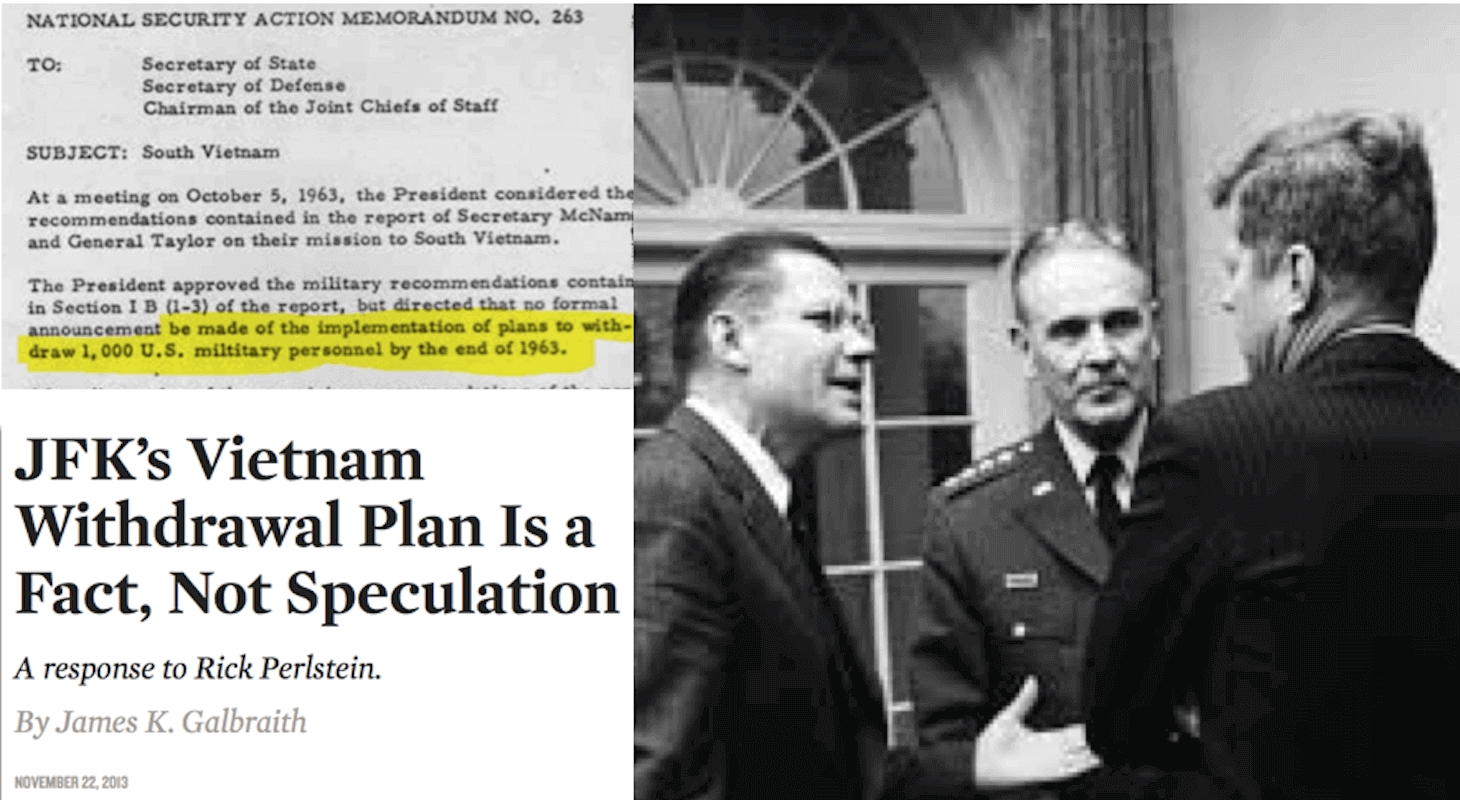
The late Alexander Cockburn was an influential figure on the American Left for a long time. Born in Ireland, he moved to London and became both a journalist and author in his early twenties. About ten years later, in 1972, he moved to America and became a regular columnist for The Village Voice. In 1984 he moved over to The Nation. In 1993 he helped establish the bimonthly journal CounterPunch. He stayed an integral part of CounterPunch until his death at age 71 in 2012.
Cockburn had a loyal following on the Left and this allowed him to publish about 20 books. I could never understand his appeal, as I learned little from either reading his columns or his books. He seemed to me to be more of a showman and self- promoter than a serious author or researcher. To me, his ambition was to be a trendsetter on the Left. Yet at the same time he did very little to justify that ambition or do anything to establish, configure, or revivify the Left. I felt that way about him both before and after his attacks on Oliver Stone’s film JFK. One of those polemics actually featured an interview with Wesley Liebeler of the Warren Commission. He never once challenged one thing Liebeler said.
Cockburn specifically attacked one of the central features of Stone’s film: namely, the thesis that, at the time of his murder, President Kennedy was intending to withdraw from Vietnam. In advancing that thesis, Stone had relied on the work of both the late Fletcher Prouty and Dr. John Newman. Newman published a volume in 1992 that was the first book-length treatment of the subject. JFK and Vietnam was a milestone in modern American historical studies. It confronted one of the most established shibboleths of both the Left and Right: Lyndon Johnson continued John Kennedy’s Vietnam policy. Not only did the book disprove that concept, it demolished it. To the point that, after reading it, one had to think: How did that myth ever get started?
The answer to that question was in some of the tapes declassified by the Assassination Records Review Board. The culprit was Lyndon Johnson. As shown in James Blight’s valuable book Virtual JFK, knowing that Kennedy was withdrawing, President Johnson deliberately set out to conceal that fact by coopting Secretary of Defense Robert McNamara, to the point that he even wanted McNamara to write a memo saying that he did not really mean it when he announced American advisors were coming home from Indochina. The verbatim transcripts of these conversations are sometimes startling. (See Blight, pp. 304-10) But Virtual JFK is not the only new book that abides by the Newman/Prouty thesis. Other books published since that time do the same, and with new evidence; e.g., David Kaiser’s American Tragedy, Gordon Goldstein’s Lessons in Disaster, and Jim Douglass’ JFK and the Unspeakable, to name just three. But further, in surveying those books, one will note that all of Kennedy’s military and national security advisors are on record as stating that President Kennedy was not going to enter combat troops into Indochina. This would include Secretary of Defense McNamara, National Security Advisor McGeorge Bundy, and Chairman of the Joint Chiefs, Maxwell Taylor.
In addition to those three men, there is the written evidence of the withdrawal plan: National Security Action Memorandum 263, and the Taylor/McNamara report. The latter was the underlying basis for the former, which ordered the withdrawal of a thousand advisors by the end of 1963, and the rest by 1965. As both Prouty and Newman showed, that report was not written by Taylor or McNamara. It was written by General Victor Krulak and Prouty himself in Washington under the supervision of Bobby Kennedy, who was carrying out the orders of President Kennedy. (Newman, p. 401) It was then jetted out to Hawaii and handed to Taylor and McNamara in bound form. (Douglass, p. 187) That is how determined President Kennedy was to control the report so he could base his withdrawal order upon it.
As Jim Douglass demonstrated in his popular book, there were several witnesses JFK had confided in about his intent to withdraw from Vietnam. Two examples would be the Prime Minister of Canada, Lester Pearson, and journalist Charles Bartlett. (Douglass, pp. 181, 188) As Douglass also noted, in his last conversation about the subject, right before he left for Dallas, Kennedy confided in someone who wanted to commit combat troops in theater, but who later admitted he was wrong about this and Kennedy was right. This was National Security Council assistant Michael Forrestal. Forrestal stated that Kennedy told him the USA had virtually no chance of winning and he wanted to educate his advisors to that point of view, so that they, like he, would begin to question the underpinnings of American intervention there. (Douglass, p. 183)
Perhaps the most important document declassified by the ARRB was the record of the May, 1963 Sec/Def meeting in Hawaii. That document was declassified in late 1997. It actually made headlines in the MSM—for example, The New York Times and Philadelphia Inquirer. McNamara had requested timelines for each department’s withdrawal from Vietnam. When he got them at this meeting, he rejected them as being too slow. (Douglass, p. 126)
Professor James K. Galbraith has recently done a similar summary of the case for Kennedy’s withdrawal plan. The evidence in this regard is today so plentiful that Galbraith uses a number of items not mentioned here. But still, there are elements of what this author calls the doctrinaire Left that resists this evidence. In addition to the founders of CounterPunch, there are also Tom Blanton and John Prados of the National Security Archive at George Washington University. Blanton is a case study in himself. When Michael Dobbs’ book on the Cuban Missile Crisis, One Minute to Midnight, was published in 2009, Blanton used the occasion to say that Dobbs now showed it was not JFK who saved the world from Armageddon, but a Soviet submarine commander. This was in spite of the fact that Dobbs had said on national television that Kennedy’s conduct of that crisis marked him for greatness. And anyone can see this if they read a previous book on that event, The Kennedy Tapes. That book is a near complete account of the discussions during the 13-day episode that has led even MSM authors like Fred Kaplan to pay homage to JFK’s stewardship.
But there seems to be an almost unwritten law with the doctrinaire Left that the more one holds out against appreciating JFK, the more credence one has. This idea seems to me to be utterly silly as it is both anti-historical and anti-intellectual. One relatively recent example of this was displayed by another co-founder of CounterPunch, author Ken Silverstein. In 2015, Silverstein went public with an offer he said was made to him by Bobby Kennedy Jr. Kennedy was preparing a book on the Michael Skakel case and he asked Silverstein to be his researcher. Silverstein turned him down and said words to the effect that he would not be part of a cover up since Skakel was obviously guilty. Silverstein made a retroactive fool of himself, since Kennedy’s fine book on that case showed that Skakel had been the victim of an almost maniacal frame-up. That effort was led by the likes of Dominick Dunne and Mark Fuhrman. (See my review)
The occasion for the preceding discussion is a recent article in CounterPunch. As part of a kind of Indochina travelogue series written by Matthew Stevenson, the author brings up Kennedy’s Vietnam policy. The title reveals the puerility of the piece: “Why Vietnam Still Matters: JFK Should have Known Better”. After an introduction describing smog problems today in Vietnam, Stevenson gets to the main theme of the piece. He describes Kennedy’s withdrawal plan as nothing but “often-heard speculation”. In other words, all that I have described above—NSAM 263, the rewriting of Taylor/McNamara, the Sec/Def meeting of May 1963, the testimony of Bundy, McNamara, and Taylor—all that and more somehow does not mean what it says.
But Stevenson goes further than that. He traces Kennedy’s record back to his 1951 trip to Saigon. At that time France was involved in a war to regain control of its former Indochina colony. Stevenson does two very tricky things in this part of his piece. It would seem impossible today to describe that 1951 journey without mentioning Kennedy’s discussion with State Department official Edmund Gullion. But Stevenson manages to do so. That discussion was first described by Richard Mahoney 35 years ago in his seminal book, JFK: Ordeal in Africa. Gullion told Kennedy that France would not win the war because Ho Chi Minh had inspired the Viet Minh to such an extent they would rather die than return to a state of colonialism. France could not win a war of attrition in Vietnam because the home front would not support it. (Mahoney, p. 108) The strong influence this conversation had on Kennedy is evidenced by the fact that he called Gullion into the White House in 1961 to become, first his point man on, and then the ambassador to, Congo. Throughout that three-year struggle, Gullion advised Kennedy not to give in to the imperial designs of Belgium and England. Which Kennedy did not. Kennedy stayed true to the secret alliance he had made with U. N. Secretary General Dag Hammarskjold and ultimately approved a United Nations military mission there to hold Congo together in the face of Belgian/British efforts to break off the wealthy region of Katanga. (See Hammarskjold and Kennedy vs the Power Elite) That policy was altered and then reversed after Kennedy’s death by the CIA and President Johnson. (Mahoney, pp. 225-31) If you don’t mention Gullion, one does not have to mention his White House influence or relate this key angle of Kennedy’s foreign policy.
The other trick he uses is to present a long quote from David Halberstam’s obsolete book The Best and the Brightest. What Halberstam always wanted everyone to forget, and what Stevenson goes along with is this: Halberstam wanted more, not less, American involvement in Indochina up to at least 1965. That is when he published his book The Making of a Quagmire. That book was perhaps the most extreme condemnation of American policy in Vietnam written to that point in time. And it was an attack from the Right! Kennedy knew that Halberstam’s reporting made it more difficult to execute his withdrawal plan, because it asserted that America was losing. Kennedy was using the false intelligence reports that America was winning to implement his withdrawal plan. This is why he was upset with Halberstam’s and Neil Sheehan’s reporting in 1962-63. Again, Stevenson does not elucidate this state of affairs. (See part 2 of my review of the Burns and Novick Vietnam documentary)
After this alchemy, Stevenson then writes that Kennedy changed his tune on the issue in the mid-fifties. He can say this because he ignores Kennedy’s great Algeria speech made on the floor of the Senate in June of 1957. That speech assailed the French colonial war in Algeria and explicitly stated that the US should not ally itself with that conflict since we saw what happened to France three years earlier in Vietnam. (Mahoney, pp. 20-24) As Mahoney notes, Kennedy was attacked on all sides for this speech, including by the leaders of his own party like Dean Acheson. Now it is true that Kennedy tried to make the best of Ngo Dinh Diem. But Senator Kennedy had little or nothing to do with his installation. That was done by the Eisenhower administration, i.e., CIA Director Allen Dulles and Secretary of State John Foster Dulles. And it is strange that they are absent from this article. Because it was those two men, along with Vice-President Richard Nixon and President Eisenhower who made the commitment to install Diem. As Anthony Summers noted in his biography of Nixon, it was Nixon who first said America should commit combat troops to save the French from defeat in 1954. It was Foster Dulles who proposed using atomic weapons at Dien Bien Phu. A policy that Senator Kennedy strongly objected to. (Mahoney, p. 16) It was Foster Dulles and Eisenhower who then reneged on the Geneva Accords that were supposed to reunite the country after national elections. The Eisenhower administration then backed up Diem for five years as he and his family usurped all power and began to imprison tens of thousands of dissidents in the cities and summarily execute rebels in the countryside. In other words, Kennedy was presented with a problem that should not have been there if the free elections allowed for by the Geneva Accords had been held.
One of the most ignorant statements in the article is the following: “Kennedy could only view Vietnam and Diem through the prism of the Cold War.” This is ridiculous. Kennedy had decided not to bail out the Bay of Pigs operation. He had opted for a neutralist solution in Laos. As noted above, the record today shows that he was willing to leave Vietnam after the 1964 election.
After this, another statement of colossal ignorance follows. Stevenson writes that although it was LBJ who sent in combat troops and started Rolling Thunder, he was “singing from Kennedy’s hymnal together with his choir.” If anything shows the utter intellectual bankruptcy of Stevenson’s piece it is this statement. As shown above, if this happened, Johnson was unaware of it. As Virtual JFK shows, Johnson consciously overturned Kennedy’s policy and then coopted McNamara into going along with that change. I mean, how much clearer can it be than this taped conversation: “I always thought it was foolish for you to make any statements about withdrawing. I thought it was bad psychologically. But you and the president thought otherwise, and I just sat silent.” (Blight, p. 310) This plainly indicates LBJ knew that Kennedy was withdrawing and that McNamara was his point man on that plan. LBJ was so opposed to it that he thought it was “foolish”. He suffered through it because he was in a subordinate position. If one needed any more proof, in another conversation, just two weeks later, Johnson asked McNamara to take back his announcement of the withdrawal plan! (Blight, p. 310) The idea that Rolling Thunder and the troop insertion were “singing from Kennedy’s hymnal” is utter and complete malarkey. It’s a statement made not with support from the record but in defiance of the record.
To conclude his piece of piffling, the author brings up the overthrow of Diem and the subsequent assassination of him and his brother Nhu. The author actually quotes Roger Hilsman and Averell Harriman—whom he calls Harrison—in the drafting of the infamous “coup cable” of August 1963. He then says that Kennedy went along with the telegram.
Again, this is not writing history. It is fulfilling an agenda. There are two good sources for what happened with this cable. The first is in JFK and Vietnam by John Newman. The second is by James Douglass in JFK and the Unspeakable. Newman clearly delineates the maneuvering in the State Department by those who wished to be rid of Diem. (pp. 345-51) This included Hilsman, Harriman and Forrestal. Which is why it is not good to use them as sources. After the South Vietnamese defeat at the Battle of Ap Bac, this circle had become convinced that Diem could not win the war. (Newman, pp. 302-04) They therefore hatched a plot to deceive Kennedy into approving their plan to confront Diem with an ultimatum. As Newman describes it, they waited for the weekend of August 24, 1963, when most of the principals in the cabinet were out of town. They then manipulated the phones to get approval for a cable to Diem. They told Kennedy that CIA Director John McCone had approved the cable. This was false. (Newman, p. 348) The cable essentially told the ambassador to tell Diem that, in light of the Buddhist crisis, he must begin to discard his brother Nhu as commander of the security forces. If he did not, America would look elsewhere for leadership. If Diem refused, then the ambassador should inform the military commanders of the situation.
The new ambassador in Saigon was Henry Cabot Lodge. As Douglass notes, Lodge disobeyed the instructions on the cable. He showed it to the military before he showed it to Diem. (Douglass, p. 164) When Kennedy returned to the White House on Monday, he was enraged when he found out what had happened. He said, “This shit has got to stop!”. When Forrestal offered to resign, Kennedy barked back, “You’re not worth firing. You owe me something … .” (Douglass, pp. 164-65) As Lodge later stated in the 1983 PBS series, “Vietnam: A Television History,” Kennedy sent him a cable that cancelled the coup. And it did not go through, at least at that time. (Newman, p. 355) But since Lodge had shown the cable to the generals, there was a perceived incentive for them to proceed at a later time.
There had always been a question as to what ignited the coup that took place several weeks later. It turns out that Jim Douglass was correct on this point. In his book, he describes a meeting between Kennedy and AID officer David Bell in September. At that meeting Bell informed the president that the CIA had already cut off the commodity support program to Saigon. Kennedy asked him to repeat what he just said. Bell did so. Kennedy then asked him, “Who the hell told you to do that?” Bell replied that it was done automatically when deficiencies mounted with a client government. Kennedy shook his head and muttered, “My God, do you know what you’ve done?” (Douglass, p. 192)
William Colby was the Far East chief at the time of the Diem overthrow. Prior to that he had been the CIA chief of station in Saigon. His top-secret testimony on the matter before the Church Committee in 1975 was declassified last year by order of the JFK Act. He confirmed that the suspension of the commercial import credit program was the critical factor in reigniting the coup. (Colby testimony, June 20, 1975, p. 37)
But getting all of this wrong, and ignoring the declassified record, this is still not enough for Stevenson. He then says that with the killing of Diem and his brother Nhu, America took ownership of the war and the debacles that were to follow. As we have seen, before Kennedy left for Dallas, he told Forrestal America had virtually no chance to win, and when he returned he wished to lead a discussion of how the USA had even gotten involved. This was after the overthrow of Diem. On November 14, 1963 Kennedy replied to a reporter’s question that an upcoming meeting in Hawaii was about how we can bring Americans home. He then added, “Now that is our object, to bring Americans home, permit the South Vietnamese to maintain themselves as a free and independent country.” (Gordon Goldstein, Lessons in Disaster, p. 96) In other words, America had done as much as it could do to aid Saigon. And Kennedy was not going to commit American combat troops to save the day. Again, those comments were made after the Diem overthrow. It was Johnson’s decision to enter combat troops into Vietnam. There were none in theater at the time of Kennedy’s death. There were 175,000 there at the end of 1965. And Bobby Kennedy, who knew what his brother was up to in 1963, tried to convince Johnson not to militarize the conflict. (John Bohrer, The Revolution of Robert Kennedy, p. 70)
Stevenson ends his piece with some of the most unimaginable nonsense that I have recently read on the subject. He says that Kennedy was not able “to separate the Cold War or the lessons of Munich from regional or local politics.” In Mahoney’s book, one will read an entire chapter on how Kennedy did just that from 1951-57 in written and oral communications for the entire world to see. This culminated in his Algeria speech in 1957. After that he became a hero in Africa and the unofficial ambassador to that continent, while working hard as both senator and president to decolonize the continent. The idea that somehow Kennedy thought about losing Vietnam being the equivalent to Neville Chamberlain appeasing Hitler at Munich, is actually laughable, since that is precisely what he planned on doing after the 1964 election. He could not do it before, since it would create too many political liabilities. (Ken O’Donnell and Dave Powers, Johnny We Hardly Knew Ye, p. 16)
Can Stevenson really not know how ignorant he is revealing himself to be? It was not Kennedy, but Johnson who voiced that opinion of Vietnam. He did so in quite literal terms, to his biographer Doris Kearns. He told Kearns the following:
Everything I knew about history told me that if I got out of Vietnam and let Ho Chi Minh run through the streets of Saigon, then I’d be doing exactly what Chamberlain did in World War II. I’d be giving a big fat reward to aggression. And I knew that if we let communist aggression succeed in taking over South Vietnam, there would follow in this country an endless national debate … that would shatter my presidency, kill my administration and damage our democracy. (Blight, p. 211)
In other words, not only does Stevenson attribute a false psychology to Kennedy—there is, in fact, no evidence that Kennedy ever valued Vietnam as a prime national security interest of the USA—but it was actually Johnson who thought that way about the matter. And that was the difference in the two men and their conduct of the war. If Stevenson was not aware of this then he is simply ignorant of important matters. To the point that his essay finally descends into a grotesque parody of the facts.
CounterPunch is at times a valuable journal. In fact, I used some information from it for my book JFK: The Evidence Today, which will be released in early April. But apparently they cannot outgrow the legacy of Alec Cockburn, which they perceive as some kind of banner of lefty bona fides. As seen above, what Cockburn represented on Kennedy and Vietnam was a gross distortion of historical fact. Which is a shame when it’s done by the Left as well as the Right.
In this concise and penetrating analysis of a largely forgotten Cold War propagandist and public relations figure, John Allen Stern paints a complex picture of the genesis of the Cold War, capturing not only the singular influence of C.D. Jackson on 1950s American foreign policy, but the broader contradictions of the ideological battle waged against the Soviet Union by the United States.
As has been exhaustively portrayed in many a book on the Cold War, almost immediately following the cessation of hostilities after the Japanese surrender in August of 1945, the United States found itself alone among the world’s nations in terms of hegemonic potential, nuclear capabilities and industrial might. There exists much debate as to the actual established beginning of the Cold War, and the breaking with Franklin Roosevelt’s more friendly American/Soviet aims. Many have placed the milestone—at least thematically—shortly after Churchill’s famous March of 1946 speech in Fulton, Missouri. There Churchill decried an “Iron Curtain” descending over Europe, a phrase previously used by Nazi Foreign Minister Count Lutz Schwerin von Krosigk a year earlier. Others have pointed to George Kennan’s “Long Telegram,” sent in February, 1946 while he was the U.S. Chargé d’affaires in Moscow as the most tangible departure in U.S. Foreign policy vis-à-vis the Soviet Union for the coming decade.
In his message to the Secretary of State, Kennan described the CCCP as, “a political force committed fanatically to the belief that with the U.S. there can be no permanent modus vivendi.” His prescription was for “a long-term, patient but firm and vigilant containment of Russian expansive tendencies.” (George Kennan, “Telegraphic Message from Moscow”, 2/22/1946)
It may be accurate to judge the posture of U.S. policy planners towards the Soviet Union in the wake of World War II as provocative, belligerent, and essentially counter-productive to their purported goal of fostering global stability. But it is worth getting into the minds of those who had just witnessed the apocalyptic horror of an unprecedented total war, the death toll of which exceeded 60 million in only six years. The unlocking and eventual unleashing of the devastating power of atomic weaponry, coupled with the economic and ideological vacuum into which Western Europe descended after the defeat of the Nazis, presented a formidable challenge to even the most sophisticated foreign relations experts. To many, everything west of the Berlin Occupation Zone lay open to communist infiltration, particularly those nations like France with previously strong socialist factions. To others, like C.D. Jackson, the new mantle of global authority gained in the wake of the Second World War presented a unique opportunity for the United States to lead the world on a moral crusade for the hearts and minds of people in beleaguered communist territories. For those who stood at this great juncture in the 20th Century, the Soviet Union loomed like a dark shadow, poised, many felt, to marshal its forces and complete its unfinished conquest of the “free world.”
Charles Douglas Jackson stepped into this tense scene of early Cold War uncertainty when he accepted his role as special assistant to President Eisenhower. Coming from Life—where he worked alongside Henry Luce, the publisher of this quintessentially American magazine—Jackson brought both his persuasive charm and astute political observations to the job; earning the admiration of many disparate personalities, from the president to the newly appointed director of the Central Intelligence Agency, Allen Dulles. One of the first global flash points on which Jackson cut his teeth was the coup the CIA sponsored against the democratically elected leader of Guatemala, Jacobo Árbenz, in which capacity Jackson quietly aided intelligence planners in the dissemination of disinformation preceding the overthrow. While ostensibly executed as a clandestine removal of a potential communist leader about to fall into Moscow’s waiting hands, an equally compelling financial motive from the board of directors at United Fruit was also responsible for the green-lighting of the caper. It was, after all, Sullivan and Cromwell, a top American law firm that covertly supported the Nazi war machine during WWII, who represented United Fruit. And it was also John Foster Dulles, made partner at the firm during the 1930s, who was Secretary of State under Eisenhower in the summer of 1954 when the plot was unfolding, and his brother Allen, who was Director of the CIA and also a leading board member of the firm.
Why this familiar incident bears repeating is that throughout his monograph, Stern does an excellent job of exposing this revolving door of mid-century American politics. With a near-monopoly on credibility, magazines like Life were, along with other titans of journalism like the Washington Post and The New York Times, arbiters of truth, and promulgated to a large extent the narratives of what America stood for, what its enemies sought, and how hardworking officials in Washington were vigilantly keeping them safe in their peaceful suburban enclaves. As authors like Carl Bernstein have detailed, Luce was deeply supportive of the CIA. In a 1977 exposé entitled “The CIA and the Media,” he writes, “For many years, Luce’s personal emissary to the CIA was C.D. Jackson, a Time Inc. vice-president who was publisher of Life magazine from 1960 until his death in 1964.” (Rolling Stone, 10/22/1977) It was Life which later bought the rights, within a day of its shooting, to the infamous Zapruder film in November of 1963, and closely guarded it from the public until its eventual leak on Geraldo Rivera’s “Good Night America” show in 1975, deeming it unsuitable for the American psyche. The film—altered or original—shows President Kennedy’s head snapping dramatically back and to the left. Could that possibly have persuaded Luce and his associates in the intel community from releasing it? Honest folks that they were? But I digress.
What’s also of note is a December 6, 1963 Life article written by Paul Mandel. This extremely telling piece of the cover-up includes statements like, “Oswald was an ex-marine sharpshooter,” and “Oswald had both the time and the ability to zero-in three times.” (Life, 12/6/1963) This is interesting, given that no one—without cheating—has been able to recreate the fantastic feat in the allotted six seconds of the Warren Commission’s official findings. This includes the legendary Carlos Hathcock, a USMC sniper during the Vietnam War who held a world record—later surpassed—for a confirmed kill at 1.4 miles. (James DiEugenio, “The Lost Bullet: Max Holland Gets Lost In Space,” 11/30/2011) When he left the service, Oswald was a poor shot according to his marksmanship performance reviews. Similarly, Mandel states unequivocally that a Clayton E. Wheat Jr., director of the NRA, actually reproduced this shot in a controlled setting for Life. He “fired an identical-make rifle with an identical sight against a moving target over similar ranges for Life last week. He got three hits in 6.2 seconds.” (“The Lost Bullet”) However, as researcher Pat Speer has observed,
Someone at the (Warren) Commission recalled the claim in the December 6 issue of Life Magazine that Oswald’s purported shots had been duplicated by someone at the NRA, and asked the FBI to look into it. The FBI report forwarded by Hoover is quite damaging to Life’s credibility. While Life claimed the shooter was an official of the NRA, it turned out the shooter had merely been recommended by the NRA. The shooter, Clayton Wheat, moreover, admitted that he’d had 8 or 9 practice shots and had used a 7.35mm Carcano in his tests, not the 6.5 mm Carcano purportedly used by Oswald. He also acknowledged that he’d fired on a moving deer target traveling slowly, 3-5 mph, right to left over 33 feet, and not at a human head and shoulders-sized target traveling 12 mph away on an angle over a distance of 100 feet or so. He also mentioned that that he’d fired at the target from a distance of 150 feet, from approximately 10 degrees above horizontal, as opposed to firing from a distance of 160-265 feet from approximately 22-16 degrees above horizontal for the purported shots on Kennedy from the sniper’s nest. In short, he didn’t reproduce the shots at all.” (Patrick Speer, A New Perspective on the John F. Kennedy Assassination, Vol. 2, p. 22)
Equally telling is the other blatant lie in Mandel’s piece for Life, which seeks to explain the testimony of a Parkland Hospital doctor who had told investigators that the president’s throat wound was an entrance wound. Mandel claims this was due to Kennedy’s turning and waving at the crowd: “His throat is exposed—to the sniper’s nest—just before he clutches it.” (Life, 12/6/1963) Mandel cites the then-unreleased Zapruder film as proof of this, having personally viewed it. Yet no extant version of the film actually portrays this, raising serious doubt over his conclusion.
That C.D. Jackson, on behalf of Allen Dulles, also had a CIA asset, Isaac Don Levine, ghostwrite Marina Oswald’s story for Life is equally suspect. (Stern, p. 122) Though the piece was never published, Levine, a member of the Tolstoy Foundation, a CIA-backed anti-communist front organization with ties to C.D. Jackson’s Psychological Strategy Board going back to the 1950s, spent a full week with Marina Oswald immediately before her testimony to the Warren Commission. (George Michael Evica, A Certain Arrogance, p. 225)
Life’s publisher Henry Luce, a dedicated and vocal anti-communist, was quick to realize the unprecedented historical opportunity afforded America in the wake of the Allied victory in Europe. No serious historian can deny that the Soviet Union, however repressive and internally corrupt it truly was, actually saved Europe from fascism. Yet this was almost never spoken of in the West, and to be honest, rarely is today. During Operation Barbarossa, the German codename for the June, 1941 invasion of the Soviet Union, Hitler sent 180 divisions (nearly 3.8 million men, 3,800 tanks, 5,400 aircraft and 18,000 artillery pieces) on a mission of conquest and racial extermination which ultimately left over 20 million Russians and Ukrainians dead, as opposed to the forty-five German divisions facing the combined British, Free French, Canadian, Australian, New Zealander, and American forces in late 1942.
Luce and his pal Jackson, like many Americans in the wake of the Second World War, viewed the outcome as something akin to divine providence, and were quick to draft a persuasive narrative of good versus evil, of a benevolent emancipatory American intervention which paved the way for the liberation of Hitler’s Fortress Europe—a narrative which continues to persuade today. There is no denying the tremendous sacrifices of the American forces in their quest to free Europe from the dark bondage of the Nazi regime. My own grandfather, a French Resistance fighter who helped rescue downed Allied pilots, never forgot that striking image of Operation Overlord’s enormous flotilla anchored off his foggy coast. But it was not a singular effort. Hitler officially declared war on the United States on December 11, 1941, four days after the Japanese attacked Pearl Harbor. It was not until November, 1942 that the American expeditionary force touched down in North Africa to begin its actual combat operations against the Afrika Corps led by Erwin Rommel. After a slow and bloody slog across Tunisia, a 1943 invasion of Sicily and subsequent landings on the Italian mainland, a full three years had elapsed from when Soviet troops began fighting for their existence as a people until the D-Day landings in June, 1944. Stalin never forgot this. And, as history would have it, the famous image of American GIs and Soviet troops embracing on the sunny banks of the Elbe river before the Russians stormed Berlin quickly dissolved into the dreaded specter of the Red Menace in the wake of that tragic global conflagration.
For figures like C.D. Jackson, the arc of the post-war era of the late 1940s and early 1950s represented the unfolding of Luce’s “American Century,” the title of a sensational feature Luce wrote in a February, 1941 issue of Life Magazine. This thematic portrayal and its subsequent economic, strategic and propagandistic initiatives are best summarized by Stern, who explains,
It entailed economic liberation for the United States through the integration of American business with markets and resources worldwide, for which governmental institutions were to provide the necessary “atmosphere” for expansion. That amounted to the extension abroad of American business interests, long strapped by the backward thinking of many corporate leaders. The American Century would bring as well, political and economic unity between the United States and Western Europe, along with Japan. It promised to raise living standards around the world, especially in Africa, Southeast Asia, the Middle East and Latin America—areas soon to be collectively defined as the “Third World,”—where a wealth of natural resources made them vulnerable targets for communist incursion. Above all, the American Century was to instill among Americans a sense of destiny and mission, a conviction that our way of life was right for the world, and that it was our time to rule. (Stern, p. 25.)
Author Stern goes to great lengths to explain the various propaganda methods and delivery systems the United States employed in its quest to combat Soviet encroachment, both in continental Europe and the world over. Citing cases like Radio Free Europe, which C.D. Jackson actually designed and helped run, and lesser-known programs, like the comical anti-communist pamphlets shoved in balloons and floated over the Iron Curtain by the tens of thousands, he does a nice job of detailing the subtler methods of Cold War spy-craft and propaganda, and gives a compelling, if cursory exposition on the intellectual history of Western social manipulation. He states,
C.D. Jackson and President Eisenhower would answer the bellicose cries of the saber-rattlers with a clarion call of their own. Jackson outlined his “Strategy for Survival” in a rapidly changing and dangerous world: What would win the day, he promised in sermon-like prose to a wide and diverse audience, was propaganda: ‘We had better get used to it, because goodness knows we need it, and just because Dr. Goebbels and the Kremlin have debased it, that is no reason why we cannot elevate it.’ He made palatable the idea of ‘an official propaganda organization’—which, he confessed, many citizens found dishonest and un-American—by comparing it to teaching ‘a word of wonderful meaning.’
What is striking when one takes in the ramifications of these propaganda programs is the contempt with which many of their theorists viewed the American masses. Harold Lasswell, a longtime friend of political commentator Walter Lippmann, and himself an influential Yale law professor, is quoted in Stern’s book as arguing, “We must recognize the ‘ignorance and stupidity (of) … the masses’ and not succumb to democratic dogmatisms about men being the best judges of their own interests.” (Stern, 43) This art of “manufacturing consent,” later critiqued by the likes of Noam Chomsky in an eponymous book, became a fundamental part of American society by the time the Second World War had begun to unfold.
I should note that Edward Bernays, a cousin of Sigmund Freud, was a pioneer of American propaganda. Yet conspicuously absent from Stern’s book is a discussion of the Committee on Public Information, or “Creel Commission,” which arguably was the true genesis of full-blown American war propaganda. It employed Bernays, along with George Creel, Carl Byoir and others to sell the First World War to an isolationist general population. Though he touches on the earlier role Bernays played in Calvin Coolidge’s presidency during the mid 1920s, it’s odd that given his otherwise excellent monograph, this important propaganda think-tank, which lasted from 1917 to 1919, is not mentioned. Indeed, Josef Goebbels, the Nazi Propaganda Minister, often cited Bernays as the greatest influence in shaping his own policies in Germany, and Adolf Hitler was a great admirer of him as well, even citing the Committee on Public Information as a template for his own efforts. (Dan Nimmo and Chevelle Newsome, Political Commentators in the United States in the 20th Century: A Bio Critical Sourcebook, p. 66)
It would also have been nice if Stern had mentioned how Hitler glossed the cover of Henry Luce’s Time Magazine in 1938 in full regalia as “Man of the Year,”; or how the Führer had actually hired New York advertising agency Carl Byoir & Associates in 1933—the same Carl Byoir of Creel Commission notoriety—to actively promote “positive images” of the Third Reich. (The Observer, 12/22/2014). These collusive links between the purported bastion of democracy in the free world, the United States of America, and one of the most violent and destructive regimes in human history, remains a curious gap in Stern’s story, and are a necessary window into comprehending the Soviet Union’s very real fear of a re-armed Germany in the wake of the Second World War.
What Stern does an exceptional job of showcasing is the impasse at which more nuanced thinkers found themselves when confronted with die-hard cold warriors like the Dulles Brothers and certain members of the Joint Chiefs of Staff. An especially telling episode from 1953 is one in which a young Tom Braden, fresh out of the CIA academy, overhears Walter Bedell-Smith, now undersecretary of State, on a McCarthyist tirade regarding a new appointment to the U.S. Information Program, one of the departments of the wider public relations umbrella network described in Stern’s book. Braden recalled, “I remember walking into Allen Dulles’ office one day soon after I joined the CIA, and I could hear “Beetle” Smith, whose office door adjoined the Director’s, roaring out from beyond his front door: ‘They got that goddamned communist Nelson Rockefeller running psychological warfare.’ I went into Allen’s office and said I don’t want to work here anymore. I don’t want anything to do with this.” (Stern, p. 110).
For figures like Jackson, who by no means sought neutralism or appeasement with the Eastern Bloc, there existed a kind of middle ground. Stern does a fine job of showing the small ways in which people like him served as a necessary buffer to the brinkmanship of the war-hawks. As he notes,
Whereas Jackson wanted to quietly capture the loyalties of the non-aligned nations and make inroads into the Eastern Bloc, as well as strengthen our position with England and France—both of whom recognized the inherent emptiness of communist dialectics and the military threat posed by Russia, but accepted coexistence and especially trade with the Soviet States—(John Foster) Dulles opted for outright coercion and applied bullying tactics.” (Stern, p. 101)
Time and time again this story has been repeated, and Stern’s book is a necessary primer for the arm-twisting the intelligence apparatus would employ on JFK during his brief tenure as president. What is both interesting and arguably under-reported in the scholarship, is how even a former Supreme Commander of Allied Forces in Europe like Dwight Eisenhower was feeling the pressure of his newly-formed intelligence and propaganda machine.
As Stern notes, in 1956 the CIA had urged the president to parachute weapons and supplies to the disillusioned Hungarian protesters who had taken to the streets in open rebellion against the Soviet Union. This rebellion was largely due to Western propaganda imperatives broadcast over Radio Free Europe. When he refused, many members of the intelligence community saw only weakness, not Eisenhower’s real concerns over provoking a potential nuclear exchange between the superpowers. (Stern, pp. 3-4) Also interesting to note—and the author does—is how the figures the United States had selected to lead the failed Hungarian uprising were largely former members of the fascist Arrow Cross Party. Arrow Cross had been instrumental in WWII in aiding the Nazis’ Jewish extermination program in Hungary after the Germans captured and deposed the Hungarian Regent, Miklós Horthy, through a daring commando operation led by SS Major Otto Skorzeny. Stern argues, “In contrast, Jewish refugees from the uprising told the French Press that, ‘Soviet soldiers had saved their lives.’” (p. 4) And thus in the first chapter of the book, we see the contradictions and moral hazards inherent in the intelligence and propaganda communities’ Realpolitik approach to communism, a theme that would continue to generate blowback and further tarnish the image of the United States in the decades to come.
While Eisenhower fully supported the CIA’s overthrows of both Mossadeq in Iran and Árbenz in Guatemala, he seemed fearful enough of a final apocalyptic showdown with the Soviet Union to pursue a watered down form of détente. And it was C.D. Jackson himself who wrote the president’s iconic “Atoms for Peace” address to the UN General Assembly in 1953. This rhetorically moving—if somewhat disingenuous—speech deserves reading, as the language is quite revealing in terms of Jackson’s power to persuade:
… for me to say that the defense capabilities of the United States are such that they could inflict terrible losses upon an aggressor—for me to say that the retaliation capabilities of the United States are so great that such an aggressor’s land would be laid waste—all this, while fact, is not the true expression of the purpose and the hope of the United States. To pause there would be to confirm the hopeless finality of a belief that two atomic colossi are doomed malevolently to eye each other indefinitely across a trembling world. To stop there would be to accept helplessly the probability of civilization destroyed—the annihilation of the irreplaceable heritage of mankind handed down to us generation from generation—and the condemnation of mankind to begin all over again the age-old struggle upward from savagery toward decency, and right, and justice. Surely no sane member of the human race could discover victory in such desolation. Could anyone wish his name to be coupled by history with such human degradation and destruction?
Eisenhower continues:
We never have, and never will, propose or suggest that the Soviet Union surrender what rightly belongs to it. We will never say that the peoples of the USSR are an enemy with whom we have no desire ever to deal or mingle in friendly and fruitful relationship. On the contrary, we hope that this coming conference may initiate a relationship with the Soviet Union which will eventually bring about a freer mingling of the peoples of the East and of the West—the one sure, human way of developing the understanding required for confident and peaceful relations. Instead of the discontent which is now settling upon Eastern Germany, occupied Austria and the countries of Eastern Europe, we seek a harmonious family of free European nations, with none a threat to the other, and least of all a threat to the peoples of the USSR. (Dwight D. Eisenhower, “Atoms for Peace,” 12/8/1953)
How much of this was purely stagecraft is debatable, and as Stern notes, many within the CIA, like Tom Braden, felt it was likely a ploy to ensure the United States remained dominant in terms of nuclear first-strike capability, and served to alleviate growing tensions with Western allies in Europe who feared a Third World War extinction event. This constant shadow play, both within the U.S. foreign policy circles and in the diplomatic tensions between the United States and the Soviet Union, are a highlight of the book. As Stern reveals, it is never really clear just where even moderates like Jackson ultimately stand within this dynamic. To be clear, this is fine contribution to scholarship, for too often a monolithic Eastern Bloc is juxtaposed against a Red-baiting West in conventional narratives of the Cold War, with figures like Jackson either relegated to tertiary roles in the grand scheme of things or altogether excluded. Even sinister figures like Allen Dulles are shown in their rare finer moments, including Stern’s vignette where Senator Joe McCarthy, the towering figure of anti-communism, responsible for the nationwide purges of purported Soviet sympathizers, is attempting to fire none other than the CIA’s own Deputy Director of Intelligence, William Bundy. His crime: contributing $400 to the Alger Hiss Defense Fund.
Braden was in Dulles’ office one day with William Bundy, and the Director told Bundy, ‘get out of here and I’ll deal with it.’ Dulles then went directly to Eisenhower and said, in Braden’s words, he wasn’t going to ‘fuck about with this mess from Wisconsin.’ Dulles bluntly told the president ‘he would resign unless McCarthy’s attacks were stopped.’ (Stern, 99)
The late American political theorist Sheldon Wolin once described the United States as an “inverted totalitarian” society. By this he contrasts its more subtle and sophisticated methods of coercion and control with the more overt and brute-force tactics seen in places like the former Soviet Union. In his prescient book Democracy Incorporated, Wolin argues,
Antidemocracy (sic), executive predominance, and elite rule are basic elements of inverted totalitarianism. Antidemocracy does not take the form of overt attacks upon the idea of government by the people. Instead, politically it means encouraging what I have earlier dubbed ‘civil demobilization,’ conditioning an electorate to being aroused for a brief spell, controlling its attention span, and then encouraging distraction or apathy.” (Sheldon Wolin, Democracy Incorporated: Managed Democracy and the Specter of Inverted Totalitarianism, 2008, p. 239å)
Figures like C.D. Jackson, Bernays, and Luce all served this function of the state. Stern presents a fine account of precisely how this was accomplished in mid-century America, one largely unbeknownst to the general public. With dramatically fewer outlets—no internet, for one—from which to gather a comprehensive and serious view of current events, the average American in the 1950s and early 1960s was largely dependent on what these back-channel propaganda handlers were manufacturing. Though a few independent investigative outfits like Ramparts managed to get some of the less-than-savory episodes in American foreign and domestic policies out into the world, their circulation was dwarfed by the essentially monolithic mainstream print and television media.
What truly struck me about Stern’s book was the timeliness of its publication. As we gear up for another year of the media’s predictable fear mongering— e.g., “Russia hacked the election,” “Putin murders journalists,” “Russia has weaponized Pokemon Go” (an actual CNN headline)—it’s good to have a source like this book to connect the dots. What’s fascinating is how in the epilogue, written in 2012, he notes that, with the Soviet Union gone and Russia now no longer a threat to the West, our bogeyman has become Islamic fundamentalism. Which, of course, is true; even with the alleged murder and burial at sea of Osama Bin Laden the United States is still mired in a never-ending multiple-theater “war on terror.” But how curious that even six years ago no one in America, at least not seriously, was talking about a renewed Cold War with Russia. Certainly not your average person or generally circulated periodical. And yet just last year, in an October 2017 issue, The Economist ran a sensational cover story entitled, “A Tsar is Born: As the world marks the centenary of the October Revolution, Russia is once again under the rule of the tsar.” Vladimir Putin is featured in an artistic rendering in full 19th– Century Imperial Russian military dress: in place of his bar of ribbons we find a rectangular image of a prisoner’s hands gripping a prison cell’s iron bars, under which hangs a red sickle and hammer medal. That this iconic image symbolizes the ideological opposite of their “tsar” portrait is never explained. But that’s not the point. The point is he’s a tsar, okay? Tsar = bad. Now go watch football and check your Facebook feeds folks. It would make Edward Bernays proud.
Silly headlines like this serve as reminders of the entrenched philosophical notion of what the 19th-century Prussian philosopher G.W. Hegel once called “negative identity,” or defining yourself by that to which you stand opposed. And CD Jackson: Cold War Propagandist for Democracy and Globalism is a painful reminder of this pernicious attitude that continues to saturate both our government and media. The insights gleaned from this short text are a truly valuable addition for U.S. historians and those interested in the creation and dissemination of propaganda in a professedly free and democratic society. To these ends, Stern succeeds in showing how one forgotten figure of the past played his hand at shaping the landscape of U.S.-Soviet relations behind the scenes.
While it would have been nice to know more about Jackson the human being—he serves more as a cryptic cipher around which is spun an investigative exposition on the Cold War propaganda apparatus—perhaps that was exactly the author’s intent, despite the fact that the title of the book would suggest a more biographical approach to the reader. Similarly, the subject would seem to lend itself better to a more chronological narration of how the psychological warfare departments and shell companies rolled out during the Cold War evolved, with planners learning from past successes and mistakes and adapting to the exigencies of the time. The book is, in fact, strangely disjointed in its organization, and Jackson himself is curiously quoted only a few times in the body of primary source evidence the author cites. Perhaps, as Stern mentions in his introduction, this owes itself to the relative scarcity of information on him. But the omission does weaken what ostensibly is a case study of this person’s life and times.
In conclusion, however, I must say that C.D. Jackson: Cold War Propagandist for Democracy and Globalism was a pleasure to read, and I highly recommend it to anyone wishing to fill in the gaps in Cold War historiography.

About a decade ago I fell out of love with the liberal blogosphere. Prior to that time, I had read many of their sites assiduously, e.g., Think Progress, Daily Kos, Firedoglake and so on and so forth. Then, in December of 2008, I came across a rather mindless attack by Jane Hamsher at her Firedoglake site on Caroline Kennedy. That irresponsible and jejune jeremiad was picked up by Markos Moulitsas at Daily Kos. It was about whether or not JFK’s daughter was fit to serve in the Senate seat that Hillary Clinton was going to leave to become Secretary of State under President Obama.
I was taken aback by the lack of any historical perspective, by the fundamental errors, and—there is no way around it—the deliberate distortion of the record. I decided to reply, and my reply ended up evolving into a three part series. This was the beginning of the end of my romance with the so-called “liberal blogosphere”. Later on, someone who worked for one of those sites read my series and confirmed all of my fears about what it had become. When I mentioned in my series the hopes some had for a revival of the likes of Art Kunkin and LA Free Press and Warren Hinckle’s Ramparts, he said, “Art Kunkin? You are dreaming my friend.” He then added words to the effect that: These people fell into this field. They don’t understand at all what real journalism is, let alone investigative reporting and research. And, what is worse, they are not interested in learning about it.
Evidently my series did not have much of an impact, because someone named Paul Street has now repeated the hit piece begun by Hamsher and Moulitsas. Street writes for journals like Z Magazine and Counterpunch, former homes to the likes of Noam Chomsky and the late Alex Cockburn. They are part of what I call the doctrinaire Left that has done so much to lead so many good-hearted people astray in both history and politics.
What is the occasion of Street picking up the cudgel to attack both President Kennedy and, to a lesser extent, Senator Kennedy? Well, it is similar to the occasion that Hamsher embarrassed herself about. Street did not like the fact that the Democratic Party chose Bobby Kennedy’s grandson, Joseph Kennedy III, to counter President Trump’s State of the Union address. As far as I could tell, Street did not mention anything that Congressman Kennedy said in his speech. Nor did he point to his attacks on Trump’s tax plan, or the Affordable Care Act, both of which were vigorous and effective. So, right at the start, we know that Street is going to be playing the usual shell game in his screed. This consists of distorting the adduced record, leaving key points out, and relying on folklore and not scholarship to jimmy together another cheap smear job.
This gaming begins with the title: “Joe Kennedy III, Just Another False Progressive Idol, like JFK”. So from the outset, Street has no equivocations about what he is about to say, even though almost none of his essay is footnoted. Like many before him, he begins with the whole mildewed cliché that JFK has a stellar image today because of his glamorous wife, his charisma, and his two cute kids. Yawn.
If you can believe it, Street begins his assault by referring to a book that is over forty years old, Bruce Miroff’s musty and obsolete Pragmatic Illusions. From here, Street now begins to argue that Kennedy was part of the upper class—what we would call the 1 per centers today—who wanted to perpetuate inequalities and had no interest in altering the “established socioeconomic arrangements.”
How anyone could write something this false and have it published by any kind of journal—whether electronic or print media—is almost beyond imagining today. And why would one use Miroff’s book on the subject and ignore Donald Gibson’s classic volume on Kennedy’s economic policies, Battling Wall Street? Gibson’s book was published almost twenty years after Miroff’s and constitutes the most definitive statement in the literature on Kennedy’s economic program. Thus, right off the bat, Street shows us that he is not being honest with the reader; he has an agenda about a kilometer wide. Gibson’s volume was an example of real scholarship. He used documents and reports that had never been discussed in any kind of depth before. And after presenting these materials, reviewing President Kennedy’s showdown with the steel companies, and analyzing the long-term design of his national and international economic plan, he concluded that Kennedy’s economic concept was the most progressive he had seen since Franklin Roosevelt’s.
One of the many valuable things Gibson did was to demonstrate the split between David Rockefeller and President Kennedy (Gibson, pp. 73-74). To anyone who knows anything about the structure of the Power Elite at that time, such a split would not have existed if Kennedy were part of that “one percent” exclusive club, for, as Gibson points out, when Kennedy took office, David Rockefeller had emerged as its leader. (Gibson, p. 73) In an exchange of letters, Rockefeller requested that Kennedy place reins on spending; that he raise interest rates, and also tighten the money supply. As Gibson notes, Kennedy shunted aside each of these requests. Kennedy’s chief economic advisor was Walter Heller, a noted Keynesian. Heller had nothing but derisive scorn for the rising policies of the Austrian School of Economics, soon to be popularly represented by Milton Friedman, who would become the darling of the GOP Eastern Establishment. Further disproving Miroff, both Henry Luce’s Fortune and the Wall Street Journal strongly attacked Kennedy’s expansive and remedial domestic economic policies and programs. (Gibson, pp. 58-67) For instance, in 1962, Kennedy instituted the Manpower Development and Training Act and attempted to pass a Medicare bill. (Irving Bernstein, Promises Kept, pp. 187, 256-57) Questions for Street: How would those programs uphold the status quo? And why doesn’t he mention them?
Kennedy also opposed Rockefeller in his international economic policy, as exemplified by the Alliance for Progress, which extended loans to Latin America from the Treasury Department, thereby bypassing the IMF and Export-Import Bank. In fact, after Kennedy’s death, Rockefeller expressed his relief that Lyndon Johnson had done much to eviscerate this program. (Gibson, p. 84) But further, as Philip Muehlenbeck and Robert Rakove have also pointed out, Kennedy eschewed using military force in the Third World and instead wanted to use aid and loan programs to curry favor with nationalist leaders in these emerging nations, e.g., Sukarno of Indonesia, Kwame Nkrumah of Ghana. (See, respectively, Muehlenbeck, Betting on the Africans, pp. 73-96, and Rakove, Kennedy, Johnson, and the Nonaligned World, pp. 148-49)
Continuing with his exercise in absurdist theater, Street now goes on to say that, somehow, President Kennedy and his brother Robert were also on the wrong side of the civil rights issue. He even writes that the Kennedy brothers were calculating their moves in this arena by counting how far they could go without losing white votes in the South. Before Mr. Street wrote that, he should have read the opening pages of John Bohrer’s new study of the Attorney General. The Revolution of Robert Kennedy begins with the AG pondering whether or not he should resign his position because he has lost the South for his brother due to his aggressive backing of Martin Luther King’s cause. That was on November 20, 1963. The reason for his quandary was that, from the beginning—when Robert Kennedy was being questioned by Senator James Eastland of Mississippi during his confirmation hearing—Eastland reminded him that his predecessor had never brought a legal action against discrimination or segregation in his state. (Harry Golden, Mr. Kennedy and the Negroes, p. 95) That was true. But in one year it all changed. In that time span, RFK doubled the number of lawyers in the Civil Rights Division, and in 12 months he had more than doubled the amount of cases that President Eisenhower had filed in eight years! By 1963, the number of lawyers in the Civil Rights Division had nearly quintupled. (Golden, p. 105) RFK then hired 18 legal interns to search microfilm records for evidence of discrimination in voting rights; and that led to him opening up 61 more cases.
This was all a part of a preplanned strategy by President Kennedy. In October of 1960, Kennedy had told his civil rights advisory board that this was the legal strategy he planned on using in order to break the back of voting discrimination in the South. (Golden, p. 139) President Kennedy felt that with the Brown vs. Board decision, plus the civil rights acts of 1957 and 1960, his brother would be able to win these court cases and defeat the voting rights problem in the Southern states.
President Kennedy had chosen this path since he understood that he could not get an omnibus bill through Congress because it would be filibustered in the Senate. In fact, when President Kennedy submitted one in 1962, it went nowhere (Robert Kennedy in his Own Words, p. 149, edited by Edwin Guthman and Jeffrey Shulman.) Therefore, as he had been advised by civil rights advisor Harris Wofford, he kept on using administrative actions as far as he could, e.g., the New Orleans Schools case (Guthman, pp. 80-82), the integration of interstate busing through the ICC (Guthman, p. 100), the integration of higher education at Ole Miss and the University of Alabama, the formation of the 1961 Committee on Equal Employment Opportunity, the Fair Housing Act of 1962, and the industry agreements to hire minorities involving all federal contracting (Golden pp. 60-61). There were many more, all of which Street is either ignorant of, or deliberately ignores in order to complete his hatchet job.
In conjunction with the legal proceedings, what these unprecedented administrative actions did was to inspire African American groups and individuals to heights they had not scaled before. James Meredith applied to go to the University of Mississippi the day after Kennedy’s inauguration. (Bernstein, p. 76) As can be seen on the DVD of the film Crisis, Vivian Malone defied George Wallace in Tuscaloosa because she trusted the Kennedys to protect her, which is what RFK did by assembling over 3,000 federal troops against Wallace’s 845 state troops. All of this, and much more, gave the leaders of the civil rights movement more ballast and backing.
It culminated in Birmingham. It was there where Governor Wallace and Police Commissioner Bull Connor overplayed their hand. The ugly images of fire hoses and barking dogs repelled Americans outside of the South, and even many in the South. Dick Gregory was on the scene. One night he left Alabama to fly home. When he got there, his wife told him that President Kennedy called and said he wanted him to phone the White House. Gregory said, “But it’s midnight.” She replied, “He said it didn’t matter what time it was.” Gregory called the White House. Kennedy picked up the phone. He told the comedian, “I need to know everything that went on, even the stuff not on TV.” Gregory spoke for about ten minutes. After he was done, Kennedy said, “Good. We’ve got those bastards now.” Gregory started to weep. (Author interview with Gregory on the Joe Madison Show in 2003)
It was things like that, and the public face-off with Wallace, that allowed Kennedy the leverage to make his epochal civil rights speech to the nation in June of 1963. That speech is commonly referred to as the greatest presidential oration on civil rights since Lincoln. A month later he became the first white Washington politician to endorse King’s March on Washington, which occurred that August. (Bernstein, p. 114) This was the beginning of the passage of the two bills that guaranteed both civil rights and voting rights for African-Americans throughout America. It is why King, in 1968, told his advisors they would back RFK over Gene McCarthy. (Martin Luther King: The FBI File, edited by Michael Friedly and David Gallen, p. 572) I will take King’s judgment over Street’s any day of the week.
But, Street actually outdoes himself when he begins to address President Kennedy’s foreign policy, ignoring the fact that the day before Kennedy made his civil rights speech, the president delivered his famous Peace Speech at American University. In the face of that address, Street can actually call Kennedy’s foreign policy record “militantly imperial and militarist.” He ignores not just Sukarno, who Kennedy backed to the end of his life, but also Patrice Lumumba, who the CIA helped to get rid of before JFK was inaugurated because they knew once he was in the Oval Office Kennedy would try to restore Lumumba to power. (James DIEugenio, Destiny Betrayed, Second Edition, p. 29) Street also ignores the new work by Australian Greg Poulgrain, who has broken new ground with his discoveries about the informal alliance between Kennedy and UN Chairman Dag Hammarskjold over Congo and Indonesia, one that Kennedy continued by himself after Hammarskjold was murdered. (See Poulgrain, The Incubus of Intervention, pp. 71-83)
Street writes that somehow Kennedy was involved in the planning of the coup to overthrow President Goulart in Brazil. As A. J. Langguth wrote, the group behind the coup was called the Business Group for Latin America. It was headed by David Rockefeller. As we have seen, and as Donald Gibson has demonstrated, Rockefeller was not on good terms with President Kennedy. In fact, he had been given the cold shoulder by JFK for three years. But once Kennedy was killed, this all changed. With President Johnson in the White House and his new assistant on Latin America Thomas Mann in charge, Rockefeller and his group were now warmly received. (Langguth, Hidden Terrors, p. 104) Within a few months, a CIA operation, which Warren Commissioner John McCloy was part of, was aimed at Brazil. It was codenamed Brother Sam and this overthrow, plus Johnson’s 1965 invasion of the Dominican Republic, essentially spelled the beginning of the end of the Alliance for Progress. (Kai Bird, The Chairman, pp. 551-53; Gibson, pp. 78,79)
In keeping with his utter ignorance of the declassified record, Street now turns to Cuba and Vietnam. He repeats the mantra that somehow the Kennedy White House was behind the plots to kill Castro. This was discredited with the declassification of the CIA’s Inspector General report in the nineties. There, the Agency admitted that there was no plausible deniability for them on this issue. But as William Davy has further discovered, when the Church Committee interviewed the co-author of that IG report, he admitted the same thing. He then went further and said the CIA had deliberately deceived Robert Kennedy about the plots being terminated. (Church Committee interview with Scott Breckinridge, June 2, 1975, pp. 30-33, 49)
On Indochina, Street now says that somehow there is still a debate going on over whether or not Kennedy was going to withdraw advisors from South Vietnam. Again, this completely discounts the declassified record, either out of pure ignorance or by purposeful design. The record of the SecDef meeting in May of 1963 was probably the single most important declassified document released by the Assassination Records Review Board. That document shows that Secretary of Defense Robert McNamara had ordered all State Department, CIA officers, and Defense Department employees from Vietnam to show up in Hawaii with withdrawal plans in hand. When McNamara read the plans, he said the schedules were not fast enough and had to be hastened. (DiEugenio, pp. 336-37) This is all in black and white; it is not a Rick Perlstein/Noam Chomsky stunt over language. If Street has not read these records, then a conclusion is necessitated: He should not be writing about the issue, for the simple reasons that he is misinforming his readers and therefore resorting to propaganda. And it is this deliberate approach that allows him to ignore a very simple fact: When Kennedy was killed, there was not one combat troop in Vietnam. By the end of 1965, Lyndon Johnson had inserted 175,000 in theater. By the end of Johnson’s presidency there were over a half million there.
If one can believe it, and by now one can, Street concludes his discussion of JFK’s foreign policy by saying that the kudos Kennedy gets over his leadership of the Missile Crisis is nauseating. Yet he somehow finds room to praise Nikita Khrushchev’s actions instead.
Let us be clear about this: Khrushchev provoked the crisis by secretly moving a first strike force into Cuba. This included all three arms of the nuclear triad: bombers, submarines and ICBMs. All told, there were well over 100 delivery systems in this armada. Enough to knock out every major city in America except those in the Pacific Northwest. (DiEugenio, p. 60) The Russians lied to Kennedy when he wanted to discuss their presence there. They did this knowing he had repeatedly warned Moscow not to do what they had just done. Even after this Soviet subterfuge, and ignoring most of his advisors, Kennedy resorted to the least violent alternative: a blockade. He refused to bomb the missile silos since he felt too many civilians would be killed. And he refused to authorize an invasion even after the Cubans had knocked down an unarmed U2 plane, killing the American pilot. Which was the only fatality of the 13-day crisis. If one reads the transcripts of the tape-recorded discussions, any rational person—which Street is not—would admit that Kennedy was the person who saved Cuba from both a bombing campaign and an armed invasion. And it was his brother who helped defuse the crisis through his secret meetings with undercover KGB agent Georgi Bolshakov and Russian Ambassador Anatoly Dobrynin. All one has to do to see the difference is to read what almost everyone else was saying toward the end, especially Lyndon Johnson. (The Kennedy Tapes, pp. 590-91, edited by Ernest May and Philip Zelikow) Not just Kennedy’s advisors, but Senators Richard Russell and William Fulbright were also for a full invasion. (DiEugenio, p. 64) By the end, one can safely say that it was John Kennedy who rammed through a deal with Khrushchev: he would get his missiles out of Cuba, we would pledge not to invade the island and get our Jupiter missiles out of Turkey and Italy.
Needless to say, Street makes not one mention of the détente that Kennedy was working on with both Castro and Khrushchev at the time of his assassination. Or the pain that both communist leaders felt about his death once they heard the news. Or that both men also believed that Kennedy had been the victim of a high-level government plot. This is the crazy cul de sac one arrives in following on the heels of Noam Chomsky.
The truth is that Kennedy’s foreign policy—like his plan for civil rights—was largely arranged before he entered the White House. It was germinated on his first trip to Saigon in 1951 and his meeting with State Department official Edmund Gullion. It was later honed and refined until it was eloquently stated in his 1957 speech on the Senate floor attacking Eisenhower’s support for the French colonial war in Algeria. (The Strategy of Peace by Allan Nevins, pp. 66-80) In that speech, Kennedy directly referred to Eisenhower, Nixon and the Dulles brothers as repeating the same mistake they had made three years prior in Vietnam by not negotiating a peaceful way out before the inevitable French defeat at Dien Bien Phu.
Did that tragic episode not teach us that, whether France likes it or not, admits it or not, or had our support or not, their overseas territories are sooner or later, one by one, inevitably going to break free and look with suspicion on the Western nations who impeded their steps to independence?
Kennedy went on to say, “The problem is to save the French nation, as well as free Africa.” If Street can point out any other Washington politician who made these comments in public at this time I would like to read them. As Audrey and George Kahin wrote, in their book Subversion as Foreign Policy, at no time since World War II
… has violence—especially on a militarized level—in the execution of covert American foreign policy been so widespread as during the Eisenhower administration. Especially was this so with respect to US relations with Third World countries … .” (p. 8)
All one needs to do is recall Arbenz in Guatemala, Mossadegh in Iran, the attempted coup against Sukarno, and the murder plots against Lumumba. Kennedy formulated his foreign policy in opposition to this Dulles/Eisenhower/Nixon backdrop. And he specifically said on the eve of the 1960 Democratic convention that he had to win, because if the nominee was Johnson or Stu Symington, it would be a rerun of Foster Dulles or Dean Acheson. (Muehlenbeck, p. 37; I should note that Kennedy was correct about Johnson, as exhibited in Vietnam, Brazil, the Dominican Republic and Greece.) As George Ball said, Kennedy’s policies stated that if we did not encourage nascent nationalism, then America would be perceived as part of the imperial status quo and we would lose out to the USSR. Therefore, to compete with the Russians we had to side with those promoting change. (Muehlenbeck, p. xiv)
It was these ideas about the Third World which stopped Kennedy from bailing out the CIA’s failed Bay of Pigs invasion, prohibited him from admitting combat troops into Vietnam, and prevented him from bombing the missile sites in Cuba during the October, 1962 crisis. This gestalt concept is easy to understand if one studies Kennedy’s career. And I have been at pains to elucidate these distinctions on more than one occasion. The last time I did so, I pointed out how Kennedy’s ideas were opposed to the stated objectives of the Council on Foreign Relations, proving once more that Mr. Street is flat wrong about Kennedy being part of the Eastern Establishment.
As I wrote, the occasion for this leap into the abyss is Street’s outrage over Joseph Kennedy’s speech answering Trump. He is about as reliable and honest on the younger Kennedy as he is on JFK and RFK. For example, he writes that the congressman is against single payer health care. Not true. And he does not link to his speeches on Trump Care or Trump’s tax plan.
As I noted at the start, I left the liberal blogosphere a decade ago. From reading Street, I made the right choice.
Robert Parry has left us at the young age of 68. Read this tribute by his son Nat Parry.