Tag: FOREIGN POLICY

  • The Deceptions and Disguises of Noam Chomsky

    The Deceptions and Disguises of Noam Chomsky


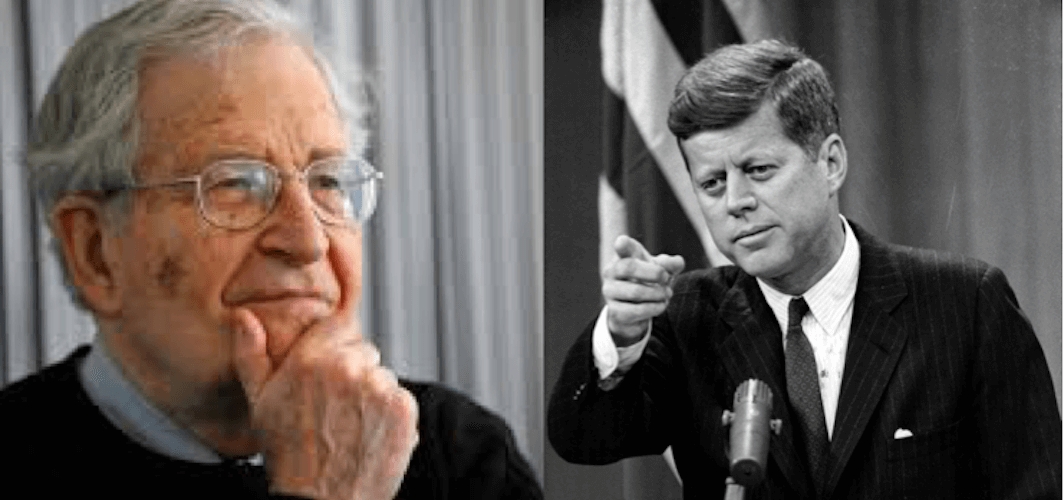
    One of the most telling moments in John Barbour’s new film, The American Media and the Second Assassination of John F. Kennedy, is his presentation of Noam Chomsky briefly discussing the JFK case. It’s a scene I will return to later. But along with Barbour’s depictions of Dan Rather and Bill O’Reilly, I thought these formed the most potent scenes in his film. I am glad Barbour depicted Chomsky because it reminds us just how bad the so-called American Left was and is on both the Kennedy assassination and his presidency. I once wrote an essay on this general subject based upon the work of Martin Schotz and Ray Marcus. (Click here for that essay) Like the Chomsky scene in the Barbour film, we will later return to Marcus’ revealing work on Chomsky.

    As many of us will recall, at the time of the release of Oliver Stone’s film JFK, Chomsky, along with his deceased cohort Alexander Cockburn, went on a jihad against almost everything depicted in the movie. Their critiques were as bad, in some ways worse, than those of the MSM. Their campaign was two-pronged. The first angle was to promote the idea that the Warren Commission was correct; that is, Oswald alone shot President Kennedy. In this regard, Cockburn obsequiously interviewed Warren Commission counsel Wesley Liebeler in the pages of The Nation. That interview amounted to a pattycake session, as Cockburn served up softball after softball to his performing seal Liebeler. Their second line of argument stemmed from the first: There was no high level plot because President Kennedy was no different than Dwight Eisenhower who preceded him, or Lyndon Johnson and Richard Nixon who followed him. So, with both polemicists, there was no political difference between, say, Kennedy and Nixon, Kennedy and Eisenhower, or Kennedy and Johnson. Even back in 1991, this was a difficult dual thesis to uphold. With the releases of the Assassination Records Review Board, it is well-nigh impossible to defend today. And later we will see how new evidence has forced Chomsky to modify his position. (For my discussion of Cockburn click here)

    There were so many crevices—actually Florida-sized sinkholes—in their arguments that it became apparent that both men were arguing from a preconceived position.

    That position, of course, is the approach to history common to the intellectual or academic Left. One might characterize the general tendency of such Marxist-influenced (or Neo-marxist) sociological analysis as ‘structural’ or ‘system-oriented’, in the sense that it views the actions of individuals as having little import or consequence, that the subject is merely an agent of larger cultural forces that impinge upon it. When applied specifically to the realm of politics, it leads to positing that institutions of power seek to protect and perpetuate themselves in a manner which is nearly blind to the choice or consciousness of the participants, that indeed the very status of the acting subject is suspect as a category of analysis. In its most extreme application, this theoretical perspective leaves no room for flexibility, for the notion that biography—personal background and characteristics—can make a difference, or that innovation from within the system can occur that can benefit many rather than a few. This concept differs somewhat from the “deep state” thesis, as advocates of the latter will allow for exceptions. But they will then note that the Deep State will correct the exception. In President Kennedy’s case, it was a correction by assassination. The former view is more rigid and zealous in its ideology insofar as it denies that there can be any political exceptions. As with extreme upholders of all theories, its proponents must work to erase the evidence that there ever were any exceptions. And as with any kind of inductive reasoning based upon dubious premises, this leads to the making of some thunderous—and pretentious—truisms.

    II

    Before we address some of Chomsky’s pronouncements on the Kennedy case, it is important to address some of his intellectual background, because it is very hard to adhere to such a system of thought without it leading to some thorny practical problems with specifics. This is simply because theories sometimes do not explain all that happens in the real world. Therefore their practitioners are forced to bend and mold facts and events in order to shape them to fit their doctrine. In the political field, this practice usually leads to questions of how ideology influences analysis. In other words it brings up questions of bias and balance. Chomsky’s career gives us prior illustrations of these characteristics. It is startling to note how Chomsky’s acolytes ignore them.

    The first is the fact that Chomsky has been known to butcher quotations for political advantage. A famous example being a quote by Harry Truman which Chomsky altered in his early book American Power and the New Mandarins. This was later exposed by Arthur Schlesinger in a letter to Commentary in December of 1969. Another example would be the misconstruing of the words of Harvard professor Samuel Huntington. Chomsky wrote that the professor said that he advocated demolishing in toto North Vietnamese society. Huntington corrected the record in the New York Review of Books (See 2/26/70)

    There are parallels to these kinds of ersatz presentations with Chomsky and the Kennedy case. With Kennedy, Chomsky has tried to insinuate that somehow JFK was involved with the assassination of Patrice Lumumba of the Congo. This wasn’t possible for the simple reason that Kennedy had not been inaugurated at the time Lumumba was killed. But further, as some have noted, Allen Dulles and the CIA most likely hastened their assassination plots against the African leader for the precise reason that Dulles knew Kennedy would not support them. (John M. Blum, Years of Discord, p. 23) In fact, there is a famous picture of President Kennedy getting the news of Lumumba’s death which shows just how pained he was by Lumumba’s passing.

    jfklumumba

    In and of itself, this photograph nullifies the Chomsky thesis that there was no difference between Eisenhower, LBJ, Nixon and Kennedy. For we can safely say that none of those other men would have reacted like this upon hearing of Lumumba’s death. According to the Church Committee, Eisenhower and Allen Dulles ordered the murder of Lumumba. (The Assassinations, edited by James DiEugenio and Lisa Pease, p. 326) Lyndon Johnson reversed Kennedy’s policies in the Congo. He ended up using Cuban exile pilots to wipe out the last followers of Lumumba, helping to destroy the first attempt at a democracy in post-colonial Africa, and allying the USA with the former colonizer Belgium to back Josef Mobutu. Mobutu became a dictator who enriched himself and his backers, and allowed his country to be utilized by outside imperial interests. (James DiEugenio, Destiny Betrayed, Second Edition, pp. 372-73) Nixon was Vice President under Eisenhower, and in National Security Council meetings spoke derisively and patronizingly of African leaders trying to break out of colonialism. He once said these leaders had only been out of the trees for fifty years. (Muehlenbeck, p. 6) Kennedy’s attitude on this subject, and Lumumba, was contrary to all these men. I cannot do better than to refer the reader to Richard Mahoney’s landmark book JFK: Ordeal in Africa, and the equally fine volume Betting on the Africans by Philip Muehlenbeck. (Click here for a review)

    To show just how pernicious Chomsky’s influence on some Left luminaries is on this subject, consider David Talbot’s last appearance on Democracy Now hosted by Amy Goodman. In discussing his book on Allen Dulles, The Devil’s Chessboard, he mentioned the differing views of Lumumba by Eisenhower and Kennedy. Incredibly, Goodman challenged him on this point. Talbot referred to the aforementioned picture of Kennedy as evidence of JFK’s feelings on the subject. But further, as Mahoney’s book demonstrates, the first foreign policy reversal of Eisenhower that Kennedy made once in office was on the Congo. And when Dag Hammarksjold was killed (likely murdered) in a plane crash, Kennedy decided to carry on the UN Chairman’s campaign for a free and independent Congo. (Click here) That any informed person could suggest otherwise shows both a massive ignorance and a massive bias on the subject. Yet, Goodman has hosted Chomsky many times. She reportedly vetoed an appearance by Jim Douglass.

    Chomsky has also tried to say that Kennedy approved the action plan to overthrow President Goulart of Brazil. (E-mail communication with Steve Jones, July 20, 2017) Yet, this plan did not occur until over four months after Kennedy was dead. Consider the information in A. J. Langguth’s Hidden Terrors. Although it is true that Kennedy wanted Goulart to broaden the political spectrum of his government, Langguth makes it clear that the actual Brazil overthrow was similar to the action against Jacobo Arbenz in Guatemala in 1954. A group of wealthy and powerful businessmen petitioned the White House for help in getting rid of a man they feared would endanger their investments. Langguth describes this group in detail. It was led by David Rockefeller. (p. 104) The author notes that Rockefeller’s coalition had not been accepted at the White House previous to January of 1964. But they were welcomed by President Johnson. And this made the difference. This demarcation is also noted by Kai Bird in his book, The Chairman. For it was John McCloy, the subject of Bird’s book, who was sent by Rockefeller’s group to make a deal with Goulart in February of 1964. When McCloy’s presence in Brazil was detected, it polarized forces of the left and right. (Bird, pp. 550-53) And this triggered the coup operation, codenamed Operation Brother Sam, which McCloy acquiesced in after causing. As Bird notes, Johnson’s willingness to cooperate with Rockefeller and McCloy ended Kennedy’s Alliance for Progress plan: “The Johnson administration had made clear its willingness to use its muscle to support any regime whose anti-communist credentials were in good order.” (ibid, p. 553) Further, anyone who has read Donald Gibson’s Battling Wall Street would understand the antipathy between President Kennedy and Rockefeller and why such a meeting was unlikely under Kennedy.

    III

    These two examples are good background for even worse gymnastics by Chomsky. And it brings us closer to Vietnam. In June of 1977, Chomsky co-wrote (with Edward Herman) a now infamous article in The Nation. It was titled “Distortions at Fourth Hand.” There is no other way to describe this essay except as an apologia for the staggering crimes of the collectivist Pol Pot regime that took place in Cambodia after the fall of both Prince Sihanouk and Lon Nol. At that time a book had been published called Cambodia Year Zero by François Ponchaud. It was the first serious look at the terrors that Pol Pot’s Khmer Rouge had unleashed in Cambodia. Chomsky and Herman criticized this pioneering work by saying that it played “fast and loose with quotes and numbers” and that since it relied largely on refugee reports, it had to be second hand. They then added that the book had an “anti-communist bias and message.” In retrospect, those two comments are startling, and again show a remarkable selectivity in an effort to discredit sources. In this same article, the two authors praised a book by George Hildebrand and Gareth Porter entitled Cambodia: Starvation and Revolution. They wrote that this book presented “a carefully documented study of the destructive American impact on Cambodia and the success of the Cambodian revolutionaries in overcoming it, giving a very favorable picture of their programs and policies, based on a wide range of sources.”

    In other words, not only were the authors attempting to discredit information that turned out to be true; at the same time, they were crediting information that turned out to be—to put it mildly—inaccurate. The net effect of this propaganda was to distort and conceal the efforts of a murderous regime in killing off well over one million of its citizens in an attempt to recreate a Maoist society overnight. Pol Pot’s was one of the greatest genocides per capita in modern history.

    What makes Chomsky’s performance here even worse is that two years later he and Herman were still discounting and distorting the Khmer Rouge in their book After the Cataclysm. They refer to what Pol Pot did as “allegations of genocide” (p. xi, italics added). On the same page they tried to imply that Western media created the mass executions and deaths. They later added that evidence was faked and reporting was unreliable. (pp. 166-77) They again attacked Ponchaud’s book by saying “Ponchaud’s ’s own conclusions, it is by now clear, cannot be taken very seriously because he is simply too careless and untrustworthy.” (p. 274) Later, more credible and responsible authors, like William Shawcross, demonstrated Chomsky’s pronouncements to be astonishingly wrong. They were so bad that Chomsky has never let up trying to minimize what he did. In fact, his whole emphasis on the Indonesian invasion of East Timor has been to try and demonstrate that that slaughter was really worse than what happened in Cambodia! The implication being that if that were true it would then somehow minimize his previous giant faux pas. And even in that he has lowballed the fatalities in Cambodia to do so. (For a complete and thorough expose of this subject, click here)

    Why is this important? Besides demonstrating what a poor scholar and historian Chomsky is, it shows that, contrary to his claim of being an anarchist, he went to near ludicrous extremes to soften the shocking crimes of a Maoist totalitarian regime. In any evaluation of Chomsky, this episode is of prime importance. For the simple reason that it clearly suggests that—as Ted Koppel recently said of Sean Hannity—ideology is more important to him than facts.

    A second notable aspect of Chomsky’s work is his association with the notorious Holocaust denier Professor Robert Faurisson. When Faurisson’s writing on this subject became public, he was suspended from his position at the University of Lyon. Chomsky then signed a petition in support of Faurisson’s reinstatement. He followed that up in 1980 with a brief introduction to a book by Faurisson. Chomsky later tried to say that he was personally unacquainted with Faurisson and was only speaking out for academic freedom. But, unfortunately for Chomsky and his acolytes, this was contradicted by Faurisson himself. For the Frenchman had written a letter to the New Statesman in 1979. It began with: “Noam Chomsky … is aware of the research work I do on what I call the ‘gas chambers and genocide hoax’. He informed me that Gitta Sereny had mentioned my name in an article in your journal. He told me I had been referred to ‘in an extraordinarily unfair way’.” (This unpublished letter was quoted in the October, 1981 issue of the Australian journal Quadrant.)

    Consequently, Chomsky’s later public qualifications about his reasons for signing the petition and writing the introduction ring hollow. He did know Faurisson. He was in contact with him personally, and apparently was encouraging him to defend his work.

    When he found this out, author and professor W. D. Rubinstein had a correspondence with Chomsky, which seemed to certify the worst fears about the noted linguist and Faurisson. Chomsky wrote the following: “Someone might well believe that there were no gas chambers but there was a Holocaust … ” (ibid) In defending Faurisson’s writings Chomsky then wrote that anyone who found them lacking in common sense or accepted the established history, was exhibiting “an interesting reflection of the totalitarian mentality, or more properly in this case, the mentality of the religious fanatic.” (Ibid) Rubinstein replied that to hold that there were no gas chambers but there was a Holocaust was an absurd tenet. Chomsky went ballistic. He wrote back that the respondent was lacking in elementary logical reasoning, and he was falsifying documentary evidence. He then said that the Nazis may have worked these Jews to death and then shoveled their bodies into crematoria without gas chambers. He concluded his blast with this: “If you cannot comprehend this, I suggest that you begin your education again at the kindergarten level.” (Click here for this remarkable article)

    As Werner Cohn has shown, Chomsky has tried to conceal his friendly relations with a Holocaust Denial group in France. This group included Serge Thion, Faurisson and Pierre Guillame. He seems to have gotten in contact with this group through Thion, another leftist critic of the idea of calling what Pol Pot did in Cambodia a genocide. This group ran a publishing house called La Vieille Taupe, which featured prints of Holocaust Denial literature. The petition that Chomsky signed contained the following sentence about Faurisson: “Since 1974 he has been conducting extensive independent historical research into the ‘holocaust’ question.” The framing of the last two words in that statement should jar anyone’s senses. (For an overview of Chomsky’s association with this group click here; for a specific example of his attempt to cover it up, click here.)

    As with his resistance to the Khmer Rouge genocide, Chomsky’s defense and association with Faurisson is startling to any objective person. Which again excludes his acolytes. Today, the low estimate for the fatalities caused by the crimes of the Khmer Rouge is 1.7 million. (see this NYT article from 2017) The idea that there were no mass gassings and crematoria at the Nazi death camps was thoroughly debunked at the trial of David Irving. Irving was a friend and colleague of Faurisson. That court action was instigated by Irving himself. There has been a very good web site constructed from the materials devoted to that trial. I strongly recommend reading the reports given to the court by Robert Jan van Pelt, Christopher Browning, and Richard Evans. They seem to me to be models of what scholarly research should be about.

    IV

    Before centering on the issues of Kennedy’s assassination and his presidency, it is important to discuss briefly the general issue of the Cold War, if only to place those subjects in historical context. As with many leftist polemicists, Chomsky usually does not do this. And when he does, he almost exclusively centers on what western powers did to cause the Cold War and continue it.

    Yet it would seem to most people to be important to review objectively these matters in any historical discussion of American foreign policy from 1945-1991—the obvious reason being that it was the most powerful influence on American foreign policy and world events in that time period. Every president from Harry Truman to George H.W. Bush was strongly influenced by it, to the point that almost every major foreign policy issue was colored by it. Therefore, if one is writing the history of this period, or a part of it, one has to factor this into the discussion. If not, then one can be accused of ignoring, or discounting, the historical backdrop.

    For to deprive these events of their context is to sap them of some of their meaning. Related to this, another problem with Chomsky—as noted above—is imbalance. The policy of aiding foreign countries in their resistance to communism was spelled out way back in 1947 with the Truman Doctrine. This was then endorsed by Congress, and legislation was passed to carry out the policy. One can argue whether or not the Cold War was exaggerated, whether it was too covert, even whether or not it was justified. But one cannot act as if it did not exist. Or that the communist side had no provocations to it, or had no atrocities done in its name. For how else can one explain the Korean War, Hungary in 1956, or the Russian invasion of Czechoslovakia in 1968? We can continue in this vein with the Chinese usurpation of Tibet or the crimes of Fidel Castro, or those of Josef Stalin and Mao Zedong, the latter of which are both mind-boggling.

    But as with Pol Pot in Cambodia, these things are minimized, discounted or ignored by people like Chomsky, and the late Alexander Cockburn. Almost all of the critical analysis was and is of the USA. But if things like balance and historical context are left out, then what is this kind of writing really worth?

    Which is another way of saying the following: A theoretical approach is only as good as the person who uses it. If that writer is too biased one way or the other, the result will suffer greatly. To make a point of comparison: Michael Parenti is also an advocate of the aforementioned style of analysis we have called “structural” or “systemic”. Yet he understands that there are men and women who occasionally manage to rise above the system and do some good for a great number of people. And Parenti also understands that political conspiracies do exist, and have been proven to exist. To use just one example, the heist of the 2000 election in Florida by Jeb Bush and Katherine Harris.

    Even though this crime was done in broad daylight—what with roadblocks set up to hinder people from voting—no person was even interviewed by any law enforcement arm, let alone indicted. The political result of this was horrendous: George W. Bush created a totally unjustified war in Iraq. A war that Al Gore would not have started. Not only do political conspiracies exist, if not addressed, prosecuted, and stopped, they can have terrible results for hundreds of thousands, even millions, of people. So to deny they occur is to deny reality. And as Parenti has said, reality is sometimes radical.

    A second problem with using this system-oriented approach is that—as we have seen with Cambodia—it tends to sweep all contrary facts or evidence into an ideological whirlpool. That is, facts get discounted, data gets warped, and key events are sometimes omitted. What is important is keeping the model of that oppressive structure intact. If facts or data collide with that model, it’s the facts or data that get discarded or discounted. The theoretical underpinnings of Chomsky and Edward Herman’s writings on Cambodia were to show that American and western media was distorting a communist revolution. Therefore, they repeatedly used phrases like “the alleged genocide in Cambodia”, or they wrote that “executions have numbered at most in the thousands”. (See this article) This last comment was written in 1979, when the Khmer Rouge regime had fallen and some reporters had visited the country to actually see the horrible devastation with their own eyes. At times Chomsky and Herman used Khmer Rouge sources and endorsed books that extensively sourced footnotes to Pol Pot’s government releases. This approach is a serious problem for people who actually care about things like accuracy, fairness, and completeness.

    In the wake of Oliver Stone’s JFK, what was so odd about the Chomsky/Cockburn allegiance to a point of view which privileges the critique of institutions as systems is that it disappeared upon their inquiry into Kennedy’s murder. That is, in both men’s comments on the Warren Commission and its presentation of evidence, you will nowhere find any discussion of the lives and careers of the persons who controlled that investigative body. Men like Allen Dulles, John McCloy, Gerald Ford, and J. Edgar Hoover. Yet, those four men dominated the Commission proceedings. (See Walt Brown’s book, The Warren Omission, especially pp. 84-87).

    This is odd—in two respects. First, it was these men, not Kennedy, who had played large parts in being ‘Present at the Creation’—that is, in forming and then supporting the Eastern Establishment, which was responsible for setting up and maintaining the structure of American government in the 20th century. Any critic of the way institutions of power function would surely be concerned with this detail, because in presenting that particular case, one does not have to juggle, manipulate, and distort the evidence. There are books on these men in which tons of evidence exist to make that demonstration. These four were clearly responsible for some of the worst American crimes of the 20th century. (See James DiEugenio, Reclaiming Parkland, second edition, pp. 234-40, 321-40.)

    Secondly, to somehow suppose that those four would not manipulate the evidence in a murder case is simply to ignore the reality of who they were. Yet this is the concept that both Chomsky and Cockburn supported. For instance, as mentioned earlier, Cockburn actually interviewed a junior counsel for the Warren Commission in the pages of The Nation. He never asked him one challenging question. Which is incredible considering the record of that Commission.

    Regarding Chomsky, consider an incident from 1994. Two subscribers to Probe Magazine, Steve Jones and Bob Dean, went to a meeting of the Democratic Socialist Club of Reading, Pennsylvania. Chomsky was the guest speaker. Both Jones and Dean were surprised when Chomsky seemed to veer off topic to go into a tirade against President Kennedy. When Jones and Dean tried to approach and talk to Chomsky about Kennedy afterwards, he became “very defensive and dismissive of us, brushing us off by saying that he’d seen all of the evidence.” Apparently, this meant the declassified record, and therefore there was nothing to address. (e-mail communication with Jones, 6/19/2017)

    Again, this tells us much about Chomsky’s respect—or lack of—for scholarly practice. Because, at that time, the Assassination Records Review Board had just begun declassifying two million pages of records that had previously been kept secret from the public on the JFK case. Hence no one had seen them prior to this time. Including Chomsky. So what was he talking about? The evidence the ARRB declassified concerning the actual circumstances of Kennedy’s murder make the case against Oswald pretty much insupportable. And in just about every way: concerning Oswald, Kennedy’s autopsy, the ballistics evidence, and Oswald’s alibi. (For the last, see Barry Ernest’s book, The Girl on the Stairs.)

    Further, neither Cockburn nor Chomsky seemed to be aware of the transcript of the final executive session of the Warren Commission. Sen. Richard Russell, Representative Hale Boggs, and Senator John Sherman Cooper—who I have previously called the Southern Wing—had planned on expressing their reservations at this meeting about the Single Bullet Theory. The idea that one bullet, CE 399, had gone through both Kennedy and Governor John Connally, smashing two bones, making seven wounds, emerging almost entirely unscathed, and losing almost no volume from its mass. Russell, especially, wanted his objections expressed in the record of this final meeting. Today, we have the record of that meeting. There is no trace of his, or anyone else’s, reservations about the Single Bullet Theory. For the simple reason that there was no stenographic record of that final meeting. (Gerald McKnight, Breach of Trust, p. 284) In other words, the Eastern Establishment figures—Dulles, McCloy, and Ford, likely coopted Chief Justice Earl Warren and chief counsel J. Lee Rankin into tricking the other members into believing there would be such a record. In fact, a woman was there masquerading as a stenographer. But the Commission’s contract with the stenographic company had expired three days prior. (ibid, p. 295) As Gerald McKnight writes about this matter, the obvious reason for this charade was to keep the strenuous objections of the Southern Wing out of the transcribed record, and thereby maintain the illusion that the Commission had been unanimous in its verdict on the case. In other words, here was an almost textbook case of the way institutions tend to ensure the survival of belief in the status quo, one made to order for critics on the Left.

    But in an unexplained inconsistency, both Chomsky and Cockburn dropped the structural approach in their analysis of the Commission. Even though it would seem to be perfectly suited for that type of analysis. Why? Because if one did explain who these men were and what they did with the evidence, then one could conclude that they covered up the true circumstances of Kennedy’s death, for the simple reason he was not a member of their club. Which is a direction they do not want to go in.

    Yet, David Talbot demonstrates this at length in his analysis of the conflicts between President Kennedy and Allen Dulles during 1961. These were centered on Kennedy’s Congo policy, Dulles’ backing of the revolt of the Algerian generals against French President Charles DeGaulle, and ultimately how Dulles lied to Kennedy about the Bay of Pigs operation. (Talbot, pp. 382-417) In other words, in just one year, the CIA Director had come into conflict with Kennedy over three important areas and events. Finally, Kennedy felt he had to terminate Dulles, along with both his Deputy Director Charles Cabell, and Director of Plans Richard Bissell. The first and only time in 70 years that has been done at the CIA. As Talbot also points out, after Kennedy was killed, Dulles lobbied for a position on the Warren Commission (ibid, pp. 573-74)—something that no one else did. As previously referred to, Walt Brown has shown that Dulles then became the single most active member of the Warren Commission. During a meeting with Commission critic David Lifton at UCLA in 1965, Dulles showed utter disdain for any of the evidence that the Commission had ignored or misrepresented to the public, e.g., the Zapruder film frames. (Talbot, p. 591)

    Let us use just one other example. Robert Kennedy was the first Attorney General who actually exercised some degree of control over FBI Director J. Edgar Hoover. The enmity between the two has been well chronicled by more than one author. After JFK was killed, Hoover had Bobby Kennedy’s private line to his office removed. (Anthony Summers, Official and Confidential, p. 315) The Warren Report itself says that Hoover and the FBI were responsible for the vast majority of the investigation. (See, p. xii) Therefore, why would such men—Dulles and Hoover—who clearly had no love for JFK, bend over backwards to find out the truth about his death? The fact is they did not. For example, the day after the murder, Hoover was so concerned about who killed President Kennedy that he was at the racetrack. (Summers, op. cit.) To leave out things like this, and much more, is not writing history. And it is not honest scholarship. It is depriving the reader of important information.

    V

    Chomsky operates his views of both Kennedy and his murder via inductive, closed-system reasoning. It is both banal and simplistic: since the USA operates in a sick political and economic system, no one can rise above it. Therefore, Kennedy was really no different than Nixon, Johnson, and Eisenhower. The underlying problem—as writers like Donald Gibson and Richard Mahoney have demonstrated—is that when one actually studies the record, Kennedy was not part of the Power Elite, and did not aspire to be part of it. This is why, as Donald Gibson has shown, Kennedy and David Rockefeller—the acknowledged leader of the Eastern Establishment at the time—had no time or sympathy for each other. (See Gibson’s Battling Wall Street throughout, but especially pp. 73-76) The reason Kennedy made his historic 1957 Senate speech on the impending doom of French colonialism in Algeria was because he had been in Vietnam when the French empire there was collapsing. He understood that the Vietnam conflict had not really been about communism, but about nationalism. And he said this many times, and took considerable heat for it. (See Mahoney, JFK: Ordeal In Africa, pp. 14-23)

    When Oliver Stone’s JFK came out, Chomsky made numerous statements questioning Stone’s thesis about Kennedy’s intent to withdraw from Vietnam. He eventually wrote an essay in Z Magazine on the topic. In essence, he denied all the withdrawal evidence as outlined by Fletcher Prouty and John Newman, who advised Stone on that subject. The problem for Chomsky today is that other scholars decided that Prouty and Newman were on to something. After all, Prouty actually worked on Kennedy’s withdrawal plan in September of 1963. John Newman was writing a revolutionary book on the subject entitled JFK and Vietnam, which was published in January of 1992.

    Seriously considering that evidence, these scholars then went to work. And today, a small shelf of books exists on the subject. These authors agree with the Stone/Prouty/Newman withdrawal thesis, e.g., David Kaiser’s American Tragedy, James Blight’s Virtual JFK, Gordon Goldstein’s Lessons in Disaster. One reason these new books are there is that the Assassination Records Review Board (ARRB) declassified many pages of documents that support the withdrawal thesis. This declassification process occurred in 1997. Any serious scholar has to consider new evidence when it is declassified. Chomsky did not. In 2000, in a book called Hopes and Prospects, in relation to this issue, he wrote: “On these matters see my Rethinking Camelot … . Much more material has appeared since, but while adding some interesting nuances, it leaves the basic picture intact.” (pp. 123, 295)

    In other words, the scores of pages of new ARRB documents released on the subject, the recorded tapes in the White House, and the new essays and books published, these amount to “nuances.” The “nuances” include President Johnson confessing in February of 1964 that he himself knows he is breaking with Kennedy’s policy. They include the transcripts of the May 1963 Sec/Def meeting in Hawaii where McNamara is actually executing that withdrawal plan—with no reference to a contingency upon victory. (These and other documents are included in this presentation)

    In 1997, that last piece of evidence convinced some MSM outlets, like The New York Times, that Kennedy was planning on withdrawing from Vietnam at the time of his assassination. We can go on and on. But the point is made. To any objective person, these are not “nuances”. They are integral.

    To show Chomsky’s bizarreness on this point, let us use two other instances of just how intent he is to disguise the facts and evidence of Kennedy’s withdrawal plan. One of his older excuses was to say that Kennedy’s advisors fabricated the withdrawal plan after the Tet offensive. (Z Magazine, September, 1992) Even for Chomsky, this is ridiculous. What is he saying? That Kennedy’s advisors falsified the then classified record while it was in the National Archives? That they also managed to get a voice impressionist to impersonate Johnson, McGeorge Bundy and McNamara discussing this withdrawal plan?

    Chomsky’s latest position is a sort of rear action retreat. He now admits that Secretary of Defense Robert McNamara offered up a withdrawal plan. In other words, it was McNamara’s plan, not Kennedy’s. Not so, and let us illustrate why.

    In November of 1961, a two-week long debate took place in the White House. The subject was whether or not to commit combat troops into Vietnam. Advisors Max Taylor and Walt Rostow had returned from Vietnam and made that recommendation. From all the accounts we have, Kennedy was virtually the only person arguing against that proposal. (James Blight, Virtual JFK, pp. 275-83) At its conclusion he signed off on NSAM 111 which sent 15,000 more advisors instead.

    Kennedy was disturbed that he had to carry the argument virtually alone. So he decided to ask someone who he knew agreed with him to write his own report on the subject. This was Ambassador to India, John Kenneth Galbraith. Galbraith did visit Saigon, and he did write a report recommending no combat troops in theater and a gradual American distancing. (Cable of November 20, 1961, which was followed by a longer report; Blight, p. 72, see also David Kaiser, American Tragedy, pp. 131-32) Kennedy later had this report forwarded to Secretary of Defense, Robert McNamara in April of 1962. This was the beginning of the withdrawal plan. We know this because on his trip to Vietnam in May, McNamara told General Paul Harkins to begin a training program for the army of South Vietnam so America could begin reducing its forces there. Harkins was the supreme military commander in Saigon. (Kaiser, pp. 132-34) Also, McNamara’s deputy Roswell Gilpatric revealed in an oral history that his boss had told him that he had instructions from Kennedy to begin to wind down the war. (Blight, p. 371) This culminated with the aforementioned declassified Sec/Def conference in Hawaii in May of 1963. At this meeting, McNamara requested from all departments—State, Pentagon, CIA—specific schedules beginning a withdrawal in December of 1963 and ending in the early fall of 1965. (James Douglass, JFK and the Unspeakable, p. 126)

    The idea that this plan was McNamara’s is another fanciful Chomsky invention. In addition to the evidence stated above—cables, oral history—there is another undeniable fact. In the November, 1961 debates described above, McNamara was asking for the insertion of combat troops into Vietnam. In fact, his proposal was the largest request of all. He told Kennedy to commit upward of six divisions, or about 205,000 men. And he framed the request in pure Cold War terms. If this was not done, it would lead to communist control over all of Indochina and also Indonesia. (Blight, pp. 276-77) The idea that afterwards McNamara had a personal epiphany and reversed himself on his own is simply not credible. Especially when combined with the above evidence. Plus the fact that it was Kennedy alone who was holding out against combat troops in November. And as with Kennedy, there is no mention by McNamara on any tape or any of the Sec/Def documents, or in NSAM 263, that the withdrawal plan would only be completed as the circumstances on the battlefield improve. Chomsky’s arguments against Kennedy’s withdrawal plan exist in a vacuum created by him and his acolytes.

    VI

    In Barbour’s film, Chomsky is shown at a seminar saying words to the effect that no one should care if Kennedy died as a result of a conspiracy. The problem with this statement is that, at the time of Kennedy’s death, it’s the people who Chomsky tries to stand up for—residents of the Third World—that felt a sharp pang of loss at JFK’s passing. And very few of them felt that Lee Harvey Oswald was the lone assassin. The president of Egypt, Gamel Abdul Nasser, fell into a deep depression and had the films of Kennedy’s funeral shown four times on national television. (Philip Muehlenbeck, Betting on the Africans, p. 228) Ben Bella, the premier of Algeria, phoned the American ambassador in Algiers and said, “I can’t believe it. Believe me, I’d rather it happen to me than him.” He then called in a comment to the state radio station saying that Kennedy had been a victim of “racialist and police-organized machinations”. (ibid, p. 227) When asked about Kennedy’s assassination in 1964, Achmed Sukarno of Indonesia began perspiring. He then said that he loved the man because Kennedy understood him. He ended the reverie by saying, “Tell me, why did they kill Kennedy?” (James DiEugenio, Destiny Betrayed, Second Edition, p. 374) Nehru of India called Kennedy’s murder a crime against humanity. He then said that Kennedy was “a man of ideals, vision, and courage, who sought to serve his own people as well as the larger causes of the world.” (Muehlenbeck, p. 231) Two weeks after Kennedy’s death, economist Barbara Ward visited the office of Kwame Nkrumah of Ghana. The president had a photo of John and Jackie Kennedy on his desk. With tears in his eyes he said, “I have written her, and I have prayed for them both. Nothing shocked me so deeply as this.” Months later, when the American ambassador presented him with a copy of the Warren Report, Nkrumah turned to the title page. He pointed to the name of Allen Dulles, and returned it to the ambassador with the one word comment, “Whitewash”. (Muehlenbeck, p. 229; Richard Mahoney, JFK: Ordeal in Africa, p. 235)

    But it wasn’t just the leaders of the Third World who were shaken and saddened by Kennedy’s passing. It was also its citizenry. As an editorial in West Africa magazine stated, “Not even the death of Dag Hammarskjold dismayed Africans as much as did the death of John Kennedy.” (Muehlenbeck, p. 229) In Nairobi, Kenya, six thousand people packed into a cathedral for a memorial service. A Kenyan politician said that never in his career had he seen this kind of grief registered over the death of a foreigner. (Muehlenbeck, p. 226) In the Ivory Coast, the American ambassador woke early the day after the assassination. There was someone waiting for him at his office. The man said he ran a small business about 25 miles away. He said he didn’t really know why he was there. But he tried to explain anyway: “I came here this morning simply to say that I never knew President Kennedy, I never saw President Kennedy, but he was my friend.” (Ibid, p. 228) According to author Thurston Clarke, upon learning of his passing, the peasants of the Yucatan Peninsula immediately started planting a Kennedy Memorial Garden.

    Were all these people wrong?

    But there is one person we can add to this list. His name is Noam Chomsky.

    In the time period following Kennedy’s murder, writer/researcher Ray Marcus tried to enlist several prominent academics to take up the cause of exposing the plot that killed President Kennedy. In 1966 he wrote I. F. Stone on the subject. In 1967, he approached Arthur Schlesinger about it. They both declined to take up the cause. In 1969, he was in the Boston area on an extended business function. He therefore arranged a discussion with Chomsky. Chomsky had initially agreed to a one-hour meeting in his office. Ray brought only 3-4 pieces of evidence, including his work on CE 399, the Magic Bullet, and a series of stills from the Zapruder film. Which had not been shown nationally yet.

    Soon after the discussion began, Chomsky told “his secretary to cancel the remaining appointments for the day. The scheduled one-hour meeting stretched to 3-4 hours. Chomsky showed great interest in the material. We mutually agreed to a follow-up session later in the week. Then I met with Gar Alperovitz. At the end of our one-hour meeting, he said he would take an active part in the effort if Chomsky would lead it.” (Probe, Vol. 4 No. 2, p. 25) Ray did have a second meeting with Chomsky which lasted much of the afternoon. And “the discussion ranged beyond evidentiary items to other aspects of the case. I told Chomsky of Alperovitz’ offer to assist him if he decided to lead an effort to reopen. Chomsky indicated he was very interested, but would not decide before giving the matter much careful consideration.” (ibid) A professional colleague of Chomsky’s, Professor Selwyn Bromberger, was also at the second meeting. He drove Ray home. As he dropped him off he said, “If they are strong enough to kill the president, and strong enough to cover it up, then they are too strong to confront directly … if they feel sufficiently threatened, they may move to open totalitarian rule.” (ibid)

    It is important to reflect on Bromberger’s words as Ray related what happened next. He returned to California and again asked Chomsky to take up the cause. In April of 1969, Chomsky wrote back saying he now had to delay his decision until after a trip to England in June. He said he would get in touch with Ray then. Needless to say, he never did. He ended up being a prominent critic of the Vietnam War and this ended up making his name in both leftist and intellectual circles. Reflecting on Bromberger’s words to Marcus, one could conclude that Bromberger and Chomsky decided that the protest against Vietnam, which was becoming both vocal and widespread, and almost mainstream at the time, afforded a path of less resistance than the JFK case did. After all, look at what had happened to Jim Garrison.

    But if this is correct, it would qualify as a politically motivated decision. One not made on the evidence. As Marcus writes, it was with Chomsky, “not the question of whether or not there was a conspiracy—that he had given every indication of having already decided in the affirmative … ” Marcus’ revelations on this subject are informative and relevant in evaluating Chomsky, both then and now. For purposes of our argument, it is important to know what Chomsky actually thought of the evidence when he was first exposed to it. This would seem to be a much more candid and open response than what he wrote decades later, when his writings on the subject were just as categorical, except the other way. In other words, Chomsky did a 180-degree flip on the issue of whether President Kennedy was killed by a conspiracy. And that first conviction lasted at least until 1976. Because in that year, he signed a petition to form the House Select Committee on Assassinations. That is very likely the reason that, in 1971, as co-editor of the Senator Mike Gravel edition of the Pentagon Papers, he allowed Peter Scott to write an essay addressing the question of Johnson’s alteration of Kennedy’s de-escalation plan in Vietnam.

    Try and find an interview or essay in which Chomsky admits how close he was to being the chief advocate for a public campaign to find out who really killed Kennedy. Yet, it is a fact. Maybe Chomsky changed his mind. But if that was the case, he has no right to be so smug and snide about others who came to the same conclusion he once did. Or perhaps, as Bromberger let out, he and Alperovitz and Chomsky decided that Vietnam offered an easier path to prominence. Which, undoubtedly, it did. If that was the case, then it was a practical choice, not an intellectual or moral one. And evidently, Chomsky and his friends did not realize that they could have combined the two.

    As we have seen, Chomsky’s recurrent posing as a scholar who has assimilated the entire declassified record on the JFK case, and on the Kennedy/Johnson Vietnam policies, is simply an empty pose. And this is part of a persona that, as we have seen in the case of Faurisson and Cambodia, substitutes an extreme and ingrained bias for what is supposed to be scholarly analysis. If there is any hope of reconstituting this nation around a viable set of values and principles, then the issue of the hijacking of America in the sixties through assassinations will have to be honestly confronted. As we have seen, Noam Chomsky refuses to do that—in fact he deliberately avoids it. He then adopts certain disguises and deceptions to conceal the way he once felt about the subject. Which is, in large part, why he is part of the problem, not the solution.

  • Antonio Veciana, with Carlos Harrison, Trained to Kill (2)

    Antonio Veciana, with Carlos Harrison, Trained to Kill (2)


    Antonio Veciana: Trained to Kill Kennedy Too?


    The Cuban exile and former CIA asset (AMSHALE-1) Antonio Veciana, 89, stole the show at the AARC Conference on “The Warren Report and the JFK Assassination” (2014) by admitting:

    “In the early 1960’s, I believed John F. Kennedy was a traitor to the Cuban exiles and to this country. Yet, over time, I came to recognize that President Kennedy was not a traitor (…) I couldn’t go from this world without saying that John F. Kennedy was a great man and a great president who had a great vision for this country and the world.”

    Neither will Veciana go from this world without making his memoirs available to readers. Co-authored by the Pulitzer Prize-winning (1991) journalist Carlos Harrison, his biographical account Trained to Kill (Skyhorse Publishing, 232 pages) hits the book market on April 18, 2017, with the subtitle “The Inside Story of CIA Plots against Castro, Kennedy, and Che.” David Talbot wrote the foreword.

    A Borgesian Garden of Forking Paths

    In his conversion from hater to admirer of JFK, Veciana denies having taken part in the assassination, but agrees it “was a coup, an internal conspiracy.” As HSCA staffer Eddie Lopez told James DiEugenio, “this conspiracy was like a giant spider web, and in the middle of it was [David Atlee] Phillips.” But given Phillips recruited Veciana in 1960 and was his handler until 1973, always under the alias of Maurice Bishop, the former head and current historian of the Cuban State Security Department, Major General Fabian Escalante, takes seriously the possibility that Veciana was indeed involved in the plot.

    Following either of these paths, Veciana’s story incriminates Phillips. Before the assassination, he claims Bishop asked him about the procedure for obtaining a visa at the Cuban Consulate in Mexico City, knowing that his cousin Hilda Veciana was married to the commercial attaché there, Guillermo Ruiz. After the assassination, he claims he asked him to recruit Ruiz as a defector who would testify that the Cuban Intelligence Services (CuIS) had given Lee Harvey Oswald precise instructions to kill Kennedy (p. 125). A little later, Bishop told Veciana to forget about recruiting Ruiz. That would be the last time Veciana ever spoke with him about Oswald. Veciana added that after the assassination a Customs agent working for CIA, Cesar Diosdado (AMSWIRL-1), did ask him if he knew Oswald. Before the HSCA, Diosdado denied having worked for the CIA and questioning anyone about Oswald.

    Veciana deemed it a mistake to get involved in something which did not concern him. That’s why he neither asked Bishop about the JFK assassination nor told anyone about having seen Oswald until Fonzi interviewed him in 1976. Nonetheless, Escalante has a point against the claim of no involvement. Before the assassination, Hilda Veciana was walking from her nearby house to the Cuban Embassy in Mexico City and came upon a wad of dollars on the sidewalk. A Mexican approached and told her, “Lady, this money is yours”. She got scared and ran for the embassy. Just in front was a CIA photo-surveillance post (LI/ONION). According to Escalante, the CIA tried in this way to compromise her in order to recruit Guillermo Ruiz by threatening him with photos of his wife grabbing the money.

    Since that incident occurred before the assassination, Escalante thinks that Veciana is voicing only a half-truth. His close encounter with Bishop in Dallas (TX) in late August or early September 1963 may have gone beyond the brief sighting of a young man who said nothing and turned out to be Oswald (p. 122). It may instead have been a meeting among plotters to coordinate both the recruiting of Ruiz and the visa for Oswald in Mexico City. Crucial to this scenario are Oswald’s whereabouts at that time. Although it has been argued that Oswald was in New Orleans when Veciana claimed to have seen him in Dallas, there are some curious indications that Oswald was absent from New Orleans in late August and early September 1963.

    Mary Ferrell expressly highlighted in her chronologies (Volume 3, p. 57) that the FBI couldn’t authenticate Oswald’s signature on two forms filled out under his name on August 27 and September 9 at the Department of Economic Security (DES) office in New Orleans. The same is true for the signatures on two TEC warrants cashed under his name on August 28 and September 6 in a Winn-Dixie store at 4303 Magazine. Oswald was living at 4907 Magazine and his rent was due on September 9, but he didn’t pay it. That very Monday, he cashed a TCE warrant in a Winn-Dixie store at 3920 S. Carrolton. The FBI verified the signature was his.

    Intermezzo: Oswald in Mexico City

    The FBI reviewed Oswald’s documents from August to October 1963. Its calligraphers affirmed the authenticity of the signature on his visa application of September 27, 1963, at the Cuban Consulate in Mexico City. If this is accurate, then it would be strong evidence of Oswald being there, without prejudice to the body of evidence about an impostor by phone in Mexico City and some doubles like “Leon” Oswald at Silvia Odio´s house in Dallas during the same time frame.

    Before the House Select Committee on Assassinations (HSCA), Cuban Consul Alfredo Mirabal asserted that the Oswald apprehended in Dallas and seen in the news reports of November 22 was the same man at the Consulate in Mexico City. The other consul, Eusebio Azcue, and the Mexican consular clerk, Sylvia Duran, disagreed. Notwithstanding, two other eyewitnesses—Commercial Attaché Guillermo Ruiz and his assistant Antonio Garcia-Lara—agreed with Mirabal. Since Ruiz spoke better English, Azcue himself asked him to explain to Oswald why the visa couldn’t be granted. Garcia-Lara heard a noisy discussion and could see Oswald leaving the premises.

    The Access Path to the Truth

    The right quantum of proof about the Bishop-Veciana-Oswald connection may be hidden among the 1,100 long-suppressed CIA records related to the JFK assassination, including four of Phillips’ operational files and Veciana’s routing and record sheet. The Warren Commission did not mention Phillips in any of its volumes, but his fingerprints are scattered everywhere.

    Just remember the passage in The Last Investigation (1993), by Gaeton Fonzi, on HSCA staffer Dan Hardway asking Phillips some awkward questions. Although he already had a cigarette burning, hands shaking, Phillips went ahead and lit up a second. He lied so blatantly about Oswald in Mexico City that the HSCA prepared an indictment for him on two perjury counts.

    A lesser known anecdote illustrates Phillips’ hatred of JFK. By 1966 he recruited—under the alias of Harold Benson—a high official of the Cuban Ministry of Construction, Nicolás Sirgado, who had been entrusted since 1962 by the CuIS to penetrate the CIA. Castro honored him at the memorial service for the victims of the 1976 Cuban passenger jet bombing in Barbados. After retiring in 1991 with the rank of Lieutenant Colonel, Sirgado appeared in the Cuban TV documentary ZR Rifle (1993). He remembered that Benson “told me [about having] seized the opportunity to urinate on Kennedy’s grave, since he considered Kennedy a damned Communist.”

    Even The Third Time Wasn’t a Charm

    As for Lopez concerning Kennedy, Phillips was the key man for Escalante concerning Fidel Castro. During an interview with Fonzi in late 1995, Escalante remarked that Phillips “was our major enemy [and] the mastermind of a great many Castro assassination plots.” In three of them, Veciana was the organizer.

    • Firing a bazooka—from an apartment rented by Veciana’s mother-in-law on the eighth floor of the building at 29 Misiones Street—at the speaker’s rostrum on the north terrace at the Presidential Palace, where Castro would be delivering a speech on October 4, 1961. The plot failed (p. 105). The Cuban G-2 smelled a rat and flooded the crowds, buildings and rooftops with agents and militiamen. When the hitmen approached the building, they felt overwhelmed by Castro’s forces and strolled back.
    • Shooting Castro with a gun hidden in a TV camera during a press conference in Santiago de Chile on November 1971. The would-be assassins were Cuban exiles Marcos Rodríguez and Antonio Domínguez, who entered Chile disguised as cameramen from the Venezuelan television network Venevisión. Both backed out of the plot fearing the ironclad security around Castro (p. 173).
    • Shooting Castro with a rifle at Quito International Airport (Ecuador). Veciana knew that Castro’s return flight from Santiago de Chile to Havana included a stopover there. He gave continuity to the Chilean job by bringing the right weapon to Quito and asking Luis Posada-Carriles to fly from Caracas to fire it at Castro at the right time. The plot came to nothing since the support team—two defectors from Castro’s Air Force—claimed it would be suicidal.

    Veciana didn’t give up. By himself, he masterminded a fourth attempt against Castro in New York. As Chairman-in-Office of the Non-Aligned Movement, Castro was scheduled to address the U.N. General Assembly on October 12, 1979. A contact bomb of softball size and appearance would be thrown against his limousine on the way from the airport to the Cuban U.N. Mission. The FBI prevented it (p. 198). The bombmaker had gone too far with his comments and his utterly terrified wife called the authorities.

    Veciana attributes the above-mentioned, and almost all the other failures, to a single main efficient cause: “Many Cubans wanted Castro dead, but all of them wanted to watch his funeral, too.”

    He had joined the Castroite 26th of July Movement against the putschist General Fulgencio Batista, but turned against Castro shortly after he took power and became embroiled in a nationalization process that would reach its climax on October 1960 (p. 89). Veciana was convinced that if Castro died, the so-called Cuban revolution would end (p. 102). But his anti-Castro service record exceeds by far the four assassination plots.

    The War Inside

    Overcoming poverty and asthma, Veciana had graduated from the University of Havana and became a wonder boy in the Cuban world of accounting. At age 25 he got a job at the National Bank, a kind of equivalent to the Federal Reserve. He would go on to head the Cuban Association of Public Accountants (p. 37).

    In 1958, Julio Lobo, dubbed the “Cuban Sugar King”, employed Veciana as comptroller in his finance company, Banco Financiero, which was doing business with Hotel Capri, partly owned by film actor George Raft, and other Havanan hotels controlled by the mob’s accountant Meyer Lansky. Castro took actions against these and other of Lobo’s businesses.

    On December 17, 1960, Lobo told CIA officer Bernie Reichardt that he had heard that Veciana “was systematically destroying the bank’s records and the machine bookkeeping equipment in the bank. Also, he felt that there had been some planning on Veciana’s part for the wholesale sabotage of his sugar mills”. By that time, Phillips had successfully recruited Veciana.

    Phillips had approached Veciana posing as a potential bank customer, the Belgian businessman Maurice Bishop. Veciana underwent a polygraph test, truth serum and interrogation (pp. 45-58), before being trained in espionage, handguns and explosives (pp. 63-68). He was even given a suicide pill just in case he was captured, but he refused to be an infiltrator into Castro’s regime.

    When Bishop left Havana to get ready for the Bay of Pigs, he gave Veciana ripped up dollar bills and Veciana then realized how Machiavellian his handler was. Veciana had already started a psywar against Castro with a confiscation warning which created a run on the banks. It was initially branded as a hoax by Cuban President Osvaldo Dorticós, but it would end up coming true on October 13, 1960 (pp. 71-80). Since November 25, 1959, Che Guevara had been presiding over the National Bank. He wanted Veciana to help with the task of nationalizing the banks and asked him to bring in accountants (p. 83-86).

    As Guevara rose to the top of the Cuban banking system, Castro’s Minister of Public Works, Manuel Ray, stepped down. By May 1960, he formed the Revolutionary Movement of the People (Spanish acronym: MRP). Veciana joined it and forged ahead until becoming Chief of Action and Sabotage.

    Veciana plotted a series of bombings with explosive devices—known as petacas—provided by the CIA (p. 96). On April 13, 1961, his team of saboteurs delivered the most devastating blow prior to the Bay of Pigs invasion, destroying the largest department store in Havana (El Encanto).

    Veciana also conspired with the CIA in Operation Pedro Pan (p. 90). It brought over 14,000 unaccompanied Cuban minors to the US from December 1960 to October 1962, after a rumor spread—backed by the CIA forgery of a supposed forthcoming law—to make Cubans believe the State would usurp parental control for the purpose of indoctrinating all their children.

    After the Bay of Pigs—Veciana offers a good summary of the fiasco (p. 100)—Castro struck another annihilating blow against his foes. On July 5, 1961, he decreed a monetary exchange that turned into worthless paper more than 400 million pesos held abroad by Cuban exiles. The in-country bank deposits were limited to 10,000 pesos per person. Veciana’s days in the underground were numbered. Shortly before the date set for the attempt with the bazooka, Bishop urged him to leave Cuba (p. 105). He did so with his mother-in-law in a small boat and entered the U.S. at Key West on October 7, 1961.

    Alpha and Omega

    Veciana met Bishop in Miami. They signed an agreement—or pledge of allegiance—in front of two unidentified witnesses, but Veciana got no copies. The CIA informed the HSCA there was “no Agency relationship with Veciana,” but he filled out an employment application with the CIA and a Provisional Operational Approval (POA) was requested for him on December 29, 1961. It was granted on January 29, 1962, and canceled in November. From then on and up to July 1966, Veciana was listed in the Army Information Source Registry.

    Bishop asked Veciana to organize a paramilitary group. In February of 1962, in Puerto Rico, he founded Alpha 66 as Bishop’s brainchild. (pp. 108 ff). Alpha symbolized the beginning of the end of Castro, while 66 represented the number of fellow accountants Veciana had initially drafted.

    Veciana focused on fund-raising and recruited Eloy Gutierrez Menoyo as Military Chief. The latter had led the anti-Batista guerrillas known as II Frente in the Escambray Mountains, but ended up defecting to the US on January 27, 1961. By October 1962, Alpha 66 and II Frente were united.

    Trying to force Kennedy to act resolutely against Castro, Bishop gave orders to hit ships going in and out of Cuba. On September 10, 1962, Alpha 66-II Frente started a series of raids by attacking two Cuban ships and a British freighter at the northern port of Caibarién, 200 miles east of Havana.

    At the peak of its naval operations, in March 1963, Alpha 66-II Frente sunk one Russian vessel at Isabella de Sagua and crippled another at Caibarién. By doing so, Bishop was trying to torpedo the Kennedy-Khrushchev peaceful solution to the Missile Crisis. Veciana held a press conference and The New York Times reported the Kennedy administration “was embarrassed” (pp. 112-20). But the outcome was quite different than intended.

    Instead of moving against Castro, Kennedy ordered a crackdown against the Cuban exile paramilitary groups, and put more pressure on British authorities to enforce the law in the Bahamas. In May 1963, Alpha 66-II Frente entered alliance with MRP. All efforts were devoted to military preparation for Plan Omega, meaning the end of the Castroite regime. Veciana strategically changed from raids to infiltration.

    It turned out, however, that before Veciana could get there, Castro had already beaten him to it. Alpha 66-II Frente-MRP was closely monitored—and in some cases manipulated—by Castro spies who had been in place for years. On January 23, 1965, Menoyo himself was captured in Cuba (p. 126). In fact, a Castro agent, Noel Salas, was part of Veciana’s infiltration team. Veciana quit, went to Puerto Rico and became a sports and concert promoter (p. 128).

    Intermezzo: How Castro Dealt with Assassination Attempts

    Alpha 66-II Frente-MRP was not an isolated case. In an interview for Tad Szulc’s book Fidel: A Critical Portrait (1986), Cuban Minister of Interior Ramiro Valdés confirmed: “There wasn’t anything in motion that we didn’t know about it, because we got undercover agents at all levels”. Apart from an ironclad personal security force against assassination plots, infiltrating the CIA and the Cuban exile community was instrumental to Castro’s surviving the Agency’s dirty war. AMLASH, for instance, was finally foiled due to intelligence furnished by CuIS agents ADELA (in France) and Juan Felaifel, who worked for three years with the CIA in Miami.

    A soft-headed folly revived by Philip Shenon—the Kennedy brothers and the CIA compelled Fidel Castro to take preemptive lethal action against a sitting U.S. President—is not just far removed from common sense, since Castro was fully aware that killing JFK wouldn´t solve anything and entailed risking everything. It also ignored the fact that Castro’s thinking style was system-centered. He would have never taken the “spaghetti western” approach to Kennedy that Lyndon Johnson popularized by raving “Kennedy was trying to get to Castro, but Castro got him first.”

    Consider the following. Castro triggered his revolution on July 26, 1953. On that day, the dictator Batista was attending a regatta at Varadero Beach. Some middle ranks insisted on blending in with the spectators and killing Batista there. Castro stuck to his principles and attacked the Moncada barracks as planned. He disapproved of the assault on the Presidential Palace by the Student Revolutionary Directorate on March 13, 1957. Castro reasoned: “It would have been easier to kill Batista than wage two years of guerrilla war, but it would not have changed the system.”

    Similar reasoning led Castro to advise Reagan about an extreme right-wing conspiracy to kill him in 1984. Castro ordered the CuIS to furnish all the intelligence to the U.S. Security Chief at United Nations, Robert Muller, and the FBI proceeded to dismantle the plot in North Carolina.

    In the same line of sheer nonsense, Dr. Brian Latell joined Shenonism by asserting that Castro warned the Kennedy brothers and the CIA—and the rest of the world—with an advertising piece of his personal bailiwick: “U.S. leaders should think that if they are aiding terrorist plans to eliminate Cuban leaders, they themselves will not be safe”. This statement made by Castro during a reception at the Brazilian Embassy in Havana on September 7, 1963 was quoted by Associated Press reporter Dan Harker and has since become well-known. But in November 1961, Kennedy himself had entertained the same idea. After meeting with Szulc, who noted he was “under terrific pressure from advisors (…) to okay a Castro murder,” Kennedy discussed the issue with his aide Richard Goodwin and remarked: “If we get into that kind of thing, we’ll all be targets”. Both were right. The “Castro did it” troupe didn’t get it.

    The Decline and Fall of Practically Every Rapport

    In Puerto Rico, Veciana used some assets to spy on Castroite agents. The agents found out and tried to kill him with a bomb at a sports event (p. 131). They also came to get him at his house in La Paz, Bolivia, where he worked as consultant to the Central Bank from the spring of 1968 until mid-1972.

    The US Agency for International Development (USAID) hired Veciana for this job thanks to Bishop. Veciana’s office, devoted to capital development, was in the Passport Division of the American Embassy. In fact, Veciana did little banking and spent most of the time working for Bishop (pp. 134-37).

    In an interview by the late Jean-Guy Allard on May 22, 2005, General Escalante gave a confusing statement: “In 1966 and 1967, Felix Rodriguez is in charge of the task force the CIA sent to Bolivia against Ernesto ‘Che’ Guevara. He used several names. He is there and he ends up participating directly in the murder of Che. Also there, in another position, is Antonio Veciana. He is there as a bank consultant in La Paz, but he runs the center which is coordinating intelligence gathering in the rear guard, working with the Bolivian intelligence services.”

    Rodriguez was not in charge of the CIA task force. Another Cuban exile, Gustavo Villoldo, claims to have been the lead agent in the field and dismissed Rodriguez as just a radio operator. Beyond dispute, they both had the same “Jim” as their CIA case officer. Besides that, Veciana arrived in La Paz about six months after Guevara’s death. Nevertheless, he provided a piece of information that goes counter to the official history about how Che’s diary was secretly delivered to Castro. The Bolivian Interior Ministry, Antonio Arguedas, wouldn’t have made such an unexpected decision because of congeniality. Rather, he followed a recommendation by his Cuban-American adviser and CIA agent, Julio García, who suggested the move to divert attention from the contradictory statements given by the Bolivian Armed Forces about Che’s death (p. 148).

    Veciana claims that—from his post in La Paz—he helped Bishop to undermine Salvador Allende’s administration in Chile (p. 156). As mentioned above, he also organized a second attempt against Castro under Bishop’s direction at that time. However, the fellow plotters in Venezuela schemed to blame the assassination on Soviet agents without tipping off Veciana. Bishop found out about it and accused Veciana of being part of the scheme. Their longer-than-a-decade relationship was now over (p. 174).

    Veciana returned to the US and resumed his work as a sports and concert promoter (p. 175). On July 26, 1973, he met Bishop in the parking lot of the Flagler Dog Track in Miami. Veciana asserts that Bishop gave him a suitcase containing $253,000 in cash, presumably as compensation for his anti-Castro efforts over the years. However, that summertime became dreadful for Veciana (pp. 181-87 passim).

    On August 10, he was indicted for conspiracy to distribute narcotics, possession with intent to distribute, and distribution of about seven kilos of cocaine. On August 18, he got discouraged with the anti-Castro militancy in Miami. Scarcely 300 people attended Juan Felipe de la Cruz’s funeral, although he had been branded as an exile hero. De la Cruz had died shortly after noon on August 2, 1973, when a bomb went off as he was assembling it in his room at Hotel Oasis in Avrainville, 15 miles south of Paris, France. The target was Cuban cabinet member Ramiro Valdes, hosted in a nearby chalet. Veciana was involved in the plot.

    On January 14, 1974, Veciana was convicted after a five-day trial in the Southern District of New York. Judge Dudley B. Bonsal, who happened to be the brother of former (1959-60) US Ambassador to Cuba Philip W. Bonsal, sentenced Veciana to concurrent terms of seven years on each count, followed by a three-year special parole term. The Court of Appeals (Second Circuit) upheld Bonsal’s ruling, but Veciana would serve just over two years. On March 2, 1976, Church Committee investigator Gaeton Fonzi met with him, and the Oswald-Bishop connection first surfaced, most likely because Veciana believed Bishop had set him up. The search for Maurice Bishop now began and the rest is history, well-told by Fonzi in The Last Investigation (1993) and encompassed in the Volume X (pp. 37-56) of the HSCA Appendix to the Hearings.

    On the same day—21st September 1979—that Fonzi gave him the HSCA staff report on him, Veciana was shot while driving home from his office in Miami (pp. 194 f). Four shots were fired, one hit the rearview mirror and a fragment of the bullet imbedded just above Veciana’s left ear. His relatives and friends speculated it was an attempt by Castro agents. Veciana did not rule out a CIA plot.

    During the HSCA proceedings, Veciana helped an artist to create a “pretty good”—according to Veciana himself—composite sketch of Bishop. It was shown to Phillips, who said, “It looks like me.” In turn, a photo of Phillips was shown to Veciana. His response wasn’t conclusive. He was then taken to see and speak with Phillips at a luncheon meeting in Reston (VA) on September 17, 1976. At this time, he said Phillips was not Bishop.

    Veciana restated this in his sworn testimony before the HSCA on April 26, 1978, although he admitted Phillips and Bishop bore a “physical similarity”. The day before, Phillips had testified he had never used the alias Maurice Bishop and had never met Veciana before the occasion in Reston. But on the 50th anniversary of the JFK assassination, Veciana authorized Fonzi’s widow, Marie, to publish the following statement: “Maurice Bishop, my CIA contact agent, was David Atlee Phillips. Phillips or Bishop was the man I saw with Lee Harvey Oswald in Dallas on September 1963.” Veciana elaborated further through other admissions and revelations at the AARC Conference on September 26, 2014.

    Today, an almost nonagenarian Veciana regrets having disregarded his family for politics. In the 1960’s, he founded B&F Marine, a small fiberglass repair shop and selective marine accessory retail store. The company became a dealership for Johnson & Mercury motors and other big brand names during the 1970s. It expanded to four locations, but they were successively closed as good times went by. In August 2016, the family-owned business filed again for bankruptcy after having sailed out of it in 2012 thanks to financial restructuring under the leadership of his son, Antonio Veciana, Jr. In 2017, we now have his book about his past (literally) explosive history.


    See also the review by Joseph Green

  • Antonio Veciana, with Carlos Harrison, Trained to Kill (1)

    Antonio Veciana, with Carlos Harrison, Trained to Kill (1)


    Pulp Nonfiction: Trained to Kill by Antonio Veciana with Carlos Harrison


    In September of 1979, Antonio Veciana was driving in Miami when an unknown assailant began shooting at him with a .45. The bullets blew out his car window, struck him in the head, his arm, his stomach, but he survived. Recovering in the hospital with a bullet embedded above his left ear,1 he first thought it might have been a CIA hit. But it was an awfully clumsy attempt, and he had earlier been told that Cuban leader Fidel Castro put him on a hit list.

    So he decided to get back at Castro with a model airplane and some C4.

    Now Veciana is the kind of guy who knows how to get explosives if he needs to, and this isn’t the first time he’s been part of an operation to assassinate Castro. So he starts working on his plan, and a few days later an FBI agent greets him on his front porch. The upshot of their conversation is that the agent knows he’s been trying to get some explosives. Then the agent says he already talked to Veciana’s explosives expert and knows he already has the C4.

    Veciana tells the agent to get lost. The agent had to be lying, because he hadn’t given his explosives guy the C4 yet. As a matter of fact it was hidden under the house, not far from where they were having the conversation.2

    Trained to Kill: The Inside Story of CIA Plots Against Castro, Kennedy, and Che is the incredibly improbable memoir written by Veciana (with Carlos Harrison), and the most incredible thing is how much of the story is demonstrably true. Already a major presence in books by HSCA investigator Gaeton Fonzi and well-respected researcher Dick Russell, the author takes the opportunity to tell his own story in his own clear, direct manner.

    This is a man who began life in a shack in the wake of the Great Depression, before growing up to work for Cuba’s richest banker. A hard left turn later, he became the leader of the CIA-backed revolutionary army, Alpha 66, ending up as a peripheral witness to the mechanics behind the assassination of John F. Kennedy.

    However, before we go into his story, let’s take a brief look at the background of American foreign policy in this time period. What changed after World War II? How did funding and training paramilitary groups and overthrowing countries become key functions of the American intelligence services?

    For that, I want to start with one Sir Ian Fleming.

    A DINNER PARTY

    On March 13, 1960, the novelist and intelligence agent Ian Fleming met his friend Mary Leiter (whose husband provided the name for Bond’s CIA friend Felix Leiter) in Washington, D.C. Leiter, driving around town, happened to spot a friend walking on P Street: Senator John F. Kennedy, who would in a few months become President of the United States. She asked the Senator if it would be all right to bring her guest to dinner. A fan of James Bond, and in particular the novel From Russia, with Love, he eagerly assented.3

    Fleming, now world famous as the inventor of James Bond, had a long career in “special services” and left his mark on U.S. intelligence history. During World War II, as a secretary of Admiral John Godfrey (then Director of Naval Intelligence of the Royal Navy), he served as a liaison to MI6 (British intelligence) and was something of an “idea man” with respect to covert operations. He was in the know to arguably the biggest secret of the war: that Alan Turing and his Bletchley Park colleagues had cracked the German Enigma Code. He had even proposed a plan to get an Enigma machine early in the process, but the plan, Operation Ruthless, was never realized, to the frustration of the Bletchley mathematicians.4 Fleming’s plan was as follows:

    I suggest we obtain the loot by the following means:

    1. Obtain from Air Ministry an air-worthy German bomber.
    2. Pick a tough crew of five, including a pilot, W/T operator and word-perfect German speaker. Dress them in German Air Force uniform, add blood and bandages to suit.
    3. Crash plane in the Channel after making S.O.S. to rescue service in P/L.
    4. Once aboard rescue boat, shoot German crew, dump overboard, bring rescue boat back to English port.

    In order to increase the chances of capturing an R. or M. with its richer booty, the crash might be staged in mid-Channel. The Germans would presumably employ one of this type for the longer and more hazardous journey.5

    Researchers in parapolitics will recognize this sort of operation. It was the kind of thing that would become standard in the American intelligence services. It is perhaps most associated with CIA planner Edward Lansdale of Operation Mongoose, dedicated to the removal of Fidel Castro. (Lansdale famously was thought to have been the model for Graham Green’s The Quiet American, with some cause.) It was in these elaborate plots that names familiar to JFK researchers appear: Allen Dulles, Richard Helms, James Jesus Angleton, Bill Harvey, David Morales, and many others.

    Fleming himself served as a liaison to Wild Bill Donovan, the famous first head of the Office of Strategic Services (OSS) that itself grew out of U.S. Naval intelligence (ONI). Indeed, he wrote a 72-page outline that would serve as a foundational document for the OSS and the Central Intelligence Agency. For his efforts, Fleming was awarded a Colt revolver with the inscription “For Special Services.” (In another odd connection, the friend – Mary Leiter – who introduced Fleming to Kennedy in 1960, lived on an estate in Langley, Virginia, owned by her husband’s father. That estate would end up being purchased by the government and converted into CIA headquarters.)6

    In any event, at that March 13, 1960 dinner, Kennedy would have known that his dinner guest was no mere spy novelist. A lively conversation ensued among the group, which also included the reporter Joseph Alsop and a CIA operative named John Bross. Bross had been the assistant general counsel to the U.S. High Commissioner to Germany, John J. McCloy, from 1949 to 1951. One of the things that Bross did was help McCloy make certain key decisions such as – for example – declining to pursue Klaus Barbie and other hardcore Nazis. Bross remained an important voice in the organization for decades; at the time of his death in 1990, CIA Director Richard Helms reflected on how often he had relied on his “wise counsel.”7 Meanwhile, Alsop would later be the man who planted the seed in Lyndon Johnson to form the Warren Commission instead of using local authorities to investigate the Kennedy assassination. Donald Gibson points out in his excellent essay that Alsop, in the transcript of a conversation with Johnson less than a day after Oswald’s shooting by Jack Ruby, baldly states that a formal commission will agree to keep out of the investigation things that the FBI will want to keep out.8 What those things might be is unspecified.

    Fleming, although fairly sedate during the course of the discussion, became aroused as talk turned around to Cuba. What should the U.S. do about Fidel Castro? For this, Fleming had a three-step plan, which shows a familiar pattern of thinking:

    1. The United States should send planes to scatter Cuban money over Havana, accompanying it with leaflets showing that it came with the compliments of the United States.
    2. Using the Guantanamo base, the United States should conjure up some religious manifestation, say a cross of sorts, in the sky which would induce the Cubans to look constantly skyward.
    3. The United States should send planes over Cuba dropping pamphlets, with the compliments of the Soviet union, to the effect that owing to American atom-bomb tests the atmosphere over the island had become radioactive; that radioactivity is held longest in beards; and that radioactivity makes men impotent. As a consequence the Cubans would shave off their beards, and without bearded Cubans there would be no revolution.9

    One might imagine that Fleming had his tongue in cheek when making that last suggestion, except the CIA invented equally absurd plans, including a scheme to make Castro’s beard fall out using thallium.10 Within half an hour of the dinner party ending, CIA Director Allan Dulles heard about Fleming’s visit and expressed dismay that he hadn’t been able to discuss Cuba with him in person.11 During the War, Dulles had shared office space with the “Man Called Intrepid,” the famous spy William Stephenson. Stephenson had a “license to kill,” and in fact was one of the inspirations for the character of James Bond.12 Dulles was so intrigued with James Bond that he actually tried to duplicate some of the spy’s gadgets. Mostly he seemed fond of the image of Bond, a man who will resort to violence to accomplish great ends in the line of duty.13

    It is common to speak of the United States and Great Britain having a “special relationship,” and it is no clearer than in the spy business. Even if Fleming’s document had more to do with the form than the letter of what American intelligence would be, it nonetheless carried an enormous influence. From its Ivy League origins and Wall Street orientation, to its determination to meddle in the affairs of other sovereign states, to its emulation of a superficial kind of “class.” Allen Dulles maintained outward respectability, smoked a pipe, and made the decision to obtain Russian intelligence from a Nazi, Reinhard Gehlen. Due to the Gehlen Operation’s inflated reports of Russian weaponry, it is not too far from the point to say that these men invented the Cold War. For his part, Gehlen referred to Dulles as the “Gentleman.”14 Gehlen also took credit for the American success of the Cuban Missile Crisis while simultaneously deploring Kennedy’s approach to solving it.15

    ENTER KENNEDY

    John F. Kennedy became President in the context of a burgeoning covert operations business used to destabilize and overthrow foreign governments, as well as “wet work” used to assassinate foreign leaders. Just as the British Crown had seen India and Africa as possessions, so did the United States gaze upon Latin America. This enormous intelligence apparatus, modeled on British intelligence, had grown to the extent that it represented a parallel government in many ways run out of the office of Allen Dulles.16

    The great “successes” of the 1950s included the overthrow of Mohammad Mossadeq in the Iranian coup of 1953 and Jacob Arbenz in Guatemala in 1954, among other atrocities.17 To give some idea of what continuity was like in the government, the original plan to overthrow Arbenz had been approved by Harry Truman and then continued under Dwight Eisenhower with no ideological objections along the way.18

    CUBA

    On January 1, 1959, Fidel Castro’s revolution, which had been a four-year guerilla struggle against the dictator Fulgenico Batista, successfully overthrew the government. Batista fled to the Dominican Republic.

    To the extent that Americans today know much about the Cuban revolution, it is assumed that Castro had always been a Communist. This is actually a much-debated point. At the time of the insurrection, the Atlantic Monthly informed its readers that there was “abundant evidence” that Castro was not a Communist.19 During a visit to the United States just six months previously, Castro had indicated he was not, and got favorable press. The ex-pitcher grabbed a hot dog at Yankee Stadium and was referred to by no less than Dean Acheson as the “first democrat in Latin America.”20 However, in 1958 Allen Dulles had told President Eisenhower that he did not think a Castro victory would be good for the United States. Meanwhile, Castro’s right-hand man Che Guevara had been in Guatemala during the Arbenz overthrow and undoubtedly carried that distrust with him to Cuba.21

    Fidel Castro’s overthrow and takeover of the Cuban government had widespread effects for being such a tiny island. In addition to legal trade with the United States, there was considerable mafia influence. Meyer Lansky had rolled into Miami in 1933, and during the War made inroads into Havana. By the time the 1950s came around, Santo Trafficante was running the (illegal) show in Cuba. The operation grew so large that he delegated Havana to his son, Santo Jr. The elder Trafficante and Batista became close.22 Batista had opened his doors to Trafficante and the Mafia to foster a welcome business environment for gambling and heroin.23

    And then in one fell swoop, the entire business was upended and the old arrangements went the way of the Dodo. (The effects of Castro’s overthrow are effectively dramatized in Francis Coppola’s film The Godfather Part II). It was also bad news for U.S. foreign policy since Cuba was a short distance from Florida. At least if you were in the hawkish frame of mind of the Pentagon and the intelligence services. And it was in this milieu that the son of Spanish immigrants, a young man named Antonio Veciana, found himself a budding revolutionary.

    VECIANA’S STORY

    Antonio Veciana was no James Bond. He was an asthmatic, lapsed-Catholic accountant who had gone to the University of Havana at the same time as Fidel Castro, although the latter studied law.24 He claims to have distrusted Fidel from the moment he first met him, seeing in him an inclination toward fascism rather than Communism. Fidel had tried to take control of the university, participating in assassinations and assaults on campus.25 Later, of course, in 1953, Castro would lead a failed coup attempt in Santiago de Cuba, winding up in prison only to be released two years later. Castro would head to Mexico with Ernesto ‘Che’ Guevara for a year, only to return on a boat to begin his revolutionary path – legend has it with less than twenty men and only two rifles.

    Castro’s eventual victory in 1959 was astonishing. Equally astonishing, Veciana – the asthmatic accountant, would instigate a plot to fire a bazooka at Se &‌#241; or Fidel Castro.

    However, Veciana had no sympathy for Batista. In May 1953 Veciana married, and two months later his best man Boris Luis Santa Coloma was tortured to death by Batista government thugs. Later that same year, the young man accepted a position with the Banco Nacional, which he described as “Cuba’s federal reserve,” even as Batista’s atrocities increased. At the same time, the revolutionary movement known as the July 26 movement, led by Castro and Che Guevara, began to expand.26

    In late September of 1959, a man named Maurice Bishop came to visit Veciana. At this time, Veciana worked for a bank owned by Julio Lobo, by some accounting the richest man in Cuba. This gave him some visibility. Veciana notes that, perhaps “coincidentally,” Maurice Bishop came to visit him a few days after a certain Jack Ruby left the island, according to their records.27

    This was the beginning of a relationship that lasted for many years. And there was something about Bishop that fired a spark in Veciana. Bishop made a vague proposal that he should help him defeat Castro, and he found himself agreeing, even without details or knowing which intelligence agency Bishop worked for. Although his first guess was CIA.28

    This relationship would also set off one of the most intriguing mysteries of the Kennedy assassination. Because through largely the efforts of HSCA investigator Gaeton Fonzi, Valencia came to believe that Maurice Bishop’s real name was David Atlee Phillips. A former playwright, Phillips had been recruited into the CIA. He had correctly guessed in 1958 that Castro would come to power.29 Veciana states in this book his certainty that Bishop was in fact Phillips, but we will come back to that.

    Bishop invited Veciana to work for him. He tells Veciana there will be many things he won’t know, and he can’t tell anyone, but he is eager to join, even with so many uncertainties. The initial process involves a grueling question-answer session lasting several hours. He gets past the first hurdle and is invited to go to another session. This second time, he is told to swallow a pill, which Veciana assumed was some sort of truth serum. It made him dizzy. At this second interrogation, he was asked many personal questions, including numerous inquiries about his sexuality – seemingly to find out whether he was gay.30

    He passed the test and went to work for the American intelligence apparatus, with the goal of overthrowing or assassinating Fidel Castro.

    THE BAY OF PIGS

    On April 17, 1961, the United States launched the failed Bay of Pigs invasion against Cuba. Veciana, through his contact Bishop, had received payment and training for the Cuban insurgency against Castro, and also had weapons provided. However, the invasion was a disaster, often blamed in history books as precipitated by Kennedy’s failure to provide “air cover.” However, as L. Fletcher Prouty observed, the plan did not have air cover as a kind of backup operation. If the Cuban planes were not destroyed, the invasion was not supposed to have gone forward.31 Indeed, there were many problems with how the plan was explained to Kennedy, as it was first presented in the context of a necessary Cuban uprising and then later without the uprising happening (to match the reality of a lack of popular will to overthrow Castro).32 And Veciana knew this to be true as well: “Agency officials told Kennedy that the people would rise up once the invasion began. That wasn’t true. It wasn’t close to true. The Pentagon knew it wasn’t.”33 The whole history of the Bay of Pigs has, in essence, been rewritten in a long section in Destiny Betrayed.

    Veciana describes the ridiculous situation like so:

    Twelve hundred men landed. Castro had two hundred thousand. The CIA knew that beforehand … What CIA director Allen Dulles was counting on was his ability to pressure young president John F. Kennedy into launching an all-out U.S. military invasion of the island after the Bay of Pigs brigade got bogged down on the beaches. But Kennedy shocked Dulles and the other gray-haired military and intelligence advisors by refusing to buckle. JFK had told them all along that he didn’t want a “noisy” invasion, and he refused to expand the CIA operation into an all-out war, even if it meant sacrificing the brave brigadistas.34

    Following the failed invasion, Veciana notes that Bishop began to describe Kennedy in negative terms. Bishop tells him: “It’s easy to be a liberal when your belly’s full.”35

    U.S. money began flowing to the terrorist group Alpha 66. The plan – according to Veciana’s reportage of what Bishop was telling him – was that they were trying to force Kennedy’s hand. The idea was that if the President failed to take action to remove Castro, he would be on a collision course with Krushchev and the Soviets.36 Bishop then tells Veciana to focus on attacking ships arriving into Cuba, which prompts this exchange:

    “When the Soviets start complaining and rattling their sabers, Kennedy has to act,” he said.

    “What if he doesn’t take aim at Cuba?” I asked, “What if he takes aim at the CIA?”

    “That’s exactly why we have Alpha 66. When they accuse us, we’ll tell him that we had nothing to do with it. It’s a bunch of anti-Castro exiles acting on their own.”37

    Alpha 66 was not the only one of these groups who were acting against Castro on behalf of the government. For example, Dave Morales was head of CI at the CIA Miami station, a hotbed of anti-Castro activity, and their stated mission was – among other things – to infiltrate the 26th of July movement.38 For his part, Veciana does not talk about the work of agency assets like Morales or anyone outside the scope of his activities. It’s one of the things that make his book so useful, in that it is both efficiently told and limited in outlook. Veciana does not tend to talk about things he did not experience personally, which lends greater weight to his encounters with Che Guevara, for example, and his rather startling statement that he met Lee Harvey Oswald in the company of Maurice Bishop.39 He had told investigator Gaeton Fonzi that Bishop had taught him how to recognize faces. He was positive it was Lee Oswald he had seen that day – or a double. “Exacto, exacto,” he told Fonzi.40

    CHILE

    In addition to these nuggets, Veciana discusses the U.S. government’s involvement with the Chilean coup of 1973 against Salvador Allende. According to the author, when Allende took office, Bishop’s focus went to Chile.41 Meanwhile, in 1967 Phillips had been made Chief of the Cuban Operations Group in the CIA’s Western Hemisphere Division. The Church Committee found that with regard to Chile, there had been a Track Two plot to start an insurrection against Allende – one that cost the U.S. government millions of dollars. Coincidentally, Phillips led that project.42

    The overthrow of Allende is interesting due to its broad similarities to the Kennedy assassination, as the author had previously told researcher Dick Russell. For Allende, there was a patsy lined up who would be killed shortly after the assassination with papers on him indicating he was a Russian Castro agent.43

    WAS MAURICE BISHOP DAVID ATLEE PHILLIPS?

    Bishop lines up with David Atlee Phillips in important ways. For example, Phillips was the Chief of Covert Action from 1961 to 1963 in Mexico City. Phillips had been involved in propaganda operations during the Bay of Pigs and became Chief of Cuban Operations just before the Kennedy assassination, interestingly.44 As Fonzi points out, that means Phillips should have known all the answers with regard to Lee Harvey Oswald’s alleged movements in Mexico City.45 When it came time for Phillips to testify to the House Select Committee on Assassinations, his testimony was a disaster. He was forced to admit he had simply invented a story about Oswald, although he insisted some elements of his testimony were true.46

    There are other small details. Phillips’s 1977 autobiography, Night Watch, cites a particular Cuban restaurant as his favorite eating spot. It was the same restaurant that Veciana mentioned to Fonzi – more than a year before Phillips’s book came out – as a casual meeting ground between himself and ‘Bishop.’47

    Certainly JM/WAVE, the CIA’s Miami station led by Ted Shackley, located on the campus of the University of Miami, would have been a logical place to practice the assassination. We know that Operation Mongoose operated out JM/WAVE.

    “[The CIA] had created an operations headquarters in Miami that was truly a state within a city – over, above, and outside the laws of the United States, not to mention international law, with a staff of several hundred Americans directing many more Cuban agents in just such types of actions, with a budget in excess of $50 million a year, and an arrangement with the local press to keep operations in Florida secret except when the CIA wanted something publicized.”48

    As noted, this is far from the complete story, but this is the main part of the story that reflects on Veciana. The author adopts a straightforward prose style and appears to be doing his best to give the truth as he sees it. For that he deserves some kudos. And though I have touched on many of the themes in the book, there is a great deal more of information regarding the nuts and bolts of the operations.

    EPILOGUE

    I began this essay talking about Ian Fleming and his influence on the American intelligence services. This did not end with his formal contributions to the charters of those agencies. In his books, James Bond is a tough customer who enjoys casual misogyny and has some bizarre notions (Fleming uses the vulgar term “chigroes” to refer to what he calls “Chinese negroes” and seems to think that gay men cannot whistle).

    It is a little striking to reflect on the former American spies who wrote pulp novels. The American CIA agent William F. Buckley, famous for his work at the National Review, wrote a series featuring his spy Blackford Oakes in battle with the evil Soviets. His friend E. Howard Hunt (they served together in Mexico City in the fifties) similarly churned out pulp novels with titles like Bimini Run. In fact, when Arthur Bremer shot George Wallace, and a “diary” was discovered in Bremer’s apartment, Gore Vidal wrote that he recognized Hunt’s literary style in the diary. In that famous essay, Vidal also dissected several Hunt novels and found the same casual racism and sexism within, along with the two-fisted America First attitude.49

    David Atlee Phillips didn’t write pulp spy novels. But his brother did.

    James Atlee Phillips, under the pen name Phillip Atlee, wrote hard-boiled pulp with the same points of view evidenced in Fleming, Hunt, and Buckley. In one of his novels, his hero Joe Gall knows he is in Mexico because he smells Mexicans.50 You get the idea.

    Atlee started his writing career publishing The Green Wound Contract in 1963. In this novel, his hero Joe Gall begins by investigating a murder in the sleepy town of Laredo, Texas. That investigation later leads him to New Orleans. Those two locations are, by themselves, interesting in relation to the JFK assassination already.

    Then, when Gall is inevitably captured by the villain Azmodeus, the latter gives a villain speech listing all the disasters of the CIA: “… in 1961 you armed and trained a pro-Batista force and sent it to the Bay of Pigs, losers. Bo Dai, Rhee, Diem, Nosavan, Pahlevi, Nasser, Castillo Armas, Castro. Am I in error yet, Mr. Gall?” Gall tells him no, so he continues. “ … Gehlen the ex-Nazi in your employ, the gentleman who armed the Hungarian patriots, and Radio Free Europe, which piped them out to be butchered … when the Peronistas got half the vote, you agreed that if the Argentines are going to vote like that, the whole election should be canceled.”

    Gall concedes the points, then clobbers the guard with an ashtray.51

    When, at the end of the book, weary from his adventures and having mailed in his report, he is given another possible mission, he gets contemplative:

    In the meantime, an interesting situation had arisen in one of the new desert republics. The United States had recognized this republic, and Carl said they have confirmation on a murder plot against Tallal, head of the new country. Unfortunately, the plot was being financed by two Arab kings who were ostensibly our allies; therefore the whole matter was delicate.

    A fee was involved, $250,000, cash … They wanted me to ambush and assassinate the assassin.

    From a technical point of view, it was interesting. Kicking at the log smoldering in the fireplace, I wondered what would be the best way to handle it. From the inside out, or the other way around …

    Just the same, it did beat selling insurance; that smiling for a living makes your face hurt. And even if I got caught, drawing a bear down the scope sight I’m sure they would understand that nobody can impugn the motives of a real Christian. Not if his heart is pure.52

    I don’t want to make too much about this point, but it is interesting. We know, for example, that Dwight Eisenhower was enthusiastic about psychological warfare, including the use of the arts.53 Perhaps – and this is just a thought – but it may be that as Reinhard Gehlen was producing internal propaganda from his network to keep the Cold War going from the inside, these CIA-connected novelists were doing the same thing for public consumption.

    All of this apparatus, including the part that Antonio Veciana reports on from the front lines, was already in place when these operations, aimed at foreign targets, suddenly were diverted to a domestic assassination. Once Kennedy declined to take the bait arranged for him during the Cuban Missile Crisis in October of 1962 – and now I enter into the realm of informed speculation – it appears that forces within the government decided to move forward with his assassination. A memorandum dated March 4, 1963 reads: “The President does not agree that we should make the breaking of Sino/Soviet ties a non-negotiable point. We don’t want to present Castro with a condition he obviously cannot fulfill.”54 He wants to improve relations with Cuba. He wants to pull out of Vietnam. The evidence for the latter is now overwhelming.

    As a practical matter, the people doing the killing had already established an industry of propaganda operations, assassination teams, and operational plans. The same people, and the same style of operations, would be involved. There was no need to reinvent the wheel to kill a President, and they didn’t.


    See also the review by Arnaldo Fernandez


    Notes

    1 Williams, Dan. “Anti-Castro Leader Shot in the Head.” The Miami Herald, September 22, 1979.

    2 Veciana, Antonio, with Carlos Harrison. Trained to Kill: The Inside Story of CIA Plots Against Castro, Kennedy, and Che. Skyhorse Publishing: New York, 2017, 195-196.

    3 Pearson, John. The Life of Ian Fleming (McGraw-Hill: New York, 1966), 321.

    4 Cox, David. “The Imitation Game: How Alan Turing Played Dumb to Fool US Intelligence.” The Guardian (The Guardian), February 22, 2017. https://www.theguardian.com/science/blog/2014/nov/28/imitation-game-alan-turing-us-intelligence-ian-fleming

    5 Memo from Ian Fleming to Director of Naval Intelligence, September 12, 1940, British National Archives.

    6 CIA. “What Do James Bond, Downton Abbey, and the CIA Have in Common?” 2015. Accessed February 3, 2017. https://www.cia.gov/news-information/featured-story-archive/2015-featured-story-archive/james-bond-downton-abbey-and-cia.html

    7 “John Bross Dies at 79.” The Washington Post. October 17, 1990. Accessed February 10, 2017. https://www.washingtonpost.com/archive/local/1990/10/17/john-bross-dies-at-79/473069e8-372d-426f-8f55-adfbb5194f22/?utm_term=.decc0326d6d9

    8 DiEugenio, James, & Lisa Pease, ed. The Assassinations: Probe Magazine on JFK, MLK, RFK and Malcolm X. Los Angeles, CA: Feral House,U.S., 2002, 11-16.

    9 Pearson, 322.

    10 St. Clair, Jeffrey, “Roaming Charges: The CIA’s Plots to Kill Castro,” Counterpunch, December 2, 2016. http://www.counterpunch.org/2016/12/02/roaming-charges-the-cias-plots-to-kill-castro/

    11 Pearson, 323.

    12 Talbot, David. The Devil’s Chessboard: Allen Dulles, the CIA, and the Rise of America’s Secret Government. HarperCollins: New York, 2015, 21-22.

    13 Kinzer, Stephen. The Brothers. Times Books – Henry Holt and Company: New York, 2013, 274.

    14 Talbot, 276-279.

    15 Gehlen, Reinhard. The Service: The Memoirs of General Reinhard Gehlen. Popular Library Edition: New York, 1972, 257.

    16 Talbot, 366-367.

    17 Dehghan, Saeed Kamali and Richard Norton-Taylor. “CIA Admits Role in 1953 Iranian Coup.” The Guardian (The Guardian), August 19, 2013. https://www.theguardian.com/world/2013/aug/19/cia-admits-role-1953-iranian-coup.

    18 “CIA and Assassinations: The Guatemala 1954 Documents.” Accessed January 24, 2017. http://nsarchive.gwu.edu/NSAEBB/NSAEBB4/.

    19 Ajaka, Nadine, Noah Gordon, Rumana Ahmed, The Editors, Elaine Godfrey, David Epstein, ProPublica, et al. “Castro is not a communist or a Dupe.” The Atlantic, December 31, 2014. https://www.theatlantic.com/international/archive/2014/12/castro-is-not-a-communist-or-a-dupe/384110/.

    20 Glass, Andrew and Jack Shafer. Politico. “Fidel Castro Visits the U.S., April 15, 1959.” April 15, 2013. Accessed February 25, 2017. http://www.politico.com/story/2013/04/this-day-in-politics-april-15-1959-090037.

    21 Luxenberg, Alan H. “Did Eisenhower Push Castro into the Arms of the Soviets?” Center for Latin American Studies at the University of Miami, Journal of Interamerican Studies and World Affairs, Vol. 30, No. 1 (Spring, 1988), 41-44. http://www.jstor.org/stable/165789

    22 McCoy, Alfred. The Politics of Heroin: CIA Complicity in the Global Drug Trade. Lawrence Hill: Chicago, IL, 1991, 41.

    23 Escalante, Fabián. JFK – the Cuba Files: The Untold Story of the Plot to Kill Kennedy. Melbourne: Ocean Press, 2006, 19.

    24 Veciana, Antonio, with Carlos Harrison. Trained to Kill: The Inside Story of CIA Plots Against Castro, Kennedy, and Che. Skyhorse Publishing: New York, 2017, 24.

    25 Ibid, 35.

    26 Ibid, 28-29.

    27 Ibid, 40.

    28 Ibid, 45.

    29 Ibid, 32.

    30 Ibid, 56.

    31 Ratcliffe, David T. Understanding Special Operations: And Their Impact on the Vietnam War Era. Rat Haus Reality Press: Santa Cruz, CA, 1999, 65-66.

    32 DiEugenio, James. Destiny Betrayed, Second Edition. Skyhorse Publishing: New York 2012, 42.

    33 Veciana, 99.

    34 Ibid, 100.

    35 Ibid, 101.

    36 Ibid, 112.

    37 Ibid, 113.

    38 Memorandum for the record, Interview with Dave Morales, June 2, 1961. https://www.maryferrell.org/showDoc.html?docId=16200&relPageId=38

    39 Ibid, 124.

    40 Fonzi, Gaeton. The Last Investigation. United States: Sky Pony Press, 2016, 142.

    41 Veciana, 157.

    42 Fonzi, 271-272.

    43 Russell, Dick. On the Trail of the JFK Assassins: A Groundbreaking Look at America’s Most Infamous Conspiracy. New York: Skyhorse Publishing, 2008, 150.

    44 Veciana, 190.

    45 Fonzi, 266.

    46 Simpich, Bill. State Secret. The Mary Ferrell Foundation, Chapter 5: The Mexico City Solution.” https://www.maryferrell.org/pages/State_Secret_Chapter5.html

    47 Russell, Dick. The Man Who Knew Too Much. 2nd ed. New York: Carroll & Graf Publishers, 2003, 270.

    48 Blum, William. Killing Hope: U.S. Military and C.I.A. Interventions Since World War II–Updated Through 2003. 2nd ed. Monroe, Me: Common Courage Press,U.S., 2003, 197.

    49 Vidal, Gore. “The Art and Arts of E. Howard Hunt.” The New York Review of Books, December 13, 1973. http://jfk.hood.edu/Collection/Weisberg%20Subject%20Index%20Files/V%20Disk/Vidal%20Gore/Item%2001.pdf

    50 Atlee, Phillip. The Death Bird Contract. Fawcett World Library: 1966, 5.

    51 Atlee, Phillip. The Green Wound Contract. Fawcett World LibraryL 1963, 128-129.

    52 Ibid, 205-206.

    53 Wilford, Hugh. The Mighty Wurlitzer: How the CIA Played America. Harvard University Press: Cambridge, Massachusetts: 2008, 153.

    54 Douglass, Jim. JFK and the Unspeakable. Orbis Books: Maryknoll NY: 2008, 56.

  • JFK at 100

    JFK at 100

    logo 750 wide 2

    On May 29, 2017, the nation commemorated the 100th birthday of President John F. Kennedy. As we all know, Kennedy was cut down before reaching the age of 50. Yet, his short term in office still casts a giant shadow over contemporary American history.  As author Larry Sabato has shown, the vast majority of Americans believe that something went wrong with America after he was assassinated. We take this opportunity to remind us all of what might have been and to commemorate what was.  And it’s important, too, to learn about the many things Kennedy achieved while in office, but which you won’t hear about from today’s mainstream media.

    The images below are linked to a four-part slideshow and afterword featuring highlights from the life and political career of John Fitzgerald Kennedy, 35th President of the United States, which we hope you will find informative.

    ~Jim DiEugenio


    1917-1960:  From Brookline to Washington 1961:  The Kennedy Presidency
    1962:  The Kennedy Presidency 1963:  The Kennedy Presidency


  • Creating the Oswald Legend – Part 1

    Creating the Oswald Legend – Part 1


    vasilios leader

    I. An Unusual Defector

    Lee Harvey Oswald defected to the Soviet Union in the fall of 1959, on October 16. On the Saturday morning of 31 October 1959 he visited the U.S. Embassy in Moscow and threw his passport to the receptionist while announcing that he was willing to renounce his American citizenship. The surprised receptionist advised Oswald to discuss his matter with the American Consul, Richard Snyder. Oswald handed over to the consul a hand-written letter declaring his allegiance to the “Union of the Soviet Republics”. The second Consul, John McVickar, later testified to the Warren Commission that Oswald followed a pattern of behavior indicating that someone or some unknown parties had coached him.1

    The receptionist, Joan Hallet, later recalled that a security officer took Oswald to the secure area upstairs and that “a visitor would never ever get up there unless he was on official business. 2

    Oswald revealed to Snyder that on the 16th of October he had applied for Soviet citizenship. Snyder gave him a form and asked him to fill in his U.S. address plus the address of his closest relative. Oswald became upset because he did not want to involve his mother in this, but eventually he had to report her address in Fort Worth, Texas.

    When asked: Why did he wish to defect to the Soviet Union? he replied that he was a Marxist. Snyder then asked him if he was willing to serve the Soviet state, to which he replied that he was a radar operator in the Marines and he had willingly declared to the Soviets that if he was to become a Soviet citizen he would then reveal information regarding his time in the Marines, and his duties. He insinuated to them that he knew something of special interest.3

    Snyder assumed that his words “of special interest” were a reference to the ultra secretive project involving the spy plane known as U-2, which flew missions from U.S. military bases around the world. Oswald was familiar with the U-2 since the plane was also flying out of Atsugi Japan where he had been stationed as a Marine during 1957-1958. This revelation to Snyder was quite odd, because it could have led to his arrest. Snyder believed that Oswald did it on purpose since Oswald had probably assumed that the Soviets had bugged the U.S. Embassy, and he was speaking for Russian ears in his office. This is also another odd and peculiar thing to do in order to get the Soviets’ attention. If he really wanted to give up military secrets he could have gone straight to the Soviet authorities in secret so the American Intelligence services would have never learned of his treason. Bill Simpich4 believes that if Snyder’s assumption was right, Oswald may have been wittingly or unwittingly prepped by someone from CIA officer William Harvey’s Staff D, since they were responsible for signal intelligence. Bill Harvey was stationed in Berlin during Oswald’s visit to the U.S. Embassy in Moscow, so we cannot conclude with certainty that he had anything to do with Oswald and Staff D at that time.

    Snyder informed Oswald that there was no time left to fill in the necessary documents because it was Saturday noon and they had to close the consulate. He advised him to come back on Monday morning to complete the process of renouncing his citizenship. He also asked Oswald to hand him his passport. Oswald got very irritated and upset and he stormed out of the Embassy and never returned to pick up the documents he so desperately needed. However, he did oblige Snyder’s request and gave him his passport. By doing so he wittingly or unwittingly made sure that his passport would not be detained by the Soviets. He had therefore kept the door open for his return to the States.5

    Before Oswald, two American citizens had tried to renounce their citizenship during the same September month. They were Nicholas Petrulli, on the first week of September, and Robert Webster on Saturday, September 17. Strangely enough, both of these defectors, like Oswald, had visited the Embassy on a Saturday, which made it difficult to finalize the process for renouncing their citizenship. Petrulli did manage to achieve it, but he then changed his mind and asked to return to the U.S. Webster is a person of interest who we will examine further at a later stage. It was Petrulli’s change of heart that prompted Snyder to give Oswald a chance to think it over in case he also changed his mind during the weekend.6

    After Oswald’s departure, Snyder prepared his report regarding Oswald’s visit and he sent a cable to the State Department. Cable 1304 warned that Oswald offered information to the Soviets that he had acquired as a military radar operator. For whatever reason there was not any mention of the possibility that he might have revealed the U2 spying activities.

    On Tuesday morning, November 3, the FBI and CIA had begun to look for information about Oswald after hearing the news about Oswald from the press in Moscow. Snyder had not sent his cable yet to State, so nobody knew of its existence back in the America. Around noon, the Navy received a cable from the Navy attaché in the Moscow embassy that the following diplomatic pouches –– 224/26 October and 234/2 November –– were on their way from Moscow. The content of the two cables included information about two ex Navy persons, Lee Harvey Oswald and Robert Webster.7

    Pouch 234 with the Oswald information arrived at the State Department on Thursday, November 5, and the Navy attaché alerted the Navy to ask for it after its arrival. On the same afternoon the FBI and CIA received pouch 234, and also Snyder’s cable but, to this day, the CIA has not been able to confirm which officer was the recipient.8

    As former intelligence officer John Newman has noted, from the beginning, Oswald’s file had fallen into a black hole. The Navy sent its attaché cable to the CIA, which described how Oswald threatened to reveal top secrets about radar to the Soviets. This cable had also fallen inside a black hole, because no one ever saw it until after JFK’s murder. So when Sam Papich, FBI’s liaison to the CIA’s Counterintelligence division (CI), asked for information relating to Oswald’s defection, the CIA responded that they had none.9 The FBI still put Oswald’s name on their watch list to stop his entering the country under any name.

    At CIA, the Navy cable eventually landed in James Angleton’s Counterintelligence Special Investigation Group (CI/SIG) on December 6 –– but we have no knowledge of its whereabouts the previous 31 days. In addition it was not sent to the right department, which was the Soviet Russia Division (SR).10

    Meanwhile, while waiting on the Soviet decision to allow him to stay in the USSR, Oswald stayed in his hotel room in Moscow writing letters to his family explaining why he wanted to defect. He also gave interviews to two American journalists, one of them was Priscilla Johnson.8 Priscilla testified to the HSCA in 1978 that it was McVickar who pressed her to take an interview from Oswald with the excuse that, because she was a woman, it would have been easier for Oswald to talk to her. Snyder had asked McVickar to talk to Oswald and try to change his mind about defecting, but he had not told him to ask Priscilla to do it. As a result Snyder was very upset with McVickar.11

    McVickar said to Priscilla that there was a fine line between her duty as a journalist and as an American. She later testified that McVickar told her before leaving to remember that she was an American.12 On November 16, Priscilla interviewed Oswald for 5 hours. Oswald revealed to her that the Soviets would allow him to stay in the USSR and would examine the possibility for him to study at a Soviet institution.13 According to Priscilla, Oswald hoped to be useful to the Soviets since he was a radar operator and he could offer them something to harm his country. Oswald was staying in room 233 of the Metropole Hotel, where the KGB had secretly installed infrared cameras to spy on tourists, and the CIA knew that.14

    The next day, November 17, John McVickar invited Priscilla to dinner to discuss her interview with Oswald. After dinner McVickar wrote a memo where he stated that Priscilla had told him that Oswald would be trained in electronics but Priscilla later denied that she did.15

    Oswald was later sent by the Soviets to Minsk to work in an electronics factory, information that Snyder did not know, so one has to question how McVickar was privy to it at that time. McVickar also falsely wrote that it was Priscilla that asked him to meet with Oswald.16 It seems that McVickar had taken a personal interest in Oswald, and one has to wonder if he was privy to information about Oswald that Snyder never had a chance to get.

    Priscilla wrote an article based on her Oswald interview that was published in the Washington Evening Star, 26 November 1959, describing Oswald as a handsome and serious young man, six feet tall, from the South, with a slight accent and different ideas, but did not report any of his intentions to reveal military secrets to the Soviets.17 So who was Priscilla Johnson?

    Priscilla Johnson, as a college student majoring in the Russian language, was a member of “United World Federalists”, an organization that tried to spread the idea that a World Government was necessary and that the U.N. should be given more powers. One of the founders of this organization was Cord Meyer of the CIA’s International Organizations Division.18 After her graduation in 1952 she tried to enlist in the CIA but she was rejected. In 1953 she briefly worked for the office of Senator John F. Kennedy.

    In 1955 she moved to Moscow, where she worked in the U.S. Embassy as a translator. In 1958 the CIA’s office of Counterintelligence/OperationalApproval (CI/OA) asked for permission to utilize Priscilla in its operations. To this day, this operation that involved Priscilla is still classified.

    She returned to the States where she was hired as a reporter for the North American Newspaper Alliance (NANA). On November 13, 1959, she went back to Moscow and happened to interview Lee Harvey Oswald, the ex-Marine who wanted to defect to the USSR.19

    What kind of news organization was NANA? NANA was a news agency competing with the likes of Associated Press and United Press International. Sometime in the 50’s it was bought by Ivory Bryce, a former officer of British Intelligence, and his American partner Ernest Cuneo. Both men were good friends with Ian Fleming, the James Bond author and ex-intelligence officer of the British Navy.20

    Some of NANA’s members were novelist Ernest Hemingway, Inga Arvad, suspected of being a Nazi spy, and Virginia Prewet who worked for David Phillips. It would seem that NANA was an intelligence network closely connected to Operation Mockingbird.21 According to Deborah Davis, the author of Katharine the Great: Katharine Graham and her Washington Post Empire, Meyer was Mockingbird’s “principal operative”.

    When Josef Stalin died, his daughter Svetlana defected to the States and stayed with Priscilla’s father, Stewart Johnson. Priscilla helped Svetlana write her memoirs.21

    Following JFK’s assassination, Priscilla was privileged enough to spend time with Marina Oswald in the summer and fall of 1964. As an important witness to testify for the Warren Commission, Marina was not allowed to come in contact with anyone, living under Secret Service protection. How Priscilla managed to stay with her when nobody else could approach her is a question that has not been answered. Priscilla had one more privilege: to write Marina’s biography.

    Senator Richard Russell, a member of the Warren Commission, was not convinced that Oswald was guilty or that he had travelled to Mexico, but an unexpected incident helped change his mind. Marina testified that she found a ticket to Mexico inside a magazine while writing her biography with Priscilla. In other words, after numerous searches, the FBI and the Dallas Police could not find it, but Priscilla and Marina did.22

    In 1977 Priscilla published her book titled Marina and Lee. Marina revealed that she did not contribute much to the book; it was Priscilla who had to discover most of the facts and put them in order. Priscilla never stopped trying to convince the public that Oswald was guilty. On April 20, 1978 she appeared before the HSCA, along with her attorney and a written affidavit. The Committee found this odd, since she was not being accused of anything so the affidavit and the lawyer were not necessary.23

    Researcher Peter Whitmey revealed Priscilla Johnson’s relations with the CIA after a large number of CIA documents were made available to the National Archives. A document dated 11 December 1962, written by Donald Jameson of CIA, revealed that the CIA believed Miss Johnson could be encouraged to write articles that they wished.24 Other documents reveal that she met with CIA officers for seven hours in 1964, while in 1965 there was another meeting at her request. The CIA’s office of Security granted her clearance to secret information in 1956. It is difficult to give credence to Priscilla’s words when we now know that she was trying for years to conceal her relationship to the CIA, at the same time she was perpetuating a false mythology about Oswald as Kennedy’s killer. 25


    II. Minsk and the U-2 Incident

    The Soviets did not grant Oswald the Soviet passport and citizenship that he wanted. Eventually he was given a residence document, without citizenship, which allowed him to stay in the Soviet Union. In January 1960, he was sent to Minsk, the capital of Belorussia, a city that was a center of science and technology. Oswald was given a position in the experimental division of a radio factory of 5000 employees that had been producing electronic systems. The job proved to be a disappointment because he ended up manufacturing metal parts with a lathe machine. The Soviet state provided for him an apartment with a view of the river at a very cheap rent of only 60 rubles. His monthly salary was 700 rubles, and together with the economic aid given to him by the Russian Red Cross, he ended up earning 1400 rubles, which equaled the salary that the factory’s director was receiving.26

    According to KGB files, Oswald was under constant surveillance. His apartment was bugged, his mail was opened and some of his neighbors and coworkers were informing the authorities about his activities.

    His employment in an electronics factory fulfilled McVickar’s uncanny prediction that Oswald would be trained in electronics, but is also in line with a discovery announced in a 1991 Nightline broadcast that examined recently released KGB files. It was discovered that the KGB had issued this order: “Find employment using his electrical skills”.27 We know the Soviets were suspicious that Oswald might have been a U.S. intelligence dangle, since they knew that the Americans were trying hard to get any information about the Soviet electronics industry. So why would the Soviets send a possible fake defector and dangle, who could have been a CIA spy, to work in an electronics factory? It would have made more sense to send him to work in a milk plant or a vodka distillery that had no connection to defense or the military. This would make sense, however, if the Soviets wanted to pretend playing along and thereby feed back to U.S. intelligence false information about their electronics industry.

    Oswald’s “Historic Diary” offered a detailed description of the Minsk factory size and number of employees, manufacturing 87,000 large powerful radios and 60,000 television sets.28 Oswald’s supervisor and the chief engineer was Alexander Romanovich Ziger, a Polish Jew who had immigrated to Argentina in 1938 and then returned to Belorussia in 1956. He could speak English with an American accent and had worked with an American company in Argentina. Oswald and Ziger became friends: Oswald would spend recreational time at Ziger’s home socializing with Ziger’s daughters.29

    On May 1, 1960, the very day that the Soviets shot down the U-2 spy plane, Oswald was at Ziger’s house attending a party. That night Ziger advised Oswald to return to America and Oswald wrote in his diary: “Ziger advises me to go back to U.S.A., it’s the first voice of dissention [sic] I have heard. I respect Ziger, he has seen the world. He says many things and relates many things I do not know about the U.S.S.R. I begin to feel uneasy inside, it’s true!!”30

    That same day the Soviets were parading their military personnel and armor in front of the Kremlin. Gary Powers, the U-2’s pilot, survived the wreckage and was arrested by the Soviets. The U-2 was the pride of American intelligence and was a testament to America’s technological superiority.31 The New York Times labeled the U-2 flights as the most successful project in the history of intelligence. Allen Dulles, the CIA’s Director, stated that the U-2 could collect information with more speed and accuracy than any spy on the ground.32 For the first time they would have a view of all Soviet military bases, factories, train rails, radars, missiles, even submarines. Considering all the above, the downing of the U-2 would be disastrous for U.S. intelligence. Was it really such a disaster, or, in a disguised way, a surprising success?

    One thing we can say about it is this: it was disastrous for the peace summit in Paris that was soon to take place. Eisenhower and Khrushchev were scheduled to meet, along with other leaders from Western Europe. If successful, the two Presidents were supposed to talk further in Moscow. The U-2 shootdown made sure that the peace talks would be shot down just as the spy plane was. The Peace Summit was disbanded quite quickly, and it was replaced by a show trial that convicted Powers. He was sent to prison, and this humiliated Eisenhower and weakened his foreign policy. The U-2 incident proved to be a disaster for U.S. diplomacy.33 In fact, there are some who even believe that it was the cause of Eisenhower’s famous Farewell Address, in which he warned Americans to beware the rise of the Military-Industrial Complex.

    What exactly happened to the U-2 plane that fateful May day remains a mystery. President Eisenhower had forbidden the flights over the Soviet Union because he did not wish to provoke the Soviets just before the summit. The CIA had used the “missile gap” as leverage to continue the U-2 flights, since they believed the Soviets were far ahead in the matter of Intercontinental Ballistic Missiles (ICBMs) that could attack the U.S. at any time soon.34

    Eisenhower was willing to reconsider as long as the U-2 did not fly inside Soviet air space. So he authorized operation HOT SHOP on the 9th and 18th of June 1959 above the Iran-USSR border that managed to record for the first time an ICBM eighty seconds after launch.35 Eisenhower did not want to authorize any more flights, but the CIA and the Secretary of State convinced him to continue. They felt the information they could get about the Soviet ICBMs was more important than the danger of being caught.

    On July 9, 1959, a U-2 flew above the Ural mountains and photographed a whole range of ICBMs. Despite the mission’s success, Eisenhower did not authorize another flight because he was expecting Khrushchev to visit Washington on 15-27 September, 1959. On September 12, 1959, the Soviets sent Luna 2 orbiting the moon, and Khrushchev was bragging about their success when they met. He also bragged about the powerful range of their ICBMs, which he thought could wipe out whoever dared to threaten his country. The American Government listened carefully and took36 with great seriousness his allegations. Eisenhower was then persuaded to allow another flight on April 9, 1960. The flight was successful and the Soviets did not complain about it, so there was a chance that they did not detect that U-2 flight. Eisenhower was asked to allow one more flight and he reluctantly agreed only if the flight would not occur after May 1, 1960, since the summit talks were about to begin37. The CIA assured the President that, even in the unlikely event of the Soviets shooting down the U-2, the plane was equipped with self-destruction mechanisms and that the pilots had been ordered to commit suicide rather than be captured alive. After the shootdown, and believing the abovementioned claims, a confident U.S. government tried to cover it all up by saying that it was a meteorology airplane that had accidentally entered Soviet airspace.

    Moscow had waited 48 hours to announce to the world that their missiles had shot down the U-2 from its flight height of 70,000 feet; an altitude that the Americans believed made it impossible for the Soviets to track it and shoot it down. Data collected from the NSA showed that the automatic pilot malfunctioned and forced the plane to tumble to 30,000 feet. Allen Dulles was the official who announced the NSA information, but inexplicably the U.S. Government changed its story and went along with the Soviet claim that they had shot it down.38 Before, Khrushchev had called Eisenhower an honest person that he could sit down and talk with. He changed his rhetoric at the summit in order to humiliate and embarrass the U.S. President.

    On May 16, 1960, Khrushchev demanded to be the first to speak at the summit. He strongly complained about the U-2 spying over his country and asked Eisenhower to publicly apologize. Eisenhower replied that the flights had been cancelled but refused to apologize in public. Khrushchev became irritated and left the summit and simultaneously cancelled Eisenhower’s visit to Moscow.39

    The big question is: How did the Soviets manage to shoot down the U-2? The official version is that the aircraft was hit when it entered the engagement zone of a SAM battalion above the town of Sverdlovsk. The U-2 was flying at 70,500 feet when a SAM-2 surface-to-air missile detonated close behind the aircraft. A retired Soviet Colonel, Alexander Orlov, revealed in 1998 that a SAM 2 missile had missed but exploded behind the U-2 and its fragments pierced the tail and wings without touching the cockpit.40

    At first, no one on the ground in Sverdlovsk and Moscow realized that the intruding U-2 had been downed. A target blip reappeared on radar and was immediately hit by a missile from another SAM battalion. But this target turned out to be a Soviet fighter jet that had been scrambled to intercept the U-2. The monitor screens then cleared up, and it became clear that the U-2 had been shot down.41

    Others, like the late USAF Colonel and liaison with the CIA, Fletcher Prouty, disagreed and did not believe the official version. The aircraft was flying at a very high altitude where the air was thinner, so it needed the addition of pure oxygen, sprayed in small doses into the fuel to boost ignition. If the oxygen ran out or stopped spraying, then the engine could stop working and the plane would have to descend to a lower altitude to get the engine running again. Prouty claimed that an unknown inside party sabotaged the oxygen bottle –– which looked like a fire extinguisher –– and as a result the U-2 lost height and dropped to a lower altitude. At this height, the MIG fighters escorted the aircraft and forced Powers to land on its belly. To support his claim, he revealed that some time before, a U-2 had landed on its belly at Atsugi base in Japan where Oswald was based. That particular aircraft was sent to Lockheed for repair and then to the Peshawar airbase in Pakistan, the same base from which Gary Powers took off on May 1, 1960.42 Prouty believed that the above incident was a trial, to test-land a U-2 on its belly in the Soviet Union without completely destroying it.

    Gary Powers was certain that the Soviets knew about his mission long before he learned of it. The order was transmitted from Germany to Turkey and from there to Pakistan. The previous night the man responsible for communications at the airbase in Germany had left his post for a few hours to rest. During that time a black out in communications occurred. As a result, his assistant who was filling the post decided to call the airbase in Turkey by phone, which was forbidden because the line was not secure. Why had the black-out occurred? Was it just an innocent mistake or was it deliberate? 43

    Allowing either of these two explanations about the U-2 incident, we have to wonder as to who was responsible for its demise. If the official version is true, the Soviets were able track it down and hit it. This poses a problem, because the aircraft would have blown to pieces. If Prouty’s version is true, then we would have to look elsewhere to identify those that were responsible. In the former case we have to consider the following two possibilities. Either Oswald had offered the necessary information to the Soviets, or a mole inside the U.S. intelligence had compromised it. In the latter case, we have to consider it an inside job, as Prouty implies. We then need to ask why U.S. officials would have committed such an act. And further, one has to wonder what could have been Oswald’s role in this sinister scenario, if any.

    When Oswald showed up at the U.S. Embassy in Moscow, he threatened to offer information to the Soviets, “something of special interest”. Could this “special interest” refer to the U-2 program? Oswald’s Captain at El Toro base in California said after the JFK assassination that “he did not know whether Oswald actually turned over secrets to the Russians. But for security sake it had to be assumed that he did.”44

    Lt. John Donovan also testified to the Warren Commission that Oswald had access to the location of all bases on the West Coast, to all radio frequencies, squadron strength, number and type of aircrafts in a squadron, and the authentication code for entering and exiting the Air Force Defense Identification Zone (ADIZ). Oswald also knew the range of all U.S. radar and radios and was schooled in the MPS 16 height finder radar and TPX-1, a piece of machinery that would deflect the radio and radar signals several miles away from their actual source so the Soviet missiles would aim at a false target. To mislead the Soviet radar, the U-2 was equipped with TPX-1 that would cause the SAM-2 missiles to deviate from their target.45

    Gary Powers believed that Oswald betrayed to the Soviets the height at which the U-2 flew, a knowledge that he had acquired while working with the new MPS 16 height-finding radar.46 Kelly Johnson, Lockheed’s chief engineer, the man responsible for designing the U-2, believed that the Soviets were able to shoot down the aircraft because they had managed to isolate its scramble signals or to measure exactly its radar signals.47 Donovan told the Warren Commission that they wasted a lot of working hours changing all the tactical frequencies and destroying the old codes after Oswald defected to the USSR. Donovan could not believe that the Warren Commission never bothered to ask him about the U-2.48

    Oswald’s unit, MACS-1 in Japan, seemed to follow the movements of a U-2 operation called “Detachment C”, a CIA operation producing vital information of U.S. strategic importance. Operation “Detachment C” began on April 8, 1957, and it was moving all around the Far East.49 Oswald was at Atsugi Japan from September until November 1957, a period of time that coincided with the launch of the Sputnik satellite and the beginning of the Soviet ICBM program. From November 1957 until March 1958, Oswald’s unit MACS-1 was moving over to the Philippines as part of operation STRONGBACK; its purpose was an invasion of Indochina, which was aborted. While in Cubi Point, Philippines, Oswald was tracking the U-2 flights over China that would have collected useful information about China’s military strength and the alleged crisis between China and the Soviet Union. Oswald was in Taiwan at the same time that a crisis had emerged there. The knowledge of all the above mentioned information that Oswald possessed would have been very valuable to the Russian intelligence agencies, the KGB and GRU.50

    It is bizarre that the Warren Commission did not examine the possibility that Oswald had given information to the Soviets that helped them to shoot down the U-2. It is even more bizarre that the CIA did not arrest and charge Oswald with treason after he returned to the U.S. If Oswald had nothing to do with the U-2 shoot down then one should wonder why the CIA closed down all U-2 missions from Atsugi. Powers did not fly from Atsugi, but from Pakistan. The only connection between Atsugi and the U-2 incident was Oswald.51

    It is illuminating to hear Allen Dulles’ own thoughts regarding the U-2 shoot down as recorded by a statement he made to the “Senate Foreign Relations Committee” on 31 May 196052:

    “They [the Soviets] have gone through four years of frustrations in having the knowledge that since 1956 they could be over flown with impunity, that their vaunted fighters were useless against such flights, and that their ground-to-air capability was inadequate. It was only after he [Khrushchev] boasted, and we believed falsely, that he had been able to bring down the U-2 on May first by a ground-to-air missile, while the plane was flying at altitude, that he has allowed his people to have even an inkling of the capability which we have possessed.”

    Dulles went even further to state that “Our best judgment is that it did not happen as claimed by the Soviets; that is, we believe that it was not shot down at its operating altitude of around 70,000 feet by the Russians. We believe that it was initially forced down to a much lower altitude by some as yet undetermined mechanical malfunction.”

    If we were to believe Allen Dulles, the possibility that the U-2 was hit by Russian missiles becomes distant. Gary Powers maintained all his life that the U-2 had not drifted down to a lower altitude due to malfunction. However, shortly before the helicopter crash that cost his life, he said during a radio interview that his plane had been sabotaged on the ground before takeoff and since the security was extremely tight, it had to be an inside job, probably CIA’s Office of Security.53

    So if Oswald or a mole was not responsible for the U-2 shoot down, who was responsible and why?


    III. OXCART and CORONA

    When the U-2 began operating in the summer of 1956, it was expected to have a relatively short operational life in overflying the Soviet Union –– perhaps no more than a year or two. The estimates did not predict that the Soviets would be able to develop missiles capable of shooting down the U-2; rather that they could develop radar capable of tracking the U-2 aircraft.54 If they could achieve that then they would have undeniable proof to support diplomatic protests that would gain the world’s sympathy and support.

    The Soviets were able to track down the U-2 during its first over flight above the USSR. The need for a new, better and invincible aircraft had arisen, and this give birth to operation OXCART.

    In 1956, the CIA decided to build a more advanced aircraft that could fly at much higher speed and altitudes than the U-2, and with more powerful cameras, radar and deflection systems. Thus, in the fall of 1957, operation GUSTO was born and Richard Bissell established a committee to oversee the selection procedures. The committee’s chairman was Polaroid’s chief executive Edwin Land, along with officials from the Air Force, the Navy and defense manufacturers. Two companies were the most prominent: Lockheed, which had built the U-2, and Convair, which had built the B-58 Hustler supersonic bomber for the Air Force.55

    Lockheed’s Clarence “Kelly” Johnson, said that “It makes no sense to just take this one or two steps ahead, because we’d be buying only a couple of years before the Russians would be able to nail us again …. I want us to come up with an airplane that can rule the skies for a decade or more.”56

    Convair’s proposal was known as KINGFISH while Lockheed’s proposal was the A-12 that could reach MACH 3.2 and fly up to 97,000 feet, at a range of 4,600 miles.57

    The two competing firms presented their final designs to the selection committee on 20 August 1959. On 29 August the committee selected Lockheed’s A-12 to replace the U-2. On 3 September, Project GUSTO was concluded and Project OXCART, designed to build the A-12, was begun. However, the committee asked Lockheed to reduce the radar cross-section (which eventually resulted in a weight reduction of 1,000 pounds), to increase its fuel load by 2,000 pounds, and to lower maximum altitude to 91,000 feet instead of the original 97,000 feet.58

    On 11 February 1960, the CIA signed a contract to order 12 A-12s, three months before the fateful flight of the U-2.59 The A-12 was, however, never used for its intended purpose of overflying the USSR. Instead, it was used in conventional warfare. Even then, it was decided that the A-12 would be replaced by the Air Force’s variant, the SR-71. The most advanced plane was decommissioned a year after it began operating because of fiscal pressures and competition between the CIA and the Air Force. After Kennedy took over from Eisenhower, he stated publicly that he would not allow any overflights of the Soviet Union.60 The most decisive factor in this decision was the technological advancements in satellite technology that made it feasible to safely collect information about the Soviet military.61 The CIA, however, did not lose out on this situation since the Agency was part of the CORONA satellite project which was destined to rule the skies.

    The idea for this project was first conceptualized in late 1957 with the purpose of providing high quality images of missile launch sites and production facilities. President Eisenhower gave the go-ahead in February 1958. The project was a joint effort of the CIA, the private defense industry and the Air Force. The CIA once again had nominated Richard Bissell to be its representative. The most prominent defense companies involved were Lockheed, Itek Corporation and General Electric. The reconnaissance satellites were produced and operated by the CIA’s Directorate of Science and Technology. During its time, it collected valuable information about Soviet and Chinese military sites. On their first mission, the CORONA satellites were able to collect more information than all the U-2 flights over the USSR.62

    Maybe the A-12 did not fulfill the purpose that CIA had envisioned, but even then they knew that it would last for a brief period of time. In his project log in 1967, Johnson wrote63:

    “I think back to 1959, before we started this airplane, to discussions with Dick Bissell where we seriously considered the problem of whether there would be one more round of aircraft before the satellites took over. We jointly agreed there would be just one round, and not two. That seems to have been a very accurate evaluation.”


    IV. Cold War Business

    Therefore, in practical terms, one could conclude that the downing of the U-2 was not such a disaster after all, since better and more advanced alternatives were already on the sidelines waiting to usurp the skies instead. We cannot claim that the A-12 and the CORONA satellites were produced as a result of the U-2 incident, but surely it helped in accelerating the urgency of replacing the U-2 in intelligence reconnaissance. In other word, these two projects would have materialized regardless of the U-2 shoot down. As we saw earlier on, the U-2 incident achieved one major Cold War gambit, and that was to sabotage the Peace Summit in Paris, thus eliminating any hope for an Eisenhower attempt at detente. For the CIA, the Air Force and the defense industry contractors, this would be justification to vigorously pursue the development of more projects like A-12 and CORONA, which ensured more business with millions of dollars to be earned. As Dick Russell wrote in his The Man whoKnew too Much, “Interestingly, after the U-2 went down, the price of shares of arms manufacturing companies rose sharply on the New York Stock Exchange, and government military-contract awards increased substantially.”64 Cleverly enough, they hit two birds with a stone: successfully prolonging the Cold War and increasing their profits –– business as usual. The sacrifice of the U-2 was a small price to pay since they knew from its inception that operationally it would only last for a few years.

    We cannot only blame the U.S. side for unilaterally achieving this result. There were in the Soviet Union powerful people who were to benefit as much from the continuation of the Cold War. Khrushchev had concluded that the Cold War could bankrupt the Soviet Union, and he was looking forward to easing the economic burden by agreeing with Eisenhower to some sort of slowing of the relentless pursuit of the arms race.65 Some of the KGB members and some powerful politicians did not see it that way, as they believed that something like that would threaten their power and their benefits. So the sabotaging of the Paris Summit could have been a collaboration of American and Soviet hard liners, what George M. Evica described as “a treasonous cabal of hard line U.S. and Soviet Intelligence agents, who saw their mutual meal tickets in jeopardy.”66

    yfurtseva
    USSR Minister of Culture
    Yekaterina Furtseva

    The Soviet members of this cabal may have been Yekaterina Furtseva, Leonid Brezhnev, and Yuri Andropov, who wanted to wrestle power away from Nikita Khrushchev.67 Yekaterina Furtseva was an interesting character that some believe was the most powerful woman in the Soviet Union and Khrushchev’s lover. She even had authority over KGB’s head, Vladimir Y. Semichastny, threatening to replace him with his deputy whenever he displeased her. She loved everything American and she was primarily concerned about her family’s well being.68

    In 1993, it was revealed that Oswald had a champion in the Politburo, and it was none other than Furtseva. In The Man who Knew too Much Russell reported that “Furtseva urged that the young ex-Marine be allowed to stay on … and sought to keep KGB chief Semichastny from recruiting Oswald.” Later Semichastny concluded that Furtseva was running her own shop.69

    The big question that we considered earlier was if Oswald had any role in the U-2 incident and if the information that he might have provided helped the Soviets to bring down the aircraft. We have argued here that the Soviets may not have shot down the U-2, that it was probably an inside job and that Oswald had nothing to do with it. So why was he sent to the Soviet Union? Research by Peter Dale Scott70, Bill Simpich71 and John Newman72 tend to support the theory that Oswald was sent to the Soviet Union by Angleton’s counterintelligence division on a mole hunt. It all started in 1953, when the CIA succeeded in recruiting Pyotor Popov, a Soviet Military officer who in turn passed secrets to the CIA. In 1958, Popov informed his CIA handler, that a Soviet mole was planted in the CIA and had betrayed technical details about the U-2. All three researchers argue that Oswald was a dangle, designed by Angleton to surface this mole. Some researchers would argue that Popov himself was eventually betrayed by this mole. The latter assertion is erroneous, however, since Popov was not betrayed by any mole. As Angleton biographer Tom Mangold revealed, Popov was found out when an American Embassy officer left a letter for Popov in a mail box, unaware that he was followed by the Soviets, who then found the letter.

    If there was a mole inside the CIA, he might have betrayed information about the U-2, but not Popov’s double role. To analyze in detail this mole hunt is not the purpose of this essay. It is also alleged that Angleton used Oswald to catch a mole, this time in Mexico, in the fall of 1963. However, in both cases a mole was not found. But in the first case, the Paris Summit was sabotaged, and in the second case the mole hunt helped to accommodate the assassination of President Kennedy. If we apply Occam’s razor, then the simpler explanation is the right one. I tend to conclude that the mole hunt in both instances was not a benign one, but was used by Angleton as a cover, to conduct his own dark operations which provided him with a potential alibi in the subsequent investigations. If anyone would question how the U-2 was shot down, for instance, they could claim that a mole betrayed it and the CIA had tried to find out who he was (by using the Oswald dangle), but that unfortunately the mission had failed to reveal him.

    We have discussed the U-2 incident, operations OXCART and CORONA, and the sabotage of the Peace Summit. We noted that the final proposals for the aircraft that would have replaced the U-2 were presented to the evaluation committee on August 20, 1959, and the final choice was made on August 29. Is it a coincidence, as Mark Prior pointed out73, that three days earlier, on August 17, Oswald had filed for his discharge from the Marines? It is possible that the CIA, along with the Air Force and parts of the defense industry, had decided to throw Oswald into their Cold war games. Before travelling to the Soviet Union, Oswald had applied to attend the fall semester of an obscure European institution, the Albert Schweitzer College. Little did he know that by doing so, he would unwittingly cross paths with an influential Unitarian74 who was President of the American Friends of Albert Schweitzer College, had been a Director of the Bureau of Budget, and was involved in the U-2 and the CORONA project, through the Pentagon and the CIA.

    Go to Part 2

    Go to Part 3

    Go to Part 4

    Go to Part 5

    Go to Part 6

    Go to Conclusion

    Go to Appendix


    NOTES

    1 Dick Russell, The Man Who Knew too Much, Carroll & Graf 2003, p. 116.

    2 ibid, p. 116.

    3 John Newman, Oswald and the CIA, Skyhorse Publishing Inc. 2008 [1995], pp. 2-5.

    4 Bill Simpich, State Secret, ch. 1, “The Double Dangle.”

    5 Newman, op. cit., p. 6.

    6 Bill Simpich, The Twelve who built the Oswald legend, part 2.

    7 Newman, op. cit., p. 22.

    8 ibid, pp. 23-24.

    9 ibid, p. 25.

    10 ibid, p. 27.

    11 ibid, p. 77.

    12 ibid, p. 72.

    13 ibid, p. 73.

    14 CIA memo, document 861-374, 4 June, 1964.

    15 Newman, op. cit., p. 84.

    16 Newman, op. cit., p. 81.

    17 Simpich, The Twelve who built the Oswald legend, part 2.

    18 The Twelve who built the Oswald legend, part 1.

    19 http://spartacus-educational.com/JFKjohnsonPR.htm

    20 Bill Kelly & John Judge, “Was Oswald Bottle-fed by NANA?”

    21 ibid.

    22 James DiEugenio, “Priscilla Johnson McMillan: She can be encouraged to write what the CIA wants”.

    23 ibid.

    24 Peter Whitmey, “Priscilla Johnson McMillan and the CIA”.

    25 DiEugenio, “Priscilla Johnson McMillan”.

    26 J.A. Weberman, Coup d’etat in America, Nodule 7, p. 7.

    27 Russell, op. cit., p. 117.

    28 ibid, p. 124.

    29 Newman, op. cit., p. 147.

    30 Weberman, op. cit., p. 10.

    31 Gary Francis Powers, Operation Overflight, Holt, Reinhart & Winston 1970, p. 58.

    32 Allen W. Dulles, The Craft of Intelligence, The Lyon Press 2006, p. 61.

    33 Russell, op. cit., p. 119.

    34 Gregory W. Pedlow & Donald E. Welzenbach, The CIA and the U-2 program, 1992, https://www.cia.gov/library/center-for-the-study-of-intelligence/csi-publications/books-and-monographs/the-cia-and-the-u-2-program-1954-1974/u2.pdf, pp. 159-160.

    35 ibid, p. 162.

    36 ibid, pp. 163-164.

    37 ibid, p. 170-172.

    38 Russell, op. cit., pp. 119-120.

    39 Pedlow & Welzenbach, op. cit., pp. 180-181.

    40 https://www.cia.gov/library/center-for-the-study-of-intelligence/csi-publications/csi-studies/studies/winter98_99/art02.html

    41 Alexander Orlov, The U-2 program: A Russian Officer Remembers, https://www.cia.gov/library/center-for-the-study-of-intelligence/csi-publications/csi-studies/studies/winter98_99/art02.html, p. 11.

    42 http://www.prouty.org/sabotage.html

    43 Powers, op. cit., p. 356.

    44 Newman, op. cit., p. 39.

    45 ibid, p. 44.

    46 Russell, op. cit., p. 120.

    47 Powers, op. cit., p. 338.

    48 Newman, op. cit., p. 46.

    49 ibid, p. 30.

    50 ibid, pp. 42-43.

    51 ibid, p. 46.

    52 https://www.cia.gov/library/readingroom/collection/francis-gary-powers-u-2-spy-pilot-shot-down-soviets

    53 Russell, op. cit., p. 120.

    54 https://www.cia.gov/library/center-for-the-study-of-intelligence/csi-publications/books-and-monographs/a-12/from-the-drawing-board-to-factory-floor.html

    55 ibid.

    56 ibid.

    57 https://en.wikipedia.org/wiki/Lockheed_A-12

    58 https://www.cia.gov/library/center-for-the-study-of-intelligence/csi-publications/books-and-monographs/a-12/from-the-drawing-board-to-factory-floor.html

    59 ibid.

    60 https://www.cia.gov/library/center-for-the-study-of-intelligence/csi-publications/books-and-monographs/a-12/a-futile-fight-for-survival.html

    61 ibid.

    62 https://www.cia.gov/news-information/featured-story-archive/2010-featured-story-archive/corona-the-nation2019s-first-photoreconnaissance-satellite.html

    63 https://www.cia.gov/library/center-for-the-study-of-intelligence/csi-publications/books-and-monographs/a-12/a-futile-fight-for-survival.html

    64 Russell, op. cit., p. 119.

    65 Joseph Trento, The Secret History of the CIA, Basic Books 2001, p. 255.

    66 George Michael Evica, A Certain Arrogance, Trine Day 2011, pp. 193-194.

    67 Trento, op. cit., p. 256.

    68 ibid, p. 256.

    69 Russell, op. cit., p. 118.

    70 Peter Dale Scott, Dallas ‘63, The First Deep State Revolt against the White House, kindle version, ch. 3, “Hunt for Popov’s Mole.”

    71 Simpich, State Secret, ch. 1, “The Double Dangle.”

    72 John Newman, Countdown to Darkness, kindle version, ch. 1, “Oswald and the Angleton Mole Hunt.”

    73 Mark Prior, “Oswald and the U-2 program”, www.KennedysandKing.com

    74 Evica, op. cit.

  • Larry Tye, Bobby Kennedy: The Making of a Liberal Icon

    Larry Tye, Bobby Kennedy: The Making of a Liberal Icon


    Before opening Larry Tye’s biography of Robert Kennedy, I had some qualms about it. Why? Because when I turned to the back cover I saw that none other than Henry Kissinger had given the book his endorsement. The man many commentators think should be tried as a war criminal, who, for instance, supervised Richard Nixon’s expansion of the Vietnam War into Cambodia and Laos, was praising a book about Robert Kennedy. I then noted another blurb by journalist Marvin Kalb. In 1974, Kalb, along with his brother Bernard, wrote one of the first biographies of Kissinger. (Historian Theodore Draper called it a hagiography.) The Kalbs compared the validity of Kissinger’s diplomacy to George Washington’s likeness on a dollar bill. A judgment which, to say the least, does not hold up today. These endorsements, quite naturally, gave me pause.

    After reading the book, that pause was justified. Approximately the last 75 pages of Tye’s work are adequate and, in one or two places, actually moving. The problem with that observation is simple arithmetic: the book contains 447 pages of text. Therefore, those last 75 pages comprise about 1/6 of the volume. The rest of the book is not just below average; in many places it is worse than that, and in more ways than one.

    Tye tips us off to his agenda quite early. In his preface, he calls Robert F. Kennedy a commie baiter who was egged on by his father and Joe McCarthy. He adds that Kennedy practiced Machiavellian tactics to win his brother the presidency. He then says that he was also part of the plots to eliminate Fidel Castro. He tops this off by writing that “an assassin halted his campaign of conciliation.” (p. xi) I wrote in my notes: “Tye is off to a bad start.” I was correct.

    I

    Tye titles his first chapter “Cold Warrior”. In order to make this stick, he employs what military experts would call a pincers movement. He wants to envelop young Robert within the grasp of his father Joseph Kennedy, and his first legislative boss, Senator Joseph McCarthy. How anyone today could compare RFK with his father is really kind of inexplicable. But this is one of Tye’s unrepentant and recurrent proclamations. (Tye, p. 5) In this reviewer’s experience and knowledge there can be no better witness to this issue than Jackie Kennedy, since she was close to Joe Kennedy, and was even more familiar with his three surviving sons. She told Arthur Schlesinger that RFK was the son who was least like his father. (See Robert Kennedy and His Times, p. 102) For instance, RFK did not have any interest in or aptitude for business. In fact, by 1957, he was a pro-labor advocate. Also, unlike his father, he was a devoted family man. Again, unlike his father, and more like President Kennedy, he was not an isolationist in his foreign policy outlook. Another point: RFK was quite aware of and sensitive to the plight of both the poor and minority groups. So where Tye gets this comparison is rather puzzling. After reading and taking notes on his book, in my view he does not come close to proving it. Jackie Kennedy appears correct on this point.

    It is interesting to note how Tye shoehorns RFK into this Cold Warrior box. One way he does so is by leaving out the name of Edmund Gullion. In 1951, in preparing for his run for the Senate a year later, congressman John Kennedy took a trip to the Far East. One of the places he visited was Saigon, South Vietnam. He was determined to find out the true status of the colonial war there between the Viet Minh and Ho Chi Minh on one side, and the colonial government of France on the other. After all, the USA was bankrolling a large part of the French war effort. One of the men that John Kennedy consulted with was a man he had formed a glancing relationship with in Washington a few years before. Gullion met with the 34-year-old John Kennedy at a rooftop restaurant. He told him that France would never win the war. Ho Chi Minh had fired up the young Viet Minh to such a degree that they would rather die than go back under French colonialism. France could not win a war of attrition. The home front would not support it.

    In 1983, when it was first reported at length in Richard Mahoney’s book JFK: Ordeal in Africa, this meeting had a jarring effect on the reader, for the simple reason that about 99% of President Kennedy biographers had left it out. But since that time, several other authors—like this reviewer—have not just mentioned it, but detailed it. So it is hard to imagine that Tye is not aware of it. The reason that it should be important to him is simple: Robert Kennedy was there. (James DiEugenio, Destiny Betrayed, Second edition, p. 21) RFK later said that Gullion’s words had had a profound impact. As Arthur Schlesinger writes, when JFK opposed American intervention at Dien Bien Phu in 1954, RFK agreed. (ibid, p. 125) And on the issue of anti-communism and its relationship with anti-colonialism, RFK pretty much mirrored his brother: You could not consider anti-communism in the Third World without considering the impact of colonialism. (ibid, p. 133) RFK wrote in the pages of New York Times Magazine “… because we think that the uppermost thought in all people’s minds is Communism …. We are still too often doing too little too late to recognize and assist the irresistible movements for independence that are sweeping one dependent territory after another.” In his visit to Russia in 1955 with Justice William O. Douglas, which Tye mentions, RFK saw a different side of Russian life and became rather sympathetic with its citizens. He even wrote down some of the good things about the USSR. (Schlesinger, p. 134)

    But the main way Tye tries to turn Robert Kennedy into a Cold Warrior is through his service as assistant counsel under McCarthy on his Senate investigative committee. He partly does this by using some rather questionable and controversial sources, like M. Stanton Evans and Ralph de Toledano. The former was present at William F. Buckley’s estate when Buckley founded the Young Americans For Freedom. Evans actually wrote the charter for that right-wing group. He then went on to work for Buckley’s National Review for 13 years. Just a few years before Evans died in 2015, he wrote an apologia for Joe McCarthy. De Toledano was so anti-communist that OSS chief Bill Donovan would not include him in covert operations in Europe during World War II. He then became a close friend of Richard Nixon during the Alger Hiss trials, and later was a co-founder of National Review. He wrote a quite negative book about Robert Kennedy in 1967, in anticipation of his run for the presidency. (In this regard it is important to note that Tye also uses two other dubious sources in this section: conservative hit-man Victor Lasky’s Robert F. Kennedy: The Myth and the Man and Burton Hersh’s absolutely atrocious Bobby and J. Edgar.)

    Robert Kennedy served as assistant counsel on McCarthy’s committee for about six months. According to most observers, he composed one of the very few reports that had any value to it. This was a documented study of how some American allies—like Greece and England—extensively traded with China during the Korean War, consequently being part of the effort against the USA in that conflict. Even McCarthy’s liberal critics described the report as being factually accurate and soberly written. (Schlesinger, p. 108) Unlike most of Chief Counsel Roy Cohn’s work, it did not accuse people of being traitors. And Robert did not take part in the hunting down of alleged subversives in the State Department. (ibid, p. 106)

    In fact, RFK and Cohn bumped heads at this time over the way the chief counsel was conducting the committee. Bobby also complained to McCarthy that although Cohn’s recklessness was attracting a lot of press, it would eventually collapse the committee. He likened what Cohn was doing to a toboggan ride down a slope ending with a crash into a tree. (ibid, p. 110) But McCarthy decided to stick with Cohn. So, in the summer of 1953, RFK resigned.

    About six months later, he returned. He wrote a letter to a friend at this time, saying, “I think I will enjoy my new job.” (ibid, p. 115) This time he was chief counsel to the Democratic minority. He spent about three times longer in this role as he did as assistant counsel to Cohn. Therefore, some dramatizations of this episode use his role as minority chief counsel and discount his prior work. (See the HBO film Citizen Cohn) He went head to head with Cohn, and more often than not, he came out in front. In fact, the two became such bitter rivals that, on one occasion, they almost came to blows. (ibid, pp. 117-18) Even a local newspaper, The Boston Post, went after RFK for his determined and public opposition to Cohn.

    As RFK predicted, McCarthy imploded. One cause was Cohn’s close friendship with David Schine, a draftee who Cohn tried to get special privileges for in the army. Bobby Kennedy wrote the questions for each Democratic senator on this issue. (ibid) The second cause was McCarthy’s fatal showdown with attorney Joseph Welch, who had been hired to specifically defend the army against the McCarthy/Cohn assault. Welch’s famous “Have you no decency sir” riposte punctured McCarthy in front of 20 million spectators.

    When the Army-McCarthy hearings ended in June of 1954, Bobby Kennedy wrote the minority report. It was highly critical of McCarthy’s leadership. Parts of it were so extreme that the committee would not sign off on the whole report. RFK wrote that there was no excuse for McCarthy’s failure to rein in Cohn. Or how irresponsible many of Cohn’s charges turned out to be. He then concluded with: “The Senate should take action to correct this situation.” (ibid, p. 118) For all intents and purposes, this was the beginning of the movement to censure McCarthy. That motion arose on the Senate floor a month later. It was passed on December 2, 1954.

    Under the new leadership of Sen. Karl Mundt, Robert Kennedy had even more power. He used it mainly to wrap up what was left of Cohn’s charges: the Irving Peress, and Annie Lee Moss cases and the accusation of communist infiltration of defense plants. No charges were ever filed.

    From the above synopsis it’s fairly easy to deduce that RFK was stuck in a bad situation and he tried to make the best of it. When he could not, he resigned. Given the opportunity to return under more propitious circumstances, he atoned for his earlier errors. Based upon that, it’s not justified to call Bobby a Cold Warrior, or to have the episode cast a shadow over his entire career.

    II

    The next major section of the book deals with RFK’s confrontation with Teamsters’ leader Jimmy Hoffa. In 1956, the Democrats took control of the Senate and with that, the leadership of the sub-committee on investigations passed to Senator John McClellan. Because he appeared to be eminently fair in wrapping up the McCarthy/Cohn fracas, a few journalists got in contact with Robert Kennedy, trying to interest him to use his chief counsel’s office to go after a real danger: organized crime influence on labor unions. Kennedy and McClellan went in that direction and this resulted in RFK’s four-year long pursuit of Hoffa. Tye seems to have no serious problems with this episode in young Kennedy’s career. The worst he can say about it is that it was used to boost Senator John Kennedy’s profile in his attempt to attain the White House.

    JFK & RFK on the McClellan committee

    Which is kind of ridiculous. The reason JFK ended up on the committee was because of complaints by Teamster leaders Dave Beck and Hoffa. They protested that McClellan’s committee was the wrong place for these hearings; they should be held before the Labor Committee. McClellan resisted this since he thought that committee was too friendly with labor and would not pursue the complaints vigorously. Because they did have a valid point, the solution was to form a special committee, half from McClellan’s committee and half from the Labor Committee. Since JFK was on the latter, that is how he got on the special committee. Is Tye saying that Beck and Hoffa brought up this objection at the request of RFK to get his brother on the committee?

    What is odd about this section is that the reviewer could find few, if any, questions or comments by Tye about some of the techniques used by RFK to finally imprison Hoffa. Some distinguished authors, e.g., Victor Navasky and especially Fred Cook, have raised some serious questions about the methods used by Kennedy’s office to enlist witnesses to testify against Hoffa. Many of these methods were employed by Kennedy’s investigator Walter Sheridan, who remains pretty much untouched by Tye. (For a look at these charges, see Cook’s multi-part series in The Nation which culminated in his article “The Hoffa Trial” on 4/27/64.)

    Another oddity about this section is that much of the political background of the issue goes unexplored. The Republicans on the special committee, for instance archconservative Barry Goldwater, wanted RFK to delve into the Teamsters so they could use that issue to tar labor unions in general. But once they saw how RFK was bringing in organized crime as an influence on Hoffa, they actually began to side with Hoffa, since this would detract from their real aim. (See review of James Neff’s Vendetta, by Alex Lichtenstein, Washington Post July 17, 2015.) When John Kennedy tried to pass legislation aimed at this particular influence in order to sanitize union elections, the Republicans hijacked his legislation and turned it into the union weakening Landrum-Griffin bill. That act was such a twisting of JFK’s original intent that he took his name off of it. (Schlesinger, pp. 188-92)

    Walter Reuther & RFK

    Another fascinating aspect of RFK’s service on this committee was the Kohler company investigation. And again, Tye pretty much discounts the episode. The Republicans on the committee, especially Goldwater, wanted RFK to inquire into this long running UAW strike against Kohler plumbing in order to investigate UAW leader Walter Reuther. Goldwater did not foresee the consequences. First, Reuther turned out to be a forceful witness for the rights of labor and abuses by corporations. Secondly, Bobby Kennedy actually visited the home of Kohler in Sheboygan, Wisconsin. He was appalled at some of the working conditions there, and at what the company called a “lunch break”, which lasted about five minutes. (ibid, pp. 183-87) This had two effects. First, it resulted in a strong personal and professional relationship between RFK and Reuther. For example, Kennedy later called on Reuther to bus in as much of his membership as possible to attend Martin Luther King’s 1963 March On Washington. Second, it ended in the largest fine ever awarded over a strike. Kohler was ordered to pay three million dollars in back wages to the strikers and to give their pension fund another 1.5 million.

    RFK’s focus on Hoffa’s ties with organized crime caused his interest to spread into a general inquiry into the workings of what had become known as the Cosa Nostra in America. As a result, in 1959, the McClellan Committee was nicknamed the Rackets Committee. For the first time the American public was exposed to organized crime figures like Anthony Provenzano and Sam Giancana. Many authors have concluded that it was this part of RFK’s congressional service, his exposure of Mob influence in labor unions and on the national scene, which really made him into a national figure.

    III

    From here, Tye segues into the 1960 presidential election and RFK’s role as his brother’s campaign manager. At the beginning of the chapter he writes that what Bobby did in this campaign would later embolden the likes of Richard Nixon and Lyndon Johnson. (Tye, p. 87) That theme is repeated later on. (see pp. 106, 121) One has to wonder: What in God’s name is Tye up to with those comparisons? Does he really think that no one remembers what Richard Nixon and his political hatchet man Murray Chotiner did to, first Jerry Voorhis in the 1946 congressional race, and then Helen Douglas in the 1950 senatorial race? These have become famous today because of the new low they hit in creating red baiting campaign tactics. Tye also seems to trust the reader not being aware of revelations about how Allen Dulles helped finance Nixon’s run against Voorhis, a man who was opposed to both big banking and big oil, which Dulles represented at his law firm Sullivan and Cromwell. (David Talbot, The Devil’s Chessboard, pp.162-63) Or how Nixon was on the take from private companies in 1946 because he would not run for office at a financial sacrifice to himself. (ibid, p. 165) Chotiner portrayed the anti-communist Voorhis as a tool and fellow traveler of the Kremlin. This included voters getting anonymous phone calls during the last week saying that they should know Voorhis was a communist before they voted for him. (ibid, p. 166)

    What made it all the worse was that Nixon knew it was all a fabrication. When a Voorhis backer later confronted him with those last minute phone calls Nixon took the opportunity to give him an education in realpolitik. He coolly replied, “Of course I knew Jerry Voorhis wasn’t a communist. I had to win. That’s the thing you don’t understand. The important thing is to win. You’re just being naïve.” (ibid) I could continue on with Nixon’s run against Douglas which was, in some ways, even worse than the Voorhis campaign. But the point is obvious: What could someone as corrupt and feckless as Nixon learn from Robert Kennedy?

    The comparison with Johnson is just as bad. Maybe worse. One just has to conjure up the lawlessness of Texas politics in the thirties and forties, which is when LBJ got his start. Through the efforts of several Johnson biographers, we know about the associations of LBJ with such unsavory characters as Herman and George Brown of Brown and Root, the giant construction firm that eventually evolved into Halliburton. In return for steering contracts their way, the brothers financed Johnson’s congressional and senatorial campaigns. (Joan Mellen, Faustian Bargains, pp. 7-9) When a government accountant tried to expose the illicit relations between LBJ and Brown and Root, he was framed for soliciting contributions from his staff. He was acquitted, but decided to leave government service. Johnson also used extortion tactics to gain newspaper endorsements. (ibid, p. 9) There is also circumstantial evidence that the Brown and Root connection helped finance Johnson’s purchase of KTBC radio in Austin, which was the beginning of Johnson’s personal fortune in media.

    But this is all prelude to Johnson’s infamous 1948 race for the senate against Coke Stevenson. The results of that race shifted back and forth for a solid week after the election was over. Johnson actually wiretapped Stevenson’s phone lines. Johnson had made a deal with south Texas political boss George Parr to rig the vote. This culminated in the notorious Box 13. This was a late arriving vote tally—five days after the polls closed—in which 203 ballots were “discovered”. Those results tilted the election to Johnson. Of the 203, a miraculous 202 were votes for Johnson. Which was even worse than the Parr controlled Duval county results, which were 94% for Johnson. Curiously, those 203 names were assembled in alphabetical order. When eleven of the 203 voters in Box 13 were interviewed, they said they had not even voted. Journalist Ronnie Dugger later found precinct official Luis Salas, who admitted he had performed the fraud for Parr and Johnson. Salas had a picture of the smiling officials who held the ballot box in their hands. The capper to all this is that when Dugger interviewed LBJ for his biography, Johnson had the very same picture. (Click here for Jason Matteson’s essay on this subject)

    Are we really to believe that Tye is not aware of this whole tawdry affair? It has been written about extensively since at least 1982, when Dugger’s book on Johnson, The Politician, was first published. Are we also to think that Tye is not aware of Johnson’s later associations with the likes of Billy Sol Estes and Bobby Baker and his bribery actions with Don Reynolds? (For the last, see Mellen, pp. 160-64)

    But in practical terms, in his book, does Tye excavate anything like the above to make his bombastic comparison stick? He mentions some dirty tricks in the primary campaign against Hubert Humphrey, but he admits he cannot trace these through to Bobby Kennedy. And his prime attempt at doing the same in the general election smacks of desperation. In 2011, over a half-century after the election, the Washington Post published an article by Mark Feldstein. (1/14/2011) This was yet another reworking of a story that was published in 1962. Since then it has been reported several times, for instance in the book Empire, a long biography of Howard Hughes by Donald Bartlett and James B. Steele. Somehow, Tye ignores all the previous reporting and accepts this one at face value (Tye, p. 123), even though in serious ways it contradicts the others.

    Back in 1956, Howard Hughes made a loan of $205,000 to Donald Nixon, Richard Nixon’s brother. Donald’s business enterprise, named Nixon burgers, was a kind of fast food place mixed in with a grocery store. It was about to go under unless it got a fast infusion of cash. Hughes was always attuned to these situations since he was all too intent on compromising politicians or their next of kin. After Nixon and Eisenhower won re-election in November, Hughes supplied the loan in December of 1956. Up until that time, the IRS was resisting granting Hughes a large tax exemption for Hughes Medical Center. They recognized it as a scam that was simply a way for Hughes to dodge taxes on profits from his other divisions. But, lo and behold, one month after Hughes notified the Vice-President that all was in place with the loan, the IRS reversed itself. Hughes got the phony exemption, which allowed him to save millions. The loan was supposed to be mortgaged by a plot of land in Whittier—except the land value was estimated at only 50,000 dollars. By most measures one would have to conclude that Hughes was buying influence, not making a business transaction. (Bartlett and Steele, p. 204)

    Through Drew Pearson, the story got out in a fragmentary way in the waning days of the 1960 election. Very few newspapers picked it up and Nixon dismissed it as a last-minute smear unworthy of comment. In 1962, Nixon lied about the loan in his book Six Crises, saying that the Whittier property more than covered the amount of the loan. That year, Nixon decided to return to politics by running for governor of California. This time, the Hughes loan would be a much larger story since now editors were ready for it. The Long Beach Press Telegram decided to run a long story on the loan since they had editorialized about it back in 1960. That story was published in that newspaper and in the magazine The Reporter in April of 1962. James Phelan, who many people in the JFK field have qualms about—including me— wrote it. But in this instance, Phelan did not seem to have a dog in the fight. And there were adequate records to back up what he wrote. And later reporting by, for example, Hughes manager Noah Dietrich, has also borne out the basic facts as he presented them.

    Hughes tried to cover up the loan by using two layers of disguise. The first was a lobbyist by the name of John Waters. But since Waters had done some work for Hughes, the trustee of the mortgage was changed to an accountant named Philip Reiner. Complicating the matter was that, after Donald Nixon eventually went bankrupt, a gas station was built over the Whittier lot. Reiner was sent the rent checks by the station, which amounted to $800 per month. When Reiner surrendered the check to Nadine Henley at Hughes headquarters in Hollywood, it was returned to him. Hughes wanted no paper trail linking him to the lot. So Reiner spent the money. But later, an accountant at Hughes Tool Company in Houston began raising a ruckus about what had happened to the loan for $205,000, well over a million dollars today. Reiner’s cut-out, a lawyer named Frank Arditto, now asked him what happened to the payments, knowing full well that he had given Reiner permission to cash the checks. Realizing he was being made the fall guy, Reiner hired an attorney. With an election coming up, the consul realized that his client would make a good asset for the Democrats, who would protect him. He got in contact with Robert Kennedy, who turned him over to an assistant named Jim McInerney. McInerney decided to subsidize Reiner for the money Arditto was demanding, sixteen thousand dollars. McInerney then put together a package of documents, affidavits, trust deeds, and receipts. He gave them to three outlets: St Louis Post Dispatch, Time magazine, and Drew Pearson. No one would run with it since it was so late in the campaign.

    But Nixon then made a mistake. Hearing about McInerney’s report, he launched a preemptive cover story to conceal the actual circumstances of the loan and the role of Hughes. These lies infuriated Pearson. He now decided to publish the story. (These details are in Phelan’s 1982 book, Scandals, Scamps and Scoundrels. Reiner later sued Hughes and won a $150,000 out of court settlement. See The Desert Sun, 2/22/72)

    When one compares this with the Post version, as adapted by Tye, it is unsettling. That version opens with Nixon complaining that the 1960 election had been stolen from him. It then says that the document package was picked up at McInerney’s office, not sent out. In a completely unprecedented twist—with no evidence advanced—it states that the Hughes cash was given to Dick Nixon to purchase a home in the Washington area. The wildest part then states that RFK acquired the story for money, and then a burglary was arranged at Reiner’s office to get the documents. In his text, Tye never mentions the earlier version of this story; therefore, he does not point out the differences between the two, which means he does not have to attempt to reconcile them. In his footnotes he does not even alert the reader to the other version. But the worst part of the improbable tale, and its innate spin, is that all culpability by Nixon is now gone. That poor Red-baiter Nixon is reduced to a helpless victim pondering what happened to him at the hands of Kennedy power. In this new version, there is not even a note of irony about how Voorhis and Douglas must have felt. Talk about (multi-leveled) historical revisionism.

    IV

    In this review, I will not divert much from the main topic in order to critique at any length or detail some of the comments that Tye makes about John F. Kennedy. If I did, the review would be about 50% longer. I will simply note that some of the things the author says about John Kennedy are rather obtuse, and not supported by the record. For instance, at the beginning of Chapter Four, dealing with JFK ‘s entry to the White House, the author writes that neither Eisenhower nor Wilson had been as brazen as Jack in running for President as an untested leader. I don’t understand what this means. The only elected political office Woodrow Wilson held prior to winning the presidency was a two-year stint as governor of New Jersey. Which is two years longer in office than Eisenhower. In comparison, John Kennedy had served in Congress and the Senate in Washington for 14 years prior to the 1960 election. About the 1960 race, Tye also writes that the politics of Nixon and Kennedy did not differ much. (p. 121) This is a Chris Mathews style blurring of the record. To use just two examples which occurred while JFK was in the Senate and Nixon was vice-president: 1) Kennedy opposed 1954’s Operation Vulture, the White House plan to use atomic weapons to aid the French at Dien Bien Phu; (op. cit Talbot, p. 361) 2) Kennedy’s monumental 1957 speech about why the USA should not support the doomed French colonial war in Algeria provoked barbed and snide remarks from Nixon in the White House. (Richard Mahoney, JFK: Ordeal in Africa, p. 29)

    Tye’s depiction of Robert Kennedy running the Justice Department is, to be kind, equally myopic. The author is adequate in describing the new Attorney General’s war against organized crime. (Tye, pp. 142-45) He describes Kennedy’s attempts at fairness in going after Democratic politicians who had broken the law. (ibid, pp. 145-47) He also briefly describes RFK’s final neutering of the Smith Act by having the sentence of CPUSA member Junius Scales commuted. (p. 157) Again, when it comes to the complexities of the Hoffa case, he seems to have little problem accepting the prosecution’s dubious witness Ed Partin. In fact, he actually adds on to Partin’s sensational charges of Hoffa’s intent to kill RFK by adding the late arriving and dubious Frank Ragano story about Hoffa trying to choke Bobby to death at the Justice Department. (Tye, p. 152) To be fair, he does say that RFK’s pursuit of Hoffa was so unrelenting, so single-minded, that it created sympathy for the Teamster leader.

    JFK responds to U.S. Steel’s defiance
    (click image for YouTube video)

    Tye deals with the 1962 steel crisis in about one page (pp. 163-64). His account is so skeletal, so skimpy, that one would think all the commotion was about whether or not FBI agents should phone business executives late at night. To get my bearings back on this momentous event, I reviewed what is perhaps the best account: Donald Gibson’s chapter-long treatment in Battling Wall Street. Gibson begins his discussion by quoting the late, illustrious economist John Blair, who called the episode, “The most dramatic confrontation in history between a President and a corporate management.” (Gibson, p. 9) The only other instance that rivals it was Harry Truman’s intervention in a steel strike ten years before, but that was during a full-blown war in Korea. President Kennedy had worked on an industry-wide labor agreement for a year, mainly through Secretary of Labor Arthur Goldberg. In late March, he thought he had one. But it was broken via a personal visit to the White House by US Steel chairman Roger Blough. He told JFK he would announce a price increase in 30 minutes, which is what the President and Goldberg had been promised would not occur. The President then uttered his famous quote, “My father always told me that all businessmen were sons-of-bitches, but I never believed it until now.” (Irving Bernstein, Promises Kept, p. 143) Within 24 hours JFK went on national television to condemn the steel companies. He said that Americans would find it hard to accept that “a tiny handful of steel executives … can show such utter contempt for the interests of 185,000,000 Americans.” (Gibson, p. 13)

    One day later, RFK announced formation of a grand jury and the delivery of subpoenas. Records, both personal and corporate, were seized. The aim was to establish if criminal conspiracy laws had been violated. The Attorney General also had the FBI march into executive offices for interviews. (Schlesinger, p. 421) Within 72 hours the crisis was over and the price increase rescinded. There can be little doubt that the Attorney General’s actions hurried the settlement. Especially in light of the fact that, in 1961, as a continuation of an investigation under the Eisenhower administration of price-fixing by electric companies, RFK had actually placed seven business executives in prison. Five were from General Electric and Westinghouse. (See The Great Price Conspiracy by John Herling.) And contrary to popular belief, and what Tye implies, based on information from the 1962 steel inquiry, RFK began new actions against US Steel in late 1963. (Gibson, p. 13)

    V

    This same pattern, shrinking a large achievement, is followed with respect to the Attorney General’s actions in the civil rights arena.  In this instance, however, Tye’s writing is even more problematic, since RFK’s achievements there are clearly epochal, no prior Attorney General coming even close to them.

    Harris Wofford & JFK

    Tye does something with the subject that I don’t recall seeing before. He begins his discussion of the Kennedy program in 1963, at a meeting RFK had with some militant black leaders like James Baldwin. Most accounts of the Kennedy civil rights program begin with a review of what had been done by the Eisenhower-Nixon administration and then segues into the memo written by Harris Wofford. After campaigning for Kennedy, Wofford was appointed JFK’s special assistant on civil rights. In late December of 1960, before the inauguration, Wofford wrote a memo that outlined a program for achieving equal rights for black Americans. He then recommended his friend and colleague, attorney Burke Marshall, to be the Justice Department lawyer in charge of the issue. (Bernstein pp. 42-43)

    Just the information above counters two observations Tye makes. First, that the Kennedy administration had no plan to attain civil rights, and second, that RFK took on issues willy-nilly. (Tye, p. 205) Wofford, a central figure by anyone’s estimation, is discounted by Tye. Surprisingly, he is only mentioned once in his chapter on the subject. Yet his memo was both acute and realistic, and it was more or less followed by the administration. He wrote that the only branch of government that had achieved anything so far was the judiciary. He then wrote that the administration would have to press the issue through executive actions in order to put pressure on Congress to pass legislation, something that, for political reasons, Congress would not be ready to do in the first year or two. Wofford also mapped out the country geographically and recommended what actions needed to be taken and where. For example, he recommended legal assaults on states that restricted voting rights, and strictures in contracting to open up corporations to black employment. (Bernstein, pp. 47-48) As historian Irving Bernstein notes in his book, once Robert Kennedy became Attorney General, he followed this program. (See Promises Kept, Chapter 2)

    When the Kennedy administration took office, it was evident that the Brown vs. Board decision, and the Civil Rights Acts of 1957 and 1960 were not having any kind of real impact. One reason for this was the Eisenhower administration’s lack of rigor in enforcing them. Senator John Kennedy, during the debate on the Civil Rights Act of 1957, said he championed Title 3 of that proposed act because it allowed the Attorney General to enter into individual states to attack cases of voting discrimination and school segregation. And this is what Robert Kennedy was doing once he became Attorney General. On May 6, 1961, at the University of Georgia’s Law Day, RFK announced that, unlike his predecessor, he would strongly enforce the Brown vs. Board decision. And RFK also began filing lawsuits in southern states based upon the low rates of voter turnout there. In his first year in office, RFK filed more than twice as many cases than Eisenhower had in his entire second administration. As writers like Harry Golden have pointed out, this plan was not just recommended by Wofford’s memo. Candidate Kennedy had approved it in no uncertain terms during the campaign in a meeting with his civil rights advisory board. (Harry Golden, Mr. Kennedy and the Negroes, pp. 105, 139)

    In the face of all this, how does the author actually begin his chronicle of the administration’s civil rights campaign? He ignores much of what I have noted above. He begins his actual chronicle with the Freedom Riders campaign, which started in May of 1961. He uses this for two reasons. He wants to show that 1) RFK was behind the curve, and 2) He uses the incident to call the AG a liar. He achieves the first in part by ignoring the comment that Senator James Eastland made to RFK after his confirmation. He told Kennedy that his predecessor had never filed a voting rights case against his home state of Mississippi. The next day President Kennedy wrote a note to his brother telling him to begin filing cases. (Golden, p. 100) This, of course, preceded the Freedom Riders campaign.

    The second objective is achieved by saying that RFK was alerted to the incident in advance. Yet the AG said he was not aware of the demonstration. To use one example, as an FBI informant later revealed, J. Edgar Hoover was well aware of the planned violence against the Freedom Riders. That information was not passed to Hoover’s boss, the Attorney General. (Schlesinger, p. 307) A letter that the demonstration organizer had sent to the Attorney General was routed to Burke Marshall instead. He either never got it or he did not inform Kennedy about it. (Bernstein, p. 63)

    But beyond that, is Tye implying what I think he is implying? That somehow, even if he had known about it, RFK would not have anticipated the violence the Freedom Riders would encounter? That is: vicious racists attacking the buses with baseball bats, lead pipes and bicycle chains. With people being pulled off the buses, thrown to the ground and then beaten and bloodied. All this while both the police and FBI did nothing. In this regard, I should note the following. At his meeting with President Kennedy about taking the job, both men understood there were going to be battles in the civil rights area right off the bat. (Ronald Goldfarb, Perfect Villains, Imperfect Heroes, p. 10) But also, I could find no mention by the author of the protest RFK made as a member of the Harvard football team when a southern opponent refused to let a black member of the team stay in the same hotel. That was in 1947. (Schlesinger, p. 71) Secondly, Tye seriously underplays the actions Kennedy took as leader of the Legal Forum at the University of Virginia in 1951. RFK invited black diplomat Ralph Bunche to speak there. He knew it would raise a ruckus, since UV was the team that did not want to play Harvard back in 1947. What made it more problematic was that Bunche wrote Kennedy a letter saying that he did not wish to appear before an audience that featured segregated seating. Yet, state law required this. More or less on his own, Kennedy took the case through four levels of campus government saying that he would not give up, since he thought disallowing Bunche would be morally indefensible. (Schlesinger, p. 90) Bunche ended up speaking to an integrated audience that was about 1/3 black. But beyond those personal experiences, the Greensboro lunch-counter sit-ins had taken place in North Carolina during the presidential campaign of 1960. And further, RFK was already supervising the New Orleans school desegregation crisis against the likes of Leander Perez in early 1961. (Robert Kennedy in His own Words, edited by Edwin Guthman and Jeffery Schulman, p.81)

    What really happened with the revolution in civil rights that took place under Bobby Kennedy is fairly simple to understand. First, the failure of the Eisenhower administration to use any of the judicial and legislative achievements attained in the fifties built up large amounts of pent up frustration. For example, from 1955 to 1960, the courts had made a series of rulings that segregation in busing was not constitutional. If those rulings had been enforced, there would have been no need for the Freedom Riders. (Bernstein, pp. 62-63) But John F. Kennedy’s candidacy represented something different to black Americans. From his speeches on European colonialism in Africa back in 1957, to his speech in Jackson, Mississippi that year, telling southerners they must abide by Brown vs. Board, to his comments in New York during the 1960 primary that he would risk losing the south since this was a moral issue to him, and his later call during the general election to Coretta King while her husband was in jail, all these and more, caused that frustration to unleash itself once Kennedy won the election. Finally, someone was in the White House who was ready to do something about civil rights. For instance, it was John Kennedy’s election that inspired James Meredith to apply to the University of Mississippi. (Bernstein, p. 76)

    And they were correct. By the summer of 1963, in less than three years, that synergy had turned the tide. With John Kennedy’s landmark speech in June of 1963 on the issue, and Robert Kennedy’s stewardship of King’s March on Washington, the battle was essentially won. Kennedy’s civil rights act was going to pass. As Wofford predicted, it could not have passed earlier. But I must note, even with this—the reversal of a century of Jim Crow and segregation in less than three years—Tye is still not satisfied. About President Kennedy’s nationally televised speech he writes that Kennedy had wanted to redefine America’s place in the world, but he had not come close before. (Tye, p. 229) To say the least, many would disagree. For example, President Kennedy reversed the Eisenhower agenda in Third World nations like Congo, Indonesia, and Laos in 1961. Tye also states that Robert Kennedy’s confrontation with Governor George Wallace at the University of Alabama was “scripted”. If one watches the classic documentary about this showdown at Tuscaloosa, Crisis, the viewer will see that all the way through, the AG did not know what Wallace was going to do. Wallace had deliberately decided not to talk to RFK to settle the matter in advance. So at the White House, the AG suggested that the students might have to be forced through one of the furthest doors Wallace was standing in front of. If the episode had been scripted, RFK would never have suggested such a dangerous alternative. After all, Wallace had 900 state troopers there, and Bobby Kennedy had brought in 3000 guardsmen.

    But in the long run Wallace and his henchman, Mississippi governor Ross Barnett, had won. By creating these dramatic confrontations at Tuscaloosa and Oxford, they had made it appear that Bobby Kennedy was invading the state. Which conjured up images of President Lincoln and General Grant marching on Richmond in 1865. So even though Wallace lost on integration, he won the larger political stake: the South was lost to the Democrats after 1964. And this followed from the fact that, unlike Hoover, Attorney General Herbert Brownell, Eisenhower and Nixon, Bobby Kennedy viewed this as something that had to be done. Indeed, at times RFK sounded like Malcolm X on the issue: “We’ll have to do whatever is necessary.” And what made it even worse is that RFK was fully aware of what was happening in the political arena. He was writing off state after state for his brother’s re-election in 1964. (Guthman and Shulman, pp. 76, 82) This whole tragic dimension—the moral plane losing out to the political factors—is lost on Tye.

    But it wasn’t lost on Martin Luther King. In 1967, it was Bobby Kennedy who suggested King lead his Poor People’s March to Washington. (Schlesinger, p. 911) And for the 1968 primary election, King made it clear to his advisors that he was backing Kennedy over Lyndon Johnson and Eugene McCarthy, and there was no real question about it. (Martin Luther King: The FBI File, p. 572)

    VI

    I began to lose a lot of faith in the author when, about halfway through the book, he began to insert the work of the late David Heymann. (pp. 191-92) And while we are at it, Tye also sources writers like Kitty Kelley, Chuck Giancana, and Ron Kessler. To be clear, towards the end, he doesn’t actually endorse Heymann; he throws his work out there for discussion. The problem is that Heymann has been discredited about as far as an author can be discredited. And since that discreditation has been well publicized, it is hard to believe that Tye doesn’t know about it. He even gives play to Heymann’s book, saying that RFK and Jackie Kennedy had an affair after JFK was killed. That book, and Heymann’s reputation, was thoroughly savaged by Lisa Pease. And today, it has been shown beyond any doubt that Heymann was a professional confabulator, one who not only made up interviews he did not do, but even created interview subjects who did not exist. Beyond that, he even manufactured a fictional police department so he could refer to their reports. (See this Newsweek story) Tye uses a story about RFK making out with Candy Bergen that was vehemently denied by a furious Bergen in 2014 in an article for Newsweek. That Newsweek story was published two years before the author’s book. Can he really have missed it? Meanwhile, Tye does not quote what the late FBI officer in charge of domestic intelligence for Hoover said about Kennedy’s party life. In his book The Bureau, William Sullivan wrote that Hoover would send agents out to follow Kennedy around at night. They could never find him in any compromising situations. He would nurse one drink all night and then leave the party.

    This is all apropos of Tye’s chapter on RFK and Cuba, and also other foreign affairs. That chapter is surely one of the worst in the book. In order to discuss it, we must briefly mention President Kennedy’s policy, since Tye does so. Near the beginning of the chapter, Tye writes, in relation to Operation Zapata, the code name for the Bay of Pigs invasion, that “The new president was determined to act.” (Tye, p. 242) This is contrary to just about everything that has been written about Zapata. Even Allen Dulles, the progenitor of the operation, has stated that the project was a kind of orphan child that Kennedy had adopted, but he had no real love or affection for. (Trumbull Higgins, The Perfect Failure, p. 103) When Arthur Schlesinger asked him what he thought about the concept, JFK replied he thought about it as little as possible. (ibid, p. 102) Contrary to what Tye states, the CIA had to entice the new president into going along with it. They did this in a variety of ways. This included presenting him with false estimates of the resistance to Castro on the island, having Dulles wildly overstate the possibilities of the project’s success, and actually predicting that once the invasion landed, much of the Cuban militia would defect. (Peter Kornbluh, Bay of Pigs Declassified, pp. 294-95) But beyond that, Tye persists in the idea that President Kennedy cancelled D-Day air strikes. (Tye, p. 242) Thanks to the declassification of Lyman Kirkpatrick’s Inspector General report, and the availability of General Maxwell Taylor’s White House report, this has been exposed as a myth propagated by the CIA.

    Now, what did Robert Kennedy have to do with Zapata? Just about nothing. He was briefed on the operation four days before the invasion force was launched from Central America. (ibid, p. 301) The importance of RFK in regards to Zapata is his role afterwards in serving as President Kennedy’s watchdog on the Taylor review board. This was a panel set up by President Kennedy to delve into the CIA’s creation and launching of the invasion. Tye seriously underplays RFK’s role on Maxwell Taylor’s board. For instance, he does not mention RFK’s cross-examination of Allen Dulles; or Joseph Kennedy’s aid in helping uncover the Bruce-Lovett report, which had previously been critical of Dulles; nor does he mention the termination of director Dulles, Deputy Director Charles Cabell, or operations supervisor Dick Bissell. (Tye, p. 245) JFK did this because he came to the conclusion he had been lied to about every aspect of the operation. Why? Because Dulles knew the plan would not succeed. The director had banked on Kennedy sending in American forces when he saw it failing. Kennedy did not. With the declassification process on Zapata, several respected authors, including Jim Douglass in JFK and the Unspeakable, have demonstrated this was the case. It is questionable whether the president could have understood all this without his brother’s role on the Taylor panel. As far as I can see, this is all left out by Tye.

    As Tye recognizes, it was largely RFK’s part on the Taylor board that convinced the president not to trust the CIA or the Pentagon. Thus Robert Kennedy assumed a larger presence in foreign policy matters. When Operation Mongoose—the secret war against Cuba—was formulated, RFK served as a kind of ombudsman over that project. As David Corn wrote in Blonde Ghost—his biography of the project’s administrator Ted Shackley—the CIA greatly resented this. For now they had to present detailed plans to RFK for every raid into Cuba.

    This gives Tye the opportunity to do what I thought he would. He tries to say that Mongoose included the elimination of Fidel Castro and since RFK knew all about the project, he had to have known about the plots to kill Fidel. (p. 253) This is wrong on two scores. First, it is clear from the declassified record on Mongoose that assassination plots were not a part of the program. The CIA had arranged plans to liquidate Castro, but these were apart from official plans. Secondly, the CIA Inspector General report on the plots specifically states that they were kept from the Kennedys. This includes the phase of the plots that CIA officer William Harvey was supervising with mobster John Roselli during Mongoose. (The Assassinations, edited by James DiEugenio and Lisa Pease, p. 327) When RFK found out about them he called in Director John McCone and Director of Operations Richard Helms and he made it clear that this kind of thing was disgraceful and had to be stopped. (Goldfarb, p. 273) But the CIA deliberately deceived RFK and continued in them. In fact, when JFK was assassinated, they had a representative meeting with a Cuban national codenamed AM/LASH, delivering him murder weapons. Again, the CIA lied about this and said it had been authorized by Robert Kennedy. It was not. (David Talbot, Brothers, pp. 229-30)

    After all this rather flawed history—about Zapata, about Mongoose, about the CIA plots to assassinate Fidel Castro—Tye concludes with a remarkable reverie. (p. 254) I actually had to read it twice. He says that the clandestine operations against Cuba were the inspiration for things like Ronald Reagan’s war against the Sandinistas in Nicaragua, and Richard Nixon’s CIA overthrow of Salvador Allende in Chile. Somehow, Tye leaves out the fact that the CIA had been doing this kind of thing long before the Kennedys came to power. Can Tye really not be aware of the CIA overthrow of Mossadegh in Iran in 1953? The Agency overthrow of Arbenz in Guatemala the year after? Or their attempt to militarily overthrow Sukarno in Indonesia in 1958? Or the backing by Eisenhower and Allen Dulles of the murder plots against Patrice Lumumba of the Congo in 1960? The idea that this kind of thing was all new in 1961 is a little ludicrous. And as more than one author—for example, Jim Douglass—has shown, the Kennedys were attempting to both halt and reverse these regressive actions in the Third World.

    But the main focus of this dubious chapter is the 1962 Missile Crisis. As is his consistent tendency, Tye’s goal seems twofold: 1) He wants to label Robert Kennedy a liar, and 2) He wants to blame RFK for the crisis in the first place. He does this by saying that the reason for the Russian placement of the atomic armada in Cuba was because of Mongoose, and the possibility of a second invasion. Therefore, he concludes that RFK was not forthcoming about the real cause of the crisis in his book on the subject, Thirteen Days. (Tye, p. 239)

    Again, to say this is flawed history is understating it. One way Tye achieves this is by not revealing the full expanse of the nuclear arsenal the USSR had secretly moved into Cuba. That arsenal included 40 missile launchers and 60 medium- and long-range nuclear tipped rockets. The former could fly 1,200 miles; the latter 2,400 miles. Consequently, the long-range missiles could reach almost any major city in the USA, excepting the Pacific Northwest. There were 140 surface to air missile defense launchers to protect the launching sites. Those batteries would be accompanied by a wing of the latest Soviet jet fighter, the MIG-21, plus a detachment of 45,000 Soviet combat troops. That troop detachment included four motorized rifle regiments and over 250 units of armor. To finish off the nuclear launch triad, the Russians had sent in 40 IL-28s, an armed nuclear bomber which had a speed of 560 MPH and a range of 4,500 miles. Finally, they had constructed a submarine pen with 11 subs, 7 of them with 1-megaton nuclear weapons. That explosive power is about 80 times the torque of the Hiroshima blast. (Probe Magazine, May-June 1998, p. 17)

    That array made it possible to hit every major city in America. One would use the bombers and subs for the southeast quadrant, targeting cities like Houston, New Orleans and Miami. The missiles could be used for targets in the northeast, Mideast, Midwest and southern California. With that revealed, here is my question: How was this designed to thwart a Cuban exile boat raid into say Varadero on the Cuban north coast? Do you incinerate 200,000 people in Atlanta in response to an eight-man raid that sabotaged an electricity plant? As many commentators have noted, it would be like killing a fly with a cannon—you would blow up your house in the process. To stop another invasion, all one would have needed to do was to give Castro tactical nuclear weapons, which the Russians did, and/or the SAM missiles and MIG jets. But such was not the case, not by a long shot.

    As scholars who have studied the crisis for decades have concluded, what Nikita Khrushchev was assembling in Cuba was a first strike capability. Something that the USSR did not have at the time, and would not attain for about four more years. In the nuclear planning policy of deterrence, this capability was considered necessary to stop your opponent from executing their first strike. In fact, in a meeting in July of 1961, Allen Dulles had asked President Kennedy to do just that: to launch a first strike against Russia. Kennedy not only refused, he walked out of the meeting. (James Douglass, JFK and the Unspeakable, p. 235)

    The most respected scholar in the field, Harvard’s Graham Allison, has concluded that with this first strike capability, Khrushchev was going to maneuver Kennedy into surrendering West Berlin. (Essence of Decision, p. 105) In their Vienna Summit in the summer of 1961, Khrushchev had made the question of Berlin a real bone of contention with Kennedy: since West Berlin was within East Germany, it should be a part of that Russian dominated country. Kennedy did not see it that way. He felt that if he surrendered Berlin, it could unravel the whole American/European alliance. Something he was not willing to do. In fact, during the meetings in the White House on this subject, Kennedy repeatedly referred to Berlin as the reason for the crisis. (op. cit. Probe, p. 18)

    Another point that Tye scores his subject on is that RFK pondered whether an air strike would be enough to get the missiles out, or if there needed to be an invasion. At this first meeting President Kennedy had just listed four options his advisors had mapped out for him. Robert Kennedy then chimes in:

    We have the fifth one really, which is the invasion [which was already raised by Maxwell Taylor]. I would say that you’re dropping bombs all over Cuba if you do the second, air and the airports, knocking out their planes, dropping it on all their missiles. You’re covering most of Cuba. You’re going to kill an awful lot of people, and we’re going to take an awful lot of heat on this. And then—you know the heat. You’re going to announce the reason that you’re doing it is because they’re sending in these kinds of missiles.

    Well, I would think it’s almost incumbent upon the Russians then, to say, Well we’re going to send them in again. And if you do it again, we’re going to do the same thing in Turkey” or “we’re going to so the same thing to Iran.” (The Kennedy Tapes, edited by Ernest May and Philip Zelikow, p. 66)

    Does this sound like RFK is pushing for an invasion? He is making an overall air strike, which is what Secretary of Defense Robert McNamara had described, sound very unappealing. As Steven Schneider writes, Bobby Kennedy was against even the air strike option, comparing it to what the Japanese did to America at Pearl Harbor. So how could he have been for an invasion? (Robert F. Kennedy, pp. 56-57) In fact, after an unsettling meeting with congressional leaders who thought the agreed upon blockade of Cuba was too weak, the brothers were shaken by the sabre rattling. They both agreed that the blockade was the least JFK could do without being impeached. (op. cit. Probe, p. 16)

    The crisis was resolved by the blockade, meetings between newsman John Scali and KGB agent Alex Feklisov, Khrushchev’s annoyance with Castro’s recklessness, and a meeting between Robert Kennedy and Russian ambassador Anatoly Dobrynin. The arrangement was that the Russians would remove the atomic arsenal from Cuba, in return for a no invasion pledge on Cuba from Kennedy, and the later removal of American missiles from Turkey. Kennedy wanted the last to be kept under wraps since he thought it would hurt American standing in Europe. But Robert Kennedy had assured Dobrynin that this would be part of the deal at his meeting with him. Needless to day, Tye scores both RFK and Ted Sorenson—who edited Thirteen Days after Kennedy’s death—for not making the deal more explicit in the final version of the book. This is really kind of penny ante even for this book. Bobby Kennedy’s diaries made the deal explicit. Sorenson edited them to make it less so, since that is the way his boss, John Kennedy—for reasons stated above—wished it to be. (See “Anatomy of a Controversy”, by Jim Hershberg at the online National Security Archive.)

    This is largely what Tye uses to call RFK a liar and accuse him of being a hawk during the Missile Crisis. But then he goes beyond that. He actually writes that the stance taken in Thirteen Days is what influenced Lyndon Johnson to do what he did in Vietnam! (p. 273) This is wild even for Tye. First, LBJ was at most of the meetings during the Missile Crisis. When you read those transcripts you will see that he was more hawkish than the Kennedys. (See especially the meeting of 10/27/62, Probe, op. cit. p. 23) Secondly, Johnson was against Kennedy’s policy of no American combat troops in Vietnam from 1961! Against Kennedy’s wishes, on his trip there in May of 1961, he suggested that Premier Diem of South Vietnam request combat troops from Washington. (John Newman, JFK and Vietnam, p. 72) Later, after John Kennedy was killed, Johnson told Defense Secretary Robert McNamara how he had been against withdrawing from Vietnam, as Kennedy was planning to do; but he kept his mouth shut since he was only Vice-President. (Virtual JFK, by James Blight, p. 310) Does it get any clearer than that? But in the end the claim is actually nonsensical, for what reasonable person could even compare the two situations? In one you had a superpower secretly moving a first strike nuclear capability 90 miles from Florida, thereby upsetting the balance of power; in the other, you had a years-long, anti-colonial, peasant rebellion 9,000 miles away—one that had no direct impact on America’s national security. Not even Johnson could possibly equate the two. If I didn’t know better, I would say that Tye is trying to blame Johnson’s epochal disaster in Indochina—which was expanded and completed by Nixon and Kissinger—on Bobby Kennedy’s book. Which, in view of the record, is absurd.

    As the reader can see, most of the book is like this. Is it worth reading? No, because of all the textual problems mentioned above. Is it worth buying? No, since I can see no real value for it as a reference work. Which leaves the final question: Why did the author write the book? Only Larry Tye can answer that question.

  • Larry Tye, Bobby Kennedy: The Making of a Liberal Icon

    Larry Tye, Bobby Kennedy: The Making of a Liberal Icon


    Before opening Larry Tye’s biography of Robert Kennedy, I had some qualms about it. Why? Because when I turned to the back cover I saw that none other than Henry Kissinger had given the book his endorsement. The man many commentators think should be tried as a war criminal, who, for instance, supervised Richard Nixon’s expansion of the Vietnam War into Cambodia and Laos, was praising a book about Robert Kennedy. I then noted another blurb by journalist Marvin Kalb. In 1974, Kalb, along with his brother Bernard, wrote one of the first biographies of Kissinger. (Historian Theodore Draper called it a hagiography.) The Kalbs compared the validity of Kissinger’s diplomacy to George Washington’s likeness on a dollar bill. A judgment which, to say the least, does not hold up today. These endorsements, quite naturally, gave me pause.

    After reading the book, that pause was justified. Approximately the last 75 pages of Tye’s work are adequate and, in one or two places, actually moving. The problem with that observation is simple arithmetic: the book contains 447 pages of text. Therefore, those last 75 pages comprise about 1/6 of the volume. The rest of the book is not just below average; in many places it is worse than that, and in more ways than one.

    Tye tips us off to his agenda quite early. In his preface, he calls Robert F. Kennedy a commie baiter who was egged on by his father and Joe McCarthy. He adds that Kennedy practiced Machiavellian tactics to win his brother the presidency. He then says that he was also part of the plots to eliminate Fidel Castro. He tops this off by writing that “an assassin halted his campaign of conciliation.” (p. xi) I wrote in my notes: “Tye is off to a bad start.” I was correct.

    I

    Tye titles his first chapter “Cold Warrior”. In order to make this stick, he employs what military experts would call a pincers movement. He wants to envelop young Robert within the grasp of his father Joseph Kennedy, and his first legislative boss, Senator Joseph McCarthy. How anyone today could compare RFK with his father is really kind of inexplicable. But this is one of Tye’s unrepentant and recurrent proclamations. (Tye, p. 5) In this reviewer’s experience and knowledge there can be no better witness to this issue than Jackie Kennedy, since she was close to Joe Kennedy, and was even more familiar with his three surviving sons. She told Arthur Schlesinger that RFK was the son who was least like his father. (See Robert Kennedy and His Times, p. 102) For instance, RFK did not have any interest in or aptitude for business. In fact, by 1957, he was a pro-labor advocate. Also, unlike his father, he was a devoted family man. Again, unlike his father, and more like President Kennedy, he was not an isolationist in his foreign policy outlook. Another point: RFK was quite aware of and sensitive to the plight of both the poor and minority groups. So where Tye gets this comparison is rather puzzling. After reading and taking notes on his book, in my view he does not come close to proving it. Jackie Kennedy appears correct on this point.

    It is interesting to note how Tye shoehorns RFK into this Cold Warrior box. One way he does so is by leaving out the name of Edmund Gullion. In 1951, in preparing for his run for the Senate a year later, congressman John Kennedy took a trip to the Far East. One of the places he visited was Saigon, South Vietnam. He was determined to find out the true status of the colonial war there between the Viet Minh and Ho Chi Minh on one side, and the colonial government of France on the other. After all, the USA was bankrolling a large part of the French war effort. One of the men that John Kennedy consulted with was a man he had formed a glancing relationship with in Washington a few years before. Gullion met with the 34-year-old John Kennedy at a rooftop restaurant. He told him that France would never win the war. Ho Chi Minh had fired up the young Viet Minh to such a degree that they would rather die than go back under French colonialism. France could not win a war of attrition. The home front would not support it.

    In 1983, when it was first reported at length in Richard Mahoney’s book JFK: Ordeal in Africa, this meeting had a jarring effect on the reader, for the simple reason that about 99% of President Kennedy biographers had left it out. But since that time, several other authors—like this reviewer—have not just mentioned it, but detailed it. So it is hard to imagine that Tye is not aware of it. The reason that it should be important to him is simple: Robert Kennedy was there. (James DiEugenio, Destiny Betrayed, Second edition, p. 21) RFK later said that Gullion’s words had had a profound impact. As Arthur Schlesinger writes, when JFK opposed American intervention at Dien Bien Phu in 1954, RFK agreed. (ibid, p. 125) And on the issue of anti-communism and its relationship with anti-colonialism, RFK pretty much mirrored his brother: You could not consider anti-communism in the Third World without considering the impact of colonialism. (ibid, p. 133) RFK wrote in the pages of New York Times Magazine “… because we think that the uppermost thought in all people’s minds is Communism …. We are still too often doing too little too late to recognize and assist the irresistible movements for independence that are sweeping one dependent territory after another.” In his visit to Russia in 1955 with Justice William O. Douglas, which Tye mentions, RFK saw a different side of Russian life and became rather sympathetic with its citizens. He even wrote down some of the good things about the USSR. (Schlesinger, p. 134)

    But the main way Tye tries to turn Robert Kennedy into a Cold Warrior is through his service as assistant counsel under McCarthy on his Senate investigative committee. He partly does this by using some rather questionable and controversial sources, like M. Stanton Evans and Ralph de Toledano. The former was present at William F. Buckley’s estate when Buckley founded the Young Americans For Freedom. Evans actually wrote the charter for that right-wing group. He then went on to work for Buckley’s National Review for 13 years. Just a few years before Evans died in 2015, he wrote an apologia for Joe McCarthy. De Toledano was so anti-communist that OSS chief Bill Donovan would not include him in covert operations in Europe during World War II. He then became a close friend of Richard Nixon during the Alger Hiss trials, and later was a co-founder of National Review. He wrote a quite negative book about Robert Kennedy in 1967, in anticipation of his run for the presidency. (In this regard it is important to note that Tye also uses two other dubious sources in this section: conservative hit-man Victor Lasky’s Robert F. Kennedy: The Myth and the Man and Burton Hersh’s absolutely atrocious Bobby and J. Edgar.)

    Robert Kennedy served as assistant counsel on McCarthy’s committee for about six months. According to most observers, he composed one of the very few reports that had any value to it. This was a documented study of how some American allies—like Greece and England—extensively traded with China during the Korean War, consequently being part of the effort against the USA in that conflict. Even McCarthy’s liberal critics described the report as being factually accurate and soberly written. (Schlesinger, p. 108) Unlike most of Chief Counsel Roy Cohn’s work, it did not accuse people of being traitors. And Robert did not take part in the hunting down of alleged subversives in the State Department. (ibid, p. 106)

    In fact, RFK and Cohn bumped heads at this time over the way the chief counsel was conducting the committee. Bobby also complained to McCarthy that although Cohn’s recklessness was attracting a lot of press, it would eventually collapse the committee. He likened what Cohn was doing to a toboggan ride down a slope ending with a crash into a tree. (ibid, p. 110) But McCarthy decided to stick with Cohn. So, in the summer of 1953, RFK resigned.

    About six months later, he returned. He wrote a letter to a friend at this time, saying, “I think I will enjoy my new job.” (ibid, p. 115) This time he was chief counsel to the Democratic minority. He spent about three times longer in this role as he did as assistant counsel to Cohn. Therefore, some dramatizations of this episode use his role as minority chief counsel and discount his prior work. (See the HBO film Citizen Cohn) He went head to head with Cohn, and more often than not, he came out in front. In fact, the two became such bitter rivals that, on one occasion, they almost came to blows. (ibid, pp. 117-18) Even a local newspaper, The Boston Post, went after RFK for his determined and public opposition to Cohn.

    As RFK predicted, McCarthy imploded. One cause was Cohn’s close friendship with David Schine, a draftee who Cohn tried to get special privileges for in the army. Bobby Kennedy wrote the questions for each Democratic senator on this issue. (ibid) The second cause was McCarthy’s fatal showdown with attorney Joseph Welch, who had been hired to specifically defend the army against the McCarthy/Cohn assault. Welch’s famous “Have you no decency sir” riposte punctured McCarthy in front of 20 million spectators.

    When the Army-McCarthy hearings ended in June of 1954, Bobby Kennedy wrote the minority report. It was highly critical of McCarthy’s leadership. Parts of it were so extreme that the committee would not sign off on the whole report. RFK wrote that there was no excuse for McCarthy’s failure to rein in Cohn. Or how irresponsible many of Cohn’s charges turned out to be. He then concluded with: “The Senate should take action to correct this situation.” (ibid, p. 118) For all intents and purposes, this was the beginning of the movement to censure McCarthy. That motion arose on the Senate floor a month later. It was passed on December 2, 1954.

    Under the new leadership of Sen. Karl Mundt, Robert Kennedy had even more power. He used it mainly to wrap up what was left of Cohn’s charges: the Irving Peress, and Annie Lee Moss cases and the accusation of communist infiltration of defense plants. No charges were ever filed.

    From the above synopsis it’s fairly easy to deduce that RFK was stuck in a bad situation and he tried to make the best of it. When he could not, he resigned. Given the opportunity to return under more propitious circumstances, he atoned for his earlier errors. Based upon that, it’s not justified to call Bobby a Cold Warrior, or to have the episode cast a shadow over his entire career.

    II

    The next major section of the book deals with RFK’s confrontation with Teamsters’ leader Jimmy Hoffa. In 1956, the Democrats took control of the Senate and with that, the leadership of the sub-committee on investigations passed to Senator John McClellan. Because he appeared to be eminently fair in wrapping up the McCarthy/Cohn fracas, a few journalists got in contact with Robert Kennedy, trying to interest him to use his chief counsel’s office to go after a real danger: organized crime influence on labor unions. Kennedy and McClellan went in that direction and this resulted in RFK’s four-year long pursuit of Hoffa. Tye seems to have no serious problems with this episode in young Kennedy’s career. The worst he can say about it is that it was used to boost Senator John Kennedy’s profile in his attempt to attain the White House.

    JFK & RFK on the McClellan committee

    Which is kind of ridiculous. The reason JFK ended up on the committee was because of complaints by Teamster leaders Dave Beck and Hoffa. They protested that McClellan’s committee was the wrong place for these hearings; they should be held before the Labor Committee. McClellan resisted this since he thought that committee was too friendly with labor and would not pursue the complaints vigorously. Because they did have a valid point, the solution was to form a special committee, half from McClellan’s committee and half from the Labor Committee. Since JFK was on the latter, that is how he got on the special committee. Is Tye saying that Beck and Hoffa brought up this objection at the request of RFK to get his brother on the committee?

    What is odd about this section is that the reviewer could find few, if any, questions or comments by Tye about some of the techniques used by RFK to finally imprison Hoffa. Some distinguished authors, e.g., Victor Navasky and especially Fred Cook, have raised some serious questions about the methods used by Kennedy’s office to enlist witnesses to testify against Hoffa. Many of these methods were employed by Kennedy’s investigator Walter Sheridan, who remains pretty much untouched by Tye. (For a look at these charges, see Cook’s multi-part series in The Nation which culminated in his article “The Hoffa Trial” on 4/27/64.)

    Another oddity about this section is that much of the political background of the issue goes unexplored. The Republicans on the special committee, for instance archconservative Barry Goldwater, wanted RFK to delve into the Teamsters so they could use that issue to tar labor unions in general. But once they saw how RFK was bringing in organized crime as an influence on Hoffa, they actually began to side with Hoffa, since this would detract from their real aim. (See review of James Neff’s Vendetta, by Alex Lichtenstein, Washington Post July 17, 2015.) When John Kennedy tried to pass legislation aimed at this particular influence in order to sanitize union elections, the Republicans hijacked his legislation and turned it into the union weakening Landrum-Griffin bill. That act was such a twisting of JFK’s original intent that he took his name off of it. (Schlesinger, pp. 188-92)

    Walter Reuther & RFK

    Another fascinating aspect of RFK’s service on this committee was the Kohler company investigation. And again, Tye pretty much discounts the episode. The Republicans on the committee, especially Goldwater, wanted RFK to inquire into this long running UAW strike against Kohler plumbing in order to investigate UAW leader Walter Reuther. Goldwater did not foresee the consequences. First, Reuther turned out to be a forceful witness for the rights of labor and abuses by corporations. Secondly, Bobby Kennedy actually visited the home of Kohler in Sheboygan, Wisconsin. He was appalled at some of the working conditions there, and at what the company called a “lunch break”, which lasted about five minutes. (ibid, pp. 183-87) This had two effects. First, it resulted in a strong personal and professional relationship between RFK and Reuther. For example, Kennedy later called on Reuther to bus in as much of his membership as possible to attend Martin Luther King’s 1963 March On Washington. Second, it ended in the largest fine ever awarded over a strike. Kohler was ordered to pay three million dollars in back wages to the strikers and to give their pension fund another 1.5 million.

    RFK’s focus on Hoffa’s ties with organized crime caused his interest to spread into a general inquiry into the workings of what had become known as the Cosa Nostra in America. As a result, in 1959, the McClellan Committee was nicknamed the Rackets Committee. For the first time the American public was exposed to organized crime figures like Anthony Provenzano and Sam Giancana. Many authors have concluded that it was this part of RFK’s congressional service, his exposure of Mob influence in labor unions and on the national scene, which really made him into a national figure.

    III

    From here, Tye segues into the 1960 presidential election and RFK’s role as his brother’s campaign manager. At the beginning of the chapter he writes that what Bobby did in this campaign would later embolden the likes of Richard Nixon and Lyndon Johnson. (Tye, p. 87) That theme is repeated later on. (see pp. 106, 121) One has to wonder: What in God’s name is Tye up to with those comparisons? Does he really think that no one remembers what Richard Nixon and his political hatchet man Murray Chotiner did to, first Jerry Voorhis in the 1946 congressional race, and then Helen Douglas in the 1950 senatorial race? These have become famous today because of the new low they hit in creating red baiting campaign tactics. Tye also seems to trust the reader not being aware of revelations about how Allen Dulles helped finance Nixon’s run against Voorhis, a man who was opposed to both big banking and big oil, which Dulles represented at his law firm Sullivan and Cromwell. (David Talbot, The Devil’s Chessboard, pp.162-63) Or how Nixon was on the take from private companies in 1946 because he would not run for office at a financial sacrifice to himself. (ibid, p. 165) Chotiner portrayed the anti-communist Voorhis as a tool and fellow traveler of the Kremlin. This included voters getting anonymous phone calls during the last week saying that they should know Voorhis was a communist before they voted for him. (ibid, p. 166)

    What made it all the worse was that Nixon knew it was all a fabrication. When a Voorhis backer later confronted him with those last minute phone calls Nixon took the opportunity to give him an education in realpolitik. He coolly replied, “Of course I knew Jerry Voorhis wasn’t a communist. I had to win. That’s the thing you don’t understand. The important thing is to win. You’re just being naïve.” (ibid) I could continue on with Nixon’s run against Douglas which was, in some ways, even worse than the Voorhis campaign. But the point is obvious: What could someone as corrupt and feckless as Nixon learn from Robert Kennedy?

    The comparison with Johnson is just as bad. Maybe worse. One just has to conjure up the lawlessness of Texas politics in the thirties and forties, which is when LBJ got his start. Through the efforts of several Johnson biographers, we know about the associations of LBJ with such unsavory characters as Herman and George Brown of Brown and Root, the giant construction firm that eventually evolved into Halliburton. In return for steering contracts their way, the brothers financed Johnson’s congressional and senatorial campaigns. (Joan Mellen, Faustian Bargains, pp. 7-9) When a government accountant tried to expose the illicit relations between LBJ and Brown and Root, he was framed for soliciting contributions from his staff. He was acquitted, but decided to leave government service. Johnson also used extortion tactics to gain newspaper endorsements. (ibid, p. 9) There is also circumstantial evidence that the Brown and Root connection helped finance Johnson’s purchase of KTBC radio in Austin, which was the beginning of Johnson’s personal fortune in media.

    But this is all prelude to Johnson’s infamous 1948 race for the senate against Coke Stevenson. The results of that race shifted back and forth for a solid week after the election was over. Johnson actually wiretapped Stevenson’s phone lines. Johnson had made a deal with south Texas political boss George Parr to rig the vote. This culminated in the notorious Box 13. This was a late arriving vote tally—five days after the polls closed—in which 203 ballots were “discovered”. Those results tilted the election to Johnson. Of the 203, a miraculous 202 were votes for Johnson. Which was even worse than the Parr controlled Duval county results, which were 94% for Johnson. Curiously, those 203 names were assembled in alphabetical order. When eleven of the 203 voters in Box 13 were interviewed, they said they had not even voted. Journalist Ronnie Dugger later found precinct official Luis Salas, who admitted he had performed the fraud for Parr and Johnson. Salas had a picture of the smiling officials who held the ballot box in their hands. The capper to all this is that when Dugger interviewed LBJ for his biography, Johnson had the very same picture. (Click here for Jason Matteson’s essay on this subject)

    Are we really to believe that Tye is not aware of this whole tawdry affair? It has been written about extensively since at least 1982, when Dugger’s book on Johnson, The Politician, was first published. Are we also to think that Tye is not aware of Johnson’s later associations with the likes of Billy Sol Estes and Bobby Baker and his bribery actions with Don Reynolds? (For the last, see Mellen, pp. 160-64)

    But in practical terms, in his book, does Tye excavate anything like the above to make his bombastic comparison stick? He mentions some dirty tricks in the primary campaign against Hubert Humphrey, but he admits he cannot trace these through to Bobby Kennedy. And his prime attempt at doing the same in the general election smacks of desperation. In 2011, over a half-century after the election, the Washington Post published an article by Mark Feldstein. (1/14/2011) This was yet another reworking of a story that was published in 1962. Since then it has been reported several times, for instance in the book Empire, a long biography of Howard Hughes by Donald Bartlett and James B. Steele. Somehow, Tye ignores all the previous reporting and accepts this one at face value (Tye, p. 123), even though in serious ways it contradicts the others.

    Back in 1956, Howard Hughes made a loan of $205,000 to Donald Nixon, Richard Nixon’s brother. Donald’s business enterprise, named Nixon burgers, was a kind of fast food place mixed in with a grocery store. It was about to go under unless it got a fast infusion of cash. Hughes was always attuned to these situations since he was all too intent on compromising politicians or their next of kin. After Nixon and Eisenhower won re-election in November, Hughes supplied the loan in December of 1956. Up until that time, the IRS was resisting granting Hughes a large tax exemption for Hughes Medical Center. They recognized it as a scam that was simply a way for Hughes to dodge taxes on profits from his other divisions. But, lo and behold, one month after Hughes notified the Vice-President that all was in place with the loan, the IRS reversed itself. Hughes got the phony exemption, which allowed him to save millions. The loan was supposed to be mortgaged by a plot of land in Whittier—except the land value was estimated at only 50,000 dollars. By most measures one would have to conclude that Hughes was buying influence, not making a business transaction. (Bartlett and Steele, p. 204)

    Through Drew Pearson, the story got out in a fragmentary way in the waning days of the 1960 election. Very few newspapers picked it up and Nixon dismissed it as a last-minute smear unworthy of comment. In 1962, Nixon lied about the loan in his book Six Crises, saying that the Whittier property more than covered the amount of the loan. That year, Nixon decided to return to politics by running for governor of California. This time, the Hughes loan would be a much larger story since now editors were ready for it. The Long Beach Press Telegram decided to run a long story on the loan since they had editorialized about it back in 1960. That story was published in that newspaper and in the magazine The Reporter in April of 1962. James Phelan, who many people in the JFK field have qualms about—including me— wrote it. But in this instance, Phelan did not seem to have a dog in the fight. And there were adequate records to back up what he wrote. And later reporting by, for example, Hughes manager Noah Dietrich, has also borne out the basic facts as he presented them.

    Hughes tried to cover up the loan by using two layers of disguise. The first was a lobbyist by the name of John Waters. But since Waters had done some work for Hughes, the trustee of the mortgage was changed to an accountant named Philip Reiner. Complicating the matter was that, after Donald Nixon eventually went bankrupt, a gas station was built over the Whittier lot. Reiner was sent the rent checks by the station, which amounted to $800 per month. When Reiner surrendered the check to Nadine Henley at Hughes headquarters in Hollywood, it was returned to him. Hughes wanted no paper trail linking him to the lot. So Reiner spent the money. But later, an accountant at Hughes Tool Company in Houston began raising a ruckus about what had happened to the loan for $205,000, well over a million dollars today. Reiner’s cut-out, a lawyer named Frank Arditto, now asked him what happened to the payments, knowing full well that he had given Reiner permission to cash the checks. Realizing he was being made the fall guy, Reiner hired an attorney. With an election coming up, the consul realized that his client would make a good asset for the Democrats, who would protect him. He got in contact with Robert Kennedy, who turned him over to an assistant named Jim McInerney. McInerney decided to subsidize Reiner for the money Arditto was demanding, sixteen thousand dollars. McInerney then put together a package of documents, affidavits, trust deeds, and receipts. He gave them to three outlets: St Louis Post Dispatch, Time magazine, and Drew Pearson. No one would run with it since it was so late in the campaign.

    But Nixon then made a mistake. Hearing about McInerney’s report, he launched a preemptive cover story to conceal the actual circumstances of the loan and the role of Hughes. These lies infuriated Pearson. He now decided to publish the story. (These details are in Phelan’s 1982 book, Scandals, Scamps and Scoundrels. Reiner later sued Hughes and won a $150,000 out of court settlement. See The Desert Sun, 2/22/72)

    When one compares this with the Post version, as adapted by Tye, it is unsettling. That version opens with Nixon complaining that the 1960 election had been stolen from him. It then says that the document package was picked up at McInerney’s office, not sent out. In a completely unprecedented twist—with no evidence advanced—it states that the Hughes cash was given to Dick Nixon to purchase a home in the Washington area. The wildest part then states that RFK acquired the story for money, and then a burglary was arranged at Reiner’s office to get the documents. In his text, Tye never mentions the earlier version of this story; therefore, he does not point out the differences between the two, which means he does not have to attempt to reconcile them. In his footnotes he does not even alert the reader to the other version. But the worst part of the improbable tale, and its innate spin, is that all culpability by Nixon is now gone. That poor Red-baiter Nixon is reduced to a helpless victim pondering what happened to him at the hands of Kennedy power. In this new version, there is not even a note of irony about how Voorhis and Douglas must have felt. Talk about (multi-leveled) historical revisionism.

    IV

    In this review, I will not divert much from the main topic in order to critique at any length or detail some of the comments that Tye makes about John F. Kennedy. If I did, the review would be about 50% longer. I will simply note that some of the things the author says about John Kennedy are rather obtuse, and not supported by the record. For instance, at the beginning of Chapter Four, dealing with JFK ‘s entry to the White House, the author writes that neither Eisenhower nor Wilson had been as brazen as Jack in running for President as an untested leader. I don’t understand what this means. The only elected political office Woodrow Wilson held prior to winning the presidency was a two-year stint as governor of New Jersey. Which is two years longer in office than Eisenhower. In comparison, John Kennedy had served in Congress and the Senate in Washington for 14 years prior to the 1960 election. About the 1960 race, Tye also writes that the politics of Nixon and Kennedy did not differ much. (p. 121) This is a Chris Mathews style blurring of the record. To use just two examples which occurred while JFK was in the Senate and Nixon was vice-president: 1) Kennedy opposed 1954’s Operation Vulture, the White House plan to use atomic weapons to aid the French at Dien Bien Phu; (op. cit Talbot, p. 361) 2) Kennedy’s monumental 1957 speech about why the USA should not support the doomed French colonial war in Algeria provoked barbed and snide remarks from Nixon in the White House. (Richard Mahoney, JFK: Ordeal in Africa, p. 29)

    Tye’s depiction of Robert Kennedy running the Justice Department is, to be kind, equally myopic. The author is adequate in describing the new Attorney General’s war against organized crime. (Tye, pp. 142-45) He describes Kennedy’s attempts at fairness in going after Democratic politicians who had broken the law. (ibid, pp. 145-47) He also briefly describes RFK’s final neutering of the Smith Act by having the sentence of CPUSA member Junius Scales commuted. (p. 157) Again, when it comes to the complexities of the Hoffa case, he seems to have little problem accepting the prosecution’s dubious witness Ed Partin. In fact, he actually adds on to Partin’s sensational charges of Hoffa’s intent to kill RFK by adding the late arriving and dubious Frank Ragano story about Hoffa trying to choke Bobby to death at the Justice Department. (Tye, p. 152) To be fair, he does say that RFK’s pursuit of Hoffa was so unrelenting, so single-minded, that it created sympathy for the Teamster leader.

    JFK responds to U.S. Steel’s defiance
    (click image for YouTube video)

    Tye deals with the 1962 steel crisis in about one page (pp. 163-64). His account is so skeletal, so skimpy, that one would think all the commotion was about whether or not FBI agents should phone business executives late at night. To get my bearings back on this momentous event, I reviewed what is perhaps the best account: Donald Gibson’s chapter-long treatment in Battling Wall Street. Gibson begins his discussion by quoting the late, illustrious economist John Blair, who called the episode, “The most dramatic confrontation in history between a President and a corporate management.” (Gibson, p. 9) The only other instance that rivals it was Harry Truman’s intervention in a steel strike ten years before, but that was during a full-blown war in Korea. President Kennedy had worked on an industry-wide labor agreement for a year, mainly through Secretary of Labor Arthur Goldberg. In late March, he thought he had one. But it was broken via a personal visit to the White House by US Steel chairman Roger Blough. He told JFK he would announce a price increase in 30 minutes, which is what the President and Goldberg had been promised would not occur. The President then uttered his famous quote, “My father always told me that all businessmen were sons-of-bitches, but I never believed it until now.” (Irving Bernstein, Promises Kept, p. 143) Within 24 hours JFK went on national television to condemn the steel companies. He said that Americans would find it hard to accept that “a tiny handful of steel executives … can show such utter contempt for the interests of 185,000,000 Americans.” (Gibson, p. 13)

    One day later, RFK announced formation of a grand jury and the delivery of subpoenas. Records, both personal and corporate, were seized. The aim was to establish if criminal conspiracy laws had been violated. The Attorney General also had the FBI march into executive offices for interviews. (Schlesinger, p. 421) Within 72 hours the crisis was over and the price increase rescinded. There can be little doubt that the Attorney General’s actions hurried the settlement. Especially in light of the fact that, in 1961, as a continuation of an investigation under the Eisenhower administration of price-fixing by electric companies, RFK had actually placed seven business executives in prison. Five were from General Electric and Westinghouse. (See The Great Price Conspiracy by John Herling.) And contrary to popular belief, and what Tye implies, based on information from the 1962 steel inquiry, RFK began new actions against US Steel in late 1963. (Gibson, p. 13)

    V

    This same pattern, shrinking a large achievement, is followed with respect to the Attorney General’s actions in the civil rights arena.  In this instance, however, Tye’s writing is even more problematic, since RFK’s achievements there are clearly epochal, no prior Attorney General coming even close to them.

    Harris Wofford & JFK

    Tye does something with the subject that I don’t recall seeing before. He begins his discussion of the Kennedy program in 1963, at a meeting RFK had with some militant black leaders like James Baldwin. Most accounts of the Kennedy civil rights program begin with a review of what had been done by the Eisenhower-Nixon administration and then segues into the memo written by Harris Wofford. After campaigning for Kennedy, Wofford was appointed JFK’s special assistant on civil rights. In late December of 1960, before the inauguration, Wofford wrote a memo that outlined a program for achieving equal rights for black Americans. He then recommended his friend and colleague, attorney Burke Marshall, to be the Justice Department lawyer in charge of the issue. (Bernstein pp. 42-43)

    Just the information above counters two observations Tye makes. First, that the Kennedy administration had no plan to attain civil rights, and second, that RFK took on issues willy-nilly. (Tye, p. 205) Wofford, a central figure by anyone’s estimation, is discounted by Tye. Surprisingly, he is only mentioned once in his chapter on the subject. Yet his memo was both acute and realistic, and it was more or less followed by the administration. He wrote that the only branch of government that had achieved anything so far was the judiciary. He then wrote that the administration would have to press the issue through executive actions in order to put pressure on Congress to pass legislation, something that, for political reasons, Congress would not be ready to do in the first year or two. Wofford also mapped out the country geographically and recommended what actions needed to be taken and where. For example, he recommended legal assaults on states that restricted voting rights, and strictures in contracting to open up corporations to black employment. (Bernstein, pp. 47-48) As historian Irving Bernstein notes in his book, once Robert Kennedy became Attorney General, he followed this program. (See Promises Kept, Chapter 2)

    When the Kennedy administration took office, it was evident that the Brown vs. Board decision, and the Civil Rights Acts of 1957 and 1960 were not having any kind of real impact. One reason for this was the Eisenhower administration’s lack of rigor in enforcing them. Senator John Kennedy, during the debate on the Civil Rights Act of 1957, said he championed Title 3 of that proposed act because it allowed the Attorney General to enter into individual states to attack cases of voting discrimination and school segregation. And this is what Robert Kennedy was doing once he became Attorney General. On May 6, 1961, at the University of Georgia’s Law Day, RFK announced that, unlike his predecessor, he would strongly enforce the Brown vs. Board decision. And RFK also began filing lawsuits in southern states based upon the low rates of voter turnout there. In his first year in office, RFK filed more than twice as many cases than Eisenhower had in his entire second administration. As writers like Harry Golden have pointed out, this plan was not just recommended by Wofford’s memo. Candidate Kennedy had approved it in no uncertain terms during the campaign in a meeting with his civil rights advisory board. (Harry Golden, Mr. Kennedy and the Negroes, pp. 105, 139)

    In the face of all this, how does the author actually begin his chronicle of the administration’s civil rights campaign? He ignores much of what I have noted above. He begins his actual chronicle with the Freedom Riders campaign, which started in May of 1961. He uses this for two reasons. He wants to show that 1) RFK was behind the curve, and 2) He uses the incident to call the AG a liar. He achieves the first in part by ignoring the comment that Senator James Eastland made to RFK after his confirmation. He told Kennedy that his predecessor had never filed a voting rights case against his home state of Mississippi. The next day President Kennedy wrote a note to his brother telling him to begin filing cases. (Golden, p. 100) This, of course, preceded the Freedom Riders campaign.

    The second objective is achieved by saying that RFK was alerted to the incident in advance. Yet the AG said he was not aware of the demonstration. To use one example, as an FBI informant later revealed, J. Edgar Hoover was well aware of the planned violence against the Freedom Riders. That information was not passed to Hoover’s boss, the Attorney General. (Schlesinger, p. 307) A letter that the demonstration organizer had sent to the Attorney General was routed to Burke Marshall instead. He either never got it or he did not inform Kennedy about it. (Bernstein, p. 63)

    But beyond that, is Tye implying what I think he is implying? That somehow, even if he had known about it, RFK would not have anticipated the violence the Freedom Riders would encounter? That is: vicious racists attacking the buses with baseball bats, lead pipes and bicycle chains. With people being pulled off the buses, thrown to the ground and then beaten and bloodied. All this while both the police and FBI did nothing. In this regard, I should note the following. At his meeting with President Kennedy about taking the job, both men understood there were going to be battles in the civil rights area right off the bat. (Ronald Goldfarb, Perfect Villains, Imperfect Heroes, p. 10) But also, I could find no mention by the author of the protest RFK made as a member of the Harvard football team when a southern opponent refused to let a black member of the team stay in the same hotel. That was in 1947. (Schlesinger, p. 71) Secondly, Tye seriously underplays the actions Kennedy took as leader of the Legal Forum at the University of Virginia in 1951. RFK invited black diplomat Ralph Bunche to speak there. He knew it would raise a ruckus, since UV was the team that did not want to play Harvard back in 1947. What made it more problematic was that Bunche wrote Kennedy a letter saying that he did not wish to appear before an audience that featured segregated seating. Yet, state law required this. More or less on his own, Kennedy took the case through four levels of campus government saying that he would not give up, since he thought disallowing Bunche would be morally indefensible. (Schlesinger, p. 90) Bunche ended up speaking to an integrated audience that was about 1/3 black. But beyond those personal experiences, the Greensboro lunch-counter sit-ins had taken place in North Carolina during the presidential campaign of 1960. And further, RFK was already supervising the New Orleans school desegregation crisis against the likes of Leander Perez in early 1961. (Robert Kennedy in His own Words, edited by Edwin Guthman and Jeffery Schulman, p.81)

    What really happened with the revolution in civil rights that took place under Bobby Kennedy is fairly simple to understand. First, the failure of the Eisenhower administration to use any of the judicial and legislative achievements attained in the fifties built up large amounts of pent up frustration. For example, from 1955 to 1960, the courts had made a series of rulings that segregation in busing was not constitutional. If those rulings had been enforced, there would have been no need for the Freedom Riders. (Bernstein, pp. 62-63) But John F. Kennedy’s candidacy represented something different to black Americans. From his speeches on European colonialism in Africa back in 1957, to his speech in Jackson, Mississippi that year, telling southerners they must abide by Brown vs. Board, to his comments in New York during the 1960 primary that he would risk losing the south since this was a moral issue to him, and his later call during the general election to Coretta King while her husband was in jail, all these and more, caused that frustration to unleash itself once Kennedy won the election. Finally, someone was in the White House who was ready to do something about civil rights. For instance, it was John Kennedy’s election that inspired James Meredith to apply to the University of Mississippi. (Bernstein, p. 76)

    And they were correct. By the summer of 1963, in less than three years, that synergy had turned the tide. With John Kennedy’s landmark speech in June of 1963 on the issue, and Robert Kennedy’s stewardship of King’s March on Washington, the battle was essentially won. Kennedy’s civil rights act was going to pass. As Wofford predicted, it could not have passed earlier. But I must note, even with this—the reversal of a century of Jim Crow and segregation in less than three years—Tye is still not satisfied. About President Kennedy’s nationally televised speech he writes that Kennedy had wanted to redefine America’s place in the world, but he had not come close before. (Tye, p. 229) To say the least, many would disagree. For example, President Kennedy reversed the Eisenhower agenda in Third World nations like Congo, Indonesia, and Laos in 1961. Tye also states that Robert Kennedy’s confrontation with Governor George Wallace at the University of Alabama was “scripted”. If one watches the classic documentary about this showdown at Tuscaloosa, Crisis, the viewer will see that all the way through, the AG did not know what Wallace was going to do. Wallace had deliberately decided not to talk to RFK to settle the matter in advance. So at the White House, the AG suggested that the students might have to be forced through one of the furthest doors Wallace was standing in front of. If the episode had been scripted, RFK would never have suggested such a dangerous alternative. After all, Wallace had 900 state troopers there, and Bobby Kennedy had brought in 3000 guardsmen.

    But in the long run Wallace and his henchman, Mississippi governor Ross Barnett, had won. By creating these dramatic confrontations at Tuscaloosa and Oxford, they had made it appear that Bobby Kennedy was invading the state. Which conjured up images of President Lincoln and General Grant marching on Richmond in 1865. So even though Wallace lost on integration, he won the larger political stake: the South was lost to the Democrats after 1964. And this followed from the fact that, unlike Hoover, Attorney General Herbert Brownell, Eisenhower and Nixon, Bobby Kennedy viewed this as something that had to be done. Indeed, at times RFK sounded like Malcolm X on the issue: “We’ll have to do whatever is necessary.” And what made it even worse is that RFK was fully aware of what was happening in the political arena. He was writing off state after state for his brother’s re-election in 1964. (Guthman and Shulman, pp. 76, 82) This whole tragic dimension—the moral plane losing out to the political factors—is lost on Tye.

    But it wasn’t lost on Martin Luther King. In 1967, it was Bobby Kennedy who suggested King lead his Poor People’s March to Washington. (Schlesinger, p. 911) And for the 1968 primary election, King made it clear to his advisors that he was backing Kennedy over Lyndon Johnson and Eugene McCarthy, and there was no real question about it. (Martin Luther King: The FBI File, p. 572)

    VI

    I began to lose a lot of faith in the author when, about halfway through the book, he began to insert the work of the late David Heymann. (pp. 191-92) And while we are at it, Tye also sources writers like Kitty Kelley, Chuck Giancana, and Ron Kessler. To be clear, towards the end, he doesn’t actually endorse Heymann; he throws his work out there for discussion. The problem is that Heymann has been discredited about as far as an author can be discredited. And since that discreditation has been well publicized, it is hard to believe that Tye doesn’t know about it. He even gives play to Heymann’s book, saying that RFK and Jackie Kennedy had an affair after JFK was killed. That book, and Heymann’s reputation, was thoroughly savaged by Lisa Pease. And today, it has been shown beyond any doubt that Heymann was a professional confabulator, one who not only made up interviews he did not do, but even created interview subjects who did not exist. Beyond that, he even manufactured a fictional police department so he could refer to their reports. (See this Newsweek story) Tye uses a story about RFK making out with Candy Bergen that was vehemently denied by a furious Bergen in 2014 in an article for Newsweek. That Newsweek story was published two years before the author’s book. Can he really have missed it? Meanwhile, Tye does not quote what the late FBI officer in charge of domestic intelligence for Hoover said about Kennedy’s party life. In his book The Bureau, William Sullivan wrote that Hoover would send agents out to follow Kennedy around at night. They could never find him in any compromising situations. He would nurse one drink all night and then leave the party.

    This is all apropos of Tye’s chapter on RFK and Cuba, and also other foreign affairs. That chapter is surely one of the worst in the book. In order to discuss it, we must briefly mention President Kennedy’s policy, since Tye does so. Near the beginning of the chapter, Tye writes, in relation to Operation Zapata, the code name for the Bay of Pigs invasion, that “The new president was determined to act.” (Tye, p. 242) This is contrary to just about everything that has been written about Zapata. Even Allen Dulles, the progenitor of the operation, has stated that the project was a kind of orphan child that Kennedy had adopted, but he had no real love or affection for. (Trumbull Higgins, The Perfect Failure, p. 103) When Arthur Schlesinger asked him what he thought about the concept, JFK replied he thought about it as little as possible. (ibid, p. 102) Contrary to what Tye states, the CIA had to entice the new president into going along with it. They did this in a variety of ways. This included presenting him with false estimates of the resistance to Castro on the island, having Dulles wildly overstate the possibilities of the project’s success, and actually predicting that once the invasion landed, much of the Cuban militia would defect. (Peter Kornbluh, Bay of Pigs Declassified, pp. 294-95) But beyond that, Tye persists in the idea that President Kennedy cancelled D-Day air strikes. (Tye, p. 242) Thanks to the declassification of Lyman Kirkpatrick’s Inspector General report, and the availability of General Maxwell Taylor’s White House report, this has been exposed as a myth propagated by the CIA.

    Now, what did Robert Kennedy have to do with Zapata? Just about nothing. He was briefed on the operation four days before the invasion force was launched from Central America. (ibid, p. 301) The importance of RFK in regards to Zapata is his role afterwards in serving as President Kennedy’s watchdog on the Taylor review board. This was a panel set up by President Kennedy to delve into the CIA’s creation and launching of the invasion. Tye seriously underplays RFK’s role on Maxwell Taylor’s board. For instance, he does not mention RFK’s cross-examination of Allen Dulles; or Joseph Kennedy’s aid in helping uncover the Bruce-Lovett report, which had previously been critical of Dulles; nor does he mention the termination of director Dulles, Deputy Director Charles Cabell, or operations supervisor Dick Bissell. (Tye, p. 245) JFK did this because he came to the conclusion he had been lied to about every aspect of the operation. Why? Because Dulles knew the plan would not succeed. The director had banked on Kennedy sending in American forces when he saw it failing. Kennedy did not. With the declassification process on Zapata, several respected authors, including Jim Douglass in JFK and the Unspeakable, have demonstrated this was the case. It is questionable whether the president could have understood all this without his brother’s role on the Taylor panel. As far as I can see, this is all left out by Tye.

    As Tye recognizes, it was largely RFK’s part on the Taylor board that convinced the president not to trust the CIA or the Pentagon. Thus Robert Kennedy assumed a larger presence in foreign policy matters. When Operation Mongoose—the secret war against Cuba—was formulated, RFK served as a kind of ombudsman over that project. As David Corn wrote in Blonde Ghost—his biography of the project’s administrator Ted Shackley—the CIA greatly resented this. For now they had to present detailed plans to RFK for every raid into Cuba.

    This gives Tye the opportunity to do what I thought he would. He tries to say that Mongoose included the elimination of Fidel Castro and since RFK knew all about the project, he had to have known about the plots to kill Fidel. (p. 253) This is wrong on two scores. First, it is clear from the declassified record on Mongoose that assassination plots were not a part of the program. The CIA had arranged plans to liquidate Castro, but these were apart from official plans. Secondly, the CIA Inspector General report on the plots specifically states that they were kept from the Kennedys. This includes the phase of the plots that CIA officer William Harvey was supervising with mobster John Roselli during Mongoose. (The Assassinations, edited by James DiEugenio and Lisa Pease, p. 327) When RFK found out about them he called in Director John McCone and Director of Operations Richard Helms and he made it clear that this kind of thing was disgraceful and had to be stopped. (Goldfarb, p. 273) But the CIA deliberately deceived RFK and continued in them. In fact, when JFK was assassinated, they had a representative meeting with a Cuban national codenamed AM/LASH, delivering him murder weapons. Again, the CIA lied about this and said it had been authorized by Robert Kennedy. It was not. (David Talbot, Brothers, pp. 229-30)

    After all this rather flawed history—about Zapata, about Mongoose, about the CIA plots to assassinate Fidel Castro—Tye concludes with a remarkable reverie. (p. 254) I actually had to read it twice. He says that the clandestine operations against Cuba were the inspiration for things like Ronald Reagan’s war against the Sandinistas in Nicaragua, and Richard Nixon’s CIA overthrow of Salvador Allende in Chile. Somehow, Tye leaves out the fact that the CIA had been doing this kind of thing long before the Kennedys came to power. Can Tye really not be aware of the CIA overthrow of Mossadegh in Iran in 1953? The Agency overthrow of Arbenz in Guatemala the year after? Or their attempt to militarily overthrow Sukarno in Indonesia in 1958? Or the backing by Eisenhower and Allen Dulles of the murder plots against Patrice Lumumba of the Congo in 1960? The idea that this kind of thing was all new in 1961 is a little ludicrous. And as more than one author—for example, Jim Douglass—has shown, the Kennedys were attempting to both halt and reverse these regressive actions in the Third World.

    But the main focus of this dubious chapter is the 1962 Missile Crisis. As is his consistent tendency, Tye’s goal seems twofold: 1) He wants to label Robert Kennedy a liar, and 2) He wants to blame RFK for the crisis in the first place. He does this by saying that the reason for the Russian placement of the atomic armada in Cuba was because of Mongoose, and the possibility of a second invasion. Therefore, he concludes that RFK was not forthcoming about the real cause of the crisis in his book on the subject, Thirteen Days. (Tye, p. 239)

    Again, to say this is flawed history is understating it. One way Tye achieves this is by not revealing the full expanse of the nuclear arsenal the USSR had secretly moved into Cuba. That arsenal included 40 missile launchers and 60 medium- and long-range nuclear tipped rockets. The former could fly 1,200 miles; the latter 2,400 miles. Consequently, the long-range missiles could reach almost any major city in the USA, excepting the Pacific Northwest. There were 140 surface to air missile defense launchers to protect the launching sites. Those batteries would be accompanied by a wing of the latest Soviet jet fighter, the MIG-21, plus a detachment of 45,000 Soviet combat troops. That troop detachment included four motorized rifle regiments and over 250 units of armor. To finish off the nuclear launch triad, the Russians had sent in 40 IL-28s, an armed nuclear bomber which had a speed of 560 MPH and a range of 4,500 miles. Finally, they had constructed a submarine pen with 11 subs, 7 of them with 1-megaton nuclear weapons. That explosive power is about 80 times the torque of the Hiroshima blast. (Probe Magazine, May-June 1998, p. 17)

    That array made it possible to hit every major city in America. One would use the bombers and subs for the southeast quadrant, targeting cities like Houston, New Orleans and Miami. The missiles could be used for targets in the northeast, Mideast, Midwest and southern California. With that revealed, here is my question: How was this designed to thwart a Cuban exile boat raid into say Varadero on the Cuban north coast? Do you incinerate 200,000 people in Atlanta in response to an eight-man raid that sabotaged an electricity plant? As many commentators have noted, it would be like killing a fly with a cannon—you would blow up your house in the process. To stop another invasion, all one would have needed to do was to give Castro tactical nuclear weapons, which the Russians did, and/or the SAM missiles and MIG jets. But such was not the case, not by a long shot.

    As scholars who have studied the crisis for decades have concluded, what Nikita Khrushchev was assembling in Cuba was a first strike capability. Something that the USSR did not have at the time, and would not attain for about four more years. In the nuclear planning policy of deterrence, this capability was considered necessary to stop your opponent from executing their first strike. In fact, in a meeting in July of 1961, Allen Dulles had asked President Kennedy to do just that: to launch a first strike against Russia. Kennedy not only refused, he walked out of the meeting. (James Douglass, JFK and the Unspeakable, p. 235)

    The most respected scholar in the field, Harvard’s Graham Allison, has concluded that with this first strike capability, Khrushchev was going to maneuver Kennedy into surrendering West Berlin. (Essence of Decision, p. 105) In their Vienna Summit in the summer of 1961, Khrushchev had made the question of Berlin a real bone of contention with Kennedy: since West Berlin was within East Germany, it should be a part of that Russian dominated country. Kennedy did not see it that way. He felt that if he surrendered Berlin, it could unravel the whole American/European alliance. Something he was not willing to do. In fact, during the meetings in the White House on this subject, Kennedy repeatedly referred to Berlin as the reason for the crisis. (op. cit. Probe, p. 18)

    Another point that Tye scores his subject on is that RFK pondered whether an air strike would be enough to get the missiles out, or if there needed to be an invasion. At this first meeting President Kennedy had just listed four options his advisors had mapped out for him. Robert Kennedy then chimes in:

    We have the fifth one really, which is the invasion [which was already raised by Maxwell Taylor]. I would say that you’re dropping bombs all over Cuba if you do the second, air and the airports, knocking out their planes, dropping it on all their missiles. You’re covering most of Cuba. You’re going to kill an awful lot of people, and we’re going to take an awful lot of heat on this. And then—you know the heat. You’re going to announce the reason that you’re doing it is because they’re sending in these kinds of missiles.

    Well, I would think it’s almost incumbent upon the Russians then, to say, Well we’re going to send them in again. And if you do it again, we’re going to do the same thing in Turkey” or “we’re going to so the same thing to Iran.” (The Kennedy Tapes, edited by Ernest May and Philip Zelikow, p. 66)

    Does this sound like RFK is pushing for an invasion? He is making an overall air strike, which is what Secretary of Defense Robert McNamara had described, sound very unappealing. As Steven Schneider writes, Bobby Kennedy was against even the air strike option, comparing it to what the Japanese did to America at Pearl Harbor. So how could he have been for an invasion? (Robert F. Kennedy, pp. 56-57) In fact, after an unsettling meeting with congressional leaders who thought the agreed upon blockade of Cuba was too weak, the brothers were shaken by the sabre rattling. They both agreed that the blockade was the least JFK could do without being impeached. (op. cit. Probe, p. 16)

    The crisis was resolved by the blockade, meetings between newsman John Scali and KGB agent Alex Feklisov, Khrushchev’s annoyance with Castro’s recklessness, and a meeting between Robert Kennedy and Russian ambassador Anatoly Dobrynin. The arrangement was that the Russians would remove the atomic arsenal from Cuba, in return for a no invasion pledge on Cuba from Kennedy, and the later removal of American missiles from Turkey. Kennedy wanted the last to be kept under wraps since he thought it would hurt American standing in Europe. But Robert Kennedy had assured Dobrynin that this would be part of the deal at his meeting with him. Needless to day, Tye scores both RFK and Ted Sorenson—who edited Thirteen Days after Kennedy’s death—for not making the deal more explicit in the final version of the book. This is really kind of penny ante even for this book. Bobby Kennedy’s diaries made the deal explicit. Sorenson edited them to make it less so, since that is the way his boss, John Kennedy—for reasons stated above—wished it to be. (See “Anatomy of a Controversy”, by Jim Hershberg at the online National Security Archive.)

    This is largely what Tye uses to call RFK a liar and accuse him of being a hawk during the Missile Crisis. But then he goes beyond that. He actually writes that the stance taken in Thirteen Days is what influenced Lyndon Johnson to do what he did in Vietnam! (p. 273) This is wild even for Tye. First, LBJ was at most of the meetings during the Missile Crisis. When you read those transcripts you will see that he was more hawkish than the Kennedys. (See especially the meeting of 10/27/62, Probe, op. cit. p. 23) Secondly, Johnson was against Kennedy’s policy of no American combat troops in Vietnam from 1961! Against Kennedy’s wishes, on his trip there in May of 1961, he suggested that Premier Diem of South Vietnam request combat troops from Washington. (John Newman, JFK and Vietnam, p. 72) Later, after John Kennedy was killed, Johnson told Defense Secretary Robert McNamara how he had been against withdrawing from Vietnam, as Kennedy was planning to do; but he kept his mouth shut since he was only Vice-President. (Virtual JFK, by James Blight, p. 310) Does it get any clearer than that? But in the end the claim is actually nonsensical, for what reasonable person could even compare the two situations? In one you had a superpower secretly moving a first strike nuclear capability 90 miles from Florida, thereby upsetting the balance of power; in the other, you had a years-long, anti-colonial, peasant rebellion 9,000 miles away—one that had no direct impact on America’s national security. Not even Johnson could possibly equate the two. If I didn’t know better, I would say that Tye is trying to blame Johnson’s epochal disaster in Indochina—which was expanded and completed by Nixon and Kissinger—on Bobby Kennedy’s book. Which, in view of the record, is absurd.

    As the reader can see, most of the book is like this. Is it worth reading? No, because of all the textual problems mentioned above. Is it worth buying? No, since I can see no real value for it as a reference work. Which leaves the final question: Why did the author write the book? Only Larry Tye can answer that question.

  • The 2016 Election, Historical Amnesia and Deep Politics


    By now, I think it is safe to say that everyone is kind of sick of discussing the 2016 election season. However nauseating it may have been, it proved to be unprecedented and monumental in various ways. Unprecedented, for example, in the fact that the two major party candidates were the most disliked in modern political history. The Republican candidate, now President-elect, who touts himself as a good businessman yet probably couldn’t tell you the difference between Keynes and Marx, has run perhaps the most hate-filled, deplorable campaign in recent memory. He often speaks of running the country like a business and harps on immigration as one of the major problems facing this country. Yet he never discusses substantive issues in detail (for example, the tens of millions of poverty- and hunger-stricken children living in the United States alone), and frequently demonstrates a poor grasp of them (such as the nuclear triad). In fact, he compulsively prevaricates and can’t seem to string two cohesive sentences together. Therefore it is hard in many cases to see where he actually stands. (For a revealing example of this, watch this clip.)

    The former Democratic candidate, on the other hand, bears a resemblance to an Eisenhower Republican. She is an intelligent and experienced politician full of contradictions. She was certainly preferable to Trump on domestic issues, e.g., women’s rights, race, and overall economic policy—not to mention global scientific matters like climate change. Nevertheless, there are serious problems with Hillary Clinton’s record. While Trump compulsively exaggerates and prevaricates, Hillary Clinton is not the epitome of honesty or integrity either. Up until 2013, she didn’t support same-sex marriage, yet got defensive and lied about the strength of her record on this issue. 1 Despite the fact that FBI Director James Comey publicly stated that classified material was indeed sent over Clinton’s unsecure server, she continued to dance around that subject as if she still didn’t know the public was privy to Comey’s statements.

    I could expand on the former Secretary of State’s flip-flopping and dishonesty over the years when it comes to problems like email security. And the disturbing fact that five people in her employ took the Fifth Amendment rather than testify before Congress in open session on the subject. However, in spite of their receiving a great deal of media attention, failings such as these are far from being her main flaw, and are, in this author’s opinion, a distraction from much deeper issues. As previously alluded to, Clinton’s foreign policy bears much more of a resemblance to the Eisenhower/Dulles brothers’ record than it does to what one might expect from someone who describes herself as taking a back seat to no-one when it comes to progressive values.

    Allen & John Foster Dulles
    Mossadegh & Shah Pahlavi

    For those who might not be aware, Allen Dulles (former Director of the CIA) and his brother John Foster Dulles (former Secretary of State) essentially orchestrated foreign policy under the Eisenhower administration. They were former partners at Sullivan and Cromwell, which was the preeminent law firm for Wall Street in the fifties. Allen and Foster married global corporate interests and covert military action into a well-oiled machine that promoted coups, assassinations and the blood-soaked destruction of democracies around the world. After Iran’s democratically elected leader Mohammed Mossadegh vowed to nationalize his country’s oil and petroleum resources, the Dulles brothers—who represented Rockefeller interests like Standard Oil— designed a phony indigenous overthrow that installed the corporately complicit Reza Shah Pahlavi into power in 1953. His brutal and repressive reign lasted until 1979, and his downfall provoked a fundamentalist Islamic revolution in Iran.

    Arbenz centennial (2013)
    Castillo Armas (with Nixon)

    In 1954, the Dulles brothers were at it again in Guatemala with operation PBSUCCESS. Jacobo Arbenz, the labor-friendly and democratically elected leader of the country, was going toe to toe with other corporate interests such as the Rockefeller/Sullivan & Cromwell associated company United Fruit. Arbenz was pushing for reform that sought to curtail the neo-colonial power of United Fruit by providing more in resources for the people of Guatemala. To the Dulles brothers and other Wall Street types with vested interests, this was unacceptable and was to be depicted as nothing short of communism. Arbenz was ousted from the country in what was largely a psychological warfare operation. He was replaced with a ruthless dictator by the name of Castillo Armas. The CIA provided the Armas regime with “death lists” of all Arbenz government members and sympathizers, and through the decades that followed, tens of thousands of people either were brutally killed or went missing at the hands of the dictatorship. 2 This constant state of upheaval, terror and violence did not subside until a United Nations resolution took hold in 1996.

    II

    Hillary Clinton, whether she knows it or not—and it’s a big stretch to say that she doesn’t—has advocated for the same interventionist foreign policy machine created by the likes of the Dulles brothers. There are at least three major areas of foreign affairs in which she resembles the Dulles brothers more than Trump does: 1.) The Iraq War 2.) American /Russian relations 3.) American actions against Syria. In fact, she actually made Trump look Kennedyesque in this regard, no mean feat.

    Clinton & Kissinger

    Nowadays, Clinton refers to her vote for the Iraq War as a “mistake”, but it certainly doesn’t seem like one considering the context of her other decisions as Secretary of State. Secretary Clinton’s friendships and consultations with Henry Kissinger and Madeleine Albright raised eyebrows in progressive circles. (Click here for the Clinton/Kissinger relationship.) Kissinger’s record as Secretary of State/National Security Adviser was most certainly one of the worst in U.S. history when it came to bloody, sociopathic, interventionist policy around the globe. During the disastrous and unnecessary crisis in Vietnam, Kissinger would nonchalantly give President Nixon death tallies in the thousands regarding Vietnamese citizens as if they were some Stalinesque statistic. Kissinger then agreed to expand that war in an unprecedented way into Cambodia and Laos—and then attempted to conceal these colossal air war actions. Of course, this was a further reversal and expansion of that war, which went even beyond what Lyndon Johnson had done in the wake of JFK’s death. President Kennedy’s stated policy was to withdraw from Indochina by 1965.

    Salvador Allende
    Augusto Pinochet

    Kissinger was also an instrumental force for the CIA coup in Chile, which ended in the death of Salvador Allende. About Allende, he allegedly stated he did not understand why the USA should stand by and let Chile go communist just because the citizenry were irresponsible enough to vote for it. (A Death in Washington, by Don Freed and Fred Landis, p. 8) The CIA overthrow of Allende led to years of brutal fascism under military dictator Augusto Pinochet.


    Clinton & Albright

    Madeleine Albright demonstrated similar hawkishness. (Click here for more on the Clinton/Albright relationship.) When asked about the refusal of the United States to lift UN Sanctions against Iraq and the resulting deaths of 500,000 Iraqi children, Albright stated that the deaths had been “worth it.”3 Predictably, Albright’s statement was met with stunned surprise. In May of 1998, Albright said something just as surprising. At that time, riots and demonstrations against the brutal Indonesian dictator Suharto were raging all over the archipelago; there were mock funerals being conducted, and his figure was being burned in effigy. Here was a prime opportunity for Albright and the Clinton administration to step forward and cut off relations with a despot who had looted his nation to the tune of billions of dollars. Or at the very least, join the chorus of newspapers and journals requesting he step down. What did Albright do? She asked for “more dialogue”. Even in the last two days of Suharto’s reign, when major cities were in flames, when Senators John Kerry and the late Paul Wellstone were asking the State Department to get on the right side of history, Albright chose to sit on the sidelines. (Probe Magazine, Vol. 5 No. 5, pp. 3-5)

    Hajji Muhammad Suharto with Nixon, Ford & Kissinger, Reagan, Bush Sr. & Bill Clinton

    In this regard, let us recall that Suharto came to power as a result of a reversal of President Kennedy’s foreign policy. Achmed Sukarno had been backed by President Kennedy throughout his first term, all the way up to his assassination. And JFK was scheduled to visit Jakarta in 1964, before the election. As opposed to the silence of Albright and Bill Clinton, after Suharto resigned, the Robert F. Kennedy Memorial Center wrote a letter to his successor asking for an investigation of the role of the military in suppressing the demonstrations that led to his fall. (ibid)

    During her time as Secretary of State, Hillary Clinton displayed an American imperiousness akin to the previous examples. Whether the former Secretary’s intentions in Libya truly aimed at ending what she called a “genocidal” regime under Gaddafi doesn’t really matter. She personally pushed for a NATO sanctioning of bombings in Libya. (This NATO assault in Africa followed the standard set by Albright in Kosovo in 1999, which was the first offensive attack NATO had ever performed.) The assault on Libya eventually led to the murder of Muammar Gaddafi. And that paved the way for a dangerous political power vacuum in which various elements, including Islamic extremists, are vying for power. It is safe to say that she left Libya in such a shambles that the USA had to reenter the civil war.

    Clinton’s decision to arm Syrian “rebels” against Bashar al Assad has also helped create bloody conflict with no end in sight. (Click here for why this may be a strategic mistake.) Bombings occur on a daily basis, especially in areas like Aleppo, leaving tens of thousands of innocents dead. As a candidate, she wanted to establish a “no-fly zone” over Syria—much as she did in Libya. This was a euphemism for controlling the air so that American proxies could control the ground. And as many suspect, and as alluded to in the above-linked story, that likely would have led to fundamentalist dominance in Syria, resembling the endgames in Iraq and Libya. But beyond that, this would probably have ended up provoking Russia, since Russia backs Assad. (Ibid, n. 3)

    “Pacific Rubiales:
    How to get rich in a
    country without regulations”

    Secretary Clinton’s policy regarding Latin America, another topic avoided by the media during the last election cycle, also demonstrates knowing or unknowing complicity with colonial/imperial interests. In Colombia, for instance, a petroleum company by the name of Pacific Rubiales, which has ties to the Clinton Foundation, has been at the center of a humanitarian controversy. The fact that Pacific Rubiales is connected with the Clinton Foundation isn’t the main issue, however. The real problem is the manner in which positions were changed on Clinton’s part in exchange for contributions. During the 2008 election season, then-Senator Clinton opposed the trade deal that allowed companies like Pacific Rubiales to violate labor laws in Colombia. After becoming Secretary of State, Clinton did an about-face. As summed up by David Sirota, Andrew Perez and Matthew Cunningham-Cook:

    At the same time that Clinton’s State Department was lauding Colombia’s human rights record (despite having evidence to the contrary), her family was forging a financial relationship with Pacific Rubiales, the sprawling Canadian petroleum company at the center of Colombia’s labor strife. The Clintons were also developing commercial ties with the oil giant’s founder, Canadian financier Frank Giustra, who now occupies a seat on the board of the Clinton Foundation, the family’s global philanthropic empire. The details of these financial dealings remain murky, but this much is clear: After millions of dollars were pledged by the oil company to the Clinton Foundation—supplemented by millions more from Giustra himself—Secretary Clinton abruptly changed her position on the controversial U.S.-Colombia trade pact.” 4

    Clinton & Zelaya (2009)

    Despite recent denials, the former Secretary also played a role in the 2009 coup that ousted the democratically elected and progressive human rights administration of Manuel Zelaya in Honduras. Recent editions of Clinton’s autobiography Hard Choices have been redacted to conceal the full extent of her role in the overthrow. Since the coup, and in opposition to the supposed goals of the overthrow itself, government-sponsored death squads have returned to the country, killing hundreds of citizens, including progressive activists like Berta Cáceres. Before her assassination, Cáceres berated Secretary Clinton for the role she played in overthrowing Zelaya, stating that it demonstrated the role of the United States in “meddling with our country,” and that “we warned it would be very dangerous and permit a barbarity.” 5

    In addition, the U.S.-backed coup in Honduras demonstrates the ongoing trend of outsourcing when it comes to intelligence work. A private group called Creative Associates International (CAI) was involved in “determining the social networks responsible for violence in the country’s largest city,” and subcontracted work to another private entity called Caerus. A man by the name of David Kilcullen, the head of Caerus, was previously involved in a $15 million US AID program that helped determine stability in Afghanistan. Kilcullen’s associate, William Upshur, also contributed to the Honduras plans. Upshur is now working for Booz Allen Hamilton, another private company involved in U.S. intelligence funding. (Ibid, n. 5)

    In his 2007 book, Tim Shorrock explained how substantial this kind of funding is. Shorrock stated that approximately 70 percent of the government’s 60-billion-dollar budget for intelligence is now subcontracted to private entities such as Booz Allen Hamilton or Science Applications International Corporation. 6

    Puerto Rico, a country in the midst of a serious debt crisis, is another key topic when it comes to Clinton’s questionable foreign policy decisions. Hedge funds own much of Puerto Rico’s massive debt, and a piece of legislation, which was put forward to deal with the issue, has rightly been labeled by Bernie Sanders as a form of colonialism. The bill in question would hand over control of financial dealings to a U.S. Government Board of Regulators, which would likely strip vital social spending in Puerto Rico. The bill already imposes a $4.25 minimum wage clause for citizens under 25. While Sanders opposed this bill, Clinton supported it. 7 This may serve as no surprise, being that the former Secretary of State receives hefty sums from Wall Street institutions like Goldman Sachs, who benefit from this form of vulture capitalism. I am not asserting that Hillary Clinton is solely responsible for these foreign policy decisions, but that she has been complicit with the American Deep State that commits or is heavily involved in these operations. (An explanation of the term “Deep State” will follow.) If the results of this 2016 election, and the success of both Trump and Sanders in the primaries, teach us something, it is that we have to move away as quickly as possible from policy compromised by corporate influence if we truly want to move forward. The American public has clearly had enough with establishment politics.

    III

    With the election of Donald Trump, the viability of establishment politics has been seriously breached, effectively ending the age of lesser-evil voting by the proletariat. Although Hillary Clinton was the preferred candidate regarding things like domestic social issues and scientific issues, it wasn’t enough to tame the massive insurgency of citizens who were so fed up with the status quo that they would rather see the country possibly go up in flames than vote for more of the same. Nor did it inspire an overlooked independent voter base to come out and make a substantial difference in the Democratic vote. In the aftermath of this potential disaster of an election, it is our duty, as a collective, to look deeply into some troubling fundamental issues. One of these has to do with the fact that racism, xenophobia and sexism are still very much alive in this country.

    I will not go so far as to label all Trump supporters as racist, homophobic or sexist. And throughout the primary/general election season, I have tried to remain receptive to their frustrations. However, I can most certainly tell you that, based on my experiences of this election season alone, these sentiments do indeed exist. During a delegate selection process for the Bernie Sanders campaign, I met and ended up having discussions with some Trump supporters. I asked them questions about why they thought Trump would make a good president, all the while disagreeing with them, but listening nonetheless. Two of the men I was speaking with were very civil, but one in particular seemed to be bursting at the seams with frustration over what he thought were the main problems with the country. While ignoring the facts I was presenting him regarding corporate welfare, this man went into relentless diatribes about why “Tacos”, his label for Hispanic people, were wreaking havoc. He exhibited no shame in expressing his distaste for other ethnicities either. During this dismaying exchange, I brought up the continued mistreatment of Native American peoples. In response, this man tried to question the severity of the atrocities committed against them and even went so far as to imply that my use of the term genocide in describing their plight was incorrect.

    Steve Mnuchin

    This may well serve to exemplify the hateful attitudes of mistrust and resentment that have been put under a black light during the course of this election. They’ve lingered dormant under the surface and have reached a boiling point thanks to Donald Trump. To paraphrase Bernie Sanders, Trump was able to channel the frustration of a destitute middle class and convert it into unconstructive anger. While Trump made references to how the “establishment” was a major problem, like many of his policy points, he didn’t ever describe in detail what was to be done to correct it. Instead, with his references to a wall with Mexico and to mass deportations, he encouraged the belief in his supporters that minorities were ruining the country. Yet in spite of his campaign promise to “drain the swamp”, many of the Trump cabinet appointees are among the most Establishment type figures one could imagine. For example, Steve Mnuchin, the former Goldman Sachs executive famous for foreclosures and hedge fund deals, has been appointed Secretary of Treasury.

    The election of a man like Donald Trump, who can’t seem to expound any of his policies in any sort of detail and is openly demeaning towards women, people of other races, and the disabled, makes clear that we have a cancerous political system which has metastasized in large part thanks to establishment politicians beholden to corporate interests. And these politicians are wildly out of touch with the needs of the average American. This created a very wide alley that the new Trump managed to rumble through. (I say “new” because in one of the many failings of the MSM, no one bothered to explain why Trump had reversed so many of the proposals he made back in 2000, when he was going to run on the Reform Party ticket.) Some commentators have claimed there can be little doubt that there was a liberal disillusionment following President Obama’s election. Hillary Clinton could not convince enough people that she was even the “change candidate” that Obama was. Therefore, in the search for answers for why their lives weren’t improving, many citizens had to find alternate sources of information outside of corporate influenced organizations (i.e. The Republican Party, Democratic Party and the Mainstream Media), given those groups won’t admit to the public that they are subservient to the same big money interests. This explains the rise of figures like Rush Limbaugh, Glenn Beck, and even rightwing populist/conspiracy demagogue Alex Jones. Their collective answer is to paint minorities and welfare recipients as the principal ills of American society, all the while failing to recognize the deep connection between government policy and corporate influence. In short, this election warns us that when the real reasons behind government dysfunction are ignored and go unchallenged, one risks the upsurge of fascist sentiments. 8

    In addition to reminding us of Hillary’s relationship with Kissinger, Bernie Sanders reminded a large portion of the U.S. populace about the other fundamental issue lying beneath the surface: corporate power. And Sanders could have neutralized Trump’s appeal among the shrinking working and middle classes, which the latter earned by invoking the need for tariffs and the threat of trade wars. This certainly was another reason for Trump’s popularity in the Mideast states like Wisconsin, Iowa, Michigan and Ohio, where he broke through the supposed Democratic firewall. (As to why, listen to this this segment by Michael Moore.) With Secretary of State Clinton’s and President Bill Clinton’s views on NAFTA and the Columbia Free Trade Agreement, and Hillary’s original stance on the Trans Pacific Partnership (TPP), she could not mount a genuine counter-offensive to Trump’s tactics in those states, for the simple reason that the Clintons were perceived as being free-traders rather than fair-traders. Thanks to their record, a Democratic presidential candidate appeared to favor a globalization policy that began decades ago with David Rockefeller—a policy that was resisted by President Kennedy. (See Donald Gibson, Battling Wall Street, p. 59)

    Awareness of any problem is the first step toward fixing it. But I think we must go beyond simple awareness when it comes to confronting our nation’s collective “shadow”, as Carl Jung would have called it — meaning all the darker, repressed aspects of the unconscious that, when ignored, can result in psychological backlash. How do we get beneath the surface appearances of corporate greed (for instance, the increasing wealth inequality amongst classes, or the amount of tax money allocated to corporate subsidies)? I suggest that an exploration of our past guided by a concept that Peter Dale Scott labels “Deep Politics” can help us come to terms, in a more profound way, with the problems facing us.

    This concept embraces all of the machinations occurring beneath the surface of government activity and which go unnoticed in common analysis, such as in news reports or textbooks. Or, as Scott states in his 2015 book The American Deep State, it “…involves all those political practices and arrangements, deliberate or not, which are usually repressed rather than acknowledged.”9 A “Deep Political” explanation of major world events goes beyond the ostensible or normally accepted models of cause and effect. One example of a “Deep Event” is the 1965 Gulf of Tonkin Incident, which provided a motive, or casus belli, to escalate the Vietnam War into a full-scale invasion by American ground forces. Given that President Johnson had already, in stark contrast to President Kennedy’s policy, approved the build-up of combat troops in Vietnam in 1964, all that was needed was some sort of impetus in order for United States involvement to move to the next stage. As the author describes, many of the intelligence reports received by the Johnson administration regarding this supposed incident did not signal any sort of instigation on North Vietnam’s behalf. However, those same reports were ignored in order to claim that North Vietnam had engaged in an act of war against the United States. 10

    Other examples of Deep Events include the previously mentioned instances of CIA, corporate and State Department interference in the economic and governmental affairs of foreign nations. It is evident that these coups did not occur for the sake of saving other countries from the grip of communism or the reign of dictators; such would only be at best a surface explanation. The deeper explanation is that a nexus of corporate, military, paramilitary, government and, on occasion, underworld elements (viz, the workings of the Deep State) had a vested interest in the outcome. The Bush administration’s lies regarding Saddam Hussein’s alleged arsenal of “weapons of mass destruction”, presented to the American people and Congress as a reason to invade Iraq, could most certainly be classified as a Deep Event. No entities benefitted more from America’s long-term occupation of Iraq than companies like Dick Cheney’s Halliburton. KBR Inc., a Halliburton subsidiary, “was given $39.5 billion (emphasis added) in Iraq-related contracts over the past decade, with many of the deals given without any bidding from competing firms, such as a $568-million contract renewal in 2010 to provide housing, meals, water and bathroom services to soldiers, a deal that led to a Justice Department lawsuit over alleged kickbacks, as reported by Bloomberg.” 11

    Included under the umbrella of Deep Politics are the major assassinations of the 1960s — those of John Kennedy, Robert Kennedy, Martin Luther King Jr. and Malcolm X. Poll after poll has indicated that most Americans believe there was a conspiracy to kill President Kennedy, but even today many apparently have not reasoned beyond the fact that there is something fishy about the “official” version in order to understand this murder in its fullest context. It behooves us to inquire more deeply into this historically critical event. Before I go any further, however, let me assert here—and I do so quite confidently—that anyone who still buys into the government version of events regarding, for example, the assassinations of John and Robert Kennedy, is either not looking carefully enough, or is not really familiar with the case.

    IV

    A suggestive point of departure for such an inquiry are the parallels between the 2016 election and that of 1968. In the wake of the assassination of Martin Luther King in April of 1968, racial tensions were high and a presidential primary season was in full swing. Opposition towards the Vietnam War was strong and one candidate in particular represented the last best hope for minorities, anti-war voters, and the middle, as well as lower classes. That candidate was Robert Kennedy, and by the early morning of June 5th, it was becoming clear that he would likely be the Democratic candidate to run against Richard Nixon in the general election. Within a matter of moments of making his victory speech for the California primary, Robert Kennedy was assassinated when he walked into the kitchen pantry of the Ambassador Hotel in Los Angeles. In those moments, the Sixties ended—and so did the populist hopes and dreams for a new era.

    Chicago DNC 1968
    Philedelphia DNC 2016

    The 1968 Democratic National Convention in Chicago was attended by the protests of disillusioned voters who felt cheated out of a more liberal, populist candidate. They ended up rioting in the streets. Hubert Humphrey, who was receiving flack for not taking a strong enough stance on the situation in Vietnam, was selected as the nominee. Similarly, there were many dissatisfied delegates and voters at the 2016 Philadelphia Democratic convention. But in a tightly controlled operation, their actions were kept hidden off screen. And the threat of stripping them of their credentials was often used to suppress any protest on the convention floor. In 2016, Hillary Clinton was nominated and her candidacy helped give us Donald Trump. In 1968, the immediate result was Richard Nixon as president. But the subsequent results included the massive increase in loss of life not just in Vietnam, but also in Cambodia, and the continuing trend away from the New Deal, anti-globalist policies of John Kennedy and Franklin Roosevelt.

    Alger Hiss, America’s Dreyfus
    Rep. Voorhis, defeated by
    Nixon’s smear campaign

    In fact, Nixon had been a part of the effort to purge New Deal elements from the government during the McCarthy era. Whether it was conducting hearings on men like Alger Hiss and making accusations of Soviet spycraft, or using his California Senate campaign to falsely accuse incumbent Congressman Jerry Voorhis of being a communist, Nixon contributed to the growing, exaggerated fear of communism in the United States. This fear allowed men like Allen Dulles to be seen as pragmatists in the face of supposed communist danger. Dulles’ and the CIA’s dirty deeds on behalf of corporate power were carried out under the guise of protecting the world from communism. As described in the Allen Dulles biography by David Talbot, The Devil’s Chessboard, sociologist C. Wright Mills called this mentality “crackpot realism.”12 It is ironic that Nixon ended up distrusting the CIA, the institution so closely associated with Allen Dulles, a man who had championed Nixon’s rise to power as both a congressman and senator.

    Flash forward to 2016 and, once again, we witness the results of a Democratic Party choosing to ignore the populist outcry for reform, and of a government compromised by corporate coercion, one subject to the hidden workings of the Deep State. Bernie Sanders represented the New Deal aspirations of a working class tired of corporate-run politics. As revealed by Wikileaks, the upper echelons of the Democratic Party chose not to heed their voices, thereby indirectly aiding the election of Donald Trump, who offered a different and unconstructive form of populism.

    Pence & Reagan
    Rex Tillerson

    Being that the political spectrum has shifted far to the right as compared to 1968, this year’s election results are more extreme. Donald Trump’s cabinet appointments reflect this extremist mentality; especially in his Vice Presidential pick Mike Pence — a man so out of touch with reality that he has tried to argue that women shouldn’t be working. In 1997, Pence stated that women should stay home because otherwise their kids would “get the short end of the emotional stick.” The soon to be Vice President Pence also sees LGBT rights as a sign of “societal collapse.”13 And as for Trump’s promise to “drain the swamp”, when it comes to establishment figures, it only gets worse, considering his appointment of Rex Tillerson, former CEO of ExxonMobil, as Secretary of State. Despite the fact that Trump appears to be “off the grid”, so to speak, when it comes to the political or Deep Political apparatus, his recent choices for cabinet positions are some of the worst imaginable for the populist of any ilk. In some cases he has actually leapt into the arms of the very establishment he warned his supporters against.

    In the face of all this, Sanders continues to inspire his followers to remain politically active. We all need to be involved more than ever, and the Democratic/socialist senator from Vermont has always urged that true change lies in us having the courage to do things ourselves when it comes to reforming government. The more we stay involved, the less likely it will be that the momentum created by political movements will be squandered in the wake of a setback. The major setbacks of the 1960s came in the form of assassinations of inspiring political leaders. Yet even in the wake of such tragedies it is possible, indeed imperative, to find a glimmer of hope. To do so, however, requires, as this essay has been arguing, the insight afforded by a critical analysis of the past, and its continuities with the present. The touchstone for this historical understanding, I believe, lies precisely in the way the policies of President Kennedy have been consistently overturned by subsequent administrations.

    V

    As mentioned above, John Kennedy was not in favor of the neo-colonialist policies of the Dulles/Eisenhower era. Instead of wanting to occupy foreign nations for the sake of corporate profit, Kennedy believed strongly that the resources of such nations rightly belonged to their people, and that the right to self-determination was critical, as evident in his 1957 speech on French colonialism in Algeria.

    Soviet stamp
    commemorating Lumumba
    MobutuNixon
    Nixon and Mobutu at the White House

    In the aftermath of a CIA-assisted coup to assassinate Patrice Lumumba, the nationalist leader of the Congo, President Kennedy fought alongside the U.N. to ensure that a nationwide coalition government was formed. Civil war was imminent as militant and corporately complicit leaders like Colonel Mobutu vied for power and promoted the secession of Katanga, the region of Congo that held vast amounts of mineral resources. JFK supported the more centrist elements of the potential coalition government and felt that the resources of Katanga didn’t belong to Belgian, U.S. or British mining interests. The President’s death ended hope for the pursuit of any stable government in Congo, along with the hope of halting widespread violence. 14 It should be noted that Nixon actually welcomed Mobutu to the White House after he took control of Congo.

    Sukarno at the White House

    As noted previously, President Kennedy also worked towards re-establishing a relationship with Indonesia and its leader Achmed Sukarno. This was after the Dulles brothers had been involved in attempts to overthrow the Indonesian leader. Decades earlier, it had been discovered by corporate backed explorers that certain areas in Indonesia contained extremely dense concentrations of minerals such as gold and copper. After Kennedy was killed, Sukarno was overthrown with help of the CIA in one of the bloodiest coup d’états ever recorded. Hundreds of thousands of Indonesians perished during both the overthrow, and the subsequent reign of the new leader Suharto. (James DiEugenio, Destiny Betrayed, Second Edition pp. 374-75) Need we add that Nixon also met with Suharto in Washington. In December of 1975, President Ford and Secretary of State Kissinger journeyed to Jakarta and gave Suharto an implicit OK to invade East Timor. This is the tradition that Hillary Clinton and her husband were involved with. For when almost every democratically elected western nation was shunning Suharto in the late nineties, Bill Clinton was still meeting with him. (Op. cit. Probe Magazine.)

    President Kennedy’s policies regarding Central and South America were also a threat to corporate interests. David Rockefeller took it upon himself to publicly criticize Kennedy’s Alliance for Progress, which had been established to aid less developed nations, like those south of the United States, to become economically self-reliant. Men like Rockefeller, along with the Wall-Street-connected media (e.g.,Wall Street Journal and Time/Life) also berated the President for “undermining a strong and free economy,” and inhibiting “basic American liberties.” (14, p. 57) The Wall Street Journal flat out criticized Kennedy for being a “self-appointed enforcer of progress” (Ibid p. 66). JFK’s 1962 clash with U.S. Steel, a J.P. Morgan/Rockefeller company, provoked similar remarks.

    After President Kennedy had facilitated an agreement between steel workers and their corporate executives, the latter welshed on the deal. It was assumed that the workers would agree to not have their wages increased in exchange for the price of steel also remaining static. After the agreement was reached, U.S. Steel defied the President’s wishes and undermined the hard work to reach that compromise by announcing a price increase. The corporate elite wanted Kennedy to buckle, but instead, he threatened to investigate them for price-fixing and to have his brother Bobby examine their tax returns. Begrudgingly, U.S. Steel backed off and accepted the original terms. Kennedy’s policies, both domestic and foreign, were aimed at enhancing social and economic progress. Like Alexander Hamilton, and Albert Gallatin, JFK sought to use government powers to protect the masses from corporate domination. His tax policy was aimed at channeling investment into the expansion of productive means or capital. The investment tax credit, for instance, provided incentives for business entities that enhanced their productive abilities through investment in the upkeep or updating of equipment inside the United States. (Gibson pp. 21-22) While Kennedy’s policies were focused on strengthening production and labor power, his opponents in the Morgan/Rockefeller world were focused on sheer profit.

    David Rockefeller & Henry Luce  in 1962

    It should serve as no surprise that the media outlets responsible for condemning the president were tied into the very corporate and political establishment entities being threatened. As described by sociologist Donald Gibson in his fine book Battling Wall Street: The Kennedy Presidency, the elite of Wall Street, media executives and certain powerful political persons or groups were so interconnected as to be inbred. Allen Dulles himself was very much involved in these circles, and had close relationships with men like Henry Luce of the Time, Life and Fortune magazine empire, along with executives or journalists at the New York Times, and the Washington Post. Operation Mockingbird, a CIA project designed to use various media outlets for propaganda, was exposed during the Church Committee hearings, revealing the collaboration of hundreds of journalists and executives at various media organizations including CBS, NBC, The New York Times, the Associated Press, Newsweek and other institutions.15)

    John Kennedy wasn’t only trying to curtail corporate power with his Hamilton/Gallatin, New Deal-like economic policies. His decisions concerning military engagement abroad were greatly at odds with the hard-line Cold Warriors of his administration and the Central Intelligence Agency. Time after time, Kennedy refused to commit U.S. combat troops abroad despite the nagging insistence of his advisors. Although the President publicly accepted responsibility for the fiasco at the Bay of Pigs, privately he was livid at the CIA for deceiving him. Through materials such as inspector general Lyman Kirkpatrick’s report on the Bay of Pigs, and other declassified CIA documents, it is now evident that a major deception had occurred. The Agency had assured Kennedy that their group of anti-Castro Cuban invaders would be the spark that would set off a revolt against Fidel Castro just waiting to happen. This was not the case, and the CIA-backed Cubans were outnumbered by Castro’s forces 10 to 1. Even worse, as noted in the Kirkpatrick report, was the fact that the CIA had stocked the invading force with C-Level operatives. (2, p. 396) It was almost as if the surface level plan presented to the President was designed to fail in order to force his hand and commit the military into invading Cuba. A declassified CIA memo acknowledges the fact that securing the desired beach area in Cuba was not possible without military intervention. 16

    When Kennedy refused to commit U.S. troops as the operation crumbled, he became public enemy number one in the CIA’s eyes. This sentiment that Kennedy was soft on communism, or even a communist sympathizer, augmented as he continued to back away from military intervention in other situations. The President reached an agreement with the Soviet Union to keep Laos neutral, and despite his willingness to send advisors to Vietnam, he ultimately worked to enact a policy resulting in the withdrawal of all U.S. personnel from the country. Kennedy’s assassination ended this movement toward disengagement from Saigon.

    What was likely even worse to the Cold Warriors and CIA patriots during this time was the President’s attempts at détente with Nikita Khrushchev of the Soviet Union and Cuba’s Fidel Castro. During, and in the period following, the Cuban Missile Crisis, Kennedy and Khrushchev were involved in back channel dialogue with one another. Discussion moved toward talks about détente; despite the fact that the two men’s respective countries had differing views, they agreed it was imperative, for the sake of the planet, to come to an understanding. This, along with JFK’s unwillingness to bomb Cuba during the Missile Crisis, were nothing short of traitorous to the covert and overt military power structure of the United States. In the final months of his life, the President also extended a secret olive branch toward Fidel Castro in hopes of opening a dialogue. Excited by the prospect, Castro was painfully upset when he got word of Kennedy’s assassination. Kennedy most certainly had his enemies, and was making decisions that drove a stake into the very heart of corporate, military and intelligence collusion. If he had been elected President, Bobby Kennedy was most certainly going to continue, and most likely even expand, the policies of his late brother. (ibid, pp. 25-33) Like Jack and Bobby, Martin Luther King and Malcolm X expressed opposition toward the continuation of the Vietnam War.

    VI

    The concept of Deep Politics may provide a helpful alternative to the term “conspiracy theory”, which has become so stigmatized and so overused as to be meaningless. Abandoning the idea of conspiracy altogether, however, risks throwing the baby out with the bath water, for it raises legitimate questions about what lurks beneath the surface of the affairs of state. The enemies that John and Robert Kennedy were facing were not some fictional or hypothetical “illuminati” group or groups. They were very real, dangerous and powerful interests, and those forces are still with us in 2016. Deep Politics does not imply that there is some singular group or set of groups that meet in secret to plot colossal calamities that affect the entire world, but rather that the events themselves arise from the milieu(s) created by a congruence of unaccountable, supra-constitutional, covert, corporate and illegal interests, sometimes operating in a dialectical manner. A more recent example would be the networking of several of these interests to orchestrate the colossal Iran/Contra project.

    Other writers have also described these subterranean forces using other terms. The late Fletcher Prouty called it the Secret Team. Investigative journalist Jim Hougan calls it a Shadow Government. Florida State professor Lance DeHaven Smith, with respect to its activities, coined the term “State Crime Against Democracy”, or SCAD. (Click here for his definition.) Smith wrote one of the best books about how, with the help of the MSM, these forces stole the 2000 election in Florida from Al Gore. He then wrote a book explaining how the term “conspiracy theorist” became a commonly used smear to disarm the critics of the Warren Commission. It was, in fact, the CIA which started this trend with its famous 1967 dispatch entitled “Countering Criticism of the Warren Report”. (See this review for the sordid details.)

    Whether it be extralegal assassinations, unwarranted domestic surveillance, interventionist wars at the behest of corporate interests, torture or other activities of that stripe, these all in essence have their roots in the Dulles era in which covert, corporate power developed into a well-oiled and unaccountable machine running roughshod. These forces have continued to operate regardless of who is elected president, whether Democrat or Republican. (See Jim Hougan’s Secret Agenda for a trenchant analysis of the operation against Richard Nixon that came to be called Watergate.)

    It is my opinion that we must come to terms with these dark or, to use James W. Douglass’ term, “unspeakable” realities. And we must do so in a holistic way if we are to take more fundamental steps toward progress as a nation. George Orwell coined the term Crime Stop to describe the psychological mechanism by which humans ignore uncomfortable or dangerous thoughts. Through discussions with people young and old, it has become evident to me that this Crime Stop mechanism is at work in the subconscious of many Americans. We need to be willing to face the darker aspects of our recent past that have been at work below the surface and percolating up into view for many years.

    In a very tangible way, the refusal to face these dark forces has caused the Democratic Party to lose its way. And this diluted and uninspiring party has now given way to Donald Trump. As alluded to throughout this essay, this party has abandoned the aims and goals of the Kennedys, King and Malcolm X to the point that it now resembles the GOP more than it does the sum total of those four men. To understand what this means in stark political terms, consider the following. Today, among all fifty states, there are only 15 Democratic governors. In the last ten years, the Democrats have lost 900 state legislative seats. When Trump enters office, he will be in control of not just the White House, but also the Senate and the House of Representatives. Once he nominates his Supreme Court candidate to replace Antonin Scalia, he will also be in control of that institution.
    Bernie Sanders was the only candidate whose policies recalled the idea of the Democratic party of the Sixties. And according to a poll of 1,600 people run by Gravis Marketing, he would have soundly defeated Trump by 12 points. The Democrats have to get the message, or they run the risk of becoming a permanent minority party. They sorely need to look at themselves, and ask, What happened? As a starting point, they can take some of the advice contained in this essay.


    Notes

    1. “Hillary Clinton Snaps At NPR Host After Defensive Gay Marriage Interview.” YouTube. WFPL News, 12 June 2014 <https://www.youtube.com/watch?v=vgIe2GKudYY>.

    2. David Talbot, The Devil’s Chessboard: Allen Dulles, the CIA, and the Rise of America’s Secret Government. New York, NY: Harper, 2015.

    3. Gary Leupp, “Hillary Clinton’s Foreign Policy Resumé: What the Record Shows.” , 03 May 2016.

    4. Greg Grandin, “A Voter’s Guide to Hillary Clinton’s Policies in Latin America.” The Nation, 18 April 2016.

    5. Tim Shorrock, “How Hillary Clinton Militarized US Policy in Honduras.” The Nation, 06 April 2016.

    6. Peter Dale Scott, “The Deep State and the Bias of Official History.” Who What Why, 20 January 2015.

    7. Ben Norton, “Sanders Condemns Pro-austerity ‘Colonial Takeover’ of Puerto Rico; Clinton Supports It.” Salon, 27 May 2016.

    8. “Chomsky on Liberal Disillusionment with Obama.” YouTube, 03 April 2010 <https://www.youtube.com/watch?v=A6Jbnq5V_1s>.

    9. Peter Dale Scott, The American Deep State: Wall Street, Big Oil, and The Attack On U.S. Democracy. Lanham: Rowman & Littlefield, 2015: Chapter 2, p. 12.

    10. “Project Censored 3.1 – JFK 50 – Peter Dale Scott – Deep Politics.” YouTube, Project Sensored, 19 December 2013 <https://www.youtube.com/watch?v=L0CFpMej3mA>.

    11. Angelo Young, “And The Winner For The Most Iraq War Contracts Is . . . KBR, With $39.5 Billion In A Decade.” International Business Times, 19 March 2013.

    12. Zawn Villines, “The Four Worst Things Mike Pence Has Said About Women.” Daily Kos, 21 July 2016.

    13. Richard D. Mahoney, JFK: Ordeal in Africa. New York: Oxford UP, 1983.

    14. Donald Gibson, Battling Wall Street: The Kennedy Presidency. New York: Sheridan Square, 1994.

    15. Carl Bernstein, “The CIA and the Media.” Rolling Stone, 20 October 1977 <http://www.carlbernstein.com/magazine_cia_and_media.php>.

    16. David Talbot, Brothers, p. 47.

  • The 2016 Election, Historical Amnesia and Deep Politics


    By now, I think it is safe to say that everyone is kind of sick of discussing the 2016 election season. However nauseating it may have been, it proved to be unprecedented and monumental in various ways. Unprecedented, for example, in the fact that the two major party candidates were the most disliked in modern political history. The Republican candidate, now President-elect, who touts himself as a good businessman yet probably couldn’t tell you the difference between Keynes and Marx, has run perhaps the most hate-filled, deplorable campaign in recent memory. He often speaks of running the country like a business and harps on immigration as one of the major problems facing this country. Yet he never discusses substantive issues in detail (for example, the tens of millions of poverty- and hunger-stricken children living in the United States alone), and frequently demonstrates a poor grasp of them (such as the nuclear triad). In fact, he compulsively prevaricates and can’t seem to string two cohesive sentences together. Therefore it is hard in many cases to see where he actually stands. (For a revealing example of this, watch this clip.)

    The former Democratic candidate, on the other hand, bears a resemblance to an Eisenhower Republican. She is an intelligent and experienced politician full of contradictions. She was certainly preferable to Trump on domestic issues, e.g., women’s rights, race, and overall economic policy—not to mention global scientific matters like climate change. Nevertheless, there are serious problems with Hillary Clinton’s record. While Trump compulsively exaggerates and prevaricates, Hillary Clinton is not the epitome of honesty or integrity either. Up until 2013, she didn’t support same-sex marriage, yet got defensive and lied about the strength of her record on this issue. 1 Despite the fact that FBI Director James Comey publicly stated that classified material was indeed sent over Clinton’s unsecure server, she continued to dance around that subject as if she still didn’t know the public was privy to Comey’s statements.

    I could expand on the former Secretary of State’s flip-flopping and dishonesty over the years when it comes to problems like email security. And the disturbing fact that five people in her employ took the Fifth Amendment rather than testify before Congress in open session on the subject. However, in spite of their receiving a great deal of media attention, failings such as these are far from being her main flaw, and are, in this author’s opinion, a distraction from much deeper issues. As previously alluded to, Clinton’s foreign policy bears much more of a resemblance to the Eisenhower/Dulles brothers’ record than it does to what one might expect from someone who describes herself as taking a back seat to no-one when it comes to progressive values.

    Allen & John Foster Dulles
    Mossadegh & Shah Pahlavi

    For those who might not be aware, Allen Dulles (former Director of the CIA) and his brother John Foster Dulles (former Secretary of State) essentially orchestrated foreign policy under the Eisenhower administration. They were former partners at Sullivan and Cromwell, which was the preeminent law firm for Wall Street in the fifties. Allen and Foster married global corporate interests and covert military action into a well-oiled machine that promoted coups, assassinations and the blood-soaked destruction of democracies around the world. After Iran’s democratically elected leader Mohammed Mossadegh vowed to nationalize his country’s oil and petroleum resources, the Dulles brothers—who represented Rockefeller interests like Standard Oil— designed a phony indigenous overthrow that installed the corporately complicit Reza Shah Pahlavi into power in 1953. His brutal and repressive reign lasted until 1979, and his downfall provoked a fundamentalist Islamic revolution in Iran.

    Arbenz centennial (2013)
    Castillo Armas (with Nixon)

    In 1954, the Dulles brothers were at it again in Guatemala with operation PBSUCCESS. Jacobo Arbenz, the labor-friendly and democratically elected leader of the country, was going toe to toe with other corporate interests such as the Rockefeller/Sullivan & Cromwell associated company United Fruit. Arbenz was pushing for reform that sought to curtail the neo-colonial power of United Fruit by providing more in resources for the people of Guatemala. To the Dulles brothers and other Wall Street types with vested interests, this was unacceptable and was to be depicted as nothing short of communism. Arbenz was ousted from the country in what was largely a psychological warfare operation. He was replaced with a ruthless dictator by the name of Castillo Armas. The CIA provided the Armas regime with “death lists” of all Arbenz government members and sympathizers, and through the decades that followed, tens of thousands of people either were brutally killed or went missing at the hands of the dictatorship. 2 This constant state of upheaval, terror and violence did not subside until a United Nations resolution took hold in 1996.
    II

    Hillary Clinton, whether she knows it or not—and it’s a big stretch to say that she doesn’t—has advocated for the same interventionist foreign policy machine created by the likes of the Dulles brothers. There are at least three major areas of foreign affairs in which she resembles the Dulles brothers more than Trump does: 1.) The Iraq War 2.) American /Russian relations 3.) American actions against Syria. In fact, she actually made Trump look Kennedyesque in this regard, no mean feat.

    Clinton & Kissinger

    Nowadays, Clinton refers to her vote for the Iraq War as a “mistake”, but it certainly doesn’t seem like one considering the context of her other decisions as Secretary of State. Secretary Clinton’s friendships and consultations with Henry Kissinger and Madeleine Albright raised eyebrows in progressive circles. (Click here for the Clinton/Kissinger relationship.) Kissinger’s record as Secretary of State/National Security Adviser was most certainly one of the worst in U.S. history when it came to bloody, sociopathic, interventionist policy around the globe. During the disastrous and unnecessary crisis in Vietnam, Kissinger would nonchalantly give President Nixon death tallies in the thousands regarding Vietnamese citizens as if they were some Stalinesque statistic. Kissinger then agreed to expand that war in an unprecedented way into Cambodia and Laos—and then attempted to conceal these colossal air war actions. Of course, this was a further reversal and expansion of that war, which went even beyond what Lyndon Johnson had done in the wake of JFK’s death. President Kennedy’s stated policy was to withdraw from Indochina by 1965.

    Salvador Allende
    Augusto Pinochet

    Kissinger was also an instrumental force for the CIA coup in Chile, which ended in the death of Salvador Allende. About Allende, he allegedly stated he did not understand why the USA should stand by and let Chile go communist just because the citizenry were irresponsible enough to vote for it. (A Death in Washington, by Don Freed and Fred Landis, p. 8) The CIA overthrow of Allende led to years of brutal fascism under military dictator Augusto Pinochet.


    Clinton & Albright

    Madeleine Albright demonstrated similar hawkishness. (Click here for more on the Clinton/Albright relationship.) When asked about the refusal of the United States to lift UN Sanctions against Iraq and the resulting deaths of 500,000 Iraqi children, Albright stated that the deaths had been “worth it.”3 Predictably, Albright’s statement was met with stunned surprise. In May of 1998, Albright said something just as surprising. At that time, riots and demonstrations against the brutal Indonesian dictator Suharto were raging all over the archipelago; there were mock funerals being conducted, and his figure was being burned in effigy. Here was a prime opportunity for Albright and the Clinton administration to step forward and cut off relations with a despot who had looted his nation to the tune of billions of dollars. Or at the very least, join the chorus of newspapers and journals requesting he step down. What did Albright do? She asked for “more dialogue”. Even in the last two days of Suharto’s reign, when major cities were in flames, when Senators John Kerry and the late Paul Wellstone were asking the State Department to get on the right side of history, Albright chose to sit on the sidelines. (Probe Magazine, Vol. 5 No. 5, pp. 3-5)

    Hajji Muhammad Suharto with Nixon, Ford & Kissinger, Reagan, Bush Sr. & Bill Clinton

    In this regard, let us recall that Suharto came to power as a result of a reversal of President Kennedy’s foreign policy. Achmed Sukarno had been backed by President Kennedy throughout his first term, all the way up to his assassination. And JFK was scheduled to visit Jakarta in 1964, before the election. As opposed to the silence of Albright and Bill Clinton, after Suharto resigned, the Robert F. Kennedy Memorial Center wrote a letter to his successor asking for an investigation of the role of the military in suppressing the demonstrations that led to his fall. (ibid)
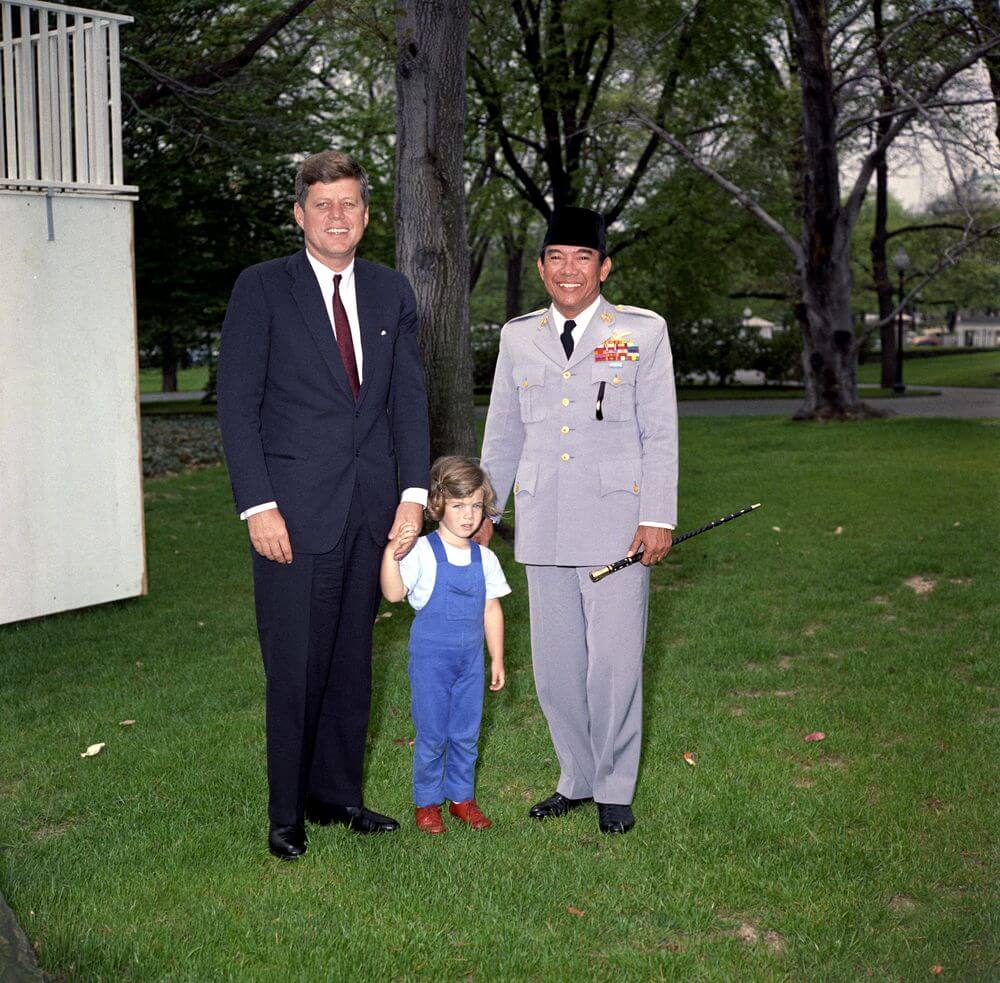
    During her time as Secretary of State, Hillary Clinton displayed an American imperiousness akin to the previous examples. Whether the former Secretary’s intentions in Libya truly aimed at ending what she called a “genocidal” regime under Gaddafi doesn’t really matter. She personally pushed for a NATO sanctioning of bombings in Libya. (This NATO assault in Africa followed the standard set by Albright in Kosovo in 1999, which was the first offensive attack NATO had ever performed.) The assault on Libya eventually led to the murder of Muammar Gaddafi. And that paved the way for a dangerous political power vacuum in which various elements, including Islamic extremists, are vying for power. It is safe to say that she left Libya in such a shambles that the USA had to reenter the civil war.

    Clinton’s decision to arm Syrian “rebels” against Bashar al Assad has also helped create bloody conflict with no end in sight. (Click here for why this may be a strategic mistake.) Bombings occur on a daily basis, especially in areas like Aleppo, leaving tens of thousands of innocents dead. As a candidate, she wanted to establish a “no-fly zone” over Syria—much as she did in Libya. This was a euphemism for controlling the air so that American proxies could control the ground. And as many suspect, and as alluded to in the above-linked story, that likely would have led to fundamentalist dominance in Syria, resembling the endgames in Iraq and Libya. But beyond that, this would probably have ended up provoking Russia, since Russia backs Assad. (Ibid, n. 3)

    “Pacific Rubiales:
    How to get rich in a
    country without regulations”

    Secretary Clinton’s policy regarding Latin America, another topic avoided by the media during the last election cycle, also demonstrates knowing or unknowing complicity with colonial/imperial interests. In Colombia, for instance, a petroleum company by the name of Pacific Rubiales, which has ties to the Clinton Foundation, has been at the center of a humanitarian controversy. The fact that Pacific Rubiales is connected with the Clinton Foundation isn’t the main issue, however. The real problem is the manner in which positions were changed on Clinton’s part in exchange for contributions. During the 2008 election season, then-Senator Clinton opposed the trade deal that allowed companies like Pacific Rubiales to violate labor laws in Colombia. After becoming Secretary of State, Clinton did an about-face. As summed up by David Sirota, Andrew Perez and Matthew Cunningham-Cook:

    At the same time that Clinton’s State Department was lauding Colombia’s human rights record (despite having evidence to the contrary), her family was forging a financial relationship with Pacific Rubiales, the sprawling Canadian petroleum company at the center of Colombia’s labor strife. The Clintons were also developing commercial ties with the oil giant’s founder, Canadian financier Frank Giustra, who now occupies a seat on the board of the Clinton Foundation, the family’s global philanthropic empire. The details of these financial dealings remain murky, but this much is clear: After millions of dollars were pledged by the oil company to the Clinton Foundation—supplemented by millions more from Giustra himself—Secretary Clinton abruptly changed her position on the controversial U.S.-Colombia trade pact.” 4

    Clinton & Zelaya (2009)

    Despite recent denials, the former Secretary also played a role in the 2009 coup that ousted the democratically elected and progressive human rights administration of Manuel Zelaya in Honduras. Recent editions of Clinton’s autobiography Hard Choices have been redacted to conceal the full extent of her role in the overthrow. Since the coup, and in opposition to the supposed goals of the overthrow itself, government-sponsored death squads have returned to the country, killing hundreds of citizens, including progressive activists like Berta Cáceres. Before her assassination, Cáceres berated Secretary Clinton for the role she played in overthrowing Zelaya, stating that it demonstrated the role of the United States in “meddling with our country,” and that “we warned it would be very dangerous and permit a barbarity.” 5

    In addition, the U.S.-backed coup in Honduras demonstrates the ongoing trend of outsourcing when it comes to intelligence work. A private group called Creative Associates International (CAI) was involved in “determining the social networks responsible for violence in the country’s largest city,” and subcontracted work to another private entity called Caerus. A man by the name of David Kilcullen, the head of Caerus, was previously involved in a $15 million US AID program that helped determine stability in Afghanistan. Kilcullen’s associate, William Upshur, also contributed to the Honduras plans. Upshur is now working for Booz Allen Hamilton, another private company involved in U.S. intelligence funding. (Ibid, n. 5)

    In his 2007 book, Tim Shorrock explained how substantial this kind of funding is. Shorrock stated that approximately 70 percent of the government’s 60-billion-dollar budget for intelligence is now subcontracted to private entities such as Booz Allen Hamilton or Science Applications International Corporation. 6

    Puerto Rico, a country in the midst of a serious debt crisis, is another key topic when it comes to Clinton’s questionable foreign policy decisions. Hedge funds own much of Puerto Rico’s massive debt, and a piece of legislation, which was put forward to deal with the issue, has rightly been labeled by Bernie Sanders as a form of colonialism. The bill in question would hand over control of financial dealings to a U.S. Government Board of Regulators, which would likely strip vital social spending in Puerto Rico. The bill already imposes a $4.25 minimum wage clause for citizens under 25. While Sanders opposed this bill, Clinton supported it. 7 This may serve as no surprise, being that the former Secretary of State receives hefty sums from Wall Street institutions like Goldman Sachs, who benefit from this form of vulture capitalism. I am not asserting that Hillary Clinton is solely responsible for these foreign policy decisions, but that she has been complicit with the American Deep State that commits or is heavily involved in these operations. (An explanation of the term “Deep State” will follow.) If the results of this 2016 election, and the success of both Trump and Sanders in the primaries, teach us something, it is that we have to move away as quickly as possible from policy compromised by corporate influence if we truly want to move forward. The American public has clearly had enough with establishment politics.

    III

    With the election of Donald Trump, the viability of establishment politics has been seriously breached, effectively ending the age of lesser-evil voting by the proletariat. Although Hillary Clinton was the preferred candidate regarding things like domestic social issues and scientific issues, it wasn’t enough to tame the massive insurgency of citizens who were so fed up with the status quo that they would rather see the country possibly go up in flames than vote for more of the same. Nor did it inspire an overlooked independent voter base to come out and make a substantial difference in the Democratic vote. In the aftermath of this potential disaster of an election, it is our duty, as a collective, to look deeply into some troubling fundamental issues. One of these has to do with the fact that racism, xenophobia and sexism are still very much alive in this country.

    I will not go so far as to label all Trump supporters as racist, homophobic or sexist. And throughout the primary/general election season, I have tried to remain receptive to their frustrations. However, I can most certainly tell you that, based on my experiences of this election season alone, these sentiments do indeed exist. During a delegate selection process for the Bernie Sanders campaign, I met and ended up having discussions with some Trump supporters. I asked them questions about why they thought Trump would make a good president, all the while disagreeing with them, but listening nonetheless. Two of the men I was speaking with were very civil, but one in particular seemed to be bursting at the seams with frustration over what he thought were the main problems with the country. While ignoring the facts I was presenting him regarding corporate welfare, this man went into relentless diatribes about why “Tacos”, his label for Hispanic people, were wreaking havoc. He exhibited no shame in expressing his distaste for other ethnicities either. During this dismaying exchange, I brought up the continued mistreatment of Native American peoples. In response, this man tried to question the severity of the atrocities committed against them and even went so far as to imply that my use of the term genocide in describing their plight was incorrect.

    Steve Mnuchin

    This may well serve to exemplify the hateful attitudes of mistrust and resentment that have been put under a black light during the course of this election. They’ve lingered dormant under the surface and have reached a boiling point thanks to Donald Trump. To paraphrase Bernie Sanders, Trump was able to channel the frustration of a destitute middle class and convert it into unconstructive anger. While Trump made references to how the “establishment” was a major problem, like many of his policy points, he didn’t ever describe in detail what was to be done to correct it. Instead, with his references to a wall with Mexico and to mass deportations, he encouraged the belief in his supporters that minorities were ruining the country. Yet in spite of his campaign promise to “drain the swamp”, many of the Trump cabinet appointees are among the most Establishment type figures one could imagine. For example, Steve Mnuchin, the former Goldman Sachs executive famous for foreclosures and hedge fund deals, has been appointed Secretary of Treasury.

    The election of a man like Donald Trump, who can’t seem to expound any of his policies in any sort of detail and is openly demeaning towards women, people of other races, and the disabled, makes clear that we have a cancerous political system which has metastasized in large part thanks to establishment politicians beholden to corporate interests. And these politicians are wildly out of touch with the needs of the average American. This created a very wide alley that the new Trump managed to rumble through. (I say “new” because in one of the many failings of the MSM, no one bothered to explain why Trump had reversed so many of the proposals he made back in 2000, when he was going to run on the Reform Party ticket.) Some commentators have claimed there can be little doubt that there was a liberal disillusionment following President Obama’s election. Hillary Clinton could not convince enough people that she was even the “change candidate” that Obama was. Therefore, in the search for answers for why their lives weren’t improving, many citizens had to find alternate sources of information outside of corporate influenced organizations (i.e. The Republican Party, Democratic Party and the Mainstream Media), given those groups won’t admit to the public that they are subservient to the same big money interests. This explains the rise of figures like Rush Limbaugh, Glenn Beck, and even rightwing populist/conspiracy demagogue Alex Jones. Their collective answer is to paint minorities and welfare recipients as the principal ills of American society, all the while failing to recognize the deep connection between government policy and corporate influence. In short, this election warns us that when the real reasons behind government dysfunction are ignored and go unchallenged, one risks the upsurge of fascist sentiments. 8

    In addition to reminding us of Hillary’s relationship with Kissinger, Bernie Sanders reminded a large portion of the U.S. populace about the other fundamental issue lying beneath the surface: corporate power. And Sanders could have neutralized Trump’s appeal among the shrinking working and middle classes, which the latter earned by invoking the need for tariffs and the threat of trade wars. This certainly was another reason for Trump’s popularity in the Mideast states like Wisconsin, Iowa, Michigan and Ohio, where he broke through the supposed Democratic firewall. (As to why, listen to this this segment by Michael Moore.) With Secretary of State Clinton’s and President Bill Clinton’s views on NAFTA and the Columbia Free Trade Agreement, and Hillary’s original stance on the Trans Pacific Partnership (TPP), she could not mount a genuine counter-offensive to Trump’s tactics in those states, for the simple reason that the Clintons were perceived as being free-traders rather than fair-traders. Thanks to their record, a Democratic presidential candidate appeared to favor a globalization policy that began decades ago with David Rockefeller—a policy that was resisted by President Kennedy. (See Donald Gibson, Battling Wall Street, p. 59)

    Awareness of any problem is the first step toward fixing it. But I think we must go beyond simple awareness when it comes to confronting our nation’s collective “shadow”, as Carl Jung would have called it — meaning all the darker, repressed aspects of the unconscious that, when ignored, can result in psychological backlash. How do we get beneath the surface appearances of corporate greed (for instance, the increasing wealth inequality amongst classes, or the amount of tax money allocated to corporate subsidies)? I suggest that an exploration of our past guided by a concept that Peter Dale Scott labels “Deep Politics” can help us come to terms, in a more profound way, with the problems facing us.

    This concept embraces all of the machinations occurring beneath the surface of government activity and which go unnoticed in common analysis, such as in news reports or textbooks. Or, as Scott states in his 2015 book The American Deep State, it “…involves all those political practices and arrangements, deliberate or not, which are usually repressed rather than acknowledged.”9 A “Deep Political” explanation of major world events goes beyond the ostensible or normally accepted models of cause and effect. One example of a “Deep Event” is the 1965 Gulf of Tonkin Incident, which provided a motive, or casus belli, to escalate the Vietnam War into a full-scale invasion by American ground forces. Given that President Johnson had already, in stark contrast to President Kennedy’s policy, approved the build-up of combat troops in Vietnam in 1964, all that was needed was some sort of impetus in order for United States involvement to move to the next stage. As the author describes, many of the intelligence reports received by the Johnson administration regarding this supposed incident did not signal any sort of instigation on North Vietnam’s behalf. However, those same reports were ignored in order to claim that North Vietnam had engaged in an act of war against the United States. 10

    Other examples of Deep Events include the previously mentioned instances of CIA, corporate and State Department interference in the economic and governmental affairs of foreign nations. It is evident that these coups did not occur for the sake of saving other countries from the grip of communism or the reign of dictators; such would only be at best a surface explanation. The deeper explanation is that a nexus of corporate, military, paramilitary, government and, on occasion, underworld elements (viz, the workings of the Deep State) had a vested interest in the outcome. The Bush administration’s lies regarding Saddam Hussein’s alleged arsenal of “weapons of mass destruction”, presented to the American people and Congress as a reason to invade Iraq, could most certainly be classified as a Deep Event. No entities benefitted more from America’s long-term occupation of Iraq than companies like Dick Cheney’s Halliburton. KBR Inc., a Halliburton subsidiary, “was given $39.5 billion (emphasis added) in Iraq-related contracts over the past decade, with many of the deals given without any bidding from competing firms, such as a $568-million contract renewal in 2010 to provide housing, meals, water and bathroom services to soldiers, a deal that led to a Justice Department lawsuit over alleged kickbacks, as reported by Bloomberg.” 11

    Included under the umbrella of Deep Politics are the major assassinations of the 1960s — those of John Kennedy, Robert Kennedy, Martin Luther King Jr. and Malcolm X. Poll after poll has indicated that most Americans believe there was a conspiracy to kill President Kennedy, but even today many apparently have not reasoned beyond the fact that there is something fishy about the “official” version in order to understand this murder in its fullest context. It behooves us to inquire more deeply into this historically critical event. Before I go any further, however, let me assert here—and I do so quite confidently—that anyone who still buys into the government version of events regarding, for example, the assassinations of John and Robert Kennedy, is either not looking carefully enough, or is not really familiar with the case.

    IV

    A suggestive point of departure for such an inquiry are the parallels between the 2016 election and that of 1968. In the wake of the assassination of Martin Luther King in April of 1968, racial tensions were high and a presidential primary season was in full swing. Opposition towards the Vietnam War was strong and one candidate in particular represented the last best hope for minorities, anti-war voters, and the middle, as well as lower classes. That candidate was Robert Kennedy, and by the early morning of June 5th, it was becoming clear that he would likely be the Democratic candidate to run against Richard Nixon in the general election. Within a matter of moments of making his victory speech for the California primary, Robert Kennedy was assassinated when he walked into the kitchen pantry of the Ambassador Hotel in Los Angeles. In those moments, the Sixties ended—and so did the populist hopes and dreams for a new era.

    Chicago DNC 1968
    Philedelphia DNC 2016

    The 1968 Democratic National Convention in Chicago was attended by the protests of disillusioned voters who felt cheated out of a more liberal, populist candidate. They ended up rioting in the streets. Hubert Humphrey, who was receiving flack for not taking a strong enough stance on the situation in Vietnam, was selected as the nominee. Similarly, there were many dissatisfied delegates and voters at the 2016 Philadelphia Democratic convention. But in a tightly controlled operation, their actions were kept hidden off screen. And the threat of stripping them of their credentials was often used to suppress any protest on the convention floor. In 2016, Hillary Clinton was nominated and her candidacy helped give us Donald Trump. In 1968, the immediate result was Richard Nixon as president. But the subsequent results included the massive increase in loss of life not just in Vietnam, but also in Cambodia, and the continuing trend away from the New Deal, anti-globalist policies of John Kennedy and Franklin Roosevelt.

    Alger Hiss, America’s Dreyfus
    Rep. Voorhis, defeated by
    Nixon’s smear campaign

    In fact, Nixon had been a part of the effort to purge New Deal elements from the government during the McCarthy era. Whether it was conducting hearings on men like Alger Hiss and making accusations of Soviet spycraft, or using his California Senate campaign to falsely accuse incumbent Congressman Jerry Voorhis of being a communist, Nixon contributed to the growing, exaggerated fear of communism in the United States. This fear allowed men like Allen Dulles to be seen as pragmatists in the face of supposed communist danger. Dulles’ and the CIA’s dirty deeds on behalf of corporate power were carried out under the guise of protecting the world from communism. As described in the Allen Dulles biography by David Talbot, The Devil’s Chessboard, sociologist C. Wright Mills called this mentality “crackpot realism.”12 It is ironic that Nixon ended up distrusting the CIA, the institution so closely associated with Allen Dulles, a man who had championed Nixon’s rise to power as both a congressman and senator.

    Flash forward to 2016 and, once again, we witness the results of a Democratic Party choosing to ignore the populist outcry for reform, and of a government compromised by corporate coercion, one subject to the hidden workings of the Deep State. Bernie Sanders represented the New Deal aspirations of a working class tired of corporate-run politics. As revealed by Wikileaks, the upper echelons of the Democratic Party chose not to heed their voices, thereby indirectly aiding the election of Donald Trump, who offered a different and unconstructive form of populism.

    Pence & Reagan
    Rex Tillerson

    Being that the political spectrum has shifted far to the right as compared to 1968, this year’s election results are more extreme. Donald Trump’s cabinet appointments reflect this extremist mentality; especially in his Vice Presidential pick Mike Pence — a man so out of touch with reality that he has tried to argue that women shouldn’t be working. In 1997, Pence stated that women should stay home because otherwise their kids would “get the short end of the emotional stick.” The soon to be Vice President Pence also sees LGBT rights as a sign of “societal collapse.”13 And as for Trump’s promise to “drain the swamp”, when it comes to establishment figures, it only gets worse, considering his appointment of Rex Tillerson, former CEO of ExxonMobil, as Secretary of State. Despite the fact that Trump appears to be “off the grid”, so to speak, when it comes to the political or Deep Political apparatus, his recent choices for cabinet positions are some of the worst imaginable for the populist of any ilk. In some cases he has actually leapt into the arms of the very establishment he warned his supporters against.

    In the face of all this, Sanders continues to inspire his followers to remain politically active. We all need to be involved more than ever, and the Democratic/socialist senator from Vermont has always urged that true change lies in us having the courage to do things ourselves when it comes to reforming government. The more we stay involved, the less likely it will be that the momentum created by political movements will be squandered in the wake of a setback. The major setbacks of the 1960s came in the form of assassinations of inspiring political leaders. Yet even in the wake of such tragedies it is possible, indeed imperative, to find a glimmer of hope. To do so, however, requires, as this essay has been arguing, the insight afforded by a critical analysis of the past, and its continuities with the present. The touchstone for this historical understanding, I believe, lies precisely in the way the policies of President Kennedy have been consistently overturned by subsequent administrations.

    V

    As mentioned above, John Kennedy was not in favor of the neo-colonialist policies of the Dulles/Eisenhower era. Instead of wanting to occupy foreign nations for the sake of corporate profit, Kennedy believed strongly that the resources of such nations rightly belonged to their people, and that the right to self-determination was critical, as evident in his 1957 speech on French colonialism in Algeria.

    Soviet stamp
    commemorating Lumumba
    MobutuNixon
    Nixon and Mobutu at the White House

    In the aftermath of a CIA-assisted coup to assassinate Patrice Lumumba, the nationalist leader of the Congo, President Kennedy fought alongside the U.N. to ensure that a nationwide coalition government was formed. Civil war was imminent as militant and corporately complicit leaders like Colonel Mobutu vied for power and promoted the secession of Katanga, the region of Congo that held vast amounts of mineral resources. JFK supported the more centrist elements of the potential coalition government and felt that the resources of Katanga didn’t belong to Belgian, U.S. or British mining interests. The President’s death ended hope for the pursuit of any stable government in Congo, along with the hope of halting widespread violence. 14 It should be noted that Nixon actually welcomed Mobutu to the White House after he took control of Congo.

    Sukarno at the White House

    As noted previously, President Kennedy also worked towards re-establishing a relationship with Indonesia and its leader Achmed Sukarno. This was after the Dulles brothers had been involved in attempts to overthrow the Indonesian leader. Decades earlier, it had been discovered by corporate backed explorers that certain areas in Indonesia contained extremely dense concentrations of minerals such as gold and copper. After Kennedy was killed, Sukarno was overthrown with help of the CIA in one of the bloodiest coup d’états ever recorded. Hundreds of thousands of Indonesians perished during both the overthrow, and the subsequent reign of the new leader Suharto. (James DiEugenio, Destiny Betrayed, Second Edition pp. 374-75) Need we add that Nixon also met with Suharto in Washington. In December of 1975, President Ford and Secretary of State Kissinger journeyed to Jakarta and gave Suharto an implicit OK to invade East Timor. This is the tradition that Hillary Clinton and her husband were involved with. For when almost every democratically elected western nation was shunning Suharto in the late nineties, Bill Clinton was still meeting with him. (Op. cit. Probe Magazine.)

    President Kennedy’s policies regarding Central and South America were also a threat to corporate interests. David Rockefeller took it upon himself to publicly criticize Kennedy’s Alliance for Progress, which had been established to aid less developed nations, like those south of the United States, to become economically self-reliant. Men like Rockefeller, along with the Wall-Street-connected media (e.g.,Wall Street Journal and Time/Life) also berated the President for “undermining a strong and free economy,” and inhibiting “basic American liberties.” (14, p. 57) The Wall Street Journal flat out criticized Kennedy for being a “self-appointed enforcer of progress” (Ibid p. 66). JFK’s 1962 clash with U.S. Steel, a J.P. Morgan/Rockefeller company, provoked similar remarks.

    After President Kennedy had facilitated an agreement between steel workers and their corporate executives, the latter welshed on the deal. It was assumed that the workers would agree to not have their wages increased in exchange for the price of steel also remaining static. After the agreement was reached, U.S. Steel defied the President’s wishes and undermined the hard work to reach that compromise by announcing a price increase. The corporate elite wanted Kennedy to buckle, but instead, he threatened to investigate them for price-fixing and to have his brother Bobby examine their tax returns. Begrudgingly, U.S. Steel backed off and accepted the original terms. Kennedy’s policies, both domestic and foreign, were aimed at enhancing social and economic progress. Like Alexander Hamilton, and Albert Gallatin, JFK sought to use government powers to protect the masses from corporate domination. His tax policy was aimed at channeling investment into the expansion of productive means or capital. The investment tax credit, for instance, provided incentives for business entities that enhanced their productive abilities through investment in the upkeep or updating of equipment inside the United States. (Gibson pp. 21-22) While Kennedy’s policies were focused on strengthening production and labor power, his opponents in the Morgan/Rockefeller world were focused on sheer profit.

    David Rockefeller & Henry Luce  in 1962

    It should serve as no surprise that the media outlets responsible for condemning the president were tied into the very corporate and political establishment entities being threatened. As described by sociologist Donald Gibson in his fine book Battling Wall Street: The Kennedy Presidency, the elite of Wall Street, media executives and certain powerful political persons or groups were so interconnected as to be inbred. Allen Dulles himself was very much involved in these circles, and had close relationships with men like Henry Luce of the Time, Life and Fortune magazine empire, along with executives or journalists at the New York Times, and the Washington Post. Operation Mockingbird, a CIA project designed to use various media outlets for propaganda, was exposed during the Church Committee hearings, revealing the collaboration of hundreds of journalists and executives at various media organizations including CBS, NBC, The New York Times, the Associated Press, Newsweek and other institutions.15)

    John Kennedy wasn’t only trying to curtail corporate power with his Hamilton/Gallatin, New Deal-like economic policies. His decisions concerning military engagement abroad were greatly at odds with the hard-line Cold Warriors of his administration and the Central Intelligence Agency. Time after time, Kennedy refused to commit U.S. combat troops abroad despite the nagging insistence of his advisors. Although the President publicly accepted responsibility for the fiasco at the Bay of Pigs, privately he was livid at the CIA for deceiving him. Through materials such as inspector general Lyman Kirkpatrick’s report on the Bay of Pigs, and other declassified CIA documents, it is now evident that a major deception had occurred. The Agency had assured Kennedy that their group of anti-Castro Cuban invaders would be the spark that would set off a revolt against Fidel Castro just waiting to happen. This was not the case, and the CIA-backed Cubans were outnumbered by Castro’s forces 10 to 1. Even worse, as noted in the Kirkpatrick report, was the fact that the CIA had stocked the invading force with C-Level operatives. (2, p. 396) It was almost as if the surface level plan presented to the President was designed to fail in order to force his hand and commit the military into invading Cuba. A declassified CIA memo acknowledges the fact that securing the desired beach area in Cuba was not possible without military intervention. 16

    When Kennedy refused to commit U.S. troops as the operation crumbled, he became public enemy number one in the CIA’s eyes. This sentiment that Kennedy was soft on communism, or even a communist sympathizer, augmented as he continued to back away from military intervention in other situations. The President reached an agreement with the Soviet Union to keep Laos neutral, and despite his willingness to send advisors to Vietnam, he ultimately worked to enact a policy resulting in the withdrawal of all U.S. personnel from the country. Kennedy’s assassination ended this movement toward disengagement from Saigon.

    What was likely even worse to the Cold Warriors and CIA patriots during this time was the President’s attempts at détente with Nikita Khrushchev of the Soviet Union and Cuba’s Fidel Castro. During, and in the period following, the Cuban Missile Crisis, Kennedy and Khrushchev were involved in back channel dialogue with one another. Discussion moved toward talks about détente; despite the fact that the two men’s respective countries had differing views, they agreed it was imperative, for the sake of the planet, to come to an understanding. This, along with JFK’s unwillingness to bomb Cuba during the Missile Crisis, were nothing short of traitorous to the covert and overt military power structure of the United States. In the final months of his life, the President also extended a secret olive branch toward Fidel Castro in hopes of opening a dialogue. Excited by the prospect, Castro was painfully upset when he got word of Kennedy’s assassination. Kennedy most certainly had his enemies, and was making decisions that drove a stake into the very heart of corporate, military and intelligence collusion. If he had been elected President, Bobby Kennedy was most certainly going to continue, and most likely even expand, the policies of his late brother. (ibid, pp. 25-33) Like Jack and Bobby, Martin Luther King and Malcolm X expressed opposition toward the continuation of the Vietnam War.

    VI

    The concept of Deep Politics may provide a helpful alternative to the term “conspiracy theory”, which has become so stigmatized and so overused as to be meaningless. Abandoning the idea of conspiracy altogether, however, risks throwing the baby out with the bath water, for it raises legitimate questions about what lurks beneath the surface of the affairs of state. The enemies that John and Robert Kennedy were facing were not some fictional or hypothetical “illuminati” group or groups. They were very real, dangerous and powerful interests, and those forces are still with us in 2016. Deep Politics does not imply that there is some singular group or set of groups that meet in secret to plot colossal calamities that affect the entire world, but rather that the events themselves arise from the milieu(s) created by a congruence of unaccountable, supra-constitutional, covert, corporate and illegal interests, sometimes operating in a dialectical manner. A more recent example would be the networking of several of these interests to orchestrate the colossal Iran/Contra project.

    Other writers have also described these subterranean forces using other terms. The late Fletcher Prouty called it the Secret Team. Investigative journalist Jim Hougan calls it a Shadow Government. Florida State professor Lance DeHaven Smith, with respect to its activities, coined the term “State Crime Against Democracy”, or SCAD. (Click here for his definition.) Smith wrote one of the best books about how, with the help of the MSM, these forces stole the 2000 election in Florida from Al Gore. He then wrote a book explaining how the term “conspiracy theorist” became a commonly used smear to disarm the critics of the Warren Commission. It was, in fact, the CIA which started this trend with its famous 1967 dispatch entitled “Countering Criticism of the Warren Report”. (See this review for the sordid details.)

    Whether it be extralegal assassinations, unwarranted domestic surveillance, interventionist wars at the behest of corporate interests, torture or other activities of that stripe, these all in essence have their roots in the Dulles era in which covert, corporate power developed into a well-oiled and unaccountable machine running roughshod. These forces have continued to operate regardless of who is elected president, whether Democrat or Republican. (See Jim Hougan’s Secret Agenda for a trenchant analysis of the operation against Richard Nixon that came to be called Watergate.)

    It is my opinion that we must come to terms with these dark or, to use James W. Douglass’ term, “unspeakable” realities. And we must do so in a holistic way if we are to take more fundamental steps toward progress as a nation. George Orwell coined the term Crime Stop to describe the psychological mechanism by which humans ignore uncomfortable or dangerous thoughts. Through discussions with people young and old, it has become evident to me that this Crime Stop mechanism is at work in the subconscious of many Americans. We need to be willing to face the darker aspects of our recent past that have been at work below the surface and percolating up into view for many years.

    In a very tangible way, the refusal to face these dark forces has caused the Democratic Party to lose its way. And this diluted and uninspiring party has now given way to Donald Trump. As alluded to throughout this essay, this party has abandoned the aims and goals of the Kennedys, King and Malcolm X to the point that it now resembles the GOP more than it does the sum total of those four men. To understand what this means in stark political terms, consider the following. Today, among all fifty states, there are only 15 Democratic governors. In the last ten years, the Democrats have lost 900 state legislative seats. When Trump enters office, he will be in control of not just the White House, but also the Senate and the House of Representatives. Once he nominates his Supreme Court candidate to replace Antonin Scalia, he will also be in control of that institution.

    Bernie Sanders was the only candidate whose policies recalled the idea of the Democratic party of the Sixties. And according to a poll of 1,600 people run by Gravis Marketing, he would have soundly defeated Trump by 12 points. The Democrats have to get the message, or they run the risk of becoming a permanent minority party. They sorely need to look at themselves, and ask, What happened? As a starting point, they can take some of the advice contained in this essay.


    Notes

    1. “Hillary Clinton Snaps At NPR Host After Defensive Gay Marriage Interview.” YouTube. WFPL News, 12 June 2014 <https://www.youtube.com/watch?v=vgIe2GKudYY>.

    2. David Talbot, The Devil’s Chessboard: Allen Dulles, the CIA, and the Rise of America’s Secret Government. New York, NY: Harper, 2015.

    3. Gary Leupp, “Hillary Clinton’s Foreign Policy Resumé: What the Record Shows.” , 03 May 2016.

    4. Greg Grandin, “A Voter’s Guide to Hillary Clinton’s Policies in Latin America.” The Nation, 18 April 2016.

    5. Tim Shorrock, “How Hillary Clinton Militarized US Policy in Honduras.” The Nation, 06 April 2016.

    6. Peter Dale Scott, “The Deep State and the Bias of Official History.” Who What Why, 20 January 2015.

    7. Ben Norton, “Sanders Condemns Pro-austerity ‘Colonial Takeover’ of Puerto Rico; Clinton Supports It.” Salon, 27 May 2016.

    8. “Chomsky on Liberal Disillusionment with Obama.” YouTube, 03 April 2010 <https://www.youtube.com/watch?v=A6Jbnq5V_1s>.

    9. Peter Dale Scott, The American Deep State: Wall Street, Big Oil, and The Attack On U.S. Democracy. Lanham: Rowman & Littlefield, 2015: Chapter 2, p. 12.

    10. “Project Censored 3.1 – JFK 50 – Peter Dale Scott – Deep Politics.” YouTube, Project Sensored, 19 December 2013 <https://www.youtube.com/watch?v=L0CFpMej3mA>.

    11. Angelo Young, “And The Winner For The Most Iraq War Contracts Is . . . KBR, With $39.5 Billion In A Decade.” International Business Times, 19 March 2013.

    12. Zawn Villines, “The Four Worst Things Mike Pence Has Said About Women.” Daily Kos, 21 July 2016.

    13. Richard D. Mahoney, JFK: Ordeal in Africa. New York: Oxford UP, 1983.

    14. Donald Gibson, Battling Wall Street: The Kennedy Presidency. New York: Sheridan Square, 1994.

    15. Carl Bernstein, “The CIA and the Media.” Rolling Stone, 20 October 1977 <http://www.carlbernstein.com/magazine_cia_and_media.php>.

    16. David Talbot, Brothers, p. 47.