… and see it as a harbinger of things to come.
Tag: FILM
-
Oliver Stone and Kevin Costner look back at their film JFK 25 years later
… and see it as a harbinger of things to come.
-
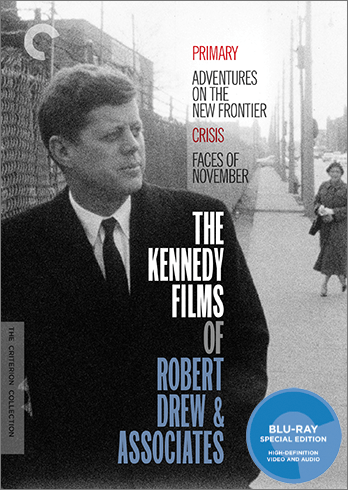
The Kennedy Films of Robert Drew and Associates
The Criterion Collection is quite literally an invaluable asset in the world of modern day DVD releases. Criterion pioneered both the audio commentary track and the use of supplemental features per DVD release. The last film I saw of theirs was the excellent three disc DVD of The Battle of Algiers.
They have now released another valuable production. This one is called The Kennedy Films of Robert Drew and Associates. It consists of four documentary films: Primary, Adventures on the New Frontier, Crisis, and Faces of November. Robert Drew was a reporter and photographer for Time Inc. While on a study break at Harvard he began to explore why documentary films were so dull and uninvolving. When he returned to Time Inc. he began to attempt to break out of the confines that documentary film had slid into.
What Drew wanted to do was to make a revolution in technique. He wished to dump the reliance on narration, on music and slick camera work that consisted largely of long takes or tracking shots. He also wanted to jettison the device of the interview. In fact he wanted the filmmaker to ask no questions of his subjects at all. And further, he did not want to even tell them where to sit while he was filming. This type of documentary film came to be known as cinema verité, or direct cinema. The revolution in documentary style that it created roughly corresponded to the revolution that French feature film directors like Francois Truffaut and Jean-Luc Godard had manufactured with the Nouvelle Vague or New Wave.
Drew managed to create a unit at Time Inc. He then brought in other film-makers who shared his same goal: to help perfect this new aesthetic. These men included D. A. Pennebaker, Albert Maysles, and Richard Leacock. To say that they succeeded in their aim does not begin to describe their achievement. Consider some of the films these men were later responsible for: Gimme Shelter, Salesman, Grey Gardens, Don’t’ Look Back, Monterey Pop, The War Room, Startup.com, Ku Klux Klan—Invisible Empire.
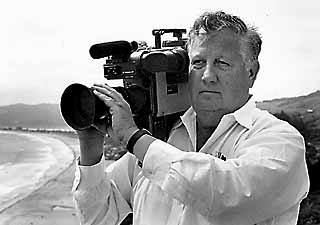
Robert Drew To achieve what they set out to do there were two technical barriers to surmount. First, there had to be smaller cameras so that they could do handheld shots. That is, the camera would not be attached to a tripod, or be placed on a dolly. It was portable and could follow the subject in the shot. Second, there had to be a way to record live dialogue in sync with what the camera was seeing. By early 1960, when Drew made Primary, both those problems had been solved.
At the same time Drew was getting ready to create his revolution in film style, Senator John Kennedy was also about to create a milestone in politics. Prior to 1960 no major candidate for president had decided to lay his claim to the office by running the gamut during the primary season. Kennedy did so out of necessity. He did not have the party standing that his top three opponents—Stuart Symington, Hubert Humphrey, and Lyndon Johnson—commanded. Up until 1960, the way to win the nomination was through currying favor with the party honchos. Both on the national and state level. Kennedy decided he could not win that way. But since he was photogenic, a good speaker, and his father was willing to spend a lot of money, he could win by dominating the primary season.
So Drew approached Kennedy one day as he emerged from his townhouse in Washington. JFK asked him what he wanted. Drew said words to the effect: I want to follow you around during the Wisconsin primary with a movie camera. Kennedy asked him: why should I agree to that? Drew played his ace card. Aware of Kennedy’s writing career and his interest in history, Drew replied because if he did Kennedy would be part of a new kind of history. The candidate thought it over and said that if he did not call Drew tomorrow, then he could do it. JFK didn’t call. Drew then got in contact with Humphrey’s camp and got a similar approval. The four men were allowed to film the last five days of the Wisconsin race.
In fact, they did create something extraordinary. The film Primary is not just exceptional because of its stylistic originality. But in watching we are transported back to what seems like a different universe, one that used to be called retail politicking. In the first scene we see Humphrey emerging from what looks like a corner grocery story, where he could not have been talking to more than 8-9 people. He then shakes hands with someone outside and actually exchanges a few lines of dialogue with him.
We observe both candidates driving down barren country roads and into sparsely populated rural areas—which is where Humphrey was supposed to run strong. We see JFK standing outside a factory gate in the morning with an overcoat, shaking hands with the workers, one of whom doesn’t even look at him. We even see Kennedy signing autographs for young schoolchildren who don’t vote. (When later asked why he did such a thing during a short campaign, Kennedy replied because those kids go home and talk to their parents.) One can argue that this kind of politics does still exist today in the Iowa and New Hampshire primaries. But today even those kinds of events are well planned and then orchestrated for media effect. That was not the case back then. Because both candidates were relying on the local and state representatives to prepare the events. Therefore it was very much a hit and miss process.
The big hit for Kennedy was a large auditorium rally at a Polish Catholic Church in Milwaukee the night before the election. This scene begins with what has now become an iconic shot of JFK. The camera is behind Kennedy: a wide angle shot from behind him and above. We see him go through the crowded entrance to the stage as the crowd applauds and sings “High Hopes”. Acknowledging he was late, Kennedy quips, “You’ve been standing there quite awhile, I’ve been standing for three months.” Some have written that this was a planned shot. In one of the disc supplements, it is revealed that the wide-angle lens was a last minute suggestion, and that the cameraman decided to hold the camera over his head to avoid the crowd. In other words, it was accomplished willy-nilly.
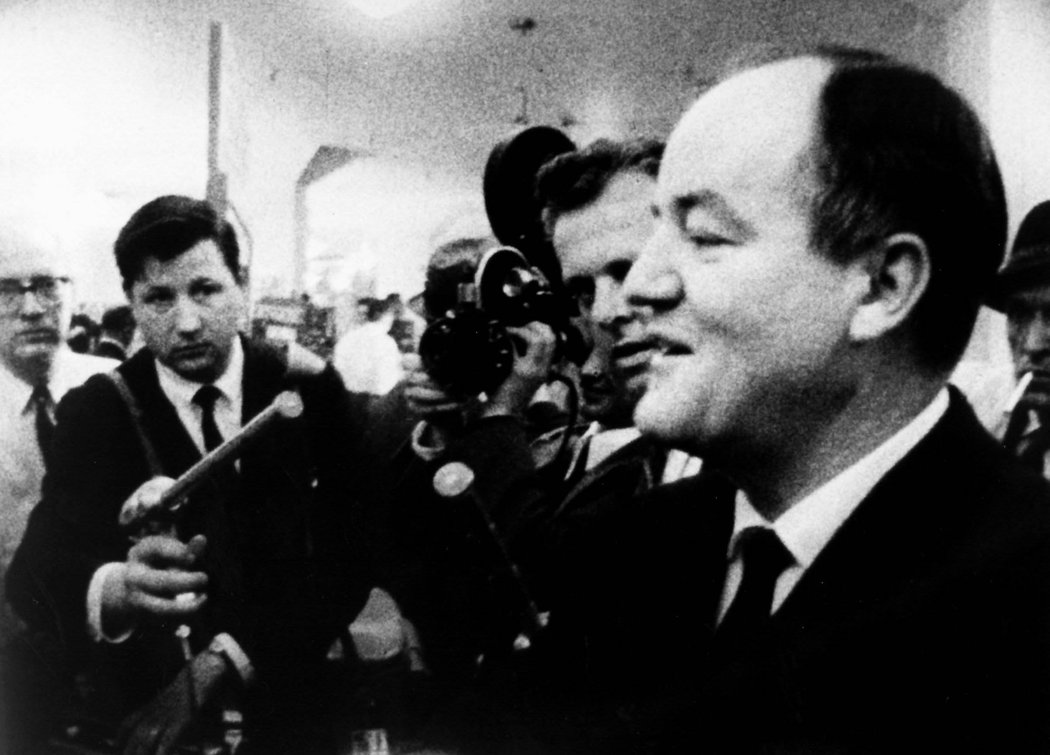
Hubert Humphrey during Wisconsin primary The film is spotted with various human-interest angles. For example, we watch as Humphrey does a radio interview. During the interview, the host tells the candidate he thinks he will win. After Humphrey leaves the station, the host says that he actually thinks Kennedy will win. During that rally in the church auditorium, Jackie Kennedy addresses the crowd in Polish. The camera focuses on her twisting hands, which reveal her nervousness.
The film concludes with Election Day, April 5th. We first see citizens coming into voting precincts. We watch as they enter booths, and the camera stays on their feet as they vote, commemorating their privacy. We then cut to a hotel room as the Kennedy camp watches the returns on television. Kennedy is relaxed, jacketless, slowly smoking a cigar. The early returns favor Humphrey by a 2-1 margin. But as the city of Milwaukee begins to count its votes, Kennedy makes up the difference and then surpasses his opponent. JFK ended up winning by a 56-44% margin. As he says in the film, the margin of victory was disappointing. It was not the knockout blow he was hoping to deliver in Humphrey’s backyard (Hubert was from Minnesota). Which meant they would have to go through the same exercise again in Illinois and then West Virginia. Humphrey ended up sticking around for another month.

Wisconsin primary election day This hotel scene achieves the purest form of cinema verité. One really does feel as if one is eavesdropping. First, there does not appear to be any kind of cinematic lighting. Second, the filmmakers placed the tape recorder behind the sofa, and the microphone in the ashtray. Therefore, their presence was eliminated.
The very last scene begins with a close up on a Humphrey for president sticker on the rear bumper of a car as it pulls out and then proceeds down a lonely country road. It’s a nice metaphor for the battle continuing—but the odds now being against Humphrey. The final results of the primary season were that Kennedy garnered nearly 2 million votes, Humphrey about 600,000. Which gave JFK a large advantage in delegates at the Los Angeles convention. One which neither Johnson nor Symington—who both decided to go the traditional back room route—could overcome.
It’s hard to believe, but Primary did not get a wide release in America. Time-Life owned about six TV stations, and that was the extent of its public showing in the USA. Which tells the reader a lot about the sorry domestic distribution of culturally significant films. For, as I have shown, the film constituted an aesthetic revolution depicting a political milestone. For now the primary route would be the way to the White House for both parties. It was not until the film was exhibited in France that it garnered the recognition it deserved.
II
But a most important person in America did like it. That was President Kennedy. So much so that he agreed to do two more films with Drew. The first one was called Adventures on the New Frontier. Shot in the same cinema verité style, this is a fascinating combination of the Wisconsin primary footage, inauguration day footage, and concludes with a day in the life of President Kennedy. Because of a technical failure, we don’t actually see Kennedy’s inauguration. But we do see conversations about that famous speech between John K. Galbraith and Gov. Mennen Williams of Michigan. This is then followed by a conversation in a car between Galbraith and author John Steinbeck. The latter is fascinating, because these two experienced authors were very much impressed by the style and technique of the actual writing of the speech. And that is what they actually talk about in specifics.
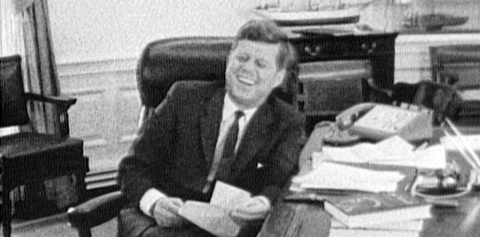
During the filming of Adventures on the New Frontier Once in office for about six weeks, Kennedy let Drew and his associates film him doing his job in the Oval Office. We see him meeting with John McCloy who he has appointed to do preliminary talks with the Soviets on atomic weapons reduction. He then meets with Arthur Goldberg, his Secretary of Labor. Goldberg had been an attorney for the Congress of Industrial Organizations, and had been influential in the merger of the CIO with the American Federation of Labor. At this time, Kennedy and Goldberg discuss a solution to an airline strike of flight engineers, and also certain strategies to counter unemployment rates. They concentrate on unacceptably high unemployment in West Virginia. Kennedy wants to rush in government surplus food supplies for any family in dire straits. After this, Kennedy meets with his chief economic advisor Walter Heller. The president wants his forecast about the future trends on the unemployment horizon. Heller tells him that unless they take some kind of action, he does not see it improving on its own.
The most fascinating part of this film now follows. First, we see Kennedy working on the creation of the Peace Corps with Williams and Richard Goodwin. Which is logical, considering the fact that the former would helm his Africa policy, and the latter would be his special advisor on Latin America. Kennedy briefly talks about how America had ignored Africa, and in the midst of the decolonization process, he wants those new countries to maintain their independence.
We then watch Williams as he meets with some leaders in the senate, including Al Gore Sr. They advise him to proceed slowly. But Kennedy is worried that if they don’t engage quickly they will be too far behind the pace of change going on right then. (If the reader has acquainted himself with the reviewer’s two essays, “Hammarskjold and Kennedy vs. the Power Elite” and “Dodd and Dulles vs. Kennedy in Africa”, the evidence reveals that Kennedy was correct in his estimate.)
Drew then follows Williams to a meeting in Addis Ababa to meet with various African leaders, including Haile Selassie. While there, Williams made his famous quote. In response to what he saw his function there as, he replied, “What we want for the Africans is what they want for themselves.” This was slightly altered by the press to him saying, “Africa for the Africans.” Since there were still certain white supremacist nations in Africa, countries like England and the Union of South Africa took offense. When Kennedy was asked about this now controversial comment at a Washington press conference, he did not back away from it. He said, “I don’t know who else Africa should be for.”
This film is a good visual bookend to Helen Fuller’s volume, Year of Trial. That valuable work is unfortunately out of print today, although one can still buy it on Amazon and E bay. But Fuller’s work, like this one, was a snapshot of the New Frontier in its first year.
III
The other request that Drew made was for a film of Kennedy’s administration in a crisis situation. Kennedy liked the idea. He replied that such a film should have been made of Franklin Roosevelt the day after Pearl Harbor. At first, Drew asked to film the deliberations of the ExComm during the Cuban Missile Crisis. But press liaison Pierre Salinger told him that would not be possible due to national security reasons. So in 1963, Kennedy suggested that Drew film what he perceived to be an upcoming showdown with Governor George Wallace of Alabama. Wallace was resisting integrating the University of Alabama, located in Tuscaloosa. This was in spite of a court ruling, based on Brown vs. Board of Education, that had gone against him. Wallace had sworn to defy the court by standing in the “schoolhouse door” in order to block entry of the two students who had been accepted by the university: James Hood and Vivian Malone.
And that was a key point: the university had accepted the two well qualified African-American students. Wallace was literally trying to hold up the court ordered admittance on his own, essentially unilaterally. Learning from what had happened at the University of Mississippi the year before, Wallace understood the political value of making the federal government act against a state governor. He also knew that the media would be out in force for the event. Therefore, there would be millions of people watching it unfold on live television. In its political impact, the confrontation had the potential to catapult Wallace onto the national stage. Which it did.
The Kennedys also learned a lesson from their experience with Governor Ross Barnett at Ole Miss in 1962. They had made a mistake and trusted Barnett’s word about the campus being secure for the entry of James Meredith. Then, when the rioting began, it took too long to get federal troops onto the scene. Two people were killed, and dozens were injured. So this time, Attorney General Robert Kennedy had tried to talk to Wallace on his home turf at the state capital in Montgomery in April and May of 1963. According to the AG, the discussions did not get very far. RFK felt that Wallace was being deliberately obscure in order to hide what he was actually planning to do. (See Robert Kennedy in his own Words, p. 185, edited by Edward Guthman and Jeffrey Shulman)
What made the potential danger more ominous was that Wallace had wired the White House the first week of June. He said that in order to keep the peace, he was bringing along 500 state guardsmen with him on the 11th. That was the date the two students were going to register for the summer session. President Kennedy wired back thanking him for the notice, but he added the only threat of violence came from the governor’s defiance of the Alabama federal court ruling. (Andrew Cohen, Two Days in June, p. 74) By the time of the confrontation, Wallace would have 825 state troopers on campus.
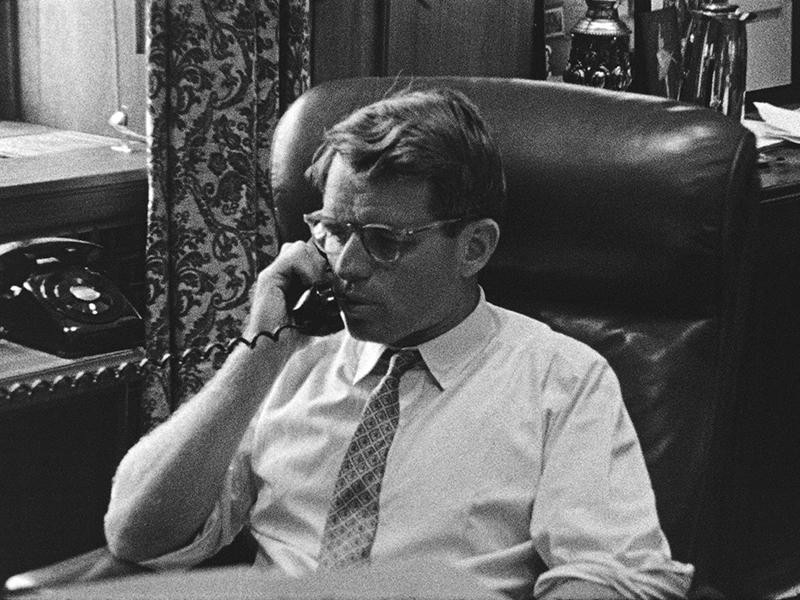
RFK getting reports from Alabama Robert Drew’s film Crisis begins with a triangularly intercut sequence. We first view Wallace leaving the governor’s mansion in Montgomery by limousine for Tuscaloosa. This is followed by the two students being escorted onto the campus. We then watch Bobby Kennedy in his office getting phone reports as to what is happening in real time. As the scenes shift, the background music modulates from the southern standard “Dixie” to the national standard “The Battle Hymn of the Republic.” A nice thematic touch, which accents the threat of military force.
For in light of what happened at Ole Miss, the White House had decided to mass 3,000 troops outside the campus in advance. They were under the command of General Creighton Abrams, who we see in the film on the phone with RFK, and discussing circumstances on the scene with Bobby Kennedy’s deputy Nicolas Katzenbach. For contrary to what some have written, the White House did not know what Wallace would do. And, in fact, during the film one can hear Bobby Kennedy telling his brother that they might have to just push the governor aside. And RFK had mulled over that contingency. All the way down to taking into consideration how many doors were at the entrance and breaking them down. In other words, while shoving Wallace aside, the students could enter the furthest door. But that might have provoked the spark that turned a physical altercation into a riot.
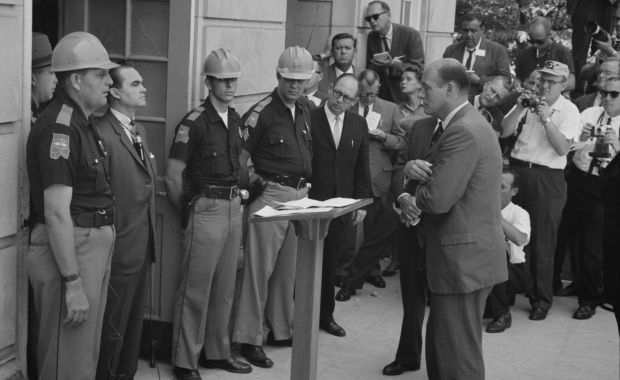
Katzenbach confronts Governor Wallace As the film shows, the ultimate strategy decided upon was the White House nationalizing the state national guard. But first, Katzenbach approached Wallace without Hood and Malone, who had gone up to their dorm rooms. Katzenbach then asked Wallace to stand aside so the students could register for their classes. Not only did Wallace refuse to do so, he even interrupted Katzenbach as he was speaking. Therefore, Kennedy nationalized the guard. Brigadier General Henry V. Graham, with a motorized detachment of 100 of his 17,000 men, then drove up to the entrance. Graham asked Wallace to stand aside upon the orders of President Kennedy. Realizing he was completely outmanned now, Wallace did so. The students were registered under the guidance of Bobby Kennedy’s lead civil rights lawyer John Doar. Graham and his detachment stayed on campus, in the student’s dorms, for several weeks. On national television that evening, President Kennedy made his epochal speech on the issue of civil rights. The most important and compelling speech on the subject by an American president since Lincoln. Drew intercuts that speech with shots of Wallace, the students, and Bobby Kennedy watching it.
The film ends with an appropriate coda. Katzenbach calls Bobby Kennedy three days later and tells him that another black student had entered the University of Alabama at Huntsville. It happened without any repercussions. Bobby Kennedy then calls JFK and tells him about it. We watch as the Attorney General now leaves his office for the day. The battle over integrated colleges and universities had been won.
But the film depicts an interesting quote by Wallace toward the end, which informs us of the price that had been paid. Due to this piece of televised resistance, Wallace states that the south will decide the next president. This was not technically true in 1964. But Wallace’s prediction did come true in 1968—and beyond. Kennedy’s struggle for civil rights turned the south from a reliable Democratic base for presidential elections to the bastion of future Republican political power. In that way, Crisis is an historically important film.
The fourth film on the DVD set is Faces of November. This is a brief visual reverie depicting the grief which overtook Washington after Kennedy’s assassination. Drew includes here photos of Kennedy’s tomb being visited by the public in the Capitol rotunda, shots of the funeral procession, and Kennedy’s military salute at Arlington.
Criterion made its reputation by the addition of interesting and educational supplements to their DVD packages. They added four of them for this collection. Far and away the most valuable one is a joint interview with former Attorney General Eric Holder and his wife Sharon Malone. Sharon is the sister of the late Vivian Malone who has since passed away. This interview gives us some personal insight into why Vivian did what she did and what gave her the courage to persevere through it. There is also a panel presentation on Primary done in 1998 at the Simon Wiesenthal Center in Los Angeles. This includes Leacock, Maysles, Pennebaker and Drew. Something like this will never happen again, since all but Pennebaker have passed away. Finally, there are interviews with authors Andrew Cohen and Richard Reeves. The former offers some insights into the film Crisis, since he used outtakes from the film for his book Two Days in June. Although Reeves is not as offensive as he usually is, still Criterion could have chosen someone else, like say Harris Wofford. Wofford worked for Kennedy in his civil rights division and authored a good book about that struggle called Of Kennedys and Kings.
Overall, this two-disc set is much worth purchasing and watching. How many DVD sets chronicle three history-making events? One dealing with our political system, one dealing with the struggle for American civil rights, and one with a stylistic revolution in film technique. This one does, which makes it unique.
-

11/22/63: Stephen King and J. J. Abrams Lay an Egg

I actually talked to Stephen King on the phone once from his home in Maine. This was when Stanley Kubrick was making a movie out of his book, The Shining. I was trying to put together a feature magazine article on that picture. But I could not secure an interview with Jack Nicholson until it was too late for the magazine’s publication date. I decided not to go through with the project. When I actually saw the film, I was not terribly agonized over my failed attempt. From what I have read, King did not like the movie either. So much so that he made his own TV version of that book.
King is now part of the production team that has made another TV movie from a more recent book of his. Except it’s actually a mini-series. Quite a long one. It plays over eight installments. And since the first installment is two hours long, it clocks in at nine hours. From what I have been able to garner, producer-director J. J. Abrams was the man in Hollywood who decided to take King’s book under his wing. But, as is the usual case with the big names in Movieland, Abrams then turned over the project to what is called a line producer, or developer. In this case her name was Bridget Carpenter. Carpenter has written over ten plays, and worked on several TV series, most notably, Parenthood and Friday Night Lights.
At almost 900 pages, King’s book was quite long. Apparently, once you attain King’s stature in the publishing business, no one dares edit your work. It was that original length which necessitated the nine-hour mini-series format. Because of that length, this series was clearly a team effort. It had five directors and four writers working on it. Carpenter, by far, wrote the most installments. She either wrote or co-wrote five of them. No director helmed more than two installments.
In virtually every other instance of my (long) reviewing career, I have always read the source material for any adaptation. Offhand, I really can think of perhaps only one or two exception to that practice. But, for two reasons, I just could not bring myself to read King’s book. First, I don’t care for novels about the Kennedy assassination. Because the original inquiry, the Warren Report, already fictionalized what really happened in Dallas on November 22, 1963. Secondly, why would any intelligent, interested person read a book that, in its central tenets, was more or less a restatement of that original fiction? Which King’s book is. In other words, why pile one fiction on top of another? Especially concerning such a crucial event in American history. So in this one case, I declined to read the book on which this mini-series is based. I hope the reader understands that decision.
After more than one preview, King’s novel was published in November of 2011. In what I have been able to dig up about its genesis, one of his main influences in the writing and research for the book was the Dallas museum about the JFK case, The Sixth Floor. He specifically consulted with the late Gary Mack, who passed away in 2015. We all know that, for about the last 20 years of his life, under the influence of Dave Perry, Gary Mack had done a backflip on the case. He migrated over to the Warren Commission camp. (Click here for info on Perry). Whether King entered the creation of his book with an open mind on the JFK case, and was then influenced by Gary Mack, or whether he was in the Krazy Kid Oswald camp all along, that is an issue I have not been able to definitively discern.
II
King decided to make his book a science fiction thriller. The gimmick behind it all is a good old sci-fi staple: time travel. Jake Epping (played by James Franco) is a high school English teacher who also teaches adult education GED preparatory classes. At the beginning of the series two things happen, back to back, which set the plot in motion.
In the opening scene, in his GED class, Jake is listening to his adult students orally present papers about the most important day in their lives. The first person we see is an elderly student named Harry Dunning. He is standing in front of the class presenting his (rather shocking) paper. Harry is telling the story of the night his father Frank came home drunk and killed his mother, sister and brother with a long-handled hammer. (Which, I think Mr. King, is plenty life-changing.) Jake is very impressed with this presentation and gives Harry an A+.
Right after this we see Jake in a diner. The owner Al Templeton (played by Chris Cooper), emerges from the back coughing and wheezing; he then collapses on the floor. Jake takes him home to recover. The next day, Al tells him to walk into a closet behind the front of the diner. This ends up being the time tunnel portal. Ever so briefly, Jake gets transported back to October of 1960. He then returns. Al tells him he is too old and sick to use the time tunnel for what he wants to utilize it for: To stop the assassination of President Kennedy. Jake replies, you cannot change the past. Al tells Jake to go back again. This time, he gives him a knife and tells him to carve something into a nearby tree. Jake does so, he returns, and they go outside. They see that the initials of JFK are still there.
At this point the film, through Al, sets some terms and conditions of King’s version of the fourth dimension. Whenever one gets sent back in time, he will always arrive in October of 1960. Second, no matter how long one spends back there, upon returning, only two minutes will have elapsed. If one changes something, but then goes back again, everything resets to the way it was before. Finally, the past is obdurate: it resists changes. Some of these changes end up in what King calls tributaries, sort of like alternate universes.

Actor James Franco, Stephen King, and J.J. Abrams For this viewer, these three scenes did not make for an auspicious beginning. First, I had a hard time believing Harry would make a speech like that in front of a class. I was involved in the education system as a student, teacher and adult education instructor for over thirty years. I never heard any student reveal anything that traumatic or horrible. And no teaching colleague ever told me about something comparable occurring in his or her class.
Secondly, although theories of time travel have progressed by leaps and bounds since H. G. Wells’ classic book The Time Machine, King makes no explanation at all about the science aspect of his fiction. At least Wells, working with much less information, tried a bit. In this case, it’s a time portal in a restaurant—and that is it. Then there’s those terms and conditions! They all seemed designed to make it easy for the author to construct his story the way he wished. The protagonist would not age, changes would not be permanent, and the scope of time dealt with was narrow.
So, at the very beginning, with the shocking story told in class, and all these rules –with no real explanation–this viewer understood that the story we were about to see would rely a lot on plottiness. Let us make a distinction: There is a difference between a well-constructed story and plottiness. For instance, the Robert Towne/Roman Polanski film Chinatown has a wonderfully structured story that is so cohesive and subtly carpentered that one is never aware of the engine of the plot turning over. That is, the plot machinations are so dramatically ingrained with the film’s other elements that the audience is not fully aware of being carried along by the current of the story until the end. That is good story structure. And that is why the screenplay of Chinatown is actually taught in screen writing classes at universities.
I don’t think King, Abrams and Carpenter will be paid that educational compliment. Because here, the characters, the plot device, even the dialogue, are at the mercy of a heavy-handed plot. Almost nothing seems natural. It all seems set up: reminiscent of the standardized TV series writing of the fifties and sixties, where high points in the plot were timed for commercial breaks (which actually happens here). For instance, when Harry told his story in front of the class, I immediately said to myself: This is so bizarre, so much of a reach, I think its going to be used as part of the plot. Which it was. And there is another plot strand—to be discussed later– that is almost as violent and bizarre as that one.
III
But the main plot line concerns the assassination of President Kennedy. To get that going, when he returns to the diner, Al tells Jake about his obsession with the JFK case. He then convinces him to go back in time to try and stop the murder. Al says that the bullet that was fired at General Edwin Walker in April of 1963 was the same bullet that was fired at JFK in Dealey Plaza. (Which it was not. See Reclaiming Parkland, by James DiEugenio, pgs. 79-80) Al tells Jake to go back in the portal and see if Lee Harvey Oswald did shoot at Walker in Dallas. If that happened, then Oswald probably killed Kennedy. But if it didn’t, then someone else likely killed him. Al then tells Jake he would do so himself, but he is afflicted with cancer. He then packs a briefcase for Jake, including his JFK collection of newspapers and essays, plus a false identity package. He adds a small notebook with summaries of sporting events for him to bet on if he needs money e.g. boxing matches. And with that, Al is now off on a three-year voyage backward in time. One that will actually take two minutes.
Back in 1960, Jake buys a car. Which leaves him a bit low on funds. So, utilizing the previously planted bookie device, Jake asks the car dealer where the nearest betting parlor is. Jake makes a bet on a championship fight, actually picking the round the knock out will occur. The bookie suspects something fishy and sends a goon to get his money back. But Jake anticipates this, gets the jump on his assailant, and escapes from his rented room. He then drives to Dallas, rents a room at a bed and breakfast, and begins studying the JFK case through Al’s files.
Informed by Al,–who appears in flashback throughout–Jake follows George DeMohrenschildt around. First to a Kennedy speaking engagement, then to a high-class restaurant. At the restaurant, Jake secures a table next to George, who is sitting with two other well-dressed gentlemen. The film uses every cheap trick under the sun to prevent Jake from clearly hearing the discussion: a blender goes off next to him, the table on the other side is quite loud, a waiter spills a tray of drinks. But he does hear George mention Oswald’s name. On his return to his rooming house, the building is on fire. Since his belongings were left in the room he goes inside to try and recover what was left of them.
Jake decides to leave Dallas. He gets lost on the way out of town. He realizes he is close to Kentucky. Which, of course, is where Harry Dunning grew up. Jake decides to visit the town in order to prevent the triple murder. He rents a room and befriends a bartender named Bill Turcotte (George MacKay). Frank Dunning then walks in and he and Jake begin to talk and become acquaintances. After an altercation with Frank at his butcher shop, Jake buys a gun and is casing the Dunning house on Halloween night, which is the night that his student Harry said the killings occurred. He is accosted in the bushes by the bartender Bill. (Why Bill would find Jake suspicious enough to follow him around town for two days is not explained.) The two have a rather unusual conversation: Bill tells Jake that Frank was married to his sister and killed her. Jake tells Bill that he is from the future. Jake pulls a gun on Bill to subdue him, and then runs into the house where Frank is in the process of beating and killing his family. Jake intervenes and kills Frank. He then leaves town. Bill joins him (it’s not clear, but it appears he was hiding in his car). Jake now tells him the story of why he is there. Bill decides to join him on his trip back to Dallas. Bill agrees to help Jake in his mission. Jake informs Bill of his strategy: if Oswald shot at Walker, then he probably shot at JFK. So if he can find out about the former, he can feel justified in killing Oswald.
Jake gets a teaching job in the fictional town of Jodie, Texas. He is hired by Principal Deke Simmons (played by Nick Searcy). To celebrate, Bill and Jake go out to a strip club. At this point came one of the most surprising scenes in the series. Not for what happened; but because of what did not happen. For the club they go to is owned by Jack Ruby. The two have decided on a cover story of being brothers. They introduce themselves to Ruby as such. There is a very brief discussion of John Kennedy. I mean very brief. The entire scene lasts for one minute and twenty seconds. But the shocking part is this: We never see Ruby again! The film-makers may justify this because, as we will see, in King’s version, Ruby does not kill Oswald.
IV
We have come to 1962. Tipped off by Al, Jake is at Love Field when Lee Oswald arrives in town from his overseas stay in the USSR. The first appearance of Oswald (played by Daniel Webber) in the film is notable. First, he seems to be speaking with a mild Russian accent. Second, he asks his mother Marguerite (played by Cherry Jones) why there is no cadre of press awaiting him. This tells us that the film will use the Warren Commission version of Oswald as the basis for their character portrayal. Oswald is a publicity hound who thinks he is a great man going unrecognized. Which is pretty much what Warren Commission lawyer Wesley Liebeler decided upon when he could not think of any other reason why Oswald shot Kennedy. In fact, as we will see, in its attempts at caricaturing Oswald, the series goes even beyond the Warren Report. Which is a bit stunning since there has been a quantum leap since 1964 in our knowledge and understanding of Oswald.
Jake and Bill then find the apartment Lee and Marina are staying at. They rent the downstairs unit and hire a surveillance technician to sell them equipment so they can hear the couple speaking upstairs. They discover a lot of Russian being spoken by the Oswalds. Jake surmounts the translation obstacle by obtaining a Russian-English dictionary from his school. (I’m not kidding, though I wish I were.)
The caricature of Oswald is furthered as we see him attending a rally for rightwing activist General Edwin Walker. Oswald is there with George DeMohrenschildt. Afterward, outside the building, Oswald starts screaming at Walker. He then attempts a violent confrontation with him. Security guards restrain him. But he still tries to physically attack Walker. The scene ends with Oswald throwing a rock at Walker and threatening to kill him. The outdated portrait of Oswald as an unstable sociopath is now cinched.
In the next scene, Oswald has the rifle the Warren Commission alleges he used to kill Kennedy. We watch him assemble and dissemble it. He then goes outside with Marina and DeMohrenschildt. The infamous backyard photograph is now snapped. Except for one rhetorical question by Bill, the script makes no attempt to explain why Oswald’s anger at a neo-fascist like Walker would spill over into the murder of the most liberal president since Franklin Roosevelt.
The attempt on Walker’s life now approaches. Bill and Jake begin to case out the Walker home. But again, the heavy breathing of the screenwriters manipulates the story—this time in two ways. First, Jake’s romance with Sadie Dunhill, the school librarian (played by Sarah Gadon) intervenes. Sadie’s husband chooses the day of the Walker shooting to kidnap his wife who is in the process of divorcing him. So before saving Sadie, Jake calls Bill and tells him he alone has to find out if it was Oswald at Walker’s.
But that convenient piece of carpentry is not enough. While at Walker’s house, Bill watches some people come out of the nearby church. He thinks one is his long lost sister! So he runs over to confront her and, of course, it is not her. (This was really weak, since Bill told Jake that his sister had been killed by Frank Dunning.) But the shot goes off while he is preoccupied. So Bill cannot tell for sure if the sniper who shot at Walker was Oswald. So now the option of just killing Oswald is conveniently gone. And while going through this crisis with his girlfriend, Jake also tells her about his secret mission to stop the JFK assassination.
This takes us to October of 1963. Oswald is applying for his position at the Texas School Book Depository. Which will put him on the Kennedy motorcade route on November 22nd. Ruth Paine, with whom Marina Oswald was staying in October and November of 1963, arranged that job for Oswald. The script cuts out Ruth Paine’s role in this. And Ruth Paine is portrayed—ever so briefly—as the kindly Quaker lady from the Warren Report. When I saw how this was ignored, I then thought back and realized that, in the nine-hour series, there is no portrayal of Oswald in Mexico City, or Oswald in New Orleans that summer. This could have easily been accomplished if the two subplots about the murderous husbands in Kentucky and Dallas had been dropped. After all, those two long segments have little or nothing to do with the JFK case. But New Orleans in the summer of 1963 has a lot to do with the Kennedy case. As does Oswald’s alleged journey to Mexico City in the fall of 1963, right before he returned to Dallas. But evidently King, Abrams and Carpenter didn’t think so.
{aridoc engine=”iframe” width=”560″ height=”315″}https://www.youtube.com/embed/HErDQT35h-M{/aridoc} Although 11/22/63 is a fictional account of the JFK assassination, one of the film’s moreinaccurate, and downright bizarre, scenes is a poorly executed reenactment of the assassination itself as seen above.
V
There was something else just as odd in the script. Even though it is October of 1963, George DeMohrenschildt is still on the scene in Dallas. This is really kind of inexplicable. I know King wrote a novel. But it is based upon history. George left Dallas in April of 1963 for Haiti. So the events depicted here with DeMohrenschildt simply could not have happened—they are an impossibility.
In what to me was a rather wild twist—wild even for this plot—Bill falls in love with Marina Oswald. Which causes a lot of friction between Bill and Jake. In fact, they come to blows, and Bill pulls a gun on Jake. Jake then plots to get rid of Bill. He tells Bill that Marina is in Parkland Hospital delivering her child. This is a pretext to have Bill committed to the mental ward since Jake thinks he is a liability to his mission. How Jake could arrange this is glossed over. Because the two are not blood relatives, and just a modicum of standard questions by the administrators—like asking for ID– would have brought that out. But the story is now headed for its climax and the trifecta of King/Abrams/Carpenter wanted to add a dash of romance to the ending. So they dumped Bill. Jake will now team up with Sadie on his mission to stop Oswald.
But again, there is still more to the story. Jake makes another sure bet with a bookie. Again, with uncommon accuracy about how long a prizefight will last. But this time the bookie and his goons track him down and give him a serious beating. So much so that he sustains a concussion and loses his memory. The film now shows us Sadie wheeling him around in a wheelchair. And in standard movie cliché, Jake asks himself things like, “Who is LBJ?” and “When is my birthday?” Therefore, this twist allows him to lose track of Oswald as Oswald goes to the FBI office to leave a note for FBI agent Jim Hosty (who figures in the story for two brief windows.)
Finally, after about a half hour of this, there are headlines in the papers of Kennedy’s upcoming visit to Dallas. The film now shows us Jake and Sadie talking about the newspaper notice. After a pep talk by Sadie, Jake then flushes his memory pills down the sink. We then cut to Oswald sitting on a park bench looking at the JFK newspaper notice. He then discards the paper and starts whistling the tune “Soldier Boy.” (Subtlety is not one of this script’s strengths.)
Now that he is recovered from memory loss, Jake and Sadie first go to Oswald’s apartment, and Jake is going to kill him with a knife. But Oswald comes out of the back room with his newborn child in his arms. They then go to Ruth Paine’s to try and find the rifle that was allegedly used in the assassination. But it is not there.
Jake and Sadie now end up in Dealey Plaza in the very wee hours of the morning of the 22nd. Then the script adds in, actually caps, a Twilight Zone motif that has been used throughout. A man who King calls the “yellow card man” (he has such a card in his hat) now appears in Jake’s car, replacing Sadie. This figure has been seen several times throughout the film. He usually says, “You’re not supposed to be here.” This time, he tells a story about having to watch his baby daughter die, drowning in a stream. This fantastic touch was to me, both pretentious and bombastic: An attempt to add depth and meaning to a script that has neither.
The script now gets even wilder. We see Oswald—with his long package–walking right next to Wesley Frazier as they cross the street and enter the Texas School Book Depository. Oswald then goes right up to the sixth floor! He is, of course, whistling “Soldier Boy.” He then walks to the window, starts setting up the boxes for the so-called “sniper’s nest. And then, incredibly, he just sits there, waiting for the motorcade to pass. This is as impossible as having George DeMohrenschildt in Dallas in October. I mean do the writers really expect the audience to be so stupid as to think Oswald would sit at a window with a rifle for three and a half hours waiting to kill Kennedy? With witnesses both inside and outside to see him? This is just plain silliness.
We now see Jake and Sadie on a high-speed chase to get near Dealey Plaza. (Even though they were supposed to be there already. But like I said, anything goes with this script.) When they do get near, guess who they see? Jake sees Frank Dunning, and Sadie sees her ex-husband. Both of whom have been killed by Jake. What this means is anyone’s guess. And at this point, who cares?
When they get to the Depository building, it’s locked. (Which is another reversal of reality, as it was not.) So Jake breaks in at gunpoint and the couple flies up the stairs. As they do, Oswald is muttering, “They will know your name.” After they get to the sixth floor, Oswald fires one shot. Jake starts screaming “Lee, stop!” Oswald now turns and fires on the couple. As he does, the door they came in through somehow slides back shut, so they are caught inside. Oswald then says, “I came here to do something important!” A combination physical fight and shoot out follow. Lee kills Sadie and Jake kills Lee. Of course, the police do not arrive until after Sadie dies.
The best I can say for this ending is that, thankfully, the film was finally over. As the reader can see, the story does not respect itself.
The rest of the Dealey Plaza story is just as dumb. Jake is accused of trying to kill Kennedy. He is booked and fingerprinted. Captain Will Fritz and FBI agent Jim Hosty question him. Fritz accuses Jake of actually being Oswald’s alias, Alek Hidell. Fritz then leaves and Hosty and Jake play a game of blind man’s bluff, trying to see who has more information on whom. (How Hosty got so much information about Jake in about five minutes is another puzzler.) But then a call comes in from President Kennedy. He and Jackie thank Jake for saving their lives. Jake is now freed.
VI
Jake now returns to Lisbon, Maine. He goes to Al’s diner, but it’s gone. But just standing there, near the portal, now transports him to what King calls a “time tributary,” or in plainer parlance, an alternative universe. A world that looks desolate and abandoned. He meets up with Harry Dunning who is being attacked by a pack of thugs. Jake helps run them off. Harry takes him back to his home, which is inside what looks like a deserted factory.
There he tells him that he knows that Jake saved his family from his father. Jake asks him about history. Harry tells him that Kennedy was re-elected and then George Wallace won in 1968, since RFK did not run. He then tells Jake that Kennedy set up camps throughout the country. His mother had to go to one. (Why and how this happened is not explained.)
Jake now tries to “reset” the past. He goes back to the time portal and is transported again. This time he goes to Lisbon. And—in this script surprises never cease– he sees Sadie in the back seat of a car. She looks just exactly like she did before she died. He runs after her and she does not recognize him. He then goes to Al’s diner. It is empty, but he walks though it even though Al is not there. At his teaching job, he runs into Harry Dunning. That night, he goes online and searches for Sadie. She is being honored for her years of service as a librarian down in Jodie, Texas. He goes down to see her at her banquet. She looks about 65 years old. They share a dance even though she doesn’t know who he is.
The best I can say for this ending is that, thankfully, the film was finally over. As the reader can see, the story does not respect itself. Science fiction follows certain rules that are internally consistent. This script did not want to do that. So it now interjects elements of fantasy. Which makes it even more meretricious and pretentious.
I have concentrated here mostly on the actual story. Because both King and the scenarists will defend their work on the basis that it is a historical novel. In this reviewer’s opinion, for reasons stated above, it fails even as a superficial entertainment.
The rather large cast is uneven. The two best performances are by Annette O’Toole as one of Jake’s landladies, and Cherry Jones as Marguerite Oswald. O’Toole began her career as a kind of glamorous sexpot. She is 64 years old now, so those days are gone. She nicely underplays this crusty, odd, rightwing fundamentalist. It’s a sharply etched minimalist type of performance. Jones uses the opposite technique. She envelops her characters with every fiber of her being: voice, imagination, emotion, and body control. But none of that is Cherry Jones. She uses what she has to create someone else. She makes Marguerite Oswald–who has been caricatured for decades–into a real, living person.
The rest of the cast ranges from OK, to adequate, to inadequate. Which simply isn’t good enough for this long of a film. Jonny Coyne as George DeMohrenschildt is miscast from the start. He doesn’t resemble the upper class Russian émigré either facially or in physique. And his acting does not conjure any of the old world charm that made him so attractive to such a wide variety of upper class figures. Chris Cooper as the crusty old diner owner Al Templeton is adequate. If you can imagine what say Walter Huston could have done with the part, Cooper gives you about 80% of that. In a hopeless part, Daniel Webber is lost as Oswald. As Jake’s sidekick Bill Turcotte, George Mackay is simple and nervy, and not much else. Sarah Gadon as Sadie Dunhill is attractive enough and sweet. James Franco as Jake is pretty much James Franco. It was clear to this viewer that he never found a model for his character. And none of the directors could help him. So in addition to a cheap, nonsensical story, you have a main character who is pretty much a zero.
Let me close with why the film cannot be taken seriously–even as a fictional comment on important historical events. In speaking of his novel, Stephen King has said that from his research the probability that Oswald killed Kennedy is at about 98-99%. He has actually called Oswald a dangerous little fame-junkie who happened to be in the right place at the right time.
Those two comments really make you wonder about the “research” King did. Concerning the former, every lawyer who has taken a look at the JFK case in an official capacity since the issuance of the Warren Report in 1964, has disagreed with its conclusions. The last one being Jeremy Gunn of the Assassination Records Review Board. Who looked at the most declassified documents. In light of that, King’s comment is so eccentric as to be bizarre. Secondly, if Oswald was a fame junkie, why did he never take credit for killing Kennedy? In fact, he did the opposite. He called himself a patsy. Then he was gunned down while in the arms of the Dallas police. But since the film arranges things so as we do not see that, and Jack Ruby is in the film for about 70 seconds, that can be ignored.
King more or less spilled the beans when he stated what books were most important to him in his research phase. He named Gerald Posner’s Case Closed, Legend by Edward Epstein, Oswald’s Tale by Norman Mailer, and Mrs. Paine’s Garage by Thomas Mallon. He actually said that Mallon offered a brilliant portrait of the “conspiracy theorists.” And he termed those who disbelieve the Warren Report as those needing to find order in what was a random event.
Well, if the final film leaves out Jack Ruby’s murdering Oswald as he comes in the basement door of the Dallas city hall; if you leave out Oswald’s call to former military intelligence officer John Hurt the night before; if one does not tell the viewer that the rifle the Warren Report says killed Kennedy is not the same rifle that Oswald allegedly ordered; if one does not mention 544 Camp Street in New Orleans and Guy Banister, David Ferrie and Clay Shaw; if one does not mention Oswald with Shaw and Ferrie in the Clinton-Jackson area in the summer of 1963; if one does not show all the problems with Oswald allegedly being in Mexico City, while he is supposed to be at Sylvia Odio’s door in Dallas with two Cubans—well yeah Stephen, then you can tell us all about randomness and Occam’s Razor and, oh my aching back. Those events I mentioned are not theories, Mr. King. They are facts.
My advice about this heavily weighted apparatus which produces next to nothing is to avoid it at all costs. All it really produces is more money for King and J. J. Abrams, like they need it. It is nothing more than a stupid, demeaning waste of time. Abrams should stick to Star Wars, and King should stick to teenage female wallflowers with telekinetic powers.
-
Rory Kennedy, Last Days in Vietnam
No one who saw the films and photos of America’s 1975 retreat from Indochina can forget them. America was leaving the country. But they had made little or no accommodation for the people of South Vietnam, many of whom did not want to stay behind. In fact, the whole thing was so haphazard that it did not look like we had planned very carefully for the Americans to get out either. (Which, as we shall see, was the case.)
As a result of all this capriciousness, the media captured the agonizing images of the Vietnamese “boat people” floating on rafts in the Pacific; of helicopters landing atop the American Embassy with refugees packed in like sardines; and above all: a helicopter on top of the CIA building in dramatic silhouette, with an endless line of civilians trying to get on board – until finally, the copter could not take any more people. And the refuges were left behind with arms outstretched trying to hang on. That image was so haunting that it has been used several times since in films about the subject, e.g. The Deer Hunter.
For many people, especially those critical of the war, those searing – and in some ways, humiliating – images seemed to epitomize America’s long involvement in Vietnam. We were now finally leaving a country in the same way we had entered it and occupied it: in the same half-assed, scattershot manner. It appeared that again, no one in charge understood the plan – or even if there was one.
But as bad as that disorganized exit was for the Americans, it was even worse for the people in South Vietnam who actually believed in America’s commitment to the country. Many of them had heard about North Vietnamese atrocities committed during the war. Many had actually worked out of the embassy or the CIA building as agents and/or informants. Yet now, with a collapse imminent, these people were mixed together with the tens of thousands who just wanted out before the fall. As CIA counter-intelligence analyst Frank Snepp later wrote, those people received no special consideration for their past work.
Snepp was so angry at what had happened that he quit the Agency in 1976. He then decided to write a book about America’s disastrous exit. That book was called Decent Interval. From its title on down, the book was an eye-opener as to what had really happened from 1973-75, and what caused the ultimate American embarrassment, one that was, in large part, broadcast on television to millions of people at home.
The power of Snepp’s book was in his insider knowledge of both the inner workings of the CIA station in Saigon, and the American embassy. This allowed Snepp to name names: CIA station chief Tom Polgar, CIA Director Bill Colby, American ambassador Graham Martin, and Secretary of State Henry Kissinger. And he laid bare their incredible lack of judgment in allowing what he considered a national disgrace to happen.
But to Snepp, the ultimate betrayal went even further. First of all, neither the CIA nor the embassy had assembled lists of South Vietnamese who had helped America during the war. This would have been necessary in order to give them priority during the evacuation.
What made that even worse was that the exit was done so willy-nilly that neither the embassy nor the CIA had completely shredded their intelligence files before the last helicopter left. Therefore, once the North Vietnamese army entered Saigon, those files could be retrieved, and with Russian or Chinese help, translated. From these translated files, whole networks of CIA informants and collaborators could be rebuilt, and a series of arrests made. Which is what happened.
On the other hand, President Nguyen Van Thieu, who, as we shall see, bears much of the blame for the sudden rout, was treated quite differently. When he was ready to leave, a car arrived at his door. As it did so, a group of assistants appeared out of the nearby woods. They carried large luggage bags with them. When the escort offered his help, they refused. Once the car started on its way to the airport, one could hear the sounds of metal clanging against metal. Thieu was leaving with the last of South Vietnam’s gold bullion. He had gotten the bulk out earlier, and this was just small change. America’s anointed leader was allowed to loot its client state, while those further down the food chain were left for the re-education camps. This is how America said goodbye to South Vietnam: a country it had just about created in 1954.
These events occurred mostly in March and April of 1975. It was part of the controversial, and now thoroughly exposed, “decent interval” strategy. This was the exit plan formulated by the foreign policy leaders of our nation in 1973. That is, President Richard Nixon and his National Security Advisor Henry Kissinger. Nixon and Kissinger had been looking for a way to get out of Vietnam by either intimidating the North, or finding what they called “Peace with Honor”. When they discovered neither was possible, they decided on the 1973 Peace Accords, even though they themselves knew the accords would lead to a South Vietnamese defeat in anywhere from two to three years. But they felt that if the defeat occurred with Americans out of the war, and 24-36 months after the 1972 election, they would not be politically impacted by it. Thus originated the decent interval strategy, i.e., announce “Peace with Honor”, knowing that it was a mirage and Saigon had no way of winning once America was out. The evidence for this adduced by scholars like Ken Hughes and Jeff Kimball is overwhelming today. After promising Thieu we would not forsake him, Nixon and President Ford did just that. (See “Exposing Nixon’s Vietnam Lies”)
Very few people seemed to realize what exactly Nixon and Kissinger had planned. That is, the 1973 Peace Accords that they so triumphantly announced prior to the 1972 presidential election was simply camouflage to disguise the inevitable American and South Vietnamese defeat. There was no way that Thieu’s army, the ARVN, could stave off defeat from the combined forces of the Viet Cong and the regular army of North Vietnam. But again, it’s hard to imagine that Nixon and Kissinger could have foreseen the disorganized rout that America’s last days in Vietnam became in 1975.
Frank Snepp, who was stationed in Vietnam for the entire downfall, was one of the few who did realize what Nixon and Kissinger had done. Hence the title of his 1977 book. Since he knew the people involved and watched it all happen – he drove the car that got Thieu out of Saigon – he was able to name names and relate the actual events that caused the embarrassing mess it all ended up as. In other words, the book provided the back story to the pictures.
CIA Director Stansfield Turner decided not to try and stop the book prior to its publication. He recalled what happened in the Pentagon Papers case. So the CIA sued Snepp afterwards on the basis that he had violated his non-disclosure agreement. The CIA won the case on the (humorous) grounds that the author had caused irreparable harm to national security. As a result, Snepp had to forfeit all royalties to the Agency, and clear any future books in advance with them.
But the problem did not go away. Snepp’s book sold well. Plus, it was packed with information that showed just how badly the upper levels of government had performed during a crisis moment, one which it should have been well prepared to surmount. Other authors have since built on the exposure of this decent interval strategy. Documentary director Rory Kennedy decided she wanted to make a film about the decent interval concept after she saw how George W. Bush had ended American involvement in Iraq: that is, without a real exit strategy.
Rory Kennedy made Snepp one of the main talking heads in her documentary film Last Days in Vietnam. This fascinating film has now come to Netflix, and is available on Amazon. When the film was originally released theatrically, it was attacked from both the right and left. The LA Times wanted to know if Kennedy – a child of Bobby Kennedy – thought her uncle would have withdrawn from Vietnam had he lived. The review in The Nation, by Nick Turse, wasn’t really a review. It was essentially a polemic against Kennedy for making a film that tried to find any heroism in the American effort in Vietnam. According to Turse, the war was too awful for that. Therefore the film was not worth discussing or analyzing.
The problem with both of these approaches is that they violate the central function of criticism, which is to describe and illuminate the work in front of the reviewer. Rory Kennedy was not making a film about the Kennedy years in Vietnam. Neither was she making an overall examination of why America was there and what went wrong with the war effort. (The latter would take an extended series to even superficially explore.) Her subject is the last two years of American involvement in Vietnam. A time when, in fact, American soldiers were not involved in combat operations. They had left in 1973.
To be sure, there are some problems with the film, and this review will discuss those faults. But they should be analyzed in the context of the documentary in front of us, not some non-existent film that the reviewer wishes had been made.
Last Days in Vietnam begins with a brief flash forward to 1975. As we watch the aimless. confused, overpopulated streets of Saigon, we hear the voice of then Captain Stuart Herrington. He describes his predicament at that time: How to get men who had helped military intelligence out of Saigon before the city collapsed before the North Vietnamese onslaught.
After setting this topic sentence, the film flashes backward. We now see a newsreel of President Nixon announcing the signing of the 1973 Paris Peace Accords ending American combat involvement in Vietnam.
Director Kennedy then introduces four of the main characters who will fill in the story line of her film. In addition to Herrington, we also see embassy guard Juan Valdez, Frank Snepp, and most importantly and intriguingly, Graham Martin, the last American ambassador in South Vietnam. This montage begins to describe the central problem the film will try to comprehend, namely: in addition to perhaps as many as 7,000 Americans still in country, there were well over a 100,000 Vietnamese who did not want to stay behind under a communist regime. Yet there was no formal evacuation plan presented by Martin, or announced by him – ever. This includes the last two days of the collapse.
As she should, Kennedy spends some time on the enigma of Graham Martin (who died in 1990). Martin was a veteran State Department employee. He had served as ambassador to both Thailand and Italy before Nixon appointed him to head the Saigon embassy in 1973. For reasons stated above, Martin clearly carries a large part of the responsibility for this final American debacle in Vietnam. Some of those who knew him try and explain his inexplicable reluctance to prepare, announce and arrange the evacuation in various ways. He is described as a classic Cold Warrior, who also had lost a son in Vietnam. Therefore, he simply could not bring himself to admit that America had lost the war on his watch. Others say he completely overrated the power and dedication of the Army of South Vietnam (ARVN). Others try and explain it by saying he did not want to announce an evacuation because it may have caused a stampede. If the last was his reason, then his silence did little to ameliorate such a stampede. Martin comes across in this film as a man who never should have been in charge of the Saigon embassy. But further, under these circumstances, he should have been removed.
The film then proceeds with Frank Snepp describing how flimsy the 1973 Paris Accords were. By 1974, when Nixon was forced to resign due to the Watergate scandal, Hanoi was encouraged to mount a major offensive, since they felt America was in a weak position to reply to it. As Snepp says, the 1973 accords were riddled with so many loopholes that there were dozens of violations. By late 1974, when the North Vietnamese decided to make their push, they had more than doubled the amount of troops they had in the south: from approximately 155,00 to around 370,000.
Hence the North Vietnamese attack was already fairly successful at the outset. But it became even more successful when, in March of 1975, Thieu decided to abandon the Central Highlands area and ordered a disorganized retreat to defend the southernmost regions.
Thieu made this even worse by changing his mind about the defense of the ancient city of Hue. He first said that he wanted to make a stand there. He then announced that it was not a priority. This caused a decline in morale of the ARVN, and the clogging of roads and highways by civilians caught headlong between the advancing army of North Vietnam and Thieu’s indecisiveness. The film does not mention Thieu’s reversals, but I think they would have helped explain the sudden rout, because all of this led to the disorganized spectacle that ended up taking place in Saigon on April 30, 1975, and which now included soldiers deserting from the ARVN. (Kennedy includes a memorable shot of a soldier extending outward from a raft to get on a boat and falling into the water.)
As the retreat began to assume a momentum of its own, there were inevitable appeals to Washington for aid. These were directly presented by President Ford to Congress. Kennedy cuts here to interviews with GOP Representatives Pete McCloskey and the late Millicent Fenwick, to explain why these requests for aid were not honored. No one could accept spending hundreds of millions of dollars in 1975, when tens of billions had not done the job in the previous twenty years.
I think the film missed another opportunity here. If Ford had presented a plan to just finance the evacuation itself, that would have been one thing. But the proposal for 722 million also included funds for renewed military operations. And that is what sunk it. Secondly, if Ford was really interested in an orderly evacuation, why could he have not scraped together the funds for that – which would have been much less than the amount he was asking – from other emergency accounts?
The film now cuts back to Snepp. The CIA officer says that, from a reliable source, he found out that the target date for the taking of Saigon was early May. The idea was for the North Vietnamese army to celebrate Ho Chi Minh’s birthday in Saigon. In early April, with the ARVN in complete disarray, there were about 500,000 refugees crowding the highways south into Saigon; they were being followed by an army of about 140,000 regulars from North Vietnam. Even at this point, Martin denied to the press that Vietnam was now lost. Snepp tried to deal with Martin, so he could begin to face the facts of what to do about the impending collapse. Martin told Snepp he did not want to hear any more of this negative chatter.
At this point in the film, Kennedy introduces her real topic, and her real theme. The former is the decision of certain people on the ground level to take matters into their own hands. Realizing that the upper echelons had committed a FUBAR of giant proportions, they decided to do whatever they could to help set things right, even though these attempts were in violation of accepted policy. In other words, the work done by men like Herrington to help South Vietnamese escape was done in the dark. The film actually uses the words “black operations” in regards to them. In fact, Martin began firing people when he heard the target was to get their allies in South Vietnam to Clark Air Base in the Philippines.
An example would be Richard Armitage. Most people know Armitage as a State Department employee who – according to him – inadvertently leaked Valerie Plame’s name to reporter Robert Novak. Back then, Armitage was assigned as the Defense Attaché to the Saigon embassy. His last orders were to make sure that none of the many ships the USA had given to South Vietnam would fall into the hands of the enemy. His plan was to have them manned by their usual sailors, take them to a point in the South China Sea, evacuate the personnel, and then destroy them.
But when Armitage went out to sea to count the ships, they had approximately 30,000 people on board. And they weren’t all navy ships. Some of them were fishing vessels. Aboard the USS Kirk, Armitage decided the only thing to do was to disobey orders and lead the flotilla over a thousand miles to Subic Bay in the Philippines.
But to delineate further why this had to be done, it is important to note the appearance of Gerald Berry in the film. In 1975, Captain Berry was a helicopter pilot in the Marines. Whether or not he wanted to hear them, it was the military’s job to outline avenues of evacuation to Martin. Berry and his colleagues put together four different options for the ambassador to choose from. The first was to float the mass of people down the Saigon River to the docks near the Pacific Ocean. The second was to use commercial aircraft at Tan Son Nhut airport to fly out the mass of refugees through the main air base outside of Saigon. The third option was to use the same airport, but in this case, to mobilize a fleet of military aircraft for the evacuation.
The final option, and the one Berry only offered to Graham as a last resort, was a helicopter evacuation. Berry noted two serious shortcomings with this alternative: 1) Helicopters could only handle small amounts of people per flight; 2) Choppers were much slower than fixed wing aircraft, thus requiring many more sorties to ferry everyone out.
Martin’s intransigence forced Berry to utilize the last option. As the film explains, option (1) had to be prepared in advance, since it was a long haul floating tens of thousands of people down the river. Options (2) and (3) were also wiped out by the ambassador’s delays. Because Martin waited so long to begin his impromptu escape, the North Vietnamese were on the outskirts of Saigon. Realizing what the best exit strategy was, they began to bombard Tan Son Nhut airport with artillery and rockets. Therefore, out of necessity, the Marines used the helicopter option. Berry himself flew an amazing 34 sorties in a bit over 18 hours. His last flight got Martin out. He asked for more pilots to prepare a rest rotation. That request was denied.
But there were so many helicopter flights coming in that they would back up into each other. As Snepp notes, the security guards had to cut down a tree in the compound to make way for another helipad. What further made it all so difficult was that the ships used to land on were not aircraft carriers. Some, like the Kirk, were destroyers, whose space for landing was very limited and which could only handle medium sized choppers. This explains one of the most memorable images from the evacuation. Because of the limited space, and the number of flights, at times it became necessary to simply push a helicopter off the deck into the sea so another one could land. As we see in the film, this did not happen just once. It happened three times.
This directly relates to one of the high points of this riveting film. A South Vietnamese pilot was using a Chinook helicopter to get his brother and his family out of Saigon. But the ship he was trying to land on could not accommodate a Chinook, which is a twin engine, long, troop transport type of chopper. So the sailors on board came out on deck and yelled at him, waving him off. Since he was low on fuel and had nowhere to go, he decided to hover over the deck. He then began dropping his family members to the sailors below. This included little children who were actually caught in the air. When the pilot was the only one left, he flew the chopper out about 25 feet away from the ship. He stayed at the controls as he began to strip out of his flight suit. (As one American sailor says on screen, he still doesn’t know how the heck he did that.) Once he was out of his suit he then ditched the chopper into the water, jumped out, and swam to the ship. This gripping sequence is not described. It is shown.
This is a good point to accent just how well made this documentary is. It is very clear that the producers of the picture really went through just about every bit of film they could find on the subject. It is that complete. But beyond that, it is what they have done with this footage that makes the film so remarkable to see. For many decades, and in many schools, documentaries were simply that: a recorded film of an event. One plopped down the camera in front of, say, a parade, and that was it. There were exceptions, of course; e.g., Alain Resnais’ Night and Fog, and Leni Riefenstahl’s Olympiad and Triumph of the Will. But, by and large, most documentaries did not use the techniques available to film to add to or alter what we saw on screen.
With the introduction of modern technology, including CGI, that has changed today. This film uses digital imaging very well to illustrate things like escape routes out of Saigon to the airport, or to the docks. In one particularly telling image, Kennedy irises into the airport digital image – that is, she encloses it with a narrow circle effect – but then explodes the circle into the live action of the North Vietnamese bombing. She also uses the device of cross-cutting between films and photos adroitly. And she also uses the photographic effect of zooming in on a still photograph to accent a person in it. In one case, it is Martin, and the device accents his isolation from circumstances. The editing by Don Kleszy is also very skillful. In his montages of crowd confusion, it is notable how he cuts between one shot of people running in one direction, and the next shot of people running the opposite way, thus capturing the chaos and confusion of those final days.
But amid the good things in this film, I would be remiss if I did not note a serious flaw. Namely, the presence of Henry Kissinger. To put it simply: No film made by any member of the Kennedy family should have Kissinger in it. Especially a film that deals with Vietnam. As time goes on, and more documents are declassified, the better President Kennedy looks, and the worse Nixon, Ford and Kissinger look. We now understand better why Kissinger never advanced in the Kennedy White House, but rose to the top under Nixon and Ford. Today, Kissinger stands exposed as one of the worst foreign policy practitioners in recent memory. From Vietnam, to Cambodia, to the Middle East, to the Pakistan/India dispute, the Kissinger/Nixon policies all proved disastrously wrong. It was only through their manipulation of the press that their failures had been disguised, e.g., as in the Kalb brothers’ fawning 1974 biography. Today, most authorities agree that the Nixon-Kissinger years are more aptly characterized in William Bundy’s 1998 volume A Tangled Web. That coruscating study was so pungent that Kissinger himself replied to a positive review of it in The New York Review of Books (see here).
Near the beginning of the film, Kissinger actually states that, with the 1973 Peace Accords, he and Nixon were attempting to achieve a co-existence between North and South Vietnam, somewhat like that between North and South Korea.
This is completely wrong. And Ken Hughes demonstrates its falsity in his book Fatal Politics. He does it with transcribed tapes from the Nixon library. Hughes shows that Kissinger, in his own words, never believed for a moment that the cease-fire of 1973 would hold, or that Hanoi would have any real problem in conquering the south.
This leads to another false statement that Kissinger makes in the film. He says that the USA had three goals in the final days: to get as many people out as possible, to ensure that South Vietnam was not stabbed in the back, and to preserve the honor of America. This statement is not just flatulent, it is incomprehensible.
As the film shows, if the objective was to get out as many as possible, the official US effort was a complete and utter failure. And Kissinger, as Secretary of State, carries a lot of the blame for that. Tens of thousands were evacuated not because of what he did, but in spite of it. And this film honors those who were actually responsible.
As per stabbing South Vietnam in the back, again, the work of authors like Ken Hughes and Jeffrey Kimball belies that. As does the title of Snepp’s book. Kissinger and Nixon’s cease-fire was a device to delay the fall of South Vietnam until after the 1972 election when, the two felt, most people would have forgotten about the subject. One can also look at Jerrold L. Schecter’s 1986 book, The Palace File, which contains a series of 31 letters from Presidents Nixon and Ford to Thieu. In those letters, among other things, Ford and Nixon promised South Vietnam full diplomatic and military support, before and after the signing of the peace accords. Needless to say, the support never materialized.
The film includes another false statement by Kissinger. Ford’s White House – with Kissinger on stage during the press conference – made a premature announcement that all the Americans who wanted to leave Saigon, were now out. This was not true. The final platoon of security guards had not left the embassy at that time. The film shows the platoon leader recalling his problem during departure: he kept on counting the men who should have been there. He was one short. He would not leave anyone behind. The last man was Valdez, who we saw at the beginning. He was pulled onto the helicopter by those on board, and the film contains a photo of him after he was just inside the open tailgate. After Kissinger’s false statement, this is a nice thematic closing to the film.
Kissinger’s presence here, and his continuing duplicity, mar the sterling work Rory Kennedy has done. She has assembled a finely textured, intricately planned salute to those in the lower ranks. Those who had to live with the horrible mistakes people like Henry Kissinger made.
Except they decided not to live with them. They did something about it. And they succeeded in spite of the huge odds arrayed against them.
Overall, the Vietnam War was, at first , a huge mistake. It then became a terrible epic tragedy. For both the USA and Vietnam. Nixon and Kissinger senselessly expanded that tragedy into Cambodia. The whole time, both men knew that – as they were dropping thousands of tons of bombs over Indochina – America could not win the war.
They then decided on their “decent interval” masquerade: The war would not actually be lost by America, but by a combination of Thieu’s incompetence and a lack of support by Congress. This was nothing but an empty, and terribly destructive, charade. And Kissinger was a major part of it. In fact, as Ken Hughes shows, he essentially pushed Nixon into it.
It would have been nice to see a film about that. Just as it would be nice to see a film about the difference between President Kennedy’s strategy on Vietnam, and those who followed him in the White House. A film on the latter could have shown why Kissinger did not advance under Kennedy, but rose to the top under Nixon and Ford.
After this, maybe Rory Kennedy will make a film with that kind of epic scope. But for now, she has decided to do a well wrought, smaller piece of chamber music. James Joyce once gave his hero , Stephen Dedalus the memorable line, “History is a nightmare from which I am trying to awake.” This film tells the story of how part of that Vietnam nightmare was constructed. And it chronicles the efforts of those who did what they could to try and correct that nightmare.
-
Franco + King = Oswald did it
James Franco attempts to stop JFK assassination for Hulu
by Todd Longwell, At: StreamDailyNews
-
David Kaiser agrees with CTKA about the flaws in Selma
Why You Should Care That Selma Gets LBJ Wrong
by David Kaiser, At: Time
-
JFK: A President Betrayed
Last November was the 50th anniversary of John F. Kennedy’s assassination. It provoked one of the most bizarre, depressing and extreme displays of MSM irresponsibility in recent memory. Even though respected pollster Peter Hart found that 75% of the public still believed that the Warren Commission verdict of Lee Oswald as the lone assassin was wrong, this meant nearly nothing to the media. Show after show, news segment after news segment proceeded as if we were still in 1964, and the Warren Commission had not been utterly discredited. This culminated with an absolutely Orwellian spectacle in Dallas on November 22nd. Mayor Mike Rawlings was clearly in the pocket of the Dallas Morning News and The Sixth Floor Museum. Rawlings literally blockaded Dealey Plaza. He had called up about 200 policemen to place wooden barriers around the site at incoming intersections. Only those who had been awarded tickets by a (pre-screened) lottery were allowed in the Plaza itself. There, inside the Missile Crisis type blockade, he and a few others gave some of the dullest and most pointless speeches ever made in the name of murdered president John F. Kennedy. It was one of the most wasted opportunities in recent history. There was literally a colony of media trailers on the site. With nothing to report; which, of course, was the aim of the whole exercise.
There was one documentary that managed to break through the physical and mental blockade. Unfortunately it had very limited exposure through Direct TV. This was Cory Taylor’s JFK: A President Betrayed. Taylor’s film is now available at Amazon Instant and also for DVD purchase. After the reader sees it, I think he or she will agree that this was, by far and away, the best original production for anyone to see last November. And that is not at all a purely negative statement, that is, because most everything else was so poor. There are many good things in Taylor’s film.
Taylor had previously mostly worked in television. Although he has several producer credits, he has worked mostly as an editor. And almost all of that work has been on documentaries and reality TV. But in looking through his credits, Taylor’s past work shows a strong social conscience, something lacking in Hollywood today. Therefore, we were lucky to have someone like him approach the Kennedy case at the 50th anniversary.
That last statement is a bit misleading. For Taylor does not really approach the Kennedy case from a forensic or investigative viewpoint. What he does in his two-hour documentary is take a look at Kennedy’s foreign policy during his presidency, and try to show how some people within his own administration opposed it. To me, it is clear that the main inspiration for the film is the influential Jim Douglass tome, JFK and the Unspeakable.
One of the main attributes of the film is that it uses some credible, and new, sources as interview subjects. And it bypasses the accepted mainstream historians who have, in reality, done little real research on JFK. Or, even worse, ignored Kennedy’s genuine interests. Therefore, to Taylor’s credit, one will not see the likes of Robert Dallek, Richard Reeves or Larry Sabato pontificating boringly and deceptively in this film. Some of the main academics in the documentary are University of Texas professor Jamie Galbraith, son of Kennedy aide and later Ambassador to India John K. Galbraith; Gareth Porter, a lecturer, journalist, and author who has written four books on the Vietnam War; former Wall Street journalist and editor Frederick Kempe, author of Berlin 1961; University of New Orleans professor Gunter Bischof, a specialist in Eastern European history. In addition to that, we see journalist Michael Dobbs, author of one of the better studies of the Missile Crisis, One Minute to Midnight, Peter Kornbluh, author and editor of Bay of Pigs Declassified, and Robert Schlesinger, son of Kennedy aide Arthur Schlesinger. This collection of commentators all makes for a notable improvement over the usual Dallek/Reeves/Sabato banal tendentiousness.
But where Taylor has really done some interesting work is in the direct witnesses he has secured. For instance, Taylor interviews the interpreters at the Vienna Summit Conference, the late Viktor Sukhodrev (translator for Nikita Khrushchev) and Alex Akalovsky (interpreter for President Kennedy). In addition to Sukhodrev, there is also Sergei Khrushchev, son of the former Russian premier. Also on screen is the rather seldom seen Thomas L. Hughes. Hughes was an assistant to Chester Bowles in the Kennedy administration, and later succeeded Roger Hilsman as director of Intelligence and Research at the State Department. Lawyer Willam Vanden Heuvel was an advisor to Attorney General Robert Kennedy, and later wrote a book about RFK. Finally, in a real surprise, Taylor tracked down Andrea Cousins and Candis Cousins Kerns. These are the daughters of Saturday Review editor Norman Cousins. Cousins had been a tireless advocate for nuclear disarmament since, literally, the day after Hiroshima. As Douglass pointed out in his book, Cousins served as a kind of go-between between the Vatican, the Kremlin and the White House in their mutual efforts to construct a Nuclear Test Ban Treaty. He then wrote about it in his (much ignored) 1972 book, Improbable Triumvirate. It’s quite a promising roster. And it does not disappoint.
II
With actor Morgan Freeman narrating, the film begins with a brief discussion of a meeting Kennedy had on July 20, 1961 with, among others, CIA Director Allen Dulles and JCS Chairman Lyman Lemnitzer. The subject was the feasibility of a nuclear surprise attack on Russia in the fall of 1963. Apparently, Dulles and Lemnitzer figured that such a first strike would eliminate all the Russian missiles and bombers accumulated at that time. And therefore, push back against their imminent effort to match the atomic arsenal of the USA. In other words, America would now be the unchallenged superpower as far as nuclear arms went. Kennedy asked some probing questions about Russian casualties. He then closed the meeting by asking the attendees not to talk about the discussion. Afterwards he said to Secretary of State Dean Rusk, “And we call ourselves the human race.”
This episode was first written about in that fine journal, The American Prospect back in 1994. A brief memorandum of the meeting had just been declassified in June of 1993. A little over a year later, Galbraith co-wrote the article with Heather Purcell, which the magazine featured as its cover story. As Dulles noted during the meeting, the fall of 1963 would be the optimum time for such an attack since America would be at its greatest advantage for strategic missiles vs. the Soviets. The backdrop to this meeting was the interim between the Vienna Conference and the Berlin Crisis. In fact, about two weeks later, Kennedy would make a speech in which he declared that the Russians would not drive the USA out of Berlin. Therefore, this opening is quite appropriate in that it shows Kennedy’s national security advisors trying to egg him on to do something incredibly violent; in fact, probably apocalyptic; while he quietly, yet resolutely resists. All against the backdrop of rising Cold War tensions, this time in Germany. This pattern will repeat itself a year later. But, in 1962, the backdrop will be Cuba.
After this episode, Taylor now sets the historical era by introducing previous presidents Truman and Eisenhower and the beginnings of both the Cold War and the Nuclear Age. Kempe comments that the exit meeting at the White House between Eisenhower and Kennedy featured a 70-year-old president giving way to the youngest president ever elected. Vanden Heuvel comments that Kennedy quite consciously planned the New Frontier as a distinct break from Eisenhower. Sid Davis, a reporter of the time, says that in covering Kennedy, he found him to be very well versed on foreign policy and also quite articulate about his ideas.
The film now addresses the Bay of Pigs fiasco. Taylor writes that Kennedy had been misled about the operation, but he does not get specific as to how. Which is odd, since Kornbluh edited what I think is one of the very best volumes on the subject, Bay of Pigs Declassified. There is a comment in the film as to how the planners at CIA though that the US would commit militarily but Kennedy would not. Further, one of the commentators, journalist Evan Thomas, actually says there was a lack of air cover. As more than one person, including myself, has explained in detail, the whole lack of air cover myth was manufactured afterwards by the CIA to shift the blame for the debacle from them to Kennedy. (See Chapter 3 of Destiny Betrayed, Second Edition, especially pgs. 54-56). Also, there is no mention of the investigations that took place afterwards, and how these caused Kennedy to fire Director Allen Dulles, Deputy Director Charles Cabell, and Director of Plans Dick Bissell. This was important because it was these inquiries that led JFK to conclude that the plan was never meant to succeed. That the enterprise was contingent upon him caving in and sending in the Marines. Which is what Allen Dulles eventually confessed to in a famous essay published years later based upon his notes for an article he was going to co-write for a magazine. (ibid, p. 47) Even considering the time restrictions, this is probably the most unsatisfactory of the episodes. To repeat, I am surprised Kornbluh was not used more at this point.
From here, the film now goes to the Berlin Crisis of 1961. Kempe states that, upon Kennedy’s inauguration, Khrushchev made some small moves toward an accommodation with the USA. Sergei Khrushchev chimes in and says that his father wanted to improve relations with the Americans under Kennedy. But, as the film notes, Kennedy was bothered by a speech Khrushchev had made about starting small wars of national liberation throughout the globe. And this is how Taylor sets up the third major episode, which is the Vienna Conference and the Berlin Crisis.
The Soviets were losing about ten thousand emigres per month in Berlin. As Bischof informs us, that was the approximate amount of German citizens flowing from the east to the western part of Berlin in 1961. This was not just a public embarrassment, but it was a serious loss to the economy of East Germany. For as both Bischof and Kempe state, it was mostly the cream of the east; that is educated, professional people; that were fleeing. When the Vienna summit was arranged, the Russians had this subject, Berlin, at the top of their agenda. The Kennedy brothers wanted to tell Khrushchev that the Bay of Pigs had been a mistake, and they were ready to talk about improving relations. But, as Bischof and Sukhudrev explain, the meeting got off on the wrong foot. Khrushchev made a comment about Kennedy’s youth, comparing it to his son who had died in World War II. Then, the discussion turned ideological. As Bischof explains, Khrushchev, a thorough communist ideologue, naturally had the advantage there. From this, Khrushchev now turned to Berlin. The Russian threatened to isolate, even blockade West Berlin. Khrushchev was that desperate to get some kind of overall treaty on the issue. Like Stalin, he did not like the fact that West Berlin was a part of East Germany. Therefore causing the huge refugee problem. As the film notes, Khrushchev actually became vocally belligerent about the issue, even threatening war. To which Kennedy replied, “It will be a cold winter.”
Upon his return to Washington, Kennedy was clearly worried about Berlin. He brought in Dean Acheson, Truman’s Secretary of State. Acheson was the Democratic equivalent of John Foster Dulles, though not quite as extreme. There then came a battle of memoranda. Acheson prepared the hard line reaction to the threat. Arthur Schlesinger prepared the soft line. Acheson wanted to declare a national emergency, raise taxes, and prepare a troop build-up. In other words, a preparation for war in Germany. Kennedy was determined not to back down, but he essentially split the difference between Schlesinger and Acheson. He called out the reserves, but there was no enlistment drive. He went on television, but did not declare a national emergency. And he did not raise taxes for a military buildup.
We all know what happened. The Russians backed down from both the war threat, and the isolation of West Berlin. They decided to solve their emigre problem by constructing the Berlin Wall. This was a very sad and drastic solution, and the film shows how it separated families in Berlin. But as Kennedy commented, better a wall and not a war. Acheson had a different reaction. As Gareth Porter notes, Acheson said to a small circle of like-minded individuals, “Gentlemen, you may as well face it. This nation is without leadership.” He later stated the same sentiments in a letter to his former boss, Harry Truman.
III
As the film notes, when the crisis was over, the Russians broke a pledge to Kennedy. They resumed atmospheric nuclear testing. Although the film does not specify it, this was not just another test. In October of 1961, the Tsar Bomba explosion took place. That bomb had a yield of 55 megatons. To this day it is by far the largest atomic blast ever. The Russians were now saying two things: 1.) We are resuming testing because there was no agreement on Berlin, and 2.) We are making progress in catching up to your atomic arsenal. In other words, the Dulles/Lemnitzer warning about the nuclear advantage being dissipated was coming to fruition. The USSR was closing the gap.
In reaction, and reluctantly, Kennedy decided to resume testing. At this point, I wish Taylor had included some key information. As Jeffrey Sachs pointed out, the West German government had previously requested atomic weapons from Kennedy. To Konrad Adenauer’s chagrin, JFK had not given them to Bonn. In retrospect, and in spite of the strain it placed on West German diplomacy, that seems like a wise decision on his part.
The film turns to the debate over inserting combat troops into Vietnam. This formally took place in the White House in November of 1961. Porter briefly mentions Kennedy’s knowledge and experience of the failed French struggle in Indochina in the fifties. And then, for me, the film reaches a dramatic high point. Taylor plays a black and white video clip of Rep. John F. Kennedy from 1953. Kennedy says that there will not be peace in the area until the French hand over more control to the people of Vietnam. Until they do, the communists will have the advantage in the struggle since they are not seen as an imperial power. He then demands that the people of Vietnam be given a promise of independence before the United States intervenes there. If not, any American attempt to intercede will be futile.
It’s really good that Taylor dug up this clip. It’s one that not even I had seen before. But this is only one warning among many that Kennedy had given in public about Southeast Asia. (ibid, pgs. 25-31) And I wish that Taylor had mentioned the man who had caused Kennedy to make those perceptive comments. He was State Department official Edmund Gullion. Gullion had met with congressman Kennedy in Saigon in 1951 and explained to him how France could not win the war. That conversation, as proven by Taylor’s clip, greatly impacted Kennedy. (ibid, p. 21) When he became president, Kennedy brought Gullion into the White House to manage the immense Congo crisis.
The film now returns to the result of the troop debate. Vanden Heuvel and Galbraith comment that because of his beliefs about colonial struggle, Kennedy was not willing to insert troops into Vietnam. Only advisors would be sent, so that the USA would not be actually fighting the war in the front ranks. But as Porter adds, this decision also met with internal resistance. For almost all of Kennedy’s advisors wanted him to commit combat troops, and the Pentagon thought it could win in Vietnam.
IV
The last part of the film deals with three main topics: the Missile Crisis, the rapprochement attempts by Kennedy with Cuba ad Russia afterwards, and Kennedy’s issuance of NSAM 263, the orders to remove all American personnel from Vietnam.
Dobbs is a main interviewee for the first segment. He introduces it by saying that the Pentagon was not satisfied with the results of the Bay of Pigs. They wanted an all out invasion of Cuba and they submitted plans for this to Kennedy in early 1962. The Russians were worried about this possibility. So later in the year Khrushchev made the decision to move all three levels of the Russian nuclear armada onto the island, i.e. bombers, submarines and land based missiles. (There is a large debate about precisely what the motive was. For the simple reason that the amount of weapons the Russians moved onto the island was much more than enough to deter an invasion. It actually constituted a first strike capability).
The main problem with the deployment was it was done in secret. Therefore when it was discovered, it was perceived as an attempt at a surprise attack. As most of us know by now, the Joint Chiefs, and most everyone else, wanted a show of force. Either tactical air strikes, a full invasion, or a combination of both. As Dobbs comments, Kennedy deserves much credit; he actually uses the accolade “greatness”; for not giving into the hawks and persevering through intense pressure to get a negotiated settlement. This consisted of a no invasion pledge, and a mutual withdrawal of atomic weapons: the Russians from Cuba and the Americans from Turkey.
In the aftermath of the crisis–which had brought the world to the brink of atomic warfare–Kennedy decided it was now necessary to attain some kind of detente with the USSR. So he began to move forward, with the help of Cousins, in order to attain some kind of nuclear test ban treaty. It’s here that the two daughters of Norman Cousins now take some screen time to talk about certain events in April of 1963. In what has to be a film first, they discuss; with pictures; a meeting they and their father had with Khrushchev at his private resort on the Black Sea, a kind of Camp David for the premier.
They also reveal why Kennedy agreed to this informal back channel: Because he was very conscious of the power of the Pentagon and how they would look askance at formal talks toward detente. Khrushchev told the girls to take a dip in his pool while he talked to their father about Kennedy’s request. Khrushchev told Cousins that although he was interested in nuclear disarmament and detente, he was as much hemmed in by his own hawks as Kennedy was. Cousins concluded that what was necessary was for Kennedy to make a bold move, perhaps a speech, to break through the impasse. He therefore told Kennedy that a meeting of the Central Committee was scheduled for June of 1963. That would be a good time for some kind of milestone speech, one about the necessity of peace in an atomic world. This, of course, was the origin of Kennedy’s famous American University speech, which figures so importantly in the Douglass book.
We then shift to the other back channel Kennedy had constructed in 1963. This was with Castro. Kornbluh, who discovered some long secret documents in the early nineties, reviews this whole movement by Kennedy with the Cuban leader through a series of intermediaries. These maneuverings ended with a mission by French journalist Jean Daniel to Castro with a direct message from Kennedy about how he felt detente could be achieved. Kennedy said it was not really important to him that Castro was a communist. He could deal with that. Castro was overjoyed at this message and was jubilant about the possibilities. Which, as he predicted, were all dashed with the news of Kennedy’s assassination in Dallas.
Finally, there is the Vietnam strand. Porter and Galbraith talk about two documents. The first is the set of papers discovered by the former about Averill Harriman’s thwarting of Kennedy’s attempt to get an agreement about Vietnam through India. This had been at the initiative of John K. Galbraith, who was the ambassador there at the time. In fact, Jamie Galbraith says that this was one of the purposes Kennedy had in mind when he moved his father out of the White House. When Galbraith wrote to Kennedy and said he had everything in place for negotiations to begin, Kennedy handed over the assignment to Averill Harriman, Assistant Secretary of State for Far Eastern Affairs. Harriman said he would send Kennedy’s memo–which included instructions on how to begin negotiations–by cable the next week. (Douglass, p. 119)
But Harriman did not forward Kennedy’s instructions as he wished. He actually changed the language from one of de-escalation, to one of threatening escalation. When Harriman’s assistant tried to restore the cable to its original intent, Harriman killed the communication altogether. (ibid)
But Kennedy still forged forward in his attempt to disengage from Vietnam. Galbraith talks about the issuance of NSAM 263 in October of 1963, which ordered all American advisors to be removed from Vietnam by 1965. He also relates Kennedy’s discussions with assistant Mike Forrestal just before he was assassinated. He told Forrestal he wanted a complete review of American policy in Vietnam, including how we ever got involved there. Considering Kennedy’s view of the French experience in 1951, this could only mean one thing.
The film ends with an attempt to summarize Kennedy’s presidency. Journalist Evan Thomas says he symbolized the good image of public service, the image that faded with the escalation in Vietnam and then with Watergate. Andrea Cousins says that Kennedy should be remembered for his willingness to risk going against the grain. Her sister Candis concludes that Kennedy took a stand in the face of the nuclear threat. Even though he knew it would be difficult, and perhaps even dangerous.
All in all, this is one of the better documentaries about Kennedy’s presidency. My only regret about it is that, although it presents much of the information from the Douglass book on screen for the first time, the Douglass book is not state of the art any more. Books by Philip Muehlenbeck and Robert Rakove have, in some significant ways, superseded it. (See here and here). These two books show that Kennedy’s foreign policy was even more revolutionary than depicted here.
But that is a cavil. This film is much worth seeing. And it deserved a much larger platform than it got last year. Right now, it’s the best screen depiction of Kennedy’s foreign policy that I know of.
You can buy this video by clicking here. It can also be viewed here. [Note: the film was also subsequently shown on Netflix.]
-
Master Class with John Hankey, IV: Corson, Trento, Hankey, and Their Zhou En-Lies
The frustrating thing about being a writer is sometimes things don’t make the final cut. Such was the case when I wrote up a mini article for Jim DiEugenio to use in his review of Dark Legacy. I recall; I sent it to him after the horse had bolted. This was not helped by my decision to exclude it in my second article “Onward and Downward With John Hankey.
I had wanted to expand on a point made by Jim during his Murder Solved forum back and forth with John Hankey (JH) (a very revealing insight into his solipsistic mind). One of the angles Hankey has used to stump his “Prescott Bush the real power of the CIA” myth is the CIA’s 1955 attempt on the life of Chinese leader Zhou Enlai (for background on the CIA’s operation against EnLai click here). He believes Prescott Bush (PB) ran the CIA because he supposedly denied Allen Dulles information from the committee reviewing the attempted assassination of Mr En-Lai.
As we shall see Hankey is distorting this scenario; hence, exaggerating once again. He is also exposing the shallowness of his reasoning and research for the umpteenth time.
Hankey Pankey at Murder Solved
After my Hankey piece, I ended my stint at the Murder Solved Forum. I still hold the vast majority of the people there in high regard, and they were great fun. Indeed, while I do not share Wim Dankbaar’s take on several things (PB in particular) their tolerance of my positions was humbling. Indeed, Murder Solved stands as the only current staging point for any moderated debate between a CTKA representative, (Jim, who stepped in after I left) and John Hankey.
What piqued my interest at the time was a comment made by Hankey below.
“Prescott Bush was sent to investigate. And, says Trento, Dulles asked for an update, and was told that he didn’t have sufficient clearance. My points are two-fold: 1) the fact that Dulles was director, and therefore in the public spotlight, suggests that he would have been a figurehead so that things could go on behind the scenes, directed by truly powerful parties unknown, and 2) this story of Trento’s suggest that Prescott was the power behind the scenes.”
This is a gross misappropriation of the author (Trento) and his comments by Hankey. It also opened up a can of worms that Hankey, in his desperation to distort for his own purposes, missed.
Trento and Corson Translated for Mr Hankey
Let us now re-examine Hankey’s rather game changing sentence…
“And, says Trento, Dulles asked for an update, and was told that he didn’t have sufficient clearance.”
Trento actually wrote the following, and the parallels with Hankey’s absurd fantasies with the Bush/CIA document are all too obvious.
“Bush pressed Corson about whether there had been any out of the ordinary communications preceding the ill-fated assignment. Corson told Bush that Allen Dulles had made attempts to find out what Truscott’s operatives were doing. I explained to him that I thought Dulles was unhappy because he was not told operational details when his agency had to provide logistical support. That seemed to satisfy Bush.”
If PB really did fly to Hong Kong and discuss the operation with Corson, then he made it very clear he wanted to find out about Dulles. Dulles, for his part, purportedly wants to know about what Colonel Lucian Truscott’s operatives were doing. The last part is so straightforward it is mind –boggling that Hankey could have distorted it as he did. Dulles only wants to know what was happening so he could supply the expertise and equipment. There is no indication of Dulles being cut out of the loop, and there is no indication of Bush being in on it. Nor is there any evidence of some banal committee meeting. In fact, it is just the opposite, the “that seemed to satisfy Bush” line indicates Corson had brushed him off. No matter what Hankey has said, he clearly is wrong about this. Just as he distorted the McBride/Hoover/Bush memo. However, as we will see, Trento was conned, as well.
Bill Corson: Angleton’s Rebellious Limited Hangout Truth Teller William Corson is an intriguing figure. While he posed as something of a rebel, I liken him to James Bamford. He is essentially a guy cut loose to be a limited hangout exponent. Corson worked for Dulles, and while maintaining his stance as a CIA outsider, he introduced Trento to James Angleton.
How many CIA rebellious “outsiders” recommend authors to people like Jim Angleton? Corson also cooked up the story to Trento that Dulles petitioned LBJ to be on the Warren Commission (Trento “Secret History of the CIA” pages, 268-269). Although, as Donald Gibson brilliantly surmised in “The Assassinations”, the data indicates there would not have been a Warren Commission without a guarantee of Dulles on it. Dulles clearly wasn’t begging anyone.
Corson, for all of his CIA critiques, was a dyed in the wool Angleton supporter. In the 80’s, he co-wrote a book with Robert Crowley, Angleton’s friend at the CIA. This book was called “The New KGB: Engine of Soviet Power”. It argued that, contrary to what many thought was going on in the Soviet Union at the time—the ascension of Mikhail Gorbachev—nothing had changed at all, and the KGB was actually running the country. Which, as we know today, is so wrong as to be ludicrous and dangerous. Corson was putting out a propaganda line, with some help from Crowley and Angleton. Still, Hankey somehow cannot see how this throws backward light on the Hong Kong story.
Really, Corson like any limited hangout specialist, was more than prepared to distribute BS and spread a little bit of truth when he could. His angle concerning GHWB being moulded by Dulles, is one of his more credible claims. Although, I have to be careful of cherry picking here. Corson spoke a lot of BS. There is nothing outside of him to indicate any special status bestowed upon GHWB by Dulles. Allen already had his own beautiful children: Dick Helms and Jim Angleton. As for PB, as one will see throughout this article there is little verification, even anecdotal, for the role Corson puts him in. Indeed, the roots of the bogus all-powerful PB angle today seem to stem solely from his direction.
The Dubious Meeting with Prescott in Hong Kong
John Hankey, who never figured this out on his own, is likely to try and say we are defending the Bush family (again). This is stupid. PB was a blue blood of his age. He had no problems with Nazi money, was an ardent supporter of the CIA, and he was a Bonesman, which gave him some useful contacts. He only was never as high up the chain of command as John Hankey fantasizes, not even close. The comment below from Corson is more important and more dubious than anything JH has said about PB and EnLai.
“I was unaware that the senator was at that altitude. I didn’t know anyone outside the White House who knew about these operations. That’s how I learned that he (Prescott) was Ike’s adviser on the most secret covert operations.” (Page 11)
Corson is referring to the Senate Armed Services Committee, which Prescott Bush allegedly sat on. Yet, this committee is not White House brass; it is made up entirely of bipartisan groups of politicians of which even a cursory glance on Google will tell you Bush was not even a chair. If perchance Bush were involved, this hodgepodge group would have been out of their league in dealing with the CIA. Their monitoring of the agency was not even in their mandate for starters.
Thus, I find it hard to believe Corson, a veritable alley cat, would not have known about the NSC (National Security Council) NSC 5412/1 and 2 committees set up in 1955 not to mention the rather more secretive “President’s Board of Consultants on Foreign Intelligence Activities.” Nevertheless, this kicked off in early January of 1956 . (John Ranelagh, “The Agency”, page 279).
The reprinted version of “The Secret History of the CIA” which came out in 2005 does not mention PB, while GHWB barely gets any coverage. When Trento discusses En-Lai in the former, he uses an interview with Donald Denesyla, “Corsons Armies of Ignorance”, and Miles Copeland’s “Game of Nations: The Amorality of Power Politics”. Corson’s account is the only one that mentions PB. Hence, what I find interesting in Trento’s “Prelude to Terror”, which was also released that year, is Trento, who was obviously coy on Corson’s PB story, in “The Secret History of the CIA”. He seems to have noted “evil and discredited Bush family” books sold like hot cakes. He simply added the PB story he initially ignored due to its implausibility to make a buck in “Prelude to Terror”.
Therefore, I must give credit to Russ Baker here. He too dealt with the Zhou En-Lai angle and got sucked into Corson’s PB line. However, he never really tried definitively pushing the PB insider angle as much as Trento had. Besides, he was nowhere near as off the wall as Hankey was.
A Suspicious Mind is Never Satisfied
Here are just a few things that bug me about Corson’s account.
- Regardless of their being no evidence anywhere in any Eisenhower biography, or in the Eisenhower Library concerning PB being intelligence adviser to Eisenhower, why not just send Corson home or get someone else to debrief him in Washington?
- Why didn’t PB simply call up Truscott?
- Why didn’t he take a stroll and have a cup of tea with Allen?
- While it is feasible, PB may have snuck into Hong Kong, the idea of a well-known and highly visible 6 foot 4, U.S. Politician, playing a game of golf on a popular course after a very important clandestine event with a known covert operator 6km across from Red China is simply stupid.
- Bush taking a journey of some 7,892 miles (11,265,408 km) for a ridiculously short chat and a round of golf is worse than anything Hankey could dream up.
These queries further detract from Corson’s dubious tale. Furthermore, if Dulles were not waiting on Truscott for anything. If there were not some mythical committee that somehow held Dulles accountable. If PB were never in this mystical group or partook, in the,NSC1-2 meetings, it stands to reason the people chasing the evidence were not getting anything substantial. Why, because Corson is having a yarn.
Sympathy for the Hankey
I can understand Hankey’s confusion here, Trento, and Baker, the two blokes who have made the most of the tale in recent years, for whatever reason, ignored the bigger picture. Hence, Hankey can legitimately blame people for leading him astray (to a small degree) for once. This is a small consolation for gross ineptitude, and incompetence.
The aforementioned General Lucian Truscott was not part of some Eisenhower group watching over Dulles. Nor was he the loyal General fearing for Eisenhower being embarrassed by a Dulles operation as Corson and Trento claim (Trento, “Secret History of the CIA”, page 494). What no one will tell you is Truscott was CIA all the way, and a close associate of Dulles. He was a no bullshit guy, and he wouldn’t have taken any crap from a minor league politician like PB. In his biography, “Dog Face Soldier”, the Zhou operation is discussed (Page 281), but there is no mention of Corson’s stroll on the green with Bush. Which Truscott would certainly have heard about; indeed, there is no mention of PB anywhere in the book.
As said, there are no credible sources anywhere for PB’s ascension to Eisenhower’s inner intelligence sanctum. Corson is the alpha and omega on the issue, and as we have seen the man is someone to be extremely cautious of. None of the (or for that matter the worst) studies of the CIA mention PB, nor do any of the intelligence investigations of the 70’s. Moreover, the “worst” point really says something about Trento, and Hankey on this PB angle. How bad does one have to be to get smashed by Phil Nelson? I’ll say something for his horrific “LBJ did it” book (which I have the equally horrific job of reviewing). That fool never went down this road either.
Prouty, another of Hankey’s misquoted and abused heroes, appeared to be interested in, but generally paid PB little notice. This is significant since his insights into Dulles and the CIA, and the Cold War is extensive. Moreover, Prouty’s work on Dulles is amongst his most verifiable, valuable, and accurate work. I’d trust him way before Corson, yet oddly Hankey does not. Yet, if we take Hankey to his most pathetic extreme. Is he now saying people like Prouty are wrong for not buying into the PB kingpin angle?
Don’t worry, he will make up some absurd and lame excuse. Please read on as I have a lovely little angle – ton (pardon the pun) he can use for free.
Forget Hankey, Remember Angleton
Everyone is overlooking the fact that Corson’s book came out in 1977 at the time when the HSCA was convening. It was also some months after Bush retired from as DCI of the CIA. So let us look at what Angleton was doing.
- Corson hooked Trento up with Angleton. Via this relationship, the story of Hunt in Dealey Plaza trying to prevent a Russian hit was let slip.
- During the HSCA, Angleton was also fooling around with Epstein pressuring George DeMohrenschildt to go with an oil men plot.
- Trento, unwittingly or not, created another layer to the Prescott Bush intelligence guru angle by quoting a dubious story by an old mate.
Ironically, while GHWB was CIA, DeM was contacting him to call off Angleton’s harassment campaign. GHWB effectively gave him his burn notice. Yet, being a master plotter and shooter GHWB decided to keep his contact with DeM in the records. Clever guy that Bush isn’t he? Hankey drops the GHWB dart gun in Hoover’s office angle to make him an arrested shooter in the depository (amongst other hilarity discussed in Parts 1-3). The aforementioned lack of documentation for Bush being in Eisenhower’s intelligence apparatus will lead some excitable folk like John to say documents have been destroyed. The reality is if an acolyte of Angleton like Corson is pimping Bush with next to no evidence, he is clearly not doing it for the cause of truth.
However, JH will likely now seize the opportunity to leap in, as there is an angle here. Furthermore, seeing as JH likes debating inanimate recordings and putting words in people’s mouths they never said, I have taken it upon myself to have this little debate. Unlike JH, I have even given him the last word.
Seamus Coogan’s point of view concerning Angleton, Corson and PB.
“Angleton was probably making a veiled threat to Bush, via this phoney story to enforce on GHWB how far back his ties to the agency really went. Bush was moving into the political sphere and in years would be the vice President. His CIA role would always bug him. Angelton knew all the scabs to pick. Yet, it was not just GHWB (who obviously feared Angleton immensely, by the way) Angleton targeted. His limited hangout stooges took punts right across the bow of U.S politics and intelligence. Not all of his targets necessarily had anything to do with JFK. Angleton, was involved in and knew of numerous criminal activities across the gamut of Washington and beyond.”
John Hankey’s take on Angleton, Corson and PB
“Angleton, like Hoover, also knew those Bush scumbags killed Kennedy. So what does he do? He tells Corson; that’s he does. And by doing that he’s saying to Bush “I know you killed JFK you little bastard. And I know your Nazi Dad was really running the CIA. Why? Because I was working for Dulles, and we all knew about PB’s secret security group he ran for Eisenhower.”
Were this one of his God-awful videos, one can imagine the shooting script. Cue: Cheap, shitty, Flash animations of Angleton with a pythonesque mouth jabbering away. Fade in picture of Bush family with Hitler moustaches, swastika,’s holding poorly photo shopped dildo’s in their hands. I shall leave it up to you the reader to decide who is in charge of the facts.
A Little Something Extra
Here is part of Jim’s reply to JH, which also adds another nail in his arguments’ coffin. Whichever shape it may be. It is from their exchange at Murder Solved Forum:
“As Seamus showed in his essay, there is no mention of this Bush for Dulles substitution in either of the two standard reference books on the CIA. So what does Hankey now do? He says that Prescott Bush was on a committee of inquiry in the Chou En Lai assassination affair. Dulles asked him for the status of the inquiry and Prescott declined to tell him. Therefore, Prescott was really the power behind Dulles at CIA. This is a totally illogical deduction. Every so often, there is an internal inquiry at CIA. During the Dulles years, there were, for example, the Bruce-Lovett report and the Lyman Kirkpatrick report on the Bay of Pigs. If Dulles has asked David Bruce, Robert Lovett or Kirkpatrick to divulge anything from their reports before it was done, and they had refused, would that mean that these three men were really in charge at CIA and not Allen Dulles? Of course not. The very question seems ridiculous. But these are the illogical lengths that Hankey will go to in twisting evidence to buttress his baseless theory.”
“The Dark Legacy of John Hankey”
“Onwards and Downwards with John Hankey”
Hankey/DiEugenio Debate Murder Solved
-

Master Class with John Hankey, III: The Podcast
This session of Fetzer’s podcast begins with Fetzer and King discussing how CTKA didn’t show up for the debate. They have their reality we have our own. Regardless of their claims that we backed off, one can see here in Part II I would be more than happy to oblige them should JH be willing to participate with the aforementioned questions.
11 Min: Outtake of “The Jim Garrison Tapes”
Gary King adds a segment from John Barbour’s “The Garrison Tapes” production. It discusses the Bay of Pigs invasion and uses Garrison, Prouty, and David Phillips. The segment has nothing whatsoever to do with GHWB but it serves to make out as if Hankey will somehow defend and champion Garrison and Fletcher Prouty’s cause. The problem is we do not have any real problems with either. Once again, people familiar with CTKA and our material will see through this diversion.
14 Min: “And he’s Away.”
Important Note: Hankey says he will go through the evidence point by point. Yet he does not run through a list of the topics discussed or give the reader a general time – frame. This is standard for a presentation because that is what Hankey’s rambling approach is. To call this farcical approach a debate of any weight is a grievance against standard debate procedure.
Straight out of the blocks Hankey begins discussing the trials and tribulations Gary had getting us on. Without including the CIA agent baiting mentioned before. Wow, I thought this was about GHWB? Anyhow, salivating with sarcasm he thanks Jim Di and his friends (namely Frank Cassano and I) for attacking him, because, we have forced him to look at his positions. Cassano is involved because Hankey accused Jim of being a CIA agent on the aforementioned James Corbett show. Cassano and I called in to complain. But Hankey now says that after his re-evaluation, he now realizes his position was actually much stronger than he realized. (Yes, and I am the reincarnation of Mao Zedong).
He now uses his old “Jim amasses a ton of irrelevant information to discredit me and never confronts the main stuff” routine. Which is a new take on his “my evidence was incorrect but my conclusions were correct” bull. This is interesting on two counts. First, Jim did not write the article he is contesting. I did. Jim only edited that article and most of what he did was edit for length. The actual substance is about 90% my own. Second, as noted, he has now changed his defense. On the “Murder Solved Forum”, he admitted to almost all of the mistakes I pointed out in my piece. And he was even repetant about most of them. But his defense there was he was still correct on his main thesis about Bush. Which obviously sidesteps the issue of: how can a guy who makes so many errors about so many topics be correct about a major thesis? When in fact, the standard of this kind of thesis is: Extraordinary claims demand extraordianry evidence.
15 Min: How Many Years have you Been Researching John?
“I’ve been researching the assassination in a pretty serious fashion for about forty years.”
This is a vast improvement from JH claiming he had been a researcher for 50 years four years before the 50th anniversary.
“It took me nearly 40 years to find these memos; and nearly another ten to figure out what they mean. Believe me, I’m not bragging. But I am advocating patience”
JH will try denying this by saying we made it up (have a look at the 56:57 passage for a stellar example). Sadly for JH its right here 40 + 10 = 50. (http://911blogger.com/node/19864)
As I explained in my first essay, Hankey says he got involved in about 1999 after JFK Jr’s plane crash. IMDB say JFK II came out in 2003 (I said 2004 originally). Hankey’s movie is officially 12 years old and John has been perfecting his stand-up routine for 15. He had only spent some 2-3 years looking at the case before he decided come through the curtain and be a big star. That is a rather substantial difference of 25 years in terms of his 40 years of research.
Hell, at least he has dropped his banal story about holding talks at different campuses concerning the JFK case. Judging by what he is spouting now, those discussions would have been awful (if they ever happened).
15 – 16 Min: Memo Madness
On top of all we have written about his insane memo fetish and the denouncement of JH’s interpretation by Joseph McBride the man who found the documents. I really do not need to go on. Except to say Bush was not the head of the CIA in 1972. His tenure was from January 1976 to 1977.
Wait… did he just say the memo states that George Bush is the supervisor of the killers again? Damn, I was hoping he would announce that he was bullied and had an unhappy childhood. That might explain his over engaged fantasy world and his distortion of the JFK case.
18 Min: No Thanks to CTKA
Hankey mentions the famous memo Angleton let Trento have a peak at which placed Hunt in Dealey Plaza that day. However, he won’t say anything about us correcting him on the issue. He originally said Helms wrote the memo, not Angleton. Remember, this is from “Plausible Denial”, a book he supposedly pores over, and then recently called “Rush to Judgement”. Indeed, JH as one will see, has apparently co-opted a lot of CTKA material with which he used to lecture us about.
19 Min: The Bush Dulles Meeting
Hankey has a particular obsession for a dinner Prescott Bush had with Allen Dulles. I discussed this meeting in my last Hankey article. JH had told radio host James Corbett that the “Pilot Project” was about “George Bush and the Bay of Pigs.” However, he is now saying the project refers to George Bush setting up his oil company. Both are hilariously off the ball. The document is dated April 1963. That’s two years after the Bay of Pigs, and to cap it off Bush Jr had set up his oil business in 1953-54.
It is no big deal Prescott Bush was friendly with Dulles. A whole heap of wealthy elitiest were friends with Allen. For he was one of the them; hence, why be does JH get so excited over the association with Prescott? Was Prescott as close to Dulles as Helms, Phillips, Hunt, Edwards, Truscott, Bissell, Cabell, Angleton or CD Jackson. That is an extremely closed group of pals. I would like to know how Bush interacted with this group?
As I said, if Hankey is going to try and use bluestering langauge he can at least get his facts right and keep his story straight. He can also get real about the relationships Dulles had with his intelligence cronies. As one will note throughout the guy can do none of this.
20 Min: Hunt and Bush
JH says the Bay of Pigs was where Bush met E Howard Hunt. He has said this for a long time. If perchance, Bush was involved in some of the smaller aspects of anti-Castro operations the two could have met. We have never said it was impossible; nevertheless, when one has an editor (which Hankey does not) we cut little pieces that didn’t ram home the point in “The Dark Legacy of John Hankey.” I wrote…
“The viewer may have noted that in skipping over the nefarious American activities in Latin America at the time. Hankey has presented absolutely no evidence of Hunt and Bush working together on anything other than the Bay of Pigs, and even that is an unproven and indirect relationship.”
I should have kept the line “the two could have met” and then added “but even that is an unproven and indirect relationship” in my first Hankey piece. It is hardly an admission and it changes nothing. The problem we have is that Hunt was a big player, an out and out intelligence hard core operative. Bush maybe was essentially a CIA business liaison with political ambitions. The CIA, like any intel agency, uses compatmentalization and delegates agents and contractors based on their abilities. You don’t just become a covert operator, you get chosen.
In the past Hankey has tried to intimate Bush would have been higher up the chain for the Bay of Pigs than Hunt. He seems to have dropped this angle (for the time being at least) preferring to now say Bush was in charge of Dallas (check out the inanity some 24:00 minutes in). He has even gone so far to say Bush was a shooter!
Of course, listening to JH we had nothing to do with his modifying this aspect of the story. Nor did my first article have anything to do with his abandoning the notion Bush and Hunt used Hunt’s oil platform at Cal Say as the staging point for the Bay of Pigs. Now he has something else to learn from us. JH ludicrously believes the CIA launched the Bay of Pigs with only two boats “Houston” and “Barbara.” In fact, there were four others.
Atlántico, Rio Escondido, Caribe, and Braggart.
Furthermore, one does not need to misquote Mark Lane concerning what Fletcher Prouty said about the Bush/BOP connection to prove Hunt and Bush could have known each other.
Hunt potentially bumping into Bush is no big deal.
21 Min: The old “Why aren’t you Attacking Lane/Prouty it’s his/their fault” Line
Hankey pulls this old chestnut out again. Our reasoning, as I have said before, is very simple. I ask the reader to look at Mark Lane’s history and record compared to JH’s. Lane has bought some good work to the table, as has Fletcher Prouty. Hankey on the other hand provides accidental comedy. We have criticized Lane before. Indeed, we did in the very first Hankey review and we were slightly disappointed with his last book. But further, neither Lane nor Poruty have ever taken the Bush/Hoover memo nearly as far as Hankey has. That is, to have made a whole film about it. If they would have, and it was anything like Hankey’s, we would have criticized them also.
What is hilarious is not once has he turned on Jim and I saying “Why don’t you attack Paul Kangas, Jim Fetzer, Russ Baker, or Murder Solved. I got my stuff from those sources.”
Thus, if Hankey were ever to debate (and trust me I am very game). We want his beloved fall back line “Why don’t CTKA attack blah, blah” to be one of the questions.
24 Min: Bush out of the BOP in Charge of Dallas
We know there is a decent chance Howard Hunt, and David Phillips were in or near Dealey Plaza that day. Hunt’s appearance came via the Angleton memo, and his ninety percent dubious testimonies in his book and to his son. David Phillips came thanks to his brother. One has to ask why this bunch of pipe swinging intelligence professionals would hand the Dallas project over to an office junior like George. Because that’s what JH is saying around about now.
The Parrot Memo (http://jfkmurdersolved.com/images/bushwarning.jpg) becomes a particular sticking point for JH here. Why isn’t there any FBI documentation of Hunt, and Phillips calling in for their alibis or calling up people to name as false suspects? Indeed, why didn’t they run advertisements they were in town giving speeches against fighting Communism? The whole scenario is juvenile and schoolyard. Bush, the supposed team leader in Dallas, has to call in with a fake report to create an alibi for killing the headmaster to his mother. That is what the whole thing plays out like.
I would imagine the assassins of Kennedy being somewhat less accountable to the FBI than dear George appears to be. Hankey’s angle that Jim DiEugenio has kept quiet on Bush’s phone call is a boldfaced lie. Jim discussed and destroyed the Parrot Memo silliness and the idea of Bush leading a squad in his review of Russ Baker’s book.
25 Min: Hankey’s Ever Changing Landscape and Bush a Shooter
JH now discusses the Craig/Vaughn account he gave in his VT article concerning Bogus George arrest outside the Dal Tex building. He says he has known about the account for a long, long time. If so, he never used it until he got desperate for options. Adding new information is perfectly okay in a presentation like this but there are parameters. If JH had a shred of honesty, he would say to his listeners…
“Jim and Seamus did not raise these points in their articles and interviews at the time but I would like to add…”
He never does this and he brings up the Parrot memo. I never discussed the above Parrot phone call in my review because Hankey did not bring it up in the version of his documentary I watched.
Anyhow, JH has added the Bush TSBD angle to his repertoire. Again, this was not in his catalogue of marital aids at the time I was first encountering him. CTKA reacted to JH, as we would to any bad JFK product. He got a bad review befitting the horror he created. He then got snarky (ridiculously so as you can see). Had he bought this dubious material up back then he would have received the same treatment he is getting now. So his attempts at intimating that somehow we missed something, for reasons stated above, fall flat.
Anyhow, let us cap off a stunning barrage of fibs concerning CTKA, Bush’s arrest and his Parrott phone call. Hankey, almost beside himself with self-righteousness, now announces something absolutely shocking in its arrogance:
“Bush was caught with a frigging gun in his hand.”
Maybe this is just a figure of speech. I hope it is. For the man cannot be serious. Vaughn never said that to Craig. Indeed, we need a brief summary of Hankeyian events from 24-25 minutes to refocus, as there is so much wonderful, factual, and logical information to absorb.
- Bush the leader of the hit squad is arrested with a gun outside the Dal Tex building. So was he shooting at JFK with a pistol?
- Obtaining a quick release from the police GHWB then poses in a suit and tie outside the TSBD for a picture.
- Then he leaps in a car and goes to the Blackstone Hotel in Tyler Texas where places a telephone call to the FBI concerning dissident James Parrott precisely ten minutes later.
I am not saying all of this is impossible, noooo I would never say that. It is just incredibly improbable. I mean, take the third point. Tyler, Texas is something like 97 miles from Dallas. The driving time is about 90 minutes. Yet, this is John Hankey and therefore in his alternative universe, anything really is possible. As long as it makes George Bush a part of the JFK assassination.
29 Min: Hunt a Sniper in China and Morales ran JM WAVE
As one can see from the above rubric, this is turning into a vintage performance from the old master. Not even Saint John Hunt (his son) mentioned E. Howard training as a sniper in China and that guy can talk a lot of gunk. Sure Hunt was a killer, all active CIA black op types are. Nevertheless, if Hankey understood operations, he would know that to be a presidential level sniper Hunt would have had to be training every day for hours on end. Nothing in Hunt’s life and his activities in covert planning indicate the required marksmanship dedication.
It appears judging by some of Hankey’s later comments concerning Bush being a , well any idiot can become an assassin. As for the ludicrous idea of Morales running JM WAVE, well that is to be expected of JH’s quest for accuracy and evidence. Unbeleivable carelessness. Ted Shackley ran JM WAVE.
30 Min: Beatles Songs – Interval
Thank you Jim Fetzer, your research is appalling but I have never appreciated the Beatles more.
The first quarter is over, and it has been a torrid battle. Not between Jim and John. Hell, the chief hasn’t even made his appearance. It seems that Hankey has done a stellar job of beating himself up. If this train wreck does this to himself, one has to wonder what on Earth will happen when he battles samples of Jim?
36 Min: Jim Finally Gets a Bite
Prior to Jim’s debut JH insinuated that Jim is hard to follow because he goes off on tangents and jumps around topics. Hankey really needs to make like Michael Jackson and talk to the “Man in the mirror.” He also needs to “Beat it” because a number of the samples he has chosen are deliberately cut to make Jim come across as a blithering madman. Sadly, for JH there is only one blithering idiot and he is not moon walking out of this one.
Anyhow, Jim discusses the problem of people over identifying suspects in the pictures and films of Dealey that day. When he mentions names, he is paying no particular attention to any one suspect. Nor is he actually saying none of them are there. It is a position bar one or two slight differences I share with Jim. Namely if we put everybody’s suspects into the mix, we have a grossly inefficient and rather silly conspiracy. Incidentally, the kind JH’s Godfather, JIm Fetzer, adores.
37 Min: Hankey, Fletcher Prouty’s Brave Champion
Hankey replies and states categorically that all the subjects Jim names are in there. However, it soon gets crazier. He discusses Ed Lansdale’s possible sighting as if he has been a long-time advocate. However, as with the Bush outside the TSBD his new Lansdale angle occurred well after my first and second articles, not to mention Jim’s BOR interview.
As said in Part I, I am open to the Lansdale picture but I refuse go to the bank on any photo ID. JH now launches a grossly hypocritical diatribe about CTKA’s insensitivity towards all things Prouty. If CTKA is so insulting to the Colonel, I have to ask why Len has Jim on Black Ops Radio every other week. Surely Hankey knows Len’s background with Prouty? I mean Len had the charity to have Hankey on his show once. An interesting aside is a claim by Fetzer that Jim is running BOR. The result being Hankey and himself have been turfed. If Jim ran BOR, he certainly would not have Fetzer’s pal Mark DeValk on. Plain and simple, Len also got a lot of complaints about JH and Fetzer. Hence, it was a no brainer not to have them back. Further, Fetzer has begun to attack len in print. Why should Len genuflect to someone who is trashing him? Finally, Fetzer, with his participation in the zany OIP, his obsession with Zapruder film alteration, and his attacks on Tink Thompson, and his belief in the likes of Judith Baker and now Hankey and also Peter Janney, with all this, Fetzer has now occupied the very far out reaches of the JFK community. Black Op Radio is not about those Outer Limits. Its about what is provable in this case by the standard of civil law. That is, would a jury vote 9-3 in favor of the critical case in front of them. That later work of Fetzer, and now that of Hankey, does not qualify as such.
40 Min: Sanctimonious + Insanity = Hypocrisy
Hold the phone Martha! JH’s let loose another ripper. He’s scolding Jim for dismissing people without looking at the evidence adding, “Jim never does that.” My God, JH is pulling out all the hypocritical stops he can. The sound bites he has selected of course do not let Jim build any argument or evidence. JH also all forgets about the screeds of writing we have at CTKA dissecting his stuff, and on top of that, Jims Black Op Radio interview, and our stint on the Corbett Report. Jim by the way has written and edited four books. He has also written and edited hundreds of articles. If JH really wants proof there is a website called CTKA, the one you the reader are visiting right now, then he also needs to read this article an dmaybe, just maybe, learn something about journalistic standeards and th rules of logic and evidence.
42-43 Min: Nixon Hired Hunt and other Fantasies
What is interesting is that JH has dropped his inane Connally – Nixon angle. The one he assiduously pushed in his first documentary. Indeed, he was still pushing the Connally angle when Jim encountered Hankey over at Murder Solved.
The Nixon angle is in my first article on JH. He completely ignores the points and evidence in that section, or does he? Hankey now says he agrees that Hunt set up Nixon, as if he has known that all along. If he did, surely a man of his integrity would have included this point in his documentaries. However, Hankey is not knowledgeable or honest. He only learned this from the original CTKA article I wrote and Jim’s interview. Hence, all JH can do now is scream something along the lines that “Nixon knew he was employing Hunt, because he hired him” Which is an illogical sentence to begin with.
I wrote,
For instance, Hankey states that Nixon brought Howard Hunt into the White House. Not accurate. As Jim Hougan points out in his brilliant and revolutionary Secret Agenda, prior to being hired by Charles Colson – not Nixon – Hunt worked at a CIA front called the Mullen Company. This was ostensibly an advertising and public relations firm. It was closely aligned with Howard Hughes. It was presided over at the time by CIA asset Robert Bennett. It was Bennett who mentioned Hunt’s name to Colson; Hunt then offered his services to him; and then Colson hired Hunt. (Hougan p. 33) It was an act that Colson came to regret. Why? Because Hunt appears to have been a CIA infiltrator in the White House who, along with James McCord, deliberately sabotaged the Plumbers at Watergate and helped collapse Nixon’s presidency. (ibid, pgs. 270-75)”
It is clear Nixon learned of Hunt while he was at the Mullen Company, and then in the White House. And it is clear he did use him from time to time. And Nixon did mention Hunt on the White House tapes before the was hired. But there is still no proof or real evidence that Nixon hired Hunt. If I was Nixon and I was unsuspecting of his true motives too ultimately screw me I would have not done so as well. Hunt was a pro. Nevertheless, if Hankey was not such a knee jerk reactionary his comment concerning why Nixon would have a suspect in the Kennedy assassination hanging around the White House would actually merit discussion. Because it seems clear to some, like Hougan, that the CIA was infiltrating Nixon’s White House, the Plumbers, and CREEP. And as Jim DiEugenio and Lisa Pease have argued, one can make a credible thesis that many of the players invovled in murdering Kennedy, were also involved with removing Nixon.
Indeed, Jim Hougan and Jim DiEugenio have discussed Watergate on Black Ops Radio. So too has Hankey’s new archenemy in his pantheon of victimisation Lisa Pease (check out Hankeys grand finale at 1H: 52).
During JH sermon, about Nixon it is obvious he is once again trying to position CTKA to points of view we have either never held or have actually discussed before. Hence, we have another thing JH can add to his future arguments. Nixon apparently met Hunt during his trip to Latin America in 1958.
44-45 Min: I Only Made Two Mistakes and CTKA Endorses Barr McClellan!
JH is angry because Jim and I took the mickey out of him for his unfunny picture of Nixon holding a gun in Dealey Plaza. He begrudgingly admits this was a mistake and he should not have done it. Later he admits he made a mistake with the Nixon – Ruby memo (see below at 51-52 minutes). Declaring he only made these two mistakes. However, he will not tell you he has dropped his classic Prescott Bush funded Nixon into the White House gag. Not to mention a misdated photo he has of them shaking hands with Nazi armbands. Indeed, I spent over some 1000+ words explaining JH’s Nixon follies. He also won’t tell the reader that on his website he has a version of his debate with Jim in which he omits Jim’s post outlining some 20 errors he noted in the first half of JH’s JFK II. I mentioned this in my follow up article some years ago.
He then asks what Nixon was doing in Dallas if not to kill JFK. Well Johnny Boy, Nixon was in Dallas for a Pepsi Cola Bottlers Convention. There was very little hoopla at all. He was not there merely to give speeches and bump Kennedy off as Hankey implied. Nixon’s comment about Johnson and his removal off the JFK ticket was essentially in passing to the press. Nixon could have made his statements anywhere; nevertheless, I personally think Nixon was not there by accident or by his design either. Hence, his presence that day provided another additional layer of mystery. Essentially, he was a red herring.
CTKA Endorses the Johnson Hypothesis
I thought this deserved a title. Simply because it is so ludicrous one must take note. Neither Jim nor I have ever fully advocated for the Kennedy ticket dumping Johnson in 1964. That is really up in the air as the sources for his scandals at the time have been poor and compromised. We have no doubt Johnson was dodgy to a degree. However, what Texas politician of the era, bar the odd Ralph Yarbrough, was not? As much of a liability as he was, LBJ was essential for Kennedy’s success in the South. Jim and I have written about this ad nauseam. Hankey, for the umpteenth time, appears to be lifting information off us and trying to lecture Jim about issues long known to CTKA.
It is a shame he is so dodgy because he makes the point about Barr McClellan’s ties to GWB, a point of view people have. This is actually a clever use of the information I got from Alex Constantine’s site. I mentioned it in my article on Alex Jones. However, this was after apparently reading my article on Alex Jones (Hankey is not a good enough researcher to find this sort of good information himself). He then seemingly babbles on about Jim and I endorsing Barr McClellan. We have never endorsed McClellan. Nor any of the recent LBJ did it cul de sacs. Indeed, we have numerous articles discussing why we do not.
Therefore, why is Jim Fetzer the kingpin of all the worst LBJ did it dross, endorsing Hankeys stance? He clearly hates us enough to have Hankey dump on his argument. Clever guy that Jim Fetzer. A man who has clearly lost his was from his former academic standards. Now, apparently, the end justifies the means.
51-52 Min: Why Doesn’t Jim Attack Prouty
It’s time for the old “Why do they always pick on me” routine. Hankey says he got the bogus Nixon – Ruby memo from Prouty. So why aren’t we attacking Prouty? Well, it is for the same reason we don’t go for Lane. Prouty has enriched the case, not detracted from it. The man could make one or two mistakes; he earned that right. Hankey has not earned that privilege and he likely never will. Furthermore, JH is responsible for the information he chooses to use. His deferment of responsibility is very immature and unprecedented in the field. One is not supposed to pass on questionable material, no matter who the source is. A true critical thinker cross checks materials that seem to good to be true.
56:57 Min: Hankey’s Implausible Denial (You Have to Read This Folks)
Now, until here, there have been some jaw dropping and hilarious moments. Nevertheless, this is the highlight of the entire charade. Hankey now plays an important segment of Jim’s BOR interview. This discusses Hankey’s ineptitude concerning Allen Dulles and his deep background in the spy trade.
“I am not sure what it is that he’s (Jim) trying to say here, I mean besides that I’m incredibly ignorant, and that is his main point which is always his main point, always.”
JH is correct about something: he is “incredibly ignorant.” He then rambles on about Dulles getting the CIA job, only because of his Nazi ties. This belittles the sound research many others have done concerning Dulles’ post WWII background. JH says these facts are niggling little annoyances that do not apparently amount to much. Nevertheless, JH’s actions at the 57 minute, mark indicate he took these niggling facts rather seriously.
Hankey plays an excerpt from Jim’s interview in which Jim quotes Hankey from my piece.
“Prescott Bush is the guy who during WWI was with Army Intelligence. Dulles was not with army intelligence during WWI and it’s a little bit surprising that he would be put in charge of the CIA instead of Prescott, given that they are more or less parallel in their power up until that time.”
Hankey abruptly states …
“He’s making that quote up! But never mind let’s move on.”
I quoted Hankey directly from Black Op Radio on show 424, May 2009. The show is in Len’s archives. Why on Earth did he choose that particular statement and then act as he did? Was it to try to wound Jim’s credibility, or to save his own? Either way, he not only shoved a foot in his mouth, but he shoved the other in there also. And why did Fetzer accept this at face value?
58:30 Min: If the Head of the CIA is a Front why the Boner about GHWB
JH is angling for his old Prescott Bush was the power behind the throne line. To be honest he has not bought PB up yet; however, he starts pondering aloud inane stuff like “The head of the CIA is a front”, he is not naming names but he is clearly saying this about Dulles as he has used this line many times before in relation to Prescott, and he discusses him at 1H:02.
If the head of the CIA is a puppet then why does he make such a huge deal about GHWB and his one-year gig as DCI? Furthermore, Prescott Bush must have been tripping on acid to let his son, whom never trained as a sniper take a shot at President Kennedy, as Hankey now insinuates. Indeed, if you hark back to 24-45, minute mark GHWB’s shooting at Kennedy was not the only dumb thing George did that day. He says his hypothesis “is a can of worms.” I can think of a few things to call it and it is not worms; thus, I can only wonder what Russ Baker is thinking. Baker tried vainly to bring credibility to the Bush did it hypothesis. I wonder how he feels to have his efforts smeared by JH.
1H: 02 Min: Hankey and Zhou En-Lai
This is very long so I have made it into a separate article, which can be found here [need link here]. Thank the lord for the Beatle interlude once again.
1H: 30 Min: Hoover Beatles.
The next 12 minutes or so is a bizarre ode to J Edgar Hoover. Hankey has long believed the CIA pressured Hoover concerning the Kennedy assassination. CTKA has known and understood all of the angles JH discusses, but more besides. JH has never read Anthony Summers work (and that’s just an entree). Thus, he fails to understand what 99 percent of researchers believe that Hoover did not need much cajoling to participate in the cover up. He also tries to swing it that CTKA endorsed the idea of Hoover as a main plotter. That might be good enough for Peter Dale Scott, Phil Nelson, or Jim Fetzer; but that type of analysis is not good enough for CTKA.
1H:42 Min: “This Guy is so Full of Shit”
So says the master of the art form after a snippet in which Jim disagrees with JH delusions about the memo. Hankey retorts “If Bush was contacted it was because he was in charge of the anti-Castro Cubans.” Remember what McBride said to me at the end of Part I folks. I don’t need to remind you all that we have written.
1H:44 Min: David Morales JM Wave Boss Again
Morales was good pals with his boss Ted Shackley. Hankey’s pals at Murder Solved must be blue in the face explaining this sort of stuff to him. They have a write up about him here.
1H:48 Min: “All This Shit About Dulles”
“Jim has gone on with all of this shit about whether Dulles really had any intelligence background or not I mean what has that got to do with anything? And when do we get to the real substance of the movie the mountain of evidence I am putting together”
There are a lot of fools out there dribbling all manner of gibberish. Nevertheless, even individuals as inept as Fetzer do not find Dulles’ extensive intelligence background irrelevant. It was not Dulles’ ties to the Nazis that got him the DIrectorship. It was his long experince as an intel officer in World War I and II, the plan he submitted to Walter B. Smith to reorganize the CIA after World War 2 (which prompted Smith to make him Deputy DCI), and finally Smith falling ill and his brother, Secretary of State John Foster Dulles, convincing Eisenhower to make Dulles the new Director. All of this material is in the record on the several books about the Dulles brothers. But not only has Hankey not read them. He actually seems to think its not even important for him to do so! And its arrogance and presumptuousness like this that allowed him to make over 40 errors of fact in the first version of his film. As for JH’s mountain of evidence he is putting together: he has to be kidding. He has not structured even a hillock.
1H:49 Min: “What the Fuck”
Hankey declares “What the fuck?” after a brief snippet of Jim explaining that Bush’s links to the agency and Cubans were hardly unique amongst the blue blood set. Jim names Clare Booth Luce and Bill Pawley as examples. This leaves an exasperated JH bellowing…“ But these guys didn’t get mentioned in this memo.” He forgets the fact George Bush does not have his name redacted. This indicates to anyone with half a brain he was hardly a CIA higher up. Since Hoover was very sensitive to such matters. Even if he was, it is hardly sensitive information if Captain William Edwards of the DIA was running the Cubans? Was Agent F.T Forsyth? They are mentioned as well. Also, if Hankey saying that there were no communications at all with the FBI, CIA, DIA, NSA, about any Cuban renegade attack on Castro to any backers of any Cuban cadres in the wake of JFK’s death?
If Bush was head of the CIA in 1976, why didn’t he destroy this memo? Surely, someone of his all seeing, all evil pedigree would eradicate all vestiges of his earlier wrongdoings running the Anti-Castro Cuban programme. Hell the guy couldn’t even get rid of his banal correspondence with George DeMohrenschildt. I have to say it is rather odd Hankey has not bought that old chestnut up yet. Is it because CTKA crushed that dream before he could grab it?
1H:52 Minutes: Hankey’s Last Stand
JH has been building for this for close to two hours, or has it been his entire life?
What follows is a ramble that will echo through eternity. Its power is such that it conjures up an image of an illusionist actually believing he is the Human Torch, and then setting himself alight, and leaping off the TSBD to fly away. Is it a bird? Is it a plane? No folks it is just JH crashing and burning. Again.
Anyhow, for your enjoyment, here are the highlights of what he screamed on the way down…
Fuck you Jim DeYouhayneo! For Making me Think.
“Fuck you Jim Deyouhayneo! He is not honest, he, he is not… an honest researcher and you shouldn’t pay any attention to anything that he says except that he may occasionally raise a point that is in fact worth investigating.
And in fact makes us think about something harder than perhaps we have in the first place.”
Hankey is essentially saying, “Fuck you Jim for making me think.” It is certainly an odd way of showing one’s appreciation. But shouldn’t John have done some thinking before he put together his film. And again, the article was not Jim’s. It was mine. Jim was just reading it.
Hoover: the Subtle Hero of the Bush Memo
“But Hoover wrote one memo and the memo that he wrote named George Bush and frankly I just love that he managed to write it in such a way he made it so innocent that it survived.”
Wow, so is he actually saying that the document reads as it looks. If so, that is a complete somersault. He is now saying Hoover carefully coded the message so it could slip through Bush’s fingers. It’s a message only JH can see.
Mark Lane Never Heard of GHWB
“Mark Lane said he saw this memo when it was first discovered and he didn’t make anything of it because he had never heard of George Bush before. It didn’t draw Mark Lane’s attention in the least… but that’s why it survived.”
Okay, Mark Lane is a prominent political and civil rights activist and lawyer. JFK is only one of his many interests. He has had more scrapes with the CIA than JH has had hot dinners. Yet Hankey is trying to say in the period 1985-1988 a time when knowledge of the document was growing, Lane had never heard of the ex-head of the CIA or George Bush, Reagan’s second, and Presidential candidate. With that logic, JH probably thinks Mondale won. He now returns to Hoover’s cunning ploy…
Jim is “Full of Shit,” but Hoover is “Frigging Brilliant
“Now if Hoover was in on the assassination why did he write this memo and well… Jim is just so full of shit. I can’t believe it. He does draw our attention into that question I think, at least he drew my attention to that question. That I haven’t thought about in a long time. Why did Hoover write this memo? You know that when Hoover died his files were immediately seized and destroyed. If he had put it in his files it wouldn’t have survived but he made it sound innocent and he sent it out again to all these people. I think the guys frigging brilliant.”
I couldn’t be bothered telling the reader that earlier he had congratulated Hoover’s investigative ability. Something considered a joke in the modern era to all but JH. Nonetheless, we can see he is very keen on Hoover’s subtle abilities that once again all but JH the mystic can see or translate. But beyond that, consider this a bi tmore deeply. Is Hankey really saying what he seems to be saying? That Hoover wanted to expose the actual plotters of JFK’s death? Again, this is what happens when writers leap into the sea of the JFK case without doing their homework. Or even going to the corner library to pick up a book or two.
Nothing could be furhter from the truth in this case. From the first day, Hoover was hard at work molding the cover up from the ground up. He never let up the pressure on framing Oswald. Not from the beginning until the end. At the end, he was trying to disguise what the Sylvia Odio story really meant. To go through every instance in which he did this would take a small book. In fact, many people think that the exposure of the FBI cover up in this case was the beginning of the end of Hoover’s impenetrable image as a crime stopper. (Of which, most would say he never really was. Except maybe Johnny Boy.) But now, all of that work by say Tony Summers and Curt Gentry will have to reevaluated. Because John Hankey says the FBI memo has a much deeper meaning than anyone has ever given it. Even Joe McBride. Hoover was talking in codes I guess. Codes that only Hankey could decipher. And maybe Fetzer.
John Hankey the Measure of Rationality
Then comes something that really had to be heard to be believed. Consider the following:
“Generally speaking I try to avoid saying things that I think that are so out there that they will reflect badly on everything else that I say.”
Can Hankey really have this little self-knowledge? I hate to say it John but that horse has already bolted. And it left you on the ground. Indeed anybody who has read Parts I & II of this article, and three others at CTKA would see the bizarreness of the above statement. It was nice to know that before JH made this hilarious comment, you agreed with Jim that your theory of Bush threatening Hoover in his office with a dart gun was irresponsible and stupid.
The Ridiculous CTKA Conspiracy
But he is not done. Hankey’s final tirade accuses CTKA of launching a conspiracy against him. He bizarrely claims that different versions of his videos were not available at the time I wrote my first article. As you will see I am in awe of JH saying this stuff. It is a sociopathic, face saving and utterly dishonest argument. As one will see, JH himself was the very person who sent out his documentary and created different versions of it.
The Ring Master Lisa Pease Part 1
Why Hankey gets angry about anyone distributing his videos is curious. Is he secretly ashamed? He alleges Lisa Pease disseminated the video. This begs the question: why would Lisa want to promote anything of his. She, like any CTKA contributor, thinks Hankey’s work sucks. Was she distributing the video to discredit JH?
Now again, please sit down before you read this wild conspiracy theory. It makes Lamar Waldron look like an amateur.
For Hankey now claims Lisa then sent the video to Jim, and during his interview with Len, Lisa was handing him notes.( Lisa and Jim were in different parts of LA that night.) Yet, despite Jim’s reviewing his lame “Dark Legacy”, he then claims Jim has never seen his movie “JFK II”? What on earth is he trying to suggest here? If Jim actually sat down and watched the film, he would agree with JH? Wow, that is incredible logic considering Jim has seen both “JFK II” and “Dark Legacy.” Jim edited my articles and rechecked my facts. Threefore, it is impossible for him not to have watched JFK II. And he did at at my instigation, not Lisa’s. Hankey is not just delusional about whe he is, he is now creating wild paranoid plots to distract from the shoddiness of his own work.
“For the record, and to repeat what jim has said on the air, this is how I came to write my first essay on Hankey’s film. One night I began to send Jim a series of questions based upon my viewing of Hankey’s documentary. Even though I was not as well versed in Kennedy matters back then, I sensed some of the facts in the film were either wrong or hyperbolic. So I sent a series of questions about these disputed matters to Jim so he could settle the matters. After about four of my queries I saw that indeed, my doubt was well founded since Jim, in each instance, stated that the info I was sending to him was wrong. Finally, in exasperation, he said, “Where are you getting this malarkey?”
I told him: “Its from Hankey’s film.”
Jim then watched the film, and we decided that someone had to critique this since it would mislead to many people. This is one of the functions of CTKA. To expose flatulence and pretension on both sides: the Krazy Kid Oswald types, and those who advocate ill founded conspiracies.
He Doesn’t Mention Prison Planet
There were five people in total he sent the movie to Lisa Pease, his brother, Kris Millegan, and Wim Dankbaar. He plays dumb and say’s “I think I mentioned them all.” The fifth was Alex Jones and Prison Planet. If not JH is probably wondering how their logo got on the front of his production.
Lisa Pease Ring Master Part II (This is Even More Nutty).
He now says I, the writer of the article that drove him mad, I am just a straw man in all of this. Apparently there is no way I could have seen it without Lisa sending it to me. In other words, I was part of Lisa’s conspiracy.
According to the Wayback Machine, the version of JH’s JFK II that I used to review “JFK II” and linked to Google Video, has now disappeared rather suspiciously. One can see it had been posted to Google Video in at least 2006. (See the screen shot below)
Table 2: Hankey’s Deleted Video Posted on 2006
On the Education Forum there is a post dating from August 2006 from a guy called Wade Rhodes discussing the very “JFK II” video. Rhodes, by the way, had used the same link I had. It is also important to note what Rhodes asks concerning Alex Jones and the Prison Planet disclaimer on Hankey’s earlier versions.
Table 3: JFK II-2007 on Google Video

Anyhow, just do a Google video search for “JFK II: The Bush Connection.” The earliest YouTube entry now appears to be Jan 9, 2007. Note underneath there are different versions by different people. Furthermore, there is one from Mar 12, 2009.
All of the above dates I have discussed, 2006, 2007, and March 2009 are way, way, way before I began my first Hankey take down, which CTKA published in early 2010. I had worked on JH for 3-4 months prior, in 2009. I have no idea how it got viral in the period 2003-2006. Jones’ operation was still growing. One presumes it was posted to a forum or linked to his webpage at some point. Some crazed people obviously liked it and bingo.
Two major problems
- JH has accused us at one time or another of circulating unreleased editions that we somehow apprehended. As seen, JH has had “JFK” out and about for some time. Who created all the different versions that were available before September-October 2009 when I began? Were JH’s fans so concerned about JH’s content they made their own subtractions, or were they concerned about time? I don’t know. But the idea of Lisa Pease, cutting up JH’s video’s to make a better presentation or decrease its length is absurd (see the different lengths below)
- Problem one, assumes JH was not also promoting JFK II prior to my starting to write my first CTKA essay in September-October. Noooo JH never promoted JFK II at all according to the great man. It was us, Lisa Pease or CTKA.
Table 4: Different Lengths of “JFK” all Publically Available

Well it turns out John Hankey was promoting JFK II. On Black Op Radio twice circa 2005, 2006, and also 2009. It was the latter recording on BOR (show # 424 that eventually helped spur me into what I am still doing now: correcting the ersatz record of JH.
Conclusion on JH’s JFK II Videos
People reply to criticism in different ways. Some take it upon themselves to improve. Some take it personally and resent the message. Hankey is in the latter group. For he now maligns Lisa Pease to cover his own behind. He has been less than candid about who distributed the videos since this information seems to be in plain sight. He seems to have edited the videos himself on the advice of others. John Hankey was also promoting his film two years before he released it. I am sure he made noises elsewhere, but I cannot be bothered tracking them down. Nothing should surprise me about John Hankey anymore – but this “CTKA conspiracy angle” is bizarre behavior even for him.
Here Endeth the Lesson
Well thankfully, it is over. Fetzer as deluded as ever, and without a trace of sarcasm, now announces, “Hankey prevailed in this exchange.” The reality is one can clearly see JH was defeated by mere voice samples. In his battle with an inanimate adversary, one can see he manufactured events, and corrupted CTKA’s own research for his own means. He then exaggerated, abused, smeared and manufactured again.
I wish this was all over and initially it was fun. But it is extremely tedious and I feel sorry for Hankey.
I will catch you up when I discuss JH and Zhou En – Lai.
“The Dark Legacy of John Hankey”
“Onwards and Downwards with John Hankey”
Hankey/DiEugenio Debate Murder Solved