Tag: FILM

  • Ken Burns & Lynn Novick, The Vietnam War: Part Two

    Ken Burns & Lynn Novick, The Vietnam War: Part Two


    nsam 263 nyt


    When I saw that the Koch Brothers were major backers of The Vietnam War, I suspected that Ken Burns and Lynn Novick were not going to use any of the newly declassified files concerning President Kennedy and his plans for withdrawing from Vietnam. I have been exposed to enough literature and discussion from the wealthy, organized Right to understand that the mere mention of Kennedy’s name causes something akin to bug-eyed rage. But I hoped against hope that the film would at least be fair to President Kennedy. Well, Burns and Novick might be decent people, but the best I can say about them in this regard is that they were not going to bite the (many) hands that feed them.

    In Part One, Burns and Novick noted Kennedy’s visit to Saigon in 1951. And they mention his meeting with a journalist there, Seymour Topping. Like Kennedy’s meeting at the time with State Department official Edmund Gullion, Topping told the congressman that the French effort there was not winning, but losing the war. And the image of the US paled badly in the eyes of many Vietnamese because they were allied with the colonizers. The film then depicts Kennedy writing a letter to his constituents about the wrong-headedness of the American position, which would likely become a lost cause.

    As with the Burns and Novick attempt to camouflage through anonymity the perpetrators behind direct American involvement in Vietnam, this strophe discounts the record to the breaking point. To elucidate just one element: Kennedy did not write just one letter to his constituents about our ill-fated alliance with France. That visit to Saigon had a transformational impact on his entire view of European colonialism in the Third World.

    As Richard Mahoney depicted in his landmark book JFK: Ordeal in Africa, Kennedy now began to make radio addresses and formal speeches attacking the orthodoxies of both political parties on the issues of anti-communism versus nationalism in the Third World. He became a veritable one-man band warning that the United States had to stand for something more than just anti-communism in the Third World. He did this at the risk of alienating the leaders of his own party, e.g., Dean Acheson and Adlai Stevenson. He specifically attacked Acheson’s State Department for not recognizing the needs and aspirations of the people they were supposed to be serving in the areas of Africa and Asia. (Mahoney, p. 15) In May of 1953, with the French defeat in sight, Kennedy wrote a letter to John Foster Dulles asking him 47 questions about what his policy was for future American involvement in Indochina. (ibid) When Nixon was lobbying Congress about Operation Vulture, Kennedy assailed it by asking how “the new Dulles policy and its dependence upon the threat of atomic retaliation will fare in these areas of guerilla warfare.” (ibid, p. 16)

    About one month before Dien Bien Phu fell, Kennedy took the floor of the Senate to make a long speech about America in Indochina. He began by saying the US could not declare war on nationalism:

    To pour money, material and men into the jungles of Indochina without at least a remote prospect of victory would be dangerously futile … no amount of American military assistance in Indochina can conquer an enemy which is everywhere and at the same time nowhere, an enemy of the people, which has the sympathy and covert support of the people. (ibid)

    It’s important to note that although Burns and Novick use Kennedy’s phrase about the Viet Minh being everywhere and nowhere, they do not attribute it to him.

    JFK’s opposition to the Dulles/Nixon/Eisenhower backing of French colonialism in the Third World culminated in 1957. In a famous Senate speech, Kennedy assailed the administration for its backing of another French colonial war, this time in Algeria. In that speech, Kennedy reminded his colleagues of two things. First, that what had happened in Indochina three years previous was now repeating itself on the north coast of Africa: We were backing a fey French effort to preserve the remnants of an overseas empire. And second, we were not being a true friend to our French ally. A true friend would have counseled Paris to negotiate an Algerian settlement allowing for an orderly departure, thus sparing more bloodshed in Africa and further polarization of the homeland. (ibid, pp. 20-22)

    It is hard for this writer to believe that Burns and Novick are not aware of that speech, for the simple reason that it created a mini-firestorm in both the press and at the White House. Kennedy specifically went after Secretary of State John Foster Dulles and Vice-President Richard Nixon. There were 138 editorial comments on the speech, over 2/3 of them negative. (ibid, p. 21) Kennedy was not just personally counter-attacked by Foster Dulles and Nixon, but by Stevenson and Acheson—members of his own party. The reaction was so violent that Kennedy told his father that he might have made a costly error. But Joe Kennedy replied to his son that he did not know how lucky he was. Algeria was going to get worse, and he would then look like a prophet. Which is what happened.

    That speech dealt with one of the same subjects that The Vietnam War deals with: the perils of America allying itself with French imperialism. One would therefore think that Burns and Novick should have noted it, especially because it fills in the background of what Kennedy did in Vietnam once he became president. It is not noted at all. Kennedy’s lonely six-year campaign to alert members of each political party to the importance of this issue, and the folly of what Eisenhower and his administration were doing—all this is reduced to one letter.

    When I saw what the film had done with this clear record, I began to wonder what Burns and Novick were going to do with the pile of new documents that had been released on the Kennedy administration and Vietnam since 1994 and the advent of the Assassination Records Review Board. Those hundreds of pages of documents, plus the research done on the subject by several authors and essayists, has created a whole new lens to look at this issue through. But when I saw that the film had almost completely muzzled Kennedy’s background on the issue, I then thought there were two paths left for the film to follow in regards to Kennedy and Vietnam. The first would be to introduce this newly declassified material out of left field, thereby making it rather jarring to the viewer; the likely reaction being: “Gosh, where is this guy coming from?” The second avenue would be simply to ignore this new scholarship and act as though it did not exist. Unsurprisingly, The Vietnam War took the latter path.

    As Kennedy himself noted on the eve of the Democratic convention in 1960, he had to win the nomination. If he lost, and either Lyndon Johnson or Stu Symington won, it would just be more of John Foster Dulles. (Philip Muehlenbeck, Betting on the Africans, p. 37) George Ball, the iconoclast who worked for Kennedy in the State Department, later commented on the president’s reformist ideas by saying that JFK wanted to change the dynamic in the Third World. He thought that we should not cede the nationalist cause to the Soviets, we should not automatically befriend the status quo. By doing that we gave the advantage to the Russians. (ibid, p. xiv)

    Authors like Mahoney, Philip Muehlenbeck, Robert Rakove, and Greg Poulgrain have written entire books based upon new research into this subject. This new scholarship demonstrates how President Kennedy almost immediately broke with the Dulles/Eisenhower regime in places like the Congo and Indonesia. Again, using the above authors’ work would have demonstrated that what Kennedy was about to do in Vietnam was pretty much of a piece with his foreign policy in the Third World. Burns and Novick present not a word of it.

    What do they present instead? Kennedy as some kind of conflicted Cold Warrior. They cherry-pick parts of his inaugural address in order to do this. They then say that after the Bay of Pigs, his confrontation with Nikita Khrushchev in Vienna and the construction of the Berlin Wall, Kennedy felt he had to draw the line somewhere, and that place was Vietnam. So after sending Walt Rostow and Maxwell Taylor to Saigon to gather information on what the conditions were like there, Kennedy then commissioned thousands more advisors into the theater.

    In doing so, the film pretty much eliminates the entire two-week debate in the White House where Kennedy faced off against virtually his entire cabinet and foreign policy advisors. As authors like James Blight have noted, for those two weeks, virtually every other voice in the room wanted to commit combat troops into Vietnam. The president was the only person holding the line against it. In Blight’s book Virtual JFK—co-edited with Janet Lang and David Welch—he spends over forty pages dealing with this landmark episode. And he produces the memorandum by Colonel Howard Burris (Johnson’s military aide) which memorialized Kennedy’s arguments against inserting combat troops. (Blight, pp. 281-83) These arguments included the facts that Vietnam was not a clear cut case of aggression as was Korea; America’s most important allies—like England—would not support such a move; the French effort, with hundreds of millions of dollars, had failed; combat troops would not be effective against guerillas and, in fact, would be quite vulnerable to attack. To say the least, Kennedy’s arguments look prescient today.

    As Gordon Goldstein pointed out in his valuable book on McGeorge Bundy, this was not the first time Kennedy had turned down a request to send combat troops into Vietnam. Goldstein listed no less than nine previous instances in which Kennedy had rejected such proposals before the November debates. (Lessons in Disaster, pp. 52-58) As both Blight and Goldstein concluded, this was a Rubicon that Kennedy simply would not cross. And, in fact, National Security Advisor Bundy agreed with his biographer Goldstein on this issue: Kennedy was not going to commit American combat troops to fight a guerilla war in the jungle. (ibid, p. 235)

    Of further note, when George Ball heard about this debate and Kennedy’s lonely stance against the interventionists, he thought the president might be weakening and warned him of what happened to France in Vietnam the decade before. Kennedy replied, “You’re crazier than hell George. That just isn’t going to happen.” (Goldstein, p. 62) And McGeorge Bundy, Robert McNamara, and General Maxwell Taylor—Kennedy’s three chief military advisors—all later wrote that Kennedy was never going to send the military in the form of combat troops into Vietnam. (Blight, p. 365; Goldstein, pp. 231, 238)

    As the film notes, after the debate, Kennedy did sign off on National Security Memorandum (NSAM) 111. This allowed for more advisors and equipment to aid Diem’s army called the ARVN [Army of the Republic of Vietnam]. A good question could have been raised at this point. During the lengthy debate, the Hawks had expressed their pleas in the most dire terms: namely, that South Vietnam would collapse without the insertion of combat troops—and lots of them. Bundy had requested tens of thousands, Secretary of Defense Robert McNamara had asked for hundreds of thousands. (Blight, p. 71, p. 280) If such was the case, how was Kennedy’s plan to send in more advisors going to salvage Saigon’s imminent fall?

    There is a parallel here with the failed Bay of Pigs invasion. After the first day of that doomed venture, when it was apparent all was lost, Kennedy was asked by both the CIA and the Pentagon to send in the navy to save the day. He refused. The film does not acknowledge that symmetry. Or the message implicit in Kennedy’s limited aid package: the US could help Diem, they could extend weapons and supplies. But they could not fight his war for him.

    There is a famous quote about how strongly Kennedy framed this question to Arthur Schlesinger. What the film does with this key quote is revealing. It includes only the first part of it, where JFK told Schlesinger that committing combat troops would be like taking a sip of alcohol: the effect would wear off and you then had to take another. But it eliminates Kennedy’s much stronger punch line: “The war in Vietnam could be won only so long as it was their war. If it were ever converted into a white man’s war, we would lose as the French had lost a decade earlier.” (Goldstein, p. 63) Could anything make the issue more clear? Congressman Kennedy had seen the folly of our effort to aid the French position in their war in Indochina. But he saw that France had overextended itself: that they had no real political base and therefore had to send in a land army to fight Giap’s guerilla war. He was not going to repeat that mistake with American troops. He was not going to be perceived as continuing a colonial war in the Third World.

    As mentioned above, Burns and Novick note Kennedy’s signing of NSAM 111. But they do not relate what else Kennedy did at this time. As James Blight has noted, all the indications are that Kennedy was shaken by the fact that he was almost alone in resisting the siren song of inserting the Army and Marines into Indochina as the main fighting force. (Blight, p. 281) Contrary to what the film implies, that cabinet was not unilaterally picked by JFK. It was done by committee, one that included Clark Clifford, Richard Neustadt, Larry O’Brien and Sargent Shriver. (Ted Sorenson, Kennedy, p. 258) For this reason, Kennedy decided to go outside that circle of White House advisors to enlist an ally. He notified John Kenneth Galbraith, ambassador to India, that he wanted him to visit Saigon and write up a report on how he saw the situation. Kennedy knew full well what Galbraith would say: namely, that we should begin to distance ourselves from Saigon. (Blight, pp. 69, 361) Then, when Galbraith arrived in town in early April, Kennedy sent him to see Bob McNamara to brief him on his report. The ambassador reported back to the president that he had achieved his mission and that McNamara was now on board. (ibid, p. 370) As several commentators have noted, e.g., Gordon Goldstein and John Newman, this was the beginning of Kennedy’s withdrawal plan.

    What does the film do with this very important background maneuvering by Kennedy? It reduces it all by simply saying that Secretary of Defense McNamara announced in the summer of 1962 that America was making progress on winning the war and therefore a gradual withdrawal of American advisors could begin and be completed by 1965. This camouflages two important points. First, it conveys the idea that this was McNamara’s initiative. Second, it also implies that Kennedy and McNamara both thought they were actually winning the war. Both of these tenets are wrong. McNamara had to be convinced upon Kennedy’s orders to begin this plan. It was Kennedy’s plan, not McNamara’s. Secondly, there is simply no credible evidence that either of them actually thought the American effort there was militarily successful. How could McNamara think so if just six months earlier he had recommended over 200,000 combat troops be committed into Vietnam? If you don’t mention it, you don’t have to explain it.

    As per Kennedy, he told his two trusted advisors, Ken O’Donnell and Dave Powers, that he had to delay his withdrawal plan and design it around the 1964 election, and complete it in 1965. Otherwise he would be decried by the right wing as a communist appeaser and that would endanger the election. (James Douglass, JFK and the Unspeakable, p. 126) Obviously, if Kennedy thought the ARVN were winning, or were going to win, he would not have expressed it that way. Further, researcher Malcolm Blunt recently sent this author a document Kennedy requested in the fall of 1963 and which was returned to the president in November, about two weeks before his death. This was an evacuation plan for American government employees in Saigon. John Newman has argued of late that Kennedy and McNamara feared that Saigon would fall before their original final withdrawal date, which was autumn of 1965. Kennedy likely ordered this plan for that reason. For as Kennedy told NSC assistant Mike Forrestal in 1963, the probability of Saigon winning was about 100-1. (Goldstein, p. 239)

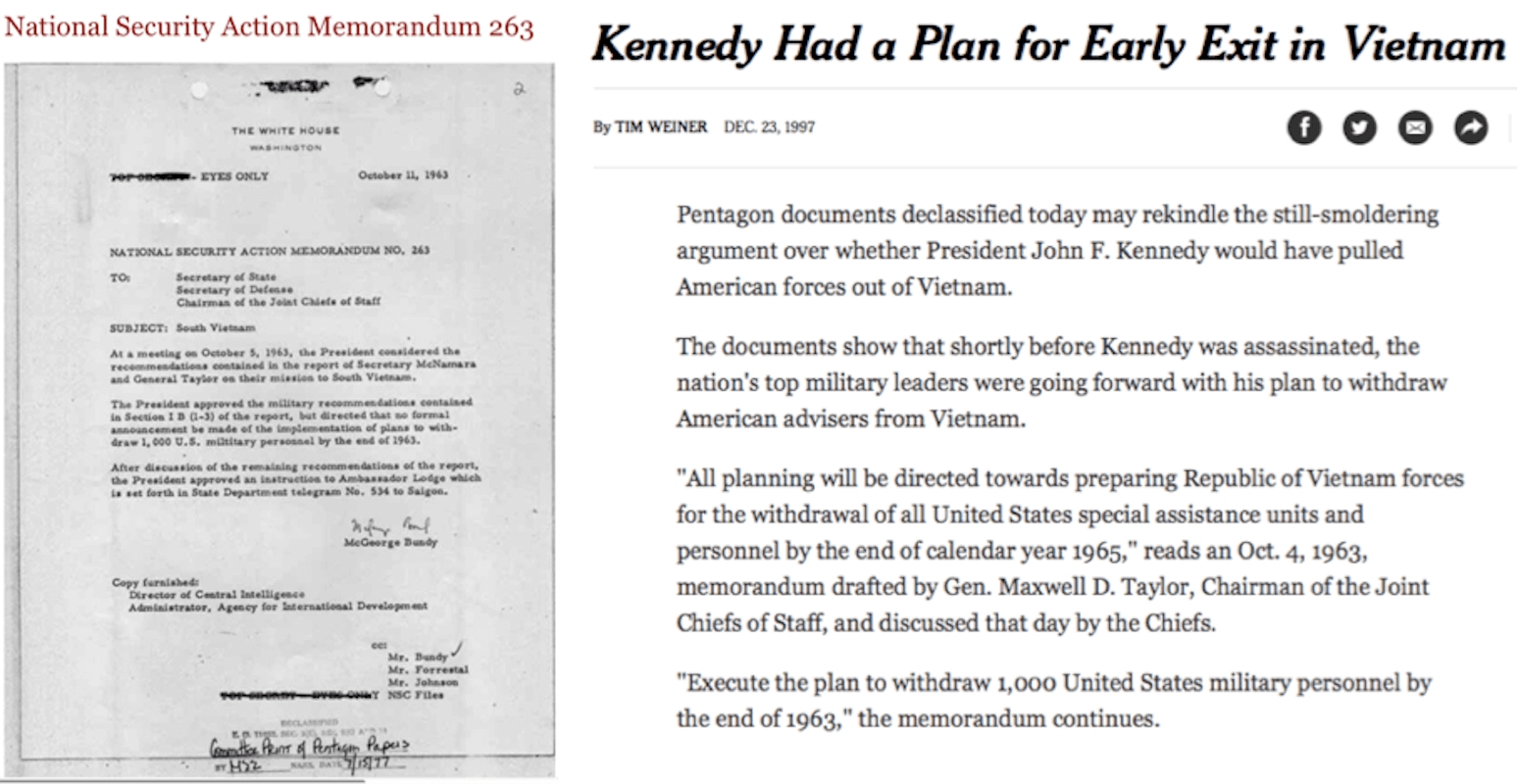
    Coinciding with all this is what is probably the most important document declassified by the ARRB. McNamara held regular meetings of the Saigon chiefs of agencies and the Pentagon in Hawaii. These were called Sec/Def meetings. For the one in May of 1963, he had requested that each agency and military chief bring with him their withdrawal schedule. After he had looked them over, he said they were too slow and would have to be speeded up. There was no qualification by McNamara that this withdrawal was hinging upon an American “victory” and there was no contingency plan mentioned to reinstate troops if the victory was not in sight. In fact, General Earle Wheeler wrote that he understood that any request for any overt action would be denied by the president. (Probe Magazine, Vol. 5, No. 3, pp. 19-21) These documents were so compelling that even The New York Times bannered a story with the headline: “Kennedy Had a Plan for Early Exit in Vietnam.” (ibid, p. 19) One would think that if it were good enough for that paragon of the MSM, the Grey Lady, it would be good enough for Burns and Novick. Needless to say, none of these documents are shown in The Vietnam War.

    Neither is NSAM 263 exhibited. This was the order drawn up in early October of 1963 that delineated the withdrawal plan and mandated that a thousand men be returned from Vietnam by the end of 1963. The story of how the order and the report it was attached to were created is revealing, and would have been informative to the viewer. By the autumn of 1963, JFK now had everything in place to activate his withdrawal plan. But he wanted to send his two highest military advisors to Saigon, that is, McNamara and Chairman of the Joint Chiefs Maxwell Taylor. He trusted McNamara, but not Taylor. Therefore, while those two were in Vietnam, Pentagon higher ups General Victor Krulak and Colonel Fletcher Prouty were invited to the White House. Bobby Kennedy met the duo. He instructed them, upon orders of the president, that they would actually edit and compose the Taylor/McNamara report at his direction. (John Newman, JFK and Vietnam, p. 401) Once that was done, it was shipped out to Hawaii and given to Taylor and McNamara in bound form. Kennedy was not allowing for any alterations.

    That report became the basis for NSAM 263. Presidentially designed, the report was used by him to ram 263 through his foreign policy advisors—some of whom were reluctant to sign on to it. But, reluctant or not, they ultimately did. McNamara was then sent out to announce the withdrawal plan to the press. As he was walking to meet the reporters, Kennedy instructed him with the following: “And tell them that means all of the helicopter pilots too.” (ibid, pp. 404-07)

    One would think that if a filmmaker were trying to assemble the latest scholarship on Vietnam for an American audience—if one were really trying to enlighten them with the best and newest information—then at least some of this would be included in the presentation. Or at least he or she would communicate some of the (at least) nine sources that Kennedy or McNamara confided in about the withdrawal plan. Or perhaps play the October 2, 1963 taped conference where McNamara actually says that they have to find a way to get out of Vietnam. (Blight, p. 100)

    I shouldn’t have to replay this refrain by now: None of this information is in the film. But as Burns pronounced on Marc Maron’s radio podcast of September 11th : History is malleable. Sort of like bubble gum, right Ken?

    What do Burns and Novick tender us instead? They give us Neil Sheehan and Jean Paul Vann. Which means they would have given us David Halberstam if he were alive. (See my two-part review, “David Halberstam, The Best and the Brightest) When I saw this, I realized just how much The Vietnam War wanted to be part of the MSM, and just how far PBS had fallen. For Halberstam’s The Best and the Brightest—which Warren Hinckle once called “one of the greatest bullshit books ever written”—makes McNamara out to be the chief engineer of the war. When, in fact, from April of 1962 to November of 1963, he was implementing Kennedy’s withdrawal plan. McNamara had even told his deputy, Roswell Gilpatric, that Kennedy had assigned him the task of winding down the war. (Blight, p. 371)

    Jean Paul Vann was one of the military advisors stationed in Vietnam under Kennedy. By all accounts he was committed to the cause of the American created nation-state of South Vietnam. Halberstam and Sheehan were young reporters at the time. Halberstam had been sent to Vietnam after being assigned to the Congo. Which is an important point. As noted above, one of Kennedy’s first reversals of Dulles/Eisenhower Cold War policy was in the Congo. In fact, that was the first place where JFK directed specific alterations to his predecessor’s policy. These would favor leftist leader Patrice Lumumba and the cause of emerging African nationalism. In that instance Kennedy was contravening a (British aided) Belgian attempt at recolonization. (Mahoney, pp. 65-69)

    Valuable research by Paul Rigby has shown that, prior to being assigned to Vietnam, Halberstam had done what he could to condescend to Kennedy’s efforts in Congo. In the pages of Times Talk—Halberstam’s employer, the NY Times in-house journal—the reporter conveyed some of those ideas. His stories, such as “It’s Chaos for a Correspondent in the Congo” and “Congo Boondocks: Land of Cannibals and Diamonds,” communicated the Establishment line that Congo could not handle independence because it was simply a land of African primitives. (William Prochnau, Once Upon a Distant War, p. 509; see also Halberstam’s The Making of a Quagmire, pp. 3-24) Halberstam seemed to be missing the overall gestalt of the struggle. He would later write of that colossal, epic conflict—which killed both Lumumba and Dag Hammarskjold—that there was less there than met the eye. (Halberstam, p. 17)

    Halberstam’s outlook and attitude failed to fully grasp Kennedy’s concepts in Congo, where JFK decided to do all he could to enforce UN Secretary General Hammarskjold’s policies for Congolese independence against America’s European allies England and Belgium. Kennedy continued that policy alone after Hammarskjold was killed. (“Hammarskjold and Kennedy vs. The Power Elite”) It is clear today—as it was then—that both Lumumba and Hammarskjold were murdered by colonial powers trying to retake the mineral wealth of Congo. (“Plane crash that killed UN boss may have been caused by aircraft attack”) Yet, in 1965, Halberstam could write that the Congolese cared less for their country than white people did. (ibid, p. 18) Unlike Halberstam, Jonathan Kwitny later fully comprehended what had happened. As Kwitny wrote, Patrice Lumumba became a hero in Africa “not because he promoted socialism, which he didn’t, but because he resisted foreign intervention. He stood up to outsiders, if only by getting himself killed.” (Endless Enemies, p. 72) As the picture below illustrates, Kennedy certainly understood Lumumba’s cause and his martyrdom:

    jfklumumba
    Kennedy receiving word of Lumumba’s death
    (photo: Jacques Lowe)

    On the larger, more epic level, Kwitny also had a much richer understanding of what was at stake in Congo than Halberstam. After surveying what happened, he memorably wrote about the legacy of Lumumba and what it meant in the larger movement of African nations to break out of the servitude of colonialism:

    The democratic experiment had no example in Africa, and badly needed one. So perhaps the sorriest … blight on the record of this new era is that the precedent for it all, the very first coup in postcolonial African history, the very first political assassination, and the very first junking of a legally constituted democratic system, all took place in a major country and were all instigated by the United States of America. It’s a sad situation when people are left to learn their ‘democracy’ from the Union of Soviet Socialist Republics. (ibid, p. 75)

    When Halberstam got to Vietnam—actually on his second day there—he lunched with the CIA’s station chief in Saigon. (Prochnau, p. 133) As the weeks went by, many of his CIA contacts from Congo migrated there. As author William Prochnau wrote, “By now his CIA contacts from the Congo had begun to flock to the hot new action in Southeast Asia like bees to honey; Vietnam was a spook’s dream and the Agency forever had a better fix on Vietnamese reality than the American military.” (ibid, p. 169)

    Halberstam admitted this in his 1965 book, The Making of a Quagmire, where he wrote, “But many CIA agents in Saigon were my friends, and I considered them among the ablest Americans I had seen overseas or at home.” (p. 222) In that book, Halberstam attempts an all-out defense of the CIA’s role in both Vietnam and the developing world. And he adds that inherent suspicion of the Agency is “the outgrowth of its bogeyman image among liberals …”. (ibid) This is especially puzzling today since the Church Committee revealed that Allen Dulles and the CIA had arranged numerous plots to kill Lumumba in the Congo, where the writer had just been stationed for many months. Later on, Halberstam attempted to distance himself from these admissions. He told Prochnau that UPI reporter Neil Sheehan had better CIA sources than he did, but he had better military sources. (Prochnau, p. 277)

    Both Halberstam and Sheehan were enamored with Vann, even though they understood he was an “essentially conservative, at times [an] almost reactionary man.” (Halberstam, p. 164) In their film, Burns and Novick have Sheehan tell us that, upon his own arrival in Saigon in 1962, he believed in American ideals and the alleged US mission in South Vietnam. He also believed in the dangers of the “international communist conspiracy”. Sheehan then adds that he was there to report the truth in order to help win the war for the betterment of the United States and the world. He describes going along on ARVN helicopter missions as being part of a crusade: he was thrilled by the experience.

    These attitudes made Sheehan and Halberstam easy targets for Vann. And negatively complementing that, it guaranteed that they would completely miss what Kennedy was doing. Colonel Vann was a veteran of Korea and, by 1963, had served in the military for twenty years. With Sheehan’s help, Burns and Novick spend several minutes outlining the January 1963 Battle of Ap Bac, an important conflict that Vann helped plan and supervise. Although the Viet Cong were outnumbered by a large margin, even though the ARVN had helicopter support and used armored personnel carriers, this battle turned out to be, by any accounting, a losing proposition for Vann. Saigon lost 80 dead, more than one hundred wounded, and five helicopters destroyed. The Viet Cong lost 18 dead and 39 wounded. Vann was deeply angered and confided the true facts of the defeat to his students Sheehan and Halberstam, who both wrote about the failure of the battle.

    The film does not reveal a key reason for that failure, one which Vann himself had discovered. Ngo Dinh Diem had issued orders to his field commanders not to initiate large offensive operations that would provoke serious casualties. Vann’s intelligence officer, Jim Drummond, concluded that the ARVN had not really checked the growth of the Viet Cong or the area under their control. (John Newman, JFK and Vietnam, p. 299) In other words, contrary to what the commander in Vietnam, General Harkins, was saying, America was not winning the war. And Ap Bac was living proof of that.

    Vann was shipped out of Vietnam in 1963 and served in the Pentagon as a procurement officer. He began to file formal reports complaining about how the war was being fought. These reports appealed to General Edward Lansdale because they clearly projected the fact that unless American ground troops were committed to Vietnam, Saigon would fall. (ibid, p. 319) As we have seen, this is the message Kennedy had listened to in November of 1961—and had rejected. Kennedy was aware of what Vann was doing. Both he and McNamara opposed the work of his acolyte Halberstam; Kennedy even asked the publisher of the Times to rotate him out of Saigon. (David Kaiser, American Tragedy, p. 261; Halberstam, p. 268)

    But Edward Lansdale had been the first to advise Kennedy to insert combat troops into Vietnam. (Newman, p. 20) Sure enough, after Kennedy’s death, when Lansdale returned to the White House, he recommended sending Vann back to Vietnam. Vann did return in 1965, when Lyndon Johnson overturned Kennedy’s policy and committed tens of thousands of American combat troops to Saigon. (Kaiser, p. 384)

    The reason that Sheehan and Halberstam admired Vann was simple: like him, they were Hawks. And like him—and opposed to Kennedy—they wanted more American involvement, not less. This is easily discernible by reading Halberstam’s 1965 book The Making of a Quagmire. That volume is perhaps the single most complete and coruscating condemnation of America’s Vietnam policy published to that point. It attacks every element of the American mission in that country and also the policies and personages of the Diem regime. (See Chapters 3-5) It then goes on to expose the ineptness of the ARVN (Chapters 5-7), in particular how bad Colonel Hunyh Van Cao was. The latter actually gets his own chapter: 10. Why so hard on Cao? Because Vann was the advisor attached to him, and—as with Sheehan—Vann was Halberstam’s hero in 1965. Why? Because he knew how to win the war. (See Chapter 11) So for Halberstam, when Vann departed, things got worse. (see Chapter 12).

    If Halberstam could not make it more clear, he does near the end of the book. With Sheehan mentioned throughout, he proclaims: “Bombers and helicopters and napalm are a help but they are not enough.” (p. 321) He then concludes with the following: “The lesson to be learned from Vietnam is that we must get in earlier, be shrewder, and force the other side to practice self-deception.” (p. 322)

    Of course, when the wishes of this troika—Sheehan, Vann and Halberstam—were fulfilled, we saw what happened. Direct American involvement ended up being an epic debacle. As many as 3-4 million people were slaughtered amid almost unimaginable horror. All in pursuit of a false goal that was not possible to attain. In other words, Kennedy was right and Vann, Sheehan and Halberstam were wrong. But neither Halberstam nor Sheehan could ever admit that. It is especially startling that Halberstam never saw the parallels of what happened in both Congo and Vietnam after Kennedy was killed: In Congo, the Agency and LBJ switched sides and joined the imperial interests; in Vietnam, the Pentagon and Johnson now broke Kennedy’s strictures and eventually imported 540,000 combat troops, making it an American imperial war. Truly puzzling that he would miss all of this.

    Sheehan and Halberstam got their wish. And even after it was clear that direct American involvement would not work, it took them years to understand it. And further, that the American army was self-destructing in the jungle, as Kennedy had predicted it would back in 1961. By 1971, even the army understood this. Colonel Robert Heinl wrote a long essay on its collapse at that time, and traced it from at least 1969. (Col. Robert D. Heinl, Jr., “The Collapse of the Armed Forces”)

    But author and activist Mark Lane understood it even earlier. In 1970 he published a book of personal interviews with returning veterans. The book was called Conversations with Americans. It was a shocking exposé of the individual and group war crimes that American solders had committed in Vietnam. Since there was a danger that his interview subjects would be prosecuted, he gave them the option of using fictitious names. He marked these with an asterisk in the text. He then added that the real names and full transcripts had been given over to an attorney who had worked for the Justice Department. (Lane, p. 17)

    When the book was published, The New York Times trotted out Sheehan to review it. (NY Times Book Review, 12/27/70) Sheehan wrote that he had contacted the Pentagon and some of the people named in the book did not serve in the military, or were not in the places where they said they were at the time. Which implied that what Lane was writing was fictitious. After, when Lane called the New York Times to talk to Sheehan, Sheehan would not accept his calls. The Times then sent Sheehan out on tour to promote his column. Which, of course, was a promotion of the collapsing war effort. Apparently, as a believer in the international communist conspiracy, Sheehan never imagined that there was a systematic, institutionalized cover-up of these crimes after the 1968 My Lai Massacre. But there was such a cover-up, and author Nick Turse discovered it when he found the (incomplete) records. (Kill Anything that Moves, pp. 15-21) When Lane asked Sheehan about My Lai during a radio interview, the New York Times reporter replied that it was just a rumor. (Mark Lane, Citizen Lane, pp. 220-21)

    Under pressure from the Times and Sheehan, Lane’s book was withdrawn from circulation.

    This is the man Burns and Novick use as the main talking head in their segment on the Kennedy years. With their defense of the Dulles brothers as “decent people” in Part One, the disappearance of Kennedy’s withdrawal plan and the championing of Vann and Sheehan in Part Two, so far the net value of this documentary is something less than zero.


    Addendum

    Although some critics of the film JFK have stated that there was no public announcement of NSAM 263, and Kennedy was keeping it quiet, as the reader can see in the following two Newsweek articles, that is false.  It was a public policy, and Kennedy had sent Defense Secretary Robert McNamara to brief the press on it after he had adopted it in October, 1963. (John Newman, JFK and Vietnam, p. 407)

    Newsweek, October 14, 1963

    (Click here if your browser is having trouble loading the above.)

    Newsweek, December 2, 1963

    (Click here if your browser is having trouble loading the above.)


    Part 1

    Part 3

    Part 4

  • Ken Burns & Lynn Novick, The Vietnam War: Part One

    Ken Burns & Lynn Novick, The Vietnam War: Part One


    After a huge publicity build-up the PBS ten-part series The Vietnam War is upon us. Like previous efforts—The War, Prohibition, Baseball—it was written by Geoffrey Ward and produced and directed by Ken Burns and Lynn Novick. I predict that like those other documentaries, it will win many Emmy Awards. But not because of any intrinsic qualitative value. But because Burns has become a cultural darling. He, Novick and Ward understand how to attain funding and how to get approval through media gatekeepers. Which is not the same as writing or filming honest, valuable history. As we will see, whatever historical value this much-ballyhooed production has is quite dubious.

    It begins with the 1858 attack on DaNang as the French begin to take over all of Indochina for colonial purposes. After France fell to Germany in World War II, the Japanese occupied Vietnam. Before he passed away President Franklin Roosevelt had made a statement that after the war, former colonies should be allowed freedom to choose their form of government in the future. The film mentions Roosevelt’s dictum but says President Truman turned this around due to the Russians exploding atomic bombs, China being taken over by Mao and the eruption of the Korean War. This sounds a lot like it was cribbed from David Halberstam’s bad book, The Best and The Brightest. And like much of that bloated mediocrity, it is not really accurate. And since one of the main talking heads in The Vietnam War is Leslie Gelb, the editor of the Pentagon Papers, Gelb could have corrected this.

    After the British let the French back into Vietnam in 1946, there were still those in the State Department who followed the on-and-off vacillations of France’s policy toward Bao Dai. Bao Dai had been the titular leader of Vietnam since 1926. The French gave him little leeway to accomplish anything of significance. The Japanese allowed him to stay as a figurehead leader during World War II. Some in the State Department told the French to alter the successive “agreements” they contracted with Bao Dai into an effective nationalist alternative to revolutionary leader Ho Chi Minh and his followers the Viet Minh. This proved unsuccessful. And the US sensed that French unwillingness to concede political power to the Vietnamese “heightened the possibility of the Franco-Viet Minh conflict being transformed into a struggle with Soviet imperialism.” (Pentagon Papers, Volume I, p. A-5)

    Therefore, American diplomats were told to “apply such persuasion and/or pressure as is best calculated to produce desired result of France’s unequivocally and promptly approving the principle of Viet independence.” And Paris was put on notice that the US “was willing to extend financial aid to a Vietnamese government, not a French puppet, but could not give consideration of altering its present policy in this regard unless real progress is made in reaching non-communist solution in Indochina based on cooperation of true nationalists of that country.” (Ibid)

    This same study found that there was no strong evidence of Soviet influence with Ho Chi Minh in 1948, even though the French colonialist war had been going on for two years at that time. (Volume 1, p. A-6)

    In early 1950, the French “took the first concrete steps toward transferring public administration to Bao Dai’s State of Vietnam.” This fateful move enraged Ho Chi Minh who denied the legitimacy of Bao Dai as anything more than a puppet of Paris. At this point Ho’s Democratic Republic of Vietnam (DRV) was formally recognized by China and the USSR (ibid, p. A-7) When this occurred, Secretary of State Dean Acheson now reversed the policy of neutrality that had been announced in 1948. On February 1, 1950 he made the following public statement: “The recognition by the Kremlin of Ho Chi Minh’s communist movement in Indochina comes as a surprise. The Soviet acknowledgement of this movement should remove any illusion as to the ”nationalist” nature of Ho Chi Minh’s aims and reveals Ho in his true colors as the mortal enemy of native independence in Indochina.” (ibid, p. A-7)

    Acheson then tried to disguise the aim of France bestowing administrative powers on Bao Dai by saying this would actually lead “toward stable governments representing the true nationalist sentiments of more than 20 million peoples of Indochina.” (ibid) Apparently keeping tongue in cheek, he went further and said this move was backed by the countries of the world “whose policies support the development of genuine national independence in former colonial areas … .”

    On the day France recognized Bao Dai, President Truman also recognized him as the leader of Vietnam. A few weeks later, France began to request financial aid for their mandarin. On May 8, 1950, Acheson acceded to that request with these words:

    The United States Government, convinced that neither national independence nor democratic evolution exist in any area dominated by Soviet imperialism, considers the situation to be such as to warrant its according economic aid and military equipment to the Associated States of Indochina and to France in order to assist them in restoring stability and permitting these states to pursue their peaceful and democratic development.

    As the Pentagon Papers notes, “The US thereafter was deeply involved in the developing war.” (ibid, p. A-8) Later that year, the United Sates stationed a Military Assistance Advisory Group in Saigon to help the French.

    I would have gladly forfeited all the incessant Burns-Novick use of colored maps with red endangering the Far East (I counted this six times just in Part One); all of narrator Peter Coyote’s—who I used to think was a pretty decent guy—intoning the David Halberstamish warnings about Russia detonating an atomic bomb, or China going communist; I would have exchanged all of those warmed-over 1970’s clichés for just three minutes of the above passages from the Pentagon Papers. Since this was the real reason America got involved in Vietnam: our failure to stand up to the French desire to recolonize Indochina. In other words, Secretary of State Acheson valued the alliance with France more than he did Roosevelt’s pledge of colonial independence. And his failure to admit Bao Dai was a French puppet is what pushed Ho Chi Minh closer to Moscow.

    Two questions so far: how can you elucidate anything as fundamental and documented as this if:

    1. You never mention the name of Dean Acheson, and
    2. You never mention the name of Bao Dai?

    Incredible as that sounds, it is true. And it was at this (rather early) point that I began to question the film-makers’ honesty. It is fine and dandy to let people directly engaged in the conflict, that is, soldiers and civilians, have their say. It gives the series grounding in the day-to-day ugliness and drama of that prolonged horrific struggle. But do Tom Vallely, Duoun Von Mai and John Musgrave make up in importance for the lack of Acheson and Bao Dai? Anyone who saw the film Platoon—as millions did—knows how scary night patrol must have been in Vietnam. But one function of the historian is to explain how John Musgrave got into that precarious position. The declassified record shows it was Acheson’s decision that got America “deeply involved in the developing war.” (My citations are from the completely declassified Pentagon Papers, not the Daniel Ellsberg or Mike Gravel versions which were incomplete.)
    But that is just the beginning of the crucial excisions made by Burns and Novick. How in heaven’s name can one tell the story of American involvement in Vietnam without mentioning the personages of Secretary of State John Foster Dulles, CIA Director Allen Dulles, or General Edward Lansdale? With a full 18 hours at one’s disposal, I would have thought such a thing would be impossible. Yet with Burns and Novick, the impossible becomes the possible. And by doing so, the film-makers all but erase the next major step of American involvement in Vietnam, and how Musgrave got stuck on that nighttime patrol in the jungle.

    John Foster Dulles was even more extreme than Dean Acheson. His anti-communism contained an almost religious-metaphysical amplification. But he was not just anti-communist. Like his brother Allen, he would not even tolerate neutrality, or non-alignment within the boundaries of the Cold War. (See Kennedy, Johnson, and the Nonaligned World, by Robert Rakove, pp. 5-8) Therefore, the aid to France in its imperial war was greatly increased once Eisenhower became president and Foster Dulles his Secretary of State. Today, it is common knowledge that by 1954, America was footing close to 80% of the cost of the war. In the last year of the war, America had supplied France with over a billion dollars in supplies and weapons. By 1953 this meant 12 shiploads per month, which had accumulated at that point to 777 armored fighting vehicles, 13,000 transport vehicles, and 253 naval vessels (See John Prados, Operation Vulture, Chapter 1 of the e book format.)
    Burns and Novick briefly discuss the 1954 battle at Dien Bien Phu, which ended the French attempt to retake their Indochina empire. Dien Bien Phu was a scheme created by General Henri Navarre to lure General Giap, Ho Chi Minh’s military commander, into the northwest corner of the country. The idea was to engage Giap in an open battle and crush his forces via artillery and aerial bombardment. That strategy backfired. And about a month into the 55-day siege, it became apparent that France had gambled and lost.

    But the Dulles brothers were not going to accept the fact that they had bet on the wrong horse. They now began to arrange one of the most frightening and outrageous episodes in the entire 30-year history of the war. It was called Operation Vulture. As John Prados, Fletcher Prouty and others have noted, this was the assemblage of a giant air armada. It was made up of over 200 planes. It consisted of fighters, bombers and three special Convairs to carry three atomic bombs to bail out the French. As Prados describes in his book Operation Vulture: America’s Dien Bien Phu, this was a Dulles brothers project, done with the knowledge and connivance of Vice President Richard Nixon. Nixon had previously convinced Eisenhower to allow the French to use American support planes, which were flown by CIA pilots. And some of these planes and pilots flew into Dien Bien Phu in March of 1954. They were disguised with French insignias. (Prados, Chapter 3)

    Eisenhower would only approve Vulture under certain restrictions. Two of them were congressional consultation, and also that our main ally England would join the effort. Nixon lobbied Congress, while Foster Dulles had his ambassador to England approach foreign minister Anthony Eden for approval. Dulles then went to London himself. Eden refused to go along and (correctly) labeled the effort a lost cause. (Prados, Chapters 6 and 8)

    Nixon and Dulles did not agree. And Dulles and Chairman of the Joint Chiefs Arthur Radford did not give up. They had meetings with congressional leaders like Senators Lyndon Johnson and William Knowland, and encouraged the Pentagon brass to support Vulture. (ibid, Chapter 6. Although David Halberstam, in his book The Best and the Brightest, wrote that LBJ did not support direct American intervention in 1954, Prados dug up written evidence that he actually had.)

    This lobbying effort included a speech in April of 1954, where Nixon proposed the insertion of American combat troops to save Dien Bien Phu. Which is perhaps the first public statement of that kind by a high ranking American politician. (Prados, Chapter 9) Foster Dulles made no attempt to reprimand Nixon for that statement. In fact, the two men were sharing working lunches on the attempt to save France. Foster Dulles now began to encourage Eisenhower to act unilaterally. At the same time Radford had sent a bombing specialist to fly over Dien Bien Phu to inspect the proper paths and altitudes for Vulture. (Ibid, Chapter 10)

    When Eisenhower would not act alone, Foster Dulles played his last card. He offered the French foreign minister the use of two atomic bombs to lift the siege. Georges Bidault said his reply did not require a lot of thought. He pointed out to Dulles, “If those bombs are dropped near Dien Bien Phu, our side will suffer as much as the enemy.” (David Talbot, The Devil’s Chessboard, p. 245) What makes this so stunning is that Dulles was acting without presidential approval in making that proposal.

    In watching the opening episode of this series, which deals with the French defeat in Vietnam, I did not detect one mention of Operation Vulture.

    After pondering that historical black hole about the Dulles brothers, I began to think back to one of the opening statements made by poor Peter Coyote. He says that the Vietnam War “was begun in good faith by decent people out of fateful misunderstandings.” Decent people? Misunderstandings? Bidault certainly did not misunderstand the effect of thermonuclear war over Dien Bien Phu. And in this day and age, with all we know about them, how can anyone call the Dulles brothers “decent people”? One wonders if that common knowledge today is the reason that their names are left out of this installment.

    From the fall of Dien Bien Phu, the episode now shifts to the peace conference at Geneva, Switzerland. As everyone who has studied that conference knows, it was essentially stage-managed by the United States, with Foster Dulles as the ringmaster. Although Ho Chi Minh and Giap had soundly defeated the French, China and Russia understood that the Dulles brothers’ unending support for the French colonial cause signaled ominous warnings for the future. Namely, as Nixon had alluded to, direct American intervention. Their allies therefore encouraged Ho and Giap to take a smaller cut of the pie than they had earned. Foster Dulles and Eisenhower had two immediate goals. The first involved the immediate future of Vietnam. They wanted a partitioning of the country between north and south at the 17th parallel with a Demilitarized Zone there. At the end of a two-year period, national elections would be held and the country would be unified under independent, democratically elected national leadership. Since the Dulles brothers were lawyers, they pulled a neat legal trick over this agreement. The United States did not actually sign the agreement. But Foster Dulles had his representative read a statement saying that America would honor the agreement. (See Vietnam Documents, edited by George Katiaficas, pp. 25, 42, 78) The other aim the administration had was to set up an anti-communist alliance called the Southeast Asia Treaty Organization. Which, of course, made the specter of American intervention more palpable.

    Within weeks of the conference, Allen Dulles had given veteran black operator Edward Lansdale the assignment of creating a country called South Vietnam—which had never existed before—and propping up a new leader there named Ngo Dinh Diem. The Agency gave Lansdale a blank check, and the ambitious and imaginative CIA officer came through in spades. Knowing Diem was a Catholic, Lansdale created one of the largest psychological operations in the history of the CIA. As Ralph McGehee described in his book Deadly Deceits, Lansdale infiltrated teams into the north to disseminate propaganda about upcoming pogroms by the Chinese Communists against the North Vietnamese, and perhaps American atomic weapons used over Hanoi. As a result, in the 300 day grace period for north-south migration, about a million people fled the north, about half of them Catholics. The CIA allowed free transportation on US Navy ships and also air flights through their proprietary Civil Air Transport. Not only did this boost Diem’s constituency, it fooled many Americans into thinking that somehow Hanoi embodied evil and Saigon—the new capitol of the new country—was a democratic oasis.

    Lansdale then helped further this illusion. He helped Diem rig a plebiscite that placed him officially in power with a mind-boggling 98% of the vote. Diem’s opponent, Bao Dai, was not allowed to campaign. And as Seth Jacobs wrote in Cold War Mandarin, in several districts, the vote tally for Diem exceeded the number of registered voters. What made this even harder to swallow was that voter turnout was nowhere near 100 percent. (Jacobs, p. 95) Lansdale had told Diem 60% would be plenty, but Diem insisted on the 98 number. (The CIA: A Forgotten History, by William Blum, p. 139) Lansdale had done all his masters wished, and more. In fact, as John Pilger noted in his book Heroes, Lansdale later complained, “I cannot truly sympathize with Americans who help promote a fascistic state and then get angry when it doesn’t act like a democracy.”

    Although you can see his photograph twice, you will not hear Lansdale’s name mentioned in Part One. And by doing that, the CIA’s role in the rigged plebiscite and the forced migration is not revealed. Why this silence over the man who, in reality, created South Vietnam and Ngo Dinh Diem? Maybe because he wasn’t one of the “decent people”?

    The effect of Lansdale’s work was to first, to stop the promised 1956 elections from making Ho Chi Minh president of a united Vietnam, and second, to spell the end of any leftover French rule in the south. With the plebiscite, Bao Dai was now gone. In fact, Diem formally banned him from visiting the country. After all this skullduggery and treachery, Foster Dulles would make the following astonishing statement: “We have a clean base there now, without a taint of colonialism. Dien Bien Phu was a blessing in disguise.” In the judgment of history, could any statement have been more wrong?

    In May of 1956, Washington further violated the Geneva Agreements by sending in 350 military advisors. (ibid, Blum p. 139.) Burns and Novick try to place this violation on President Kennedy. But JFK just sent in more military advisors, they were not the first. And as far as violating the Geneva Accords, the Dulles brothers had broken that agreement to pieces already. But the importation of advisors was made necessary since the vote for Diem was so ersatz. He had no real broad-based constituency.

    Since Diem could not command the allegiance of the people, the resistance against him began in the countryside. To counteract this rebellion, the CIA created a training program for Saigon security forces at Michigan State University. It was these trainees who manned Diem’s brother Nhu’s police force. A law was passed in 1957 that every Vietnamese 15 years and older was required to register with the government and carry a proper ID. Anyone without a card was considered a part of the National Liberation Front, the political arm of Ho Chi Minh’s sympathizers in the south. The military arm would be called the Viet Cong. Thus, using Lansdale’s ingenuity and the CIA’s money, the Dulles brothers created a “fascistic” police state which ended up imprisoning, torturing and executing tens of thousands of people.

    But as Lansdale said, who can get angry when a fascistic state doesn’t act like a democracy?

    These are the “decent men” that Burns and Novick could not bring themselves to mention.


    Part 2

    Part 3

    Part 4

  • Nicholas Schou, Spooked: How the CIA Manipulates the Media and Hoodwinks Hollywood

    Nicholas Schou, Spooked: How the CIA Manipulates the Media and Hoodwinks Hollywood


    Sometime during production of the film All the President’s Men, the director Alan J. Pakula fired the screenwriter, William Goldman. This isn’t especially notable—writers are always the first people to get fired off any production—although this wasn’t just any screenwriter. In his book Adventures in the Screen Trade, Goldman writes that it seemed like everybody on the planet knew he’d been having issues with that script. He says he happened to meet Walter Cronkite during this period, and the only thing Cronkite said to him was “I hear you’re having script trouble.”

    In 1976, Goldman won the Oscar for writing All the President’s Men, despite having been fired off the picture.

    Other writers had done passes on the script, most notably Nora Ephron. Ephron was dating Carl Bernstein at the time, the reporter portrayed by Dustin Hoffman in the picture, who in turn was the partner to Bob Woodward, played by Robert Redford. Goldman later observed that Bernstein sure seemed to be “catnip to the ladies” in Ephron’s scenes.

    Did Goldman deserve the Oscar? He definitely built the structure to carry the story, which is not easy to do. All the President’s Men isaesthetically—a terrific movie, and it starts with the writing. Jason Robards got an Oscar for stealing every scene he’s in, but honestly the part is gift-wrapped for him. There is snappy dialogue, some terrific reversals, and a gripping story. It’s become a model for this sort of film—the recent Oscar-winning Spotlight showed its influence, for example.

    There’s only one problem. All the President’s Men is a lie. It’s the setting in stone of the public face of the Richard Nixon scandal, told with the help of Woodward and his ex-ONI buddies and Al Haig. It glorifies the myth of “Woodstein,” intrepid reporters taking down a criminal president. It also did for Bob Woodward what the JFK assassination did for Dan Rather—provide a platform to kick off a career serving the state through the media.

    Hollywood has had a complicated relationship with the government for a long time, partly for reasons of actual patriotism and partly because of money. (It’s always at least partly the money.) Right now on Netflix there is a wonderful documentary series Five Came Back, about how great directors like John Ford, Frank Capra, and John Huston, among others, helped make films supporting the U.S. against the Nazis. They took their job seriously in this regard. Joseph McBride details the background, for example, of the making of the film Mr. Smith Goes to Washington in his wonderful book Frank Capra: The Catastrophe of Success. Capra, a complex figure if ever there was one, felt conflicted by the thought he might have made a picture casting his adopted country in a negative light. “When a prominent man like the ambassador of England says this is going to hurt the war effort, that was serious. Would it do that? I wanted to do what was right.” (McBride, 423).

    However, it’s one thing to make pro-American films when the cause is just. When Indiana Jones says, “Nazis. I hate these guys,” we agree.

    Unfortunately, there are some Hollywood directors who are eager to cooperate with the U.S. in favor of more dubious causes, as with Kathryn Bigelow in The Hurt Locker and Zero Dark Thirty, or Michael Bay making the military look terribly exciting for young men in the Transformers series. Clint Eastwood took up the ridiculous cause of invading Grenada in Heartbreak Ridge and the Pentagon backed Top Gun: essentially a long commercial for fighter pilots. Ben Affleck celebrated the CIA in Argo and was rewarded for it by both the public and the Academy. Tom Hanks infamously backed Vincent Bugliosi—a project that united the typically fractious JFK research community.

    On the other side, films opposing the American military-intelligence-complex tend to face stiff opposition and little funding. Oliver Stone has been the exception rather than the rule in this arena, as the best political films tend to be either foreign or small-budget enterprises, such as Costa-Gavras’s Z. While controversy can help sell a picture, criticizing established structures of power isn’t the kind of controversy producers like. This even extends to actors. When Jean Seberg, the beautiful ingénue from Jean-Luc Godard’s famous film Breathless, began to donate money to leftist causes, the FBI opened a COINTELPRO operation against her. Among the things they did was falsely accusing her of fathering a boy with a Black Panther.


    II

    In the last few years, a slate of books about the unhealthy relationship between domestic intelligence agencies and media centers have emerged. Nicholas Schou’s Spooked is one of the newest, and it comes with heavy praise: a foreword by David Talbot, as well as endorsements from the likes of Oliver Stone and Peter Dale Scott. Schou’s own bona fides are formidable, having worked as an investigative journalist and written the Gary Webb biography Kill the Messenger, which was made into a film of the same title starring Jeremy Renner.

    The subtitle of the book is How the CIA Manipulates the Media and Hoodwinks Hollywood. Unfortunately, this subtitle is itself something of a hoodwink. A short book (less than 150 pages), the content really consists of a survey of some of the major news stories of the last half-century or so. The chapters deal with various aspects, for example, of WikiLeaks and its relation to the media, Julian Assange, Edward Snowden, the Iraqi war scandals, the Church committee, Seymour Hersh on the Osama bin Laden raid, Robert Parry and his work, and a short summation of the Gary Webb crack-cocaine CIA scandal. These are all worthy topics, and deserve longer treatments than they get here (and in fact did, since as noted Schou also wrote the Webb biography.)

    The short length of the book means that each topic is dealt with in a superficial manner. For example, he mentions that when CIA agent Valerie Plame was “outed,” it was by Richard Armitage (Schou, p. 67). However, he gives no further information on Armitage, who was Assistant Secretary of Defense for International Security Affairs under Ronald Reagan, and a key player in the Iran-Contra scandal. In addition to that, Armitage also met with General Mahmoud Ahmed, the leader of the Pakistani ISI, the week of 9/11. General Ahmed is important because he ordered a wire transfer of $100,000 to the alleged leader of the Saudi-Arabian hijackers, Mohammed Atta. There is a wealth of information lurking behind the stories that appear in Spooked, and while it’s understandable that he can’t get to everything, Schou misses some key aspects of the particular events he is trying to summarize. He also fails to cite much information in the way of demonstrating that CIA “manipulates the media” or “hoodwinks Hollywood.”

    First of all, the idea that the CIA “hoodwinks” or “manipulates” the media is a questionable premise to being with. In many cases, the CIA more or less is the media. We know because of Carl Bernstein’s famous article in Rolling Stone that the CIA quite often pays journalists directly to work for the agency. And Schou does mention this in his book, as well as citing examples like William Paley at CBS and other stories that are already pretty well known.

    Also, Hollywood isn’t hoodwinked. Like any other business, there are people who are willing to play ball and others who aren’t. For example, when it was announced that Antoine Fuqua was going to make a picture about heroin being smuggled into the United States in the caskets of American soldiers during the Vietnam War, I got excited. Fuqua tried to push the boundaries while he was hot off his film Training Day. Not hot enough, alas. Universal fired him, replacing him with Ridley Scott. Scott made American Gangster into a fairly standard cop and criminal picture, soft-pedaling the elements that might make the state nervous.

    This kind of thing happens all the time.

    So let’s get back to Schou. He should have a deep insight into at least one project in particular, right? Which would be Kill the Messenger. I remember when the film was announced, because of Peter Landesman, who had written and directed the disastrous JFK assassination film Parkland. That had the smell of cover-up all over it. Landesman, who had never helmed anything remotely the size of Parkland before, made a bad film that tanked at the box office.

    When Parkland was still in pre-production, I had been hired to work as a research and script consultant to a film called Dallas in Wonderland, directed by Ryan Page. Over the course of three years or more, we did location scouting, casting, and—while we were waiting to get Dallas off the ground—ended up making a documentary with Oliver Stone called King Kill 63. Anyway, I was in L.A. a lot during that time, and in a lot of meetings, and that Parkland script was everywhere. Everybody had seen it. And everybody said, “Hey, listen, don’t tell anybody, but I saw this script … ” It was well-known in the industry that the Parkland script was a pile of crap.

    At the time, the idea was that Dallas in Wonderland would be the anti-Parkland. And the script was good. It would have been a thriller in the tradition of 70’s thrillers like The Parallax View and, especially, Brian de Palma’s Blow Out (itself a quasi-remake of Antonioni’s Blowup, a film that alluded to the JFK assassination directly). Anyway, during this period I learned a lot about how films are made—in terms of the production aspect—and all the things that go into how decisions get made in Hollywood.

    Mostly, it’s accountants. You’d think that with a modestly budgeted picture (say $12-15 million) you could more or less cast who you want. You can’t. There were actors that I thought would be great to play the lead, for example, but we couldn’t do it because they had no juice in China. Or they’re considered TV actors (see the James Toback documentary Seduced and Abandoned for more on this). If we were going to get the picture made, we needed a male lead and that male lead needed to be a big star.

    But that’s another story. The point is, Parkland had NOTHING going for it. Not a thing. The director, Peter Landesman, was not only not a name director, he had never directed a film before. The script was bad—even Hollywood people who liked the message, thought it was bad. There’s really no foreign market. (JFK assassination pictures which mimic the Warren Commission don’t travel.) There were no big stars to build a campaign around; some fine actors, but no A-listers who can get a film made and then open it. But in spite of all that:

    The thing got made anyway.

    That’s what I would have loved to hear about from Schou. Why? Parkland disobeyed the natural laws of how Hollywood pictures get made. But it got made anyway. How did that happen?

    This is what Schou says about Landesman:

    Landesman, who worked as a foreign correspondent in Pakistan after 9/11 and wrote national security stories for the New York Times magazine, was equipped with a better bullshit detector than most filmmakers by the time he got to Hollywood. “I have had a number of dealings with the CIA, both as a journalist and a screenwriter,” he said. “I quickly learned that I could never, ever, take what any [CIA] officer says at face value. They are hardwired to deflect, even off the record.” (108)

    I felt like Jim Garrison (Kevin Costner) in JFK reading this part: Ask the question! Ask the question!

    What’s the question Schou needed to ask Landesman?

    If you learned you can’t trust anything the CIA tells you, why the hell did you make Parkland?

    That question doesn’t get asked.

    The punchline is that this director who laid an egg with Parkland wrote Kill the Messenger, and that ended up being a solid film. (see the review of the latter at Consortium News)

    Because Hollywood is weird. And complicated. And who knows what back-room deals got engineered—maybe it was “do this one for us, and we’ll let you do one for you.” There’s a story there somewhere. In the end, both films got buried. For Schou to write this book, on this topic, without even getting to the details of how his own book got made into a movie is inexplicable and inexcusable.

    The movie I worked on, Dallas in Wonderland, might never get made. The documentary I co-wrote and co-produced, King Kill 63, closed the Dallas International Film Festival at the Texas Theatre and played great. I answered audience questions afterward until they literally kicked us out of the theatre. The reason nobody can see it is that it’s long and complicated and I’ll write that book someday. Meanwhile, I cross my fingers that it gets released.

    One last anecdote.

    When Ryan and I arrived in Dallas for the DIFF showing in 2015, we had an email waiting for us from the Sixth Floor Museum. They were very disturbed about our movie being shown. We were using footage that belonged to them—by which they meant, essentially, all extant footage even vaguely involving the Kennedy assassination. They suggested we not show the film that night unless we were prepared to pay them, for example, for using the Zapruder film. These were not nominal fees, and this already was an expensive film—we had shot with a full film crew all over the country.

    We discussed our options, legal and otherwise. I talked to another documentary filmmaker friend who had recently gone through this with the Sixth Floor. At the end of the day, we decided to show it.

    The morning after our showing at the Texas Theatre, we got another email. The representative they sent from the Sixth Floor had liked the film, they said, and hoped we could work something out in the future. The person they’d sent had stayed for the Q&A session afterward but declined to identify himself.

    A little creepy, that.

    One more aside: when we were location scouting for Dallas in Wonderland, it was decided that I would not go with the producers that day because they were concerned Gary Mack or somebody on the Sixth Floor staff would recognize me. (I don’t think that would have happened, but they didn’t want to take chances.) So I went out with the second unit crew to shoot some stuff in Lee Harvey Oswald’s jail cell. Anyway, when we all met again that night, the producers said the Sixth Floor had a large board set up in the Sixth Floor offices that showed every single film or television project on the topic of JFK that was ongoing. Even if it was just in the option stage.

    We were on that list, and we hadn’t even been announced in Variety yet at that point.

    There’s a lot more to this story, much of which I can’t tell for various reasons, but the main point is that my expectation would be that Mr. Schou would have some insight into similar aspects in the making of Kill the Messenger.

    He doesn’t. He says he wasn’t at all involved. Okay. Contrast that with Jim DiEugenio’s recent interview with John Barbour, whose newest film is an extension and expansion of a long interview he did with Jim Garrison.


    III

    Having said all that, this is not a bad book. It just doesn’t really live up to the title and subtitle. However, if you’re looking for a short overview of important aspects of journalism and the government, there is good information here. It would make a good gift for someone who is getting introduced to this material and, as a quick read, does efficiently get across, for example, some of the key aspects of the Gary Webb story.

    Schou also directs attention to one of the real classics in this genre, Frances Stonor Saunders’s The CIA and the Cultural Cold War. That’s a fine book every researcher should have. There are many other good ones, like Hugh Wilford’s The Mighty Wurlitzer. Another classic, which is similar to this book but superior, is the anthology Into the Buzzsaw edited by Kristina Borjesson. (That book, among other things, tells the story of how William Casey bought ABC. For a while.) The books that deal best with the media in relation to the JFK assassination were written by Jim DiEugenio: The Assassinations, Reclaiming Parkland, and Destiny Betrayed. Very few other writers ever talk about people like James Phelan, for example, where you really get to see how the sausage gets made in the media.

    And that might be a good place to point out what I think the key issue is with this book versus more useful books. There are different kinds of thinkers on the left of the political spectrum. There are those who are so because they believe that people shouldn’t be denied basic human rights for their sexuality or religious preference, or that Social Security is a good thing and that having a post office and health care is desirable for everyone, rather than just those who can afford them (people with these views usually refer to themselves as “progressives”). This is all well and good.

    They stop, however, at the Kennedy assassination or anything tainted by “conspiracy.” Noam Chomsky-type “structuralists” can be like this; and corporate democrats run away from the word.

    The trouble is, if you don’t understand that the state killed JFK, and MLK, and RFK, and Malcolm X, and a whole lot of others besides, you’re never really going to fundamentally understand how the world works. Spooked is written for the first type of progressive, and that’s OK. But for people who are serious political researchers, it’s not good enough. Spooked is limited in scope, and therefore limited in impact.

  • Alexandra Zapruder, Twenty-Six Seconds: A Personal History of the Zapruder Film (Part 2)

    Alexandra Zapruder, Twenty-Six Seconds: A Personal History of the Zapruder Film (Part 2)


    Part 1 of this essay


    What the Zapruder Film Is (and Isn’t)

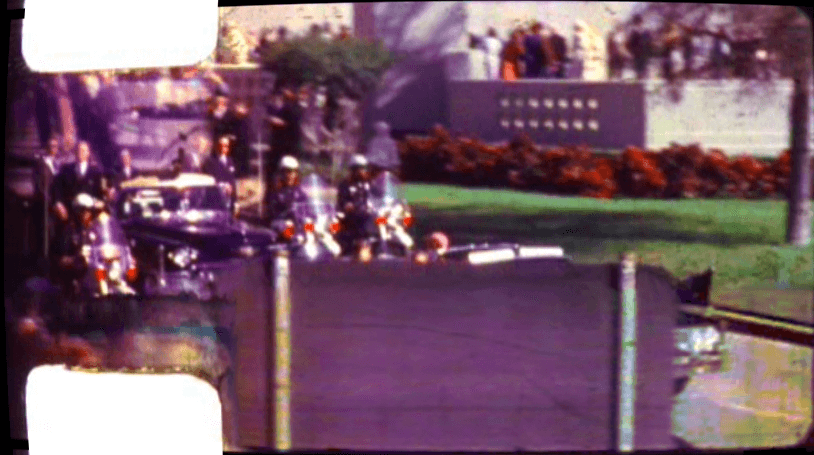
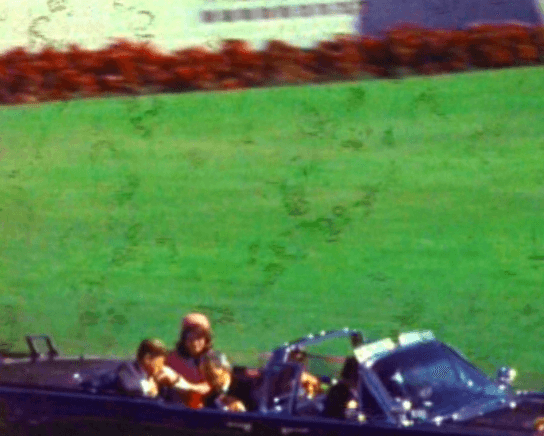
    The Zapruder film is (most probably) an intact and authentic 8mm motion picture sequence. Information appearing in the film corresponds with common segments of other amateur films taken in Dealey Plaza during the assassination event, as well as existing still images. The extant images match the general description provided by Abraham Zapruder, the man who filmed the images, during his live televised appearance at WFAA studios in Dallas approximately two hours after the shooting. Later suspicions Zapruder film frames may have been removed or altered, after the film was processed and initial copies printed, gradually gained momentum in the late 1970s/early 1980s as a previously unacknowledged analysis of the film was revealed which challenged the established chain of custody with the film’s possession. Suspicions increased after the Assassination Records Review Board took specific interest in authenticating the film in the late 1990s. Although there is not currently any hard evidence that tampering took place, the presence of a Zapruder film (original or copies) at the CIA’s National Photographic Interpretation Center (NPIC) on the weekend of the assassination has been effectively established, even as official records of this event have inexplicably failed to appear.


    Limits to Fakery

    NPIC analysts at work
    during Cuban Missile Crisis

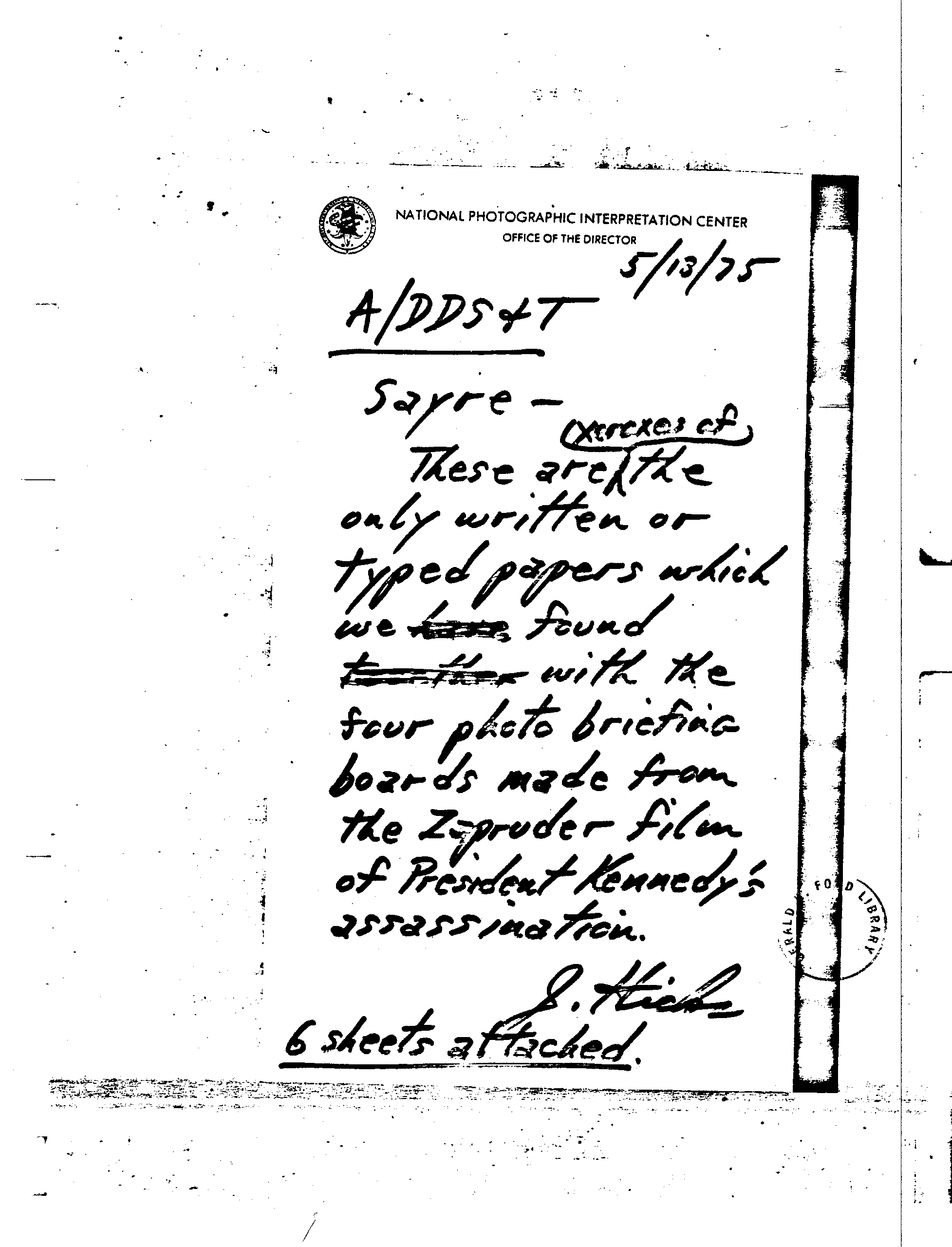
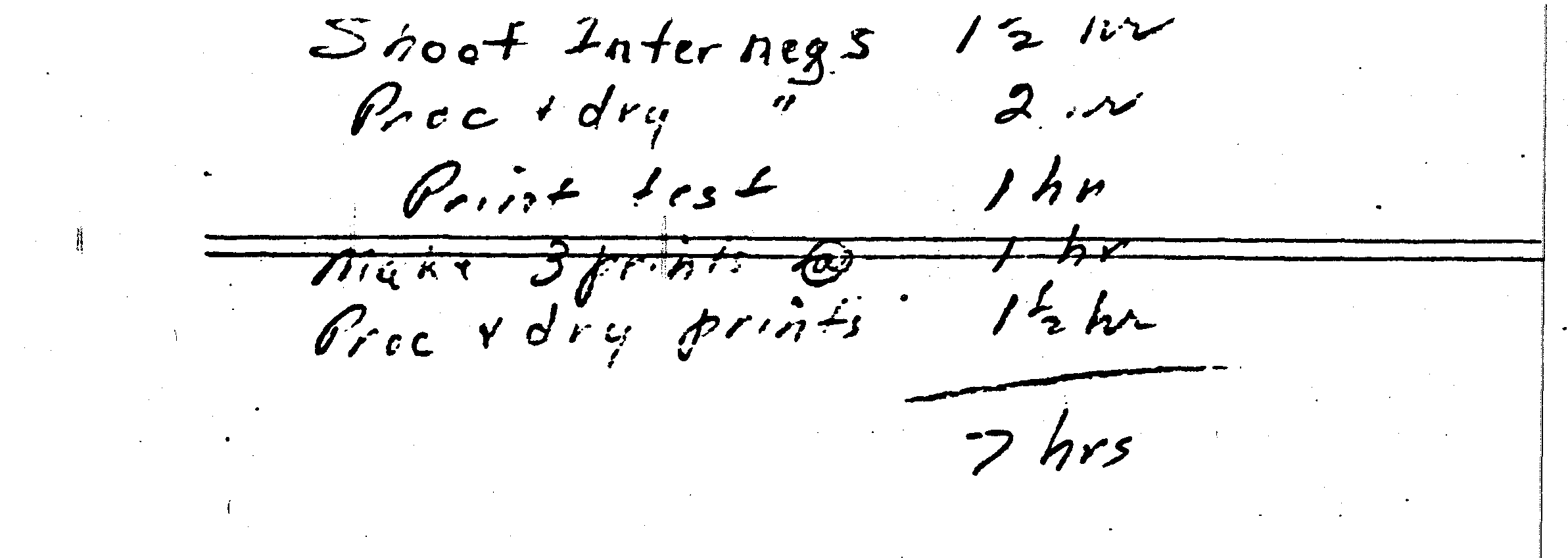
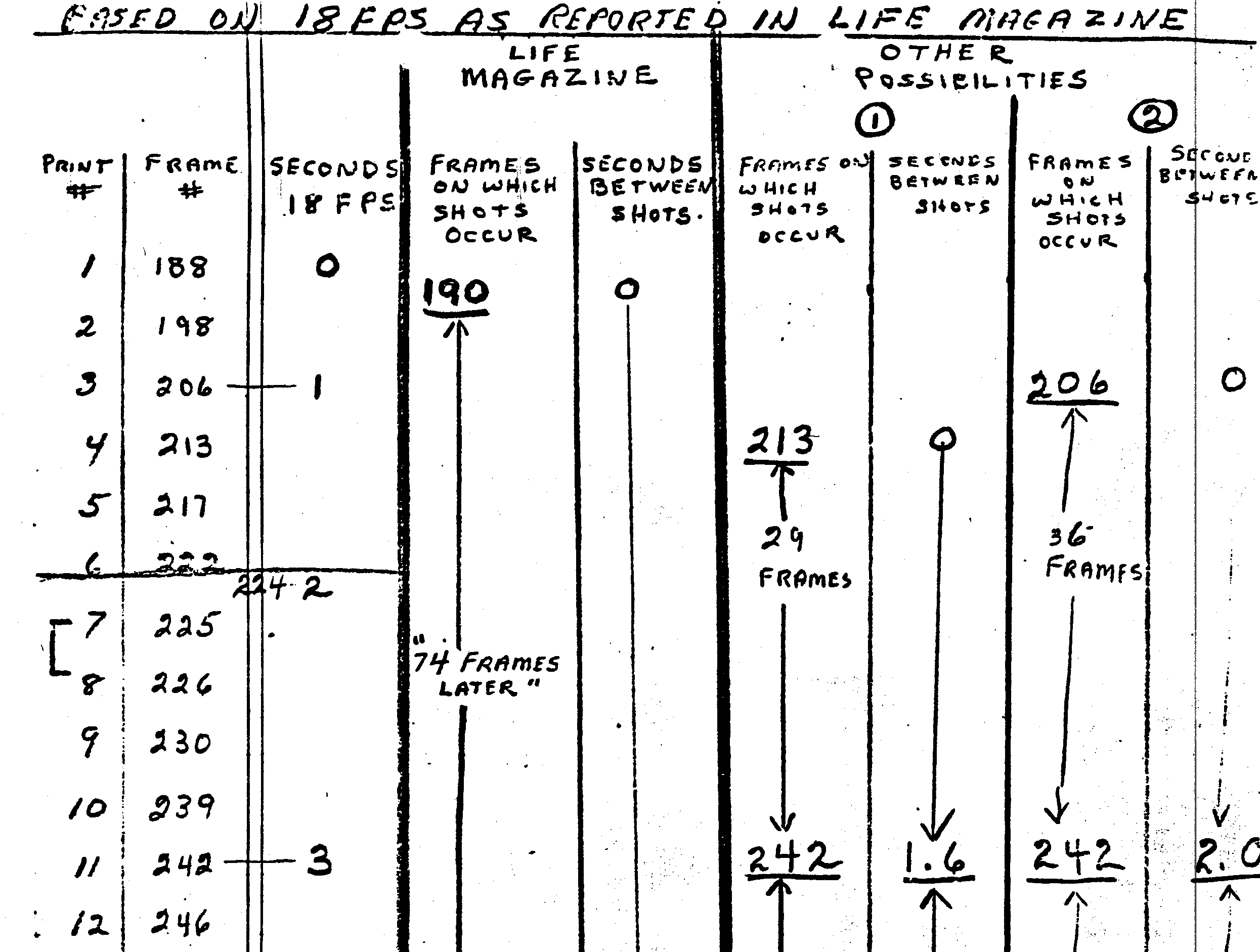
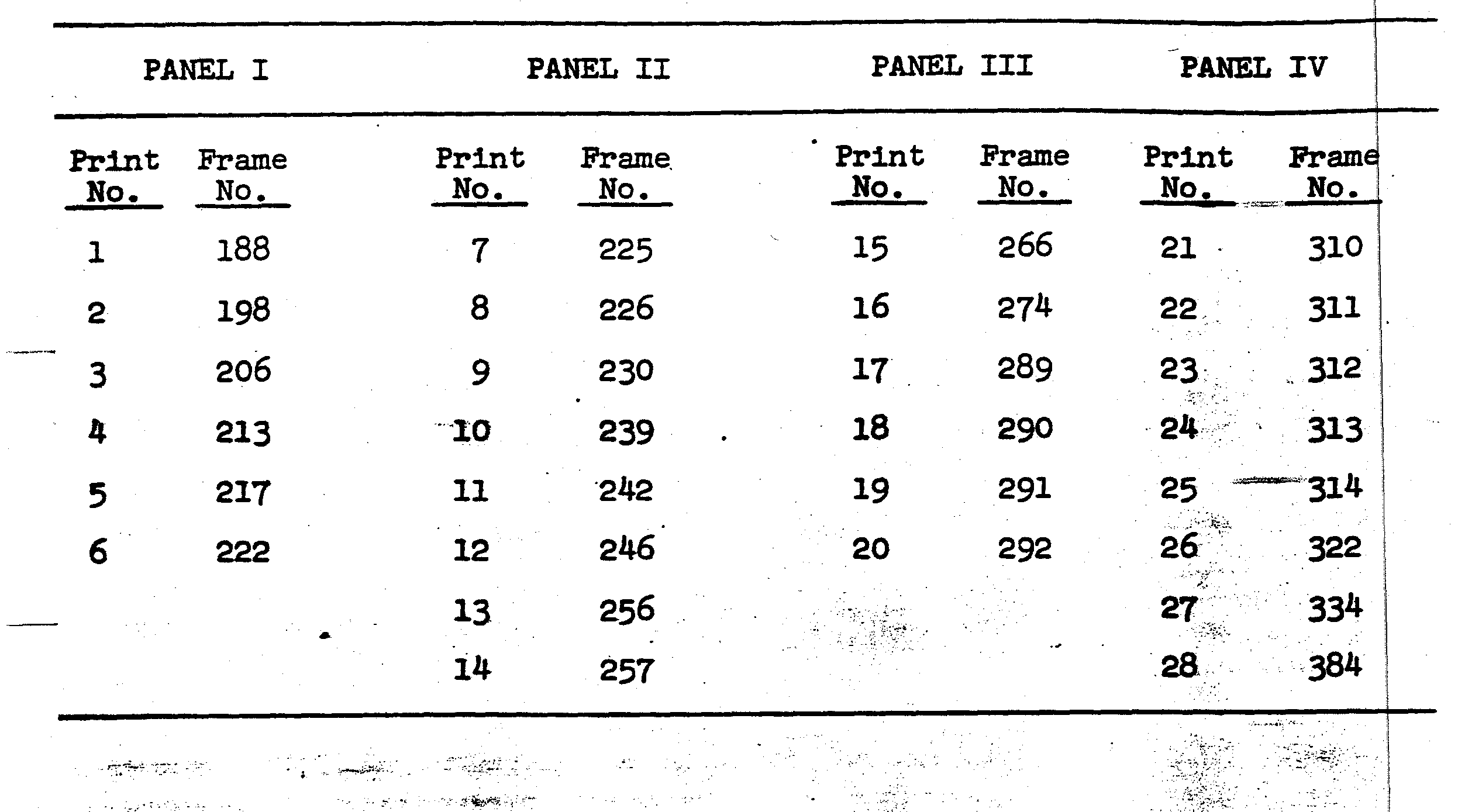
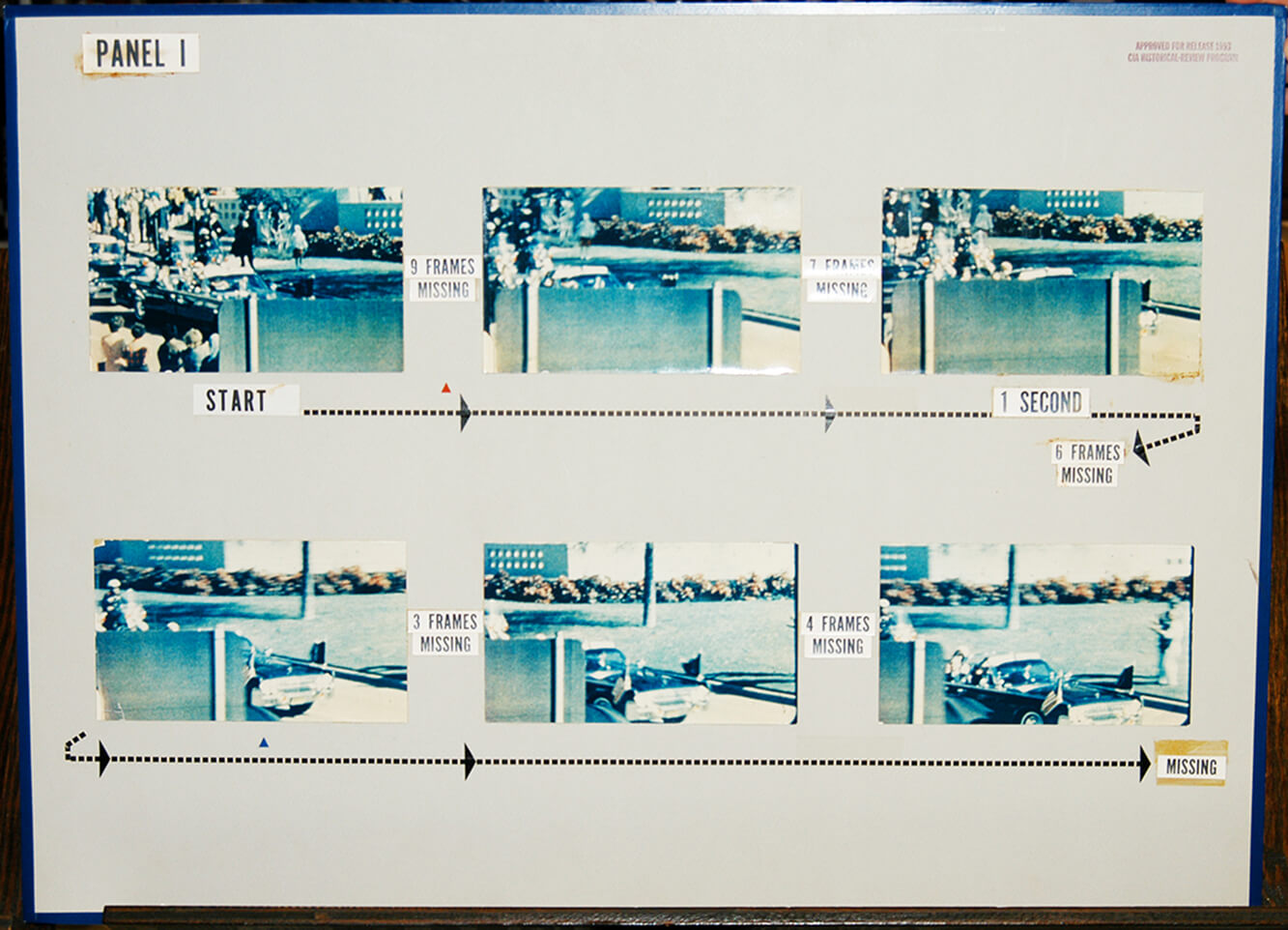
    The most precise description of a possible how and when pertaining to alteration of the Zapruder film was developed by Doug Horne, who had worked as Chief Analyst for Military Records for the Assassination Records Review Board (ARRB) in the 1990s. Horne assisted in the joint efforts between the ARRB and Kodak to preserve and assess the authenticity of the Zapruder film. During this process, as former employees of NPIC added detail to events on the weekend of the assassination, Horne came to realize two things: two separate teams developed distinct sets of briefing boards from selected frames of the film; and, from recollection (albeit many years after the fact), each team believed they were handling the original Zapruder film—one group working from an 8mm film reel, and the other from an unslit 16mm reel.1 Horne postulated that, in the approximately twelve-hour period between the work of the two teams, the original film could have been sent to a top-secret CIA film facility attached to a Kodak plant in Rochester, NY (Hawkeye Works) and there revised over the course of the day on an optical printer. A freshly altered “original” film was then presumedly returned to NPIC for a new set of briefing boards, and the existing prints of the original film were swapped out.2.

    Information pointing to two separate briefing boards, and two different film formats used to create them, should not be dismissed. Official clarification may yet be discovered, perhaps in the still missing official history of the Zapruder film’s presence at the NPIC written by Dino Brugioni. As speculation has otherwise filled the vacuum, it’s worth considering what was, and was not, possible to do manipulating film images in 1963. Evidence of an 8mm reel of film on one night, and an unslit 16mm reel the next does not automatically or logically lead to an alteration hypothesis.3

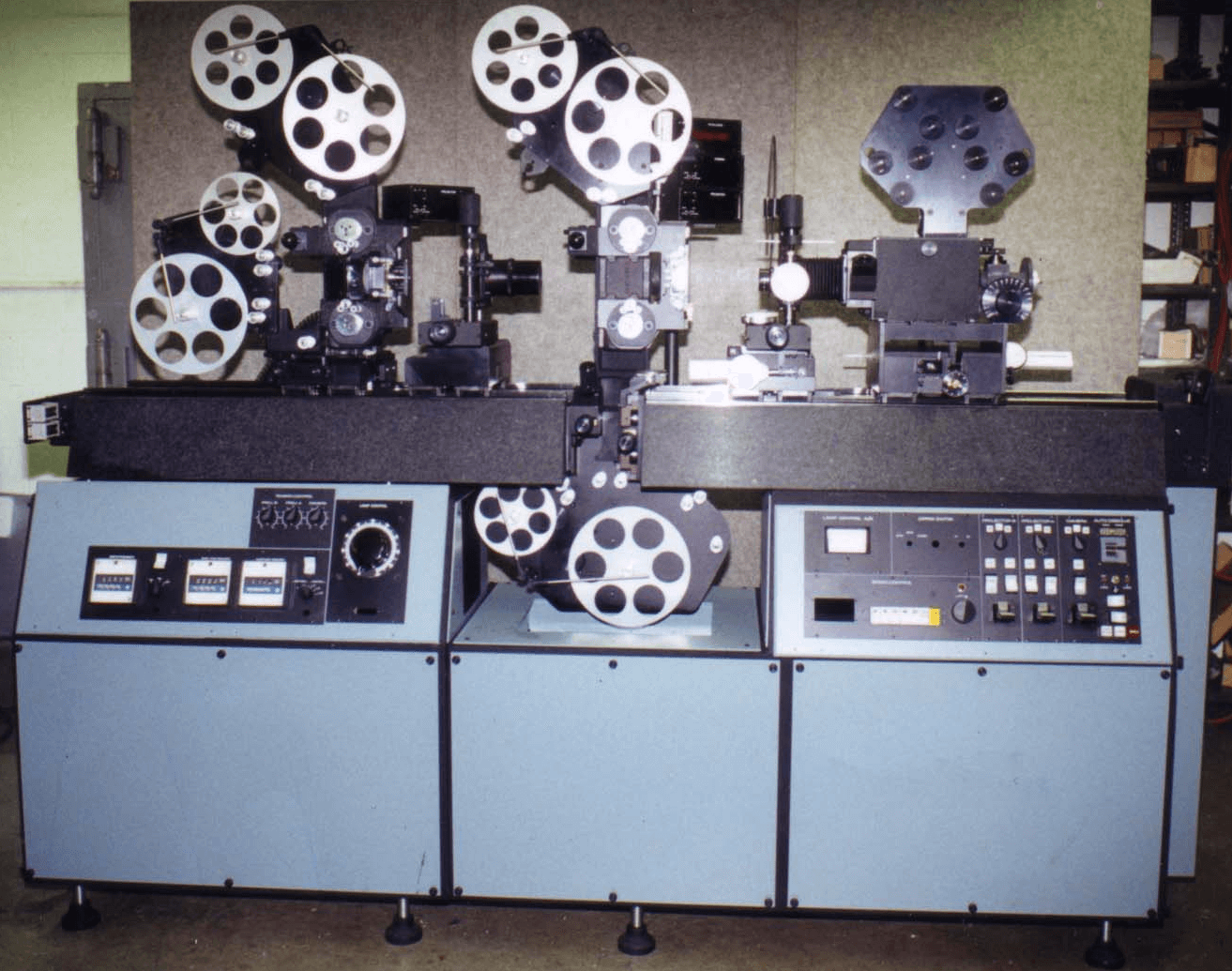
    The alteration argument vis-à-vis the Zapruder film has been prone to a certain illiteracy regarding the mechanics and science of special-effects filmmaking, specifically the use of the optical printer, which ranges from mildly informed to wildly uninformed, even as the whole of the argument requires intervention of such machines. Roland Zavada, a retired Kodak specialist hired by the ARRB to authenticate the Zapruder film, explained technical issues mitigating against alteration in a patient, if somewhat exasperated, response to Doug Horne’s theories and criticism published in the fourth volume of Horne’s Inside the Assassination Record Review Board.4 The substance of Zavada’s response can be, and is, supported by relevant professional technical and descriptive texts, as well as, if sought, personal affidavit from technicians experienced in practical application of optical printers for celluloid-based motion pictures (a skill set largely displaced since the advent of digital technologies). The notion that elements within the Zapruder film’s frames could be removed or rearranged at will, let alone done so without evident and obvious trace, is completely mistaken. Such sorcery was not possible with the available optical printer technology, and, for what was possible, the relatively short time period available in Horne’s hypothesis would not allow for anything but very limited—very limited—activity.

    An Oxberry 1600 aerial optical printer,
    a common commercial model

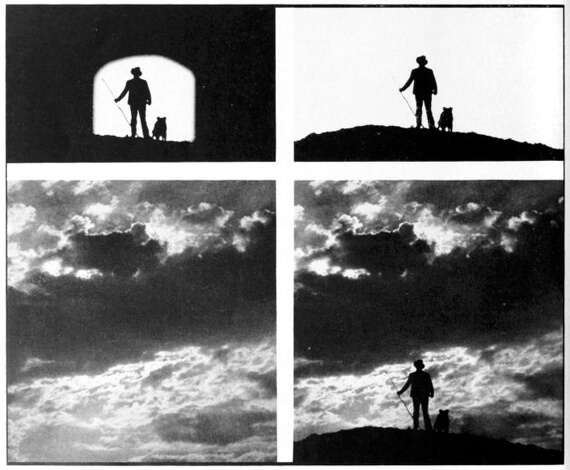
    In an article titled “The Cinemagic of the Optical Printer”5, Linwood Dunn lists the variety of visual effects achievable on the optical printer: creating transitions such as dissolves and wipes of varying complexity; changing image size and position on screen; frame modification such as speeding up or slowing down a sequence, or “freezing” a select frame; optical zooms; superimpositions; split screens; adding motion, e.g., creating a rocking effect for a scene set in a boat or aircraft. He then describes “special categories” of effects work: travelling mattes “used to matte a foreground action into a background film made at another time”; blow-ups and reductions used to convert formats, e.g., 16mm film converted to 35mm; anamorphic conversion to change aspect ratio; and “doctoring and salvaging” which includes salvaging unusable scenes due to mechanical or human error on set or adding elements to previously filmed scenes.6.

    Claims of Zapruder film alteration usually cite changing image size, frame modification, superimposition, travelling mattes, and doctoring. Where these claims tend to fail is by misunderstanding necessary limitations in the use of these techniques. A common claim is that an altered Zapruder film has removed or repositioned bystanders along the visible motorcade route through doctoring and superimposition combined with a travelling matte of the Presidential and Secret Service limousines. What is not understood while making such claims is, prior to the introduction of digital workspaces, mattes and superimpositions found seamless effect by utilizing hard vertical and horizontal lines within the frame to join separate elements, or by adding images to a flat uniform background. Consistent vertical or horizontal separation points or uniform backgrounds within the Zapruder film are virtually nonexistent because a) the sequence is always in motion as Zapruder panned with the motorcade, b) the motorcade varies in size within the frame as it approaches and passes Zapruder’s zoomed-in lens, and c) the shaky hand-held filming is inconsistent (i.e., this is not a steady locked-off pan performed with a tripod).7

    Any element within the frame said to have been removed from the Zapruder film would require an equal consistent element to replace it; for instance, removing a bystander from the Dealey Plaza lawn would require additonal lawn in place for the requisite number of frames, just as a replaced bystander closer to Elm Street would require a replacement background consistent with what already is visible (portions of road, sidewalk, landscaping and other persons). These replacement elements must also adjust plausibly in perspective as Zapruder’s camera drifts and pans, and blur when the camera is unsteady. Again, this is long before digital technologies, and the workspace of each individual celluloid frame was 8mm in diameter. Theoretical radical alteration of the Zapruder film would require exacting work in multiple areas of each frame, for many dozens of frames, which would require many weeks, at least, to accomplish.8 At the end of such a process, it would be necessary for the results to appear as a seamless element of the original, an impossible task to conceive. Any removal of persons, geographic features, or even splatter from a large exit wound, should be obvious through inconsistencies produced by attempting to replace the lost information. If the Zapruder film was in fact somehow radically altered, appearing as it appears today, then it would stand as the single greatest trick shot in cinema history, even as the technique developed by these magicians would never be exploited for any other purpose, or even rumor of such incredible feat leaked as the magicians never sought credit.

    Another important consideration for determining what is possible with an optical printer is the requirement for precise testing related to exposure and color temperature, to maintain consistency as film stocks have varying exposure indexes and grain structure. Print stocks used with optical printers are different from those used in the field, and production of an intermediate internegative with these stocks is a necessary part of the process,9 adding generational loss. Alteration of the Zapruder film would then require not only seamless work within the frames, but also assuring the resulting altered film’s colour, exposure, and grain is consistent with the original 8mm film stock, a feat with no known precedent.10 Discussing this, Roland Zavada determined that the minimum time to evaluate these factors, including filming, processing, and viewing the necessary tests, would have been more than seven hours,11 which factors poorly in considering an alteration scenario limited to Sunday November 24.

    Z-313: a painted blob and debris removal?

    Incredibly, although Zavada’s peer-supported professional opinion mitigating against alteration to the Zapruder film should have largely diminished the controversy, the notion of alteration has since hardened, and a substantial number of persons have somehow become convinced that radical alteration is a proven fact. In truth, time constraints and technical limitations make plain that if alteration was in fact engaged in that Sunday, it would necessarily be limited to, for example, a “blob” added to a frame or a black mask added to a few frames. However, even this work appears unlikely due to the difficulties in returning the altered product to an undetectable plausible 8mm “original”.12.

    Aside from the technical reasons mitigating against Zapruder film alteration and substitution, a set of other considerations was articulated by Josiah Thompson in his 1998 article “Why The Zapruder Film Is Authentic.” 13 Thompson notes, from the officially vetted timeline, the original Zapruder film was in the possession of either Abraham Zapruder or representatives from LIFE Magazine that entire weekend. This notion is no longer assured. Even so, Thompson makes the point there was no means to ensure additional copies of the original intact version were not created before the film could be presumedly delivered to Hawkeye for alteration. For example, an extra copy could have been printed surreptitiously at the facilities in Dallas on the first day, or a copy perhaps made by the FBI from a borrowed Secret Service print, as discussed in memos from Saturday November 23.14 Thompson also notes that there are numerous films and photographs depicting the same sequence (or portions thereof) which potentially could require alteration as well (some thirty-eight persons had cameras in use during this sequence), and, as important, on the weekend of the assassination it could not be known if all photos and film had been accounted for—that is, a then unknown film or photograph could appear later to reveal the forgery.

    Finally, other than a painted “blob” or black mask to hide wounds, it is unclear what exactly it is believed the alleged alteration is concealing. In the numerous films and still photographs which feature portions of the exact sequence captured by Zapruder, and in sequences taken before and after Zapruder was filming, there is nothing to suggest a person or event which would require excision, such as during the limousine turn which does not appear in the Zapruder film (although Abe Zapruder suggested he had filmed it during his Warren Commission testimony). One frequently cited presumed alteration is the slowing down and near complete stop of the Presidential limousine in the moments ahead of the fatal (Z312) shot which, it is claimed, was removed from the film. This is not true, but can appear that way because Zapruder is panning his camera to follow the passing vehicle; the camera itself in motion assumes a certain pace even as the vehicle slows within the frame. The slowing of the limousine becomes apparent if the viewer is able to identify Zapruder’s panning motion as a separate element from the motion of the vehicle, and follow as the pan in turn slows to keep the limousine relatively centered in frame. The camera pan actually gets ahead of the vehicle, highlighting its decrease in speed. That the limousine had come near to a complete halt can be observed in the person of Secret Service Agent Hill who rapidly gains on the static chassis. The acceleration of the vehicle is also obvious, and is even more so in the Nix film.


    The Zapruder Film Is Not A Precise Clock

    According to Dino Brugioni, one of the NPIC staff interviewed in the late 1990s and 2000s, representatives from the Secret Service were at NPIC on Saturday evening November 23, 1963 and were “vitally interested in timing how many seconds occurred between various frames.” Brugioni’s colleague Ralph Pearse informed these men that the Zapruder Bell & Howell Zoomatic 414PD was “a spring-wound camera, with a constantly varying operating speed”, and attempts to determine precise timing would be “unscientific” and could lead to false conclusions.15 The Secret Service agents insisted, and Pearse apparently used a stopwatch to gauge time between “various frames of interest.” Later testing by the FBI would determine that the Zapruder camera ran at an average speed of 18.3 frames per second, and, with that established, it was claimed that a count of frames between significant events appearing in the Zapruder film, divided by 18.3, could produce a precise reading of the time between which these events occurred, particularly the timing between presumed shots.

    This formula unfortunately bypasses the important qualifier “average”, as it became commonly reported that the camera’s film speed was 18.3 frames per second, and thereby it was claimed the Zapruder film could serve as a precise clock for the assassination sequence.16 This is not the case, due to the spring-wound mechanism of Zapruder’s camera which, as Ralph Pearse noted, had a “constantly varying operating speed.” This factor is apparent in the results of the tests done by the FBI’s Lyndal Shaneyfelt, “focusing the camera on a clock with a large sweeping second band”, later counting frames from the developed film to ascertain the number of frames per second as determined by the sweeping second band. A “sync” motion picture camera, with a crystal sync oscillator maintaining consistent operating speed, would indeed produce repeatedly the exact same number of frames per second, but a spring-wound camera would vary.17 This spring-wound effect is reflected in the FBI report:

    “This study has been made by checking the film speed of the Zapruder camera at ten second intervals throughout the full running time of a fully wound camera. Several checks were made on a full roll of film and it was found that the film speed of the camera when fully wound runs at an average speed of from 18.0 to 18.1 frames per second (fps) for the first ten seconds. It gradually increases to 18.3 to 18.5 fps for the next 20 seconds, then gradually decreases slightly to 18.1 fps for ten seconds before the final twenty seconds that run at an average speed of 17.6 to 17.9 frames per second. Mr. Zapruder has stated that the camera was fully wound when he started filming the President’s motorcade.”18.

    According to the above calculation, the Zapruder film, once the Presidential car comes into view (the 132 frames of the head of the motorcade accounts for approximately 7.3 seconds) was exposed at 18 to 18.1 fps for about three seconds, and then “gradually” increased to 18.3 to 18.5 fps for its duration. The 353 frames, according to the FBI’s calculation, occurred over somewhere between 19.138 seconds to 19.332 seconds (without accounting for the “gradual transition from 18/18.1 to 18.3/18.5). The shooting sequence (LIFE 12/6/63 frame Z-190 to Z-312) occurred from somewhere between 6.595 seconds and 6.666 seconds (again not accounting for the “gradual” transition), a difference of between one and two frames. So, while not demonstrating extreme variation, the FBI’s work, at least as described, demonstrates that, giving or taking even two frames in a short span, the Zapruder film cannot be considered an exact clock. Other tests on similar cameras noted even greater disparity between individual “checks” than a few tenths of seconds.19 Such disparity is more in keeping with the advice of NPIC’s Ralph Pearse that a spring-wound camera’s operating speed was constantly varying and that attempts to measure precise timing could lead to false conclusions. In fact, the FBI’s “average” speed seems unusual for these cameras in that the results inferred suggest comparatively minute differences.

    Might the FBI have dropped a high frame count pass and a low frame count pass recorded by the Zapruder camera during their speed tests, in the interest of arriving at a more precise statistical average? This statistical method is known as a “truncated mean.”20 An odd reference to frames-per-second appears in a chart presented to the Warren Commission in January 1964, presenting timing scenarios for the Presidential limousine’s approach to Dealey Plaza, based on measurements which identify a high and low miles-per-hour determination (15 mph and 12 mph) with a similar constant frames-per-second count (“22 fps” and “17.6 fps”).21 It is very tempting to speculate that these numbers—22 fps and 17.6 fps—might represent the high and low markers of the FBI’s speed tests with the Zapruder camera. Shaneyfelt told the Warren Commission “we ran through several tests of film … and averages were taken.” (WCH Vol. 5, p. 160)


    In 1967 CBS time-tested five same-model cameras and got varying results


    If so, the presumed “average speed” of 18.3 frames-per-second is, as Pearse told the Secret Service, meaningless in context of the assassination as there is no possibility or means to determine the frame rate when Zapruder’s camera actually ran on November 22. In theory, the “constantly varying operating speed” of the spring-wound camera would mean the frame rate varied across the duration of any filmed sequence. Although Pearse articulated this, and Brugioni apparently attached this information to the first set of prepared briefing boards, the insistence of the Secret Service agents suggests determining a time sequence for the assassination was an investigative priority. This insistence would create for the developing lone assassin narrative a series of problems.


    How Did LIFE Magazine Know The Camera Ran At 18fps?

    Before the FBI ran their speed tests with the Zapruder camera, LIFE Magazine’s article “An End To Nagging Rumors” (December 6, 1963) already states: “from the movie camera’s known speed of 18 frames a second—two frames a second faster than it should have run—it is possible to reconstruct the precise timing …” Zapruder’s Bell & Howell camera, according to its operating manual, was supposed to run at 16 frames per second in its RUN setting. That it actually ran some two frames faster could only be determined through tests similar to what the FBI would later do—filming a clock with the original camera. The LIFE Magazine article does not directly state that LIFE itself conducted tests and determined the speed, it says only the speed is “known”.

    Although there is nothing in the record about testing Zapruder’s camera before the FBI took possession of it on December 4, 1963, it appears highly likely that a test to determine the speed of that camera was undertaken as part of an official investigation, connected with the Secret Service and CIA, sometime during the week following assassination. Information derived from this test was subsequently shared with LIFE Magazine. 22 Philip Melanson’s 1984 essay “Hidden Exposure: Cover-Up and Intrigue in the CIA’s Secret Possession of the Zapruder Film” first noticed a brief aside in an December 4, 1963 FBI memorandum discussing the possession of the camera: “(Zapruder) advised this camera had been in the hands of the United States Secret Service Agents on December 3rd, 1963 as they claimed they wanted to do some checking of it.”23 If the Secret Service were in possession of Zapruder’s camera on December 3rd, they may well have been in possession of the camera before that date. The memorandum certainly does not clarify.

    When the Secret Service visited NPIC on the evening of November 23, 1963, “vitally interested in timing how many seconds occurred between various frames” Dino Brugioni recalled: “Ralph Pearse informed them, to their surprise and dismay, that this would be a useless procedure because the Bell and Howell movie camera (that they told him had taken the movie) was a spring-wound camera, with a constantly varying operating speed.” A 1975 CIA description of the same NPIC event states that since “the film had been taken in a spring-powered movie camera, it was not possible to determine precise time between shots without access to the camera to time the rate of spring run-down.”24 Access to the camera was necessary to determine the information the Secret Service was intent on establishing. That the Zapruder camera, and even the Zapruder film original, may have been, or probably were, examined at NPIC shortly after the assassination should have been an expected procedure. The Secret Service considered themselves holding “primary jurisdiction in a case of this nature”,25 and, as Philip Melanson notes, “the Secret Service of the 1960s and early 1970s had some sort of technical dependence upon the CIA.”26.

    An FBI memorandum dated November 29, 1963, generated by Dallas field agents, discusses a meeting with Secret Service Special Agent John Howlett, in which Howlett described an ability to determine the distance from the alleged sniper’s nest to the Presidential limousine at the time of shots striking the President, ascertained from 8mm movies of the assassination.27 Howlett places the first shot, “where the President was struck the first time in the neck”, at “approximately 170 feet”. Paul Mandel’s LIFE article also places the first shot at 170 feet ( “The first shot strikes the President, 170 feet away…”, also identified as Zapruder frame 190 since 122 frames are then counted to the third shot which “over a distance of 260 feet, hits the President’s head.”). Howlett would inform the FBI the fatal shot was at “approximately 260 feet”. As Howlett was meeting with the FBI men, LIFE’s issue with Mandel’s article was being readied for the printers. It is hard not to believe that Special Agent Howlett and LIFE Magazine’s Paul Mandel received their information from the same or similar sources, derived from analysis conducted at NPIC.

    A later chart created by the Secret Service, listing distances which differed slightly from Howlett’s,28 and associating these distances with Zapruder film frames (CE884), would situate the given distance of the first shot as equivalent to Zapruder frames 200 or 201, shortly before JFK disappears behind the Stemmons Freeway sign in the film. A certain flexibility in determining position and frame number has been introduced as early as Howlett telling the FBI men on November 29 that the Secret Service “using the 8 millimeter film have been unable to ascertain the exact location where Governor JOHN B. CONNALLY had been struck.” This uncertainty reflects the difficulties for the developing official story, as the FBI’s Robert Frazier had determined on November 27 that the bolt-action rifle in evidence required at least 2.8 seconds to operate between shots at moving target, the equivalent to approximately fifty Zapruder frames. Determining that Connally was not struck until somewhere around Z-250 (in relation to a first hit on JFK at frame 200) is not supported by the Zapruder film, where it appears the strike occurred at least 20 frames earlier.29 Differing from Howlett, Mandel in the LIFE article, provides a precise frame for a shot striking Connally (Z-264):

    “The first shot strikes the President, 170 feet away, in the throat; 74 frames later the second fells Governor Connally; 48 frames after that the third, over a distance of 260 feet, hits the President’s head. From first to second shot 4.1 seconds elapse; from second to third, 2.7 seconds. Altogether, the three shots take 6.8 seconds—time enough for a trained sharpshooter, even through the bobbing field of a telescopic sight.“ (Paul Mandel, “End To Nagging Rumors: The Six Critical Seconds”, LIFE Magazine, December 6, 1963)30

    In her book, Alexandra Zapruder ponders the irony that her grandfather’s film had displaced the view from the purported sniper’s nest; standing in, so to speak, for “seeing the assassination through Oswald’s eyes”. In actuality, the true irony is that, by insisting on establishing exact timing and ignoring Ralph Pearse’s advice, federal investigators wrapped themselves into a straightjacket trying to explain the visible shooting sequence, and the “exact” timing of the film, against the self-imposed limitation of three shots and one bolt-action rifle. Ultimately the Warren Commission had to go with both the single bullet theory and the claim that it could not determine when the first shot was fired. For its part, the HSCA’s photographic panel seemed to determine that the President was struck before disappearing behind the freeway sign in the film and also endorsed the single bullet theory, which are mutually exclusive.


    What Happened At The NPIC November 23-25, 1963?

    Dino Brugioni in 1962

    It appears that two sets of “briefing boards” were independently created—one through the Saturday evening into Sunday morning and one through Sunday evening into Monday morning—both using frame blow-ups derived from a copy of or the original of the Zapruder film. Dino Brugioni was involved with the Saturday night event, and Homer McMahon the Sunday evening event, as developed by Doug Horne. Brugioni’s recollections are corroborated by a CIA submission to the Rockefeller Commission made in May 1975.31 This document, describing an analysis of the Zapruder film at NPIC, matches Brugioni’s account of the presence of the Secret Service, that establishing elapsed times between rifle shots was of primary concern, and the subsequent production of briefing boards. The document states the Secret Service “were present during the process of analysis” and took away one set of briefing boards, while CIA Director McCone retained another. The briefing board set “was controlled carefully; very few people saw it.” Notably, the document does not date the event, instead choosing to vaguely locate it in “late 1963.” Results of the analysis are deflected: “We assume the Secret Service informed the Warren Commission about anything of value resulting from our analysis of the film, but we have no direct knowledge that they did so.”

    On the day following this first disclosure of a Zapruder film analysis at NPIC, the Rockefeller Commission requested “memoranda or other textual information provided to the Secret Service by CIA after NPIC’s analysis of the Zapruder film.” The CIA responded a week later, claiming they “had no indication in our records that any such written material was provided to the Secret Service. Attached are copies of the only textual matter in our files pertaining to the NPIC’s analysis of the Zapruder film.”32 Xerox copies of six “written or typed papers” were attached, described as the total existing documentation of an analysis process which spread over a thirty-six hour period and featured the production of two separate briefing board sets. That the May 7 CIA Addendum included information about the “spring-powered camera” which appears directly derived from Brugioni’s briefing board notes attached, but no such notes are among the sparse released documentation on May 14, does not inspire confidence that the CIA is on the level here.33.

    Among the six papers provided to the Rockefeller Commission is a typed page which features an undated columned list featuring four “panels” with Zapruder frame numbers listed below each panel. Each frame number has a corresponding “print” number, totalling 28 prints. This appears to be for a set of briefing boards presumably created the weekend of the assassination, perhaps the second session, as Brugioni said his boards consisted of less than twenty prints. Handwritten notes on another page calculate time needed to “shoot internegs”, process, test, and make three prints. During interviews in the 1990s, Homer McMahon and Ben Hunter recognized their handwriting on this document, and also on portions of another handwritten document recreating the previously described typed briefing board chart.34 Three more handwritten pages are included, author unknown, which appear to have been created at a later date than the November 23-25 analysis as these pages feature charts and calculations which refer directly to information appearing in LIFE ’s December 6 article “An End To Nagging Rumors.”


    These relatively unsophisticated charts were presented as artifacts of the 1963 NPIC analysis,
    even though they were clearly drawn up later.


    In fact, these pages seem to have been drawn up by a person completely unaware of the first weekend briefing boards, or that the Secret Service had already possessed the information that appeared in LIFE. The hand drawn charts feature phrases from the Mandel article in quotation marks: “74 frames later”; “48 frames after that”; “2 FPS than it should have been run”. A question is written out: “how do they know frames of first and second shot?” Timing calculations cluster the page, with division tables setting scenarios of 18fps (attributed to LIFE) and 16 fps (the camera’s speed according to its operating manual). Alternative shooting scenarios, most of which feature Zapruder frame 242 as a second shot, appear next to the LIFE attributed shooting sequence of Z-190—Z-264—Z-312. Whatever is going on with these unsophisticated charts, the impression left by the CIA’s 1975 presentation on the NPIC analysis—from lack of documentation to the sketchy attribution of “late 1963”—is of a conscious decision not to admit analysis occurred on the weekend of the assassination. Making it appear the NPIC, the premiere image analysis lab anywhere at the time, relied on timings and frame numbers printed in LIFE Magazine served to deflect attention from the actual analysis done, as did the diversion of highlighting the Secret Service’s supposed sole responsibility to share “anything of value resulting from our analysis.” The NPIC analysis event had been effectively disappeared from the record.


    The typed frame chart produced as part of NPIC’s records. This may be from the second analysis event, Nov. 24-25, 1963.

    The briefing panels in the record seem derived from the above typed chart.
    Dino Brugioni was certain these were not the charts he had created during the first analysis event Nov. 23-24, 1963.


    This motion sequence features the selected frames from the above chart.
    That the panning of Zapruder’s camera gets ahead of the slowing vehicle is apparent.


    For its part, the Secret Service had nothing to add, claiming that by 1979 all documents relating to the assassination had been passed to the National Archives. Nothing directly attributed to an NPIC analysis appears. The Warren Commission—which sponsored two conferences in April 1964 at which the Zapruder film was closely analyzed in the presence of Bethesda and Parkland doctors, ballistics experts from Edgewood Arsenal, FBI agents, Commission attorneys, and even John and Nellie Connally—did not receive any information regarding the November 1963 NPIC analysis.

    In her book, Alexandra Zapruder asks about the NPIC event: “Who cares when it happened?” That is not the appropriate question. More appropriately: Why was the NPIC analysis hidden from the official record and the official investigation, and then, when uncovered in 1975, its “when” was obscured and its documentation was obviously incomplete?

    A reason for this may be the NPIC analysis clearly demonstrated that a lone gunman conclusion was not viable; that something like the “flurry” of shots described by Secret Service Agent Roy Kellerman—seated in the passenger seat of the Presidential limousine—was more apparent. Homer McMahon, during his 1990s interviews, said it was his impression that “he saw JFK reacting to 6 to 8 shots fired from at least three directions.”35 Robert Kennedy would tell Arthur Schlesinger Jr., on December 9, 1963, that CIA Director John McCone, who received the NPIC’s first briefing boards, had indicated to him “there were two people involved in the shooting.”36 A few hours after McCone’s briefing on Sunday November 24, LIFE Magazine’s publisher C.D. Jackson sent instructions to Dallas to negotiate the remaining rights to the Zapruder film which had been explicitly left out of the contract signed the previous day. An internal LIFE memo would note that “C.D. Jackson bought the copyright to Zapruder’s film to keep it from being shown in motion.”


    The Zapruder Film Proves Conspiracy

    A week after the assassination, the Secret Service was continuing its investigation utilizing a shooting sequence which commenced with a first hit at either Zapruder frame 190 or frame 200. At the same time, LIFE Magazine was preparing its December 6 issue featuring an article which placed the first shot at Zapruder frame 190. Years later, a House Select Committee on Assassinations photographic panel systematically analyzed the Zapruder film in a manner similar, if not more extensively, to that done previously by the NPIC.37 The HSCA panel would report: “At approximately Zapruder frame 200, Kennedy’s movements suddenly freeze; his right hand abruptly stops in the midst of a waving motion and his head moves rapidly from his right to his left in the direction of his wife. Based on these movements, it appears that by the time the President goes behind the sign at frame 207 he is evidencing some kind of reaction to a severe external stimulus.”38


    Zapruder frames 190, 200, and 207. Analysis determined Kennedy began to react to a “severe external stimulus” at this point.


    The Warren Commission Report would claim “it is not necessary to any essential findings of the Commission to determine just which shot hit the Governor.”39 This is not true, as essential findings of the Commission included the determination that only three shots were fired, all from a particular bolt-action rifle found on the sixth floor of the Texas School Book Depository. If the President was reacting to a “severe external stimulus” (i.e. a shot) before disappearing behind the Stemmons freeway sign, as seen in the Zapruder film and as determined by both expert panels in 1963 and 1978, there was not enough time to operate the rifle’s bolt and fire a second shot to strike Connally consistent with his observed reaction (struck approximately Z224-230). The Commission’s Single Bullet Theory proposes that Kennedy and Connally react to the same bullet as they come into view at Zapruder frame 222-223, although in the film it appears obvious the President is already reacting to external stimulus while Connally is not. It has been suggested that Connally’s reaction is somehow delayed, although the smashing of his rib bone by the passing bullet would initiate an immediate involuntary reflexive response.

    Since the time of the HSCA, independent researchers have been successful in aligning close analysis of the Zapruder film with eyewitness testimony and with other photographic evidence.40 With this work, the determination advanced by the analysis in 1963 and 1978 that the President was struck by a shot at a point between Zapruder frames 190-200, before disappearing behind the Stemmons Freeway sign as seen in the film, has been corroborated by the accounts in the official record of at least a dozen witnesses, and their interlocking observations are further supported by the photographic record apart from the Zapruder film.

    The testimony of Jacqueline Kennedy exemplifies this support for a first shot circa Z-190. She told the Warren Commission that she turned in her seat to directly face her husband as the result of a commotion, a noise, which can be identified as this first strike (which probably hit in the back, as witnesses located behind the Presidential vehicle described his reaction as a slump to his left). Mrs. Kennedy can be observed in the Zapruder film as turning just ahead of the disappearance behind the sign, and afterwards her hat remains largely visible holding this position, looking directly at her husband. Proponents of the single bullet theory are suggesting that a shot from a high-powered rifle blasted through Kennedy’s neck and struck Connally, while Mrs Kennedy looked directly on, closely positioned, and she didn’t realize what had just happened. What is observable in the Zapruder film is that Jackie Kennedy, looking directly at her husband in the moments before the devastating shot at Z-312, is bewildered as to the source of her husband’s distress.


    Mrs. Kennedy turned to look at her husband as the result of an audible commotion,
    generally conceded as the strike of a first shot. She is doing so before the vehicle disappears behind the sign.


    Dino Brugioni, during his 2009 interviews, recalled that the Secret Service agents who arrived with the Zapruder film at NPIC on November 23, 1963, and who directed the analysis of the film “in individual stop frames”, paid particular attention to the portion of the film which showed the Presidential limousine just ahead of the Stemmons sign, its subsequent disappearance behind the sign, and then the frames after it reappeared. The Zapruder film is unique in the photographic record as capturing this portion of the assassination sequence, and what it shows cannot be reconciled with the official conclusion of a lone assassin—as the Secret Service, and its CIA partner, surely realized less than forty-eight hours after the event.


    NOTES

    1 The 8mm film in Zapruder’s camera was actually a spool of 16mm film, exposed along one side and then flipped and exposed on the other. After processing the film would be slit down the middle, the two halves spliced together to make one continuous roll of developed 8mm film.

    2 For an overview of the National Photographic Interpretation Center and excerpts from Horne’s work, see Bill Kelly, “Washington Navy Yard NPIC”, JFK Countercoup blog http://jfkcountercoup.blogspot.com/2010/02/washington-navy-yard-npic.html.

    3 That the Saturday 8mm reel is assumed to be the Zapruder original relies on Dino Brugioni’s recollection that there was film information between the sprocket holes. Brugioni’s memory appears fairly solid, and is corroborated on crucial points by the available sparse official documentation, but the Zapruder film possession timeline is tight because LIFE Magazine did its own work with the film at some point over the first weekend. If Brugioni is mistaken on this detail, then he was working from a Secret Service first generation copy of the film. Brugioni remembers an 8mm projector was used to view the film, but it is hard to believe NPIC employees projecting the actual original due to risk of damaging the film. It could also be that the Zapruder original was retrieved from LIFE on Sunday, possibly delivered to Hawkeye to create additional copies, and then sent to NPIC for creation of a second briefing board. Roland Zavada determined in his authenticity report that the Zapruder original initially remained as an unslit 16mm reel, as seen at NPIC Sunday night. The compartmentalization of the two briefing board sessions may reflect that the first was an “in-house” analysis, and the second featured a differing set of impressions.

    4 Zavada’s open letter can be read here: http://www.jfk-info.com/RJZ-DH-032010.pdf It is a response to Chapter 14: “The Zapruder Film Mystery”, Douglas P. Horne, Inside the Assassination Record Review Board, Volume Four.

    5 Linwood G Dunn, ASC., “Cinemagic of the Optical Printer”, American Cinematographer Manual, Fifth Edition, 1980. The Fifth Edition features a unique section on special effects cinematography. Dunn’s company Film Effects of Hollywood was established in 1946, and Dunn was a pioneer in optical printer technology. The American Cinematographer Manual has served as an essential professional reference book since its first edition was published in 1935. The latest Tenth Edition appeared in 2013. These volumes are compiled and published by the American Society of Cinematographers.

    6 The specific examples for this final category are much simpler than might be inferred by the term “doctoring”. In the film It’s A Mad, Mad, Mad, Mad World, a gag was to feature a truck bumping into a wooden shack which subsequently collapses. During filming, the breakaway shack was pulled before the truck had backed up far enough for the gag to work. Using the optical printer, the frame was split vertically between the truck and the shack, and the frame portion of the intact shack was held (frozen) until the other frame portion saw the truck reversed to the position that would sell the intended gag. Note that the ability to achieve this effect depended on a lack of moving elements in the portion of the frame featuring the shack, as can be seen in the movie itself. A second example was of using split screens, trick cuts, and superimpositions to create close explosions and artillery fire near a group of actors playing refugees for a film titled One Minute To Zero (the desired effect was unsafe to attempt on the set.)

    7 ”A Hollywood or other film production requiring postproduction optical effects is a product of a carefully planned and executed script in advance. The key subject matter, foreground and background scene content, camera image focus, depths of field, masks or mattes, etc., are carefully executed ahead of time and incorporated into the camera film that becomes the optical master…(the Zapruder film) was handheld, unsteady, panned to follow the limousine causing bystanders and background to be blurred and Zapruder jerked as reflex reaction to rifle shot reports or other stimuli.” Zavada, p. 19.

    8 Consider the time required to produce relatively simple shots of the USS Enterprise against a black space background, as described in an online article (http://memory-alpha.wikia.com/wiki/Film_Effects_of_Hollywood) discussing Film Effects of Hollywood’s association with the first Star Trek television show. This indicates the time-consuming and sometimes imperfect results using optical printers. The effects seen in the original Star Trek program are nothing compared to claims of Zapruder film alteration.

    9 “Preparation of an internegative which closely simulates the characteristic of the original has always been the goal of optical houses throughout the industry. In spite of the superb quality frequently achieved in internegatives, it seems virtually impossible to attain characteristics identical to those of the original negative in the duplicate generations for the following reasons: 1) The non-linear response of photographic film limits the range over which the following generations can duplicate an original. The internegative is one or two generations away from the original, depending on the stock used. 2) Many variable elements are introduced during the processing of the internegative. 3) The exposure characteristics of the optical printer may vary from time to time.” Mehrdad Azarmi, “Exposure Control of Optical Printers”, American Cinematographer Manual, Fifth Edition, 1980.

    10 “There is no known film production history that would provide a technology reference for the use of an 8mm KODACHROME II camera film as a printing master to allow subsequent significant optical special effects into selected scenes and then reconstitute the adjusted images on to an 8mm KODACHROME II daylight film ‘indistinguishable’ from the camera original.” Zavada, p. 18.

    11 Zavada, pp. 30-32.

    12 One text cited as “proof” that altering the Zapruder film was plausible has been Techniques of Special Effects Cinematography by Raymond Fielding. When excerpts of alteration arguments were shared with Fielding by Zavada in 2006, Fielding’s response included: “in my judgment there is no way in which manipulation of these images could have been achieved satisfactorily in 1963 with the technology then available … if such an attempt at image manipulation of the footage had occurred in 1963, the results could not possibly have survived professional scrutiny … challenges regarding the authenticity of the NARA footage and assertions of image manipulation … are technically naïve.” Zavada, p. 18.

    13 The article is derived from a presentation made at a conference in Dallas November 20, 1998. (http://www.jfk-info.com/thomp2.htm)

    14 DeLoach to Mohr, “8 Millimeter Color Film Taken At Scene of Assassination” https://www.maryferrell.org/showDoc.html?docId=62256#relPageId=43&tab=page.

    15 Horne, Inside the Assassination Records Review Board, Volume Four, p. 1233. This fascinating and important information, derived from an interview conducted by Peter Janney, is worthwhile considering in full: “… He also said that the Secret Service was vitally interested in timing how many seconds occurred between various frames, and that Ralph Pearse informed them, to their surprise and dismay, that this would be a useless procedure because the Bell and Howell movie camera (that they told him had taken the movie) was a spring-wound camera, with a constantly varying operating speed, and that while he could certainly time the number of seconds between various frames if they so desired, that in his view it was an unscientific and useless procedure which would provide bad data, and lead to false conclusions, or words to that effect. Nevertheless, at the request of the two Secret Service agents, Ralph Pearse dutifully used a stopwatch to time the number of seconds between various frames of interest to their Secret Service customers. Dino Brugioni said that he placed a strong caveat about the limited, or suspect, usefulness of this timing data in the briefing notes he prepared for Art Lundahl.”

    16 The HSCA’s photographic panel did note in its report “only the average, and not the precise, running speeds for the camera are known.” Despite this, the panel would go ahead and calculate time between frames anyway. HSCA Report Appendix, Volume VI, p. 31.

    17 “In crystal drive systems, a crystal oscillator of extremely high accuracy at, or in, the recorder, provides the sync pulse. The camera, in turn, is driven by a specially designed D.C. motor and control circuit which is capable of operating in exact synchronism with a self-contained crystal oscillator of comparable accuracy…both camera and recorder reference to self-contained crystal oscillators which are so accurate the effect is the same as if they had been tied together.” Edmund M. Di Giulio, “Crystal Controlled Cordless Camera Drive System”, American Cinematographers Manual, Fifth Edition, pp. 469-472.

    18 FBI Memorandum, Griffith to Conrad, January 31, 1964. https://www.maryferrell.org/archive/docs/062/62298/images/img_62298_37_300.png.

    19 CBS did their own tests for their 1967 news special on the Warren Report. Using five cameras, the same model as the Zapruder camera (not the actual camera), their tests filming a clock with a sweeping hand resulted in a fair amount of disparity. Roughly matching the timing of the shooting sequence, the common exposed frames came in at 6.16, 6.70, 6.90, 7.30, and 8.35 seconds. Pat Speer: “IN 1967, CBS PURCHASED FIVE IDENTICAL CAMERAS AND FOUND THAT THEY RAN 15.45, 17.7, 18.7, 19.25, AND 20.95 FRAMES PER SECOND, A SIMILAR RANGE WITH A SIMILAR AVERAGE OF 18.4 FPS.” A New Perspective On the Kennedy Assassination, Chapter 2B http://www.patspeer.com/chapter2b%3Athesecretservicesecrets.

    20 “It involves the calculation of the mean after discarding given parts of a probability distribution or sample at the high and low end, and typically discarding an equal amount of both.” https://en.wikipedia.org/wiki/Truncated_mean.

    21 CD 298, p. 59 (https://www.maryferrell.org/showDoc.html?docId=10699#relPageId=59&tab=page) and CD 298, p. 62 (https://www.maryferrell.org/showDoc.html?docId=10699#relPageId=62&tab=page). It should be noted that 17.6 frames per second is cited in the FBI’s January 31, 1964 memorandum in reference to average running speed during the final twenty seconds of the Zapruder camera’s wind. This does not explain how “22 fps” entered the record. Further discussion is found in Pat Speer, A New Perspective On the Kennedy Assassination, Chapter 2B http://www.patspeer.com/chapter2b%3Athesecretservicesecrets.

    22 LIFE’s publication schedule was such that editions were assembled a week ahead of publication date. So the December 6 edition would have been largely prepared by the weekend of November 29-Dec 1, and on the newsstands by mid-week.

    23 FBI 105-82555 Oswald HQ File, Section 16, pp. 30-31 https://www.maryferrell.org/showDoc.html?docId=57688#relPageId=30&tab=page. This report also states the “camera was set to take normal speed movie film or 24 frames per second.” This is incorrect: the Bell & Howell camera’s normal run speed, as noted in its operating manual, was 16 frames per second. The camera had no setting to reproduce 24 frames per second.

    24 This comment was most likely derived from Brugioni’s briefing board notes. https://www.maryferrell.org/showDoc.html?docId=7135#relPageId=4&tab=page.

    25 Memorandum 11/25/63, CD 87, p. 91.

    26 Philip H. Melanson, “Hidden Exposure: Cover Up and Intrigue in the CIA’s Secret Possession of the Zapruder Film”, The Third Decade, Vol. 1, Issue 1, November 1984. https://www.maryferrell.org/showDoc.html?docId=48721#relPageId=15&tab=page.

    27 Barrett/Lee, Dallas, 11/29/63. https://www.maryferrell.org/archive/docs/010/10406/images/img_10406_120_300.png.

    28 Howlett’s measurement for the fatal shot is “approximately 260 feet”, whereas the Secret Service chart (CE 884) notes the distance as 265.3 feet.

    29 The FBI’s Frazier would tell the Warren Commission that Connally’s wounds could not have occurred past Z-231, if the shot was fired from the designated TSBD 6th floor window. A week after Howlett shared information with the FBI, the Secret Service would promote a different set of measurements, extending the shooting sequence to the equivalent of Z-217, Z-283, and Z-343 (CE 585). A Visual Aid Guide presented in January 1964 by the FBI to the Warren Commission (CD 298) would include a similar extended measurement whereas the first shot strikes at “167 feet”, the second at “262 feet”, and a third at “307 feet”—a full 45 feet beyond the location of the headshot seen in the Zapruder film. This Visual Aid Guide is therefore saying the fatal shot at Z312 is the second shot in the sequence. See Pat Speer, A New Perspective On the Kennedy Assassination, Chapter 2B (http://www.patspeer.com/chapter2b%3Athesecretservicesecrets) for more discussion.

    30 Mandel goes on to describe a sharpshooter test, using the “director of the National Rifle Association”, firing “an identical-make rifle with an identical sight against a moving target over similar ranges for LIFE last week. He got three hits in 6.2 seconds.” Later, at the request of the Warren Commission, the FBI investigated this sharpshooter test. It was determined that the sharpshooter used by LIFE was not “the director” of the NRA, and the test had no connection to the NRA. The test target was approximately fifty yards away and moved “from right to left and back, running for a distance of thirty-three feet in one direction.” (CD 1309) This test may not have been directly related to the Zapruder camera speed test results, as numerous media outlets, including LIFE, were interested in timing tests with a similar rifle very soon after the assassination, even in the absence of any published exact time for the shooting sequence. The “nagging rumor”—that there wasn’t enough time for three shots—probably derived from observation of the bolt action mechanism of the purported assassination weapon. Five decades later, well-founded skepticism remains.

    31 “Addendum To Comment On Zapruder Film” https://www.maryferrell.org/showDoc.html?docId=7135.

    32 “NPIC Analysis of Zapruder Filming of John F. Kennedy Assassination” https://www.maryferrell.org/showDoc.html?docId=31994.

    33 A handwritten note written by then NPIC Director John Hicks, Brugioni’s boss in 1975, attests that these are “the only known” documents available. In a 2009 interview, Brugioni recalled discovering one of his briefing boards from 1963 during the 1975 review, and that Hicks was distressed about this.

    34 Douglas P. Horne, Inside the Assassination Record Review Board, Volume Four, p. 1230.

    35 Douglas P. Horne, Inside the Assassination Record Review Board, Volume Four, p. 1224.

    36 For discussion of this see Bill Kelly, “CIA Director Told RFK Two People Shooting at JFK” http://jfkcountercoup.blogspot.ca/2013/01/cia-director-told-rfk-two-people.html.

    37 “The Zapruder film was viewed by this group on a frame-by-frame basis and at various speeds approximately 100 times.” HSCA Report Appendix, Volume VI, p 16. https://www.maryferrell.org/showDoc.html?docId=958#relPageId=22&tab=page.

    38 HSCA Report Appendix, Volume VI, p. 17. https://www.maryferrell.org/showDoc.html?docId=958#relPageId=23&tab=page.

    39 Report of the President’s Commission on the Assassination of President Kennedy, p. 19.

    40 see, for example, Pat Speer, A New Perspective on the Kennedy Assassination, Chapter 12 http://www.patspeer.com/chapter12%3Athesingle-bullet%22fact%22. Barb Junkkarinen, “First Shot/First Hit Circa Z-190”, Kennedy Assassination Chronicles, Volume Five, Issue Two, 1999 https://www.maryferrell.org/showDoc.html?docId=4884#relPageId=24&tab=page.

  • Alexandra Zapruder, Twenty-Six Seconds: A Personal History of the Zapruder Film (Part 1)

    Alexandra Zapruder, Twenty-Six Seconds: A Personal History of the Zapruder Film (Part 1)


    azapruder leader

    With a new book, Twenty-Six Seconds: A Personal History of the Zapruder Film, author Alexandra Zapruder offers her unique perspective to discuss issues surrounding and contained within the brief filmstrip which is the best visual record of the John Kennedy assassination. As the granddaughter of Abraham Zapruder, the man responsible for the film, the author can balance historic and technical details with a personal family story. Her status also allows for privileged access to archives and persons associated with the film, and reveals some new – albeit not earth-shattering – information. However, the book is imbued with a certain partisanship, not limited to family interests, which dulls the author’s critical thinking in some key areas. The shortcomings will seem acute to those in the critical research community, less so to those who come to the book as the personal memoir of unassuming folks who become accidentally fused with an historic event.

    A self-described “conventional thinker”, Zapruder is comfortable and reasonably adept dealing with conventional narrative themes in her extraordinary tale – public and personal tragedy combine; family legacy and memory; legal and ethical questions encountered and choices made – but her annoyance with the spoiler element in this story is perceptible each time she types “conspiracy theorist”, which she does a lot.1 Current respectable mainstream opinion, it appears, continues to resist the critical literature developed since the JFK Records Act. Such denial was exemplified by Joyce Carol Oates in a review of Twenty-Six Seconds at the Washington Post, in which she categorized criticism of the Warren Commission as a “farce” which undermined “trust in the U.S. government and in authority in general that continues to this day.”2


    The Zapruder Film and LIFE Magazine

    Print rights for the film were purchased for LIFE Magazine by the Time Inc. media conglomerate Saturday morning November 23, less than twenty-four hours after the event. Rights for the film as a motion sequence were purchased the following day, although these latter rights would never be utilized. In total, LIFE paid $150,000 for the film. The author is somewhat defensive about this transaction, although it could be reasonably contended that after the authorities decided not to seize the film, Abraham Zapruder was simply a good businessman who negotiated a price the interested party was willing to pay. He also expressed to his family a sensitivity over the graphic presentation and felt that LIFE could be trusted to restrain any urge to exploit the images.

    Zapruder appeared on WFAA-TV
    a few hours after the shooting

    In the LIFE archives, the author would years later find evidence of internal debates over how to handle the more graphic frames. Leading up to the special JFK memorial issue of LIFE, published two weeks after his death, art director Bernard Quint cautioned that “momentary opportunism displayed in the use of these details in colour will be to our everlasting discredit”, and promised to publicly resign if they were printed. Zapruder recites LIFE’s own understanding of this memorial issue: a responsible public service, sold at lower cover cost, with any profit donated to the Kennedy Library. Previously, Abe Zapruder had donated a portion of his proceeds to the family of slain police officer J.D. Tippitt. Many sides to these complexities find reflection, as author Zapruder has skills in retelling personal experiences and thought processes, and in clear description of various facets of controversies with the film. Just not all the facets.

    LIFE’s JFK Memorial issue, and also the December 6 regular edition, featured a one-page article attributed to associate editor Paul Mandel titled “End To Nagging Rumors: The Six Critical Seconds”. Acknowledging there were growing rumors and doubts pertaining to the official explanation of the assassination as the work of a single lone-nut shooter, the article purported to “answer some of the hard questions” and reassure the American people that Oswald was the guilty man based on the available evidence, including the Zapruder film. Briefly discussing Mandel’s article, author Zapruder concedes that “some of his facts are mistaken” but leaves it at that without further clarifying that one of these mistaken facts is directly related to a gross misreading of the film.

    Abraham Zapruder can be seen filming
    in this frame from the Nix film

    One of the featured “nagging rumors” concerned how the President could have a wound of entry in his throat, as reported to the public by Dallas Parkland Hospital doctors, when the alleged shooter was positioned directly behind during the shooting sequence. Mandel, referencing his employer’s exclusive possession, writes: “the 8mm film shows the President turning his body far around to the right as he waves to someone in the crowd. His throat is exposed – towards the sniper’s nest – just before he clutches it.” In fact, at no time during the entire filmed sequence was Kennedy ever facing back towards the alleged sniper’s nest. So how could Mandel have been so wrong? He possibly had not seen the film himself and repeated a description from another source, or there had been a conscious editorial decision to assist the government in shutting down rumors which challenged the lone-nut verdict regardless of the veracity of the published information.3 The full measure of this incident – a wholly incorrect description of what is seen in the film used to help deflect concerned inquiry as to what may have happened to JFK (and American democracy) – does not support confidence in LIFEs responsible handling of the Zapruder film.

    What could explain this? Shortly after news of the assassination broke, LIFE’s Los Angeles bureau chief Richard Stolley was assigned to Dallas where, shortly after establishing a base of operations, he received word that the assassination had been captured on 8mm film. Stolley’s persistence enabled access to Abe Zapruder that evening, and by Saturday morning a contract had been signed for the print rights to images from the film. This contract specifically excluded rights to the film as a motion sequence, although a one-week window was stipulated before Zapruder could shop those rights to others. The following day, word came from corporate headquarters, specifically from LIFE publisher C.D. Jackson, to proceed in purchasing these motion rights, which was done for an additional $100,000. That huge sum, doubling the print rights, was paid for rights not apparently as useful to Time-Life, which specialized in print-based media. In fact, Time-Life never exploited the film as a motion sequence during the whole time the film was in its possession. Nevertheless, as an internal LIFE memo cited by Zapruder states: “C.D. Jackson bought the copyright to Zapruder’s film to keep it from being shown in motion.” 4

    C. D. Jackson

    In 1977, Rolling Stone published a landmark story by renowned journalist Carl Bernstein titled “The CIA and the Media.” Using information uncovered by the Church Committee and interviews with CIA officials, Bernstein revealed to the general public a longstanding and friendly relationship whereby journalists and management from America’s established mainstream media secretly “carried out assignments for the Central Intelligence Agency.” Time Inc., parent company of LIFE, was named, along with CBS and the New York Times, as the “most valuable” organizations to the CIA. Henry Luce, the founder of Time and LIFE, was a longtime close friend to CIA Director Allen Dulles. Bernstein adds: “For many years, Luce’s personal emissary to the CIA was C.D. Jackson, a Time Inc., vice‐president who was publisher of Life magazine from 1960 until his death in 1964. While a Time executive, Jackson coauthored a CIA‐sponsored study recommending the reorganization of the American intelligence services in the early 1950s.”5

    A Princeton graduate, C.D. Jackson began working for Time Magazine in 1931, he would soon be described as founder Henry Luce’s right hand man. In 1940 Jackson organized an “anti- isolationist propaganda group” called the Council For Democracy, funded by Luce and designed to counter America First movements and promote intervention in Europe; the members included Allen Dulles, Joseph Alsop, and Dean Acheson.6 Jackson served in the OSS in 1943 with Frank Wisner, later organizer of the CIA’s Operation Mockingbird.7 In 1944, Jackson was appointed Deputy Chief of the Psychological Warfare Division at Allied Supreme Headquarters. After the war he became Manager-Director at Time-Life International, while a long association with the CIA began in 1948. Jackson served the executive branch during the Eisenhower administration, advising on psychological warfare tactics. Peter Dale Scott noted that Jackson guided LIFE’s involvement in other aspects of the Kennedy assassination: “In an arrangement covered up by Warren Commission testimony, Jackson and Life arranged, at the urging of Dulles, to have Marina’s story ghost-written for Life by Isaac Don Levine, a veteran CIA publicist.”8 Author Zapruder does not bring up Jackson’s fascinating background, and claims he was motivated to purchase the motion rights after he “was personally upset by the film” and felt “the public should not see the images” because of their graphic content.9

    life warren reportLIFE Magazine would also publish an Oswald backyard photo on its cover in February 1964, after an unauthorized leak from a contact within the Dallas Police Department, exposing millions at supermarkets and newsstands to a rather prejudicial image. This was accompanied by a long biographical article, which portrayed alleged assassin Oswald as a sociopathic loser, the position later adopted by the Warren Commission. In concert with the release of the Warren Report, LIFE’s October 2, 1964 issue featured Zapruder frames on its cover and an approving review of the Report, including an article penned by Warren Commission member Gerald Ford. Author Zapruder refers to the issue as an “examination” of the Warren Report, although the Report itself had not yet been released as the issue went to the printers.10 The issue in fact went to the printers several times, as captions below reproduced Zapruder frames were revised. In retrospect, LIFE’s coverage of the assassination, in the year immediately following, featured dodgy reporting and an eagerness to support the emerging official story, an eagerness which went beyond that of a supposedly objective “trusted” news source.

    By 1966, the critics – who had actually read the Warren Report – earned a great deal of public attention publicizing many serious flaws in the assembled evidence. LIFE, as with other mainstream outlets such as CBS, decided to keep pace with public opinion and called editorially for a re-examination of the evidence. They then assembled a team to do just that for LIFE itself.11 An assistant philosophy professor named Josiah Thompson, who had developed a serious interest in the assassination, was hired as a consultant. Thompson, who had seen a second generation copy of the Zapruder film at the National Archives, now had access to the original film (“… the colors were there, the clarity was there. It was really something, really, really something”). Author Zapruder does a good job describing how competing interests suddenly came to coalesce around the film: Warren Commission critic Thompson and CBS News, which wished to broadcast the film as part of a news special, advocated public release – while LIFE’s editors resisted, insisting that their ownership of the film rights gave them the final word.

    Thompson surreptitiously made his own copy of the film from LIFE’s own frame-by-frame transparencies. In 1967 he published Six Seconds In Dallas, a powerful critique of the Warren Commission’s methodologies. When LIFE refused to allow him to use frame reproductions from the Zapruder film for the book, Thompson had drawings made depicting selected frames and published those.12 LIFE sued over breach of copyright. In discussing this, author Zapruder sides with LIFE, describing Thompson’s unauthorized use of the film images as copyright infringement. Working from internal documentation, and accepting at face value the good faith of the LIFE management as they wrestled with what to do, she lays out the legal and moral supporting arguments for LIFE’s position, and asks: “so what made this circumstance different?”13

    As Thompson’s case headed to court, Walter Cronkite at CBS publicly scolded LIFE for holding the film back from the public.14 Thompson and his publisher would eventually beat back the LIFE lawsuit when the judge ruled that their presentation of portions of the film fit the doctrine of “fair use”. That the Zapruder film was important and salient to the controversies surrounding the assassination was now understood by growing numbers of an increasingly skeptical public (or “small army of committed conspiracy theorists” as author Zapruder puts it). It was also becoming understood that the film contained “confusing visual information” (also Zapruder’s term) as the President is hit by the fatal shot.


    Garrison Subpoenas the Zapruder Film for the Shaw Trial

    The “confusing visual information” led to New Orleans prosecutor Jim Garrison’s subpoena of the film, so it could be screened as part of the trial of Clay Shaw. As later described in the movie JFK, the “back and to the left” movement of the President’s body immediately after receiving a shot at Zapruder frame 312, was thought by Garrison to be compelling proof of a conspiracy. Author Zapruder is skeptical. She offers a then contemporary analysis by physicist Luis Alvarez, known as the “jet effect”, as an “an important example of how scientific analysis, and not political bluster, could be applied to the question” of the assassination.

    Discussing the Clay Shaw trial, Zapruder does her readers a great disservice by relying heavily on an obviously biased and subjective source, namely the 1970 book American Grotesque by James Kirkwood.15 Certainly, a fair-minded author would have noted the overt one-sided character of the book and at least seek out a second source for balance. Zapruder apparently did not. In fact, she allows Kirkwood’s at times harsh and demeaning descriptions to color her discussion of this event. Therefore, using Kirkwood’s take of the courtroom during the screening of the Zapruder film – “the anxious, ill-tempered and, if not bloodthirsty, most definitely morbid craning mob of voyeurs who were glued to the screen” – serves to deflect attention from the actual effect of the screening itself, and the centrality of the film to the prosecution’s analysis of the Dealey Plaza event. If unable to fit Shaw into the plot, the jurors were, in fact, convinced by the presentation that there was indeed some form of conspiracy involved in Dallas. The acknowledgment of this is muted, because the focus is instead drawn to Kirkwood’s descriptions of the courtroom viewing as representing a bloodthirsty mob: “a hungry look of salivating eagerness seemed to draw their faces to a point…”16

    The genie, however, was out of the bottle, as the Zapruder film became bootlegged from a variety of sources, and public screenings were arranged at college campuses and other venues.


    The Zapruder Film Goes Public

    1975 – Robert Groden & Dick Gregory screen
    a bootlegged copy of the Zapruder film
    on national television

    Author Zapruder dismisses “the familiar tropes of conspiracy arguments that came from viewing the film”, without really addressing such tropes. Instead, she laments the trampling of LIFE’s property rights and engages in metaphysical reflection on possible neurological deficiencies to explain the “conspiracists.” In fact, the effect of the film on audiences in the 1970s can be seen for oneself. For the public reaction to the first televised showing is readily available in a clip from the 1975 ABC program Good Night America. On that March 6th program, Geraldo Rivera hosted Robert Groden and Dick Gregory. They then presented the film to a studio and national television audience. The gasp of the audience as the President is hit in the head is audible, a response partly to the gruesome imagery, but also to the unmistakable impression the man had been shot from the front, even as established wisdom placed the assassin directly behind. Warren Commission staff lawyer David Belin conceded during the Rockefeller Commission – one of several official inquiries of the era into the assassinations of the 1960s and the activity of intelligence agencies – that “a major portion of the public controversy concerns the Zapruder film.”17 Author Zapruder complains that the bootleg screenings in the 1970s lacked a presence “to offer a dissenting interpretation of what the film showed.” She again refers to Alvarez and his “jet effect” theory as a plausible and scientific interpretation. She is apparently unaware that Alvarez’ methods (always controversial) explaining and reproducing this effect have recently come under a rather damaging analysis.18

    Much of the remainder of Twenty-Six Seconds follows the relinquishing of the original Zapruder film from Time Inc. back to the Zapruder family, its storage at the National Archives, and the legal wrangling over the film in the 1990s leading to a large payment to the family. Author Zapruder handles this aspect of the story solidly, again moving fluidly from the documentary record to personal experience as her father assumes responsibility for the family’s interests (Abraham Zapruder passed away in 1970). If not for the historic controversy which is embedded directly within the frames of this film, Alexandra Zapruder would be responsible for a decent non-fiction account of ordinary people accidentally conjoined with sudden historic events, which is certainly the story she wants to tell here. So what seems to have happened here is understandable, as the controversy is complex and multi-faceted but the author has presumably neither the time or patience to delve deeply into it, and her conventional thinking has her leery of those she identifies as “conspiracists.” The author acknowledges that she received guidance in the issues of controversy from certain advisors.

    A key advisor on the subject of the assassination controversies for this book appears to be author Max Holland, a longtime reliable defender of the Warren Commission, who has been writing on the topic for major newspapers and publications such as The Nation since the 1990s, as well as appearing in mainstream cable documentaries. Holland has written five books on national security topics and has been awarded numerous Fellowships, including a Studies In Intelligence Award from the CIA in 2001.19 Holland is best known recently for his fairly well publicized contention that the first shot in the JFK assassination sequence occurred much sooner than previously believed, and at a time not captured in the Zapruder film (author Zapruder finds this theory “compelling” and backed by “extensive additional evidence.”) Zapruder says the two met in 2015, late in the writing process for Twenty-Six Seconds, and in the book’s acknowledgements Holland is praised as “one of the most thorough, careful, and thoughtful thinkers I’ve ever met … He clarified my thinking on many important issues, gently challenging me on my assumptions …” (For a differing view of Holland, see “The Lost Bullet: Max Holland Gets Lost In Space“.)

    In December 2016, Zapruder provided an opinion piece to the New York Times titled “There Are No Child Sex Slaves At My Local Pizza Parlor”, which dissected a brief hysteria surrounding an armed man who thought to disrupt a purported kiddie ring fronted by a Washington D.C. area pizzeria. Although her points are well-taken as far as they go with the immediate story, she claims additional authority to speak of the phenomenon from encounters with “conspiracy theorists” who directed certain speculations at her grandfather.20 Fair enough, but Zapruder then analyzes: “If one outcome of Kennedy’s assassination was a loss of trust in government and the news media, we have now entered an era in which such suspicions have mushroomed into something far more dangerous — a rupture in the very idea of shared truth.” Which sounds alarming, and is alarming in the sense that a shared consensus reality is vital to bind our material lives within a peaceful society, but do the actions of one confused young man really portend the fracturing of reality?21 What is she talking about? In part she is talking about the Kennedy assassination and its aftermath, but in doing so Zapruder is unable to acknowledge that the loss of trust accorded the government and news media has been well earned. And that the mainstream “shared truth” of the Kennedy assassination is factually incorrect, despite what her advisors may have told her.

    It may well be that the ultimate readership for Twenty-Six Seconds has little interest in formulating an opinion on the JFK assassination controversy, and would have a mild curiosity at best regarding the state of the case. Still, since the book’s accumulation of questionable activity falls heavily on the side of the “conspiracy theorists”, while investigating authorities and representatives of the mainstream media are frequently portrayed as responsible and even-handed, a rather misleading notion is presented of what the Kennedy assassination has revealed about the “trusted” stewards of the nation. It also trips up an author’s attempts at finding a poetic, or metaphoric, truth in her grandfather’s film. Utilizing Holland’s 2014 Newsweek article “The Truth Behind JFK’s Assassination”, Zapruder repeats his contention that the “film displaced Oswald’s view from the sixth-floor window”, that its necessarily partial visual record now “had to stand in for seeing the assassination through Oswald’s eyes and hearing it described in his words.” Though one might be tempted to reach for a cappuccino and ponder varieties of historical irony, what is being advanced is a purely sophist construction, as the overwhelming weight of the evidence shows that Oswald was not on the sixth floor of the TSBD at the time of the shooting and did not fire a rifle that day.22 That the author does not seem to know this will harm the book’s reputation in the future, although its more valid, and better presented, insights will likely retain some interest.


    NOTES

    1 Critics of the official Warren Commission findings are, as a rule in this volume, referred to as “conspiracy theorists”. Late in the proceedings, reference is briefly made to “assassination researchers”.

    2 Joyce Carol Oates, “Twenty-Six Seconds of the Kennedy Assassination – and a Lifetime of Family Anguish.” Washington Post, November 17, 2016.

    3 Other information in the article, such as determining the film ran at 18fps or determining frame counts between presumed shots, likely was not generated by LIFE and came to it from government sources, as discussed in Part Two of this review. Although author Zapruder is fuzzy about it, the official FBI findings were still a week away from publication as the memorial issue and Dec 6 edition were put to press, suggesting an official source contributed to handling the “nagging rumors”, as an official source assisted LIFE’s later Warren Report coverage.

    4 The memo is quoted on page 194 of Twenty-Six Seconds.

    5 Carl Bernstein, “The CIA and the Media.” Rolling Stone Magazine, October 20, 1977. The article is also available on Bernstein’s website. Bernstein writes: “the Agency has cut back sharply on the use of reporters since 1973 primarily as a result of pressure from the media.” As the main source of information for the article was interviews with unnamed CIA officials, the cooperation may have served as a limited hang-out after Bernstein had uncovered the story from Church Committee sources. Certainly these CIA officials go out of their way at times to identify media outlets and journalists as CIA friendly despite firm denials from the outed parties. However, the historic information – including Luce and C.D. Jackson – has never been refuted, and since publication largely confirmed through document releases.

    6 In other words, Jackson was involved within an internationalist (“globalist”) Eastern Establishment milieu which lobbied for US participation in a European war, and then helped staff the OSS, create the CIA and construct the foundations of the Cold War National Security State. In the Eisenhower years, this milieu developed a foreign policy which relied on covert manipulation and regime change around the globe. John Kennedy’s nascent challenge to this world view has been focus of much recent scholarship. C.D. Jackson died in 1964.

    7 Operation Mockingbird was the CIA’s program to influence the American media, and was disclosed in the 1977 Bernstein article.

    8 The Marina Oswald story was not ultimately published, but she was well-paid for the rights. Peter Dale Scott, Deep Politics, p 53. See also Warren Hinckle and William Turner, Deadly Secrets: The CIA-Mafia War Against Castro and the Assassination of JFK (1981).

    9 Twenty-Six Seconds, p. 97.

    10 LIFE joined the New York Times and CBS News in providing instantaneous reviews, or “examinations”, of the Warren Report, all three trusted news sources referring to it appreciatively as a thorough and complete explanation of the President’s assassination, even though there had not yet been the opportunity to actually read it.

    11 Both LIFE and CBS soon afterwards abandoned critical inquiry and dissolved their investigating teams. CBS would continue to create television documentaries supporting the Warren Commission, such as the 1967 multi-episode CBS News Inquiry: The Warren Report.  (For an analysis of the genesis of the 1967 special, see now James DiEugenio, “Why CBS Covered Up the JFK Assassination“.)

    12 Due care was taken to ensure the accuracy of the drawings, unlike certain exhibits created for the Warren Commission.

    13 What made it different is the overwhelming sense that justice had not been served in the aftermath of the assassination, that it was still an open case, and that an apparent establishment cover-up of the true reasons for Kennedy’s death presented serious challenges to the American democratic system and the understanding of contemporary events. However, if one believes, as author Zapruder appears to, that the Warren Commission essentially got it right and “conspiracy theorists” have been not just historically wrong but prone to psychological malady which influences their fuzzy thinking, then accepting LIFE’s decision to effectively sequester the film becomes a lot simpler.

    14LIFE’s decision means you cannot see the Zapruder film in its proper form, as motion picture film. We believe that the Zapruder film is an invaluable asset, not of Time Inc., but of the people of the United States.” CBS News Inquiry: The Warren Report, 1967. The program supported the basic conclusions of the Warren Commission. It is possible that CBS sought to acquire the film so that it could be “explained” to the public in a manner favorable to the official conclusions, while maintaining a plausible facade of the fearless Fourth Estate.

    15 American Grotesque is notable as the source for the oft-repeated claim that Garrison’s primary motivation for prosecuting Clay Shaw was rampant homophobia.The premise for the book had been first suggested by defendant Shaw himself ahead of the trial, pitching the concept to others before Kirkwood agreed to take it on. Kirkwood and Shaw had been friends for two years ahead of this. During the trial Kirkwood was close to the extremely compromised reporters James Phelan and Hugh Aynesworth, both engaged in sabotaging the trial to the extent possible.

    16 Zapruder lists the Kirkwood book, courtroom transcripts, and contemporaneous newspaper accounts as her source material for the Shaw trial, her discussion of which concludes: “The Garrison trial went down in history as a gross abuse of power … Garrison’s actions deeply discredited the conspiracy movement and drove it back underground for many years.” This opinion, not gleaned from the transcripts or newspaper accounts or Kirkwood’s book, and obviously not Zapruder’s own, is likely that of an advisor discussed below, and is challenged by more recent work from Joan Mellen and Jim DiEugenio.

    17 Memorandum, David Belin to James B. Weidner. April 21, 1975

    18 Alvarez claimed, in the American Journal of Physics, September 1976, that his shooting mock-up in 1969 “showed retrograde recoil in the first test … If we had used the ’Edison Test,’ and shot at a large collection of objects, and finally found one which gave retrograde recoil, then our firing experiments could reasonably be criticized.” But Josiah Thompson, who is also a figure in Zapruder’s book, gained access to Alvarez’ experimental resources and discovered that, contrary to Alvarez’ statement, a large collection of objects were fired upon until one was found which gave retrograde recoil. Thompson’s access to the materials was provided by Paul Hoch, who is listed as an advisor for this book specifically on the jet effect. Thompson presented this new information on Alvarez and his jet effect experiments at the Passing The Torch Conference in Pittsburgh, October 2013.

    19 Holland reviewed Peter Dale Scott’s Deep Politics in 1994, writing of the controversy: “The field already brims with books that conjure up fantastic conspiracies through innuendo, presumption, and pseudo-scholarship while ignoring provable but inconvenient facts …Yet there remains something truly remarkable and disturbing about Deep Politics, and it’s not that a tenured English professor wrote its opaque prose. Rather it’s that Deep Politics is a University of California Press book … this means an editorial committee consisting of 20 UC professors, including four senior historians, approved Deep Politics for publication. This peer approval by a major university press illustrates the boundless and utter disbelief in the Warren Report … and it also reveals the gross inattention given to the subject by serious historians.” One man’s “serious historian” is of course another’s “pseudo-scholar”, and Holland demonstrates through this review/article that there are few elements of the official story to which he does not subscribe, despite the obvious challenges to credulity the Warren Report invokes. Lamenting a lack of “serious historians” on this subject while casually accepting that Oswald attempted to assassinate General Walker or that Oswald’s FPCC activity in New Orleans should be taken at face value, necessarily leads to a position which praises generally poor books by Patricia Lambert or Jean Davison or Gerald Posner while positioning Scott as suffering from a “fevered imagination.” That is, Marina Oswald’s wild and ever-changing stories from 1964 regarding her husband’s alleged stalking of Walker, which is just about the only evidence that such a thing ever happened, is legitimate fact, while Scott’s carefully annotated scholarship is not. Apparently, developing pseudo-psychoanalytic theories regarding Oswald’s state of mind is a hallmark of “serious history”, while recognizing the official record can’t even place Oswald in the so-called sniper’s nest is the domain of fantasizing conspiracists. 

    20 Abraham Zapruder’s name has, over the years, suffered speculation of sinister relationships or agency in the assassination. As well, the Zapruder film has suffered numerous incorrect interpretations, often from viewing poor multi-generational copies. The most well-known incorrect assumption is that Secret Service driver Greer turned and shot JFK with a pistol. The fallacy of this interpretation should not disguise that Greer slowed the limousine to a crawl and turned twice to view the chaos in the seats behind him, including a direct view of the fatal shot before turning back and accelerating.

    21 After all, it wasn’t so long ago a cudgel of fake facts, many promoted by the New York Times, was used to bludgeon the body politic into supporting a US Air Force-led “shock and awe” campaign in Iraq, followed by an invasion and brutally careless occupation, ending or ruining the lives of several million people, and destabilizing an entire region. For that matter, even a cursory reading of Establishment reporting on the Kennedy assassination reveals an array of poor and misleading information. Or, consider C.D. Jackson’s work in psychological warfare during the Eisenhower administration, which would include portraying a vicious right wing coup against Guatemala’s democratic government as a populist uprising.

    22 We know this because at the exact time Oswald was said to have dashed down the Texas School Book Depository’s rear wooden staircase moments after the shooting, two witnesses were descending the same staircase and they saw and heard nothing at all. The bad faith by which the Warren Commission discredited the witnesses and created a wholly different timeline has been described by author Barry Ernest in his book The Girl On The Stairs. While researching this topic, Ernest discovered a Commission memo from June 1964 which confirmed the timing as stated by the witnesses, and which was subsequently buried as the Warren Commission proceeded to publish their false account. Not a single piece of hard evidence places Oswald on the sixth floor with a gun in his hand, as Dallas Police Chief Curry conceded in his own book written in 1969. Paraffin tests of Oswald’s cheek conducted by the Dallas Police on the night of the assassination did not show traces of nitrate as should be expected, and therefore show with a high degree of certainty that he did not fire a rifle.


    Continue with Part 2

  • JFK assassination: Cameraman followed police as they searched for sniper


    From 2013: Tom Alyea filmed the inside of the TSBD minutes after Kennedy was assassinated. He witnessed shoddy police work, but he says … they still got the right man?

    ~Jim DiEugenio

  • JFK assassination: Cameraman followed police as they searched for sniper


    From 2013: Tom Alyea filmed the inside of the TSBD minutes after Kennedy was assassinated. He witnessed shoddy police work, but he says … they still got the right man?

    ~Jim DiEugenio

  • Jackie

    Jackie


    A few years ago a friend of mine associated with the movie business sent me a very early draft of the film Jackie. Noah Oppenheim’s script was first scheduled as an HBO miniseries, with Steve Spielberg set to produce. But Spielberg then left the project. At the time I read the screenplay, Darren Aronofsky was attached to it as director. And at that time, his girlfriend Rachel Weisz was supposed to play Jacqueline Kennedy. When I got done reading the script my friend asked me what I thought of it. I said, not very much, it seemed kind of dull to me. But I told him I thought it would get made because an A list actress would do it just to get an Academy Award nomination.

    In the six-year journey from first draft to completed film, Wiesz and Aronofksy split up and she dropped out as lead actress. Aronofsky eventually dropped out as director. But he stayed on as a producer. And it is probably through him that Natalie Portman was brought in to play the lead. They were quite familiar with each other since he directed her in her Oscar winning role in Black Swan.

    The film essentially deals with the four days from November 22-25, 1963. John Reed called his book about the Russian Revolution Ten Days that Shook the World. This film depicts four days that shook the world. But since the picture is so narrowly focused on seeing those events through President Kennedy’s widow’s eyes, the full impact of those tumultuous days is never approximated, let alone felt. For instance, we get scenes with Jackie Kennedy talking to an expert on the Lincoln assassination memorial service since she wants to model her husband’s funeral on that event.

    WHTour1962
    Jackie Kennedy during filming
    of White House tour (1962)

    To my knowledge, Jackie Kennedy did three long interviews after the assassination concerning that event and her marriage. The interviewing authors were Arthur Schlesinger, William Manchester, and Teddy White. This film’s overall structure is based upon the long interview Jackie did with Teddy White for Life magazine after the assassination. (Although, to the best of my memory, in the draft of the script I saw, the interview was with Arthur Schlesinger.) There are numerous flashbacks from this interview, which takes place in Hyannis Port. The main flashback is to Jackie’s famous tour of the White House. This was a TV special, initially broadcast on CBS, and NBC on Valentine’s Day of 1962. The program was a milestone in that no First Lady had ever done anything like this before. Also, it was the first time America ever got a long look at the interior of the White House, which JFK solicited two million dollars in private donations for restoration in 1961. The CBS correspondent for the program was Charles Collingwood. The show was viewed by a domestic audience of 80 million, and was eventually broadcast in 50 countries.

    There are other flashbacks; for instance to the actual assassination of President Kennedy, the swearing in of Lyndon Johnson, and some Kennedy cultural/musical programs in the White House. But besides the White House tour, the other main flashback frame consists of the preparations for Kennedy’s funeral.

    LBJ at JFK casket
    LBJ at JFK casket
    in Capitol Rotunda

    After Kennedy’s body was placed in the East Room of the White House, his funeral became a two part public event, taking place on November 24 and 25. On Sunday the 24th, the casket was placed in the rotunda of the Capitol building. Hundreds of thousands lined up to pay their respects. This viewing was scheduled to close at 9 PM, but because of the huge lines of people waiting outside, it was extended into, first, the wee hours of the morning, and then well past dawn of the next day. The actual state funeral was held on the 25th. Over ninety heads of state flew in for the mass at St. Matthew’s Cathedral and then the final procession to Arlington National Cemetery. The heads of state included French president Charles DeGaulle, Canadian Prime Minister Lester Pearson and Ethiopian Emperor Haile Selassie. President Lyndon Johnson also attended, even though many in government worried about a possible assassination attempt. Approximately a million spectators lined this route.

    A bit more than a week later, on December 5, 1963 the two deceased Kennedy children were reburied with their father. These were Patrick, who had predeceased JFK by 15 weeks, and an unnamed stillborn daughter. The film specifically mentions this fact. The picture ends with Jackie and her children on the beach, and her remembrances of dancing with Bobby and Jack at the White House.

    As I recall that early draft by Oppenheim, it suffered from a lack of any real gripping drama. Depicting an interview with a journalist and then recalling a funeral and a White House tour does not make for a lot of wide-screen drama or visual dynamics.  Especially when millions of us have already seen both the funeral and the White House tour. Further, both are available on YouTube. The main conflict the early draft depicted was between the widow and LBJ’s assistant Jack Valenti and Lyndon Johnson himself. These concerned her control over the funeral and also how long she was going to stay at the White House after it was over. Although Oppenheim has said he did not change the screenplay very much in the ensuing drafts, I am not sure this is accurate. It appears to me that the final director, Pablo Lorrain, wanted to jab up interest in what was intended as and was better suited for a small screen TV project.

    To use one example, in watching the film, one would think that, out of the blue, in a moment of divine inspiration, it was Jackie Kennedy who was responsible for choosing the eventual burial site for JFK at Arlington National Cemetery. It is true that she made the decision to not bury John Kennedy in his home city of Brookline, Massachusetts. But first, Sargent Shriver, Kennedy’s brother–in-law and Peace Corps Director, and then both Secretary of Defense Robert McNamara and Attorney General Bobby Kennedy had much more to do with the choice of the ultimate burial site at Arlington than the film depicts. (Click here for details.)

    And although Jackie did have a lot to do with the funeral arrangements, she was not by any means the only person involved in them. Again, RFK and McNamara, and the Pentagon were involved with these arrangements – the last since there were enormous security worries about another assassination attempt, the two most considered targets being LBJ and, as the film, depicts, Charles DeGaulle. But in watching this film, all Bobby Kennedy does is recall certain things about this brother and his legacy, and tries to keep the murder of Oswald from the grieving widow.

    JackieClintRavello
    Jackie Kennedy & Clint Hill
    Ravello, Italy (1962)
    (credit: Lisa McCubbin)

    But if that were not enough, there is also a scene where Jackie calls in Secret Service agent Clint Hill to see her, to congratulate him for his attempt to protect her during the fusillade. And she tells him she wants to talk to the accused assassin Oswald. In all the years I had researched the JFK case, I had never read anything like this scene happening. But I was not an expert on the Clint Hill/Jackie Kennedy relationship. So I consulted with Secret Service authority Vince Palamara. After exchanging emails with him, he said he did not recall this scene being related in any of the books Hill has written or co-written. And certainly not a request to talk to Oswald. Also, since Hill had been assigned to the First Lady from right after the 1961 inauguration, the formality and rigid cordiality shown in this scene would very likely not have existed. Further, the film tries to convey the impression that Hill rode on the trunk of the limousine all the way to Parkland. Again, according to Palamara, this is not accurate. He eventually snuggled into the back seat. And beyond that, there is even a scene where Jackie tries to walk into the autopsy room but she is turned away. My understanding was that the Kennedy entourage waited in a room on one of the upper floors of the Bethesda Medical Center. But again, I decided to consult with Palamara, and he said this did not happen.

    There are further jarring lapses with the record. Near the beginning of the film, when LBJ is about to be sworn in on Air Force One after the assassination, Jackie is depicted in the bathroom, wiping oodles of blood off of her face before the ceremony. Again, I can remember no photo or witness testimony to this happening. Just as I can recall no photo or film depicting her with lots of blood on her face due to the assassination. And in case that particular blood motif is not enough for you, there is a scene when she arrives back at the White House and takes a shower. Director Lorrain shoots it from behind, and we see water tinged in pink pouring down her back. Does this mean her hair was also saturated with her husband’s blood?

    Towards the end Jackie makes a comment to the interviewer that JFK was not really with her the night before the assassination in Fort Worth. Again, this puzzled me. According to William Manchester’s book, The Death of a President, the couple was in their suite by about 9 PM that evening. And that information had to have been at least partly provided by Jackie Kennedy. (Manchester, p. 87)

    So again, as I asked with Steven Spielberg’s Bridge of Spies about the Rudolf Abel/Gary Powers spy exchange: Where are the History Idolators? That is, those commentators who jump out of their chairs and onto the newspaper pages whenever Oliver Stone makes a controversial historical film. Their sole purpose is to bash him for using an excess of dramatic license. Yet again, in this particular case, I have seen next to no objections about the Oppenheim/Lorrain use of the same devices. Why? I will keep on posing this question until someone gives me a formal answer. (Click here for the Bridge of Spies review.)

    As for the film itself, the first thing we see is a tracking shot of Jackie walking back from outside to the house in Hyannis Port as the interviewer arrives. From that instant I had doubts about Lorrain’s ability to control the material. That kind of Kurosawa/Bergman camera strophe was too heavy for an opening shot of a film like this, or for the simple movement of Jackie walking back to begin an interview. Lorrain then slams close up after close up at us during the actual interview itself. Which made the scene play like an inquisition, when, in fact, the content of the interview is not like that at all.

    But even more surprising was the lack of rigor Lorrain showed with his cast. Billy Crudup plays White. It is an uphill part since it is all done in reaction. It has to be worked out in patterns of facial response, and through the eyes. It’s the kind of subtlety that the late Oskar Werner excelled at. Crudup is nothing more than adequate. Peter Sarsgaard is Bobby Kennedy. Sarsgaard has given some interesting performances in the past, for example in Shattered Glass and The Dying Gaul. Which makes it hard to comprehend how undistinguished, how pallid he is as RFK. If you can recall how memorable and precise Donald Moffat was as Lyndon Johnson in Philip Kaufman’s The Right Stuff, then you will see how much is missing from John Carrol Lynch’s rendition of LBJ here. Even good British actors like John Hurt as a priest Jackie confides in and Richard Grant as William Walton do little more than read their lines and collect their paychecks.  The one qualitative exception in the supporting cast is Casper Phillipson.  This Danish actor is spot-on as President Kennedy.  So much so that I wish he had been in the film more.  He gives his rare and brief scenes some much needed vitality.

    There has been a kind of combination media/industry networking effort to promote the idea that Natalie Portman should rank with Betty Davis and Greta Garbo for her acting in the title role. To me, it was a pretty monochromatic performance. Portman looked at a lot of film in order to capture the subject’s voice. And she noticed that there was a difference between the one that Jackie used for the White House tour and that which she used in more personal interviews. She then grieves and weeps a lot throughout. The part, as perceived by the writer, is so limited that the performance seems to be pretty much technical in nature. Portman spends so much effort in perfecting the surface, that there is not much left to actually articulate a character. There isn’t anything here that a dozen other actresses could not have done, either as well or better.

    All in all, it was a flat and disappointing film. Whoever decided that this script needed to be played out on the wide screen of a darkened theater was simply wrong. It seems that the writer and director realized that mistake on the way to production. As noted above, they then tried to justify that decision. In this reviewer’s opinion, it did not work. What is left is little more than an Oscar vehicle for Portman. And considering the subject, that should not have been the case.

  • Jackie

    Jackie


    A few years ago a friend of mine associated with the movie business sent me a very early draft of the film Jackie. Noah Oppenheim’s script was first scheduled as an HBO miniseries, with Steve Spielberg set to produce. But Spielberg then left the project. At the time I read the screenplay, Darren Aronofsky was attached to it as director. And at that time, his girlfriend Rachel Weisz was supposed to play Jacqueline Kennedy. When I got done reading the script my friend asked me what I thought of it. I said, not very much, it seemed kind of dull to me. But I told him I thought it would get made because an A list actress would do it just to get an Academy Award nomination.

    In the six-year journey from first draft to completed film, Wiesz and Aronofksy split up and she dropped out as lead actress. Aronofsky eventually dropped out as director. But he stayed on as a producer. And it is probably through him that Natalie Portman was brought in to play the lead. They were quite familiar with each other since he directed her in her Oscar winning role in Black Swan.

    The film essentially deals with the four days from November 22-25, 1963. John Reed called his book about the Russian Revolution Ten Days that Shook the World. This film depicts four days that shook the world. But since the picture is so narrowly focused on seeing those events through President Kennedy’s widow’s eyes, the full impact of those tumultuous days is never approximated, let alone felt. For instance, we get scenes with Jackie Kennedy talking to an expert on the Lincoln assassination memorial service since she wants to model her husband’s funeral on that event.

    WHTour1962
    Jackie Kennedy during filming
    of White House tour (1962)

    To my knowledge, Jackie Kennedy did three long interviews after the assassination concerning that event and her marriage. The interviewing authors were Arthur Schlesinger, William Manchester, and Teddy White. This film’s overall structure is based upon the long interview Jackie did with Teddy White for Life magazine after the assassination. (Although, to the best of my memory, in the draft of the script I saw, the interview was with Arthur Schlesinger.) There are numerous flashbacks from this interview, which takes place in Hyannis Port. The main flashback is to Jackie’s famous tour of the White House. This was a TV special, initially broadcast on CBS, and NBC on Valentine’s Day of 1962. The program was a milestone in that no First Lady had ever done anything like this before. Also, it was the first time America ever got a long look at the interior of the White House, which JFK solicited two million dollars in private donations for restoration in 1961. The CBS correspondent for the program was Charles Collingwood. The show was viewed by a domestic audience of 80 million, and was eventually broadcast in 50 countries.

    There are other flashbacks; for instance to the actual assassination of President Kennedy, the swearing in of Lyndon Johnson, and some Kennedy cultural/musical programs in the White House. But besides the White House tour, the other main flashback frame consists of the preparations for Kennedy’s funeral.

    LBJ at JFK casket
    LBJ at JFK casket
    in Capitol Rotunda

    After Kennedy’s body was placed in the East Room of the White House, his funeral became a two part public event, taking place on November 24 and 25. On Sunday the 24th, the casket was placed in the rotunda of the Capitol building. Hundreds of thousands lined up to pay their respects. This viewing was scheduled to close at 9 PM, but because of the huge lines of people waiting outside, it was extended into, first, the wee hours of the morning, and then well past dawn of the next day. The actual state funeral was held on the 25th. Over ninety heads of state flew in for the mass at St. Matthew’s Cathedral and then the final procession to Arlington National Cemetery. The heads of state included French president Charles DeGaulle, Canadian Prime Minister Lester Pearson and Ethiopian Emperor Haile Selassie. President Lyndon Johnson also attended, even though many in government worried about a possible assassination attempt. Approximately a million spectators lined this route.

    A bit more than a week later, on December 5, 1963 the two deceased Kennedy children were reburied with their father. These were Patrick, who had predeceased JFK by 15 weeks, and an unnamed stillborn daughter. The film specifically mentions this fact. The picture ends with Jackie and her children on the beach, and her remembrances of dancing with Bobby and Jack at the White House.

    As I recall that early draft by Oppenheim, it suffered from a lack of any real gripping drama. Depicting an interview with a journalist and then recalling a funeral and a White House tour does not make for a lot of wide-screen drama or visual dynamics.  Especially when millions of us have already seen both the funeral and the White House tour. Further, both are available on YouTube. The main conflict the early draft depicted was between the widow and LBJ’s assistant Jack Valenti and Lyndon Johnson himself. These concerned her control over the funeral and also how long she was going to stay at the White House after it was over. Although Oppenheim has said he did not change the screenplay very much in the ensuing drafts, I am not sure this is accurate. It appears to me that the final director, Pablo Lorrain, wanted to jab up interest in what was intended as and was better suited for a small screen TV project.

    To use one example, in watching the film, one would think that, out of the blue, in a moment of divine inspiration, it was Jackie Kennedy who was responsible for choosing the eventual burial site for JFK at Arlington National Cemetery. It is true that she made the decision to not bury John Kennedy in his home city of Brookline, Massachusetts. But first, Sargent Shriver, Kennedy’s brother–in-law and Peace Corps Director, and then both Secretary of Defense Robert McNamara and Attorney General Bobby Kennedy had much more to do with the choice of the ultimate burial site at Arlington than the film depicts. (Click here for details.)

    And although Jackie did have a lot to do with the funeral arrangements, she was not by any means the only person involved in them. Again, RFK and McNamara, and the Pentagon were involved with these arrangements – the last since there were enormous security worries about another assassination attempt, the two most considered targets being LBJ and, as the film, depicts, Charles DeGaulle. But in watching this film, all Bobby Kennedy does is recall certain things about this brother and his legacy, and tries to keep the murder of Oswald from the grieving widow.

    JackieClintRavello
    Jackie Kennedy & Clint Hill
    Ravello, Italy (1962)
    (credit: Lisa McCubbin)

    But if that were not enough, there is also a scene where Jackie calls in Secret Service agent Clint Hill to see her, to congratulate him for his attempt to protect her during the fusillade. And she tells him she wants to talk to the accused assassin Oswald. In all the years I had researched the JFK case, I had never read anything like this scene happening. But I was not an expert on the Clint Hill/Jackie Kennedy relationship. So I consulted with Secret Service authority Vince Palamara. After exchanging emails with him, he said he did not recall this scene being related in any of the books Hill has written or co-written. And certainly not a request to talk to Oswald. Also, since Hill had been assigned to the First Lady from right after the 1961 inauguration, the formality and rigid cordiality shown in this scene would very likely not have existed. Further, the film tries to convey the impression that Hill rode on the trunk of the limousine all the way to Parkland. Again, according to Palamara, this is not accurate. He eventually snuggled into the back seat. And beyond that, there is even a scene where Jackie tries to walk into the autopsy room but she is turned away. My understanding was that the Kennedy entourage waited in a room on one of the upper floors of the Bethesda Medical Center. But again, I decided to consult with Palamara, and he said this did not happen.

    There are further jarring lapses with the record. Near the beginning of the film, when LBJ is about to be sworn in on Air Force One after the assassination, Jackie is depicted in the bathroom, wiping oodles of blood off of her face before the ceremony. Again, I can remember no photo or witness testimony to this happening. Just as I can recall no photo or film depicting her with lots of blood on her face due to the assassination. And in case that particular blood motif is not enough for you, there is a scene when she arrives back at the White House and takes a shower. Director Lorrain shoots it from behind, and we see water tinged in pink pouring down her back. Does this mean her hair was also saturated with her husband’s blood?

    Towards the end Jackie makes a comment to the interviewer that JFK was not really with her the night before the assassination in Fort Worth. Again, this puzzled me. According to William Manchester’s book, The Death of a President, the couple was in their suite by about 9 PM that evening. And that information had to have been at least partly provided by Jackie Kennedy. (Manchester, p. 87)

    So again, as I asked with Steven Spielberg’s Bridge of Spies about the Rudolf Abel/Gary Powers spy exchange: Where are the History Idolators? That is, those commentators who jump out of their chairs and onto the newspaper pages whenever Oliver Stone makes a controversial historical film. Their sole purpose is to bash him for using an excess of dramatic license. Yet again, in this particular case, I have seen next to no objections about the Oppenheim/Lorrain use of the same devices. Why? I will keep on posing this question until someone gives me a formal answer. (Click here for the Bridge of Spies review.)

    As for the film itself, the first thing we see is a tracking shot of Jackie walking back from outside to the house in Hyannis Port as the interviewer arrives. From that instant I had doubts about Lorrain’s ability to control the material. That kind of Kurosawa/Bergman camera strophe was too heavy for an opening shot of a film like this, or for the simple movement of Jackie walking back to begin an interview. Lorrain then slams close up after close up at us during the actual interview itself. Which made the scene play like an inquisition, when, in fact, the content of the interview is not like that at all.

    But even more surprising was the lack of rigor Lorrain showed with his cast. Billy Crudup plays White. It is an uphill part since it is all done in reaction. It has to be worked out in patterns of facial response, and through the eyes. It’s the kind of subtlety that the late Oskar Werner excelled at. Crudup is nothing more than adequate. Peter Sarsgaard is Bobby Kennedy. Sarsgaard has given some interesting performances in the past, for example in Shattered Glass and The Dying Gaul. Which makes it hard to comprehend how undistinguished, how pallid he is as RFK. If you can recall how memorable and precise Donald Moffat was as Lyndon Johnson in Philip Kaufman’s The Right Stuff, then you will see how much is missing from John Carrol Lynch’s rendition of LBJ here. Even good British actors like John Hurt as a priest Jackie confides in and Richard Grant as William Walton do little more than read their lines and collect their paychecks.  The one qualitative exception in the supporting cast is Casper Phillipson.  This Danish actor is spot-on as President Kennedy.  So much so that I wish he had been in the film more.  He gives his rare and brief scenes some much needed vitality.

    There has been a kind of combination media/industry networking effort to promote the idea that Natalie Portman should rank with Betty Davis and Greta Garbo for her acting in the title role. To me, it was a pretty monochromatic performance. Portman looked at a lot of film in order to capture the subject’s voice. And she noticed that there was a difference between the one that Jackie used for the White House tour and that which she used in more personal interviews. She then grieves and weeps a lot throughout. The part, as perceived by the writer, is so limited that the performance seems to be pretty much technical in nature. Portman spends so much effort in perfecting the surface, that there is not much left to actually articulate a character. There isn’t anything here that a dozen other actresses could not have done, either as well or better.

    All in all, it was a flat and disappointing film. Whoever decided that this script needed to be played out on the wide screen of a darkened theater was simply wrong. It seems that the writer and director realized that mistake on the way to production. As noted above, they then tried to justify that decision. In this reviewer’s opinion, it did not work. What is left is little more than an Oscar vehicle for Portman. And considering the subject, that should not have been the case.