This is a link to the new 4k restoration of the Mark Lane/Emile D’ Antonio cinema verite film also entitled Rush to Judgment. Read more.
Tag: FILM
-
New JFK Assassination Film
A new piece of film depicting the immediate aftermath of the jfk assassination will go up for auction in three weeks. Read more.
-

Oliver Stone to «Paris Match»: It was the CIA that shot Kennedy
Oliver Stone: “It was the CIA that shot Kennedy”
Paris Match | Posted on 07/31/2021 at 5:25 a.m. | Updated 07/31/2021 at 7:08 p.m. From our correspondent in New York Olivier O’Mahony
In 1991, in “JFK”, director Oliver Stone tackled the Dallas conundrum. Today, he relies on declassified documents to revive the thesis of the CIA-led operation. For “JFK Revisited: Through the Looking Glass”, which he just presented at Cannes, he couldn’t find funding in America. He tells Paris Match about his fight to transmit this appetite for truth to young people.
PARIS MATCH: Why go back to the assassination of John F. Kennedy, almost thirty years after the release, in January 1992, of your film “JFK”?
OLIVER STONE: Because what happened in November 1963 was a monstrosity that changed America forever. It wasn’t until the late 1980s, reading the book by Jim Garrison, the prosecutor who inspired my film, that I got involved in this investigation. The immense success of “JFK” subsequently led to the declassification of a number of documents. With this new documentary, I do not pretend to achieve the same result, but I hope to inspire the younger generation – to which it is dedicated – to take up the torch.
What more do we learn from this new documentary?
I rely on documents declassified after the release of “JFK”, and on interviews with members of the latest Commission of Inquiry [Assassination Records Review Board, ARRB] charged with revisiting the tragedy. Forty people are reported to have seen JFK’s corpse at Parkland Hospital immediately after the assassination that the official photos shown do not match him, which means they have been tampered with. Forty people! All claim to have seen a gaping wound in the back of the skull, caused by a bullet coming from the front and not from the back. This calls into question the thesis of the lone killer, Lee Harvey Oswald, posted on top of a book depot behind the president’s car …
You say Lee Harvey Oswald may not even have fired a bullet …
Yes. According to the official thesis, he used a sniper rifle he had just bought at the Klein’s store. Except that the one found on the spot, in Schoolbook Depository, does not correspond to the model in question. Oswald’s fingerprints should have been found there as well, but there were none.
What was Oswald’s role in this case?
The documentary sheds light on his personality and behavior on November 22. Lee Harvey Oswald was actually a patriot and admirer of John F. Kennedy. He made contact with pro and anti-Castro circles; he was both on the side of the Communists and on the side of troubled far-right figures like Guy Banister, a CIA agent.
A double agent?
Rather a provocateur, whom the CIA hired in the demonstrations to distribute leaflets …
According to the official thesis, he fled immediately after the assassination.
Except that we found witnesses who said the opposite. Three of his female colleagues, who feature in the documentary, say they were on the stairs right after the drama. However, they did not meet him there. And Oswald always claimed he was on the second floor, not the sixth. Before being killed by Jack Ruby, two days after the assassination, Oswald denied everything. He claimed to be the patsy of the case, the one who was going to be blamed.
Do you believe in this version?
Yes. He was not alone. There were several “Oswalds” scattered all over the United States. We tell that, before Dallas, John F. Kennedy was targeted by at least two failed assassination attempts [one in Chicago, the other in Tampa, Florida] and quite similar from an “operative” point of view, each time with a patsy with a profile strangely resembling that of Oswald. In the case of the Chicago attempt, the person in question was Thomas Arthur Vallee. In Tampa, it was a Cuban exile, Gilberto Policarpo Lopez.
There is also the infamous “magic bullet” which is said to have first hit JFK before hitting John Connally, the governor of Texas, who was also in the limo. Are you questioning this assumption?
This bullet is in direct contradiction with the results of the autopsy, which show that JFK was hit in the third vertebra from the neck. In the Warren Commission report, that same bullet suddenly “shot up” at the back of the neck to match the path you want it to take, through the throat. At the autopsy, it is mentioned that Kennedy was hit at this point by a “penetrating” bullet. In reality, it was an “in” bullet, coming from the front. The Warren report holds that three bullets were fired. I think there were at least five, some coming from the front.
You maintain that JFK’s doctors were asked to be silent after his death…
Yes. I found the testimony of JFK’s personal physician, Dr. George Burkley, who said he was ready to testify, before retracting …
How did you come across him?
After investigating the autopsy. It was the members of the ARRB commission who raised the hare, in particular one of them, Douglas Horne, who testifies with exemplary precision in the documentary. He explains that the autopsy was “made up” and that John Stringer, the official photographer, supposed to have taken the photos of JFK’s brain which are in the file, did not recognize the images that were shown to him, nor even the type of film used … From there, the investigators, intrigued, sought to approach Doctor Burkley, who had seen it all and signed the death certificate. He agreed to cooperate at first, before changing his mind. After his death, his daughter did exactly the same. And this doctor is not the only one. We also bring to mind Dr Perry, who years after the tragedy told a friend of his that he was “absolutely convinced” that the wound in his throat was from a bullet coming in, and therefore coming from the front. He began by testifying in this sense before saying the opposite …
JFK’s nephew Robert F. Kennedy Jr., whom you interview, doesn’t believe in the lone killer thesis either.
Yes, just like his father, JFK’s Attorney General, who lost all power in the aftermath of the assassination. The first thing Lyndon Baines Johnson, the new president, does is appoint the Warren Commission to investigate the assassination. Among its members, Allen Dulles, ex-director of the CIA. Fired by JFK after the Bay of Pigs fiasco, he had every reason to hate him. Remember that John F. Kennedy, after the Bay of Pigs disaster, decided to bring the CIA to heel.
In your opinion, Gerald Ford, a member of the Warren Commission before becoming President of the United States, also did not believe in the Oswald trail.
Indeed, he opened up to Valéry Giscard d´Estaing, which was revealed in 2013. “We were sure it was a set-up,” he said. But we didn’t find out who rode him. ”
You’re clearly pointing the finger at the CIA. On what basis?
It should be remembered that John F. Kennedy, after the disaster at the Bay of Pigs, had decided to bring the CIA in line with, in particular, frank cuts in its budget. All of his foreign policy was against the interests of the CIA.
What do you mean?
JFK was a man of peace. He is the last American president to have sincerely acted in this direction. In this case, we are focusing too much on one question: how could all this be possible? My documentary reveals why it happened. JFK, this veteran, decorated for his acts of bravery during the Second World War, was going to change the world. He had seen the horrors of war, the disastrous role of the CIA in action at the Bay of Pigs, and then that of the US military during the Cuban Missile Crisis. He was not impressed by the generals who advised him to attack the Soviet Union or Laos in 1961 or Cuba in October 1962. Not only did he resist their wartime spirit, but he signed, in 1963, an unprecedented agreement with the Soviets. John F. Kennedy did not want a “pax americana” imposed on the rest of the world. He wanted genuine peace. A bit like General de Gaulle who preferred to see France leave Algeria rather than endless conflict, which earned him an assassination attempt by the OAS, possibly supported by the CIA … Everyone claims that JFK started the war in Vietnam; This is not true, he wanted to repatriate the “military advisers”.
You give the CIA a lot of influence!
I note that Lyndon Johnson did the opposite of JFK. He bolstered the CIA and increased American engagement in Vietnam. He did nothing to fight colonialism, which Kennedy opposed. It is also this truth that I wanted to reestablish: everyone claims that JFK started the war in Vietnam; This is not true, he wanted to repatriate the “military advisers”.
How do you explain that your documentary was refused by Netflix?
The country has become very conservative. I had to look for funding abroad, in Great Britain. Already, my film about Edward Snowden, a hero in my opinion, could only be made with money from France and Germany. So I came to the Cannes Film Festival to promote this documentary in a Europe more open to such projects. But I am convinced that I will eventually find an independent platform that will allow me to broadcast it in the United States.
Is this lack of interest due to weariness over an over-rehashed subject or, rather, a truth America does not want to see?
There is no weariness. Simply put, America is a country on the decline and on the defensive. George W. Bush was probably our worst president. Obama was just a transitional president: he did nothing to turn the tide, and Joe Biden is in his wake. Censorship has imposed itself. I’m shocked by the way that social media has silenced Trump. Kennedy was killed by forces which exceeded him and which, since, frightens all his successors.
You have been accused of pro-Russian sympathies for asking soothing questions of Putin in one of your films. Your answer?
I don’t need to hate anyone: I’m a director, I have my own signature. No one scares me. Neither Putin, nor Castro, nor Chavez. In my films, I transcribe what they feel and think. I had no reason to tell Putin, who confided in me his views on Syria, Bush or Iran, among others, that he was wrong. Especially since nothing was wrong …
Do you think the truth about the JFK assassination will ever be known?
But we already know the truth! It was a conspiracy. He was killed by forces which exceeded him and which, since, frightens all his successors. The culprit was a Communist, a typical scenario of a “black op” set up from scratch by the CIA.
Trump had promised to declassify the archives but did not. Are you going to ask Biden to do it?
I should, but it’s a waste of time. If Robert F. Kennedy Jr. writes the letter for me, it might have more impact. What is certain is that there is nothing more that can be done for the people who still believe in the Oswald Lone-Assassin Thesis. They live in Disneyland!
-

Jim Garrison vs. Fred Litwin: The Beat Goes On (part 2)
In the field of JFK assassination studies, those who advocate for the Warren Commission have always had a special and personal problem with Jim Garrison. After all, the New Orleans DA was an elected official who did not just challenge the Warren Commission; he actually put together an alternative theory of Kennedy’s assassination. That theory created intense interest and attracted a public following.
This created a serious problem for the MSM. The press had embraced the Warren Report, all 800 pages of it. Now came an accomplished District Attorney who was saying that their much-ballyhooed report on the death of President Kennedy was rubbish. By doing that, Garrison was not just upsetting the MSM’s apple cart, but also the FBI, the Secret Service and the White House. After all, they had all cooperated and worked for several months on this much anticipated report. Could they all have been so easily taken in by the Dallas Police? Or was there something else at work? Perhaps a deliberate cover-up? If so, why? What could be behind such an evil act and its elaborate concealment?
By raising these questions, Garrison was upsetting the establishment. Therefore, he was harshly attacked by all elements of the power structure. Almost no one in the media—except the LA Free Press, Ramparts and Playboy magazines—gave him a fair hearing. Every major newspaper, magazine, and TV network discounted or attacked him—none treated him fairly or even handedly. Elements of the government illegally spied on him, sent infiltrators into his camp, wired his office, tapped his phone, and launched subversive operations against his investigative efforts. (See William Davy, Let Justice be Done, Chapter 12) When Garrison complained about these actions, the MSM ignored him. Today, after the disclosures of the Assassination Records Review Board, they cannot be ignored. For the simple matter that the acts of subversion can now be proven with declassified documents.
There is another important element to the cacophony enveloping New Orleans that has also been revealed. That is the incessant efforts of Clay Shaw’s attorneys to enlist as much help as possible from Washington DC. (James DiEugenio, Destiny Betrayed, second edition, pp. 261-78) What makes this secret solicitation so curious is that, for two solid years, the media portrait of Shaw was that he was as clean as the driven snow. If such were the case, then why were Shaw’s lawyers so desperate for help from the CIA and the FBI? And why did the Agency and Bureau give it to them? Was there something that those two executive intelligence agencies knew that they weren’t telling the public? If so, what was it?
Through the ARRB, we have now discovered that there was a lot to hide about Clay Shaw. And neither the FBI nor the CIA had planned on letting the public know about it. If not for the ruckus created by Oliver Stone’s 1991 film JFK, no one may have ever discovered any of it.
Now comes one Fred Litwin. Litwin has written two books. They have both publication and thematic similarities. The first was called Conservative Confidential. That book is about his coming out as a gay man and also traveling politically from left to right, eventually emerging as an activist conservative in the gay community in Ottawa, the capital of Canada. What I found interesting about the first book is that, although I had never heard of Litwin, evidently some powerful people had. The book was blurbed by the likes of Conrad Black, and Daniel Pipes. Black is a former international newspaper magnate who was convicted of fraud and obstruction of justice in America and banned from running a company or serving on any boards in Ontario. Pipes is a rightwing veteran of several think tanks who wrote a book labeling almost anyone who believes in political conspiracies as being inherently paranoid. In Chapter 1, Pipes specifically pointed to the African American community. Nice fan base. After making a lot of money in the computer field, Litwin is involved in lecture presentations, music, film festivals and publishing today. (For an example of the people he sponsors, go here)
Litwin’s second book is called I Was a Teenage JFK Conspiracy Freak. Like his first, it was published through his own company, Northern Blues. From the title, one does not need much explication as to the similarity in theme. With the JFK case, as with his politics, Litwin has now seen the light. Like St. Paul on the way to Damascus, he had a vision. Except, unlike with Paul, his was not of a vision of a resurrected Christ appearing before him. It was Lee Harvey Oswald firing three shots in six seconds from the sixth floor of the Texas School Book Depository; scoring two of three direct hits to the head and shoulder area of JFK. A feat that, without cheating, no expert has ever been able to duplicate. One of those bullets went through Kennedy’s back, rising upward slightly, even though it was originally traveling downward. Without striking bone, it then went left to right, even though it was fired from right to left. It made a perforating exit from Kennedy’s neck, one that was smaller than its entrance—even though exits are supposed to be larger. It then went through Connally’s body and as it exited his chest it veered right towards his wrist, and then deflected left into his thigh. It emerged from his thigh and was found in the rim of a stretcher, except no one knows whose stretcher it was. (The Impossible One-Day Journey of CE 399; see also Was the CE 399 Magic Bullet Planted?)
When it was found there was almost no deformation of the bullet, and no blood or tissue on it. After smashing two bones in Connally, it was missing only three grains of its mass. (WC Vol. III pp. 428-30) As Gary Aguilar and Josiah Thompson have shown, CE 399 was so specious as evidence that the FBI had to lie about its identification. (The Magic Bullet: Even More Magical Than We Knew?) As others have said, to believe all this, one must have had some kind of religious experience. Especially if one did not buy into it at first.
But there is another oddity about Litwin. The present author has been in this field for going on three decades. I have read a rather large amount of material on the subject. This includes research journals from both America and abroad. I do not recall coming across Mr. Litwin’s name in any of them. Apparently, the man kept his beliefs about a JFK plot rather close to his vest.
I am not going to deal with the entirety of Litwin’s book. Anyone who can propagate that the evidence for more than one gunman in the JFK case has weakened over time does not deserve extended scrutiny. Neither does anyone who is on friendly terms with the likes of Daniel Pipes. But there is a chapter of Litwin’s book available online. It happens to be his chapter on Jim Garrison. Since that is 16 downloadable pages, it should serve as an example of the quality of his work.
As I have previously said in dealing with the anti-Garrison crowd, if there was one area that the Assassination Records Review Board did a decent job on, it was in declassifying a lot of interesting documents on the New Orleans aspect of the Kennedy case. In two previous review essays on the subject, I have been critical of the fact that none of these documents were anywhere to be seen in the work under discussion. Specifically, this would include the essay by Don Carpenter at Max Holland’s site (Max Holland and Donald Carpenter vs Jim Garrison and the ARRB), and Alecia Long’s essay at 64 Parishes (Jim Garrison: The Beat Goes On).
Litwin continues to manifest that revealing trait. In the 16 pages, I could find no evidence that he used even one single piece of declassified documentation. When an author does this, it immediately tells the reader much more about him than the writer’s ostensible subject. That is, Mr. Litwin does not give one iota about the declassified record. He is not interested in what the new information is. He does not want to know what the CIA and FBI knew about Clay Shaw back in the sixties, or why it was deemed so taboo that the public had to be kept in the dark about it.
Which leaves us with two alternative theorems. Either Litwin does not know about this new information; or he does know about it but does not want the reader to be aware of it. Both explanations are pretty unappetizing. But they tell us much about Litwin and his book.
By the third paragraph, the author exposes the serious fault lines in his work. He writes that Jim Garrison cracked down on vice in the French Quarter by raiding gay bars. How anyone can write something like that is incomprehensible. Once Garrison became famous through the exposure of his JFK inquiry, many people wrote about this 1962 crusade. Almost ten years ago, there was a book written on the subject by author James Savage. What Garrison was cracking down on was a racket called ‘B girl drinking’. The B-girl would sit with a male customer and, as long as he paid for the liquor, she would entice him with hints of sex to be had. (Washington Post, 2/10/63) The girl’s drinks would be very watered down, and as the mark got inebriated, the host would then shortchange him. Afterwards, the poor guy was taken to a cab to get to his hotel; the house got 2/3 of the take, the girl got 1/3.
I would like to ask Mr. Litwin the obvious question he is seemingly unaware of: If the racket involved a female employee with a male customer, how could these be gay bars?
What Litwin does next is as bad as the above. He does all he can to denigrate the value of the information that Jack Martin relayed to Garrison’s office within 48 hours after the assassination. For instance, he does not fully explicate why Guy Banister exploded and pistol-whipped his former investigator/employee Mr. Martin. Martin had made some rather incriminating comments, like implicating Banister in the Kennedy assassination. Martin specifically said: “What are you going to do—kill me like you all did Kennedy?” Martin later said that if Banister’s secretary had not intervened, he thought Banister might have killed him. (HSCA Volume 10, p. 130) After the assault, Banister threw some money at his victim. On his way to the hospital, Martin told an acquaintance: “The dirty Nazi bastards did it to him in Texas, and to me here.” (Affidavit of Martin and David Lewis to Jim Garrison 2/30/68)
Since Martin was describing events on the day of the assassination, who does Litwin think Martin was referring to when he said, “Did it to him in Texas?” In light of the Martin’s previous comment, it was probably President Kennedy.
What was the specific reason for Banister’s assault? Again, Litwin does not fully reveal that aspect. As Garrison’s staff later discovered, the FBI in New Orleans—namely agent Regis Kennedy—later thought that Martin might have pilfered Banister’s files on Oswald. (Garrison memorandum from Andrew Sciambra, 10/28/68) In fact, a part-time employee at Banister’s office, Mary Brengel, told the House Select Committee on Assassinations (HSCA) that she felt that both Banister and his secretary Delphine Roberts knew what was going to happen in Texas that day. (HSCA interview of 4/6/78)
It was Roberts who rescued Martin. Banister then swore her to secrecy and kept her out of the office after the bloody incident with Martin. (Anthony Summers, Conspiracy, p. 294) So when Garrison interviewed her, she was tight-lipped. Later she did reveal things to the HSCA, specifically to investigator Bob Buras. On his second attempt to get her to talk to him, Roberts told Buras that Oswald was at Banister’s office and had a few private meetings with him. He was allowed to use a second floor room to print up his anti-Castro materials. (HSCA interview of 7/6/78) Reporter Scott Malone later found a corroborating witness for this information. Brengel told him that Roberts said Oswald had been at 544 Camp Street, Banister’s office, that summer. (James DiEugenio, Destiny Betrayed, second edition, p. 111) When this author interviewed another Banister employee, Dan Campbell, he also revealed that Oswald had been in Banister’s office that summer. In a separate interview with this writer, so did his brother Allen. (Destiny Betrayed, p. 112)
In other words, it makes perfect sense for Banister to have had a file on Oswald and for Martin to be interested in it on the day of the assassination. It also follows that, as Roberts told Buras, Banister was upset when he heard that Oswald had handed out flyers in New Orleans with Banister’s office address of 544 Camp Street on them. (HSCA Buras interview.)
Litwin’s depiction of David Ferrie is about as limited and dubious as his work on Banister. Litwin writes that when the FBI and Secret Service questioned Ferrie, he denied knowing Oswald, or having anything to do with Kennedy’s assassination. Litwin leaves it at that. Which is rather uncurious of him. For as anyone who reads Ferrie’s FBI statement has to acknowledge, Ferrie lied his head off to the Bureau. And it is hard to buy the argument that they did not know he was lying. For instance, Ferrie said he never owned a rifle with a telescopic sight and would not know how to use one. This, from a man who was a trainer for both the Bay of Pigs invasion and Operation Mongoose. (HSCA interview of John Irion, 10/18/78; Davy pp. 28-31; CIA memo of October 1967, “Garrison Investigation: Belle Chasse Training Camp”)
Ferrie also said that he did not know Oswald and Oswald was not a member of his Civil Air Patrol (CAP) unit in New Orleans. This was another lie that Litwin seems comfortable with. In this case, all the Bureau had to do was question some of the other members of that CAP unit to find out Ferrie was lying. Jerry Paradis, who later became a corporate attorney, told the HSCA that he knew Ferrie and Oswald were members of the same CAP unit because he was also a member and he saw them together at a meeting. (HSCA interview of 12/15/78) Anthony Atzenoffer said the same about Ferrie and Oswald at the CAP meetings. (HSCA interview of 1/2/79) As we all know, in 1993, PBS discovered a photo of Oswald and Ferrie at a CAP cookout and showed it on TV.
But there is something even more incriminating about Ferrie which indicates that not only was he knowingly lying to the FBI but was also trying to scoop up evidence that would prove his perjury. For in the days immediately following the assassination, Ferrie was looking for that CAP picture of him with Oswald. He called a former CAP member, Roy McCoy, to find out if he had a copy. The FBI had to know Ferrie was doing this. Why? Because McCoy and his wife later called the Bureau and told them about Ferrie’s search for the photo of him with the alleged assassin of President Kennedy. In other words, the FBI was complicit in Ferrie’s cover-up. (New Orleans FBI report of 11/27/63)
Somehow, Litwin did not think that any of this information about Banister, Ferrie and their ties to Oswald—or the attempts to conceal it—is worth conveying to the reader. Nor does he feel it necessary to note the FBI’s odd reaction to Ferrie’s perjury and attempts at obstruction of justice. This writer would beg to disagree with Mr. Litwin. And again, the fact that he does not reveal it says a lot about his intent as an author.
Litwin trudges onward with Dean Andrews. Andrews was the New Orleans lawyer who said that a man named Clay Bertrand called him on Saturday, November 23, 1963, and asked him to go to Dallas to defend the alleged assassin of JFK, Lee Harvey Oswald. Again, it takes Litwin about two sentences to descend into travesty. First, he says that Andrews was in hospital and heavily sedated at the time he got this call—which is supposed to cast doubt on the credibility of the claim. Twenty-three years ago, the estimable William Davy checked on this point through the hospital records. Those records indicate that Andrews got the call at least four hours before he was sedated. (Davy, p. 52) Litwin then writes that the call was actually from a man named Eugene Davis. This is also wrong. The name of Eugene Davis did not enter the record until NBC produced its hatchet job on Jim Garrison in the summer of 1967. Davis subsequently denied this under oath. And Andrews was then convicted of perjury. (Davy, p. 302; Jim Garrison’s interview in Playboy,10/67)
Today there is no doubt who Clay Bertrand was. And through the efforts of British researcher Martin Hay, we now know that Andrews admitted that Bertrand was Clay Shaw. The late Harold Weisberg did some work for Jim Garrison in New Orleans. He developed a friendly relationship with Andrews and talked to him on several occasions. In an unpublished manuscript, Weisberg wrote that Andrews admitted to him that Shaw was Bertrand. But the lawyer told him he was not to say anything about this without his permission. (See the unpublished book Mailer’s Tale, chapter 5, p. 11, at the Weisberg online archives at Hood College)
Although Andrews’ word would have probative value in this instance, with the work of the Assassination Records Review Board there is simply no question today that Shaw was Bertrand. And, again, the FBI knew this. There are two declassified FBI reports from 1967 in which the Bureau is given information that such was the case. (FBI teletypes of February 24, and March 23, 1967) In a third FBI report of March 2nd 1967, Bureau officer Cartha DeLoach states that they had information about Shaw in relation to the Kennedy case in December of 1963! Somehow, Mr. Litwin did not find that interesting. Many people would disagree. They would also be upset to know that the public had to wait over 30 years to find out that the FBI agreed with Jim Garrison. In light of these revelations Litwin is unintentionally humorous when he writes that the FBI could not find out who Bertrand was. They did know who he was. They did not want to tell anyone because it would support Garrison.
But Litwin is intent on trying to show that Garrison was somehow deluded by Andrews. So he trots out another discredited tale that is about fifty years old. He says that Andrews made up the name of Manuel Garcia Gonzalez and that Garrison ended up believing him. Again, this tells us more about Litwin than it does Andrews or Garrison. Andrews actually gave Garrison two names: Gonzalez and Ricardo Davis. Both of these were names of real people. (Larry Hancock, Someone Would have Talked, pp. 349-50) And if the reader wants to see just how interesting Gonzalez was, please read this. Dean Andrews was anything but ignorant or dishonest. This is why—as he told Garrison, Mark Lane and Anthony Summers—he was in fear for his life.
Predictably, Litwin uses an old trick that reporter James Phelan and Shaw’s lawyers originated in the sixties to discredit Perry Russo. Russo told Garrison that he heard Ferrie and Shaw, at a gathering with a Leon Oswald, speak about killing Kennedy. Garrison had Russo undergo both truth serum and hypnosis. By mixing up Russo’s two interviews under sodium pentothal, Phelan made it appear that Dr. Esmond Fatter was leading the witness. But Garrison submitted the two transcripts to the HSCA, and he had them clearly marked and dated in his own files, which this author had access to. When read in their correct order, not backwards, there is no leading of the witness. Russo comes up with the name Bertrand and describes him as the big white-haired guy—which he was—on his own. (See Probe Magazine, Vol. 6, No. 5, p. 26) Again, this canard was exposed nearly twenty years ago.
Like Donald Carpenter, Litwin is intent on not revealing the declassified record about Clay Shaw, even though the ARRB did interesting work in that area. It is clear now that, as declassified CIA documents reveal, Shaw was a valuable and well-compensated contract agent from the fifties. Joan Mellen prints the declassified document that proves this in her book about George DeMohrenschildt, Our Man in Haiti, on pp. 54-55. That book was published six years ago. Is there any reason for Litwin not to refer to it? That document also explains why Shaw committed perjury on the stand when asked about this issue. (Davy, p. 185) When you add in Shaw’s covert security clearance for the project QK ENCHANT and his probable clearance for ZR CLIFF, then it is obvious why the CIA considered him a valuable agent. It also helps explain why, as the ARRB discovered, the CIA destroyed Shaw’s 201 file. (ARRB Memo from Manuel E. Legaspi to Jerry Gunn, dated 11/14/1996) The internal lie about Shaw by the CIA—that he was only part of Domestic Contacts like 100,000 other businessmen—shows the lengths they felt they had to go to in order to construct a cover-up about their prized employee. Like the FBI, the last thing the Agency wanted to admit was that Jim Garrison was right about Clay Shaw—which he was.
Litwin never acknowledges, let alone confronts, any of these documents. He tries to escape from Shaw’s CIA employment by using the excuse that Shaw’s service with the mysterious European entity called Permindex was a tall tale manufactured under Soviet influence and passed on to a leftist newspaper in Italy, the same excuse the likes of Max Holland uses.
This is more malarkey. The State Department wrote up memos about Permindex at the time the organization was creating a large controversy in Switzerland. Due to the character and suspected criminal backgrounds of members of its board, the controversy got so disturbing it caused the entity to move to Rome. This information was declassified back in 1982 due to a Freedom of Information lawsuit by Bud Fensterwald. They extend from February 1957 to November of 1958 and Shaw is featured in these cables. Bill Davy and others have used these in their books about Garrison’s investigation of Shaw. Again, the FBI was aware of the CIA role in Permindex and how Shaw figured in it. (Davy, p. 100)
Canadian researcher Maurice Phillips recently discovered even more interesting memos about Permindex in the Louis Bloomfield archive in Montreal. Shaw had been on the board of Permindex, and Bloomfield was a corporate counsel. It turns out that Permindex was likely operating not just as a CIA shell, but at a level above that. Phillips has discovered memoranda which show that Bloomfield was soliciting funds for the endeavor from some of the wealthiest people in the world, for instance, David Rockefeller and Edmond deRothschild. (Letter from Bloomfield to Dr. E. W. Imfeld of 2/10/60) Phillips also discovered a memo revealing that one of the founders of Permindex, Ferenc Nagy, was a CIA asset. Because of that status, he invited the Agency to use this new “business” entity in any capacity they wished. (CIA memo of March 24, 1967, released in 1998)
Question for Mr. Litwin: did the Soviets manufacture those State Department cables back in the fifties? And somehow insert the Bloomfield correspondence into his personal papers? Once we dispose of this silliness, the obvious question all this leaves, and which Litwin wants to avoid is: What was Shaw doing in the middle of all this?
The discoveries of Maurice Phillips were quite detrimental to the cover story about Shaw, Bloomfield and Permindex. So much so that, in violation of Bloomfield’s will, his heirs have now tried to stop any more information from being released from his papers. The totality of the declassified record reveals that the cover-up about Shaw was wide, deep, systematic and is ongoing a half century later. This is how fearful the Establishment was about Jim Garrison’s discoveries and where they would lead.
And that is the fact that Litwin’s article is meant to divert us from. As noted, I could not find one single reference to a primary source record in the entire 16 pages of his essay. Instead of relying on these newly released documents, who does Litwin choose to trust? Well, how about Hugh Aynesworth? If that isn’t bad enough, then how about James Phelan? It’s one thing to use a discredited reporter; it’s another not to tell the reader that he is provably related to the FBI, the CIA, or both. Also that both men denied those relationships prior to the documents being released showing such was the case. Can one say anything worse about a journalist? But that does not seem to bother Litwin at all. (For Phelan, see Probe Magazine, Vol. 6 No.4, pp. 5 and 32, and FBI memo from Wick to DeLoach of April 3, 1967; for Aynesworth see a Western Union teletype of May 13, 1967 which he sent to both the White House and the FBI.)
By using his discredited sources instead of the declassified record, Litwin is able to conceal the fact that Shaw committed perjury at least four times at his trial:
- He lied about his association with the CIA, as amply demonstrated above.
- He lied about his use of the alias Clay Bertrand, as is also amply demonstrated above.
- He lied about his relationship with David Ferrie. (Affidavits to the DA of 6/27/67, 10/9/68, FBI teletype of 3/5/67, Probe Magazine, Vol. 4 No. 4, p. 8. The last two sources refer to secretaries who saw the two together.)
- He lied about not knowing Oswald. (Interview of attorney Samuel Exnicios by Joan Mellen 1/8/02; Davy, pp. 101-17)
Do innocent people tell this many lies under oath, thereby risking decades in prison? Shaw had to lie, because if he didn’t it would have exposed him to too many questions that he would not have been able to explain away. Like, “Why did you call Andrews and ask him to go to Dallas to defend Oswald?” And, “Why were you and Ferrie escorting Oswald around the Clinton/Jackson area attempting to register him to vote in a place he didn’t live?”
In the face of all this—quite relevant—perjury, what does Litwin do? Besides avoiding it all, he runs to another risible source: Paul Hoch. Hoch had been misleading the critical community on New Orleans for so long that, when the ARRB opened its doors, he did not want to be exposed as a charlatan. He therefore stood in front of a crowd of about 300 people in Chicago in 1993 and told them to ignore any new releases that came from the Board about Clay Shaw. I wish I was kidding about that, but unfortunately I was there. For that reason, and many others, Hoch simply has no credibility on the issue today. By following Hoch’s advice, Litwin now has custard pie all over his face. Or as they say in the field of information technology, which both men worked in: garbage in, garbage out.
Not that it matters. If this excerpt is any measure of his book—and from a preview I saw, it is—then Litwin did not write it to educate any members of the public. Neither did he wish to elucidate any of the issues that have now been accented by the releases of the ARRB. And he certainly doesn’t give a damn about the assassination of President Kennedy.
What he has done is enhance his status with the kinds of people who backed his first book, that is, Conrad Black and Daniel Pipes. He has become a member in good standing of the Culture Warrior crowd. If one looks at his book from that Machiavellian perspective, then like George W. Bush and his disaster in Iraq: Mission Accomplished.
-
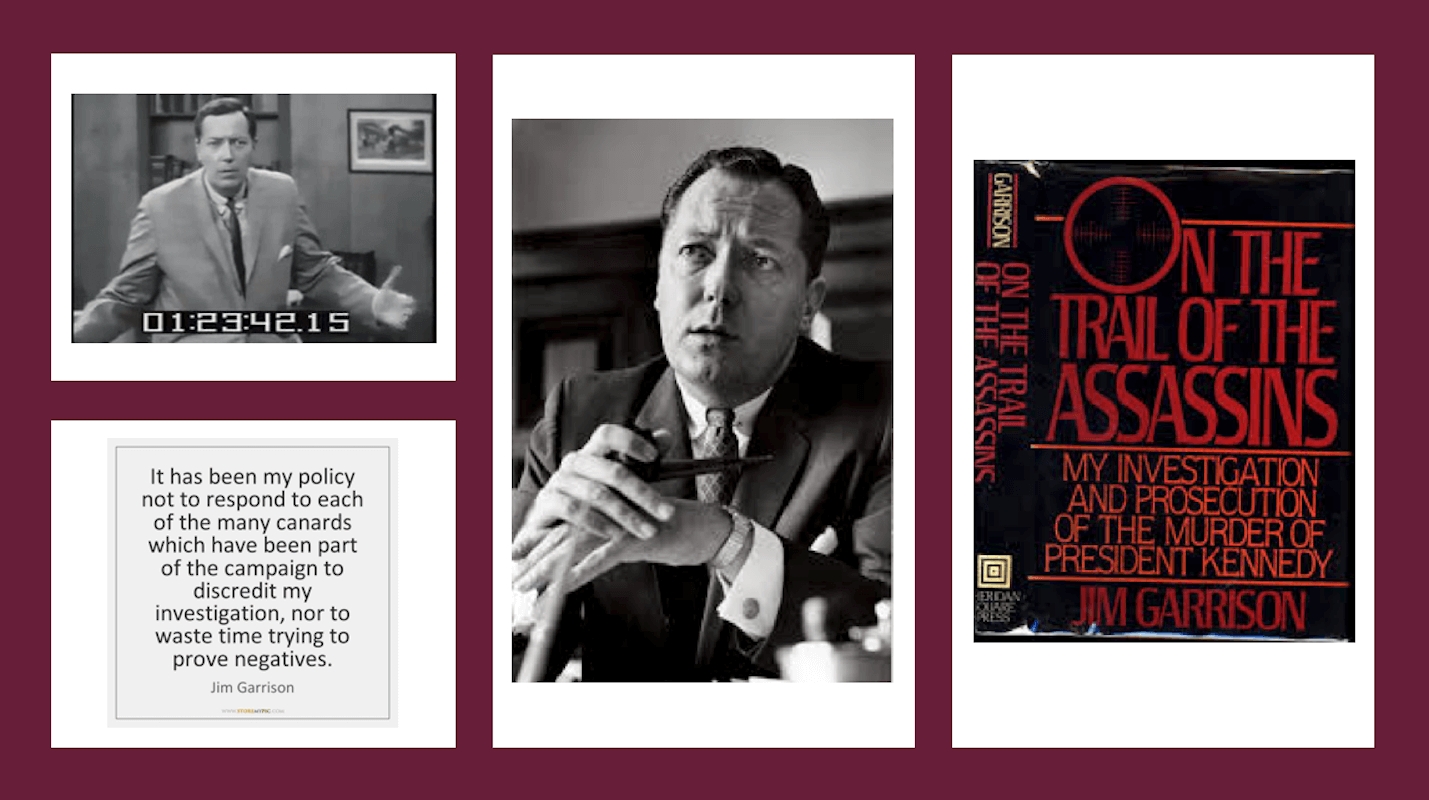
Jim Garrison: The Beat Goes On
Would Jim Garrison have been forgotten if Oliver Stone had never met the late Ellen Ray? If the reader is unaware of who Ellen Ray was let me inform you of her importance in history. (her obituary)
Ellen Ray was the wife of Bill Schaap. They ran a publishing company called Sheridan Square Press. Sheridan Square did not just release books. They also published magazines like the illustrious Covert Action Information Bulletin and Lies of our Times. If our readers do not know about those two periodicals, it is their loss. The first dealt with the Central Intelligence Agency and its allies; the second was concerned with media analysis. They were well done and important journals.
Ellen Ray had known Jim Garrison a long time—going all the way back to his original investigation of the John Kennedy murder in the late sixties. She always thought highly of him and his work. So when Garrison thought of writing a book on his inquiry in the eighties, Sheridan Square was one of the houses he thought of releasing it through. But before that, Garrison had had an offer from a much bigger publishing house. That deal did not go through since the proofreader the house assigned to the book was Sylvia Meagher. Now as everyone knows, this site is a sincere admirer of Meagher and her fine book, Accessories After the Fact. But as most insiders also realize, Meagher was one of the early critics who developed a phobia—some would call it a mania—about Jim Garrison and his inquiry. (The others would include Josiah Thompson and Paul Hoch.) Even someone like Jerry Policoff, who was a close friend of Meagher, once said that Sylvia should not have been assigned to review Garrison’s book: “My God, she contributed money to Clay Shaw’s defense!”
Well, predictably, Meagher’s analysis contributed to Garrison returning his advance. But that may have been fortunate, because now he turned to Ellen Ray and Sheridan Square Press. They assigned him Zachary Sklar as his editor. Zach was a distinguished journalism professor and contributor to Sheridan’s two publications. It was a fortunate pairing. Originally, Garrison had written his book from a third person point of view. But when he met Zach, the editor convinced him that since the DA was an actual participant in the story he was telling, it would be more effective if he wrote the book as a first person narrative. I think most people today would say that was a good choice.
On the Trail of the Assassins sold about forty thousand copies when it was originally released in hard cover. The thoroughly annotated book revealed many new things about Garrison’s investigation that most outsiders did not know about. It also exhibited Garrison’s firm grasp on the entire evidentiary record of the JFK case and also Kennedy’s place in history. Overall, it was a real contribution to the library of books on the assassination of President Kennedy.
But what happened later was probably even more significant. At a film festival in Havana, Ellen Ray met up with Oliver Stone. She told him words to the effect: “Have I got a book for you!” Stone read Garrison’s book and decided to bring it to the big screen. He did so in December of 1991.
But this was the JFK assassination. And it was Jim Garrison. As the DA noted in his book, there were many media critics of his inquiry. And they struck at him in what can only be called a vicious and personal manner. Some of them hid their relationships with the intelligence community, e.g., James Phelan, Walter Sheridan, and Hugh Aynesworth. Even more buried was the cooperation between these men and Clay Shaw’s lawyers. (See Destiny Betrayed, second edition, chapter 11 for an analysis of this nexus.) That sixties wave of media critics was not going to let Oliver Stone bring back Jim Garrison and the JFK case in any kind of fair or salutary manner. So they decided to do a preemptive strike on Stone’s film.
In what was probably an unprecedented campaign in the history of American cinema, the MSM attacked the film JFK seven months in advance of its release. In fact, Ben Bradlee and the The Washington Post sent George Lardner to Dallas to write a story as the film was being shot in Dealey Plaza.
Lardner’s article began with one of the truly snarky remarks in recent journalistic history. In watching a rehearsal of the Dealey Plaza sequence, Lardner noted that Stone had ordered up five shots in the assassination sequence. The reporter then wrote: “Five shots? Is this the Kennedy assassination or the Charge of the Light Brigade?” Through their acoustical testing, the House Select Committee on Assassinations had concluded that there were four shots fired. But as researcher Donald Thomas revealed at Cyril Wecht’s Duquesne Conference in 2003, those same sound technicians told Chief Counsel Robert Blakey that they detected five shots. Blakey told Thomas that he did not think it was possible to sell that many shots to the committee, so their report only analyzed and accepted four. In other words, this was a political decision, not a scientific one. There is real evidence that there were five shots, but somehow that did not matter to Lardner. After all, it’s the JFK case.
Lardner’s article was the first volley in a seven-month MSM campaign that was intended to make sure that the reception of JFK was jaundiced in advance. Many of the same people who attacked Garrison back in the sixties were brought back to do so again, like Aynesworth and Edward Epstein. The fact that neither of these men was at all credible or objective on the subjects of the Kennedy assassination or Jim Garrison was irrelevant. The goal was to savage the film before it had a fair hearing. That is how radioactive this subject was, even thirty years later.
In spite of this assault, JFK did well at the box office, both at home and abroad. It was nominated for eight Oscars, including Best Picture. But to show the reader just how nutty the anti-JFK crusade was, consider the following. On the eve of the Oscars, an anonymous author bought an ad in the trade journal Variety. The ad asked that no voters cast their ballot for the film as Best Picture. Researcher Rich Goad did some detective work and found out that the ad was paid for by the late Warren Commission counsel David Belin.
Besides bringing the Kennedy assassination back into the limelight, JFK was the main cause for the creation of the Assassination Records Review Board (ARRB). For at the end of the film, Stone added a subtitle revealing that the files of the House Select Committee were being kept secret until the year 2027. This created a sensation in Washington. Tens of thousands of citizens now called their representatives, sent them letters or faxed them in order to do something about this travesty. It worked. The Board was created. It was a unique agency that was made up of private citizens appointed by the president. That agency had a staff that read and researched documents that were now to be declassified. If an intelligence agency objected, that agency had to show why the document should be kept secret. This reversed the previous Freedom of Information Law, which put the burden of proof on the requester, who had to show why it should be declassified. But even today, twenty years after the ARRB closed its doors, the government is still maintaining secrecy over thousands of documents.
That Board has a decidedly mixed record of achievement. But it did do some good work on the Garrison angle of the JFK case. In fact, the Board even went to court with then New Orleans DA Harry Connick to salvage a file cabinet full of documents remaining from the Garrison investigation. After being shown up in the press, Connick resisted turning over the materials. But the Justice Department eventually secured the documents. The Garrison family also turned over thousands of pages that the late DA had in his personal effects.
Garrison had always insisted that, for various reasons, he was never able to reveal most of the evidence he had secured from 1967-69. After authors like William Davy, Joan Mellen and myself went through what the ARRB attained, we had to agree. The Garrison files in the Archives today hold an abundance of utterly fascinating material on a wide array of subjects dealing with many aspects of the JFK case. Does the MSM reveal any of this to the public? Nope. One of the most embarrassing aspects of the three-week binge that the media went on last year in anticipation that the JFK files were finally going to be completely declassified was this: No one chronicled what the ARRB had already released. Which was significant. It was about 2 million pages of material that opened up new vistas on subjects like Rose Cheramie, Kennedy and Vietnam, and the medical evidence in the JFK case. Guests like Larry Sabato, Phil Shenon and Gerald Posner did not want to discuss those topics. Nether did their hosts like NBC stooge on JFK, Rachel Maddow.
It is easy to understand why this would occur. As Upton Sinclair once said: It is hard to make journalists understand something when their paycheck depends on them not understanding it. Contrary to popular belief there is no such thing as a liberal media. In the twentieth century, and up until today, the American media has been controlled by an oligarchical class. Some authors call this class the Eastern Establishment. Some call it the Power Elite. As sociologist Donald Gibson explained in his fine book Battling Wall Street, President Kennedy was not a part of that group. He never joined the Council on Foreign Relations; he did not join any secret societies at Harvard; he didn’t like working intelligence during World War II. He got transferred out to the South Pacific and served with a bunch of Joe Six Pack guys on what were close to suicide missions. As this author demonstrated in the second edition of Destiny Betrayed, both in the Senate and in the White House, Kennedy was opposed to much of what this Power Elite was doing abroad, especially in the Third World. (See Destiny Betrayed, second edition, pp. 21-33) After his death, the progress that he did make in the White House was largely halted, and then reversed. (pp. 367-77) Due in part to the ARRB, we know much more about these changes, especially regarding Indochina.
Jim Garrison was probably the first critic of the Warren Commission who understood this matter. And it is probably one of the reasons the MSM decided to smear him beyond recognition. This goes on to the present day. In a recent article in a regional journal called 64 Parishes, a writer named Alecia Long decided to pick up the infernal and eternal anti-Garrison cudgel. The New Orleans Times Picayune has always liked to go after Garrison and so they are now carrying it on their web site.
To anyone who is familiar with the territory, the first reaction is, “Oh my aching back!” The ten-page article is simply a compendium of every MSM caricature of Garrison and his Kennedy case that one can imagine—except Long does not even mention the ARRB. She only alludes to what they did in about a half a sentence. As we shall see, this was a wise choice on her part.
The preposterous thesis of her essay is that somehow, by his clever use of the media, Garrison was able to advance his case, his cause and his reputation. She uses Garrison’s 30-minute talk on NBC as proof of this. She even opens her article by asking why NBC agreed to give the DA this platform. She does not answer her rhetorical question until several pages later. There, she finally says that in June of 1967, “NBC ran an hour-long special sharply critical of Garrison’s claims and the methods used by his investigators.” This is an understatement. Most objective observers considered the Walter Sheridan production a straight-out hatchet job. But she tries to bolster the program’s credibility by adding, “The special featured several witnesses who claimed to have been offered bribes in exchange for providing testimony damaging to Shaw.”
What she does not note is that these so-called “witnesses” were later exposed, either in court, or by their own confessions, as being bogus. (DiEugenio, pp. 239-43) And more than one witness—for instance, Fred Leemans and Marlene Mancuso—testified as to the unethical and threatening tactics used by Sheridan for the program. It was Sheridan who fabricated these phony on-air statements by threatening and intimidating Garrison’s witnesses. Mancuso did not succumb to his bullying, so she was not on the show. Leemans did and went on the program. But both of them signed affidavits revealing the extent to which Sheridan and his cohorts would go to in order to flip Garrison’s witnesses. For example, Leemans was told, “… if I did not change my statement and state that I had been bribed by Jim Garrison’s office, I and my family would be in physical danger.” (DiEugenio, p. 240) Somehow, Long missed those statements, which gravely undermine her thesis because logically, they explain why the Federal Communications Commission decided to grant Garrison the time to counter Sheridan’s handiwork. But even at that, the FCC only gave Garrison a half hour, compared to Sheridan’s full hour, which contradicts the idea of equal time embedded in the now defunct Fairness Doctrine.
She also questions why, when granted the time, Garrison did not answer Sheridan’s charges in more specific terms. As the DA stated throughout his Playboy interview, if he had done that, it would have given Shaw’s lawyers a pretext to move to get his case thrown out of court, since it would prejudice prospective jurors.
With the release of Garrison’s files by the ARRB, the idea that Garrison did not have a factual basis for his case against Shaw is revealed to be utterly false. There is no doubt today that Shaw used the pseudonym of Clay Bertrand. The declassified files contain over ten witnesses who stated this was the case. It is further revealed that the FBI knew this as well. And finally, attorney Dean Andrews knew it—and lied about it. As a consequence, Garrison never got to ask Shaw the key question: “Why did you call Andrews and ask him to go to Dallas to defend Oswald?” (DiEugenio, pp. 387-88)
It is also now shown that Shaw lied about his association with the CIA. That association has turned out to be a long service and a lucrative one. Not only did Shaw lie about it at his own trial, the CIA continually lied about it, and Robert Blakey fell for it. In the HSCA volumes, Shaw is referred to as part of a large businessman’s contact program in the Agency. Not true. Shaw was a well-compensated contract agent from at least the fifties. (Joan Mellen, Our Man In Haiti, pp. 54-55) In the sixties, he had a covert security clearance code name that was the same as Howard Hunt’s. (DiEugenio, pp. 383-87) The CIA tried desperately to cover up these facts, even going as far as altering Shaw’s files. (William Davy, Let Justice Be Done, p. 200) The ARRB later discovered the CIA had gone even further and destroyed Shaw’s 201 file.
(or open in a new window.)
As the late Yale educated attorney Allard Lowenstein once said regarding the Robert Kennedy assassination: in his experience as a lawyer, people who have nothing to hide don’t hide things. Somehow, Long does not think any of this new material is relevant to any discussion of Jim Garrison today.
In addition to this secrecy about Shaw, which hurt Garrison’s case, Long does not detail any of the other methods of obstruction that the CIA and the FBI used against Garrison. Nor does she elucidate any of the meetings that Shaw’s lawyers had in Washington soliciting this kind of aid, which ended up being bountiful. The declassified files of the ARRB contain literally scores of pages on this subject. This features interference with the serving of Garrison’s subpoenas. And further, the setting up of a special committee within the CIA to survey actions to take against Garrison before, during, and after the trial of Clay Shaw. At the first meeting of this super-secret group, James Angleton’s assistant, Ray Rocca, said that he felt that Garrison would convict Shaw in the Kennedy case. (DiEugenio, pp. 269-74) Perhaps in their quest to stop that from happening, on the eve of the trial, at least three prospective witness for the prosecution were physically attacked before they testified: Richard Case Nagell, Clyde Johnson and Aloysius Habighorst. None of these men ended up testifying. (p. 294)
As mentioned previously, one of the most bizarre statements that the author makes is that Garrison was proficient at using the media and manipulating them for his own benefit. How anyone can make such a statement today is simply inexplicable. As authors like William Davy and myself have shown, the media utterly destroyed Jim Garrison. Before Garrison took on the Kennedy assassination, he had a promising career ahead of him as a Louisiana politician. Many thought he could have been governor or senator from the state. (DiEugenio, pp. 172-74) That career was utterly wrecked by the two-year roasting he took in the press from almost every outlet imaginable: CBS, NBC, NY Times, Life Magazine, Saturday Evening Post, to name just a few. Garrison was eventually defeated in his District Attorney re-election bid due to two sets of phony pinball kickback charges, which he defeated at trial. But the publicity weakened his position and strengthened his opponent Harry Connick, who defeated him in a close election in 1973. (See chapter 19 of Garrison’s book.) To most legal observers, Connick turned out to be a very poor DA compared to Jim Garrison.
After Garrison was retired from the DA’s office, it took him years to recover from the ordeal he went through. At that time, people who visited him in New Orleans said he had a small office that he rented from a larger firm. This is the man who likely would have been residing in the governor’s mansion if not for the JFK case. That media manipulation Long describes did the DA a lot of good, didn’t it?
Long is so utterly biased that she actually credits Judge Herbert Christenberry. This is the judge who threw out Garrison’s attempt to try Shaw on perjury charges after his acquittal. Today, there is little or no doubt that Shaw lied numerous times at his conspiracy trial. For instance, about his employment by the CIA, about his friendship with David Ferrie, about his use of an alias. And according to Garrison assistant Steve Jaffe, this time Garrison was not going to make the same mistake he did at the conspiracy trial. He was going to use every witness he had against Shaw.
Judge Herbert Christenberry should never have presided over this hearing. Moreover, there should have never been a hearing in the first place. As Garrison notes in his book, the idea of a federal judge inserting himself into a state case was quite unusual, since there was a law against it. But that is what happened. Shaw’s lawyers moved to have a state case considered in federal court. (Garrison, p. 253)
Why did they do this?
Because Christenberry’s wife had written a letter to Shaw after his acquittal. This was also after Garrison filed the perjury charges. The letter uses the plural pronoun “we”, so it clearly describes both husband and wife’s sentiments. The Christenberrys congratulated Shaw on the outcome of the trial. They sympathized with him over what the DA had done to the poor man. They continued by saying how much better the proceedings would have been if the case had been allotted to federal court and Judge Christenberry. But unfortunately, Caroline Christenberry could not voice these sentiments during the trial for risk of being labeled prejudiced in advance. (Destiny Betrayed, second edition, p.315)
If there was ever an attempt to solicit a case, this was it. That letter is in the National Archives today. It appears Long has never heard of it.
This article proves the very worst about the JFK case. Everyone hoped that the declassification of the files would aid in the public’s understanding of what that case was really all about, what impact it had on the personages involved and also on American history. That will not happen with people like Long. At the end of her original essay as published in the periodical 64 Parishes, it is revealed that her piece is part of something called the “Democracy and the Informed Citizen Initiative”, which is sponsored by the Federation of State Humanities councils. The Andrew Mellon Foundation was part of the support for that initiative. In other words, the Power Elite Kennedy opposed is still thriving.
But further, as Anthony Thorne discovered, Long made up her mind about this matter without looking at any documents. She said, “I don’t want to dig through CIA and FBI documents for the rest of my life.” She then gave the back of her hand to the myriad books on the JFK case: “I find the basic premise of many these books to be problematic and would then note [sic] take those as seriously as historical studies.”
The books don’t matter. The documents don’t matter. Typical MSM historian on the JFK case. Which is why her article is worthless. It is the vacuity and speciousness of work like this that helps drive readers to the likes of Alex Jones. Perhaps unbeknownst to her, Long is adding to his minions.
-

King in the Wilderness
There were three documentaries prepared for the fiftieth anniversary of Martin Luther King’s assassination: Hope and Fury was a production of NBC; I am MLK Jr. was prepared by the Viacom network; but perhaps the most interesting of the productions was HBO’s King in the Wilderness.
Peter Kunhardt is an experienced filmmaker who has previously produced and directed documentaries on a wide variety of historical figures like Abraham Lincoln and Richard Nixon. Kunhardt chose to direct this production and he collaborated with a writer he knew, Chris Chuang, who had worked with on a documentary from the previous year about Warren Buffett.
King in the Wilderness has two defining qualities that differentiate it from the other two films and from previous King documentaries I have seen. First, it does not deal with King’s entire career—not even close. It limits itself to the last years of his life. The focus is on the time interval from the passage of the Voting Rights Act in 1965 until his death in Memphis and the following funeral in Atlanta in 1968. Second, it does not feature the usual professional pundits as talking heads. So, thankfully, we are spared pretentious gasbags like Dan Rather and Tom Brokaw.
The film begins with shots of the King home in Atlanta. We then learn that several of King’s friends and working colleagues gathered there for the anniversary of his death. They will be the interview subjects for the film. When they appear, we see them in close-up looking directly at the camera. Thus we listen to King’s attorney Clarence Jones, his close colleague in the Southern Christian Leadership Conference (SCLC) Andrew Young, his friend the actor and singer Harry Belafonte, Dianne Nash of the Student Non-Violent Coordinating Committee (SNCC), singer and activist Joan Baez, and SCLC Chicago representative Jesse Jackson, among others.
I should note one other distinguishing feature. In criticizing the documentaries of actor Tom Hanks, I have written that, aesthetically, they are purely assembly line productions. As far as the way they are made, there is nothing at all distinguishing about them. With Hanks and his company Playtone, it is almost as if stylistically acute documentaries like The Power of Nightmares and The Kid Stays in the Picture had never been made. Kunhardt’s film is not a cornucopia of new ideas in that respect, but it does have some visual panache and interest to it.
In fact, it begins with the viewer going behind the scenes of a news interview with King. Sander Vanocur, NBC’s national correspondent at the time, is seen rehearsing an interview with the civil rights leader—clapboard included. King recalls his famous “I Have a Dream” speech made during the March on Washington in August of 1963. That speech was made in aid of passage of the Civil Rights Act of 1964. He comments that in light of what has happened to America in the meantime, the dream he spoke about has now become something of a nightmare. The reference points he is speaking about are, of course, the escalation of the Vietnam War, and the recurrent rioting, and accompanying fatalities, that had become so frequent by 1967.
The film tries to elucidate some of his chagrin by depicting both sides of a taped discussion of the 1965 Watts riot between King and President Johnson. He tells the president that unless he does something to give people in the black slum areas some hope, he fears that those areas will become tinderboxes of violence. Which, as we know, they did. Johnson did not do very much to offer any change or hope for those living in places like Watts because of his escalation of the Vietnam War—a theme to be developed later.
The film then sketches in another dispute that King was having in this time period. Because of these recurrent riots, and because so many of them began with an instance of police brutality, and because of the continuing violent acts by white terrorists—for instance the shooting of James Meredith during his March Against Fear in Mississippi—King began to catch some heat from what many saw as an unlikely source.
For instance, after Meredith was wounded and hospitalized by a white man, King’s group, the SCLC, stepped in to complete the march. But so did other groups, like the SNCC. By 1966, Stokely Carmichael had become the leading public figure in the SNCC. During the completion of this march, Carmichael started to use a previously unmentioned term: “Black Power”. This signaled the beginning of a different type of approach from King’s Gandhi-inspired civil disobedience through non-violent techniques (for example, lunch counter sit-ins). Carmichael’s message, which he deliberately made in King’s presence, was closer to what Malcolm X had been preaching in New York, and would lead to the creation of the Black Panthers in the San Francisco/Oakland area. King was placed on the spot by Carmichael’s provocation. He replied that, while he supported Carmichael, he did not endorse the connotations of the message. The film depicts this colloquy with the two figures standing next to each other. Carmichael then responds by saying that he is not as committed to non-violence as Dr. King is.
After this point is addressed, the film takes up another pressure point on the civil rights leader. In a taped phone call between Mayor Richard Daley and President Johnson, Daley tells the president that he knows that King is not with him on the war in Vietnam. Daley knows this since King has now turned his civil rights demonstrations north into Daley’s city of Chicago. This was in fact in response to an issue that Bobby Kennedy had been trying to raise awareness of for years prior to this move. As Kennedy had said at the time: What good does it do for an African-American to be able to sit at a lunch counter if he doesn’t have the money to pay for the lunch? So King and SCLC coordinator James Bevel decided to target the city of Chicago to address a more insidious pattern of racism in the north.
To say that King was not welcome in the north understates the antipathy that awaited him in the Windy City. During his marches he was greeted with rock throwing, loud racial slurs like “Niggers go home!”, and ugly signs. For instance, one placard said, “We Want Wallace”, meaning Alabama governor George Wallace. Another, in direct opposition to Carmichael, said “White Power”. It got so bad that King needed police protection. Further, Daley proved a formidable counter-puncher. Understanding his past successes, he was determined not to put King in jail. And when he heard the police had placed some of his demonstrators behind bars, he immediately ordered their release.
As Young comments, he was not so sure that King should have taken this project on at the time. Chicago was a huge city with a very entrenched power structure. He did not think the SCLC had the money or manpower to manage such a crusade. King did get an agreement after several months, concerning fair housing and integration of the city work force. Whether or not the city abided by it afterwards has been a point of controversy among scholars and writers ever since.
Around this time, in late 1966, King decided to meet with Carmichael to discuss precisely what he meant by the phrase “Black Power”. Carmichael and another SNCC representative, Cleveland Sellers, countered King by asking him when he was going to come out against the war in Vietnam. Carmichael memorably said, “No Vietnamese ever called me a Nigger.” This was a risky step. As Johnson domestic aide Joe Califano observes, LBJ thought he had some compromising information on King, which the FBI had given him. This referenced certain sexual activities by the civil rights leader and also presumed communist influences in his camp. But by this time, the FBI’s COINTELPRO program was in full bloom. Consequently, J. Edgar Hoover was now using spies in King’s camp and also arranging counter-intelligence programs against these kinds of groups.
But as the film shows, it was actually Coretta King who began to push her husband into opposing the war. She was actually speaking out against it and demonstrating before he was. King therefore decided to make his famous attack on Johnson’s war policy at Riverside Church in April of 1967.
Johnson, Hoover and the MSM did not appreciate King’s stand. Newspapers openly criticized him by saying that he had now “Crossed over the Line” or he had “Bordered on Treason”, claiming this now compromised his position as a civil rights leader. Hoover used this to play on Johnson’s feelings about King. But in addition to these, there were people inside the civil rights movement—like Roy Wilkins—who also questioned the open attack on the White House. The break with Johnson also hurt the finances of the SCLC. The man who had been praised for his stand on civil rights was now being attacked and vilified for his opposition to the war.
As King had warned Johnson, the slum areas in northern cities were piles of tinder waiting to explode. They did so in the summer of 1967. At that time, over twenty cities erupted in riots. Some of them, for instance Newark and Detroit, were among the most deadly in American history. The final toll was over 100 people dead. Oddly, the film does not discuss the appointment of the Kerner Commission by Johnson. Otto Kerner was the governor of Illinois. The White House requested he form a committee to study the causes of the riots and propose solutions. Kerner appointed a distinguished panel consisting of people like Wilkins, Mayor John Lindsay of New York, and Senator Fred Harris of Oklahoma. Their report is one of the most honest and searing documents ever written on racial tensions in America at the time. It sold over two million copies. Its most famous line was, “Our nation is moving toward two societies, one black, one white—separate and unequal.” Kerner focused on poor housing and education in the slum areas, but he also pointed criticism at the media for not devoting time or empathy to these problems.
The important thing about this presidential report was this: Johnson ignored it. He did not even do the customary photo opportunity with the committee once the report was done. Johnson’s reaction was defined by two parameters. First, Hoover’s talking in his ear and supplying him dirt had estranged him from King. And now this report concurred with what King had told him after Watts. Secondly, what Kerner was proposing was going to be expensive. Johnson’s escalation of the war had already caused budget deficits, which he was trying to disguise with accounting tricks and borrowing from the Social Security fund. As many have commented, the goals of Johnson’s Great Society were run aground by the war in Vietnam.
After Johnson’s failure to act, King decided to take Bobby Kennedy’s advice about a national demonstration against poverty. RFK had told NAACP attorney Marian Edelman that a good idea would be to have a mass demonstration in Washington as had been done with the March on Washington in 1963. Not everyone liked the idea, but King did. King appeared on the Tonight Show in February of 1968. The guest host was his friend Harry Belafonte. He talked about this problem of poverty and how it had actually gotten worse in the last four years. He also addressed fears of his mortality by saying it was not how long a person lived but what he did with that time—a message he would more or less repeat the night before his assassination in Memphis.
The SCLC began to design the Poor People’s March as a coalition. It would not include just African Americans, but also Mexican Americans, Native Americans and poor whites. King now began to talk about a coalition of the poor and to bring back ideas from FDR’s New Deal program and the proposals of Senator Huey Long—specifically, a declaration of economic rights and a guaranteed annual income. As King said at the time, when wealthy people or corporations get these things, it’s called a subsidy; when poor people get them, it’s called a dole.
The film now transitions to 1968 and the Memphis sanitation workers’ strike. King was reluctant to go to Memphis, but he did. As the film notes, King’s first appearance there ended in a riot and looting and some bad publicity from city leaders. Because of this black eye to the SCLC, King decided he had to return. As Andrew Young comments, the Riverside Church in New York, a huge and wealthy operation, now offered him a temporary pastorship, which King turned down. The program then shows King’s famous speech on April 3rd, the night before his assassination.
We then cut to news stories about the assassination of Martin Luther King at the Lorraine Motel and the national wave of assassination riots that broke out afterward. Regarding the Martin Luther King assassination, Carmichael urged it on by saying: “White America killed Dr. King. We declare war on America!” The film underplays Bobby Kennedy’s role in the Atlanta funeral that followed. Kennedy called Coretta King after the murder, arranged to have King’s body transferred to Atlanta, and then booked dozens of rooms for incoming dignitaries to attend. We watch a film of Jackie Kennedy walking up to the church, and there is a touching black and white picture of both widows facing each other in black dresses. Wisely, Kunhardt holds on to that phofor a few seconds to expand their loss into our loss.
The film ends with a quite pithy remark by Young. He says, “We were not able to stay together without him. And the movement began to fragment.” That comment, following the picture of Jackie Kennedy and Coretta King, sums up the loss of what should have been a great decade.
This was the best of the three documentaries and it will be available on DVD soon.
-

David Giglio interviews Jim DiEugenio on the Death of Bob Parry, and the Problems with The Post
A study in contrasts concerning the journalism of Robert Parry, whose singular groundbreaking investigative work did more than any other to shed light on the interconnected scandals of the Reagan era, vs the Washington Post, unduly celebrated by the eponymous Hanks/Spielberg film for its supposed role in publishing the Pentagon Papers.
Listen to the audio and read the transcript at Our Hidden History.
-
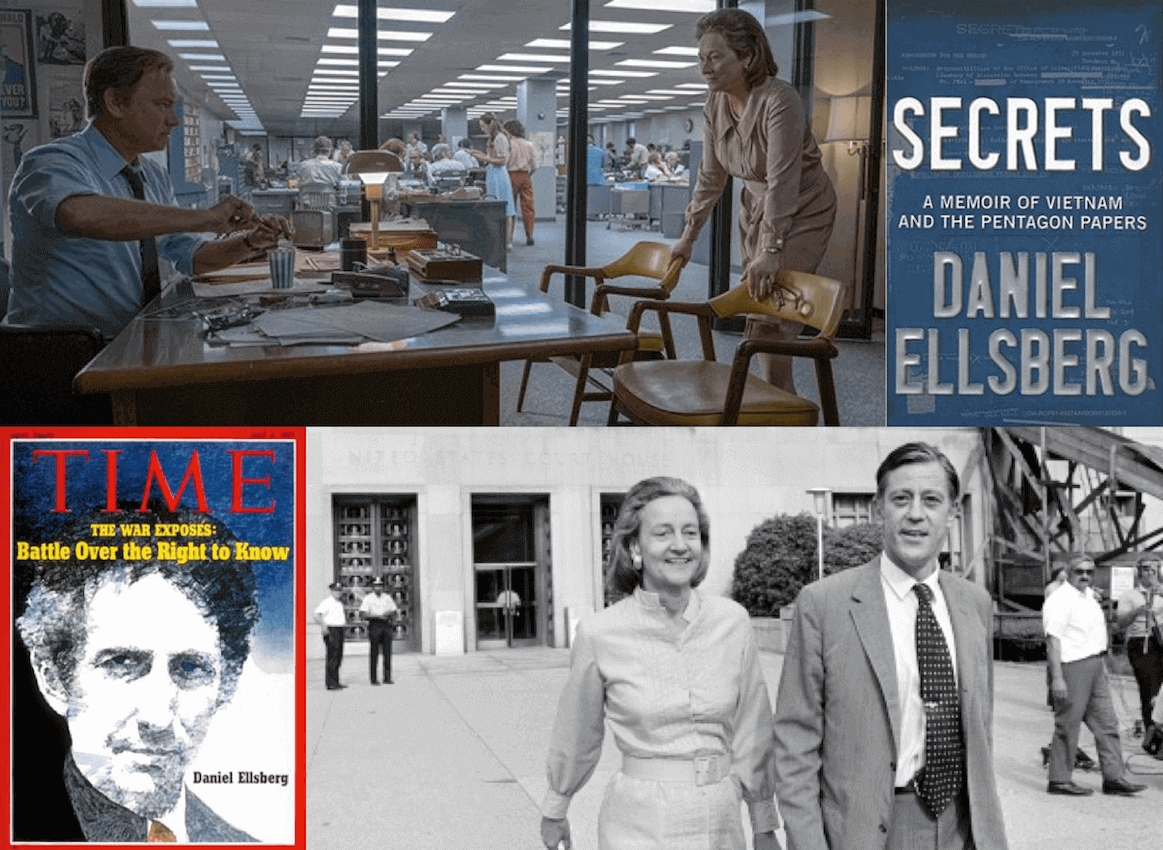
Tom Hanks and Steven Spielberg Mythologize the Washington Post
For Jim’s review, published at Consortium News, see: “The Post and the Pentagon Papers“.
A few weeks ago Ken Burns and Lynn Novick delivered a hugely disappointing ten-part documentary entitled The Vietnam War. Tom Hanks and Steven Spielberg will now do the same for the famous Pentagon Papers case.
Their film, entitled The Post, is not focused on Daniel Ellsberg. And it does not use his book Secrets as source material. Their film actually makes Ben Bradlee and Kate Graham the protagonists of the whole struggle to release the multi-volume, Defense Department study about how America got into, and stayed involved in the Vietnam War. It will therefore make Bradlee and Graham into some kind of hero and heroine of that hugely conflicting episode. To anyone who understands who Graham and Bradlee were, and the true story of what Ellsberg did, nothing could be further from the facts. To cite just one example: in Ellsberg’s 457 page book Secrets—which chronicles the entire affair in detail—there is exactly one glancing reference to Bradlee. There are none to Graham.
That is because, when one understands what Ellsberg and his cohorts were up to, the Washington Post was, if not inconsequential to the affair, extraneous to Ellsberg’s strategy. Once Ellsberg made his decision to go public with the Robert McNamara commissioned Top Secret history, it was just a matter of how many newspapers would pick up the story after the New York Times initially published it. Ellsberg and his friends had made many copies of the secret history, since he anticipated that there might be legal action against the Times to stop publishing. He and his friends had arranged for many newspaper outlets to get them once the Times was enjoined by the Nixon White House with a temporary restraining order (TRO) to halt publication. Which the Times was, after three days of stories based upon the documents.
By the time the Supreme Court decided to strike down the TRO and allow publication, almost twenty newspapers throughout the country had printed sections of the Pentagon Papers. The White House had only named four of them in their legal action: the Times, the Post, the Boston Globe and the St. Louis Post Dispatch. But further, Senator Mike Gravel had read the Pentagon Papers into the Congressional Record on the floor of the Senate. And he then handed out copies to reporters who were there at the time. He then arranged for no other senator to be there so he could move to have the entire set committed to the record without objection. This was on the day the Supreme Court decision was delivered. What Gravel did—committing the documents into the Senate record— made the decision pretty much irrelevant. Gravel agreed to do this after three other senators—including George McGovern—and one congressman had refused to. Then Beacon Press, which came under great duress, published that version of the Pentagon Papers in a four-volume set.
There are some heroes in this story. For example, Ellsberg, Mike Gravel, and Ellsberg’s friend Anthony Russo, who helped him copy the documents and who, like Ellsberg, risked going to jail for that act. There was also Judge Gerhard Gesell who, during two weeks of rapid, almost dizzying court hearings, ruled twice for disclosure. But Graham and Bradlee? Nothing in either of their careers merits this kind of aggrandizement. It could only happen in Tinsel Town. And in these days of MSM synergy, HBO has joined in with documentary specials on Spielberg and Bradlee.
Below we link to a series of articles about Bradlee, Graham the Washington Post and Watergate. We do this so the reader will not be bamboozled by another Tom Hanks version of (ersatz) history.
To counter the Hanks/Spielberg Mythology, here is some real information on Bradlee, Graham and The Washington Post:
Ben Bradlee
- “Ben Bradlee’s Not Such ‘A Good Life’, Part 1”, at Consortium News
- “Ben Bradlee’s Not Such ‘A Good Life’, Part 2”, at Consortium News
- “Ben and Jack: Not a Love Story”, Probe 4.6, September-October 1997
- “The Posthumous Assassination of John F. Kennedy” (see in particular Part 1, pp. 11, 29 in the attached original)
Kate Graham
- “Unmasking the Washington Post”, Probe 3.2, January-February 1996
Watergate
- “The Watergate Saga: The Official Version vs the Reality”, Probe 3.2, January-February 1995
- “From Dallas to Watergate: It’s Déjà-Vu All Over Again”, Probe 3.2, January-February 1995
- “Rearranging the Watergate Myth”, at Consortium News
Bob Woodward
- “Government Flaks? Bob Woodward and James Phelan”, by Lisa Pease, with a sidebar, “The Deceptions of All the President’s Men”, Probe 3.2, January-February 1996; these have been reposted separately on this site as: “Bob Woodward” and “Adrian Havill, Deep Truth”
-

Ken Burns & Lynn Novick, The Vietnam War: Part Four (The Nixon Years)
For all practical purposes it is not possible to separate out the last months of President Johnson’s stewardship of the Vietnam War from Richard Nixon’s. For they are intertwined around two crucial points.
First, after the Tet offensive and during the siege of Khe Sanh, Johnson called a meeting of the so-called Wise Men of American foreign policy, retired eminences like Dean Acheson and Robert Lovett. Johnson brought in the military to try and explain how America had actually won the Tet offensive. Acheson walked out. When Johnson called him later to ask why he left, Acheson said he would not listen to any more canned Pentagon presentations. He wanted the raw data of the intelligence reports. LBJ complied and Acheson got the real picture of what was happening in the field. (Walter Isaacson and Evan Thomas, The Wise Men, p. 687)
A couple of weeks later, Johnson told Secretary of Defense Clark Clifford to begin an in depth review of the war based on the real figures. After about two weeks of discussion, with Clifford asking the generals many probing questions, the new secretary came to the conclusion it was a hopeless military situation. (Isaacson and Thomas, pp. 683-89) As Clifford later said, “The Tet offensive’s size and scope made a mockery of what the American military had told the public about the war, and devastated American credibility.” (Carl Oglesby, Ravens in the Storm, p. 156) As a result of these two developments, Johnson decided there would be no further granting of General Westmoreland’s requests for combat troops. Shortly after, he removed Westmoreland and replaced him with Creighton Abrams.
Nixon had heard about the Wise Men meeting and understood what it meant. In March of 1968, before the presidential campaign began, he told three of his speechwriters: “I’ve come to the conclusion that there’s no way to win the war. But we can’t say that, of course. In fact, we have to seem to say the opposite, just to keep some degree of bargaining leverage.” (Jeffrey Kimball, Nixon’s Vietnam War, p. 52)
What makes that statement startling is the following episode. Realizing it was the end of the line, Johnson decided not to run again in 1968. When he announced this at the end of March, he said he would spend the rest of his administration, about ten months, trying to get a peace settlement. When the presidential race heated up in the summer of 1968, Nixon began to perceive this tactic as a way of aiding the Democratic candidate, Hubert Humphrey, LBJ’s Vice-President. Nixon decided to hatch a plot in order to stop Johnson’s negotiations from getting off the ground. With newly discovered files, writers like Bob Parry and Ken Hughes have filled in the outlines of this previously hazy conspiracy. The idea was to use sympathetic agents like GOP lobbyist Anna Chennault and Vietnamese ambassador to the USA Bui Diem to tell President Thieu in Saigon not to enter the negotiations. If he did not, he would get a better deal from President Nixon. The plot was successful. Thieu boycotted the negotiations, stymying Johnson’s efforts, thus backstopping Nixon’s narrow victory. (For a good article on the subject, see Robert Parry, “LBJ’s X File on Nixon’s Treason,” Consortium News, March 3, 2012; for a book-length treatment see Ken Hughes’, Chasing Shadows.)
Nixon managed to win the presidency, but unawares to him at the time, he was sowing the seeds of his downfall. For, as both Parry and Hughes have noted, the real provocation for Watergate was not the publication of the Pentagon Papers. It was Nixon’s knowledge that Johnson knew that he—a private citizen—had illegally subverted LBJ’s foreign policy. This was a violation of the Logan Act. For Johnson perceived something was wrong with Thieu’s reaction. He decided to have the CIA and the FBI place surveillance on Nixon’s campaign, Anna Chennault, and the Vietnamese embassy in Washington. The result of this was that Nixon’s covert campaign was discovered. But Johnson decided not to go public with the information. When Nixon took office, J. Edgar Hoover tipped him off as to what Johnson had done. Nixon commissioned a study of where Johnson had stored the file on the matter. A young aide concluded (wrongly) that it was at the Brookings Institute. On one of the declassified Watergate tapes one can hear Nixon talking about firebombing Brookings, and sending a team in under the confusion to ransack the place to find the file. This caused the creation of the so-called Plumbers Unit in the White House. It was that unit which would break into the Watergate Hotel in the summer of 1972. Nixon resigned facing impeachment charges two years later because of that event. (“Fleshing Out Nixon’s Vietnam Treason”)
The Burns/Novick documentary does a decent enough job on the above. It touches on these major points (except for Johnson’s Wise Man meeting). But it does not note two important subsidiary issues. Although Nixon acknowledged the war was lost before he entered office, he greatly increased air operations over both Laos and Cambodia. During 1969, Nixon increased bomb tonnage over Laos by 60%. (Jeffrey Kimball, The Vietnam War Files, p. 21) In Cambodia, the increase was even more radical. As William Shawcross noted in his bestselling book Sideshow, the leader of Cambodia in 1969, Prince Sihanouk, had allowed the Johnson administration to do small scale cross-border raids. This was to hinder North Vietnam’s supply route to South Vietnam, the Ho Chi Minh Trail, which crossed through Cambodia and Laos. But he never gave them permission to extend the war into his country, or to use sustained B-52 bombing. (Shawcross, pp. 70-71)
This all changed under Nixon and his National Security Advisor Henry Kissinger. And Burns and Novick drastically underplay the change. In fact, they attempt to blur the difference between the two administrations. As Shawcross writes, by the end of 1968 there were about 4,000 of Pol Pot’s Khmer Rouge rebels in Cambodia. (p. 73) Sihanouk had done all he could to walk a tightrope between Hanoi and Washington in order to protect his people and their social structure from the war, thus keeping Pol Pot at bay.
This was not good enough for Nixon. During the first week of his administration he made Cambodia and Sihanouk targets of his war plans. (Shawcross, p. 91) In March of 1969, Nixon began secret sustained B-52 bombing attacks over Cambodia. As he said, “We’ll bomb the bastards off the earth.” (Anthony Summers, The Arrogance of Power, p. 333 ) And he tried. In the next 14 months there were 3,630 B-52 sorties flown over Cambodia. That bombing campaign drove the North Vietnamese from the border areas of Cambodia inward; but the bombing raids followed them. (William Blum, The CIA: A Forgotten History, p. 151) And this began to destabilize Sihanouk’s government. (Shawcross, p. 113) To protect his right flank, Sihanouk appointed General Lon Nol as his prime minister. The general staged a coup against Sihanouk. Lon Nol allowed Nixon and Kissinger to supplement their air war with an invasion of Cambodia in the spring of 1970. From here the Khmer Rouge exponentially gained in strength until Lon Nol’s government was under siege by Pol Pot. Nothing like that existed under Johnson, let alone Kennedy. Therefore, it is quite a stretch to blur the dividing lines.
How much of an escalation in the air war was there under Nixon? Realizing in 1968 the war was lost, and later announcing a program of troop withdrawals in August of 1969, Nixon proceeded to drop more bomb tonnage over Indochina than Johnson had. And it was by a significant factor—over a million tons. (Kimball, The Vietnam War Files, p. 21)
A good question could have been posed at this time in the Burns/Novick narrative. Knowing the war was lost, why was Nixon now spreading it further beyond the borders of Vietnam? The only way to answer that question would be to trace Nixon’s involvement with Ngo Dinh Diem and President Eisenhower back to 1954-56. (Actually before that, since Nixon appealed to President Truman to support the French cause in the first Indochina War; see David F. Schmitz, Richard Nixon and the Vietnam War, p. 1). Contrary to what Nixon liked to tell interviewers like David Frost, he did not inherit the South Vietnam problem. He helped create it—through illicit means. He did so, at the foot of his master Secretary of State John Foster Dulles, by breaking the Geneva Accords and not allowing unification elections. America then handpicked a homegrown, Catholic, English speaking leader, Ngo Dinh Diem. (Blum, pp. 138-139) CIA Director Allen Dulles then had veteran black operator Ed Lansdale rig the plebiscite that got rid of the French administration and installed Diem as dictator. (p. 139) The Agency furnished Diem a police force by training his security officers at Michigan State. As former Green Beret Donald Duncan wrote, some of these security measures comprised torture techniques against dissidents like lowering the prisoner’s testicles into a vise, and also waterboarding. (pp. 141-42. It should be noted, Burns and Novick imply that Americans did not do these things. A false presumption we will return to.)
In other words, whether Nixon wanted to deny it or not, he was up to his neck in the creation of the state of South Vietnam. It would not have existed without the Eisenhower/Nixon administration. Foster Dulles, Nixon’s mentor, said in a rather famous comment, which the film ignores: “We have a clean slate there now, without a taint of colonialism. Dien Bien Phu was a blessing in disguise.” (Blum, p. 139)
Yet, in spite of all this, one of the worst things about this series is that it tries to imply that three presidents fought the war: Kennedy, Johnson and Nixon. Utter balderdash. The fact is that when Kennedy won the presidency he was presented with this fabricated country, run by a Lansdale-chosen leader, who could hardly be less wrong for the population he was representing. And Diem was backed up by Pentagon advisors, and a CIA-run police state—replete with the infamous tiger cages—and tens of millions of dollars in aid each year. In introducing Nixon, the film ignores all of this. And, as I noted in Part 1, concerning the first Indochina War and the creation of both South Vietnam and Diem: Burns and Novick deliberately cut most of this out, including the mention of Lansdale’s name. They also excised the fact that Vice President Nixon was the first high level politician who proposed sending American combat troops to Vietnam, in order to bail out the French at Dien Bien Phu.
In my opinion, this censorship is historically untenable. One has to fully grasp Nixon’s initial involvement in the conflict in order to understand his irrational actions upon becoming president. Partly because of his schooling at the foot of Foster Dulles, Nixon was an inveterate Cold Warrior, and would die as one. About the famous and serious Sino/Soviet border dispute he once said, “They are simply arguing about what kind of shovel they should use to dig the grave of the United States.” (Richard Nixon and the Vietnam War, by David Schmitz, p. 10) While campaigning for GOP Senator Barry Goldwater in the 1964 presidential election, Nixon said the war was part of Chinese expansionism into Southeast Asia, and if they won they would spread into Australia and New Zealand. (Schmitz, p. 12) In that campaign he also said LBJ was not aggressive enough and he should take the war into the north. (p. 12) In an article for Reader’s Digest, Nixon wrote that America losing in Vietnam would be like Neville Chamberlain appeasing Adolf Hitler at Munich. For, he added, the fate of all Asia relied on the outcome. (p. 13) In December of 1964, after Johnson won the election, Nixon now urged the expansion of the war into Laos and North Vietnam. For if we lost in Vietnam, it would risk a major war with Russia or China; we should therefore fight now and not later. (p. 14) Once Johnson did commit combat troops in 1965, Nixon said we needed more until the communists left. (p. 16) To say this all turned out to be wrong is not the point. It all turned out to be complete malarkey. This from a man who the MSM once framed as some kind of foreign policy guru.
On top of that, there were his multiple trips to South Vietnam, four of them in five years. All while he was out of office. (Schmitz, p. 19) The one he took in 1964 is inexplicable. (Jim Hougan tries to explain it here.) In 1967, he met in country with Ed Lansdale and tried to encourage Johnson to mine Haiphong harbor. (p. 16)
Then there was the Madman Theory. Foster Dulles called it the “uncertainty principle”. What it meant was this: you had to convince your foe that you were willing to go to previously unimagined lengths in order to persuade him you were irrational. (Jeffry Kimball, The Vietnam War Files, p. 55) He would as a result either capitulate or agree to unfavorable terms. The problem is that none of this worked in Vietnam; not the bombing of Cambodia, not the invasion of Cambodia, not the increased bombing over Laos, not the invasion of Laos, not the mining of Haiphong harbor, and so on. Yet even when the military saw that the torture and assassination program, Operation Phoenix, was not working and wanted to cut it back, Nixon insisted it be renewed. (Summers, p. 334)
The fact was that the Cold War construct that Eisenhower, Johnson and Nixon bought into was faulty. The idea that there was a colossal communist conspiracy emanating from Moscow or Bejing (or both), that Vietnam was part of this plot, and if we did not stop them there then the dominoes would fall all the way to Hawaii: this turned out to be moonshine. And by 1957, State Department officer George Kennan—the man who made up the concept of containment back in 1946—deplored the contortions that his original ideas had undergone at the hands of the Pentagon, the CIA and hardline political hacks. But he specifically excluded President Kennedy from this pack. In fact, he liked working with JFK, and after he was killed, he had a “dismal foreboding for the future of this country”. (Click here) One of the most serious failings in this 18 hour behemoth is that the underpinnings of these horribly flawed ideas are never exposed. On the contrary, at times, they are even supported.
Nixon and his National Security Advisor Henry Kissinger set up a series of secret negotiations in Paris in 1969. For a long time they did not go anywhere. The main negotiators were Kissinger and Hanoi’s Le Duc Tho. The latter saw through all the bluster that Nixon and Kissinger tried to throw at him. He told Kissinger in 1970 that Nixon’s Vietnamization program—the attempt to gradually turn over the war to South Vietnam as American troops left—was not working and would not work. He specifically mentioned the failure in Laos, and the previous failure of Johnson’s bombing campaign, Rolling Thunder. He then was quite frank: he told Kissinger that America had failed in Vietnam. (Jeffrey Kimball, The Vietnam War Files, p. 127) Hanoi’s representative made the following cogent observation: “Before, there were over a million US and puppet troops, and you failed. How can you succeed when you let the puppet troops do the fighting? Now, with only US support, how can you win?” (p. 127)
Nixon was caught between the devil and the deep blue sea. For his own political survival, he knew he could not keep American troops in Vietnam. He had to maintain his withdrawal schedule. It was the only way to at least partly neutralize the anti-war movement, which—contrary to what the film states—had a strong influence on what Nixon was doing. Jeffrey Kimball, the foremost authority on Nixon’s Vietnam policies, has clearly noted this. Prior to the giant October and November 1969 anti-war demonstrations—which took place not just throughout America but also around the world—Nixon had mapped out a multi-pronged offensive against Hanoi. It was a land-air-sea plan. It included, but was not limited to: infantry operations across the DMZ, air strikes at bridges near the Chinese border, and the mining of three seaports. It was codenamed Operation Duck Hook. It was so secret that not even Defense Secretary Melvin Laird knew about it. (Kimball, p. 101) Nixon had drafted a speech to announce this surprise offensive. But after seeing the size, scope and intensity of the protest movements, he called off the operation. He then changed his planned address to his Silent Majority speech. (p. 105) It was startling to me that Burns and Novick did not mention this strophe at all. Perhaps it was excised because one of the goals of the film was to belittle the anti-war movement, a point I will return to later.
Richard Nixon fought to the end of his life to prevent any of his records from being released through the National Archives. There was real progress made on this only after he passed away in 1994. Today, it is apparent that one reason he fought so desperately against it was due to the nature of his many discussions with Kissinger on Vietnam. The tapes would have exposed his book on the subject, No More Vietnams, as a knowing deception. For instance, Nixon wrote that he never considered bombing the dikes in North Vietnam or using atomic weapons. As Kimball discovered, during Hanoi’s Easter Offensive, in spring 1972, Nixon considered doing both. (Kimball, pp. 214-19) Although their film discusses the Easter Offensive, Burns and Novick do not play this tape.
But there was actually something else in those tapes and papers that was just as bad. Realizing the war was lost and that Hanoi would drive a hard bargain in Paris, Nixon and Kissinger decided to prolong the conflict for purely political purposes. Kissinger called this the “decent interval” strategy. (Kimball, p. 187) What it meant was that South Vietnam could fall, but only after America had left the country, the resulting perception being that America and Nixon had not lost the war, but that South Vietnam and President Thieu had. There were two motivating forces behind this construct. First, as Kissinger and Nixon both noted, Saigon had to fall after the 1972 election. If not, their political opponents and media critics would assail them with the question as to why they had stayed in the war for four more years. (pp. 138-39) Not only would this endanger them politically, but it would also give ballast to their dreaded enemies: the leftist media and intellectuals. As Kimball notes, Kissinger knew how to drive Nixon into a frenzy over this theme. At times Kimball describes a scene that almost resembles a folie à deux: Nixon would end up screaming and pounding the table over Vietnam. (p. 172) With so much time and emotion invested in a lost cause, Nixon was willing to prolong the hostilities in order to secure a second term.
Related to this was what Nixon told his Chief of Staff Bob Haldeman: He was not going to be the first president to lose a war. (Summers, p. 337) Burns and Novick note the first factor, they ignore the second.
And they understate how badly Nixon and Kissinger manipulated and then sold out President Thieu. When Thieu agreed to go along with Nixon’s 1968 plot to short-circuit Johnson’s bid for peace talks, Thieu went beyond the call. On November 1st, on the eve of the election, he made a speech in Saigon that was broadcast by all three American networks. It was a 27 minute address in which he declared he could not participate in the Paris talks, the implication being that they were politically motivated and would be bad for Saigon. Historian Teddy White wrote in his book about the 1968 election that if not for Thieu, “Hubert Humphrey would probably have won the election.” (See Nguyen Tien Hung and Jerrold Schecter, The Palace File, p. 28) Nixon speechwriter and conservative columnist Bill Safire agreed with that judgment. He wrote that because of Thieu’s assent to the scheme, Nixon probably owed his presidency to him. Safire then added, “Nixon remembered.” (Kimball, Nixon’s Vietnam War, p. 60)
But he remembered only to a point. The most obvious indication of this was the fact that Nixon excluded South Vietnam from the secret Paris peace talks. Thieu was not told about them in advance and was not consulted on them. He was only given 1-2 page summaries after the fact. (Larry Berman, No Peace, No Honor, pp. 43-44, 69) This despite the fact that Nixon had told southern delegates to the 1968 Republican convention that America could not withdraw from Vietnam because it would be sacrificing an ally. Yet this is now what he was doing. (p. 47) In less than two years, Nixon had reversed his position. But it was worse than that. At a conference on Midway Island in 1969, Nixon had promised Thieu eight more years of support: four of them would be military and four would be economic in nature. (Schecter, p. 34)
After two years of negotiations, and before his journey to China, Nixon made the secret talks public on January 25, 1972. It was at this time that Thieu was allowed to read the record of the twelve secret meetings that Kissinger had with Le Duc Tho extending back to 1969 (Schecter, pp. 47-48) What Burns and Novick do with this episode is odd. They imply that Hanoi thought Nixon—with an upcoming trip to Moscow also scheduled—was getting too close to their allies, trying to undermine their support. And this is why the Easter Offensive was launched at the end of March. This does not jibe with the record. It is true that Nixon was using these visits as a way to negotiate the war, but the record states that he was weakening his position. For instance, during his February 1972 China visit, he abandoned his demand of mutual withdrawal. America would complete its withdrawal unilaterally. (Schecter, pp. 50-51) In late March, Hanoi launched its Easter Offensive. In preparations for the May Moscow meeting, Kissinger told Soviet premier Brezhnev that Nixon would now accept a cease-fire in place, meaning troops from the north could stay in the south after the truce. (p. 58) This was a crucial concession, because Hanoi was determined not to repeat the mistake they made in 1954, which was surrendering their military position for empty agreements. Again, Thieu was not told about this key concession until afterwards.
In spite of this, Nixon still wrote a letter to Thieu in October that said, “… we both seek the preservation of a non-communist structure in South Vietnam …” (Schecter, p. 73) Yet when Kissinger presented the draft agreement to Thieu, it only talked about Indochina as three nations: Laos, Cambodia and Vietnam. (pp. 88, 108) Justifiably, he got extremely upset. And it did not help when Kissinger tried to explain this as an error in stenography. Thieu made a string of specific objections he wanted Kissinger to address with Hanoi, or he threatened not to sign the agreements.
Here, the film had a good opportunity to elucidate the true circumstances behind the infamous 1972 Christmas bombing of the north. Although Nixon threatened to enact the peace proposal without Thieu’s signature, he really wanted Saigon to sign. Without that, his recurrent rubric of Peace with Honor would ring hollow. For instance, Nixon once said in a speech in 1972, that his goal was “… peace with honor, and not peace with surrender in Vietnam.” (Schecter, pp. 116-17) This was false, and both he and Kissinger knew it was false when Nixon said it. They did not give a hoot about either peace or honor. What they wanted was political cover for the 1972 election. For in a taped conversation in August of 1972, Kissinger said to Nixon that all they needed was a way to keep the country together for a year or two beyond the agreement, after which “Mr. President, Vietnam will be a backwater, no one will give a damn.” (Ken Hughes, Fatal Politics, pp. 84-85) In fact, from the Chinese, Le Duc Tho understood what Nixon and Kissinger were angling for, since Kissinger had made the “decent interval” concept clear to Zhou en Lai. (Hughes, p. 86; also Kimball, The Vietnam War Files, p. 187)
When Thieu expressed his reservations at signing, Kissinger went back to Paris with his demands. There were many, and Le Duc Tho said he had to take some of them back to Hanoi for discussion. Kissinger told Nixon that Hanoi was being obstinate. So Nixon used this as an excuse for the Christmas bombing. But the latter was really designed to convince Thieu to sign. It was Nixon’s way of previewing to him that, as he promised, should Hanoi break the agreement, he would bring swift retaliation. (Kimball, p. 275) The bombing dropped Nixon’s approval ratings eleven points in two weeks. And contrary to conventional wisdom, it did not bring Hanoi back to the table. Nixon had to ask Le Duc Tho to return. (pp. 279-80) Even then, he was reluctant to do so. He had to be convinced by the Chinese to go back. They told him that Nixon was now on the ropes; plus his political problems—the Watergate scandal—would considerably alter the situation within a year. This is what convinced Hanoi to return. (Berman, p. 221) The agreement was then signed on January 23, 1973. Nixon could now conduct his second administration without the Vietnam albatross around his neck.
Needless to say, little of the above is elucidated in the film. And without that, one cannot really fathom the level and scope of Nixon and Kissinger’s deceit and duplicity. In their books—No More Vietnams, and The White House Years—both men denied there was any such “decent interval”. Knowing there was, Nixon deliberately polarized the country: left versus right, young vs. old, all before his phantasm of Peace with Honor, and aware the entire time it was all malarkey. Malarkey designed to guarantee his election in 1972 over George McGovern, and also to avoid saddling him with the stigma of being the first president to lose a war. This is why he so bitterly fought not to have his tapes and papers declassified.
Did Burns and Novick soften their treatment of Nixon because, in one sense they employed his tactics? As anti-war activist Christopher Koch has noted, their film seems intent on doing what it can to belittle the anti-war movement, both its character and its impact. As Koch notes, at one point, the film intercuts young people dancing at Woodstock with soldiers in combat in the jungle. The film even gets one former protester to apologize for what she did back then on the (unpictured) charge that she called a returning vet a “baby killer”. The film does the same thing to Jane Fonda. They picture her topless in the film Barbarella, and then extract an unwise thing she said in North Vietnam. This is supposed to discredit the Oscar winning actress and discount the sacrifices she made to educate the public to stop the war.
This is both unfair and untrue. As Koch notes, the vast majority of the anti-war movement respected and tried to help veterans. Mark Lane, for example, did much to organize GI coffee houses where lawyers would counsel returning veterans, or soldiers who had serious objections to being sent to Vietnam. (See Citizen Lane, pp. 232-49) Jane Fonda toured the country with former veterans and visited local colleges, addressing standing-room-only crowds. One of the things she did was have the former soldiers demonstrate the anti-personnel, three stage cluster bombs that the army was using in Indochina. I know this, since I was at one of her talks in my hometown of Erie, Pennsylvania. Cluster bombs are loaded with smaller bomblets that explode and scatter over an area as large as three football fields. (What is a “cluster bomb”?) Although the film shows many scenes of combat, these weapons are not demonstrated.
Which relates to the film’s treatment of John Kerry. At first, Kerry is depicted as a courageous and eloquent young man uttering his famous phrase, “Who wants to be the last man to die for a mistake?” But then, when Kerry mentions some of the atrocities American soldiers had committed, Burns and Novick do something cheap but predictable. They cut to other veterans disagreeing with those descriptions. Of course, because the war was so polarizing, it is easy to find someone who would reflexively object to this testimony. Yet the evidence that such things happened is overwhelming. And the film ignores it all. For example, there is no mention of the Winter Soldier Investigation held in Detroit, Michigan in early 1972. There, approximately one hundred veterans testified by live broadcast into Canada about the many, many atrocities that they had seen or, in some cases, participated in. Were they all lying? Apparently Charles Colson of the Nixon White House did not think so. He composed a memo on methods to discredit these individuals because their testimony was so potent. (Lane, p. 218) He used the same tactic that, as I mentioned in part 2, Neil Sheehan used to discredit Lane’s book, Conversations with Americans. He got in contact with the Pentagon and they said some of these vets had never served in Vietnam. This was exposed as a lie. (p. 223. For a summary of those powerful, unforgettable hearings click here) Like the attack on Jane Fonda, the questions about Kerry are uncalled for and unwarranted.
Further, in addition to stopping Nixon from launching Operation Duck Hook, there can be no doubt that the protests caused Congress to begin to cut off Nixon’s ability to prosecute the war at all. Within one year of the shootings at Kent State and Jackson State—where a total of six students were killed protesting the invasion of Cambodia—Congress had repealed the Gulf of Tonkin resolution. (McGeorge Bundy, “Vietnam and Presidential Powers” Foreign Affairs, Winter 1979-80) Contrary to what Nixon and Kissinger later said—and what the film parrots—that repeal had nothing to do with Watergate, since Watergate had not happened yet. Forced to come up with a new rationale for maintaining the war, Nixon now said he had to “wind up” what was already in process. As McGeorge Bundy explained, the reaction to Cambodia now forced the White House to explain the ongoing carnage. The “wind up” excuse was so feeble and inhuman, so condescending to Congress, that it was the beginning of the congressional movement to cut off all funding for the war. Bundy clearly elucidated that 37 years ago. If you can believe it, somehow the Burns and Novick research team missed it.
Did they also miss the Golden Triangle? How could anyone researching the Vietnam War ignore Alfred McCoy’s milestone book, The Politics of Heroin in Southeast Asia. That book demonstrated that the CIA cooperated with Southeast Asian drug lords in shipping heroin to France, with some of it eventually arriving in America. And it showed that the leaders of South Vietnam, like Nixon’s forlorn friend Mr. Thieu, knew about it. Which makes sense since Thieu’s Vice President, Nguyen Cao Ky, actually participated in the drug trade. (Henrik Kruger, The Great Heroin Coup, pp. 134-35)
The film’s last episode ends with the collapse of South Vietnam in 1975. Burns and Novick spend a great deal of time on this, but in this viewer’s opinion, it was done better in the 2014 film, Last Days in Vietnam. Better in every way: cinematically, dramatically, in conveying of crucial information, and in extracting the heroism involved. (Click here)
At the very end, Burns and Novick reprise in a montage close to all of their witnesses. In an oft-used device, captions then tell us what they do today. One of them, Tim O’Brien, reads part of a book he wrote on the war. We then hear the classic Beatles ballad Let it Be. I am still trying to understand what this all meant. We know that these people survived and went on after, or they would not be in the film. Short of all-out nuclear warfare, that was going to happen; and happens in any war. Survivors often write books about their wartime experiences. The use of the Beatles song was quite puzzling: did this signify “Hey, look at these fine people who survived. It couldn’t have been all bad?” If that was the point, it did not work since many of the individual stories were not very memorable or exceptional. I could not figure out, for example, why Denton Crocker, who died early in the war, was even included. If this combination of music and montage was meant to be a tragic ending, it did not even come close. Yet that is what the Vietnam War was, an epic tragedy, especially for Vietnam.
What I really think Burns and Novick were trying to do was perform an act of commemoration. Which might be why they do not go into the concurrent fall of Cambodia to Pol Pot in 1975. It’s well-nigh impossible to commemorate what Nixon and Kissinger caused there, which was one of the greatest genocides of the 20th century. And this is what makes the preface to the programs by Bank of America so offensive. Before each episode we hear and see the words that Bank of America is a sponsor of the show because “with perspective comes understanding.” This is a ridiculous statement, one that is simply not applicable to the study of history. Any true historian will tell you that perspective has little to do with understanding the past. And, at worst, perspective can seriously distort history. What helps us understand history is not perspective, it is the accumulation of important facts. As a famous Ivy League professor once said, facts are like sunshine, they illuminate events. Here are some facts Burns and Novick could have shown us that would have had the effect of klieg lights. In 1986, about ten years after the fall of Saigon, Vietnam opened its doors to American investment. About ten years after that, in 1995, Vietnam normalized relations with America. In 2000, Washington and Hanoi signed broad trade agreements. (Oglesby, p. 313) Which means that if Eisenhower, Nixon and the Dulles brothers had not violated the Geneva Accords back in 1954, Vietnam and America would have normalized relations by 1975. Probably sooner, since the awful residue of the war would not have existed.
You cannot understand Vietnam if you spend about six minutes out of 18 hours on the Phoenix Program. And in those few moments you do not show the viewer the segment on that subject from Peter Davis’ classic 1974 film Hearts and Minds. In that unforgettable episode, Davis interviewed a military officer who knew about the program. He described a technique they employed to get information about the Viet Cong. The agents would take a group of communist sympathizers up in a helicopter. They would ask them to reveal information. If they hesitated, they would run the suspect up to an open door. If he still did not talk, they would run him up again. If that did not work, the third time they would throw him out. The officer ended with the words that, inevitably the next suspect would talk. For me, that 1-2 minute segment revealed more about the failure of American actions in Vietnam than this entire ten-part documentary did. In miniature, that interview showed why we could not win over the populace, because we had brutalized ourselves into barbarism.
At the end of Hearts and Minds, Davis asked a returning veteran if we had learned anything from this horrendous experience. The veteran said he thought we were trying not to. Which turned out to be accurate. Because so few people knew and understood just how bad Vietnam was, George W. Bush was allowed to repeat the whole nightmare with his unprovoked war in Iraq. He made up his own phony Gulf of Tonkin pretext: the non-existent weapons of mass destruction (WMD). That war destabilized the Middle East, just as Nixon and Kissinger destabilized Cambodia and Laos. Except this time, the White House and the Pentagon did learn something. They learned not to conduct a Living Room War. They learned the secret of the “embedded correspondent,” like Judith Miller of the New York Times, who the military trusted so much, they had her still looking for WMD when they knew there were none to be found.
The other lesson learned was by the media. They learned how to cooperate with power. The Vietnam War caused a rightward drift in America. After Nixon resigned, Gerald Ford took office. The Warren Commission cover-up veteran brought with him two young conservative firebrands: Dick Cheney and Donald Rumsfeld. Those two did not care for Kissinger’s foreign policy. They actually considered him too moderate. Thus began the neoconservative movement. Which eventually took over Washington, including the Public Broadcasting System. The best evidence of that triumph is to compare the 1983 PBS series Vietnam: A Television History with the Burns/Novick version. The former is more honest, more hard-hitting, and more complete on the facts of the war. Much more rewarding than this newer version. And in a very real way, that comparison tells us how the Nixon/Kissinger view of Vietnam and the world eventually eclipsed John F. Kennedy’s.
Part 1
Part 2
Part 3
-

Ken Burns & Lynn Novick, The Vietnam War: Part Three (The Johnson Years)
Once The Vietnam War turned to Lyndon Johnson’s stewardship of the conflict, I immediately looked for several milestones to be elucidated. For what happened in regard to Vietnam from November 24, 1963 until August 10, 1964 were the most crucial contributions to the Indochina disaster since the creation of South Vietnam and the installation of Ngo Dinh Diem in 1955. The developments under Johnson allowed the conflagration to escalate to an entirely new level of violence, one that seemed unimaginable beforehand. Those events made possible both the giant air war—codenamed Rolling Thunder—unleashed over North Vietnam in March of 1965, and the introduction of American combat troops that same month. The first would lead to the explosion of more bomb tonnage over Indochina than was dropped over Europe and Japan during World War II; the second would culminate with 540,000 American combat troops in theater by 1968. There were no combat troops in Vietnam the day President Kennedy was assassinated.
It was stunning to me to see how quickly the film moved from Kennedy’s assassination to the Gulf of Tonkin incident. This was an interval of about eight and a half months. The film glides through that period in about 14 minutes. And in those 14 minutes it portrays Lyndon Johnson as a kind of avuncular stumblebum who wants to transfer the war to the South Vietnamese so he can fulfill his ambitions on the domestic front. The only way one can present this foreshortened and ersatz picture is by refusing to consult the newly declassified record.
To understand how this colossal—and ultimately disastrous—American involvement in Indochina took place, one has to go back to 1961. In May of that year, Vice-President Johnson went on a goodwill tour to Saigon. Counter to President Kennedy’s already stated policy, he recommended that head of state Ngo Dinh Diem ask Washington for American combat troops. (John Newman, JFK and Vietnam, p. 72) As we have seen, this was a Rubicon that Kennedy never showed any signs of crossing. And as we saw in our review of Part 2, the indications are that he would have rather evacuated South Vietnam than do so. Yet Johnson is requesting Diem do just that in the summer of 1961.
A second key fact about Johnson is still enshrouded in mystery. As more than one author has noted, the Pentagon kept two sets of books on the progress being made by Diem in the war. One was announced to the public and press. This told the story that Saigon was doing well in its battle against the Viet Cong. But a second in-house set of books revealed the true facts: Diem was actually losing the battle. In some way, Johnson got access to that secret set of books in the spring of 1962. (Newman, pp. 225-29) Therefore, he knew that our side was losing. And that Secretary of Defense Robert McNamara’s forecast of the USA being able to start leaving the country in 1963 was really camouflage: PR to make the American exit easier.
Those two facts help explain Johnson’s first meeting concerning Vietnam after Kennedy’s death. This occurred on November 24, 1963. As the advisors who were there noted, Johnson’s tone and attitude were much more militaristic, uncompromising and controlling than Kennedy’s. (Robert McNamara, In Retrospect, p. 102) For example, he said, “I am not going to lose Vietnam. I am not going to be the President who saw Southeast Asia go the way that China went.” He instructed the ambassador to tell the generals in Saigon “that Lyndon Johnson intends to stand by our word.” He then told those assembled that he had never been happy with American operations in Vietnam. (Newman, pp. 442-43)
As previously noted about Part 2, Burns and Novick failed to mention NSAM 263. This was the order by which Kennedy began his withdrawal from Vietnam. It said that 1,000 advisors would be brought home for Christmas, 1963. Kennedy sent Robert McNamara out to announce this to the press. (Newman, p. 407) Which was fitting since Kennedy had appointed his Defense Secretary to supervise the withdrawal plan until its completion in 1965. Johnson not only ignored NSAM 263, he actually increased the advisors there to over 20,000. The film notes this, but does not note how that broke with NSAM 263.
As this author mentioned in Part 2, some of the most important declassified documents of the ARRB related to Vietnam. And some of these specifically revealed what happened to McNamara after Kennedy’s assassination. Largely due to David Halberstam’s bad book, The Best and the Brightest, McNamara had been pictured as the architect of the escalation of the Vietnam War, even though the declassified record reveals that, from April of 1962 to November of 1963, he was implementing Kennedy’s withdrawal plan. For example, in a taped conference of October 2, 1963, McNamara says that after the American training mission in South Vietnam is completed, we can bring all our advisors home. (James Blight, Virtual JFK, pp. 100, 124) In light of this unearthed record, the question becomes: What happened to McNamara to alter his mindset on Vietnam?
The answer to that key question is simple: President Johnson succeeded Kennedy.
Johnson understood McNamara’s crucial role in Kennedy’s withdrawal plan. In order to turn him around to his different point of view, he began to work on him as only LBJ could. In a phone call, he told McNamara, “I always thought it was foolish for you to make any statements about withdrawing. I thought it was bad psychologically. But you and the president thought otherwise, and I just sat silent.” (Blight, p. 310) This statement not only confirms Kennedy’s withdrawal plan, but it tells us that Johnson opposed it. Later, Johnson went even further. He tried to get McNamara to make a public statement denying he ever really meant his declarations about withdrawing! (ibid) Which indicates that Johnson was trying to conceal a conscious upcoming break with Kennedy’s Vietnam policy.
There is another manipulative statement Johnson made to McNamara that is probably the most revealing of all. He said, “Then come the questions: how the hell does McNamara think he can—when he’s losing a war—he can pull men out of there?” (ibid) That query indicates a revealing fact, and also a dividing line in attitude. It shows that Johnson was reading the Pentagon’s back channel reports about the true state of the war: namely Saigon was losing. Secondly, it shows that Johnson thought that Vietnam figured among America’s vital interests and it had to be defended at all costs. Because if we lost there, it would embolden the international communist conspiracy.
This is exemplified by another declassified tape. President Johnson is talking to a reporter months before the Gulf of Tonkin incident. LBJ says of the option to simply withdraw that, if he did that, the dominoes would fall, and the Republicans would attack him as they did President Truman for losing China. (ibid, p. 211) Around this time, he even said the dominoes could fall all the way to San Francisco if Saigon collapsed. (Eugene Windchy, Tonkin Gulf, p. 302) Having listened to many, many tapes of Kennedy talking about the issue, this author has never heard him make those dire comparisons. But once he was out of office, Johnson went even further. He said to a writer that his losing Vietnam would have been like Neville Chamberlain appeasing Adolf Hitler. (Blight, p. 211) This illustrates the difference between the two men. Johnson was a classic Cold Warrior who completely bought into the Domino Theory. As National Security Advisor McGeorge Bundy told his biographer, that was not the case with Kennedy. (Gordon Goldstein, Lessons in Disaster, pp. 230-32)
With all this elucidated for the viewer, what was about to happen can be much better understood. A couple of days after his first meeting on Vietnam, Johnson had Bundy alter the rough draft of National Security Action Memorandum (NSAM) 273. This document had been prepared at a conference in Honolulu a few days previous. Since he was visiting Texas, Kennedy had not read it. And because of what happened in Dallas, he never saw it. McGeorge Bundy prepared the NSAM 273 working draft. Johnson made three important changes to this document. The first allowed the USA to use its own ships to help South Vietnam stage attacks in the north (these would be codenamed OPLAN 34A). The other two made it easier to expand cross-border covert operations into Laos and Cambodia. (Newman, pp. 446-47) In other words, their net effect was expansive and escalatory. The first one—as we shall see—set the stage for the Tonkin Gulf incident.
With McNamara now co-opted to his view of Vietnam, Johnson sent him to Saigon to tender his opinion on the true circumstances of the war. In late December, McNamara reversed himself from what he was declaring two months earlier. Instead of saying that the training period was almost over and we could withdraw, he now said that unless major changes were made it was likely the communists would take over soon. (Goldstein, pp 105-07) In January, two months after Kennedy was killed, the Joint Chiefs of Staff recommend air strikes and claim US forces are necessary against the north.
On March 2, 1964 Johnson called Bundy and told him that after a meeting with the Joint Chiefs, he was thinking of escalating the war by letting American air and naval elements directly attack the north. (ibid, p. 108) But he did not want to do that without congressional support. In other words, in less than three months, Johnson was contemplating doing what Kennedy would not hear of doing in three years: inserting American combat forces into Vietnam. After sending McNamara to Saigon again in March, Johnson signed onto a report by his newly converted Defense Secretary that said the US should begin contingency planning for both “Retaliatory Actions” and a program for “Graduated Overt Military Pressure” against Hanoi. For all intents and purposes, Johnson’s agreement with this report closed off any hope of withdrawal or negotiated settlement. It was adapted as NSAM 288, and with its rubric of “retaliatory action” it foreshadowed what would happen in the Gulf of Tonkin. (Frederick Logevall, Choosing War, pp. 128-130) As Logevall wrote, McNamara’s 1964 militant approach was not really due to his own attitudes, but to his “almost slavish loyalty to his president. Lyndon Johnson had made clear he would not countenance defeat in Vietnam … .” (ibid, p. 127)
In February of 1964, Johnson announced he was creating an Inter-Agency committee to consider future actions to take in Vietnam. Again, this is something that Kennedy did not do. Two members were William Sullivan from the State Department and Bill Bundy, who worked for the Navy but would soon transition to State. (Joseph Goulden, Truth is the First Casualty, p. 87; Windchy, p. 309) This committee suggested all kinds of escalatory actions, including Johnson making a speech in advance of direct American bombing of the north, then going to Congress for a resolution authorizing further actions. Their conclusion then was that Saigon needed direct American intervention in order to win. (Goulden, p. 88) The Pentagon picked out a series of targets—94 of them—to attack. A congressional resolution was actually drafted in May of 1964 by Abram Chayes, a lawyer in the State Department. Bill Bundy then redrafted it. (Edwin Moise, Tonkin Gulf and the Escalation of the Vietnam War, p. 27) After Bundy revised it, Johnson would occasionally carry it around in his jacket pocket. (Windchy, p. 318)
By now, I need not tell the reader that almost none of the above information is conveyed in the Burns/Novick film. They deal with it all in about two sentences. In this author’s opinion, it is not possible to understand or place in context what was about to happen without knowing all of the above. For what was about to occur allowed America to directly intervene in Vietnam.
With the above in place—the inter-agency committee, the rough draft of a congressional resolution, the 94 targets list, the concept of “retaliatory action”—all that was needed to trigger these prepared paths of action was a casus belli. After Kennedy was killed, President Johnson had greatly increased the scope and size of Special Forces actions. One of these covert operations was called OPLAN 34A. (Moise, p. 7) OPLAN 34A has been described as Republic-of-Vietnam-, i.e., Saigon-, sponsored attacks against the coast of North Vietnam. But as one participant said, they “… were not really an RVN program carried out with American assistance; they could better be described as an American program carried out with RVN assistance.” (Moise, p. 7) America purchased the boats for these raids, and it appears that America employed the navigational crews, but did not land with the actual assault teams. (Moise, pp. 15-16) As the raids crept north up the coast—attacking radar installments, shooting up security posts, boarding and hijacking fishing trawlers—Hanoi decided to beef up its defensive patrols in the Gulf of Tonkin. This in turn resulted in the attack boats being furnished with large caliber, tripod-mounted machine guns so they could fire from a distance. (Moise, p. 21)
As the raids grew in number and variety, the Pentagon decided to use them for intelligence purposes and then use the gathered intelligence to map out future raids. Thus were initiated the DeSoto Patrols in January of 1964. They were performed with Navy destroyers, which were outfitted with extra communications equipment. Their mission was to take photos, make visual observations, intercept and translate Hanoi’s radio messages, and do radar tests up the Tonkin coast. In the summer of 1964, the two ships Maddox and Turner Joy were manning this mission.
No one with any objectivity could deny that the patrols were related to the raids. In fact, the USA made possible, and was controlling, both. Further, it would be difficult to deny that they were meant as provocations. In fact, two holdovers from the Kennedy administration—George Ball and McGeorge Bundy—labeled them as such. (Moise, p. 100, 240) Yet, this is what the administration said about them afterwards. These raids had been going on for months. (Windchy, pp. 152-53) The DeSoto patrols began in January, and the two that would ensnare the US in the war were the third and the fourth. The Maddox had been in Tonkin Gulf when OPLAN 34A raids took place at the end of July. Hanoi gunboats had counterattacked those raids. (Windchy, p. 75) On that mission, the Maddox had violated North Vietnam’s territorial waters. (Moise, p. 68) For that reason, when new raids occurred 48 hours later on August 2, and Maddox was still in Tonkin, Hanoi sent out three torpedo boats to head her off. After an exchange of fire, the navy called in planes. The Maddox was virtually unscathed; it was hit by one bullet. The American air assault hit all three attacking vessels with machine gun fire. One of the torpedo boats was dead in the water and was rescued by the other two. (Moise, pp. 79, 83)
The naval officer in charge wanted to discontinue the patrols. (Moise, p. 94) But Johnson personally approved another one. The idea behind this was to “show the flag” and not leave the impression Hanoi was facing us down. (Moise, pp. 104-05) But a key point that Burns and Novick leave out is this: there were further OPLAN 34A raids on the night of August 3! The Maddox, joined by the Turner Joy, were in the vicinity of those raids. This information was so sensitive it was kept secret until February of 1968. (Windchy, p. 169)
The following evening, August 4th, was the occasion for the infamous “phantom attack” on the Maddox and Turner Joy. No one knows for sure what caused the crews of the two boats to start firing. It was probably a combination of tenseness, and misinterpretation of both radar and sonar signals. (See chapter 15 of Windchy for an analysis.) The bottom line is that it was a false alarm. There was no attack. But the message was sent to Washington that there was an attack. After August 2nd, Johnson had warned Hanoi not to fire again at American ships. He now quickly came to a conclusion on two key matters: 1.) He would retaliate, and 2.) He would present the already prepared resolution to Congress.
This much the film presents. It does not present the amazing speed with which LBJ finalized those immense decisions. Johnson got news of an impending attack from Robert McNamara at about 9 AM on August 4. The first thing Johnson asked him was how fast he could put together a retaliatory air strike. (Moise, p. 211) Johnson then went down to McGeorge Bundy’s office and told him to bring up the congressional resolution his brother Bill had written. When Bundy suggested that they think about it first, the president tartly replied: “I didn’t ask you what you thought. I told you what to do!” (Gordon Goldstein, Lessons in Disaster, p. 126) As Alexander Haig later reported, after this, the air attack and resolution were faits accomplis. (Moise, p. 211)
There are other points that should be noted that are lacking in the film’s depiction of these epochal events. The film says that Johnson was told the second attack had been “probable” when he made up his mind to retaliate. This is not really accurate. As noted above, McNamara, Haig and McGeorge Bundy stated that the news of the so-called attack had not even come in when Johnson had made up his mind. Burns and Novick further muddy things when they say that the ship officers misinterpreted Hanoi’s orders to prepare an attack for the actual order to attack. According to Ray Cline, the intelligence chief for the CIA and then the State Department, that is not the case. About seven years after the fact, he finally got to review all of the messages that came in from both ships that morning—with time stamps. He concluded that, without fail, they were all referring to the first attack, not the second. (Moise, p. 199)
We next see and hear a pilot who was shot down during the retaliatory air strikes, code-named Pierce Arrow. The film does not reveal that a fellow pilot was actually killed in that mission. Burns and Novick also fail to mention a distinct possibility for why one pilot was shot down and became a prisoner and one was killed. The president insisted on going on TV to announce the attack. He wanted to get on in prime-time. When that was not possible, Johnson insisted on getting on at 11:30 EST before The Tonight Show. At that time, only four of the 64 sorties had been flown. In other words, Johnson’s announcement tipped off Hanoi. (Moise, pp. 217, 222; Windchy, p. 229; Goulden, p. 45) Burns and Novick fail to mention another interesting fact: the list of targets for the strikes was culled from the previously mentioned list of 94. In other words, everything Johnson did with Tonkin Gulf had been discussed and reviewed previously. (Moise, p. 211) None of it had ever been mentioned by President Kennedy.
But there was one great advantage that the passage of the Tonkin Gulf resolution held for the president. And thankfully, the film does present this. It served as a great political asset that allowed Johnson to outflank his GOP foe Barry Goldwater on the one issue the Republicans could use against him. In fact, Johnson actually spoke out loud about this the morning of August 4th. Referring to himself in the third person, he said: “The attack on Lyndon Johnson was going to come from the right and the Hawks, and he must not allow them to accuse him of vacillating or being an indecisive leader.” (Moise, p. 211) As the film shows, Johnson’s approval ratings on his conduct of the war zoomed up by thirty points.
The Gulf of Tonkin resolution was written in such a broad manner that it amounted to a side-door pre-dated declaration of war. In fact, in the planning for its passage back in June, Johnson’s inter-agency committee stated that they should submit it only “… if it could be passed quickly, overwhelmingly, and without too much discussion of its implications.” (Moise, p. 29) Further, they noted that if Congress asks if it is a declaration of war, they should reply that it really was not. (p. 227) It was so broadly written, it also allowed American troops to enter Laos and Cambodia. (Goulden, p. 13)
In the administration’s reports and testimony to the Senate, either by mistake or on purpose, the White House was deceptive. For instance, they called the first attack entirely unprovoked. They said the Maddox was there on a “routine patrol”, like hundreds the US Navy does around the world. (Goulden, pp. 26, 28) The White House also claimed there was no violation of territorial waters; the Maddox and Turner Joy were anywhere from 30-60 miles away from those waters. (p. 39) The White House reported that the torpedo boats had illuminated the Turner Joy, hinted there were North Vietnamese aircraft in the sky, and that the other side fired the first shot on August 2nd. (ibid) The White House denied there was any connection between the two American destroyers and the South Vietnamese raids. (p. 61) When asked the reason why Hanoi attacked, Secretary of State Dean Rusk escaped into pure Cold War boilerplate. He said there was no satisfactory explanation for the attacks since the communists see the world differently from us and it is “very difficult to enter each other’s minds …” (p. 43) I wish the film had mentioned all of this, because it was the beginning of Johnson’s credibility gap. But it was largely because of these false claims that the resolution was passed in both houses of Congress with only two dissenting votes. (Click here for an article updating Cline’s work with more documents)
With the resolution passed, and the election pretty much over, Johnson was then able to begin to militarize the conflict. At the same time, he was on the campaign trail saying things like: “We don’t want our American boys to do the fighting for Asian boys” and “We seek no wider war”. (Goulden, pp. 38, 164) As one official admitted off the record, “Tonkin saved the war for us. It was a little raft that kept us afloat from the summer of 1964 through the election, when Mr. Johnson felt the political freedom to make the decisions he made.” (Windchy, p. 317) As more than one author has noted, scores of planes now began to be sent to Vietnam from Thailand. (Goulden, p. 236; Windchy, p. 240) Around this time, air bases were built at DaNang and Bien Hoa. (Windchy, p. 313) When the latter base was attacked by Viet Cong guerrillas on November 1, 1964, it marked the start of a small wave of these assaults culminating in the attack on Pleiku in February. McGeorge Bundy was in Vietnam at the time. Just prior to Pleiku, he began to compose a famous message to Johnson that was later called the “Fork in the Road Memo”. Dated January 27, 1965, it mapped out two paths of action to the rising attacks on American installations. One was to retaliate and marshal forces against Hanoi, the other was to negotiate a way out. In the memo, Bundy wrote that he and Robert McNamara favored the former, and Johnson agreed. He ordered another retaliatory attack on the north. (Goldstein, p. 156) In the next month, this led to 1.) Operation Rolling Thunder, a titanic air campaign over North Vietnam that would last for almost four years, and 2.) The landing of combat troops at DaNang a few days later. General Maxwell Taylor strongly disagreed with the troop landing. He said that the natural tendency would be to expand that mission from protecting the air bases to an offensive mode. Which is what happened two weeks later. (Goldstein, pp. 164-169) By the end of 1965, Johnson had committed over 175,000 American ground troops into theater.
What is so remarkable about this commitment is not just its speed, but the fact that, a week before it began, Johnson had been warned by Army Chief of Staff Harold Johnson that it would take a half million combat troops five years to win the war. (Goldstein, p. 165) Sure enough, by 1967 Johnson had 525,000 men in Vietnam.
Johnson had appointed William Westmoreland as the commanding general in Vietnam. Westmoreland decided on a strategy of attrition. That is, by employing an enormous amount of American firepower, his forces would kill so many more of the Viet Cong and North Vietnamese regulars that they would have to sue for peace. That strategy was unsuccessful for two reasons. First, it failed to account for the inventive and imaginative methods the Viet Cong could use to counter that firepower advantage. Second, it did not allow for the many ways Hanoi could ship more replacement troops into the south.
But there was a third reason the strategy failed. The film barely touches upon it, yet it was crucial, since both the first commander, Paul Harkins, and Westmoreland used it: the body count figures were fudged. (John Newman, JFK and Vietnam, pp. 288, 298-99; John Ranelagh, The Agency, pp. 456-57) This was done in a number of ways: sometimes by not updating intelligence estimates; sometimes by pure fraud, e.g., creating operations that did not happen. Or, as Nick Turse shows in his book Kill Anything that Moves, at times it was done by adding thousands of civilian deaths to the enemy combatant column.
When Johnson submitted the Gulf of Tonkin resolution to the Senate, he had his friend William Fulbright of Arkansas manage its passage through the Senate Foreign Relations Committee. By early 1966, Senator Fulbright suspected he had been conned by Johnson. He decided to hold public hearings on the conduct of the war. What Burns and Novick do with the Fulbright hearings shows us what is wrong with their film.
Fulbright decided to hold the hearings not only because of what was happening with the escalation in Vietnam, but because he had discovered that Johnson had lied to him about the reasons the United States sent 25,000 Marines into the Dominican Republic in 1965. Johnson had said that the communist forces had decapitated hundreds of innocent civilians and that the insurgents had fired bullets into the embassy. (Goulden, p. 166) Fulbright’s committee had done a study after the Marines had joined the military-backed government to subdue the backers of former president Juan Bosch. The study had proven not only that the above statements by Johnson were false, but that the president had vastly overstated the number of communists backing Bosch. (Windchy, p. 40) Further, that the lie about American nationals being endangered was a cover story for sending in the Marines. Fulbright had concluded the intervention was not necessary and it was also unwise. (Windchy, p. 41; see also Goulden, pp. 165-67)
It should be added here: like Vietnam, the Dominican Republic was another example of Johnson reversing a Kennedy policy. In 1963, Kennedy had begun a series of diplomatic maneuvers to isolate the military junta that had overthrown the democratically elected presidency of Juan Bosch. Inspired by Kennedy, other nations had followed. This momentum had allowed the Bosch forces to grow and actually threaten to take back the presidency. Johnson closed the door on this with this fraudulently motivated intervention. (Donald Gibson, Battling Wall Street, pp 78-79)
Fulbright, a Democrat who Kennedy seriously considered as his Secretary of State, then gave a speech that exposed Johnson’s handling of the Dominican Republic. Fulbright hesitated to give the speech. But one of his advisors sent him the following memo, which crystallizes what was happening in America. Carl Marcy wrote that a review of developments of the last 24 months helped to explain what happened to
… turn the liberal supporters of President Kennedy into opponents of the policies of President Johnson, and the rightwing opponents of Eisenhower and Kennedy into avid supporters of the present administration. … We have tried to force upon the rest of the world a righteous American point of view which we maintained is the consensus that others must accept. Most of the tragedies of the world have come from such righteousness. (Goulden, p. 166)
When Senator Fulbright began to hold his hearings, CBS decided to cover them on a daily basis. That is, they pre-empted regular programming. The man most responsible for this daring move was executive producer Fred Friendly. Friendly thought this could be a good opportunity for Americans to see how democracy actually worked and to partake in a debate over what was becoming a controversial war.
One of the first witnesses Fulbright called was former diplomat-turned-historian George Kennan. Johnson knew that Kennan would be a potent witness against the war, because he was immune to the tactics the president was using: branding his critics as commie symps. The reason that would not work with Kennan is because in 1946, while diplomatically stationed in Russia, Kennan had been the author of the famous Long Telegram from Moscow. That 8,000-word memo outlined the philosophy of containment, which the USA would follow for the next 40 years in its relations with the USSR. But Kennan did not agree with starting wars in places that posed no threat to the national security of America. He compared them to an elephant being frightened by a mouse. Burns and Novick tell us that, for whatever reason, CBS decided not to air Kennan’s testimony on its network—the implication being that this was a failure of nerve on the part of the media.
That is wrong. And I do not for five seconds think that Burns and Novick did not know it was wrong. What really happened was this: Johnson called up the president of CBS, Frank Stanton, and browbeat him into not showing Kennan! (Randall B. Woods, Fulbright: A Biography, p. 405) In my opinion, this is a serious alteration of the record. It somehow blames the media for something that they would not have done on their own. And it softens the image of Johnson, who was becoming more and more unstable as he was being attacked for his huge escalation of the war. One would think that film-makers who work through television would be sensitive to something like that.
But as alluded to above, Johnson did not just try to neutralize Kennan. He wanted to brand the whole anti-war movement as communist-inspired. As the film notes, he called in both Richard Helms and J. Edgar Hoover, Directors of the CIA and FBI, and told them to come up with some dirt relating these protesters to Moscow or Bejing. (Church Committee, Book 3, p. 681; James K. Davis, Spying on America, p. 132) These attempts were unsuccessful; but they were terribly damaging in the long run, because, given permission to do such things, those forays evolved over time into the CIA’s MH/CHAOS program, and greatly expanded the FBI’s COINTELPRO project. Both of them involved massive surveillance of leftist groups in America. And the surveillance often turned into operations to undermine those groups. The film leaves that out.
Burns and Novick mention the split the war caused between Johnson and Martin Luther King. It does not mention the fact that as King grew more vocal in his objections, Johnson struck out at him also. He began to play the so-called “sex tapes” that the FBI had put together for Hoover as a way of driving King to take his own life. Johnson had offered them to certain journalists while entertaining them in the White House. (Curt Gentry, J. Edgar Hoover: The Man and the Secrets, p. 574) When Vice-President Hubert Humphrey argued against escalating in 1965, Johnson became enraged and barred him from future meetings on Vietnam. He actually wanted surveillance placed on Humphrey to see who he was talking to. (Goldstein p. 162)
The film also tries to imply that Johnson conducted the war only in cooperation and agreement with his advisors. As we have seen with Humphrey, that is not really true. Johnson ended up overriding his advisors. And one by one, they started leaving: Pierre Salinger, Ken O’Donnell, George Ball, McGeorge Bundy, and finally, Robert McNamara were all gone by 1967. They all ended up disagreeing with Johnson’s war policy. And O’Donnell later wrote a book with Dave Powers where he specifically stated that Johnson had broken with Kennedy’s policy on Vietnam. (Ken O’Donnell & David Powers, Johnny, We Hardly Knew Ye, pp. 14-18) As McGeorge Bundy found out, the so-called troop escalation debates were crafted in advance. Johnson had a secret telegram channel with Westmoreland in Saigon. When the general would make a troop request, LBJ would approve it. The president would then call in his advisors for a meeting whose conclusion had already been ordained. (Goldstein, pp. 214-15)
When taken with a wider lens, the picture Burns and Novick try to focus of Johnson is not really accurate or complete. The portait of Johnson drawn by the film is—to use a literary analogy—sort of like Arthur Miller’s Willy Loman: a blustering, but somewhat sympathetic elderly man who stumbles into an unforeseen mess.
This author would use two other literary comparisons: Captain Ahab and Macbeth. Ahab for the years 1963-65 and Macbeth for 1966-68. As we have shown with a surfeit of evidence, Johnson thought he knew and understood Vietnam and the Cold War better than Kennedy. So he immediately began to overturn his predecessor’s policy there. As he did so, he tried to hide the evidence of his reversal. Once he was elected in November of 1964, he began his full attack on Vietnam. Which turned into an epic tragedy for both Vietnam and America. In fact, what happened in Vietnam—short of atomic weapons—was probably the worst that could have happened. When Johnson saw how wrong he was, he turned into the Shakespearean character: striking out, and attempting to neutralize all those who opposed and criticized him. Until almost everyone had deserted him.
As depicted in Athens or at the Globe Theater, with tragedy there is always an element of both rage and violence. Johnson assiduously worked to spring his own trap on himself. And that is what is missing from this film.
Part 1
Part 2
Part 4