Tag: DAG HAMMARSKJOLD
-
The Murder of Hammarskjold
 For a long time this site has tried to point out that the Congo struggle was one of the most important, yet underreported, foreign policy episodes that took place during the Kennedy administration. Sloughed off by the likes of MSM toady David Halberstam, it took writers like Jonathan Kwitny and Richard Mahoney to actually understand the huge stakes that were on the table in that conflict, namely European imperialism vs African nationalism. Kennedy had radically revised America’s Congo policy from Dwight Eisenhower to favor the latter. Not knowing he was dead, JFK was trying to support Congo’s democratically elected leader Patrice Lumumba. JFK was also one of the few Western leaders trying to help UN Secretary General Dag Hammarskjold stop the Europeans from crushing Congo’s newly won independence.
In September of 1961, just eight months after Lumumba was murdered, Hammarskjold died in a plane crash. It was officially ruled an accident. But there were doubts from the beginning. For example, Harry Truman told the New York Times, that Hammarskjold was on the verge of getting something done “when they killed him.” It now turns out that Kennedy’s ambassador to Congo, Edmund Gullion, also suspected Hammarskjold’s plane was shot down. And he suspected it the night it happened. This key fact was not revealed for fifty years.
Below we link to three stories in the press of late that have finally circulated about the true circumstances of what happened to the Secretary General, the man who Kennedy called, “the greatest statesman of the 20th century.”
- RAF veteran ‘admitted 1961 killing of UN secretary general’
- Coups and murder: the sinister world of apartheid’s secret mercenaries
- Dag Hammarskjöld’s plane may have been shot down, ambassador warned
It is nice that the MSM is finally catching up to what we wrote about 20 years ago in Probe Magazine. In particular:
- Dodd and Dulles vs. Kennedy in Africa
- Midnight in the Congo: The Assassination of Lumumba and the Mysterious Death of Dag Hammarskjold
In the first of these two articles, Jim DiEugenio lays out the overall struggle of Kennedy and Hammarskjold to keep Congo free and united against the imperial forces of Belgium and England. In the second, Lisa Pease examines the murders of Lumumba and Hammarskjold within eight months of each other. Those assassinations left Kennedy standing alone. When he was killed, the imperialists triumphed.
During the ensuing decade, CTKA continued to focus on this important story, again underscoring the links between Kennedy and Hammarskjold, but now reinforced by the work of historian Greg Poulgrain with regard to their cooperation over Indonesia. See:
Finally, two decades later, the MSM is acknowledging that work. We don’t like to toot our own horn, but … Honk! Honk!
-

Desperate Measures in the Congo
I
“The Dark Continent”
In his sweeping and revolutionary Lectures on the Philosophy of History, the 19th-century Prussian philosopher G. W. F. Hegel detailed a vision of history unfolding through the bold and decisive actions of what he deemed “world historical” personalities. Having seen Napoleon and his ornate retinue of generals parade through his hometown of Jena as a young man, Hegel was impressed by the singular power of individuals to shape history, and eventually developed this notion into his rarefied theory of how unseen forces find their expression in the actions of powerful leaders who themselves—unwittingly or actively—force the grand wheel of history to turn through its great dialectical arc.
So compelling was this vision to late 19th-century Europeans, who stood at the apex of technological achievement in contrast to the developing world, that even today few realize Hegel’s version of human history is but one narrative in a vast tapestry of explanations as to how societies have organized themselves throughout the centuries. We also forget, at our peril, the pernicious implications of Hegel’s theory concerning non-Europeans, especially the retrograde, even worthless qualities he ascribes to those inhabiting the African continent. As he noted in his series of lectures presented at the University of Berlin from 1822-30, “Negroes are enslaved by Europeans and sold to America. Bad as this may be, their lot in their own land is even worse, since there a slavery quite as absolute exists; for it is the essential principle of slavery, that man has not yet attained a consciousness of his freedom, and consequently sinks down to a mere Thing—an object of no value.” He concludes, after a lengthy digression on cannibalism, polygamy and the perpetual brutality among tribal sub-Saharan African groups, by claiming, “From these various traits it is manifest that want of self-control distinguishes the character of the Negroes. This condition is capable of no development or culture, and as we see them at this day, such have they always been.” (Lectures on the Philosophy of History, p. 98)
This patriarchal view held by many 19th-century European intellectuals was the cornerstone for the many justifications used to perpetuate the brutal colonization of the African continent. The colorful flags of Denmark, Germany, France, Belgium, Portugal, England and Spain all shimmered in the hot African breeze at some point, continuously reaffirming from the colonizers’ perspective Hegel’s enduring vision of the infantile and helpless African peoples and their European “civilizers.” In this sense, the abject horror many historians have detailed at length in the Belgian Congo was not an aberration, but was more a crystalline and total distillation of the tenets of European racial subjugation as practiced elsewhere.
In 1885 King Leopold II effectively declared the entire Congo basin his personal property, akin more to a medieval kingdom than a traditional colonial region like British India, for example, where to some extant the British were compelled to integrate aspects of local culture and politics into their own system. In the Belgian Congo, as Adam Hochschild and others have detailed, unrestrained brutality was normalized to such an extent that one might have forgotten that slavery had been universally abolished decades earlier. Established in 1885 at the Conference of Berlin, the “Free State of Congo” was ostensibly created to enrich the lives of its inhabitants, incapable, as Hegel noted, of managing their own affairs. And yet almost immediately this benevolent charter was reversed, with Leopold II using his mercenary Force Publique to maim, torture, and essentially re-enslave the native Africans of the Free State of Congo. Estimates vary, particularly due to the burning of records by the colonizers, but a conservative figure is that in his twenty-five year reign, nearly ten million Congolese were killed as a result of his policies, representing fifty percent of the 1880 population. During his reign of terror, Leopold and his provincial overseers extracted ivory, rubber, and other rare goods for export to Europe, personally enriching the king to the tune of 220 million francs ($1.1. billion today) by the estimates of the Belgian scholar Jules Marchal. (Adam Hochschild, King Leopold’s Ghost, p. 276) Incentivized through a tiered system of profit-maximization, the king’s men were rewarded with bonuses and promotions for resources gathered. Reluctant or underperforming Congolese were subjected to pitiless horrors, including having their limbs hacked off or enduring a hundred lashes of the whip, most of which proved fatal. The Force Publique also kidnapped villagers’ wives, who were frequently beaten and raped, holding them as ransom to induce workers to secure their release through reaching their rubber quotas. Herded like cattle into slave labor camps and paid just enough to purchase subsistence rations from their overlords, they remained powerless to resist Leopold’s private army, cordoned off in their remote Congo basin by armed outposts, attack dogs and a complacent international community at a time when information was the stuff of rogue travelers’ tales and stories told by escaped prisoners, rather than mass media headlines. In the United States, it was the lone voice of an African American military officer, Colonel George Washington Williams, who, having visited the Free State of Congo just years after its creation, felt compelled to openly criticize the regime in the international forums, declaring the Belgian king guilty of crimes against humanity:
All the crimes perpetrated in the Congo have been done in your name, and you must answer at the bar of Public Sentiment for the misgovernment of a people, whose lives and fortunes were entrusted to you by the august Conference of Berlin, 1884—1885. I now appeal to the Powers which committed this infant State to your Majesty’s charge, and to the great States which gave it international being; and whose majestic law you have scorned and trampled upon, to call and create an International Commission to investigate the charges herein preferred in the name of Humanity, Commerce, Constitutional Government and Christian Civilization. (Washington, “Open Letter to King Leopold of the Congo”, 1890)
Tales of his terrible and sinister exploits were the stuff of legend, and it was Leopold’s Free State of Congo that inspired author Joseph Conrad to write his famous novella Heart of Darkness, in which a distant and jaded Marlowe tells his shipmates his terrifying story of going up-river into the seething heart of colonial Central Africa. Yet from this tragic past, as the twentieth century dawned and Hegel’s dialectic of history moved the peoples of the world forward in the wake of the Second World War, the powerful and latent forces of human emancipation which had been awaiting their chance to check colonial oppression found their expression in a charismatic Congolese intellectual who intimately understood the powers arrayed against an autonomous Congo.
II
A New Hope
The President observed that in the last twelve months, the world has developed a kind of ferment greater than he could remember in recent times. The Communists are trying to take control of this, and have succeeded to the extent that … in many cases [people] are now saying that the Communists are thinking of the common man while the United States is dedicated to supporting outmoded regimes. (Foreign Relations of the United States, 1958—1960, XIV, Document 157.)
The Mouvement National Congolais (MNC) had been founded and led by Patrice Lumumba. Its aim was to seek the Congo’s independence from Belgium. In December of 1959, the MNC won a majority of local elections and participated at a conference in Brussels in late January of 1960. That conference set June 30, 1960 as the date for an independent Congo after national elections for new leadership were held in May. The MNC won the May elections. Lumumba was to be Congo’s first prime minister and Joseph Kasavubu the first president.
In an impassioned and catalyzing speech to a crowd of thousands of newly liberated Congolese men and women, the Democratic Republic of Congo’s newly elected thirty-five year old prime minister, Patrice Lumumba, captivated his constituents by recounting the significance of what had just been achieved:
We are deeply proud of our struggle, because it was just and noble and indispensable in putting an end to the humiliating bondage forced upon us. That was our lot for the eighty years of colonial rule and our wounds are too fresh and much too painful to be forgotten. We have experienced forced labour in exchange for pay that did not allow us to satisfy our hunger, to clothe ourselves, to have decent lodgings or to bring up our children as dearly loved ones.
Morning, noon and night we were subjected to jeers, insults and blows because we were “Negroes”. Who will ever forget that the black was addressed as “tu,” not because he was a friend, but because the polite “vous” was reserved for the white man? We have seen our lands seized in the name of ostensibly just laws, which gave recognition only to the right of might. We have not forgotten that the law was never the same for the white and the black, that it was lenient to the ones, and cruel and inhuman to the others.
We have experienced the atrocious sufferings, being persecuted for political convictions and religious beliefs, and exiled from our native land: our lot was worse than death itself. We have not forgotten that in the cities the mansions were for the whites and the tumbledown huts for the blacks; that a black was not admitted to the cinemas, restaurants and shops set aside for “Europeans”; that a black travelled in the holds, under the feet of the whites in their luxury cabins.
Who will ever forget the shootings which killed so many of our brothers, or the cells into which were mercilessly thrown those who no longer wished to submit to the regime of injustice, oppression and exploitation used by the colonialists as a tool of their domination?
All that, my brothers, brought us untold suffering. But we, who were elected by the votes of your representatives, representatives of the people, to guide our native land, we, who have suffered in body and soul from the colonial oppression, we tell you that henceforth all that is finished with. The Republic of the Congo has been proclaimed and our beloved country’s future is now in the hands of its own people.
Freed from human bondage by a reluctant King Baudouin of Belgium in June of 1960, the Democratic Republic of Congo stood poised to capture the imagination of still-colonized and recently decolonized regions throughout the African continent. With Kasavubu as president and Lumumba as prime minister, along with a freely appointed parliamentary body, the Congolese provinces were taking the first decisive steps towards freedom. In the post-Free State of Congo period, stretching from its dissolution in 1908 to the 1960 creation of the Democratic Republic of Congo, although the abject horrors of Leopold II’s slave-labor program had largely subsided, the people of the Congo were still living under the thumb of their European overlords. In this interregnum period, education for black Africans was provided by white Catholic missionaries who proselytized their vision of what good Christians were to endure in the face of hardship. No African living in the Congo during this fifty-year period could vote, and apartheid was the default social framework in which blacks and whites co-existed. For the Congolese, these times were “free” only symbolically.
But as many have pointed out, most recently John Newman in Countdown to Darkness, Belgium had schemed in advance to make sure that the free state of Congo would have an unsuccessful launch. The mechanism would be fouled to the degree that Belgium would have to retake the country in order to save it from a descent into chaos. As Newman points out, it was not just Belgium, but the USA that was unprepared to accept the success of a newly independent African country, especially one as large and as mineral-rich as Congo. Allen Dulles, Director of Central Intelligence, had smeared Lumumba’s character at a May 5, 1960 National Security Council (NSC) meeting. Dulles also suggested that there was “Some possibility that a movement might develop in the rich Katanga area for separation from the Congo.” (Newman, p. 152, all references are to the Kindle version) In other words, the foreign economic mining interests in Congo had planned the Katanga secession before independence day. And Dulles knew about it.
On the day of Congo’s independence, there was another NSC meeting. This time Dulles was accompanied by Deputy Director Charles Cabell. Cabell now stated that Lumumba’s government would be communist-oriented and that Lumumba had already “solicited communist funds to help him obtain his present political position.” (Newman, p. 155) In other words, the CIA was doing its best to poison Lumumba’s character at the higher levels of governance in Washington.
Within weeks of Lumumba’s pivotal June 30, 1960 speech, tensions within the Congolese state’s numerous and disparate factions and its multiracial army began to spill over into the general population. In sectors of the Congolese army, many black soldiers sought the removal of white officers, who they viewed as a cruel reminder of the colonial past, and demanded increased pay, commensurate with a professional army defending a newly unified and free nation. Katanga Province soon seceded from the Democratic Republic of Congo, only weeks after its creation, with its leader, Moise Tshombe, painting a picture of Prime Minister Lumumba as a radical. The mineral-rich region in the southeastern reaches of the Congo contained vast stores of precious metals, from copper to gold to the uranium used to build the atomic bombs the United States dropped on Japan at the end of WWII. Diamonds were also in large supply in Katanga, making it a truly invaluable region in the eyes of the colonizers. Indeed, the U.S. Central Intelligence Agency, along with Belgian military and intelligence support, began to get its hands dirty in Central African developments. Having sent cash, supplies, and the tacit support of intervention should their anti-Lumumba puppets fail to secure their tenuous hold during the crisis, the Western powers were instrumental in assuring the Democratic Republic of Congo would be stillborn. To tilt the scales even more against Lumumba, all of the country’s gold reserves had been transferred to Brussels prior to freedom day. And Brussels would not allow their transfer to Leopoldville. (Newman, p. 156)
III
Hope Dims
On July 9, 1960 Belgium began to airlift paratroopers into Congo. With the Belgian troops already there, this now amounted to almost four thousand men. The next day, the provisional president of Katanga, Moise Tshombe, requested Belgian troops to restore order. To counter this, Lumumba and Kasavubu requested to meet with Tshombe, but the rebel leader of Katanga refused to let their plane land there. (Newman, p. 157) The Congolese troops now began to open fire on the Belgians and other Europeans. The Belgians returned the fire and shot scores of Congolese. (Richard Mahoney, JFK: Ordeal in Africa, p. 36) Lumumba now asked for American help in stopping the insurgency and the attempt by Belgium to reinstate control. Eisenhower turned the request down. (Mahoney, p. 37) On July 13, 1960 Belgian troops occupied the airport at Leopoldville, and shortly after this, Lumumba severed relations with Brussels. One day later, Dag Hammarskjold, Secretary General of the United Nations, shepherded through a resolution to send UN troops to the area. Hammarskjold also called on Belgium to remove its forces from the theater. This was the first time the UN had taken on such a mission. Hammarskjold was trying to make good on his intent to make the United Nations a forum where newly liberated countries could let their voices be heard against the established powers of the world.
But Hammarskjold had the deck stacked against him. The largest mining operation in Congo was Union Minière, a joint Belgian/British enterprise. When the struggle broke out, the Belgians now began to pay business taxes not to Congo, but to Tshombe and Katanga. The Russians had also expressed their disappointment in what Belgium and the United States had and had not done. Dulles used this proclamation to turn the conflict into a Cold War struggle. (Newman, pp. 158-59) Lumumba and Kasavubu did not make things easier for him; they sent Hammarskjold a written ultimatum that demanded the Belgians be removed by July 19th. Furthermore, if this did not occur, they would then turn to the USSR in order to accomplish the task. (See Foreign Relations of the United States, hereafter FRUS, Vol. 14, Document 32) As both Richard Mahoney and John Newman have noted, this demand sent the NSC into overdrive. It sealed the CIA’s objective of turning a nationalist independence movement into a Cold War crucible, and on July 19th, the American ambassador to Belgium sent the following cable to Allen Dulles:
Lumumba has now maneuvered himself into position of opposition to the West, resistance to United Nations and increasing dependence on Soviet Union … Only prudent therefore, to plan on basis that Lumumba government threatens our vital interests in Congo and Africa generally. A principal objective of our political and diplomatic action must therefore be to destroy Lumumba government as now constituted, but at same time we must find or develop another horse to back which would be acceptable in rest of Africa and defensible against Soviet political attack. (FRUS, Vol. 14, Document 136)
The problem with this cable as sent by diplomat William Burden—a Vanderbilt fortune heir who had bought his way into the State Department—was that almost every statement in it was false. As Mahoney has shown, Lumumba was actually still trying to communicate with the USA at this time. Similarly, he was not resistant to Hammarskjold; he just wanted the UN Chief to perform with alacrity. And he was not dependent on the USSR. But further, his request to Moscow for supplies would have been prevented if the United States had acceded to his earlier cable to Washington. Finally, Lumumba did not constitute any danger to American interests in Congo or Africa. In fact, Burden confabulated the first part of the cable in order to jump to the second part, namely that the USA should now be prepared to take terminal actions against both Lumumba and Congo and should begin to search for a new leader there.
As Senator John Kennedy once noted, it was this kind of State Department performance—backing the imperial powers while discounting the hopes of the native people—that was ultimately self-defeating, as France had seen at Dien Bien Phu in 1954. There, as Senator Kennedy had said, we had wrongly allied ourselves with “the desperate effort of a French regime to hang on to the remnants of empire.” (Mahoney, p. 15) This is a major reason why, in 1958, Kennedy purchased one hundred copies of that prophetic novel about Vietnam, The Ugly American, and passed it out to each of his Senate colleagues. But, unfortunately for Lumumba and the Congo, Kennedy was not yet president.
The Burden communiqué seemed to inspire Dulles to scale even further heights in smearing Lumumba as not just a communist, but in league with Egypt, the USSR and the communist party in Belgium. (FRUS, Vol. 14, Document 140). The allegation of Lumumba´s allegiance to Egypt was natural, since the CIA considered Gamel Abdel Nasser too leftist and, according to author William Blum, had contemplated overthrowing him in 1957. Nasser was also a pan-Arabist, and therefore it was claimed that the union of Nasser and Lumumba could unleash a Red Horde across Africa and the Middle East. This was all propaganda. As Jonathan Kwitny later wrote in his seminal essay on Lumumba, there was never any credible evidence that Lumumba was a communist, or that he had any interest in proselytizing that dogma either in Congo or across Africa. (Kwitny, Endless Enemies, p. 72) But Dulles was not going to let the minor matter of evidence get in his way. At this same NSC meeting of July 21st, he now said that with Lumumba “we were faced with a person who was a Castro or worse.” (FRUS, Vol. 14, Document 140) Since President Eisenhower had already approved a plan to overthrow Castro, and Dulles was privy to CIA plots to assassinate him, the CIA Director was now playing his ace in the hole. With that card, Dulles was now clearly in opposition to Hammarskjold.
In the latter part of July, Lumumba—further contradicting the Burden memo—decided to visit America. He arrived in New York to speak with Hammarskjold, and then went to Washington DC. Eisenhower avoided meeting him there by staying out of town in Newport, Connecticut. Lumumba told Secretary of State Christian Herter that Tshombe did not represent the people of Katanga and that Belgium has essentially stolen Congo’s gold assets and left the country with no treasury. (Newman, p. 218) He therefore requested a loan. Herter dodged all these requests by saying that these would all be considered by Hammarskjold and the USA would have input into these decisions—all the while Dulles, as previously noted, was working at odds with the United Nations.
Lumumba now expressed disagreement with Hammarskjold over the terms of UN intervention. He demanded that the UN expel all non-African troops and enter Katanga to stop its secession. (Newman, p. 221) If not, then he would turn to the USSR to do so. The Russian aid began arriving just after mid-August. This included military advisors and supplies, by both ship and plane. With this, all hope for Lumumba and Congo’s independence went down the drain. There was now open talk in cables about Congo experiencing a classic communist takeover, and how the United States must “take action to avoid another Cuba”, and how “the commie design now seems suddenly clear.” (Mahoney, p. 40; Newman p. 222)
All of this culminated in the August 18th NSC meeting. This meeting consisted of advisors like Maurice Stans and Douglas Dillon turning Lumumba into some kind of Red Menace. And this kind of talk eventually got the best of President Eisenhower. As Newman informs us, the turnaround time for NSC steno notes was usually a day. At the most it would extend to 3-4 days. In this case, the transcription took one week. In 1975, fifteen years after the meeting, the transcriber Robert Johnson decided to explain why the draft memo of that meeting took so long. Johnson testified that during the meeting Eisenhower gave an order for the assassination of Lumumba. (Newman, p. 224) After checking with a superior, Johnson decided not to include the order in the transcript. This issue was then followed up on a week later at another meeting. But as Newman has discovered, the Church Committee interview notes of a participant who conveyed Eisenhower’s interest in following up his assassination request with covert action have now disappeared. Luckily, however, Newman copied the notes back in 1994 before they were removed, so we know that after one week to think about it, Eisenhower had not changed his mind on the issue. (Newman, p. 232)
The day after the August 25th meeting, Allen Dulles composed what can only be called an assassination cable. It reads as follows:
In high quarters here it is the clear-cut conclusion that if Lumumba continues to hold high office, the inevitable result will at best be chaos and at worst pave the way to communist takeover of the Congo with disastrous consequences for the prestige of the UN and for the interests of the free world generally. Consequently, we conclude that his removal must be urgent and prime objective and that under existing conditions this should be a high priority of our covert action.
On the second page of the cable, Dulles authorizes the station chief in Leopoldville to spend up to $100,000 to carry out the operation without consulting headquarters about the specifics. On the same day Dulles sent the cable, Director of Plans Dick Bissell talked to the head of the CIA’s Africa Division. He told Bronson Tweedy to start thinking about “reviewing possibilities, assets, and discussing them with headquarters in detail.” (Newman, pp. 236-240)
On September 5th, 1960, only months after Lumumba’s grand speech, the President of the Democratic Republic of Congo, Joseph Kasavubu, dismissed him on Radio Brazzaville, officially of his own volition, but in actuality, with the urging of his CIA and Belgian intelligence handlers. (Stephen Weismann, “Opening the Secret Files on Lumumba’s Murder,” Washington Post 07/21/2002)
Kasavubu had been a reluctant supporter of Lumumba, and Western strategists were quick to play on his hesitations regarding Congolese independence. For months leading up to this announcement, UN Undersecretary in Charge of General Assembly, Andrew Cordier, later president of Columbia University, had been coaching the Congolese president, and carefully monitoring developments as he prodded him to fire Lumumba. (Carole Collins, “The Cold War Comes to Africa: Cordier and the 1960s Congo Crisis,” Journal of International Affairs, 6/22/1993) After this bold radio dismissal, Cordier ordered U.N. troops into the region, with orders to ostensibly shut down the airport and radio stations in Brazzaville. As Collins notes, however, there was a backhanded motive to this move:
These actions primarily hurt Lumumba because only Kasavubu enjoyed access to radio facilities in the neighboring state of Brazzaville. Similarly, Kasavubu’s allies were allowed to use the ostensibly closed airport to travel into the Congolese interior to mobilize support for the president while Lumumba’s supporters were grounded. Near the end of his three-week stay in early September, Cordier authorized the United Nations to offer food and pay to the Congolese Army. This action allowed Mobutu—a one-time Lumumba aide who had been appointed chief-of-staff of the army by Kasavubu just days earlier—to win credit for paying the soldiers their past-due salaries, and to pave the way for his coup attempt a few days later. The combination of U.N. and U.S. support was pivotal for Mobutu’s subsequent seizure of power.
Colonel Joseph Mobutu, another key figure in the tripartite struggle for indigenous Congolese independence, was, like Kasavubu, not altogether enthusiastic about Lumumba’s historic and sweeping proclamations of independence. Now the titular head of the Democratic Republic of Congo’s armed forces, after a recent promotion by Kasavubu, Mobutu was essentially an opportunist from all extant evidence. Carefully monitoring local political developments and the slow but steady marshaling of Western armed forces in the sweltering jungle basin, he hedged his risk and quietly stood poised to make his bold power play. As Brian Urquhart recalls from his station at Leopoldville on the night of Kasavubu’s announcement,
Mobutu appeared once again at our headquarters, this time in uniform. He said he was tired and nervous and needed a quiet place to relax. Our office was already jammed with jittery suppliants, so I put him in my bedroom. At his request, I lent him a radio, adding half a bottle of whiskey to cheer him up. Some time later, I looked in on our uninvited guest. He seemed to be enjoying the whiskey all right, as Radio Leopoldville continued to play the cha cha cha. But then the music stopped, and a voice was heard to say that he was suspending the president, the prime minister and the parliament and taking over the country.
‘C’est moi!’ Mobutu exclaimed, triumphantly pointing to the radio. ‘C’est moi!’
I don’t know when I have been more irritated. I told Mobutu that if he wanted to make a coup d’état, the place for him was in the streets with his followers, not listening to the radio under false pretenses in someone else’s bedroom. We then threw him out.” (Brian Urquhart, “Mobutu and Tshombe: Two Congolese Rogues,” UN News Character Sketches)
By the end of September, 1960, Mobutu and his remaining loyal soldiers and officers from the former Belgian Congo Army became the western Congo basin’s de facto functioning political body. This had been done in agreement with the Leopoldville CIA station chief, Larry Devlin. Devlin had also authorized Mobutu to eliminate Lumumba and had guaranteed him a large sum in French francs to do so. (Newman, p. 268) To the east, Lumumba’s deputy, Antoine Gizenga, assumed a provisional role as the leader of the short-lived Stanleyville government. To the south, Tshombe still held onto the Katanga and South Kasai provinces. Patrice Lumumba himself remained under house arrest, having been detained on September 16th by U.N. peacekeeping troops, ostensibly for his own safety.
But the CIA had still not given up. In September, the Agency had three agents in Congo and their shared mission was to assassinate Lumumba. These were contract assassins QJ/WIN, WIROGUE, and the CIA headquarters chemist Sidney Gottlieb. Gottlieb was to prepare a toxic agent and deliver it to Congo. From there, Devlin was to recruit a Lumumba aide to insert it in the prime minister’s toothpaste. If that failed, Devlin was also trying to recruit an assassin to break into the safe haven the UN had provided for Lumumba and simply shoot him. These were in addition to Devlin’s agreement with Mobutu. Therefore, by the end of September, the CIA had five different methods on hand to kill Lumumba. But at the end of the month, Tweedy cabled Devlin that they must choose a plot that would conceal America’s role. (Newman, p. 268)
IV
“Mad Mike”
To detail the full sweep of the Congo Crisis and its myriad twists and betrayals is beyond the scope of this article, but suffice to say, after Tshombe’s secession of Katanga province and Mobutu’s and Kasavubu’s betrayals of Lumumba, the prime minister was surrounded by hostile forces, and desperately sought outside help. Among these were the United States, which categorically rejected his pleas, and the Soviet Union, which agreed, at least ideologically, with his fight for freedom. But they were initially reluctant to commit armed forces for fear of escalating the regional conflict into a larger strategic battle with the West.
President Tshombe, who still held onto Katanga in January 1961, had the most to lose and the likeliest chance of receiving outside help, given his region’s enormous natural resources. One of his initial strategies involved creating a group of 700 to 800 foreign mercenaries, both for personal protection and as a stopgap unit to quell any potential attacks from neighboring provinces on Katanga. Belgians, Rhodesians, South Africans, and French nationals answered the call; for a decent wage, they could partake in a quixotic adventure in the Congo, led by their much-loved and no-nonsense Thomas Michael “Mad Mike” Hoare, a retired WWII captain who promoted himself to major upon answering Tshombe’s call.
Having served in the Second World War as an infantryman with the Royal Army’s London Rifles, Hoare was a veteran of the North African and Italian theaters of combat. After a brief stint in the peacetime army, he relocated to warmer climates, finally settling down in Durban, South Africa in the 1950s. Moonlighting as a safari guide and a used car salesman, he was looking for something new when he heard from a close friend that Tshombe was looking for mercenaries. Hoare flew to Katanga, and quickly placed an ad in a local newspaper. Within weeks he had mustered a few dozen able-bodied men. Among their colorful ranks were an ex-Wehrmacht soldier who flaunted his iron cross medal on deployments, former British and Australian soldiers from WWII, local Katangese soldiers trying to protect their homesteads and families, members of the former Belgian occupation and security forces, and a few former South African police officers. Hoare was quick to note that his men were seriously lacking in actual battlefield experience, with many faking feats of valor and claiming decorations and accomplishments that, when investigated, more often than not proved fictional. Through a punishing physical training regimen and a cursory demonstration of fundamental battlefield tactics and command protocols, “Mad Mike” whipped his infamous “4 Commando” (later 5 Commando) into basic shape by the early months of 1961, with his headquarters situated in the provincial capital of Elizabethville. He and a former Royal Army officer, Alistair Wicks, each led a company of sixty men, with Hoare in nominal command of the two units. (Mike Hoare, The Road to Katanga: A Congo Mercenary’s Personal Memoir)
Initially tasked with securing Elizabethville against raiding parties of the local Baluba tribe, Hoare’s account is half Arthur Conan Doyle novel, half military memoir, but always gripping:
The column had bogged down in the heart of enemy territory. The track had collapsed after days of torrential rains and more than twenty trucks had sunk into the mud up to their axles. We were surrounded by an unseen army of Baluba warriors, a tough and merciless foe. That day we had lost one of my men from a wound inflicted by a poisoned arrow. He had lasted less than sixty minutes and was one of my first casualties. Morale among my Katangese drivers was at rock bottom. My unit, 4 Commando, which was escorting the column, was on edge, several of the men down with malaria, the remainder near exhaustion from lack of sleep. (Hoare, 4)
Initially tasked with supporting transport columns carrying food and supplies to the beleaguered Belgian security forces fighting in Katanga, Hoare’s 4 Commando eventually earned the trust of the Elizabethville government enough to serve as a small but effective personal army for Tshombe, who funded the adventure through the previously mentioned Union Minière, an enormously rich mining conglomerate based in Katanga. With access to nearly unlimited ammunition, modern Belgian assault rifles and belt-fed machine guns, and a motley assortment of military jeeps and half-ton trucks, Hoare’s group of foreign legionnaires was a truly frightening sight for an indigenous uprising armed with 19th-century shotguns, bows and arrows, and a mystical courage imbued in them by local witch doctors. For many of the Baluba, who were 4 Commando’s principal opponents in the early days of his deployment, a ritual dance, along with the ceremonial drinking of beer and smoking of marijuana, combined with the soothing rhythmic words of their shamans, steeled them against the commandos. Hoare noted that, while the notion that Western bullets passed through the Baluba was obviously absurd, their belief in this was fueled only in part by wishful thinking and mysticism; in previous uprisings before the declaration of Congolese independence, Belgian security forces would often fire blanks into crowds of Balubas who were marshaling to rebel.
A man of average height and wiry build, with slicked-back blonde hair and sharp features, Thomas Michael Hoare was the spitting image of the great white hunter, which, as mentioned before, he once was. With his decorative beret, rolled up sleeves, and ubiquitous radio receiver in hand, he seemed archaic even in the mid 1960s. And yet this old-fashioned, Rule Britannia mentality was probably what saved him and his men’s lives in the depths of the jungle. Under no illusions regarding the challenges arrayed against him—especially the health risks presented by sustained deployments in the jungle without modern medical facilities—he was equally curious, in that colonial way, about the innate differences between Europeans and sub-Saharan Africans. While still under the same spell as Hegel, Kipling, Spencer, and other proponents of racial hierarchical thinking, to his credit, “Mad Mike” was more open to the African experience, if solely for practical considerations. Like an integrated unit in Vietnam, or a professional football team whose members must put their differences aside, if only temporarily, 4 Commando ultimately served, like the pirate ships of the 16th Century, as a strange meeting place for people of all walks of life. Hoare exercised executive control over the expedition, and in the case of a man who murdered a young Congolese boy after numerous other infractions, was not averse to summary execution. Another soldier under his command, who had raped and killed a local Katangese woman, was lined up in front of the trucks on the side of a house; Hoare knew the man was a semi-professional soccer player back in Europe, and saw fit to pull out his pistol and personally shoot off both of the man’s big toes.
To these ends, throughout the early months following Katanga’s secession, Hoare’s motley crew slogged through the rugged Katanga backwoods, driving through monsoon downpours and blistering heat, setting up camp at night in some of the world’s most desolate regions, firing bright green illuminating flares at the sounds of potential raiding parties gathering in the jungle, but more often than not, firing blindly at imagined armies where only wildlife and rustling bush existed. Their first real encounter with the enemy, ironically, was an armed standoff in the village of Nyunga with U.N. peacekeeping troops. Having been placed there at the behest of the Feb. 21, 1961 U.N. Security Council decision to prevent a full-blown Congolese civil war, a detachment of Malayan soldiers with a platoon of armored cars ordered Hoare and his men to stand down. In the night, while the two forces stealthily checked their weapons and sandbagged their positions across the town square, Hoare’s radioman received a report from Albertville HQ that the U.N was very likely going to arrest 4 Commando and intern them in Leopoldville; all Belgian and foreign mercenaries, under the U.N. Security Council’s resolution, were considered hostile combatants. After a brief meeting with the Malayan colonel in charge of the U.N. detachment, Hoare had to think on his feet. He told the officer he would briefly consult with his men and try to forgo the inevitable and likely suicidal shootout with a heavily armed professional army. After walking across the town square and debriefing his men in his makeshift headquarters, seven of which wanted to surrender, he ordered a breakout. Those wishing to avoid capture would cut a mad dash across town as the others approached the checkpoint to surrender. They would scatter and rush through the jungle to a prearranged rendezvous point a few miles away and take it from there. Hoare checked his compass, grabbed his rifle, blew his whistle and they were off.
V
Plausible Deniability
As long as Lumumba stayed in his UN-guarded safe haven he was relatively secure from any attempt by Mobutu to arrest him, for the simple reason that Hammarskjold’s representative would not allow the warrant to be served. Lumumba had survived several futile attempts by the CIA’s Executive Action program to eliminate him. For example, QJWIN and WIROGUE had been recruited through the CIA’s Staff D, which came under the control of William Harvey in 1960. Director of Plans Dick Bissell had himself offered the job of case officer on the operation to at least two agents and they both turned it down. But the second one, Justin O’Donnell, did agree to run an operation to politically neutralize Lumumba. The opportunity came when, under intense lobbying by America and England, the UN decided to seat Kasavubu’s delegation. This occurred just when Lumumba’s following was gaining strength in Congo. So Lumumba decided to arrange his escape to Stanleyville, his political base on the evening of November 27, 1960. (Mahoney, p. 55)
Devlin now conferred with Mobutu to plot the paths that Lumumba would have to take in order to make it to Stanleyville. The CIA helped Mobutu set up checkpoints along river crossings and to block certain roads. (Mahoney, p. 56) On November 30th, QJ/WIN offered to go to Stanleyville to kill Lumumba himself. But within 24 hours of that offer, Lumumba was captured in the rebel province of Kasai. (Newman, p. 295) Fearing that killing him on their own soil would provoke a full-blown uprising, his captors decided to send him to his certain torture and death at the hands of the rulers of Katanga province. He was moved from a temporary holding barracks in Thysville to Elizabethville, the capital of Katanga, where his previous colonizers, the Belgians, were waiting with their close friend and president, Moise Tshombe. Having contemplated killing him through a tube of poisoned toothpaste only months earlier, the CIA was relieved at news of his capture and subsequent murder, which they helped orchestrate. Indeed, Sydney Gottlieb, the American witch doctor who pioneered many of the Central Intelligence Agency’s lethal potions and covert execution methods for ZR/RIFLE (the codename of the central assassination arm of the CIA), had only weeks earlier flown in from Europe to personally deliver the goods. (NY Times 12/11/2008)
After a kangaroo court and short military trial which accused him of inciting a revolt, Lumumba, along with his two escaped aides who had all been beaten and sadistically abused throughout the night, was lined up against a tree and shot by a Belgian firing squad. President Tshombe personally oversaw the execution. After killing his two supporters, the Belgians and their Katangese paramilitary officers dumped them in shallow graves, later deciding to disinter them, dissolve their bodies in sulphuric acid, and grind their bones into a fine powder to forever erase them from history. When the sulphuric acid ran out, what was left of the corpses was set afire. (Newman, p. 296) This happened three days before John Kennedy’s inauguration. The news of his death was kept from Kennedy for almost one month. Whether this was by accident or by design, it is a fact that once Kennedy was in office his policy drastically altered Eisenhower’s. And it would have favored Lumumba.
The murder of Patrice Lumumba made it much easier for a continuation of neocolonial policies in the Democratic Republic of Congo (DRC). In one fell swoop it laid waste to the nascent progressive hopes of a people essentially freed from over a hundred years of brutal colonial slavery, and paved the way for the rise of figures like Joseph Mobutu, who would later rule the Congo until 1996, becoming a billionaire and a brutal despot. Mobutu was a great friend of Washington, a tremendous ally to the CIA, and the bane of African nationalists seeking the practical, achievable vision of figures like Lumumba, who could have stood as a beacon of hope for a Pan-African unity of purpose against their white European overlords in this time of turmoil and decolonization. With the murder only months later of U.N. Secretary General Dag Hammarskjold—and Susan Williams’ book proves it was a murder—the last best measures for preventing a downward spiral of the DRC were lost. When his airplane, engulfed in flames, crashed into the jungle outside Ndola airport as he was attempting to land and begin ceasefire talks, one of the few honest statesman from the European power structure who was truly concerned about the fate of the Congo was lost. As Richard Mahoney notes in his fine book, JFK: Ordeal in Africa, Kennedy made a strong effort to try to keep Congo independent after Hammarskjold’s death. (See further Dodd and Dulles vs Kennedy in Africa) For as Greg Poulgrain revealed in The Incubus of Intervention, Kennedy and Hammarskjold had made a secret alliance to do all they could to keep Congo and Indonesia free from imperialism. Kennedy did his best to maintain that pledge after Hammarskjold was assassinated. (See Hammarskjold and Kennedy vs The Power Elite)
Epilogue: Why Congo Matters Today
As Jonathan Kwitny noted in Endless Enemies, after his death Lumumba became a hero in Africa. One could find his name affixed to avenues, schools, squares and parks. As Kwitny wrote: “Lumumba is a hero to Africans not because he promoted socialism, which he didn’t, but because he resisted foreign intervention. He stood up to outsiders, if only by getting himself killed.” (Kwitny, p. 72)
But there is also a larger, more epochal aspect to what happened to Lumumba and Congo. This has to do with being a historical marker for Africa as it came out of the second Age of Colonialism. Again, Kwitny eloquently summarizes it:
The democratic experiment had no example in Africa, and badly needed one. So perhaps the sorriest and the most unnecessary blight on the record of this new era is that the precedent for it all, the very first coup in postcolonial African history, the very first political assassination, and the very first junking of a legally constituted democratic system, all took place in a major country and were all instigated by the United States of America. It’s a sad situation when people are left to learn their ‘democracy’ from the Union of Soviet Socialist Republics. (Kwitny, p. 75)
One cannot understand why the so-called “Third World” remains just that if one does not confront the very harsh realities of episodes from mid-century U.S. foreign policy like the CIA’s attempts to kill Patrice Lumumba. Though mainstream media outlets eventually admit to our sad and tragic “mistakes” made in the distant past and point to “startling revelations” about this and that player and agency involved, they fail to admit the obvious: The United States, for its entire post-WWII history, up to the publication of this article, has almost entirely suppressed, held-back, or outright destroyed freedom-seeking, nationalistic movements on a global scale. It does this through a variety of means, be they the actual targeted assassination of a movement’s leader, the depreciation of a nation’s currency, the overthrow of a regime through a proxy army or CIA-backed coup, or a traditional military invasion.
This is a painful but necessary fact for its citizens to internalize, seeing as it runs counter to almost everything we are told about America in school, on the radio, or in the news. It is acceptable to critique the power structure insofar as that critique points to a technical glitch, a rogue personality, or a tactical error, as in the mainstream media´s common admission now that the Iraq War was a “mistake.” There are no mistakes at that level. The mistake was intended to be a mistake. Destabilization of a region, like the Middle East, or in our case, central Africa, is extremely helpful to people who seek to benefit from chaos. It was enormously profitable for mining interests in the Congo that the region fell into a perpetual civil war or under a brutal dictatorship. It was equally lucrative for hundreds of thousands of Indonesians to be slaughtered by Suharto’s death squads, seeing as parts of his nation contained hundreds of billions of dollars’ worth of gold veins. It was a strategic victory for nations like Libya, Iraq, Afghanistan, and others on the Project for a New American Century’s list to be decimated since this opened the way for greater geopolitical leverage against other superpowers like Russia and China, while subtly flooding the southern reaches of Europe with refugees, and spawning groups like ISIS and ISIL. What a more honest assessment of U.S. foreign policy would note is that the United States, as Martin Luther King famously noted, still remains the “greatest purveyor of violence in the world,” and yet the average citizen within its borders is blissfully unaware of this fact; and is equally unaware that it was a statement like that which likely got King killed by the very government he sought to change. Like Lumumba, figures like Dr. King, President Kennedy, and Dag Hammarskjold paid the ultimate price for seeking to effect change in the developing world and at home in America’s impoverished communities. And it is this sinister, plausibly deniable ugliness of the United States that is largely to blame.
Editor’s note: the following feature appeared in 2016, and speaks directly to the theme of the Congo’s (and Africa’s) continuing relevance today.
How the World Runs on Looting the Congo
Addendum (05.01.2018)
A new document courtesy of David Josephs.
This document indicates just how involved Kennedy was in the colossal Congo crisis. He is actually leading the UN effort, not the other way around. After the murder of Hammarskjold, he appears to have taken over the Secretary General’s initiative there as the United Nations commitment was slackening.
Or, click here: RIF 176-10036-10001
-
Ken Burns & Lynn Novick, The Vietnam War: Part Two

When I saw that the Koch Brothers were major backers of The Vietnam War, I suspected that Ken Burns and Lynn Novick were not going to use any of the newly declassified files concerning President Kennedy and his plans for withdrawing from Vietnam. I have been exposed to enough literature and discussion from the wealthy, organized Right to understand that the mere mention of Kennedy’s name causes something akin to bug-eyed rage. But I hoped against hope that the film would at least be fair to President Kennedy. Well, Burns and Novick might be decent people, but the best I can say about them in this regard is that they were not going to bite the (many) hands that feed them.
In Part One, Burns and Novick noted Kennedy’s visit to Saigon in 1951. And they mention his meeting with a journalist there, Seymour Topping. Like Kennedy’s meeting at the time with State Department official Edmund Gullion, Topping told the congressman that the French effort there was not winning, but losing the war. And the image of the US paled badly in the eyes of many Vietnamese because they were allied with the colonizers. The film then depicts Kennedy writing a letter to his constituents about the wrong-headedness of the American position, which would likely become a lost cause.
As with the Burns and Novick attempt to camouflage through anonymity the perpetrators behind direct American involvement in Vietnam, this strophe discounts the record to the breaking point. To elucidate just one element: Kennedy did not write just one letter to his constituents about our ill-fated alliance with France. That visit to Saigon had a transformational impact on his entire view of European colonialism in the Third World.
As Richard Mahoney depicted in his landmark book JFK: Ordeal in Africa, Kennedy now began to make radio addresses and formal speeches attacking the orthodoxies of both political parties on the issues of anti-communism versus nationalism in the Third World. He became a veritable one-man band warning that the United States had to stand for something more than just anti-communism in the Third World. He did this at the risk of alienating the leaders of his own party, e.g., Dean Acheson and Adlai Stevenson. He specifically attacked Acheson’s State Department for not recognizing the needs and aspirations of the people they were supposed to be serving in the areas of Africa and Asia. (Mahoney, p. 15) In May of 1953, with the French defeat in sight, Kennedy wrote a letter to John Foster Dulles asking him 47 questions about what his policy was for future American involvement in Indochina. (ibid) When Nixon was lobbying Congress about Operation Vulture, Kennedy assailed it by asking how “the new Dulles policy and its dependence upon the threat of atomic retaliation will fare in these areas of guerilla warfare.” (ibid, p. 16)
About one month before Dien Bien Phu fell, Kennedy took the floor of the Senate to make a long speech about America in Indochina. He began by saying the US could not declare war on nationalism:
To pour money, material and men into the jungles of Indochina without at least a remote prospect of victory would be dangerously futile … no amount of American military assistance in Indochina can conquer an enemy which is everywhere and at the same time nowhere, an enemy of the people, which has the sympathy and covert support of the people. (ibid)
It’s important to note that although Burns and Novick use Kennedy’s phrase about the Viet Minh being everywhere and nowhere, they do not attribute it to him.
JFK’s opposition to the Dulles/Nixon/Eisenhower backing of French colonialism in the Third World culminated in 1957. In a famous Senate speech, Kennedy assailed the administration for its backing of another French colonial war, this time in Algeria. In that speech, Kennedy reminded his colleagues of two things. First, that what had happened in Indochina three years previous was now repeating itself on the north coast of Africa: We were backing a fey French effort to preserve the remnants of an overseas empire. And second, we were not being a true friend to our French ally. A true friend would have counseled Paris to negotiate an Algerian settlement allowing for an orderly departure, thus sparing more bloodshed in Africa and further polarization of the homeland. (ibid, pp. 20-22)
It is hard for this writer to believe that Burns and Novick are not aware of that speech, for the simple reason that it created a mini-firestorm in both the press and at the White House. Kennedy specifically went after Secretary of State John Foster Dulles and Vice-President Richard Nixon. There were 138 editorial comments on the speech, over 2/3 of them negative. (ibid, p. 21) Kennedy was not just personally counter-attacked by Foster Dulles and Nixon, but by Stevenson and Acheson—members of his own party. The reaction was so violent that Kennedy told his father that he might have made a costly error. But Joe Kennedy replied to his son that he did not know how lucky he was. Algeria was going to get worse, and he would then look like a prophet. Which is what happened.
That speech dealt with one of the same subjects that The Vietnam War deals with: the perils of America allying itself with French imperialism. One would therefore think that Burns and Novick should have noted it, especially because it fills in the background of what Kennedy did in Vietnam once he became president. It is not noted at all. Kennedy’s lonely six-year campaign to alert members of each political party to the importance of this issue, and the folly of what Eisenhower and his administration were doing—all this is reduced to one letter.
When I saw what the film had done with this clear record, I began to wonder what Burns and Novick were going to do with the pile of new documents that had been released on the Kennedy administration and Vietnam since 1994 and the advent of the Assassination Records Review Board. Those hundreds of pages of documents, plus the research done on the subject by several authors and essayists, has created a whole new lens to look at this issue through. But when I saw that the film had almost completely muzzled Kennedy’s background on the issue, I then thought there were two paths left for the film to follow in regards to Kennedy and Vietnam. The first would be to introduce this newly declassified material out of left field, thereby making it rather jarring to the viewer; the likely reaction being: “Gosh, where is this guy coming from?” The second avenue would be simply to ignore this new scholarship and act as though it did not exist. Unsurprisingly, The Vietnam War took the latter path.
As Kennedy himself noted on the eve of the Democratic convention in 1960, he had to win the nomination. If he lost, and either Lyndon Johnson or Stu Symington won, it would just be more of John Foster Dulles. (Philip Muehlenbeck, Betting on the Africans, p. 37) George Ball, the iconoclast who worked for Kennedy in the State Department, later commented on the president’s reformist ideas by saying that JFK wanted to change the dynamic in the Third World. He thought that we should not cede the nationalist cause to the Soviets, we should not automatically befriend the status quo. By doing that we gave the advantage to the Russians. (ibid, p. xiv)
Authors like Mahoney, Philip Muehlenbeck, Robert Rakove, and Greg Poulgrain have written entire books based upon new research into this subject. This new scholarship demonstrates how President Kennedy almost immediately broke with the Dulles/Eisenhower regime in places like the Congo and Indonesia. Again, using the above authors’ work would have demonstrated that what Kennedy was about to do in Vietnam was pretty much of a piece with his foreign policy in the Third World. Burns and Novick present not a word of it.
What do they present instead? Kennedy as some kind of conflicted Cold Warrior. They cherry-pick parts of his inaugural address in order to do this. They then say that after the Bay of Pigs, his confrontation with Nikita Khrushchev in Vienna and the construction of the Berlin Wall, Kennedy felt he had to draw the line somewhere, and that place was Vietnam. So after sending Walt Rostow and Maxwell Taylor to Saigon to gather information on what the conditions were like there, Kennedy then commissioned thousands more advisors into the theater.
In doing so, the film pretty much eliminates the entire two-week debate in the White House where Kennedy faced off against virtually his entire cabinet and foreign policy advisors. As authors like James Blight have noted, for those two weeks, virtually every other voice in the room wanted to commit combat troops into Vietnam. The president was the only person holding the line against it. In Blight’s book Virtual JFK—co-edited with Janet Lang and David Welch—he spends over forty pages dealing with this landmark episode. And he produces the memorandum by Colonel Howard Burris (Johnson’s military aide) which memorialized Kennedy’s arguments against inserting combat troops. (Blight, pp. 281-83) These arguments included the facts that Vietnam was not a clear cut case of aggression as was Korea; America’s most important allies—like England—would not support such a move; the French effort, with hundreds of millions of dollars, had failed; combat troops would not be effective against guerillas and, in fact, would be quite vulnerable to attack. To say the least, Kennedy’s arguments look prescient today.
As Gordon Goldstein pointed out in his valuable book on McGeorge Bundy, this was not the first time Kennedy had turned down a request to send combat troops into Vietnam. Goldstein listed no less than nine previous instances in which Kennedy had rejected such proposals before the November debates. (Lessons in Disaster, pp. 52-58) As both Blight and Goldstein concluded, this was a Rubicon that Kennedy simply would not cross. And, in fact, National Security Advisor Bundy agreed with his biographer Goldstein on this issue: Kennedy was not going to commit American combat troops to fight a guerilla war in the jungle. (ibid, p. 235)
Of further note, when George Ball heard about this debate and Kennedy’s lonely stance against the interventionists, he thought the president might be weakening and warned him of what happened to France in Vietnam the decade before. Kennedy replied, “You’re crazier than hell George. That just isn’t going to happen.” (Goldstein, p. 62) And McGeorge Bundy, Robert McNamara, and General Maxwell Taylor—Kennedy’s three chief military advisors—all later wrote that Kennedy was never going to send the military in the form of combat troops into Vietnam. (Blight, p. 365; Goldstein, pp. 231, 238)
As the film notes, after the debate, Kennedy did sign off on National Security Memorandum (NSAM) 111. This allowed for more advisors and equipment to aid Diem’s army called the ARVN [Army of the Republic of Vietnam]. A good question could have been raised at this point. During the lengthy debate, the Hawks had expressed their pleas in the most dire terms: namely, that South Vietnam would collapse without the insertion of combat troops—and lots of them. Bundy had requested tens of thousands, Secretary of Defense Robert McNamara had asked for hundreds of thousands. (Blight, p. 71, p. 280) If such was the case, how was Kennedy’s plan to send in more advisors going to salvage Saigon’s imminent fall?
There is a parallel here with the failed Bay of Pigs invasion. After the first day of that doomed venture, when it was apparent all was lost, Kennedy was asked by both the CIA and the Pentagon to send in the navy to save the day. He refused. The film does not acknowledge that symmetry. Or the message implicit in Kennedy’s limited aid package: the US could help Diem, they could extend weapons and supplies. But they could not fight his war for him.
There is a famous quote about how strongly Kennedy framed this question to Arthur Schlesinger. What the film does with this key quote is revealing. It includes only the first part of it, where JFK told Schlesinger that committing combat troops would be like taking a sip of alcohol: the effect would wear off and you then had to take another. But it eliminates Kennedy’s much stronger punch line: “The war in Vietnam could be won only so long as it was their war. If it were ever converted into a white man’s war, we would lose as the French had lost a decade earlier.” (Goldstein, p. 63) Could anything make the issue more clear? Congressman Kennedy had seen the folly of our effort to aid the French position in their war in Indochina. But he saw that France had overextended itself: that they had no real political base and therefore had to send in a land army to fight Giap’s guerilla war. He was not going to repeat that mistake with American troops. He was not going to be perceived as continuing a colonial war in the Third World.
As mentioned above, Burns and Novick note Kennedy’s signing of NSAM 111. But they do not relate what else Kennedy did at this time. As James Blight has noted, all the indications are that Kennedy was shaken by the fact that he was almost alone in resisting the siren song of inserting the Army and Marines into Indochina as the main fighting force. (Blight, p. 281) Contrary to what the film implies, that cabinet was not unilaterally picked by JFK. It was done by committee, one that included Clark Clifford, Richard Neustadt, Larry O’Brien and Sargent Shriver. (Ted Sorenson, Kennedy, p. 258) For this reason, Kennedy decided to go outside that circle of White House advisors to enlist an ally. He notified John Kenneth Galbraith, ambassador to India, that he wanted him to visit Saigon and write up a report on how he saw the situation. Kennedy knew full well what Galbraith would say: namely, that we should begin to distance ourselves from Saigon. (Blight, pp. 69, 361) Then, when Galbraith arrived in town in early April, Kennedy sent him to see Bob McNamara to brief him on his report. The ambassador reported back to the president that he had achieved his mission and that McNamara was now on board. (ibid, p. 370) As several commentators have noted, e.g., Gordon Goldstein and John Newman, this was the beginning of Kennedy’s withdrawal plan.
What does the film do with this very important background maneuvering by Kennedy? It reduces it all by simply saying that Secretary of Defense McNamara announced in the summer of 1962 that America was making progress on winning the war and therefore a gradual withdrawal of American advisors could begin and be completed by 1965. This camouflages two important points. First, it conveys the idea that this was McNamara’s initiative. Second, it also implies that Kennedy and McNamara both thought they were actually winning the war. Both of these tenets are wrong. McNamara had to be convinced upon Kennedy’s orders to begin this plan. It was Kennedy’s plan, not McNamara’s. Secondly, there is simply no credible evidence that either of them actually thought the American effort there was militarily successful. How could McNamara think so if just six months earlier he had recommended over 200,000 combat troops be committed into Vietnam? If you don’t mention it, you don’t have to explain it.
As per Kennedy, he told his two trusted advisors, Ken O’Donnell and Dave Powers, that he had to delay his withdrawal plan and design it around the 1964 election, and complete it in 1965. Otherwise he would be decried by the right wing as a communist appeaser and that would endanger the election. (James Douglass, JFK and the Unspeakable, p. 126) Obviously, if Kennedy thought the ARVN were winning, or were going to win, he would not have expressed it that way. Further, researcher Malcolm Blunt recently sent this author a document Kennedy requested in the fall of 1963 and which was returned to the president in November, about two weeks before his death. This was an evacuation plan for American government employees in Saigon. John Newman has argued of late that Kennedy and McNamara feared that Saigon would fall before their original final withdrawal date, which was autumn of 1965. Kennedy likely ordered this plan for that reason. For as Kennedy told NSC assistant Mike Forrestal in 1963, the probability of Saigon winning was about 100-1. (Goldstein, p. 239)
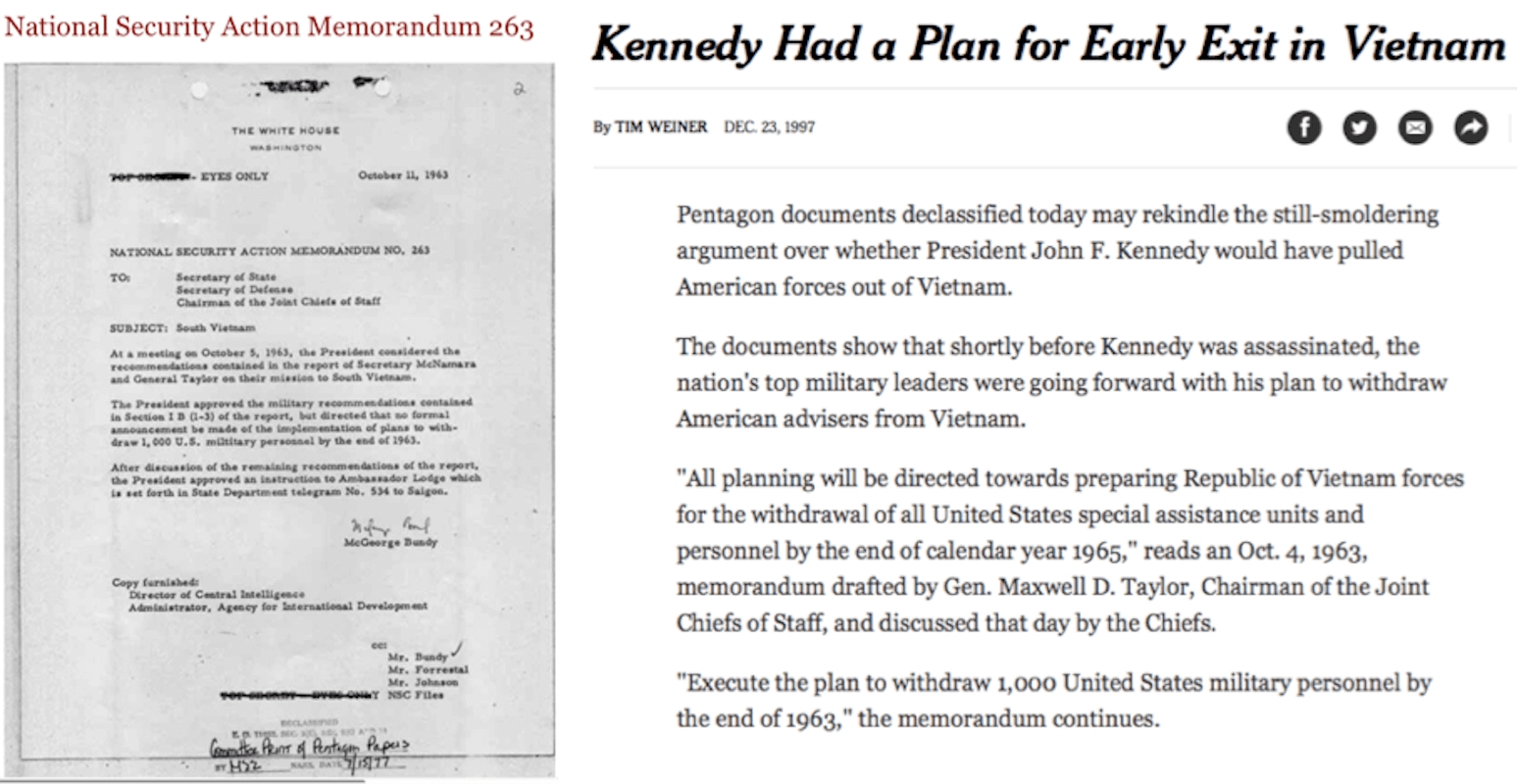
Coinciding with all this is what is probably the most important document declassified by the ARRB. McNamara held regular meetings of the Saigon chiefs of agencies and the Pentagon in Hawaii. These were called Sec/Def meetings. For the one in May of 1963, he had requested that each agency and military chief bring with him their withdrawal schedule. After he had looked them over, he said they were too slow and would have to be speeded up. There was no qualification by McNamara that this withdrawal was hinging upon an American “victory” and there was no contingency plan mentioned to reinstate troops if the victory was not in sight. In fact, General Earle Wheeler wrote that he understood that any request for any overt action would be denied by the president. (Probe Magazine, Vol. 5, No. 3, pp. 19-21) These documents were so compelling that even The New York Times bannered a story with the headline: “Kennedy Had a Plan for Early Exit in Vietnam.” (ibid, p. 19) One would think that if it were good enough for that paragon of the MSM, the Grey Lady, it would be good enough for Burns and Novick. Needless to say, none of these documents are shown in The Vietnam War.
Neither is NSAM 263 exhibited. This was the order drawn up in early October of 1963 that delineated the withdrawal plan and mandated that a thousand men be returned from Vietnam by the end of 1963. The story of how the order and the report it was attached to were created is revealing, and would have been informative to the viewer. By the autumn of 1963, JFK now had everything in place to activate his withdrawal plan. But he wanted to send his two highest military advisors to Saigon, that is, McNamara and Chairman of the Joint Chiefs Maxwell Taylor. He trusted McNamara, but not Taylor. Therefore, while those two were in Vietnam, Pentagon higher ups General Victor Krulak and Colonel Fletcher Prouty were invited to the White House. Bobby Kennedy met the duo. He instructed them, upon orders of the president, that they would actually edit and compose the Taylor/McNamara report at his direction. (John Newman, JFK and Vietnam, p. 401) Once that was done, it was shipped out to Hawaii and given to Taylor and McNamara in bound form. Kennedy was not allowing for any alterations.
That report became the basis for NSAM 263. Presidentially designed, the report was used by him to ram 263 through his foreign policy advisors—some of whom were reluctant to sign on to it. But, reluctant or not, they ultimately did. McNamara was then sent out to announce the withdrawal plan to the press. As he was walking to meet the reporters, Kennedy instructed him with the following: “And tell them that means all of the helicopter pilots too.” (ibid, pp. 404-07)
One would think that if a filmmaker were trying to assemble the latest scholarship on Vietnam for an American audience—if one were really trying to enlighten them with the best and newest information—then at least some of this would be included in the presentation. Or at least he or she would communicate some of the (at least) nine sources that Kennedy or McNamara confided in about the withdrawal plan. Or perhaps play the October 2, 1963 taped conference where McNamara actually says that they have to find a way to get out of Vietnam. (Blight, p. 100)
I shouldn’t have to replay this refrain by now: None of this information is in the film. But as Burns pronounced on Marc Maron’s radio podcast of September 11th : History is malleable. Sort of like bubble gum, right Ken?
What do Burns and Novick tender us instead? They give us Neil Sheehan and Jean Paul Vann. Which means they would have given us David Halberstam if he were alive. (See my two-part review, “David Halberstam, The Best and the Brightest”) When I saw this, I realized just how much The Vietnam War wanted to be part of the MSM, and just how far PBS had fallen. For Halberstam’s The Best and the Brightest—which Warren Hinckle once called “one of the greatest bullshit books ever written”—makes McNamara out to be the chief engineer of the war. When, in fact, from April of 1962 to November of 1963, he was implementing Kennedy’s withdrawal plan. McNamara had even told his deputy, Roswell Gilpatric, that Kennedy had assigned him the task of winding down the war. (Blight, p. 371)
Jean Paul Vann was one of the military advisors stationed in Vietnam under Kennedy. By all accounts he was committed to the cause of the American created nation-state of South Vietnam. Halberstam and Sheehan were young reporters at the time. Halberstam had been sent to Vietnam after being assigned to the Congo. Which is an important point. As noted above, one of Kennedy’s first reversals of Dulles/Eisenhower Cold War policy was in the Congo. In fact, that was the first place where JFK directed specific alterations to his predecessor’s policy. These would favor leftist leader Patrice Lumumba and the cause of emerging African nationalism. In that instance Kennedy was contravening a (British aided) Belgian attempt at recolonization. (Mahoney, pp. 65-69)
Valuable research by Paul Rigby has shown that, prior to being assigned to Vietnam, Halberstam had done what he could to condescend to Kennedy’s efforts in Congo. In the pages of Times Talk—Halberstam’s employer, the NY Times in-house journal—the reporter conveyed some of those ideas. His stories, such as “It’s Chaos for a Correspondent in the Congo” and “Congo Boondocks: Land of Cannibals and Diamonds,” communicated the Establishment line that Congo could not handle independence because it was simply a land of African primitives. (William Prochnau, Once Upon a Distant War, p. 509; see also Halberstam’s The Making of a Quagmire, pp. 3-24) Halberstam seemed to be missing the overall gestalt of the struggle. He would later write of that colossal, epic conflict—which killed both Lumumba and Dag Hammarskjold—that there was less there than met the eye. (Halberstam, p. 17)
Halberstam’s outlook and attitude failed to fully grasp Kennedy’s concepts in Congo, where JFK decided to do all he could to enforce UN Secretary General Hammarskjold’s policies for Congolese independence against America’s European allies England and Belgium. Kennedy continued that policy alone after Hammarskjold was killed. (“Hammarskjold and Kennedy vs. The Power Elite”) It is clear today—as it was then—that both Lumumba and Hammarskjold were murdered by colonial powers trying to retake the mineral wealth of Congo. (“Plane crash that killed UN boss may have been caused by aircraft attack”) Yet, in 1965, Halberstam could write that the Congolese cared less for their country than white people did. (ibid, p. 18) Unlike Halberstam, Jonathan Kwitny later fully comprehended what had happened. As Kwitny wrote, Patrice Lumumba became a hero in Africa “not because he promoted socialism, which he didn’t, but because he resisted foreign intervention. He stood up to outsiders, if only by getting himself killed.” (Endless Enemies, p. 72) As the picture below illustrates, Kennedy certainly understood Lumumba’s cause and his martyrdom:

Kennedy receiving word of Lumumba’s death
(photo: Jacques Lowe)On the larger, more epic level, Kwitny also had a much richer understanding of what was at stake in Congo than Halberstam. After surveying what happened, he memorably wrote about the legacy of Lumumba and what it meant in the larger movement of African nations to break out of the servitude of colonialism:
The democratic experiment had no example in Africa, and badly needed one. So perhaps the sorriest … blight on the record of this new era is that the precedent for it all, the very first coup in postcolonial African history, the very first political assassination, and the very first junking of a legally constituted democratic system, all took place in a major country and were all instigated by the United States of America. It’s a sad situation when people are left to learn their ‘democracy’ from the Union of Soviet Socialist Republics. (ibid, p. 75)
When Halberstam got to Vietnam—actually on his second day there—he lunched with the CIA’s station chief in Saigon. (Prochnau, p. 133) As the weeks went by, many of his CIA contacts from Congo migrated there. As author William Prochnau wrote, “By now his CIA contacts from the Congo had begun to flock to the hot new action in Southeast Asia like bees to honey; Vietnam was a spook’s dream and the Agency forever had a better fix on Vietnamese reality than the American military.” (ibid, p. 169)
Halberstam admitted this in his 1965 book, The Making of a Quagmire, where he wrote, “But many CIA agents in Saigon were my friends, and I considered them among the ablest Americans I had seen overseas or at home.” (p. 222) In that book, Halberstam attempts an all-out defense of the CIA’s role in both Vietnam and the developing world. And he adds that inherent suspicion of the Agency is “the outgrowth of its bogeyman image among liberals …”. (ibid) This is especially puzzling today since the Church Committee revealed that Allen Dulles and the CIA had arranged numerous plots to kill Lumumba in the Congo, where the writer had just been stationed for many months. Later on, Halberstam attempted to distance himself from these admissions. He told Prochnau that UPI reporter Neil Sheehan had better CIA sources than he did, but he had better military sources. (Prochnau, p. 277)
Both Halberstam and Sheehan were enamored with Vann, even though they understood he was an “essentially conservative, at times [an] almost reactionary man.” (Halberstam, p. 164) In their film, Burns and Novick have Sheehan tell us that, upon his own arrival in Saigon in 1962, he believed in American ideals and the alleged US mission in South Vietnam. He also believed in the dangers of the “international communist conspiracy”. Sheehan then adds that he was there to report the truth in order to help win the war for the betterment of the United States and the world. He describes going along on ARVN helicopter missions as being part of a crusade: he was thrilled by the experience.
These attitudes made Sheehan and Halberstam easy targets for Vann. And negatively complementing that, it guaranteed that they would completely miss what Kennedy was doing. Colonel Vann was a veteran of Korea and, by 1963, had served in the military for twenty years. With Sheehan’s help, Burns and Novick spend several minutes outlining the January 1963 Battle of Ap Bac, an important conflict that Vann helped plan and supervise. Although the Viet Cong were outnumbered by a large margin, even though the ARVN had helicopter support and used armored personnel carriers, this battle turned out to be, by any accounting, a losing proposition for Vann. Saigon lost 80 dead, more than one hundred wounded, and five helicopters destroyed. The Viet Cong lost 18 dead and 39 wounded. Vann was deeply angered and confided the true facts of the defeat to his students Sheehan and Halberstam, who both wrote about the failure of the battle.
The film does not reveal a key reason for that failure, one which Vann himself had discovered. Ngo Dinh Diem had issued orders to his field commanders not to initiate large offensive operations that would provoke serious casualties. Vann’s intelligence officer, Jim Drummond, concluded that the ARVN had not really checked the growth of the Viet Cong or the area under their control. (John Newman, JFK and Vietnam, p. 299) In other words, contrary to what the commander in Vietnam, General Harkins, was saying, America was not winning the war. And Ap Bac was living proof of that.
Vann was shipped out of Vietnam in 1963 and served in the Pentagon as a procurement officer. He began to file formal reports complaining about how the war was being fought. These reports appealed to General Edward Lansdale because they clearly projected the fact that unless American ground troops were committed to Vietnam, Saigon would fall. (ibid, p. 319) As we have seen, this is the message Kennedy had listened to in November of 1961—and had rejected. Kennedy was aware of what Vann was doing. Both he and McNamara opposed the work of his acolyte Halberstam; Kennedy even asked the publisher of the Times to rotate him out of Saigon. (David Kaiser, American Tragedy, p. 261; Halberstam, p. 268)
But Edward Lansdale had been the first to advise Kennedy to insert combat troops into Vietnam. (Newman, p. 20) Sure enough, after Kennedy’s death, when Lansdale returned to the White House, he recommended sending Vann back to Vietnam. Vann did return in 1965, when Lyndon Johnson overturned Kennedy’s policy and committed tens of thousands of American combat troops to Saigon. (Kaiser, p. 384)
The reason that Sheehan and Halberstam admired Vann was simple: like him, they were Hawks. And like him—and opposed to Kennedy—they wanted more American involvement, not less. This is easily discernible by reading Halberstam’s 1965 book The Making of a Quagmire. That volume is perhaps the single most complete and coruscating condemnation of America’s Vietnam policy published to that point. It attacks every element of the American mission in that country and also the policies and personages of the Diem regime. (See Chapters 3-5) It then goes on to expose the ineptness of the ARVN (Chapters 5-7), in particular how bad Colonel Hunyh Van Cao was. The latter actually gets his own chapter: 10. Why so hard on Cao? Because Vann was the advisor attached to him, and—as with Sheehan—Vann was Halberstam’s hero in 1965. Why? Because he knew how to win the war. (See Chapter 11) So for Halberstam, when Vann departed, things got worse. (see Chapter 12).
If Halberstam could not make it more clear, he does near the end of the book. With Sheehan mentioned throughout, he proclaims: “Bombers and helicopters and napalm are a help but they are not enough.” (p. 321) He then concludes with the following: “The lesson to be learned from Vietnam is that we must get in earlier, be shrewder, and force the other side to practice self-deception.” (p. 322)
Of course, when the wishes of this troika—Sheehan, Vann and Halberstam—were fulfilled, we saw what happened. Direct American involvement ended up being an epic debacle. As many as 3-4 million people were slaughtered amid almost unimaginable horror. All in pursuit of a false goal that was not possible to attain. In other words, Kennedy was right and Vann, Sheehan and Halberstam were wrong. But neither Halberstam nor Sheehan could ever admit that. It is especially startling that Halberstam never saw the parallels of what happened in both Congo and Vietnam after Kennedy was killed: In Congo, the Agency and LBJ switched sides and joined the imperial interests; in Vietnam, the Pentagon and Johnson now broke Kennedy’s strictures and eventually imported 540,000 combat troops, making it an American imperial war. Truly puzzling that he would miss all of this.
Sheehan and Halberstam got their wish. And even after it was clear that direct American involvement would not work, it took them years to understand it. And further, that the American army was self-destructing in the jungle, as Kennedy had predicted it would back in 1961. By 1971, even the army understood this. Colonel Robert Heinl wrote a long essay on its collapse at that time, and traced it from at least 1969. (Col. Robert D. Heinl, Jr., “The Collapse of the Armed Forces”)
But author and activist Mark Lane understood it even earlier. In 1970 he published a book of personal interviews with returning veterans. The book was called Conversations with Americans. It was a shocking exposé of the individual and group war crimes that American solders had committed in Vietnam. Since there was a danger that his interview subjects would be prosecuted, he gave them the option of using fictitious names. He marked these with an asterisk in the text. He then added that the real names and full transcripts had been given over to an attorney who had worked for the Justice Department. (Lane, p. 17)
When the book was published, The New York Times trotted out Sheehan to review it. (NY Times Book Review, 12/27/70) Sheehan wrote that he had contacted the Pentagon and some of the people named in the book did not serve in the military, or were not in the places where they said they were at the time. Which implied that what Lane was writing was fictitious. After, when Lane called the New York Times to talk to Sheehan, Sheehan would not accept his calls. The Times then sent Sheehan out on tour to promote his column. Which, of course, was a promotion of the collapsing war effort. Apparently, as a believer in the international communist conspiracy, Sheehan never imagined that there was a systematic, institutionalized cover-up of these crimes after the 1968 My Lai Massacre. But there was such a cover-up, and author Nick Turse discovered it when he found the (incomplete) records. (Kill Anything that Moves, pp. 15-21) When Lane asked Sheehan about My Lai during a radio interview, the New York Times reporter replied that it was just a rumor. (Mark Lane, Citizen Lane, pp. 220-21)
Under pressure from the Times and Sheehan, Lane’s book was withdrawn from circulation.
This is the man Burns and Novick use as the main talking head in their segment on the Kennedy years. With their defense of the Dulles brothers as “decent people” in Part One, the disappearance of Kennedy’s withdrawal plan and the championing of Vann and Sheehan in Part Two, so far the net value of this documentary is something less than zero.
Addendum
Although some critics of the film JFK have stated that there was no public announcement of NSAM 263, and Kennedy was keeping it quiet, as the reader can see in the following two Newsweek articles, that is false. It was a public policy, and Kennedy had sent Defense Secretary Robert McNamara to brief the press on it after he had adopted it in October, 1963. (John Newman, JFK and Vietnam, p. 407)
Newsweek, October 14, 1963
(Click here if your browser is having trouble loading the above.)
Newsweek, December 2, 1963
(Click here if your browser is having trouble loading the above.)
Part 1
Part 3
Part 4
-

Jim DiEugenio at the VMI Seminar
Alan Dale:
He’s one of the most knowledgeable and tenacious researchers and writers on the political assassinations of the 1960s. He’s the author of 1992’s Destiny Betrayed, which details the New Orleans district attorney, Jim Garrison’s, investigation in the trial of Clay Shaw, which was greatly expanded for a revised edition issued in 2012. Also, Reclaiming Parkland, published in 2013, but reissued and expanded in 2016. He’s also the co-author and editor of The Assassinations: Probe magazine on JFK, MLK, RFK, and Malcolm X. He co-edited the acclaimed Probe Magazine from 1993 until 2000, and was a guest commentator on the anniversary issue of the film JFK, re-released by Warner Brothers in 2013. His website, kennedysandking.com, is one of the best and most reliable online resources for students and scholars of American political assassinations of the 60s. Please welcome Jim DiEugenio.
Jim DiEugenio:
First of all, I’d like to thank Lee Shepherd for doing this. These things are never easy to put together. And I’d like to be gracious about sharing the program with two great guys like Bill Davy and John Newman, who I’ve both known for about 25 years. I’ve worked with them for about that long also, and their books, in my opinion, would rank in any top 15 listing of the best of the JFK Library. Considering there’s 1,000 books in that library, that’s saying something.
I want to introduce what I’m going to talk about tonight by stating that my last book, Reclaiming Parkland, largely about the state of the evidence, as it was in 2013 in the JFK case, is what we call in the trade, something called a micro-study. As one reviewer said, it was really a kind of an updating of Sylvia Meagher’s classic book, Accessories After the Fact, which I thought was a very kind complement indeed.
After publishing that book, I came to the conclusion, after months on end of study of all the detailed evidence, like the bullet shells, CE399, the medical evidence, etc., that there really was no case against Oswald today, that Oswald was not the victim of a miscarriage of justice. The simple problem was that there was no justice at all. You had a rogue prosecution, led by the FBI, and the Warren Commission acted essentially as a kangaroo court. But once that evidence presented was minutely examined, the case against Oswald simply did not exist. They were allowed to get away with this because, of course, Oswald had no legal defense and there were no legal restrictions to protect his rights. After going through all this, I have no problem today saying that, to say Oswald was guilty is the legal and moral equivalent of being a Holocaust denier.
So after I disposed of that, I began to concentrate more on why was Kennedy assassinated. And I began to look more and more at Kennedy’s foreign policy. And the more I looked, the more I began to search outside of the JFK Library of books, simply because if you stay aligned with that particular lexicon, you’re probably going get like 90% Cuba/Vietnam, as if this was all Kennedy did for three years. And I found out that really was not the case, not by a long shot.
And I also discovered something else. As much as I liked Jim Douglass’ book, JFK and the Unspeakable—and I would recommend that book to anybody who hasn’t read it—I disagree with the sales slogan that was used to sell the book. This was something like “A Cold Warrior Turns”, meaning that after 1962 and the missile crisis, that JFK stopped being a cold warrior and tried to work with Khrushchev and Castro for detente.
The way I looked at this, and the discoveries I was making, is that Kennedy’s foreign policy was pretty much set once he entered the White House. There’s three key events that we have to question in order to understand who Kennedy was, once he entered the White House. These are number 1) Why did Kennedy not send in the Navy to bail out the Bay of Pigs invasion? That would’ve been easy enough. Arleigh Burke, the admiral, was there trying to get him to do that the first night of the invasion.
2.) Why, in the fall of 1961, did Kennedy not send combat troops into South Vietnam? And, by the way, I have to say, in reading Gordon Goldstein’s book, Lessons in Disaster, which is a biography of McGeorge Bundy, that culminating debate in November of 1961 was preceded by eight previous requests for JFK to send troops into Vietnam. So this is nine times in that one year that Kennedy was determined to turn down sending the military into Vietnam.
And the third question is: Why did Kennedy not bomb the missile silos during the Cuban missile crisis in 1962? Again, almost everybody in the room was asking him to take some kind of military action. And by the end of the 13 days, even McNamara, who had proposed the blockade in the first place, was leaning in that direction. But Kennedy didn’t do it. He stuck with his back channel between RFK and the Russian ambassador in Washington.
So my question is, all these books mention them, but nobody tries to explain why he did not do those things. And if Kennedy was really a Cold Warrior, he would have done all three of those things, or at least two out of the three. For instance, we know that LBJ wanted to send troops into Vietnam in 1961. In fact, we have him on tape in 1964, telling McNamara how frustrated he was, watching McNamara and Kennedy arrange this withdrawal plan. We know that Nixon would have sent in the Navy at the Bay of Pigs, because that’s what he told Kennedy to do. When Kennedy called him, either the second or third night of the crisis, he asked him “What should I do?” Nixon said “declare a beachhead and send in the Navy”, but he didn’t do that. He was willing to accept defeat in April of 1961, at the Bay of Pigs, and he was willing to withdraw, leading to an inevitable defeat, in Vietnam. So the question is: Why?
And so, I began to study this phenomenon and I began to consult books outside the Kennedy assassination lexicon and I discovered that the key to understanding this is a man who’s name was in no book up until Jim Douglass’ book. His name’s not mentioned anywhere that I could find, and his name is Edmund Gullion. Gullion worked in the State Department when Kennedy was a congressman and that’s when they first met. Kennedy needed some advice on a speech, so he went over to the State Department and Gullion gave him a consultation. In 1951, Gullion, because he spoke fluent French, had been transferred to South Vietnam.
In that same year, Kennedy was preparing to run against Henry Cabot Lodge for the senatorial seat from his home state of Massachusetts. So he flies into Saigon, because he wants to become more well versed in foreign policy, which is what senators spent a lot of their time on. He decides to ditch the French emissaries that had been sent to meet him at the airport, and he starts knocking on doors of people who have good reputations in the media, there were a couple back then, and in the State Department. One of the guys he meets with is Edmund Gullion.
So they have dinner at a roof top restaurant in Saigon, and Kennedy asks him flat out: We’re allied with the French in this thing, we’re actually bankrolling this effort, are the French going to win? Gullion says something like: There is no way in Hades that France is going win this war. Kennedy, of course, asks him: Well, how come? And he says: It’s rather simple. Ho Chi Minh has fired up the general population, to a point that you’ve got tens of thousands of these young Viet Minh who’d rather die than go back under the yoke of colonialism. France will never win a long, drawn out, prolonged, bloody war of attrition, because the home front simply will not accept it. And that’s how it’s going to end.
To say that conversation had a rather deep impact on JFK is a large understatement. When he got back to Massachusetts, he began writing letters, making speeches and doing radio addresses; criticizing both the Republican foreign policy establishment and the Democratic foreign policy establishment and, most of all, the State Department for not understanding the real plight of colonized people in the Third World. In his new way of thinking, this was not a battle between Communism and Capitalism, but it was one between independence and colonialism. And colonialism, according to Kennedy, was going to lose.

Allen & John Foster Dulles This manifests itself, on a national level, in 1954 during Operation Vulture. Vulture was John Foster Dulles—the Secretary of State at that time—it was his plan to bail out the doomed French effort in Vietnam. This was a huge air armada of about 210 planes, 3 of them were carrying atomic bombs, and this was going to bail out the French effort at the battle of Dien Bien Phu. Well, Nixon, who is the Vice President at that time, is the liaison between Congress and the White House on this whole issue. Kennedy gets wind of this, of what’s going to happen, and he begins to rail against Dulles and Eisenhower. He wants them to come down here and explain to us how nuclear weapons are going win a guerrilla war. And he then added, no amount of weaponry could defeat an enemy which was everywhere and nowhere, and had the support of the people.
And by the way, that’s a very important passage there, because one of the things historians are supposed to do is to find origins and patterns in a man’s foreign policy. And that phrase that he said, about being everywhere and nowhere and having the people’s support, that’s the argument he’s going to use in 1961; when everybody wanted to commit troops to Vietnam. Nobody had an answer to it then. I call that Kennedy’s first defining moment; his first face off against the Dulles brothers, Nixon and Eisenhower.
Three years later, there’s another one, except it’s much more public. The second one is in 1957, when Kennedy takes the floor of the Senate and he begins to attack, very specifically, Dulles, Nixon and Eisenhower again. This time it’s over their continued alliance with French colonialism, except this time it’s off the north coast of Africa, in Algeria, where France is now involved in another civil war to maintain the French colony of Algeria. Five hundred thousand troops devolved into a war of horrible atrocities. Kennedy attacked the White House again for allying itself with the hopeless struggle of a European country to maintain an overseas empire in the Third World. And he predicted that this would turn out just like what happened three years previous in Vietnam, with another French defeat. What we needed to do, he said, was to convince Paris to negotiate, in order not to destroy the country of France in a futile war against brother and sister over this horrible dispute in Algeria. But, as important, if not more important, we had to begin to free the colonized nations of Africa.
That was his second defining moment. And what was surprising about this speech, and by the way, I would say that speech is very much worth reading, even today. It’s an incredible speech for a young man to be making on the floor of the Senate, considering the makeup of the Senate and the White House at that time.
This time, Kennedy was attacked, not just by Nixon and John Foster Dulles. But by people in his own party, like Dean Acheson and Adlai Stevenson. It was a very controversial speech. It made headlines in a lot of newspapers. There were 163 editorial comments. Over two thirds of them were negative. Kennedy really thought that he made a mistake and he called up his father and asked him what he thought. His father said he hadn’t made a mistake: You watch what’s going to happen. This situation in Algeria is going to get even worse. In two years, everybody will realize that you were right. And by the way, that’s exactly what happened. Eric Sevareid made an editorial comment on CBS TV in 1959, saying: Well, John Kennedy looks like a prophet these days, doesn’t he?
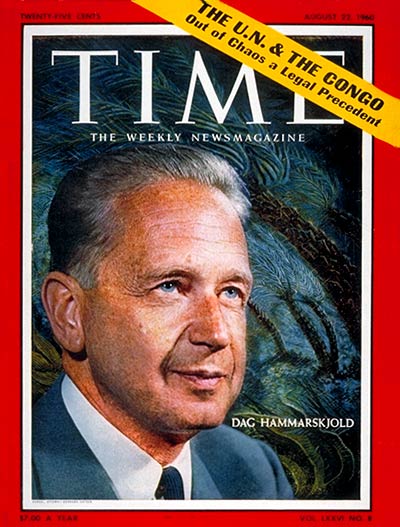
Dag Hammarskjöld But that Algeria speech actually did something else. It made him a hero to the colonized people of Africa. He now became a kind of unofficial ambassador to visiting African dignitaries. And that appeal began to spread to other Third World areas. So Kennedy now became a great admirer of the Chairman of the UN, Dag Hammarskjöld, who wanted the United Nations to be a kind of international forum that would give voice to the powerless nations coming out of colonialism and provide a lectern to express themselves. They began to make a secret alliance over the areas of Indonesia and Africa.
By 1960, Kennedy is very conscious that he’s on the edge with his foreign policy. So, on the eve of the 1960 convention, he told one of his advisors, Harris Wofford: We have to win this thing. Because if Johnson wins or Symington wins, its just going to be more of John Foster Dulles all over again. And, by the way, I have to say that, with what LBJ did once Kennedy took over, from ’64 to ’68, I think Kennedy was actually right about that.
Kennedy addresses
the U.N. General AssemblyOnce Kennedy is in office, he immediately begins to alter the Dulles brothers’ policies. For example, in the Congo, where he supported Hammarskjöld’s policy to stop the country from being partitioned or recolonized by Belgium. And he began to work with Hammarskjöld, reversing American policy in Indonesia. The Dulles brothers had tried to overthrow Sukarno the Nationalist leader of Indonesia in 1958 and 59. Kennedy decided that that was going to be reversed. That he was going to support Sukarno, both politically and economically.
Kennedy & Sukarno Now what’s really remarkable about just those two instances, those alterations of the Dulles brothers’ foreign policy is this: That Kennedy continued those two policies after Hammarskjöld was murdered in the fall of 1961. And, by the way, I have no problem using the word “murdered”. Because all you have to do is read Susan Williams’ book, “Who Killed Dag Hammarskjöld?” You will see that that was not an accident, that airplane crash was not an accident. In other words, with Hammarskjöld dead, Kennedy was carrying this burden by himself. And, in fact, he had to go to New York to convince the United Nations, after Hammarskjöld’s death, not to give up their mission in Congo. He actually did that twice. And then he planned a State visit to Indonesia in the summer of 1964, which Sukarno was very much looking forward to.
Now I can mention other places where this occurs, that is when Kennedy comes in, he reverses the Dulles/Eisenhower foreign policy. For example, he wanted a negotiated settlement in Laos. Very important and, again, very overlooked, is that in the Middle East, the Dulles brothers had isolated Nasser and were beginning to favor Saudi Arabia.
Lee Shepherd:
Nasser, the head of Egypt.
Jim DiEugenio:

Gamal Abdel Nasser Yes, Nasser was the president of Egypt. And Kennedy reversed that, also. He began to favor Nasser and isolating Saudi Arabia. Now the reason he did that was because he thought, because Nasser was a Socialist and a secularist, that he could begin to mold the foreign policy in the Middle East away from the fundamentalism and the monarchy of places like Saudi Arabia and Iran.
And, by the way, he even mentioned that issue in 1957. Because there was a big Moslem population in Algeria. He refused to meet with David Rockefeller because he did not want to initiate a coup in Brazil, which is what Rockefeller wanted to meet him about, and he moved to isolate the military regime that had deposed the Dominican Republic’s President Juan Bosch.
Now every one of those policies, without exception, began to change at a slow rate and then at a rapid rate, under the pressure of Johnson and the CIA, in a period of about 18 months after Kennedy is assassinated. In each case, the end result was a calamity for the people living in those areas. A very good example being the CIA sponsored coup in Indonesia that took place in 1965 and which killed well over 500,000 citizens; and led to the looting of the nation by Suharto and his corporate cronies. What Kennedy wanted to do there, he was actually arranging deals for Sukarno to nationalize the industries on a very good split, the majority of the profits going to Indonesia. And Sukarno was going to use that money to start doing things like building hospitals and an infrastructure and schools, etc. He wanted those benefits of those natural resources to go to the people.
Now let me conclude with, what I think, is a very important aspect of this whole Dulles vs. Kennedy foreign policy dispute. As most people understand today, Kennedy was never going to commit the military into Vietnam. In fact, he was withdrawing the advisory force from that area at the time of his assassination. The Assassinations Records Review Board released some really important documents on this in 1997 and that, in addition to several books, including John’s book, JFK and Vietnam, for me sealed the deal on that issue.
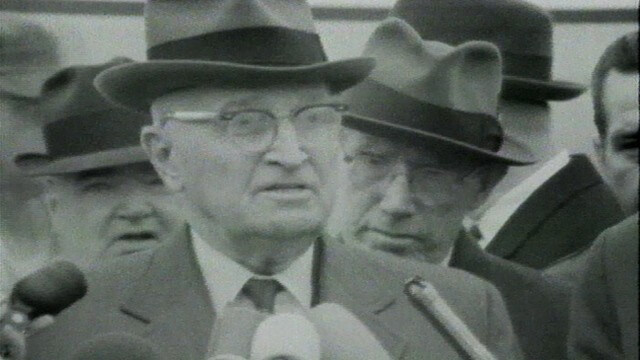
Truman reacts to the assassination Within a month of Kennedy’s assassination, I think on December 20th, 1963, former president Harry Truman published a column in the Washington Post, in which he assailed how the CIA had strayed so far from the mission he had envisioned for them when he was putting that agency together. To the point where he really kind of didn’t recognize what it had become. From his notes, it’s clear that Truman began writing that column eight days after Kennedy’s death.

“Harry Truman Writes” In the spring of 1964, while he was sitting on the Warren Commission, Allen Dulles visited Truman at his home in Missouri. This was not a social visit. He was there for one reason. He wanted Truman to retract the column. That attempt by Dulles failed. Truman never did retract what he wrote and, in fact, about a year later, in Look magazine, he repeated those same thoughts.
But a very curious exchange occurred as Dulles was leaving. As he got to the door to join his waiting escorts, he turned to Truman and said words to the effect: You know, Kennedy denied those stories about how the CIA was clashing with him in Vietnam. Which is a really startling thing to say. Because Dulles’ visit was supposed to be about Truman’s article. And Truman never mentioned Kennedy or Vietnam in the article.
Further, the two newspaper pieces Dulles referred to are likely one by Arthur Krock and one by Richard Starnes, both published in October of 1963. They both discussed the CIA’s growing influence over foreign policy and they both conclude that, if there was ever an overthrow of the US government, unlike Seven Days in May, the novel that had been made into a film around that time, it would be sponsored by the Agency and not the Pentagon. Again, Truman never went that far in his article. This whole angle was imputed to him and initiated by Allen Dulles. I think it’s pretty clear, from that conversation, that Dulles made the visit because he thought Truman wrote the column because the former president believed the CIA had a role in killing Kennedy over the Vietnam issue.
What makes this even more remarkable are these two aspects. Number one, at that time, in the spring of 1964, nobody had connected those dots: That is, the CIA, Kennedy, Vietnam and Kennedy’s assassination. No one. The first time it’s going be done is four years later by Jim Garrison.
Number two, Truman had already said to the press in 1961 that Hammarskjöld had been murdered over his Congo policy. And Dulles was aware of that. In my opinion, he saw what had happened with Hammarskjöld, and he did not want Truman to get more explicit in the Kennedy case. So in the language of prosecutors, specifically the late Vincent Bugliosi, he would have said something like this—if he had been on our side: What Dulles was doing here was showing something called consciousness of guilt, while he was sitting on the Warren Commission. Which is one more reason that the commission is really a joke.
After four years of study, 2013 to 2017, I’ve concluded that the cover up about Kennedy’s foreign policy, and how reformist it was, has been more deliberate, more strenuous, more systematic, than the cover up about the circumstances of his death. The reason being that it gives a clear and understandable motive for the Power Elite to hatch a plot against him. There were literally tens of billions of dollars on the table in the Third World, especially Indonesia. And that’s the kind of money that these people commit very serious crimes about.
This is why, at the time of his death, people like Nasser in Egypt fell into a month long depression. And he ordered Kennedy’s funeral to be shown four times on national television. It’s why Sukarno openly wept and asked “Why did they kill Kennedy?” It’s why Kwame Nkrumah of Ghana, when the American Ambassador gave him a copy of the Warren report, he returned it to him. He pointed out the name of Allen Dulles on the title page and said one word: “Whitewash.” The people about to be victimized understood what had happened. Because of our lousy media in the United States, it’s taken the American public quite a bit longer to understand.
Okay, thank you, I’ll conclude with that.
Lee Shepherd:
James, can I ask you one question.
Jim DiEugenio:
Sure.
Lee Shepherd:
You’re mentioning Dulles quite a bit.
Jim DiEugenio:
Right.
Lee Shepherd:
Who do you think is behind this whole thing?
Jim DiEugenio:
Well, I gave David Talbot’s book a very good review: The Devil’s Chessboard. And I think he makes a pretty good case, that Dulles, if I had to categorize it, I think Dulles was the outside guy and I think James Angleton was the inside guy.
Lee Shepherd:
So the assignment was given to Angleton?
Jim DiEugenio:
I think Angleton was the inside guy.
Lee Shepherd:
Okay.
Jim DiEugenio:
He was the guy working in the, what we would call, the infrastructure. And I think Dulles was the outside guy, arranging it with the people he knew had to back him.
Lee Shepherd:
But Dulles was fired.
Jim DiEugenio:
Dulles was what?
Lee Shepherd:
Dulles was fired by that stage, by John Kennedy.
Jim DiEugenio:
Yeah, he was fired. But if you read Talbot’s book, he was only fired symbolically. Because he kept on having meetings over at his townhouse in Georgetown. And he actually wrote about those meetings in his diary and anybody could read who he was meeting with, people like Angleton, people like Des FitzGerald, etc. And then on the day of the assassination, he ends up at the Farm,—
Lee Shepherd:
Yes.
Jim DiEugenio:
—which is the CIA headquarters.
Lee Shepherd:
Is that Camp Parry? Camp Parry, Virginia?
Jim DiEugenio:
Yes.
Lee Shepherd:
Secondary command post of the CIA?
Jim DiEugenio:
Right.
Lee Shepherd:
Okay, good, thank you.
Jim DiEugenio:
So he was figuratively separated from the CIA. But as Talbot says in his book, he was really more like leading a kind of like in-country junta against Kennedy.
Lee Shepherd:
Okay, James. Thank you so much.
This transcript was edited for grammar and flow.
-
UK and USA obstruct United Nations’ Hammarskjold Inquiry
UK’s lack of transparency over plane crash that killed Dag Hammarskjöld
Letters to the editor, At: The Guardian
-
More on the Congo from Susan Williams
Spies in the Congo: America’s Atomic Mission in World War II, by Susan Williams
Reviewed by Dan Alcorn, At: AARC
