Category: John Fitzgerald Kennedy

Reviews of books treating the assassination of John F. Kennedy, its historical and political context and aftermath, and the investigations conducted.

  • Michael Kazin and the NY Review vs JFK

    Michael Kazin and the NY Review vs JFK


    Michael Kazin is a professor of history at Georgetown. The New York Review of Books is a leftwing, tabloid formatted political, cultural, and intellectual review. It specializes in contemporary political events, books, and the arts. In their May 27th issue, this respected publication allowed Mr. Kazin to do something that should have been prevented. Kazin was supposed to be reviewing part one of Fredrik Logevall’s, two volume biography of John F. Kennedy, JFK: Coming of Age in the American Century.

    What’s disturbing about Kazin’s review is this: it is not a review. After reviewing books for approximately two decades—and studying literary criticism for longer than that—I understand what the process entails. The most important thing about critiquing a book is an analysis of the text of the book. What that means is the critic describes what the author has written and analyzes both what is there and also what the author left out that might have altered his argument. When that process is completed, the critic evaluates the book in relation to other works in the field as a measure of value. Of course, there are many, many biographies of John F. Kennedy that Kazin could have used as a measuring rod.

    What is striking about Kazin’s review is that it is really a polemic against John Kennedy. Kazin used Logevall’s book as a springboard to trash the man and his career. One can easily detect this by noting how much of Kazin’s “review” deals with matters outside the time frame of the book, which only goes up to 1956. In fact, one can see what the “reviewer” is up to in his first sentence:

    Why, nearly six decades after his murder, do Americans still care so much about and, for the most part, continue to think so highly of John Fitzgerald Kennedy?

    If one has to ask that question, then obviously one is about to assault those people who do so. Kazin follows that up by pulling a page out of the Larry Sabato/Robert Dallek playbook. He now writes that Kennedy achieved little of lasting significance in his presidency.

    Again, please note: this is a review of a book that only extends itself to 1956. But Kazin is now talking about something Logevall has not gotten to yet. Beyond that, he is making a judgment about the years that the book does not address! Clearly, Kazin has an uncontrollable agenda about the Kennedy years in the White House that his editors allowed him to spew. He more or less writes that Kennedy achieved nothing of value either domestically or in foreign policy. I would think that signing two executive orders for affirmative action in his first year would count as something of value. (Irving Bernstein, Promises Kept, p. 56) After all, no previous president had done that. In foreign policy, I would think that constructing the Alliance for Progress and refusing to recognize the military overthrow of the democratically elected Juan Bosch in Dominican Republic would be something to address.

    But if Kazin did note just those two things about Kennedy’s foreign policy, then he would create a polemical problem for himself, because then the reader would ask: What happened to those two programs? The answer would be that Lyndon Johnson pretty much neutralized both of them. (Click here for details)

    In the last instance, concerning Dominican Republic, LBJ did more than that. In 1965, he launched an invasion to preserve the military junta and prevent Bosch from regaining power,which was a clear reversal of what Kennedy’s policy was. (Donald Gibson, Battling Wall Street, pp. 78–79) Pretty clever guy that Kazin.

    As one can see from the above linked article, Bobby Kennedy was very upset about what Johnson had done to the Alliance for Progress. As was RFK, Senator William Fulbright was beside himself about the Dominican Republic invasion. Fulbright’s staff had done some research by consulting sources on the ground. They concluded that Johnson had lied about the true state of affairs, especially concerning alleged atrocities by Bosch’s forces. (Joseph Goulden, Truth is the First Casualty, p. 166)

    That Johnson deception in the Caribbean paralleled another, even larger one: the Gulf of Tonkin resolution. In fact, it was Fulbright’s outrage over LBJ’s subterfuge in the Dominican Republic that provoked him into reviewing what Johnson had done to get America into Vietnam. One of Fulbright’s staffers, Carl Marcy, had reviewed both instances and he now believed Johnson had lied about each. He wrote a memo to Fulbright about it. He concluded that what Johnson had done in the last 24 months helped explain what happened to:

    …turn the liberal supporters of President Kennedy into opponents of the policies of President Johnson, and the rightwing opponents of Eisenhower and Kennedy into avid supporters of the present administration. (ibid)

    Feeling that he had been suckered, in 1966 Fulbright began his famous televised hearings on the Vietnam War. This is what began to split the Democratic Party asunder and aided the election of Richard Nixon. This is why it was smart for Kazin not to go there.

    The above points out just how wildly askew Kazin is in foreign policy. But as far as domestic policy goes, in addition to the two affirmative action laws, Kennedy granted federal employees the right to form unions and, by 1967, there were 1.2 million who had joined. That idea then spread to state and local government. In 1962, Kennedy signed the Manpower Development and Training Act aimed to alleviate African-American unemployment. In April of that year, Kennedy went on national television to begin what economist John Blair later termed “the most dramatic confrontation in history between a president and a corporate management.” (Gibson, p. 9) This was Kennedy’s battle against the steel companies who had reneged on an agreement he had worked out with them between management and labor. Kennedy prevailed after his brother, the attorney general, began legal proceedings against the steel cartel. If Kazin can indicate to me a recent president who has made such an address against another corporation or group of aligned businesses, I would like to hear it.

    In 1962, Kennedy tried to pass a Medicare bill. It was defeated by a coalition of conservative southern senators and the AMA. At the time of his death, Kennedy was planning to revive the bill through Congressman Wilbur Mills. (Bernstein, pp. 246–59) But also, on June 13, 1963, Kennedy made a speech to the National Council of Senior Citizens. This was part of those remarks:

    There isn’t a country in Western Europe that didn’t do what we are doing 50 years ago or 40 years ago, not a single country that is not way ahead of this rich productive, progressive country of ours. We are not suggesting something radical and new or violent. We are not suggesting that the government come between the doctors and his patient. We are suggesting what every other major, developed, intelligent country did for its people a generation ago. I think it’s time the United States caught up.

    In fact, one can argue that Kennedy proposed universal healthcare way before Barack Obama did. All one has to do is just look at this speech:

    How did Professor Kazin miss that one? It didn’t take deep research. After all, it’s on YouTube. Please note: in this speech Kennedy talks about how progressive goals for the public can be attained through government leadership and action.

    By 1960, because of his vote to table the measure, it was established that Richard Nixon was not going to advocate for federal aid to education. President Kennedy favored such aid and appointed a task force to study the issue. (Bernstein, p. 224) By October of 1963, Congress had passed the first federal aid to education bill since 1945. It would be signed into law by President Johnson.

    That last sentence is also apropos of the War on Poverty. It was not Lyndon Johnson who originated the War on Poverty, it was John Kennedy. Kennedy was influenced by the publication of Michael Harrington’s book The Other America. This provoked Kennedy to begin a series of talks with his economic advisor Walter Heller concerning the subject of how best to attack poverty. (Thurston Clarke, JFK’s Last Hundred Days, pp. 242–43) Kennedy decided he would make this an election issue and he would visit several blighted areas to bring it to national attention.

    Bobby Kennedy set his close friend David Hackett to actually study the problem of geographical areas of poverty and how it caused juvenile delinquency. (Edward Schmitt, President of the Other America, p. 68) In fact, JFK had allotted millions for demonstration projects to study possible cures for the problem. Hackett was also allowed a staff of 12 to do investigations and research for him. (Allen Matusow, The Unraveling of America, pp. 111–12) At his final meeting with his cabinet, Kennedy mentioned the word “poverty” six times. Jackie Kennedy took the notes of that meeting to Bobby Kennedy after her husband’s death. The attorney general had them framed and placed on his wall. (Schmitt, pp. 92, 96)

    So, between Heller and Hackett, and his plans around the 1964 election, the president seemed off to a good start. It took very little time for Johnson to place his own stamp on the program. Over RFK’s protests, Johnson removed Hackett from his position. (Matusow, p. 123) Heller resigned in 1964 in a dispute over the Vietnam War. LBJ then did something really odd. He appointed Sargent Shriver to run the War on Poverty. As Harris Wofford notes, everyone was puzzled by the decision to retire Hackett and replace him with Shriver, for the simple reason that Shriver already had a job in the administration: running the Peace Corps. (Wofford, Of Kennedys and Kings, p. 286) Consequently, the management of the program suffered. By 1968, Shriver had gone to Paris to serve as ambassador and LBJ had more or less abandoned the program. (Matusow, p. 270)

    This relates to the whole shopworn mythology that Kazin uses on the race issue. If anything shows his almost monomaniacal obsession, it’s this. Recall, Logevall’s book goes up to 1956. Kazin says that young JFK avoided the race issue for purposes of politics. Then how does one explain that in 1956 Kennedy made these remarks in New York:

    The Democratic party must not weasel on the issue…President Truman was returned to the White House in 1948 despite a firm stand on civil rights that led to a third party in the South. We might alienate Southern support, but the Supreme Court decision is the law of the land.

    Again, it takes no deep research to find this speech, because it was printed on page 1 of the New York Times of February 8, 1956. Kennedy did the same thing the next year in, of all places, Jackson, Mississippi. He said the Brown v. Board decision must be upheld. (Harry Golden, Mr. Kennedy and the Negroes, p. 95) How could doing such a thing gain him political advantage in that state? As author Harry Golden notes, at this point Kennedy began to lose support in the south and to receive angry letters over his advocacy for the Brown decision.

    It was obvious what Senator Kennedy was pointing at: President Eisenhower and Vice President Nixon were not supporting Brown vs. Board. In fact, as many historians have noted, Eisenhower had advised Earl Warren to vote against the case. (The Atlantic, “Commander vs Chief”, 3/19/18) The other civil rights issue that Kazin brings up is even fruitier. His complaint is that Kennedy did not try and pass his own civil rights bill in the Senate. Kennedy was elected to the Senate in 1952 and Lyndon Johnson became the senate Democratic leader in 1953. LBJ became the Majority Leader in 1954. As most knowledgeable people know, Johnson voted against every civil rights bill ever proposed in Congress from the time he was first voted into the House in 1937. Was the junior senator from Massachusetts going to override the powerful Majority Leader from his own party? It was Johnson and Eisenhower who were responsible for fashioning a civil rights bill. And they didn’t.

    After Eisenhower had been humiliated by Republican governor Orval Faubus during the Little Rock Crisis at Central High in 1957, he tried to save face. He and Nixon sent up a draft for a Civil Rights Commission to investigate abuses. The concept behind it was to split the Democratic Party: Norther liberals vs Southern conservatives. Johnson cooperated by watering down the bill even more to prevent the schism. Why did LBJ cooperate? Because he was thinking of running for the presidency and he saw what being against the issue had done to his mentor Richard Russell’s national ambitions. Senator Kennedy did not like the bill; he thought it was too weak. Johnson had to personally lobby JFK to get him to sign on. (Rowland Evans and Robert Novak, Lyndon Johnson: The Exercise of Power, pp. 122–25; 136–7) In a letter to a constituent, Kennedy wrote that he regretted doing so and hoped to be able to get a real bill one day with real teeth.

    From the day he entered the White House, Kennedy was looking to write such a bill. Advised by Wofford that such legislation would not pass in the first or second year, he did what he could through executive actions and help from the judiciary. He then submitted a bill in February of 1963. As Clay Risen shows in his book The Bill of the Century, it was not Johnson who managed to get it through. This was and is a myth. JFK began with a tremendous lobbying effort himself. After he was assassinated, it was Bobby Kennedy, Hubert Humphrey, and Republican senator Thomas Kuchel who were the major forces to finally overcome the southern filibuster. Also, as most knowledgeable people know, it was not Johnson who managed to pass the 1965 Voting Rights Act. That was owed to Martin Luther King’s galvanizing demonstration in Selma, Alabama. Johnson could not get an extension of Kennedy’s housing act through either. It was the occasion of King’s assassination that allowed it to pass.

    Plain and simple: Kennedy did more for civil rights than FDR, Truman, and Eisenhower combined. That is an historical fact. (Click here for the short version and here for the long version)

    Kazin writes something that I had to read twice to believe. He says that in his congressional races, from 1946–58, Kennedy never said or did “anything that might annoy his largely Catholic, increasingly conservative white base In Massachusetts.” I just noted his 1956 speech about civil rights in New York. But just as important, as readers of this web site know, from his visit to Saigon in 1951 and onward, Kennedy spoke out strongly against the establishment views of both Democrats and Republicans on the Cold War, especially as it was fought in the Third World. Kennedy assailed both the policies of Dean Acheson and John Foster Dulles as being out of touch and counter-productive in the struggles of former colonies to become free of imperialist influence. He noted this in 1956 during the presidential campaign:

    …the Afro-Asian revolution of nationalism, the revolt against colonialism, the determination of people to control their national destinies…In my opinion the tragic failure of both Republican and Democratic administrations since World War II to comprehend the nature of this revolution, and its potentialities for good and evil, has reaped a bitter harvest today—and it is by rights and by necessity a major foreign policy campaign issue that has nothing to do with anti-Communism. (Richard Mahoney, JFK: Ordeal in Africa, p. 18)

    Kennedy’s five year campaign to find an alternative Cold War foreign policy culminated with his famous Algeria speech the next year. There, he assailed both parties for not seeing that support of the French colonial regime would ultimately result in the same conclusion that occurred three years previous at Dien Bien Phu in Indochina. Kennedy’s speech was such a harsh attack on the administration that it was widely commented on in newspapers and journals. The vast majority of editorials, scores of them, decried the speech in no uncertain terms, as did Eisenhower, Foster Dulles, Nixon, and Acheson. But it made him a hero to the peoples of the Third World, especially in Africa. (Mahoney, pp. 20–24) This completely undermines another comment by Kazin: that Kennedy had “to surrender to the exigencies of cold war politics and the ideological make up of his party as he rose to the top of it.” As John Shaw wrote in his study of Kennedy’s senate years, JFK’s challenge to Foster Dulles allowed him to become a leader in foreign policy for his party and “to outline his own vision for America’s role in the world,” which Kennedy then enacted once he was in the White House. (JFK in the Senate, p.110) These were almost systematically reversed by Johnson. (Click here for details)

    Toward the end of his article, Kazin goes off the rails. He says there is no memorial statue of JFK in Washington. Well Mike, there is none of Truman or FDR either. He says there is no holiday for JFK. Again, there is none for Franklin Roosevelt either. And they have recently combined the Lincoln and Washington holidays into a single President’s Day. He also says that President Joseph Biden made no mention of the Kennedys in his campaign or during his brief presidency. Biden did make reference to RFK as his hero in law school, more than once. (See for example NBC news story of August 23, 2019, on a speech Biden gave in New Hampshire.) And Biden has RFK’s bust in the Oval Office and he transported a wall painting of President Kennedy from Boston to place in his study.

    If Kazin did not know any of the above, then it must be pretty easy to get tenure at Georgetown. If he did and ignored it all, then his editors should have never let this travesty pass. It does a disservice to the readers and it should be corrected. In a fundamental and pernicious way, it misinforms the public.

    Addendum:

    We urge our readers to write Mr. Kazin and complain to the NY Review of Books. There is no excuse for this kind of display of factual and academic ignorance and arrogance.

    JFK addressed the definition of a liberal and why he was one in a 1960 campaign speech. This speech is a good source to reference in any response to Mr. Kazin. (Click here for details)

  • Zero Fail: Déjà vu All Over Again

    Zero Fail: Déjà vu All Over Again


    As someone who has written extensively about the Secret Service, especially the Kennedy years, I was looking forward to 3-time Pulitzer Prize winning author Carol Leonnig’s hyped book Zero Fail. While this is not a review of her book, per se, it is a tale of disappointment and how I was once again the victim of some sophisticated and sinister hacking, which directly affected my books and my work. This is something I went through back in 2010, when former Secret Service agent Gerald Blaine’s book The Kennedy Detail was in the news and again when my own book Survivor’s Guilt: The Secret Service & The Failure to Protect President Kennedy was coming out.

    In the short days before Leonnig’s book was due to be released (5/18/21), I was admittedly quite excited about reading the book, even having it on pre-order from Amazon in anticipation. The author is a very respected journalist who had previously co-authored the number one best-selling anti-Trump book A Very Stable Genius. I had high hopes that, when Leonnig tackled the Kennedy era, in particular, she would put on her investigative reporter hat and do some digging to find the real truth on the matter of Kennedy’s Secret Service protection, or lack thereof, in Dallas.

    Then, the flood of articles and media appearances began and my heart sank. Leonnig merely bought into the old canard that JFK ordered the agents off his limo and was reckless with his own security—the old blame-the-victim mantra—no doubt enhanced by personal interviews with former agent/authors Clint Hill and Gerald Blaine. I kept thinking to myself “surely this acclaimed author has to know of my work; she has to know there is a huge dissenting view on this matter.”[1] But, alas, Leonnig chose the lazy way out and didn’t do her own thinking on the subject.

    That was the first part of my disappointment…then came the real shocker.

    On the eve of her book being released, I went to my Amazon author page and, to my horror, I discovered that ALL FIVE OF MY BOOKS WERE GONE…gone! I immediately went to my bookmarks and found that the individual URLs were still there, but the books were gone from my author page. It gets worse.  When I did a search in Amazon using the terms “Vince Palamara”, “Vincent Palamara”, “Palamara”, “JFK assassination”, “Kennedy assassination” or “Secret Service”, none of my books—which were normally at or near the very top of these search terms, especially my latest Honest Answers About the Murder of President John F. Kennedy—were missing. Nothing was there!

    By removing my books from my author page, they were essentially invisible to the potential buyer. Then I checked Josiah Thompson’s popular new book Last Second in Dallas.  Same thing, his was gone too! I also checked a few other very recent pro-conspiracy books…same fate. I let author Larry Hancock know of this alarming situation and he became an instant student of this hack and the ramifications of the disappearance of his books from Amazon. I also alerted Josiah to this drastic situation via a mutual friend, writer Matt Douthit. First and foremost, I fired off some edgy messages to Amazon’s support staff. It took about 6 hours or so, but the books slowly came back. But, and it’s a big but: There was no explanation from Amazon regarding how or why this happened! As someone told me: they wouldn’t hack their own products and “kill their own”, so to speak; they want the money and sales. This had to have been a nefarious hack with a purpose (for the record, no lone-nut books were harmed in the making of this hack. Also, older titles were not touched, either).

    I cannot help but think that someone—knowing Leonnig’s red hot volume was due for release, and seeing all the hype articles and television appearances and the positive effect this would have on curious minds wishing to check out books related to the Secret Service and the Kennedy assassination like mine, Josiah’s, Larry’s and a couple others—somehow did a malicious hack to erase them from searches. With Amazon offering no explanation and realizing how highly unusual this was, what else was one to think? Since 2013, when my first book came out, and ever since, this has never happened before[2] and I make this statement as someone who admittedly checks out my books a few times daily to monitor for positive comments, negative comments, sales, and any potential mischief, so any other past hack would have been known to me.

    This feeling is further enhanced due to this fact: I am the victim of previous harassment due to my work.

    As readers of my detailed review of The Kennedy Detail well know[3], I am firmly convinced that Gerald Blaine’s book was written to counter my work on the Secret Service. In fact, both Gerald Blaine and Clint Hill took to C-SPAN to address some of my criticisms, even showing a You Tube video of myself speaking about their book[4] (Hill wrote the Foreword to Blaine’s book, contributed to its contents, did the book and media tours, and ended up in a romantic relationship with co-author Lisa McCubbin which led to three books: Mrs. Kennedy & Me[5], Five Days In November[6], and Five Presidents[7]). Keep in mind-this was all before my first book was published, although it was a self-published affair at the time with a link on my blog as part of my heavy online presence (I will return to this later).

    I went on to write a critical review of Blaine’s book on Amazon which was deleted with no explanation, despite many “likes” and positive comments. Then it began: my blog was hacked and I temporarily could not add to it or see it online. The same thing happened to my You Tube channel. It took several days to get them back. But this was only the beginning. In the middle of 2013, I suddenly saw a drastic reduction in my online presence. All my many blogs and sites were still up, nothing had changed on my end, yet Google acted like most of my work didn’t exist, despite a heavy search-term presence from 1998 to mid-2013. Someone told me I was most likely the victim of algorithms and hidden HTML coding which made a lot of my work disappear despite still technically being online. When one did searches for “Clint Hill”, “Gerald Blaine”, “The Kennedy Detail” or (especially) “JFK Secret Service”, my work came up for years in commanding fashion with little or no competition. But 2013 was the 50th anniversary of the assassination, when the media was truly working overtime to close down dissent on the case and wrap it all up as “Oswald did it-get a life.”

    But this was only the start of my troubles.

    My first book Survivor’s Guilt was due out in October of 2013. Gerald Blaine marked my book as “to read” on Good Reads; Lisa McCubbin gave it a one-star rating on Good Reads before it even came out; and former JFK Secret Service agent Chuck Zboril gave my book a one-star review on Amazon when it did come out, which prompted a specific friend of Blaine’s (whom I will not name for legal reasons and to give him any notoriety), a person formerly in military intelligence who had also worked for the United States Post Office, to begin bothering me online with many nasty comments on both Amazon and my blogs. What was truly bizarre about this individual was that he seemed to be able to track my every moment online and know when I was at work!

    Which relates to this, not once but twice I was called to a private conference room at work, as a woman from Human Resources (HR) alerted me to the fact that the same above noted individual wrote to the CEO of my company attempting to get me fired for:

    a) my unpatriotic attacks on Blaine and

    b) doing these things on company time.

    Neither of these had any merit.  My reviews of Blaine’s book never crossed the line into libel and I only wrote my criticisms at home, not on the clock at work. In any event, the lady from HR informed me that (luckily) the CEO never sees his mail first, as they always screen it and, more importantly, they sided with me: nothing I did went against company policy, it was under the First Amendment protection. In fact, they added that they would seek legal remedies against him if he ever wrote again!

    I also had the kindle version of my first book disappear for a couple days from Amazon.  I had to fight to get it back: no explanation was forthcoming. In addition, all my hundreds of reviews on Amazon were wiped out—the excuse being that someone—I wonder who—reported my reviews as “biased” (!).  So they all went away. I am no longer able to write reviews for books; I can only edit my book page, because I am an author of five books.

    In the interest of transparency, there may have been a specific reason why I became the target of this harassment. I wrote an e-mail to Stephen Gyllenhaal, the director of Gerald Blaine and Clint Hill’s then upcoming Hollywood movie The Kennedy Detail (based on Blaine’s book).  I alerted the director of my criticisms of Blaine’s book in no uncertain terms. The letter, while G-rated and professional, seems to have had an impact. Not long after, Blaine’s proposed movie sank without a trace and the once impressive website they had for the movie-in-progress (with several Academy Award winning production people included) likewise disappeared.

    Which leads us to the present day. Zero Fail may be an epic professional fail when it comes to its Kennedy-era chapter. But it achieved its goal: the whole blame-the-victim mantra is once again alive and well (Leonnig’s book is another massive number-one best-seller). I must say that I am heartened by a few Amazon reviews of her book which duly note the truth about my work:

    The media hype for this book is all wrong! With all due respect, the Kennedy Detail agents are on record many years ago debunking the notion that President Kennedy had asked them to get away from the limo or order the bubble top off or reduce the number of motorcycles. What’s more, the Secret Service was the only boss the president of the United States truly has, to quote from Presidents Truman, Johnson, and Clinton. Author Vincent Palamara has proven this in multiple books he has written.

    How can you take this book seriously when she gets the part about JFK so wrong. The notion that JFK told the SSA not to ride the limo in Dallas has long been disproved. He never interfered with the SSAs and what they wanted to do. There are numerous SSA agents who have stated this on the record. You can see them on YouTube – or read their written statements. The notion that JFK interfered was promoted by a select few SSA’s to deflect blame from the agency for their MASSIVE failure that day in Dallas. The salacious press of the day ate it up and fiction became fact—for a while—until it was debunked. The fact that this author is oblivious to this and still repeats those old canards causes me to question the rest of her “investigatory” prowess.

    Renowned author Vince Palamara, via his many interviews with the vast majority of the Secret Service agents who guarded JFK, as well as sundry White House aides, has demonstrated overwhelmingly that President Kennedy did not order the agents off his limousine or even interfere with the agent’s actions at all. Special Agent in Charge of the White House Detail Gerald Behn (who outranks anyone Leonnig interviewed in extreme old age if at all) told Palamara that President Kennedy never ordered the agents off his car. Agents Floyd Boring, Sam Sulliman, Robert Lilley, and many others said the same thing. What’s more, presidential aide Dave Powers and Florida Congressman Sam Gibbons (who rode with Kennedy during the entire 28-mile Tampa motorcade) said the same thing.

    The moral to this story—my story—is this: if one thinks that the Kennedy assassination is not a current event in some respects, you are wrong. There are still those who will do anything they can to tamp down on dissent.


    [1] She does indeed: she references my fourth book Who’s Who in the Secret Service on page 504 of her book, as well as citing a video on my You Tube page.

    [2] Technically, a much smaller hack had happened on Amazon just to myself on one form of my first book before. I will get to this shortly.

    [3] Please see Kennedys And King – Gerald Blaine, The Kennedy Detail.

    [4] Please see JFK Secret Service Agent Clint Hill vs Vince Palamara Part 1 – YouTube and JFK Secret Service Agent Clint Hill vs Vince Palamara Part 2 – YouTube.

    [5] Please see Kennedys And King – Clint Hill, Mrs. Kennedy and Me.

    [6] Not reviewed by myself because it was basically a rehash of his first book with many photos related to those five days in November 1963.

    [7] Please see Kennedys And King – Clint Hill, with Lisa McCubbin, Five Presidents.

  • The Woman who Predicted JFK’s Assassination

    The Woman who Predicted JFK’s Assassination


    As Joan Didion once said, the things that Jim Garrison dug up were, at times, miraculous. As the famous authoress noted to James Atlas, “The stones that were turned over. Fantastic characters kept emerging—this whole revealed world…” As Malcolm Blunt later added, considering what Washington threw at him, someone must have known that the DA was getting too close for comfort. (Click here for my review of Blunt’s interview book)

    To take some kind of measure of those two judgments, consider the following facts.

    The Warren Report, and its accompanying 26 volumes of testimony and exhibits, clocks in at over 17,000 pages. Yet in that endless forest of material, the assassination of President Kennedy is an event that appears like a bolt of lightning across a clear summer sky: completely unexpected and, therefore, shocking. There was no premonition or warning about it. Kennedy’s murder happened out of nowhere.

    That imputation was false. As the New Orleans DA found out, it was not even close to the truth. The fact that the Commission portrayed it that way says more about its investigatory failings than about the circumstances surrounding Kennedy’s assassination. As revealed in Secret Service agent Abraham Bolden’s book, the New Orleans DA learned about the prior (unsuccessful) plot to kill Kennedy in Chicago. Which occurred just three weeks before the successful one in Dallas. (Click here for details)

    Garrison also sent an investigator to interview Richard Case Nagell in prison. Nagell had been hired by the KGB to track down and prevent the assassination of JFK. The Russians had information that such a conspiracy was brewing. They did not want it to succeed, since they thought Kennedy’s murder would be blamed on them. Handed the assignment, Nagell was tracking the plot to kill Kennedy in advance of the assassination. He had determined such a plot was real and was going to happen. (James DiEugenio, Destiny Betrayed, second edition, pp. 93–98)

    Then there was the 1963 version of Shakespeare’s soothsayer in his play Julius Caesar, warning of impending doom.

    Garrison had been alerted to the case of a woman who—on the eve of the assassination—had been discarded by her cohorts on a drug run from Miami to Dallas. While hitchhiking on US Route 190 outside of Eunice Louisiana, she was struck by a car driven by one Frank Odom.

    Odom took her to Moosa Memorial Hospital in Eunice. The hospital administrator, Louise Guillory, recognized she was in some kind of drug withdrawal. Since he was experienced in these kinds of cases, she called State Trooper Francis Fruge. Because of the manifest withdrawal symptoms, Fruge called for a doctor to give her a sedative and then for an ambulance to transport her to Jackson State Hospital.

    It was on this drive, under routine questioning, that something stunning occurred. She gave her name as Rose Cherami, which was not her real name—it was one of the aliases she worked under in the drug and call girl trade. When asked what she was doing, she related the story of a heroin shipment she was working on. She also said she had been abandoned by the two Cubans whom she was working with on that assignment. But further, and most importantly, those two men had talked about how they were going to kill Kennedy when they got to Dallas. Even though Fruge told the House Select Committee on Assassinations that, under the influence of the sedative, Rose looked and sounded lucid to him, he did not take that statement seriously. (4/18/78 HSCA deposition of Fruge; parts of this are excerpted in Michael Marcades’ book Rose Cherami: Gathering Fallen Petals)

    When he dropped her off at the hospital, she said the same thing to the two doctors who first checked her in and then talked to her. These were Dr. Victor Weiss and intern Wayne Owen. (Marcades, p. 327; DiEugenio interview with Edwin McGehee, July of 2019 in Jackson, Louisiana) Even more startling is that Cherami mentioned the name of Jack Ruby before the assassination. She told Weiss that she had worked for Ruby. (Ibid, Marcades; DiEugenio, p. 78)

    Fruge was shocked when, as Rose predicted, Kennedy was assassinated in Dallas. He called up the hospital and told them not to release her to anyone until he picked her up. As a State Trooper, he understood just how important a witness she was. It turned out that Cherami predicted what was going to happen a fourth time. This was in the TV room after a news announcement that Kennedy was arriving in Dallas. (Memo from Frank Meloche to Lou Ivon, 5/22/67)

    On November 26th, Fruge flew Cherami into Houston. On the flight, she picked up a newspaper. She glanced at a story which denied any connection between Oswald and Ruby. She giggled when she read it. She said that was utter baloney; they knew each other for a long time. (Marcades, p. 256)

    Quite naturally, Fruge thought that Cherami was an important witness. But to show just how shabby the inquiry into Kennedy’s assassination was, the Dallas Police—in the person of Captain Will Fritz—did not, even though, in cooperation with Customs agents, Fruge discovered that what she had said about the heroin deal she was involved in checked out. (Marcades, p. 256) When Fruge tried to get her to call the FBI instead, she declined. Thus ended, to say the least, a potentially explosive lead in the JFK case.

    But what no one knew, including Fruge, was that this may have marked the end of Rose Cherami.

    Her real name was Melba Christine Youngblood. She was born in Texas and raised on a farm outside of the small village of Fairfield, about 90 miles from Dallas. (Marcades, p. 20) She had a brother who died quite young and two surviving sisters, Mozelle and Grace. At the age of 12, she was diagnosed with encephalitis. (Marcades, p. 23) Her son, Michael, believes this was responsible for many of her problems later in life. Encephalitis can cause personality changes, seizures, overall weakness, and other personality defects. She was in the hospital for one month at this time.

    The Youngbloods then moved to Aldine, near Houston, so her father Tom could work two jobs. (Marcades, p. 37) Melba ran away from home twice; the second time it was permanent. At age 18, she ended up with a waitress job in San Antonio. As Michael entitles one of his chapters, this started her down the road to Hades. In 1941, she began working for a man who dealt in alcohol, drugs, and liquor, since there were soldiers nearby on post in Texas and Louisiana. (Marcades, p. 69) Trying to escape an impending downward spiral, she stole her boss’s car. She was captured, arrested, and jailed. Since her boss had an official residence in Shreveport, she was extradited to Louisiana.

    Convicted for auto theft and drug dealing, she was sent to the infamous prison at Angola. She found a way off the onerous work detail by volunteering for the “party list.” That is she became one of the women who would entertain the guests who attended the catered gatherings at the main administration building. (Marcades, pp. 100–05) She was released in November of 1942.

    Upon her release, she went back to Aldine to become a switchboard operator. She married a man named Robert Rodman. For two years she managed to lead a straight life with no drugs or alcohol. But she left her husband and ended up in New Orleans working at a club called The Blue Angel. There she met the man who would become her second husband, Edward Joseph Marcades. (Marcades, p. 126) They were married in Metaire in 1952 and he was the father of her son, Michael, who was born the following year. But again, this marriage did not last very long, as Melba left Eddie. (Marcades, p. 167) Michael ended up being raised by his grandparents. The divorce officially took place in 1955, but they had been separated long before.

    At this phase in her life, the author brings up a rather interesting aspect. Off and on, until her death in 1965, Melba became a secret law enforcement informant. At first, this was for the Houston police, specifically for Detective Martin Billnitzer. (Marcades, pp. 172–76; email communication with the author 5/4/21) After Billnitzer’s death, which was termed a suicide—a judgment Marcades seriously questions—a journal of his was discovered and her name was listed as a part of his informant organization. Later on in the mid-sixties, before her death, she was an FBI informant in Montgomery, Alabama. (Marcades, pp. 384–85) Oddly, the HSCA knew about this and did not place it in their report about her. But the author does place this in his substantial document annex. (Marcades, pp. 384–85)

    When Jim Garrison reopened the Kennedy case, he managed to get Fruge assigned to his office so he could pursue what had happened to the woman he met as Rose Cherami. He found out she had passed on in September of 1965. As Joan Mellen notes in her book, A Farewell to Justice, Garrison had some suspicions about her death, to the point that he wanted her body exhumed, but the Texas authorities resisted. (Mellen, p. 208)

    It turned out that Garrison was most likely correct on this and the HSCA did not pursue this angle properly. The HSCA concluded there was no evidence of foul play in her death. Rose died as a result of being hit by a car while hitchhiking. (Vol. X, pp. 199) Marcades makes a good case that this was the wrong conclusion.

    It is unlikely that the driver who delivered Rose to Gladewater Hospital was the man responsible for her death. It is more likely that the woman was seriously injured prior to Jerry Don Moore encountering her. It was Moore who delivered her to a doctor in Hawkins and then the doctor called for an ambulance to take her to Gladewater Hospital. At both places, the physicians noted what is called a punctate stellate wound to the right temple. (Marcades, p. 376 using hospital records; see also Chris Mills’ online essay “Rambling Rose”) Although her death certificate says she was DOA at the hospital, this was not the case. She survived for about eight hours after her arrival. As Marcades notes, it is hard to comprehend why she would be hitchhiking in the middle of the night on a Farm to Market back road—specifically number 155—with her suitcases sprawled out in three directions and with some of their contents on the ground. The author makes a credible case that Cherami/Youngblood was killed by the punctate stellate wound. Whoever killed her then placed her body near the edge of the pavement and arrayed the suitcases so a driver would have to swerve and then run over, or just miss, her body, thus thinking that he had caused her death. (Marcades, pp. 293–94)

    When Garrison got hold of the Cherami case, he had Fruge track down the saloon where she was last seen with her two Cuban companions prior to being discarded by them near Eunice. Fruge walked into the Silver Slipper and talked to Mac Manual, the bartender who was on duty the November night that Rose was there. Fruge brought with him several photographs for Manual to look at and, perhaps, identify. Manual remembered the incident, because the men she was with had been there before. He identified photos of Sergio Arcacha Smith and Emilio Santana. (DiEugenio, p. 182) In other words, the Cherami lead traced back to New Orleans and two men Garrison had already been investigating. According to Garrison’s chief investigator Lou Ivon, Santana disappeared from New Orleans into the Miami underground. Garrison tried to extradite Arcacha Smith back to New Orleans from Dallas, where he had been living since about 1963. But Governor John Connally was reluctant to cooperate. (ibid)

    What makes the above information even more relevant is the following. As noted, Fruge was interviewed by the HSCA in 1978. Toward the end of his deposition, he said something rather startling. He asked attorney Jonathan Blackmer if they had found the diagrams of the sewer system under Dealey Plaza that Arcacha Smith had in his Dallas apartment. He was not sure, but he thought it was Captain Will Fritz who had told him about this. (The Assassinations, edited by James DiEugenio and Lisa Pease, p. 237) It is hard to comprehend, but this bombshell revelation is not in the HSCA report on Cherami.

    Garrison had corresponding evidence that made the Arcacha Smith information even more compelling. As mentioned previously, Richard Case Nagell was actually investigating an assassination plot before it occurred. One of the locales he was inquiring into was New Orleans. During his first interview with a representative from Garrison’s office, he told William Martin about a tape he had safely hidden and locked. Nagell told Martin that this tape would be the icing on the cake of Garrison’s investigation. Nagell said he had infiltrated the plot in New Orleans and had a recording of four men talking about it. The conversation was mostly in Spanish, but parts of it were in English. When Martin asked Nagell who the people were, he said one of them was Arcacha and the other he would only identify as “Q.” Sergio Arcacha Smith has to be one of the men, and the other is, in all likelihood, his sidekick Carlo Quiroga. (ibid, pp. 236–37) Nagell had placed his valuable belongings in foot lockers in Tucson. After his death, his son found them. The one with the JFK evidence in it was stolen. (Dick Russell, The Man Who Knew Too Much, pp. 451–52). Martin, an attorney who had volunteered for Garrison’s inquiry, quickly resigned and returned to private practice. His office was in Clay Shaw’s International Trade Mart. (DiEugenio, p. 184)

    Michael Marcades spent years researching his mother’s life. He then constructed a narrative out of the facts he unearthed. Occasionally, he will use a fictional device, like a false name, to help move the narrative along, but the research he did to find out who his mother was and what she was doing is salutary. The information just from 1963 to 1965 is extraordinary. The document annex, the list of sources, and the photos the author recovered are, to my knowledge, unprecedented in the literature. Michael’s mother was one of the most important witnesses in the Kennedy case. Her son makes the case that this might be the reason she was killed.

  • A final response to the rebuttal of my review of the book Last Second in Dallas

    A final response to the rebuttal of my review of the book Last Second in Dallas


    Recently a rebuttal to my review of the book Last Second in Dallas (LSD), authored by Gary Aguilar M.D., Doug Desalles M.D., and Bill Simpich, was posted on the AARC website. The errors and false claims were so egregious that I felt I had to respond. The authors selectively chose five points in my review to respond to, where they claim my conclusions are in error. They studiously avoided any of the mathematically based arguments which were contained in the review.


    Point #1. The location of the entry wound in the shirt sleeve which carried dark wool fibers into Connally’s wrist wound.

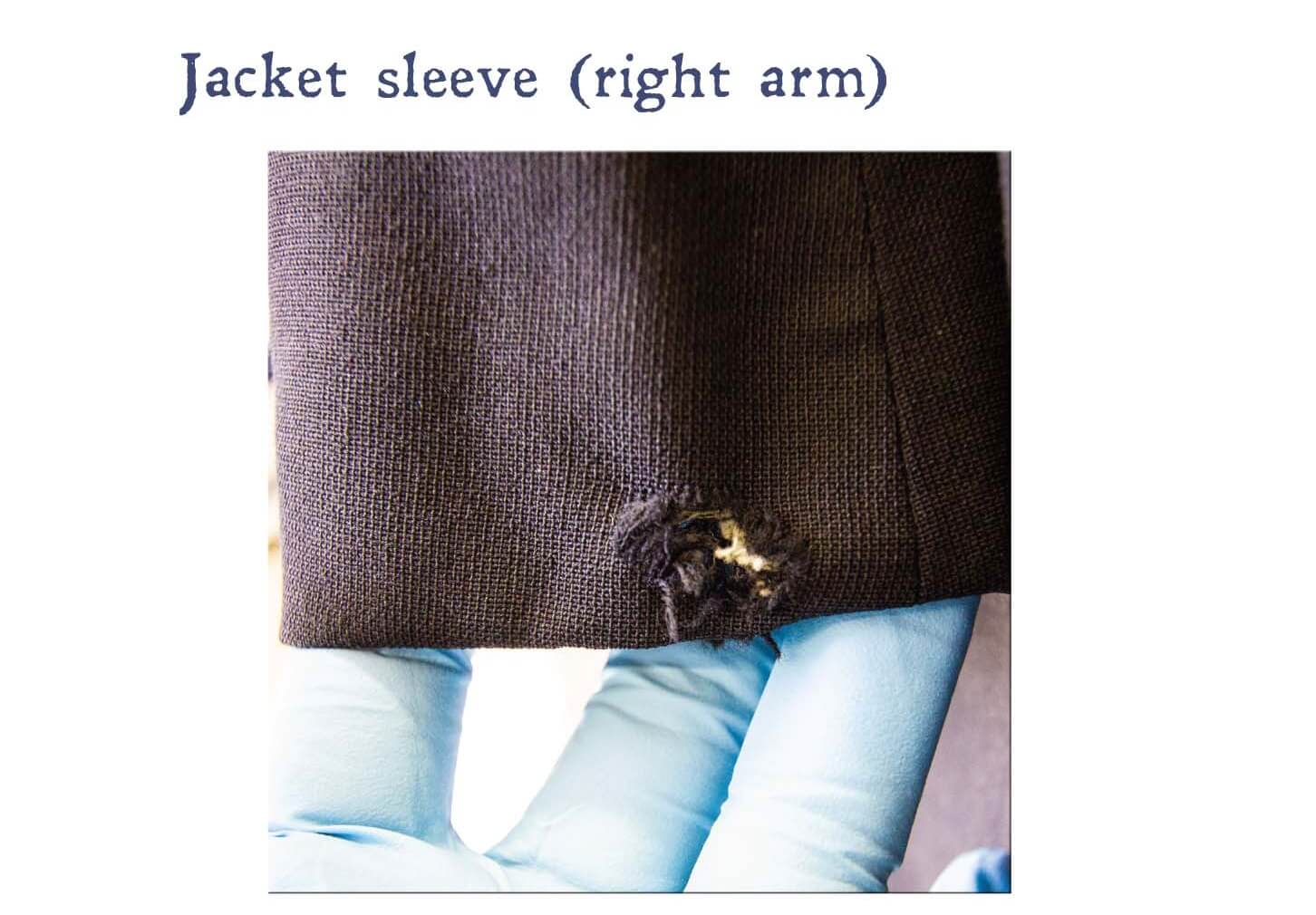
    This is a critical determination. The sine qua non for their theory is that the entry hole in the jacket sleeve and the entry hole in the shirt are in alignment at frame 328 when they claim a fragment of a bullet passed through both simultaneously. The unchallengeable photos show an entry hole in the jacket sleeve adjacent to the seam which runs on the thumb side opposite the buttons which are not seen. Another photo depicts a hole in the mid portion of the French cuff which is also on the thumb side opposite the cufflink holes which are not seen in this photo. These two holes are both located on the thumb side and I thought it would been clearly so obvious that I did not include a photo of the other hole in the jacket sleeve, which is enlightening. In the rebuttal, the authors have referenced this third photo with the claim that it depicts the actual entry hole in the shirt sleeve. It can easily be seen that this hole is immediately adjacent to the cufflink holes which are located ~ 180 degrees opposite the other two holes. Further, Dr. Gregory’s surgical report is corroborative. From HSCA Vol. VII p. 152, emphasis added, “Throughout the wound and especially in the superficial layers and to some extent in the tendon and tendon sheaths on the radial side of the arm are small fine bits of cloth consistent with fine bits of mohair.” Dr. Gregory’s diagram of the wounds clearly shows that the entry wound was on the radial, thumb side of the wrist. The sketch of the wound, albeit of the left hand, found in the postoperative notes shows that this wound was on the thumb side. If any questions persist the Texas State Library and Archives Commission webpages had the measurements of these wounds under each of the photographs. For their conjectured entry hole: “Distance of bullet hole to the right of the seam defining the cuff opening = 1 inch.” For the defect in the midportion of the French cuff: “Distance of bullet hole to the right of the seam defining the cuff opening = 5 1/4 inches; also 3 3/4 inches from the left of the cuff opening.”  With two coauthors being physicians, I would have expected the determination of radial, thumb versus ulnar to be elementary. Why did they make this ludicrous claim? Frankly, they had no other option, because they know at frame 328 the two holes on the thumb side were no longer in alignment. This misalignment at 328 destroys the sine qua non of their theory of a fragment carrying wool fibers simultaneously through these two holes. They had no other option and reflexively made the ill-formed argument that it was a hole on the other side of the wrist which was the one of entry.  As I stated in my review, this observation, in and of itself, negates the theory that a shot was fired from the Grassy Knoll to strike the head at frame 313. Having mislocated an entry wound to the wrong side of the wrist, the authors brazenly, with little style and no substance, claim that I have made a major error and that this somehow actually validates their theory when, in fact, the photographic evidence and findings at surgery do exactly the opposite and destroy their theory. While I would hope readers will continue on in reading my remarks on points 2 through 5, they need not do so. While there are numerous other errors on their part, the misalignment of the entry holes on 328 means that events could never have occurred in the sequence they claim.

    Point #2. The significance of the windshield flare at frame 314.

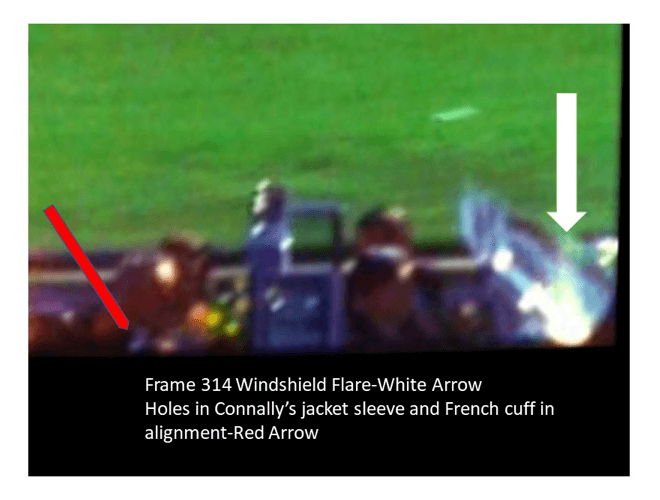
    It is correctly pointed out that the chrome windshield frame was already reflecting light both prior to and for several frames after 314, as a critical angle occurred for reflective surfaces. As the frames progress after 314 and the angles are changing, this maximum reflection can be seen moving up the chrome windshield frame causing previously reflecting surfaces to diminish in intensity back to baseline. At frame 314, there is the initial abrupt appearance of an increase in reflection in the lower corner of the windshield. This could only be due to a physical factor. The sun did not increase in intensity as the degree of reflection before and after this flare is the same. Some brief physical factor must have been responsible, a bullet cracking the windshield. Had it been actually due to a critical angle then this same focus of intensity should have been seen moving to other locations as the angle continuously changed. The small focus of increased reflectivity over adjacent areas was the result of a small degree of deformation of the windshield and/or frame that briefly increased the intensity over the previous and subsequent baselines. While there are qualitative differences in the flares at 314 and 328, both occur on the initial frame after known impacts at 313 and 328.  Where the author’s see an incredibly propitious timing of the angle to the sun, I see cause and effect. The refutation of point #1 means that a bullet went forward through JFK’s head with fragments simultaneously striking Connally’s aligned wrist wounds and cracking the windshield with a resultant flare over baseline at frame 314. Similarly, a bullet struck the windshield frame at 328 to cause a flare on the very next frame at 329. I see cause and effect.

    Point #3.  The significance of the forward movement of Connally’s right wrist after frame 313.

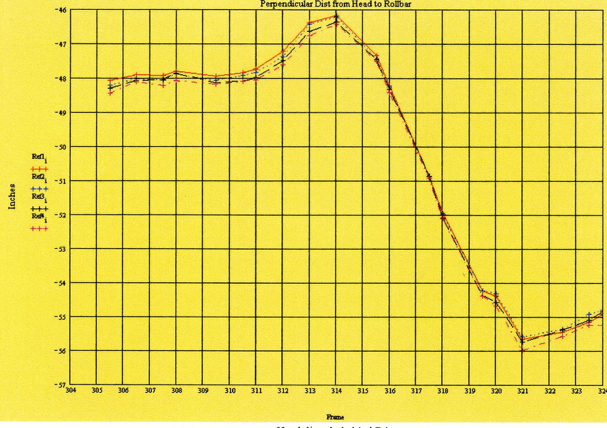
    Again, from the refutation provided on point #1, it can be concluded that a fragment from the head shot went forward at 313 to cause the wrist wound. Whether this fragment caused this movement or if it was voluntary or a combination of the both is immaterial. When he was struck at 313, the earliest voluntary motion we should see would be 4 frames later or 317. I believe I can see more of the French cuff at 317 versus 312. Connally was turning to his right and his hand was in motion prior to his wounding, which would indicate that both factors may have been at work in this forward movement. What is more important is that due this movement, from frame 323 onward, his French cuff was completely exposed and the both holes on the thumb side of the jacket sleeve and French cuff are no longer in alignment. Also immaterial is whether Connally kept holding his hat after being struck at 313. The late Senator Daniel Inouye of Hawaii had his arm blown off while fighting in WWII. Immediately afterwards he saw his disembodied hand still clutching the grenade he had been holding prior to this traumatic amputation. This is an example of decades old inconclusive claim which is pulled out when debating at what point his wrist was struck. It was 313. The alignment of the entry holes is the ultimate determinate.

    Point #4 The significance of the recovered bullet fragments.

    Two major bullet fragments were recovered from the limousine, CE 567 and 569, which are purported to ballistically match Oswald’s rifle based upon evaluations, which until recently, have been human and subjective in nature. The bias of AFTE members is well known to the authors. Direct verification of Dr. Young and Mill’s claims will most likely never occur and the veracity of their claims can only be deduced from other evidence. If an independent, nonbiased ballistic comparison is performed which shows with a high degree of confidence that CE 567 and 569 came from Oswald’s rifle, then Young and Mill’s claims are in error. If so, then the bullet which struck the windshield frame fragmented and the fragments of the bullet which went forward through JFK’s head were not recovered. Frazier’s comments on the damage done by a whole bullet’s impact are simply assumptions as he readily stated in his testimony. From numerous other avenues it is known that the bullet which went forward through JFK’s head at frame 313 was fired from a distance further than the TSBD and therefore from another rifle. I trust these many avenues which indicate a different rifle more than I trust the subjective opinions of biased examiners. The NIST scans of the bullets and fragments from the assassination provides the opportunity to subject them to nonbiased computer algorithmic comparisons. If the computer analysis demonstrates that previous biased human opinions were in error, then we should not be surprised. Such was the case when numerous governmental diagnostic radiologists interpreted the postmortem skull radiographs without recognizing Puppe’s law.

    Point #5. The significance of the acoustic data.

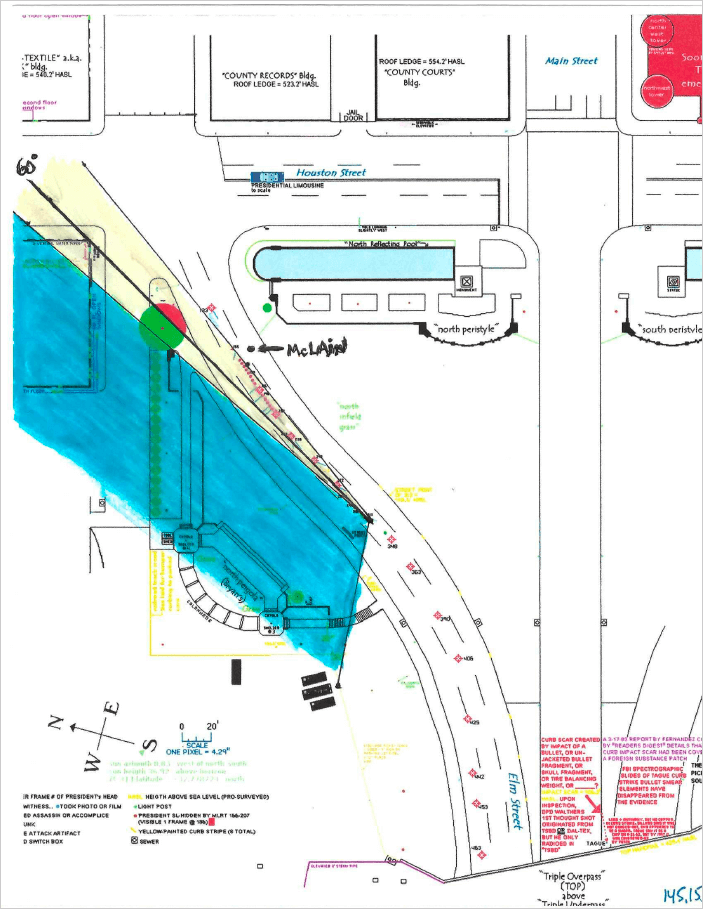
    The sole basis for a shot being fired from the knoll to strike JFK in the head is the supposed 95%+ probability given for this shot by the analysis of Weiss and Ashkenasy. That is blindly taken for granted in LSD and by the present authors. How can we go about verifying their conclusion? Dr. Barger cautioned the HSCA that any proposed shots on the tape needed to be compared with events on the film. Since the HSCA disbanded, impacts have been identified on the film at frame 223 and 328, in addition to the previously known head wound at frame 313. This allows a mathematical synchronization of the film and tape by various measurements which the authors and I agree upon. The authors and LSD have assiduously avoided providing calculations which would validate the conclusions of Weiss and Ashkenasy. I have done the calculations and a shot purportedly fired from the Grassy Knoll to be recorded at 144.90 seconds does not synchronize with the preceding and subsequent shots recorded at 140.32 and 145.61 seconds respectively. Should we be surprised then, when other avenues of validation fail for this shot as well? The blur at 313 is a horizontal panning error not the downward deviation seen on all other blurs. The timing is too soon to be an involuntary reaction by Zapruder. The head moves initially forward. The misalignment of the entry holes at 328 proves their scenario impossible just as does the lack of synchronization. Does this mean that the acoustic evidence is invalidated? Not at all, it just means Weiss and Ashkenasy’s echolocation was in error and that things need to be thought out over again. When I first approached the acoustic evidence, I was immediately struck by the final change in the timing of Barger’s muzzle blast at 145.15, which he has a 50/50 probability to 144.90 seconds. While only ¼ of a second difference, this seemed to be a huge change in a sequence that ran 6 seconds. After calculations, I saw that Weiss and Ashkenasy’s shot didn’t synchronize and I thought outside the box. Knowing that there was a rapid forward and backward motion of the head, I conjectured that these represented two separate muzzle blasts and impacts, the first fired from behind and the second from the front, where Barger had initially found one. When I performed these calculations, I found out that, when this is taken into account, the film and tape synchronize. I have no control over the laws of math or the timing of the shots or any of the other variables. Math is reproducible and anyone with a map of Dealey Plaza, a ruler, and a calculator can arrive at the common and nondebatable conclusion that their conjectured shot does not synchronize and did not happen. This math will be the same today as it was in 1963, as well as 100 years from now.

  • A Slice of Time: Review of Josiah Thompson’s Last Second in Dallas

    A Slice of Time: Review of Josiah Thompson’s Last Second in Dallas


    If you take a moment in time and slice it down the middle, all kinds of things may come tumbling out—even state secrets.

    Moments on films of the Kennedy assassination are sliced into about 18 frames per second.

    In his latest book, Last Second in Dallas, Josiah Thompson focuses on one of those seconds, during which time, he says, and I agree, the president’s head exploded as it was hit by multiple bullets.

    To the mainstream media, Thompson has always been a credible source, so it’s a wonderful thing that, in his latest book, this credible source promotes—without reservation—the concept of conspiracy in the assassination.

    The strongest proof described in the book is the famous Dictabelt tape, a recording of what a motorcycle policeman’s stuck-open microphone picked up—the sounds of five separate shots. Some were fired in such rapid succession that more than one shooter had to have been involved. And not all came from the same direction.

    To me, it’s inconceivable that gunfire would not have been recorded under the circumstances described. So, it seems significant that apparently no recording exists of only three shots—the government-approved number.

    Thompson attempts to correlate these sounds with specific frames of the Abraham Zapruder film of the event. In gruesome color stills, he points out what he believes is evidence of an additional shot.

    You may or may not agree with his conclusions, but it doesn’t matter. You should have no trouble correlating—however loosely—these additional shots with what bystanders said they heard, what they saw, and when. Below is a small collection of their observations, selected for their relevance to the tape. I find them fascinating.

    The Witnesses

    Note: When a witness refers to a “first” or “second” shot, they’re just talking about the first or second shot they heard. Many did not hear (or heard but didn’t register) the earlier shots, because of the ambient noise from the crowd, and especially the motorcycles.

    Brehm, Charles (Bystander)

    Saw JFK hit in the head with the second shot, heard a third.

    The President was leaning forward when he stiffened perceptibly at the same instant what appeared to be a rifle shot sounded…the President seemed to stiffen and come to a pause when another shot sounded and the President appeared to be badly hit in the head. BREHM said when the President was hit by the second shot he could notice the President’s hair fly up…and then [he] roll[ed] over to his side…Brehm said that a third shot followed…between the first and third shots, the President’s car only seemed to move some 10 or 12 feet…almost came to a halt after the first shot. [FBI statement] (22WCH837)

    Foster, James (Patrolman)

    The following summary is confusing, but it sounds like this officer saw JFK hit in the head by shots fired almost simultaneously.

    Another report was heard by Patrolman Foster and, at about the same time the report was heard, he observed the President’s head appear to explode and immediately thereafter, he heard a third report…Patrolman Foster stated that because of the distance from the place where the shot appeared to come from [Depository Building], he felt the third shot struck President Kennedy as he heard the sound of the second shot that was fired. Immediately after President Kennedy was struck with a second bullet, the car in which he was riding pulled to the curb, the motorcycle escorts started maneuvering and scattering, a man which he recognized to be a Secret Service agent jumped on to the rear of the President’s car. (CD 897, DL 100–1046)

    Hickey, George (Secret Service)

    Hickey seems to be describing the effects of two bullets fired nearly simultaneously at Kennedy’s head, one of which he thought was a near miss, disturbing only his hair.

    I heard a loud report which sounded like a firecracker…A disturbance in 679X caused me to look forward toward the President’s car…At the moment he was almost sitting erect I heard two [more] reports which I thought were shots and that appeared to me completely different in sound than the first report and were in such rapid succession that there seemed to be practically no time element between them.

    It looked to me as if the President was struck in the right upper rear of his head. The first shot of the second two seemed as if it missed because the hair on the right side of his head flew forward and there didn’t seem to be any impact against his head. The last shot seemed to hit his head and cause a noise at the point of impact which made him fall forward and to his left again. (18WCH762)

    Hill, Clint (Secret Service Agent)

    Photographic evidence of when Clint Hill reacted suggests he never heard the actual first shot. Stranger still, he thought “the” head shot occurred while he was holding onto the limousine. But the film taken by Marie Muchmore shows that, even before he reached the limousine, the top of JFK’s head rose up about an inch, emitted translucent white fluid, then closed, a lid slammed shut. Unknown to him, what Hill witnessed appears to be yet another shot to JFK’s head. JFK was then shot again.

    And I heard a noise from my right rear…and I saw President Kennedy grab at himself and lurch forward and to the left. This is the first sound that I heard…I jumped from the car…ran to the Presidential limousine…Between the time I originally grabbed the handhold and until I was up on the car…the second noise that I heard had removed a portion of the President’s head, and he had slumped noticeably to his left. (2WCH138)

    When I mounted the car…it had a different sound…than the first sound that I heard. The second one had almost a double sound—as though you were standing against something metal and firing into it, and you hear both the sound of a gun going off and the sound of the cartridge hitting the metal place…” (2WCH144)

    As I lay on the back seat…I saw a part of his skull with hair on it lying in his seat. (18WCH742) [No hair was reported, which is too bad because its length might have helped show what part of the skull it was.]

    Holland, S.M. (Bystander)

    Holland heard an additional shot after he saw Kennedy hit in the head. For me, Thompson’s riveting interview of this man—what he heard, and especially what he saw—is just amazing. It correlates with what another critical witness saw, and it is one of the highlights of the book. He appears to have found a sniper’s nest behind the fence on the grassy knoll. You will have to buy the book to see what he said.

    Hudson, Emmett (Bystander)

    Films show Hudson still standing over a second after Kennedy’s head exploded, which happened when the limousine was in front of Zapruder. Other witnesses corroborate Hudson’s claim that a shot was fired over a second after Kennedy was hit in the head.

    I happened to be looking right at him when that bullet hit him—the second shot…it looked like it hit him somewhere along about a little bit behind the ear and a little bit above the ear.

    I just laid down…resting my arm on the ground and when that third shot rung out and when I was close to the ground—you could tell the shot was coming from above and kind of behind.

    I don’t know if you have ever laid down close to the ground, you know, when you heard the reports coming, but it’s a whole lot plainer than it is when you are standing up in the air…right along about even with these steps, pretty close to even with this here, the last shot was fired… (7WCH560-561)

    Kinney, Samuel A. (Secret Service)

    The first shot was fired…he slumped to the left. Immediately he sat up again. At this time, the second shot was fired and I observed hair flying from the right side of his head…I did hear three shots, but do not recall which shots were those that hit the president. (18WCH732)

    Landis, Paul (Secret Service)

    It was at this moment that I heard a second report and saw the President’s head split open… I also remember Special Agent Clinton Hill attempting to climb onto the back of the car at the time the second shot was fired…

    I heard what sounded like the report of a high-powered rifle from behind me…My first glance was at the President…I saw him moving in a manner which I thought was to look in the direction of the sound. I did not realize that the President had been shot at this point.

    I glanced towards the President and he still appeared to be fairly upright in his seat…I also remember Special Agent Clinton Hill attempting to climb onto the back of the President’s car.

    It was at this moment that I heard a second report and it appeared that the President’s head split open with a muffled exploding sound…the sound you get by shooting a high-powered bullet into a five gallon can of water or shooting into a melon. I saw pieces of flesh and blood flying through the air and the President slumped out of sight toward Mrs. Kennedy…

    I still was not certain from which direction the second shot came, but my reaction at this time was that the shot came from somewhere towards the front, right-hand side of the road. (18WCH754-5)

    McClain, H.B. (Motorcycle Officer)

    McClain appears to be describing a man caught in a crossfire.

    The force of this bullet threw him this way, and then back this way, so I think the man was shot twice. He was falling away and then all of a sudden, he just went back the other way. (CSpan)

    Moorman, Mary (Bystander)

    It appears that Moorman did not hear a shot until she took her Polaroid picture of Kennedy getting hit in the head. She said she fell to the ground when she heard the shots. Films show her still standing with her camera aimed at Kennedy after the first headshot.

    As the motorcade started toward me I took two pictures. As President Kennedy was opposite me, I took a picture of him. As I snapped the picture…I heard a shot ring out. President Kennedy kind of slumped over. Then I heard another shot ring out and Mrs. Kennedy jumped up in the car and said, “My God, he has been shot.” When I heard these shots ring out, I fell to the ground to keep from being hit myself. I heard three or four shots in all… (19WCH487)

    Skelton, Royce (Bystander)

    This witness’s remarks fit the pattern in that he heard more than three shots, but maybe not all struck anyone in the limousine. He said he saw a bullet hit the pavement at the left rear of the car, and the concrete was knocked to the south away from the car. If true, that would seem to put the shooter in front and on the right, the north side of the street—in other words, the grassy knoll.

    I was standing on top of the train trestle where it crosses Elm Street with Austin Miller…I heard something which I thought was fireworks. I saw something hit the pavement at the left rear of the car, then the car got in the right-hand lane and I heard two more shots. I heard a woman say “Oh no” or something and grab a man inside the car. I then heard another shot and saw the bullet hit the pavement. The concrete was knocked to the south away from the car. It hit the pavement in the left or middle lane… (19WCH496) [Later, he told the Warren Commission he saw smoke coming off the cement where the bullet hit.]

    Willis, Mrs. Philip (Bystander)

    Said the head was wounded on the “second” shot; then heard a third. (CD 1245)

    The Dictabelt

    The timing of shot sounds on the Dictabelt tape is critical to their interpretation as gunfire. Doubt was cast on that interpretation, at first, because those sounds seemed to have come too late.

    I cannot understand this part of the book and will not attempt to explain it except to say that it has to do with when, in relation to the shot sounds, Sheriff Bill Decker was heard (but barely, on a fuzzy tape) to say “Hold everything secure.” The assumption is, he uttered those words a minute after the last actual shot.

    So, if those words can be heard too close to the time of the shot sounds on the tape—then those sounds can’t be shots. (Thompson offers a technical explanation for how Decker’s comment only appeared to have been made at the time of the shot sounds—a matter of cross talk, from a different channel. I am not qualified to do the subject justice, and won’t try.)

    If you want to study this issue further, you should of course read all the technical material in Thompson’s book, as well as the analyses of others, but also study the relevant testimony provided below.

    Who Heard What in the Lead Car, and When? Who Said What, and When?

    Decker was in the lead car, right behind Jesse Curry, the chief of police. To his right, was Special Agent Winston Lawson. In the back, to the right of Decker, sat Forrest Sorrels, Special Agent in Charge, Dallas office.

    A motorcycle officer, James Chaney, rode up to the lead car to tell the sheriff what was happening. He didn’t begin this journey until after seeing JFK shot in the head. Yet at least one occupant of the car specifically said he heard two more shots after Chaney reached the car.

    James Chaney was not interviewed by the Warren Commission, but here is what Officer Marrion Baker said about Chaney:

    I talked to Jim Chaney and he made the statement that the two shots hit Kennedy first and the other one hit the Governor. He was on the right rear of the car or to the side, and then at that time the chief of police, he didn‘t know anything about this, and he [Chaney] moved up and told him, and then that was during the time that the Secret Service men were trying to get in the car, and at the time, after the shooting, from the time the first shot rang out, the car stopped completely, pulled to the left and stopped…Now I have heard several of them say that. Mr. Truly was standing out there, he said it stopped. Several officers said it stopped completely. (3WCH266)

    Curry, Jesse (Chief, Dallas Police Department)

    Curry said he heard two more shots after Officer Chaney rode up beside himthat is, two more shots after the head shot.

    I said, “What was that, was that a firecracker?”…I couldn’t tell whether it was coming from the railroad yard or whether it was coming from behind but I said over the radio, I said, “Get someone up in the railroad yard and check.”

    And then about this time, I believe it was Officer Chaney rode up beside of me and looking back in the rearview mirror I could see some commotion in the President’s car and after this there had been two more reports, but these other two reports I could tell were coming [from] behind instead of from the railroad yards. (4WCH161) [Emphasis mine]

    Decker, J.E. “Bill” (Dallas County Sheriff)

    Sheriff Decker apparently associates seeing brain spatter with the first shot he heard.

    As the motorcade was proceeding down Elm Street, I distinctly remember hearing two shots. As I heard the first retort [sic], I looked back over my shoulder and saw what appeared to me to be a spray of water come out of the rear seat of the president’s car. At this same moment, Mr. Lawson said “Let’s get out of here and get to the nearest hospital”…At the same time, Mr. Curry was on his intercom radio giving instructions to the motorcycle escort to move out…

    We moved out immediately at which time I took the microphone and requested the DPD dispatcher 521 to advise my Station 5-Radioroom to notify all officers in my department to immediately get over to the area where shooting occurred and saturate the area of the park, railroad and all buildings… (19WCH458)

    Lawson, Winston (Secret Service)

    This Secret Service agent who didn’t hear a shot until he was “quite close” to the underpass heard two shots after witnesses were either running around or hitting the ground. But those reactions did not happen until after the first headshot.

    I heard this very loud report…I can recall spinning around and looking back, and seeing people over on the grassy median area kind of running around and dropping down, which would be in this area in here [described elsewhere as the area between Elm and Main]…Then I heard two more sharp reports. (4WCH352

    Sorrels, Forrest (Special Agent)

    The first shot was heard…I just said “What’s that?” And turned around to look up on this terrace part there, because the sound sounded like it came from the back and up in that direction…Within about three seconds there were two more similar reports and I said “Let’s get out of here” and looked back, all the way back, then, to where the President’s car was, and I saw some confusion, movement there, and the car just seemed to lurch forward.  And, in the meantime, a motorcycle officer had run up on the right-hand side and the chief yelled to him, “Anybody hurt?”…And the chief took his microphone and told them to get to the hospital, and said, “Surround the building.” He didn’t say what building…And by that time we had gotten almost in under the underpass… (7WCH345)

    Thompson and the Medical Evidence

    The gold standard for any report is simple: Tell readers what they need to know to make up their own minds. Do not put your finger on the scale. Never omit significant information which conflicts with your own conclusions.

    Thompson doesn’t always follow this rule. To illustrate this, I have selected the throat wound, an easier specimen to deal with than the messy, messy head wound. (That subject deserves its own messy article.)

    ISSUE #1: When the Pathologists Knew of a Bullet Wound in the Throat

    Why it’s important: had they acknowledged the bullet wound in the throat—as opposed to just a wound created by a tracheotomy—they would have been obliged to document it, by photographing it under magnification, measuring it and, most important, taking tissue samples for microscopic examination—which would have revealed whether the wound had been an exit or an entrance.

    Thompson accepts this story: “The first time any of them knew a bullet wound underlay the tracheotomy incision was when they opened their copies of the Washington Post the next morning and learned what Dr. Perry had done.”

    The next morning, when the body was gone, and it was too late to document evidence of that wound. 

    It’s understandable why doctors under pressure to prove a foregone conclusion would want to avoid proving anything that contradicted that conclusion. But why does Thompson repeat this false claim? And why does he leave out facts that contradict it?

    Facts omitted by Thompson:

    Both pathologists and the autopsy photographer (and others) indicated they knew of the throat wound that night, while it was still possible to document it.

    Commander James Humes, MD: Testimony to the Warren Commission

    In 1964, Humes testified that they knew, on the night of the autopsy, that only a missile could have caused the bleeding and bruising in JFK’s throat—and not Perry’s surgery (which involved severing strap muscles in the neck)—because at the time of Perry’s work, JFK’s heart had stopped circulating blood. He bases this on the fact that no bleeding or bruising was caused by cutting on other places on JFK’s body. (2WCH367-8) [In my opinion, Humes volunteered this information out of vanity. He didn’t want to look like a fool who didn’t see what was in front of him. And he was talking behind closed doors…]

    J.Thornton Boswell: Testimony to the HSCA

    Dr. Boswell said he remembered seeing “part of the perimeter of a bullet wound in the anterior neck.” 

    J.Thornton Boswell: Testimony to the ARRB

    Did you reach the conclusion that there had been a transit wound through the neck during the course of the autopsy itself? Response: Oh, yes.

    Our conclusions had been that night and then reinforced the next day that it was a tracheostomy through a bullet wound.

    John Stringer, Autopsy Photographer, to the ARRB

    Said the doctors felt around in the throat trying to find bullet fragments or anything sharp.

    Thompson also accepts the idea that the pathologists didn’t have time to do a proper job because the family and the president’s physician were rushing them. But if they were in such a hurry, why did they spend time carefully weighing each organ and measuring every heart valve, instead of focusing on the bullet wounds?

    ISSUE #2: Throat WoundEntrance or Exit? Thompson’s Theory

    In his new book, Thompson describes his theory of the throat wound, the same one he presented in Six Seconds in Dallas – that it was created when a little bone or bullet fragment was driven downward “by the explosion of the president’s head.” And he said Newsweek and the Journal of the AMA (JAMA) claimed that is what happened. But JAMA is notorious for publishing pseudoscientific pro Warren Commission propaganda. And Newsweek isn’t exactly a peer-reviewed medical journal.

    Thompson believes the laceration in the brain described in the autopsy report is possible evidence of the fragment’s journey downward. Apparently, he does not know of another, perhaps more likely explanation for such lacerations. They are usually formed by cavitation—when the bullet violently displaces tissue in its path, it creates a large temporary cavity. And perpendicular to the bullet’s path, cracks are formed where the tissue was stretched until it tore. You can see these perpendicular cracks in soap or gelatin after a bullet passes through.

    In any case, there’s nothing wrong with expressing theories, but, as mentioned above, you should always include the other side of the story, if it is valid.

    Facts omitted by Thompson:

    Malcolm O. Perry, MD who performed the tracheotomy had good reason to believe the wound was an entry, and not just because it was small. There was a far more definitive reason: Perry said “the edges were bruised.” And Charles Baxter, MD referred to the skin damage around the hole. That bruising takes place when the skin is crushed by the bullet against harder internal structures. In this case, the skin between bullet and trachea. (All entry wounds are “shored” or buttressed by tissue on the other side.)

    What Perry said about the internal damage in the neck suggests that if a bullet entered the throat, it was probably traveling at medium velocity (as defined circa 1963).

    There’s some concussive damage to surrounding organs—these are the kind of things one sees with gunshot wounds, in a blast injury…And with high velocity, we do see a lot. Now the low velocity stuff, it’s often just a track, a wound track, with very little concussive or blast injury. This one was in between. There was evidence of some blast injury, but not like, say, what one sees with a high velocity rifle.

    Whether it was coming or going, Perry was talking about damage done by a bullet. And it is reasonable to assume that he would recognize whether a small hole in the skin was created by something exiting. In 1963, Perry was already an assistant professor of surgery, specializing in vascular surgery. In his obituary, the New York Times reported “In his long career, Dr. Perry was chief of vascular surgery or professor of surgery, or both, at the University of Washington in Seattle; Cornell Medical College in New York City; Vanderbilt University School of Medicine in Nashville, and the Texas Tech Health Sciences Center in Lubbock, as well as the University of Texas Southwestern Medical School in Dallas.”

    Thompson believes that if the bullet entered the throat, it would necessarily strike the spine. But consider the bullet’s path if it came from the front. The path is defined by three documented, apparently connected points, demonstrating that path was at an angle:

    1. Middle of the throat, skin
    2. Right side of trachea
    3. Right lung, top

    Please click here for more details on this. If the wound is an entrance, the bullet went only so far before stopping. Some believe the pathologists—or someone else—removed the remains of whatever missile entered, if one entered.

    If you believe the front is an exit, this is the government-approved path:

    1. Right side, upper back—but very close to the spine
    2. Right lung, top
    3. Right side of trachea
    4. Middle of throat

    The problem with the above scenario is the extreme closeness of the back wound to the spine. It really would have gone into the spine had it continued on its journey.

    No one reported finding the small bone or bullet fragment that Thompson believes created the throat wound, but that doesn’t mean anything. No one reported finding the bullet many believe entered from the front either. And again, this doesn’t mean anything. Look what else the pathologists didn’t document:

    1. As reported above, the doctors pretended they didn’t even know about the bullet wound in the throat.
    2. Not one word on the size and condition of the cerebellum. This omission is stunning, considering the victim was shot in the head, and the bad condition of the cerebellum as described by the Parkland doctors, evidence that challenges the official trajectory through the head.
    3. The exact vertical location of the back wound, as related to a vertebra.

    Click here to see little known evidence that could show the two wounds are not connected, that the throat wound came first, then the back wound.

    Thompson’s Book: Gourmet Food for Thought

    Despite its flaws, Last Second in Dallas is a stimulating book about an eternal puzzle concerning the confounding details of this monumental murder. The book is rich in detail and a lot of it is factual and not well-known. But, if you have learned anything from the above, you need to always keep in mind the question, “What relevant facts were left out, and why?” My theory on why: certain facts could lead back to Who Done It. And, here’s another puzzle for you: What entity—in this day and age—is still suppressing inconvenient facts?

  • Fred Litwin Smooches Clay Shaw’s Lawyers

    Fred Litwin Smooches Clay Shaw’s Lawyers


    In Fred Litwin’s book about New Orleans and Jim Garrison, he reveals that he was stung by my criticism of his first book I Was A Teenage JFK Conspiracy Freak. There I said that in his references to Jim Garrison, he never used any primary sources. So in his book on Garrison, On the Trail of Delusion, he relied in large part upon the files of Clay Shaw’s lawyers. And he actually presented these as being credible pieces of evidence, which is another problem with his book.

    If there is one word I would use to describe Shaw’s legal team, it would not be “credible.” As I have related elsewhere, Shaw’s lead lawyer, Irvin Dymond lied to me about there being no CIA-cleared panel of lawyers in New Orleans. In fact, Shaw’s former boss, Lloyd Cobb was on that panel.

    Shaw’s lawyers—Dymond, Sal Panzeca, and Ed and Bill Wegmann—did not want to admit to all the help they were getting from Washington. This included the Department of Justice, the FBI, and the CIA. To my knowledge, they never revealed this and at every opportunity they denied it. When I posited this direct question to Dymond, as to if he ever asked himself where this help was coming from, he replied with: “Well, it was the Kennedy assassination.”

    That statement was utterly false. As early as 1967, Shaw’s lawyers were literally pleading for help from Washington. And one of the more valuable achievements of the Assassination Records Review Board was that they made this provable through the declassification process. By September of 1967, the CIA had actually set up what they called “The Garrison Group” at the request of Director Richard Helms. At the first meeting of this group, James Angleton’s assistant Ray Rocca predicted that if Garrison proceeded as he was, Clay Shaw would be convicted. (James DiEugenio, Destiny Betrayed, Second Edition, p. 270) It turned out that, even in September of 1967—seven months after he was indicted—Shaw had not even revealed his longstanding association with the CIA to his own lawyers. In his initial direction to the group, Helms stated that there should be consideration to the implications of Garrison’s inquiry before, during, and after the trial of Clay Shaw. (Ibid, italics added) As is revealed by the declassified record, every appeal—in person and by letter—to the DOJ was sent to Larry Houston, the Chief Counsel of the CIA, Helms’ close personal consultant and friend. And as HSCA attorney Bob Tanenbaum noted at a conference in Chicago in 1993, there was action taken. He had seen documents out of Helms’ office detailing surveillance on Garrison’s witnesses; James Angleton was running background checks on prospective jurors for the Shaw trial. (CIA Memo of February 11, 1969)

    The obvious question from all of this—and much more—is that there was a covert story to the undermining of Garrison in which Shaw’s lawyers played a large part. After much examination of this declassified record, it is quite fair to conclude that, at the very least, Shaw’s lawyers knew he would lie when they put him on the stand. For example, from the following articles, they knew that Shaw knew Ferrie. From a cleanly declassified FBI memo, they knew he used Clay Bertrand as an alias. (FBI Memorandum of March 2, 1967) And, as the reader will see, they knew much more than that. In fact, they participated in Guy Banister’s operations. From these articles it is fair to say that all that mattered to them was winning the case. In making that Faustian agreement, Shaw’s attorneys descended into a surreal subterranean netherworld. One that would be concealed from public view for almost three decades.

    Only Fred Litwin—and his co-editor Paul Hoch—would either ignore or discount this crucial information. And then utilize Shaw’s lawyers’ material as if it were credible.

  • Fred Litwin on the Facts of the JFK Case

    Fred Litwin on the Facts of the JFK Case


    This is a relatively concise review of Fred Litwin’s first book on the John Kennedy assassination, I Was a Teenage JFK Conspiracy Freak. It will be by chapters—excepting Litwin’s discussion of the Jim Garrison inquiry. Jim DiEugenio has reviewed Litwin’s work on that issue at length and in depth. (Click here and here)

    Chapter 1

    Litwin says first generation critics “started finding small inconsistencies” in the case. But they were actually big inconsistencies (e.g. the dubious provenance of CE 399). (Click here for details) He also avows: “The motorcade had to turn onto Elm Street so it could take an exit to the Stemmons Freeway which would have taken them to the Dallas Trade Mart for Kennedy’s speech.”

    Like his previous statement, this one is also false. The motorcade could have taken Main St. to Industrial Blvd. What is so odd about this error is that the correct information is in the House Select Committee volumes, which, on other occasions, Litwin values highly. (HSCA Vol. 11, p. 522) He incorrectly says there are “20,000 pages” in the Warren Commission’s 26 volumes of testimony and evidence. There are really 17,816 pages. Shockingly, before even going into the actual evidence at all, Litwin casually says: “The authors of the Warren Report were honorable men who conducted an honest investigation and reached the right answer.” As many have pointed out, in this day and age, for anyone to call people like Allen Dulles, John McCloy, and Jerry Ford honorable men is wildly archaic. He incorrectly says John Connally’s “lapel” flipped as an indication of a bullet transit—yet his chest wound was not near the lapel! (Click here for details)

    The Canadian author then goes through the “overwhelming evidence” against Oswald. He claims Oswald had “a long…package”—but the two witnesses to it said it was not long. (WC Vol. 2, pp. 239–240, 249) Litwin claims that “after the assassination, Oswald was the only warehouseman missing”—but Charles Givens was also missing. (WC Vol. 3, pp.183, 208) Litwin nonchalantly says Oswald “killed police officer J.D. Tippit,” which, with the accumulation of evidence we have on that case today, is a quite dubious statement. (Click here for details)

    But Litwin marches on. He also claims that “many witnesses identified Oswald“—but those “identifications” were based on rigged lineups and some were made months after he was dead and nationally known. One of the best examinations of the line ups was made by the late British police inspector Ian Griggs. To name just two problems: Griggs noted that in the British model, there should be 7 other people in a line up and they should be of similar age, height and appearance. (Ian Griggs, No Case to Answer, p. 81) After a seventeen-page analysis, Griggs concluded that, to put it mildly, these guidelines were not adhered to with Oswald. For example, there were only three other people in the Oswald line ups. As per similar physical appearances, Homicide Detective Elmer Boyd said, well “Sometimes they do and sometimes they don’t.” (Griggs, p. 83) As per age, Oswald was 24. Two of the stand-ins were 18 years old. Further, Oswald was the only one with bruises on his face. And although the others made up their names and occupations, Oswald did not. Even though, by the time of most of the line ups, his name and place of work had been broadcast on radio and TV. (Ibid, pp. 85–86)

    But further, one of the witnesses, Helen Markham, was so weak and faint that the police had to administer her ammonia. Or as Captain Fritz testified to the Commission:

    We were trying to get that show up as soon as we could, because she was beginning to faint and getting sick. In fact, I had to leave the office and carry some ammonia across the hall, they were about to send her to the hospital or something and we needed that identification real quickly, and she got to feeling all right after using this ammonia. (WC Vol 4, p. 212)

    Line-up witness Cecil McWatters, a bus driver, later admitted that Oswald was not even the man he recalled from his bus ride. He was trying to identify Roy Milton Jones. (Griggs, p. 87) Then, of course, there was the testimony of cab driver Bill Whaley. Whaley said that anyone could have identified Oswald, because he was carrying on and yelling at the policemen. He said it was not right for him to be placed in a line-up with teenagers. If Litwin had been in Oswald’s place, would he not have done the same? (Griggs, p. 90)

    Litwin then says that “one expert concluded that one of the four bullets recovered from Tippit’s body matched the revolver found in Oswald’s possession”—but 8 other experts disagreed with him, and moreover that bullet did not appear for a quarter of a year! (WC Vol. 3, p.474) Litwin says “the expended [Tippit] cartridge cases matched Oswald’s gun to the exclusion of all other weapons”—but those cases did not appear for a week (WC Vol. 24, pp. 253, 332) and four officers’ initials disappeared from them. (WC Vol. 7, pp. 251, 275–276; Vol. 24, p. 415) They could not be identified by the three witnesses as the ones they found that day. (WC Vol. 24, pp. 414–415) And as most of us know, two of the cases were from Winchester Western and two were from Remington-Peters. While three bullets were from Winchester and one was from Remington. (Henry Hurt, Reasonable Doubt, p. 152)

    Litwin says “Oswald’s right palm print was found on the rifle barrel”—but the only person to see this print said it was an old print. (Gary Savage, First Day Evidence, p. 108) Litwin then says “his fingerprints were found on the bag used to carry the rifle to work.” Yet, when FBI expert Sebastian LaTona initially examined the bag on 11/23, he could find no latent prints on it. (WC Vol 4, p. 3) Litwin then declares: “Faced with this massive amount of incriminating evidence, the critics could only chip away at the margins.” But as the reader can clearly see above, this author did not “chip away at the margins.” I simply debunked Litwin’s claims with original evidence.

    Litwin then proceeds to speak in paragraphs to derail witness Lee Bowers’ account, but he never gets to the meat and potatoes. So I will spell it out here…Bowers told Mark Lane on camera on March 31, 1966:

    There were, at the time of the shooting, 2 men standing at the top of the incline. And one of them, from time-to-time as he walked back-and-forth, uh—disappeared behind a wooden fence, which also is—uh—slightly to the west of that. At the time of the shooting, in the vicinity of where the 2 men were, there was a flash of light. The area was sealed off by at least 50 police within 3 to 5 minutes. I was there only to tell ’em what they asked, and—uh—so that when they seemed to want to cut off the conversation. (Click here to watch the video)

    Litwin also apparently doesn’t know that subsequently two of Bowers’ friends independently came forward and confirmed that, yes, he did see more than he told the Warren Commission, but he was afraid. He didn’t want his life threatened or ruined, being one of the key witnesses against Lee Oswald as the lone shooter. (Josiah Thompson, Last Second in Dallas, pp. 66—67)

    Litwin avows that “Dealey Plaza was an echo chamber which made it hard for witnesses to determine the direction of the shots.” This is not accurate. As Josiah Thompson points out in Last Second in Dallas, “The knoll is covered with trees and grass and a wooden fence, all sound-absorbing materials.” (Thompson, p. 38) And further, the flash of light, smoke, fresh footprints, cigarette butts, and an anomalous shape in the Moorman photo all confirm the 58 grassy knoll ear witnesses! (See Thompson, Chapter 5) All of which are JFK 101 and never mentioned in Litwin’s book. Litwin declares “there were absolutely no witnesses to gunmen on the grassy knoll or behind the picket fence.” Well, of course, everyone was looking at the President, not at some random fence in the corner! Snipers are trained to not be seen. But, as we shall see, we do have physical and photographic evidence left behind which indicates such.

    Litwin claims “the Dallas doctors did not see the [rear skull] entrance wound because they didn’t turn Kennedy’s body over”—but they did lift the head up and this wound was seen by Drs. Jenkins and Grossman. Litwin says “Virginia and Barbara Davis saw Oswald run across their lawn after the [Tippit] murder.” But remember, they pointed him out of a rigged lineup. Also, the Davis sisters were really confused witnesses. For instance, Barbara claimed she saw the killer again “a few minutes later” after the shooting! (CD 630e, p. 1) And Virginia claimed she heard the second gunshot “a few minutes later” after the first one! (CD 630f, p. 1) So they were confused witnesses.

    Chapter 3

    Litwin incorrectly says the Zapruder film is “27 seconds” when, of course, it is 26 seconds. He says the parade route “never changed”—but Secret Service agent Gerald Behn confirmed to Vince Palamara the route was changed for the Dallas trip! (Survivor’s Guilt, p. 104) Palamara’s book is the best there is on this issue. He brings in not just Behn, but three other DPD witnesses to back him up.

    Litwin likes to make a big deal that in 1972 Drs. John Lattimer and Cyril Wecht, after viewing the autopsy materials, concluded JFK was only hit from the rear. But the fact is that we have come very far since 1972 and, because of this, Wecht has since changed his mind. But Litwin doesn’t explain this context. He cites Lattimer’s old myth of Connally having an “elongated wound in the back”—but Connally’s doctor testified it was elongated only after he removed damaged skin. (WC Vol. 6, p. 88) He says “Kennedy’s head moved forward before it moved back and to the left”—but this has since been shown to likely be an optional illusion due to camera movement. (Thompson, Last Second in Dallas, pp. 197–205) Litwin says the back and to the left “was probably caused by a neuromuscular spasm”—but as another reviewer has pointed out, “no expert in neuroscience has ever supported this hypothesis.” Moreover, neuromuscular spasms only occur when the nerve centers—at the bottom of the brain—are inflicted and JFK’s were not. Litwin also says “there might also have been some minor movement due to something called the ‘jet effect’”—but the fact of the matter is that this theory met a timely end in 2014 (Click here for details)

    Litwin: “The autopsy materials…totally refuted a shot from the front.” This is false. The lateral X-ray (assuming it’s authentic) clearly shows a trail of bullet fragments going from front to back. Due to the new work by Dr. Michael Chesser, we know it goes from front to back, because the largest fragments are in the back. That means a shot from the front. (Click here for a long version of Chesser’s work)

    Chapter 5

    Litwin touches a bit on the acoustics evidence, but ignored the recent work that has been done on it. His argument seems very dated. He avows that “the autopsy X-rays and photographs…showed a small wound in the back of Kennedy’s head”—this would be news to the autopsy doctor James Humes, who couldn’t find one when shown the materials during his ARRB deposition. Litwin says “the Zapruder film shows the back of Kennedy’s head to be intact after the fatal shot”—but (assuming the film is authentic) the back of the head is unfortunately in shadow in the Zapruder film. What Litwin also doesn’t say is that actually a few frames are not in shadow and they do in fact show the rear of the head blown out! (Frames 335, 337, 374)

    He says “you can see a visible exit wound in the right front”—but that is actually a flap of scalp hanging down. Litwin ignores the following facts: Press secretary Malcolm Kilduff indicated in public that a shot hit Kennedy in the right temple. Or that Chet Huntley of NBC News announced this same description on TV that day and gave as the source Dr. George Burkley, Kennedy’s physician. Finally, Bill and Gayle Newman, two of the closest witnesses to the shooting, both said the bullet came from behind them—i.e. the stockade fence—and hit Kennedy in the right temple. (Thompson, Last Second in Dallas, p. 32) Is it only a coincidence that the Newmans did not testify before the Commission and neither did Burkley?

    He says “his [Harrison Livingstone’s] witnesses all disagreed with each other.” I’m not sure what Litwin means here. All the witnesses Livingstone interviewed were unanimous that the back of the head was gone. Litwin (like Gerald Posner) misconstrues a 1990 quote by autopsy technician Paul O’Connor—“It has been so many years and so much has happened, I kind of doubt my own ability to remember fine details.”—Posner attributes this to O’Connor’s overall memory, but actually it was attributed to the specific question as to whether JFK was wrapped in a mattress cover! (High Treason 2, p. 272) This is simply literary hackery and Litwin just copied it from Posner’s book. (See Posner, Case Closed, p. 300)

    Litwin always makes a big deal that “every forensic pathologist who had viewed the autopsy evidence had concluded that Kennedy was shot from behind.” What Litwin leaves out is that these forensic pathologists—Ramsey Clark Panel, the HSCA—never had the body in front of them. And none of them ever saw Kennedy’s brain, since it disappeared from the National Archives. But here’s the thing, none of their reports ever mention the words “grassy knoll,” “knoll,” or “fence”. They didn’t even take that into consideration. So that talking point is simply not valid. But further, Litwin also ignores this: Dr. Michael Baden conservatively acknowledged a grassy knoll headshot was possible. (HSCA Final Report, pp. 80–81)

    Litwin incorrectly accuses critics of “ignoring the HSCA test results.” But these two tests—the NAA and Tom Canning’s trajectory analysis—have been through discredited by, for one, Don Thomas. (Hear No Evil, Chapters 12, 13 respectively.) He jumps on critics for using “faulty diagrams” of the single-bullet theory. He then shows a still from Dale Myers’ animation and declares: “They were in perfect alignment for a shot to hit both men.” But of course, Myers’ dishonest animation only works if you move JFK’s back wound up, stretch his neck, lean his neck way forward, shrink Connally, and slide his seat in 6 inches when it was actually 2.5 inches. (patspeer.com, Chapter 12c; click here for details) Litwin discusses the unreliable “Badgeman” image in the Moorman photo, but completely ignores the more reliable anomalous shape that Josiah Thompson points out in Six Seconds in Dallas. What is notable about this aspect of the Mary Moorman photo is that it contains two figures behind the stockade fence atop the grassy knoll. One is a fixed point, a signal tower. But the other figure disappears—it is not there in later photos, so that, very likely, was a person. (Six Seconds in Dallas, p. 127) Coincidently, the flash of light and smoke was seen there, and the fresh footprints and cigarette butts were found there. Again, none of this is mentioned in Litwin’s book. He incorrectly calls Robert Groden’s 1993 book The Death of a President—it’s actually The Killing of a President.

    Chapter 6

    Litwin nonchalantly mentioned Thomas Canning’s HSCA trajectory analysis—but none of the wound locations in Canning’s analysis are the same as the locations that were reported in the HSCA’s Forensic Pathology Report. Canning chose them. Yes, he chose his own wound locations! (HSCA Vol. 6, p. 33, see especially the footnote at bottom) All trying to confirm a bias—aka a lone assassin. Moreover, Canning’s trajectory analysis for the single-bullet theory is at Zapruder frame 190, and Litwin believes it happened at frame 224. (ibid, p. 34)

    Litwin says “Oswald qualified as a sharpshooter in the U.S. Marines,” but ignores Commission lawyer Wesley Liebeler’s own memorandum which states that the FBI could not duplicate the shooting feat that the Commission attributed to Oswald. But in addition, all of the FBI shots were high and to the right of the target “due to an uncorrectable mechanical deficiency in the telescopic sight.” (Edward Epstein, The Assassination Chronicles, p. 148) In his famous internal memorandum—famous to anyone but Litwin—Liebeler complained that it was “simply dishonest” for the Commission not to mention this serious problem with the rifle in their chapter on the subject. But further, the military test Litwin refers to was the first shooting test Oswald took. In his second test, later on in his service, he scored considerably lower and that score was considered a “rather poor shot.” (WR, p. 191) So by the time he left the Marine Corps, that was his status. As Liebeler went on to explain, there is no evidence that he improved while in the USSR. In 1962 and 1963, the only evidence of any “practice” was that he went hunting with his brother once.

    Liebeler said that the chapter glossed over the evidence that Oswald was a poor shot and had accomplished a difficult feat; and created a ‘fairy tale’ that Oswald was a good shot and had accomplished an ‘easy shot.’ (Epstein, p. 152)

    Litwin incorrectly claims “there were numerous witnesses who heard a shot before Kennedy was hit in the neck”—there were only three. (patspeer.com, Chapter 9) Litwin claims “four of the Dallas doctors involved in treating Kennedy went to the National Archives in Washington, D.C., in 1988 to view the autopsy X-Rays and photographs. They all went on the record to confirm the authenticity of the autopsy materials.” This is nonsense and sleight of hand. First of all, this goes directly against what these four doctors said in the past when originally shown the back of the head photo (showing it intact).

    Dr. Peters—“I don’t think it’s consistent with what I saw. There was a large hole in the back of the head through which one could see the brain. But that hole does not appear in the photograph.” (The Continuing Inquiry newsletter, 11/22/81)

    Dr. Dulany—”There’s a definite conflict. That’s not the way I remember it.” (“Dispute on JFK Assassination Evidence Persists”, The Boston Globe, 6/21/81)

    Dr. Jenkins—“No, not like that. Not like that…No…That picture doesn’t look like it from the back.” (The Continuing Inquiry newsletter, 10/22/80)

    Dr. McClelland—“He firmly rejected the autopsy photos.” (The Continuing Inquiry newsletter, 11/22/81)

    And likewise all the other Dallas treating staff have denounced the photo. Now, concerning what those four doctors said in 1988 to NOVA, they said that if the pathologist’s hand in the photo is holding up a flap of loose skin to cover the defect in the back of the head, then the photo would be accurate. But as Dr. Michael Baden has said: “There is no flap of skin there.” (Case Closed, p. 310) So therefore, the photo is in all probability inaccurate.

    Litwin mentions ARRB chairman John R. Tunheim telling Vincent Bugliosi that “there’s no smoking gun” in the remaining sealed files—as if conspirators would leave behind a trace for all the world to see! He incorrectly says Doug Horne “wrote a series of books”—it was actually one book with five volumes.

    Chapter 7

    Litwin avows: “Over the years, more and more documents and records have been released but no major revelation on the assassination has emerged.” This is simply not true. For instance, in 1993 the sealed HSCA testimony of JFK’s mortician Tom Robinson was declassified and it was a bombshell. For years, Warren Commission defenders have demanded to know, “Where’s the grassy knoll bullet?!” The answer came when Robinson’s testimony was released. He said:

    They were literally picked out, little pieces of this bullet from all over his head…They had the little pieces. They picked them out…I watched them pick the little pieces out. They had something like a test tube or a little vial or something that they put the pieces in…Fairly many pieces…They were all small that could be picked up with forceps…The largest piece that I saw [was] maybe a quarter of an inch. (RIF#180-10089-10178)

    Robinson said “that the total number would be close to 10 fragments.” (ARRB MD 180)

    These numerous fragments have to be from the knoll headshot (Z–313). Why? Because they disappeared. They were removed and disappeared. The FBI never examined them. (They would’ve had to have been removed from the head early in the autopsy, for the six autopsy technicians don’t remember them.) In the end, the only fragments from the autopsy turned over to the Warren Commission were two from the Depository headshot (Z–328) that matched Oswald’s rifle. (Thompson, pp. 222–28)

    When I asked Litwin if he knows who Tom Robinson is, his response to me was: “The terrific British rocker…I have several of his CDs.” (4/6/21 Facebook message)

    Litwin’s Postscript

    Litwin writes: “Oliver Stone is locked in for life his with conspiracy theories—there’s nothing that could ever change his mind.” I simply turn the question around on Litwin: is there anything that could ever change YOUR mind? He simply replied: “Evidence.” (ibid)

    Well, I’ve spent countless hours both in person and online TRYING to patiently tell Fred Litwin the evidence, but it’s always the same—excuses, arguments from authority, and stubbornness. I was (and am still) truly shocked by his blatant denial and ignorance. It’s actually mind-torturing. At this point, I can only shake my head. As someone once said, “You can pile up all the evidence in the world and they don’t wanna listen.”

    My Postscript

    Litwin relayed a story to me:

    It’s a story that should be in my Teenage Conspiracy Freak book, but isn’t. It goes like this. As I was slowly changing my opinion, I decided it was time to read Posner’s book. I bought it…but I couldn’t open it. It sat there for days…until I decided to read the medical evidence chapter. I thought it was a great chapter—in fact, I wish I had written it…and I knew then that there was no conspiracy…and I put the book down…a changed man. (1/15/21 Facebook message)

    I was taken aback by this. First of all, in his book, he says what turned him around on the JFK case was the House Select Committee on Assassinations in 1979. Now that is moved forward to 1993? And he still cannot provide any evidence of anything he wrote while he was in the critical community camp? Second, Gary Aguilar interviewed two Kennedy autopsy doctors, Dr. Boswell and Dr. Humes, who both denied the words Posner put in their mouths. Boswell went even further: he said he never talked to Posner. (Click here for details) The truth of the matter is that Gerald Posner’s book Case Closed has been debunked 7 ways to Sunday ever since it was first published in 1993. (Click here for details)

    I reminded Litwin of this and he just said: “It has not been debunked.” I then proposed, “If I could prove it has been debunked, what would you say?” Litwin retorted: “If you could prove the earth is flat, what would I say?” (ibid.) When I told him “Baden says it’s possible a shot from the knoll”, Litwin retorted: “It’s possible we are being visited by flying saucers; and it is possible that Bigfoot exists.” (4/5/21 Facebook message)

    Folks, that’s Fred Litwin for you.

  • The Devil is in the Details: By Malcolm Blunt with Alan Dale

    The Devil is in the Details: By Malcolm Blunt with Alan Dale


    This book is an oral history. The interviewer is Alan Dale and the interviewee is Malcolm Blunt—with minor appearances by authors Jefferson Morley and John Newman.

    Dale is the executive director of Jim Lesar’s Assassination Archives and Research Center (AARC). He has worked with authors like Newman and Joan Mellen. He is a close friend and admirer of Malcolm Blunt, who is, by far, the major personage in the book. Unfortunately, many people, even in the critical community, do not know who Malcolm is. Why is that?

    That is because every once in awhile there comes a character in the JFK case who isn’t interested in doing interviews, starting a blog, writing books or articles, or getting on the radio. This type of person essentially wants to dig into those 2 million pages that were declassified by the Assassination Records Review Board (ARRB). He or she wants to find out what is and is not in that treasure trove. I was lucky enough to know someone like this back in the nineties. His name was Peter Vea. He was an American living in Japan at the time the ARRB was forming. He said he was returning to the USA, relocating to Virginia and planned on visiting the National Archives to see what had been declassified. He asked if I would be interested in him sending me some of these documents. I said, of course I would. Many of the articles in Probe magazine were based upon the discoveries that Peter made in the archives. And Bill Davy’s fine book, Let Justice be Done, owes much to Peter’s work. But yet, Peter is virtually unknown today.

    Malcolm Blunt took up Peter’s baton. The extraordinary thing about Malcolm is this: he does not live in America. He lives across the pond in England. He travels to America to make long visits to the National Archives. Up to now, he has not written a book. He shares his discoveries with other researchers who he thinks would be interested in the particular subject matter. I know this because I have been the sometime recipient of his largesse.

    In this book, Alan Dale tried to elicit some of the discoveries Malcolm has made in his many visits to the Archives. In that regard, it is an unusual book, since I know of no prior attempt to do such a thing. The volume is made up of ten long interviews done from 2014–18. There is a lengthy back matter section, consisting of 8 appendixes and a penultimate 3-page section labeled as “Afterthought.”

    II

    A ways into the book, on page 321, Malcolm explains why he decided to take this route as his journey of discovery for the assassination of John F. Kennedy. He explains that he was disappointed in most of the books he was reading, which he thought were rather theory heavy but factually light. Plus, so many had different ideas as to what happened. He decided to go the alternative route: no theories, just as many facts as he could find in the documents. He started in Dallas at the police archives there and then moved to the National Archives in Washington. There he began with FBI files and then he went into everything else.

    One of the first discoveries he made was rather important. Contrary to what the official story had been, the FBI did not receive the assassination evidence out of Dallas after Lee Harvey Oswald was shot. They were in receipt of it over the weekend and then returned it to Dallas on Sunday. (p. 19) In his testimony before the Warren Commission, FBI employee James Cadigan gave away this information. Since the hearings were closed, Commissioner Allen Dulles had that part of his transcript excised from the record. (p. 20)

    Maybe one reason for doing that is because the Dallas inventory of exhibits differs from the FBI inventory list. One example being that the FBI had turned Oswald’s Minox camera into a light meter. Malcolm also notes that the Minox in the National Archives—there were two shown to Marina Oswald during her House Select Committee on Assassinations interview—is inoperable. It is sealed shut. (p. 23) Malcolm thinks the reason for this is that it would reveal police officer Gus Rose’s initials inside the camera. And that would prove the police picked up the camera on their weekend visit to Ruth Paine’s home. Resisting FBI pressure tactics, Rose always insisted he picked up a camera there and not a light meter. (John Armstrong, Harvey and Lee, p. 910) This chicanery would indicate that both Dulles and FBI Director J. Edgar Hoover wished to keep that camera out of Oswald’s hands. They wanted no indication in public that Oswald owned what was considered at that time a rare and expensive spy camera.

    With Jefferson Morley visiting, Malcolm and Alan review what they consider another landmark on the road to discovery about the JFK case. This was the Morley/Newman interview with Jane Roman. (p. 29) In 1963, Jane Roman was a senior liaison officer for the CIA’s Counter Intelligence staff, which meant—among other things—that she handled communications with other federal offices. Morley saw her name on a routing slip concerning documents about Oswald before the assassination. He located her in the Washington area and he and Newman talked to her in the autumn of 1994. Morley had fished out a document that Roman had signed and sent to Mexico City saying that, as of 10/10/63, the latest information CIA had on Oswald was a State Department report from May of 1962.

    Here was the problem: that Oswald cable was clearly false. Because—as was her position—she had read and signed-off on, at the minimum, two FBI reports on Oswald from 1963. They arrived on her desk just a week prior to October 10th and one described Oswald being arrested in New Orleans. Her signature was on both Bureau reports. When presented with this puzzle as to why she had been part of a false declaration to Mexico City, Roman replied that her only rationale would be that the Special Affairs Staff had all the data about Oswald under their tight control. She also added that she was not in on any sabotage aspect as far as Cuba went. She then said that the person in control of the cable to Mexico City would have been Tom Karamessines, who was the right hand man to Dick Helms. Helms was the Director Of Plans in 1963, in other words he was in charge of covert operations. (Jefferson Morley, ‘What Jane Roman Said”, at History Matters.com)

    When Newman pressed her on what this all meant, Roman replied with something that was probably a milestone at the time. She said, “To me it’s indicative of a keen interest in Oswald held very closely on a need to know basis.” She then added that there must have been a reason to withhold that information from Mexico City. (John Newman, Oswald and the CIA, p. 405) For the first time, someone had an oral declaration from a CIA employee that the Agency had a keen interest, on a need to know basis, about Oswald. This was just weeks before the assassination. And Richard Helms’ assistant was the principal officer on the cable. Later in the book, Malcolm will relate another conversation with a different CIA employee and it will echo this one, except it will be about Oswald back in 1959—before his defection to Russia.

    III

    Blunt now goes into areas that, as far as I know, no one has ever broached before. Everyone knows about the CIA and its 201 files, sometimes called personality files. This was a rather common file within the Agency that had about five different reasons to be opened. Yet I had never heard of a 301 file. These are corporate files held in Record Integration Division (RID) and also in the Office of Security (OS). They included companies, charities, churches, banks, and financial service companies. The CIA had interests in dropping people into these organizations for cover purposes. (p. 354) What makes this even more important is another disclosure Blunt made earlier. That is the CIA had something called an IDN system in place prior to 1964. That system named individuals who had been targeted at their organizations. (p. 289) I don’t have to tell the reader how helpful that combination should have been to any real inquiry into the JFK case e.g. with Reily Coffee Company. And why was IDN dismantled in 1964?

    Malcolm also points out two pieces of internal subterfuge that impacted the inquiry of the Warren Commission. As he was going through the FBI documents at the Archives, he noticed the code UACB on many of them. What that meant in FBI lingo was this: Do not follow this lead. The acronym literally stands for: Unless Authority Communicated from Bureau. (p. 264) Malcolm said that, within the first 48 hours, many of the FBI documents were marked like this in the bottom left hand corner. (p. 118)

    This perfectly jibes with what the late FBI agent Bill Turner once told this reviewer. Turner had been in the FBI for about ten years. He had left by the time of the Kennedy assassination. He had now become a journalist, but he still had ties within the Bureau. In 1964, he was writing a free-lance article on the JFK case. He asked a couple of active agents if he could see some of their reports. He then saw more of these later when the Commission volumes were issued. He immediately recognized something was wrong.

    As Turner told this reviewer, there were three steps in any FBI investigation:

    1. The gathering of all relevant leads
    2. The following out of those leads to their ultimate end, and
    3. The collation of all-important information into a report that did not come to a conclusion.

    He then said if you did not do step two—which clearly the agents had not done in the JFK case—then your report was worthless. But, in spite of that, the FBI had come to a conclusion about the Kennedy case anyway. To him, this was a dead giveaway that the fix was in from above. FBI agents simply did not act like that on their own. These two sources of information on the same key issue dovetail with each other. They help explain why the Warren Commission ended up being stillborn.

    Malcolm then expands on this point—and again in a way I had not seen before. The US Attorney’s office in Dallas had accumulated four boxes of witness statements and sent them to the National Archives in 1965. This included statements from people like Ruth Paine. According to Malcolm, the boxes contained statements that were “excised from testimony; it’d been cut out. It’s what the US attorneys down in Dallas called ‘No Good Testimony’.” (p. 256) When Blunt went looking for it, he found it has been reduced to two small gray boxes, he said there is “a little bit in the first box; not much in the second box.” (ibid)

    Again, one should relate to this something that Barry Ernest discovered. It is what is referred to today as the “Stroud letter.” Marcia Joe Stroud was an assistant US attorney in Dallas. In 1964, she was reviewing some witness depositions from the Texas School Book Depository. One was Victoria Adams and another was Dorothy Ann Garner, Adams’ supervisor at the Scott Foresman bookseller’s office in the Depository. While searching through the National Archives, Barry saw a cover letter dated June 2, 1964. In part, the letter read as follows:

    Mr. Belin was questioning Miss Adams about whether or not she saw anyone as she was running down the stairs. Miss Garner, Miss Adams’ supervisor, stated this morning that after Miss Adams’ went downstairs, she (Miss Garner) saw Mr. Truly and the policeman come up.” (The Girl on the Stairs, p. 215)

    As Barry writes in his book, the feeling he had when he read this was like getting punched in the stomach. In the entire 888 pages of the Warren Report, one will not see the name of Dorothy Garner. And she was not called as a witness before the Commission. Yet, Stroud had sent this cover letter over Adams’ testimony to the Commission early in June of 1964. The Commission took testimony until early September. (Walt Brown, The Warren Omission, p. 238) This letter certified that after Adams and Sandra Styles went down the stairs, Depository supervisor Truly and policeman Marrion Baker came up the stairs. In other words, the idea that Adams was on the stairs before or after Lee Oswald came up is highly improbable. One has to wonder, was this part of the “no good testimony” that the Dallas US attorneys took? Except this one survived. But it was not discovered until 1999.

    IV

    Malcolm was and is quite interested in Richard Snyder. Snyder was the State Department employee in Moscow who first greeted Oswald at the American embassy after his arrival there via Helsinki. The book certifies the fact that, as Greg Parker and Bill Simpich have also mentioned, Snyder worked for the CIA before he joined the State Department. He was a part of Operation REDSKIN. This was an attempt to recruit students studying Russian at places like Harvard. At this time, Snyder was being supervised by Nelson Brickham of the Soviet Russia Division of the CIA and one of the people he pitched was Zbigniew Brzezinski. Yet, Snyder denied he was working for the CIA at this time. (p. 107) As Parker wrote, when he went to Moscow, at the time Oswald was in his office, there was an assistant named Ned Keenan with Snyder and Ned had been part of the REDSKIN project. (p. 44)

    This circle closes after Snyder left the State Department; he applied for a position in the CIA. As Malcolm notes, they placed him at work for an agency called Joint Press Reading Service. His job there was to read and analyze foreign publications. (p. 280)

    The book also reminds us that Snyder’s colleague at the embassy, John McVickar, somehow knew that Oswald would be placed at work at a radio factory in Minsk. (p. 217) Once he got there, Moscow surrounded him with their agents. According to Malcolm, at one time, the KGB enlisted as many as 20 assets to surveil Oswald. (p. 220) And as Ernst Titovets revealed in his book, Oswald: Russian Episode, this included using spies on buses and also bugging his apartment. (Titovets, pp. 61, 115) In the light of this, the recent book co-authored by former CIA Director James Woolsey about the Russians recruiting Oswald as an assassin to kill President Kennedy is preposterous.

    This all coincides with another genuine find by Malcolm Blunt. He allowed Kennedys and King to use this hidden jewel in Vasilios Vazakas’ fine series, Creating the Oswald Legend, Part 4. (Click here for details) I am speaking here about the stunning discoveries by Betsy Wolf about the creation and routing of Oswald’s file at CIA after the defection.

    We have seen above how the Russians clearly suspected that Oswald was not a genuine defector, to the point that they used an extensive combination of human and electronic surveillance to monitor his every move. What happened at CIA would imply they were correct. There is no trace in the Warren Report or its 26 accompanying volumes of testimony and exhibits, that they had any hint of what Malcolm uncovered at the National Archives. It was not until over a decade later that the House Select Committee on Assassinations (HSCA) began to uncover this troubling but revealing mystery about Oswald. The person who did it was HSCA researcher Betsy Wolf. Yet most of the startling discoveries she made were not detailed or explained in the HSCA report or its accompanying volumes. In fact, as Malcolm found out, much of her work only exists in the form of her handwritten notes. He could not find where her original work product about the Oswald file had been typed into memorandum form. Further, her work was deemed so sensitive that much of it was delayed on a timed-release pattern (i.e. it was not declassified until after the Assassination Records Review Board closed its doors in 1998).

    Since much of what Malcolm discusses in the book is based on Wolf’s notes, I will source most of what follows from those notes as used by Vasilios in his first-rate article. Betsy Wolf was puzzled by the fact that the CIA had not set up a 201 file on Oswald after they knew he had defected to Moscow—in fact they did not do so until 13 months later. What further bewildered here was this: he had offered the Russians secrets of the U2 spy plane. Oswald was familiar with the U2 from his tour in the Far East at Atsugi air base in Japan where the high altitude aircraft was housed. In late October of 1959, the CIA was getting this kind of information through both the Navy and the State Department; the latter since Snyder was a diplomat. This data—plus the fact that there were more than five documents on Oswald at CIA—should have caused the opening of a 201, or “personality file.” In fact, Betsy discovered that four documents on Oswald arrived at CIA the first week after the defection. Yet, in apparent violation of CIA’s internal guidelines, no 201 file was opened.

    This leads to the second conundrum about the routing of Oswald’s original file: its destination. In an interview the HSCA did with CIA Officer William Larson, he said that the Oswald documents should have gone to the Soviet Russia (SR) Division. (HSCA interview of 6/27/78) They did not. These early files instead went to Office of Security (OS). What made that puzzling is that in this same interview, Larson said that OS did not set up 201 files. (Ibid) And Malcolm adds this: there was a bridge between OS and CI/SIG (Counter Intelligence/Special Investigations Group). This was James Angleton’s super-secret compartment which, quite literally, spied on the Agency’s spies. (p. 31)

    Just from the above, this is all rather fishy. Did someone not want a 201 file set up on Oswald? When Betsy interviewed Director of Central Reference H. C. Eisenbeiss, he said that the way documents were funneled into the Agency—called dissemination of files—was governed by written requests from customer offices. (Wolf notes of 9/18/78) This would indicate that someone from OS directed Oswald’s files bypass the general system and go only to OS instead. After all, as Malcolm notes, some of these early documents from State and Navy had multiple copies attached for expected distribution to various departments. In one case, as many as fifteen copies were included. (pp. 344–45)

    Only toward the end of her search did Betsy find out what had happened. Betsy’s notes include an interview with the former OS chief Robert Gambino. According to Malcolm, her handwritten notes are the only place anyone can find anything about this particular interview. (Wolf notes of 7/26/78) Gambino told her that CIA Mail Logistics was in charge of disseminating incoming documents. In other words, someone made this request about the weird routing of Oswald’s files from OS’s Security Research Service. (p. 324) And this was done prior to Oswald’s defection. Malcolm concludes that with what Betsy unearthed, there should now be no question that the CIA knew Oswald was going to defect before it happened.

    An important part of the book deals with Malcolm’s friendship with CIA officer Tennent ”Pete” Bagley. Bagley worked out of the Counterintelligence unit in the Soviet Russia division; he also worked in Europe at, among other stations, Bern and Brussels, where he was chief of station. Malcolm met him after he was retired and living in Brussels. In retirement, Bagley was writing books about his career. They largely focused on the CIA’s battles with the KGB, for example, on whether or not Yuri Nosenko was a plant or a real defector. Bagley thought he was the former.

    While putting together Betsy Wolf’s discoveries about the odd nature of the opening of Oswald’s files at CIA HQ, Malcolm decided to talk to Bagley about it. He told him how his old Soviet Russia division was zeroed out of information about Oswald’s defection for 13 months—even though, at times, the CIA was getting 15 copies of an Oswald document. (pp. 344–45) Malcolm then drew the routing scheme up as he had deciphered the entry path from Betsy’s work.


    Bagley looked at the illustration of the routing path. He then looked up at Malcolm and asked him something like: OK, was Oswald witting or unwitting? Malcolm did not want to answer the question, but Bagley badgered him. He blurted out, “Unwitting.” Bagley firmly replied: Nope. He had to be witting and knowledgeable about how the CIA was using him and, therefore, he was working for them in some capacity.

    In this reviewer’s opinion, what Malcolm Blunt did on this issue— excavating the heroic work of Betsy Wolf, piecing it together part by part, then showing it to Bagley—constitutes one of the keystone discoveries made possible by the ARRB. Its importance should not be understated. It is a hallmark achievement.

    V

    Malcom follows up on this discovery by commenting on it in two ways: one through a comparison, one by creating a parallel. He and Alan note that another defector’s files, Robert Webster, did not enter the system like this. They were normally distributed and went to the Soviet Russia Division. (p. 68) He then says that this almost incomprehensible CIA anomaly with Oswald in 1959 is then bookended by another attempt to rig the system (i.e. with Oswald in Mexico City in the fall of 1963). What are the odds of that happening to one person in four years? (p. 295) He also adds that, to him, the weaknesses in the Mexico City story are the tendentiousness of the alleged trip down and his return. Both David Josephs and John Armstrong agree with that analysis.

    Malcolm’s recovery of Betsy Wolf’s notes also contributed something else that was important about Mexico City. Something that, to my knowledge, no one knew before. Miraculously, Betsy got access to a chronology penned by Ray Rocca. As James Angleton’s first assistant, Rocca cabled Luis Echeverria on November 23rd. Echeverria was the Secretary of Interior in Mexico who would eventually take over the Mexico City inquiry—thereby foreclosing the Warren Commission and getting out ahead of the FBI. Rocca wired Luis about the relationship between Oswald and Sylvia Duran. How did Rocca know that Echeverria would eventually be running the inquiry about Oswald at that early date? At that time, James Angleton was not even in charge of the CIA investigation for the Warren Commission.

    Secondly, on that same day, a CIA agent escorted Elena Garro de Paz to the Vermont Hotel. This is the woman who would try to discredit Duran by saying that Duran was seen at a twist party with Oswald and had some kind of sexual affair with the alleged assassin. Since Duran worked at the Cuban embassy, this implied that somehow Castro was a part of the plot. (John Newman, Oswald and the CIA, pp. 379–85) How on earth did anyone know about the significance and the opposition of these two witnesses within 24 hours of the crime?

    In addition, there is this nugget of new information. The National Security Agency (NSA) had intercepts on Mexico City communications. The Warren Commission knew about this. So J. Lee Rankin sent a letter to Jack Blake of the NSA about this information, since he knew it was independent of the CIA coverage. (pp. 63–65) There is no evidence today that there was a reply.

    Malcolm explored the papers of a relatively unknown personage who I recently wrote about, Comptroller of the Currency James Saxon. While going through his papers at the Kennedy Library, he came to the same conclusion I did: Kennedy was using Saxon to challenge the suzerainty of the Federal Reserve Board. (Click here for details) In fact, he even goes further than I—and even author Donald Gibson—did in that regard. He tells Alan that Kennedy wanted Saxon to actually attempt to supersede the Federal Reserve as far as its control of the banking system. (p. 269) This was Kennedy’s way of loosening the money supply and injecting a Keynesian stimulus into the economy. (p. 270) This would serve as a complement to his tax cut and would precede his planned capital improvements program. Malcolm also adds that—because of this—the longtime chair of the Federal Reserve—hard money banker William McChesney Martin—was not a fan of Kennedy. (ibid) And for whatever reason, Lyndon Johnson agreed with Martin. The new president did not renew Saxon’s five year term when it expired in 1966.

    Because Malcolm has spent so much time in the National Archives, he is in a good position to alert us as to what is there and what is not—but should be. One of his most interesting discoveries is the fact that the Office of Security file series on Oswald has a rather large hole in it. Since Oswald’s file was originally opened by that department, they later put together a series on the alleged defector. Both CIA Directors, Robert Gates and George Tenet, called for the assembly of all CIA files on Oswald for the Review Board. Yet that series did not come forth until the Board called for it themselves. They did this based on the work that Betsy Wolf had done for the HSCA, this is how they proved it existed. (pp. 327–28) It was supposed to consist of seven volumes. Yet somehow today, it is missing Volume Five. That one does not exist today. Yet as Malcolm notes, Betsy Wolf took notes on it, so it did exist at one time.

    This is only the beginning of a very serious problem about these Kennedy assassination files. As Malcolm and John Newman note, somehow, some way, many of them have simply disappeared. (p. 240) And it’s not just from NARA. Malcolm found out that the papers of author Edward Epstein from his book Legend were housed at Georgetown. Reader’s Digest had financed the rather large budget for that book, which included payment for a fleet of researchers, including Henry Hurt. They then placed much of the documentation under the name of their since deceased editor, Fulton Oursler Jr., at Georgetown. One of the boxes contained many of the interviews done with the Marines who knew Oswald. Some of these subjects were not interviewed by the Warren Commission. These were made off limits to Malcolm and he told Pete Bagley about it. Bagley knew Oursler and got permission for Malcolm to see the interviews. Blunt flew over and requested the box. When he got it, the Marine interviews were gone. (p. 51)

    VI

    There are many other areas that I have not addressed, simply because this review would be twice as long if I did. But I would like to close this discussion of Blunt’s discoveries with the story of Cliff Shasteen. Shasteen was the 39-year-old proprietor of a barber shop who cut Oswald’s hair in Irving, where Ruth and Michael Paine lived. You will not find his name in the Warren Report and the reader will soon understand why. He said that he cut Oswald’s hair about every two weeks, a total of three or four times, while other barbers who worked for him also cut Oswald’s hair. (WC Vol. 10, p. 314) Oswald usually came in on a Friday night or on a Saturday morning. Cliff also recalled a youth, aged about 14, who came in with Oswald, and once by himself—and that was about four days before the assassination. (WC Vol. 10, p. 312) While there by himself, he began spouting Marxist philosophy, shocking the adults in his presence, including Shasteen. (Ibid; see also Michael Benson, Who’ Who in the JFK Assassination, p. 415) As Benson notes, even though Shasteen testified before the Commission, neither they nor the FBI ever found out who the sometime companion was. Shasteen greatly regretted not taking him out for dinner to find out where he got his philosophy from.

    Malcolm and Alan mention this intriguing incident and the testimony of grocery store owner Leonard Hutchison, where Shasteen said he also saw Oswald. (p. 265; see also Sylvia Meagher, Accessories After the Fact, pp. 364–65) But for many years, the identity of the companion who wanted to put on a show, minus Oswald, was unknown. Thanks to some fine work by Greg Parker, we now have a good idea who the “Marxist” was. His name very likely was Bill Hootkins. (p. 305; also, click here and scroll down) And this is where it all gets rather interesting. In fact, it may explain why the FBI never found out his identity.

    At this time, late in 1963, Hootkins was Ruth Paine’s private Russian language student. Ruth worked with the sons and daughters of the Dallas elite at a private school, St. Mark’s. She had an agreement to tutor them at that facility, so she would pick Hootkins up at his home, drive him to the school, and then return him to his house. What makes this even more intriguing is that Hootkins became a rather proficient and prolific actor, and his career may have started at this time. (Click here for details)

    According to Parker, FBI agent Jim Hosty knew about Ruth’s work at St. Mark’s and later learned about the Hootkins lessons. But as Parker notes, somehow, no one in the FBI put together Hootkins and Shasteen, even though Shasteen’s description fit Hootkins quite well. And Ruth Paine had Hootkin’s contact details in her address book—a point which Ruth tried to brush off. But as Shasteen also noted, he saw Oswald drive up to his shop with Hootkins in a car he described that matched one of the Paine automobiles. (John Armstrong, Harvey and Lee, p. 582)

    Parker incisively notes the manner in which Ruth answered questions to the FBI about the incident. When asked if she had any idea about who the kid was, she said she knew of no boy of 14 associated with Oswald from the neighborhood. As Greg notes, Hootkins was not from that neighborhood. She also denied ever letting Oswald drive her car alone. Yet, when Oswald drove to Shasteen’s, he was with Hootkins. The answer also leaves open the possibility that it may have been her husband Michael who allowed Oswald to take the car.

    Of the early critics, only Sylvia Meagher ever mentioned Shasteen and Hutchison. But this reviewer finds it interesting that one of the lead investigators on Shasteen was FBI agent Bardwell Odum. (WC Vol. 10, p. 318) As most of us know, Odum was quite friendly with the Paines. In fact, as Carol Hewett points out, Odum cooperated with the Paines to posthumously separate Oswald from his Minox camera. (The Assassinations, edited by James DiEugenio and Lisa Pease, pp. 238–49) According to Parker, the other two barbers working with Shasteen had their statements “fragrantly altered” by the FBI. “They were specifically told what to add—and what was added had the sole purpose of trying to distance Hootkins from the whole affair.” (3/19 email from Parker)

    Blunt takes this intriguing episode a bit further. It only seems that no one noticed this rather interesting episode. It appears that someone, somewhere actually did notice. During his talk with Shasteen, Oswald was asked where he picked up his yellow shoes. Oswald said he went down to Mexico every so often and that is how he got them. (p. 303) It turns out that Malcolm later discovered that this might be a case of file seeding, that is of an agency planting disinformation in another agency’s files, because it turned out that the CIA began sending materials over to the FBI about one Ramon Cortez. Cortez was in the import/export business and owned a company called Transcontinental, which sent black market vehicles from the USA into Cuba. Cortez owned a shoe factory in Tijuana called Clarice. The CIA began to push the Cortez/Transcontinental documents onto the FBI in, get this, December of 1963, when they had this information in 1961.

    As much file work as Malcolm has done, and for as long as he has done it, he still understands the Big Picture issues. Led by people like Paul Hoch, Tony Summers, and Peter Scott, he addresses what had been the conventional wisdom about Jim Garrison for many years. Namely that there was no there, there. And whatever was there was worthless. Blunt takes issue with that thunderous cliché. He says that Garrison was a patriotic man who was doing his best under the stress of a terrible attack by the CIA. When Malcolm reviewed his materials, he concluded that “the guy did miracles, really.” (p. 378) He then mentions the newest documents on Permindex, which John Newman used for Jacob Hornberger’s ongoing webinar. (Click here for details) About John Kennedy’s assassination, he states that considering who he was and where he was headed—for example in the Middle East—his loss was incalculable. (pp. 273, 384) He sums it up tersely with, “Jesus Christ! What we lost when we lost that man.”

    Let’s all hope we don’t lose Malcolm Blunt.

  • A Review of Last Second in Dallas by Josiah Thompson

    A Review of Last Second in Dallas by Josiah Thompson


    Just over half a century ago Josiah “Tink” Thompson published one of the seminal books on the JFK assassination, the influential Six Seconds in Dallas. Working with limited materials, he performed a pioneering initial investigation outlining many of the crucial objections to the Warren Commission’s conclusion of a single gunman. A striking finding at that time, made by Raymond Marcus, was the forward and then violently back-and-to-the-left head motion seen sequentially at 312/313 and 314/315 on the Zapruder film. Thompson’s original theory was that this indicated sequential shots, the first from behind and the second from the Grassy Knoll, striking in approximately 1/10th of a second.

    Since the 1967 publication of Six Seconds in Dallas, intense scrutiny has been placed on all aspects of the evidence. In 1978, the HSCA discovered the DPD DictaBelt tape and an analysis concluded with a 95% confidence level that the shot that first struck the head was fired from the Grassy Knoll. In 2001, Don Thomas reanalyzed Mark Weiss and Ernest Aschkenasy’s data and published a peer reviewed article in Science and Justice concluding that the probability was even higher. Impressed by this pure science, Thompson has now changed his position and believes that the first shot came from the Grassy Knoll and that a second shot to the head came from behind less than 1 second later in accordance with the original 1978 analysis.

    His new investigation, culminating in the publication of Last Second in Dallas, relies on several experts, including the distinguished Dr. James Barger who did the original acoustic analysis for the HSCA. It is to Thompson’s credit that he was able to get the reticent genius Dr. Barger to do further scientific work in the final authentication of the tape. In Last Second in Dallas, Thompson presents the reader with new observations which should erase all doubt of a single gunman in Dealey Plaza. It is a combination of the history of the case from his personal perspective of over 50 years’ experience as well as the scientific studies which have been performed with special emphasis on the acoustic evidence.

    Chapters 1 and 2 are recollections of his initial reaction to the assassination as well as his early activities in the case. Interactions with many eyewitnesses and first-generation researchers and critics are recalled. Thompson revisits some of his original observations from Six Seconds in Dallas. One concerns the circuitous journey of CE399. The eyewitness testimony of Parkland Hospital Security Director O.P. Wright claiming that the bullet he recovered had a pointed tip is revived. This is a topic which has been examined in detail, but here the focus is on Wright. The author rightfully questions the ability of CE399 to have accomplished all necessary to maintain the single bullet theory. He continues with his involvement with Life magazine, which gave him access to the sequestered Zapruder film which was crucial in the writing of Six Seconds in Dallas.

    Chapters 3 through 5 recount the eyewitness testimony confirming a shot being fired from the Knoll. Their firsthand recollections of the gunshot report, including the smoke from under the trees, the smell of gunpowder, footprints, and cigarette butts behind the fence, as well as the presence of an individual flashing a fake Secret Service agent badge, are telling memories of the day. The reader is exposed once again to many familiar names: the Newmans, Zapruder, Sitzman, Hudson, Altgens, Jackson, Chaney, Hargis, Martin, Smith, Holland, and Bowers. Many of these statements will be known to even beginning students of the assassination, but Thompson’s focus on the Knoll provides persuasive evidence beyond the acoustics that a shot was fired from the there.

    In Chapters 6–8, Thompson recalls his continuing involvement in the case and significant developments during that time period. Deservedly proud of his work on the 1966 Life magazine article “A Matter of Reasonable Doubt,” he regales in telling how this brought him to the attention of J. Edgar Hoover. He immersed himself in the case doing groundbreaking work with interviews, examination of photos and films, and ballistics, among other fields, resulting in the publication of Six Seconds in Dallas. That book documented many of the early persuasive arguments weighing against a sole gunman and it garnered a cover story in The Saturday Evening Post. Tink’s behind-the-scenes stories are both entertaining and enlightening and provide insight into his early years of assassination research and his, at times, contentious interactions with other highly respected first-generation critics. At the time of the Clay Shaw trial, the author distanced himself from other critics who were supportive of Jim Garrison’s prosecution of Shaw. For older readers, the preceding chapters may evoke memories of the heady days of fresh clues and new revelations. For younger readers, Thompson’s firsthand recollections can directly transport them back to what those times were like.

    Chapter 9 covers the involvement of Nobel prize winner Dr. Luis Alvarez, who also assumed he had a PhD in assassination “science.” Alvarez, a blatant Warren Commission apologist, is known for shooting melons, thus trying to create a reverse jet effect to explain the rearward component of JFK’s double head motion. Alvarez is one of many scientists, like Vincent Guinn, in the governmental and academic circles to have used their prestige when approaching the assassination from their individual field of expertise. Thompson recounts a long period of contentious personal communication between he and Alvarez, mainly over Alvarez’s “jiggle analysis” of the Zapruder film and “reproducing” the reverse jet effect. Critics had immediately pounced on Alvarez’s claim that a single frame horizontal blur seen at 313 reflected Zapruder’s reaction to a rifle shot, as a muzzle blast from the TSBD would not have even reached his ears yet. Ironically later in Chapter 14, a same horizontal blur will be viewed as a reaction to a shot from the Grassy Knoll, with a similar lack of success based upon similar principles. Alvarez’s attempts at shooting various objects, plus his publications, are revisited. During the writing of the book, Paul Hoch provided the author with photos and notes from the actual melon shooting sessions, which almost invariably showed objects moving forward in the direction of the bullet as had the Warren Commission tests. Thompson details the intellectual dishonesty and despicable behavior exhibited by this Nobel prize winner. I do not think the author adequately describes the enjoyment he found after obtaining Alvarez’s materials, provided by Hoch, which are now conserved at the Sixth Floor Museum.

    Chapter 10 presents a continuing autobiographical tale of his life as a renowned first-generation researcher in the 70’s and a life one could well be envious of. He highlights working abroad as well as his presence at Robert Groden’s first public viewing of the Zapruder film in 1973. He also provides a behind-the-scenes view of the drama behind its first nationwide broadcast on Geraldo Rivera’s Good Night America in 1976. The electric effect this had on the public, and the resultant efforts to get the House Select Committee on Assassinations (HSCA) created, are noted. The chapter ends with the Dallas Police Department DictaBelt tapes being given to the HSCA in 1978 by Mary Farrell and its subsequent effect on their deliberations.

    II

    A short history of the chain of possession of the tapes is detailed and extremely helpful information on how the DictaBelt recording system functioned is provided in Chapter 11. HSCA Chief Counsel Robert Blakey’s choice of James Barger to analyze the tape for the HSCA is covered. Thompson ends this chapter without revealing to the reader that prior to the involvement of Weiss and Aschkenasy, Barger gave his discovery of the muzzle blast from the Grassy Knoll at 145.15 seconds a 50/50 probability.

    Thankfully, due to his true scientific ambivalence, the HSCA brought Weiss and Aschkenasy on board and it was their work which identified an earlier muzzle blast at 144.90 seconds. Without the identification of this earlier muzzle blast, the stalemate of medical evidence of a single shot from behind versus the acoustic evidence of a single shot from the Grassy Knoll would have continued for a significant period.

    The 60 Degree Rule concerning the identification of the N waves created by a bullet’s supersonic travel is improperly explained. I brought this up with Barger, who provided a diagram he had made applicable to this when the bullet’s velocity went down to zero after impact. Most important is that when the bullet stops, the creation of the N wave stops, and it is from this point along the trajectory to the target that the 60 degrees angle is measured for a bullet traveling at Mach 2. It is not the difference in the angle between the target and microphone as stated. When applied to a Grassy Knoll shot, H. B. McLain’s microphone should not have been able to detect an N wave from any Knoll shot. Barger recently acknowledged this, but gave the explanation that it might be a reflected N wave which was recorded.

    Chapter 12 delves into the HSCA investigation quickly going over Guinn’s Neutron Activation Analysis studies (today called Comparative Bullet Lead Analysis) and their attempts to synchronize shots on the tape with the film. On p. 173, a shot sequence is attempted based upon his evaluation of the timing of muzzle blasts. The origin of each shot is not noted. Confusion is created when predicated upon the inerrancy of the acoustic analysis. Barger cautioned the HSCA that, as the number of putative shots increased, so did the possibility that one of these events might be an artifact on the tape itself and not represent an actual gunshot. His warning has not been heeded.

    Attempts are made in Table 12–2 to correlate reactions thought to be due to a first shot recorded at 137.70 seconds or approximately Zapruder frame 175. This has Phil Willis reacting to a shot at 202 which would not be fired until 204. Close attention must also be given to the coverage of the blurs. A blur at 181–182 is cited as a reaction to the first proposed shot at 137.70 seconds. None of the HSCA investigators in Table 12–1, on the previous page, identified a blur at that time. A horizontal panning error is mistaken as evidence for a startle reaction at 181/182 just as for 313. This is the only extra-acoustic evidence for this earlier shot.

    All the reactions which are cited in Table 12–2 to support such an early shot occur incident to the actual first shot near 200 recorded at the later 139.27 seconds. The HSCA photographic panel pointed to JFK’s first reaction near 200. In this same table, it is not true that Connally and Kennedy are obscured by the Stemmon’s Freeway sign after 199. Here it is correctly stated that the last shot of the first volley, recorded at 140.32 seconds, struck Connally, but in Chapter 24 p. 352 it is mistakenly claimed that the acoustic evidence indicates that it was actually the prior shot recorded at 139.27 seconds. Mathematical calculations are not provided which would allow readers to arrive at that conclusion. This equivocation stems from a failure to recognize that the first impulse, recorded at 137.70 seconds, is an artifact on the tape. A true synchronization demonstrates the shot to Connally was fired from the TSBD and was the last shot of the first volley recorded at 140.32 seconds. The first actual gunshot which struck JFK at 201, was recorded at 139.27 seconds. The artifact on the tape earlier at 137.70 seconds is a phantom muzzle blast of which Barger had warned. A successful synchronization of a Knoll shot recorded at 144.90 seconds is not presented.

    The chapter ends by briefly going over the pseudoscience of reverse jet effects and “neuromuscular” reactions which establishment scientists—like Alvarez and Larry Sturdivan—have foisted on the public to explain the backward head motion. The HSCA medical panel’s significant reservations with each is noted. Unmentioned is that the HSCA Medical Panel finally concluded that both these unlikely factors, acting simultaneously, had caused the backward head movement. Along with this is a critique of the tests performed by Alvarez with melons and the goat shooting experiments by Sturdivan at the Edgewood Army Arsenal, which helped bring the HSCA Medical Panel to its head-scratching conclusion about the cause of the violent backward head movement.

    III

    In Chapter 13, the decision of the AARB to buy the Zapruder film for 16 million dollars is mentioned. The unconscionable decision by the ARRB to gift the copyright of the film to the Sixth Floor Museum should have deserved mention as well. The comparative bullet lead analysis, NAA, done by Vincent Guinn for the House Select Committee on Assassinations is addressed as well as the excellent scientific work of Rick Randich and Pat Grant in exposing the fallibility of these tests. That work was so groundbreaking that the FBI has subsequently stopped using the procedure entirely. Warren Commission apologist Ken Rahn’s “Queen of the Forensic Sciences,” NAA, had been dethroned. While providing relief for some criminal suspects, this analysis did nothing to advance the case beside WC apologists having to admit these small lead fragments cannot be traced to any particular bullet.

    Chapter 14 begins by attempting to convince the reader that the head does not actually go forward from a bullet impact at 312/313, relying solely on head motion while ignoring contrarian observations. Even then, the author’s, Itek’s, and even David Wimp’s measurements all show forward head motion and none significant backward motion until 315 as seen on page 415. The case for the blur at 313 representing a startle reaction by Zapruder is not well made. Similar lateral blurring at frame 409 is pointed to in Photo 14–2 on page p. 198 as an example. This blur cannot be due to a gunshot report because none was fired that late. A known horizontal panning error at 409 is used as an example for what happened at 313, a supposed startle reaction. The case is completely undermined when it has already been noted on p. 117 that a blur known to be due to gunshot report at 227 is in a diagonal or downward direction just like the blurs at 318 and 331. Don Thomas is relied upon to prove that the horizontal blur at 313 was caused by an acoustic startle reaction on Zapruder’s part. Thomas’s diagram, Plate 2 on p. 214, has Zapruder reacting in ½ a frame or .027 seconds after the muzzle blast arrival. Yet, the fastest acoustic startle reaction experimentally documented by Landis and Hunt in 1939 was .06 seconds or a full Zapruder frame. Based on the other shots, Zapruder’s reaction time can be calculated to approximately 1.5 frames.

    The horizontal blur at 313 cannot be due to a startle reaction and can be correctly recognized as a horizontal panning error as can 409. The other blurs at 331 (p. 227 photo 15–25), 318 (p. 223 photo 15–7), and 227 (p. 117 photo 9–20) are all greater in degree and all show a downward not horizontal deviation of Zapruder’s camera. Here the blur at 318 is not recognized as a startle reaction, yet the HSCA investigators did. Alvarez is now invoked to claim that oscillations caused the inconvenient downward camera deviation with blur at 318. None of the other blurs show such a train of oscillations as Alvarez claimed happened at 318. No such oscillations have been reported in the medical literature. If true, the downward oscillation at 318 caused an even greater blur than the supposed original horizontal reaction at 313. A startle reaction at 318, indicating a shot origin even farther than the TSBD, is antithetical to both Alvarez and the author’s claims.

    In Chapter 15, the author, having found an ally in Dave Wimp in the previous chapter, continues with the use of chosen experts. In 2005, Keith Fitzgerald sought out Thompson to show him what he thought was a notable finding concerning JFK’s head motion. Fitzgerald pointed to a 1.7 inch forward head motion between 327/328 as evidence for a shot having struck from behind. A second bullet striking the head from behind and fragmenting provided an apparent answer for all the damage to the windshield and Connally’s wrist wound which his theory demanded. However, earlier Thompson had relied on the opinion of physicist Art Snyder that a 2.16 inch forward head motion between 312/313 caused by a bullet was impossible. Is the short .4 inch difference between these two measurements the difference between possible and impossible? No. The author selectively uses one expert, Snyder, to claim no rear entry at 313, but then readily accepts the antithetical opinion of Fitzgerald to propose an absolutely necessary rear entry at 328. This chapter acknowledges that the bullet struck at 328. Whatever force caused the earlier forward motion Fitzgerald had identified between 327/328 could not have been caused by a bullet impact occurring at 328. Perhaps it might be related to the application of the brakes and/or the effects of gravity on a near lifeless body.

    The problem for a theory of a single shot from the front at 313 means that the two points of windshield damage and Connally’s wrist wound must have all been made at the same time by fragments of a forward moving bullet at 328. Thompson is relying on Fitzgerald’s errant conclusion to reinforce his particular viewpoint. The WC testimony of Dr. Gregory is quoted here, as it was in Chapter 4 of Six Seconds in Dallas, citing his opinion that a fragment of a bullet caused Connally’s wrist wound rather than CE399. A critical revelation in the first book, omitted here, is that dark wool suit fibers were discovered in the wound. The entry holes in the jacket sleeve and French cuff must have been in alignment to have been pierced simultaneously. At frame 328, however, Connally’s French cuff is completely exposed out of the jacket sleeve. This is readily apparent in Photo 15–41 on page 233. The entry point in the jacket sleeve graphically depicted in the close-up photos is closer to the wrist than is diagrammed. In either case a bullet entering at any point in the jacket sleeve could not have entered the mid portion of the fully exposed French cuff to simultaneously carry dark suit fibers into the wound. This observation, in and of itself, makes this whole thesis untenable. See photos 1, 2, and 3.

    Attention is now directed to the windshield damage. An impact at 328 is demonstrated by a flare of reflected light one frame later at 329 as the glass was deformed by a bullet’s impact. This seems quite logical. The acoustics indicates an impact at 328, a flare from deformation is seen on the very next frame and Zapruder’s startle reaction deviating his camera downward at 331. Incontrovertible evidence is provided for a gunshot and impact less than one second after the head wounds, meaning at least two gunmen.

    This is the single most important observation in the book and, quite frankly, the history of the case. Without it, there is no convincing visual evidence for an impact at 328 as the acoustic evidence indicates. The author’s seeming agnosticism relating to this flare is curious. This critical observation is dismissed simply as a matter of coincidence with a single critical angle to the sun causing the flare coincidentally timed one frame, 1/18th of a second, after a known windshield impact. However, there was another earlier flare from the windshield at 314, smaller the first time because it was caused by only a fragment of a bullet. See photo 4, frame 314.

    Two flares, each occurring on the very next frames after separate impacts, is evidence that the first wound to the head came from behind. The dark wool fibers in Connally’s wrist wound are fully corroborative. After the fragment’s impact at 313, Connally’s right wrist and French cuff were propelled fully forward out of the jacket sleeve. At frame 328 the holes in the jacket sleeve and in the French cuff were misaligned as photo 15–41 depicts. Selective use of observations is used to arrive at conclusions. The windshield flare at 329 will be cautiously pointed to as possible evidence of an impact but a second earlier flare, indicating a bullet going forward through JFK’s head at 313 and fragmenting, will be ignored in absolute deference to the acoustics. The presence of two flares, as well as two corresponding startle reactions, answers a question left unaddressed by the WC, whether the two points of damage were made at the same or separate times. The effects of two impacts are seen in less than one second proving conspiracy. An unshakeable belief in the inerrancy of the acoustic analysis prohibits the author from acknowledging these antithetical observations of the wound to Connally’s wrist and the presence of two windshield flares. A whole bullet directly struck the windshield frame at 328 bending its tip in the process and falling back into the limo where it was later recovered during the initial limo inspection. This non-fragmented bullet with a bent tip was chronicled by autopsy attendee and WH physician James Young MD in his 2001 US Navy BUMED Oral History Interview as well as in a confidential letter sent to ex-Warren Commission member and ex-President Gerald Ford. The existence of this whole bullet is also antithetical to a bullet fragmenting after a rear impact at 328.

    The final portion of the chapter is a review of eyewitness statements with the proposition that the final shot heard was the one which is conjectured as going forward through the head at 328. The question is not if an additional shot was heard after the head exploded, the tape reliably tells us that down to the hundredths of a second. The question is whether this final shot could accomplish all that is necessary in this scenario. Connally’s exposed French cuff and the head motion beginning at 327 rather than 328 should guide us to the conclusion that it cannot.

    IV

    Chapter 16 deals with the medical evidence and, I must admit, it is not the strongest chapter. Having investigated this area for 30 years, I can say that it can seem extremely complex at first and that there are many pitfalls which can be, and are, run into in this chapter. Numerous problems with the autopsy are highlighted. Thompson believes that the controversy over the autopsy findings is related to incompetence rather than a concerted effort to hide evidence of conspiracy. This reviewer can not come to the same conclusion.

    The Parkland doctor’s testimony concerning the head wounds, which are supposedly in contradiction to the autopsy photos and x-rays is revived, indicating to some alterations or forgery. This is a longstanding rabbit hole from which some are unwilling to exit. The hole in the skull was made by bone loss. All five of the recovered skull fragments are seen being ejected on the Zapruder film. The bone loss seen on the post-mortem radiographs and photographs in the autopsy room matches the bone loss seen as it occurred on the Zapruder film taken in Dealey Plaza as the events happened. Any intervening testimony by Parkland observers which challenges this is incorrect and only goes to demonstrate the fallibility of human recollections, such as those of O.P. Wright and McClelland among many others.

    An emphasis is placed on the distribution of metallic fragments in the head seen on the lateral skull x-ray. In either scenario, back then front or front then back, there were two bullets which struck the head and both fragmented. In either case, what the lateral x-ray of the skull shows is a composite of metal particles from two bullets. These metal fragments were mobile, and many were moved out of, or about in, the skull when the temporary pressure cavity caused an explosive wound. Mobile brain tissue with enclosed metallic fragments fell out onto the gurney in Trauma Room One. The discovery of a few additional metallic fragments adds little to the discussion.

    The subject of missing autopsy photos is taken up. Waters are muddied by bringing up the 30 year old recollections of Sandra Spencer to the AARB. Spencer initially developed and briefly saw the photos on one occasion shortly after the autopsy. The photographic and documentary records do not support her recollections. The HSCA had Kodak make enhancements of the roll of film exposed to light by Secret Service agent Kellerman the night of the autopsy. These images could not have been altered. I, as well as a few others, have seen these photos at the National Archives and I can say, as they have, that it is the same body on the same table at the same time and matches the other autopsy photos in the National Archives as well as those in the public domain. In the clinical photos taken later, there is a one-to-one correspondence between the fracture pattern on the photos and the authenticated skull x-rays. Spencer’s claim of a picture of the brain next to the body on the autopsy table makes no sense from a forensic perspective. The case is also made for other missing autopsy pictures. The possibility of missing photos can never be eliminated. Would one expect autopsy physicians, who will not disclose the distance of the entry wound above the EOP, to provide clear pictures of its exact location?

    Unable to make sense of the medical evidence as a whole, the author simplifies the focus down to only three findings. The first concerns the location of the entry hole in the rear of the head. Thompson claims that the hole of entry with internal beveling was completed by the portion of the hole in a corner in the late arriving triangular Delta fragment. A good student of the medical evidence will know that he is quoting autopsy pathologist Dr. Boswell from his gaffe filled 1992 JAMA interview. The problem is that the Delta fragment had external beveling in one corner not internal beveling. None of the late arriving fragments had internal beveling. Boswell had unwittingly revealed his knowledge that the Delta fragment fit at the top rear as the Nix and Zapruder films show. The actual level of the entry hole documented by the autopsy team can be seen on page 265 photo 16–14. A fracture, created by a first bullet’s entry, is present at the autopsy team’s lower entry level. This extends upwards and anteriorly to stop the propagation of a fracture from the HSCA’s higher “entry” wound. This is Puppe’s law which states that a primary fracture will stop the propagation of a secondary fracture by virtue of the pre-existing gap in the bone.

    This was the basis for an article I submitted to the Journal of Forensic Sciences in 1996 indicating two shots to the head, the first from behind and 1/10th of a second later from the front just as Thompson proposed in 1967. This was sent out for and passed peer review, but the editors and board refused to publish it for some of the same reasons later given to Don Thomas when his paper was even refused evaluation by Journal of Forensic Sciences.

    The second finding relates to the distribution of metallic fragments in the head. These mobile fragments cannot be used as a reliable path of the bullets. The pattern of intersecting fracture lines in areas of minimally displaced skull manifesting Puppe’s law indicate that the autopsy doctors were correct in their lower entry localization.

    The third area is the proper location and orientation of the Delta fragment. In 1967 in Six Seconds in Dallas, Thompson astutely identified it sliding backwards across the trunk on the Nix film. From the previous chapter, page 232, Jackie’s detailed and accurate description of the skull fragment she recovered matches the Delta fragment. Arising from this position, the only orientation possible, determined by a portion of cranial suture, is for the metallic fragments in its one corner with external beveling to match up with the 6.5 mm lead fragment seen at the HSCA’s higher “entry” point. Any proposed shot from the front had to strike the top rear of the skull to cause external beveling and deposit a 6.5 mm metallic fragment in the skull as well as simultaneously depositing lead particles in the corresponding corner of the Delta fragment. The apparent trail of metallic fragments high on the lateral skull x-ray, Photo 16–14 p. 265, do not depict a single bullet’s precise path for reasons discussed. The lower fracture, demonstrating Puppe’s law, which has passed peer review, indicates a first shot from behind and the external beveling at the HSCA’s higher “entry” means a second shot to the head from the front impacting at the top rear: forward at 313 and nearly immediately backward at 315 just as the author had proposed in 1967. These closely spaced motions corresponding to two muzzle blasts identified one quarter second apart at 144.90 and 145.15 seconds on the acoustics belt.

    V

    In Chapter 17, Thompson reveals that, while riding his classic BMW motorcycle through the beautiful central California countryside, he had an epiphany that the acoustic evidence was the glue which could bring all the elements of the assassination together. The findings of Wimp eliminated a forward strike at 313 as did the opinion of Snyder. Discarding the opinion of Snyder, Fitzgerald’s findings were accepted as evidence for a shot entering the rear at 328. Insufficient mathematical effort has been applied. On page 277, two essential claims are made about successful synchronization of a putative Grassy Knoll shot striking at 313 with the ensuing impact at 328, a 15 frame difference, and the preceding impact at 223, a 90 frame difference. The time difference for the last two shots is .71 seconds but the math is not demonstrated nor is it stated that it needs to be lengthened by 5% to compensate for time compression as the DictaBelt recorded. .71 X 1.05 = .7455 seconds .7455 seconds X 18.3 frames/second = 13.6 frames not 15 frames. The second claim is mathematically disproven as well. Here, the stated time difference to the previous shot was 4.8 seconds, which on this occasion is correct, because they were recorded 4.58 seconds apart and 4.58 X 1.05 = 4.8 seconds. It is not explained to the reader that compensation for time compression has been made or the reason for needing to do so. 4.58 seconds X 18.3 frames/second = 88 frames not 90 frames. For the acoustic evidence to be valid, it must synchronize with the events and this is a matter of mathematical calculations. This lack of synchronization means the echolocation of Weiss and Aschkenasy is in error. This failure of synchronization is due to the failure of W&A’s echolocation of the shot’s origin. They did not fail to correctly identify the precise timing of a true positive muzzle blast. The head is struck first from behind. It is surprising that this discrepancy in frames was overlooked. In full transparency, the math calculations immediately preceding are not in any way all that needs to be taken into consideration when doing a full synchronization. The speed of bullets at distance, speed of sound, distances, Zapruder camera rate, muzzle blast delays, and time compression among other factors must be taken into consideration. Even after a full set of calculations has been performed, as I have, a Grassy Knoll shot at W&A’s 144.90 seconds does not synchronize with either the preceding or ensuing shots which each synchronize with each other. The head is first struck from behind.

    The DOJ’s response to the HSCA’s recommendation on further study of the Bronson film for movement in the 6th floor window and the acoustic evidence of recorded gunshots is reviewed. Alvarez’s timely entry into this new aspect of the assassination is noted. His activities in declining chairmanship in the Ad Hoc Committee while maintaining a dominating role as a member of the panel are detailed as are some of the panel’s inner workings. Alvarez’s scientific bias is fully exposed by recalling his previous efforts to quash satellite evidence of a nuclear explosion in the Indian Ocean in 1979 during the Carter administration. Barger’s heroic efforts in defying the Ad Hoc Committee are chronicled including threats to his professional career if he did not sign a pre-drafted statement saying he agreed with the Ad Hoc Committee’s conclusions. Alvarez is fingered as this scientific extortionist.

    Chapters 18 through 23 are an excellent historical review of the DPD tape and the Ramsey Panel’s subsequent involvement. This covers Steve Barber’s discovery of the phrase “Hold everything secure,” a statement which was made shortly after the assassination, but on the tape supposedly occurred at the same time the Barger’s putative shots had been identified. The Ramsey Panel did not then need to do any statistical challenge but instead now used the ill-timed phrase “Hold everything secure” to completely discredit the possibility that the tape was recorded in Dealey Plaza or at the time of the shooting. This controversy would persist until resurrected by a peer reviewed article by Don Thomas in Science and justice, a statistical review substantiating the echolocation done in 1978 by Weiss and Aschkenasy. Thompson provides commentary on the scientific tennis match played out on the pages of the UK based journal Science and Justice between Thomas and the remnants of the Ramsey Panel, which had been dominated by his and Barger’s old nemesis Luis Alvarez. The author carefully goes over the significance of episodes of crosstalk such as “Hold everything secure” and “I’ll check it,” some of which the Ad Hoc Committee ignored, which bolstered Thomas’s position. As with the autopsy doctors, Thompson questions whether the panel’s actions were malignant but in the end is willing to chalk it up to complicity. Many readers may disagree with this opinion after reading this section. The 2005 Ramsey Panel’s belated rebuttal in Science and Justice to Thomas’s original 2001 piece had flaws which gave Thomas the advantage. Thomas served up another rebuttal with, now author, Ralph Linsker lobbing back a final article in which he admits that valid crosstalk of the phrase “I’ll check it” could destroy their argument about the late timing of the shots.

    Thompson, in his quest for final validation of the tape, then turned to the premier expert in the field, Dr. James Barger. Barger has impeccable academic credentials and is in every manner a gentleman and a scholar. His strong ethics and belief in his findings did not allow him to bow to pressure from others in the scientific community particularly from Alvarez. His intellectual talents are readily apparent in Appendix A. It is to Thompson’s credit that he brought such a genius on board. Barger and Mullen’s scientific work for this book served up the match winning ace for its authenticity. In somewhat technical but understandable terms, the author lays out how this analysis was performed. True to his nature, Barger did not want to directly perform the tests as it might appear biased so instead he had Dr. Richard Mullen perform them. Thompson describes the suspense he felt when Mullen presented his findings to them for the first time. One can feel his electric anticipation. It turned out that “I’ll check it” was a true example of crosstalk establishing its authenticity. Thompson felt not only vindication of its authenticity but also validation for the opinions of Wimp, Snyder, Fitzgerald, Thomas, and, of course, Barger, who were all supportive of his theory. Barger had cautioned the HSCA that any putative shots must be matched to visible reactions seen on the Zapruder film. Not only must the acoustics be applied to events on the film, but the events on the film must be applied to the acoustics. Thomas’s 2001 article was only a statistical analysis of the echolocation for an initial shot to the head from the front. This proposition had not been challenged by the real time events seen on the film or a full mathematical synchronization of this proposed shot to the others.

    Previously it has been noted that there is another flare at 314, that Connally’s right wrist could not have been struck at 328 and that horizontal panning error at 313 could not have represented a startle reaction from a Grassy Knoll shot. In 1978, Barger had initially given his Grassy Knoll shot at 145.15 seconds a 50/50 probability. The logical solution to this conundrum is that Thompson was correct in 1967. Weiss and Aschkenasy did find a muzzle blast at 144.90 seconds, but their echolocation failed, and what they actually discovered was the muzzle blast for the first shot to the head from behind consistent with Puppe’s law, the first windshield flare and proper synchronization. Barger had initially and correctly identified the shot from the Grassy Knoll at 145.15 seconds. This second impact ejected the Delta fragment from an area of previously undisturbed skull at the top rear. Two closely timed shots, recorded ¼ second apart, accounted for the rapid forward and then backward motions of the head seen at 312/313 and 314/315. When these two closely recorded shots are considered, a faithful synchronization of film and tape can be, and has been, accomplished. Chapter 23 again reviews the issues and tests which led to establishing the tape’s authenticity and how good science has prevailed over bad science.

    The final chapter will be a disappointment for those who had expectations that this book would provide the exact timing and origin of all the shots. Incontrovertible evidence of conspiracy is provided, however. The film of the assassination and now the authenticated soundtrack recorded as McLain’s motorcycle traveled through Dealey Plaza should have allowed a synch to be accomplished. A purported single shot from the Grassy Knoll recorded at W&A’s 144.90 seconds does not mathematically synchronize with any of the other shots which all synchronize with themselves. Confusion related to the presence of a phantom first shot causes an inability to locate the origin of any of the shots fired in the first volley. The fourth paragraph on page 352 states that the shot to Connally’s chest came from the Dallas County Records Building, but the previous paragraph stated that the acoustics indicated this shot was fired from the TSBD. A mathematical synchronization of the shots is not accomplished. To fully synchronize the tape and film, no one avenue of investigation, not even the acoustics, is immune to challenge from other disciplines and known facts. In this regard, I find the theory that JFK’s head was initially struck from the front untenable from numerous avenues. The book’s final determination of conspiracy is left to the evidence surrounding the final volley and the most critical observation of the second windshield flare at 329.

    In many ways, this is an exceptional book. Thompson, through this work, with the assistance of Barger and Mullen, has provided a scientific basis for the authenticity of the DPD DictaBelt tape. He has brought to light one of the windshield flares only one second after the head wounds indicating an additional shot and indisputable evidence of conspiracy. We are treated to a historical life’s journey through the Kennedy assassination from its beginning continuing forward through today that readers will find both illuminating and entertaining. The scientific battle over the authenticity of the acoustic evidence and his efforts in its validation will surely be one of the hallmark moments in the history of the case and an epic victory for those who believe in true versus pseudoscience. Despite its flaws concerning the number and timing of the shots, Last Second in Dallas presents new incontrovertible evidence which demands a conclusion of conspiracy. It is highly recommended reading and should be regarded as a significant book in the history of the JFK assassination.

  • Last Second in Dallas by Josiah Thompson

    Last Second in Dallas by Josiah Thompson


    It has been quite some time since a new book about the assassination of President Kennedy has piqued my interest enough for me to want to even read it, let alone write a review. Over recent years, I have grown increasingly tired of what I have come to see as an endless, false debate over the existence or non-existence of a conspiracy. More to the point, I have lost all patience for the ever-growing list of ill-supported theories, baseless claims of fakery/alteration of evidence, and the apocryphal stories that sadly appear to be firmly planted in the bedrock of most conspiracy thinking. Nonetheless, when I saw that Josiah Thompson’s long-awaited Last Second in Dallas was finally making its way into print, I immediately placed my order.

    As most readers will no doubt be aware, Thompson is the author of one of the most influential books ever written about President Kennedy’s tragic murder, Six Seconds in Dallas. First published in 1967, Six Seconds in Dallas was a rare gem that managed to garner the respect of both Warren Commission zealots and critics alike. Even the late Vincent Bugliosi―who went to great lengths in his own tediously massive tome to denigrate virtually anyone and everyone who dared disagree with the Warren Commission’s conclusions―was compelled to refer to Thompson’s first book as a “serious and scholarly” work. (Reclaiming History, p. 484) In Six Seconds, Thompson presented readers with a meticulous study of the facts and evidence available to him at the time, leading to the almost inescapable conclusion that JFK had been shot by three different gunmen firing from three separate locations. While some of the precise details of his reconstruction of the shooting have since proven to be in error, Thompson’s overarching thesis has been entirely validated by later revelations and stands to this day as the most viable explanation of events.

    Based on both the quality of Six Seconds In Dallas and my own pleasant exchanges with Thompson―during one of which he was kind enough to state that he felt my critique of Lucien Haag had the “depth and scholarly backup” to appear in a peer-reviewed journal (private email)―I was hoping for and, indeed, expecting big things from his follow-up work. It gives me great pleasure to be able to report that I was not disappointed. Last Second in Dallas is an eminently worthwhile addition to the literature that includes some game changing new research into one of the Kennedy assassination’s key pieces of evidence.

    One remarkable facet of Last Second in Dallas is that it manages to present readers with a sizeable amount of detail while remaining, for the most part, eminently readable. This is perhaps largely due to the author’s decision to structure the book as a memoir of his time studying and investigating the case rather than as simply another dry recitation of facts. It is often said that anyone old enough to remember November 22, 1963, can tell you precisely where they were and what they were doing when they first learned that President Kennedy had been shot. In Thompson’s case, he recalls being at a street corner in New Haven, Connecticut, when he saw a woman run out of a record store yelling, “Kennedy’s been shot!” (p. 4) Like the rest of the nation, he then spent the hours that followed glued to news reports, feeling “strangely numb” as a bizarre sequence of events continued to unfold in Dallas, Texas.

    The following evening Thompson and his wife, Nancy, attended a dinner party at the home of a European friend who offered his belief that Lee Harvey Oswald, the alleged Marxist-sympathiser who had been arrested within an hour of the assassination, “will never live to stand trial.” (ibid) Thompson dismissed his dinner companion’s comments off hand, remarking to his wife, “That’s just Alex. Europeans see conspiracies everywhere.” (p. 5) Yet only a matter of hours later Thompson would see his friend’s prophecy fulfilled when Oswald was gunned down by local nightclub owner, Jack Ruby, in front of news cameras in the basement of Dallas police headquarters.

    A few days later, Thompson sat in his apartment studying the black-and-white Zapruder film frames published in the latest edition of LIFE magazine and noticed a curious discrepancy between the reports that had come from Parkland Hospital suggesting Kennedy had been shot from the front and the Zapruder stills showing that Oswald’s alleged sniper’s perch on the sixth floor of the Texas School Book Depository was located directly behind the President when he was hit. The sense of unease he felt at this discovery led Thompson to the local FBI office where he found himself trying to explain the conflict to a Bureau agent who, Thompson noted, “listened politely” then “probably had a good laugh” after the author walked away. (p. 6)

    Like most Americans, Thompson initially chose not to dwell on his suspicions. But in early 1965 his doubts about the official story were reignited by a series of articles appearing in left-wing periodicals Liberation and The Minority of One, written by a Philadelphia lawyer named Vincent Salandria. Salandria was an immediate skeptic of the near-instantaneous fingering of Oswald as the lone gunman. “I’m particularly sensitive to the possibilities of governments [sic] not being as diligent as they should in situations of this sort,” Salandria explained. “I guess it comes from my Italian peasant background which always disputes governmental action and is inherently skeptical.” (John Kelin, Praise from a Future Generation, p. 32) For The Minority of One, Salandria focused his attention on the Warren Commission’s infamous Single Bullet Theory and attempted “to establish finally and objectively that Kennedy and [Texas Governor, John] Connally were wounded by separate bullets.” (Ibid, p. 273) Thompson absorbed Salandria’s arguments, compared them to the evidence contained in the Commission’s twenty-six volumes of hearings and exhibits, and found that his criticisms were valid. “The more I read,” Thompson notes, “the more interested I became.” (Thompson, p. 7)

    In January 1966, Thompson and a friend were arrested for “littering” in Delaware County after handing out anti-Vietnam war pamphlets against the wishes of the local sheriff. The pair spent a couple of hours in a cell before an American Civil Liberties Union attorney arrived to represent them. As Thompson and his fellow arrestee were brought into a squad room to meet with him, the lawyer loudly announced that he had been in touch with the Attorney General. “When the FBI agents arrive,” he said whilst looking at his watch, “I want you to tell them that not only have your civil rights been violated but you are suing for false arrest…” “He did a masterful job of bluffing,” Thompson recalled. “We were released in less than two minutes.” Once they were back out on the street, the ACLU attorney introduced himself; it was Vincent Salandria. (pp. 7–8)

    This chance meeting was something of a turning point for Thompson. Salandria brought him into the small group of critics―figures now legendary among assassination scholars like Sylvia Meagher, Harold Weisberg, Penn Jones, Shirley Martin, Cyril Wecht, and Mary Ferrell―who were working hard to identify and publicise the myriad problems with the Warren Report. Then, in the summer of 1966, Thompson and Salandria began collaborating on what was intended to be a long magazine article. The pair began making trips to the National Archives in Washington and it was there that Thompson saw the Zapruder film for the first time. “I literally gasped aloud” Thompson writes, “as I watched the president’s head explode and snap backward as if his right temple had been struck by a baseball bat.” The author knew instinctively that what he was seeing had to be the result of a shot fired from the right front. And what is more, if the film were to be shown to the American public, he knew the majority would arrive at the same conclusion. (p. 10)

    Sadly, the Thompson/Salandria collaboration did not last the summer. Natural disagreements over the evidence came to a head in an argument over the nature of the wound in Kennedy’s throat. Salandria was thoroughly convinced, based on the descriptions given by Parkland Hospital physicians, that the small, neat hole had to be a wound of entry. Thompson, on the other hand, felt that “The spinal column was only a few short inches behind that hole. Any bullet entering there must have shattered the spinal column before blowing a hole out the back of Kennedy’s neck.” (p. 97) Since there was no damage to the spine, he reasoned, there must be some other explanation for the wound.

    As Salandria recalled in an interview for John Kelin’s wonderful book Praise from a Future Generation, “I immediately quit when Thompson tried to convince me that the Kennedy throat wound was a consequence of a bit of bone exiting from the throat which emanated from the head hit.” (Kelin, p. 340) According to Kelin, Salandria felt that Thompson’s postulate tended to exculpate the government and the attorney would go on to accuse Thompson of being a covert federal agent. In March 1968, Salandria wrote Thompson a letter stating, “I feel that you should know that I consider the data on whether you are a United States government agent incomplete, but that I entertain a suspicion at this time that you are.” According to Kelin, Thompson wrote back a short reply, telling Salandria he was “out of his goddam mind.” (ibid, p. 434)

    With Salandria taking himself out of the picture, Thompson chose to carry on alone. By late August 1966, he had written a sixty-page draft that he planned to show to the editor of Harper’s magazine. Before that could happen, however, he found himself invited to lunch with publisher, Bernard Geis. “At the end of the lunch,” Thomson writes, “Geis asked [executive editor, Don] Preston to write up a contract for me. ‘You’re going to write a book for us, Thompson.’”

    II

    In October 1966, while Thompson was working on the manuscript that would become Six Seconds in Dallas, his publisher reached out to LIFE magazine to see if there was any interest in what Thompson was doing. As it turned out, following the commercial success of the books Rush to Judgment by Mark Lane and Inquest by Edward Epstein, LIFE was considering its own reinvestigation of the assassination. Thompson soon found himself teaming up with two associate editors at the magazine, Ed Kern and Dick Billings. This turned out to be an invaluable development for Thompson as it gave him access to the impressive resources of LIFE, chief among them, the Zapruder film. After viewing LIFE’s own high-quality copies of the film for the first time, Thompson was bowled over by what he saw and rushed to a phone to call his publisher’s office. “The Zapruder film is glorious” he exclaimed at the time. “You can see all the details. Connally was hit later…You can see the impact of the bullet on him. The single-bullet theory is dead…LIFE is going to break this all within a month!” (p. 19) Sadly, this would turn out not to be the case.

    When the article appeared the following month, Thompson found that he was sorely disappointed. “Much of the material we had discovered had not made it into the article,” he writes, “and what had was watered down.” (p. 90) Nonetheless, teaming up with LIFE had not only given him access to the most important record of the assassination, but it had also taken him to Dallas to conduct interviews with some the most important witnesses to both the crime and its aftermath. This research would form the basis of his own book.

    Six Seconds in Dallas was published to significant media attention in late 1967. Among its many contributions to our understanding of the assassination was a tabulation of 190 witnesses, detailing the location of each witness at the time of the shooting, how many shots they heard, and from which direction those shots appeared to come. Of those who offered an opinion, 52% believed shots had been fired from the infamous “grassy knoll” to the right front of the president’s limousine. (Six Seconds in Dallas, p. 24)

    One of the most important of those witnesses was Union Terminal Railroad supervisor, Sam “Skinny” Holland. In Last Second in Dallas, Thompson presents some fascinating and, as far as I am aware, previously unpublished excerpts from the interview he and Ed Kern of LIFE magazine conducted with Holland in November of 1966. Holland, who had been standing on the railroad overpass overlooking Dealey Plaza during the assassination, recalled hearing at least four shots, one of which came from the grassy knoll and was accompanied by a puff of smoke that drifted between the trees in front of the stockade fence. When Kern told Holland that defenders of the Warren report had suggested that whatever Holland saw could not have been rifle smoke because “rifles no longer sent out puffs of white smoke” Holland, who had carried a gun for sixteen years as a special deputy to Sheriff Bill Decker, replied, “…you fire a gun, any gun, from a light underneath this shade you’ll see a puff of smoke that’ll linger there. It’ll be, just like I say, dim, like a cigarette or maybe a firecracker smoke, but mister, if it’s powder, it’s going to smoke.” (Last Second in Dallas, p. 75)

    Holland and two other witnesses who also saw the smoke were so convinced that a shot had been fired from the knoll that, immediately after the shooting, they ran around to the spot behind the fence from where they believed the smoke had come to look for empty shells “or some indication that there was a rifleman or someone was over there.” (p. 71) What they found, according to Holland, was numerous footprints giving the impression that someone had paced back and forth and mud on a car bumper, “Exactly like someone was standing up there looking over the fence.” (p. 76)

    As well as the lengthy analysis of eyewitness accounts in Six Seconds in Dallas, Thompson went into impressive detail concerning the conflicts in the medical evidence that existed at the time, many of which have still not been resolved today. One of those has to do with the question of whether the bullet which entered Kennedy’s back also exited his throat as the Warren Commission claimed it did. Thompson pointed to the testimony of Secret Service agents and the report of two FBI agents who were present at the autopsy as indicating that it did not. (Six Seconds in Dallas, pp. 42–51) Furthermore, as alluded to above, he used the testimony of the Parkland physicians, and the descriptions of Kennedy’s brain given by the autopsy doctors, to make a case for the throat wound being the result of a fragment of bullet or bone from the head shot. (ibid, pp. 52–56)

    In addressing the ballistics evidence, Thompson pointed out that one of the empty rifle shells found on the sixth floor of the depository building had a dented lip which appeared to show that it could not have held a projectile on November 22, thus suggesting that only two shots had been fired from Oswald’s rifle. (ibid, p. 144) More crucially, he made a compelling case that Commission Exhibit 399―the so-called “magic bullet” that was alleged to have produced seven wounds in JFK and Governor Connally without sustaining any significant damage―was not found at Parkland Hospital as the Commission claimed. And, in fact, the actual bullet found at Parkland was a different caliber round that came off a stretcher that was in no way related to the assassination. (ibid, pp. 161–164)

    Perhaps the most revelatory aspect of Six Seconds in Dallas was Thompson’s analysis of the Zapruder film. Because LIFE had refused the author permission to publish stills from the actual film, he was forced to use an artist’s renderings of the individual frames, something Thompson was understandably unhappy about. Yet it had surprisingly little impact on the effectiveness of his presentation. Thompson pointed out that a dramatic change in Connally’s demeanour occurred at Zapruder frame 238 when “his right shoulder collapses, his cheeks and face puff, and his hair becomes disarranged.” (ibid, p. 71) These involuntary responses appeared to pinpoint the very moment Connally was struck and seemingly occurred much too late to be associated with the bullet which had hit the president while he was hidden from view by the Stemmons freeway sign, sometime between frames 207 and 224. Together with CE399’s lack of provenance, this effectively destroyed the single bullet theory.

    Thompson’s most important discovery, however, was related to the movement of Kennedy’s head. As noted above, on his initial viewings of the Zapruder film Thompson was struck, as most viewers are, by the violent backward movement of Kennedy’s head following the shocking explosion of his skull at frame 313, but a frame-by-frame analysis of the film revealed something else. Between frames 312 and 313, Kennedy’s head appears to move forward by at least two inches in just 1/18 of a second. (ibid, pp. 87–89) Absent any other explanation, Thompson interpreted the double movement he was seeing as evidence of two shots striking the head almost simultaneously.

    Thompson’s discovery and measurement of this rapid forward movement was accepted by Warren Commission supporters and critics alike and this would have significant ramifications for our understanding of the assassination. Firstly, because it would become a fact that had to be assimilated in all future attempts to reconstruct the shooting. And secondly because, as we shall see later in this review, it was wrong.

    III

    In Last Second in Dallas, Thompson notes that media reaction to his first book was surprisingly positive. The Los Angeles Times, for example, called it “the most forceful, graphic, and well-organized argument for reopening the assassination investigation.” Similarly, Max Lerner of the New York Post was convinced enough by Thompson’s case for three assassins to write, “It was not until this book that I became clear in my mind about some kind of collaborative shooting.” (p. 110) But there was one notable figure who was not a fan of Thompson’s work: Nobel Prize-winning physicist, Luis Alvarez.

    Alvarez had already staked his reputation on the Warren Commission’s lone gunman theory with his so-called “jiggle analysis” of the Zapruder film―a woefully inadequate study which, he claimed, demonstrated that episodes of blurring on the film showed the Commission had been correct in saying that only three shots had been fired. After being handed a copy of Six Seconds in Dallas, Alvarez set out to find a “real explanation” for the backward snap of Kennedy’s head. (p. 123) What he came up with came to be known as the “jet effect theory.”

    In a nutshell, the jet effect theory holds that the explosive exiting of blood and brain matter from the right side of Kennedy’s skull pushed the head in the opposite direction. Although Alvarez apparently dreamed up this notion almost immediately, jotting down his calculations on the back on an envelope, he would not publish his theory until September 1976. At that time, in the pages of the American Journal of Physics, Alvarez claimed to have validated his hypothesis through a series of empirical tests that involved firing rifle bullets into melons. Towards the end of the paper, Alvarez stated that “a taped melon was our a priori best mock-up of a head, and it showed retrograde recoil in the first test.” (p. 129) His work could only be reasonably criticized, he said, had he used the “Edison technique” and shot at a large assortment of objects until he found one that behaved in accordance with his theory. Yet as Thompson discovered in the early 2000s when he got his hands on the raw data from Alvarez’s shooting experiments, that was precisely what the good doctor had done.

    As Thompson details, during three separate rounds of testing, Alvarez had his rifleman fire into taped and untaped green and white melons of varying sizes, coconuts filled with Jell-O, one-gallon plastic jugs filled with Jell-O and water, an eleven-pound watermelon, taped and untapped pineapples, plastic bottles filled with water, and rubber balls filled with gelatin. The majority of these items were unsurprisingly sent hurtling downrange. Only after Alvarez reduced the size of his melons from ones weighing 4 to 7 pounds to ones weighing just 1.1 to 3.5 pounds did he get six out of seven melons to exhibit some retrograde motion. (pp. 124–125)

    The melons he settled on may have behaved in the manner Alvarez wanted, but they were not, as he claimed, a “reasonable facsimile” of a human head. To begin with, melons weighing under 3.5 pounds are less than half the weight of the average human head, which usually weighs between 10 and 11 pounds. Furthermore, as Thompson writes, “Whether a melon is taped or not, a bullet will cut through its outside like butter. A human skull is completely different. Penetrating the thick skull bone requires considerable force, and that force is deposited in the skull as momentum.” (p. 125) If carefully selecting a poor facsimile of a human head because it produced the desired effect was not enough to nullify Alvarez’s test results on its own, the Nobel laureate also rigged his experiments at the other end by using 30.06, soft-nosed hunting bullets that struck their target at 1,000 feet per second faster than “Oswald’s” 6.5 mm, full metal jacket, Mannlicher Carcano rounds could have done.

    As an explanation for the backward snap of Kennedy’s head, Alvarez’s jet effect theory is, at best, dubious science and, at worst, a deliberate charade designed to pull the wool over the eyes of the American public. Yet, as Thompson notes, it has become “part of the case’s folklore” and is still promoted today by defenders of the official story. For that reason, Thompson has done critics an invaluable service by publishing the details that Alvarez carefully omitted. Strangely, however, though Thompson devotes an entire chapter in Last Second in Dallas to Alvarez and his reaction to Six Seconds in Dallas, he makes no mention whatsoever of the equally, if not more important response by Attorney General Ramsey Clark.

    Several years ago, in a superb online essay titled How Five Investigations into the JFK Medical Evidence Got It Wrong, Dr. Gary Aguilar revealed that Ramsey Clark had somehow come into possession of the galley proofs to Six Seconds in Dallas shortly before its publication. Clark was so disturbed by what he read that he ordered the formation of a panel of medical experts that, in the words of its chairman Russell Fisher, MD, was specifically intended to “refute some of the junk that was in [Thompson’s] book.”

    On the one hand, the Clark Panel did what it was formed to do and reaffirmed the Warren Commission’s conclusions by stating that the medical evidence was consistent with Kennedy having been “struck by two bullets fired from above and behind him…” (ARRB MD1, p. 16) On the other hand, the panel’s report cast serious doubt on the reliability of the autopsy by suggesting that Kennedy’s pathologists had completely mislocated the entrance wound in the skull. According to the Clark Panel, the actual location of the wound was some four inches higher than as described in the official autopsy report!
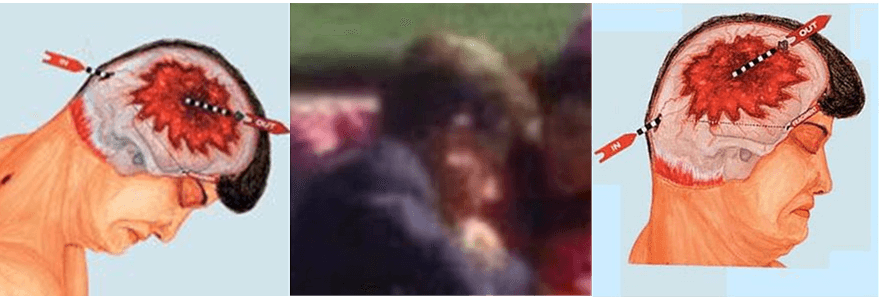
    The autopsy surgeons, James J. Humes, J. Thornton Boswell, and Pierre Finck, had concluded in their report that the bullet had entered the skull “2.5 centimeters to the right and slightly above the external occipital protuberance.” To illustrate the path this bullet took through the skull, the Commission chose not to utilise the autopsy photographs or X-rays and instead published a drawing prepared under the direction of Dr. Humes. The problem with this drawing, as Thompson had pointed out in Six Seconds in Dallas, is that it shows President Kennedy’s head tilted drastically forward in a manner that is quite different to its actual position as seen in the Zapruder film. Furthermore, correcting the head’s position created an upward trajectory (see above comparison).

    It may well be, as some critics believe, that Ramsey Clark expressed enough concern over this apparent trajectory problem that it prompted Fisher and his colleagues to move the wound up the skull to a position where, on the autopsy X-rays, the panel claimed it could see a “hole in profile” (an oxymoron if ever there was one!). This move would, of course, create a more downward trajectory, in line with Oswald’s alleged sniper’s perch on the sixth floor of the depository building. And yet the panel members were surely experienced enough to understand that the path of a bullet through the body after it strikes an object as dense as skull bone may well be significantly different to its trajectory prior to impact. Simply put, if a bullet strikes a hard surface, it is likely to deflect.

    What may have been of greater concern to the Clark Panel members was the location of bullet fragments in the cranium. The autopsy report describes a trail of metallic particles traversing a line from the entrance wound in the occiput to the presumed exit point in the right front of the head. What the X-rays revealed to Fisher and his fellow panel members, however, was that the bullet fragments are actually located in the very top of the skull. This fact tends to confirm rather than refute Thompson’s double head shot scenario because a bullet entering the EOP could not create a trail of fragments along a pathway several inches higher than the one it took. Therefore, the fragments had to have come from a different bullet. Moving the entrance wound up the head as the Clark Panel did brought it closer―though still not in line with―the fragment trail.

    Whichever of these considerations most plagued the Clark Panel, it seems clear that moving the entrance wound was done for reasons other than accuracy. Nearly three decades ago, experimental neuropathologist Joseph N. Riley, PhD―the only neuroscientist that I know of to have performed a serious study of Kennedy’s head wounds―concluded that “The original description of a rear entrance wound by Humes et al. …is most likely accurate” and that there was “little to support” the higher location. In support of this contention, Dr. Riley pointed out that the lateral X-ray shows an area of damaged skull that fully corresponds to the entrance location as described by Dr. Humes. (The Third Decade, vol 9 issue 3) In 2013, ballistics expert Larry Sturdivan and forensic pathologist Dr. Peter Cummings pointed to the very same area on the X-ray, noting that fractures clearly radiated from a point low down on the back of the skull. (NOVA Cold Case JFK)

    For their part, the autopsy doctors always maintained that the wound was correctly located in their report. While it might seem obvious that few professionals are likely to relish the prospect of owning up to such a grievous error, it must nonetheless be borne in mind that the autopsy team had more than just the X-rays and photographs to work from; they had the actual body in front of them. As Dr. Finck argued, the observations of the autopsy doctors would, therefore, seem considerably more likely to be valid than those of individuals who might subsequently study the photos and x-rays. Perhaps more importantly, the entrance location identified by Humes et al. was corroborated by independent witnesses to the autopsy. For example, Richard Lipsey, aide to US Army General Wehle, told Andy Purdy of the HSCA that the wound was located “in the lower head…just inside the hairline.” Similarly, Secret Service Agent Roy Kellerman’s Warren Commission testimony placed it at the level of the lower third of the ear, “in the hairline.” (2H81) Both men executed drawings of their observations [see below].

    All of this makes it surprising to me that Thompson appears to favour the higher location and writes matter-of-factly that “various forensic experts who studied the autopsy photos and X-rays all agreed that the autopsy had mistakenly located the hole…The true location was found to be over four inches above where the autopsy placed it.” (Last Second in Dallas, p. 262) It would appear to me that Thompson is swayed by the fact that the nine-member forensic pathology panel for the HSCA fully endorsed the Clark Panel’s higher in-shoot location. What he might not be aware of is that the majority of the HSCA panel members had enjoyed a close professional relationship with Clark Panel chairman, Russell Fisher. For example, Dr. Charles Petty had spent nine years under Fisher at the Maryland Medical Examiner’s Office. Dr. Werner Spitz had co-authored a book with Fisher, and HSCA panel chairman Dr. Michael Baden had contributed to that book. So, the obvious question that needs to be asked is just how likely was it that these men would work to actively undermine their colleague and mentor on such a prominent issue?

    Ultimately, it may be said to be inconsequential which of the proposed entrance locations Thompson chooses to accept. After all, as Dr. Riley noted, and Thompson himself suggests, “the fundamental conclusion that John Kennedy’s head wounds could not have been caused by one bullet does not depend on which [in-shoot] description is more accurate.” Indeed, the fragments in the top of the skull, the two separate and disconnected areas of damage to the cortical and subcortical regions of the brain [as observed by Dr. Riley], the rear blowout documented by the Parkland physicians, the forward and rearward ejections of wound matter, and the backward snap of Kennedy’s head simply cannot all be explained by a single bullet fired from above and behind.

    Whatever Thompson’s opinion on the in-shoot location may be, and whatever his reasons for it, I nonetheless find it surprising that the author makes no mention of the manner in which his first book precipitated the creation of the Clark panel and its revision of President Kennedy’s head wounds.

    IV

    On March 6, 1975, Geraldo Rivera’s late-night ABC TV show, Good Night America, featured photographic researcher Robert Groden showing his enhanced, stabilized version of the Zapruder film to the American public for the very first time. Thompson, who had also been asked to take part in one of Rivera’s JFK assassination segments, describes the broadcast as “a bona fide shocker…The characteristic intake of breath when an audience sees the president’s head explode and his body slammed backward was heard from coast to coast.” (pp. 138–139) Indeed, the public outcry that resulted from seeing this long-withheld evidence of a frontal shooter was tremendous. In the weeks and months that followed, Thompson worked with Groden to lobby members of congress in the hopes of establishing a committee to reinvestigate the assassination. Almost a year later, after much work from like-minded individuals, the HSCA was formed.

    In the summer of 1977, Thompson was among a group of prominent critics who were invited to a two-day conference in Washington with HSCA Chief Counsel, Robert Blakey. In retrospect, it appears as if Blakey’s reason for arranging the conference was simply to make it appear as if he had given the critics a chance to have their say. The critics, of course, had numerous ideas on what should be the focus of the committee. Yet, as historian Jim DiEugenio writes, “In looking at the declassified summary of this meeting, what is striking about it is how few of the suggestions were actually pursued or how weakly they were pursued.” (The Assassinations, p. 67)

    For his part, Thompson―whose focus has always been solely on the facts of the shooting itself―found himself largely bored by the whole affair. “The discussion veered into various claims of conspiracy,” he writes, “of which I had little interest and even less knowledge. As the discussion droned on, I found my mind wandering. Little did I know that in attending the conference, I would be present at one of the pivotal moments in the history of the whole case.” (Last Second in Dallas, p. 142) That moment came when Mary Ferrell first brought the acoustics evidence to Blakey’s attention. It was this piece of evidence that forced a conclusion of “probable conspiracy” on the committee.

    The HSCA had begun promisingly enough under the leadership of Richard Sprague. From 1966 to 1974, he was the First Assistant District Attorney of Philadelphia County, during which time he had won convictions on 69 out of the 70 homicide cases he prosecuted. While a special prosecutor for Washington County, Pennsylvania, he had also exposed the conspiracy behind the brutal murders of American labor leader Joseph Yablonski and his family, who were shot to death by three gunmen as they slept in their home in Clarksville, Pennsylvania. On top of his impressive record, Sprague had no fixed opinion about who killed Kennedy and was determined to run an unbiased, independent investigation. As Dr. Cyril Wecht commented, “Dick Sprague was the ideal man for that job with the HSCA.” (The Assassinations, p. 56) Expectations in those early days were high and, as DiEugenio writes, “The feeling on the committee, and inside the research community, was that the JFK case was now going to get a really professional hearing.” (ibid)

    Almost inevitably, Sprague’s tenure was short-lived. When the CIA began stonewalling the committee’s requests for information about a trip to Mexico City Oswald had supposedly taken two months before the assassination, Sprague said he would subpoena the Agency for the materials. What followed was a smear campaign in the pages of the Los Angeles Times, the New York Times and the Washington Post that resulted in Congress refusing to reauthorize the committee until the chief counsel was removed. To save the committee, Sprague resigned and Blakey was appointed in his place.

    Former HSCA investigator Gaeton Fonzi noted in his highly-regarded book, The Last Investigation, that Blakey “was an experienced Capitol Hill man. He had worked not only at [the] Justice [Department] but on previous congressional committees as well. So, he knew exactly what the priorities of his job were by Washington standards, even before he stepped in.” Fonzi described those priorities thusly: “The first…was to produce a report within the time and budget restraints dictated by Congress. The second was to produce a report that looked good, one that appeared to be definitive and substantial.” Yet, as Fonzi notes, “There is substance and there is the illusion of substance. In Washington, it is often difficult to tell the difference.” (Fonzi, p. 8)

    If there was one thing the HSCA report had in abundance it was the illusion of substance. This was especially true of one of the most important aspects of the committee’s case: The Neutron Activation Analysis of Dr Vincent Guinn.

    NAA is a sophisticated technique involving a nuclear reactor that can be used to measure the “parts per million” of metal impurities in bullet lead. Guinn took the bullet fragments recovered from Kennedy’s head and Connally’s wrist, together with CE399 and the larger fragments found on the floor of the presidential limousine, and subjected them to this process. He then reported to the committee that Mannlicher Carcano bullets were virtually unique amongst unhardened lead bullets because they contained varying amounts of antimony. Furthermore, he claimed, the antimony levels in an individual bullet remained constant but were different from those in other bullets from the same box. This meant it was possible to trace a fragment to a specific bullet and even to distinguish it from other bullets of the same origin. Thus, Guinn testified, he had determined that the fragments from the floor of the limousine and the ones from Kennedy’s head had all come from one bullet, and the fragments from Connally’s wrist had come from CE399. In other words, only two bullets had struck President Kennedy and Governor Connally and they were both from Oswald’s rifle.

    In Last Second in Dallas, Thompson shows that time has not been kind to Guinn’s conclusions or to NAA and bullet lead examination in general. To put it bluntly, it is now widely regarded as junk science. Comparative Bullet Lead Analysis, as the FBI called it, was used to gain convictions in hundreds of criminal cases over a span of more than two decades. But in 2002, Erik Randich―a PhD metallurgist at Lawrence Livermore National Laboratory―and several colleagues who had begun to have grave concerns about CBLA, published a serious critique of the process in the Forensic Science International journal. “Not surprisingly,” Thompson writes, “as word of these findings spread, criminal defense attorneys facing CBLA-produced evidence sought [Randich] out as an expert witness.” (p. 191)

    At first, the FBI stubbornly refused to admit that there was reason for concern, issuing a statement that said, “We’ve been employing these methods and techniques for over 20 years in the FBI crime lab. They’ve been routinely subjected to vigorous defense scrutiny in the courts and we feel very confident that all of our methods are fully supported by scientific data.” (Los Angeles Times, Feb 3, 2003) However, continued challenges forced the Bureau to put the issue to the National Academy of Sciences and a team of experts was convened to review the issue. The NAS sided with Randich. Several months later, the FBI closed its CBLA lab, ordered agents not to testify on the issue in the future, and issued a statement to say CBLA was being discontinued. “With that announcement,” Thompson writes, “CBLA was formally thrown into the dust bin of junked theories and bogus methodologies.” (p. 191)

    In July 2006, Randich and a PhD chemist named Pat Grant specifically addressed Guinn’s NAA testing of the Kennedy ballistics in the pages of the Journal of Forensic Science. After a devastating and authoritative deconstruction, Randich and Grant stated that there was “no justification for concluding that two, and only two, bullets were represented by the evidence.” And contrary to Guinn’s claims, not only could it not be established that the recovered bullet fragments were from Carcano ammunition, those fragments “could be reflective of anywhere between two and five different rounds fired in Dealey Plaza that day.”

    Sadly, as Thompson points out, Guinn’s faulty analysis “prepared the ground for many of the committee’s conclusions…Because Guinn’s results were developed very early in the HSCA’s existence, their influence was felt throughout the committee’s work.” (pp. 168–170) Indeed, the committee’s forensic pathology panel admitted that it had considered Guinn’s NAA results when reaching its own conclusions. (7HSCA179) Even the panel’s lone dissenting member, Dr. Cyril Wecht, who had long believed that Kennedy may have been struck twice in the head, felt forced to admit after the NAA testing had been completed that “the possibility based on the existing evidence is extremely remote.” (1HSCA346) The NAA results, as Thompson articulates succinctly, “amounted to a gravitational pull towards the narrative put forward by the Warren Commission.” (ibid) It seems highly probable, therefore, that the HSCA would have issued a report stating that Oswald did it alone had it not been for the aforementioned acoustics evidence, first brought to the committee’s attention by Mary Ferrell.

    The evidence in question consisted of Dallas police radio transmissions recorded on the day of the assassination. Specifically, a five-and one-half minute segment recorded by a police motorcycle in the presidential motorcade after its microphone had become stuck in the on position. Warren Commission critic Gary Shaw explained to Blakey at the critics’ conference that he and radio broadcaster Gary Mack had studied the recordings and believed they had discovered as many as seven gunshots coinciding with the time of the assassination. With this suggestion now on record, Blakey had little choice but to have the tapes analysed by acoustical experts. On the suggestion of the Society of American Acoustics, Blakey engaged the services of the Cambridge, Massachusetts firm of Bolt, Beranek and Newman, expecting that they would report back that it contained no gunshots. That would prove not to be the case.

    After securing what were believed to be the original recordings, and conducting extensive analysis and on-site testing, BBN reported back that it had discovered five impulses that precisely matched the echo patterns of gunshots fired in Dealey Plaza. One of these impulses, the fourth in sequence, matched a gunshot fired from the grassy knoll. Shocked by the results, and afraid to stray too far from the Warren Commission’s conclusions, Blakey convinced the acoustic scientists to label one of these shots as a “false alarm.”

    There is little doubt that the results of the acoustical analysis, which was completed shortly before the committee was expected to wrap up its inquiry, represented a significant problem for Blakey. As he remarked to HSCA investigator Dan Hardway after BBN delivered its report, “My god, we’ve proven a conspiracy and we’ve not investigated the conspirators.” (see Dan Hardway, Passing the Torch conference video, approx. 58:10) Ultimately, the HSCA report concluded that Oswald had fired three shots from the sixth floor of the Texas School Book Depository, causing all the injuries to President Kennedy and Governor Connally. A fourth shot, fired from the grassy knoll, had probably missed the limousine and its occupants altogether.

    Upon reading the finished report in 1979, Thompson was struck by the schizophrenic nature of its conclusions. Specifically, by the way in which the NAA and the acoustics appeared to point to two entirely different solutions. Why, he asked himself, could it still not be determined what had really happened in Dealey Plaza? “There could be only one answer” he writes. “The evidence package was contaminated.” (p. 178) When asked to contribute to a book about the committee being compiled by Peter Dale Scott, Thompson wrote a 57-page chapter that reflected his confusion and then turned away from the subject. “I came to see that I was trying to put together a puzzle in which some of the pieces did not belong. Since I had no way of knowing which pieces these were, there was nothing I could do.” (p. 179)

    V

    Decades after the HSCA report was released, Thompson realized that Guinn’s Neutron Activation Analysis was not the only puzzle piece that did not belong. An equal, if not larger, impediment to making sense of the evidence was something that Thompson himself had introduced into the record in 1967. Namely, the 2.18-inch forward movement of Kennedy’s head between frames 312 and 313 of the Zapruder film. Thompson had been unable to reconcile this movement―and his own belief that this meant two shots had struck JFK’s head almost simultaneously―with the acoustics evidence, which dictated that only one shot had been fired at frame 313.

    In 1998, Arthur Snyder, a Stanford physicist with a long-standing interest in the assassination, suggested to Thompson that his measurement was most likely in error. Snyder had performed some calculations and deduced that, in order for the president’s head to move forward 2.18-inches in one-eighteenth of a second, it would have had to have absorbed 90% of the bullet’s kinetic energy. “This was not just wildly improbable,” Thompson writes, “but impossible.” (p. 197) Several years later, he discovered the work of David Wimp, an Oregon-based systems analyst who had published a study concerning the effects of motion blurring in the Zapruder film.

    What Wimp’s analysis highlighted was a basic principle of photography that Thompson had failed to consider. Simply put, if a camera is moved when the shutter is open, the brightest areas will intrude into the darkest areas. A perfect example of this can be seen in the Zapruder frames below which show how the very bright road intrudes into the much darker street light post, making it appear as if the post has gotten considerably thinner.

    In the case of Zapruder frames 312 and 313, frame 312 is clear while 313 is smeared horizontally due to Abraham Zapruder moving his camera. As a result, all points of light in frame 313 are elongated horizontally, including the bright strip behind Kennedy which then intrudes into the back of his head.

    What the above means is that the 2.18-inch forward movement Thompson believed he had measured in 1967 is, in reality, an optical illusion produced by the blur effect. It does not exist. Kennedy’s head does move forward between frames 312 and 313 but by a much smaller amount; approximately 0.95 inches according to Wimp’s measurements. This is roughly the same amount his head had moved forward between frames 310 and 312.

    Furthermore, something else that Thompson apparently missed in 1967 is the fact that the Zapruder film shows all the occupants of the limousine moving forward at almost the same instant as Kennedy and continuing to do so after he is hurled backwards by the shot that exploded the right side of his head. (see this gif: Photobucket | Z308-323R3NS.gif) This movement is most likely a result of the limousine decelerating from 11 mph to 8 mph as the driver turned to look behind him. Clearly then, prior to his being struck by a bullet from the knoll, any forward motion Kennedy exhibited was a result of the very same force which affected everyone else in the vehicle. What all of this means, as Thompson writes, is that “the movement of JFK’s head between 312 and 313 can no longer be taken as the impact of anything.” (p. 202) The explosion of blood, brain and skull seen in frame 313 can be ascribed solely to the knoll shot captured on the Dallas police dictabelt recording.

    This realization left Thompson with one important question: when was Kennedy’s head struck from behind? The answer came for him in 2005 through a New Hampshire manufacturer’s representative named Keith Fitzgerald. What Fitzgerald had noticed was that the most dramatic forward movement of Kennedy’s head occurred 0.8 seconds after the knoll shot struck. Between Zapruder frames 327 and 330, JFK’s head moved forward 6.44 inches. (p. 221) Furthermore, during the several frames succeeding frame 327, the appearance of the head wound can be seen to change significantly. There is no dramatic explosion comparable to the one seen in frame 313 because the pressure vessel of the skull has already been compromised. However, between frames 327 and 329, additional blood and matter is seen to be driven from the front of the head. By frame 337, as Thompson shows, the wound looks significantly different from how it appeared just ten frames earlier. (see frame comparison on p. 229)

    Coincidently, Robert Groden, the man most responsible for bringing the Zapruder film to the attention of the public, has made the very same observations as Fitzgerald. In 2013, during a presentation given at the Cyril H. Wecht Institute of Forensic Science and Law, Groden showed his audience the following slide, highlighting the forward gush of blood and matter described above (pay particular attention to the obscuring of Jackie Kennedy’s lapel):

    Not coincidentally, this visual evidence of a probable second head shot at frame 327 is mirrored by the Dallas police dictabelt recording which contains the sound of a gunshot fired from behind the limousine 0.8 seconds after the sound of a gunshot fired from the grassy knoll. In other words, the exact same spacing and sequence of shots is found on both the audio and visual evidence.

    VI

    This brings us nicely to what I believe is the most valuable facet of Last Second in Dallas: Thompson’s reaffirmation of the acoustics evidence through the complete debunking of the Ramsey Panel. For those unfamiliar with the history of the acoustics evidence, the Ramsey Panel was commissioned by the Justice Department within months of the HSCA issuing its report, specifically to address the committee’s conclusion that “Scientific acoustical evidence establishes a high probability that two gunmen fired at President John F. Kennedy.” (HSCA report, p. 3) The Ad Hoc Committee on Ballistic Acoustics, to use its formal name, acted under the auspices of the National Academy of Sciences and issued a report in 1982 concluding, predictably enough, that the impulses identified by BBN were not gunshots. (Thompson, p. 300)

    To understand that the panel was never meant to give the acoustics a fair assessment but was, in fact, formed specifically for the purpose of shooting down the HSCA’s historic findings, one need only learn that the Justice Department initially offered the chairmanship to Luis Alvarez. This, of course, is the same Luis Alvarez who had previously concocted the jet effect theory in support of the Warren Commission’s conclusions and hidden the results of his own tests. He had also, as Thompson points out, served on numerous government committees dealing with matters of “national security.” (p. 286) Perhaps more crucially, he had pooh-poohed the acoustics before getting anywhere near the evidence, telling the press he was “simply amazed that anyone would take such evidence seriously.” (ibid)

    Perhaps realising that his name being so overtly connected with the panel would invite closer scrutiny of its findings, Alvarez declined the chair. Instead, he recommended his friend and colleague, Harvard physicist Norman Ramsey for the position. Nonetheless, Alvarez stayed on as a member of the panel and was, by his own account, its most active participant. (Donald Thomas, Hear No Evil, p. 618) It is readily apparent that the conclusions of the panel, which did not include a single acoustics expert, were preordained. In fact, according to Dr Barger, when he met with the panel to discuss his work, Alvarez told him that “he didn’t care what I said, he would vote against me anyway.” (Thompson, p. 287)

    The Ramsey Panel spent a year intensely scrutinising BBN’s work, looking for serious flaws and finding none. Then, in January 1981, a gift horse arrived in the form of twenty-five-year-old department store worker, Steve Barber. To understand Barber’s contribution, it is important to understand that on the day of the assassination, the Dallas police were using two radio channels that were recorded on antiquated equipment. Channel 1, which was for routine police communications, was recorded on a Dictaphone belt recorder. Channel 2, which was reserved on November 22 for the president’s motorcycle escort, used a Gray Audograph disc recorder. Both were eccentric pieces of equipment that used a stylus cutting an acoustical groove into a soft vinyl surface to make recordings.

    Listening intently to a copy of the relevant portion of the Dallas police channel 1 recording that he got free with a copy of Gallery magazine, Barber noticed something that no one else had heard. At the very point on the recording that the shot sequence occurs, Barber heard a faint voice saying, “hold everything secure.” When he checked his discovery against a copy of the channel 2 recording that he had acquired from assassination researcher Robert Cutler, Barber heard the more distinct sound of Sheriff Decker saying “hold everything secure until homicide and other detectives can get there…” What made this discovery significant was that this broadcast by Decker appeared on the channel 2 recording around one minute after the assassination.

    The Ramsey Panel seized Barber’s discovery with both hands, stating that what he had found was an instance of “crosstalk.” As the panel explained it, crosstalk was something that occurred if an open police microphone came close enough to another police radio receiver to pick up and record its transmission. Accordingly, the panel suggested that the Decker broadcast could only have been deposited on the channel 1 recording because the police motorcycle with the stuck microphone had been close to another police radio at the time the broadcast was made to pick it up. Therefore, whatever the impulses BBN analysed were, they could not be the gunshots that killed Kennedy because they occurred one minute after the assassination.

    For nearly two decades following the publication of the Ramsey Panel’s report, the acoustics was essentially a dead issue. As Thompson writes, “Among the establishment cognoscenti…the acoustics evidence could now be viewed as a scientific aberration, a regrettable mistake exposed by the distinguished scientists of the Ramsey Panel.” (p. 301) However, in 2001, a paper published in the British forensic journal, Science & Justice, reignited the debate. Its author, US federal government scientist Donald Thomas PhD, pointed out that the Ramsey Panel had overlooked a second instance of crosstalk, the “Bellah broadcast,” and that using this second broadcast to synchronize the transmissions placed the impulses “at the exact instant that John F. Kennedy was assassinated.” (see full article here: Thomas.pdf (jfklancer.com)) Three years later, Ralph Linsker of the IBM Watson Research Center and the surviving members of the Ramsey Panel responded by denying that the Bellah broadcast was crosstalk, claiming that although the same words―”I’ll check it”―appeared on both channels, their own tests showed that “they were spoken separately, and at different times.” (Thompson, p. 319) Once again, an impasse of sorts had been reached.

    Thankfully, in Last Second in Dallas, Thompson has laid this entire matter to rest. As he details across two brilliant chapters near the end of the book, Thompson reached out in 2015 to BBN’s lead scientist, James Barger, asking if he could recommend someone to perform the necessary tests on the Bellah broadcast. As Thompson notes, Dr. Barger is a “towering figure” in the field of acoustics. The very reason he and his team were recommended to the HSCA in the first place is because their work on the Kent State shooting had helped establish that the National Guard had shot first. More recently, Barger and BBN designed the Boomerang anti-sniper devices that were used on US military vehicles in Iraq.

    One of the tests upon which Linsker et al. had placed great emphasis was a process called pattern cross-correlation (PCC). In audio signal processing, PCC is used to measure the similarity between two audio samples. Software runs the two samples at various speeds and, if there is a match, will produce an obvious peak, demonstrating the level of the match. The panel noted that it had performed the PCC test on the Decker and Bellah broadcasts, alongside another instance of crosstalk in which Dallas police chief Jesse Curry can be heard to say, “You want me…Stemmons?” However, although Linsker et al. provided PCC peaks for “Hold everything secure…” and “You want me…Stemmons?”, it failed to disclose the results for “I’ll check it.”

    To review the tests performed by Linsker and the Ramsey panel, Barger recommended a veteran BBN engineer named Richard Mullen, who began by noting that Linsker et al had made the mistake of using an inappropriate sampling window. As Thompson explains, “Apparently Linsker used the same 512 sampling window for all three crosstalks. This might make sense for ‘Hold everything secure’ (2.1 seconds) or for ‘You want me…Stemmons?’ (4.0 seconds), but it is much too long for ‘I’ll check it’ (0.6 seconds).” (p. 326) When Mullen performed the PCC test himself using a more appropriate window length, the results, as Thompson writes, “showed conclusively that ‘I’ll check it’ not only is crosstalk but has a higher net PCC peak than ‘Hold everything.’ With this finding, the Linsker et al. argument from 2005 imploded―and with it the whole house of cards constructed by the 1982 Ramsey Panel.” (p. 329) Don Thomas had been absolutely correct, the Bellah broadcast placed the suspect impulses on the dictabelt at the exact moment Kennedy was killed.

    This, of course, leaves open the question of why the Decker broadcast appears on the channel 1 recording, concurrent with the sounds of the rifle shots that killed Kennedy. The answer, Thompson reveals, is that it is an overdub. Barger himself had raised this possibility and asked Mullen to examine the various background hum frequencies on both the channel 1 and channel 2 recordings to confirm or refute it.

    To understand Barger’s request, it is necessary to understand that antique analogue recorders like the Dictaphone and Audograph produced a 60-Hz background hum. But because both machines could be played back at varying speeds, if they were played back to a tape recorder using anything other than the precise, original recording speed, this would generate a unique hum frequency which would remain on all subsequent copies. Furthermore, if a tape recorder were used to make a copy of this second-generation copy, it would contain a secondary hum frequency that would, in turn, appear on all future copies.

    When Mullen analysed the background frequencies on both Dallas police channel recordings, he found two different secondary hums on channel 2 that were of the same frequency as those found on channel 1. As Dr Barger explained, the two hum frequencies on channel 2 indicated that the tapes came from a second generation Audograph disc. The fact that the Decker broadcast on channel 1 contains both of these hum frequencies is, in Barger’s words, “proof that the HOLD family of crosstalk was overdubbed onto Channel 1.” (p. 346)

    With that, Thompson, Barger, and Mullen have delivered the deathblow to the Ramsey Panel report. There is no longer any significant reason for doubting the validity of the acoustics evidence, which now stands stronger than ever as scientific proof that President John F. Kennedy was killed by a conspiracy involving multiple assassins.

    VII

    This has been a fairly lengthy review and, it is fair to say, an overwhelmingly positive one. In the interests of balance, I have looked hard in Last Second in Dallas for faulty reasoning, misstatements of fact, or other reasons to be critical. The reality, however, is that aside from my disagreement with Thompson over the location of the entry wound in the back of Kennedy’s head, and my surprise that he made no mention of how his first book influenced the creation of the Clark Panel, any criticisms I could make would be extremely minor.

    I could perhaps take exception to his characterisation of the investigation of New Orleans District Attorney Jim Garrison as a “circus” and to his opinion that the case against Clay Shaw “seemed preposterous.” (p. 112) After all, through the numerous documents relating to Garrison’s probe that were released by the Assassination Records Review Board, we now know that Garrison was correct in many of his charges. There can no longer be any reasonable doubt that Shaw was a paid asset of the CIA or that he indeed went by the alias of Clay Bertrand. Furthermore, the government-led media campaign to destroy Garrison’s reputation and hamper his investigation is now exceedingly well documented. So much so that legendary Warren Commission critic Mary Ferrell, who had been a staunch critic of Garrison for decades, was forced to concede in her later years that “he was so close and they did everything in the world to destroy him.” (Joan Mellen, A Farewell to Justice, p. 383)

    However, the reality is that these are only passing references in Thompson’s book that are by no means germane to its central considerations. Thompson fully admits that “From the outset, I had no interest in the conspiracy theories making the rounds. People could argue these things forever, yet I doubted that any of them could be proven.” (p. 27) For that reason, I would be surprised if Thompson is even aware of, let alone familiar with, much of the documentation that has cast the Garrison probe in a different light.

    There are essentially two schools of thought when it comes to how best to approach the assassination. There are those, like journalist Anthony Summers, who believe that science can provide no certainties and, therefore, the answers must lie in close studies of Oswald’s background and associations, and of the assassination’s wider political context. Then there are those, like Dr Cyril Wecht, who feel that it is through establishing the way the shooting occurred that certainty can be obtained. I, for one, do not fault Thompson for belonging to the latter camp.

    Last Second in Dallas is likely to be criticised, or outright dismissed, by those who cling to outdated arguments or unfounded beliefs, such as the inexplicably popular theory that the Zapruder film is a forgery, or that the X-rays have been altered to hide a blowout in the back of the head. In some ways I would have liked to have seen Thompson pre-empt these arguments by providing the details that establish the authenticity of the evidence. But then, in so doing, not only would he have taken casual readers down the rabbit hole unnecessarily, but he would also have given such arguments a legitimacy they do not deserve.

    In my own two decades as a student of the Kennedy assassination I have heard many silly arguments, one of them being that the acoustics evidence was “designed to fall apart.” I am sure that there are readers out there who are familiar with the intricacies of the acoustic data and, like myself, are scratching their heads wondering how on earth such a feat could possibly be achieved. In any case, I do not doubt that the type of person capable of subscribing to such nonsensical ideas will have no problem disregarding Thompson’s impressive achievement in this area, or otherwise failing to grasp its significance. But I also do not doubt that history will thank him for his efforts.

    Just as I am sure history will thank him for owning up to and correcting his own error regarding the forward movement of Kennedy’s head and, in so doing, demonstrating how perfectly the audio and visual evidence fits together. It may well be, as Thompson suggests, that the gaps and contradictions that still exist in the evidence today preclude a definitive reconstruction of the entire assassination sequence. However, I do believe it can rightly be said that Last Second in Dallas lives up to the promise of its title and establishes to a high degree of probability exactly how that final second went down. Once again, I am confident that history will thank him for it.

    And that is precisely what I intend to do.