Category: John Fitzgerald Kennedy

Reviews of books treating the assassination of John F. Kennedy, its historical and political context and aftermath, and the investigations conducted.

  • Brian Latell, Castro’s Secrets


    The End of an Obsession: A Review of “Castro’s Secrets”

    After almost half a century of conspiracy theories on the JFK assassination, a former CIA analyst and current research associate at the Institute of Cuban and Cuban-American Studies (ICCAS) at the University of Miami has accidentally given the conclusive evidence that Castro had nothing to do with Oswald or Kennedy’s death. In his latest book, Castro’s Secrets (Palgrave Macmillan, 2012), Dr. Brian Latell insisted on unveiling a conspiracy of silence: Castro would have known in advance Oswald was going to kill Kennedy and chose to remain silent about it. Far from making even a circumstantial case against Castro, Dr. Latell actually paved the way for critical thinking which erases any cloud of suspicion.

    The Comer Clark Allegation

    Castro’s foreknowledge is an old story that was first broken by late British journalist Comer Clark. This was a story entitled “Fidel Castro Says He Knew of Oswald Threat to Kill JFK” (National Enquirer, London, October 15, 1967, pages 4-5). On July 9, 1967, Clark flew to Havana and tried to carry out an interview with Castro, but it was flatly denied. (note)

    Nevertheless, Clark wrote that an impromptu interview had taken place anyway. It took place on a sidewalk at a pizzeria in front of a cheering crowd. The claim was that Castro told Clark,

    “Yes,I heard of Lee Harvey Oswald’s plan to kill President Kennedy. It’s possible I could have saved him. I might have been able to, but I didn’t. I never believed the plan would be put into effect.”

    Castro went on and explained that Oswald visited the Cuban Embassy in Mexico City twice. The second time he said something like: Someone ought to shoot that President Kennedy. Then Castro said,

    “And this was exactly how it was reported to me; ‘Maybe I’ll try to do it.”

    This was less than two months before the American President was assassinated. The House Select Committee on Assassinations (HSCA) contacted Fidel about this accusation. On April 3, 1978, he replied that since he never went to public restaurants, the man must have invented the story.

    Congressman Christopher Dodd (D/Connecticut) stressed that it was ridiculous that the head of a country would give a print interview in a pizzeria. (HCSA Report, Volume III, pages 207-09). Dodd could have further added that he would never do so in a crowd and certainly not about such a sensitive matter.

    Anthony Summers further undermined the Clark tale. He discovered that Clark, who was now deceased, had a reputation for selling sensational and sometimes spurious stories. When Summers talked to Clark’s widow, she said that he never mentioned such an interview to her. Beyond that, Nina Gadd, Clark’s secretary, said that it was she who originated the story, even though she had never even been to Cuba. Gadd supposedly did this based not upon Clark, but what she heard from a Latin American foreign minister. (Summers, Conspiracy, p. 364)

    Nevertheless, the Final Report of HSCA (U.S. Government Printing Office, 1979, page 122) said that the substance of Clark’s interview with Castro had been independently reported to the U.S. Government by a highly confidential and reliable source: Oswald had indeed vowed in the presence of Cuban consulate officials to assassinate the President. But further investigation led the HSCA to believe that Oswald did not voice such a threat to Cuban officials, and however reliable the confidential source may be, it would be in error in this instance.

    The Jack Childs report

    Although Chief Counsel Robert Blakey would not reveal who the source was, it turned out to be Jakob “Jack” Childs, codenamed NY 694-S by the FBI. Jack had engaged with his brother Morris in the Operation SOLO (1958-77). Their mission was to infiltrate the Communist Party of the United States (CPUSA), in order to gather intelligence about its relations with the USSR and other communist regimes. On May 20, 1964, Jack Childs flew from Moscow to a beach in Cuba on the SOLO Mission 15. He allegedly spent ten days there and was able to talk with Castro about the JFK assassination.

    Childs reported to FBI Director J. Edgar Hoover that Castro received the information about Oswald’s appearance at the Cuban Embassy in Mexico in an oral report from “his diplomats” in the Embassy. (John Newman, Oswald and the CIA, p. 428) According to Childs, Castro was told about this immediately:

    ˜I was told this by my people in the Embassy exactly how he (Oswald) stalked in and walked in and ran out. That in itself was a suspicious movement, because nobody comes to an Embassy for a visa (they go to a Consulate). [Castro] stated that when Oswald was refused his visa at the Cuban Embassy in Mexico City, he acted like a madman and started yelling and shouting on his way out, ‘I’m going to kill this bastard. I’m going to kill Kennedy.’ [Castro] was speaking on the basis of facts given to him by his embassy personnel, who dealt with Oswald, and apparently had made a full, detailed report to Castro after President Kennedy was assassinated.” (FBI Records: The Vault – SOLO, http://vault.fbi.gov/solo. See part 63, pgs. 58-59).

    The old sleuth Hoover summed up to Warren Commission General Counsel, James Lee Rankin, on June 17, 1964: The information furnished by our source at this time as having come from Castro is consistent with and substantially the same as that which appears in Castro’s speech of November 27, 1963. No further action is contemplated by this Bureau. (Warren Commission Document 1359).

    The Latell Report

    In the June 2012 edition of the electronic newsletter, The Latell Report, published by the ICCAS-UM , Dr. Latell summed up: Childs learned that Castro received the information about Oswald’s appearances at the Cuban embassy, because he was told about it immediately. Fidel spoke to Childs on the basis of facts given to him by his embassy personnel, who dealt with Oswald, and apparently made a full, detailed report. By trimming the phrase “after President Kennedy was assassinated” from the Childs report, Dr. Latell turned this alibi into a smoking gun against Castro, who had denied any foreknowledge of Oswald in both his speech at the University of Havana on November 27, 1963, and his Radio/TV appearance on November 23, 1963.

    Dr. Latell boasts about catching Castro in a lie, but only by keeping hidden the actual time ”after President Kennedy was assassinated” in which Castro knew about Oswald. Childs also tapers the story by furnishing the exact location of the Oswald outburst: the Cuban embassy, not the consulate, located in a separate building. The Lopez Report [a.k.a. “Oswald, the CIA, and Mexico City”, 1978] actually states that the CIA photographed the visitors to the Cuban diplomatic compound from two different windows in a third floor apartment at 149 Francisco Marquez Street (see pages 12 ff.) because the entrance to the embassy was on the corner of Tacubaya Alley and the entrance to the consulate, on the corner of Zamora Street.

    Moreover Childs came to the foregone conclusion that Castro had nothing to with the assassination. After discussing his statements with Beatrice Johnson, the CPUSA representative in Cuba, Childs and Johnson decided never to talk again about the issue because it was dynamite. Hoover took it seriously, but Dr. Latell does not. He dared to manipulate time and location for making his point, and no wonder the issue exploded in his hands.

    The HSCA’s Sound Judgment

    Unaware of the actual circumstances, the least the HSCA could do was discard that Oswald voiced threat to Cuban officials. Why? Because both the outgoing and incoming Cuban consuls in Mexico City, Eusebio Azcue and Alfredo Mirabal, testified (HCSA Report, Volume III, pages 127-58 and 173-78, respectively) that they did not recall hearing Oswald threatening Kennedy’s life while dealing with him about an in-transit Cuban visa to go to the Soviet Union. Neither did the Mexican employee Silvia Duran (JFK Exhibit F-440A), who attended Oswald three times on the same day, September 27, 1963, regarding his visa application (JFK Exhibit F-408).

    Based only on newspapers, Castro knew that the HSCA—especially the authors of the Mexico City report, Ed Lopez and Dan Hardway—had extensive information about phone conversations in Mexico City. Azcue and Mirabal were forced to truthfully testify to avoid being potentially caught in a lie at a public hearing in the United States. And one will search in vain for any such threats in the transcripts declassified today in the Lopez Report.

    As Newman writes, the problem with the Childs Report as issued to Hoover is that there is no specificity in it: Who were the diplomats who heard this threat? On what day was it made? How was it communicated from Mexico City to Havana? And how could the CIA not have known about it with all their audio surveillance installed? (Newman, p. 428) But beyond that, in a private interview Newman gave to Jim DiEugenio in San Francisco, the former intelligence analyst showed him the actual Childs report as given to Hoover. Newman told DiEugenio that, because he had seen hundreds of such informant reports, he could tell by the formatting that it was a forgery.

    The First Defector

    For disputing HSCA logic discounting Childs, Dr. Latell resorts to defectors from the Castro General Directorate of Intelligence (acronym DGI in Spanish). The first one, Vladimir Rodriguez-Lahera, would have told the CIA that Castro lied when he publicly denied any knowledge of Oswald. The legend says Vladimir defected to Canada around April 24, 1964, and the CIA codenamed him AMMUG-1.

    His debriefing (RIF 104-10400-10118) included that “the only possible fabrication known by this source was the specific denial by Fidel Castro on a television program [November 23, 1963], of any Cuban knowledge of Oswald.” For turning the possible fabrication into evidence, Dr. Latell swallows AMMUG-1, saying that the most routine matters at the Cuban diplomatic compound in Mexico City were reported directly to Castro. This author begs to disagree. Neither Castro nor any other Chief of Government has time for being informed about visa applications or nasty applicants.

    By May 8, 1964, the CIA realized AMMUG-1 didn’t know what he was talking about. He ended up admitting: “I have no personal knowledge of Lee Harvey Oswald or his activities.” His CIA handler wrote: “The source does not claim to have any significant information concerning the assassination of President Kennedy or about the activities of Oswald.” Even so, Dr. Latell keeps on agonizing about an AMMUG-1 report that Oswald was in contact with DGI officers before, during and after his visits to the Cuban consulate.

    AMMUG-1 did not give the slightest conjecture about after. In regards to ‘during’ the Mexico City trip, he stated that senior intelligence officer Manuel Vega mentioned that Oswald had gone to the Cuban consulate two or three times in connection with a visa. AMMUG-1 didn’t recall anything else about Oswald contacting DGI officers, but added: he felt sure that he would have done so because Vega had said that Oswald had returned several times and [it was] the usual procedure [for] expediting the granting of visas to DGI agents: if the visa applicant does not utter indicative phrases, the DGI officers tell the applicant to return in a few days. This house of cards falls down not only because Oswald came three times on the same day to the Cuban embassy. (See Warren Report, p. 734-35, below) But AMMUG-1 felt sure there was a contact during under the premise that Oswald was a DGI agent. This implies a contact before, but at this point AMMUG-1 became entirely pointless.


    CLICK ON IMAGES TO ENGLARGE

    AMMUG-1 page 1
    AMMUG-1 page 3
    WR page 734
     
    AMMUG-2 page 1
    AMMUG-3 page 3
    WR page 735


    He said that he thought that Luisa Calderon might have had contact with Oswald because he learned about 17 March 1964, that she had been involved with an American in Mexico. (The DGI had intercepted a letter to her by an American who signed his name as Ower, phonetic, or something similar. He said she had been followed and seen in the company of an American. He did not know if this could have been Oswald.)

    The problem with this is that the Calderon story today is a non-sequitir. If one is not familiar with it, it goes like this: Luisa was a Cuban Embassy employee who was heard on a tapped phone line saying words that were translated as, “I knew almost before Kennedy.” As Rex Bradford pointed out, in the 70’s this became a teaser for, “Did she have foreknowledge of the assassination?” The HSCA could not interview Luisa. But with AMMUG-1 saying to the CIA in 1964 that Oswald may have met with Calderon in 1963 during visits prior to the September-October journey, Luisa’s story now grew even heavier with suspicion.

    As Bradford notes, this call was intercepted at 5:30 PM. So the question becomes: “Were there any other calls previous to this where Luisa could have heard of the assassination?” It turns out there were two such calls. In the first one, captured at 1: 30, she expressed surprise on hearing the news of Kennedy’s death, and she said she did not believe it and asked who did it. As Bradford notes on his Luisa Calderon page at Mary Ferrell Foundation, it is odd that the CIA apparently did not show this other transcript to the HSCA to settle the matter once and for all.

    Neither Calderon nor Mirabal led to Dr. Latell’s suggestion that the DGI was acquainted with Oswald and had started a file on him when he was a Marine stationed (December 22, 1958 – September 11, 1959) in California. The specific account on Oswald attempting to get in with Castroite consular officials in Los Angeles in early 1959 suggests quite the contrary. Former marine (1954-58), Castroite pilot (1959-60) and anti-Castro soldier of fortune (1960-62) Gerald Patrick Hemming stated that he thought Oswald might have been on the Naval Intelligence payroll. “You know, a penetrator. I told the [Castroite] leadership to get rid of him. (Dick Russell, The Man Who Knew Too Much: Hired to Kill Oswald and Prevent the Assassination of JFK, Carroll & Graf, 1992, page 178).

    The Most Valuable Defector

    The last straw in Dr. Latell’s unveiling of a conspiracy of silence is a classic non sequitur fallacy slipped by Major Florentino Aspillaga, a Castro intelligence officer until the year 1985 who defected from Czechoslovakia to Austria in June, 1987. Being hardly 16 years old, Aspillaga already had the standing assignment of electronically detecting CIA agents and infiltration teams. On November 22, 1963, he got an unprecedented order around 9:00 or 9:30 am EST: “Listen to any small detail from Texas.” At 1:40 pm EST, CBS anchor Walter Cronkite broke the news in Dallas, Texas: three shots were fired at President Kennedy’s motorcade. Aspillaga drew the conclusion: Castro knew Kennedy would be killed.

    Whatever the reason Castro would have had to give the order, the most unlikely is some foreknowledge about Oswald’s intention to shoot Kennedy, because it would imply that Castro must have been sure about Oswald’s whereabouts on November 22, 1963. The well-known, and quite eventful journey of Oswald makes such foreknowledge by Castro highly improbable. Shortly before Oswald left New Orleans for Mexico City, his wife Marina Oswald (nee Prusakova) had moved to Irving, about 17 miles from Dallas, for the birth of their second child. She stayed at her friend Ruth Paine’s home. Oswald came back from Mexico City on October 2, 1963, when nobody, including God and the CIA, knew whether he would still be in Dallas or elsewhere by the time of the “still in the talking stage” JFK visit. Oswald arrived in Dallas on October 3, 1963, and checked in at the YMCA. The day before, the FBI Field Office in New Orleans was tasking Dallas, Fort Worth, and even Malvern (Arkansas) for ascertaining Oswald’s whereabouts.

    After failing to get hired at Padgett Printing in Dallas, Oswald hitchhiked to Ruth Paine’s house in Irving. He returned to Dallas on October 7, 1963, but couldn’t get a job again and went again to Irving on October 12. He came back to Dallas on October 14. As Ruth Paine mentioned that he was having trouble finding work, her neighbor Linnie Mae Randle hinted about an opening at the Texas School Book Depository (TSBD), where her brother Buell Frazier was employed. Paine called Oswald and he began to work at the TSBD on October 16, 1963.

    Apart from the strange order to use intelligence resources for knowing details that will be surely available by listening to the commercial radio, Aspillaga’s credibility is as weak as his reasoning. He told Dr. Latell that he had previously given the information about that order only to the CIA in 1987. Then it must be fully explained why the CIA didn’t come forward with Aspillaga to the Assassination Records Review Board (ARRB), which gathered records from 1994 to 1998 after the fireworks made by Oliver Stone with his film JFK (1991). It also makes everyone wonder why Aspillaga abstained from revealing the issue to the media. In June 1988, for instance, he referred to Castro 69 times during a radio interview with Tomas Regalado in Miami, but not even once to Kennedy.

    Dr. Latell wrote in his book he owes a special debt of gratitude to Aspillaga. But both have put themselves in a delicate spot with an anecdote delivered a la carte 25 years later for connecting Castro to Oswald. Dr. Latell abjures social science by messing around with DGI defectors, despite his own foreknowledge about the methodological circumstance that their tales couldn’t be compared with Castro’s archives. The blame is not on Castro for shielding them from outsiders, but on Dr. Latell, since he used the creative imagination of Cuban defectors for writing a non-fiction book instead of a novel about the JFK assassination.


    Note: typically meant wiretaps. (back)

    Note: HSCA Interview of Fidel Castro (back)

    Note: Link to MFF file. (back)

  • G. Paul Chambers, Head Shot: The Science Behind The JFK Assassination


    G. Paul Chambers’ Head Shot: The Science Behind The JFK Assassination is another one of those books that I probably should have expected would be disappointing. The pre-publicity made some fairly bold promises (such as identifying the second rifle and proving the locations of the other assassins) that, on reflection, were destined to go unfulfilled. But Chambers scientific credentials are pretty impressive—according to his publishers’ website Chambers has fifteen years experience as an experimental physicist for the US Navy and is a contractor with the NASA Goddard Optics Branch—and this fact coupled with the praise being heaped on the book by the likes of Cyril Wecht, David Wrone and Michael Kurtz got me pretty excited.

    Head Shot was preceded earlier this year by the publication of another scientists’ treatise of the JFK forensic evidence, Hear No Evil by Donald Thomas. As I made clear in my review of that book, I am in full agreement with Six Seconds In Dallas author Josiah Thompson when he writes that “Don Thomas has produced the best book on the Kennedy Assassination published within the last thirty years…His book sets the table for all future discussions of what happened in Dealey Plaza” With this in mind, it was difficult not to make comparisons between the two works and it would be fair to say that, to my mind, Chambers’ book did not come off favourably. I had hoped that with Thomas’ book running to nearly 800 pages, Chambers’ relatively slim 250 page volume would be the one I would be happy to recommend to newcomers to the case. But this was not to be. As I hope to show, although there are some good points scattered throughout Head Shot, they are unfortunately out-weighed by a number of factual errors, flawed analysis and glaring contradictions that would be sure sure to mislead the less informed reader.

    I

    It is only fair that I begin by highlighting some of the better parts of the book. One of the areas that Chambers does a respectable job on is the acoustics evidence first brought to light by the House Select Committee on Assassinations. Like Don Thomas, Chambers places great emphasis on the remarkable concordance between the dictabelt recording and the other known evidence because, as Chambers writes, “Consistency with other evidence is very important to scientists.” (p. 73) In their desperate attempts to shoot down the acoustics, anti-conspiracy buffs and Warren Commission adherents like Dale Myers, Gerald Posner and—despite his pledge not to withhold anything from the reader—Vincent Bugliosi, never see fit to report what it was that convinced the HSCA acoustic experts that they had found a genuine audio recording of the shots in Dealey Plaza. Namely, the “order in the data.” The fact is, everything about the Dallas Police dictabelt recording fit together all too well with what was already known about the circumstances of the assassination’ and synchronized perfectly with the other crucial record of the crime; the Zapruder film.

    When the HSCA experts analyzed the suspect impulses on the dictabelt alongside the sounds of test shots recorded by an array of microphones placed along the Presidential parade route in Dealey Plaza, “they found something extraordinary…they found a number of significant matches.” (p. 123) Firstly, rather than falling in some random order, the matches fell in the correct 1-2-3-4-5 topographic order. Secondly, as Chambers explains, “When the locations of the microphones that recorded matches in the 1978 reconstruction were plotted on a graph of time versus distance, it was found that the location of the microphones that recorded matches were clustered around a line on the graph that was consistent with the known speed of the motorcade (11 mph), as estimated from the Zapruder film.” (ibid) Thirdly, the fourth impulse in the sequence was matched with “a confidence level of 95 percent” to a shot fired from the grassy knoll. (p. 126) And finally, when the fourth impulse is aligned with the explosion of JFK’s head at Zapruder frame 313, the third impulse falls at the only other visible reaction to a shot on the film; the flipping of Governor Connally’s lapel at frame 225. This means that the exact same 4.8 second gap between shots is found on both the audio and visual evidence. These correlations between the acoustics and all other known data provide the most convincing reasons to believe that the dictabelt is a genuine recording of the assassination gunfire.

    Predictably, the conclusions of the HSCA scientists received almost instantaneous criticism from the FBI and a National Research Council panel commissioned by the Justice Department. The NRC panel received a great deal of attention because it was chaired by a distinguished Harvard physicist, Professor Norman Ramsey, and had as its most active member a Nobel Prize winner, Luis Alvarez. But despite the credentials of its members, none of whom were actually experts in acoustics, the only remotely significant challenge the panel was able to present in its report was an instance of “cross-talk”. They used this to claim that it placed the suspected shots a full minute after the assassination. However, as Dr. Thomas explained, “there are multiple—five—instances of cross-talk” on the dictabelt that “do not even synchronize with one another…Hence, the cross-talk does not prove that the putative gunshots are not synchronous with the shooting.” (Hear No Evil, p. 662) Discussing the NRC panel, Chambers writes, “A great reputation is no proof against being wrong. In general, criticizing a successful experimental scientist, like [HSCA acoustic expert] Dr. Barger, in his area of expertise is a dicey proposition. Someone who does acoustical analysis for a living is not likely to make major mistakes in his field of investigation.” But, “leaving reputations aside and focusing only on the data, who is more likely to be right?” (pp. 141-142)

    As mentioned above, the order in the data is by itself hugely compelling. The last in the sequence of test shot matches occurred at a microphone 143 feet from the first, and the time between the first and last suspected shots on the dictabelt was 8.3 seconds. In order for the Police motorcycle officer whose stuck microphone was suspected of recording the gunfire to travel 143 feet in 8.3 seconds he would need to be traveling at approximately 11 mph—almost the exact speed at which the FBI estimated the Presidential limousine was moving on Elm street. (Thomas, p. 583) As Chambers asks, “What are the odds of that happening randomly?…One could certainly insert a big number for the total number of possibilities, leaving a very small probability that this would happen randomly. But it isn’t necessary.” (p. 142) On top of this, we have the fact that the timing of the shots fits so perfectly with the reactions seen on the Zapruder film.

    • “Syncing the final head shot from the grassy knoll to frame 312…” Chambers explains, “the probability of finding the shot that hit Connally to within five frames…is about one in a hundred…Matching up the first shot to the frames before Kennedy reaches the Stemmons Freeway sign and the second shot to a strike of Kennedy behind the sign is another one chance in a hundred times one chance in a hundred for a one-in-ten-thousand chance for an accidental match.”
    • Multiplying all this by the probability of all shot origins falling in the correct order is another one chance in sixteen, “yielding a one-in-sixteen-million chance that the acoustic analysis could match up the timing and shot sequence in the Zapruder film by chance.” Multiplying the probability of both the order in the data and the synchronization of the audio film being random together, “it is readily established that there is only one chance in eleven billion that both correlations could occur as the result of random noise.” (pp. 142-143) [As if all that wasn’t enough, Dr. Thomas, who is an expert statistician, calculated the odds of a random impulse having the acoustic fingerprint of a shot from the grassy knoll as “100,000 to one, against.” (Thomas, p. 632)]

    So, to return to Chambers’ earlier question, “Who is more likely to be right?” The likes of Dale Myers who, despite there being no film or photograph showing the acoustically required position, insists his analysis “proves” the police motorcycle was not where it needed to be? Or “the acoustic and sonar specialists who believe that the sounds of gunshots are apparent on the tapes from Dealey Plaza”? If Chambers’ math is correct, and there really is only a one in 11 billion chance that the near-perfect correlations between the dictabelt and the other evidence could occur accidentally, I know where I’m putting my money down.

    II

    In another highly enjoyable chapter titled “Reclaiming History?”, the author takes Vincent Bugliosi to task for the flawed reasoning that permeated his bloated and tedious tome. To be honest, in his comprehensive multi-part review, Jim DiEugenio has proven six ways to Sunday that picking instances of abysmal logic from Reclaiming History is a bit like shooting fish in a barrel. But the examples Chambers presents are nonetheless entertaining.

    In his introduction, Bugliosi recounts a tale of attending a trial lawyers convention at which he sought to “prove in one minute or less that close to six hundred lawyers were not thinking intelligently.” The former prosecutor asked his audience for a show of hands as to how many of them rejected the findings of the Warren Commission and a “forest of hands went up, easily 85 to 90 percent” of those in attendance. He then asked for a “show of hands as to those who had seen the recent movie JFK or at any time in the past had ever read any book or magazine article propounding the conspiracy theory or otherwise rejecting the findings of the Warren Commission.” Again a large number of hands were raised at which point Bugliosi opined, “I’m sure you will all agree…that before you form an intelligent opinion on a matter in dispute you should hear both sides of the issue…With that in mind, how many of you have read the Warren Report?” This time, a much smaller number of hands were raised. “In one minute…” Bugliosi claims, “I had proved my point. The overwhelming majority in the audience had formed an opinion rejecting the findings of the Warren Commission without bothering to read the Commission’s report” (Reclaiming History, pp. xxiv-xxv)

    Whilst to some—most likely the lazy-minded—Bugliosi’s reasoning on this point might appear sound at first blush, like so many of his arguments it is entirely lacking in substance. As Chambers writes, if one were to ask a room full of scientists how many had read the discourses on physics by ancient Greek philosopher, Aristotle (who believed that the Earth could not rotate because everyone would fly off) very few hands would go up. Why? “Because they already know his conclusions are wrong. If his conclusions are wrong, his reasoning must be flawed as well.” (Chambers, p. 148) The same applies to the Warren Report. If you have read the works of first generation critics like Sylvia Meagher, Harold Weisberg and Mark Lane, who all compared the evidence in the Commission’s volumes against the conclusions in its report, then there is no need to read the report for yourself because you already know its conclusions are wrong. Perhaps Bugliosi also believes that before we make up our minds what the evidence tells us about the shape of our planet we need to listen to what the Flat Earth Society has to say.

    Chambers goes on to show the reader how Bugliosi’s “logic” can be contradictory and ultimately self-defeating. As every assassination student knows, seconds after the shots were fired, dozens of Dealey Plaza witnesses, including Dallas police officers and deputy sheriffs, rushed to the area from which they thought shots were coming: the aptly titled “grassy knoll.” But Bugliosi, who maintains that it “would make absolutely no sense at all” for an assassin to choose the knoll as his firing position, claims that while some of the witnesses might have thought they heard shots coming from that location, “most” were running there to pursue the assassin. He goes on to tell us that the only “possible area where a Dealey Plaza spectator might think, at least on the spur of the moment, an assassin would conceivably fire from” is the knoll and concrete pergola area. Why? Because of its “walls and heavy foliage..he would know that the parking lot area behind the knoll and pergola would be the only area an escaping assassin could run through.” (Bugliosi, p. 850) In response to this silliness, Chambers points out that, “First, none of the witnesses said they based their belief that a shot came from the grassy knoll because they deduced that it was the best location for an assassin to be…” In fact, they all based their conclusion on the sound of the shot or the sight of gunsmoke coming from behind the fence. “Second, if the Dealey Plaza witnesses could figure out on the spur of the moment that the grassy knoll was the perfect location for an assassin because of its proximity to Elm Street, its masking cover of fence and foliage, and its unobstructed escape route back through the railroad yard, couldn’t the assassin figure that out as well?” (Chambers, p. 169) Thus, Bugliosi finds himself in the unenviable position of having been hoist with his own petard.

    Despite the fact that more than fifty witnesses believed shots were fired from the knoll, Bugliosi has no problem dismissing the relevance of their testimonies. Unbelievably, he is not the least bit impressed by the credibility of this vast number of people. Even though it included Secret Service agents, Presidential aides, Dallas law enforcement and newspaper reporters. As Chambers observes, during his time as a Deputy District Attorney for Los Angeles County, Bugliosi put five men on death row for the murder of Sharon Tate and six others and he did so based on the testimony of a single witness. “How is it then” Chambers asks, “that Mr. Bugliosi can dismiss out of hand the fifty witnesses who reported seeing smoke, hearing gunshots, or seeing assassins behind the fence on the grassy knoll? Given that one witness is enough to close a capital murder case, how is it then that Mr. Bugliosi believes that the testimony of fifty eyewitnesses isn’t sufficient to warrant an investigation?” (pp. 169-170) It is a valid question indeed. Apparently one witness is enough when lives hang in the balance; but fifty just won’t cut it when you’re writing a book.

    Before moving on, I’d like to add an example of my own that I think demonstrates how easily toppled Bugliosi’s arguments are by the evidence he omits. Having claimed, somewhat amusingly, to have proven that Oswald was the lone gunman in Dealey Plaza, Bugliosi tells us that “no group of top-level conspirators would ever employ someone as unstable and unreliable as Oswald to commit the biggest murder in history…” (Bugliosi, p. 977) In fact, he tells us, “To believe a group of conspirators like the CIA or mob would entrust the biggest murder in American history to Oswald, of all people, is too preposterous a notion for any rational person to harbor in his or her mind for more than a millisecond.” (p. 1446) Even if we accept his claim that Oswald was the lone assassin, Bugliosi’s claim that this rules out a conspiracy with the CIA is contradicted by the words of the Agency itself!

    As Bugliosi was no doubt aware, 1997 saw the declassification of a very interesting document; the CIA’s 1953 instructional manual, A Study of Assassination. The would-be killers manual describes a number of assassination scenarios including one code-named “lost.” “In lost assassination” it states, “the assassin must be a fanatic of some sort. Politics, religion, and revenge are about the only feasible motives. Since a fanatic is unstable psychologically, he must be handled with extreme care. He must not know the identities of the other members of the organization, for although it is intended that he die in the act, something may go wrong.” So if we are to believe Bugliosi’s portrait of Oswald as an unstable, fanatical leftist with delusions of grandeur, it appears that by the CIA’s own admission he would be exactly the type of man it would use as an assassin.

    III

    It may seem like a trivial point to some but Chambers’ treatment of the Warren Commission and its report is just simply inadequate. To be frank, it is shallow and apologetic. The reason being that for information concerning the inner workings and motivations of the Commission the author chose to rely heavily on the book Inquest by CIA-friendly author Edward Epstein. It is more than a little baffling why Chambers would use Epstein’s flawed and outdated 1965 book as his main source rather than Gerald McKnight’s authoritative work published in 2003, Breach of Trust: How the Warren Commission Failed the Nation and Why. But not only do nearly half of the footnotes for his Commission critique refer to Inquest, Chambers actually titles his second chapter “Edward Epstein” and incorrectly refers to him as “the first person to criticize the conclusions of the Warren Commission in print.” (p. 31)

    As most genuine researchers today understand, Inquest was not a true investigation of the Commission and Epstein was never a true critic. And although it seemed to escape the attention of many at the time, this is actually made clear in the introduction to his book written by journalist and political columnist Richard H. Rovere. “Mr. Epstein does not challenge or even question the fundamental integrity of the Commission or its staff” Rovere writes. “He discards as shabby ‘demonology’ the view that the Commissioners collusively suppressed evidence…His concern when he undertook this study was not with the conclusions the Commission reached; it was with the processes of fact finding employed by an agency having a complex and in some ways ambiguous relationship to the bureaucracy that brought it into being.” (Epstein, pp.. x-xi) Of course, it is not “shabby demonology” to accuse the Commission of suppressing evidence. It is a fact, pure and simple. A single example will be sufficient to prove this point.

    As the transcript of the Commission’s January 27, 1964, executive session shows, it was fully aware that President Kennedy’s back wound was lower than the hole in his throat:

    RANKIN: Then there is a great range of material in regard to the wounds, and the autopsy and this point of exit or entrance of the bullet in the front of the neck…We have an explanation there in the autopsy that probably a fragment came out the front of the neck, but with the elevation the shot must have come from, the angle, it seems quite apparent now, since we have the picture of where the bullet entered in the back, that the bullet entered below the shoulder blade, to the right of the backbone, which is below the place where the picture shows the bullet came out in the neckband of the shirt in front, and the bullet, according to the autopsy didn’t strike any bone at all, that particular bullet, and go through. So how it could turn—

    BOGGS: I thought I read that bullet just went in a finger’s length.

    RANKIN: That is what they first said. [Author‘s emphasis]

    As the Commission collected the facts of the shooting it quickly became obvious that the only way it would be able to pin the blame solely on Oswald would be to endorse Arlen Specter’s Single Bullet Theory. But this meant that the back wound had to be higher than the throat wound. The answer to this apparently insurmountable problem was simple: Commission member and future president Gerald Ford simply moved the wound up the body to the back of President Kennedy’s neck. (McKnight, p. 193) And to insure that they got away with it, the Commission kept the autopsy photos out of its report and the accompanying 26 volumes of hearings and exhibits. No matter what the Commission’s apologists want you to believe, this one decision is solid proof that the Warren Commission was engaged in a deliberate cover-up and suppression of evidence. Period.

    Quoting Epstein, Chambers writes that the Commission operated with dual purposes. “If the explicit purpose of the Commission was to ascertain and expose the facts, the implicit purpose was to protect the national interest by dispelling rumors.” (Chambers, p. 32) Hogwash! The Commission had one purpose and one purpose only: To insure that the buck stopped with Oswald. Ascertaining and exposing the facts was only its official charge. In practice it was never part of the equation.

    In the days following the assassination, President Johnson had received a number of false reports from the CIA’s Mexico City station claiming that two months previously, Lee Harvey Oswald had been in Mexico City meeting with communist agents. CIA station chief, Winston Scott, claimed to have uncovered evidence that Cuban Premiere Fidel Castro, with possible Soviet support, had paid Oswald to assassinate President Kennedy. Johnson, already shaken up by information he received from FBI director J. Edgar Hoover that someone impersonating Oswald had been in contact with the Soviet embassy in Mexico, began to see the specter of nuclear war looming large over Washington. (McKnight, p. 24) As we now know, LBJ had been at the receiving end of an elaborate ruse orchestrated by the CIA, aimed at laying the blame for the assassination at Castro’s door. Its ultimate goal appears to have been provoking a U.S. invasion of Cuba.

    After leaving office, Johnson told Walter Cronkite of CBS news that on becoming president he had discovered that Kennedy “had been operating a damned Murder Inc. in the Caribbean.” JFK, he had been led to believe, had tried to kill Castro, but Castro had got to him first. Johnson, it appears, had fallen for the CIA’s deception, hook, line and sinker. But rather than risk nuclear war with the USSR by retaliating against the Cubans, he chose instead to pin the blame squarely on Oswald’s shoulders. At the suggestion of columnist Joe Alsop and Yale Law School’s Gene Rostow, LBJ selected a Presidential Commission as the best way to achieve this end. When he chose Earl Warren to chair the Commission, Johnson explained to the reluctant Chief Justice that 40 million lives were hanging in the balance. As historian David Wrone explains, “Clearly, LBJ was implying that if the public perceived Oswald to be part of a much larger plot—that is, a communist conspiracy—there would be calls for retaliation, which would quickly escalate into nuclear war. For that reason…the crime had to be shown to be the work of Oswald alone…With that realization…Warren accepted the chairmanship of the commission, seeking to shut down the communist conspiracy rumor mill and confirm Oswald as the lone assassin.” (The Zapruder Film: Reframing JFK’s Assassination, pp. 144-145) This was the one and only purpose of the Warren Commission and it is clearly evident in any honest study of its investigation.

    IV

    In my view, Chambers’ handling of the medical evidence is by far the most disappointing aspect of this book. I found myself shaking my head in several places, and I think my jaw actually dropped at one point. He makes a number of bold statements without backing them up or even mentioning the evidence to the contrary. He pushes an outdated and incredible theory involving the handling of Kennedy’s body. And he makes one particular claim that many may find beyond belief.

    Taking what some readers may feel is too long a digression in what is a fairly slim book ostensibly about the Kennedy assassination, Chambers attempts to explain “How Science Arrives At the Truth.” In so doing, he relates the story of “Piltdown Man”, a famous anthropological hoax concerning the finding of a skull and jawbone from a previously unknown early human that “hindered progress in the field of anthropology for decades.” It took more than forty years for the fossils to be exposed as a 600-year-old human skull and an 800-year-old lower jawbone from an orangutan that had been chemically stained to make them appear ancient. (Chambers, pp. 65-71) Chambers proceeds to tell us that “In the final analysis, Kennedy’s corpse is America’s Piltdown Man.” (p. 113) Why does he say that? Because he subscribes to David Lifton’s body alteration hypothesis.

    In a nutshell, Lifton believes that because the original statements of the Parkland Hospital physicians who treated the moribund President indicated that he was shot from the front, but the autopsy surgeons in Bethesda concluded he was struck only from behind, his body must have been stolen whilst aboard the Presidential aircraft, Air Force One, and the wounds altered to conform to the official story. Of all the many, many problems with Lifton’s wild and outlandish theory perhaps the most destructive is the fact there was never any opportunity for the body to be stolen. As David Wrone explains, “Lifton omits from his account that the body was wet, dripping in blood and other fluids that, when lifted from the coffin, would have left telltale signs and alerted aides, crew, and guards…Further, when the pallbearers placed the coffin on board, steel wrapping cables were placed around it and its lid to prevent shifting during takeoff and landing and in case of air disturbances in flight, as must be done to cargo on airplanes for safety. Removing and replacing such cables would have required time and opportunity that were unavailable to any would-be conspirators. In addition, the casket was under ample armed guard at all times during the flight, a fact that Lifton neglects to mention.” (Wrone, p. 133)

    In an interview with author Harrison Livingstone in 1987, long-time aide and friend to President Kennedy Dave Powers swore that “the coffin was never unattended.” He called Lifton’s book “The biggest pack of malarkey I ever heard in my life. I never had my hands or eyes off it [the coffin] during the period he says it was unattended…we stayed right there with the coffin and never let go of it. In fact several of us were there with it through the whole trip, all the way to Bethesda Naval Hospital. It couldn’t have happened the way that fellow said. Not even thirty seconds. I never left it. There was a general watch. We organized it.” (Livingstone, High Treason, p. 40)

    Chambers is well aware of this problem, but he tries to talk his way round it. Bear with me: he first he makes mention of the street magic of illusionist David Blaine and the famous disappearing Jumbo Jet illusion performed by David Copperfield. Based on this he reasons that “if one asks if it were possible to pull sleight-of-hand or use misdirection to make Kennedy’s body disappear, sneak it off the plane, alter it, and return it, the answer would have to be in the affirmative.” (Chambers, p. 112) I actually couldn’t believe what I was reading at this point. Does it really deserve a response? Just who does Chambers think was involved in this conspiracy? Siegfried and Roy? What makes it even worse is that Chambers is employing a classic double-standard. In a separate chapter he argues for the authenticity of the Zapruder film precisely because “No opportunity existed in the film’s chain of custody to enable conspirators to filch and alter the film.” (p. 188) Of course, he is right about the Zapruder film but he should have applied the same reasoning to Lifton’s flawed allegation.

    But Lifton is not the only source whom Chambers allows to lead him up the garden path. He also buys into the disinformation spouted by Gary Mack and the Discovery Channel in their absolutely appalling documentary, Inside the Target Car. Chambers writes that “if a 6.5 mm frangible round struck Kennedy in the back of the head, it likely would have blown his head off. This was proven by a live-fire test into the head of an anthropomorphic dummy representing Kennedy conducted by the Discovery Channel in 2008.” (p. 162) For those who missed the show, Mack had world class marksman Michael Yardley fire a soft nosed hunting bullet from a .30 caliber Winchester rifle at a dummy head. Shockingly, the “replica” head was completely obliterated; there was quite literally nothing left above the “neck.” Whilst it’s easy to understand how the average viewer might have taken this display at face value it is harder to believe that someone with a Ph. D. in physics could be suckered by the Discovery Channel. But suckered Chambers was.

    As author Don Thomas reported, “human heads do not disintegrate when struck by rifle bullets, even high-powered hunting rounds. They do burst open and are considerably deformed, as can be seen in photographs of such victims in [Vincent] DiMiao’s (1993) textbook Gunshot Wounds, but they do not disintegrate.” Like Jim DiEugenio and Millicent Cranor, Dr. Thomas immediately recognized the problem with Mack’s live-fire test; “whatever materials went into the construction of the model heads…they were far more fragile than the real thing.” (Thomas, p. 366) In other words, the test was rigged. And what makes Chambers’ acceptance of this farce all the more puzzling is that he himself postulates that Kennedy’s head was struck by a frangible round!

    Chambers makes his biggest blunders when discussing the autopsy X-rays. He attempts to cast doubt on their authenticity by writing matter-of-factly that “Kennedy’s face was described as undamaged by witnesses” but “the official x-rays of Kennedy’s head appeared to show a large portion of his front right skull missing.” (pp. 103-104) As he admits, he bases this on the work of researcher Robert Groden who has been making this claim for a couple of decades now. The problem is, as far as I’m aware, not a single medical professional has ever supported Groden’s obviously erroneous interpretation of missing frontal bone. So the question is: Why would a scientist like Chambers defer to the unqualified opinion of Bob Groden, who has absolutely no medical qualifications and no training in reading X-rays rather than, say, Dr. David Mantik or Dr. Joseph N. Riley, two men who actually do have such qualifications? I found this extremely disturbing and perplexing to say the least. But based largely on this incorrect interpretation Chambers concludes that “The official autopsy x-ray photo released to the public is clearly not that of Kennedy’s head.” (p. 109)

    But Chambers is withholding from his readers the steps the HSCA took to authenticate the X-rays over thirty years ago. The committee asked two forensic anthropologists, Dr. Ellis R. Kerley and Dr. Clyde C. Snow, to study the autopsy X-rays alongside pre-mortem X-rays of President Kennedy. As their report states, “It is a well established fact that human bone structure varies uniquely from one individual to another…so that the total pattern of skeletal architecture of a given person is as unique as his or her fingerprints. Forensic anthropologists have long made use of this fact in establishing the positive identifications of persons killed in combat…” (Vol. 7 HSCA p. 43) After performing their analysis, the experts concluded that “the skull and torso radiographs taken at autopsy match the available ante mortem films of the late President in such a wealth of intricate morphological detail that there can be no reasonable doubt that they are indeed X-rays of John F. Kennedy and no other person.” (ibid. p. 45) On top this, a forensic dentist, Dr. Lowell J. Levine, compared the X-rays with JFK’s previously existing dental records and reported that the “autopsy films…are unquestionably of the skull of President Kennedy” and that “the unique and individual dental and hard tissue characteristics which may be interpreted from the autopsy films…could not be simulated.” (ibid. p. 61)

    The findings of these experts have never been questioned or challenged by any medical or forensic professionals and can rightly be said to establish that the X-rays are indeed of President Kennedy. It is one thing to claim, as Dr. Mantik does, that they have been altered in order to hide evidence of a blow-out to the back of the skull. But for Chambers to insist that the “official autopsy x-ray photo released to the public is clearly not that of Kennedy’s head” is not just misleading; it is downright wrong. For me, this was far and away Chambers’ worst moment.

    But the statement that is sure to antagonize and confuse the largest majority of conspiracy believers is the following: “The doctors at Parkland Hospital noted no wounds of any kind on Kennedy’s face, the rear of his head, or the left side of his head.” [my emphasis] (Chambers, p. 205) Once again, I was flabbergasted. It has been so well documented in so many places that it is barely worth repeating here, but the vast majority of Parkland staff reported a wound that had all the appearances of an exit in the “right occipitoparietal” region of the skull—the right rear. In fact, this is superbly recorded in books by the two authors Chambers relied upon so heavily for his medical analysis; Robert Groden and David Lifton. In chapter 13 of his bestselling book, Best Evidence, Lifton quotes extensively from the sworn testimonies of the Dallas physicians and their descriptions of the President’s head wound. For example he quotes Dr. Ronald Jones as having seen “a large defect in the back side of the head.” Dr. Charles Carrico as recalling “a large gaping wound, located in the right occipitoparietal area.” And Dr. Malcolm Perry as locating the wound in the “right posterior cranium.” (Best Evidence, paperback edition, p. 367) For his photographic record of the assassination, Groden went one better. He published pictures of well over a dozen Dallas witnesses—including seven doctors and a nurse—placing a hand to their own heads to demonstrate the location of the wound. All put a hand near the back of the head. (The Killing of a President, pp. 86-88)

    How all of this could have escaped Chambers’ attention is completely beyond me.

    V

    The final point that needs to be addressed is what for some may be the selling point of Head Shot—the author’s professed identification of the rifle used by the grassy knoll gunman. Chambers writes that “Because Kennedy’s head recoils backward at the moment of impact, it is reasonable to conclude, based on the law of conservation of momentum, that the bullet that struck him arrived from the front side of the head, remained trapped inside, and never exited.” (p. 205) He notes that the Zapruder film shows multiple jets of blood, bone, and brain matter discharging from the right side of JFK’s head and declares that this is consistent with the use of a small caliber, high-velocity frangible round traveling at approximately 4,000 feet per second. “A prime candidate” he tells us, “for the high-speed rifle with high accuracy and a small-caliber round is the [Winchester] .220 Swift, a favorite assassination weapon of the 1960s.” (pp. 207-208) Then with the help of some fancy mathematics he affirms, at least to his own satisfaction, that .220 Swift was indeed the murder weapon.

    The most immediately obvious problem with this conclusion is the authors’ previously mentioned belief that there was no exit wound anywhere in the head. If the wound seen in the right rear of the skull by the Dallas physicians was, as their descriptions indicate, a point of exit, then it goes without saying that Chambers’ theory is off to a false start. But there is another piece of scientific evidence—evidence that Chambers accepts and promotes—that directly contradicts his identification of the murder weapon: The Dallas Police dictabelt.

    As Don Thomas has written, the muzzle velocity of the grassy knoll rifle can be determined from its acoustic fingerprint:

    The distance from the assassin’s position behind the stockade fence to the motorcycle’s microphone was an estimated 220 feet. At an ambient temperature of 65ºF the velocity of sound is 1123 feet per second…the arrival time of the muzzle blast [was calculated] at 195.6 milliseconds after the gun was fired. The precedence of the shock wave was…25 milliseconds…Therefore, the arrival time of the latter was 170.9 milliseconds after firing. Again, the shockwave emanated from a point on its trajectory just before striking the President, which was a distance of 141 feet in front of the motorcycle. The time for the shock wave to travel that distance was 125.5 milliseconds. The difference, 45.4 milliseconds is the bullet’s flight time. This calculates to a mean velocity of 2202 feet per second. Adding 11.5 percent for air resistance gives a calculated muzzle velocity of 2455 feet per second.” (Thomas, p. 600)

    Because the HSCA scientists’ analysis allowed ±5 feet for the location of the shooter there is a degree of error built in to this figure—approximately ±104 feet per second. This means that the grassy knoll rifle had a muzzle velocity of approximately 2,350 to 2,550 feet per second which is considerably less than the 4,000 feet per second muzzle velocity of the .220 Winchester Swift. Therefore the reader must make a choice between Chambers’ reconstruction of the head shot—which is based on a dismissal of both the hard evidence of the X-rays and the soft evidence of the Dallas doctors’ testimonies—and his acceptance of the dictabelt which the author previously told us has only a 1 in 11 billion chance of not being an authentic recording of the shots. The two are not compatible.

    In the end I believe this contradiction sums up Chambers’ work. Despite telling us that “Consistency with other evidence is very important to scientists” he appears to have studied each point in isolation and then cherry-picked the details that fit his own thesis. The one point it can really be said that Dr. G. Paul Chambers Ph. D. both makes and proves in his book is that credentials and a good reputation are no proof against being wrong.

  • Don Adams & Harrison E. Livingstone, From an Office Building with a High-Powered Rifle: One FBI Agent’s View of the JFK Assassination

    Don Adams & Harrison E. Livingstone, From an Office Building with a High-Powered Rifle: One FBI Agent’s View of the JFK Assassination


    Don Adams’ book is something of a landmark. We now have an ex FBI agent coming clean with his suspicions of a conspiracy to kill President Kennedy. This has happened before with guys like Bill Turner. But Adams is a rarity in that he was an active agent in 1963 who actually investigated a part of the Kennedy case…that being the Joseph Milteer angle. Further, in an era where a number of individuals have come forth to bear false witness to their involvement that day—as either government employees or civilians – Adams, like H. B. McClain, Abraham Bolden and Roger Craig, has a compelling and credible story. Also, due to the lack of his being unfairly compromised by his story he waited until after his retirement to tell it. He thus comes without a lot of baggage.

    What worked for me was that Adams does not seek, in any discernible way, to increase his standing. He is remarkably open and honest about being inexperienced on the Milteer assignment and about his being unaccustomed in terms of research on the JFK case. Therefore, when he comes to naming who he thinks are the ‘players and the patsies”, he readily acknowledges that other, more informed, researchers have worked the beat before. This selflessness, once again, is something of a rarity. Often when people claim “inside info”, their statements concerning participants come with a definitive air of “so-and-so said this” and/or “he said this to me”. Thankfully, Adams has his ego and imagination well in check. While in the FBI, he also resisted the temptation to capitalize personally and professionally upon his father’s relationship with Cartha “Deke” DeLoach, an opportunity that a less honest individual would have utilized.

    The Investigation Begins

    For myself, the highlights of the book are Adams’ deductions between pages 25 to 85 where we learn of his assignment to investigate Milteer. We also learn about two figures that become the bogeymen of the book his boss, Jim McMahon, Special Agent in Charge of the Atlanta office and McMahon’s pal, Royal McGraw, who ran the Thomasville bureau some 240 miles away. The story is this: McMahon had flattered a naïve Adams to work for McGraw in Thomasville, many miles away from his family in Atlanta, by saying McGraw had personally requested his transfer. What Adams found out prior to his departure was that Adams was actually the fourth person McMahon had requested. Adams’ sense of duty saw him take the job in Thomasville, much to his regret. McGraw, it turns out, was a micro-management Nazi, who regularly stomped over FBI procedure keeping Adams out of the loop. Adams also found him to be something of a redneck.

    McMahon pulled Adams, along with Bill Elliot, the Chief of Police in Quitman Georgia, into the case on November 13, 1963 to interview one Joseph Milteer a resident, who had caused something of a flap in mid October with a number of his comments. While we all know about Milteer, it’s often forgotten that he was surrounding himself with some serious pipe hitting, right wing nutters prior to the assassination. On the 18th of October, in Indianapolis, he had met with some 30 individuals who planned on creating a terrorist underground cell to combat the communists infiltrating the U.S. Government. More meetings took place between Milteer and other individuals over the next few days. Including the infamous meeting recorded by informant Willie Sommersett… but we’ll get to that later. President Kennedy’s life had clearly been threatened and so our intrepid FBI agent tracked him down. Adams finally found Milteer while he was handing out leaflets on Quitman Street on the 16th of November. After a brief discussion with the rightwing zealot, from whom he received a number of leaflets, Adams quickly discovered Milteer’s vehement hatred for the president. He returned to Thomasville and filed his report expecting it to be routed to the Secret Service, local police and FBI nationwide. While this appears to have happened at first, he would later check back on his report only to discover no reference of either it, nor the leaflets in evidence.

    Shockingly, Adams later found out that McGraw and Elliot had conducted an investigation into Milteer a little over a year before his own interaction with him. Yet, even this is incidental to the odd things that happened soon after. The assassination occurred, and McMahon ordered Adams back on the Milteer beat. Merely two days after the assassination, a woman who went by the name of Vereen Alexander and had studied at Tulane University in New Orleans, appeared at Adams’ house. She said she had encountered Oswald at a bar discussing the attempted assassination of Charles De Gaulle. She clearly remembered Oswald also raising the question of Kennedy being assassinated earlier that year. This story was a plausible one, for Oswald, or an imposter, indeed visited the Tulane campus. Further, Jim Garrison, John Newman, Bill Davy, Lisa Pease and Jim DiEugenio have all covered in some depth how Oswald, and other denizens of the 544 Camp Street office in New Orleans targeted that university’s students and faculty. This effort, of course, was led by Guy Banister.

    Later, on page 143, Adams, after making some well observed comments on Oswald’s ease of return to the United States, his communist beliefs, and his association with Banister, states that Oswald had to have been some form of intelligence agent and this was nicely hidden. Adams’ simple “no BS” take on this issue is refreshing, especially coming from a former agent of J. Edgar Hoover. But it could have been even better. He could have then tied in Vereen Alexander’s story of seeing Oswald at Tulane with Banister’s other activities of infiltrating student and leftist groups with young recruits like Dan Campbell. This additional information would have lent more relevancy to Oswald’s interaction with Alexander. Indeed he could have placed the interaction in the section in which he deals with Banister. For although the Alexander event is pivotal, his inclusion of it upsets the flow of his narrative in the chapter, which is focused in finding out where Milteer was after the assassination. If Adams felt he had no choice but to include it at the point mentioned, he should have had a mind to refer to it accurately in his text later. The problem is the Alexander report actually says nothing about Oswald discussing the assassination of JFK. The Somersett report on Milteer does allude to an assassination attempt. At the beer drinking party where Alexander saw Oswald, it appears JFK was never discussed and Alexander merely recollected Oswald being there. This is a notable mistake because later on Adams discusses the absence of his reports in the National Archives, not just their rewording and newly fraudulent replacement accounts by his superiors. Adams unfortunately makes himself look as if he is the one guilty of hyperbole and his editors should have been wise to this.

    Regardless of this technical hitch, Adams eventually caught up with Milteer – who was absent from his environs in Quinton and Valdosta, Georgia in the days immediately after the assassination – on the 27th of November. The problem for Adams was that, incredibly, he was only allowed to ask Milteer five questions, and was not permitted to ask follow-ups of his own. The questions were hardly the type of in-depth ones we would anticipate seeing in an investigation dealing with the murder of President Kennedy. (Which, as the author points out, is unsurprising, since the entire FBI investigation was based on avoiding the hard questions). Yet there were two intriguing questions Milteer fielded, and some equally interesting answers he gave. Milteer denied he had been involved in the horrific fire bombing of the 16th Street Baptist Church in Birmingham Alabama on the 15th of September 1963. That he was considered a suspect in a state full of it’s own racist loony tunes at the time certainly says something about his reputation. He also denied being in Dallas on the day of the assassination, mentioning he had been there in June of ’63. He then denied he had ever made any threats about the President. As we all know (as did Adams), this was a lie as the FBI had recordings of him saying this to a good informant. Adams notes that, after this meeting, he never saw the man again.

    The Dallas FBI Office

    The book then goes on to explain Adams’ later stint in the summer of 1964 at the Dallas FBI office. Few books have actually detailed the comings and goings of the Dallas authorities at the time of the assassination. Ian Griggs’ excellent breakdown on the DPD in his tome, “No Case to Answer” (JFK Lancer, 2011) is a must read on the topic. Also, Jim Hosty’s accounts of the day to day activities in the office are also required reading for those seeking an inside track into the Dallas FBI personnel of the era. (“Assignment: Oswald” by James P. Hosty Jr. and Thomas Hosty, 1995) Adams’ entry into the foray is small but much appreciated as he is honest about Hosty and the Dallas office covering their behinds over the “Oswald threat” caper. Indeed, he voices the concern long held by conspiracy advocates, if Oswald’s note was a threat, it would have been used against him and not covered up for years. He also notes that he saw the Zapruder film In Dallas with other agents. He told his colleagues that it clearly denoted crossfire in Dealey Plaza. They understood that. But they said that Hoover had already molded the investigation around Oswald as the only suspect. His take on the dour, chain-smoking SAIC Gordon Shanklin also matches Hosty’s recollections. Nonetheless, once again, Adams could have scored even more points, but fails to get the bonus point. The chapter needed more details of the office and the personnel, the tone of the field office and so on. While this sort of detail could be boring, I find this sort of thing extremely readable, and it increases a book’s use as a reference for the period if handled well. As it stands, the chapter can barely be called that as it only consists of seven pages of type. This is a problem all the way through the book; the chapters should have been sub headed under a certain theme or topic which would have helped the book’s flow and organization.

    A classic example of this is that instead of waiting until page 138, he should have put SA Robert Gemberling in the mix during this passage in Dallas. Gemberling is a little disclosed figure in the assassination cover up. Thanks to Adams the man now enjoys a little more time in the sun. Gemberling and Adams enjoyed good relations during his stint with the Dallas branch of the FBI, and as it turns out, we all know that Gemberling’s role after the assassination was to help write the initial 800 page FBI account of the crime. He later became the FBI’s JFK “go to man” in the seventies, studiously towing the official line he had helped create. Anyhow, he took umbrage with Adams, who had gone public with his opinions in late 1998 on the eve of the 35th anniversary of the Kennedy assassination. This started an exchange between the two. Gemberling who already denounced Oliver Stone’s “JFK” in 1997, in the FBI’s official ex-special agent publication “The Grapevine”, would then go on to further denounce Stone, and others like Adams in 2003. Adams attempted to have his side of the argument put into the publication, but his article was pulled. This did not faze him. He knew it would never see the light of day in an FBI publication.

    Was Milteer in Dallas That Day on Houston Street?

    As stated, there is some strong material in the book. But as previously noted, the organization of the book is awkward. It details Adams’ life and interactions with his cohorts well enough. But when it comes to the significant aspects of the case, e.g. a witness meeting a potential Oswald impersonator, the conduct of the Dallas FBI office and Gemberling, or fully describing his chief target Milteer, he is not layered, or in depth enough. The editors could have helped make even more impact with his cogent and firsthand observations. As it stands, his more in depth points are confused and needlessly convoluted for such a relatively small book.

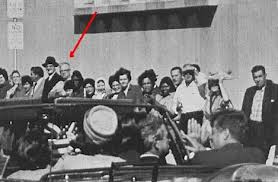
    One of the things I looked forward to was an analysis of whether or not the images taken by Dealey Plaza photographers James Altgens and Chuck Bronson captured Milteer in Dealey Plaza that day. Adams didn’t disappoint with regards to discussing this angle. What the book failed to do was (A) explore this avenue in more depth and (B) organize the chapter dealing with this subject in a concise and, dare I say, rational manner. Let us deal with (A) first. The debate about Milteer being in the crowd has been around for a very long time. Its patron has long been Bob Groden. Groden believes that a figure standing on Houston Street resembled Joseph Milteer. The allegation caused such a stir that even the House Select Committee on Assassinations became involved in examining the photographic evidence. They commented thusly:

    The only available height record of Milteer gives his stature as 64 inches. This corresponds to about the seventh statural percentile of American males. That is, about 93 out of 100 adult American men would be taller than Milteer. Also, about 35 percent of adult American females would exceed Milteer’s reported height. In contrast, the spectator alleged to be Milteer is taller than 4 of the 7 other males and all of the 16 females in the line of spectators shown in the motorcade photograph. Based upon Milteer’s reported height, the probability of randomly selecting a group of Americans where so many are shorter than Milteer’s reported height is .0000007. Moreover, an analysis based upon actual measurements of certain physical features shown in the photograph yields a height estimate for the spectator of about 70 inches — 6 inches taller than Milteer’s reported stature. (HSCA Volume 6, pp. 242-257)

    Milteer?

    This is rather specious and unconvincing. Like Jim DiEugenio, I am an agnostic on the Milteer photographs myself, as I am for the majority of image identification taken that day e.g. Lucien Conein. But it still makes for a fascinating discussion, in particular when Adam’s challenges the official height given for Milteer—he puts his height at about 5′ 8”— as opposed to FBI reports at 5 ft 4 inches. Thus he single handedly brings into question the dubious height analysis of the HSCA’s panel. But he could have done more here. The HSCA previously pointed out that the individual pictured has few of the matching characteristics of Milteer. Yet anyone who is knowledgeable nowadays knows how compromised the HSCA itself was when dealing with practically any type of physical evidence. In this regard, I would ask anyone to check out the embarrassing performance of Dr. Michael Baden who, as demonstrated by Pat Speer, detailed the head wound to an awaiting public, while continually using an upside down picture of the skull. Bob Groden and others have done some nicely presented photo comparisons over the years that have given the notion of the figure being Milteer a fighting chance. On the other hand, Jerry Rose, who did some excellent work on Milteer, reported that the suspect was not actually in Texas on that day. Unfortunately, this kind of analysis was not present in the book. Some thrust and counter thrust concerning the images would have made this an important and, dare I say, entertaining part of the story. Instead, it’s very much an opportunity lost.

    The Pristine Bullet: The Dangers of Nutters Lurking

    Jim DiEugenio’s interview with Len Osanic on the 590th Black Op Radio show was an eye opener. I learned that James Tague, the witness struck on the right cheek by a fragment or piece of concrete fired by an assassin’s bullet whilst standing by the overpass, had released a weighty book. While the title, “Survivor” was slightly melodramatic, Tague has long believed there had been a conspiracy that day. Nonetheless, a witness or somebody directly involved in resultant events often has no more insight than any researcher. Indeed, it’s sometimes worse because they are often out of touch with the ebbs and flows of new information, not to mention who and what is credible and what is not. Tague, clearly ignoring these problems, has a new book on the horizon and it details the evil mechanics behind the plot. Early reports indicate that Tague is essentially going with the questionable LBJ did it theorems discussed in a new article posted here, and on forums like Deep Politics and Lancer. This is terribly dangerous territory for any credible researcher to go down nowadays. And it exhibits the serious problems witnesses have when they go beyond the realms of their experience.

    It has become clear to CTKA and places like the Deep Politics in particular, that there is quite clearly an abundance of disinformation gurus operating nowadays. And they insist, in large part on ignoring the discoveries of the ARRB (not to mention the type of significant research based on those discoveries respected by serious students of the case). And these people would be eager to get an endorsement from someone like Tague, or as it turns out an old hand, but new kid on the block, like Don Adams. Leading up to the 50th anniversary of the assassination and the danger is that these opportunists will try to grab the limelight in anyway possible by attaching themselves to people like Tague and Adams, and thereby discrediting them by association. This is not idle speculation, individuals like Gary Mack, John McAdams and others will seize upon ways to discredit Tague and Adams. An easy way to do this is if they are already in the arms of specious theories or researchers. Tague is a hugely valuable witness. He can be caricatured if he begins to spout specious information, about which he has no firsthand knowledge. While one senses that Tague may be a lost cause, Adams will hopefully avoid the pitfalls of this real danger. I truly hope he does not succumb to that beckoning siren for he too is a key witness, one from the inside, for next year.

    While Adams is clear in his book that he does not see Johnson and Hoover being involved in the conspiracy to kill Kennedy, he does believe they were involved in an active cover up of the facts. Which is true. But he goes too far. He buys into the false idea that it was Johnson’s idea to create the Warren Commission. This piece of folklore is dangerous as the bogus “Johnson in charge of the Commission” line that is often picked up and bandied about. Even though it is not true or accurate. Adams should have read Warren Commission authors like Gerald McKnight more carefully before penning such stuff.(See also,

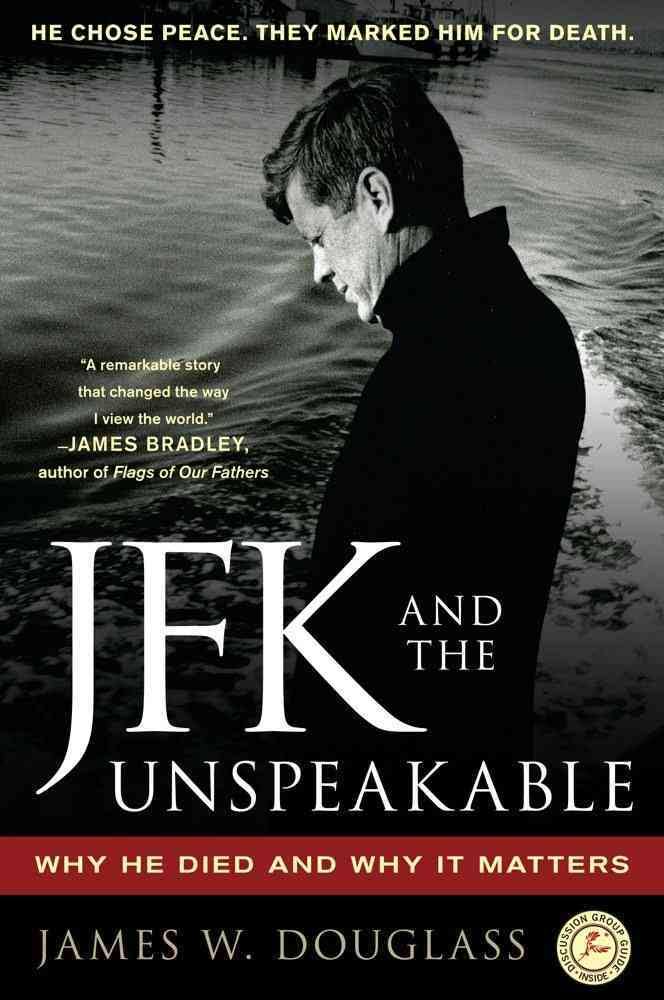
    Adams does buck that trend slightly by mentioning the admirable work of Jim Douglass in his estimable ” JFK and the Unspeakable”, and he does make mention of the up and down tome edited by Jim Fetzer, “Murder in Dealey Plaza”. However, we also know that “High Treason” made an enormous impact on him. “High Treason” is a decent enough book. But like a lot of Adams’ seven books he discusses in Chapter Ten, “The Pristine Bullet”, his seven publications all date from well before the creation of the Assassination Records Review Board. And four of the titles are actually periodicals. Adams uses articles from Life” magazine from 1966, like the well thought out, but lukewarm “Did Oswald Act Alone?” He also uses the famous cover story, “A Matter of Reasonable Doubt” by Josiah Thompson, Dick Billings and Ed Kearns. He even uses the “Globe’s” article from 1991 entitled “Shocking Autopsy Photos Blow Lid of Kennedy Cover-Up”. If I were to list notable pre-ARRB material to read, my list would be substantially different. I say this not to lash out at Adams, but to point out that he needed to seriously reconsider bringing out a slightly more comprehensive and organized book, with more up to date research. Again, his editors should have helped guide him more. And perhaps have furnished him with a ghostwriter, one who knew more about the JFK case, and also the overall structure and behavior of the FBI at the time. This would have filled out the book more, and given it more depth, texture, nuance and professionalism. Don Adams’ story is an immensely pertinent one, and it deserved to be presented with first class furnishings.

    Conclusion

    For the faults I have noted. Adams is a key and welcome figure and the documents he presents show a number of problems for the “Oswald did it” hypothesis.

    1. The book shows how lax the reportage of threats to the President’s life was via the FBI. There was no due diligence done on the Milteer threat.
    2. Additionally, it shows how inexperienced agents were given tough assignments, and then had their work hijacked by senior staffers and twisted for their own purposes.
    3. Many Special Agents down South were often sympathetic towards Southern right-wing targets like Milteer.
    4. The Bureau’s forbidding Adams to ask any questions and cross check about where Milteer was that day went against basic FBI procedure. To my mind, this is the most valuable part of Adams book. It shows two things: (a) The FBI did not want to know anything about the possible involvement of Milteer with the JFK case, and (b) The Bureau had negated an crucial step in standard agent procedure, the step called by Bill Turner, “lead follow through”. This was not accidental and it had to be approved from on high.

    Another important aspect of the book is the question of Milteer’s role in the scheme of things. Oddly enough Harrison Livingstone deals with this question in an “Afterward” of sorts, and for me, Livingstone did it surprisingly well. My experience with Harry has been that some of his output of late has been often unreadable. But overall, his general work on the medical evidence has always been intriguing, and at times, valuable e.g. his 1995 book “Killing Kennedy”. As mentioned before, his work with Bob Groden in “High Treason” is another high point of his efforts. Nonetheless, it’s been an awful long time between drinks. Livingstone’s well-reasoned final summation puts the onus on Milteer being something of a red herring by actually being an attractive diversion created by the perpetrators to soak up investigative time. Was Milteer privy to some undercurrents? Most definitely. Could he have been in Dealey Plaza that day after being fed disinformation that a bunch of “patriots” were going to “get” the President? If he were there it would certainly be in keeping with the use of decoys that day. Adams had real courage and integrity printing this viewpoint. All too often interesting peripheral figures become the focus of an author’s attention, like Milteer, in this instance, invariably makes them all-powerful figures central to or organizing a plot. Livingstone gives the book some perspective.

    If utilized correctly, Don Adams’ book is a necessary first step for the man. Let us hope that come next year, he stays his own man and does not get grasped into the clutches of those who will not use him correctly. In this regard I hope he reads this review and spends some time going over the articles here at CTKA and viewing the discussions at places like the DPF and Lancer.

  • Peter Janney, Mary’s Mosaic (Part 2)

    Peter Janney, Mary’s Mosaic (Part 2)


    Mary’s Mosaic, Part 2: Entering Peter Janney’s World of Fantasy

    Part One by Lisa Pease


    Mary Meyer
    Mary Meyer

    The first two people to inform me of Peter Janney’s upcoming book on Mary Meyer were Lisa Pease and John Simkin. Many years ago I wrote a two-part essay for Probe called “The Posthumous Assassination of John F. Kennedy” (This was later excerpted in The Assassinations.) The first part of that essay focused on the cases of Judith Exner and Mary Meyer giving me a background and mild interest in the subject. Consequently, when Lisa Pease told me about Peter Janney I wondered what kind of book he was going to write. After Lisa exchanged e-mails with him she told me not to expect much, since Janney had bought into Timothy Leary hook, line and sinker.

    JFK forum owner John Simkin’s backing was a real warning bell. For two reasons: first, Simkin is an inveterate Kennedy basher. He once wrote that Senator Kennedy was the choice of the so-called “Georgetown crowd” for the 1960 presidential election. Most accurately described as Georgetown, which seemed to house half the hierarchy of the State Department and the CIA and the journalistic establishment, many of whom gathered for argumentative high-policy dinner parties on Sunday nights (‘The Sunday Night Drunk,’ as one regular called it.” Smithsonian magazine, December 2008) This shows that Simkin is the worst kind of Kennedy basher: the kind that knows next to nothing about Kennedy. If Simkin was backing Janney’s book then I naturally figured the plan would be to aggrandize Meyer and diminish Kennedy. (Which, as we shall see, is what happened.) Second, Simkin said that Janney would be taking up the late Leo Damore’s work on Meyer. The dropping of Damore’s name and work really raised my antennae. Although Simkin praised Damore with Truman Capote type accolades, I discounted all of them. Why? Because I had read Senatorial Privilege, Damore’s book about Ted Kennedy and the Chappaquiddick tragedy. (Senatorial Privilege: the Chappaquiddick Cover-Up, Regnery Gateway 1988) I knew about the controversy surrounding that book. In addition to being sued by his original publisher to get their advance back, Damore was also sued by one of his interview subjects, Lt. Bernard Flynn. Flynn declared that Damore had an agreement with him in which he was promised $50,000 for his cooperation in writing the book. (Sarasota Herald Tribune, 7/10/89) Checkbook journalism was almost to be expected for that book and so was Damore’s excuse for why Random House had declined his manuscript, namely that the Kennedys were behind it. (A premise, as Lisa Pease noted, which the judge did not accept.)

    Rejected by Random House, Damore was then picked up by rightwing political operative Lucianne Goldberg. With her leading the way, Damore signed with the conservative oriented publishing house Regnery. This move showed that Random House was correct in divorcing themselves from Damore because, unlike Random House, Regnery did not review the book’s facts or interpretations. As James Lange and Katherine DeWitt show, Damore distorted his book so much that its main theses were not supportable. (Chappaquiddick the Real Story by James Lange and Katherine Dewitt, July 1994)

    Damore
    Leo Damore

    Damore picked up John Farrar’s unlikely theory that the drowned Mary Jo Kopechne could have survived for hours in the overturned car by means of an “air pocket”. The problem is that Farrar was not in any way a forensic pathologist or experienced crime scene investigator. He was the manager of the local Turf ‘N Tackle Shop and supervisor of the local Fire and Rescue unit where he did have experience with scuba searches and rescues. For as Lange and DeWitt show, three of the four windows in the car were either blown out or open as the car drifted underwater. (ibid, p. 89) Since Kopechne was in the front seat, the current was raging, and water pouring in, how could she have survived in an air pocket? Second, Farrar and Damore ignored the danger of hypothermia, which is the cooling of body temperature from water that can lead to death. (ibid, p. 83) Further, as Lange and DeWitt show, there was no collusion by the Kennedys to gain favorable treatment. Damore misquoted the laws of Pennsylvania where Kopechne was buried in order to make that faulty impression. (ibid, p. 156) Relying on an estranged and embittered Kennedy cousin Joe Gargan, Damore tried to say that Ted Kennedy wanted him to state that someone else drove the car. (ibid, p. 81) As more than one commentator has written, the problem with this is that Ted Kennedy never made this request at any time. It comes from Gargan and Gargan himself did not say it until 14 years after the fact. Damore bought it whole.

    The worst part of Senatorial Privilege is the title. Because, as Lange and DeWitt demonstrate, Ted Kennedy did not get preferential treatment. He got what any other citizen would have gotten back in 1969 if he could afford a good lawyer. Lange was an attorney who specialized in these types of cases, personal injury and car accidents. On the criminal side, Kennedy was liable for the charges of leaving the scene of an accident and reckless driving. On the civil side, he and his insurance company paid out $140,000 to settle with the Kopechne family for wrongful death. (About a half million today.) And that was what anyone else could expect under these circumstances. Keep in mind this incident preceded the formation of Mothers Against Drunk Drivers and the escalating penalties for DUI’s. There simply was no other credible evidence to sustain any other charges. Consider what Joseph Kopechne, father of Mary Jo, said in this regard, “I can understand shock, but I cannot understand Mr. Gargan and Mr. Markham. They weren’t in shock. Why didn’t they get help? That’s where my questions start.” (ibid, frontispiece)

    This comment cuts to the heart of the matter. Gargan and Markham were the two people who Kennedy went to after he tried repeatedly to rescue Kopechne from the car. There is no doubt that Kennedy was suffering from a concussion. It was so bad that his doctors were thinking of doing a lumbar puncture (spinal tap) to see if there was brain damage. (ibid, pgs. 47, 72) This explains his shock, disassociated state, and his retrograde amnesia. And this is where Gargan and Markham should have stepped into the breach and gotten Kennedy to a hospital, or called the Coast Guard or police. They did neither.

    For me, the Lange and DeWitt volume is the best book on that subject and they, not surprisingly, had some unkind words for Damore as an author. They said the problem with Damore was that he believed anyone. Without checking up on what they said – even when it was easy to do so. They were also specific about two serious background defects Damore had as a writer. He was very weak on the legal research side and his knowledge and skill in forensic science left much to be desired. (ibid, p. 269)

    As stated, Damore was working on a book about Mary Meyer when he died. The late Kennedy researcher and author John H. Davis was briefly associated with the project, but he did not proceed. Peter Janney then decided to pick up where Damore left off. A major problem with Janney is this: He never questioned anything that Damore did previously even though Senatorial Privilege tended to show that Damore was an agenda driven kind of an author who did not do his necessary homework. Further toward the end of his life Damore was suffering from some serious psychological problems that were manifesting themselves in visible ways. Both areas should have been addressed by Janney.

    Before leaving Damore for now, let me note one more important fact about both him and Janney. The text of Janney’s book runs for almost 400 pages yet you will not see the quote that Damore gave to The New York Post about where his book was headed: “She (Meyer) had access to the highest levels. She was involved in illegal drug activity. What do you think it would do to the beatification of Kennedy if this woman said, ‘It wasn’t Camelot, it was Caligula’s court.’” (Damore biography at Spartacus Educational site.) Caligula was the ancient Roman Emperor who was said to have had incest with all three of his sisters, opened a brothel in a wing of the imperial palace and wanted to make his horse into a consul. This revealing statement illustrates the complaints that Lange and Dewitt had about Damore as an author. That is, he believed anyone without doing any checking or homework because, as we will see, there is virtually no credible evidence to support any of that statement.

    II

    There are two reasons I spent some time on Leo Damore. First, as stated, much of what Janney writes derives from Damore. Second, the portrait drawn of Damore as an author is seriously skewed by both Janney and his promoter Simkin. (Simkin actually pushed Janney’s work on writer David Talbot, and he included it in his book Brothers: The Hidden History of the Kennedy Years. A segment that seriously flawed a fairly good book.) This skewing of Damore is echoed throughout Mary’s Mosaic. Janney’s book is so preconceived, so agenda-driven, so monomaniacal, that the character portraits the author draws can kindly be called, stilted. Unkindly, one could say they are distorted, almost grotesque. Before getting into this baroque gallery of caricature, let me briefly summarize the story that Janney is at pains to portray.

    Mary Pinchot was the sister of Antoinette Pinchot. Antoinette was the wife of Ben Bradlee, future editor of the Washington Post. Mary Pinchot married Cord Meyer, a rising star in the World Federalist movement who eventually joined the CIA and rose to an officer’s status. The Meyers divorced in the late fifties after having three sons. Mary then began to cultivate what appears to have been a hidden but real talent for painting. Due to the fact that her sister was friends with the First Lady, and Ben Bradlee was friends with President Kennedy, she was often invited to the White House. Less than a year after Kennedy was assassinated, Mary Meyer was killed while jogging. The accused assailant, for whom there was plentiful probable cause, was Ray Crump. Crump was acquitted due to the services of a bright and skillful lawyer named Dovey Roundtree. It is important to note that, up to this point, 1964-65, there was nothing more to this story. Mary Meyer was killed, the only suspect was acquitted and that was that. It was not until 12 years later that the story began to mastasize itself. Through former Washington Post/Newsweek reporter James Truitt, The National Enquirer now wrote that Mary was having an affair with JFK and this included a claim of them smoking grass in the White House. This revelation was not enough for Timothy Leary. Several years after the National Enquirer story surfaced, Leary then added to it by saying that Meyer and Kennedy were not just toking weed, but dropping LSD. And that he supplied it to Mary. Although according to Leary, Mary never named JFK, Leary adduced that Kennedy was killed because Mary had given him LSD and this had turned a cold warrior into a peace seeker.

    This was the tale that Damore picked up and Janney then completed. They add to it that Mary had somehow become disenchanted with the national security state, and had become some kind of foreign policy maven. She was therefore advising former cold warrior Kennedy in 1963. After Kennedy was killed, she suspected that it was a high level plot. She also figured out that the Warren Report was a cover up. The CIA learned about this and decided to have her eliminated in an elaborate, commando type of plot in which Ray Crump was an innocent bystander.

    The reader is familiar with the old saying that extraordinary claims demand extraordinary evidence. If not, they are reduced to empty bombast. This book is filled with claims and revisionism that are so extraordinary that they are startling. The problem is that there is a paucity of evidence for them that is simply appalling. It is so appalling that, for the experienced and knowledgeable reader, one has to wonder why Janney wrote the book. After reading it, and taking 15 pages of notes, I think I figured it out. And it relates to the problem of his skewed portrayal of Damore.

    Peter Janney
    Peter Janney
    marysmosaic.net

    When the Meyers were married and Cord worked for the CIA, their family became friends with the Janney family. Peter Janney’s father was a CIA analyst. The Janney children therefore knew the children of Cord and Mary Meyer. It is fairly clear from his description of her that young Peter Janney became enamored with Mary Meyer early in life. While playing baseball at her house he raced around to retrieve the ball and discovered her sunbathing nude. This is how he describes the scene: “She lay completely naked, her backside to the sun. I was breathless… and I stood there for what seemed to me a very long time, gawking. At the time, I had no words for the vision that I beheld….” (Janney, p. 12) If this is not enough, he then adds to it by saying this experience had left him “somehow irrevocably altered, even blessed.” (ibid) So, for Janney, seeing Mary Meyer’s nude backside was a quasi-religious experience that altered him permanently. To make this point even more clear, it is echoed when Janney learns that Mary Meyer is dead. He says he crawled up into bed in a fetal position. He adds that his sleep was fitful that night as he wrestled with the fact of her death. (p. 14) The problem with this early infatuation is that Janney kept and nurtured it his entire life. Anyone can see that by the way he approaches her. He doesn’t write about the woman. He caresses her in print. This is not a good attribute for an author. For it causes the loss of critical distance. As Dwight MacDonald once wrote about James Agee, a far superior writer to Janney, “The lover sees many interesting aspects of his love that others do not. But he also sees many interesting ones that aren’t there.” This is clearly the case here. For the aggrandizement of Mary Meyer in this book is both unprecedented and stupefying. If Janney could back it up with credible evidence, it would be one thing. He doesn’t. Therefore it gets to be offensive since it says more about Janney’s childhood wish fulfillment than it does about Mary Meyer.

    But there is something even worse at work here. Since Mary Meyer is to be the exalted center of the book’s universe, this means that all the other personages rotating around her will be defined by Janney’s blinding portrait of Mary. Cord Meyer is insensitive, brooding, and worst of all, no fun. James Truitt, Mary’s friend who started it all off, has been maligned. Ron Rosenbaum and Philip Nobile, who wrote an extended essay on the search for Mary’s “diary”, are independent, and searching authors wedded to the truth. Ray Crump is an innocent naïf who just happened to be at the scene of a CIA hit. And, worst of all, John Kennedy was an empty playboy who needed to be guided to his vision of world peace by Mary Meyer and, of all people, Timothy Leary.

    The problem with all the above is not so much that its wrong – it is. But that, as with his portrait of Damore, Janney tries to juggle and curtail and borrow from certain sources in order to make it seem correct to the novice reader. Most readers, of course, are not aware of the juggling, curtailment, and borrowing, or the reliability of the sources. To demonstrate, let us start with the two most important people in the book: Meyer and Kennedy. As I noted, Janney tries to portray the young Mary Meyer as something like a supernatural being who is not so much headed for Vassar as Valhalla. Consider this: “Was it encoded in Mary Meyer’s DNA to be so independent, strong-willed, even courageous? Quite possibly yes.” (Janney, p. 145) Or this: “For her life’s mosaic only begins to reveal the complexity and uniqueness of a woman…. This remarkable odyssey… reveals a glimpse of a strikingly rare and exceptional woman….” (Ibid, p. 144) Oh my aching back. After reading this I wrote in my notes: “Is he serious? The reason we are talking about Mary Meyer is twofold: her brother-in-law was Ben Bradlee and her husband was Cord Meyer.” That might seem cold, but it’s a lot closer to the truth than the hot air Janney spews.

    Why do I say that? Because there is no credible evidence to show that Mary Meyer was the foreign policy maven that Janney wants – needs – her to be. The closest that anyone can come is to say that she once worked as a reporter for both NANA and UPI. (Janney, p. 159) She also freelanced articles to Mademoiselle on things like sex education and venereal disease. (New Times, July 9, 1976) This was in the early to mid forties. So what does Janney do to fill in the breach of the intervening years? He tries to say that Mary, the housewife and mother, furthered this interest while married to Cord Meyer while he was president of United World Federalists (UFW). So I went to Cord Meyer’s book Facing Reality to see if there was any proof of this. There isn’t. For example, while on a working holiday, Mary was not helping him write, she was fishing. (Meyer, p. 39) In fact, Cord Meyer actually writes that his position in UWF had created a distance between him and his family and this is one reason he resigned. (Meyer, pgs. 56-57) Cord then went to Harvard on a fellowship in 1949-50. If Mary had any special interest in foreign affairs, this was the place to develop it. Yes, she did take classes, but they were in design. And this is where she first discovered her painting ability. In 1951, Cord Meyer is about to join the CIA. If Mary had really been helping Cord in his UFW work, wouldn’t she have said “No, that is not what we believe in.” Again, the opposite happened. Mary was all in favor of him joining the CIA. (Ibid, p. 65) But further, Cord Meyer kept a journal. In his book, when he is discussing their decision to divorce, the split in not over the nature of his work. Its simply because he spends too much time on it and therefore is not a good husband since he doesn’t take enough interest in her. (ibid, p. 142) This, of course, is a common complaint among housewives.

    After this, when the two separated and then divorced in the late fifties, Mary got custody of the two sons. Therefore, she raised them and worked on her painting. She was under the instruction of one Ken Noland. Noland was not just her instructor, she also slept with him and their relationship went on for a while. But he was not the only one for Mary Meyer was involved with several men after her divorce. (ibid, New Times) So, as unconventional as Mary’s life seemed to be, where did she get the time and knowledge to become, in Janney’s terms, Kennedy’s “visionary for world peace”? While Meyer was quite intelligent and studied, the evidence for this is simply not there. This is the price a writer pays when he idealizes his subject beyond recognition.

    But it’s worse than that. As I said, Mary is Janney’s sun, everything else in the book revolves in a direct relationship around her. Therefore to fulfill his childhood dream of Mary as JFK’s muse, not only does Janney exalt Mary, he must then diminish Kennedy beyond recognition. I was a bit surprised as to how he accomplished this. In this book, any kind of CIA source, including Janney’s father, is suspect in regards to Mary, as is the Washington Post. But yet, this standard is reversed with Kennedy. For Janney now uses authors like Post favorites Peter Collier and David Horowitz to characterize the young Kennedy as the empty young playboy who first encounters Mary Meyer when he was a college freshman. He also trots out, of all people, CIA asset Priscilla Johnson. But that’s just the beginning. Janney is so intent on reducing Kennedy to Hugh Hefner that he then hauls in books like Kitty Kelley’s biography of Jackie Kennedy, and even Edward Klein, who has been convincingly accused of manufacturing quotes. Seeing this pattern, I waited for Janney to drop the neutron bomb. That is, Seymour Hersh’s piece of discredited tripe, The Dark Side of Camelot. He didn’t disappoint me. It’s there at the end of Chapter 8, with all the other rubbish.

    Janney has to do this because he simply will not let anything – like facts or evidence – counter his agenda. For if he did try to present the true facts about young John Kennedy it would undermine the picture he is laboring so hard to etch. For instance, Janney writes, “Jack Kennedy entered his presidency as an avowed Cold Warrior.” (Janney, p. 234) He says this because he needs to portray Mary as Kennedy’s guide to a different world. There’s a big problem with this: It’s a lie.

    John Kennedy did not need a Mary Meyer to tell him anything about what his foreign policy vision was. As anyone who has read good books about Kennedy knows, his unusual ideas about the United States, Russia, the Cold War and communism did not begin with the Truitt/Leary fantasy about drugs in the White House. Kennedy’s education went back over a decade earlier. This was when young congressman Kennedy visited Saigon in 1951 to find out what the French colonial war there was actually about. There he discovered a man named Edmund Gullion. Gullion worked in the State Department and understood what was really happening in Indochina. He told Kennedy that the conflict was not about communism versus democracy. It was about national liberation versus European imperialism. And the French could never win that struggle since Ho Chi Minh had galvanized the populace so much around the issue that thousands of young men would rather die than stay under French rule. (Richard Mahoney, JFK: Ordeal in Africa, pgs. 14-15.) This visit was the key to turning Kennedy’s views around on this issue. Kennedy never forgot Gullion, who was his real tutor on the subject. Once he became president, Gullion came into the White House. Predictably, you will not find Gullion’s name in this book.

    Now, if Janney were really interested in finding out the truth about Kennedy, after establishing this fact, he would have then done two things. First, he would have asked: Why did the congressman do what he did in Saigon? He didn’t have to go off the beaten track like that. He could have just swallowed the hokum about communism, the domino theory and the Red Scare. How do you explain what he did as he was now about to embark on a race for the Senate? Secondly, the author then would have traced the speeches Senator Kennedy gave pummeling the Dulles brothers, Eisenhower, Nixon and the Establishment’s view of the Cold War. These speeches are plentiful and easy to find. One can locate them in the Mahoney book or in Allan Nevins’ The Strategy of Peace. Kennedy continually railed against John Foster Dulles’ hackneyed and Manichean view of the Cold War. In 1957 Kennedy said, “Public thinking is still being bullied by slogans which are either false in context or irrelevant to the new phase of competitive coexistence in which we live.” (Mahoney, p. 19) In 1956, he made speeches for Adlai Stevenson in this same vein. Stevenson, the darling of the liberal intelligentsia, thought they were too radical and told him to stop. (ibid, p. 18) Then, in 1957, Kennedy rose in the Senate to make his boldest attack yet on the White House and it’s backing of European colonialism. This was his blistering speech concerning the administration’s inability to talk France out of a second colonial civil war, this time in their North African colony of Algeria. (ibid, pgs. 20-21)

    Janney cannot present Kennedy honestly – even though this information is crucial to understanding the man – because that would make him too interesting and attractive to the reader. For the enduring attraction of John F. Kennedy is this: How did the son of a Boston multi millionaire sympathize so strongly with the Third World by the age of 40? For that is how old Kennedy was when he made his great speech about Algeria. That seeming paradox seems to me much more important and interesting than any aspect of Mary Meyer’s life. But beyond that, it would show that Kennedy was anything but a Cold Warrior when he entered office in 1961. This is all demonstrable because it was this decade long education that made Kennedy break so quickly with Eisenhower/Dulles in 1961 and on so many fronts e.g. Congo, Indonesia, Laos, Vietnam, and Iran.

    So this whole idea that Janney is peddling, that somehow a single mom and fledgling painter like Mary Meyer was going to teach the sophisticated John Kennedy what the likes of Gullion, John K. Galbraith or Chester Bowles could not, this is simply not tenable. It can only exist in utter ignorance of who Kennedy really was, way before he got to the White House. So when Janney tries to pull off a rather cheap trick, as he attempts to do on pages 259-74, for anyone who knows Kennedy, it’s transparent. What he does here is set up Jim Douglass’ JFK and the Unspeakable on one side of the table. On the other he has a calendar of when Mary was at certain presidential functions in 1963. He then tries to argue that, somehow, if she was there when such a thing happened, then she had advised JFK to do it. Once you understand the method, it gets kind of humorous to watch. For instance, when Kennedy goes to the Milford, Pennsylvania Pinchot estate for a family dedication in September of 1963, he is about to announce NSAM 263, the withdrawal order from Vietnam. Also, the back channel with Fidel Castro is heating up with Cuban diplomat Carlos Lechuga, ABC reporter Lisa Howard and American diplomat Bill Attwood. Presto, Mary is again responsible. (By the same logic, Kennedy’s limo driver could have been advising him also, since he was there too.) What Janney doesn’t tell you is that Kennedy’s withdrawal plan began two years earlier, in the fall of 1961. That’s when he sent John K. Galbraith to Saigon in order to present a report to Secretary of Defense Bob McNamara recommending a draw down in American forces. (James Blight, Virtual JFK, pgs. 72-73) The back channel actually began in late 1962 and early 1963, when New York lawyer James Donovan was negotiating the release of the Bay of Pigs prisoners. (See Cigar Aficionado, “JFK and Castro”, September/October 1999.) An author should not deprive the reader of important information like that. But this is how intent Janney is to abide by his Mary Meyer social calendar so he can make something out of nothing. Its also how intent he is on diminishing Kennedy. In reality, this information proves the Timothy Leary part of this fairy tale is an utter fabrication and that Janney and Damore were suckers to buy into it. Kennedy needed nothing from Leary’s psychology or mind enhancing to achieve his goals.

    First, Leary had written literally dozens of books prior to his 1983 opus Flashbacks. (In Flashbacks, Leary said he slept with Marilyn Monroe. I have little doubt Janney buys that also.) For my earlier essay, I waded through the previous books one by one trying to find any mention of the episode that – mirabile dictu – first appeared there. For it was in 1983 when Leary first wrote about a scene in which this striking looking woman comes to see him back in the early sixties. Her goal is to turn on some powerful people in Washington. So Leary supplies Mary with mind-altering drugs. Then, in early 1964, she comes in looking sad. She says words to the effect: “he was changing too fast”. The implication being that somehow the combination of Mary’s (phantom) knowledge and Leary’s drugs made JFK see the light. Leary was so desperate to sell his book Flashbacks that he didn’t do his homework. He didn’t notice that even though he had written over 20 books previously, and had 21 years to do so, he never once mentioned this unforgettable and crucial incident in the thousands of pages he had already published. Somehow it slipped his mind. Maybe because it didn’t happen?

    Second, Kennedy did not need either him or Mary Meyer to construct a vision of how he was going to alter American foreign policy. As I have shown above, he had been preparing for that well in advance and immediately got to work on it in 1961. The exposure of Leary as a fabricator, along with the facts about Kennedy’s real foreign policy ideas, this combination obliterates one of the book’s main theses and with it, two entire chapters: 9 and 10.

    III

    Janney needs to have a reason for Meyer to be killed by someone besides Crump. So what did he and Damore dream up as a motive for a precision commando team to do away with the single mom who was trying to be a painter? According to the two sleuths it was this: Mary doubted the Warren Report. (Janney, p. 329) Yep, that’s it. We are supposed to believe that the CIA so feared the single mom’s Vincent Salandria-like forensic skills that they decided to kill her. The problem with this is that there isn’t any credible evidence for it. But that’s no problem for Janney and Damore. They find a way around it. According to Janney, Mary must have read Mark Lane’s critical essay about the Commission in The Guardian in December of 1963. She must have read the New Republic piece called Seeds of Doubt by Staughton Lynd and Jack Miniss also. And, of course, Mary had to have read the article by Harry Truman in the Washington Post, which really is not about Kennedy’s assassination, but about how Truman felt the CIA had strayed from its original mission. I think this is what Janney is saying. Since he spends six otherwise unnecessary pages describing these 3 essays. (pgs. 297-302) The problem is there is no evidence, let alone proof, she did any of this, or was even interested in it. Just as there is no proof that Mary discussed the assassination with William Walton. Even though, if you can believe it, Janney spends five pages on that possibility. (pgs. 302-06) Janney apparently thinks that if he describes something long enough we will be convinced that Mary read it. Not so. For anyone who sees through that tactic, this material is empty filler.

    But then comes something that had me agog. It was bold, even for Janney. Janney writes that, when the Warren Report was published, Mary rushed out and bought it. She read it carefully and she became fully enraged by the cover up taking place. She even had notes in the margins, with many pages dog-eared for future reference. Now, let us step back from this construct for a moment. The report was issued on September 28, 1964. Meyer was killed on October 14th, about two weeks later. Janney wants us to believe that the fledgling painter with two kids and a number of boyfriends read the 888 page Warren Report, fully digested it, and thoroughly deconstructed it in two weeks. As someone who has actually studied the Warren Report, I found this quite far-fetched. So much so that it made me wonder if Janney had actually even read that volume. I really don’t think he has. Because the Warren Report has over 6,000 footnotes to it. Almost all of them are to the accompanying 26 volumes of hearings and exhibits. And those were not issued until after Mary was killed! It would have been difficult for anyone to understand the report enough to be “enraged at the cover up” without seeing the back up evidence. The first person to actually do this was Vince Salandria, an experienced lawyer, and it took Salandria months to assemble and break down the evidence in the volumes. Unless there were evidence showing she was in communication with someone who was following the government’s investigation closely, are we really to believe that painter Mary could do in a flash what it took lawyer Salandria months to achieve? Please.

    But let us grant Janney his miracle. Maybe Mary took Evelyn Wood classes in speed-reading. Maybe she made secret trips to Dallas. Maybe, through her ex-husband, she got Warren Commissioner Allen Dulles to give her an advance copy of the Warren Report and the volumes. Let us grant Janney any or all of these necessary illusions. How was this single mom, this private citizen with no official position anywhere, going to do anything about the media’s embrace of the Commission? If we are old enough, let us think back to the release of the Warren Report. Every single arm of the mainstream media was broadcasting how great the report was, and in the most thunderous and unqualified terms. It was a coordinated propaganda operation run out of the White House, with help from the United States Information Agency. Was Mary going to march into the local CBS affiliate and demand airtime? Was she going to fly to New York and request a coast-to-coast hook up from NBC? While there, would she demand a front-page article in the New York Times? That was not going to happen in 1964 or 1965. Not with people like Bill Paley (CBS) and David Sarnoff (NBC) in charge. Was she then going to go to her brother-in-law, Ben Bradlee, then of Newsweek, later the Washington Post? Because Bradlee obviously didn’t publish anything suspicious of the Warren Report regardless of his relationship with JFK, for he knew it would endanger his power base. (David Talbot, Brothers, p. 393) And if this is not the point, then what is? That Mary was going to talk about her doubts with her sons, or her friends? What would that achieve? Especially with the mass media smothering all attempts to raise any doubts. And again, where is the proof of this? Once we realize that Janney has built on a base of unfounded assumption, then the reason d’être for the book evaporates. There simply was no motive for the CIA to kill Mary Meyer. And they didn’t.

    IV

    When Dovey Roundtree was first approached about the case of Ray Crump she was an accomplished attorney who was one of the few females to graduate from Howard University Law School. Quite naturally, the whole issue of race formed a big part of her life. Consider this passage from her book Justice Older than the Law where she describes her feelings about going to Spelman College in Atlanta: “I was nearly paralyzed by my pain in those years. Decades would pass before I finally let go of the seething rage I harbored toward every white person who had ever wronged me, toward the whole faceless mass of white humanity who might someday wrong me for the mere fact of my blackness.” (p. 30, Roundtree and Katie McCabe) This is why, after she became a lawyer, she then became an ordained minister at Allen Chapel African Methodist Church in Washington D.C. I note this because, although Crump was black, even Roundtree was hesitant to take his case at first. As she writes, “I was dubious about his innocence, so persuasive were the facts the government had arrayed against him.” (ibid, p. 190) What then pushed her into taking on his cause? Through her own minister, Crump’s mother decided to make a personal plea to Roundtree. Predictably, she said her son was a “good boy.” And, of course, he would never do anything like what he was accused of doing here. With her background, this plea emotionally resounded with Roundtree. As she writes, “I compared her, consciously, to my grandmother, fighting ever so ferociously for Tom and Pete and all us “chillun” against onslaughts of every sort.” (ibid, p. 191) Since her grandmother had just died, this vaulted her to defend Crump “with a force I would not have thought possible.” (ibid, p. 194)

    The prosecutor, Alan Hantman, made two tactical errors which allowed Roundtree to raise the issue of reasonable doubt. Since the police arrived within minutes of the attack, and sealed the publicly known egresses, there was no exit from the towpath area where Mary was killed. Therefore, Hantman deduced that Crump, who had been hiding in the undergrowth next to a culvert, had to be the assailant. The problem is that the mapmaker, Joseph Ronsivale, had never actually walked the area himself. The well-prepared Roundtree had. On cross-examination, she indicated there were possible areas of exit not on the map. (Nina Burleigh, A Very Private Woman, p. 263) Secondly, there appeared to be a discrepancy in the chief witness’ estimate of the height of the assailant. (Although, as Lisa Pease noted, jut about everything else in his identification was spot on.) Roundtree harped on the point to establish reasonable doubt. It was not until the end of the trial that Hantman was alerted to the fact that Crump had worn shoes with two-inch heels that day. Therefore, the prosecutor only brought this up in his summation and could not restore Henry Wiggins while he was on the stand. (Ibid, pgs. 272-73) But Wiggins saw the assailant slip something dark into his jacket pocket as he stood over the fallen body. And the moment he saw the apprehended Crump he exclaimed, “That’s him!” (New Times, 7/9/76)

    Crump
    Ray Crump

    Hantman also made a strategic error. He thought Crump would testify on his own behalf. When Crump was apprehended, he was soaking wet. He was wearing a t-shirt with torn black pants. He was covered with bits of weed. He had a bloody hand and a cut over his eye. The police later discovered a jacket near the scene. Along with his cap, Crump had ditched it, and his wife confirmed it was his. (Burleigh, p. 234) There was no one else in the area in this condition. Hantman looked forward to cross-examining Crump, not just about his condition at the time, but all the lies he had told to explain his incriminating state away. For example, he said he was in the area to go fishing. Except he didn’t bring his pole. He said he cut his hand on a bait hook – which he also left at home. How did he explain having his fly down? An officer did it. Why was he soaking wet? Crump first tried to explain this by saying that he had slipped into the river from his fishing spot. When that lie was exposed, he said he had fallen into the river while asleep. (ibid, p. 265) Did his hat and jacket fall off his body as he slipped? Once these lies were exposed for what they were, Hantman would then be able to show that Crump’s condition had all the earmarks of a man who had been involved in a sexual attack. It had been resisted, and Crump had then tried to wipe away the nitrates in the water, and bury the weapon in the soft dirt. Once he was under cross-examination, Crump would wither and weep and say, as he did to the police, “Looks like you got a stacked deck.” (ibid, p. 234) Justice would be done.

    Hantman never got his opportunity to expose Crump. Roundtree was too smart and experienced for that. She knew Hantman would demolish her client. (Ibid, New Times.) So she declined to put him on the stand. Roundtree did what a good defense lawyer does. She raised the specter of reasonable doubt. Crump was acquitted.

    And that is a shame. For Crump had serious problems prior to Meyer’s murder. He had been arrested for larceny. And he had a bad drinking problem. He suffered from excruciating headaches and even blackouts. His first wife despised his drinking problem. When drunk, he became violent toward the women around him. (ibid, p. 243) And there was evidence Crump had been drinking that day. As Nina Burleigh demonstrated in abundance, Crump went on to become a chronic criminal, a real menace to society. He committed a series of violent crimes, many of them against women. Roundtree and Janney understand what a serious problem this is for them. No lawyer wants to admit they helped a guilty man go free. So she came to say that it was Crump’s incarceration while under arrest, and the pressure of the trial, that did this to Crump. This ignores his record prior to the arrest. And it begs the question: If Crump was really the put upon naïf they make him out to be, he would not have been arrested 22 times afterwards. The record indicates the opposite: a budding sociopath was now free to terrorize many more innocent people

    Lisa Pease did a neat job rendering absurd the scenario Janney tries to conjure for his version of what happened on the towpath. We are supposed to believe that this was a precision commando team plot:

    1. One of the trial witnesses who identified Crump, William Mitchell, was actually a deep cover CIA hit man, the actual assassin. As Lisa points out, in Janney’s world, Crump was picked out that morning.
    2. Apparently one of the platoon was stationed outside of Sears or Penney’s with a walkie-talkie. (Janney actually says they were delivered by CIA technical services.)
    3. When Crump was located near the scene, his clothes description was relayed to this person via radio.
    4. The person bought clothes that perfectly fit Crump.
    5. The clothes were then delivered to Mitchell. And Mitchell actually killed Meyer.

    The reader should note: this James Bond scenario has two problems with it. First, it is so precise and intricate it makes the Mossad look like Keystone Cops. Why go through all of in the first place? Why not just kill Mary from any of the concealed areas nearby with a sniper, a silenced rifle and sabot? This would take care of any witness contingencies, or any possible friends joining Mary for her jog. And, in fact, Helen Stern had arranged to meet Mary that day for a run. (Burleigh p. 230. You won’t find Stern’s name in Janney’s book.) Secondly, would not such a precise commando team realize that there was a big problem somewhere along the way? Namely that Crump was black and Mitchell was white? So I imagine that after all the clothes were ordered, then delivered to the crime scene, some Navy Seal put on his color corrected glasses, looked up and said: “Oh shit! The guy’s black!” We are supposed to believe that with its enormous reach, and realizing this was Washington D.C., the CIA could not find one black covert operator in all of its worldwide operations.

    As is his bent, Janney shoves that lacuna under the rug. What he does to paper it over is startling. I had to read this section over twice to make sure I did not misread it the first time. Mary was shot twice. There is evidence her body was also dragged about 20 feet. Janney writes that this was done in order to be sure there was a witness! (Janney, p. 335) But why would you do that if Mitchell was white and Crump was black? Well see, the CIA had ways to alter skin pigmentation. (ibid, p. 332) Apparently the chemical process could be done on the scene and was effective instantaneously. In a matter of minutes, Mitchell went from Caucasian to African-American. It must have been an amazing sight to watch. (And Michael Jackson’s doctor was way behind the times.) But Janney’s pen cannot keep up with the constant convolutions of his imagination. Because three pages later he now says that Mitchell escaped after the killing and was replaced by a stand-in for Crump. (ibid, p. 335) Janney never asks himself: “Why would the CIA do that?” Why not just have the African-American stand in kill Mary in the first place? Maybe because someone just wanted to see if Mitchell could transform himself from a white guy to a black guy in front of your eyes?

    As the reader can see, in his unremitting effort to fit a square peg into a round hole, Janney has ascended into the heights of dreadfulness. And he spared himself no embarrassment in getting there.

    V

    If I did not mention the reports about Mary’s “diary”, I would be remiss. In 1976, James Truitt was the source for an article in The National Enquirer. The article said that Meyer had been having an affair with JFK in 1962 and 1963 but that wasn’t enough for Truitt. He added that Kennedy and Meyer smoked weed in the White House, but Kennedy had told Mary she should try cocaine. Truitt actually said he supplied the joints and that Mary had kept a diary about the affair. The original article supplied almost nothing about why Truitt should reveal this at the time about two people who had been dead for over a decade. But there were some strong indications as to why. And the Enquirer was not at all forthcoming about them. Ben Bradlee was promoted to executive editor of the Post in 1968. One year later he fired Truitt. According to Nina Burleigh, Truitt had developed a drinking problem by this time and had also begun to show signs of mental instability, perhaps a nervous breakdown. (Burleigh, p. 284; Washington Post 2/23/76) Therefore, Bradlee forced him out with a settlement of $35,000. (Burleigh, p. 299) Truitt’s problems now grew worse. It got so bad that his wife Anne sought a conservatorship for him based on a physician’s affidavit that he was suffering from mental impairment. (ibid, p. 284) The actual words used in the affidavit were that he was incapacitated to a degree “such as to impair his judgment and cause him to be irresponsible.” (ibid, italics added) In 1971, Anne divorced him. A year later, so did the conservator. All this left Truitt in a sorry state with nowhere to turn. He wrote to Cord Meyer and asked for a job with the CIA. When the job did not materialize he moved to Mexico. He remarried and lived with a group of expatriates, which included many former CIA agents. And he now began to experiment with psychotropic drugs. (ibid) If this was your source for a front-page story, I can understand not revealing the man’s background.

    The upshot of The National Enquirer story was that Ron Rosenbaum and Philip Nobile later wrote an article for New Times in which they tried to trace what happened to Mary’s incriminating “diary”. It is hard to decipher this story because you have to understand the personal relationships at work. Ben Bradlee was at loggerheads with CIA counter-intelligence chief James Angleton. Angleton thought that Bradlee had blown his cover when writing a review of a book by Kim Philby, a high-ranking member of British intelligence who was exposed as a double agent. (Burleigh, p. 283)

    As we have seen, Truitt had serious problems, was doing psychotropic drugs, was involved in a CIA expatriate community, and was clearly closer to Angleton than he was to Bradlee. Truitt also seems to have had an anti-Kennedy bias from the beginning. (See Bradlee’s Conversations with Kennedy, pgs. 43-49) I won’t go through the whole morass of testimony on the “diary” issue. I already did that in my previous article. (For those interested, see The Assassinations, edited by James DiEugenio and Lisa Pease, pgs. 339-44) Further, contrary to what Janney tries to imply, the two people who wrote the 1976 New Times essay, Ron Rosenbaum and Philip Nobile, were not paragons of honest and indefatigable reporting. In fact, one could argue they were much too close to both the CIA and the Post. I once wrote a short article about Rosenbaum for Probe revealing what a CIA lackey Rosenbaum went on to be. (Probe, Vol. 4 No. 6, p. 28) And further, how he had been co-opted by Angleton and his acolyte Edward Epstein. To the point that Rosenbaum actually argued that Kim Philby had not snookered Angleton. Instead Angleton had let Philby escape to Russia so that he could relay back to him secrets of the KGB! Rosenbaum’s sources for this one? Epstein and Howard Hunt. Need I add, that along with his pro-Angleton tendencies, a clear anti-JFK coloring also marked his work. (ibid) In other words, if Angleton could have picked a writer to follow up on the Truitt tale, he could hardly have done better than Rosenbaum.

    But the bottom line is this: Even considering all the relationships and biases, there is no credible evidence that any diary, in the normal sense of that term, was found. What was found was a sketchbook that had traces of Mary’s relationship with Kennedy in it. (ibid, p. 343) Toni Bradlee, Mary’s sister, destroyed it, which was the natural choice.

    After sifting through this whole “diary” imbroglio, I came to a conclusion in this regard as far as Angleton went. If the diary had depicted what Truitt told The National Enquirer, wouldn’t Angleton have found a way to get it into the press? With his connections? But he never did that, did he? And he had 23 years to do so. So he did the next best thing. Recall, Angleton had been fired at the time of The National Enquirer story’s appearance. In regards to Kennedy’s assassination he was now becoming “a person of interest” to both the Church Committee and the House Select Committee on Assassinations. Realizing this, he was starting to map out defenses. One of these, apparently worked out with Dick Helms, was a veiled threat to discredit and smear JFK personally. (Dick Russell, On the Trail of the JFK Assassins, p. 57) What I believe happened is that after Angleton was ousted he contacted his friend Truitt. Due to his social and emotional state, and his animus toward Bradlee, Truitt was now easy prey. Angleton got the poor guy to say things Angleton wished the “diary” had said, but it didn’t. (But, in fact, Truitt was now actually doing those things himself.) It is also important to note that, at this point in time, Angleton told these kinds of bizarre stories to anyone who would listen to them. He once told reporter Scott Armstrong that Truitt was not just doing peyote and mescaline in Mexico but that he had done LSD in America. Who was his acid trip partner? Phil Graham, previously the publisher of the Post. He also told Armstrong that Mary Meyer had had an affair with Graham, among several other men. (Burleigh, p. 299) Of course, these posthumous libels never got into print. But, the Enquirer was a different story as far as evidence and credibility went.

    Let me touch on one more method that Janney uses to further his unremitting agenda. As noted by Lisa Pease, like Truitt, Leo Damore was a very troubled man towards the end of his life. But knowing that, the indiscriminate Janney still sources many of his footnotes to “Interview with Leo Damore”. No documents, no exhibits, no independent corroboration. Just Janney talked to Damore. In the echelons of academia, this technique is called the self-reinforcing reference. And Janney does not just use the technique with Damore. For instance, I have pointed out why Timothy Leary is a dubious witness. To bolster Leary’s credibility, who does Janney use? More Leary. Maybe Janney thinks if he makes a walking, talking hologram of Leary that will make him believable.

    Well, Janney’s piece de resistance in this regard is a set of notes made by Damore’s lawyer, Jim Smith, about a phone call Damore had with him in 1993. Damore called Smith and said he solved the Meyer case. Damore said he sent a letter to a CIA safe house to one William Mitchell. Recall, this is the guy who used a chemical process to turn himself from white to black to fake out Wiggins in the murder. Well, if you can believe it, Mitchell replied to Damore’s letter.

    Again, it is necessary to step back from the construct. I have been doing field research in this case for a long time. I have encountered CIA safe houses. The reason they are called that is that they are run, monitored, and controlled by the Agency. The idea that a journalist like Damore would write a letter to one, it would get through, the hit man would reply, and they then would talk for hours on the phone, this is all quite foreign to my experience. But that is what Janney wants us to believe happened. (Janney p. 407) Janney even writes that Damore supposedly met the man in person. (ibid, pgs. 378, 404) Now, just this would be enough for me to arch my eyebrows and close my eyes. But further, there are no tapes or transcripts of any part of the call. Even though Damore said he taped the whole thing. (ibid, p. 408) Even though Damore said he was up most of the night talking to the man. (ibid, p. 404) Further, none were produced either at the time of the call in 1993, after Damore’s death two years later, or in the intervening 17 years. Any writer worth his salt who had been working on a project as long as Damore had would have:

    1. Taped the call
    2. Had it transcribed almost immediately
    3. He would then have had the tape and transcripts duplicated.
    4. The originals would have been placed either in a personal safe or in a safe deposit box at a bank. Not just to prevent them from being purloined. But because they were worth money. They would be instrumental in negotiating a large book contract from a major publishing house.

    What does Janney say in this regard? That Damore’s book agent told him “he thought he remembered Damore talking about certain aspects of this call.” (ibid, p. 412, italics added) Under normal conditions, once Damore told the agent about every aspect of the call, the agent would have requested the copies be sent to him special delivery. He then would have begun working the phones. Within a week or so, he would have had a substantial contract for Damore to sign. Yet, none of this happened, or even came close to happening. Damore had two years to come up with this proof, or to meet with Mitchell, attain his photo, and ascertain his precise living conditions. Yet none of this information exists.

    But Janney now goes further in using Damore. The notes say that Damore talked to Fletcher Prouty. Prouty helped Damore put some pieces of the puzzle together and identified Mitchell as an assassin. (ibid, p. 420) This jarred me. Knowing the life and work of Prouty as I do, it was out of character for him. Fletcher never identified a black operator unless he had a high public profile e.g. Ed Lansdale, Alexander Butterfield. I knew this not just from his work but also from the patron of his work, Len Osanic. So I talked to Len about this point: Did you ever know Fletcher to expose an undercover black operator? He replied in the negative. In fact, he even sent me a radio show in which a host was badgering Prouty to do just that. Fletcher would not. I then asked him if Fletcher had ever mentioned Damore, Janney, or Mary Meyer to him. He said no. I asked if, since Fletcher’s death in 2001, Janney had called him to confirm anything? He said no he had not. I then asked him when Fletcher had resigned his position in the Pentagon. Len said it was in January of 1964. (E-mail communication with Osanic of 6/22/12) I now started to scratch my head. Mary Meyer was killed in October of 1964. How could Fletcher have known about the Damore/Janney “operation” if he wasn’t in the Pentagon anymore?

    But that’s not the worst about Damore. For Damore, his most obstinate obsession was his protean attempt to turn Mary Meyer into a combination of Sylvia Meagher and Madeleine Albright. And the key for that was the existence of a “diary”. One that would say more than what the Bradlees said it did. Well, for that poor soul Damore, this became his equivalent of the Holy Grail of Arthurian legend. And according to those notes Janney finds so bracing, Damore found it. But I think the notes overdo it. Because he didn’t find it just once. Not even just twice. But three times. (See pgs. 325, 328, 349) Even Mitchell had a diary. Did he break into her apartment after killing her? (What skin pigment did he use this time? Maybe Native American?) But guess what? None of these are around today. As the reader can see by this sorry trail, Lange and DeWitt were correct. Damore’s problem is that he believed anyone – without doing any checking. But Janney then multiplied this problem. Because, in turn, he believed anything Damore told him. And as shown above, he also didn’t check it. Even, it appears, when Damore was in a questionable mental state.

    VI

    From the above analysis, it is difficult to find a credible source that Janney uses to further his rather leaky conspiratorial construct. Or a credible document. And this brings us to a man whose name I thought I would never again have to type: Gregory Douglas. As Lisa Pease pointed out, Douglas has many names he goes under e.g. Peter Stahl and Walter Storch. And in fact, it appears his son might us one of them. He also has a proven record of being involved in past forgeries, including Rodin statuettes. But Janney is going to minimize the past history of this scoundrel. In fact, he actually begins his section on the man by praising his knowledge of the Third Reich and his book Gestapo Chief: The 1948 Interrogation of Heinrich Muller. (Janney, p. 352) Again, this is disturbing because that book is certainly a forgery. In it, it is claimed that the wedding between Hitler and Eva Braun in the Berlin bunker was a staged production. The real Hitler was planning to escape so he poured through Berlin to find a stand-in for himself. (Reminds one of Janney’s Crump stand-in.) Hitler staged this bit of theater and then had the stand-in killed to mislead the Russians. Hitler then escaped Germany in April of 1945 for Spain. In other words, the stand-in, who, apparently, even talked like Hitler, fooled all the seven – actually even more – witnesses who were in the bunker. Another giveaway is that Douglas claimed to have the original interrogations of Muller. Yet he needed to get these translated into German for German publication. The problem is that, according to the American version of the book, these already were in German. (When you lie as often as Douglas, it’s hard to keep track of them all.) Douglas also has been known to modify bad forgeries. In other words, after the first run through, someone will point out that, say, the heading on the letterhead is wrong. He will then correct that technical error. But he keeps the fabricated information the same. Douglas also tried to pass off a letter to David Irving and Gitta Sereny showing that Hitler knew nothing about the Holocaust. (http://www.fpp.co.uk/Legal/Observer/Sereny/Independent291191.html)

    Why is a discredited person with no credibility important to Janney? Because of the so-called Zipper Documents. These were part of a group of papers that Douglas alleges were left to him by former CIA officer Robert Crowley. Crowley knew Angleton. If one believes Douglas, Crowley likely had foreknowledge of the JFK assassination and Angleton left him a set of papers, which depicted his planning of the murder. This is ridiculous in and of itself. The idea that a man like Angleton would keep such a record in his possession is laughable. That Crowley would be left a copy is even more so. But the worst thing about the Douglas dubbed “Zipper Documents” is that, like the Muller book, they have been demonstrated to be near certain forgeries. (Click here for one demonstration http://www.ctka.net/djm.html). In 2002, when Douglas used these to publish his book Regicide, more than one person began to examine them. Finding serious problems with them – like Lyman Lemnitzer being Chairman of the Joint Chiefs in 1963, when he was not – they began to do some background work on the author. They discovered his long and sorry history of flim-flammery. But Janney wants to minimize this key fact. Why does he want us to do such a thing? Because Douglas included a couple of paragraphs about Mary Meyer in his faked book.

    But it’s even worse than that. Because Janney seems to have developed a friendly relationship with the forger. As noted in the above referenced article I wrote about Douglas, journalist Joseph Trento and Douglas got into a dispute about Crowley’s papers. To the point that Trento and Crowley’s surviving family thought of filing legal action against Douglas/Stahl/Storch. (This seems to have stopped Douglas from setting up a web site based on his phony documents.) Janney seems intent on making this confidence man credible. So he allows Douglas to produce an email exchange between him and Trento in which Trento asks Douglas to produce some documents from the Crowley papers. (Janney, p. 360) Janney then says that this email reveals that Douglas actually had the actual Crowley papers. What can one say about such logic? Except that Janney never asked himself this question: If a man is going to forge a four volume set about Hitler’s Gestapo chief Muller, then what does it take to fake a one paragraph email? And when I called Trento, and read him this e-mail he stopped me about four lines into it and said, “No, I never sent him an email like that at all. And anyone who believes I did is a fool.” (Phone interview with Trento, 7/3/12. Also, there are web sites devoted to the subject of faking e mails.)

    Let me close this section by addressing another significant point in this rather sorry excuse for a book. In Janney’s obsession, he is willing to actually say that his father, Wistar Janney, was somehow part of a conspiracy involving Mary Meyer. Wistar’s crime: He was listening to the radio at work and heard about a murder in the towpath area which Mary frequented. From the description, the victim was likely Mary. So Wistar called his friends Cord Meyer and Ben Bradlee and told them about it. Let us see how this is dealt with by the man on the other end of the line, Bradlee: “My friend Wistar Janney called to ask if I had been listening to the radio. It was just after lunch, and of course I had not. Next he asked if I knew where Mary was, and of course I didn’t. Someone had been murdered on the towpath, he said, and from the radio description it sounded like Mary. I raced home.” (Bradlee, A Good Life, p. 266) What could be suspicious in that? Further, if one believes Rosenbaum and Nobile, this is how Angleton also first heard about the possibility that Mary may have been the victim. His wife called him after listening to the radio. But not taking it seriously, he shrugged it off and went back to a meeting. (Ibid, New Times.) Further, Cord Meyer writes about the call he got from Wistar in his book also. (Facing Reality, p. 143) Some conspiracy. But further, why would the plotters need Wistar to be listening to the radio and make the calls if this was some kind of ultra precision CIA elimination? According to Janney there were about a half dozen people involved in the crack commando team right there on the scene. Shouldn’t one of them have contacted a relay center? Makes a heck of a lot more sense than a desk guy listening to his radio.

    But further, in most states, the definition of a criminal conspiracy is this: two or more people agree to perform a crime and there is one overt act committed in furtherance of the enterprise. Mary was already dead at the time of this call. So what was the overt act Wistar committed? But beyond that, what was the crime in Wistar alerting Mary’s brother-in-law and former husband that she may have been the victim of an attack? Wouldn’t her sister and children be the most impacted people if it was her on the towpath? Therefore, weren’t Ben Bradlee and Cord Meyer the right people to call? But let us consider this also: What if Wistar had not made the contact? Would not the two men have found out about it later that day anyway? Yes they would have. In fact, Bradlee’s home was notified by the police to identify the body. So if Wistar had not made the call, what would have ended up differently? The Bradlees still would have been at Mary’s apartment that night, and so would the Angletons, since they had a previous engagement with Mary that night. (Ibid, New Times)

    VII

    After long and careful textual and source analysis, what does this book rely on to advance its theses? It relies on people like Damore and Truitt who, as shown here, simply were not reliable in the state they were in. It relies on a chimerical “diary” that does not exist, and which the best evidence says was really a sketchbook. It relies on so-called CIA documents that are demonstrative fakes originating from a proven forger. It relies on a man like Leary whose story only surfaced 21 years later after he had somehow missed 25 opportunities to tell it.

    Like a contemporary Procrustes, the author then distorts the major characters to fit into his agenda. If one recalls from Greek mythology, Procrustes was a bandit from Attica who would abduct people and then either stretch them or crush them to make them fit into an iron bed. This book stretches Mary Meyer beyond recognition, and crushes JFK beyond recognition. It elongates Crump and then crushes Mitchell to fit into that iron bed. The combination of its dubious information plus the distorted character portraits makes the volume look less like a book than a 17th century phantasmorgia.

    But as bad as the book is, it might have been worse. Because in its original form, Janney’s book was not just going to be Mary leading the neophyte Kennedy to worldwide détente. But she also was leading him to the hidden secrets about UFO’s! (Was this is one of the versions of the “diary” Damore found?) Therefore, Kennedy and the USA were not just going to achieve world peace, but Spielberg-like, Mary would also help him make peace with the creatures from the outer space. Although, as Seamus Coogan points out on this site, this whole UFO thing appears to be another Douglas like hoax. (Click here as to why http://www.ctka.net/2011/MJ-12_Preamble_I.html)

    And further, Janney was going to use another spurious major source, namely the late David Heymann. In fact, Janney and Simkin talked about spending hours on end talking with Heymann years ago. It was not until Lisa Pease and myself exposed Heymann as the serial fabricator he was that they realized he was a liability and separated themselves from him.

    The worst part about this whole sorry spectacle is that, as with David Talbot, Janney has somehow convinced some people they should take him and his book at face value. What can one say when Doug Horne jumps on Amazon.com to praise Mary’s Mosaic? Or when Dick Russell writes an introduction for the book? Or Jim Marrs gives Janney a blurb? Because someone knows the JFK case, or thinks they know it, does not mean they know the Meyer case, and this is one of the very worst things about this book. Janney often navigates back and forth between the really fine work done in the JFK case and people like Leary and Douglas and Damore. Unlike what Janney tries to imply, these are two distinct and separate entities. They contain two separate databases of evidence, two separate lists of source literature, and, for the most part, two separate casts of dramatis personae. To say that if one is familiar with JFK, that you then have the credentials to pronounce judgment on a book about Mary Meyer, that is simply a fallacy. And what is worse, it appears that none of these people did their homework. They just rushed out to create unwarranted accolades and now are left with custard pie on their faces.

    If we actually place any value in Mary’s Mosaic, then we simply become a reverse mirror of the MSM. They think almost no history-altering event is a conspiracy. Our side replies, “Well look, if you are imaginative enough, dedicated enough, and work long enough, anything can be a conspiracy. And a high level, dastardly one too.” As long as you don’t scratch it too much. After nearly 49 years, we have to be better than that. The fact that Janney’s book has been accepted by some in the critical community indicates to me the continuing ascendancy of the Alex Jones, “anything goes” school. That is, an alternative media with no standards; one which accepts any conspiracy theory as long as its contra the official story. To me, as the USA declines further and further, this is just another form of distraction to entertain the masses in the coliseum. Pity the country that has to choose between Jones and say Chris Matthews. If that’s the choice, to paraphrase W. C. Fields, I’d rather be in Costa Rica.

  • Peter Janney, Mary’s Mosaic (Part 1)

    Peter Janney, Mary’s Mosaic (Part 1)


    Mary’s Mosaic: Entering Peter Janney’s World of Fantasy

    Peter Janney has written a book entitled Mary’s Mosaic: The CIA Conspiracy to Murder John F. Kennedy, Mary Pinchot Meyer, and their vision for World Peace. From the subtitle, researchers can be forgiven for thinking that Janney’s book is a serious contribution to our side, as many of us believe that the CIA killed John Kennedy in part because he was trying to end the Cold War and rein in covert operations. But Janney’s book is such a frustrating mix of fact, fiction, speculation and unverifiable data that I cannot recommend this book. Indeed, I’d rather it came with a warning label attached.

    Most people don’t read books the way I do. Most people assume the data presented is true unless proven false, and they give the author the benefit of the doubt. On any topic of controversy, especially the JFK assassination, which has become so imbued with disinformation that it’s hard to know whom to believe, I take the opposite approach. I pretty much dare the author to prove his case to me, and I check every fact I don’t already know from elsewhere against the author’s sources to determine whether or not I find his “facts,” and therefore his thesis, credible.

    When I first picked the book up in the store, I turned to the footnotes. You can tell a lot about an author by the sources he cites. From that moment, I knew this would be a troubling and not worthwhile book. As I flipped through the pages, I saw Janney, as if in a cheap magic act, attempt to resurrect long-discredited information as fact. Frankly, I wouldn’t have wasted the time reading it at all, had I not been asked to review it.

    I cannot, in a book review, take on the task of refuting every factual error and pointing out every unsubstantiated rumor-presented-as-fact in this book. Simply because there seemed to be at least a couple of these per page. Since the text runs to nearly 400 pages, it’s just too big a task. So I’ll focus on challenging some specifics regarding the three key points of Janney’s overall thesis: 1) That Mary Meyer was not killed by Ray Crump, the man arrested and tried, but not convicted of her murder, 2) That Meyer had an ongoing, serious sexual relationship with a President Kennedy that involved drug use, and 3) That Meyer’s investigation into the CIA’s role in the JFK assassination got her killed.

    Janney accepts these three conclusions as fact. After reading his presentation, and examining his case, I’m convinced that none of them are true.

    Let’s start with Mary Meyer’s murder. If Crump was truly framed for a crime he didn’t commit, the CIA theory is at least possible, if not exactly probable. But if Ray Crump actually committed the crime, then Janney’s thesis, and indeed, the thrust of his whole story, goes out the window. So let’s examine that issue, based on the evidence Janney presents.

    The Murder

    Janney opens his chapter on Mary’s murder with witness Henry Wiggins, Jr. While on the road above the tow path where Mary was killed, Wiggins heard “a whole lot of hollerin,” followed by a shot. He ran to the edge of the embankment, heard a second shot, looked down toward the canal and saw an African American man standing over Mary Meyer’s body. Wiggins described the “Negro male” as having a “medium build, 5 feet 8 inches to 5 feet 10 inches, 185 pounds.” Wiggins said the man was wearing a beige zippered jacket, dark trousers, dark shoes, and a dark plaid cap. What was Crump wearing that day? According to his neighbor, who remembered Crump passing that morning, Crump had been wearing, quoting Janney, “a yellow sweat shirt, a half-zipped beige jacket, dark trousers, and dark shoes.” Quoting the neighbor, via Janney, “he had on a kind of plaid cap with a bill over it.” That’s a pretty exact match.

    Crump would eventually get off because his very astute lawyer, Dovey Roundtree, harped on the height discrepancy. Her client was much shorter than 5’10”. His driver’s license, says Janney, said he was 5’3½ and 130 pounds. But Janney doesn’t tell us when Crump got his license. Lots of kids sprout another inch or two (or more) after getting their driver’s license. Your height isn’t verified when you renew your license. And, in fact, Janney tells us the police measured Crump upon his arrest and recorded his height as 5’5½”. Janney says “it’s not clear” whether Crump was measured with the 2″ heels he was wearing that day. But this is just silly. Why would the police have measured him with his shoes on? Even my doctor makes me take my shoes off to weigh me and to check my height. Why would the police would do less. So from Janney’s own evidence, Ray was 5’5½”, wearing 2″ heels, putting his overall height at 5’7½”. This is quite close enough to Wiggin’s lower end of 5’8″. Janney also quotes Crump’s emotionally invested lawyer Roundtree as saying Crump was shorter than her. But if she were wearing heels and crump was in prison flats, that could explain her perspective. (At one point Janney is naïve enough to say Roundtree would never have represented a guilty man. Clearly, the woman believed Crump was innocent. But that does not mean her faith in him was justified.)

    In addition, Janney shows, by a picture, that Crump was a fairly normal-sized man, not skinny, not heavy. A “medium build,” just like Wiggins described. And Crump weighed in at 145 pounds, which was fifteen pounds more than the weight on his driver’s license. By his own logic, does Janney want us to believe Crump had 15-pound shoes on? Or was it simply that time had clearly passed between the time the young man got his driver’s license and the time of his arrest? And if the young man had gained weight, couldn’t the young man have grown a couple of inches, too? (I knew someone who was short until he went to college, where he suddenly grew by several inches.) If Crump was only 5’3″, 145 pounds would have made Crump look downright stocky. That many pounds on a 5’5½” frame, however, would look simply healthy, matching what we see in the picture Janney provides of Crump on the day of his arrest.

    In addition, Crump lied to the officer who arrested him. And more than once. And it began immediately. Asked if he had worn a jacket and cap, he said no. But yet it turned out he had discarded them and they were later found. (Burleigh, A Very Private Woman, p. 234) Asked why he was dripping wet, he claimed he had been fishing and fallen in the water. But he had no fishing tackle on him. His fishing equipment was still in his garage at home. His pants were unzipped and when the officer asked why, Crump said it was because the officer had roughed him up. And so he unzipped his pants? This was nonsense. Crump sounded more like a pathological liar than an innocent man. The officer concluded he was a likely suspect and thought he had jumped in the river to attempt to swim away. Janney tells us that’s not possible because Crump couldn’t swim. But plenty of people would choose water over arrest if they thought that was their only chance of escape. Anyone can dog paddle. You don’t need to know how to swim to attempt to do so. Janney claims Crump had fallen asleep drunk after a tryst with a girlfriend, woke and stumbled into the river. But according to Burleigh, Crump developed this story after his fishing rod was found at home, which reduced that first excuse to pablum. (ibid, p. 244) And this belated discovery about his fishing equipment also made his excuse for a bloody hand—he cut it on a fishhook—rather flimsy. (Ibid, p. 265) In other words, Crump was lying about why he was there. And he was also lying about how he got in the very suspicious condition he was in at the time. That is, dowsed in water, with blood on him and his zipper down. With an attractive dead woman on the scene, these would all be indications of a sexual attack, resistance, and either escape, hiding, or an attempt to get rid of some blood or other evidence on his person. In fact, when his discarded jacket and tossed cap were found, indicating he had tried to change clothing to escape witness identification, Crump himself started weeping uncontrollably while saying, “Looks like you got a stacked deck.” (Ibid, p. 234)

    Janney trots out the suggestion that Crump’s arrest and prosecution were racially motivated. But how did his race dictate the condition he was in when apprehended? Is Janney trying to say that if a white man was found at the scene of the murder drenched in water, with blood on him, his zipper down, and lying his head off, he would not have been apprehended? Nonsense. Further on this point, Wiggins, the original witness, was himself a black man. And even further, three-quarters of the jury was black! Dovey Roundtree was black. If anyone ever got a fair shake, it was Crump.

    Janney tries to argue that this innocent naif turned to a life of crime after having been jailed for an offense he didn’t commit. I find this argument at odds with the facts. Janney read and quotes from Nina Burleigh’s book A Very Private Woman, a biography of Meyer in which Burleigh discusses the killing in depth. But Burleigh also pointed out that Crump had a criminal record before the Mary Meyer murder. (Burleigh, p. 243) Janney chooses not to share that information with his readers. Presumably because it would neutralize his argument about Crump, the put upon victim. When, in fact, it appears Crump was a sociopath before the murder of Mary Meyer. Because not only did he have a criminal record and been in prison, but he had a drinking problem. Plus, he had a head injury which caused him extreme headaches, and even blackouts. When intoxicated, he had been violent toward the women in his life. (ibid) Which fits the circumstances here. Crump had been drinking prior to the murder. And, in fact, not only was Crump arrested with plentiful probable cause, and with a criminal and anti-social background, but as the author acknowledges, Crump then went on to a life studded with serious crimes. These included arson, violent threats to two women, and apropos to our discussion here, rape and assault with a deadly weapon. (Or, as Roundtree later admitted, Crump did have some trouble with the law.) The man ended up being arrested 22 times! His first wife left him. He then remarried and doused his home with gasoline. He then set it afire. With his second wife inside. He also pointed a gun at her. Naturally, she left him also. But then, in 1978, he set fire to an apartment building where his new girlfriend was living. Previously, he had threatened to murder her also. Several months later, he took the 17 year old daughter of a friend on a shopping tour in Arlington. Afterwards, he took her to an apartment. There he raped her. Tried on a previous arson charge, he spent four years in jail. (Burleigh, p. 280) And this is but the half of it. So, far from Janney’s gibberish about an innocent man being stressed out, the actual adduced record strongly indicates the opposite: the justice system allowed a criminal to be set free. He therefore went on to terrorize several innocent people because of that. But Janney is so involved with his agenda that, near the beginning, he writes that we should all feel sorry for the ruined life of the wrongfully prosecuted Ray Crump. Wrongfully prosecuted? A man caught in those kinds of circumstances? But beyond that, Janney wants no one to feel anything at all for the numerous victims of this sociopath.

    And so, we get to the crux of the problem with Janney’s book. He discounts evidence that discredits his thesis, no matter how credible, and props up information that supports it, no matter how flawed and insubstantial. I find that troubling. If it only happened a couple of times, that’s understandable, and human. When it becomes a pattern, there are only two possible conclusions: either Janney really doesn’t understand the evidence, or he hopes we don’t.

    Time-challenged

    Before I leave Crump’s case, I want to point out one other episode, because I think it illustrates Janney’s shortcomings as an author and researcher.

    Janney spends a good many pages analyzing the time it took for officers to reach Crump. Why? Because he understands the other forensic problem he has with Crump’s arrest. Not only was it the very suspicious condition he was in, but there was no one else fitting the Wiggins’ description at the scene at the time. Therefore, the author wants us to believe there was a second black suspect in the woods that day. Janney says Detective John Warner arrested Ray Crump at 1:15 p.m. , and then tries to make a big deal of a misstatement by another officer in court, who said he saw a black man poke his head out of the woods at about 1:45 p.m. Yet everything else the officer says makes it likely he really meant 12:45 p.m., not 1:45 p.m. But Janney wants to make the later time stick.

    Janney says officers Roderick Sylvis and Frank Bignotti arrived at a boat house about a mile east of the murder scene at about 12:30 p.m. Janney says they waited “about four or five minutes” after arriving at the scene. Then, he says they exited their patrol car and spent “about five minutes positioning themselves for their eastward trek toward the murder scene.” Does anyone believe that officers would rush to a murder scene and then sit in the car for four or five minutes before getting out? I don’t. It sounds more like Janney has used the same five minutes twice to make ten. Next, Janney says the two got out of the car, walked about 50 feet (4 yards), and stopped to talk to a couple on the path to ask what, if anything, they had seen. The officers said this took about five minutes. Even if Janney was right to add the first five minutes twice, adding another five minutes should bring Janney to 15 minutes, making the time 12:45 p.m. Janney then says, however, that 30 minutes had then provably elapsed. That the time by now was about 1:00 p.m. (I’m not kidding. See for yourself on pages 122-123 in his book.)

    But it gets worse. Janney says Officer Sylvis then walked a mile towards the murder scene. At which point he saw the head of a black man pop up from the woods to look at him. Janney allows that he could have walked a mile in 15 minutes. I agree. But that puts the time at 1:00 p.m., even with Janney double-counting those first five minutes. But Janney can’t even follow his own math here. Because he states that 45 more minutes had elapsed! Can anyone else add 5+5+5+15 and get 75? That’s number of minutes Janney wants us to believe this episode took in order to get him from 12:30 p.m. to 1:45 p.m.? I can’t compute that. Janney did.

    Sylvis said it took him about 15 minutes to return to his fellow officer along the path he had come. That makes sense. If it took 15 minutes to get out about a mile, it should take the same 15 minutes to return. That puts his total time on the ground there at about 45 minutes (5+5+5+15+15), which is also what Sylvis testified to in court. Janney, however, claims in an interview with Sylvis, Sylvis confirmed the “1:45 p.m.” timeframe. But without knowing what exactly Janney asked, and what exactly Sylvis answered, I simply don’t find this credible. Did Janney just read him his testimony and say is that what you meant? No doubt, he would have answered yes. But that would be a meaningless confirmation if presented to Sylvis out of context. Janney offers no other new information from Sylvis that would explain how 45 minutes became 75.

    Janney tries a similar technique with Detective John Warner. Warner said he got to the canal path at about 12:30 p.m., waited a few minutes, and then walked 45 minutes west, at which point he found the wet Ray Crump. Janney presents the trial testimony of Warner’s account of the exchange between Warner and Crump. Incredibly, Janney claims that the time it would have taken to have this conversation and then walk a tenth of a mile would be ten minutes. Finding this rather suspect, I tried it myself and timed it. It took about 45 seconds to say the questions and answers out loud, and I even elaborated on the answers. How long does it take to walk one-tenth of a mile? If you can walk one mile in 15 minutes, as Janney already conceded, then a tenth of a mile would take you all of 1.5 minutes. So that’s a bit less than 2.5 minutes, total. Which is not even close to the Janney induced 10. It’s hard to believe that a man with a BA from Princeton, a Ph.D. from Boston University and an MBA from Duke could have this much trouble with simple math. But the logic of arithmetic is not what defines Janney. What defines him is his desire to support his theory of who killed Mary Meyer and why. Any evidence that gets in the way is simply discarded or reshaped to fit his theory. As the reader can see from our discussion so far, that last statement is not at all harsh or unjustified.

    Co-authored by Damore

    That brings up the subject of Leo Damore. After reading the tome, the book should say “co-authored by Leo Damore,”. That is how prevalent his presence is in Janney’s work. Janney relies on him at every turn, even buying Damore’s deus ex machina solution to Meyer’s murder: a CIA hit man did it. Which hit man? William Mitchell, says Janney, based on Damore’s lawyer’s notes of a call with Damore. Mitchell had gone to the police after hearing of the murder to describe a man who had been following Mary. And Mitchell was a good witness to incriminate Crump. The man exactly fit Crump’s clothing and description. So now, what is Damore’s evidence that Mitchell was not really just a witness, but the actual killer? To Janney and Damore, Mitchell appeared to have used military and teaching titles as fronts for CIA work. And, according to them, he once lived in a nearby CIA safe house. William Mitchell may have been an intelligence agent, or he may not have been. But that doesn’t make him Mary’s killer. Oh, but Mitchell confessed, according to Damore–says Janney. That’s right. Get this, in reply to a letter to a safehouse! The idea the CIA would let such a letter through is absurd on its face. The idea they would then let a hit man reply to it is worse.But Janney actually believes a CIA hit man would confess to a journalist–who had every intention of making the comment public–that he had killed Mary Meyer. Any hit man worth his salt knows better than to confess to doing an elimination, especially if one ever wants to work again, much less live to talk about it. (No tape of this allegedly taped conversation has ever surfaced.) And in fact, it is third hand hearsay: from the hit man, to Damore, then relayed by phone from Damore to his lawyer before he died. Therefore, there is no possible way one can crosscheck this very hard to swallow information.

    Janney wants us to believe the following scenario: Meyer, an essentially powerless citizen who held no elected office, who was so private that it was noted in the title of her only biography, was targeted for assassination. Why? Janney says she didn’t believe the Warren Report. This is the extent of what Janney offers as a motive for murder. Although he takes many more pages to do it. (And, by the way, Nina Burleigh says she did believe the Warren Report.) According to Janney/Damore, in order to control the damage–lest the private woman start espousing conspiracy theories to her CIA neighbors–a large-scale assassination plot, comparable to the one that killed Kennedy, had to be launched. Unlike the Kennedy assassination, however, where Oswald was designated as a patsy well in advance, according to Janney, Crump was chosen as the designated patsy the very morning of the crime. Talk about a precision commando platoon. These guys make the Mossad look like Keystone Kops. Someone on the hit team radios Mitchell what Crump is wearing. (Presumably, Mitchell then runs to Sears, waits for the store to open, and found just exactly the right combination of clothes, right down to the plaid hunting cap.) Mitchell finds Meyer on the tow path and kills her shortly before 12:30 p.m.

    Not only does Janney have Mitchell killing Meyer in essentially plain sight, he then has Mitchell stopping and pausing deliberately to allow witness Wiggins to get a good view of him. (That was not a mistype. That is what Janney writes.) Now why did the Agency do this kind of up close kind of assassination, which reminds us of a Mafia hit, involving witnesses who could see both the victim and assailant? Why not just hire a long range sniper with a silencer and a sabot? This is what the author says: See, because they wanted a witness to identify Mitchell as a black man. Why? To frame Crump. Those of you who think normally may ask: But wasn’t Mitchell a white man? Yes he was. Well, did they use a hologram? Did they hypnotize Wiggins? Nope. But its close to that. Janney says that the CIA can alter skin pigmentation easily. But evidently, they didn’t employ African-American black operators to save themselves that problem. Sometimes, Janney can’t even keep up with his own convolutions, his incessant desire to fit a square peg into a round hole. Because after he talks about this Michael Jackson type skin altering, he then says there was a black man ready as a stand-in nearby. I kid you not. Read this side-splitter for yourself on pages 332-35.

    Where does all this blather come from? Its based on Damore’s rantings to his lawyer and the lawyer’s cryptic notes of that session, From this third hand, truly wild hearsay, Janney concludes that Damore learned that Mitchell killed Meyer for the CIA. But yet there is an important fact that Janney mentions near the start, but does not fully describe until near the end. In the last couple of years of his life, Damore had some serious psychological problems that may have stemmed from an undiagnosed brain tumor. Therefore, he was acting paranoid: he thought he was being tailed, he thought his phone was tapped. Damore ended up taking his own life. But Janney is agenda driven until the end, of both the book and Damore’s life. The author somehow thinks the CIA manipulated Damore into committing suicide. Even though Damore had told Janney he had thoughts of suicide and begged Janney to take him in. Extraordinary claims, like this one, demand extraordinary evidence. What Janney offers us here does not even come close to that standard.

    And Janney does not stop at Damore’s wild and possibly tumor-induced scenario regarding Mitchell as CIA hit man. He tries to make his own father a part of the plot. Wistar Janney, a CIA analyst, called two friends to alert them to the likelihood of Meyer’s death early in the afternoon: Ben Bradlee, whose wife was Mary’s sister, and Cord Meyer, her estranged husband. This is how Bradlee describes the incident in his book: “My friend Wistar Janney called to ask if I had been listening to the radio. It was just after lunch, and of course I had not. Next he asked me if I knew where Mary was, and of course I didn’t. Someone had been murdered on the towpath, he said, and from the radio description, it sounded like Mary. I raced home.” (A Good Life, p. 266) Let us step back for an instant and think rationally. If one does that, I don’t see anything sinister in the timing or the incident. The Janneys had been friends with the Meyers for well over ten years. The radio identification matched that of Mary and she lived in the area. It was a logical assumption. So would it not be natural to alert the closest relatives? But yet, in a startling stroke, author Janney leaps to the most sinister explanation possible: his father was privy to the hit and therefore culpable in the murder.

    At this point, I couldn’t help but think of Jim DiEugenio’s humorous recounting of Robert Slatzer’s efforts to promote a story about Marilyn Monroe. The man he approached told Slatzer he didn’t find his story credible. But, if he had been married to Marilyn, now that would be a story. A week later Slatzer returned to the man and said something like, “It slipped my mind. I was married to Marilyn, for 72 hours, in Mexico.” Yeah, sure you were. I couldn’t help but wonder if Janney’s “revelation” about his father’s involvement had a similar genesis, given how long Janney had been trying to sell a project based on a CIA murder of Mary Meyer.

    A mutual friend had put me in touch with Janney years ago, and we had a series of email arguments back and forth. At that time, Janney was peddling a screenplay based on this scenario, with the added twist that Kennedy and Meyer were killed because they knew the truth about UFOs. I told him at that time that I had not found Damore’s work credible. Janney defended him vigorously. Damore’s most famous book, Senatorial Privilege, which is essentially a hit piece on Ted Kennedy over the Chappaquiddick murder, was so poorly proven it was rejected by the publishing house that had initially given him a $150,000 advance to write it: Random House. (The publisher eventually went to court with Damore over the advance.) Predictably, when the publisher demanded their money back, Damore blamed the Kennedy family, claiming they had pressured Random House to cancel the book. As Jim DiEugenio noted, “The judge in the case decided that, contrary to rumor, there were no extenuating circumstances: that is, the Kennedy family exerted no pressure. He ruled the publisher had acted in good faith in rejecting the manuscript.” In addition, Damore had been accused of “checkbook journalism,” i.e., paying his sources. As the FBI found out so often in the 1960s, if people find there’s a value in their information, they will soon start inventing more to keep the cash coming. Did Damore not learn that lesson?

    So what happened to Senatorial Privilege after the court case? Well, Damore’s next book agent was the infamous rightwing espionage operative Lucianna Goldberg. A woman who made a career out of targeting Democrats, from George McGovern to Bill Clinton. And especially the Kennedys. Goldberg was a natural ally for Damore’s book, since it clearly cast Ted Kennedy in the worst possible light. Through Goldberg, Damore found a home at the self-proclaimed “leading conservative publisher in America,” Regnery books. (For those who enjoy conspiracy theorizing, consider that Regnery Press was formed in 1947, the same year the CIA was formed.) For someone who either has, or likes to cultivate the appearance of a liberal bent, it’s frankly bizarre how Janney is so credulous of Damore.

    In her New York Times review of Senatorial Privilege, former New York Times correspondent and journalism teacher Jo Thomas questioned a central point of Damore’s thesis. Damore credits particularly incriminating information to Kennedy cousin Joseph Gargan, the host of the party preceding the tragic event in which Kennedy’s car disappeared off a bridge into the water, drowning Mary Jo Kopechne. Thomas notes: “What undermines Mr. Damore’s account is that these accusations, while seeming to come from a first-hand source, are not direct quotes from Mr. Gargan, nor are they attributed directly to the 1983 interviews. (And this is, otherwise, a carefully attributed book, with 45 pages of footnotes.) One cannot tell if they are true, Mr. Gargan’s interpretation of the Senator’s behavior or, worse, the author’s own interpretation, based on what Mr. Gargan told him in 1983.” Further, as Thomas noted, Damore was unable to corroborate what Gargan told him, namely that he wanted Gargan to say that he was the driver of the car. For as Thomas noted, Kennedy admitted to being the driver from the start.

    In other words, Damore strongly relied on one witness he could not corroborate, and his technique in handling this information raised questions about the author’s critical distance and objectivity. And if you can’t believe him on one of his most important interviews, how much can you believe of the rest? As Jim DiEugenio has previously noted, “That book used a collection of highly dubious means to paint Kennedy in the worst light. For instance, Damore misquoted the law to try and imply that the judge at the inquest was covering up for Kennedy. He used Kennedy’s cousin Joe Gargan as a self-serving witness against him, even though Gargan had had a bitter falling out with the senator over an unrelated matter. He concocted a half-baked theory about an air pocket in the car to make it look like the victim survived for hours after the crash. This idea was discredited at length by author James Lange in Chappaquiddick: The Real Story (pgs. 82-89) In other words, Damore went out of his way to depict Kennedy’s behavior as not just being under the influence, or even manslaughter, but tantamount to murder. “ This is the guy Janney trusts?

    In his own notes at the end of the book, Janney rightfully points out factual errors in Damore’s research, without giving it proper weight. In the law there’s the saying, “false in part, false in whole,” meaning, if any part of something is not true, all of it should be called into question. Janney has legitimate reason to question the rest of Damore’s account due to this. That’s not to suggest nothing Damore said could be believed, but one should take far greater caution than Janney has.

    The most serious credibility issue regarding Damore is his allegation that Damore had interviewed Kenneth O’Donnell, a trusted intimate of John and Robert Kennedy. If O’Donnell truly said the things attributed to him, that would be good evidence for me. The problem is that Janney references no actual recordings. He says he saw “transcripts” of these conversations. It’s hard to believe the son of a CIA agent, who knows how the CIA operates, could fall for something like that. Damore, or frankly, anyone, could have made up those conversations and injected them into the record, waiting for some gullible soul like Janney to fall for them. The book is so credulous of these kinds of sources, and what they say that it really makes one question Janney’s judgment. In light of what is in them, I’m only saying that it would be easier for me to believe that the son of a CIA officer was actively involved in creating disinformation than to believe that the son of a CIA officer was such an unwitting dupe of it. Take for example this information from page 230 of the book. This is allegedly what O’Donnell saw in his good friend Jack Kennedy: “Kenny had always admired Jack as a cool champion, the man of political celebration. He saw it start to collapse because of Mary. Jack was losing interest in politics.” (italics added) This is a president who was planning his campaign for 1964 in 1963. A man who had gone through the ordeal of the Cuban Missile Crisis. A man who had planned on making an opening to China once he was re-elected. Yet we are supposed to believe that somehow, he was losing interest in politics? But that is not the capper. Allegedly O’Donnell then said that JFK was going to leave office, divorce his wife and set up house with Mary Meyer! Now, what is Janney’s source for all this rather bizarre and unprecedented information? Well, its based on an interview Janney did. But not with O’Donnell, or any member of his family. But with Damore. Therefore, the self-reinforcing technique is circular.

    Why did Janney need to be more circumspect about this matter? Because when the Mary Meyer story surfaced for the first time, in that bastion of credible reporting, The National Enquirer, the Washington Post queried Kenny O’Donnell directly regarding whether Meyer and the president were seriously involved. In the Post’s follow-up article, Don Oberdorfer reported, “Former White House secretary Kenneth P. O’Donnell said yesterday, “She knew Jackie as well as she knew Jack.” O’Donnell said allegations of a love affair were totally false.”

    “Calling her ‘a legitimate, lovely lady,’” Oberdorfer wrote, “O’Donnell said Mary Meyer made infrequent visits to the White House ‘through my office—never privately, either, not when Jackie was away or when Jackie was there.’” Why does this make the O’Donnell interview hard to swallow? Because the Enquirer story was printed in 1976. O’Donnell died in 1977. What on earth could have made O’Donnell do a pirouette in public in one year? Thereby turning himself into a lying hypocrite.

    The original story in the Enquirer was surfaced by James Truitt, a good friend of CIA super-spook James Angleton, the man many of us researchers believe, based on revelations from the CIA’s own files, was directly involved in setting Oswald up as the patsy and covering up the CIA’s role in the assassination after the fact. (See my long two-part article on James Angleton in The Assassinations for the wealth of evidence showing Angleton’s involvement in the Oswald story both before and after the assassination.) Angleton was a far-right-winger who ran his own set of journalist-operatives off the books, funded by his own secret source of money, according to Carl Bernstein’s landmark article “The CIA and the Media.”

    Why did the story surface at that time, saying what it did? Truitt used to work for the Washington Post. Why had Truitt never told that story when he had a much bigger media outlet at his fingertips? Jim DiEugenio is the only person who has ever taken the time to put the allegations of sexual affairs between John Kennedy and Mary Meyer, Judith Exner (Campbell) and Marilyn Monroe in their proper historical and political context. No rumor of any such activities had surfaced during his presidency. It wasn’t until the Republican Party was hurting politically from the fallout from Watergate, and the CIA was under renewed scrutiny for their possible role in the assassination of President Kennedy, that these stories started to surface. I encourage people to read DiEugenio’s landmark essay “The Posthumous Assassination of John F. Kennedy” in The Assassinations for the full details of the evolution of this picture of JFK as sexual madman.

    DiEugenio contrasts this evolving image of JFK ,based on less-than-credible sources with the image of those who previously and provably knew him well. Charlotte McDonnell was a longtime girlfriend of the president’s, but said there was no sex between them. Another Kennedy intimate, Angela Greene, said that he was never physically aggressive, just “Adorable and sweet.” Yet another woman who had invited Kennedy into her place was shocked when he jumped up from the champagne and low music to listen to a newscast on the radio. That is the Kennedy who ran the country. That is not the image Janney, however, wants to present.

    The Enquirer article introduced a new twist to all this. Not only was JFK a cheater, he was a doper, too. Kennedy never even smoked cigarettes. But we’re to believe he smoked marijuana with Mary Meyer at the White House? In the same Washington Post rebuttal to the Enquirer article, Kennedy aide Timothy J. Reardon, Jr. was quoted as saying that he had never heard of Meyer, and that “nothing like that ever happened at the White House, with her or anyone else.”

    The Washington Post article appeared in February of 1976. But Janney would have us believe that a year later, O’Donnell would reverse his stance to a reporter just because Damore helped O’Donnell locate an estranged relative. Janney admits he has never heard tapes of the calls Damore claims to have shared with O’Donnell. Janney has only seen transcripts..

    But further, why would Damore, if he had such an explosive scoop in 1977 (the last year of O’Donnell’s life), sit on it for so many years? Why would Damore be working on the Chappaquiddick story for local papers if he had a story about Ted Kennedy’s more famous brother?

    Of CIA officers, liars and forgers

    But Janney’s credulity doesn’t stop there. Janney uses both Robert Morrow and Gregory Douglass as sources to the Meyer-Kennedy angle. Janney says that because their accounts corroborate each other, they should be considered credible. What kind of illogic is that? If person A lies, and person B repeats the lie, that’s not confirmation. That’s reinforcement of the lie. How can the highly educated Janney truly not understand this?

    Robert Morrow, a former CIA officer, wrote three books about the assassinations of John and Robert Kennedy. The first was admittedly fiction. The second was, so Morrow claimed, the nonfiction version of what he had alluded to in his novel. The third was so far off base it was sued out of existence. Morrow accused a man of having assassinated Robert Kennedy who was provably elsewhere at the time. This caused a libel action to be filed. Morrow’s unwise publisher lost the case. The publisher had to burn the books. Yet this is a man Janney has no trouble believing.

    Another of Janney’s sources is—incredibly—Gregory Douglas, aka Walter Storch, aka Peter Stahl, aka Michael Hunt, aka Samuel Prescot Bush, aka Freiherr Von Mollendorf, aka Peter Norton Birch, aka Peter Norwood Burch. Yes, this is another man Janney finds credible. Douglas is a self-admitted forger who also claims a relationship with American intelligence services. He also wrote exposés of the forgery of others, showing a sophisticated knowledge of the market for forged documents. This is the man Janney believes regarding the papers of Robert Crowley, a former CIA officer whom Douglas claimed entrusted him with his most sensitive documents upon his death, even though the two never met face to face.

    Janney goes to great lengths to attempt to give Douglas credibility. Why? Simple: he needs the corroboration. However, another man who stood to benefit from Douglas’ work showed more appropriate cynicism regarding Douglas’ claims. Mike Weber, director for the Institute of Historical Review, an organization that supports holocaust denial, would have benefited had Douglas’ books on the Third Reich for a series called Gestapo Chief: The 1948 Interrogation of Heinrich Müller, had he been able to prove any of it true. He could not do so. And he essentially called it a forgery. Yet, this is the book that Janney uses to try and give Douglas/Stahl credibility! (See for yourself on p. 352.) But Weber, who has a Master’s degree in history, knew enough to question Douglas’ claims and not accept his word at face value. He actually checked Douglas out, and found him seriously wanting in the credibility department. Regarding some of Douglas’ earlier work, in which one of Douglas’ wilder claims is that Hitler didn’t die in Germany but escaped to Spain, Weber wrote:

    My view that the Gestapo Chief series is an elaborate hoax is based not only on an examination of the books themselves, but on lengthy telephone conversations with the author. From these talks, I can attest that “Gregory Douglas” is intelligent, loquacious, knowledgeable, and literate, but also amoral, evasive, and vindictive. Those who have spoken at any length with him are struck by his chronic cynicism — a trait that, interestingly enough, is reflected in the words he attributes to Müller throughout the Gestapo Chief series. …

    His son, with whom I have also spoken, sometimes fronts for his father as the author of the Gestapo Chief books. For more than a year the son has been living and working in Rockford, Illinois, under the name Gregory Douglas Alford. He is also a former staff writer for the Sun-Star newspaper of Merced, California, and the Journal-Standard of Freeport, Illinois. Apparently he has sometimes used the name Gregg Stahl.

    So “Gregory Douglas” isn’t even just one person. It’s two. None of this apparently bothers Janney.

    Janney appears to be the only person in the research community to have taken Douglas/Storch/Stahl/Hunt/Bush/ Mollendorf/Birch/Burch’s book seriously. Most researchers believe Douglas forged the documents he claimed to have obtained from the now dead CIA officer Crowley.

    Several people have asked me lately if I found Crowley credible. How can I answer that, when it’s not clear that any of the documents Douglas/Storch provides are actually from Crowley? All we have is this proven liar’s assertion that they are.

    Janney sources emails ostensibly between Joe Trento, the actual legal recipient of Crowley’s files, and Douglas. Douglas lies to Trento in these mails, saying “Walter Storch” gave Douglas Trento’s name. Crazy stuff. And did Janney check the emails with Trento? Or did Douglas just invent the so-called exchanges? Jim DiEugenio talked to Trento and asked him why Crowley would give his files to two different writers. Trento told DiEugenio emphatically that Douglas was “a complete liar” who didn’t “have anything” of Crowley’s. Seriously, would anyone believe that a top CIA operative from the covert side of the agency would trust a man he had never even met in person with the CIA’s most important secrets? Well, Janney believes that.

    In addition, I know personally how Douglas operates. Douglas’ “news” site “TBR News” published an article ostensibly written by me that I never wrote. It was clearly designed to look like I had written it, when I had not, even to the point of including a rather awful picture of me with it. I wrote Douglas and said that article was not by me and asked that it be removed. It never was, as you can see from the link above. So how can I find Crowley credible, when all the data from him comes from Douglas? How can I find Janney credible when he believes a forger and fabricator?

    Janney says he never heard tapes Douglas claimed to have from Crowley, but read transcripts, and believed them credible. Shades of Damore. What is it with Janney and transcripts? “Seeing is believing?” Are you kidding me? Anyone can make anything up and type it. And Douglas has actually done so. He put together an agenda for a whole so-called “assassination meeting” helmed by Angleton. He said he got these papers from, of course, Crowley’s files. Which, according to Trento, he never had. Trento should know. Since he actually has those files. Again, I must ask: How could a man who was born into the world of lies, whose own CIA father was friends with one of the CIA’s manipulators of the media, Cord Meyer, fail to consider these possibilities? And CIA history aside, how can a man who went to Princeton, earned a doctorate from Boston University and an MBA from Duke be that gullible, period?

    And then there’s Timothy Leary. Janney’s use of Leary made me break into laughter. More than once. Janney sources the claim that Meyer and JFK smoked pot in the White House to Leary. But just a few sentences earlier, he had noted that Meyer never named names when talking to Leary. What was the source of that particular information? Leary himself! If Meyer never named JFK to Leary, why is he so certain the two smoked pot at 1600 Pennsylvania Avenue?

    Jim DiEugenio noted that, in all the many, many books Leary wrote prior to Flashbacks, the one where he made the allegations re Meyer, Leary never whispered a hint that he was sitting on such information about Meyer and Kenendy. Janney attempts to bolster Leary on this point. Janney wrote that Leary had made an initial attempt to investigate Meyer’s murder in 1965. But Janney’s source for this data is—I kid you not—Leary himself! How can you bolster the shaken credibility of a suspected con man—someone whose biographer said he made up having an affair with Marilyn Monroe—to that very same person? To Janney, that is credible evidence. In the real world, its not evidence at all.

    Janney also uses Anne Truitt, wife of James Truitt, as if she is a credible source. Both Anne and James Truitt were close friends of Angleton. Angleton was a master of disinformation, and used friends and acolytes (such as Edward J. Epstein) to convey his thoughts to the world. So pardon me if I dismiss anything any friend of Angleton’s says with a grain of salt. She might have told the truth, but unless I could verify that independently, I’d be loathe to believe her at face value on any point relating to Mary Meyer. Janney, of course, must believe all these sources, no matter how incredible, or he’d have no book.

    Janney even tries, although tentatively, to use C. David Heymann to back up his allegations of the Meyer-Kennedy affair. And there is little doubt that, at one time, he had planned on using Heymann as a major source. But by the time his book was submitted for publication, I had written a long article showing how questionable Heymann’s work is,. Janney claims he confronted Heymann about these allegations, upon which Heymann got defensive. Even after acknowledging the challenges to Heymann’s credibility, Janney still cites Heymann’s information as at least partially confirmed. C’est incredible!

    Even beyond the lack of credible sourcing, the book has many other problems. Janney resurfaces long-discredited information as if it is fresh, new, and proven. Such as the allegation that Robert Kennedy was at Marilyn Monroe’s house the day she died. In fact, to show just how low Janney has sunk, he actually says RFK was there twice that day. Kennedy’s whereabouts in Northern California that day have long been established. Reading such bad history like this makes me feel like I’m playing Whackamole. No matter how many times you beat the disinformation down, it will simply pop up again. (See Jim DiEugenio’s aforementioned essay in The Assassinations for a breakdown of this fiction.) There are many other such “facts” that aren’t facts at all. That’s why I think the book should come with a warning label. Most people will believe what they see in a book, thinking that publishers are checking the facts as they go. They are not! No one does that. If they did, a large number of books would have to be moved from the “nonfiction” to “fiction” sections.

    Where’s the beef?

    Lastly, the style of the writing itself is off-putting. I like my fiction luscious, but my nonfiction dry. When nonfiction starts to read like fiction, in my experience, it usually is. As someone who is working on a book myself at the time of this writing, I know how tempting it is to try to put words in someone’s mouth. But I resist that temptation. If I say someone “thought” this or that, it’s because that person actually wrote or told someone their thoughts at that point in time. I don’t try to imagine thoughts for them. Janney, on the other hand, relishes putting thoughts in other people’s heads. Consider how Janney embellishes the Truitt assertion that Meyer and JFK were toking at the White House:

    She was curious as to how he might react. At first, he had become “hungry” for food—“soup and chocolate mousse”—before their amorous embrace that evening, where she might have held a more tender man. The connection may have frightened him initially, but her self-assured presence and trust likely conveyed that he was, however momentarily, safe—safe in her arms, safe in her love, even safe in his own realization that it might be possible for him to face the sordid, fragmented sexuality that kept him from his own redemption.”

    That’s not fact. That’s not history. That’s poor, fantasy-induced supposition, and shoddy scholarship. It recalls the type of thing the late Dave Heymann specialized in.

    In addition, Janney seeks to embellish moments that should not be embellished. Does anyone really want to read this, save those with a perverse love of gore? “She must have smelled the stench of burning flesh and gunpowder as something hard and hot seared into the left side of her skull just in front of her ear. A gush of wet warmth poured down her face, soaking the collar of her blue angora sweater, turning it red.”

    Janney tries to make an epic romance out of a story which–when read strictly on a factual basis, sans Janney’s spin–seems anything but. But here’s a typical passage that demonstrates his gaseous and overblown style: “What drove Jack back to Choate that weekend remains a mystery. But he returned, unaccompanied, a stag. Perhaps he thought the homecoming on familiar territory would be good for his self-confidence, which had lagged since being forced to take a medical leave from his studies at Princeton, still in the Class of 1939. Whatever the force that drew him backward (or perhaps forward) isn’t known, but something propelled him; for during the gala Winter Festivities Dance of 1936, he would encounter Mary Pinchot for the first time, etching into his being an unforgettable moment.” (That was only half the paragraph, by the way, which started in the same floral tone.) How many facts were in that paragraph that matter? One: the date that he first met Mary Meyer. All the rest is scenery. “Too many words!” I found myself screaming at several points while reading this book. Get to the facts and leave the speculating to some failed screenwriter. Oh, wait …

    I believe and sympathize with Anne Chamberlin’s comments to Janney after his persistent requests to interview her. Janney tells us repeatedly that Chamberlin “fled” Washington to move to Maine and thinks she isn’t talking to him out of fear of retribution. But what does Chamberlin herself say? “It saddens me that you continue to pursue the long-gone phantom prey. I have nothing to say about Mary Meyer, or anything connected with Mary Meyer.” Too bad Janney didn’t make that response to heart. It would have at least given him a trace of skepticism. Which is what he really needed.

    In fact, Janney’s own life story would have made a better book than this one. Growing up with the children of other spooks, the second generation who had to deal with the fallout of the world created by their parents—now that would have been a book worth reading. He wouldn’t have had to trust others. He could have simply repeated his own stories, and the stories of others like Toni Shimon, daughter of Jose Shimon, a top CIA operative. The best parts of Janney’s books are direct quotes from the children of spooks who learned only slowly what their fathers really did for a living, and the emotional challenges growing up with a father who couldn’t share what he did took on the families. That would have been a book worth reading. This one, simply, is not.


    In Part 2 of this series, Jim DiEugenio examines the faulty methodology of Peter Janney’s book.

  • James W. Douglass, JFK and the Unspeakable

    James W. Douglass, JFK and the Unspeakable

    This book is the first volume of a projected trilogy. Orbis Books has commissioned James W. Douglass to write three books on the assassinations of the 1960’s. The second will be on the murders of Malcolm X and Martin Luther King, while the third will be on the assassination of Bobby Kennedy.

    This is one of the few books on the Kennedy case that I actually wished was longer. In the purest sense, Jim Douglass is not a natural writer. But it seems to me he has labored meticulously to fashion a well organized, thoroughly documented, and felicitously composed piece of workmanship that is both comprehensible and easy to read. These attributes do not extend from simplicity of design or lack of ambition. This book takes in quite a lot of territory. In some ways it actually extends the frontier. In others it actually opens new paths. To achieve that kind of scope with a relative economy of means, and to make the experience both fast and pleasant, is quite an achievement.

    I should inform the reader at the outset: this is not just a book about JFK’s assassination. I would estimate that the book is 2/3 about Kennedy’s presidency and 1/3 about his assassination. And I didn’t mind that at all, because Douglass almost seamlessly knits together descriptions of several of Kennedy’s policies with an analysis of how those policies were both monitored and resisted, most significantly in Cuba and Vietnam. This is one of the things that makes the book enlightening and worthy of understanding.

    One point of worthwhile comparison would be to David Talbot’s previous volume Brothers. In my view, Douglass’ book is better. One of my criticisms of Talbot’s book was that I didn’t think his analysis of certain foreign policy areas was rigorous or comprehensive enough. You can’t say that about Douglass. I also criticized Talbot for using questionable witnesses like Angelo Murgado and Timothy Leary to further certain dubious episodes about Kennedy’s life and/or programs. Douglass avoided that pitfall.

    One way that Douglass achieves this textured effect is in his quest for new sources. One of the problems I had with many Kennedy assassination books for a long time is their insularity. That is, they all relied on pretty much the same general established bibliography. In my first book, Destiny Betrayed, I tried to break out of that mildewed and restrictive mold. I wanted to widen the lens in order to place the man and the crime in a larger perspective. Douglass picks up that ball and runs with it. There are sources he utilizes here that have been terribly underused, and some that haven’t been used before. For instance, unlike Talbot, Douglass sources Richard Mahoney’s extraordinary JFK:Ordeal in Africa, one of the finest books ever written on President Kennedy’s foreign policy. To fill in the Kennedy-Castro back channel of 1963 he uses In the Eye of the Storm by Carlos Lechuga and William Attwood’s The Twilight Struggle. On Kennedy and Vietnam the author utilizes Anne Blair’s Lodge in Vietnam, Ellen Hammer’s A Death in November, and Zalin Grant’s Facing the Phoenix. And these works allow Douglass to show us how men like Henry Cabot Lodge and Lucien Conein did not just obstruct, but actually subverted President Kennedy’s wishes in Saigon. On the assassination side, Douglass makes good use of that extraordinary feat of research Harvey and Lee by John Armstrong, the difficult to get manuscript by Roger Craig, When They Kill a President, plus the work of little known authors in the field like Bruce Adamson and hard to get manuscripts like Edwin Black’s exceptional essay on the Chicago plot. Further, he interviewed relatively new witnesses like Butch Burroughs and the survivors of deceased witnesses like Thomas Vallee, Bill Pitzer and Ralph Yates. In the use of these persons and sources, Douglass has pushed the envelope forward.

    But it’s not just what is in the book. It is how it is molded together that deserves attention. For instance, in the first chapter, Douglass is describing the Cuban Missile Crisis at length (using the newest transcription of the secretly recorded tapes by Sheldon Stern.) He then segues to Kennedy’s American University speech. At this point, Douglass then introduces the figure of Lee Harvey Oswald and his relation to the U-2 (p. 37). This is beautifully done because he has been specifically discussing the U-2 flights over Cuba during the Missile Crisis, and he subliminally matches both Kennedy and Oswald in their most extreme Cold War backdrops. He then switches back to the American University speech, contrasting its rather non-descript reception in the New York Times with its joyous welcome in Russia, thus showing that Kennedy’s efforts for dÈtente were more appreciated by his presumed enemy than by the domestic pundit class.

    These artful movements would be good enough. But the design of the book goes further. As mentioned above, in his first introduction of Oswald Douglass mentions the Nags Head, North Carolina military program which launched American soldiers into Russia as infiltrators. Near the end of the book (p. 365), with Oswald in jail about to be killed by Jack Ruby, Douglass returns to that military program with Oswald’s famous thwarted phone call to Raleigh, North Carolina: the spy left out in the cold attempting to contact his handlers for information as how to proceed. But not realizing that his attempted call will now guarantee his execution. Thus the author closes a previously prepared arc. It isn’t easy to do things like that. And it doesn’t really take talent. One just has to be something of a literary craftsman: bending over the table, honing and refining. But it’s the kind of detail work that pays off. It maintains the reader’s attention along the way and increases his understanding by the end.

    II

    One of the book’s most notable achievements is the 3-D picture of the Castro-Kennedy back channel of 1963. Douglass’ work on this episode is detailed, complete, and illuminating in more ways than one. From a multiplicity of books, periodicals, and interviews, the author produces not opinions or spin on what happened. And not after the fact, wishy-washy post-mortems. But actual first-hand knowledge of the negotiations by the people involved in them.

    It started in January of 1963. Attorney John Donovan had been negotiating the release of the Bay of Pigs prisoners when Castro’s physician and aide Rene Vallejo broached the subject of normalizing relations with the USA (p. 56). Right here, Douglass subtly tells us something important. For Vallejo would not have broached such a subject without Castro’s permission. In approaching these talks, Dean Rusk and the State Department wanted to establish preconditions. Namely that Cuba would have to break its Sino/Soviet ties. Kennedy overruled this qualification with the following: “We don’t want to present Castro with a condition that he obviously cannot fulfill.” NSC assistant Gordon Chase explained Kennedy’s intercession, “The President himself is very interested in this one.” (pgs. 57-58)

    Because the State Department was cut in at the start, the CIA got wind of the opening. Douglass makes the case that David Phillips and the Cuban exiles reacted by having the militant group Alpha 66 begin to raid Russian ships sailing toward Cuba. Antonio Veciana later stated that Phillips had arranged the raids because, “Kennedy would have to be forced to make a decision and the only way was to put him up against the wall.” (p. 57) The initial raid was followed by another a week later.

    Phillips did indeed force Kennedy into making a decision. At the end of March, the Justice Department began to stop Cuban exiles from performing these raids off of American territory. This resulted in crackdowns and arrests in Florida and Louisiana. And it was this crackdown that provoked a bitter falling out between the leaders of the CIA created Cuban Revolutionary Council and President Kennedy. Dr. Jose Miro Cardona stated that the “struggle for Cuba was in the process of being liquidated” for “every refugee has received his last allotment this month, forcing them to relocate.” (p. 59) The CRC had been a special project of both Phillips and Howard Hunt. As the Associated Press further reported in April, “The dispute between the Cuban exile leaders and the Kennedy administration was symbolized here today by black crepe hung from the doors of exiles’ homes.” (Ibid)

    Clearly, Kennedy was changing both speeds and direction. At this time, Donovan visited Castro and raised the point of Kennedy clamping down on the exile groups. Castro replied to this with the provocative statement that his “ideal government was not to be Soviet oriented.” (p. 60) When newscaster Lisa Howard visited Castro in late April, she asked how a rapprochement between the USA and Cuba could be achieved. Castro replied that the “Steps were already being taken” and Kennedy’s limitations on the exile raids was the first one. (p. 61)

    As Douglass observes, every Castro overture for normalization up to that point had been noted by the CIA. And CIA Director John McCone urged “that no active steps be taken on the rapprochement matter at this time.” (p. 61) Deftly, the author points out that– almost simultaneous with this–Oswald inexplicably moves from Dallas to New Orleans to begin his high profile pro-Castro activities. And later that summer, CIA case officers will secretly meet with Rolando Cubela to begin another attempt on Castro’s life.

    Oblivious to this, the back channel was now picked up and furthered by Howard and William Attwood. Howard reported that Castro was even more explicit now about dealing with Kennedy over the Russian influence in Cuba. He was willing to discuss Soviet personnel and military hardware on the island and even compensation for American lands and investments. The article she wrote at this time concluded with a request that a government official be sent to negotiate these matters with Fidel. (p. 70) This is where former journalist and then diplomat Attwood stepped in. Knowing that Attwood had talked with Castro before, Kennedy instructed him to make contact with Carlos Lechuga. Lechuga was Cuba’s ambassador at the United Nations, and Kennedy felt this would be a logical next step to continue the dialogue and perhaps set some kind of agenda and parameters. Howard arranged the meeting between the two opposing diplomats. Attwood told Lechuga that Kennedy felt relations could not be changed overnight, but something “had to be done about it and a start had to be made.” (p. 71) Lechuga replied that Castro had liked Kennedy’s American University speech and he felt that Castro might OK a visit by Attwood to Cuba. This, of course, would have been a significant milestone.

    A funny and revealing thing happened next. Both sides alerted the other that they would be making boilerplate anti-Cuba and anti-America speeches. (Adlai Stevenson would be doing the anti-Cuba one at the UN.) This clearly implies that the players understood that while relations were warming in private, motions had to be gone through in public to please the pundit class.

    Howard then requested that Vallejo ask Castro if Fidel would approve a visit by Attwood in the near future. Attwood believed this message never got through to Castro. So Kennedy decided to get the message to Castro via Attwood’s friend, French journalist Jean Daniel. (p. 72) What Kennedy told Daniel is somewhat stunning. Thankfully, and I believe for the first time in such a book, Douglass quotes it at length. I will summarize it here.

    Kennedy wanted Daniel to tell Castro that he understood the horrible exploitation, colonization, and humiliation the history of Cuba represented and that the people of Cuba had endured. He even painfully understood that the USA had been part of this during the Batista regime. Startlingly, he said he approved of Castro’s declarations made in the Sierra Maestra Mountains. He added, “In the matter of the Batista regime, I am in agreement with the first Cuban revolutionaries. That is perfectly clear.” Daniel was somewhat taken aback by these sentiments. But, Kennedy continued, the dilemma now was that Cuba — because of its Soviet ties — had become part of the Cold War. And this had led to the Missile Crisis. Kennedy felt that Khrushchev understood all these ramifications now, after that terrible thirteen days.

    The president concluded with this, “…but so far as Fidel Castro is concerned, I must say I don’t know whether he realizes this, or even if he cares about it.” Kennedy smiled and then ended Daniel’s instructions with this: “You can tell me whether he does when you come back.”

    Daniel then went to Havana. On November 19th Castro walked into his hotel. Fidel was fully aware of the Attwood/Lechuga meetings. He was also aware of Kennedy’s briefing of Daniel. He had found out about this through Howard. In fact, he had told her he did not think it would be a good idea for him to meet Attwood in New York. He suggested that the meeting could be arranged by picking up Attwood in Mexico and flying him to Cuba. Castro also agreed that Che Guevara should be left out of the talks since he opposed their ultimate aim. Attwood said that Lechuga and he should meet to discuss a full agenda for a later meeting between himself and Castro. This was done per Kennedy’s instructions, and JFK wanted to brief Attwood beforehand on what the agenda should be. Things were heading into a higher gear.

    Daniel was unaware of the above when Castro walked into his room for a six-hour talk about Kennedy. (pgs. 85-89) I won’t even attempt to summarize this conversation. I will only quote Castro thusly, “Suddenly a president arrives on the scene who tries to support the interest of another class … ” Clearly elated by Daniel’s message, Castro and the journalist spent a large part of the next three days together. Castro even stated that JFK could now become the greatest president since Lincoln.

    On the third day, Daniel was having lunch with Fidel when the phone rang. The news about Kennedy being shot in Dallas had arrived. Stunned, Castro hung up the phone, sat down and then repeated over and over, “This is bad news … This is bad news … This is bad news.” (p. 89) A few moments later when the radio broadcast the report stating that Kennedy was now dead, Castro stood up and said, “Everything is changed. Everything is going to change.” (p. 90)

    To say he was prophetic is putting it mildly. Attwood would later write that what it took 11 months to build was gone in about three weeks. By December 17th it was clear that President Johnson was brushing it all aside. Retroactively, Attwood came to conclude that it had all really ended in Dealey Plaza. He finalized his thoughts about the excellent progress made up to that point with this: “There is no doubt in my mind. If there had been no assassination we probably would have moved into negotiations leading toward normalization of relations with Cuba.” (p. 177)

    Douglass has done a real service here. Gus Russo will now have an even more difficult time in defending the thesis of his nonsensical book. No one can now say, as the authors of Ultimate Sacrifice do that these negotiations were “headed nowhere.” And if they do, we will now know what to think of them.

    III

    Equally as good as the above is Douglass’ work on Kennedy and Vietnam. Especially in regards to the events leading up to the November coup against Ngo Dinh Diem and the eventual murder of both he and his brother Ngo Dinh Nhu.

    Taking a helpful cue from David Kaiser’s American Tragedy, Douglass begins his discourse by analyzing Kennedy’s single-minded pursuit of a neutralization policy in neighboring Laos. (pgs. 98-101) Douglass exemplifies just how single-minded JFK was on this by excerpting a phone call the president had with his point man on the 1962 Laos negotiations, Averill Harriman: “Did you understand? I want a negotiated settlement in Laos. I don’t want to put troops in.” (p. 104)

    Unfortunately, no one felt the same way about Vietnam. Except President Kennedy. The Pentagon, the CIA, Lyndon Johnson and the Nhu brothers all looked askance at Laos as a model for Vietnam. (p. 106) Even the one general that JFK favored, Maxwell Taylor, told him to send in combat troops as early as 1961. (Ibid) After Taylor’s visit there, Ambassador Frederick Nolting wired Kennedy that “conversations over the past ten days with Vietnamese in various walks of life” showed a “virtually unanimous desire for introduction US forces in Viet Nam.” (p. 107) In other words, his own ambassador was trying to sell him on the idea that the general populace wanted the American army introduced there. Finally, both Secretary of Defense Bob McNamara and his assistant Ros Gilpatric also joined the chorus. As Taylor later recalled, no one was actually against it except President Kennedy “The president just didn’t want to be convinced … . It was really the President’s personal conviction that U.S. ground troops shouldn’t go in.” (Ibid) But in 1961, Kennedy was not yet ready to withdraw. So he threw a sop to the hawks and approved a new influx of 15, 000 advisers.

    In April of 1962, John K. Galbraith sent a memo to Kennedy proposing a negotiated settlement with the North Vietnamese. The Joint Chiefs, State Department, and Harriman vigorously opposed the idea. It was too much like Laos. (pgs 118-119) But Kennedy liked the proposal. And in the spring of 1962 he instructed McNamara to initiate a plan to withdraw American forces from South Vietnam. In May of 1962, McNamara told the commanders on the scene to begin to plan for this as the president wanted to see the blueprint as soon as it was ready.

    To put it mildly, the military dragged its heels. It took them a year to prepare the outline. In the meantime Kennedy was telling a number of friends and acquaintances that he was getting out of Vietnam. Douglass assembles quite an impressive list of witnesses to this fact: White House aide Malcolm Kilduff, journalist Larry Newman, Sen. Wayne Morse, Marine Corps Chief David Shoup, Canadian Prime Minister Lester Pearson, Asst. Sec. of State Roger Hilsman, Sen. Mike Mansfield, Congressman Tip O’Neill, and newspaper editor Charles Bartlett, among others. Mansfield, for one, wrote that Kennedy had become unequivocal on the subject of withdrawal by the end of 1962. (p. 124)

    In May of 1963, at the so-called SecDef meeting in Honolulu, the generals in Vietnam finally presented their withdrawal plan. McNamara said it was too slow. He wanted it revised and speeded up. In September, Kennedy and McNamara announced the order — NSAM 263 — to begin the withdrawal. It consisted of the first thousand troops to be out by the end of the year. Which, of course, would be reversed almost immediately after his death. (See Probe, Vol. 5 No. 3 p. 18.)

    The parallel story that Douglass tells — with grim skill and painful detail — is of the tragic demise of the Nhu brothers. It is the clearest and most moving synopsis of that sad tale that I can recall. It begins in May of 1963 with the famous bombing of the Hue radio station during a Buddhist holiday. A Buddhist rally was in progress there to protest another discriminatory edict passed by the Catholic Diem. The importance of this bombing, and the subsequent firing into the crowd–which left seven dead and fifteen wounded–cannot be minimized. As many commentators have noted, this localized incident mushroomed into a full-blown political crisis, spawning huge strikes and large street demonstrations. The twin explosions that shook the building were first blamed on the Viet Cong. Then on the South Vietnamese police. Which enraged the Buddhist population against Diem even further since his brother Nhu was in charge of the security forces. It was a milestone in the collapse of faith by the State Department in Diem. And it eventually led them to back the coup of the generals against the Nhu brothers.

    What Douglass does here is introduce a new analysis based on evidence developed at the scene. Because of the particular pattern of destruction on both the building and the victims, the local doctors and authorities came to the conclusion that it had to have been caused by a certain plastic explosive — which only the CIA possessed at the time. A further investigation by a Vietnamese newspaper located the American agent who admitted to the bombing. (p. 131) This puts the event in a new context. Douglass then builds on this in a most interesting and compelling manner.

    As mentioned above, the Hue atrocity caused even the liberals in the State Department to abandon Diem. So now Harriman and Hilsman united with the conservative hawks in an effort to oust him. In late August, they manipulated Kennedy into approving a cable that gave the go-ahead to a group of South Vietnamese generals to explore the possibility of a coup. (Afterwards, at least one high staffer offered to resign over misleading Kennedy about McNamara’s previous approval of the cable.) The leading conservative mounting the effort to dethrone Diem was Henry Cabot Lodge. Kennedy had planned to recall Ambassador Nolting and appoint Edmund Gullion to the position. And, as readers of the Mahoney book will know, Gullion was much more in tune with Kennedy’s thinking on Third World nationalism. He had actually tutored him on the subject in 1951 when Congressman Kennedy first visited Saigon. But Secretary of State Dean Rusk overruled this appointment, and suggested Lodge for the job. Lodge lobbied hard for the position because he wanted to use it as a springboard for a run for the presidency in 1964.

    Many, including myself, have maintained that if there was a black-hatted villain in the drama of Saigon and the Nhu brothers in 1963, it was Lodge. Douglass makes an excellent case for that thesis here. Before moving to Saigon, Lodge consulted with, of all people, Time-Life publisher Henry Luce. He went to him for advice on what his approach to Diem should be. (p. 163) Kennedy’s foe Luce advised Lodge not to negotiate with Diem. Referring him to the work of a journalist in his employ, he told Lodge to engage Diem in a “game of chicken”. What this meant was that unless Diem capitulated on every point of contention between the two governments, support would be withdrawn. The ultimate endgame would be that there would be nothing to prop up his rule. And this is what Lodge did. With disastrous results.

    From the time of the August cable, Lodge plotted with CIA officer Lucien Conein to encourage the coup and to undermine Diem by ignoring him. Even though, as Douglass makes clear, this is contrary to what JFK wanted. Kennedy grew so frustrated with Lodge that he sent his friend Torby McDonald on a secret mission to tell Diem that he must get rid of his brother Nhu. (p. 167)

    It was Lodge who got John McCone to withdraw CIA station chief John Richardson who was sympathetic to Diem. Lodge wanted McCone to replace him with Ed Lansdale. Why? Because Lansdale was more experienced in changing governments. Richardson was withdrawn but no immediate replacement was named. So in September of 1963, this essentially left Lodge and Conein in charge of the CIA’s interaction with the generals. And it was Conein who had been handling this assignment from the beginning, even before Lodge got on the scene. Around this time, stories began to emanate from Saigon by journalists Richard Starnes and Arthur Krock about the CIA being a power that was accountable to no one.

    It was Lodge, along with establishment journalist Joe Alsop — who would later help convince Johnson to create the Warren Commission — who began the stories about Diem negotiating a secret treaty with Ho Chi Minh. (p. 191) This disclosure — looked upon as capitulation– further encouraged the efforts by the military for a coup. In September, Kennedy accidentally discovered that the CIA had cut off the Commodity Import Program for South Vietnam. He was taken aback. He knew this would do two things: 1.) It would send the South Vietnamese economy into a tailspin, and 2.) It would further encourage the generals because it would convey the message the USA was abandoning Diem. (p. 195)

    On October 24th, the conspirators told Conein the coup was imminent. JFK told Lodge he wanted to be able to stop the coup at the last minute. (Conein later testified that he was getting conflicting cables from Washington: the State Department was telling him to proceed, the Kennedys were telling him to stop.) At this time Diem told Lodge he wanted Kennedy to know he was ready to carry out his wishes. (p. 202) But Lodge did not relay this crucial message to Kennedy until after the coup began.

    The rest of Douglass’ work here confirms what was only suggested in the Church Committee Report. Clearly, Conein and Lodge had sided with the generals to the ultimate degree. And, like Lenin with the Romanov family, the generals had decided that Diem and his brother had to be terminated. Lodge and Conein helped the coup plotters to facilitate the final bloody outcome. In turn, by using the Alsop-Lodge story about the Diem/Ho negotiations, the CIA egged on the murderous denouement. (p. 209) Not knowing Lodge was subverting Kennedy’s actual wishes, Diem kept calling the ambassador even after the coup began. This allowed Lodge to supply his true location to Conein after the brothers had fled the bombed presidential castle. So when the brothers walked out of the Catholic Church they had taken refuge in, they thought the truck that awaited them was escorting them to the airport. But with the help of their two American allies, the generals had arranged for the truck themselves. And the unsuspecting Nhu brothers walked into the hands of their murderers.

    Kennedy was so distraught by this outcome he decided to recall Lodge and fire him. He had arranged to do this on November 24th. Instead, President Johnson called the ambassador back with a different message: the US must not lose in Vietnam. (p. 375)

    These are the best twin summaries on Kennedy’s 1963 Vietnam and Cuba policies that I have seen between the covers of one book. After his death, the negotiations with Cuba would disappear forever. And, with even more alacrity, Lyndon Johnson now embarked on an escalation into a disastrous war in Southeast Asia whose price, even today, is incalculable. Douglass makes a convincing case that neither would have occurred if JFK had lived. I leave it to the reader to decide whether those two irrevocable alterations directly and negatively impacted the lives of tens of millions in America, Cuba, and Southeast Asia.

    IV

    Generally speaking, Douglass has done a good job of choosing some of the better evidence that has appeared of late to indicate a conspiracy. What he does with Ruth and Michael Paine, especially the former, is salutary.

    Michael Paine did not just work at Bell Helicopter. He did not just have a security clearance there. His stepfather, Arthur Young, invented the Bell helicopter. His mother, Ruth Forbes Paine Young, was descended from the Boston Brahmin Forbes family — one of the oldest in America. She was a close friend of Mary Bancroft. Mary Bancroft worked with Allen Dulles as a spy during World War II in Switzerland. This is where Dulles got many of his ideas on espionage, which he would incorporate as CIA Director under Eisenhower. Bancroft also became Dulles’ friend and lover. She herself called Ruth Forbes, “a very good friend of mine.” (p. 169) This may explain why, according to Walt Brown, the Paines were the most oft-questioned witnesses to appear before the Commission.

    Ruth Paine’s father was William Avery Hyde. Ruth described him before the Warren Commission as an insurance underwriter. (p. 170) But there was more to it than that. Just one month after the Warren Report was issued, Mr. Hyde received a three-year government contract from the Agency for International Development (AID). He became their regional adviser for all of Latin America. As was revealed in the seventies, AID was riddled with CIA operatives. To the point that some called it an extension of the Agency. Hyde’s reports were forwarded both to the State Department and the CIA. (Ibid)

    Ruth Paine’s older sister was Sylvia Hyde Hoke. Sylvia was living in Falls Church, Virginia in 1963. Ruth stayed with Sylvia in September of 1963 while traveling across country. (p. 170) Falls Church adjoins Langley, which was then the new headquarters of the Central Intelligence Agency, a prized project of Allen Dulles. It was from Falls Church that Ruth Paine journeyed to New Orleans to pick up Marina Oswald, who she had been introduced to by George DeMohrenschildt. After she picked Marina up, she deposited her in her home in Irving, Texas. Thereby separating Marina from Lee at the time of the assassination.

    Some later discoveries made Ruth’s itinerary in September quite interesting. It turned out that John Hoke, Sylvia’s husband, also worked for AID. And her sister Sylvia worked directly for the CIA itself. By the time of Ruth’s visit, Sylvia had been employed by the Agency for eight years. In regards to this interestingly timed visit to her sister, Jim Garrison asked Ruth some pointed questions when she appeared before a grand jury in 1968. He first asked her if she knew her sister had a file that was classified at that time in the National Archives. Ruth replied she did not. In fact, she was not aware of any classification matter at all. When the DA asked her if she had any idea why it was being kept secret, Ruth replied that she didn’t. Then Garrison asked Ruth if she knew which government agency Sylvia worked for. The uninquiring Ruth said she did not know. (p. 171) This is the same woman who was seen at the National Archives pouring through her files in 1976, when the House Select Committee was gearing up.

    When Marina Oswald was called before the same grand jury, a citizen asked her if she still associated with Ruth Paine. Marina replied that she didn’t. When asked why not, Marina stated that it was upon the advice of the Secret Service. She then elaborated on this by explaining that they had told her it would look bad if the public found out the “connection between me and Ruth and CIA.” An assistant DA then asked, “In other words, you were left with the distinct impression that she was in some way connected with the CIA?” Marina replied simply, “Yes.” (p. 173)

    Douglass interpolates the above with the why and how of Oswald ending up on the motorcade route on 11/22/63. Robert Adams of the Texas Employment Commission testified to having called the Paine household at about the time Oswald was referred by Ruth — via a neighbor– to the Texas School Book Depository (TSBD) for a position. He called and was told Oswald was not there. He left a message for Oswald to come down and see him since he had a position available as a cargo handler at a regional cargo airline. Interestingly, this job paid about 1/3 more than the job Oswald ended up with at the TSBD. He called again the next day to inquire about Oswald and the position again. He was now told that Lee had already taken a job. Ruth was questioned about the Adams call by the Warren Commission’s Albert Jenner. At first she denied ever hearing of such a job offer. She said, “I do not recall that.” (p. 172) She then backtracked, in a tactical way. She now said that she may have heard of the offer from Lee. This, of course, would seem to contradict both the Adams testimony and common sense. If Oswald was cognizant of the better offer, why would he take the lower paying job?

    In addition to his work on the true background of the Paines, which I will return to later, Douglass’ section on the aborted plot against Kennedy in Chicago is also exceptional. The difference between what Douglass does here and what was done in Ultimate Sacrifice is the difference between confusion and comprehension. After they were informed of a plot, the police arrested Thomas Vallee on a pretext. Interestingly Dan Groth, the suspicious officer in on the arrest of Vallee, was later part of the SWAT team that assassinated Black Panthers Fred Hampton and Mark Clark in 1969. (p. 204) Groth took several lengthy leaves from Chicago to Washington for special training under the auspices of the FBI and CIA. Groth never had a regular police assignment, but always worked counter-intelligence, with an early focus on the Fair Play for Cuba Committee. (Ibid)

    Thomas Vallee, the presumed patsy, is just as interesting. The Chicago version of Oswald had suffered a severe concussion during the Korean War. It was so debilitating, he was discharged and then collected disability payments. When he got home he was in a bad car crash and suffered serious head injuries, which caused him to slip into a two-month coma. (p. 205) He was later diagnosed as mentally disturbed with elements of schizophrenia and paranoia. The CIA later recruited him to train Cuban exiles to assassinate Castro. It was these connections which probably helped maneuver him to be in a warehouse overlooking President Kennedy’s parade route for a scheduled visit to the Windy City. After his arrest, and the cancellation of the early November visit, the police tried to track down his license plate. They found out they couldn’t. (p. 203) The information was “locked”. Only the FBI could “unlock” it.

    I should also note the author’s probing of the enduring mystery of Carl Mather and Collins Radio. This originates from the sighting of an Oswald double about ten minutes and eight blocks from his arrest at the Texas Theater. Around 2:00 PM, auto mechanic T. F. White noticed a Ford Falcon that first drove past, and then parked oddly in the lot of El Chico Restaurant. Which was across the street from White’s garage. He told his boss about the man in the car who seemed to be hiding. White walked over to get a closer look. About ten yards away from the car, he stopped as the man in the white T-shirt looked right at him. (p. 295) Before he left the lot, he wrote down the license plate number of the car. When he went home that night and saw Oswald’s face on TV, he told his wife that this was the man he saw in the Falcon.

    Local Dallas broadcaster and future mayor Wes Wise heard about White’s experience. When he interviewed him, White gave him the license number. Wise called the FBI. The Bureau traced the license to one Carl Mather of Garland, Texas. But the license number was on Mather’s Plymouth, not a Falcon.

    Mather did high-security communications work for Collins Radio, a major contractor for the CIA. How major and sensitive? Collins had outfitted raider ships for sabotage missions off the coast of Cuba. They also installed communication towers in Vietnam. Further, Mather had installed electronics equipment on Air Force Two. (p. 297) After Wise’s call, the Bureau wanted to talk to Mather. But Mather didn’t want to talk to the Bureau. So they talked to his wife Barbara. She surprised the G-men by saying her husband had been a close friend of J. D. Tippit. How close? When Tippit was shot, his wife phoned them. Many years later, the HSCA also wanted to talk to Mather. He didn’t want to talk to them either. They persisted. He relented upon one condition: he wanted a grant of immunity from prosecution. But he still had no explanation for how his license ended up on a car with an Oswald double in it right after Oswald’s arrest. This is all interesting, even engrossing, on its own. But the author takes it further. Citing the valuable work of John Armstrong, he then builds a case that there were two Oswalds at the Texas Theater on November 22, 1963. One was arrested and taken out the front door. The second Oswald was hiding in the balcony and later escorted out the back by the police. Before anyone gets too dismissive, there are two Dallas Police Department reports that refer to Oswald being in the balcony of the theater. (p. 293) And there are two witnesses who saw an Oswald lookalike escorted out the rear: Butch Burroughs and Bernard Haire. (I should add here, in a 4/8/08 interview I did with Armstrong for this review, he said there was a sheriff’s officer who also saw this second Oswald on the stairs between the mezzanine and the first floor.) The author postulates that the man who exited the rear is the man who ended up in the Falcon. He then wraps this up by saying that this double was ultimately flown out of Dallas on a military transport plane. This is based on the testimony of retired Air Force officer Robert Vinson. It is contained in a 52-page affidavit given to his attorney James P. Johnston of Wichita, Kansas.

    I would like to conclude this section by noting Douglass’ attention to the pain and suffering inflicted upon those who have tried to tell the truth as they knew it about the JFK case. Their only misfortune being that what they saw and knew was not conducive to the Warren Commission’s mythology.

    Most of us are aware of what happened to Richard Case Nagell. How he was railroaded and incarcerated after he was arrested in El Paso, Texas on September 20, 1963. (pgs. 152-158) But Douglass sheds light on what happened to three other important witnesses. Jim Wilcott and his wife worked for the Agency out of the Tokyo station. On the day of the assassination, Wilcott pulled a 24-hour security shift. That evening, more than one employee told him that the CIA had to have been involved in Kennedy’s killing. When Wilcott asked how they knew this, the response was that they had handled disbursements for him under a cryptonym. Also, he had been trained by the Agency as a double agent at Atsugi. (pgs. 146-147) Later, both Jim and his wife quit the Agency. They then went public with their knowledge. Jim lost his private sector job, started receiving threatening phone calls, and had the tires on his car slashed.

    Abraham Bolden was a Secret Service agent who had asked to leave the White House in 1961. He did not care for the lackadaisical practices of the White House detail. (p. 200) On October 30, 1963 Bolden was in Chicago when the local agents were briefed on what they knew about an attempt being planned on JFK’s life there. After Vallee’s arrest and the foiling of the plot, Bolden felt a foreboding about Kennedy’s upcoming trip to Dallas. When Kennedy was killed, Bolden noted the similarities between what had occurred in Dallas and what almost occurred in Chicago. In May of 1964 he was in Washington for a Secret Service training program. (p. 215) He tried to contact the Warren Commission about what he knew. The day after his call to J. Lee Rankin, he was sent back to Chicago. Upon his arrival he was arrested. The pretense was that he was trying to sell Secret Service files to a counterfeiter. Upon his arraignment he was formally charged with fraud, obstruction of justice, and conspiracy. (Ibid) Needless to say, Bolden was convicted based upon perjured testimony. (The phony witness later admitted this himself.) He was imprisoned at Springfield where he was placed in a psychiatric unit. (p. 216) He was given mind-numbing drugs. But other inmates alerted him to the nature of the drugs in advance. So he knew how to fake taking the pills. While in prison, his family endured a bombing of their home, setting fire to their garage, and a sniper shooting through their window. Mark Lane, while working for Garrison, visited him in 1967. Lane then wrote about Bolden’s knowledge of the plot in Chicago. When the prison authorities learned about this, they placed Bolden in solitary confinement. He was finally released in 1969.

    Compared to the fate of Ralph Yates, Bolden did all right. On November 20, 1963 Yates was making his rounds as a refrigerator mechanic for the Texas Butcher Supply Company in Dallas. That morning he picked up a hitchhiker on the R. L. Thornton Expressway. The man had a package with him that was wrapped in brown paper. When Yates asked him if he would prefer to place it in the back of the pickup, the passenger said no. They were curtain rods and he would rather keep them in the cab. (p. 351) The conversation rolled around to the subject of Kennedy’s upcoming visit. The man asked Yates if he thought it was possible to kill Kennedy while he was there. Yates said that yes, it was possible. The hitchhiker then asked if Yates knew the motorcade route. Yates said he did not, but it had been in the paper. The man asked if he thought it would now be changed. Yates said that he doubted it. The passenger asked to be let off at a stoplight near Elm and Houston. Yates then returned to his shop and told his colleague Dempsey Jones about the strange conversation. (p. 352)

    After the assassination, Yates noted the hitchhiker’s resemblance to Oswald. So he volunteered his experience with him to the FBI. They brought him back for a total of four interviews. It became clear they did not want to believe him. The reason being that Oswald was not supposed to be on the expressway at that time. They finally gave him a polygraph test. The agents then told Yates’ wife that, according to the machine, her husband was telling the truth. But, they concluded, the reason was that “he had convinced himself that he was telling the truth. So that’s how it came out.” (p. 354) The FBI told Yates that he needed help. So they sent him to Woodlawn Hospital, where he was admitted as a psychiatric patient. To quote the author, “From that point on, he spent the remaining eleven years of his life as a patient in and out of mental health hospitals. ” (Ibid) Such was the price for disturbing the equilibrium of the official story.

    V

    In this last section, I want to tie together four strands Douglass deals with. I also want to suggest how they fit together not just in a conspiratorial design, but a design against this particular president.

    In addition to his elucidation of the Castro/Kennedy back channel, Douglass also deals with Kennedy’s back channel to Khrushchev. Kennedy had gotten off to a rocky start with the Russians because of the Bay of Pigs debacle and the roughness of the 1961 Vienna summit. But toward the end of 1961, he and the Russian premier had established a secret correspondence. The first letter was delivered by Georgi Bolshakov to Pierre Salinger wrapped in a newspaper. (p. 23) Khrushchev seemed to be trying to tell Kennedy that although he may have seemed unreasonable in Vienna, he was dead set against going down a path to war that would lead to the death of millions. The letter was 26 pages long, and Khrushchev mentioned hot spots on the globe like Laos and Berlin. Kennedy dutifully responded. And the correspondence went on for a year. It was then supplemented by two unlikely cohorts: Pope John XXIII, and Saturday Review editor Norman Cousins. Cousins had been the intermediary between John and the premier. When Kennedy heard of this, he decided to have Cousins carry messages to Khrushchev for him also. In fact, it seems that it was actually Cousins who provided the impetus for Kennedy to make his remarkable American University speech of June 10, 1963. (p. 346)

    This speech is one of the centerpieces of the book. Douglass prints it in its entirety as an appendix. (pgs. 382-388) He also analyzes it at length in the text. (pgs. 41-45) Khrushchev was ecstatic about the speech. He called it, “the greatest speech by any American president since Roosevelt.” (p. 45) So inspired was he that he countered the speech and the renewed correspondence in multiple terms: 1.) A limited test ban treaty 2.) A non-aggression treaty between NATO and the Warsaw Pact, and 3.) He encouraged Castro in his back channel with Kennedy. Douglass places much importance on the last and he uses Russian sources, including Khrushchev’s son, to bolster it. (pgs 68-69)

    There was another person at the time tiring of the Cold War and his role in it. Except he had a much lower profile than the four luminaries depicted above. His name was Lee Harvey Oswald. As Marina once said, Oswald “liked and approved of the President and he believed that for the United States in 1963, John F. Kennedy was the best president the country could hope to have.” (p. 331) At the New Orleans Public Library, he checked out William Manchester’s profile of JFK, Portrait of a President, Kennedy’s own Profiles in Courage, and a book called The White Nile. The last he read only because Manchester noted that Kennedy had read it recently. (Ibid) When Kennedy spoke on the radio about the test ban treaty, Lee listened intently and told Marina that he was making an appeal for disarmament. Curiously, he also informed his wife that Kennedy would actually like to pursue a more gentle policy with Cuba. But unfortunately he was not free to do so at the time. Doesn’t sound like the Krazy Kid planning on murdering JFK does it?

    The night after Kennedy’s test ban speech, Oswald gave a speech of his own at Spring Hill College in Mobile, Alabama. His cousin, Eugene Murret was a seminarian there and he invited him to talk about his experiences in the Russian system. Douglass uses Oswald’s notes on the speech to inform us what he was thinking at the time. And, for the man depicted by the Warren Commission, its extraordinary. Away from New Orleans, away from his handlers, away from scripted situations arranged by others, Oswald said some surprising things. He first chided his audience. Sounding like JFK, the man he admired, he warned them that military coups are not a far away thing in some banana republic in South America. It could happen here, in the USA, their own country. (Ibid) Which organization could do such a thing? He said it could not come from the army, because of its many conscripts, its large and cumbersome structure, its huge network of bases. Amazingly, he specifically mentioned Kennedy relieving Edwin Walker of his command as evidence it would not come from there. Walker, the man he derisively dismisses here, is the man he was already supposed to have tried to shoot!

    He then said that from his experience in both Russia and America, “Capitalism doesn’t work, communism doesn’t work. In the middle is socialism and that doesn’t work either.” (p. 473) He concluded that by returning to the USA, he was choosing the lesser of two evils. This does not remotely suggest the ideological zealot debating Ed Butler about the merits of Marxism, who was passing out flyers begging for fair treatment for Cuba, who got into street fights with anti-Castro Cubans who perceived him as a defender of Fidel. Here, in a secluded place, many miles away from Clay Shaw, David Ferrie, and Guy Banister, he sounds like a spy ready to come in from the cold. Ready to retire to a desk job under the president he admired.

    But his handlers weren’t ready to retire him just yet. As Ruth Paine left her stay in Falls Church to head south to pick up Marina, Oswald allegedly embarked on what Philip Melanson called his Magical Mystery Tour to Mexico. The object of this final charade of course was to depict Oswald as trying to obtain visas for Cuba and the Soviet Union. As Douglass describes it, this utterly intriguing journey is multi-layered. What Oswald seems to think he is doing is the final act of what he did in New Orleans: discrediting the FPCC. Which had been an operation the CIA had that was ongoing. As John Newman has pointed out, David Phillips and James McCord were in on it. But there was also something else going on here. After the fact, the CIA seems to have tried to create a questionable trail, one that would suggest Oswald was trying to get into contact with Valery Kostikov. Kostikov worked at the Soviet consulate but was also a KGB agent who the FBI had discovered was involved in assassination plots. (p. 76) But as the author demonstrates here, the record of this trip is so fraught with inconsistencies, improbabilities, conflicting testimony and outright deception that it “inadvertently revealed more about the CIA” than about Oswald. (p. 75)

    The author notes the witnesses at the Cuban embassy who could not identify the man they saw as Oswald. Using the fine work of Newman, Douglass shows that at least some of the calls attributed to Oswald are dubious. (p. 76) He also adroitly notes that, prior to the assassination, the CIA held this alleged Kostikov/Oswald association close to its vest. If they had not, then it is highly probable that Oswald would not have been on the president’s motorcade route on 11/22. Which, shortly after his return, was insured by the Paines not telling Oswald about the other job offer. Douglass astutely relates the final way his presence there was ultimately clinched. A man at the Bureau, Marvin Gheesling, deactivated Oswald’s FLASH warning on 10/9/63. This meant that Oswald was not placed on the Security Index in Dallas. Again, if he would have been on this list, it is very likely the Secret Service would have had him under surveillance prior to November 22nd. Hoover was furious when he found out what Gheesling had done. He had him censured and placed on probation. On the documents censuring him he wrote, “Yes, send this guy to Siberia!” (p. 178) Later, on the marginalia of another document, he wrote that the Bureau should not trust the CIA again because of the phony story the Agency had given them about Oswald in Mexico City. (Ibid)

    As others have noted, the combination of Oswald moving around so much plus the late-breaking, dubious, but explosive details of the Mexico City trip, all caused the system to overload in the wake of the JFK assassination. On November 23rd, after talking to Hoover by phone and John McCone in person, Johnson was quite clear about his fear of nuclear war. He told his friend Richard Russell that the question of Kennedy’s murder had to be removed from the Mexico City arena. Why? Because “they’re testifying that Khrushchev and Castro did this and did that and kicking us into a war that can kill forty million Americans in an hour.” (p. 231) The manufactured trail in Mexico helped freeze any real attempt to search for the actual facts of this case. It was too dangerous. And there was a second built-in element that curtailed any real investigation. The fact that the FBI was short changed on information about Oswald — by the files not getting from New Orleans to Dallas quickly enough, and by the CIA withholding crucial information about Oswald in Mexico City — this helped pitch the Bureau into a CYA mode. For clearly, their surveillance of Oswald had been faulty. His activities in New Orleans, his alleged attempts to contact Kostikov in Mexico, his threatening message left at the Dallas FBI office, all of these should have put him on the Security Index.

    But as Donald Gibson has noted, the safety valve to all this soon emerged. First, Jock Whitney’s New York Herald Tribune put out the cover story about a disturbed Oswald being a “crazed individual” with “homicidal fantasies”. (Probe, Vol. 7 No. 1 p. 19) This, of course, began to detract from the Oswald as the Marxist-motivated, Kostikov-employed assassin. It created a new profile for Oswald. He was now the lonely and disturbed sociopath. As Gibson further showed, a day after this, the lobbying effort of Eugene Rostow, Dean Acheson, and Joe Alsop would convince Johnson to create the Warren Commission. (Probe, Vol. 3 No. 4 p. 8) And at one of its very early meetings, Allen Dulles passed out a book promoting this particular view of American assassinations.

    If all Douglass had written about the technique of the cover-up was the above, he would have done a salutary and exceptional job. But he has gone further. And this makes his writing on the subject both new and even more valuable. Carol Hewett once wrote a quite interesting article (Probe, Vol. 4 No. 3) about how Ruth Paine “discovered” Oswald’s alleged letter to the Russian embassy in Washington. The date of this letter is November 9th. In the letter Oswald writes about “recent events” in Mexico with a man he calls Comrade Kostin. (This has usually been taken to mean Kostikov, although Hewett pointed out that there actually was a Soviet agent named Kostin.) Oswald went on to write, “I had not planned to contact the Soviet embassy in Mexico so they were unprepared, had I been able to reach the Soviet embassy in Havana as planned, the embassy there would have had time to complete our business.” (p. 228, Douglass’ italics.) The author comments, “here the letter deepens the Soviet involvement in the plot and extends the complicity to Cuba.” In other words, “the business” would have been part of a co-conspiracy between the two communist countries. Further, Oswald betrayed knowledge in the letter that Eusebio Azcue, an employee at the Cuban consulate, had been replaced. But this did not happen until November 18 –the day the letter arrived at the Soviet embassy. How Oswald knew this would happen in advance has never been adequately explained.

    In his call to Johnson on November 23rd, Hoover mentioned the letter. But he played down its more explosive and conspiratorial elements. (p. 229) But it was not until 1999, when Boris Yeltsin turned over long-secret documents to President Clinton, that we got the contemporaneous Soviet reaction to the arrival of this letter. The Soviet diplomats considered it a clear provocation against them. (p. 230) They also considered it a deception, since they had no such ties to Oswald. They also noted it was typed yet other letters that he wrote to them were handwritten. They thus concluded it was a forgery. Or perhaps someone had dictated it to him–perhaps as a completion of the FPCC counter-intelligence operation. But most significantly, the Soviets felt the letter was “concocted by those … involved in the President’s assassination.” (p. 230) To disown it, they turned it over to the State Department on November 26th.

    But, by then, the FBI already had two copies of the letter. One from a mail intercept program and one via Ruth Paine. Ruth Paine gave FBI agent Jim Hosty her handwritten copy of the letter on November 23rd. As Hewett pointed out, how and why she copied this letter was a matter of a long colloquy spread over three days between her and the Warren Commission. Altogether, she gave three different reasons as to why she copied the letter. She finally decided on this: since Oswald left it on her secretary desk, he must have wanted her to read it! The shifting and unconvincing excuses all seem a way to disguise and obfuscate one simple but revealing fact: she was spying on Oswald. And this spying went as far as copying his private correspondence without his permission. (For who she is spying and why is, of course, never broached.) Further, her copy of the letter differs in some interesting ways from the typewritten one. As the author notes, it de-emphasizes Oswald’s contacts with the communist embassies. Instead, it emphasizes his differences with the FBI. It also replaces the pregnant phrase “time to complete our business” with phrases like “time to assist me” referring to a travel process. (p. 233) Amazingly, it was this Ruth Paine version of the letter — not the one Oswald allegedly typed and mailed — that the Warren Commission used in its analysis of what the correspondence meant. The Commission then returned Oswald’s rough draft, the one Ruth copied, not to Marina, but to Ruth. According to Carol Hewett, Ruth’s handwritten copy is nowhere to be found today. (Hewett interview, 4/8/08)

    There are many fascinating aspects to Ruth Paine’s role with this letter. So many that one could write a lengthy essay about it. One thing I wish to point out here. The FBI could not make their version of the letter public since it would have revealed their intercept program. Clearly, the State Department did not want to reveal their version. Because by November 26th, Johnson had decided to bury the allegations about Oswald in Mexico City to avoid the threat of conflagration. But by Ruth Paine’s spying on Oswald, it was possible to circulate a softer version of the letter, thus further labeling him a communist who had problems with American authority. Douglass has finally brought this episode, and Ruth Paine’s role in it, into bold relief.

    I do have some reservations about the book. Let me note them briefly. Douglass, like several others before him, couldn’t resist mentioning and misinterpreting David Morales’ remarks as quoted by Gaeton Fonzi in The Last Investigation. (p. 57) Second, he places more faith in some assassination witnesses than I do, e.g. Ed Hoffmann. And I disagree with his characterization of JFK as a ‘cold warrior” who “turned” during the Missile Crisis. If Kennedy was actually a cold warrior when he entered office, he would have sent in the Navy and Marines to complete the job at the Bay of Pigs. Which is what a real cold warrior, Richard Nixon, told him to do. He also would have sent combat troops into Vietnam in 1961, when all of his advisers said it was necessary.

    But overall, and overwhelmingly, this is a rich, rewarding, and reverberating book. One that does two things that very few volumes in the field do: it both illuminates and empowers the reader. I strongly recommend purchasing it. It is the best book in the field since Breach of Trust.

  • Joseph Farrell, LBJ and the Conspiracy to Kill Kennedy


    The Failings of Joseph Farrell: A Review of LBJ and the Conspiracy to Kill Kennedy


    Introduction

    On the eve of the 50th Anniversary of Kennedy’s assassination a rather suspicious glut of obfuscation has descended upon us. We have Tom Hanks stepping into the arena with an Oswald-did-it tale. We have Leonardo DiCaprio falling in with the sad figures of Lamar Waldron and Thom Hartmann and their false-mob-did-it theorems. Now we have the specter of Lyndon Johnson either crashing the party alone or with a whole host of others in a number of hyped yet flawed books, e.g. Philip Nelson’s book, which, if you recall, Joseph Green did not like very much. (http://www.ctka.net/reviews/Green_LBJ.html)

    One would think that Joseph Farrell’s LBJ and the Conspiracy to Kill Kennedy: A Coalescence of Interests is at the cutting edge of LBJ ‘did it’ bogus research by chucking aliens into the mix. But during my travels over the years, I have met a number of ‘travellers’ of a different kind who regularly mix their aliens with LBJ, body and Zapruder film alteration to the point of abnormality. Make no mistake, many, if not most of those afflicted with the ‘Johnsonitis’ (a cruel condition) exhibit symptoms of consistently advocating for the very worst information and witnesses in the whole spectrum of JFK research.

    Many of these LBJ advocates may react angrily to themselves being associated with the crank fringe, in particularly with UFO’s. This is another symptom of the condition. The lies, misrepresentations and deceit inside Farrell’s book are a libellous marvel to behold. Yet, were the UFO angle not included, Farrell’s book would likely be lauded as a masterpiece by some simply because it says “Johnson did it.” Farrell’s effort does not top John Hankey, a man who still resides atop CTKA’s list of worst researchers ever. But Farrell’s debut turn in the field is an impressively bad effort that undoubtedly puts him in the league of Robert Morningstar, Lamar Waldron and Paul Kangas as people to avoid like the plague.

    This essay is in two parts. The first deals with details of Farrell’s book large and small, while the second deals with the ludicrous long essay, “Nomenclature of an Assassination Cabal” aka the Torbitt Document, which, if you can believe it, is a central tenet of Farrell’s work.

    The Failings of Farrell  Part One

    I) Enter the Dragon

    Depressed about having to write this all up I looked around and noted that Charles Drago had done a good deal of the review for me on the Deep Politics Forum (https://deeppoliticsforum.com/forums/showthread.php?6504-LBJ-and-the-Conspiracy-to-Kill-Kennedy-A-Coalescence-of-Interests):

    “I’m about a third of the way through Farrell. And for what it’s worth, I’ve read just about everything he’s published.
    “Farrell’s ultimate concerns are other than those of all but the tiniest percentage of JFK assassination scholars. What you’re going to get from this book is a grand tour of those concerns.
    “To summarize without having finished the book would be unfair. I can make two preliminary judgements, however:

    “1. Nothing new whatsoever yet in terms of evidence.
    “2. Farrell’s title is significantly misleading.

    “Again with the caveat that, while I’ve spot-checked the entire volume, I’ve seriously read/reviewed no more than a third of it, it seems to me that the title was chosen more for cynical marketing purposes than for any textual contention that LBJ was the assassination’s prime mover.
    “Farrell will turn off most of us. To follow his reasoning, you must accept his theories regarding everything from ancient extraterrestrial cosmic warfare, to alchemical and “magical” roots and practices within global political structures, to the existence of advanced saucer-shaped craft of Nazi design and development.
    “And even if your mind is so open that you’ll hang in there with Farrell as his JFK analysis unfolds — in fact, even if you accept in principle the second and third theories as indicated above — you may find his perspective on deep political subtleties of the sort we focus upon to be other than fine.
    “This book also is highly derivative in terms of its accounts of Masonic “designs” detectable within the JFK plot. Some of us are old enough to remember a pamphlet-sized publication which made the rounds in the ’70s which argued these points. I own it and will try to locate it as discussion of this book continues.”

    Clearly, with this pamphlet-sized publication from the seventies, Charles was referring to the now infamous Nomenclature/Torbitt essay which first surfaced in 1970. The year after Clay Shaw was acquitted in New Orleans. As we shall see, that was no coincidence of timing.

    II) Trust us – We’re Professionals!

    How Charles Drago could read even one of Farrell’s books is a testament to his courage, patience and temperament. To say he has read them all and not thrown himself out the nearest window is testament to his will to live. Lacking Charles’ patience and refinement after reading Farrell’s JFK bilge I have to advise people wanting to find truth in the Kennedy assassination not to touch him with a ten foot pole—Farrell, that is, not Drago.

    One of the many gaping flaws of Farrell’s book is readily apparent at its outset. It has an agenda the size of the Great Pyramid of Giza (which, considering Farrell’s previous work, is an ironic yet fitting comparison.) This appears set by Farrell’s friend and crank publishing magnate David Hatcher Childress of Adventures Unlimited Press. In Farrell’s Acknowledgements and Preliminaries section on page 7 he notes that his book on LBJ was the first he had ever been asked to produce for a publishing company. Apparently Childress had insisted that the author use Craig Zirbel’s utterly banal The Texas Connection as the core text for the book.

    Let us look at Childress’s impeccable research credentials in the Kennedy sphere that led him to believe in Zirbel as the great ‘Yogi’ of the case.

    1.)   Childress has backed up, endorsed, and researched the woefully trite conspirahypocrite tome Inside the Gemstone Files with Kenn ‘Steam Shovel Press’ Thomas (http://old.disinfo.com/archive/pages/dossier/id366/pg1/).

    2.)   He is also an ardent supporter of the fraudulent ‘Crystal Skull’ (http://www.nzherald.co.nz/technology/news/article.cfm?c_id=5&objectid=9005853)

    3.)   He’s studied brain eating Yetis (http://americanmonsters.com/site/2010/10/famed-author-believes-in-brain-eating-yeti/) .

    Indeed, it seems that a prerequisite of writing for Childress is that you have to believe in the Gemstone Files, Torbitt Document, and know Lyndon Johnson killed Kennedy.

    Farrell, like Childress, is also no slouch on the kook new age conspiracy gravy train. He’s the author of some rather unfortunately titled books like Giza Death Star Deployed about the great pyramid being part of an inter-galactic nexus for the Egyptian military industrial complex, which when activated had disastrous consequences for the Solar system. There’s also Cosmic War: Interplanetary Warfare, Modern Physics and Ancient Texts. Now, if your publisher buys into goofiness concerning the Gemstone Files, Crystal skulls, Yetis and the Torbitt Document, do you really think there’s much chance of Farrell being a credible source for anything? Let alone something as complex and as booby trapped as the JFK case?

    Probably not.

    New age cranks are every bit as bad as Alex Jones’ militia followers (just go to Project Camelot where any and all types of flakes congregate for starters), grand conspiratorial narratives abound. Common sense, not to mention critical analysis, are ignored in favor of wild theories and the adoration of other fantasists. For a long time now many of them, like Jones, have been trying to stake a claim in the Kennedy assassination, or have delusions that their works will be widely accepted within its ranks. Yet this is exceptionally hard to do when you have no idea about older JFK works like say Six Seconds in Dallas, Rush to Judgment, Never Again, Plausible Denial, High Treason, and Conspiracy; or modern ARRB era works like JFK and the Unspeakable, Let Justice Be Done, The Assassinations, The Last Investigation, or Breach of Trust; or at least aspects of books like A Certain Arrogance and Someone Would Have Talked.

    These books are just a sampling of what is today available, and despite differences of opinion in some areas they are at the very least honest works, infinitely better than anything Farrell and company have written, or will write on the subject. Though some good material is referenced in Farrell’s book like, for example, John Newman, Fletcher Prouty and Harold Weisberg, all three of them, particularly Weisberg, would have scorned Farrell as a kook of the worst kind. And to lump Newman, Prouty and Weisberg in with the likes of Daniel Estulin, David Lifton, Richard Hoagland, Michael Hoffman, Edward Jay Epstein, James Hepburn, Jim Fetzer and Dave Perry (despite Perry’s being correct about Madeleine Duncan Brown), clearly shows why this melting pot of conspiracy gumbo has a fetid stench lingering around it.

    III) Zirbelus Hyperbolus

    Let us put Farrell’s and Childress’ lurid acid trip-tinged, cryptozoological, science fiction fantasies and their poor choice of sources behind us. And let us focus again on their hero Craig Zirbel. In the footnotes on page 8, Farrell triumphantly states:

    “Zirbel’s book will become a central component of our case that Johnson was intimately connected to most of the groups alleged to have been involved in the assassination and thus a key member of the actual “planning committee” of the assassination.”

    Let us examine this bizarre claim in-depth. Because it is through examining this comment that we discover what is fundamental about this pretentious, arrogant and confused canard of a book. First, after promoting himself as a scholar with numerous degrees, it is stunning that Farrell, a theologian–supposedly familiar with primary and secondary sources–could bestow Zirbel’s publication (which is, believe it or not, as bad as Farrell’s) with any historical merit? Zirbel’s The Texas Connection is only loosely footnoted in a way that makes it difficult to pinpoint exactly what was said by whom. (For his part, Farrell, the academic, didn’t bother with a name index at the back of his book either preferring instead seven pages of adverts for all manner of Childress’s absurdities and an order form).

    During the length of the book, Farrell gradually adds the names of the organizations involved, slowly building up to a crescendo on page 203. The list has their involvement coming in at 3 differing levels 1.) executing the murder 2.) framing Oswald and 3.) being in charge of the overall cover up. Borrowing heavily from the long discredited Torbitt Document (discussed in Part II of this review) he names the following suspects in these categories:

    Anti Castro Cubans, Mafia, FBI, CIA, Big Oil, Military, Bankers (Federal Reserve), Nazis, Masons.

    Now, recall, this book is supposed to be about Johnson’s role as a ‘kingpin’ in the plot. Hence its title. The problem is that by the end of the book it seems that Johnson is in fact superseded in importance by the three main groups who organized the crime the Mafia, Big Oil and Nazis at least that’s what I can make out. It’s actually really hard to discern what the hell is going on. And it’s even more confusing because Zirbel didn’t say jack about any of these guys being involved. Indeed he went out of his way to deny and make excuses (some concerning the Mob were surprisingly feasible), as to why they were not. This is a very telling paradox about this book. And it shows that whoever edited it, did not exercise any kind of insight, care, or judgement. (Which, unfortunately, has become a rather commonplace occurrence at most publishing houses today.) This lack of oversight allowed Farrell to slip out of his Kennedy assassination mode, and back into the more familiar territory of UFO’s, Nazis and the occult, which is probably how he (naturally) gravitated to the fantastic Torbitt Document.

    Zirbel’s book essentially states that Johnson and his stooge Connally were the two principal individuals who pulled the levers of the assassination that day. And Johnson, with the full powers of the Presidency, then ran roughshod over the Warren Commission. Zirbel’s Johnson, as portrayed in the book, clearly had favors curried upon him because of people wanting to get in on his show. However, according to Zirbel it was Johnson and Johnson alone who did it, and it is implied that he used his favor-currying oil buddies to get his way. Yes, Zirbel places Johnson as the self made “king of all things,” which is just as bizarre as the disinformation Farrell spiels about the friends he claims Zirbel said Johnson had made. Who are they?

    Anti Castro Cubans: The Cuban exiles make a brief appearance via Zirbel on pages 56-57. However Zirbel is adamant that anti-Castro Cubans wound up regarding Kennedy as a hero after the Cuban Missile Crisis. Hence, it’s not these guys according to Zirbel, and there’s no links to LBJ among them.

    Mob: The ‘Mafia did it’ theory gets a sizable mention in Zirbel’s book, but by page 66 it’s not quite what Farrell would have one believe. Zirbel writes “The Mafia assassination theory is illogical and the use of small time hoods to any conspiracy was more likely someone to create a false tie to implicate the mob or someone who was using small time hoods as “freelancers” to help in a non-mob connected assassination.” It’s ironic that Zirbel’s new book has now expanded into including the Mob’s involvement. For a brief shining moment his statement about the real plotters use of mob lowlifes gave him a shred of all too fleeting credibility.

    FBI: Farrell’s a little more accurate with the FBI because they feature briefly on two pages – 19 and 120. And there’s a small mention of Hoover being Johnson’s neighbour for 20 years on page 26. There is no mention at all of Hoover’s involvement in the crime. Or of a conversation Hoover had with Johnson when he asks Edgar ‘Were they shooting at me?”(http://www.youtube.com/watch?v=4ZWERQevzms)

    CIA: On pages 66-70 Zirbel dismisses the CIA as suspects, imbibing that the CIA had no real reason to dislike the president. Really? How about the Bay of Pigs and the subsequent firing of Allen Dulles, Dick Bissell, and Charles Cabell? Remember, Zirbel is the guy whom Childress believes solved the case. It seems Childress can dream up any bunkum thing he wants but can’t conceive of a shill like Zirbel ignoring the rafts of genuine, that is non MJ-12 aligned, evidence about the issues between Kennedy and the CIA.

    Big Oil: Now they do get a number of mentions from Zirbel. And it’s clear that Johnson was pals with H. L. Hunt and Murchison. But on pages 57-59 Zirbel states that Kennedy’s oil depletion initiative was defeated in Congress circa 1962. Thus Zirbel rules out a Big Oil hit.

    Military: Zirbel mentions these guys but never as ancillaries to the assassination. All bar Oswald, who was a Marine, and that it was Oswald’s letter to John Connally that put him into the hands of the conspirators as a tool to use.

    NAZIS Federal Reserve: There’s not one mention of Nazis, the Federal Reserve, big money brokers or Masonry in Zirbel’s book. And unless I have made a hash of things, the closest he comes to this is on page 60 when he harangues Harrison Livingstone and Bob Groden’s 1989 effort High Treason as their assembling an unwieldy collection of powerful conservatives in a ‘Secret Team’ to eliminate the President. What’s doubly embarrassing for Farrell here is that Livingston and Groden’s book wasn’t big on ‘Masons did it’ mumbo jumbo. While it briefly explored potentials roles of Nazi sympathizers and the Federal Reserve, these were not parts of their central theses. If Farrell had bothered to read High Treason, one of the older pre-ARRB books which still offers some food for thought, he may have learned something. The notion of a ‘Secret Team’ of powerful, generally conservative interests was endorsed firstly by Fletcher Prouty, an individual whom Farrell uses a lot of (and misappropriating him is par for the course for cranks dealing with Prouty). Yet, Farrell does not realize that his mentor Zirbel completely dismisses Prouty.

    One of the trump cards played by Farrell is based upon Ruby’s paranoid ramblings of Nazi involvement in the crime. What’s ludicrous is that, for Farrell, this constitutes his having insider knowledge about the case and therefore ties to all of the parties mentioned in Farrell’s book. Yet Farrell, who obviously has no idea about how even the most basic of intelligence operations work, never stops to think that if the plot was so well organized, and those involved so sophisticated, why then would an unstable small time ‘hood’ like Ruby even be given the correct details and identities of the true perpetrators of the crime? This summary overview of The Texas Connection renders Farrell’s claims of Zirbel being a guiding light to his thesis pretty much fatuous. As one can see above, at least 90% of what Zirbel said is clearly disagreed with by Farrell, not agreed with by him. Furthermore, it’s clear that Zirbel isn’t the book’s main source of content. If you check the footnotes, Farrell, for want of a better word, liberally used much from Marrs and spiced that up with authors like David Lifton and Harrison Livingstone to make it appear that he didn’t just rip off Crossfire.

    IV) The Masonic Dominated Warren Commission

    I really wanted to ignore this aspect of the book, but it continually pulled me back in. The Masonic angle of the Warren Commission is a favorite amongst those either new to the case or who are in love with the sounds and imagery of their own imaginings.

    The big problem, is that Farrell as numerous others before him has fallen for the myth that the Warren Commission was Johnson’s creation. In fact, Johnson had wanted a Texas based investigation. Eugene Rostow and Joseph Alsop where the ones who pressured him and Nicholas Katzenbach into setting up a so-called blue ribbon panel. And in his phone call to LBJ, Alsop really greased the skids for the Commission. This is not a case of conjecture. Thanks to the first rate efforts of Donald Gibson (another researcher far in excess of Farrell’s feeble skills), this is a documented fact (See The Assassinations, edited by James DiEugenio and Lisa Pease, pgs. 3-17). Both FBI chief J. Edgar Hoover and Chief Justice Warren, who according to Farrell corralled the commissioners, were in fact at loggerheads over Warren’s preferred choice of Warren Olney as chief counsel. Hoover just did not want Olney, knowing from past experience he was a maverick and therefore difficult to control. Under pressure from Dulles, McCloy, Ford, Boggs and Hoover, a more agreeable counsel J. Lee Rankin was found. Again, today, this is all part of a documented record. (Gerald McKnight, Breach of Trust, pgs. 43-46). Thus, so much for the idea of fraternal love between the two Masonic brothers Warren and Hoover. (Farrell, pgs. 202-03)

    As for the rest of this Masonic landscape that Farrell weaves later on in his book, let me pull out some old classics on the jukebox from CTKA essays on other pretenders like John Hankey and Alex Jones, for those curious to see how much bunk has gone into the so called ‘Masonic Commission’.

    V) Guy Banister the ‘Big Boss’ from Butte Montana

    The Torbitt Document, which is discussed in Part II, ties up Clay Shaw with the Permindex group. Which, in Farrell’s opinion, was a shadowy collection of mobsters, oil men, intelligence agents and Nazis. Of course this leads him into banging heads with one Guy Banister. Now if the Torbitt Document is an antiquated fraud–as the majority of the research community now thinks it is–the intervening stuff about Fred Crisman, Shaw and Project Paper Clip need not be mentioned — and they won’t. What I am going to examine here though is somewhat of a prelude to what will be my follow up piece on the equally bogus MJ-12 documents (which also appears briefly via Richard Hoagland in Farrell’s work), and their attempts to lump a no lesser person than JFK in with UFO’s.

    On pages 28-29 of his book, Farrell takes it upon himself to inform the reader about Guy Banister, the famous ex senior FBI agent in New Orleans who was involved in various episodes of sheep dipping Oswald as a communist. Banister’s story is well known and I shan’t bore you. But Farrell chooses to impress upon us what he apparently thinks was the man’s greatest station in the FBI: the chief of its field office in Butte Montana. Why? Now hold onto your hats, this gets ‘loco’ real quick because Banister…

    “Was thus intimately involved in the FBI’s covert investigation of UFO’s beginning with the famous Kenneth Arnold sighting in June of 1947, the Maury Island UFO affair, and of course, the Roswell incident in July of 1947.”

    Farrell (and it would seem a lot of ufologists) never ask why on Earth (or is it Alpha Centuari) would a SAC of an FBI office in the middle of nowhere like Butte Montana be intimately involved in the Arnold incident two states and 700 kilometers away (that’s somewhere in the vicinity of 450 miles). That is, at Mount Rainier in Washington. Maury Island was also in Washington. And is another 65 kilometers. away from the Rainier location. There was simply no need for him to be there because the strategic importance of Washington state and Oregon meant that the FBI had a very heavy Cold War presence in both locations, and would likely have dealt with any UFOs only after the Air Force had done their investigations.

    But by far the most ludicrous thing in Farrell’s statement is his last location. Anybody familiar with maps (which Farrell and his followers apparently aren’t) knows that Roswell is in New Mexico. That’s some 1,520 kilometers (almost 1000 miles) from Banister’s location. But in Farrell’s, and others, alternate universe they seem to think that Banister’s office in the middle of Montana had jurisdiction over an area, that if one connected Butte, Montana in a straight line to Roswell, New Mexico then, from there in a straight line for Maury Island then head directly across back to Butte, well, Mr Banister is in command of a roughly triangular area some 4,430 kilometers in border length, and crossing eight states. That is some huge territory that Hoover entrusted to his Butte SAC.

    Now, this might cause more eager individuals to declare that Banister was the SAC of the Pacific Northwest (as I have seen some deluded souls claim). That position never existed. But even if it did, what in ‘Hale Bopp’ has Roswell got to do with Butte? Banister was genuinely involved in some UFO related issues. But all of them were of the ‘Earthling’ rather than the ‘ET’ variety. (http://www.project1947.com/gfb/fugo.htm) And these events were in his jurisdiction at the time, as was his office, which covered Montana and Idaho. Why is Banister so important that Farrell then has to go to such elaborate lengths to increase that importance? Well, it’s because he quotes as ‘fact’ what appears to be a piece of speculation from Peter Levenda. In his tome Sinister Forces: A Grimoire of American Political Witchcraft Legendaries:

    “A look at recently declassified FBI files for the period in 1947 show a number of telexes from Banister, some with his initials ‘WGB,’ all pertaining to UFO phenomena, as well as other FBI documents with the designation ‘Security Matter -X’ or simply ‘SM-X,’ the origin -the author supposes -of the ‘X-Files,’ which, at least in 1947, did exist at the FBI and was concerned with UFOs.”

    Were one to look at his J.K. Rowling like title to his book, one would be forgiven for thinking Levenda (who actually does do some interesting work) is getting a little on the cranky side of the equation in this area. Him not answering my polite email inquiring about this quote suggests that is so. Indeed, JFK researcher Greg Parker called his X-Files ramblings ‘bullshit’. While Bill Davy, an expert on Guy Banister and New Orleans to a level Levenda is likely not, also called the Banister UFO stuff ‘crap’, nor could he find any references or documentation concerning these purported X-Files allegations about Banister. Truth be told I never thought he would either.

    VI) Bad Research meets Ralph Macchio

    There are numerous errors dotted throughout Farrell’s work. To go through them one after another would increase your boredom and my frustration. So let’s just settle for some of the ‘snarlers’.

    • Pages 90-92: Farrell gives us the usual babble about Prouty and the Christchurch Star. In fairness to Farrell it’s a common mistake. Prouty never actually said New Zealand got the word ahead of anywhere else — despite the myths that have been swept up around it and despite what Farrell has quoted Prouty on.
    • The Paines are not mentioned once in the book, nor are their ties to Allen Dulles, and their long involvement/association with the CIA, which is kind of unforgivable by any of today’s research standards.
    • Farrell also makes something of a splash with George DeMohrenschildt, contending that DeMohrenschildt was spying on the agency and that his true ties belonged to big oil and the all seeing/ all evil Permindex group. Of course, in so doing, he takes up five pages of text, 95% sourced from Edward Jay Epstein whom he describes as an ‘assassination researcher’. In reality, Epstein was James Angleton’s shoeshine boy and the last known person to see DeMohrenschildt alive. That information does not make it into the book surprise, surprise.
    • The three tramps (long a subject of debate) take on a mystical significance for the plotters. They’re not Charles Harrison/ Frank Sturgis, Chauncey Holt/Fred Crisman and E. Howard Hunt (as some of the more imaginative lesser lights like Raymond Carroll believe); nor are they Harold Doyle, John Gedney, Gus Abrams (as advocated by Jim DiEugenio and the LaFontaines). They certainly aren’t just part of the scenery (as Fletcher Prouty has stated and it’s an opinion I myself prescribe too).  Their real identities are (drum roll please): Jubelo, Jubela and Jubelum. (I guess it’s more exciting than Moe, Curly and Larry). Why? Because Dealey Plaza was selected, not because of it being an excellent place to stage a killing of a head of state (there’s too much common sense in that equation). It’s because the convergence of the three roads in Dealey Plaza construct a trident, an important Masonic symbol. Has Farrell ever heard of Abraham Bolden and the Chicago plot? (Jim Douglas, JFK and the Unspeakable, pgs. 202-207) A cursory glance on Google Maps or Earth at the area of 625 West Jackson Blvd, Chicago, the location where Thomas Arthur Vallee was to be the Chicago designated Patsy, certainly doesn’t look it was chosen for its ‘Masonic’ advantages. It’s a long narrow street. The only clue to anything potentially masonic is where Vallee was located, at a corner by an intersection, …a crossroads, egads!

    Well there is something ‘significant’ about ‘crossroads’ if you’re a mason these days. That’s because they’re at a crossroads, apparently due to falling membership and people not taking the rituals seriously. (http://www.freemasoninformation.com/2011/02/at-the-crossroads-of-the-many-paths-of-freemasonry/). I guess you can’t find anything too sinister in a name that conjures up images of a guitar playing Ralph Macchio. Indeed the adherence to hokey documents and the outright lies laid out in Part II by Farrell and his cronies is far more sinister than anything a Mason or the Karate Kid playing slide guitar could ever conjure up.


    The Failings of Farrell — Part TWO: Torbitt Document Madness

    I) A Question of Timing

    It was the Garrison investigation from which the shadowy spectre of the Permindex Company emerged. How it came above board to the American public was due to the links in an Italian Leftist Newspaper Paesa Sera in March of 1967. This newspaper had established links between defendant Clay Shaw and two European-based companies — Permindex (Permanent Industrial Exhibitions) and the CMC (Centro Mondiale Commerciale (World Trade Centrer), the organisation Shaw ran in New Orleans) two suspected CIA affiliates.

    In some ways you can’t blame people for getting sucked into the mist surrounding Shaw and the Permindex Company. It’s genuinely fascinating stuff. There does appear to be some evidence that Shaw (despite his liberal façade) was himself sympathetic to fascist politics. And Permindex was clearly one of many groups throughout Europe that was a probable cover for the sinister antics surrounding Operation Gladio, which came above board in 1990 via independent European investigations. Permindex certainly did have ties to various right wing groups including former Nazi intelligence operatives. If the BBC ever had a finest moment, it’s screening of this amazing Gladio documentary which broke the story worldwide, would take the cake. (http://www.informationliberation.com/?id=16921).

    Paris Flammonde, author of fine 1969 book The Kennedy Conspiracy, was the individual responsible for the first in-depth look into Permindex from an American perspective. Flammonde methodically associated the company and its ‘offsider’, the CMC, and their many mysteries under the shadow of the Central Intelligence Agency. (http://www.maebrussell.com/Articles%20and%20Notes/Kennedy%20Conspiracy.html).

    Flammonde’s measured research was in stark contrast to a batch of papers that began circulating in 1970 entitled The Nomenclature of an Assassination Cabal, more commonly know as The Torbitt Document. (http://www.newsmakingnews.com/torbitt.htm) It takes its more common title from the pen name of its author William Torbitt (aka David Copeland), a lawyer from Waco, Texas. The papers then grew around the Garrison case and Flammonde’s volume like a toxic algae. Part of the problem was Flammonde’s change of direction. In 1971 he authored The Age of Flying Saucers, followed up by The Mystic Healers in 1975. What his leaving the field for more exotic areas did was leave his work on Permindex open to interpretation from those less than scrupulous about the content in the Torbitt Document.

    Permindex and CMC were now transformed from being a simple series of covers for Agency intelligence operations, into a motley crew of intelligence amateurs dominated by the Mob, oil millionaires, Division Five of the FBI, religious fronts, and Nazi collaborators. If you can believe it, even Roy Cohn figures in the fantastic revision and expansion of Permindex. In this alternate reality, organizations like the CIA become nothing but servants to these groups, in particularly the Mob. This is understandable. It’s now believed that the Torbitt Document was essentially a CIA disinformation operation aimed at discrediting or convoluting Garrison’s findings, a judgement with which I agree. I also think it’s safe to say that Nomenclature of an Assassination Cabal was also designed to confound and confuse Flammonde’s studies into Permindex. If it was so designed, then where did this disinformation start? Well the Torbitt Document wasn’t the first dud conspiracy angle pushed by the agency. It was preceded by a book entitled Farewell America in which it was stipulated that a big oil club called ‘The Committee’ was behind the assassination.

    The designated author of that book was James Hepburn. Hepburn’s real name was Herve Lemarre. Jim Garrison brought him down to New Orleans, and interviewed him several times to no avail. It turns out that Lemarre was not the guy who wrote the book. Jim DiEugenio, who discussed the book at the JFK Lancer’s November in Dallas 2010 conference, states:

    “This gets to be a shell, inside of a shell, inside of a shell, finding out the mystery of who really wrote this book.

    “…it turned out that the guy who really wrote the book is a guy nobody had ever heard of, Philippe de Vasjoly. Philippe de Vasjoly was a former agent of the [The Service de Documentation Extérieure et de Contre-Espionnage] SDECE which is the French intelligence group. He had been kicked out of French intelligence because he had been suspected of being a double agent. Does anybody know who he was a double agent for?”(http://www.jfklancer.com/catalog/nid/)

    It’s no surprise that a member of the crowd exclaimed ‘Angleton’. The feared Counter Intelligence chief of the CIA and an individual whose underlings, like Epstein, Farrell had no problem using in particularly Lemarre (whose moniker Hepburn he misspells ‘Hepdurn’) on page 50. Continuing with DiEugenio:

    “And so it started out that de Vasjoly actually supervised the writing of “Farewell America.” Now, of course, in 1968 very few people knew that James Angleton was running Oswald, but if Garrison would have known that he probably would have arrested Herve Lemarre. So, this is the first example of what I call these diversions that enter the JFK case.  And by the way, to this day people swear by this book, “Farewell America,” without knowing it was written as a project to James Angleton.”

    If we tie in Angleton’s actions in conjunction with the CIA’s Operation Mockingbird (see, The Assassinations, edited by DiEugenio and Lisa Pease, pgs. 302-303, not mentioned once in Farrell’s book) we can see that a very powerful apparatus well outside of the scope of LBJ, Big Oil and, in particularly, the Mafia was at play. It’s thus important we touch on these lowlifes briefly so we can set the record straight.

    II) The Good Shepard and the Lamb Pizza

    Now let’s not get too technical here in explaining why the notion of the agency being servants of the Mob, or anyone else for that matter, is pure and utter fiction and why only the worst researchers in the field like Lamar Waldron, and now Joseph Farrell, buy into this gibberish. Like Waldron, Farrell isn’t really that technically gifted with facts, preferring instead smatterings of sugar in 99 percent of his coffee. One needs to explain to Farrell and his group that in every operation the US government and the CIA have involved themselves with the mob, they, not the mob, have called the shots. This, I hate to repeat myself again, is a fact and there’s simply no excuse for saying otherwise today. (http://www.timesonline.co.uk/tol/news/world/us_and_americas/article1991470.ece).

    So let’s bring this down to their skill level shall we?

    The film The Good Shepherd is much maligned, and rightly so. It’s inaccurate, predictable and quite frankly a sham, much like Farrell’s work and that’s being kind). Waldron is a lost cause, I strongly suspect Farrell always has been as well. But, if not for a faint hope, he might learn something from this review, I advise he and his coterie of conspiravangelista’s take the time to view the conversation between Edward Wilson (Matt Damon) of the CIA and Joe Palmi (Joe Pesci) of the Mob as to whom really is in charge of it all. The dialogue is so dumb that even Farrell might take a hint.

    Palmi: “You’se the guys that scare me, you’re the people that make big wars.”

    Wilson: “No, we make sure the wars are small ones Mr Palmi.”

    If a movie as dopey and factually challenged as The Good Shepherd can get its facts straight with regard to this most simple of relationships. What excuse can Farrell make?

    III) Scamalamadingdong!

    Farrell, circa pages 158-159, postulates how the apparent insanity of Torbitt’s scribbling had stood the test of time. To this end Farrell enlists the well-known Peter Dale Scott and even Jim DiEugenio. From page 6 of Kenn Thomas’s nauseating Nasa, Nazis and JFK: The Torbitt Document and the JFK Assassination. (The following is from Farrell, quoting Thomas):

    “Yet it has a real air of authenticity. It ties together indisputable parts of the Warren Commission and testimony (of) Jim Garrison’s case. Few now doubt the existence of the DISC (Defence Industrial Security Command) or the FBI’s Division Five…Every major study of the assassination cites the Torbitt Document; some support or expand upon its conclusions; even studies of the files released since the establishment of the governments Assassination Materials Review Board. It is clearly the pivotal document of JFK Assassination Research.”

    Yet this is where things get truly bizarre. Farrell had taken out the footnotes from Thomas’s original text, notes 7-8, as seen below:

    “Yet it has a real air of authenticity. It ties together indisputable parts of the Warren Commission and testimony (of) Jim Garrison’s case. Few now doubt the existence of the DISC (Defence Industrial Security Command) or the FBI’s Division Five…Every major study of the assassination cites the Torbitt document; (7) some support or expand upon its conclusions; even studies of the files released since the establishment of the governments ‘Assassination Material Review Board’ (8) It is clearly the pivotal document of JFK Assassination Research.”

    It’s likely Farrell is just trying to be clever like he was with Zirbel (well, if misrepresenting an entire book is clever). He therefore conjoined two differing Scott statements made in Thomas’s book. It’s bad, but nothing should surprise us anymore from Farrell right? Wrong! Because on page 18 in the references to Thomas’s overlong introduction there is a brief bibliography. This is detrimental to Farrell because footnote 7 is actually a quote from a wholly different person. It is pretty bad for Thomas too because the gushy blurb about the virtues of the Torbitt Document and FBI’s Division 5 is attributed to no less than Jim DiEugenio and his book Destiny Betrayed. Shocked by the idea that DiEugenio (a well known critic of the document and the editor of this very piece) ever endorsed it, I rechecked my copy of his book and could find no textual reference to Torbitt at all, except as an ‘unsubstantiated’ report. Wondering if this was it, I contacted Jim and was told the following:

    “In my first book I listed it as an unpublished manuscript, in my bibliography, period. (p. 323) I used it for exactly one footnote that appears on page 373, and in the text when I made this reference I qualified it as being “unsubstantiated”, along with the other two references I made about Shaw arresting Dornberger and Von Braun”

    The above may also be terminal for the credibility of Childress’s crank publishing empire. Mischaracterization bordering on libel is a bad thing to get sued for. And I advise any author who may suspect Farrell, Childress and Thomas of having misapropriated and misrepresented their works to check on a possible legal recourse.

    IV) A Failed English Assault

    The Torbitt Document is regarded by most nowadays as a cornerstone of all things ‘bad’ in the field. As John Simkin on the Education Forum writes about Farrell after hearing him interviewed on the 18th of February 2011 (http://educationforum.ipbhost.com/index.php?showtopic=17378).

    “I was very unimpressed with him. If one looks at his past he has never shown any interest in the JFK case. He admits he wrote the book as a favour for his publisher after the original author dropped out. He says his publisher was upset because he had already paid for the ‘front cover artwork’. It was therefore a rush job. He says that the most important evidence that he discovered for the conspiracy was the Torbitt Document (William Torbitt is the pseudonymous author of Nomenclature of an Assassination Cabal that was first published in 1970). As researchers know, this document is highly controversial and could never be used as ‘evidence’ by any respectable researcher.”

    It’s all well and good that Simkin says this, but if it ‘could never be used as evidence’ I have to ask why John (who generally speaking has some good stuff), put up such a fawning write up about it and long extracts from it. The only critical piece he uses is from fellow Englishman Robin Ramsay’s 2002 book Who Shot JFK, and it has some major problems (http://www.spartacus.schoolnet.co.uk/JFKtorbitt.htm):

    “Clay Shaw was a director of the World Trade Center in New Orleans and was brought into a similar project in Italy involving a company called Permindex (Permanent Industrial Exhibitions), which proposed to create a network of World Trade Centers: propagandising for American business. Around these bare facts was created a story in which all these companies were CIA fronts for covert operations and assassinations. Permindex had been involved in trying to assassinate General de Gaulle and then had killed JFK. This story was planted on a Soviet-sympathising Italian newspaper; was then picked up by a left-wing magazine in New York and a magazine in Canada; and thence made its way to the Garrison investigation. And Garrison believed it without checking it. His 1988 book, ‘On The Trail Of The Assassins,’ carries a couple of pages on Permindex in which he quotes only the Canadian and Italian versions of the story. Parts of this Permindex story — itself disinformation — were then picked up and used to form the centrepiece of the most famous and most durable piece of disinformation generated by the case, the ‘Nomenclature Of An Assassination Cabal’ by ‘William Torbitt,’ better known as the Torbitt Memorandum.However, as soon as I began trying to check the few citations in it, they proved to be useless: either they didn’t exist, were impossible to get or, when tracked down, didn’t say what Torbitt said they did. But Torbitt lives on. Like all good conspiracy theories, it is immune to refutation”

    For all of Ramsay’s observations about the appalling lack of sources, he stands on some decidedly uneven ground; an article which appeared in Ramsay’s own Lobster Magazine, authored by co-founder Steve Dorril. Dorril, in making salient observations about the unreliability of the document’s sources and its fraudulence, had in fact sourced works from no lesser lights than Edward Jay Epstein and Peter Dale Scott whom he wrote in his footnotes:

    “The Garrison investigation was, to some extent, intertwined with the efforts of Teamsters allies to prevent/terminate the imprisonment of Teamster President Jimmy Hoffa. The inquiry became a means of applying pressure to have the Government’s chief anti-Hoffa witness, E.G. Partin, recant his testimony. Partin, it was claimed, was the connection between Ruby and Oswald. On this see P.D. Scott’s Crime and Coverup (Westworks, Berkeley, California 1977) pp. 27,28; and Edward Epstein’s Counterplot (NY 1969) pp. 41, 42.”

    There are two things to note here in Dorril’s ill-conceived article. First, as mentioned above, he begins to confuse and confound the fine work by Flammonde on this issue. Second, he uses the Garrison covering for the Mob myth in Scott and Epstein’s work (and similar to Farrell’s version of events on page 141) in which Hale Boggs becomes the Mob’s leading representative on the Warren Commission. One should note here, as Flammonde elucidates, this confusion about Garrison is the work of Walter Sheridan. In reality, Sheridan—as he did so often–tried to get a convicted former Teamster, Zachary Strate to fabricate a story and become a witness against Garrison. (Flammonde, pgs. 324-25) But as if falling for James Angleton’s arch lackey Epstein wasn’t disinformation enough, Dorrill fails to do careful research. He therefore conflates Paris Flammonde’s writings on Permindex with the Torbitt Document, seemingly writing them both off as being part of the same mass hysteria. (As the reader has seen, they clearly were not). The joke here is that Dorril’s sources for this ‘communist heist of truth’ were none other than the rather questionable likes of Richard Helms, James Phelan and Andrew Tully. (http://mcadams.posc.mu.edu/lobster.htm#N_1) In other words, Dorrill’s essay was all too eager to throw out the baby with the bathwater. For as declassified State Department Memoranda later showed, Permindex was all too real. (See DiEugenio, pgs. 209-212) And the saga around it was as Flammonde, not Torbitt, had presented it. Dorrill — in a Max Holland debunking mode — was not discriminating enough in categorizing sources of information.

    So while the Torbitt Document’s credibility was aptly thrown into doubt by Dorrill and Ramsey, they ignored the ally they had in Flammonde’s earlier writings.

    V) Move over Dover, Let Jimi Take over (Apologies to Hendrix)

    Now, contrary to popular opinion, my editor and I disagree on quite a few things. But I have to say that Jim DiEugenio really nails these guys on the Torbitt Document. He’s written at length about Helms, Epstein and in particularly Phelan – outing them regularly for their dubious calls while also backing Ramsay’s conclusions concerning the lack of sourcing in the Copeland/Torbitt disinfo product. DiEugenio also gave a good account in a number of posts on Richard DeLa Rossa’s site (which sadly, since DeLa Rossa’s death in 2010, has been only partly incorporated into the Deep Politics Forum as a tribute to his efforts). Therefore, a good part of DiEugenio’s research on the Torbitt Document was lost. Luckily, Ron Williams was able to rescue some of the five post series, of which 1 and 3, if you scroll down, can be read here (https://deeppoliticsforum.com/forums/showthread.php?1307-Nomenclature-of-an-Assassination-Cabal/page2)

    As has been discussed, DiEugenio also gave an in-depth address at JFK Lancer concerning the use of bad revisionist histories in November 2010 (http://justiceforkennedy.blogspot.com/search?updated-max=2011-05-08T07%3A22%3A00-07%3A00&max-results=5) and touched on a number of issues, such as Torbitt’s denial of Shaw’s ties to the Central Intelligence Agency:

    “I came to the same conclusion I did with Farewell America, that it was pure bunk. That it was pure disinformation, except it was a different form of disinformation. If you closely examine the Torbitt essay you will notice something quite odd: it accuses everybody and their mother of being involved in the Kennedy assassination, the Pentagon, the Mafia, the FBI, the DIA, something called DISC, which is not a CD, LBJ, Texas millionaires\billionaires — everybody, except the CIA. Everybody except the CIA is in this document! So, in fact, when it does discuss somebody who is a CIA agent, like Clay Shaw, it doesn’t call him a CIA agent. It calls him a military intelligence agent. Which was true, but only for four years. After Shaw got out of the military he became a CIA agent for a long, long time.”

    As for the poor referencing, DiEugenio doesn’t mince his words. In particular with regards to the Torbitt Document’s reliance on non-existent information in Jim Garrison’s files. As we have seen, the Torbitt Document is a very dangerous work to take seriously, yet it was obviously a huge influence on Farrell and Thomas. Continuing with DiEugenio’s Lancer address:

    “If you read the footnotes, whenever he says something very controversial or outlandish, what does the footnote say? Files of the New Orleans D.A. Well, I am one of the very few people who have looked through the files of the New Orleans D.A. and I can tell you this is complete crap! This stuff is not in there, at least not the stuff that I have seen. So, to me this is a dead giveaway to the Torbit Document.”

    Quite clearly Farrell, Childress and Thomas think the CIA had nothing to do with the JFK case, but that Roy Cohn was involved. With this kind of academic rigor, who knows what is next? Maybe that Nicoletti was on the grassy knoll and Roscoe White was in the storm drain? Well they might be as good a punt as another Torbitt, Farrell and Childress favourite: Ferenc Nagy, the ex Prime Minister of Hungry.

    “Nomenclature of an Assassination Cabal” I believe was meant to muddy the waters in the wake of the Garrison investigation by deliberately lying about the contents of his files. And it was meant to do two things: number one, to imply that the CIA was not actually involved in the case, and number two, to throw out a whole laundry list of other suspects, including, if you can believe it, but it’s there, Roy Cohn was somehow involved in the Kennedy assassination.”

    Peter Dale Scott’s non-reply to my email for his comments on the misappropriation of his work, in which I asked him if he actually endorsed the Thomas quote, could mean many things. For one, he may know I am not a big fan of his work. But whatever the case, I agree with DiEugenio’s observation:

    “Now the unfortunate thing about “Nomenclature of an Assassination Cabal” is this that they succeeded. That essay, like I said, became the Holy Grail for a lot of people in the JFK community. And it stayed that way for quite a long time. Secondly, it did provide a rather long list, myriad list of other suspects that people eagerly took up after. And I actually think you can divine the influence of “Nomenclature,” in a few writers, including Peter Dale Scott.”

    V) Its Source Material not Saucy Material

    The examination of source material and documentation is highly important. Good researchers like DiEugenio, and generally good ones like Ramsay, make sound points on the lack of evidence in Torbitt’s account. Yet, for myself, the points made about the inaccuracies in the documents can only go so far, not because of any difficulties in pin pointing errors, but rather the fact that there is no authenticity to any of the documents so sourced. For example, what does the footnote which recurs often in Torbitt “Files of the New Orleans DA” actually mean? It’s as if in a strange way such files exist, but on the other hand they really don’t. And at the time of its surfacing, who could check on this? For we now know today that many of Garrison’s files were being incinerated by DA Harry Connick. The others were privately held by Garrison.

    Virginia McCullogh from the Mae Brussell archive has stated that she has never seen an original document from Torbitt anywhere. This is very important. Why? Brussell’s files were voluminous, with all kinds of underground ‘info’. If anybody had anything resembling an original copy, even the sliver of a sheet from Torbitt/Copeland, it would likely have been her. McCullogh also states plainly and clearly she has seen ‘other versions’ of the Torbitt Document. But it now gets worse. The documents that had been furnished to Brussell concerning Torbitt had largely come from the notorious Bruce Roberts of the inherently bogus ‘Gemstone Files’ fame (http://www.newsmakingnews.com/vm10,30,01MBresearch.htm).

    The ludicrous gunk that emits from those ramblings is something to behold. And though Martin Cannon was a divisive figure in his time, I’d take his breakdown of the documents over any endorsement from Farrell’s editor and ‘Gemstone’ devotee Childress’s. (http://www.newsmakingnews.com/mcgemstoneexposedatlast.htm)

    Now, outside of conspiracy ‘La La Land’ where Farrell, Childress and Thomas dwell, there’s a little thing called document authentication. As said, any genuine scholar of any shade, be they pro-conspiracy or not, would be suspicious of a photocopied document. If that document had an anonymous source, then forget it. Real researchers very rarely, if ever, get given anonymous documents anyhow. However, in the world of fraudsters and their marks, anonymous documents are distributed with abandon, accepted without question, and then regurgitated back to their audience who either buy into them or are inspired to start forging their own.

    Let’s see what no originals and multiple versions of a document can mean for credibility. In this regard one can see that Farrell has been digging himself a hole since the first sentence of his epic literary failure, and he hits paydirt at the bottom of page 158. There he states that Kenn Thomas had meticulously assembled the only complete version of the Torbitt Document available. Ten pages later, in the footnotes on page 168, Farrell then brags that the Torbitt Document was correct; there was indeed a pro-German stay behind group being run by NATO. Farrell and Childress are either extremely gullible or in on the con themselves. Thomas’s book, predictably called NASA, Nazis and JFK: The Torbitt Document and the JFK Assassination, came out in 1996. The aforementioned Operation Gladio, in which the CIA and NATO were revealed as being heavily involved in Cold War European stay behind fascist groups since the end of WWII, first became public in 1992. In fact, Gladio is mentioned in Jim DiEugenio’s book of that year, Destiny Betrayed. (See page 372)

    Oddly enough if one reads page seven of Thomas’ book this is the same year that he had an ‘anonymous’ copy fall onto his lap. Is this suspicious? You bet it is. Thus let’s go back to page 158 where Farrell spills the beans that Thomas“meticulously reconstructed it from various photocopied versions in which it had been circulated underground.” Thanks to Farrell’s ineptitude it appears that Thomas was his own ‘anonymous’ source and was likely involved in the further manufacture and expansion of this “document”, which is anything but a document. With that in mind, how can anyone write “This is the first published manuscript of the document, and with luck will increase its availability and encourage researchers to further expand Torbitt’s web of connections”. A document is a document — it doesn’t expand, or contract, other people do that by making unauthorized alterations.

    Kenn Thomas, whose actions with the document cast a pall over his work on Danny Casolaro which I once found quite interesting, is behind the veil an even worse aggrandzier of the Torbitt hoax than Farrell. For what he has done is simply cut and paste together differing versions of a work which actually has no original. (Or at least no one can claim to have seen the original.) All he has done is make it longer, and if it is possible, even more pretentious. In Cyber Culture Counter Conspiracy: A Steamshovel Press Reader which compiled a number of articles from his magazine, Thomas includes articles critiquing Jim Marrs’ use of dubious sources in Alien Agenda (oh, the irony), endorsing Seymour Hersh (not surprising considering his good pal Farrell’s choice of bedmates), and mourning the passing of his hero Timothy Leary, the phony counter culture sleaze bag, and FBI informant and probable CIA operative. (http://news.bbc.co.uk/2/hi/americas/380815.stm) And as such, Leary spread a whole heap of unverified garbage about Mary Meyer and JFK tripping on LSD. (DiEugenio and Pease, The Assassinations, pgs. 341-342) This is a good note to end this on: Farrell, Childress and Thomas are a very bad trip indeed.

    Conclusion: The Evolution of Charlie’s Crank Pamphlet

    The crank pamphlets of the seventies that the research community was handed have now been replaced by technology. I’ve had the misfortune of seeing this sort of conspiravangelism run roughshod over reality on many a conspirahypocrites blog or forum. What epitomized the arrogance of Farrell’s presentation was his choice of some guy DeHart as his mentor (who obviously knows nothing about the case), not to mention this statement he made early on:

    “Any such analysis as is offered here is, of course, highly speculative. But it seems to me that nearly fifty years after the assassination, that it is high time to begin the process of arguing and advancing various structures for the conspiracy and drawing the necessary lessons from it.”

    Was Farrell’s book speculative? In one sense, it was not. He was ordered by his editor to write a book on the case based on often archaic, and probably Angleton influenced material on one hand, and people like Dick Hoagland (Mr. UFO), on the other. Working from such parameters, does Farrell honestly think that he has the ability to advance these structures of conspiracy and the different levels and layers? Or indeed does he think he is the first to try? If he does, he’s deluding himself. One of the reasons why genuine researchers often stop short of proffering an overall assassination scenario is that most of them aren’t sure enough to tell anybody how it all played out. Even figures like Jim Douglas have been extremely careful in outlining any plot. Indeed Douglas added a genuine holistic theological perspective to his work which never dominated the good research within it. By comparison with Douglass, Farrell is not a theologian, but a new age travelling medicine man.

    I have a feeling that, on Farrell’s behalf , there will likely be claims of being ‘rushed’ or what have you. Either that or we’ll get some horrific email directed at Jim DiEugenio or myself claiming some gross injustice (hey we didn’t make Farrell write this Torbitt baloney, Childress did). So if you’re aggrieved with CTKA, grab a number and join the cue. Because, with CTKA, or any other serious JFK group, no one should get a second chance after writing utterly inane drivel like this. Well maybe with the likes of Jim Phelps, and Hoagland, Farrell would. But there is another altogether mysterious figure who would have endorsed the book, and even more so than Thomas with his Torbitt, Childress with his madness and Farrell with his incompetence. Is largely responsible for another ongoing con in JFK research; the bogus JFK MJ-12 link, his name is Timothy Cooper. Whom will be discussed at length in my next article.

  • David Halberstam, The Best and the Brightest, Part 2

    David Halberstam, The Best and the Brightest, Part 2


    David Halberstam and The Second Biggest Lie Ever Told:

    A Look Back at The Best and the Brightest

    Part Two: Halberstam and Johnson


    dh vn
    Halberstam in Vietnam
    L B Johnson Model Khe Sanh
    LBJ with Vietnam model

    As I noted in Part 1 of this retrospective review of The Best and the Brightest, one of the most surprising lacunae in this celebrated book is that David Halberstam never mentions or references National Security Action Memorandum 263. This was President Kennedy’s directive that ordered the beginning of the US military withdrawal from Vietnam. This was to begin in December of 1963 with the removal of a thousand troops, and then continue in a phased way until 1965, when it would be completed i.e. all American troops would be back home. It is quite odd that in a book that spends over 300 pages discussing Kennedy’s policy on Vietnam, Halberstam could not find the space to mention this important directive. Especially in light of the fact that it had been in the works for quite awhile. Halberstam does mention that Kennedy had told John K. Galbraith to give him a report about Vietnam. But he confines this report to the dustbin by saying that Galbraith was mere window dressing and was on the periphery of Kennedy’s administration. (Halberstam, p. 152) When in fact, as mentioned in Part 1, the opposite was true about Galbraith’s report. It was the origin point for Kennedy’s instructions to Bob McNamara to begin a withdrawal plan.

    But there is something equally surprising about what Halberstam leaves out of his discussion of President Johnson’s conduct of the war. Except this lacuna comes at the beginning of his review of LBJ’s policy, not at the end. And because of that, it makes it even more significant. That is this: Halberstam never mentions or references National Security Action Memorandum 273. This is very surprising since as many writers have noted, NSAM 273 altered NSAM 263, at the same time it tried to state that it was not doing so. In his milestone book on the subject, John Newman spends over four pages discussing just how significant a change in policy Johnson’s new directive was. (JFK and Vietnam, pgs. 445-449) To name three of the most significant alterations:

    1. It allowed for direct US Navy involvement in OPLAN 34 patrols off the coast of North Vietnam. This would result in the Tonkin Gulf incident.
    2. It allowed for expanded American operations into Laos and Cambodia.
    3. While saying it would honor the troop reductions in NSAM 263, it did not. They were not carried out and the number of American advisers actually rose in the months after Kennedy’s murder.

    For an author to write nearly 700 pages on Kennedy, Johnson and Vietnam, and to never even mention NSAM’s 263 and 273–let alone discuss them–this is so bizarre as to be inexplicable. Again, it is censorship of such an extreme degree that it distorts history.

    But it is indicative of what Halberstam does to cloud the break in policy that occurred after Kennedy’s death. Take another instance: the first Vietnam meeting after Kennedy’s death. This happened just 48 hours after the assassination, on November 24th. (Newman pgs. 442-45) It is very difficult to locate this meeting in Halberstam’s book. In fact, you will not find it where you would expect to, in Chapter 16, the first one dealing with LBJ’s presidency. Where you will find a mention of it is at the end of Chapter 15, on pages 298-99. Where, ostensibly, Halberstam is wrapping up his view of Kennedy and Vietnam. By placing it there, Halberstam connotes some kind of continuity between the two men. What he does with the meeting constitutes even more censorship and distortion.

    He clearly tries to imply that this meeting was between only Johnson and Saigon ambassador Henry Cabot Lodge. (Halberstam, p. 298) And that Lodge had returned to Washington to give a report on deteriorating conditions in Vietnam. Not so. Kennedy brought Lodge back to Washington for the express purpose of firing him. (James Douglass, JFK and the Unspeakable, pgs. 374-75) Part of the reason for the termination was Lodge’s role in the demise of Ngo Dinh Diem and his brother Nhu. This is a continuation of Halberstam’s misrepresentations about Lodge. For he also says that Kennedy appointed him ambassador so as to involve the GOP in what could end up as a disaster. (Halberstam, p. 260) False. Kennedy didn’t want to appoint Lodge at all. He wanted his old friend Edmund Gullion as Saigon ambassador. This was vetoed by Dean Rusk who wanted Lodge appointed. (Douglass, pgs. 150-52)

    The point is that with Kennedy now dead, Lodge was not fired. He delivered his message to Johnson about how bad things were in Saigon. He then took part in a larger meeting—one that is completely absent from The Best and the Brightest. As John Newman notes, this meeting was attended by Secretary of State Dean Rusk, Defense Secretary Robert McNamara, Under Secretary of State George Ball, National Security Advisor McGeorge Bundy, and CIA Director John McCone. It was led by Johnson. (Newman, p. 442) In other words, the entire national security apparatus was on hand to hear a new tone and attitude on the subject of Vietnam. Phrases that JFK would never have uttered. LBJ said things like, “I am not going to lose in Vietnam”, “I am not going to be the president who saw Southeast Asia go the way that China went” , “Tell those generals in Saigon that Lyndon Johnson intends to stand by our word”. (ibid) The change was so clear that McCone wrote in his notes: “I received in this meeting the first “President Johnson tone” for action as contrasted with the “Kennedy tone”. (ibid, p. 443) Demarcating a break with the past, LBJ also said that he had “never been happy with our operations in Vietnam” (ibid) In his book, In Retrospect, McNamara said that Johnson’s intent was clear at this meeting. Instead of beginning to withdraw, LBJ was going to win the war. (p. 102) This message then filtered downward into each department. Which was a reversal of the message Kennedy had been giving after the May 1963 SecDef meeting in Hawaii. Back then, the generals and everyone else understood that any proposal for overt action would invite a negative Presidential decision. (Probe Vol. 5 No. 3)

    Question: Are we to believe that Halberstam, in his 500 interviews, did not interview any of these men about this meeting?

    Now, Johnson understood that McNamara was the key to securing his desired change in policy. Since McNamara had been the point man behind the scenes and to the media about Kennedy’s intent to withdraw. So in February of 1964, LBJ made sure McNamara would be on board the new train. In a declassified tape that is transcribed in the James Blight book, Virtual JFK, LBJ told McNamara, “I always thought it was foolish for you to make any statements about withdrawing. I thought it was bad psychologically. But you and the president thought otherwise, and I just sat silent.” (Blight, p. 310) For those who have heard this tape, one of the most shocking things about it is McNamara’s near-silent bewilderment as to what is happening. And in another conversation two weeks later, LBJ actually wants McNamara to take back or rephrase what he said in 1963 about the initial thousand man withdrawal. (ibid)

    These conversations completely vitiate another argument that Halberstam likes to make throughout the book. Namely that Johnson was somehow subservient to the advisors left over from Kennedy’s cabinet. In one of the most dubious passages in the book, Halberstam says that LBJ was in awe of these men and judged them by their labels. (Halberstam, p. 303) As he usually does, he then tops this silliness by saying that McNamara was the most forceful figure on Vietnam policy in early 1964. (p. 347) The strong implication being that somehow LBJ bowed to his advisers in making decisions on Vietnam. The evidence adduced above—avoided by Halberstam—completely undermines that thesis. Clearly, by the evidence of this first meeting, and the taped talks with McNamara, Johnson is the one commandeering them. In fact, as we shall see, LBJ often decided to proceed with steps in his escalation plan without their advice at all. And this was one thing that led to the exodus from the White House by McCone, Ball, Bundy and McNamara.

    Virtually all of the above, clearly indicating a break in policy, is notably absent from The Best and the Brightest. In Halberstam’s defense, one can argue that some of these taped conversations had not yet been declassified. But on the other hand, the man said he did 500 interviews. He had to have talked to someone at that November 24th meeting besides Lodge. Did he not even talk to Ken O’Donnell and Dave Powers? They had both been with Kennedy for years, from the beginning of his political career. They were in the White House for these decisions on Vietnam under both Kennedy and Johnson. They could have told Halberstam about NSAM 263, McNamara’s announcement about the thousand-troop withdrawal, and the plans for complete withdrawal by 1965. They also would have told him that Johnson changed all this within days of taking office. How do we know they would have told him so? Because they wrote about all this in their book about Kennedy, Johnny We Hardly Knew Ye. Which was published in 1972, the same year that The Best and the Brightest was published. (O’Donnell and Powers, pgs. 13-18)

    Halberstam covered his tracks well. By not listing the interviews he did, the author prevented anyone from checking on 1.) Whom he actually talked to, and 2.) What they told him.

    II

    As noted above, Halberstam eliminates Kennedy’s NSAM 263, the discussion and announcement about it, and NSAM 273, which LBJ used to partially subvert it. He also, for all intents and purposes, virtually discounts the November 24th first Vietnam meeting held by President Johnson–which also signaled a drastic change in policy. A change that was later noted by McGeorge Bundy: “The President has expressed his deep concern that our effort in Vietnam be stepped up to highest pitch.” (Gordon Goldstein, Lessons in Disaster, p. 105) As Goldstein astutely notes, the changes in tone, attitude, and emphasis were not just rhetorical. Within a little over three months, Kennedy’s withdrawal plan would be more than assigned to oblivion. A whole new plan for waging war would be put in its place.

    Goldstein does a nice job summarizing the steps that Johnson took to get there. He first sent McNamara to Saigon to render a report on the conditions in country. Since McNamara got the message at the 11/24 meeting, and since the intelligence reports had now been altered to reflect true conditions, at Christmas 1963, McNamara brought back a negative report. (ibid, p. 107) One month later, after McNamara relayed this report, the Joint Chiefs sent a proposal to Johnson on how to save the day: bombing of the north and insertion of combat troops. (ibid, p. 108) As Goldstein writes, “Exactly two months after Kennedy’s death, the chiefs were proposing air strikes against Hanoi and the deployment of US troops, not just in an advisory role, but in offensive operations against the North. The Joint Chiefs of Staff were proposing…the initial steps to Americanize the Vietnam War.” (ibid, p. 108) LBJ turned down this proposal. Not for the reasons Kennedy had years before. But because he did not have congress on board as a partner. At least not yet. (ibid, p. 109) But he did order the preparation of NSAM 288.

    First proposed in early March during a discussion between the Joint Chiefs and Johnson, NSAM 288 included both air and naval elements, to directly participate in the targeting of up to 94 military and industrial sites. In addition, it proposed the mining of harbors, imposition of a naval blockade, and in case China intervened, the use of nuclear weapons. (ibid, p. 108) In other words, it was a full order of battle. Thus, LBJ had achieved in a bit over three short months what Kennedy had resisted for three years.

    It takes Goldstein about ten pages to proceed from Kennedy’s assassination to the construction of NSAM 288. It takes Halberstam over fifty pages to do the same. How does he delay this for so long?

    With a very disturbing and recurring characteristic of the book: the insertion of the mini-biography. Often, whether its apropos or not, Halberstam completely stops the narrative flow of the book to insert a biography of someone. Whether or not that person is relevant to the story at that time, or really had any influence over events is not important. Chapter 16 is where the author begins his discussion of Johnson’s presidency. But NSAM 288, even though it was proposed a bit over three months after LBJ took the oath, is not in that chapter. What does Halberstam deem as being more important than LBJ’s plan for American forces to directly attack North Vietnam? Well, for starters, how about a biography of Dean Rusk. This goes on for about fifteen pages. (Halberstam pgs. 307-322) He actually calls Rusk a liberal. (p. 309) He then praises him at Kennedy’s expense. (p. 322) This is a man who JFK was actually going to fire. But then, as he often does, Halberstam tops himself. After this, he segues into a biography of, if you can believe it, Dean Acheson! I yawned and sighed through these biographical pages. To me it was nothing but pointless filler. And it accents a real weakness in Halberstam: He loved hearing himself talk. Whether what he was saying was relevant or not. In reality, what these two mini-biographies do is slow down the impact of Johnson’s fast reversal of policy. Because what LBJ is now planning—direct US attacks on North Vietnam—is something that Kennedy never even contemplated.

    Let me add two points here as to what Halberstam actually does with all this filler and obfuscation. By giving us all this irrelevant biography, he seems to be saying that knowing that Dean Rusk admired George Marshall is somehow more important than describing to the reader NSAM 273. Or showing how this directive impacted NSAM 263. In other words, when writing history, most documents do not matter. Which is the opposite of what most historians think: the documented historical record supersedes an oral recall.

    For two reasons. First, memory can always be faulty. Second, depending on who is doing the remembering, memory can be selective. But by leaving out so many important documents, and by not describing key events, like LBJ’s first meeting on Vietnam, Halberstam can foster absurd tenets. One of the most absurd comes at the very end of Chapter 16, which is supposed to be about LBJ’s early handling of the war. It is not. But the author ends the chapter by saying that 1964 was a lost year, and much of the loss was the fault of Dean Rusk. (p. 346)

    Both of these proclamations—that 1964 was a lost year, and it was attributable to Rusk—are just plain false. Many authors—like Fredrik Logevall– would argue that 1964 was the key year of the war. Johnson was not just stopping Kennedy’s withdrawal, but he was mapping out plans to use American forces in theater. Which amounts to a sea change. Second, Rusk had little to do with this. It was done by Johnson in cooperation with the Pentagon. After LBJ had turned McNamara around.

    As we have seen, and will see, Rusk was not even a major player in what was happening that year. The major player was Johnson. And far from being lost, LBJ was putting his plans together for the Americanization of the Vietnam War.

    III

    Another way that Halberstam camouflages the difference on Vietnam between Kennedy and Johnson is by using another preposterous proclamation. At the beginning of Chapter 16 he writes the following: “The decision in those early months was to hold the line on Vietnam. To hold it down and delay decisions.” (p. 303) Question for Mr. Halberstam: You yourself say that NSAM 288 was constructed in March of 1964. How was that holding the line on Vietnam? It completely broke with Kennedy’s previous policy. How could you not notice that?

    Actually, it is worse than that. NSAM 288 is only half the story. What LBJ did with it afterwards is the other half. This is another part of the story that Halberstam both misrepresents and underplays.

    After NSAM 288 was orally accepted by Johnson from the Chiefs, he then called McGeorge Bundy. (Goldstein pgs. 108-09. In itself that sequence of events tells us something.) Although he had accepted NSAM 288 in principle, he saw two impediments to utilizing it. First, he did not have a congressional resolution on his side. Therefore he had no legislative partner to go to war with. Secondly, he told Bundy, “And for nine months I’m just an inherited—I’m a trustee. I’ve got to win an election. “ (ibid, p. 109) This, of course, is what happened—in that order. Johnson got his resolution. He won his election by campaigning as a moderate peace candidate . After lying to the public about his intentions, he then went to war.

    In reading The Best and the Brightest, these steps all seem haphazard, coincidental, willy-nilly. This impression is achieved because the author never makes clear one of the most important aspects of Johnson’s alterations to NSAM 273. As John Newman points out, when LBJ was presented with the rough draft of the directive, he altered it in more ways than one. Paragraph seven had originally stated that South Vietnam should begin to build a maritime war apparatus . Johnson’s alterations now allowed for the USA to plan and execute its own maritime operations against the North. (Newman, JFK and Vietnam, p. 446) This alteration, specifically requested by Johnson, now paved the way for direct American attacks via a covert action plan called OPLAN 34 A. This was submitted to the White House one month later.. (ibid) This plan included a joint CIA/Pentagon action that allowed for American destroyers to patrol the coast of North Vietnam accompanied by small attack boats piloted by South Vietnamese sailors. The idea was that the smaller boats would fire on the north and the American destroyers would then record the North Vietnamese response to figure out what capabilities the enemy had.

    Clearly, the concept of the idea was a provocation to the North. It was inviting them to attack us in retaliation. As Edwin Moise points out, LBJ approved it because he had already made the decision that NSAM 288 would be carried out in the near future. This was his way of negating any attacks from hawkish GOP presidential contenders like Barry Goldwater or Richard Nixon. (Moise, Tonkin Gulf and the Escalation of the Vietnam War, p. 26) As Moise delineates, LBJ then further refined NSAM 288’s planning to include war campaign time intervals and the passage of a congressional resolution. (Moise, p. 27)

    This was all finalized in May and June of 1964, with the finishing touches placed on it by William Bundy. In June, Johnson began to lobby certain key members of congress for its passage. (Moise, p. 26) It is important to recall, this is almost two months before the Tonkin Gulf incident. In fact, on June 10th, McNamara said, “that in the event of a dramatic event in Southeast Asia we would go promptly for a congressional resolution.” (ibid) But since LBJ had to play the moderate in order to get re-elected, Bill Bundy added that the actual decision to expand the war would not be made until after the election. (Moise p. 44) This, of course, was a lie. With the writing of NSAM 288—something unthinkable under Kennedy–the decision to expand the war was already made. But since it was classified, the lie had wings. The actual campaign to fight the war was delayed only for political reasons. As Newman pointed out, Johnson was concealing his escalation plan so as not to lose his 1964 electoral base in the Democratic Party.

    Just about all of this is either absent from, or seriously discounted by Halberstam. Clearly, these events were not haphazard. They were connected in a straight line: the alterations to NSAM 273 led to OPLAN 34A; the drafting of NSAM 288 led to the lobbying for passage of a congressional resolution. All that was needed now was for the provocation strategy to succeed. That is for the “dramatic event” to take place so the resolution could be pushed through congress.

    This all renders ridiculous Halberstam’s idea that “the decision in those early months” was to hold the line on Vietnam. It also renders superfluous Halberstam’s insistence on giving us biographies of Dean Acheson and John Paton Davies in lieu of what the Johnson administration was really working on in the three months after Kennedy was murdered i.e. planning for America’s entry into the war.

    IV

    As noted previously, with all the above in place, what was needed was a “dramatic event”. Halberstam says that the Gulf of Tonkin incident traces back to January of 1964., when the plans for OPLAN 34A were being worked out. (p. 408) As noted above, this is false. Because those January plans would not have been contemplated under President Kennedy. They actually originated in the alterations Johnson made to the draft of NSAM 273 in November of 1963. Bundy told Newman that these alterations were directed by Johnson since LBJ “held stronger views on the war than Kennedy did.” (Newman, p. 445)

    Halberstam also mischaracterizes the purpose of these covert operations. He writes that they were meant to “make Hanoi pay a little for its pressure on the South, to hit back at the enemy, to raise morale in the South….” (Halberstam p. 408) Again, this is wrong. As Edwin Moise writes, outside of the South Vietnamese sailors on the fast attack speedboats, everything about these so-called DESOTO patrols was American. An important part of the mission was to “show the flag.” (Moise, p. 55) The North Vietnamese knew that the South Vietnamese did not have destroyer ships. Further, the destroyers violated the territorial waters of North Vietnam. Thus, as many authors have written, the design and action of these missions was a provocation. It was a way for the USA to get directly involved in a civil war. (Moise,p. 68) Even people in Johnson’s administration, like John McCone and Jim Forrestal, later admitted they were such. (Goldstein, p. 125)

    Halberstam then completely screws up the tandem nature of the missions. The destroyers and the speedboats worked together. The speedboats made the attacks. The destroyers were then meant to monitor the reactions in order to locate things like radar capability. Halberstam tries to separate the two from each other and he even tries to say the destroyers actually simulated attacks. (Halberstam, p. 411)

    To finish off his poor representation of what happened at Tonkin, he actually tries to insinuate that Johnson wanted to wait for more accurate information about what happened. (Halberstam, p. 412-13) In fact, after taking the August 2nd incident quite lightly, Johnson ordered a second mission the next day, which included violating territorial waters. (Moise, 105) He then marched down to Bundy’s office before he even knew what happened on the second patrol. (Goldstein, p. 126) He told Bundy to take out the draft resolution prepared by his brother William. Bundy told him, “Mr. President, we ought to think about this.” Johnson replied, “I didn’t ask you what you thought, I told you what to do.” (ibid)

    Now, there is another aspect of Tonkin Gulf that demonstrates just how intent Johnson was on protecting his right flank during an election year. Johnson took out the target list from NSAM 288 and picked out what he wanted to hit. It was late at night. But since he wanted to get on national television, he made the announcement on live TV anyway. This announcement alerted North Vietnam to the incoming planes, so they prepared their anti-aircraft batteries. Because of Johnson’s desire to announce the attacks on TV before they took place, two pilots were shot down. (Moise, p. 219) After the air sorties, a jubilant Johnson said, “I didn’t just screw Ho Chi Minh, I cut his pecker off.” (Logevall, p. 205)

    Johnson then lied to Sen. Bill Fulbright of the Senate Foreign Relations Committee. Fulbright was running the hearings on the Gulf of Tonkin Resolution. Johnson told him that OPLAN 34A was a South Vietnam operation. (Moise, p. 227) This did the trick. The resolution sailed through both houses almost without a nay vote. Johnson’s plan to get congress on board as his war partner had worked. LBJ proudly proclaimed about his congressional resolution that it was like grandma’s nightie. It covered everything. (Logevall, p. 205)

    What was the total destruction caused by the North Vietnamese attacks? One bullet through one hull. And the second attack, the one LBJ would not wait to hear about, did not occur. In other words, over one bullet in a hull, Johnson was ready to go to war. This was the man who proclaimed repeatedly that “We seek no wider war.” (Logevall, p. 199)

    How dim is Halberstam on this whole scenario for war? He quotes Walt Rostow as saying that things could not have turned out better if they had been planned that way. (Halberstam, p. 414) The author does not note the irony. They had been planned that way.

    Keeping all this in mind, let us recall what Halberstam wrote in introducing the Johnson administration and their attitude toward Vietnam. He wrote that they decided not to deal with Vietnam in 1964 but to keep their options open. (p. 307)

    He apparently wrote that with a straight face.

    V

    Now, as both Logevall and Goldstein note, Johnson had opportunities to begin negotiations throughout 1964. Goldstein concisely points out that there were other views being expressed at this time about Vietnam. Luminaries like journalist Walter Lippmann, French Premier Charles DeGaulle, and Senator Richard Russell were all pushing for a neutralization plan, something like Kennedy had done in Laos. DeGaulle specifically warned George Ball that the longer the USA stayed in Vietnam, the more painful and humiliating their exit would be. Not only did Johnson ignore their entreaties, as time went on he began to feel personal hostility towards journalists and heads of state who tried to press him on this issue. (Logevall, Choosing War, pgs. 143, 176) He even ostracized people inside the White House who advised him against escalation e.g. Vice President Hubert Humphrey. (ibid, p. 170) All this, even though the North made it clear that it was willing to talk. They actually offered a cease-fire in return for negotiations, which included the NLF—the political arm of the Viet Cong—at the table. (ibid, p. 163) Other countries, like Canada, asked to broker a meeting. Leaders like U Thant at the UN tried to get talks going. Johnson would not seriously entertain these. (Logevall, p. 211)

    As Logevall makes clear in his book, Johnson was so intent on getting America directly involved in Vietnam, he seriously contemplated attacking the North in May of 1964. (ibid, p. 147) But national opinion did not favor such an attack at the time. So Johnson did something that Halberstam either does not know about, or he deliberately ignored. He ordered a propaganda campaign to change attitudes on a US war in Vietnam. Run out of the State Department, it was two pronged. One axis was aimed at domestic opinion, and the other at foreign opinion. It was actually memorialized in NSAM 308. (ibid, p. 152) In other words, the administration was now trying to psychologically indoctrinate the public, and international opinion, into accepting a war climate with Hanoi. In fact, when Halberstam’s liberal, Dean Rusk, visited Williams College in June, he called South Vietnam as important to America and the free world as West Berlin. (Logevall, p. 168) Rusk also tried to pick up international allies for the coming conflict he understood was around the corner. He was remarkably unsuccessful.

    As Logevall makes clear, LBJ and Bill Bundy had already targeted a date for the direct American intervention in Vietnam. It was in January of 1964. (Logevall, p. 217) This, of course, was after the election. Yet, by the summer of 1964, Johnson had reports on his desk telling him just how difficult the war would be. And this is actually something Halberstam does a good job at. There was one report which told him that a bombing campaign would have little effect on the North since there were few industrial centers to hit. ( Halberstam, p. 356) There were two studies concerning the effect of combat troops in country. They both said it would take over 500, 000 men 5-10 years to subdue the enemy. (pgs. 370, 462) In the face of all this, Johnson still refused to contemplate negotiations or withdrawal. And he pressed forward with his propaganda campaign and his plans for war. Being advised in advance, what it would cost and that American air power would not have a deciding impact. And as Logevall acutely notes, Johnson kept all of this from the public so it would not become an election issue. Goldwater became the war candidate and LBJ the peace candidate. In the last days of his campaign Johnson said he wanted to “stay out of a shooting war” and that he was working for a peaceful solution. (Logevall, p. 250) On the campaign trail he also repeated the axiom that he was not going to “send American boys to fight a war Asian boys should fight for themselves.” (ibid, p. 253)

    Of course, the opposite was the case. But Halberstam cannot bring himself to admit that LBJ lied his head off about his true intentions in Vietnam. He makes excuses for him, saying that he misremembered certain details in his book The Vantage Point. Halberstam also says that the changes that took place in 1964 took place “very subtly”. (Halberstam p. 361) There is nothing subtle about lying a country into a war. Logevall manages an honesty that Halberstam cannot match: “If an American president had ever promised anything to the American people, then Lyndon Johnson had promised to keep the United States out of the war in Vietnam.” (Logevall, p. 253)

    The exact opposite happened. In another key event that Halberstam could not find with his 500 interviews, on the day of the election, Johnson’s war planning committee met to begin debating how to implement the plans for an expanded American war in Vietnam. (Logevall, p. 258) This from the candidate who had just said that he was seeking no wider war.

    The truly incredible thing about this is that as late as November of 1964, LBJ could still have gotten out. He had huge Democratic majorities in both houses of congress that would have covered him on this. Many popular and influential senators did not favor American entry e.g. Mike Mansfield, Frank Church, Gaylord Nelson, Bill Fulbright, Richard Russell etc. Lippmann was still advising him from his newspaper column not to attack the North. Knowing LBJ was preparing for war, both England and France advised him not to. Only 24% of the public favored sending in combat troops, while over half favored withdrawal. Most of the major newspapers favored not going to war, including the New York Times and Washington Post. (Logevall, pgs. 277-284) Later on even Bill Bundy admitted that Johnson could have gotten out at this point without taking a huge hit in popularity. (ibid, p. 288) Again, in patching together his phony “inevitable tragedy” scenario, Halberstam ignores all this. The apparent reason being that it does not support his thesis of inevitability.

    What it really tells us is that Vietnam was inevitable because Lyndon Johnson made it so.

    VI

    Halberstam takes every opportunity he can to disguise and obfuscate what was really happening in 1964. In addition to the instances written about above, in a passage describing 1964 as it progressed and ended, he actually begins the paragraph with this: “In the country and in the government, however, there was no clear sense of going to war.” (p. 399) From his 500 interviews, the author still did not understand that yes, most of the country did not understand we were going to war. That’s because President Johnson understood he had to be elected in order to go to war. But Johnson, and his upper echelon, sure as heck knew we were going to war.

    On this same page, Halberstam makes one of the most dubious parallels in this entire book. He says that the planning for Vietnam was derived from the Cuban Missile Crisis. (Halberstam, p. 399. He actually says this more than once.) This makes me wonder if he ever read anything about the Missile Crisis. Because there was no planning for the Missile Crisis. It was an emergency, impromptu thirteen-day crisis situation. And it could have immediately triggered an exchange of nuclear weapons. For as we know today, if Kennedy had decided to invade, the Russians had given Castro tactical atomic weapons. And these were under the control of the Cubans, not the Russians.

    On the other hand, American entry into Vietnam had been talked about by three administrations since 1954 and the Battle of Dien Bien Phu. There was no compelling crisis since Vietnam posed no immediate threat to the USA. For the simple reason that it was so distant and Hanoi had no nuclear weapons. Further, during the Missile Crisis, from the beginning, Kennedy asked for the input of all his advisers about the issue. Realizing that the vast majority of them—most of all the Pentagon—wanted to attack Cuba in some way, he decided on the least provocative action, the naval blockade. He then decided to go around his Cabinet, including Johnson, and arrange a back channel to the Russians to reach a settlement. All in less than two weeks.

    This is almost a negative template of what happened with LBJ and Vietnam. As seen above, from the first meeting, Johnson was not soliciting input. He was dictating what his advisers would do. He then, for thirteen months, exhibited no real desire to negotiate. Instead, he put together a battle plan. And he then tried to indoctrinate the country to it. At the first and slightest provocation, in the Tonkin Gulf, he then used American air power. And in Johnson’s case, the provocation was made by the USA. Kennedy had two opportunities during the Missile Crisis to do this: a U-2 shoot down and a Russian ship firing at an American ship. He did not. Even though the Russians had created the provocation by moving in the missiles. And, of course, there was no American attack, and it all ended peacefully. In fact, many believe it inaugurated a new attempt at détente between Russia, Cuba and the USA.

    Again, Halberstam ignores all these salient points to argue something that seems contrary to the actual facts. I think he does this to imply that somehow there was continuity between Kennedy and Johnson here. In other words, LBJ had not just Kennedy’s advisers, he used his model. Even though he did not.

    Now, as discussed above, the administration had already planned to begin the war in January of 1965. Yet even in January, Sen. Russell made a speech asking for a third country mediator to arrange a settlement. (Logevall, p. 300) At this time, Johnson was actually cabling Ambassador Maxwell Taylor to start getting Americans out of South Vietnam since the war was impending. (ibid) Finally realizing that LBJ was about to begin direct and sustained American offensives, several senators requested open hearings: George McGovern, Mike Mansfield, Richard Russell, Fulbright, Everett Dirksen, Albert Gore, Wayne Morse, Ernest Gruening, Gaylord Nelson etc. (Logevall, p. 305) Johnson sent Rusk to talk to Fulbright in order to stifle any open debate in the Senate. Johnson could not begin his long planned for war with open hearings attracting the attention of the national media. And it was this delay that probably made Johnson miss his January target date by a month.

    Halberstam leaves the above out of his narrative and instead describes the McGeorge Bundy visit to South Vietnam and the famous attack at Pleiku in early February while Bundy was there. (Halberstam, p. 520) This attack by the Viet Cong injured and killed several American advisers, and wounded scores more. (Goldstein, p. 155) Bundy sent back a memo on this incident that recommended air strikes as retaliation. Halberstam makes this Bundy memo into a huge milestone of American involvement in the war. He actually calls it one of the most memorable and important documents on the road to American commitment in Vietnam. In a startling passage, he writes that the paper trail on Vietnam was really not all that important because Johnson liked to use the phone. He essentially discounts use of the Pentagon Papers. (Halberstam, p. 524) But he says the Bundy/Pleiku memo was an exception, and of paramount importance.

    This is simply not true. For two reasons. First, as we have seen, American direct involvement in Vietnam had been decided on months before. Chester Cooper worked on the NSC staff and then under Averill Harriman under both Kennedy and Johnson. He said about this trip, “The problem was Johnson had already made up his mind. For all practical purposes, he had dismissed the option of de-escalating and getting out, but he didn’t want to say that he had, so the rationale for [Bundy’s] trip was this was going to be decisive.” Cooper then adds, but Johnson had “damn well decided already what he was going to do.” (Logevall, p. 319)

    The second problem with Halberstam giving the Pleiku memo so much weight is that Bundy had been a hawk from the beginning. Back in 1961, during Kennedy’s two-week debate over sending in combat troops, Bundy had drafted his “swimming pool memo” to the president. It is called that because Bundy began with this: “But the other day at the swimming pool you asked me what I thought and here it is. We should now agree to send about one division when needed for military action inside Vietnam…I would not put in a division for morale purposes.” (Goldstein, p. 62) Bundy then went on to make an utterly astonishing statement: “Laos was never really ours after 1954. South Vietnam is and wants to be.” (ibid) He then continued by saying that most everyone else, including Johnson, wanted to insert ground troops. Therefore Kennedy’s reluctance puzzled him: “I am troubled by your most natural desire to act on other items now, without taking the troop decision. Whatever the reasons, this has now become a sort of touchstone of our will.” (ibid, p. 63)

    There is little doubt that this memo convinced Kennedy that he had to go around Bundy to accomplish his goal of withdrawing from Vietnam. Which he did. I could not locate this memo in Halberstam’s book. Neither could I find the fact that Bundy had sent a rough draft to Johnson of the February 1964 Pleiku Memo on the second day of his trip. Yet, the attack on Pleiku occurred on the fourth and last day. (Logevall, p. 320) Finally, when Bundy got back to Washington, Johnson had his memo recommending retaliation in his hand. He looked up from his bed at his National Security Advisor and said, ”Well, isn’t that all decided?” (Goldstein, p. 158)

    Goldstein then adds something important that Halberstam completely misses. Johnson recalled all copies of Bundy’s Pleiku report. He in fact told Bundy to lie about its existence. (ibid) Why? Because what Bundy was actually proposing was an air campaign. Johnson did not believe in a war that was based from the sky. As Goldstein writes, Johnson used to say that “Ol’ Ho isn’t gonna give in to any airplanes.” (Goldstein, p. 159) But Saigon Ambassador Maxwell Taylor was opposed to ground troops. (ibid)

    The way Johnson finessed this was to go ahead and begin the bombing campaign in February. He knew two things would follow. First, the air campaign would not be effective. Second, that theater commander Gen. Westmoreland would then request ground troops for air base security. And this is what happened. Therefore, amid great fanfare, the first American ground troops arrived at Da Nang air base in March. Incredibly, as late as February 7th, the day before he approved Flaming Dart, the air retaliation for Pleiku, and a week before he approved the massive air barrage called Rolling Thunder, Johnson said in a speech that he was still not seeking a wider war. (Logevall, p. 346)

    It therefore took just eight months from the Tonkin Gulf incident to begin a full-scale war against North Vietnam. And the only reason it took that long is because Johnson had to lie around the election campaign. How does Halberstam slow this incredible galloping pace into slow motion? His usual technique. The insertion of the biography. Between Tonkin and Flaming Dart come two long biographies. The first is of Lyndon Johnson and takes up almost all of Chapter 20, or nearly thirty pages. The second biography is of Max Taylor and it subsumes almost all of Chapter 21, or nearly 15 pages. (If you can believe it, the biography of Taylor is just about twice as long as Halberstam’s discussion of the key Gulf of Tonkin incident.) With 45 pages of mostly filler, you can sure slow down things. Everything necessary to the narrative about these men could have been told in about five pages.

    After Da Nang the insertion of more combat troops came with amazing speed. Three weeks later Westmoreland requested 20,000 more men. And the mission was altered from base protection to offensive operations. Westmoreland then asked for 82,000 more men. By the end of 1965, less than one year after LBJ’s election, there were 175,000 combat troops in country. Under Kennedy there were none. Incredibly, Halberstam never notes the difference.

    There is another key part of Johnson’s escalation that Halberstam leaves out. It is this: Eisenhower backed him. (Goldstein p. 161) Ike informed Johnson that “he would use any weapons required, adding that if we were to use tactical nuclear weapons, such use would not in itself add to the chance of escalation.” (ibid) As McGeorge Bundy later said, because Johnson was a Cold Warrior and believer in the Domino Theory, he genuinely thought it was crucial to guard South Vietnam for the greater security purposes of Southeast Asia. The two people from whom he gained the most ballast and support from for this mission were Eisenhower and Dean Rusk. (Bundy referred to Rusk as Johnson’s “totally discreet and loyal cultural cousin”. Ibid) But Eisenhower was even more important than Rusk. Johnson felt that with Ike behind him, the dissidents were harmless. And further, Eisenhower stood by Westmoreland’s recommendations from the field. Because Eisenhower was also a believer in the Domino Theory LBJ considered him his most important single political ally. (ibid, p. 162) This is an important part of Johnson’s psychology as he went to war. I think Halberstam leaves it out in order to make it more of a purely Democratic Party affair.

    And there is another key point that Halberstam leaves out. See, 1965 was only the beginning. Because Johnson believed in a land war, he granted the Pentagon each troop request. And as the number began to soar way beyond 175,000 the exodus of former Kennedy staffers began: McCone, Bundy, Ball, and McNamara. This is a phenomenon that Halberstam barely notes. Because it completely undermines one of his theses: That LBJ was in awe of these men and listened to them. (Halberstam, p. 435) This is simply not the case. For instance, even in February of 1964, McNamara questioned a further commitment. (Logevall, p. 127) This is why he had to be talked around by LBJ. As Logevall writes, contrary to what Halberstam postulates, Johnson was not at all intimidated by Bundy, McNamara, and certainly not his pal Rusk. He either overrode them or simply ignored them. For example, Bundy wanted Johnson to be more candid with the public about the true circumstances of the war. Johnson refused. But further, after 1965, when LBJ continued to commit tens of thousands of combat troops, it became clear that Johnson was not listening to his Cabinet. The meetings were pro forma. Because Westmoreland had a secret telegram channel to LBJ. (Goldstein, pgs 214-15) It was through this channel that Westmoreland would make a request, Johnson would grant it, and then he would call a meeting on it. It was all designed to give his advisors the illusion of being heard when they really were not. And this is a main reason why they left one by one.

    VII

    One of the main motifs of The Best and the Brightest is the idea that the collapse of China in 1949 stigmatized the Cold War to such a degree that the USA could not risk losing another Far Eastern country. And the fact that this occurred under President Truman made it a special problem for the Democratic Party. There is little doubt that this is the case for President Johnson. (See Logevall pgs. 76-77) But try and find a quote like this from President Kennedy. Having read several books on the specific subject, that is Kennedy and Vietnam, I cannot recall one by JFK that relates Vietnam to the fall of China. But you can find a slew of quotes that show that Johnson was a dyed in the wool Cold Warrior. For example: “Lyndon Johnson is not going to go down as the president who lost in Vietnam. Don’t you forget that.” (Logevall, p. 77) On February 3, 1964, before Pleiku and Flaming Dart, Johnson told a newspaper reporter that if he chose to withdraw the dominoes would start falling over. “And God Almighty, what they said about us leaving China would just be warming up compared to what they’d say now.” (James Blight, Virtual JFK, p. 211)

    But the great quote on this is what Johnson said in the book Lyndon Johnson and the American Dream. (by Doris Kearns, p. 264) He compared withdrawal in Vietnam to what Neville Chamberlain did at Munich. In other words it would have been appeasement. He then said that, “And I knew that if we let Communist aggression succeed in taking over South Vietnam, there would follow in this country a national debate…that would shatter my presidency, kill my administration, and damage our democracy.” This quite naturally led to a comparison with China and the rise of McCarthyism. And after comparing them LBJ said the loss of Vietnam would have been worse. Kennedy would never have said any such thing. And this is the main reason that Johnson did what he did in Vietnam. But if you discount Kennedy’s early foreign policy views on Algeria, the Congo and Third World nationalism (which I showed Halberstam did in Part 1), and you downplay just what a Cold Warrior LBJ was, then you can further disguise the split in policy.

    In fact, Halberstam glides over an example of this without commenting on it. In 1965, Johnson sent troops to the Dominican Republic to thwart a leftist rebellion against a military junta that had displaced the liberal Juan Bosch. He threatened the rebel leader thusly, “Tell that son of a bitch that unlike the young man who came before me, I am not afraid to use what’s on my hip.” (Halberstam, p. 531) The author makes no comparison comment on this quote. Yet it tells us something about both LBJ and Halberstam. For Kennedy did intercede in the Dominican Republic. It was through diplomatic means and economic sanctions. But it was for Juan Bosch. And it was Kennedy’s actions which, in part, started the rebellion. (Donald Gibson, Battling Wall Street, pgs. 78-79) Johnson sent troops in to back the military junta that Kennedy was against, thereby reversing his policy. Can Halberstam really be ignorant of this? Or does he understand that it undermines his thesis, and this is why he makes no note of it?

    At the end of the book Halberstam tells us that after narrowly beating Gene McCarthy in the New Hampshire primary in 1968, Johnson got the news that he would do even worse in Wisconsin. He then decided to withdraw his candidacy. (Halberstam p. 654) The author then ends the main text of the book by summing up what happened to Max Taylor, Bob McNamara, and McGeorge Bundy. That is, how Vietnam scarred their careers. What he does not say is that none of it would have happened had Kennedy not been assassinated. In fact, that is what all three said later, that Kennedy would not have committed combat troops to Vietnam.

    So as expressed by Mary McCarthy in her January 1973 New York Review of Books critique, the thesis of the book is simply wrong. That is that somehow the Eastern Elitism of the Bundy brothers, combined with the whiz kid can-do mentality of McNamara produced the debacle of Vietnam. The declassified record shows something else. That Kennedy understood that McGeorge Bundy was too hawkish on Vietnam and he decided to go around him. And he had given McNamara the assignment of implementing his withdrawal plan. After he was killed, Johnson then stopped all this and brought in hawks like Walt Rostow and Bill Bundy. By eliminating the primacy of Kennedy and Johnson, what Halberstam is proposing here is sort of like saying that Oliver North ran the Iran/Contra enterprise.

    That was a cover story of course. And what Halberstam does here is essentially a cover story. But it’s a dual cover story. In his book, Halberstam describes a public debate over Vietnam that McGeorge Bundy participated in against LBJ’s wishes. Bundy, the man who Halberstam praises as being so brilliant and perceptive, did not do very well. (Halberstam, p. 620) That is because he really did not understand what was going on in Vietnam. In fact, from the Eisenhower to Nixon administrations, very few men in the whole saga did understand it. There were other people out there who understood what was really happening in Vietnam at a much earlier date. But they were not heard from.

    This fact would have told us something quite telling about the power structure in America and how the Eastern Establishment controlled it. Namely, that many of these men were not nearly as wise, insightful, or perceptive as their sales image said they were. And in fact, they could not be even if they wanted to since this would not advance their careers. In a real way, the Eastern Establishment wanted the Cold War to persist. Even if it produced something as monstrous as Vietnam. And they wanted Vietnam to persist. After all, there were billions to be made.

    President Kennedy, since he had been there as early as 1951, understood what was really happening. Which is why he wanted to get out. Halberstam’s book covers up both these truths: that the cabal entrusted to lead is entirely overrated, and that Kennedy was not one of them. He does so because it’s a truth too radical for someone like Halberstam. Who was never the kind of writer who pushed the envelope. What makes it worse is this: He never tried to amend it. Even after the declassified documents showed that Kennedy was going to withdraw and Johnson stopped it. This, I think, speaks to his intent.

    Michael Morrissey once wrote an essay on this subject which he titled, “The Second Biggest Lie Ever Told”. He explained this as the idea that what Johnson did in Vietnam was a continuation of what Kennedy had done. Morrissey then explained that the biggest lie ever told was that Oswald shot Kennedy. Clearly, the two are inextricably linked.

    The Best and the Brightest played a large role in cementing that second biggest lie. And in my view, as I showed in Part One, the deception was purposeful. Therefore this is not just an obsolete book. It is an intentionally misleading one.


    Back to part One

  • David Halberstam, The Best and the Brightest, Part 1

    David Halberstam, The Best and the Brightest, Part 1


    David Halberstam and The Second Biggest Lie Ever Told:

    A Look Back at The Best and the Brightest

    Part One: Halberstam and Kennedy


    dh ny
    David Halberstam works at his office
    in New York City on May 14, 1993

    David Halberstam died in April of 2007 in Menlo Park, California. He was killed in a three car accident on his way to interview former NFL quarterback Y. A. Tittle for a book he was writing on the famous 1958 NFL Championship game. He was also there to deliver a speech at UC Berkeley about what “it means to turn reporting into a work of history.” (San Francisco Chronicle, 4/23/07)

    Halberstam wrote several books about the sports world, seven to be exact, or about a third of his total output. But he also wrote a number of books that were concerned with contemporary history. For instance, he wrote The Fifties, an examination of that decade, The Children, a chronicle of the Nashville Student Movement of 1959-62, and The Coldest Winter, about America in the Korean War.

    Halberstam won a Pulitzer Prize in 1964 for his reporting on Vietnam. And he wrote two books on that subject: The Making of a Quagmire (1965), and The Best and the Brightest (1972). To read the two books today is a bit schizophrenic. In the first book, the author criticizes the Kennedy administration for, as Bernard Fall wrote, not getting in early enough, fighting smarter, being more aggressive, and therefore making the other side practice self deception. (NY Times, 5/16/65) A major source for that book was Lt. Col. John Paul Vann. Vann had argued very early for the introduction of American combat troops. He had also argued that unless this was done soon, the war was lost since the military was concealing just how bad the Army of South Vietnam (ARVN) really was. For that book, Halberstam was so much in Vann’s camp that he actually seemed to think that the introduction of American forces would actually win the war. (See the Introduction to the 2008 edition by Daniel Singal, p. xi) But in his second book on the subject, he argued the contrary: that America should have never gotten involved in Vietnam, Kennedy should have never sent in advisers, and President Johnson should have never made his huge military commitment.

    The Best and the Brightest clearly made Halberstam’s career. Previewed in two national magazines, between hardcover and paperback sales the book sold nearly 1.8 million copies. When it was first published, with one notable exception, it was met with nearly universal critical acclaim from every quarter. For about two decades, this book served as the standard popular reference work on American involvement in Vietnam. It had such a large impact on the American psyche that it created the way that many Americans saw the war and forged a paradigm through which other authors wrote about it. It would not be much of an exaggeration to say that The Best and the Brightest created a sort of Jungian cyclorama which America stood in front of and visualized the tale of American involvement in Vietnam, which the author wrote was the greatest national tragedy since the Civil War. (Halberstam, p. 667. Unless otherwise noted, all references to the book will be from the original hardcover edition.)

    So how did Halberstam begin writing the book, and how did his perceptions change from 1965 to 1972? In 1967 Halberstam left the New York Times, and went to work at Harper’s. There he wrote a profile of National Security Adviser McGeorge Bundy. In his 2001 preface to the Modern Library edition of this book, the author wrote that it was this article that gave him the idea to do a book about how and why America had gone to war in Vietnam and also about the architects of that involvement. Securing an advance from Random House, he spent the next four years writing the book. In other words, he started his book at the time that Lyndon Johnson’s massive military escalation program was failing in a spectacular way. It was a time when Johnson’s war policies were being criticized by both houses of congress, much of the news media, and by a whole generation of young Americans. The latter were taking to the streets to protest the thousands of young Americans being slaughtered in the rice paddies of Vietnam, before they were even allowed to vote at home.

    Clearly, John Paul Vann’s advice to Halberstam, and those who would listen to him in the Pentagon, was not followed correctly. Obviously, Halberstam took notice, and he altered his viewpoint. Because of that new viewpoint, plus the promotion by Random House, plus the length of the book – well over 600 pages – and its scope, stretching back to the late 1940’s, the book’s publication was a matter of perfect timing. Americans wanted to read about how their country got involved in an epic foreign disaster. And they wanted more than their newspaper’s day-by-day accounts, more than 400 word editorials, more than just grandstanding by ideologues of the left or right.

    Halberstam gave that to them – and more. In its original hardcover printing the book runs to 672 pages of text. It has a six-page bibliography, which is divided up chronologically. But the heart and soul of The Best and the Brightest is the legwork the author did in securing scores of interviews which pepper the book. (The author notes the final tally as 500. Halberstam, p. 669)

    And here emerges one of the first and most serious problems with the volume. The book is not footnoted. Therefore, one does not know where the information one is reading comes from. Does it emerge from a book, magazine article, or an interview? One does not really know. But even worse, Halberstam decided not to even list the names of the people he talked to. Which is really kind of surprising. Especially in light of the fact that so much of the book’s material is based on those sources. This is an important point since Vietnam had become such a controversial subject by the time of the book’s writing. It would have been instructive to know where the author was getting his information, since, in the wake of an epic foreign policy disaster, many people had a lot at stake in covering their tracks.

    Halberstam tried to explain away this curious decision in his Author’s Note at the end of the volume. He first writes that because of the political sensitivity of the subject, a writer’s relation to his source was under challenge. Secondly, he had talked to Daniel Ellsberg, and been subpoenaed by a grand jury in the Pentagon Papers case. What he does not say is that the Pentagon Papers had already been published in book form by the time his work appeared. In other words, the court challenge had failed. Further, from what I can see, there is nothing in his book that came from classified documents. (As we shall see, this is a serious failing of the volume.) Therefore, in any academic discussion of this book, one must weigh Halberstam’s decision to conceal sources against the value of full disclosure. That is, would the reader have benefited from knowing where certain information came from more than the source would have benefited from anonymity. As we shall see, because of the overall thesis of the book, it necessitated full disclosure.

    What is that thesis? As I wrote above, there was one review of the book that was thoroughly and scintillatingly negative.

    This was by Mary McCarthy in the New York Review of Books. (Sons of the Morning, 1/25/73) Let me quote her and then give my refinement to it: “If a clear idea can be imputed to the text, though, it is that an elitist strain in our democracy, represented by the “patrician” Bundy brothers, once implanted in Washington and crossed with the “can-do” mentality represented by McNamara, bred the monster of Vietnam.” As she notes later, what Halberstam was trying to do with his book was to create the image that Vietnam was an inevitable tragedy that America walked into. And by 1966, there was no turning back, since by then the trap had been sprung. LBJ had overcommitted, and he would continue to do so until he had 540,000 combat troops in country. And that huge army would be completely undermined by the shocking effectiveness of the Tet offensive, which some have called the greatest American intelligence failure of the 20th century.

    As we begin to analyze this book, it is important to keep McCarthy’s review in mind. There is no doubt that Halberstam was stung by it. Since he brought it up in his author’s note for the 2001 edition. The key word to remember here is “inevitable.” There can be little doubt that the ultimate effect of the Vietnam War was tragic for both America and Vietnam. But was it inevitable? McCarthy did not think so. Further, she felt that Halberstam had rigged the deck to make it seem that way. She felt that Johnson could have gotten out before he escalated, but that withdrawal for LBJ was never a serious option. She was absolutely right on this point as Fredrick Logevall proved in his fine examination of Johnson’s conduct of the war in 1964-65, Choosing War: The Lost Chance for Peace and the Escalation of War in Vietnam.

    We must note here that McCarthy wrote her withering review in January of 1973. This was after the publication of the Pentagon Papers, but many years before any serious declassification of further documents on the war. That declassification process was accelerated by the release of Oliver Stone’s film JFK. This declassification process has cemented McCarthy’s view of LBJ in regards to Vietnam – he never seriously contemplated withdrawal or a negotiated settlement until 1968. But this declassified record, plus the works built upon that record, shed much light on Halberstam’s discussion of Johnson’s predecessor, President Kennedy, and his conduct of the war. As we shall see, Halberstam’s discussion of Kennedy is as lacking in detail, perspective, and honesty as is his portrayal of Johnson.

    II

    One of the oddest things about The Best and the Brightest is its historical imbalance. The book deals with American involvement in Vietnam from its origins – the aid given to the French in the first Indochina War – up to the Nixon administration, when the book was published. So the book spans a time period of 22 years, from 1950 to 1972. But when one examines its actual contents, the overwhelming majority of pages deal with American involvement under Presidents Kennedy and Johnson. And when I say overwhelming majority, it is literally that. In this entire nearly seven-hundred-page book, the author spends 19 pages on what happened in Vietnam before Kennedy took over; he spends all of three pages on what Nixon did after the election of 1968. (Check for yourself if you don’t believe me: the pages are 79-85, 136-49, 662-65) If you do the arithmetic, this comes to less than three per cent of the book. Yet, as I said, this period amounts to 15 years, twice as long as the Kennedy and Johnson presidencies. And the years before and after contain key parts of the story. It is quite surprising to me that no review of this book that I have seen has ever brought up this important point – not even Mary McCarthy’s. To me, there is really not an excuse for this. The book was published in the middle of 1972. So the author had four years of looking at and reading about what Nixon had done.

    And make no mistake, Nixon had done a lot. The figure of 540,000 combat troops in country came under Nixon, in February of 1969. To aid his Vietnamization program – the turning over of land combat operations to the ARVN – Nixon ordered the expansion of the war with the bombing of Cambodia. He and Henry Kissinger then sent combat troops into that country. This caused the collapse of Prince Sihanouk’s government. And as authors like William Shawcross have shown, it was this overthrow that eventually led to the coming of the Khmer Rouge and the horrible atrocities of Pol Pot. Nixon also sent ARVN ground troops into Laos in 1971. As Jimmy Carter said in his famous Playboy interview, more bombs were dropped on Cambodia and Vietnam under Nixon than under LBJ.

    Further, it was the Nixon administration that did all it could to cover up the fact that the My Lai massacre was part of the huge CIA program of civilian assassination secretly known as Operation Phoenix. This was done by rigging both the military investigation into the atrocity, and by commuting Lt. William Calley’s sentence from life in prison to house arrest. This was done by Nixon himself.

    Finally, as Tony Summers proves in his biography of Nixon, it was Nixon and his backers who deliberately scuttled any kind of peace agreement that Johnson was attempting before he left office. As Jon Weiner notes, this was done for two reasons: 1.) It increased Nixon’s chances of winning a very close election, and 2.) It kept the proxy government alive in South Vietnam, with the contingent promise that they would get a better deal under Nixon. As Professor Weiner notes, this bit of realpolitik treachery probably allowed the war to drag on for years and led to the deaths of around 20,000 Americans and about a million Vietnamese.

    This is some of what Halberstam left out at one end. What about the other end? That is what came before Kennedy and Johnson? This crucial period of early American involvement covers a continuum of eleven years prior to Kennedy’s inauguration. How can one possibly deal with that initial investment in an adequate way in 19 pages? I don’t think any scholar in this field would say that you could. There have been entire books written on just that subject: early American involvement in Vietnam prior to the Kennedy administration. In fact, the entire first volume of the Pentagon Papers, the Gravel Edition, deals with precisely that. It is over 300 pages long.

    The initial American involvement is usually traced from the decision by President Truman and Secretary of State Dean Acheson to recognize the newly propped up French proxy government in Vietnam led by their stand-in Bao Dai. This was done by a letter in February of 1950 which contained both their signatures. (And it also recognized French hegemony in Laos and Cambodia.) As Halberstam points out, this was done in response to the fall of China the year before to Mao Zedong’s communists. With the outbreak in Korea, the commitment was accelerated into a relatively small amount of aid to the French military. As the rebellion against the French, led by Ho Chi Minh and his military chief Vo Nguyen Giap, picked up steam, President Eisenhower and his Secretary of State John Foster Dulles greatly ramped this aid upwards. It is common knowledge today that by 1953, the USA was paying about 75 per cent of the bill to fight the French Indochina War. It was Eisenhower and Dulles who actually gave the French direct aid in air cover in both 1953 and 1954. In fact, at the climactic battle of Dien Bien Phu, 24 CIA pilots flew American planes under French insignia. This mission was a much smaller version of what the French had actually requested from Dulles, and which Vice President Richard Nixon agreed to. As John Prados outlines in his two books The Sky Would Fall, and Operation Vulture, the proposed American plan was to have the Seventh Fleet use 150 fighters to cover the bombing mission of 60 B-29s. The bombing included a contingency plan to use three tactical atomic weapons. How close did it come to happening? Reconnaissance flights were done by the Air Force over the proposed bombing site. President Eisenhower decided he needed approval from London to go ahead with the mission. This was not forthcoming. So, at the last minute, Ike vetoed it.

    From here, it was John Foster Dulles who actually controlled the Geneva Agreements, which ended the First Indochina War in 1954. Dulles coordinated what was essentially a damage control operation. The USA did not sign these agreements, which gave them a fig leaf to violate them. The key point was that the country was to be temporarily divided at the seventeenth parallel and free elections were to be held in 1956 to unify the country under one leader. Dulles knew that the North Vietnamese communist Ho Chi Minh would win these elections in a landslide. So even though Dulles’ representative at the conference read a statement saying that the USA would honor the agreement, and that America would not use force to upset the agreement, this was all a sham. (See Vietnam Documents: American and Vietnamese Views of the War, edited by George Katsiaficas, pgs. 25, 42, 78) Within weeks of the peace conference, Dulles and his CIA Director brother Allen had begun a massive covert operation to guarantee that Ho Chi Minh would not unify the country under communist rule. (ibid, pgs. 26, 73, 132 )They began a colossal propaganda program to scare a million Catholics in the north into fleeing to the south. Why? Because the man the Dulles brothers put in charge of that operation, master black operator Ed Lansdale, decided that the French stand-in, Bao Dai, had to go. Lansdale searched for an American stand-in. He found him at Michigan State. His name was Ngo Dinh Diem and he was a Catholic. He had also been a French sympathizer. Lansdale rigged a plebiscite vote in 1955 to get Diem and his brother Ngo Dinh Nhu into power. As predicted, and instructed, Diem then cancelled the unification election of 1956.

    All of this is absolutely central in understanding what was to come later. For it was these events – Dulles’ play-acting at Geneva, the almost immediate covert operation by Lansdale, the choice of Diem, Lansdale’s fraudulent election that brought him to power – these are what formed the basis of the original direct American commitment. Without them, there very likely would have been no further American involvement in Vietnam. Or if there were, it would have been of a radically different character and degree.

    To say that Halberstam gives these crucial events short shrift is an understatement. And a huge one. If you can believe it, he deals with them in less than two pages. (See pgs. 148-49) Recall, this is a book of almost 700 pages. Yet it grossly discounts what was probably the most important series of events in the growing American commitment to South Vietnam. Why do I say that it was so important? Because Lansdale and Dulles chose a poor long-term candidate for leadership in Diem. Especially when one contrasts him with Ho Chi Minh.

    Many, many writers have described the myriad failures of Diem’s rule: He was a dictator who put thousands of people to death and imprisoned thousands more. He was a blatant nepotist who placed unqualified family members in positions of power. These members then proved to be totally corrupt and enriched themselves at the government trough. As opposed to Ho Chi Minh, he and his family dressed, acted, and worshipped like Westerners. So in addition to the above practices, they could never win over the mass of peasants in the countryside. What antagonized the peasantry even more is that Diem put a halt to the redistribution of land, which had begun after 1954.

    Diem’s unpopularity resulted in two assassination attempts and a coup attempt by 1962. Consequently, with such a leader in place, the American commitment had to mushroom. For the simple reason that Diem inspired very little allegiance to his cause. Mainly since his cause was the perpetuation of his, and his family’s power. This was exhibited by the many cases of election fraud that took place under his aegis.

    By 1960, Diem’s rule posed so many serious problems – for both him and America – that even the American ambassador in Saigon was asking him to make fundamental changes in order to survive. (David Kaiser, American Tragedy: Kennedy, Johnson, and the Origins of the Vietnam War, p.64) For Diem was so unpopular in the countryside that an insurgency was growing against him. The insurgency was called the Viet Cong. In fact, in 1960 the CIA predicted that unless Diem made reforms away from one man rule, secret police forces, and corruption in high places, the Viet Cong insurgency would grow and “almost certainly in time cause the collapse of the Diem regime”, perhaps in as soon as a year or so. (ibid) It got so bad that in October of 1960 Ambassador Durbrow requested permission to speak to Diem about retiring his brother Nhu abroad, and even suggesting that the USA needed new leadership in Saigon. Diem resisted the entreaty and blamed all of his problems on the communists. (ibid, pgs. 64-65) But Durbrow did not relent. He angrily confronted Diem again in December. (ibid, p. 65)

    At this point, the ARVN consisted of about 150, 000 men and the USA had about 700 advisers in country. Yet, even with all that, and as early as October of 1960, the CIA was saying that Diem could not survive much longer. He had to make democratic reforms. Which he resisted.

    Halberstam knew all of this. Because he won his Pulitzer Prize largely based on his early reporting from Saigon, which included much material on how poorly Diem and his family were running the government. In fact, he devoted much of his first book to this subject. But surprisingly, this part of the story – the conditions produced by Diem’s rule in South Vietnam prior to 1961 – is largely absent from The Best and the Brightest. This makes for another instance of imbalance. For one cannot understand the situation the Kennedy administration encountered upon entering office without that information.

    III

    There is a third curious imbalance in The Best and the Brightest. John F. Kennedy served as president for less than three years before he was assassinated in Dallas in 1963. Lyndon Johnson served as president for over five years, from November of 1963 until January of 1969. Further, as everyone who knows anything understands, it was Johnson who oversaw the enormous, almost staggering, military escalations: the rocket and bombing barrages, the buildup of the Republic of South Vietnam Air Force until it was the seventh largest in the world, the digging out of Cam Ranh Bay so it could become a huge Navy and Air Force base, the placement of over 500, 000 combat troops in South Vietnam, and the killing of hundreds of thousands of Vietnamese civilians and soldiers, as well as over thirty thousand American troops. Nothing even resembling this happened while Kennedy was in office, and there is no record of his ever contemplating any of these things. Yet Halberstam’s discussion of Kennedy’s Vietnam policy is 301 pages long. His discussion of Johnson’s policy is 356 pages long. Again, in light of the above, this is inexplicable. Clearly, there was very much more to write about in Vietnam under Johnson, and in every way imaginable. Yet Halberstam chose not to. In fact, after page 588 – after Johnson makes the first big troop commitments – there is very little description of the many further escalations LBJ made. For example, of the bombing campaign that made South Vietnam look like the surface of the moon by 1967. Again, this is a curious editorial decision made by Halberstam.

    In fact, in rereading the book for the second time, I began to take notes on all these rather odd and quirky Halberstam decisions: virtually ignoring the circumstances of the initial commitment, ignoring what Richard Nixon did later, greatly minimizing the deficiencies of the Diem regime, and granting almost equal space to both the Kennedy and Johnson policies. The net effect of all this is to:

    1. Make Vietnam a Democratic Party war, and
    2. To give American involvement under Kennedy almost the same weight as involvement under Johnson.

    The problem with this of course is that it is a complete distortion of history. As detailed above, the original commitment was made under President Eisenhower, and it was engineered by John Foster Dulles. And when President Kennedy was killed, there was not one more combat troop in Vietnam than when he was inaugurated. Johnson reversed that with remarkable speed – in a bit more than one year. And by 1968, LBJ had a half million combat troops in country. Which is something that, as we shall see, Kennedy refused to do at all.

    But this is just the beginning of what Halberstam leaves out in order to make his thesis work, namely that Vietnam was a peculiarly tragic American inevitability. For instance, John Newman begins his masterly book JFK and Vietnam: Deception, Intrigue, and the Struggle for Power, with a memorable scene. Just six days after his inauguration, Assistant National Security Adviser, Walt Rostow hands President Kennedy a pessimistic report on Vietnam. The report was commissioned by the Eisenhower administration but not acted upon by them. It was written by Ed Lansdale, the man who John Foster Dulles sent to Vietnam to prop up Diem. Quite understandably, Lansdale did not see the problems in Vietnam as Elbridge Durbrow did. He saw them as Diem did: it was the Communists fault, and to resist them he needed more American help. (Newman, p. 3) Lansdale agreed with the CIA: If there were not fast and large American intervention, Vietnam would be lost within a year or so. Since he was a total Cold Warrior, Lansdale’s report then added that if Vietnam fell, Southeast Asia “would be easy picking for our enemy.” (ibid, p. 4) So the Ugly American was now invoking the dreaded Domino Theory in order to get Kennedy to act. It is only suitable that it was Rostow who showed the report personally to Kennedy. Because as many commentators have shown, on Vietnam, Rostow and Lansdale were two peas in a pod: They both wanted direct American intervention in Saigon.

    Halberstam also includes this episode in his book. But it appears on page 128. Newman understands its true significance, and since he is interested in demonstrating Kennedy’s true actions on Vietnam, it serves for him as a perfect jumping off point. The young president is confronted with imminent collapse in South Vietnam. The two people pushing this emergency angle on him are trying to get him to eventually commit American forces to the theater. What happens to them? By November of 1961, Kennedy understood what an unmitigated hawk Rostow was and shipped him out of the White House to the Policy Planning Office at State. (Virtual JFK, by James Blight, p. 181) Ed Lansdale, who was covetous of the ambassadorship to South Vietnam, did not get it. (Newman, p. 3) In fact, like Rostow, Kennedy shipped him out of the Vietnam sphere altogether and into running anti-Cuba operations.

    But further, and a point that is almost completely missed by Halberstam, this was the first request in the White House to send combat troops to South Vietnam. In his book Lessons in Disaster: McGeorge Bundy and the Path to War in Vietnam, Gordon Goldstein counts it as the first such request. He then lists seven more such requests for combat troops in the next nine months. Each one was turned down. (Goldstein, pgs. 52-58) This is significant of course for what it tells us about Kennedy. Try and find this information in Halberstam’s book.

    Now, another highlight of Newman’s book is Kennedy’s receiving of the Taylor/Rostow report and the discussion that ensued afterwards. All the 1961 requests for combat troops caused Kennedy to send Rostow and military adviser Max Taylor to Vietnam to report back on the conditions there. As authors Newman and Blight note, this report started a two-week debate in the White House over the issuance of combat troops to save Diem and South Vietnam. Almost everyone in the room wanted to send combat troops. But Kennedy was adamantly opposed to it. So opposed that he recalled copies of the Final Report and then leaked reports to the press that Taylor had not recommended any such thing – even though he had. (Newman, p. 136) Further, Air Force Colonel Howard Burris took notes on this debate. They are contained in the James Blight book. (pgs. 282-83) They are worth summarizing in this discussion of Halberstam.

    Kennedy argued that the Vietnamese situation was not a clear-cut case of aggression as was Korea. He stated that it was “more obscure and less flagrant.” Therefore America would need its Allies since she would be subject to intense criticism from abroad. Kennedy then brought up how the Vietnamese had resisted the French who had spent millions fighting them with no success. He then compared Vietnam with Berlin. Whereas in Berlin you had a well-defined conflict that anyone could understand, Vietnam was a case that was so obscure that even Democrats would be hard to convince on the subject. What made it worse, is that you would be fighting a guerilla force, and “sometimes in phantom-like fashion.” Because of this, the base of operations for US troops would be insecure. Toward the end of the discussion, Kennedy turned the conversation to what would be done next in Vietnam, “rather than whether or not the US would become involved.” And Burris notes that during the debate, Kennedy turned aside attempts by Dean Rusk, Robert McNamara, McGeorge Bundy, and Lyman Lemnitzer to derail his thought process.

    The Burris memo is a pretty strong declaration of Kennedy’s intent not to introduce combat troops into Vietnam. Either Halberstam never interviewed Burris or, if he did, he chose not to include the memo in the book. Whatever the reason, this impressive and defining speech is not in The Best and the Brightest.

    John Newman examined this debate and came to a rather logical and forceful conclusion about it: “Kennedy turned down combat troops, not when the decision was clouded by ambiguities and contradictions…but when the battle was unequivocally desperate, when all concerned agreed that Vietnam’s fate hung in the balance and when his principal advisers told him that vital US interests in the region and the world were at stake.” (Newman, p. 138) As Newman notes, it does not get much more clear than that.

    But Halberstam discounts this certitude. What he tends to concentrate on is the issuance of NSAM 111 on November 22, 1961. Kennedy had turned down the hawks’ request for troops. But he did grant them around 15, 000 more advisers on the ground to see if this would fend off the growing insurgency.

    IV

    At the end of the debate Kennedy did something else that, again, Halberstam completely missed, or chose to ignore. Because it is not in his book. Realizing that his advisers and he were in opposition to each other over Vietnam, he decided to go around them on the issue. He first sent John K. Galbraith to Vietnam to put together a report that he knew would be different than the one that Taylor and Rostow had assembled. (Blight p. 129) He then gave this report to Defense Secretary Robert McNamara in private. The instructions were to begin to put together a plan for American withdrawal from Vietnam. (ibid) The evidence about this is simply undeniable today. In addition to Galbraith, we also have this from Roswell Gilpatric, McNamara’s deputy, who in an oral history, talked about Kennedy telling his boss to put together a plan “to unwind this whole thing.” (ibid, p. 371) In addition to Gilpatric and Galbraith, Roger Hilsman also knew about the plan since another McNamara employee, John McNaughton, told him about it. (NY Times, 1/20/92) It’s clear that McNamara did tell the Pentagon to put together this plan since it was presented to him finally at the May 1963 SecDef conference in Honolulu. (Jim Douglass, JFK and the Unspeakable, pgs. 288-91) He criticized it as being too slow.

    Now, the record of that particular meeting in Hawaii was not declassified until the ARRB did so in 1997. But today it’s there for all to see in black and white. When it was released, even the NY Times and Philadelphia Inquirer had to acknowledge it. So we cannot hold it against Halberstam that he did not have this plan or the records of this meeting. On the other hand, the man says he did 500 interviews. Are we really to believe that he did not talk to Galbraith, Hilsman, or Gilpatric? And that if he did, they all forgot to tell him about this?

    Now, with McNamara finally formulating a withdrawal plan, and the situation in Vietnam getting worse in 1963, Kennedy decided to activate the plan. In late September of 1963, he sent McNamara and Taylor to Saigon in order to make another report to him about the progress of the war. McNamara, of course, understood what Kennedy wanted. In keeping with Kennedy’s wishes, he asked several military advisers if their mission would be substantially reduced by 1965. (Newman p. 402) And as he also knew, Kennedy would have to keep Taylor under guard. And he did. As Newman and Fletcher Prouty (JFK: The CIA, Vietnam, and the Plot to Assassinate John F. Kennedy, pgs. 260-265) have demonstrated, the Taylor-McNamara Report was not really written by them. It was a complete back-channel operation from Washington. And the final arbiter of what went in the report was President Kennedy. One can pretty much say that instead of the two travelers presenting Kennedy with their report, the president presented his report to them. (ibid, p. 401) Consequently, the report delivered a rosy picture of what was going on in Vietnam and stated that because of this, American forces could be withdrawn by the end of 1965. It also said that this withdrawal would begin in December of 1963 with the removal of a thousand American advisers. (Newman p. 402)

    Now, Taylor did not want to include the thousand-man withdrawal in the report. Kennedy insisted on it. (ibid, p. 403) The Bundy brothers objected to completing the withdrawal by the end of 1965. Kennedy, through McNamara, insisted on that also. (ibid, p. 404) In his discussion of this meeting over the report, Newman makes clear that it was Kennedy who applied the pressure to sign on to it to his mostly reluctant cabinet. Predictably, he then sent McNamara to announce the withdrawal plan to the awaiting press. As McNamara proceeded outside to address the media, Kennedy opened his door and yelled at him, “And tell them that means all of the helicopter pilots too!” (Ibid, p. 407) This, of course, became the basis for National Security Action Memorandum 263, Kennedy’s order for the withdrawal to begin.

    What Halberstam does with this crucial information is nothing less than shocking. Here is how he explains McNamara’s escalating role in 1962-63, “He became the principal desk officer on Vietnam in 1962 because he felt that the President needed his help.” (Halberstam p. 214) This is bizarre on its face. But in light of what we know today, it is faintly ludicrous. But Halberstam, as was his characteristic, then doubled down on this unfounded stretch. On the very next page, the author says that McNamara had no different assumptions than the Pentagon did. And further “that he wanted no different sources of information. For all his idealism, he was no better and perhaps in his hubris a little worse than the institution he headed. But to say this in 1963 would have been heresy….” (Halberstam p. 215)

    What McNamara would have said in 1963 was that he was not working for the Pentagon. He was working for President Kennedy and Kennedy had told him to start winding down the war and have us out in 1965. In fact, McNamara did say this to the people mentioned above, he said it to the press in October of 1963 on Kennedy’s orders, and he said it during a meeting with Kennedy and McGeorge Bundy. (Blight, pgs. 100, 124) As noted above, Halberstam missed all of these.

    Or did he? For besides misrepresenting McNamara, the author does something even worse. There is no mention of NSAM 263 to be found in his culminating chapter on the Kennedy administration. Halberstam does mention the debate over the mention of withdrawal in the actual report. (p. 285) But he does not say that the report was the basis for the NSAM ordering withdrawal. And he does not say that the report was supervised by President Kennedy and presented as a fait accompli to Taylor and McNamara. Further, he never mentions that it was Kennedy who got the recalcitrant members of his staff to sign on to the report.

    And Halberstam misses the whole point about the rosy estimate of the American war effort in Vietnam. He tries to write it off as all wishful thinking so Kennedy can put off decisions into the indefinite future. (p. 286) As Newman makes clear in his book, Kennedy understood that the intelligence reports were wrong. But he was using them to hoist the military on its own petard. The military understood this too late, and they tried to change their reports and even backdated them. (Newman, pgs. 425. 441) But there was enough left of them for Kennedy to pull off his bit of subterfuge. In fact, McNamara understood this and asked certain agencies in the State Department to give him more optimistic estimates, which he could use to figure the withdrawal plan around. (Blight, p. 117) Halberstam mentions that the intelligence figures changed in November 1963, but he never makes the connection as to why. (p. 297)

    How does Halberstam sum up Kennedy’s stewardship of Vietnam? He writes that it “was largely one of timidity.” (p. 301) Well, if one eliminates Kennedy’s withdrawal plan and NSAM 263, if one misrepresents what McNamara was doing, if one cuts out the SecDef Conference of May 1963, and the fact that Kennedy stage-managed the Taylor-McNamara Report to announce his withdrawal plan – if one does all that, then I guess you can use the word “timid” to describe Kenendy’s Vietnam policy. But that is also practicing censorship of the worst kind: it is spinning facts in order to arrive at a preconceived conclusion. The one Mary McCarthy characterized as Vietnam being an inevitable American tragedy.

    If it appears that I am being tough on Halberstam here, I’m really not. Because there is no giving him the benefit of the doubt on this one. Halberstam says he read the Pentagon Papers. He writes that, “…they confirmed the direction in which I was going….” (p. 669) Yet in Volume 2, Chapter 3, of the Gravel Edition of the Pentagon Papers, the following sentences appear:

    Noting that “tremendous progress” had been made in South Vietnam and that it might be difficult to retain operations in Vietnam indefinitely, Mr. McNamara directed that a comprehensive long range program be developed for building up SVN military capability and for phasing out the U.S. role. He asked that the planners assume that it would require approximately three years, that is, the end of 1965, for the RVNAD to be trained to the point that it could cope with the VC. On July 26, the JCS formally directed CINPAC to develop a Comprehensive Plan for South Vietnam in accordance with the Secretary’s directive.

    Does it get much more clear than that? These sentences appear right at the beginning of the volume. But they are part of a chapter entitled, “Phased Withdrawal of US Forces, 1962-64.” This chapter goes on for forty pages of the volume, 160-200. The best assumption one can make here is to say Halberstam was just plain lying about reading the Pentagon Papers. On the other hand, if he did read them, he could not have missed this. He had to cut it out precisely for the opposite reason he gives: they did not confirm the direction in which he was going. In fact, they actually contradicted it. Kennedy did have a withdrawal plan going in late 1963, one that Halberstam does not spell out or even seriously mention. And if he had not been assassinated, he may have completed it after his reelection.

    But this would have completely messed up the thesis of the book. And it would have rendered pointless all those boring mini-biographies of the men involved in Vietnam decision-making. (The one on McNamara goes on for 25 pages, 215-240) But this perhaps explains why Halberstam very much soft-peddles – or does not mention at all – Kennedy’s actions in the Congo, where he favored leftist rebel leader Patrice Lumumba; or his speeches going back as far as 1951 assailing the boilerplate Cold War platitudes of both Acheson and John Foster Dulles; or his attacks on French colonialism in both Vietnam and Algeria. If he had not short-changed these, or eliminated them, then Kennedy’s withdrawal plan would make even more sense to the reader.

    But then the epic American tragedy of Vietnam would not have been “inevitable.” And Halberstam would have had to have written another book. One in which he had to give credit to Kennedy for his wisdom and foresight in knowing when to run around his cabinet. In fact, in the taped conversation noted above between Kennedy, McNamara, and Bundy, this point is dramatically illustrated. For when McNamara mentions the withdrawal plan, Bundy reveals that he does not know anything about it. Yet, recall, Halberstam started his book based on a profile of McGeorge Bundy and his influence on the Vietnam War. When, in fact, the truth was that Kennedy understood that Bundy was too hawkish and decided to go around his National Security Advisor. Bundy did not realize what Kennedy had done until he heard the conversation played back to him three decades later. (Blight, p. 125)

    Yet Bundy is the man that Halberstam felt controlled the decisions on Vietnam. This is how flawed The Best and the Brightest was at its inception. The author proceeded anyway. Even when the Pentagon Papers ruined his thesis.


    In Part Two, we will study Halberstam’s treatment of Johnson’s helming of the war.

  • Gerald Blaine, The Kennedy Detail


    The Good, the Bad, and the Ugly:

    A Review of The Kennedy Detail, a Compelling but Dangerous Mix of Fact, Faction, and Fiction


    EDITOR’S NOTE: In advance of the Discovery Channel’s latest annual attempt to bolster the flagging Lone Gunman Myth – via their production of The Kennedy Detail – CTKA welcomes Vincent Palamara’s review of former Secret Service Agent Gerald Blaine’s recently published book of the same title, on which the Discovery Channel production has been based. Without question, the JFK research community is heavily indebted to Vince for his decades-long diligence in his pursuit and collection of first-hand accounts from Secret Service Agents in regard to procedures, directives, and actual eye-witness testimony surrounding the fateful events of November 22, 1963.

    While reading through Palamara’s own account of the testimonies that he has collected over the years in refutation of Gerald Blaine’s own personal remembrances, CKTA readers should keep in mind the controversial nature of sources such as Sy Hersh (The Dark Side of Camelot) and Peter Jennings (Dangerous World: The Kennedy Years) which Palamara references in this review. For the purpose of a balanced perspective, readers would do well to read an excerpt of an article by Jim DiEugenio: The Posthumous Assassination of JFK, Part II Sy Hersh and the Monroe/JFK Papers: The History of a Thirty-Year Hoax. (The complete essay may be found in The Assassinations: Probe Magazine on JFK, MLK, RFK, and Malcolm X, edited by Jim DiEugenio and Lisa Pease.)

    Finally, and most importantly, CTKA readers should bear in mind that both Blaine’s book The Kennedy Detail and the Discovery Channel production on which it is based find “big picture” questions “radioactive.” In other words, Blaine and the Discovery Channel keep a very safe distance from the most important questions involving the Secret Service’s performance surrounding the events of November 22, 1963:

    1. Who in the Secret Service approved the motorcade route that resulted in the dogleg 120-degree turn, which slowed the limousine considerably beside a seven-story high-rise building and in front of an inclined and protected knoll, which together provided the cover for a virtual ambushed assault on the president they were sworn to protect?
    2. What of the “Chicago plot” of early November ’63? To what extent did the Secret Service’s involvement with the events in Chicago foreshadow those of a few weeks later in Dallas? And how much of its Chicago investigation has the Secret Service either altered or purged from the record for the purpose of – as former Secret Service agent Abraham Bolden alleges (page down for Agent Bolden’s amazon.com review) – “cya”?
    3. Who in the Secret Service is to be held responsible for authorizing the initial bucket-sponging of the “crime scene on wheels” – i.e., the presidential limousine, followed by its all-too-quick restoration? – a blatant destruction of evidence.
    4. What about the Secret Service’s “stealing of the body” from Parkland Hospital, arguably the cornerstone for the resulting vagaries and obfuscations of the Bethesda “autopsy?”

    It’s “big picture” questions such as these that hold the key to either the exoneration or culpability of the Secret Service in regard to JFK’s assassination. To that extent, as Blaine and the Discovery Channel skate around these issues, it seems Palamara does indeed have his finger on the pulse: Ultimately, as regards the Secret Service, it all does appear to become a question of “Survivor’s Guilt.”

    As for any survivor’s guilt on his part, Agent Abraham Bolden tells us: “I sleep well at night knowing that I did everything that I could do to save the life of President Kennedy. Can the agents standing on the running board of the follow-up car in Dallas, Texas and watching the president’s head blown to pieces, say the same thing?”


    I: Ruffled Feathers

    On June 1, 2005, I sent a 22-page registered letter, signed receipt required, to former Secret Service agent Clint Hill1 (infamous for his leap onto the back of the limousine during the assassination of President Kennedy on November 22, 1963). My letter was, in essence, a “Cliff Notes” version of my own book “Survivor’s Guilt: The Secret Service & The Failure To Protect The President”2, focusing mainly on the issue of the agents’ presence – or lack thereof – on the rear of the presidential limousine on 11/22/63, as well as the actions and inactions of three specific agents I have many misgivings about: Floyd Boring (the number two agent on the Kennedy Detail and the Secret Service planner of the Texas trip), Shift Leader Emory Roberts (the commander of the agents in the follow-up car in Dallas), and William Greer (the driver of JFK’s limousine). When I phoned the gentleman on June 13, 2005, I received a very cantankerous “non-reply”, so to speak: “[Referring to my letter:] About what? Yeah, I’m here. I’m just not interested in talking to you.” I did not really expect much, but it was worth a try (having received an unexpected recommendation to talk to Mr. Hill from former agent Lynn Meredith, who was gracious enough to provide Mr. Hill’s unlisted address and phone number).

    On June 10, 2005, I phoned fellow former agent Gerald Blaine (having previously spoken to the gentleman on 2/7/04). Blaine confirmed his deep friendship with Hill and, much to my surprise, seemingly out of nowhere, said: “Don’t be too hard on Emory Roberts. He was a double, even a triple-checker. He probably took Jack Ready’s life into consideration.” It was at that moment that I realized that Clint Hill shared the contents of my letter to Blaine; probably with a good dose of anger and indignation, as well. When I received word that Blaine was coming out with a book called The Kennedy Detail AND that Clint Hill was writing the Foreword, I KNEW that I was responsible, as a catalyst, for their endeavors! Blaine and Hill are now on a book tour together, as well as appearing jointly on several news and media outlets, including an upcoming Discovery Channel documentary, based on the book.

    In fact, Blaine even admitted to Grand Junction Sentinel reporter Bob Silbernagel that it was during this exact time that he “began contacting all he could of the 38 agents who were in the Kennedy Detail on Nov. 22, 1963,” adding further that once “he began seeing all the misinformation and outright deceit about the assassination on the Internet, as well as in books and films, he decided, “Essentially, it was a book that had to be written.”3

    There was no question in my mind that I ruffled feathers with Blaine and Hill. If all this weren’t enough, Blaine’s attorney even sent me a certified letter in November 2009, a year before his book was to appear, asking me to take down a blog that Blaine noticed on my main Secret Service blog4 that merely announced their forthcoming book. Blaine thought I was trying to say that I was the co-author, which was the furthest thing from the truth – I was innocently telling my readers of a book they might find of interest. In any event, after writing back to Blaine and his lawyer, I decided to take that specific blog down… but this incident let me know, in no uncertain terms: Blaine and Hill were men on a mission.

    This is further evidenced by what Blaine himself wrote on his blog5: “At the annual conference of the 2,500 member former Secret Service Agents Association [AFAUSSS] last week (8/26-8/28/10) in New York City, Lisa McCubbin and I [Gerald Blaine] presented an overview of the book at the business meeting to ensure the agents that the publication was “Worthy of Trust and Confidence.”; “At the conference opening reception Clint Hill, Lisa McCubbin and I [Gerald Blaine] met with Secret Service Director Sullivan and discussed the book from the perspective of today’s operations. Clint Hill, who lives in the Washington DC area, had previously briefed the Director on the accuracy and purpose of writing the book.”; “I [Gerald Blaine] am the sole surviving charter member and a past president of the organization. The association was conceived by Floyd Boring and Jerry Behn with the assistance of fifteen charter members. Jerry Behn was the Special Agent in Charge of the Kennedy Detail and Floyd Boring was an Assistant Agent in Charge. The organization’s mission is to maintain social and professional relationships, to liaison with the Secret Service and other law enforcement agencies” (emphasis added)

    To quote from a popular commercial, “Can you hear me now?”

    I knew their “mission” was to circle the wagons, so to speak, and attempt to counter my prolific research on the failings of the Secret Service on November 22, 1963, specifically, the statements by many of their colleagues – including BLAINE himself – that President Kennedy was a very nice man, never interfered with the actions of the Secret Service and, to the point, did NOT order the agents off his limousine… ever! These men, as well as several important non-agency personnel (such as Dave Powers, Congressman Sam Gibbons, and Cecil Stoughton, among others), provided information, on the phone and/ or in writing, to a total stranger – myself – with no trepidation whatsoever. “Official” history – the Warren Report, the HSCA Report, William Manchester’s “The Death of a President”, and Jim Bishop’s “The Day Kennedy Was Shot” – espouses a decidedly different verdict: President Kennedy was reckless with his security and did order the agents off his limousine-not in Dallas, but during the major trip before, in Tampa, FL, on 11/18/63, which allegedly had grave consequences for JFK’s protection on the day he was assassinated.

    First, a detailed look at the contents of The Kennedy Detail is in order.

    II: A Major Myth Demolished

    The book gets off on the wrong foot with myself and others right away with the bold pronouncement: “JFK’s Secret Service Agents Break Their Silence” (which is also the subtitle of the book). This is hogwash: not only did several agents, including Clint Hill, testify to the Warren Commission, many of the agents spoke to the aforementioned William Manchester (including Blaine and Hill6), Jim Bishop, and the HSCA, as well as to, among others, Prof. Philip Melanson (for his book The Secret Service: The Hidden History of an Enigmatic Agency), several prominent Secret Service television documentaries between 1995 and 2004 (Hill was involved in all of these productions that made their way to VHS and/ or DVD, as well), and, last but certainly not least, to myself, Vince Palamara, between 1992 and 2006 (again, including Blaine and Hill)! Things only get worse once one gets to the inside flap jacket: Blaine writes that JFK “banned agents from his car”, which is patently false – as Winston Lawson, the lead advance agent for the fateful Dallas trip, wrote to me in a letter dated 1/12/04: “I do not know of any standing orders for the agents to stay off the back of the car. After all, foot holds and handholds were built into that particular vehicle… it never came to my attention as such. I am certain agents were on the back on certain occasions.” For his part, ATSAIC (Shift Leader) Art Godfrey told this reviewer on May 30, 1996, regarding the notion that JFK ordered the agents not to do certain things which included removing themselves from the rear of the limousine: “That’s a bunch of baloney; that’s not true. He never ordered us to do anything. He was a very nice man … cooperative.” Godfrey reiterated this on June 7, 1996. In a letter dated November 24, 1997, Godfrey stated the following: “All I can speak for is myself. When I was working [with] President Kennedy he never ask[ed] me to have my shift leave the limo when we [were] working it,” thus confirming what he had also told the author telephonically on two prior occasions. As we shall see, Blaine makes much ado about this issue… for obvious reasons (Thou Protest Too Much).

    Although very well written and containing some nice photographs, The Kennedy Detail provides the reader a generous dose of fact, “faction” (playing hard and loose with alleged ‘facts’ and encompassing reconstructed dialogue and supposed meetings that allegedly occurred without documentation) and fiction. In fact, there are no footnotes, endnotes, sources, or a bibliography to be found (although, to his credit, Blaine did include an impressive index). It is important to note that many important former agents and officials, such as “the brass” – Treasury Secretary Douglas Dillon, Asst Sec. G. d’Andelot Belin, Chief James Rowley, Aide to the Chief Walter Blaschak, Deputy Chief Paul Paterni, Assistant Chief Russell Daniels, Assistant Chief Ed Wildy, Chief U.E. Baughman, Special Agent In Charge (SAIC) Gerald Behn, ASAIC Floyd Boring (the planner of the Texas trip), ASAIC Roy Kellerman (rode in JFK’s limo), ASAIC John Campion, ATSAIC (Shift Leader) Emory Roberts (rode in follow up car), ATSAIC Stu Stout (on Texas trip), ATSAIC Art Godfrey (on Texas trip), SAIC of Personnel Howard Anderson, SAIC of PRS Robert Bouck, ASAIC of LBJ Detail (and former JFK agent) Rufus Youngblood, Head Inspector of PRS Elliot Thacker, Chief Inspector Jackson Krill, Inspector Thomas Kelley, Inspector Gerard McCann, & Inspector Burrill Peterson – and many “privates”, such as Bill Bacherman, Glen Bennett (of PRS; rode in motorcade), Andy Berger (on the Texas trip), Bert deFreese (on the Texas trip), Jerry Dolan, Paul Doster, PRS Dick Flohr, Morgan Gies, William Greer (the driver of JFK’s limo), Dennis Halterman (on the Texas trip), Ned Hall II (on the Texas trip), Harvey Henderson, George Hickey (rode in the follow-up car), Andy Hutch, Jim Jeffries, Sam Kinney (drove the follow-up car), PRS Elmer Lawrence, James Mastrovito, John “Muggsy” O’Leary (on the Texas trip), Bill Payne (on the Texas trip), PRS Walter Pine, Wade Rodham7, Henry Rybka (on the Texas trip), Thomas Shipman (deceased 10/14/63!), PRS Frank Stoner, & PRS Walter Young – not to mention countless agents from field offices (such as the SAIC of the Dallas Office Forrest Sorrels and his assistant Robert Steuart AND Charlie Kunkel), DIED YEARS BEFORE THIS BOOK WAS EVEN A THOUGHT. In addition, since there are no specific references, it is hard to know exactly WHO among the living WAS interviewed, as Blaine recently admitted that “three agents still cannot discuss the emotional aspects of that day in Dallas” and he was unable “to contact three other agents who served.”8 In addition, several OTHER agents (such as Lynn Meredith, Bob Foster, Paul Burns, Jerry Kivett and Stu Knight) passed away during the time Blaine was writing his book, so we are unable to know if they were contacted, as well.

    That said, it is most telling that Blaine admitted that three agents – Larry Newman, Tony Sherman, and Tim McIntyre (rode in the follow-up car) – were not contacted because they had “responded to Seymour Hirsch’s [sic] book, The Dark Side of Camelot, which violated the code of silence.”9 Yet, the fourth agent, Joe Paolella, apparently WAS interviewed for Blaine’s volume. Why wasn’t he banished from his work, as well? Using this “code of silence” criteria, several (perhaps many) of the agents who spoke to myself and others should have been ignored, as well (example: former agent Walt Coughlin told me that LBJ was “a first-class prick”10). It was obvious why Blaine ignored former agent Abraham Bolden: the controversial nature of Bolden’s beliefs and so forth.11 So, it appears a little selectivity, necessary and otherwise, was used regarding former agent interviews for The Kennedy Detail.12

    As for the aforementioned Newman, Sherman, McIntyre, and Paolella, they waxed on to Seymour Hersh (and others, including the December 1997 ABC/ Peter Jennings special Dangerous World: The Kennedy Years) about their anger and disgust over JFK’s private lives. Incredibly, even Emory Roberts’ concerns over these issues was voiced by McIntyre. This is very disturbing because it shows a MOTIVE FOR INACTION on 11/22/63. For his part, McIntyre told ABC News, regarding JFK’s private life: “Prostitution – that’s illegal. A procurement is illegal. And if you have a procurer with prostitutes paraded in front of you, then, as a sworn law enforcement officer, you’re asking yourself, ‘Well, what do they think of us?’ ” McIntyre felt this way after having only spent a very brief time with JFK before the assassination: he joined the White House Detail in the fall of 1963.13 McIntyre also told Hersh: “His shift supervisor, the highly respected Emory Roberts, took him aside and warned … that ‘you’re going to see a lot of shit around here. Stuff with the President. Just forget about it. Keep it to yourself. Don’t even talk to your wife.’ … Roberts was nervous about it. Emory would say, McIntyre recalled with a laugh, ‘How in the hell do you know what’s going on? He could be hurt in there. What if one bites him’ in a sensitive area? Roberts ‘talked about it a lot’, McIntyre said. ‘Bites’ … In McIntyre’s view, a public scandal about Kennedy’s incessant womanizing was inevitable. ‘It would have had to come out in the next year or so. In the campaign, maybe.’ McIntyre said he and some of his colleagues … felt abused by their service on behalf of President Kennedy … McIntyre said he eventually realized that he had compromised his law enforcement beliefs to the point where he wondered whether it was ‘time to get out of there. I was disappointed by what I saw.’ ” (emphasis added)14 Blaine chose to ignore these men and this issue entirely in his book: is this good history? I think not. It might not be pleasant, but these men said what they said – to ignore this matter speaks of a cover up of guilty knowledge. I did not ignore it.

    From the first photo section and page 19 of his book (and, later, on pages 240 and 288), we learn something I had already reported years before: that SAIC Gerald Behn “always traveled with the president. In the three years since Kennedy had been elected, Jerry Behn had not taken one day of vacation…He took his first vacation in four years the week JFK was assassinated.” Quirk of fate or convenient absence? You decide. I have.

    Also on page 19, Blaine begins to (using a lawyer’s term) “lay the foundation,” as it were, for blaming the victim (JFK) and, in the process, makes a real whopper: Blaine writes, “the Secret Service was not authorized to override a presidential decision.” Wrong! Ample proof to the contrary abounds. Chief James J. Rowley testified under oath to the Warren Commission: “No President will tell the Secret Service what they can or cannot do.”15 In fact, Rowley’s predecessor, former Chief U. E. Baughman, who had served under JFK from Election Night 1960 until September 1961, had written in his 1962 book Secret Service Chief : “Now the Chief of the Secret Service is legally empowered to countermand a decision made by anybody in this country if it might endanger the life or limb of the Chief Executive. This means I could veto a decision of the President himself if I decided it would be dangerous not to. The President of course knew this fact.”16 Indeed, an Associated Press story from November 15, 1963 stated: “The (Secret) Service can overrule even the President where his personal security is involved.” Even President Truman agreed, stating, “The Secret Service was the only boss that the President of the United States really had.”17 Finally, In an 11/23/63 UPI story written by Robert J. Serling from Washington entitled “Secret Service Men Wary of Motorcade,” based in part on “private conversations” with unnamed agents: “An agent is the only man in the world who can order a President of the United States around if the latter’s safety is believed at stake … in certain situations an agent outranks even a President.” (emphasis added)

    One major myth down, one major one left to demolish.

    III: Standing Orders & “Ivy League Charlatans”

    Peppered throughout the book, but starting on page 74, Blaine begins to bring up the issue of the agents’ presence (or lack thereof) on the back of JFK’s limousine (in Tampa on 11/18/63, in Dallas on 11/22/63, and elsewhere – further “laying the foundation” for his false premise of blaming the victim), accurately stating for the record, AFTER revealing his knowledge of the Joseph Milteer threat received via the Miami Police Department before JFK’s trip to Florida: “… the only way to have a chance at protecting the president against a shooter from a tall building would be to have agents posted on the back of the car.” Indeed, on pages 81-84, as various films and photos confirm, Blaine tells of his having ridden on the rear of President Kennedy’s limousine in Rome and Naples, Italy (7/2/63). In addition, his first photo section depicts Blaine and his colleagues on or near the rear of JFK’s car in Costa Rica (March 1963), Berlin, Germany (June, 1963) and Ireland (also in June 1963), while his second photo section depicts yet another photo of the agents on the car in Ireland, as well as in Tampa, Florida (11/18/63) and even agent Clint Hill on the rear of the car in Dallas, Texas on 11/22/63, albeit before the motorcade reached Dealey Plaza.

    It is on pages 100-101, in his zeal to set up his premise, that Blaine makes a costly error. Blaine writes: “Fortunately, they’d have SS100X [JFK’s special 1961 Lincoln Continental] in Dallas, which had the rear steps and handholds so two agents could be perched directly behind the president and could react quickly. He’d [Win Lawson would] be sure to tell Roy Kellerman, the Special Agent in Charge for the Texas trip, that when the motorcade was driving through downtown, agents would need to be on the back of the car.” However, as we have seen, and it bears repeating, Win Lawson wrote to this reviewer on 1/12/04, before this book was even a thought, and said: “I do not know of any standing orders for the agents to stay off the back of the car. After all, foot holds and handholds were built into that particular vehicle… it never came to my attention as such.” (emphasis added) Needless to say, this is in direct contradiction to these statements, attributed to Lawson by Blaine, in The Kennedy Detail.

    Blaine makes much of the 11/18/63 trip JFK took to Tampa as ‘evidence’ that President Kennedy ordered the agents off the car (as did the Secret Service, exactly five months after the assassination, via five reports submitted to the Warren Commission by Chief Rowley18). As with SAIC Behn’s first-time absence, we now supposedly have another instance of a brand new notion, as Blaine writes on page 148: “In the three years he’d been with JFK, he’d never heard the president call the agents off the back of the car in the middle of a motorcade.” Indeed, on page 162, Blaine reports that agent Ron Pontius stated: “I’ve never heard the president say anything about agents on the back of the car,” registering his astonishment based on allegedly hearing this, for the first time, on 11/21/63 from long-deceased agent Bert deFreese (in a 47-year-old reconstructed conversation – faction? fiction? – that Blaine makes in the book). Blaine is alleging that JFK ordered the agents (specifically, agents Don Lawton and Chuck Zboril) off the back of the car in Tampa, allegedly using the phrase made infamous by William Manchester19: “Floyd [Boring], have the Ivy League charlatans drop back to the follow-up car.” Blaine later adds, on page 184: “None of the agents understood why he [JFK] was willing to be so reckless.” If that weren’t enough, Blaine also stated (on the upcoming Discovery Channel documentary airing on 11/22/10): “President Kennedy made a decision, and he politely told everybody, ‘You know, we’re starting the campaign now, and the people are my asset,’” said agent Jerry Blaine. “And so, we all of a sudden understood. It left a firm command to stay off the back of the car.”20 Huh? “Everybody”? THAT alleged statement “left a firm command”? In any event, once again, we have a major conflict with reality – not only do many films and photos depict the agents (still) riding on (or walking/ jogging very near) the rear of the limousine in Tampa21 22, Congressman Sam Gibbons, who actually rode a mere foot away IN the car with JFK, wrote to me in a letter dated 1/15/04: “”I rode with Kennedy every time he rode. I heard no such order. As I remember it the agents rode on the rear bumper all the way. Kennedy was very happy during his visit to Tampa. Sam Gibbons.” Also, photographer Tony Zappone, then a 16-year-old witness to the motorcade in Tampa (one of whose photos for this motorcade was ironically used in The Kennedy Detail!), told me that the agents were “definitely on the back of the car for most of the day until they started back for MacDill AFB at the end of the day.”23 (emphasis added)

    As for the “Ivy League Charlatans” remark JFK allegedly uttered to ASAIC Floyd Boring and, again, first made famous by Manchester, Boring told this author, “I never told him [Manchester] that.” As for the merit of the quote itself, as previously mentioned, Boring said, “No, no, no – that’s not true,” thus contradicting his own report in the process, stating further: “He actually – No, I told them … He didn’t tell them anything … He just – I looked at the back and I seen these fellahs were hanging on the limousine – I told them to return to the car … [JFK] was a very easy-going guy … he didn’t interfere with our actions at all.”24 In a later interview, Boring expounded further: “Well that’s not true. That’s not true. He was a very nice man; he never interfered with us at all.”25 If that weren’t enough, Boring also wrote the author: “He [JFK] was very cooperative with the Secret Service.”26 Incredibly, Boring was not even interviewed for Manchester’s book! We may never know Mr. Manchester’s source for this curious statement: he told the author on August 23, 1993 that “… all that material is under seal and won’t be released in my lifetime” and denied the author access to his notes (Manchester has since passed away). Interestingly, Manchester did interview the late Emory Roberts – an agent this reviewer is most suspicious of27 – and GERALD BLAINE, Manchester’s probable “source(s)”.28 29

    As for Blaine, this is what he told this reviewer: On February 7, 2004 Blaine said that President Kennedy was “very cooperative. He didn’t interfere with our actions. President Kennedy was very likeable – he never had a harsh word for anyone. He never interfered with our actions.” (emphasis added) When I asked Blaine how often the agents rode on the back of JFK’s limousine, the former agent said it was a “fairly common” occurrence that depended on the crowd and the speed of the cars. In fact, just as one example, Blaine rode on the rear of JFK’s limousine in Germany in June 1963, along with fellow Texas trip veterans Paul A. Burns and Samuel E. Sulliman. Blaine added, in specific reference to the agents on the follow-up car in Dallas: “You have to remember, they were fairly young agents,” seeming to imply that their youth was a disadvantage, or perhaps this was seen as an excuse for their poor performance on November 22, 1963. Surprisingly, Blaine, the WHD advance agent for the Tampa trip of November 18, 1963, said that JFK did make the comment “I don’t need Ivy League charlatans back there,” but emphasized this was a “low-key remark” said “kiddingly” and demonstrating Kennedy’s “Irish sense of humor.” However, according to the “official” story, President Kennedy allegedly made these remarks only to Boring while traveling in the presidential limousine in Tampa: Blaine was nowhere near the vehicle at the time, so Boring, despite what he conveyed to this reviewer, had to be his source for this story!30 In addition to Emory Roberts, one now wonders, as mentioned previously, if Blaine was a source (or perhaps the source) for Manchester’s exaggerated “quote” attributed to Boring, as Agent Blaine was also interviewed by Manchester. Blaine would not respond to a follow-up letter on this subject. However, when the author phoned Blaine on June 10, 2005, the former agent said the remark “Ivy League charlatans” came “from the guys … I can’t remember who [said it] … I can’t remember.” (emphasis added) Thus, Blaine confirms that he did not hear the remark from JFK. That said, Blaine’s memory got a whole lot “better” 5 years later: he writes on page 148: “The message came though loud and clear on Blaine’s walkie-talkie.” Incredible.

    IV: Startling Admissions

    As for ASAIC Floyd Boring, this reviewer has no doubt that Boring DID INDEED CONVEY the fraudulent notion that JFK had asked that the agents remove themselves from the limo between 11/18-11/19/63, but that the former agent was telling the TRUTH of the matter when he spoke to me years later. You see, Clint Hill wrote in his report:

    I … never personally was requested by President John F. Kennedy not to ride on the rear of the Presidential automobile. I did receive information passed verbally from the administrative offices of the White House Detail of the Secret Service to Agents assigned to that Detail that President Kennedy had made such requests. I do not know from whom I received this information … No written instructions regarding this were ever distributed … [I] received this information after the President’s return to Washington, D.C. This would have been between November 19, 1963 and November 21, 1963 [note the time frame!]. I do not know specifically who advised me of this request by the President. (emphasis added)

    Mr. Hill’s undated report was presumably written in April 1964, as the other four reports were written at that time. Why Mr. Hill could not “remember” the specific name of the agent who gave him JFK’s alleged desires is very troubling – he revealed it on March 9, 1964, presumably before his report was written, in his (obviously pre-rehearsed) testimony under oath to the future Senator Arlen Specter, then a lawyer with the Warren Commission31:

    Specter: “Did you have any other occasion en route from Love Field to downtown Dallas to leave the follow-up car and mount that portion of the President’s car [rear portion of limousine]?” Hill:I did the same thing approximately four times.” Specter: “What are the standard regulations and practices, if any, governing such an action on your part?” Hill: “It is left to the agent’s discretion more or less to move to that particular position when he feels that there is a danger to the President: to place himself as close to the President or the First Lady as my case was, as possible, which I did.” Specter: “Are those practices specified in any written documents of the Secret Service?” Hill:No, they are not.” Specter: “Now, had there been any instruction or comment about your performance of that type of a duty with respect to anything President Kennedy himself had said in the period immediately preceding the trip to Texas?” Hill: “Yes, sir; there was. The preceding Monday, the President was on a trip to Tampa, Florida, and he requested that the agents not ride on either of those two steps.” Specter: “And to whom did the President make that request?” Hill:Assistant Special Agent in Charge Boring.” Specter: “Was Assistant Special Agent in Charge Boring the individual in charge of that trip to Florida?” Hill: “He was riding in the Presidential automobile on that trip in Florida, and I presume that he was. I was not along.” Specter: “Well, on that occasion would he have been in a position comparable to that occupied by Special Agent Kellerman on this trip to Texas?” Hill: “Yes sir; the same position.” Specter:And Special Agent Boring informed you of that instruction by President Kennedy?Hill:Yes sir, he did.” Specter:Did he make it a point to inform other special agents of that same instruction?Hill:I believe that he did, sir.Specter: “And, as a result of what President Kennedy said to him, did he instruct you to observe that Presidential admonition?Hill:Yes, sir.” Specter: “How, if at all, did that instruction of President Kennedy affect your action and – your action in safeguarding him on this trip to Dallas?” Hill:We did not ride on the rear portions of the automobile. I did on those four occasions because the motorcycles had to drop back and there was no protection on the left-hand side of the car.” (emphasis added)

    However, keeping in mind what Boring told this reviewer, the ARRB’s Doug Horne – by request of this reviewer – interviewed Mr. Boring regarding this matter on 9/18/96. Horne wrote: “Mr. Boring was asked to read pages 136–137 of Clint Hill’s Warren Commission testimony, in which Clint Hill recounted that Floyd Boring had told him just days prior to the assassination that during the President’s Tampa trip on Monday, November 18, 1963, JFK had requested that agents not ride on the rear steps of the limousine, and that Boring had also so informed other agents of the White House detail, and that as a result, agents in Dallas (except Clint Hill, on brief occasions) did not ride on the rear steps of the limousine. Mr. Boring affirmed that he did make these statements to Clint Hill, but stated that he was not relaying a policy change, but rather simply telling an anecdote about the President’s kindness and consideration in Tampa in not wanting agents to have to ride on the rear of the Lincoln limousine when it was not necessary to do so because of a lack of crowds along the street.” (emphasis added)

    This reviewer finds this admission startling, especially because the one agent who decided to ride on the rear of the limousine in Dallas anyway – and on at least four different occasions – was none other than Clint Hill himself.

    This also does not address what the agents were to do when the crowds were heavier, or even what exactly constituted a “crowd”, as agents did ride on the rear steps of the limousine in Tampa on November 18, 1963 anyway! (agents Donald J. Lawton, Andrew E. Berger, and Charles T. Zboril, to be exact. Perhaps this is why Blaine felt the need to caption a photo of Boring with the following: “[Boring] was highly respected by all the agents, as well as by JFK.”)

    “Presidential admonition” (as Specter said to Hill)? Simply an “anecdote” of “the President’s kindness” (what Boring said to Horne)? “Not true” (what Boring said to this reviewer)? You decide. I have… and so has Blaine: twice, in fact – what he told this reviewer and what he now claims in The Kennedy Detail (see the flapjacket, pages 148-150, 162, 183-184, 206, 208, 209, 232).”

    On page 162, Blaine alleges that SAIC Gerald Behn, from his office in the White House, told agent Ron Pontius on 11/21/63: “[JFK] wanted the agents off the back of the car [in Tampa and Dallas] in order for the people to get an unobstructed view.” However, in a contradiction Blaine doesn’t even notice (although he previously mentioned it on page 19 and in the first photo section), BEHN WAS ON VACATION DURING THIS TIME! Perhaps most importantly, Behn told this reviewer on 9/27/92: “I don’t remember Kennedy ever saying that he didn’t want anybody on the back of his car. I think if you watch the newsreel pictures you’ll find agents on there from time to time.”32 In fact, MANY former agents and White House aides told this reviewer the same thing Lawson, Boring, and Behn all said!33

    And yet, despite all of this defensive posturing, faction, and fabricating, Blaine states, with regard to the agents’ not being on the rear of the car in Dealey Plaza (on page 209): “It was standard procedure – regardless of the president’s request – for all agents to fall back to the follow-up car in this situation.” (see also page 289) But Blaine wasn’t done just yet.

    V: Reconstructing History

    In what this reviewer regards as a clever fabrication with “faction” (reconstructing alleged dialogue, 47 years later, from long-dead colleagues), Blaine claims (on pages 285-289 & 360) that there was a meeting at 8 a.m. on 11/25/63, the morning of JFK’s funeral, in which the issue of JFK’s alleged orders to remove the agents from the car in Tampa (and Dallas) was allegedly covered up so the public would not blame the president for his own death… SOMETHING THIS BOOK, AND ESPECIALLY THIS “TALE”, DOES WITH VIGOR! Blaine claims that this meeting was attended by himself, Chief James Rowley (deceased 11/1/92), Rowley’s secretary Walter Blaschak (long deceased) , ASAIC Floyd Boring (deceased 2/1/08 and in ill heath long beforehand), SAIC Jerry Behn (as noted previously, deceased 4/21/93), ATSAIC Stu Stout (deceased December 1974), and ATSAIC Emory Roberts (deceased 10/8/73). ASAIC Roy Kellerman (deceased 3/22/84) allegedly did NOT attend and, while Blaine mentions that “every supervising agent” was in attendance, he does not mention ATSAIC Art Godfrey (deceased 5/12/2002) by name, although it is ‘inferred’ that he was there, as well.

    It must be said forcefully: There is NO documentation whatsoever that this alleged meeting occurred and all the participants, save Blaine (imagine that), are long dead AND many of them said and wrote things to this reviewer contradictory to the substance of this alleged meeting. On page 288, Blaine writes, speaking for SAIC Behn: “Jim, after Floyd told me about the incident [the alleged JFK orders to remove the agents 11/18/63 in Tampa], I told him to relay the information to the shift leaders – Emory Roberts, Art Godfrey, and Stu Stout – and I know that he did that. They in turn told the men on their shift, which included the agents out on advances.” Incredible.

    We already know what Behn, Boring, Blaine, Godfrey, and Lawson said to this reviewer; Stout34 and Kellerman never said anything officially, one way or the other on the matter. Roberts’ report confirms nothing except that ASAIC Boring told him to remove the agents from the car on 11/18/63; nothing about JFK or anything else. What about the other “agents out on advances?” Frank Yeager, Blaine’s advance partner in Tampa, in a letter to this reviewer dated December 29, 2003, Yeager wrote: “I did not think that President Kennedy was particularly ‘difficult’ to protect. In fact, I thought that his personality made it easier than some because he was easy to get along with … .” (emphasis added) With regard to the author’s question “Did President Kennedy ever order the agents off the rear of his limousine?” Yeager responded: “I know of no ‘order’ directly from President Kennedy. I think that after we got back from Tampa, Florida where I did the advance for the President, a few days before Dallas, Kenny O’Donnell, Chief of Staff, requested that the Secret Service agents not ride the rear running board of the Presidential car during parades involving political events so that the president would not be screened by an agent. I don’t know what form or detail that this request was made to the Secret Service who worked closely with O’Donnell. I also do not know who actually made the final decision, but we did not have agents on the rear of the President’s car in Dallas.” (emphasis added)

    Like Hill’s report mentioned above, please note the timing. Further, regarding the notion of JFK’s staff having a hand in this matter, in a letter to the author dated January 15, 2004, former agent Gerald O’Rourke, who was on Blaine’s shift on the Texas trip, wrote: “Did President Kennedy order us (agents) off the steps of the limo? To my knowledge President Kennedy never ordered us to leave the limo. You must remember at times we had to deal with the Chief of Staff.” (emphasis added) The agent added: “President Kennedy was easy to protect as he completely trusted the agents of the Secret Service. We always had to be entirely honest with him and up front so we did not lose his trust.” So, while both agents say JFK was easy to protect and that no order came from JFK, they imply, or seem to imply, that the Chief of Staff – O’Donnell – had something to do with this. More on this crucially important matter in a moment, as we shall look at the other advance agents and what they conveyed to this reviewer.

    J. Walter Coughlin, who helped do the San Antonio advance with the late Dennis Halterman (deceased 1988), wrote this reviewer: “In almost all parade situations that I was involved w[ith] we rode or walked the limo.” (emphasis added) Coughlin later wrote: “We often rode on the back of the car.” (For the record, Ned Hall II, who helped with the advance in Fort Worth, passed away in 1998; his son, Ned Hall III, had no comment to make on the matter. The other agent on the Fort Worth advance, Bill Duncan, never has said a thing regarding this issue, officially or otherwise, and it is not apparent if he was even contacted for Blaine’s book or not). Ronald Pontius, who helped advance the Houston stop with the late Bert deFreese (died sometime in the 1980’s), wrote this reviewer that JFK DID convey these alleged orders “through his staff,” (emphasis added) and here is why this “staff” notion is so important: This is a notion that Blaine doesn’t even touch in the book! For the record, Presidential Aide (Chief of Staff / Appointments Secretary) Kenneth P. O’Donnell does not mention anything with regard to telling the agents to remove themselves from the limousine (based on JFK’s alleged “desires”) during his lengthy Warren Commission testimony (nor to author William Manchester, nor even in his or his daughter’s books, for that matter); the same is true for the other two Presidential aides: Larry O’Brien and Dave Powers. In fact, Powers refutes this whole idea – he wrote this reviewer in a letter dated 9/10/93 that “they never had to be told to ‘get off’ the limousine.”

    JFK’s staff is not mentioned as a factor during any of the agents’ Warren Commission testimony, nor in the aforementioned five reports submitted in April 1964. Furthermore, Helen O’Donnell wrote this reviewer on 10/11/10: “Suffice to say that you are correct; JFK did not order anybody off the car, he never interfered with my dad’s direction on the Secret Service, and this is much backed up by my Dad’s tapes. I think and know from the tapes Dallas always haunted him because of the might-have-beens – but they involved the motorcade route [only].” In addition, former agents Art Godfrey and Kinney denounced the “staff/O’Donnell” notion to this reviewer, despite what a small minority of the agents I contacted – Yeager, O’Rourke, and Pontius – suggested (although, again, Yeager and O’Rourke agreed that JFK was easy to protect and that no order came from him).

    Just WHY are these seemingly contradictory accounts of this minority of agents’ Yeager, O’Rourke, and Pontius (seemingly contradictory, that is, to this reviewer AND definitely contradictory to Blaine) so very important? Because Blaine’s alleged 11/25/63 “meeting” mentions not a thing about staff interference or input, his BOOK mentions not a thing about staff interference or input, and, in fact, on page 352, Blaine even writes: “If ever asked about whether JFK had ordered them [the former agents] off the back of his car, the answer was always, “Oh, no. President Kennedy was wonderful. He was very easy to protect. No, I don’t remember him ever ordering agents off the back of his car.” (emphasis added) This is simply false. In addition to the aforementioned three agents (Yeager, O’Rourke, and Pontius), several agents contacted by the author would not comment, several would claim not to remember, and three (one, contacted by myself, the other two, via the HSCA) gave hazy second-hand information (of dubious quality) seeming to blame JFK after all!35 If that weren’t enough, Rufus Youngblood in his book36 and Emory Roberts in his report37, claimed it was THE MOTORCYCLES that got in the way of the agents (Ready especially) getting onto the rear of the car… geez.

    Finally, in addition to Blaine, former agents Lynn Meredith, Larry Newman, and Don Lawton mentioned the “Ivy League Charlatan” remark to myself, although none claimed to have heard it from JFK (Meredith told me: “I must admit that I was not along on the trip and was back at the White House with Caroline and John, Jr. .. I do not know first-hand if President Kennedy ordered agents off the back end of his limousine.” The former agent said that “No Secret Service agents riding on the rear of the limousine” was the number one reason JFK was killed! Newman, not interviewed for Blaine’s book, said “supposedly, I didn’t hear this directly” and that Manchester’s book was “part of myth, part of truth”. Newman added: “There was not a directive, per se” from President Kennedy to remove the agents from their positions on the back of his limousine. For his part, Lawton told me: “I didn’t hear the President say it, no. The word was relayed to us – I forget who told us now – you know, ‘come back to the follow-up car.’ ” Lawton also added: “Everyone felt bad. It was our job to protect the President. You still have regrets, remorse. Who knows, if they had left guys on the back of the car … you can hindsight yourself to death.”38)

    You see, almost none of these former agents were contacted by anyone other than this reviewer, as the agents had unlisted addresses and phone numbers; only the hospitality of a couple former agents led me to these men. Blaine’s comment on page 352 (and, indeed, his whole book) were aimed squarely at myself and my 22-page letter mentioned at the beginning of this review. After calling me a “self-described “Secret Service expert” – without actually naming me – on page 359 (guilty as charged; that said, The History Channel, Vince Bugliosi, the Assassination Records Review Board, and many authors and researchers have given me this tag), Blaine saves his special ire for me on page 360: “This same “expert” who had been interviewed for many conspiracy theory books relentlessly blamed the Secret Service for JFK’s death by using their own statements against them [no theories, just facts – it is what it is: they said what they said, they wrote what they wrote, and to a total stranger, to boot]. In many cases he called agents and recorded their conversations without their knowledge [not “in many cases”: only in a very few instances many years ago and these agents are now deceased. That said, thank God I did: WHO would choose to believe my word NOW, especially with Blaine’s book out now for public consumption?]” And HERE is the kicker, in the context of the aforementioned alleged “meeting” Blaine detailed on pages 285-289 (and on page 352), Blaine continues (still on page 360): “When asked whether President Kennedy had ever ordered the agents off the back of his car, the agents gave him the standard line that Chief Rowley requested they give. And as the agents upheld their code, Rowley’s words from the day of President Kennedy’s funeral resonating in their minds, the Secret Service “expert” turned around and used their words to stab them – and their brothers – in the back with baseless accusations.” Incredible.

    There was NO morning-of-JFK’s-funeral-meeting to cover for the dead president so he wouldn’t be blamed for ordering the agents off his car – this was used as a clever device to diffuse and cast aside the damning evidence of just what all these men (including BLAINE himself!) said and wrote to me, many of whom died years before this book – and this alleged meeting – was even a figment of Blaine’s imagination. Again, there is no documentation for this 47-year-old meeting – we have to take Blaine, the “sole survivor” of this alleged meeting, at his word. And, what – all these men are LIARS now for what they said and wrote to myself? In the context of my 22-page letter, I believe this “meeting” to be a total fabrication. But it IS clever for another reason: I am sure there WAS most likely a meeting regarding the security detail’s coverage of all the dignitaries and their walk with Jackie to St. Matthew’s Cathedral and so forth; a clever cover story, indeed.

    VI: Agent Boring Is Not

    That said, there are two major reasons why Blaine’s 47-year-old cover story is patently false: first, several important non-Secret Service agents (Dave Powers, Congressman Sam Gibbons, Marty Underwood, Helen O’Donnell, and Pierre Salinger, among others, such as various newsmen on 11/22/63, etc.39) ALSO told this reviewer that JFK did NOT interfere with the Secret Service or order the agents off his car – what “code” would THEY have been following, Mr. Blaine? Why would they be “lying” to me? (Yes, I am being facetious.) Perhaps this is why Blaine chose to ignore the other cover story of blaming the staff: He had no control over THEIR refutations.

    The second reason also reveals an embarrassing error on Blaine’s part – he writes on page 360: “If these “experts” [me!] and “researchers” had only read some of the documents that were released in 1992 and available online, they would have found a letter from Chief James J. Rowley written in response to J. Lee Rankin, general counsel on the Warren Commission, in which Rowley admitted what he so desperately did not want to become public. He did not want it to look as if the Secret Service was in any way blaming President Kennedy for his own death. ” (emphasis added; see also page 289 of Blaine’s book) Epic Fail – not only does this book achieve Rowley’s “non-goal” of blaming JFK for the security inefficiencies in Dallas, but these “documents” were released in 1964 in the Warren Commission Volumes: 18 H 803–9, to be exact! In addition, Rowley’s alleged “desperation” to ‘hide’ JFK’s own alleged culpability in his own death was a monster failure of epic proportions: as we know, Clint Hill testified to the Warren Commission40 and this testimony was mentioned in the Warren Report, a massive best-seller which was also quoted by many major newspapers and magazines the world over and, if that weren’t enough, the five reports were mentioned by Jim Bishop in his own massive best-seller The Day Kennedy Was Shot. Many other books mention these reports (and/or Hill’s testimony). And just WHY would Rowley even NEED these five after-the-fact reports? Why didn’t he just tell Rankin, in “confidence,” about the meeting they all supposedly had on the matter on 11/25/63?

    Why, indeed. For what it’s worth, Blaine (on pages 360-363) proceeds to quote from the five reports but does NOT state what they each say in verbatim fashion. Interestingly, nothing is mentioned specifically about JFK’s alleged desires regarding THE motorcade of November 22, 1963, as was requested by the Commission. And, of the five Secret Service reports, four have as their primary source for JFK’s alleged request Agent Boring, including one by Boring himself, while the remaining report, written by SAIC Behn, mentions the same November 18, 1963 trip with Mr. Boring as the others do (Boring’s report was the first one written, then came one each from Roberts, Ready, Behn, and Hill, respectively). Again, both Behn and Boring totally contradicted the contents of their reports at different times, independent of each other, to the author, while Roberts report is nothing more than his having heard BORING telling him to have the agents removed from the car on 11/18/63; Ready and Hill freely admit they weren’t even ON the Tampa trip in the first place in these reports (and, as Blaine omits), Hill wrote “I do not know from whom I received this information … I do not know specifically who advised me of this request by the President.” (emphasis added) In addition, agents did ride on the rear of the limousine on July 2, 1963 and November 18, 1963 anyway, despite these alleged Presidential requests, as the film and photo record proves.41 Needless to say, with Boring joining Behn in refuting the substance of their reports, the official Secret Service ‘explanation’ falls like a house of cards.

    All these reports are supposedly evidence of JFK expressing his desire to keep Secret Service agents off the limousine, particularly in Tampa, Florida on November 18, 1963.

    Importantly, no mention is made of any alleged orders via President Kennedy’s staff.

    And, again, there is nothing about what JFK said or “requested” on November 22, 1963, the critical day in question!

    As a “postscript” to Blaine’s cover stories about the agents removal from the car, on page 343 of his book, Blaine makes yet another embarrassing error: “When it came to the agents and whether they should or should not have been on the back of the car, the [Warren ] report stated that “the configuration of the presidential car and the seating arrangements of the Secret Service agents in the car did not afford the Secret Service agents the opportunity they should have had to be of immediate assistance to the president at the first sign of danger,” but this was in reference to AGENT ROY KELLERMAN’S position in the front seat and the obstacles he may have faced, NOT the agents who should have been on or near the REAR of the car using the UNOBSTRUCTED grab-handles!

    VII: Uniquely Insecure

    Regarding the issue of the bubbletop, although Blaine (on page 188) states that agent Lawson conveyed to Sam Kinney, the driver of the follow-up car, that the bubbletop was to be removed in Dallas, Sam told this reviewer on 10/19/92 and, again, on 3/4/94 and 4/15/94: “It was my fault the top was off [the limousine in Dallas] – I am the sole responsibility of that.”42 In addition, Kinney’s oft-ignored report dated November 30, 1963 confirms this fact43, as does the former agent’s recently-released February 26, 1978 HSCA interview: “… SA Kinney indicated that he felt that his was the responsibility for making the final decision about whether to use the bubble-top.”44 Blaine later states, on page 244, that the bubbletop “was meant to shield the passengers from the weather – he [agent Sam Kinney] could count on one hand how many times it had been used,” but this is simply untrue on two counts: the bubbletop was often used in nice weather conditions and was used more frequently that Blaine, speaking for the long-deceased Kinney (died 7/21/97), admits.45 On page 193, Blaine states that agent Henry J. Rybka “never worked [the] follow-up [car], other than driving,” yet the record indicates otherwise.46

    Predictably, on pages 306-307 & 312-313, Blaine covers up the infamous drinking incident involving NINE agents of the Secret Service, including Clint Hill, Paul Landis, Glen Bennett, and Jack Ready! Interestingly, they were all from Shift Leader Emory Roberts’ particular shift. Significantly, none of the agents from the V.P. LBJ detail were involved in the drinking incident.47

    Blaine doesn’t even touch the issue of the Secret Service and their involvement of removing motorcycle coverage for JFK on 11/22/63. During a November 19, 1963 security meeting in Dallas, with no Secret Service men present, it was agreed that eighteen motorcycles would be used, some positioned along side the limousine, similar to the plan used in the prior Texas cities of San Antonio, Houston, and Fort Worth.48 However, there was another meeting on November 21, 1963 in which those plans were changed.49 Captain Perdue Lawrence of the Dallas Police testified to the Warren Commission: “I heard one of the Secret Service men say that President Kennedy did not desire any motorcycle officer directly on each side of him, between him and the crowd, but he would want the officers to the rear.”

    And yet:

    Mr. Dulles: “… do you recall that any orders were given by or on behalf of the President with regard to the location of those motorcycles that were particularly attached to his car?”

    Mr. Lawson: Not specifically at this instance orders from him.” (emphasis added)50

    The House Select Committee on Assassinations (HSCA) summed up the situation best:

    The Secret Service’s alteration of the original Dallas Police Department motorcycle deployment plan prevented the use of maximum possible security precautions … Surprisingly, the security measure used in the prior motorcades during the same Texas visit shows that the deployment of motorcycles in Dallas by the Secret Service may have been uniquely insecure.51

    Blaine ALSO does not deal with the issue of the press and photographer’s displacement from the motorcade. Dallas Morning News reporter Tom Dillard testified to the Warren Commission:

    We lost our position at the airport. I understood we were to have been quite a bit closer. We were assigned as the prime photographic car which, as you probably know, normally a truck precedes the President on these things [motorcades] and certain representatives of the photographic press ride with the truck. In this case, as you know, we didn’t have any and this car that I was in was to take photographs which was of spot-news nature.52

    On pages 221-222, Blaine, referring to the president’s physician, Admiral George Burkley, writes:

    Normally the admiral rode in a staff car in the motorcade, or in the rear seat of the follow-up car, but he and the president’s secretary, Evelyn Lincoln, had misjudged the timing of the motorcade’s departure from Love Field and wound up scurrying to the VIP bus. He was furious for not having been in his normal seat but had nobody to blame but himself. His sole purpose for being in the motorcade was to be close to the president in case anything happened, but who could have predicted this?” (emphasis added)

    Again, the record indicates otherwise: “Dr. George Burkley … felt that he should be close to the President at all times … Dr. Burkley was unhappy … this time the admiral protested. He could be of no assistance to the President if a doctor was needed quickly.”53 Burkley also said: “It’s not right … the President’s personal physician should be much closer to him,” even to the extent of “… sitting on an agent’s lap”.54 Burkley stated a few years after the assassination:

    I accompanied President Kennedy on every trip that he took during his time as President … I went on all trips … we had a regular setup … all the possible angles were covered by cooperation with the Secret Service, in that we knew the areas of most likely danger. We knew where additional medical aid would be available, and things of that nature … When we were in Fort Worth, Mrs. [Evelyn] Lincoln and I were in the second car in the motorcade … [in Dallas] I complained to the Secret Service that I should be either in the follow up car or the lead car … this was brought to their [the Secret Service’s] attention very strongly at the foot of the stairway from the airplane [Air Force One] … Most of the time, however, I was within one or two cars of the President. This was one of the few times that this did not occur. (emphasis added)55

    In fact, Burkley rode in the lead car in Miami on November 18, 1963.56 “The only other time that it did not occur, to my direct recollection, is when we were in Rome [July 2, 1963]”57 (emphasis added), which was a model of very good security in every other respect.

    Evelyn Lincoln, JFK’s secretary, confirmed Burkley’s feelings on the matter to the HSCA:

    Mrs. Lincoln also mentioned what she thought was a curious incident in Dallas prior to the assassination. She said she was with Dr. Burkley … when they left Love Field for the beginning of the motorcade. She said they were somewhat surprised at being ‘shoved’ back in the motorcade into a bus. She said they usually rode in an automobile a few cars behind the car carrying the President.58

    It appears even Jackie Kennedy and, by extension, Dave Powers, were wondering about this situation regarding Burkley: On the weekend after President Kennedy’s funeral, Powers showed Mrs. Kennedy the color still frames from the Zapruder film as displayed in that week’s Life magazine. The pictures, of course, depict Jackie leaving the rear seat to crawl onto the back of the car. “Dave, what do you think I was trying to do?” she asked. Dave could only suggest that maybe she was searching for the President’s doctor, Rear Admiral George G. Burkley, who was in a bus at the rear of the motorcade.”59

    Incredibly, as documented in agent Andy Berger’s report60, Blaine writes on page 233, with regard to Parkland Hospital: “A representative of the CIA appeared a while later.” Also, as Blaine never even mentions, JFK’s Military Aide, General Godfrey McHugh, a devout Kennedy loyalist was relegated to the distant VIP car in the Dallas motorcade61, stated that he was asked by the Secret Service “for the first time” to “ride in a car in the back [of the motorcade], instead, as normally I would do, between the driver and the Secret Service agent in charge of the trip.”62

    Indeed, McHugh had just occupied this very spot on JFK’s previous trip to Florida, not to mention countless other times beforehand when either he or fellow military aide, General Ted Clifton, rode in this position. (Greer admitted that many times an aide rode in the front seat of the limo with the driver and the supervisor63, as the film and photo record bears out.) McHugh admitted that this was “unusual”: “That’s exactly what I thought.” The reason? “To give the President full exposure … they told me it would be helpful politically to the President.”64 (emphasis added)

    There’s that qualifier again: “politically.” The HSCA’s Mark Flanagan, who interviewed McHugh, reported: “Ordinarily McHugh rode in the Presidential limousine in the front seat. This was the first time he was instructed not to ride in the car so that all attention would be focused on the President to accentuate full exposure.”65

    In yet another matter Blaine chose to ignore, Dallas Sheriff Bill Decker, who rode in the lead car with Lawson and Sorrels, told his men to in no way participate in the security of the motorcade.66 As verified in several films and photos, Decker’s men were standing idle at the corner of Main and Houston as mere spectators, nothing more. Indeed, Deputy Sheriff Luke Mooney told author Larry Sneed: “I was merely a spectator with a number of other plain clothes officers on Main Street just north of the Old Red Court House. We in the sheriff’s department had nothing to do with security.”67

    Decker had given this unusual order to his men after telling Forrest Sorrels the previous day that he had agreed to incorporate additional personnel for security purposes, and even offered his full support to the agent: Decker had agreed to furnishing fifteen of his men for duty!68 Incredibly, the Dallas Morning News on October 26, 1963 reported the following, based on an interview with DPD Chief Jesse Curry: “LARGE POLICE GUARD PLANNED FOR KENNEDY – Signs Friday pointed to the greatest concentration of Dallas police ever for the protection of a high-ranking dignitary when President Kennedy visits Dallas next month … The deployment of the special force, he [Curry] said, is yet to be worked out with the U.S. Secret Service.”69 Yet Homicide Detective Gus Rose said: “I didn’t hear of any extraordinary security measures being set up thus we continued our normal rotation.”70

    Blaine also is seemingly unaware of the following, as noted by reporter Seth Kantor: “Will Fritz’s men called off nite before by SS. Had planned to ride closed car w/ machine guns in car behind Pres.” (Which could mean someplace behind JFK’s car, as was the case in Chicago, IL, on 3/23/6371 & New York on 11/15/63.)72

    Furthermore, Milton Wright, a Texas Highway Patrolman who was the driver of Mayor Cabell’s car, wrote this reviewer: “As I recall, prior to the President arriving at the airport we were already staged on the tarmac. I do not recall what position I was in at that time but it was not #1[the number taped to his car’s windshield]. At the last minute there was a lot of shuffling and I ended up in the 5th vehicle. My vehicle was the last to leave downtown after the shooting because the police set up a road block behind my car.”73

    On page 224, Blaine writes: “It was very rare for both the president and vice president to be together at the same time in the same place.” This is an understatement – being in the same MOTORCADE was unique!74 Agent Youngblood later wrote: “It is strictly taboo, from the security standpoint, for the President and the Vice President to ride together in the same car, boat, plane, wagon, or anything else.”75 As J. F. terHorst (from the White House Press Corps), a man who covered every major presidential trip – including November 22, 1963 – both at home and abroad, and Colonel Ralph Albertazzie (Nixon’s Air Force One pilot) observed in their book: Beyond the Environs of Washington, the Vice President rarely accompanies the President. The reason is not only a matter of physical security but one of politics … But Texas was a special case, the exception that proved the rule.”76 As HSCA attorney Belford Lawson succinctly put it: “Why for the first time in American history were the President and Vice-President together in the same motorcade?”77

    Blaine ALSO ignores the fact that the roofs along the route were not manned or checked. SAIC of the Nashville office Paul Doster told the Nashville Banner back on May 18, 1963 that “a complete check of the entire motorcade route” was done for JFK’s trip to Nashville. In addition, Doster stated: “Other [police] officers were assigned atop the municipal terminal and other buildings along the route. These men took their posts at 8 a.m. and remained at their rooftop stations until the president and his party passed.” The roofs of buildings were also guarded on November 18, 196378, four short days before Dallas, in addition to San Antonio on November 21, 196379, just the day before, as well as in Fort Worth on the morning of the assassination.80

    VIII: Driving Questions

    On page 201, regarding agent Bill Greer, the driver of JFK’s car in Dallas, Blaine writes: “And, God forbid, if he [Greer] ever did have to make a sudden getaway, he knew the 7,500-pound car with its 300-horsepower engine just didn’t gather speed as quickly as he would like.” If that wasn’t enough, Blaine adds, on page 212: “[Greer, after the shooting commenced] quickly tapped on the brake to see how the car would respond.” Finally, on page 356, Blaine delivers the coup de grace: “Yes, Bill Greer put his foot on the brake after the first shot. But for God’s sake, it had nothing to do with a conspiracy, or negligence – he was merely responding as any professionally trained driver would respond.”

    Oh, really? Sixty witnesses (ten police officers, seven Secret Service agents, thirty-eight spectators, two Presidential aides, one Senator, Governor Connally, and Jackie Kennedy) and the Zapruder film document Secret Service agent William R. Greer’s deceleration of the presidential limousine, as well as his two separate looks back at JFK during the assassination81 (Greer denied all of this to the Warren Commission82). By decelerating from an already slow 11.2 mph, Greer greatly endangered the President’s life, and, as even Gerald Posner admitted, Greer contributed greatly to the success of the assassination. When we consider that Greer disobeyed a direct order from his superior, Roy Kellerman, to get out of line before the fatal shot struck the President’s head, it is hard to give Agent Greer the benefit of the doubt. As ASAIC Roy H. Kellerman said: “Greer then looked in the back of the car. Maybe he didn’t believe me.”83 Ken O’Donnell stated: “Greer had been remorseful all day, feeling that he could have saved President Kennedy’s life by swerving the car or speeding suddenly after the first shots.”84 In addition, Greer told Jackie the following on November 22, 1963 at Parkland Hospital, shortly after the murder: “Oh, Mrs. Kennedy, oh my God, oh my God. I didn’t mean to do it, I didn’t hear, I should have swerved the car, I couldn’t help it. Oh, Mrs. Kennedy, as soon as I saw it I swerved. If only I’d seen it in time! Oh!”85 Finally, Dave Powers confirmed Greer’s guilt to CBS newsman Charles Kuralt on November 22, 1988, also adding that if Greer would have sped up before the fatal headshot, JFK might still be alive today.86

    When this reviewer asked Richard Greer, the surviving son of Bill Greer, on 9/17/91: “What did your father think of JFK?” Richard did not respond the first time. When this author asked him a second time, Greer responded: “Well, we’re Methodists … and JFK was Catholic.” Bill Greer was born and raised in County Tyrone, Ireland, coming to America in February 1930 and, if that weren’t enough, “worked one summer on the estate of Henry Cabot Lodge,”87 JFK’s two-time political opponent (a staunch Republican defeated twice by Kennedy) and Ambassador to Saigon during the CIA and U.S. government–sponsored assassination of President Diem of Vietnam on November 2, 1963 (Lodge was principally involved88). Obviously, Greer, just from his association with Lodge, as well as his work in and around Boston, had to have known about Kennedy, as well as his rich family, Ambassador father Joe, and their controversial heritage of alleged bootlegging, Nazi sympathizing, and political history in Boston.89

    The sequence is crucial:

    1. First shot (or shots) rings out: the car slows.
    2. Greer turns around once.
    3. Kellerman orders Greer to “get out of line; we’ve been hit!”
    4. Greer disobeys his superior’s order and turns around to stare at JFK for the second time, until after the fatal headshot finds its mark!

    As stated before, Greer was responsible, at fault, and felt remorse. In short, Greer had survivor’s guilt.

    But, then, stories and feelings changed.

    Agent Greer to the FBI, November 22, 1963: “Greer stated that he first heard what he thought was possibly a motorcycle backfire and glanced around and noticed that the President had evidently been hit [notice that, early on, Greer admits seeing JFK, which the Zapruder proves he did two times before the fatal head shot occurred]. He thereafter got on the radio and communicated with the other vehicles, stating that they desired to get the President to the hospital immediately [in reality, Greer did not talk on the radio, and Greer went on to deny ever saying this during his Warren Commission testimony] … Greer stated that they (the Secret Service) have always been instructed to keep the motorcade moving at a considerable speed inasmuch as a moving car offers a much more difficult target than a vehicle traveling at a very slow speed. He pointed out that on numerous occasions he has attempted to keep the car moving at a rather fast rate, but in view of the President’s popularity and desire to maintain close liaison with the people, he has, on occasion, been instructed by the President to ‘slow down’.90 Greer stated that he has been asking himself if there was anything he could have done to avoid this incident, but stated that things happened so fast that he could not account for full developments in this matter … .”91 [The “JFK-as-scapegoat” theme – and so much for Greer’s remorse from earlier the same day.]

    Finally, what did Jacqueline Kennedy think of Greer’s performance on 11/22/63? Mary Gallagher reported in her book: “She mentioned one Secret Service man who had not acted during the crucial moment, and said bitterly to me, ‘He might just as well have been Miss Shaw!’ “92 Jackie also told Gallagher: “You should get yourself a good driver so that nothing ever happens to you.”93 Secret Service agent Marty Venker confirmed that the agent Jackie was referring to was Agent Greer: “If the agent had hit the gas before the third shot, she griped, Jack might still be alive.”94 Later, authors C. David Heymann and Edward Klein further corroborated that the agent Mrs. Kennedy was referring to was indeed Greer.95 Manchester wrote: “[Mrs. Kennedy] had heard Kellerman on the radio and had wondered why it had taken the car so long to leave.”96 In addition, Jackie “played the events over and over in her mind … . She did not want to accept Jack’s death as a freak accident, for that meant his life could have been spared – if only the driver in the front seat of the presidential limousine [Agent William R. Greer] had reacted more quickly and stepped on the gas … if only the Secret Service had stationed agents on the rear bumper … .”97 (emphasis added)

    Incredibly, ASAIC Roy Kellerman told the following to FBI agents’ Sibert & O’Neil on the night of the murder: “The advanced security arrangements made for this specific trip were the most stringent and thorough ever employed by the Secret Service for the visit of a President to an American city.”98 Perhaps THIS is why JFK reassured a worried San Antonio Congressman Henry Gonzalez on 11/21/63 by saying: “The Secret Service told me that they had taken care of everything – there’s nothing to worry about.”99 If that weren’t enough, President Kennedy told an equally concerned advance man, Marty Underwood, on 11/21/63: in Houston, “Marty, you worry about me too much.”100

    On pages 230-231, Blaine seeks to pass the blame on to others once again, this time in the form of JFK’s Chief of Staff, Ken O’Donnell: “Ken O’Donnell agreed… that Johnson should return to Washington as soon as possible and that yes, he should leave Dallas on Air Force One.” However, O’Donnell denied this, telling author William Manchester: “The President and I had no conversation regarding Air Force One. If we had known he was going on Air Force One, we would have taken Air Force Two. One plane was like the other.”101 In fact, when Arlen Specter of the Warren Commission asked O’Donnell, “Was there any discussion about his [LBJ] taking the presidential plane, AF–1, as opposed to AF–2?” O’Donnell responded: “There was not.”102 In this regard, O’Donnell later wrote in his book Johnny, We Hardly Knew Ye that a Warren Commission attorney – the aforementioned Arlen Specter – asked him to “change his testimony so that it would agree with the President’s”: an offer O’Donnell refused.103 With this in mind, author Jim Bishop reported: “Emory Roberts suggested that Johnson leave at once for Air Force One … Roberts asked Kenny O’Donnell and he said: ‘Yes.’ Johnson refused to move. Roberts returned to O’Donnell and asked again: ‘Is it all right for Mr. Johnson to board Air Force One now?’ ‘Yes,’ O’Donnell said, ‘Yes.’ ” (emphasis added)104

    This author believes O’Donnell when he says he had no part in LBJ going to Air Force One over Air Force Two. This was a Secret Service (Emory Roberts) decision. Presidential aides Ken O’Donnell and Dave Powers best summed up the situation when they wrote: “Roberts, one of President Kennedy’s agents … had decided to switch to Johnson as soon as Kennedy was shot.”105 In addition, four other authors have noted Agent Roberts’ “switch of allegiance”, including Chief Curry.106 Incredibly, Roberts was the President’s receptionist during the Johnson administration while still a member of the Secret Service, receiving a Special Service Award from the Treasury Department for improving communications and services to the public in 1968!107 LBJ thought highly of Roberts, and the feeling was mutual – President Johnson told a gathering that “Emory Roberts, who I am sorry can’t be here today – he greets me every morning and tells me good-bye every night.”108 (For the record, LBJ didn’t think much of Roy Kellerman: “This fellow Kellerman … he was about as loyal a man as you could find. But he was about as dumb as an ox.”109)

    Also predictably, on pages 334-335 & 356-357, Blaine seeks to minimize former agent Abraham Bolden’s claims of Secret Service negligence and conspiracy.110

    Blaine (on pages 350 and 352) seeks to cast away ANY notion that the Secret Service agents believed there was a conspiracy, yet there is the record that says differently:

    From the February 22, 1978 House Select Committee on Assassinations (HSCA) interview of Miami SAIC John Marshall, former White House Detail agent who conducted all the advance work on President Kennedy’s frequent trips to Palm Beach: TWICE DURING THE INTERVIEW, MR. MARSHALL MENTIONED THAT, FOR ALL HE KNEW, SOMEONE IN THE SECRET SERVICE COULD POSSIBLY HAVE BEEN INVOLVED IN THE ASSASSINATION. THIS IS NOT THE FIRST TIME AN AGENT HAS MENTIONED THE POSSIBILITY THAT A CONSPIRACY EXISTED, BUT IT IS THE FIRST TIME THAT AN AGENT HAS ACKNOWLEDGED THE POSSIBILITY THAT THE SECRET SERVICE COULD HAVE BEEN INVOLVED.

    In addition, former agents Jerry O’Rourke, Sam Kinney, Abraham Bolden, and Maurice Martineau believed there was a conspiracy, as well!111

    IX: Perfect Sense

    The Kennedy Detail, a book firmly rooted in the “Oswald-did-it-alone” camp, also contains contradictory evidence of conspiracy in its pages. On page 216, Blaine describes the shooting sequence in this manner: “… the first shot strikes the president, the second shot strikes Governor Connally, and the third shot strikes JFK in the head … ” There is no acknowledgement of the Warren Commission’s fictional single bullet theory or the known missed shot that struck bystander James Tague! This is a pattern Hill and Blaine repeat on national television.112 On page 217, Blaine writes that agent Clint Hill saw “a bloody, gaping, fist-sized hole clearly visible in the back of his head,” clear evidence that JFK was struck by a shot from the FRONT, as also confirmed by Hill’s report113 and Warren Commission testimony114, not to mention the reports (plural) from fellow agent Paul Landis (whose contents were confirmed by Landis to the HSCA)115, no matter what Landis or Blaine say now (see pages 225 & 352-353), as well as the statements made by agent Sam Kinney to Vince Palamara116 (and, ironically, in Blaine’s own book, pages 216 & 218, regarding blood hitting his windshield!) and agent Win Lawson, who also “saw a huge hole in the back of the president’s head.”117 Blaine also uses this same language later in the book (page 258):

    Now the men who just four and a half hours earlier had seen the back of President Kennedy’s head blown off hauled the casket holding his dead body…” Finally, regarding Hill, Blaine describes his friends’ recollections of the autopsy (page 266): “Six inches down from the neckline, just to the right of the spinal column, there was a small wound, a hole in the skin… All Clint could see was that the right rear portion of President Kennedy’s head was completely gone.

    On page 261, Blaine writes: “[7:55 p.m., 11/22/63] For about twenty minutes [Chief James J] Rowley gave [the agents] what could only be called a pep talk… There was no feeling that he blamed anyone or that the assassination could somehow have been prevented.” On page 275, Blaine says of SAIC Behn (deceased 4/21/93): “From everything Jerry Behn had heard about the tragedy in Dallas, nobody was to blame.” Blaine carries this incredibly dumb statement even further during television interviews for the book – he told MSNBC’s Chris Matthews on 11/12/10: “No, there was nothing that could have been done to stop it.”

    On pages 264-265, Blaine related how he almost shot President Johnson on 11/23/63 with his Thompson submachine gun, a tale of dubious merit that garnered much press before the release of the book.

    Blaine seems to be unaware of the following, as reported by the Assassination Records Review Board in 1998: “Congress passed the JFK Act of 1992. One month later, the Secret Service began its compliance efforts. However, in January 1995, the Secret Service destroyed presidential protection survey reports for some of President Kennedy’s trips in the fall of 1963. The Review Board learned of the destruction approximately one week after the Secret Service destroyed them, when the Board was drafting its request for additional information. The Board believed that the Secret Service files on the President’s travel in the weeks preceding his murder would be relevant.”118

    On page 359, Blaine identifies the agent recalled at Love Field as SA Don Lawton, the OTHER agent (along with SA Henry Rybka) “ostensibly” left to secure Love Field for the President’s departure, and takes this reviewer to task for his misidentification. In the interest of time, please see this reviewer’s online videos wherein he fully explains himself, his rationale, and his belief that, regardless of WHO the agent is (and he is willing to concede that it was probably Lawton after all), the SUBSTANCE of what is being depicted in the video – the essence – remains the same.119 Suffice to say that many people were “fooled” by this footage – former JFK agent Larry Newman, the ARRB, The History Channel, Rybka’s family, millions of YouTube viewers, countless authors and researchers, and even a December 2009 Discovery Channel Secret Service documentary “Secrets of the Secret Service”!

    Although very well written, along with some nice photographs, as well, The Kennedy Detail is really a thinly veiled attempt to rewrite history (a la Gerald Posner and Vince Bugliosi, who believe 11/22/63 was the act of a single lone man) and absolve the agents of their collective survivor’s guilt (and to counter the prolific writings of a certain reviewer). In the eyes of those from The Kennedy Detail, the assassination was the act of TWO “lone men”: Oswald, who pulled the trigger, and JFK, who set himself up as the target. Simply put: President Kennedy WAS indeed a very nice man, did not interfere with the actions of the Secret Service, did not order the agents off his limousine (in Tampa, in Dallas, or elsewhere), and did not have his staff convey any anti-security sentiments, either. The sheer force and power of what these men all told me, a complete stranger, in correspondence and on the phone, is all the more strong because, not only did they have a vested interest to protect themselves, the vast majority believe that Oswald acted alone and that all official “stories” are correct.

    In light of the work of this reviewer, future pensions, professional and personal reputations, and so forth, The Kennedy Detail makes perfect sense. After the reviewer’s letter to Clint Hill, it truly WAS “a book that HAD to be written.” A postscript: Gerald Blaine stated on 11/11/10 on MSNBC’s “Morning Joe”: “We felt we were 100% failure.”120

    Finally, you said something we can ALL agree on, Mr. Blaine.


    End Notes

    1. http://vincepalamara.blogspot.com/2009/12/my-letter-to-clint-hill.html

    2. Available in soft cover from 1993-1997 & 1999-2005 (self-published); available 1997-1998 via JFK Lancer Publications; available since 2006 as a free online book here: http://www.assassinationresearch.com/v4n1.html

    3. http://www.gjsentinel.com/opinion/articles/the_kennedy_detail_is_a_story; see also page 364 of Blaine’s book

    4. http://vincepalamara.blogspot.com/

    5. http://kennedydetail.blogspot.com/2010/09/association-of-former-agents-of-united.html

    6. For the record, Clint Hill was interviewed by: Warren Commission (March 9, 1964), for Manchester, The Death of a President (November 18, 1964; May 20, 1965), and 60 Minutes (December 7, 1975; November 1993); December 1963 newsreel regarding Treasury award (with C. Douglas Dillon as presenter); Who Killed JFK: The Final Chapter? (CBS, November 19, 1993); The Secret Service and Inside the Secret Service videos (1995); Inside the U.S. Secret Service documentary (2004); Larry King Live (March 22, 2006); and, now, numerous TV shows 2010

    7. Rodham was Hillary Rodham Clinton’s uncle! I received confirmation of this via former agent Don Cox.

    8. http://www.libraryjournal.com/lj/newslettersnewsletterbucketbooksmack/887623-439/qa_former_kennedy_secret_service.html.csp

    9. Ibid

    10. “Survivor’s Guilt”, Palamara, Chapter 13, page 9

    11. Bolden is also the author of The Echo From Dealey Plaza (2008)

    12. The agents we DO know were involved in “The Kennedy Detail”, based on the text of the book and Blaine’s online blogs and so forth (and the upcoming Discovery tv documentary), are the following: Gerald Blaine, Clint Hill, Joe Paolella, Chuck Zboril, Robert Faison, Hamilton Brown, Walt Coughlin, Richard Johnsen, Ken Wiesman, Radford Jones, Winston Lawson, Toby Chandler, Ron Pontius, David Grant (Clint Hill’s brother-in-law!), Paul Rundle, Eve Dempsher, Tom Wells and Paul Landis. That leaves, from the Texas trip, Sam Sulliman, John Ready, Warren “Woody” Taylor, Lem Johns, Jerry Bechtle, Donald Bendickson, Jim Goodenough, Bill Duncan, PRS Dale Wunderlich, Mike Howard (Dallas office), John Joe Howlett (Dallas office), Roger Warner, Bob Burke, Frank Yeager, Don Lawton, Ken Giannoules, and Ernest Olsson as still living and eligible to have been interviewed… maybe.

    13. Author’s interview with Gerald Blaine 6/10/05

    14. “The Dark Side Of Camelot” by Seymour Hersh, pages 40-241

    15. 5H 570

    16. U. E. Baughman, Secret Service Chief (New York: Harper & Row, Popular Library edition, January 1963), p. 70.

    17. Rowley oral history, LBJ Library, January 22, 1969, p. 2. See also David Seidman, Extreme Careers – Secret Service Agents: Life Protecting the President (New York: The Rosen Publishing Group, Inc., 2003), p. 11. Rowley himself said: “Most Presidents have responded to our requests … .”

    18. CE1025: 18 H 803-809. I have dealt with these reports exhaustively in my own book (Survivor’s Guilt: see Chapter one in entirety) and on my online blog – please see http://vincepalamara.blogspot.com/2010/10/kennedy-detail.html

    19. The Death of a President by William Manchester, pp. 37-38 (all references to Manchester’s book are from the 1988 Perennial Library edition.)

    20. http://news.discovery.com/history/jfk-assassination-secret-service.html

    21. http://www.youtube.com/watch?v=CMAq5kgU6YI

    22. http://thekennedydetailsecretservicejfk.blogspot.com/

    23. E-mail to Vince Palamara from Tony Zappone dated 10/20/10

    24. Author’s interview with Floyd Boring 9/22/93

    25. Author’s interview with Floyd Boring dated 3/4/94. For the relevant AUDIO portions of this interview, please see:
    http://www.youtube.com/watch?v=JC9l1AdGJj0
    http://www.youtube.com/watch?v=vZZ4dnWyu_Q
    http://www.youtube.com/watch?v=PMr9-Eg5NvE
    http://www.youtube.com/watch?v=AaRX37HVx5E

    26. Floyd Boring letter to Vince Palamara dated 11/22/97

    27. See http://www.assassinationresearch.com/v4n1.html

    28. Manchester, p. 667. Of the 21 agents/officials interviewed by Manchester, only Roberts, Greer, Kinney, and Blaine were on the Florida trip. Blaine was the advance agent for Tampa (riding in the lead car), Greer drove JFK’s car, Kinney drove the follow-up car, and Roberts was the commander of the follow-up car. That said, in the author’s opinion, Roberts is still the main suspect of the four as being Manchester’s dubious source for this quote: after all, he was asked to write a report about JFK’s so-called desires, citing Boring as the source for the order via radio transmission. The others – Greer, Kinney, and Blaine – were not asked to write a similar report. In addition, Manchester had access to this report while writing his book (see next footnote). Also, unlike the other three, Roberts was interviewed twice and, while Greer never went on record with his feelings about the matter, one way or the other, Kinney adamantly denied the veracity of Manchester’s information, while Blaine denied the substance of the information, although he did mention the “Ivy league charlatan” remark coming from a secondary source. Finally, of the 21 agents interviewed by Manchester, Blaine is the only agent – save two headquarters Inspectors (see next footnote) – whose interview comments are not to be found in the text or index. Since, in addition to Blaine, three other agents – Lawton, Meredith and Newman – also mentioned the remark to this reviewer strictly as hearsay, in some fashion or another, it is more than likely that Manchester seized upon the remark and greatly exaggerated its significance … and attributed it to Boring, while his actual source was likely Roberts and/or Blaine. Again, since Boring wasn’t interviewed, the comment had to come second-hand from another agent, who, in turn, received the remark second-hand from Boring. Ultimately, the question is: did Boring really give out this order on instructions from JFK?

    29. Interestingly, Manchester, having interviewed 21 different agents/officials for his book (pp. 660–9), chose to include interviews with Secret Service Inspectors Burrill Peterson and Jack Warner. What’s the problem? Well, these men, not even associated with the Texas trip in any way, were interviewed more than any of the other agents: four times each (Peterson: October 9, 1964, November 17, 1964, November 18, 1964, February 5, 1965; Warner: June 2, 1964, November 18, 1964, February 5, 1965, May 12, 1965)! Only Emory Roberts, Clint Hill, Roy Kellerman, and Forrest Sorrels had two interviews apiece, while all the other agents/officials garnered just one inter-view each. And, more importantly, unlike all the other 19 agents, save one, Gerald Blaine (a Texas trip WHD agent), these two Inspectors are not even mentioned in the actual text or the index; their comments are “invisible” to the reader. It appears, then, that Manchester’s book was truly a sanitized, “official” book, more so than we thought before (as most everyone knows, the book was written with Jackie Kennedy’s approval – it was her idea, in fact [p.ix]. Manchester even had early, exclusive access to the Warren Commission itself: “At the outset of my inquiry the late Chief Justice Earl Warren appointed me an ex officio member of his commission … and provided me with an office in Washington’s VFW building, where the commission met and where copies of reports and depositions were made available to me.” [p. xix]) Inspector Peterson figured prominently in the post-assassination press dealings (or lack thereof) – as Agent Sorrels testified: “… I don’t think at any time you will see that there is any statement made by the newspapers or television that we said anything because Mr. Kelley, the Inspector, told me, ‘Any information that is given out will have to come from Inspector Peterson in Washington.’ ” [7 H 359] Peterson became an Assistant Director for Investigations in 1968 [20 Years in the Secret Service by Rufus Youngblood (New York: Simon & Schuster, 1973), p. 220], while Inspector Warner would go on to become Director of Public Affairs (a position he held until the 1990s), acting as a buffer to critical press questions during the assassination attempts on President Ford and other related matters [The Secret Service: The Hidden History of an Enigmatic Agency (New York: Carroll & Graf, 2003) by Philip Melanson with Peter Stevens, pp. 101, 201, 224, 237]. Warner would also later become a consultant to the 1993 Clint Eastwood movie In The Line of Fire.

    30. Please see: http://www.youtube.com/watch?v=z4C4mfCp1DY and
    http://www.youtube.com/watch?v=pGq9rpuBM1A

    31. 2 H 136–7

    32. See also http://www.youtube.com/watch?v=L17N6OxrBps and
    http://www.youtube.com/watch?v=qdM6WXqXjIo

    33. See http://www.assassinationresearch.com/v4n1/v4n1chapter01.pdf and
    http://www.youtube.com/watch?v=pGq9rpuBM1A and
    http://www.youtube.com/watch?v=jxaEim-7Zqs

    34. Stout’s son, Stu Stout III, wrote this reviewer on 11/1/10: “Vince. Thought I would mention that one of the influential people that attended the advance planning meetings for the Dallas trip was the Mayor of Dallas in 63 and I think it was Earle Cabell or Eric? Doesn’t really matter. I distinctly …remember during a conversation at the dinner table weeks following (that surreal day), my father telling my mother that “the Mayor thought agents riding on the back of the car (which was common protocol) would send a message and did not want his city to appear dangerous to the world though the media. He asked for subtle security exposure if and where possible.”On that day only two individuals would have been able to direct such an order and that would have been the President himself or Floyd Boring SAIC. In my opinion, and you know about opinions, if you find out who else was in that chain of command “during that moment” you will be able to rationally determine why the agents jumped down for a portion of that politically motivated route through the city. Take care Vince and please don’t give up.”

    35. See pages 30-32 of http://www.assassinationresearch.com/v4n1/v4n1chapter01.pdf

    36. 20 Years in the Secret Service (New York: Simon & Schuster, 1973), p. 111

    37. 18 H 783

    38. http://www.assassinationresearch.com/v4n1/v4n1chapter01.pdf

    39. See http://www.assassinationresearch.com/v4n1/v4n1chapter01.pdf

    40. 2 H 136–7

    41. Italy film clip, courtesy Jim Cedrone of the JFK Library; newly discovered still photos from Naples: John Fitzgerald Kennedy: A Life In Pictures by Yann-Brice Dherbier and Pierre-Henri Verlhac (New York: Phaidon Press, 2003), p. 183, 231; Corbis stock pho-tos discovered by the author in 2005 (and also forwarded to former agents Blaine, Coughlin, ad O’Rourke). Regarding Italy: See also Johnny, We Hardly Knew Ye by Kenneth P. O’Donnell, David F. Powers, and Joseph McCarthy (Boston: Little, Brown & Co., 1972), p. 433 [note: all references to this book are from the Pocket Book paperback edition published in 1973]; Tampa Tribune, November 19, 1963 (downtown area picture with agents Lawton and Zboril holding onto the rear handrails); Cecil Stoughton photo, taken from the follow-up car, November 18, 1963 (suburban area picture depicting same); short clip in David Wolper’s 1964 film Four Days In November, depicting the start of the Tampa trip: agent Zboril is running on the left-rear end of the limo, holding onto the handrail, while agent Berger is riding on the opposite side; agent Lawton is seen running along Berger’s side; black and white photos discovered by Ian Griggs and Frank Debenedictis; black and white photos from photographers Tony Zappone and Tommy Eure.

    42. See also http://www.assassinationresearch.com/v4n1/v4n1chapter03.pdf

    43. 18 H 730

    44. RIF#180–10078–10493

    45. See http://www.youtube.com/watch?v=7fJrnxzowSE; http://www.assassinationresearch.com/v4n1/v4n1chapter03.pdf; see also the many pics at http://vincepalamara.blogspot.com/

    46. Advance man Jerry Bruno’s notes from the JFK Library in Boston. Agent Henry Rybka was also on the follow-up car team in San Antonio on November 21, 1963( as had driver agent George Hickey in Tampa and in Dallas). Rybka was not the driver

    47. http://www.assassinationresearch.com/v4n1/v4n1chapter06.pdf

    48. 11 HSCA 527; 7 H 577–580; 21 H 567; RIF#180–10093–10320: May 31, 1977 Memorandum from HSCA’s Belford Lawson to fellow HSCA members Gary Cornwell and Ken Klein (revised August 15, 1977). Please see: http://www.assassinationresearch.com/v4n1/v4n1chapter06.pdf

    49. 7 H 580–1; 11 HSCA 527, 529; RIF#180–10093–10320: May 31, 1977 Memorandum from HSCA’s Belford Lawson to fellow HSCA members Gary Cornwell and Ken Klein (revised August 15, 1977).

    50. 4 H 338

    51. See also RIF#180–10093–10320: May 31, 1977 Memorandum from HSCA’s Belford Lawson to fellow HSCA members Gary Cornwell and Ken Klein (revised August 15, 1977) – the original language used for this passage: “But in comparison with what the SS’s own documents suggest were the security precautions used in prior motorcades during the same Texas visit, the motorcade alteration in Dallas by the SS may have been a unique occurrence.”

    52. 6 H 163. As the author presented at the COPA ’96 and Lancer ’97 conferences, the press photographers frequently rode in a flatbed truck in front of the motorcade pro-cession [films courtesy JFK Library; see also John F. Kennedy: A Life in Pictures, pp. 178–180, 183, 231]. Photographer Tony Zappone confirmed to the author on December 18, 2003 that a flat bed truck was used for the photographers in Tampa, Florida, on November 18, 1963.

    53. Bishop, pp. 109–110, 134

    54. Manchester, pp. 131–2. See also The Flying White House, p. 209 (O’Donnell seems to get the blame for Burkley’s lack of proximity).

    55. Burkley’s October 17, 1967 JFK Library oral history

    56. RIF#154–10002–10422

    57. Burkley’s October 17, 1967 JFK Library oral history

    58. July 5, 1978 HSCA interview of Evelyn Lincoln

    59. Johnny, We Hardly Knew Ye, p. 31.

    60. 18 H 795 ; See also see Bill Sloan, Breaking the Silence, pp. 181–5; The Man Who Knew Too Much, pp. 570–1; Michael Benson, Who’s Who in the JFK Assassination (1993), pp. 40–41

    61. Along with General Ted Clifton, the other military aide who often rode in the front seat of the limousine between the driver and the agent in charge

    62. CFTR radio (Canada) interview 1976 Interview with McHugh conducted late 1975 via phone.

    63. 2 H 129

    64. CFTR radio (Canada) interview 1976 Interview with McHugh conducted late 1975 via phone

    65. May 11, 1978 interview with the HSCA’s Mark Flanagan (RIF#180–10078–10465 [see also 7 HSCA 14])

    66. Roger Craig, Two Men in Dallas video

    67. No More Silence by Larry Sneed (1998), p. 224

    68. 21 H 547, 572: DPD Stevenson Exhibit

    69. 22 H 626

    70. No More Silence, p. 337

    71. 3/23/63 Secret Service Survey Report: RIF#154-10003-10012

    72. 20 H 391; see also 4 H 171-172 (Curry); 11 HSCA 530

    73. 9/3/98 e-mail to the author

    74. Author’s interview with Bolden, September 16, 1993; Lawson: 4 H 336. SA Kinney told the HSCA on February 26, 1978 that it was “unusual for LBJ to be along”

    75. My Life Protecting Five Presidents by Rufus Youngblood, p. 199

    76. The Flying White House, pp. 214–5

    77. RIF#180–10093–10320: May 31, 1977 Memorandum from HSCA’s Belford Lawson to fellow HSCA members Gary Cornwell and Ken Klein (revised August 15, 1977).

    78. RIF#154–10002–10423: Secret Service Final Survey Report, Tampa, FL – underpasses controlled by police and military units; Sheriff’s office secured the roofs of major buildings in the downtown and suburban areas; agents on limo; Salinger with Kilduff; close press and photographers (including Stoughton in follow-up car); McHugh in between Secret Service agents in front seat of limo

    79. RIF#154–10002–10424: Final Survey report, San Antonio – Forty members of the military police from Fort Sam Houston, Texas: traffic control, motorcade route security, and intersection control; police helicopter utilized along route; many flanking motorcycles

    80. See also Constance Kritzberg and Larry Hancock, November Patriots (Colorado, Undercover Press, 1998), p. 423

    81. See http://www.assassinationresearch.com/v4n1/v4n1chapter08.pdf

    82. 2 H 112–132 (Greer): see his entire testimony.

    83. Manchester, p. 160.

    84. Johnny, We Hardly Knew Ye by Dave Powers & Ken O’Donnell w/ Joe McCarthy, p. 44.

    85. Manchester, p. 290 (and 386). See also The Day Kennedy Was Shot (1992 edition) by Jim Bishop, p. 196.

    86. See also Mikita Brottman, Car Crash Culture (New York: Palgrave, 2001), p. 173 (chapter authored by Pamela McElwain-Brown): USPP Motorcycle Officer Nick Prencipe spoke to Greer on the night of the murder and said that the agent was quite distressed that evening.

    87. 2 H 113

    88. See the book by O’Leary and Seymour, Triangle of Death (Nashville, TN: WND Books, 2003)

    89. Crossfire by Jim Marrs (1988), p. 2

    90. Ironically, in former Chief U. E. Baughman’s book, Secret Service Chief, it is written (p. 69): “It is a cardinal principle of Presidential protection never to allow the president to stop his car in a crowd if it can possibly be avoided.”

    91. Sibert and O’Neil Report, November 22, 1963

    92. Mary Barelli Gallagher, My Life With Jacqueline Kennedy (New York: David McKay, 1969), p. 342: Secret Service Agent Marty Venker (Rush, p. 25) and Jackie biographer C. David Heymann [A Woman Called Jackie (New York: Lyle Stuart, 1989), p. 401] confirm that this unnamed agent was indeed Greer. See also Edward Klein, Just Jackie: Her Private Years (Ballantine Books, 1999), pp. 58, 374.

    93. Gallagher, p. 351.

    94. Rush, p. 25.

    95. A Woman Called Jackie (New York: Lyle Stuart, 1989), p. 401; Edward Klein, Just Jackie: Her Private Years (Ballantine Books, 1999), pp. 58, 374

    96. Manchester, p. 163

    97. Edward Klein, Just Jackie: Her Private Years (Ballantine Books, 1999), pp. 58–59, 374, based on an interview Klein had with Kitty Carlisle Hart regarding Hart’s conversation with Jackie.

    98. FBI RIF#124-10012-10239; Kellerman would go on to deny ever saying such a thing: 18 H 707-708

    99. High Treason, page 127; Two Men In Dallas video by Mark Lane, 1976

    100. Evening Magazine video 11/22/88; interview with Marty Underwood 10/9/92

    101. Jim Marrs, Crossfire, pp. 296–7. See also Bishop, p. 259, and Manchester, pp. 234–5.

    102. 7 H 451. See also Johnny, We Hardly Knew Ye, pp. 35, 38.

    103. Marrs, p. 297. In fact, as noted by researcher David Starks in his 1994 video The Investigations, while Specter’s name appears in the hardcover version of O’Donnell’s book, it was deleted from the mass-market paperback (p. 41)!

    104. Bishop, p. 244

    105. Johnny, We Hardly Knew Ye, p. 34

    106. Manchester, pp. 165, 175; Curry, pp. 36–37; Hepburn, Farewell America, p. 229; The Flying White House, p. 215

    107. The Washington Post, October 11, 1973.

    108. Remarks of LBJ 11/23/68 – see http://www.presidency.ucsb.edu/ws/index.php?pid=29254

    109. Michael R. Beschloss, Reaching for Glory: Lyndon Johnson’s Secret White House Tapes, 1964–1965 (New York: Simon & Schuster, 2002), p. 703.

    110. See Bolden’s excellent 2008 book The Echo From Dealey Plaza. See also http://www.assassinationresearch.com/v4n1/v4n1chapter17.pdf

    111. See http://www.assassinationresearch.com/v4n1.html

    112. Fox News 11/12/10: see http://www.youtube.com/watch?v=frWYGPZe9YQ

    113. Hill’s November 30, 1963 report: 18 H 740–5. (See also the 2004 National Geographic documentary, Inside the U.S. Secret Service.)

    114. 2 H 141, 143

    115. Landis’s report dated November 27, 1963: 18 H 758–9; Landis’s detailed report dated November 30, 1963: 18 H 751–7; HSCA Report, pp. 89, 606 (referencing Landis’s interview, February 17, 1979 outside contact report, JFK Document 014571)

    116. See http://www.youtube.com/watch?v=mfH35258dRA (see all 5 parts)

    117. See article in The Virginian-Pilot ,June 17, 2010, by Bill Bartel: http://hamptonroads.com/2010/06/do-you-remember-where-you-were-he-does-jfk#rfq

    118. ARRB Final Report (1998), p. 149

    119. See also http://palamaravince.blogspot.com/2010/11/more-preliminary-thoughts-on-blaines.html; http://www.youtube.com/watch?v=5gB8WmbvmTw; http://www.youtube.com/watch?v=tDhvGHrM_dQ&feature=related

    120. http://www.youtube.com/watch?v=bqj9D38M_Ko