Category: John Fitzgerald Kennedy

Reviews of books treating the assassination of John F. Kennedy, its historical and political context and aftermath, and the investigations conducted.

  • Saint John Hunt, The Bonds of Secrecy


    The lives of CIA spouses and children often make for compelling reading. A good example being Frank Olson’s children and their quest for truth concerning the secrecy about his death. Not to mention the nature of his work. Ian Shapira of the Washington Post wrote an excellent article concerning sons and daughters of other deceased agents who were left wondering what Mum and Dad did for a buck. It is important, touching riveting stuff. Unfortuantely, such is not the case after reading Saint John Hunt’s book about the dubious confessions of his father in the JFK case. Bonds of Secrecy does not come close to be touching or riveting.

    For instance there are accounts from his sister Kevan and Lisa who have disowned Saint John Hunt and brother David (more about him later). Now, that would have made for a more credible tale. Hunt needed as a ghost writer a person ready to ride hard on Hunt’s tale (and tail). With that, the book could have been something of an underground hit. As it stands the original PDF book is merely poor; the Kindle version is a bloated, tacky and unappealing roadside attraction.

    During my time with CTKA, I have become dubious of books with elongated prefaces, forewords and introductions. These are usually included to give the book an air of credibility. They don’t work. And I don’t know anybody who follows CTKA who would find Doug Caddy a credible commentator. Jesse Ventura would also have been better advised to steer clear of the book. I also think these came as something of a letdown to Saint John Hunt. Despite the dubious and often contradictory information his work contains, the original flows pretty well and has an air of ‘take it or leave it’ to events.

    Conspirahypocrite Feeding Frenzy

    However, conspirahypocrites just cannot help themselves.

    In the Kindle edition, there are some 52 pages of fluff praising the dubious credibility of E. Howard Hunt’s story at the beginning. This is hyperbolic overkill. Ventura, while slightly more measured in his appraisal of E. Howard Hunt, like Caddy, seems to buy into the banal LBJ involved/kingpin thesis. As CTKA has proven many times over, the LBJ angle simply does not have a lot of credibility to it-at leasat not yet. So let us return to Mr. Caddy, who was briefly Howard Hunt lawyer at the time of Watergate. Caddy has also been active with an LBJ disinformation guru: He is Billy Sol Estes’ attorney. Thus it is no surprise he stumps for LBJ. Nor is it any revelation he endorses the myth of Hunt being a naive patriot betrayed during Watergate.

    Caddy admits to having worked for William F. Buckley in the founding of the Young Americans for Freedom. This was way back in the late fifties and early sixties, in his high school days. Caddy was the first National Director of the group, which had been founded on the Buckley estate in Connecticut. Caddy states that when he met Hunt at the Mullen Company in Washington, Hunt told him that Buckley had been a CIA agent under Hunt in Mexico City. This was after Buckley had graduated from Yale. This is not exactly accurate. For as HSCA investigator Dan Hardway discovered, Buckley was actually a CIA officer and he was at about Hunt’s level, not beleow him. According to Caddy, he was at the Mullen Company working the PR desk for General Foods, who he was a counsel for at the time. Then Robert Bennett bought the company. Bennett now became president, and Hunt became Vice-President. Bennett had been part of the Hughes Corporation account there. Considering what we know about Hughes at the time, this roughly means that the company was then being run by the CIA. Considering also, that, as even Caddy admits, Hunt never actually retired from the Agency as he said he did in 1970. Hunt also admitted his continuing employment to Canadian journaist David Giammarco when Giammarco was negotiating with Hunt to do a documentary about his life and possible involvement in the JFK case. That fact, of course, tells us much about Watergate. Since it was from the Mullen Company that Hunt then emigrated over to the White House to work with another “retired” CIA officer, James McCord, on the Plumbers Unit. Why a Vice-President of a major PR firm in Washington would do such a top to bottom transfer is anyone’s guess. Caddy then quit the Mullen Company and went to work for a Washington law firm that later represented Hunt. Caddy was then Hunt’s first lawyer when he was arrested for the Watergate break-in. Caddy actually writes that the hush money raised by Herbert Kalmbach for the Watergate defendants was somehow justified since Judge John Sirica was so biased against Caddy and the defendants.

    After Ventura’s short and Caddy’s very long prefaces, the thrid person involved with this book is Eric Hamburg, who reportedly helpd Hunt write the book. Eric used to work for Oliver Stone and ended up being a producer for the film Nixon. Hamburg later wrote the book based on his experience with Stone JFK, Nixon, Oliver Stone and Me. For his part, Hamburg decides to add many, many pages of his rather meandering musings in the Afterword. Adding this to the already sloppy 52 page start the book has, we have well over a hundred pages of well, what? Let us call it, to be kind, rather undistinguished material. We should also discount 11 pages of Saint John Hunt’s eulogy at his father’s funeral in Chapter Sixteen (this was the first Chapter in the original). Then throw out the two final chapters detailing Saint John Hunt’s opinions on “The Conspiracy” and “Watergate” (in both versions). The grand total of non narrative, which now includes, Ventura, Caddy, Hamburg and Saint John Hunt and his dealings with his father; amounts to well over 150 pages. This padding takes up just under half the Kindle book.

    Contradictions and Exagerations

    Oh Brother where art thou?

    Before I checked the inconsistencies between Saint John Hunt’s Rolling Stone interview and his book, I came across these comments he made about his brother David Hunt in Bonds of Secrecy.

    “Shipped off to live in Miami with his Godfather, the ex Bay of Pigs leader Manuel Artime, he quickly found solace and purpose in the glamorous life of a rich Miami cocaine dealer.”

    Later Saint John Hunt states:

    “Attorneys came and took David away. The only explanation they gave was that they (my father) felt it would be a better environment for him if he moved in with his godparents in Miami. This would prove to be a huge mistake; Miami would soon be the cocaine capital of the world, and David was right smack in the middle of it. He would be raised with few good influences and no real love.”

    Yet, in his reply to a piece by Carol J Williams, David takes offense at Williams’ depiction of his godparents.

    “Spin: I am a partner in a successful Los Angeles business and reside in Beverly Hills. The years I spent with my godfather and second family were some of the happiest and most loved times of my life. It sounds as if I was in some crazed military camp to make my involvement look suspect and desperate.”

    As it turns out he was also talking smack, at one point of his diatribe he says:

    “Unfortunately neither Austin nor Hollis were present during the interviews. This was a condition set by my father who kept his second family isolated from his previous life. It was an opportunity for a second chance. He had gotten out of jail, married an innocent civilian and spent his remaining 27 years trying to live a normal life.”

    The last refers to the fact that Hunt’s first wife Dorothy died in a famous plane crash during Watergate. Howard Hunt was then jailed. When he got out he remarried, and the childen he had with his seocnd wife were not nearly as aware of who he was as his older children. This whole E. Howard Hunt’s innocent second family ‘interefering constantly’ is also a constant theme in this book. However, Hunt keeping his former life secret from his second wife Laura is not really kosher. In an interview with Slate in 2004, Laura the ‘innocent’ certainly knew a few of E. Howard’s old mates (calling one notorious exile Felix Rodrieguez by his first name). And Howard had no problems discussing his background in front of her. Consider the following grisly detials about the murder of Che Guevara:

    “Hunt: I have no idea. But I talked with Felix about it. I said, “You were there when Che expired.” He said they had taken him into this room, and they shot him there and killed him. And they had kind of a medical examination table. They put his body on that and cut off his hands. They fooled around for a day or so before they disposed of the body. And that was done in a very sloppy fashion. The colonel had a shallow grave dug and his remains were dumped in there.

    Laura Hunt: [Interjects] For all we know, Felix [Rodriguez] did shoot him.”

    Thus for all this flipping and spinning, I would like to know what Dave thought a year later, when he read his brother’s book? Quite clearly Saint John Hunt was as ill-informed about his younger brother’s time with people like the rabid rightwing anti-Castro Cuban Manuel Artime. as was Carol J Williams who had conducted the interview. It gets even more peculiar though. David says he arranged the meeting and not only that, he praises Eric Hamburg, Hunt’s aforementioned ghost writer, for being the guiding light of the project.

    Papa was a Rolling Stone and Mum too

    One of the oddities about Hunt’s book is that it differs in content to the Rolling Stone interview he conducted in April of 1997. Let’s examine some of his comments in the magazine, starting with those about his Mum.

    “Saint John feels that he never got to know her. She told him that during World War II, she’d tracked Nazi money for the U.S. Treasury Department, and Saint John believes that early in her marriage to his father, she may have been in the CIA herself, “a contract agent, not officially listed.”

    But he isn’t sure about any of it, really.

    “In our family, everything was sort of like a mini-CIA,” he says. “Nothing was ever talked about, so we grew up with all of these walls, walls around my father, walls around my mother, walls around us kids, to protect and insulate us. You grow up not knowing what really happened. Like, who was my mom, for Christ’s sake? Was she a CIA agent? What was her life really like?”

    I think there is enough independent evidence to suggest Hunt’s first wife, may well have had agency connections. Thus, his testimony in his book about his mother’s intelligence ties is likely credible and interesting. However, rather than grab one’s curiosity as it should, it ridicules itself. If there were so many walls and the children so insulated, why did his parents expose him to so many dangers in the book? Were they truly that inept?

    “I remember one day when my mother and I went out for a ride on the horses, she told me that Papa was not actually working for a public relations company, but was really working for the Nixon White House, doing some secretive things that had her quite worried. She said that against her advice, he was going ahead with an operation that was being directed at the very highest levels of government. He was now so imbedded in this mess that she could not be sure of its operational security. There were men whom she didn’t trust. He had gotten in with people that weren’t themselves aware of what was required of them, professionally speaking. “Amateurs” she said angrily. “Your father, as smart as he is, can’t see the forest from the trees.”

    It’s amazing the recall Saint John Hunt has here, since the above was nowhere in the interview. Did his memory improve over time? Well probably not. Because when Hunt was employed by the PR firm the Mullen Company, he was not working for the Plumbers Unit at the White House. White House hatchet man Charles Colson and Bennett arranged that after constant lobbying by Bennett. Perhaps we can chalk this up to Saint John Hunt’s former life. The guy had a history as a drug abuser, including LSD, cocaine and meth—for the better part of his teenage and adult life. He actually dealt meth. Meth is notorious for causing brain damage and memory loss, in particularl after long term abuse. And don’t let it bother you either, that an intelligence professional, could call others ‘amateurs’ after blurting out details of a sensitive ongoing operation to her son.

    But it also calls into question the author’s credibility. His mother by all accounts in the aftermath of Watergate appeared to be an extremely competent individual. She also had no problem working with his Dad’s pals. The author skips the part where she helped organize the banquet in the Continental on the 26th of May, 1972. This banquet was disguised as a meeting for Ameritas Insurance and was a cover the first official break in of the Watergate. Which for whatever reason, was put off till the 17th of June , when Hunt’s father got caught (Jim Hougan, Secret Agenda, pg 140).

    Thus Saint John Hunt’s comments about his family in the build up up to Watergate, seem a bit off kilter. In the April 5, 2007 article in Rolling Stone he stated …

    “They had lots of marital problems, but when it came down to it, she had his back, and she could hang in there with the big dogs.”

    Yet, things get more dramatic in the book. Apparently, for all the ‘marital problems’ his parents rarely fought. Not only that, Dad left his spy gear and fake I.D’s lying around in the master bedroom.

    “I had heard them fighting at night and I wondered what this was about. My parents rarely fought. I was curious, and one day when they were gone, I snuck into their bedroom at the rear of the house and looked around. What I found was some ID’s with my fathers’ picture on it, but his name was not E. Howard Hunt. It was Edward J. Hamilton. I also found a reddish wig. This is the famous wig that my father was reported to have worn when he interviewed Dita Beard for John Mitchell, the attorney general of the United States.”

    My Dad the spy wasn’t the Best Parent

    In the Rolling Stone interview, Hunt’s portrayal of his father was generally that of a cruel, authoritarian person.

    “Like Saint John says, he never felt guilt about anything: “He was a complete self-centered WASP who saw himself as this blue blood from upstate New York. ‘I’m better than anybody because I’m white, Protestant and went to Brown, and since I’m in the CIA, I can do anything I want.’ Jew, nigger, Polack, wop — he used all those racial epithets. He was an elitist. He hated everybody.”

    In the interview he also recalls his father as ‘that fucker’ concerning his alibi the day of the assassination. The following essentialy says that Hunt lied under oath about where he was on the say of Kennedy’s murder. Hunt said he was putting together a Chinese dinner with his wife.

    “He was always looking at things like he was writing a novel; everything had to be just so glamorous and so exciting. He couldn’t even be bothered with his children. That’s not glamorous. James Bond doesn’t have children. So my dad in the kitchen? Chopping vegetables with his wife? I’m so sorry, but that would never happen. Ever. That fucker never did jack-squat like that. Ever.”

    Hunt also recounted for Rolling Stone how his father unnerved him when trying to get him into a high-class prep school St Andrews during a school dinner. At dinner near the school, Hunt refused to let his son go to the bathroom. And so he urinated on himself. This tale of humiliation does not make it into this book. Nor does Hunt’s tale to Rolling Stone of being sexually abused while at another school, St James. Apparently, his father E. Howard got wind of the evil deed, withdrew Saint John from the school and the teacher was never seen again. This was after Howard Hunt came to the place with with “a carload of guns”…

    The bogeyman presented in the Rolling Stone interview is near non-existent in Saint John’s book. In the previous article, the son said that Howard Hunt “was a mean-spirited person and an extremely cruel father.” But here, his portrayal throughout is that of a flawed, stern yet ultimately heroic person. On page two of the PDF version Hunt writes

    “HOW CAN I EXPLAIN A LOVE SO POWERFUL AND TRUE THE MAN THAT I HAVE TRIED TO BE IS THE MAN I SEE IN YOU.”Sure it is bad form to talk ill of the dead, but Hunt’s dramatic turn around, after Rolling Stone makes one a bit skeptical.

    Howard Hunt and his Assassination Confession

    Another issue brought up in the Rolling Stone interview, was Howard Hunt’s interactions with Kevin Costner. The story pumped by the Hunt brothers since, is that after Costner offered Hunt five million dollars, he then insulted and harassed Howard Hunt. And then, although the five million was stil floating around, Costner lowered the offer to a hundred dollars per day for his time. Saint John found that insulting and he turned down Costner. Yet, the story presented in Rolling Stone by Saint John is incomplete.

    The man reallly responsible for Hunt’s rather dilatory attempt to make a clean breast of whatever his role was in the JFK case was not really Costner. It was not really Saint John. It was David Giammarco. Since the late eighties, the Canadian journalist had an interest in the JFK case. And he had interviewed several people about the matter. He eventuallly got around to Howard Hunt. Like a good journalist, he tried to cultivate a trusting relationship with Hunt. He talked to him on many, many occassions. He often flew down to Miami to do so. In conversations with Jim DiEugenio, David said that he really got into a very interesting and revealing friendship with Hunt. This did not happen over a matter of months. It took over several years to do so. Inevitably, Hunt talked to him about President Kennedy and Bobby Kennedy. He despised them both. Hunt was very bitter about the Bay of Pigs. He once said about President Kennedy in that regard, “JFK, may he rest in pieces.”

    Over time, Giammarco got around to asking Hunt about his possible role in the JFK case. For which there is some interesting evidence. Since Giammarco was pals with Costner, the actor suggested doing a documentary on the topic. Hunt seemed interested at first. Costner and Giammarco said things would be OK as long as everyone kept it secret and Hunt agreed to talk on camera about what he knew about the Kennedy assassination. But then, in 2002, Hunt seemed to back track on the idea. Both Costner and Giammarco were surprised. But the journalist persisted in talking to the spy. And Hunt relented. Hunt would do three interviews. One in Miami, one in Los Angeles and one in Dallas, in Dealey Plaza. Hunt told Giammarco about the outline of a plot led by Lyndon Johnson. It then extended down to CIA officer Cord Meyer. The project would be run out of London. The plotters included William Harvey, David Phillips, Dave Morales, Frank Strugis , Tony Veciana, and Lucien Sarti as the main assassin. Sarti was firing from a storm drain. It was now informally agreed that the three-Costner, Giammarco and Hunt-would be equal partners in a documentary. Once the project was sold, they would all share in whatever money it fetched.

    The problem was twofold. First, Hunt told his attorney about the proposal. He and his lawyer now prepared a lenghty counter offer. Secondly, Hunt wanted to be paid a quarter million in advance. As far as Giammarco and Costner were concerned, this was a no-no. Because it would look like they were practicing checkbook journalism. And that would impact the credibility of the documentary. Further, Hunt wanted the funds mailed to a Swiss bank account. And he wanted 24 hour security protection before and after the documentary aired for an indefinite time. Again, Giammarco and Costner both did not want to advance the funds since it would look like they were paying for the information. As the project began to collapse, Hunt now began to discount what he knew about the conspiracy. He even said that perhaps he should novelize it.

    There is much controversy about not just what happened with the project, but also about the contents of what Hunt actuallly says happened. Giammarco told DiEugenio that he always felt that Hunt was not telling him the whole story. Which shows good insight on Giammarco’s part. Hunt was always involved with the action oriented part of the Agency. Whereas Meyer was really a propaganda specialist. Since the fifties and the CIA coup in Guatemala, Hunt had worked with people like Tracy Barnes, Phillips, and Director Allen Dulles. This carried down to the Bay of Pigs. Since Hunt spoke fluent Spanish, he was responsible for constructing the CIA’s government in exile. When Kennedy insisted on making Manuelo Ray part of that group, Hunt resigned. Ray was too liberal for Hunt, who was extremely conservative. But, as Jim DiEugenio shows in his book, Destiny Betrayed, the Second Edition, Hunt was supposed to return if the project succeeded! Therefore, he would be part of putting together the new Cuban government. And further, the CIA had secret plans to make sure Ray would not be part of it. Hunt and the Agency would put in power their favorites, like Artime. And, in fact, Operation Forty included an assassination mechanism to not just get rid of the present Cuban governmnet, but also any moderates and liberals that Kennedy wanted in power. (See DiEugenio, Chapter 3, “Bay of Pigs: Kennedy vs. Dulles.” This is probably the best short treatment of that affair in book form.)

    After the project capsized, Hunt then worked for Dulles. In two ways. To defend him against the investigation in the White House led by General Maxwell Taylor. And to ghost write the Dulles book, The Craft of Intelligence. Hunt was then detailed to the DOD, Domestic Operations Division, run initially be Barnes. Which, of course, the CIA was not supposed to be doing. Since their charter prohibits operating on the homefront. It appears that Clay Shaw was also cleared to work in this division. Victor Marchetti said that DOD was “into some very bizarre things.” So bizarre that Marchetti did not want to artiuclate them. (DiEugenio, p. 166)

    And then, of course, there is the whole Angleton/Hunt memroandum episode. This was a memo written by Angleton to Richard Helms in 1966. It said that they needed to consturct an albi for Hunt since he was in Dallas on the day of Kennedy’s murder. (ibid, p. 363) As it turned out, when Hunt sued over this story, it turns out he actually did not have an alibi for where he was on the day of the assassination. (ibid) Therefore, for Hunt to say, as he did in his so-called confession, that Sturgis asked him if he wanted to be part of the plot, that seems both self-serving and illogical. If anyone was going to ask anyone, it would be the other way around. As Hunt recurited Cubans for Watergate. One of them being Sturgis.

    Watergate Ramblings

    For a time Jim Hougan, and his book Secret Agenda, was the essential tome in understanding, or at least grasping, some of the fallout from Watergate. It was that book that first brought into question who Hunt and Jim McCord were really working for while with the Plumbers Unit in the White House. It also exposed them both as lying when they said they did not know each other prior to that assignment. And it raised the ultimate question about the whole affair: Were Hunt and McCord deliberately sabotaging the Plumbers the night of the break-in? Was the goal to really topple Nixon? And is this why McCord threatened the White House in December of 1972? He wrote Jack Caufield that if President Nixon fired CIA Director Helms, and if Nixon tried to blmae the CIA for Watergate, “every tree in the forest will fall. It will be a scorched desert. The whole matter is at the precipice right now … if they want it to blow, they are on exactly the right course.” McCord was offered money and executive clemency if he would plead guilty and stay quiet. He refused the offer. Nixon then did fire Helms.

    A month later, McCord wrote his letter to Judge John Sirica. He said that perjury had been committed in his court room. Witnesses testified under pressure and duress. In a meeting with Sirica, McCord said that the witnesses and defendants lied at the behest of the White House, specifically Attorney General John Mitchell and White House counsel John Dean. McCord said that although the Cubans, recruited by Hunt, may think that the CIA had something to do with Watergate, the Agency really did not. It was this act which exploded the Watergate affair just when it was about to go gently into the night. As Hougan writes in his wonderful book, there was something peculiar about McCord working for the Committee to Re-elect the President (CREEP). In his office, he did not have a photo of Nixon on the wall. He had a picture of Helms there. It was signed “With the deepest affection.” Further, McCord worked the security detail at Langley. He was known as a first rate, black bag man. That is, he was good at secretly breaking into places. Yet, it was McCord who acually retaped the door after the security guard first removed the tape on it. It was that inexplicable act which guaranteed the break-in would be discovered and the police would be called. When people in the CIA heard about what McCord did, they understood something was up. Someone that good would not do something that stupid. Hence the title of Hougan’s revolutionary book, Secret Agenda. And in that fine book, Hougan also accuses Hunt of being part of the secret Helms operation inside the Plumbers.

    Now, in the Rolling Stone article, Saint John says that his father retired from the CIA some time after the Bay of Pigs. He then went ahead and joined the Plumbers Unit at the White House. That summary does not seem to jibe with what Hougan dug up about Hunt through his research. Or what Hunt told Giammarco. Hunt appears to be employed by the Agency throughout this time period. Which, combined with what we have learned about McCord, makes a strong case that neither McCord nor Hunt was really working for either CREEP or Nixon at the time of the Watergate break-in. In the Rolling Stone article, the son has the father waking him up in the middle of the night after the Watergate break-in. Howard then has him help him throw some bugging and surveillance equipment into the C & O Canal near the Potomac River. The point though is that in Hougans’s book he has Hunt taking this stuff to McCord’s house, since it was his equipment. In the article, the son says that Hunt did all this because he had botched the break-in. Which, as we have seen, is a highly debateable point. Neither McCord’s nor Hunt’s bizarre actions that night were ever explored by the Senate Committee led by Sam Ervin, or the Watergate prosecution led by Leon Jaworksi. The CIA connections to the crime were not explored until the Pike Committee was disbanded in the House of Representatives. Later, congressman Lucien Nedzi did do an inquiry into CIA participation in Watergate. This helped form the basis for Hougan’s work. So based on Hougan’s book, maybe Hunt should have made a confession about Watergate instead of the JFK assassination.

    However, as big a fan as I am of Jim’s investigative work, it had the misfortune of examining multiple threads in a confused Watergate quagmire. Some of which were dead ends. For example, it was many years after Hougan’s book came out, that Mark Felt was named as the near mythical ‘Deep Throat’. While Hougan hit on a lot of interesting information, with regards to call girl rings, it appears that ultimately that part of the story only had legs in it’s initial phases. Yet it did not really pan out regarding John Dean and his wife. As Jim DiEugenio explained in an e-mail in March of this year.

    “When they went to court, Philip Bailey ended up being a poor witness. And that whole call girl angle ended up being very questionable. Today, I think its the worst part of Hougan’s book.

    What they appeared to want out of Spencer Oliver’s desk was his strategy for stopping McGovern. He was the guy in charge of that effort. This is new stuff that Bob Parry dug up.

    What they wanted from O’Brien was anything they could get on him because of Hughes to negate any thing they would try to connect Hughes to Nixon with.”

    Consortium News Journalists Robert Parry and Lisa Pease have slightly different appraisals, needless to say. Watergate is a complex business and the truth of the matter lies somewhere between these the musings of Hougan, DiEugenio, Parry and Pease, all of them skilled researchers. Yet none of their intelligent analysis is found anywhere in the pages of Hunt’s Kindle book (bar some quotes from Hougan). So I discourage anyone from going to Bonds of Secrecy for any lessons on Watergate. (Hougan is reportedly working on a sequel to his book focused on the call girl ring and John Dean. So this may not be the last word on that issue.)

    United Airlines Flight 533

    The United Airlines flight 533, in December 1972 was a tragic air accident that claimed the life of Dorothy Hunt, among with over forty others. It is a matter of some debate as to what really happened. Dorothy was carrying thousands of dollars with her as she was in the process of paying money to certain witnesses to stay quiet. Needless to say I find little, if anything, Saint John or his buddies say about it as credible. What’s interesting is that Hunt apparently had his wife take out 250,000 dollars worth of flight insurance payable to E. Howard Hunt.

    It is also interesting to note that, as mentioned previously, it appears Dorothy was CIA (one of the few verifiable and relevant observations in the book). Hunt Junior believes his mother was killed by the Nixon administration. Now, this line was pushed by the late Sherman Skolnick for years, and to the author’s credit, he doesn’t go there. Skolnick shot the line that the reason for Dorothy Hunt’s being eliminated was due to information she had about Nixon’s role in plotting the Kennedy assassination. Which, if Hunt’s confession is true, Nixon had no part in. Skolnick was capable of some good work. However his stuff on Watergate, and the airline crash is a little dated now. For instance, Sherman wrote that Dorothy had over 2 million dollars in her suitcase. Everyone else says it was more like ten grand.

    So much has been made of this crash. Hougan believes something suspicious could have happened. So did Carl Ogelsby. Jim DiEugenio believes it was likely a fluke. I have to say I do not know. I lean on the side of something dodgy myself. Charles Colson stated to Time in the 1974, article “Colson’s Weird Scenario” that he felt the CIA and Hunt where behind it. Unsurprisingly, the official version via Time was that Colson was covering for Nixon and blaming the agency. A good debate as to whether or not Nixon felt like a scapegoat of the agency, is not present in this book. Although there was no sign of sabotage found, and the communications were recovered, there was some interesting maneuvering after the crash. White House aide Egil Krogh was made Undersecretary of Transportation. Alexander Butterfield, another White house aide, became the new chief of the FAA. Dwight Chapin, Nixon’s appointments secretary became a top executive with United Airlines.

    None of this makes it anywhere in this book. Which, as said, goes out of its way to try selling the line of the loyal American Cold Warrior. Except he was sold out by the leaders of his country whom he served. This lame sentiment is shared by the famous William F Buckley Jr, a close friend of E Howard and one time cohort of his at the CIA. Buckley was hanging around Hunt and his family in the aftermath of Watergate and the tragedy. Yet, of course, this sort of fascinating detail is nowhere in this book. Was Buckley babysitting Hunt fo rhsi former employer? If so, why?

    Conclusion

    Near the end, in an attempt to establish credibility, Hunt and Hamburg go for a Peter Scott style enigma ending i.e. of there being multiple conspiracies to do away with Kennedy. The point of this concept is, of course, that somehow LBJ’s plot worked. Or did they all spontaneously collude on the day? This is what I cannot fathom about the concept of a JFK pot pourri assassination. Is it too abstract for people to realize that Kennedy had many enemies and that the assassins took advantage of this, and coordinated a centralized and highly organized strike? Would Hunt’s superiors Dulles, Angleton and Helms have allowed such a mess? Doubtful, however the lame “LBJ did it with Nixon” is the sort of story to the conspiracy that they would have covered it up with.

    E Howard Hunt, was one of the most cynical and streetwise guys to have ever worked the US intelligence beat. To turn him into some kind of ‘cult’ intelligence hero, betrayed by those on top does not seem to wash. The people who ran Howard Hunt, were ostensibly individuals like Dulles, Helms Barnes, and to a much lesser extent, Angleton. You won’t hear much of that in either his or his son’s books. In fact in his book Undercover, which was the autobiography Hunt wrote after Watergate, Hunt more or less skipped the years from 1962-64. This current lame effort is just another of the many weak treatises out there at this time. Saint John Hunt’s book is not credible enough to give any decent review about. Indeed, I have discussed his lack of credibility before in four essays prior to this one.

    Alex Jones on the Kennedy Murder: A Painful Case (part 1)

    Alex Jones on the Kennedy Murder: A Painful Case (part 2)

    Jesse Ventura’s Conspiracy Theory on JFK

    Evaluating the Case against Lyndon Johnson

    It could have been much better with more careful handling and judgement. Hunt’s life, in the wake of the tragedies that engulfed his family, his downward spiral and his kicking meth (something, I respect him for), all these elements had the potential to be an interesting and moving narrative. Everybody likes the story of a rogue making good. Even more interesting would be getting verified accounts of his parents, then using the Kennedy assassination and Watergate to serve as backdrops. What, for example, did his Mum and Sisters make of JFK or Bobby Kennedy? In the early days after the Rolling Stone article appeared, it appears that he and his brother actually had a good deal of skepticism towards what their father had told him about the mechanics of the assassination.

    What happened to that skepticism? Possibly a movie deal with someone less scrupulous than Costner tempted him? As stated above, Hunt’s personal story, with some good supplementary research about his father and mother, could have been politically interesting and personally compelling. But as noted above, it didn’t come out that way.

  • Mark Lane, Last Word: My Indictment Of The CIA In The Murder of JFK

    Mark Lane, Last Word: My Indictment Of The CIA In The Murder of JFK


    I want to begin this review by stating that I have a huge a mount of respect for Mark Lane. As a lawyer of over fifty years Lane has an undeniable history of looking out for the little guy. He represented numerous African Americans in civil rights cases in the south and was arrested for opposing segregation as a “Freedom rider”. He has been a dedicated antiwar protester and during his term as a New York State Legislator he worked to abolish capital punishment. Lane represented the American Indian Movement at the Wounded Knee Trial and helped establish the rights of women to bring actions for sexual harassment. Even Vincent Bugliosi admitted that Lane’s “bona fides as a skilled and dedicated soldier in the fight for civil liberties” are “unquestioned”. (Reclaiming History, p. 1011)

    Perhaps more relevant to this review, Lane was one of very few prominent citizens speaking out on Lee Harvey Oswald’s behalf in 1963, and within weeks of Oswald’s murder at Dallas Police HQ he had the courage to pen a defense brief for the alleged assassin. At Marguerite Oswald’s request he attempted to represent her son’s interests before the Warren Commission and after the request was denied he testified before the commission and shared details he had uncovered during his own investigation of the assassination. His first book on the subject, Rush to Judgement, was a devastating critique of the Warren report that undermined all of the commission’s central conclusions. Lane gave numerous lectures on the assassination, and assisted New Orleans District Attorney Jim Garrison during his much maligned investigation and prosecution of Clay Shaw. He played a key role in establishing the House Select Committee on Assassinations and faced E. Howard Hunt in court where he presented evidence of CIA complicity in the assassination before the jury.

    By any standards, Lane’s resume is impressive, and as I stated above, I have a great deal of respect for the man. So it is with heavy heart that I must say his latest and most likely his last book on the murder of JFK, Last Word, is—for me at least—a little disappointing. In nearly 300 pages he presents little that is really new. And he gives the impression of being largely unaware of some of the more interesting research published in the years since the Assassination Records Review Board (ARRB) pried open thousands of crucial documents from the hands of US intelligence agencies. Somewhat surprisingly the book is, at times, awkwardly written and poorly edited; there are numerous typographical errors, there is no index, and worst of all, the book is poorly sourced. In fact, there are times when the author makes controversial statements for which he offers no citation at all. In no way do I mean to suggest the book is without merit; Lane offers many interesting facts, insights and anecdotes; and his ultra sharp wit is very much in evidence throughout the text. But if this is truly to be his “Last word” on the subject, I can’t help wishing it had been a little more substantial.

    I

    Last Word is divided into five books; the most interesting of which is, for my money, book two: “The Media Response”. Part of what makes it interesting is that Lane takes the opportunity to hit back at some of his critics and exposes some of the lies that have been spread about him and his work on the assassination. Mark lane is, after all, the man Warren Commission apologists love to hate and with the exception of the late great Jim Garrison, no commission critic has suffered as many baseless personal attacks as Lane. For example, in his mammoth waste of paper, Reclaiming History, Vincent Bugliosi spends an entire chapter attempting to undermine and discredit Lane and his brilliant book, Rush To Judgement. But despite spending twelve fun-filled pages employing every smear tactic available, Bugliosi never actually gets around to pointing out any of the “distortions or outright fabrications” he claims are in the book. The closest he comes is this:

    Lane was so bold and blatant in distorting the truth that he even gives citations to the Warren Commission volumes that he knows directly contradict his own arguments. For instance, he states that the Warren Commission’s firearms experts were unable to duplicate on the range what Oswald had done. “none of them,” he says, “struck the enlarged head or neck on the target even once.” But an examination of the citations given by Lane himself (Commission Exhibit Nos. 582 to 584, Warren Commission volume 17, pages 261 to 262) shows two hits were scored on the head. (Reclaiming History, p. 1005)

    But the distortion of truth is Bugliosi’s not Lane’s.

    Knowing that Oswald was a poor shot, the Warren Commission made it clear that it believed he had been able to pull off the assassination by utilizing the telescopic sight on his cheap mail-ordered rifle. In that regard and under the heading “The Nature of the Shots”, the commission’s report quotes FBI firearms expert Robert Frazier as stating that “when you shoot at 175 feet or 260 feet, which is less than 100 yards, with a telescopic sight, you should not have any difficulty in hitting your target…I mean it requires no training at all to shoot a weapon with a telescopic sight once you know that you must put the crosshairs on the target and that is all that is necessary” [my emphasis](Warren Report p. 190) The above passage and subsequent ones make it clear that the commission attributed to Oswald the use of the scope. In fact, the report even goes as far as to suggest that a defect in the scope “was one which would have assisted the assassin aiming at a target which was moving away”! (p. 194) With this in mind, the reader is invited to check Commission Exhibits 582 and 584 for themselves. They will see that the two head shots were scored by using the iron sights and not the defective scope, which means that Lane was correct; none of the expert riflemen had duplicated Oswald’s alleged feat.

    Lane turns the tables on Bugliosi, writing that his “book, page after page, swarms with hundreds of demonstrably inaccurate assurances”, (Last Word, p. 143) and unlike Bugliosi he actually provides instances that support his contention. For example, Bugliosi claims that in a taped telephone conversation with Helen Markham, the Warren Commission’s star witness to the murder of J.D. Tippit, Lane had identified himself “as Captain Fritz of the Dallas Police Department” before making a “blatant attempt to improperly influence, almost force an uneducated and unsophisticated witness to say what he wanted her to say.” (Reclaiming History, pgs. 1006 & 1009) As Lane makes clear, this is simply not true, and Bugliosi had to know it. Firstly, the transcript of the telephone conversation to which Bugliosi makes reference begins, “My name is Mr. Lane. I’m an attorney investigating the Oswald case.” And secondly, “The statement that I tried to put words into Markham’s mouth, an original Bugliosi fabrication, is belied by a review of the facts. Since Markham had told reporters, long before I had spoken with her, that the man she had seen shoot Tippit was ‘short’ (Oswald was not short) that he was “stocky” (Oswald was thin) and that he had “bushy hair” (Oswald had thinning hair and a receding hairline), I called her to discuss her original description. She in part conceded the accuracy of her original assessment of the shooter and in part rejected it. The original words were hers, not mine, as Bugliosi knew but declined to reveal.” (Lane p. 148) Bugliosi also omitted the fact that this description of Tippit’s killer is similar to the initial description given to Dallas police officer Gerald Hill: “5’8”, 160 pounds, wearing a jacket, a light shirt, dark trousers, and sort of bushy brown hair [my emphasis]. (7H47)

    Lane also defends himself against the unscrupulous attacks made by another high profile defender of the official fairy tale, Max Holland. Back in 2006, Holland took us all back in time when he attempted to undermine Lane’s research in the pages of The Nation by dragging out the tried and true (and slightly outdated) “commie smear” tactic. Holland as we all know, and as Lane points out, is little more than a mouthpiece for the CIA who regularly writes articles for the official CIA website “supporting and defending the CIA and attacking those who dare to disagree”. (Lane p. 112) For his 2006 piece titled “The JFK Lawyers’ Conspiracy”, Holland stated that the KGB was secretly funding Lane when he researched and lectured on the assassination and wrote his best-selling book, Rush to Judgment. As Lane wrote in a letter to The Nation, “It was secret all right. It never happened…No one ever made a sizeable contribution with the exception of Corliss Lamont who contributed enough for me to fly one time from New York to Dallas to interview an eyewitness. The second largest contribution was $50.00 given to me by Woody Allen.” (p. 111) When Lane made it clear that he had kept records of all contributions, Holland suggested, somewhat desperately, that the money could have been given in very small amounts. “Perhaps”, Lane sardonically replies, “when I was discussing the case each night for months from the stage of a small theater in New York, a couple of hundred Russian agents, wearing long leather coats, slipped in unnoticed and each paid a dollar for admission.” (p. 94)

    Holland comes under additional fire in a chapter contributed by Oliver Stone in which the film maker responds to Holland’s claim that the KGB was behind the 1967 Paese Sera story naming Clay Shaw as a board member of Centro Mondiale Comerciale—an organization that had been booted out of Italy amid charges that it was front for the CIA. Holland argues laughably in his article, The Lie that Linked the CIA to the Kennedy Assassination, that it was the Paese Sera articles that led Jim Garrison to believe the CIA was behind the assassination and that the whole thing was the result of a KGB disinformation scheme. But Holland’s silly story falls flat on both counts. Firstly, the entire claim that the KGB was behind it all rests on one handwritten note by KGB defector Vasili Mitrokhin referring to a disinformation scheme that resulted in the publication of a false story in New York. “The note”, Stone writes, “supposedly summarizing a KGB document that Holland has never seen, does not mention Clay Shaw, Centro Mondiale Comerciale, Jim Garrison, or any specific New York publication.” And secondly, “Garrison’s book On the Trail of the Assassins describes in detail how his uncovering of various pieces of evidence actually led him to the conclusion that the CIA was involved.” His suspicions of Agency involvement began when he investigated—among other things—Oswald’s background, his associations with CIA-connected people like David Ferrie and George De Mohrenschildt, and discovered “the fact that Oswald was working out of an office that was running the CIA’s local training camp for Operation Mongoose…No doubt the Paese Sera series was another piece of the puzzle for Garrison, but it was not the centerpiece of his thinking that Holland makes it out to be.”(pgs. 73-75)

    On the subject of Jim Garrison, Lane relates an intriguing story that seriously undermines the conventional view that Bobby Kennedy saw no value in Garrison’s investigation. It is usually said that once Garrison’s probe became public, RFK had dispatched Walter Sheridan to New Orleans to see if there was any substance to his charges and that Sheridan had quickly reported back that Garrison was a “fraud.” We are usually told that Kennedy accepted Sheridan’s assessment and author Joan Mellen even goes so far as to charge that “Bobby Kennedy did everything he could to stop Jim Garrison” and that “Destroying Garrison’s investigation became Bobby’s obsession.” (A Farewell to Justice, pgs. 259, 382) However, Lane writes that one evening in 1968 over drinks in New Orleans’ famous French quarter Garrison confided that Kennedy had sent him a message through a mutual friend. “He said ‘Keep up the good work. I support you and when I’m president I am going to blow the whole thing wide open.’” (Lane, p. 42) Garrison had expressed concern that by telling people in private what he planned to do, RFK was putting his life in danger and reasoned that he would be safer if he announced his intentions publicly. Two days later the mutual friend relayed that Bobby had thought it over and decided that if he won the California primary he would go public with his doubts about the official verdict. Kennedy did, of course, win the primary, but he did not live long enough to call for a new investigation.

    II

    As someone who has long found the official investigations of the Kennedy assassination almost as interesting as the assassination itself, I very much enjoyed reading Lane’s somewhat egocentric recollection of the formation and early days of the House Select Committee on Assassinations (HSCA). In contrast to the Warren Commission, which we all know by now began with its lone assassin/no conspiracy conclusion already firmly in place, the HSCA had the potential to conduct a genuine investigation that might well have uncovered the true facts of the case. But powerful forces in Washington stood in its way.

    In 1975, Lane writes, he moved to Washington, D.C., to organize 180 chapters of the “Citizen’s Commission of Inquiry” whose purpose was to urge congress to conduct a new investigation of the assassination and its subsequent cover-up. Whilst continuing to lecture on the subject he prepared a resolution calling for the establishment of a Select Committee and began calling upon members of the House of Representatives for their support. A year later, with over one hundred congressional sponsors and over a million letters, telegrams and signatures on petitions sent to members of congress, the resolution was set for a vote. According to Lane, when the bill passed, Representative Don Edwards looked at him and remarked, “This should be called the Mark lane resolution.” (Last Word, p. 215) Once the HSCA was authorized and given a down payment for its budget, members of the committee suggested he take the job of Chief Counsel. “I said that even I would object”, Lane writes, “since my objectivity had long since evaporated in view of the undeniable evidence.” (p. 216)

    Eventually, a brilliant and respected Philadelphia prosecutor named Richard Sprague was chosen for the job. As committee investigator Gaeton Fonzi writes, “Sprague had run up a record of 69 homicide convictions out of 70 prosecutions, and he was known as tough, tenacious and independent. There was absolutely no doubt in my mind when I heard of Sprague’s appointment that the Kennedy assassination would finally get what it needed: a no-holds barred, honest investigation. Which just goes to show how ignorant of the ways of Washington both Sprague and I were.” (The Last Investigation, p. 176) Sprague chose as his Deputy Chief Counsel a veteran homicide attorney from the New York District Attorney’s Office named Robert K. Tanenbaum who was, according to Fonzi, “the epitome of the quick-thinking, fast-talking prosecutor.” (p. 179) As Lane puts it, “he had a fine reputation…Both Sprague and Tanenbaum were honest, intelligent and skillful lawyers committed to learning the truth.” (Last Word, pgs. 220-221) Indeed it was the skill, integrity and dedication of both men that would put them off the committee before its work had truly begun.

    Sprague had made it obvious that he wanted to conduct an honest and independent investigation that would uncover the truth—whatever that may be. He knew that he could not rely on the same agencies that the Warren Commission had (i.e. the FBI and the CIA) as his investigators, since those very agencies might themselves be under suspicion. So he insisted on hiring his own investigators. Pretty quickly the CIA began stonewalling the Committee’s requests for information—especially those relating to Lee Harvey Oswald’s alleged Mexico City sojourn—and insisting that Sprague sign a secrecy agreement which he refused to do, asking how he could “possibly sign an agreement with an agency I’m supposed to be investigating.” (p. 217) Instead, Sprague responded that he would subpoena the CIA for all relevant materials. What followed, predictably enough, was a media smear-campaign led by Agency assets that essentially resulted in congress refusing to reauthorize the committee until Sprague was removed. As Fonzi writes, “Sprague had early on offered to resign if it meant the difference in keeping the Committee alive” and near midnight of the evening before the House vote, “Sprague realized that…the ground was being shoveled out from beneath him.” Thinking it was the only way to save the committee, he called his secretary and dictated a two-sentence letter of resignation. (Fonzi, p. 194) Tanenbaum followed shortly after.

    Sprague’s replacement as Committee Chief Counsel, G. Robert Blakey, was fairly contrary to him. A 41-year-old law professor who, as he admitted to Tanenbaum, had never tried a case, Blakey knew exactly what was expected of him in Washington, since he had worked on previous Congressional committees. In his first address to the Committee staff, Blakey made it clear that their top priority was not to conduct a criminal investigation, it was to produce a report on time and within budget. Blakey had promised that the Committee would produce a report by December 31, 1978, and he informed the staff that there was no chance the committee would be extended beyond that deadline. As Fonzi recalled, “with that pronouncement, I got a revealing insight into Bob Blakey’s character…He saw nothing incongruous in accepting a basic and crucial limitation to conducting ‘a full and complete investigation’ of one of the most important events in this country’s history.” (Ibid, p. 210) Blakey also had no problem with signing (and insisting that staff members sign) a secrecy agreement before being given access to CIA documents. Nor with sealing the Committee’s voluminous files so that they would be kept from public scrutiny for 50 years. As Lane puts it, “Blakey relied upon the judgment of the CIA and the FBI, who placed their operatives on his staff and who provided only those documents that they wanted the Congress to see. The congressional committee had been captured.” (Lane, p. 232)

    In composing his report, Blakey placed a great deal of importance on the scientific evidence—trajectory analysis, ballistics comparison, medical studies etc.— and insisted that it proved Oswald’s guilt. But the linchpin of his case, the Neutron Activation Analysis of the ballistics evidence, has since been proven to be so unreliable that the FBI has abandoned its usage in court. In fact, even Blakey now refers to the HSCA’s NAA analysis as “junk science”. But perhaps his biggest folly was trusting the CIA and allowing it to appoint career Agency man George Joannides as its liaison to the Committee. In 1978, when he was assigned to the HSCA, Joannides was allegedly retired. But in November of 1963 he was serving as chief of psychological warfare operations in the CIA’s Miami station and his main job was to provide funds and support for to the anti-Castro group “Directorio Revolucionario Estudiantil” (DRE). As journalist Jefferson Morley explains, by 1962, “the DRE was perhaps the single biggest and most active organization opposing Fidel Castro’s regime. In Miami, Joannides was giving the leaders of the group up to $25,000 a month in cash for what he described as ‘intelligence collection’ and ‘propaganda.’” (Morley, The Man Who Didn’t Talk and Other Tales from the New Kennedy Assassination Files) In August 1963, the New Orleans chapter of the DRE had a number of very public run-ins with Lee Harvey Oswald. After Oswald offered to help train DRE commandos, “the DRE boys saw him on a street corner passing out pamphlets for the Fair Play for Cuba Committee (FPCC), a notoriously pro-Castro group”. (ibid.) DRE spokesman Carlos Bringuier rushed to the scene to confront him in what a police officer would later describe as a “staged event”, and later visited Oswald’s home before debating him on a local radio program.

    As Lane explains, “Almost immediately after the shots were fired in Dallas, the Joannides-guided group launched a media campaign to connect Fidel Castro to the murder…One DRE leader called Clair Booth Luce and assured her that the directorate knew Oswald was part of a Cuban hit team organized by Castro…Thus it was the CIA and Joannides that paid for, organized and published the very first conspiracy theory about the assassination”. (Lane, p. 234) When documents released by the ARRB in 1998 revealed Joannides’ secret activities with the DRE, Blakey claimed to be outraged stating that had he known of Joannides’ role he would have been “interrogated under oath by the staff or the committee”. But, in light of his past actions, Lane finds this more than a little hard to swallow. He also poses the question of whether or not Blakey is merely playing dumb. Did he know all along who he was dealing with? Or was Blakey “so inept an investigator that he could not even discover who was his own main source?” The HSCA reported that it had not have been able to identify the second gunman or “the extent of the conspiracy” but as Lane points out Blakey was somehow “able to state with absolute authority that he knew who” was not involved when he “declared that the CIA and the FBI were innocent.” As Lane concludes, it appears that Blakey “met his commitment to those who hired him”. (p. 235)

    III

    When it comes time to address Oswald’s alleged visit to Mexico City in September, 1963, I believe Lane ultimately drops the ball. He correctly points to many crucial holes in the official story and casts understandable doubt on the notion that Oswald ever made the trip. But he seems to misunderstand the motivations of those who engineered the whole episode and mischaracterizes the effect it had in Washington and how it ultimately led to a cover-up.

    The official version of events, as laid out in the Warren Report, has Oswald leaving New Orleans for Mexico City on September 25, 1963, and arriving on September 27, 1963. Soon after his arrival, the Commission said, he visited the Cuban Embassy to apply for a visa to visit Cuba on his way to Russia. But he was told that the he could not get a Cuban visa until he had received one from the Soviets and this would take several months. At that point, “Oswald became greatly agitated, and although he later unsuccessfully attempted to obtain a Soviet visa at the Soviet Embassy in Mexico City, he insisted that he was entitled to the Cuban visa because of his background, partisanship, and personal activities on behalf of the Cuban movement.” Oswald got into a loud and memorable argument with the consul who continued to refuse him a visa and remarked that far from helping the Cuban Revolution, Oswald “was doing it harm.” “Disillusioned”, Oswald left Mexico City and made his way back to Texas. At least, that was the version Earl Warren put in his report. Behind closed doors, a different story was being told.

    On the very weekend of assassination, the White House was receiving reports from the CIA’s Mexico City station about Oswald’s activities in Mexico City. In this version of events, when Oswald had called the Russian embassy, he had asked to speak to “comrade Kostin,” a codename for Valery V. Kostikov who, according to the CIA, was a KGB officer responsible for carrying out assassinations in the Western Hemisphere. This was quickly followed on Monday, November 25, by a cablegram asserting that CIA station chief Winston Scott had uncovered evidence that Castro, with possible Soviet support, had paid Oswald to assassinate President Kennedy. (Gerald McKnight, Breach of Trust, p. 24) At the same time, as noted above, George Joannides’ DRE group was informing the press that Oswald was part of a hit team organized by Castro. The CIA was trying to place the blame for the assassination at Castro’s feet, and President Johnson’s later remarks would reveal that he fell for it.

    The CIA was the initial source of all information placing Oswald in Mexico City, and Lane contends that “The entire story about Oswald being in the Cuban embassy was a fiction created by the CIA. Oswald had never been to Mexico City.” (Lane, p. 205) The legend was dependent on Sylvia Duran, the Cuban consul with whom Oswald allegedly spoke, but the Commission never saw fit to call her as a witness. Why? Because when she was first questioned Duran denied ever seeing him there. The CIA wasted no time in directing its assets in the Mexico City police department to place her under arrest, put her in isolation, and keep the arrest a secret. “After a period of solitary confinement, Duran agreed to sign a statement prepared by the CIA that identified Oswald as the person in the Cuban embassy” (p. 204) When she was released from prison, Duran was understandably outraged and began speaking out against the Mexican police, unaware that the Agency was behind it all. The CIA then ordered her rearrested, and in a cable marked “priority”ordered the Mexican authorities “to take responsibility for the whole affair.” (ibid.) By not calling her to give testimony, the Commission avoided having these inconvenient facts cluttering up their report.

    The CIA also claimed to have photographs of Oswald entering the Soviet embassy and a tape recording of a phone call but neither turned out to be true. When the photo materialized, it showed a middle-aged man who did not resemble Oswald in the slightest. The tape recording of the man identifying himself as “Lee Oswald” was listened to by the seven different FBI agents who interviewed Oswald on November 22 and 23, and all agreed, according to a memo written by J.Edgar Hoover himself, that the voice on the tape “Was NOT Lee Harvey Oswald.” (p. 206) When David Phillips, who ran the CIA’s Mexico City Cuban desk in 1963—and was largely responsible for the Mexico city legend—was called to testify in the early days of the HSCA, he swore that he was unable to provide the tape recordings because they had been destroyed before the assassination as a matter of routine. Upon hearing this, Lane went to the committee offices to see Bob Tanenbaum. He handed him an envelope containing a copy of the Hoover memo, and told him that, once he read it, he would know what to do. And he did. Phillips was called back for further questioning and asked again to explain why he could no longer provide the tapes, to which he restated his previous testimony: that they were routinely destroyed before November 22. At that point, Tanenbaum pulled out the Hoover memo proving this to be a lie and handed it to Phillips. Phillips read the document, folded it up, put it in his pocket, then silently stood and walked out of the room. “At that moment”, Lane notes, Phillips was “guilty of obstructing Congress and numerous counts of perjury and uttering false statements.” (p. 228)

    Phillips had clearly lied to the HSCA. But, according to Lane, he was ready to tell the truth some years later during a debate at the University of Southern California. At one point, when Phillips was claiming to regret the CIA attempts to destroy Lane and opining on the difficulties of being an employee of the Agency, a student in the audience yelled out, “Mexico City, Mr. Phillips. What is the truth about Mexico City?” Phillips replied, “…I will tell you this, that when the record comes out, we will find that there was never a photograph taken of Lee Harvey Oswald in Mexico City…let me put it, that is a categorical statement, there, there, we will find out there is no evidence, first of all no proof of that. Second there is no evidence to show that Lee Harvey Oswald ever visited the Soviet embassy.” (p. 229) Curiously, although Lane first reported this exchange in his 1991 book Plausible Denial, this seeming confession has gone largely ignored by both defenders of the official story and those critical of it.

    Unfortunately, although Lane does a good job of showing that the CIA fabricated the Mexico City legend, he doesn’t seem to know what to do with that revelation. In fact, he admits to being “puzzled” about why the CIA seemingly told two different stories; one in which Oswald was the lone assassin and one in which he acted at the behest of Castro. But the confusion stems from Lane’s misunderstanding of the original intent of the Mexico City escapade, his belief that they were giving the two differing accounts simultaneously, and his desire to place the blame for the Warren Commission cover-up squarely on the CIA.

    Lane writes incorrectly that a memo of a January 20, 1964, Warren Commission staff meeting, authored by assistant counsel Melvin Eisenberg, is the “most relevant report about a meeting at which the CIA presented its carefully constructed legend to Warren”. (p. 200) In fact, despite the impression Lane attempts to convey, the Eisenberg memo does not even mention the CIA at all. What it actually reveals is that Earl Warren initially declined chairmanship of the Commission but gave in under pressure from President Johnson:

    The President stated that rumors of the most exagerrated [sic] kind were circulating in this country and overseas. Some rumors went as far as attributing the assassination to a faction within the government wishing to see the Presidency assumed by President Johnson. Others, if not quenched, could conceivably lead the country into a war which could cost 40 million lives. The President convinced him that this was an occasion on which actual conditions had to override general principles.”

    It is well documented that Johnson went to his grave believing JFK’s assassination was the result of a conspiracy and although he seemingly went back and forth on who he felt was behind it, immediately after the assassination he was convinced that Castro had masterminded the plot. He apparently still gave credence to this notion in 1970 when he told CBS newsman Walter Cronkite that Kennedy had died in retaliation for the numerous American efforts to assassinate the Cuban leader. The source of Johnson’s belief was undoubtedly the aforementioned false reports the CIA was feeding the White House in the days following the assassination. As the “40 million lives” remark reveals, Johnson believed that if the American people knew what the CIA was telling him, there would be a public outcry demanding a confrontation with Cuba. But following the events of the Cuban Missile Crisis, and the secret assurances Kennedy had given Soviet Premier Nikita Kruschev, any action taken against Cuba could well lead to nuclear war with the USSR, and LBJ was unwilling to take that risk. When Johnson and FBI director Hoover made it clear that, as far as they were concerned, the buck was going to stop with Oswald, the CIA backed off. It stuck to its story that Oswald had been in Mexico City but it stopped relating false allegations about Oswald’s Soviet and Cuban contacts.

    Johnson’s fear of a nuclear exchange had put a halter to the ultimate goal of those responsible for orchestrating the Mexico City charade—the very reason it was staged in the first place—an invasion of Cuba and the downfall of Castro’s government. It is well documented that many of the militant Cuban exile groups and their sponsors in the CIA felt betrayed by President Kennedy after the Bay of Pigs and blamed him for the failed invasion. After the Cuban Missile Crisis their violent hatred of Kennedy grew as they began to believe he had no intention, despite his assurances, of unseating Castro and liberating the island. And when word got around that Kennedy had taken part in back channel communications with Castro, seeking to make peace with the Cuban leader, their worst fears were realized. Mexico City was the perfect way to precipitate the invasion that the CIA and the Cuban exiles so desperately craved. Which is precisely why David Phillips and the CIA’s Mexico City station engineered the whole thing two months before the assassination. If Lane had accepted the record as it stood, and not let his eagerness to find the CIA entirely responsible for the cover-up cloud his judgment, he may have been a little less “puzzled” over the CIA’s actions after November 22.

    IV

    I was somewhat disheartened to find that 18 years after the publication of his second JFK book, Plausible Denial, Lane is still touting the saga of Marita Lorenz. When Lane defended Liberty Lobby against a defamation suit brought by CIA officer E. Howard Hunt, he attempted to prove that Hunt was involved in the assassination. Lorenz, a former girlfriend of Fidel Castro who was involved in a CIA-led attempt to assassinate him, was Lane’s star-witness. Under oath, Lorenz claimed that in November 1963 she traveled to Dallas in a two-car caravan that included Frank Sturgis, Gerry Patrick Hemming and two brothers named Novo and Pedro Diaz Lanz. Unbeknownst to Lorenz, of course, the purpose of the trip was to kill Kennedy, and Hunt was the paymaster. They arrived in Dallas on November 21 but, having a bad feeling about the whole thing, Lorenz left the others at a motel and flew back to Miami. Sometime later, Sturgis told her that if she hadn’t gotten cold feet she could have been “part of history.” They had, after all, “killed the president that day.” (Lane, p. 62)

    It’s a fancy little story, but Lorenz has serious credibility issues and it is not to his credit that Lane chose not to divulge them here, or in his book written largely about the trial, Plausible Denial. Respected HSCA investigator Edwin Lopez told author Gerald Posner that “Mark Lane was taken in by Marita Lorenz. Oh God, we spent a lot of time on Marita…It was hard to ignore her because she gave us so much crap, and we tried to verify it, but let me tell you—she is full of shit. Between her and Frank Sturgis, we must have wasted over one hundred hours. They were dead ends…Marita is not credible.” (Case Closed, p. 467) In The Last Investigation Gaeton Fonzi chronicles his time investigating the assassination for both the Schweiker Subcommittee and the HSCA. He goes into some detail about many of the leads he was fed that ultimately appeared as if they were designed simply to waste the time and resources of both committees. In the end, Fonzi placed Lorenz’s various stories in that category.

    In 1977, before she claimed knowledge of the assassination, Lorenz was giving Fonzi details about her anti-Castro activities in Miami with Frank Sturgis. She related a story about heading down to the Florida keys in a two-car caravan that included Sturgis, Gerry Patrick Hemming, Alex Rorke, and “Rafael Del Pino or Orlando Bosch” to launch a gun-running mission to Cuba. When Sturgis realized he had forgotten something, “We turned all the way around and went back” to Miami. (Fonzi, p. 90) A year and a half later, she was telling the HSCA the same story about two cars, full of the same people, this time heading to Dallas to kill Kennedy. By the time of the Liberty Lobby trial, she had bumped Del Pino and Bosch in favour of Novo and Pedro Diaz Lanz.

    Whether Lane was “taken in” by Lorenz or simply used her testimony as a means to an end, he nonetheless withheld important details about her account from his readers. When the gun running trip morphed into an assassination story, she added Lee Harvey Oswald into the mix. According to her testimony at the Liberty Lobby trial Oswald—whom she knew as “Ozzie”—traveled in “the other car, back-up car” during their two-day trip from Miami to Dallas. Of course, as any first year student of the assassination knows, this simply cannot be because Oswald’s actual whereabouts during this time are fully accounted for. He was working his job filling book orders at the depository during both days and he spent the entire evening and night of November 21 by his wife’s side at the Paine residence in Irving.

    The capper is Lorenz’s claim that she first met Oswald in a safehouse in Miami in late 1960 and again in the Everglades in early 1961 when they were both training for the Bay of Pigs. The failed Bay of Pigs invasion, of course, occurred in April 1961—over one year before Oswald returned from nearly 18 months living in the Soviet Union. Not only was Oswald not in Miami in late 1960 or the Everglades in early 1961, he wasn’t even in the United States! When she tried to feed this garbage to the HSCA they confronted her with the facts and forced her to recant her fraudulent testimony. Yet she again told the same stories under oath at the Liberty Lobby trial. Knowing full well, as Lane must, that these details discredit her story, he hides them from his readers by carefully excising all references to Oswald when he quotes from her testimony. As I noted above, this is not to his credit.

    V

    The fifth and final book of Last Word is titled “The Indictment” and, although I make no claim to be expert in legal matters, I remain unconvinced that Lane has presented evidence of CIA complicity that would lead to an indictment. He details prior acts of assassination by the Agency which I’m sure are perfectly relevant and presents a motive via JFK’s stated intention of “dismantling” the CIA, as well as his intention to pull out of Vietnam, and his efforts at rapprochement with Castro. But he also wastes 16 pages discussing the CIA’s MKULTRA program, without explaining how it could be directly relevant to the assassination.

    One of the more interesting facts that Lane relies upon was first revealed by Jim Douglass in his excellent book JFK and the Unspeakable. It is widely accepted that moments after a bullet tore through President Kennedy’s head, Dallas policeman Joe Marshall Smith confronted a fake Secret Service agent behind the picket fence atop the grassy knoll. As Smith stated in his Warren Commission testimony, after he heard the shots, “…this woman came up to me and she was just in hysterics. She told me, ‘They are shooting the President from the bushes.’ So I immediately proceeded up there…I looked in all the cars and checked around the bushes.Of course, I wasn’t alone. There was some deputy sheriff with me, and I believe one Secret Service man when I got there. I got to make this statement, too. I felt awfully silly, but after the shot and this woman, I pulled my pistol from my holster, and I thought, this is silly, I don’t know who I am looking for, and I put it back. Just as I did, he showed me that he was a Secret Service agent…he saw me coming with my pistol and right away he showed me who he was.” (7H535) Commission lawyer Wesley Liebeler, who took Smith’s deposition, did not ask for a description of the man with the Secret Service credentials because, as Liebeler well knew, there were no genuine Secret Service personnel on foot in Dealey Plaza. Although Commission apologists like Vincent Bugliosi have attempted to blunt Smith’s testimony by asserting that he “doesn’t say how the person showed him who he was” and therefore he could have been mistaken because he probably just saw a badge and “assumed it was a Secret Service badge” (Bugliosi, p. 865), this ignores what Smith told author Anthony Summers: “The man, this character, produces credentials from his hip pocket which showed him to be Secret Service. I have seen those credentials before, and they satisfied me and the deputy sheriff.” (Summers, italics added, Conspiracy, p. 37)

    There is no doubt that the man on the grassy knoll seconds after the shooting was brandishing fake Secret Service credentials. The question is, who in 1963 had the know-how to create them? The answer, as Douglass reveals, is the CIA. Douglass quotes from a document written by Stanley Gottlieb, chief of the CIA’s Technical Services Division, that was finally declassified in 2007 in response to a 15-year-old Freedom of Information Act lawsuit: “…over the years” the TSD “furnished this [Secret] Service” with “gate passes, security passes, passes for presidential campaign, emblems for presidential vehicles; a secure ID photo system.” (JFK and the Unspeakable, p. 266) This is a remarkable revelation, and could be said to show that the CIA and its Cuban exile guerrillas not only had the motive, but had the means to pull off the assassination in broad daylight, and then to escape unhindered. But for me, the Mexico City legend aside, this as good as Lane gets when it comes to filling in the details and connecting the CIA to the assassination.

    In his indictment, Lane makes no mention of Oswald’s associations with Guy Banister, David Ferrie and Clay Shaw—three men who were up to their eyeballs in CIA connections, or Oswald’s campaign to discredit the FPCC, or his trips to Clinton and Jackson—all of which put Oswald at the very center of intelligence intrigue. He does not note that Oswald “defected” to the Soviet Union at the very time the CIA was running a fake defector program, nor the unbelievable ease with which Oswald returned home accompanied by a Russian wife. And although she was responsible for securing Oswald the job at the Texas School Book Depository, which put him in place to take the fall for Kennedy’s murder, he does not make even a passing reference to Ruth Paine, let alone to the fact that Marina Oswald was advised by the Secret Service to sever contact with Ruth because she was “sympathizing with the CIA.” (Douglass, p. 173)

    It may be that Lane felt much of this was too circumstantial. Or it may be that he simply does not feel it is relevant to his case, but it is because of the wealth of information that Lane leaves out that I feel he ultimately fails to provide a convincing indictment against the CIA in the murder of Jack Kennedy.

    So, all things considered, Lane’s new book is a decidedly mixed bag.

  • Larry Hancock, NEXUS


    Larry Hancock’s new book Nexus has an interesting and rather unique idea behind it. As Larry explained at the 2011 Lancer Conference in Dallas, the idea here was to trace the Kennedy assassination from a macroscopic view. That is, from the top down rather than from a typical detective story, which works from the bottom up. When I heard Larry talk about this I thought it was a good idea. And something that, to my knowledge, had not been done before. So I looked forward to reading the book.

    For a bit over three–fourths of the book, Hancock keeps to that plan. And I found that part of the book interesting and rewarding. The author begins with some good work on the origins of the Cold War and the CIA. I had not known the Joint Chiefs of Staff had a plan for a nuclear attack on Russia in late 1945. Which is really remarkable, since Russia was our ally in World War II. (Hancock, p. 13) He then goes into the famous directive NSC 68, which essentially said that the USA was at war with communism. And that this new kind of war justified Machiavellian ends in order to win out. Therefore, once the CIA was born out of the National Security Act of 1947, many of its covert aspects were done outside the law. And into these covert acts, was built the culture of deniability: That is, a “cover story” was always created in order to be able to shift the blame for the act onto someone else.

    Some of these operations were dealt with through so called “soft files”, that is files that were not entered into the CIA’s central filing system. This allowed certain officers to start their own projects that were hard to detect or attribute. (ibid, p. 16)

    In 1954, Larry Houston, the CIA’s General Counsel, made out an agreement with Bill Rogers at Justice so that crimes of the CIA would not be prosecuted. (ibid, p. 17) With this agreement, Hancock rightly states that national security was now placed ahead of criminal violations by CIA personnel. This included all crimes up to and including murder.

    This agreement was very useful in that it was made the same year of the CIA coup against Jacobo Arbenz in Guatemala. Here, Hancock brings in the most recent declassified study on that operation. He uses it to show that this was perhaps the first time that the CIA actually arranged a so-called “kill list” of certain citizens to be taken care of after the coup. (ibid, p. 19) He also brings in the fact that neighboring leaders Anastasio Somoza of Nicaragua, and Rafael Trujillo of Dominican Republic both agreed to the coup. And, in fact, the bloodthirsty Trujillo requested four specific people be killed. Certain CIA officers wanted Arbenz killed, and his death, of course, to be blamed on the communists. (ibid, p. 20)

    What makes this latter fact important is that two famous CIA officers were involved in this overthrow who later figured in the JFK case. They were David Phillips and Howard Hunt. This idea, of killing a liberal head of state and then blaming it on the communists, projects a familiar theme ten years hence. The actual project officer on the coup was Tracy Barnes. From him, the chain of command went to J. C. King, Frank Wisner, Dick Bissell and Allen Dulles.

    Hancock has studied the documents of this coup—codenamed PBSUCCESS—carefully. Especially those dealing with the murder lists. In his measured opinion, “Clearly, regardless of any official position being taken in Washington, PBSUCCESS CIA field staff were very much involved with the subject of assassination and actively involved in preparing surrogate personnel to carry out political eliminations.” (ibid, p. 25) In other words, the actual killings were not to be done by CIA agents, but cut outs. Therefore, the hallowed concept of deniability would be followed. In fact, the CIA had an assassination manual prepared in advance for the coup. (ibid, p. 28) And there was actually a discussion at a PBSUCCESS staff meeting in March of 1954 that 15-20 Guatemalan leaders would be killed by gunmen sent over by Trujillo. (ibid, p. 26)

    Interestingly, Hancock lists some of the Congressional backers of the coup. They were Lyndon Johnson, Jack Brooks, Martin Dies, and George Smathers. (ibid, p. 31) The message that came down was literally, “Arbenz must go, how does not matter.” (ibid, p. 32) After Guatemala, Barnes and Bissell do further work in assassinations. But also, a lesson is learned: Don’ t put it down in writing. (ibid, pgs. 34-35)

    II

    Around the time of the Arbenz overthrow, the CIA also learned how to kill people through poisons. And, looking forward, this will be one of the ways that the CIA will brainstorm to kill Patrice Lumumba of the Congo. Hancock deduces from circumstantial evidence that Barnes was involved in the killing of Trujillo in 1961. And around this time, the operations to kill Castro also were in full swing. On these, Bissell had worked with Dulles, while Barnes had run his own attempts. (ibid, p. 40) Although, as Hancock correctly points out, the idea for the plots was also hinted at by Richard Nixon at a National Security Council meeting. (See Oswald and the CIA by John Newman, p. 120) And right after that 1959 NSC meeting, the first phase of the CIA-Mafia plots to kill Castro began.

    The idea of “kill lists” was then carried over into the Bay of Pigs planning with the infamous Operation Forty plot. This was designed to get rid of any left-leaning part of the invasion force if the landing was successful.

    What the author has so far tried to do is to introduce several gestalt concepts that he will rely upon later:

    1. The idea that covert operations had a deniability apparatus worked into them.
    2. That covert actions as sanctioned by the CIA were done in a holy war against communism.
    3. That since they were so sanctioned they were actually practiced as if they were above the law.
    4. That these actions even included murder, as was exhibited by the “kill lists” for the Guatemala overthrow.
    5. After Guatemala, the orders to murder were not placed in writing.
    6. Later assassination targets were Lumumba, Trujillo, and Castro. The wholesale nature of Operation Forty was a descendant of the “kill lists” for Guatemala.

    Now, as John Newman notes in his book Oswald and the CIA, most insiders expected Nixon to become president in 1961. And he was important to the anti-Castro operations already being planned. But Kennedy pulled off an upset. And therefore, this did much to upset the CIA plans against Cuba.

    Hancock now introduces the figure of CIA officer William Harvey, who he clearly suspects as being a significant figure in the JFK case. Harvey was involved in two Top Secret CIA operations: Staff D and ZR Rifle. The former was an attempt to use the NSA to figure out opposing nations secret transmittal codes. But it also served as a cover for the latter operation, which was aimed at assassinating foreign leaders. Hancock notes that CIA Director of Plans Richard Helms personally placed Harvey in that position. (Hancock, p. 47)

    All of these various elements—deniability, assassination targets, covert acts done outside the law, a holy war against communism—were now to be mixed into a swirling cauldron with many of these same players: Harvey, Bissell, Barnes, Phillips, Dulles and Hunt. The cauldron was called the Bay of Pigs operations, codenamed Operation Zapata. But, as noted, there was one notable alteration to the cast. It was not going to be run by Richard Nixon, who originated much of the official antipathy toward Castro’s revolutionary regime. The responsible officer was going to be John Kennedy.

    That was going to make a big difference.

    III

    From here, Hancock now describes what some previous writers have called, “The Perfect Failure”, and others have termed, “A Brilliant Disaster”. I am referring, of course, to the Bay of Pigs operation. His synopsis and analysis takes up his entire Chapter Seven. It is one of the better short summaries/critiques of this debacle that I have read.

    The author begins with an observation first originated by Fletcher Prouty. Namely that between the Eisenhower and Kennedy administrations, the operation seemed to morph from what was essentially intended as a guerilla/infiltration project, until by November of 1960, it became a full fledged amphibious assault. (Ibid, p. 51) Why this was done has never been fully explained. But the author states that the CIA’s Director of Plans, Dick Bissell, is the man who gave the order to alter the operation to the military planner Marine Corps Col. Jack Hawkins. (ibid, p. 53) Once this was done, Hawkins—who was an expert in amphibious assaults—told Bissell that if this was the route he wanted to go then it was necessary to have strong air support. If that was not approved in advance, then the project in that form should be abandoned. The author then notes that this memo, by the project’s main military planner, never got to Kennedy’s desk. It got as high up the chain as Bissell. (ibid, p. 54)

    Hawkins was also against the use of tanks and planes. He thought this would all but eliminate the CIA’s plausible deniability. Therefore their use would expose the project as sponsored by the USA.

    Hancock next reveals another interesting nugget. The project’s other main designer, CIA officer Jake Esterline, was banned from all the high level meetings. These included those with President Kennedy and other White House advisors and Cabinet members. (ibid) But meanwhile, Bissell was telling Kennedy that the operation would be rather low-key and use minimal air power. This was true for the first plan, under Eisenhower. Which was drafted by Esterline in January of 1960 and approved by Eisenhower in March of that year. But it was not true of this new plan that Bissell had evolved. The first plan used a pool of about 500 Cuban exiles to land at the beach at Trinidad. This group would then unite with the paramilitary groups that the CIA had already developed in opposition to Castro on the island. They would then try and build a larger resistance force with CIA furnished communications equipment. Hancock suggests that one reason this plan was altered was because of the effective crackdown that Castro and Che Guevara had made on resistance groups on the island by late 1960. (ibid, p. 53)

    It is important to note here that the two men closest to the operation on the ground, Hawkins and Esterline, are cut off from the White House. Sensing their isolation, as the actual invasion day approached, both Esterline and Hawkins told Bissell that they would resign if the air attacks were not guaranteed. They told him the beachhead could not be established or maintained without it. (ibid, p. 55) Therefore the Cuban T-33 jet fighters had to be eliminated in advance. Yet, as Hancock notes, Bissell acquiesced to Kennedy’s wishes to cut back the number of air attacks by the exiles. And further, during the actual invasion, the CIA turned down an offer to plead their case for more air cover to Kennedy directly. (ibid p. 55)

    The author adduces Bissell’s strange behavior to the CIA’s secret attempt to kill Castro during the operation. (ibid) This is an aspect of the project which was kept from Kennedy. I don’t fully agree with this. I believe that both CIA Director Allen Dulles and Bissell both thought that Kennedy would change his mind about direct American involvement in the operation once he was confronted with the stark alternative of defeat. There is no doubt that Nixon would have committed American power: he told Kennedy that is what he would have done. (Arthur Schlesinger, A Thousand Days, p. 288) And Dulles later admitted that this was something he had actually relied upon with Kennedy, that the president would not accept an American humiliation. (Jim Douglass, JFK and the Unspeakable, p. 14)

    Because the two internal reports on the Bay of Pigs—Lyman Kirkpatrick’s for the CIA, and Maxwell Taylor’s for the White House—were so closely held, the CIA managed to create a mythology about what really happened. Their cover story was that the plan would have succeeded had the D-Day air raids not been cancelled. When in fact, those raids were reliant on the establishment of a beachhead. (Peter Kornbluh, Bay of Pigs Declassified, pgs. 127-28) Which was not achieved. But as Kirkpatrick pointed out, relying on the D-Day air raid was not realistic. Since the bridges had not been blown, the speed at which Castro got his infantry and armor to the beach made it impossible for 1,500 men to establish a beachhead, let alone to break out from it. (ibid, p. 41) Especially since Castro’s total troop allotment at this time was over 200, 000 men.

    But with the CIA’s allies in the media, the failure for the operation was switched to President Kennedy. As far as Hancock’s narrative goes, the reason this reversal is important is that now the CIA had forged a permanent alliance with the Cuban exiles involved with the Bay of Pigs. That bonding was strongly based on their mutual antipathy for the president. In Hancock’s outline of the actual assassination maneuvering, some of these very same Cubans would be used in what they perceived as a retaliation against the man they thought had betrayed them at the Bay of Pigs. And this suspicion and distrust was also felt by Kennedy in reverse. He began to feel as if he could not work with the leaders of the CIA. He therefore fired the top level of the Agency—Dulles, Bissell and Deputy Director Charles Cabell-and placed his own man in charge, John McCone. McCone was not part of the so-called Old Boys network. But he also then supplemented McCone with Robert Kennedy, who served as a sort of ombudsman over Cuban operations. As the author notes, RFK’s presence, and his insistence at reviewing each aspect of each proposed raid on Cuba, greatly agitated William Harvey. (Hancock, p. 80)

    IV

    After the Bay of Pigs, CIA Counter-Intelligence Chief James Angleton got involved in assessing Castro’s intelligence apparatus. And as Bissell was forcibly retired, Harvey now began to assume more control over Cuban operations. His program was called Task Force W. (Hancock, pgs. 61-62,67) Helms had already placed Harvey in charge of ZR Rifle, but now Angleton comes on board there also. (ibid, p. 65) Harvey now reactivated the Castro assassination plots. He reached out to mobster John Roselli and Cuban exile leader Tony Varona.

    During the Missile Crisis, when Harvey made an authorized order to infiltrate CIA contract agents into Cuba, Bobby Kennedy found out about it. Perceiving Harvey as an unreliable cowboy, he had him removed from Cuban operations and eventually relocated to Rome. Des Fitzgerald now took command of the Cuba desk at Langley. (ibid, p. 71)

    During this post Bay of Pigs phase, Hancock notes the relationship between Cuban exile leader Antonio Veciana and CIA officer David Phillips. These two first got to know each other on the island and then continued their partnership in the USA. After the Bay of Pigs, which Phillips was a major part of, Phillips began to see that Operation MONGOOSE was not going to be effective at removing Castro. MONGOOSE was the CIA operation that sponsored raids and coordinated attacks by the exiles against Cuba in 1962. But with Robert Kennedy managing it from above, both Harvey and Phillips decided it had no real teeth. It therefore was not going to work. Consequently, Phillips decided he had to do something provocative. Kennedy would only do something strong if his back was to the wall. Phillips had to create headaches for him in order to get him to act. If he had to , he would publicly embarrass him. Therefore, the CIA now began to sanction raids against the island in defiance of directives by the Kennedys. (Hancock, pgs. 83-84)

    Hancock then furthers his argument for the motivation of the CIA/Cuban exile alliance against Kennedy. He now notes that the Pentagon had planned on invading Cuba during the Missile Crisis. There had been contingency plans for this operation. They were activated for the Missile Crisis. Fortunately, Kennedy defused the crisis. Fortunate since what no one on the American side knew is that the Russians had installed tactical atomic weapons on the beaches, and Soviet subs stationed there had been outfitted with atomic torpedoes.

    But word got out that Kennedy had made a “no invasion” pledge to the Russians over Cuba as part of the resolution to the crisis. That pledge seemed to seal any further hope of the exiles taking back the island. This further exacerbated the hatred felt by the Cubans against Kennedy. They now called him a “traitor”. (Hancock, p. 86)

    What made this even worse for the exiles was this: MONGOOSE was retired after the Missile Crisis. What took its place was a very weak program which, as many have written, was just meant to keep the noise level up about Cuba. Hancock notes that, under Des Fitzgerald, very little was done in the first half of 1963. We know from declassified documents that there were only five raids authorized in the second half of that year. Fitzgerald sanctioned an operation to try and create rebellion leading to a coup. Ted Shackley and Dave Morales of the CIA’s JM/Wave station in Miami disapproved. They thought this was completely unrealistic in the face of the controls Castro’s security forces had established on the island. And, in fact, almost everyone contacted to lead the resistance turned out to be a double agent. (Hancock, pgs. 85 and 98)

    Operation TILT exemplified the desperation felt by the Cuban exiles and their allies. This was a renegade project. The Special Group inside the White House, headed by RFK, did not authorize it. (ibid, p. 85) This was a June 1963 infiltration operation that was meant to bring back two Russian officers from Cuba. Once returned, they would testify how all the nuclear missiles on the island were not gone yet. In advance of the project, individuals like John Martino—a close ally of the exile community who had served time in Castro’s jails-and exile groups like Alpha 66 shopped the story in advance. In fact, a reporter from Life magazine was a part of the boat mission to Cuba. And even though the Special Group did not authorize the project, Shackley provided logistical support for it. The mission was a complete failure. And it is doubtful that the two Russian officers ever existed.

    But what further exasperated the exiles and their allies in the CIA was that Kennedy now moved to honor his “no invasion” pledge. He did this by moving what was left of the anti-Castro operations out of the 48 states. Kennedy enlisted the FBI to enforce this ban. Therefore boats and weapons in the USA were seized. The INS began to issue warnings and to take legal action against the exiles. Pilots had authorizations taken away. (Hancock, p. 95) The war against Cuba now seemed to be over. Some of the remaining exile groups were actually at odds with each other. Manuel Artime hated Manuelo Ray. Shackley liked Artime. He did not like Ray. But Shackley understood why JFK did, since Ray was a liberal. (Hancock, p. 99) Dave Morales, Shackley’s Chief of Staff, felt that Ray had an infiltration program going against the JM/Wave station. So he authorized Artime to fire on Ray’s boats. Things were now going so poorly, they were turning inward.

    V

    Then came the icing on the cake: the back channel. This refers to Kennedy’s negotiations with Castro through reporter Lisa Howard, diplomat William Attwood, and French journalist Jean Daniel. The goal was to normalize relations with Cuba. This began in January 1963 and continued all the way up to Kennedy’s death. National Security Advisor McGeorge Bundy and Helms were opposed to it. Defense Secretary Robert McNamara looked at it as a way of weaning Castro from the Soviets. In fact, McNamara said the end result could be an ending of the American trade embargo in return for Castro removing all Soviet personnel from the island. (Hancock, pgs. 99-100) Averill Harriman from the State Department was also for it. But he said, “Unfortunately, the CIA is still in charge of Cuba.” (ibid, p. 102) Hancock interestingly notes that Bundy was part of the movement to block any continuance of the back channel when LBJ became president.

    Since Helms knew about the back channel, and since the NSA likely was picking up some of Howard’s phone calls, Hancock here makes an interesting assumption. Since Angleton and Helms were good friends, and since Angleton’s domain was counter-intelligence, Angleton very likely knew about the back channel. Through both Helms and the NSA. Since he and Harvey were close in 1963, Angleton had to have told him.

    Hancock then advances some interesting evidence that at least three of the Cuban exiles knew about the back channel. They were Rolando Otero, Felipe Vidal Santiago, and Bernardo DeTorres. (Ibid, pgs. 114-15, 122)

    Hancock then begins to lay out the plotting around Oswald in the summer of 1963. He clearly implies that this was done to kill off the back channel, which it did. As the time comes to move the plot to Mexico City and Dallas, the occurrences of Oswald “doubles” begin to manifest itself. The author notes the famous Sylvia Odio incident and states that the Odio family was associated with Ray’s group called JURE. And, in fact, Sylvia had just visited with Ray and his assistant that summer. So this may have been an attempt to associate Oswald with the CIA’s least favorite exile group.

    From here on in, which is about the last thirty pages or so of the book, I thought Hancock lost sight of his goal. He now begins to lose the macro view of the assassination, that is, from the top down; and he begins a micro view. That is how the ground level worked in Dallas with Ruby as a featured player. Not to say that this information is not interesting. Much of it is. I was especially taken by the work of Anna Marie Kuhns-Walko on Roy Hargraves. The substance of this is that Hargraves had Secret Service credentials and was in Dallas in November of 1963. Hancock does not really recover the macro focus until the very end where he mentions that Harvey’s files were gone through after his death. (Hancock, p. 186) And he finalizes the work with a nice closing quote from Phillips saying that JFK was likely killed in a conspiracy, likely utilizing American intelligence officers. (ibid)

    I have some other disagreements. Hancock apparently buys the part of the CIA Inspector General report saying that Roselli met with Jim Garrison in Las Vegas in 1967. In a private letter I saw, Garrison says it never happened. And he would not know Roselli if he saw him.

    I disagree with part of Hancock’s analysis on Mexico City. He seems to think Oswald was actually there and did most all the things attributed to him. My view is that Oswald may have been in Mexico City, but the weight of the evidence says he did not do most of the things attributed to him. I also thought the author did not make enough of what was going on with Oswald in New Orleans. After all, the CIA program to counter the Fair Play for Cuba Committee was being run by Phillips. And that is what it appears Oswald was up to in New Orleans. At one point in the narrative Hancock says there is no evidence that Ruby knew JFK was going to be killed in the motorcade route. Well then, what about Julia Ann Mercer? And I would be remiss if I did not say that the book is studded with numerous typos and pagination errors. Apparently, there was a rush to get the volume out for the 48th anniversary.

    But overall, I think this is an interesting and worthwhile work. As I said, it has a unique approach to it, and Hancock’s analysis of the crime has sophistication, intelligence and nuance to it. Which, in these days of Lamar Waldron, Tom Hartmann and Mark North, is not all that common.

  • Barry Ernst, The Girl on the Stairs


    Accidental History: The Girl on the Stairs, by Barry Ernest

    Reviewed by Joseph E. Green and Jim DiEugenio


    At first she thought it was firecrackers. But when she saw the chaos and the terror on all the faces below, she knew it was something far worse. She turned from the window and grabbed the arm of a co-worker. “Come on.” She whispered.”Let’s find out what’s going on down there.” In this split second, her innocence – and that of a nation’s – came to an end.


    The above is how Barry Ernest begins his interesting and unusual book, The Girl on the Stairs. The JFK assassination, like any historical event, had a ripple effect on the history of the country and, indeed, the world. And while many of these effects were foreseeable – for example, the expansion of the war in Vietnam – there were an infinite number of others that were not. Some of the most tragic stories that emerged in the wake of the assassination concern the deaths of those who became accidental players by hearing and seeing things they were not supposed to, and whose documentation began with Penn Jones in his Forgive My Grief series. Still others involved those who were not murdered, but instead were forced into a life of hiding and jumping at shadows.

    Barry Ernest’s book tells two stories. One is about himself: his journey from being a believer in the Warren Report to that of being a fierce critic of that now, quite discredited, volume. Therefore he begins the book at a rather appropriate place and time. In fact, it is actually beyond appropriate. It is almost symbolic. Barry was a student at Kent State in 1967. This is the college where the expansion of the Vietnam War would, in three short years, lead to the infamous shooting of students by the National Guard and produce one of the most iconic photographs of that tumultuous era. The first scene of the book is him sitting outside the cafeteria. A fellow student named Terry approaches and asks him about a dialogue from a previous class where Barry actually defended the Warren Report. The student then asks Barry if he had ever seen or heard of the Zapruder film, and if he had read the entire 26 volumes of the Warren Commission. Barry said no to each. The student left him a copy of an interview by Mark Lane, and said, “Read this.” Barry did – right then and there. Hours later, in twilight, he then went to a bookstore and searched for Lane’s book, Rush to Judgment. This is how the first story – that of personal discovery and evolution – begins.

    And it was through Lane’s book that Barry was introduced to the heroine of the second story he will tell. That second story is about the plight of one of these ordinary people who was swept up by events: Victoria Adams, the notable “girl on the stairs.” She was an employee who worked in the same building as one Lee Harvey Oswald. The problem caused by her presence is very simple and easily summarized. Adams, along with her friend Sandra Styles, stood on the fourth floor of the Texas School Book Depository at the moment of the murder. She testified to hearing three shots, which from her vantage point appeared to be coming from the right of the building (i.e., from the grassy knoll). She and Styles then ran to the stairs to head down. This was the only set of stairs that went all the way to the top of the building. Both she and her friend took them down to the ground floor. She did not see or hear Oswald. Yet, she should have if he were on the sixth floor traveling downwards. Which is what the Commission said he did after he shot Kennedy.

    This is the first problem, in a nutshell. Why did Adams not see a scrambling Oswald, flying down the stairs in pursuit of his Coca-Cola? Because of the Warren Commission’s timeline, we know Oswald had to have gone down the stairs during this period in order to be accosted in time by a motorcycle policeman. In addition, as we are later to discover, Adams also reports seeing Jack Ruby on the corner of Houston and Elm, “questioning people as though he were a policeman.”

    From here the parallel stories broaden out. For Barry began to read more books critical of the Commission. And he would then compare what was in these books with the testimony and evidence in the 26 volumes. Like many people before him, he found something rather disturbing: the evidence and testimony did not completely back up the summary conclusions in the Warren Report. The Commission had selectively chosen evidence to make their case. And they had deliberately tried to discredit witnesses and testimony that contradicted their guilty verdict about Oswald. And the witness that they did this to that really kindled Barry’s curiosity was Victoria Adams. As the author writes at the end of Chapter 1, “What if she was right?”

    Adams did not find the government eager to hear her story. This is why they badgered her day and night: the FBI, Secret Service, Dallas Police, and the Sheriff’s Department. And Victoria noticed something discriminatory about all the attention she was getting: the other witnesses in her office did not receive it, e.g., Sandy Styles who ran down the stairs with her, or Elsie Dorman or Dorothy May Garner who watched the motorcade with her.

    The attention didn’t stop. In fact, even when she moved to a different address these agents followed her. Even though she had left no forwarding address and her new apartment was not in her name. But they still found her. They followed her when she went to lunch. They followed her when she walked around town. When she sent a letter to a friend in San Francisco describing what she saw and did that day as a witness, the friend never got the letter. The question they posed was always the same: When did you run down the stairs after the shooting?

    Then, another odd thing happened. When David Belin and the Warren Commission requested her to testify, it was her alone. Sandra Styles was not with her. In fact, Barry could find no evidence that the Commission questioned Styles at all. Further, during her appearance, Belin had handed her a diagram of the first floor of the Texas School Book Depository, the place where she and Oswald worked at that time. He asked her to point out where she saw two other employees (i.e., William Shelley and Billy Lovelady) when she arrived at the bottom of the stairway. When Barry went to look up this exhibit in the Commission volumes – Commission Exhibit 496 – he discovered something odd. It was not the document in the testimony. It was a copy of the application form Oswald filled out for his job at the Depository.

    Further, although Styles did not testify that day, or at all, both Lovelady and Shelley did. And as Barry read their testimony it appeared to him that the Commission was making use of them to discredit Adams. Commission lawyer Joe Ball made sure he asked Shelley when and if he saw Adams after the shooting. And when Barry read Lovelady’s testimony his mouth flew open. Lovelady brought up Adams’ name before Ball did! And he called her by her nickname, “Vickie.” Barry was puzzled as to what prompted this spontaneous reference to Adams. Did Lovelady know in advance that Ball was going to specifically ask about her?

    Indeed, when she read her own testimony in the Warren Commission – and the Commission’s use of it – Adams was startled to find major discrepancies, including the time interval as to when she started down the stairs after she heard the shots. This began for her a lifelong burden of living in the shadows, avoiding any publicity dealing with her testimony or her treatment at the hands of the Commission. When her employer, publishing house Scott Foresman, offered her a chance to transfer out of Dallas to Chicago in 1966, she took it. (p. 35) While there, she actually now began to read the Warren Report. She now noted what they had done with Lovelady and Shelley. This stupefied her. Because she did not recall seeing either man after he and Styles arrived on the first floor. (p. 36)

    However, although the book drops in on her from time to time – and it builds towards Barry’s hunt for her, discovering documents that bear out her veracity, and interviewing her in a climactic scene – the principle narrative is the journey of the author himself, who was a teen-ager at the time of the assassination, and went on to became acquainted with some of the earliest critics. He and Terry became working partners at deciphering the fraud of the Warren Report. They would visit each other’s dorms to discus the latest deception they found in the volumes, e.g., how the Commission cut corners and accepted false witnesses to place Oswald on the sixth floor at the time of the shooting; the dubious way they reconstructed his movements after he left the Depository; the quality of the witnesses to the Tippit shooting, etc. These all begin to fuel doubts in him about his former belief in the Warren Commission.

    In fact, Barry became so obsessed with this mystery that he ignored his studies. He flunked out of Kent State. (p. 33)

    II

    Going home to Altoona, Pennsylvania, he could not find the 26 Commission volumes there. So he began to read the works of the first generation critics – every one of them. (Read about the first generation critics in John Kelin’s highly-acclaimed Praise from a Future Generation.)

    He then decided to visit Dallas. There he met a man named Eugene Aldredge. Aldredge had found a bullet mark on the sidewalk near Elm, which showed a missed shot. He told the FBI about it, but they ignored it. (p. 37) He interviewed Roy Truly a manager of the Depository about the incident right after the shooting where he and policeman Marion Baker encountered Oswald on the second floor drinking a Coke. (p. 41) And he learned something odd during their talk: No one other than employees were allowed onto the sixth floor. (p. 42) But Barry did go to the second floor. Here he examines the lunchroom area around where Truly and Baker allegedly encountered Oswald. (p. 43) Here he begins a quite interesting discussion about how Baker could have seen Oswald through the window of the pneumatic door. He makes somewhat the same argument that Howard Roffman did in his excellent book Presumed Guilty. Truly said he saw no one as he proceeded up the stairs in front of Baker. (ibid) So a question now emerged: “If that door already was closed as Truly passed in advance of the policeman, why would Oswald stand stationary behind it until Baker appeared?” (ibid) For this is how Baker said he noticed Oswald, through the window of the door. The author comes to the same conclusion that others who had read Roffman: If one takes Baker at his word, Oswald had to have come up to the lunchroom from another set of stairs, a one flight stairway from the first floor for Baker to have seen him as he said he did. This bolstered Victoria Adams’ story for Barry. He tried to visit her on this trip but found out she had left for Chicago already. (p. 44)

    He then made a visit to Penn Jones In Midlothian, Texas. Jones, who had two sets, sold him the 26 volumes for $76.00. (p. 39) Penn introduced him to Roger Craig, and he also became involved with Harold Weisberg early on. Both Jones and Weisberg immediately see something in him and venture to tap his skills to assist them; Weisberg as a researcher, Jones to interview people who would not talk to him because he was too well known. He also knew David Lifton long before he came onto the scene with Best Evidence. This is all quite intriguing, although the portraits of these men are a bit sketchy and lacking in depth. Jones sends Barry to interview a couple of witnesses. But they seem quite scared and apprehensive. S, M. Holland agreed to meet with him, but brought two men with him since he felt had had been abused and taken advantage of in the past. (p. 53) He talks to Carolyn Walther, a witness who told the FBI she had seen two men, one with a rifle, in either the fourth or fifth floor southeast window that day. Yet she had not been called to testify by the Commission. (p. 54) But she told Barry that she also told the FBI that she had seen two black men below where the man with a rifle was. This would put the two men on the sixth floor, since the black employees were on the fifth floor. She kept this to herself at the time since she thought the two men were some kind of guards. She said that after the shooting she encountered an acquaintance, Abraham Zapruder, who told her Kennedy had been shot from the front and pointed to his forehead. (p. 55)

    Barry then visited the scene of policeman J. D. Tippit’s shooting. Here, he meets a witness that no agent of government had talked to, a Mrs. Higgins who lived nearby. She offered him some very important information. She had heard the shots and ran out her front door to see Tippit lying in the street. Barry asked her what time it was. She said it was 1:06. He asked her how she recalled that specific time. She said because she was watching TV and the announcer said it. So she automatically checked her clock when he said it and he was right. Barry concludes that it was not possible that Oswald could have traversed the distance from his apartment to the scene of Tippit’s murder in time to do the shooting. (p. 58) This is when she heard the shots. She also said she got a look at a man running form the scene with a handgun. When Barry asked her what he looked like she replied it was definitely not Oswald. (p. 59)

    Barry then timed the Commission’s story on how long it would take Oswald to get to the Texas Theater from 10th and Patton, the Tippit murder scene. This, the Commission said, took 24 minutes. Yet it was shorter by a third than Oswald’s walk from his apartment to 10th and Patton. Yet it took twice as long for Oswald to traverse? (ibid) The Commission says it took Oswald 24 minutes to walk that distance. It took Barry ten minutes.

    When Barry got back to Pennsylvania he investigated a strange case near to his home, in Martinsburg. A woman named Margaret Hoover told agents she had discovered a discarded piece of paper in her back yard. On the paper were the handwritten words, “Lee Oswald” “Jack Ruby” “Rubenstein” and “Dallas, Texas”. The problem was that this discovery occurred not after the assassination but before. (p. 63) She had a brother who tipped off the FBI to this event. The woman told the Bureau that she had also found a railroad company ticket from Miami dated 9/25/63 to Washington. Both papers were found near where the trash was burned by a resident in her apartment house. This resident was Dr. Julio Fernandez, a Cuban refuge and a local junior high teacher. According to the FBI report, she furnished the FBI with the envelope and ticket stub, but not the scrap of paper with the names.

    When Barry tracked this story down, it turned out that Hoover showed the papers to her daughter and her daughter also recalled the name “Silver Bell” or “Silver Slipper.” But the FBI got the daughter to partially retract: she now said she only saw the names of Ruby and Dallas, and she was not quite sure of even that. When they interviewed Hernandez, he explained the ticket as being for his son to come north to see him from Miami. (p. 64)

    Barry wrote to Mrs. Hoover. He found out that the FBI had lied: the woman had given them the paper with the names on it. She also added that Fernandez had worked in Washington before moving to Pennsylvania. He had worked for the CIA after escaping Cuba post-Castro. (p. 65)

    He and Terry now decided to visit the National Archives to view the Zapruder film. Like everyone else they were shocked by what it depicted. But further, they were angered by the fact that the Commission had never mentioned the backward movement of Kennedy’s head and body, which was contrary to what would have happened if Oswald had shot the president from behind. Surely they had seen the film. Why did they ignore it? (p. 69)

    It was this event that evaporated any belief Barry maintained in the Commission. But it did something worse to Terry. The man who had first instigated Barry’s interest in that blind belief was now sapped and disgusted. He decided it was the end of the road for him. He gave up. Barry never heard from his after this trip.

    III

    At the National Archives, he located the November 24th FBI report that Victoria Adams had given. It was remarkably consistent with her later one on March 23rd. She said that she had immediately gone down the stairs with Styles after the shooting. And there was no mention of her seeing Shelley or Lovelady. (p. 75)

    Barry did some further digging into her testimony and statements. It turned out that the Dallas Police questioned her also. This was on February 17th. Way after the FBI and Warren Commission had taken over control of the case from the DPD. In reading this statement, Barry discovered that it was this report that inserted Lovelady and Shelley into her story. It was written by none other than the avuncular, smiling Jim Leavelle. The man who accompanied Oswald out of police HQ to be killed by Jack Ruby. (p. 76) But further, Barry noticed that there was no questioning of the other three women who were watching the motorcade with Adams: Styles, Elsie Dorman, and Dorothy Garner. He thought this was odd since they could confirm if Adams left the window quickly, as she said she had.

    Barry also discovered something else that was odd. The FBI did time-reconstructions to simulate Oswald coming down the stairs. They also did one to simulate Truly and Baker coming up the stairs. But he could find none that tried to replicate Adams coming down the stairs. (p. 78) Even though they were keenly aware of the problem she posed to their verdict about Oswald. So much so that counselors Joe Ball and David Belin wrote a memo about this subject that ended: “We should pin down this time sequence of her running down the stairs.” But Barry could find no evidence that they did. (p. 79)

    At the Archives, Barry met Harold Weisberg. Weisberg asked him to do some work for him. He thought that people would be more eager to talk to someone like him, since he had a low profile. So when he visited Dallas again in August of 1968, he did so. He asked some questions of Sheriff Bill Decker. One of them was if he had kept any more than the 92 pages of files he gave to the Commission. Weisberg did not buy that one. That question ended the interview. (p. 83)

    Barry also got the opportunity to meet Roger Craig via Penn Jones. Craig wanted to meet Barry outside Dallas. And he did at his sister’s house. Once there Barry asked him about all the secrecy. Craig replied that his problems began in 1965 when the first essays began to appear critical of the Commission. Many had his name in them. Then people wanted to talk to him, but Decker gave him strict orders not to talk to anyone. Then in July of 1967, Decker fired him. Then, in November of that year, there was an assassination attempt against him. (p. 93)

    Craig went on to repeat the famous story of Oswald getting in a Rambler station wagon and escaping down Elm Street with a Latin looking fellow driving. Craig then said he saw Oswald at the station later and Fritz asked him about the car Craig saw him run off in. Oswald replied that the car belonged to Mrs. Paine and then exclaimed with disgust, “Everyone will know who I am now.” (p. 94) When Barry asked him if he was sure the man he saw entering the car was Oswald, Craig said yes he was. And he added that the Commission had altered his testimony in 14 separate instances. (p. 95) Craig added something quite interesting about the lawyer who examined him, David Belin:

    When Belin interrogated me… he would ask me certain questions and, whenever an important question would come up… he would have to know the answer beforehand, he would turn off the recorder and instruct the stenographer to stop taking notes. Then he would ask for the question, and if the answer satisfied him, he would turn the recorder back on, instruct the stenographer to start writing again, and he would ask me the same question, and I would answer it.

    However, while the recorder was off, if the answer did not satisfy him… he would turn the recorder back on and instruct the stenographer to start writing again and then he would ask me a completely different question.

    He then added that none of these interruptions were noted in the transcript as entered in the Warren Commission. (p. 95)

    On the way back from Craig’s sister’s house, the police stopped their car. The pretext was that the car had gone through a red light. When Barry insisted the light was green, the cop came around to the passenger window and asked him for his ID. Noting he was from out of state, he asked him what he was doing in Texas. Barry replied that he was visiting friends. The two policemen then went to the front of the car out of earshot. They returned and said they would let it go this time. Craig look relieved. When Barry told the story to Penn Jones, Penn said that he was lucky Barry was with him. (p. 98)

    While in Dallas, Barry visited with newsman Wes Wise. He tells him a story about Ruby being in Dealey Plaza that Saturday before he shot Oswald. The reason he gave Wes was he wanted to see the wreath and flowers that were being laid there for Kennedy. But Wes expected a different reason. The county jail was nearby, which Oswald was going to be transferred to. But yet Garret Hallmark, a parking garage attendant said Ruby used his phone that day before proceeding to Dealey Plaza. He told the man on the other end that he had information the transfer would take place on Saturday, that afternoon. Garret got the impression that Ruby was looking for corroboration for that information. Ruby then said that because of all the people carrying flowers, the transfer could be delayed. (p. 101) Ruby’s odd Saturday activities were further described by policeman D. V. Harkness who saw Ruby at the entrance to the county jail that day. (p. 102) But when Harkness brought this interesting point up, Belin dropped it instantly.

    SOP for the Commission.

    IV

    On this trip, Barry tried to locate Adams. He searched various residences and left a message with Roy Truly, but nothing turned up.

    Adams had gone to college in California and attained a degree in Business Administration. She had graduated summa cum laude and gone into real estate. But one day in the library she came upon a set of Warren Commission volumes. She began to go over them very carefully this time. She recalled that a messenger had delivered her testimony to her at work and she was given the opportunity to make corrections. She did so. But now she saw they were not entered. (p. 106) She also noted that at the end of her appearance it said she waived her right to review her testimony. This was not so. And she noted that her own testimony had her actually talking to Shelley and Lovelady. But they were not on the first floor when she got there. (ibid) Further, she did not recall the Shelley/Lovelady stuff in the copy she had corrected in Dallas.

    Barry had enlisted in the Naval Reserve and had been overseas. When he returned it was after Garrison had lost the Clay Shaw trial. The critics were now divided against each other, e.g., Jones had accused Weisberg of being a CIA agent. (p. 128) America was withdrawing from Vietnam after losing the war. The movie Jaws was about to change Hollywood. And to top it off, Warren Commissioner Jerry Ford was now president. To the victors belong the spoils.

    Barry went back to college, got married, and had a son. One day he picked up Belin’s book defending the Warren Commission, November 22, 1963: You are the Jury. In leafing through it he saw that Belin used the testimony of Lovelady and Shelley to discredit Adams. This is the way it worked: Shelley and Lovelady had left the building and gone over to the railway yards about a block away. They then returned and said they saw Adams on the first floor. If this was accurate then the likelihood was that Adams came down the stairs later than she said, when Oswald would have been in the lunchroom already. (p. 129) Belin used these two men without referring to the fact that Lovelady seemed cued in advance. In fact, he spent three pages on the matter.

    Just when Barry thought the Kennedy case, and Victoria Adams, were now finis, something happened to change all that. In 1975, Geraldo Rivera showed the Zapruder film on national television. It caused a minor earthquake across the land. Now came the inquiries into CIA scandals by Representative Otis Pike and Senator Frank Church. With the exposure of the CIA–Mafia plots to kill Castro, and the writing of the Schweiker-Hart report about how poorly the Warren Commission and FBI performed their duties in the investigation of President Kennedy’s death, the time was ripe for a new investigation of the murder. Unfortunately, the House Select Committee on Assassinations was a disappointment. The author does a nice job briefly summarizing many of their shortcomings. Barry wrote them about Victoria Adams and Sandra Styles. He never got anything back. (p. 132)

    But now the nation was faced with two verdicts on the JFK case. The HSCA had concluded, however limply, that the murder was a result of a conspiracy. But now the critics were even more divided and scattered. Barry began to think that maybe Terry was right. It was time to quit.

    Victoria Adams had moved to Seattle. And she had become a successful businesswoman who was now listed in Who’s Who of American Women and Who’s Who in the World. Now she and her husband decided to travel the country back and forth in a five-wheel trailer. They did that for six years. (p. 142) She also wrote a newsletter called Principles in Action, a chronicle of what she saw and heard on her travels. She also wrote a cookbook called No More than 4 Ingredients. Ironically, she liked Pennsylvania so much, she and her husband stayed there for several months, near Harrisburg. Which is where Barry was living in 1991. Then Oliver Stone’s film JFK came out. This caused the creation of the Assassination Records Review Board.  After a visit with Weisberg, Barry decided to look through some documents. (p. 145) He also began to read through the HSCA volumes. After reviewing them thoroughly, and summarizing their major findings for us, he notes that they never found and reinterviewed Adams. (p. 148)

    From here, the book slows down – takes a detour so to speak – as Barry now looks back at the work of the Warren Commission through the declassified Executive Sessions. Barry also now reviews some of the newly declassified medical evidence showing that there was a hole in the back of Kennedy’s head. He also tried to get in contact with Francis Adams, one of the Warren Commission senior counsel. Adams worked for about a month and then left. His duties were assumed totally by Arlen Specter. It was never clear as to why. And when Lee Rankin, the Commission executive director, was asked about Adams, he replied he should have fired him the first day. (p. 171) Further, there was nothing left behind to explain exactly why he left. Nothing until a quote about leaving showed up in 1966 that said that he was too busy at his law firm and that he had a “different concept of the investigation.” (p. 172) There was no reply to any of Barry’s queries to Adams. But when he died, Barry wrote his surviving wife. He got a call back form his daughter Joyce Adams. She first wanted to know if Barry had spoken to ‘Specter.’ She said the name like the late Jean Hill would intone it. Barry said he had not. Joyce laughed when she heard about the “too busy at the law firm” excuse. He would have never joined up if that were the case. She thought the real reasons was he did not like the way they were proceeding, “If he didn’t think it was being run properly, he would be the type to leave.” (p. 173)

    Barry then asked if her father had many any notes, or writings or kept personal papers from his days with the Commission. Joyce quietly said that he had. They were kept in longhand. Barry asked to review the file. Joyce said this was in her sister Judith’s possession. She said she had to talk to her sister first and would get back to him after. She never did. It is unfortunate that this information was not turned over to the ARRB, for whatever was in those files would have been very important to discover.

    V

    In the nineties, Barry discovered a document from the Warren Commission that very much bolstered the Adams testimony. Addressed to Rankin, it summarized the corrections she wanted in her testimony – the ones that were not made. But it also helped explain why the Commission never talked to any of the possible corroborating witnesses who watched the motorcade with her. In the letter, the very last sentence says “Miss Garner, Miss Adams’ supervisor, stated this morning that after Miss Adams went downstairs she (Miss Garner) saw Mr. Truly and the policeman come up.” (p. 176)

    Obviously, if they had come up after, then Adams had left when she said she did. Barry notes that he felt like someone had punched him in the gut when he read this. The date of the letter was June 2, 1964. But even with this in their hands, the Commission went ahead and did all they could to discredit Adams. They wrote “…she actually came down the stairs several minutes after Oswald and after Truly and Baker as well.” (ibid) This was written in spite of the fact they had this new evidence in their hands saying the opposite. And this is why the Commission never formally deposed the three corroborating witnesses.

    When the author showed this letter from Marcia Joe Stroud, the Dallas US Attorney, to Weisberg, Harold told him to write a book about Adams. The author then makes one more try to find Adams or her corroborating witnesses. He visits Dallas and talks to Gary Mack, who Harold referred him to. Mack says he cannot help him.

    It was not until 2002, when his son convinced him to buy a computer to type his book, that he found Adams via email. What follows, in Chapters 27 through 29, is a fascinating, long interview with Adams, now aged 61. She goes over her experience that day in full detail: arriving at work, waiting for the motorcade, running down the stairs, seeing Ruby in suit and hat talking to people like a reporter, etc. This interview is really the high point of the book. What it reveals about Leavelle, the Dallas Police, and David Belin is powerful stuff. Adams concludes that Oswald could not have been on those stairs. He was not on the sixth floor at the time of the shooting, he was on a lower floor. (p. 211)

    Beginning to master the Internet, Barry then finds Sandra Styles. (p. 217) She confirms Adams. She says the two left the window when Secret Service agent Clint Hill jumped on the back of the car. (p. 218) And she said she neither saw nor heard anyone on the stairs on the way down. And she did not recall Lovelady or Shelley on the ground floor when they got there either. (p. 219) Styles said the only interview she gave was to the FBI and it was not in depth or probing.

    The book ends on a sad note. Adams died of cancer in 2007 at the rather young age of 66. We are lucky that Barry found her before she passed.

  • Peter Kross, JFK: The French Connection

    Peter Kross, JFK: The French Connection


    Adventures Unlimited Press, has taken another bite from the Kennedy assassination apple. Their first effort was the stupefying Liquid Conspiracy: LSD, JFK, the CIA, Area 51 and UFOs (Mind Control and Conspiracy Series) by George Piccard; their second was the awful LBJ and the Conspiracy to Kill Kennedy by Joseph Farrell. Their third attempt JFK: The French Connection, while mildly better than both, still joins this company’s poor roster in regards to the Kennedy assassination.

    Peter Kross had some name value in the JFK zone, at least until this book turned up. Indeed the illustrious Bill Davy (whom I utilize in this piece later on), got his first break in the JFK world by writing for Kross’s magazine Back Channels, and Kross quotes him on page 259. Mr Kross has been busy of late, he has re-released Oswald, the CIA and the Warren Commission: Unanswered Questions, a study based on the newly released files via the JFK Record Act, which he self-published in 1997. This book was re-published late last year (Oswald, The CIA and The Warren Commission). It has the meritorious distinction of being one of the first volumes to mention the CIA’s John Scelso (real name John Moss Whitten) and his investigation into Lee Harvey Oswald (something I shall return to later).

    Introduction

    Usually, when I critique a book I like to provide a synopsis of the book and a plan. But that is hard to do with this rather confounding volume. Therefore, I am a bit concerned this essay could be one of the least focused reviews I have ever done. His book, rather than discussing and elucidating a possible French connection to the case, has needlessly confused the topic.

    On page 2, Kross states his research has three areas of study. They are Steve Rivele and his travels around Europe trying to find the The Men Who Killed Kennedy , and this appears to be the first. But yet if this is truly the beginning point, why does Rivele’s mission appear 163 pages later, in what should be his second part? Kross writes that part two is an investigation into the identity of the two infamous CIA operatives, QJ/WIN and WI/ROGUE in the Congo. Rivele was at one point researching who these individuals were. Hence, it should come as no surprise when Kross discusses the connection between the OSS, CIA and heroin smugglers as his third theme. Because his hero, Steve Rivele, also had plenty to say on the topic. Yet for all Kross’s pretensions, the book never follows the order he outlined in his introduction. And Rivele’s musings about US intelligence and drug running is in his final phase. Most of his part three actually appears at the start of the book.

    This does not seem to faze him however. Signing off from this (rather inaccurate) introduction, Kross leaves the reader with the following daunting challenge…

    “After reading the story, the reader will have to make up his or her own mind as to how accurate the French connection really is.”

    For anyone to make up their ‘own mind’ as to the validity of a ‘French connection’, they need to be presented with the evidence in a clear and concise manner. They also do not need to have Rivele’s flawed argument—which in most quarters was discredited—defining any potential ‘French’ involvement. In fact, for Kross to rely so much on Rivele is reminiscent of Farrell’s use of Craig Zirbel’s unimpressive The Texas Connection as his central thesis. Kross, like Farrell, is not presenting any ‘take it or leave it’ debate. If one is pushing someone as unreliable as Rivele—while adding no further field investigation of one’s own—that is pushing an agenda.

    Chapters 1-3: Guy Banister and Gladio

    As I mentioned in my review, Guy Banister was the victim of numerous trivialities in Farrell’s book. True to form, Kross’s book also drifts into fantasy concerning the man. In exploring these allegations, I called upon one time Kross associate William Davy, author of the fine Let Justice Be Done, who alongside CTKA’s Jim DiEugenio, is widely considered one of the foremost authorities on Banister in the research community today. There is no real evidence that Banister, a career FBI man, was ever in the ONI, though there is no doubt he had close contacts within its ranks. During his wartime FBI work, his contacts with the ONI would have been frequent. It should also be noted his lawyer, Guy Johnson, was a former ONI agent.

    Kross never discusses Banister’s ONI links (one of the few good things he did). What he did buy into, on pages 10-12, is the utterly unproven allegation that Banister and his associate David Ferrie were close with Carlos Marcello, which is an exaggeration of the facts. It appears that both Banister and Ferrie did investigations for Marcello’s lawyer, Wray Gill. There is no strong evidence they did any work directly for Marcello. Further, there is no strong evidence that Ferrie illegally flew Marcello back into the United States after Bobby Kennedy deported him into Central America. Kross also went with Joan Mellen’s dubious claims concerning Banister’s meeting with Ferenc Nagy in his office. As Jim DiEugenio explains…

    All that happened is that Delphine Roberts ID’d a photo of Nagy as someone she thought she saw in the office. I think Jonathan Blackmer showed it to her. I didn’t use it since there was no other back up for it. To my knowledge, no one else saw him. And why would Nagy be at Banister’s anyway? Especially when Maurice Gatlin was the go between for Permindex already.

    According to Davy and DiEugenio, Banister was never in Spain either. And I didn’t need their expertise to point out that Banister was not the head of the Chicago FBI at the time of Lumumba’s death. Banister retired from the FBI in 1954, Lumumba died in 1961. This information is ‘JFK 101’ stuff, which is ironic. Kross peppers his book with ‘JFK 101’ speeches, in which he reminds the reader of some basic facts of the case. Dare I say, I would advise any ‘101’ student interested in JFK to skip the lectures.

    To give Kross his due, there is some interesting—if standard—information in his opening three chapters, which concentrate on the United States association with mobsters, narcotics and the creation of the CIA. But yet, its not current in relation to the new discoveries in that field. For instance, not once does Kross mention that the post-war fun and games in Marseille between competing gangsters, fascists and intelligence agents came under the Operation Gladio umbrella. Jan Klimkowski of the Deep Politics Forum has frequently noted this as a critical error of modern day authors investigating the post war European drugs scene. I concur that any researcher worthy of the title should be up to speed on the new revelations about Gladio if one is going to deal with this subject area.

    Thus Chapter 3: “The CIA GoesWorldwide & the Beginning of the Heroin Connection” is very dated by todays research standards. How can one take seriously any author who instead, of referencing Gladio, settles for unreferenced myths about the FBI’s Division 5, straight from the bowels of the Torbitt document (pgs. 14-15). That’s like reducing Gordon Ramsay to tossing burgers at Wendy’s. Also, Kross errors in naming the CIA officer who was running the JM/WAVE station in Miami. It was not William Harvey but Ted Shackley. He also floats a rather odd idea, namely that Florida mobster Santo Trafficante worked as a double agent for Fidel Castro. (pgs. 43, 51) There is no real explanation here as to why or how Trafficante would do such a thing. After all, Castro was closing down the Mafia owned casinos, and was also anti-drugs. I am not categorically saying this tenet is false, but that Kross does not supply enough evidence as too why it is true or how the arrangement worked or the motive for either man to operate like that.

    There are a few other problematic ideas Kross floats here. In each instance, in order to make his case, the author appears to let his writing exceed his database of facts, evidence and research skills. At one point, he writes that McGeorge Bundy knew about the alleged visit by Jack Ruby to Trafficante while he was being detained by Castro in Cuba. (p. 68) This is an interesting idea, yet it goes unsourced by the author. (This annotation problem is a recurrent one with the book.) Further, Kross seems to intimate that New Orleans mobster Carlos Marcello was commissioned as part of the CIA-Mafia plots to kill Castro. (p. 78) Yet, in the CIA’s declassified Inspector General’s report on that subject there is no mention of this. Kross also intimates that Marcello knew Ruby, but again there really is no direct and credible evidence of that association. Kross also errs in saying that the famous BRILAB tapes have always been sealed. The BRILAB tapes were surveillance tapes done by a Justice Department task force on Marcello. They eventually led to his imprisonment. For many years, Mob advocates like John Davis, Robert Blakey and Gus Russo always suggested that they had somehow heard them, or knew someone who did, and offered them as evidence that Marcello was involved with the JFK murder. Yet the late John Volz, who headed that task force, always said the tapes contained no such information. (William Davy, Let Justice be Done, p. 152) And when the ARRB got hold of the tapes, chief consul Jeremy Gunn listened to them and he reaffirmed that fact. (ibid, p. 153)

    I was also sorry to see that Kross used mob attorney Frank Ragano as a witness to a Mafia killing of President Kennedy by Marcello and Trafficante. (Kross, p. 79) Anthony Summers did a fine job in demolishng this spurious claim in his article, “The Ghosts of November” in Vanity Fair. (December, 1994, p. 106) Further, Kross tries to say that somehow the Kennedy brothers were behind the assassination attempts on Castro. The above referenced Inspector General report clearly states that this was not the case and the CIA could not claim executive permission for the plots. (Kross p. 85)

    Chapters 4-6: The Subliminal Steve Rivele

    From Chapter 4 onwards we dabble into US involvement in the Congo. Kross discusses the possible identity of QJ/WIN (an infamous CIA operative in the Congo at the time of Lumumba’s death). This is important for Kross as he can slowly unleash Rivele’s influence into the book. However, before we discuss his use of Rivele, I would like to point out one thing that I had begun to notice earlier that was a bit disturbing: Kross acts speculatively and sensibly in one sentence with certain information, but he then makes a profound definitive statement with that same information seemingly a sentence later.

    On page 91, he states the guessing game is ‘all we have’ as to the identity of QJ/WIN. Then soon after states, “He may have been on the famous grassy knoll”. He goes on “And may be the figuredubbed badge man, due to the distinctive type markings on his jacket”.This is a very big statement. Opinion remains divided as to the existence of any ‘badge man’ figure at all in the Moorman photo. Indeed, in the proceeding chapters, Kross also makes numerous claims that QJ/WIN was a top assassin. The problem is that he repeats himself some eight times that the documentation concerning QJ/WIN touted him as a talent spotter, planner and apparent ‘Mr Fix it’ in Chapter 4. The eight repetitions are an impressive feat when the chapter is barely twenty pages in length.

    Now to the role and identity of QJ/WIN.

    Before Richard Mahoney told Rivele he was barking up the wrong tree (page 167) Rivele, upon a discussion with Gary Shaw, had believed that Christian David and Lucian Sarti were the notorious QJ/WIN and WI/ROGUE. Shaw, like Rivele, later disowned this claim. Yet, Kross for some reason known only to himself, recycles it. Poor use of repetition and ignoring sources aside, Rivele and his disciple Kross never bothered to consider the real qualities required of CIA field agents, not to mention their underlings. While stumping for David and Sarti as top level, high class, assassins (more about that later). Without any sense of irony, he then included information that actually contradicted their credentials.

    1) Christian David was branded part of a ‘Wild and undisciplined’ Corsican group (page, 154).

    2) Sarti, for his part, was described as ‘impulsive’ and frequently got colleagues into trouble with his rashness and was unpopular with them (page 174-75).

    3) Kross insists throughout these chapters, that WIN and ROGUE were Corsicans when all the available evidence in his own book indicates they were from either Luxembourg or Belgium. (He may do this to sustain his Mafia angle.) Researcher Phil Dragoo pointed out to me that one Ludo De Witt (a top-notch journalist and researcher) also backed Mahoney’s earlier claims on the subject. Indeed, there is no mystery concerning QJ/WIN’s identity as it was unearthed in 1975:

    31 Memorandum for the File: Alleged Agency Involvement in the Death of Patrice Lumumba, 10 March 1975, pp.1–2, Box 6, F2, Records of the Central Intelligence Agency – Miscellaneous Files, NA; and Belgian Parliamentary Inquiry, p.130 identifies QJWIN as Moise Maschkivitzan, a Belgian-born convicted swindler who was expelled from Belgium in 1953. Assassination Plots, p.43.

    Masckivitzan, an important and mysterious individual, never gets a mention in the Kross book. Indeed an excellent journal article by Edouard Bustin concerning the murder of Lumumba (which Kross ‘the QJ/WIN expert’ should have read), can be seen here . It surpasses much of the research in this book.

    On a final note, some pages toward the end of this section, Kross deals with the Watergate Plumbers and Robert Vesco. While interesting and linked to one another, neither topic really has anything to do with the Congo, Lumumba, ZR/Rifle, QJ/WIN and WI/Rogue at all. This is essentially 37 pages worth of a tangent, which dilutes further his rather sad and disorganised and ultimately redundant attempt at listing other possible candidates for WIN and ROGUE.

    He should’ve listened to the Fonz

    Kross briefly utilises Gaeton Fonzi’s classic The Last Investigation on page 235. Oddly, he only uses Fonzi to quote Cyril Wecht’s comments about bullet trajectory. Fonzi was widely regarded as one of the best ever researchers ever on the JFK beat. His understanding of the anti-Castro Cuban angle in the JFK case was widely celebrated. While he did not delve into the so-called French Connection aspect of the case, his investigations for the HSCA took him on many journeys. Rivele, who began his independent mission some six or so years after Fonzi, beat a different path in search of French gangsters, not rightwing Cuban connections. He would have been wise to have looked up Fonzi and gotten advice.

    Fonzi grew to distrust all but a small few of the so called ‘intelligence sources’, he was referred to by ‘insiders’ he encountered. Rivele, on the other hand, embraced his connections with intelligence operatives and failed miserably to realize the wild goose chase they sent him on. A case in point is Lucien Conien who, rumour has it, apparently tipped Rivele off about Christian David and his Corsican connections. This is an interesting accusation. But Kross says it was J Gary Shaw, who put Rivele on to David (Kross, p, 315). The late Jack White, who was close to Shaw, stated that Shaw had told him it was actually Conien , who had put Rivele onto David. (We will update this point with more confirmation).

    The Qualities of an Assassin 

    I have to thank Charles Drago and the gang at the Deep Politics Forum for their discussions which put me onto Alfred McCoy. Anyone, who has read McCoy’s classics The Politics of Heroin in Southeast Asia, and its later revision The Politics of Heroin: CIA Complicity in the Global Drug Trade would see that David and Lucien Sarti are two of the more fascinating figures in the history of international drug smuggling. (David also figures strongly in Henrik Kruger’s The Great Heroin Coup: Drugs, Intelligence & International Fascism.) Yet Rivele stands guilty of trivializing their ugly, yet intriguing stories by rashly buying into the myth of David and his pal Sarti’s involvement in the JFK case. Something that McCoy, a veritable ace, always had the sense to avoid . (Forum discussion link)

    First, let us review Rivele’s original story as presented back in 1988 in the original series, The Men Who Killed Kennedy. Rivele interviewed criminal Christian David in two different prisons, one in America and one in France, after he had been deported there against his will. David told him that there had been three assassins and they were hired by a man named Antoine Guerini, a leader in the Corsican mob in Marseilles. Rivele worked on this lead and claimed that he eventually discovered the names of the three button men. He then proclaimed, without any evidence, that the contract was given out by Trafficante, Marcello and Giancana. Rivele was willing to suspend belief even in the face of David’s criminal record. The man had been charged for heroin smuggling and murder. To top it off, Rivele added on camera that “I don’t think the CIA…had anything to do with the assassination.” According to Rivele, and this should have been a dead giveaway, David actually claimed to know the trajectories of each bullet fired in the fusillade. Even though, according to David, he was not even there. How could any assassin know that kind of information especially, considering the incredibly bungled autopsy of President Kennedy? Further, David said there were only four shots. Which seems bizarre with what we know today, yet Rivele had traveled much too far to be disturbed by any such apparent problems. He finally concluded that the assassins were Lucien Sarti, Sauveur Pironti and Roger Bocognani.

    One of the few highlights in Bradley O’Leary and L.E Seymour’s painfully contrived book, Triangle Of Death: The Shocking Truth About the Role of South Vietnam and the French Mafia in the Assassination of JFK. Is that though they have a similar cheap ‘mob’ angle to Rivele, they point out in Chapter 18 that David was desperate to stay in the United States and not be deported back to France. Thus, he spun Rivele something of a tale concerning the assassination. They also point out, had David’s famed letter to his lawyer contained worthwhile information, he would have used it as a plea bargain. If you are naïve enough to believe the US Justice System could cope with prosecuting the Kennedy assassination, this could be a valid point. Nevertheless, the reality is that the system would not cope with that issue and it is therefore a null one. In the real world, if the letter had anything of merit, David and his lawyers would likely have been swimming with the fishes some time ago.

    As for the roles of Rivele’s alleged assassins Lucian Sarti, Sauveur Pironti and Roger Bocogani, it gets a little confusing. O’Leary and Seymour used a woeful Manchester Guardian Weekly article ‘Empty revelations over Kennedy’s assassination’ from the 6 th of November 1988 calling Sarti a dockworker (hardly). In pages 54-60 of Andrew Frewin’s, slanted but useful The Assassination of John F. Kennedy: An Annotated Film, TV, and Videography, 1963-1992 (Bibliographies and Indexes in Mass Media and Communications), Frewin not only discusses David’s lack of credibility, but also the fact that the UK’s well known ITV Viewpoint show, had an episode in 1988 which also discussed the alleged assassins locations that fateful day in 1963. Sarti was actually blind in one eye, a fact that Kross acknowledges. But Sarti also had troubled vision in his other eye–a point Kross does not acknowledge–and was apparently in the hospital because of this. Bocogani was in jail, and Pironti was serving in the Navy. Pironti denied any knowledge of what happened in Dallas and his lawyers threatened a huge lawsuit. (The Times of London, October 30, 1988) The production company also sent its own investigative team to France and they concluded Rivele’s claims were false. (London Sunday Times, November 24, 1991)

    Rivele himself was forced to retract his claims. It really says something about the quality of his work that he never checked on any possible alibis for his alleged assassins (yes criminals of even the most petty variety have them). It also speaks volumes about the work of Nigel Turner the series producer. Yet, this huge imbroglio did not really hurt either man. Eric Hamburg, who now reportedly backs Saint John Hunt’s latest enterprise, liked Rivele’s ridiculous claims and this led Hamburg to recruit Rivele to write the film he co-produced for Oliver Stone, called Nixon. Turner went on to make even more segments of The Men Who Killed Kennedy. He featured such dubious personages as Tom Wilson and Judy Baker. He then had Barr McClellan on for the 40th anniversary. Somehow forgetting (as he should) Rivele’s earlier claims about Trafficante and Marcello and Giancana, Turner now had McClellan say on camera, and in close up, that it was Lyndon Johnson who killed Kennedy.

    Regardless of McClellan’s snake oil, as stated earlier, there was always the question of David’s unsuitability to ‘formal’ operations not to mention both he and Sarti’s volatile personalities. Those individuals coordinating and communicating in and around Dealey Plaza would probably know their men and would definitely not want any unstable ‘hotheads’. Which is rather interesting because if perchance Rivele’s suspects and their day jobs were indeed ‘alibis’ they were still the exact opposite of requirements. Sarti we know had a hair trigger temper and as of two paragraphs ago bad eyesight, would he truly be capable of performing the job? Some folk, like Kross, want you to think so.

    Add to that there is no real evidence Sarti had trained or co-trained the others as snipers with David (yes David folks in Chapters 1-6 it is clear in my mind the he is also a suspect of Kross’s in the JFK assassination). If perchance they did, their utterly chaotic lifestyles meant that it was highly doubtful they spent the requisite time practicing and honing their craft, an essential part of any professional marksman’s routine. Especially when it is likely there was a coordinated volley of shots, including diversionary ones to confuse witnesses and muddy the evidentiary waters in Dealey Plaza that day . In this type of military style ambush, with extremely high stakes, I would not trust these individuals to fiddle with brakes in my neighbor’s car, let alone perform a pinpoint execution of a head of state travelling in one.

    Anybody serious about what a high-level assassination involving rifles and coordinated military style ‘triangulated crossfires’ entails should read ex-sniper Lt. Colonel Craig Roberts One Shot One Kill (written with Charles W. Sasser) and at least the first half of his book Kill Zone: A Sniper Looks at Dealey Plaza. Roberts has wandered off into the wilderness with some of his latest conspiracy musings and is now a staple of Alex Jones. Nonetheless, these one and a half books are solid and give a unique insight into the mind, skill set and disciplines required to be a presidential level hunter.

    Chapters 7-8: Banality Incorporated

    On page 185 of Chapter 6, Kross explains the false cables that implicated President Kennedy in the assassination of Ngo Dinh Diem in South Vietnam. Yet, some 86 pages later, Kross then decides to implicate Kennedy in the Diem coup. Talk about mental gymnastics. Kennedy was not ever part of the former, and was decieved into going along with the latter. (See John Newman’s, JFK and Vietnam, Chapter 18, especially pages 348-49.)

    So without further ado, let us look at how Kross briefly deals with the aforementioned John Whitten. He chooses to do so in Chapter 7: “Who was Souetre?”It is unfathomable to me why he makes the reader wait some 233 pages before discussing Jean Souetre and his back story, not to mention his alleged impersonation by Michael Mertz (the next chapter) which, unlike Rivele’s unfounded Christian David inspired fantasies, are still of some interest in JFK circles.

    Indeed, a discussion of Souetre/Mertz and another well known figure tied to them, Michel Roux, should have taken place in the first chapters of the book. Now, Kross does use the research of individuals who have followed these figures, like Bud Fensterwald, Mary Ferrell, J Gary Shaw, Henry Hurt and Doug Valentine. But what should have been done was to examine that alongside the works of De Witt and Mahoney (debunking the Corsicans in the Congo angle), and the mess of Rivele/Turner. And this should have led to a carefully organised examination of the facts concerning a possible French Connection. It is a complex matter, requiring careful, concise writing and editing. Kross, as we have already seen (and will see again shortly) seems incapable of the task before him.

    Was Souetre/Mertz/Roux a potential assassin in the US or on other business? Could, he/they have merely been used as something of a decoy for the real instigators, in the same manner that say Joseph Milteer, or Jim Braden may well have been? Sadly, you will never really know from this book. It seems as if Kross simply threw everything and anything into his French gumbo, including grossly misappropriating John Whitten’s investigation (taking the shine off his previous good work in being one of the first to name Whitten all those years ago). Hence below is but one example of the confusion that reigns within JFK: The French Connection from snippets between pages 245-247.

    1) Kross seems to insinuate that Jane Roman, James Angleton’s senior staff liaison in counter intelligence, was involved with Whitten’s investigation. Yet, this is bizarre because…

    2) Kross also discusses Helms cutting Whitten off at the knees for dabbling into the Oswald rabbit hole. Which, while true, leads to his making a confusing leap. For Angleton was the individual who took over the investigation from Whitten. Roman, as stated worked for Angleton and never, ever worked for Whitten.

    3) However, Kross never bothered to tell the reader about Helms passing on the investigation to Mr Angleton. Instead, he then discusses Angleton’s being in charge of Oswald’s files (as if the two were separate issues) and utilizes John Newman and Jefferson Morley’s interview with Roman to do this.

    4) He then buys into the line Roman pushed. That being that the CIA did not know who Oswald was, or if he was a Soviet agent when he arrived back in the United States. This is simply not supportable today. Had Kross read and noted any one of Newman, Hancock, Melanson, McKnight, Douglass, Evica, Di Eugenio, Prouty, Pease and Davy’s works–and this is just the beginning–he would understand the Agency, especaily Jim Angleton, was all over Oswald before he went to Russia and way before he arrived home again.

    5) Kross, in a cool manner, mentions an FBI memo sent on the 9 th of March 1964, asking for information from the Agency concerning French agent Jean Souetre (the French Connection) and his visit to the United States. (p. 246) He then describes in this memo how Roman had simply sent a memo on June the 12 th 1963, describing Souetre’s attempts to enlist US support in aiding the overthrow of De Gaulle.

    6) At page 247 however, Kross is a man transformed. Using the above FBI memo, in a remarkably Hankeyian fashion, he now rabidly describes the agencies interest in the French connection at the time of the CIA’s own investigation into Oswald. As if ignoring his own evidence wasn’t silly enough, after being one of the first researchers to publish the information about Whitten he should have known that his investigation (regarded as the CIA’s only real one), lasted under three weeks from the time of the assassination (Gerald McKnight, Breach of Trust: How the Warren Commission Failed the Nation And Why, pgs. 347-348). Therefore, in March of 1964, the man running the CIA’s inquiry into both Oswald and the JFK case was Angleton.

    Why Kross felt the need to contradict, extrapolate and twist Whitten’s and the CIA’s investigations in such a haphazard and crazed manner is inexplicable. So too is essentially dedicating his unnecessary Chapter 8 ‘Who was Mertz’ to Lamar Waldron and Thom Hartmann. Of all this tome’s many sins, floating the issue of a French Connection around with these two charlatans whilst calling the inflated and incredible Ultimate Sacrifice: John and Robert Kennedy, the Plan for a Coup in Cuba, and the Murder of JFK an “exhaustive study” is simply maddening (page 287). However, this book also frequently utilizes their predecessors, David Scheim, Blakey and Russo thus making it an all-star configuration of mafia did it writers as a supporting cast. Hence, I believe his worst transgression is this sanctimonious statement on page 357:

    What rankles this writer is the penchant for some in the Kennedy assassination research community to disregard all those who disregard their own conclusions, i.e., the Mafia killed Kennedy. All writers bring some knowledge to the table on the assassination and their viewpoints should not be pushed aside for one’s own petty grievances.

    What ‘rankles’ this researcher is that Kross failed to screen good research from bad e.g. Steve Rivele’s. That’s where grievances come from, and it’s not petty. And its not simply a matter of personal biases. It is a matter of doing a comparative analysis of the overall evidence. It is a matter of quality control. The work of Waldron and Hartmann has been shown to be anything but exhaustive. One will search far and wide to come upon books more agenda driven than theirs. The high profiles enjoyed by Kross’s ‘mob did it’ disinformation brigade, have set JFK research back many years. Somehow, Kross cannot see that very serious problem. Which helps reduce the stature of this book. Not all things are equal in the Kennedy research zone and good, honest researchers are in the minority and at a premium. This is why, in praising JFK and the Unspeakable: Why He Died and Why It Matters, Jim DiEugenio called it the best book since Breach of Trust . The good efforts are that few and far between. And Waldron and Hartmann are not even close.

    Conclusion

    The points I noted previously in Chapter 7, concerning the snippets on pages 245-247 equate to approximately a full page. So all said, if one could cull all of Kross’s often un-sourced, repetitive, inaccurate and unnecessary ‘snippets’ from his 380 leaf book he would lose at least a quarter (near enough a hundred or so pages) and that’s not all. If we include the thirty or so pages discussing Watergate and Vesco, the 28 pages of Waldron worship in Chapter 8, and another thirty or so pages, which are effectively a synopsis of Rivele’s starring role in The Men Who Killed Kennedy in Chapters 9-10, his book is only worth about 180 pages. And much of that number is stock standard musings done many times before, by better writers.

    I wanted this review to be capped at five pages it is now around eight. I could easily have gone on for much longer. For it is a disjointed, unorganized, poorly referenced, repetitive ramble. Shame once again on the publishers for exhibiting their woeful understanding of the JFK arena. With nearly two million pages of declassified documents, the JFK case should be an interesting topic. This book competes with Harrison Livingstone’s The Radical Right and the Murder of John F. Kennedy: Stunning Evidence in the Assassination of the President and Joe Farrell’s oft criticized tome for flat out over reliance on unworthy theories, not to mention narrative incoherence. In the past Kross appears to have been capable of some okay stuff. Why he decided to offer us another discredited/rehashed theory—in the worse sense of that term—in this day and age is unexplainable. As Jim DiEugenio has noted on Len Osanic’s Black Op Radio, with the work of the ARRB, the last thing we need today is another theory. What we need today are facts and evidence, forty-nine years later, the days of theorizing should be over.

    The saddest thing about all of this is that Kross has done some passable work in years past, and one feels he is capable of doing so again. Had he taken more time with this maybe he could have come up with something more tangible, as it stands however this book feels rushed and slapped together and is simply not up to the standards required of such an endeavor.

  • Sherry P. Fiester, Enemy of the Truth: Myths, Forensics and the Kennedy Assassination

    Sherry P. Fiester, Enemy of the Truth: Myths, Forensics and the Kennedy Assassination


    JFK X-rays, Headshots, and the Zapruder Film: A Demythologizing Book Review


    We must continually re-examine what we perceive to be true and hold it accountable to new information, research, and technological advances.”

    – Fiester (p. xv)

    “Thousands of young men are willing to die for the truth. But few are willing to study for five years [to learn] what the truth is.”

    – Fyodor Dostoyevsky [1]

    “One thing that happens to theories that hang around past their time is that they’re nibbled to death by ‘routine findings.’”

    –Jerry Fodor and Massimo Piattelli-Palmarini [2]


    Abstract: This is a valiant book that sometimes stumbles and falls short of its proclaimed goal, especially as expressed in the first quotation above. On the other hand, the author does a skillful job on several core topics: the incompetence of the Dallas police, the unreliability of ear witnesses, the unreliability of skull beveling, the futility of neutron activation analysis (for the JFK case), and the single bullet theory.

    I especially applaud the author for the renewed focus on the south side of the triple overpass (opposite the Grassy Knoll) for a possible headshot – the same site often nominated for the throat shot. She may even be right about seeing back spatter in Z-313. Since we are largely in agreement on these issues, I say little about them in this review.

    However, I disagree strongly on some other fundamental matters, as detailed below. For impatient readers, I list these disagreements more concisely in the Conclusions. In the following discussion I use subtitles as they appear in the book (underlined here). Statements from the book are in italics and enclosed by quotation marks. I also use italics for my own emphases.


    [Introduction:] The Magic of Myth

    Enemy of the Truth (EoT) defines myth (p. xv) as “… lacking historical or scientific sustenance.” A rather different definition is traditionally used in folklore:

    …a traditional [usually pre-scientific and pre-literate] story of ostensibly historical events that illustrates the world view of a people or explains a practice, belief, or natural phenomenon. [3]

    EoT clearly avoids this folkloric definition: instead the author uses “myth” as a pejorative – meaning a misconception, false belief, or mistake. To avoid this semantic bog she might instead have used one of these latter words.

    EoT claims that “myths” and “facts” are irreconcilable (p. xvi), i.e., in the author’s (black and white) view myths are false and facts are true. While the author does not distinguish between facts and theories, that distinction is also nonetheless critical to this discussion: “facts” can be defined as claims that are both true and verifiable (this restricts them to finite portions of space-time). On the other hand, scientific theories (which are not restricted to local portions of space-time) can in principle be false (e.g., the geocentric model).

    Furthermore, theories can be superseded – without necessarily re-labeling them as “myths.” For example, even though Newtonian physics is now a special case of Einstein’s theory of relativity, no historian or scientist would therefore describe Newton’s Laws as “myths.” It is curious though, that in making her case, the author actually assumes the unqualified applicability of Newton’s laws, even though these laws (since they have been replaced by relativity) might well meet her definition of a myth. [4]

    Even more troubling though is this: myths can be inspired by facts. As examples, Troy (Heinrich Schliemann), Ur (Sir Leonard Wooley), and Minos (Sir Arthur Evans) were once regarded as myths, but today these sites are widely accepted as archaeological reality (although the stories are another matter). Therefore, if facts can become myths and myths can be recognized as fact-based, perhaps EoT should not so quickly conclude that myth cannot become truth.

    This semantic confusion burrows even deeper, however. One of EoT’s alleged “myths” is that the Zapruder film does not represent reality. [5] At the very least, EoT should regard this as an hypothesis rather than as a myth; in particular, it is an hypothesis that can be subjected to experiment – and therefore to possible disproof. For example, just recently I viewed yet more objective evidence that strongly suggests alteration in several frames. (This quantitative data will likely be reported later this year.) Many readers, like me, will therefore be disconcerted by EoT’s unwarranted and unnecessary verdict on the extant Z-film. On the contrary, will we again see “myth” turn into reality?

    Another EoT claim tends to trivialize the difference between truth and reality – the author implies that assertions or characterizations about reality may not actually correspond to the way things are: “Consequently, truth is often a matter of perspective – not irrefutable fact” (p. xv). If the author truly believes this (as the subsequent discussion seems to imply), then she has joined the post-modernists, who doubt the existence of objective physical reality. [6]

    This is a serious issue, for if truth need not reflect reality, then the entire basis for EoT begins to evaporate. And such discussion about “truth” and “reality” – in opposition to myths and misconceptions – then assumes a different level of meaning, i.e., it seems that one myth is simply replaced by another (in such a post-modernist scheme).

    Chapter 1. Dallas PD followed Protocol

    “The Dallas Police Department in the 1960s was comprised of men who were doing the best job they possibly could” (p. 4). Almost the same statement appears again (p. 50).

    “… the Dallas Police Department’s crime scene work is decisively inadequate; discounting forever the myth, they followed contemporaneous protocol and standards …” (p. 57).

    In view of the severe criticism of the DPD throughout this chapter, what can EoT possibly mean by the high praise in the first quotation here, especially since it is repeated near the end of the chapter? And if the author truly believes that the DPD was a first-rate organization in the 1960s, what evidence is cited? The answer is – none at all.

    EoT claims that fingerprints are unique to each individual (p. 33). Even if that is theoretically true, however, a critical revolution in matching prints has occurred over the past decade. These new findings view fingerprints in a totally new light. See my book review of John McAdams. [7]

    The author states that latent fingerprints can be developed with silver nitrate (p. 35) via a reaction with silver chloride deposited by the body in any print. (If that were true, instead of killing Aztecs in his search for silver, Hernan Cortes could instead merely have fingerprinted them!) Of course, “silver chloride” should read “sodium chloride.”

    Chapter 2. Ear Witnesses

    This chapter cites the acoustic experiments of the House Select Committee on Assassinations (HSCA) and concludes that subsequent studies have been conflicting. On the contrary, if the reductio ad absurdum argument produced by Linsker and Garwin [8] is accepted (which seems inescapable), then this issue has been settled – the acoustics data are irrelevant. (It is only a matter of understanding the argument, which does require a little effort.) Believers in the acoustic data cite the 5% (i.e., low) probability that (in effect) a lone gunman did it. As a comparison, however, for the opening coin flip in five consecutive Super Bowls (2009-2013), heads came up each time. [9] The chances of this are 1 in 32 (3%), which is even less than the 5% chance cited for a lone gunman – yet these coin tosses supposedly happened by pure chance and for no other reason.

    Furthermore, in nine consecutive Super Bowls (1998 – 2006), tails came up eight times; the probability of getting eight tails in nine tries (in any order) is less than 2%. [10] Moreover, as John Ioannidis explains, via a convincing mathematical argument, many scientific (especially medical) claims are false. [11] I strongly suspect that the acoustic data fall into this category, i.e., 5% claims most certainly can be wrong (by chance alone). That is why physicists demand much higher levels of certainty – witness the announcement of the Higgs boson on July 4, 2012. [12] I can only fantasize that medicine will also some day require higher levels of certainty. Many patients have already paid a price for not requiring it. These wrong medical results have typically come from randomized, controlled clinical trials – often claimed to be the best that medicine can offer.

    In this same chapter on ear witnesses we read:

    “This means that witnesses in Dealey Plaza close to the path of the bullet were very likely incorrect in their judgment on the source of the sound and the placement of the shooter” (p. 82).

    What is striking (and paradoxical) here is that EoT later cites (pp. 219-221) ear witnesses who support the author’s proposal of a gunman on the south side of the triple overpass (opposite the Grassy Knoll). [13] But if ear witnesses are so unreliable (as seems likely) how then can the author justify using them to support her case?

    Chapter 3. Blood in Zapruder is Faked

    “… the assertion that the blood in the Zapruder film is faked is absolutely identified as a myth” (p. 120).

    EoT concludes that the bloody mist in Z-313 is back spatter (which may be true), while leaving unexamined the curious bright reflection (e.g., in Z-335 and Z-337) on JFK’s pre-auricular/temple area. [14] At chapter’s end, the reader is left uncertain about the author’s opinion of this bright spot. Is it also blood? Was this faked? If it is real, why is its movement in the film so erratic? And why did no one see anything unusual in this area at Parkland? [15]

    EoT seems uninterested in this puzzling issue; despite this, however, the author proclaims that faked blood (presumably including this bright site) in the Z-film is a myth – with “absolute” certainty. (This degree of certainty goes well beyond even the enthusiasm of most physicists for their favorite physical theories. [16]) One observer who clearly disagreed with EoT (regarding this area), is Dr. Roderick T. Ryan, an Eastman Kodak Gold Medal Award Winner, who told Noel Twyman that this object looked as though it had been painted in. [17]

    Insofar as the mist in front of JFK, EoT cites Bill Newman, who described this as about two feet in diameter (p. 340). Oddly enough, in his video interview with Douglas Horne (July 9, 2011), Dino Brugioni viewed the mist in the extant film and recalled (with great certainty) that the mist was larger in the (original) film that he had seen during the weekend of the assassination (November 23-24, 1963).

    In this video, I watched him outline on a projected image of Z-313 how much larger this mist had been in 1963. [18] Unfortunately, EoT was too incurious to ask Newman if the size of the mist in the extant film agreed with his own recollections. [19] Furthermore, Brugioni recalled that the mist he had seen in the (original) Z-film in 1963 had been white, not red. If Brugioni’s recollection is correct, then the red mist in Z-313 is artwork – not authentic back spatter – that was painted on an animation cell during the film’s alteration (possibly using an optical printer modified to perform aerial imaging visual effects). This image might even have been copied from a later portion of the Z-film. In that case, this image would bypass EoT’s argument that no one knew how to create backspatter in 1963. (However, even if Z-313 supposedly depicts the sole headshot, a profound paradox emerges when the particle trail on the lateral X-ray film is scrutinized; this is discussed below.)

    Remarkable evidence, including (altered) surveyor’s data sheets, [20] exists for a headshot distinctly farther down Elm Street, i.e., closer to the stairs that ascend the Grassy Knoll. As another example, Newsweek displayed a map (from the Warren Commission (WC)) showing just such a shot (Figures 1A and 1B). [21]

    Figures 1A and 1B. Newsweek (November 22, 1993), p. 74. The final head shot is shown at 30-40 feet beyond Z-313, based on early reenactments, data tables and documents; all were ignored by the Warren Commission.

    Figures 2A and 2B. This Secret Service photograph was taken shortly after the assassination. Traffic cones mark the supposed three shots on Elm Street.But the final cone (red arrow) is well beyond Z-313, as can be seen by the large floral memorial that alignswith the blue arrow closer to Z-313 (Harold Weisberg, Whitewash II (1966), p. 248). [22]

    So the question naturally arises: Were two headshots conflated? We shall return to this question. But an even more profound question is this: What really happened at Z-313 ? [23]

    But here is my chief criticism of this chapter: If back spatter is so obvious in the film (as may be true), why then is forward spatter so hard to see? According to Figure 5 in EoT (the MFRC video), forward and back spatter are visible in the same frame. [24] So where is the forward spatter in the Z-film? To further highlight this paradox, note that EoT quotes Hargis as easily seeing (during the actual event) such forward spatter (p. 341):

    “He described to me how the blood left the back of the President’s head in copious amounts. He stated that as the expelled blood hung in the air, he drove into it, thereby getting blood and bits of bone and brain on his motorcycle, clothing, and person. … he said, ‘It was as if a bucket of blood was thrown from the back of his head; it spread out and hung in the air for a minute.’ “

    EoT even reports that Hargis’s wife, too, noticed solid matter on Hargis when he returned home (p. 341). But about the absence of such forward spatter in the Z-film, EoT remains oddly silent. [25]

    Costella’s analysis of the streaking fragments (in successive frames) suggests that the bullet impact likely occurred “… just after the end of the exposure of Frame 312, which is about half a frame before the start of the exposure of Frame 313.” [26] If so, then it is even more likely (since both spatter events occur promptly with the bullet strike, according to EoT) that both events should be visible in Z-313. In fact, EoT states that back spatter dissipates faster than forward spatter (p. 102, item 5). If so, then where is the forward spatter in Z-313? After all, it should appear at about the same time as back spatter and it should last longer.

    Another issue that entirely escapes the author’s attention is the distance that the back spatter supposedly traveled: according to Frazier (pp. 114, 342-344), both sides of the windshield, the entire exterior, and the hood ornament (at the front of the limousine) were all coated with tissue debris. On the other hand, according to EoT, back spatter only travels four feet (p. 101) or perhaps just three feet (p. 118). [27] But the distance from JFK to the hood ornament is way over four feet – and the wind was blowing (strongly) toward the rear of the limousine (see the coats of Moorman and Jean Hill in the Muchmore film [28]).

    So the problem is obvious: How did back spatter reach the hood ornament? [29] (Recall that EoT insists on only one headshot.) But perhaps we should change focus here: Do exploding bullets behave differently from the (apparently) metal-tipped bullet shown in EoT’s figures? In particular, do such exploding bullets fail to produce forward and back spatter? Could they produce enough debris to cover the limousine and its occupants? Regrettably, this question is not addressed anywhere in EoT.

    The cited witnesses (Frazier at pp. 110, 114, [30] 342-344 and Clint Hill at pp. 109, 114) also recall that the trunk was well covered with tissue debris (and perhaps blood), none of which is seen in the Z-film. Hill, in particular, describes it as “all over the rear portion of the car.” So where did it go? Was it selectively erased during (illicit) film editing, so as not to suggest a shot from the front? EoT does not address this issue, although the author does admit that no extant photographs show blood on the exterior of the vehicle – even though blood on the interior was obvious in photographs (p. 343).

    EoT argues (p. 114) that tissue debris is not seen on the limousine trunk because dried blood is difficult to spot on a dark surface (although JFK’s blood would still have been fresh). But Thompson displays a photograph of obvious debris on the trunk, as seen in the Nix film. [31] So the question is obvious: Why don’t we see this debris in the Z-film?

    A different question might also be asked: If forgers were at work, why did they not also erase the incriminating mist in Z-313? The answer may well lie in the state of knowledge in 1963 (as EoT notes – pp. 235 and 243): in their innocence, the forgers may have interpreted the mist in Z-313 as forward spatter and therefore as evidence of a shot from the rear. Such a shot, of course, was acceptable to them because Oswald was behind the limousine. It would be interesting today to ask them how they interpreted the mist.

    Chapter 4. The Limo Stop

    In this chapter, EoT introduces an hypothesis (subjective time deceleration for witnesses under stress) but then this hypothesis, without further ado, is promptly promoted into a conclusion. [32] The subjective slowing of time and the simultaneous remarkable awareness of detail are certainly real (as they have been for me personally), but how do we know that this happened to nearly every eye witness in Dealey Plaza? The fact is that we don’t know this. What is worse, there is no way that we can ever know this. Just because something might have happened is no proof that it did happen.

    Consider this: as an historical parallel, during the shooting of Archduke Ferdinand, the motorcade stopped. Does EoT also wish to imply that this stop was an illusion? After all, this event closely parallels the Dealey Plaza event. [33] If so, what else in history might be false, merely based on the notion of subjective time deceleration? Such a revision of history might go on endlessly. To my knowledge (after reviewing many books on historiography) no historian has ever made such a suggestion.

    All four of the closest motorcyclists recalled the limousine stop. An actual stop would surely have caused some instability in their bikes – most likely they had to work to keep their bikes balanced while the limousine paused. Does EoT truly suppose that these men were mistaken in recalling how they managed their bikes during such a stop? Why would the psychological slowing of time have contemporaneously produced inaccurate memories in these men – about stabilizing their own bikes?

    Here is another question not asked (or answered) by EoT: Why do first-time viewers of the Z-film fail to comment on the limousine stop (or at least report a dramatic slowing)? Why are they not likewise affected by the psychological slowing of time? Is seeing such an event on film different from a live event? [34] EoT offers no comments on these perplexing issues.

    The author does admit (p. 132) that most Dealey Plaza observers agreed that the limousine slowed, but is this what first-time viewers of the extant Z-film report? (After showing the Z-film many times to students, that has not been my impression.) Readers might also ask this: Were they themselves personally impressed by a remarkable slowing of the limousine the first time they saw the Z-film? Or better yet: Did they recall an actual stop after first viewing the extant Z-film? After all, that is what so many Plaza witnesses did recall.

    Although EoT claims that few witnesses recall a limousine stop, this is clearly misleading. I have previously listed the ten closest witnesses [35] to the limousine (including motorcyclist Hargis). They all recalled a stop (their most common response) or they said that it “hesitated.” The reader is strongly encouraged to review their direct words, as EoT’s conclusion surely does not agree with these witnesses. Furthermore, Vince Palamara has compiled over 50 witnesses who also reported an event different from the extant Z-film. [36] Many Dealey Plaza witnesses also recall the abrupt acceleration after the stop. That, also, is not typically reported by viewers of the extant film.

    To her credit the author does agree that the Muchmore film shows the brake lights on for about nine frames. [37, 38] But then EoT cites the Nix and Muchmore films as evidence against a limousine stop. Unfortunately, that evidence is heavily tainted, as I have previously noted. [39] Gayle Nix told Inside Edition that her grandfather believed that the government had altered his film, though she did not know the truth. [40]

    In a conversation (May 1993) with Millicent Cranor, Gayle stated that her grandfather believed that frames had been removed. [41] Insofar as the Muchmore film is concerned, Robert Groden notes that, while UPI had the original, it “was cut or mutilated at the frame that showed the moment of the headshot.” [42] The original cannot be located. In a technical report (21 December 1995) Charles Mayn states that the copy in the Archives is not the camera original.

    Z-film alteration is not merely suggested by eyewitnesses [43] but, on the contrary, is based on a great deal of objective data. I cite only one example here, as described by John Costella. He cites Z-232 and shows that the image is physically impossible: either the entire limousine or the entire background should be blurred by an obvious amount (which he displays in his Figure 20). [44] On the contrary, such blurring is not seen. Thus, this frame represents an actual image from the original Z-film only if the limousine had come to a stop. Believers in Z-film authenticity have been reluctant to address this paradox.

    Multiple witnesses have seen a Zapruder-like film that is different from the extant Z-film. Brugioni is a recent addition to this list. [45] Just two others are Rich Della Rosa [46] and Scott Myers. There are more. [47] Does EoT truly believe that each one of these individuals is lying – or unbelievably mistaken (often in the same way)?

    In order for EoT’s explanation of the limousine stop to work, virtually all of these (limousine stop) witnesses must have experienced the same psychological sense of time deceleration, but this cannot be true – after all, many did not even know it was an assassination. For example, some thought that firecrackers were going off, while others described the backfire of a motorcycle. [48] And then we have the remarkable recollection of Abraham Zapruder himself: [49]

    … and I was walking back toward my office and screaming … and the people that I met on the way didn’t even know what happened and they kept yelling, “What happened, what happened, what happened?” It seemed that they had heard a shot but they didn’t know exactly what had happened as the car sped away, and, I kept on just yelling …

    We can only wonder: Did these witnesses – who did not know that an assassination had occurred – also experience a dramatic subjective slowing of time? If so, why?

    EoT also cites Alvarez as not supporting a limousine stop – merely because he calculated that the limousine slowed from 12 to 8 mph in the extant film. But that quite misses the point – what the Dealey Plaza witnesses reported was a stop (or a near stop), not a decrease by 1/3 in speed. To assess for an authentic stop, Alvarez’s calculations (and the physicists who agreed with him) are quite irrelevant. After all, Alvarez never addressed (and probably never even imagined addressing) the question we face today: Was the Z-film altered?

    Chapter 5. Ballistics Prove One Shooter

    Of course, despite the chapter title here, EoT does not support the lone gunman scenario. On the contrary, the author focuses here primarily on the neutron activation analysis data, which no longer support the lone gunman scenario, even though Robert Blakey once described it as the “linch-pin” of the case. I agree with the author’s conclusions.

    EoT notes that traces of copper were found on JFK’s shirt (p. 148). Although the author later (p. 282) reminds us that minute traces of copper were found on JFK’s jacket, she omits (in this later discussion) to remind us that it had also been found on the shirt.

    Chapter 6. The Grassy Knoll Headshot

    “However, there is no credible evidence to support identification of a specific, definitive point of entry or exit wound to the head” (p. 169).

    On the contrary, the trail of metallic debris across the top of JFK’s skull (on the X-rays) strongly suggests a bullet trajectory. (To add grist to the mill, EoT always assumes a single straight line trajectory. [50]) For the general case, EoT states (p. 206):

    “The fragment distribution pattern identifies the projectile’s direction of travel. The fragment pattern begins near the point of entry … “

    If this is true in general, why is JFK’s trail not a candidate for just such a trajectory? [51] Furthermore, many eyewitnesses recall a frontal entry wound (near the hairline above the right eye) that matches the X-ray trail astonishingly well: Malcolm Kilduff, Charles Crenshaw, Ronald Jones, David Stewart, Robert McClelland, Tom Robinson, Dennis David, Joe O’Donnell (a friend of Robert Knudsen), and others. [52]

    Of course, the autopsy photographs show an incision (not an entry wound) at exactly this site. This is most peculiar because the Parkland witnesses saw no such incision. In other words, precisely where we would expect to see an entry wound, the autopsy photographs now show an incision (likely produced by the pathologists). Is this mere chance, or was it deliberate? [53]

    We now come to a moment of truth: Is this trail of metallic debris on the X-rays consistent with a frontal shot at Z-313? Note that agreement between these two items is the fundamental – and never-questioned – assumption throughout EoT. But the answer is truly disturbing: No, this X-ray trail cannot derive from a frontal shot (from the overpass) at Z-313! [54] Here is why. First note JFK’s head orientation in Z-312 (p. 178 in Fiester – but also displayed here in Figure 3); then compare this image to the trail of metallic debris on the X-rays (Figures 4 and 6). [55]

    Figure 3. Z-312 (left) and Warren Commission Exhibit CE-388. An entry site shown here (in CE-388) is probably correct.
    Figure 4. JFK lateral skull X-ray. The trail of debris here is far above the entry site in CE-388, which suggests a second headshot, most likely frontal.

    An immediate paradox arises: for a shot from the triple overpass (specifically for EoT, the South Knoll) after Z-312, the orientation of the expected trail of debris is radically different from what the X-rays show. To be more precise, since EoT claims (p. 218) that the top of the limousine and the top of the overpass (the handrail) are at nearly the same elevation, then the trajectory for this proposed frontal shot should appear on Z-312 as a nearly horizontal line. In Z-312 such a trajectory would pass through JFK’s upper orbit and also through his ear canal (Figure 5).

    Placing that horizontal trajectory on CE-388 (Figure 5) shows that this trajectory is almost parallel to the WC’s trajectory, but inferior to it. (The directions are opposite, of course. [56]) But here is the point: the author’s expected trajectory is a gross mismatch to the metallic trail on the lateral X-rays. [57] So the unavoidable conclusion faces us: Although Z-313 may show a headshot, the particle trail on the X-rays definitely cannot result from this headshot!

    If the author cannot resolve this paradox, then at least two headshots (total) are required. Just one headshot is quite inadequate to the task. This conclusion delivers a severe blow to EoT, which concludes that just one headshot explains everything. That simply cannot be true.

    Figure 5. The solid red arrow (in both images here) shows the approximate path of a bullet in Z-312 (a nearly horizontal trajectory) for a shot from the South Knoll, as proposed by the author. The yellow arrow represents the trail of metallic debris on the JFK lateral X-rays. This is a gross paradox. The solid red arrow must be wrong. But the yellow trajectory (which is real) could not have resulted from a shot at Z-312; instead it must have occurred when JFK was more nearly erect, well after Z-312.
    Figure 6. The yellow arrow represents the trail of metallic debris on this JFK lateral skull X-ray. The cyan arrow identifies the 7 x 2 mm metal fragment – removed by Humes at the autopsy. The dark blue arrow identifies the small fragment at the rear, which is seen as a phantom image through the 6.5 mm object on the AP skull X-ray. The beige arrow locates the orbit, while the green arrow identifies the EOP (external occipital protuberance). The violet arrow locates the ear canal, and the orange arrow approximately locates the orange-sized hole reported by most witnesses. I have explained elsewhere why such a hole would likely not be visible on a lateral skull film. [58]

    But we are still not done with this issue. Let us agree that this trail of debris (Figure 6) does represent a bullet trajectory. (No one has seriously challenged the authenticity of these metallic particles – nor can I.) This trail is inconsistent with several other fundamental pieces of data in this JFK case, as follows: [59]

    • It is inconsistent with the orange-sized hole in JFK’s right rear skull (Figure 6) that was so widely reported, both at Parkland and at Bethesda. The debris trail is far too superior.
    • It is truly inconsistent with the location of the 7×2 mm fragment above JFK’s right eye (the same fragment that Humes likely removed). This 7×2 mm fragme
    • It disagrees utterly with the beveled skull site near the EOP (Figures 5 and 6) that the pathologists took for the entry of a posterior bullet. The debris trail is simply far too superior. [60]

    A third headshot could solve this impasse (see Figure 7):

    • (Yellow in Figure 7). That someone shot from the rear is nearly universally accepted – after all, James Tague was struck by something. A shot from the rear (e.g., from a lower story of the Dal-Tex building) may have entered at the pathologists’ beveled site just right of the external occipital protuberance (EOP). My reconstruction of the Harper fragment, with the lead deposit precisely at the pathologists’ site, may be considered objective proof of their honesty and accuracy on this issue. [61] If additional metal fragments were deposited with this shot, they were removed before the official autopsy began. [62]

    The autopsy report describes a fragment trail from the EOP to the right parietal bone. This trail is not present in the extant X-rays, but perhaps such a trail did exist before these fragments were removed, i.e., perhaps Humes told the truth in his autopsy report! It is even possible, if not likely, that the 7×2 mm metal fragment above the right orbit was part of that trail. [63] There is also eye witness evidence for a successful posterior headshot: early viewers of the film described a brief and abrupt leftward “jerk” of JFK’s head (no longer seen in the film). Such a rotation could have been induced by a shot striking the right rear of the skull (the torque would have been appropriately counterclockwise). [64]

    It is even possible, if not likely, that early viewers of the film took this jerking motion as evidence for a successful shot. [65] On the other hand, a frontal shot from the South Knoll, i.e., the south end of the triple overpass, could not have caused such a rotation unless it struck the left skull, e.g., behind the left ear, but no evidence suggests such a shot.

    Another posterior shot (different from the one that hit near the EOP), one that first struck the street, is also strongly implied – by four clues: (a) a metallic fragment in the left scalp (visible on most public images of the skull X-rays), (b) the metallic fragment in the posterior scalp (Figure 6 – dark blue arrow) that appears as a phantom image inside the 6.5 mm object on the AP X-ray, [66] (c) an unknown projectile that caused the superficial back wound, and (d) five witnesses (including three cited in the WC) who recalled a shot that struck the street (an event that may have produced these ricochet fragments that hit JFK) [67]. The final argument for a successful posterior shot is the presence of debris on the inside of the windshield and on the hood ornament. Forward spatter from a posterior shot might explain this debris, but a frontal shot almost certainly cannot. [68]

    • (Red in Figure 7). A frontal shot most likely produced the particle trail on the X-rays. This entered high on the right forehead, near the hairline (where the incision is seen in the autopsy photographs). For a shot from (anywhere on) the overpass, the observed particle trail is really only possible when JFK’s head is nearly erect, i.e., it cannot occur with the forward head orientation in Z-312 (or in Z-313). [69] If JFK’s head had been rotated to the left (as in EoT’s scenario), then this particle trail might derive from a South Knoll shot, although not immediately after Z-312. On the other hand, since the moment of this shot is not precisely known, so is JFK’s head orientation also unknown at this moment. That leaves open the possibility that the shot might have come from elsewhere, e.g., the north side of the overpass. However – and this is critical – this shot cannot explain the orange-sized hole at JFK’s right rear (the one that so many witnesses recalled)-after all, the particle trail is much too superior.
    • (Green in Figure 7.) Another frontal bullet may have struck tangentially [70] (e.g., either (1) from the north end of the triple overpass – perhaps from the storm drain, or (2) from somewhere behind the fence on the Grassy Knoll) [71], entered anterior to the right ear, and then exited to yield the orange-sized hole at the right rear. It is quite unlikely that such a tangential headshot could have deposited the 7×2 mm fragment, however. Such a tangential shot would have entered too far posterior (as well as too far inferior) to leave that fragment behind. This shot (#3) could well have produced the forward spatter that Hargis encountered. On the other hand, shot #2 is an unlikely candidate for that spatter. If shot #2 (from the South Knoll) had produced forward spatter, that spatter should have gone to the right rear, which does not match the witness reports. Clint Hill’s recollection [72] implies that this shot (#3) was the last shot. Finally, most witnesses quite specifically recall that JFK’s final movement was to “slump” forward. [73]


    Figure 7. Schematic illustration of three possible headshots. Entry sites are only approximate. Each color defines a different shot. [74]

    It is far beyond the scope of a book review to address these complex matters in much more detail. [75] Yet I would make several observations: Tom Robinson watched as the pathologists removed about ten small metal fragments from the brain (these are not in the official record) [76] and put them into a test tube or vial; the largest was about one quarter of an inch. [77] And Dennis David typed a memo that described enough bullet fragments to constitute more than one bullet [78] (perhaps the 7×2 mm fragment was accidentally overlooked by these nefarious collectors).

    Consistent with shot #3 above, Dr. Kemp Clark (neurosurgeon) described a tangential strike, and several close witnesses (e.g., Bill and Gayle Newman, and also Abraham Zapruder) saw trauma in front of JFK’s right ear, perhaps caused by this bullet’s entry. Gayle Newman also recalled that JFK grabbed his right ear (p. 339). [79] Also note Clint Hill’s comment about the “upper right rear of the right ear” (footnote 72).

    Then there is the memo of A. H. Belmont (at FBI headquarters), dated November 22, 1963, with a handwritten annotation of the time as 9:18 PM:

    I told SAC Shanklin that Secret Service had one of the bullets that struck President Kennedy and that the other is lodged behind the President’s ear [emphasis added] and we are arranging to get both of these. [80]

    In retrospect, a Belmont bullet (behind the ear) may have caused the tangential strike (shot #3 above); if so, then that bullet [81] was removed (or its fragments were removed) by the pathologists. In fact, the disappearance of 2-3 skull X-rays (p. 330) may well be further evidence for this conclusion – i.e., these missing X-rays (taken shortly after the body arrived) showed the pathologists precisely what fragments needed to be collected before the official autopsy began; if so, it was then critical (for a successful cover-up) for these early X-rays to disappear. [82] Although others may wish to pursue this issue, it is well beyond my purposes here to propose specific sequences for multiple headshots. [83]

    Oddly, EoT does not actually pinpoint the site of origin (on JFK’s skull) for either forward spatter from JFK (which is cited on page 102) or for back spatter. [84] The autopsy photographs in particular show no obvious site of origin for either back spatter or for forward spatter, but EoT skips over both of these issues. We might ask the film forgers a similar question: If they believed, as seems likely, that the mist (in Z-313) represented forward spatter, then exactly where on JFK’s head did that spatter exit, based on the autopsy photographs?

    EoT then goes on to recall that, for the HSCA, Humes raised his posterior skull entry site by 10 centimeters; the author implies that this was his final verdict (p. 175). That of course is false, because Humes later shamelessly reverted to his original site, near the EOP. [85]

    EoT also states that the HSCA concluded that no evidence suggested a second shooter (p. 187). On the contrary, the main HSCA conclusion was just the opposite – the acoustic evidence strongly implied (to them) a second (but inaccurate) shooter behind the fence on the Grassy Knoll.

    On another issue, EoT brings us current on skull beveling: once considered the “gold standard,” it is now considered less reliable (pp. 198, 211-212, and 248-249). [86] For example, a [bone] fragment can break off and leave behind (at that site) apparent beveling, quite unrelated to entry or exit. In further support of this, I have previously cited the experiments conducted for Roger McCarthy, in which he noticed random beveling that was unrelated to entry or exit. [87] The beveled skull site identified as an exit by the HSCA was likely an example of such irrelevance. After all, in their autopsy report, none of the pathologists had identified it as an exit. [88] To further confound us, the HSCA has identified this beveled site as lying within frontal bone [89] (pp. 184-185; 1HSCA253), which is actually absent (on the skull X-rays)! [90]

    In support of the South Knoll headshot, EoT then focuses on JFK’s head orientation at Z-312 (pp. 213-218). For this, the author adopts the work of Dale Myers: JFK was rotated away from Zapruder at 25.7° past profile (left), tilted left 18.1°, and nodding forward (pitch) 27.1°. EoT states the margin of error as 2°, but notes (p. 213) that the HSCA disagreed with Myers regarding the pitch. In particular, Myers’s angle is 16° steeper than Canning’s (for the HSCA)! [91] That is not a small amount.

    Chapter 7. Two Headshots

    EoT claims that the presence of back spatter in Z-313 proves that this frame (at least) is authentic. However, this assertion overlooks the possibility that the mist was merely borrowed from a later frame and superimposed onto an original image. (The mist might also merely have been copied, e.g., by hand, based on a later image.)

    The author concludes this chapter with a presumptuous claim (p. 265):

    “Current forensic research supports a single gunshot originating in front of the President, and front is not the Grassy Knoll. All other explanations are myths and are to be discounted as such.”

    I agree that a successful Grassy Knoll shot is not supported by the medical evidence. However, so long as EoT is unwilling to discount the acoustics data (which implied a gunman on the Knoll), how then can the author conclude that no shooter (even one who missed) stood on the Grassy Knoll? For that matter, any gunman who missed (from whatever site) cannot easily be excluded, no matter how often the author uses the word “myth.” (I am not close-minded about an inaccurate shooter on the Knoll, even though the acoustics data cannot be used as evidence for one. As usual, we must turn to the witnesses for such evidence.)

    EoT claims (p. 225) that some projectiles can remain within the target. Does this describe the particle trail in the X-rays? Is forward spatter absent because nothing exited from the back of JFK’s head with this particular shot? (Maybe so.) Based on the fuzzy borders of these particles (I have observed these many times at the National Archives, with quite myopic eyes), I have asked if they derived from an exploding mercury bullet. I also wonder: Would exit debris usually be absent with a mercury bullet? (I don’t know.) If two frontal headshots occurred, then perhaps the tangential one did cause forward spatter (as encountered by Hargis) – but then this spatter was subsequently excised from the film by felons who (illegally) altered it; after all, their goal was to erase any evidence of a frontal shot.

    EoT places great emphasis on the retrograde (toward the shooter) movement of ballistic gelatin (pp. 250-253), and offers this as an explanation for the initial forward movement of JFK’s head in the Z-film. The chief problem with this, of course, is that JFK’s head was not gelatin – after all, the brain was surrounded by a bony skeleton, which is quite another matter. [92] To be fair, though, EoT does cite (p. 203) Robin Coupland, who apparently used “model” skulls filled with gelatin. A “bulge” was observed in the skull where the bullet entered. In my opinion, however, this is quite different from the entire skull moving toward the bullet.

    Chapter 8. The Single Bullet Theory

    EoT claims (p. 294) that vertebral body T1 was fractured. But that was not the conclusion of the Clark Panel radiologist. (I agree with him.) The Panel concluded that only artifacts were seen at that site. [93]

    EoT carefully presents (p. 294) the trajectory through JFK. For additional (corroborating) anatomic information, see my essay on this subject. [94]

    The Witnesses (this final chapter is unnumbered)

    I have already cited several of the witnesses from this chapter. I would in addition, however, refer the reader to the many witness statements that suggest two (or more) headshots. [95]

    A Potpourri of Curiosities in EoT (my comments)

    1. Despite the frequent references to back spatter in the Z-film, only two tiny figures (pp. 178 and 228) show any Z-frames – and these are in black and white, with low resolution.
    2. EoT contains no index. This was a major handicap during my review.
    3. “When scientific methods prove a theory true, it becomes a fact. When scientific methods prove a theory false, it becomes a myth” (p. 331). Here again we see the conflation of “truth” with “fact.” This is careless use of language. More puzzling though is this: the current attitude in science is quite different from EoT’s. Most scientists would agree that even widely accepted theories (e.g., Maxwell’s classical electrodynamics of the 1800s) were not considered immutable, but were rather always open to falsification – and never finally proved. Furthermore, older theories are not always considered myths. For example, although Newton’s Laws have been superseded by Einstein’s relativity, these Laws are still useful for launching satellites into the solar system – and Maxwell’s Equations still find wide application today. Surely these accomplishments of Newton and Maxwell should not be called myths.
    4. “Physics is a complicated subject” (p. 259). On the contrary, physicists would say that sociology, economics, and psychology are complicated subjects. Models in physics can be reduced to bare essentials, thereby simplifying the problems and allowing testable predictions. Such an approach rarely works in these other disciplines, just because of their inherent complexity.
    5. “Newton’s Second Law of Motion [96] states that when a force acts on an object, it causes the object to move” (p. 205). Of course, “move” should read “accelerate” [force = mass x acceleration]. “Move” is better reserved for “velocity.” The statement itself reflects the (incorrect) thinking of Aristotle, i.e., in his opinion even a constant velocity was impossible without a continuous force.
    6. EoT persistently cites Oliver (p. 180) as a participant in shooting experiments at the Edgewood Army Arsenal. In fact, Oliver was a professor of classical philology at the University of Illinois, who had written an article about Oswald, titled “Marxmanship in Dallas.” [97] The man who participated in the shooting experiments was Alfred Olivier. [98, 99]

    Copy Editing in EoT

    1. These pages have misspellings: pp. 98, 116, 132, 153, 154, 184, 251, 264, 265, 271, 281, 310, 314, 330, and 335.
    2. These pages contain mangled syntax (or missing words, or incorrect words, or repeated words): pp. 35, 89, 91, 99, 102, 118, 119, 146, 177, 198, 199, 214, 253, 273, 291, 301, 303, 315, and 331.
    3. Nearly the same MFRC image is shown on too many pages: 100, 103, 117, 231, 253, and 291.
    4. Radiating fracture lines are repeatedly discussed, in almost identical phrases: pp. 97-99, 199, and 226-227. [100]
    5. An almost identical discussion of cavity formation occurs on pp. 98, 227, and 254-255.
    6. Radiating fracture lines in the skull are repeatedly shown (with nearly the same image): pp. 99, 200, 250, and 255.
    7. Differences and similarities between back spatter and forward spatter are discussed over and over, in virtually the same language (which gives the reader a curious case of deja vu): pp. 101, 209-210, and 232-233.
    8. Thicknesses of skull bones are (unnecessarily) cited twice: pp. 197 and 249.
    9. In the Bibliography, beginning with the second appearance of AFTE (p. 362), eighteen references are repeated (i.e., it is their second coming).
    10. Figure 31 is discussed (p. 291), but the displayed image is clearly the wrong one. The correct one does not appear anywhere.
    11. Z-312 supposedly shows spatter (p. 91), but then, paradoxically, Z-312 is said (p. 186) to have been exposed before the headshot! This twisted my mind for a while – after all, how could spatter appear before the headshot? – but I suspect that the first appearance here of Z-312 is a typo and that it should read Z-313. If not, some serious conceptual challenges await us. [101]

    My Conclusions (just the unpleasant ones)

    [Note: I have listed my agreements with EoT in the opening abstract.]

    1. The title would be better served by using “fallacies” instead of “myths.”
    2. The author should clearly state her own view of the external world: Does she indeed side with the post-modernists?
    3. The acoustical data are red herrings.
    4. The extant Z-film misleads us about tissue debris – on the contrary, much other evidence places it in the air (especially to the left rear) and all over the outside of the limousine. In addition, the mist in the extant Z-313 may not agree with the original Z-313. Perhaps the mist was copied (by hand) imprecisely, i.e., from a later Z-frame. If so, that could explain why it looks like back spatter. (The forgers may have regarded it as forward spatter from a shot from the rear.)
    5. Even if Z-313 shows back spatter, that alone cannot prove that the entire Z-film is authentic. It may not even prove that Z-313 is wholly authentic.
    6. A shot from (anywhere on) the overpass immediately after Z-312 is grossly inconsistent with the trail of metallic particles on the X-rays. If Z-313 displays a headshot, then that shot cannot cause the particle trail in the X-rays. That trail must have arisen from a different headshot, more likely later when JFK’s head was more erect.
    7. Multiple headshots occurred (Figure 7) – in radical disagreement with EoT. However, at least two of these shots were likely separated by well over one or two Z-frames; unfortunately, EoT only considers a very short time interval. Multiple headshots are also strongly suggested by many witnesses – likewise separated by well over one or two Z-frames.
    8. The skull X-rays (not considered by EoT), when correlated with all of the evidence, provide very powerful, perhaps even irrefutable, evidence of multiple headshots. The set of three headshots (Figure 7) is the only one to date that correlates all of the X-ray evidence with the Z-film and the eyewitnesses.
    9. The absence of forward spatter (from a frontal shot) in the Z-film is an enigma – curiously nowhere even discussed by EoT. If the bullet that produced the particle trail on the X-rays did not exit (which may be true) then that could explain the absence of forward spatter (for that shot). Or if government-employed felons deliberately erased evidence of forward spatter (i.e., from shot #3 above – the tangential shot) then that forgery could account for its absence (from that shot). EoT does not discuss any of these issues.
    10. Most likely the limousine actually did stop, although only briefly. Subjective time deceleration cannot explain away all of these witnesses. (There is also photographic evidence – not discussed in this review [102] – of at least a dramatic slowing of the limousine.)
    11. Only artifacts are seen near the T1 vertebra on the neck X-rays. They contribute nothing to this case.
    12. If another printing of this book is planned, then a copy editor with a critical eye should be hired. Finally, an index would be priceless.

    Acknowledgments

    Because this essay metamorphosed well beyond a standard book review, I must thank the following individuals. Jim DiEugenio initially persuaded me to read (and to review) the book. Greg Burnham offered his historical knowledge of the Zapruder film, was a careful listener to my theses, and made specific suggestions for increased clarity. Tim Nicholson provided precise quantitative analyses that provoked further thoughts; he also commented on the retrograde movement of gelatin targets. Jim Fetzer’s editorial skills led to a more readable format; Jim also proposed some of the illustrations. Gary Aguilar inspired some new ideas about the movement of JFK’s head at a critical moment (based on Thompson’s graph). Douglas Horne once again displayed his profound knowledge of this case via frequent invaluable and critical insights. As a result, this review is more lucid, more nuanced, and richer in detail than it would otherwise have been. Unfortunately, all of the left over mistakes are mine. I only wish I knew where they were.

    25 August 2013
    Coronado, California


    Notes

    1. Although I have been unable to locate the original source, Doug Fabian attributes this to Dostoyevsky. If Fyodor did not say this, then he should have: http://www.humanevents.com/2013/07/03/the-liquidation-cycle-and-wall-street-fireworks/.
    2. Jerry Fodor and Massimo Piattelli-Palmarini, What Darwin Got Wrong (2010), p. 55. I was thinking here not just about the lone gunman theory, but also about Zapruder film authenticity.
    3. Adapted from Wikipedia.
    4. “When scientific methods prove a theory true, it becomes a fact. When scientific methods prove a theory false, it becomes a myth” (Fiester, p. 331).
    5. Paradoxically, Jim Marrs (Foreword) states: “There are even legitimate arguments that the famous film of Abraham Zapruder has been altered from the original.” EoT definitely does not say that.
    6. See the breathtaking hoax by physicist Alan Sokal, cited in my review of Vincent Bugliosi’s Reclaiming History (2007) (http://www.assassinationscience.com/v5n1mantik.pdf). Sokal has stated: “And I’m a stodgy old scientist who believes, naively, that there exists an external world, that there exist objective truths about that world…” (http://en.wikipedia.org/wiki/Alan_Sokal). Post-modernists take exception to this, in surprising agreement with EoT.
    7. “How to Think Like John McAdams” (http://www.ctka.net/reviews/McAdams_Mantik.html).
    8. See my review of Don Thomas’s book: http://www.ctka.net/reviews/mantik_thomas_review_pt1.html. Enrico Fermi once called Richard Garwin the only true genius he had ever met (William J. Broad, “Physicist and Rebel is Bruised, Not Beaten,” New York Times, November 16, 1999. http://www.nytimes.com/1999/11/16/science/scientist-at-work-richard-l-garwin-physicist-and-rebel-is-bruised-not-beaten.html?pagewanted=all&src=pm). In 1952, Garwin designed the plan for the first hydrogen bomb.
    9. http://www.docsports.com/super-bowl-coin-toss-history.html.
    10. Click here.
    11. “Why Most Published Research Findings are False,” PLoS Med 2, No. 8 (2005): e124. Also see The Half-Life of Facts (2008), Samuel Arbesman, chapter 8 and “Sifting the evidence – what’s wrong with significance tests?” by Jonathon A. C. Sterne, British Medical Journal 2001; 322 (7280): 226-231.
    12. “Each experiment quotes a likelihood of very close to ‘5 sigma,’ meaning the likelihood that the events were produced by chance is less than one in 3.5 million. Yet in spite of this, the only claim that has been made so far is that the new particle is real and ‘Higgs-like.’ The existing data set is still too small to statistically determine with precise accuracy that the data is consistent with the standard model.” (Click here for more.)
    13. If their recollections were actually useful, most of these witnesses could also be cited to suggest a shot from the north side of the overpass – i.e., their statements are usually not specific for the south side. (In this review, this south side is sometimes called the South Knoll.)
    14. In High Treason II (1992), p. 363, Harry Livingstone describes a “blob,” which is “half a foot wide.” The object in question here though is the very bright area just anterior to the ear, only several inches across.
    15. In June 1970, Lifton viewed the frames after Z-334 (the last one published by the Warren Commission) and discovered that the supposed right facial wound of JFK (not seen by anyone at Parkland) was enormous – and that it appeared merely to be artwork. Provoked by this, Lifton then studied “Insert Matte Photography” and suggested that the “blacking out” effect [e.g., in Z-317] might also be artwork (“Pig on a Leash,” David S. Lifton, The Great Zapruder Film Hoax (2003), edited by James Fetzer).
    16. “We now understand that all physical theories are merely effective theories that describe nature on a certain range of scales. There is no such thing as absolute scientific truth…” (Quantum Man: Richard Feynman’s Life in Science (2011), Lawrence Krauss, chapter 17).
    17. Noel Twyman, Bloody Treason (1997), p. 160.
    18. Also see Brugioni’s comments in Mary’s Mosaic (2012) by Peter Janney, pp. 287-293, 477.
    19. Readers can, however, do their own investigations: just draw a two foot circle on an enlarged (or projected) image of Z-313 and then determine whether that matches the size of the visible mist.
    20. “The JFK Assassination Re-enactment” by Chuck Marler, in Assassination Science (1998), edited by James Fetzer, pp. 249-261. This astounding summary is essential reading.
    21. Clint Hill also recalls seeing the results of a head shot a discernible time interval after Z-313: http://www.veteranstoday.com/2011/07/25/jfk-whos-telling-the-truth-clint-hill-or-the-zapruder-film/.
    22. Also see Weisberg 1966, p. 243 for the official surveyor’s map.
    23. The December 6, 1963 survey (CE-585) places three “X” marks on Elm Street (to represent three shots) at Z-208, Z-276, and Z-358. Note that Z-313 is missing! (Fetzer 1998, p. 252 – this is from Marler’s paper, cited in footnote 20.) Now look again at the Newsweek image: Z-313 is also missing there.
    24. This appears to be the video cited by EoT:

      https://www.mfrc.ameslab.gov/files/index.php?folder=Qmxvb2RsZXR0aW5nIE1lY2hhbmlzbSBWaWRlb3M=7Ab1 .44 cal bullet impacting bloodied sponge from 182 cm.avi.

      Note (a) the near simultaneous appearance of back spatter and forward spatter, (b) the persistence of the mist (in both directions) until the video stops at 0.023 seconds (one Z-film exposure is 0.025 seconds), and (c) the very similar size of the mist in both directions. Then ask yourself this question: Why is forward spatter not seen in the Z-film? Viewing this MFRC video, especially with these questions in mind, is strongly encouraged.

    25. There may be one enigmatic exception (p. 102): “Blood spatter analysts observed forward and back spatter in the Zapruder film. Forward spatter had a greater velocity than back spatter and moved away from the immediate area of the President much faster than back spatter. One easily identified portion of the forward spatter in the Zapruder film is the whitish object projected from the head, forward [sic] of the President.”

      I find this most perplexing because EoT has previously defined forward spatter as traveling in the direction of the exiting bullet (i.e., away from the back of JFK’s head) – not forward of JFK, as is stated here. For my part, I do not see obvious forward spatter in the Z-film, i.e., any mist traveling toward the rear of the limousine (from the back of JFK’s head), even though that should be visible based on (a) the MFRC video, (b) Hargis’s statement, (c) surveyors of Dealey Plaza, shortly after the assassination, who saw such debris in multiple frames, (d) witnesses who saw (a great deal of) debris on the limousine trunk, and (e) those who saw debris fly to the left rear (both in Dealey Plaza and on Zapruder-like films).

    26. “A Scientist’s Verdict: the Film is a Fabrication,” by John P. Costella, in The Great Zapruder Film Hoax (2003), edited by James Fetzer, p. 186.
    27. In this same paragraph, the author strangely confuses “momentum” with “distance.”
    28. Josiah Thompson, Six Seconds in Dallas (1967), p. 187.
    29. Kellerman (in the right front seat of the limousine) also recalled that he had “stuff” all over his coat (p. 113). He sat well over 3-4 feet from JFK. Nellie Connally also saw debris falling on herself and all over the limousine (p. 109).
    30. Strangely, the end of Frazier’s quotation (p. 114) cites Finck, not Frazier!
    31. Thompson 1967, p. 99.
    32. Somewhat paradoxically, on this same page, we find this statement: “A belief is trustworthy information we evaluate as accurate because it originates in a reliable cognitive process: primarily that process is vision.” If the author truly believes that “vision” is so reliable, then why does she not want to believe the limousine stop witnesses?
    33. “Paradoxes of the JFK Assassination: The Zapruder Film Controversy” by David W. Mantik, in Murder in Dealey Plaza (2000), edited by James Fetzer, p. 326.
    34. EoT cites a reference (top of page 360) to “Emotion and time perception: effects of film-induced mood.” If merely watching a film can indeed induce a sense of time deceleration (as this paper concludes), then first-time observers of the extant Z-film should be just as likely to report a limousine stop as did the Dealey Plaza witnesses. On the contrary, it is my strong impression that first-time viewers do not report a stop (or even a dramatic slowing) – nor do they report the dramatic acceleration after the stop (that the Dealey Plaza witnesses recall). I have read this paper closely and it does indeed conclude that time slows (modestly) when subjects are first primed by viewing a film designed to induce a fearful mood.
    35. Fetzer 2000, pp. 341-342.
    36. “59 Witnesses: Delay on Elm Street,” by Vincent Palamara, ibid., p. 119.
    37. I first described this in Fetzer 1998, p. 301.
    38. http://www.youtube.com/watch?v=hrX8lsb2WTk.
    39. Fetzer 1998, pp. 302-304. Although EoT places great confidence in the accuracy of films (p. 132), the author seems unaware of the widespread use of film alteration for propaganda purposes – ever since 1894! See my discussion (with references) of this unholy marriage of film and half-truths in Fetzer 2003, pp. 291-307.
    40. Richard B. Trask, Pictures of the Pain (1994), p. 197. His source is Inside Edition [Television Program] 12/27/1991.
    41. Cranor told me this in a personal conversation.
    42. Robert Groden, The Killing of a President (1993), p. 37.
    43. Even Zapruder is one of these witnesses. He reported filming the limousine as it turned from Houston onto Elm Street (Fiester, pp. 86-87), a turn that is absent from the extant film. (Some viewers of a Zapruder-like film have seen this turn.) Furthermore, when testifying before the WC, Zapruder seemed confused about the images he was shown – from his own film – which he recalled watching so often that weekend that he had nightmares about it. He even described several events not seen in the extant film (http://www.jfk-info.com/wc-zapr.htm), e.g., “That’s correct. I started shooting – when the motorcade started coming in, I believe I started and wanted to get it coming in from Houston Street.”
    44. Fetzer 2003, pp. 180-181.
    45. In the same video cited above, Brugioni is certain that the mist was visible for longer (in the original film) than in the extant film, both of which he examined frame by frame. About the extant film (while watching it as a movie) he says, “That just doesn’t look right” and “It doesn’t shock me like it did when I first saw it; I just gasped – so did everyone else” and “Something has been cut out of this” and “I saw more matter in the air than that” and “I thought there were missing frames” and (regarding the black patch over JFK’s head in Z-317) “That’s an anomaly.” He also stated (regarding the mist), “It was white, not red,” a color difference that EoT does not discuss (although the author may not have been aware of it).
    46. http://www.youtube.com/watch?v=XrRbkY9gEnQ.
    47. Fetzer 1998, pp. 299-300 and Fetzer 2003, pp. 463-465. Millicent Cranor has described her 1992 experience in Fetzer 1998, p. 299. Just this week I have spoken to two others; both recalled the final shot being farther down Elm Street than Z-313. My impression is that these multiple viewers do not contradict one another on any point, although they do not all recall exactly the same details.
    48. Fifty (50) witnesses described firecrackers, while nineteen (19) described backfire in Murder from Within (1974) by Newcomb and Adams, p. 86.
    49. http://www.jfk-info.com/wc-zapr.htm.
    50. This assumption may not be universally true, however. DiMaio states: “Thus [for headshots], internal ricochet is fairly common, occurring in anywhere from 10 to 25% of the cases, depending on the caliber of the weapons and the diligency [sic] with which the evidence of internal ricochet is sought. As a general rule, internal ricochet is more commonly associated with lead bullets and bullets of small caliber” (Vincent J. M. DiMaio, Gunshot Wounds (1985), p. 219).
    51. EoT notes that most of these particles lie in the anterior half of the skull (p. 212) – which implies that they arose from a frontal shot. I agree. I would also note that two of the largest particles lie in the posterior half of the skull. Since heavier particles travel farther, this is yet one more argument that the trail represents a frontal shot. That these particles most likely represent a bullet trail was also supported by Dr. John J. Fitzpatrick, the forensic radiologist for the Assassination Records Review Board (ARRB): http://www.maryferrell.org/mffweb/archive/viewer/showDoc.do?docId=145280&relPageId=225.
    52. Fetzer 2000, pp. 249-252.
    53. Douglas Horne, Inside the ARRB, Volume III, pp. 732-733, 764-765.
    54. Since JFK’s head is tilted so far forward in Z-312, this statement covers both ends of the overpass.
    55. Z-312 here is a surrogate for Z-313. An image of Z-313 appears on page 228 (Fiester).
    56. The WC’s trajectory is also outrageously misaligned with the metallic trail, but no one noticed that because the X-rays were not available.
    57. I first publicly presented this observation a long while ago (probably decades ago), but its profound significance is still often overlooked today, as here in EoT. One source is “How the Film of the Century was Edited,” Fetzer 1998, p. 286.
    58. http://www.ctka.net/reviews/mantik_speer.html. In particular, the defect left by the Harper fragment would not be expected to be visible on this lateral X-ray.
    59. None of these paradoxes is confronted in EoT.
    60. Someone could conceivably argue that the pathologists’ beveled site represents the exit of the (single) head shot espoused by EoT, rather than the entrance site proposed by Humes. However, such an exit site (along with a forehead entry) would still require a trajectory that was radically inconsistent with the trail of metallic particles – so the paradox would persist. There is no escape by that scenario.
    61. Fetzer 2000, p. 227. My updated essay on the Harper fragment is pending.
    62. Horne, Volume IV, pp. 1000-1013.
    63. On the overhead view of the skull (7HSCA230), note that this 7×2 mm metal fragment must lie very close to (if not actually on) the (extrapolated) trail from the EOP to Angel’s exit site (adjacent to the coronal suture). Angel’s images are also here: http://www.history-matters.com/essays/jfkmed/ADemonstrableImpossibility/ADemonstrableImpossibility.htm.
    64. Fetzer 1998, pp. 298-299.
    65. See “Interviews with Former NPIC Employees: the Zapruder Film in 1963,” by Douglas P. Horne, Fetzer 2000, pp. 311-324.
    66. http://www.ctka.net/reviews/mantik_speer.html, Figure 3.
    67. Bonar Menninger, Mortal Error (1992), pp. 67-78.
    68. Dr. Robert Grossman executed a wound diagram for the ARRB in 1997 (Horne, Volume I, Figure 23) that depicted a “trap door” (that could open and close) due to a right parietal bone flap. Although no one at Parkland except Grossman recalled this, it would explain the (1) vertical head explosion described by Brugioni and (2) the debris on both sides of the windshield and all over the occupants of the limousine. Such an explosion through the top of the skull might well be expected due to cavitation from any headshot.
    69. Fetzer 1998, p. 286.
    70. Even EoT seems to consider a tangential strike (p. 198).
    71. Recall that ear witnesses to an overpass shot did not discriminate well between the north and south ends (if they are to be believed at all).
    72. Clint Hill: “As I approached the vehicle there was a third shot. It hit the President in the head, upper right rear of the right ear, caused a gaping hole in his head ….”
      (http://www.veteranstoday.com/2011/07/25/jfk-whos-telling-the-truth-clint-hill-or-the-zapruder-film/).
    73. Fetzer 1998, pp. 285-295.
    74. A curious, but now increasingly credible story from Clarence Israel was related by Janie Taylor, a biologist at NIH, across the street from the Bethesda Hospital. Israel’s brother (now deceased), one of two orderlies in the morgue that night, reported that one doctor was waiting in the autopsy room for some time before the body (or any other physicians) arrived. “When the body arrived, many people were forced out of the room and the doctor performed some type of mutilation of three bullet punctures to the head area. The doctor was working at a very ‘hurried’ pace and was done within a few minutes, at which point he left the autopsy room.” (Horne, Volume IV, pp. 1063-64).
    75. Gary Aguilar, MD, has recently advised me, based on Josiah Thompson’s position graphs of JFK’s head (Thompson 1997, p. 91 – or see Harrison Livingstone, Killing Kennedy and the Hoax of the Century (1995), p. 139), that the head moved most rapidly near Z-328. (Livingston had made this observation long ago; see his p. 138). At these frames, JFK is nearly vertical (i.e., not tilted forward or backward, although he is tilted toward Jackie).

      In this review, I have (again) stated that the particle trail in the X-rays could only occur for a frontal shot while JFK was nearly erect (meaning not tilted forward, in particular). And here is another coincidence (or maybe not): Clint Hill reached the limousine at about this same moment (Z-328) – and only then did he hear his “third” (and final) shot – long after Z-313. So we can now ask: Is this when the final shot (#3 above) struck? I discussed this possibility 15 years ago in Fetzer 1998, pp. 285-295.

    76. http://www.maryferrell.org/mffweb/archive/viewer/showDoc.do?docId=711&relPageId=3.
    77. http://www.maryferrell.org/mffweb/archive/viewer/showDoc.do?docId=327&relPageId=9.
    78. In the Eye of History (2005), William Law, pp. 12-13. Curiously, Harrison Livingstone, High Treason (1998), pp. 562-563, even displays a photograph of a bullet fragment said to have been removed from JFK.
    79. Note that this movement by JFK’s hand is not seen in the extant Z-film, but Gayle was not alone: based on 75 viewings of the Z-film, William Manchester reported that JFK lifted his hand to his head in The Death of a President (1967), p. 158. Even Jackie said, “And then he sort of did this [indicating], put his hand to his forehead and fell in my lap” (5H180).
    80. http://www.jfklancer.com/hunt/mystery.html, Figure 6.
    81. Douglas Horne adds this comment (e-mail of August 22, 2013): “On Nov 29th Hoover and LBJ had a long phone call, which (the part I refer to) is reproduced verbatim on page 54 of Michael Beschloss’s book Taking Charge. In that conversation Hoover tells LBJ that ‘A complete bullet rolled out of the President’s head.’ That has bothered me for many years, since no one else ever said that, to my knowledge, and here was the nation’s top law enforcement officer saying it. For years I have thought that this was proof of his complete senility and incompetence. In this conversation with LBJ, Hoover says that the complete bullet fell out of JFK’s head during cardiac massage at the hospital, and was found on his stretcher. So what we know from this conversation is that, IN HOOVER’S MIND, this was the source of the ‘stretcher bullet,’ even though it is NOT the explanation offered up by his own agents Sibert and O’Neill, who quoted Humes’s speculation (in their FD-302) that it fell out of JFK’s BACK during cardiac massage. For years I thought Hoover was a senile idiot who didn’t even know the basic facts in this case. BUT WHAT IF HE KNEW ALL ABOUT THE BELMONT BULLET DESCRIBED IN THE MEMO, and for that reason (forgetting that it was not ‘in the official record’), got it confused with the stretcher bullet that Humes announced (to S & O) had obviously fallen out of JFK’s back? This must be the case, because I am not aware of anyone the day of the assassination speculating that the stretcher bullet came from JFK’s head. In other words, Hoover is still an idiot, but the nature of his slip here when speaking to LBJ may very well indicate that he was privy to evidence removed during clandestine surgery at Bethesda, and got confused (because he was getting senile) and simply said the wrong thing about the stretcher bullet when speaking to LBJ…indicating only to us, years later, that he must have been thinking of the bullet Belmont wrote about.”
    82. Note that, although Belmont is FBI, his source is not the two FBI agents (Sibert and O’Neill), who were assigned to the morgue that night. Most likely the FBI was not permitted in the morgue when the pathologists collected these initial fragments – and illegally failed to report them. (Also see Dr. Humes’s comments, about the absence of the FBI in the morgue, in the CBS memo of January 10, 1967 (http://www.maryferrell.org/mffweb/archive/viewer/showDoc.do?docId=145280&relPageId=184). If Sibert and O’Neill had actually been there, it would mean that they also illegally failed to report these fragments.

      In an e-mail of August 24, 2013 from Douglas Horne, he states his sense of the characters of S & O: Based on observing them during several hours of questioning during their ARRB depositions they were innocents – honest men sent to the autopsy simply to obtain bullet fragments – and they were not concealing any autopsy evidence collected after 8 PM, when they were belatedly admitted to the morgue. In particular, Horne believes that they told the truth – under oath – that they saw only two minuscule metal fragments removed from JFK’s cranium.

      In support of this scenario, the FBI report makes no mention of these many earlier fragments (i.e., those of Robinson, David and Belmont). Douglas Horne has discussed this scenario (the Belmont memo and the exclusion of S & O) in great detail (Horne, Volume III, pp. 705-708, 713-726). Another possible origin for the bullet behind the ear is the EOP shot (#1 above). Of course, Dennis David’s report (of fragments constituting more than one bullet) suggests that Humes collected fragments from both the EOP shot (#1) and the tangential shot (#3), which may be true.

    83. Inquisitive souls might begin with Clint Hill’s report of the “third shot” as he reached the limousine – while also noting that he reached the limousine well after Z-313. See the Clint Hill footnote above (#72).
    84. Tim Nicholson has performed a detailed analysis of the physics of the Z-313 streaks, although the following comments are my own. Extrapolating the two largest streaks backward on Z-313 strongly suggests that they converge – at the same point – on JFK’s forehead (Commission Exhibit 390, WC Volume XVI, p. 986). Oddly, however, the forehead was actually intact (according to both the witnesses and the autopsy photographs) so the forehead therefore is not a likely source for these bone fragments (to say nothing of two fragments from the same point – at the same moment).

      To further perplex us, the physical anthropologist (Angel) for the HSCA (likely correctly) identified the largest, late arriving bone fragment (found in the limousine, according to Humes and Kellerman – but see Horne, Volume III, pp. 710-711) as frontal bone, where these two streaking fragments also supposedly originated! So the question becomes: How could all three of these bone fragments originate from the same site in the skull? But there is yet one more puzzle: Why would one of these bone fragments merely fall into the limousine while the other two zoomed off at high speeds (p. 257)? Possible answers include (1) two different headshots were at play, or (2) the streaks are not authentic, or (3) as Horne suggests, perhaps the large bone fragment was removed by Humes during his illicit surgery.

      Witnesses in Dealey Plaza and early viewers of the Z-film offered a different scenario, e.g., ” …and one fragment, larger than the rest, rises over Kennedy’s falling shoulders and seems to hang there and then drift toward the rear (William Manchester, The Death of a President (1967), p. 160.) This fragment may actually be visible in Mary Moorman’s famous photograph, on top of JFK’s right shoulder. Jackie also saw a piece of the skull (5H180) – an unlikely event if it traveled at the high speeds of the streaks in Z-313. Charles Brehm is another who saw a skull fragment flying to the left rear (Thompson 1967, p. 99.) There are more such witnesses.

    85. Breo DL. JAMA, 267:2794. Reproduced in ARRB Medical Document #22, see p. 2794.
    86. Ibid. Humes pompously proclaimed that his beveling rule was valid forever: “It happens 100 times out of 100, and I will defend it until I die. This is the essence of our autopsy, and it is supreme ignorance to argue any other scenario. This is a law of physics and it is foolproof – absolutely, unequivocally, and without question.” Humes is now dead, and so is his so-called law.

      For more on the utility (or futility) of beveling, see footnote 352 in “How Five Investigations into JFK’s Medical Autopsy Evidence Got It Wrong” by Gary L. Aguilar, MD, and Kathy Cunningham (May 2003): http://history-matters.com/essays/jfkmed/How5Investigations/How5InvestigationsGotItWrong_6.htm#_edn351.

    87. Livingstone 1995, p. 313.
    88. In the Military Review of January 1967 they were, however, persuaded to change their minds; they signed the document that had been prepared for them by the Justice Department. In this document a beveled exit wound was reported at the junction of the frontal and parietal bone, at the periphery of the large skull defect. Before the ARRB, when pressed by Jeremy Gunn (at Horne’s suggestion) about this change, Humes put his head in his hands, stared down at the document, and said, “I don’t know who wrote this” (Horne e-mail of July 9, 2013).
    89. See Figure H-4 by John Hunt, which is a copy of HSCA Exhibit F-66. This figure shows the frontal bone intact all the way back to the coronal suture (http://www.history-matters.com/essays/jfkmed/ADemonstrableImpossibility/ADemonstrableImpossibility.htm).
    90. I have often discussed this misinterpretation by the HSCA. John Hunt has listed those who report absent frontal bone: Boswell, Finck, Canning, and McDonnel (ibid.). See my sketch here: Fetzer 2000, p. 251. Dr. John J. Fitzpatrick, the forensic radiologist for the ARRB, also agreed with me that the frontal bone was present only up to the hairline. Although Angel would have agreed with him, the HSCA would not have welcomed Fitzpatrick’s conclusion (http://www.maryferrell.org/mffweb/archive/viewer/showDoc.do?docId=145280&relPageId=225).
    91. Tim Nicholson notes (e-mails of August 12 and 22, 2013) that he has “JFK’s head orientation as 27-33° nodded forward [pitch], turned left 10°, tilted left 15-30° (see Moorman photo). Sherry [Fiester] says the head is turned 25° to the left. She apparently does not specify the other angles. In the attached images [of Z -312] the forward tilt of the skull is 27° and 33°.” Nicholson’s major disagreement with Fiester appears to be JFK’s leftward rotation: 10° (Nicholson) vs. 25° (Fiester). That is significant, particularly as this angle determines whether the particle trail could have originated from the South Knoll. On reviewing Nicholson’s images I was struck by how subjective these conclusions are – and how imprecise these angles must be (for any observer).
    92. Tim Nicholson has offered this assessment (e-mail of August 11, 2013): “The gelatin does deform when the bullet hits it, showing this retrograde effect. This happens because of internal pressure and because there is nothing constraining the gelatin from such deformation. If it were inside a closed inflexible container you would not see this effect.”
    93. Aguilar and Cunningham (May 2003); see Section III (The Clark Panel), paragraph 1: “Metal Fragments Present in JFK’s Neck X-rays.”
    94. Fetzer 2000, pp. 252-260.
    95. Fetzer 1998, pp. 285-295.
    96. EoT cites this Law as if it were currently used in physics. That assumption, however, contains an unintentional irony, i.e., according to EoT, because this Law has been replaced by relativity, it should be considered a “myth.”
    97. http://www.revilo-oliver.com/rpo/Warren_Commission_Testimony.html.
    98. http://www.jfk-info.com/fragment.htm. Bizarrely enough, however, this website states: “Dr. Oliver [sic] shot the wrists of cadavers for the Commission. Olivier [sic] was a supervisory research veterinarian …” One can only wonder who was shooting whom for the WC. With typos flying almost as thick as bullets, perhaps we should ask whether “veterinarian” was supposed to be “vegetarian.”
    99. Aguilar and Cunningham (May 2003). This is a wonderful review of the government’s relentless incompetence at investigating JFK’s murder. Olivier (but not Oliver) is cited here. (To add further unneeded confusion, Cunningham has married Evans, and now uses that name, even when searching for silver ingots.)
    100. Although EoT renounces any specific entry site for its sole frontal head shot (p.169), each one of these images places an entry exactly where the metallic trail of debris on the X-rays fits best. This is also the same site where the forehead incision is seen in the autopsy photographs.

      Is the author subconsciously aware that this is indeed a very specific (and likely correct) entry site – and may even fit with a shot from her favored site, i.e., the South Knoll? If so, she does not tell us. (Of course, this trail could not have resulted from a shot at Z-312 – or at Z-313 – but might have occurred later, when JFK’s head was nearly erect.)

    101. I eventually discovered one final comment on this matter (p. 206): “Frame 312 [sic] also reveals blood spatter leaving the head because of a gunshot wound to the head” [sic]. I am now hopelessly confused. May I even ask: Just which head shot caused spatter in Z-312?
    102. Fetzer 1998, pp. 301-302.

  • John McAdams, JFK Assassination Logic: How to Think about Claims of Conspiracy – Three Reviews (3)


    I must admit that I was flattered when Jim DiEugenio asked me if I would provide a review of John McAdams’ latest published piece of horse …oops, I mean his book. But once I finally made my way through it, I felt drained, empty, discouraged about the human condition in general, and of the hopeless plight of shameless propagandists in particular. I felt like I’d just been robbed of precious hours of my life. Hours that I will never get back again.

    That’s why I believe that everybody who reads this mess should band together and enter into a class-action suit against John McAdams. The charge? Theft.

    We demand those hours back, John.


    Once I began reading, I emailed Jim that one can’t review something this bad. How can one review disinformation, omissions, half-truths, and innuendoes? It can’t be done. And since McAdams likes to base most of his arguments on a false premise, you end up having to review something that begins and ends with distortions. This is not a book. It’s a campaign.

    Take the liner notes, for example: “This book gets in the thick of all the contradictory evidence and presents an intriguing puzzle to be solved.” Yep, McAdams sure piles it on thick, alright. “The solution, in each case, involves using intellectual tools [my emphasis].” Now, if you flip to the back cover, you’ll see endorsements from Dave Reitzes and Gary Mack. I have to admit that, for once, McAdams finally comes clean and hits a bull’s-eye here; because between himself, Reitzes, and Mack…we do indeed have three of the biggest tools ever involved in the JFK assassination case.

    McAdams even cites Mack as a source of “sanity.” It’s interesting how he keeps referring to Gary Mack as a “conspiracist researcher”. Come on, John…Gary Mack – a conspiracist? Since when? Certainly not since he took on his six-figure position as Head Ringmaster at the Sixth Floor Big Top Circus. What with their belief in the “Single Bullet Theory” and their bookstore featuring tomes like Case Closed.

    Or how about this passage from the Preface: “While I can’t deal with the vast array of minor issues surrounding the assassination, there is one big issue that I won’t cover: Lee Harvey Oswald’s character or personality. It’s certainly possible to paint a compelling picture of Oswald “the striver” who wanted to be somebody important; of Oswald “the violent fellow” who beat his wife and shot at another person, Gen. Edwin Walker; of Oswald “the actor” who liked to play spy games; of Oswald “the deceiver” who lied quite readily when it served his purposes; and of Oswald “the callow Marxist” who became enamored of the Soviet Union and later, when he was disillusioned with Russia, of Fidel Castro’s Cuba.

    And, most importantly, I won’t deal with Oswald the loner and malcontent.”

    Thanks for not talking about those things, John.

    Lowlights

    Allow me to highlight some of the lowlights of this “book”.

    Chapter 1: The Frailty of Witness Testimony

    Just check out some of the headings in this chapter. “WACKY WITNESSES”; “FALSE RECOLLECTIONS”; “BEWARE OF AD HOC ASSUMPTIONS”; “ABSURD THEORIES”; “INTERPRETING WITNESS TESTIMONY: JUST WHAT DID THE WITNESS SAY”. In his plan to show how inaccurate people’s recollections are, McAdams presents a litany of important-sounding words like “science,” “data,” “outlier,” “model,” “noise,” and “signal”. Let me put this into plain English for you. Basically, it comes down to this: John McAdams and his co-propagandists are correct about the JFK assassination. Everybody else is unreliable and/or nutty. Simple enough for you?

    As an example of an “Ad Hoc Assumption,” McAdams cites the Chicago plot. Well, sort of. You see, if you can believe it, he never actually mentions Abraham Bolden – the man who just happened to be the central character in the whole event. Does McAdams not know who Abraham Bolden is? Maybe McAdams should put down his copy of Posner and start paying attention to facts for a change. For how one can deal with the Chicago Plot and never mention Bolden is a trick even Posner would have difficulty with. For without the heroic Bolden we likely would have never heard of the Chicago Plot. And this is the guy who titles his book how to think logically about claims of conspiracy. Talk about chutzpah.

    Realistically, I think the reason McAdams brought the whole thing up was so that he could take advantage of a cheap opportunity to slam author James Douglas, who discussed that topic in his laudable book, JFK and the Unspeakable. (McAdams’ book, on the other hand, is more like JFK and the Unconscionable.)

    Chapter 2: Problems of Memory

    Hey, wait a minute — am I reading John McAdams’ book here, or watching a Michael Shermer slide presentation? In his “Preface” McAdams even slips in mention of Bigfoot and UFO’s — two of Shermer’s favorite diversions. McAdams uses this chapter to further lay the groundwork on his theory about how people commonly “misremember” events, or “connect the dots incorrectly”.

    McAdams’ strategy is not a new one — it involves attacking all of the witnesses; they are either weird, shady, unreliable, unqualified, possess bad memories…or are crazy. Or liars. Everyone else must have “misremembered”. Thank goodness we have the likes of McAdams, Mack, Reitzes, and Dave Perry to set us straight on the facts. After all, you would never, ever, ever see someone of Gary Mack’s unimpeachable integrity put out a TV re-creation of the assassination which places Jackie in the wrong position in the limousine, would you? Oops, I guess for Inside the Target Car Mack must have “misremembered” where Jackie was sitting.

    Speaking of “misremembering”…I suppose McAdams misremembered his real name when he was seen carousing around the 1995 COPA Conference using the assumed name of “Paul Nolan: Jet Propulsion Expert”?

    McAdams is a master of omissions. For example, he might well mention the name of autopsy technician Paul O’Connor. O’Connor was the autopsy technician whose task it was to remove the president’s brain. But what he’ll neglect to mention is that O’Connor found there was no brain present.

    Likewise, he might well mention the name of Jean Hill. Jean Hill and Mary Moorman were snapping Polaroids in Dealey Plaza — photos that were aggressively snatched from Hill’s coat pocket by an “agent” (who instinctively picked the correct pocket).. The photos were eventually returned to her. Well, sort of. One of the photos taken by Hill and Moorman was a shot aimed at the TSBD. When this photo was returned, all of the background had been scratched out obliterating any and all details which might have been revealed in the building.

    On page 31, paragraph 1, McAdams quotes the Warren Commission thusly: “Meanwhile, Oswald had received his Mannlicher-Carcano rifle from Klein’s Sporting Goods with the scope already mounted.” Thus the author tells us two things. First, even though the Warren Report has been thoroughly and completely discredited in every aspect, he still uses it as if it is credible. Second, that he will ignore all the holes punched in that sorry report in order to not tell the whole story to the reader. This is a perfect example. The problem with the quote is a rather serious one: according to the HSCA testimony of Mitchell Westra (2/20/78), a Klein’s gunsmith, Klein’s did not mount scopes on that model of rifle. (McAdams must have misremembered…or connected the dots incorrectly…or relied on the dubious information provided by unreliable witnesses.

    Further down the page, McAdams comments on the veracity of one “Mrs. Gertrude Hunter”. McAdams says of Hunter: “Finally, since her family members were aware of her tall tales, ‘they normally pay no attention to her’.” Hmm…he said practically the same thing about witness, Ed Hoffman. Sounds like Mrs. Gertrude Hunter and Ed Hoffman must come from the same family! The “reliable source” that McAdams references here? Are you sitting down: Ruth Paine. (Actually, citing Ruth Paine as a reliable source is much better than who he usually relies on throughout the course of this book: the Warren Commission.)

    To go through this book and count all of its individual inconsistencies would be akin to swimming through the Atlantic and keeping tabs on all the spineless jellyfish floating around. It’s no secret that the JFK case is rife with disinformation, red herrings, or false witnesses (“plants”). McAdams himself just happens to be a prime source of the disinformation. In other words, this book is more of the same old, same old. Did anybody really expect anything different? I sure didn’t.

    What this book actually is is an admission on McAdams’ part that he has grown weary of debating people like Jim DiEugenio and Tom Rossley. Why bother with such hard work when you can simply write down your smoke screen and cart it out unchallenged by such nuisances as a moderator…or fact-checking. It actually is nothing more than a published version of the alt.conspiracy.jfk website. In other words, the good professor couldn’t muster the energy or resources to really do some new work to sustain his old arguments.

    Chapter 4: Witnesses Who Are Just Too Good.

    Sounds like a pretty fair-minded and even-handed chapter title to me. Don’t forget — McAdams assures us at the beginning of the book that he is simply here to provide a public service by acting as an arbiter of truth and justice. And who does he go after in this chapter? Only what many consider to be some of the most important players in the entire case: Jean Hill, Roger Craig, Dr. Charles Crenshaw, and Madeleine Brown. (He also goes after Judy Baker, but Ms. Baker, whatever her story, was not a key player, and I therefore won’t waste any time on her for the purposes of this review.)

    After an almost two-page long assassination of Jean Hill’s character, integrity, and memory, he then goes on to add insult to injury by claiming that Hill says she saw a “little dog” in the presidential limousine. McAdams volunteers that there was a bouquet of flowers present between the President and Mrs. Kennedy that Hill might easily have mistaken for a dog: “a small poodle perhaps”. In fact, when John and Jackie arrived at Love Field, an adoring admirer gave Jackie a doll which was a replica of “Lambchop” – of “Shari Lewis and Lambchop” fame. This doll rode beside Mrs. Kennedy during the entire motorcade.

    This was the “doll” that Hill saw. But surely McAdams must have known this, right? If not, he must have misremembered. Is it conceivable that Gary Mack — McAdams’ “voice of sanity” — wouldn’t have known this either? Perhaps Mack misremembered too. And so did Reitzes? No they did not. McAdams is just exercising his noted propaganda technique of keeping crucial facts from the reader in order to bamboozle him about a certain issue or witness.

    Maybe Mack misremembered the presence of the doll at the precise time he also forgot Jackie’s location in the limousine for his “JFK and the Target Car”? A curious deja vu strikes me about McAdams’ mention of this “little dog”. In fact, this is the second time I’ve seen that “little dog” reference thrown at me.

    To show you how old this canard about Hill is, consider this. I first began trolling the dreaded IMDb website a few years back in order to compile research on the astounding level of disinformation that exists in the JFK case – and particularly at the site for the movie “JFK”. One of the first of the many disinfo artists I would eventually encounter posed to me the following question in his campaign of (attempted) deception. He wrote something to the effect of: “Did you know that Jean Hill said she saw a little dog in the limousine? A dog! That’s ridiculous! Everybody knows that there was no dog in the limousine! Surely Hill is a nut.”

    Hmmm…now, you wouldn’t know anything about that, would you, Mr. McAdams?

    Most new books on the assassination strive to offer something new. This book simply attacks each and every important witness, or piece of evidence that points to a conspiracy. To sharks like John McAdams, these people are an easy meal. Many are women, most are average citizens without much money or legal recourse. And even though many have since passed on, they are still a staple menu item for scavengers like John McAdams and his crew.

    McAdams begins his section on Roger Craig with the sentence: “Roger Craig was everywhere in the wake of the assassination.” Is this supposed to be sarcasm, John? Craig had two important pieces of evidence to testify to: 1.) Seeing a man who looked like Oswald escape the Depository and jump in to a Rambler, and 2.) Being on the sixth floor when the alleged murder rifle was found. So according to the author, being outside and inside the Texas School Book Depository is being “everywhere”. McAdams then goes on to make reference to “anal-retentive conspirators”. What McAdams neglects to point out is that Roger Craig was elected the Dallas Sheriff’s Department “Officer of the Year” in 1960. Seymour Weitzman — the deputy who recognized that the rifle was a Mauser — just happened to have operated a sporting goods store, and was very familiar with weapons (a fact which McAdams omits).

    How does McAdams explain Roger Craig’s testimony? “Given previous discussions regarding witness testimony, Craig’s claim to have seen Oswald run down the grassy slope and get into the Rambler could easily be an honest misperception…Thus Craig may have put two and two together but come up with the mistaken conclusion.” There’s McAdams dazzling us with his how-the-brain-makes-mistakes wizardry again. Shades of Michael Shermer all over again. Like Shermer, what the author leaves out is that 1.) This testimony is partly corroborated, and 2.) There are photos now that seem to bear this out. (See the CD to John Armstrong’s Harvey and Lee.)

    The author on Charles Crenshaw: “Charles Crenshaw was one of the many doctors in Emergency Room (ER) One at Parkland Hospital who worked to save President Kennedy’s life. Although a junior and bit player, he was indeed there. Thus, especially if one believes that physicians are particularly sober and reliable people, he should have been a good witness.” (Italics added)

    Well, thank goodness the doctor was indeed there. The part about Crenshaw being “only a junior and bit player” is another McAdams attempt at cheap discreditation.

    I’m having a hard time keeping up the façade of providing an honest review of an honest book for the simple reason that this is not an honest book. And I’m only on page 69! So why does McAdams attack Crenshaw? Because Crenshaw noted a couple of disturbing things.

    When treating Kennedy he noticed a small bullet hole of entrance to the front of Kennedy’s throat; when treating Oswald, he said that none other than newly sworn in President Lyndon Johnson phoned him in the operating room. Johnson demanded from Crenshaw that he obtain a “death-bed” confession from the mortally wounded Oswald. Of course, Oswald would never again regain consciousness and such a confession would never be obtained. Crenshaw’s story is corroborated by the switchboard operator, Phyllis Bartlett, who received LBJ’s call and directed it into the room where Crenshaw was administering to Oswald. McAdams doesn’t mention this.

    McAdams then again practices his “misremembering” when he fails to tell readers that Madeleine Brown’s story of a big party at the home of Clint Murchison the night before the assassination was in fact corroborated by cook and seamstress, May Newman. Newman even conversed about the event with one of the chauffeurs. McAdams’ summation of Madeleine Brown (and others like her): “To a degree, they may have been manipulated by conspiracy researchers who asked leading questions and gave subtle clues as to what sort of testimony worked in gaining credibility and further interest. To maintain that interest, of course, it’s desirable to give better and better testimony.”

    Question for the author: What “conspiracy researcher” existed on the 22nd when Craig came into police HQ and said he saw the arrested man, namely Oswald, jumping into a car in Dealey Plaza?

    Further on in this chapter, on page 75, under the innocuously-titled heading: “WHY DOES ANYBODY BELIEVE THESE PEOPLE?”, the author says: “But the majority of people who watch movies like JFK, read conspiracy books available at chain bookstores, or view purported documentaries such as The Men Who Killed Kennedy on television are not seasoned and knowledgeable researchers. Thus they are exposed to these bogus accounts but not to their debunking. And increasingly, sober and knowledgeable conspiracy-oriented researchers find themselves allied with lone assassin theorists in unmasking such witnesses to both the hard-core believers, who will accept them, and the innocent neophytes.”

    There’s McAdams using that word “sober” again. Leave it to McAdams and Mack to “debunk” things honestly for the rest of us; McAdams with his bogus website…and Mack with his bogus museum and TV shows. Combined, the awesome forces of these two beacons of truth, justice, and the American way is not unlike the raw, unleashed powers of a dynamic super-hero…“Mack-Adams!”

    Oh, and how does McAdams end this chapter? With mention of the Holocaust. Subtle touch, there, John. The apt comparison today though would be this: With the releases of the ARRB, to deny a conspiracy in the JFK case should group one with those who deny the Holocaust.

    And this guy is a college teacher?

    Chapter 5: Bogus Quoting, Stripping Context, Misleading Readers.

    Nice title John, but shouldn’t you have reserved it for your autobiography? In his preface, McAdams says the following: “Everybody knows that writers, newscasters, and producers of documentaries can mislead their audiences by leaving out certain information…” (John, I especially like the lat four words there.) In the second paragraph of Chapter 5, he elaborates. “Everybody knows and pretty much accepts that advocates selectively present information that serves their purposes, but it’s all too easy to forget that book authors and video producers are advocates too. And it is sometimes hard to grasp how radically selective advocates are prone to be. An author would not present the testimony of a witness and willfully omit parts that show the witness to be insane, would he? A director of a documentary would not produce something that puffs witness accounts she knows to be contradicted by reliable evidence, would she?

    Yes, he or she would”

    Hear, hear, John! Right off the bat I can think of two “authors” and “producers of television documentaries” who come to mind.

    McAdams’ next target is Jack Ruby — specifically about how Ruby tried and tried in vain to be taken out of Dallas so that he could give a full accounting of his inclusion in the plot to kill President Kennedy…and Oswald. How does McAdams describe Ruby? “Ruby’s addled brain seemed to go from obsession to obsession…We have to remember that many thoughts were going through Jack Ruby’s addled brain.” McAdams goes on to add that Ruby was a “huge sycophant,” a “wannabe,” and a “hapless schlub.” Again, this indicates just how much McAdams is caught in a time warp. These are the kinds of words that were used to discount Ruby by pro Warren Report authors in the sixties and seventies e.g. Ovid Demaris. This was all later dispelled by the work of Seth Kantor and the House Select Committee on Assassinations. Today we know that Ruby had telling and important links to the Mafia, the Dallas Police, and the CIA. And that an Oswald double was looking for Ruby the night before the assassination! (Armstrong, p. 789) In the face of all this new information, the above is McAdams’ scientific way of painting an unbiased, accurate picture of a person so that others can judge his/her testimony fairly and objectively.

    Chapter 6: Probability: Things That Defy The Odds.

    It is well known that Guy Banister’s office was located at 544 Camp Street in New Orleans. David Ferrie also happened to be a frequent visitor. Leaflets handed out by Oswald were stamped with that 544 Camp Street address. The building was located on the corner of Camp and Lafayette Streets.

    How does McAdams try and wiggle his way out of this one? He says that Banister’s office was only accessible if you entered from the Lafayette Street entrance, number 531. According to McAdams, the fact that they were the same, exact, identical building is merely a complete coincidence and not in any way related. Oswald must have simply picked that building at random when searching for an address to stamp on his leaflets! No joke. We are supposed to forget about all the people who saw him inside Banister’s office.

    At the time, Oswald worked at the Reilly Coffee Company, not far from the Camp Street building. Or, rather, according to McAdams, he was “employed” there, since he “reportedly did little work”. (But John, I thought you made it clear that you weren’t going to pick on Oswald!)

    On Bannister and Ferrie: “No doubt, the men seem extremely sinister to people steeped in the conspiracy literature and to people who have seen the move JFK or documentaries like The Men Who Killed Kennedy. But how the men have been portrayed stems from their (rather slight) connection with Oswald and his use of their address.”

    Rather slight? That reminds me of filmmaker Robert Stone referring to the “magic bullet” as being “not quite so pristine”. McAdams then begins to bail out the pair by doing nothing less than the equivalent of breaking out a string quartet. “Banister and Ferrie were not, in fact, terribly sinister people.” (Can you hear those violins?) But what about all of the sightings of Ferrie and Oswald together? “They all lacked credibility.” But here’s my favorite. There is a photo of Oswald and Ferrie standing mere feet away from each other when both were members of the Civil Air Patrol. McAdams’ explanation? “The photo doesn’t prove that they ever met or talked to each other, but only that they were in the organization at the same time.”

    Sure John.

    This points out a recurrent technique that McAdams uses: he steals without accreditation. That above silly rejoinder is taken straight from Pat Lambert’s book, False Witness. Some other examples of this pattern: McAdams using the Chris Mills essay “Flight of Fancy” to explain Oswald’s flight from London to Helsinki—without telling the reader that Mills’ essay was labeled as fanciful. Or his use of the word “factoids”. This is stolen from a debate at the time that JFK came out with Fletcher Prouty and Dan Moldea among others. The moderator used the word to label facts that he felt were tangential to the actual murder case. McAdams stole the term, and then expanded it to include all evidence exculpatory of Oswald—period. That is even the mismatching of shells and bullets in the Tippit murder!

    Jim Garrison doesn’t fare much better. According to McAdams, the fact that Clay Shaw was gay was a “big factor in Garrison’s belief that Clay Shaw was a conspirator.” McAdams must know something the rest of the world doesn’t. If so, I wish he’d ante it up. The way that Garrison got onto Shaw is clear. He wanted to know who called Dean Andrews the night of the assassination and asked him to go to Dallas to defend Oswald. Most people would consider that rather relevant and important information. Andrews knew that ‘Clay Bertrand’ was a pseudonym. But he would not tell anyone who asked him—and this included Garrison, Tony Summers, and Mark Lane—what the man’s real name was. He told all of them that he feared bodily harm if he did divulge that information. So Garrison sent his investigators into the French Quarter to try and find whom Bertrand actually was. If you go through his files—something McAdams has not done—you will see that they found about eleven sources that pegged Shaw as Bertrand. It later turned out that even the FBI knew this, and that Shaw’s name popped up in their own inquiry in December of 1963! (William Davy, Let Justice Be Done, pgs. 191-94)

    Garrison’s investigation also succeeded in uncovering a phone call that was placed by the attorney of Carlos Marcello to a female acquaintance of Jack Ruby’s, Jean Aase (Jean West). West accompanied another associate of Ruby’s, Lawrence Meyers, to Dallas on November 20, where they all met at Ruby’s Carousel Club. However, according to one of McAdams’ staunchest and most reliable “researchers,” the origin of this call is “far from clear.” The “researcher” in question? Dave Reitzes. Par for the course for this book.

    Chapter 7: More On Defying The Odds: The Mysterious Deaths.

    What McAdams does here is to base an entire chapter on what was one researcher’s own personal figure of 103 so-called “suspicious” deaths surrounding the JFK case. According to McAdams’ rationale, why would the conspirators have stopped at 103? Why not go for a thousand? Or a million? Nobody can ever know for sure the number of people who were sacrificed in order to maintain the cover-up.

    But even if it were only one person that died, that would have been one too many. Of course, it wasn’t just one. Many, many people met untimely deaths as the direct result of what happened on November 22, 1963. Naturally, he doesn’t mention each and every person who is on the list…he doesn’t have the time to get into all of them.

    McAdams then provides his own list of other people who were in some way involved in the case, and poses the question: Why weren’t these people killed? Why wasn’t this person killed? Or that person? Or, how about that other person? Surely, the conspirators wouldn’t have left all of them alive if the information they possessed was considered somehow “dangerous,” would they?

    Consider what the author is suggesting: That somehow it is supposed to be odd that some people were left alive with valuable counter-information about the JFK case! In other words, if those nutty conspiracy theorists are right, well heck, the CIA or FBI should have killed every single one of those contrary witnesses.

    Uh professor, wouldn’t that be kind of giving the game away? Kind of high risk as they say.

    But anyone who does not find the circumstances of the deaths of say David Ferrie, George DeMohrenschildt, William Sullivan, Sam Giancana, John Roselli, and Dorothy Kilgallen rather odd and curious, well, then I would say they don’t know how to think about conspiracies. (Click here for an interesting piece on the Kilgallen case http://www.midtod.com/new/articles/7_14_07_Dorothy.html)

    Chapter 8: Did People Know It Was Going To Happen?

    There are numerous instances of people who claimed foreknowledge of the JFK assassination. If a person can predict an event which involves other people, and which turns out to be true, days before it happens, that person is either clairvoyant…or they have inside information of a conspiracy. At least that has been my experience. Of course, I could have connected the dots incorrectly…or misremembered.

    Joseph Milteer is one such person. Milteer was taped telling a police informant, William Somersett, that JFK would be assassinated in Miami during his visit to the city in the upcoming weeks. He gave information which so closely mirrored the actual killing that it was chilling in its similarity. He said the President would be shot from an office building overlooking the motorcade; that a high-powered rifle would be used; that the rifle would be disassembled and taken up in pieces; that a patsy would be picked up soon afterwards to throw off the public; and that the plot was currently in the works.

    Pretty good description of what ultimately unfolded in Dealey Plaza, right?

    Enter McAdams.

    On Milteer: “Where Milteer is concerned, he described the most generic assassination scenario possible: ‘From an office building with a high-powered rifle.’ He later added that what Milteer had provided was an “unspecific scenario”.

    Unspecific scenario? Generic assassination? Can the man be serious? When other time in American history has such a murder scene been promulgated?

    What does McAdams say of the police informant, William Somersett? According to McAdams, federal authorities had decided that Somersett was “’unreliable,’” having “’been described as overenthusiastic, prone to exaggeration, and mentally unstable.’” Further, according to McAdams: “They also determined he had ‘furnished information bordering on the fantastic, which investigation failed to corroborate.’”

    Uh John, this info was in FBI hands prior to the assassination. Yet they did nothing to act on it. Therefore, don’t you think they are trying to smear the messenger for making them look bad and allowing the president to be killed? I mean did not J. Edgar Hoover do that kind of thing many times? Yet, John, it wasn’t Somersett who painted the assassination scenario on tape for all to hear. It was Milteer. McAdams leaves both those pertinent facts out.

    Then there’s Rose Cheramie. Cheramie claimed to have heard two men scheming about a plot to kill President Kennedy. She was thrown out of a car, and later recalled her account to both a state trooper and to hospital personnel. Here’s how the ever objective, non-advocate McAdams introduces her. “Rose Cheramie was a prostitute with a long arrest record.” Again, McAdams is hard at work killing the messenger.

    Further, her credibility problems are “massive”; she made “a series of ridiculous statements”; she had a history of providing “information” to various law enforcement agencies. McAdams then goes on an incredible and lengthy character attack on Cheramie. She was arrested many times on differing charges, used myriad aliases, and tried to take her own life.

    Who does McAdams defer to on this issue? You guessed it, his so-called New Orleans/Garrison expert, Dave Reitzes. If a witness’ value in this case can be measured by the ferocity of the attack upon him or her by Warren Commission diehards, then McAdams and Reitzes understand just how important Cheramie is to the JFK case. The character and credibility assault goes on for about two pages. Some of it is just silly. For instance, McAdams repeats the John Davis tenet that Cheramie told someone the two men she was with were “Italians or resembled Italians.” He then mentions that the HSCA found out that a Garrison investigator located the bar she attended with them and the bartender identified one of the men as a Hispanic. If you can believe it, McAdams then uses this to attack Cheramie. As if a person of Italian heritage has never been confused with being Hispanic! (And one should note here, for a professor, McAdams is really poor at checking original sources. The newly declassified files on the Cheramie case reveal that she was not thrown out of a car. She got into an argument at the saloon she was in with the two men and they forcibly abandoned her there. See the HSCA deposition of Officer Francis Fruge of 4/18/78))

    He then tries another technique. He says that there were dozens of threats against Kennedy at the time. So the essence of her story really does not matter much since, again, it’s not detailed enough. (Note here the inconsistency with his attack on Milteer.) He can say this because he does not mention the second man with Cheramie—Emilio Santana—and does not describe the first man with her, Sergio Arcacha Smith. They were not just “Hispanic”. They were anti Castro Cuban exiles living in New Orleans in 1961 and 1962. Smith and Santana were closely involved with the CIA and Smith worked on the Bay of Pigs operation. Smith had reportedly moved to Dallas at the time of the assassination. Further, they were both suspects in the Garrison investigation. And Smith was a suspect in the investigation of Richard Case Nagell. (Which we will soon discuss.) So by not informing the reader of this, McAdams leaves out the fact that the Cheramie’s testimony provides a link between the setting up of Oswald in New Orleans in the summer of 1963 and the denouement of that plot in Dallas in November. Further, the unadulterated record, as uncovered by the House Select Committee on Assassinations, does not support the charge of her just handing out “information”. The information she gave out on her last case, when she heard the two men discussing the death of Kennedy, all this checked out as accurate. (The Assassinations, edited by James DiEugenio and Lisa Pease, p. 227) Further, more than one person vouched for the so-called “ridiculous statements” she made about the impending murder of President Kennedy. The list of corroborators included doctors, nurses and interns. (ibid, pgs. 226-27)

    So in other words, as pertains to the facts of this case, what McAdams and Reitzes do here is in the worst tradition of advocacy journalism. They raise a chorus of sound and fury that is, at best, tangential, at worst, superfluous. In other words, none of it alters the fact that she heard that Kennedy would be killed in advance of the murder and that there were multiple sources for that. The two then eliminate the part of the declassified record that actually is important in forensic terms and gives her testimony a valuable context. Namely that the anti Castro Cubans hated Kennedy, and these two were in league with the CIA, which is a (the?) prime suspect in the conspiracy.

    And let us end this discussion with what most people would consider a rather important piece of testimony. State Trooper Fruge, who first encountered Cheramie and then was recalled by Jim Garrison, posed a rather pertinent query to the HSCA. He asked them if they had discovered the maps of the Dealey Plaza sewer system that Smith had in his apartment in Dallas in 1963. (ibid, p. 237) Does it get any more corroborative or suspicious than that?

    And finally, there’s the case of Richard Case Nagell. Nagell was a former military man who ended up being a double agent, working for both the KGB and the CIA. While working for both agencies, he uncovered a plot to assassinate the president. He went to numerous locales in his quest: including Los Angeles, Miami and finally New Orleans. The plot he eventually discovered was, well, kind of similar to Garrison’s concept. It involved Guy Bannister, Sergio Arcacha Smith, David Ferrie, and Clay Shaw. And it featured an Oswald double named Leon Oswald. He said he had a tape of Smith and Carlos Quiroga manipulating Oswald in New Orleans in the summer of 1963. (ibid) Nagell was told by the KGB to warn Lee Harvey Oswald of this. Why? Because they had heard of such a plot brewing in Mexico City and they strongly suspected that the conspirators would try and pin the blame on the Russians. Which of course ended up being a correct assumption. Eventually, fearing for his safety as a result of being involved with such a plot, he managed to get himself arrested by entering a bank and shooting bullets into the ceiling. He then patiently waited until the police came to take him away, thereby removing himself to the safety of a jail cell.

    Enter McAdams.

    Says McAdams of Nagell: “A secret internal CIA document describes him as ‘a crank’ because he is mentally deranged’ and noted he never worked for the agency.”

    Are you all starting to get the picture now? As I noted in my review of Chapter 2, according to John McAdams, everybody who ever figured in the JFK assassination who had evidence that pointed to a conspiracy is either insane, crazy, unqualified, shady, bogus, criminal, a prostitute, a drug addict, or a liar. This includes doctors, surgeons, nurses, decorated policemen and military personnel, and even average mothers and fathers who just happened to take their small children to see a presidential motorcade.

    Yawn. Sure John.

    Chapter 9: Signal And Noise: Seeing Things in Photos

    McAdams says he saw the guys on the TV show Mythbusters shoot a bullet into a dummy. The dummy moved back only a couple of inches and then fell to the ground.

    McAdams’ conclusion? “Thus it seems that any movement ‘back and to the left’ actually proves nothing.”

    John, dummies are not people. And what you just did here is not exactly inscrutable detective work worthy of getting an audition for Scotland Yard. Why did you not look for pictures of actual people being shot? Gil Jesus found some. Guess what? They all went backward from the origin of the shots. Uh, even your friend Gary Mack’s simulation experiment Inside the Target Car showed this. But somehow, McAdams can’t bring himself to admit this or do actual legwork. Which is one reason why hardly anyone in the research community takes him seriously outside his own forum.

    McAdams ends this chapter by saying that unless one possesses a “disciplined approach” when evaluating photos, or even the sightings and perceptions of ear witnesses in Dealey Plaza, that “intellectual havoc can ensue.”

    Too bad he didn’t take his own advice.

    Chapter 12: Too much Evidence of Conspiracy

    Several people noticed a bullet hole in the presidential limousine from the time it sat parked at Parkland Hospital. The bullet passed cleanly through the windshield from the front. This list includes a reporter, a student nurse, two motorcycle cops, and others.

    Enter McAdams.

    On page 193 in a section titled “CAN WE GET BEYOND THE NOISE,” McAdams refers us to an article by Barb Junkkarinen, Jerry Logan, and Josiah Thompson. He says this article “destroys the notion that there was a through-and-through bullet hole in the windshield of the presidential limo. Such a hole would, as noted, clearly imply a conspiracy, but the evidence is against it.”

    What McAdams fails to tell the reader is that the article in question (“Eternal Return: A Hole Through the Windshield”) doesn’t even mention the name of George Whittaker Sr.! Whittaker was the glass expert and technician at Ford Motors in Detroit who worked on the presidential limousine. Whittaker possessed 30 years of experience working with glass, including how glass reacts when hit by bullets. Whittaker noticed a clear through-and-through bullet hole which went from front to back. He and his colleagues were ordered to use the windshield as a template for a replacement windshield. They were then ordered to destroy the original windshield.

    After Whittaker’s death, a signed letter was found among his possessions where he again made mention of the bullet hole he found that day. What he, the nurse, and the others saw was a clean bullet hole which penetrated fully from front to back. It wasn’t a crack. It wasn’t a fragment. It wasn’t a spider-web splinter.

    Again, McAdams goes on to thank, among others, Dave Perry, and Gary Mack, who McAdams says has “been a voice of sanity in too many ways to list here.”

    Again, this shows the author’s over-reliance on the work of others, his penchant for cherry picking and his failure to deal with contrary evidence that counters his ordained agenda.

    Chapter 15: Putting Theory into Practice: The Single Bullet Theory

    This from the section titled “KENNEDY’S THROAT WOUND” on page 223:

    “If the location of Kennedy’s back wound is controversial, both the location and the nature of the throat wound are subject to controversy. Conspiracists frequently insist that the throat wound was actually one of entrance. And they do indeed have some evidence for this. In the first place, the Parkland doctors seemed to believe that it was an entrance wound…” (Italics in original.)

    Wait a minute John. I have to stop you, just like I would a thief in the night.

    In 1963, Dallas, Texas led the nation in gun-related crimes. The doctors at Parkland were extremely experienced with, and knowledgeable about, the nature of bullet wounds. So if any of them originally said it was an entry wound, it was an entry wound. And Malcolm Perry, among others, said that in a press conference the day of the assassination.

    What does the author leave out? That this evidence was so devastating to the official story that 1.) the Secret Service lied to the Warren Commission about having a transcript of this press conference, and 2.) Secret Service agent Elmer Moore admitted later that he had badgered Perry into making his story more equivocal for the Warren Commission. Most people would think this important information.

    On page 225 in the section titled “Unqualified Autopsy Doctors” McAdams says that “Bethesda was chosen as the site of the autopsy by Jackie Kennedy on the plane returning from Dallas to Washington. The president’s aide, Admiral Burkley, told her that the autopsy needed to be at a military hospital for ‘security reasons,’ and added, ‘Of course, the President was in the Navy.’ Jackie responded with ‘Of course’ and ‘Bethesda.’’

    That hardly sounds like Jackie Kennedy chose the autopsy site. It sounds like she was simply agreeing with a decision which had already been made.

    On the issue of why Kennedy’s body was whisked out of Dallas for an autopsy at Bethesda: “But what about the Parkland doctors? Surely they had seen a lot of gunshot wounds, and their opinions should carry some weight. But actually no, they carry virtually no weight.”

    McAdams then relies on a tried-and-true favorite tactic of his: to paint the Parkland doctors as a bunch of stumbling, bumbling, incompetent nincompoops and know-nothings; a veritable staff comprised of Abbott and Costello, The Three Stooges, Charlie Callas, Jonathan Winters, and Mr. Bean — all running around the hospital to the theme song from The Benny Hill Show.

    Bethesda it is. We know those “qualified” pathologists are going to do nothing less than a rip-roaring job on the President in what was to be the autopsy of the century, right? Well John, it didn’t turn out exactly like that. McAdams conveniently neglects to inform the reader about just how badly botched that autopsy was…of how it was performed by inexperienced pathologists…of how it was directed and controlled, not by medical protocol, but by admirals and generals shouting out directions of what to do and what not to do.

    How bad was it? Michael Baden, a man McAdams bows down to, once wrote that Kennedy’s autopsy was the exemplar for botched autopsies.

    Chapter 16: Thinking about Conspiracy: Putting It All Together

    Just listen to McAdams’ opening line. “It’s doubtlessly clear to the reader by now that I believe Oswald killed Kennedy, and most likely did it by himself.”

    Did I read McAdams correctly there? I mean, he was doing such a grand job of being unbiased, thorough, and impartial that I really hadn’t yet made up my mind on where he stood.

    In the section titled “A LARGE CONSPIRACY ISN’T PLAUSIBLE” (Pg, 248), McAdams says: “The first and most obvious principle is that a very large conspiracy simply isn’t plausible. It’s simply a matter of probabilities. ..There are plenty of reasons why a plotter might defect. He might have an attack of conscience (although if he had much of that he would not have been part of the plot)….”

    Again, this points our just how hackneyed this book is. This is an argument that Warren Commission defenders have used ad nauseum since the beginning. It ignores two things that defeat it: 1.) People in this case did talk. To list just a few: Mafia consort John Martino, CIA advisor Gary Underhill, CIA agent Richard Case Nagell. Although he does not name them, the HSCA later found out that the two men who talked in the presence of Cheramie were Emilio Santana and Sergio Arcacha Smith.

    Please note: this indicates a plot between the CIA, the Cuban exiles and the Mob. In other words, its very similar to what Tony Summers proposed in his book Conspiracy. You know, that kind of unwieldy plot that is not plausible.

    But secondly, there have been conspiracies and cover-ups that did remain secret, at least for a time. To name just a few: the plot to assassinate Hitler, the secret radiation experiments on Americans, the giant conspiracy to run guns to the Contras while bringing back cocaine to America. This last may have remained forever secret to Americans if a young Contra volunteer had not knocked CIA pilot Eugene Hasenfus out of the sky with a shoulder launched missile launcher. When Hasenfus was captured he had a notebook on him. It was traced back to the secret Central American CIA Ilopango air base run by officer Felix Rodriguez. This unraveled a truly colossal conspiracy and cover up which eventually included the CIA, the Pentagon, President Reagan, Vice-President Bush, the Secretary of Defense, the Secretary of State, several wealthy American families, and the Mossad.

    Are we to believe that a college professor of political science forgot about all this? Maybe he misremembered?

    Let me add one more thing on this stale and trite “Unwieldy plot” issue in addition to the two points made above. What people like McAdams and Reitzes like to do is to take the JFK case and consider it in isolation. Therefore, they leave out say a man like Craig Watkins. Watkins is the first African American DA in Dallas. Because he was not a member of the country club set there, he decided to look back at, among others, the prosecutorial techniques used by the regime run by DA Henry Wade and Will Fritz. The two men responsible for the JFK case in Dallas in 1963. Testing these so-called “cold cases” with modern DNA technology, what were the results? Well, it turns out that ramrodding suspects into convictions with questionable evidence and testimony was rather par for the course with these two men. So far the Watkins inquiry has released 29 falsely accused convicts from prison on trumped up charges. And the review is not over yet. So far from being an “unwieldy plot” germane only to the JFK case, the questionable techniques used to pin the murder on Oswald was more like Standard Operating Procedure for Fritz and Wade. Laid in this context, the world view of America is reversed from McAdams Land: America is not all Mom, Apple Pie and Baseball with Oswald as the Black Hatted Villain. In fact, it may be just the reverse. For what kind of law enforcement agency puts that many innocent people behind bars?

    But, of course, it’s worse than that. Because the other investigative body on the JFK case was the FBI. And I think we all know today just how bad J. Edgar Hoover was in his prosecutorial zeal. All of us except John McAdams. There have literally been reams of pages in scholarly books that expose how Hoover framed suspects in high profile cases. And we all know of course that Hoover detested the Kennedys, especially RFK. And most us know that Oswald very likely was an FBI informant. Something that Hoover would never ever ant to reveal since it would permanently mar the image of the Bureau, something he propagandized the public into thinking was flawless. When we all know today, it was far from that. All of us except John McAdams.

    Therefore, when looked at as the compromised and corrupt bureaucracies they provenly were, the idea of some “unwieldy plot” disappears. In framing Oswald the people who investigated the case for the Warren Commission were doing what was considered by them to be standard in a murder case. And they had been doing it for years. In fact, to NOT do it would likely get them in trouble with their superiors. It is incredible that in this day and age Professor McAdams does not understand this. Yet this is the Ozzie and Harriet world that he exists in. He seems unaware that as writers like Jim Hougan and Don DeLillo have pointed out, that ersatz American veneer was shattered on November 22, 1963.

    In his final page (thank God!), titled “ANY ROOM FOR CONSPIRACY?” guess what position McAdams takes? Good guess. According to McAdams, choosing the “sensible” theory (that which sides with Oswald being the lone assassin) “doesn’t allow you to demonize your political enemies.” (Yep, he forgot about all the character smears he just used.)

    So who wants to demonize anybody? It wasn’t me who wrote a book that tries to tell mature, intelligent readers that they are incapable of “connecting the dots” properly, or that they’ve “misremembered” an event, or that they are all victims of “noise,” or “false memories”.

    McAdams likes to warn us about how “noise” clouds our perceptions. He should know, he’s directly responsible for a great deal of it.

    Well, after this debacle who is up for the next whitewash…Gary Mack? Dave Reitzes? Dave Perry? By the way, what happened to Dave Von Pein? I didn’t see any mention of him in your book. One thing is for sure — you needn’t ask Vincent Bugliosi for his participation in this charade any longer. I have a hunch that he now realizes what a monumental blunder he committed (both personally and professionally) by whipping up that doorstop book of his. Bugliosi asking Jesse Ventura to turn off the camera during his interview on Jesse’s Conspiracy Theory spoke volumes.

    And now … I’m off to take my “little pink dog” for a walk.


    Reviews of John McAdams’ book JFK Assassination Logic by
    Pat Speer
    David Mantik
    Gary Aguilar

  • John McAdams, JFK Assassination Logic: How to Think about Claims of Conspiracy – Three Reviews (2)

    John McAdams, JFK Assassination Logic: How to Think about Claims of Conspiracy – Three Reviews (2)


    Comes now yet another book to chastise Warren Commission skeptics for muddled thinking about John Kennedy’s assassination, JFK Assassination Logic. This time the author is a quirky, staunchly anti-conspiracy, political science professor who teaches at the Jesuit college, Marquette. The author declares his intent on the first page of the preface. “This is not a book telling you what to think about conspiracy theories,” he writes, “Instead, it provides advice on how to think about conspiracy theories … In this book, I will show the reader how to evaluate conspiracy theories.” (emphasis in the original) (p. ix).”

    Right off the bat, John McAdams displays a trait that skeptics find both common and infuriating among Warren Commission loyalists – blatant dishonesty. Those prefatory sentences couldn’t be more misleading. No one could read the book, or be familiar with McAdams’ writings, and not realize what the professor really intends. Namely, to show that, once readers have learned from him how to think about Kennedy evidence, they’ll ineluctably know what to think: there was no conspiracy.

    This book is not for the uninitiated. To readers with scant knowledge of the JFK case, the book will come off as hopelessly obscure, painfully pedantic and punctilious, and woefully mired in factual minutiae that mostly clouds a clear and simple understanding of the myriad controversies. But to those who need no explanation when things like “399,” the “Stemmons Freeway Sign,” “Z-frame 313,” and the like pop up, McAdams’book should be a great hit, regardless of whether they swear by, or at, the Warren Commission.

    Warren Commission fans will embrace it because it endorses what they’ve always wished to believe: their fundamental faith in imperfect national authorities and investigative institutions has not been misplaced, and that disbelievers are overly suspicious, paranoid, gullible fools who are only too willing to believe almost anything about the “evil guvmint.” Skeptics, on the other hand, will delight in it for its abundant, unintended irony: in page after page, chapter after chapter, McAdams systematically and continuously flouts the very rules of fact and logic that he, clearly no logician (as David Mantik has shown), endlessly condemns skeptics for breaching.

    Among the transgressions McAdams finds most disturbing are the twin sins of selective presentation of evidence, and the “embrace of” what McAdams calls, “evidence that’s not too reliable.” (p. x) “Everybody knows that writers, newscasters, and producers of documentaries can mislead their audiences by leaving out certain information,” he writes, adding, “The reader of this book may be dismayed to discover how often these omissions happen.” (p. x)

    Though knowledgeable skeptics may be dismayed by the common practice of selective presentation of, and omission of, evidence, they will scarcely be surprised by it. Of course some skeptics are guilty. But such practices are at least as common among Warren Commission defenders, including McAdams, as they are the authors of Warren Report itself and other officials who’ve defended the original verdict. This fact is so firmly established by informed skeptics, as well as other government investigators, that it easily qualifies as what McAdams calls “hard data.”(p. x)

    The clear pattern of evidence manipulation by government officials and government-favored witnesses (to say nothing of the Warren loyalists who defend them, the professor from Marquette among them) largely explains both the widespread disbelief in the Warren Commission’s conclusions, as well as the mountain of critical literature that has been published during the past nearly five decades. This book is a graduate-level course on how to reach pre drawn conclusions by none-too-deftly cherry-picking witnesses and evidence that support a “patriotic,” pro-Warren Commission verdict, while sedulously ignoring, when not misrepresenting, witnesses or evidence that challenges it.

    The constraints of even an overly long review such as this allow but a small sampling of the myriad tortures to which McAdams subjects JFK fact and logic. Given the limitations, this review will focus on how the professor treats witnesses who support the Warren Commission as opposed to those who challenge it. More than one-third of his book is devoted to discrediting pro-conspiracy witnesses, which he does by either citing inconsistencies in their accounts, or by proffering confounding evidence. By contrast, he gives pro-government witnesses virtually a complete pass.

    But in no case does McAdams acknowledge that minor inconsistencies are common, even among good witnesses whose credibility is confirmed by their accurate recall of important, salient events.[i] Nor does he show the slightest skepticism about the trustworthiness of conspiracy-refuting official accounts, whether from the FBI, the CIA, dubious police reports or questionable witnesses, especially those of paid, pro-government experts.

    His selective faith in anti-conspiracy accounts is so consistent, and so defies the sordid history of the CIA, the FBI and many police actions, both in that era and even now, that it seems that McAdams’s real ambition is a “patriotic” one: he isn’t just defending the Warren Commission in particular, but instead the government and its investigative agencies, generally. After reading even the first few pages, one can’t help but think that McAdams’ real message is, “Don’t trust witnesses; trust instead government officials, their official statements, and their official reports.” This is particularly true regarding Kennedy’s controversial autopsy evidence.

    Preferred Witnesses: Government Experts and JFK’s Autopsy Evidence

    For example, regarding Kennedy’s all-important medical autopsy evidence, on page 147 the professor drops what he likely regards as the coup de grace on skeptics: “Two blue-ribbon panels of scientists – one appointed by Attorney General Ramsey Clark in 1968 and another working for the Rockefeller Commission in the mid-1970s – concluded that two and only two bullets hit Kennedy, both from behind, and inflicted wounds entirely consistent with a lone shooter in the Texas School Book Depository.” In other words, two different panels of government-paid/appointed experts confirmed the government’s original medical/autopsy findings. That’s it. Case closed. Who but a fool could doubt them?

    While McAdams is indeed right that two separate groups of nationally recognized authorities essentially rubber-stamped the Warren Commission’s medical/autopsy conclusions, as did the Forensic Panel of the House Select Committee in the 1970s, nowhere does he admit that both official investigations were established in a way that all but guaranteed a pro-government verdict. Nor does he admit that the officials themselves had glaring conflicts of interest and that both groups of experts made so many serious mistakes – uniformly with an anti-conspiracy slant – that one can’t help but cast an obelisk eye at their conclusions.

    The Clark Panel

    As I’ve elsewhere shown, the Clark Panel made a number of obvious, serious errors, many of which the House Select Committee later corrected.[ii] A explanation for why the Clark Panelists had stumbled so badly may have emerged in an article in the 1977 issue of the Maryland State Medical Journal. Baltimore Medical Examiner and Clark panelist, Russell Fisher, MD, explained partly what had motivated the Attorney General to convene the panel in the first place: he said that Clark “became concerned about some statements he’d seen in the proofs of the not yet published book by Josiah Thompson, Six Seconds in Dallas … [Clark] decided to get a panel of people together to look at [the autopsy evidence], independently of all other investigations … The result of this panel review was that we found some minor errors in [JFK’s autopsy] protocol, such as the site of the entrance wound as being just above the external occipital protuberance … .” The Clark Panel Report was released, Dr. Fisher said, “partly to refute some of the junk that was in [Thompson’s] book.”[iii]

    Sensitive to the Attorney General’s desire to refute Thompson’s theory of a shot from the right front, the Clark Panelists delivered: two shots from the rear. The report was initially suppressed. It was subsequently released just prior to Jim Garrison’s trial of Clay Shaw. Only years later, after the House Committee’s forensic panel had had another look, could it be publicly seen how sloppy the Clark Panel had been. The following is a partial list of the errors these ‘blue-ribbon scientists’ made. [Additional information on the Clark Panel can be found in my multi-part, on-line essay, “How Five Investigations Into JFK’s Medical/Autopsy Evidence Got It Wrong.”[iv]]:

    1. The Clark Panel judged that both lateral X-rays were “left lateral,” meaning that both were shot with the X-ray beam shooting from the right side toward the left side of JFK’s head, which was placed downward, flat against the X-ray film. Wrong. As was immediately apparent to me, a non-radiologist who looks at skull X-rays with some regularity, as well as to the HSCA’s radiologists, one of JFK’s X-rays is left-lateral, the other is right-lateral.

    2. The Clark Panel said that, among the “minor errors” JFK’s pathologists had made was claiming that the fatal bullet struck JFK low in the rear of the skull, near the external occipital protuberance (EOP). In fact, they said, the fatal bullet had actually struck JFK fully 10-cm higher. They also said that the X-ray trail of bullet fragments that the original autopsists said had gone from low in the rear, near the EOP, toward the front of JFK’s skull, was wrong too. The actual trail, the Clark Panel said, aligned with the 10-cm higher, entrance wound they picked. Wrong. As this author discovered for himself, and as the HSCA later determined, and as anyone looking even at the lateral skull X-ray as published by the HSCA can see, the actual fragment trail did not align with the higher entrance wound they picked; it was at least 5-cm higher than that.[v]

    3. The Clark Panel said there were no bullet fragments visible on the left side, or the lower portion, of JFK’s skull X-rays. This was evidence, they said, of a sole shot to JFK’s head, arriving from above and behind to the right, and striking the top, right portion of Kennedy’s skull. Wrong. As the HSCA later determined, and as confirmed by me and David Mantik, apparent bullet fragments are visible both on the left side of JFK’s skull and on its “lower portion.” ( No surprise, McAdams repeats this error on page 180.)

    4. The Clark Panel said X-rays showed retained bullet fragments in Kennedy’s neck. Wrong. As the HSCA, David Mantik and this author determined, the X-rays at the National Archives show no bullet fragments in JFK’s neck, only X-ray artifacts that look like fragments. (A simple comparison between two different X-ray projections, which radiologists routinely do, makes this abundantly clear, except to Clark’s ‘blue-ribbon’ expert.)

    5. The Clark Panel said that autopsy photos revealed that there was a “a well defined zone of discoloration of the edge of the back wound, most pronounced on its upper and outer margin, (which) identifies it as having the characteristics of the entrance wound of a bullet.” The site of this so-called “abrasion collar” – toward the upper edge of the back wound signified that the bullet was traveling downward when it struck the President, as if from Oswald’s perch. Misleading. As the HSCA later found, and this author confirmed, the abrasion collar is more visible toward the lower edge of the wound than the upper, suggesting, as the HSCA later concluded, that the bullet was traveling upward when it struck.

    The Rockefeller Commission

    Regarding the ‘blue-ribbon-ers’ of the Rockefeller Commission, one scarcely knows where to begin. One can start by pointing out that Vice-President Nelson Rockefeller appointed as executive director of the Commission, David Belin, a former Warren Commission counsel, and an anti-conspiracy bulldog. Because of his clear conflicts of interest, Belin pledged to absent himself from the JFK aspects of the wide-ranging probe into CIA lawlessness and abuses. But, as I’ve elsewhere shown from the record, he did not keep his promise; he immersed himself substantially in JFK matters.[vi]

    Another holdover was Warren Commission ballistics expert, Dr. Alfred Olivier. As I’ve previously pointed out, it was regarding his “duplication tests” that the Warren Commission said that “an extensive series of tests were conducted by the Wound Ballistics Branch of the U.S. Army.” These experiments, the Commission said, “blew out the right side of the (test) skull in a manner very similar to the head wounds of the President.”[vii]

    oliver skull

    Using Oswald’s rifle, appropriate ammunition and human skulls, Olivier undertook to duplicate JFK’s wounds. Describing Commission Exhibit # 862 – a photograph of a blasted skull from his tests – Olivier testified, “This particular skull blew out the right side in a manner very similar to the wounds of the President  … We found that this bullet could do exactly – could make the type of wound that the President received.”[viii] As anyone (but Warren loyalists, perhaps) can see, Olivier’s blasted test skull looked nothing at all like JFK. Whereas JFK’s forehead and right eye socket were fully intact, the right forehead and eye socket of Olivier’s skull were completely blasted away. This performance apparently earned him a coveted spot on Rockefeller’s team.

    The other members of the team fell under a cloud when Pittsburgh coroner, Cyril Wecht, MD, JD, charged that, “the Commission has set up a panel of governmental sycophants to defend the Warren Report.” In a May 5, 1975 press release, Wecht charged that “all the members of the panel appointed by the Rockefeller Commission have strong ties to the federal government and close professional relationships with individuals who have formerly participated in studies defending the Warren Report.”

    Wecht emphasized Belin’s Warren Commission roots. Wecht also charged that, “The (medical) panel itself is made up of people who have been associated with the Baltimore Medical Examiner’s Office, the Johns Hopkins School of Medicine, Department of Radiology, and the Armed Forces Institute of Pathology, three facilities which either supplied the members of the original autopsy team or from which selected members of a previous panel had been appointed by the Justice Department in 1968 (the Clark Panel) to defend the Warren Report.”[ix] Their subsequent performance more than justified Wecht’s concerns.

    As I explored in my multi-part essay, “How Five Investigations into JFK’s Medical/Autopsy Evidence Got It Wrong,” Rockefeller’s “experts” made myriad, obvious errors, errors obvious even to non-physicians,, including some of the same mistakes the Clark panelists had made. Though beyond the scope of this review, interested parties are encouraged to read it. It almost goes without saying that, despite the fact that error tends to be random, going one way one time, and another the next time around, amazingly, all of the errors of David Belin’s patriotic underlings favored the government’s lone gunman scenario.

    The bias of the panel was perhaps best exemplified by the remarks of panelist Robert R. McMeekin, MD, the Chief of the Division of Aerospace Pathology at the Armed Forces Institute of Pathology: “The motion of the President’s head is inconsistent with the shot striking him from any direction other than the rear.” [x]In other words, against known evidence, common sense, and even his fellow panelists, McMeekin said that JFK’s rearward jolt is proof the shot came from behind. No authority but McMeekin has ever taken this position. Fellow panelist Werner Spitz, MD, for example, rightly concluded that, “It is impossible to conclude from the motion of the President’s head and body following the head shot, from which direction the shots came.”[xi] Similarly, Panelist Fred Hodges, MD said that, “The motion of the President’s head as shown in the Zapruder film does not indicate the direction of the shot in my opinion … .”[xii]

    Although we later learned from the House Select Committee about the many errors of the professor’s “blue-ribbon” experts, even the HSCA was far from faultless. [In my on-line essay, I similarly take a hatchet to the medical/autopsy findings of the House Select Committee.[xiii]]

    The point to be emphasized is not that the men who worked on the Clark Panel, the Rockefeller Commission and the House Select Committee were not recognized authorities. They were. Nor is it that they were less than perfect. No one is. It is rather that, in interpreting clues to the murder – the trail of bullet fragments on the X-rays, the location of the bruising on the abrasion collar in JFK’s back wound or the snapping of JFK’s skull – the government’s experts invariably found that the evidence supported the government’s original conclusion: Oswald did it. Or at least that the shots emanated from Oswald’s alleged position, above and behind. Their errors are plain as day. No advanced degree or university appointment is required to see them. Thus, expert opinion from government-appointed “blue-ribbon” experts is not always as hard, or as reliable, as the John McAdamses of the world would have you think. Who, after all, paid these fiddlers? Perhaps more importantly, who choose them, and why?

    Just as McAdams sedulously ignores the peccadillos of witnesses who say what he wants to hear, he just as sedulously goes hammer and tong after witnesses who say what he doesn’t want to hear.

    Debunking Pro-Conspiracy Witnesses

    A case in point is the publicized account of the deaf mute, pro-conspiracy witness Ed Hoffman. He described seeing two men behind the fence atop the grassy knoll, including one who he believed had fired at JFK. McAdams refutes Hoffman by proffering a very selective version of events. McAdams claims that it wasn’t until June 28, 1967, almost four years after the fact, that Hoffman finally “contacts the Dallas office of the FBI, and tells of two men whose actions he thinks suspicious” (p. 260). He then gives the FBI’s unflattering report of an agent’s 1967 interview with Hoffman.[xiv] To discredit him further, he cites unflattering remarks by other witnesses, including some from Hoffman’s father. But McAdams doesn’t tell the whole story, not even close.

    McAdams never lets on that Hoffman had great difficulty conveying what he’d seen to others because his writing ability was poor and because almost no one in those days could translate sign language. Nor does McAdams admit that Hoffman did not wait until 1967 to describe what he’d seen on the day of the assassination. Right after the shots rang out, Hoffman said he went to the Dallas Police Department and to the Dallas FBI office to try to describe what he’d seen, only to be rebuffed because no one could understand the deaf mute.[xv]

    Hoffman said he also told his father on the day of the assassination. But his father didn’t want him going public for fear of what might happen. Nor does McAdams mention that Hoffman tried to tell his pro-conspiracy story again a few days later, on Thanksgiving. This time to his uncle Robert Hoffman, a Dallas Police Detective who vouched for his nephew’s “character and truthfulness.” To back up the Bureau, McAdams similarly cheats the reader by not telling that Hoffman believed that the FBI agent who interviewed him in 1967 was hostile, tried to bribe him, and that what the FBI reported officially was false.

    While it’s unknowable whether the FBI agent did correctly understand Hoffman, or treat him shabbily, the professor shows the sort of “academic” he is by taking the Bureau’s account at face value and withholding substantial contrary evidence, including the witness’ side of the story. This, though it’s pretty clear that FBI agents knew what their boss, J. Edgar Hoover, wanted. As the House Select Committee put it (though you’ll look in vain for it in McAdams’ book) , “It must be said that the FBI generally exhausted its resources in confirming its case against Oswald as the lone assassin, a case that Director J. Edgar Hoover, at least, seemed determined to make within 24 hours of the of the assassination.”[xvi] Other witnesses described the same sort of pressure Hoffman described.

    Witness Wilbyrn Litchfield swore that the FBI had pressured him to retract his claim he’d seen LHO at Ruby’s Carousel Club.[xvii] Robert Oswald said the FBI threatened to deport Marina Oswald if she didn’t cooperate. [xviii] (Given Hoover’s fixation, one would have to be a real Warren loyalist to be confused about what the Bureau meant by “cooperate.”) Since these witnesses are not government officials or recognized authorities, Warren loyalists’ general response is to either ignore them or smear them, a la McAdams, and, a la McAdams again, to just take FBI evidence as gospel. But it is not so easy to dismiss credible government officials’ casting doubt on the Bureau:

    • Congressman Tip O’Neill recounted in his book Man of the House, that JFK special assistant Ken O’Donnell was riding in the car behind JFK’s and “told the FBI what I (O’Donnell) had heard [two shots from behind the grassy knoll fence], but they said it couldn’t have happened that way and that I must have been imagining things. So I testified the way they wanted me to. I just didn’t want to stir up any more pain and trouble for the family.” Dave Powers, another JFK aide who rode in the limo with O’Donnell, said he too heard shots coming from the area of the grassy knoll,[xix] not that you’d know it by anything the FBI or the professor ever reported.
    • The HSCA’s chief counsel, Robert Blakey, was an experienced criminal investigator and prosecutor. “What was significant,” Blakey has written, “was the ability of the FBI to intimidate the Commission, in light of the bureau’s predisposition on the questions of Oswald’s guilt and whether there had been a conspiracy. At a January 27 [1964] Commission meeting, there was another dialogue [among Warren Commissioners]:

      John McCloy: … the time is almost overdue for us to have a better perspective of the FBI investigation than we now have … We are so dependent on them for our facts … .

      Commission counsel J. Lee Rankin: Part of our difficulty in regard to it is that they have no problem. They have decided that no one else is involved … .

      Senator Richard Russell: They have tried the case and reached a verdict on every aspect.

      Senator Hale Boggs: You have put your finger on it.[xx]

    • The HSCA laid the Bureau’s testiness about alternatives to Oswald squarely at the Cappo’s feet. “It must be said that the FBI generally exhausted its resources in confirming its case against Oswald as the lone assassin, a case that Director J. Edgar Hoover, at least, seemed determined to make within 24 hours of the of the assassination.”[xxi] (The Bureau’s ability to prove is legendary. It proved that Nixon was innocent of Watergate after what then-Attorney General Richard Kleindienst, with unintended irony, described as the greatest (FBI) effort since the assassination of President Kennedy.[xxii])
    • Retired FBI agent Don Adams recently claimed that he was assigned to Dallas shortly after the assassination and that he was pressured by his superiors to not follow leads that would lead away from Oswald, to keep mum about his suspicions it might not have been Oswald, and that some FBI files had been destroyed and tampered with.[xxiii]
    • Finally, apparently not even the Warren Commissioners themselves were free from Hoover’s abuse. The Senate Select Committee discovered that Hoover had deployed one of his favorite dirty tricks to deal with the Warren Commission. “[D]erogatory information pertaining to both Commission members and staff was brought to Mr. Hoover’s attention.”[xxiv]

    These are just established, inconvenient facts. The Bureau successfully leaned on numerous witnesses to confirm Hoover’s conviction of Oswald. Predictably, McAdams does not deign to include “unpatriotic” nuggets such as these, including those sworn to under oath, admitted by government officials, or written as official conclusions, against the interests of the government itself, by government investigators – nuggets that show that the official investigative agency entrusted with solving the Crime of the Century could abuse truth as aggressively as any of the wacky conspiracists McAdams condemns.

    Similarly, the professor also spares his readers other, contextually useful tales from the Bureau in the 1960s. For example, on July 28, 2002, AP reported revelations concerning long-suppressed horrors from the mid-1960s, “For more than 20 years, FBI headquarters in Washington (e.g. J. Edgar Hoover) knew that its Boston agents were using hit men and mob leaders as informants and shielding them from prosecution for serious crimes including murder.” It also reported that a known murderer was allowed by the FBI to go free, “as four innocent men were sent to prison in his place.”[xxv] Etc.

    Setting aside for the moment the Bureau’s scabrous history under Hoover, and whether it’s sensible to credit the disputed account of as biased a source as the FBI on what Hoffman and other pro-conspiracy witnesses may have said, it’s worth noting something else McAdams withholds about the deaf mute: at least some of what he said was independently corroborated.

    Echoing Hoffman’s early account that he’d seen two men behaving suspiciously behind the fence overlooking the grassy knoll was a railway worker, Lee Bowers. The man had a commanding view from his perch atop the signal box of the area behind the grassy knoll from which he observed two men.[xxvi]

    Both the FBI and others reported that Hoffman claimed that, at the time of the shooting, he’d seen “a puff of smoke in the vicinity of where the two men” were standing behind the fence.[xxvii] Though McAdams uses a well-positioned Dealey Plaza witness, Sam Holland, to discredit part of Hoffman’s story (p. 15), he omits the fact that Holland, like Hoffman, had also said he saw smoke issue from atop the grassy knoll. (Moreover, like Hoffman, Holland also said that the FBI had falsified his own testimony.[xxviii] As usual, McAdams doesn’t mention this.)

    Smoke coming from the grassy knoll atop Dealey Plaza is an obstacle to those who assume the absence of a grassy knoll gunman. (On his website, McAdams dismisses this by falsely, if hilariously, claiming that “modern firearms don’t let off big puffs of smoke when they are fired,”[xxix] as if either Hoffman or Holland, or any of the other witnesses, had said they’d seen “big puffs of smoke.” “Big puffs” or no, many modern firearms do in fact emit smoke, including, although it’s likely irrelevant, Mannlicher Carcanos, as Douglas DeSalles, MD and Stanford Linear Accelerator physicist, Art Snyder, Ph.D., proved when they fired Mannlicher Carcanos in shooting tests.[xxx])

    If Hoffman and Holland had been the only witnesses claiming they’d seen smoke, it’d be worth the attention McAdams gives it in his book: none. But in 1967 Josiah Thompson reported, “In all, at least seven people standing on the overpass saw smoke in the area of the parking lot and the stockade fence.”[xxxi] Thompson further noted that two Dallas Deputy Sheriffs had “independently reported being told by a witness or witnesses that smoke had been seen near the corner of the stockade fence.”[xxxii] That would seemingly take the number up to at least nine. “Then,” as author Anthony Summers pointed out, “there were the witnesses who actually claimed to have smelled gunpowder in the air. There were six of them, all either distinguished public figures or qualified to know what they were talking about.”[xxxiii] Among them were the mayor’s wife, Senator Ralph Yarborough, Congressman Ray Roberts.

    Fifteen credible witnesses saying they’d either seen or smelled firearms-associated smoke at ground level in Dealey Plaza at the moment JFK was felled is an inconvenient obstacle for Warren loyalists, one that McAdams surmounts by entirely omitting it from his book. Instead, he goes after a deaf mute who was almost certainly misunderstood, a witness he crafts of straw by selecting and eliminating evidence that makes it easy to take him out at point blank range. Only Warren loyalists can fail to see the irony in how the punctilious professor has squarely placed himself among “advocates (who) selectively present information that serves their purposes.” (p. 77)

    I highlight Hoffman because McAdams does. He is one of six witnesses discussed in a section entitled, “Witness Testimony of a Grassy Knoll Shooter?” (p. 13) Given that Hoffman was the very first witness McAdams presented, one might expect that Hoffman’s account was a core portion of the conspiracy canon. It isn’t. While authors Jim Marrs,[xxxiv] Bill Sloan[xxxv] and James Douglas give Hoffman a sympathetic ear, which this author encourages readers to examine for themselves, one will find Hoffman’s story in virtually none of the respected works of skeptics. It’s in none of the pro-conspiracy books published (unlike McAdams’s book) by university publishing houses. (All university-published books about the JFK case are pro-conspiracy.)

    When not slashing deaf mutes, McAdams goes after witnesses who described Kennedy’s injuries in a way that challenged the government’s conclusions, particularly those I’ve cited. Since official evidence – autopsy photos and the autopsy report – show that Kennedy had a gaping wound to the antero-lateral portion of his skull (the right-front side of his skull, in front of his ear), McAdams takes pains to refute witness statements that this author compiled that suggest otherwise.

    JFK’s Fatal Wound – Selecting and Eliminating Evidence

    The professor writes,

    “The tour de force of selectively using testimony to reach a particular conclusion can be found in an essay by Gary Aguilar, who claims to have examined the testimony of forty-six witnesses to Kennedy’s wounds at Parkland Hospital and Bethesda Naval Hospital. Aguilar claims that forty-four of them saw a wound to the ‘back of the head,’ contradicting the autopsy photos and X-rays and suggesting a shot from the grassy knoll … To reach this number, however, Aguilar has to be massively selective in the testimony he uses and quite tendentious in how he interprets it.” (p. 28)

    McAdams showcases the statements of Clint Hill as his first example of my tendentiously abusing evidence. He writes, “Clint Hill was the Secret Service agent who ran to the presidential limo after the shooting started and huddled over John and Jackie Kennedy on the wild ride to Parkland. Aguilar quotes him (correctly) as telling the Warren Commission that he saw a “large gaping wound in the right rear portion of the [president’s] (sic) head.” Aguilar interprets this statement as supporting his position (that JFK had a rearward skull wound) despite its vagueness. But Hill told National Geographic, in a TV special titled Inside the U.S. Secret Service, that there was a ‘gaping hole above the right ear about the size of my palm.’ (p. 29) ‘Above his right ear’ implies parietal bone and is consistent with the autopsy photos and X-rays.”

    McAdams never mentions that I prefaced my witness compilation with, “It was not the author’s intent to list every comment ever made by every witness, but rather to gather the earliest, presumably most reliable, accounts for consideration and comparison.” That aside, apparently McAdams considers me massively selective and quite tendentious because I failed to include in my 1994 essay statements that Hill (may have) made to National Geographic in 2004. (I’ve not been able to get a copy of the video to verify McAdams’ assertions. For what it’s worth, in his new book, Mrs. Kennedy and Me, Hill has again described JFK’s skull damage as involving the upper right rear of the head.[xxxvi])

    But McAdams is correct that I offered Hill as a witness who said JFK’s skull damage was rearward. I did so because Hill’s meaning seemed clear enough in the full quote I cited, from which the professor took only a snippet. Here’s what I originally wrote, a longer Hill quote:

    “The right rear portion of his head was missing. It was lying in the rear seat of the car. His brain was exposed …There was so much blood you could not tell if there had been any other wound or not, except for the one large gaping wound in the right rear portion of the head.” (WC–V2:141)

    Though McAdams doesn’t tell, I quoted more than just that. In the same essay, I also quoted Hill’s own 11/30/63 statement, in which he said that he “observed another wound (in addition to the throat wound) on the right rear portion of the skull. (WC–CE#1024, V18:744)” Perhaps there are readers who could read all that I wrote and yet agree with McAdams that I was wrong to believe that by “right rear,” Hill actually meant right rear. Nevertheless, by omitting much of what I wrote, McAdams has placed himself squarely among “advocates (who) selectively present information that serves their purposes.”

    McAdams also takes aim at Bethesda autopsy technician, Jerrol Custer, who author David Lifton reported had said that, “the rear of the President’s head was blown off.” As David Mantik perfectly put it, McAdams “cites Jerrol Custer’s much later recall of the skull wound as being more accurate than his earlier description (which violates the rule that earlier reports are to be privileged over later ones). In any case, Custer’s wandering recollections for the Assassination Records Review Board (ARRB) raise deep doubts about his (later) memory. McAdams has again employed special pleading, i.e., selecting evidence favorable to his side and ignoring the rest. (For a photo showing Custer demonstrating the occipital wound, see The Killing of a President by Robert Groden (p. 88).”[xxxvii]

    Next, McAdams writes, “Aguilar quotes Doris Nelson, a Parkland nurse, as having been asked by conspiracy authors Robert Groden and Harry Livingstone whether the autopsy photo showing the back of the president’s head as being intact was accurate.” (p. 29) A quick check shows that’s not what I wrote. Rather, I said that the Boston Globe’s Ben Bradlee, Jr. had asked her, according to Groden and Livingstone.

    Citing p. 454 of High Treason, I wrote, “As Groden and Livingstone reported, however, journalist Ben Bradlee, Jr. asked her , ‘Did you get a good look at his head injuries?’ Nelson: ‘A very good look …When we wrapped him up and put him in the coffin. I saw his whole head.’ Asked about the accuracy of the HSCA autopsy photographs she reacted: ‘No. It’s not true. Because there was no hair back there. There wasn’t even hair back there. It was blown away. Some of his head was blown away and his brains were fallen down on the stretcher.’”[xxxviii]

    This amusingly tendentious distortion aside, the professor “refutes” Nelson by sending readers to a photo apparently taken by an interviewer for Life Magazine. In it, Nelson seems to be holding her hand over the right side of her own head, apparently demonstrating JFK’s wound. But McAdams doesn’t explain, either in his book or in his on-line writings, why Nelson specifically rejected the wounds in an official autopsy photograph that Ben Bradlee, Jr. had showed her. Nor does he even mention other evidence we have from Nelson.

    In his marvelously comprehensive, on-line compilation, Vince Palmara quotes the following from authors Groden and Livingstone, “Nurse Nelson drew a picture of the head wound, mostly in the parietal area, but well towards the rear of the head. Her drawing conflicts strongly with the official autopsy photograph. When she saw that picture she said immediately, “It’s not true…There wasn’t even hair back there. It was blown away. All that area (on the back of the head) was blown out.”[xxxix]

    Though Nelson is indeed holding her hand over the right side of her head in the photo, she also apparently drew a diagram McAdams doesn’t mention that showed a large defect involving both the right side and the rear of JFK’s head, consistent with the vast majority of other witnesses. The professor brandishes Nelson’s photo as the definitive proof of where she really believed the skull wound was – solely on the right side of JFK’s head. Thus a witness demonstrating JFK’s head wound in a photo settles it. Unless it goes the wrong way. Then, you never hear about it.

    The professor pocket vetoes 18 photos on pages 86, 87 and 88 of Robert Groden’s The Killing of a President:18 separate witnesses, including seven physicians, demonstrate JFK’s skull damage by placing their hands on the right rear of their own skulls. While most include the right side, above the ear, they all show that the area behind JFK’s right ear was also damaged. None point to damage in front of the ear. The photo of Charles Carrico, MD, for example, has him placing his own hand exactly where he described the wound to the Warren Commission and the HSCA, the top right rear portion of his head. The caption reads, “There was a large – quite a large – defect about here (pointing) on his head.”

    McAdams feels strongly about Carrico. He takes after me for including him among my witnesses to a rearward head wound, and also for my not mentioning that Dr. Carrico had drawn a diagram for the Boston Globe that depicted a wound on the right side of Kennedy’s head. I confess I was unaware of that diagram when I wrote my compilation in 1994, but the doctor’s early descriptions seem clear enough. And Carrico’s later vacillations seem clear enough, too.

    In my compilation, I wrote that Carrico had said, “(the skull) wound had avulsed the calvarium and shredded brain tissue present with profuse oozing…..attempts to control slow oozing from cerebral and cerebellartissue via packs instituted… .” (CE 392–WC V17:4-5)

    Arlen Specter asked him, “Will you describe as specifically as you can the head wound which you have already mentioned briefly?”

    Dr. Carrico: “Sure. This was a 5- by 71-cm (sic–the author feels certain that Dr. Carrico must have said ‘5 by 7-cm’) defect in the posterior skull, the occipital region.”

    In an interview with Andy Purdy for the HSCA on 1-11-78, Dr. Carrico said, “The skull wound “…was a fairly large wound in the right side of the head, in the parietal, occipital area. One could see blood and brains, both cerebellum and cerebrum fragments in that wound.” (emphasis added). [xl]

    I added: “Despite a fifteen-year consistent recollection, like several other Parkland physicians, Carrico’s memory seemed to undergo a dramatic transformation when confronted by author (Gerald) Posner. On March 8, 1992 Posner reported Carrico said, ‘We saw a large hole on the right side of his head. I don’t believe we saw any occipital bone. It was not there. It (the location of the skull defect) was parietal bone…’.[xli] Both Posner and Carrico would have done well to have reviewed Carrico’s prior testimonies and affidavits before conducting interviews.”

    Of course the professor shields his readers from this inconvenient information.

    Thus, McAdams doesn’t lay a glove on, nor does he even address, the very essence of my inquiry. Namely, that, as I wrote, “despite over 40 witnesses’ having given opinions on the subject, not a single witness’ earliest account acceptably described the anterolateral skull/scalp defect in JFK’s autopsy photographs. Why not? Second, while 45 of 46 witnesses were correct, JFK’s skull wound was on the right side, how could 44 wrongly agree the wound involved the skull’s rear, yet no one recall that it was where it should be – based on photographs – toward the front? In other words, if error is random, and if these authentic images prove the witnesses to have been in error, how could so many experienced witnesses, viewing the body in two very different locations, have been able to accurately identify on which side of JFK’s skull the wound was, yet be universally wrong the wound was more rearward than toward the front?”

    This puzzle is particularly pesky given the fact that, as established authorities such as Elizabeth Loftus[xlii] and others[xliii][xliv] have shown, with the professor blithely ignoring them, studies prove that witnesses tend to be very good at accurately recalling “salient” details of witnessed events, the simple location of wounds certainly qualifying as “salient” to the treating doctors in Dallas and other credible witnesses.

    Though McAdams ignores or dismisses most of early accounts of the doctors about where JFK’s skull damage was, he positively gushes over the anti-conspiracy implications of their early remarks about his throat wound. Referring to the low location in the neck given for that wound by resident physician Malcolm Perry, MD, and by Kennedy’s senior treating physician, neurosurgery professor Kemp Clark, McAdams writes, “these assessments come from admission notes of November 22, 1963 … long before any of the doctors could have learned of any controversy over the issue and ‘regularized’ their testimony.”

    By now, readers will scarcely be surprised to learn that McAdams doesn’t apply the same standard regarding what these same witnesses said about JFK’s head injuries. In the same, ‘unregularized,’ admission notes,[xlv] brain surgeon Kemp Clark said that, “There was a large wound in the right occipitoparietal region … Both cerebral and cerebellar tissue were extruding from the wound.” (WC–CE#392) By hand, Dr. Clark also wrote, “… There was a large wound beginning in the right occiput extending into the parietal region … .” (Exhibit #392: WC V17:9-10) In his 11-22-63 note, Dr., Perry described the head wound as, “A large wound of the right posterior cranium…” (WC–V17:6–CE#392)

    And so it goes. Line after line, paragraph after paragraph, page after page, McAdams trudges tirelessly onward, selectively using testimony to reach a particular conclusion. Though readers may find that it’s perhaps a bit short on fact, and a tad thin on logic, JFK Assassination Logic more than compensates by being wonderfully long on misguided patriotism.


    NOTES

    [i] Witness evidence: “Minor inconsistencies between witnesses regarding things such as time, speed and distance, all of which are affected by subjective assessments, will usually have a limited affect on reliability unless glaringly different. Minor differences on details can in fact enhance, rather than detract, from the credibility of the witness as too much similarity will suggest collusion.” http://en.wikibooks.org/wiki/Canadian_Criminal_Evidence/Credibility_and_Reliability Canadian Criminal Evidence

    http://www.history-matters.com/essays/jfkmed/How5Investigations/How5InvestigationsGotItWrong_4.htm

    [ii] http://www.history-matters.com/essays/jfkmed/How5Investigations/How5InvestigationsGotItWrong_3.htm
    [iii] Blaine Taylor, The Case of the Outspoken Medical Examiner. Maryland State Med. J., March, 1977, p. 65-66.
    [iv] http://www.history-matters.com/essays/jfkmed/How5Investigations/How5InvestigationsGotItWrong_3.htm
    [v] See: http://www.history-matters.com/essays/jfkmed/How5Investigations/How5InvestigationsGotItWrong_3.htm
    [vi] http://www.history-matters.com/essays/jfkmed/How5Investigations/How5InvestigationsGotItWrong_4.htm
    [vii] http://www.history-matters.com/essays/jfkmed/How5Investigations/How5InvestigationsGotItWrong_1b.htm
    [viii] http://www.history-matters.com/essays/jfkmed/How5Investigations/How5InvestigationsGotItWrong_1b.htm
    [ix] http://www.history-matters.com/essays/jfkmed/How5Investigations/How5InvestigationsGotItWrong_4.htm
    [x] IBID.
    [xi] IBID.
    [xii] IBID
    [xiii] http://www.history-matters.com/essays/jfkmed/How5Investigations/How5InvestigationsGotItWrong_5.htm
    [xv] Bill Sloan. JFK – Breaking the Silence. Dallas Texas: Taylor Publishing Company, 1993, p. 22-31.
    [xvi] The Final Assassinations Report–Report of the Select Committee on Assassinations, U.S. House of Representatives. New York: Bantam Books edition, 1979, p. 150.
    [xviii] http://www.history-matters.com/archive/jfk/wc/wcvols/wh1/html/WC_Vol1_0211b.htm
    [xix]Man of the House, by Thomas P. “Tip” O’Neill Jr., p. 178. O’Donnell was riding in the Secret Service follow-up car with Dave Powers, who was present and told O’Neill he had the same recollection. http://www.maryferrell.org/wiki/index.php/JFK_Assassination_Quotes_by_Government_Officials
    [xx] [xx] In: R. Blakey and R. Billings. Fatal Hour–The Assassination of President Kennedy by Organized Crime. New York, Berkley Books, 1992, p. 29. This testimony was also published in: Mark North in: Act of Treason. New York, 1991, Carroll and Graf, p. 515–516.
    [xxi] The Final Assassinations Report–Report of the Select Committee on Assassinations, U.S. House of Representatives. New York: Bantam Books edition, 1979, p. 150.
    [xxii] Fred Emery. Watergate–The Corruption of American Politics and the Fall of Richard Nixon. New York: A Touchstone Book for Simon & Shuster, 1995, p. 217.
    [xxiii] http://www.fox8.com/news/wjw-news-don-adams-president-kennedy-assassination-story,0,6504699.story
    [xxiv] In: Final Report of the Select Committee to Study Governmental Operations, Book V, p. 47. Also cited by: Curt Gentry. J. Edgar Hoover–The Man and His Secrets. New York: W. W. Norton & Co., 1991, p. 549.
    [xxv] http://truthinjustice.org/blood-bargain.htm
    [xxvi] 6H287-288
    [xxvii] http://www.spartacus.schoolnet.co.uk/JFKhoffman.htm Federal Bureau of Investigation report on the testimony of Ed Hoffman (25th March, 1977)
     
    On March 25, 1977, Richard H. Freeman, Texas Instruments, Semi-Conductor Building, Richardson, Texas, telephone number 238-4965, home address 2573 Sheli, Frisco, Texas, telephone 377-9456, telephonically advised Special Agent (name deleted) that he knew sign language and has communicated with Virgil E. Hoffman, a deaf mute who is employed at his building at Texas Instruments. Mr. Hoffman communicated with him by the use of sign language and Hoffman was concerned that the FBI perhaps did not fully understand what he was trying to communicate. Hoffman communicated the following information to Mr. Freeman:

    Hoffman was watching the motorcade of President John F. Kennedy on November 22, 1963, at Dallas, Texas. Hoffman was standing on Stemmons Freeway watching the presidential motorcade, looking in an easterly direction when the motorcade sped away and headed north on Stemmons Freeway. Hoffman communicated that this must have been right after President Kennedy was shot. Hoffman saw two men, one with a rifle and one with a handgun, behind a wooden fence, approximately six feet in height, at this moment. This fence is located on the same side of Elm Street as the Texas School Book Depository building but closer to Stemmons Freeway. Since he is deaf, he naturally could not hear any shots but thought he saw a puff of smoke in the vicinity of where the two men were standing. As soon as he saw the motorcade speed away and saw the puff of smoke in the vicinity of the two men, the man with the rifle looked like he was breaking the rifle down by removing the barrel from the stock and placing it in some dark type of suitcase that the other man was holding. The two men then ran north on the railroad tracks by actually running on the tracks. Hoffman was standing approximately 75 yards from this fence. This fence was at approximately the same height or level as the ground floor of the Texas School Book Depository building.

    On March 28, 1977, Virgil E. Hoffman accompanied Special Agent (name deleted) to Stemmons Freeway, also known as Interstate Highway 35 North, Dallas, Texas.

    Hoffman communicated that he was driving a 1962 Ford Falcon on November 22, 1963. He parked his car on the west shoulder of Stemmons Freeway at the northbound lane near the Texas and Pacific Railroad overpass that crosses Stemmons Freeway. He could not see the presidential motorcade as it was proceeding west on Elm Street toward the Triple Underpass. He saw the motorcade speed up as it emerged on Stemmons Freeway heading north. His line of vision was due east looking from Stemmons Freeway toward the Texas School Book Depository building. The two men he saw were behind the wooden fence above the grassy knoll north of Elm Street and just before the Triple Underpass. He indicated he saw smoke in that vicinity and saw the man with the rifle disassembling the rifle near some type of railroad track control box located close to the railroad tracks. Both men ran north on the railroad tracks.

    He tried to get the attention of a Dallas policeman who was standing on the railroad overpass that crosses Stemmons Freeway, but since he could not yell, he could not communicate with the policeman. He drove his car north on Stemmons Freeway after the motorcade passed him in an effort to find the two men, but he lost sight of them.

     
    [xxviii] Josiah Thompson. Six Seconds in Dallas. New York: Bernard Geis Associates for Random House, 1967, p112.
    [xxix] http://mcadams.posc.mu.edu/hoffman.htm
    [xxx] Personal communication.
    [xxxi] Josiah Thompson. Six Seconds in Dallas. New York: Bernard Geis Associates for Random House, 1967, p. 121.
    [xxxii] IBID, p. 119.
    [xxxiii] Anthony Summers. Not in Your Lifetime. New York: Marlowe and Co., 1998, p. 27.
    [xxxiv] Jim Marrs, Crossfire.
    [xxxv] Bill Sloan. JFK – Breaking the Silence. Dallas: Taylor Publishing Company, 1993, p. 10ff.
    [xxxvi] Clint Hill, Mrs. Kennedy and Me. New York: Gallery Books, 2012, pp. 290-291, 305-306.
    [xxxvii] http://kennedysandking.com/john-f-kennedy-reviews/mcadams-john-jfk-assassination-logic-how-to-think-about-claims-of-conspiracy
    [xxxviii] http://www.assassinationweb.com/ag6.htm
    [xxxix] http://www.assassinationresearch.com/v4n2/v4n2part1.pdf
    [xl] http://www.assassinationweb.com/ag6.htm
    [xli] Gerald Posner, Case Closed. New York. Random House, p.311.
    [xlii] Elizabeth F. Loftus. Eyewitness Testimony. Cambridge: Harvard University Press, 1996, p, 25 – 28.
    [xliii] Loftus, Elizabeth F. Eyewitness Testimony. Cambridge, Harvard University Press, 1996, p. 25 – 26. “Items that were highest of all in salience (“salience” being determined by the witnesses themselves) received accuracy and completeness scores of 98. Those that were lowest in salience received scores below 70.” Please note that an item judged not to be salient at all, i.e. “Salience category 0.00,” was still accurately recounted 61% of the time. See also the study to which Loftus refers, Marshall, J, Marquis, KH, Oskamp, S. Effects of kind of question and atmosphere of interrogation on accuracy and completeness of testimony. Harvard Law Review, Vol.84:1620 – 1643, 1971.
    [xliv] Elizabeth Loftus, James M. Doyle. Eyewitness Testomony: Civil and Criminal, Second Edition. Charlottesville: The Michie Company, 1992.
    [xlv] http://www.assassinationweb.com/ag6.htm


    Reviews of John McAdams’ book JFK Assassination Logic by
    Pat Speer
    David Mantik
    Frank Cassano

  • James DiEugenio, Destiny Betrayed (Second Edition)


    By 1967, Jim Garrison became the Prometheus to the Achesonian Olympus. 

     – Robert Spiegelman 


    I.  Garrison Unbound

    About three years ago, at the Lancer “November in Dallas” conference, Jim DiEugenio gave an address entitled “Historical Revisionism and the JFK Case”, in which he defended his criticism of a few recent theories of the assassination, criticism which some – quite mistakenly, in this writer’s opinion – interpreted as counter to the spirit of free inquiry.  The main point of his presentation was that revisionism should not denote a quest for novelty at the expense of accuracy.  If we are to have any hope of coming to terms with what happened on November 22, 1963, we must take care to remain focused on the evidence.  The reissue of Destiny Betrayed is extremely timely in this respect.  I would fancy that when DiEugenio gave this talk, the need for an updated edition of his 1992 book had already crystallized in his thinking; but as we enter the 50th anniversary year it has become ever more urgent, as his lecture suggested, to revisit the breakthroughs made during the first decade and a half after John Kennedy’s death, and to build on them using the knowledge and insight we have since acquired.  This thoroughly rewritten study does precisely that.

    No single person uncovered as many clues1 in that early period of the JFK investigation as did Jim Garrison.  And it is impossible for the reader not to take away from Destiny Betrayed a sense of indebtedness to those leads. But the reader also cannot help but be impressed by the imposing factual edifice that is erected upon them.  In that same lecture, DiEugenio paraphrased Garrison concerning what an investigator should hope to achieve in this case:  “… a paradigm that would be justified internally by the evidence yet [whose] overall design would fit the shape of the plot.”  This book fulfills Garrison’s prescription by offering an abundance of details – more so than perhaps any other reconstruction of the crime – that fit the players and their activities together into a coherent picture.

    It does so in large part through the constant confrontation of old information with the new.  From the seemingly inexhaustible font of documents declassified by the ARRB have flowed forth revelations in a number of areas explored by the author:  Vietnam, the Bay of Pigs, Mexico City, James Angleton’s role in the setup of Oswald, Shaw and his legal team’s CIA connections, the Clark Panel and HSCA medical cover-ups, the complicity of the media and the federal government in sabotaging Garrison’s investigation – to name just a few highlights from the wide scope of this book.  Further, the author’s own interviews during the mid-90s, his 1994 inspection of the DA’s files (he was the first person outside his staff allowed to copy Garrison’s files), along with the work of John Newman, John Armstrong, Bill Davy, and Jim Douglass, as well as a host of articles published in Probe by others such as Lisa Pease and Donald Gibson: these are all mustered to good effect in support of Garrison’s case.  The corroborative weight of this evidence is quite compelling.  Yet the author never ceases to remind us, as did the twelfth-century schoolmaster Bernard of Chartres, that if we can see farther, it is because we are dwarves standing on the shoulders of giants (and in particular, one giant, jolly and green though he may have been deemed).

    This study not only offers convincing confirmation for Garrison’s hypotheses, but also ratifies Garrison’s more general suspicions concerning the clandestine interference with his investigation, and the direction in which the country was heading.  In preparing this review, this writer had occasion to reread Garrison’s interview given to Playboy magazine in October 1967, and was impressed by the lucidity, force, and uncanny relevance of his final remarks:

    our Government is the CIA and the Pentagon, with Congress reduced to a debating society … We won’t build Dachaus and Auschwitzes; the clever manipulation of the mass media is creating a concentration camp of the mind that promises to be far more effective in keeping the populace in line … I’ve learned enough about the machinations of the CIA in the past year to know that this is no longer the dream world America I once believed in … Huey Long once said, “Fascism will come to America in the name of anti-fascism.” I’m afraid, based on my own experience, that fascism will come to America in the name of national security.

    Recall, this was 1967!2  At a distance of 50 years, where half of one’s readership has no memory of the event, the question of relevance naturally arises; but such relevance is not realized by fishing for links between the assassination and personages responsible for recent political crimes or abuses, as some of the authors criticized in DiEugenio’s lecture do, for these mostly end up having the consistency of gossamer.  As Garrison alerted us, it is to the institutional consequences of the assassination that we must look, because, as Lisa Pease opines in her preface to the book, “the same operational template can be run again” (and indeed has been, repeatedly).  Destiny Betrayed does not bludgeon the reader with this message; it makes the point cogently by showing rather than by telling.

    For a number of reasons, this is not a typical book on the JFK assassination. As DiEugenio himself has declared (see, for instance, his remarks at the beginning of his well-known review of JFK and the Unspeakable), it was already his intention with the first edition to bring assassination research out of the ghetto.  What he had in mind was a broadening of perspective beyond the mechanics of Dealey Plaza or the suspicious goings-on at Bethesda, and this is precisely the manner in which the reader is made to enter the maze:

    The events that exploded in Dallas on November 22, 1963, had their genesis in Washington on a February day in 1947.

    Much as with the traditional novel, one can almost unpack the remaining four-hundred-odd pages from that single opening assertion. The quest for the appropriate context in which to decipher JFK’s presidency and death is one of the principal tasks undertaken by the author.  But his formal choices also transform his engagement with these events from a simple act of sleuthing into a veritable essay in the hermeneutics of history. 

    To illustrate what I mean by this, let me begin by observing that a dialogue of past and present is inscribed in the book through the interplay of narration and commentary. The narrative building-blocks are ordered mainly along chronological lines, leading from the initial post-war articulations of U.S. foreign policy, through JFK’s presidency, the activities in New Orleans and Dallas preceding his death, and the subsequent domestic investigations, to conclude with some reflections about the continuing impact of the assassination and its cover-up on the political climate of the United States today.  This basic organization is, however, selectively adjusted for thematic purposes; for instance, Oswald’s activities in New Orleans (chpts. 5-6) are separated from his return to the U.S. and his final days (chpt. 8) by a flash-back dealing with his early life and defection (chpt. 7), thus lending, by its central position, an explanatory prominence to his intelligence training.  (I should add here that these latter two chapters form the best concise treatment of Oswald I have yet to read.)  The last three chapters also break with the preceding linear progression (more on this below).  But emerging from within this broadly forward sweep are also narrative swirls and eddies where the author interrupts his story in order to indicate a noteworthy nexus which will be handled more fully later, or which involves knowledge we now possess but which was unavailable then.  Far from obscuring or confusing the chain of events, this weaving in and out of strict chronology – and its attendant modulation between points of view – is adroitly handled and lends a sense of continuous integration to the reader’s journey.

    Another narrative technique, related to and often conjoined with the preceding one, is that of the leitmotif.  For instance, we meet a corporation called Freeport Sulphur in the very first chapter with respect to mining concessions in 1950s Cuba.  We return to that company in the context of Garrison’s discovery of a Freeport link between Shaw, Ferrie and Banister (chpt. 10); then again in terms of Gaeton Fonzi’s reinvestigation of those leads for the HSCA (chpt. 15).  And then finally, in the fullest and most crushing context, with that ignoble corporation’s role in the Indonesian coup, related in the penultimate chapter.  Another example of this technique centers on the CIA’s turn to drug-running money after Kennedy defunded Mongoose, which we first read about in Chapter 6, and then again in Garrison’s discovery of the Ruby-Oswald-Cheramie connection (chpt. 10), with further confirmation via reference to Douglas Valentine’s discovery (2004) of the CIA’s infiltration of U.S. Customs, followed by a discussion of the Hubert-Griffin memo (see Section III below), putting Sergio Arcacha Smith, whose name peppers the pages of this book, decidedly in the middle of it all.  Leitmotif is also used with respect to one of the cardinal figures in this story, Bernardo DeTorres.  He is  first discussed in the context of how news of the back channel to Castro was divulged among the Cuban exiles (chpt. 4), then with respect to his infiltration of Garrison’s inchoate investigation (chpt. 11), and then again with reference to his independent discovery by Fonzi through Rolando Otero which led to his wider connection to the probable operational faction of the plot (chpt. 15).

    The artful use of such devices lends to Destiny Betrayed a concern with the intimate connection between meaning and expository process shared by few other books on this subject, the vast majority of which are simply organized by topic.  More specifically, these literary techniques do not serve as mere artifice, extraneously imposed on the material, but emerge naturally from it, as the author winds and unwinds his thread through the Daedalian intricacies of a story that ultimately is revealed to have explicated itself.  For over the retrospective span of the intervening decades, events have indeed disclosed their own significance before our very eyes, not only through documentary releases, but by the repeated pattern of the actions of their protagonists.  One of the theses of the book is that the JFK assassination and the destruction of Garrison were interlocking covert operations, in which some of the same players were involved.  Another theme, which runs in parallel, is that Kennedy’s presidency blocked the progress of economic globalism, which was then restored after his death.  We are made conscious of these relationships, not just through a series of momentary epiphanies, but ultimately through participation in a larger unfolding.  In a profound sense, this book claims that the meaning of November 22, 1963, lies as much in what subsequent occurrences have affirmed as in the case that can be constructed directly from the facts and circumstances of the crime.

    This conviction manifests itself finally in the book’s broadest architecture, one based on recapitulation.  The concluding chapters generate a triad of embedded arches – or perhaps even concentric rings:  the outermost (chpts. 1-4, plus 17) deals with Cold War policy and JFK, echoed by a discussion of foreign policy changes under LBJ; inside that, we have a similar structure (chpts. 5-8, plus 16) addressing the significance of Garrison’s discoveries about New Orleans and Oswald and ending with Mexico City, the importance of which Garrison clearly understood, but the full truth about which was concealed from his view.  This leaves the innermost tripartite (and most drama-like) sequence (chpts. 9-10, 11-13, 14-15) tracing Garrison’s career and entry into the case, the government and media campaign against him, and the actions subsequent to Shaw’s acquittal, including how the same forces deployed against Garrison made a shambles of the House Select Committee on Assassinations. (Chapter 18 completes the composition, serving as a coda to the entire book).

    At the center stands, of course, Jim Garrison, the oracular voice decrying national calamity and a knowing participant in his own professional ruin, whose vindication is as much a part of the story DiEugenio tells as is the exposure of the powers which removed JFK from office.  It is, in fact, this dovetailing of two lives, this fateful encounter of purpose, that gives Destiny Betrayed its dramatic design. The book’s felicitous title, retained for this second edition, suggests an underlying logic impelling actions toward their “dénouement” (the title of the final chapter); a process, to take the author at his etymological word, to be perceived as the untying of a knot.  The book’s title not only implies (somewhat paradoxically) the deliberate theft of what should have been, both in terms of U.S. foreign policy and in terms of bringing (at least one) of the perpetrators to justice; it also hints at how the unraveling of five decades has “betrayed” – that is, revealed – the character of both John Kennedy and Jim Garrison, despite monumental exertions to conceal or distort the truth.


    The Afro-Asian revolution of nationalism, the revolt against colonialism, the determination of people to control their national destinies … in my opinion the tragic failure of both Republican and Democratic administrations since World War II to comprehend the nature of this revolution, and its potentialities for good and evil, has reaped a bitter harvest today—and it is by rights and by  necessity a major foreign policy campaign issue that has nothing to do with anti-communism. 

     – John F. Kennedy, from a speech given during the Stevenson campaign, 1956


    II. JFK, the Cold War Establishment, and Cuba 

    As mentioned in the preceding section, the first four chapters of  the book, along with the penultimate one, raise a fundamental issue:  whether JFK was ever a “Cold-Warrior”, and whether the assassination had any effect on the policies he had been pursuing.  Seriously posing this question has long been anathema to mainstream writers on both the Left and the Right, some choosing to feign perplexity at the so-called “enigma” that was John F. Kennedy.  At the very least we may observe that historians have been burdened by a considerable amount of preconceived baggage regarding what Kennedy’s politics could or could not have been.  Yet I think John Newman put his finger on the crux of the matter in his masterful JFK and Vietnam:  if one concentrates on the rhetorical indirections of his public statements – which JFK felt compelled to practice, for better or for worse, out of fear of vitiating his political efficacy – then one may derive the picture of a man who is mostly in conformity with the ideological matrix of his time.  But as Newman teaches us, that is not the best way to understand his presidency.  For, in the end, it is what he actually did and did not do which tells the more authentic tale.  DiEugenio is not insensitive to the political pragmatist in Kennedy; but speaking of his desire to bolster his anti-communist credentials, especially during the 1960 campaign, the author insists that “below the level of campaign rhetoric, John Kennedy was not simply a more youthful version of Eisenhower” [19]3.  Even James Douglass, with whose marvelous book this one aptly bears comparison (more on this momentarily), can be led astray by this side of JFK into believing that he changed his foreign policy stance in some essential way while he was president. With Destiny Betrayed, I believe we are finally given firmer footing for posing this question properly.

    In order to do so, one must look to origins.  That is where the first chapter, Legacy, begins. From the opening allusion to the request from the British Embassy asking Secretary of State Marshall for aid in quelling insurrection in Turkey and Greece, through the Truman Doctrine, the Marshall Plan, NATO and the National Security Act, we witness the fateful passage from republic to empire as the United States assumes custody of former European colonial interests in the name of containing putative Communist aggression and the Domino Theory.  For DiEugenio, the key which unlocks what follows is this implicit marriage of ideology with economic interest.  Out of that unholy alliance is born, through the midwifery of Allen Dulles, the de facto executive arm of neo-colonialism in the guise of a drastically metamorphosed CIA.  In Dulles, in fact, these two lines – a hard-core view of the Soviet Union (which he shared with Nazi intelligence chief Reinhard Gehlen, whose vast network Dulles, while chief of the Berlin OSS office, helped retain with Gehlen in control), and a globalist perspective held in common with the Rockefeller corporate interests (which he and his brother John served as senior partners at the Wall Street firm of Sullivan and Cromwell) – converged perfectly and literally became one.  To quote DiEugenio, “With Allen Dulles, the acronym ‘CIA’ came to stand for ‘Corporate Interests of America’” [6].  By the time of the Bay of Pigs, so the long buried Lovett-Bruce report tells us, 80% of the CIA’s budget was going to covert operations [49].

    While belief in the necessity of a nuclear deterrent is certainly one component of Cold War ideology, this Dulles-Rockefeller view of the Third World as their own economic protectorate is equally, if not more, critical.  So, too, these two elements should bear at least equal weight when we assess the Kennedy presidency. DiEugenio’s treatment of the assassination plot shares a great deal of ground with that of Douglass’s JFK and the Unspeakable, but it gives us a sharper picture of what made JFK so different from his peers by concentrating much more single-mindedly on this second pane of the Cold War lens. Though Douglass does write incisively about Kennedy’s resistance to the national security agenda in his Cuba and Vietnam decisions, his claim that JFK underwent an Augustinian moment in the garden during the Missile Crisis is, from the wider angle sought by DiEugenio, overstated (and the only feature which mars Douglass’s otherwise convincing treatment of Kennedy).  Rather than conversion, DiEugenio’s chosen trope for JFK’s coming into his own is that of education, which he borrows from Richard Mahoney’s seminal work, JFK: Ordeal in Africa (1984).4  Taking his cue from that study, DiEugenio locates the decisive moment in Kennedy’s 1951 tour of the Far East and his meeting with Edmund Gullion, senior official at the American Embassy in Saigon (and later appointed by Kennedy as Ambassador to the Congo), an encounter which Robert Kennedy said had a major effect on his brother’s thinking [21-22].

    From there the counterpoint between JFK’s views and the actions of the Dulles circle becomes increasingly evident. Kennedy even criticized his own party (Truman and Acheson) for their intellectual indolence in this area. In 1953 he wrote then Secretary of State John Foster Dulles a letter with forty-seven specific questions about what the U.S. aims in Vietnam were, asking how a military solution (including use of atomic weapons) could actually be feasible. While the Eisenhower government secretly conspired to undermine the Geneva accords and have the U.S. assume France’s role in Saigon, Kennedy began to give more speeches about the struggle of African and Asian peoples to throw off the yoke of oppression.  The culminating moment in all this came in 1957 when he defended Algerian independence on the floor of the Senate, much to the disapprobation not only of about two-thirds of the major newspapers, but also of one of the Democrats farthest to the left, for whom he had in fact campaigned in 1956: Adlai Stevenson [22-28].  The author is correct to lament the lack of attention given to this speech in the assassination literature. Where Douglass, with good reason, sees the American University speech delivered in June of 1963 as a pivotal event in JFK’s Cold War diplomacy, DiEugenio is surely also right to consider the Algeria speech the Rosetta Stone for what JFK would later do and not do in the Oval Office.  In fact, it would have been a good idea to excerpt the entire speech as an appendix in order to show just how far out of the mainstream Senator Kennedy was before he became president.

    One of the author’s virtues is his determination to avoid isolating any one foreign policy decision from all the others.  For the total picture eloquently proves Kennedy’s substantial divergence, not just from the Dulles coterie, but also from his own advisers.  It is unnecessary to dwell at length here on what has become familiar since Newman’s 1992 opus, because it has been clamorously confirmed by the ARRB’s declassification of documents:  Kennedy’s plans for withdrawal from Vietnam began in 1962 and were made official in May of 1963.  DiEugenio does a fine job summarizing this “Virtual JFK” material, demonstrating the stark reversal of policy which occurred a mere forty-eight hours after the assassination, and which LBJ strove to disguise [365-371].  What the book adds to all this is a series of before-and-after snapshots from other areas of JFK’s Third-World policy, images which capture the same panorama.

    In the Congo, for instance, Kennedy favored the nationalists against the Belgian and British allies who wished to see the mineral-rich Katanga province secede.  It is more than probable that Lumumba’s assassination was instigated by Allen Dulles to occur just before Kennedy took office [28-29].  President Kennedy thereafter interceded twice with the U.N. to convince them to maintain peacekeeping forces in the region, which they did. Kennedy’s preferences, backed by the U.N., for how to train the Congolese were nevertheless subverted by the Pentagon in its support of eventual dictator Mobutu Sese Seko.  LBJ, on the other hand, clearly allied the U.S. with Belgium, and in 1964 allowed right-wing Rhodesians and South Africans to join in this supposed war on a “Chinese inspired Left”, the economic consequences of which were a tremendous boon to Mobutu and the West but disaster for the Congolese [371-373].

    JFK’s Indonesian policy follows a similar course.  On behalf of Standard Oil and other Rockefeller interests, the CIA had unsuccessfully attempted a Guatemala-like coup there in the late 50s;  Kennedy not only broke with this direction, but went well beyond it, befriending the PKI-allied (i.e., “Communist”) Sukarno, and in a parallel with the Congo, also obtaining U.N. support for the return of West Irian, another mineral-rich region coveted by Euro-American corporations, from the Netherlands to the Indonesians [31-33]. JFK’s Indonesian aid bill was never signed by LBJ.  A chain reaction, begun by LBJ’s siding with the British over the creation of Malaysia, followed by Indonesia’s withdrawal from the World Bank and IMF, finally resulted in a CIA-prompted bloodbath of genocidal proportions foreshadowing Operation Phoenix.  Like Mobutu in the Congo, the new Indonesian government under Suharto brokered mining rights off to the highest bidder [373-375].

    Third in this litany of exploitation unleashed by Kennedy’s death is Laos.  Newman, David Kaiser and others have recounted JFK’s adamant refusal to intervene unilaterally and his support for a coalition government there (this was an even more visibly pressing issue than Cuba in the first months of 1961). The CIA and military consistently undermined this position, particularly through Air America, the CIA’s covert air force. They destabilized the Laotian economy with forged currency and forced the Pathet Lao into retaliatory action, which turned into a civil war responsible for untold decimation.  The economic fruit of all this was an immensely profitable heroin trade [375-377].  One could further include here LBJ’s analogous handling of situations in the Dominican Republic, Brazil, Iran, and Greece.

    This general pattern of reversal is striking enough. But frequently the players involved have a recurring familiarity that is hard to dismiss as coincidental.  For instance, John McCloy is the man who David Rockefeller and the CIA sent in to fix the Brazil situation after Kennedy’s death. Then there is LBJ’s campaign support from Augustus Long and Jock Whitney of Freeport Sulphur, a company with links to Shaw’s International Trade Mart, and which ended up making billions from Indonesian concessions. (Long established a group called the National Independent Committee for Johnson, which included the likes of Robert Lehman of Lehman Brothers and Thomas Cabot, Michael Paine’s cousin.)  But of course, proof of conspiracy does not (and cannot) rest merely at this speculative level.  And while all of this provides a credible background against which to delineate what occurred in Dallas, DiEugenio never claims it as more than that.  From the weight of the evidence, the true catalyst for the assassination still must be considered to be the powder keg of Cuban affairs.

    Which also fits into the foregoing template. The book’s chapters on Cuba are unparalleled in the field.  From their mini-history of Cuba before the revolution, what fairly jumps off the page is the reduction of the island to financial slavery by American corporate interests and Wall Street banking.  This was made possible thanks to Batista’s lifting of taxes, a tremendous negative trade-balance (two thirds of Cuba’s needs were provided by American imports), and a spiraling indebtedness through short-term loans.  We learn that by 1959, American investment in Cuba was greater than in any other Latin American country save oil-rich Venezuela [7-10].  When Castro sets out to rectify this through nationalization of agricultural and mining concerns (like the Moa Bay company), and turns to the Soviet Union in order not to bow to IMF strictures, Eisenhower and the CIA begin to organize against him, recruiting financiers, military leaders and other ex-members of the Batista regime in exile.   It is out of this miasma that the personnel of this drama begins to take shape: the DRE [Directorio Revolucionario Estudiantil], under the auspices of David Phillips; Guy Johnson arranging for Sergio Arcacha Smith’s escape; who joined with José Miro Cardona and Tony Varona into another group which Howard Hunt, authorized to form a Cuban government in exile by Tracy Barnes, augmented with Manuel Artime and turned into the FRD [Frente Revolucionario Democratico] and eventually CRC [Cuban Revolutionary Council] [14-16; 38-39].

    But even more essential is DiEugenio’s exposition of the Bay of Pigs subterfuge. Drawing on several newer books on this topic, along with recently released documents which more than hint at perfidy on the part of the CIA, he outlines how Jake Esterline’s Trinidad plan, originally conceived as a small-scale penetration by a group of guerrilla-trained exiles, morphed into a full-blown D-Day assault under Dick Bissell’s supervision.  It was this mutation, a development that Dulles and Bissell tried to obfuscate, which Kennedy in March 1961 nevertheless saw enough of to ask that it be scaled down.  Dulles clearly understood Kennedy’s reluctance to commit, and tried to use the “disposal problem” (what to do with all these exiles?) as leverage, further offering him entirely false assurances about popular support for an uprising and the ability of the brigade to regroup in the mountains should they get pinned down on the beaches, and all the while denying him vital intelligence and refusing to allow him to inspect the details of the plan.  JFK appears to have committed only because he was convinced of the essentially guerrilla nature of the action.  A new site, the Playa Giron, was in fact chosen because it seemed very unlikely that the landing would encounter resistance there.  Kennedy also added the requirement that any air strikes on the day of the invasion were to be conducted by the Cuban brigade after a beachhead had been secured – that is, from Cuban soil.  He even asked Bissell if the recommended preliminary surgical strikes against Castro’s T-33 fighters were absolutely necessary, and Bissell assured him they would be minimal.  But a CIA memo released in 2005 establishes that Bissell knew from November 1960 onwards that the entire plan was unworkable without the aid of the Pentagon.  That memo was never forwarded to the President’s desk  [34-37; 44-45].

    What happens next is a series of tactical foul-ups followed by efforts to nudge Kennedy into military intervention.  Not all of Castro’s T-33’s were taken out prior to the landing because Castro, who knew the invasion was coming, had dispersed them around the island.  The main forces were crippled by the sinking of two supply ships. The whole operation was very poorly planned, and Castro managed to regain two of the three landing sites by the third day.  At that point Deputy Director Charles Cabell tried to get Victor Marchetti to relay to Kennedy the false story of MiGs strafing the beaches (which Marchetti never delivered).  Kennedy had made clear from the outset his refusal to deploy U.S. military force, but the CIA gave orders anyway to fly bombing missions over Castro’s airfields, which did not occur only because of fog [41].

    Most decisive in its analysis of this episode is a fact which the book makes unequivocal – that Kennedy never withdrew air support, because the so-called D-Day strikes had never been authorized to begin with; they were not part of the revised plan.  McGeorge Bundy reiterated Kennedy’s restriction on them to Cabell the night before the landing, and the next day, he and Bissell tried to argue the point with Dean Rusk.  But when Rusk gave the CIA the chance to phone the White House and request such strikes the morning of the invasion, the CIA declined the invitation.  On the third day, Cabell and the CIA similarly refused to request a naval escort to resupply the brigade with ammunition.  In a conversation with Rusk and Adlai Stevenson the day of the invasion, Kennedy again said he had not approved any such strikes from Nicaragua [44, 46].

    After ordering the Taylor inquiry (during which the Joint Chiefs basically tried to hang all the blame on the CIA) and consulting with Robert Lovett, co-author of the Lovett-Bruce report, who laid bare the true nature of the CIA, convincing him to fire Dulles, along with Bissell and Cabell, it became obvious to Kennedy that he had been snookered. Today we may reasonably share his opinion that the operation was a planned failure aimed at backing him into a corner and coercing him into an all-out invasion.

    It is also patent that a Cuban-driven initiative to oust Castro was transformed into a CIA-controlled enterprise, one with callous disregard for the Cubans themselves, not only in the way they were knowingly turned into so much cannon fodder in a ploy to wrest the island back for American interests, but even in the way the political spectrum of the participants was managed by Hunt so as to exclude the left wing of the exile community, in particular Manolo Ray and JURE – a maneuver which Kennedy challenged by having Bissell explicitly instruct Hunt to include Ray in the CRC; Hunt nominally resigned his position just before the invasion in order to avoid having to deal with him [39-40].  Ray, in fact, was not in favor of the strike-force invasion.  But Hunt and his group had plans of their own.  First, there was the contingency to have the operational leaders imprisoned and the assault taken over by “renegade Cubans”, in case Washington called off further action [47-48]. And then, there was Operation 40, calling for the liquidation of the leftist contingent during the early stages of the takeover of the island [50-51].  After the debacle, this manipulation was given a new, and ultimately deadly, twist:  the incitement of hatred among the Cubans for the Cold War Establishment’s number-one stumbling block.

    And it is another achievement of the book that the author pinpoints how this was done,  because to my knowledge, no one else has.  It was first accomplished by an inflammatory cover story about the so-called cancelled air strikes, a tall tale concocted by Dulles and Hunt. This phony story was reported in Fortune through Dulles’ personal friend Charles Murphy.  The purpose was to take the heat off the CIA by setting the blame for the failure at Kennedy’s door.  Although it was a false story, it nevertheless stirred up hatred among the Cuban exile community for JFK’s supposed “betrayal”.  As CIA anger grew during Mongoose – which William Harvey probably was correct in viewing as the administration’s half-hearted bone tossed to the hard-liners and which was effectively ended by the Missile Crisis – Cuban groups like Alpha 66 were enlisted by the Agency into activities well outside of Mongoose’s purview.  This included raids on Russian ships in the Caribbean, faking an invasion of Cuba, and renewed plans to assassinate Castro.  All these were intended to defeat the no-invasion pledge and to disrupt JFK’s move toward rapprochement [64-66].  Meanwhile, Kennedy’s end-run around his advisors, the CIA and the Pentagon, which he had found necessary in negotiating with Khrushchev, was repeated with Castro. During 1963 there was a sequence of back-channel communications involving journalist Lisa Howard, William Attwood (U.N. aide and former ambassador to Guinea), Cuban ambassador to the U.N. Carlos Lechuga, and French journalist Jean Daniel, with a view to initiating talks on the normalization of Cuban-American relations.  I will not repeat here the full story (or the revealing statement Kennedy made to Daniel about U.S. complicity in Cuba’s enslavement under Batista), but simply stress that the exiles could have gotten wind of this only through their CIA managers, who, despite their having been locked out by Kennedy, had access to the NSA’s wiretaps.  (It is also possible that McGeorge Bundy, who was in on some of these discussions, communicated them to his CIA contacts – he was a friend of Dulles.  Helms also monitored progress in this area, as Douglass has shown.)  Not only did David Morales’s counterintelligence group know of it [71]; as referred to previously, Rolando Otero revealed to Fonzi that he knew of the back channel through Bernardo DeTorres, declaring that at that point, “something big was being planned”.  That this “dangerous knowledge” was held by the anti-Castro Cubans is confirmed by Fabian Escalante’s report of Felipe Vidal Santiago’s statement that the exiles, realizing their cause was doomed, began to hatch a plot to get rid of Kennedy and blame it on Castro.  Vidal spoke with his CIA handler, Col. William Bishop.  Shortly thereafter, a CIA official – very likely David Phillips – addressed a group of exiles in a Miami safe house, saying, “You must eliminate Kennedy” [393].  What is further remarkable about how the evidence for this angle fits together – and once again how symmetrically designed the book is – is revealed earlier [97]:  working independently, Richard Case Nagell also discovered that the Cubans knew of the back channel and that “something big” was in the works.  Attwood’s own fears that news would leak down, through the CIA, to the Cubans, and with dire consequences, appear not to be unjustified.

    III. Many Mansions:  Garrison’s evidence today

    Whatever one may believe about Garrison, it is difficult today to argue that his investigation was marginal.  The early leads he uncovered were all connected with Oswald or Ruby, and demonstrated foreknowledge of, or involvement in, the plot, or at least a concern over Oswald’s arrest.  The sheer number of New Orleans-related incidents is impressive: Rose Cheramie’s story, the Clinton-Jackson incident, 544 Camp Street, Banister thrashing Jack Martin, Clay Bertrand requesting legal assistance for Oswald from Dean Andrews, Ferrie frantically searching for his library card and photos from the Civil Air Patrol, and so forth.  And all of these facts were already known at the time of the first official inquiry, but were “concealed, discounted, or tampered with by the authorities.  And the Warren Commission did nothing with them.  Therefore, they laid dormant for four years,” writes DiEugenio [100].

    A full account of the evidence adduced in Destiny Betrayed cannot possibly be given here.  To do so would mean replicating it nearly page by page, for there is very little fat to trim away.  Moreover, the broad outlines of the conspiracy in New Orleans and Dallas involving the setup of Oswald as patsy is without a doubt already familiar to the present reader.  I think it therefore most useful to pass under review a number of the pieces in the puzzle whose position has been clarified since the DA’s time.  That is, after all, one of the main goals of the book under discussion.  What follows is a short list of fifteen of the more salient points.

    1. In 1993, a photo of Oswald and David Ferrie from the Civil Air Patrol was shown on Frontline.  Let me remind the reader that every newspaper editorial I can recall from 1991-1992 lambasted Oliver Stone’s film by spouting that no such evidence of their acquaintance existed [see DiEugenio’s mini-biography of Ferrie, 82-85].

    2. One of Garrison’s most important findings was Oswald’s presence at Banister’s office at 544 Camp/531 Lafayette Street. Since Garrison, others such as Weisberg, Summers and Weberman have contributed to our knowledge of this node in the conspiracy, but no one tells it with the command DiEugenio has over this material, bringing to it his own field work, enhanced by released HSCA documents and files of the DA’s office (see in particular Chapter 6).  I mention just two points of interest here.  First, he confirms Tommy Baumler’s assertions that Shaw, Guy Johnson, and Banister constituted the intelligence apparatus in New Orleans [209-210; 274-275].  Second, he amplifies Sergio Arcacha Smith’s importance beyond his role in the Rose Cheramie – Jack Ruby drug run.  As Francis Fruge stated to Bob Buras, Smith seems to have been the linchpin between New Orleans and Dallas; maps of the Dealey Plaza sewer system were actually found in his apartment [180-182; 329].

    3. Davy’s and DiEugenio’s legwork has also reinforced Fruge’s and Dischler’s original discoveries about Shaw, Ferrie and Oswald in Clinton-Jackson.  The author cites a large array of witnesses which leave no doubt that Shaw (and not Banister) was there as Oswald stood in line to register to vote.  A sustained discussion of this incident sheds further light on its purpose: to get Oswald a job at the East Louisiana State Hospital (the same psychiatric hospital that Cheramie was later taken to), then switch the records to make it appear he was actually a ward.  Oswald’s familiarity with the names of the doctors may have come through the acquaintance of Tulane Medical School’s chief of surgery, Alton Ochsner, who did LSD and electrode implantation research and was an INCA informant, with both Shaw and Banister; or it could have been through Arcacha Smith [88-93; 156-157; 185-187].

    4. The Oswald chapters make good use of the seminal background research of John Newman and John Armstrong.  I extract here only two nuggets from this very rich vein, having to do with his role as false defector:

      After being given the runaround by CIA and military intel, State Department security analyst Otto Otepka sent Bissell a request for information distinguishing false from real defectors; this got funneled through Jim Angleton to staffers who were told to stay away from certain names; Oswald’s was marked SECRET.  Shortly thereafter, but thirteen months after his defection, the CIA created a 201 file on him.  Had Otepka not inquired, all of Oswald’s files would likely have stayed hidden in the Counter Intelligence/SIG sector under Angleton’s eyes.  Otepka’s safe was later drilled and his career destroyed; he was removed from his post on November 5, 1963 [164-165; see also 143-144].

      Donald Deneselya’s recollection of a CIA debriefing of Oswald in New York was reported on Frontline in 1993, but Helm’s disingenuous denials were there given the last word.  John Newman then found a CIA memo wherein the chief of the Soviet Russia division wrote of such a debriefing as motivated by an “operational interest in the Harvey [Oswald] Story” [149-150].

    5. DiEugenio also casts further light on Oswald’s activities as agent provocateur in New Orleans.    Again, I offer only two of his more telling conclusions:

      From the earliest critiques of the Warren Report (see, for instance, Meagher, Accessories after the Fact), but especially after Harold Weisberg obtained through the FOIA a transcript of the closed-door Warren Commission session discussing Oswald’s potential role as intelligence agent, the claim he was an FBI informant has repeatedly surfaced.  DiEugenio builds a strong case for Warren DeBrueys as Oswald’s FBI handler in New Orleans.  The FBI destroyed the files on Orestes Pena, witness to one of their meetings, just prior to the creation of the HSCA.  It was DeBrueys that Oswald asked to see after his arrest following the leafleting incident. William Walter found an informant file on Oswald with DeBrueys’ name on it.  DeBrueys most certainly knew of Oswald’s association with Banister before the assassination.  FBI agent James Hosty later told Church Committee witness Carver Gayton that Oswald indeed was an informant [109; 158-160].

      The other side of the coin to the FBI’s interest in Oswald is suggested by Hosty’s probable prevarication that he learned Oswald left Dallas for New Orleans in mid-May; Newman has shown there are at least seven instances during this period when the FBI should have known where he was and also about his dealings with the FPCC.  The reason for this sleight-of-hand was that the FBI, which had its own anti-FPCC program, was probably told not to interfere with a parallel CIA-run operation in which Oswald appeared to be a key player.  The existence of such a CIA discreditation program, run by David Phillips and James McCord, was revealed by the ARRB.  This explains why the CIA ordered 45 copies of the first printing of Corliss Lamont’s pamphlet, “The Crime Against Cuba,” in June of 1961; it was either Banister who then requested these from CIA, or someone, perhaps Phillips again, provided them as part of the program he was running with McCord [158-162; also 347-348, 356].

    6. In connection with this CIA-directed anti-FPCC charade, there is evidence that Oswald’s Marine acquaintance, Kerry Thornley – the only one to finger him as a “true believer” –, frequented Oswald and Marina in New Orleans and partnered with him in the leafleting activity.  DiEugenio gives a detailed portrait of this dubious fellow, from his two books about Oswald through his right-wing and intelligence connections, his retraction on the eve of the HSCA investigation of earlier denials made to Garrison concerning his knowledge of Banister, Ferrie, Shaw and the latter’s friend at Time-Life, David Chandler, and his subsequent diversionary yarns about his unwitting involvement in the plot.  Weisberg (Never Again, 1995) tells how the Secret Service was blocked by the FBI from discovering Oswald had an accomplice in New Orleans, and tracked down witnesses identifying Thornley as this person.  Then there is also Thornley’s own curious trip to Mexico City in July/August, just ahead of Oswald’s putative visit there [132; 187-193].

    7. Philip Melanson followed the trail of the ties between the CIA and the White Russian community in Dallas, and more specifically between Dulles and George DeMohrenschildt, who was cleared to meet Oswald through J. Walton Moore, the head of the Dallas CIA office.  Supplementing this discussion with additional information Garrison did not have – drawn in particular from the work of Carol Hewitt, Steve Jones and Barbara LaMonica – DiEugenio makes evident not only the more than casual acquaintance between the DeMohrenschildts and the Paines, but also the numerous links of both Michael’s and Ruth’s families to the CIA and Dulles.  Again, this is a real achievement, since this fascinating information has not appeared in any previous book. Michael’s mother, Ruth Forbes, was close friends with Mary Bancroft, an OSS agent with whom Dulles had intimate professional and personal ties. Michael’s stepfather was one of the creators of Bell Helicopter, while his mother’s family descended from the Boston Forbes and Cabots, executives and board members of United Fruit and Gibraltar Steamship (a CIA front for David Phillips’s Radio Swan).  Ruth Paine’s father and her brother-in-law both worked for AID, another CIA front, and her sister Sylvia Hyde was employed at Langley prior to 1963 as a psychologist.  Both Michael and Ruth were themselves involved in undercover work.  One document released by the ARRB reveals that Michael Paine engaged in infiltration activities at SMU in Dallas similar to those of Oswald; the Warren Commission was aware of filing cabinets found at the Paine residence containing data on pro-Castro sympathizers, which they downplayed in the “Speculations and Rumors” part of the report [193-200].

    8. A “coincidence of cosmic proportions,” as DiEugenio phrases it, is the link revealed by declassified ARRB documents between Robert Maheu, who ran a cover company in D.C. for the recruitment of assassins to kill Castro, and Guy Banister, via Carmine Bellino.  Bellino, who shared offices with Maheu, also partnered with Banister and helped him get started in New Orleans.  Walter Sheridan brought Bellino onto the RFK “get Hoffa” squad.  “It seems a bit ironic that a trusted aide of Robert Kennedy had been the partner of the man who helped set up the fall guy in the murder of his brother,” writes DiEugenio [257-258].

    9. A declassified memo from 1964, written by Leon Hubert and Burt Griffin, stated that “underworld figures, anti-Castro Cubans and extreme right-wing” elements were the most promising leads with respect to a Dallas-based gun-smuggling ring. The memo also suggests that Oswald’s Cuban connections in Dallas were never explored.  Garrison himself was interested in Manuel Rodriguez Orcarberro, the head of the Dallas wing of Alpha 66.  We now know, through Buddy Walthers’ informants, that a group of Cubans met at a safe house at 3128 Harlendale for months up until about a week before the assassination, when they vacated it; Oswald was also seen there [213].

    10. Another declassified HSCA document, a 1977 memo from Garrison to L.J. Delsa and Bob Buras, recounts the story of Clara Gay, a client of Attorney G. Wray Gill whose office David Ferrie shared.  She happened to call Gill right after Ferrie was interviewed by Garrison and the FBI and overheard the secretary deny Gill’s knowledge of Ferrie’s activities. Clara then went to the office, and noticed on Ferrie’s desk a diagram of Dealey Plaza with “Elm Street” on it, which she unsuccessfully tried to snatch in order to turn over to the FBI.  What she recounted to Garrison can be put together with Jimmy Johnson’s claim to have seen a manila envelope, which Ferrie referred to as “The Bomb”, containing a diagram for a Castro assassination, and with the fact that Ferrie had studied the ejection angles of cartridges from various types of rifles.  This suggests that the New Orleans group may have been involved in some of the actual planning of the crossfire, not just Oswald’s framing [215-216].

    11. DiEugenio calls the “most ignored piece of key evidence” a package addressed to Oswald, but bearing a sticker with a non-existent address, which lay around the dead letter section of the Dallas post office unnoticed for twelve days (discussed in Meagher, 63-64).  Surprisingly, the FBI did not apply solvents to the label in order to expose the probable original address beneath.  Inside was a sheet of brown wrapping paper resembling the one recovered at the Book Depository, inside which Oswald supposedly smuggled the rifle into the building.  There were absolutely no latent fingerprints on it.  What is of further interest is the fact that the police found a postage-due notice at the Irving post office for a package sent on November 20 to a Lee Oswald at the Paine’s address, 2515 W. Fifth Street.  Ruth tried to claim this was for magazines; this form is curiously attached to a postage due notice for George A. Bouhe, supposedly one of Marina’s English tutors, and neighbor of Jack Ruby.  DiEugenio surmises that when an attempt to get Oswald’s fingerprints on an incriminating piece of evidence by having him open the package when he went to Irving the evening preceding the assassination failed because of postage due, the non-existent address was applied so as to route the package into oblivion [205-207].

    12. I have already referred to Bernardo DeTorres, who was the first of the Garrison infiltrators. Garrison sent DeTorres to Miami on what turned out to be a fruitless investigation.  Fonzi, Ed Lopez and Al Gonzalez all suspected him of being a conspirator.  He is particularly noteworthy in that he was cross-posted between CIA and military intelligence, and for his link to Mitch Werbell, the arms expert some think designed the weapons used in Dealey Plaza. DeTorres also admitted to having been enlisted [sic!] by the Secret Service to guard Kennedy on his November 1963 Miami trip.  He claimed to an informant of the HSCA that he possessed pictures taken during the assassination [226-228].  I myself wonder if DeTorres was the one who originally leaked news of Garrison’s investigation to reporter Jack Dempsey.  I also wonder, given DeTorres’s coziness with Trafficante, whether the latter’s famous statement that Kennedy would be hit came from the same source.

    13. We now come to one of the “smoking guns” in this case, Mexico City.  Two extremely important documents were declassified by the ARRB in this area: the Slawson-Coleman report and the Lopez-Hardway report. The former shows how the Warren Commission’s investigators obligingly permitted themselves to be guided by the CIA; the explosive content of the latter (which is over 300 pages long) proves why it was censored for fifteen years. (An annex, entitled “Was Oswald an Agent of the CIA?,” has yet to be released.)  A number of authors have more or less successfully navigated this material (John Newman and James Douglass are exemplary), but I recommend Chapter 15 of Destiny Betrayed for the well-lit path it cuts through a murky bit of business.  The long and short of it is that it is doubtful Oswald was even there; but if he was, the appearances at the Cuban Consulate and Russian Embassy were very likely by impostors.  There are, remarkably, no photos of him, despite routine daily takes from CIA surveillance cameras, and the man who spoke with Sylvia Duran does not fit Oswald’s physical description; moreover, this person was reportedly fluent in Spanish, which there is no evidence Oswald knew, but apparently struggled with Russian, of which Oswald had a good command.  But the truly explosive part of the story is what John Newman revealed in his book Oswald and the CIA, and what DiEugenio refers to as “the dog that didn’t bark”. Thanks to the bifurcation of Oswald’s CIA files, the information concerning Oswald’s supposed meeting with Valery Kostikov (in his capacity as head of KGB assassinations) was kept out of his operational dossier, so that the connection between the two would not be made until the very day of the assassination.  Oswald’s undisturbed return to Dallas was further guaranteed by the fact that the FBI’s FLASH warning on him was cancelled on October 9, just hours before the cable from the Mexico City station concerning his visit arrived in Washington.  The story the CIA gave to the FBI about an anti-FPCC campaign in foreign countries may account for this [346-354].  It is not hard to discern here the earmarks of entrapment, which explains Hoover’s immediate cover-up of the FBI’s prior knowledge of Oswald’s activities.5

    14. The post-assassination epilogue to the Mexico City episode is equally scorching in its implications.  It is a cautionary tale that snafus can happen to the most diabolical schemes.  Since a phone call made by Duran to the Russian Embassy did not clearly mention Oswald’s name, a fake call had to be made.  Using a tape of this call was risky, because Oswald had been exposed on the media that summer in New Orleans.  For some reason, Anne Goodpasture, Phillips’s trusted associate at the Mexico City station, sent the tape to FBI agent Eldon Rudd on the evening of the 22nd.  After Hoover was told that the voice on it was not Oswald’s, Goodpasture and Rudd invented a cover story that the tape actually had been routinely erased, a story belied by other sources, and even by the person whom Helms replaced with Angleton as liaison to the Commission, John Whitten.  Luckily, LBJ either did not draw the obvious conclusions from Hoover’s revelations, or decided not to act on them, but instead played along by using this phony evidence of a foreign plot to keep the lid on the investigation.  What was later revealed was that Mexico City station chief Winston Scott had copies of this material, including the tape, in his safe, which Angleton flew down personally to recover when Scott passed away.  All of this newer information serves to endorse Garrison’s opinions as expressed by a memo discovered by DiEugenio. In that memo Garrison wrote that he: 1) Doubts the existence of any photo of Oswald, because it would have certainly appeared in the Report; 2) Asks why consulate employees did not recognize photos of the real Oswald; 3) Notices that Duran’s name is printed in Oswald’s notebook; 4) Wonders why there is no bus manifest for Oswald’s trip; 5) Notes there are no fingerprints on Oswald’s tourist card.  As DiEugenio asserts, Garrison was the only investigator at that stage to recognize the proof of the plot in this Mexican episode [357-364].

    15. The last set of observations has to do with Clay Shaw.  First, Ramsey Clark’s 1967 slip-up to the press about the FBI investigating Shaw in 1963 was based in fact. For the FBI had indeed run a check on Shaw then; it is uncertain whether they ever communicated this to the Commission [388].  Next, and as previously stated, Gaeton Fonzi rediscovered the connection, first uncovered by Garrison, between Shaw, Ferrie and Banister through Freeport Sulphur, Moa Bay and Nicaro Nickel.  Freeport tried to arrange the transport of nickel to Canada from Cuba, with the ore refined in Louisiana. Shaw was on the exploratory team.  When Castro threatened takeover of these concerns, an assassination plot was proposed inside Freeport’s ranks.  Fonzi found that the executive board of Freeport included Godfrey Rockefeller, Admiral Arleigh Burke and the chairman of Texaco, Augustus Long.  Donald Gibson has noted that four of the directors of Freeport were also on the Council on Foreign Relations – as much representation as DuPont and Exxon.  Shaw was not just part of this group, but also of a wider net of globalist concerns such as the International House and the Foreign Policy Association of New Orleans [208-209; 330; 383-384].   On the other side of these corporate connections lay Shaw’s long-time links to CIA.  William Davy discovered from a declassified CIA note that one of the files on him had been destroyed.  In 1994 Peter Vea also uncovered a document in the National Archives dating from 1967 (during the period Garrison was investigating him) giving Shaw covert security approval in the project QKENCHANT.  Victor Marchetti clarified that routine domestic contact service does not require this kind of clearance.  He speculated Shaw was involved in the Domestic Operations Division, one of the most secret subsectors of Clandestine Services, which once had been run by Tracy Barnes, and which Howard Hunt was working for at that time.  We also now possess further confirmation of Shaw’s involvement with Permindex, which had ties to the Schroeder Banking Corporation and thereby with Heinrich Himmler’s onetime network, and which supported the French renegade military outfit, the OAS.  We also know from the declassification process that Shaw’s lawyers had nearly unlimited cooperation from the FBI, the CIA and the Justice Department, and that one of the reasons for their repeated delay tactics was to allow this covert assistance to do its job [383-391].

    It is enlightening to watch as Garrison’s discoveries, transposed through this newer information, are accorded even more strength. It shows how good his and his main investigators’ instincts were, despite the infiltration of his team by CIA plants who tried to lead them astray.


    History may not repeat itself, but often it rhymes. 

    – Mark Twain (attr.)

    It’s Garrison all over again.    

    – Chris Sharrett, HSCA staffer 


    IV. The Rhyme of Two Investigations

    Thanks to declassification, we can now assert with confidence that mass media and government agencies collaborated in a concerted program to sabotage Garrison’s investigation and to damage his reputation so that he would forever after be politically crippled.  We also know that something quite similar occurred when the House Select Committee’s staff started heading down the same path under Dick Sprague’s and Bob Tanenbaum’s able and determined leadership.

    Before addressing this topic, I would like to advert the reader to the chapter presenting Garrison’s biography and early career (Chapter 9).  It is a welcome antidote to the received wisdom about him, which was a product of the lurid portrait painted by the mainstream press.6  I will not deal with that except to state that anyone who reads this material can no longer rationally believe, if they ever did, that Garrison was motivated by pecuniary gain or careerism, or that he was a tool of the Carlos Marcello syndicate with whom he allegedly was in cahoots.  Not always a crusader, and moderate in his political views, Garrison’s consciousness was profoundly altered by the JFK case.

    Garrison made a number of regrettable and costly tactical errors. Not arresting Ferrie earlier had the most conspicuously disastrous consequences.  When the press initially got wind of the investigation, the DA’s reaction was not one of equanimity; he first denied everything, then after no longer being able to deny it, parried the attacks with a bluster about having solved the case which today we may forgive him for but which unfortunately allowed him to play right into the press’s hands [220-224; 260-261].  He was also too trusting when it came to accepting the help of volunteers, which enabled the infiltration of his office.  In terms of the trial itself, his major blunder was not to use all his witnesses.  The number of these who averred that Bertrand was Shaw, for instance, is considerable (see DiEugenio’s review of the DA’s files [290-291]).

    By and large, however, Garrison was undone by forces beyond his control.  Once again, to retrace this story in detail would amount to reproducing the book, so we will concentrate on the larger picture.  But it must be stated here that no one has elucidated this program as clearly or in as much detail previously.  On the basis of interviews and declassified documents, DiEugenio argues that there was a three-stage program to destroy Garrison and his case against Shaw.  First, there were the “singleton” penetrations of his office.  Second, there was a media blitz orchestrated by Walter Sheridan and his intelligence and journalistic assets, such as James Phelan and Hugh Aynesworth, leading up to the NBC special aired on June 19, 1967.  Finally, when Garrison fought back, Angleton and Helms got directly involved [229].

    From CIA documents, the HSCA found that there had been, at one time or another, nine undercover agents in the DA’s office [229].  The first of these, as we already mentioned, was Bernardo DeTorres.  The second was William Gurvich, a local private investigator who offered Garrison his services in late 1966.  Gurvich’s polygraph expert tried to intimidate prosecution witness Perry Russo.  Garrison discovered after several months that Gurvich had been working with Sheridan, and when Gurvich formally defected from the DA’s ranks in June of 1967, he took a copy of Garrison’s master file with him. He later went to work for Shaw’s lawyers. Gurvich may have been recruited by Sheridan,  but the third mole, Gordon Novel, was deliberately put there by Allen Dulles.  Novel was a CIA explosives and electronics expert who had been involved in the Bay of Pigs.  By 1959 he had come to know Ferrie, Shaw and Dean Andrews, and in 1966 he met Dulles.  Once Garrison hired him, Novel started to convene with Sheridan. Novel had direct knowledge of all the principals of Garrison’s case, and Shaw had a phone number of Novel’s in Reno which very few people knew.  When Garrison subpoenaed Novel to testify before the March 16, 1967 grand jury, he fled New Orleans to a safe house in Ohio.  It was at that point that Dulles and Langley inserted Gordon into a network of CIA-friendly journalists, and Sheridan arranged for a phony polygraph test for him to bolster his credibility. On the basis of the latter, Sheridan then launched a propaganda barrage in the major media, furnishing governors and judges justification for ignoring extradition requests and not serving subpoenas originating from the New Orleans DA’s office [230-235].  Sheridan also sent Gurvich to RFK to try to influence his opinion of Garrison. As DiEugenio remarks, what is astonishing is the fact that these three infiltrations began nearly six months before Garrison even accused the CIA of complicity in the assassination [233].

    In terms of the second phase, its impresario, Walter Sheridan, can no longer be taken, as he commonly has been, to be a Kennedy loyalist acting with the sanction of the former Attorney General.  DiEugenio elucidates his true affiliations.  While  at the super-secret NSA, he worked out of the Office of Security, and later as Assistant Chief of the Clearance Division. That  position is roughly analogous to Angleton’s at CIA, and as DiEugenio shows, it is hard to believe they did not know each other.  When he was with the Hoffa squad, the agency they outsourced work to was, according to a Senate investigator, owned by the CIA [256-257].  We have already mentioned his link to Maheu through Carmine Bellino.  From another set of declassified documents we know that Sheridan, through his lawyer Herbert Miller, was in contact with Langley concerning the arrangement of a trip to Washington for Al Beauboeuf, one of Ferrie’s companions on the Houston-Galveston trip the weekend of the assassination. Sheridan’s probable association with Angleton explains his willingness to incorporate the CIA’s perspective into the NBC show he was producing in 1967 [237-238].  Needless to say, NBC, Sheridan’s employer, and its parent company, RCA, had longtime associations through Robert and David Sarnoff with the ONI, the NSA, and the Rockefeller Brothers Fund on foreign policy [255-256].

    Sheridan’s strategy was fourfold:  (1) to “flip” key witnesses; (2) to accuse Garrison of unethical practices; (3) to use allies of Shaw and the CIA to give a very slanted view of the prosecution’s case; (4) to engineer the presentation to look as though Garrison, not Shaw, were on trial.  An affidavit released by the ARRB shows how far he was willing to go in suborning testimony.  Fred Leemans, the final interviewee on Sheridan’s program, signed this sworn statement denying the accusations of bribery he made on the program [240-241].

    Sheridan’s allies in the press also had intelligence ties.  DiEugenio devotes separate sections to both Jim Phelan [243-249] and Hugh Aynesworth [249-255].  He demonstrates their complicity in the cover-up at length, relying in both cases, once again, on recently released documents.  Again, the section on Phelan is a landmark contribution. No one has ever taken this ersatz journalist apart like this before. Phelan’s denials of having communicated with the FBI are clearly disproven by this new information.  The lies he spread concerning Russo’s being drugged, or of Russo’s having retracted his statements to Sciambra – these and other deceptions are now exposed as knowing misrepresentations.  In fact, Phelan also confessed to having tried to convince Russo that he had mistaken Banister for Shaw [309].  Aynesworth’s connections to the CIA have also come out.  We now know that he had an ongoing relationship with J. Walton Moore of the Dallas CIA office, and had applied for a job with the Agency. Another FOIA document obtained by Gary Mack shows Aynesworth informing Hoover and President Johnson of Garrison’s intent to indict the FBI and CIA.  Aynesworth, primed by Gurvich, impeded Garrison’s attempt to interview Sergio Arcacha Smith by suggesting to the Cuban exile that he request the presence of police, along with assistant district attorney Bill Alexander, for an interview with Garrison’s assistant Jim Alcock.  Aynesworth was also in contact with Shaw’s lawyer, Ed Wegmann, through 1971, writing intelligence briefs on Garrison’s witnesses for him.

    The most important revelations to come from declassification, however, have to do with the third stage.  J. Edgar Hoover, according to Gordon Novel, had a counterintelligence operation going on.  He had Garrison’s office under surveillance.  Some of this illegal eavesdropping was certainly being relayed to Shaw’s legal staff via the Wackenhut investigative agency [262-265].  But it is with a September 1967 meeting of Shaw’s lawyers Ed Wegmann and Irvin Dymond with Nathaniel Kossack, an acquaintance of Sheridan’s in the Criminal Division of the Justice Department, that a direct appeal for help went out.  At this point, we see the formation of the “Garrison Group” at CIA, involving Ray Rocca of Angleton’s staff, plus six other high-level officers.  There is no official record of the subsequent meetings, which, according to Victor Marchetti, were moved behind closed doors. But Rocca’s database on Garrison, examined by Bill Simpich, is very extensive [269-271].  One sign of what was going on was the intensified propaganda campaign conducted from early 1968 onward, involving David Chandler, Sandy Smith, Richard Billings and Robert Blakey.  The idea was to smear Garrison by claiming he was tied to the Mafia and Marcello [274-277].  But even more damaging was the subversion of the legal process itself.  Not only were extradition requests (such as for Arcacha Smith) defeated, but subpoenas were thwarted at both ends – New Orleans and Washington – thanks to cooperative judges [271-273].  The documentation mentioned above regarding Sheridan’s collaboration with the CIA showed there was a panel of CIA-cleared lawyers already working in New Orleans, one that was used by Shaw’s lawyers to assign attorneys to Garrison suspects and witnessess, whom they managed to turn;  at this point a clandestine channel was set up directly between CIA and Shaw’s lawyers [277-278].  A final CIA-related penetration also occurred at this time in the figure of William Wood/Bill Boxley. Boxley was responsible for injecting all manner of disinformation into Garrison’s office, from his fingering of Nancy Perrin Rich’s husband as the grassy knoll assassin, to his wild goose chase involving Edgar Eugene Bradley, and his mediation of the Farewell America hoax, whose main sponsor Harold Weisberg discovered to be Philippe de Vosjoli, a double agent who worked for Angleton.  Aside from this waste of valuable time and resources, this low point in Garrison’s investigation is both sad and comically absurd [278-283].

    There were further interventions by federal authorities during the trial itself.  There seems to have been an orchestrated attempt to intimidate witnesses from testifying (for example, Richard Case Nagell and Clyde Johnson).  Another notable intervention involved sending Dr. Thornton Boswell down to clean up the mess created by Col. Finck’s unexpectedly truthful medical testimony.  Boswell had already compromised himself by signing a letter which made it look like the Clark Panel originated from a request he had made. When Boswell revealed his trip to New Orleans to Jeremy Gunn of the ARRB, Gunn memorably wondered:  What was the Justice Department’s jurisdiction in a case between the District Attorney and a resident of New Orleans? [299-305].

    Turning now to the early days of the HSCA: the information passed on to Deputy Counsel Robert Tanenbaum from the Church Committee through Senator Richard Schweiker immediately put them on the trail of CIA collusion.  Tanenbaum organized teams for both New Orleans (L. J. Delsa, Bob Buras, Jon Blackmer) and Miami (Gaeton Fonzi, Al Gonzalez). And their work started to pay off very early on.  What they uncovered were links to the next level of conspirators.  Fonzi identified the Maurice Bishop who was Antonio Veciana’s CIA contact and who Veciana saw with Oswald in Dallas as none other than David Phillips (see The Last Investigation). But, as we have seen, he also traced DeTorres to Werbell and reopened the leads to Freeport Sulphur.  After Fonzi, Delsa, Blackmer, Garrison and others conferred in the late summer of 1977, Blackmer reported: “We have reason to believe Shaw was heavily involved in the anti-Castro efforts in New Orleans in the 1960s and [was] possibly one of the high level planners or ‘cut out’ to the planners of the assassination” [328-332].

    Like Garrison, Sprague recognized he had made some errors of judgment, mostly with respect to how much Congress had his back after the retirement of Rep. Thomas Downing, who had authored the bill to form the House committee upon viewing the Zapruder film [326-327].  But it was no doubt the direction in which the investigation had started to go that brought down the walls around him.  In his book, Fonzi further clarifies that Sprague and Tanenbaum refused to sign any non-disclosure agreements with the Agency, since the CIA was a prime suspect.  From that point on, Sprague was subjected to the same kind of media barrage as Garrison was, even accusing the prosecutor, whose probity was on the same order as Garrison’s, of having mob associates [332-334].  The moment of transition from Sprague to Blakey is also marked by the intriguing death of George DeMohrenschildt.  The author does a fine job in sketching the possible explanations for it; but whether he was hounded by Edward Epstein and Willem Oltmans, or by his own sense of guilt, into taking his own life, or whether he was actually liquidated, the event signals the beginning of the end of the HSCA’s viability [334-338].

    DiEugenio characterizes the second Chief Counsel, Robert Blakey, as exhibiting a “protectiveness towards the CIA”:  he turned over evidence to them and even ignored Agency advice not to use them to clean their own house when their employee Regis Blahut was caught burglarizing the safe containing the autopsy photos.  Blakey, of course, immediately redirected all the committee’s energies into his pet Mafia-did-it theory, making sure that other kinds of leads were not followed, and eliminating or burying some of the evidence which was uncovered.  For instance, he used selective or unreliable testimony to separate Oswald from Banister and Ferrie, and then kept evidence to the contrary classified.  He also severely clamped down on the re-investigation of the Clinton-Jackson incident.  When the New Orleans team polygraphed, at their own expense, a witness supporting Garrison’s claims, Blakey decided to replace them with his own lackeys.  Blakey later admitted that the committee could not find any real underworld links to Oswald other than the extremely thin one through his uncle Dutz Murrett, who actually had gotten out of the bookmaking business in 1959.  One of Sprague’s staff attorneys, Ken Brooten, who resigned in 1977, wrote Harold Weisberg that the committee “had compromised itself to such an extent that their final product has already been discredited” [340-344].  But no matter: the ghosts of 544 Camp Street had successfully been evicted from the halls of the Capitol.


    Human history becomes more and more a race between education and catastrophe.

    – H. G. Wells

    The world’s history is the world’s judgment.

    – Friedrich von Schiller 


    V

    At the end of 1967, Garrison had the following working view of the plot:

    A group at the operational level — the Cuban exiles — with real reasons to want Kennedy dead. A group at the organizational level — the CIA — with resources and experience to plan and execute such an operation.  Both had access to the kind of marksmen necessary to pull off the lethal, military-style ambush in Dealey Plaza.  From this perspective, Oswald’s odd associations with people like DeMohrenschildt, the Paines, and Ferrie fit in.  So did the call from “Bertrand,” and Ruby’s final, culminating murder. [219] 

    In the final chapter of Destiny Betrayed, DiEugenio voices his contention that Garrison “was one step away from the next level of the conspiracy.  This was the real reason for their wanting to stop him” [395].  While in most cases DiEugenio only implicitly signals who the occupants of this level might be (certainly Angleton and Phillips were involved in Oswald’s setup, with very possibly Hunt and Helms monitoring the operational end), he does make one explicit claim:   

    One of the main tenets of this book is that Allen Dulles was one of the top-level active agents in both the conspiracy to kill Kennedy and the disgraceful official cover up of his death.  … Why Lyndon Johnson appointed Dulles to the Warren Commission remains a mystery that has never been satisfactorily solved.  As mentioned in the previous chapter, Johnson had a rather hidden relationship with the Rockefellers, especially Nelson.  As revealed by Donald Gibson in a groundbreaking essay, he was also badgered into creating the Commission by other Eastern Establishment stalwarts like Eugene Rostow, Joe Alsop, and Dean Acheson. [394]. 

    Whether this claim would hold up in a courtroom is of course a moot question; but it is this reviewer’s opinion that the weight of the evidence, circumstantial as it may be, falls on DiEugenio’s side. 

    Destiny Betrayed departs from recent trends in that it does not try to render a totalizing image of the assassination in one epic swoop of a thousand-plus pages, but instead keeps its sights trained on what can be in some manner related to Garrison’s findings.  For example, although DiEugenio does touch on problems presented by the forensic and medical evidence, this occupies only about a dozen pages out of the whole, and arises directly from his exposition of the Shaw trial.  And though what Garrison uncovered in that area was and still is quite extraordinary – namely, that the autopsy was directed by the military chain of command towards pre-established conclusions –, the precise relationship of these orders to those responsible for the operation on the ground is left provocatively suspended.  Similarly, while I believe Garrison had his own misgivings about the role of the Secret Service in Dallas, that aspect of the plot is not explored.  But again, I am sure this was done so as not to lose the focus of the book. 

    For that reason the book is also a tantalizing springboard for further discussion.  One such consideration crossed this writer’s mind while reading the material in the penultimate chapter concerning Johnson’s ramp-up to the Gulf of Tonkin.  As I was reminded of the centrality of the Bundy brothers in this process, my thoughts leapt to Air Force One, en route from Love Field to Andrews Air Force Base, and the famous communiqué from the White House Situation Room (which was under McGeorge Bundy’s control) that the assassination was the work of one person.  Now as DiEugenio notes at the end of his chapter on Mexico City, 

    When Lopez and Hardway digested all these false stories, they discovered that most of them came from assets of David Phillips.  So it would seem that the actual managers of the plot tried to stage an invasion of Cuba in order to head off Kennedy’s attempt at détente with Castro. With his fear of World War III, Johnson put the brakes to this.  In fact, through his aide Cliff Carter, it appears he got the local authorities not to charge Oswald as being part of a communist conspiracy because it could cause World War III. [362] 

    But this point of view may not have been unique to LBJ.  There may have been others who thought it wise to clamp down on the more dangerous element introduced by the players referred to above.  One faction of the plot may have wanted an invasion of Cuba or even an attack on Russia; but another faction, to which the Bundys may have belonged, may have wanted simply to remove JFK, knowing they would eventually get the Vietnam War.  The more radical gambit may thus have been squelched by the “cooler” heads.  I would further point out that both of these conjectured factions link again to Dulles:  Bundy on one side, Hunt on the other.7 

    Over the nearly half century that the assassination has been written about, it has become a commonplace in the literature critical of the official story to conclude with an appeal for truth.8  It is also common to speak of how some large percentage of Americans does not believe the Warren Report, and instead believes in conspiracy.  But what does that belief mean to them?  And what “truth” are we talking about?  The idea that a few underworld figures took care of a president who double-crossed them? That there was a power play, in the manner of some Merovingian palace murder, motivated by the unbridled ambition of a Vice President, as in a latter-day reprise of Macbeth?  The particular truth which books like this one (or Douglass’s) force the citizenry of this country to contemplate is a more difficult one to swallow.  Because it pierces through the mystifications of the high-school civics lesson and all the indoctrination which that entails.  And it does not rely on anecdotal evidence, or the ravings of a senile old man. 

    The author explicitly revisits this rhetorical commonplace when he speaks of how the question of truth (in the sense of the public’s belief) continues to plague our national psyche.  But in so doing he eschews the usual bromides about truth being the daughter of time.  Nor does he engage us with the facile rhetoric of exorcism, the easy promise that we can presently restore the body politic to mythic wholeness by simply casting out this demon.  The stance he adopts in the final pages of this work is more of chronicler than of political advocate.  In relating Garrison’s 1968 warning to Johnny Carson’s audience, he breaks the narrative frame with the urgency of the present tense (“… if they do not demand to know …”), then returns us, through the use of third-person indirect speech, into anticipatory sympathy with them via future-in-the-past (“the country as they knew it would not survive”), but finally ends squarely in the perfect tense which contains the entire moment (“Garrison said … Jim Garrison understood it in 1968”).  The insinuation being that the opportunity for deliverance might actually lie behind us.  For we did not listen to our Cassandra when we were told that indifference would be our nation’s demise.  No doubt, as with Cassandra, it was the powers that be who ensured that most would not take Garrison seriously.  But that is precisely the tragedy of history.

    At the end of his previously mentioned review of JFK and the Unspeakable, DiEugenio wrote that Jim Douglass’ book was the best in the field since Gerald McKnight’s.  The author’s own book has a dual distinction.  It is the best book on Garrison yet written, and it is the best work on the JFK case since the Douglass book.


    Endnotes

    [1] This assessment of course is not meant to diminish the seminal work done by other first-generation critics, most notably Mark Lane, Harold Weisberg, and Sylvia Meagher; Garrison’s contribution, which relied on their painstaking critical evaluation of the Warren Commission Exhibits and Hearings, was to open up new avenues actually capable of leading to a solution of the crime.

    [2] For further reflection on where Garrison was headed with his thinking, see the afterword by Robert Spiegelman to William Davy’s Let Justice Be Done: New Light on the Jim Garrison Investigation(Reston, VA: Jordan Publishing, 1999). It should be noted that one of the first-generation critics, Vincent Salandria, has from the outset been telling us much the same thing.

    [3] Henceforward, square brackets refer, unless otherwise noted, to page numbers in Destiny Betrayed, 2nd ed.

    [4] The titles of the first two chapters of Destiny Betrayed pay tribute to the first two in Mahoney, in reverse order.  The title of Chapter 17 similarly plays off of the titles of the last two chapters, again in reverse order, of JFK and the Unspeakable.

    [5] The proposal by other researchers that Oswald was on a “legitimate” mission in Mexico City which got waylaid by outsiders who knew how the internals of CIA surveillance worked seems rather flimsy from this standpoint. As for the CIA’s FPCC program, whatever it may have been in 1961, by 1963 it seems to have turned into a sham for the benefit of manipulating Oswald and keeping the FBI at bay. Douglass (66 and n. 67; 178-179) suggests that the FBI’s own efforts at discreditation by that time had been so successful that the CIA would have had little to target.

    [6] It is not the purpose of this review to compare this book with the work of Joan Mellen. I would refer the interested reader to DiEugenio’s own appraisals of Mellen’s two efforts, A Farewell to Justice, and Jim Garrison: His Life and Times.

    [7] Today, I would, however, note the following.  A year after writing this review/essay, I attended the AARC 2014 conference. When someone asked if McGeorge Bundy had prior knowledge of the assassination, John Newman said he didn’t think Bundy knew because there is language in NSAM 273 that looks like it was intended for Kennedy, attempting to convince him of a different course of action from NSAM 263.

    [8] Douglass, for instance, ends his book, quite movingly, with an allusion to John 8:32, “You shall know the truth, and the truth shall make you free” (perhaps also as a tacitly ironic acknowledgment of the fact that this very motto appears at the entrance of the CIA’s Langley headquarters, placed there by its founders with much the same cynicism, I dare say, as the “Arbeit Macht Frei” inscription gracing the entrance to Auschwitz I).
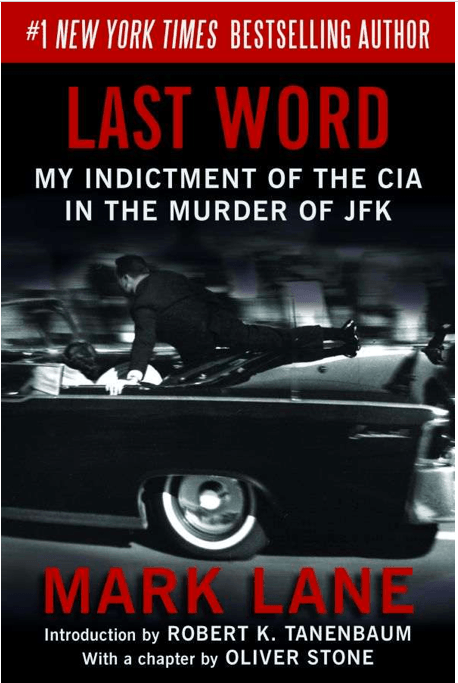
  • Harrison E. Livingstone, Kaleidoscope

    Harrison E. Livingstone, Kaleidoscope


    Kaleidoscope: A Review of Douglas Horne’s “Inside the Assassination Records Review Board”.[1] The word ‘kaleidoscope’ refers to a cylinder that reflects colorful patterns reflected off of mirrors. That word derives from three ancient Greek words which, when combined translate as: looking at things of beauty. That title is a misnomer for there is nothing very pretty, let alone beautiful, about this book. There are some valid criticisms in the book and Livingstone is to be properly praised for them. He certainly straightens out certain issues that needed to be elucidated in Horne’s very long five volume series. But when one adds up the ratio of good criticism to everything else in the volume, it is not a very good batting average.

    I. The Ugly

    On page 1 of Kaleiodoscope, Livingstone writes, “I’m not used to writing like this….” And its clear from there on that Livingstone never did the preparation that proper criticism entails. Especially if it’s a book length endeavor. It’s not like he didn’t have the time. After all, Horne’s series came out in 2009. Granted, the entire series comes to about 1,800 pages, but between reading, taking notes and filing, that still left him enough time to study exactly what it was he was supposed to be doing.

    Generally speaking, criticism should be formal in its approach, not personal. And this is a big problem with this book. There is no one in the world who despises David Lifton, or his book Best Evidence, more than Livingstone. No one can read Horne’s series without seeing how influential Best Evidence was on Horne. Therefore, Livingstone peppers his book with accusations about Lifton and his association with Horne that, to put it lightly, are not really criticism. Consider some of the following:

    “I’m sorry, but I’d have to vote for a court martial for Douglas Horne. Hanging is too good for Lifton.”[2]

    “Woe onto the JFK research community being led down the garden path by a charlatan, a four-flusher, a flatterer, an intelligence operator, a Pied Pipe [sic] of the children of America and the world with his false presumptions, false evidence and lies.”[3]

    “Horne might possibly, however, find work as a carnival shill and shell game operator.”[4]

    “He [Lifton] can’t stand competition. So we need to put him in a straight (sic) jacket and behind bars to see if that helps him….”[5]

    “The pattern of fraud, alteration of documents, falsification of evidence and deceit in Horne’s book are so large and pervasive that one can speculate on almost any motive.”[6]

    “…Adolph Hitler spelled out in his autobiography the usage and importance of what he called “The Big Lie”. I feel that the usage of this technique is replete throughout Horne’s books….”[7]

    “This was just a small embellishment Lifton added which acquired a life of its own and kept growing until it became a monster like so much else he has done to us.”[8]

    “Had Doug not been bought and paid for by David Lifton, the arch saboteur of the research community, none of this would have happened.”[9]

    “I have never in my life seen so many lies as there are in the first 27 or so pages.“[10]

    “I believe Horne consciously fabricated a hoax, and it is one of the biggest and most destructive in literary history.”[11]

    I could easily have added a dozen more examples. I do not recall seeing anything like this vituperative display since reviews of Vincent Bugliosi’s Reclaiming History. There is nothing wrong in evaluating a book negatively, or in evaluating it and deductively saying something about the author’s ’s intent or personality. But what Livingstone does here can be fairly called self-indulgent. It is so far outside the realms of criticism that it becomes strange and bewildering. In the end, it vitiates the things of value in his book.

    II. The Bad

    Horne
    Doug Horne in Dealey Plaza 

    If Livingstone had limited his personal attacks to just Horne and Lifton, that would be one thing, but he doesn’t.

    As long as I have known Livingstone he has always believed in a Texas based type of conspiracy. As time went on, and he had trouble convincing people of his theory, he decided to resort to unusual measures. So in 1993 he published Killing the Truth: Deceit and Deception in the JFK Case, which was a rather curious effort. As the estimable Martin Hay has stated, this volume qualifies as one of the ten worst books ever written on the JFK case. Up until then, Livingstone had gained some stature through his first two efforts, High Treason: The Assassination of JFK & the Case for Conspiracy and High Treason 2: The Great Cover-Up The Assassination of President John F. Kennedy. (The first was a co-venture with Bob Groden.) But Killing the Truth was an over-the top pastiche. Livingstone did two things to sell his “Texas Plot”. First, he used an unnamed personage who told him just how the Texans had done it. Livingstone called this person “The Source”. If you are going to make an invisible entity the basis for the spine of the book – your inside story on how the assassination happened – then what worth is it to have he or she remain nameless?

    The second thing Livingstone did in this tome was to go after the late Mary Ferrell. He named her as a kind of Texas inspired saboteur in the research community. His basis for this accusation was largely because she was quite conservative politically and worked for a politically connected law firm – facts which there really were no secret about at that time. This is why the acute Martin Hay summed up the book as, “A pathetic waste of time, effort, and paper.”

    Well, though Mary Ferrell is dead, her ghost survives for Livingstone. Today, her pernicious influence lives on through the Mary Ferrell Foundation. The problem with this is that, the MFF is an online entity and has nothing to do with Texas politics, then or now. Before she died, a venture capitalist entrepreneur in the high tech field purchased her book and file collection. He then enlisted Rex Bradford to create a database for thousands of scanned materials to be stored on a Foundation website, accessible to anyone. The MFF, through Rex and several Directors, created the website and realized a goal for Ferrell. As of today the MFF has also digitized the HSCA volumes, the Warren Commission volumes and documents, and files from the Garrison investigation. The Foundation owner was to use some of this high tech equipment to find patterns and leads in the case but it is not known if this was accomplished.

    Why do I bring this up?Because, according to Livingstone, somehow the Mary Ferrell Foundation was a sinister influence on Horne and his work.[12] Livingstone frowns on “anyone having anything to do with anything connected to Mary Ferrell” who “although dead, remains a great threat to the rest of us….”[13] Now, if Mary is dead, and her files, among with many, many others are digitized so they can be readily available to anyone, then how is this a bad thing? Further, how does this have anything to do with Horne’s Inside the ARRB, which is supposed to be what Kaleidoscope is about?

    According to Livingstone, either Mary Ferrell or the MFF has given tens of thousands of dollars to David Lifton. It’s hard to decipher which one. It may be both.[14] Livingstone goes even further by claiming Lifton was probably then loan sharking money to Horne.[15] And, this is how, I guess, the ghost of Mary Ferrell somehow negatively influenced Horne’s series of books.

    Lifton
    David Lifton at the Los Angeles ARRB meeting.

    When I read these accusations I decided to get in contact with Rex Bradford. Rex runs the day-to-day operations of the foundation. He is essentially the Director there and has been for the last few years. I asked Rex what he did for Horne as far as his books went. He replied that he helped Doug with some technical aspects of getting files ready for printing; he aided him in setting up an account at a print on demand book publisher; MFF offers the book for sale (as he does other books); and he has some of Doug’s exhibits for the book at the site. He stressed that, bottom line, Horne self-published the book and that Doug sells it at other venues, like Amazon. Rex also added that the assistance he gave to Horne was at no cost.[16]

    So after listing all this information, which you will not find in Livingstone’s book, where is the influence on Horne of Mary Ferrell and her rightwing cronies – the Dallas money people – who hated Kennedy so much?[17] Especially since it is now nine years after her death, and the foundation is headquartered today in Massachusetts, home of the Kennedy clan.

    I also got in contact with David Lifton about this issue. He assured me that he never got any funds from Mary Ferrell for the writing of Best Evidence In fact, prior to that book’s publication, he had only met Mary once. This meeting was in Los Angeles, not Dallas, and she was with the New York based writer-researcher Sylvia Meagher. Mary and Sylvia both gave him a rather small amount of money since he was going to Washington to copy some documents from the National Archives. The money was to secure copies of what he was getting for them. This was in the mid sixties. He did not meet Mary again until after his book was published.[18]

    Lifton states that his parents supported him in his literary efforts until a contract was awarded to him in late 1978. His manuscript was tendered in 1980. He then met Mary Ferrell for the second time in 1981, after the publication date. All of this leaves Livingstone’s accusations about Lifton being able to “plant the craziness of Dallas via the Mary Ferrell circle of dangerous lunatics…to co-opt us and the nation with their Right Wing dogma – and cover-up or ruin the conspiracy evidence….” through “his minion” Horne, it leaves this all a bit, well, tenuous.[19] If Lifton met Ferrell once before the book was published – and this was in California with Sylvia Meagher – how then could she have exercised such sinister Texan influence on him? How could Ferrell’s “influence” then be transferred to Horne?

    Ferrell
    Mary Ferrell
    (Photo courtesy JFK Lancer)

    Ferrell was known for her great attention to detail and her collection of early government documents on the assassination. It is more probable that Lifton would have stayed in contact with her (and her resources) to enhance his own studies as he has been writing a new book on Lee Oswald for decades. Surely, later in the 1990’s, while working for the Assassination Records Review Board, Horne was guided on where to look for possible records to push for release. After all, that was his job with the ARRB.

    Several times in the book Livingstone states that the financial support for Horne was granted through monies supplied by the MFF to Lifton, who then recycled it to Horne.[20] In another communication from Bradford, he wrote that the Mary Ferrell Foundation is not in the habit of granting subsidies or loans to authors and to his knowledge, which extends back to 2005, none was given to Lifton.[21]

    But despite all of these denials, Livingstone writes later on near the end of the book that one of Horne’s serious problems is the “bad company” he fell in with. He then writes that, “He needs to accept that the JFK “Research Community” is corrupt and that he was corrupted by it.”How did this happen? “Lifton’s task was to catch this fish and reel him in and turn him over to the tender mercies of the Ferrell/Conway crowd, the corrupt and betraying Gary Mack and Jim Marrs set and most of the rest of the Dallas people whose hands he is in now.”[22] Again, this is puzzling, on several counts. “Conway”, I assume is Debra Conway, who owns and manages JFK Lancer. I asked Debra if she had anything to do with Horne’s book. She replied she did not. Besides Horne speaking at her Dallas conference twice, she has had little or nothing to do with Horne’s career in the research community.[23] In a later conversation, Conway stated Ferrell had no control over any MFF funds and could not have directed a loan be given to anyone.

    Also, I don’t understand how Livingstone could call something in Dallas the “Gary Mack and Jim Marrs set”. Many years ago, Marrs used to be friends with Gary Mack. But once Mack flipped sides and started working for the Sixth Floor, their relationship faded away. Today, Jim is a fierce critic of both Gary Mack and his employer The Sixth Floor Museum.

    Finally, Mary has been dead for a decade, with her book and file collection long transferred to Massachusetts. During her time in the research community, Ferrell readily admitted she first began researching the JFK assassination because, as she would say, “Somebody I know [in Dallas] might be involved!”. This was no secret or avoidance of a Dallas plot. So, after all this review, just where is the Dallas influence on Horne that Livingstone finds so repugnant and bracing?

    I spend some time on this because, first of all, I think its necessary to show Livingstone’s failings as a critic. If one is going to be negative and personal in the discussion, then one had better be doing so on solid, relevant grounds. As the reader can see, this part of the book is, to be gentle, a misfire in that regard. But secondly, I think it is important in order to show how untidy Livingstone’s mental discipline is in his building a conspiratorial construct. It would appear to me that the author has reasoned here deductively. He buys into this Texas based plot. Therefore all the perceived evil in the research community must also emanate from Texas. The details are not important; the postulate must be upheld. As we will see, this untidiness also is present in his model of the JFK conspiracy. And I should add, if a writer/investigator cannot put together a rather small group of accessible people, of average means and position into a credible conspiracy model, then why should we trust him to construct a larger network of largely inaccessible people of much greater wealth and power with the ability to conceal their acts?

    Before leaving Livingstone’s peculiar take on Horne, and his place in the research community, its necessary to note the complement to the author’s rather derogatory and demeaning portrait of that small, investigatory circle. (And without detailing all of it. Other people are also dealt with rather coarsely e.g. Gary Aguilar, Harold Weisberg, Chuck Marler and Jim Marrs.) The complement to this rather unseemly picture is the author’s penchant at self-levitation. That is, to elevate his position in the field. He does this in more than one way. He says, for example, that a distinguished ad hoc committee of professors first asked him to work on the case. This included a dean from Harvard and a professor from MIT.[24] These men all knew the author and thought he could crack the case.

    Groden
    Robert Groden

    So I decided to talk to Bob Groden about this point. Groden was the co-author of Livingstone’s first book High Treason. When I emailed Groden about this point, he told me that during the whole time they worked on High Treason together, Livingstone never said a word about such a committee enlisting him into such an endeavor.[25] Livingstone then implies – it’s hard to decipher his grammar at times – that he was elevated to the faculty at Harvard, without a degree.[26] Livingstone does something odd in this particular discussion. After saying that he was “elevated to the faculty without a degree” he compares himself to Henry Kissinger in that distinction.[27] But Kissinger first graduated from Harvard in 1950. He later graduated with a Ph. D. in 1954. It was then that Kissinger joined the Harvard faculty.

    Livingstone also says that another reason he began his JFK studies was from personal communications with Jackie Kennedy and Ted Kennedy. In his words, “Jackie messaged me through her assistant at Doubleday that the photos were false, as did Senator Edward Kennedy through his Secret Service guard, John Libonati”.[28] It would be nice to see some certification of this. Because, as most people know, the Kennedy family was very tight lipped about their feelings in this area. That is, until Robert Kennedy Jr. broke the silence in an interview with Charlie Rose.

    According to Livingstone, “I was completely responsible for drawing Dr. [David] Mantik into the entire issue.[29] David Mantik, M.D., Ph.D., who has made many valuable contributions to the JFK case, especially in the medical field, received his doctorate in physics and practices medicine as a Radiation Oncologist, Since his day job is to examine X-rays, he has done some very important work in that specific area. When I emailed Mantik about this claim he said that what first interested him in the JFK case was watching Oliver Stone’s film back in 1991. After that he picked up Best Evidence, and High Treason and Dr. Charles Crenshaw’s book, since those volumes contained visual depictions and lengthy discussions of the medical evidence. From there he was on his way.[30]

    Nurse Diana Bowron was at Parkland Hospital when President Kennedy was brought there after he was shot. No writer interviewed her for many, many years afterward. To my knowledge Livingstone was the first. According to him, this was not accomplished by simple location work by him and Bowron’s consent. According to the author, “the British government and police chose me and no one else to talk to her. It was a surprise when they called me out of the blue.”[31] It would be nice to see some corroboration for this claim. For instance, a letter, a fax perhaps, a diary entry from across the pond, as to why it was Livingstone who was deemed so worthy.

    Sharing more, Harrison writes, “I had an entire radiology department somewhat at my disposal for years….”[32] He claims that the Baltimore City Police Department donated a team of five men to him.[33] He writes that this happened because major cities in the USA had no trust in Dallas “after the assassination and were running operations on the filthy town.”[34] According to Livingstone, millions of people have read his books on the case. He got so famous, that the fame began to wreck him so he had to leave the country.[35] Then, at the end, he writes that, at times, he has had an investigative team numbering nearly a hundred people ”spanning the nation.”[36] Then, on the very last page, the crescendo is reached: “He is considered by many the principal researcher, investigator and writer in the case.” Well, as we have seen, Martin Hay does not think so.[38] And if Livingstone was considered as such, would he not have been invited to speak at conferences held by Doug Carlson in Chicago, John Judge and COPA in Washington, Debra Conway and Lancer in Dallas, or Cyril Wecht at Duquesne in Pittsburgh?To my knowledge, he has been invited to speak at none of them.

    This marked characteristic of Livingstone’s, the tendency to elevate himself, and to denigrate others is one I cannot recall in any other writer in the field. Certainly not to the extent exhibited by him.

    III. The Questionable

    And some of the work that Livingstone tries to promote in the pages of Kaleidoscope would certainly seem to detract from that claim. For instance, he writes early on that Governor John Connally was hit in the back at Zapruder film frames 285-86. He adds that this is quite clear in the slides made from the film at Life magazine.[39] I do not recall anyone postulating such a late hit on Connally. Most people I know think it took place much earlier. But further, Livingstone states “he was also hit by a shooter in front of the car.”[40] In looking at still frames from the film, this does not seem possible. Since Connally is rotated to the right at these frames, a shot from the knoll area would have hit Connally in the chest. And we know that he was hit in the back. A shot in the back at this point – with Connally turned around at perhaps more than ninety degrees to his right – would seem to originate from the other side of Dealey Plaza. And it appears that Nellie Connally would have been in the line of fire.

    Livingstone also says that he has found the “secret FBI reports” based on the so-called film of the “Babushka Lady”.[41] This was the young woman in a light coat and headscarf filming the motorcade in Dealey Plaza. The Abraham Zapruder film shows she is holding some kind of camera as she is positioned on the grass opposite and across Elm Street from Zapruder. Her film has never been adduced. So for Livingstone to say that he found a reference to it in “secret FBI reports” is an odd claim. In an earlier book of his, Killing Kennedy, Livingstone sourced his “secret FBI reports” to Commission Document 298.[42] I don’t understand how an FBI report can be secret if it appears in a Warren Commission appendix. When one finds the CD, one will see a reference to a film by Orville Nix. Livingstone says that since this film is not represented accurately by the FBI, then the Bureau switched the Nix film with the Babushka Lady’s film. Yet, in this same CD the FBI also misrepresents the Zapruder film. So this seems to me to be something of a stretch. Especially since there is nothing in the FBI reference he uses that would necessitate not producing the film or the name of its owner.

    Oliver
    The Babushka Lady

    Some of Livingstone’s other claims also seem like a stretch. He writes that Jackie Kennedy seems to be painted into the Zapruder film.[43] I assume he means her entire body. But he does not elaborate on this at all, as to the why or how. Dealing more with his suspicions about Zapruder film alteration, he writes that the presidential limousine was fired upon while it turned from Houston to Elm Street. No one I know of, besides perhaps Max Holland, thinks a shot occurred this early. Livingstone writes that there was only “some” military control at the autopsy.[44] This would seem to be contradicted by Kennedy pathologist Pierre Finck’s landmark testimony at the Clay Shaw trial.[45] There, Finck seemed to indicate a lot of direct control by the military. So much so that the Justice Department panicked and wanted to bring down fellow Kennedy pathologist Thornton Boswell to discredit Finck.

    To this day, Livingstone insists that, because the anterior and right lateral x rays are extremely dark on the right, frontside of JFK’s skull, this indicates a blow out to the right side of Kennedy’s face. And since the photos don’t show this, then something drastic is wrong with the pictures.[46] This reveals that Livingstone is not all that familiar with Mantik’s work. In 2003, Mantik cooperated with Cyril Wecht on a long, profusely illustrated essay about the x rays. This fascinating essay partly addressed this specific issue.[47] Both doctors came to the conclusion that although laymen could deduce that the darkness indicated a lack of skull bone, physicians understood this actually indicated a lack of brain tissue.[48] This essay was written and published ten years ago.It’s hard to believe that, in the ensuing decade, Livingstone was never made aware of its existence. Especially since it concerns a pet interest of his.

    There is another relatively recent development in the field the author does not seem aware of. And again, it relates to an area of his special interest. In this case, his suspicion that the Zapruder film has been seriously altered. This is the so-called Full Flush Left (ffl) argument. This was the idea that since picture frames of the Zapruder film spilled over into the intersprocket area of the film, that this somehow indicated the actual original film had been copied, or else it would not align that way. This idea had always been disputed by even those who thought the film was altered, e.g. John Costella.

    In my review of Horne’s series, I addressed this specific issue at length. I noted that Bob Groden wrote to me that using the proper optical printing equipment, doing one frame at a time, this would not happen anyway. Secondly, Josiah Thompson posted at Spartacus Educational back in 2009 that Kodak expert Roland Zavada did produce frames where this effect did appear. Further, researcher Rick Janowitz conducted an experiment with the same type of camera that Zapruder used that day. In his experiment he discovered that you could attain continuous ffl alignment with that camera. Frames from this experiment were placed online at Spartacus by Craig Lamson in January of 2010, at least two years before Kaleidoscope was published. So for Livingstone to argue here, as he does, that Horne did not give him enough credit for the discovery of ffl is weird. One wonders why Livingstone would want to criticize Horne about not crediting him with a now specious argument concerning Zapruder film forgery. Again, this discovery has been online for years, and I dealt with it in my own critique of Horne’s book.[49] It is hard to comprehend why Livingstone would not read a previous lengthy review of Horne before he went ahead and wrote his own. This would indicate a fault in his preparation for this assignment.

    IV. The Careless

    If criticism entails anything, it entails the practice of being fastidious. That is showing a demanding and excessive delicacy about facts, being meticulous in one’s standards of scholarship. The reason for this is obvious. If you do not display this quality in your own work, how can you be trusted to do so in relation to the work of others?

    Late in the book, when discussing Horne’s last volume which deals with a macroscopic view of Kennedy’s assassination, Livingstone writes about Eisenhower’s famous Farewell Address where he warned about the evolving threat of the military industrial complex. Apparently, in his attempt to insinuate Texas into the speech, he writes there that, “It was Texas oil men who bought President Eisenhower’s farm for him near Gettysburg, a good place for Ike to retire, but he knew what they were trying to do to him.”[50] It would be nice to see something like this footnoted, because to anyone who knows anything about Eisenhower it makes no sense. Eisenhower and his wife purchased their Gettysburg property in 1950, while he was president of Columbia University. He was earning a fairly good salary there. Since the purchase price was only $40,000, I don’t think he needed any personal favors from Texas oil men. Especially in light of the fact that two years earlier, Eisenhower had published his military memoir, Crusade in Europe[51]. Just the advance on this book was worth well over a half million dollars. So why would he need to borrow less than a tenth of that for his home? Further, as Blanche Wiesen Cook notes in The Declassified Eisenhower,[52] it was while he was at Columbia that Eisenhower began his studies within the Council on Foreign Relations. He especially studied in economics, and how America could influence Europe through the Marshall Plan. Therefore it would appear that it was the CFR who influenced his worldview, not H. L. Hunt.

    This is a good lead into Livingstone’s direct criticism of Horne. As mentioned, in the last volume of his series, Horne tried to put together a “Big Picture” view of the Kennedy assassination. Generally speaking, this meant why was Kennedy killed and who did it. In my review, I found this part of Inside the ARRB to be rather disappointing. For the specific reasons that I did not think Horne’s view of Kennedy was very sophisticated, and I also thought that some of the sources Horne used for his ideas on who killed JFK were not really sound or credible.

    Livingstone disagrees with me. He thinks that this is the best part of the series. In reading what he says, I think it’s because first, Horne allows for a Texas-based component as part of the plot; and second, Livingstone’s view of Kennedy is as superficial and unenlightening as Horne’s.

    JFK-RFK

    February 28, 1962. At around 5:50 PM JFK met with RFK, Dean Rusk, and LBJ in the Oval Office after RFK returned from a trip to Asia.

    (photo courtesy JFK Library)

    For instance, Livingstone, quoting Horne, agrees that the Kennedy who was killed in 1963 was a substantially different man than the one who entered office in 1961.[53] It’s not exactly clear, but the source for this seems to be former Senator Gary Hart. I like Hart, and voted for him. But I never regarded him as a foremost expert on President Kennedy. And I don’t know why Horne or Livingstone do. There is no doubt that the Bay of Pigs made Kennedy more antagonistic toward the CIA. And the Missile Crisis made him more anxious to hasten a détente with Cuba and the USSR. But to say that the Kennedy who entered office in 1961 was somehow a “Cold Warrior”, this is simply wrong. Because it does not explain why he did what he did his first year in office in places like Congo, Vietnam, Indonesia and Laos.[54] And why, when the Bay of Pigs was failing, he refused to authorize the use of American naval power. Which is what Allen Dulles thought he would do. And, in fact, Dulles was banking on that happening.[55]

    Further, if one is not aware of Kennedy’s evolving view of colonialism in the Third World, then one cannot understand why Kennedy refused to authorize the issuance of combat troops into Vietnam in the fall of 1961. Or why, after the Bay of Pigs failed, Kennedy authorized a White House inquiry into what actually happened. Nor can one understand why and how the Henry Luce controlled Fortune magazine, then hit back at Kennedy for firing Allen Dulles with a ghost written article penned by Howard Hunt.[56] A man’s character and judgment is not molded once he reaches the White House. In large part, it is forged years before he passes through those doors.

    But in addition to this less than complete examination of who Kennedy was, Livingstone then goes along with some of Horne’s most dubious sources in his final book. For instance, Horne relied on the now infamous party at the Murchisons the night before the assassination. And it appeared that Horne used Killing the Truth for some of this.[57] So Horne had to, at least partly, rely on Madeleine Brown. Well, Livingstone is not going to score Horne for using his own book of course. And further since he edited and published Brown’s book, she is fine with him also.[58]

    Because Brown backed the idea of an LBJ plot, Livingstone backed the idea that she was the mother of Johnson’s illegitimate son.[59] In fact, Steven Brown filed a 10 million dollar lawsuit against Lady Bird Johnson in 1987, which was 14 years after LBJ had died. The lawsuit was dismissed about two years after it was filed because of Steven Brown’s failure to appear in court. Why did he fail to appear in court? Probably because he had filed another lawsuit seven years earlier saying that attorney Jerome Ragsdale, not LBJ, was his father!Its not a very good paternity case when you and your mother cannot decide whom the real father is. Yet, both Livingstone and Horne backed this woman.

    Needless to say, Livingstone goes along with Horne’s use of the flaky fraudster Billy Sol Estes also. I won’t detail any more of the problems with these two witnesses. Just click through to this article for a good review of the problems with the ‘Johnson did it’ case. [60]

    As with Estes and author Barr McClellan, Livingstone claims that Johnson was a serial killer. When you use sources like Barr McClellan and Estes, yes you can make fantastic claims of homicide. But then you have to come clean with the problems with those two witnesses. Which, neither Horne nor Livingstone do. And when Livingstone writes on page 415 that “There is strong evidence that Johnson actually ordered Kennedy’s killing….”, that bombastic claim is not footnoted. Then, a paragraph later, he uses Billy Sol Estes to seem to back this up. But then how solid can the indictment be?The answer is: not very.

    What is Livingstone’s ultimate solution to who killed Kennedy?He says it was a consortium of elements from the power structure of America. He actually names the Texas oilmen, LBJ, the CIA, the Pentagon, the Wall Street bankers. This group then hired Secret Service agents and the FBI.[61] Sounds a bit like that famous fantasy the Torbitt Document. Unfortunately, assassination plots are not Agatha Christie novels, e.g. Murder on The Orient Express.As I have always maintained, if everyone killed Kennedy, then no one did. We might as well say that Oswald did it because that “everybody did it claim” is as credible as the Warren Commission.

    Livingstone himself comes close to admitting this when he mentions Secret Service agent Abraham Bolden’s Chicago Plot. He writes that, in light of this, “it would appear that some of the planners could operate on a national level.”[62] But if the Chicago plot had succeeded, would writers like Livingstone then have posited an “Illinois Conspiracy”?

    Livingstone endorses Horne’s use of a questionable declassified document. On page 1492 of Volume 5 of Inside the ARRB, Horne prints a subheading, “The KGB Fingers LBJ: The Ultimate ‘Smoking Gun’ document.”Horne implies the ultimate source is a KGB document. Again, Livingstone says that he also deserves credit for this document since he noted it in High Treason.

    In my review of Horne, I did not mention this alleged KGB report which he declared was such a bombshell. Why? First of all, it’s not a report, and second, the KGB did not write it. This is an FBI memorandum and the title is “Reaction of Soviet and Communist Party Officials to the Assassination of President John F. Kennedy.”[63] The memo is a compilation of Russian and communist sources about the reaction to Kennedy’s murder. Some of the information compiled is actually from the Soviet press. Some of it is not even from Russian sources. It is from Marxist sources in the USA, like Gus Hall and The Worker. The document does source Yuri Nosenko, the KGB defector, but his information is simply about Oswald’s time in the USSR. The closest the memo comes to saying what Livingstone and Horne says it does is that “now” the FBI has a source that says the KGB has information that indicates LBJ was responsible for the assassination of Kennedy. The “now” is December 1, 1966, since the memo was written then. The memo does not name the source of the information, or what the information actually was, what it specifically says, or how the Russians got it. Therefore what is its forensic worth? Realizing this is a problem, Horne and Livingstone say that the document was sent to LBJ as a threat to help Hoover keep his job. In other words, it was one of Hoover’s methods of wielding power over Johnson. The problem with this is that most people understand that since LBJ and Hoover were pals, there really was not much of a threat of Hoover being fired. Allowing for that,in December of 1966, the first wave of critical books and articles were now making an impact in America. This memo appears to be a way to keep tabs on what the communist world abroad was thinking on the subject. Since it was now an issue that could not be avoided. Anyone who can call this memo a smoking gun has questionable powers of textual analysis and evidence evaluation.[64]

    V. The Valuable

    There is another document which Horne very much played up in his book as being another smoking gun. This one was used to back the idea that Kennedy’s body was not really being transferred to Bethesda Medical Center by Bobby and Jackie Kennedy as millions watched on television as they drove across Washington. That particular casket was empty. The body was actually entered into Bethesda at 6:35 PM, not at the later, official time of seven o’clock. Horne referred to this document more than once throughout the book, and each time it was referenced as backing up David Lifton’s theory of body swiping and wound alteration.[65]

    Horne referred to it as the Boyajian report. Roger Boyajian was a Marine Sgt. on duty at Bethesda on the 22nd. He led a small detail of men that day called the Honor Guard.[66] According to Horne, Boyajian wrote a report the next day that proves that it was his detail that actually brought in Kennedy’s casket at the earlier time of 6:35. Therefore Lifton and his body switching idea are upheld. In my review of Horne’s series, I did not mention Boyajian or his report. This was supposed to be dealt with by Gary Aguilar in another review of Horne’s series. Unfortunately Aguilar was going through a long and complicated divorce process that entailed him having to relocate. So he never got around to writing his review.

    Well, Livingstone deals with the issue at length here, and in my opinion he does a good job with it. It would appear that Horne oversold the document and Livingstone uses the opportunity to really pile onto Horne with a lot of invective. I wouldn’t go as far as he does in that regard but let us spell out some of the problems that the document has and that Horne did not elucidate very well.

    First, the actual report does not say that the casket picked up by Boyajian’s men was President Kennedy’s.[67] In the one sentence that deals with the issue it is referred to only as “the casket”. As Livingstone properly notes, this is a serious fault with Horne’s claim. It is hard to believe that if Boyajian knew he was handling JFK’s casket, would he not write that down and specifically note that fact?

    Further, there is a real problem of authentication as this report is not signed by Boyajian and there is no trace in the record as to why he did not sign it. There is a second page to the report that lists the ten men in the detail – none of which signed the document either. What makes it all a bit worse is that when the ARRB questioned Boyajian about whether he recalled picking up Kennedy’s casket, Boyajian couldn’t recall doing so.[68] In fact, he could not recall much at all about that day. And importantly, it does not appear that the report the ARRB had was the original document leading us to question as to whether or not that original was ever filed with the military.[69] All of this seems strange if the casket really was Kennedy’s.

    Additionally, Livingstone shows, if one lives in the area, as he did, it is very hard to understand how Horne could buy into this idea without questions. After all, Horne did live in Washington while working for the ARRB. As Livingstone describes it, the route through downtown Washington from Andrews AFB to Bethesda is about 18 miles.[70] But yet for the Boyajian report to say what Horne declares it says, somehow this transport traversed the 18 miles in about 20 minutes.[71] Unless the driver was proceeding at a continuous 60 MPH on city streets, this does not seem possible.

    AF1

    There was no trap door near where the coffin was located on the return trip from Dallas on November 22, 1963. The square grille in the near foreground was directly under the bathroom in the Presidential suite in 1963. The space where a trapdoor was claimed to have been would have been all the way at the rear of the cargo hold in the middle. In addition, according to Boeing diagrams and blueprints, there are any number of control cables and wires running through the floor down the center aisle which would have precluded any kind of trap door being in that area. Boeing’s diagrams from 1962 (when the plane was placed into service (in October, 1962)) do not show any trap door in the rear of the plane leading to the rear cargo hold. (Photo Courtesy Jamie Sawa)

    As Livingstone explains, Boyajian did not pick up Kennedy’s casket. Bethesda is also a morgue. It did not stop being so just because Kennedy was being transported there that day. Other military men died that day. After all, America was involved in a war. Livingstone interviewed several people who identified another person’s body being delivered to the morgue that day. There was no autopsy done and his body was being stored in the “Cold Room” for burial at Arlington.[72] The weight of the evidence seems to dictate that it was this person’s body that Boyajian’s detail picked up.

    There are other good points that Livingstone develops to counter some of the excesses in Horne’s books. For instance, the issue of Roy Kellerman having blood on his shirt aboard Air Force One does not mean that Kellerman was somehow performing surgery on JFK’s body in a secret compartment. Kellerman helped get Kennedy’s body out of the limousine and onto a gurney at Parkland. [73] And concerning the alleged secret compartment, Livingstone supplies some good photos illustrating the work of James Sawa showing that there was “no trap door leading from the rear baggage compartment up to the rear of the aircraft.” This vitiates one of the earlier theories Lifton had about secret surgery on board Air Force One.[74]

    When I reviewed Horne’s series, I concluded that he needed a tough-minded editor to reduce the size and scope of the book to highlight the good things he had done. Livingstone says the same about Horne.[75] Yet he does not note the irony that this same criticism could be easily applied to Kaleidoscope. This book could effortlessly have been reduced in size by at least one half. Probably even more. And it would have been much more valuable and pointed. What is worse is Livingstone had a valuable model in front of him that he knew about – one that avoided all the conspiracy bantering about the JFK research community. The late Roger Feinman wrote The Signal and the Noise, a long critique of Best Evidence, back in the nineties. [76] It was much shorter than Kaleidoscope. But Feinman avoided most of the pitfalls that Livingstone did not. Livingstone, who much admired Feinman’s work, seemed to forget what made Roger’s critique valuable when he wrote Kaleidoscope.

    Note: The author informs us that there is a newer edition of this book, however, it is not available as we put this article online. When a second edition is available, and if there are any substantive changes, we will do an update to this review. But the first edition has been out for five months and as of this writing is the only version available.

    Update: Since this review appeared, I have been alerted by researcher Martin Shackelford that there were three five figure loans for a total of $165,000 made to David Lifton by the Mary Ferrell Foundation. He saw these listed on the site. And they appeared before Rex Bradford became the director. Mr. Lifton has not replied to my queries about this subject, so I cannot pursue it further.


    [3] ibid. p. 107

    [4] idid. p. 141

    [5] ibid. p. 158

    [6] ibid. p. 181

    [7] ibid, p. 186

    [8] ibid.

    [9] ibid. p. 244

    [10] ibid. p. 377

    [11] ibid. p. 412

    [12] Livingstone, p. 103, for just one example of this accusation; Mary Ferrell Foundation

    [13] ibid.

    [14] ibid, p. 201

    [15] ibid, p. 137

    [16] Email communication from Bradford, 3/29/13

    [17] Livingstone, pgs. 24, 277, 347

    [18] Email communication from Lifton, 3/30/13

    [19] Livingstone, p. 277

    [20] ibid, p. 137

    [21] Email communication from Bradford, 3/30/13

    [22] Livingstone, p. 452

    [23] Email communication from Conway, 3/29/13

    [24] Livingstone, p. 262

    [25] Email communication from Groden, 4/1/13

    [26] ibid, p. 262

    [27] ibid.

    [28] ibid, p. 313

    [29] ibid, p. 360

    [30] Email communication from Mantik, 3/29/2013

    [31] Livingstone, p. 391

    [32] ibid.

    [33] ibid.

    [35] ibid.

    [36] ibid, p. 461

    [37] ibid, p. 462

    [39] ibid, p. 82

    [40] ibid.

    [41] ibid, p. 242

    [43] Livingstone, p. 95

    [44] ibid, p. 258

    [45] DiEugenio, James Destiny Betrayed: JFK, Cuba, and the Garrison Case, 2nd Edition, pgs. 299-306

    [46] Livingstone, p. 360

    [47] Edited by James DiEugenio and Lisa Pease, The Assassinations: Probe Magazine on JFK, MLK, RFK and Malcolm X , pgs. 250-71

    [48] Livingstone, p. 259

    [50] Livingstone, p. 414

    [51] Eisenhower, Dwight D. Crusade in Europe, 1997

    [52] Cook, Blanche Wiesen, The Declassified Eisenhower, 1984

    [53] DiEugenio, p. 431

    [54] ibid, pgs. 28-33

    [55] ibid, p. 47

    [56] ibid, p. 54

    [57] Horne, Volume V, p. 1430

    [59] ibid, p. 264

    [61] Livingstone, p. 433

    [62] ibid, p. 417

    [64] You can read this memo at MFF, Appendix 77 to Inside the ARRB

    [65] Livingstone, pgs. 144-45

    [66] ibid, p. 140

    [67] Document reproduced p. 132; Livingstone’s website.

    [68] Livingstone, p.143

    [69] ibid, p. 144

    [70] ibid, p. 146

    [71] ibid, p. 164

    [72] Livingstone, p. 147

    [73] Livingstone, p. 185, 404

    [74] Livingstone p. 405

    [75] ibid, p. 449

    [76] Roger Feinman, Between The Signal and the Noise: The Best Evidence Hoax and David Lifton’s War Against the Critics of the Warren Commission. http://karws.gso.uri.edu/JFK/the_critics/feinman/between_the_signal/Preface.html