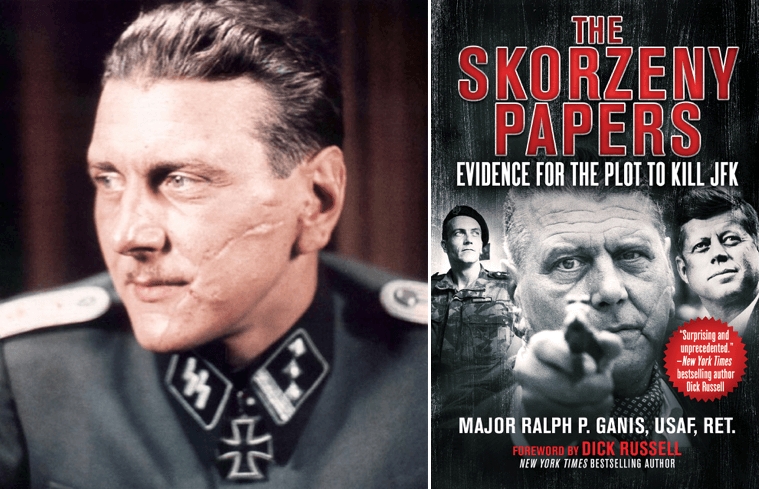
“Dulles is a legendary figure, and it’s hard to operate with legendary figures.”
-President Kennedy
Let us state the preconditions for the drama that historian Greg Poulgrain is going to compose in his stellar volume, JFK vs Allen Dulles: Battleground Indonesia. Sukarno led Indonesia to independence against both the Dutch and the Japanese. After World War II, he became the first leader of an independent Indonesia. He then became one of the foremost spokesmen for the Non-Aligned Movement, that is, the Third World leaders who did not wish to get involved in American/Russian Cold War struggles but wished to navigate their own foreign policy choices free of those entanglements. Some of his partners in this enterprise were Nehru of India and Gamal Abdel Nasser of Egypt. In fact, the first meeting of this group was in Bandung, Indonesia in 1955.
At the time Sukarno was leading this movement, the two men supervising American foreign policy were the Dulles brothers. John Foster as Secretary of State and Allen as Director of the Central Intelligence Agency. To put it mildly, they did not appreciate the attempts at neutralism in the Third World. (Robert Rakove, Kennedy, Johnson and the Nonaligned World, pp. 10–11) They believed that there was no such thing as neutrality in what they cast as a rigid, dogmatic Cold War world outlook.
Partly due to this, the CIA tried to overthrow Sukarno in 1958. At that time, this was perhaps the largest Agency operation ever. Ostensibly, it was not successful. And American participation in the attempt was exposed by the shooting down of CIA pilot Allen Pope. To put it gently, Sukarno did not appreciate what the Dulles brothers had tried to do. He also did not like the fact that the United States would not help him in his quest to attain West Irian from the Dutch. Sukarno thought that territory was entitled to Indonesia and should have been turned over at independence.
Thus, another layer of intrigue is placed over the situation. As Poulgrain notes, Allen Dulles and the Dutch knew something about West Irian that Sukarno did not. In 1936, there had been a joint Dutch/American mountain expedition to the highest point in West Irian, this included Dutch geologist Jean Jaques Dozy. Dozy’s report was discovered in 1960 by Forbes Wilson of Freeport Sulphur. Wilson sponsored a second expedition. Both groups found out that there were immense deposits of gold, silver, and copper in the Carstensz Pyramid, in a place called the Ertsberg. Two miles away, in an alpine meadow, was another huge deposit in an area called the Grasberg. The combined value of the mineral resources in those two places staggered the imagination. To make just one statement about it: This was the largest repository of gold in the world at that time. And it is why the Dutch did not wish to give up the area. Allen Dulles was trying to find a way to let American interests exploit both the Ertsberg and the Grasberg.
Besides Sukarno and Allen Dulles, the third major character involved in Poulgrain’s epic tragedy is John F. Kennedy, both as a senator and as president. In 1957, Kennedy made a speech on the floor of the Senate which startled the Dulles brothers, President Dwight Eisenhower, and Vice-President Richard Nixon. He made clear his disagreement with the administration over their support for France in its attempt to keep the North African colony of Algeria as part of the French empire. (Allen Nevins, editor, The Strategy of Peace, pp. 66–80) Kennedy opened that speech by saying that people around the world wanted to be independent and that the enemy of independence was imperialism. Kennedy was saying he understood that the era of European colonialism was ending and he was willing to side with the Third World nationalists in Algeria against the longtime American ally in Paris. Sukarno and the Non-Aligned Movement now had a potential ally in Kennedy. In the election of 1960, that potential was realized.
When Kennedy took office, he arranged a deal. Sukarno would return Pope to the USA and Bobby Kennedy, along with diplomat Ellsworth Bunker, would convince the Dutch to give Sukarno West Irian. This was called the New York Agreement and it was signed at the United Nations in late summer of 1962. The Dutch were out of the picture concerning the Ertsberg, but Dulles still understood what the real situation was. Kennedy and Sukarno did not. With the assassination of Kennedy in 1963 and the overthrow of Sukarno in 1965, Dulles achieved his original goal for his backers, the Rockefellers. How those last two steps were achieved form the backbone of Poulgrain’s work, because they depict the triumph of both Dulles and Freeport Sulphur, which later became the giant mining conglomerate Freeport-McMoran. They also depict one of the most horrible of modern-day atrocities: the attempted extermination of the PKI, the Indonesian communist party, which resulted in the expulsion of Sukarno and the rise of the military dictatorship of General Suharto, who would rule Indonesia for three decades.
[The above prologue was by James DiEugenio]
It’s a rare thing when an author achieves a comprehensive and penetrating analysis of a long-forgotten historical episode, while delivering his story with a pace more apropos to a thriller novel than a groundbreaking addition to the historiography of the C.I.A. at mid-century. Dr. Greg Poulgrain’s sweeping and important book is one of the most exciting reads in recent memory—equal parts Indiana Jones, Ian Fleming novel, and geopolitical tour de force—with keen attention paid to the inner personalities of two of the most iconic figures of the 1960s, Allen Dulles and John F. Kennedy. We watch as they played their delicate chess game to determine the future of the Indonesian government; and, by extension, control of the nation’s vast offshore petroleum reserves, along with the largest gold deposit ever discovered in human history.
Poulgrain’s book stands out for a number of reasons, not least for the flair he possesses as a stylist. Often books on subjects such as this plod through the historical data, citing numerous and turgid anecdotes and stenographic notes from dry briefings that largely put one to sleep. I’ve always found this unfortunate, as the real history of the C.I.A. during the 1960s contains the stuff of the greatest fiction, the greatest cinema. And Poulgrain seems to have noticed. While never shying away from the archives and the documented record, his achievement lies first in his framing of the chance 1936 discovery of the Ertsberg mother lode by a daring prospector working for a Dutch petroleum company as a dramatic hook. He then juxtaposes this earlier timeline against the colorful backdrop of the later power struggle playing out between a freshly elected President Kennedy and his soon to be nemesis, C.I.A. Director Allen Dulles, all the while filling in the relevant gaps to guide the reader through this powerful climactic showdown, which includes a chapter on UN Secretary General Dag Hammarskjold.
Moreover, Poulgrain was able to meet with Jean-Jacques Dozy, the prospector who struck gold in 1936, as well as with key political figures relevant to the later political drama in Indonesia during the overthrow of Sukarno in 1965. He conducted a series of interviews from the late 1970s to the late 1980s. And he weaves together his personal notes from these interviews to enrich and enliven the story even further, lending a sort of murder-mystery air to the book in high fashion. How much gold was really in the Ertsberg? Were the explorer and his team complicit in the initial coverup? Who really held the keys to Indonesia’s future? Were internal forces and internecine Indonesian strife responsible for the fated events that unfolded over the next three decades? Or were Dulles and friends in Langley solely to blame for another bloody coup by proxy? Such are the questions the author explores in his fine work.
A special notice should go to the portrayal of the night of September 30, 1965. That evening may rank with the Night of the Long Knives as to pure treachery and diabolical aim. Many historical commentators have tried to figure out what really happened on that evening, which created such a reversal of Indonesian history. Due to the interviews he did with some of the survivors of that dark episode, Poulgrain gives us the best explication ever written unraveling that mystery. The book is worth reading just for that chapter. (See Chapter 7)
As most readers of this genre understand by now, Allen Dulles represented an iconic, often sinister, and looming figure in the grand tapestry of mid-century America. From his longstanding ties to the giant law firm of Sullivan and Cromwell, to his role in the creation of the Treaty of Versailles, to his vast Rolodex of spies, assassins and international contacts, to his close friendships and admiration for postwar Nazi war criminals like Reinhard Gehlen, he presents an impenetrable and often sociopathic personality, someone who, in his own words, enjoyed the sound of a rat’s neck breaking as the spring trap snapped shut.
Driven in large part by pure imperialistic greed and deception, and at other times by what appears to be a genuine aversion to anything resembling socialism, collectivism, or non-alignment with U.S. anti-communism, Dulles was the perfect foil to the pro-Third World, pro-decolonization John F. Kennedy. Three years prior to his close victory over Richard Nixon, Kennedy delivered impassioned speeches on the Senate floor, championing the freedom of the Algerian people against the French:
I am concerned today that we are failing to meet the challenge of imperialism—on both counts—and thus failing in our responsibilities to the free world. (Remarks of Senator John F. Kennedy in the Senate, Washington D.C., July 2, 1957, John F. Kennedy Library)
Yet, in many ways, Sullivan and Cromwell was about imperialism. If one is representing the Rockefellers, as Allen Dulles was, then one is involved with an imperialistic system of beliefs. This ideological impasse between two irreconcilable worldviews serves as the tense thematic backdrop against which the book’s many detours add both color and historical perspective to the dramatic saga of the Indonesian archipelago at the beginning of the decolonization era. As Poulgrain notes, “Kennedy realized during his first year in office that much of the advice on Indonesia from DCI Dulles was premised on the belief that Sukarno’s leadership was Indonesia’s fatal flaw.” (JFK vs. Allen Dulles, p. 46)
While most scholars seem to place the singular showdown between Dulles and Kennedy at the Bay of Pigs debacle—designed to fail by Dulles and associated C.I.A. cohorts in order to force Kennedy to commit U.S. carrier air support—Battleground Indonesia, the subtitle of Poulgrain’s book, presents a fascinating window into a largely overlooked, but critically important, episode in the Pacific. This episode would represent, along with the Congo Crisis, some of the last gasps of pure unfettered imperialism in its most crystalline form, a quixotic adventure involving obscure shell corporations operating illegally under C.I.A. protection, powerful moneyed interests from the shadow world, familiar names from the later Kennedy assassination plot like George de Mohrenschildt and L. Fletcher Prouty, and corrupt Indonesian officials and splinter groups with their own diverse interests. All of this played out under the wary eye of a sitting U.S. president who intimated that some of his closest intelligence advisors were obfuscating and distorting the situation to suit their own agendas. It is, at once, a tragic and incredible story that has been largely lost in the dizzying array of C.I.A. exploits the world over and, as Poulgrain observes, “into this matrix of intelligence entanglements, Kennedy proceeded unawares.” (JFK vs. Allen Dulles, p. 9)
The attraction of this work also lies in another achievement that is often forgotten in books of the genre, namely, the personal touch. Frequently, Poulgrain plays the role—commandingly—of amateur psychologist and adds in important depth and essence to the characters involved in this grand undertaking to gain control of the Ertsberg and its associated billions of dollars of ore, to name but one of the numerous story arcs in JFK vs. Allen Dulles. Too often, we forget that human beings, no matter what their titles or powers, are still just that, human beings and, as such, are often fallible, naive, ruthless, proud, furtive, bold, corrupt, cowardly, impetuous, sanguinary, honorable, and countless other adjectives. They are rarely the simple paper cutouts in the annals of history in the extensive catalog of books attempting to detail their exploits.
This book lives up to its title: JFK vs. Allen Dulles, while tying together a grand panoply of monied interests, international power players, secret agents, and heads of state, ultimately still reads like a battle of two central personalities: President John F. Kennedy, the fresh and enterprising ingenue, filled with a sincere conviction to deliver on his promises to liberate the oppressed people of the developing world—perhaps the last sitting president to legitimately champion the ostensible slogans of the United States overseas and at home—against the Old Guard hardline anti-Communist Director of Central Intelligence Allen Welsh Dulles, Kennedy’s eventual nemesis and the likely architect of his untimely demise in the backseat of a limo in Dealey Plaza. It’s a brilliant dramatic conceit and, when combined with the copious and fresh source material and alluring insights of a first-rate researcher like Dr. Greg Poulgrain, makes for one of the best reads in its genre.
If CNN and MSNBC can disseminate obvious propaganda and not be held accountable, as they did for three years during the “Russia did it hoax,” then who cares anymore? Facts? Evidence? Logic? Why did we have to go to the Rolling Stone’s Matt Taibbi and The Nation’s Aaron Mate on Russia Gate to discern that it was a mirage. (Click here for details)
For instance, it was recently revealed through the declassification of depositions before the House intelligence committee that, in February of 2017, the Clinton campaign raised money to further the Russia Gate meme after Trump was inaugurated. (John Podesta deposition pp. 8-9, 12/4/2017) Hillary Clinton is still dodging Tulsi Gabbard’s process servers in Gabbard’s ongoing $50 million-dollar defamation lawsuit in which she is suing Clinton for calling her a “Russian asset” during the primaries. And when a man in a Wisconsin town hall meeting called Joe Biden out for his son’s questionable Ukrainian sinecure—put in place while Biden was still Vice President under Obama—Biden ignored the question and instead challenged the man to a push-up contest, to rising cheers from the audience.
Deceptions usually trickle downward and must necessarily be both enabled and promulgated by the corporate gatekeepers masquerading as journalists for the pseudo-intellectual class of Whole Foods liberals who cannot seem to internalize their own party’s bankruptcy.
These are the folks who with a straight face will preach tolerance and inclusion in flurries of inane Facebook “debates” and on online forums, but will attack anyone who doesn’t tow their ideological line when hard-pressed to engage in real debate. These are some of the people who all but put a scarlet letter on a woman in a New York City grocery store this week who didn’t feel like wearing a mask as she bought vegetables. I was all but physically attacked at a Chicago bar a few years ago when I told a drunk patron I didn’t think Russia “hacked the election.” Nothing serious: a few words exchanged, a shove, a few more words exchanged, a nice woman beside me made uncomfortable, etc. But I almost had to fight a fellow taxpaying citizen on U.S. soil outside of a Chicago bar thirty years after the Cold War ended, because I did not believe the “Russia Gate” probe was authentic or impartial.
Where do Americans get these ideas? Well, some of them get these ideas from places like The Atlantic Monthly. Even the usually reliable and objective James Fallows pushed this Russia Gate meme for The Atlantic. (The Atlantic Monthly, July of 2018, “Trump-Putin Meeting: How Will Republicans React?”) That journal began way back in 1857 over the issue of slavery. Writers like Ralph Waldo Emerson and John Greenleaf Whittier outflanked the nascent Republican Party. They would brook no compromise with the south. They were abolitionists. James Russell Lowell, the illustrious poet and critic, was the first editor.
It’s quite a long haul—and fall—from that auspicious beginning to David Bradley and the late Michael Kelly. Beginning in the eighties, Bradley made his fortune as a healthcare consultant. In the nineties, he sold two companies and became a multimillionaire. In 1999, he bought The Atlantic Monthly and made Kelly the editor. Bradley calls himself a political centrist. Michael Kelly was a strong supporter of the George W. Bush invasion of Iraq. In fact, as an embedded reporter, he passed away in that war. Prior to that, as editor of The New Republic, he not only accepted the largely fabricated stories of his contributor Stephen Glass, he defended Glass without investigating the stories. That investigatory job fell to his successor Charles Lane. Under Lane, The New Republic then uncovered a whole slew of stories Glass had made up, either in whole or in part. Glass even manufactured evidence to backstop his fabrications. The new editor had to issue an apology and listed the titles of all the stories Glass had created in whole or in part. Incredibly, Kelly was still defending Glass even after he admitted his chicanery. (Gawker, 4/03/2013, story by Tom Scocca)
Kelly also mocked those who did not accept the pretexts for the Bush invasion of Iraq. In fact, Kelly tried to make the case that Bush’s war should be accepted by liberals. (Jewish World Review, 10/23/2002, “Anti-War effort Perverts Liberal Values”). He also allied himself with Neocon kingpin Daniel Pipes to create the fusion paranoia theory. This was a true milestone in a war of political and psychological denial by the Power Elite.
Back in 1995, Kelly wrote an essay for The New Yorker entitled “The Road to Paranoia”. That article was then used by Pipes in his 1999 book Conspiracy. In fact, Pipes spent all of Chapter 8 addressing this idea. He used the following quote by Kelly as a blast off point:
Views that have long been shared by both the far right and the far left…in recent years have come together in a weird meeting of the minds to become one, and to permeate the mainstream of American politics and popular culture. You could call it fusion paranoia.
Kelly focused on the Militia of Montana and, specifically, the chief researcher and spokesman for that group, a man named Bob Fletcher. Fletcher postulated a global conspiracy theory that was something of a forerunner to QAnon. What Kelly was driving at was how left and right had beliefs in certain conspiracies. Pipes then adapted it in its broad outlines. This was dubious on its face, for more than one reason. But to give one example, Pipes drew similarities between how the modern militia movement and the Weather Underground viewed the FBI. Kelly’s above quoted tenet, that these ideas now permeated the mainstream, seems quite strained. The MSM and the political establishment do what they can to ridicule these concepts and to marginalize their advocates; never differentiating between which are true, and, therefore, deserve inspection and which are false and should be ignored.
This is an important point, because it was this kind of automatic disdain that paved the way for one of the most lethal conspiracies in contemporary history. That was, of course, the Karl Rove/Dick Cheney plot to create an arsenal of WMD in Iraq. It included the stamping out of any dissenters, like the late diplomat Joseph Wilson. What was amazing was how much of the MSM got behind a clearly fabricated mythology, which included not just the above personages, but also people like Douglas Feith and Paul Wolfowitz. (Click here for details) And Kelly bought into this, with a vengeance. If the reader can believe it, ever since his death, The Atlantic Monthly sponsors an annual Michael Kelly award in journalism. An award named after a journalist who bought the lying Stephen Glass and also the myths about WMD which ended up killing 600,000 people.
In July of 2017, Bradley sold the controlling interest in The Atlantic Monthly to something called the Emerson Collective. A nice sounding name which is actually run by multi-billionaire Laurene Powell Jobs, the widow of Steve Jobs. Jobs is on the advisory committee to the Council on Foreign Relations and has given loads of money to people like Hillary Clinton and Kamala Harris. (Click here for details)
Right after this, The Atlantic Monthly printed a cover story by radio host and author Kurt Anderson. It was titled “How America Went Haywire”. That essay—an excerpt from an upcoming book—maintained that Donald Trump’s arrival as president was caused because of America’s belief in conspiracy theories. And this dated from—drumroll please—the JFK assassination! (For a review of that article, click here).
Anderson managed to do something many historians would think impossible. He tried to draw an arc of American decline without describing the effects of 1.) The Vietnam War or 2.) The Church Committee. Here, the old joke applies: Well, Mrs. Lincoln besides your husband’s assassination, did you like the play? The Living Room War went on for ten years in all its ugliness and sickened much of America with its pointless carnage. The Church Committee explored the myriad crimes of the CIA and FBI: the plots to drive Martin Luther King to take his own life, to exterminate the Black Panthers, and the conspiracies to murder Patrice Lumumba and Fidel Castro—and those were just some of the highlights. But those two huge events deepened the cynicism of many Americans in what their government was doing and why. And it was all true. Anderson and The Atlantic Monthly decided to ignore those facts.
One of the things the Church Committee did was delve into the CIA’s attempt to control the media. This was Director Allen Dulles’ scheme termed Operation Mockingbird. It was inspired by Dulles’s reaction in Bern, Switzerland to viewing how the Third Reich controlled the media in Nazi Germany, which, in turn, Joseph Goebbels modeled in part on the ideas of public relations wizard Edward Bernays. Bernays began as a journalist and then helped the Woodrow Wilson administration propagandize America into entering World War I. In 1928, Bernays published his classic work on the subject called simply Propaganda. It was one of the first books to use the phrase “invisible government.” Bernays thought these techniques were not just good but necessary. He later used them to attain riches through Madison Avenue type advertising for huge corporations including cigarette companies. This was while he was trying to break his wife’s smoking habit. (Click here for some information on Bernays)
As most of us know, one of the things the CIA did was to try and control the media criticism of the Warren Commission. In 1967, the Agency issued a memorandum titled “Countering Criticism of the Warren Report”. CIA planners clearly state that “the aim of this dispatch is to provide material for countering and discrediting the claims of the conspiracy theorists, so as to inhibit the circulation of such claims in other countries.” (CIA 1035-960, “Countering Criticism of the Warren Report,” NARA Record Number: 104-10404-10376) Thus was born Kurt Anderson’s knee-jerk meme, “conspiracy theorist” in the American imagination. Prior to this, that term had been used quite rarely. As author Lance DeHaven Smith has shown, after this the term broke through the stratosphere to become a meaningless catch all term. The CIA memo stresses the importance of a full-spectrum approach to countering criticism and maintaining the official story. They deem it essential to “employ propaganda assets to answer and refute the attacks of the critics,” claiming, “book reviews and feature articles are particularly useful for this purpose.” (Ibid) After then explaining to the dispatch’s readers how best to disseminate information to the agency’s embedded Mockingbird assets in the U.S. media, the document lists the five most effective ways to combat critics of the Warren Commission’s conclusion that Oswald shot president Kennedy because he was a crazy Marxist lone nut: “Our play should point out, as applicable, that the critics are (i) wedded to theories adopted before the evidence was in, ( ii ) politically interested, ( iii ) financially interested, ( iv) hasty and inaccurate in their research, ( v ) infatuated with their own theories.”
And now the Anderson Gang is back again. The Atlantic Monthly recently ran a piece entitled “The Conspiracy Theorists are Winning” on May 13. According to Jeffrey Goldberg, editor in chief, “America is losing its grip on Enlightenment values and reality itself.” We’d like to address both claims, since The Atlantic Monthly is now apparently running counter-intelligence on the questioning masses.
First of all, we’d like to thank Mr. Goldberg for the admission, finally, that we’ve won. It’s probably the greatest single admission by the mainstream media we’ve ever seen. After years and years of toiling, of gnashing of teeth, of cries in the wilderness, of evidence, of testimonies, of unredacted documents released through FOIA requests, of Congressional hearings, of whistle blowers speaking out, of declassified memos, of declassified archives, we, the independent research community, have finally won.
But that’s not really what Goldberg is saying.
You see, conspiracies don’t exist according to the editor in chief of The Atlantic Monthly. And the only thing worse, according to his latest missive are “theories” about conspiracies. Goldberg implies that everything that has ever entered the Encyclopedia Britannica, the Congressional Record, or the text books in history classrooms from the time of the founding of the United States is a 100% accurate, unexpurgated, unredacted representation of the thousands and thousands of incalculable factors that comprise any major historical event as it happened in real time. To say that conspiracy theories do not exist is, in essence, to say that it is wrongheaded to write that people like Bernays paved the way for the acceptance of the American public to go along with Woodrow Wilson’s declaration of war in 1917. Are people also wrong who say that President Johnson was planning on declaring war in Vietnam months before he actually did so? When Adam Weishaupt founded the Bavarian Illuminati in 1776, whose entire mission statement was to conspire against entrenched European power structures in secret, he was, according to the legal meaning of acting in concert with others, engaged in a conspiracy. As any criminal lawyer will tell you, if you had the Justice Department, and all state Attorney Generals and all local DA’s order all prison inmates incarcerated on conspiracy charges immediately released you would greatly reduce the prison population of the USA.
What is a “theory”? Well, according to the Merriam-Webster Dictionary, one definition of a theory is “a hypothesis assumed for the sake of argument or investigation.” Some theories become “the official story,” if they tow the party line at the time of their release. Others become the pejorative “conspiracy theories,” if they, at all, challenge the dominant power structure of their times. We are allowed to admit that the Gulf of Tonkin incident was a provocation in 2020, because the Vietnam War, who’s selling to the public was largely based on this lie and the unfolding “official story” narrative, is long over and is now, at best, considered a monumental mistake. Or, it can be safely referenced as a type of political crime that somehow had a benign intent to it.
If you question anything, in essence, according to Jeffrey Goldberg, you are also “destroying the enlightenment virtues upon which America was founded”. That’s funny. Co-author Michael LeFlem wrote his Master’s degree thesis on the 18th-century Enlightenment under a world authority of that subject, Professor Darrin McMahon, at Florida State University. Tell Dr. McMahon that questioning political realities is “against Enlightenment values.” He might refer you to his excellent book, Enemies of the Enlightenment.
Donald Trump did not win the election of 2016 because American culture went berserk with conspiracy theories. Nor did he win because of Mr. Putin’s manipulations in America; that idea has been pretty much discredited. In fact, with the revelations of the Michael Flynn case, it has been discredited with an air of finality. Without the complicity of the MSM, through the lens of carrying propaganda, the case against Flynn probably would have fallen apart even sooner. On and on they droned about Russia. But as of late May, there is mounting evidence that Russia Gate was a power play to somehow cover up the failure of the Democratic National Committee to run a fair primary campaign and also the failures at the management level of the Clinton candidacy. In other words, it was those “centrist” Democrats, like Mr. Bradley and Ms. Jobs, camouflaging their tracks.
If we’re going to be honest, we need to face these inconvenient truths instead of ducking behind our safe-spaces of like-minded propaganda. It does us no good to try and conceal what has happened to the Democratic Party behind a smoke screen of “pernicious conspiracy thinking,” which has now become part and parcel of the Democratic party’s legacy.
The Atlantic Monthly is part of that oligarchical problem. Let us admit it and Move On.
Written by Michael LeFlem with consultation and contributions from Jim DiEugenio.
In his latest book on the Central Intelligence Agency’s history of dirty tricks, longtime historian Stephen Kinzer attempts to paint a picture of the vast and shadowy tapestry that was the American intelligence apparatus at mid-century, using one of its most infamous henchmen, Dr. Sidney Gottlieb, head of the Technical Services Division of the CIA, as its focal point. While the title would suggest that Kinzer has unearthed new biographical information about this sinister character, I found little that was not already available in other surveys of the field. Knowing the quotidian details of Sid’s family life, his habits, and his strange charm really did not advance a story, which was essentially a rehash of known facts repackaged as a biography of what Kinzer deems the CIA’s “Poisoner in Chief.” While there is some survey value in this book regarding the technical perspective of how the CIA dreamt up its machinations of torture, mind-control, psychological warfare, and exotic poisons, its real strength is in Kinzer’s narrative flair. I read it in a single, very uncomfortable sitting. And for that, I feel it does play a valuable role in the historiography of this unsettling topic, one of which most Americans are barely aware, or at best, would rather forget, despite its present-day relevance.
Kinzer begins his book with a stark postwar vignette:
White flags hung from many windows as shell-shocked Germans measured the depth of their defeat. Hitler was dead. Unconditional surrender had sealed the collapse of the Third Reich. Munich, like many German cities, lay in ruins. With the guns finally silent, people began venturing out. On a wall near Odeonsplatz, someone painted: “CONCENTRATION CAMPS DACHAU—BUCHENWALD—I AM ASHAMED TO BE GERMAN.” (p.13)
The Allies were faced with some of their most trying decisions after the Soviet Union’s capture of Berlin and the subsequent surrender of all Nazi forces in Europe. Many Allied officials knew that ideologies as entrenched, compelling, and destructive as fascism died hard. Just because their nation was in ruins, leaderless, and at the mercy of rampaging Red Army troops on one end and embittered, battle-weary Americans on the other, this did not necessarily mean the German people would go quietly into the night and embrace ideas like peaceful co-existence with their European brethren, or even American-style “democracy.” Some, like Roosevelt’s Secretary of the Treasury, Henry Morgenthau, wanted Germany reduced to an agricultural backwater with no future prospect of industrial production, military rearmament, or political clout in a world they had only years earlier sought to conquer and rule. Others had different ideas.
As the OSS would soon discover, clandestine warfare and the implied threat of biological warfare had played a major role in both the Japanese and German governments’ early chess moves. As new to the game, that spy agency was only beginning to understand these matters. While Roosevelt begrudgingly fulfilled Winston Churchill’s 1944 request for half a million bomblets filled with anthrax, by the time the batch was coming off the production lines of a converted factory in Indiana, the Nazis had surrendered.
In the ensuing discoveries made in the wake of German capitulation, however, word soon spread that Nazi doctors like Kurt Blome had weaponized dozens of biological agents, diseases, and plagues. Further, that he had been in friendly competition with the sadistic Japanese scientist and biological researcher Shiro Ishii, whose Unit 731 committed human atrocities on captured Allied and Chinese soldiers and civilians that would have made Caligula wince. Much like in their technical advances in rocketry, jet propulsion, tanks, artillery, and submarines, the Nazis were apparently leaps and bounds ahead of the United States in this dark field too. OSS officers on the ground were curious and would soon make a choice that would color and shape the moral landscape of the newly formed CIA in the years to come. As Kinzer notes:
Nazi doctors had accumulated a unique store of knowledge. They had learned how long it takes for human beings to die after exposure to various germs and chemicals, and which toxins kill most efficiently. Just as intriguing, they had fed mescaline and other psychoactive drugs to concentration camp inmates in experiments aimed at finding ways to control minds or shatter the human psyche. Much of their data was unique, because it could come only from experiments in which human beings were made to suffer or die. That made Blome a valuable target—but a target for what? Justice cried out for his punishment. From a U.S. Army base in Maryland, however, came an audaciously contrary idea: instead of hanging Blome, let’s hire him. (p.14)
The author then continues:
For a core of Americans who served in the military and in intelligence agencies during World War II, the war never really ended. All that changed was the enemy. The role once played by Nazi Germany and Imperial Japan was assumed by the Soviet Union and, after 1949, “Red China.” In the new narrative, monolithic Communism, directed from the Kremlin, was a demonic force that mortally threatened the United States and all humanity. With the stakes so existentially high, no sacrifice in the fight against Communism—of money, morality, or human life—could be considered excessive. (p.25)
The psychic shock of totalitarian ideologies, unleashed in those roughly five and a half brutal years of WWII, was an enduring one for the case officers and assets that now made up the fledgling CIA. And with President Truman’s signing of the National Security Act in 1947, clandestine operations were essentially ratified in legal writ, with the stamp of the highest offices of government, a decision Truman would famously lament in his retirement. As Kinzer shows, the nebulous and ill-defined limits circumscribing this new shadow warfare were quickly pushed to their logical end by those who seemed to believe nothing was too extreme when the fate of the “free world,” as they understood it, was concerned. Given an unprecedented opportunity to play James Bond, an almost unlimited budget to fund new and exciting ways to overthrow governments, assassinate leaders, poison food supplies, and expose innocent people to mind-shattering substances in their search for mind control, they took the ball and ran with it. Things fell into place. Truman left office in 1953 and President Eisenhower and his Secretary of State, John Foster Dulles, were all too willing to use the CIA to achieve political ends. With John’s brother, Allen Dulles, now appointed as head of the Central Intelligence Agency, the circle was complete: foreign policy would be a spy’s game, with very real conventional wars interspersed for flavor, but essentially, a secret and enduring war in the shadows. And to play the game, they needed the tools.
Kinzer’s ability as a storyteller is pronounced in these early chapters. The book at this point reads like a John Le Carré novel, as much as it does a well-researched, thoroughly footnoted monograph of the early Cold War. Familiar names are given a face, a voice, a temper: Wild Bill Donovan, Bill Harvey, Ira Baldwin, and of course, a young Jewish man from the Bronx named Sid with a club foot and a stammer who was studying biology back in the States.
II
Lysergic acid diethylamide, LSD, or “acid” on the street, plays a central role in Kinzer’s book, with many chapters devoted to the CIA’s explorations into its potential to manipulate human beings for political and social engineering ends. Wilson Greene, an officer of the United States Chemical Corps, discovered scattered reports and rumors of a Swiss doctor named Albert Hoffmann, who Kinzer believes is the first person ever to have had an acid trip. Though Hoffmann, who worked for the Swiss pharmaceutical company Sandoz, had taken this journey in 1943, it would not reach Washington until 1949. Kinzer describes the thesis of Greene’s paper to government officials, entitled: “Psychochemical Warfare: A New Concept of War:”
Their will to resist would be weakened greatly, if not entirely destroyed, by the mass hysteria and panic which would ensue. The symptoms which are considered to be of value in strategic and tactical operations include the following: fits or seizures, dizziness, fear, panic, hysteria, hallucinations, migraine, delirium, extreme depression, notions of hopelessness, lack of initiative to do even simple things, suicidal mania. Greene proposed that America’s military scientists be given a new mission. At the outer edge of imagination, he suggested, beyond artillery and tanks, beyond chemicals, beyond germs, beyond even nuclear bombs, might lie an unimagined cosmos of new weaponry: psychoactive drugs. Greene believed they could usher in a new era of humane warfare. (p.29)
This, along with reports of recently-returning soldiers from the Korean War who seemed to sympathize more with the enemy they were sent to kill than their American brethren, led some policy planners in Washington to suspect that the Reds were up to more than conventional propaganda. That, as Kinzer notes, none were actually “brainwashed” as Washington suspected, but simply critical of what they viewed as a hypocritical, unjust, capitalistic and segregated mid-century America, didn’t matter in the binary option set of hard line anti-communists like CIA officers Dulles, James Angleton, Richard Helms, and their colleagues. These were the same people who essentially green-lit what would eventually turn into the MK-ULTRA program, whose directive was to probe the limits of the human psyche, with the express aim to eventually discover how a fully functional person could be “depatterned” and remade, as it were, in the image of his or her handler for any number of field-deployable roles.
While that program is exhaustively detailed elsewhere, Kinzer does add some colorful vignettes to the story that seem like they jumped from the pages of a Thomas Pynchon novel rather than the historical record: secretly dosing colleagues at dinner parties, most famously Frank Olson, who of course “jumped or fell” from a 13-story Manhattan hotel room after having an acid-induced nervous breakdown and frantically seeking an exit from the intelligence field, paying crooked cops in cash to sit behind two-way mirrors in rented San Francisco brothels to watch prostitutes try to illicit sensitive information from acid-dosed patrons, injecting an elephant at an Oklahoma zoo with a lethal dose of LSD, releasing “benign” but actually toxic bacterial aerosols off the coast of California (Operation Seaspray) to test their dispersal pattern on an unaware American population getting their Sunday morning newspapers. The list goes on and only gets more absurd as it does.
What Kinzer accomplishes in Poisoner in Chief is to show just how unscientific so much of what we call MK-ULTRA and its hundred-plus “sub-projects” really were. With little oversight, and an actual legal license to kill, torture, abduct, and abscond, the early case officers and assets tasked to the CIA’s biological and mind-control initiatives were dangerously out of control, yet in some sense, legally justified, given the vague language and imperatives of the National Security Act which legitimized their activities. As George White, the crooked cop mentioned earlier, said years later in a grateful letter to his mentor and boss, Sidney Gottlieb, “… it was fun, fun, fun. Where else could a red-blooded American boy lie, kill and cheat, steal, deceive, rape, and pillage with the sanction and blessing of the All-Highest?” (p.155)
Indeed. Where else but in the CIA?
III
Poisoner in Chief proceeds predictably enough through the sixties and seventies, with the major uses of Gottlieb’s Technical Services Division of the CIA highlighted against the backdrop of a given foreign policy episode. Crafting ever sillier ways to kill Fidel Castro—boots laced with thallium to make his mighty beard fall out, exploding ornate seashells to catch his eye on one of his frequent scuba dives, and botulin-laced cigars that only needed to be held between the lips for seconds to kill—Gottlieb and his junior staff of kids from local technical colleges and workshops were never out of ideas. Poisoned tubes of toothpaste for the first democratically elected leader of the Congo? No problem. “Joe from Paris” (Gottlieb’s code-name in the Congo operation) will arrive in Leopoldville shortly. So will QJ/WIN, the backup shooter. Standby.
This is an exciting part of the book and provided a rare glimpse into the devil’s workshop that was TSS (Technical Services Staff). But, at the same time, it contains some critical oversights that must be addressed. Namely viewing President Kennedy as a younger, fresh-faced continuation of Eisenhower, and someone who laid the groundwork for Johnson, rather than as someone opposed to either of his executive bookends. A president who was rather unique in his conciliatory vision of peaceful coexistence; a president who, unbelievable as it may sound today, had genuine empathy for the developing nations of the world. This is not a debatable point in 2019, despite the MSM’s dogged, fifty-five-year smear campaign against a most promising U.S. leader, as any reader at Kennedys and King should know by now.
Yet there is a real political vacuum in this section of the book. In his tracing of the Gottlieb attempts to poison Patrice Lumumba of the Congo, there is no mentioning of how these plots were hurried in late 1960 after John F. Kennedy won the election. Yet, there are authors who have come to this conclusion after reading the cable traffic. (John Morton Blum, Years of Discord, pp. 175-76) Almost everyone agrees today that Kennedy clearly favored Lumumba in his struggle to free Congo from European imperialism. And it appears that the CIA knew that.
As most authors also realize today, the CIA plots with the Mafia to assassination Fidel Castro did not have presidential sanction. This was the conclusion expressed by the Church Committee in 1975 and is fortified by the release by the Assassination Records Review Board of the CIA Inspector General Report on that subject. Yet, in the face of all this, plus the declassified files of the Assassination Records Review Board, former New York Times reporter Kinzer claims,
Plotting against Castro did not end when Eisenhower left office at the beginning of 1961. His successor, John F. Kennedy, turned out to be equally determined to “eliminate” Castro. The spectacular collapse of the CIA’s 1961 invasion of Cuba at the Bay of Pigs intensified his determination. Kennedy and Attorney General Robert Kennedy, his brother, relentlessly pressured the CIA to crush Castro and repeatedly demanded explanations of why it had not been accomplished. Samuel Halpern, who served at the top level of the covert action directorate during this period, asserted that “the Kennedys were on our back constantly … they were just absolutely obsessed with getting rid of Castro.” Richard Helms felt the pressure directly. “There was a flat-out effort ordered by the White House, the President, Bobby Kennedy—who was after all his man, his right-hand man in these matters—to unseat the Castro government, to do everything possible to get rid of it by whatever device could be found,” Helms later testified. “The Bay of Pigs was a part of this effort, and after the Bay of Pigs failed, there was even a greater push to try to get rid of this Communist influence 90 miles from United States shores … The principal driving force was the Attorney General, Robert Kennedy. There isn’t any question about this.” (p.122)
First, to take the testimony of a practiced liar like Richard Helms regarding his sworn enemies, the Kennedy brothers, at face value, is almost comical. Richard Helms ordered Sidney Gottlieb to shred every accessible document pertaining to MK-ULTRA before congressional investigations discovered his illegal program’s dirty paper trail. Helms famously walked into the Oval office with a rifle, plopped it on JFK’s desk, and said the CIA had just discovered (through acid-based swaths), a Soviet serial number on the stock, and that the gun was from Cuba, strengthening, so he thought, his case that Kennedy should immediately invade the island before the Russians had time to reinforce Castro. Kennedy asked to see more proof, since Helms said the magic acid test only worked for a few seconds and then destroyed the numbers it allegedly revealed. Kennedy then waved him out of the office to finish opening his daily mail. Not exactly hell-bent, as Kinzer would have us believe.
Allen Dulles and Richard Bissell planned the Bay of Pigs to fail, stacking the initial invasion waves with the lowest quality, most poorly trained groups of the Cuban exiles slated for the assault. They did this anticipating that Kennedy would cave once reports got back to him that they could not get off the beach and capture strategic inland objectives without naval and air support (and, in all likelihood, the landing of U.S. Marines). Kennedy later understood this and complained about it. But the lie was fortified when Allen Dulles and E. Howard Hunt commissioned a ghost-written article in Fortune that created the narrative Kinzer and others have fraudulently promulgated: JFK got cold feet and “called off” the air support, leaving those poor Cuban exiles stranded on the beach. Kennedy inherited the operation from Eisenhower, reluctantly green-lit it only because the CIA was lying to him at every step, and when he realized its quixotic goals were impossible without escalation and the commitment of non-clandestine U.S. forces, sat anxiously in his briefing room as it fell apart. He then quietly fired Dulles, Bissell, and Cabell.
Similarly, to say that Robert Kennedy was hell bent on killing Castro is to fail to acknowledge the declassification of the CIA’s Inspector General report on the CIA/Mafia plots. That long report states that Robert Kennedy had to be briefed about the plots by the CIA after the FBI accidentally discovered them. Obviously, if the Kennedys had been in on them, there would have been no briefing necessary. But making it worse, the CIA told Robert Kennedy that they would now put a halt to them, since RFK was very upset by the briefing. This was a lie. The plots continued along without his knowledge, pairing mobster John Roselli and CIA officer Bill Harvey. (The Assassinations, edited by James DiEugenio and Lisa Pease, pp 327-28) The obvious question that Kinzer does not ask is: Why would the CIA have to lie to RFK, if he was in agreement with the plots? Kinzer also overlooks the apparent understanding of Castro’s own feelings towards the matter. He ignores the fact that it was largely Robert Kennedy, through Soviet back channels during the Cuban Missile Crisis, who averted what looked almost certainly to be a nuclear Armageddon. That incident provided a perfect opportunity to invade Cuba and overthrow Castro. Afterwards, Castro suggested a détente with Washington and JFK obliged him. It’s easy to see why the CIA hated both of the brothers. And while this misreading of history is only a few paragraphs of an otherwise fairly well researched and engaging book, it provides a disappointing and misleading aspect that readers unfamiliar with the true history of the Kennedys’ views about the developing world. If anyone disagrees, it would be good for them to fact-check for themselves. Reading the IG report would be a good place to start. (Click here for that link)
Overall, while largely a repackaging of long-known facts, the book is an interesting introduction for those unacquainted with the dark side of the CIA at mid-century and into the latter years of the Cold War. Gottlieb remains a mysterious, infrequently quoted figure in the book, with a few interspersed interviews with his children and friends. Perhaps most interesting is Kinzer’s chapters on Gottlieb’s attempted retirement and disappearance from the TSS, floating around abroad, in a leper colony in India and other exotic hideouts. His very face and name would have remained unknown to the general public and, likely, the research community had it not been for late 70s probes like the Church Committee. Kinzer does a fine job here and this probably represents the only unique aspect of the book, focusing as it does on their attempts to see how deep the CIA’s rabbit hole was when they stumbled upon the last surviving documents detailing projects like MK-ULTRA and MKNAOMI.
Burying the Lead is an exceptionally readable history of the half-century of deception and propaganda surrounding the JFK assassination that has been promulgated by the mainstream media, who as Hyman aptly demonstrates, were instrumental in maintaining the “Big Lie”. Chronologically structured, Hyman centers his survey of the media on their coverage of events immediately after President Kennedy’s death and extends his analysis to the later congressional probes into the CIA’s dirty tricks bag, the Reagan and Bush administrations’ handling of the declassification of sensitive documents, and the eventual breakthrough event that was Oliver Stone’s 1991 film JFK, which led to a renewed public interest in the psychic trauma of the assassination and, eventually, the further release of thousands of sealed documents. The book succeeds in doing what so many like it have failed to do: 1) It circumscribes the players likely involved in the crime of the century; 2) Provides a cogent and compelling motive that even die-hard true believers in the official version of the JFK narrative will be hard pressed to refute; and 3) Manages to keep the reader not just glued to the page, but emotionally invested in a case whose repercussions directly affect us today.
II
Mal Hyman—former public school teacher, U.N. liaison and U.S. Congressional candidate, and current college professor—draws on a lifetime of reading and primary source research to bring readers one of the most robust and compelling sagas of the United States at mid-century. He is particularly interested in the inclusion of foreign views on both U.S. foreign policy and the conclusions of the Warren Commission. The first chapter, “Crisis Coverage,” is written in a racing, almost stream of consciousness fashion, with Hyman describing AP wires which at first were sending dramatically conflicting reports of the mayhem unfolding in Dallas following Kennedy’s assassination. From the four different rifles cited as the murder weapon—an Argentine Mauser, a .30-30, a British Enfield with a high power scope, and finally the infamous Mannlicher-Carcano; to wildly divergent motives cited (Cold War Soviets, a pathological loner, the Mob sick of harassment, a Castro revenge plot)—Hyman shows that left to their own devices, there were some serious journalists questioning the curious events and findings that afternoon in Dallas. Many accurately cited the dozens of witnesses who heard shots from the grassy knoll or the triple overpass. Some reporters tried to get a closer look at the bullet hole in the limousine’s windshield before being turned away by the Secret Service. But within hours of the assassination and the subsequent arrest of Lee Harvey Oswald, the propaganda and disinformation apparatus spooled up to high gear and successfully silenced any and all opposing narratives of those six fateful seconds in Dealey Plaza.
Consider the following, which Hyman expounds on throughout the opening chapters: FBI Director Hoover immediately phoned a recently sworn in Lyndon Johnson to tell him “we have our man.” This is fascinating given the actual reports flooding FBI headquarters which directly contradicted this. No one, to my knowledge, can also explain unless the obvious setup was already firmly in place, just how or why Lee Harvey Oswald was picked up at the Texas Theater. No reliable witness saw him in the sixth floor window of the Texas School Book Depository building. The excuse that he was the only employee not at his post has also been refuted. The official tip-off for the APB has never been identified. People like Aquila Clemons, who witnessed the later Tippit shooting in nearby Oak Cliff, saw two people shoot the officer, neither of which resembled Oswald; automatic shell casings were first reported at the site of the Tippit shooting, yet Oswald had a .38 revolver, which does not eject shells. Law enforcement paraffin tests concluded Lee had not fired a rifle that day, regardless of his whereabouts. Why did seven police cars rush to the Texas Theater during a presidential assassination to investigate a man who didn’t pay for a movie ticket? None of it makes sense. And yet, despite all of these clearly established facts, which were known that day or shortly thereafter, the mainstream media conveyed almost none of them.
What we got, instead, was a ready-made, Life magazine profile of a lone Marxist weirdo who, in a final disgruntled act of defiance, shot JFK—perhaps the most progressive and pro-détente president in American history—because he … um … well, he was a nut! As Michael Paine, Oswald’s Dallas acquaintance who was part of a State Department/CIA related family, told the Washington Post (a CIA-infiltrated newspaper) in the following few days:
After the assassination there were reports that the killer took his time and aimed his rifle deliberately. That would be characteristic of Lee Oswald … He had little respect for people … He saw them as pawns. (Hyman, Burying the Lead p. 39)
The irony of that statement really can’t be topped considering it was Michael’s FBI friendly wife Ruth Paine and himself who moved the intelligence community pawn Lee Oswald and his wife Marina into the Fort Worth area and helped him find the job in the TSBD. And the list goes on, but this minor vignette showcases what Hyman so well outlines in dramatic fashion: a massive cover-up whose perpetrators reach deep into the corporate, military, intelligence and media organizations of the United States. As he notes:
The CIA has at times owned or subsidized more than 50 newspapers, news services, radio stations, periodicals, and other communications entities, sometimes in the country, but mostly overseas … At least 22 American news organizations had employed, though sometimes only on a casual basis, American journalists who were also working for the CIA. The organizations included ABC, CBS, Time, LifeNewsweek, the New York Times, Associated Press and United Press International, the Scripps-Howard chain of newspapers, the Hearst newspaper chain, the Christian Science Monitor, the Wall Street Journal, the Louisville Courier-Journal, Forbes … College Press Service, Business International, the McLendon Broadcasting Organization, and the Copley News Services, among others. (Hyman, p.56)
All of this was part of CIA Deputy Director of Plans Frank Wisner’s Operation Mockingbird, colloquially referred to in the agency as “Wisner’s Wurlitzer”. With this apparatus, he could make the press dance to whatever tunes best fit the intelligence community’s agenda. It’s interesting to note that propaganda was officially outlawed by Congress in the United States under the U.S. Information and Educational Exchange Act of 1948.
Understanding that Cold War tensions might give rise to the continuing expansion of WWII-style propaganda, the Smith-Mundt Act, as it became known, enjoined the State Department to
… tell the truth; explain the motives of the United States; bolster morale and extend hope; give a true and convincing picture of American life, methods, and ideals; combat misrepresentation and distortion; and aggressively interpret and support American foreign policy. (Sarah Nilsen: Projecting America, 1958. p. 4)
And while this thoughtful and prescient legislation had good intentions, little did those signing it understand the monster that was forming right down the block out of the remains of the OSS.
III
Hyman spends a considerable amount of time balancing a fascinating and nuanced history of the formation of the CIA with the media’s contemporaneous reporting on both the agency’s dirty deeds and the critics of the Warren Commission. He also includes some previously—at least to my knowledge—unexplored clippings from international newspapers around the time of the assassination, including some prescient Indian and French takes on things like the ease with which Jack Ruby shot Oswald, the conspicuous lack of Secret Service protection in Dallas that day, and the almost cartoonish serendipity with which CE399 -the pristine magic bullet—was found in Parkland Hospital after the fact. Concurrent with his coverage of this is his survey of the history of the media’s infiltration by, and increasingly close ties with, the CIA. With only a few dissenting voices during the height of the Cold War, Hyman does an excellent job showing readers just how rare it was for anyone in a position of influence in the media to challenge the dominant narratives of the age. John Swinton, Chief of Staff for the New York Times, in a bold gesture at the 1953 New York Press Club gala, told the audience:
There is no such thing, at this date in history, as an independent press. You know it and I know it. There is not one of you who dare to write your honest opinions, and if you did, you know beforehand that it would never appear in print … any of you who would be so foolish as to write honest opinions would be out on the streets looking for another job. (Hyman, pp. 54-55)
The author also cites Walter Karp of Harper’s, who lamented, “It is a bitter irony of source journalism that the most esteemed reporters are precisely the most servile. For it is by making themselves useful to the powerful that they gain access to the ‘best’ sources.” (Hyman, p.46)
And yet the vast majority of the MSM, both then and now, did precisely that. This reinforced the myths promulgated by the power elite and advanced the belief that if any major abuses of power from the top were actually as grotesque and far-reaching as what the evidence surrounding the assassination of JFK suggests, Americans would have turned on the evening news or opened the morning newspaper over breakfast to discover the truth of the matter. Let’s not forget that it was around this time that the CIA, in an internal memo, advised its embedded sources in the press to promulgate the buzzword “conspiracy theory” to discredit anyone challenging the Warren Report. As this declassified 1967 cable explains:
Conspiracy theories have frequently thrown suspicion on our organization, for example by falsely alleging that Lee Harvey Oswald worked for us. The aim of this dispatch is to provide material for countering and discrediting the claims of the conspiracy theorists, so as to inhibit circulation of such claims in other countries.
In other words, legitimate investigations—which by definition seek to expose conspiracies of one sort or another—are to be attacked.
Abraham Lincoln was assassinated by an extensive conspiratorial network involving overseas agents; Austria’s Archduke Franz Ferdinand was shot by conspirators in an open car in broad daylight, which precipitated World War I; secret backroom deals between the OSS, the Vatican, U.S. politicians and other opportunists secured the release and expatriation of thousands of high-ranking Nazi war criminals to South America and the U.S. at the end of World War II. The 1954 overthrow of Jacobo Árbenz in Guatemala was a CIA-planned conspiracy involving hundreds of people sworn to secrecy. An international conspiratorial cabal involving officials from U.S., Belgium, and Katangese rebels planned the capture and murder of Patrice Lumumba seven years later. All of these are demonstrably provable conspiracies. But in the face of all that, the evidence that might erode the great shining lie surrounding the assassination of our nation’s progressive leadership in the 1960s, this evidence is shunted off as “conspiracy theories.” And, of course, no one can prove theories, which in actual scientific discourse are not qualitatively less significant than say “laws,” but actually denote a separate but equally sound paradigm based on complex natural or physical interactions rather than the direct relations of say two objects in a gravitational field. Darwin’s concept of evolution by natural selection is a theory. Newtonian gravity is a law. Einstein’s notion of General Relativity is a theory, but is understood as true. As I’ve always said, I am a proud conspiracy theorist, as should any historian be. It’s our job to investigate the relationships of human beings, some of which have ulterior motives. The above-cited memo is itself proof that conspiracies are real; a secret team of intelligence officers decided to discredit critics of a major American mystery. We were not privy to this meeting and it was intended to obfuscate the truth. A textbook conspiracy if ever there was. But only if you believe in that sort of thing.
Hyman also does a fine job detailing the various congressional committees that during the mid to late seventies first opened Pandora’s box and discovered that the CIA’s surveillance of American citizens’ mail was just the tip of the iceberg. From assassination units, both domestic and foreign, to witch doctors like Sidney Gottlieb—who from a CIA-sponsored laboratory had cooked up his exotic poisons and killing devices—to the CIA’s bizarre but very real trauma-based mind control experiments on unwitting American subjects, it wasn’t looking good for the intelligence community. And yet, as Hyman notes, the fallout was essentially inconsequential. What could and should have been a legal mandate for the Central Intelligence Agency to come forward with its tax-payer-funded ledger of dirty deeds turned into the smug reply of people like Counterintelligence Chief James Angleton, who famously told committee members, “It is inconceivable that a secret arm of the government has to comply with all the overt orders of the government.”
IV
Perhaps the most significant achievement of this book, besides its comprehensiveness and exquisite delivery, is Hyman’s treatment of JFK’s foreign policy. Only a handful of authors, I feel, have sufficiently addressed just how much John Kennedy diverged, both practically and philosophically, from his Eastern Establishment colleagues and advisers in the White House and Pentagon. Hyman takes readers through each of the struggles of the Third World that faced a young JFK during his brief tenure in office, from the inherited Congo Crisis, to Sukarno’s bid to nationalize Indonesia’s natural resources, to the infamous thirteen days of the Cuban Missile Crisis, which brought the United States and the Soviet Union to the brink of nuclear war.
There is now enough evidence, both from declassified documents and in the form of fine secondary sources, to adamantly make the case that JFK’s primary antagonism with the power elite– and what ultimately led them to assassinate him—stemmed from his radically progressive views of the developing world. While he and his brother Robert strove to effect tangible street-level change on America’s domestic race issue—and did, to a large extent through things like affirmative action, legal investigations of racist hiring practices and meetings with prominent civil rights leaders—they attempted to apply their visions of a better human future most boldly in the Third World. Consider, as Hyman does, Kennedy’s absolutely prescient analysis of the Middle East in 1951:
The fires of nationalism are ablaze … A Middle East Command operating without the cooperation and support of the Middle Eastern countries … would intensify every anti-western force now active in the area, [and] from a military standpoint would be doomed to failure. The very sands of the desert rise to oppose the imposition of outside control on the destinies of these proud people … Our intervention on behalf of England’s oil interests in Iran directed more at the preservations of interests outside of Iran than at Iran’s own development … Our failure to deal effectively after three years with the terrible tragedy of more than 700,000 Arab refugees [Palestinians], these are things that have failed to sit well with Arab desires, and make empty the promises of the Voice of America.
Already, just years after its creation, the CIA had overthrown the secular democratically elected leader of Iran, Mohammad Mossadeq in their first ever orchestrated coup. This ushered in nearly three decades of violent oppression and torture under Shah Reza Pahlavi, who happened to be future CIA Director Richard Helms’ pal from Swiss boarding school. The proximate motive given was that Iran was exhibiting strange communist tendencies in its decision to keep the profits of its own oil sales from Britain, a nation that had extorted billions from what it essentially viewed as a backwater desert satrapy.
Thus was born a classic CIA playbook: using the mantra of an international communist conspiracy to disguise its ulterior motives of protecting corporate interests. Similarly, Jacobo Árbenz, the 25th president of Guatemala, exhibited these same nationalist economic tendencies in 1954. When he requested a fair return on land owned by the United Fruit Company—which had been ripping off Guatemala to the tune of millions in back taxes for years—the CIA-backed paramilitary army of Carlos Castillo-Armas marched into Guatemala City and staged a coup. With CIA assets going so far as to plant Marxist literature in Árbenz’ private study, later dumping a large crate of Soviet weapons near a beach, just in time for CIA-approved reporters to discover them. President Eisenhower presided over this operation, codenamed PBSUCCESS, which he viewed as a spectacular covert feat. Castillo-Armas, a brutal ex-chief of police who had been living in exile in Honduras, was featured on the cover of Time magazine a year later, with a glowing review of his visit to the United States entitled, “Guest from Guatemala.” (Time, Nov. 7, 1955)
Kennedy had already recognized the folly of this behavior. Consider his 1957 speech on Algeria to the U.S. Senate:
The most powerful force in the world today … is man’s eternal desire to be free and independent … We did not learn in Indochina … Did that tragic episode not teach us that whether France likes it or not, or has our support or not, their overseas territories are sooner or later, one by one, inevitably going to break free and look with suspicion on the Western nations who impeded their steps to independence … The time has come to face the harsh realities of the situation and to fulfill its responsibilities as leader of the free world. (Hyman, p.457)
Secretary of State John Foster Dulles, along with brother and Director of CIA Allen Dulles, both suggested to Eisenhower that dropping nuclear bombs on the Vietnamese threatening to overtake the French forces trapped at Dien Bien Phu could win the war. To say that Kennedy’s and the viewpoints of figures like Allen Dulles slightly differed, as is so often regurgitated in the mainstream histories of his presidency, is not just inaccurate but dishonest. They were diametrically opposed. And this played out in dramatic fashion when the two were forced to work together after the 1960 election. Similarly, the author notes this sentiment of solidarity with the Third World was a theme running deeply throughout Kennedy’s tenure as both a senator and as president, not a grandstanding ploy or an appeal to the far-left voter base. As he told the Senate two years later, in 1959, regarding Central African turmoil, “Call it nationalism. Call it anti-colonialism … Africa is going through a revolution … The word is out—and spreading like wild fire in nearly a thousand languages and dialects—that it is no longer necessary to remain forever poor or forever in bondage.”
These words eerily parallel the 1960 victory speech given by president elect Patrice Lumumba to throngs of ecstatic Congolese:
We are deeply proud of our struggle, because it was just and noble and indispensable in putting an end to the humiliating bondage forced upon us. That was our lot for the eighty years of colonial rule and our wounds are too fresh and much too painful to be forgotten. We have experienced forced labor in exchange for pay that did not allow us to satisfy our hunger, to clothe ourselves, to have decent lodgings or to bring up our children as dearly loved ones. (“Speech at the Ceremony of the Proclamation of the Congo’s Independence, June 30, 1960”)
President Eisenhower refused to meet with Lumumba when he flew to Washington, and later signed off on his assassination.
Too often critics of non-mainstream JFK assassination theories smugly resort to arguing lack of motive for a non-Oswald shooter, or intelligence community backing. Why, we’ve heard again and again, would other rich white Eastern Establishment power elites assassinate one of their own? Even I, who have an extensive background in 20th-Century foreign policy, was reminded of this in my graduate training, with a few memorable professors conceding that basically Jack Kennedy was a cooler, younger version of say, Eisenhower, or a more sophisticated version of Johnson with a better tailored suit. But he was not fundamentally any less hawkish than either of his presidential bookends. Yes, Oliver Stone suggested Kennedy’s likely withdrawal of advisers from Vietnam as the contributing cause of the military-industrial complex’s decision to remove him. But, they would remind me, we all know that’s just a theory. Had they read NSAM 263? Did they not also realize there were no combat troops in Vietnam in November 1963 when Kennedy was killed? Kennedy presided over Operation Mongoose and the “failed” exile-invasion of Cuba, they often repeated, so he was no stranger to using gunboat diplomacy.
Let’s examine these claims, as Hyman does to a great extent in his final and excellent last chapters. As authors like James DiEugenio, Richard Mahoney, Col. Fletcher Prouty and others have shown, President Kennedy had an immediate, actionable withdrawal and de-escalation order effective upon his return from Dallas that month. This was not a verbal agreement or handshake over drinks that has been anecdotally passed through the research community. It’s all clearly spelled out in NSAM 263, a National Security Action Memorandum that concretely establishes JFK’s divergence from the Joint Chiefs of Staff and the Central Intelligence Agency’s cold warrior, Manichean view of the free and communist worlds.
As we know through John Kenneth Galbraith’s biographer Richard Parker, Kennedy had previously tried for an appeal to Hanoi for a neutralist diplomatic solution to the Vietnam problem with Nehru of India playing the broker. As Gareth Porter showed in his book The Perils of Dominance, this effort was sabotaged by the State Department’s Averill Harriman. Similarly, we know, from a variety of his foreign policy dealings in the Third World, that President Kennedy was entirely more nuanced in his understanding of nationalism than most people in the room during briefings. Kennedy correctly understood that the quick and sloppy conflation of liberation, decolonization, or resource-redistribution movements in places like the Congo, Indonesia and ultimately, Vietnam, with Soviet Communism, was a dangerous game to play. Because it dismissed the forces of nationalism.
The fallout from the intelligence and military communities’ efforts to prop up pro-U.S. dictators has been much explored by authors like William Blum, (Killing Hope), David Schmitz (Thank God They’re On Our Side), and Max Friedman (Rethinking Anti-Americanism), and is beyond the scope of this review to accurately survey. Suffice it to say, Hyman does an excellent job of unpacking these critical departures between an increasingly isolated John and Robert Kennedy during times like the 1962 Cuban Missile Crisis. Or to use another example, in a June 20th, 1961 meeting, General Lemnitzer and Allen Dulles “proposed an official plan for a surprise nuclear attack on the Soviet Union.” (Hyman, p. 424.) Like he did before and would do again, Kennedy, according to aides present, walked out in disgust. Around this same time, people like General Lucius Clay in West Berlin were mobilizing their tanks to make a move against the Soviets. Strategic Air Command, without the president’s authority, began deploying nuclear-equipped long-range bombers, even going so far as to cross established international airspace parallels which essentially signaled to the Soviets that this was not a routine drill. It’s amazing, at least to me, that not only did the nuclear-armed superpowers not destroy humanity during the Missile Crisis, but that the world’s most important two-week vigil landed in the lap of figures like John and Robert Kennedy. Replay the events with Eisenhower/Nixon in power. It doesn’t end well. We now know that had a full blown invasion with U.S. air support taken place it would have faced over a quarter of a million Cuban and Soviet ground troops who had dozens of tactical nuclear missiles poised to repel an amphibious invasion.
It also cannot be stressed enough that the Bay of Pigs invasion was both thrown in his lap due to its delayed planning during the Eisenhower/Nixon administration, and designed to fail without full-blown U.S. naval and carrier-based air support—and likely the landing of 100,000 ground troops. The myth that Kennedy got “cold feet,” as my grandpa Marcel used to tell me back in Florida, was a pure creation of … wait for it … the CIA! Allen Dulles and E. Howard Hunt paid a CIA-cleared journalist to ghostwrite their completely honest, objective, 100-percent transparent evaluation of President Kennedy’s failure of nerve in Fortune magazine, a journal run by … wait for it … a CIA asset on payroll! We know this through documents revealed in Allen Dulles’ personal papers at the Princeton University collection. And Kennedy knew this intuitively. As Hyman cites him telling his friend, Undersecretary of the Navy Paul Fay:
Now in retrospect, I know damn well they didn’t have any intention of giving me the straight world on this … Looking back at the whole Cuban mess, one of the things that appalled me was the lack of broad judgment by the heads of the military services. They wanted to fight and probably calculated that if we committed ourselves part way and started to lose, I would probably give the OK to pour in whatever else was needed. (Hyman, p. 424)
We are arguably all still here because of JFK’s acumen during the Cuban Missile Crisis, yet this is almost never explored by the media, who portray the harrowing events and their unspectacular, negotiated resolution as somehow inevitable. Nothing could be further from the truth, and Hyman spends considerable time hammering this point home in his final chapters. Which, I should add, follow a lengthy and extremely interesting unpacking of Lyndon Johnson’s behavior after the events of Dealey Plaza, which should appeal to those on the fence regarding his culpability and seeming complicity at times with the conspirators.
Philosophically, as Hyman conclusively shows readers, John F. Kennedy represented a psychic break from the entrenched corporate/military/industrial power elites, whose post-traumatic irrationality, myopic reductionism and retrograde colonial opportunism dominated American politics at mid-century. Shaken to the core by the implications of Soviet dominance over vast reaches of Europe and Asia in the wake of the Second World War, and seeking a much-needed bogey man to fulfill their Hegelian negative-identity criteria, by which national worth can only be defined in opposition to a foreign adversary or internal enemy, U.S. policy makers at the height of the Cold War largely viewed the Kennedys as traitors. Traitors to the great mantle of tremendous military might fortuitously bequeathed to an otherwise backwater new nation called the United States in the wake of the Second World War’s global carnage. Traitors to the corporate interests who cared little what a million Congolese suffered under CIA-backed dictators like Mobutu, so long as their diamond and cobalt mines in Katanga poured forth abundance. Traitors to the then-as-now accepted postwar view that the United States is an exceptional nation with an exceptional, quasi-religious historical mission which despite hundreds of overthrows, embargoes, assassinations, lies, and disinformation campaigns by its politicians and intelligence officers, is fundamentally well-meaning and just.
Anyone interested in tracing the origins of this dark legacy will be doing themselves a favor by picking up Burying the Lead. It is one of those rare things: a balanced, engaging, fascinating look at the slimy underbelly of the American power structure. And the hired guns of the media who cover up for them.
Addendum, May 30, 2019
The John Swinton quote used in the above review is misattributed in time. John Swinton passed away in 1901. He made the statement in 1880, after he had concluded his employment with the New York Times and was working at the New York Sun. Please see the following for more information: https://www.constitution.org/pub/swinton_press.htm
It’s a rare thing indeed when a book actually delivers everything you could wish for—and then some. I can count on one hand the number of books in recent memory that have achieved this. Incorporating over twenty years of research, personal interviews, deep archival digging, and a comprehensive survey of nearly all the extant literature and articles surrounding Robert Kennedy’s encounter with the unspeakable in the pantry of the Ambassador Hotel on the night of Jun 5, 1968, A Lie too Big to Fail will no doubt stand the test of time as the definitive book on the RFK murder. Pease establishes not only the most compelling case against the LAPD’s compromised (non-)investigation of the case to date, but reveals startling new discoveries, including previously unexplored forensic evidence, new witnesses to multiple shooters, and evidence of foul play at the highest levels of the United States political apparatus.
Digging deep into the court records and transcripts of the also-compromised defense attorney who sold the 24-year old Sirhan Sirhan down the river before he ever had a chance at anything approaching a fair trial, Pease presents a firm case for why his fate—as he sits locked up in a California prison for life—cannot be justified in a democratic society. That Sirhan is still alive and paying for a crime he never committed brings a necessary urgency to her plea that the case be reopened. Because not only did Robert Kennedy’s murder signal the death knell of true progressivism in the United States political arena, but it served as perhaps the most arrogant abuse of power by a hidden hand that, for five decades, hijacked the United States’ foreign and domestic policy. Written with a gripping, driving cadence, the author’s narrative gifts are as pronounced as her investigative acumen. And with this book as her lifetime achievement on a case that still remains relatively obscure in light of the JFK assassination, she will likely establish herself as the preeminent authority on the subject for years to come.
II
Officially, minutes after delivering his victory speech in the Embassy Ballroom of the Ambassador Hotel in Los Angeles just after midnight, Senator Kennedy—to the cheers of his teeming supporters and staff—excused himself from the podium, proceeded backstage through a small passage leading to large double doors, entered the hotel’s kitchen pantry, shook hands with cooks and a busboy, and was shot to death. The sole perpetrator was held to be Sirhan Bishara Sirhan, a 24-year-old Palestinian immigrant who appeared in the confusion of the crowded space in front of the senator and fired a .22 caliber revolver at Kennedy, mortally wounding him and injuring five other people with his eight-shot discharge.
Kennedy died almost a day later. He had multiple brain surgeries and finally succumbed to the massive damage of the shattered bullet fragments: his heart rate lowered to barely a pulse, then stopped. His funeral ceremony was one of the most highly attended in U.S. history. For people like Tom Hayden, original author of the Port Huron Statement, who sat crying in a church pew upon learning of the death of his hero, the senator’s untimely death was also the death of hope for a generation seeking to take their nation on a course of peace and social justice. With Richard Nixon’s victory all but assured in the confused scrambling of the Democratic Party to promote their second tier candidates, the United States was going to fundamentally change.
That’s the official version of events we teach our kids in school and repeat ad nauseum in the mainstream media. The problem, of course is that when Thomas Noguchi, the LA County coroner who was tasked with performing Robert Kennedy’s autopsy, was finished, he discovered that the fatal shot, just behind his right ear into the victim’s brain, was fired with the gun barrel at contact range, which could not have been more than three inches. This was demonstrable, as Kennedy’s neck exhibited tell-tale signs of powder burn tattooing, or stippling, which Noguchi took great pains to demonstrate by setting up a test-firing at the LA Police Academy on mock human skulls made of latex and pig ears after the autopsy. Each officer was asked to fire at his respective target from six ranges: barrel-pressed against the target, a quarter inch, half inch, two inches, three, and finally four. Only at three inches, did the stippling dispersal pattern match that on Kennedy’s corpse. Of the nearly seventy witnesses in the pantry that night, none placed Sirhan closer than three feet, and most average a distance of approximately five to six feet. Equally troubling was the fact that the three shots which struck Kennedy were fired from behind and at equally sharp vertical angles, from low to high, which makes it physically impossible for them to have come from Sirhan’s gun, which even before he was attacked and restrained by bystanders, was by all accounts pointed directly at Kennedy in a flat, arm-outstretched fashion. We know Kennedy only perceived a threat from the front by the fact that numerous witnesses recall his hands defensively coming up to cover his face at seeing an approaching Sirhan before he fell to his knees, wounded, and then slumped to the floor where he lay dying in a pool of gathering blood from his fatal head wound.
The immediate aftermath of the shooting is another one fraught with contradictory claims. Officially, the LAPD concluded—or as we will see, decided actively to conclude, with the urging of two former CIA interrogation experts who took over the investigation within days of the murder—there was no conspiracy. Sirhan was apprehended, everyone saw him shoot, Kennedy went down, case closed. And yet, as Lisa Pease aptly demonstrates, that is not at all what witnesses reported. Almost thirty separate people placed Sirhan in the company of a young lady in a polka dot dress, along with several male accomplices. Many of them saw her in the pantry, seemingly holding Sirhan, and having the same sickly smile on her face as they claim he did before he lurched forward with gun outstretched to make his move. Witness Sandy Serrano places her in the immediate aftermath of the shooting running down the fire escape to the back parking lot with her male companion—both of whom Serrano witnessed entering the hotel via this very fire escape with Sirhan Sirhan earlier in the evening. Serrano said she was exuberantly shouting, “We shot him!” When asked by Sandy who did she kill, the girl responded, “Kennedy! We killed him!”. They were overheard by the Bernsteins, an elderly couple in the parking lot who reported the incident to first-responder Paul Sharaga, of LAPD. When Sharaga put out an APB for these two suspects, he was told moments later by a superior at Ramparts station that, “We don’t want them to get anything started on a big conspiracy.” (Larry Hancock, “Incomplete Justice, Part One: At the Ambassador Hotel,” 5/19/2007) The APB was subsequently pulled, allowing any accomplices ample time to make their escape.
Lisa Pease details this familiar chain of events and the controversy surrounding the clearly real accomplices, sited by dozens of witnesses throughout the ballroom and surrounding areas that night. With regard to figures like the infamous girl in the polka dot dress, she brings some fascinating new insights to the case: including the likely use of multiple teams and multiple polka dot women who were also part of the plot. Many have wondered: What would have happened had Kennedy exited via a different route? The author is quick to note that he was marked for death that night by the sheer number of likely assassins actually positioned in the Ambassador Hotel that evening. While as many as three shooters could have been in the pantry, the LAPD was immediately told to stand down in their pursuit of leads concerning anyone but Sirhan’s immediate family and friends. Therefore, we will probably never be able to say conclusively who these people were. Lisa Pease provides some excellent considerations though, and that is perhaps one of the most exciting parts of her new findings, along with some of her personal interviews which to my knowledge she is sharing here for the first time in print. That, plus the fact that SUS officers at Ramparts station also burned over 2,400 photos taken at the Ambassador ballroom in a hospital incinerator, removed and later destroyed key ceiling and door panels containing bullet holes because they “didn’t have room to store them,” and both discredited and intimidated major credible eyewitnesses: all this smacks of a systematic cover-up.
III
Stylistically, A Lie To Big To Fail achieves a fine balance between the immense complexity of the case—with its thousands of files, its many bizarre suspects and characters, its hypno-programming realities, and other strange but relevant source data—and the inherent drama of the event. We begin with an almost Raymond-Chandler-styled portrait of those fateful California nights spent with folks like director of The Manchurian Candidate John Frankenheimer (talk about situational irony) and other supporters, then progress to the primary victory speech at the Ambassador Hotel. The book is instantly engaging, no matter how familiar readers might be with the case. The accessibility of the book is another commendable feat Pease has pulled off; experts who have studied the case for decades will still find evidence and propositions they had never seen or considered, while a friend I loaned the book to—who had never examined the case—could just as easily engage with the text. That is no small feat. Too often a book in the assassination field presumes a level of familiarity with the subject material that is beyond the scope of most readers, while those that are more accessible often gloss over the depth and complexity of the subplots, and also motives and new information gleaned from recent declassifications. A Lie to Big to Fail does neither, and presents an eminently readable, thoroughly substantiated story that, in many respects, is stranger than fiction.
Covering the gamut of the LAPD’s Special Unit Senator files, along with newly discovered archival footage from places like the California State Archive and local news agencies, Pease’s book is probably the most comprehensive I have ever read on this case, incorporating not only the limited but extremely useful secondary literature from the 1970s, 80s and recent times, but also combing the entire primary source record of the case as well. The author poured thousands of hours of personal research into the book. And it shows. Sources are meticulously detailed and annotated, in the classical manner with the references at the bottom of the page. This allows anyone with an internet connection to fact check most of her findings; some must be accessed in person in Sacramento and elsewhere.
The other thing that really stands out in the book is the author’s refusal to argue she’s definitively solved the case. Don’t get me wrong: if anyone has come close to figuring out exactly what happened that night, it’s Lisa Pease. What I mean is that too often plots of this magnitude, which require not only clandestine funding, months of planning, a deeply complex cover-up often stretching decades, and the complicity of many high-level officials and planners, are traced to a single source: the mob, the CIA, the Minutemen, Nixon. What seems to be the case, and I will let readers reach their own conclusions, is that, as Lisa notes, there were aspects of both underworld crime liaisons, private military contractors, and off-the-books involvement of the Central Intelligence Agency in the persons of say Hank Hernandez and Manny Peña (USAID/CIA), and of course Robert Maheu (Howard Hughes Corporation/CIA). Thane Cesar has been and still is a prime suspect, given his anti-Kennedy, pro-segregation views and convenient placement as RFK’s escort in the pantry. That he “retired” from Ace Security, a job he’d had for only a few weeks, as he sarcastically stated during his exit interview with the LAPD, is also extremely suspicious. (RFK LAPD Microfilm, Volume 122, Reporters Daily Transcripts, Reinvestigative Files 1974—1978) p. 314). That Nixon was basically handed the presidency does not, of course, implicate him personally; though as the end of the book suggests, there is anecdotal evidence his brother Don was indeed apprised of the events surrounding the assassination and informally debriefed shortly thereafter. In a diary entry that Pease personally procured from John Meier, a Howard Hughes top aide from 1966 to 1970, Meier wrote on June 6, 1968:
Bob Maheu called to ask about the Don Nixon meeting and suggested 8:30 breakfast at the Desert Inn Country Club (in Las Vegas). I went to the club. Maheu was all smiles, and Don Nixon walks in an all smiles. What followed next had to be seen to be believed. They embraced each other and Don Nixon said, “Well that prick is dead,” and Maheu said, “Well it looks like your brother is in now.” (Pease, p. 493)
This book also presents perhaps the most balanced look at the controversy surrounding the potential and very likely programming Sirhan underwent before his arrival on the scene. Drawing from both familiar and quite obscure cases, where people were indeed exposed as hypno-programmed assets operating against their will with no working knowledge of how or why they performed various acts and crimes, she gives those in the research community a solid footing on which to stand in what amounts to the hardest part of the case for the MSM to digest. Given the CIA’s millions of dollars of research into its MK-ULTRA and related mind control experiments, along with the accounts provided in Pease’s later chapters, even the most skeptical critics will be hard pressed now to discredit this exotic but very real use of actionable hypnosis.
IV
Sirhan remains languishing in prison to this day, narrowly avoiding the gas chamber by a lucky break which saw California abolish the death penalty in 1972. Despite his good behavior, insistence that he has no memory of the events in the pantry, his numerous and sincere interviews with new therapists and hypno-suggestive experts, his fate remains sealed. William Pepper, the attorney and barrister who represented the King family during their 1999 civil trial against Lloyd Jowers, in which a Shelby County jury determined Martin Luther King had been assassinated as a result of a conspiracy, has joined attorney Laurie Dusek in a bid to free Sirhan from a crime we know he could not possibly have committed.
Senator Kamala Harris, who served as the California Attorney General until 2017, and who was also the DA of San Francisco from 2004 to 2011, insisted since the parole hearing reached her desk in 2012 that Sirhan is still guilty. Following the release of an audio tape found in the California State Archives which captured what acoustics expert Philip Van Praag believes is thirteen distinct shots in the pantry, Harris was confronted by the very real possibility that Sirhan was not a lone gunman. Harris calls Van Praag’s analysis “pure speculation.” (Martinez and Johnson, “Prosecutors, attorneys argue: Was there a second gun in RFK assassination?” CNN, 3/12/2012)
Similarly, despite the very real fact that hypno-programming has been successfully deployed in military, civilian, and criminal plots, and other special operations dating back to the early 20th century, Harris refuses to accept its possible use on Sirhan in the RFK saga. Upon reading the adamant testimony of Harvard professor of forensic psychiatry and hypnosis, Dr. Daniel Brown—who spent over sixty hours interviewing Sirhan—Harris claimed, “The theory that a person could be hypnotized into planning and committing a murder against his will is a controversial (if not fantastic) one and has not been adopted by most of Brown’s peers, including the American Psychological Association.” She continues, “Thus, even if Sirhan could show that some psychologists believe in mind control or hypno-programming, his showing of actual innocence is nevertheless based on a debatable theory that is not universally accepted in the psychology community.” (CNN, 3/12/2012) Brown, in a signed 2011 affidavit, stated, “I have written four textbooks on hypnosis, and I have hypnotized over 6,000 individuals over a 40-year professional career. Mr. Sirhan is one of the most hypnotizable individuals I have ever met, and the magnitude of his amnesia for actions under hypnosis is extreme.” (Tom Jackman, “The Assassination of Bobby Kennedy: Was Sirhan Sirhan hypnotized to be the fall guy?” Washington Post, 6/4/2018)
What is actually a debatable theory, in reply to DA Harris’ conclusions, is that three bullets fired at very close range and one at contact range (the fatal head shot behind the right ear), all from behind and at a steep upward angle are supposed to have come from a weapon that was always at least three feet in front of the target. Or that at least thirteen bullets were fired from a gun which could only hold eight, and which likely fired no real bullets, just blanks. These are solidly based facts of the case, yet they are treated as conjectures. If other major legal cases were handled with this much disregard for forensic evidence, lawyers would be disbarred. And if Sirhan had been offered a fair trial—another exceptional chapter of A Lie Too Big to Fail—it is almost certain he would be a free man. But the special logic applied by those seeking to obfuscate the sinister implications of the final major assassination of the 1960s continues to hold fast, at least at the legal level.
Things are changing though, and it would seem that the concerted efforts of those like Lisa Pease, along with the recent public denial of the official version of events by none other than Robert Kennedy Jr., may be turning the tide towards the real evidence which supports a concerted high-level conspiracy to remove a potential president. It was with a real sigh of relief that I read a recent Washington Post summary of Lisa’s new findings, one that, for a change, actually took her argument seriously and did not attempt to reduce her thesis to fringe theory. In the fifty-one years of relative silence surrounding the case, dotted here and there by books and talks by people like Allard Lowenstein, Ted Charach, Philip Melanson and others, that’s a true testament to the work of informed citizens uncovering the darker chapters of their nation’s history. As journalist Tom Jackman’s article notes, “Robert F. Kennedy Jr., the son of the slain senator, said he thought Pease was ‘a great researcher.’ Similarly, Kennedy said that his own investigation, which included meeting with Sirhan in prison in December 2017, showed that ‘Sirhan could not and did not fire the gun that shot and killed my father.’” (Jackman, “CIA may have used contractor who inspired ‘Mission Impossible,’ to kill RFK, new book alleges,” Washington Post, 2/9/2019)
V
A Lie Too Big To Fail is more than a window into one of the most fascinating and disturbing assassinations of the sixties. It is a work whose implications are relevant to anyone trying to understand how the United States devolved into a shell of a country whose tenets of equality, freedom and justice have gone by the boards, leaving us with a paper-thin facade of a democracy embodied by charlatans who wear red and blue uniforms but who essentially represent the same corporate and military-industrial overlords, or what Colonel Fletcher Prouty once referred to as “The Secret Team:”
It is a sinister device of opportunity and contrivance. What does exist is the mechanism. What exists is the automatic system, much like a nervous system or an electrical system. More properly, what exists is like a giant electronic data processing machine … which has its own power to grow, to reproduce, and to become more insidiously effective and efficient as it operates. It is a great intra-governmental infrastructure that is fed by inputs from all sources. It is big business, big government, big money, big pressure, and headless—-all operating in self-centered, utterly self-serving security and secrecy. (Prouty, The Secret Team: The CIA and its Allies in Control of the United States and the World, p. xvii)
It was Jim Garrison who eerily predicted this in an obscure and brief interview less than a month after the RFK slaying. Art Kevin, host of Los Angeles’ KHJ Radio, asked the New Orleans District Attorney,
AK: Jim … are you prepared to say that the same elements responsible for the death of John F. Kennedy were responsible for the deaths of Senator Robert F. Kennedy and perhaps even Martin Luther King?
JG: Well, you can remove the perhaps. The answer is “of course,” except that in the case of Senator Kennedy, they apparently interposed a cover organization.
A bit later:
JG: But there’s no, I don’t think there’s any question about the fact that the same forces removed everyone. Every one of these men were humanists. They were concerned about the human race. They were not racist in the slightest way, and above all, they were opposed to the evolution of America into an imperialist empire-seeking warfare state. Which it has become, I’m afraid. And now there aren’t too many, now there aren’t too many leaders left to talk out loud against the war in Vietnam. They’re eliminating them, one by one. Always a lone assassin. (“Jim Garrison says RFK was Hip to Murder Plots,” San Francisco Express-Times, 7/3/1968)
Entrenched in an almost two-decade long foreign policy disaster in the Middle East and Afghanistan, riddled with crippling, insurmountable debt, with young people more despondent and driven to self-medication and violence, the United States of 2019 is unquestionably the dark legacy of those tiny .22 caliber slugs flying through the pantry that fateful July night. As political philosopher Sheldon Wolin described it, the United States in the past half-century has come to resemble an inverted totalitarian government. By that he means, a state run not by a traditional dictator like Stalin, Mao or Mussolini, but one even more ruthlessly efficient at quelling dissent and spreading disinformation through a diffuse and impossible-to-pin-down network of powerful and manipulative factors, from the corporate media to lobbyist groups, to the hollow candidates propped up every four years for the election circus:
Antidemocracy, executive predominance, and elite rule are basic elements of inverted totalitarianism. Antidemocracy does not take the form of overt attacks upon the idea of government by the people. Instead, politically it means encouraging what I have earlier dubbed ‘civic demobilization,’ conditioning an electorate to being aroused for a brief spell, controlling its attention span, and then encouraging distraction or apathy. The intense pace of work and the extended working day, combined with job insecurity, is a formula for political demobilization, for privatizing the citizenry. It works indirectly. Citizens are encouraged to distrust their government and politicians; to concentrate upon their own interests; to begrudge their taxes; and to exchange active involvement for symbolic gratifications of patriotism, collective self-righteousness, and military prowess. Above all, depoliticization is promoted through society’s being enveloped in an atmosphere of collective fear and of individual powerlessness: fear of terrorists, loss of jobs, the uncertainties of pension plans, soaring health costs, and rising educational expenses. (Wolin, Democracy Incorporated, p. 239)
Indeed, many of these issues, which could have been addressed in Dr. King’s Poor People’s March—which RFK conceived and encouraged MLK to undertake—have never been seriously resolved in the last fifty years of American history. The powerful and vigorous aspirations of those like Tom Hayden, which burned briefly and flickered out with RFK’s assassination, have not been rekindled. After Robert Kennedy’s death, there have not been any significant, ideologically divergent political candidates offering real change or practical solutions to basic entrenched issues in the United States. What we got was Richard Nixon, Gerald Ford, Jimmy Carter. It then got worse with the full-blown neoconservative movement’s apotheosis in the persons of Ronald Reagan, followed by George H. W. Bush, and W. In effect, the antithesis of everything which people like Martin Luther King, JFK, Malcolm X, and Robert Kennedy represented.
But we must not lose hope, however bleak the future looks. And it is our responsibility not to. As Lisa Pease has so expertly done in her recent book, everything is in our power to expose the lie which still surrounds RFK’s untimely end. As the author concludes in her final passages, “He spent the last years of his life tilting at the windmills of greed and self-interest that ultimately cut him down. But his song lives on in all of us who strive, in whatever ways we can, to reach those unreachable stars.” (Pease, p. 504)
While there is nothing particularly groundbreaking in her conclusions, the strength of her work lies in its systematic and powerful refutation of any attempts by naysayers or the mainstream media to explain away the numerous discrepancies between the ballistic, forensic, eyewitness and historical evidence of the case and the “official” story we’re spoon fed every anniversary of the tragedy by paid MSM actors standing in Dealey Plaza. While the book focuses heavily on the events surrounding the unsolved case of the alleged attempt on General Walker’s life in his home in Dallas, it also includes the author’s lengthy interview and subsequent correspondences with one key witness who heretofore had remained silent. Overall, while not a book for those not already deeply invested in the case–given how much research it presumes readers are already bringing to the table–it should appeal to those who are still interested in some of the finer details of the assassination, despite the hundreds of theories, allegations and mysteries that still are so much a part of this, the crime of the century.
Pieces of the Puzzle is written mostly by the author, Gayle Nix Jackson, whose grandfather’s (Orville Nix) grainy8mm home video of the motorcade stands beside the Zapruder film as one of at most three total films of the incident captured that day. Four contributing members of the JFK research community also weigh in with individual chapters on their respective experiences or research findings: James Wagenvoord, Steve Roe, Doug Campbell, and Chris Scally all do a fine job in adding their unique perspectives to the book. The chapters dovetail together neatly, and more than anything, they paint a vivid and compelling picture of the bizarre tapestry that was early 1960s Dallas. From disgruntled Cuban exiles shuttled across the Gulf of Mexico and placed in strange intelligence-gathering asset roles through organization’s like the Cuban Catholic Committee, to Jack Ruby’s frantic dealings with underworld contacts and the CIA, to homegrown American Nazi factions seeking political recognition in this turbulent time of desegregation; more than anything, Pieces of the Puzzle presents a fascinating and often disturbing window into the dark side of the United States at mid-century. What readers will probably take away from this extensively researched work is the sense that the United States–far from ever being a stable nation with a strong identity based around a unified populace that somehow came “unhinged” during the 1960s–has really never found peace with itself. From the horrible legacy of a failed Reconstruction, to the lackluster federal civil rights initiatives prior to Kennedy, to the seemingly intrinsic destructive nature of the intelligence communities which have, since their inception in the postwar period, sought to undermine what limited democracy we already had, Nix and her colleagues leave readers with a painful reminder of why America was never “great,” in any fair sense of the word. That it could have been, had JFK, his brother, Dr. King and Malcolm X lived, is another story; but by this point, I don’t think I have to convince readers why they did not.
II
The book opens with a fascinating first hand account by James Wagenvoord, who worked for LIFE Magazine at the time of the assassination. He details in thrilling fashion how he came to learn of the events that fateful day and how only eighteen hours later, the Zapruder film came into his company’s headquarters in New York. Delving into the whirlwind of activity at the office that day, he makes an important point about how events seemed oddly pre-planned to implicate Oswald despite less than a day having elapsed from his already strange arrest, his identification in the window by a still-unknown caller tipping off Dallas police, and no serious investigation into his past. An FBI agent visiting Wagenvoord that day presented him a manila envelope. “ ‘This is Oswald material’, he said.” Wagenvoord continues, “The film was footage, shot weeks earlier by a New Orleans television station news cameraman, of Oswald handing out Pro-Castro flyers on Canal Street near the World Trader Center in New Orleans. An hour later The Fat Lady sang an encore. Jack Ruby shot Oswald.” (p. 23)
As researcher John Allen Stern noted in his excellent book C.D. Jackson: Cold Warrior for Peace, Time-LIFE, owned by Henry Luce, a dear friend of CIA Director Allen Dulles, and headed by C.D. Jackson, a CIA asset and one-time special adviser of war propaganda to President Eisenhower, was fully in bed with the intelligence community as part of Operation Mockingbird, the CIA’s wildly successful disinformation and propaganda initiative that sought to compromise the, thousands of local, and the handful of major newspapers in America from the early 1950s onward. That LIFE was immediately in possession of the “facts” surrounding Oswald’s alleged Communist and pro-Castro ties only hours before he was murdered in a police headquarters parking garage should not be surprising. Wagenvoord was allowed to view the Zapruder film in a brief screening, and watched in disgust and shock as the now-infamous kill shot struck home. As he recalls, “I had seen it, an unspeakable piece of pornography.” (p.25) He notes:
“An avalanche of images was already rolling in to the Time-LIFE building. Oswald standing next to a clapboard house holding a rifle, a folded newspaper in his right hand. Pictures of his Russian wife, Marina, were in transit. The magazine’s entertainment editor, Tommy Thompson, had rushed to Forth Worth, located her, and put her up in a motel the night of the assassination.” (p.25)
Wagenvoord was also present when Orville Nix, whose own 8mm home movie of the events in Dallas was of interest to LIFE, found his way into his office.
Also of note in this engaging first chapter is the payola racket Wagenvoord witnessed in his four years at LIFE. Recalling how company checks for minor, even inconsequential work found their way into the hands of active Warren Commission members Allen Dulles and Gerald Ford, he remembers the curious way they were justified:
The check for Congressman Ford was ordered by Arthur Keylor, General Manager of the LIFE magazine division. I was called into his office and introduced to the Congressman’s senior aide. Keylor wanted a check for $5,000 from the department made out to Gerald Ford. My job? Rush the request through the corporate accounting office, turn it into a check payment ‘re: editorial services’, and have it back to his office within an hour. Sure. Got it. A frantic hour and I was back in the Keylor office with the check and a release for Ford’s man to sign, or at least initial, giving the money a reason to be transferred, e.g. translation publishing and licensing world rights to the Ford signed text and any upcoming work as a writer or signature. Actually, there had been no overseas action on the already published staff-written Ford-signed Warren Commission Results essay. (p.36)
Upon being asked to deliver a visiting Allen Dulles a $1,500 check for rights to a 1500-word excerpt of his own book about spy craft that had been published in LIFE, Wagenvoord recalls, “I thought, ‘Holy shit!’ It was another of those ‘within an hour’ check runs. I handed a $1,500 check in an envelope to a Master Spy and said, ‘Great to meet you.’ He did not offer a hand to shake.” (p.38)
III
The following few chapters spend considerable amount of time looking through the bizarre kaleidoscope of Dallas at the time of the assassination, and touch on many of the odds and ends surrounding the alleged attempt on ultra-right wing US Army General Edwin Walker’s life. As contributing author Steve Roe observes:
If Dallas was a bowl of gumbo, here’s what went into that recipe in the early 1960s: part old antebellum southern tradition, part western cowboy, part jet-set businessman, part old time religion, part military patriotism and a big dash of ‘grab the bull by the horns’ mentality. (p.48)
Roe traces the rise and reach of the John Birch Society, and exhaustively details its connections to figures like Walker and other prominent members of Dallas society. A small group of staunch anti-communist, largely racist and retrograde white men who sought in part a return to the pre-Reconstruction halcyon days when life was simpler:
Dallas Birchers preferred a low profile with small gatherings or meetings held in homes or local civic clubs. An informal network was set up through personal contacts or friends. Occasionally an avowed Bircher would invite the general public to a talk. (p.52)
Allied with these folks were the Cuban exiles driven from their land by Fidel Castro’s 1959 revolution and eventual takeover of the island from Fulgencio Batista. As Roe estimates:
119,922 Cuban exiles entered the U.S. Legally from 1959-1962. After 1961, Castro still allowed Cubans to leave, but with only $5 cash and surrendering (sic) all their property to the new communist government. In the Dallas area, various churches provided assistance to the new emigres; however the most notable with the Cuban Catholic Committee. (p.54)
I think this is an important fact to consider, as I feel too often we forget just how large in scope the Cuban exile population really was in Dallas. From these disenfranchised many, it would not be difficult to pull together a team with the full cover and backing of both the intelligence communities that had been training them for the failed Bay of Pigs invasion, and the various religious congregations that facilitated their ingress and egress from the area.
The presence of prominent White Russians like George DeMohrenschildt and others further complicated the picture, given their own avowed hatred for communism in the wake of the Russian Civil War and the rise of totalitarian terror under Lenin and Stalin. Neo-Nazi groups were also found passing out anti-Semitic pamphlets in Dallas in 1963, and at one point, plastered a series of Jewish-owned businesses on Elm Street and Commerce Street with swastika-ridden decals which read, “We Are Back!” (p.117) I think some of the cryptic remarks Jack Ruby made about the assassination before his death which alluded to Nazis are a direct result of his personally seeing these stickers near the shops be frequented and his own Carousel Club, located on Commerce Street. The Holocaust was, after all, only eighteen years in the past at this point, and Jews like Ruby were no stranger to anti-semitism. Indeed, whether these fringe groups played a direct role, we cannot say for sure, and one of the strongest points of Nix’s book is just that: her and her co-contributors’ refusal to jump to conclusions without substantial evidence to support them. Yes, there were a lot of strange players in town that weekend. No, we are not attempting to tell you who killed Kennedy, all these years later. As the title aptly denotes, these are all “pieces of the puzzle” as it were.
But what a puzzle indeed. Dallas in the 1960s was a hotbed of both disgruntled exiles and homegrown “patriots” who largely conflated nationalist decolonization attempts and socialist reforms, both abroad and at home, with the looming specter of real totalitarian communism as practiced in China, the Soviet Union, and to a lesser extent, Castro’s Cuba. For many of them, John F. Kennedy, rather than a figure for peace, Third-World independence, social justice in the inner city, and reconciliation with the Soviet Union, was a communist traitor. Thus, in light of the assassination plots which were either aborted or thwarted at the last minute in places like Miami, Tampa, and Chicago, the successful one pulled off that November 22 in Dallas had a significant proportion of the city who did not mourn JFK’s untimely end. That Dallas Mayor Earle Cabell, brother of CIA Deputy Director under Allen Dulles, Charles Cabell – who Kennedy fired, along with Dulles, after the Bay of Pigs disaster – was a CIA asset is also troubling, given that he was on the phone with Dallas Chief of Police, Jesse Curry, immediately following Oswald’s arrest.
General Edwin Walker, a far-right former U.S. Army officer who lived off Turtle Creek Road in Dallas was sitting in his study one April evening, having returned from a coast to coast anti-communist speaking tour, when a single shot rang out from the darkness outside his home. Missing his head by only a few inches, the infamous Walker shooting, as it became known after the JFK assassination, was of course attributed to Lee Harvey Oswald, despite an extremely tenuous explanation of his whereabouts that night, contradictory eyewitness testimonies of the shooting, and as Gayle Nix Jackson explains, Walker’s own bizarre back story.
While many have detailed the life and times of General Walker, including his role as a sort of agent provocateur at Ole Miss, where, in 1962, he helped incite a large race riot in his attempt to preserve the legacy of a segregated South, Pieces of the Puzzle presents a few more strange clues as to what may or may not have happened that fateful night of the shooting. Nix claims she was given a taped interview in 2013 of one David Surrey, son of Robert Surrey, General Walker’s aide-de-camp during his time in Dallas as a rabble-rouser and right-wing public speaker and author. Robert, who flew the Nazi flag outside his Dallas home, and whose wife wrote under more than twenty aliases in her own propaganda efforts to prop up fellow American Nazi Party and John Birch Society initiatives, stated four separate times during his Warren Commission testimony that he arrived at Walker’s house after the shooting. However his son clearly remembers the family being in General Walker’s Turtle Creek residence when the shot rang out, since his father shouted for him and his brother to hit the floor. David also distinctly remembers he and his father driving off immediately after and pulling up behind a parked car about three blocks away shortly after circling the neighborhood. “My dad got out and went up to this car. A guy got out of this car. It was dark and I couldn’t see at night. He (Surrey) says, ‘Did you get him?’ And he said, ‘No I missed.’ At the time I thought he meant he didn’t see the guy who shot at him, they looked for him and just missed him.” (p.218)
Interestingly, a Dallas Police Department report of the night of the shooting states Robert Surrey was indeed present at the home when they arrived. Why Surrey would concoct a story for his Warren Commission testimony is strange; if there were not some alternative explanation of who was really responsible for the Walker shooting, or any of the events that transpired that night, why not just say you were there? Also of note is that during his Warren Commission testimony, he offhandedly mentioned that when he “arrived,” at Walker’s house and saw police digging the bullet out of the wall, he facetiously asked if they’d found a bug:
Mr. Jenner: Would you explain your facetious remark? I don’t get the fact that it is facetious.
Mr. Surrey: Well, actually, it may not be. It is a common joke around the General’s house that there may be microphones. (p.220)
The Surreys, who also helped Walker run the American Eagle publishing company, which promulgated fascist literature around the Dallas area, were convinced that a looming Communist menace threatened the Western way of life, going so far as to construct a doomsday home deep in the Oklahoma wilderness, complete with rotating machine gun turrets high on the roof, with the compound accessible only by fording a shallow creek, complete with a military-grade field telephone and other survival systems. Robert Surrey’s Dallas home was later found to contain an elaborate and hidden audio surveillance system which the FBI dismantled and confiscated decades later before a new homeowner was allowed to move in.
This is curious enough, but as Nix discovered, both of Surrey’s surviving sons distinctly remembers their father, Robert, shooting rifles in the backwoods of what is now Richardson, Texas with a friend he introduced as “Lee.” Dad insisted that the kids, who he took separately on multiple occasions, pick up the spent shell casings. That Oswald’s notebook was found to have both General Walker’s and Robert Surrey’s phone numbers scribbled in it is another issue we are not able to square away with the Warren Commission’s ridiculous description of Lee Oswald as a disgruntled ex-Marine turned Communist. It’s another of the glaring discrepancies the MSM could never bother to explain. The “backyard photo” of Oswald (Which many rightly believe was doctored), showing him with rifle in hand brandishing two diametrically opposed “Communist” newspapers is just as sloppy a frame-up job as the official story, which has him taking a pot shot at an ultra-right wing U.S. Army general on the one hand, and months later, assassinating probably the most progressive president in U.S. history on the other. It only makes sense if the public is never made aware of these facts, just as Oswald’s “radical” and “Pro-Castro” life and times in New Orleans only make sense – and barely at that – if you ignore the fact that he was working out of hard-line anti-Communist Guy Bannister’s office at 544 Camp Street.
Nix’s final chapters are especially strong, given her personal involvement with her grandfather’s missing original footage of the assassination, and her own recent interview of one Father Walter Machann, a lead coordinator for the Catholic Church’s efforts to relocate and employ Cuban exiles in Dallas and its surrounding suburbs. Of particular import is the fact that Machann remains adamant that the night Silvia Odio met Lee Harvey Oswald, along with two of his associates, was the same night Janet Leigh, a prominent actress, was in town. He remembers this because he was upset that Silvia, a close friend of his, did not invite him out with her. Since that night was September 27, 1963, this makes it impossible, logistically, for Oswald to have been where the Warren Commission said he was that evening: in Mexico City. Most of the evidence now strongly indicates that Oswald was not there, that someone impersonating him actually visited the Cuban consulate, as evidenced by the fact that there is no single picture of him being taken by the CIA hi-tech cameras located around the area he was alleged to have visited. Further, the FBI concluded it was not his voice on any of the retrieved tapes of his visits to the consulate, that is also a major blow against the Warren Commission’s conclusions. But to have a corroborating eyewitness who is still alive and who clearly remembers that night is one more piece of the puzzle, so to speak. And for Nix to have tracked him down and cultivated a relationship with him that culminated in an extensively documented interview on his life at the time of the assassination is a really strong part of what makes this book important. As Father Machann, himself a doubter of the official narrative bestowed upon the American people in the wake of the assassination, told Nix, “I think it was power at the very highest levels.” He continues, “I’m just afraid this was a power elite type of conspiracy. They have the confidence of power. They can do all kinds of things.” (p.308).
While it is beyond the scope of this review to detail all aspects investigated in Pieces of the Puzzle, suffice it to say that the reader is left not only with a profound sense of bewilderment at the intertwining of so many colorful characters, agencies, and henchmen who either directly or tacitly facilitated or possibly orchestrated the assassination of JFK, but a real sense of disappointment that it is up to private citizens like Nix and her associates to solve what should very plainly have been solved in its immediate aftermath. And yet, as we have seen in countless other instances, books, and articles, the true genius of those who planned this tragic affair, lies in the cover up. Instead of refining the details and curiosities of a monstrous crime against the American people, prosecuted by a fair and balanced panel of experts, physicians, and eye-witnesses, we are left, in the wake of the Warren Commission and the actively-sabotaged Jim Garrison trial of Clay Shaw five years later, with a nearly impossible task. Piecing the puzzle together, as Nix and her colleagues remind us through their painstaking work, is a potentially impossible undertaking, given the time elapsed, the deaths of key players, the CIA’s continual and illegal refusal to fully declassify in unredacted form its full catalog of JFK files, and a complicit US mainstream media whose agenda, if not fully sinister, is so averse to truth, that it remains unwilling to seriously engage with any version of the JFK narrative that runs contrary to the lies upon lies we have been forced to endure for fifty-five years. As James Wagenvoord argues:
…the mystery continues; lower-case details add texture and dimension to the story as it continues to unfold. Now, more than half a century after bullets smashed into a young President, individual jig-saw pieces are still being fitted in place, filling out the truth of how and why. (p.12)
I would recommend this book to those already heavily invested in this case, as there were numerous caveats and lacunae that, while perhaps just that, could truly open up doors to those who specialize in that particular field. Those interested in the minutiae of the Cuban exile population’s comings and goings in Dallas in the early 1960s will definitely enjoy that chapter, and for anyone seeking a comprehensive timeline of the wanderings of Orville Nix’s original film, Gayle Nix Jackson’s final chapter is a must-read. Overall, I enjoyed Pieces of the Puzzle, despite the few times it seemed to bog down in extraneous details, particularly in the Machann chapter– we don’t really need to know what kind of furniture he had in his house during the interview, or what his son is doing overseas. But overall, especially in comparison with the myriad of disappointing manuscripts that should have never been published on the JFK case, this is a serious book, for serious researchers, written at an expert level.
When I heard that a previously undiscovered collection of personal correspondences from SS Colonel Otto Skorzeny had recently surfaced, I was truly interested. Besides his famous exploits in WWII, including the daring mountaintop rescue of Benito Mussolini and the kidnapping of Hungarian regent Miklós Horthy’s son from his Bucharest palace, Skorzeny was infamous for his postwar dealings with a number of intelligence agencies the world over. As a child, my grandfather, Marcel, a French resistance fighter, used to tell me stories of Otto’s exploits during car rides. I thought I was in for a real treat when I found this book. That Skorzeny could have had a hand on the team that killed President Kennedy was also an interesting hook.
The subtitle of this book is “Evidence for the Plot to Kill JFK,” and therein lies its true problem: if by evidence we are referring to clear-cut forensics, incriminating memos, newly declassified documents, newly discovered tapes, or reliable eyewitness testimonies that place Skorzeny either at the scene or in a position directly responsible for the assassination of JFK, then we have little to no “evidence” to justify the book’s subtitle. What the author of the book, Major Ralph Ganis, USAF (retired) seems to suggest is largely tangential to the actionable plot that took Kennedy’s life; that is, Skorzeny, from his position in Madrid as a jack of all trades with ties to postwar Nazis, Texas oil moguls, the Mossad, and French intelligence operatives, could have been a link in a long and winding chain of figures who eventually connected to those who executed the crime of the century. And yet, as we will see, even that supposition is largely based on fantastical leaps of logic, a primary source base that we are never allowed to verify—or see a picture of, or direct reference to—and a conclusion that is not only ridiculous but insulting to the JFK research community.
Dick Russell, who wrote the introduction to The Skorzeny Papers, rightly claims that the book provides a “chronological tracing of the dark alliances that sheds fresh light on how long-suspicious CIA officials like William Harvey and James Angleton wove Otto Skorzeny into their tangled web, or vice versa.” I will give Ganis and Russell that—most of the book is largely this, an extremely dry, almost colorless list of dozens and dozens of figures who were responsible for placing Skorzeny in a secure position from which to run his operations after the war: within only a few pages in chapter seven we have “Enter Major General Lyman L. Lemnitzer and the NATO Link,” “Enter Clifford Forster,” “Enter Don Isaac Levine.” I like to think I have a pretty good memory, but the sheer volume of second- and third-string players in this book is bewildering, with connections seemingly drawn from any and all personnel affiliated with anything remotely clandestine, few of which are ever revisited, and none of which seem truly important given the book’s central thesis, which is that Otto Skorzeny was somehow a key aspect of the Kennedy assassination.
The so-called “Skorzeny Papers,” which Ganis acquired through an American auction house bid in 2012, are alleged correspondences between Skorzeny and some of these underworld and intelligence-based figures, along with letters to his wife, who aided him in his dirty work to some degree. “As the story goes, many of the papers were burned over time, but a fragmentary grouping of documents (the ones used for the research in this book) survived. The archive ranges from 1947 to around the period of Skorzeny’s death.” (xv).
But since we are not allowed to view them or translate them from the German ourselves, we must take the author’s word that they are not mistranslated or even fraudulent.
Ganis begins his book’s preface with a bold proclamation: “Why was President John F. Kennedy killed and who carried it out? All of the investigations, commissions, and academic works have not answered these questions. This book integrated startling new information that does resolve the mystery.” (p. xxi) Let’s unpack that for a moment. Not all commissions are equal. The Warren Commission is not the same as Jim Garrison’s investigation of Clay Shaw, the HSCA, or the later ARRB. The latter three found quite compelling evidence that a domestic intelligence outfit indeed murdered JFK. The former was staffed by Allen Dulles and was essentially a disinformation campaign whose objective was to obfuscate the truth and put the story to bed for the nightly news, which had also been compromised through the Central Intelligence Agency’s media liaisons. As much has been exhaustively detailed in scholarly works, from John Newman’s Oswald and the CIA, to Jim DiEugenio’s Destiny Betrayed, to Jim Douglass’ JFK and the Unspeakable. That we cannot say with certainty who pulled the trigger on the fatal shot so vividly captured in the Zapruder film is ultimately inconsequential; for all intents and purposes, given the time elapsed since that fateful November afternoon fifty-five years ago, we do have a clear picture of the likely suspects behind the plot’s orchestration, along with compelling motives for why JFK was targeted. Bold claims like Ganis’s require even bolder evidence, and to open with a whopper like that, one would presume that Skorzeny’s purported personal papers contain something akin to the map of Dealey Plaza’s sewer system that investigators found in Cuban exile Sergio Arcacha Smith’s apartment, or a handwritten “thank you” note from James Angleton after the Warren Commission had ended for services Skorzeny rendered to the CIA. And yet not only is Otto Skorzeny himself only a tangential part of a book entitled The Skorzeny Papers, but the “evidence for the plot to kill JFK” is awkwardly squeezed into the last two pages of a 346-page work, with a final revelation that made me both angry for investing hours of my life reading the tome, and confused as to how an author with a true breadth of working knowledge about postwar intelligence networks could presume so myopic an assassination motive.
II
Otto Skorzeny was an Austrian by birth who joined the Nazi party somewhat reluctantly, mainly as a way to make a living as the outbreak of the Second World War ramped up in the late 1930s. A mechanic by trade, and a semi-professional fencer, his notorious scar across his face from a missed parry and his 6’4 stature made him something of an icon in the German army. Skorzeny was known for his fearlessness, guile and unconventional approach to commando warfare. As he once said in a postwar interview, “My knowledge of pain, learned with the sabre, taught me not to be afraid. And just as in dueling when you must concentrate on your enemy’s cheek, so, too, in war. You cannot waste time on feinting and sidestepping. You must decide on your target and go in.” (Charles Whiting, Skorzeny, 1972, p. 17) In many ways, his belief that small units could actually move world history in a similar or even greater fashion than regiments and divisions was affirmed after his thirty-man glider-borne SS unit spirited away Mussolini from the Gran Sasso Hotel with not even a single shot fired. Even Winston Churchill heaped praise on him for his bravery in the face of incredible odds.
Rearranging signposts during The Battle of the Bulge, his commandos, who wore captured American uniforms and spoke fluent English with almost no accent, attempted to sow chaos behind Allied lines, seeking to misdirect troops and armored units away from key areas. While the entire Wacht am Rhein [“Watch Along the Rhine”] operation, which was the German code name for Hitler’s last desperate gamble to capture the Belgian port of Antwerp and cut the British and American forces in two, was ultimately a futile dying gasp of an already-defeated Nazi war machine, it proved so devastating to Allied morale (and killed 75,000 Americans) that some planners did reconsider whether the war would be over any time soon. And when a handful of Skorzeny’s men were captured in their false uniforms during that bitterly cold winter of 1945, panic spread throughout SHAEF (Supreme Headquarters Allied Expeditionary Force), leading to a comical scene in which General Eisenhower frantically argued with his staff who insisted he station twenty guards with sub machine guns around his Paris office at all times in case Skorzeny tried to kill or abduct him. In the middle of the night, the future Director of the CIA, Walter Bedell Smith, Eisenhower’s aide-de-camp, ran out with his staff in pajamas and started firing his carbine into the brush just beyond the headquarters’ window.
He and his men later found the dead cat that had been scurrying about in the dark, but the legend of Otto Skorzeny had taken hold.
Dubbed “the most dangerous man in Europe,” Skorzeny finally surrendered to the Allies in occupied Germany, after seeing the futility of carrying out Hitler’s final order for his “werewolves” to continue the war after the end of hostilities. He was summarily booked and processed, and awaited trial for his role as a top Nazi official and a one-time personal bodyguard of Adolf Hitler. He was later approached by OSS officers as he languished in his holding cell at Darmstadt Prison and it is from this first contact that Ganis believes the true exploits of Skorzeny began. While stories differ as to the mechanics of his escape—Skorzeny claimed in his memoirs that he stole away in the trunk of a car and had a German driver unwittingly smuggle him through the checkpoints; while Arnold Silver, his American point of contact and debriefer said he was released on official terms—he nonetheless was a free man by 1948. After relocating to Paris, where he was unofficially used as a conduit through which CIA officials could monitor communist activity in postwar Europe, Skorzeny was quickly identified due to his conspicuous face and looming profile, and was outed by the French press during one of his many strolls down the Champs-Elysée with his wife Ilse.
Relocating to Madrid, it is here that Ganis believes his real work began, work that—Ganis believes—would ultimately find him involved with dark forces that killed JFK a decade later. Set up in a comfortable office that saw Skorzeny ostensibly managing a construction company that also handled imports and exports of mechanical parts to places in Central Africa and elsewhere, he for all outward purposes seems to have lived a quiet life. Writing memoirs, consulting with foreign governments for a variety of clandestine work, and running a low-key commando training school whose members included some of his former comrades from the SS, French OAS soldiers, American special forces officers, and a rogue’s gallery of other unsavory characters, his postwar life had little in common with his daring exploits during WWII.
The bulk of TheSkorzeny Papers deals with the nebulous formation of both the CIA and its shell companies from the remains of the OSS, with familiar figures like Frank Wisner, Arnold Silver, Bill Harvey, and William Donovan featured prominently in Ganis’ narrative. The central portion of the book meanders from French anti-communist hit teams and their American handlers, to the also newly-formed Mossad and its eventual use of Skorzeny for the removal of Egyptian nuclear scientists, to a whole host of West German ex-Nazi intelligence personnel and their largely dull exploits passing mostly fabricated evidence of an impending Soviet invasion to Washington in exchange for their freedom and a career on the American payroll. Somewhere in this tangled web, Ganis situates Skorzeny who, because of his extensive contacts and personal daring during the Second World War, seems—in Ganis’ estimation—uniquely positioned to wrangle these disparate forces into something of a rogue network that is totally off the books. Ganis reiterates this throughout the book, seeking to distinguish ostensible layers of the spy world from what he considers its truly dark realm, which he identifies as a series of assassination teams bankrolled through corporate shell organizations like SOFINDUS, which eventually morphed into the World Commerce Corporation (WCC). In The Skorzeny Papers the WCC is akin to SPECTRE from the old James Bond novels; a looming, impenetrable evil menace whose tentacles reach into almost every aspect of Cold War politics and planning, Ganis spends a considerable amount of the book detailing its creation, key operators, possible ties to international Nazi groups and ultimately its potential role as the dark budget from which Skorzeny was able to fund his various international commando operations after the war. In reality, while I’m sure this is all very interesting to someone truly looking for an exhaustive account of postwar dirty money, it has very little to do with Skorzeny, and almost nothing to do with the domestic assassination of John F. Kennedy in Dealey Plaza.
The book then delves into the French OAS, focusing on the enigmatic Captain Jean René Souètre, who of course was allegedly deported from Fort Worth, TX, the afternoon of the JFK assassination. And while I am not denying that Souètre could have indeed been on the ground in Texas in some capacity, Ganis goes to great lengths—even putting him on the book’s cover next to Skorzeny and Kennedy—to implicate him in the plot: “The actual sniper, or team of snipers, was directed by Jean René Souètre, the former OAS officer wanted by French security services for an attempt on the life of President Charles de Gaulle in 1962.” While Souètre was a known paramilitary outlaw who hated the idea of Algerian independence from France—which Kennedy firmly championed from the Senate floor in the mid 1950s—he seems from the available evidence to have been a rogue player who drifted through these turbulent times, training commandos, taking exotic posts with his OAS buddies, and advising the CIA on a handful of ultimately uninteresting developments in the Third World. To suggest, as Ganis does, that he was the lynchpin of the ground operations in and around Dealey Plaza, while ignoring the more probable Cuban exile culprits, seems strained.
The Souètre chapter ends with a few lines that reveal a frustrating and repeated aspect of this book, where the author assumes that one’s proximity to a situation necessarily guarantees association and willing complicity. For example, Ganis argues:
The movements of Skorzeny during this period point to his being in attendance at the Lisbon meeting between Souètre and the CIA. In fact, Skorzeny made several trips to Portugal between March and July 1963 concerning his businesses. With the OAS cause now unsustainable, it appears Souètre left the meeting with a new option for employment, signing on with Skorzeny. Captain Jean René Souètre was now a soldier of fortune working for Otto Skorzeny in one of the most guarded secret organizations in the history of American intelligence.” (p. 248, italics added)
It’s not at all clear that these conclusions can be verified, and as Skorzeny’s whereabouts are only deduced from “the Skorzeny Papers,” which are never directly quoted—here or anywhere in the book to my knowledge—one must once again have faith that Ganis is being honest and accurate.
III
The book then spends a considerable amount of time on the Third World and its myriad decolonization movements, with a quite lengthy digression into Ganis’ analysis of the Congo Crisis, exploring the potential for Skorzeny to have been the mysterious QJ/WIN assassin the CIA hired to kill Patrice Lumumba. Ganis takes a fairly condescending approach to his analysis of Lumumba’s rise to power, claiming “As well-founded as Lumumba’s words may have been, they were politically ill-advised. This tense atmosphere was further compounded by the lack of a plan for the organized transition to power.” (p.279). As I have detailed in my article, “Desperate Measures in the Congo,” the United States destroyed any hope for a free Congo before Lumumba had risen to anything nearing real power. In fact, both Belgium and the CIA had planned on separating Katanga, the Congo’s richest area, from the country before it became independent. Belgium had stolen the country’s gold reserves, brought them to Brussels and refused to return them. President Eisenhower refused to meet with Lumumba after the Belgians had landed thousands of paratroopers inside the country. By the time Lumumba’s plane had landed back in Africa, Allen Dulles and friends all but marked Lumumba for death. For Ganis to say he had no plan for an “organized transition to power” smacks of paternalism: given his eloquence, popular appeal and vision of a new dawn for his recently unshackled nation, Lumumba may well have succeeded if he had not been undermined in advance.
The assassination mission was later aborted when the CIA and Belgian intelligence aided Katangese rebels with Lumumba’s capture after he fled his UN protection in a safe house. While I can see where Ganis is going, and how it could be possible, given that Skorzeny seems to have been in the Congo around this time, to my knowledge it’s been pretty strongly established that QJ/WIN, the CIA digraph of one of two selected assassins for the Congo plot, was actually Jose Marie Andre Mankel. To have sent a person as instantly recognizable as Otto Skorzeny into an unfolding international crisis involving the Soviet Union, Belgian and Congolese troops, U.N. officials from multiple nations, and American station personnel seems, to put it mildly, unwise. Indeed, WI/ROGUE, another CIA-sponsored hit man and agent sent on the assignment, had had plastic surgery and was said to be wearing a toupee during his visit. No matter Skorzeny’s connections to Katanga Province’s mining operations, which were real, he was more likely a visiting business opportunist rather than an actionable agent during the Congo Crisis, if he was present there those critical weeks surrounding Lumumba’s capture and execution at all.
Ganis then details Skorzeny’s one brief interview with a Canadian television program in September 1960, in which he boasts about being in high demand by both the enemies of Fidel Castro and Fidel himself, explaining a plot which he takes credit for being the first to discover. This was Operation Tropical, in which the CIA was allegedly training Skorzeny and his commandos for a kidnapping of the Cuban premier in early 1960. Ganis bases his description on an unnamed newspaper clipping found in the papers he secured in his winning auction bid. Curiously, I happened upon Operation Tropical in a perusal of the CIA’s online reading room months before I’d read this book, and searched in vain for the newspaper they cite as having outlined the plot, which they claim is the Sunday supplement edition of the Peruvian newspaper, La Cronica, dated August 7, 1966. I would be interested to read it if anyone can secure a copy. It would go a long way in verifying the validity of Ganis’ main body of evidence, and would be an interesting find for researchers more broadly. In any case, with the aborted Castro plot and a mainstream boilerplate description of the “failed Bay of Pigs invasion,” which of course Ganis attributes to Kennedy’s refusal to release nearby carrier-based air support (something Kennedy staunchly forbade before the operation was underway, a point which Ganis’ omits), we now enter the final stretch of the book, which looks directly at Skorzeny’s role in the JFK assassination.
Spoiler alert—there is none.
IV
“General American Oil Company,” “Colonel Gordon Simpson,” “Algur Meadows,” “Sir Stafford Sands,” “Colonel Robert Storey,” “Jacques Villeres,” “Permindex,” “Judge Duvall,” “Paul Raigorodsky,” “Thomas Eli Davis III,” “ Robert Ruark,” “Jake Hamon,” and about twenty other sub-headings flash across the first dozen or so pages of the final chapter of The Skorzeny Papers. The organization of the book centers on these disjointed, one-to-two-page sub-chapters which give the reader the disorienting and queasy feeling of reading it through glasses with the wrong prescription. Not only did Ganis miss the opportunity to style the life and times of Nazi Germany’s most infamous commando personality along the lines of a thrilling narrative, with exotic locales and shady deals over drinks and cigars, but he arranged the book in so awkward a fashion that he constantly has to end sentences with “and we will get back to him shortly,” or “and I will show you how this ties in later.” Even if one were to storyboard his entire panoply of tertiary personalities, it would look more like a Jackson Pollock art installation than a coherent plot with a compelling impetus culminating in the JFK assassination as we understand it. A story should be clear enough to draw the reader in with its simple facts, and should sensibly unfold on its own accord so as to prevent the need to constantly handhold during the descent into the labyrinth.
Conspicuously absent in The Skorzeny Papers are any substantial sub-headings detailing Cuban exiles, Allen Dulles, the Joint Chiefs of Staff, or any of the genuine suspects of the JFK assassination, save for meanderings on James Angleton’s and Bill Harvey’s roles in the creation of Staff D, the CIA’s executive action arm. Ruth and Michael Paine are nowhere to be found. Neither is a description of the aborted Chicago plot, or any substantive explanation of how Lee Harvey Oswald was moved into the Texas School Book Depository, or a note about David Phillips’ role in the whole affair from his Mexico City station. While these very real aspects of the actual JFK plot are infrequently touched upon in passing—Ganis cannot ignore theentire body of evidence, despite his best efforts—he insists on crow-barring his newfound “primary source data” into a story that at this point doesn’t permit much unique interpretation. It’s safe to say, in 2018, that President Kennedy was assassinated by a domestic, military-industrial-intelligence apparatus that viewed his foreign policy as anathema to both the “winning” of the Cold War and to their image of the United States’ role in world affairs. That Kennedy was a staunch decolonization advocate, a friend and champion of Third World leaders like Sukarno in Indonesia, Nasser in Egypt, Lumumba in the Congo, and sought diplomatic solutions to prevent the impending nuclear Armageddon with Nikita Khrushchev’s Soviet Union is all but ignored in Ganis’ conclusions as to why JFK was shot in Dallas. None of it is suggested. What ultimately led to the tragedy in Dealey Plaza, according to Ganis, is something much bigger.
V
It all comes down to JFK’s sexual indiscretions, folks. That’s right. Jack Kennedy just couldn’t resist the advances of the hundreds of femme fatales who threw themselves at him, and according to Ganis, the high command had to take him out when he cavorted with the ultimate Cold War honeypot.
I wish I were kidding. But unfortunately I’m not.
The author submits to the reader that the act to assassinate President Kennedy was carried out for reasons that far exceeded concerns over U.S. National security. In particular, they arose out of a pending international crisis of such a grave nature that the very survival of the United States and its NATO partners was at risk. At the source of this threat was breaking scandals that unknown to the public involved President Kennedy. To those around the President (sic) there was also the impact these scandals had on the president’s important duties such as control of the nuclear weapons and response to nuclear attack. It also appears the facts were about to be known. The two scandals at the heart of this high concern were the Profumo Affair and the Bobby Baker Scandal. (p.294)
I will spare anyone reading this a rebuttal of the relevance of this assertion, but suffice it to say, Ganis places the final straw at Kennedy’s—demonstrably disproven—affair with Eastern Bloc seductress Ellen Rometsch. Ganis claims, “Historians are taking a hard look at this information, but preliminary findings indicate Rometsch was perhaps a Soviet agent.” (p.295) He continues, “Her potential as a Soviet agent is explosive since Baker had arranged for multiple secret sexual liaisons between her and President Kennedy.” (p. 295)
He then scrapes together a weird narrative of how Attorney General Robert Kennedy was pleading with J. Edgar Hoover and the FBI to withhold these revelations in a “desperate effort to save his brother and the office of the presidency.” (p.296), He argues that “As President Kennedy was arriving in Dallas, Texas, on November 22, 1963, a very dark cloud of doom was poised over Washington, and the impending storm of information was hanging by a thread.” (p. 296). That’s when Skorzeny—from Madrid—was activated to save the Western world. It seems pointless to add that retired ace archive researcher Peter Vea saw the FBI documents on this case. The agents had concluded there was no such liaison between the president and Rometsch. In other words, to save himself, Baker was trying to spread his racket to the White House. Bobby Kennedy called his bluff.
Ganis pretentiously concludes, “In the end, the assassination network that killed JFK was the unfortunate legacy of General Donovan’s original Secret Paramilitary Group that included as a key adviser from its early inception—Otto Skorzeny. Furthermore, the evidence would seem to indicate Skorzeny organized, planned and carried out the Dallas assassination, however, we may never know what his exact role was.” (p. 342)
Indeed we may never, because there does not seem to be any. Ganis continues, “On November 22, 1963, an assassination network was in place in Dallas; it was constructed of associates of Otto Skorzeny and initiated by his minders in the U.S. Government and clandestine groups within NATO.” Wrapping up, the author reiterates, “The events that led to this killing were triggered by a limited group of highly placed men in the American government. They were convinced that the West was in imminent danger and posed to suffer irreparable damage, and, for some of them, imminent exposure to personal disgrace beckoned. All of this sprang from reckless debauchery in the White House and beyond. With the situation breached by Soviet intelligence and ripe for exploitation, it became untenable for this group. They took action.”
I’ll give you a few minutes now to wipe the tears from your eyes. Okay, good. Are you still with me? Overall, The Skorzeny Papers could, I suppose,serve as something like a compendium or glossary for those who just have to know the minutest details of the inner workings of this or that shell corporation that may or may not have had a hand in some world affair during the Cold War. But there are much better books on that. Ultimately, Ganis’ book is an uncomfortable, freewheeling careen down strange dead-end tracks, with unannounced detours through cold dark streets full of faceless characters, and later, journeys through mirror-filled fun houses of speculation, with a final twist and turn that spits you out right over Niagara Falls, barrel and all.
“What is heroic in combat is criminal in peace. Just as combat sanctions physical violence, so espionage grants license to moral violence. It is trite but true to say that they did what they did for the good of their country. Unfortunately, it is also true that it frequently didn’t work out that way.”
~David C. Martin, Wilderness of Mirrors
Origins
If I were to tell you that the United States government has performed—and is likely still performing—bizarre, mind-altering experiments on its own unwitting citizens, whose results are often catastrophically damaging and sometimes fatal, with the goal of creating pawns for its intelligence chess board, I would expect you to stop listening to me. That’s what most people do in any case. And yet the United States has a long and storied history of medical and scientific abuses against its own population which bear repeating to place its later mind-control experiments in context. Following is a cursory overview culled from a 2002 Health News Net post entitled “A History of Secret Human Experimentation”:
In 1931, Dr. Cornelius Rhoads, under the auspices of the Rockefeller Institute for Medical Investigations, infected human subjects with cancer cells. He later established the U.S. Army Biological Warfare centers in Maryland, Utah, and Panama. Rhoads was also responsible for a battery of radiation exposure experiments perpetrated on American soldiers and civilian hospital patients.
In 1932, the Tuskegee Syphilis Study began in segregated Alabama. Two hundred black men diagnosed with syphilis were never told about their condition, were denied treatment, and were subjected to a covert longitudinal study on the effects of the disease that lasted forty years until a local newspaper broke the story. They all subsequently died from syphilis, and their wives and children, who also became infected, were never told that they could have been treated.
In 1935, after millions of individuals died from Pellagra over a span of two decades, the U.S. Public Health Service finally acts to stop the disease. The director of the agency admitted that researchers had known for at least twenty years that Pellagra was primarily caused by a niacin deficiency, but failed to address this since most of the deaths occurred in poverty-stricken black populations.
In 1940, 400 prisoners in Chicago were purposely infected with malaria in order to study the effects of new and experimental drugs to combat the disease. Ironically, Nazi doctors later on trial at Nuremberg cite this American study to defend their own actions during the Holocaust.
The United States of the late 1940s and 1950s was a product not only of unprecedented postwar power and security afforded the nation in the wake of the German and Japanese defeats, but also of the scientific proclivities of the time. We forget, I feel, just how jarringly different society was only seventy years ago. Much of the nation was still segregated, with anti-miscegenation laws firmly in place to prevent interracial couples from marrying; the sick and infirm, particularly those with mental deficiencies, were often viewed with disdain. Indeed, the words “moron” and “idiot” were both official psychiatric terms of mental competence from the postwar American eugenics movement, which remained a popular field of study among the psychological circles of the white elite. Books like B. F. Skinner’s Walden Two, published in 1948, were quite popular among America’s social planners. Preaching a rejection of any immanent extra-material element to consciousness and human emotion, Skinner believed that once certain environmental factors were correctly manipulated, human beings, and by extension, whole cultures, might be fundamentally changed. In this utopian novel, the characters behaved much the way Skinner’s rats did in his predictable laboratory experiments.
This reductionist worldview was a major contributing factor, in my opinion, to both the prevalence and the tacit acceptance of what amounts to decades of crimes perpetrated against both domestic and foreign target populations. Figures like Skinner, Aldous Huxley, and later Robert Shockley, the Stanford professor and Bell Labs inventor of the transistor—who as late as the early 1970s was calling for a concerted reduction of the African-American population due to their “dysgenic” makeup—held the imagination of policy planners and the power elite. As Hank Albarelli Jr. notes:
Here it should be emphasized that inevitably lurking within, near, and around all of the CIA’s early mind-control experiments was a strong element of racism that generally manifested itself through the Agency’s principle objective of establishing control over the perceived “weaker” and “less intelligent” segments of society. That the CIA’s initial mind control activities show a close kinship with many prominent characters within the racist and anti-immigration eugenics movement is no coincidence.
Iterations and Victims
From as early as WWII, “programmed operatives” had been an objective (though limited) of military and government intelligence agencies for a variety of reasons. Initially, from available evidence, much of which still remains redacted, we see that during the Allied struggle against Hitler’s Germany, the OSS and British intelligence were both interested in the potential to send “programmed” agents into occupied Europe. These agents, both witting and unwitting, would then deliver a predetermined message which could only be unlocked by their receiver upon the specifically encoded posthypnotic verbal or visual cue: I touch my right temple or say a phrase, and my subject divulges the message, only to then possess entirely no memory of the exchange. This ensured both that any intercepted agent placed under torture or interrogation would have no “real” memory of their intended communiqué or mission beyond their ostensible one. It also removed the threat of telegraphic or radio-transmitted communications being intercepted by Axis listening posts.
Clark Hull, a Yale hypnosis expert, described such a process in his 1933 book, Hypnosis and Suggestibility:
A youth of eighteen or nineteen years is brought in by my assistant. He has consented to act as subject in a research project. I stand before him and look directly into his eyes. As he tilts his head backward to look into my eyes I observe as usual the sign of considerable emotional disturbance in the beating of his carotid artery … I direct him to look steadily into my eyes and to think of nothing but sleep, to relax his muscles all over, even so much that his knees bend a little and his legs scarcely hold him up. After three or four minutes his eyes close, his head nods forward, and his breathing becomes heavy. I say, ‘Now you are falling toward me, you can’t help yourself … I catch him when well off his balance. Upon inquiry he states, in a drowsy tone, that he could not help falling forward but that he isn’t sound asleep ‘because I know everything that is going on.’
I suspect that he is mistaken and employ the following objective test. I give him a posthypnotic suggestion that after waking he shall pick up and examine a book on my desk when I sit down in a chair, but that he won’t recall anything about why he did it. I wake him as usual with a snap of my finger … A few minutes later I sit down in the chair. He casually walks over to my desk, picks up the book, and after glancing at its title lays it down. I say, ‘Why did you look at the book?’ He answers that he just happened to notice it lying there and wondered what it was about. (Hull, Hypnosis and Suggestibility, p. 32)
Early pioneers of this form of hypnosis included the esteemed Dr. George Estabrooks, chair of Colgate University’s department of psychology, whose 1943 book Hypnosis remains worth reading for anyone interested in the technical mechanisms whereby human beings can be unwittingly placed in a post-hypnotic suggestive state. As Estabrooks notes, there are five basic steps to the process:
Covertly identify a specimen of the 20% of persons who are genetic somnambulists and easily can go to an amnesic depth of trance. Induct by a “disguised” method.
While the subject is in trance, give a posthypnotic suggestion for him to become deeply hypnotized again whenever the hypnotist gives a certain cue (such as tugging the left ear lobe with the right hand).
Also, give a posthypnotic suggestion which will deny the subject any conscious knowledge of this hypnosis, or any subsequent one. That causes an artificial, selective amnesia for all hypnosis events.
Give a posthypnotic suggestion that nobody else can hypnotize this subject (called sealing).
Give a suggestion under hypnosis that the subject will act in trance just as if awake (called waking hypnosis). (G.A. Estabrooks, Hypnosis,p. 200)
Dr. Estabrooks also devised a means by which an individual’s personality might be altered, going so far as to insist he could warp someone’s entire convictions and political leanings for a desired result:
We will use hypnotism to induce multiple personality. Hypnotism is the means to an end, though the technique would be impossible did we not have hypnotism at our disposal. In his normal waking state, which we will call Personality A, or PA, this individual will become a rabid communist. He will join the party, follow the party line and make himself as objectionable as possible to the authorities.
Then we develop Personality B (PB), the secondary personality, the unconscious personality … is rabidly American and anti-communist. It has all the information possessed by Personality A, the normal personality, whereas PA does not have this advantage. My super spy plays his role as a communist in the waking state, aggressively, consistently, fearlessly. But his PB is a loyal American, and PB has all the memories of PA. As a loyal American, he will not hesitate to divulge these memories. (Estabrooks, p. 200)
While these WWII dabblings proved interesting to those observing their curious results, it wasn’t until the early days of the Cold War that the United States government, and specifically the Central Intelligence Agency, became truly interested in the potential of harnessing the minds of both its assets and soldiers, and often its private citizenry. The United States Navy had already, as early as 1947, begun its own Project Chatter, which lasted for six years and which involved subjecting “volunteer” sailors, along with animals, to substances like the incredibly dangerous scopolamine, whose effects range from permanent dissociation and vivid recurring night terrors to complete submission to the commands and whims of a subject’s controller. As naval intelligence personnel got wind of the Nazi experiments on Jewish captives at places like the Dachau concentration camp, which involved heavy doses of mescaline and other mind-bending substances, they sought to both replicate the studies and push the investigations of their former enemies, who only two years earlier had surrendered to the Allies in the summer of 1945.
Headed by Dr. Charles Savage, a graduate of both Yale and the Pritzker Medical School of the University of Chicago, the team used LSD procured by Swiss manufacturer Sandoz in attempts to induce psychic transformations. As Prince Ray notes in his book, Project Chatter and the Betrayal of My Father, “In one experiment Savage used five “normal” persons and fifteen depressed patients. In his report, LSD-25 a Clinical-Psychological Study (1951), he provided detailed descriptions: Case II was a 20-year-old man who was admitted to the hospital with depression. He tearfully told psychologists that his mother was going to lose her home, his sister would lose her job, and he felt useless because he couldn’t help them. He was given LSD, the dosage increased to 100 mcg.; the end result was that the patients suffered from a “schizophrenic reaction.”
In late 1945, Operation Paperclip, the United States’ covert importation of Nazi war criminals, scientists, medical researchers, and intelligence operatives, provided a treasure trove of first-hand experience with such matters. Some were brought directly into the CIA’s payroll, like war-criminal Reinhard Gehlen, chief of the Wehrmacht’s Foreign Armies East (FHO) military intelligence unit, whose knowledge of Soviet intelligence services was sought by figures like Allen Dulles. Quite remarkable is the fact that Gehlen—who met with both President Truman and “Wild Bill” Donovan, the former head of the OSS during WWII—was instrumental in convincing the United States to pass the National Security Act of 1947, whose charter essentially laid the groundwork for the surveillance state we currently maintain. In its clauses, clandestine activities were allowed to begin without the approval of Congress or even the President, and reporting and evaluations were permitted to be indefinitely withheld if such disclosure could potentially compromise “national security.” In effect, it gave the newly christened CIA, and related agencies, almost unlimited freedom of action and partial legal immunity. And it gave Gehlen and his Nazi consorts access to millions of dollars, United States military support, and sustained their desperate hopes of finally destroying their dreaded Bolshevik nemesis, the Soviet Union. I would argue that the creation of the Cold War was in many ways as much an extension of unfulfilled Nazi aims, as it was a pragmatic Allied reaction to the realities of the postwar Manichean divide between capitalism and communism. We now know, for example, that Gehlen’s intelligence was almost entirely worthless; he vastly exaggerated Soviet intentions, underestimated their agents’ ability to penetrate West German intelligence, and personally helped escalate tensions between the burgeoning NATO countries and the Eastern bloc.
While Gehlen and others were smuggled across the Atlantic, both by the US intelligence agencies and the Vatican—who disguised many high-level Nazi party members as Catholic priests for safe exit to places like Brazil, Paraguay, and Argentina—others remained in Europe, with many setting up shop in West Germany. At these early black sites, as author Annie Jacobsen notes:
… the CIA teamed up with Army, Air Force and Naval Intelligence to run one of the most nefarious, classified, enhanced interrogation programs of the Cold War. The work took place inside a clandestine facility in the American zone of occupied Germany, called Camp King. The facility’s chief medical doctor was … Dr. Walter Schreiber, the former Surgeon General of the Third Reich. The activities that went on at Camp King between 1946 and the late 1950s have never been fully accounted for by either the Department of Defense or the CIA. (Lazar Berman, “CIA techniques developed by ex-Nazi doctors, author claims,”Times of Israel, 3/12/2014)
Evolutions
The Central Intelligence Agency, which itself had only emerged as an autonomous organization in 1947 from the remains of the OSS, didn’t waste much time in getting on the mind-altering bandwagon. In an April, 1950 memo to Rear Admiral Roscoe Hillenkoetter, then Director of the CIA, Sheffield Edwards, Chief of the Inspection and Security Staff Sheffield Edwards stressed, “In view of the extreme sensitivity of this project and its covert nature, it is deemed advisable to submit this document directly to you, rather than through the channel of the Projects Review Committee.” He continues:
The immediate purpose of the program (Project Bluebird) is to provide interrogation teams using the cover of polygraph interrogation to provide bona fides of high potential defectors and agents, and also for the collection of incidental intelligence from such projects. A team is to be composed of three persons consisting of a doctor/psychiatrist, a polygraph/hypnotist, and a technician. (Sheffield Edwards, “Office Memorandum, Subject: Project Bluebird,” CIA-RDP83-01042R000800010003)
Hearing rumors in the early 1950s that American prisoners of war who had returned to the United States from the Korean War were allegedly subjected to Chinese and Soviet brainwashing, the CIA was concerned that some of their nation’s military and strategic secrets could be revealed under interrogation. While much of this was anecdotal, and driven to near-hysterical levels in this height of the McCarthy Era and the Red Scare, a genuine curiosity about human nature and the limits of the mind seemed to drive some of the officers of the Central Intelligence Agency. It should be noted that later congressional probes determined this rationale was largely a cover should the program ever be exposed to the public. (“Final Report of the Select Committee to Study Governmental Operations, U.S. Senate, April 1976”) Like the Navy’s Project Chatter, team members of Bluebird frequently subjected their human guinea pigs to acid trips, mescaline dosing, and amphetamine overloads to test the limits of the human will. One of their favorites was a combination of hallucinogens and amphetamines they nicknamed “Smasher.”
Morse Allen was one of these initial pioneers of the CIA’s exploits in psychic investigations. While pharmaceutical applications had their place, officers like Morse were interested in more esoteric means by which the human will could be bent. From 1951 onward, he took it upon himself to survey the OSS’s remaining files from the Second World War. Securing funding for a four-month crash course in the field from his superiors in the CIA’s SRS (Security Research Section). He began his apprenticeship with figures around New York like Milton Erickson, a famous stage hypnotist. Bluebird was renamed Artichoke (after the street-handle of New York gangster Ciro Terranova, the “Artichoke King”), and from August 1951 onward, this program’s controllers began testing their hypno-suggestive procedures on some of the CIA’s volunteer support staff. Walter Bedell-Smith, Eisenhower’s trusted Chief of Staff and aide de camp in WWII and now the Director of the CIA, signed off on it, along with Dr. H. Marshall Chadwell, the CIA’s Scientific Intelligence Director. Morse Allen remained in de facto control of day-by-day operations. Most, if not all, of his early test subjects were women. Hypnotizing secretaries and female aides, the architects of Artichoke were quick to extend their bizarre methods into sexually abusive favors, going so far in some cases as hypnotizing these women and post-hypnotically suggesting that they perform sexual acts on complete strangers in Washington D.C. hotel rooms and CIA office suites. (H. Albarelli Jr., A Secret Order,chapter 7) In one encounter, Morse Allen hypnotized his personal secretary and programmed her to pick up a pistol and shoot another secretary. When she came out of her hypnosis and Allen gave the post-hypnotic cue, she picked up his service pistol on his desk, turned to the other girl, without expression, and fired. The receiver slammed home with a sharp click; the gun was of course unloaded. Allen was thrilled with the potential for this exciting new technique.
Begun officially in 1953, while Artichoke was fully operational, the CIA’s MK-ULTRA/MK-DELTA was the brainchild of Richard Helms, and served as yet another tentacle of the mind-control octopus that had gripped the imaginations of our nation’s intelligence officers. Its ostensible goals were the harassment, intimidation, and coercion of domestic (ULTRA) and foreign (DELTA) populations through the use of sociology, anthropology, radiation exposure, graphology, chemical triggering, paramilitary means, and psychiatry. (Final Report of the Select Committee to Study Governmental Operations, U.S. Senate, April 1976) Helms appointed the CIA’s notorious chief chemist, Dr. Sidney Gottlieb, as head of field operations. Gottlieb was nicknamed the Black Sorcerer by colleagues because of his obsession with concocting a plethora of exotic poisons, delivery devices, and other murderous schemes to eliminate world leaders and rival military figures. Gottlieb crafted the tube of poisoned toothpaste sent to the CIA’s station chief Larry Devlin in Leopoldville when President Eisenhower ordered the assassination of Patrice Lumumba, the progressive anti-colonial leader of the Congo. Instead, the CIA ended up kidnapping him, with the aid of Belgian intelligence and local rebels. He was later shot and dissolved in sulfuric acid. Gottlieb also designed the exploding cigars and explosive seashells which were unsuccessfully deployed—amid the dozens of other plots—to kill Fidel Castro as he partook in his two favorite leisure activities, puffing on Cohibas and free-diving on shallow reefs. As Castro once said, “If surviving assassination attempts were an Olympic event, I would win the gold medal.” (Patrick Oppmann, “Fidel Castro survived 600 assassination attempts, officials say,” CNN, 11/26/2016)
Canada also played a tertiary role in the CIA’s burgeoning MK-ULTRA research. The CIA-sponsored and Rockefeller-funded Allen Memorial Hospital in Montreal, Quebec, was the home of one Dr. D. Ewen Cameron, and his Subproject-68. Cameron was the one-time President of both the American Psychiatric Association and the Canadian Psychiatric Association, and eventually held the title of President of the World Psychiatric Association. He delivered addresses to a global audience, was a lecturer at numerous universities and medical schools, and was considered a preeminent authority on the human psyche. Cameron was present at the Nuremberg trials, and wrote a treatise which surmised that the inherent personality of the German people was incapable of submitting to defeat and incapable of living peacefully in a post-war environment. He called for a social reconditioning of their collective psyche in order to transform their next generation into a more docile group. In a strange twist, the anecdotal testimony of former CIA pilot and intelligence officer L. Fletcher Prouty notes that Cameron later became personally acquainted with numerous Nazi exiles, whose brains he picked for medical and psychiatric advice. (Marshall Thomas, Monarch: The New Phoenix Program,chapter 16)
Receiving personal funding from the CIA and Allen Dulles through their front organization, the Society for the Investigation of Human Ecology, Cameron became infamous for his “psychic driving” sessions. These consisted of unwitting mentally distraught patients—many were innocent housewives and children sent in for treatment of depression—being sedated and strapped into isolated gurneys on a secure upper floor of the facility, where they were not told for how long they were being detained. Then the doctor went to work in earnest; Cameron describes the process in his essay, “The Effects Upon Human Behavior of the Repetition of Verbal Signals:”
The breaking down of ongoing patterns of the patient’s behavior by means of particularly intensive electroshocks (depatterning).
The intensive repetition (16 hours a day for 6-7 days) of the prearranged verbal signal.
During this period of intensive repetition the patient is kept in partial sensory isolation.
Repression of the driving period is carried out by putting the patient, after the conclusion of the period, into continuous sleep for 7-10 days
Cameron’s goal was to attempt a full swipe of a patient’s memory, resulting in a blank slate, which only in physical form bore any resemblance to the former person. Initially, “psychic driving” was intended to erase the memories of incurable schizophrenic patients, but the CIA saw its potential in the intelligence world and ended up paying Cameron $69,000 to further their ends from 1957-1964. In one especially severe case, a woman who was released had to be taught how to use the toilet and tie her shoes, even though she was a formerly accomplished thirty-something mother of three. She never regained her memory and only realized what had happened and who was responsible when she saw a picture of Dr. Cameron in a library book decades later, which triggered a post-traumatic breakdown and an eventual lawsuit.
In another “treatment,” Phyllis Goldberg, a charming, attractive young nurse of nineteen, who was admitted to the Allen Memorial and Dr. Cameron, suffered an irreversible trauma that friends and family say utterly destroyed her life:
“When she would be with us, on weekends and so on, she didn’t communicate. She laughed for no reason. Her gait was very different,” Levenson explained. “She couldn’t dress herself—she couldn’t do anything for herself.” Small moments of affection—a pat on the head between aunt and niece, for example—elicited painful reactions from Goldberg. “When you went to pat her, just as a gesture, she would cringe,” Levenson said. “That bewildered me—not realizing, or understanding, she had electric shock equipment put on her head so many times that it [remained] in her subconscious.” (Lindsay Richardson, “Their Lives were Ruined: Families of MK-ULTRA survivors planning class-action lawsuit,” Montreal CTV, 5/20/2018)
As things progressed and more funding was secured, even stranger experiments unfolded, some bordering on the absurd. From 1955 to the mid 1960s, the CIA, using its own agents as well as assets from the Federal Bureau of Narcotics, dosed unknowing subjects in San Francisco brothels and clubs—notably in the Telegraph Hill area near North Beach—with LSD-laced cocktails. Codenamed Midnight Climax, the project was one of the dozens of subprojects under the MK-ULTRA umbrella. As part of this operation the CIA sent agent George White, who used the name “Morgan Hall” when interacting with neighbors, to San Francisco and set him up in a duplex near the bay, at 2250 Chestnut Street. They paid for him to furnish the apartment with French erotic art, lurid posters, and other enticing trinkets, and tasked him with finding a suitable accomplice to lure men in for observation. An alcoholic who kept a pitcher of martinis in his refrigerator, Hall then hired a local electronics firm to install audio bugs in the electrical outlets to complete his voyeuristic suite. “For hours Hall would sit perched on a portable toilet watching behind a two-way mirror while his employee, a drug-addicted prostitute, entertained unsuspecting visitors and slipped each one an exotic chemical or biological agent.” (John Jacobs and Bill Richards, “The Bizarre Tale of a CIA Operation,” Washington Post, 8/26/1977)
Another notable case was the 1951 “Pont St. Esprit Incident.” Here, in a quaint French country village near the Swiss border, hundreds of people went completely insane, with an onset that was both rapid and violent. One man tried to drown himself, screaming that snakes were eating his belly. An 11-year-old tried to strangle his grandmother. Another man shouted: “I am a plane”, before jumping out of a second-floor window, breaking his legs. He then got up and carried on for 50 yards. Another saw his heart escaping through his feet and begged a doctor to put it back. Many were taken to the local asylum in straight jackets. Time Magazine wrote at the time: “Among the stricken, delirium rose: patients thrashed wildly on their beds, screaming that red flowers were blossoming from their bodies, that their heads had turned to molten lead.” (Henry Samuel, “French bread spiked with LSD in CIA experiment,” Daily Telegraph, 3/11/2010)
Officially, the narrative involved a contaminated batch of baguettes from Roch Briand, the local bakery. Ergot, a hallucinogenic mold that develops when rye spoils—and which had been used as far back as the Eleusinian Mysteries ritual at Delphi in Ancient Greece—was blamed. Curiously, however, Pont St. Esprit was only a few miles from the world’s only manufacturing plant that produced high-grade LSD at the time: Sandoz. And also curious is a memorandum that was discovered, dating to 1975 during the Rockefeller Commission’s review of the CIA’s clandestine abuses, and which read, “Re: Pont-Saint-Esprit and F. Olson Files. SO Span/France Operation file, inclusive Olson. Intel files. Hand carry to Belin—tell him to see to it that these are buried.” (Mike Thomson, “Pont-Saint-Esprit poisoning: Did the CIA spread LSD?” BBC News, 8/23/2010)
Frank Olson headed the CIA’s overseas experiments involving mind-altering substances. And of course “Belin” refers to David Belin, the high-profile attorney who sat on both the Warren and Rockefeller Commissions. In 1953, a CIA agent dosed Olson’s cocktail at a local bar with LSD. Two days later, Olson “jumped or fell” out of a window on the thirteenth-floor of his Manhattan hotel suite. (David Remnick, “25 Years of Nightmares,” Washington Post, 7/28/1985) Author and former Canadian Liberal Party leader, Michael Ignatieff, among others, like Olson’s son, believe Allen Dulles and Richard Helms ordered his murder, since Olson had voiced reservations about and objections to the ethics of his missions.
Of no small concern is the fact that “since early 1954, following the death of Olson, a secret agreement between the CIA and the U.S. Department of Justice had been put in place whereby the violation of “criminal statutes” by CIA personnel would not result in Department of Justice prosecutions, if “highly classified and complex covert operations” were threatened with exposure. The agreement had been struck between CIA Chief Counsel Larry Houston and Deputy Attorney General William P. Rogers in February 1954, not long after Frank Olson’s death, and still remained solidly in place.” (H. Albarelli Jr., “Cries from the Past: Torture’s Ugly Echoes,” Truthout.org, 5/23/2010) With this agreement essentially sealing the agency from any remaining legal responsibilities following the creation and signing of the National Security Act of 1947, they were now totally exempt from oversight, and during the late 1950s and early 1960s, branched out into even weirder fields of inquiry and research. Their inquiries into the pure occult and spiritual realms of human consciousness were perhaps the most bizarre iteration of the mind-control explorations. MK-OFTEN, a still-secret and barely traceable sub-file buried in the MK-ULTRA files, mentions the Department of Defense’s use of mediums, clairvoyants, and even voodoo and Satanism. As researcher Peter Levenda notes:
Initially, Operation MK-OFTEN was a joint CIA/Army Chemical Corps drug project, based out of Edgewood Arsenal in Maryland and using inmates of the Holmesburg State Prison in Philadelphia as test subjects. It came under the aegis of the CIA’s Office of Research and Development (ORD), which was concerned with parapsychology and the application of supernatural powers for military purposes. Later, OFTEN would become a kind of grab bag of CIA investigations into the paranormal, and would include everything from séances and witchcraft to remote viewing and exotic drugs. (Levenda, Sinister Forces,chapter 4)
MKNAOMI, the CIA’s joint venture with the Army’s biological warfare division at Fort Detrick, which ran roughly from 1958 to the early 1970s, was the MK-digram’s final major iteration. In this program, scientists and technicians honed their abilities to deliver exotic and untraceable toxins and biological agents to unknowing victims, with a focus on agricultural poisoning, some of which likely was intended for Operation Mongoose, the CIA’s terror campaign against Cuba.
The Agency was estimated to have spent over 3 million dollars. Items developed ranged from attaché cases rigged to disseminate an agent in the air, a cigarette rigged to disseminate an agent when lighted, a fountain pen dart launcher, an engine head bolt designed to release an agent when heated, a fluorescent light starter to activate the light and then release an agent, etc. (“Cryptonym: MKNAOMI,” Mary Ferrell Foundation)
While Richard Nixon banned biological testing in November 1969, it is purported that substantial amounts of stockpiled neurotoxins and aggressive nerve agents were stashed away in secure facilities for years after MKNAOMI was officially terminated. (AP, “US Continues Defensive Germ Warfare Research,” New York Times, 9/7/1982)
Revelations and Implications
The late 1970s saw the rise of more Congressional probing into the clandestine activities of American intelligence agencies in the wake of the tumultuous 60s and the Vietnam War. When Seymour Hersh broke the story to the nation in 1975 that James Angleton’s counterintelligence outfit at the CIA had been routinely mass-surveilling American citizens’ mail, people were outraged. In the context of such probes as the Church Committee (1975), the Rockefeller Commission (1975), the House Select Committee on Assassinations (1976) and other notable, if problematic and incomplete investigations, Americans finally got a peek at the dirty deeds of their flagship intelligence agency. As the New York Times noted:
There seemed to be nothing the Central Intelligence Agency had not considered: lobotomies, powerful drugs, hypnosis, mental telepathy, deprivation of sleep and food, subliminal suggestion, isolation, ultra-sonic sound, flashing stroboscopic lights. The agency even considered magicians and prostitutes.” (Joseph Treaster, “CIA Mind Probes Now More Benign,” New York Times,8/71977)
Little came of these probes, besides sensational headlines and James Angleton’s forced “retirement.” No one, to my knowledge, was charged with anything appropriate to the crimes committed, and the nation, while briefly outraged, moved on, as if they were watching a dramatic but ultimately irrelevant soap opera. In many ways, the Watergate break-in overshadowed the decades of abuse the CIA had been accused of.
MK-ULTRA shut down “officially” in 1972. No one knows how many total victims were abused or killed, because in 1973, then-Director of Central Intelligence Richard Helms ordered all files pertaining to MK-ULTRA shredded after getting tipped off of a coming congressional interest in the project. A few boxes were not located in time, and are the sole sources we have for review. Shortly thereafter, Helms was appointed as the U.S. Ambassador to Iran, where he served for four years, only returning reluctantly in 1977 to further testify—and commit perjury—to the CIA’s role in overthrowing the government of Chile and installing the brutal dictator Augusto Pinochet. Sydney Gottlieb, MK-ULTRA’s field-coordinator, also left the United States; he took up a humanitarian position in rural India, studying leprosy among the destitute.
The relevance of these revelations should be clear to anyone seriously interested in the Robert Kennedy assassination—to name but one bizarre case that continues to puzzle those unfamiliar with the facts surrounding the mind-control saga. Indeed, with Robert Kennedy Jr.’s now-public admission that he does not endorse the official story surrounding his father’s murder, the Washington Post recently published a piece whose headline ran, “The assassination of Bobby Kennedy: Was Sirhan hypnotized to be the fall guy?” It only took the MSM fifty years to consider this, but I suppose any progress is a positive thing in cases this sensitive.
The official story has Senator Kennedy giving his June 5th, 1968 primary victory speech in the Embassy Room of the Ambassador Hotel in Los Angeles. He was then escorted through a hallway offstage and hurried into a large kitchen pantry to make his way into an adjacent room for a press conference. As he finished shaking hands with a busboy, 24-year old Jordanian national, Sirhan Sirhan, emerged from beside a steam-table in a crowded corner and fired a .22 caliber pistol at the senator, mortally wounding him before being restrained and arrested. He was sentenced to death, but because California overturned the death penalty, his sentence was commuted to life imprisonment.
The problem with the story, of course, is that when Thomas Noguchi, the chief coroner for L.A. county, performed his autopsy, he determined that all four shots that struck Kennedy (one passed through his suit jacket without hitting him) came from behind, at sharp upward angles. None came from the front, which is where every single witness places Sirhan. Similarly, the fatal shot, which entered just below and behind his right ear—due to tell-tale powder burn patterns—could only have been fired from between one to a maximum three inches from the senator. This is demonstrably provable and incontrovertibly invalidates the eventual verdict of the court, which of course was based on the fact that Sirhan’s hapless defense attorney—perhaps compromised by the CIA—chose to avoid an actual examination and stipulated to the prosecution’s deeply flawed evidence. Sirhan was never closer to RFK than three feet. When he was detained, LAPD officers noted his strange calm, his glassy, placid eyes, and inability to recall anything that had just transpired. Later, during his prison visits by psychiatrists who attempted to hypnotize him, they noticed that he ranked with the most extreme strata of persons susceptible to both auto-suggestive and trance states, and would immediately become hypnotized. In one instance, he was given the posthypnotic command to climb the prison bars like a monkey once the cue was given. When awoken, and cued, he did just that, to the astonishment of his psychiatrist.
Sirhan is not alone in the short but fascinating cases involving wrongfully accused, post-hypnotically activated victims. I will conclude with the notorious, sensational, but factually proven case involving one Palle Hardrup. Hardrup was a thirty-year old Danish man who walked into a bank in Copenhagen, robbed the teller at gunpoint, shot him when he refused to hand over the money, shot the bank manager, then:
stood staring at his victims for a few moments as if trying to puzzle out what he had done. After putting his gun into his raincoat pocket, he unhurriedly sauntered out of the bank and rode his bicycle to his aunt’s house where he sat waiting for the police. (Perrot Phillips, “Now Go Out and Kill,” from Out of This World,vol. 6,1978,pp. 74-5)
The author then notes that, “The case would have ended there—if it had not been for police psychiatrist Dr. Max Schmidt. Hardrup, in his opinion, did not really fit into the accepted pattern of a murder-mad gunman. He was a weak man, certainly, and a man who could easily be led. But he did not have a strong enough killer instinct to have murdered the two men at the bank—not unless he had been influenced by some other, unknown, factor.” Dr. Schmidt pursued his investigation and discovered that Hardrup had robbed another bank for $2,000 that he had given to a man by the name of Bjorn Nielsen, who Hardrup referred to as his “guiding spirit”. Nielsen had told Hardrup that he needed the money to fund a new Danish Nazi Party.
Nielsen was a ruthless confidence trickster who was known to have dabbled in hypnotism and the occult. He denied knowledge of Hardrup’s bank raids. But Schmidt was suspicious. Dr. Schmidt eventually administered a truth serum to Hardrup and an amazing story began to unfold. Suddenly Hardrup was describing in great detail how Nielsen had taken possession of him by hypnosis and had then manipulated him into murder. It happened that Nielsen and Hardrup had shared a cell together sometime after the end of WWII. In the spartan privacy of their cell he [Nielsen] subjected Hardrup to hypnosis and so started turning him into a robot.
But without a confession by Nielsen it would be difficult to prove in court. Dr. Paul Rieter, chief of the psychiatric department of Copenhagen City Hospital, eventually told investigators that, in his view, Hardrup had behaved in “an abnormal, insane-like condition while deprived of his own free will by hypnotic suggestive influence.” He added, “The impulse of the criminal acts came from without.”
To prove to the jury that this could actually happen, Dr. Rieter set up an amazing demonstration. He selected “a perfectly ordinary and gentle married woman—one of the last people who could be suspected of being capable of any crime of violence. Then, with permission from her and from the court, Rieter hypnotized her and showed the jury how it was possible to turn her into a “killer”. He kept his voice soothingly soft as he told her that her marriage was being destroyed because her husband was having an affair with another woman. But he kept repeating that her husband was in no way to blame, that he had been tricked and seduced by a viciously perverted woman.
Dr. Rieter continued to suggest to the hypnotized woman that she would be doing a great service to the world if she eliminated this evil woman and that it would not be considered a crime at all. Rieter even suggested that the hypnotized woman would be helping to protect other innocent people from the harm done by this evil woman. Also in the courtroom was another volunteer—a woman who had agreed to act as the “evil seductress”. Rieter told his guinea pig where to find her, and he handed her a gun loaded with blanks. “You know what to do and why you have to do it,” he said. “So now wake up …”
When the woman awoke from the trance she was obviously bewildered. She immediately stood up and searched the rows of people until she spotted the woman she had been told was the “evil seductress”. She walked over to the woman, raised the gun and fired. If the gun had been loaded with real bullets the “seductress” would have been dead.
The jury was convinced. Nielsen was sentenced to life in prison and Hardrup was sent to a “home for psychopaths.” After a few years he was released.” (Phillips, vol. 6)
Have you ever seen a master magician? Have you found yourself gasping in amazement asking half-aloud, “How did he do that?” You see a man step into a box on a hollow platform immediately hoisted into the air. Within seconds, the man you saw get into a box that still hangs in front of you appears from behind you in the audience, walking down the aisle. Your eyes have convinced you this is not possible, because you saw the man get into the box. Yet there he is, the impossible made real. The assassination of Robert F. Kennedy is also a carefully constructed illusion, designed to confuse and obfuscate. Imagine what the eyewitnesses in the crowded pantry saw. Robert Kennedy had obviously been shot, and Sirhan was firing a weapon. Sirhan must have killed Kennedy. And yet, the physical evidencedoes not support this conclusion. Sirhan cannot have killed Kennedy any more than the magician could be both in the box and in the audience.
Without belaboring the point and reiterating what many have surmised, it seems almost beyond argument at this juncture in the research that Sirhan was programmed to serve as a distraction for the real assassin(s) of Senator Kennedy. Multiple eyewitnesses saw him throughout the night with the suspicious girl in the polka-dot dress, who lured him into the pantry just moments before Kennedy arrived. She was also sighted with him on numerous occasions at local gun ranges, and famously fled the scene in a hysterical giddy state with another man, shouting, “We shot him! We shot Senator Kennedy!” To this day, Sirhan continues to state he has no memory of the act, with his last conscious recollection being following the woman into the pantry and her pinching him sharply before he entered “range mode”. There, he claims, individual faces and bodies morphed into paper targets. Then he goes blank. As Pease notes, it’s possible Sirhan was firing blanks, since numerous witnesses observed burnt wads of paper being expelled from his gun and hanging in the still air.
Thane Eugene Cesar, a young employee for Lockheed who had ties to Robert Maheu—Howard Hughes’ CIA liaison and Vegas manager—was hired only weeks before the event by Ace Security, and left in January of 1969, a month before Sirhan’s trial began. Cesar was an avowed racist and George Wallace supporter who believed Kennedy was “giving the country over to the blacks”, to paraphrase his eerie interview with Ted Charach in the 1970s. He also owned a nine-shot .22 caliber Harrington and Richardson revolver, which he falsely claimed he sold before the assassination, but which was recovered in a muddy Arkansas pond years later and matched to his receipt of sale dated after the RFK murder. (Bill Turner and Jonn Christian, The Assassination of Robert F. Kennedy, p. 166) What is remarkable about this piece of evidence is that the man who purchased the gun, Jim Yoder, told the LA police this exact story, namely that Cesar had the .22 model after the Kennedy murder, during a re-inquiry by the LAPD in 1974. In other words, the security guard following the senator into the pantry, and positioned to his right and rear, holding his arm, owned a gun almost identical to Sirhan’s. And he had misrepresented that fact. (ibid, p. 167)
As to the other assassins, or perhaps a third gun, it is anyone’s guess. Twenty-one year old “memorabilia collector” Michael Wayne, who possessed ultra-right wing California Minuteman Keith Gilbert’s business card when later interrogated, is a person of interest. (An already-incarcerated Gilbert coincidentally had Wayne’s business card when his prison effects were examined.) As are a few other individuals who lurked in the Ambassador that day. But it’s irrelevant to the main revelation that one of the CIA’s dirty tricks from its MK-ULTRA days very likely changed the course of world history that fateful night. And the people truly behind Robert Kennedy’s death were never identified, let alone prosecuted.
Most of the American population has never considered that night as a transformative and disturbing episode in U.S. political history. They are content to believe that, well, only crazy people who’ve watched silly movies like Conspiracy Theory and The Manchurian Candidate and even Zoolander (“Kill the Prime Minister of Malaysia Derek!”) believe in hypno-programmed assassins and mind control. If that really took place, we’d hear about it on CNN or the Rachel Maddow Show. Which truly goes to show that in the end, the nation’s own self-reinforcing ignorance has been the CIA’s supreme accomplishment. No one really needs to be implanted with electrodes or “psychically driven” these days, so complete is the deception, so smooth and without discernible facets or seams. Today, the wholesale vertical integration of the military-industrial-psychosocial control apparatus has become as polished as a diamond. In a way, the pioneers in social engineering gave the American public far too much credit; it turns out that if you give the average citizen a cell phone that lights up and beeps every half hour, a Facebook feed, and an endless stream of sensational headlines and celebrity drama, you can get away with anything, up to and including the complete and utter erosion of our democracy.
In his brief review of the extant historiography and the persistent mainstream media obfuscation surrounding the JFK assassination, Jim DeBrosse’s See No Evil succeeds in offering readers a concise and penetrating analysis of the myriad ways in which the powers that be have upheld the great shining lie of the crime of the century despite a preponderance of evidence to the contrary. Focusing initially on a chronological piecing together of the aftermath of the Warren Commission and the early works by figures like Mark Lane and other inquisitive personalities not persuaded by the half-baked official narratives offered up by the government, DeBrosse then proceeds to offer some of his own theories on other culprits who may have been complicit in the plot. While the first half of the book is impressive in its persuasive appeal to those who might be not entirely convinced of how a lie so big could be successfully maintained, the latter half of See No Evil feels less inspired, and tends to meander, which is unfortunate for such a well-researched and heavily footnoted work as this. Also, while DeBrosse takes issue with the often biased favoritism expressed in the American MSM towards anything Israel, and attempts to rope the Mossad into the JFK assassination through circumstantial evidence, his approach and ultimate conclusions on this collusion seem convoluted, misguided, and ultimately do not hold up.
Today in 2018, it almost goes without saying that President Kennedy was murdered in November of 1963 as the result of a conspiracy to remove him from office. At this point, the accumulated forensic, ballistic, circumstantial and physical evidence, along with the hundreds of eyewitness accounts, reliable insider testimonies and peer-reviewed publications, have reached a point where the official Warren-Commission story of an embittered “lone nut” Marxist firing one of the least accurate, least reliable bolt action rifles available from a sixth-floor school book depository window and successfully assassinating Kennedy, is rendered absurd. To believe it is not is to say that entire a posteriori truth-categories on which human beings rely to make informed decisions in the material world are suspect; or that all extant legal cases in which anyone was tried and convicted of anything must be reviewed if their defendants’ sentences were in any way premised on jurisprudential integrity, evidentiary chains, logical deduction, or physical evidence. To accept the official story is to admit that you have actually never read the literature or documented record of the case, which most critics of so called “conspiracy theorists” have not. If that assessment makes me one, I proudly bear the title as a theorist of conspiracy origins, since of course, everyone knows that conspiracies don’t exist, and that every history book was written by a first-person eyewitness with omniscience.
The Gulf of Tonkin Incident, the fake nukes in Iraq, Israel’s attack on the U.S.S Liberty, the United States’ blaming Cuba for the sinking of the U.S.S Maine, the FBI’s infiltration of the Black Panthers, the FBI’s bugging of Martin Luther King’s hotel rooms, the Joint Chiefs of Staff’s Operation Northwoods proposal, the CIA’s MK Ultra mind-control experiments on unwitting subjects, their helping the OAS in the failed overthrow of Charles de Gaulle, their successful overthrows of Arbenz, and Mossadegh, their complicity in the assassination of Patrice Lumumba, their five dozen attempted assassinations of Fidel Castro, their dosing of strip-joint patrons with LSD, their overthrow of Chile’s Allende government and the elected leadership of Haiti, the coups in Brazil, Nicaragua, and Indonesia. How about America’s recent role in the coup in Ukraine? And on and on. These are all demonstrably provable conspiracy plots. But of course conspiracies don’t exist. See no evil, hear no evil. Only those who “theorize” about them exist.
DeBrosse begins by claiming as much, and does a truly fine job bringing even newcomers to the JFK research community up to speed on the historiography of the incident, beginning with its immediate aftermath and concluding with President Trump’s tepid 2017 release of a number of declassified but often still-redacted documents. Based on the author’s doctoral dissertation while attending the E.W. Scripps School of Journalism at Ohio University, the 192-page book is an exploration of how the corporate media and its CIA handlers have kept the American public in the dark about one of its most heinous truths: that their own elected leader was very likely killed in a sinister domestic plot hatched by elements of the nation’s own intelligence community and associated forces.
II
DeBrosse’s own journey, he claims, began on that fateful November 22, 1963 afternoon, when as an eleven year old boy he was already expressing doubts about how quickly the case had been “solved.” Two days later, when he and his parents watched Jack Ruby rush out of the crowd of nearly seventy Dallas police officers and shoot Lee Harvey Oswald at point-blank range on live television, he says his doubts were all but confirmed, along with his father’s. (DeBrosse, p. 3) Like many people who are interested in the case, DeBrosse claims he only later came to seriously investigate it, while subtly registering at an intuitive level that something fundamental had changed in America with Kennedy’s death and his replacement by Lyndon Johnson. He goes on to detail the climate of despair that befell him and his circle of friends in the later aftermaths of the King and Robert Kennedy assassinations and the Vietnam quagmire that dragged on until 1975.
Framing his argument, DeBrosse cites a few lines from eminent historian John Lewis Gaddis as an intellectual and investigative influence on how he came to view world events and the various ways in which they may be interpreted:
We have no way of knowing, until we begin looking for evidence with the purposes of our narrative in mind, how much of it is going to be relevant: that’s a deductive calculation. Composing the narrative will then produce places where more research is needed, and we’re back to induction again. But that new evidence will still have to fit within the modified narrative, so we’re back to deduction. And so on. That’s why the distinction between induction and deduction is largely meaningless for the historian seeking to establish causation …. “Causes always have antecedents,” Gaddis writes. “We may rank their relative significance, but we’d think it irresponsible to seek to isolate—or ‘tease out’—single causes for complex events. We see history as proceeding instead from multiple causes and their intersections.”
This is, I think, the most important aspect of the book. It is a foundational concept in the honest and accurate writing of history, and it is so far removed—as DeBrosse amply demonstrates in his case studies—from the ways in which the MSM and its corporate-shill news anchors portray reality as to be entirely forgotten. At least in the United States, where I live, the idea that a multifaceted plot at the highest levels of government agencies could lead to a spectacular and world-historical moment like the JFK assassination is not accepted. To understand that would require things like the nuanced and painstaking work of folks like the authors published here at Kennedys and King and their predecessors like Mark Lane, Vincent Salandria, Jim Garrison and others. DeBrosse argues, quite convincingly, that the historic lens, as it were, must be focused correctly—not too widely, not too myopically—for the most accurate picture to emerge in a case as complex and byzantine as the JFK assassination:
It can also be filtered or unfiltered to ignore or trace the connections among the evidence in its view. An investigative lens is therefore highly subjective; its view is focused and/or filtered according to one’s theories, prejudices, and even intuitions, often without the investigator’s awareness. Regardless of their subjectivity, some investigative lenses are clearly superior to others in making sense of past events for which there is imperfect knowledge. (DeBrosse, See No Evil, p. 16)
What most of us are spoon-fed at the MSM dinner table is a carefully packaged, very safe and easily digestible nightly story that requires little attention, less thought, and which evokes plenty of reassurance or fear, depending on the intent of the programmers. This was understood at an intimate level by figures like Edward Bernays and other early practitioners of social programming who sold the First World War to an unwitting public, leading up to entrance, in 1917, of US forces into the European theater of combat. The basic premise of social engineering is that human beings are motivated by fear and reward, easily convinced of the guilt of one group and the righteousness of themselves, and susceptible to even the grandest lies if they are handled properly and if consent is manufactured. (George Creel: How We Advertised the War, 1920) Hitler infamously reverse-engineered the United States’ World War I propaganda machine for his own rise to power in World War II ; the Nazi’s own Minister of Propaganda, Joseph Goebbels distinctly cites the American model as a uniquely effective and admirable one. The very idea of a corporately managed, “fair and balanced” media is itself an ideological imposition. The truth is very often skewed, and distorted; purposefully fraudulent scholarship and criticisms ought not to be fairly treated. Orwell’s Ministry of Truth viewed itself as fair and balanced, as did the Soviet Union’s own Central Committee and associated media organs. We must decide based on the best evidence at our disposal and our critical acumen as what to include and what to dismiss, and See No Evil does a commendable job of communicating this point.
DeBrosse, after circumscribing his theoretical framework, then proceeds to analyze in chronological order the ways in which networks like CBS, and major newspapers like the New York Times and the Washington Post were complicit in the defense of the Warren Commission’s findings. Having been penetrated and compromised by the CIA through Operation Mockingbird since the early 1950s; often employing intelligence agents directly or hiring witting and unwitting “assets”, these organizations, DeBrosse argues, did not merely fail in their journalistic endeavors, but purposefully participated in the perpetual obfuscation of the evidence. His brief summary of Jim Garrison’s trial of Clay Shaw and its infiltration by intelligence operatives is a concise and articulate precis for newcomers and veterans alike. In this overview chapter, See No Evil really shines, and reads as a kind of “Who’s Who” of the JFK research community, with a broad and detailed list of scholarly citations of relevant and timely pieces by researchers like David Mantik, Jim Douglass, James DiEugenio, Lisa Pease, Jefferson Morley, David Talbot, and others in an attempt to discredit the lone gunman/magic bullet thesis that remains the official JFK narrative. It is interesting to see, given this comprehensive and compelling chapter, how anyone who has not truly looked into the case could then argue that the evidence points to Oswald, as Dan Rather and others, as DeBrosse notes, maintain. Indeed, in a personal email exchange in 2014 with Noam Chomsky, we see that even an esteemed MIT linguistics professor and fifty-year critic of U.S. foreign policy can fall victim to the “see no evil” mantra: Chomsky replied to DeBrosse,
There is a significant question about the JFK assassination: was it a high-level plot with policy implications? That’s quite important, and very much worth investigating. I’ve written about it extensively, reviewing all of the relevant documentation. The conclusion is clear, unusually clear for a historical event: no. That leaves the question open as to [who] killed him: Oswald, Mafia, Cubans, jealous husbands …? Personally, that question doesn’t interest me any more than the latest killing in the black ghetto in Boston. But if others are interested, that’s not my business.
That response is pregnant with contradictions, and leads one to reconsider just how Professor Chomsky got as far as he did in his career. Again, what is “all the relevant documentation?” Does Chomsky have a special magnifying glass that can penetrate blacked-out redactions? Or a seer stone which can magically reveal the completely blank white pages that the CIA photocopies thirty times and slaps a barely legible cover page on before “declassifying?” Similarly, just what does Chomsky consider relevant? Is the Warren Commission relevant? Is Orville Nix’s video relevant? Zapruder’s? The testimony of Roger Craig? It’s mind-numbing to read this from a person I once admired, but goes to show you how deeply the lie is ingrained in the psychic consciousness of our nation. We simply cannot admit it happened. It’s too cognitively dissonant.
III
DeBrosse’s book then proceeds, after ending the first few chapters with the recent JFK document dump in 2017—a double entendre if ever there was one—and how disappointed he is with Trump’s concessions to the intelligence community. Duly noting that perhaps no further digging will truly result in a conclusive smoking gun revelation, he still laments the CIA’s intractability in congressional and executive requests for documents and evidence. He also delves deeper into the clever ways the investigative research community is marginalized, and cites a few common techniques in which the scope of debate on topics like the political assassinations of the 1960s is narrowed to preclude a true discussion of the evidence on a national level. Among these are familiar psychological phenomena like our predisposition to self-censor to avoid ridicule, threats to our job security, a lack of access to the original records and untampered evidence of the event, and of course, the constant drum-beat and clarion call of “OSWALD DID IT, FOLKS” that is proclaimed from the high towers of the MSM every time the event is discussed. DeBrosse correctly notes that one of the major hurdles even scholars like Chomsky cannot get over is the idea that Kennedy’s foreign policy—in particular—was sufficiently different from Johnson’s to warrant his murder at the hands of the intelligence community. He credits Oliver Stone’s film JFK for reigniting his and others’ curiosity of the case, and commends Stone for being brave enough to suggest what we now know is beyond a doubt true: Kennedy was withdrawing all combat troops from Vietnam.
However, it is the second part of the book which ultimately is the most disappointing, as DeBrosse weirdly veers off into his own wilderness of mirrors, to quote James Angleton’s famous expression, in his attempt to rope the Mossad and powerful Israeli forces into the already broad list of suspects in the JFK assassination. While it is unquestionable that the Mossad has been involved in numerous false flag attacks, impersonations, kidnappings, murders, hijackings, and state-sponsored terror, it seems a bit strange to push for their complicity as hard as DeBrosse does. But there is a kind of loose logic which DeBrosse brings to bear to explain his case.
It is a well known fact now that Israel originally hid the true purpose of its Negev Nuclear Research Site in Dimona—a site ostensibly for the generation of nuclear energy—and weeks after Kennedy’s assassination, successfully brought the reactor online. All the while, their major backers were France and to some extent, Britain. A few years later, they had a working nuclear bomb. Similarly, it is now pretty common knowledge that James Angleton, the head of the CIA’s counterintelligence division from 1947 to 1974 was also a liaison of sorts between his office and the Mossad, going so far as to meet regularly in the King David Hotel with such notable figures as Shimon Peres and other foundational Israeli zionist operatives. We now also know that the Oswald file, which originated in Angleton’s SIG unit (Special Investigations) of his counterintelligence outfit, was carefully guarded by his secretary Ann Egerter, and was not accessible until a later 201 file was opened that could be viewed in the CIA’s central file index. This has always cast doubt on the official story that the CIA was not aware of Oswald prior to the assassination of Kennedy. To take one example, his “defection” to the Soviet Union in late 1959 and his offer to divulge secrets to the Russians about the U-2 spy plane and US radar parameters and capabilities ought to have triggered multiple alarms at Angleton’s office. For the simple fact that it was primarily tasked with protecting the CIA and the national security state from infiltration and from leaks to foreign states and their own intelligence agencies.
And yet none of this, in my view, implicates Israel. It definitely calls into question Angleton’s role in the cover up, particularly in light of the fact that he was the official liaison to the Warren Commission, which was de facto run by his dear friend, the former Director of Central Intelligence and avowed enemy of JFK, Allen Dulles. That is a definite problem to the official story and one which could still shed light on the mysterious person researchers continue to scratch their heads about, Lee Harvey Oswald. Yet to jump, as DeBrosse does, from French OAS assassins—professional hitman (Jean) René Souètre was reportedly deported by U.S. authorities from the Dallas/Forth Worth area on the day of the assassination—to their Mossad co-conspirators, and make the deductive claim that it could have benefitted the Zionist agenda to continue their nuclear program, seems much less plausible. The major suspicious figures in the actual operations of the plot, like Ruth Paine, Guy Bannister, and David Ferrie, to name a few, have, to my knowledge, no connection with either Zionism or the Israeli intelligence services. While DeBrosse stresses that Jack Ruby, who was a Jew and who made a few bizarre allusions to how the assassination might be blamed on his people, could have had ties to Israel, this is more speculation than even loosely circumstantial evidence.
There is no way to accurately say who indeed benefitted the most from JFK’s assassination, any more than there is an accurate way to say who benefitted the most from the Second World War, Vietnam, or the Iraq War. Diverse and multiple parties are often always involved, some knowingly and explicitly, and others the lucky benefactors of a chance event they at best intimated, or could have prevented, but did not orchestrate. In closing, I would recommend this book to anyone who is on the fence about the case through a sheer lack of time to piece together the story—which as many know, requires years—since See No Evil’s index also contains a handy compendium of books that DeBrosse deems relevant and of those which defend the Warren Commission or push a “the mafia did it” thesis. It is clear he has done his homework, read widely and deeply in the primary and secondary literature, and understands the challenges of conveying the assassination’s complexity given the journalistic barriers imposed from within and from the outside. As a professional journalist of nearly forty years who teaches the craft at a university level, Jim DeBrosse is more than qualified to speak from personal experience, and on that tip, he also succeeds.
In his sweeping and revolutionary Lectures on the Philosophy of History, the 19th-century Prussian philosopher G. W. F. Hegel detailed a vision of history unfolding through the bold and decisive actions of what he deemed “world historical” personalities. Having seen Napoleon and his ornate retinue of generals parade through his hometown of Jena as a young man, Hegel was impressed by the singular power of individuals to shape history, and eventually developed this notion into his rarefied theory of how unseen forces find their expression in the actions of powerful leaders who themselves—unwittingly or actively—force the grand wheel of history to turn through its great dialectical arc.
So compelling was this vision to late 19th-century Europeans, who stood at the apex of technological achievement in contrast to the developing world, that even today few realize Hegel’s version of human history is but one narrative in a vast tapestry of explanations as to how societies have organized themselves throughout the centuries. We also forget, at our peril, the pernicious implications of Hegel’s theory concerning non-Europeans, especially the retrograde, even worthless qualities he ascribes to those inhabiting the African continent. As he noted in his series of lectures presented at the University of Berlin from 1822-30, “Negroes are enslaved by Europeans and sold to America. Bad as this may be, their lot in their own land is even worse, since there a slavery quite as absolute exists; for it is the essential principle of slavery, that man has not yet attained a consciousness of his freedom, and consequently sinks down to a mere Thing—an object of no value.” He concludes, after a lengthy digression on cannibalism, polygamy and the perpetual brutality among tribal sub-Saharan African groups, by claiming, “From these various traits it is manifest that want of self-control distinguishes the character of the Negroes. This condition is capable of no development or culture, and as we see them at this day, such have they always been.” (Lectures on the Philosophy of History, p. 98)
This patriarchal view held by many 19th-century European intellectuals was the cornerstone for the many justifications used to perpetuate the brutal colonization of the African continent. The colorful flags of Denmark, Germany, France, Belgium, Portugal, England and Spain all shimmered in the hot African breeze at some point, continuously reaffirming from the colonizers’ perspective Hegel’s enduring vision of the infantile and helpless African peoples and their European “civilizers.” In this sense, the abject horror many historians have detailed at length in the Belgian Congo was not an aberration, but was more a crystalline and total distillation of the tenets of European racial subjugation as practiced elsewhere.
In 1885 King Leopold II effectively declared the entire Congo basin his personal property, akin more to a medieval kingdom than a traditional colonial region like British India, for example, where to some extant the British were compelled to integrate aspects of local culture and politics into their own system. In the Belgian Congo, as Adam Hochschild and others have detailed, unrestrained brutality was normalized to such an extent that one might have forgotten that slavery had been universally abolished decades earlier. Established in 1885 at the Conference of Berlin, the “Free State of Congo” was ostensibly created to enrich the lives of its inhabitants, incapable, as Hegel noted, of managing their own affairs. And yet almost immediately this benevolent charter was reversed, with Leopold II using his mercenary Force Publique to maim, torture, and essentially re-enslave the native Africans of the Free State of Congo. Estimates vary, particularly due to the burning of records by the colonizers, but a conservative figure is that in his twenty-five year reign, nearly ten million Congolese were killed as a result of his policies, representing fifty percentof the 1880 population. During his reign of terror, Leopold and his provincial overseers extracted ivory, rubber, and other rare goods for export to Europe, personally enriching the king to the tune of 220 million francs ($1.1. billion today) by the estimates of the Belgian scholar Jules Marchal. (Adam Hochschild, King Leopold’s Ghost, p. 276) Incentivized through a tiered system of profit-maximization, the king’s men were rewarded with bonuses and promotions for resources gathered. Reluctant or underperforming Congolese were subjected to pitiless horrors, including having their limbs hacked off or enduring a hundred lashes of the whip, most of which proved fatal. The Force Publique also kidnapped villagers’ wives, who were frequently beaten and raped, holding them as ransom to induce workers to secure their release through reaching their rubber quotas. Herded like cattle into slave labor camps and paid just enough to purchase subsistence rations from their overlords, they remained powerless to resist Leopold’s private army, cordoned off in their remote Congo basin by armed outposts, attack dogs and a complacent international community at a time when information was the stuff of rogue travelers’ tales and stories told by escaped prisoners, rather than mass media headlines. In the United States, it was the lone voice of an African American military officer, Colonel George Washington Williams, who, having visited the Free State of Congo just years after its creation, felt compelled to openly criticize the regime in the international forums, declaring the Belgian king guilty of crimes against humanity:
All the crimes perpetrated in the Congo have been done in your name, and you must answer at the bar of Public Sentiment for the misgovernment of a people, whose lives and fortunes were entrusted to you by the august Conference of Berlin, 1884—1885. I now appeal to the Powers which committed this infant State to your Majesty’s charge, and to the great States which gave it international being; and whose majestic law you have scorned and trampled upon, to call and create an International Commission to investigate the charges herein preferred in the name of Humanity, Commerce, Constitutional Government and Christian Civilization. (Washington, “Open Letter to King Leopold of the Congo”, 1890)
Tales of his terrible and sinister exploits were the stuff of legend, and it was Leopold’s Free State of Congo that inspired author Joseph Conrad to write his famous novella Heart of Darkness, in which a distant and jaded Marlowe tells his shipmates his terrifying story of going up-river into the seething heart of colonial Central Africa. Yet from this tragic past, as the twentieth century dawned and Hegel’s dialectic of history moved the peoples of the world forward in the wake of the Second World War, the powerful and latent forces of human emancipation which had been awaiting their chance to check colonial oppression found their expression in a charismatic Congolese intellectual who intimately understood the powers arrayed against an autonomous Congo.
II
A New Hope
The President observed that in the last twelve months, the world has developed a kind of ferment greater than he could remember in recent times. The Communists are trying to take control of this, and have succeeded to the extent that … in many cases [people] are now saying that the Communists are thinking of the common man while the United States is dedicated to supporting outmoded regimes. (Foreign Relations of the United States, 1958—1960, XIV, Document 157.)
The Mouvement National Congolais (MNC) had been founded and led by Patrice Lumumba. Its aim was to seek the Congo’s independence from Belgium. In December of 1959, the MNC won a majority of local elections and participated at a conference in Brussels in late January of 1960. That conference set June 30, 1960 as the date for an independent Congo after national elections for new leadership were held in May. The MNC won the May elections. Lumumba was to be Congo’s first prime minister and Joseph Kasavubu the first president.
In an impassioned and catalyzing speech to a crowd of thousands of newly liberated Congolese men and women, the Democratic Republic of Congo’s newly elected thirty-five year old prime minister, Patrice Lumumba, captivated his constituents by recounting the significance of what had just been achieved:
We are deeply proud of our struggle, because it was just and noble and indispensable in putting an end to the humiliating bondage forced upon us. That was our lot for the eighty years of colonial rule and our wounds are too fresh and much too painful to be forgotten. We have experienced forced labour in exchange for pay that did not allow us to satisfy our hunger, to clothe ourselves, to have decent lodgings or to bring up our children as dearly loved ones.
Morning, noon and night we were subjected to jeers, insults and blows because we were “Negroes”. Who will ever forget that the black was addressed as “tu,” not because he was a friend, but because the polite “vous” was reserved for the white man? We have seen our lands seized in the name of ostensibly just laws, which gave recognition only to the right of might. We have not forgotten that the law was never the same for the white and the black, that it was lenient to the ones, and cruel and inhuman to the others.
We have experienced the atrocious sufferings, being persecuted for political convictions and religious beliefs, and exiled from our native land: our lot was worse than death itself. We have not forgotten that in the cities the mansions were for the whites and the tumbledown huts for the blacks; that a black was not admitted to the cinemas, restaurants and shops set aside for “Europeans”; that a black travelled in the holds, under the feet of the whites in their luxury cabins.
Who will ever forget the shootings which killed so many of our brothers, or the cells into which were mercilessly thrown those who no longer wished to submit to the regime of injustice, oppression and exploitation used by the colonialists as a tool of their domination?
All that, my brothers, brought us untold suffering. But we, who were elected by the votes of your representatives, representatives of the people, to guide our native land, we, who have suffered in body and soul from the colonial oppression, we tell you that henceforth all that is finished with. The Republic of the Congo has been proclaimed and our beloved country’s future is now in the hands of its own people.
Freed from human bondage by a reluctant King Baudouin of Belgium in June of 1960, the Democratic Republic of Congo stood poised to capture the imagination of still-colonized and recently decolonized regions throughout the African continent. With Kasavubu as president and Lumumba as prime minister, along with a freely appointed parliamentary body, the Congolese provinces were taking the first decisive steps towards freedom. In the post-Free State of Congo period, stretching from its dissolution in 1908 to the 1960 creation of the Democratic Republic of Congo, although the abject horrors of Leopold II’s slave-labor program had largely subsided, the people of the Congo were still living under the thumb of their European overlords. In this interregnum period, education for black Africans was provided by white Catholic missionaries who proselytized their vision of what good Christians were to endure in the face of hardship. No African living in the Congo during this fifty-year period could vote, and apartheid was the default social framework in which blacks and whites co-existed. For the Congolese, these times were “free” only symbolically.
But as many have pointed out, most recently John Newman in Countdown to Darkness, Belgium had schemed in advance to make sure that the free state of Congo would have an unsuccessful launch. The mechanism would be fouled to the degree that Belgium would have to retake the country in order to save it from a descent into chaos. As Newman points out, it was not just Belgium, but the USA that was unprepared to accept the success of a newly independent African country, especially one as large and as mineral-rich as Congo. Allen Dulles, Director of Central Intelligence, had smeared Lumumba’s character at a May 5, 1960 National Security Council (NSC) meeting. Dulles also suggested that there was “Some possibility that a movement might develop in the rich Katanga area for separation from the Congo.” (Newman, p. 152, all references are to the Kindle version) In other words, the foreign economic mining interests in Congo had planned the Katanga secession before independence day. And Dulles knew about it.
On the day of Congo’s independence, there was another NSC meeting. This time Dulles was accompanied by Deputy Director Charles Cabell. Cabell now stated that Lumumba’s government would be communist-oriented and that Lumumba had already “solicited communist funds to help him obtain his present political position.” (Newman, p. 155) In other words, the CIA was doing its best to poison Lumumba’s character at the higher levels of governance in Washington.
Within weeks of Lumumba’s pivotal June 30, 1960 speech, tensions within the Congolese state’s numerous and disparate factions and its multiracial army began to spill over into the general population. In sectors of the Congolese army, many black soldiers sought the removal of white officers, who they viewed as a cruel reminder of the colonial past, and demanded increased pay, commensurate with a professional army defending a newly unified and free nation. Katanga Province soon seceded from the Democratic Republic of Congo, only weeks after its creation, with its leader, Moise Tshombe, painting a picture of Prime Minister Lumumba as a radical. The mineral-rich region in the southeastern reaches of the Congo contained vast stores of precious metals, from copper to gold to the uranium used to build the atomic bombs the United States dropped on Japan at the end of WWII. Diamonds were also in large supply in Katanga, making it a truly invaluable region in the eyes of the colonizers. Indeed, the U.S. Central Intelligence Agency, along with Belgian military and intelligence support, began to get its hands dirty in Central African developments. Having sent cash, supplies, and the tacit support of intervention should their anti-Lumumba puppets fail to secure their tenuous hold during the crisis, the Western powers were instrumental in assuring the Democratic Republic of Congo would be stillborn. To tilt the scales even more against Lumumba, all of the country’s gold reserves had been transferred to Brussels prior to freedom day. And Brussels would not allow their transfer to Leopoldville. (Newman, p. 156)
III
Hope Dims
On July 9, 1960 Belgium began to airlift paratroopers into Congo. With the Belgian troops already there, this now amounted to almost four thousand men. The next day, the provisional president of Katanga, Moise Tshombe, requested Belgian troops to restore order. To counter this, Lumumba and Kasavubu requested to meet with Tshombe, but the rebel leader of Katanga refused to let their plane land there. (Newman, p. 157) The Congolese troops now began to open fire on the Belgians and other Europeans. The Belgians returned the fire and shot scores of Congolese. (Richard Mahoney, JFK: Ordeal in Africa, p. 36) Lumumba now asked for American help in stopping the insurgency and the attempt by Belgium to reinstate control. Eisenhower turned the request down. (Mahoney, p. 37) On July 13, 1960 Belgian troops occupied the airport at Leopoldville, and shortly after this, Lumumba severed relations with Brussels. One day later, Dag Hammarskjold, Secretary General of the United Nations, shepherded through a resolution to send UN troops to the area. Hammarskjold also called on Belgium to remove its forces from the theater. This was the first time the UN had taken on such a mission. Hammarskjold was trying to make good on his intent to make the United Nations a forum where newly liberated countries could let their voices be heard against the established powers of the world.
But Hammarskjold had the deck stacked against him. The largest mining operation in Congo was Union Minière, a joint Belgian/British enterprise. When the struggle broke out, the Belgians now began to pay business taxes not to Congo, but to Tshombe and Katanga. The Russians had also expressed their disappointment in what Belgium and the United States had and had not done. Dulles used this proclamation to turn the conflict into a Cold War struggle. (Newman, pp. 158-59) Lumumba and Kasavubu did not make things easier for him; they sent Hammarskjold a written ultimatum that demanded the Belgians be removed by July 19th. Furthermore, if this did not occur, they would then turn to the USSR in order to accomplish the task. (See Foreign Relations of the United States, hereafterFRUS, Vol. 14, Document 32) As both Richard Mahoney and John Newman have noted, this demand sent the NSC into overdrive. It sealed the CIA’s objective of turning a nationalist independence movement into a Cold War crucible, and on July 19th, the American ambassador to Belgium sent the following cable to Allen Dulles:
Lumumba has now maneuvered himself into position of opposition to the West, resistance to United Nations and increasing dependence on Soviet Union … Only prudent therefore, to plan on basis that Lumumba government threatens our vital interests in Congo and Africa generally. A principal objective of our political and diplomatic action must therefore be to destroy Lumumba government as now constituted, but at same time we must find or develop another horse to back which would be acceptable in rest of Africa and defensible against Soviet political attack. (FRUS, Vol. 14, Document 136)
The problem with this cable as sent by diplomat William Burden—a Vanderbilt fortune heir who had bought his way into the State Department—was that almost every statement in it was false. As Mahoney has shown, Lumumba was actually still trying to communicate with the USA at this time. Similarly, he was not resistant to Hammarskjold; he just wanted the UN Chief to perform with alacrity. And he was not dependent on the USSR. But further, his request to Moscow for supplies would have been prevented if the United States had acceded to his earlier cable to Washington. Finally, Lumumba did not constitute any danger to American interests in Congo or Africa. In fact, Burden confabulated the first part of the cable in order to jump to the second part, namely that the USA should now be prepared to take terminal actions against both Lumumba and Congo and should begin to search for a new leader there.
As Senator John Kennedy once noted, it was this kind of State Department performance—backing the imperial powers while discounting the hopes of the native people—that was ultimately self-defeating, as France had seen at Dien Bien Phu in 1954. There, as Senator Kennedy had said, we had wrongly allied ourselves with “the desperate effort of a French regime to hang on to the remnants of empire.” (Mahoney, p. 15) This is a major reason why, in 1958, Kennedy purchased one hundred copies of that prophetic novel about Vietnam, The Ugly American, and passed it out to each of his Senate colleagues. But, unfortunately for Lumumba and the Congo, Kennedy was not yet president.
The Burden communiqué seemed to inspire Dulles to scale even further heights in smearing Lumumba as not just a communist, but in league with Egypt, the USSR and the communist party in Belgium. (FRUS, Vol. 14, Document 140). The allegation of Lumumba´s allegiance to Egypt was natural, since the CIA considered Gamel Abdel Nasser too leftist and, according to author William Blum, had contemplated overthrowing him in 1957. Nasser was also a pan-Arabist, and therefore it was claimed that the union of Nasser and Lumumba could unleash a Red Horde across Africa and the Middle East. This was all propaganda. As Jonathan Kwitny later wrote in his seminal essay on Lumumba, there was never any credible evidence that Lumumba was a communist, or that he had any interest in proselytizing that dogma either in Congo or across Africa. (Kwitny, Endless Enemies, p. 72) But Dulles was not going to let the minor matter of evidence get in his way. At this same NSC meeting of July 21st, he now said that with Lumumba “we were faced with a person who was a Castro or worse.” (FRUS, Vol. 14, Document 140) Since President Eisenhower had already approved a plan to overthrow Castro, and Dulles was privy to CIA plots to assassinate him, the CIA Director was now playing his ace in the hole. With that card, Dulles was now clearly in opposition to Hammarskjold.
In the latter part of July, Lumumba—further contradicting the Burden memo—decided to visit America. He arrived in New York to speak with Hammarskjold, and then went to Washington DC. Eisenhower avoided meeting him there by staying out of town in Newport, Connecticut. Lumumba told Secretary of State Christian Herter that Tshombe did not represent the people of Katanga and that Belgium has essentially stolen Congo’s gold assets and left the country with no treasury. (Newman, p. 218) He therefore requested a loan. Herter dodged all these requests by saying that these would all be considered by Hammarskjold and the USA would have input into these decisions—all the while Dulles, as previously noted, was working at odds with the United Nations.
Lumumba now expressed disagreement with Hammarskjold over the terms of UN intervention. He demanded that the UN expel all non-African troops and enter Katanga to stop its secession. (Newman, p. 221) If not, then he would turn to the USSR to do so. The Russian aid began arriving just after mid-August. This included military advisors and supplies, by both ship and plane. With this, all hope for Lumumba and Congo’s independence went down the drain. There was now open talk in cables about Congo experiencing a classic communist takeover, and how the United States must “take action to avoid another Cuba”, and how “the commie design now seems suddenly clear.” (Mahoney, p. 40; Newman p. 222)
All of this culminated in the August 18th NSC meeting. This meeting consisted of advisors like Maurice Stans and Douglas Dillon turning Lumumba into some kind of Red Menace. And this kind of talk eventually got the best of President Eisenhower. As Newman informs us, the turnaround time for NSC steno notes was usually a day. At the most it would extend to 3-4 days. In this case, the transcription took one week. In 1975, fifteen years after the meeting, the transcriber Robert Johnson decided to explain why the draft memo of that meeting took so long. Johnson testified that during the meeting Eisenhower gave an order for the assassination of Lumumba. (Newman, p. 224) After checking with a superior, Johnson decided not to include the order in the transcript. This issue was then followed up on a week later at another meeting. But as Newman has discovered, the Church Committee interview notes of a participant who conveyed Eisenhower’s interest in following up his assassination request with covert action have now disappeared. Luckily, however, Newman copied the notes back in 1994 before they were removed, so we know that after one week to think about it, Eisenhower had not changed his mind on the issue. (Newman, p. 232)
The day after the August 25th meeting, Allen Dulles composed what can only be called an assassination cable. It reads as follows:
In high quarters here it is the clear-cut conclusion that if Lumumba continues to hold high office, the inevitable result will at best be chaos and at worst pave the way to communist takeover of the Congo with disastrous consequences for the prestige of the UN and for the interests of the free world generally. Consequently, we conclude that his removal must be urgent and prime objective and that under existing conditions this should be a high priority of our covert action.
On the second page of the cable, Dulles authorizes the station chief in Leopoldville to spend up to $100,000 to carry out the operation without consulting headquarters about the specifics. On the same day Dulles sent the cable, Director of Plans Dick Bissell talked to the head of the CIA’s Africa Division. He told Bronson Tweedy to start thinking about “reviewing possibilities, assets, and discussing them with headquarters in detail.” (Newman, pp. 236-240)
On September 5th, 1960, only months after Lumumba’s grand speech, the President of the Democratic Republic of Congo, Joseph Kasavubu, dismissed him on Radio Brazzaville, officially of his own volition, but in actuality, with the urging of his CIA and Belgian intelligence handlers. (Stephen Weismann, “Opening the Secret Files on Lumumba’s Murder,” Washington Post 07/21/2002)
Kasavubu had been a reluctant supporter of Lumumba, and Western strategists were quick to play on his hesitations regarding Congolese independence. For months leading up to this announcement, UN Undersecretary in Charge of General Assembly, Andrew Cordier, later president of Columbia University, had been coaching the Congolese president, and carefully monitoring developments as he prodded him to fire Lumumba. (Carole Collins, “The Cold War Comes to Africa: Cordier and the 1960s Congo Crisis,” Journal of International Affairs, 6/22/1993) After this bold radio dismissal, Cordier ordered U.N. troops into the region, with orders to ostensibly shut down the airport and radio stations in Brazzaville. As Collins notes, however, there was a backhanded motive to this move:
These actions primarily hurt Lumumba because only Kasavubu enjoyed access to radio facilities in the neighboring state of Brazzaville. Similarly, Kasavubu’s allies were allowed to use the ostensibly closed airport to travel into the Congolese interior to mobilize support for the president while Lumumba’s supporters were grounded. Near the end of his three-week stay in early September, Cordier authorized the United Nations to offer food and pay to the Congolese Army. This action allowed Mobutu—a one-time Lumumba aide who had been appointed chief-of-staff of the army by Kasavubu just days earlier—to win credit for paying the soldiers their past-due salaries, and to pave the way for his coup attempt a few days later. The combination of U.N. and U.S. support was pivotal for Mobutu’s subsequent seizure of power.
Colonel Joseph Mobutu, another key figure in the tripartite struggle for indigenous Congolese independence, was, like Kasavubu, not altogether enthusiastic about Lumumba’s historic and sweeping proclamations of independence. Now the titular head of the Democratic Republic of Congo’s armed forces, after a recent promotion by Kasavubu, Mobutu was essentially an opportunist from all extant evidence. Carefully monitoring local political developments and the slow but steady marshaling of Western armed forces in the sweltering jungle basin, he hedged his risk and quietly stood poised to make his bold power play. As Brian Urquhart recalls from his station at Leopoldville on the night of Kasavubu’s announcement,
Mobutu appeared once again at our headquarters, this time in uniform. He said he was tired and nervous and needed a quiet place to relax. Our office was already jammed with jittery suppliants, so I put him in my bedroom. At his request, I lent him a radio, adding half a bottle of whiskey to cheer him up. Some time later, I looked in on our uninvited guest. He seemed to be enjoying the whiskey all right, as Radio Leopoldville continued to play the cha cha cha. But then the music stopped, and a voice was heard to say that he was suspending the president, the prime minister and the parliament and taking over the country.
‘C’est moi!’ Mobutu exclaimed, triumphantly pointing to the radio. ‘C’est moi!’
I don’t know when I have been more irritated. I told Mobutu that if he wanted to make a coup d’état, the place for him was in the streets with his followers, not listening to the radio under false pretenses in someone else’s bedroom. We then threw him out.” (Brian Urquhart, “Mobutu and Tshombe: Two Congolese Rogues,” UN News Character Sketches)
By the end of September, 1960, Mobutu and his remaining loyal soldiers and officers from the former Belgian Congo Army became the western Congo basin’s de facto functioning political body. This had been done in agreement with the Leopoldville CIA station chief, Larry Devlin. Devlin had also authorized Mobutu to eliminate Lumumba and had guaranteed him a large sum in French francs to do so. (Newman, p. 268) To the east, Lumumba’s deputy, Antoine Gizenga, assumed a provisional role as the leader of the short-lived Stanleyville government. To the south, Tshombe still held onto the Katanga and South Kasai provinces. Patrice Lumumba himself remained under house arrest, having been detained on September 16th by U.N. peacekeeping troops, ostensibly for his own safety.
But the CIA had still not given up. In September, the Agency had three agents in Congo and their shared mission was to assassinate Lumumba. These were contract assassins QJ/WIN, WIROGUE, and the CIA headquarters chemist Sidney Gottlieb. Gottlieb was to prepare a toxic agent and deliver it to Congo. From there, Devlin was to recruit a Lumumba aide to insert it in the prime minister’s toothpaste. If that failed, Devlin was also trying to recruit an assassin to break into the safe haven the UN had provided for Lumumba and simply shoot him. These were in addition to Devlin’s agreement with Mobutu. Therefore, by the end of September, the CIA had five different methods on hand to kill Lumumba. But at the end of the month, Tweedy cabled Devlin that they must choose a plot that would conceal America’s role. (Newman, p. 268)
IV
“Mad Mike”
To detail the full sweep of the Congo Crisis and its myriad twists and betrayals is beyond the scope of this article, but suffice to say, after Tshombe’s secession of Katanga province and Mobutu’s and Kasavubu’s betrayals of Lumumba, the prime minister was surrounded by hostile forces, and desperately sought outside help. Among these were the United States, which categorically rejected his pleas, and the Soviet Union, which agreed, at least ideologically, with his fight for freedom. But they were initially reluctant to commit armed forces for fear of escalating the regional conflict into a larger strategic battle with the West.
President Tshombe, who still held onto Katanga in January 1961, had the most to lose and the likeliest chance of receiving outside help, given his region’s enormous natural resources. One of his initial strategies involved creating a group of 700 to 800 foreign mercenaries, both for personal protection and as a stopgap unit to quell any potential attacks from neighboring provinces on Katanga. Belgians, Rhodesians, South Africans, and French nationals answered the call; for a decent wage, they could partake in a quixotic adventure in the Congo, led by their much-loved and no-nonsense Thomas Michael “Mad Mike” Hoare, a retired WWII captain who promoted himself to major upon answering Tshombe’s call.
Having served in the Second World War as an infantryman with the Royal Army’s London Rifles, Hoare was a veteran of the North African and Italian theaters of combat. After a brief stint in the peacetime army, he relocated to warmer climates, finally settling down in Durban, South Africa in the 1950s. Moonlighting as a safari guide and a used car salesman, he was looking for something new when he heard from a close friend that Tshombe was looking for mercenaries. Hoare flew to Katanga, and quickly placed an ad in a local newspaper. Within weeks he had mustered a few dozen able-bodied men. Among their colorful ranks were an ex-Wehrmacht soldier who flaunted his iron cross medal on deployments, former British and Australian soldiers from WWII, local Katangese soldiers trying to protect their homesteads and families, members of the former Belgian occupation and security forces, and a few former South African police officers. Hoare was quick to note that his men were seriously lacking in actual battlefield experience, with many faking feats of valor and claiming decorations and accomplishments that, when investigated, more often than not proved fictional. Through a punishing physical training regimen and a cursory demonstration of fundamental battlefield tactics and command protocols, “Mad Mike” whipped his infamous “4 Commando” (later 5 Commando) into basic shape by the early months of 1961, with his headquarters situated in the provincial capital of Elizabethville. He and a former Royal Army officer, Alistair Wicks, each led a company of sixty men, with Hoare in nominal command of the two units. (Mike Hoare, The Road to Katanga: A Congo Mercenary’s Personal Memoir)
Initially tasked with securing Elizabethville against raiding parties of the local Baluba tribe, Hoare’s account is half Arthur Conan Doyle novel, half military memoir, but always gripping:
The column had bogged down in the heart of enemy territory. The track had collapsed after days of torrential rains and more than twenty trucks had sunk into the mud up to their axles. We were surrounded by an unseen army of Baluba warriors, a tough and merciless foe. That day we had lost one of my men from a wound inflicted by a poisoned arrow. He had lasted less than sixty minutes and was one of my first casualties. Morale among my Katangese drivers was at rock bottom. My unit, 4 Commando, which was escorting the column, was on edge, several of the men down with malaria, the remainder near exhaustion from lack of sleep. (Hoare, 4)
Initially tasked with supporting transport columns carrying food and supplies to the beleaguered Belgian security forces fighting in Katanga, Hoare’s 4 Commando eventually earned the trust of the Elizabethville government enough to serve as a small but effective personal army for Tshombe, who funded the adventure through the previously mentioned Union Minière, an enormously rich mining conglomerate based in Katanga. With access to nearly unlimited ammunition, modern Belgian assault rifles and belt-fed machine guns, and a motley assortment of military jeeps and half-ton trucks, Hoare’s group of foreign legionnaires was a truly frightening sight for an indigenous uprising armed with 19th-century shotguns, bows and arrows, and a mystical courage imbued in them by local witch doctors. For many of the Baluba, who were 4 Commando’s principal opponents in the early days of his deployment, a ritual dance, along with the ceremonial drinking of beer and smoking of marijuana, combined with the soothing rhythmic words of their shamans, steeled them against the commandos. Hoare noted that, while the notion that Western bullets passed through the Baluba was obviously absurd, their belief in this was fueled only in part by wishful thinking and mysticism; in previous uprisings before the declaration of Congolese independence, Belgian security forces would often fire blanks into crowds of Balubas who were marshaling to rebel.
A man of average height and wiry build, with slicked-back blonde hair and sharp features, Thomas Michael Hoare was the spitting image of the great white hunter, which, as mentioned before, he once was. With his decorative beret, rolled up sleeves, and ubiquitous radio receiver in hand, he seemed archaic even in the mid 1960s. And yet this old-fashioned, Rule Britannia mentality was probably what saved him and his men’s lives in the depths of the jungle. Under no illusions regarding the challenges arrayed against him—especially the health risks presented by sustained deployments in the jungle without modern medical facilities—he was equally curious, in that colonial way, about the innate differences between Europeans and sub-Saharan Africans. While still under the same spell as Hegel, Kipling, Spencer, and other proponents of racial hierarchical thinking, to his credit, “Mad Mike” was more open to the African experience, if solely for practical considerations. Like an integrated unit in Vietnam, or a professional football team whose members must put their differences aside, if only temporarily, 4 Commando ultimately served, like the pirate ships of the 16th Century, as a strange meeting place for people of all walks of life. Hoare exercised executive control over the expedition, and in the case of a man who murdered a young Congolese boy after numerous other infractions, was not averse to summary execution. Another soldier under his command, who had raped and killed a local Katangese woman, was lined up in front of the trucks on the side of a house; Hoare knew the man was a semi-professional soccer player back in Europe, and saw fit to pull out his pistol and personally shoot off both of the man’s big toes.
To these ends, throughout the early months following Katanga’s secession, Hoare’s motley crew slogged through the rugged Katanga backwoods, driving through monsoon downpours and blistering heat, setting up camp at night in some of the world’s most desolate regions, firing bright green illuminating flares at the sounds of potential raiding parties gathering in the jungle, but more often than not, firing blindly at imagined armies where only wildlife and rustling bush existed. Their first real encounter with the enemy, ironically, was an armed standoff in the village of Nyunga with U.N. peacekeeping troops. Having been placed there at the behest of the Feb. 21, 1961 U.N. Security Council decision to prevent a full-blown Congolese civil war, a detachment of Malayan soldiers with a platoon of armored cars ordered Hoare and his men to stand down. In the night, while the two forces stealthily checked their weapons and sandbagged their positions across the town square, Hoare’s radioman received a report from Albertville HQ that the U.N was very likely going to arrest 4 Commando and intern them in Leopoldville; all Belgian and foreign mercenaries, under the U.N. Security Council’s resolution, were considered hostile combatants. After a brief meeting with the Malayan colonel in charge of the U.N. detachment, Hoare had to think on his feet. He told the officer he would briefly consult with his men and try to forgo the inevitable and likely suicidal shootout with a heavily armed professional army. After walking across the town square and debriefing his men in his makeshift headquarters, seven of which wanted to surrender, he ordered a breakout. Those wishing to avoid capture would cut a mad dash across town as the others approached the checkpoint to surrender. They would scatter and rush through the jungle to a prearranged rendezvous point a few miles away and take it from there. Hoare checked his compass, grabbed his rifle, blew his whistle and they were off.
V
Plausible Deniability
As long as Lumumba stayed in his UN-guarded safe haven he was relatively secure from any attempt by Mobutu to arrest him, for the simple reason that Hammarskjold’s representative would not allow the warrant to be served. Lumumba had survived several futile attempts by the CIA’s Executive Action program to eliminate him. For example, QJWIN and WIROGUE had been recruited through the CIA’s Staff D, which came under the control of William Harvey in 1960. Director of Plans Dick Bissell had himself offered the job of case officer on the operation to at least two agents and they both turned it down. But the second one, Justin O’Donnell, did agree to run an operation to politically neutralize Lumumba. The opportunity came when, under intense lobbying by America and England, the UN decided to seat Kasavubu’s delegation. This occurred just when Lumumba’s following was gaining strength in Congo. So Lumumba decided to arrange his escape to Stanleyville, his political base on the evening of November 27, 1960. (Mahoney, p. 55)
Devlin now conferred with Mobutu to plot the paths that Lumumba would have to take in order to make it to Stanleyville. The CIA helped Mobutu set up checkpoints along river crossings and to block certain roads. (Mahoney, p. 56) On November 30th, QJ/WIN offered to go to Stanleyville to kill Lumumba himself. But within 24 hours of that offer, Lumumba was captured in the rebel province of Kasai. (Newman, p. 295) Fearing that killing him on their own soil would provoke a full-blown uprising, his captors decided to send him to his certain torture and death at the hands of the rulers of Katanga province. He was moved from a temporary holding barracks in Thysville to Elizabethville, the capital of Katanga, where his previous colonizers, the Belgians, were waiting with their close friend and president, Moise Tshombe. Having contemplated killing him through a tube of poisoned toothpaste only months earlier, the CIA was relieved at news of his capture and subsequent murder, which they helped orchestrate. Indeed, Sydney Gottlieb, the American witch doctor who pioneered many of the Central Intelligence Agency’s lethal potions and covert execution methods for ZR/RIFLE (the codename of the central assassination arm of the CIA), had only weeks earlier flown in from Europe to personally deliver the goods. (NY Times 12/11/2008)
After a kangaroo court and short military trial which accused him of inciting a revolt, Lumumba, along with his two escaped aides who had all been beaten and sadistically abused throughout the night, was lined up against a tree and shot by a Belgian firing squad. President Tshombe personally oversaw the execution. After killing his two supporters, the Belgians and their Katangese paramilitary officers dumped them in shallow graves, later deciding to disinter them, dissolve their bodies in sulphuric acid, and grind their bones into a fine powder to forever erase them from history. When the sulphuric acid ran out, what was left of the corpses was set afire. (Newman, p. 296) This happened three days before John Kennedy’s inauguration. The news of his death was kept from Kennedy for almost one month. Whether this was by accident or by design, it is a fact that once Kennedy was in office his policy drastically altered Eisenhower’s. And it would have favored Lumumba.
The murder of Patrice Lumumba made it much easier for a continuation of neocolonial policies in the Democratic Republic of Congo (DRC). In one fell swoop it laid waste to the nascent progressive hopes of a people essentially freed from over a hundred years of brutal colonial slavery, and paved the way for the rise of figures like Joseph Mobutu, who would later rule the Congo until 1996, becoming a billionaire and a brutal despot. Mobutu was a great friend of Washington, a tremendous ally to the CIA, and the bane of African nationalists seeking the practical, achievable vision of figures like Lumumba, who could have stood as a beacon of hope for a Pan-African unity of purpose against their white European overlords in this time of turmoil and decolonization. With the murder only months later of U.N. Secretary General Dag Hammarskjold—and Susan Williams’ book proves it was a murder—the last best measures for preventing a downward spiral of the DRC were lost. When his airplane, engulfed in flames, crashed into the jungle outside Ndola airport as he was attempting to land and begin ceasefire talks, one of the few honest statesman from the European power structure who was truly concerned about the fate of the Congo was lost. As Richard Mahoney notes in his fine book, JFK: Ordeal in Africa, Kennedy made a strong effort to try to keep Congo independent after Hammarskjold’s death. (See further Dodd and Dulles vs Kennedy in Africa) For as Greg Poulgrain revealed in The Incubus ofIntervention, Kennedy and Hammarskjold had made a secret alliance to do all they could to keep Congo and Indonesia free from imperialism. Kennedy did his best to maintain that pledge after Hammarskjold was assassinated. (See Hammarskjold and Kennedy vs The Power Elite)
Epilogue: Why Congo Matters Today
As Jonathan Kwitny noted in Endless Enemies, after his death Lumumba became a hero in Africa. One could find his name affixed to avenues, schools, squares and parks. As Kwitny wrote: “Lumumba is a hero to Africans not because he promoted socialism, which he didn’t, but because he resisted foreign intervention. He stood up to outsiders, if only by getting himself killed.” (Kwitny, p. 72)
But there is also a larger, more epochal aspect to what happened to Lumumba and Congo. This has to do with being a historical marker for Africa as it came out of the second Age of Colonialism. Again, Kwitny eloquently summarizes it:
The democratic experiment had no example in Africa, and badly needed one. So perhaps the sorriest and the most unnecessary blight on the record of this new era is that the precedent for it all, the very first coup in postcolonial African history, the very first political assassination, and the very first junking of a legally constituted democratic system, all took place in a major country and were all instigated by the United States of America. It’s a sad situation when people are left to learn their ‘democracy’ from the Union of Soviet Socialist Republics. (Kwitny, p. 75)
One cannot understand why the so-called “Third World” remains just that if one does not confront the very harsh realities of episodes from mid-century U.S. foreign policy like the CIA’s attempts to kill Patrice Lumumba. Though mainstream media outlets eventually admit to our sad and tragic “mistakes” made in the distant past and point to “startling revelations” about this and that player and agency involved, they fail to admit the obvious: The United States, for its entire post-WWII history, up to the publication of this article, has almost entirely suppressed, held-back, or outright destroyed freedom-seeking, nationalistic movements on a global scale. It does this through a variety of means, be they the actual targeted assassination of a movement’s leader, the depreciation of a nation’s currency, the overthrow of a regime through a proxy army or CIA-backed coup, or a traditional military invasion.
This is a painful but necessary fact for its citizens to internalize, seeing as it runs counter to almost everything we are told about America in school, on the radio, or in the news. It is acceptable to critique the power structure insofar as that critique points to a technical glitch, a rogue personality, or a tactical error, as in the mainstream media´s common admission now that the Iraq War was a “mistake.” There are no mistakes at that level. The mistake was intended to be a mistake. Destabilization of a region, like the Middle East, or in our case, central Africa, is extremely helpful to people who seek to benefit from chaos. It was enormously profitable for mining interests in the Congo that the region fell into a perpetual civil war or under a brutal dictatorship. It was equally lucrative for hundreds of thousands of Indonesians to be slaughtered by Suharto’s death squads, seeing as parts of his nation contained hundreds of billions of dollars’ worth of gold veins. It was a strategic victory for nations like Libya, Iraq, Afghanistan, and others on the Project for a New American Century’s list to be decimated since this opened the way for greater geopolitical leverage against other superpowers like Russia and China, while subtly flooding the southern reaches of Europe with refugees, and spawning groups like ISIS and ISIL. What a more honest assessment of U.S. foreign policy would note is that the United States, as Martin Luther King famously noted, still remains the “greatest purveyor of violence in the world,” and yet the average citizen within its borders is blissfully unaware of this fact; and is equally unaware that it was a statement like that which likely got King killed by the very government he sought to change. Like Lumumba, figures like Dr. King, President Kennedy, and Dag Hammarskjold paid the ultimate price for seeking to effect change in the developing world and at home in America’s impoverished communities. And it is this sinister, plausibly deniable ugliness of the United States that is largely to blame.
Editor’s note: the following feature appeared in 2016, and speaks directly to the theme of the Congo’s (and Africa’s) continuing relevance today.
This document indicates just how involved Kennedy was in the colossal Congo crisis. He is actually leading the UN effort, not the other way around. After the murder of Hammarskjold, he appears to have taken over the Secretary General’s initiative there as the United Nations commitment was slackening.


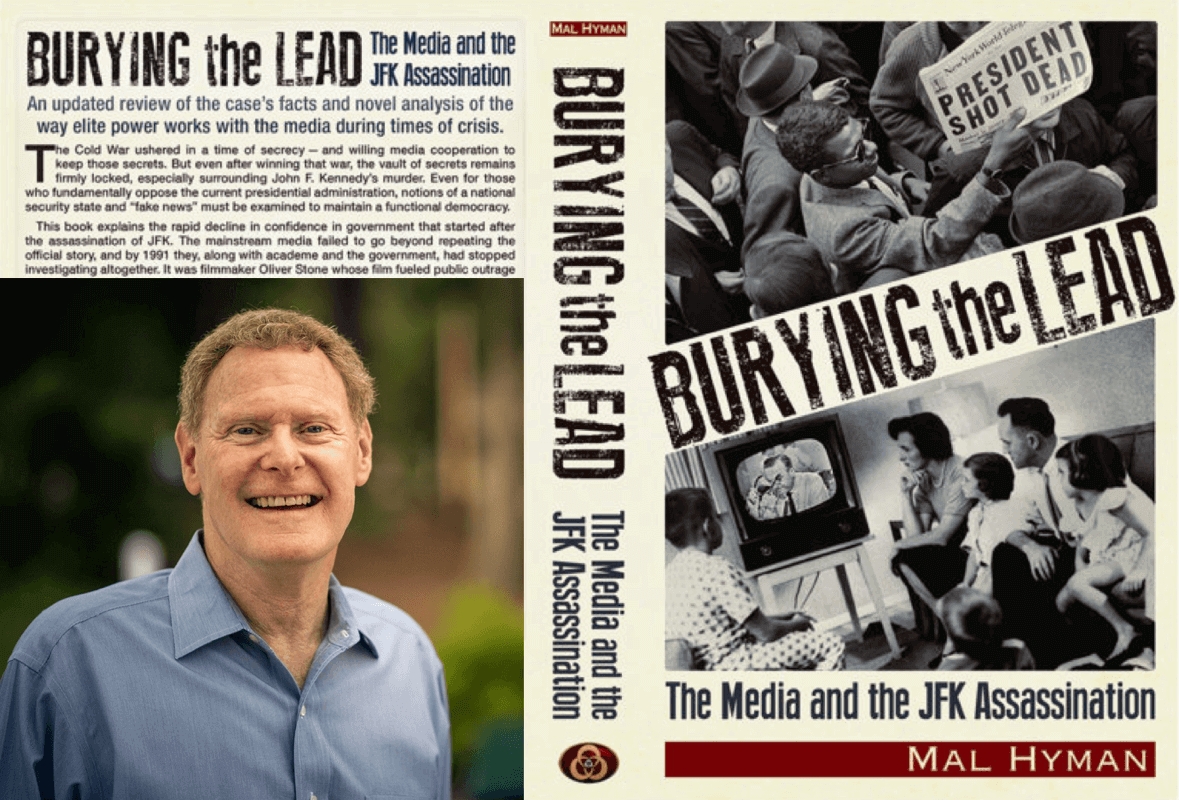
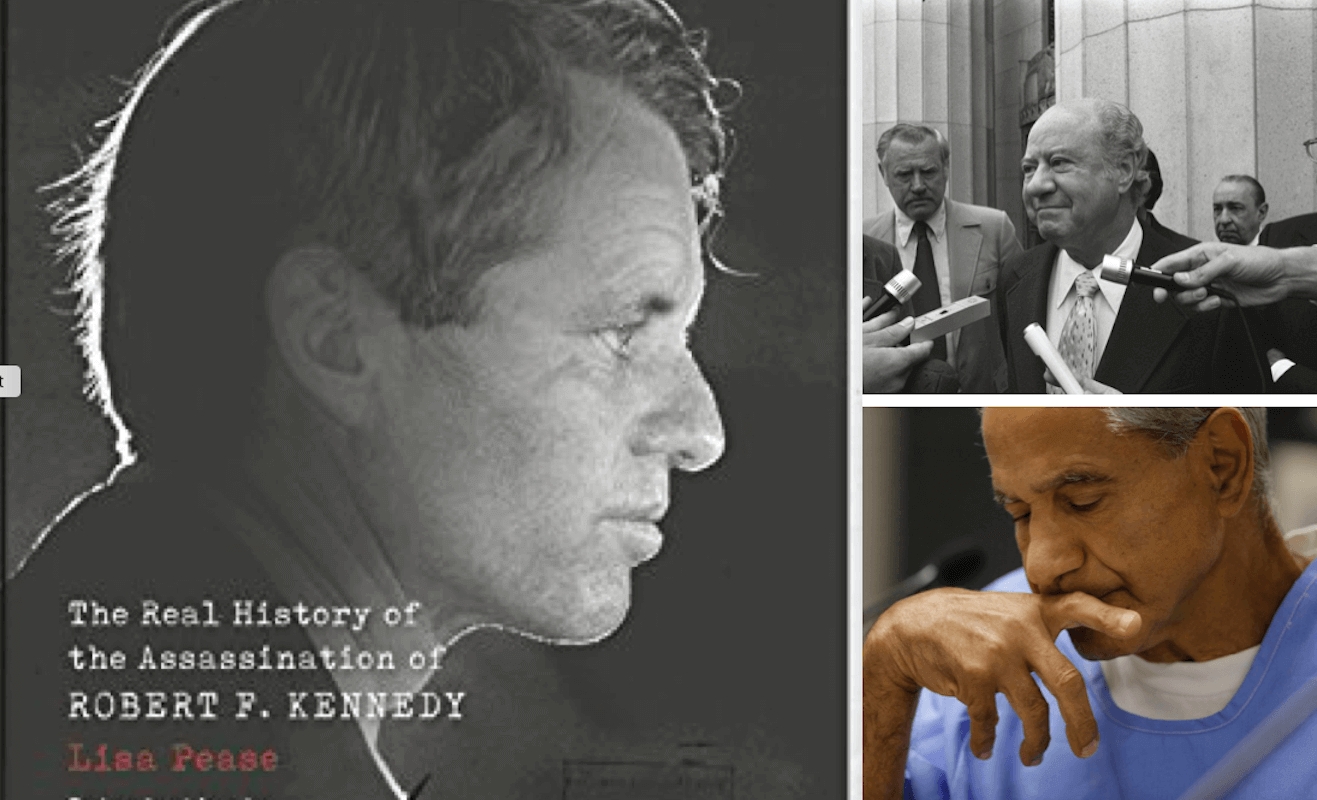
 It’s a rare thing indeed when a book actually delivers everything you could wish for—and then some. I can count on one hand the number of books in recent memory that have achieved this. Incorporating over twenty years of research, personal interviews, deep archival digging, and a comprehensive survey of nearly all the extant literature and articles surrounding Robert Kennedy’s encounter with the unspeakable in the pantry of the Ambassador Hotel on the night of Jun 5, 1968, A Lie too Big to Fail will no doubt stand the test of time as the definitive book on the RFK murder. Pease establishes not only the most compelling case against the LAPD’s compromised (non-)investigation of the case to date, but reveals startling new discoveries, including previously unexplored forensic evidence, new witnesses to multiple shooters, and evidence of foul play at the highest levels of the United States political apparatus.