Author: Michael Le Flem

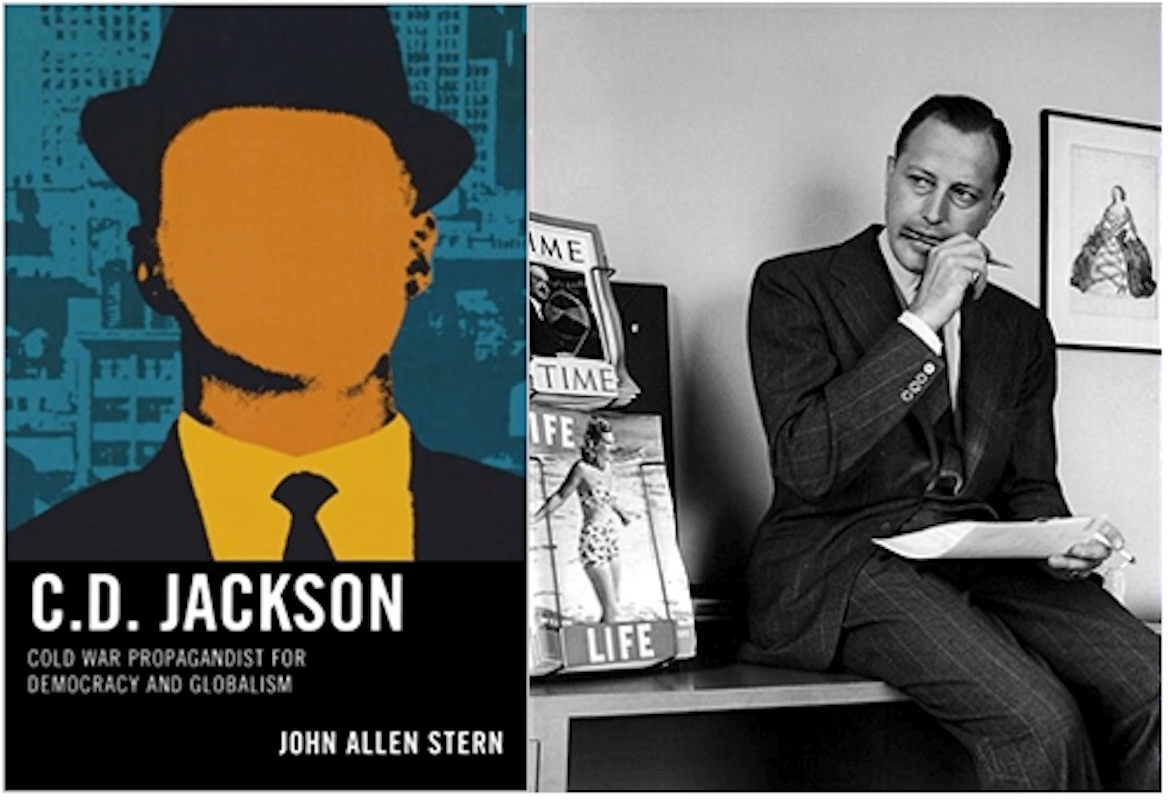
  • John Allen Stern, C.D. Jackson: Cold War Propagandist for Democracy and Globalism

    John Allen Stern, C.D. Jackson: Cold War Propagandist for Democracy and Globalism


    I. “The American Century”

    In this concise and penetrating analysis of a largely forgotten Cold War propagandist and public relations figure, John Allen Stern paints a complex picture of the genesis of the Cold War, capturing not only the singular influence of C.D. Jackson on 1950s American foreign policy, but the broader contradictions of the ideological battle waged against the Soviet Union by the United States.

    As has been exhaustively portrayed in many a book on the Cold War, almost immediately following the cessation of hostilities after the Japanese surrender in August of 1945, the United States found itself alone among the world’s nations in terms of hegemonic potential, nuclear capabilities and industrial might. There exists much debate as to the actual established beginning of the Cold War, and the breaking with Franklin Roosevelt’s more friendly American/Soviet aims. Many have placed the milestone—at least thematically—shortly after Churchill’s famous March of 1946 speech in Fulton, Missouri. There Churchill decried an “Iron Curtain” descending over Europe, a phrase previously used by Nazi Foreign Minister Count Lutz Schwerin von Krosigk a year earlier. Others have pointed to George Kennan’s “Long Telegram,” sent in February, 1946 while he was the U.S. Chargé d’affaires in Moscow as the most tangible departure in U.S. Foreign policy vis-à-vis the Soviet Union for the coming decade.

    In his message to the Secretary of State, Kennan described the CCCP as, “a political force committed fanatically to the belief that with the U.S. there can be no permanent modus vivendi.” His prescription was for “a long-term, patient but firm and vigilant containment of Russian expansive tendencies.” (George Kennan, “Telegraphic Message from Moscow”, 2/22/1946)

    It may be accurate to judge the posture of U.S. policy planners towards the Soviet Union in the wake of World War II as provocative, belligerent, and essentially counter-productive to their purported goal of fostering global stability. But it is worth getting into the minds of those who had just witnessed the apocalyptic horror of an unprecedented total war, the death toll of which exceeded 60 million in only six years. The unlocking and eventual unleashing of the devastating power of atomic weaponry, coupled with the economic and ideological vacuum into which Western Europe descended after the defeat of the Nazis, presented a formidable challenge to even the most sophisticated foreign relations experts. To many, everything west of the Berlin Occupation Zone lay open to communist infiltration, particularly those nations like France with previously strong socialist factions. To others, like C.D. Jackson, the new mantle of global authority gained in the wake of the Second World War presented a unique opportunity for the United States to lead the world on a moral crusade for the hearts and minds of people in beleaguered communist territories. For those who stood at this great juncture in the 20th Century, the Soviet Union loomed like a dark shadow, poised, many felt, to marshal its forces and complete its unfinished conquest of the “free world.”

    Charles Douglas Jackson stepped into this tense scene of early Cold War uncertainty when he accepted his role as special assistant to President Eisenhower. Coming from Life—where he worked alongside Henry Luce, the publisher of this quintessentially American magazine—Jackson brought both his persuasive charm and astute political observations to the job; earning the admiration of many disparate personalities, from the president to the newly appointed director of the Central Intelligence Agency, Allen Dulles. One of the first global flash points on which Jackson cut his teeth was the coup the CIA sponsored against the democratically elected leader of Guatemala, Jacobo Árbenz, in which capacity Jackson quietly aided intelligence planners in the dissemination of disinformation preceding the overthrow. While ostensibly executed as a clandestine removal of a potential communist leader about to fall into Moscow’s waiting hands, an equally compelling financial motive from the board of directors at United Fruit was also responsible for the green-lighting of the caper. It was, after all, Sullivan and Cromwell, a top American law firm that covertly supported the Nazi war machine during WWII, who represented United Fruit. And it was also John Foster Dulles, made partner at the firm during the 1930s, who was Secretary of State under Eisenhower in the summer of 1954 when the plot was unfolding, and his brother Allen, who was Director of the CIA and also a leading board member of the firm.

    Why this familiar incident bears repeating is that throughout his monograph, Stern does an excellent job of exposing this revolving door of mid-century American politics. With a near-monopoly on credibility, magazines like Life were, along with other titans of journalism like the Washington Post and The New York Times, arbiters of truth, and promulgated to a large extent the narratives of what America stood for, what its enemies sought, and how hardworking officials in Washington were vigilantly keeping them safe in their peaceful suburban enclaves. As authors like Carl Bernstein have detailed, Luce was deeply supportive of the CIA. In a 1977 exposé entitled “The CIA and the Media,” he writes, “For many years, Luce’s personal emissary to the CIA was C.D. Jackson, a Time Inc. vice-president who was publisher of Life magazine from 1960 until his death in 1964.” (Rolling Stone, 10/22/1977) It was Life which later bought the rights, within a day of its shooting, to the infamous Zapruder film in November of 1963, and closely guarded it from the public until its eventual leak on Geraldo Rivera’s “Good Night America” show in 1975, deeming it unsuitable for the American psyche. The film—altered or original—shows President Kennedy’s head snapping dramatically back and to the left. Could that possibly have persuaded Luce and his associates in the intel community from releasing it? Honest folks that they were? But I digress.

    What’s also of note is a December 6, 1963 Life article written by Paul Mandel. This extremely telling piece of the cover-up includes statements like, “Oswald was an ex-marine sharpshooter,” and “Oswald had both the time and the ability to zero-in three times.” (Life, 12/6/1963) This is interesting, given that no one—without cheating—has been able to recreate the fantastic feat in the allotted six seconds of the Warren Commission’s official findings. This includes the legendary Carlos Hathcock, a USMC sniper during the Vietnam War who held a world record—later surpassed—for a confirmed kill at 1.4 miles. (James DiEugenio, “The Lost Bullet: Max Holland Gets Lost In Space,” 11/30/2011) When he left the service, Oswald was a poor shot according to his marksmanship performance reviews. Similarly, Mandel states unequivocally that a Clayton E. Wheat Jr., director of the NRA, actually reproduced this shot in a controlled setting for Life. He “fired an identical-make rifle with an identical sight against a moving target over similar ranges for Life last week. He got three hits in 6.2 seconds.” (“The Lost Bullet”) However, as researcher Pat Speer has observed,

    Someone at the (Warren) Commission recalled the claim in the December 6 issue of Life Magazine that Oswald’s purported shots had been duplicated by someone at the NRA, and asked the FBI to look into it. The FBI report forwarded by Hoover is quite damaging to Life’s credibility. While Life claimed the shooter was an official of the NRA, it turned out the shooter had merely been recommended by the NRA. The shooter, Clayton Wheat, moreover, admitted that he’d had 8 or 9 practice shots and had used a 7.35mm Carcano in his tests, not the 6.5 mm Carcano purportedly used by Oswald. He also acknowledged that he’d fired on a moving deer target traveling slowly, 3-5 mph, right to left over 33 feet, and not at a human head and shoulders-sized target traveling 12 mph away on an angle over a distance of 100 feet or so. He also mentioned that that he’d fired at the target from a distance of 150 feet, from approximately 10 degrees above horizontal, as opposed to firing from a distance of 160-265 feet from approximately 22-16 degrees above horizontal for the purported shots on Kennedy from the sniper’s nest. In short, he didn’t reproduce the shots at all.” (Patrick Speer, A New Perspective on the John F. Kennedy Assassination, Vol. 2, p. 22)

    Equally telling is the other blatant lie in Mandel’s piece for Life, which seeks to explain the testimony of a Parkland Hospital doctor who had told investigators that the president’s throat wound was an entrance wound. Mandel claims this was due to Kennedy’s turning and waving at the crowd: “His throat is exposed—to the sniper’s nest—just before he clutches it.” (Life, 12/6/1963) Mandel cites the then-unreleased Zapruder film as proof of this, having personally viewed it. Yet no extant version of the film actually portrays this, raising serious doubt over his conclusion.

    That C.D. Jackson, on behalf of Allen Dulles, also had a CIA asset, Isaac Don Levine, ghostwrite Marina Oswald’s story for Life is equally suspect. (Stern, p. 122) Though the piece was never published, Levine, a member of the Tolstoy Foundation, a CIA-backed anti-communist front organization with ties to C.D. Jackson’s Psychological Strategy Board going back to the 1950s, spent a full week with Marina Oswald immediately before her testimony to the Warren Commission. (George Michael Evica, A Certain Arrogance, p. 225)

    Life’s publisher Henry Luce, a dedicated and vocal anti-communist, was quick to realize the unprecedented historical opportunity afforded America in the wake of the Allied victory in Europe. No serious historian can deny that the Soviet Union, however repressive and internally corrupt it truly was, actually saved Europe from fascism. Yet this was almost never spoken of in the West, and to be honest, rarely is today. During Operation Barbarossa, the German codename for the June, 1941 invasion of the Soviet Union, Hitler sent 180 divisions (nearly 3.8 million men, 3,800 tanks, 5,400 aircraft and 18,000 artillery pieces) on a mission of conquest and racial extermination which ultimately left over 20 million Russians and Ukrainians dead, as opposed to the forty-five German divisions facing the combined British, Free French, Canadian, Australian, New Zealander, and American forces in late 1942.

    Luce and his pal Jackson, like many Americans in the wake of the Second World War, viewed the outcome as something akin to divine providence, and were quick to draft a persuasive narrative of good versus evil, of a benevolent emancipatory American intervention which paved the way for the liberation of Hitler’s Fortress Europe—a narrative which continues to persuade today. There is no denying the tremendous sacrifices of the American forces in their quest to free Europe from the dark bondage of the Nazi regime. My own grandfather, a French Resistance fighter who helped rescue downed Allied pilots, never forgot that striking image of Operation Overlord’s enormous flotilla anchored off his foggy coast. But it was not a singular effort. Hitler officially declared war on the United States on December 11, 1941, four days after the Japanese attacked Pearl Harbor. It was not until November, 1942 that the American expeditionary force touched down in North Africa to begin its actual combat operations against the Afrika Corps led by Erwin Rommel. After a slow and bloody slog across Tunisia, a 1943 invasion of Sicily and subsequent landings on the Italian mainland, a full three years had elapsed from when Soviet troops began fighting for their existence as a people until the D-Day landings in June, 1944. Stalin never forgot this. And, as history would have it, the famous image of American GIs and Soviet troops embracing on the sunny banks of the Elbe river before the Russians stormed Berlin quickly dissolved into the dreaded specter of the Red Menace in the wake of that tragic global conflagration.

    For figures like C.D. Jackson, the arc of the post-war era of the late 1940s and early 1950s represented the unfolding of Luce’s “American Century,” the title of a sensational feature Luce wrote in a February, 1941 issue of Life Magazine. This thematic portrayal and its subsequent economic, strategic and propagandistic initiatives are best summarized by Stern, who explains,

    It entailed economic liberation for the United States through the integration of American business with markets and resources worldwide, for which governmental institutions were to provide the necessary “atmosphere” for expansion. That amounted to the extension abroad of American business interests, long strapped by the backward thinking of many corporate leaders. The American Century would bring as well, political and economic unity between the United States and Western Europe, along with Japan. It promised to raise living standards around the world, especially in Africa, Southeast Asia, the Middle East and Latin America—areas soon to be collectively defined as the “Third World,”—where a wealth of natural resources made them vulnerable targets for communist incursion. Above all, the American Century was to instill among Americans a sense of destiny and mission, a conviction that our way of life was right for the world, and that it was our time to rule. (Stern, p. 25.)


    II. “It’s Not Propaganda if You Tell the Truth”

    Author Stern goes to great lengths to explain the various propaganda methods and delivery systems the United States employed in its quest to combat Soviet encroachment, both in continental Europe and the world over. Citing cases like Radio Free Europe, which C.D. Jackson actually designed and helped run, and lesser-known programs, like the comical anti-communist pamphlets shoved in balloons and floated over the Iron Curtain by the tens of thousands, he does a nice job of detailing the subtler methods of Cold War spy-craft and propaganda, and gives a compelling, if cursory exposition on the intellectual history of Western social manipulation. He states,

    C.D. Jackson and President Eisenhower would answer the bellicose cries of the saber-rattlers with a clarion call of their own. Jackson outlined his “Strategy for Survival” in a rapidly changing and dangerous world: What would win the day, he promised in sermon-like prose to a wide and diverse audience, was propaganda: ‘We had better get used to it, because goodness knows we need it, and just because Dr. Goebbels and the Kremlin have debased it, that is no reason why we cannot elevate it.’ He made palatable the idea of ‘an official propaganda organization’—which, he confessed, many citizens found dishonest and un-American—by comparing it to teaching ‘a word of wonderful meaning.’

    What is striking when one takes in the ramifications of these propaganda programs is the contempt with which many of their theorists viewed the American masses. Harold Lasswell, a longtime friend of political commentator Walter Lippmann, and himself an influential Yale law professor, is quoted in Stern’s book as arguing,We must recognize the ‘ignorance and stupidity (of) … the masses’ and not succumb to democratic dogmatisms about men being the best judges of their own interests.” (Stern, 43) This art of “manufacturing consent,” later critiqued by the likes of Noam Chomsky in an eponymous book, became a fundamental part of American society by the time the Second World War had begun to unfold.

    I should note that Edward Bernays, a cousin of Sigmund Freud, was a pioneer of American propaganda. Yet conspicuously absent from Stern’s book is a discussion of the Committee on Public Information, or “Creel Commission,” which arguably was the true genesis of full-blown American war propaganda. It employed Bernays, along with George Creel, Carl Byoir and others to sell the First World War to an isolationist general population. Though he touches on the earlier role Bernays played in Calvin Coolidge’s presidency during the mid 1920s, it’s odd that given his otherwise excellent monograph, this important propaganda think-tank, which lasted from 1917 to 1919, is not mentioned. Indeed, Josef Goebbels, the Nazi Propaganda Minister, often cited Bernays as the greatest influence in shaping his own policies in Germany, and Adolf Hitler was a great admirer of him as well, even citing the Committee on Public Information as a template for his own efforts. (Dan Nimmo and Chevelle Newsome, Political Commentators in the United States in the 20th Century: A Bio Critical Sourcebook, p. 66)

    It would also have been nice if Stern had mentioned how Hitler glossed the cover of Henry Luce’s Time Magazine in 1938 in full regalia as “Man of the Year,”; or how the Führer had actually hired New York advertising agency Carl Byoir & Associates in 1933—the same Carl Byoir of Creel Commission notoriety—to actively promote “positive images” of the Third Reich. (The Observer, 12/22/2014). These collusive links between the purported bastion of democracy in the free world, the United States of America, and one of the most violent and destructive regimes in human history, remains a curious gap in Stern’s story, and are a necessary window into comprehending the Soviet Union’s very real fear of a re-armed Germany in the wake of the Second World War.


    III. “The Hidden Hand”

    What Stern does an exceptional job of showcasing is the impasse at which more nuanced thinkers found themselves when confronted with die-hard cold warriors like the Dulles Brothers and certain members of the Joint Chiefs of Staff. An especially telling episode from 1953 is one in which a young Tom Braden, fresh out of the CIA academy, overhears Walter Bedell-Smith, now undersecretary of State, on a McCarthyist tirade regarding a new appointment to the U.S. Information Program, one of the departments of the wider public relations umbrella network described in Stern’s book. Braden recalled, “I remember walking into Allen Dulles’ office one day soon after I joined the CIA, and I could hear “Beetle” Smith, whose office door adjoined the Director’s, roaring out from beyond his front door: ‘They got that goddamned communist Nelson Rockefeller running psychological warfare.’ I went into Allen’s office and said I don’t want to work here anymore. I don’t want anything to do with this.” (Stern, p. 110).

    For figures like Jackson, who by no means sought neutralism or appeasement with the Eastern Bloc, there existed a kind of middle ground. Stern does a fine job of showing the small ways in which people like him served as a necessary buffer to the brinkmanship of the war-hawks. As he notes,

    Whereas Jackson wanted to quietly capture the loyalties of the non-aligned nations and make inroads into the Eastern Bloc, as well as strengthen our position with England and France—both of whom recognized the inherent emptiness of communist dialectics and the military threat posed by Russia, but accepted coexistence and especially trade with the Soviet States—(John Foster) Dulles opted for outright coercion and applied bullying tactics.” (Stern, p. 101)


    Time and time again this story has been repeated, and Stern’s book is a necessary primer for the arm-twisting the intelligence apparatus would employ on JFK during his brief tenure as president. What is both interesting and arguably under-reported in the scholarship, is how even a former Supreme Commander of Allied Forces in Europe like Dwight Eisenhower was feeling the pressure of his newly-formed intelligence and propaganda machine.

    As Stern notes, in 1956 the CIA had urged the president to parachute weapons and supplies to the disillusioned Hungarian protesters who had taken to the streets in open rebellion against the Soviet Union. This rebellion was largely due to Western propaganda imperatives broadcast over Radio Free Europe. When he refused, many members of the intelligence community saw only weakness, not Eisenhower’s real concerns over provoking a potential nuclear exchange between the superpowers. (Stern, pp. 3-4) Also interesting to note—and the author does—is how the figures the United States had selected to lead the failed Hungarian uprising were largely former members of the fascist Arrow Cross Party. Arrow Cross had been instrumental in WWII in aiding the Nazis’ Jewish extermination program in Hungary after the Germans captured and deposed the Hungarian Regent, Miklós Horthy, through a daring commando operation led by SS Major Otto Skorzeny. Stern argues, “In contrast, Jewish refugees from the uprising told the French Press that, ‘Soviet soldiers had saved their lives.’” (p. 4) And thus in the first chapter of the book, we see the contradictions and moral hazards inherent in the intelligence and propaganda communities’ Realpolitik approach to communism, a theme that would continue to generate blowback and further tarnish the image of the United States in the decades to come.

    While Eisenhower fully supported the CIA’s overthrows of both Mossadeq in Iran and Árbenz in Guatemala, he seemed fearful enough of a final apocalyptic showdown with the Soviet Union to pursue a watered down form of détente. And it was C.D. Jackson himself who wrote the president’s iconic “Atoms for Peace” address to the UN General Assembly in 1953. This rhetorically moving—if somewhat disingenuous—speech deserves reading, as the language is quite revealing in terms of Jackson’s power to persuade:

    … for me to say that the defense capabilities of the United States are such that they could inflict terrible losses upon an aggressor—for me to say that the retaliation capabilities of the United States are so great that such an aggressor’s land would be laid waste—all this, while fact, is not the true expression of the purpose and the hope of the United States. To pause there would be to confirm the hopeless finality of a belief that two atomic colossi are doomed malevolently to eye each other indefinitely across a trembling world. To stop there would be to accept helplessly the probability of civilization destroyed—the annihilation of the irreplaceable heritage of mankind handed down to us generation from generation—and the condemnation of mankind to begin all over again the age-old struggle upward from savagery toward decency, and right, and justice. Surely no sane member of the human race could discover victory in such desolation. Could anyone wish his name to be coupled by history with such human degradation and destruction?

    Eisenhower continues:

    We never have, and never will, propose or suggest that the Soviet Union surrender what rightly belongs to it. We will never say that the peoples of the USSR are an enemy with whom we have no desire ever to deal or mingle in friendly and fruitful relationship. On the contrary, we hope that this coming conference may initiate a relationship with the Soviet Union which will eventually bring about a freer mingling of the peoples of the East and of the West—the one sure, human way of developing the understanding required for confident and peaceful relations. Instead of the discontent which is now settling upon Eastern Germany, occupied Austria and the countries of Eastern Europe, we seek a harmonious family of free European nations, with none a threat to the other, and least of all a threat to the peoples of the USSR. (Dwight D. Eisenhower, “Atoms for Peace,” 12/8/1953)


    How much of this was purely stagecraft is debatable, and as Stern notes, many within the CIA, like Tom Braden, felt it was likely a ploy to ensure the United States remained dominant in terms of nuclear first-strike capability, and served to alleviate growing tensions with Western allies in Europe who feared a Third World War extinction event. This constant shadow play, both within the U.S. foreign policy circles and in the diplomatic tensions between the United States and the Soviet Union, are a highlight of the book. As Stern reveals, it is never really clear just where even moderates like Jackson ultimately stand within this dynamic. To be clear, this is fine contribution to scholarship, for too often a monolithic Eastern Bloc is juxtaposed against a Red-baiting West in conventional narratives of the Cold War, with figures like Jackson either relegated to tertiary roles in the grand scheme of things or altogether excluded. Even sinister figures like Allen Dulles are shown in their rare finer moments, including Stern’s vignette where Senator Joe McCarthy, the towering figure of anti-communism, responsible for the nationwide purges of purported Soviet sympathizers, is attempting to fire none other than the CIA’s own Deputy Director of Intelligence, William Bundy. His crime: contributing $400 to the Alger Hiss Defense Fund.

    Braden was in Dulles’ office one day with William Bundy, and the Director told Bundy, ‘get out of here and I’ll deal with it.’ Dulles then went directly to Eisenhower and said, in Braden’s words, he wasn’t going to ‘fuck about with this mess from Wisconsin.’ Dulles bluntly told the president ‘he would resign unless McCarthy’s attacks were stopped.’ (Stern, 99)


    IV. Ignorance is Strength

    The late American political theorist Sheldon Wolin once described the United States as an “inverted totalitarian” society. By this he contrasts its more subtle and sophisticated methods of coercion and control with the more overt and brute-force tactics seen in places like the former Soviet Union. In his prescient book Democracy Incorporated, Wolin argues,

    Antidemocracy (sic), executive predominance, and elite rule are basic elements of inverted totalitarianism. Antidemocracy does not take the form of overt attacks upon the idea of government by the people. Instead, politically it means encouraging what I have earlier dubbed ‘civil demobilization,’ conditioning an electorate to being aroused for a brief spell, controlling its attention span, and then encouraging distraction or apathy.” (Sheldon Wolin, Democracy Incorporated: Managed Democracy and the Specter of Inverted Totalitarianism, 2008, p. 239å)

    Figures like C.D. Jackson, Bernays, and Luce all served this function of the state. Stern presents a fine account of precisely how this was accomplished in mid-century America, one largely unbeknownst to the general public. With dramatically fewer outlets—no internet, for one—from which to gather a comprehensive and serious view of current events, the average American in the 1950s and early 1960s was largely dependent on what these back-channel propaganda handlers were manufacturing. Though a few independent investigative outfits like Ramparts managed to get some of the less-than-savory episodes in American foreign and domestic policies out into the world, their circulation was dwarfed by the essentially monolithic mainstream print and television media.

    What truly struck me about Stern’s book was the timeliness of its publication. As we gear up for another year of the media’s predictable fear mongering— e.g., “Russia hacked the election,” “Putin murders journalists,” “Russia has weaponized Pokemon Go” (an actual CNN headline)—it’s good to have a source like this book to connect the dots. What’s fascinating is how in the epilogue, written in 2012, he notes that, with the Soviet Union gone and Russia now no longer a threat to the West, our bogeyman has become Islamic fundamentalism. Which, of course, is true; even with the alleged murder and burial at sea of Osama Bin Laden the United States is still mired in a never-ending multiple-theater “war on terror.” But how curious that even six years ago no one in America, at least not seriously, was talking about a renewed Cold War with Russia. Certainly not your average person or generally circulated periodical. And yet just last year, in an October 2017 issue, The Economist ran a sensational cover story entitled, “A Tsar is Born: As the world marks the centenary of the October Revolution, Russia is once again under the rule of the tsar.” Vladimir Putin is featured in an artistic rendering in full 19th– Century Imperial Russian military dress: in place of his bar of ribbons we find a rectangular image of a prisoner’s hands gripping a prison cell’s iron bars, under which hangs a red sickle and hammer medal. That this iconic image symbolizes the ideological opposite of their “tsar” portrait is never explained. But that’s not the point. The point is he’s a tsar, okay? Tsar = bad. Now go watch football and check your Facebook feeds folks. It would make Edward Bernays proud.

    Silly headlines like this serve as reminders of the entrenched philosophical notion of what the 19th-century Prussian philosopher G.W. Hegel once called “negative identity,” or defining yourself by that to which you stand opposed. And CD Jackson: Cold War Propagandist for Democracy and Globalism is a painful reminder of this pernicious attitude that continues to saturate both our government and media. The insights gleaned from this short text are a truly valuable addition for U.S. historians and those interested in the creation and dissemination of propaganda in a professedly free and democratic society. To these ends, Stern succeeds in showing how one forgotten figure of the past played his hand at shaping the landscape of U.S.-Soviet relations behind the scenes.

    While it would have been nice to know more about Jackson the human being—he serves more as a cryptic cipher around which is spun an investigative exposition on the Cold War propaganda apparatus—perhaps that was exactly the author’s intent, despite the fact that the title of the book would suggest a more biographical approach to the reader. Similarly, the subject would seem to lend itself better to a more chronological narration of how the psychological warfare departments and shell companies rolled out during the Cold War evolved, with planners learning from past successes and mistakes and adapting to the exigencies of the time. The book is, in fact, strangely disjointed in its organization, and Jackson himself is curiously quoted only a few times in the body of primary source evidence the author cites. Perhaps, as Stern mentions in his introduction, this owes itself to the relative scarcity of information on him. But the omission does weaken what ostensibly is a case study of this person’s life and times.

    In conclusion, however, I must say that C.D. Jackson: Cold War Propagandist for Democracy and Globalism was a pleasure to read, and I highly recommend it to anyone wishing to fill in the gaps in Cold War historiography.
  • The Enemy Within: The Rise and Fall of the Alliance for Progress

    The Enemy Within: The Rise and Fall of the Alliance for Progress


    with Jim DiEugenio


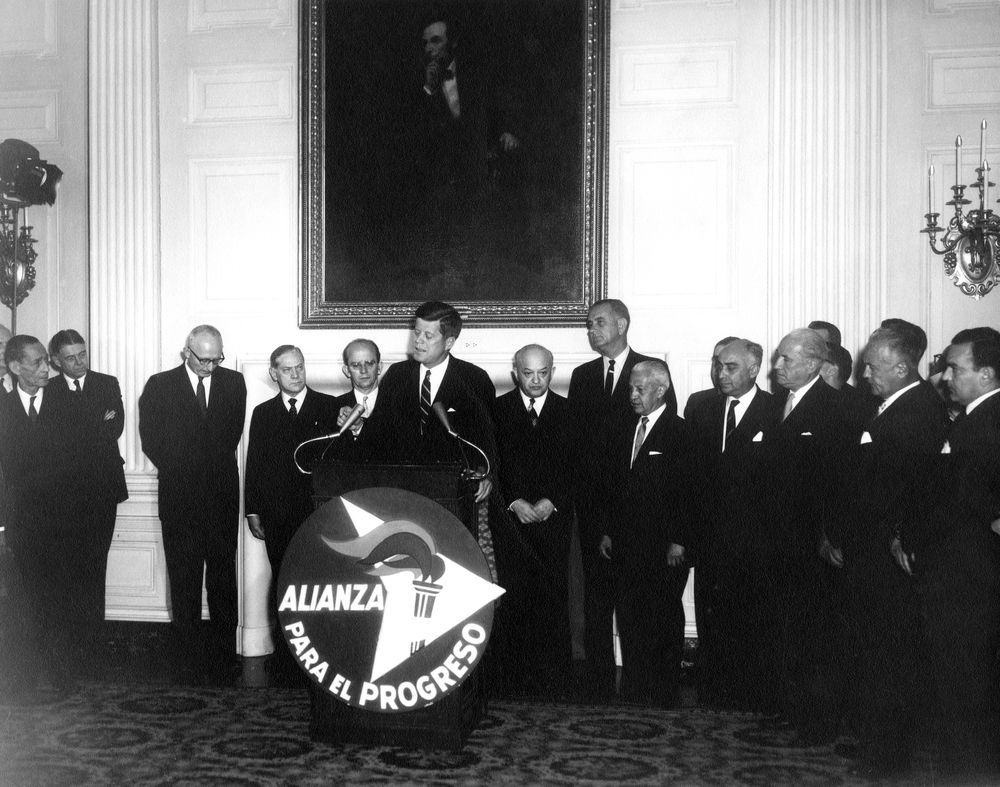
    In March of 1961, President Kennedy gave a moving address at a White House reception for members of Congress and the Diplomatic Corps of Latin America in which he detailed his bold vision for a progressive South and Central American future:

    We propose to complete the revolution of the Americas, to build a hemisphere where all men can hope for a suitable standard of living and all can live out their lives in dignity and in freedom. To achieve this goal political freedom must accompany material progress … Let us once again transform the American Continent into a vast crucible of revolutionary ideas and efforts, a tribute to the power of the creative energies of free men and women, an example to all the world that liberty and progress walk hand in hand. Let us once again awaken our American revolution until it guides the struggles of people everywhere­ –– not with an imperialism of force or fear but the rule of courage and freedom and hope for the future of man.

    To many, the Alliance for Progress—as the ten-year, $20 billion dollar foreign aid program for Latin America was known—was a necessary, if somewhat controversial move on the United States’ part to quell social upheavals in developing nations. Some felt that the inherent instability of post-colonial Latin America would inevitably lead to the continent’s adoption of communism, that omnipresent Cold War specter largely deployed as a bogey-man for the continuance of U.S. imperialism and intervention, whose very real atrocities in Europe were, by default, exported to the wider world to justify almost every post-war intervention by the United States military-industrial apparatus. While the Soviet Union was far from the ideal society outlined by its founding members after the Russian Revolution of 1917—not to mention the absolutely shocking treatment of its citizens during and after World War II—its international ambitions were far from inevitable. And certainly not always as sinister as U.S. foreign-policy planners insisted, particularly in the Khrushchev era, into which President Kennedy stepped after winning the 1960 election.

    A few key ideological underpinnings of those American policy makers in power during the 1950s and early 1960s must be mentioned. These include, but are not limited to, a myopic paternalism towards non-white governments in the developing world; an irrational, reactive fear of anything resembling socialism or neutralism; and a steadfast belief in allying with the greater of two evils, namely a pro-U.S. dictator over an independent, “potentially communist” official interested in his own country’s well-being. It was in this context that the spymasters at the Central Intelligence Agency, and their friends on the board of United Fruit Company, cooked up Operation PBSUCCESS, the half-baked 1954 overthrow of the democratically elected leader of Guatemala, Jacobo Árbenz. This plot, hatched from Washington by the likes of Allen Dulles and Walter Bedell Smith, to name but two, was intended to redeem the exploitative profits of the United Fruit Company’s banana farms—which Árbenz asked to be fairly taxed and repurposed for general occupancy by the poor—and to destroy any possibility of his land and tax reforms from going “communist.”

    Árbenz himself had no ties to Moscow, was only trying to reverse the decades of dictatorial excess plaguing his nation from its previous rulers, and noted that there wasn’t even a Russian embassy in Guatemala. In the climate of mid-century McCarthyism, it wasn’t a hard sell to discredit Arbenz’ regime.

    In the congressional debate from June of 1954, just weeks before the coming overthrow, both Lyndon Johnson and his fellow Texan, representative Jack Brooks, were staunchly pushing for intervention on Capitol Hill. Eerily echoing rhetoric used to justify the later U.S. support of the Nicaraguan Contras, Congressman Brooks argued, “A communist-dominated government in Guatemala is only 700 miles from Texas—only 960 miles, or a few hours’ bomber time, from the refiners, the chemical plants, and the homes of my own Second District in Texas.” (Congressional Record, Senate, 25 June 1954, pp. 8922-8926) In 1986, Ronald Reagan emphatically reminded those in attendance in his Cabinet Room that if the counter-revolutionaries he was funding through his illegal arms deal with Iran failed, it would create “a privileged sanctuary for terrorists and subversives just two days’ driving time from Harlingen, Texas” (Ronald Reagan, “Remarks at a White House Meeting for Supporters of United States Assistance for the Nicaraguan Democratic Resistance”).

    One of the only opposing voices to the Brooks tirade, Senator William Langer of North Dakota, was largely ignored, and did not even receive comments after his views were expressed. He noted:

    I do not believe that the Members of the Senate have been adequately informed as yet as to what is going on in Guatemala. We have had inadequate time to consider such a major declaration on foreign policy. Is there a foreign invasion of Guatemala, or is there a civil war? …. Of course we are opposed to external interference with the affairs of any nation, especially so with regard to our sister republics of Latin America. But even more, we will, or we ought to be, committed to the principle that every sovereign nation has a right to determine for itself its own form of government. (Congressional Record, Senate, 28 June 1954, pp. 9065-9066.)

    In the end, none of this mattered. And the story, which has been covered in exhaustive and painful detail by the likes of Nick Cullather in Secret History and William Blum in Killing Hope, is well known. Both psychological and direct warfare were employed to achieve their dramatic effect: Miami-based anti-Árbenz radio broadcasts, leaflets dropped by B-26 bombers, and vicious strafings of the harbor’s oil reserve tanks and the city’s capital buildings combined to spread chaos and terror. Renegade pilot Jerry DeLarm and a former Flying Tiger named Whiting Willauer, whose P-47s buzzed Guatemala City, bristling with eight .50 caliber machine guns, searched the city for anything that moved, scattering citizens and forcing Árbenz to steal away to his headquarters with his security detail. The implied threat of a full-blown United States Marine Corps landing eventually forced Árbenz to concede. Days later, fearing for his life in his presidential suite, he appeared on a nightly radio broadcast and announced his reluctant resignation: “Workers, peasants, patriots! Guatemala is going through a hard trial. A cruel war against Guatemala has been unleashed. The United Fruit Company and U.S. monopolies, together with U.S. ruling circles are responsible. Mercenaries have unleashed fire and death, respecting nothing.” (FOIA Guatemala 0000920952 U 3 May 1, 1954)

    Following this, he fled the capital with his remaining loyal staff members and sought refuge in a nearby Mexican embassy. Team members of the coup went so far as to plant Marxist literature in his personal bookshelf. And they left behind a crate of Soviet weapons and ammunition, which was quietly discredited by the international media because of their sloppy work, though Time Magazine predictably parroted the CIA’s disinformation. It has also come to light that on June 3, 1954, just weeks before the coup, Allen Dulles privately ordered Arthur Hays Sulzberger, the publisher of the New York Times, to keep his foreign journalists out of Guatemala. After attempting to convince him that one of his best reporters, Sydney Gruson, was a communist who could not be trusted to provide an accurate picture of the unfolding political situation, Dulles demanded he be prevented from flying to Guatemala City to cover the events. Eventually, Sulzberger conceded: ‘‘I telephoned Allen Dulles and told him that we would comply with their suggestion.” (NY Times, 6/7/1997) It should be noted that Gruson eventually became an executive of the Times, and later a director and vice chairman. He retired from the paper in 1987 and went into investment banking. This was Allen Dulles’ idea of a communist. (NY Times, 3/9/1998)


    II

    In the wake of Árbenz’ removal, and the subsequent removal of Colonel Díaz, who was Árbenz’s final supporter and was in power all of one day, the brutal and corrupt former chief of Guatemalan police, Carlos Castillo Armas arrived. He had been leading a 150-man CIA-funded and trained band of guerillas through the jungles of Honduras on this way to the capital during the air raids. After a brief discussion with Col. Monzon—who had become the third leader of Guatemala in as many days—Armas came to power. He immediately ordered the arrests of all former high-ranking Árbenz supporters. That list of supporters came from John Peurifoy, the U.S. Ambassador the CIA had placed on site before the coup. Over the next few months, he then sent death squads roaming into the countryside, killing thousands of landless peasants and blaming the murders on Árbenz, going so far as to immediately publish a picture book of the mass graves called Genocidio sobre Guatemala, a disturbing Alice in Wonderland revision of history I don’t recommend reading. Within the first few months, over 72,000 people were arrested and detained without trial for alleged ties to communism.

    In the United States, Castillo-Armas was invited by President Eisenhower to a gold-star dinner reception and given a ceremonial party of the highest order. Their man in Guatemala had been installed, and another threat to world stability had been removed. Days after the coup, U.S. Secretary of State John Foster Dulles established the official lie in a United States television and radio broadcast, “Led by Colonel Castillo-Armas, patriots arose in Guatemala to challenge the communist leadership—and to change it. Thus the situation is being cured by the Guatemalans themselves.” (Jonathan Fried, Guatemala in Rebellion:Unfinished History, Grove Press, 1983, pp.77-79). The truth was that, had it not been for United Fruit and the CIA, Árbenz would not have been overthrown. Castillo-Armas was simply an appendage manufactured by Washington.

    Árbenz’s daughter committed suicide years later, citing the coup and their uncertain wanderings in exile as her source of depression. Her father died in 1971, an alcoholic by then, in a strange bathtub accident in Mexico City; aides forced their way into his hotel bathroom when they noted steam coming from under the door sill. He was found face down in scalding water. Towards the end of his life he actually did join the Communist Party, since he believed the Soviet Union was the only bulwark against Western imperialism, a trajectory later taken by Fidel Castro after the Cuban revolution, and after multiple attempts had been made on his life by the CIA and its Cuban exile mercenaries, and the implications of the Operation Mongoose terror campaign sank in.

    It was nearly forty years later that the death squads, random political kidnappings, and utter chaos of the overthrow and its aftermath finally abated. Nearly 200,000 Guatemalans were killed in the wake of PBSUCCESS. The nation has never fully recovered from the coup. It not only served to harden the hearts of those with any inkling that the United States was their friend, but fundamentally radicalized figures like Ernesto “Che” Guevara, who himself was in Guatemala City during the coup, and who witnessed the betrayal by the purported beacon of democracy in the free world.

    In a way, PBSUCCESS, along with the overthrow of Mohammad Mosaddegh in Iran only a year earlier, was the template that would be repeated throughout the Cold War: plausible deniability, the co-opting of corrupt insiders seeking power or revenge, crates of weapons and cash, and voilà: peace. Only the total opposite resulted, as both Shah Reza Pahlavi in Iran (1953) and Carlos Castillo Armas in Guatemala (1954) displayed unusual violence once they came to power, essentially condemning their populations to lives of abject misery and despair during their reigns, forever terrified of being tortured and imprisoned by the nations’ respective secret police forces and their embedded CIA handlers and trainers. This was largely lost on policy planners, removed as they were from the scenes of their crimes. Life went on in Georgetown and at CIA headquarters. Figures like E. Howard Hunt and Allen Dulles went on puffing their wooden pipes in their plush, book-lined studies, carefully reading foreign cables and memoranda, dutifully planning the next overthrow, the next dictator to be installed, the next assassination. As E. Howard Hunt’s son observed in a 2007 interview, when he asked his father about the deaths of all those Guatemalans following PBSUCCESS, he said, surprised, “Deaths? What deaths?” (Rolling Stone, 4/5/2007)


    III

    It is in this context that President Kennedy’s struggle to reconcile with the intelligence agencies was born. When he took the oath of office, he had unknowingly filled an essentially compromised position of statesmanship, whose real power lay not in the democratic or executive processes, but in shadowy, essentially rogue organizations like the Central Intelligence Agency, and to a lesser extent, Hoover’s FBI, who at the time were more concerned with subverting peaceful demonstrations domestically and wiretapping elected officials for personal exploitation than with solving major crimes. Indeed, Hoover was in something of a double bind himself, as James Angleton, the CIA’s Chief of Counter-Intelligence, allegedly possessed an incriminating photo of Hoover having sex with his Deputy Director Clyde Tolson, a telling accusation given Hoover’s unusually bitter hatred of homosexuals. (Lisa Pease, Probe, Vol. 7 No. 5., 2000)

    Philip K. Dick’s The Man in The High Castle is a counterfactual scenario in which the Axis forces won World War II. There it is detailed how a triumphant Nazi Germany secretly plotted to undermine their ostensible Japanese ally while fulfilling their commitment to the Final Solution. While this thankfully never took place, what is remarkable about the postwar period is the amount of actual influence these Nazi forces continued to have on Western policy in the wake of their military defeat, and how, in many ways their members shaped the creation of the CIA. Consider for a moment the fact that the OSS, and later the CIA, almost entirely relied on former Nazis to provide intelligence on all Soviet activity in Europe immediately after the war. That Germany had pledged a war of racial extermination against the Russian people only a few years earlier apparently didn’t factor into American officials’ interpretation of their Nazi agents’ reports on Soviet activity and its relative threat to the West. Reinhard Gehlen, a former SS Major General who ran this “Gehlen Organization” which later became West Germany’s Bundesnachrichtendienst (Federal Intelligence Service), was personal friends with Allen Dulles, who exchanged letters with him years after he was acquitted of war crimes and put on the U.S. payroll to establish his spy network. One letter, from April 1957 begins, “May I extend to you my heartiest and most sincere wishes for your birthday and wish you health and continuing success for your responsible task during the next years of your life. I would like to take this opportunity to enclose my kindest thanks for your cordial hospitality my co-workers and I enjoyed during our stay over there.”

    This should come as little surprise, given Allen Dulles’ own dealings with the Nazis during the war in which his own country was trying bitterly to defeat Hitler, at great loss of life and materiel. Sullivan and Cromwell, the law firm of which John Foster Dulles was managing partner, was instrumental in keeping I. G. Farben, Krupp, and other Nazi industries in business during the ostensible embargo and trading freeze imposed by the United States during World War II. Mirroring their dual powers as Secretary of State and Director of Central Intelligence in the 1950s, John and Allen respectively tested their powers when Allen was OSS station chief of Berne, Switzerland in 1942, and Foster was running his law firm in New York. As David Talbot noted in a recent interview:

    In one case a German industrialist had seen Auschwitz being built and had heard what they were going to be using it for. He slipped across the border with this eyewitness account and Dulles basically did nothing with this to make this an urgent priority of the Roosevelt administration. He was not concerned about the Jews’ fate. He was more concerned about his clients, his German clients: making sure their assets would be carefully hidden and that Germany would emerge from the war defeated but a strong bulwark against the Soviet Union, whom he always regarded as the true enemy. (Reader Supported News, 10/20/2015)

    This historical backdrop is crucial to understanding the future conflation, in the 1950s and 60s, of communism with nationalistic independence movements in the developing world. For it was people like the Dulles brothers and their colleagues who would convince President Truman to create the CIA, under much pressure, and through the presentation of the Red menace as gleaned from the not-entirely-objective Gehlen Group and their Nazi members who were enjoying U.S. salaries and protection. Indeed, not only was Gehlen protected, but also Wernher von Braun, who handpicked Jewish slaves for use at his Peenemünde Mittelwerk rocket facility during the war; von Braun subsequently became the leading scientist for the U.S. space program, going so far as to design the boosters that put the first American astronauts on the moon. Similarly, while seemingly random Nazis were tried and executed at Nuremberg, those with truly useful knowledge in the eyes of U.S. foreign policy officials were conveniently released on strange case-by-case dismissals. Otto Skorzeny, who rescued Mussolini from the Gran Sasso hotel with his elite glider-borne troops, was never convicted of war-crimes, despite being Hitler’s personal bodyguard and despite his equipping SS commandos with captured U.S. uniforms and weapons to sow discord during the Battle of the Bulge. Incredibly, it was three SS soldiers masquerading as U.S. military police officers that broke him out of Darmstadt prison while he awaited his verdict. Maintaining it was always the United States that aided his escape, he quickly found new work after the war from the highest bidders. These included the fascist government of Peron’s Argentina, Franco’s Spain, Israel, and even the United States, which denies ever dealing with him, but whom Skorzeny, in a brief interview, claims hired him to remove Castro. This is actually supported by the CIA’s own records. In a memo from August of 1966, they noted,

    Otto Skorzeny, the former SS Colonel who rescued Mussolini, planned to kidnap Fidel Castro and take him to an undisclosed place, according to a feature article in the Sunday supplement to La Cronica published in Lima, Peru on August 7, 1966. The article says that the plan, known as “Project Tropical,” having the approval of Allen Dulles, head of CIA, was to have been carried out in 1961 but was vetoed by President Kennedy. (FOIA3B3: “Otto Skorzeny Planned to Kidnap Fidel Castro.”)

    In many ways, to figures in the American intelligence agencies, President Kennedy represented a radical departure from previous administrations. For instance, he favored figures like Indonesia’s Sukarno, and Patrice Lumumba in the Congo, both nationalists seeking financial and political independence from Western colonial and industrial policies. Therefore, in the eyes of those who championed the Dulles brothers, he was a traitor. That the CIA tried to overthrow Sukarno and actively participated in the successful assassination of Lumumba did not escape his attention, and from almost the first few months of his term, Kennedy came to discover the truly sinister machinations of an agency which ostensibly existed to gather intelligence against foreign threats, but which in reality had become a well-oiled coup d’état and assassination machine. Hoping that he would carry the torch from the Eisenhower administration’s support of overthrows against developing nations, policy planners in the CIA and other agencies were sorely disappointed by his rhetoric and actions in the face of defiant, outspoken liberation leaders, who they were quick to subsume under the communist umbrella which they saw unfolding across the world in their Manichean ideology of the post-McCarthy era. Kennedy stated in his March 1961 address outlining the Alliance for Progress words which, in the eyes of planners like Dulles, seemed reminiscent of the Kremlin: “We call for social change by free men, change in the spirit of Washington and Jefferson, of Bolivar and San Martin—not change which seeks to impose on men tyrannies which we cast out a century and a half ago. Our motto is what it has always been—progress yes, tyranny no—progreso sí, tiranía no!”


    IV

    As a number of authors—like Richard Mahoney—have shown, unlike Eisenhower, Kennedy understood the evils that colonialism and imperialism had wrought in the Third World. He also understood that the regimes that had been set up in the second Age of Colonialism were beginning to break apart during the fifties. A good example of this was his landmark 1957 speech in the Senate assailing France’s colonial war to maintain its regime in Algeria. In that speech Kennedy specifically targeted American aid to France to fight its imperial war against the Algerian natives. Because of that famous speech, he subsequently became the man to see in Washington for visiting African dignitaries.

    In early 1961, Kennedy had sent Arthur Schlesinger on a tour of Latin America. (Schlesinger, A Thousand Days, pp. 175-185) Schlesinger had a strong interest in the area since he had studied Franklin Roosevelt’s Good Neighbor Policy. He admired the aim but felt it was limited as it emphasized the diplomatic and legal dimensions of American aid. Its only economic aspect was the Export-Import Bank. Later on, the International Monetary Fund (IMF) also entered the picture. But as Schlesinger quickly grasped, the terms placed on loans from the IMF demanded too many restrictive measures, like deflation, which resulted in higher unemployment and reduced per capita income.

    The solution, as far as the Eisenhower/Nixon administration was concerned, was to supply mostly military aid—and then let private companies invest in these Latin American countries in hopes of creating economic development through foreign investment. The problem with this was that the IMF and Export-Import Bank would usually make loans only to nations that had what they considered stable governments. As Schlesinger pointed out, this usually meant right-wing governments. It was this kind of thinking that sent Vice President Nixon to Havana to praise the “competence and stability” of the completely corrupt Batista regime. (Schlesinger, p. 174) These debilitating IMF programs, as well as other private American loans, were well described in John Perkins’ 2004 book Confessions of an Economic Hit Man. There, Perkins observed that far too high a ratio of the loan packages ended up aiding the plutocracy that was already in power.

    As Schlesinger acutely observed, this paradigm ignored how the United States had actually developed as a business and commercial power. Congress had made very large investments in transportation and infrastructure, e.g., canals, highways, and railroads. Congress had also granted large amounts of property to states to create land grant colleges, many of which specialized in agricultural education. The federal government also encouraged the settling of the frontier through what were essentially land giveaways in states like Oklahoma. Therefore, historian Schlesinger concluded, the Eisenhower/Nixon model contradicted the American model. At the same time, the model was inadequate to the needs of these many developing countries. Or as one Latin American leader told Schlesinger, “The United States has given me just enough rope to hang myself.” (Schlesinger, p. 182) It therefore encouraged the image of America as an imperial power from the north. And it also gave an appeal to communists like Fidel Castro. As another leader told Kennedy’s representative:

    There is much poverty in my country. The communists have made themselves the advocates of the just demands of the workers and peasants. That makes it hard for us to oppose them without seeming to oppose what we regard as a just social program. (p. 183)

    Thus it was not just an ethical, and humanitarian dilemma, but also a practical one in terms of the Cold War. America had to be able to compete with the communists on the basic sustenance level in Latin America. If not, then we would encourage violent unrest leading to guerilla warfare. What made the New Frontier’s approach even more attractive was that when Schlesinger talked to most of the leaders in Latin America, they preferred aid from Kennedy more than they did Castro. In other words, the Eisenhower/Nixon approach squandered a welcome opportunity. (p. 185)

    Schlesinger returned in February and briefed the president. On March 13, 1961, the Alliance for Progress was formally announced in the East Room of the White House. Kennedy summoned all Latin American ambassadors to the proceedings, and had them broadcast in Spanish, Portugese, French and English through Voice of America. The president then sent a request to Congress for funding. The basic idea was that aid money would now come from the Treasury Department, bypassing the punitive restrictions of the IMF, Export-Import Bank and private loans. Kennedy declared that he wanted the Alliance to transform the Western Hemisphere “into a vast crucible of revolutionary ideas and efforts.” (Theodore Sorenson, Kennedy, p. 601)

    Five months later, Kennedy arranged for a meeting in Punta Del Este, Uruguay. The president sent Schlesinger, Latin American specialist Richard Goodwin, Adolf Berle (a veteran of the Good Neighbor Policy), United Nations representative Adlai Stevenson, Treasury Secretary Douglas Dillon and many foreign aid officers. (Although Dillon was a Republican, he understood Kennedy’s strategy to counter Castro’s appeal.) The Punta del Este concept was similar to a giant business seminar at which Americans were supposed to brainstorm with Latin Americans to write up programs and proposals to advance economic development. Nothing like it had ever occurred before in South America. After the meeting, Kennedy was startled by the scope of the problems he was facing. He had originally conceived a ten-year plan. But now he was skeptical that the problems could be solved in a decade, even with his planned 20 billion dollar investment from the American treasury. (Sorenson, p. 602)

    As Ted Sorenson noted, one of the obstructions Kennedy ran into was the resistance of the landed aristocracy that was already in power. They were quite influential in all facets of the status quo, e.g., the newspapers and the military. They did not want to alter that status quo with land grants, tax reform, or increased wages. And Kennedy did not envision the Alliance as just a funding program. He also wanted it to be a reform program, one that would extend not just economic benefits but political rights. (p. 602) As he expressed with one of his most famous adages, “Those who make peaceful revolution impossible will make violent revolution inevitable.” (p. 602)

    But in spite of all the obstacles, Kennedy’s Alliance for Progress managed to build housing projects, schools, create individually owned farms, and provide food rations for the hungry. And he got many letters from former street urchins who now, for the first time, had a new home to live in. (p. 604)

    Beyond these goals, Kennedy was planning on putting structures in place that would guarantee long range and self-sustaining reform. He was also constructing central planning agencies, technical assistance programs, progressive tax structures, and encouraging the submission of detailed development plans to the Organization of American States. And he did experience some success. In its first year, aid to Latin America tripled. In two years, ten of the nineteen member nations hit their targeted growth rates. (p. 604) One of which was a 2.5% increase in per capita income.

    Like many programs Kennedy had launched, once he was killed in Dallas, the CIA and President Johnson at first neutralized it, and then as Johnson gave way to President Nixon, it was reversed. As every commentator on the Alliance for Progress has pointed out, when Johnson took office, this marked the ascendancy of Thomas Mann in Latin American affairs. Mann, the ambassador to Mexico under Kennedy, like others in the State Department, had been busy in the wake of his assassination trying to put together Oswald as part of a Cuban conspiracy. Mann and Johnson had long been friends. And, like Johnson, Mann was a conservative in his foreign policy views. Johnson quickly made Mann his de facto chief officer in Latin America. Within 18 months, the new president gave Mann three titles in the area, including the directorship of the Alliance. This was significant for one simple reason. Mann had opposed such an aid program for the area as far back as 1959. (Walter LaFeber, Inevitable Revolutions, p. 156) In other words, while Johnson kept up the Kennedy rhetoric about the Alliance for Progress, Mann was the perfect figure in the bureaucracy to start to extinguish the program. As LBJ speechwriter Harry McPherson once said about Kennedy’s eloquent opening address back in March of 1961 in the East Room, it was a “lot of crap”. (p. 156)

    Mann did two things to start to stamp out the program. First, the overall allotment was greatly reduced for fiscal years 1967-69. Second, what was left was mainly directed to military, not economic, aid. The excuse for this was the increasing massive expenditures going to Indochina. (p. 156) These future planned reductions were accompanied by a speech Mann made in March of 1964, less than four months after Kennedy’s assassination. This address was given to Mann’s Latin American employees in what was supposed to be an off-the-record conference. In the speech, he made no reference at all to the Alliance for Progress. Nor did he address any need for structural changes. What he did point out was the need to spur economic growth while maintaining the status quo. He went as far as to say “this meant quickly recognizing military regimes that overthrew civilian governments” (p. 157) Thus, in short order, two of Kennedy’s aims for the Alliance were stopped cold: encouraging wider democratic participation, and expanding economic opportunity.

    The further erosion of the Alliance was continued the next year in the Dominican Republic. President Kennedy was opposed to the military coup that had expelled the elected president Juan Bosch. Bosch had been elected in December of 1962 in what many declared the first free election in that country’s history. He immediately announced both economic and political reforms in keeping with the Alliance for Progress aims. But he was overthrown in a military coup in September of 1963. As Donald Gibson has described in his book Battling Wall Street, Kennedy took the lead in beginning a hemisphere-wide condemnation and economic boycott of the new regime in order to help Bosch regain power. At the time of his assassination, Kennedy’s actions were picking up steam. (Gibson, pp. 78-79)

    Bosch went into exile in Puerto Rico. While there he arranged for his backers to slowly gain strength in hopes of returning to power. This very likely was about to happen in 1965. But unlike Kennedy, Johnson and Mann were opposed to Bosch. As with Allen Dulles’ view of Arbenz, they saw him as another Castro: a second communist dictatorship in the Caribbean. With the help of the CIA, including Bernardo De Torres, a chief suspect in the JFK assassination, they infiltrated Bosch’s forces, and created a huge propaganda campaign that attributed atrocities to his followers. (James DiEugenio, Destiny Betrayed, Second Edition, p. 228) This set the stage for the landing of about 30,000 Marines in April of 1965 in order to maintain control and prevent Bosch from taking power. In the name of a souped up and false charge of anti-communism (Bosch was not a communist), Johnson had violated the nonintervention pledge the USA had made when it joined the OAS in 1948. This was consistent with what he felt about that body since he once said it “… couldn’t pour piss out of a boot if the instructions were written on the heel.” (LaFeber, p. 158) Johnson’s invasion of the Dominican Republic told members of the OAS that the Alliance for Progress was all but buried.

    In 1969, President Nixon presided over the last rites. He sent Nelson Rockefeller on a tour similar to Schlesinger’s for Kennedy in 1961. Except Rockefeller came back with a quite different message. He wrote in his report that there was really little America could do in the area and he said that the USA should drastically cut back on its aid programs. (Jeffrey Taffet, Foreign Aid as Foreign Policy, pp. 181-88) This message was similar to Patrick Moynihan’s infamous memo to Nixon in January of 1970 about the plight of African Americans; his recommended solution was to begin a period of “benign neglect”.

    But as author John Bohrer points out in his book The Revolution of Robert Kennedy, it really had entered that phase four years earlier. When Senator Robert Kennedy was preparing for a journey to several countries in South America, he was briefed by the State Department. After listening to their instructions, he replied it looked to him as if what the Alliance for Progress had come down to was that you can “abolish political parties and close down the Congress and take away the basic freedoms of the people … and you’ll get a lot of our money. But if you mess around with an American oil company, we’ll cut you off without a penny. Is that it?” His briefer said that that was about the size of it. As he walked out RFK told an assistant, “It sounds like we’re working for United Fruit again.” (Bohrer, p. 231)

    President Kennedy’s ideas for a more peaceful world were almost universally reversed after his death, the Alliance for Progress being one that has been little noticed by anyone who is not a foreign policy aficionado. But not only did President Kennedy wish to join in a collaborative effort with the Soviet Union to reach the moon; he saw in the concept of mutually assured nuclear destruction a horrifying and unnecessary scenario, going so far as to ratify the Nuclear Test Ban Treaty in August of 1963 with Nikita Khrushchev, which essentially took the first major step to wind down the specter of atomic holocaust. Similarly, Kennedy had asked Schlesinger to draw up a written plan to greatly decrease the covert action wing of the CIA, and even restructure it to allow transparency and Congressional oversight. (David Talbot, The Devil’s Chessboard, p. 439)

    The legacy of this brief moment in American history has largely been relegated to the cult of Kennedy’s personality: his playboy image, his charisma, and his superficial sheen. And yet, at least to my knowledge, no president had come so close as to actually delivering on the promises of the United States’ purported mission of fostering peace across the world. There is substantial evidence for his withdrawal plan from Vietnam, which, if he had lived, could have prevented one of the greatest humanitarian crises in 20th-Century history, not to mention preserved the reputation of the world’s leading superpower. In addition, with his assassination came a full retrenchment of the intelligence-industrial complex, whose actions and efforts basically ran unchecked until the cursory reviews of Congress in the mid-to-late 1970s in the wake of Watergate. And with Martin Luther King’s and Robert Kennedy’s assassinations only months apart in 1968, it is safe to say that all of the major players for human progress and actual co-operation among nations and among those at home had been removed. Symbolically, the Sixties ended that hot night in June of 1968 at the Ambassador Hotel, a tragic evening which served as a somber bookend to the brief window of hope that had opened in the election of 1960 for a generation genuinely seeking change.