Tag: ZAPRUDER FILM

  • Charles E. Hurlburt, It’s Time For The Truth! The JFK Cover-up: The Real Crime of the Century


    I. Introduction

    I have to admit that when I was asked to review the book in question, I did not recognize its author. The name Charles E. Hurlburt did not ring a bell, as it was a name that I have never encountered in the JFK assassination research community. I do not consider it to be a bad thing (I am not one either) since all citizens should study and try to join the quest for the truth. So I was curious to find out what he had to say.

    Charles E. Hurlburt is a senior citizen who, at the time of the assassination, was employed by ITEK Corporation as a software programmer (Yes the same ITEK that analyzed the Zapruder film for the House Select Committee on Assassinations). He first became interested in the case after reading Mark Lane’s book Rush to Judgment back in 1966. By that time he had left ITEK and he was working for MIT University, where he discovered in the library, Ed Epstein’s book Inquest and later the Warren Commission (WC) Report. After reading the two books and the Warren Report itself, he became convinced that the Commission’s work was inadequate. Further, that it contained serious omissions, misrepresentations and fallacies. Later it was Oliver Stone’s movie JFK that re-awakened his interest in the case, and he became a serious student of the assassination ever since.

    The book consists of twelve chapters that examine both the micro and the macro aspects of the assassination, but not in a detailed manner. In my view, he tried to juggle too many different aspects of the assassination in a small book. Therefore, it was not possible to examine each one detail. So it is very difficult to write a critique based on brief and basic explanations of very complex matters. So, this reviewer decided to concentrate on some aspects since it will be very difficult to examine every single aspect.

    II. Autopsy and Investigations

    Chapter Two examines the autopsy of the dead president. Hurlburt summarizes the evidence which proves that the doctors tried to cover up the truth and comply with the official version: namely that only two shots hit JFK. He correctly points out that the bullet that caused the back wound entered below the shoulder at an angle of 45 to 60 degrees, did not exit and that it was never located inside the body. It would have been impossible to have penetrated the neck to exit the throat, an invention that Arlen Specter created well after the autopsy with his now infamous “Magic Bullet Theory.” However this is where Hurlburt makes a serious mistake when he states that the Bethesda doctors did not know anything about the wound in the front of the throat during the autopsy procedure. He further states that “it was not until the following morning after the body was no longer available for examination that Dr. Humes spoke on the phone with Dr. Perry, and learned of this small ‘puncture’ wound in the throat.”

    Hurlburt may not be aware of the late Dr. Robert. B. Livingston’s testimony in a 1993 lawsuit against the Journal of the American Medical Association (Breach of Trust, Gerald McKnight, p. 411). Livingston, who had lectured at Harvard and Yale Universities and had experienced all kinds of wounds during WW II while treating Japanese prisoners of war. Following the first media reports, he recognized the wound in the throat was one of entry that had originated from the front. So Livingston called Humes to advice him about the nature of the wound but Humes left the phone and when he returned told Livingston, “I can’t continue this conversation, and in fact, the FBI won’t let me.”

    He then touches on the controversial subject that JFK’s body was surgically doctored according to David Lifton’s theory as described in his book Best Evidence. Another noted author who has expressed a similar view is Douglas Horne, a former staff member of the ARRB who had examined the medical evidence in detail. Horne presented his conclusions in his five volume book, Inside the Assassination Review Board.

    This subject is quite controversial so I would suggest that anyone can read the above mentioned books and make up his (or her) own mind regarding the subject of a pre-autopsy doctoring of the body. Hurlburt concludes that the autopsy was surrounded by controversy over a number of contradictory statements, for example “the body was enclosed in sheets/a body bag,” or “the brain was/was not severed from the brain stem…” etc. This author believes that contradictory statements followed the doppelganger pattern that so often pops up in the JFK assassination and their purpose is to create cognitive dissonance to confuse and frustrate researchers, to inveigle the truth and preserve doubt.

    In chapter three he does a fair job to show that all the investigating bodies, the police, the FBI, the Warren Commission and the HSCA did not perform as they should, and they all contributed to the cover up and to the mess that the JFK investigation is today. Again this is done very briefly and does not analyze any of it them in depth. In doing so he makes a few mistakes; like his assurance that convicted felon Charles Harrelson was a “dead ringer” for one of the three tramps photographed after the assassination (p. 53). It is an assumption based on the controversial work of Lois Gibson, a forensic artist who’s work and findings many dispute, and there are not many researchers who agree with her on the identification of the tramps. In 1979, Harrelson was arrested and charged for the murder of Judge John H. Wood. He was eventually found guilty and convicted of the murder of Wood and sentenced to two life sentences. When he was arrested he confessed that he was one of the shooters that killed Kennedy. But he later withdrew his confession. He was accused of being the tall tramp photographed in Dealey Plaza, but after examining the photos he stated that the there is no resemblance between him and the tall tramp. He stated to Nigel Turner that at the time of the assassination he was in Houston with a friend and that even if he was offered the job he would have never accepted because he knew that he would end up dead as well. In 1992 the Dallas Police revealed the identities of the tramps and claimed that they were Gus Abrams, John F. Gedney and Harold Doyle. Ray and Mary LaFontaine did their own research and agreed with the police’s view regarding the tramps. This author is not convinced that the above mentioned individuals were the three tamps and believes that their identities will remain forever obscure. The late Fletcher Prouty believed that their identity was not important since they were “actors” whose job was to help with the cover up.

    In the section describing the last official investigation by the House Select Committee of Assassinations (HSCA), there are a few inaccuracies regarding Chief Counsels Richard Sprague and Robert Blakey. Regarding Sprague, the author asserts that it was his disagreements with Congressman Gonzalez that eventually led to his downfall. He writes that “A clash of egos erupted between Gonzalez and Sprague.” This clash along with media attacks led Gonzalez to try to fire Sprague. He did not succeed, and as a result Gonzalez resigned. Sprague tried to keep his position but he was fired. Yes, partially. But it was also his unwillingness to play the Washington political game and his call for an unrestricted investigation that that led to the above confrontation. Hurlburt somehow, in his above narration of the events, forgot to mention the real cause that forced Sprague to resign (p. 68). Sprague later said “But when I looked back at what happened, it suddenly became clear that the problems began after I ran up against the CIA.” It all started when Sprague asked for complete information about the CIA’s operation in Mexico City regarding Oswald’s visit there and total access to its employees who may have had anything to do with the photographs, tape recordings and transcripts. The CIA finally agreed only if he would sign a CIA Secrecy Agreement. Sprague refused and said “How can I possibly sign an agreement with an agency I am supposed to be investigating?” (Gaeton Fonzi, The Last Investigation, p. 197).

    Hurlburt then discusses Sprague’s replacement as Chief Counsel, Robert Blakey, and he correctly states that he held the firm opinion that the Warren Commission had been right all along. He writes that Blakey, “as an experienced Washington insider, he was much more concerned with producing an acceptable report within the allotted time than with uncovering new leads” (p. 68). Blakey believed that Oswald had fired the shots and that the Mafia had planned the assassination. He continues that “In fairness, it must [be] pointed out that Blakey’s Committee was severely restricted…by the continued ‘stone walling’ of the CIA, who refused to release many of the relevant files on the grounds of National Security” (p. 69).

    This is again only partially true. The real problem with Blakey was that he was unwilling to confront the CIA, and instead he did exactly what they were asking him to do. If one wants to find out more about Blakey’s days in the HSCA, should read Gaeton Fonzi’s The Last Investigation and The Assassinations by James DiEugenio and Lisa Pease. In the latter book there is a whole chapter devoted to the chief counsel, titled “The Sins of Robert Blakey” (pp. 51-89). At the end of the chapter one can read an incident that perfectly summarizes Sprague’s obsequious attitude towards the CIA. There were some objections to the interrogation of Richard Helms, the CIA officer that Sprague wanted to “go at”. Blakey assured the CIA that they will be given in essence, the opportunity to review and rearrange the evidence on the eve of the trial. Similarly in Fonzi’s book there is a similar incident, where Tanenbaum and Fonzi wanted Sprague to prosecute David Phillips for perjury. Fonzi tried to convince Blakey and said to him “Do you realize that David Phillips lied in his testimony?” Blakey raised his eye brows. “oh really,” he said. “What about?” “I gave him the details. He listened carefully, thought silently for a moment, shrugged his shoulders and walked away” (The Last Investigation, p. 277). However, if you read Hurlburt’s book, none of the above is mentioned and you don’t have a clear picture of the HSCA investigation and Robert Blakey’s actions.

    Hurlburt, while discussing the Warren Commission, reports the incident where Senator Russell asked for a footnote to be added to the report stating that he disagreed with the single bullet theory. But Warren insisted on unanimity and his footnote was never included. This is not really accurate since it was Lee Rankin; not Warren; who orchestrated the deception and led Russell to believe that it would be included on the Warren report (Gerald McNight, Breach of Trust, pp. 282-297, and DiEugenio, Reclaiming Parkland, pp. 257-260).

    III. Shots in Dealey Plaza

    In chapter 9, titled “The Enigma of Dealey Plaza” he examines the micro-aspects of the assassination regarding bullets and trajectories. He does a good job explaining the absurdity of the single bullet theory. But the then took on the improbable task of constructing the shooting sequence. There are many theories trying to recreate what exactly happened in Dealey Plaza but due to the lack of evidence and the subsequent cover up, it is virtually impossible to find out the truth. Any theory is as good as the next and in this author’s opinion; unless there is a major breakthrough; we will never find out the exact location of the shooters and the exact firing sequence. To come to his conclusions Hurlburt has taken three factors into consideration: Eye witness testimony, the Zapruder film and the Dallas Police audiotape.

    The eye witnesses are not very reliable when it comes to identifying shots because sound suppressors were very likely used and the landscape of the Plaza combined with reverberation might have played tricks on the ears pointing to false locations. Our eyes, and subsequently the Zapruder film, are the most reliable indicators, although there are researchers who believe that the film is altered. This author is an agnostic when it comes to that issue but I cannot exclude the alteration theory, especially if we consider that the film was in the hands of C.D. Jackson of Life Magazine, a cold warrior and psy-ops expert. It would make sense that such a person would have used the film as a weapon to obfuscate the truth and confuse researchers, creating cognitive dissonance and making certain that the researchers will be fighting among themselves, arguing the film’s authenticity, in the years to come.

    The Dallas Police tape was taken into account by the HSCA to reach its conclusions that there was probably a conspiracy and that a shot was fired from behind the grassy knoll that missed. Many believe that it is authentic and have the backing of scientific experts, while others dispute the acoustic evidence and claim that these are not shots and that sounds were recorded further down and not in Dealey Plaza.

    Before the HSCA investigation there were two theories regarding the origin of the shots, the official theory that supported the three shots from the sniper’s nest and the researchers’ theory that the headshot came from the grassy knoll. Upon reflection one cannot fail to notice that the HSCA’s acoustics evidence marries the two conflicting theories to satisfy everyone, but with a Catch 22. The grassy knoll shooter missed which meant that researchers were half right and in essence the WC was correct; a limited hangout. If we then consider that the acoustics evidence was disputed then it would make sense for the perpetrators to have it designed similarly to the WC report, to fail. Thus, they could not only create more endless arguments and cognitive dissonance, but also cast a cloud above the HSCA’s cornerstone that it was “probably a conspiracy” based on the acoustics evidence. Because if the Dallas Police tape was not recorded in Dealey Plaza, then by definition we are no longer certain that there was a conspiracy and the HSCA conclusion is in doubt.

    Closing the parenthesis, we go back to Hurlburt’s shooting scenario where he proposes seven shots. Shot 1, at Z 168, probably from the County Records Building that struck JFK in the upper back and only penetrated a couple of inches; Shot 2, at Z 177, from the Dal-Tex Building that missed; Shot 3, at Z 207 from the sniper’s nest that also missed; Shot 4, at Z 229, from the western end of the TSBD that wounded Connally; Shot 5, at Z 313, from the grassy knoll that struck JFK in the right temple and blew out a large hole in the upper rear of the head; Shot 6, at Z 324 that struck JFK’s head just above the large exit wound, and Shot 7, at Z335, from the western end of the TSBD that missed.

    First, his scenario is based on the acoustics evidence that many dispute, and second, I disagree with his two headshots theory and the absence of a throat wound. Most researchers agree that a shot from the grassy knoll would have exited the left side of his head, which did not happen and the second headshot near the external occipital protuberance (EOP) is based on the autopsy doctors’ report, and the erroneous belief that there was a shot from the rear at Z 312 just before the Z 313 frontal shot. Sherry Fiester, in her book Enemy of the Truth makes a good case that this did not happen. This forced researchers who supported a shot in the EOP to change the timing and claim that it occurred around Z327-Z329 after the frontal shot in the temple.

    Hurlburt also believes that the throat wound was not a wound of entrance and it was caused by a bone fragment from the head shot that struck from the rear. Jerol Custer, the X-ray technician testified to the ARRB that he took a C3/C4 X-ray showing bullet fragments in and around the circular throat wound that has gone missing. If we add to that the testimonies of the Parkland doctors and the fact that the throat trajectory was 0 degrees, i.e. horizontal then it is most likely that a shot from the front caused that wound.

    In this author’s view, and taking into account the ARRB testimonies this is what most likely happened during the autopsy. The doctors were aware that there were only three bullets found in the sniper’s nest, and that one had struck Connally, and two bullets had struck Kennedy, all from behind. Upon examining JFK’s body, they discovered three entrance wounds, one in the lower back that did not penetrate all the way, an entry wound in the throat and an entry wound in the right temple that exited in the rear causing the big gaping wound at the occipital. So they were faced with serious problems. Not only was JFK hit by three instead of two bullets, but only one had come from behind (the back wound). To conform to the FBI theory they decided to reduce the three shots to two by eliminating the throat shot and reversed the direction of the head shot to the rear instead of the front. Now they had two shots that hit JFK, both from the rear. This is what I believe started the EOP entrance wound (one low in the skull) and the second headshot. Thanks to the ARRB revelations we learn that the EOP entry identification was based on assumptions rather than evidence. The entry wound was only partial wound that was later completed to a circular defect by a fragment that arrived later. The Doctors have positioned the fragment without an anatomical landmark so we are not even sure if the fragment was from that part of the skull. Dr. Pierre Finck said that bevelling in the wound indicated wound of entrance but according to new research bevelling is not considered as reliable as it used to be (Fiester, Enemy of the Truth, chapter 6).

    For what it is worth, in this author’s opinion, this is the most likely scenario, a headshot to the right temple that originated from the South Knoll, a shot in the throat from somewhere in the front and a shot that struck the back, probably from the Dal-Tex building, not counting the shots that hit Connally or the missed shots.

    IV. Who done it?

    Hurlburt informs us that the real motive of the plotters was not so much Vietnam but Cuba, which he names as the Rosetta Stone to the assassination. He states that the evidence to support the Vietnam motivation is “rather sketchy compared to the weight of the evidence for the other motive: his policies towards Cuba, combined with his brother Robert’s crusade against the kingpins of organized crime” (p. 97).

    Many would not agree with him. On the contrary, JFK’s Vietnam policy was reversed and the country was later invaded; while Castro is still alive and Cuba was never attacked by the U.S. Likely however, Vietnam was not the only motive but Kennedy’s entire foreign policy, as researcher and historian James DiEugenio has argued in his latest presentations both in the Wecht and JFK Lancer conferences.

    Hurlburt begins the identification of the conspirators at level 1, the shooters, who among them are Charles Harrelson, Charles Rogers, the Frenchmen Lucien Sarti, Jean Souetre, Sauver Pironti and Bocognoni, Roscoe White, Jack Lawrence, Eugene Brading, even John Thomas Masen the well-known Oswald look alike. It is a cosmopolitan blend of villains, more likely the world and his wife were shooting at Kennedy that day.

    At level 2 is the support team that includes among others E.H. Hunt, Frank Sturgis, Pedro Diaz Lanz and Antonio Venciana. At level 3 the team framed Oswald as a patsy. Among them were Guy Banister, David Ferrie, Sergio Arcacha Smith, David Phillips and Clay Shaw. At level 4 is Jack Ruby who was responsible for eliminating the patsy, and also a few policemen who helped him. At level 5 the most likely Mob organizers, Johnny Roselli, Robert Maheu, Santos Trafficante, Carlos Marcello and Sam Giancana. At level 6 the probable CIA planners, William Harvey, Edward Lansdale, Sheffield Edwards, the Cabell brothers, Richard Bissell and David Morales. Finally at level 7, are the accessories before and/or after the fact, like Allen Dulles, LBJ, J. Edgar Hoover, H.L. Hunt, Clint Murchison, James Angleton, Richard Helms, Gerald Ford and Richard Nixon. In Hurlburt’s words “level 7, in my opinion, played no part in the plot either, but each person mentioned had strong reasons to cover up the truth” (p. 234).

    You could argue that some members from level 2 to 6 were somehow involved in the plot, although there no real evidence to prove that the Mafia dons planned the assassination. However, when it comes to his above mentioned assessment about level 7, in all probability, he could not be more wrong, especially about Allen Dulles and James Angleton. It is widely believed that Allen Dulles was one of the highest conspirators and you only need to peruse Jim DiEugenio’s second edition of Destiny Betrayed, George M. Evica’s A Certain Arrogance and or David Talbot’s talk at last year’s “Passing the Torch” conference in Pittsburgh to learn more about Dulles. Historian and former intelligence analyst John Newman believes that Angleton orchestrated the Mexico incident to frame Oswald and similarly John Armstrong believes that it was Angleton back in Washington and David Phillips doing the field work in Mexico.

    Hurlburt concludes that “A group of extreme right-wing cold warriors killed JFK. High ranking elements of the U.S. military and intelligence community planned, organized and approved the assassination. It was then carried out by a team of CIA operatives, Mafia hit-men and anti-Castro Cuban exiles” (p. 226).

    I don’t entirely agree with his conclusions because it is not put in the right context. Right wing military and intelligence officers were certainly part of the plot but they did not approve and instigate the assassination. In this author’s opinion, to properly identify the culprits and to assign them their role in the assassination, one has to use what is known as the Evica-Drago model, although some would disagree with me and they are entitled to do so. This particular model separates the participants into various categories, beginning at the top with the Sponsors, i.e. those who instigated the assassination, the Facilitators who carried out their will by organizing and planning the assassination, the Mechanics who were the actual shooters and finally the False Sponsors who were set up to take the blame.

    The Mechanics will remain forever obscure, but we have some very good suspects for the facilitators, among them Dulles, LBJ, Curtis LeMay, Phillips, Angleton, C.D. Jackson, to name just a few. The difficult task is to identify the sponsors of the crime but they are so powerful and untouchable that it is unlikely that we will ever know their names. They are more likely to be found among Winston Churchill’s Cabal, George Michael Evica’s Supranational Elite above Cold War differences, James Douglass’ Unspeakable and Donald Gibson’s Eastern Establishment. The military as a whole, the CIA as an organization, the Mafia, the Cuban exiles, Castro, USSR, George Bush, Hoover, LBJ and the right wing extremists were the false sponsors designated that way to protect the true identity of the Sponsors.

    In Chapter 11, he identifies first the villains who through choice, ignorance and patriotism played a role in the plot and/or the cover up, and then the heroes who have been battling on for decades. Surprisingly enough, there is one person, who he does not think deserves a place among the heroes, and that is Jim Garrison. Yes you have heard well, of all people, Jim Garrison. In his own words he states “this is because there are reasons for including him on both lists, and it is debatable which label he deserves the most. In one sense, Garrison was a ‘hero’ for using the Shaw trial as a vehicle for bringing many things about the case to the light of day…On the other hand his repeated, self-serving boasts, during the trial…that he would solve the assassination for the American people, followed by his pitifully weak case against the man he was prosecuting, made him a laughing stock…talk of conspiracy in Kennedy’s murder, for years, became the stuff of tabloids, held in the same esteem as stories of UFO abductions” (p. 270). He even blames Garrison’s failure to convict Shaw that was “one of the principal reasons for the continued reluctance of the news media to admit that there might be some truth to the critics’ allegations of a plot behind the death of JFK.” (p. 64). He continues by saying that “Those few pillars of the news media that might have been starting to exhibit some doubt about the official verdict felt that Garrison had duped them and they became even more determined not to be led astray again. This determination remains intact for most of the media today” (p. 67).

    There you have it, we finally learned the truth that eluded the researchers all these years; the true reason as to why the mainstream media continue to avoid the JFK case like a leper and insist on the ongoing cover up. It’s all Jim Garrison’s fault. Which ignores the fact that the cover up about Kennedy’s murder held steadfast in the MSM from late 1963 through 1967, when Garrison’s inquiry was first proposed. So how could Garrison be responsible for that? In fact, one could cogently argue that it was that willful ignorance which predisposed the MSM against Garrison. And it was the willingness of the MSM to ally itself with the intelligence community that then allowed media assets like Hugh Aynesworth, James Phelan, and Walter Sheridan to do their hatchet jobs on Garrison.

    Hurlburt would do well to read The Assassinations and especially the second edition of Destiny Betrayed by DiEugenio to understand who Garrison was and what made his a Quixotic struggle against the CIA and the tragic failings of the media. Hurlburt concludes his remarks about Garrison by saying that he is not one of those who thinks that “he was a government plant…for the express purpose of discrediting all conspiracy buffs. He was steadfast over the years in his support of the critics…and continued until he died to promote the theory that JFK was killed by a plot…To this author (Hurburt) anyone who was that close to the truth can’t be all that bad” (pp. 270-271). To which one can reply: who exactly did think Garrison was a government plant?

    One last point to discuss is the role of Jack Ruby in the assassination. Hurlburt correctly identifies Ruby’s connections to the world of organized crime, but if he had read the latest research he would have also added that Ruby was involved with CIA operatives and CIA gun running activities.

    John Armstrong’s article “A New Look at Jack Ruby” at CTKA, shows that Ruby had connections to former Cuban President Carlos Prios Soccaras, and to gun runners like Robert McKeown and Thomas Eli Davis. It is clear now that Ruby did not only have connections to the Mob, but also to CIA operatives that establishes his involvement with the US intelligence community. After his arrest, Ruby warned, “They’re going to find out about Cuba. They’re going to find out about the guns, find out about New Orleans, find out about everything.” And he believed that he was blackmailed into killing Oswald by people who threatened to reveal his gun running activities to Cuba. To quote Armstrong “Ruby warned Howard (his Lawyer) about this CIA connection and feared that, if this information were revealed by an investigative reporter or a witness, it would blow open the CIA’s role in JFK’s assassination.”

    V. Conclusions

    This book is really an entry level book for the novice, an overview of the assassination that tries to touch all of its aspects. In doing so, each subject is only examined superficially and not presented in detail. Its major themes, like the shooting sequence and the identification of the conspirators are not well constructed and some of his conclusions are not supported by the latest findings. And his criticism of Jim Garrison was unfortunate and unjustifiable. After finishing the book you are left with the impression that it was probably written in the 90s and not in 2013.

  • Sherry Fiester, Enemy of the Truth: Myths, Forensics, and the Kennedy Assassination

    Sherry Fiester, Enemy of the Truth: Myths, Forensics, and the Kennedy Assassination


    The great enemy of truth is very often not the lie-deliberate, contrived, and dishonest-but the myth, persistent, persuasive, and unrealistic.”

    – John F. Kennedy

    The Oxford dictionary describes myth as “a widely held but false belief or idea.” thefreedictionary.com states a myth is “a belief or set of beliefs, often unproven or false, that have accrued around a person, phenomenon, or institution.” Cambridge dictionary describes myth as “a commonly believed but false idea.” Enemy of the Truth suggests the Kennedy assassination contains myths that lack historical or scientific sustenance. The author, Sherry Fiester addresses these unproven but widely accepted beliefs concerning the Kennedy assassination with reproducible, contemporary forensic information and techniques. She also provides possible explanations as to how the myths may have originated.

    Fiester make clear that what one person makes as their personal “truth” may be in opposition to another’s “truth.” For example, when several people witness a traffic accident they may have differing accounts concerning some details. If the accident was caught on film, all parties may be surprised to find their version of the “truth” as to what occurred is slightly different from the reality caught on film. The author states, “Philosophies, knowledge, and experiential bias all shape the truth. Consequently, truth is often a matter of perspective-not irrefutable fact.” The author attempts to explain how bias can make people view singular events differently. Moreover, she describes how what is regarded as fact can change as technology and new information advance knowledge about a subject.

    Each chapter is a stand-alone examination of a particular myth concerning the assassination. The chapter headings are the stated myth, followed by a detailed examination of how forensic information, research, and analysis can either confirm the statement or expose it as false. In each chapter, the author, a retired professional forensic investigator, proceeds from established forensic investigative research and/or protocol. Science, not speculation, leads to the correct analysis, dispelling the myth, which, as President Kennedy himself stated, is always the enemy of the truth.

    Readers will appreciate the author’s meticulous attention to detail in a book written in the language of the professional crime scene investigator, with each subject introduced in a manner to allow the reader complete understanding of the subject. With 233 citations supporting the information provided in Enemy of the Truth, Fiester provides many opportunities for confirmation of the research material presented.

    The ballistics, blood spatter pattern interpretation, and trajectory reconstruction procedures used by the author are based on the most current techniques used in the field. Her conclusions are methodical, accurate, and what should be expected, especially when considering the crime scene investigation procedures used on and after that fateful day. It is regrettable such a poor job was done by the first responders in securing the scene, the detectives in their investigation of the scene, and the medical examination of the wounds received by President Kennedy and Governor Connally. Any Crime Scene Reconstructionist would have a difficult time accurately interpreting the information collected in this case. The author makes a valiant effort in painstakingly interpreting and using the available information to educate the reader so he can form his own opinion as to the number of shooters, how many shots were fired, and in determining the origin of the gunshots.

    The author states that her objective was to filter long held, but questionable beliefs in the Kennedy assassination through contemporary, reliable, established scientific disciplines. To meet that objective she selected eight commonly held theories and provided forensic information that would allow the reader to determine if the questioned concept was forensically sound. The chapter titles reflect the myth addressed, not necessarily the scientific findings of the subject introduced. The abundant references reflect current research and supporting examples of her findings. The results of her work, presented in eight self-contained chapters, should be of importance to anyone with an interest in the Kennedy assassination.

    Crime scene forensics can be a complicated subject. However, the author provides the reader with easily understood, accurate information. The book is so comprehensive in its approach, it is the opinion of reviewer LeBlanc that it can be used in the instruction of all new crime scene investigators nationwide.


    Chapter 1: Dallas PD Followed Protocol

    It may appear the author is contradicting herself when she first indicates the 1963 Dallas Police Department was comprised of men doing the best they could to solve crime and protect the community; then details the numerous instances in which their investigation of the assassination was inadequate. However, even the best of men, while possessing the best of intentions, make mistakes and use poor judgment. While some may assume the poor investigation was an intentional plan to cover the existence of a conspiracy, the author suggests alternatives: poor work habits, poor supervisory decisions, and confirmation bias. This last issue is quite important. Confirmation bias occurs when someone selectively focuses on evidence to support a pre-determined assumption, instead of integrating all evidence to form an impartial conclusion.

    The author posits that the lack of adherence to Dallas Police Department and national protocols may have been due to poor work habits, confirmation bias, and poor supervisory decisions; assigning the responsibility of the poor crime scene investigation to the supervisors of the investigation. Taking the reader through the crime scene investigation of the Texas School Book Depository, she systematically details the individual standards in place in 1963, and reflects upon the actions of the Dallas Police Crime Unit referencing those standards. The documentation of errors is staggering.

    The most basic investigative goal, to protect the scene from contamination, was woefully lacking in execution. Importantly, access to the scene was not limited to proper investigative personnel. Inexplicably, it appears there was no restriction, or documentation of persons who were present on the sixth floor during the active processing of the crime scene.

    The author quotes an FBI affidavit by police photographer Robert Studebaker in which he describes who was on the sixth floor of the Texas School Book Depository while he was working there on the day of the assassination:

    There were literally dozens of news media representatives from radio and television stations, newspapers, and magazines on the sixth floorâĦas far as he knew there were no restrictions on newsmen and law enforcement officers from moving freely about the sixth floorâĦ.any of these individuals may have possibly handled the four cardboard boxes that were sent to the FBI Laboratory for examinationâĦ.on Saturday, November 23, newsman were all over the buildingâĦgenerally looking for and examining anything that might have been related to the shooting of President Kennedy and Governor John B. Connally (CE 3131, 26H807).

    A successful crime scene search is orderly and systematic. This one was not. There is no information indicating who was responsible for documenting when, where, or what items were found. Frankie Kaiser’s late discovery of Oswald’s blue jacket and a clipboard purportedly used by Oswald reflects the failure of the Dallas Police Department to conduct a methodical and organized search of the Texas School Book Depository.

    Crime scene photographs should depict the scene and evidence in an accurate manner. The author illustrates how some evidence was not photographed and other evidence moved and then replaced for the completion of staged photographs. Of note are the boxes in the sniper window, the shell casings, the brown paper bag that may have concealed the rifle as it was brought into the building, and a strip of wood from the window ledge believed to be the window used by the shooter. Photography and sketching of these items was either staged or omitted.

    Both Deputy Sheriff Mooney and Detective Johnson testified that photographs shown to them were not representative of the shell casing locations as they observed them on the sixth floor the day of the assassination. Deputy Sheriff Luke Mooney and news photographer Tom Alyea both stated they observed Fritz pick up the casings. Alyea says Fritz handed the casings to Studebaker who just threw the casings down in front of the window and photographed them.

    Testimony and photographic evidence support the suggestion that the crime scene may have been recreated, photographed, and the photographs submitted under the guise of an un-altered scene. The author indicates 1963 national investigative standards required a chain of custody to form a continuous record documenting who collected and retained possession of the evidence. The author reveals multiple inconsistencies raising questions concerning the reliability of collected evidence and the professionalism of the department.

    The author states:

    Based on the testimony of Moody, Day, and Sims, it cannot be established by whom, when or where the casings were initially recovered from the Texas School Book Depository. Since the chain of custody for the casings is also suspect, we cannot positively state the casings entered into evidence are the same casings collected from the sixth floor (p 46).

    Enemy of the Truth indicates fingerprinting evidence in 1963 relied on chemicals and powders. At the time of the assassination, chemical development of latent fingerprints on paper or other porous surfaces ordinarily included the use of silver nitrate, ninhydrin, or iodine. The included citations indicate silver nitrate, which the FBI used, had been in use since 1891. However, the official record indicates only powders were used to develop latent prints on the boxes collected from the sniper’s nest. The DPD’s success in processing the cardboard boxes was limited to one latent print and one palm print developed with black powder. Using the silver nitrate method, the FBI reported they developed 27 identifiable latent prints from the four cardboard boxes and collected them all as evidence.

    The book relates Studebaker’s limited, on-the-job photography training and seven weeks of hands-on experience, and Day’s testimony regarding his fingerprint training. Startlingly, FBI experts found Studebaker’s prints all over the scene. In other words, the DPD officer in charge of the scene did not put on gloves to avoid scene contamination; he used powder, not chemicals to lift prints, mishandled evidence, failed to properly photograph the scene, and staged some photographs.

    Consistent with Fiester’s claim of a lack of adherence to protocols, poor work habits, confirmation bias, and poor supervisory decisions; an unsupervised, untrained newbie was left to “develop latent fingerprints, photograph, and collect evidence in the homicide investigation of the President of the United States” (p 37).


    Chapter 2: Ear Witnesses:

    The author tells us spatial hearing or localization is the ability to recognize the source or location of a particular sound. Fiester asks,

    Is it possible, for some witnesses (emphasis added) on that day in Dealey Plaza, that ability was faulty? (p. 58)

    The book explains that with spatial hearing, we can usually determine the direction and distance of sounds correctly; however, there are times when direction can be easily misinterpreted. Echoes and reverberation outside result in difficulty in determining sound localization as exterior environments have surfaces that differ in absorption and sound reflective characteristics. Furthermore, the brain integrates visual and audible information to establish the origin of sounds. Therefore, errors in determining localization increase dramatically without correct visualization. In fact, the role vision plays in auditory localization is so strong it commonly overrides hearing when determining where a sound originated, even when the visual input is incorrect.

    The author explains that gunshots produce several distinct and separate noises of varying intensities. She also describes how a shooter can manipulate the sound of gunshots through the environment selection, subsonic ammunition, suppressors, and muzzle flash protectors. Any of these techniques can influence the perception of a gunshot location source by changing sound characteristics. Additionally, wind, air temperature, and relative humidity can all affect correct assessment of localization.

    The author is careful to state that making a determination of where a shooter was located based exclusively on witness hearing is not reliable:

    Locating the source of gunshots within Dealey Plaza was complex. The sounds were likely distorted by echo or reverberation from the various reflective surfaces. Sound waves reached listeners in unanticipated and erratic manners. As a result, basing the location of possible shooters in Dealey Plaza solely) on the statements of ear witnesses is categorically unreliable. (p 84, emphasis added)

    Acoustic characteristics in the Plaza served to confuse directionality of sound. Witnesses’ ability to determine the number and source of gunshots would depend upon their perception of the received sound wave’s angle, elevation, distance and reflection or absorption. The most significant influence is distance, so the further away the hearer was from the shooter, the less likely he was to identify the shooter’s correct location. Witnesses named the Depository or the North “Grassy Knoll” but not the South. To disregard a shooter from the south end of the overpass, we must disregard Robert “Tosh” Plumlee. We must also disregard the wizardry of Mitch WerBell, the CIA/Military master arms developer who was responsible for early innovations in silencer/suppressor technology. Importantly, readers must remember the absence of evidence is not evidence of absence.


    Chapter 3: Blood in Zapruder is Faked

    Care must be taken to acknowledge that Enemy of the Truth does not question the authenticity of the Zapruder film in its entirety. The only frames of the film the author addresses are the frames containing blood spatter. The white area visible on Kennedy’s right temple is identified as a bone avulsion, and is explained in detail in several chapters:

    Since the brain is encased by the closed and inflexible structure of the skull, breaking the skull open is the only way temporary cavity pressure can be relieved. The fractured skull may, or may not, remain intact. If the scalp tears from the force of the temporary cavitation, bone fragments may be ejected from the skull. In this event, blood and tissue will forcefully exit from the opening created by the missing bone fragment. If a portion of the scalp adheres to the dislodged bone fragment, a bone avulsion is produced (p 96)

    Avulsions are also described on pages 222 and 250. This is likely the injury Dr. Charles Baxter was referring to when he described the “temporal parietal plate of bone laid outward to the side.” Dr. Malcolm Perry referenced that injury when he stated he observed “a large avulsive wound of the right parietal occipital area.” Dr. Robert N. McClelland stated he observed “parietal bone protruded up through the scalp.”

    Although the author is a court certified expert in the field with over 30 years of experience, she is careful to provide a large number of collaborating references to support her analysis. Enemy of the Truth introduces both back spatter (blood exiting the entry wound) and forward spatter (blood expelled from skull openings created after initial penetration of the bullet to the head). Backspatter appears and disappears in milliseconds-and is documented in Zapruder in precisely the manner expected with a frontal shot circa Z-312/313. To support that claim, frames from videos taken at 10,000 frames per second of bullets impacting bloody targets are included for the reader to examine.

    This chapter is a prime example of how the application of new technology and research can alter what is depicted as truth. Scientific journals, books, and research published since the early 1990s indicate the blood observed in the Zapruder film displays accurate characteristics of back spatter. Yet some claim it was “left in by forgers” or “painted in” to prove a rear shot. This is very unlikely as backspatter was not identified and analyzed before 1982, by which time all of the speculative shenanigans at Hawkeyeworks/NPIC referenced by writers like Costella, Lifton, Horne, etc. was in the can.

    The stumbling block for many readers of the book is understanding the identifying characteristics of the individual spatter patterns, the directionality of the two patterns, and the inability to visualize the forward spatter in the Zapruder film. The author’s explanations may not have been clear or detailed enough, as some readers appear to have misinterpreted that portion of the material.

    Both patterns are created within a few milliseconds of each other, yet only one is readily observed. Back spatter is slow moving; conversely, forward spatter is very fast. The Midwest Forensics Resource Center, a National Institute of Justice sponsored facility at Iowa State University, studied the formation of bloodstain patterns by using a high-speed digital video (HSDV) camera. The research recordings were taken at 10,000 feet per second, meaning each frame represents 1/237000 of a second. The film shows a bullet captured within a sponge with both back and forward spatter. The emerging forward spatter is observed at a distance from the target equal to the existing back spatter, even though the projectile had not exited. Moreover, within 0.000100 of a second, forward spatter is projected away from the target at a greater distance than the back spatter. The misconception that forward spatter would only travel to the rear of the President is wrong and a clear indication the reader is not understanding the characteristics of the forward pattern correctly.

    Points that are of particular note include visualization of the blood spatter, which is comprised of blood droplets that could be as small as the diameter of a 0.5 mm lead pencil.

    • Blood leaves both the entry and exit wounds moving in every conceivable direction. Since the skull had openings due to bone avulsions, expelled bone fragments, and fractures, blood exiting as forward spatter would have been deposited in a 360 degree, semi-hemispheric fashion. In other words, the blood and tissue deposited on the limousine hood and trunk, the motorcycle officers and the follow-up vehicle are all portions of the singular forward spatter pattern. The forward spatter is thus identified by the distance, volume, and particulate matter distributed in those areas. Of course, the easily observed white streak observed in the film that is believed to be a bone fragment is a portion of the forward spatter.
    • Research by Michael Sweet, a now deceased Canadian analyst, indicates forward spatter can travel up to 3.5 times the speed of the object striking the blood. This results in high-speed ammunition, traveling over 2000 feet per second, to discharge blood at speeds and travel distances that would diminish the density of the pattern, consequently making visualization more difficult.


    Chapter 4: The Limo Stop

    Enemy of the Truth indicates forensic research can explain the inconsistency in bystanders’ observations concerning the limo stop by understanding how the brain identifies time. Fear induced distortion of time allows us to remember with specific detail what we experience. The perception of time is based on the quantity of data remembered; therefore, memory experiences inundated with detail are perceived as happening more slowly. The basis for believing the limousine stopped rests solely on witness statements; the Zapruder film, the Nix film and the Muchmore film all show the vehicle simply slowing.

    The author stipulates the limo did not stop, technically. Witnesses report in their scores of a slowing of a dramatic nature. The author describes an identified psychological condition reported by professional first-responders in crisis of an uncanny slowing of the rollout of events-literally events happening in slow motion.

    Enemy of the Truth does not state the limo came to a complete stop; but does offer a possible explanation of why others may-perhaps erroneously-believe it did. The author states this concerning time dilation:

    Perhaps for those few witnesses during the extraordinary moments of the assassination of President Kennedy, the rest of the world did fade away. For those few bystanders in Dealey Plaza, time stood still (p. 123, emphasis added).

    “For people in Dealey Plaza, observing the death of President Kennedy may have been one of those moments” (p.124, emphasis added)

    If attention, arousal, or valance can be applied to the Kennedy assassination, it is possible eyewitnesses sustained time distortion (p.129, emphasis added).

    Hearing gunshots, being unsure of their origin, and witnessing the homicide of another human being would certainly qualify as a life threatening, highly charged emotional event. That circumstance creates the perfect opportunity for time perception errors (p 130, emphasis added).

    A paper by George Michael Evica, “The Surrounding Silence: The Terrible First Sound in Dealey Plaza” (1993) suggests the initial report was designed to freeze the action. The epileptic “seizure” and ambulance, the “sound of fireworks”, the smoke and gunpowder smell at the Grassy Knoll, the magician was at work distracting. Brake lights and Greer’s looking back until the headshot may indicate a slowing rather than a stop per se. Accounts in the record by a handful of researchers describe a version of Zapruder seen by them depicting a full limo stop. The reader will not see even that in the extant Zapruder.

    The author simply concludes with the statement “Based upon research, Dealey Plaza witnesses may have experienced the extraordinary perception of slowed time; a credible explanation for erroneously believing the limousine stopped” (p 137).


    Chapter 5: Ballistics Prove One Shooter

    Here’s one of three eye-catchers: The Firearm Analysis and Tool Mark Panel of the HSCA fired ammunition through the Mannlicher Carcano in anticipation of using the bullets as a standard for comparison identifications. Bullets the firearms panel fired from the rifle did not match either the FBI test cartridges of those found on the sixth floor of the Texas School Book Depository; nor did they match the bullet found on the stretcher at Parkland Hospital. The striking discovery was the test bullets fired by the HSCA panel through the Mannlicher Carcano rifle did not even match each other.

    In 1977 Guinn told the HSCA antimony in Mannlicher Carcano ammunition was consistent, a conclusion used to pronounce the official version of events. Yet in two years Guinn found wide variance in antimony in individual Carcano bullets. Guinn fits somewhere between the White Knight and the Red Queen. His expertise allowed him to testify that the FBI spectrograph expert John Gallagher was inexperienced, and Mannlicher Carcano ammunition’s “concentration range from bullet-to-bullet is tremendous”-Guinn and Gallagher two of the seven blind men used to determine the characteristics of the elephant.

    In 2004, the Committee on Scientific Assessment of Bullet Lead Elemental Composition and Comparison in the report of Clifford Spiegelman found fragments could have come from three or more separate bullets. Stewart Wexler’s work called Guinn’s conclusions into question on a range of issues. In short, the ballistics “evidence” was an ad hoc solution to an a priori conclusion, not the result of an investigation in the sense of the professional.


    Chapter 6: The Grassy Knoll Headshot

    Thomas Noguchi showed us Robert F. Kennedy was killed, not by a patsy in front, but by a hidden killer behind. Fiester now presents the case that John F. Kennedy was not killed by a patsy from behind, but by a hidden shooter in front. Her thesis is a double-helix of interlocking observations: First, that a shot from the front entered at the right temple and blew out the right occipital, taking with it much of the right hemisphere.

    To the lay person the overlay of observation is stunning: radial and concentric fracturing at the site of entry, appearance and disappearance of backspatter within milliseconds, a trail of metal fragments on the lateral x-ray from the entry, the two-inch forward movement in the initial milliseconds followed by the dramatic back and to the left movement similar to a billiard-shot response.

    Contemporary shooting reconstruction indicates a series of steps to reconstruct a murder for the purpose of locating a shooter. Enemy of the Truth walks the reader through those steps in an easy to understand manner, allowing them to reach his own conclusions, long before the author actually states her position: The grassy knoll is mathematically and physically excluded from being the source of a shot entering at the right temple, causing massive damage to the head, but not traversing the mid-line of President Kennedy’s skull.

    The steps for determining the shooter position are as follows:

    • Determine the wound locations
    • Determine the direction the bullet was travelling when striking the President
    • Determine possible angles of trajectory
    • Determine Kennedy’s location and position within the Plaza
    • Extend those angles into Dealey Plaza

    Each of the steps are explained in detail. As throughout the book, the author is not stating to the reader “just trust me: this is the answer, after all, I am the expert.” Conversely, the reader is provided with comprehensive instructions so the conclusions are understandable and the data upon which they are based is clear.

    The author does not attempt to describe a straight-line trajectory from a single entry and exit wound. Instead, she identifies the entry wound as the right front quadrant of the head and the exit wound as the right rear quadrant. Not that she is saying the wounds were that large, but that the areas represent all possible entry and exit wound locations. In doing so, Enemy of the Truth presents a logical, systematic development of a trajectory cone, which presents possible locations for the origin of the head shot.

    fiester Enemy ch.6


    The Warren conclusion was a priori; its trajectory “analysis” was result-oriented, as was the cable program referenced in the text (dispatched on ctka.net by Jim DiEugenio and in detail in this work). The primary problem with the Warren Commission’s trajectory procedure is that it does not identify the shooter’s location; it merely measures the angle between the presumed location of the shooter and President Kennedy at the time of the head shot. The reenactment team did not perform a trajectory analysis nor did they truly re-create the shooting. They simply provided a measurement for a trajectory they falsely asserted to be true.

    Enemy of the Truth lists five methods for determining the fatal shot was from the front of the President:

    1. Beveling
    2. Fracturing Sequencing
    3. Target Movement
    4. Blood Spatter Patterns
    5. Bullet Fragment Patterns

    The author reminds us the Clark Panel Report found the majority of metallic fragments located in the front and top of the head. Secondly, the panel determined the second grouping of fragments is located below the badly fragmented frontal and parietal bones, just in front of the coronal suture. All indicating a single front shot based upon modern research, as bullet fragments are distributed in a conical shape, with the apex near the entry wound.

    There are standardized procedures for trajectory reconstruction that provide an accurate method to define where shooters are located. However, neither the Warren Commission, nor the House Select Committee on Assassinations used those uniform processes for trajectory analysis. ARRB counsel Gunn deposing x-ray tech Custer:

    Gunn: So, it’s your opinion that the trauma to the head began at the front and moved towards the back of the head?

    Custer: Yes, sir. Absolutely (Custer, 1997)

    It is well worth repeating the author’s comment concerning radial and concentric fracturing: (pp.196-7):

    Kennedy’s x-rays depict radial fractures that appear to originate in the frontal bone. Concentric fractures are located predominately near the front of the head. Kennedy’s autopsy x-rays have distinct radial fractures propagating from the front of the head, with the preponderance of concentric fractures located at the front. This results in smaller fragments nearer the point of entry, enlarging in size as they move toward the exit wound. Current research indicates Kennedy’s fracturing pattern corresponds with an entry wound located in the frontal bone, which correlates to a projectile striking the front of the head.

    In addition, on page 218, she points out an appalling failing of both government “investigations”.

    There are standardized procedures for trajectory reconstruction that provide an accurate method to define where shooters are located. However, neither the Warren Commission, nor the House Select Committee on Assassinations used those uniform processes for trajectory analysis.

    The chapter conclusion states:

    Utilizing those recommended and recognized standards, the results indicate the shooter was likely near the south end of the triple overpass or the parking lot adjacent to that portion of the overpass. Addressing the location for the shooter, for that shot with proven scientific concepts, proves mathematically what areas are viable for locating a potential shooter, and it does not include the Grassy Knoll (p 223).

    Followers of the methods of Sherlock Holmes of old books and cinema and new television will appreciate the removal of the impossible, the observation of the actual, and the summary analysis in determining the trajectory vector. The President at the moment of impact, say Z-312/313, is looking left X degrees, down Y degrees; this orientation is aligned on an axis to the Zapruder camera in the limo on Elm and a 35-degree range allowing the right-hemisphere shot centers on the juncture of the south end of the overpass and the adjacent parking lot.

    Voila, a solution one hundred eighty degrees from the Warren (Dulles) Commission repeated ad nauseam by the Clark Panel, the HSCA, Humes at the ARRB, and various cherry pickers in print. Finally, a forensic expert proves conspiracy, something we have believed to be true for almost 50 years.


    Chapter 7: Two Headshots

    The author relies on several issues to support a single gunshot to the head from the front: the forward movement, the rear movement, blood patterns, beveling, skull fracture patterns, and the distribution of the bullet fragments.

    The Itek Corporation report concluded Kennedy’s head moved forward approximately 2.3 inches and his shoulder about 1.1 inches at Frames 312 and 313. Following that forward movement, Itek reported President Kennedy’s head move rearward from Zapruder 314 to 321 (Itek, 1976) (p 232).

    Current forensic wound ballistic research indicates the forward movement of a target follow by a rearward movement is consistent with a single gunshot. Research by Karger (2008), Radford, (2009) and Coupland (2011) prove initial transfer of energy causes the target to swell or move minutely into the force and against the line of fire.

    Once the bullet enters the skull, if the design of the projectile limits penetration by distortion or fragmentation, the bullet immediately loses velocity. The loss of velocity results in the transfer of kinetic energy demonstrated by the instantaneous generation of temporary cavitation. The higher a projectile’s velocity upon impact, the more kinetic energy is available to transfer to the target. The amount of kinetic energy transferred to a target increases with faster projectile deceleration. This initial transfer of energy causes the target to swell or move minutely into the force and against the line of fire. The greater the transferred energy, the more pronounced the forward movement (Karger, 2008; Coupland, 2011;l Radford, 2009) (p 245)

    This phenomenon is documented in published scientific research and publically posted internet high-speed videos recording shooting of ballistic gelatin targets. The reaction of the gelatin targets, specifically the creation of the temporary cavity and the target movement is congruent with published forensic works addressing head wounds cited in Enemy of the Truth.

    The book brings a credible explanation as to the contrasting movement of Kennedy’s head and the trauma recorded on the Zapruder film. Once again demonstrating how new knowledge can be used to de-mythologize the assassination.


    Chapter 8: The Single Bullet Theory

    What do we know now that Arlen Specter didn’t back in 1964? The answer is quite a bit. Enemy of the Truth opens the Single Bullet Theory chapter with this statement: “the remarkable flight of Warren Commission Exhibit 399 is mysterious and convoluted” (p 266). Yet the author’s comprehensive analysis of this archaic explanation by the Warren Commission is likely one of the best available. Readers will find the most thorough destruction-in-detail of this essential element of the Big Lie behind the most significant murder of the Twentieth Century.

    The Single Bullet Theory fails on multiple grounds expounded in the 67-page climactic chapter. The author has faulted Dallas Police for failure to observe forensic protocols, protect the crime scene, develop the evidence, document the chain of evidence through drawings, photographs, and written reports; all this is supremely crucial in the “Theory of Theories” in the Crime of the Century.

    Readers may be familiar with the doubt about the authenticity of CE 399 per the previous work of Robert Harris, Jim DiEugenio and others. Pathologist Humes found the end of the back wound could be felt by his finger, and the President’s physician, Adm. Burkley, located it at the third thoracic vertebra. Gerald Ford moved the wound by “altering” the draft of the Commission report from “entered his back at a point slightly above the shoulder to the right of the spine” to “entered the back of his neck at a point slightly to the right of his spine.” That subsequent wound movement was to conform to the already determined lone gunman, three bullets, two men, and seven wounds via the Magic Bullet.

    The Single Bullet Theory, the hallucination Specter conjured to account for seven wounds in two men after Tague’s cheek subtracted from the three shots allowed, is not merely dead; it is most sincerely dead. In addition, at root and at last, that is what the eclipse of the Republic is all about, a murder misrepresented.

    The Warren Commission’s trajectory for the SBT is a shallow construct parroted by the HSCA and supposedly “replicated” by a cable program-which showed a bullet exiting John Connally’s chest (perhaps a “Fordism” for “throat”) What difference does it make? As Harold Weisberg would say, “we’re only talking about the President.” Fiester does him proud.


    Conclusion

    Author Sherry Fiester is uniquely qualified to critique the crime scene investigation of the official entities over the course of the past fifty years. Her approach is that of the professional, the use of established science-based protocols to determine events and causalities; not to search for manufactured support of an a priori conclusion.

    Her model is the exposure of eight identified myths in the spirit of the opening comment by the thirty-fifth President, that such are the “enemy of truth”-and truth, after all, is the only antidote for the existential shadow hanging over the Republic for the past half century.

    Picture if you will the unspeakable evil of a government that would produce an intelligence operative replete with demonizable legend. Position him as patsy to conceal the Jackal-like elimination of the inconvenient temporary occupant of the White House and parade an endless procession of Stephen King clowns in official drag to insist upon the impossible. That one man with a defective weapon accomplished fantastic ballistic feats and the lack of any conspiracy dictates records will remain sealed in service to a national security defined in a world created by Lewis Carroll.

    Contrast that fairytale with wound analysis, blood spatter analysis, and a trajectory analysis yielding the inconvenient conclusion: murder by person or persons unknown abetted by accessories in high places at every stage of the crime.

    Enemy of the Truth: Myths, Forensics, and the Kennedy Assassination was written by Sherry Fiester, a forensic specialists, and one of the few writers in the research community who are certified court experts providing insight based upon their unique field of expertise. Sherry Fiester: ally of the truth.


    About the co-reviewer:

    Phil Dragoo, veteran JFK researcher, consultant, and book reviewer, is a respected and influential social commentator, an independent thinker whose unique prose style and keen essays on power and corruption are considered by many in the community to be worthwhile reading.

  • Sherry P. Fiester, Enemy of the Truth: Myths, Forensics and the Kennedy Assassination

    Sherry P. Fiester, Enemy of the Truth: Myths, Forensics and the Kennedy Assassination


    JFK X-rays, Headshots, and the Zapruder Film: A Demythologizing Book Review


    We must continually re-examine what we perceive to be true and hold it accountable to new information, research, and technological advances.”

    – Fiester (p. xv)

    “Thousands of young men are willing to die for the truth. But few are willing to study for five years [to learn] what the truth is.”

    – Fyodor Dostoyevsky [1]

    “One thing that happens to theories that hang around past their time is that they’re nibbled to death by ‘routine findings.’”

    –Jerry Fodor and Massimo Piattelli-Palmarini [2]


    Abstract: This is a valiant book that sometimes stumbles and falls short of its proclaimed goal, especially as expressed in the first quotation above. On the other hand, the author does a skillful job on several core topics: the incompetence of the Dallas police, the unreliability of ear witnesses, the unreliability of skull beveling, the futility of neutron activation analysis (for the JFK case), and the single bullet theory.

    I especially applaud the author for the renewed focus on the south side of the triple overpass (opposite the Grassy Knoll) for a possible headshot – the same site often nominated for the throat shot. She may even be right about seeing back spatter in Z-313. Since we are largely in agreement on these issues, I say little about them in this review.

    However, I disagree strongly on some other fundamental matters, as detailed below. For impatient readers, I list these disagreements more concisely in the Conclusions. In the following discussion I use subtitles as they appear in the book (underlined here). Statements from the book are in italics and enclosed by quotation marks. I also use italics for my own emphases.


    [Introduction:] The Magic of Myth

    Enemy of the Truth (EoT) defines myth (p. xv) as “… lacking historical or scientific sustenance.” A rather different definition is traditionally used in folklore:

    …a traditional [usually pre-scientific and pre-literate] story of ostensibly historical events that illustrates the world view of a people or explains a practice, belief, or natural phenomenon. [3]

    EoT clearly avoids this folkloric definition: instead the author uses “myth” as a pejorative – meaning a misconception, false belief, or mistake. To avoid this semantic bog she might instead have used one of these latter words.

    EoT claims that “myths” and “facts” are irreconcilable (p. xvi), i.e., in the author’s (black and white) view myths are false and facts are true. While the author does not distinguish between facts and theories, that distinction is also nonetheless critical to this discussion: “facts” can be defined as claims that are both true and verifiable (this restricts them to finite portions of space-time). On the other hand, scientific theories (which are not restricted to local portions of space-time) can in principle be false (e.g., the geocentric model).

    Furthermore, theories can be superseded – without necessarily re-labeling them as “myths.” For example, even though Newtonian physics is now a special case of Einstein’s theory of relativity, no historian or scientist would therefore describe Newton’s Laws as “myths.” It is curious though, that in making her case, the author actually assumes the unqualified applicability of Newton’s laws, even though these laws (since they have been replaced by relativity) might well meet her definition of a myth. [4]

    Even more troubling though is this: myths can be inspired by facts. As examples, Troy (Heinrich Schliemann), Ur (Sir Leonard Wooley), and Minos (Sir Arthur Evans) were once regarded as myths, but today these sites are widely accepted as archaeological reality (although the stories are another matter). Therefore, if facts can become myths and myths can be recognized as fact-based, perhaps EoT should not so quickly conclude that myth cannot become truth.

    This semantic confusion burrows even deeper, however. One of EoT’s alleged “myths” is that the Zapruder film does not represent reality. [5] At the very least, EoT should regard this as an hypothesis rather than as a myth; in particular, it is an hypothesis that can be subjected to experiment – and therefore to possible disproof. For example, just recently I viewed yet more objective evidence that strongly suggests alteration in several frames. (This quantitative data will likely be reported later this year.) Many readers, like me, will therefore be disconcerted by EoT’s unwarranted and unnecessary verdict on the extant Z-film. On the contrary, will we again see “myth” turn into reality?

    Another EoT claim tends to trivialize the difference between truth and reality – the author implies that assertions or characterizations about reality may not actually correspond to the way things are: “Consequently, truth is often a matter of perspective – not irrefutable fact” (p. xv). If the author truly believes this (as the subsequent discussion seems to imply), then she has joined the post-modernists, who doubt the existence of objective physical reality. [6]

    This is a serious issue, for if truth need not reflect reality, then the entire basis for EoT begins to evaporate. And such discussion about “truth” and “reality” – in opposition to myths and misconceptions – then assumes a different level of meaning, i.e., it seems that one myth is simply replaced by another (in such a post-modernist scheme).

    Chapter 1. Dallas PD followed Protocol

    “The Dallas Police Department in the 1960s was comprised of men who were doing the best job they possibly could” (p. 4). Almost the same statement appears again (p. 50).

    “… the Dallas Police Department’s crime scene work is decisively inadequate; discounting forever the myth, they followed contemporaneous protocol and standards …” (p. 57).

    In view of the severe criticism of the DPD throughout this chapter, what can EoT possibly mean by the high praise in the first quotation here, especially since it is repeated near the end of the chapter? And if the author truly believes that the DPD was a first-rate organization in the 1960s, what evidence is cited? The answer is – none at all.

    EoT claims that fingerprints are unique to each individual (p. 33). Even if that is theoretically true, however, a critical revolution in matching prints has occurred over the past decade. These new findings view fingerprints in a totally new light. See my book review of John McAdams. [7]

    The author states that latent fingerprints can be developed with silver nitrate (p. 35) via a reaction with silver chloride deposited by the body in any print. (If that were true, instead of killing Aztecs in his search for silver, Hernan Cortes could instead merely have fingerprinted them!) Of course, “silver chloride” should read “sodium chloride.”

    Chapter 2. Ear Witnesses

    This chapter cites the acoustic experiments of the House Select Committee on Assassinations (HSCA) and concludes that subsequent studies have been conflicting. On the contrary, if the reductio ad absurdum argument produced by Linsker and Garwin [8] is accepted (which seems inescapable), then this issue has been settled – the acoustics data are irrelevant. (It is only a matter of understanding the argument, which does require a little effort.) Believers in the acoustic data cite the 5% (i.e., low) probability that (in effect) a lone gunman did it. As a comparison, however, for the opening coin flip in five consecutive Super Bowls (2009-2013), heads came up each time. [9] The chances of this are 1 in 32 (3%), which is even less than the 5% chance cited for a lone gunman – yet these coin tosses supposedly happened by pure chance and for no other reason.

    Furthermore, in nine consecutive Super Bowls (1998 – 2006), tails came up eight times; the probability of getting eight tails in nine tries (in any order) is less than 2%. [10] Moreover, as John Ioannidis explains, via a convincing mathematical argument, many scientific (especially medical) claims are false. [11] I strongly suspect that the acoustic data fall into this category, i.e., 5% claims most certainly can be wrong (by chance alone). That is why physicists demand much higher levels of certainty – witness the announcement of the Higgs boson on July 4, 2012. [12] I can only fantasize that medicine will also some day require higher levels of certainty. Many patients have already paid a price for not requiring it. These wrong medical results have typically come from randomized, controlled clinical trials – often claimed to be the best that medicine can offer.

    In this same chapter on ear witnesses we read:

    “This means that witnesses in Dealey Plaza close to the path of the bullet were very likely incorrect in their judgment on the source of the sound and the placement of the shooter” (p. 82).

    What is striking (and paradoxical) here is that EoT later cites (pp. 219-221) ear witnesses who support the author’s proposal of a gunman on the south side of the triple overpass (opposite the Grassy Knoll). [13] But if ear witnesses are so unreliable (as seems likely) how then can the author justify using them to support her case?

    Chapter 3. Blood in Zapruder is Faked

    “… the assertion that the blood in the Zapruder film is faked is absolutely identified as a myth” (p. 120).

    EoT concludes that the bloody mist in Z-313 is back spatter (which may be true), while leaving unexamined the curious bright reflection (e.g., in Z-335 and Z-337) on JFK’s pre-auricular/temple area. [14] At chapter’s end, the reader is left uncertain about the author’s opinion of this bright spot. Is it also blood? Was this faked? If it is real, why is its movement in the film so erratic? And why did no one see anything unusual in this area at Parkland? [15]

    EoT seems uninterested in this puzzling issue; despite this, however, the author proclaims that faked blood (presumably including this bright site) in the Z-film is a myth – with “absolute” certainty. (This degree of certainty goes well beyond even the enthusiasm of most physicists for their favorite physical theories. [16]) One observer who clearly disagreed with EoT (regarding this area), is Dr. Roderick T. Ryan, an Eastman Kodak Gold Medal Award Winner, who told Noel Twyman that this object looked as though it had been painted in. [17]

    Insofar as the mist in front of JFK, EoT cites Bill Newman, who described this as about two feet in diameter (p. 340). Oddly enough, in his video interview with Douglas Horne (July 9, 2011), Dino Brugioni viewed the mist in the extant film and recalled (with great certainty) that the mist was larger in the (original) film that he had seen during the weekend of the assassination (November 23-24, 1963).

    In this video, I watched him outline on a projected image of Z-313 how much larger this mist had been in 1963. [18] Unfortunately, EoT was too incurious to ask Newman if the size of the mist in the extant film agreed with his own recollections. [19] Furthermore, Brugioni recalled that the mist he had seen in the (original) Z-film in 1963 had been white, not red. If Brugioni’s recollection is correct, then the red mist in Z-313 is artwork – not authentic back spatter – that was painted on an animation cell during the film’s alteration (possibly using an optical printer modified to perform aerial imaging visual effects). This image might even have been copied from a later portion of the Z-film. In that case, this image would bypass EoT’s argument that no one knew how to create backspatter in 1963. (However, even if Z-313 supposedly depicts the sole headshot, a profound paradox emerges when the particle trail on the lateral X-ray film is scrutinized; this is discussed below.)

    Remarkable evidence, including (altered) surveyor’s data sheets, [20] exists for a headshot distinctly farther down Elm Street, i.e., closer to the stairs that ascend the Grassy Knoll. As another example, Newsweek displayed a map (from the Warren Commission (WC)) showing just such a shot (Figures 1A and 1B). [21]

    Figures 1A and 1B. Newsweek (November 22, 1993), p. 74. The final head shot is shown at 30-40 feet beyond Z-313, based on early reenactments, data tables and documents; all were ignored by the Warren Commission.

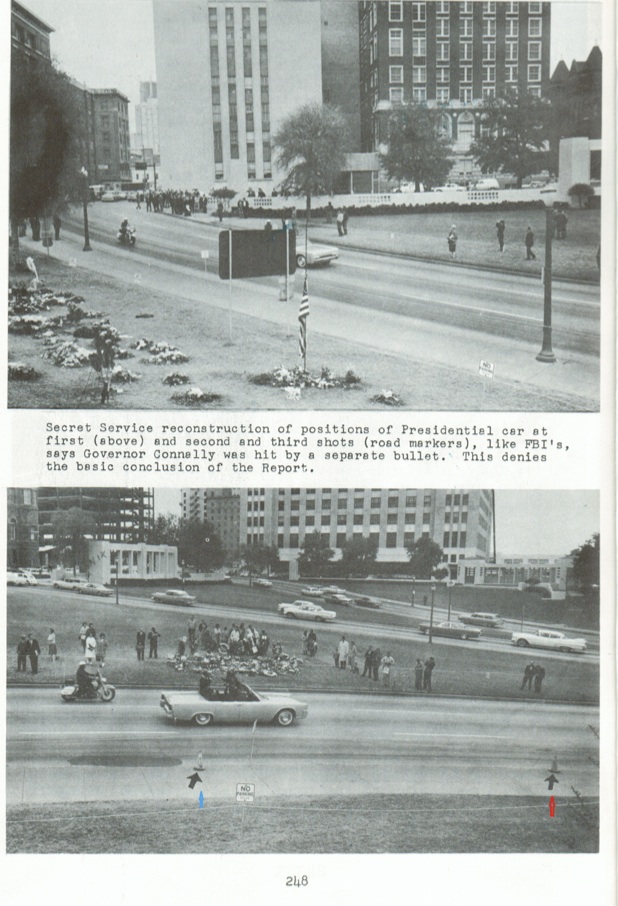
    Figures 2A and 2B. This Secret Service photograph was taken shortly after the assassination. Traffic cones mark the supposed three shots on Elm Street.But the final cone (red arrow) is well beyond Z-313, as can be seen by the large floral memorial that alignswith the blue arrow closer to Z-313 (Harold Weisberg, Whitewash II (1966), p. 248). [22]

    So the question naturally arises: Were two headshots conflated? We shall return to this question. But an even more profound question is this: What really happened at Z-313 ? [23]

    But here is my chief criticism of this chapter: If back spatter is so obvious in the film (as may be true), why then is forward spatter so hard to see? According to Figure 5 in EoT (the MFRC video), forward and back spatter are visible in the same frame. [24] So where is the forward spatter in the Z-film? To further highlight this paradox, note that EoT quotes Hargis as easily seeing (during the actual event) such forward spatter (p. 341):

    “He described to me how the blood left the back of the President’s head in copious amounts. He stated that as the expelled blood hung in the air, he drove into it, thereby getting blood and bits of bone and brain on his motorcycle, clothing, and person. … he said, ‘It was as if a bucket of blood was thrown from the back of his head; it spread out and hung in the air for a minute.’ “

    EoT even reports that Hargis’s wife, too, noticed solid matter on Hargis when he returned home (p. 341). But about the absence of such forward spatter in the Z-film, EoT remains oddly silent. [25]

    Costella’s analysis of the streaking fragments (in successive frames) suggests that the bullet impact likely occurred “… just after the end of the exposure of Frame 312, which is about half a frame before the start of the exposure of Frame 313.” [26] If so, then it is even more likely (since both spatter events occur promptly with the bullet strike, according to EoT) that both events should be visible in Z-313. In fact, EoT states that back spatter dissipates faster than forward spatter (p. 102, item 5). If so, then where is the forward spatter in Z-313? After all, it should appear at about the same time as back spatter and it should last longer.

    Another issue that entirely escapes the author’s attention is the distance that the back spatter supposedly traveled: according to Frazier (pp. 114, 342-344), both sides of the windshield, the entire exterior, and the hood ornament (at the front of the limousine) were all coated with tissue debris. On the other hand, according to EoT, back spatter only travels four feet (p. 101) or perhaps just three feet (p. 118). [27] But the distance from JFK to the hood ornament is way over four feet – and the wind was blowing (strongly) toward the rear of the limousine (see the coats of Moorman and Jean Hill in the Muchmore film [28]).

    So the problem is obvious: How did back spatter reach the hood ornament? [29] (Recall that EoT insists on only one headshot.) But perhaps we should change focus here: Do exploding bullets behave differently from the (apparently) metal-tipped bullet shown in EoT’s figures? In particular, do such exploding bullets fail to produce forward and back spatter? Could they produce enough debris to cover the limousine and its occupants? Regrettably, this question is not addressed anywhere in EoT.

    The cited witnesses (Frazier at pp. 110, 114, [30] 342-344 and Clint Hill at pp. 109, 114) also recall that the trunk was well covered with tissue debris (and perhaps blood), none of which is seen in the Z-film. Hill, in particular, describes it as “all over the rear portion of the car.” So where did it go? Was it selectively erased during (illicit) film editing, so as not to suggest a shot from the front? EoT does not address this issue, although the author does admit that no extant photographs show blood on the exterior of the vehicle – even though blood on the interior was obvious in photographs (p. 343).

    EoT argues (p. 114) that tissue debris is not seen on the limousine trunk because dried blood is difficult to spot on a dark surface (although JFK’s blood would still have been fresh). But Thompson displays a photograph of obvious debris on the trunk, as seen in the Nix film. [31] So the question is obvious: Why don’t we see this debris in the Z-film?

    A different question might also be asked: If forgers were at work, why did they not also erase the incriminating mist in Z-313? The answer may well lie in the state of knowledge in 1963 (as EoT notes – pp. 235 and 243): in their innocence, the forgers may have interpreted the mist in Z-313 as forward spatter and therefore as evidence of a shot from the rear. Such a shot, of course, was acceptable to them because Oswald was behind the limousine. It would be interesting today to ask them how they interpreted the mist.

    Chapter 4. The Limo Stop

    In this chapter, EoT introduces an hypothesis (subjective time deceleration for witnesses under stress) but then this hypothesis, without further ado, is promptly promoted into a conclusion. [32] The subjective slowing of time and the simultaneous remarkable awareness of detail are certainly real (as they have been for me personally), but how do we know that this happened to nearly every eye witness in Dealey Plaza? The fact is that we don’t know this. What is worse, there is no way that we can ever know this. Just because something might have happened is no proof that it did happen.

    Consider this: as an historical parallel, during the shooting of Archduke Ferdinand, the motorcade stopped. Does EoT also wish to imply that this stop was an illusion? After all, this event closely parallels the Dealey Plaza event. [33] If so, what else in history might be false, merely based on the notion of subjective time deceleration? Such a revision of history might go on endlessly. To my knowledge (after reviewing many books on historiography) no historian has ever made such a suggestion.

    All four of the closest motorcyclists recalled the limousine stop. An actual stop would surely have caused some instability in their bikes – most likely they had to work to keep their bikes balanced while the limousine paused. Does EoT truly suppose that these men were mistaken in recalling how they managed their bikes during such a stop? Why would the psychological slowing of time have contemporaneously produced inaccurate memories in these men – about stabilizing their own bikes?

    Here is another question not asked (or answered) by EoT: Why do first-time viewers of the Z-film fail to comment on the limousine stop (or at least report a dramatic slowing)? Why are they not likewise affected by the psychological slowing of time? Is seeing such an event on film different from a live event? [34] EoT offers no comments on these perplexing issues.

    The author does admit (p. 132) that most Dealey Plaza observers agreed that the limousine slowed, but is this what first-time viewers of the extant Z-film report? (After showing the Z-film many times to students, that has not been my impression.) Readers might also ask this: Were they themselves personally impressed by a remarkable slowing of the limousine the first time they saw the Z-film? Or better yet: Did they recall an actual stop after first viewing the extant Z-film? After all, that is what so many Plaza witnesses did recall.

    Although EoT claims that few witnesses recall a limousine stop, this is clearly misleading. I have previously listed the ten closest witnesses [35] to the limousine (including motorcyclist Hargis). They all recalled a stop (their most common response) or they said that it “hesitated.” The reader is strongly encouraged to review their direct words, as EoT’s conclusion surely does not agree with these witnesses. Furthermore, Vince Palamara has compiled over 50 witnesses who also reported an event different from the extant Z-film. [36] Many Dealey Plaza witnesses also recall the abrupt acceleration after the stop. That, also, is not typically reported by viewers of the extant film.

    To her credit the author does agree that the Muchmore film shows the brake lights on for about nine frames. [37, 38] But then EoT cites the Nix and Muchmore films as evidence against a limousine stop. Unfortunately, that evidence is heavily tainted, as I have previously noted. [39] Gayle Nix told Inside Edition that her grandfather believed that the government had altered his film, though she did not know the truth. [40]

    In a conversation (May 1993) with Millicent Cranor, Gayle stated that her grandfather believed that frames had been removed. [41] Insofar as the Muchmore film is concerned, Robert Groden notes that, while UPI had the original, it “was cut or mutilated at the frame that showed the moment of the headshot.” [42] The original cannot be located. In a technical report (21 December 1995) Charles Mayn states that the copy in the Archives is not the camera original.

    Z-film alteration is not merely suggested by eyewitnesses [43] but, on the contrary, is based on a great deal of objective data. I cite only one example here, as described by John Costella. He cites Z-232 and shows that the image is physically impossible: either the entire limousine or the entire background should be blurred by an obvious amount (which he displays in his Figure 20). [44] On the contrary, such blurring is not seen. Thus, this frame represents an actual image from the original Z-film only if the limousine had come to a stop. Believers in Z-film authenticity have been reluctant to address this paradox.

    Multiple witnesses have seen a Zapruder-like film that is different from the extant Z-film. Brugioni is a recent addition to this list. [45] Just two others are Rich Della Rosa [46] and Scott Myers. There are more. [47] Does EoT truly believe that each one of these individuals is lying – or unbelievably mistaken (often in the same way)?

    In order for EoT’s explanation of the limousine stop to work, virtually all of these (limousine stop) witnesses must have experienced the same psychological sense of time deceleration, but this cannot be true – after all, many did not even know it was an assassination. For example, some thought that firecrackers were going off, while others described the backfire of a motorcycle. [48] And then we have the remarkable recollection of Abraham Zapruder himself: [49]

    … and I was walking back toward my office and screaming … and the people that I met on the way didn’t even know what happened and they kept yelling, “What happened, what happened, what happened?” It seemed that they had heard a shot but they didn’t know exactly what had happened as the car sped away, and, I kept on just yelling …

    We can only wonder: Did these witnesses – who did not know that an assassination had occurred – also experience a dramatic subjective slowing of time? If so, why?

    EoT also cites Alvarez as not supporting a limousine stop – merely because he calculated that the limousine slowed from 12 to 8 mph in the extant film. But that quite misses the point – what the Dealey Plaza witnesses reported was a stop (or a near stop), not a decrease by 1/3 in speed. To assess for an authentic stop, Alvarez’s calculations (and the physicists who agreed with him) are quite irrelevant. After all, Alvarez never addressed (and probably never even imagined addressing) the question we face today: Was the Z-film altered?

    Chapter 5. Ballistics Prove One Shooter

    Of course, despite the chapter title here, EoT does not support the lone gunman scenario. On the contrary, the author focuses here primarily on the neutron activation analysis data, which no longer support the lone gunman scenario, even though Robert Blakey once described it as the “linch-pin” of the case. I agree with the author’s conclusions.

    EoT notes that traces of copper were found on JFK’s shirt (p. 148). Although the author later (p. 282) reminds us that minute traces of copper were found on JFK’s jacket, she omits (in this later discussion) to remind us that it had also been found on the shirt.

    Chapter 6. The Grassy Knoll Headshot

    “However, there is no credible evidence to support identification of a specific, definitive point of entry or exit wound to the head” (p. 169).

    On the contrary, the trail of metallic debris across the top of JFK’s skull (on the X-rays) strongly suggests a bullet trajectory. (To add grist to the mill, EoT always assumes a single straight line trajectory. [50]) For the general case, EoT states (p. 206):

    “The fragment distribution pattern identifies the projectile’s direction of travel. The fragment pattern begins near the point of entry … “

    If this is true in general, why is JFK’s trail not a candidate for just such a trajectory? [51] Furthermore, many eyewitnesses recall a frontal entry wound (near the hairline above the right eye) that matches the X-ray trail astonishingly well: Malcolm Kilduff, Charles Crenshaw, Ronald Jones, David Stewart, Robert McClelland, Tom Robinson, Dennis David, Joe O’Donnell (a friend of Robert Knudsen), and others. [52]

    Of course, the autopsy photographs show an incision (not an entry wound) at exactly this site. This is most peculiar because the Parkland witnesses saw no such incision. In other words, precisely where we would expect to see an entry wound, the autopsy photographs now show an incision (likely produced by the pathologists). Is this mere chance, or was it deliberate? [53]

    We now come to a moment of truth: Is this trail of metallic debris on the X-rays consistent with a frontal shot at Z-313? Note that agreement between these two items is the fundamental – and never-questioned – assumption throughout EoT. But the answer is truly disturbing: No, this X-ray trail cannot derive from a frontal shot (from the overpass) at Z-313! [54] Here is why. First note JFK’s head orientation in Z-312 (p. 178 in Fiester – but also displayed here in Figure 3); then compare this image to the trail of metallic debris on the X-rays (Figures 4 and 6). [55]

    Figure 3. Z-312 (left) and Warren Commission Exhibit CE-388. An entry site shown here (in CE-388) is probably correct.
    Figure 4. JFK lateral skull X-ray. The trail of debris here is far above the entry site in CE-388, which suggests a second headshot, most likely frontal.

    An immediate paradox arises: for a shot from the triple overpass (specifically for EoT, the South Knoll) after Z-312, the orientation of the expected trail of debris is radically different from what the X-rays show. To be more precise, since EoT claims (p. 218) that the top of the limousine and the top of the overpass (the handrail) are at nearly the same elevation, then the trajectory for this proposed frontal shot should appear on Z-312 as a nearly horizontal line. In Z-312 such a trajectory would pass through JFK’s upper orbit and also through his ear canal (Figure 5).

    Placing that horizontal trajectory on CE-388 (Figure 5) shows that this trajectory is almost parallel to the WC’s trajectory, but inferior to it. (The directions are opposite, of course. [56]) But here is the point: the author’s expected trajectory is a gross mismatch to the metallic trail on the lateral X-rays. [57] So the unavoidable conclusion faces us: Although Z-313 may show a headshot, the particle trail on the X-rays definitely cannot result from this headshot!

    If the author cannot resolve this paradox, then at least two headshots (total) are required. Just one headshot is quite inadequate to the task. This conclusion delivers a severe blow to EoT, which concludes that just one headshot explains everything. That simply cannot be true.

    Figure 5. The solid red arrow (in both images here) shows the approximate path of a bullet in Z-312 (a nearly horizontal trajectory) for a shot from the South Knoll, as proposed by the author. The yellow arrow represents the trail of metallic debris on the JFK lateral X-rays. This is a gross paradox. The solid red arrow must be wrong. But the yellow trajectory (which is real) could not have resulted from a shot at Z-312; instead it must have occurred when JFK was more nearly erect, well after Z-312.
    Figure 6. The yellow arrow represents the trail of metallic debris on this JFK lateral skull X-ray. The cyan arrow identifies the 7 x 2 mm metal fragment – removed by Humes at the autopsy. The dark blue arrow identifies the small fragment at the rear, which is seen as a phantom image through the 6.5 mm object on the AP skull X-ray. The beige arrow locates the orbit, while the green arrow identifies the EOP (external occipital protuberance). The violet arrow locates the ear canal, and the orange arrow approximately locates the orange-sized hole reported by most witnesses. I have explained elsewhere why such a hole would likely not be visible on a lateral skull film. [58]

    But we are still not done with this issue. Let us agree that this trail of debris (Figure 6) does represent a bullet trajectory. (No one has seriously challenged the authenticity of these metallic particles – nor can I.) This trail is inconsistent with several other fundamental pieces of data in this JFK case, as follows: [59]

    • It is inconsistent with the orange-sized hole in JFK’s right rear skull (Figure 6) that was so widely reported, both at Parkland and at Bethesda. The debris trail is far too superior.
    • It is truly inconsistent with the location of the 7×2 mm fragment above JFK’s right eye (the same fragment that Humes likely removed). This 7×2 mm fragme
    • It disagrees utterly with the beveled skull site near the EOP (Figures 5 and 6) that the pathologists took for the entry of a posterior bullet. The debris trail is simply far too superior. [60]

    A third headshot could solve this impasse (see Figure 7):

    • (Yellow in Figure 7). That someone shot from the rear is nearly universally accepted – after all, James Tague was struck by something. A shot from the rear (e.g., from a lower story of the Dal-Tex building) may have entered at the pathologists’ beveled site just right of the external occipital protuberance (EOP). My reconstruction of the Harper fragment, with the lead deposit precisely at the pathologists’ site, may be considered objective proof of their honesty and accuracy on this issue. [61] If additional metal fragments were deposited with this shot, they were removed before the official autopsy began. [62]

    The autopsy report describes a fragment trail from the EOP to the right parietal bone. This trail is not present in the extant X-rays, but perhaps such a trail did exist before these fragments were removed, i.e., perhaps Humes told the truth in his autopsy report! It is even possible, if not likely, that the 7×2 mm metal fragment above the right orbit was part of that trail. [63] There is also eye witness evidence for a successful posterior headshot: early viewers of the film described a brief and abrupt leftward “jerk” of JFK’s head (no longer seen in the film). Such a rotation could have been induced by a shot striking the right rear of the skull (the torque would have been appropriately counterclockwise). [64]

    It is even possible, if not likely, that early viewers of the film took this jerking motion as evidence for a successful shot. [65] On the other hand, a frontal shot from the South Knoll, i.e., the south end of the triple overpass, could not have caused such a rotation unless it struck the left skull, e.g., behind the left ear, but no evidence suggests such a shot.

    Another posterior shot (different from the one that hit near the EOP), one that first struck the street, is also strongly implied – by four clues: (a) a metallic fragment in the left scalp (visible on most public images of the skull X-rays), (b) the metallic fragment in the posterior scalp (Figure 6 – dark blue arrow) that appears as a phantom image inside the 6.5 mm object on the AP X-ray, [66] (c) an unknown projectile that caused the superficial back wound, and (d) five witnesses (including three cited in the WC) who recalled a shot that struck the street (an event that may have produced these ricochet fragments that hit JFK) [67]. The final argument for a successful posterior shot is the presence of debris on the inside of the windshield and on the hood ornament. Forward spatter from a posterior shot might explain this debris, but a frontal shot almost certainly cannot. [68]

    • (Red in Figure 7). A frontal shot most likely produced the particle trail on the X-rays. This entered high on the right forehead, near the hairline (where the incision is seen in the autopsy photographs). For a shot from (anywhere on) the overpass, the observed particle trail is really only possible when JFK’s head is nearly erect, i.e., it cannot occur with the forward head orientation in Z-312 (or in Z-313). [69] If JFK’s head had been rotated to the left (as in EoT’s scenario), then this particle trail might derive from a South Knoll shot, although not immediately after Z-312. On the other hand, since the moment of this shot is not precisely known, so is JFK’s head orientation also unknown at this moment. That leaves open the possibility that the shot might have come from elsewhere, e.g., the north side of the overpass. However – and this is critical – this shot cannot explain the orange-sized hole at JFK’s right rear (the one that so many witnesses recalled)-after all, the particle trail is much too superior.
    • (Green in Figure 7.) Another frontal bullet may have struck tangentially [70] (e.g., either (1) from the north end of the triple overpass – perhaps from the storm drain, or (2) from somewhere behind the fence on the Grassy Knoll) [71], entered anterior to the right ear, and then exited to yield the orange-sized hole at the right rear. It is quite unlikely that such a tangential headshot could have deposited the 7×2 mm fragment, however. Such a tangential shot would have entered too far posterior (as well as too far inferior) to leave that fragment behind. This shot (#3) could well have produced the forward spatter that Hargis encountered. On the other hand, shot #2 is an unlikely candidate for that spatter. If shot #2 (from the South Knoll) had produced forward spatter, that spatter should have gone to the right rear, which does not match the witness reports. Clint Hill’s recollection [72] implies that this shot (#3) was the last shot. Finally, most witnesses quite specifically recall that JFK’s final movement was to “slump” forward. [73]


    Figure 7. Schematic illustration of three possible headshots. Entry sites are only approximate. Each color defines a different shot. [74]

    It is far beyond the scope of a book review to address these complex matters in much more detail. [75] Yet I would make several observations: Tom Robinson watched as the pathologists removed about ten small metal fragments from the brain (these are not in the official record) [76] and put them into a test tube or vial; the largest was about one quarter of an inch. [77] And Dennis David typed a memo that described enough bullet fragments to constitute more than one bullet [78] (perhaps the 7×2 mm fragment was accidentally overlooked by these nefarious collectors).

    Consistent with shot #3 above, Dr. Kemp Clark (neurosurgeon) described a tangential strike, and several close witnesses (e.g., Bill and Gayle Newman, and also Abraham Zapruder) saw trauma in front of JFK’s right ear, perhaps caused by this bullet’s entry. Gayle Newman also recalled that JFK grabbed his right ear (p. 339). [79] Also note Clint Hill’s comment about the “upper right rear of the right ear” (footnote 72).

    Then there is the memo of A. H. Belmont (at FBI headquarters), dated November 22, 1963, with a handwritten annotation of the time as 9:18 PM:

    I told SAC Shanklin that Secret Service had one of the bullets that struck President Kennedy and that the other is lodged behind the President’s ear [emphasis added] and we are arranging to get both of these. [80]

    In retrospect, a Belmont bullet (behind the ear) may have caused the tangential strike (shot #3 above); if so, then that bullet [81] was removed (or its fragments were removed) by the pathologists. In fact, the disappearance of 2-3 skull X-rays (p. 330) may well be further evidence for this conclusion – i.e., these missing X-rays (taken shortly after the body arrived) showed the pathologists precisely what fragments needed to be collected before the official autopsy began; if so, it was then critical (for a successful cover-up) for these early X-rays to disappear. [82] Although others may wish to pursue this issue, it is well beyond my purposes here to propose specific sequences for multiple headshots. [83]

    Oddly, EoT does not actually pinpoint the site of origin (on JFK’s skull) for either forward spatter from JFK (which is cited on page 102) or for back spatter. [84] The autopsy photographs in particular show no obvious site of origin for either back spatter or for forward spatter, but EoT skips over both of these issues. We might ask the film forgers a similar question: If they believed, as seems likely, that the mist (in Z-313) represented forward spatter, then exactly where on JFK’s head did that spatter exit, based on the autopsy photographs?

    EoT then goes on to recall that, for the HSCA, Humes raised his posterior skull entry site by 10 centimeters; the author implies that this was his final verdict (p. 175). That of course is false, because Humes later shamelessly reverted to his original site, near the EOP. [85]

    EoT also states that the HSCA concluded that no evidence suggested a second shooter (p. 187). On the contrary, the main HSCA conclusion was just the opposite – the acoustic evidence strongly implied (to them) a second (but inaccurate) shooter behind the fence on the Grassy Knoll.

    On another issue, EoT brings us current on skull beveling: once considered the “gold standard,” it is now considered less reliable (pp. 198, 211-212, and 248-249). [86] For example, a [bone] fragment can break off and leave behind (at that site) apparent beveling, quite unrelated to entry or exit. In further support of this, I have previously cited the experiments conducted for Roger McCarthy, in which he noticed random beveling that was unrelated to entry or exit. [87] The beveled skull site identified as an exit by the HSCA was likely an example of such irrelevance. After all, in their autopsy report, none of the pathologists had identified it as an exit. [88] To further confound us, the HSCA has identified this beveled site as lying within frontal bone [89] (pp. 184-185; 1HSCA253), which is actually absent (on the skull X-rays)! [90]

    In support of the South Knoll headshot, EoT then focuses on JFK’s head orientation at Z-312 (pp. 213-218). For this, the author adopts the work of Dale Myers: JFK was rotated away from Zapruder at 25.7° past profile (left), tilted left 18.1°, and nodding forward (pitch) 27.1°. EoT states the margin of error as 2°, but notes (p. 213) that the HSCA disagreed with Myers regarding the pitch. In particular, Myers’s angle is 16° steeper than Canning’s (for the HSCA)! [91] That is not a small amount.

    Chapter 7. Two Headshots

    EoT claims that the presence of back spatter in Z-313 proves that this frame (at least) is authentic. However, this assertion overlooks the possibility that the mist was merely borrowed from a later frame and superimposed onto an original image. (The mist might also merely have been copied, e.g., by hand, based on a later image.)

    The author concludes this chapter with a presumptuous claim (p. 265):

    “Current forensic research supports a single gunshot originating in front of the President, and front is not the Grassy Knoll. All other explanations are myths and are to be discounted as such.”

    I agree that a successful Grassy Knoll shot is not supported by the medical evidence. However, so long as EoT is unwilling to discount the acoustics data (which implied a gunman on the Knoll), how then can the author conclude that no shooter (even one who missed) stood on the Grassy Knoll? For that matter, any gunman who missed (from whatever site) cannot easily be excluded, no matter how often the author uses the word “myth.” (I am not close-minded about an inaccurate shooter on the Knoll, even though the acoustics data cannot be used as evidence for one. As usual, we must turn to the witnesses for such evidence.)

    EoT claims (p. 225) that some projectiles can remain within the target. Does this describe the particle trail in the X-rays? Is forward spatter absent because nothing exited from the back of JFK’s head with this particular shot? (Maybe so.) Based on the fuzzy borders of these particles (I have observed these many times at the National Archives, with quite myopic eyes), I have asked if they derived from an exploding mercury bullet. I also wonder: Would exit debris usually be absent with a mercury bullet? (I don’t know.) If two frontal headshots occurred, then perhaps the tangential one did cause forward spatter (as encountered by Hargis) – but then this spatter was subsequently excised from the film by felons who (illegally) altered it; after all, their goal was to erase any evidence of a frontal shot.

    EoT places great emphasis on the retrograde (toward the shooter) movement of ballistic gelatin (pp. 250-253), and offers this as an explanation for the initial forward movement of JFK’s head in the Z-film. The chief problem with this, of course, is that JFK’s head was not gelatin – after all, the brain was surrounded by a bony skeleton, which is quite another matter. [92] To be fair, though, EoT does cite (p. 203) Robin Coupland, who apparently used “model” skulls filled with gelatin. A “bulge” was observed in the skull where the bullet entered. In my opinion, however, this is quite different from the entire skull moving toward the bullet.

    Chapter 8. The Single Bullet Theory

    EoT claims (p. 294) that vertebral body T1 was fractured. But that was not the conclusion of the Clark Panel radiologist. (I agree with him.) The Panel concluded that only artifacts were seen at that site. [93]

    EoT carefully presents (p. 294) the trajectory through JFK. For additional (corroborating) anatomic information, see my essay on this subject. [94]

    The Witnesses (this final chapter is unnumbered)

    I have already cited several of the witnesses from this chapter. I would in addition, however, refer the reader to the many witness statements that suggest two (or more) headshots. [95]

    A Potpourri of Curiosities in EoT (my comments)

    1. Despite the frequent references to back spatter in the Z-film, only two tiny figures (pp. 178 and 228) show any Z-frames – and these are in black and white, with low resolution.
    2. EoT contains no index. This was a major handicap during my review.
    3. “When scientific methods prove a theory true, it becomes a fact. When scientific methods prove a theory false, it becomes a myth” (p. 331). Here again we see the conflation of “truth” with “fact.” This is careless use of language. More puzzling though is this: the current attitude in science is quite different from EoT’s. Most scientists would agree that even widely accepted theories (e.g., Maxwell’s classical electrodynamics of the 1800s) were not considered immutable, but were rather always open to falsification – and never finally proved. Furthermore, older theories are not always considered myths. For example, although Newton’s Laws have been superseded by Einstein’s relativity, these Laws are still useful for launching satellites into the solar system – and Maxwell’s Equations still find wide application today. Surely these accomplishments of Newton and Maxwell should not be called myths.
    4. “Physics is a complicated subject” (p. 259). On the contrary, physicists would say that sociology, economics, and psychology are complicated subjects. Models in physics can be reduced to bare essentials, thereby simplifying the problems and allowing testable predictions. Such an approach rarely works in these other disciplines, just because of their inherent complexity.
    5. “Newton’s Second Law of Motion [96] states that when a force acts on an object, it causes the object to move” (p. 205). Of course, “move” should read “accelerate” [force = mass x acceleration]. “Move” is better reserved for “velocity.” The statement itself reflects the (incorrect) thinking of Aristotle, i.e., in his opinion even a constant velocity was impossible without a continuous force.
    6. EoT persistently cites Oliver (p. 180) as a participant in shooting experiments at the Edgewood Army Arsenal. In fact, Oliver was a professor of classical philology at the University of Illinois, who had written an article about Oswald, titled “Marxmanship in Dallas.” [97] The man who participated in the shooting experiments was Alfred Olivier. [98, 99]

    Copy Editing in EoT

    1. These pages have misspellings: pp. 98, 116, 132, 153, 154, 184, 251, 264, 265, 271, 281, 310, 314, 330, and 335.
    2. These pages contain mangled syntax (or missing words, or incorrect words, or repeated words): pp. 35, 89, 91, 99, 102, 118, 119, 146, 177, 198, 199, 214, 253, 273, 291, 301, 303, 315, and 331.
    3. Nearly the same MFRC image is shown on too many pages: 100, 103, 117, 231, 253, and 291.
    4. Radiating fracture lines are repeatedly discussed, in almost identical phrases: pp. 97-99, 199, and 226-227. [100]
    5. An almost identical discussion of cavity formation occurs on pp. 98, 227, and 254-255.
    6. Radiating fracture lines in the skull are repeatedly shown (with nearly the same image): pp. 99, 200, 250, and 255.
    7. Differences and similarities between back spatter and forward spatter are discussed over and over, in virtually the same language (which gives the reader a curious case of deja vu): pp. 101, 209-210, and 232-233.
    8. Thicknesses of skull bones are (unnecessarily) cited twice: pp. 197 and 249.
    9. In the Bibliography, beginning with the second appearance of AFTE (p. 362), eighteen references are repeated (i.e., it is their second coming).
    10. Figure 31 is discussed (p. 291), but the displayed image is clearly the wrong one. The correct one does not appear anywhere.
    11. Z-312 supposedly shows spatter (p. 91), but then, paradoxically, Z-312 is said (p. 186) to have been exposed before the headshot! This twisted my mind for a while – after all, how could spatter appear before the headshot? – but I suspect that the first appearance here of Z-312 is a typo and that it should read Z-313. If not, some serious conceptual challenges await us. [101]

    My Conclusions (just the unpleasant ones)

    [Note: I have listed my agreements with EoT in the opening abstract.]

    1. The title would be better served by using “fallacies” instead of “myths.”
    2. The author should clearly state her own view of the external world: Does she indeed side with the post-modernists?
    3. The acoustical data are red herrings.
    4. The extant Z-film misleads us about tissue debris – on the contrary, much other evidence places it in the air (especially to the left rear) and all over the outside of the limousine. In addition, the mist in the extant Z-313 may not agree with the original Z-313. Perhaps the mist was copied (by hand) imprecisely, i.e., from a later Z-frame. If so, that could explain why it looks like back spatter. (The forgers may have regarded it as forward spatter from a shot from the rear.)
    5. Even if Z-313 shows back spatter, that alone cannot prove that the entire Z-film is authentic. It may not even prove that Z-313 is wholly authentic.
    6. A shot from (anywhere on) the overpass immediately after Z-312 is grossly inconsistent with the trail of metallic particles on the X-rays. If Z-313 displays a headshot, then that shot cannot cause the particle trail in the X-rays. That trail must have arisen from a different headshot, more likely later when JFK’s head was more erect.
    7. Multiple headshots occurred (Figure 7) – in radical disagreement with EoT. However, at least two of these shots were likely separated by well over one or two Z-frames; unfortunately, EoT only considers a very short time interval. Multiple headshots are also strongly suggested by many witnesses – likewise separated by well over one or two Z-frames.
    8. The skull X-rays (not considered by EoT), when correlated with all of the evidence, provide very powerful, perhaps even irrefutable, evidence of multiple headshots. The set of three headshots (Figure 7) is the only one to date that correlates all of the X-ray evidence with the Z-film and the eyewitnesses.
    9. The absence of forward spatter (from a frontal shot) in the Z-film is an enigma – curiously nowhere even discussed by EoT. If the bullet that produced the particle trail on the X-rays did not exit (which may be true) then that could explain the absence of forward spatter (for that shot). Or if government-employed felons deliberately erased evidence of forward spatter (i.e., from shot #3 above – the tangential shot) then that forgery could account for its absence (from that shot). EoT does not discuss any of these issues.
    10. Most likely the limousine actually did stop, although only briefly. Subjective time deceleration cannot explain away all of these witnesses. (There is also photographic evidence – not discussed in this review [102] – of at least a dramatic slowing of the limousine.)
    11. Only artifacts are seen near the T1 vertebra on the neck X-rays. They contribute nothing to this case.
    12. If another printing of this book is planned, then a copy editor with a critical eye should be hired. Finally, an index would be priceless.

    Acknowledgments

    Because this essay metamorphosed well beyond a standard book review, I must thank the following individuals. Jim DiEugenio initially persuaded me to read (and to review) the book. Greg Burnham offered his historical knowledge of the Zapruder film, was a careful listener to my theses, and made specific suggestions for increased clarity. Tim Nicholson provided precise quantitative analyses that provoked further thoughts; he also commented on the retrograde movement of gelatin targets. Jim Fetzer’s editorial skills led to a more readable format; Jim also proposed some of the illustrations. Gary Aguilar inspired some new ideas about the movement of JFK’s head at a critical moment (based on Thompson’s graph). Douglas Horne once again displayed his profound knowledge of this case via frequent invaluable and critical insights. As a result, this review is more lucid, more nuanced, and richer in detail than it would otherwise have been. Unfortunately, all of the left over mistakes are mine. I only wish I knew where they were.

    25 August 2013
    Coronado, California


    Notes

    1. Although I have been unable to locate the original source, Doug Fabian attributes this to Dostoyevsky. If Fyodor did not say this, then he should have: http://www.humanevents.com/2013/07/03/the-liquidation-cycle-and-wall-street-fireworks/.
    2. Jerry Fodor and Massimo Piattelli-Palmarini, What Darwin Got Wrong (2010), p. 55. I was thinking here not just about the lone gunman theory, but also about Zapruder film authenticity.
    3. Adapted from Wikipedia.
    4. “When scientific methods prove a theory true, it becomes a fact. When scientific methods prove a theory false, it becomes a myth” (Fiester, p. 331).
    5. Paradoxically, Jim Marrs (Foreword) states: “There are even legitimate arguments that the famous film of Abraham Zapruder has been altered from the original.” EoT definitely does not say that.
    6. See the breathtaking hoax by physicist Alan Sokal, cited in my review of Vincent Bugliosi’s Reclaiming History (2007) (http://www.assassinationscience.com/v5n1mantik.pdf). Sokal has stated: “And I’m a stodgy old scientist who believes, naively, that there exists an external world, that there exist objective truths about that world…” (http://en.wikipedia.org/wiki/Alan_Sokal). Post-modernists take exception to this, in surprising agreement with EoT.
    7. “How to Think Like John McAdams” (http://www.ctka.net/reviews/McAdams_Mantik.html).
    8. See my review of Don Thomas’s book: http://www.ctka.net/reviews/mantik_thomas_review_pt1.html. Enrico Fermi once called Richard Garwin the only true genius he had ever met (William J. Broad, “Physicist and Rebel is Bruised, Not Beaten,” New York Times, November 16, 1999. http://www.nytimes.com/1999/11/16/science/scientist-at-work-richard-l-garwin-physicist-and-rebel-is-bruised-not-beaten.html?pagewanted=all&src=pm). In 1952, Garwin designed the plan for the first hydrogen bomb.
    9. http://www.docsports.com/super-bowl-coin-toss-history.html.
    10. Click here.
    11. “Why Most Published Research Findings are False,” PLoS Med 2, No. 8 (2005): e124. Also see The Half-Life of Facts (2008), Samuel Arbesman, chapter 8 and “Sifting the evidence – what’s wrong with significance tests?” by Jonathon A. C. Sterne, British Medical Journal 2001; 322 (7280): 226-231.
    12. “Each experiment quotes a likelihood of very close to ‘5 sigma,’ meaning the likelihood that the events were produced by chance is less than one in 3.5 million. Yet in spite of this, the only claim that has been made so far is that the new particle is real and ‘Higgs-like.’ The existing data set is still too small to statistically determine with precise accuracy that the data is consistent with the standard model.” (Click here for more.)
    13. If their recollections were actually useful, most of these witnesses could also be cited to suggest a shot from the north side of the overpass – i.e., their statements are usually not specific for the south side. (In this review, this south side is sometimes called the South Knoll.)
    14. In High Treason II (1992), p. 363, Harry Livingstone describes a “blob,” which is “half a foot wide.” The object in question here though is the very bright area just anterior to the ear, only several inches across.
    15. In June 1970, Lifton viewed the frames after Z-334 (the last one published by the Warren Commission) and discovered that the supposed right facial wound of JFK (not seen by anyone at Parkland) was enormous – and that it appeared merely to be artwork. Provoked by this, Lifton then studied “Insert Matte Photography” and suggested that the “blacking out” effect [e.g., in Z-317] might also be artwork (“Pig on a Leash,” David S. Lifton, The Great Zapruder Film Hoax (2003), edited by James Fetzer).
    16. “We now understand that all physical theories are merely effective theories that describe nature on a certain range of scales. There is no such thing as absolute scientific truth…” (Quantum Man: Richard Feynman’s Life in Science (2011), Lawrence Krauss, chapter 17).
    17. Noel Twyman, Bloody Treason (1997), p. 160.
    18. Also see Brugioni’s comments in Mary’s Mosaic (2012) by Peter Janney, pp. 287-293, 477.
    19. Readers can, however, do their own investigations: just draw a two foot circle on an enlarged (or projected) image of Z-313 and then determine whether that matches the size of the visible mist.
    20. “The JFK Assassination Re-enactment” by Chuck Marler, in Assassination Science (1998), edited by James Fetzer, pp. 249-261. This astounding summary is essential reading.
    21. Clint Hill also recalls seeing the results of a head shot a discernible time interval after Z-313: http://www.veteranstoday.com/2011/07/25/jfk-whos-telling-the-truth-clint-hill-or-the-zapruder-film/.
    22. Also see Weisberg 1966, p. 243 for the official surveyor’s map.
    23. The December 6, 1963 survey (CE-585) places three “X” marks on Elm Street (to represent three shots) at Z-208, Z-276, and Z-358. Note that Z-313 is missing! (Fetzer 1998, p. 252 – this is from Marler’s paper, cited in footnote 20.) Now look again at the Newsweek image: Z-313 is also missing there.
    24. This appears to be the video cited by EoT:

      https://www.mfrc.ameslab.gov/files/index.php?folder=Qmxvb2RsZXR0aW5nIE1lY2hhbmlzbSBWaWRlb3M=7Ab1 .44 cal bullet impacting bloodied sponge from 182 cm.avi.

      Note (a) the near simultaneous appearance of back spatter and forward spatter, (b) the persistence of the mist (in both directions) until the video stops at 0.023 seconds (one Z-film exposure is 0.025 seconds), and (c) the very similar size of the mist in both directions. Then ask yourself this question: Why is forward spatter not seen in the Z-film? Viewing this MFRC video, especially with these questions in mind, is strongly encouraged.

    25. There may be one enigmatic exception (p. 102): “Blood spatter analysts observed forward and back spatter in the Zapruder film. Forward spatter had a greater velocity than back spatter and moved away from the immediate area of the President much faster than back spatter. One easily identified portion of the forward spatter in the Zapruder film is the whitish object projected from the head, forward [sic] of the President.”

      I find this most perplexing because EoT has previously defined forward spatter as traveling in the direction of the exiting bullet (i.e., away from the back of JFK’s head) – not forward of JFK, as is stated here. For my part, I do not see obvious forward spatter in the Z-film, i.e., any mist traveling toward the rear of the limousine (from the back of JFK’s head), even though that should be visible based on (a) the MFRC video, (b) Hargis’s statement, (c) surveyors of Dealey Plaza, shortly after the assassination, who saw such debris in multiple frames, (d) witnesses who saw (a great deal of) debris on the limousine trunk, and (e) those who saw debris fly to the left rear (both in Dealey Plaza and on Zapruder-like films).

    26. “A Scientist’s Verdict: the Film is a Fabrication,” by John P. Costella, in The Great Zapruder Film Hoax (2003), edited by James Fetzer, p. 186.
    27. In this same paragraph, the author strangely confuses “momentum” with “distance.”
    28. Josiah Thompson, Six Seconds in Dallas (1967), p. 187.
    29. Kellerman (in the right front seat of the limousine) also recalled that he had “stuff” all over his coat (p. 113). He sat well over 3-4 feet from JFK. Nellie Connally also saw debris falling on herself and all over the limousine (p. 109).
    30. Strangely, the end of Frazier’s quotation (p. 114) cites Finck, not Frazier!
    31. Thompson 1967, p. 99.
    32. Somewhat paradoxically, on this same page, we find this statement: “A belief is trustworthy information we evaluate as accurate because it originates in a reliable cognitive process: primarily that process is vision.” If the author truly believes that “vision” is so reliable, then why does she not want to believe the limousine stop witnesses?
    33. “Paradoxes of the JFK Assassination: The Zapruder Film Controversy” by David W. Mantik, in Murder in Dealey Plaza (2000), edited by James Fetzer, p. 326.
    34. EoT cites a reference (top of page 360) to “Emotion and time perception: effects of film-induced mood.” If merely watching a film can indeed induce a sense of time deceleration (as this paper concludes), then first-time observers of the extant Z-film should be just as likely to report a limousine stop as did the Dealey Plaza witnesses. On the contrary, it is my strong impression that first-time viewers do not report a stop (or even a dramatic slowing) – nor do they report the dramatic acceleration after the stop (that the Dealey Plaza witnesses recall). I have read this paper closely and it does indeed conclude that time slows (modestly) when subjects are first primed by viewing a film designed to induce a fearful mood.
    35. Fetzer 2000, pp. 341-342.
    36. “59 Witnesses: Delay on Elm Street,” by Vincent Palamara, ibid., p. 119.
    37. I first described this in Fetzer 1998, p. 301.
    38. http://www.youtube.com/watch?v=hrX8lsb2WTk.
    39. Fetzer 1998, pp. 302-304. Although EoT places great confidence in the accuracy of films (p. 132), the author seems unaware of the widespread use of film alteration for propaganda purposes – ever since 1894! See my discussion (with references) of this unholy marriage of film and half-truths in Fetzer 2003, pp. 291-307.
    40. Richard B. Trask, Pictures of the Pain (1994), p. 197. His source is Inside Edition [Television Program] 12/27/1991.
    41. Cranor told me this in a personal conversation.
    42. Robert Groden, The Killing of a President (1993), p. 37.
    43. Even Zapruder is one of these witnesses. He reported filming the limousine as it turned from Houston onto Elm Street (Fiester, pp. 86-87), a turn that is absent from the extant film. (Some viewers of a Zapruder-like film have seen this turn.) Furthermore, when testifying before the WC, Zapruder seemed confused about the images he was shown – from his own film – which he recalled watching so often that weekend that he had nightmares about it. He even described several events not seen in the extant film (http://www.jfk-info.com/wc-zapr.htm), e.g., “That’s correct. I started shooting – when the motorcade started coming in, I believe I started and wanted to get it coming in from Houston Street.”
    44. Fetzer 2003, pp. 180-181.
    45. In the same video cited above, Brugioni is certain that the mist was visible for longer (in the original film) than in the extant film, both of which he examined frame by frame. About the extant film (while watching it as a movie) he says, “That just doesn’t look right” and “It doesn’t shock me like it did when I first saw it; I just gasped – so did everyone else” and “Something has been cut out of this” and “I saw more matter in the air than that” and “I thought there were missing frames” and (regarding the black patch over JFK’s head in Z-317) “That’s an anomaly.” He also stated (regarding the mist), “It was white, not red,” a color difference that EoT does not discuss (although the author may not have been aware of it).
    46. http://www.youtube.com/watch?v=XrRbkY9gEnQ.
    47. Fetzer 1998, pp. 299-300 and Fetzer 2003, pp. 463-465. Millicent Cranor has described her 1992 experience in Fetzer 1998, p. 299. Just this week I have spoken to two others; both recalled the final shot being farther down Elm Street than Z-313. My impression is that these multiple viewers do not contradict one another on any point, although they do not all recall exactly the same details.
    48. Fifty (50) witnesses described firecrackers, while nineteen (19) described backfire in Murder from Within (1974) by Newcomb and Adams, p. 86.
    49. http://www.jfk-info.com/wc-zapr.htm.
    50. This assumption may not be universally true, however. DiMaio states: “Thus [for headshots], internal ricochet is fairly common, occurring in anywhere from 10 to 25% of the cases, depending on the caliber of the weapons and the diligency [sic] with which the evidence of internal ricochet is sought. As a general rule, internal ricochet is more commonly associated with lead bullets and bullets of small caliber” (Vincent J. M. DiMaio, Gunshot Wounds (1985), p. 219).
    51. EoT notes that most of these particles lie in the anterior half of the skull (p. 212) – which implies that they arose from a frontal shot. I agree. I would also note that two of the largest particles lie in the posterior half of the skull. Since heavier particles travel farther, this is yet one more argument that the trail represents a frontal shot. That these particles most likely represent a bullet trail was also supported by Dr. John J. Fitzpatrick, the forensic radiologist for the Assassination Records Review Board (ARRB): http://www.maryferrell.org/mffweb/archive/viewer/showDoc.do?docId=145280&relPageId=225.
    52. Fetzer 2000, pp. 249-252.
    53. Douglas Horne, Inside the ARRB, Volume III, pp. 732-733, 764-765.
    54. Since JFK’s head is tilted so far forward in Z-312, this statement covers both ends of the overpass.
    55. Z-312 here is a surrogate for Z-313. An image of Z-313 appears on page 228 (Fiester).
    56. The WC’s trajectory is also outrageously misaligned with the metallic trail, but no one noticed that because the X-rays were not available.
    57. I first publicly presented this observation a long while ago (probably decades ago), but its profound significance is still often overlooked today, as here in EoT. One source is “How the Film of the Century was Edited,” Fetzer 1998, p. 286.
    58. http://www.ctka.net/reviews/mantik_speer.html. In particular, the defect left by the Harper fragment would not be expected to be visible on this lateral X-ray.
    59. None of these paradoxes is confronted in EoT.
    60. Someone could conceivably argue that the pathologists’ beveled site represents the exit of the (single) head shot espoused by EoT, rather than the entrance site proposed by Humes. However, such an exit site (along with a forehead entry) would still require a trajectory that was radically inconsistent with the trail of metallic particles – so the paradox would persist. There is no escape by that scenario.
    61. Fetzer 2000, p. 227. My updated essay on the Harper fragment is pending.
    62. Horne, Volume IV, pp. 1000-1013.
    63. On the overhead view of the skull (7HSCA230), note that this 7×2 mm metal fragment must lie very close to (if not actually on) the (extrapolated) trail from the EOP to Angel’s exit site (adjacent to the coronal suture). Angel’s images are also here: http://www.history-matters.com/essays/jfkmed/ADemonstrableImpossibility/ADemonstrableImpossibility.htm.
    64. Fetzer 1998, pp. 298-299.
    65. See “Interviews with Former NPIC Employees: the Zapruder Film in 1963,” by Douglas P. Horne, Fetzer 2000, pp. 311-324.
    66. http://www.ctka.net/reviews/mantik_speer.html, Figure 3.
    67. Bonar Menninger, Mortal Error (1992), pp. 67-78.
    68. Dr. Robert Grossman executed a wound diagram for the ARRB in 1997 (Horne, Volume I, Figure 23) that depicted a “trap door” (that could open and close) due to a right parietal bone flap. Although no one at Parkland except Grossman recalled this, it would explain the (1) vertical head explosion described by Brugioni and (2) the debris on both sides of the windshield and all over the occupants of the limousine. Such an explosion through the top of the skull might well be expected due to cavitation from any headshot.
    69. Fetzer 1998, p. 286.
    70. Even EoT seems to consider a tangential strike (p. 198).
    71. Recall that ear witnesses to an overpass shot did not discriminate well between the north and south ends (if they are to be believed at all).
    72. Clint Hill: “As I approached the vehicle there was a third shot. It hit the President in the head, upper right rear of the right ear, caused a gaping hole in his head ….”
      (http://www.veteranstoday.com/2011/07/25/jfk-whos-telling-the-truth-clint-hill-or-the-zapruder-film/).
    73. Fetzer 1998, pp. 285-295.
    74. A curious, but now increasingly credible story from Clarence Israel was related by Janie Taylor, a biologist at NIH, across the street from the Bethesda Hospital. Israel’s brother (now deceased), one of two orderlies in the morgue that night, reported that one doctor was waiting in the autopsy room for some time before the body (or any other physicians) arrived. “When the body arrived, many people were forced out of the room and the doctor performed some type of mutilation of three bullet punctures to the head area. The doctor was working at a very ‘hurried’ pace and was done within a few minutes, at which point he left the autopsy room.” (Horne, Volume IV, pp. 1063-64).
    75. Gary Aguilar, MD, has recently advised me, based on Josiah Thompson’s position graphs of JFK’s head (Thompson 1997, p. 91 – or see Harrison Livingstone, Killing Kennedy and the Hoax of the Century (1995), p. 139), that the head moved most rapidly near Z-328. (Livingston had made this observation long ago; see his p. 138). At these frames, JFK is nearly vertical (i.e., not tilted forward or backward, although he is tilted toward Jackie).

      In this review, I have (again) stated that the particle trail in the X-rays could only occur for a frontal shot while JFK was nearly erect (meaning not tilted forward, in particular). And here is another coincidence (or maybe not): Clint Hill reached the limousine at about this same moment (Z-328) – and only then did he hear his “third” (and final) shot – long after Z-313. So we can now ask: Is this when the final shot (#3 above) struck? I discussed this possibility 15 years ago in Fetzer 1998, pp. 285-295.

    76. http://www.maryferrell.org/mffweb/archive/viewer/showDoc.do?docId=711&relPageId=3.
    77. http://www.maryferrell.org/mffweb/archive/viewer/showDoc.do?docId=327&relPageId=9.
    78. In the Eye of History (2005), William Law, pp. 12-13. Curiously, Harrison Livingstone, High Treason (1998), pp. 562-563, even displays a photograph of a bullet fragment said to have been removed from JFK.
    79. Note that this movement by JFK’s hand is not seen in the extant Z-film, but Gayle was not alone: based on 75 viewings of the Z-film, William Manchester reported that JFK lifted his hand to his head in The Death of a President (1967), p. 158. Even Jackie said, “And then he sort of did this [indicating], put his hand to his forehead and fell in my lap” (5H180).
    80. http://www.jfklancer.com/hunt/mystery.html, Figure 6.
    81. Douglas Horne adds this comment (e-mail of August 22, 2013): “On Nov 29th Hoover and LBJ had a long phone call, which (the part I refer to) is reproduced verbatim on page 54 of Michael Beschloss’s book Taking Charge. In that conversation Hoover tells LBJ that ‘A complete bullet rolled out of the President’s head.’ That has bothered me for many years, since no one else ever said that, to my knowledge, and here was the nation’s top law enforcement officer saying it. For years I have thought that this was proof of his complete senility and incompetence. In this conversation with LBJ, Hoover says that the complete bullet fell out of JFK’s head during cardiac massage at the hospital, and was found on his stretcher. So what we know from this conversation is that, IN HOOVER’S MIND, this was the source of the ‘stretcher bullet,’ even though it is NOT the explanation offered up by his own agents Sibert and O’Neill, who quoted Humes’s speculation (in their FD-302) that it fell out of JFK’s BACK during cardiac massage. For years I thought Hoover was a senile idiot who didn’t even know the basic facts in this case. BUT WHAT IF HE KNEW ALL ABOUT THE BELMONT BULLET DESCRIBED IN THE MEMO, and for that reason (forgetting that it was not ‘in the official record’), got it confused with the stretcher bullet that Humes announced (to S & O) had obviously fallen out of JFK’s back? This must be the case, because I am not aware of anyone the day of the assassination speculating that the stretcher bullet came from JFK’s head. In other words, Hoover is still an idiot, but the nature of his slip here when speaking to LBJ may very well indicate that he was privy to evidence removed during clandestine surgery at Bethesda, and got confused (because he was getting senile) and simply said the wrong thing about the stretcher bullet when speaking to LBJ…indicating only to us, years later, that he must have been thinking of the bullet Belmont wrote about.”
    82. Note that, although Belmont is FBI, his source is not the two FBI agents (Sibert and O’Neill), who were assigned to the morgue that night. Most likely the FBI was not permitted in the morgue when the pathologists collected these initial fragments – and illegally failed to report them. (Also see Dr. Humes’s comments, about the absence of the FBI in the morgue, in the CBS memo of January 10, 1967 (http://www.maryferrell.org/mffweb/archive/viewer/showDoc.do?docId=145280&relPageId=184). If Sibert and O’Neill had actually been there, it would mean that they also illegally failed to report these fragments.

      In an e-mail of August 24, 2013 from Douglas Horne, he states his sense of the characters of S & O: Based on observing them during several hours of questioning during their ARRB depositions they were innocents – honest men sent to the autopsy simply to obtain bullet fragments – and they were not concealing any autopsy evidence collected after 8 PM, when they were belatedly admitted to the morgue. In particular, Horne believes that they told the truth – under oath – that they saw only two minuscule metal fragments removed from JFK’s cranium.

      In support of this scenario, the FBI report makes no mention of these many earlier fragments (i.e., those of Robinson, David and Belmont). Douglas Horne has discussed this scenario (the Belmont memo and the exclusion of S & O) in great detail (Horne, Volume III, pp. 705-708, 713-726). Another possible origin for the bullet behind the ear is the EOP shot (#1 above). Of course, Dennis David’s report (of fragments constituting more than one bullet) suggests that Humes collected fragments from both the EOP shot (#1) and the tangential shot (#3), which may be true.

    83. Inquisitive souls might begin with Clint Hill’s report of the “third shot” as he reached the limousine – while also noting that he reached the limousine well after Z-313. See the Clint Hill footnote above (#72).
    84. Tim Nicholson has performed a detailed analysis of the physics of the Z-313 streaks, although the following comments are my own. Extrapolating the two largest streaks backward on Z-313 strongly suggests that they converge – at the same point – on JFK’s forehead (Commission Exhibit 390, WC Volume XVI, p. 986). Oddly, however, the forehead was actually intact (according to both the witnesses and the autopsy photographs) so the forehead therefore is not a likely source for these bone fragments (to say nothing of two fragments from the same point – at the same moment).

      To further perplex us, the physical anthropologist (Angel) for the HSCA (likely correctly) identified the largest, late arriving bone fragment (found in the limousine, according to Humes and Kellerman – but see Horne, Volume III, pp. 710-711) as frontal bone, where these two streaking fragments also supposedly originated! So the question becomes: How could all three of these bone fragments originate from the same site in the skull? But there is yet one more puzzle: Why would one of these bone fragments merely fall into the limousine while the other two zoomed off at high speeds (p. 257)? Possible answers include (1) two different headshots were at play, or (2) the streaks are not authentic, or (3) as Horne suggests, perhaps the large bone fragment was removed by Humes during his illicit surgery.

      Witnesses in Dealey Plaza and early viewers of the Z-film offered a different scenario, e.g., ” …and one fragment, larger than the rest, rises over Kennedy’s falling shoulders and seems to hang there and then drift toward the rear (William Manchester, The Death of a President (1967), p. 160.) This fragment may actually be visible in Mary Moorman’s famous photograph, on top of JFK’s right shoulder. Jackie also saw a piece of the skull (5H180) – an unlikely event if it traveled at the high speeds of the streaks in Z-313. Charles Brehm is another who saw a skull fragment flying to the left rear (Thompson 1967, p. 99.) There are more such witnesses.

    85. Breo DL. JAMA, 267:2794. Reproduced in ARRB Medical Document #22, see p. 2794.
    86. Ibid. Humes pompously proclaimed that his beveling rule was valid forever: “It happens 100 times out of 100, and I will defend it until I die. This is the essence of our autopsy, and it is supreme ignorance to argue any other scenario. This is a law of physics and it is foolproof – absolutely, unequivocally, and without question.” Humes is now dead, and so is his so-called law.

      For more on the utility (or futility) of beveling, see footnote 352 in “How Five Investigations into JFK’s Medical Autopsy Evidence Got It Wrong” by Gary L. Aguilar, MD, and Kathy Cunningham (May 2003): http://history-matters.com/essays/jfkmed/How5Investigations/How5InvestigationsGotItWrong_6.htm#_edn351.

    87. Livingstone 1995, p. 313.
    88. In the Military Review of January 1967 they were, however, persuaded to change their minds; they signed the document that had been prepared for them by the Justice Department. In this document a beveled exit wound was reported at the junction of the frontal and parietal bone, at the periphery of the large skull defect. Before the ARRB, when pressed by Jeremy Gunn (at Horne’s suggestion) about this change, Humes put his head in his hands, stared down at the document, and said, “I don’t know who wrote this” (Horne e-mail of July 9, 2013).
    89. See Figure H-4 by John Hunt, which is a copy of HSCA Exhibit F-66. This figure shows the frontal bone intact all the way back to the coronal suture (http://www.history-matters.com/essays/jfkmed/ADemonstrableImpossibility/ADemonstrableImpossibility.htm).
    90. I have often discussed this misinterpretation by the HSCA. John Hunt has listed those who report absent frontal bone: Boswell, Finck, Canning, and McDonnel (ibid.). See my sketch here: Fetzer 2000, p. 251. Dr. John J. Fitzpatrick, the forensic radiologist for the ARRB, also agreed with me that the frontal bone was present only up to the hairline. Although Angel would have agreed with him, the HSCA would not have welcomed Fitzpatrick’s conclusion (http://www.maryferrell.org/mffweb/archive/viewer/showDoc.do?docId=145280&relPageId=225).
    91. Tim Nicholson notes (e-mails of August 12 and 22, 2013) that he has “JFK’s head orientation as 27-33° nodded forward [pitch], turned left 10°, tilted left 15-30° (see Moorman photo). Sherry [Fiester] says the head is turned 25° to the left. She apparently does not specify the other angles. In the attached images [of Z -312] the forward tilt of the skull is 27° and 33°.” Nicholson’s major disagreement with Fiester appears to be JFK’s leftward rotation: 10° (Nicholson) vs. 25° (Fiester). That is significant, particularly as this angle determines whether the particle trail could have originated from the South Knoll. On reviewing Nicholson’s images I was struck by how subjective these conclusions are – and how imprecise these angles must be (for any observer).
    92. Tim Nicholson has offered this assessment (e-mail of August 11, 2013): “The gelatin does deform when the bullet hits it, showing this retrograde effect. This happens because of internal pressure and because there is nothing constraining the gelatin from such deformation. If it were inside a closed inflexible container you would not see this effect.”
    93. Aguilar and Cunningham (May 2003); see Section III (The Clark Panel), paragraph 1: “Metal Fragments Present in JFK’s Neck X-rays.”
    94. Fetzer 2000, pp. 252-260.
    95. Fetzer 1998, pp. 285-295.
    96. EoT cites this Law as if it were currently used in physics. That assumption, however, contains an unintentional irony, i.e., according to EoT, because this Law has been replaced by relativity, it should be considered a “myth.”
    97. http://www.revilo-oliver.com/rpo/Warren_Commission_Testimony.html.
    98. http://www.jfk-info.com/fragment.htm. Bizarrely enough, however, this website states: “Dr. Oliver [sic] shot the wrists of cadavers for the Commission. Olivier [sic] was a supervisory research veterinarian …” One can only wonder who was shooting whom for the WC. With typos flying almost as thick as bullets, perhaps we should ask whether “veterinarian” was supposed to be “vegetarian.”
    99. Aguilar and Cunningham (May 2003). This is a wonderful review of the government’s relentless incompetence at investigating JFK’s murder. Olivier (but not Oliver) is cited here. (To add further unneeded confusion, Cunningham has married Evans, and now uses that name, even when searching for silver ingots.)
    100. Although EoT renounces any specific entry site for its sole frontal head shot (p.169), each one of these images places an entry exactly where the metallic trail of debris on the X-rays fits best. This is also the same site where the forehead incision is seen in the autopsy photographs.

      Is the author subconsciously aware that this is indeed a very specific (and likely correct) entry site – and may even fit with a shot from her favored site, i.e., the South Knoll? If so, she does not tell us. (Of course, this trail could not have resulted from a shot at Z-312 – or at Z-313 – but might have occurred later, when JFK’s head was nearly erect.)

    101. I eventually discovered one final comment on this matter (p. 206): “Frame 312 [sic] also reveals blood spatter leaving the head because of a gunshot wound to the head” [sic]. I am now hopelessly confused. May I even ask: Just which head shot caused spatter in Z-312?
    102. Fetzer 1998, pp. 301-302.

  • G. Paul Chambers, Head Shot: The Science Behind The JFK Assassination


    G. Paul Chambers’ Head Shot: The Science Behind The JFK Assassination is another one of those books that I probably should have expected would be disappointing. The pre-publicity made some fairly bold promises (such as identifying the second rifle and proving the locations of the other assassins) that, on reflection, were destined to go unfulfilled. But Chambers scientific credentials are pretty impressive—according to his publishers’ website Chambers has fifteen years experience as an experimental physicist for the US Navy and is a contractor with the NASA Goddard Optics Branch—and this fact coupled with the praise being heaped on the book by the likes of Cyril Wecht, David Wrone and Michael Kurtz got me pretty excited.

    Head Shot was preceded earlier this year by the publication of another scientists’ treatise of the JFK forensic evidence, Hear No Evil by Donald Thomas. As I made clear in my review of that book, I am in full agreement with Six Seconds In Dallas author Josiah Thompson when he writes that “Don Thomas has produced the best book on the Kennedy Assassination published within the last thirty years…His book sets the table for all future discussions of what happened in Dealey Plaza” With this in mind, it was difficult not to make comparisons between the two works and it would be fair to say that, to my mind, Chambers’ book did not come off favourably. I had hoped that with Thomas’ book running to nearly 800 pages, Chambers’ relatively slim 250 page volume would be the one I would be happy to recommend to newcomers to the case. But this was not to be. As I hope to show, although there are some good points scattered throughout Head Shot, they are unfortunately out-weighed by a number of factual errors, flawed analysis and glaring contradictions that would be sure sure to mislead the less informed reader.

    I

    It is only fair that I begin by highlighting some of the better parts of the book. One of the areas that Chambers does a respectable job on is the acoustics evidence first brought to light by the House Select Committee on Assassinations. Like Don Thomas, Chambers places great emphasis on the remarkable concordance between the dictabelt recording and the other known evidence because, as Chambers writes, “Consistency with other evidence is very important to scientists.” (p. 73) In their desperate attempts to shoot down the acoustics, anti-conspiracy buffs and Warren Commission adherents like Dale Myers, Gerald Posner and—despite his pledge not to withhold anything from the reader—Vincent Bugliosi, never see fit to report what it was that convinced the HSCA acoustic experts that they had found a genuine audio recording of the shots in Dealey Plaza. Namely, the “order in the data.” The fact is, everything about the Dallas Police dictabelt recording fit together all too well with what was already known about the circumstances of the assassination’ and synchronized perfectly with the other crucial record of the crime; the Zapruder film.

    When the HSCA experts analyzed the suspect impulses on the dictabelt alongside the sounds of test shots recorded by an array of microphones placed along the Presidential parade route in Dealey Plaza, “they found something extraordinary…they found a number of significant matches.” (p. 123) Firstly, rather than falling in some random order, the matches fell in the correct 1-2-3-4-5 topographic order. Secondly, as Chambers explains, “When the locations of the microphones that recorded matches in the 1978 reconstruction were plotted on a graph of time versus distance, it was found that the location of the microphones that recorded matches were clustered around a line on the graph that was consistent with the known speed of the motorcade (11 mph), as estimated from the Zapruder film.” (ibid) Thirdly, the fourth impulse in the sequence was matched with “a confidence level of 95 percent” to a shot fired from the grassy knoll. (p. 126) And finally, when the fourth impulse is aligned with the explosion of JFK’s head at Zapruder frame 313, the third impulse falls at the only other visible reaction to a shot on the film; the flipping of Governor Connally’s lapel at frame 225. This means that the exact same 4.8 second gap between shots is found on both the audio and visual evidence. These correlations between the acoustics and all other known data provide the most convincing reasons to believe that the dictabelt is a genuine recording of the assassination gunfire.

    Predictably, the conclusions of the HSCA scientists received almost instantaneous criticism from the FBI and a National Research Council panel commissioned by the Justice Department. The NRC panel received a great deal of attention because it was chaired by a distinguished Harvard physicist, Professor Norman Ramsey, and had as its most active member a Nobel Prize winner, Luis Alvarez. But despite the credentials of its members, none of whom were actually experts in acoustics, the only remotely significant challenge the panel was able to present in its report was an instance of “cross-talk”. They used this to claim that it placed the suspected shots a full minute after the assassination. However, as Dr. Thomas explained, “there are multiple—five—instances of cross-talk” on the dictabelt that “do not even synchronize with one another…Hence, the cross-talk does not prove that the putative gunshots are not synchronous with the shooting.” (Hear No Evil, p. 662) Discussing the NRC panel, Chambers writes, “A great reputation is no proof against being wrong. In general, criticizing a successful experimental scientist, like [HSCA acoustic expert] Dr. Barger, in his area of expertise is a dicey proposition. Someone who does acoustical analysis for a living is not likely to make major mistakes in his field of investigation.” But, “leaving reputations aside and focusing only on the data, who is more likely to be right?” (pp. 141-142)

    As mentioned above, the order in the data is by itself hugely compelling. The last in the sequence of test shot matches occurred at a microphone 143 feet from the first, and the time between the first and last suspected shots on the dictabelt was 8.3 seconds. In order for the Police motorcycle officer whose stuck microphone was suspected of recording the gunfire to travel 143 feet in 8.3 seconds he would need to be traveling at approximately 11 mph—almost the exact speed at which the FBI estimated the Presidential limousine was moving on Elm street. (Thomas, p. 583) As Chambers asks, “What are the odds of that happening randomly?…One could certainly insert a big number for the total number of possibilities, leaving a very small probability that this would happen randomly. But it isn’t necessary.” (p. 142) On top of this, we have the fact that the timing of the shots fits so perfectly with the reactions seen on the Zapruder film.

    • “Syncing the final head shot from the grassy knoll to frame 312…” Chambers explains, “the probability of finding the shot that hit Connally to within five frames…is about one in a hundred…Matching up the first shot to the frames before Kennedy reaches the Stemmons Freeway sign and the second shot to a strike of Kennedy behind the sign is another one chance in a hundred times one chance in a hundred for a one-in-ten-thousand chance for an accidental match.”
    • Multiplying all this by the probability of all shot origins falling in the correct order is another one chance in sixteen, “yielding a one-in-sixteen-million chance that the acoustic analysis could match up the timing and shot sequence in the Zapruder film by chance.” Multiplying the probability of both the order in the data and the synchronization of the audio film being random together, “it is readily established that there is only one chance in eleven billion that both correlations could occur as the result of random noise.” (pp. 142-143) [As if all that wasn’t enough, Dr. Thomas, who is an expert statistician, calculated the odds of a random impulse having the acoustic fingerprint of a shot from the grassy knoll as “100,000 to one, against.” (Thomas, p. 632)]

    So, to return to Chambers’ earlier question, “Who is more likely to be right?” The likes of Dale Myers who, despite there being no film or photograph showing the acoustically required position, insists his analysis “proves” the police motorcycle was not where it needed to be? Or “the acoustic and sonar specialists who believe that the sounds of gunshots are apparent on the tapes from Dealey Plaza”? If Chambers’ math is correct, and there really is only a one in 11 billion chance that the near-perfect correlations between the dictabelt and the other evidence could occur accidentally, I know where I’m putting my money down.

    II

    In another highly enjoyable chapter titled “Reclaiming History?”, the author takes Vincent Bugliosi to task for the flawed reasoning that permeated his bloated and tedious tome. To be honest, in his comprehensive multi-part review, Jim DiEugenio has proven six ways to Sunday that picking instances of abysmal logic from Reclaiming History is a bit like shooting fish in a barrel. But the examples Chambers presents are nonetheless entertaining.

    In his introduction, Bugliosi recounts a tale of attending a trial lawyers convention at which he sought to “prove in one minute or less that close to six hundred lawyers were not thinking intelligently.” The former prosecutor asked his audience for a show of hands as to how many of them rejected the findings of the Warren Commission and a “forest of hands went up, easily 85 to 90 percent” of those in attendance. He then asked for a “show of hands as to those who had seen the recent movie JFK or at any time in the past had ever read any book or magazine article propounding the conspiracy theory or otherwise rejecting the findings of the Warren Commission.” Again a large number of hands were raised at which point Bugliosi opined, “I’m sure you will all agree…that before you form an intelligent opinion on a matter in dispute you should hear both sides of the issue…With that in mind, how many of you have read the Warren Report?” This time, a much smaller number of hands were raised. “In one minute…” Bugliosi claims, “I had proved my point. The overwhelming majority in the audience had formed an opinion rejecting the findings of the Warren Commission without bothering to read the Commission’s report” (Reclaiming History, pp. xxiv-xxv)

    Whilst to some—most likely the lazy-minded—Bugliosi’s reasoning on this point might appear sound at first blush, like so many of his arguments it is entirely lacking in substance. As Chambers writes, if one were to ask a room full of scientists how many had read the discourses on physics by ancient Greek philosopher, Aristotle (who believed that the Earth could not rotate because everyone would fly off) very few hands would go up. Why? “Because they already know his conclusions are wrong. If his conclusions are wrong, his reasoning must be flawed as well.” (Chambers, p. 148) The same applies to the Warren Report. If you have read the works of first generation critics like Sylvia Meagher, Harold Weisberg and Mark Lane, who all compared the evidence in the Commission’s volumes against the conclusions in its report, then there is no need to read the report for yourself because you already know its conclusions are wrong. Perhaps Bugliosi also believes that before we make up our minds what the evidence tells us about the shape of our planet we need to listen to what the Flat Earth Society has to say.

    Chambers goes on to show the reader how Bugliosi’s “logic” can be contradictory and ultimately self-defeating. As every assassination student knows, seconds after the shots were fired, dozens of Dealey Plaza witnesses, including Dallas police officers and deputy sheriffs, rushed to the area from which they thought shots were coming: the aptly titled “grassy knoll.” But Bugliosi, who maintains that it “would make absolutely no sense at all” for an assassin to choose the knoll as his firing position, claims that while some of the witnesses might have thought they heard shots coming from that location, “most” were running there to pursue the assassin. He goes on to tell us that the only “possible area where a Dealey Plaza spectator might think, at least on the spur of the moment, an assassin would conceivably fire from” is the knoll and concrete pergola area. Why? Because of its “walls and heavy foliage..he would know that the parking lot area behind the knoll and pergola would be the only area an escaping assassin could run through.” (Bugliosi, p. 850) In response to this silliness, Chambers points out that, “First, none of the witnesses said they based their belief that a shot came from the grassy knoll because they deduced that it was the best location for an assassin to be…” In fact, they all based their conclusion on the sound of the shot or the sight of gunsmoke coming from behind the fence. “Second, if the Dealey Plaza witnesses could figure out on the spur of the moment that the grassy knoll was the perfect location for an assassin because of its proximity to Elm Street, its masking cover of fence and foliage, and its unobstructed escape route back through the railroad yard, couldn’t the assassin figure that out as well?” (Chambers, p. 169) Thus, Bugliosi finds himself in the unenviable position of having been hoist with his own petard.

    Despite the fact that more than fifty witnesses believed shots were fired from the knoll, Bugliosi has no problem dismissing the relevance of their testimonies. Unbelievably, he is not the least bit impressed by the credibility of this vast number of people. Even though it included Secret Service agents, Presidential aides, Dallas law enforcement and newspaper reporters. As Chambers observes, during his time as a Deputy District Attorney for Los Angeles County, Bugliosi put five men on death row for the murder of Sharon Tate and six others and he did so based on the testimony of a single witness. “How is it then” Chambers asks, “that Mr. Bugliosi can dismiss out of hand the fifty witnesses who reported seeing smoke, hearing gunshots, or seeing assassins behind the fence on the grassy knoll? Given that one witness is enough to close a capital murder case, how is it then that Mr. Bugliosi believes that the testimony of fifty eyewitnesses isn’t sufficient to warrant an investigation?” (pp. 169-170) It is a valid question indeed. Apparently one witness is enough when lives hang in the balance; but fifty just won’t cut it when you’re writing a book.

    Before moving on, I’d like to add an example of my own that I think demonstrates how easily toppled Bugliosi’s arguments are by the evidence he omits. Having claimed, somewhat amusingly, to have proven that Oswald was the lone gunman in Dealey Plaza, Bugliosi tells us that “no group of top-level conspirators would ever employ someone as unstable and unreliable as Oswald to commit the biggest murder in history…” (Bugliosi, p. 977) In fact, he tells us, “To believe a group of conspirators like the CIA or mob would entrust the biggest murder in American history to Oswald, of all people, is too preposterous a notion for any rational person to harbor in his or her mind for more than a millisecond.” (p. 1446) Even if we accept his claim that Oswald was the lone assassin, Bugliosi’s claim that this rules out a conspiracy with the CIA is contradicted by the words of the Agency itself!

    As Bugliosi was no doubt aware, 1997 saw the declassification of a very interesting document; the CIA’s 1953 instructional manual, A Study of Assassination. The would-be killers manual describes a number of assassination scenarios including one code-named “lost.” “In lost assassination” it states, “the assassin must be a fanatic of some sort. Politics, religion, and revenge are about the only feasible motives. Since a fanatic is unstable psychologically, he must be handled with extreme care. He must not know the identities of the other members of the organization, for although it is intended that he die in the act, something may go wrong.” So if we are to believe Bugliosi’s portrait of Oswald as an unstable, fanatical leftist with delusions of grandeur, it appears that by the CIA’s own admission he would be exactly the type of man it would use as an assassin.

    III

    It may seem like a trivial point to some but Chambers’ treatment of the Warren Commission and its report is just simply inadequate. To be frank, it is shallow and apologetic. The reason being that for information concerning the inner workings and motivations of the Commission the author chose to rely heavily on the book Inquest by CIA-friendly author Edward Epstein. It is more than a little baffling why Chambers would use Epstein’s flawed and outdated 1965 book as his main source rather than Gerald McKnight’s authoritative work published in 2003, Breach of Trust: How the Warren Commission Failed the Nation and Why. But not only do nearly half of the footnotes for his Commission critique refer to Inquest, Chambers actually titles his second chapter “Edward Epstein” and incorrectly refers to him as “the first person to criticize the conclusions of the Warren Commission in print.” (p. 31)

    As most genuine researchers today understand, Inquest was not a true investigation of the Commission and Epstein was never a true critic. And although it seemed to escape the attention of many at the time, this is actually made clear in the introduction to his book written by journalist and political columnist Richard H. Rovere. “Mr. Epstein does not challenge or even question the fundamental integrity of the Commission or its staff” Rovere writes. “He discards as shabby ‘demonology’ the view that the Commissioners collusively suppressed evidence…His concern when he undertook this study was not with the conclusions the Commission reached; it was with the processes of fact finding employed by an agency having a complex and in some ways ambiguous relationship to the bureaucracy that brought it into being.” (Epstein, pp.. x-xi) Of course, it is not “shabby demonology” to accuse the Commission of suppressing evidence. It is a fact, pure and simple. A single example will be sufficient to prove this point.

    As the transcript of the Commission’s January 27, 1964, executive session shows, it was fully aware that President Kennedy’s back wound was lower than the hole in his throat:

    RANKIN: Then there is a great range of material in regard to the wounds, and the autopsy and this point of exit or entrance of the bullet in the front of the neck…We have an explanation there in the autopsy that probably a fragment came out the front of the neck, but with the elevation the shot must have come from, the angle, it seems quite apparent now, since we have the picture of where the bullet entered in the back, that the bullet entered below the shoulder blade, to the right of the backbone, which is below the place where the picture shows the bullet came out in the neckband of the shirt in front, and the bullet, according to the autopsy didn’t strike any bone at all, that particular bullet, and go through. So how it could turn—

    BOGGS: I thought I read that bullet just went in a finger’s length.

    RANKIN: That is what they first said. [Author‘s emphasis]

    As the Commission collected the facts of the shooting it quickly became obvious that the only way it would be able to pin the blame solely on Oswald would be to endorse Arlen Specter’s Single Bullet Theory. But this meant that the back wound had to be higher than the throat wound. The answer to this apparently insurmountable problem was simple: Commission member and future president Gerald Ford simply moved the wound up the body to the back of President Kennedy’s neck. (McKnight, p. 193) And to insure that they got away with it, the Commission kept the autopsy photos out of its report and the accompanying 26 volumes of hearings and exhibits. No matter what the Commission’s apologists want you to believe, this one decision is solid proof that the Warren Commission was engaged in a deliberate cover-up and suppression of evidence. Period.

    Quoting Epstein, Chambers writes that the Commission operated with dual purposes. “If the explicit purpose of the Commission was to ascertain and expose the facts, the implicit purpose was to protect the national interest by dispelling rumors.” (Chambers, p. 32) Hogwash! The Commission had one purpose and one purpose only: To insure that the buck stopped with Oswald. Ascertaining and exposing the facts was only its official charge. In practice it was never part of the equation.

    In the days following the assassination, President Johnson had received a number of false reports from the CIA’s Mexico City station claiming that two months previously, Lee Harvey Oswald had been in Mexico City meeting with communist agents. CIA station chief, Winston Scott, claimed to have uncovered evidence that Cuban Premiere Fidel Castro, with possible Soviet support, had paid Oswald to assassinate President Kennedy. Johnson, already shaken up by information he received from FBI director J. Edgar Hoover that someone impersonating Oswald had been in contact with the Soviet embassy in Mexico, began to see the specter of nuclear war looming large over Washington. (McKnight, p. 24) As we now know, LBJ had been at the receiving end of an elaborate ruse orchestrated by the CIA, aimed at laying the blame for the assassination at Castro’s door. Its ultimate goal appears to have been provoking a U.S. invasion of Cuba.

    After leaving office, Johnson told Walter Cronkite of CBS news that on becoming president he had discovered that Kennedy “had been operating a damned Murder Inc. in the Caribbean.” JFK, he had been led to believe, had tried to kill Castro, but Castro had got to him first. Johnson, it appears, had fallen for the CIA’s deception, hook, line and sinker. But rather than risk nuclear war with the USSR by retaliating against the Cubans, he chose instead to pin the blame squarely on Oswald’s shoulders. At the suggestion of columnist Joe Alsop and Yale Law School’s Gene Rostow, LBJ selected a Presidential Commission as the best way to achieve this end. When he chose Earl Warren to chair the Commission, Johnson explained to the reluctant Chief Justice that 40 million lives were hanging in the balance. As historian David Wrone explains, “Clearly, LBJ was implying that if the public perceived Oswald to be part of a much larger plot—that is, a communist conspiracy—there would be calls for retaliation, which would quickly escalate into nuclear war. For that reason…the crime had to be shown to be the work of Oswald alone…With that realization…Warren accepted the chairmanship of the commission, seeking to shut down the communist conspiracy rumor mill and confirm Oswald as the lone assassin.” (The Zapruder Film: Reframing JFK’s Assassination, pp. 144-145) This was the one and only purpose of the Warren Commission and it is clearly evident in any honest study of its investigation.

    IV

    In my view, Chambers’ handling of the medical evidence is by far the most disappointing aspect of this book. I found myself shaking my head in several places, and I think my jaw actually dropped at one point. He makes a number of bold statements without backing them up or even mentioning the evidence to the contrary. He pushes an outdated and incredible theory involving the handling of Kennedy’s body. And he makes one particular claim that many may find beyond belief.

    Taking what some readers may feel is too long a digression in what is a fairly slim book ostensibly about the Kennedy assassination, Chambers attempts to explain “How Science Arrives At the Truth.” In so doing, he relates the story of “Piltdown Man”, a famous anthropological hoax concerning the finding of a skull and jawbone from a previously unknown early human that “hindered progress in the field of anthropology for decades.” It took more than forty years for the fossils to be exposed as a 600-year-old human skull and an 800-year-old lower jawbone from an orangutan that had been chemically stained to make them appear ancient. (Chambers, pp. 65-71) Chambers proceeds to tell us that “In the final analysis, Kennedy’s corpse is America’s Piltdown Man.” (p. 113) Why does he say that? Because he subscribes to David Lifton’s body alteration hypothesis.

    In a nutshell, Lifton believes that because the original statements of the Parkland Hospital physicians who treated the moribund President indicated that he was shot from the front, but the autopsy surgeons in Bethesda concluded he was struck only from behind, his body must have been stolen whilst aboard the Presidential aircraft, Air Force One, and the wounds altered to conform to the official story. Of all the many, many problems with Lifton’s wild and outlandish theory perhaps the most destructive is the fact there was never any opportunity for the body to be stolen. As David Wrone explains, “Lifton omits from his account that the body was wet, dripping in blood and other fluids that, when lifted from the coffin, would have left telltale signs and alerted aides, crew, and guards…Further, when the pallbearers placed the coffin on board, steel wrapping cables were placed around it and its lid to prevent shifting during takeoff and landing and in case of air disturbances in flight, as must be done to cargo on airplanes for safety. Removing and replacing such cables would have required time and opportunity that were unavailable to any would-be conspirators. In addition, the casket was under ample armed guard at all times during the flight, a fact that Lifton neglects to mention.” (Wrone, p. 133)

    In an interview with author Harrison Livingstone in 1987, long-time aide and friend to President Kennedy Dave Powers swore that “the coffin was never unattended.” He called Lifton’s book “The biggest pack of malarkey I ever heard in my life. I never had my hands or eyes off it [the coffin] during the period he says it was unattended…we stayed right there with the coffin and never let go of it. In fact several of us were there with it through the whole trip, all the way to Bethesda Naval Hospital. It couldn’t have happened the way that fellow said. Not even thirty seconds. I never left it. There was a general watch. We organized it.” (Livingstone, High Treason, p. 40)

    Chambers is well aware of this problem, but he tries to talk his way round it. Bear with me: he first he makes mention of the street magic of illusionist David Blaine and the famous disappearing Jumbo Jet illusion performed by David Copperfield. Based on this he reasons that “if one asks if it were possible to pull sleight-of-hand or use misdirection to make Kennedy’s body disappear, sneak it off the plane, alter it, and return it, the answer would have to be in the affirmative.” (Chambers, p. 112) I actually couldn’t believe what I was reading at this point. Does it really deserve a response? Just who does Chambers think was involved in this conspiracy? Siegfried and Roy? What makes it even worse is that Chambers is employing a classic double-standard. In a separate chapter he argues for the authenticity of the Zapruder film precisely because “No opportunity existed in the film’s chain of custody to enable conspirators to filch and alter the film.” (p. 188) Of course, he is right about the Zapruder film but he should have applied the same reasoning to Lifton’s flawed allegation.

    But Lifton is not the only source whom Chambers allows to lead him up the garden path. He also buys into the disinformation spouted by Gary Mack and the Discovery Channel in their absolutely appalling documentary, Inside the Target Car. Chambers writes that “if a 6.5 mm frangible round struck Kennedy in the back of the head, it likely would have blown his head off. This was proven by a live-fire test into the head of an anthropomorphic dummy representing Kennedy conducted by the Discovery Channel in 2008.” (p. 162) For those who missed the show, Mack had world class marksman Michael Yardley fire a soft nosed hunting bullet from a .30 caliber Winchester rifle at a dummy head. Shockingly, the “replica” head was completely obliterated; there was quite literally nothing left above the “neck.” Whilst it’s easy to understand how the average viewer might have taken this display at face value it is harder to believe that someone with a Ph. D. in physics could be suckered by the Discovery Channel. But suckered Chambers was.

    As author Don Thomas reported, “human heads do not disintegrate when struck by rifle bullets, even high-powered hunting rounds. They do burst open and are considerably deformed, as can be seen in photographs of such victims in [Vincent] DiMiao’s (1993) textbook Gunshot Wounds, but they do not disintegrate.” Like Jim DiEugenio and Millicent Cranor, Dr. Thomas immediately recognized the problem with Mack’s live-fire test; “whatever materials went into the construction of the model heads…they were far more fragile than the real thing.” (Thomas, p. 366) In other words, the test was rigged. And what makes Chambers’ acceptance of this farce all the more puzzling is that he himself postulates that Kennedy’s head was struck by a frangible round!

    Chambers makes his biggest blunders when discussing the autopsy X-rays. He attempts to cast doubt on their authenticity by writing matter-of-factly that “Kennedy’s face was described as undamaged by witnesses” but “the official x-rays of Kennedy’s head appeared to show a large portion of his front right skull missing.” (pp. 103-104) As he admits, he bases this on the work of researcher Robert Groden who has been making this claim for a couple of decades now. The problem is, as far as I’m aware, not a single medical professional has ever supported Groden’s obviously erroneous interpretation of missing frontal bone. So the question is: Why would a scientist like Chambers defer to the unqualified opinion of Bob Groden, who has absolutely no medical qualifications and no training in reading X-rays rather than, say, Dr. David Mantik or Dr. Joseph N. Riley, two men who actually do have such qualifications? I found this extremely disturbing and perplexing to say the least. But based largely on this incorrect interpretation Chambers concludes that “The official autopsy x-ray photo released to the public is clearly not that of Kennedy’s head.” (p. 109)

    But Chambers is withholding from his readers the steps the HSCA took to authenticate the X-rays over thirty years ago. The committee asked two forensic anthropologists, Dr. Ellis R. Kerley and Dr. Clyde C. Snow, to study the autopsy X-rays alongside pre-mortem X-rays of President Kennedy. As their report states, “It is a well established fact that human bone structure varies uniquely from one individual to another…so that the total pattern of skeletal architecture of a given person is as unique as his or her fingerprints. Forensic anthropologists have long made use of this fact in establishing the positive identifications of persons killed in combat…” (Vol. 7 HSCA p. 43) After performing their analysis, the experts concluded that “the skull and torso radiographs taken at autopsy match the available ante mortem films of the late President in such a wealth of intricate morphological detail that there can be no reasonable doubt that they are indeed X-rays of John F. Kennedy and no other person.” (ibid. p. 45) On top this, a forensic dentist, Dr. Lowell J. Levine, compared the X-rays with JFK’s previously existing dental records and reported that the “autopsy films…are unquestionably of the skull of President Kennedy” and that “the unique and individual dental and hard tissue characteristics which may be interpreted from the autopsy films…could not be simulated.” (ibid. p. 61)

    The findings of these experts have never been questioned or challenged by any medical or forensic professionals and can rightly be said to establish that the X-rays are indeed of President Kennedy. It is one thing to claim, as Dr. Mantik does, that they have been altered in order to hide evidence of a blow-out to the back of the skull. But for Chambers to insist that the “official autopsy x-ray photo released to the public is clearly not that of Kennedy’s head” is not just misleading; it is downright wrong. For me, this was far and away Chambers’ worst moment.

    But the statement that is sure to antagonize and confuse the largest majority of conspiracy believers is the following: “The doctors at Parkland Hospital noted no wounds of any kind on Kennedy’s face, the rear of his head, or the left side of his head.” [my emphasis] (Chambers, p. 205) Once again, I was flabbergasted. It has been so well documented in so many places that it is barely worth repeating here, but the vast majority of Parkland staff reported a wound that had all the appearances of an exit in the “right occipitoparietal” region of the skull—the right rear. In fact, this is superbly recorded in books by the two authors Chambers relied upon so heavily for his medical analysis; Robert Groden and David Lifton. In chapter 13 of his bestselling book, Best Evidence, Lifton quotes extensively from the sworn testimonies of the Dallas physicians and their descriptions of the President’s head wound. For example he quotes Dr. Ronald Jones as having seen “a large defect in the back side of the head.” Dr. Charles Carrico as recalling “a large gaping wound, located in the right occipitoparietal area.” And Dr. Malcolm Perry as locating the wound in the “right posterior cranium.” (Best Evidence, paperback edition, p. 367) For his photographic record of the assassination, Groden went one better. He published pictures of well over a dozen Dallas witnesses—including seven doctors and a nurse—placing a hand to their own heads to demonstrate the location of the wound. All put a hand near the back of the head. (The Killing of a President, pp. 86-88)

    How all of this could have escaped Chambers’ attention is completely beyond me.

    V

    The final point that needs to be addressed is what for some may be the selling point of Head Shot—the author’s professed identification of the rifle used by the grassy knoll gunman. Chambers writes that “Because Kennedy’s head recoils backward at the moment of impact, it is reasonable to conclude, based on the law of conservation of momentum, that the bullet that struck him arrived from the front side of the head, remained trapped inside, and never exited.” (p. 205) He notes that the Zapruder film shows multiple jets of blood, bone, and brain matter discharging from the right side of JFK’s head and declares that this is consistent with the use of a small caliber, high-velocity frangible round traveling at approximately 4,000 feet per second. “A prime candidate” he tells us, “for the high-speed rifle with high accuracy and a small-caliber round is the [Winchester] .220 Swift, a favorite assassination weapon of the 1960s.” (pp. 207-208) Then with the help of some fancy mathematics he affirms, at least to his own satisfaction, that .220 Swift was indeed the murder weapon.

    The most immediately obvious problem with this conclusion is the authors’ previously mentioned belief that there was no exit wound anywhere in the head. If the wound seen in the right rear of the skull by the Dallas physicians was, as their descriptions indicate, a point of exit, then it goes without saying that Chambers’ theory is off to a false start. But there is another piece of scientific evidence—evidence that Chambers accepts and promotes—that directly contradicts his identification of the murder weapon: The Dallas Police dictabelt.

    As Don Thomas has written, the muzzle velocity of the grassy knoll rifle can be determined from its acoustic fingerprint:

    The distance from the assassin’s position behind the stockade fence to the motorcycle’s microphone was an estimated 220 feet. At an ambient temperature of 65ºF the velocity of sound is 1123 feet per second…the arrival time of the muzzle blast [was calculated] at 195.6 milliseconds after the gun was fired. The precedence of the shock wave was…25 milliseconds…Therefore, the arrival time of the latter was 170.9 milliseconds after firing. Again, the shockwave emanated from a point on its trajectory just before striking the President, which was a distance of 141 feet in front of the motorcycle. The time for the shock wave to travel that distance was 125.5 milliseconds. The difference, 45.4 milliseconds is the bullet’s flight time. This calculates to a mean velocity of 2202 feet per second. Adding 11.5 percent for air resistance gives a calculated muzzle velocity of 2455 feet per second.” (Thomas, p. 600)

    Because the HSCA scientists’ analysis allowed ±5 feet for the location of the shooter there is a degree of error built in to this figure—approximately ±104 feet per second. This means that the grassy knoll rifle had a muzzle velocity of approximately 2,350 to 2,550 feet per second which is considerably less than the 4,000 feet per second muzzle velocity of the .220 Winchester Swift. Therefore the reader must make a choice between Chambers’ reconstruction of the head shot—which is based on a dismissal of both the hard evidence of the X-rays and the soft evidence of the Dallas doctors’ testimonies—and his acceptance of the dictabelt which the author previously told us has only a 1 in 11 billion chance of not being an authentic recording of the shots. The two are not compatible.

    In the end I believe this contradiction sums up Chambers’ work. Despite telling us that “Consistency with other evidence is very important to scientists” he appears to have studied each point in isolation and then cherry-picked the details that fit his own thesis. The one point it can really be said that Dr. G. Paul Chambers Ph. D. both makes and proves in his book is that credentials and a good reputation are no proof against being wrong.

  • Douglas Horne, Inside the ARRB (Part IV)


    Inside the ARRB, Vol. IV, by Doug Horne

    A Nearly-Entirely-Positive Review


    This is a Review of Volume IV, which includes

    Part II: Fraud in the Evidence: A Pattern of Deception (continued)
    Chapter 13: What Really Happened at the Bethesda Morgue? (and in Dealey Plaza)
    Chapter 14: The Zapruder Film Mystery.


    The death of a democracy is not likely to be an assassination from ambush. It will be a
    slow extinction from apathy, indifference, and undernourishment.

     ~ Robert Maynard Hutchins, Great Books (1954)


    My title here is a parody of my review1 of Reclaiming History (2007) by Vincent Bugliosi. Since that review was (in my opinion) rather devastating for Bugliosi, my title was intended to be sardonic. Despite this, Vince lifted a few quotes from it (out of context and without my permission) and included them with his abbreviated paperback version, Four Days in November (2008). The total page count (CD included) of his massive doorstopper was about 2786, almost exactly three times as long as the 888-page Warren Report. Horne’s book, by contrast, is shorter: 1880 pages, including the front matter (pages i-lxxiii). I had stated that Bugliosi’s book was likely to stand forever as the magnum opus of this case, though not without serious flaws. As a magnum opus, however, Horne’s five-volume set is a serious challenge to Bugliosi, but with virtually none of Bugliosi’s flaws. The current review, however, focuses (almost) solely on Volume IV, which I regard as Horne’s set piece (as that phrase is used in literature and film, but not in soccer).

    Although some men believe that women age like fine wine, in this case it is Horne himself who has aged well – he waited the better part of a decade after his experiences with the Assassination Records Review Board (ARRB) before beginning the serious work on his book. He does hint, though, that Bugliosi drop-kicked him (he is an Ohio State Buckeye fan) onto the playing field. Volume IV focuses on the two chief themes of the entire five-volume set: (1) the illicit surgery, before the official autopsy began, by pathologists James J. Humes and J. Thornton Boswell2 at the Bethesda morgue and (2) the Zapruder film riddles. It is likely that the success or failure of Horne’s work will rise or fall with this single volume. In this review, I shall address these two topics in sequence, critique a few puzzles, then draw some conclusions and finish with several suggestions. By way of a caveat emptor, I should confess that I initially encountered Horne at his first COPA (Committee on Political Assassinations) conference (when he interviewed with the ARRB), have intermittently met him since, and consider him a very good friend. He is also a very bright and strong-willed investigator.

    Illicit Surgery at the Bethesda Morgue

    In order to paint Humes and Boswell (H&B hereafter) as the morbid co-conspirators, Horne needs first to clarify the timeline – which he does brilliantly (see the Appendix at the end of this review). The ARRB learned, for the first time, that JFK’s body initially arrived at the Bethesda morgue at 6:35 PM local time (in a black hearse). That information derives from an after-action report (written on November 26, 1963) by Marine Sergeant Roger Boyajian.3 Quite astonishingly, Boyajian had retained a copy of his report, which he presented to the ARRB. His report corroborates the recollections of Dennis David4 who saw the light gray navy ambulance (with the bronze casket from Dallas) arrive at the front of the hospital, where he saw Jackie exit; its arrival time was either 6:53 PM or 6:55 PM (the sources vary).5 But just about 20 minutes earlier, David had directed his on-duty sailors as they delivered the body in a cheap casket, i.e., the entry described by Boyajian. David estimated (from memory) the delivery time as 6:40 PM, or perhaps 6:45 PM. His estimate is strikingly close to Boyajian’s recorded time of 6:35 PM. Horne concludes that this arrival time of 6:35 PM must now be accepted as a foundation stone in this case. As further corroboration for this time, he emphasizes that even Humes agreed with it: before the ARRB, Humes cited the initial arrival as possibly as early as 6:45 PM.6 In my opinion, therefore, it is very difficult to disagree with this early arrival time. If this is accepted, though, the repercussions are colossal – it means that the bronze casket (the one that traveled with Jackie) was empty. Horne next compiles a long table7 of witnesses to the cheap casket and the body bag, both of which were seen at this initial entry. He is also very persuasive here, although he rightfully credits Lifton with much of this groundbreaking work.

    Now if the body arrived at 6:35 PM in a cheap shipping casket, when did it exit the bronze casket (the one that left Parkland)? Horne suggests that this transfer occurred right after the bronze casket boarded Air Force One. (Lifton again blazed this trail.) As corroboration for this, Horne8 describes JFK’s Air Force Aide, Godfrey McHugh, as perturbed about a delay caused by a ‘luggage transfer’ between the two official planes. After this transfer to a body bag, tampering became feasible. Horne suggests that an initial foray into the body took place in the forward baggage compartment prior to the flight to DC; the goal was to extract metal debris or a bullet from the throat wound. (It is not known whether anything was found.) Horne infers that a similar attempt was made on the brain, but that attempt likely foundered because the requisite tool (e.g., a bone saw) was missing.

    The second casket entry (via a light gray navy ambulance) occurred at about 7:17 PM. James W. Sibert and Francis X. O’Neill, Jr. (the two-member FBI team) and Roy H. Kellerman and William Greer (both Secret Service) together delivered the (empty) bronze casket to the morgue.9 This time is consistent with the arrival time of the bronze casket (shortly before 7 PM) at the front of the hospital. The third casket entry (with the body inside) has traditionally been accepted as the official one – at 8 PM (in a light gray navy ambulance). It was delivered by the Joint Service Casket Team.10 The transfer of the body must have occurred (in the morgue) after the second entry at 7:17 PM. But it must also have transpired after the initial X-rays (for reasons to be discussed below).11 Finally, this transfer must have occurred well in advance of 8 PM so that the bronze casket could leave the morgue (Tom Robinson recalled this temporary departure12), be ‘found’ by the official casket team, and then delivered again at 8 PM. This sequence of three casket entries looks like a classic French farce, i.e., an affair concocted by a half-mad scriptwriter. Unfortunately, all of the evidence points strongly in the direction of three casket entries. Perhaps this would have been unnecessary, as Horne points out, if only Jackie had not insisted on staying with the bronze casket en route to the morgue. (She had declined a helicopter ride to the White House, which would have separated her from the Dallas casket.) Most likely the plan had been to surreptitiously transfer the body between caskets at the Walter Reed Army Medical Center. But Jackie’s unexpected decision to remain with the bronze Dallas casket waylaid those plans, which meant that Kellerman (who Horne nominates as the morgue manager) had to improvise on the spot. It was a highly risky business, during which this escapade was nearly uncovered, according to Horne.

    Lifton had argued that body alteration had occurred somewhere before Bethesda. He believed that altering the geometry of the shooting through “trajectory reversal” – i.e., turning entrance wounds into exit wounds, and planting false entrance wounds on the body – was the primary reason for the illicit post mortem surgery, and that removing bullet fragments was only a co-equal, or even secondary, goal of the clandestine surgery.13 Horne takes a different tack: he believes that the reason for assaulting the body (before Bethesda) was merely to extract bullet debris, not primarily to alter wounds.

    My own views come into play at this point. Before Horne’s work, I had become convinced that someone had messed with the throat wound, most likely to extract bullet fragments. The evidence for this was that the two sets of witnesses – those at Parkland vs. those at Bethesda – had disagreed so profoundly. Also, Malcolm Perry, the surgeon who performed the tracheotomy, claimed that he had left the throat wound ‘inviolate,’ meaning that it was easily visible after the tube was pulled. In addition, Charles Crenshaw insisted that the tracheotomy at Parkland was nothing like the one in the autopsy photographs. I also had my own (telephone) encounter with the autopsy radiologist, John Ebersole.14 I still sense the horror in his voice as he recalled the tracheotomy and declared that he would never do one like that. Horne’s witnesses (there are more) only validate my prior conclusion about throat tampering.

    Before Horne’s work, I was uncertain about head tampering before Bethesda (although Lifton had made a strong case for it). Nonetheless, I had to agree that if the throat had been explored, then of course the head might also have been invaded. Although Horne is still open-minded about illegal tampering of the skull before Bethesda, he believes that such an event can be inferred from (1) Finck’s statement (to the defense team at the Clay Shaw trial in 1969) that the autopsy report (presumably an earlier one, as the extant one does not say this) described the spinal cord as severed when the body arrived at Bethesda and (2) Tom Robinson’s comment to the ARRB that the top of the skull was ‘badly broken’ when the body was received at Bethesda, but that the large defect (in the superior skull) in the autopsy photographs was ‘what the [autopsy] doctors did’ – i.e., that the missing skull was due to the pathologists, not due an assassin’s bullet(s).15 These reports therefore provide more evidence that the head was explored somewhere before Bethesda; the goal was to retrieve bullet debris, but it failed – because the brain could not be extracted from the skull. In summary then, the body arrived at Bethesda as follows: (1) with a radically enlarged tracheotomy16 and no bullet debris in the neck (perhaps there never was any, as I have suggested elsewhere17) and (2) with the same (right occipital) exit wound that was seen at Parkland and with a brain that had not been removed from the skull and that therefore closely, or possibly even exactly, resembled the Parkland brain. Most likely the brain still contained most, or even all, of the bullet fragments from Dealey Plaza. (These metal fragments are, of course, absent from the official record today.) Those are Horne’s conclusions about H&B, but let’s look at the evidence.

    So why does Horne conclude that H&B illicitly removed (and altered) the brain shortly after 6:35 PM, before any X-rays were taken, and before the official autopsy began? He here introduces two intriguing witnesses – the two R’s, namely Reed and Robinson. Edward Reed was assistant to Jerrol Custer (the radiology tech), while Tom Robinson was a mortician. Rather consistently with one another, but quite independently, both describe critical steps taken by H&B that no one else reports. (Horne documents why no one else reported these events – almost everyone else had been evicted from the morgue before this clandestine interlude.) After the body was placed on the morgue table (and before X-rays were taken), Reed briefly sat in the gallery.18 Reed states19 that Humes first used a scalpel across the top of the forehead to pull the scalp back. Then he used a saw to cut the forehead bone, after which he (and Custer, too) were asked to leave the morgue. (Reed was not aware that this intervention by Humes was unofficial.) This activity by Humes is highly significant because multiple witnesses saw the intact entry hole high in the right forehead at the hairline. On the other hand, the autopsy photographs show only a thin incision at this site, an incision that no Parkland witness ever saw. The implication is obvious: this specific autopsy photograph was taken after Humes altered the forehead – thereby likely obliterating the entry hole.

    Reed’s report suggests that Humes deliberately obliterated the right forehead entry; in fact, the autopsy photograph does not show this entry site. Paradoxically, however, Robinson (the mortician) recalls20 seeing, during restoration, a wound about º inch across at this very location. He even recalls having to place wax at this site. So the question is obvious: If Humes had obliterated the wound (as seems the case based on the extant autopsy photograph), how then could Robinson still see the wound during restoration? This question cannot be answered with certainty, but two options arise: (1) perhaps the wound was indeed obliterated (or mostly obliterated) and Robinson merely suffered some memory merge – i.e., even though he added wax to the incision (the one still visible in the extant photograph), he was actually recalling the way it looked before Humes got to it, or (2) the photograph itself has been altered – to disguise the wound that was visible in an original photograph. The latter option was seemingly endorsed by Joe O’Donnell, the USIA photographer,21 who said that Knudsen actually showed him such a photograph.

    Regarding Robinson, Horne concludes that he arrived with the hearse that brought the body (i.e., the first entry). After that, Robinson simply observed events from the morgue gallery; contrary to Reed’s experience, he was not asked to leave. Just before 7 PM, Robinson22 saw H&B remove large portions of the rear and top of the skull with a saw, in order to access the brain. (Robinson was not aware that this activity was off the record.) He also observed ten or more bullet fragments extracted from the brain. Although these do not appear in the official record, Dennis David recalls23 preparing a receipt for at least four fragments.24

    Contrary to Reed and Robinson, Humes25 declared that a saw was not important:

    We had to do virtually no work with a saw to remove these portions of the skull, they came apart in our hands very easily, and we attempted to further examine the brain.

    Although James Jenkins (an autopsy technician) does not explicitly describe the use of a saw, he does recall that damage to the brain (as seen inside the skull) was less than the corresponding size of the cranial defect; this indirectly implies prior removal of some of the skull.26

    Horne adds an independent argument for multiple casket entries.27 Pierre Finck told the Journal of the American Medical Association28 that he was at home when Humes telephoned him at 7:30 PM. (In his 2/1/65 report to General Blumberg he cites 8 PM.29) Finck, as a forensic pathologist, had been asked to assist with the autopsy. As further confirmation for Finck’s overall timeline, he arrived (see his Blumberg report) at the morgue at 8:30 PM. But here is the clincher: during this phone call, Humes told Finck that X-rays had already been taken – and had already been viewed. On the other hand, the official entry time (with the Joint Service Casket Team) was at 8 PM! If that indeed was the one and only entry time, how then could X-rays have been taken – let alone developed and viewed (a process of 30 minutes minimum) – even before the official entry time? The only possible answer is that the body did not first arrive at 8 PM. Furthermore, Custer and Reed, the radiology techs, provide timelines consistent with much earlier X-rays; in particular, they recall seeing Jackie enter the hospital lobby,30 well after the 6:35 PM casket entry – an entry they had personally witnessed. In summary, eyewitnesses convincingly support a much earlier timeline than the official entry of 8 PM. Therefore, multiple casket entries are logically required. And that more relaxed timeline gave H&B time both to perform their illicit surgery and also for skull X-rays to be taken and read, most likely all before 7:30-8:00 PM.

    The reader might well ask why Reed and Robinson (and Custer, too) were permitted to observe (at least briefly) this illegal surgery by H&B. Horne proposes that the morgue manager that night (Kellerman) was not present for the first casket entry – that’s because he was riding with Jackie and the bronze casket. Therefore, before he arrived (most likely that was shortly after 7 PM), there was no hands-on stage manager in the morgue. It is even possible that Kellerman himself ejected Reed and Custer as soon as he arrived. Robinson, on the other hand, dressed in civilian clothing, may have seemed to Kellerman a lesser threat, so Robinson stayed.

    Several conclusions follow from the above analysis. First, the official skull X-rays31 do not show the condition of the skull or the brain as seen at Parkland. Instead, they were taken after tampering by H&B, perhaps even after significant tampering, especially if Robinson and Reed are correct. Furthermore, the massive damage seen in the photographs and X-rays was not caused just by a bullet or even by multiple bullets, but instead by pathological hands. In particular, for a single, full metal-jacketed bullet (the Warren Commission’s inevitable scenario) to generate such an enormous defect has always defied credibility.32 Likewise, Boswell’s sketch (for the ARRB) on a skull33 of this enormous defect only shows the condition of the skull after tampering by H&B – and does not reflect the skull as seen at Parkland. (The Parkland witnesses fully concur with this.) On the other hand, many witnesses at Bethesda saw the condition of the skull before such tampering began. These witnesses, both physicians and paraprofessionals, uniformly describe a right occipital blowout,34 consistent with a shot from the front. Leaving aside the pathologists, as many as eight Bethesda physicians may be on this list.35 In photographs,36 both Parkland and Bethesda witnesses demonstrate with remarkable unanimity, on their own heads, the location of this obvious exit wound on the right rear skull.

    The X-rays do, however, show many small fragments distributed across the top of the skull.37 So why didn’t Humes extract more of these? I have previously proposed (based on their actual appearance – as viewed in detail on multiple occasions at the Archives) that they look more like mercury than like lead. If so, then Humes would not have been able to palpate them (mercury is liquid) and would therefore have been unable to remove them during his illicit surgery phase.

    We could go on to ask: What other evidence exists for such illicit surgery? Lifton initially introduced this issue by citing the FBI report (by Sibert and O’Neill), which quoted Humes as describing surgery to the head.38 Sibert, in the 2000s, still insisted that they had quoted Humes correctly about such surgery.39 (I also heard Sibert say this in Fort Myers, Florida, during one of Law’s taping sessions.) Furthermore, the FBI had no reason to fabricate such a statement. On Lifton’s tape (which I have heard), he queries Humes about this; to me, Humes does sound remarkably suspicious and evasive. But the FBI men are not the only witnesses to his statement. Another is James Jenkins, who quotes Humes40 as asking: ‘Did they do surgery at Parkland?’ Furthermore, Humes was later told, when some skull fragments arrived at the morgue,41 that these had been ‘removed’ during surgery at Parkland. We all know that did not happen, so where did they come from? Horne implies that Humes himself had removed them during the illicit phase. Another supporting argument is the remarkable ease of removing the brain from the skull (during the official autopsy phase), but this is not so surprising if it had previously been removed during the unofficial phase. James Jenkins42 observed that the brainstem had been cut, as if by a scalpel (not severed by a bullet), which also suggests its earlier removal that evening (while Jenkins was absent). In any case, such an early removal was likely essential to successfully search for (and extract) bullet debris. Even Finck43 bears witness to a transected spinal cord: to the defense team at the Shaw trial in 1969, Finck stated that the autopsy report (presumably an earlier one, as the extant one does not say this) described the spinal cord as severed when the body arrived at Bethesda. Finck was still absent when the brain was removed, so someone must have told him this, most likely Humes.

    Horne comments further on the throat wound. He concludes that H&B were well aware of this wound that night and he provides considerable evidence for this conclusion.44 However, given the absence of the throat wound from the FBI report, H&B probably learned of it only after the FBI left, i.e., after 11 PM.45 That information then led to the pathologists’ interim discussion of an exit through the throat, as later reported by Richard Lipsey.46 Horne even speculates that an early version of the autopsy report included exactly this scenario, which later had to be discarded because of timing data from the Zapruder film.

    Regarding the throat wound I would add the following. Warren Commission loyalists like to cite medical articles that ER personnel cannot reliably distinguish entry from exit wounds. Even if true, though, that comment obfuscates the situation. To the contrary, in this particular case several facts trump those medical reports: (1) such a tiny exit wound could not be duplicated in experiments47 and (2) Milton Helpern (who had done 60,000 autopsies) said that he had never seen an exit wound that was so small (under similar conditions).48 Then there is the question of the magic bullet. As Horne summarizes, its provenance has been extensively investigated by Josiah Thompson49 (with recent assistance from Gary Aguilar). In the face of the persistent refusal of the pertinent witnesses to identify this bullet, most likely it would never have been admitted at trial – and that alone would thoroughly devastate any Warren Commission case.50 A final telling blow derives from the National Photographic Interpretation Center (NPIC): before political leverage was exerted, their scenario actually included a frontal throat shot!51

    The Zapruder Film Mystery

    Based on his relentless defense of the extant film, Josiah Thompson can justifiably claim the title, ‘High Priest of Z Film.’ His initial claim derives from his work for LIFE magazine in the 1960s, which led to Six Seconds in Dallas (1967).He claimed (p. 7): ‘Quite obviously, the Zapruder film contained the nearest thing to absolute truth about the sequence of events in Dealey Plaza.’ His most recent public paper (2007)52 finalized his claim to the above title. Unfortunately for Thompson, Horne’s work has created deep fractures in his purported bedrock, and has pulverized some rockheads into finely ground sand.53 When Thompson wrote his ‘Bedrock’ article he ignored two witnesses54 who had been extensively interviewed by the ARRB (actually by Horne himself) and whose interviews were surely already known to Thompson, who is nothing if not a very bright detective. These witnesses were Ben Hunter and Homer McMahon, employees of the NPIC (a subsidiary of the CIA), who received the original (in their view) film from a Secret Service agent. The latter, in turn, had just couriered it from Rochester, New York, headquarters of Eastman Kodak. Moreover, this agent (‘Bill Smith’) specifically said that the film had been developed (sic) in Rochester. If that was true, then there must have been a second film, one not shot by Zapruder (his film, after all, had been developed in Dallas), but rather one filmed from a nearly identical site in Dealey Plaza.55

    But Horne’s next stroke is the mortal blow to the Zapruder film, one beyond even the skills of a contemporary Parsifal. Horne details Peter Janney’s encounters (including seven interviews) with Dino Brugioni,56 a founder of the NPIC. John McCone, Director of the CIA, had telephoned the NPIC director, Arthur Lundahl (Brugioni’s superior), asking him to assist the Secret Service in analyzing the original (Zapruder) film.57 Beginning late on Saturday night (November 23), Brugioni viewed an original, 8 mm film and prepared briefing boards, which were presented to McCone the next morning. Amazingly, Brugioni stated that neither Ben Hunter nor Captain Sands were at his event.

    (Brugioni did not recall ever meeting Homer McMahon; he could therefore not personally report whether or not McMahon was present at Event I on Saturday night. Of course, since Brugioni was positive that Ben Hunter was absent, and because Hunter and McMahon were linked by their recall of one another, then McMahon should not have been present at Brugioni’s event.) In a detailed analysis Horne shows convincingly that two separate events, both highly compartmentalized, occurred on successive nights. During these recent interviews, when Brugioni finally learned – after 46 years – of two unrelated events, both at NPIC, he was stunned!

    Horne assembles a magnificent table58 that contrasts these two events: the Saturday night (November 23) event with Brugioni and the Sunday night event (November 24) with Hunter and McMahon. Horne demonstrates how compartmentalized these two events were: they differed in attendees, film format, and briefing boards. Brugioni knew Ben Hunter, but did not see him at his event. Brugioni had handled an 8 mm film (Hunter and McMahon had a 16 mm film) that he considered an original; that it was 8 mm is certain because NPIC had to purchase a projector (near midnight on Saturday) from a private local store. (The NPIC did not own its own 8 mm projector.) Brugioni also viewed photographs of the briefing boards currently in the Archives, which had been authenticated by Hunter and McMahon. However, Brugioni was certain that these were not his. He was even able to recall how his differed from these. Although Hunter and McMahon’s film reportedly came from Rochester, Brugioni was not told where his had originated (most likely it was Zapruder’s original – diverted from Chicago to DC that Saturday).

    Based on these interviews, Horne draws several conclusions: (1) the CIA had an immediate and high level interest in the film; (2) the original film had been split from 16 mm to 8 mm in Dallas, just as the Dallas witnesses had agreed;59 (3) the extreme compartmentalization implies that the two films were different; (4) Brugioni viewed Zapruder’s original (8mm), whereas Hunter and McMahon viewed an altered film (in 16 mm, unslit format); (5) the alterations were done during the day on Sunday, November 24, in Rochester, New York; (6) most likely aerial imaging was used for these alterations; and (7) the three copies of the original (already in circulation60) then had to be replaced by copies of the newly altered film. The reason that Horne chooses Sunday is straightforward: LIFE‘s next issue reached the marketplace on Tuesday (November 26) and it contained images from the extant film (the one currently in the Archives). Some of these low resolution, black and white LIFE images (in Horne’s opinion – and mine, too) show signs of alteration, particularly the bizarre debris (sometimes called the ‘blob’) on JFK’s face and the disappearance of the white object in the background grass. Horne suspects that the alterations had all been completed by Sunday night, although he seems not finally wedded to this concept. In any case, Loudon Wainwright61 said that 31 frames were employed for that issue of LIFE. Although other frames might have been open to alteration after Sunday, it seems likely that these 31 frames would have restricted later changes. (There are fewer than 500 in the entire film.)

    Horne next reviews the momentous technical issues that bedevil the extant film – anomalies that really should not be present. In fact, none of these would have been predicted for an original film. Even a single one casts doubts on authenticity, but when a complete list is compiled the evidence becomes overwhelming. Aside from image content issues (which are very serious) this technical list includes the following items: (1) the location of the punched number 183 is inconsistent on both the extant film and (in photographic images) on the extant copies, (2) the punched numbers unique to each of the three copies are quite strangely located, (3) the absence of intersprocket images on the three copies was not predicted by the Jamieson lab, which had exposed them, (4) Zavada could not reproduce the septum line, (5) the double registration of the Dallas processing edge print is odd, (6) no one in Dallas recalled the bracketing (by exposure differences) that is present in the three extant copies, (7) Zavada has shown remarkable indecisiveness about when Zapruder’s film was slit from 16 mm format to 8 mm, (8) the ‘full flush left’ issue62 was not resolved, and (9) claw flare is still a puzzle. That so many purely technical issues persist would, by itself, be a wonder if the extant film indeed were authentic.63

    Horne also reviews the curious stories of Dan Rather64 and Cartha DeLoach.65 Both had been early viewers of the film and both had reported that JFK’s head had gone violently forward. To put this into perspective, the reader might ask himself this question: How many individuals have you met who, after once viewing the film, agreed with the reports of these two men? I have never met any.An actual Dealey Plaza witness, James Altgens, a photographer, also described JFK’s head as going forward.66 Horne also reminds us that early viewers of the film easily saw debris (possibly brain tissue) flying to the rear. One of these witnesses was Erwin Schwartz (Zapruder’s partner), who saw the film multiple times the very day that it was developed.67 Such backward-flying debris is nowhere seen in the extant film. Horne also notes the unrecorded turn from Houston to Elm (which both Zapruder and his secretary recalled filming) as well as the now-ancient problem of the limousine stop (first emphasized by Lifton many years ago). The discrepancies between the autopsy photographs, on the one hand, and the Zapruder film, on the other, are also reviewed. Horne offers likely explanations (of incompetent tampering) for these inconsistencies.

    In an Addendum, ‘The Zapruder Film Goes to Hollywood,’ Horne recounts his viewing of HD scans based on a 35 mm ‘dupe negative.’ His Hollywood contact got her copy of the extant film (for $795) from a private laboratory, to which she had been referred by the Archives’ personnel themselves. (There is no other means to obtain such a copy, as the Archives do not directly reproduce copies.) Horne describes his viewing experiences with several Hollywood professionals (I have seen these, too). Quite striking were (1) the black patch over JFK’s head,68 (2) the oddly truncated corner of the Stemmons Freeway sign,69 and (3) the ‘blob’ on JFK’s face.70 The black patch, in particular, had sharp and geometric borders and was astonishingly black, especially when compared to earlier frames (before Z-313) of JFK’s head and also when compared to the natural shadow on the back and side of Connally’s head. I have since viewed the MPI transparencies (copied directly from the extant film at the Archives) at the Sixth Floor Museum in Dallas. These images, too, are quite striking. Since they are accessible by the public, anyone should be able see them, merely by arranging an appointment with the Museum. Horne concludes this section by printing his FOIA letter to the CIA and associated letters on this subject to President Obama, Senator Webb, and DCI Panetta (the CIA response is still pending). Among other items, he requested information on (1) the highly secret CIA facility in Rochester, New York (Hawkeyeworks), (2) the optical printer(s) available there in 1963, (3) the briefing boards prepared by Brugioni (which might still exist), and (4) Brugioni’s personal history of the NPIC. Brugioni told Janney that he himself had written this history, which included a brief mention of his Zapruder film event.

    Aside from David Wrone (not discussed here, but worth reading about), the individual who fares worst as Horne’s mark is Roland Zavada, author of the now-infamous Zavada Report. Although this was purportedly a study to confirm the authenticity of the Zapruder film, no such claim is actually made in that report. After many tÍte-ý-tÍtes with Zavada, Horne concludes that Zavada has ruined his own credibility in matters of the Zapruder film.71 Horne especially, and appropriately, critiques him for his public dithering on multiple serious issues, all of which are well documented. I myself have accused him of frequently employing ex post facto logic.72 That may be appropriate in the courtroom but is wholly out of place in a scientific investigation. Horne specifically faults him for these items: (1) the printing aperture issue, (2) the bracketing issue, (3) the edge printing light issue, and (4) the inconsistent locations of the punched numbers on the copy films. I concur with all of these – and have previously so stated in print.

    Critiques

    It is impossible to write any comprehensive treatise about the JFK case and expect to go unscathed (as I well know). The data are simply too complex and, as Horne repeatedly emphasizes, they are too often corrupted. The sole recourse then for the investigator is simply to speculate, based on those data he considers most reliable. Horne clearly recognizes his vulnerability here. Horne and I differ, as he knows, on several issues, the most obvious being the role of Robert Knudsen in the autopsy.73

    Horne concludes that none (or at least very few) of the autopsy photographs derive from the official photographer, John Stringer. Instead he nominates Knudsen as the source of the extant autopsy photographs. Knudsen was the social photographer for the White House and he told his family that he had been busy that night filming the autopsy (he was not home for three nights in a row). The embarrassing fact, of course, is that no one saw him there. Not even the Secret Service agents mention him, though they surely recognized one another from their White House duties.74 Horne regards the autopsy photographs as authentic (i.e., not photographically altered), chiefly based on his viewing of high resolution images at Eastman Kodak, in Rochester, while he served on the ARRB. (Nonetheless, he maintains that they are highly misleading.) On the other hand, I regard several images (certainly not all of them) as photographically altered, especially the posterior head images.75 An entire essay could be spent developing these divergent arguments (of photo-alteration vs. no alteration), but I shall not do so here. My viewing of the posterior scalp, with a large format stereo viewer (on multiple occasions and while sampling all imaginable photographic variations of the two pertinent images), repeatedly showed that the back of the head, precisely at the occipital blowout, did not yield a 3D image. This could only occur if the occipital area was precisely identical on the two photographs in the stereo viewer; such a resulting 2D image is exactly what would be expected if the same photographic patch (a soft matte insertion) had been used for each member of the pair. (Ordinarily the two images should have derived from slightly different perspectives.) Otherwise, the expected 3D images were readily obtained, both on other portions of these same suspect photographs and also on all other photographs that I examined. This impression of an anomalous area, precisely where the witnesses disagreed with the photographs – and only there – was inescapably striking to me. Unfortunately, Horne did not perform such stereo viewing, as he acknowledges with some regret.

    In addition, other serious problems plague Knudsen’s role as assigned to him by Horne. Foremost is his statement to his own son: he rode in the limousine with the bronze casket.76 Now we know that the bronze casket arrived at the front of the hospital by 6:55 PM and that it arrived at the morgue by 7:17 PM. That is a very tight timeline for Knudsen, if he was at the morgue at all. In view of that, it does seem unlikely that he took very early photographs of the right upper forehead. By then (according the timeline offered by Tom Robinson, and also probably by Ed Reed), H&B had already committed at least some of their nefarious manipulations. Some skull X-rays may even have been taken by 7:17 PM. If that is true, how then could Knudsen have photographed the head before these alterations – as Horne claims he did? Perhaps he got there much earlier (and did not ride with the bronze casket), but no evidence exists for this. And Stringer himself clearly implies that photography began only after 8 PM. If both Stringer and Riebe are correct about this timeline, then what equipment did Knudsen use? And who set it up for him? That task would typically fall to an assistant, such as Riebe, but Ed Reed tells us that he saw no photographic equipment when he took the initial X-rays.77 And, since Knudsen was a total novice at an autopsy, how did he know to take two photographs from a similar perspective, in order to create stereo pairs?

    Here is another major challenge to Horne’s scenario: he proposes that Knudsen took photographs after reconstruction by the morticians, when both Riebe and Stringer were absent from the morgue. Horne bases this on Riebe’s recollection78 that they had both left by then. Unfortunately, that is not what Stringer recalled. In fact, he clearly stated that he remained until reconstruction had been completed and that he did not get home until about 4 AM.79 Who would best remember Stringer’s presence during that time: Riebe or Stringer? Therefore, if Stringer stayed around, Knudsen gets left out. There is simply no need for two photographers. Furthermore, Stringer never saw Knudsen.80

    The record shows Knudsen making many trips to develop the autopsy photographs. And, of all places, they went to the highly secret Anacostia facility. (Ordinarily, Stringer would have developed his own photographs; furthermore, he would never have used Anacostia.) That so many trips were required, over the next several weeks,81 is suspicious in itself. After all, there are only nine autopsy views and only 52 catalogued photographs.82 So why were so many trips necessary?

    My conclusions about Knudsen, only briefly supported here, disagree with Horne’s. I instead conclude that Knudsen indeed worked with the autopsy photographs (in the darkroom, but not in the morgue), perhaps by improving them cosmetically for the Kennedy family – or by supervising someone else who did this. I suspect he was an unwitting conspirator, being played by his superiors. Furthermore, if the Oswald evidence photographs were doctored, if Dealey Plaza photographs were touched up, if the skull X-rays were altered (in the darkroom), if the Zapruder film was revised, then why would the autopsy photographs remain pristine? After all, it is much, much easier to alter a photograph than to correctly improvise a misleading autopsy scene in the morgue (especially a scene that was often described by attendees as a madhouse). Furthermore, time limits do not apply in the darkroom, where one can leisurely keep improving the image until success is achieved.

    I also disagree with Horne about the semicircular defect (with apparent beveling), as seen in F8.83 This mysterious photo, which I consider to be the back of the head, was described as precisely that during the initial ‘military review’ by the autopsy personnel on November 1, 1966. In addition, Paul O’Connor (autopsy technician) clearly confirmed this.84 Horne concludes that this beveled defect represents an important exit site. Because it looks like an exit, I agree with Horne that the pathologists should have discussed it. In fact, they do not – and that is suspicious. However, Roger McCarthy,85 after his own experiments, concluded that such beveled defects can occur independently of exiting bullets or bullet fragments. Furthermore, this site does not fit with any other metal debris in the skull X-rays – certainly not the fragment trail across the top of the skull nor the two fragments removed by H&B – nor does it match the right occipital blowout. To finally bury this proposal, no witness at either Parkland or Bethesda observed a scalp wound that corresponded to this semicircular beveled defect, so it may simply be a red herring.

    How many shots struck JFK’s head? Horne argues for three,86 which will perplex many a reader. Even critics of the Warren Commission typically argue for only two head shots at most. (The Warren Commission’s scenario was simple: a single shot entered at the rear, near the external occipital protuberance (EOP).)87 Although I agree with that shot, a second shot likely entered high on the right forehead, very near the hairline.) I confess that Horne has forced me to think again about a third shot. Although I had previously been inclined to ascribe the supposed left temple entry to observer error (confusing left for right – or perhaps just seeing a blood clot88), I am now more inclined to believe in such an entry. Horne cites the Parkland physicians – Marion Jenkins, Robert McClelland, Ronald Jones, and Lito Puerto (aka Porto)89 – who clearly reported a small wound in the left temple. Others include Dr. Adolph Giesecke,90 Dr. David Stewart,91 Father Oscar Huber,92 photographers Altgens93 and Similas94 and, more recently, Hugh Huggins (aka Hugh Howell),95 who was RFK’s emissary to the autopsy.

    Although I was reluctant to visualize Greer with a pistol during the shooting, Secret Service agents did pull their pistols during the tussle over JFK’s body in the ER. It is even possible that Greer fired, though I can’t imagine what his target was. But it is most unlikely that he deliberately fired at JFK. That would have been far too risky – multiple witnesses would have fingered him, yet no one has done so. Furthermore, no photograph shows him doing this (although it is theoretically possible that such photographs have been culled or altered). Besides, although he may have disliked JFK, we have no evidence that he was involved in the plot to kill JFK.

    In the end, though, I must admit that evidence of a third shot to the head persists. Perhaps the major clue is the right occipital blowout. The right forehead shot96 likely produced the debris across the top of the skull X-rays (neither the Warren Commission’s scenario nor the HSCA’s scenario match that trail), but that fragment trail does not fit (at all) with a right occipital blowout. Furthermore, if the bullet that caused the visible fragment trail had been mercury filled (as I suggested), then perhaps much of the mercury remained inside the skull. So what produced the occipital blowout? The Warren Commission shot (from the rear) surely could not do that. But a shot from the left front could be just right. What is odd, though, is that no witness at Bethesda, absolutely no one, ever reported such an entrance hole.97

    Then there is the Clarence Israel story, related by Janie Taylor, a biologist at NIH, across the street from the Bethesda Hospital.98 Israel (now deceased), an orderly in the morgue that night, saw a doctor working at a ‘hurried’ pace to mutilate three bullet punctures to the head area. Like Jeremy Gunn, I don’t know what to do with this tale, although it is striking that three head wounds are cited.

    Diana Bowron, a Parkland nurse,99 told Livingstone that less than 50% of the right brain remained (the right rear quadrant was most effected) and about a quarter of the left hemisphere was also missing. I am not aware of any other Parkland comments about the left hemisphere, and there is very little clear-cut information from Bethesda either. But if Bowron is correct, then her report constitutes powerful evidence for a left frontal shot. Of course, her report also flatly contradicts the official brain photographs, which show no missing left brain.100 The optical density data also support Bowron; they show that only 60-65% of the left brain was present, as measured on the AP skull at the National Archives.101 Of course, in view of Horne’s conclusions, some of this missing brain might have been due to H&B. But, even if H&B had removed this, that alone would be suspicious – i.e., they would have had no reason to excise left brain tissue at all unless trauma had occurred there.

    To all of this, Horne adds the support of Dr. Charles Wilbur, who carefully reviewed the microscopic pathology report of the left brain sample.102 This showed ‘extensive disruption associated with hemorrhage.’ Wilbur concluded: ‘These observations rekindle my interest in the observations made in Dallas on the ER table (by several medical personnel) Ö that there was an entry hole in the left temporal region, in front of the ear and at the hairline.’ In conclusion, I would say that the left temple wound seems more likely than ever, especially with support from the optical density data.

    It might have been expected the brain photographs would have resolved this mystery; unfortunately, they are not of JFK’s brain. Horne was the first to deduce, from multiple lines of disparate data (see his detailed table),103 that a surrogate brain had been introduced at a second brain examination. Even the (sole) autopsy photographer of the brain, John Stringer, stated in no uncertain terms that these were not his photographs. One reason was that they were on the wrong brand of film.104 My own optical density data (taken directly from the extant skull X-rays at the National Archives)105 are totally inconsistent with the brain photographs (which I have observed at the National Archives with Cyril Wecht). Insofar as the amount of residual brain goes, one can accept either the X-ray data as authentic or the brain photographs as authentic, but not both. They are inconsistent with one another – in fact, wildly inconsistent. To date, no Warren Commission supporter has come to terms with this intractable paradox. It should also be emphasized that the optical density data actually preceded Horne’s proposal, but these data are entirely consistent with his two-brain proposal.

    I also object to Horne’s proposal that puncture wounds106 were deliberately created in the scalp that night.107 Oddly, he does not identify the perpetrator, or even who issued the order. Of course, none of that is in the official record. Horne proposes that the high posterior ‘red spot’ (selected by the HSCA as the official entry site – albeit persistently denied by the pathologists) was deliberately created that night. How the red color was achieved he does not say. And why that particular site was selected is also mysterious – did it fit better with the ‘sniper’s nest’ than did the EOP site? If so, who in the morgue would have known that so early in the game? But what madness it would be to create another wound! After all, H&B had already identified a lower (EOP) entry site; therefore this higher one would immediately imply two shots to the head – exactly what no one wanted that night. But Horne does not stop there; he also believes that the lower ‘white spot’ (very near the posterior hairline) was deliberately man-made.108 We might well ask why he takes these risks. But that question has a simple answer: because he refuses to consider photographic alteration, he has no choice. Think about this: that red spot nearly correlates spatially with the 6.5 mm object on the skull X-ray – as it should since both were fakes. However, what breathtaking serendipity such a match was for subsequent government panels – they had their entry site!109 But because Horne has boxed himself in (no photo-alteration allowed) his only option is to say that the red spot really was present that night. Unless photographic doctoring is permitted, that red spot could not abruptly appear later. But no one at the autopsy saw this red spot (let alone its creation) – and the pathologists forever adamantly refused to recognize it (despite Horne’s insinuation that they themselves had created it). All of this, taken together, is quite damning evidence in favor of (at least some) photographic alteration.110

    Horne suggests that the original Zapruder film may have been shot at 48 frames per second, an option that was available on that camera:

    Removing the Car Stop and the Exit Debris From the Film Would Have Been Simple if Zapruder Had Actually Filmed the Motorcade at ëSlow Motion,’ or at 48 Frames Per Second, Instead of at the Normal ëRun’ Setting of 16 Frames Per Second.111

    Horne suggests that simple frame excision could then have eliminated much of the evidence of conspiracy. But this cannot work, as Costella has explained: the ghost images (in the intersprocket area) make this impossible.112 When Zapruder’s camera exposed one frame (call it number 10), the gate (the metal frame that actually admits light to the film) simultaneously exposed (in the intersprocket area) a modest portion of each neighboring frame (call these 9 and 11).113 When Costella examined the film he learned that these ghost images are, in fact, consistent with the central frame in each case – i.e., 10 is always adjacent to 9 and 11 (and this works for any three adjacent frames). In a sense then, each adjacent ghost image ‘belongs’ to its primary frame – and not to any other frame. On the other hand, if frame excision had occurred, each ghost image would become separated from its simultaneously exposed primary frame; i.e., such excision would have led to an adjacent ghost image exposed at a different time from the primary frame. For example, for excision of every other frame, 10 would end up next to 8 and 12; for excision of two of every three frames, 10 would end up next to 7 and 13. In either case, these ghost images would not match the frames next to them. And Costella emphasizes that enough information (e.g., motion blur) exists in these ghost images to permit such a deduction. The bottom line is that such inconsistencies are not found in the extant film. Furthermore, there is no escape from this problem, i.e., it is not possible simply to erase a ghost image from the intersprocket area – once there, it is always there. Partly based on this very powerful argument, Costella has argued that the extant film must be a fabrication, i.e., a re-creation using parts of multiple films (and probably only a rather modest portion of Zapruder’s film at most). At least one of these films must have been shot during the motorcade, but others could have been shot before or after, even some days before or after. These then had to be stitched together to compose the extant film. Even differences of perspective (as would be expected for films shot from slightly different sites) could be overcome by selecting only pertinent parts of frames.

    Costella concludes that the Stemmons freeway sign is one example of such a cut and paste job. By analyzing the effects of pincushion distortion114 he concludes that the sign was placed into the film after the fact, i.e., it looks constant in all frames. On the other hand, if it had been shot from Zapruder’s camera, it should have experienced pincushion distortion: i.e., the sign would successively change its appearance from one frame to the next. Furthermore, after several frames, these changes would accumulate to become even more obvious. But the bottom line is that the Stemmons sign does not show such pincushion effects, which means that it was placed after the fact by the film forgers. This situation is closely analogous to the fake hairpiece on the back of JFK’s head, where the image looks 2D rather than 3D via the stereo viewer. In both cases, the same fake image was placed (into multiple photographs – or into multiple frames) in a manner that violates the basic rules of optics.

    Based on these arguments, Costella concludes that it would have been impossible to alter the film without discarding essentially all of the intersprocket areas and starting all over. In that case, he argues, the total time for (final) fabrication would have taken much longer than several days. Although Horne does not require completion of a final film (i.e., the extant film) by Sunday night (November 24) he does suggest that the Jamieson copies were switched quite promptly, likely within several days. Such a prompt (yet final) switch implies a timeline that sharply contrasts with Costella’s more leisurely pace. Even David Healy (a professional video producer with decades of experience) emphasized in his 2003 Duluth lecture that even if an altered film had been viewed on Sunday night, November 24, it need not have been the final product (i.e., the extant film), but merely an interim film.115 Horne ultimately agrees that alterations might have continued for ‘several weeks’ afterwards, especially if a traveling matte had been employed.116

    Costella also refers to the possibility that the proposed second film of the motorcade (by an unknown photographer – or photographers) might have been shot in 16 mm format. If so, that would have made forgery ever so much easier, particularly since the contemporaneous optical printers were not designed for 8 mm. It might also have made the subsequent first generation copies (the extant ones, which are probably not the Jamieson copies) appear more authentic after fabrication.

    Costella goes on to wonder whether the splices in the film (e.g., between Z-208 and Z-212) were unavoidable during forgery for a simple reason: they may have contained telltale ghost images of bystanders who appeared under the left edge of the Stemmons sign.117 A splice is also present at Z-155 to Z-157. Curiously, this is close to frames where Michael Stroscio, a physicist, identified a possible shot at Z-152 to Z-153.118

    There is a final, simple argument against a 48 fps scenario for Zapruder. If 48 fps had been used, then when the film was shown that weekend, all of the action would have appeared in slow motion – as if the actors were subject to the lesser gravity of the moon. However, no one reported such an odd effect, even though someone surely should have.

    My final paragraph in this section is not really a criticism of Horne at all. It merely reflects an unblinking reality: no one (not even Bugliosi119) can address everything important in this case. I refer here to the police dictabelt and the acoustics data.120 Horne implies that the acoustics data support conspiracy – based on the number of audible shots and also on timing problems, i.e., two shots are only 1.66 seconds apart, an interval much too short for the Mannlicher-Carcano. However, he does not cite the work of Don Thomas,121 which reinvigorated this subject, nor does he mention the fallout from that work. The discussion continues; the interested reader may begin with Wikipedia for current references.122

    Conclusions

    I stand in awe of the scope, detail, and profound insights that Horne has achieved, especially in the medical evidence – to say nothing of his Olympian effort. Given the circumstances of its creation (mostly on weekends, within a cumulative time span of perhaps two years) it is nothing short of phenomenal. Contrast Horne’s effort with Bugliosi’s, which extended over several decades, and which may have included writing assistants and editors. Bugliosi also did not have to self-publish. The bottom line is that I feel a deep debt of gratitude to Horne for further disentangling this nearly half-century old Gordian knot. By contrast, I should emphasize that I never experienced that sensation with Bugliosi.

    If H&B indeed played alterationists with the skull and brain (as I now accept), then Horne has initiated a paradigm shift in our understanding of the cover-up. But, as Horne acknowledges, this does not necessarily convert H&B into villains. After all, they may well have considered themselves to be heroic patriots, who single-handedly aborted World War III,123 depending on exactly what their military superiors124 had told them.

    Josiah Thompson has proclaimed that the Zapruder debate has been a gigantic waste of time, because it is ‘junk science’ that has produced nothing.125 Like Einstein’s opinion of quantum mechanics,126 Thompson’s mind is stuck in the past. In fact, Horne has presented revolutionary new data about the chain of possession. In view of Thompson’s now-shaky bedrock, many will find this new information very convincing indeed – especially younger researchers new to the case, whose minds are still open. I have previously summarized traditional historical (and scientific) views that were later overturned,127 so no one should be surprised at this dÈnouement. Without nascent heretics, our world would soon become more impoverished. In retrospect, it was best not to offer obeisance to Roland Zavada (as the inerrant pope of the film), as Thompson implied we should do.128 The two-event sequence at NPIC has all the hallmarks of a covert operation – but for 46 years not even Brugioni knew what had transpired – and he wrote the history of the NPIC!Some of us did not need more evidence, but others did. These fence-sitters may now take their own time to decide. Some may even wish to make a pilgrimage to view the MPI transparencies in Dallas. The real point, though, as Horne states, is that the alteration of the film is, in itself, major evidence of a government cover-up. I could not agree more.

    What remains controversial for many though is the timeline for alteration. Horne favors a very short timeline, while Costella prefers a distinctly longer one. The early appearance in LIFE of altered frames (e.g., the ‘blob’ on JFK’s face and the disappearance of the white object in the background grass) indicate that some frames had been altered before Sunday night, November 24. In addition, the Hunter/McMahon briefing boards show the extremely black patch over JFK’s occiput, as well as the blob. It is possible, though not certain, that incriminating flying debris was also removed by Sunday night. The Stemmons sign and the lamppost (both added after the fact, according to Costella) also appear in LIFE‘s first JFK issue, in low-resolution black and white photographs. Now consider this: McMahon concluded that JFK was hit by 6-8 shots, fired from at least three directions. Evidence for these shots is absent from the extant film, so he must have seen a different film (though probably not the original). If McMahon’s observations were correct, then he must have seen a partly altered film. That would leave time for Costella’s more leisurely scenario.

    The chief argument for a short timeline is the need to dispose promptly of the Jamieson (first-day) copies; the problem, of course, is that the longer these persisted the longer the original images might be copied – or recalled – by others. Horne notes that the FBI returned its Jamieson copy to the Secret Service by Tuesday, November 26.129 However, we do not know the disposition of any other FBI copies, i.e., later generation copies made from the Jamieson copies (that the FBI might have already made by then).130 So perhaps this cover-up was a two-step process: (1) retrieve quickly all possible copies (including Jamieson copies and all those made from Jamieson’s)131 and (2) sometime later (e.g., within one or two months) replace those earlier ones by copies subsequently made from the extant film. Perhaps the FBI was even given some credible excuse for the delay in replacement (e.g., an improved quality copy was pending); in any case, it is likely that J. Edgar Hoover would have cooperated with any reasonable suggestion to abet the cover-up. But LIFE, too, had a copy. However, after their early assassination coverage, they had no need for the film, as a movie film. Given the role of C. D. Jackson (LIFE‘s publisher), first in the very expensive purchase of the film, and then in his sequestering of the film (with no profit accruing to LIFE), it is likely (especially in view of his longtime intelligence connections)132 that he also would have agreed to such a delayed replacement.

    But there is still the matter of the three black and white copies of the extant film, discovered in the year 2000 by the Sixth Floor Museum among materials sold to Zapruder in 1975 by Time, Inc.133 Their format is 16 mm, unslit, with the motorcade on one side and Zapruder home scenes on the other (adjacent) side. These include markings on the film that identify specific frames actually printed in LIFE.134 An irresistible deduction from these markings, of course, is that the extant film had already been completed by that early date. In fact, however, all that is certain is that specific frames (those made public) must have been finalized by that date. On the other hand, if Costella’s more leisurely timeframe is adopted, that would imply that these black and white copies were only later placed into the LIFE collection – marked up appropriately after the fact – so as to give the impression that the markings (and the extant film, too) dated to November. Although this scenario may be true, no eyewitness to date has corroborated it.

    Suggestions

    The HD scans (cited above) of selected Zapruder frames should be scanned with an optical densitometer. If possible, multiple wavelengths (colors) should be employed. These scans should then be compared to controls, e.g., JFK’s head before Z-313 and Connally’s head (at most any time). This might quantify the magnitude of photo-alteration, thus making the conclusions more scientific. Further studies may be forthcoming from the Hollywood nexus. New films shot via a camera like Zapruder’s might yet provide further insights. Of course, if extant films (i.e., original ones, not altered ones) from Zapruder’s actual camera can still be located that would be even better. As Horne suggests, at the National Archives two autopsy photographs of the posterior scalp (from a matched pair) should be overlaid on a view box. If the images of the suspect area perfectly align, that would constitute powerful evidence of photo-alteration. Control areas should also be extensively compared, just to see what non-identical (but stereo-matched) pairs look like. Surprisingly, no one has done this.

    There are three X-ray films of the bone fragments,135 which seems a bit excessive. Is it possible that these extra films were taken to replace those X-rays that had been discarded – in order that the total number of X-ray films remained fixed at 14? Is it even possible that these three films are identical to one another? If so, that would be even more suspicious. To check on this (for the first time – no one has done this), Horne suggests that the films simply be overlaid to see if they match precisely.

    I have never looked for the head brace on the X-rays nor, apparently, has anyone else. Since the autopsy personnel did not recognize this, it would be useful to look for this on the X-ray films. (Custer told the ARRB that he had used a blanket behind the head, but Custer’s memory has not always been reliable.) In view of Horne’s proposal that Knudsen took autopsy photographs with the head brace (apparently while no autopsy personnel were present – because no one recalls this), the presence or absence of such a brace on the X-rays might shed further light on Horne’s proposed timeline for Knudsen (if he was involved at all).

    The optical density data from the X-rays should be confirmed. The National Archives have their own densitometer(s); perhaps they would even assist with this. Actually the data need not be too extensive – even a few select data points inside the 6.5 mm object and inside the ‘white patches’136 could be highly confirmatory.

    My observation at the National Archives of intact emulsion (where there should be none) over the T-shaped inscription on a lateral skull X-ray137 provided prima facie evidence that this X-ray must be a copy. That clearly means that (1) the original is missing and (2) the door lies open to alteration (during copying). Surprisingly, no one has yet attempted to confirm my observation (of the paradoxically missing emulsion), despite the fact that Chad Zimmerman and Larry Sturdivan had that opportunity after my observation became public.138 Furthermore, Bugliosi should be a bit red-faced that he did not accompany them at that critical moment. Even he could have made that observation.

    Perhaps some other creative minds can think further about three head shots. My fear, though, is that this impasse may never be resolved due to insufficient data. Given the destruction inflicted on the skull by H&B (and perhaps by their predecessors), I am not even certain that a second autopsy would help to resolve that question.

    Addendum: The 6.5 mm Mystery on the AP Skull X-ray

    Although Horne’s discussion of the suspicious 6.5 mm object on the AP X-ray is in Volume II, I could not resist a few comments about it here.139 To date no one else has explained this object, not even the three experts interviewed by the ARRB.140 Furthermore, each one of the three autopsy pathologists (interviewed separately and under oath) denied either seeing or removing this thing at the autopsy.141 Even Larry Sturdivan142 admits that it cannot be a bullet fragment (this admission, almost by itself, destroys the case against the lone gunman), but then after his visit to the National Archives he had to confess that it remained as mysterious as ever. He did, however, offer one half-hearted proposal that he did not really endorse, namely that the fragment had been present on the AP X-ray, but had fallen off before the lateral was taken. (He necessarily assumed that the AP had been taken first.) But this does not explain an awkward fact: the lateral X-ray143 still shows a small metal fragment at precisely the expected site! Furthermore, this proposal disagrees with Reed’s sequence of X-rays: Reed said he took the lateral film first.144 In fact, the only viable explanation for this bizarre 6.5 mm object is photographic addition in the dark room.145 Horne recounts my own adventures with this fantastic forgery in some detail. Given that he began his odyssey as a layman in medicine and radiology, Horne offers a splendid summary of this entire subject.146


    Appendix: Three Casket Entries

    Time (PM) Casket Type Witnesses Remarks
        Paul O’Connor  
    6:35 Shipping Roger Boyajian Black hearse
      casket Dennis David Body bag
        Donald Rebentisch  
        Floyd Riebe  

    Note: this first entry was documented by Boyajian and corroborated by the above witnesses.147

    7:17 Bronze viewing Jim Sibert Light gray navy
      casket Frank O’Neill ambulance 
      (from Parkland) Roy Kellerman Empty casket
        William Greer  

    Note: this second entry was documented in the report of Sibert and O’Neill.148

    8:00 Bronze viewing Joint Service Casket Team Light gray navy
      casket Godfrey McHugh ambulance 
          Body inside, wrapped
    in sheets – no body bag

    Note: this third entry was supervised by Lt. Samuel Bird from Fort Myer.149


    NOTES

    1 Google: ‘A Not-Entirely-Positive Review.’ Also see Jim DiEugenio’s very extensive review of Bugliosi’s book, Reclaiming Parkland.

    2 Visit their photographs at Douglas Horne, Inside the ARRB (2009), Volume I at Figures 77-80.

    3 Ibid. at Figure 68 and at xxxiii. A more detailed account is in Horne’s Appendix 38; see http://www.maryferrell.org/mffweb/archive/docset/getList.do?docSetId=1932.

    4 David Lifton, Best Evidence (1988), at 569-588.

    5 For example, see Clint Hill’s statement at http://www.jfk-online.com/clhill.html:
    ‘The motorcade arrived Bethesda Naval Hospital at 6:55 p.m.’
    Hill also describes landing with Air Force One at Andrews Air Force Base at 5:58 PM.

    6 Horne, supra, Volume IV at 1002.

    7 Ibid. at 989-992.

    8 Horne cites William Manchester, Death of a President (1967).

    9 Horne, supra, Volume IV at 1006.

    10 Horne, supra, Volume I at Figure 70.

    11 The entire X-ray collection is listed in Ibid. at Figure 58.

    12 Horne, supra, Volume IV at 1007.

    13 In retrospect, Lifton had been grievously misled by the HSCA’s false statements, namely that the autopsy photographs were authentic and that all the witnesses agreed with them. This falsehood was only discovered after the movie, JFK, triggered the release of multiple, sequestered witness statements that disagreed with the photographs.

    14 James Fetzer, editor, Murder in Dealey Plaza (2000), at 433 and 436.

    15 Horne, supra, Volume IV at 1164.

    16 Horne, supra, Volume I at Figure 60.

    17 Fetzer (2000), supra, at 258-259.

    18 Horne, supra, Volume I at Figure 40, shows a sketch of the morgue floor plan, including the gallery.

    19 Horne, supra, Volume IV at 1035, 1163-1171 and Volume II at 426 and 437.

    20 Fetzer (2000), supra, at 250.

    21 Ibid. at 242.

    22 Horne, supra, Volume IV at 1005.

    23 Lifton (1988), supra, at 492 and 579.

    24 Harry Livingstone actually prints a photograph of four fragments in High Treason (1998), at 562. Their provenance, however, seems uncertain.

    25 Warren Commission Hearings, Volume II at 354.

    26 Horne, supra, Volume IV at 1042-1043.

    27 Ibid. at 1000.

    28 Breo, D.L., ‘JFK’s death, Part II – Dr. Finck speaks out, ëtwo bullets, from the rear,’ ‘ JAMA 268:1749 (1992).

    29 http://www.jfk-assassination.net/weberman/finck1.htm. Or see Horne’s Appendix 29 or 7 HSCA 101, 122, 135, 191. The list of appendices is in Horne, supra, Volume I at xix-lii. The appendices themselves are at the Mary Ferrell website. See my footnote 3 for a link.

    30 Horne, supra, Volume IV at 1005.

    31 Horne, supra, Volume I at Figures 37-38.

    32 See Boswell’s sketch from the autopsy: Horne, supra, Volume I at Figure 11.

    33 Ibid. at Figures 12-15.

    34 For two eyewitness sketches see Ibid. at Figures 21 & 30. Also see the sketch approved by Parkland physician, Robert McClelland: Ibid. at Figure 81.

    35 Michael Kurtz includes George Burkley, Robert Canada, John Ebersole, Calvin Galloway, Robert Karnei, Edward Kenney, David Osborne, and John Stover; see The Assassination Debates (2006), at 39 and 126.

    36 Robert Groden, The Killing of a President (1993), at 86-88.

    37 Horne, supra, Volume I at Figures 37-38.

    38 Lifton, supra, at 295-307.

    39 William Law, In the Eye of History (2005), at 143-288.

    40 Horne, supra, Volume IV at 1036 and 1038.

    41 See their X-rays in Horne, supra, Volume I at Figure 39.

    42 Horne, supra, Volume IV at 1037.

    43 Horne, supra, Volume IV at 1036-1037.

    44 Ebersole also confirmed a call to Dallas during our telephone conversations (see my footnote 14). He estimated the time as about 10:30 PM (Ibid. at 999). What struck me, though, is the reason why he recalled this event so clearly: he said that after they learned about the throat wound, they stopped searching for bullet debris on the X-rays (Fetzer (2000), supra, at 437). Quite interestingly, Stringer also seemed to recall such a telephone call (Horne, supra, Volume IV at 1011; Volume I at 166; or HSCA interview with John Stringer, Document 013617, at 4). Moreover, Stringer’s estimate of the time agreed with Ebersole’s estimate. Dr. Robert Karnei (resident pathologist) also recalled a telephone call to Parkland on that Friday night; see Harry Livingstone, High Treason II (1992), at 186.

    45 Horne, supra, Volume IV at 999. Oddly enough, Malcolm Perry, before the Warren Commission, initially recalled his conversation with Humes as Friday night; see Warren Commission Hearings, Volume III at 380 or http://jfkassassination.net/russ/testimony/perry_m1.htm:
    Mr. SPECTER – Dr. Perry, did you have occasion to discuss your observations with Comdr. James J. Humes of the Bethesda Naval Hospital?
    Dr. PERRY – Yes, sir; I did.
    Mr. SPECTER – When did that conversation occur?
    Dr. PERRY – My knowledge as to the exact accuracy of it is obviously in doubt. I was under the initial impression that I talked to him on Friday, but I understand it was on Saturday. I didn’t recall exactly when.

    46 Horne, supra, Volume I at Figure 83.

    47 Olivier, A.G., Dziemian, A.J., ‘Wound Ballistics of the 6.5 mm Mannlicher-Carcano Ammunition. US Army Edgewood Arsenal Technical Report CRDLR 3264.’ March 1965. Also see Horne, supra, Volume IV at 1083 and Kurtz, supra, at 35.

    48 Kurtz, supra, at 35. Also see Marshall Houts, Where Death Delights; the Story of Dr. Milton Helpern and Forensic Medicine (1967).

    49 Horne, supra, Volume IV at 1089-1095. Also see Josiah Thompson, Six Seconds in Dallas (1967), at 176. Thompson here actually wonders if the bullet had been switched by government agents sometime after its initial appearance. Also see http://www.historymatters.com/essays/frameup/EvenMoreMagical/EvenMoreMagical.htm.

    50 David Wrone has made a similar argument for the chain of possession of the Zapruder film; see Fetzer (1998), supra, at 265. Wrone claims that a good lawyer could have kept the film out of the courtroom (although it did surface for the Clay Shaw trial). Given the recent interviews with Dino Brugioni (see below), that argument today is stronger than ever.

    51 Horne, supra, Volume IV at 1208-1212; the NPIC proposed such a frontal shot at frame Z-190. Of course, there is also the article by Paul Mandel (Ibid. at 1202 and LIFE, December 6, 1963) about the Zapruder film: “Öthe 8 mm film shows the President turning his body far around to the right as he waves to someone in the crowd. His throat is exposed—towards the sniper’s nest—just before he clutches it.”

    53 Ironically, a Captain (Pierre) Sands attended the Hunter-McMahon event (see below). The layman should understand that ‘rockhead’ is neither an epithet nor a pejorative for certain types of music lovers. It is merely a geological formation.

    54 Horne, supra, Volume IV at 1226-1227.

    55 John Costella, an Australian Ph.D. physicist with expertise in optics, has offered very compelling physical arguments as to why more than just an original Zapruder film was absolutely necessary to fabricate the extant film. See James Fetzer, editor, The Great Zapruder Film Hoax (2003), at 145-238. One researcher has advised me that he has made some progress, but identifying the pertinent photographer(s) remains an open question.

    56 Dino Brugioni, Photofakery: the History and Techniques of Photographic Deception and Manipulation (1999). His recollections of the Cuban missile crisis are documented at 109-110.

    57 Horne, supra, Volume IV at 1220-1243.

    58 Ibid. at 1236.

    59 This contradicts Roland Zavada’s final verdict on this question, although his initial conclusion had been precisely the opposite; see below for more on Zavada.

    60 It is possible that some copies of these copies (sic) escaped the dragnet. Dan Rather, for example (The Camera Never Blinks (1977), at 127), claims that security for the film was extremely poor while he was at CBS. Multiple individuals have reported viewing a very different Zapruder film, actually one more consistent with the eyewitnesses (Fetzer (2000), supra, at 354). Millicent Cranor described to me a film that she saw in 1992 at NBC; she added that John Lattimer must have seen a similar film (Resident and Staff Physician, May 1972, at 60). The LIFE issue of October 2, 1964, had six different versions according to Paul Hoch and Vincent Salandria (Fred Newcomb and Perry Adams, Murder from Within (1974), at 143). In one version Z-323 had a caption that described JFK’s head as ‘snapping to one side’ (also see my footnote 67); another version replaced this frame with Z-313 and a caption describing JFK’s head as going forward.

    61 Horne, supra, Volume IVat 1346. Wainwright was a LIFE employee who published The Great American Magazine – An Inside Story of LIFE (1986).This includes a (second-hand) account of these images in LIFE (November 29, 1963). He states that 31 enlargements were used in creating a sequential layout for that issue.

    62 I recently viewed an original Zavada report; there is indeed one image of the red truck (Zavada Report (1998) at 1285) that does extend very near the left edge, just as Horne states. However, Horne’s point is that the images in the extant Zapruder film nearly always extend fully left, whereas Zavada’s test images only rarely show this phenomenon. Horne also cites the Janowitz/Myers film (Horne, supra, Volume IVat 1290), shot in Dealey Plaza with a camera like Zapruder’s. As he viewed it on a DVD it seemed to show ‘full flush left,’ but Horne noted that he personally could not authenticate this film and would really prefer to see a film actually shot through Zapruder’s camera. For more on this J/M film see http://educationforum.ipbhost.com/index.php?showtopic=15326.

    63 Many of these points had previously been made, as Horne acknowledges, both by Harry Livingstone and by me, although our work was admittedly based on Horne’s initial efforts. Horne emphasizes that he only read Livingstone’s book after he had done his own research. That the two of them reached so many common conclusions (they did indeed do so) is taken by Horne as (at least partial) verification of his own work. See Fetzer (1998), supra, and Fetzer (2000), supra, and also Harry Livingstone, The Hoax of the Century: Decoding the Forgery of the Zapruder Film (2004).

    64 Rather, supra, at 127.

    65 Noel Twyman and I independently discovered DeLoach’s report in his autobiography, Hoover’s FBI: The Inside Story by Hoover’s Trusted Lieutenant (1995), at 139. DeLoach does not comment on his obvious disagreement with the extant Zapruder film.

    66 Fetzer (2003), supra, at 200.

    67 Also see a review by Richard J. DellaRosa at http://www.jfkresearch.com/book_review.html: ‘When interviewed in the 1990s, Zapruder’s business partner, Erwin Schwartz, said that he vividly recalled watching the film and remembered seeing JFK’s head suddenly ëwhip around to the left’ and saw an explosion of blood and brains from his head and that it had been blown out ëto the left rear.’ ‘ Also see my footnote 60.

    68 Horne, supra, Volume I at Figures 87-88.

    69 Ibid. at Figures 85-86.

    70 Ibid. atFigures 89-90.

    71 Horne, supra, Volume IV at 1281.

    72 See the Preface (by me – but amputated by Harry) to Harry Livingstone, The Hoax of the Century: Decoding the Forgery of the Zapruder Film (2004).

    74 Ibid. at 251.

    75 Ibid. at Figure 65 (autopsy photographs 43 & 44).

    76 Horne, supra, Volume IV at 1003 (footnote 3).

    77Horne, supra, Volume II at 435. Gunn: Did you, at any point, see photographers in the morgue?
    Reed: Yes, I did. But they didn’t have their equipment. There was no equipment at that time with them.

    78Horne, supra, Volume I at 237.

    79 Ibid. at 165 and 167. Of course, both men could be right. Stringer might have been only temporarily absent – shortly after Riebe left. Stringer also added a major observation: no photographs were taken either during or after the embalming. Although Godfrey McHugh reported the opposite, I would be inclined in this case to believe the photographer.

    80 Ibid. at 250. Also recall that Knudsen claimed to be the sole autopsy photographer; by implication, therefore, he did not see Stringer.

    81 Fetzer (2000), supra, at 275.

    82 Horne, supra, Volume I at Figure 57.

    83 Horne, supra, Volume IV at 1027. Also seeHorne, supra, Volume I at Figure 66 (autopsy photographs 17&18, 44&45). Larry Sturdivan precisely identifies this site with a pointer; see JFK Myths (2005), at 195 (Figure 44). These sites are also identified in PowerPoint slides from my November 2009 lecture in Dallas; see the Mary Ferrell website at http://www.maryferrell.org/wiki/index.php/Main_Page. Alternate websites, with slightly updated slides, are at http://www.assassinationscience.com and http://www.assassinationresearch.com.

    84 Horne, supra, Volume IV at 1027. Stringer also disagreed with Michael Baden’s orientation (Horne, supra, Volume I at 165).

    85 Fetzer (2000), supra, at 282.

    86 Horne, supra, Volume IV at 1147-1155.

    87 Horne, supra, Volume I at Figure 47.

    88 Horne, supra, Volume II at 642.

    89 Horne, supra, Volume IV at 1150. Also see Horne, supra, Volume III at 757, 765-769.

    90 Warren Commission Hearings, Volume VI at 74. However, Giesecke also thought the occipital wound was on the left side. He later admitted that he had described the wrong side: http://www.assassinationresearch.com/v4n2/v4n2part1.pdf.

    91 Harold Weisberg, Post-Mortem (1969), at 60-61.

    93 Fetzer (2003), supra, at 200.

    94 New York Times, November 23, 1963; Edgar F. Tatro, The Quincy Sun, November 21, 1984, at 1-17.

    95 Bill Sloan, JFK: Breaking the Silence (1993), at 183.

    96 See the incision in the high right forehead, near the hairline, in Horne, supra, Volume I at Figure 62.

    97 The autopsy photo of the left lateral head also does not show such an entry hole: Ibid. at Figure 59.

    98 Horne, supra, Volume IV at 1063-64.

    99 Ibid. at 1045 (footnote). Also see Harry Livingstone, Killing the Truth (1993), at 195.

    100 Horne, supra, Volume I at Figure 35.

    101 David W. Mantik and Cyril H. Wecht, ‘Paradoxes of the JFK Assassination: The Brain Enigma,’ in James DiEugenio and Lisa Pease, editors, The Assassinations (2002), at 264.

    102 Horne, supra, Volume IV at 1151. Also compare Wilbur’s description of the wound location to that of Dr. Marion Jenkins before the Warren Commission: http://mcadams.posc.mu.edu/russ/testimony/jenkins.htm.

    103 Horne, supra, Volume III at 777-844: ‘Two Brain Examinations – Cover-up Confirmed.’ The relevant table is at 791. Horne’s ARRB memo was dated June 2, 1998. Only while writing this review did I recall that I had asked this same question some years earlier. See Harry Livingstone, Killing Kennedy (1995), at 268 (footnote): ‘Is Boswell describing different brains on these two occasions?’ Horne, however, was the one who pursued the question fully.

    104 Horne, supra, Volume I at 42-43.

    105 Mantik and Wecht (2002), supra, at 250-271.

    106 These sites are precisely identified in PowerPoint slides from my November 2009 lecture in Dallas; see the Mary Ferrell website at http://www.maryferrell.org/wiki/index.php/Main_Page. Alternate websites, with slightly updated slides, are at http://www.assassinationscience.com and http://www.assassinationresearch.com.

    107 Horne, supra, Volume IV at 999.

    108 In his defense, Horne notes that Lipsey recalled seeing the white spot – and also recalled the pathologists’ discussion of it – during his HSCA interview. He even recalled it well enough that he identified this site on a sketch. See http://www.history-matters.com/archive/jfk/hsca/med_testimony/Lipsey_1-18-78/HSCA-Lipsey.htm. As further corroboration, Horne adds that Robinson also recalled a probe entering low on the back of the head.

    109 For an unbiased perspective, however, see the summary reports of the three medical experts for the ARRB (Horne, supra, Volume II at 583-587). None of them could identify such an entry site on the skull X-rays – and there was great uncertainty about the red spot, as well. For full summaries see Horne’s Appendices at the Mary Ferrell website or visit my November 2009 lecture (about these experts) at the same website: http://www.maryferrell.org/wiki/index.php/Main_Page.

    110 Most likely the red spot was simply added in the darkroom; after all, that site fit much better with the ‘sniper’s nest’ than did the EOP site. The white spot was merely an oversight. When the darkroom magicians covered up the large skull defect they simply neglected to extend their new (photographic) hairpiece inferiorly enough.

    111 Horne, supra, Volume IV at 1335.

    112 See these ghost images in Fetzer (2003), supra, at 210.

    113 Each intersprocket area therefore contains two ghost images: one from the frame before and one from the frame after the primary frame that was exposed.

    114 Fetzer (2003), supra, at xi, 23, 35, 164-169, 209.

    115 Horne, supra, Volume IVat 1309. Healy has suggested two weeks for the complete job (Ibid. at 1339).

    116 Ibid. at 1341 (footnote).

    117 Ibid. at 220.

    118 Fetzer (1998), supra, at 343-344.

    119 See my footnote 1.

    120 Horne, supra, Volume IV at 1127-1131 and 1213.

    121 Thomas, Donald B., ‘Echo correlation analysis and the acoustic evidence in the Kennedy assassination revisited.’ Science & Justice (The Forensic Science Society) 41: 21ñ32 (2002).

    123 LBJ later gave Humes a personal set of presidential cufflinks, which Humes wore during his ARRB visit.

    124 Horne, supra, Volume IV at 1188. Horne cites these superiors as Edward C. Kenney (Surgeon General of the Navy), Calvin Galloway (Commanding Officer of the Bethesda National Naval Medical Center), and George Burkley (White House Physician). All were admirals. Also see Vincent Palamara’s summary at http://www.assassinationresearch.com/v4n2/v4n2part3.pdf.

    125 Josiah Thompson: ‘One way of looking at this continuing argument is to see it as a gigantic waste of time, as a prime example of junk science from educated people who ought to know better. It may have amusement value in some chronicle of ësilly science,’ but, in terms of knowledge about the Kennedy assassination, it has produced literally nothing.’ See his entire essay at
    http://www.maryferrell.org/wiki/index.php/Essay_-_Bedrock_Evidence_in_the_Kennedy_Assassination.

    126 Rebecca Goldstein (a MacArthur Genius Fellow), The Mind-Body Problem: A Novel (1983), at 140-141.

    127 Fetzer (2000), supra, at 371-411.

    128 Horne, supra, Volume IV at 1290. At the 2003 Pittsburgh conference, Cyril Wecht set his sails in precisely the opposite direction – he advised his audience not to trust the experts but instead to do their own analysis; see www.cyrilwecht.com/journal/archives/jfk/index.php. I very much side with Wecht.

    129 Horne, supra, Volume IV at 1199.

    130 The National Archives does possess later generation copies of the extant film, labeled as being from the FBI.

    131 Costella implies that this collection process was not entirely successful, i.e., that there were ‘multiple films’ in circulation, ‘not one.’

    132 Ibid. at 1202.

    133 Ibid. at 1199.

    134 That issue was dated November 29, 1963, but most likely it first appeared on newsstands on Tuesday, November 26.

    135 Horne, supra, Volume II at 389.

    136 For an image of the white patch, see Horne, supra, Volume I at Figure 67.

    137 See my November 2009 lecture at http://www.maryferrell.org/wiki/index.php/Main_Page. Alternate websites, with slightly updated slides, are at http://www.assassinationscience.com and http://www.assassinationresearch.com.

    138 Sturdivan, supra, at 193.

    139 Horne, supra, Volume I at Figure 38; look inside JFK’s right orbit for this white object. Also see Fetzer (1998), supra, at 120-137.

    140 Horne, supra, Volume II at 583-587. Detailed summaries of the experts’ opinions are in Horne’s Appendices; see the list of appendices in Horne, supra, Volume I at xix-lii. The appendices themselves are posted at the Mary Ferrell website (see my footnote 3 for a link).

    141 Horne, supra, Volume II at 564 (Humes), at 573 (Boswell), and at 580 (Finck).

    142 Sturdivan, supra, at 193.

    143 Horne, supra, Volume I at Figure 37.

    144 Horne, supra, Volume II at 426, 430-431.

    145 Fetzer (1998), supra, at 120-137. Also see my lecture (November 2009) at the Mary Ferrell website (see my footnote 137). Alternate websites, with slightly updated slides, are at http://www.assassinationscience.com and http://www.assassinationresearch.com.

    146 Horne, supra, Volume II at 546-554.

    147 Horne, supra, Volume IV at 1002-1013.

    148 http://www.jfklancer.com/Sibert-ONeill.html. Or see Thompson, supra, Appendix G. The time of 7:17 PM appeared in their interview with Arlen Specter (March 12, 1964): FBI 62-109060-2637 at 2. Also see Lifton, supra, at 484-485.

    149 Horne, supra, Volume IV at 1008 and Volume I at Figure 70. Also see Military District of Washington, Bird Report and Lifton, supra, at 399, 406-407.

  • Douglas Horne, Inside the ARRB

    Douglas Horne, Inside the ARRB


    Jim DiEugenio’s review of Inside The ARRB originally appeared in four installments.  These have been combined into a single article here for convenience.


    Volume One

    Douglas Horne’s five volume set is formally titled Inside the Assassination Records Review Board: The U.S. Government’s Final Attempt to Reconcile the Conflicting Medical Evidence in the Assassination of JFK. In almost record time it has become an object of heated and almost embattled controversy. There was at first a barrage of advance, and pretty much unqualified, praise from certain quarters of the research community. The book was then attacked by both Krazy Kid Oswald advocates and certain Warren Commission critics. In reading Horne’s series two things strike me about the book’s reception. First, the reaction seems to me to be predictable since Horne is postulating a rather radical interpretation of the medical evidence and the Zapruder film. Second, although Volume Four was released first, and has generated the most controversy, it seems rather shortsighted to concentrate on that particular book in explaining this work. To understand Horne, and where his book is coming from, one has to read Volume I first. I read it twice and consider it crucial in any evaluation of this rather large outpouring of writing and research.

    Doug Horne
    Doug Horne (CTKA file photo)

    The first time I ever heard of Horne was through the estimable and respected lawyer-researcher Carol Hewitt. It was around the summer of 1996, and through her output in Probe, Carol had developed a reputation as an important writer and careful researcher. Since I edited her essays, I had developed a professional relationship with her. So around this time, or a bit later, I had a phone conversation with her at her home in Florida. She asked, “Jim, have you heard of this ARRB guy named Doug Horne?” I said no I had not. She said words to the effect that Horne had become friends with David Lifton when the latter was speaking in Hawaii. He then secured a position on the ARRB and he was now trying to bolster Lifton’s theories and discredit those Lifton disagreed with, e.g., John Armstrong and his Oswald doppelganger concept. It’s clear that Carol was correct. All one has to do is read the rather long Preface to the first volume to understand that. For there Horne discusses Lifton’s Hawaii speech and their following friendship. (p. lxix) Further, in the photo section of the volume you will see two pictures of Lifton. One is with Horne outside the National Archives. The important point about the photo is that it was taken in 1999, after the ARRB closed shop. Horne’s friendship with Lifton began before he took his position and continued after his ARRB function was completed.

    This is important in any analysis and/or evaluation of Inside the ARRB. And in fact, Horne clearly explains why in his Preface. He says that he has read Best Evidence four times. (For comparison purposes, I have not read any assassination book from cover to cover more than twice.) And the praise he lavishes on that book is, to say the least, lush. He is so intent on enshrining it in the pantheon that he indulges in a technique that, heretofore, only Gus Russo and David Heymann had used. He says Best Evidence was a nominee for the Pulitzer Prize. (Horne, p. 4) This startled me since I had never even heard Lifton say this. I also found it hard to believe that a committee as mainstream as that body would so honor a book that postulates a conspiracy in the JFK case – and a rather extreme one at that. So I went to the Pulitzer site. As with Russo and Heymann, I discovered that Best Evidence was not a finalist that year. It may have been submitted for consideration. But as Lisa Pease noted in her review of Heymann’s trashy book Bobby and Jackie, scores of people do that.

    In measuring the importance of Best Evidence, Horne writes that Lifton reminded us that gunshot wound evidence is a road map to any shooting, and it is evidence that trumps all eyewitness testimony and human recollection. (p. lxi) After this, he calls Best Evidence a “paradigm-buster”. (ibid) He continues his medical evidence primacy argument by saying that such evidence was used to counteract the impact of the Zapruder film when it was shown in 1975. He then adds, “…the medico-legal evidence from an autopsy will always outweigh eyewitness testimony. [Therefore] the debate had grown tiresome and inconclusive …” before Lifton published his volume. (p. lxiii) In discussing the House Select Committee on Assassinations, he talks about the differing recollections of medical observers of Kennedy’s body, those in Dallas, and those at Bethesda. Although the HSCA sided with the latter’s observations, Horne writes: “What if both groups of medical witnesses – all medical professionals – had told the truth and provided an accurate description of the President’s wounds at the time they saw them.” (p. lxiv) And with this, the author now introduces the critical concept of “old paradigm” research versus “new paradigm” research. For anyone familiar with these rubrics and line of argument, it follows naturally that, to Horne, Best Evidence represents the new paradigm and Josiah Thompson’s Six Seconds in Dallas represents the old paradigm.

    The reason I use the phrase “follows naturally” is that this demarcation of “old and new” is familiar to anyone who has read Best Evidence, which was published back in 1980. In fact, Lifton begins the book with a recital of the major points the critical community had achieved until that time. He also discusses the methods of research such as reading documents and considering redactions, and minutely examining photographs from Dealey Plaza. After many rather condescending pages of this review of the state of the evidence at the time, the author then launched into the chronicle of his “search for new evidence” in the JFK case. This is why he calls Part 2 of the book, “A New Hypothesis”. As Roger Feinman pointed out in his essay Between the Signal and the Noise, there is in Best Evidence a not so subtle disdain for what the critical community had accomplished up to that time. And as Feinman also noted, in an odd way, Lifton seemed to actually defend the Warren Commission against the polemics of Sylvia Meagher, Mark Lane and Thompson. For instance, Lifton wrote that some critics did not understand the “best evidence” concept and how the Commission had relied on the autopsy as a talisman for all that came afterwards. Lifton continued in this vein by writing that the critics “actually believed the Commission first decided Oswald was the lone assassin” and then colluded with the pathologists, namely James Humes, to concoct a lone assassin autopsy report. (Lifton p. 144. All references to Best Evidence are to the trade paperback, 1988 edition.) Right after his long prelude, Lifton began to concentrate on pathologist James Humes as a “central figure” in his book. From there, Lifton proceeded to put together his rather dramatic reconstruction of what really happened in both Dealey Plaza and at Bethesda. To say that it was a radical scenario is putting it mildly.

    But to return to the point, it is really Lifton who started this whole “old paradigm” versus “new paradigm” mode of thinking about assassination literature. For Horne to adapt it shows the clear and deep influence of Best Evidence on his thinking. In retrospect, it is hard not to detect a bit of self-promotion at the expense of those who came before him in Lifton’s gambit. And I don’t believe it’s merited. Why? Because as Pat Speer has pointed out on his web site, the first real milestone in the medical evidence did not come from the HSCA or Best Evidence. The first real giveaway movement was from the proponents of the official story itself. In 1968, Attorney General Ramsey Clark tasked Dr. Russell Fisher with reviewing the work of the autopsy surgeons: Humes, Thornton Boswell, and Pierre Finck. Fisher and Clark did three things that do not happen in normal medical practice. They moved the head wound up 4 inches, they noted particles in the neck, and they saw something that the pathologists had not seen: a 6.5 mm fragment in the cowlick area at the rear of the skull. As Speer notes, the Fisher panel was put together to specifically negate the work that Thompson had done on the ballistics and the autopsy. So in other words, Thompson, the “old paradigm” guy had actually been the first to rock the official story of the medical evidence in the JFK case. In my view, these movements of wound location, and the appearance and notation of fragments in the neck and high in the head – largely endorsed by the HSCA – have caused defenders of the official story many more problems than the more dramatic parts of Best Evidence. Again, this was caused by the author that both Horne and Lifton consider “old school”, i.e., Josiah Thompson. (For the exact way Thompson caused it, see my review of Reclaiming History, Part 4, Section IV)

    The next big crack in the medical evidence occurred in 1969. And it was caused by the inquiry of another man who Lifton showed clear disdain for: Jim Garrison. Lifton actually called the Garrison investigation “a farce”. (Lifton, p. 717) At the trial of Clay Shaw, under sharp cross-examination by Garrison’s assistant DA Alvin Oser, Pierre Finck finally raised the curtain on the autopsy. He admitted that it was largely controlled by the military officers in attendance. He also admitted that he did not examine the president’s clothes, and he did not see the autopsy photos until 1967. (James DiEugenio, Destiny Betrayed, pp. 290-309) The impact of Finck’s testimony was greatly underplayed by the media. But to serious students of the Kennedy case it went a long way in explaining just why the autopsy was so deficient in every aspect.

    Lifton’s book was published a year after the HSCA released its Final Report. The HSCA acknowledged that a serious difference existed with the observations of the back of Kennedy’s head between the Dallas doctors and the personnel at Bethesda. Many of the former witnesses said they saw a rather large hole in the rear of Kennedy’s skull. Yet the famous back of the head photographs, which are in Horne’s book and labeled Figures 64 and 65, depict no such wound. In fact, the head seems intact and untouched. Therefore the HSCA said the Dallas doctors were wrong about this. They added that the observations of the Bethesda doctors differed from the Dallas doctors on this issue. And since the Bethesda doctors had the body in front of them for hours instead of minutes, they were correct. Since Lifton’s book was published many years before the ARRB declassified the HSCA files, Best Evidence made much of this discrepancy. In fact it was one of the main underpinnings of Lifton’s theory of body hijacking and alteration. (Which we will discuss later.)

    But when the ARRB did declassify the HSCA medical files on this subject, it turned out that this was all a subterfuge. The medical personnel at Bethesda largely agreed with the Dallas observers about a gaping hole in the back of Kennedy’s skull. The witness statements were all there in the newly declassified files which Robert Blakey and Michael Baden had chosen to keep hidden from the public. Gary Aguilar did a magnificent job in collecting and collating these newly declassified witness affidavits. He put them on a chart and showed that, except for a small minority, most of the witnesses from both locations agreed that there was a gaping hole in the rear of the skull and where it was located. (See Aguilar’s essay in Murder in Dealey Plaza, especially pages 188, 199. In my view, this is one of the three or four best long pieces written on the medical evidence since the ARRB closed shop in 1998.) What had happened was that the HSCA realized that if these statements were published then the Dallas vs. Bethesda dichotomy would be largely minimized. And you would have a near unanimous verdict that this hole in the rear skull existed. This would create serious problems for the official story in two ways. First, the avulsive nature of the wound strongly suggested a front to back trajectory through the skull. Second, these observations would bring into doubt the autopsy photos mentioned above which reveal no trace of such a violent wound in the rear skull area.

    As noted above, Aguilar’s work on this issue posed a problem for Lifton’s theory. Because now the split between the Dallas observations and the Bethesda observations were at least slightly ameliorated. Milicent Cranor’s essay on Malcolm Perry, “Ricochet of a Lie,” posited another problem for Best Evidence. Her work poses a question about the differing size of the tracheotomy. As Robert McClelland stated at the Lancer Conference in 2009, a wide tracheotomy was not unusual practice for Parkland. And for Malcolm Perry to have seen the organs in the throat that he reported on, he almost had to have cut a wider tracheotomy than he let on about.

    This brings us to the main thesis of Best Evidence. Lifton was making the following proposals:

    1. All the shots in Dealey Plaza came from the front
    2. The Parkland Hospital doctors saw this evidence
    3. The body was then hijacked as it left Air Force One
    4. The body was then altered to show shots from the rear
    5. The conspirators dug out the bullets from the body
    6. The Commission was fooled by this alteration

    There were always very serious problems with these proposals. For instance, the nature of John Connally’s wounds and the testimony of Dr. Robert Shaw make number one nearly impossible to believe. Concerning number two, since Kennedy’s body was not flipped over, the Parkland personnel could not see Kennedy’s back wound. (Lifton postulated that this was later “punched in”. See p. 376)) There isn’t any credible evidence for the casket being secretly diverted to another hospital. (The author suggests Walter Reed. See p. 681) Further, Lifton could come up with no credible witnesses to his pre-autopsy extensive surgery. Finally, as the declassified records of the Warren Commission show, at the very first meeting of December 5th, the fix was in against Oswald. This was before there was any discussion of the autopsy report. So the idea that the Commission based their guilty verdict of Oswald on Humes was not valid.

    Consequently, Best Evidence has not worn well. Today, there are very few medical experts inside the research community who back the book. On the other hand, the book has plenty of critics, e.g., Feinman, Milicent Cranor, Cyril Wecht. As for myself, although I found Best Evidence entertaining to read, and thought the book contained some interesting information and anecdotes, two things troubled me. First, Lifton’s concentration on the medical evidence implicitly discounted other physical evidence that I felt was more solid and probative than what he was relying upon. Second, the author had a troubling tendency to take a piece of evidence that was not really well-grounded and then use it as a springboard to launch into all kinds of hyper-dramatic criminal scenarios. As Gary Aguilar once said to Lifton: Extravagant claims demand extravagant evidence. One example of this would be the sentence in the FBI’s Sibert-O’Neill report on the autopsy, which states that Humes noticed surgery of the head area when he looked at Kennedy’s body for the first time. What Lifton did with this piece of hearsay was rather remarkable. Just consider how he begins Chapter 8 shortly after he surfaces it: “I arose on Sunday morning convinced I had discovered the darkest secret of the crime of the century.” (Lifton, p. 181) This is before he even talked to Humes. For when he did, Humes denied any such pre-autopsy surgery. (ibid p. 256) But that didn’t matter to the author. He deduced that Humes was just covering up.

    Speaking of this specific accusation, Best Evidence severely dissipated for me on April 3, 1993. That is when I heard Lifton speak during a famous debate on the medical evidence in Chicago. This was part of a conference sponsored by Doug Carlson and called the Midwest Symposium. Lifton’s presentation consisted of two main parts. The first consisted of him rattling off about 20 almost violently accusatory charges he would ask Humes about if he ever got him on the witness stand. From this artillery barrage against the doctor, one would have guessed that people like Arlen Specter, J. Edgar Hoover, James Angleton, and Allen Dulles were all guiltless in the cover-up of the Kennedy murder. Humes was the real linchpin of the plot. And it was his work that gulled these four fine men. (I have little doubt that Lifton supplied similar questions to Horne in preparation for Humes’ ARRB deposition. And it was these “When’s the last time you beat your wife?” type queries that Jeremy Gunn bawled Horne out about behind closed doors. See Horne, p. 85)

    Lifton concluded in Chicago by playing a tape recording of a phone conversation he had with Humes concerning this subject, i.e., pre-autopsy surgery. In his book, due to Lifton’s description of phrasing and pauses, plus the author’s seemingly telepathic attribution of hidden knowledge to the pathologist, Humes’ words carried a certain sinister weight to them – almost like the pathologist was hiding something in this regard. But when the tape was played, this all but evaporated. It was clear to me – and many, many others – that Lifton had left out the tone and inflection of the doctor’s voice and words. And these betrayed that Humes was actually playing with Lifton: a playfulness grounded in his being taken aback by the insinuation, so much so that he didn’t take it seriously. I found it hard to believe that Lifton could not detect this when most of the spectators I talked to could. This indicated to me that the author had lost critical distance from his subject.

    II

    In spite of all the above, Horne still genuflects to Best Evidence. To the point that he essentially admits that the main reason he joined the ARRB was to prove or disprove Lifton’s thesis. (p. lxviii) Sealing and qualifying this emotional bond is the following statement: “David Lifton’s work has been a great inspiration to me over the years, and he and I eventually became very close personal friends, as well as fellow travelers on the same intellectual journey.” (p. lxix) In light of the warm feelings betrayed in that statement, it is hard to believe that Horne expended a lot of time on disproving Lifton’s thesis. In fact, I feel comfortable in writing that if Horne had never read Best Evidence, he would never have written his series or joined the ARRB.

    All the above introductory material is necessary to understand my decidedly mixed feelings about Inside the ARRB. There seem to me a lot of good things in Horne’s very long work. And I will discuss them both here and later. But where the author gets into trouble is when he tries to fit the interesting facts and testimony he discusses into an overarching theory. Because as we will see, although Horne has revised Best Evidence, he still sticks to the concept of pre-autopsy surgery, and extensive criminal conduct by the pathologists. And as Lifton clearly suggested in his book, Horne will also argue that the Zapruder film was both edited and optically printed. (Lifton pp. 555-557)

    For me, the most interesting chapter in Volume I is also a disappointing one. And it has little, if anything, to do with Horne’s attempt to revive and revise Best Evidence. Horne entitles it “Prologue: The Culture of the ARRB”. Here he offers his insights into the personalities and stances of the people he worked with and for at the Board. Specifically the other staffers, the Executive Director, and the ARRB members. I thought this chapter was both valuable and unique for the simple reason it had not been done before from anyone who was actually there at the time. One of the most startling revelations is that Executive Director David Marwell regularly talked to and lunched with the likes of Max Holland, Gus Russo, and the anti-Christ himself Gerald Posner. (p. 13) In fact, when Marwell was hired he told a newspaper interviewer that he found much of value in Case Closed. Although this was startling, it only set the stage for what the book reveals about that body as a whole: information the research community did not know at the time and which now sets off retroactive light.

    For beginners, not one Board member – historians Anna Nelson and Henry Graff, Dean Kermit Hall, archivist William Joyce, or Judge Jack Tunheim – believed Kennedy was killed by a conspiracy. (p. 10) Further, Horne estimates that well over half of the staff members believed Oswald did it. To the point that many exhibited a prejudice bordering on condescension toward those who did not believe the Warren Commission fairy tale. (p. 11) Chief Counsel Jeremy Gunn actually told Horne not to talk to the Board members about conspiracy angles, no matter how well founded they were. (p. 12) Why? Because the Board members were so mainstream oriented they would probably doubt his suitability for the ARRB.

    Horne believes this was done by design. It originated with the Board members in their choice of Marwell. It was then transmitted from Marwell to his hiring of staffers. Horne observes that Marwell’s orientation resulted in the following: 1.) Few staffers were concerned with the conflicts in the evidence 2.) Most were not well versed in the nuances of the case, and 3.) Most did not even have a natural interest in the Kennedy assassination. This fulfilled Marwell’s mandate of having an ARRB staff that was “neutral”. But it also resulted in a staff that was way behind the curve when it came to fulfilling their mandate of looking for records, interviewing witnesses who knew where the records were and/or could resolve conflicts in the evidence. I can certify this as true. When the ARRB started up, Anne Buttimer, their first chief investigator, called me and discussed the New Orleans aspect of the case for about an hour. From her questions I could tell she did not know a lot about that famous milieu. Anne eventually quit. (Horne does not mention Buttimer or why she left.)

    The Board members never got any briefing in any controversial evidentiary aspect of the case. When Marwell gave Jeremy Gunn permission to interview some medical witnesses, Gunn’s first chosen assistant dragged his feet in preparation for the depositions. He then secretly lobbied Marwell to halt the medical deposition process completely. (p. 15) While this interview process was ongoing, not one Board member read a single deposition Gunn had done. (p. 17) It wasn’t until the end of the ARRB, when the medical investigation gained some publicity, that three of the Board members asked to read these now “hot” items. (ibid)

    How obsessed was Marwell and the Board with the image of “neutrality”? There were no wall photos or portraits of President Kennedy in the waiting room or foyer of the ARRB offices.

    Did the ARRB do a good job? That is open to question today, especially with the new discoveries about the documents they missed. The most famous example being the George Johannides documents which were originally kept from the HSCA. But consider this about the HSCA’s Lopez Report on Mexico City: the Board never found out what happened to the annex of that report entitled “Was Oswald an Agent of the CIA”. It is not attached to the report today. Further, the Board never surfaced the working notes Ed Lopez and Dan Hardway made while assembling that report. Even though Lopez strongly recommend they do so since he filed the notes every day in the safe the CIA had built at HSCA headquarters. Finally, the Board never even seriously contemplated interviewing Ruth and Michael Paine. Even though much interesting material had been declassified about them, which authors like Carol Hewitt and Steve Jones utilized to the couple’s detriment.

    Up to now, these failings were generally written off due to lack of time and money. But with what Horne reveals here, there may have been more to it than that. The ARRB’s effort to appear “neutral” may have meant sacrificing some important opportunities and not following up on others. While in operation, this failing was generally kept from the public because the Board had two good front people who managed to shield the inner dynamic. They were Tunheim and public relations director Tom Samoluk. But this new information sheds light on the Board members’ desire to proclaim that they declassified no “smoking guns”. But since the Board members were already convinced the Warren Commission was correct, those proclamations are hollow since they were predictable. With what Horne writes about here, it appears the Board members saw their mission as declassifying as much as possible, looking as neutral as possible in the process, and then proclaiming that the two million new pages didn’t make any difference anyway. The Warren Commission got it right back in 1964.

    I wish Horne had spent more time and length on this chapter. It only fills 14 pages. If I had been advising him, it would have easily been two or three times as long. And his contribution would have been comparable to Edward Epstein’s Inquest or Gaeton Fonzi’s The Last Investigation. In other words an explanation of not just what happened, but why and how it went down that way.

    III

    After this, and throughout the rest of this volume, Horne concentrates on the investigation of the medical evidence by the ARRB, as headed by Jeremy Gunn. Before approaching that inquiry and evaluating it, let me add some qualifications to this ARRB endeavor. As others, like medical investigator Pat Speer, have written, one has to qualify some of this testimony simply because it came so late in the game. From the chart Horne produces on pages 59-64, the ARRB medical interviews started in early 1996 and extended to October of 1997. So the witnesses were addressing the issue anywhere from 33-34 years after the fact. Further, many of the witnesses were quite old at the time. And although I am not that old, I can attest to the fact that memories do not get better as one gets older, they usually get worse. Third, because of all the controversy on this issue, plus the fact that it is politically charged, testimony tends to get altered or fudged. And Horne describes two witnesses who changed their stories on an important issue: John Stringer and Floyd Riebe. In 1972, autopsy photographer Stringer – who, incredibly, was not contacted by the Warren Commission – said that the damage to Kennedy’s skull was in the rear. He then changed his story for the HSCA and ARRB. He now said it was on the right side above the right ear – which coincides with the autopsy report. (p. 183) Riebe, Stringer’s assistant, earlier told researchers about this gaping hole in the back of Kennedy’s head. When Gunn showed him the alleged autopsy photos which show an intact rear skull, he now agreed that this is what he saw that night. (p. 229) Further, Stringer says that Riebe took no photographs. (p. 166) Riebe has always said he did. Although the number and type have slightly varied through the years. (See chart on page 226) Further, Robert Knudsen, a White House photographer who insisted that he, at the very least, developed photographs from the autopsy is not even known by Stringer! (p. 177) I found this remarkable. Gunn asks Stringer about Knudsen in more than one way. Yet Knudsen’s name is so foreign to Stringer that he actually asks Gunn if Knudsen was a doctor. (The Knudsen mystery is an interesting episode which I will return to later.)

    Having established these serious qualifications, let me state why I think they exist. It is not the fault of Doug Horne, or Jeremy Gunn, or the ARRB. In my view, and disagreeing with David Lifton, this much varied and at times, unfathomable and irreconcilable medical record is owed to one man above all: Arlen Specter. It is not possible today to read Specter’s 3/16/64 examination of the three pathologists and not be disgusted. Specter understood that something was seriously remiss with the medical evidence in the JFK case. So he decided to cover up the many discrepancies in the record. He did things like deep-sixing the testimony of Jim Sibert and Frank O’Neill since it would wreck the single bullet theory and raise questions about the trajectory of the fatal head shot. The Commission did not print the death certificate signed by Kennedy’s personal physician George Burkley because Specter understood that it would show that the wound in the back entered too low to exit the throat. Specter then cooperated in a scheme to misrepresent the Kennedy wounds before the Commission. After rehearsing both men over a period of weeks, he had Humes and Boswell testify to false drawings prepared by student illustrator Harold Rydberg. In these drawings the back wound was raised into the neck area, and Kennedy’s head position was magically anteflexed to allow for the shot in the lower skull to exit above the right ear. (See my review of Reclaiming History, Part 4, Section III.) Specter understood that if he did otherwise, this would open up a Pandora’s Box of questions that would unravel the official story forever. So he did what his masters on the Commission wanted: He deliberately concealed the truth. And this robbed us all of a true cross-examination of the medical witnesses at the time when they were not old and infirm and when their memories were fresh.

    The fact that Specter did what he did guaranteed that pieces of the story would dribble out piecemeal over the years. And this made the purveyors of the official deception alter the official story, e.g., as did the Fisher Panel. So today, the JFK medical record is scattered all over the place. So much so that one can marshall evidence for both versions of the official story: the Warren Commission’s with low skull wound entry and a neck-throat wound; or the HSCA’s with high skull wound entry and upper back wound. Third, one can argue that the evidence is authentic and still argue conspiracy, e.g., Pat Speer, Dr. Randy Robertson and Roger Feinman. Fourth, one can make a case for what can be termed moderate alterations, that is the x-rays and photos have been tampered with, e.g., Robert Groden, Harrison Livingstone, Gary Aguilar, Cyril Wecht, Doug DeSalles and many others. Fifth, one can argue for a radical alterationist view. That is the body was hijacked, wounds were physically altered, and the x-rays were also, e.g., Lifton and Horne. But the very fact that one can make all five arguments should tell almost everyone that something is wrong someplace. Because this does not happen in real life.

    As I pointed out, Horne is in the last school. He therefore – and somewhat understandably – picks and chooses things to bolster his view. This mars the book, and I will explain why later. But I want to make the point that when Horne does not adhere to this practice he reveals a lot of valuable and interesting information. And although one can say that much of it is in other books, I know of no other volume that has as much of it between two covers. (Or in this case, ten covers.)

    Some of the remarkable testimony includes autopsy photographer John Stringer saying that he shot no basilar views of Kennedy’s brain. (p. 41) Yet there are basilar – that is, shot from below – views in the autopsy collection. If Stringer says only he shot all the autopsy photos, then who took these shots? Stringer also says that he recalled the cerebellum being damaged. (p. 43) This is the part of the brain almost at the stem, low in the rear of the skull. This damage is not depicted in the extant photography. As Horne appropriately notes, both of these observations by Stringer lead one to question the condition of the brain as depicted in the present pictures. Stringer was the official photographer and he’s raising questions about the authenticity of his photos. These two particular questions lead one to doubt the rendering of what the HSCA artist Ida Dox depicted as an almost intact brain. Especially when one factors in how many witnesses said that Kennedy’s brain was not just blasted, but that much of it was gone. (For example FBI agent Frank O’Neill said half of it was gone. See p. 45) One does not have to agree with Horne – that there were actually two viewings of the brain and that Pierre Finck was snookered by the dastardly duo of Humes and Boswell – to understand that something is wrong here. Especially when there is no official weight given to the brain at the autopsy, but later it weighed in at 1500 grams – which is actually at the top end for an intact brain. This is very hard to believe. Especially considering the fact that so many witnesses saw a brain that was nowhere near intact.

    IV

    Jeremy Gunn’s questioning of the pathologists was interesting in multiple aspects. The highlight for me is when he got Jim Humes to admit that not only did he burn the notes from his autopsy, but that he also burned the first draft of that report. (p. 95) In his discussion of this issue in the End Notes to Reclaiming History, Vincent Bugliosi tries to say that Humes became confused on this point. (Bugliosi EN pp. 276-280) The problem with Bugliosi trying to say that is that Humes testified to it three times. And Horne prints them all. (p. 95) When Gunn asked him why he burned the draft, Humes replied, “I don’t recall. I don’t know … You’re splitting hairs here and I’ll tell you it’s getting to me a little bit, as you may be able to detect.” (ibid) Clearly, Humes did something he should not have done. He does not want to reveal why he did it. And he is angered that he is finally being exposed on this point.

    Another fascinating point Gunn uncovered is that Humes never saw the Burkley death certificate that I mentioned earlier. (p. 97) Which depicts the back wound much lower than where the Warren Commission said it was. One has to wonder if Specter deliberately kept it from him, since it would have blown to smithereens the phony Rydberg drawings. Humes is kind of pathetic when asked his reason for not dissecting the neck wound the night of the autopsy: “But it wouldn’t make a great deal of sense to go slashing open the neck. What would we learn? Nothing you know. So I didn’t – I don’t know if anybody said don’t do this or don’t do that. I wouldn’t have done it no matter what anybody said. That was not important.” (p. 99) I love the use of the word “slashing”. I mean what else do you do when you dissect a wound track? And the rhetorical question of “What would we learn?” is almost priceless. Well Jim, how about if the back wound exited the throat? And then him not knowing if anyone said not to do so, this is obviously in reference to Pierre Finck’s testimony at the Clay Shaw trial where he said Humes was told not to dissect the track of the back wound. Humes was clearly in denial on this whole dissection issue. Again, he knows he did something seriously wrong and can’t admit it.

    Thornton Boswell stated that he suspected that Malcolm Perry’s tracheotomy was cut over a bullet wound. (pp. 109-110) Which is quite interesting since the official story has always been that Humes did not realize this until the next morning when he called Dallas. But Gunn never asked the obvious follow up question: If you did, did you tell Humes that at the time? (If Gunn did pose this query, Horne did not include it here.) Boswell differed with Humes as to when the composing of the autopsy report began. Boswell said it started on Saturday during the day. (pp. 116-17) Humes said he did not start it until Saturday night and completed in the wee hours of the morning on Sunday. Finally, Boswell saw a probe go in the back. (p. 120) But it only went in three inches.

    Pierre Finck also agreed that the probe did not go through the body. (p. 122) But as Horne notes, the significant thing about Finck was how many times he said, “I can’t remember” or “I can’t answer that.”(ibid) For instance, when asked who told him that he could not see the president’s clothing after he asked for it, Finck said he couldn’t recall who. (p. 124) And further, many times he would ask for a document and then read his answer from that record.(p. 123) Finck was intent on being evasive and giving away as little as possible. This was probably a reaction to his all too revealing testimony at the Shaw trial.

    Robert Karnei was the fourth pathologist on hand that night, although he did not participate in the autopsy. Karnei saw the actual probe that Finck inserted in Kennedy’s back. He also says it did not go through the body. But beyond that, he insisted that there were photographs taken of this. He was clearly agitated when he was told those photographs do not exist today. (p. 127) According to Karnei, no exit for the wound in the back was ever found. He recalled the pathologists searching for one until almost midnight. (p. 128) So clearly, in opposition to Humes, the failure to dissect the back wound created a real problem. Finally, Karnei said that he did hear from someone that Humes had called Dallas that night to learn about Perry’s tracheotomy. (p. 128) I should add here, John Stringer also stated that Humes called Dallas that night. (p. 165) By the end of the night, did Humes know about the throat wound? If he did, could he not admit that because the many probe attempts could not connect the back wound with the throat wound?

    From here, Horne goes into a thorough chronicling of the photographs taken the night of the autopsy. Near the beginning of this section, Horne adduces more evidence that Arlen Specter and the Warren Commission lied about their access to the autopsy photographs. One of the excuses the Commission always gave for doing such a poor job was that they did not have access to the autopsy photographs and x-rays. People like Specter and John McCloy usually blamed this on the Kennedy family. But as time has gone on, more and more evidence has accrued that reveals this to be a deception. For the Commission did view the autopsy photographic record. And Horne adds to that growing accumulation here. Secret Service officer Robert Bouck told the HSCA that he recalled that a representative of the Warren Commission looked at the autopsy photographs. Horne feels this had to be either J. Lee Rankin or Specter. Further, there is a Treasury Department memorandum noting that the Warren Commission was briefed on the autopsy procedures by using the actual x-rays to do so. (p. 135)

    Another curious point that Horne develops is that at least some of the photos were not developed at either Bethesda or the Secret Service lab. Some of them were developed at the Navy Processing Center at Anacostia where color prints were made from positive transparencies. (p. 135) Why some of the films were taken there is not clearly known. When Gunn asked Stringer about this, the photographer said that the Anacostia lab was larger and more secret. (p. 208)

    But as early as 1966, for a Justice Department review, Humes, Boswell and Stringer all stated that some pictures were missing. Stringer specified three of them to be gone, including a full body shot taken from overhead. (p. 146) But this fact could not be admitted to the public at the time. Especially since the first books critical of the Commission were now entering the market. So Justice Department official Carl Belcher arranged for another lie to be formalized. Belcher requested that some of the Bethesda witnesses sign a false inventory saying that at this 1966 review all the autopsy photos taken in 1963 were accounted for. Yet to get himself off the hook, Belcher had his name removed from the final draft of the false document. Horne discovered this by uncovering the fact that the preliminary draft did contain his name. (pp. 146-47) Stringer admitted to Gunn that he knew the inventory list was false before he signed it. He said he was told to sign it anyway. (p. 206) As to why Stringer knowingly signed a false document, I wish to relate one of the most memorable exchanges in all the ARRB depositions. After Gunn noted to Stringer that certain protocol was not followed in the taking of photographs, he asked him why he did not object. Stringer replied, “You don’t object to things.” Gunn replied with, “Some people do.” Stringer shot back with the following rather pithy remark, ” Yeah, they do. But they don’t last long.” (p. 213) Those eight words tell us all we need to know about how the lid was kept on the autopsy cover up for so long.

    After his ARRB testimony, Gunn and Horne came to believe that by the time of the HSCA, a total of five views taken by Stringer had disappeared. (pp.182-83) Reinforcing this was one of the real finds of the ARRB: an interview done with photographer Karl McDonald. After taking the formal picture of the Board members, Marwell found out that McDonald had been the medical photographer at Bethesda for eight years. Further, that he had been tutored by, and worked with, Stringer. (p. 152) And he had ended up by being that institute’s senior instructor in medical photography. In his ARRB interview he shed a lot of light on just how bad the extant pictorial record of Kennedy’s autopsy is.

    He first said that he always developed his own pictures. He never sent anything to Anacostia. He also said that he was always sure to take a battery of full body shots – of which none exist in the Kennedy case. He testified that there was always an autopsy card included with each and every photo. The card included an autopsy number and the year. Again, none exist in the Kennedy case. He said for trauma shots – places on the body where bullets impacted – he always took three views: wide-angle, medium shot, close-up. In light of the above strictures, Gunn asked him to give an overall grade to what purports to be Stringer’s work today. McDonald replied that he would grade the collection with very low marks. This was the guy who was taught photography procedure by Stringer. Did Stringer forget the very lessons he once gave? Not likely.

    V

    I will conclude this review of Volume I by discussing what can only be called the enigma of Robert Knudsen. Knudsen has been discussed before by other writers, like David Mantik. But in light of the fact that Horne spends seven pages on him (pp.247-254), and he implies that he may have actually taken at least some of the autopsy photographs in existence today, I think it’s necessary to write a bit about the unplumbed mystery of the man. Because, to me, he has been ignored for too long.

    One way to begin to point out the strangeness of Robert Knudsen is with this fact: Although Stringer denied knowing who Knudsen was, Knudsen had Stringer’s name and phone number in his appointments book. (p. 252) Which strongly implies that Knudsen did know Stringer. The question obviously becomes: How could Knudsen know Stringer if Stringer didn’t know Knudsen? And in fact, if Stringer did know him, is he feigning that he did not? If so, why? Because as we will see, under the circumstances we will describe, it is hard to believe that Stringer completely forgot about the man.

    Knudsen was one of two White House photographers in 1963. The other was Cecil Stoughton. (p. 249) As he revealed in his HSCA interview, Knudsen began his career as a Navy photographer who was then detailed to the White House in 1958. (8/11/78 HSCA transcript, p. 4) Generally speaking, Knudsen covered President Kennedy on state trips, and Stoughton covered the First Lady. (p. 250) In fact, Knudsen was scheduled to cover the Dallas trip. But he injured himself the week before. Therefore he did not accompany President Kennedy to Texas, Stoughton did. (ibid) At around 3:00 PM on the afternoon of the murder, Knudsen received a phone call. He was ordered to go to Andrews Air Force Base to meet Air Force One and to accompany the body of President Kennedy to Bethesda. And thus begins a fascinating puzzle. For, as Horne writes, there is no documented evidence that Knudsen was ever interviewed by the Warren Commission. (If this is true, the fact that the Commission never talked to either Knudsen or Stringer tells us plenty about Specter’s investigation of the autopsy.) The first, and only, on the record interview with Knudsen about this subject came with Andy Purdy of the HSCA. And that transcript was classified by Robert Blakey and Michael Baden. The ARRB declassified it in 1993. And on the version of the audiotape at the History Matters site, Knudsen’s voice is not audible on the actual recording. It sounds like a woman who is phrasing the transcript for copying purposes is repeating his words. (See for yourself.)

    How did the HSCA find out about Knudsen and the autopsy? In 1977, Knudsen gave an interview to a trade magazine in which he said that he was the only photographer to record Kennedy’s autopsy. (Horne, p. 250) What makes this odd is not just that Knudsen was not on the Bethesda staff, but that Stringer and his assistant Floyd Riebe have always maintained that they were the only photographers in the morgue that night. There were no civilian photographers taking pictures. Obviously, Knudsen did not have to say what he did to a magazine. But since the HSCA had been convened in 1976, after the electrifying viewing of the Zapruder film on ABC in 1975, Knudsen may have felt compelled to reveal what he knew.

    Unfortunately for Gunn and Horne, Knudsen had passed away before the ARRB was formed. But the Board got in contact with the survivors of his family, his widow and two children. What they told the ARRB about the aftermath of Knudsen at Bethesda makes the story even more tantalizing. They told the Board that Knudsen disappeared for three days after he was called to report the day of the murder. (ibid) He didn’t return home until after Kennedy’s funeral on the 25th. Knudsen told his son Robert that he had been present at the beginning of the autopsy. (ibid) Further, he told his family that he had photographed probes going into he back of President Kennedy. Which, as noted before, do not exist today. In a statement that is hard to reconcile with the record, Knudsen told them that he was the only one with a camera in the morgue. (Horne, p. 251) He also told his son that he did not recognize 4 or 5 of the photos shown to him by the HSCA. And at least one had been altered. Hair had been drawn in on it to conceal the missing portion of the top-back of Kennedy’s head. (ibid) In keeping with many other witnesses, Knudsen told his wife that much of Kennedy’s brain was blown away. (ibid) When Knudsen tried to get a copy of his HSCA transcript, he was told that “there was no record of him or his testimony.” (ibid)

    I have saved for last what is probably the most fascinating piece of information that the ARRB garnered from Knudsen’s survivors. All three of them said “Knudsen appeared before an official government body again some time in 1988, about six months before he died in January of 1989.” They all agreed “Knudsen came away from this experience very disturbed, saying that four photographs were missing, and that one was badly altered.” Gloria Knudsen continued by saying that Knudsen felt “that the wounds he saw in the photos shown to him in 1988 did not represent what he saw or took.” (p. 252) One reason he was disturbed by the experience was that “as soon as he would answer a question consistent with what he remembered, he would immediately be challenged and contradicted by people whom he felt already had their minds made up.” (ibid) Knudsen told his wife that he knew who had possession of the autopsy photographs he took. That based on that, he could then find out who had made some of them disappear and who had altered the back of the head picture. But he was not going to stick his neck out on something this huge because he had a family to protect. (p. 253)

    Andy Purdy’s HSCA interview with Knudsen is a disappointment. As Horne notes, Purdy concentrates almost completely on the photo negatives that were sent to the Navy Photographic Center at Anacostia. Knudsen notes that this was done because of the color facilities there. And Navy officer Saundra Spencer handled the color operation there. (HSCA transcript, p. 47) Secret Service photographer Jim Fox accompanied Knudsen there. According to Knudsen they were ordered to do this by George Burkley on the morning after the autopsy. (ibid, p. 5) Knudsen told Purdy that afterwards, Burkley ordered seven prints made. (ibid, p. 8) Which, as Purdy later noted, was an unusually high number that no one else recalled. Knudsen noted that after he turned in the work product to the White House, he never saw the photos again until Purdy showed them to him that day. (ibid, p. 16) When asked, he distinctly recalled photos of a large cavity in the back of Kennedy’s head and a side view with probes going through the body. (ibid, p.22) Unlike others, the views he saw showed the probes extending all the way through the body. Again, Purdy reminded him that no one else recalled such a photo. There was another photo of the chest cavity which Knudsen recalled that today is not in existence. (ibid, p. 39)

    Now, Knudsen said that it took about two hours for him to develop the color photos at Anacostia. But yet he told Purdy that the four-day period of the assassination and its aftermath were like a fog to him. He recalled working continuously through it. (ibid, pp. 9-12) This period roughly coincides with how long his family said he was gone from home. Incredibly, Purdy never asked the obvious question: “Mr. Knudsen, if the processing took two hours, but you worked for 3-4 days, what did you do the rest of the time?” And as Horne notes, even though Knudsen told the trade magazine the previous year that he actually took photos of the autopsy, Purdy never asked him any direct questions on this point. Like, how many pictures did he take, what kind of camera did he use, when did he take the shots, and did he give his photos to Stringer or Riebe?

    Now, as is his usual tendency, Horne makes an extreme assumption: There were actually two sets of photographs made and Knudsen shot pictures of the intact back of the head. And he did it at the request of Humes, Boswell and Finck. (Horne, p. 247) Or as he puts it, it was an “intentional creation by higher authority of a fraudulent photographic record designed to replace the real photos taken by Stringer and Riebe of a huge occipital defect in the head …”(ibid) Which ignores the fact that, as I noted, Knudsen saw just such a photo. Horne even uses the testimony of a friend of Knudsen’s, USIA photographer Joe O’Donnell to make his case. Yet this is a man who, as his own family has noted, was likely suffering from dementia brought on by his failing health at the time the ARRB interviewed him. After all, he had two rods in his back, suffered three strokes, had two heart attacks, incurred skin cancer and had part of his colon taken out. Not the best witness. (NY Times, 9/15/2007) Further, O’Donnell had been known to testify falsely about photographic records before. (ibid)

    To me, the incomplete evidentiary record does not conclusively lead to Horne’s bold conspiratorial denouement. The case of Robert Knudsen, as I said before, is and remains a mystery. What it actually reveals about the JFK case is that there has never been anywhere near a first-class criminal inquiry into what really happened. In any professional inquiry, with say someone like Patrick Fitzgerald in charge, Knudsen would have been called in under oath with an attorney. He would have been warned in advance that he was expected to answer all questions under penalty of perjury. If he refused to answer he would be charged with contempt. He would have been asked to bring in any corroborative witnesses and exhibits. He would have been asked specifically, “Did you take any autopsy pictures at any time in 1963?” If he said yes, he would have been asked specific questions about when and where he took them and with whom. He would have been specifically asked if he worked with anyone else in making them. Stringer would have been asked the question, “Do you recall anyone else taking pictures at the autopsy?”, and also, “If you did not know Knudsen then how did he get your name and phone number?” And this inquiry would have been followed to its ultimate destination: to find out if Knudsen took or did not take any photos. To me that is where the status is of the evidence concerning Knudsen. I believe Horne goes too far in making his assumptions about the man.

    But to give Horne his due, at least he brings these matters to the attention of the reader. That is to his credit, since very few others have done it. And no one else has done so in such a complete way.


    Volume Two

    The second volume of Doug Horne’s Inside the ARRB ostensibly deals with the following topics: a second section on autopsy photography, a very long section on the x-rays (about 200 pages), interviews with the morticians from Joseph Gawler’s Sons, and Horne’s report on the ARRB interviews with Parkland Hospital staff. But as we shall see, it actually deals with a lot more than that. For it is here where Horne begins to reveal his revisions to David Lifton’s Best Evidence concerning the skullduggery he believes happened at Bethesda before the autopsy.

    I

    Volume II picks up with a continuation of Horne’s discussion of what he perceives as Robert Knudsen’s role in autopsy photography. As I noted at the end of my review of Volume I, Horne and I have a disagreement about just what that role was. Horne believes Knudsen took a second set of pictures. I believe that whatever Knudsen’s role was, it is mysterious and unproven. But Horne does good work in reviewing just how many different photographic views were actually taken of Kennedy’s body and what is missing from the collection today.

    He also sticks with Knudsen’s friend and professional colleague Joe O’Donnell as a witness for Knudsen taking a second set of autopsy photos. (See, for example, pp. 285-86) As I noted in my previous installment, the deceased O’Donnell has some real credibility problems. But in spite of that, in this volume, Horne uses and then extends him. He is now a witness to Zapruder film alteration. This deserves some elaboration.

    O’Donnell stated that he showed Jackie Kennedy the Zapruder film a few weeks after the assassination. (Horne, p. 287) The two were in the projection room alone. Jackie was unsettled by the sight of the head shot. She told him she never wanted to see it again. O’Donnell took this to mean she wanted it excised from the film. He then said he cut out about ten feet from the film. (ibid)

    This tale poses further problems for O’Donnell as a witness. First, as we shall later see – according to Horne – he is altering the film a second time. Because in his discussion in Volume 4, Horne believes the film was altered shortly after the assassination at a CIA photographic center. Yet O’Donnell here is talking about a few weeks afterwards in Washington. Secondly, O’Donnell says that he showed the widow an original version, not a copy. (ibid) But he says this film was in 16 mm format. The Zapruder film was shot in regular 8 mm. So how could this be an original? Third, if O’Donnell actually cut about ten feet out of this film, then you have some real statistical problems. Thirty seconds of 16 mm film is about 18 feet long. Considering the fact that the Zapruder film is less than thirty seconds long, the man chopped off more than half the film. How could any editor, no matter how gifted, put together a film with any continuity after eliminating over half the sequence?

    But when one analyzes it, this story is even more untenable. O’Donnell says that Jackie told him she did not want to see the head shot again. The actual head explosion takes only a matter of several frames. So why did O’Donnell cut out over half the film? Further, has anyone ever reported seeing a 16 mm version of the Zapruder film without the head explosion? This all seems not just untenable, but rather wild. Yet Horne actually takes the time to consider O’Donnell seriously. In fact, he composes a topic heading (not included in his Table of Contents) entitled “Analysis of the O’Donnell Interviews” (See p. 287). For all the reasons I have noted here and in Part One of my review, I would have just discarded the man as a witness. Horne does not. This may owe to Horne’s desire to give Knudsen his previously mentioned secret photographic assignment. Therefore he uses O’Donnell, even with all his credibility problems.

    There is another indication of Horne’s strong desire to keep Knudsen’s “second set of photos” secret assignment. Toward the end of Volume I Horne made his first notable mentions of Knudsen and O’Donnell. (See pp. 252-254.) But there, he also mentions Dr. Randy Robertson. He states that it was Robertson who first brought O’Donnell to the Board’s attention. Robertson, a board certified radiologist, has done some interesting work on the Kennedy autopsy. So when he heard that O’Donnell was in his vicinity, he talked to him. After listening to his unusual statements about Knudsen’s photographs of the autopsy, Robertson then called Knudsen’s widow, Gloria. After this, he relayed some of this information to the Board so they would follow up on it. In Volume I, Horne described his own conversations with the widowed Gloria Knudsen. Through information garnered from her, Horne wrote that 1.) Randy told her that he was the only person with access to the JFK medical materials 2.) Randy found Gloria through the ARRB 3.) Robertson challenged the woman on whether or not her husband had actually taken autopsy photographs.

    I have the good fortune of knowing Randy Robertson. As do several people in the JFK research community. When I read the above, I decided to get in contact with him. Why? Because it just does not sound like him. To the people who know him, Randy is the epitome of the well-mannered southern gentleman.

    In my conversation with him he said he had just one phone call with Gloria. Since he had been at the National Archives, he sent her some autopsy materials. He discussed nothing of substance with her at all. And he represented himself as no one except who he was, i.e., a board certified radiologist who had seen the autopsy materials. He found out about her through O’Donnell and the ARRB declassified documents. In their brief call, he did not challenge any specific claims of her husband. In fact, at the time, he did not even know that Knudsen claimed to have taken any autopsy photographs. (Communication with Robertson, 5/31/10)

    But further, Randy told me that Horne did not interview him for his book. Which is odd. To most people, what Knudsen’s widow said about Robertson would be perceived as rather derogatory. After all, the first two statements are lies, and the third is a direct challenge to her dead husband’s credibility. As I noted, it would also seem to be out of character to anyone who knows the man. Consequently, as a matter of fairness, one would extend Randy the courtesy of a conversation. And then one would at least state his denials in a footnote at the bottom of the page. According to Randy, Horne didn’t do the former, so he couldn’t do the latter.

    But there is also an evidentiary issue here. For if Randy is accurate about his version of the call, then it touches on the credibility of Knudsen’s widow. Which, apparently, is an issue that Horne does not want to surface.

    In the first part of this review, I noted Horne’s strong allegiance to Best Evidence. That characteristic is manifest through Volume II. For me, one of the most difficult things to accept about Lifton’s book is his explanation for the apparent intactness of the rear skull in the back of the head photos. In fact, I recall having an argument with another fan of Best Evidence in Dallas at the ASK Symposium in 1993. The argument consisted of whether or not Lifton said that these dubious photos were achieved through posing and altering of the skull in order to conceal the gaping hole beneath, or whether they were done by photographic alteration. The fan said that Lifton was not certain on this issue. I said that I recalled he was pretty close to being that. It turned out I was right. In a conversation Lifton had with HSCA investigator Andy Purdy, Lifton agrees that he believed that “somebody rebuilt the back of the head” before photography. (Best Evidence, p. 560) Later on, in discussing the findings of the HSCA, Lifton concurs with their verdict, i.e., that the x-rays and photos of Kennedy were not altered and that they represented JFK. (ibid, p. 659)

    The work of others in the interim makes this statement dubious today. By others, I mean Robert Groden, Gary Aguilar, David Mantik and Milicent Cranor. (Cranor knows more about the medical evidence – and in finer detail – than anyone I have ever encountered.) We will see why later, when Horne discusses the work of David Mantik on the skull x-rays. But to be brief, it seems to me hard to believe that neither set of images were altered. Yet Horne comes down on the Best Evidence side with the photographs. He says they were not altered. (Horne, p. 290) To be exact, he writes that “I believe the autopsy photographs showing the back-of-the-head to be intact are not photographic alterations, but instead represent fraudulent (but authentic) images showing the result of major manipulation and relocation of scalp by the pathologists after the autopsy … .” (ibid) When one looks at these pictures, this is a difficult hypothesis to maintain. For, as Cyril Wecht has said, it would take more than one expert surgeon hours to perform such faultless reconstructive surgery. And where were they that night? Who was such a highly skilled reconstructive surgeon at Bethesda? No one that I can see. Horne’s thesis seems to be that the autopsy pathologists somehow arranged what was left of Kennedy’s multi-fractured – even fragmented – skull, and then seamlessly fit the torn scalp over that rebuilt mess. Then Knudsen shot the pictures. To me, and many others, the easier and more sensible process would have been to insert a matched matte over certain parts of the skull. This is what Robert Groden has argued for in such books as High Treason.

    But further, in this volume, Horne now says that Knudsen was picked for this job by Robert Kennedy! What is the evidence the author lists for this? As far as I could discern it’s this: Knudsen’s son told the ARRB staffers that his father was close to both RFK and JFK. (Horne, p. 297) And because of that, Horne now says that somehow RFK was in on the cover-up of his own brother’s murder. The author is using the hearsay testimony of both O’Donnell and Knudsen’s surviving family for a lot of mileage.

    II

    One of the sub-sections in the first chapter of this volume is entitled “Vincent Madonia and Autopsy Photography” (p. 292) Madonia was involved in the transfer of photographs from the Secret Service to Evelyn Lincoln at the White House. He was also mentioned by Knudsen in his HSCA testimony as one of those he encountered in the processing of pictures at Anacostia. (ibid)

    Madonia told the ARRB that there was a Secret Service/White House processing facility at Anacostia. Outside of that, I thought his testimony was rather weak and indefinite. He could not be specific about what autopsy photographs he developed, since he said he developed hundreds of pictures of all kinds that weekend. (p. 296) All he could recall was that President Kennedy looked “pretty beat up”. (p. 294) In fact, he made a point about not being too curious about the pictures, because he felt that “the less I know about it, the better.” (ibid) Madonia was not even positive about Knudsen being there, or if he was, when he saw him. (p. 293) All in all, I just didn’t think there was a heck of a lot of value in what he said.

    Imagine my surprise when, about forty pages later, Madonia now constitutes evidence “that a compartmented operation was taking place” concerning the autopsy pictures. Horne now postulates that Madonia was unwittingly part of a “culling” operation. The aim of which was to delete the pictures taken early and include the ones taken later, that is, the reconstructed ones shot by Knudsen. (p. 331)

    When I read this, my eyebrows arched. For two reasons. First, as I wrote above, Madonia’s statements are rather anodyne, nebulous, and non-distinctive. Second, Horne did not mention anything about such a “culling” operation when he first discussed Madonia. So, using my notes, I went back and reread this section to see how I had missed all of this rather important material.

    As far as I can deduce, this is what Horne uses to say that Madonia is part of a “compartmented culling operation”: Madonia told the ARRB that ‘agents did come back for some photos which “may have been about the autopsy” during subsequent weeks, during a couple of subsequent visits. Other than the subsequent visits having taken place, he could not remember any specific details about the work done.’ (p. 294. Italics added.) To be brief but direct: I find this testimony rather unconvincing for the uses that the author makes of it.

    But it brings up an important criticism of Inside the ARRB. As John Costella has pointed out, the organizational guides to the book make it difficult to go back and locate details like the above. The entire set of books is 1,807 pages long. Yet no individual Table of Contents is over a half page in length. This particular volume is over 400 pages long. Horne lists four chapters in his Table of Contents. This averages out to one heading per hundred pages. Yet, as I noted above, Horne does divide his chapters into sub-chapters. Why did he not list these in his Table of Contents? I don’t understand why this was not done, simply as an organizational guide for the reader.

    The lack of an upfront descriptive guide for a very long work would be ameliorated if there were an overall or individual volume index. There are neither. As Costella noted, this is also hard to comprehend. Maybe Horne didn’t have the money to pay an indexer. But the software exists today with which you can arrange your own index. In fact, John Armstrong did just that with his important work Harvey and Lee. That book has 983 pages of text. With such skimpy Contents pages, and with no indexing of any kind, it is quite hard to locate specific points. Especially when they are strung across five volumes.

    This is unfortunate. Because whatever one thinks of Inside the ARRB, Horne uses a lot of valuable and interesting primary source material of many types. Therefore, the book could have been quite useful as a reference work. But how can one use it as such if it is so hard to locate the data inside? But secondly, Horne sometimes refers to matters he previously noted. But in so doing he often fails to use page references – which was the case in this Madonia instance. I found the questionable Madonia reference because I take copious and paginated notes. I do that for these reviews. But who else does? No one that I know. Again, Horne was not served well by whoever was advising him in this very long travail.

    Saundra Spencer is a more interesting witness than Madonia. She also worked at Anacostia. She recalled seeing a photo of a hole in the rear of Kennedy’s skull. Which, of course, is not there today. (p. 302) She also said she saw a full-length picture of the body, which is also absent. (p. 314) And, as we saw in Volume I, was standard practice. But Spencer also presents some problems as a witness. Her description of the anterior neck wound is unlike what anyone recalls, a clean pristine wound like a thumb puncture. (p. 316) Horne is honest enough to note that the famous paper discrepancy that she noted may not be as clear-cut as some have stated. (Horne, p. 330) Spencer brought some paper with her that she had used on the job to compare with the autopsy photos in existence. She said the paper used in the extant photos was different. When Horne took both samples to Kodak, they said the Kodak logos and watermark on the Spencer paper, though a bit darker, were actually the same size. And the experts there had no reason to believe that these autopsy photos were not developed at Anacostia. (ibid)

    In this volume, Horne reviews the testimony of the pathologists and tries to get specific about what autopsy photographs are not in existence today: the photo of the bruise of the chest cavity, a photo of the inside of the skull, and one of the interior of the thorax. (pp.335-340, 373-74) These are all crucial photos because they depict places where one can see bullet impacts. And as the ARRB was told, Stringer taught his students to do three exposures of these areas. Today we have none.

    From here, Horne goes into a discussion of what the panel appointed by Attorney General Ramsey Clark did in its review of the medical evidence in February of 1968. This panel met for only a short period of time, less than a week. (p. 344) Yet, its findings were held back from the public until January 16th, 1969! Yep, for about ten months. Ramsey Clark and the Justice Department decided to announce the findings right on the eve of the Clay Shaw trial. This was part of the huge effort waged by Washington and aimed at 1.) Burying the Garrison investigation in a tidal wave of propaganda, and 2.) Capsizing his inquiry by subversion.

    As most observers know, the Clark Panel was headed by pathologist Russell Fisher, and is sometimes called the Fisher Panel. Fisher moved the entrance wound in the rear skull up four inches into the cowlick area from its original location at the external occipital protuberance (EOP). Horne tells of a related problem encountered by the ARRB. That body hired three experts to look at the x-rays. None of them could find an entrance wound at that point. (p. 346)

    Horne also notes that Humes slightly altered his own location for the EOP entrance for the HSCA. For the HSCA he moved his entrance wound from the right and slightly above the EOP to below it. (p.347) But, of course, this was only a prelude to what the HSCA did to Humes. They eventually made him move the wound from the EOP to where the HSCA Panel wanted it, up into Fisher’s cowlick area. Horne notes that Dr. Charles Petty of the HSCA Panel later revealed that Humes was coerced into doing this. (p. 355) This kind of dancing around of wound locations over decades does not happen in real life. And it is all very interesting material to go over, for it poses what is today one of the weakest parts of the official story. Namely, how and why did this shift occur? But again, in my view, Horne overplays his cards. Under the influence of Best Evidence, this is how far he pushes the issue in posing a hypothetical question for pathologist Jim Humes: “Dr. Humes, did you participate in a cover up of the medical evidence by manipulating loose scalp to cover an exit defect in the posterior skull, and by simulating a higher entry wound (more consistent with being shot from the Book Depository) by puncturing the scalp in the cowlick area.” (p. 364) To which I am sure Humes would have readily broken down, started weeping, and admitted to such culpability.

    Horne closes his section on the autopsy photographs with something which, for me, is even wilder. So much so that I actually find it hard to write about it. So I will deal with it briefly just to get it out of the way. By using the mention of the word incision by a pathologist, the questionable testimony of Dennis David about the late Bruce Pitzer, and the equally questionable testimony of Joe O’Donnell about Robert Knudsen, Horne stitches together something about an “incised wound” being present on the autopsy photos. This is how much he wants to revive Best Evidence. (pp. 382-84) He then says that Robert Kennedy ordered Knudsen to take these shots and that somehow those photos got to Pitzer. He couches this all with Lamar Waldron type qualifiers like “it is just possible” and “then it would be theoretically have been possible” etc. Why he included it at all mystifies me.

    Did Horne have an editor? Someone who knew him well and who he trusted would get tough with him when necessary? Unfortunately, it does not appear that he did.

    III

    From here, Volume II proceeds to a long discussion of the autopsy x-rays. Horne begins by saying that there were officially 14 x-rays taken of President Kennedy. (p. 389) He then brings up an interesting point. The official story maintains that the x-rays were taken the evening of the 22nd at Bethesda. Yet the Harper fragment – a rather large piece of what most observers believe to be occipital bone – did not arrive in Washington for a couple of days after that. (pp. 393-94) So can these x-rays be genuine as they appear to show an intact back of the skull? (According to a man Horne holds in high esteem, this may be possible since David Mantik says the depictions are not fully intact. See Murder in Dealey Plaza, edited by James Fetzer, pp. 227, 281) The absence of the Harper fragment also touches on the question of the photographs, which show a perfectly intact posterior skull also. (Horne, p. 394)

    From here, Horne proceeds to discuss at extreme length the ARRB depositions of Ed Reed, Jerrol Custer, and the HSCA testimony of John Ebersole. Custer was the assistant to Ebersole, who maintained he was Acting Chief of radiology at Bethesda. Reed was a student of Custer at the time.

    Horne begins by quoting Ebersole saying that someone from Dallas had called and said that there had been an exit wound of the neck that had been stitched up. Further, that he had seen such a sutured wound when Kennedy’s body was placed on the table. (p. 399) This is obviously faulty information that Ebersole gave the HSCA. As far as I know, no one else is on record as saying this, and I can recall no author ever using this information to prove any point. But not only does Horne use it, he goes on for two pages about it. Since it is clearly an outlier, I would not have used this particular testimony for anything. Yet Horne uses it to say that Dallas did communicate with Bethesda. Yet that can be established by other testimony – and Horne admits this. (p. 400)

    His second purpose in using it is to say that this was part of the cover up in process at the time to conceal an anterior throat wound. To which I reply: If so, it wasn’t very smart or effective was it? Because no one has ever used this singular information to conceal that since. And, of course, Horne then uses this orphaned story to further the thesis of his friend David Lifton. He writes the following in that regard: “I conclude that David Lifton was correct when he speculated in Best Evidence that conspirators had retrieved the bullet from a frontal shot that impacted the anterior neck just below the larynx to the right of the midline, by probing deep inside the tracheostomy incision … with forceps, and that in doing so they had greatly enlarged the wound … Suturing the enlarged tracheostomy may have been an attempt to disguise the amount of damage inflicted by the clandestine probing.” (ibid)

    How “clandestine” can clandestine be? No one saw or did the suturing in Dallas, and no one saw it except Ebersole in Bethesda. In further undermining this Liftonesque “clandestine” thesis, the wide throat wound is quite obvious in the extant photos. So the clandestine operation hid nothing. Somehow, like with O’Donnell, Horne just can’t admit that Ebersole was either wrong, or he relayed some misinformation. Anything that supports Best Evidence, no matter how weakly substantiated, is somehow in bounds.

    From here, in his next few pages, Horne now proposes something that I think is even wilder than the above (pp. 401-08). What he seems to be saying there is this: What most everyone thought were late arriving bone chips from Dallas that night … well … they weren’t really from Dallas. Horne clearly implies that what was happening was that the Secret Service was stage-managing an illusion worthy of the likes of Genet and Balanchine. In reality, these pieces of skull matter were actually part of the pre-autopsy surgery done somewhere nearby, and the Secret Service was somehow concealing all this and saying the chips came in from Texas.

    What is the evidence that such a rather complex, bizarre scenario was occurring? From what I can see it is this: In referring to a rear skull wound before the Warren Commission, Secret Service agent Roy Kellerman used the phrase that this “skull part was removed”. (p. 403) To Horne, Kellerman gave the pre-autopsy plot away with the use of the word “removed” instead of using the word “missing”. The author then combines that one-word confession with the “surgery to the head area” hearsay that is in the Sibert-O’Neill report. And from what I can discern, that is the foundation for a fantastic plot that eluded so many for so long. (Horne goes into this aspect more a bit later in the volume. But it is not at all clear that what he is discussing at that point is the same pre-autopsy surgery instance discussed here.)

    At this point, the author goes into his long, detailed summary and analysis of the ARRB depositions of both Reed and Custer. Reed says that he recalled taking two skull x-rays (p. 429). When in fact there are three in existence today. Further, Reed told Lifton that the skull exit was posterior parietal in location. But to the ARRB, he said this wound was anterior parietal. (p. 424) This is a quite significant divergence. But further, Reed went on to say that he did not see any wounds in the back of Kennedy’s head and the scalp was intact. (ibid) He further added that he precisely recalled the time distance between the lateral and anterior-posterior skull x-rays since he had them developed on his own. (p. 432) Custer contested this later.(p. 432) Reed also said there were eight x-rays taken of Kennedy’s extremities. Yet there are four in existence today. (p. 433) At one point, when speaking about a technical matter concerning x-ray film exposures, Horne says that Reed went “on and on here, making no sense whatsoever.” (p. 428) Reed also said that, unlike anyone else, he saw the famous and mysterious 6.5 mm fragment on the skull x-ray that night! (p. 446) This is the disk shaped bright object at the rear of the skull table that, today, anyone can notice. Yet, the doctors, FBI agents, and other radiologists did not note that evening. Yet somehow Reed did. And somehow he did not alert anyone to this enormously important observation.

    But beyond the above, there are things in Reed’s deposition that Horne does not mention. Reed told Jeremy Gunn that he recalled being ordered to set up a catheter room for President Johnson since he had had a heart attack. (ARRB deposition, p. 17) He was not sure about when the autopsy ended. It may have been at 1:00 AM, or it may have been at 10:00 PM. (ibid p. 39) And Reed was even worse at when the body was first placed on the table. He says it was between 4-4:30 PM. This is way too early for even the earliest estimates. (ibid p. 76) And what makes all the above a bit worse is the fact that when Gunn asked Reed to characterize his memory of the autopsy events, he rated it at “about 95% correct.” (Horne, p. 423)

    Now, even leaving some of the above items out, Horne still states in several ways that Reed left something to be desired as a witness. For instance, Reed said he had briefly read Ebersole’s deposition when it was first written. Horne writes that when he heard this he “began to get a sinking feeling.” (Horne, p. 423) Why? It was highly improbable since Ebersole’s HSCA deposition was classified and not declassified until 1993. (ibid) Horne further adds that Reed was “not the kind of witness you want to have before you at a neutral, fact-finding deposition …” (ibid)

    In the face of the above, the reader may be surprised to learn that the author then uses Reed as his prime witness to Jim Humes eliminating the evidence of a frontal shot to Kennedy’s head. (p. 437) During his ARRB testimony, Reed described Humes as taking out a mechanical saw and applying it to Kennedy’s forehead. He mentioned it only in passing and Jeremy Gunn made nothing of it. But Horne combines this with the testimony of mortician Tom Robinson and Dr. Boswell’s ARRB drawing to postulate this other part of his Best Evidence revision. Let me describe how he uses Robinson and Boswell.

    At the beginning of Volume I, Horne goes through what he considers are his personal highlights of the Gunn/Horne medical review for the ARRB. One of these is a diagram by Dr. Boswell of how he remembered Kennedy’s head wound. This was a very large wound that extended from the back of the skull far forward to near the forehead. As per Tom Robinson of Gawler’s mortuary, Horne quotes him as saying he saw some sawing also. (p. 613) Robinson also told the ARRB that he thought the damage to the top of the skull was caused by the pathologists. (p. 630) From this, Horne stitches together his revival and revision of Lifton’s original “pre-autopsy surgery to the head” theory.

    He then goes on to explain why this was necessary. He gives three reasons, all of them reminiscent of Best Evidence. First, to remove bullet fragments from the brain that would reveal the existence of a crossfire in Dealey Plaza. Second, to change the appearance of an exit wound in the rear of the skull to more of a blowout wound toward the front of the head indicating a shot from the rear. Third, to remove brain tissue containing a track from front to back. (p. 630)

    In my review of Volume I, I mentioned that one of my problems with Best Evidence was the fact that Lifton would take a piece of rather inconclusive evidence and use it to launch into a rather hyper-dramatic conspiratorial scenario that eliminated other alternatives. In my view, Horne does the same thing. For instance, as Custer and others have stated, the condition of Kennedy’s skull when it arrived at Bethesda was that parts of it were so multi-fractured that it was fragmented. Custer once used the word “egg-shells” to describe how fragile and brittle the condition was. (Horne, pp. 456, 602-13) If this were so, then as the body arrived and as the pathologists handled the skull, would it not then fall apart as they progressed? And therefore, is it not possible that what Boswell drew – which is another outlier that Horne likes to use – was his memory of this wound later on?

    Second, if this sawing was part of a covert operation that the military honchos told Humes to perform, why on earth would they let people like Reed and Robinson see it? And why would they then let Humes talk about it to the Warren Commission, which he did? Third, if the objective was to eliminate the wound to the temple, then why did Robinson still see this wound later? (p. 599)

    Further, like Lifton, Horne gets so involved building these Seven Days in May type plots, that he doesn’t seem to notice when they don’t jibe with the results of what actually happened. For instance, why would it be necessary to remove the evidence of a crossfire from Kennedy’s brain when Horne writes as fact that the brain in evidence is not Kennedy’s?

    As per altering the existence of an exit wound to the rear, the problem here is that too many witnesses saw such a wound in Dallas. The drawing in Josiah Thompson’s Six Seconds In Dallas by Dr. Robert McClelland was something that would forever haunt the official story. (See Thompson, p. 107) Thompson describes McClelland’s memory of this wound as such: “McClelland is quite clearly describing an impact on the right side of the head that blasted backward, springing open the parietal and occipital bones and driving out a mass of brain tissue.” (ibid) Thompson then linked McClelland’s testimony to that of others in Dallas to show that this was clearly what most of the Parkland Hospital witnesses recalled: an avulsive, exit wound to the rear of the skull. Also, if the objective of the military brass in attendance was to alter this exit appearance, why did so many of those witnesses say they saw something pretty much the same as was seen in Dallas? As I noted in my review of Volume I, Gary Aguilar has proven this was the case. Is it not then more logical and deductive to postulate that the picture of the rear skull is in fact an alteration done by photography?

    Clearly, what Horne is describing in this whole pre-autopsy wound alteration scenario is similar, but not the same, as what Lifton described in Best Evidence. But as I noted in Part One of this review, Lifton seemed to say that the pre-autopsy cutting took place at a different location, not at Bethesda. Horne says that it took place at Bethesda. But to show just how wedded to Best Evidence Horne is, please note the following ( I actually had to read this part over twice). If the pre-autopsy surgery was done at Bethesda, then this would seem to bring into serious doubt another very controversial aspect of Lifton’s theory. Namely, the body-snatching from one casket to another. As Roger Feinman has noted in Between the Signal and the Noise, Lifton tried to minimize alternative ways that people could have seen a different casket both upon arrival and inside the morgue. (See here.) For instance, there was a decoy ambulance, the first casket Kennedy was in was damaged, and there was another body ready for burial in the building. But in spite of all this, Horne still wants to insist on this casket-snatching plot. Even though his revision renders it unnecessary! So how does he preserve Lifton in that regard? Let me quote the author: “…the alterations were attempted elsewhere, in a very hurried and inexpert manner – probably in the forward luggage compartment of Air Force One on the ground at Love Field, prior to takeoff…” (Horne, p. 636) This idea – of alterations on Air Force One – has been so discredited by so many different authors that it actually unsettled me when I read it. In his allegiance to Best Evidence, Horne just disregards the serious problems with this concept.

    And since I am describing Horne’s reliance on Best Evidence, I should note another parallel: Horne also insists that Kennedy’s corpse arrived at Bethesda in a bodybag. As Feinman has pointed out, no one ever really made a point of this until the testimony of Paul O’Connor for the HSCA. (See Best Evidence p. 595) Lifton then used this to say that the corpse was “intercepted”. Now, as other witnesses noted – and Horne notes elsewhere – the body was wrapped in sheets. But there was a clear plastic liner that the corpse was lying on. (Lifton, ibid) Now what Horne does not note, and neither did Lifton as I recall, was that between the time Kennedy was shot in 1963 and the beginning of the HSCA in 1976, a rather significant historical event happened. Namely the Vietnam War. For a period of about ten years, the American public was inundated, saturated, overwhelmed, by pictures, video, and reports of the so-called Living Room War. One of the most memorable phrases and images was of soldiers being brought home in “bodybags”. The phrase was repeated so many thousands of times that it became epitomic of that war – almost a part of America’s collective unconscious of the time period. But somehow Lifton and Horne leave all this psychological conditioning and how it can influence memory out of their works. Yet to me, it seems of the greatest importance as to how this angle first surfaced when it did.

    IV

    Horne goes on at almost stultifying length detailing the testimony of Jerrol Custer. How long does he spend on this? I counted: it’s 84 pages.

    There are some things of value here. For instance, Custer said that Ebersole tore a page out of the Duty Log book (Horne, pp. 490-91) Custer said he saw a large fragment fall out of Kennedy’s back. (p. 475) According to Custer, Finck relayed an order from the gallery telling Humes and Boswell to stop a certain procedure. (p. 477) Unlike Reed, Custer says he did 5 skull x-rays and he feels some are missing today. (p. 525) Custer also felt that Ebersole was not honest about his actual position at Bethesda, or the number of people in the morgue that night. According to Custer, Ebersole was not an administrator but an on call resident radiologist. (p. 537) Ebersole never carried any cassettes to be x-rayed, since he never left the morgue. As per the number of people in the morgue, Custer says Ebersole greatly underestimated this number to the HSCA. In response to looking at Ebersole’s HSCA testimony on this point, Custer commented: “Oh, come on. It was pure mayhem. The gallery was completely full … there was definitely more than 15 people in the morgue at that time. The commotion was astronomical … .he was questioned by the HSCA panel to the fact, were there any controlling factors in the gallery that controlled the morgue – the morgue procedure at the time? “No, there were not.” Come on. There were two men that constantly stood up, directed which way things would go.” (p. 537-38)

    As Horne notes, Custer is not a trained radiologist. But Horne has him commenting on the anterior-posterior skull x-rays at length – for 6 pages. He then has Custer go on about the lateral x-rays for 12 pages. And the other body x-rays for another 6 pages. To me, there is no way that the testimony of Custer merited this almost embarrassing length. Horne could have dealt with all the important matters in his interviews and depositions in at least half the length. That way his book would have been shorter and easier to read. Someone needed to tell the author: at times, less is more.

    It is an oddity of this volume that its most valuable contribution is not by either Horne or by the ARRB. It is by another researcher who discovered his evidence pretty much independently of the ARRB. Horne presents a comprehensive review of the work of David Mantik on the skull x-rays. Mantik, a radiation oncologist, has been doing fine work on the Kennedy x-rays for a number of years, actually, for well over a decade. Perhaps no other writer or researcher has made a more compelling case that these x-rays have been altered. And because Mantik’s work is not nearly so reliant on testimony, statements, and depositions done over a period of 40 some years, his work has more intrinsic value than the other things Horne presents here. I was fortunate enough to see Mantik’s first public presentation at the Dallas ASK conference back in 1993. So, of the six sources that Horne lists for his review on the subject, I have firsthand knowledge of five of them. This includes three public presentations in Dallas and Washington, and Mantik’s two long essays in the anthologies edited by James Fetzer, Assassination Science and Murder in Dealey Plaza. (The sixth source appears to be notes Mantik prepared for a co-authored article he did with Cyril Wecht for the anthology edited by Lisa Pease and myself, The Assassinations.)

    As the reader can see, Mantik’s work on the Kennedy autopsy x-rays has been out there now for about 17 years. It has become famous in the community because of its originality and its direct challenge to the authenticity of the x-rays. Horne’s contribution is that he collects it all in one place, and he then presents it clearly and understandably. In the early days, Mantik had a slight problem in making his insights and discoveries accessible to the layman. He has improved in that regard. But by going back and collecting his early work, Horne provides a service to the reader that is singular in the literature.

    Mantik’s first presentation in Dallas in 1993 dramatically and unforgettably contrasted the x-rays of Kennedy’s skull in vivo, with those done post-mortem. In referring to the former, he said they look like other x-rays. In referring to the latter, Mantik said at the time, “I have never seen x-rays that look like this.” It was easy to see why. The post-mortem x-rays have a jarring chiaroscuro effect – especially in the rear of the skull – that makes it look like someone deliberately whitened that part of the x-ray. Some commentators have tried to account for this high contrast effect by blaming the portable machines in use at the time, and saying that they were over-exposed by Custer. The problem is that even allowing for that, the pattern produced is not the same as is exhibited on these x-rays. That is, the high contrast is evenly distributed throughout the film, not concentrated in a particular area. The fact remains: no one has ever produced x-rays that look like this.

    Except David Mantik. At his office in Rancho Mirage, Mantik showed me how this can be achieved very simply. It only took him a few minutes in his darkroom to achieve this effect. Mantik believes that if this was done with the Kennedy x-rays, then it most likely was done in order to conceal a blow-out exit wound in the rear of the skull.

    Another discovery by Mantik makes the above conclusion hard to deflect. Mantik was granted permission by the Kennedy family to look at the autopsy materials at the National Archives. And he has done so on several occasions. On one visit he took an instrument which measures optical densitometry. That is, it measures the amount of light that passes through a surface, in this case a developed x-ray film. As Horne notes on a chart, if the film had an OD reading of zero, this would mean that a hundred percent of light could pass through the film. If the OD reading was ‘1’, only ten percent as much light could pass through compared to zero. And that ratio is the same up to a reading of 4. As Horne notes, “the differences between each whole number on the OD scale is one whole order of magnitude, i.e., a factor of ten.” (Horne, p. 543) The instrument that Mantik brought allowed him to take OD readings at intervals of 0.1 mm apart on the film. Mantik’s previous research revealed that on usual x-rays, the normal range of OD measurement is 0.5 for the lightest areas, and 2.0 for the darkest. (ibid) In other words, the lightest areas transmitted about three times more light than the darkest ones. Well, on the JFK x-rays, the lightest areas transmit about 1100 times more light than the dark areas. Mantik concludes that this is almost surely a physical impossibility. (ibid, p. 547) Clearly, these numbers support the idea that the white patch is artificial, i.e., it was superimposed.

    Horne does a nice job summarizing Mantik’s OD readings on the mysterious 6.5 mm fragment also. (pp. 549-551) Mantik compared OD readings on the 6.5 mm fragment with those of the 7 x 2 fragment, the one that was removed the night of the autopsy. He also compared his 6.5 mm readings with those of Kennedy’s amalgams. These readings revealed that on the anterior-posterior x-ray, the 6.5 mm fragment is “more dense than all of the dental amalgams combined.” (p. 551) It was also denser than the 7 x 2 fragment. Yet the 7 x 2 fragment was less dense on the anterior-posterior x-ray than the amalgams.

    But paradoxically, on the right lateral x-ray, the 6.5 mm object is much less dense than the dental amalgams. (ibid) This would seem to indicate that the 6.5 mm fragment was superimposed on the A-P x-ray only. And that it was imposed over a much smaller fragment. Finally, the OD readings reveal no entrance hole where the HSCA says there is one, that is near the 6.5 mm fragment. (p. 553)

    At Cyril Wecht’s superb Duquesne Conference of 2003, Mantik supplied one more compelling piece of evidence that strongly indicates that the x-rays in evidence today are not originals, but copies. On the left lateral view, there is a hand drawn symbol shaped like a capital letter ‘T’ on its side. As Horne describes it, this appears to be scratched out on the “skull x-ray in front of the cervical spine and directly underneath the jaw.” (p. 562) It was made by scraping off some emulsion on one side. Let me quote Horne on what this likely means and why: “However when Mantik closely examined the surfaces of the emulsion on either side of the lucent ‘T”, he found no disruption or damage whatsoever to the emulsion on both sides of the x-ray film. Mantik said … that the emulsion on both sides of the film in this area was as smooth as new ice in a hockey rink.” (Horne, p. 562, italics in original) As Mantik himself commented, this certainly is evidence that this film is a copy, or else the emulsion would not be so smooth.

    At the 2003 conference, Mantik stated that this is probably the most important discovery he made in his nine visits to the archives. It is consistent with his OD findings, and his x-ray duplicating experiments with both the white patch and the 6.5 mm fragment. Yet it is independent of them in means of proof.

    Horne also discusses Dr. Humes’ observations about the 6.5 mm fragment when confronted with it by Jeremy Gunn. At first, on two occasions, Humes admitted that he himself did not recall seeing the 6.5 mm. fragment at autopsy. (pp. 564, 569). Later on, realizing that this would create a serious problem that he had acknowledged for the first time in over 35 years, he tried to bail himself out by grasping at straws. (As noted in Pt. 1 of this review, Humes has a history of creating improbable cover stories when caught in corners like this.) He now actually tried to say that the 7 x 2 fragment might have been the 6.5 fragment! (p. 570) As Horne properly notes, this is hard to swallow. The first fragment is narrowly oblong in shape and was taken from the front of the skull; the latter is circular in shape and is located at the rear of the skull. Unless all three pathologists were visually impaired and had lost their powers of depth perception for this one instance, this makes for a high improbability. Further, the idea that neither the pathologists nor the FBI agents would have had this recovered as evidence, that doubles the improbability. (p. 570) Horne rightly notes that neither Thornton Boswell nor Pierre Finck recalled the 6.5 mm fragment either. (pp. 573, 580)

    Horne also comments on Gunn’s questioning of Humes about the non-existent trail of particles going from the low back of the skull to the top front of the skull, a trail which he wrote about in his autopsy report. Humes was forced to admit an odd thing during his deposition: the trail does not exist on the extant x-rays today. When pressed on this rather baffling issue, Humes replied in his own defense: “I didn’t write it down out of whole cloth. I wrote down what I saw.” (p. 571) He then added that the fact that it is not there today leads him to think that, “Well, there’s aspects of it I don’t understand.” (ibid) When the lead pathologist from the original autopsy feels that way about his own work, I then have to concur.

    As stated above, Horne’s summary and review of Mantik’s milestone work on the x-rays is the highlight of this volume. Mantik’s discoveries about the x-rays are largely made up of observable data that is difficult to discount. On the basis of that data – plus the primary source evidence about the disappearing trail of particles, and a 6.5 mm fragment that the pathologists did not see that night – it is difficult not to conclude that someone fiddled with the x-rays. The reasons being to: 1.) Cover a back of the skull blow out exit, and 2.) To raise the trajectory of the entrance wound while making it align with the ammunition from the rifle in evidence. Mantik also adds that a third reason may have been to erase evidence of two bullet trails through the skull. (p. 554)

    V

    The last two chapters of Volume II deal with the ARRB interviews of the morticians from Joseph Gawler’s Sons, and a review of interviews done in Dallas with certain 1963 staffers from Parkland.

    There were three men interviewed by the ARRB from Gawler’s: Joseph Hagan, Tom Robinson and John Van Hoesen. Generally speaking, after the discussion of Mantik’s fine and provocative work, Horne slips back into his Best Evidence revision and revival mode here. He even tries to revive the idea that a helicopter may have been used to transport the casket elsewhere. (p. 591)

    I must note here a trait that jarred me and I thought similar to Lifton’s: the tendency to run the length of the football field with one questionable piece of evidence. Hagan was being interviewed by the ARRB over 35 years after the fact. He said that when he arrived the autopsy was nearly finished and he added that photos were being taken. But he qualified this by saying that he could remember no details about this, that is, what views were shot, how many cameramen there were, or what the equipment being used was. (p. 593)

    Now, any lawyer or private investigator will tell you that its details that give a witness credibility. Usually, the more details that one recalls the better the memory of the event. And also the more realistic the memory. Hagan recalled next to nothing about the matter. But yet Horne strongly implies that Hagan was “witnessing photography by Robert Knudsen of a charade that both Knudsen and he both thought was “the end of the autopsy.” (ibid) Not only does Hagan’s hazy memory not justify this conclusion, but sometimes Horne gets so involved in what is now post-autopsy intrigue, that it is hard to understand precisely what he is talking about. What does he mean when he says that Knudsen thought he was involved with the “end of the autopsy”? Recall, Knudsen died and therefore was never cross-examined under oath by the ARRB. In his sworn testimony to the HSCA he was never questioned on this point, i.e., on whether or not he took autopsy photos. But not only does Horne think he did, he actually imagines that he was unwittingly being duped by higher-ups in the chain of command.

    Like Lifton with Humes, Horne imputes cover up motives to those who disagree with the main tenets of Best Evidence. For instance, Hagan made a notation that Kennedy’s body was removed from a metal shipping casket at Bethesda. But he told the ARRB that he never actually saw any casket that night and that someone else delivered this information to him. He also confirmed that the casket Kennedy arrived in was damaged, a handle had broken off and that it was then picked up months later at his place of work. Horne now asks about this testimony: “these remarks by him made me wonder whether he was really being forthcoming about whether or not he had seen a shipping casket at the Bethesda morgue the night of the autopsy.” (p. 597) It wouldn’t be possible for Hagan to look at the casket later on at work?

    Robinson was an interesting witness. He recalled seeing a wound about the size of an orange in the back of the skull between the ears. (p. 599) Robinson was also one of the several witnesses who Horne names who saw a wound in the temple near the hairline that was small enough to be hidden by hair. This latter description also guarantees this was an entry wound. Robinson said this wound “did not have to be hidden by make-up, and was simply plugged by him with some wax during the reconstruction.” Finally, he recalled it being about a quarter inch in diameter. (p. 600) Unlike with Hagan and the post-autopsy pictures, Robinson’s memory of this wound in the temple is vivid enough so that it cannot be easily dismissed.

    Finally, there is a point of confirmation and corroboration made by Robinson. He told the ARRB that the gallery was pretty much filled, that there were way too many people there. He then added that the atmosphere was like a “cocktail party”. He later added that it was even like a “circus”. (p. 611) He felt that there were people in attendance “who clearly had no business being there, and that there was continuous and loud discussion from the gallery which he thought was both improper and distracting”. (p. 611) It is one of the continuing mysteries of this case that no one has been able to explain precisely why all these people were there and who invited them and why they were not asked to leave.

    The volume concludes with a chapter entitled “A Short trip to Texas”. Gunn and Horne went to Texas in 1997 to interview three Parkland staffers who had not been formally interviewed by the Warren Commission: Dr. Charles Crenshaw, Dr. Robert Grossman, and Nurse Audrey Bell.

    Much of what Crenshaw observed has been published in two books of his and discussed by others as a result of his lawsuit against JAMA. But I must note that Horne gets a couple of details of the latter wrong. First, Crenshaw did not win a large settlement against JAMA. In this day and age, a bit over $200,000 cannot be considered large. Second, editor George Lundberg was not fired because of this incident. He was fired because of a later controversy over the Clinton impeachment scandal.

    For me, the two most important bits of information to come out of this visit were the following. First, when Bell saw Perry on November 23rd, Saturday morning, she said that he looked like hell. He replied to her that he “had not gotten much sleep because people from Bethesda Naval hospital had been harassing him all night on the telephone, trying to get him to change his mind” about Kennedy being hit by an entrance wound in the neck. (p. 645) Appropriately, Horne now goes into the whole controversy surrounding Secret Service Agent Elmer Moore. This was the man sent to Washington within 24 hours of the murder. He was then detailed to Dallas to ascertain what happened and then to cover up its true circumstances. (pp. 651-654) Horne adds one important piece of evidence to the Secret Service cover up.

    Arlen Specter had requested of the Secret Service that they obtain for him videotapes and transcripts of the Perry press conference from Parkland on the 22nd. James Rowley of the Secret Service wrote to Chief Counsel J. Lee Rankin that, “The video tape and transcript … mentioned in your letter has not been located. After a review … no video tape or transcript could be found of a television interview with Dr. Malcolm Perry.” (p. 647)

    In light of the above it is rather odd that the ARRB found a transcript of the Perry conference that was time stamped “Received US Secret Service, 1963 Nov 26 AM 11 40, Office of the Chief”. In other words, Chief Rowley was deliberately lying about this transcript. It did exist, and he had it in his possession for months when he lied to Rankin. The problem was that what Perry said contradicted the notion of Oswald as the lone killer. Therefore, he understood that early. This was probably why he was complicit with Elmer Moore’s mission to Dallas to talk Perry out of his story.

    Let me conclude with a memorable interview that Gunn and Horne did with Grossman, who is a neurosurgeon. He said he saw a hole near the external occipital protuberance in the back of the skull. And through it he observed what he thought was cerebellum. (P. 655)

    He was then shown the famous Ida Dox drawing prepared for the HSCA which depicts an intact rear of the skull. He replied quite simply with “That’s completely incorrect.” Grossman insisted without qualification that “there had been a hole devoid of bone and scalp about 2 centimeters in diameter near the center of the occipital bone.” Unfortunately, this was not tape-recorded. But as Horne notes, “it will always be one of the most vivid memories that I have from all of our interviews and depositions.” (p. 656)

    I’ll say.


    Volume Three

    I

    Volume III of Inside the ARRB includes the end of what Doug Horne calls Part 1, and the beginning of Part 2. Horne defines Part 1 as a review of the work of the ARRB, especially the value of the witness depositions. That takes up a little more than a hundred pages of this volume. Then he launches into Part 2 of the book. This is entitled “Fraud in the Evidence”. Part 2 will continue into and take up all of Volume 4, which includes his (quite naturally) very long discussion of the Zapruder film. Then Volume 5 is called “The Political Context of the Assassination”.

    As indicated previously, Horne needed a good and tough editor. If he had one, his series could have easily and logically been divided into three neat volumes of Parts 1, 2, and 3. This would have let him thematically divide up the book into a comprehensible structure. The more accessible structure, plus pruning at least a couple of hundred pages, would have made the book easier to read and understand.

    In concluding his review of the ARRB medical depositions, Horne will now first review the testimony of FBI agents Jim Sibert and Frank O’Neill. This takes about 75 pages. Then Chapter 9 reviews Jeremy Gunn’s group interview of the Parkland Hospital emergency room doctors. For Horne, this is relatively brief, about 35 pages.

    I must comment on a recurring trait of Horne, because, on the second page of this volume, Horne comments on it himself. Although in strictest terms, the book is not an oral history, in many ways and on many pages, it is. Because Horne quotes at length from ARRB depositions. Now, oral history has real value. In fact, one of the better books on the medical evidence in the JFK case is an oral history, i.e., William Law’s In the Eye of History. There is nothing wrong with an author writing an expository introduction to an interview with one of his oral history subjects: Who is this person, why are they important, who else has interviewed them, what is new in this interview etc.

    Horne goes way beyond that. Let me use his own words to describe what he does that is rather unusual: “I have taken the liberty of engaging in lengthy, speculative discussions of the probable importance of various entries in these reports … Sibert and O’Neill participated in, and witnessed, key events … It does no good to simply report what they told someone about what they saw … without giving it context and discussing what it means in relation to what others witnessed that evening. Engaging in open, responsible, and detailed speculation now about the meaning of the observations and recollections of James Sibert and Frank O’Neill … will considerably streamline the writing (and reading) of Part II when I lay out my conclusions about what I believe really happened during and after the autopsy on President John F. Kennedy.” (pp. 668-69)

    Is Horne serious about the last part? The book is over 1,800 pages long. Where did he “streamline” anything? Part 2, which he says he actually did ‘streamline’, clocks in at 600 pages. What Horne is doing is justifying his frequent interjections into the oral history portions of the book. It is a practice that I have never seen any other author do to the extent he does. And in such a derogatory and, at times, personal way. When Dr. Petty is questioning Jim Humes about when the x-rays were taken, he is “peddling pure bullshit”. Horne actually inserts that phrase into the dialogue, like a stage direction. (p. 933) Frank O’Neill also indulges in “bullshit” (p. 724) And, of course, Horne really let’s them have it when they contradict Best Evidence. If the FBI agents say they never lost sight of the casket, they must be lying and he wants them to “come clean”. But Horne understands why they are lying: it’s because they let the conspirators get away with murder. (p. 726) At one point, O’Neill is accused of saying what he does because he hates David Lifton. (p. 719) Ironically, Horne even accuses O’Neill of being in love with the sound of his own voice. (p. 731) This from a guy who wrote a book that is close to 2,000 pages long.

    And since I am mentioning a form of editorializing, let me bring up a point that John Costella did. The accepted academic tradition in adding stress, emphasis, or drawing attention to a passage is the use of italics. Again, Horne goes beyond that tradition. He uses both bold italics and underlining. Often in the same passage. I think I get the point Doug.

    Let’s get back to facts. The testimony of Sibert and O’Neill is quite important for several reasons. First, it shows just how thoroughly compromised Arlen Specter was from the start. Specter talked to the agents informally. He never swore them in for a formal deposition. Why? Because he did not want their testimony in the record. In fact, the Sibert-O’Neill report is not in the Warren Commission volumes. The main reason being that they were told by the doctors that the back wound did not penetrate the body and that it came in at an angle of 45 degrees. Those two observations completely destroy the single bullet theory. Which it was Specter’s function to create and uphold. In the memo of his 3/12/64 interview, he writes that Sibert did not take any notes that night, and O’Neill took only a few. Both statements are completely false. (See p. 680) But further, in this memo on the meeting, Specter was careful not to ask the agents about the difference between the “non-transiting” bullet of their report, and the “transiting” bullet in the autopsy report. As Horne notes, “Specter did not want any indication in the official record that he was even aware of any discrepancy between the FBI report … and the autopsy report in evidence, CE 387.” (p. 673) Especially when it undermined the official mythology.

    When interviewed by the HSCA, the agents said that they learned that the projectile that caused the back wound ended up on a stretcher at Dallas. They learned this from a phone call that night. (p. 681) They also said that there was no discussion in the morgue that ever considered the throat wound a wound of exit. (ibid)

    Both men seriously questioned the back of the head photo. Sibert said he did not recall seeing the skull that intact: “I don’t remember seeing anything that was like this photo.” (p. 691) He then went on to add that “the hair looks like it’s been straightened out and cleaned up more than what it was when we left the autopsy.” (ibid) When Jeremy Gunn asked him if he recalled anything like that photo from the night of the autopsy, Sibert said, “No. I don’t recall anything like this at all during the autopsy.” (p. 692) When O’Neill saw the same picture, his reaction was similar. He said it looked like the photo had been, “…doctored in some way.” (ibid) He also did not recall the hair being so neat and clean. As for the depiction of the wound, he said “there was more of a massive wound”. (p. 693)

    I would be remiss if I did not note two areas that, in reading Horne, he is greatly preoccupied by. From way back when the self-published manuscript Murder from Within was issued (1975), its authors – Fred Newcomb and Perry Adams– have posited a theory of the crime that implicates LBJ and the Secret Service as the prime suspects. David Lifton was close to Newcomb at one time. In fact, he actually once said that this book stole his idea of body alteration. And it does posit that theory.

    Newcomb and Adams went way beyond the accepted knowledge of the Secret Service failure to protect Kennedy in Dealey Plaza. They seemed to imply that the Secret Service were the actual assassins, and that Roy Kellerman was actually a “stage manager” of the cover-up. In an interview in 1992, Newcomb stated that “In order to cover-up the shooting of JFK by Greer, the wounds had to be altered to make it appear that he was shot from the rear instead of the front. Control of the president’s body was paramount. The Dallas coroner at one point wanted to open the ceremonial coffin to do an autopsy in Dallas. Secret Service agent Roy Kellerman pulled a gun to stop him…” In fact, as one can read from this last linked page, many of Lifton’s concepts were clearly shared with Newcomb. Who came up with them first is probably a matter of conjecture. But it’s fairly clear that the whole Bill Cooper hoax, that is using a very bad copy of the Zapruder film to insinuate that Greer shot Kennedy, most likely originated with that book.

    Since Horne is enamored of all things in Best Evidence, Roy Kellerman now becomes a “stage manager” in the cover-up. That is, when certain skullduggery is going on, it’s Kellerman who is somehow involved in making sure certain people are present in the morgue and certain people are not. Which is odd, since most people believe that the military brass was actually controlling things. But Horne actually goes well beyond that point. In one rather outlandish excerpt, Horne seems to say that Kellerman was actually involved in the pre-autopsy surgery. As far as I could see, this was based upon the memory of a co-pilot on Air Force One who said he recalled that Kellerman had blood on the front of his shirt. (Horne, p. 696. There is no date given for when this interview took place.) So based upon this, Kellerman now joins Humes in pre-autopsy surgery. And he’s not even a doctor. Whether or not this memory is accurate, when it was recalled, whether it dovetails with anyone else, these questions are all left suspended. Assumedly, such questions are not to be asked. And the further unspoken corollary is that if this info is accurate, there can be no other way that Kellerman got blood on his shirt.

    Hmm. Talk about a hanging judge.

    Just let me note one sequence in the book that shows just how “stage-managed” Horne wants us to believe the conspiracy was. Let me describe what he projects as about a 40-45 minute time stretch at Bethesda that night. (p. 735) This is what Horne says happened from about 7:17-8:00:

    1. An inspection is made to see which wound alterations are necessary to the skull.
    2. Pictures are taken to record the true nature of the shots, and are later destroyed.
    3. Pre-autopsy surgery is done to remove the brain and to remove bullet fragments from a frontal shot.
    4. Further surgery continues as openings are made on the skull above the right ear and on top of the head.
    5. More surgery is done to camouflage evidence of a frontal shot.
    6. X-rays are taken after evidence of a frontal shot is surgically excised.
    7. A special photo shoot is arranged to take pictures of the president, but these do not include the back of the skull.
    8. The circumstances of this special photo shoot are now disguised and dismantled, and the body is transferred to the Dallas casket to be wrapped in sheets.

    Kellerman must have been one heck of a stage director. In fact, I would say he missed his calling. I mean, he managed all this without any rehearsal time. He should have been on Broadway.

    And we are also to believe that no one noticed the before and after difference in the corpse’s appearance.

    II

    The last chapter in Part 1 is Horne’s description of both the attempt to interview the Parkland Hospital doctors and the highlights of this group deposition. For Horne, this is a relatively brief chapter, about 35 pages. But I thought it was interesting because it gave us some insights into the workings of the ARRB and the relationship between Jeremy Gunn and Horne.

    The mission of the ARRB was to locate and make public as many hidden records as possible pertaining to the John Kennedy murder case. But there was also a clause written into the legislation which permitted them to explore and clarify certain ambiguities in the evidentiary record. Jeremy Gunn did this in several instances. But, by far, the one instance the Board took the most time and energy to do so was in the medical field. Nothing else was even close. Whether this was a good decision or a bad decision is not really the subject of this book or this review. But it is an unalterable fact.

    Now Horne not only wanted to do this, he also wanted it structured in a certain way. He wanted the depositions of the Dallas doctors taken first, and then the autopsy pathologists. (p. 742) Now from what Horne revealed about the temperament of the Board, and the ties that David Marwell had with people like Gus Russo, Max Holland, and Michael Baden, this was not going to be easy to attain. But evidently, at the beginning, Jeremy Gunn had some capital with Marwell and the Board. So Marwell had Gunn’s request to interview the pathologists approved. This seemed to me to be a good idea at the time since the examination of the three pathologists by Arlen Specter was pretty much a joke. Clearly, Specter understood something was weird about the autopsy, so his examination of Humes, Boswell, and Finck actually defines the phrase “dog and pony show”.

    Secondly, although the HSCA had written a report and included a lot of their inquiry into the medical evidence in it, Robert Blakey had classified much of it. Therefore, once this was declassified, there would be more information with which to prepare depositions for the three autopsy doctors.

    Third, as I noted in my review of Volume II, there were some Dallas personnel who had not been formally deposed by the Warren Commission. So Gunn and Horne interviewed Nurse Bell, and Doctors Grossman and Crenshaw.

    But, by 1995, there had been quite an extensive record established of interviews with the rest of the Dallas treating physicians who were in the Parkland emergency room. In addition to the interviews done by the Warren Commission and the HSCA, these men had agreed to be interviewed both by the press and private researchers. And generally speaking, they had done this often. So the question then became: Could a compelling case be made for ‘clarification of the record’ with these subjects? I mean, the ARRB never even seriously considered interviewing Ruth and Michael Paine. Even though neither one had been deposed by the HSCA. And much evidence had surfaced in the interim that would seem to warrant a ‘clarification of the evidentiary record’.

    But Horne urged such a process. Further, he wanted the Dallas doctors interviewed before the Bethesda personnel. This, of course, was in keeping with what he perceives as the “Dallas Lens” vs. the “Bethesda Lens”. Which is the way one would probably structure a criminal inquiry, or the presentation of a court case. (Horne, p. 742) But the point to remember is this: The ARRB was not such an inquiry. Not by any means. For Gunn and Marwell to go just as far as they did in this field could have been construed as pushing the envelope.

    But something changed that made the Dallas excursion possible. David Marwell stepped down as Executive Director to take another job. (p. 743) Most of the staffers then thought Gunn would be promoted almost automatically. It actually took three weeks. (ibid) Horne notes that this betrays the fact that the Board was never completely comfortable with Gunn as they had been with Marwell. That probably owes to the fact that Marwell was never a critic of the official story. Gunn let it be known at a speech at Stanford University, he was. (See Probe Vol. 5 No. 5) In fact, according to Horne, Gunn had actually applied for the Executive Director’s job originally. But the Board was not interested in hiring him for any position. Once Marwell was installed, it was his idea to hire Gunn. (pp. 743-44) Gunn eventually became General Counsel and in that office he earned the enmity of three Board members. (Horne does not name them. But they most likely are the late Kermit Hall, Henry Graff, and Anna K. Nelson.) But once Marwell left, Gunn did not want to push the issue of deposing the Dallas doctors further with the Board.

    So Horne decided to do an end-run around Gunn. He wrote a memorandum to Gunn and PR officer Tom Samoluk, enclosing five blind copies for the Board members. Understandably, Gunn got angry with Horne. (p. 746) Samoluk and another staffer tried to arrange a peace meeting. This did not work, but Gunn stated something interesting and relevant at the time. He said that Anna Nelson had recommended against hiring Horne because he would try to solve the assassination. (ibid) Which Gunn evidently was beginning to think Horne was trying to do. (I would disagree with Gunn on this score. As Horne wrote in Volume I, he was actually trying to prove or disprove Best Evidence.)

    Samoluk’s attempt at reconciling the two failed. Horne writes that this was the end of the working relationship with Gunn.

    In light of what I already wrote about the prolific public record of the Dallas treating physicians, one really has to wonder why Horne did what he did. Jeremy Gunn went about as far as one could be expected to go in this regard. And if there is a guy I would like to talk to and try to have a candid conversation with on the Board, it is him. I can imagine the book he could write. Horne now has no relationship with the man. (ibid)

    Further, shortly after this imbroglio, Gunn decided to quit the ARRB. (p. 748) Horne is not specific about why. He just writes that he heard it was over a matter of principle and he actually tendered his resignation before he had secured another job. To say the least, it would have been interesting to know why Gunn left. As I noted in my review of Volume I, I really wish Horne had filled out this behind the scenes part of the book, because no one else has.

    It was decided to go ahead and interview some of the Dallas doctors. But there were three serious problems with the process. First, the – now rudderless – ARRB agreed to do the interview in Dallas, not Washington. Therefore, approval had to be granted to move the autopsy materials to Texas. The approval was denied. Horne points the figure for the failure at Archivist Steve Tilley who told reporter George Lardner, “I was the one who turned off the transportation of those autopsy photos with Burke Marshall.” (p. 741 Marshall is the Kennedy representative on the deed-of-gift who has to approve requests to see the autopsy materials.)

    Second, without Gunn at the helm, the ARRB was pretty much adrift at sea the last several months of its existence. There really was no attorney who was familiar enough with the autopsy issues to do the depositions. The new and final executive director, pretty much by default, was Laura Denk. Denk once told Horne that it really didn’t matter to her where the hole in Kennedy’s skull was located. (ibid) Which pretty much fulfills the original Board intent of hiring people who had no interest or aptitude about the subject.

    Third, because the Board had essentially run aground, Gunn had to be recalled to do the interviews. But now it was decided that it would be a group interview of five doctors: Robert McClelland, Paul Peters, Ronald C. Jones, Charles Baxter, and Malcolm Perry. Which is pretty much inexplicable. I mean with all the Board had dug up just about Malcolm Perry, you could have spent hours just interviewing him. But further, Gunn seemed to be just going through the motions now. He did not bring with him the bootleg versions of the autopsy photos and he did not ask the doctors to draw on a skull their version of the head wounds. (p. 755)

    But even with all those qualifiers, some interesting observations were recorded. Dr. Jones said he saw no damage on the right side of the head above the ear-which does exist on the autopsy photos. (p. 757) More than one witness saw a left temple wound. (ibid) Peters said he saw lacerated cerebellum through a hole in the rear of the skull. (p. 758-59) McClelland agreed with this blasted cerebellum observation. (p. 762) And Jones made a quite interesting comment. He said he did see a very small wound, which he thought was an entrance wound to the head. (p. 765) As I said, Gunn by now was just going through the motions. He didn’t follow up on this important detail in order to pin down the location and appearance.

    For me, the most fascinating vignette from this interview was offered up by Jones. Gunn asked the subjects if anyone tried to get them to alter their stories. (p. 769) A question to which Perry should have jumped up at. But it was Jones who gave the interesting answer. He said that during his interview with Arlen Specter, he alluded more than once to the throat wound being a wound of entry. Specter seemed to question his expertise with projectiles. When Jones stepped down, Specter followed him out into the hallway. He then said, “I want to tell you something that I don’t want you to say anything about. We have people who will testify that they saw the President shot from the front. You can always get people to testify about something. But we are pretty convinced he was shot from the back.” Jones said that the message was that although he may have thought the neck wound was an entrance, it wasn’t. And that was that. Jones replied that he was only 31 at the time, so he didn’t say anything about this exchange. But he did think it was unusual. (p. 770)

    I agree that it was. But he knew he could get away with it.

    III

    As Horne notes, the discussion of Gunn’s group interview ends Part 1 of the book, i.e., his review of the ARRB testimony. Part 2 is where Horne applies the work of the ARRB to describe as he calls it, “Fraud in the Evidence – A Pattern of Deception”. There are three chapters that deal with this in the volume: Chapters 10-12. The first is by far the best. In fact, it may be the highlight of the entire five volumes.

    In the summer of 1998, Horne completed a long memorandum at the behest of Jeremy Gunn. In examining the history (and mystery) of the fate of President Kennedy’s brain, Horne had come to some rather surprising and startling conclusions. This memo was released to the press and it created a small buzz. What Horne was postulating was two things. First, that there were actually two examinations of the brain, one of Kennedy’s actual brain and one with a substitute brain. Second, that the photos of Kennedy’s brain in the National Archives today depict this substitute brain, not Kennedy’s actual brain after the shooting.

    This memorandum gave Vincent Bugliosi an epileptic fit. As I noted in the first part of my review of Reclaiming History, since Bugliosi could come up with almost no new evidence to support the Warren Commission, he resorted to an extraordinary barrage of invective and insults in order to demonize and dehumanize the critics. Nowhere was that litany of belittlement more pronounced than in his discussion of Horne’s memo. He called it “obscenely irresponsible” and as Horne notes, that was actually the soft-edged part of the broadside. (Horne, p. 822) The problem with Bugliosi’s polemic in this regard is the problem with his entire book: He is wrong. Which is not to say that I agree with the entire Horne memorandum. I don’t. But when all is said and done, the weight of the evidence says that the pictures in the National Archives are not what they say they are. And that creates a huge problem for the purveyors of the official story. It’s a problem that, combined with David Mantik’s work on the x-rays, is fundamentally insurmountable.

    First, let me assess what I believe to be the strengths of Horne’s work on the subject. Let us begin with something simple to understand. As I just mentioned in my review of the Dallas doctors group interview with Gunn, physicians Jones and McClelland both said the cerebellum was lacerated. FBI agent Frank O’Neill said half the brain was gone. And that a significant portion of the brain was missing from the rear. (Horne, p. 797) Mortician Tom Robinson said that a large percentage of the brain was gone “in the back” and “that the portion of the brain that was missing was about the size of a closed fist. ” (Horne, p.. 814) Dr, Boswell, during his ARRB interview, said that about a third of the brain was missing. (David Mantik, “The Medical Evidence Decoded” in Murder In Dealey Plaza, edited by James Fetzer, p. 284) In an interview he gave in 1992 to the Journal of the American Medical Association, Jim Humes said that 2/3 of the right cerebrum was gone. (ibid) Floyd Reibe recalled for the ARRB that he saw the brain removed but there was only about half of it left. (op cit, Fetzer, p. 212, in Gary Aguilar “The Converging Medical Case for Conspiracy”) James Sibert commented that “you look at a picture, an anatomical picture of a brain and it’s all – there was nothing like that.” (William Law, In the Eye of History, p. 257) James Jenkins said the brain was so damaged on the underside that it was hard to introduce needles for perfusion with formalin. (Harrison Livingstone, High Treason II, p. 226))

    At Dallas’ Parkland Hospital Dr. Robert McClelland said that “probably a third or so, at least, of the brain tissue, posterior cerebral tissue and some of the cerebellar tissue had been blasted out.” (Robert Groden and Harrison Livingstone, High Treason, p. 42) Dr. Ronald Jones said that “as the president lay on the cart with what appeared to be some brain hanging out this wound with multiple pieces of skull next with the brain and with a tremendous amount of clot and blood.” (ibid) Dr. Perry described a gaping wound at the rear of the skull “exposing lacerated brain”. Further in his testimony before the Commission he states “there was severe laceration of underlying brain tissue.” (ibid, p. 47) Dr. Charles Carrico described an avulsive rear skull wound in which the brain had both cerebral and cerebellar shredded and macerated tissue. And this was exhibited both in the wounds and on the hanging skull fragments. (ibid p. 50) Before the body left, Nurse Diana Bowron packed the head wound with gauze squares at Parkland. She later recalled that much of the brain, about a half total from both sides, was gone. (Harrison Livingstone, Killing the Truth, p. 195)

    All the above is consistent with what we see on the Zapruder film: a terrific head explosion with matter ejecting high into the air. It is also consistent with the very first witnesses in and around the car. As we all know, Jackie Kennedy turned over pieces of her husband’s skull and brain to a doctor at Parkland Hospital. Motorcycle cops Martin and Hargis recall being splattered with blood and brain. (op cit, Groden and Livingstone, p. 231) As Horne will reveal in Volume 4, a Secret Service agent later recovered a piece of the brain from the car.

    Keeping all the above in mind about the extensive damage done, when one looks at the HSCA artist’s rendition of the existing brain, it is surprising to view a pretty much intact brain. (See Fetzer, p. 232) Even Earl Rose of the HSCA noted that the underside of this brain does not match the description of the head wound described by the pathologists (ibid. As we will see, there is a real question as to who shot the basilar, i.e., underneath, views of this brain) As David Mantik has written, there is minimal impact seen in the extant brain. There is some, but only some, impact seen in the right front. And even Dr. Humes was puzzled by this fact. Before the ARRB, he said, “…the structure which is on the right side of the brain appears to be intact – the cerebrum intact – and that’s not right, because it was not.” (ibid p. 264) And recall, that is the part of the extant brain that betrays impact. The rest is pretty much intact. So here you have a brain in the record whose appearance simply does not jibe with the evidence listed above, i.e., the witness testimony and the Zapruder film.

    Neither does its weight. Which is 1500 grams. This is startling. Because the average weight of a brain for a 40-49 year old male is 1350 grams. If one even allows for a period of formalin fixing afterwards, Kennedy’s brain actually has more volume to it than a normal brain. Even though it had been blasted away, went flying through the air, and landed on other people in Dealey Plaza. Now, what makes this mystery even more intriguing is that the brain was not weighed the night of the autopsy in Bethesda. (David Mantik and Cyril Wecht, “Paradoxes of the JFK Assassination: The Brian Enigma” in The Assassinations edited by James DiEugenio and Lisa Pease, p. 253) As Mantik and Wecht write, this is inexplicable. And in fact, according to Boswell’s ARRB testimony, he recalled that it actually was weighed. (ibid) It is hard to gauge which is worse: if it was done and the results eliminated, or if it was not done at all. One wonders if this was part of the annotated record that was later destroyed.

    The first date in the record for an actual weight is recorded by Pierre Finck. In a report he wrote for his military superiors in 1965, he wrote that the brain was weighed at 1500 grams on 11/29. (ibid, p. 255) And here another problem surfaces. For Humes said that Admiral George Burkley came out to Bethesda to get all the autopsy materials: “He told me the family wanted to inter the brain with the President ‘s body …” (ibid) So what was Finck looking at on 11/29? Humes realized this presented a problem so he changed his story later and said he gave the brain to Burkley within about ten days. (Horne, p. 829)

    Further, Humes never tendered any receipts for this transfer to either the Commission or the HSCA. (ibid) And as we all know, Burkley later deposited the brain with White House secretary Evelyn Lincoln, who turned it over to Angie Novello, Robert Kennedy’s secretary. So Humes’ story about turning over the brain to Burkley sometime before the funeral on 11/25 appears to be problematic. And he seemed to realize this himself. What makes the intrigue deeper is that Burkley wrote in 1978 that he wanted to do further examination of the brain. (ibid, p. 256) Also, if Burkley had retrieved the brain for interment, then how long could the brain have been fixed in formalin? At most, a bit over two days.

    Which leads to another problem: the purpose of formalin fixing is to section a brain to trace gunshot trajectories. According to Humes and Boswell this was not done. (Horne, p. 792) Which, again, is incredible in a gunshot to the head case. This may be why Humes first tried to say that Burkley called for the autopsy materials early. He may have thought this could be his excuse for the lack of sectioning, not realizing it created other problems for him.

    The other problem is that photographer John Stringer said the brain was sectioned. (ibid) He said he recalled this since he photographed it. The problem is that under examination by the ARRB Stringer just about wrecked the thesis that it was he who took any archival pictures of the brain. First, as mentioned in Part 1, Stringer said he took no basilar views of the brain – but there are such underneath shots in the archives. He also said there were identification tags used in such shots. There are none in these photographs. (Horne, p. 806) Jeremy Gunn then asked him if based on those facts would he be able to identify the photographs before him as photographs of the brain of President Kennedy? Stringer said, “No, I couldn’t say that they were President Kennedy’s … All I know is, I gave everything to Jim Humes, and he gave them to Admiral Burkley.” (ibid.)

    It then got worse. Stringer had identified to Gunn the types of film he used for both black and white and color pictures. The type of film used in the brain photos is Ansco. Stringer was genuinely puzzled when he discovered this because not only was it the wrong film, but it was used in a photographic technique called a press pack, which he did not use. This was betrayed by a series number in the pictures, something which Stringer was almost stunned to see. (Horne, pp. 807-08) Stringer also did not recognize the film used in the color shots of the brain either. (ibid, p. 809) And, of course, there were no photos of the brain as being sectioned. What is most puzzling about this last is that Stringer remembered photographing the sections using a light box. (p. 810)

    To put it mildly, something is rotten in Denmark. When the pictures of an intact brain do not correspond to what the nurse who packed the skull in gauze packages recalled – along with about ten other witnesses – something is up. When Humes’ story about when he surrendered the brain to Burkley keeps on changing, something is up. When Humes and Boswell say the brain was not sectioned, but the guy who shot the sections says it was, something is up. And when that photographer who says he shot the photos, denies the photos in the Archives are his, then you have a real problem.

    As I said, I don’t agree with everything that Horne wrote in this chapter. But I agree with enough of it to grant him his major point: The pictures of the brain in the National Archives are not of President Kennedy’s brain. And they therefore do not depict that actual damage done to his skull during the assassination. I believe the evidence for this is so powerful that it could be used in a court of law. And it is a strong indication of a national security cover-up.

    IV

    The next chapter in his Fraud in the Evidence section is entitled “The Autopsy Report – A Botched Cover Up”. In this chapter Horne essentially tries to show something that many people have suspected and even written about. In fact, I wrote about it in Part IV of my Reclaiming History review. Namely that the autopsy report was an evolving document that was not actually supposed to register the findings made at Bethesda that night. It was actually meant to disguise what the actual observations were.

    Horne begins by enumerating all the serious problems with the actual autopsy procedure, e.g., the hair was not shaved, no proper labeling of pictures, clothing not checked by doctors etc. Even Michael Baden has noted just how bad it was. (pp. 845-46) Then after noting all this, he writes that the autopsy report in evidence, CE 387, is not the first version of the report. Which, of course, we know through Jeremy Gunn’s examination of Humes. For Humes admitted that he burned not just his notes, but also the first draft of the report.

    Horne is going to count the Sibert-O’Neill report as his first draft of the autopsy protocol. I guess this will suffice, but there are some problems with doing so. First, the two FBI agents left that evening. So they had no consultation with the doctors afterwards and no consultation with their paperwork. They were also not privy to any of the work done afterwards on the body, like the supplemental report.

    But even though it lacks detail and depth and technical expertise, we can grant Horne this step. Simply because whatever the failings of these two FBI agents, they are much more honest men than the pathologists. And we can see from above that they do not go along with either the Single Bullet Theory, or the intact back of the skull photos. At this point in the evolution of the autopsy, the back wound bullet had fallen out through cardiac massage.

    This idea, that the back wound was a non-transiting wound was short lived. Horne says it didn’t last long because “after the FBI agents left the Bethesda Morgue, the pathologists established communication with Dr. Perry about the bullet wound he observed in the anterior neck…” (p. 851) Horne says that Humes always stated that this did not happen until Saturday, but this is not credible today. I agree. There is just too much testimony today to indicate that this was a cover story. And Horne points it all out. (pp. 851-854)

    Horne makes a kind of odd choice for his second draft of the report. He wants to use the HSCA testimony of Richard Lipsey, aide to General Wehle, as an interim report. This is problematic since Lipsey’s testimony is oral testimony many years after the fact. Horne wants to use him because he told the HSCA that Kennedy was shot three times from behind. The FBI report says Kennedy was shot twice. (p. 857) According to Lipsey, the anterior neck wound was never a tracheotomy but known as a bullet wound of exit.

    What is interesting about Lipsey’s testimony is that he allows for two entrance wounds on the neck. One up high, near the hairline, which exited the throat. A second one very low, or in the upper back. The first trajectory is one which people like Milicent Cranor and Pat Speer have written about as being possible. (See Cranor’s article in The Kennedy Assassination Chronicles, Summer 1999 issue, entitled “The Third Wound”.)

    Image courtesy Pat Speer


    Lipsey’s version was then revised. Why? Horne says that it was because of the news of the hit to James Tague – which would have then given us four bullets. (p. 863) There was no footnote to this. And I found both the mention and the lack of footnoting puzzling. Because the time period the author is talking about is early morning on the 23rd. This is how Horne informs us: by the time the autopsy report was reviewed on the 23rd, “the entire nation, and indeed the world, had become aware one shot had missed, and had wounded bystander James Tague in the cheek, after striking a curb on Main Street In Dealey Plaza.” (p. 863 Let me add, that the lack of footnotes in parts of the book where Horne is making a presentation, rather than in quoting ARRB testimony, is a bit of a problem for his book. Just as the book has no index, it has no End Note section either. Horne lists the few he does use on the page, but there are many things that go unnoted and also, at times, he gives us very general references, like to a whole book.)

    Now, one of the best pieces of reporting in the critical literature on the Tague hit is Gerald McKnight’s sterling volume Breach of Trust. If you read the two parts of that book which deal with the issue, you will see that what Horne is talking about seems highly improbable, if not impossible. (McKnight, pp.97-98, 228-33) The simple fact being that the Tague bullet strike was kept under wraps by the FBI. In fact, it was not even mentioned in the FBI report of December 9th. As far as media exposure goes, there was one story about it in the Dallas papers over the weekend. So what Horne is describing, “the entire nation and indeed the world” knowing about Tague, this is just plain wrong. Which brings into question his whole line of argument here. Was Lipsey’s testimony ever really an autopsy report version? If so, then what is the real reason it was altered? Horne’s thesis about Lipsey may or may not be true. Yet Lipsey’s bullet above the hairline, at a slightly different place than where the doctors placed it, seems to be an accurate observation. But if this is so, it may be that the location of this wound changed simply to make the head exit wound more viable. As I explained in Part 4 of my review of Reclaiming History, the location of this wound has always been a problem for an exit high on the right side of the head above the ear. This actual location, since it is slightly lower, makes it even more of one. And it may be that the pathologists juggled this location later in order to ameliorate that problem. Because the other two locations for an entrance wound are problematic, since it is difficult to discern an entrance with the naked eye looking at normal sized photos.

    Horne then says that the pathologists first tried to explain the throat wound as a fragment from the head shot. (pp. 864-65) He bases this on a transcript from an executive session hearing of the Commission. This is the quote by J. Lee Rankin, “We have an explanation there in the autopsy that probably a fragment came out the front of the neck …” This is from a January 27, 1964 meeting, way after all parts of the autopsy protocol had been submitted. And Rankin is talking about other problems in the medical evidence here, like the back wound not lining up with the throat wound. Horne goes on to say that this excerpt of a sentence reveals Rankin’s apparent knowledge of “two separate and conflicting autopsy report explanations for the bullet wound in the throat.” Again, to me, this is an overstatement. We don’t know where Rankin got his “fragment theory” from. Is Horne actually saying that Humes forwarded to the Commission two autopsy protocols and said, “Pick the one you want. And then read parts of the one you discard into the record.” Highly unlikely. Rankin’s quote is an interesting one. In fact, some people, like Josiah Thompson used this idea. But to say it reveals what Horne says it does is, for me, a stretch.

    Horne then slips back onto more solid ground. In his discussion of Humes’ testimony before the HSCA about the initial writing of his report and his destruction of it, Horne makes a good case that Humes lied, and the HSCA let him get away with it in public. First, as established by two witnesses, Humes had a report during the day on Saturday, so he could not have composed it on Saturday night as he told the Committee. (Horne, p. 867) Secondly, he told the HSCA that he incinerated only his notes. But he actually burned both the notes and a first draft. (ibid, p. 868)

    The timing of this burning appears to be Sunday morning. (See Horne, Volume I, pp.94-96) Which is interesting. Because the reason for the destruction of the notes and the report may be the killing of Oswald by Ruby. More than one author, including Horne, has made a case for this. Realizing that no sharp defense lawyer was going to check his report against his notes, Humes may have felt free enough to discard both of them. And then to rewrite a document that was not bound by either. Humes also lied here about the reason for the burning. He told the HSCA that he did not want the bloodstained notes to end up in the hands of a meretricious souvenir hunter. The problem is the first draft had no blood on it since he wrote it at his home. (ibid, p. 96) Clearly, Humes was being dodgy about this entire issue. Which usually indicates the witness is concealing something.

    For some reason, Horne does not follow the chronology of this revised draft. According to Gerald McKnight, parts of this were rewritten in the office of Admiral Galloway. (McKnight, p. 163) According to the HSCA testimony of Pierre Finck, all three pathologists were in Galloway’s office on this occasion. And they all ended up signing the end result. (ibid, p. 410) McKnight notes that the changes made in this version in Galloway’s office all align with the official story. For instance, “Three shots were heard and the President fell forward.” When we know the Zapruder film depicts Kennedy rocketing backward. But further, the ARRB let Humes get away with the statement that the autopsy report in the record today is based upon the notes also in the record. This cannot be true. As McKnight notes, 70% of the “facts and statements in the final autopsy draft do not appear in any published government records.” (ibid, p. 166) Now the autopsy in evidence was checked in at around 6 PM on the 24th. (ibid, p. 162) On November 26th Admiral Burkley sent it to the Secret Service. The question then becomes: What were these facts based upon if they are not in the extant notes? I was sorry to see that Horne did not address this important point. Because Humes said something interesting in this regard to Jeremy Gunn. When caught in his web of deceit about the burning, he said, “I don’t know what was the matter with it, or whether I even ever did that.” (ibid, p. 165) Did Humes preserve the notes and burn the draft instead? Realizing that later revisions would need to be based upon them? If so, someone else deep-sixed the notes.

    What Horne does with the rest of this is, to me, questionable. In a rather weird argument, he goes back to the Rankin quote and then says that the “head fragment theory” was abandoned because of the Zapruder film. He bases this on Kennedy’s hands going to his neck before the head shot. (p. 873) I didn’t quite comprehend this argument. First, what was the evidence that the pathologists or Galloway saw the film before the 24th? If such evidence exists, Horne should have produced it. Second, can anyone see the neck wound on Kennedy at this instant in the film? If not, then this probably is not the reason it was abandoned, if it was ever really entertained.

    Finally, Horne tries to advance one last argument for saying that two versions of an autopsy report were submitted to the Commission. He says that in addition to the autopsy materials submitted to the National Archives by the Secret Service, there was a memorandum noting another report in the 1966 Kennedy deed of gift. (Horne, p. 875) But this was one of the items not available when the transfer was made. The problem with Horne spending so much time on this is that there is no credible evidence that this was a different version than what the Secret Service had and turned over to the Archives. Admiral Burkley handled the autopsy materials that went to the Secret Service and the Kennedys. Are we to believe that he handed the former group one autopsy report, and then gave the Kennedys a different one? And that before making such a huge faux pas, that he never bothered to check if they were the same?

    I agree with Horne that the autopsy protocol was an evolving document that would be very hard to defend in court. In fact, it would be quite vulnerable to attack on the grounds that it changed under special circumstances. I just don’t agree with some of the circumstances he adduces.

    V

    The last chapter of this volume is Chapter 12. It is entitled “The Autopsy Photographs and X-rays Explained”. In this, and the beginning chapter of Volume IV, Horne is going to try and explain what happened at the morgue, and in Dealey Plaza. Whenever someone tries to do this in the detail Horne does, it always puts me off. Simply because, lacking a detailed confession, one has to assume and speculate about certain things; Horne calls it “intelligent speculation”. (p. 909) In this day and age, I would prefer an author stick only with things about which he can be either sure, or fairly sure about. But allowing for that, there are three items of value in these last 100 pages.

    The first is a topic that has been reviewed by two other writers in the field, namely Pat Speer and David Mantik. In my review of Speer’s video, I discussed his pungent comments on a highly controversial photo in the autopsy collection. (Click here.) That photo is sometimes called F8, or the Mystery Photo. Horne here calls it the Open Cranium photo. The reason it’s called the Mystery Photo is that it is one of the worst autopsy pictures ever composed or shot. It is shot from such a bad angle and distance that it is hard to figure what one is looking at. But the clear consensus in the critical community today is that the photo depicts the back of Kennedy’s skull with the scalp refracted. As Speer well illustrated, Michael Baden of the HSCA lectured the public about this photo by saying it depicted a beveled wound of exit. The problem is that both the original pathologists and the panel appointed by Ramsey Clark both said that there was no wound at the point Baden was talking about. In fact, Baden was so lost in orienting the picture that he placed it upside down on the easel during his lecture.

    Horne notes the HSCA’s insistence at orienting this photo as frontal bone. Even when autopsy photographer John Stringer told them that Baden had oriented it incorrectly. (Horne, p. 900) Why all this Keystone Kops fumbling about? Because if the picture is oriented properly, that is as the rear of the skull, there goes the official story. Since it depicts external beveling, then the wound was made by a bullet from the front. What makes it even worse for the likes of Baden is that, back in 1966, when pathologists Humes and Boswell were classifying the photos for something called a Military Review, they labeled it as depicting the posterior of Kennedy’s skull! So in other words, the photographer and the original pathologists both say it is taken from the rear. But since it clashes with the Krazy Kid Oswald fantasy, this cannot stand.

    In Speer’s video, he notes about four pieces of photographic evidence that strongly indicates the picture is taken from behind. In Jim Fetzer’s Murder in Dealey Plaza, David Mantik uses the Harper fragment, the x-rays, and an anatomic landmark in the color photos, to show the same, i.e., the photo is taken from the rear. (Horne, pp. 917-18) In addition, Admiral Burkley told author Michael Kurtz that the posterior skull wound had all the appearances of an exit. (Horne, p. 927) Today, it seems to me quite difficult to argue Baden’s point of view. Baden’s insistence shows just how much he had discarded logic and evidence once Bob Tanenbaum had left the HSCA and the Blakey-Cornwell regime was installed.

    Horne includes an exchange between Allen Dulles and James Humes to illustrate the paradoxes that this photo holds. Dulles essentially asked Humes if the exit wound in the skull must have originated from the rear, that it could not have come from the front or side. (Horne, p. 922) Humes replied with one of the most bewildering and enigmatic answers in the volumes. He said, “Scientifically, sir, it is impossible for it to have been fired from other than behind. Or to have exited from other than behind.”

    What on earth does this mean? If taken literally, Humes seems to be saying that the shot came in and exited at the same point. Which is not possible. Does he mean, as many critics suspect, that the exiting point for a frontal shot became an entrance point for a rear shot? If so, that might be an obtuse way of explaining this photo.

    A second point developed in this chapter that is worth noting takes us back to Best Evidence country. As the reader will note, in his book, David Lifton postulated that all the shots came from the front. This gave the author a problem, in the sense that he now had to explain the physical evidence for shots from the rear. Lifton came up with the “puncture thesis”. That is, holes were battered into the body, including the back wound. In addition to the problem I mentioned in Part One, with the testimony of Dr. Robert Shaw about John Connally’s wounds, there is also the inconvenient eyewitness testimony about a back wound. This would include people like Secret Service agent Glen Bennett and Nurse Diana Bowron. In spite of this testimony, Horne stays true to his friend David Lifton. Horne writes that the back wound visible in the photos “could be a man-made puncture, inflicted upon the body after the conclusion of the autopsy to fool the camera.” (p. 985)

    But this is only the beginning of Horne’s puncture trail. The ARRB had the autopsy photos enhanced and digitalized. In gazing at these new reproductions, Horne came to the conclusion that the famous “white spot” at the bottom of the photo, well Horne saw a puncture there also. This is how he explains it: “I believe this puncture was man-made – a deliberate, cynical act of forgery on the body of the President instituted after the formal end of the autopsy…” (p. 911)

    And so is the “red spot”. This is the place in the upper part of the skull where most people see what they think is a spot of dried blood. The HSCA used this as their new entrance wound, replacing the one at the bottom of the skull that the pathologists designated. Well, Horne sees a puncture up there too: “I think the “Red Spot” in the cowlick is also a man-made puncture … because the conspirators managing the cover up were trying to solve several problems with one set of photos created after midnight.” (ibid. Need I add, Horne also believes Kennedy’s had was also battered pre-autopsy.)

    Horne believes the actual entrance wound is 2.5 centimeters to the right and only slightly above the external occipital protuberance. According to the author, the punctures were all the result of confusion in the conspiracy. (p. 912) No comment.

    I’ve saved what I think is something of real and lasting value for last. It does not originate with Horne but he wisely chose to include it in this volume. Although I think he erred by not including it in the previous chapter about the evolution of the autopsy report. Author Michael Kurtz interviewed Dr. Robert Canada, the commanding officer at Bethesda, in 1968. Canada told him that he observed a gaping wound in the lower right portion of Kennedy’s skull at autopsy. He said it was clearly an exit wound because the bone had exploded outward. Kurtz replied that this was at odds with the official autopsy report, which mentioned only a small entrance wound in the rear of the skull. Dr. Canada told Kurtz that “the document had to be rewritten to conform to the lone assassin thesis … Dr. Canada insisted that the contents of this interview be kept secret until at least a quarter century after his death.” (Horne pp. 927-28) In keeping with Canada’s wishes, Kurtz did not write about it until 2006 in his book The JFK Assassination Debates.

    Needless to say, if Canada was telling the truth – which his 25 year embargo strongly indicates was the case – this bombshell revelation tells us just about all we need to know about the autopsy report in our hands today. It is a piece of fiction. And the pictures accompanying it were either altered or posed. And the men involved were intimidated into going along with a cover-up over the death of their Commander-in-Chief.

    Canada was loyal to the end, and 25 years beyond that.


    Volumes Four and Five

    I almost don’t want to review the last two volumes of Doug Horne’s series entitled Inside the ARRB. For more than one reason. First of all, although this series is supposed to be about the medical evidence and testimony adduced by the Assassination Records Review Board, these last two volumes don’t really come under that rubric.

    Volume IV has two chapters in it. Chapter 13 is entitled “What Really Happened at the Bethesda Morgue (And in Dealey Plaza)?” This is where Horne tries to theorize as to what actually happened during the autopsy and from there, what was the real firing sequence and angles in the Dealey Plaza. Chapter 14 is entitled, “The Zapruder Film Mystery,” and this relates only tangentially to the new medical testimony and declassified files of the ARRB. Volume V deals with what Horne calls “The Political Context of the Assassination”. And this really has absolutely nothing to do with the medical inquiry conducted for the ARRB by Horne and Jeremy Gunn. So in these two volumes, I think Horne has gone astray from what his subject matter is supposed to be about, and what is of real value in the book.

    As noted in my previous three reviews, the book does have real value. But its value is in what Horne and Gunn discovered in their probe of the medical evidence. Here the author is largely stepping outside that boundary. The purpose of that is questionable. And in my view, in addition to losing its raison d’être, the series loses a lot of its steam.

    I

    As I mentioned above, much of Chapter 13 is given to a reconstruction of what Horne thinks happened both in Dealey Plaza and at the morgue. I could find very little of any new importance here. But there is one exception. That was an interview that Horne did with Secret Service agent Floyd Boring.

    Boring began the interview with a rather bracing general declaration: “I didn’t have anything to do with it, and I don’t know anything.” (p. 1096) Horne describes this as an “attention-getter,” which it was. It was Boring who was supposed to have turned over the fragments found in the front area of the car to the FBI. Yet oddly, he at first denied inspecting the Presidential limousine. He then said he did, but did not recall when he did it: if it happened the evening of the 22nd or the next day. But further, he had no recollection of finding any bullet fragments in the car. (p. 1097) Horne handed him SA Frazier’s testimony describing this episode, but Boring’s memory was not refreshed. Horne speculates as to why Boring said this. It may be that he thought the ARRB was conducting an investigation into whether or not the fragments had been planted, and he wanted to avoid being a target of inquiry. (p. 1098)

    But Boring really got interesting when he discussed his search of the follow-up car, sometimes called the “Queen Mary”. Completely unprompted by Horne, the witness told him that “he had discovered a piece of bone skull with brain attached in the footwell just in front of the back seat bench….” (p. 1097) He estimated it about 1 x 2 inches in size. He did not write this up and did not know the final disposition of this material. When Horne tried to correct him about where he found it, Boring insisted it was in the follow-up car. Which would be just about proof positive that Kennedy was hit from the front.

    And someone must have told Boring that after the interview. For as Horne further notes, something weird happened after the Boring interview. Something that Horne says never happened to him during his tenure at the ARRB. Boring called him back the next day. He now said he could not have found the skull debris in the ‘Queen Mary,’ it had to have been in the presidential limo. (p. 1099) This retraction convinced Horne that someone had debriefed Boring after the ARRB interview.

    A similar reversal happened with the heir to Admiral George Burkley. But this episode I had heard about before. Jeremy Gunn wanted to get Nancy Denlea, Burkley’s daughter and the executor of his estate, to sign a waiver to let the ARRB peruse the deceased admiral’s files at his attorney’s office for evidence. She agreed to this at first. So the ARRB sent her the written waiver. But she later called back and told counsel Jeremy Gunn she had changed her mind and would not sign. Again, Horne wonders if someone got to her. (p. 1054)

    As most readers of The Assassinations (by Lisa Pease and myself) know, Robert Kennedy ultimately OK’d the dispersal of the Dallas casket into the ocean, a military dump off the Delaware-Maryland coast. (DiEugenio and Pease, p. 268) Well, skipping back into his Best Evidence mode, the author now tries to insinuate that somehow this was a deliberate and willful act done by RFK to somehow conceal the true facts of his brother’s murder. (pp. 1057-1062) Yep. that’s what he does. He actually says the casket was destroyed by RFK. Yet, in the documents Jim Lesar has collected at the AARC, this does not appear to be the case.

    The movement to dump the casket was begun by the fact that Nicolas Katzenbach and Lawson Knott of General Services Administration were getting pressure from an associate of William Manchester and also from former Dallas mayor Earle Cabell. Cabell claimed to be outraged by the morbid curiosity attached to the object. (Letter from Cabell to Katzenbach, 9/13/65) Since he was now in congress, Cabell was probably sensitive to the fact that the casket drew attention to his city. Manchester was threatening to write about in 1968 – a threat which Kennedy did not appreciate. (Call between Knott and RFK 2/3/66) No one involved believed it had any value as evidence. So upon the recommendations of Katzenbach and Knott, Kennedy agreed to have the casket disposed of. Period.

    Horne equates all this to RFK somehow being the prime engineer behind the casket’s disposal. Why would RFK be a participant in this diabolical effort? Not because of the pressure described above. No. According to Horne, it is because the casket had the potential to explode the medical cover up! (p. 1057) To me, this leap – and that is what it is – is completely unwarranted, perhaps a wee bit goofy. I mean, in 1966, Lifton had not published Best Evidence. He was still in his Ramparts days, that is, doing essays that resembled the work of Josiah Thompson. Without that impetus, how RFK could then divine such a thing as the casket’s importance in Lifton’s future book is completely illogical – since no one had written about it at the time. But how Horne can somehow fathom that Kennedy understood all that anyway – despite the fact that there is no reference to such a thing in the literature at the time – well, that is a mystery for the ages.

    But Horne goes even farther. He holds out the possibility that the missing autopsy materials – the brain, tissue slides, etc. – may have been deep-sixed inside the original casket. (p. 1061) He even says that if there is no record of these materials being dumped with the casket – and there is not – then perhaps RFK relayed a message to the Chief of Naval Operations not to include it in the inventory. (ibid)

    This is what I mean about Horne needing an editor. First of all, although there is circumstantial evidence, there is no proof that it was indeed RFK who seized these materials. We simply do not know that with any real certainty. But second of all, if he did, it may not be that his intent was to cover anything up. It may have been just the opposite. One of the most interesting parts of David Talbot’s book Brothers, is that he reveals that RFK never believed the Krazy Kid Oswald story. Not for one instant. And from the beginning, he was sending out feelers to try and comprehend what really happened in Dallas. One of the things he was interested in was the physical evidence that “he thought might be vital in a credible investigation in the future – that is, one under his control.” (Talbot, p. 16)

    Roger Feinman also believes this may be the case. Let me quote him at length in this regard:

    Two different sets of photos of JFK’s mortal remains were prepared on the night of November 22-23, 1963. They were taken by different photographers and developed at different times. One set was developed on Saturday, November 23, the other not until Wednesday, November 27, after Oswald and Kennedy had been buried. The set that was developed first anticipated public disclosure in the event of a trial of the accused assassin. The set that was developed second was never supposed to see the light of day. Yet a third set, of an isolated formalin-fixed brain that carried no identifying information, was taken and developed later in conjunction with the purported supplemental procedure. The collection of photos that was ultimately deposited in the National Archives pursuant to a “deed of gift” from Robert and Jacqueline Kennedy, dated October 31, 1966, was culled from the totality of this source material, albeit who did the culling and for what purpose remain a mystery.

    The available historical record implies that Robert Kennedy authorized an independent medical evaluation of whatever materials actually wound up in his possession, custody or control. But because the ARRB, guided by Douglas Horne in consultation with author David Lifton and a handful of other conspiracy advocates, were preoccupied by theories of body alteration and photo fakery, intimates of the Kennedy family and its closest allies were never pressed by the Review Board to clarify exactly how the materials were handled, and by whom, so that a complete documentary trail could be established and responsibility for any suppression justly assigned. Therefore, Mr. Horne’s speculations notwithstanding, any imputation of a cover-up to the Kennedys is not yet warranted. Their silence should not be taken as acquiescence in the official autopsy results; it may just as plausibly reflect unease and uncertainty.

    The ARRB’s so-called “investigation” of the medical evidence was slipshod and fueled by a fervor for theories rather than a dispassionate and objective unraveling of the facts. I ascribe most of this failure to staff lawyers Jeremy Gunn and his predecessor as executive director, David Marwell, who should have known better than to give rein to a group of amateur detectives. I am particularly appalled by Mr. Gunn’s utter waste of the ARRB’s limited resources in the pointless persecution of Robert Groden, which yielded nothing of any tangible value either to the Board or to the historical record. They would have done far better to compile the areas of interest for formal investigation beyond the scope of the ARRB’s mandate, competence, and budget, and to present a compelling brief for further congressional oversight and follow-up that could not have been ignored without invoking a public outcry.

    This leads to another issue. One that I was quite curious about. As previously mentioned, this was not the first time that Horne had floated this idea that Bobby Kennedy had a role in the cover up. Which is an idea that has been surfaced by the likes of Gus Russo before, but has never been able to attain any credibility, since there has never been any evidence for it. I mean, try and find any way that Bobby Kennedy had a hand in the Warren Commission proceedings. Well, I kept reading and reading in order to find some kind of key to why Horne had joined in the “RFK as part of the cover-up” ranks. I finally found it in Volume 5. Not surprisingly, it’s David Lifton.

    Horne has gotten a look at one of the working drafts of Lifton’s long awaited biography of Oswald. He praises the book as presenting a persuasive case that the plot not only took out Kennedy, but the cover story about Oswald built in a fail-safe point against RFK. Namely that by making Oswald into a Castro sympathizer, Kennedy’s murder could be perceived as retaliation for the CIA plots to kill Castro. In which Horne thinks RFK was involved; in spite of the CIA Inspector General Report on this matter which exonerates both brothers. (pp. 1666-67) From other sources, I understand that Lifton was influenced by Joan Mellen’s thesis about RFK in A Farewell to Justice. How and why he should be so influenced is a mystery to me. (Click here for my review.) But apparently Horne then accepts this hoary, specious idea.

    II

    As I alluded to above, I take reconstructions of what happened in Dealey Plaza with a grain of salt. I feel that one researcher’s version is as good – or bad – as the next. I only even blink when something wild is written. Well, with Horne I blinked. More than once. First, he postulates five shots to the head, three from the front. (pp. 1150, 1153-54) This, to me, is incredible. In fact, I have never read of such a thing. And in keeping with his Murder from Within thesis, he writes that “The very unpleasant and tentative possibility exists that limousine driver William Greer fired a fourth head shot into the President’s left temple with his revolver.”

    I don’t understand this. There is no evidence for this in the Zapruder film. There is no evidence for this in any picture I have ever seen. The single bit of testimony used most often to bolster it is the 11/22/63 affidavit of Hugh Betzner. In this affidavit, Betzner states he was shooting pictures when he “heard a loud noise” he thought was a firecracker. He then heard another loud noise. He then saw a “flash of pink” standing up and then sitting back down. (This is obviously Jackie Kennedy reaching out to the trunk of the car, after frame 313 and the head explosion.) He then writes that he saw, in either the limousine or the following car, someone with a rifle and someone in the limousine, or around the limo, with a handgun. He then said that the car disappeared beneath the underpass. And this is the best Horne can do in this regard. (He tries Jean Hill, but her affidavit is even less definite as to location than Betzner’s.)

    To me, and to most, it’s not nearly enough. Besides the fact that the time frame by Betzner is ambiguous as to when he saw this happen, to have any credibility at all, it would seem to have to occur within the firing sequence of around Z frames 190-325. Not only does the affidavit seem to say it took place after that, but if it did take place at those frames, why on earth did no one else see it? Especially when the car was so close to so many witnesses on the grassy knoll? To me, to say they did not see it is sort of like all those witnesses in the pantry of the Ambassador Hotel who did not see Sirhan get his handgun to the back of Robert Kennedy’s skull. But in this case they missed a guy with a rifle also.

    Furthermore, there is the matter of how this murderous scenario could have been presented to Greer. He had to have known that he was going to be driving a motorcade in the midst of crowds on both sides of him. Consequently, there would be at least scores of witnesses to him turning around and shooting Kennedy. In addition, he had to understand that many of these people would have Kodaks and also movie cameras to capture the moment. So therefore, it would not just be eyewitness testimony – there could be photos and films to prove his treachery. Further, he also knew there would be some law enforcement agents along the path that probably were not involved in the plot. If one of them saw him, and arrested him, and later a photo or film was adduced, Greer would be lost. And for what? Dealey Plaza provided an ideal ambush location for what snipers call an L shaped trap. So how could either the plotters or Greer possibly be convinced to go along with a scenario that was so high-risk for both of them? When it was so unnecessary. This is what I mean about Horne needing an editor. He apparently never thought of any of this.

    There is one other thing that I wish to note about Chapter 13. And I think this will provide some insight into where Horne is coming from. The author devotes several pages to a statement by Josiah Thompson from 1988 and a speech Thompson made in 1993. (pp. 1132-1138) I was aware of both of these. And unlike Horne, I saw the speech in person in 1993, rather than watching it on DVD. In 1988, for a PBS Nova program, Thompson made the following comments: “In a homicide case, you get a convergence of the evidence after a while. There may be discrepancies in detail; but on the whole, things come together. With this case – it’s now 25 years – things haven’t gotten any simpler. They haven’t come together. If anything, they’ve become more problematical, more and more mysterious. That just isn’t the way a homicide case develops.” (Horne, p. 1133)

    In 1993 at a conference in Chicago, Thompson repeated and amplified on these remarks. He said that it is easy to wreck the Magic Bullet fantasy. But it is much harder to say what actually happened in those six seconds in Dealey Plaza. Further, he said that in most cases – Thompson is now a private investigator – the actual circumstances of the crime are never in doubt. Not like this one. Horne then writes that this speech “really lit a fire under my ass.” (p. 1135) He then writes that this was one of the major reasons he joined up with the ARRB. In order to clear up some of the ambiguities in the record so these uncertainties would be removed. He also says that the reason he felt much of this murkiness existed was because of tainted evidence, and fraud in the record. (ibid)

    As I said, I was actually in the audience when Thompson made this speech in Chicago. I had a quite different reaction than Horne’s. It did not light any fire underneath my behind. Quite the contrary. I was disappointed in both the content and tenor of Thompson’s remarks. And so were many others. Thompson was essentially saying that we were no closer to resolving this case than we were in 1967, when his book came out. In fact, we might be further away. (Horne, p. 1134) I strongly disagreed with this evaluation. And I don’t understand why Thompson said it. It is something that might have been scripted by the likes of Paul Hoch or Robert Blakey. And I don’t associate Thompson with either of those men. If you compare the state of the knowledge database in 1993 with 1967, to say there was not a ton of progress made is just plain wrong. It is to deny the contributions of writers like Henry Hurt, George Michael Evica, Howard Roffman, and Tony Summers (among others). It is to say that the investigation of Jim Garrison produced nothing of any evidentiary value. Which is ridiculous. To name just two things of the utmost importance: that inquest revealed the Clinton-Jackson incident, and it uncovered why Oswald was at 544 Camp Street. Even though, at the time, the roles and characters of people like the Paines, David Phillips, and J. Edgar Hoover had not been completely filled in, we clearly had enough information to understand approximately who they were. And through the 1969 testimony of Pierre Finck in New Orleans, we had gained valuable insight into why the autopsy on JFK was so poor. I could go on and on, but I did not accept Thompson’s thesis to any real degree.

    I also did not agree with Horne’s major reason why he agreed with this flawed thesis, i.e., fraud in the evidence. Let me say first, there is no doubt that this occurred. And elsewhere, I have noted it. And Horne has pointed some of it out. But to me, this was not the real reason why the case was so unresolved (if one really believed that). To me, the real reason was the cover-up that took place almost immediately by those in charge of the inquiry. This would be, in order: the Dallas Police, the FBI, and the Warren Commission. If this would not have happened, the case would not be so murky. Just to take one example, if Oswald had lived to stand trial, who knows what would have happened? If someone other than Hoover had been in charge at the FBI, he may have cracked open the case. If Earl Warren had been allowed to chose Warren Olney as his Chief Counsel, again, things may have been different.

    One thing that has become obvious since the releases of the ARRB, is that no real investigation was going to happen. (And the Powers That Be were not going to let Jim Garrison proceed unimpeded either.) One reason being that the cover up was built into the conspiracy. And unlike Horne, Lifton, and Joan Mellen – who somehow blame RFK for this – I believe the three telltale signs of this plan were all exhibited on that very day: 1.) The murder of Tippit; 2.) The Mexico City charade about Oswald, the Cubans, and Russians; and 3.) The unbelievable control exhibited by the military at the autopsy.

    The first made sure the DPD would do all they could to railroad that “cop-killer” Oswald. The second ensured that the national security state would go into CYA mode about Oswald’s alleged dealings with the Russians and Cubans on the eve of the assassination. The third took away any possibility that the true circumstances of how Kennedy was actually killed would ever be revealed.

    So to say we were no closer to what happened in 1993 than in 1967, I believe was just wrong. Although I like Tink Thompson and think his book is still a good one, I didn’t agree with what he said at all. To his credit, I think he has changed his tune today.

    III

    Chapter 14 is Horne’s very long essay on the Zapruder film. How long is it? Try almost 300 pages – 292 to be exact.

    Before I get started, let me indicate where I am on this bitterly contested issue. I am an agnostic on this point. For three reasons. First, although there is some interesting stuff out there, I have not seen any overwhelming evidence that convinces me the film has been altered. Second, to me this dispute has the elements of an unnecessary sideshow. Because the film itself contains a variety of evidence revealing a conspiracy. To deny this is to deny reality. The two times the film was shown to a mass audience (i.e., in 1975 on ABC television network, and in 1991 via Oliver Stone’s film JFK), its effect was overpowering. Third, to argue that the film has been altered necessitates a whole other level of proof. Because now you have to, in turn, prove that other films and photos have also been altered. It’s something that I am not interested in spending years doing.

    How did Horne and the ARRB get onto the Zapruder alteration business? It appears to be at Horne’s instigation. (p. 1186) Horne suggested an authenticity report be done through Kodak. According to Horne, he did not read the report until after the ARRB dissolved. (ibid) We will get to the results of that report later.

    First, like many others in his camp, Horne tries to discount the impact of the film and its indications of conspiracy. (p. 1190) As noted above, I disagree with this. But I do agree that it is not possible to get a precise shot sequence from Zapruder. But I believe the main reason for that is the lack of a soundtrack. Horne then goes to a chronicling of the handling of the film and its first copies in the days right after the shooting. (pp. 1197ff) And here I must note something counter-productive to his argument. If you count up the times Horne describes screenings of the film in the first 24 hours, you will note something puzzling. Abraham Zapruder saw his film four times in 24 hours. His partner Erwin Schwartz saw it three times. Harry McCormack of the Dallas Morning News saw it twice. So did staff members at Kodak.

    Which outlines a problem. If all these people saw the film more than once that soon, they had to have seen the original film. To me, that would have been a memorable experience. If the film was altered in any significant way, why did no one ever say it was altered from what they saw on the first day? I sure would have. And the wait was not until 1975. Because during the legal proceedings against Clay Shaw, Jim Garrison ran off many copies of the film for researchers like Penn Jones living in the Dallas area. Further, at the trial of Shaw, Zapruder was a witness. He was asked more than once if the film shown in court was the original. He replied in the affirmative each time. (Trial transcript of 2/13/69)

    Horne realizes this is a problem for him. So he does something that I personally had not seen before. He says that when Life went ahead and raised its offer to Zapruder by an additional hundred thousand dollars, this was not just to purchase motion picture rights in addition to still picture rights. This was really to pay out hush money to Zapruder for him to shut up about the movie being altered. (p. 1242) I don’t quite understand this. First, did Dick Stolley – the Time-Life rep with Zapruder – know the film was going to be altered? And did he transmit these oral instructions to Zapruder? If so, what is the evidence for that? Second, once the agreement was signed, Zapruder was going to get his money as long as he did not sell any picture or movie rights on his own. Which he did not. Was there a clause in the contract that forbade him from even speaking about the film? If there was, Horne does not print it. Third, the true monetary value of Zapruder’s film was in the motion picture rights, which the family made tons of money off of, not the still picture rights. So the large increase in the offer seems quite logical – since Zapruder could have made real money by leasing out those rights.

    Now, what Time-Life did with the film is reprehensible. Once they had the motion picture rights, they kept the film almost completely hidden for 11 years. (The exception being Garrison’s subpoena for the Shaw trial.) But that does not necessarily denote Horne’s alteration thesis. Most people know that men like Henry Luce and C.D. Jackson of Time-Life were staunch Cold Warrior types who dreamed of an American Century. And like John McCloy, they did not want to give away evidence that turned the USA into a version of a Banana Republic, and the Warren Commission into a kangaroo court. Especially after Life had been used to incriminate Oswald by putting one of the specious backyard photos on its cover, thereby greasing the skids for the Commission. So any dramatic evidence of conspiracy, which the Z film was and is, was going to stay under wraps with these guys.

    Let’s get to what Horne considers his best evidence for Zapruder film alteration. I see this as three main issues:

    1. The “briefing board” matters at NPIC;
    2. David Lifton’s “full flush left” argument; and
    3. The “Hollywood Group” and the painted on black patch and head burst.

    This first is an issue that Horne has written about previously. (See Murder in Dealey Plaza, (pp. 311-324) What Horne is saying is that what he thinks was the original was first sent to a CIA photographic plant in Rochester called Hawkeye Works, and then forwarded to the National Photographic Interpretation Center (NPIC) in the Washington area. (Horne, p. 1220) The basis for this are 1997 interviews done by the ARRB with two men named Homer McMahon and Ben Hunter – and later interviews with Dino Brugioni. All three men worked at NPIC in 1963. Hunter worked for and with McMahon. McMahon said that a mysterious man named Bill Smith (not his real name) brought the Zapruder film to NPIC. Smith was supposed to be a Secret Service agent and they wanted the CIA to do an analysis of the film. Smith told McMahon that the original film had been flown from Dallas to a Kodak facility in Rochester, New York. It was developed there and he was delivering copies for analysis. (Horne, p. 1223-24) Briefing boards were made of certain enlarged frames.

    Again, let us note that the two men were recalling something that happened 34 years previous – which is always tricky business in measuring credibility. Horne buys it all and says he believes that Bill Smith told the truth about the film he carried to NPIC and it being developed in Rochester. Yet, no one knows who Smith really is, and the ARRB never talked to him. But based on this decades-old testimony, Horne now says that “the extant film in the Archives is not a camera original film, but a simulated “original” created with an optical printer at the CIA’s secret film lab in Rochester.” (p. 1226)

    Horne now goes to Brugioni and tries to get some tie-in between what Hunter and McMahon described and what Brugioni recalls. (p. 1231) Now recall, the above testimony is well over 30 years past the event. But Brugioni’s case is even worse. He was not interviewed until 2009! Which is almost half a century after the event. Yet Horne shows no trepidation about using the nearly five-decade-old memories of a man who was 87 years old at the time of the recall.

    Brugioni first thought his work on Zapruder began on the night of the assassination. He then changed this to the next day. But he had previously told author David Wrone that he began his work on Sunday, the 24th. (p. 1231) He eventually decided that the start date was Saturday. The actual date of his briefing of Director John McCone would help here, but I could not find any written evidence for this exact date.

    What is Horne getting at here? He is saying that these are two distinct events and the end product was two different films. Horne says that the Brugioni film was unaltered and the other McMahon-Hunter film was altered. Altered to what, he doesn’t say. But again, this scenario seems to present a problem. To go through everything the analysts did with the film would mean you would have had to study it. If the Brugioni film was unaltered, then why does no one recall any differences between what they saw at NPIC and what was later revealed in the film we have today? I don’t recall this question being addressed by Horne. Secondly, why on earth would the conspirators on this Zapruder film assignment bring both an altered and unaltered version of the film to the same place at the same time where both versions could be plainly seen and analyzed? Again, I did not see this question addressed by the author.

    Why is it not posed? Probably because Horne needs this to be another “compartmentalized” operation. If the film Brugioni worked on for McCone is the same one that McMahon and Hunter got from Smith, then his thesis is pretty much gone. The problem is this: Because of the decades-old recall and the indefiniteness of the start and end dates for all three men, that possibility is a distinct one.

    Let us now go to the Horne-Lifton “full flush left” (ffl) argument. What this means is that images on the Zapruder film bleed over into the sprocket area and even over it. Lifton believed this to be proof that the film we have is not the original but a copy, which was printed on an optical printer. Since, as he insisted, the Zapruder camera should not be able to produce this effect. Lifton also said that Kodak expert Roland Zavada had not been able to duplicate this effect in his authentication experiments for the ARRB. In fact, in a talk on You Tube for a conference by Jim Fetzer, Lifton actually said that he would take this ffl evidence “to the bank.”

    Well, I hope not too many people took that advice. The check would have been returned for “insufficient funds”. First of all, according to Robert Groden, with an optical printer working one frame at a time with a shuttle mechanism, the image would not be allowed to stray outside the sprocket area. (Communication with Groden, 7/21/10) Further, as Tink Thompson pointed out in a post at the Spartacus Educational site in December of 2009, Zavada did produce frames where this effect was exhibited. But Horne and Lifton only consulted a low resolution B & W version of Zavada’s work, which made it difficult to discern. Thompson added in another post on 1/12/10 that the effect is seen clearly in high-resolution color versions.

    Horne and Lifton then said that the experiment would have to produce continuous ffl to have accuracy. The problem here is that, for a second time, the pair seem to have ignored evidence to keep their thesis alive. Horne writes that three or four years ago he received a DVD of a film shot by Rick Janowitz. It was shot in Dealey Plaza on a same type camera as Zapruder’s Bell and Howell. (p. 1290) Horne admits that the film does “appear” to show consistent ffl. Yet he then writes that he has no way of authenticating this film. This is an odd argument to make. Janowitz is a research associate of Dave Healey and Scott Myers, whom Horne and Lifton know of. It would have been easy to call one of them, and in turn to be put in contact with Rick. He would have then testified to the terms of the experiment.

    Craig Lamson also got hold of the Janowitz test film. He posted the results on the Spartacus site on January 22, 2010. The experiment shows that you can attain consistent ffl with a camera just like Zapruder’s. And the effect is in agreement with what is on the film.

    Horne’s third major argument is that a “black patch” was inserted in the back of Kennedy’s head to conceal an exit wound there, and the front head wound is “painted in”. (ppg. 1358-61) The evidence for this is a group of Hollywood editors and restoration professionals who have made very high resolution scans of the film. Horne includes their comments on these scans: “Oh, that’s horrible, that’s just terrible! That’s such a bad fake.” Another is, “”We’re not looking at opticals; we are looking at artwork.”

    Again, there are some problems with this. First, as Robert Groden has stated, you can see a hole in the back of Kennedy’s head in the Zapruder film. So whoever put the “black patch” on, did not do a very good job. Second, Kodachrome II, the film used by Zapruder is, for that time, and that gauge, very high quality film. So when one makes enlarged slides or still pictures from it, much of the information is preserved. If this painted on effect is not visible in 35 mm enlargements or 4 x 5 Ektachrome enlargements, then how could it be so obvious on a digitalized scan? With apprehension and curiosity, I await to see the results. It should be interesting.

    Much of the rest of this chapter is Horne’s unrestrained and bitter attack on Roland Zavada. Zavada was the Kodak chemist who the company brought out of retirement to conduct the authenticity study of the film. His report concluded the film was genuine. Horne, the man who instigated the test, didn’t like that. So he wades into Zavada, fists flying. I won’t enumerate all the technical points, since to me they are arcane and somewhat boring. And as I say, I don’t have a dog in this fight. But I was put off by the personal insults Horne hurled at Zavada. On page 1283, he is referred to as “pathological.” On page 1292 he is termed an “intentional saboteur.” On page 1293 Horne scores a two-fer, Zavada is said to be “acting as a CIA agent” and also “to ignore or rewrite history.” He then says the man has destroyed his own credibility and should retire from any further involvement in the debate over the film. (p. 1281) This, from a guy who pushed the full flush left argument when, for years, he had evidence that undermined it.

    Maybe the film has been altered. Maybe it hasn’t. As I said, I don’t have a dog in this fight. But the highly inflammatory language Horne uses here does not seem to do justice to this debate. (Click here for Zavada’s reply to Horne.)

    IV

    The last volume of the series has two chapters to it. Chapter 15 is entitled “The Setup – Planning the Texas Trip and the Dallas Motorcade;” chapter 16 is called simply “Inconvenient Truths.” The first deals with the origination and planning of the trip to Texas by the White House; the second with what Horne perceives to be the motivating factors behind the murder of President Kennedy.

    This volume is 425 pages long. I took by far the least amount of notes on it than I did for any volume. If you know this material and have studied Kennedy’s presidency, there is very little that is new or enlightening in it. I feel safe in predicting that no one in the near future is going to do better than Jim Douglass at explaining the political circumstances of President Kennedy’s death. And, to his credit, Horne praises JFK and the Unspeakable. But I found very little original in this volume. And I didn’t think Horne brought any new insights into the material that he profusely borrowed. Further, as we shall see, he made two or three questionable choices in the sources he did use.

    The first chapter in the last volume is again partly owed to David Lifton. Lifton believes Lyndon Johnson was an integral part of the plot, and that Jerry Bruno’s advance man work on the motorcade route is important to the workings of the conspiracy.

    Like John Hankey, Horne feels that somehow John Connally was an agent of the plot. And that he and LBJ somehow lured Kennedy to Texas in the fall of 1963. How President Kennedy could be lured into doing something he did not want to do as major as this, escapes me. But this seems to be the premise of this chapter. Arthur Schlesinger, for one, did not see it that way. He wrote that, as the election approached, Kennedy looked to Johnson for help in Texas. He specifically wanted him to use his influence to help stop the warring factions of the Texas Democratic party. This meant the liberal and conservative wings as represented respectively by Sen. Ralph Yarborough and Governor Connally. (A Thousand Days, p. 1019) Ted Sorenson says much the same thing about the genesis of the Texas excursion: “His trip to Texas…was a journey of reconciliation – to harmonize the warring factions of Texas Democrats, to dispel the myths of the right-wing in one of its strongest citadels, and to broaden the base for his own re-election in 1964.” (Kennedy, p. 843) From these two men, who were both quite close to Kennedy, and worked with him at the White House, JFK wanted to go to Texas for quite practical political reasons.

    But Horne sees it as otherwise. And he uses John Connally’s article in Life magazine of 11/24/67 to indict the governor. He goes after Connally for saying that he was not all that eager for Kennedy to go to Texas. (p. 1386) Which considering the fact he was much more moderate than Kennedy, and the ugly incident that had just occurred with Adlai Stevenson being spat upon, is kind of understandable. Horne counters this with a quote from Evelyn Lincoln’s book, Kennedy and Johnson, in which she writes that Kennedy told her that Connally seemed anxious for JFK to go. (ibid) But Horne does not supply the timeline for this quote. The reality as pointed out in our Hankey exposé is that Connally (who had become the point man with the White House on the excursion). (ibid, p. 1387) was reluctant at first, but once persuaded, was eager to get it over and done with as quickly as possible (Jim Reston, The Lone Star: The Life of John Connally pp. 240-260)

    Connally and LBJ are not enough for Horne. He entitles one sub-chapter, “The Crucial role of Congressman Al Thomas in Luring JFK to Texas and Why It Matters.” Let’s be upfront about this: In Best Evidence, Lifton shows pictures of Thomas looking at Johnson after he was sworn in on Air Force One. Thomas appears to wink at LBJ after he has taken the oath. Consequently, this means he is part of the plot. Question: What if he had just shook hands with Johnson? What would that have meant to Horne and Lifton? More or less?

    In talks with Jim Marrs, he has told me that it is not necessarily true that the choice of the Trade Mart necessitated the dogleg turns in Dealey Plaza. He has told me that all that was necessary was to place a relatively short wood platform on the road and the motorcade could have accessed the freeway from Main Street. (Horne, p. 1397) Connally opposed a parade route. The parade route was specifically organised by Secret Service men Winston Lawson and Forrest Sorrels, who overrode the Dallas authorities they were supposed to plan it with. Horne also makes much of the insistence by Connally of having the luncheon at the Trade Mart instead of the Women’s Center. Yes, the latter could accommodate more people, but Connally’s image as a business-oriented Democrat could be said it was more in keeping with the Trade Mart, Connally loudly voiced security concerns about the final venue’s size, referring to the Trade Mart’s balcony and 53 entrances. He was also uninformed of the actual parade route (WCR pp.27-30; Vince Palamara: Survivors Guilt pp.2-9)

    To his credit, Horne uses much of Vince Palamara’s good work on the Secret Service and their incredible negligence in making the assassination possible. For instance, the number of motorcycles was reduced and, weirdly, they were placed to the rear. (p. 1401) And that this decision was later falsely placed on the president. He also mentions the quite curious behavior of Secret Service agent Emory Roberts in ordering Henry Rybka off the fender of the presidential limousine at Love Field. (p. 1410)

    But after relaying this good information, Horne does something puzzling. He feels he has to justify why the Secret Service did what it did. So he then includes a weird section in which he uses the work of Sy Hersh and his thoroughly discredited hatchet job of a book, The Dark Side of Camelot. He tries to say that the agents resented covering up for Kennedy’s affairs and this caused “deep-seated feelings of disapproval and disloyalty” among the White House detail. (p. 1421) But not only does Horne use the Hersh book, he also uses the pitiful ABC documentary derived from it, Dangerous World. But even worse, he actually takes both of these seriously. All the way down the line.

    Yet, right around when this show was broadcast, Probe did a two part series on this general subject. (Probe, Vol. 4 No. 6, Vol. 5 No. 1) It was entitled “The Posthumous Assassination of John F. Kennedy”. It was one of the most popular and influential essays we ever published. It went directly after both ABC and Hersh. And we exposed Hersh as being the long-term CIA asset he has always been. And we showed the serious flaws in Hersh’s book. But after all that, Horne wades into this dangerous morass and uses the most ridiculous parts of Hersh, e.g., that Kennedy had nude skinny-dipping swim parties at the White House when Jackie was away. It should be noted that some of the show’s charges were so outrageous, that the ARRB investigated them. They found out two interesting things: that one of Hersh’s sources would not testify under oath, and secondly, that he seemed to have been recruited for Hersh by another CIA friendly writer, namely Gus Russo.

    Horne’s indiscriminate use of material is capped by his acceptance of one of the most dubious tales in the literature: the assassination eve gathering at the Murchison ranch. Not only does Horne buy it, but he uses the most updated version of it, that is with J. Edgar Hoover and John McCloy in attendance. (p. 1429) As Seamus Coogan noted in his essay on Alex Jones, this is hard to believe since both men were in Washington the next morning. Horne borrows heavily for this from what I think is Harry Livingstone’s worst book, Killing the Truth. For many of the ‘revelations’ in that book, Livingstone used a nameless man whom he simply called ‘the source.’ Uh-huh.

    But Horne also uses two other questionable source books in the Texas aspect of his overall conspiracy. They are at about the level of the Livingstone book, maybe worse: Craig Zirbel’s The Texas Connection and Barr McClellan’s Blood, Money, and Power. (The latter is part of Alex Jones’ scripture on the JFK case.) To go through all the problems in using these two books would take an essay about half as long as this one. But to be brief, Horne wants to use Zirbel, because he describes an argument between Kennedy and Johnson about who is going to ride where in the motorcade. Allegedly, Johnson wanted to move Ralph Yarborough into the presidential limousine and have Connally ride with him. This would make no sense according to Schlesinger’s view of the whole enterprise, since the objective was to mend over the moderate vs. liberal split. According to Zirbel this happened on Thursday evening when LBJ entered Kennedy’s suite and has a knock-down, drag-out argument with him. One that was so loud that “the First Lady heard the shouting in the next room.” (Zirbel, pp. 190-91)

    There are three problems with this as I see it. First, it must have been really late at night since the entourage did not arrive at the Fort Worth hotel from Houston until after 11: 15 PM. (See William Manchester, Death of a President, pp. 88-89) How would this allow for Johnson to get to the Murchison gathering at any kind of decent hour? And if it was that kind of scene, would not people notice him going out the front or back door afterwards? Or did he really go back upstairs to his room, and then sneak out even later?

    Second, if this was the reason for the meeting, why would LBJ confront JFK with it directly? Wouldn’t it be more clever and less risky to just pull a last minute switch the next day? After all, according to Horne, the Secret Service is part of the plot. If Kennedy would object the next morning, at least it could be chalked up to a Secret Service error and not to LBJ.

    Third, this whole nasty argument takes about a page in Zirbel’s book. Not one sentence is footnoted. But what Zirbel seems to have done is switched a meeting Manchester wrote about on the night before, that is on the 20th, to the 21st. (Manchester, p. 82) I think he failed to footnote it so you would not notice that he had lifted it and switched it from Manchester. Obviously if you switch it to Thursday night, you make it more sinister and it helps explain a conspiratorial problem for the Texas angle. Namely, if Connally and LBJ were part of the plot, why on earth would they allow Connally to be in the direct line of fire, from both the front and back? So by moving it to the night before, Zirbel makes it look like LBJ was trying to prevent that dilemma for his partner, Connally.

    Horne hints at what Zirbel did, but he does not spell it out. (Horne, p. 1428) He also says that Manchester was not forthcoming about the details of this confrontation from the night before. But if you compare the two renditions of the two episodes, it is clear that Zirbel has borrowed much of what he writes from Manchester. Manchester wrote that the discussion was about Kennedy’s concern for Yarborough not being slighted. Zirbel expanded this into the seating arrangement argument. But since he does not footnote his version, we don’t know what his basis was for doing that. But most of the other details seem derived from Manchester.

    Why Horne would source Barr McClellan’s book Blood, Money and Power is a complete puzzle to me. Seamus Coogan was criticized by George Bailey who runs the “Oswald’s Mother” site about his reference to the McClellan book as the worst in the last 15 years. Bailey said that no, Case Closed was the worst. Since the Posner book was published more than 15 years ago, Bailey was off base. Perhaps Reclaiming History could then qualify. But then, how many people have read that whole book? The McClellan book did get some publicity. This is unfortunate since it really is a very bad book. (One must differentiate between the book and the annex by the late Nathan Darby on the fingerprint evidence.)

    One of the problems with it is that there is very little annotation to all of the most sensational charges. For instance, the author states that LBJ went into psychotherapy toward the end of his life and confessed to his doctor that he was behind the murder of President Kennedy. (McClellan, p. 3) What is his source for this? Not the doctor himself, nor any written report. It’s a conversation he said he had with a partner in Johnson’s law firm, Don Thomas. The obvious questions are twofold 1.) Why would the partner reveal this to McClellan? And 2.) Why would LBJ tell the partner? If you can believe it, the author says that Johnson wanted to somehow elevate his reputation out of the Vietnam gutter, and this is why he claimed credit for Kennedy’s murder. (ibid, pp. 283-84)

    The entire text of the book is like this. One gets these sensational disclosures, and then one searches in vain for the backing in the End Notes. We are to believe that LBJ learned about the art of assassination from the attempt on FDR. (ibid p. 39) Thomas told McClellan that he was involved in the famous stealing of the 1948 senatorial election by LBJ from Coke Stevenson. Then you go to the sourcing. This is what it says: “The information came in many ways. Over drinks after work, during the firm parties, at early Saturday morning coffee, and just the daily office talk.” (ibid,p. 350) Sorry, not good enough.

    McClellan later says that his boss, attorney Ed Clark, brokered a deal with Joe Kennedy to put LBJ on the 1960 ticket. When one looks for the sourcing on this, you will find: “The deal was advertised to clients on several occasions…” (ibid, p. 356)

    But this is nothing compared to how McClellan deals with the actual facts of the assassination. He says that Clark started the plot going in 1962 by looking for a second sniper – the first of course being Mac Wallace. And he called Leon Jaworksi for help. When one goes to the footnote for this, you will find: “”Despite several solid leads and close ties to Clark, the better course for the present is to withhold judgment pending further research and strong corroborating evidence. At this time our leads are through Jaworksi and Cofield, and our key suspects fit into the Clark modus operandi. The accomplices may never be identified with certainty.” (ibid, p. 358) In other words, he has nothing to back up this assumption.

    Later on McClellan writes that he doesn’t know how Wallace met Oswald, but they did meet, “and that they were together on the sixth floor of the Texas School Book Depository when Kennedy was shot.” (ibid, p. 179) There is next to no evidence that Oswald was on the sixth floor that day. But further, the author then makes up a scenario for Wallace meeting Oswald. The problem is that it takes place at a print shop in Dallas in late 1962. Yet, Oswald did not print any flyers at that time! So how could it happen? (ibid, p. 267)

    Further, in defiance of the ballistics evidence, the author has Oswald firing at Edwin Walker and killing Tippit. (ibid, pp. 211, 267) And in further defiance of the puzzling postal records, the author says Oswald ordered the murder weapons. (ibid, p. 267)

    Backing up the whole Penn Jones/Madeleine Brown scenario, McClellan goes with the Murchison murder gathering on the eve of the assassination. (ibid, p. 271) During which the infamous ads that ran in the papers were on poster on the walls. And Mr. Clark predicted that very soon LBJ would be the new president. Cheers broke out among the partygoers. So now, even more details have been added to this ever-evolving story about the gathering.

    McClellan says he has found out how Clark was paid for the operation. (p. 234) To say his evidence is unconvincing is to give it too much credit. He then says that although Mac Wallace died in a car accident, he was actually killed by people associated with Clark. (p. 242) This is his evidence: “The medical report shows extensive physical injuries that are not consistent with the damages to the auto.” (ibid, p. 362) This is weird because McClellan says that Wallace was in a weakened state by attempted carbon monoxide poisoning, and this is what caused the accident. How could that attempted poisoning cause “extensive physical injuries”.

    Maybe someday someone will write a convincing and scholarly book on Johnson’s involvement in the JFK murder. But these two fall far short of that mark. And Horne should not have used them, since by doing so he implicitly recommends them. They are not worth recommending. Not by a longshot. In fact, once analyzed, they are the kinds of books that can be used to caricature researchers.

    V

    The last chapter in the book is titled “Inconvenient Truths.” In it, Horne tries to…well…it is hard to say what he is trying to do. I think he is trying to explain why the parts of the government turned on Kennedy. Specifically, the Pentagon, J. Edgar Hoover, and parts of the CIA – he specifically names James Angleton, David Phillip, Dave Morales, and Ed Lansdale as being in on the plot. (pp. 1628-47) And he tries to make it clear that his version is not just a Texas based one. For him, LBJ and Hoover are enablers. (p. 1800)

    In this last chapter, I think Horne was trying to pull off what Jim Douglass did so memorably in his fine book, JFK and The Unspeakable. That is, he tries to define what made Kennedy a marked man in the eyes of some. Considering this section is almost 300 pages long and JFK and the Unspeakable is 393 pages of text, Horne sure had the space to do it in. In my opinion, he doesn’t even come close. As compared to Douglass’ original, smooth, and pungent approach, I thought much of Horne’s analysis was rather trite, dull, and in some places, coarse. For example, apparently still under the influence of Hersh’s trashy book, he writes that Hoover was a closeted homosexual who prosecuted gays yet engaged in “bizarre sex with other men in private that would have destroyed his career immediately if it had become publicly known. He despised John F. Kennedy first of all simply because Jack Kennedy was somewhat of a satyr, and loved being with women.” (p. 1496) Like many things in the book, this is not footnoted. Having read most of the important bios of Hoover, I don’t recall reading this in any of the four standards (by Powers, Theoharis, Gentry and Summers). I don’t even recall it in Tony Summers’ book, which actually concentrates on Hoover’s sex life. Now Horne inserts this questionable data in his text, yet I could not find any place where he mentions Oswald’s likely status as an FBI informant as a real reason for Hoover’s willingness to cooperate in the cover-up.

    In this long last inchoate section, Horne relies almost completely on John Newman for his Vietnam material, even though we now have a small shelf of books on this issue, including books by David Kaiser and Howard Jones. He spends an inordinate amount of space on the Missile Crisis, and in my view, he slights the Bay of Pigs episode. At one point he actually says that JFK seemed “indecisive and unresponsive” during the Bay of Pigs. (p. 1534) I believe this is wrong in and of itself, but beyond that, it does not incorporate the fact that Kennedy did not fully understand what the CIA was doing to him until after the fact. Further, I actually believe that he never really understood that, in fact, if the invasion had succeeded, the Agency was not going to let the Kennedy Cubans take power in a new Cuba. In his discussion of the famous Harry Truman anti-CIA editorial of December 1963, Horne was unaware of the new bombshell revelations about Allen Dulles’ visit to Truman while he was on the Warren Commission. The CIA Director actually tried to get him to retract the essay.

    Some of the elements that Horne throws in here as motivations for the conspiracy are just, well, kind of weird. I mean the Edward Teller-Robert Oppenheimer dispute over atomic energy? Never heard of that one in any JFK book. But somehow, Horne puts it in here. (p. 1680) Kennedy’s directive to seek out cooperation with the Russians on a voyage to the moon? Horne throws that in the mixer also. (p. 1681) And some of the political commentators he uses on the case are just as unusual. Whoever thought that we would see Noam Chomsky quoted in a pro-conspiracy book? Does Gary Hart strike one as being a profound thinker on the gestalt of the JFK case? Well, Horne seems to think so. (pp. 1672-74)

    Then there are the rather jarring and simplistic errors, which betray the author’s need for both a proofreader and an editor. He calls Gaeton Fonzi’s wonderful and invaluable book about the HSCA, The Final Investigation. The author of the quasi-official history of the Bay of Pigs operation is called Dryden, when his last name is Wyden. The legendary CBS journalist – who George Clooney made a whole movie about – becomes William Morrow. And he ends, rather predictably, with an unwarranted slam at the Kennedy family. (p. 1767) The evidence of this last hodge-podge chapter shows that Horne’s reach exceeded his grasp.

    I have been at pains to show what was valuable in this book. And there is much of value, if you are willing to spend a lot of time sifting through five volumes. How many people are willing to do so? After reading this and Reclaiming History, I think there is a message in the nearly 4,500 total pages. No one should ever write another book on this case as long as these. The length of the Bugliosi book was meant to be intimidating. I mean how could a book that long not be valuable? With Horne, I think he desired to spill out almost everything he felt and knew about the JFK case into one book. Unfortunately, that resulted in a rather unorganized and undisciplined approach – an approach that left out the most important person: the reader.

    At the Actor’s Studio in New York there is a famous adage: “Bring it down,” meaning that, the less work expended conveying a thought or emotion, the better. Because, many times, more is not better. It’s just more.

    If Inside the ARRB had been half as long, it might have been twice as good.

  • Donald Byron Thomas, Hear No Evil: Social Constructivism and the Forensic Evidence In the Kennedy Assassination – Two Reviews (1)


    At this late date, it could be fairly asked whether or not we need another book offering a “reconstruction” of the JFK assassination. The official investigations were so poorly conducted, the post mortem inquest so sloppy and incomplete, that concerned and curious citizens were left with many more questions than answers about exactly what transpired in Dealey Plaza. However, as author Don Thomas argues, the problem lies not so much with the evidence itself but with the way in which the forensic scientists tasked with analyzing it allowed political considerations to color their judgement and dictate their conclusions. This Thomas labels as “Social Constructivism.” As he writes, “science is a social process” and “scientific conclusions are social constructs. The consequences of the results, as much if not more than the empirical evidence itself, will often steer the scientist to one conclusion or another.” (Thomas, p. 8) And as Thomas sets forth, when properly analyzed, the forensic evidence in this case demonstrates overwhelmingly that President Kennedy’s murder was the result of a well-executed conspiracy.

    Don Thomas is one of very few experts on the acoustics evidence—the Dallas Police dictabelt recording that forced the HSCA’s conclusion of a “probable conspiracy”—and as would be expected it is this which provides the back bone for his reconstruction. But with Hear No Evil Thomas has greatly broadened the scope of his inquiry to show how all the pieces of the forensic puzzle can be put together to form a cohesive whole. Among the topics covered are the “sniper’s nest,” the fingerprint evidence, Neutron Activation Analysis, the Tippit Murder, Thomas Canning’s trajectory analysis, the paraffin casts and Jack Ruby’s lie detector test. Thomas subjects all of the above, and more, to an intriguing micro-analysis that I am convinced will impress the majority of serious assassination researchers despite the controversial nature of many of his conclusions.

    As is to be expected in a book that totals in excess of 700 pages, Hear No Evil is not without fault and there are occasional errors of fact and omission—some of which will be discussed later in this review. But the objective-minded reader is not likely to find that these impact greatly on the reliability of Thomas’ research or the credibility of his central thesis.

    I

    I’ll begin by discussing what I see as one of the major highlights of Hear No Evil: Thomas’ brilliant and compelling discussion of President Kennedy’s head wound. It is Thomas’ contention that the massive explosion so graphically depicted in the Zapruder film was caused by a single bullet fired from the grassy knoll and that, contrary to official claims, there is no evidence of a rear-entering shot to the head. He rejects claims that the autopsy materials have been fabricated and states “It is not clear to this author why anyone would suppose that the photographs are fakes when in fact they fail to support the official version of the President’s wounds.” (p. 248)

    The official version is depicted in the infamous Rydberg drawings of Kennedy’s head wound which show a small entry hole in the back of the skull and a large exit defect on the right. (CE386 and CE388) As most researchers know, the Rydberg drawings were not based on a study of the autopsy photographs and X-rays but verbal descriptions given by chief prosector, Dr. James J. Humes. Dr. Humes offered the exact same description in his Warren Commission testimony: “…there was a defect in the scalp and some scalp tissue was not available…When we reflected the scalp, there was a through and through defect [emphasis mine] corresponding with the wound in the scalp.” (2H352) Contrary to Humes’ claims, no such “through and through” hole is seen in the autopsy X-rays. As Doug Horne revealed in his recent multi-volume set, Inside the Assassination Records Review Board, the ARRB asked three independent forensic specialists to review the JFK autopsy collection and these experts were unanimous in concluding that the X-rays show no entry hole of any kind in the back of the head. (Horne, pgs. 584-586) In fact, both of Humes’ colleagues at the autopsy, Dr. J. Thornton Boswell and Colonel Pierre Finck, had already admitted that this was not the case. Boswell explained to the HSCA pathology panel that what was actually discovered upon reflection of the scalp was a small, bevelled notch on the edge of the large defect, and that a semicircular notch on a late arriving bone fragment that was detached from the skull was interpreted as completing the circumference of the inferred hole. (7HSCA246, 260) As Thomas points out, (p. 266) confirmation of Boswell’s account can actually be found in the Commission testimony of Dr. Finck (2H379) and the proof that their recollections are correct is found on the back of the autopsy face sheet where, on the night of the autopsy, Boswell provided a drawing of the bone fragment and the notch in the edge of the large defect. (CE397)

    When Dr. Humes “broke his silence” by speaking to the Journal of the American Medical Association in 1992, he claimed that the beveling around this notch in the back of the skull was “proof” that the bullet had entered the back of the head: “It happens 100 times out of 100…It is a law of physics and it is foolproof—absolutely, unequivocally, and without question.” (JAMA, May 27, 1992) Beveling of the skull, as Humes himself explained, is essentially the same as what occurs when a BB is fired through a window: there is a small hole on the outside of the glass where it enters and a larger “crater” on the inside where it exits. But just how “foolproof” is it? Thomas reports that “Contrary to the autopsy doctors assertions, beveling of the bone is not a reliable indicator of an entrance or exit wound.” (Thomas, p. 272) When dealing with a through and through bullet hole, it is usually a valid indicator but even then, as HSCA forensic pathology panel member Dr. John Coe has reported, beveling can often occur on the impact side. (ibid.) And when dealing with fragments or margins of bone, as were JFK’s autopsy doctors, “all bets are off.” As Thomas explains, “This is because the laminate nature of cranial bone lends itself to chipping that can easily be confused with beveling.” (p. 273) The truth is, as the autopsy report essentially reveals, in reaching their conclusion the autopsy doctors relied less on the forensic evidence in front of them and more on reports coming in from Dallas that the gunman was located above and behind the Presidential limousine. Their location of the in-shoot was based on little more than an inference and their “unequivocal proof” never existed.

    The hole in the scalp was accurately described in the autopsy report as a “lacerated wound.” The cause of this laceration, as Thomas explains it, is tied in with another mystery that has baffled researchers for decades: The large round fragment attached to the outer table of the skull. The official explanation for this fragment is that it represents a cross-section of the bullet that sheared off on impact but this,as the majority of experts agree, is an impossibility. Thomas writes that such “shavings” are “not uncommon, with soft lead bullets not jacketed bullets…such shavings are characteristically lunate, or C-shaped, following the typically circular margin of the entrance hole.” (p. 282) The implausibility of a completely round cross section of a fully-jacketed bullet attaching itself to the outer table of the skull has been dismissed by even Warren Commission devotee and ballistics expert Larry Sturdivan who now claims it must be an “artifact” on the X-ray. This, of course, is akin to conspiracy buffs who label every piece of evidence that doesn’t fit their pet theory as “fake” or “altered.” But Thomas provides a real explanation for the presence of this fragment: Shrapnel that broke off from the bullet which struck the street behind the limousine and pancaked against the bone. “Once it is understood that the metal on the outside of the President’s skull is a shrapnel fragment,” he writes, “one realizes that there is no evidence that a bullet entered the back of the President’s head. Moreover it explains the anomalous fracture pattern noted by researchers [Cyril] Wecht and [Randy] Robertson which suggested a second hit.” (p. 283)

    Properly interpreted, the evidence shows that the bullet struck the right temple and exited “through the right posterior parietal region of the head near the midline.” (p. 290) The path of the bullet is established by the track of “bullet dust” on the lateral X-ray and it shows a bullet travelling from front to back. (p. 283) The entrance hole in the temple, seen by witnesses like mortician Tom Robinson, is actually visible as a “lesion in the skin” in the autopsy photographs and lines up with the notch in the frontal bone seen in photograph No. 44. It is here that the track of bullet dust begins and it it extends to a point above both officially proposed entrance locations. Little wonder, then, that the HSCA pathology panel was”unable to totally explain the metallic fragment pattern.” (7HSCA224)

    In a separate chapter, Thomas deals with the argument often proposed by Warren Commission defenders that a bullet fired “from the direction of the grassy knoll entering the right quadrant of the President’s head must of necessity exit the left rear quadrant of the head.” Thomas argues that such a proposition “is not based on an understanding of terminal ballistics.” (p. 437) A bullet will usually continue on a straight-line trajectory until it strikes a hard surface at which point it will deflect. The amount of deflection is difficult to predict, “but a basic rule of thumb for any object in motion is that it will tend to take the path of least resistance.” (p. 435) In the JFK case, with a bullet fired from the knoll “and coming at a high, close to 60° angle, with a tangential strike in the temple near the hairline where the surface of the skull slopes strongly backwards and leftward, one would expect the bullet to deflect upwards and leftward as well (the path of least resistance).” (p. 436) In short, Thomas shows that the forensic evidence is perfectly consistent with the suspicion most JFK researchers hold after their first viewing of the Zapruder film: The President’s fatal wound was delivered by a bullet fired from behind the picket fence atop the grassy knoll.

    II

    Over the past decade, no single researcher has worked as hard as Don Thomas at bringing the acoustics evidence back into the assassination debate and, as would be expected, it is a focal point of Hear No Evil. Many of the details involved in an analysis of the dictabelt recording are highly technical in nature and the average reader will, like myself, find this section of the book a little hard to absorb at times. Thankfully, as he has done in previous papers and lectures, the author shows that the most compelling reason to accept the acoustics is not particularly technical at all. This Thomas refers to as “the order in the data.”

    On the day of the assassination, the microphone on a police motorcycle travelling in the Presidential motorcade had become stuck in the “on” position and the sounds had been recorded on a dictabelt machine at Dallas police headquarters. When the dictabelt was brought to the attention of the HSCA in 1978, it asked the top acoustics experts in the country to analyze the recording to see if it had captured the sounds of the assassination gunfire. James Barger and his colleagues at Bolt, Baranek & Newman (BBN) discovered six suspect impulses on the tape that occurred at approximately 12:30 p.m.—the time of the assassination—and reported that on-site testing needed to be conducted at Dealey Plaza. There, microphones were placed along the parade route on Houston and Elm Streets and test shots were fired from the two locations witnesses had reported hearing shots; the Texas School Book Depository and the grassy knoll. BBN found that five of the impulses on the dictabelt were found to acoustically match the echo patterns of test shots fired in Dealey Plaza. One of these, the fourth in sequence, matched to a shot fired from the grassy knoll. As Thomas explains, “the mere fact that the suspect sounds had matched to some of the test shots is not particularly significant. However, the order and spacing of the matching microphone positions followed the same order as the sounds on the police tape.” (p. 583)

    If the sounds on the dictabelt were not the assassination gunshots, “a match would be as likely to appear at the first microphone as the last…And if all five happened to match, as these had, they would fall in some random order…But the matches were not random. They fell in the exact same 1-2-3-4-5 topographic order as they appear chronologically on the police recording.” (ibid)

    • The first impulse matched to a test shot recorded on a microphone on Houston Street near the intersection with Elm.
    • The second to a microphone 18 ft north on Houston.
    • The third to a microphone at the intersection.
    • The fourth to a microphone on Elm.
    • And the fifth to the next microphone to the west.

    On top of all this, the distance from the first matching microphone to the last was 143 feet and the time between the first and last suspect impulse on the tape was 8.3 seconds. In order for the motorcycle with the stuck microphone to cover 143 feet in 8.3 seconds it would need to be travelling at a speed of approximately 11.7 mph which fits almost perfectly with the FBI’s conclusion that the Presidential limousine was averaging 11.3 mph on Elm Street. (ibid)

    Finally, the gunshots on the dictabelt synchronize perfectly with the visual evidence of the Zapruder film. There are two visible reactions to gunshots on the Zapruder film. One of these occurs at Z-frame 313 with the blatantly obvious explosion of President Kennedy’s head. The other occurs between fames 225 and 230 when the Stetson hat in Connally’s hand flips up and down, presumably as a result of the missile passing through his wrist. This is preceded at Z-224 by the flipping of Connally’s lapel which has been cited by many as pinpointing the exact moment the bullet passed through his chest. When the fourth shot on the dictabelt, the grassy knoll shot, is aligned with Z-frame 313, the third shot falls at precisely Z-224! (p. 604) This perfect synchronization of audio and visual evidence is either one heck of a coincidence or the final proof that the suspect impulses on the dictabelt really are what the HSCA experts claimed there were. Unfortunately, this remarkable concordance was hidden from the public when HSCA chief counsel, Robert Blakey, in a “socially constructive” move, convinced the experts to label the third shot as a “false alarm.”

    Former HSCA staff investigator, Gaeton Fonzi, wrote in his brilliant book The Last Investigation, that, “Chief Counsel Blakey was an experienced Capitol Hill man. He had worked not only at Justice but on previous Congressional committees as well. So he knew exactly what the priorities of his job were by Washington standards, even before he stepped in.” (Fonzi, p. 8) Blakey, who later admitted that before he took the job he had found the idea of a conspiracy in the JFK case “highly unlikely,” (ibid. p. 259) was destined not to stray too far from the Warren Commission’s conclusion that only three shots were fired and all were fired by Lee Harvey Oswald. As such, the acoustics evidence presented him with a big problem. As Thomas puts it, “The acoustical evidence simply did not mesh well with the Warren Report…Blakey’s problem was not just that a total of five putative gunshots were detected by BBN’s test procedures, but that these shots came too close together.” (Thomas, p. 584) In 1964, the FBI established that “Oswald’s” rifle required 2.3 seconds between shots and, as Special Agent Robert Frazier testified, this was “firing [the] weapon as fast as the bolt could be operated.” (3H407) But the first three shots on the dictabelt had all come from the general vicinity of the book depository and came only 1.65 and 1.1 seconds apart. To “solve” the problem, Blakey acquired a Mannlicher Carcano similar to the one found on the sixth floor and, together with a group of Washington police officers, practised firing the rifle as fast as possible. Apparently, by “point aiming”—which means not really aiming at all—Blakey and HSCA counsel Gary Cornwell were able to squeeze off two rounds in 1.5 and 1.2 seconds respectively. (8HSCA185) This farcical display was enough to satisfy Blakey about the “probability” that Oswald fired the first two shots on the tape. He then told the acoustics experts that the third shot, coming only 1.1 seconds after the second, could not be what their analysis told them it was. And in another socially constructive move, the scientists played along.

    The truth is that all three matches were as valid as each other and what the acoustics evidence actually showed was that there may have been a second rearward assassin and a triangulation of crossfire—just as critics like Josiah Thompson had been saying since 1967. But a Washington man like Blakey was not about to admit that the “buffs” had been right all along. In a conversation with Thomas in 1999, “Blakey confided that he knew he would take a lot of heat for the grassy knoll shot and he didn’t want to dilute his case with the weak evidence for a fifth shot.” (Thomas, p. 590) By putting political considerations before the evidence, Robert Blakey did history a huge disservice and helped obscure the truth about the assassination. By cutting out the crucial third shot, he had essentially hidden the perfect synchronization between the dictabelt and the Zapruder film and it was for this very reason that many JFK researchers rejected the validity of the acoustics evidence. One can only wonder what reception the Dallas police dictabelt would have received had Blakey had the courage to stand up for the truth.

    III

    There are a number of points in Hear No Evil that are likely to be controversial among critics and conspiracy theorists and chief among these is the author’s acceptance of the single bullet theory. But for Thomas there is a distinction to be made between the single bullet theory and the “magic bullet theory.” According to Thomas, the single bullet theory is the hypothesis that only one bullet caused all seven non-fatal wounds to JFK and Governor Connally and the magic bullet theory is the belief that this bullet was CE399—the near pristine round allegedly found on a stretcher at Parkland hospital. He finds it necessary to make this distinction because he accepts the former and rejects the latter.

    The majority of the book is firmly rooted in the forensic evidence so it was a surprise to see the author engaging in a great deal of speculation as he does when attempting to explain the origin of CE399. Thomas advances the hypothesis that the magic bullet was actually recovered from the turf in Dealey Plaza and FBI agent, Doyle Williams carried it over to Parkland where, after being refused access to the room in which Kennedy’s body was being held, he left it on an unattended stretcher. The problems with this theory are numerous, and to the author’s credit he does emphasize that it is just a theory, (p. 416) but for me its biggest flaw is that it does not account for the vast body of evidence indicating that CE399 was not the bullet found at Parkland.

    In 1964, the Warren Commission asked the FBI to establish chains of custody for various items of evidence including CE399. On July 7, the Bureau provided a 3-page report laying out the bullet’s chain of possession and claiming that on June 12, FBI agent Bardwell Odum had shown CE399 to the two Parkland hospital witnesses who found the bullet, Darrell Tomlinson and O.P. Wright, and neither man could “positively identify” it. (24H412) Additionally, the same report notes that the next two men in the chain, Secret Service agent Richard Johnsen and Secret Service chief James Rowley “could not identify this bullet as the one” they handled. (ibid) Two years later, Josiah Thompson interviewed O.P. Wright and asked him what the bullet he had handled that day looked like. He showed Wright a photograph of CE399 and he “rejected” it “as resembling the bullet Tomlinson found on the stretcher.” Wright, a former police officer experienced in firearms, explained that the bullet he saw had a “pointed tip” and even showed him a similar .30 caliber round from his own desk. (Six Seconds In Dallas, p. 175) When interviewed, Tomlinson was less certain saying “only that the bullet found resembled either CE572 (the ballistics comparison rounds) or the pointed, .30 caliber bullet Wright had procured for us.” (ibid)

    The fifth link in the chain, FBI agent Elmer Todd was in the White House when he purportedly received the bullet from Rowley. Todd marked the bullet with his initials (24H412) and then passed it along to Robert Frazier at FBI HQ. The problem is, Todd’s initials are not on CE399! In 2003, meticulous JFK researcher John Hunt proceeded to “track the entire surface of the bullet using four of NARA‘s preservation photos.” The following year, he visited the National Archives where he was able to inspect the assassination materials for himself. Hunt discovered that there were only three sets of initials on CE399: RF (belonging to Robert Frazier), CK (FBI Agent Charles Killion), and JH (which was the mark used by FBI Agent Cortlandt Cunningham to avoid confusion with “cc,” the notation for carbon copy). Todd’s mark was nowhere to be found. And Hunt discovered yet another problem. Frazier marked the time he received CE399 on his November 22 laboratory worksheet as “7:30 PM.” He wrote the same time on a handwritten note he titled “History of Evidence” and likely used as a memory aid during his Commission testimony. The problem is, Todd also made a note of the time he received a bullet and according to the handwritten notation he made on the original envelope that contained it, he received the stretcher bullet at “8:50 PM.” So how could Frazier receive a bullet from Todd at FBI HQ one hour and 20 minutes before Todd was handed the same bullet at the White House by Chief Rowley? He could not. When considered alongside the fact that Todd’s initials do not appear on CE399 and the fact that the four men preceding him in the chain of possession did not recognise it when shown, there is only one plausible explanation: There were two bullets in Washington that day; CE399 and the pointed-tip missile found on a stretcher at Parkland Hospital. CE399 was used to pin the blame for Kennedy’s assassination squarely on Lee Oswald’s shoulders. The stretcher bullet was made to disappear.

    I find it hard to believe that Thomas was unaware of the problems wit CE399’s chain of possession and it is a shame that he chose not to address them. But it is possible that he may have hit on something important by contending that the magic bullet was originally found in Dealey Plaza. A Dallas police officer, Joe W. Foster, told the Commission he had “found where one shot had hit the turf” after striking a manhole cover (6H252) and, in fact, a series of photographs taken by Black Star photographer, Jim Murry, show Foster and other officers inspecting the lawn.” (Thomas, p. 403) In these pictures a sandy-haired man in a suit, later identified by Dallas police chief Jesse Curry as an FBI agent, is seen apparently picking a bullet out of the grass and putting it in his left pocket. Could this bullet actually be CE399? As Thomas notes, “Two contingencies make the story even more compelling. First, CE399 is in the minimally damaged condition one would expect of a fully jacketed bullet having buried itself into the soggy turf…Second, the manhole cover is in a direct line with the center lane of Elm Street and the southeast corner window of the sixth floor of the book depository.” (p. 402) It is, of course, pure conjecture but it could just be that this unidentified FBI agent carried the bullet straight to FBI HQ in Washington. This would explain how Robert Frazier could have CE399 in his possession over an hour before Elmer Todd received the stretcher bullet in the White House.

    IV

    Thomas omits a number of important details when suggesting what role Oswald might have played in the conspiracy and it was surprising to discover that he accepted the Warren Commission’s claim that Oswald had carried the Mannlicher Carcano rifle into the building in a brown paper bag disguised as curtain rods. Far more shocking, however, was to find him making the claim that there is “little reason to doubt that the weapon found on the sixth floor belonged to Lee Harvey Oswald.” (p. 25) On the contrary, as recent research has shown, there is plenty of reason to doubt. The Commission claimed that Oswald had ordered the rifle (serial no. C2766) from Klein’s Sporting Goods of Chicago on March 20, 1963. He had ordered the rifle in the name of A. Hidell and it had been shipped to PO Box 2915, Dallas, Texas, Oswald had ordered the weapon using a coupon from American Rifleman magazine and paid the $24.45 with U.S. Postal Order no. 2,202,130,462. FBI document examiners testified that the handwriting on the order form, postal order and envelope was Oswald’s and Marina Oswald testified that the rifle in question did indeed belong to her husband. It appeared to be an open and shut case—but appearances can be deceiving. In fact, there is no evidence that Oswald ever received the rifle.

    To begin with, when Oswald opened PO Box 2915 in October, 1963, he listed “Lee H. Oswald” as the only person authorized to receive mail. (17H679) U.S. Postal regulation no. 355.111 clearly states that “Mail addressed to a person at a PO Box who is not authorized to receive mail shall be endorsed ‘addressee unknown’ and returned to sender.” How then could Oswald have received a rifle ordered in the name of A. Hidell? The Warren Commission dealt with this problem by having Postal Inspector Harry Holmes testify that “when a package is received for a certain box, a notice is placed in that box regardless of whether the name on the package is listed on the application.” Holmes also claimed that the person would not be asked for identification “because it is assumed that the person with the notice is entitled to the package.” (R121) Although the commission chose to interpret it differently, what Holmes essentially stated was that anyone with a key to Oswald’s box could have picked up the package. However, it should still have been possible to discover exactly who picked up the rifle because that person would have been required to sign postal form 2162. In 1963 it was legal to sell firearms through the mail as long as strict regulations were followed. Postal regulation 846.53a required that both the shipper and the receiver fill out and sign form 2162, which was to be retained for four years. The Commission gave no indication that they ever looked for the form and there is no indication that Postal Inspector Harry Holmes ever volunteered it. The most likely reason that Holmes withheld this important information is that he was helping out his friends at the Bureau. He was, after all, an active FBI informant.

    As it turns out, Holmes and other inspectors at the Dallas General Post Office (GPO) were well aware of Oswald long before the assassination and had informed the FBI about Oswald receiving “subversive materials.” On April 21, 1963, Holmes himself advised FBI Special Agent James Hosty that Oswald had been in contact with the Fair Play For Cuba Committee. (CD11, Report of SA Hosty, 9/10/63) And this in itself gives us further reason to doubt that Oswald had ever received the rifle. Is it reasonable to believe that Postal Inspectors felt it was important to report that Oswald was receiving subversive materials and literature written in Russian, but did not feel it was worth informing the bureau that an alleged communist had ordered a rifle?

    Finally, just as there was no paper evidence of Oswald receiving a rifle when there should have been, there was no eyewitness either. As researcher John Armstrong noted, “In 1963 the GPO in Dallas had a stable work force of employees who were loyal…worked the same job for years…and knew many of their customers by name. There is little doubt that that postal employees were aware of Oswald because of the unusual nature of material he was receiving…But, according to Holmes, Postal Inspectors in Dallas made exhaustive inquiries in an attempt to locate employees who remembered handling or delivering a large package to Oswald, but without success” (Harvey & Lee, p. 453)

    With the above in mind, I believe it is reasonable to ask whether or not Oswald had even ordered the rifle in the first place. In this regard, it would appear that the Warren Commission presented a pretty solid case. But again, appearances can be deceiving. Postal order no. 2,202,130,462 was postmarked “Mar 12, 63 Dallas, Tex. GPO” and the envelope in which it was sent was postmarked “Mar 12 10:30 am Dallas, Tex. 12.” (17H635) This means that the money order was purchased between 8:00 am (when the office opened) and 10:30 am on March 12. Records show that from 8:00 am to 5:15 pm of March 12, Oswald was working at Jaggers-Chiles-Stovall, 11 blocks away from the GPO. Therefore, Oswald could not have purchased the money order. Even more problematic, the postmark on the envelope establishes that it was dropped in a mail box in postal zone 12—several miles west of downtown Dallas. Could Oswald have walked 11 blocks to the GPO, purchased the money order, travelled several miles west (for no apparent reason) to mail it before 10:30 am, and then made his way back to work without anyone noticing he was gone? No, he could not. The evidence establishes, therefore, that Oswald neither purchased nor mailed the money order used to purchase the assassination weapon.

    What this means is that the entire case for Oswald ordering the Mannlicher Carcano rests on analysis of the handwriting on the order form, postal order and envelope. The question is, is handwriting analysis an exact science? The answer is no. For example, during the 1969 trial of Clay Shaw, a question arose as to whether or not Shaw had signed an airline guest book as “Clay Bertrand.” The prosecution produced a handwriting expert who said he did. The defence produced one who said he did not. What this illustrates, in my opinion, is the tendency of such “experts” to side with whoever is paying for their time. And given that the analysts testifying for the Warren Commission were government employees, in conjunction with what we’ve learned above, I see no reason to trust their “expert opinions.”

    V

    For more than three decades, lone nut believers have been citing Vincent Guinn’s Neutron Activation Analysis (NAA) of the JFK ballistic evidence as proof that Oswald was the lone gunman. Guinn told the HSCA that he had demonstrated through the use of NAA that a fragment of lead from Connally’s wrist did in fact come from CE399 and that “one of the two fragments recovered from the floor of the limousine and the fragment removed from the President’s brain during the autopsy were from a second bullet.” (HSCA Report, p. 45) There was, he claimed, “no evidence of a third bullet among those fragments large enough to be tested.” (ibid) In short, Guinn claimed to have scientifically proven that only two bullets struck the occupants of the limousine and both came from Oswald’s rifle. Following in the footsteps of Erik Randich, Pat Grant, Cliff Spiegelman and William A. Tobin, Don Thomas shows that there is absolutely no validity to Guinn’s claims and that examination of the data “leads one to conclude that Guinn’s opinions derived more from his personal views than from the metallurgical evidence.” (Thomas, p. 452)

    To begin with, Dr. Guinn’s objectivity was always open to question. As Thomas writes, “Guinn denied under oath that he done any work in connection with the Warren Commission investigation.” (ibid) But this was a bald-faced lie. Guinn was “one of three scientists who had conducted tests in consultation with the FBI for gunshot residues on Lee Harvey Oswald’s paraffin casts. When those tests seemed to exculpate Oswald, Guinn had agreed to keep the results secret…Guinn’s dishonest denial that he had performed analyses in connection with the investigation of Kennedy’s death in 1964 must be considered in determining the credibility of his congressional testimony in 1978.” (pgs. 452-453) On top of this, the integrity of the evidence Guinn tested was also in doubt. When he came to weigh the fragments, Guinn found that their individual weights did not correspond to the weights of the fragments tested by the FBI in 1964 despite the fact that the FBI test was not destructive. Speaking to press reporters after his HSCA testimony, Guinn hypothesized, “Possibly they would take a bullet, take out a few little pieces and put it in the container, and say, ‘This is what came out of Connally’s wrist.’ And naturally if you compare it with 399, it will look alike…I have no control over these things.” (Henry Hurt, Reasonable Doubt, p. 83)

    Thomas quotes from a number of scientific studies that cast serious doubt on the reliability of NAA. One such study by a team of scientists from Gulf Atomic Corporation of San Diego reported in 1970 that “the application of NAA to the comparison of two bullet leads can show two samples to be different…but it cannot show two samples to be the same in most cases.” (p. 454) In fact, the two most popular manufacturers of the time, Remington and Winchester, were making bullets that were “practically indistinguishable from one another.” (ibid) A more recent review in 2004 by the National Research Council found that “Available data do not support any statement that a crime bullet came from a particular box of ammunition.” (p. 455) This is in direct contradiction to Guinn’s claims that not only were Carcano bullets unique but that each Carcano bullet was distinguishable from all others.

    In 1964, the FBI had conducted NAA tests on the assassination bullet fragments with inconclusive results. In his HSCA testimony, in an obvious attempt to explain how he was able to succeed where the Bureau failed, Guinn claimed that he had more information to go on. Specifically, “a great deal of background data…on WCC Mannlicher Carcano bullet lead.” (7HSCA566) But what background data was that? As Thomas explains, “Only he and the FBI had ever analyzed Carcano bullets.” (p. 476) For his study, Guinn acquired 14 Western Cartridge Company Carcano bullets and took four samples each from three bullets to test for homogeneity. He reported, “…you simply don’t find a wide variation in composition within individual WCC Mannlicher Carcano bullets.” But, Thomas informs, “contrary to Guinn’s assertion, the antimony levels within individual Carcano bullets do have a wide variation, and moreover, a close reading of the appendix to his report reveals Guinn admitting that he knew these samples were not homogeneous.” (p. 470)

    As normal scientific practice dictates, in order to make any meaningful claims about the relationship between the bullets and the fragments, “one first has to know the degree of variation within bullets, not just the reliability of single measurements of a single sub-sample.” (p. 480) To this end, the analyst needs “replicated readings from multiple samples to account for heterogeneity and reproducibility. Guinn never conducted such tests.” (pgs. 480-481) Dr. Guinn expected researchers to take on faith “that a single reading of a single specimen from the core of CE399 was all the data one needed.” (p. 481) What Guinn did not reveal in his testimony was that the FBI had sub-sampled CE399 and the results showed that “All of the Dallas specimens were generally somewhat similar to one another in their Sb and Ag concentrations, but there was a wide spread in the values for individual samples and among the groups of samples.” (ibid) This again directly contradicted Guinn’s claim that there was little variation among bullets but great variation within individual rounds.

    Thomas states that Guinn’s HSCA report stands alone in the field because no single study of bullet metal either before or since “has ever claimed to be able to distinguish individual bullets from within the same production batch. There was no scientific basis for Guinn’s claim that Carcano bullets are unique, or that individual Carcano bullets are materially different from one another.” (p. 472) As metallurgist, Erik Randich, and chemist, Pat Grant, reported in the Journal of Forensic Science in 2006 after reviewing the JFK bullet evidence, “The lead core of the bullets [Guinn] sampled…contained approximately 600-900 ppm [parts per million] antimony and approximtely 17-4516 ppm copper…In both of these aspects the…MC bullets are quite similar to other commercial FMJ [full metal jacket] rifle ammunition.” Therefore, the Kennedy assassination fragments, “need not necessarily have originated from MC ammunition. Indeed, the antimony compositions of the evidentiary specimens are consistent with any number of jacketed ammunitions containing unhardened lead.”

    VI

    Over recent years, the JFK assassination literature has come to be dominated by claims that evidence has been altered or outright fabricated in order to conform to the official story. If we are to believe everything we read, the President’s body was hijacked and his wounds were manipulated, his brain was switched before it went missing from the archives, the autopsy photos and X-rays have been altered, the Zapruder film is a fabrication, Oswald’s body was switched with that of an imposter…the list goes on. In fact, one prominent researcher went so far as to suggest that there were actually two complete sets of evidence—one real and one fake! Undoubtedly there are legitimate areas of concern but at some point we have to step back and realize that the problem may not be with the evidence so much as it is with the researcher. It is for this very reason that Don Thomas’ Hear No Evil is a breath of fresh air.

    One area that has baffled critics for decades is the medical evidence. The autopsy record has undoubtedly been altered in the sense that crucial materials such as the President’s brain, microscopic tissue slides and autopsy photographs known to have been taken have been removed from the archive. But does it necessarily follow that what we are left with is fake? The answer, as Thomas demonstrates, is no. The fact is, the autopsy X-rays of the skull completely contradict the official account of the President’s head wound. So why would conspirators go to the trouble of fabricating evidence that contradicts the story they wish to promote? The same can be said for the Zapruder film which shows Kennedy being slammed backwards and leftwards by the impact of a shot from the right front. In this regard, Thomas shows how people like Luis Alverez, John Lattimer and Larry Sturdivan all constructed dubious theories “for the purpose of explaining away the obvious reason for the head snap, and all suffer, not only from implausibility, but from a failure to fit the evidence.” (p. 370)

    This is the true strength of the book and the reason why I believe it will be such a valuable contribution to the literature. Thomas shows that the problem is not the evidence but how it has been interpreted in the cause of “social constructivism.” He explains how Alverez knowingly “rigged” his experiment to produce a “jet recoil effect.” (Chapter 10) And how NASA rocket scientist, Thomas Canning, fudged the data and moved the President’s wounds to make it appear that the bullet trajectories were consistent with a gunman in the sixth floor window. (Chapter 12) He proves that Vincent Guinn lied under oath and cherry-picked the ballistic data in order to pin the blame on Oswald. (Chapter 13) And he shows how the HSCA forensic pathology panel deliberately misrepresented JFK’s head wound. (Chapter 8) In short, he demonstrates that there is no need to doubt its veracity because “the overwhelming weight of the evidence indicates that there was a conspiracy.” (p. 728) And he fits it all into a sound reconstruction of events that is sure to spark at least the occasional heated debate—but you’ll have to buy the book to find out the details!


    Links to information mentioned in this article:


    Review of Hear No Evil by David Mantik

  • JFK: Inside the Target Car, Part Three: How Gary Mack became Dan Rather


    See Additional Reviews of Inside the Target Car

    “I have become what I beheld and I am convinced I have done right.”
            —Eliot Ness, played by Kevin Costner, in The Untouchables


    When a debacle like this gets broadcast, something must be done besides just exposing it. As with Dale Myers, Gus Russo and the awful 2003 ABC special, it’s necessary to peer around the corner, to look under the bed in order find out how it got that way. (See our study of ABC in 2003.) Because clearly, after extended analysis, there can be no doubt that the Discovery Channel show was a set-up all the way. As in the worst tradition of broadcast journalism in the Kennedy assassination field, the producers decided where they wanted to go, and then—come hell or high water—they were going to get there. It didn’t mean a damn to them if the actors posing for President Kennedy and his wife were wrongly positioned. It meant nothing to them if they got their facts wrong on when the autopsists saw the x-rays and photos. They didn’t care if their bullet didn’t break apart in Kennedy’ skull, even though the 6.5mm fragment left behind was the Clark Panel’s major reason for elevating that head wound—which they are going with in their demonstration. To them, having an idiot hit team up on the knoll was fine—as long as they kept the audience in the dark about it. That, and nearly everything else, was cast aside in pursuit of their agenda. Which, of course, was to convict Oswald of firing from that window. And if that line won’t go back to that window using the pathologists’ autopsy report, well heck, we can make up a new exit so that the line does trace back to that window.

    So in its relentless pursuit of the Krazy Kid Oswald fable, this godawful program now joins the Hall of Broadcast Infamy. People who study this case know of what I speak since our web site makes a major focus of how studying the media on these cases tells you why most people do not trust the MSM anymore. It’s just that we knew that many years before things like the Florida election heist of 2000, and the phony excuses bandied about for the Iraq War. Both of which the MSM swallowed whole. That Hall of Infamy includes things like the 1967 CBS special on the Warren Report, the 1967 NBC special on Jim Garrison, the 1993 PBS Frontline special on Lee Harvey Oswald, and the 2003 ABC special on the JFK assassination. As I said, we have exposed almost all of these. (In addition to the ABC link posted above, see our NBC analysis and our CBS study.)

    What makes an examination of JFK:Inside the Target Car so fascinating and mandatory is that it has some of the same unique inside dynamics that the 1993 PBS fiasco and the 2003 ABC debacle have. That is: Someone who had previously been a so-called Warren Commission critic had now shifted sides. And in their new uniform they were now doing the same thing that they had deplored before. That is, they were extending and aiding the original Warren Commission cover up. In 1993 and 2003 of course, it was Gus Russo and his cohort in cover up Dale Myers. This time around, it was Gary Mack.

    Like Russo and Myers, Mack had been a Warren Commission critic for many years prior to his employment by the Sixth Floor Museum. Based in the Dallas Fort Worth area, he had been involved in providing the famous acoustical tape for the House Select Committee on Assassinations (HSCA). In fact, that is where many people recall first hearing his name associated with this case. And historically speaking, when many books chronicle the history of the HSCA, they usually give Mack and Mary Ferrell credit for that particular piece of evidence. As I mentioned in Part One of my review, Mack also was a regular contributor to the journal The Continuing Inquiry, and for a brief time he had his own journal called Cover Ups. (According to two sources, it is wrong to state that he was the publisher of TCI as I did in Part One.) For instance, Mack first wrote about the famous cable from Hugh Aynesworth exposing his gutter journalistic ethics. Namely that he was a White House and FBI informant in his campaign to defame and derail Jim Garrison. But as the cowardly reporter requested, he wanted his covert role kept secret in all that. (See Destiny Betrayed, pgs. 183-184) Mack also assisted British documentary director Nigel Turner on his multi part special The Men Who Killed Kennedy. In fact, he was one of the two main talking heads on the show along with Robert Groden. This was originally broadcast in England and then later shown on American cable right about the time Oliver Stone’s film JFK was theatrically released. That documentary had some serious flaws in it, for example the goofy and gullible work done by Steve Rivele on the so-called Corsican Connection. But most of the things Mack contributed to the program were good and interesting e.g. his work on the so-called Badgeman photo. Which, by the way, Stone borrowed for his film.

    But then something happened to Gary Mack. Which, of course explains my use of the quote from The Untouchables to lead this article. But before I get to his particular chronicle, I want to outline it as part of a rather large and strange pattern that occurred at the time. I didn’t see it for what it was back then, and retroactively I should have. It’s something that no one else has described, at least to my knowledge. But belatedly, I think it merits a bit of attention. Because it may describe something important and relevant about today. Namely, the effort to undermine Stone may have started way before anyone else has written about.

    II

    “Yeah, so you know more than Dr. Alvarez, don’t you!”
            —Mark Zaid screaming at the ASK Conference in 1993

    I’ll never forget the above incident. Just like I will never forget Mark Zaid. First, consider who Zaid is appealing to as an authority. A man who sacrificed his considerable reputation in an unrelenting effort to muddy the waters in the JFK case. Alvarez is the guy who created things like the “jiggle effect”, the “jet effect”, and then used (abused?) his membership in the National Academy of Science to dispute the work of the House Select Committee on Assassinations (HSCA) on the acoustics evidence. As fine a scientist as Alvarez was—like Dr. John Lattimer—he had an almost slavish agenda on the JFK case. So for Zaid to use him as a blind appeal to authority, that was quite revealing.

    I have written about the above bizarre conference on more than one occasion. (See, for example, my review of Ultimate Sacrifice.) Why? Because it finally flushed out two people who I believed to be quite circumspect by this time, namely Zaid and Gus Russo. I was warned at that conference by a complete stranger that Zaid and Russo were even more suspicious than I thought they were. This man, who I had never seen before, told me they were infiltrators. I discounted his warning at the time, but later on I came to the conclusion that he was right. I, and many others, had been naÔve. And not just about these two, but about others, e.g. Gordon Winslow. Considering the time period, and what was happening on the national scene, we all should have known better.

    It was a very high profile time for the JFK case. You had the Arts and Entertainment Channel broadcasting The Men Who Killed Kennedy in late 1991. And then you had the release of Oliver Stone’s JFK in December of 1991. There were dozens of books that came out at the time on the JFK case. And a number of them, like Mark Lane’s Plausible Denial, became best-sellers. There were also a number of documentaries on television about the case and many talk shows featured many writers and witnesses on the JFK case. In fact, entire programs were devoted to the subject. The resultant hubbub even spawned a second film on the subject named Ruby. Which was not nearly as good or powerful as Stone’s film. All of this furor greatly increased the size of the so-called critical community. It brought in many people who got really interested for the first time. It brought back many others who had been onto other things. It greatly expanded the circulation of existing journals like The Third Decade and it gave birth to new ones like Probe. Because of all this interest, many conferences and seminars were now set up, like the ASK Conference in Dallas, and others in Chicago and Washington. The Coalition on Political Assassinations was also formed.

    Clearly, all of this attracted the attention of the Dark Side. And with the 30th anniversary of JFK’s death upcoming, there were two overt ways that they decided to counteract it all. The first was when the notorious Robert Loomis met up with Gerald Posner. (The Assassinations, ed. by James DiEugenio and Lisa Pease, p. 369) As I have discussed before, Loomis had been a mainstay at Random House for many years. His first wife, Gloria Loomis, had worked for CIA counter-intelligence chief James Angleton for a long time. Loomis had been associated with the likes of CIA friendly journalist Sy Hersh from almost the beginning of Hersh’s career. (ibid) Loomis had also worked with another spooky reporter, James Phelan, for decades. (ibid) Loomis had been instrumental in getting Bob Houghton’s apologia for the LAPD cover up of the Robert Kennedy assassination, Special Unit Senator published in 1970. He was then part of the effort to withdraw from the bookstands the excellent 1978 volume on the RFK case by Bill Turner and Jonn Christian, The Assassination of Robert F. Kennedy. (Turner and Christian, 2006 edition, p. xvi) In talking to Posner after a debate, Jim Marrs asked him how he came to write his book on the JFK case. Posner told him he had been approached by Loomis who promised him access to certain people like Yuri Nosenko—who, of course, almost no one had access to at the time. (DiEugenio and Pease, op. cit.) I once called Loomis’ New York office. He was not in. His secretary told me he was in Washington. She said he shuttled down there almost every other week. Clearly, Loomis and his Washington cronies were preparing to strike back at Stone’s film through their use of Posner. So Posner’s lousy book, which has since been reduced to rubble many times over, was given one of the great publicity tours ever. Including a front cover on US News and World Report. (August 30, 1993).

    I first heard of Posner in 1992. It was through Gus Russo. He told me about this Wall Street lawyer who was preparing this powerhouse book that was going to create a lot of problems for the critical community. Another person who alerted me to Posner’s book was Zaid. At the time, he had been meeting with people like Dick Russell and Jim Lesar about forming an organization to lobby Congress about the creation of the Assassination Records Review Board. I wrote a letter to those three outlining a strategy we should follow. I was stunned by what Zaid wrote back. First, he tried to say that there was not really enough evidence to call for a reopening of the case, and he pointed to Beverly Oliver as a witness to prove his point. I thought this was superfluous because I had never written about, talked to, or endorsed that woman. But secondly, he revealed in this letter that he had shown my original communication to his colleague Gerald Posner. Understandably, I felt betrayed. Though his book had yet to be published, I understood what Posner was up to.

    Right then and there, I should have understood who Russo and Zaid were. I also should have understood that there was a large and forceful movement afoot by the Dark Side, which felt that they had been ill-prepared for the hurricane effect created by Stone’s film. But I, and many others, were not quite aware of what was happening. But when PBS broadcast their 1993 Frontline special on Oswald, the truth about Russo began to dawn on us all. After all, Russo originated the show and was a chief correspondent. The program featured witnesses like Ed Butler, Priscilla Johnson, Ed Epstein, Robert Blakey, and Carlos Bringuier. As per the clincher with Zaid, at the 1993 Dallas ASK Conference mentioned above, Zaid went out of his way to do a very peculiar thing. The late Larry Harris had done a fine job in gathering many of the living eye witnesses who had been in Dealey Plaza the day of the assassination. He actually put them in their original places to be photographed and interviewed by the attendees. Zaid walked down to the Plaza with a stack of literature in his hand. And he began to distribute flyers about those witnesses explaining why they could not be believed! (He later wrote a pamphlet on this very subject with fellow “critic” Dennis Ford.)

    Question: What kind of Kennedy researchers would pay money to fly to such a conference, stay in a hotel, and pay for meals, in order to argue that the critical community was all wrong? In effect, Zaid and Russo were doing their best to scuttle the efforts of a nascent movement. Because Cyril Wecht and myself spoke out against them at the 1993 ASK Conference, Zaid and Russo did not appear on the conference scene again. But that did not mean that Loomis and the Dark Side was done. Far from it. For in 1994, Russo had reportedly met with CIA officers Ted Shackley and Bill Colby. (See Probe Vol. 6 No. 2, and Who Is Gus Russo? for more details.) The word was that they were worried about what organizations like COPA were going to say about their so-called maligned colleague David Phillips. After all, there were many new documents being released about Phillips that were quite interesting. Russo later tried to say this meeting was a research foray for a book he was writing. But what would CIA propaganda writer Joe Goulden be doing there if that was really the sole aim of the meeting? Further, one of the attendees there admitted that COPA was discussed. And John Newman later called Colby who confirmed this was so and they were worried about further disclosures about Phillips. Russo was toast within the community. But a man named Paul Nolan was unknown.

    III

    I had my marching orders.
            —Matt Labash to Gary Aguilar

    Which brings us to the second overt way Loomis and the Dark Side struck back. See, Paul Nolan is an alias. More accurately, it is an undercover name. Paul Nolan’s real name is John McAdams. And to understand why Loomis and company would use him to go after COPA and defend David Phillips, you have to understand a bit about his background.

    McAdams first surfaced after Stone’s film was released. But he first reared his ugly visage not in public, but on the Internet. He began to frequent many of the JFK forums that sprang up around the time period of 1992-93. Except he outdid almost anyone in the number of posts he delivered. At times they were around fifty per day. (Probe Vol. 3 No. 3 p. 13) But as I wrote at the time, his personality was so repellent and his style so pugnacious that many new to the field saw through him quickly. One wrote in an e-mail: “McAdams is a spook isn’t he … I am concerned about McAdams and his ilk. The stuff he puts up on the ‘Net is pure disinformation … The stuff McAdams puts on the ‘Net is pure acid. He doesn’t respond to the facts, he just discredits witnesses and posters.” (ibid.)

    At the time, I noted that McAdams liked to forge false messages in order to insult people in the JFK field, like Jim Garrison, and to promote others, like Posner. He would jump around from forum to forum posting disinformation. Like for example that Clay Shaw was never really on the Board of Directors of Permindex. According to McAdams, that was a myth promoted by Oliver Stone. Well, finally someone actually scanned Shaw’s own Who’s Who entry in which he himself noted he was on the board of Permindex. This shut up McAdams on that forum. So what did McAdams do? He went to another forum and said the same thing about Shaw—knowing it had been proven false! Nothing tells us more about the man than that fact. And nothing tells us more about the people who choose to associate with McAdams in spite of that, e.g. Dave Reitzes and David Von Pein.

    But one good thing about McAdams at the time, at least for the Dark Side, was that his presence in the JFK case had been confined to the Internet. So very few people in the critical community had ever seen him. That facial anonymity, plus his willingness in using a false name made him useful in the attack against COPA. In 1995, McAdams/Nolan attended the COPA Conference in Washington. Unfortunately for him, there actually was another JFK researcher whose real name was Paul Nolan. When he found out about the McAdams deception, he posted a web message: “I was just doing some research over the net. I wanted to see if anything came up that had my name in it. Guess what? My REAL name is Paul Nolan! Apparently some asshole wants to use my name as an alias.” (ibid)

    Using this phony name, McAdams went to the above conference. He happened to meet a conservative reporter named Matt Labash there. Labash was on assignment for City Paper out of Washington D.C. Nolan/McAdams told Labash that he managed a computer store in Shorewood, Wisconsin—which he did not. In Labash’s resultant negative article on that conference, Nolan was the only participant quoted at length. And what was one of the things Labash quoted him on? Shades of Mark Zaid. It was Dr. Luis Alvarez’ nutty “jet effect” explanation of Kennedy’s back and to the left reaction in the Zapruder film. (ibid, p. 26)

    Coincidence? Hardly. Labash had worked for rightwing propaganda mills like American Spectator and the intelligence riddled Washington Times. At the time of his hit piece on COPA he was working at Rupert Murdoch’s Weekly Standard. Further, Labash is believed to have done this kind of infiltration assignment before for the Washington Times. His target then was the Institute for Policy Studies. When Gary Aguilar called Labash, he admitted that he had his “marching orders” from on high for his COPA assignment (ibid). To most people, it would appear that Colby and Shackley had fulfilled their mission. Except it was not through Russo. It was through McAdams masquerading as Paul Nolan.

    Did Zaid and Russo get anything out of their efforts in this regard?

    At the time Zaid first appeared on the scene in the JFK case, he had just graduated from law school. In 1989, he had finished his undergraduate work at the University of Rochester. And in 1992 he had graduated from Albany Law School of Union University. I’m not a snob, and I know you can get a good education almost anywhere, but for my upcoming point let me say this: Those two colleges are not exactly like graduating from Princeton and Harvard Law School. Yet, within a little more than a year Zaid had secured employment with an international law firm in Washington D.C. He then quickly became a national security lawyer with a high profile in the media. Today he and a partner run their own law firm handling many, many CIA related cases. Does Albany Law School of Union University have a great placement program? Do many of their graduates advance to international law firms in Washington at warp speed? Or was the writing Zaid did in The Third Decade so impressive that prominent lawyers in Washington were impressed?

    After his meeting with Colby and Shackley, Russo also gained suitable employment. He first worked with Sy Hersh on his godawful book, The Dark Side of Camelot. Loomis’ client Hersh, then got Russo further employment on the equally bad ABC special made out of that book, Dangerous World. And from there, Peter Jennings hired Russo as the lead correspondent for his horrendous 2003 ABC special. Not bad for a guy who used to be a music teacher before Stone’s film.

    Like Russo, Gary Mack was once considered a member of the critical community. Like Russo, something obviously transformed him around the time of Stone’s film. Most informed people know those two facts. But what many informed people don’t know is this: It was a good friend of Gus Russo’s who helped lead Gary Mack over to the Dark Side and into the waiting hands of the Sixth Floor Museum. And this is where the story behind this Discovery Channel special gets really interesting.

    IV

    “You are a damned liar!”
            —Gary Mack to a couple of speakers at Jim Marrs’ JFK class

    Anyone who played a part in producing a show as completely and thoroughly deceptive as JFK: Inside the Target Car has no right in calling anyone a liar. Yet this is something Gary Mack did at Jim Marrs’ UT at Arlington JFK class. This was to Jim’s invited guests who were offering up their testimony for acceptance or rejection by his students. And he did it more than once. And he did it with Dave Perry at his side. According to some, with Perry alternately pulling and loosening his leash. It’s an interesting association, Dave Perry and Gary Mack. How did it come to be?

    As most people know, Mack was one of the two main talking heads on Nigel Turner’s mini-series documentary The Men Who Killed Kennedy. That series was originally shot in the 1980’s and reportedly broadcast in England in 1988. It was after this show’s original broadcast that Gary Mack’s life took a turn for the worse. And like a deux ex machina in some medieval play, Dave Perry was there to extend a helping hand.

    (Before I go any further with this part of the essay, I wish to explain something in advance. In what will follow I will use several anonymous sources. That is because some of the persons who I interviewed for this piece requested it. The reason I abided by their wishes is that the people behind The Sixth Floor Museum make up, as one source told me, the white power structure of Dallas. And, as we shall see in the case of Bob Groden, they play hardball. Secondly, the connections and character of Dave Perry are rather suspicious and sinister. I mean how many JFK researchers can claim FBI informant, and CIA applicant Hugh Aynesworth as their friend? Perry can. In light of the above, I think one can understand why much of the following will not be sourced.)

    As previously noted, Gary Mack had been a JFK researcher for a long time before he appeared on the Nigel Turner series. He had helped the House Select Committee secure and test the acoustical evidence, which they found compelling. He also had done much work on the “Badgeman” image. But according to one source, Gary Mack didn’t think he got enough credit for either of those two discoveries. (Which is probably why, even today, he still mildly pushes those two angles.) When Henry Hurt published his book Reasonable Doubt, he told Mack he was going to place the Badgeman image on the book’s cover. He did not. Then Mack got the talking head gig for the Turner series. But the notoriety Gary Mack got from this show did not help him. It actually seemed to hurt him. He lost his job as an announcer at Channel 5 in Fort Worth.

    But this was not the only misfortune that visited him at this time period. Prior to this, Gary Mack had been married and lived in a nice upper middle-class suburban development of Fort Worth named Wedgwood. At around the time period he lost his job, he also lost his wife and was forced to sell his home in a the subsequent divorce proceedings. According to two sources, Mack (whose real name is Larry Dunkel, “Gary Mack” is only a broadcast name) blamed some of his problems on his JFK work. And not just with Nigel Turner. When he worked with the NBC affiliated Channel 5, he had dug through their archives to find original footage of the shooting of Oswald. In fact, he had assembled nearly one straight hour of important footage: 30 minutes before and after the murder of Lee Oswald by Jack Ruby.

    But there is something I must note here about Mack/Dunkel’s split from Channel 5. He got a rather generous severance package. Usually three or four weeks pay is standard for workers, and recall Mack was not part of management. If a worker gets two or three months, you are doing well. Gary Mack’s severance package was for twice that. It was six months. Unusual as far as I know.

    This is where it gets even more unusual. Once Mack got his rather large severance package, he did very little in the way of looking for suitable employment. In fact, he did very little at all. But he did tell one source that he knew there was an opening coming up at the Sixth Floor Museum, and he thought he was a leading candidate for the position.

    Well the position of Director did come up. But Mack did not have the proper credentials in museum management. So Mack/Dunkel went back to college to attain the right background. This took awhile. So instead of waiting, when Gary Mack finished his studies, he assumed the position of curator, formerly held by Conover Hunt. Roughly speaking, this meant he would handle exhibits and collections and be their public spokesman.

    If the reader detects something odd here, something more than meets the eye, he should. Because contrary to what Gary Mack tries to convey, the Sixth Floor Museum is an all-out supporter of the Warren Commission mythology about that Krazy Kid Oswald. They once offered a prominent Dallas researcher a position at a six figure salary. But they made it clear to him that he would now have to exclusively support the Warren Commission in public. He turned down the deal on those ethical grounds. Apparently, the new Gary Mack did not have that dilemma.

    V

    Dave, are you with the CIA?
            —Question from a mutual acquaintance to Dave Perry

    All these events are swirling around the time that Oliver Stone had purchased the rights to Jim Garrison’s book On the Trail of the Assassins. That film was released in late 1991. But it had been in production for about a year and the script and research had consumed over another year. After Stone had purchased the rights to the Garrison book, he quickly decided to expand his lens on the subject. He did not just want to tell a New Orleans story. He wanted to go deeper into both Dallas and Washington. So he also purchased Jim Marrs’ book Crossfire and he brought on Vietnam authorities John Newman and Fletcher Prouty. But this was still not enough. He also decided to assemble a research team. One of the people who was considered for the position of chief researcher was Gus Russo. He did not get the job. Jane Rusconi did. Russo felt slighted by this and he always thought that Rusconi got the job because she was a woman. (He used to call her “the hippie chick”.) Russo stayed on as an informal adviser and Stone used him to compose the footnotes for the published script. So Russo was in on and onto the project almost from the beginning. We know this not just from the above, but also from Robert Sam Anson’s piece in Esquire, “The Shooting of JFK.” (November, 1991)

    Two things happened in Dallas while Stone was working on his film project. One was that Oliver Revell became the SAC of the Dallas FBI office. Revell had been in the Navy in 1963 and he became their liaison to the Warren Commission, handling things like Oswald’s strange career in the Marines. (Probe Vol. 3 No. 1) Revell’s number one man in monitoring the Dallas-Fort Worth area Kennedy research community was FBI agent Farris Rookstool.

    But before Revell came to town something else happened that was more under the radar. A guy named Dave Perry moved to Texas from the Washington/Baltimore area. He immediately tried to ingratiate himself with the JFK research community. One way he did that was to have a lifelong friend of his make calls for him in order to grease the skids. His lifelong friend was Gus Russo. Russo and Perry went all the way back to college together. And they stayed friends for all those years. In fact, Russo went as far as actually flying to Dallas from his home in Baltimore to introduce Perry to the critical community there. Perry tried to make friends with all the researchers in town. But there was something phony about him that put everyone off. Everyone except one person: Gary Mack.

    Mack, with Perry as his new cohort, now came out of the closet. He began to rage at some of the things he had previously believed in and some of the people he had previously been friendly with. One example being Jim Marrs. Marrs offered a course in the JFK case at UT Arlington. Perry and Mack signed up each semester. They never offered anything positive. Their main contribution was to make everyone else feel uncomfortable and to ridicule certain speakers Marrs had arranged to attend.

    Perry now became Mack’s guru on the JFK case. When he would talk to his former pals, he would sprinkle his conversation with prefaces like, “Dave says”, or “According to Dave”. He then would often berate them for certain areas of study they had developed. The only two things that Mack was now interested in from a conspiracy vantage point was 1.) The acoustics, and 2.) The Badgeman image. Those are two things he had been personally involved with, so he could not throw those out.

    Another reason people were suspicious of Perry was that he was always against everything they came up with. Yet he never developed anything on his own. And then he opened his house door for several weeks to Gerald Posner when he was writing Case Closed. This almost had to be at the request of Russo since Posner lived in his vicinity.

    Now, at this time frame of 1990-92, the leading journal in the JFK community was Jerry Rose’s The Third Decade. Neither Probe nor The Assassination Chronicles had surfaced yet. Perry became a frequent contributor to Rose’s publication. The first article he did was in the November 1991 issue exposing the Roscoe White debacle. This article was published right before the debut of Stone’s film, even though the press conference announcing the whole Roscoe White tale had happened on August 6, 1990. Perry’s article foreshadowed a new turn for Jerry Rose’s journal. From that issue on, it became a haven for writers like Jerry Organ, Dennis Ford, Mark Zaid, and Bob Artwohl. By 1993, it had become so studded with disinformation artists, it was almost useless. Which is one reason Probe was started. Perry wrote five articles I know of for that journal. None of them were based on any of the new documents published by the ARRB. Only one can be called even mildly anti-Warren Commission. That was in Volume 8 No. 5, where he ridiculed the work of Don Breo in the Journal of the American Medical Association. Besides this piece, I can find nothing else Perry ever wrote that furthered any lines of evidence in the new documents or was ever highly critical of the Commission. Nothing on Oswald, nothing on the Paines, nothing on the medical interviews by Jeremy Gunn, nothing on Mexico City, nothing on the various cover ups by the FBI or the CIA, nothing on how the Commission and FBI altered testimony or tried to intimidate witnesses, nothing on how the evidence list obtained by the Dallas Police was altered by the FBI, nothing on how Michael Baden altered evidence to raise the rear skull wound etc. etc. etc. I could go on endlessly simply because for a man who is interested in the JFK assassination, Perry has been seemingly oblivious to all this.

    Or has he?

    VI

    Go ahead and sue us.
            —The Sixth Floor to Robert Groden

    The power elite in Dallas never wanted to recognize the fact that Dealey Plaza was their top tourist attraction. To them it was a bad memory. They wanted it to go away. It was a black eye to an up and coming city that wanted to make its mark in America. For years and years the city tried to deny they saw all those people coming into town to visit the site where President Kennedy was killed. For a time they actually said the number one tourist attraction was the TV set for the series Dallas. Because that was the image the Dallas power elite wanted to project. Not that of a hate filled Wild West town whose police force allowed the murder of the president. And then allowed his alleged assassin to be killed literally in their arms live on TV.

    How much did Dallas want to forget what happened in Dealey Plaza? Well, at one time, they even floated the idea of razing the Texas School Book Depository. When that happened there was a public uproar against it. So Dallas County acquired the building in 1977 and located some offices there. From that time, a few powerful and private citizens set up a group to raise the money to lease and renovate the sixth floor. Some of the money was donated by local government and some from private corporations. Eventually, after over three million was raised, the museum opened in early 1989. And it was run by something called the Dallas County Historical Foundation. From the beginning they have tolerated virtually no differences with the Warren Commission. How could they, that could imply the local police were in on the cover up. When you put on their headphone talk inside, it is essentially the Krazy Kid Oswald story. On their web site, they even try and cover up for Life Magazine concealing the powerful evidence in the Zapruder film from the American public. This is what they say: when Abraham Zapruder sold his film to Life, it was with the understanding they not exploit the graphic details of Kennedy’s death until emotions cooled down. Zapruder sold all rights to Life Magazine. Once they paid him, he had no power over what they did with the film. Executive C.D. Jackson and Henry Luce—the owner of the magazine—decided to conceal the film from the public since they knew it contradicted the official story. The only way it was shown was when Jim Garrison subpoenaed the film for the trial of Clay Shaw and when Bob Groden spirited out a copy to finally show to the public on TV in 1975. Got that, 12 years later the public saw it. I think 12 years is enough for emotions to cool down. The truth is this: If it were up to Luce and Jackson, the public would have never seen the film. But that would indicate some kind of cover up. Which is something the Sixth Floor Museum will never admit.

    Not only is the Sixth Floor Museum in the bag for the Warren Commission, they are resolute in resisting any competition. Today, Bob Groden lives in Dallas because there is almost no competition there today for the Sixth Floor. So he offers the public an alternative view to the Krazy Kid Oswald fantasy they sell at their place. And they don’t like it. Groden has been charged once and ticketed 80 times for selling his books and DVD’s in the Plaza. The charges have been things like “vending without a permit”, “selling on public property”, “selling on private property” etc. The police have confiscated some of his things without ever returning them. Each charge has been thrown out. He has even been stopped at a red light and ticketed for illegal parking. You think it would have stopped after maybe 20 or 30 times. Groden firmly believes the Sixth Floor Museum has been behind this harassment. They don’t want anyone contradicting their cover story.

    But it even goes further than that. At one time, Groden and some partners discovered there was an opening at the Dal-Tex building coming up. They thought of leasing the space and opening up their own museum, which would have been right next door to the Sixth Floor. Well the Sixth Floor would have none of it. They swooped down and leased the space for themselves—without using it. Groden stayed out on the grass where he could be harassed.

    And far from just being a public spokesman, Groden has told me that Mack is actually involved in the setting of policy. Gary Mack is active and adamant about keeping serious Warren Commission critiques out of the bookstore. He once told someone that, “Those books are not accurate.” Sylvia Meagher and Philip Melanson are throwing up in their graves over that one. They are not accurate. But Gerald Ford and his raised “neck wound” are? The Sixth Floor went as far as to use some of Groden’s work without his permission. He complained about it. They said in effect, “Go ahead and sue us. We will tie you up in court for years.” They then agreed to make a trade with him. According to Groden, the stuff they gave him was not comparable to the things they took. And not only is the Sixth Floor anti-critical community, and pro-Commission, they are all too friendly with anyone else who supports that myth. When Robert Stone’s pitiful film Oswald’s Ghost came out, they helped screen it at the Texas Theater. This is the historical institute Gary Mack works for today. And this helps explain his active and boisterous participation in something as bad as JFK: Inside the Target Car.

    But let us return to the time when Gary Mack was in limbo. After he lost his job and was living off his rather generous severance package. As I wrote, he somehow knew in this bleak time period he would eventually secure a position with the Sixth Floor Museum. Which, of course, he did. How could he have been so certain?

    Because Dave Perry told him so—since it was he who helped get him the job. And I have that, through a mutual acquaintance, from Perry himself. Perry also admitted at the time that he was Mack’s handler. And that he is very close to the Dr. Doom of the JFK case, Hugh Aynesworth. Perry actually manages Aynesworth’s web site. And Perry has gotten Mack to sponsor talks by Aynseworth at the Sixth Floor. Like Gary Mack, Perry became a handler for certain witnesses, like Wesley Frazier—who needs to be handled by the Dark Side since he is a very suspicious character. In his post at the Sixth Floor, Gary Mack has clearly influenced witnesses like Gayle Nix and Billy Hargis. With Nix, he has managed to give her this bad impression that all researchers are only in it for the money. And he even instructed her to try and secure personal information about writers who try and interview her. With motorcycle patrolman Hargis, the Sixth Floor has clearly gotten him to believe that instead of being hit like a bullet from the debris out of Kennedy’s head, he actually just drove through it as it fell from the air. Which, of course, is what Perry’s buddy Posner wrote about in his book.

    Let me echo the sentiments of Jim Garrison in regards to the above: Anybody who associates with the likes of Hugh Aynesworth on the JFK case is deserving of both suspicion and contempt. (Click here to see why.) And anyone who opens his door to Bob Loomis’ pal Gerald Posner is somewhere below that. But this is the path that Gary Mack, guided by Dave Perry, took to become the Discovery Channel’s Dan Rather.

    Dave escorted Gary down the Yellow Brick Road. Except the trip did not end with Mack meeting the Wizard of Oz. It ended with Gary Mack becoming the new Wizard of Oz. A job which he took to with relish.

    Shame on them both.

  • The Zapruder Film Comes to Home Video


    From the September-October 1998 issue (Vol. 5 No. 6) of Probe


    In July, the Zapruder film finally became accessible to the American public. Arguably the most important piece of evidence in the JFK case, it had been returned to Abraham Zapruder’s survivors (Zapruder had died in 1970) in 1975 by its original purchaser, Time-Life (now Time-Warner). What has provoked the sudden availability of the film today? An educated guess would be that good old American standby: greed. One of the most astute decisions made by the Assassination Records Review Board was to recommend that congress go after the film as a government “taking.” The Review Board held hearings on this issue on April 2, 1997 (see Probe Vol. 4 #5). To our knowledge, the government is now negotiating with the Zapruder family over purchasing the film. The family, advised by a law firm, wants a Michael Jordan type sum; in various reports the numbers have gone as high as the eighteen to thirty million dollar range. The government has not been willing to go nearly that high but they have offered around a million dollars for the film, and presumably will go a bit higher if necessary.

    Consider what the Zapruder family and Time-Life have done with this important film to this date. Within 24 hours of the assassination, Abraham Zapruder had the media at his front door ready to bid for rights to it. Dan Rather was there for CBS and Richard Stolley for Time-Life, among others. Stolley got print rights to the film for $50,000. Two days later, after viewing the film in New York, Time-Life decided to buy all rights for $150,000. So at that time Henry Luce and his corporation – which had strong ties to the government, especially the CIA-controlled access to the film. (A very poor black and white still photo series, with frames out of place, was in the Warren Commission volumes). Reportedly, C. D. Jackson of Time-Life, who was close to Allen Dulles, was so upset by what the film depicted he decided to restrict what that company would show through its mass market magazines. This is strange because Life was modeled on what Luce called “photojournalism” – a reliance on pictures to actually carry a story with the words serving as a counterpoint. Life magazine never showed the film in even an approximation of its entirety. In fact, as Jerry Policoff noted in his important article “How the Media Assassinated the Real Story” (Village Voice 3/31/92), the company did all it could to conceal the fact that Kennedy’s body is slammed backwards at the fatal bullet’s impact (Zapruder frame 313). They went as far as stopping the presses twice to mold the 10/2/64 issue to fit the Warren Commission’s formulation of the crime i.e. switching the depicted frames in the issue as well as replacing the commentary that accompanied the frames. And according to Stolley, Time-Life never authorized the film’s use for television or films (Burden of Proof 7/18/98.) They even sued someone they did authorize to see the film, Josiah Thompson, so he could not use stills of the film in his book Six Seconds in Dallas.

    In 1969, at the trial of Clay Shaw in New Orleans, Jim Garrison subpoenaed the film from Time-Life. He showed it to the jury, which was so surprised that it requested numerous reruns of the film in court. The media did all it could to conceal the impact the film had from the public. In fact, according to Art Kunkin of the L.A. Free Press, FBI informant James Phelan led a nightly caucus for the reporters at a rented house so the media could collectively put out the right spin on the daily testimony. According to Kunkin, Phelan was the first person to put out the concoction that the fast rearward movement of Kennedy’s body was caused by a “neuromuscular reaction.”

    In 1975, Robert Groden and Dick Gregory secured access to a copy of the film and showed it on ABC television. Groden’s version was enhanced – it was a sharper version that was slowed down. Therefore, its impact was even stronger than the version shown in New Orleans. Now, without the media to neuter the reaction, the public was allowed to see the film for the first time. The reaction was nothing less than sensational. It was one of the major reasons why the House Select Committee was created the next year. (See accompanying article “The Sins of Robert Blakey” for a more detailed version of its impact on the HSCA.)

    At this point a funny thing happened. Time-Life decided it didn’t want the Zapruder film anymore. It literally gave the film back to the Zapruder family (it was a paper transaction worth one dollar.) Why did this very money conscious Wall Street oriented firm decide to become philanthropic at this precise moment? Why didn’t Time-Life give it to the National Archives? Why put it back into the hands of a private party? We can only speculate. But if, as the record shows, Time-Life was determined not to show the film to the public in its strongest version, Groden and Gregory had now defeated its strategy. And now, with public knowledge of what the film showed, they could be further accused of making money off future showings of the film. (Of course, Time-Life could have just struck high-quality prints of the film at cost for interested parties, but that appears never to have been a viable option.)

    So now after having already been paid a large sum for the film, the Zapruder family had it back for free. Now they had the problem of being accused of making money off the most important film of JFK’s murder. Apparently, the moral dilemma didn’t bother them much. Since 1975, any private or public entity wishing to use the film in a public showing or in a book, TV show, or film must inquire through an attorney, and in most cases, must pay a fee. As many have found out, it isn’t cheap. As David Lifton testified before the ARRB in Los Angeles, his publisher could not afford the price to include stills in his book. No one really knows how much the Zapruder family has made from this process but it must be a ducal sum.

    After over two decades, the Review Board has now tried to revert the film back to its proper owners: the citizenry of this country. Who knows what would have happened if this film would have been shown on national television in 1963? Would the Warren Commission have been able to complete their whitewash? After all, in 1969 the film helped convince a jury that Kennedy had been killed as a result of a conspiracy. Yet even though the film is prime evidence in a case that theoretically has never been closed, the Zapruder family is still allowed to collect fees for its showing. And now that they are about to collect what will probably be a multi-million dollar payoff from the government (i.e. the taxpayers), they have now chosen to market the film to the public through MPI home video. They have also hired famed Washington lawyer-lobbyist Robert Bennett to negotiate a higher fee for them; and, of course, for himself.

    The first report Probe saw on this pecuniary sideshow was in June in the Los Angeles Times. In July, a flurry of television and print stories appeared as the MPI video neared its release date. In a quite questionable statement made in the L. A. Times (7/11/98), lawyer James Silverberg, a representative of the Zapruder family, stated “The family has never been interested in commercially exploiting the material.” Really. Then why the demand for 18 million? Why hire Bennett? Why wait until this moment to let MPI market the film?

    Whatever the results of these negotiations it seems that this video version of the film is, in some ways, even better than the one shown by Groden in 1975. MPI hired two companies to work on the transferal to video, McCrone Associates of Westmont, Illinois and Chicago-based There TV. The former actually photographed every still frame of the film in the National Archives. These stills were enlarged to 4-by-5 transparencies. There TV then fed these images into a computer where they were scanned and digitized. Finally they were reanimated into a cohesive video. This process has resulted, first, in improved clarity and resolution. Second, the hand-held shakiness of Zapruder’s 8 mm. camera is minimized. But most importantly, the information formerly lost between the sprocket holes area of 8 mm. film is now visible. (Silent film has areas at the edge of the film that are punctured with holes to allow the film to travel through the camera and projector. Although this film is exposed, it does not show up upon projection.) This has already led to a major discovery. In the July 28, 1998 issue of the tabloid Globe, Robert Groden and David Wrone analyzed the new video. Photographer Phil Willis had always claimed that he took a shot of Kennedy when he heard the first shot ring out. The problem for the Warren Commission was that he said he took this shot before Kennedy disappeared behind the Stemmons Freeway sign. As Wrone points out, with this new version of the film, you can actually pick out Willis and see him raise the camera to his eye. And the timing of that motion corresponds to Willis’ original story of taking the shot before frame 199, or before Kennedy disappears behind the sign. As Wrone states:

    You see the photographer [Willis] in frame 183 and in 199 with his camera to his eye. At frame 204 he’s put down his camera and is moving out of the picture. This information has never been seen until now. (p. 25)

    The Warren Commission held that Kennedy was hit while he was behind the sign, at around frame 210 or later. One reason they held to this was that Willis’ story would have been in conflict with the Commission admission that earlier, Oswald would have to have been firing through the branches of an oak tree. Therefore he could not have been the likely sniper on this earlier shot.

    Another interesting aspect of the MPI version is that there are still frames missing from it. In one replay of the film there is a frame counter in the upper left corner. According to that counter, frames 208-211 are gone. These are the very last frames before Kennedy’s head disappears on a vertical axis behind the sign due to the slight incline of the road. In 1993, Groden showed a version of the film at Harvard which included those frames. As Josiah Thompson told the Board at the aforementioned hearing, some frames had been damaged at Time-Life. But because three other copies had been struck by Zapruder and the Secret Service in Dallas, it is possible to reconstruct that sequence from the other first day copies. Somehow, Groden did. And what I recall most from that viewing is Kennedy’s head buckling thus leaving me with the clearest visual impression I ever had that Kennedy was hit before disappearing behind the sign. Which is further corroboration for Willis. Why that was not included in this new version is a point I have not seen discussed anywhere. There have been further reports, which we can’t verify yet, that some frames are out of order, other frames have been misidentified with wrong numbers, and that additional frames are missing beyond known problem frames. It would be a shame if after all this time and effort, we still have not received an accurate replica of the original film.