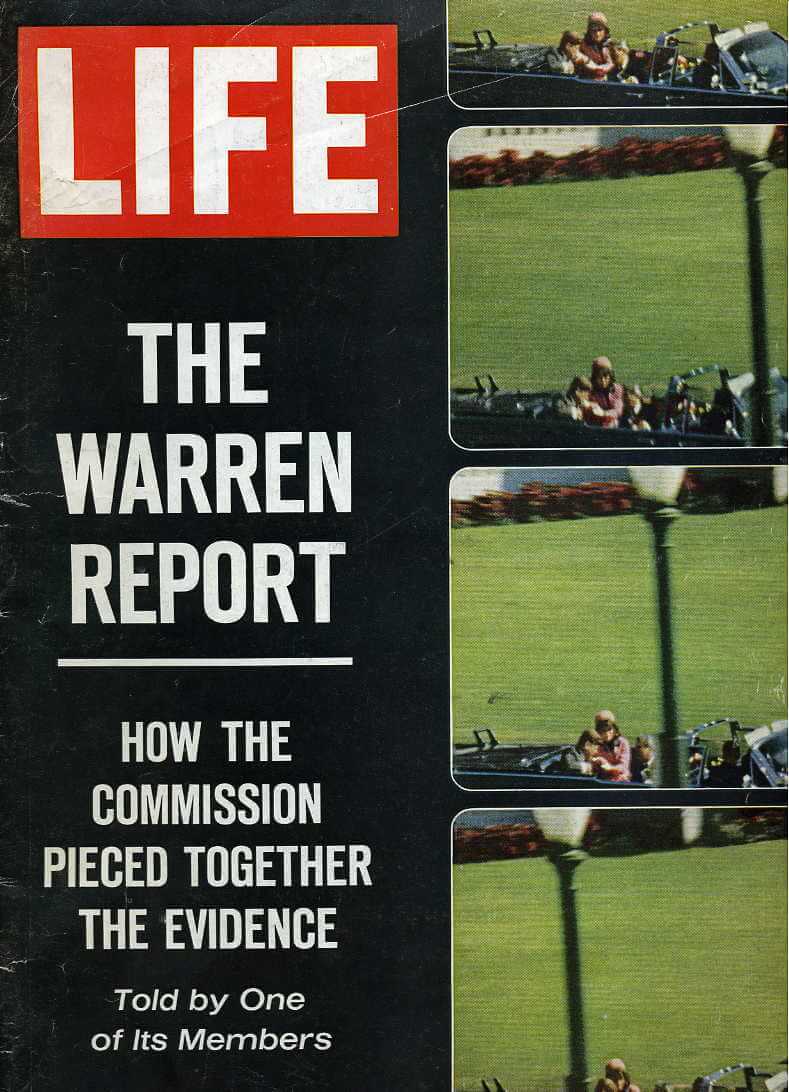
Tag: ZAPRUDER FILM

  • JFK Declassified: Tracking Oswald, Part 6

    JFK Declassified: Tracking Oswald, Part 6


    Part 7

    Part 5

    Part 4

    Part 3

    Part 2

    Part 1


    How The History Channel Did Not Track Oswald


    The series “JFK Declassified: Tracking Oswald”1 has revealed itself to be a deception, one almost as blatant as the magic bullet, conducted not in six seconds, but over six episodes:

    • “The Iron Meeting” that never happened in Mexico City, since …
    • “The Russian Network” immediately wrote Oswald off as a nut job;
    • “Oswald Goes Dark” in New Orleans—after displaying his pro Castro activism in broad daylight on the streets and even on the radio—to establish …
    • “The Cuban Connection” with Alpha 66—a virulent paramilitary group of Cuban exiles organized and backed by the CIA—for the common purpose of killing Kennedy;
    • “The Scene of the Crime” is mounted upon junk-science tests aimed at fixing Oswald as the lone gunman, and a far-fetched escape route for cooking up evidence about alleged Castroite Oswald being helped by anti-Castroite Alpha 66; and finally …
    • “The Truth” reached by former CIA case officer Bob Baer is just an old CIA deceit about Castro’s foreknowledge of Oswald’s criminal intent.

    An Overview of Baer’s First Four Installments

    Before commenting on the last episode, let us revisit some of the earlier segments, in order to accent both what was in them and what was missing.

    The first episode, about Oswald in Mexico City, was largely based upon a dubious book arranged by American journalist Brian Litman while he was living in Moscow in the late eighties. Colonel Oleg Nechiporenko’s Passport to Assassination seemed designed to counter two sources. First, what CIA officer David Phillips said in a debate with Mark Lane, namely, that when all the records were in, there would be no evidence Oswald was at the Russian consulate. (See Plausible Denial, p. 82) Second, what the Lopez Report describes: namely, that the CIA could provide no tapes or pictures of Oswald at either the Russian or Cuban consulates. The Litman/Nechiporenko book said Oswald was at the Russian consulate anyway. And even more made to order, the portrait it drew of Oswald was one of an unstable, almost suicidal character who fears the FBI is hunting him down. Which, as we know, is contradictory to the actual Oswald who, even under arrest for murder in Dallas, was a pretty cool customer. The Litman/Nechiporenko creation is much more in line with the Warren Commission’s sociopathic portrait. Baer never notes this discrepancy.

    What is even worse, in part 2, Baer tells the audience that before he met with the colonel, he had no idea what Nechiporenko knew about Oswald. Are we to buy the concept that Baer never heard of his book? Are we supposed to believe the note of surprise in Baer’s voice when the colonel tells him he met with Oswald in Mexico City? That book was published in 1993, well over twenty years ago. So when, after speaking with the colonel, Baer says, “This puts the case in a whole new light”, what on earth is he talking about? And who does he think he is kidding? Certainly not anyone who knows something about the JFK case.

    But further, in his usual portentous tones, Baer constantly compares Oswald meeting with Russian KGB agents in 1963 to someone meeting with ISIS today. As if ISIS had embassies that people can walk into and request information about visa applications. Again, this is so exaggerated as to be ludicrous. When did the KGB ever perform executions on camera? The spy wars back then were more sophisticated, more assiduous and cerebral in their planning and objectives than the war with terror today. That is one reason why it was called the Cold War.

    Let us describe another crevice in Baer’s early presentation. One of the very few documents Baer shows the audience which actually was declassified by the Assassination Records Review Board was a transcript of a call between President Johnson and FBI Director J. Edgar Hoover. In it, LBJ asks for information about Oswald in Mexico City. The call was made on the morning of November 23rd. Baer does not tell the audience that, as Rex Bradford discovered, there is no tape recording of this call, we only have a transcript. But he also does not tell his viewers that right after LBJ asked for more information, Hoover told the president that the audio tape and the picture they have of Oswald did not correspond to the man the FBI was interrogating in Dallas. In other words, the guy the CIA says was in Mexico City is not the man electronically captured by the CIA surveillance devices. (Jim Douglass, JFK and the Unspeakable, p. 80) Are we to believe that Baer read that transcript but missed that crucial piece of information? Or if he did not, he thought that it somehow was not important?

    Let us mention another less-than-candid practice of “Tracking Oswald”. Time after time, Baer intones that he has studied the JFK case for ten years and read the entire 2 million page declassified record of the Assassination Records Review Board. In fact, he (unconvincingly) tries to insinuate that he has scanned the two million pages into his own personal database. Yet, if that were so, why does he show us pages printed from the Warren Commission Report as being redacted? Which they are not. He does this more than once, at least three times. Is he trying to present old, mildewed information as somehow spankingly brand new?

    After speaking with Oleg Nechiporenko, Baer decides that his idea from Part 1, that somehow Oswald met with KGB agents in Mexico City in 1963 and they plotted to kill President Kennedy is faulty. Yet the original evidence he based this on was flawed to begin with. Baer said that the FBI got hold of some postcards that Oswald allegedly purchased in Mexico City. One of them depicted a bullfight. Therefore, Baer deduced that Oswald met some KGB agents at a bullfight and planned the killing of JFK. No joke.

    The idea that if you buy a postcard with a bullfight on it, then you went to a bullfight is not logically sound. Tourists buy all kinds of postcards in foreign countries concerning places they do not actually go to. It is true that Marina Oswald said that her husband told her that he went to a bullfight in Mexico City. (WR, p. 735) But this is in direct contradiction to the fact that she had previously denied he was in Mexico City to the Secret Service during their first interview. And she denied it twice. (Secret Service report of Charles Kunkel from 11/24-11/30)

    Contrary to what the program asserts, the evidence of Oswald in Mexico City—a Spanish-English dictionary, blank postcards, etc.—was not immediately seized and turned over to the FBI. And contrary to what Baer says, the Russians did not give him the postcard in evidence. These pieces of evidence—including the postcards—were adduced into the record a week after the assassination by Marina Oswald’s companion Ruth Paine. (Reclaiming Parkland, by James DiEugenio, p. 344) That Baer relies so much on these postcards without telling the viewer about their provenance tells us a lot about both his honesty and his knowledge base. Or perhaps both. Because the truth is that the Warren Commission had a hard time placing Oswald in Mexico City. Months later, in August, Priscilla Johnson, who replaced Ruth Paine as Marina’s companion, was still surfacing evidence about Oswald’s bus rides in Mexico City. This drove Warren Commission lawyer Wesley Liebeler up the wall. (ibid)

    Baer also makes much play about Soviet diplomat Valery Kostikov meeting with Oswald at the Russian consulate in Mexico City. At the end of Part One, he tries to proffer it as evidence that hardly anyone ever knew about. If Baer really believes that, then he did not read the Warren Report, because Kostikov’s name appears there on page 734. And he is named as a KGB agent on that same page. In other words, it was open to the public back in 1964.

    Once the KGB colonel tells him the Russians had no espionage interest in Oswald, Baer drops that line of inquiry. He now goes back to Mexico City and “discovers” the name of Sylvia Duran in his two million page declassified database. Again, he somehow sounds surprised when he finds the name of Sylvia Duran in there, even though, as anyone could have told him—except perhaps his staff—her name is also in the Warren Report. (See p. 734) And again, he continues in his shocked syndrome with, “This file completely changes the course of this investigation.” Who does Bob think Oswald talked to in the Cuban consulate, Che Guevara? Again, Baer is seemingly stunned when he finds out the Warren Commission did not talk to Duran. Which again shows his lack of knowledge of the real declassified record. The ARRB declassified the Commission’s Slawson/Coleman report in the Nineties. It was very clear from this Mexico City trip report of the Warren Commission that the CIA and FBI kept those two men on a short leash. By never referring to it, Baer escapes this question: Why did the Bureau and the Agency firmly regulate what Commission lawyers David Slawson and Bill Coleman saw and read? And why did the Commission not demand more freedom and access?

    Ultimately, what can one say about a program called “Tracking Oswald” that never mentions or details the following names: Ruth and Michael Paine, George Bouhe, George DeMohrenschildt, David Ferrie, Guy Banister, Clay Shaw, or Kerry Thornley? These people largely controlled the last 17 months of Oswald’s life after his return from Russia. The first four did so in the Dallas/Fort Worth area; the second quartet in New Orleans. If you never examine any of those persons then how are you tracking Oswald? And contrary to what Baer says about his (ersatz) access to the ARRB declassified files, there have been many pages released about those people. And there are still pages that will be released on them in October of this year.

    Baer’s presentation is so restricted, so empty, and at the same time his approach is so hammily bombastic, that it leads an informed viewer to suspect an agenda. That agenda is to make believe he has consumed 2 million pages of documents for the viewer. Then to present virtually nothing from those pages. After performing this shell game, he tells his audience: Hey, I saw them, and guess what? Oswald still did it.

    Sure Bob, sure.


    The Final Chapter

    The title for the final episode conceals the fact that Baer’s conclusion—Castro knew it—has been drawn from two false premises: (1) Oswald was the lone gunman who killed Kennedy firing both a magic bullet and a fatal shot to the head; (2) Oswald was openly telling his criminal intention to members of Alpha 66, which was riddled with agents of the Cuban Intelligence Service (CuIS) who reported back to Castro.

    Since Baer refuses to explain how CuIS moles would have known much more about Oswald than the CIA officers and agents working closely with Alpha 66 since its inception in 1962, let’s make a clean break with his conspiracy theory. There is no shred of evidence refuting Castro’s statement about Oswald during his Radio/TV appearance in Havana the day after the assassination:2 “We never in our life heard of the existence of this person.”


    An Apocryphal Story as Baer’s Cornerstone

    Shortly before airing the series, Baer revealed to Time magazine staffer Olivia B. Waxman:3 “What really got me into it was meeting a defector from Cuba and one of the best agents the CIA has ever had. He said that on the 22nd of November 1963, four hours before the assassination, he was at an intelligence site in Havana when he got a call from Castro’s office, saying, ‘Turn all of your listening ability to high frequency communications out of Dallas because something’s going to happen there.’”

    In front of the camera Baer provides a second-hand version of this story by CuIS defector Enrique García, who affirmed that another CuIS defector, Florentino Aspillaga, had told him such a story. The latter had also given it as an anecdote à la carte for the book Castro’s Secrets (Macmillan, 2012, 2013),4 written by former CIA desk analyst Dr. Brian Latell.

    Together with Aspillaga and Latell, García and Baer end up forming a crew who carry the banner “Castro knew Kennedy would be killed.” It’s silly that Castro would have resorted to a radio counterintelligence prodigy or any other means of electronic intelligence (ELINT) in order to learn something that would have been instantly available through the mass media. In 1963, instant info about anything occurring in Dallas during the JFK visit simply meant broadcast reports interrupting soap operas on the three national TV networks and radio stations breaking news furnished by reporters covering the live event.

    Pathetically, Baer mounts a charade with Adam Bercovici broadcasting local info from Dallas, Baer himself boosting it through short-wave radio as some Alpha 66 operator would have done, and two guys in a boat picking up the signal in international waters near a Cuban ELINT radio tower. They are unaware that Aspillaga, codenamed TOUCHDOWN by the CIA,5 became a self-defeating storyteller6: “It wasn’t until two or three hours later that I began hearing broadcasts on amateur radio bands about the shooting of President Kennedy.” Radio amateurs must have just been chatting about what the commercial media had already reported. Indeed, a unique witness—French journalist Jean Daniel—had given conclusive evidence against Aspillaga since the very day of the assassination. After a phone call by Cuban President Osvaldo Dorticós, Castro got all the news “from the NBC network in Miami.”7 Plus, we know from Daniel—who was serving as Kennedy’s emissary to Castro on the day of the assassination—that Fidel was utterly shocked when he heard the news that Kennedy had been shot. Later, when Castro got the news that JFK was dead, he turned to Daniel and said—referring to their plans for rapprochement—that everything was going to change. (Jim Douglass, JFK and the Unspeakable, pp. 89-90)

    Aspillaga’s story is spurious not only because it’s silly but because, as shown above, its rebuttal can be traced back to Daniel’s on-site account. The crux of the matter is that Aspillaga confided to Latell in 2007 he had previously told the story only to the CIA during his debriefing after defection in 1987.8 Thus, it must have been declassified or withheld under the terms of the JFK Records Act (1992). However, Aspillaga’s story appears neither among the millions of pages declassified by the ARRB nor among the around 1,100 records still withheld by the CIA at the National Archives and Records Administration (NARA).9


    Tracking Oswald Seriously

    In Dallas, Baer and his team attempt to reconstruct a planned Oswald escape after the last shot. He imagines having made an unbelievable discovery: there were, get this, six houses of Cuban exiles along the road to a present-day bus stop on a route matching the dubious 1963 transfer ticket found in Oswald’s shirt pocket when he was arrested. Even as simply linking Oswald to a safe house, this evidence is fishy.

    Baer absolutely trusts an informant who told the Dallas Police Department (DPD) about seeing Oswald with Cuban exiles in a house at 1326 Harlandale Avenue. It was rented by Jorge Salazar, lieutenant to Manuel Rodríguez Orcabarrio [sic], head of the Dallas Alpha 66 chapter, and served as a meeting place. However, Peter Scott pointed out that Orcabarrio “looked so much like Oswald that he was mistaken for him.”10 A point that somehow, in all his alleged document review, Baer missed. Yet, this was backed up by another reputable JFK researcher. In his book, The Secret Service (Fine Communications, 2002), the late Philip H. Melanson further provided that it was “independently confirmed by the FBI [that Orcabarrio] bore a resemblance to Lee Harvey Oswald” (page 83). And Larry Hancock argues that there is some evidence that the information was later negated. A source later “told the FBI Oswald had never been there.”11

    Baer ignores all of this and goes on by cherry-picking info out of context. To make it crystal clear that Alpha 66 was deeply infiltrated by CuIS, defector García stated that its Chief of Operations was a Castro dangle. In fact, CuIS officer José Fernández-Santos, a.k.a. “El Chino” [The Chinese], became Alpha 66 Chief of Naval Operations, but just after illegally leaving Cuba in late 1968. To reinforce the image of Oswald obsessed with killing Kennedy, Baer makes use of the Sylvia Odio incident as if it were a prelude in Dallas on the road to Mexico City, instead of a quantum of proof about Oswald’s impersonation here or there.12

    Under an illusion about another “explosive discovery”, Baer raves on about Oswald returning from Mexico to fulfil “his promise” and running into people as furious with Kennedy as himself: Alpha 66. Thus, Baer and his team lost the real trail marked by the CIA’s “keen interest in Oswald, held very closely on the need-to-know basis.”13

    Three CIA teams never stopped tracking Oswald all the way from Moscow (1960) to Dallas (1963). Info about him—more than 40 different documents: FBI reports, State Department cables, intercepted personal letters and others—usually passed from the CIA Counterintelligence (CI) Special Investigation Group (SIG) to the CI Operation Group (OPS) to the Counter-Espionage Unit of the Soviet Russia Division (CE-SR/6).

    • The CIA opened a personality file (201-289248) on “Lee Henry Oswald” on 9 December 1960. His documentary record began with the Halloween 1959 UPI story “An ex-Marine asks for Soviet citizenship.”
    • Since May 25, 1960, “Lee Harvey Oswald” appeared in another file at the Covert Operations Desk, based on the report by FBI Special Agent John Fain in Dallas after talking with Oswald’s parents about “Funds Transmitted to Residents of Russia.”
    • A third CIA index card for “Lee H. Oswald” was attached to file (100-300-011) about the Fair Play for Cuba Committee (FPCC) on October 25, 1963. FBI Special Agent Warren De Brueys had reported from New Orleans that Oswald confessed being “a member of the alleged New Orleans chapter of FPCC,” a pro-Castro group listed as subversive.

    These cards were used in a threesome for making different legends of the same re-defector, who arrived in the U.S. with his wife and their 4-month-old daughter on June 13, 1962, thanks to a $435.71 loan from the State Department. S.A. Fain debriefed him in Fort Worth twice. His final report, dated on August 30, 1962, stated Oswald “agreed to contact the FBI if at any time any individual made any contact of any nature under suspicious circumstances with him.”

    Surprisingly, the CIA cable traffic in early October 1963 demonstrates that the Station in Mexico City and the Headquarters in Langley hid from each other their intel about Oswald’s connections with Cuba: His visit to the Cuban Consulate on September 27, 1963, and his pro-Castro activism in Dallas and New Orleans, respectively.

    The CIA got shockingly involved in a conspiracy of silence about a former Marine, re-defector from the Soviet Union and self-pronounced Marxist, who was identified by the FBI as a pro-Castro activist in Dallas and New Orleans, spotted by the CIA in Mexico City visiting both the Cuban and Soviet embassies, and finally missed by both the FBI and the CIA as a security risk in Dallas at the moment of truth. A former CIA case officer must be aware of all this, but Baer overlooks the hard facts in lieu of resorting to camouflage with “Castro knew it.”


    Castro versus Kennedy

    In the interview with Waxman, Baer dragged and dropped that Castro “had every reason in the world” to want JFK dead. In the series, Baer assumes that Castro “was very happy” when his moles in Alpha 66 briefed him about Oswald being set up to kill Kennedy. Since Castro did nothing to prevent JFK’s death, Baer foists a conspiracy of silence on him.

    This is an utter distortion of history done for the History Channel. Because Castro had every reason to want Kennedy alive and well. On Christmas Eve 1962, the American lawyer Jim Donovan boarded the last flight with the Bay of Pigs prisoners airlifted to Miami as result of his negotiation with Castro. Just before departure, Castro’s aide Dr. Rene Vallejo broached the subject of re-establishing diplomatic relations. Upon learning of this communication, Kennedy commented “it looked interesting.”14

    With JFK’s death Castro was going to gain nothing else than LBJ in the White House, who offered no promise of more favorable U.S. policies toward Cuba. The Soviet bloc’s diplomats in Havana were aware of Castro’s preference. On March 31, 1963, Hungarian Ambassador János Beck set out in a secret report to Budapest that Castro was convinced “Kennedy is the best” option among the possible candidates for the U.S. presidency in 1964.15 Furthermore, ABC newswoman Lisa Howard interviewed Castro in April 1963 and reported he considered a rapprochement with Washington desirable.16 The same message was conveyed in August 1963 by one María Boissevain, wife of a former Dutch Ambassador to Cuba.17

    Even so, the CIA was dismayed that Kennedy continued to favor a compromise with Castro. On November 5, 1963, CIA Deputy Director for Plans Dick Helms suggested to “war game” the Castro détente in a meeting of the Special Group.18 Kennedy opted for sending French reporter Jean Daniel as secret envoy to Castro. On November 19, Daniel was already talking with him, while Kennedy was waiting for an agenda proposal by Castro to “decide what to say [and to] do next.”19

    On September 7, 1963, Castro had attended a reception at the Brazilian Embassy in Havana. He talked with Associated Press correspondent Dan Harker, who quoted him saying: “U.S. leaders should think that if they are aiding terrorist plans to eliminate Cuban leaders, they themselves will not be safe.”20 According to the crew of “Castro sorta did it,” he wanted Kennedy’s death and gratuitously broadcasted his intention to the whole world. In fact, Kennedy had expressed the same idea on November 1961. After meeting with reporter Tad Szulc, who noted him “under terrific pressure from advisors (…) to okay a Castro murder,” Kennedy discussed the issue with his aide Richard Goodwin and remarked: “If we get into that kind of thing, we’ll all be targets”.21

    Castro summed up his ethical pragmatism thusly: “Ethics is not a simple moral issue (…) It produces results.”22 If he would have had foreknowledge—from Alpha 66 or any other source—of Oswald or whoever else was threatening to kill Kennedy, he would have reacted just as in 1984 with a U.S. President he deemed much worse than Kennedy. After being advised about an extreme right-wing conspiracy to kill Ronald Reagan in North Carolina, Castro ordered his spymaster at the Cuban Mission to the UN to furnish all the intel to the U.S. Security Chief at the UN, Robert Muller. The FBI quietly dismantled the plot.23


    Abuse of History

    Baer’s intent appears to be to keep on muddying the waters. He even said to Waxman: “We don’t know exactly what the Cubans told him in Mexico City,” although the CIA did know that they only talked about an in-transit visa. The acting consul, Alfredo Mirabal, was also a CuIS officer, identified by the CIA as “Chief of Intel”24. Before the HSCA, Mirabal adamantly stated having judged Oswald’s visit to the Cuban consulate on September 27, 1963, as “a provocation.”25

    That day the CIA listening post LIENVOY recorded two calls between Cuban and Soviet consular staffers about an American citizen seeking—illegally—an in-transit visa to Cuba on his way to Soviet Russia. On the second call’s transcript, Station Chief Win Scott noted: “Is it possible to identify?”26

    This normal reaction was followed by an anomaly. In the LIENVOY operational report for September 1963, Scott referred to “two leads of operational interest:” a female professor from New Orleans calling the Soviet Embassy, and a Czech woman calling the Czech embassy.27 In gross violation of the CIA protocol, the U.S. citizen in Mexico City who was allegedly Oswald was not reported to Langley.

    Ironically, the conspiracy of silence foisted in a fact-free manner by Baer on Castro proved to be factually correct in reference to the CIA. With Castro as vantage point instead of the CIA, Baer was not tracking Oswald to articulate a true picture of the past, but to drive the historical truth away.


    NOTES

    1 After two episodes, the series was cancelled in the U.S., but continued in Canada. The History Channel has informally stated it will come back to the States in a timely fashion.

    2 JFK Exhibit F-684.

    3Former CIA Operative Argues Lee Harvey Oswald’s Cuba Connections Went Deep,” Time, April 25, 2017.

    4 See the book review “The End of An Obsession.”

    5 After 25 years and 13 medals in the CuIS, Aspillaga defected from his third-rate post in Bratislava [Slovakia] to Vienna in early June 1987. The CIA Station Chief there, James Olson, thought his companion was Aspillaga’s daughter, but she was actually Aspillaga’s girlfriend. The British historian Rupert Allason, a.k.a. Nigel West, made an entry for the case in his Historical Dictionary of Sexspionage (Scarecrow Press, 2009). Anyway, Aspillaga got a deluxe package of resettlement in the U.S. in return for handing over valuable documents stolen from the first-rank CuIS Station in Prague and for being squeezed by CIA debriefers. He furnished the key intel that almost all the Cubans recruits by the CIA from 1960 onward were double agents loyal to Castro.

    6 Brian Latell, Castro’s Secrets, Macmillan, 2013, 103.

    7 Jean Daniel, “When Castro Heard the News,” The New Republic, December 7, 1963.

    8 Instead of taking the road to clarification, the CIA engaged in a conspiracy of silence. The Agency Release Panel responded to a FOIA request on June 28, 2013: “The CIA can neither confirm nor deny the existence or nonexistence” of JFK-related records in Aspillaga’s debriefing.

    9 Neither Aspillaga nor TOUCHDOWN brings any result by searching one after the other, or both, at the National Archives web site. By entering “JFK Assassination” in the search box, the first relevant result would be “About JFK Assassination Records Collection.” By clicking on it, then on “JFK Assassination Records Collection Database”, and finally on “Standard Search”, a “Kennedy Assassination Collection Simple Search Form” appears. After entering the terms “Aspillaga” (first line) OR “Touchdown” (second line), no hit will be retrieved.

    10The CIA’s Mystery Man,” The New York Review of Books, Volume 22, Number 12, July 17, 1975.

    11 The last name is often misspelled as Orcabarrio or Orcaberrio. In the CuIS files, he is registered as Manuel Rodríguez Oscarberro. On the evening of November 22, 1963, DPD detective Buddy Walthers knew about someone looking very much like Oswald going into this house since October because his mother-in-law was living next door. Walthers reported it and the FBI did no more than confirm that Oscarberro and other Cuban exiles had been there and departed. Nonetheless it was noted that a source inside Alpha 66, who later moved to Puerto Rico, had furnished the information that Oswald was not associated with the group in any way and had never been to the house. Since Oscarberro did move to Puerto Rico, it is possible he was the FBI source clearing Oswald.

    12 Both occurrences overlapped in time, but left the same trail. Along with two Cuban exiles, a Leon Oswald visited Mrs. Odio in Dallas. The day after, one of the Cubans phoned her and discussed Oswald as an excellent shooter, who believed President Kennedy should have been assassinated after Bay of Pigs. Meanwhile, a Lee Harvey Oswald visited the Cuban Embassy in Mexico City and yelled on his way out: “I’m going to kill Kennedy!”

    13 As CIA Counterintelligence (CI) officer Jane Roman told John Newman on November 2, 1994.

    14 FRUS, XI, Doc. 275, 687 f.

    15 Declassified top secret document from the Hungarian Ministry of Foreign Affairs. At Cold War History Research Center Budapest, click on “Archives”, then on “Selected Hungarian Documents on Cuba, 1960-1963,” and finally on “Talks between Cuba and the USA (March 31, 1963).

    16 “Castro’s Overture,” War/Peace Report, September 1963, 3-5.

    17 NARA Record Number: 104-10310-10244.

    18 NARA Record Number: 104-10306-10024.

    19 Peter Kornbluh, “JFK and Castro,” Cigar Aficionado, September – October 1999, pp. 3 ff.

    20 “Castro Blasts Raids on Cuba,” New Orleans Times-Picayune, September 9, 1963.

    21 Richard Mahoney, JFK: Ordeal in Africa, Oxford University Press, 1983, p.135.

    22 My Life: A Spoken Autobiography, Simon and Schuster, 2008, 211.

    23 Nestor Garcia-Iturbe, Cuba-US: Cuban Government Saved Reagan’s Life, June 6, 2015.

    24 NARA Record Number: 1994.05.03.10:31:46:570005.

    25 HSCA Report, pp. 173-78.

    26 NARA Record Number 104-10413-10074

    27 NARA Record Number: 104-10052-10083.
  • JFK Declassified: Tracking Oswald, Part 5

    JFK Declassified: Tracking Oswald, Part 5


    Part 1

    Part 2

    Part 3

    Part 4

    Part 6

    Part 7


    For the fifth episode of the series “JFK Declassified: Tracking Oswald,” former CIA case officer Bob Baer and his team moved from New Orleans to Dallas seeking to prove Oswald “had help in accomplishing his mission.” Aren’t they putting the cart before the horse by widening the net in search of accomplices before having determined whether Oswald was the perpetrator? They are indeed doing so, because Baer does have a mission: Keeping the CIA out of the picture.

    After mixing Oswald with the anti-Castro and CIA-backed paramilitaries of Alpha 66 in a weird pot made of “special intent to kill President Kennedy soup”, Baer keeps on blighting a big-budget TV show by ignoring the body of the evidence. The latter supports the same assessment given by J. Edgar Hoover to Lyndon B. Johnson the morning after the assassination: “The case as it stands now isn’t strong enough to be able to get a conviction. ”1

    The Warren Commission (WC) has manufactured the case against Oswald with at least a wrong murder weapon (CE 139), a wrong bullet (CE 399), and a wrong shell (CE 543). Instead of weighing the evidence, Baer and his team commit a kind of Only Game in Town Fallacy: If a second shooter is not at hand, then that leaves Oswald as the lone gunman.


    Bogus Testing

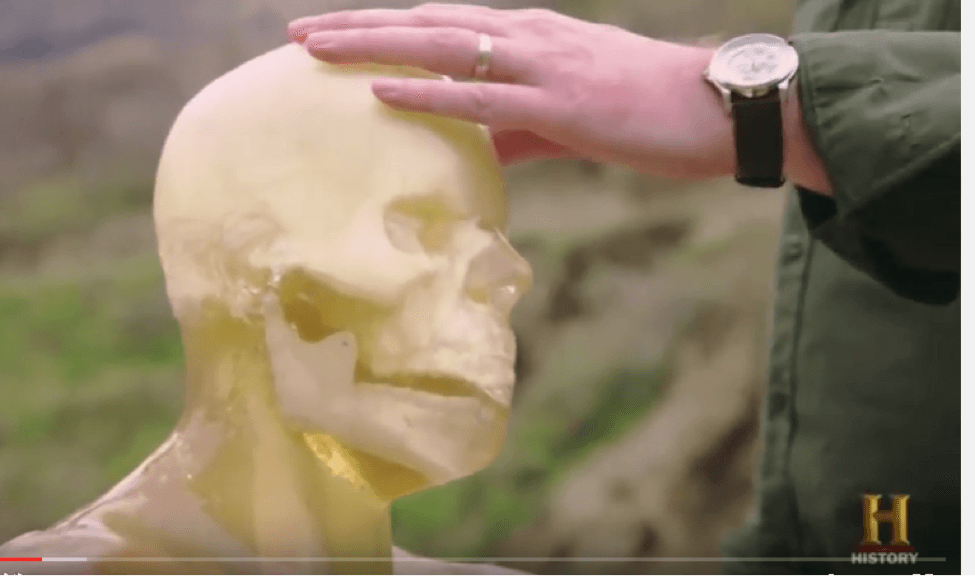
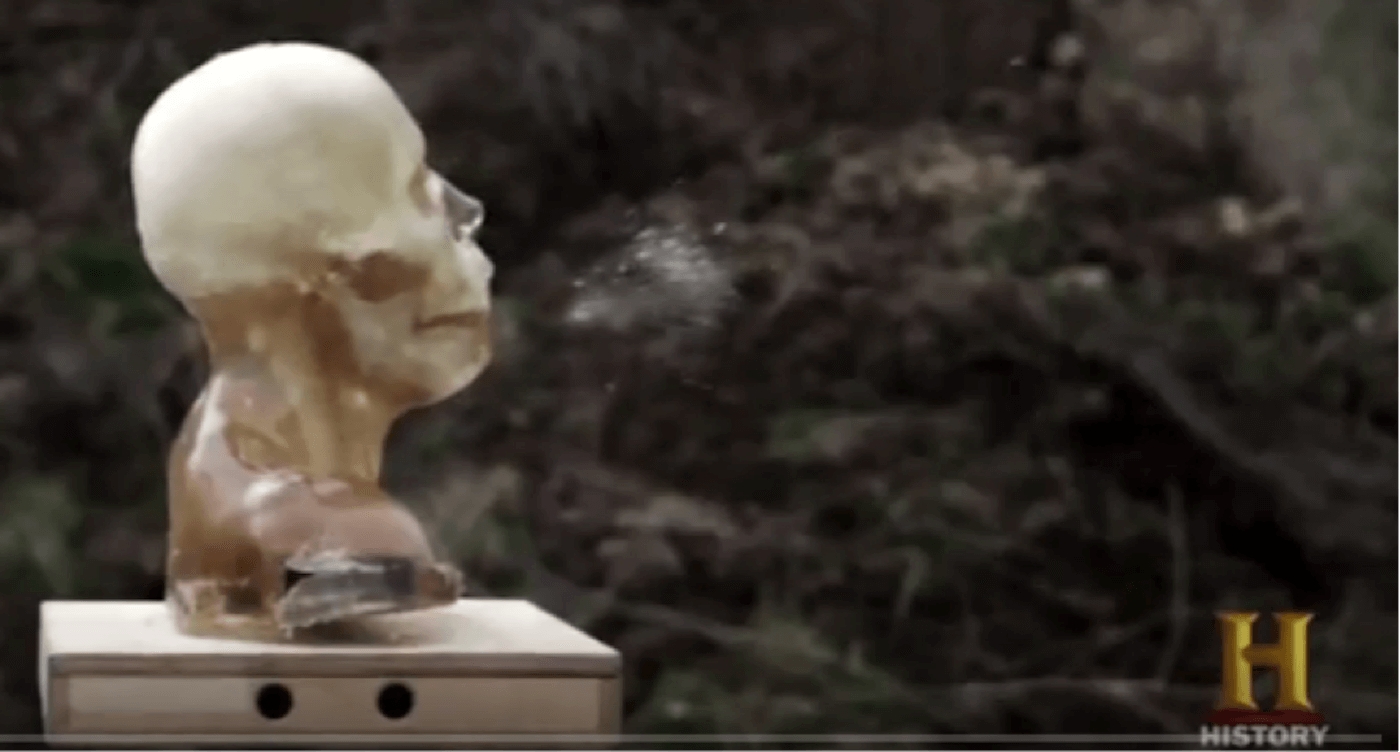
    To throw out the prima facie evidence —in the Zapruder film2— of gunfire from the right front, Baer simply replaces Luis Alvarez’s melon with what they call an encased gel ordinance head. Which goes backwards after being struck by a bullet fired from behind.

    A Nobel Prize winner in Physics (1968), Alvarez got involved in a test with a taped-up melon to verify that the backward snap of Kennedy’s head was consistent with a shot from behind due to a jet-propulsion-like recoil.3 But, as Gary Aguilar showed in his reply to Luke and Mike Haag, another test conducted by research physical scientist Larry Sturdivan at the Aberdeen Proving Grounds in 1964 proved otherwise. Ten skulls were shot with a Mannlicher-Carcano and all of them moved away from the rifle in the same direction of the bullet. The Commission suppressed these findings and plainly reported that President Kennedy was struck in the head and “fell to the left into Mrs. Kennedy’s lap.”  (Click here for that article)

    Alvarez’s test was misleading because a taped-up melon has neither the sheer strength nor the thickness close to that of a human skull. By the same token, Baer’s ballistic test is just another rigged attempt to support the discredited WC lone-gunman theory with a childish jet effect. We cannot do better than let Milicent Cranor comment at length on this ludicrous so-called “experiment”.


    History Channel – or Saturday Night Live?

    By Milicent Cranor

    This segment of the History Channel’s special on the Kennedy Assassination seems like a low-budget skit from Saturday Night Live!

    An “expert sniper” goes through the motions of recreating the shot to Kennedy’s head. The idea is to prove that one shot from the presumed Oswald location can cause the reaction we see on the Zapruder film: the head moving to the back and to the left.

    It’s not clear what they’ve dug up to use for the head.  The sniper describes it vaguely as a human head filled with ordinance gel, and throughout his little talk, he refers to that gel.  As in “shooting from behind the ballistics gel” and “I’ve got the ballistics gel on target.”  Maybe he hopes to convey the impression of a gelatinous brain causing the head to spring backwards. 

    The demonstration is just amazing. it is far more revealing than the show’s creators realize:

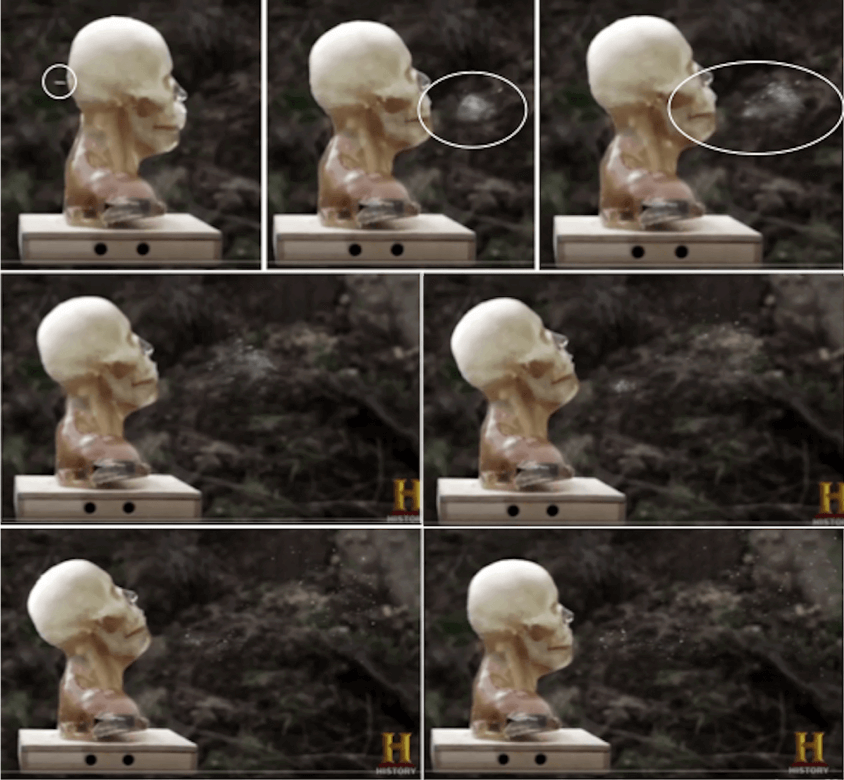
    We only get a side view of the action – and are not allowed to see the back or front of the head, not even after the shooting.

    The limited view of the head shows no damage whatsoever.

    The head moves back, but not to the left.  Then it pops right back up to its original position! 

    Something, possibly vaporized gel, seems to come out of the head (or from a smoke machine behind the head) – but only from the mouth area. 

    So he looks like a man leaning back with pleasure as he smokes a fine cigar, oblivious to the characters behind him.

    The sniper’s explanation for what happened is even more amazing: 

    “…the bullet enters the back of the head and the terminal ballistics will come here — [indicates area of right eye and forehead] – causing the head to go back and to the left.”

    cranor a

    “The terminal ballistics will come here”?  Terminal ballistics is defined as “the study of the behavior and effects of a projectile when it hits its target and transfers its energy to the target.”

    The sniper can’t explain what happened, but he seems to think that by naming the field of study concerned with such phenomena, the audience will be fooled.

    cranor b

    It is especially funny that he points to the area of the right eye: (1) In real life, the bullet is supposed to have exited from the top of the head on the right; (2) the gel-filled head in the demonstration seems to have no damage to that area, and it would show in a right profile view; and (3) all the exiting stuff representing brain matter comes out of the mouth.  Neither JFK nor the head in this demo is supposed to have had an exit wound in the mouth.

    Conclusion: The creators of this segment must have gel for brains. Or they think their audience does.

    cranor d
    THE SMOKING MAN

    Watch the segment on YouTube


    As the reader can see, this is not a studious, scientific attempt to duplicate the circumstances that befell Kennedy at 12:30 PM in Dealey Plaza, in Dallas.  And for Baer to try and pass it off as such speaks very poorly of both him and his show.

    But Bob Baer is not done.  Not by a long shot. For now he goes on and conducts what he calls an acoustics test. According to him, dozens of ear witnesses4 who heard shots coming from the Grassy Knoll were actually confused due to “the amphitheater effect.” The real sound coming from the Texas School Book Depository (TSBD) would have echoed at the so-called triple underpass and other hard structures in Dealey Plaza.

    To construct this “explosive theory,” Baer went to the crime scene with sound engineers and equipment that “nobody used before”. He just forgot to adjust the experiment setting to the standards of historical reconstruction.5 Not a single person was placed where a certain witness had been watching the presidential motorcade, and the sounds of the shooting weren’t generated by firing the rifle at the sniper nest. They were recorded elsewhere and played thereafter from near the TSBD.  No kidding.

    What is kind of shocking about this so-called acoustics test is that Baer completely ignores its far superior predecessor. During the proceedings of the House Select Committee on Assassinations, (HSCA) that body did an acoustics test in Dealey Plaza.  Except their testing was live and they brought riflemen into the plaza. And from that and their work with and analysis of the 11/22/63 dictabelt recording from Dealey Plaza by a Dallas policeman on a motorcycle, they concluded the following: 1.) Someone fired from the grassy knoll, and 2.) There were five shots fired that day. (Which, as Don Thomas reveals in his book Hear No Evil, for political reasons, Chief Counsel Robert Blakey reduced to four.)

    But, if one can comprehend it, Baer completely ignored the HSCA precedent, which included two teams of the finest audio scientists in the country. Among their members was Dr. James Barger of the firm Bolt, Beranek, and Newman. Barger had done acoustical research for the Navy in the field of submarine sonar detection, and had been involved in testing tapes of the 1970 Kent State shooting in Ohio. Barger did scientific testing of the actual sound wave patterns produced in Dealey Plaza at that time.  Barger’s findings were passed on to Professor Mark Weiss and his associate Ernest Aschkenasy. They did the final presentation for the committee. To imply, as Baer does, that those three men spent as much time and testing as they did and could not separate an echo from a live shot is ridiculous. But Baer and his program are so agenda driven that it is as if these previous tests never happened.  He brings in some audio recordings, some computer programmers, pays them a few bucks and with these stage props he has somehow eliminated the second gunman in the JFK case. Pure and utter poppycock. Baer’s level of science here would not pass muster at a good high school’s Science Fair. 


    An Inescapable Second Shooter

    On December 12, 1963, the Secret Service (SS) did a crude recreation. Its black and white footage plotted three shots on the JFK limousine. The bystander James Tague —wounded by a bullet ricocheting off the curb about 260 feet away from the limousine— destroyed the prior three-shots-three-hits scenario. Then, the magic bullet emerged not from evidence, but as an out-of-the-blue solution engineered to sustain the lone gunman theory.

    The FBI-SS reenactment on 23-24 May 1964 was a re-adjustment to preserve the willful closing of the case against Oswald. It also provided the notorious photo (CE 309) of Commission junior counsel Arlen Specter indicating with a metal rod the trajectory of the lie. However, an apparently insignificant detail provides a quantum of proof for demolishing any attempt—including Baer’s—to realign the shoots with the WC Report.

    For the 1964 recreation, Specter used the same jacket worn by Governor Connally on November 22, 1963, but he did not use President Kennedy’s. Otherwise he couldn’t have aligned the bullet entrance hole in the back of both Kennedy’s jacket and shirt with the exit wound at his throat.6

    The bullet holes are positioned 5 3/8” down from the collar line on the back of the jacket. They are consistent with the JFK death certificate, signed by his personal physician, Dr. George Burkley, who examined a back wound at the level of the third thoracic vertebra, about 4-6 inches below the point where the shoulders meet the neck.

    At this level, a bullet coming downward from the TSBD would not be able to exit the throat. But the Commission acolytes do not care about the death certificate7 and dismiss the jacket and the shirt as material evidence with the claim that both bunched up. Let’s connect the dots in a simple test.

    • Baer is invited to come dressed in suit and tie, along with John McAdams, Max Holland, Gerald Posner, Phillip Shenon et. al.;
    • They will remove their jackets and shirts to mark the position of the bullet hole in Kennedy’s, and will also mark on their bodies the back wound given by the WC;
    • They will put on their jackets and shirts, and will take a back seat in a car8;
    • They will get their jackets and shirts to ride up until the mark on each one matches the mark of the back wound. This crucial moment will be photographically captured;
    • They will compare the photos with the Zapruder film to find not even the faintest resemblance of JFK’s tailored suit jacket and buttoned shirt bunching up as theirs.

    They will surely face a dilemma. If the Warren Commission accurately placed the back wound, then JFK’s jacket and shirt were replaced, hence conspiracy; if the jacket and shirt are authentic, then the WC gave a false representation of JFK’s back wound, hence conspiracy or cover-up. There is not one whiff of any of these factors in the entire “Tracking Oswald” series, for if they did present it, the show would have to be called, “Trying to Find who Killed Kennedy.”  The Warren Commission did not want to do that.  Neither does Baer.


    Oswald’s Escape and Another Crime Scene

    After surreptitiously taking for granted that Oswald was the lone gunman, Baer applies his on-the-ground field officer expertise to assemble Oswald’s plan of escape with a concealed route, an Alpha 66 safe house, and some anti-Castro Cuban exiles as accomplices. No clue is given about how Oswald could have learned in advance the presidential motorcade’s schedule in order for him to have planned the assassination by firing a rifle with telescopic sight from his very place of employment.9  In that regard, Baer also ignores the following. That morning, Oswald asked fellow worker James Jarman why all the people were assembled in the plaza below.  When Jarman replied that President Kennedy was going to pass through in a motorcade, Oswald asked him which way it was proceeding.  Kind of wrecks Baer’s idea of Oswald’s planning.  Which is probably why he ignores it. (See Syliva Meagher, Accessores After the Fact, Vintage Books, 1992, pp. 37-38)

    For all of what follows, Baer relies on the bus ticket found in Oswald´s shirt pocket.  The former CIA officer somehow never discerns the difference between getting to and from work, and around the Dallas area, on the one hand, and escaping from the scene of a high profile murder case amid hundred of witnesses on the other. But Baer uses the ticket to infer a getaway route from the TSBD to an Alpha 66 safe house. On the way, Baer loses the evidentiary trail that—since Sylvia Meagher´s research in 1967—has put the ticket and other circumstances of Oswald’s escape under a cloud of suspicion (Accessories After the Fact, pp. 70-93).

    Baer deduces that, from his years of experience in the CIA, in a situation like this, the assassin(s) needed to have an escape route planned in advance. Our host does not want to admit that what the Commission says Oswald did after the shooting would suggest that he had no such plan in mind. Or that the latest research on this matter clearly indicates he was not on the sixth floor at all. (See Barry Ernest’s book, The Girl on the Stairs. Click here for a review) For the idea that a man who just killed the president would now search out public transportation to flee the scene of the crime amid hundreds of spectators and scores of policemen is simply not credible. But that is what the official story says. And that is what Baer is supporting.

    In any real planning situation one would rely on one of two factors for escape amid a multitude of spectators. The first alternative would be disguise—of which there is no evidence in this case. The other would be speed. That is, the longer one stays at or near the scene, the longer one risks the possibility of exposure and/or capture. Concerning this subject, one could do as Josiah Thompson did at the end of Six Seconds in Dallas. That is, present the testimony of policeman Roger Craig. Craig says he saw Oswald running down the embankment after the shooting. He then jumped into a Rambler driven by a dark skinned man. That would sound like an escape plan utilizing speed.  But probably because of that, Baer ignores it.  So in his scenario, Oswald boards a bus, gets off the bus, then walks a few blocks, and hails a taxi. But before he enters, he offers it to a little old lady standing next to him. (Meagher, p. 83) With a straight face Baer pronounces this an “escape plan”.

    Furthermore, Baer explains that Oswald ended up in the Texas Theater because of the run-in with Police Officer J.D. Tippit on East 10th Street, about 100 feet eastward from Patton Avenue. At that point, the escape plan was supposedly disrupted and Oswald failed to think clearly and rationally.  However, as in the case of his alleged shooting of the President, the evidence against Oswald in Tippit’s murder is shoddy.10 And Baer ignores that shoddiness.

    The crime scene is almost a mile away from Oswald’s rooming house at 1026 N. Beckley. His landlady Earlene Roberts saw him waiting for a bus at 1:04 PM after he left his room. Temple Ford Bowley arrived at the crime scene when Officer Tippit was already on the ground and some bystanders were milling around the police car. Bowley looked at his watch and the time was 1:10 PM. The Commission ignored Bowley. Why? Because clearly Oswald couldn´t have walked almost a mile in less than 6 minutes. They then reported that Tippit was killed circa 1:15 PM, despite the fact that is the time he was pronounced dead at Methodist Hospital. To keep up appearances, a typed FBI memo stretched out Tippit’s agony at the hospital until 1:25 PM.

    This case against Oswald for the Tippit shooting further weakens due to the three-wallets enigma.11 At the crime scene, Channel 8 staffer Ron Reiland filmed a policeman showing an open wallet to an FBI agent. According to FBI agent James Hosty, his fellow Bob Barrett revealed that this wallet contained IDs for both Oswald and Alek Hidell. But Dallas Police Officer Paul Bentley confiscated a second wallet from Oswald after he was arrested at the Texas Theater.  And another one was found among Oswald´s belongings at Ruth Paine´s house in Irving. These are all facts. They strongly suggest some evidence against Oswald was planted. They are ignored by Baer.

    Let us add another point about the two constant refrains by Baer during the program.  First, the continuing assumption that Oswald is the guilty party. This, as we have seen, he achieves only by ignoring the evidence, especially the new evidence declassified by the Assassination Records Review Board (ARRB). And that relates to the second refrain:  that Baer has read through the two million pages of declassified documents by the ARRB.  Yet this program offers no evidence from that declassification process. For instance, Baer presents a four-decades-old police report that Oswald was seen at an Alpha 66 safehouse in the Dallas area. The other document used in this episode is the famous testimony of Antonio Veciana of him seeing Oswald with Maurice Bishop at the Southland Building in Dallas.  Again, that information extends back to the seventies.  And it does not at all connect Oswald with Alpha 66. Veciana was arriving to meet with his case officer Bishop at the time.  He was early, and he saw Bishop with Oswald.  Oswald left shortly after he arrived.  In other words, Oswald was there with Bishop, not with Alpha 66 leader Veciana.  And as Veciana later admitted—just three years ago—Bishop was David Phillips.

    Now if Bob Baer was really interested in furnishing the public with new information, he could have done at least a couple of things with that crucial admission.  First, he could have said that the ARRB discovered that Phillips (along with James McCord) was running the CIA’s counter-intelligence programs against the Fair Play for Cuba Committee, of which Oswald was the only member in New Orleans. When one combines that with the fact that Oswald worked out of the same building that former FBI agent Guy Banister did, 544 Camp Street; and he printed that Camp Street address on more than one of his flyers, then that meeting with Phillips gets interesting.  Why would an alleged communist like Oswald be meeting with a CIA officer and working with a former FBI agent?

    The other aspect that could have been made up of new information would have been Phillips running the Cuban desk in Mexico City while Oswald was allegedly there.  Baer could have told the public:

    The man Oswald was meeting with,  David Phillips, told the HSCA that there were no tapes or pictures of Oswald in Mexico City. Yet there was such a tape that FBI agents listened to in Dallas while Oswald was under arrest for murder. Those agents told FBI Director J. Edgar Hoover that this tape was not the voice of the man in detention. We are going to explore that apparent quandary tonight.

    But, of course, Baer could not do that since he began the show by using a lot of questionable material about the Russians controlling Oswald in Mexico City, when the declassified Lopez Report strongly suggests that Oswald was impersonated in Mexico City. So the true identity of Oswald is kept under wraps, and some mythical association with Alpha 66 is now manufactured out of next to nothing.


    Coda

    More than fifty years and zero evidence after the JFK assassination, Baer is oddly not interested in or ignorant of what has been proven and debunked. He simply pushes back to square one—the lone gunman who shot a magic bullet—by concocting a light version (Castro knew it) of the oldest CIA backstop (Castro did it) through the fact-free hypothesis of Oswald linked somehow to Alpha 66 in the killing.


    Notes

    1 White House Telephone Transcripts, 23 November 1963, LBJ Library.

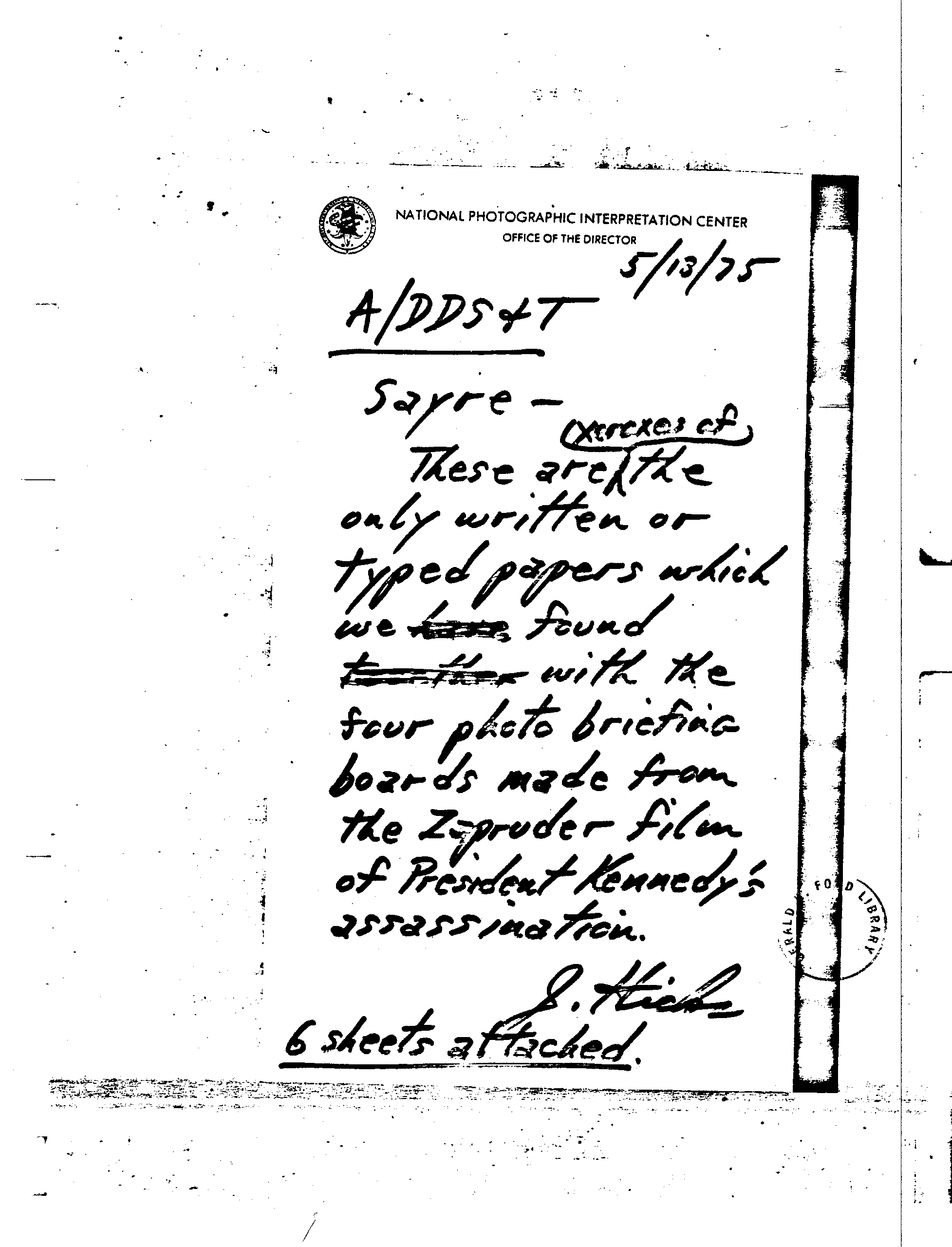
    2 In his remark to Attorney General Robert Kennedy about two people involved in the shooting, CIA Director John McCone wasn’t speculating. He had been briefed by Art Lundahl, head of the National Photographic Interpretation Center (NPIC), where leading photo analyst Dino Brugioni and his team examined the Zapruder film, made still enlargements of select frames, and mounted them on briefing boards. See Dan Hardways “Thank you, Phil Shenon” (AARC, 2015).

    3 Thus, Alvarez joined the crew of dueling experts devoted to defending the WC at any cost, after the Zapruder film was available for the first time to a mass audience on March 6, 1975, thanks to HSCA consultant Robert Groden and JFK activist Dick Gregory, who brought it to Geraldo Rivera’s ABC show “Good Night America.”

    4 Baer uses his own statistics, but the most reliable study, 216 Witnesses, by Stewart Galanor, found that 52 heard a shot from Grassy Knoll, 48 from TSBD, 5 from both places and 4 elsewhere. Other 37 witnesses could not tell and 70 more were not asked.

    5 The WC acolytes always incur this failure. For instance, it’s well-known since Mark Lane’s Rush to Judgement (The Bodley Head, 1966) that WC’s firearms experts were unable to duplicate what Oswald did, but Vincent Bugliosi replied in Reclaiming History (W. W. Norton & Company, 2007) that CEs 582 to 584 “shows two hits were scored on the head” (p. 1005) – only that both were scored using iron sights instead of scope.

    6 The FBI Supplemental Report from January 13, 1964, contains Exhibits 59 and 60 showing the bullet entrance holes in the back of Kennedy’s jacket and shirt, respectively. They weren’t included in any of the 26 volumes of Commission Exhibits. The initial draft of the WC report stated:  “A bullet had entered his back at a point slightly above the shoulder to the right of the spine.” WC member Gerald Ford wanted it to read: “A bullet had entered the back of his neck slightly to the right of the spine.” After the ARRB declassification, the discrepancy emerged. Ford told reporters: “My changes were only an attempt to be more precise.” (AP, July 3, 1997).

    7 Specter neither produced it nor interviewed Admiral Burkley, who as JFK’s personal physician was the only doctor present both at the Parkland Hospital (Dallas) in the emergency room and at Bethesda Medical Center (Maryland) during the autopsy.

    8 It could be the Cadillac used by Specter instead of the presidential limousine (Lincoln Continental 1961).

    9 For these and other similar issues, see A.M. Fernandez’s “Why the Warren Commission got scared with Castro”.

    10 Joseph McBride, Into the Nightmare, Hightower Press, 2013, pp. 244 ff.

    11 James DiEugenio, Reclaiming Parkland, Skyhorse Publishing, 2013, pp. 101 ff.

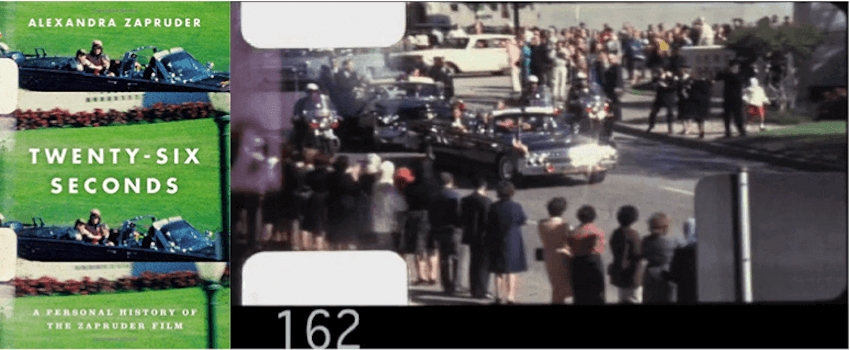
  • Alexandra Zapruder, Twenty-Six Seconds: A Personal History of the Zapruder Film (Part 2)

    Alexandra Zapruder, Twenty-Six Seconds: A Personal History of the Zapruder Film (Part 2)


    Part 1 of this essay


    What the Zapruder Film Is (and Isn’t)

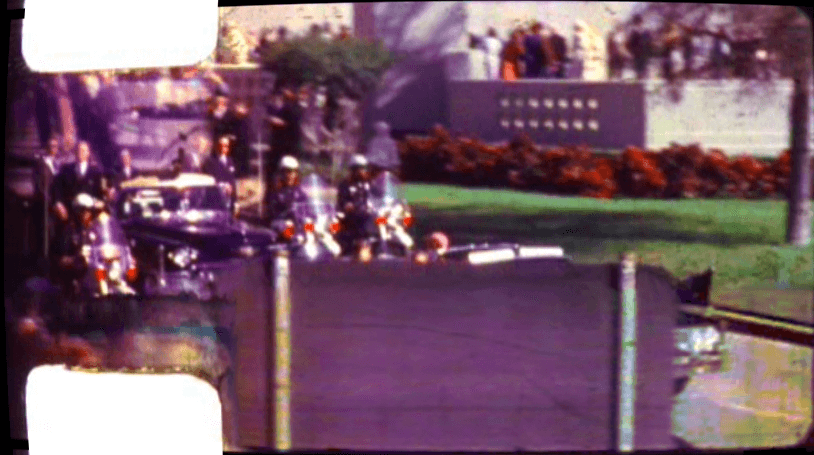
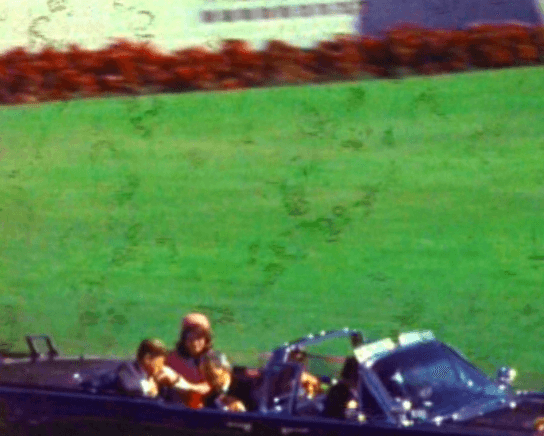
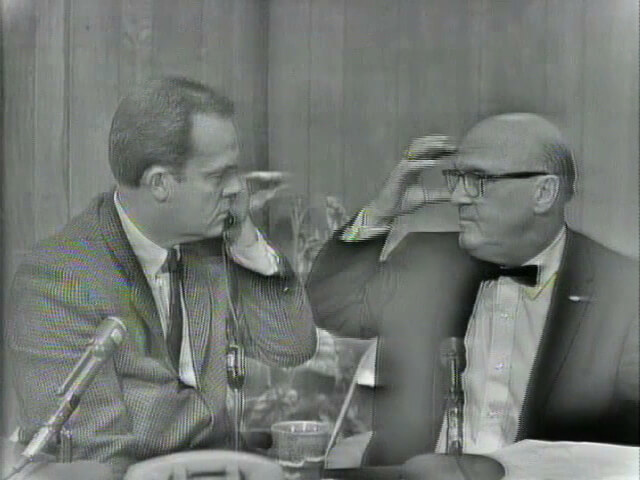
    The Zapruder film is (most probably) an intact and authentic 8mm motion picture sequence. Information appearing in the film corresponds with common segments of other amateur films taken in Dealey Plaza during the assassination event, as well as existing still images. The extant images match the general description provided by Abraham Zapruder, the man who filmed the images, during his live televised appearance at WFAA studios in Dallas approximately two hours after the shooting. Later suspicions Zapruder film frames may have been removed or altered, after the film was processed and initial copies printed, gradually gained momentum in the late 1970s/early 1980s as a previously unacknowledged analysis of the film was revealed which challenged the established chain of custody with the film’s possession. Suspicions increased after the Assassination Records Review Board took specific interest in authenticating the film in the late 1990s. Although there is not currently any hard evidence that tampering took place, the presence of a Zapruder film (original or copies) at the CIA’s National Photographic Interpretation Center (NPIC) on the weekend of the assassination has been effectively established, even as official records of this event have inexplicably failed to appear.


    Limits to Fakery

    NPIC analysts at work
    during Cuban Missile Crisis

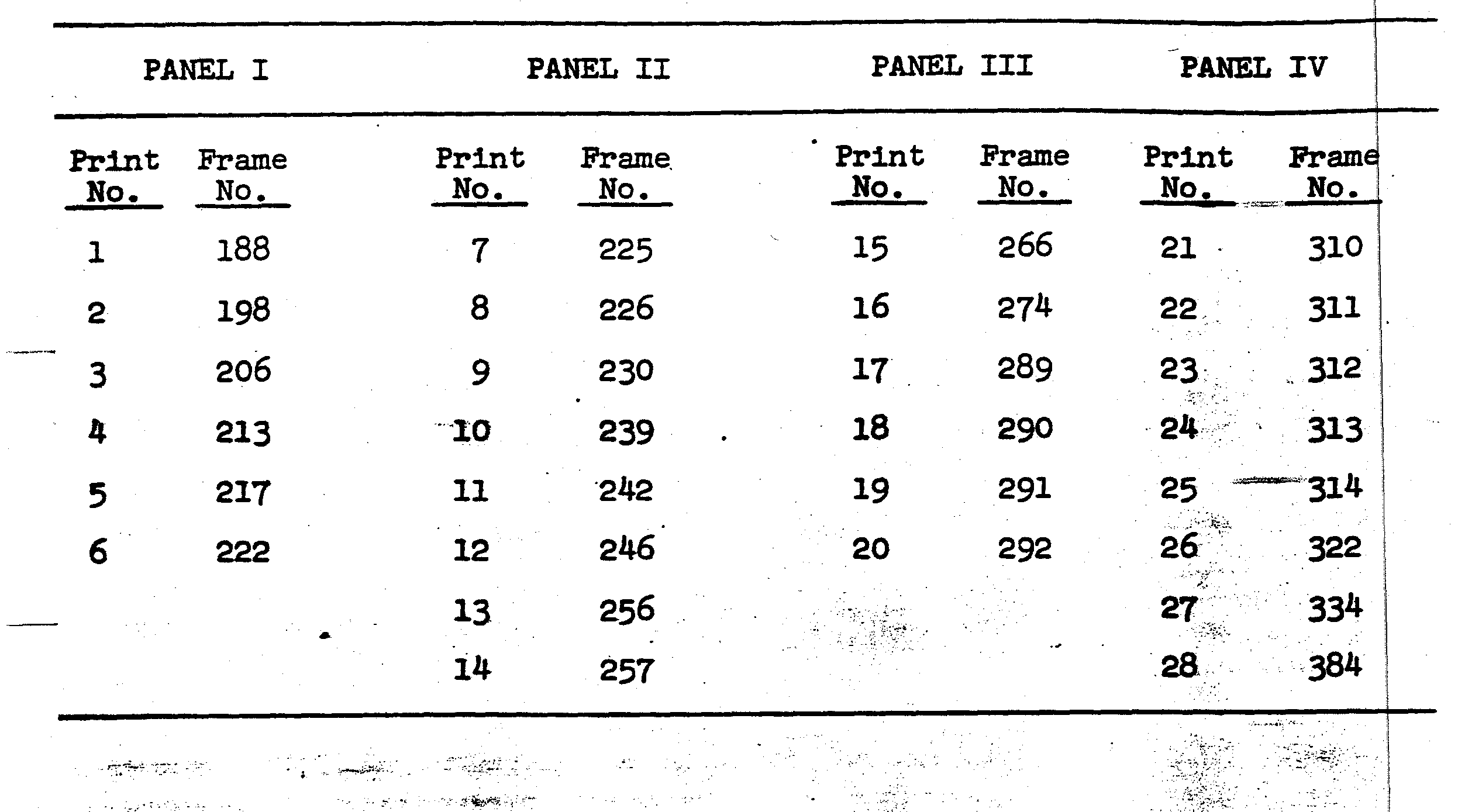
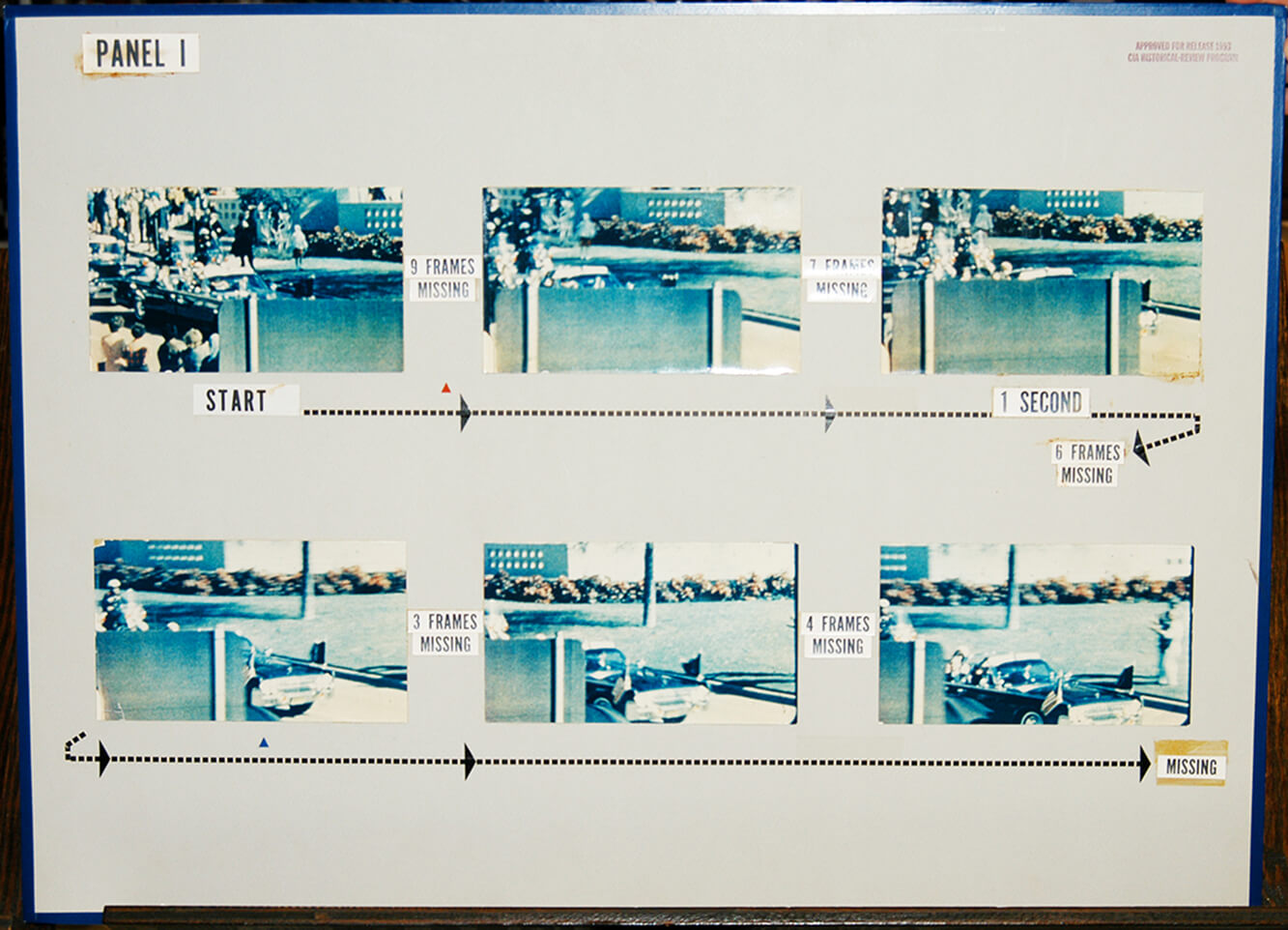
    The most precise description of a possible how and when pertaining to alteration of the Zapruder film was developed by Doug Horne, who had worked as Chief Analyst for Military Records for the Assassination Records Review Board (ARRB) in the 1990s. Horne assisted in the joint efforts between the ARRB and Kodak to preserve and assess the authenticity of the Zapruder film. During this process, as former employees of NPIC added detail to events on the weekend of the assassination, Horne came to realize two things: two separate teams developed distinct sets of briefing boards from selected frames of the film; and, from recollection (albeit many years after the fact), each team believed they were handling the original Zapruder film—one group working from an 8mm film reel, and the other from an unslit 16mm reel.1 Horne postulated that, in the approximately twelve-hour period between the work of the two teams, the original film could have been sent to a top-secret CIA film facility attached to a Kodak plant in Rochester, NY (Hawkeye Works) and there revised over the course of the day on an optical printer. A freshly altered “original” film was then presumedly returned to NPIC for a new set of briefing boards, and the existing prints of the original film were swapped out.2.

    Information pointing to two separate briefing boards, and two different film formats used to create them, should not be dismissed. Official clarification may yet be discovered, perhaps in the still missing official history of the Zapruder film’s presence at the NPIC written by Dino Brugioni. As speculation has otherwise filled the vacuum, it’s worth considering what was, and was not, possible to do manipulating film images in 1963. Evidence of an 8mm reel of film on one night, and an unslit 16mm reel the next does not automatically or logically lead to an alteration hypothesis.3
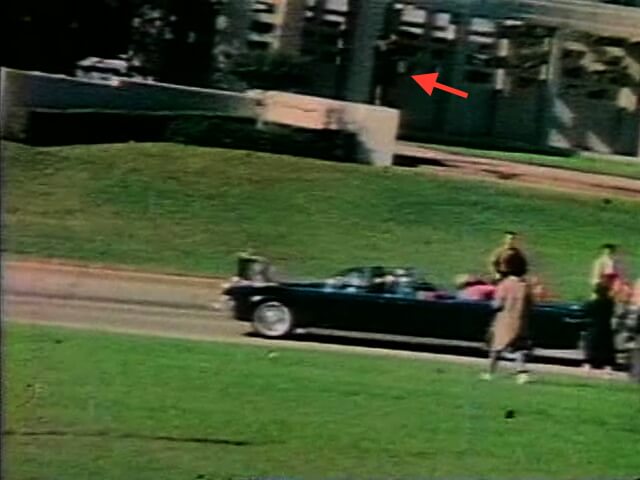
    The alteration argument vis-à-vis the Zapruder film has been prone to a certain illiteracy regarding the mechanics and science of special-effects filmmaking, specifically the use of the optical printer, which ranges from mildly informed to wildly uninformed, even as the whole of the argument requires intervention of such machines. Roland Zavada, a retired Kodak specialist hired by the ARRB to authenticate the Zapruder film, explained technical issues mitigating against alteration in a patient, if somewhat exasperated, response to Doug Horne’s theories and criticism published in the fourth volume of Horne’s Inside the Assassination Record Review Board.4 The substance of Zavada’s response can be, and is, supported by relevant professional technical and descriptive texts, as well as, if sought, personal affidavit from technicians experienced in practical application of optical printers for celluloid-based motion pictures (a skill set largely displaced since the advent of digital technologies). The notion that elements within the Zapruder film’s frames could be removed or rearranged at will, let alone done so without evident and obvious trace, is completely mistaken. Such sorcery was not possible with the available optical printer technology, and, for what was possible, the relatively short time period available in Horne’s hypothesis would not allow for anything but very limited—very limited—activity.
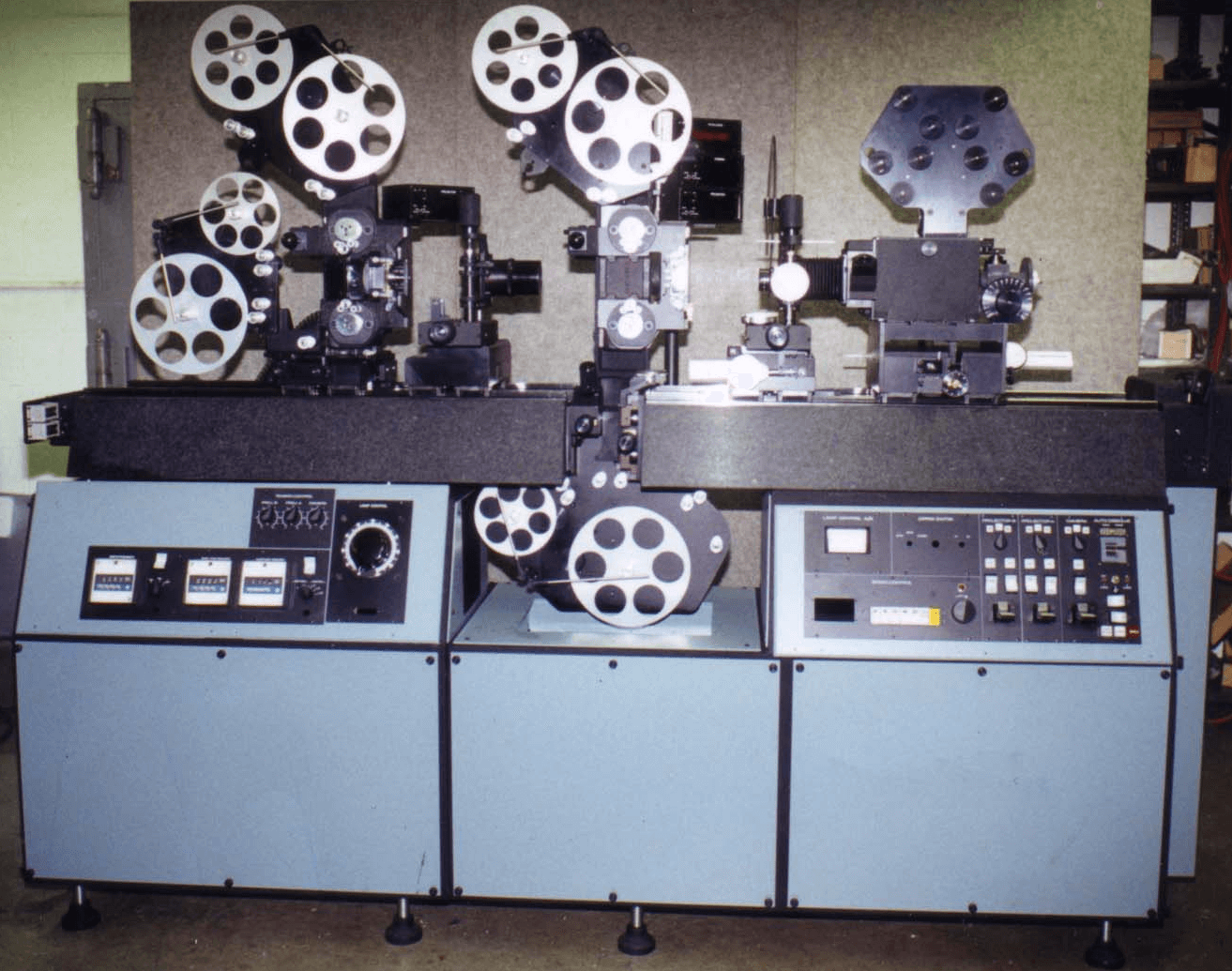
    An Oxberry 1600 aerial optical printer,
    a common commercial model

    In an article titled “The Cinemagic of the Optical Printer”5, Linwood Dunn lists the variety of visual effects achievable on the optical printer: creating transitions such as dissolves and wipes of varying complexity; changing image size and position on screen; frame modification such as speeding up or slowing down a sequence, or “freezing” a select frame; optical zooms; superimpositions; split screens; adding motion, e.g., creating a rocking effect for a scene set in a boat or aircraft. He then describes “special categories” of effects work: travelling mattes “used to matte a foreground action into a background film made at another time”; blow-ups and reductions used to convert formats, e.g., 16mm film converted to 35mm; anamorphic conversion to change aspect ratio; and “doctoring and salvaging” which includes salvaging unusable scenes due to mechanical or human error on set or adding elements to previously filmed scenes.6.

    Claims of Zapruder film alteration usually cite changing image size, frame modification, superimposition, travelling mattes, and doctoring. Where these claims tend to fail is by misunderstanding necessary limitations in the use of these techniques. A common claim is that an altered Zapruder film has removed or repositioned bystanders along the visible motorcade route through doctoring and superimposition combined with a travelling matte of the Presidential and Secret Service limousines. What is not understood while making such claims is, prior to the introduction of digital workspaces, mattes and superimpositions found seamless effect by utilizing hard vertical and horizontal lines within the frame to join separate elements, or by adding images to a flat uniform background. Consistent vertical or horizontal separation points or uniform backgrounds within the Zapruder film are virtually nonexistent because a) the sequence is always in motion as Zapruder panned with the motorcade, b) the motorcade varies in size within the frame as it approaches and passes Zapruder’s zoomed-in lens, and c) the shaky hand-held filming is inconsistent (i.e., this is not a steady locked-off pan performed with a tripod).7

    Any element within the frame said to have been removed from the Zapruder film would require an equal consistent element to replace it; for instance, removing a bystander from the Dealey Plaza lawn would require additonal lawn in place for the requisite number of frames, just as a replaced bystander closer to Elm Street would require a replacement background consistent with what already is visible (portions of road, sidewalk, landscaping and other persons). These replacement elements must also adjust plausibly in perspective as Zapruder’s camera drifts and pans, and blur when the camera is unsteady. Again, this is long before digital technologies, and the workspace of each individual celluloid frame was 8mm in diameter. Theoretical radical alteration of the Zapruder film would require exacting work in multiple areas of each frame, for many dozens of frames, which would require many weeks, at least, to accomplish.8 At the end of such a process, it would be necessary for the results to appear as a seamless element of the original, an impossible task to conceive. Any removal of persons, geographic features, or even splatter from a large exit wound, should be obvious through inconsistencies produced by attempting to replace the lost information. If the Zapruder film was in fact somehow radically altered, appearing as it appears today, then it would stand as the single greatest trick shot in cinema history, even as the technique developed by these magicians would never be exploited for any other purpose, or even rumor of such incredible feat leaked as the magicians never sought credit.

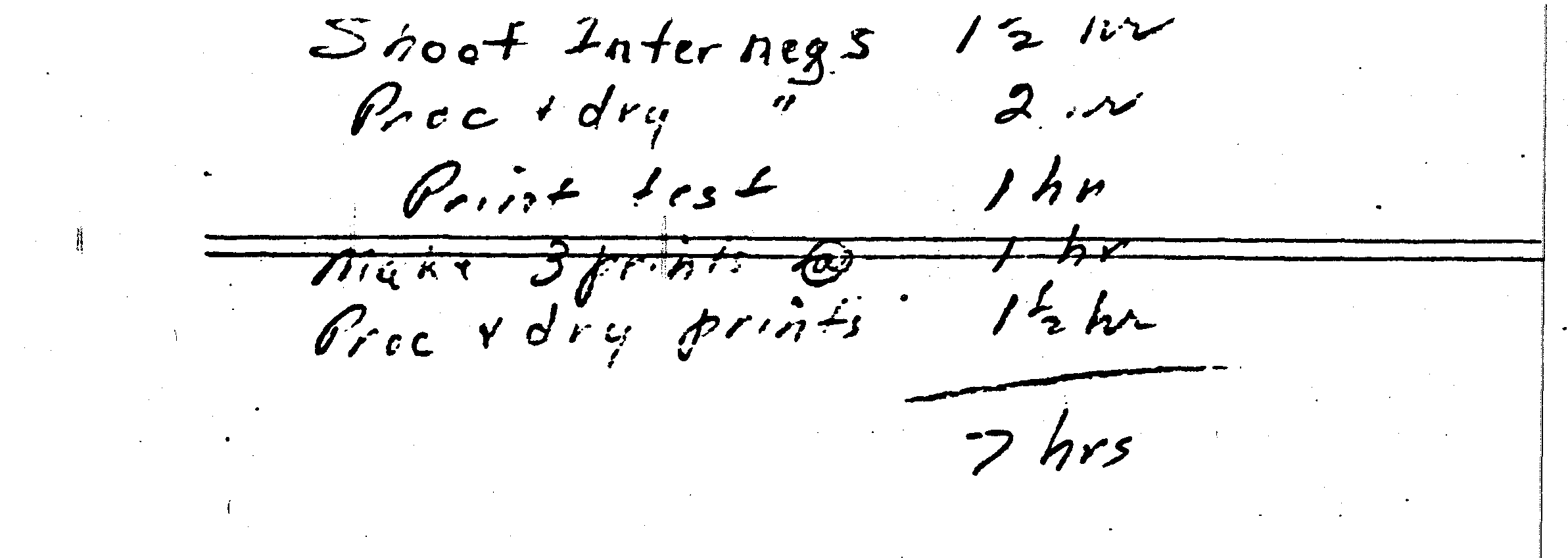
    Another important consideration for determining what is possible with an optical printer is the requirement for precise testing related to exposure and color temperature, to maintain consistency as film stocks have varying exposure indexes and grain structure. Print stocks used with optical printers are different from those used in the field, and production of an intermediate internegative with these stocks is a necessary part of the process,9 adding generational loss. Alteration of the Zapruder film would then require not only seamless work within the frames, but also assuring the resulting altered film’s colour, exposure, and grain is consistent with the original 8mm film stock, a feat with no known precedent.10 Discussing this, Roland Zavada determined that the minimum time to evaluate these factors, including filming, processing, and viewing the necessary tests, would have been more than seven hours,11 which factors poorly in considering an alteration scenario limited to Sunday November 24.

    Z-313: a painted blob and debris removal?

    Incredibly, although Zavada’s peer-supported professional opinion mitigating against alteration to the Zapruder film should have largely diminished the controversy, the notion of alteration has since hardened, and a substantial number of persons have somehow become convinced that radical alteration is a proven fact. In truth, time constraints and technical limitations make plain that if alteration was in fact engaged in that Sunday, it would necessarily be limited to, for example, a “blob” added to a frame or a black mask added to a few frames. However, even this work appears unlikely due to the difficulties in returning the altered product to an undetectable plausible 8mm “original”.12.

    Aside from the technical reasons mitigating against Zapruder film alteration and substitution, a set of other considerations was articulated by Josiah Thompson in his 1998 article “Why The Zapruder Film Is Authentic.” 13 Thompson notes, from the officially vetted timeline, the original Zapruder film was in the possession of either Abraham Zapruder or representatives from LIFE Magazine that entire weekend. This notion is no longer assured. Even so, Thompson makes the point there was no means to ensure additional copies of the original intact version were not created before the film could be presumedly delivered to Hawkeye for alteration. For example, an extra copy could have been printed surreptitiously at the facilities in Dallas on the first day, or a copy perhaps made by the FBI from a borrowed Secret Service print, as discussed in memos from Saturday November 23.14 Thompson also notes that there are numerous films and photographs depicting the same sequence (or portions thereof) which potentially could require alteration as well (some thirty-eight persons had cameras in use during this sequence), and, as important, on the weekend of the assassination it could not be known if all photos and film had been accounted for—that is, a then unknown film or photograph could appear later to reveal the forgery.

    Finally, other than a painted “blob” or black mask to hide wounds, it is unclear what exactly it is believed the alleged alteration is concealing. In the numerous films and still photographs which feature portions of the exact sequence captured by Zapruder, and in sequences taken before and after Zapruder was filming, there is nothing to suggest a person or event which would require excision, such as during the limousine turn which does not appear in the Zapruder film (although Abe Zapruder suggested he had filmed it during his Warren Commission testimony). One frequently cited presumed alteration is the slowing down and near complete stop of the Presidential limousine in the moments ahead of the fatal (Z312) shot which, it is claimed, was removed from the film. This is not true, but can appear that way because Zapruder is panning his camera to follow the passing vehicle; the camera itself in motion assumes a certain pace even as the vehicle slows within the frame. The slowing of the limousine becomes apparent if the viewer is able to identify Zapruder’s panning motion as a separate element from the motion of the vehicle, and follow as the pan in turn slows to keep the limousine relatively centered in frame. The camera pan actually gets ahead of the vehicle, highlighting its decrease in speed. That the limousine had come near to a complete halt can be observed in the person of Secret Service Agent Hill who rapidly gains on the static chassis. The acceleration of the vehicle is also obvious, and is even more so in the Nix film.


    The Zapruder Film Is Not A Precise Clock

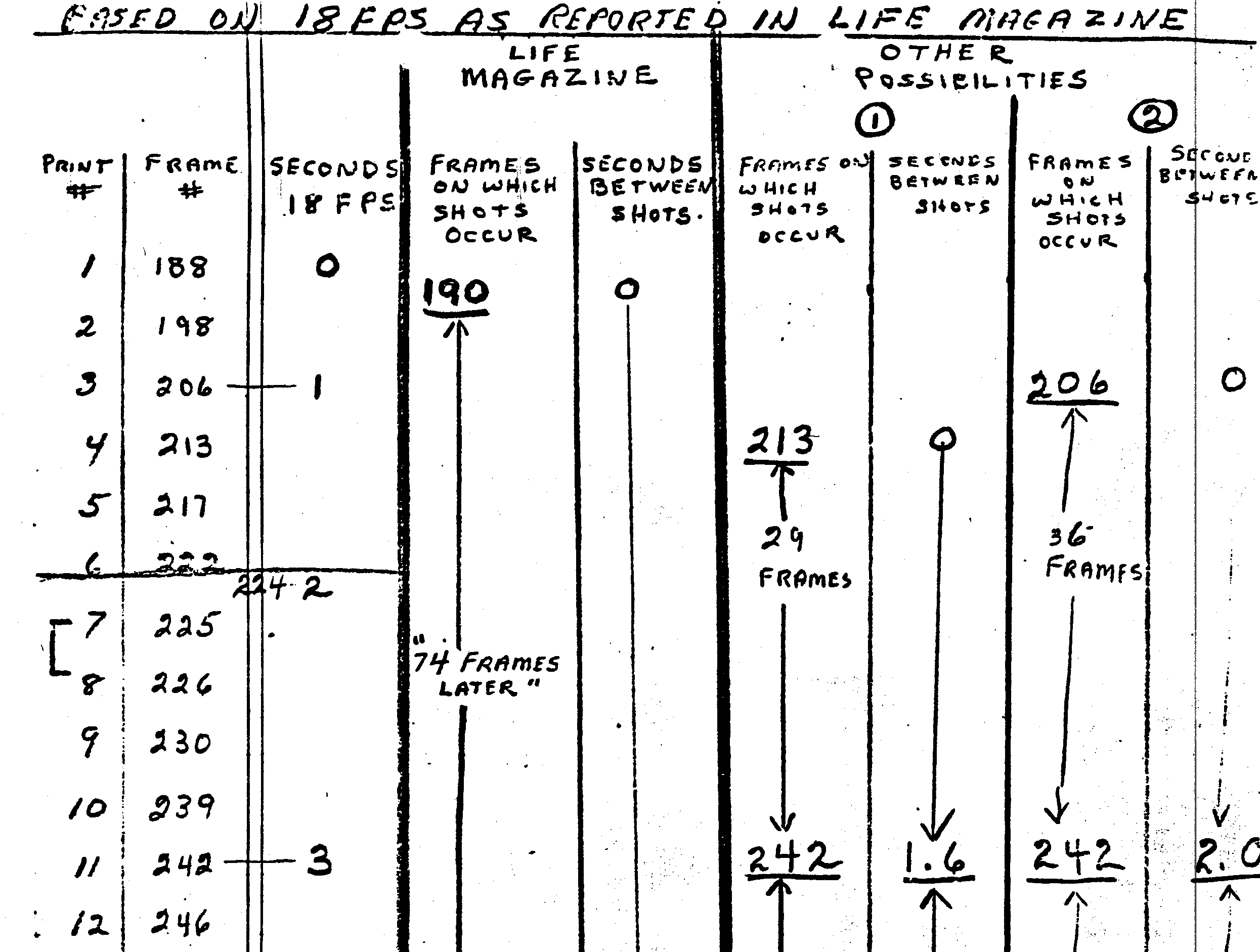
    According to Dino Brugioni, one of the NPIC staff interviewed in the late 1990s and 2000s, representatives from the Secret Service were at NPIC on Saturday evening November 23, 1963 and were “vitally interested in timing how many seconds occurred between various frames.” Brugioni’s colleague Ralph Pearse informed these men that the Zapruder Bell & Howell Zoomatic 414PD was “a spring-wound camera, with a constantly varying operating speed”, and attempts to determine precise timing would be “unscientific” and could lead to false conclusions.15 The Secret Service agents insisted, and Pearse apparently used a stopwatch to gauge time between “various frames of interest.” Later testing by the FBI would determine that the Zapruder camera ran at an average speed of 18.3 frames per second, and, with that established, it was claimed that a count of frames between significant events appearing in the Zapruder film, divided by 18.3, could produce a precise reading of the time between which these events occurred, particularly the timing between presumed shots.

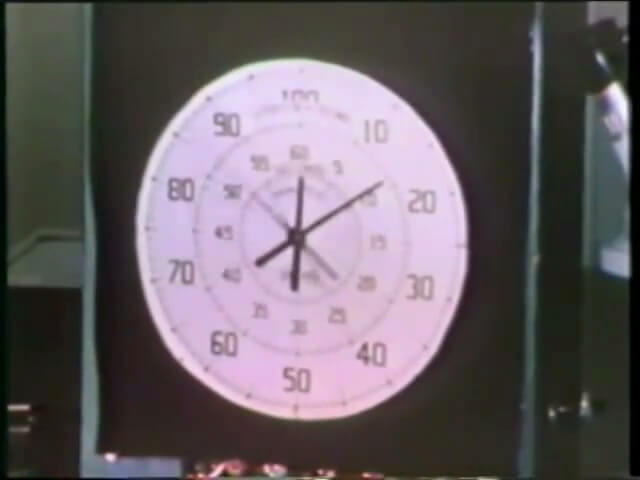
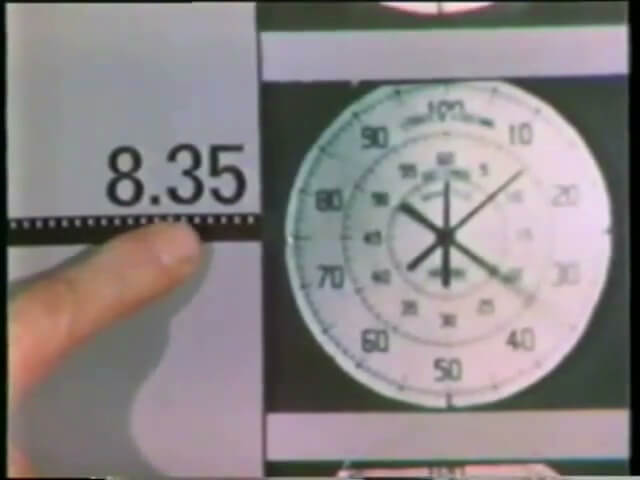
    This formula unfortunately bypasses the important qualifier “average”, as it became commonly reported that the camera’s film speed was 18.3 frames per second, and thereby it was claimed the Zapruder film could serve as a precise clock for the assassination sequence.16 This is not the case, due to the spring-wound mechanism of Zapruder’s camera which, as Ralph Pearse noted, had a “constantly varying operating speed.” This factor is apparent in the results of the tests done by the FBI’s Lyndal Shaneyfelt, “focusing the camera on a clock with a large sweeping second band”, later counting frames from the developed film to ascertain the number of frames per second as determined by the sweeping second band. A “sync” motion picture camera, with a crystal sync oscillator maintaining consistent operating speed, would indeed produce repeatedly the exact same number of frames per second, but a spring-wound camera would vary.17 This spring-wound effect is reflected in the FBI report:

    “This study has been made by checking the film speed of the Zapruder camera at ten second intervals throughout the full running time of a fully wound camera. Several checks were made on a full roll of film and it was found that the film speed of the camera when fully wound runs at an average speed of from 18.0 to 18.1 frames per second (fps) for the first ten seconds. It gradually increases to 18.3 to 18.5 fps for the next 20 seconds, then gradually decreases slightly to 18.1 fps for ten seconds before the final twenty seconds that run at an average speed of 17.6 to 17.9 frames per second. Mr. Zapruder has stated that the camera was fully wound when he started filming the President’s motorcade.”18.

    According to the above calculation, the Zapruder film, once the Presidential car comes into view (the 132 frames of the head of the motorcade accounts for approximately 7.3 seconds) was exposed at 18 to 18.1 fps for about three seconds, and then “gradually” increased to 18.3 to 18.5 fps for its duration. The 353 frames, according to the FBI’s calculation, occurred over somewhere between 19.138 seconds to 19.332 seconds (without accounting for the “gradual transition from 18/18.1 to 18.3/18.5). The shooting sequence (LIFE 12/6/63 frame Z-190 to Z-312) occurred from somewhere between 6.595 seconds and 6.666 seconds (again not accounting for the “gradual” transition), a difference of between one and two frames. So, while not demonstrating extreme variation, the FBI’s work, at least as described, demonstrates that, giving or taking even two frames in a short span, the Zapruder film cannot be considered an exact clock. Other tests on similar cameras noted even greater disparity between individual “checks” than a few tenths of seconds.19 Such disparity is more in keeping with the advice of NPIC’s Ralph Pearse that a spring-wound camera’s operating speed was constantly varying and that attempts to measure precise timing could lead to false conclusions. In fact, the FBI’s “average” speed seems unusual for these cameras in that the results inferred suggest comparatively minute differences.

    Might the FBI have dropped a high frame count pass and a low frame count pass recorded by the Zapruder camera during their speed tests, in the interest of arriving at a more precise statistical average? This statistical method is known as a “truncated mean.”20 An odd reference to frames-per-second appears in a chart presented to the Warren Commission in January 1964, presenting timing scenarios for the Presidential limousine’s approach to Dealey Plaza, based on measurements which identify a high and low miles-per-hour determination (15 mph and 12 mph) with a similar constant frames-per-second count (“22 fps” and “17.6 fps”).21 It is very tempting to speculate that these numbers—22 fps and 17.6 fps—might represent the high and low markers of the FBI’s speed tests with the Zapruder camera. Shaneyfelt told the Warren Commission “we ran through several tests of film … and averages were taken.” (WCH Vol. 5, p. 160)


    In 1967 CBS time-tested five same-model cameras and got varying results


    If so, the presumed “average speed” of 18.3 frames-per-second is, as Pearse told the Secret Service, meaningless in context of the assassination as there is no possibility or means to determine the frame rate when Zapruder’s camera actually ran on November 22. In theory, the “constantly varying operating speed” of the spring-wound camera would mean the frame rate varied across the duration of any filmed sequence. Although Pearse articulated this, and Brugioni apparently attached this information to the first set of prepared briefing boards, the insistence of the Secret Service agents suggests determining a time sequence for the assassination was an investigative priority. This insistence would create for the developing lone assassin narrative a series of problems.


    How Did LIFE Magazine Know The Camera Ran At 18fps?

    Before the FBI ran their speed tests with the Zapruder camera, LIFE Magazine’s article “An End To Nagging Rumors” (December 6, 1963) already states: “from the movie camera’s known speed of 18 frames a second—two frames a second faster than it should have run—it is possible to reconstruct the precise timing …” Zapruder’s Bell & Howell camera, according to its operating manual, was supposed to run at 16 frames per second in its RUN setting. That it actually ran some two frames faster could only be determined through tests similar to what the FBI would later do—filming a clock with the original camera. The LIFE Magazine article does not directly state that LIFE itself conducted tests and determined the speed, it says only the speed is “known”.

    Although there is nothing in the record about testing Zapruder’s camera before the FBI took possession of it on December 4, 1963, it appears highly likely that a test to determine the speed of that camera was undertaken as part of an official investigation, connected with the Secret Service and CIA, sometime during the week following assassination. Information derived from this test was subsequently shared with LIFE Magazine. 22 Philip Melanson’s 1984 essay “Hidden Exposure: Cover-Up and Intrigue in the CIA’s Secret Possession of the Zapruder Film” first noticed a brief aside in an December 4, 1963 FBI memorandum discussing the possession of the camera: “(Zapruder) advised this camera had been in the hands of the United States Secret Service Agents on December 3rd, 1963 as they claimed they wanted to do some checking of it.”23 If the Secret Service were in possession of Zapruder’s camera on December 3rd, they may well have been in possession of the camera before that date. The memorandum certainly does not clarify.

    When the Secret Service visited NPIC on the evening of November 23, 1963, “vitally interested in timing how many seconds occurred between various frames” Dino Brugioni recalled: “Ralph Pearse informed them, to their surprise and dismay, that this would be a useless procedure because the Bell and Howell movie camera (that they told him had taken the movie) was a spring-wound camera, with a constantly varying operating speed.” A 1975 CIA description of the same NPIC event states that since “the film had been taken in a spring-powered movie camera, it was not possible to determine precise time between shots without access to the camera to time the rate of spring run-down.”24 Access to the camera was necessary to determine the information the Secret Service was intent on establishing. That the Zapruder camera, and even the Zapruder film original, may have been, or probably were, examined at NPIC shortly after the assassination should have been an expected procedure. The Secret Service considered themselves holding “primary jurisdiction in a case of this nature”,25 and, as Philip Melanson notes, “the Secret Service of the 1960s and early 1970s had some sort of technical dependence upon the CIA.”26.

    An FBI memorandum dated November 29, 1963, generated by Dallas field agents, discusses a meeting with Secret Service Special Agent John Howlett, in which Howlett described an ability to determine the distance from the alleged sniper’s nest to the Presidential limousine at the time of shots striking the President, ascertained from 8mm movies of the assassination.27 Howlett places the first shot, “where the President was struck the first time in the neck”, at “approximately 170 feet”. Paul Mandel’s LIFE article also places the first shot at 170 feet ( “The first shot strikes the President, 170 feet away…”, also identified as Zapruder frame 190 since 122 frames are then counted to the third shot which “over a distance of 260 feet, hits the President’s head.”). Howlett would inform the FBI the fatal shot was at “approximately 260 feet”. As Howlett was meeting with the FBI men, LIFE’s issue with Mandel’s article was being readied for the printers. It is hard not to believe that Special Agent Howlett and LIFE Magazine’s Paul Mandel received their information from the same or similar sources, derived from analysis conducted at NPIC.

    A later chart created by the Secret Service, listing distances which differed slightly from Howlett’s,28 and associating these distances with Zapruder film frames (CE884), would situate the given distance of the first shot as equivalent to Zapruder frames 200 or 201, shortly before JFK disappears behind the Stemmons Freeway sign in the film. A certain flexibility in determining position and frame number has been introduced as early as Howlett telling the FBI men on November 29 that the Secret Service “using the 8 millimeter film have been unable to ascertain the exact location where Governor JOHN B. CONNALLY had been struck.” This uncertainty reflects the difficulties for the developing official story, as the FBI’s Robert Frazier had determined on November 27 that the bolt-action rifle in evidence required at least 2.8 seconds to operate between shots at moving target, the equivalent to approximately fifty Zapruder frames. Determining that Connally was not struck until somewhere around Z-250 (in relation to a first hit on JFK at frame 200) is not supported by the Zapruder film, where it appears the strike occurred at least 20 frames earlier.29 Differing from Howlett, Mandel in the LIFE article, provides a precise frame for a shot striking Connally (Z-264):

    “The first shot strikes the President, 170 feet away, in the throat; 74 frames later the second fells Governor Connally; 48 frames after that the third, over a distance of 260 feet, hits the President’s head. From first to second shot 4.1 seconds elapse; from second to third, 2.7 seconds. Altogether, the three shots take 6.8 seconds—time enough for a trained sharpshooter, even through the bobbing field of a telescopic sight.“ (Paul Mandel, “End To Nagging Rumors: The Six Critical Seconds”, LIFE Magazine, December 6, 1963)30

    In her book, Alexandra Zapruder ponders the irony that her grandfather’s film had displaced the view from the purported sniper’s nest; standing in, so to speak, for “seeing the assassination through Oswald’s eyes”. In actuality, the true irony is that, by insisting on establishing exact timing and ignoring Ralph Pearse’s advice, federal investigators wrapped themselves into a straightjacket trying to explain the visible shooting sequence, and the “exact” timing of the film, against the self-imposed limitation of three shots and one bolt-action rifle. Ultimately the Warren Commission had to go with both the single bullet theory and the claim that it could not determine when the first shot was fired. For its part, the HSCA’s photographic panel seemed to determine that the President was struck before disappearing behind the freeway sign in the film and also endorsed the single bullet theory, which are mutually exclusive.


    What Happened At The NPIC November 23-25, 1963?

    Dino Brugioni in 1962

    It appears that two sets of “briefing boards” were independently created—one through the Saturday evening into Sunday morning and one through Sunday evening into Monday morning—both using frame blow-ups derived from a copy of or the original of the Zapruder film. Dino Brugioni was involved with the Saturday night event, and Homer McMahon the Sunday evening event, as developed by Doug Horne. Brugioni’s recollections are corroborated by a CIA submission to the Rockefeller Commission made in May 1975.31 This document, describing an analysis of the Zapruder film at NPIC, matches Brugioni’s account of the presence of the Secret Service, that establishing elapsed times between rifle shots was of primary concern, and the subsequent production of briefing boards. The document states the Secret Service “were present during the process of analysis” and took away one set of briefing boards, while CIA Director McCone retained another. The briefing board set “was controlled carefully; very few people saw it.” Notably, the document does not date the event, instead choosing to vaguely locate it in “late 1963.” Results of the analysis are deflected: “We assume the Secret Service informed the Warren Commission about anything of value resulting from our analysis of the film, but we have no direct knowledge that they did so.”

    On the day following this first disclosure of a Zapruder film analysis at NPIC, the Rockefeller Commission requested “memoranda or other textual information provided to the Secret Service by CIA after NPIC’s analysis of the Zapruder film.” The CIA responded a week later, claiming they “had no indication in our records that any such written material was provided to the Secret Service. Attached are copies of the only textual matter in our files pertaining to the NPIC’s analysis of the Zapruder film.”32 Xerox copies of six “written or typed papers” were attached, described as the total existing documentation of an analysis process which spread over a thirty-six hour period and featured the production of two separate briefing board sets. That the May 7 CIA Addendum included information about the “spring-powered camera” which appears directly derived from Brugioni’s briefing board notes attached, but no such notes are among the sparse released documentation on May 14, does not inspire confidence that the CIA is on the level here.33.

    Among the six papers provided to the Rockefeller Commission is a typed page which features an undated columned list featuring four “panels” with Zapruder frame numbers listed below each panel. Each frame number has a corresponding “print” number, totalling 28 prints. This appears to be for a set of briefing boards presumably created the weekend of the assassination, perhaps the second session, as Brugioni said his boards consisted of less than twenty prints. Handwritten notes on another page calculate time needed to “shoot internegs”, process, test, and make three prints. During interviews in the 1990s, Homer McMahon and Ben Hunter recognized their handwriting on this document, and also on portions of another handwritten document recreating the previously described typed briefing board chart.34 Three more handwritten pages are included, author unknown, which appear to have been created at a later date than the November 23-25 analysis as these pages feature charts and calculations which refer directly to information appearing in LIFE ’s December 6 article “An End To Nagging Rumors.”


    These relatively unsophisticated charts were presented as artifacts of the 1963 NPIC analysis,
    even though they were clearly drawn up later.


    In fact, these pages seem to have been drawn up by a person completely unaware of the first weekend briefing boards, or that the Secret Service had already possessed the information that appeared in LIFE. The hand drawn charts feature phrases from the Mandel article in quotation marks: “74 frames later”; “48 frames after that”; “2 FPS than it should have been run”. A question is written out: “how do they know frames of first and second shot?” Timing calculations cluster the page, with division tables setting scenarios of 18fps (attributed to LIFE) and 16 fps (the camera’s speed according to its operating manual). Alternative shooting scenarios, most of which feature Zapruder frame 242 as a second shot, appear next to the LIFE attributed shooting sequence of Z-190—Z-264—Z-312. Whatever is going on with these unsophisticated charts, the impression left by the CIA’s 1975 presentation on the NPIC analysis—from lack of documentation to the sketchy attribution of “late 1963”—is of a conscious decision not to admit analysis occurred on the weekend of the assassination. Making it appear the NPIC, the premiere image analysis lab anywhere at the time, relied on timings and frame numbers printed in LIFE Magazine served to deflect attention from the actual analysis done, as did the diversion of highlighting the Secret Service’s supposed sole responsibility to share “anything of value resulting from our analysis.” The NPIC analysis event had been effectively disappeared from the record.


    The typed frame chart produced as part of NPIC’s records. This may be from the second analysis event, Nov. 24-25, 1963.

    The briefing panels in the record seem derived from the above typed chart.
    Dino Brugioni was certain these were not the charts he had created during the first analysis event Nov. 23-24, 1963.


    This motion sequence features the selected frames from the above chart.
    That the panning of Zapruder’s camera gets ahead of the slowing vehicle is apparent.


    For its part, the Secret Service had nothing to add, claiming that by 1979 all documents relating to the assassination had been passed to the National Archives. Nothing directly attributed to an NPIC analysis appears. The Warren Commission—which sponsored two conferences in April 1964 at which the Zapruder film was closely analyzed in the presence of Bethesda and Parkland doctors, ballistics experts from Edgewood Arsenal, FBI agents, Commission attorneys, and even John and Nellie Connally—did not receive any information regarding the November 1963 NPIC analysis.

    In her book, Alexandra Zapruder asks about the NPIC event: “Who cares when it happened?” That is not the appropriate question. More appropriately: Why was the NPIC analysis hidden from the official record and the official investigation, and then, when uncovered in 1975, its “when” was obscured and its documentation was obviously incomplete?

    A reason for this may be the NPIC analysis clearly demonstrated that a lone gunman conclusion was not viable; that something like the “flurry” of shots described by Secret Service Agent Roy Kellerman—seated in the passenger seat of the Presidential limousine—was more apparent. Homer McMahon, during his 1990s interviews, said it was his impression that “he saw JFK reacting to 6 to 8 shots fired from at least three directions.”35 Robert Kennedy would tell Arthur Schlesinger Jr., on December 9, 1963, that CIA Director John McCone, who received the NPIC’s first briefing boards, had indicated to him “there were two people involved in the shooting.”36 A few hours after McCone’s briefing on Sunday November 24, LIFE Magazine’s publisher C.D. Jackson sent instructions to Dallas to negotiate the remaining rights to the Zapruder film which had been explicitly left out of the contract signed the previous day. An internal LIFE memo would note that “C.D. Jackson bought the copyright to Zapruder’s film to keep it from being shown in motion.”


    The Zapruder Film Proves Conspiracy

    A week after the assassination, the Secret Service was continuing its investigation utilizing a shooting sequence which commenced with a first hit at either Zapruder frame 190 or frame 200. At the same time, LIFE Magazine was preparing its December 6 issue featuring an article which placed the first shot at Zapruder frame 190. Years later, a House Select Committee on Assassinations photographic panel systematically analyzed the Zapruder film in a manner similar, if not more extensively, to that done previously by the NPIC.37 The HSCA panel would report: “At approximately Zapruder frame 200, Kennedy’s movements suddenly freeze; his right hand abruptly stops in the midst of a waving motion and his head moves rapidly from his right to his left in the direction of his wife. Based on these movements, it appears that by the time the President goes behind the sign at frame 207 he is evidencing some kind of reaction to a severe external stimulus.”38


    Zapruder frames 190, 200, and 207. Analysis determined Kennedy began to react to a “severe external stimulus” at this point.


    The Warren Commission Report would claim “it is not necessary to any essential findings of the Commission to determine just which shot hit the Governor.”39 This is not true, as essential findings of the Commission included the determination that only three shots were fired, all from a particular bolt-action rifle found on the sixth floor of the Texas School Book Depository. If the President was reacting to a “severe external stimulus” (i.e. a shot) before disappearing behind the Stemmons freeway sign, as seen in the Zapruder film and as determined by both expert panels in 1963 and 1978, there was not enough time to operate the rifle’s bolt and fire a second shot to strike Connally consistent with his observed reaction (struck approximately Z224-230). The Commission’s Single Bullet Theory proposes that Kennedy and Connally react to the same bullet as they come into view at Zapruder frame 222-223, although in the film it appears obvious the President is already reacting to external stimulus while Connally is not. It has been suggested that Connally’s reaction is somehow delayed, although the smashing of his rib bone by the passing bullet would initiate an immediate involuntary reflexive response.

    Since the time of the HSCA, independent researchers have been successful in aligning close analysis of the Zapruder film with eyewitness testimony and with other photographic evidence.40 With this work, the determination advanced by the analysis in 1963 and 1978 that the President was struck by a shot at a point between Zapruder frames 190-200, before disappearing behind the Stemmons Freeway sign as seen in the film, has been corroborated by the accounts in the official record of at least a dozen witnesses, and their interlocking observations are further supported by the photographic record apart from the Zapruder film.

    The testimony of Jacqueline Kennedy exemplifies this support for a first shot circa Z-190. She told the Warren Commission that she turned in her seat to directly face her husband as the result of a commotion, a noise, which can be identified as this first strike (which probably hit in the back, as witnesses located behind the Presidential vehicle described his reaction as a slump to his left). Mrs. Kennedy can be observed in the Zapruder film as turning just ahead of the disappearance behind the sign, and afterwards her hat remains largely visible holding this position, looking directly at her husband. Proponents of the single bullet theory are suggesting that a shot from a high-powered rifle blasted through Kennedy’s neck and struck Connally, while Mrs Kennedy looked directly on, closely positioned, and she didn’t realize what had just happened. What is observable in the Zapruder film is that Jackie Kennedy, looking directly at her husband in the moments before the devastating shot at Z-312, is bewildered as to the source of her husband’s distress.


    Mrs. Kennedy turned to look at her husband as the result of an audible commotion,
    generally conceded as the strike of a first shot. She is doing so before the vehicle disappears behind the sign.


    Dino Brugioni, during his 2009 interviews, recalled that the Secret Service agents who arrived with the Zapruder film at NPIC on November 23, 1963, and who directed the analysis of the film “in individual stop frames”, paid particular attention to the portion of the film which showed the Presidential limousine just ahead of the Stemmons sign, its subsequent disappearance behind the sign, and then the frames after it reappeared. The Zapruder film is unique in the photographic record as capturing this portion of the assassination sequence, and what it shows cannot be reconciled with the official conclusion of a lone assassin—as the Secret Service, and its CIA partner, surely realized less than forty-eight hours after the event.


    NOTES

    1 The 8mm film in Zapruder’s camera was actually a spool of 16mm film, exposed along one side and then flipped and exposed on the other. After processing the film would be slit down the middle, the two halves spliced together to make one continuous roll of developed 8mm film.

    2 For an overview of the National Photographic Interpretation Center and excerpts from Horne’s work, see Bill Kelly, “Washington Navy Yard NPIC”, JFK Countercoup blog http://jfkcountercoup.blogspot.com/2010/02/washington-navy-yard-npic.html.

    3 That the Saturday 8mm reel is assumed to be the Zapruder original relies on Dino Brugioni’s recollection that there was film information between the sprocket holes. Brugioni’s memory appears fairly solid, and is corroborated on crucial points by the available sparse official documentation, but the Zapruder film possession timeline is tight because LIFE Magazine did its own work with the film at some point over the first weekend. If Brugioni is mistaken on this detail, then he was working from a Secret Service first generation copy of the film. Brugioni remembers an 8mm projector was used to view the film, but it is hard to believe NPIC employees projecting the actual original due to risk of damaging the film. It could also be that the Zapruder original was retrieved from LIFE on Sunday, possibly delivered to Hawkeye to create additional copies, and then sent to NPIC for creation of a second briefing board. Roland Zavada determined in his authenticity report that the Zapruder original initially remained as an unslit 16mm reel, as seen at NPIC Sunday night. The compartmentalization of the two briefing board sessions may reflect that the first was an “in-house” analysis, and the second featured a differing set of impressions.

    4 Zavada’s open letter can be read here: http://www.jfk-info.com/RJZ-DH-032010.pdf It is a response to Chapter 14: “The Zapruder Film Mystery”, Douglas P. Horne, Inside the Assassination Record Review Board, Volume Four.

    5 Linwood G Dunn, ASC., “Cinemagic of the Optical Printer”, American Cinematographer Manual, Fifth Edition, 1980. The Fifth Edition features a unique section on special effects cinematography. Dunn’s company Film Effects of Hollywood was established in 1946, and Dunn was a pioneer in optical printer technology. The American Cinematographer Manual has served as an essential professional reference book since its first edition was published in 1935. The latest Tenth Edition appeared in 2013. These volumes are compiled and published by the American Society of Cinematographers.

    6 The specific examples for this final category are much simpler than might be inferred by the term “doctoring”. In the film It’s A Mad, Mad, Mad, Mad World, a gag was to feature a truck bumping into a wooden shack which subsequently collapses. During filming, the breakaway shack was pulled before the truck had backed up far enough for the gag to work. Using the optical printer, the frame was split vertically between the truck and the shack, and the frame portion of the intact shack was held (frozen) until the other frame portion saw the truck reversed to the position that would sell the intended gag. Note that the ability to achieve this effect depended on a lack of moving elements in the portion of the frame featuring the shack, as can be seen in the movie itself. A second example was of using split screens, trick cuts, and superimpositions to create close explosions and artillery fire near a group of actors playing refugees for a film titled One Minute To Zero (the desired effect was unsafe to attempt on the set.)

    7 ”A Hollywood or other film production requiring postproduction optical effects is a product of a carefully planned and executed script in advance. The key subject matter, foreground and background scene content, camera image focus, depths of field, masks or mattes, etc., are carefully executed ahead of time and incorporated into the camera film that becomes the optical master…(the Zapruder film) was handheld, unsteady, panned to follow the limousine causing bystanders and background to be blurred and Zapruder jerked as reflex reaction to rifle shot reports or other stimuli.” Zavada, p. 19.

    8 Consider the time required to produce relatively simple shots of the USS Enterprise against a black space background, as described in an online article (http://memory-alpha.wikia.com/wiki/Film_Effects_of_Hollywood) discussing Film Effects of Hollywood’s association with the first Star Trek television show. This indicates the time-consuming and sometimes imperfect results using optical printers. The effects seen in the original Star Trek program are nothing compared to claims of Zapruder film alteration.

    9 “Preparation of an internegative which closely simulates the characteristic of the original has always been the goal of optical houses throughout the industry. In spite of the superb quality frequently achieved in internegatives, it seems virtually impossible to attain characteristics identical to those of the original negative in the duplicate generations for the following reasons: 1) The non-linear response of photographic film limits the range over which the following generations can duplicate an original. The internegative is one or two generations away from the original, depending on the stock used. 2) Many variable elements are introduced during the processing of the internegative. 3) The exposure characteristics of the optical printer may vary from time to time.” Mehrdad Azarmi, “Exposure Control of Optical Printers”, American Cinematographer Manual, Fifth Edition, 1980.

    10 “There is no known film production history that would provide a technology reference for the use of an 8mm KODACHROME II camera film as a printing master to allow subsequent significant optical special effects into selected scenes and then reconstitute the adjusted images on to an 8mm KODACHROME II daylight film ‘indistinguishable’ from the camera original.” Zavada, p. 18.

    11 Zavada, pp. 30-32.

    12 One text cited as “proof” that altering the Zapruder film was plausible has been Techniques of Special Effects Cinematography by Raymond Fielding. When excerpts of alteration arguments were shared with Fielding by Zavada in 2006, Fielding’s response included: “in my judgment there is no way in which manipulation of these images could have been achieved satisfactorily in 1963 with the technology then available … if such an attempt at image manipulation of the footage had occurred in 1963, the results could not possibly have survived professional scrutiny … challenges regarding the authenticity of the NARA footage and assertions of image manipulation … are technically naïve.” Zavada, p. 18.

    13 The article is derived from a presentation made at a conference in Dallas November 20, 1998. (http://www.jfk-info.com/thomp2.htm)

    14 DeLoach to Mohr, “8 Millimeter Color Film Taken At Scene of Assassination” https://www.maryferrell.org/showDoc.html?docId=62256#relPageId=43&tab=page.

    15 Horne, Inside the Assassination Records Review Board, Volume Four, p. 1233. This fascinating and important information, derived from an interview conducted by Peter Janney, is worthwhile considering in full: “… He also said that the Secret Service was vitally interested in timing how many seconds occurred between various frames, and that Ralph Pearse informed them, to their surprise and dismay, that this would be a useless procedure because the Bell and Howell movie camera (that they told him had taken the movie) was a spring-wound camera, with a constantly varying operating speed, and that while he could certainly time the number of seconds between various frames if they so desired, that in his view it was an unscientific and useless procedure which would provide bad data, and lead to false conclusions, or words to that effect. Nevertheless, at the request of the two Secret Service agents, Ralph Pearse dutifully used a stopwatch to time the number of seconds between various frames of interest to their Secret Service customers. Dino Brugioni said that he placed a strong caveat about the limited, or suspect, usefulness of this timing data in the briefing notes he prepared for Art Lundahl.”

    16 The HSCA’s photographic panel did note in its report “only the average, and not the precise, running speeds for the camera are known.” Despite this, the panel would go ahead and calculate time between frames anyway. HSCA Report Appendix, Volume VI, p. 31.

    17 “In crystal drive systems, a crystal oscillator of extremely high accuracy at, or in, the recorder, provides the sync pulse. The camera, in turn, is driven by a specially designed D.C. motor and control circuit which is capable of operating in exact synchronism with a self-contained crystal oscillator of comparable accuracy…both camera and recorder reference to self-contained crystal oscillators which are so accurate the effect is the same as if they had been tied together.” Edmund M. Di Giulio, “Crystal Controlled Cordless Camera Drive System”, American Cinematographers Manual, Fifth Edition, pp. 469-472.

    18 FBI Memorandum, Griffith to Conrad, January 31, 1964. https://www.maryferrell.org/archive/docs/062/62298/images/img_62298_37_300.png.

    19 CBS did their own tests for their 1967 news special on the Warren Report. Using five cameras, the same model as the Zapruder camera (not the actual camera), their tests filming a clock with a sweeping hand resulted in a fair amount of disparity. Roughly matching the timing of the shooting sequence, the common exposed frames came in at 6.16, 6.70, 6.90, 7.30, and 8.35 seconds. Pat Speer: “IN 1967, CBS PURCHASED FIVE IDENTICAL CAMERAS AND FOUND THAT THEY RAN 15.45, 17.7, 18.7, 19.25, AND 20.95 FRAMES PER SECOND, A SIMILAR RANGE WITH A SIMILAR AVERAGE OF 18.4 FPS.” A New Perspective On the Kennedy Assassination, Chapter 2B http://www.patspeer.com/chapter2b%3Athesecretservicesecrets.

    20 “It involves the calculation of the mean after discarding given parts of a probability distribution or sample at the high and low end, and typically discarding an equal amount of both.” https://en.wikipedia.org/wiki/Truncated_mean.

    21 CD 298, p. 59 (https://www.maryferrell.org/showDoc.html?docId=10699#relPageId=59&tab=page) and CD 298, p. 62 (https://www.maryferrell.org/showDoc.html?docId=10699#relPageId=62&tab=page). It should be noted that 17.6 frames per second is cited in the FBI’s January 31, 1964 memorandum in reference to average running speed during the final twenty seconds of the Zapruder camera’s wind. This does not explain how “22 fps” entered the record. Further discussion is found in Pat Speer, A New Perspective On the Kennedy Assassination, Chapter 2B http://www.patspeer.com/chapter2b%3Athesecretservicesecrets.

    22 LIFE’s publication schedule was such that editions were assembled a week ahead of publication date. So the December 6 edition would have been largely prepared by the weekend of November 29-Dec 1, and on the newsstands by mid-week.

    23 FBI 105-82555 Oswald HQ File, Section 16, pp. 30-31 https://www.maryferrell.org/showDoc.html?docId=57688#relPageId=30&tab=page. This report also states the “camera was set to take normal speed movie film or 24 frames per second.” This is incorrect: the Bell & Howell camera’s normal run speed, as noted in its operating manual, was 16 frames per second. The camera had no setting to reproduce 24 frames per second.

    24 This comment was most likely derived from Brugioni’s briefing board notes. https://www.maryferrell.org/showDoc.html?docId=7135#relPageId=4&tab=page.

    25 Memorandum 11/25/63, CD 87, p. 91.

    26 Philip H. Melanson, “Hidden Exposure: Cover Up and Intrigue in the CIA’s Secret Possession of the Zapruder Film”, The Third Decade, Vol. 1, Issue 1, November 1984. https://www.maryferrell.org/showDoc.html?docId=48721#relPageId=15&tab=page.

    27 Barrett/Lee, Dallas, 11/29/63. https://www.maryferrell.org/archive/docs/010/10406/images/img_10406_120_300.png.

    28 Howlett’s measurement for the fatal shot is “approximately 260 feet”, whereas the Secret Service chart (CE 884) notes the distance as 265.3 feet.

    29 The FBI’s Frazier would tell the Warren Commission that Connally’s wounds could not have occurred past Z-231, if the shot was fired from the designated TSBD 6th floor window. A week after Howlett shared information with the FBI, the Secret Service would promote a different set of measurements, extending the shooting sequence to the equivalent of Z-217, Z-283, and Z-343 (CE 585). A Visual Aid Guide presented in January 1964 by the FBI to the Warren Commission (CD 298) would include a similar extended measurement whereas the first shot strikes at “167 feet”, the second at “262 feet”, and a third at “307 feet”—a full 45 feet beyond the location of the headshot seen in the Zapruder film. This Visual Aid Guide is therefore saying the fatal shot at Z312 is the second shot in the sequence. See Pat Speer, A New Perspective On the Kennedy Assassination, Chapter 2B (http://www.patspeer.com/chapter2b%3Athesecretservicesecrets) for more discussion.

    30 Mandel goes on to describe a sharpshooter test, using the “director of the National Rifle Association”, firing “an identical-make rifle with an identical sight against a moving target over similar ranges for LIFE last week. He got three hits in 6.2 seconds.” Later, at the request of the Warren Commission, the FBI investigated this sharpshooter test. It was determined that the sharpshooter used by LIFE was not “the director” of the NRA, and the test had no connection to the NRA. The test target was approximately fifty yards away and moved “from right to left and back, running for a distance of thirty-three feet in one direction.” (CD 1309) This test may not have been directly related to the Zapruder camera speed test results, as numerous media outlets, including LIFE, were interested in timing tests with a similar rifle very soon after the assassination, even in the absence of any published exact time for the shooting sequence. The “nagging rumor”—that there wasn’t enough time for three shots—probably derived from observation of the bolt action mechanism of the purported assassination weapon. Five decades later, well-founded skepticism remains.

    31 “Addendum To Comment On Zapruder Film” https://www.maryferrell.org/showDoc.html?docId=7135.

    32 “NPIC Analysis of Zapruder Filming of John F. Kennedy Assassination” https://www.maryferrell.org/showDoc.html?docId=31994.

    33 A handwritten note written by then NPIC Director John Hicks, Brugioni’s boss in 1975, attests that these are “the only known” documents available. In a 2009 interview, Brugioni recalled discovering one of his briefing boards from 1963 during the 1975 review, and that Hicks was distressed about this.

    34 Douglas P. Horne, Inside the Assassination Record Review Board, Volume Four, p. 1230.

    35 Douglas P. Horne, Inside the Assassination Record Review Board, Volume Four, p. 1224.

    36 For discussion of this see Bill Kelly, “CIA Director Told RFK Two People Shooting at JFK” http://jfkcountercoup.blogspot.ca/2013/01/cia-director-told-rfk-two-people.html.

    37 “The Zapruder film was viewed by this group on a frame-by-frame basis and at various speeds approximately 100 times.” HSCA Report Appendix, Volume VI, p 16. https://www.maryferrell.org/showDoc.html?docId=958#relPageId=22&tab=page.

    38 HSCA Report Appendix, Volume VI, p. 17. https://www.maryferrell.org/showDoc.html?docId=958#relPageId=23&tab=page.

    39 Report of the President’s Commission on the Assassination of President Kennedy, p. 19.

    40 see, for example, Pat Speer, A New Perspective on the Kennedy Assassination, Chapter 12 http://www.patspeer.com/chapter12%3Athesingle-bullet%22fact%22. Barb Junkkarinen, “First Shot/First Hit Circa Z-190”, Kennedy Assassination Chronicles, Volume Five, Issue Two, 1999 https://www.maryferrell.org/showDoc.html?docId=4884#relPageId=24&tab=page.

  • Alexandra Zapruder, Twenty-Six Seconds: A Personal History of the Zapruder Film (Part 1)

    Alexandra Zapruder, Twenty-Six Seconds: A Personal History of the Zapruder Film (Part 1)


    azapruder leader

    With a new book, Twenty-Six Seconds: A Personal History of the Zapruder Film, author Alexandra Zapruder offers her unique perspective to discuss issues surrounding and contained within the brief filmstrip which is the best visual record of the John Kennedy assassination. As the granddaughter of Abraham Zapruder, the man responsible for the film, the author can balance historic and technical details with a personal family story. Her status also allows for privileged access to archives and persons associated with the film, and reveals some new – albeit not earth-shattering – information. However, the book is imbued with a certain partisanship, not limited to family interests, which dulls the author’s critical thinking in some key areas. The shortcomings will seem acute to those in the critical research community, less so to those who come to the book as the personal memoir of unassuming folks who become accidentally fused with an historic event.

    A self-described “conventional thinker”, Zapruder is comfortable and reasonably adept dealing with conventional narrative themes in her extraordinary tale – public and personal tragedy combine; family legacy and memory; legal and ethical questions encountered and choices made – but her annoyance with the spoiler element in this story is perceptible each time she types “conspiracy theorist”, which she does a lot.1 Current respectable mainstream opinion, it appears, continues to resist the critical literature developed since the JFK Records Act. Such denial was exemplified by Joyce Carol Oates in a review of Twenty-Six Seconds at the Washington Post, in which she categorized criticism of the Warren Commission as a “farce” which undermined “trust in the U.S. government and in authority in general that continues to this day.”2


    The Zapruder Film and LIFE Magazine

    Print rights for the film were purchased for LIFE Magazine by the Time Inc. media conglomerate Saturday morning November 23, less than twenty-four hours after the event. Rights for the film as a motion sequence were purchased the following day, although these latter rights would never be utilized. In total, LIFE paid $150,000 for the film. The author is somewhat defensive about this transaction, although it could be reasonably contended that after the authorities decided not to seize the film, Abraham Zapruder was simply a good businessman who negotiated a price the interested party was willing to pay. He also expressed to his family a sensitivity over the graphic presentation and felt that LIFE could be trusted to restrain any urge to exploit the images.

    Zapruder appeared on WFAA-TV
    a few hours after the shooting

    In the LIFE archives, the author would years later find evidence of internal debates over how to handle the more graphic frames. Leading up to the special JFK memorial issue of LIFE, published two weeks after his death, art director Bernard Quint cautioned that “momentary opportunism displayed in the use of these details in colour will be to our everlasting discredit”, and promised to publicly resign if they were printed. Zapruder recites LIFE’s own understanding of this memorial issue: a responsible public service, sold at lower cover cost, with any profit donated to the Kennedy Library. Previously, Abe Zapruder had donated a portion of his proceeds to the family of slain police officer J.D. Tippitt. Many sides to these complexities find reflection, as author Zapruder has skills in retelling personal experiences and thought processes, and in clear description of various facets of controversies with the film. Just not all the facets.

    LIFE’s JFK Memorial issue, and also the December 6 regular edition, featured a one-page article attributed to associate editor Paul Mandel titled “End To Nagging Rumors: The Six Critical Seconds”. Acknowledging there were growing rumors and doubts pertaining to the official explanation of the assassination as the work of a single lone-nut shooter, the article purported to “answer some of the hard questions” and reassure the American people that Oswald was the guilty man based on the available evidence, including the Zapruder film. Briefly discussing Mandel’s article, author Zapruder concedes that “some of his facts are mistaken” but leaves it at that without further clarifying that one of these mistaken facts is directly related to a gross misreading of the film.

    Abraham Zapruder can be seen filming
    in this frame from the Nix film

    One of the featured “nagging rumors” concerned how the President could have a wound of entry in his throat, as reported to the public by Dallas Parkland Hospital doctors, when the alleged shooter was positioned directly behind during the shooting sequence. Mandel, referencing his employer’s exclusive possession, writes: “the 8mm film shows the President turning his body far around to the right as he waves to someone in the crowd. His throat is exposed – towards the sniper’s nest – just before he clutches it.” In fact, at no time during the entire filmed sequence was Kennedy ever facing back towards the alleged sniper’s nest. So how could Mandel have been so wrong? He possibly had not seen the film himself and repeated a description from another source, or there had been a conscious editorial decision to assist the government in shutting down rumors which challenged the lone-nut verdict regardless of the veracity of the published information.3 The full measure of this incident – a wholly incorrect description of what is seen in the film used to help deflect concerned inquiry as to what may have happened to JFK (and American democracy) – does not support confidence in LIFEs responsible handling of the Zapruder film.

    What could explain this? Shortly after news of the assassination broke, LIFE’s Los Angeles bureau chief Richard Stolley was assigned to Dallas where, shortly after establishing a base of operations, he received word that the assassination had been captured on 8mm film. Stolley’s persistence enabled access to Abe Zapruder that evening, and by Saturday morning a contract had been signed for the print rights to images from the film. This contract specifically excluded rights to the film as a motion sequence, although a one-week window was stipulated before Zapruder could shop those rights to others. The following day, word came from corporate headquarters, specifically from LIFE publisher C.D. Jackson, to proceed in purchasing these motion rights, which was done for an additional $100,000. That huge sum, doubling the print rights, was paid for rights not apparently as useful to Time-Life, which specialized in print-based media. In fact, Time-Life never exploited the film as a motion sequence during the whole time the film was in its possession. Nevertheless, as an internal LIFE memo cited by Zapruder states: “C.D. Jackson bought the copyright to Zapruder’s film to keep it from being shown in motion.” 4

    C. D. Jackson

    In 1977, Rolling Stone published a landmark story by renowned journalist Carl Bernstein titled “The CIA and the Media.” Using information uncovered by the Church Committee and interviews with CIA officials, Bernstein revealed to the general public a longstanding and friendly relationship whereby journalists and management from America’s established mainstream media secretly “carried out assignments for the Central Intelligence Agency.” Time Inc., parent company of LIFE, was named, along with CBS and the New York Times, as the “most valuable” organizations to the CIA. Henry Luce, the founder of Time and LIFE, was a longtime close friend to CIA Director Allen Dulles. Bernstein adds: “For many years, Luce’s personal emissary to the CIA was C.D. Jackson, a Time Inc., vice‐president who was publisher of Life magazine from 1960 until his death in 1964. While a Time executive, Jackson coauthored a CIA‐sponsored study recommending the reorganization of the American intelligence services in the early 1950s.”5

    A Princeton graduate, C.D. Jackson began working for Time Magazine in 1931, he would soon be described as founder Henry Luce’s right hand man. In 1940 Jackson organized an “anti- isolationist propaganda group” called the Council For Democracy, funded by Luce and designed to counter America First movements and promote intervention in Europe; the members included Allen Dulles, Joseph Alsop, and Dean Acheson.6 Jackson served in the OSS in 1943 with Frank Wisner, later organizer of the CIA’s Operation Mockingbird.7 In 1944, Jackson was appointed Deputy Chief of the Psychological Warfare Division at Allied Supreme Headquarters. After the war he became Manager-Director at Time-Life International, while a long association with the CIA began in 1948. Jackson served the executive branch during the Eisenhower administration, advising on psychological warfare tactics. Peter Dale Scott noted that Jackson guided LIFE’s involvement in other aspects of the Kennedy assassination: “In an arrangement covered up by Warren Commission testimony, Jackson and Life arranged, at the urging of Dulles, to have Marina’s story ghost-written for Life by Isaac Don Levine, a veteran CIA publicist.”8 Author Zapruder does not bring up Jackson’s fascinating background, and claims he was motivated to purchase the motion rights after he “was personally upset by the film” and felt “the public should not see the images” because of their graphic content.9

    life warren reportLIFE Magazine would also publish an Oswald backyard photo on its cover in February 1964, after an unauthorized leak from a contact within the Dallas Police Department, exposing millions at supermarkets and newsstands to a rather prejudicial image. This was accompanied by a long biographical article, which portrayed alleged assassin Oswald as a sociopathic loser, the position later adopted by the Warren Commission. In concert with the release of the Warren Report, LIFE’s October 2, 1964 issue featured Zapruder frames on its cover and an approving review of the Report, including an article penned by Warren Commission member Gerald Ford. Author Zapruder refers to the issue as an “examination” of the Warren Report, although the Report itself had not yet been released as the issue went to the printers.10 The issue in fact went to the printers several times, as captions below reproduced Zapruder frames were revised. In retrospect, LIFE’s coverage of the assassination, in the year immediately following, featured dodgy reporting and an eagerness to support the emerging official story, an eagerness which went beyond that of a supposedly objective “trusted” news source.

    By 1966, the critics – who had actually read the Warren Report – earned a great deal of public attention publicizing many serious flaws in the assembled evidence. LIFE, as with other mainstream outlets such as CBS, decided to keep pace with public opinion and called editorially for a re-examination of the evidence. They then assembled a team to do just that for LIFE itself.11 An assistant philosophy professor named Josiah Thompson, who had developed a serious interest in the assassination, was hired as a consultant. Thompson, who had seen a second generation copy of the Zapruder film at the National Archives, now had access to the original film (“… the colors were there, the clarity was there. It was really something, really, really something”). Author Zapruder does a good job describing how competing interests suddenly came to coalesce around the film: Warren Commission critic Thompson and CBS News, which wished to broadcast the film as part of a news special, advocated public release – while LIFE’s editors resisted, insisting that their ownership of the film rights gave them the final word.

    Thompson surreptitiously made his own copy of the film from LIFE’s own frame-by-frame transparencies. In 1967 he published Six Seconds In Dallas, a powerful critique of the Warren Commission’s methodologies. When LIFE refused to allow him to use frame reproductions from the Zapruder film for the book, Thompson had drawings made depicting selected frames and published those.12 LIFE sued over breach of copyright. In discussing this, author Zapruder sides with LIFE, describing Thompson’s unauthorized use of the film images as copyright infringement. Working from internal documentation, and accepting at face value the good faith of the LIFE management as they wrestled with what to do, she lays out the legal and moral supporting arguments for LIFE’s position, and asks: “so what made this circumstance different?”13

    As Thompson’s case headed to court, Walter Cronkite at CBS publicly scolded LIFE for holding the film back from the public.14 Thompson and his publisher would eventually beat back the LIFE lawsuit when the judge ruled that their presentation of portions of the film fit the doctrine of “fair use”. That the Zapruder film was important and salient to the controversies surrounding the assassination was now understood by growing numbers of an increasingly skeptical public (or “small army of committed conspiracy theorists” as author Zapruder puts it). It was also becoming understood that the film contained “confusing visual information” (also Zapruder’s term) as the President is hit by the fatal shot.


    Garrison Subpoenas the Zapruder Film for the Shaw Trial

    The “confusing visual information” led to New Orleans prosecutor Jim Garrison’s subpoena of the film, so it could be screened as part of the trial of Clay Shaw. As later described in the movie JFK, the “back and to the left” movement of the President’s body immediately after receiving a shot at Zapruder frame 312, was thought by Garrison to be compelling proof of a conspiracy. Author Zapruder is skeptical. She offers a then contemporary analysis by physicist Luis Alvarez, known as the “jet effect”, as an “an important example of how scientific analysis, and not political bluster, could be applied to the question” of the assassination.

    Discussing the Clay Shaw trial, Zapruder does her readers a great disservice by relying heavily on an obviously biased and subjective source, namely the 1970 book American Grotesque by James Kirkwood.15 Certainly, a fair-minded author would have noted the overt one-sided character of the book and at least seek out a second source for balance. Zapruder apparently did not. In fact, she allows Kirkwood’s at times harsh and demeaning descriptions to color her discussion of this event. Therefore, using Kirkwood’s take of the courtroom during the screening of the Zapruder film – “the anxious, ill-tempered and, if not bloodthirsty, most definitely morbid craning mob of voyeurs who were glued to the screen” – serves to deflect attention from the actual effect of the screening itself, and the centrality of the film to the prosecution’s analysis of the Dealey Plaza event. If unable to fit Shaw into the plot, the jurors were, in fact, convinced by the presentation that there was indeed some form of conspiracy involved in Dallas. The acknowledgment of this is muted, because the focus is instead drawn to Kirkwood’s descriptions of the courtroom viewing as representing a bloodthirsty mob: “a hungry look of salivating eagerness seemed to draw their faces to a point…”16

    The genie, however, was out of the bottle, as the Zapruder film became bootlegged from a variety of sources, and public screenings were arranged at college campuses and other venues.


    The Zapruder Film Goes Public

    1975 – Robert Groden & Dick Gregory screen
    a bootlegged copy of the Zapruder film
    on national television

    Author Zapruder dismisses “the familiar tropes of conspiracy arguments that came from viewing the film”, without really addressing such tropes. Instead, she laments the trampling of LIFE’s property rights and engages in metaphysical reflection on possible neurological deficiencies to explain the “conspiracists.” In fact, the effect of the film on audiences in the 1970s can be seen for oneself. For the public reaction to the first televised showing is readily available in a clip from the 1975 ABC program Good Night America. On that March 6th program, Geraldo Rivera hosted Robert Groden and Dick Gregory. They then presented the film to a studio and national television audience. The gasp of the audience as the President is hit in the head is audible, a response partly to the gruesome imagery, but also to the unmistakable impression the man had been shot from the front, even as established wisdom placed the assassin directly behind. Warren Commission staff lawyer David Belin conceded during the Rockefeller Commission – one of several official inquiries of the era into the assassinations of the 1960s and the activity of intelligence agencies – that “a major portion of the public controversy concerns the Zapruder film.”17 Author Zapruder complains that the bootleg screenings in the 1970s lacked a presence “to offer a dissenting interpretation of what the film showed.” She again refers to Alvarez and his “jet effect” theory as a plausible and scientific interpretation. She is apparently unaware that Alvarez’ methods (always controversial) explaining and reproducing this effect have recently come under a rather damaging analysis.18

    Much of the remainder of Twenty-Six Seconds follows the relinquishing of the original Zapruder film from Time Inc. back to the Zapruder family, its storage at the National Archives, and the legal wrangling over the film in the 1990s leading to a large payment to the family. Author Zapruder handles this aspect of the story solidly, again moving fluidly from the documentary record to personal experience as her father assumes responsibility for the family’s interests (Abraham Zapruder passed away in 1970). If not for the historic controversy which is embedded directly within the frames of this film, Alexandra Zapruder would be responsible for a decent non-fiction account of ordinary people accidentally conjoined with sudden historic events, which is certainly the story she wants to tell here. So what seems to have happened here is understandable, as the controversy is complex and multi-faceted but the author has presumably neither the time or patience to delve deeply into it, and her conventional thinking has her leery of those she identifies as “conspiracists.” The author acknowledges that she received guidance in the issues of controversy from certain advisors.

    A key advisor on the subject of the assassination controversies for this book appears to be author Max Holland, a longtime reliable defender of the Warren Commission, who has been writing on the topic for major newspapers and publications such as The Nation since the 1990s, as well as appearing in mainstream cable documentaries. Holland has written five books on national security topics and has been awarded numerous Fellowships, including a Studies In Intelligence Award from the CIA in 2001.19 Holland is best known recently for his fairly well publicized contention that the first shot in the JFK assassination sequence occurred much sooner than previously believed, and at a time not captured in the Zapruder film (author Zapruder finds this theory “compelling” and backed by “extensive additional evidence.”) Zapruder says the two met in 2015, late in the writing process for Twenty-Six Seconds, and in the book’s acknowledgements Holland is praised as “one of the most thorough, careful, and thoughtful thinkers I’ve ever met … He clarified my thinking on many important issues, gently challenging me on my assumptions …” (For a differing view of Holland, see “The Lost Bullet: Max Holland Gets Lost In Space“.)

    In December 2016, Zapruder provided an opinion piece to the New York Times titled “There Are No Child Sex Slaves At My Local Pizza Parlor”, which dissected a brief hysteria surrounding an armed man who thought to disrupt a purported kiddie ring fronted by a Washington D.C. area pizzeria. Although her points are well-taken as far as they go with the immediate story, she claims additional authority to speak of the phenomenon from encounters with “conspiracy theorists” who directed certain speculations at her grandfather.20 Fair enough, but Zapruder then analyzes: “If one outcome of Kennedy’s assassination was a loss of trust in government and the news media, we have now entered an era in which such suspicions have mushroomed into something far more dangerous — a rupture in the very idea of shared truth.” Which sounds alarming, and is alarming in the sense that a shared consensus reality is vital to bind our material lives within a peaceful society, but do the actions of one confused young man really portend the fracturing of reality?21 What is she talking about? In part she is talking about the Kennedy assassination and its aftermath, but in doing so Zapruder is unable to acknowledge that the loss of trust accorded the government and news media has been well earned. And that the mainstream “shared truth” of the Kennedy assassination is factually incorrect, despite what her advisors may have told her.

    It may well be that the ultimate readership for Twenty-Six Seconds has little interest in formulating an opinion on the JFK assassination controversy, and would have a mild curiosity at best regarding the state of the case. Still, since the book’s accumulation of questionable activity falls heavily on the side of the “conspiracy theorists”, while investigating authorities and representatives of the mainstream media are frequently portrayed as responsible and even-handed, a rather misleading notion is presented of what the Kennedy assassination has revealed about the “trusted” stewards of the nation. It also trips up an author’s attempts at finding a poetic, or metaphoric, truth in her grandfather’s film. Utilizing Holland’s 2014 Newsweek article “The Truth Behind JFK’s Assassination”, Zapruder repeats his contention that the “film displaced Oswald’s view from the sixth-floor window”, that its necessarily partial visual record now “had to stand in for seeing the assassination through Oswald’s eyes and hearing it described in his words.” Though one might be tempted to reach for a cappuccino and ponder varieties of historical irony, what is being advanced is a purely sophist construction, as the overwhelming weight of the evidence shows that Oswald was not on the sixth floor of the TSBD at the time of the shooting and did not fire a rifle that day.22 That the author does not seem to know this will harm the book’s reputation in the future, although its more valid, and better presented, insights will likely retain some interest.


    NOTES

    1 Critics of the official Warren Commission findings are, as a rule in this volume, referred to as “conspiracy theorists”. Late in the proceedings, reference is briefly made to “assassination researchers”.

    2 Joyce Carol Oates, “Twenty-Six Seconds of the Kennedy Assassination – and a Lifetime of Family Anguish.” Washington Post, November 17, 2016.

    3 Other information in the article, such as determining the film ran at 18fps or determining frame counts between presumed shots, likely was not generated by LIFE and came to it from government sources, as discussed in Part Two of this review. Although author Zapruder is fuzzy about it, the official FBI findings were still a week away from publication as the memorial issue and Dec 6 edition were put to press, suggesting an official source contributed to handling the “nagging rumors”, as an official source assisted LIFE’s later Warren Report coverage.

    4 The memo is quoted on page 194 of Twenty-Six Seconds.

    5 Carl Bernstein, “The CIA and the Media.” Rolling Stone Magazine, October 20, 1977. The article is also available on Bernstein’s website. Bernstein writes: “the Agency has cut back sharply on the use of reporters since 1973 primarily as a result of pressure from the media.” As the main source of information for the article was interviews with unnamed CIA officials, the cooperation may have served as a limited hang-out after Bernstein had uncovered the story from Church Committee sources. Certainly these CIA officials go out of their way at times to identify media outlets and journalists as CIA friendly despite firm denials from the outed parties. However, the historic information – including Luce and C.D. Jackson – has never been refuted, and since publication largely confirmed through document releases.

    6 In other words, Jackson was involved within an internationalist (“globalist”) Eastern Establishment milieu which lobbied for US participation in a European war, and then helped staff the OSS, create the CIA and construct the foundations of the Cold War National Security State. In the Eisenhower years, this milieu developed a foreign policy which relied on covert manipulation and regime change around the globe. John Kennedy’s nascent challenge to this world view has been focus of much recent scholarship. C.D. Jackson died in 1964.

    7 Operation Mockingbird was the CIA’s program to influence the American media, and was disclosed in the 1977 Bernstein article.

    8 The Marina Oswald story was not ultimately published, but she was well-paid for the rights. Peter Dale Scott, Deep Politics, p 53. See also Warren Hinckle and William Turner, Deadly Secrets: The CIA-Mafia War Against Castro and the Assassination of JFK (1981).

    9 Twenty-Six Seconds, p. 97.

    10 LIFE joined the New York Times and CBS News in providing instantaneous reviews, or “examinations”, of the Warren Report, all three trusted news sources referring to it appreciatively as a thorough and complete explanation of the President’s assassination, even though there had not yet been the opportunity to actually read it.

    11 Both LIFE and CBS soon afterwards abandoned critical inquiry and dissolved their investigating teams. CBS would continue to create television documentaries supporting the Warren Commission, such as the 1967 multi-episode CBS News Inquiry: The Warren Report.  (For an analysis of the genesis of the 1967 special, see now James DiEugenio, “Why CBS Covered Up the JFK Assassination“.)

    12 Due care was taken to ensure the accuracy of the drawings, unlike certain exhibits created for the Warren Commission.

    13 What made it different is the overwhelming sense that justice had not been served in the aftermath of the assassination, that it was still an open case, and that an apparent establishment cover-up of the true reasons for Kennedy’s death presented serious challenges to the American democratic system and the understanding of contemporary events. However, if one believes, as author Zapruder appears to, that the Warren Commission essentially got it right and “conspiracy theorists” have been not just historically wrong but prone to psychological malady which influences their fuzzy thinking, then accepting LIFE’s decision to effectively sequester the film becomes a lot simpler.

    14LIFE’s decision means you cannot see the Zapruder film in its proper form, as motion picture film. We believe that the Zapruder film is an invaluable asset, not of Time Inc., but of the people of the United States.” CBS News Inquiry: The Warren Report, 1967. The program supported the basic conclusions of the Warren Commission. It is possible that CBS sought to acquire the film so that it could be “explained” to the public in a manner favorable to the official conclusions, while maintaining a plausible facade of the fearless Fourth Estate.

    15 American Grotesque is notable as the source for the oft-repeated claim that Garrison’s primary motivation for prosecuting Clay Shaw was rampant homophobia.The premise for the book had been first suggested by defendant Shaw himself ahead of the trial, pitching the concept to others before Kirkwood agreed to take it on. Kirkwood and Shaw had been friends for two years ahead of this. During the trial Kirkwood was close to the extremely compromised reporters James Phelan and Hugh Aynesworth, both engaged in sabotaging the trial to the extent possible.

    16 Zapruder lists the Kirkwood book, courtroom transcripts, and contemporaneous newspaper accounts as her source material for the Shaw trial, her discussion of which concludes: “The Garrison trial went down in history as a gross abuse of power … Garrison’s actions deeply discredited the conspiracy movement and drove it back underground for many years.” This opinion, not gleaned from the transcripts or newspaper accounts or Kirkwood’s book, and obviously not Zapruder’s own, is likely that of an advisor discussed below, and is challenged by more recent work from Joan Mellen and Jim DiEugenio.

    17 Memorandum, David Belin to James B. Weidner. April 21, 1975

    18 Alvarez claimed, in the American Journal of Physics, September 1976, that his shooting mock-up in 1969 “showed retrograde recoil in the first test … If we had used the ’Edison Test,’ and shot at a large collection of objects, and finally found one which gave retrograde recoil, then our firing experiments could reasonably be criticized.” But Josiah Thompson, who is also a figure in Zapruder’s book, gained access to Alvarez’ experimental resources and discovered that, contrary to Alvarez’ statement, a large collection of objects were fired upon until one was found which gave retrograde recoil. Thompson’s access to the materials was provided by Paul Hoch, who is listed as an advisor for this book specifically on the jet effect. Thompson presented this new information on Alvarez and his jet effect experiments at the Passing The Torch Conference in Pittsburgh, October 2013.

    19 Holland reviewed Peter Dale Scott’s Deep Politics in 1994, writing of the controversy: “The field already brims with books that conjure up fantastic conspiracies through innuendo, presumption, and pseudo-scholarship while ignoring provable but inconvenient facts …Yet there remains something truly remarkable and disturbing about Deep Politics, and it’s not that a tenured English professor wrote its opaque prose. Rather it’s that Deep Politics is a University of California Press book … this means an editorial committee consisting of 20 UC professors, including four senior historians, approved Deep Politics for publication. This peer approval by a major university press illustrates the boundless and utter disbelief in the Warren Report … and it also reveals the gross inattention given to the subject by serious historians.” One man’s “serious historian” is of course another’s “pseudo-scholar”, and Holland demonstrates through this review/article that there are few elements of the official story to which he does not subscribe, despite the obvious challenges to credulity the Warren Report invokes. Lamenting a lack of “serious historians” on this subject while casually accepting that Oswald attempted to assassinate General Walker or that Oswald’s FPCC activity in New Orleans should be taken at face value, necessarily leads to a position which praises generally poor books by Patricia Lambert or Jean Davison or Gerald Posner while positioning Scott as suffering from a “fevered imagination.” That is, Marina Oswald’s wild and ever-changing stories from 1964 regarding her husband’s alleged stalking of Walker, which is just about the only evidence that such a thing ever happened, is legitimate fact, while Scott’s carefully annotated scholarship is not. Apparently, developing pseudo-psychoanalytic theories regarding Oswald’s state of mind is a hallmark of “serious history”, while recognizing the official record can’t even place Oswald in the so-called sniper’s nest is the domain of fantasizing conspiracists. 

    20 Abraham Zapruder’s name has, over the years, suffered speculation of sinister relationships or agency in the assassination. As well, the Zapruder film has suffered numerous incorrect interpretations, often from viewing poor multi-generational copies. The most well-known incorrect assumption is that Secret Service driver Greer turned and shot JFK with a pistol. The fallacy of this interpretation should not disguise that Greer slowed the limousine to a crawl and turned twice to view the chaos in the seats behind him, including a direct view of the fatal shot before turning back and accelerating.

    21 After all, it wasn’t so long ago a cudgel of fake facts, many promoted by the New York Times, was used to bludgeon the body politic into supporting a US Air Force-led “shock and awe” campaign in Iraq, followed by an invasion and brutally careless occupation, ending or ruining the lives of several million people, and destabilizing an entire region. For that matter, even a cursory reading of Establishment reporting on the Kennedy assassination reveals an array of poor and misleading information. Or, consider C.D. Jackson’s work in psychological warfare during the Eisenhower administration, which would include portraying a vicious right wing coup against Guatemala’s democratic government as a populist uprising.

    22 We know this because at the exact time Oswald was said to have dashed down the Texas School Book Depository’s rear wooden staircase moments after the shooting, two witnesses were descending the same staircase and they saw and heard nothing at all. The bad faith by which the Warren Commission discredited the witnesses and created a wholly different timeline has been described by author Barry Ernest in his book The Girl On The Stairs. While researching this topic, Ernest discovered a Commission memo from June 1964 which confirmed the timing as stated by the witnesses, and which was subsequently buried as the Warren Commission proceeded to publish their false account. Not a single piece of hard evidence places Oswald on the sixth floor with a gun in his hand, as Dallas Police Chief Curry conceded in his own book written in 1969. Paraffin tests of Oswald’s cheek conducted by the Dallas Police on the night of the assassination did not show traces of nitrate as should be expected, and therefore show with a high degree of certainty that he did not fire a rifle.


    Continue with Part 2

  • NOVA’s Cold Case: JFK – the Junk Science Behind PBS’s Recent Foray into the Crime of the Century

    NOVA’s Cold Case: JFK – the Junk Science Behind PBS’s Recent Foray into the Crime of the Century


    By Gary Aguilar and Cyril Wecht


    On August 7, 2013 The Los Angeles Times offered a preview of an upcoming, PBS NOVA program on the Kennedy assassination for which the David Koch Fund for Science provided major financial support.[i][ii] “Sorry, conspiracy theorists, modern forensic science shows that John F. Kennedy was likely killed by ‘one guy with a grudge and a gun,’” it reported, quoting one of the participants, John McAdams, during a panel discussion by those featured in Nova’s “Cold Case: JFK.”[iii] Sure enough, the broadcast offered seemingly impressive scientific support for the Warren Commission’s conclusion that Lee Harvey Oswald, alone, had done it. NOVA’s ballyhooed evidence came principally from three ballistics experts – the father and son team Messrs. Lucien and Michael Haag, and from Mr. Larry Sturdivan, all longstanding, ardent anti-conspiracists. CBS was so impressed that it featured Lucien and Michael Haag in on-air interviews.[iv] But because it was presented solely in video format (still available on-line[v]) students of the case were hard pressed to assess the quality of the scholarship. Things have changed.

    Apparently seeking to disseminate his findings among his professional colleagues (and to take pot shots at a fellow anti-conspiracist, Max Holland[vi]), Luke Haag got his material published in the “peer reviewed” AFTE Journal, the official outlet of The Association of Firearm and Toolmark Examiners, an organization he was once president of. If Luke Haag had expected his AFTE articles would be a kind of post NOVA victory lap, thanks to the courage and integrity of the journal’s editor, Mr. Cole Goater, his hopes have been rudely dashed.

    The editor gamely published two lengthy rebuttals Cyril Wecht, MD, JD and I wrote, 26 pages in all. In their wake, it’s likely Luke Haag rues the day he ever let his junk science see the light of day. For in answer to my request to republish his AFTE material verbatim, he emailed me, “I do not grant permission for you or Cyril Wecht to reproduce or republish any of my articles from the AFTE Journal … .”[vii] Haag clearly grasps he has a lot to hide. (Although he may have succeeded in preventing us from posting his material on-line, readers can access all of them behind a paywall at the AFTE Journal, and can download for free the first one that is as of this writing available on-line.[viii])

    We first heard of Haag’s material when a friend sent me (Aguilar) a copy of one of Haag’s articles in early 2015. A longstanding Warren skeptic, I could barely restrain my amusement and glee as I read it. My colleague and coauthor, Cyril Wecht, MD, JD had a similar reaction. The rest of the articles and letters proved to be no less entertaining, not least because most of the claims the Haags and Sturdivan made had long since been widely debunked and discredited. But perhaps what struck us most about this bounty of balderdash is not only how junk science continues to snooker the mainstream media, a phenomenon that’s been oft repeated since the release of the Warren Report,[ix] but also how this cornucopia of codswollop will warm the hearts of both Warren Commission loyalists and skeptics alike.

    Encomiums for the articles from the pro-Warren side came quickly. Dale Myers, a Haag fan and an indefatigable defender of the lone gunman scenario, crowed, “The AFTE Journal published … outstanding articles detailing Luke and Michael Haag’s investigation into the forensic aspects of the JFK murder … (that) are sobering, instructive, and a must read for anyone interested in the science behind bullet ballistics and in particular, the JFK case.”[x] (Lucien Haag and Myers are mutual admirers; in his first (of five) articles, Haag touts Myers’ pro-Warren animation work.[xi]) Not only will Warren loyalists appreciate having much of what was shown on TV available in on-line and print format, they’re certain also to welcome some riveting new fairytales that weren’t on TV.

    Especially striking among them is the fable that author Wecht, a celebrated forensic pathologist and a perennial Warren skeptic, had actually endorsed the official autopsy report in no less than the “peer-reviewed” Journal of Forensic Sciences. Another is Mr. Haag’s claim that Dr. Wecht had dismissed the Commission’s controversial “Single Bullet Theory” (SBT: the idea that one bullet caused all seven nonfatal wounds in both the President and Governor Connally) because, fabricated Haag, the forensic expert had publicly declared that “one bullet cannot go through two people.” But there’s so much more.

    To buck up the controversial SBT, Lucien Haag “proved” that the bullet that struck Governor Connally had passed through JFK first. His evidence? Haag said that the missile didn’t leave a small, puncture-type wound in the Governor’s back, like a typical entrance wound. Instead, it left an oval, 3-cm long, “yawed” entry wound, the full length of Commission Exhibit, #399, the so-called “magic bullet.” The ovality of that back wound was forensic proof, Haag asserted, that the bullet had been destabilized by passing through JFK and was traveling sideways, not point forward, when it hit Connally’s back. As we pointed out, this particular myth has long been debunked.[xii] Connally’s back wound was no more oval than JFK’s skull wound, and no one has ever argued JFK’s fatal missile had been destabilized and was yawing when it took the President’s life.

    Further, Mr. Haag and Mr. Sturdivan dredged up Dr. Vincent P. Guinn’s sunken Neutron Activation Analysis (NAA) ship, work that was once said to prove that all the recovered bullets and fragments came from Oswald’s rifle.[xiii] To the editor’s great credit, he allowed Dr. Wecht and I to point out in the letters pages the well-known fact that Guinn’s NAA metallurgy work had been repeatedly discredited in the “peer reviewed” scientific literature by authorities vastly better credentialed than those Haag cited. Among others, they include two Berkeley Lawrence Livermore Lab NAA metallurgy experts. In an emotional, splenetic riposte, the uncredentialed Sturdivan dismissed the credentialed scientists as mere “purported metallurgists” not real metallurgists, and that their anti-NAA work was nothing but an attempt “to trash the late Dr. Guinn’s reputation.”[xiv] In our response we pointed out what Sturdivan conveniently omitted: one of the metallurgists who he smeared, Pat Grant, Ph.D, studied under Vincent Guinn and is a credentialed NAA examiner who worked on NAA under Guinn at UC Irvine during graduate school.[xv]

    Haag offered additional baloney to buttress the lone gunman scenario, including claims that:

    • Duplication experiments in which human skulls were shot from above and behind with Oswald’s ammunition damaged the blasted skulls in a manner very like the damage JFK sustained. As has long been known,[xvi] and as we point out, they did no such thing. If anything, the test skulls prove that JFK was not shot in the manner the Warren Commission had alleged.
    • Haag said that JFK’s “back to the left” lunge after being struck in the head from behind had been validated scientifically as due to either, or both, a “jet effect,” as Nobel Laureate Luis Alvarez had demonstrated in test firings published in in 1976 in the American Journal of Physics (AJP), or to JFK’s neuromuscular reaction to the head injuries, as explicated by the inexpert and uncredentialed Mr. Larry Sturdivan. Neither explanation holds water.
    • Josiah Thompson, Ph.D. recently got the photo file of Alvarez’s shooting tests from a former Berkeley grad student who had participated in the tests, Paul Hoch, Ph.D. When he reviewed the images, Thompson discovered, as we describe, that the Nobel Laureate had misrepresented his own results: virtually all the objects he fired at flew away from the shooter, not toward him, except for the ones he reported in the AJP. Alvarez not only neglected to mention his inconvenient results, in the AJP he clearly implied there were none. (Paul Hoch never told anyone about his former professor’s contradictory results, despite having been asked about the tests for decades.)
    • Sturdivan’s claim JFK was rocked backward due to what Sturdivan has variously called a “decerebrate” or a “decorticate” neuromuscular” reaction is nonsense. As we lay out, from our own professional experiences as physicians and as described in the medical literature, JFK’s motions are neither; they’re best explained (as are the skull X-ray findings) as consequence of the impact of a shot from the right front.

    This is but a small sampling of the silliness that will send the spirits of both sides of the debate soaring. Neither Dr. Wecht nor I can think of a greater, single repository of nonsense, outright fabrications and junk science than what the Haags and Sturdivan have published in the AFTE journal. And but for the honesty and integrity of the editor, myriad JFK myths and falsehoods would embarrassingly have stood uncontested and uncorrected in the journal. To his everlasting credit, and AFTE’s benefit, Mr. Goater not only published an 8-page riposte Dr. Wecht and I wrote in the Summer 2015 issue in response to Haag’s first three articles, available here on-line, in the Spring 2016 issue he also published our 18-page rejoinder to the fact-challenged, choleric letters Haag and Sturdivan had put in the Journal. Included in our second riposte is the essay, “The Science Behind the Persistence of Skepticism in the Kennedy Case,” supported with over 100 citations to official and professional sources, most available on-line by clicking the provided links.[xvii]

    In Haag’s defense, it must be admitted that his forensic-ballistics work was not entirely useless. He demonstrated what had previously been demonstrated and not disputed:[xviii] that one bullet can go through two men and that penetrating bullets can cause heads to explode.[xix] If he had limited his remarks to these obvious, previously established conclusions Warren skeptics and serious students of the murder would have no quarrel. But instead, no doubt through an honest ignorance of the data, and a misguided loyalty to his collaborator, Larry Sturdivan, who’s book he cites, Haag elected to repeat long-debunked, pro-Warren Commission fairy tales. One suspects his work won’t disturb the principals of the David H. Koch Fund for Science, but Haag must hold his fellow AFTE members in low regard to believe he’d get away with publishing such rubbish in their journal.

    Haag’s cowardly refusal to permit our republishing his JFK material says it all. It can best be explained by his justified fear that a wider, informed public might see the shoddiness of his research and how poorly he grasps long established, fundamental facts in the Kennedy case. Although he demands his words be kept hidden behind AFTE’s paywall, his confections, falsehoods and severe limitations are clearly visible here on-line, in the two letters Dr. Wecht and I published in the AFTE Journal. For we did what mountebanks most fear: we quoted him accurately and in context.


    Aguilar & Wecht — Letter to the Editor: AFTE Volume 47 Number 3 — Summer 2015

    (Click here if your browser is having trouble loading the above.)


    Aguilar & Wecht — Letter to the Editor: AFTE Volume 48 Number 2 — Spring 2016

    (Click here if your browser is having trouble loading the above.)


    Footnotes:

    [i] “Major funding for NOVA is provided by the David H. Koch Fund for Science … .” http://www.pbs.org/wgbh/nova/tech/cold-case-jfk.html

    [ii] http://mediamatters.org/research/2014/08/27/myths-and-facts-about-the-koch-brothers/200570

    [iii] Gelt, Jessica, Television Critics Association Press Tour: PBS’ ‘Cold Case: JFK’ opposes conspiracy theories. Los Angeles Times, August 07, 2013 http://articles.latimes.com/print/2013/aug/07/entertainment/la-et-st-pbs-cold-case-jfk-conspiracy-theorists-20130807

    [iv] http://www.cbsnews.com/news/jfk-single-bullet-theory-probed-using-latest-forensics-tech/

    [v] https://www.youtube.com/watch?v=NzPCca1Deto

    [vi] See: Haag, L C. The Missing Bullet in the JFK Assassination. AFTE Journal, vol.47(2), Spring 2015, p. 70-74. See also, Dale Myers, “The Shot that Missed JFK: a New Forensic Study.” http://jfkfiles.blogspot.com/2015/05/the-shot-that-missed-jfk-new-forensic.html

    [vii] Personal email from Lucien Haag, June 10, 2016.

    [viii] N.E.D.I.A.I Journal, Vol.3 of 3, p. 6 ff. http://www.nediai.org/pdf_files/3of3-2014.pdf

    See also “Response from Lucien C. Haag. AFTE Journal — Volume 48 Number 2 — Spring 2016, p. 86-91.

    [ix] See Robert Hennelly and Jerry Policoff, “JFK: HOW THE MEDIA ASSASSINATED THE REAL STORY,” on-line at: http://www.assassinationresearch.com/v1n2/mediaassassination.html

    See also Russ Baker, Milicent Cranor, THE MYSTERY OF THE CONSTANT FLOW OF JFK DISINFORMATION, on-line at: http://whowhatwhy.org/2015/11/24/the-mystery-of-the-constant-flow-of-jfk-disinformation/

    [x] Dale Myers, “The Shot That Missed JFK: A New Forensic Study.”, 5.5.15, online at:

    http://jfkfiles.blogspot.com/2015/05/the-shot-that-missed-jfk-new-forensic.html

    In 2004 Myers received an Emmy Award[1] from the National Academy of Television Arts and Sciences for his computer animated recreation of the Kennedy assassination featured in ABC News’ 40th anniversary television special, Peter Jennings Reporting: The Kennedy Assassination — Beyond Conspiracy (2003). https://en.wikipedia.org/wiki/Dale_K._Myers

    [xi] Haag, Lucien C., Tracking the ‘Magic’ Bullet in the JFK Assassination. AFTE Journal, Vol. 46(2), Spring 2014, p. 110. Available on-line at: http://www.nediai.org/pdf_files/3of3-2014.pdf (see p. 15)

    [xii] See Milicent Cranor, “Trajectory of a Lie,” on-line at: http://www.history-matters.com/essays/jfkmed/BigLieSmallWound/BigLieSmallWound.htm

    [xiii] Haag, Lucien C., Tracking the ‘Magic’ Bullet in the JFK Assassination. AFTE Journal, Vol. 46(2), Spring 2014, p. 110. Available on-line at: http://www.nediai.org/pdf_files/3of3-2014.pdf (see p. 8-9)

    [xiv] Sturdivan, L. “Response from Larry Sturdivan” AFTE Journal — Volume 47 Number 3 — Summer 2015 143

    [xv] See essay by Lawrence Livermore Lab‘s Pat Grant, Ph.D., on-line at http://www.maryferrell.org/pages/Essay_-_Commentary_on_Dr_Ken_Rahns_Work_on_the_JFK_Assassination_Investigation.html

    [xvi] See Aguilar G, Cunningham K, HOW FIVE INVESTIGATIONS INTO JFK’S MEDICAL/AUTOPSY EVIDENCE GOT IT WRONG. On-line at: http://www.history-matters.com/essays/jfkmed/How5Investigations/How5InvestigationsGotItWrong_1b.htm

    [xvii] Aguilar G, Wecht, CH. AFTE Journal. Volume 48(2) Spring 2016, p. 68-85.

    [xviii] See Review of “Cold Case JFK” by David Mantik, MD, Ph.D.: http://www.ctka.net/2013/nova.html

    [xix] See testimony of Larry Sturdivan to the HSCA, Vol.1, p. 401-403, on-line at: http://www.history-matters.com/archive/jfk/hsca/reportvols/vol1/pdf/HSCA_Vol1_0908_3_Sturdivan.pdf

  • Why CBS Covered Up the JFK Assassination, Part 1

    Why CBS Covered Up the JFK Assassination, Part 1


    Part One

    When Warren Commission critic Roger Feinman passed away in the fall of 2011, he was freelancing as a computer programmer. That was not his original choice for a profession. Roger started out in life as a journalist. In fact, while in college, he actually submitted reports on campus anti-war disturbances to local radio stations. When he graduated, he got a job at the local New York City independent television station WPIX. In 1972, at the rather young age of 24, he began working for CBS News in New York. There, among other things, he assisted in producing “The CBS World News Roundup with Dallas Townsend.” Under normal circumstances, Roger could have expected a long career at CBS, a few promotions, a nice salary, a munificent benefits package, and a generous pension. He never got any of that. In fact, he was terminated by his employers in the fall of 1976.

    Roger Feinman

    Why? Because in 1975, Roger saw the CBS News Department preparing for another multi-part special defending the Warren Report. The reader should be aware that this was the third time in 11 years that CBS had used its immense media influence to propagandize the public into thinking all was right with the official version of President Kennedy’s assassination. Back in 1964, upon the Warren Report’s initial release—actually the evening of the day it was published—CBS preempted regular programming. Walter Cronkite, assisted by Dan Rather, devoted two commercial-free hours to endorsing the main tenets of that report.

    But something happened right after Cronkite and Rather did their public commemoration. Other people, who were not in the employ of the MSM, also looked at the report and the accompanying 26 volumes. Some of them were lawyers, some were professors, e.g., Vincent Salandria and Richard Popkin. They came to the conclusion that CBS had been less than rigorous in its review. By 1967, the analyses opposing the conclusions of both CBS and the Warren Report had become numerous and widespread. Books by Edward Epstein, Mark Lane, Sylvia Meagher and Josiah Thompson had now entered into public debate. Some of them became best sellers. Thompson’s book, Six Seconds in Dallas, was excerpted and placed on the cover of the wide circulation magazine Saturday Evening Post. Lane was actually appearing on popular talk shows. Jim Garrison had announced a reopening of the JFK case in New Orleans. The dam was threatening to break.

    Therefore, in the summer of 1967, CBS again came to the aid of the official story. They now prepared a four-hour, four night, extravaganza to, again, endorse the findings of the Warren Commission. As in 1964, Cronkite manned the anchor desk and Rather was the main field reporter. And again, CBS could find no serious problems with the Warren Report. The critics were misguided, CBS said. Walter and Dan had done a seven-month inquiry. At the time of broadcast, it was the most expensive documentary CBS ever had produced. And they found the following: Acting alone, Oswald killed President Kennedy and police officer J. D. Tippit. Acting alone, Jack Ruby killed Oswald. And Oswald and Ruby did not know each other. All the controversy was Much Ado about Nothing. Cronkite was going to “shed light” on these questions for those in the public who were confused.

    To show how much “light” Cronkite was going to shed, he began the first installment by saying that there was no question that Oswald ordered the rifle in evidence. Yet, as John Armstrong and others have shown, there are many doubts about whether or not Oswald ordered this rifle. Apparently, among other things, Walter and Dan didn’t notice that the money order allegedly used to pay for the rifle never went through the Federal Reserve system.

    Eight years after this broadcast, in 1975, two events occurred to raise interest in the JFK case again. First, the Church Committee was formed to explore the crimes of the CIA and FBI. The committee revealed that, way before Kennedy was killed, the CIA had farmed out the assassination of Fidel Castro to the Mafia. Yet, the Warren Commission was never told about this. Even though Allen Dulles—the CIA Director when these plots were formulated—was on the Commission. Secondly, in the summer of 1975, in primetime, ABC broadcast the Zapruder film. This was the first time that the American public had seen the shocking image of President Kennedy being hurled back and to the left by what appeared to be a shot from his front and right. A shot Oswald could not have fired. The confluence of these two events caused a furor in Washington. A congressional resolution was passed to form the House Select Committee on Assassinations (HSCA), a reopening of the JFK case.

    CBS decided they were going to try and influence the outcome of the HSCA in advance. So they now prepared still another special about the JFK case. (And since the congressional resolution forming the HSCA sanctioned an inquiry into the Martin Luther King case also, CBS was going to a do a special on that assassination too.)

    Richard Salant, former president of CBS
    William J. Small, former president of NBC News and executive with CBS for 17 years

    There was a small problem. Roger Feinman had become a friend and follower of the estimable Warren Commission critic Sylvia Meagher. Therefore, he knew that 1) The Warren Commission produced a deeply flawed report, and 2) CBS had employed some questionable methods in the 1967 special in order to conceal those flaws. Since Roger was working there in 1975, he began to write some memoranda to those in charge warning them that they had repeated their poor 1967 performance in November of 1975. His first memo went to CBS president Dick Salant. Many of the other memos were directed to the Office of Standards and Practices.

    In preparing these memos Roger had researched some of the rather odd methodologies that CBS used in 1967, and again in 1975. Since, in 1975, he had been there for three years, he got to know some of the people who had worked on that series. They supplied him with documents and information which revealed that what Cronkite and Rather were telling the audience had been arrived at through a process that was as flawed as the one the Warren Commission had used. Roger requested a formal review of the process by which CBS had arrived at its forensic conclusions. He felt the documentary had violated company guidelines in doing so.

    As Roger’s memos began to circulate through the executive and management suites—including Salant’s and Vice-President Bill Small’s—it was made clear to him that he should cease and desist from his one-man campaign. But he would not let up. CBS now moved to terminate their dissident employee.

    On September 7, 1976, CBS succeeded in terminating Roger Feinman. But the collection of documents he secured through his sources was, to my knowledge, absolutely unprecedented. This remarkable evidence allowed us, for the first time, to see how the 1967 series was conceived and executed. But further, it takes us into the group psychology of a large media corporation when it collides with controversial matters of national security.

    Daniel Schorr

    One of the most remarkable discoveries Roger made was this: the initial proposal for the special was made from certain employees inside CBS. The proposal was originally sent to Salant by CBS Vice-President at the time, Gordon Manning. Two men who had relayed the idea to him were Daniel Schorr and Bill Small. Later on, Les Midgley would join the effort.

    Gordon Manning, executive at CBS, NBC and Newsweek

    Small was the CBS Washington Bureau Chief from 1962-74 who was now vice-president. Schorr had joined CBS in 1953 and worked under the legendary Edward R. Murrow as a reporter. Manning was hired away from Newsweek to CBS by executive Fred Friendly in 1964. By 1967 he had also become a vice-president. Midgley had also started in print media. But by 1963, he had become a top prime time news producer at CBS.

    The first proposal was sent to Salant by Manning in August of 1966. It was declined. Manning tried again in October. This time he suggested an open debate between the critics of the Warren Report and former Commission counsels. It would be moderated by a law school dean or the president of the ABA.

    One month after Manning’s debate proposal, Life Magazine published a front-page story in which they questioned the Warren Commission verdict with photographic evidence from the Zapruder film (which they owned). They also interviewed Texas Governor John Connally who disagreed that he and Kennedy had been hit by the same shot. That idea, the Single Bullet Theory, was the fulcrum of the Warren Report. Without it, the Commission’s verdict was rendered spurious. The story ended with a call to reopen the case. In fact, Life had actually put together a small journalistic team to do their own internal investigation.

    Les Midgley, CBS producer

    A few days after this issue appeared, Manning again pressed for a CBS special. This time he suggested the title, “The Trial of Lee Harvey Oswald”. Here, a panel of law school deans would review the evidence against Oswald in a mock trial setting. Including evidence that the Warren Commission had not included.

    At this time, Manning was joined by producer Les Midgley. Midgley had produced the two-hour 1964 CBS special. His suggestion differed from Manning’s. He wanted to title the show “The Warren Report on Trial”. Midgley suggested a three night, three-hour series. One night would be given over to the commission defenders, one night would include all the witnesses the commission overlooked or discounted. The last night would include a verdict conducted by legal experts. On December 1, 1966, Salant wrote a memo to John Schneider, president of CBS Broadcast Group. He told him that he might refer the proposal to the CNEC. That acronym stood for CBS News Executive Committee. According to information Roger gained through discovering secret memos, plus through secondary sources, CNEC was a secretive group that was created in the wake of Edward R. Murrow’s departure from CBS.

    Edward R. Murrow

    Murrow was a true investigative reporter who became famous through his reports on Senator Joe McCarthy and the treatment of migrant farm workers. The upper management at CBS did not like the controversy that these reports attracted from certain segments of the American power structure. After all, they were part of that structure. Salant went to Exeter Academy, Harvard, and then Harvard Law School. He had been handpicked from the network’s Manhattan legal firm by CBS President Frank Stanton to join his management team. From 1961-67, Stanton was chairman of Rand Corporation, a CIA associated think tank. During World War 2, Stanton worked in the Office of War Information, the psychological warfare branch. President Eisenhower had appointed Stanton to a small committee to organize how the USA would survive in case of nuclear attack. The other two members of CNEC were Sig Mickelson and founder Bill Paley. Mickelson had preceded Salant as president of CBS News. He then became director of Time-Life Broadcasting. Mickelson said nothing when founder Bill Paley—who had also served in the psywar branch of the Office of War Information, in World War 2—met with CIA Director Allen Dulles and agreed to have CBS overseas correspondents informally debriefed by the Agency.

    Frank Stanton, former CBS president and chairman of the Rand Corporation from 1961-67

    When Salant had reached his crossroads with CNEC, the writing was on the wall for any fair minded, objective treatment of the JFK case at CBS. For as Roger wrote, “The establishment of CNEC effectively curtailed the news division’s independence.” Further, Salant had no journalistic experience and was in almost daily communication with Stanton. As Roger further wrote, Salant “frequently exercised editorial supervision over CBS news broadcasts.” And further, his memoirs did not mention the supervision of CNEC. Or the Warren Commission documentaries made under his watch. These hidden facts “belied Salant’s frequent public assertions of CBS News’ independence from corporate influence.”

    Sig Mickelson, former president of CBS News and director of Time-Life Broadcasting

    The day after Salant informed the CNEC about the proposal, he told Manning that he was wavering on the mock trial concept. Salant’s next move was even more ominous. He sent both Manning and Midgley to California to talk to two lawyers about the project. One of the attorneys was Edwin Huddleson, a partner in the San Francisco firm of Cooley, Godward, Castro and Huddleson. Huddleson attended Harvard Law with Salant. Like Stanton he was on the board of Rand Corporation. The other lawyer the men saw was Bayless Manning, Dean of Stanford Law School. Both men told the CBS representatives that they were against the network undertaking the project on the grounds of “the national interest” and because of “political implications”. Gordon Manning reported that both attorneys advised them to ignore the critics of the Warren Commission, or to even appoint a panel to critique their books. Huddleson even recommended having scientist Luis Alvarez as a consultant to counter the critics. Which CBS actually did.

    On his return to CBS headquarters, Gordon Manning realized what was happening. He suggested a new title for the series, “In Defense of the Warren Report”. He now wrote that CBS should dismiss “the inane, irresponsible, and hare-brained challenges of Mark Lane and others of that stripe.” Gordon Manning’s defection left Midgley out on a limb. Salant, with the help of the White House, was about to cut it off.  (Bayless Manning had played a significant role in reversing the aim of the program.  It is perhaps of interest here to note that in 1971, David Rockefeller made Bayless Manning first president of the Council on Foreign Relations.)

    Unaware of what Salant was up to, on December 14, 1966, Midgley circulated a memo about how he planned on approaching the Warren Report project. He proposed running experiments that were more scientific than “the ridiculous ones run by the FBI.” He still wanted a mock trial to show how the operation of the Commission was “almost incredibly inadequate.”

    William S. Paley, creator of CBS television, and founder of CNEC

    In response, Salant now circulated an anonymous, undated, paragraph-by-paragraph rebuttal to Midgley’s attack. The secret author of that memo was none other than Warren Commissioner John McCloy—then Chairman of the Council on Foreign Relations. Ellen McCloy, his daughter, was Salant’s administrative assistant. In this memo, McCloy wrote that “the chief evidence that Oswald acted alone and shot alone is not to be found in the ballistics and pathology of the assassination, but in the fact of his loner life.” [emphasis added] As most Warren Commission critics had written, it was this approach—discounting or ignoring the medical and ballistics evidence, but concentrating on Oswald’s alleged social life—that was the fatal flaw of the Warren Report. From this point on, Ellen McCloy would be on the distribution list for almost all memos related to the Kennedy assassination project. She would now serve as the secret back channel between CBS and her father in regards to the production and substance of the project.

    John J. McCloy. His daughter, Ellen, who was Salant’s administrative assistant, admitted to acting as his clandestine liason with CBS during the production of the 1967 Warren Report special.

    Clearly, the tide had turned and Salant was now in McCloy’s corner. For Salant then asks producer Midgley, “Is the question whether Oswald was a CIA or FBI informant really so substantial that we have to deal with it?” Midgley, still alone out on the limb, replies, “Yes, we must treat it.”

    This clandestine relationship between Salant and McCloy was known to very few people in 1967. In fact, as Feinman later deduced, it was likely known only to the very small circle in the memo distribution chain. That Salant deliberately wished to keep it hidden is indicated by the fact that he allowed McCloy to write these early memos anonymously. For as Feinman also concluded, McCloy’s influence on the program was almost certainly a violation of the network’s own guidelines. Which is probably another reason Salant kept it hidden. In fact, as we will see, Salant was actually in denial about the relationship.

    After Feinman was terminated he briefly thought of publicizing the whole affair (which he eventually decided against doing). So he wrote McCloy in March of 1977 about the CFR chair’s clandestine role in the four night special. McCloy declined to be interviewed on the subject. He also added that he did not recall any contribution he made to the special.

    But Feinman persisted. About three weeks later, on April 4, 1977, he wrote McCloy again. This time he revealed that he had written evidence that McCloy had participated extensively in the production of the four night series. Very quickly, McCloy now got in contact with Salant. McCloy wrote that he did not recall any such back channel relationship. Salant then contacted Midgley. He told the producer to check his files to see if there was any evidence that would reveal the CBS secret collaboration with McCloy. Salant wrote back to McCloy saying that at no time did Ellen McCloy ever act as a conduit between CBS News and McCloy.

    This, of course, was false. And in 1992, in an article for The Village Voice, both Ellen McCloy and Salant were confronted with memos that revealed Salant was lying in 1977. McCloy’s daughter admitted to the clandestine courier relationship. Salant finally admitted it also, but he tried to say there was nothing unusual about it. Which leaves the obvious question: If that were the case then why was it kept secret from almost everyone? Including the public. (See further “JFK: How the Media Assassinated the Real Story”)

    Betty Furness doing a Westinghouse ad

    As alluded to previously, there was still work to be done with the last holdout, producer Les Midgley. While the four-night special was in production, Midgley became engaged to one Betty Furness. Furness was a former actress turned television commercial spokesperson. At this time, President Lyndon Johnson now appointed her his special assistant for consumer affairs. Even though her only experience in the field had been selling Westinghouse appliances for eleven years on television. She was sworn in on April 27, 1967, about two months before the CBS production first aired. Two weeks after it was broadcast, Midgley and Furness were married. We should note here, as Kai Bird’s biography of McCloy, The Chairman, makes clear, Johnson and McCloy were both friends and colleagues.

    But there is another point to be made about how Midgley was convinced to go along with McCloy’s view of the Warren Commission. Around the same time he was married to Furness, he received a significant promotion. He was now made the executive editor of the network’s flagship news program, “The CBS Evening News with Walter Cronkite”. This made him, in essence, the number one news editor at CBS. Such a decision could not have been made without consultation between Salant, Cronkite and Stanton. And very likely the CNEC.

    We have now seen—in unprecedented detail—how the executive level of CBS completely altered a proposal to present a fair and balanced program about the murder of President Kennedy to the public, and at a very sensitive time in history. Consulting with their lawyers, they decided such a program would not be in “the national interest” and would have “political implications”. We have also seen how the president of CBS News secretly brought in a consultant, John McCloy, whose participation was a violation of the standards and practices of the network. We have seen how both McCloy and Salant then lied about this secret back channel, which was never revealed to the public. We have also seen how Gordon Manning and Les Midgley, through a combination of the carrot and stick treatment, were made to go along with the Salant/McCloy, CNEC agenda.

    We should now look at the impact this secret relationship would have on what CBS was going to broadcast to an unsuspecting public. For their widely trumpeted “examination” of the Warren Report was anything but.


    Go to Part 2

  • Why CBS Covered Up the JFK Assassination, Part 2

    Why CBS Covered Up the JFK Assassination, Part 2


    Part Two

    In the first part of this article we saw that, as the controversy over the JFK assassination rose in 1966, some employees at CBS News wanted to deal with the subject in a fair and objective way. Specifically, in either a debate or mock trial format, with both sides—both critics and advocates of the Warren Report—represented equally. But CBS President Richard Salant, in consultation with the CNEC—the secret executive committee at CBS—took control of this proposal, and more or less hijacked it. Salant and the CNEC brought in his own consultant to the proposal. One who would not abide by the critics being allowed a fair and equal voice in this debate. Former Warren Commissioner John McCloy would now have a powerful voice about the upcoming special. His back channel to the show would be through his daughter, Ellen McCloy, who worked for Salant. Not only would this be kept under wraps, but also when CBS moved to terminate Roger Feinman in 1975, Salant would deny any such relationship.

    Once McCloy was brought on board, the complexion of both CBS and their programs—both in 1967 and 1975—were altered. The amount of time given over to the critics of the Warren Report would be severely curtailed. But beyond that, CBS would now employ other consultants, besides McCloy, for both their 1967 and 1975 programs. Men who would be rabidly pro-Warren Report. Some of them would appear on the shows as guest speakers. Some would be hidden in the shadows. But in no case would CBS make clear just how biased these men were. In addition to the clandestine role of McCloy, some of these consultants included Dallas police officer Gerald Hill, reporter Lawrence Schiller, physicist Luis Alvarez, and urologist John Lattimer.

    Gerald Hill

    Gerald Hill was just about everywhere in Dallas on November 22, 1963. He was at the Texas School Book Depository, he was at the murder scene of Officer J. D. Tippit, and he was at the Texas Theater—the place where Lee Harvey Oswald was arrested. Hill appears on the 1967 show as a speaker. But Roger Feinman found out that Hill was paid for six weeks work on the 1967 show as a consultant. During his consulting, Hill revealed that the police did a “fast frisk” on Oswald while in the theater. They found nothing in his pockets at the time. Which poses the question as to where the bullets the police said they found in his pockets later at the station came from. That question did not arise during the program, since CBS never revealed that statement. (Click here and go to page 20 of the transcript.)

    John Lattimer

    During World War II, John Lattimer traveled with Patton’s Third Army across France. He treated the wounded during the D-Day invasion. At the end of the war, he was the court-appointed doctor for the Nazis accused of war crimes at Nuremburg. As researcher Milicent Cranor discovered, Lattimer was J. Edgar Hoover’s physician. Fittingly then, he had been defending the Commission since at least 1966 in the pages of the Journal of the American Medical Association. In 1972, he became the first doctor allowed to enter the National Archives and inspect the autopsy evidence in the JFK case. He reaffirmed the Warren Commission verdict without telling the public that Kennedy’s brain was missing from the archives. In 1975, Dr. James Weston was the on-camera witness for the medical evidence. Lattimer consulted with Weston and prepared some visual aids for him. Lattimer spent a large part of his career writing articles and performing dubious experiments propping up the Warren Report. (Click here, and here)

    Luis Alvarez

    Luis Alvarez worked on refinements in radar detection during World War II. He then had a role on the Manhattan Project. He actually witnessed the destruction of Hiroshima from an observation plane, the B-29 The Great Artiste. In 1953, Alvarez was on a CIA-appointed study group for UFO’s called the Robertson Panel. In the sixties, he was part of the JASON Advisory Group; this was a powerful organization of top-level scientists that advised the military on things like fighting the Vietnam War. Along with people like Henry Kissinger, Ronald Reagan and George Schultz, he was a member of the secretive and quite conservative Republican private club, the Bohemian Grove. Alvarez was part of the Ruina Panel, which was put together to conceal evidence of Israel exploding nuclear devices. (Click here) Like Lattimer, Alvarez spent a considerable amount of time lending his name to articles and questionable experiments supporting the Warren Report. In fact, as demonstrated by authors like Josiah Thompson (in 2013) and Gary Aguilar (in 2014), Alvarez actually misrepresented his data in some of his JFK experiments. (Click here and go to the 37:00 mark for Aguilar’s presentation.)

    Lawrence Schiller

    The same year of the 1967 CBS broadcast, Lawrence Schiller had co-written a book entitled The Scavengers and Critics of the Warren Report. This was a picaresque journey through America where Schiller interviewed some of the prominent—and not so prominent—critics of the report and caricatured them hideously. The book was simultaneously published in hardcover and softcover, and was also accompanied by an LP record album. But this constituted only Schiller’s overt actions on the JFK case. Secretly, he had been an informant for the FBI for many years on people like Mark Lane and Jim Garrison. These documents were not declassified until the Assassination Records and Reviews Board was set up in the nineties. (See Destiny Betrayed, Second Edition, by James DiEugenio, p. 388) How bad was Schiller? He attacked New Orleans DA Jim Garrison even though he himself had discovered witnesses who attested that Garrison’s suspect, Clay Shaw, actually used the alias of Clay Bertrand. Which was a major part of Garrison’s case against the man. (ibid)

    As the reader can see, with this cast of consultants, the 1967 CBS Special was wrongly titled as “A CBS News Inquiry: The Warren Report”. For the last thing these four men, plus McCloy, wanted to do was to unearth the methodology and process by which the Warren Commission had come to its conclusions. For if that had been done, the results would have shown just how superficial, how haphazard, how agenda-driven the Commission really was. What CBS was going to do was—come hell or high water—endorse the Warren Report. And this became obvious right at the start of the program in the summer of 1967.

    Walter Cronkite

    For instance, Walter Cronkite intoned that, as a crowd of people rejoiced at the sight of President Kennedy approaching Dealey Plaza, “another waited”. Cronkite then said that, faced with dangerous conditions, President Johnson appointed the Warren Commission. Yet, Johnson never wanted a blue ribbon panel from Washington. He wanted a Texas-based investigation founded upon an FBI report. People outside the White House, like Yale Law School Dean Eugene Rostow and columnist Joseph Alsop, foisted the idea of the Warren Commission upon him. (see The Assassinations, edited by James DiEugenio and Lisa Pease, pp. 7-16) Cronkite then names the men on the Warren Commission while showing their pictures on screen, affirming that this inquiry would be made “by men of unimpeachable credentials”. Needless to say, Cronkite does not mention the fact that President Kennedy had fired Commissioner Allen Dulles in 1961 for lying to him about the Bay of Pigs.

    Cronkite then got to the crux of the program. After stating that the Warren Report assured the public the most searching investigation in history had taken place, he now began to show books and articles that were critical of the Commission. He then revealed certain polling results that demonstrated a majority of Americans had lost faith in the Warren Report. This signalled what the program had now become. It was the first network special that took aim at the work of those critical of the Warren Commission. Its raison d’être was to take on the work of the critics and reassure the public that these people could not be trusted. They had given the Warren Report a bum rap.

    Cronkite then went through a list of points that the critics had surfaced after reading the report and its 26 volumes of evidence. These were:

    1. Did Oswald own a rifle?
    2. Did Oswald take a rifle to the book depository building?
    3. Where was Oswald when the shots were fired?
    4. Was Oswald’s rifle fired from the building?
    5. How many shots were fired?
    6. How fast could Oswald’s rifle be fired?
    7. What was the time span of the shots?

    To shorten a four-hour story: CBS sided with the Warren Report on each point. Oswald fired three shots from the sixth floor with the rifle attributed to him by the Warren Commission. Two of three were direct hits—to the head and shoulder area—within six seconds. Not only that, but using men like Alvarez they came up with novel new ways to endorse the Warren Report. But as we shall see, and as Feinman discovered, CBS was not candid about these newly modified methods.

    One way that CBS fortified the case for just three shots was Alvarez’ examination of the Zapruder film—which the program did not actually show. This was Abraham Zapruder’s 26-second film of Kennedy’s assassination taken from his position in Dealey Plaza. Alvarez proclaimed for CBS that by doing something called a “jiggle analysis”, he computed that there were three shots fired during the film. What this amounted to was a blurring of frames on the film.

    Dan Rather

    Dan Rather took this Alvarez idea to a Mr. Charles Wyckoff, a professional photo analyst in Massachusetts. Agreeing with Alvarez, at least on camera, Wyckoff mapped out the three areas of “jiggles”. The Alvarez/Wyckoff formula was simple: three jiggles, three shots. But as Feinman found out through unearthed memos, there was a big problem with this declaration. Wyckoff had actually discovered four jiggles, not three. Therefore, by the Alvarez formula, there was a second gunman, and a conspiracy. But as the entire executive management level of CBS had committed to McCloy and the Warren Report, this could not be disclosed to the public. Therefore Wyckoff’s on-camera discussion of this was cut out and not included in the official transcript. It is interesting to note just how committed Wyckoff was to the CBS agenda, for he tried to explain the fourth jiggle as Zapruder’s reaction to a siren. As Feinman noted, how Wyckoff could determine this from a silent 8 mm film is rather puzzling. Even more damning is the fact that, as Life Magazine had deduced, there were actually six “jiggles” in the Zapruder film, and they only allotted one to a “startle reaction”. (See Josiah Thompson, Six Seconds in Dallas, Appendix F) But the point is, this (censored) analysis did not actually support the Commission. It undermined it.

    And in more than one way. For Wyckoff and Alvarez placed the first jiggle at around Zapruder frame 190, or a few frames previous to that. As most people who have studied the case know, this would have meant that Oswald would have had to be firing through the branches of an oak tree—which is why the Commission moved this shot up to frame 210. But CBS left themselves an out here. They actually said there was an opening in the tree branches at frame 186, and Oswald could have fired at that point. This is patently ridiculous. The opening at frame 186 lasted for 1/18th of a second. To say that Oswald anticipated a less than split second opening, and then steeled himself in a flash to align the target, aim, and fire—this is all stuff from the realm of comic-book super heroes. Yet, in its blind obeisance to the Warren Report, this is what CBS had reduced itself to.

    Another way that CBS tried to aid the Commission was through Wyckoff purchasing five other Bell and Howell movie cameras. (CBS was not allowed to handle the actual Zapruder camera.) The aim was to cast doubt on the accepted speed of the Zapruder camera, and suggest it might have been running slow (so that there would have been more time to get off three shots). The problem was that both the FBI and Bell and Howell had tested the speed of Zapruder’s actual camera, and they both decreed it ran at 18.3 frames per second. Wyckoff proceeded to time these other cameras using the same process that Lyndal Shaneyfelt and Bell and Howell did: by aiming the cameras at a large clock with a second sweep hand, and running them for a determinate number of frames. Wycoff announced the results for these timings as 6.90, 7.30, 6.70, 8.35, and 6.16 seconds. Rather concludes this interview by asking, “So, under this theory, the shooter, or shooters, of the shots could have had up to how many seconds to fire?” And Wyckoff replies, “They could have had, according to this, up [to] as much as eight and thirty-five hundreds [sic] of a second–which is a pretty long time.” (CBS Transcript, Part 1, p. 19) Thompson points out that CBS did not clarify here that they had computed these timings from a run of 128 frames, not 103. In other words, they begged the question concerning frame 186. If they had not played fast and loose with the public, they would have told them that at 18.3 fps, Zapruder’s camera would have run through 128 frames in 6.9 seconds (as opposed to 5.6 for 103 frames), thus making the difference between Zapruder’s camera and the slowest running of the other five considerably less remarkable with respect to the total running time for the supposed three-shot sequence. In fact, Zapruder’s camera seems to be running at an average speed, if one combines the other cameras’ running speeds and divides by five (op. cit., pp. 293-294). As Thompson states, the whole experiment really proves nothing about whether the camera was running slow. Even Dick Salant commented that it was “logically inconclusive and unpersuasive.” But it stayed in the program.

    Why did Rather and Wyckoff have to stoop this low? Because of the results of their rifle firing tests. As the critics of the Warren Report had pointed out, the Commission had used two tests to see if Oswald could have gotten off three shots in the allotted 5.6 seconds revealed in the Warren Commission, through the indications on the Zapruder film. These tests ended up failing to prove Oswald could have performed this feat of marksmanship. What made it worse is that the Commission had used very proficient rifleman to try to duplicate what the Commission said Oswald had done. (See Sylvia Meagher, Accessories After the Fact, p. 108)

    So CBS tried again. This time they set up a track with a sled on it to simulate the back of Kennedy’s head. They then elevated a firing point to simulate the sixth floor “sniper’s nest”, released the target on its sled and had a marksman fire his three shots.

    In watching the program, a question most naturally arises. CBS had permission to enter the depository building for a significant length of time, because Rather was running around on the sixth floor and down the stairs. In the exterior shots of Rather, it appears that the traffic in Dealey Plaza was roped off. So why didn’t CBS just do the tests right then and there under the exact same circumstances? It would appear to be for two reasons. First, the oak tree would have created an initial obstruction for the first shot. Second, there was a rise on Elm Street that curved the pavement. This was not simulated by CBS.

    CBS first tried their experiment in January of 1967. They used a man named Ed Crossman. Crossman had written several books on the subject and many articles. He had a considerable reputation in the field. But his results were not up to snuff—even though CBS had enlarged the target size! And even though they gave him a week to practice with their version of the Mannlicher Carcano rifle. (Again, CBS could not get the actual rifle the Warren Report said was used by Oswald.) In a report filed by Midgley, he related that Crossman never broke 6.25 seconds, and even with the enlarged target, he only got 2 of 3 hits in about 50% of his attempts. Crossman stated that the rifle had a sticky bolt action, and a faulty viewing scope. What the professional sniper did not know is that the actual rifle in evidence was even harder to work. Crossman said that to perform such a feat on the first time out would require a lot of luck.

    Since this did not fit the show’s agenda, it was discarded: both the test and the comments. To solve the problem, CBS now decided to call upon an actual football team full of expert riflemen—that is, 11 professional marksmen—who were first allowed to go to an indoor firing range and practice to their heart’s content. Again, this was a major discrepancy with the Warren Report, since there is no such practice time that the Commission could find for Oswald.

    The eleven men then took 37 runs at duplicating what Oswald was supposed to have done. There were three instances where 2 out of 3 hits were recorded in 5.6 seconds. The best time was achieved by Howard Donahue—on his third attempt. His first two attempts were complete failures. It is hard to believe, but CBS claimed that their average recorded time was 5.6 seconds. But this did not include the 17 attempts CBS had to throw out because of mechanical failure. And they did not tell the public the surviving average was 1.2 hits out of 3, and with an enlarged target. The truly striking characteristic of these trials was the number of instances where the shooter could not get any result at all. More often than not, once the clip was loaded, the bolt action jammed. The sniper had to realign the target and fire again. According to the Warren Report, that could not have happened with Oswald.

    There is one more point about this experiment. Neither at this stage, nor any other, was there any mention of the hit to James Tague. On his one miss, the Warren Commission said that Oswald’s shot hit the curb beneath bystander James Tague. This then bounced up off his face, drawing blood. Perhaps they avoided this because Tague was on a different street than Kennedy and about 260 feet away from the limousine. How could Oswald have missed by that much if he was so accurate on his other two shots? Further, the FBI found no copper on the curb where Tague was hit. This defies credulity, because the ammunition used in the alleged rifle is copper coated. (James DiEugenio, Reclaiming Parkland, pp. 228-29) Again, this was surgical-style censorship by CBS.

    Related to the ballistics evidence is what CBS did with the medical evidence. The two chief medical witnesses on the program were Dr. Malcolm Perry from Parkland Hospital in Dallas, where Kennedy was taken after he was hit; and James Humes, the chief pathologist at the autopsy examination at Bethesda Medical Center that evening.

    In their research for the series, CBS had discovered a document that the Warren Commission did not have. The afternoon of the assassination, Perry had given a press conference along with Dr. Kemp Clark. Although it was filmed, when the Commission asked for a copy or a transcript, the Secret Service said they could not locate either. (Doug Horne, Inside the ARRB, Vol. 2, p. 647) This was a lie. The Secret Service did have such a transcript. It was delivered to them on November 26, 1963. The ARRB found the time-stamped envelope.

    Robert Pierpont

    But Feinman discovered that CBS had found a copy of this transcript years before. White House correspondent Robert Pierpont found a transcript through the White House press office. One reason it was hard to find was that it should not have been at the White House; it should have been at the Kennedy Library. But as Roger Feinman found out, it had been relabeled. It was not a Kennedy administration press conference anymore; but the first press conference of the Johnson administration. So it ended up at the Johnson Library.

    None of this was revealed on the program by either Cronkite or Rather. And neither the tape nor transcript was presented during the series. In fact, Cronkite did his best to camouflage what Perry said during this November 22nd press conference, specifically about the anterior neck wound. Perry clearly said that it had the appearance to him of being an entrance wound. And he said this three times. Cronkite tried to characterize the conference as Perry being rushed out to the press and badgered. Not true, since the press conference was about two hours after Perry had done a tracheotomy over the front neck wound. The performance of that incision had given Perry the closest and most deliberate look at that wound. Perry therefore had the time to recover from the pressure of the operation. And there was no badgering of Perry. Newsmen were simply asking Perry and Clark questions about the wounds they saw. Perry had the opportunity to answer the questions on his own terms. Again, CBS seemed intent on concealing evidence of a second assassin. For Oswald could not have fired at Kennedy from the front.

    Commander James Humes did not want to appear on the program. He actually turned down the original CBS request to be interviewed. But Attorney General Ramsey Clark pressured him to appear on the show. (This may have been done with McCloy’s assistance.) As Feinman discovered, the preliminary talks with Humes were done through a friend of his at the church he attended. There were two things that Humes said in these early discussions that were bracing. First, he said that he recalled an x-ray of the president which showed a malleable probe connecting the rear back wound with the front neck wound. Second, he said that he had orders not to do a complete autopsy. He would not reveal who gave him these orders, except to say that it was not Robert Kennedy. (Charles Crenshaw, Trauma Room One, p. 182)

    Like the Perry transcript, this was exceedingly interesting information. Concerning the malleable probe, the problem is that no such x-ray depiction exists today. As CBS stated, Humes had been allowed to visit the National Archives and look at the x-rays and photos prior to his appearance. Needless to say, the fact that this x-ray was missing is not mentioned on the program. Because of that, the pubic would have to wait almost 30 years—until the creation of the Assassination Records Review Board—to find out that other witnesses also saw a malleable probe go through Kennedy’s back. But neither pictures nor x-rays of this are in the National Archives today. The difference is that these other witnesses said that the probe did not go through the body, since the wounds did not connect. This may be the reason they are missing today. (DiEugenio, Reclaiming Parkland, pp. 116-18)

    On camera, Humes also said that the posterior body wound was at the base of the neck. Dan Rather then showed Humes the drawings made of the wound in the back as depicted by medical illustrator Harold Rydberg for the Warren Commission. This also depicts that wound as being in the neck. Humes agreed with this on camera. And he added that they had reviewed the photos and referred to measurements and this all indicated the wound was in the neck.

    Even for CBS, and John McCloy, this is surprising. In the first place, the autopsy photos do not reveal the wound to be at the base of the neck. It is clearly in the back. (Click here and scroll down) The best that one can say for CBS is that, apparently, they did not send anyone with Humes to visit the archives. Which is kind of puzzling, since good journalistic practice would necessitate two witnesses to such an important assertion. And beyond that, CBS should have sent its own independent expert, because Humes clearly had a vested interest in seeing his autopsy report bolstered, especially since it was under attack by more than one critic.

    The second point that makes Humes’ interview surprising is his comments on the Rydberg drawings’ accuracy. These do not coincide with what Mr. Rydberg said later. To this day, Rydberg does not understand why he was chosen to make these drawings for the Commission. Rydberg was only 22 at the time, and had been drawing for only one year. There were many other veteran illustrators in the area whom the Commission could have called upon. But Rydberg came to believe that it was his very inexperience that caused the Commission to direct the doctors to him. For when Humes and Dr. Thornton Boswell appeared before him, they had nothing with them: no photos, no x-rays, no official measurements. Everything they told him was from memory. And this was nearly four months after the autopsy. (DiEugenio, Reclaiming Parkland, pp. 119-22) The Rydberg drawings have become almost infamous for not corresponding to the pictures, measurements, or the Zapruder film. For Humes to endorse these on national television, and for CBS to allow this without any fact checking—this shows what a National Security project the special had become. In fact, the Justice Department had scripted the Humes/Rather interview in advance. (ibid, pp. 125-26)

    As noted, CBS also knew that Humes said that he had been limited in his autopsy pathology for the Kennedy autopsy. This would have been another powerful scoop if CBS had followed it up. Since they did not, the public had to wait another two years for the story to surface. This time it was at the trial of Clay Shaw in New Orleans, when autopsy doctor Pierre Finck took the stand in Shaw’s defense. Finck said the same thing: that Dr. Humes was limited in what autopsy procedures he was permitted to follow on Kennedy (ibid, p. 115). This story would have had much more exposure and vibrancy if CBS had broken it, because the press bias against Garrison was very restrictive and controlling. But, as we have seen, the Justice Department control over Humes and CBS was also restrictive—the difference being that CBS was a much more powerful institutional entity than the rather small DA’s office of a medium sized city.

    What CBS did with the Humes/RFK story should be followed up on to show just how badly CBS was willing to mangle the truth.

    In early 1975, when the JFK case was heating up again, Sixty Minutes decided to do a story on whether or not Jack Ruby and Lee Oswald knew each other. After several months of research, Salant killed the project. Those investigative files were turned over to Les Midgley, and became the basis for the 1975 CBS special, which was entitled The American Assassins. Originally this was planned as a four-night special: one night each on the JFK, RFK, Martin Luther King and the George Wallace shootings. But at the last moment, in a very late press release, CBS announced that the first two nights would be devoted to the JFK case. Midgley was the producer, but this time Cronkite was absent. Rather took his place behind the desk.

    Franklin Lindsay

    In general terms, it was more of the same. The photographic consultant was Itek Corporation, a company that was very close to the CIA. In fact, they helped build the CORONA spy satellite system. Their CEO in the mid-Sixties, Franklin Lindsay, was actually a former CIA officer. With Itek’s help, CBS did everything they could to move up their Magic Bullet shot from about frame 190 to about frames 223-226. Yet Josiah Thompson, who appeared on the show, had written there was no evidence Governor Connally was hit before frames 230-236. Moreover, there are indications that President Kennedy is clearly hit as he disappears behind the Stemmons Freeway sign at about frame 190: his head seems to collapse both sideways and forward in a buckling motion. But with Itek in hand, this now became the scenario for the CBS version of the Single Bullet Theory. It differed from the Warren Commission’s in that it did not rely upon a “delayed reaction” on Connally’s part to the same bullet.

    Milton Helpern

    CBS also employed Alfred Olivier. Olivier was a research veterinarian who worked for the Army wound ballistics branch and did tests with the alleged rifle used in the assassination. He was a chief witness for junior counsel Arlen Specter before the Warren Commission. (See Warren Commission, Volume V, pp. 74ff.) For CBS in 1975, Olivier said that the Magic Bullet, CE399 was not actually “pristine”. For CBS and Dan Rather, this makes the Single Bullet Theory not impossible but just hard to believe. Therefore, it could have happened. Apparently, no one explained to Rather that the only deformation on the bullet is a slight flattening at the base, which would occur as the bullet is blasted through the barrel of a rifle. There is no deformation at its tip. And there is only a tiny amount of mass missing from the bullet. In other words, as more than one author has written, it has all the indications of being fired into a carton of water or a bale of cotton. And if CBS had interviewed the legendary medical examiner Milton Helpern of New York, that is pretty much what they would have heard. (Henry Hurt, Reasonable Doubt, p. 69) It is odd they did not do so, since CBS Headquarters is in New York, and Helpern was still alive in 1975.

    James Weston

    As we have seen, Dr. James Weston would be the on camera medical witness in 1975. Both Weston and Lattimer had seen the medical exhibits before the show was filmed. Taking that into consideration, what they said is not surprising; it is what they left out that is. Predictably, Weston said that there were only two shots, both from the rear. Yet Weston makes no mention of the brain being missing, a fact that both he and Lattimer had to know. Without that exhibit, there was no proof of the brain being sectioned, which is the standard procedure for tracking bullets inside the skull. If this was not done, there is no proof of directionality. Further, there was no mention of the new feature to the x-rays that was found in a Justice Department review in 1968: this was a disk-shaped 6.5 mm fragment in the rear of the skull. Its size fits perfectly the ammunition caliber of the Mannlicher Carcano rifle. It was not seen the night of the autopsy by any of the pathologists. Third, in that same Justice Department review, particle fragments Humes described in his report as going upward from the entry wound, low in the back of the skull, had disappeared on the x-ray. Weston mentioned none of these changes in the evidence. One wonders if he actually read the autopsy report, or just relied on his briefing by Lattimer.

    George Burkley

    Finally, Rather realizes, without being explicit, that something was wrong with Kennedy’s autopsy. He actually said to the audience that the autopsy was below par. And he also reversed field on his opinion of Humes. After praising his experience in 1967, Rather now says that neither Humes nor Boswell were actually qualified to perform Kennedy’s autopsy, and that certain things were actually botched. In other words, what Humes told CBS through a third party in 1967 was accurate. But, in contradiction to Humes’ denial that it was Bobby Kennedy who did so, Rather claims that it was Kennedy physician George Burkley who actually controlled the autopsy. Burkley could not have done any such thing unless it was approved by RFK. And Robert Kennedy had given orders to do a full autopsy. That same order was co-signed by Burkley. (Crenshaw, ibid, p. 182) In this author’s opinion, this piece of disinformation sounds like it was created by Lattimer.

    In its perniciousness, in its “blame the victims” theme, Rather’s comment echoes what John McCloy said to Cronkite on camera in 1967. McCloy said that if the Commission made a mistake, it was in not demanding the autopsy materials for their examination, adding that these were under the control of the Kennedy family. If anything shows how “in the tank” CBS and Cronkite were to McCloy, this exchange does. First of all, the medical exhibits were not in control of the Kennedys in 1964. They were under control of the Secret Service that year. Secondly, the Commission did have these exhibits. And McCloy had to have known that. (Gerald McKnight, Breach of Trust, p. 171)

    Let us make no mistake about what CBS was up to here. The entire corporate upper structure—Salant, Stanton, Paley—had completely overrun the lower management types like Midgley, Manning and Schorr. And the lower managers decided not to utter a peep to the outside world about what had happened. There was only one recorded instance where CBS let on to how they had fixed their proceedings. In 1993, CBS did another special endorsing the Warren Report. This time, as in 1975, Rather was the host. He called both Bob Tanenbaum of the HSCA, and David Belin of the Warren Commission, to Dealey Plaza. They both discussed their differing views of the case. But Tanenbaum stated that, unlike, Belin, he had tried well over a hundred felony cases through to verdict. Evidently, Rather was impressed with Tanenbaum’s honesty and experience. When the camera was off, Rather stated quietly to the former prosecutor: “We really blew it on the JFK case.”

    Not only Cronkite and Rather participated in this appalling exercise; so too did Eric Sevareid. He appeared at the end of the last show and said that there are always those who believe in conspiracies, whether it be about Yalta, China, or Pearl Harbor. He then poured it on and said some of these people still think Hitler is alive. He concluded by sneering that, anyway, it would be utterly impossible to cover up such a thing. (Watch it here)

    No it would not Eric. You, your network, and your cohorts just gave us an object lesson in how to do it. Only Roger Feinman, who was not at the top, or anywhere near it, had the guts to try and get to the bottom of the whole internal scandal. And he got thrown under the bus for trying. In that valiant but doomed effort, he showed what hypocrites the top dogs at CBS were, how easily they were cowed and cajoled by their bosses. Everyone then took the Mafia vow of silence about what they had done. Which is despicable, but considering the magnitude of the crime they committed, also understandable.


    (This essay is largely based on the script for the documentary film Roger Feinman was in the process of re-editing at the time of his death in 2011. The reader can view that here)


    Addenda

    A.  The CBS rifle tests

    The author has been informed by Josiah Thompson that the deception by CBS went even further than Roger Feinman knew. CBS line producer Bob Richter revealed some fascinating information to author Thompson after the 1967 special was broadcast.  CBS stated for the internal record that many of their rifle attempts were faulty since the weapon jammed or malfunctioned. Thus was not the case.  This misreporting deliberately concealed the fact that in the majority of those instances, the marksman just could not duplicate what the Commission said Oswald did. CBS simply did not want to admit those failures, and add them to the ones they did admit to.  (04/26/2017)


    B.  Documents

    Thanks to the efforts of Pat Speer, some of Roger’s documentation can again be examined. The hard-to-find reproductions can be found at Pat’s’ website. These are screenshots taken from a copy of Roger’s original PowerPoint presentation. For this reason, a few of them are unfortunately legible only with difficulty. But the reader will see that they represent in substance the story recounted here. We are grateful to Pat for making these available.


    Back to Part 1

  • John Lattimer Never Quit: The Thorburn Business


    (A longer version of this article was published several years ago.)


    The location of Kennedy’s back wound is a major obstacle for the Single Bullet Theory (SBT). It is the first of several dots that needed to be connected – all at a downward angle: (1) the alleged sniper’s nest, (2) the back wound, (3) the throat wound, (4) Governor’s Connally’s back wound (the exit in the front is not questioned), and (5) his wrist wound.

    Shall I burden the SBT with yet one more dot? (6) The little fragment that ended up in Connally’s thigh not far beneath the skin – and the mysteriously large, 10 mm, round, corresponding hole in his pant leg.

    The back wound was just too low. If the bullet actually went through JFK’s torso and exited his throat – it would have done so at an upward angle. For that bullet to have reached Connally’s pants, he would need to have lifted his leg rather high in the air, above his seat.

    I doubt that even John Lattimer could have found a way to show that on the Zapruder film. (But who knows what went on when the president’s car went behind the Stemmons sign? Maybe Dale Myers could do another study, proving that Connally did raise his leg high above the seat while the car was out of sight.)

    Lattimer found a way to raise Kennedy’s back wound, up, up, up – all the way to the sixth cervical vertebra (C-6), a tremendous feat.

    In 1977, he published a paper (1) in which he claimed the movements of Kennedy’s arms and hands – he seems to be trying to grab his throat – are symptoms of damage at the C-6 level. To give this paper more authority, he put the names of two other prominent doctors on it: Edward Schlesinger, a neurosurgeon, and H. Houston Merritt, a neurologist. He wrote:

    “The precision with which the signs of a spinal cord lesion fit with the other evidence (loose fragments) that the tip of the transverse process of C-6 (not C-5 or C-7) had been struck by the bullet … ” (p. 287)

    To prove it, the authors cited a nineteenth century paper (2) on a patient treated by neurologist William Thorburn, a patient who fell backwards, and was found with his arms in a strange, unnatural position, a position that was, presumably, similar to Kennedy’s. The paper was illustrated with an elegant drawing of the Thorburn patient. Lattimer’s caption read:

    “Fig. 4. Illustration from William Thorburn’s original article … showing the peculiar position assumed by the elbows immediately after an injury at the level of C-6 … ”

    Years later, the back wound apparently moved downward a bit. In his 1993 paper (3) in the Journal of the AMA, Lattimer repeats some of his earlier claims, but instead of asserting the lesion was at the C-6 level, he said it was in “a vertebra in the lower portion of his neck.” But he continued to make false statements in comparing Kennedy to the Thorburn patient.

    “Finally, by frame 236, President Kennedy has assumed the reflex position illustrated by Thorburn almost 100 years ago … ” (p. 1545)

    But Thorburn wrote of his patient,

    “ … the elbows were flexed, the shoulder abducted and rotated outward, and the hands and arms fell into the position indicated in the annexed engraving … ” (p. 511).

    According to the Zapruder film, Kennedy’s shoulders were never abducted (rotated outward). They were adducted (rotated inward)

    There are several things wrong with this paper:

    • Kennedy’s arms were never in the position of the Thorburn patient.
    • Dr. Thorburn never said his patient’s elbows were in this position “immediately” after the injury. The patient was not brought to him until four days after the accident. He was not moving his arms and hands. They were locked into that position. If anyone saw his immediate reaction, it was not reported.
    • There is no rigorous treatment of how Kennedy’s allegedly reflexive movements were distinguished from voluntary ones.
    • How much can be determined from just a few frames on a film?
    • As is typical of all of Lattimer’s papers, he presents comments to support the government approved narrative with inappropriate certainty.

    I called Dr. Schlesinger and questioned him. At first he made a half-hearted attempt to defend the paper. But as I persisted in pointing out the glaring discrepancies – he suddenly confessed he had never even seen the Zapruder film. Nor had he read the paper that Lattimer had finally published. (This isn’t especially suspicious or unusual. Doctors have put my own name on papers that I have not read. But it was a great mistake to trust a doctor like John Lattimer.) The following comments reveal the depth of his involvement:

    “I’ve never seen it (the Zapruder film) … I had conversations with Dr. Lattimer about it and told him to look into the Thorburn business … I wasn’t consulted when it was written … when he wrote a paper about it, I found that it was neurologically unsophisticated, and so I told him about the possibilities … ” (Schlesinger, 1995)

    Dr. Schlesinger gave me one last bit of information. It concerned the distinguished neurologist, H. Houston Merritt, M.D., whose name was also on the paper:

    “And Merritt had nothing to do with it. Nothing.” (Schlesinger, 1995)

    I described this interview to Dr. Richard A.R. Fraser, a neurosurgeon who was at the New York Hospital – Cornell Center. He listened to the tape, recognized the voice of his old friend and colleague, and called him up to discuss it. Dr. Schlesinger confessed to him that when I called, he was in his backyard having a cocktail. Apparently, he felt foolish.


    References

    1. Lattimer, J.K., Schlesinger, E.B., Merritt, H.H. (1977) “President Kennedy’s spine hit by first bullet.” Bulletin of the New York Academy of Medicine 53, pp. 281-291.
    2. Thorburn W. (1886-1887) “Cases of injury to the cervical region of the spinal cord. Case I-Fracture-dislocation between the Fifth and Sixth Cervical Vertebrae – Complete Paralysis of all Nerves below the Fifth Cervical – Death.” Brain 9, pp. 510-543.
    3. Lattimer, J.K. (1993) “Additional data on the shooting of President Kennedy.” Journal of the American Medical Association 269 (12), pp. 1544-1547.
  • Dale Myers: An Introduction


    dale
    Dale Myers

    Dale Myers’ cartoon version of the Zapruder film allows viewers to study the JFK assassination “with an incredible degree of accuracy.”

    Or so its creator says.

    The material on this page reveals how Myers manipulated reality in an attempt to prop up the lone assassin theory:

    • Critic Pat Speer reviews Myers’ computer analysis of the assassination.

    • Robert Harris demonstrates some of the deceptive techniques Myers used.

    • Additionally, we present this review of Secrets of a Homicide.

    • Jim DiEugenio gives us a summation of Myers’ career as he navigated back and forth between the Oswald did and didn’t do it camps; ultimately becoming an unnamed co-author of VIncent Bugliosi’s rewrite of the Warren Report ironically titled Reclaiming History.

    As another bonus, we have the transcript of an interview with Mr. Myers dating back to 1982. We are the first to acknowledge that, like anyone else, Dale Myers is allowed to change his mind. And he has. We’ll let Mr. Myers himself tell you the title of this interview, in the (slightly edited) sound bite attached to this notice.

    “I Don’t Think Lee Harvey Oswald Pulled the Trigger” is presented for what it is worth. Researchers who flip-flop – whose public positions change from knowledge of conspiracy to professing belief in the lone nut fiction – have great propaganda value for the enemies of truth, of course. Dale Myers is not the first, and he won’t be the last.

    “I Don’t Think Lee Harvey Oswald Pulled the Trigger”