Tag: ZAPRUDER FILM

  • A Personal Encounter with the Warren Commission

    A Personal Encounter with the Warren Commission


    The first time I saw the Zapruder Film in its entirety was late 2010. Surfing the net in my flat in Istanbul, site of the 8-mile “Kennedy Avenue” running out to Atatürk Airport, I came across the video on YouTube. Immediately I felt I must have seen excerpts or stills before but never the whole thing, not even the 1975 Geraldo Rivera broadcast. There I was in a foreign land, watching a momentous event as a “newbie” in my mid-forties, gripped with shock-horror at the vision of a dashing US head of state publicly executed on a downtown American street. I stayed up long into the night hunting for assassination material, arriving weary at the law office in the morning.

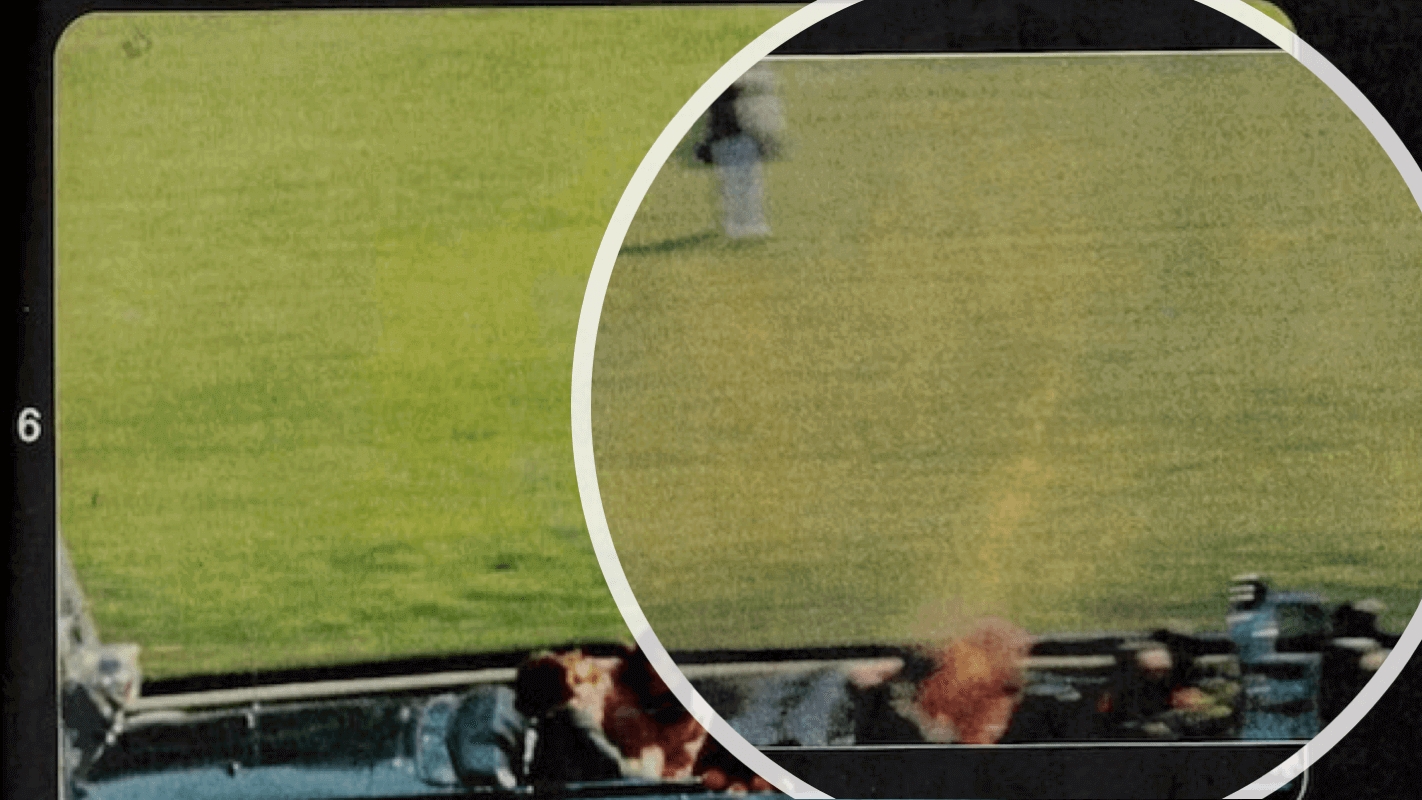
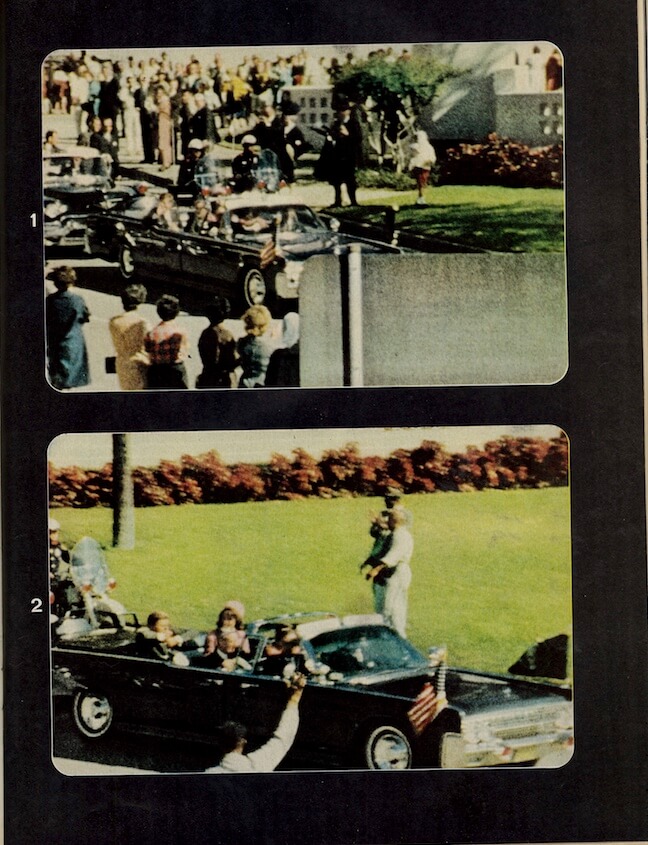
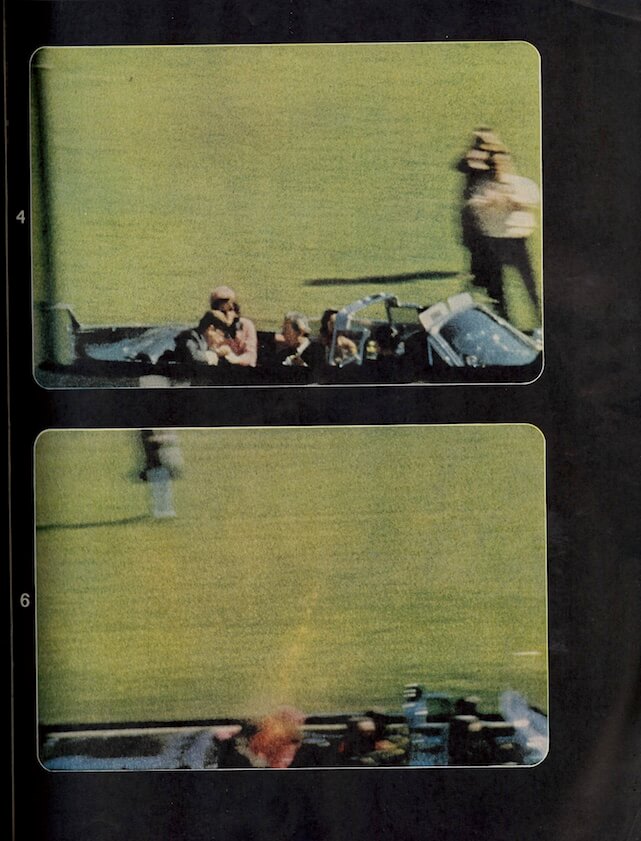
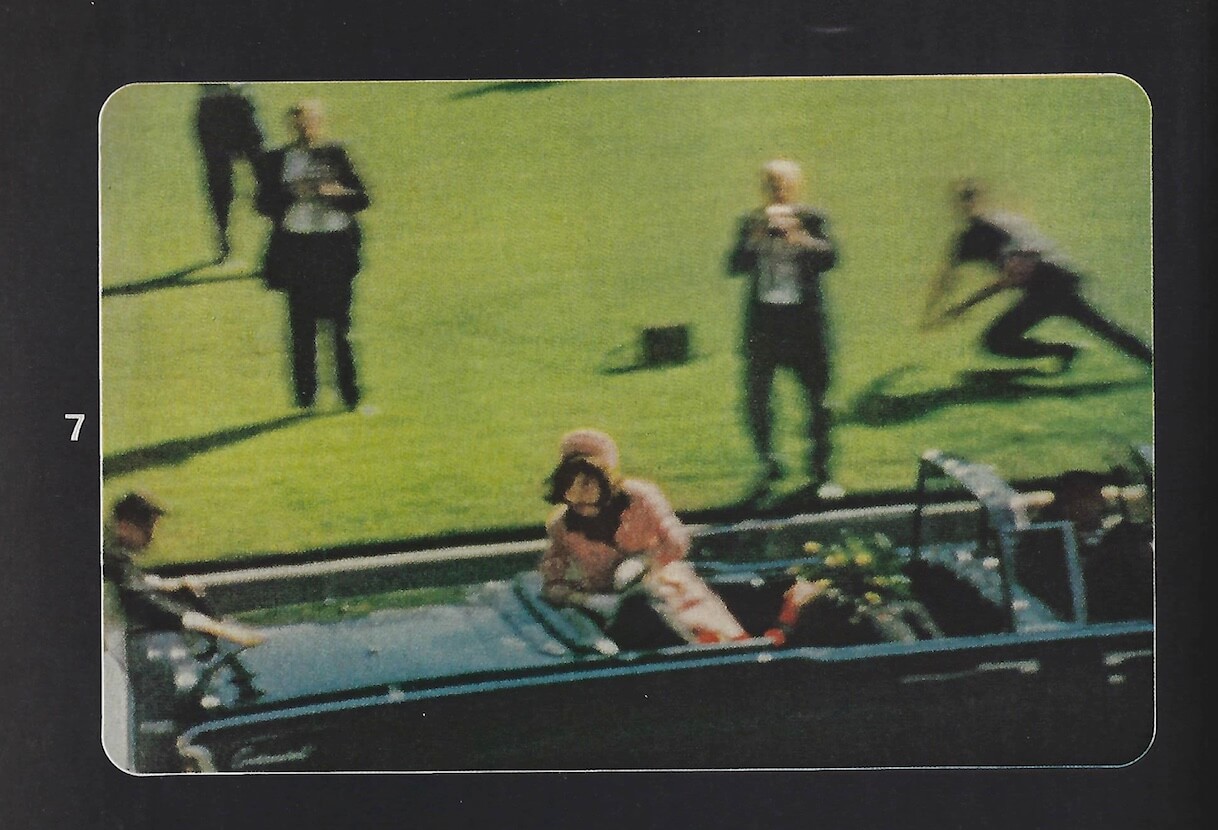
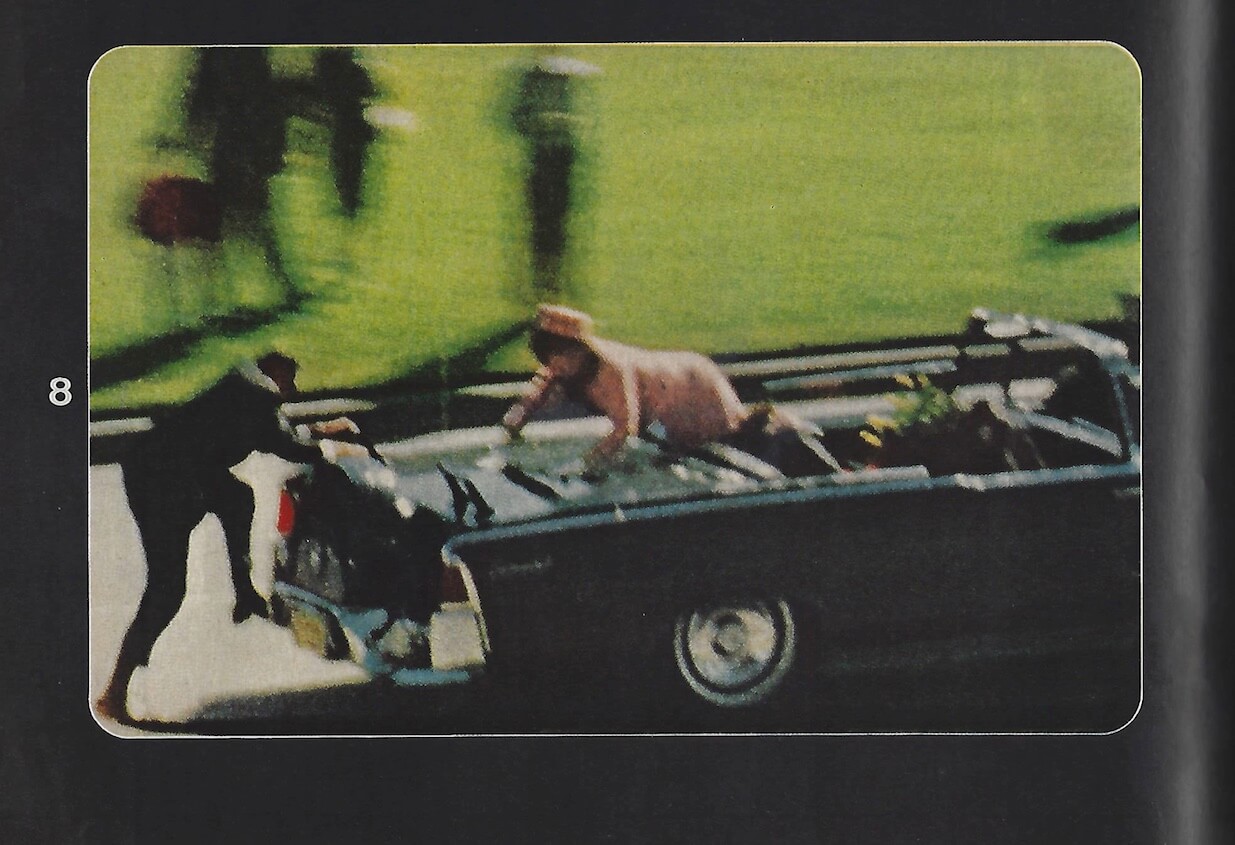
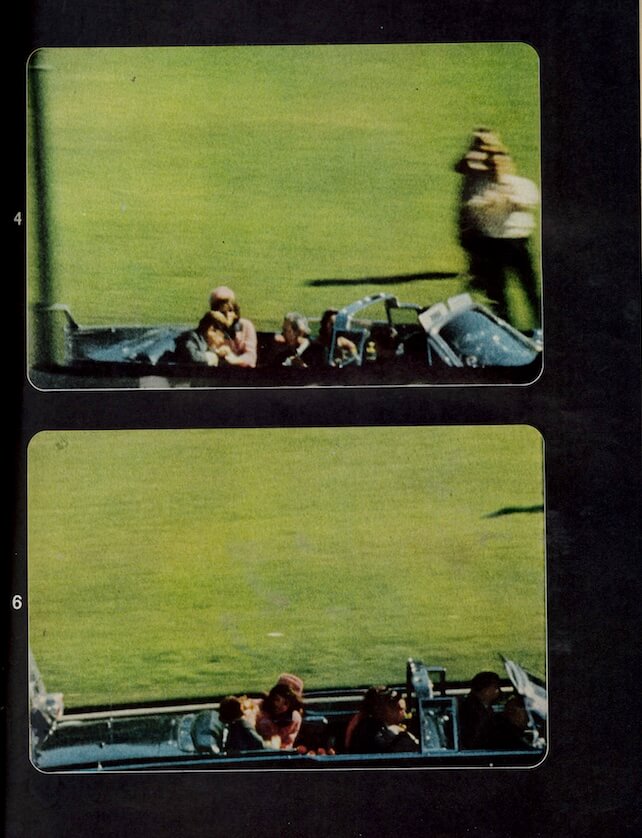
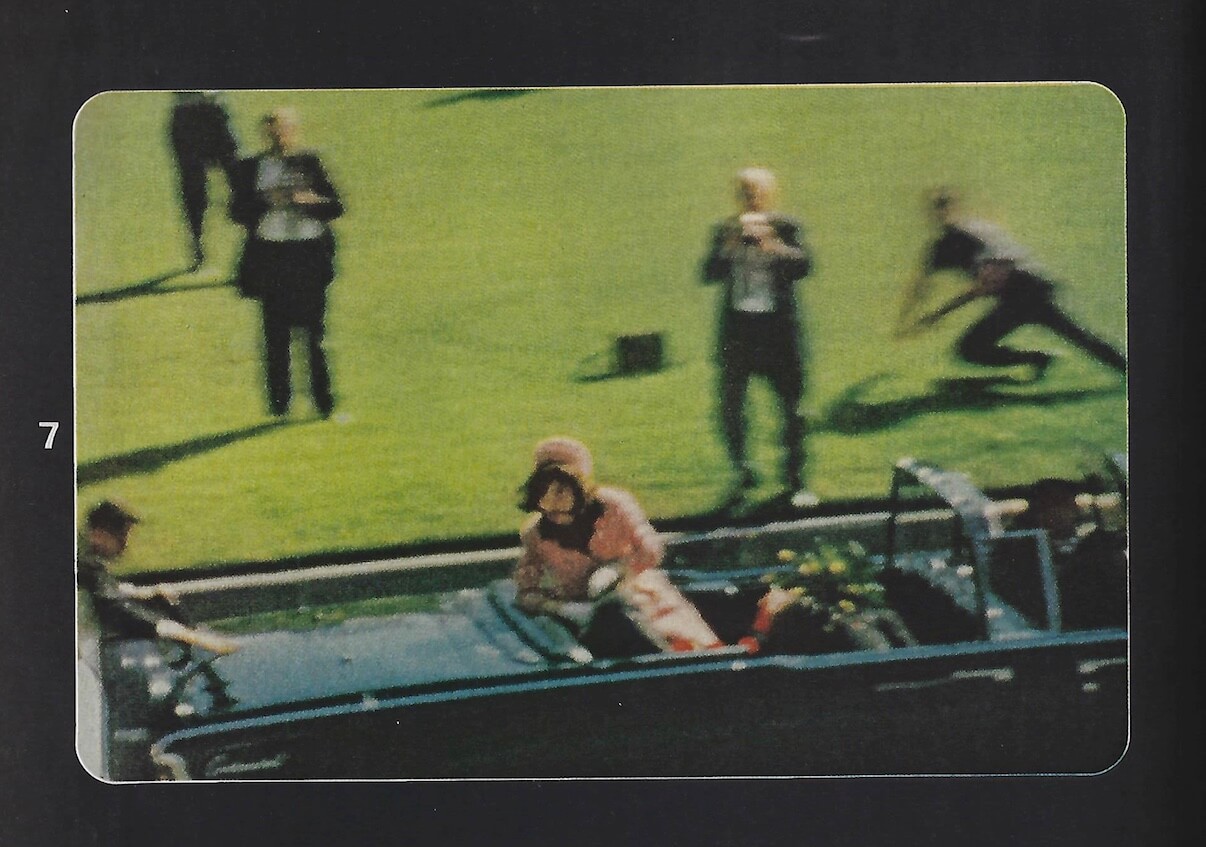
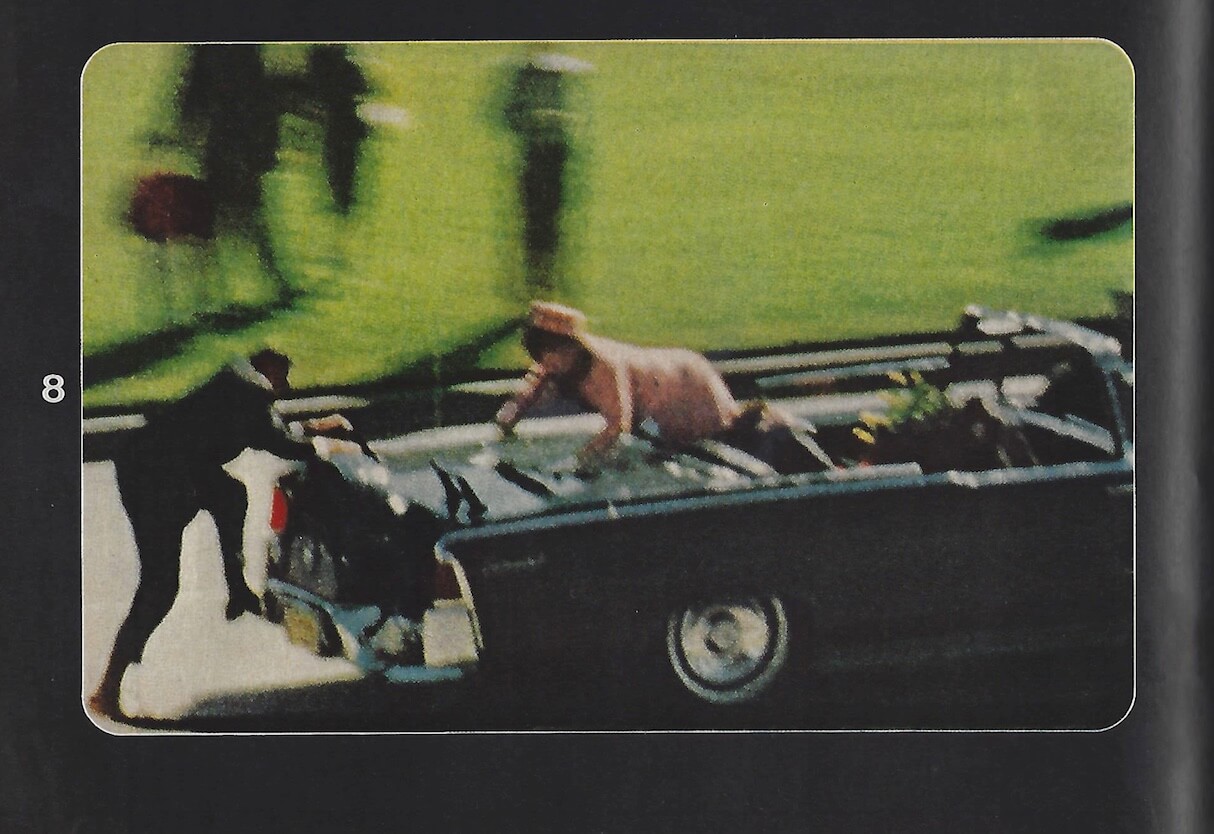
    Yet the primary emotion I felt on watching the Zapruder Film back then, much greater than shock or horror, was sadness. The vision of the President slammed backward and to his left like flotsam as his distraught wife attempts to retrieve debris from his shattered head is still among the saddest things I’ve ever seen. Of all the dehumanizing visions from history captured on film, somehow the moment of this man’s fatal wounding stands out even among tragedies encompassing many more victims at once. It resonates like a warning to all humanity never to get our hopes up too much.

    *********

    It was in the summer of 1999 that I made the acquaintance of Howard P. Willens, long before I knew who he was. Having recently received the news that I’d passed the bar exam, I needed a job for a couple of months, and as many have long done in Washington, I turned to a legal staffing agency, the name of which I now forget. One of the principals in this small, boutique firm said it would require me to work at the home of a senior, distinguished attorney and his wife, also a lawyer, helping them to finish research on a book they were jointly authoring.

    The interviewer cautioned me diplomatically that, while this client was highly accomplished and respected, he could be “difficult at times,” or words to that effect. The substance of it was that Mr. Willens tended to be overly exacting in his demands, exhibiting impatience that might disconcert some. No problem, I said. I was confident any of this gentleman’s idiosyncrasies would roll off my cocky shoulders with ease. Besides, I reasoned, it was only for a few weeks.

    That the next two months were among the most unpleasant of my professional life was not something I would normally have linked at the time to anything more than over-the-top fussiness on the part of the person I was trying – haplessly – to please. It was not a dull assignment overall, but Mr. Willens’ peculiar habit of becoming red-faced instantaneously, adopting a contemptuous tone of voice without ever raising it, was so effective in sending me into spirals of depression and disconsolation that eventually I couldn’t help but take it personally. No one, I thought, could be this disagreeable unless he had taken a serious, specific dislike to the person he was addressing.

    Since I almost never sensed any satisfaction on his part, I became desperate for days spent alone at the Library of Congress, locating precise content for footnotes and citations. Howard Willens struck me as unambiguously unhappy, and once I discovered who he was, fourteen years later, I would link his unhappiness inextricably to the sadness wrought in my mind by the Zapruder Film.

    I

    The two books that Howard Willens and Deanne Siemer (his wife) produced, and on which I worked in their final stages, are serious-looking academic histories. National Security and Self-Determination: United States Policy in Micronesia (1961-72) (Westport, CT: Praeger Publishers, 2000) and An Honorable Accord: The Covenant Between the Northern Mariana Islands and the United States (Honolulu: University of Hawai’i Press, 2002) tell an intricate story of law and diplomacy, how Washington handled Pacific territories that wound up under American control after World War Two.

    Even within the confines of “authorized history,” the authors are not unsuccessful in recounting a tale of twentieth-century American manifest destiny with a “happy ending.” Years of negotiations and interim agreements are related in impressive detail, and, it could be argued, as authoritatively as anyone could. Willens and Siemer were personally instrumental in many of the processes they describe. Mindful that some observers might perceive the formal attachment of the islands to the US as just another form of imperialism – or annexation – their main purpose, as perhaps expected with any authorized history, is to demonstrate that this was never the case.

    The authors cite National Security Action Memorandum 145, issued by President Kennedy in 1962, as encapsulating the guiding American principles for the political future of the Micronesian islands that ended up as a “Trust Territory” of the United Nations, with the US as “trustee.” JFK, sensitive to any colonialism on the part of the United States (or any other country for that matter), reflected that sensitivity in NSAM 145. As the authors note:

    [President Kennedy] identified education as the first priority and directed his cabinet secretaries to create a task force chaired by [the Department of the] Interior, that would develop and implement programs to improve education in the Trust Territory and to address the serious shortcomings in public services and economic development. [An Honorable Accord, p. 10]

    With NSAM 145, JFK transferred responsibility for the Northern Marianas to the Department of the Interior. Prior to 1962, all of the Trust Territory except Rota had been administered by the Department of the Navy, which wanted to maintain strict security controls, limiting outside access to the islands in a typically furtive military atmosphere. Kennedy opened the islands up to outside travel and trade, in his words, to “foster responsible political development, stimulate new economic activity, and enable the people of the Islands to participate fully in the world of today.” [Ibid.]

    Disillusioned with the task force’s slow pace in implementing NSAM 145, JFK appointed an outside expert, Anthony Solomon, to lead a mission investigating prospects for accelerated economic and social development. The mission predictably advised greater US investment but also reported on a lack of political consciousness among the native inhabitants. In the Northern Marianas, they “found no serious opposition to permanent affiliation with the United States” and recommended a plebiscite for 1967 or 1968, offering voters two choices: independence or US sovereignty. [Ibid, p. 11] JFK knew that the islanders had already experienced three colonial regimes – Spanish, German, and Japanese – and he wanted US administration to represent genuine emancipation.

    Balancing the goals of self-determination and non-fragmentation became a serious initial challenge for Washington in determining Micronesia’s destiny. The governments of Guam and the Caroline Islands, for example, initially rejected any arrangement that would make their people US citizens, while the Northern Marianas favored association with the US. The US government thus negotiated separately with the de facto indigenous authorities of the Northern Marianas to achieve a separate status for them. Guam would eventually become a US territory as well, and Guamanians US citizens.

    The authors touch on how, in the aftermath of JFK’s assassination, the culture of official secrecy and the national-security state took over the process of establishing the island chain’s political status:

    [T]here no longer was the level of presidential interest that demanded the attention of the National Security Council staff and the secretaries of interior, defense, and state. In December 1963 the National Security Council, at the request of State (without any consultation with Solomon), classified as Secret the first volume of the report dealing with its political findings and recommendations; it remained undisclosed officially for many years. [Ibid. p. 12-13]

    II

    In 1972, the Marianas Political Status Commission (MPSC) retained Willens as counsel, by which point the Pentagon had become more assertive about how much of the islands would be retained for basing and other military purposes. The Nixon administration began planning a vast increase in defense sector involvement, including acquisition of 27,000 acres and the entire island of Tinian. Washington became alarmed when a popular referendum was organized in the Northern Marianas on the issue of relocating a whole village to accommodate a new US military base. The US government informed the Northern Marianas authorities that it would not be bound by the results of such a poll, and it was reassured that the referendum’s results would not be dispositive.

    It took until the mid-1970s, with former Warren Commission member Gerald Ford as US president, for the Northern Marianas to finally formalize the status its representatives said they wanted. This was the “Covenant.” One can argue over how rosy and bucolic the US-administered Northern Marianas became as a result of a process involving the national-security state, but I never had too much trouble believing association with the United States was a more genuinely popular alternative at the time than independence, a scenario that may well have seemed highly daunting. Protection from “Big Brother” America may have been too enticing for a tiny island population to pass up.

    The history of the political status of Micronesia is a unique tale, intriguing for anyone interested in international law. While subject to sanitization in the volumes of Willens and Siemer, there are occasional human touches (in one anecdote, an American lawyer and economist for the MPSC drunkenly assaults a US Air Force colonel who has insulted him in a hotel bar). That said, An Honorable Accord and National Security and Self-Determination are conservative histories.

    A “progressive” analysis of the legacy of covenants between the US and Micronesia might focus on factors such as economic exploitation, corruption, clan-based patrimonialism, and a poor defense of workers’ rights, in addition to the adverse role and influence of the US national-security state in engineering political outcomes desired by Washington (the publisher of the first volume, Praeger, has a long history of CIA-commissioned works). Also, while the Northern Marianas and Guam are part of the United States, their residents have no voting representation in the US Congress, a dubious status shared with compatriots in American Samoa, Puerto Rico, the US Virgin Islands, and the District of Columbia. No official US history is likely to highlight such concerns at great length.

    As recently as 2019, Ms. Magazine published an update to Rebecca Clarren’s 2006 article entitled “Paradise Lost,” highlighting social degradation in the Commonwealth of the Northern Mariana Islands (CNMI) since the accord with the United States. The purpose of republication was, apparently, to double down on her central points in the face of a Saipan Tribune piece, “Article ignores the great strides we’ve made,” attacking Clarren’s analysis. As Clarren noted:

    [In 1975] the islands’ indigenous population of subsistence farmers and fishermen voted to become a commonwealth of the United States – a legal designation that made them U.S. citizens and subject to most U.S. laws. There were two critical exceptions, however: The U.S. agreed to exempt the islands from the minimum-wage requirements of the Fair Labor Standards Act (allowing the islands to set their own lower minimum wage, currently $3.05, compared to $5.15 in the U.S.) and from most provisions of the Immigration and Nationality Act. This has allowed garment manufacturers to import thousands of foreign contract guest workers who, ironically, stitch onto the garments they make the labels “Made in Saipan (USA),” “Made in Northern Marianas (USA)” or simply “Made in USA.”

    Former heavyweight DC lobbyist Jack Abramoff, prior to his conviction and imprisonment for fraud, bribery, and tax evasion, served as a lobbyist for the CNMI and blocked bipartisan reforms advanced by Congress to improve labor conditions and immigration abuses. As Clarren pointed out:

    In January 2005, the GATT treaty, which had regulated all global trade in textiles and apparel since 1974, expired, eliminating quotas on textile exports to the U.S. The Northern Marianas had been attractive to garment makers because of its exemption from such quotas and from tariffs on goods shipped to the U.S. marketplace. Without those advantages, manufacturers are increasingly moving to such places as China, Vietnam and Cambodia, where they can pay even lower wages. Since the treaty’s expiration, seven factories have closed in Saipan, reducing the value of garment exports to half its 1999 peak and putting thousands of guest workers out of jobs. Some observers expect almost all factories to close by 2008, when a temporary restriction on Chinese apparel exports to the U.S. ends.

    Given their alternatives, the people of the Northern Marianas could very well have legitimately voted decades ago to become a part of the US, a choice President Kennedy’s NSAM 145 extended to them and – as the authors tell it – the option favored by JFK. One might argue that such grim social developments are ever-present in any process of this kind, that the plunge into social tragedy was inevitable. It’s just that one can’t help but suspect that the Kennedy administration, had it lived, might have put the vulnerable people of Micronesia on a superior social and economic footing.

    III

    Though I never had any contact with Howard Willens or Deanne Siemer again, I hoped they felt I had made a reputable contribution to their authoritative history, that their acknowledgment was more than just politeness. On my last day, I remember sitting next to Willens outside – near the pool behind his attractive, fully detached home in a leafy neighborhood off the Rock Creek Parkway. I seem to recall his small grandchildren were visiting, playing in the background, and it was the first time I felt any sense of relaxation around him. Maybe he was looking forward to me leaving, or maybe he was simply “exhaling” after the laborious, nerve-wracking process of dotting all the i’s and crossing all the t’s in his upcoming tomes. But he was a significantly (if slightly) changed man, and at that point, finally, I no longer took his unfriendliness personally. (As I am duly mentioned in the acknowledgments among seven other research assistants, it occurred to me that others may have quit). He was around family, congenial, talking to me about what I wanted to do.

    As it happened, I was due to travel to the Caucasus region of the ex-USSR in a matter of days. Earlier in the year, my British colleagues and I had monitored an election in Armenia in which the US-sponsored political party – “Unity” – won big. We had found the “Unity” victory deeply flawed, and when the leaders of this new ruling faction were massacred in the parliament chamber in late October by nationalist gunmen claiming they only wanted the “people” to “live well,” US Deputy Secretary of State Strobe Talbott squirmed in public while expressing outrage at the slaughter of the Armenian politicians whom he and his Washington superiors had so enthusiastically backed. “Unity” had been amenable to compromise on the disputed, Armenian-controlled territory of Nagorno-Karabakh, something Washington desperately wanted settled to allow oil to flow more smoothly to the west from Azerbaijan, which claimed Nagorno-Karabakh as its own.

    In neighboring Georgia, President Eduard Shevardnadze – long a favorite of the US foreign policy establishment and winner of the “Enron Prize” in 1999 – was facing a stiff challenge from a regional leader in parliamentary elections at the end of October. In the pre-election period, Shevardnadze would bring out US-supplied helicopters to fly low over the capital, Tbilisi, in a deafening alert to his subjects that a “coup attempt” was under way. The putsch, declared Shevardnadze, was being orchestrated by the Russia-friendly head of the Autonomous Republic of Adjara, Aslan Abashidze, whom Western media consistently labeled a “warlord.” The US staunchly backed Shevardnadze in his electoral showdown with Abashidze, whose bloc was polling high.

    Within three years, Washington would turn against Shevardnadze after a poor evaluation of local elections in 2002, and by November 2003 the US would call for his ouster in the “Rose Revolution.” Abashidze would flee to Moscow within six months of the “revolution,” and top US officials like Dick Cheney and Donald Rumsfeld would celebrate a new generation of Georgian leaders as the US-led war in Iraq ramped up. By 2008, around the time of the five-day war with Russia over the separatist enclave of South Ossetia, Sen. John McCain would dance a “Georgian jig” on camera with US-backed strongman President Mikheil Saakashvili, a Shevardnadze protégé now transformed into the great hope for change in place of the stagnant old ways of the ex-Soviet Politburo member.

    All of this seemed far more exciting to me at the time than the history of Micronesia. Anticipating my impending mission on behalf of democracy and human rights, as I understood them then, I might have been distracted from my assignment. If so, I apologize herewith to the authors. I did try to be precise in my source-checking. In any case, in September 1999, Howard Willens and Deanne Siemer bid me semi-cheerful farewell and good luck as I drove out of their company forever.

    IV

    It was not until the year of the fiftieth anniversary of the assassination that I became aware I had once worked for a former member of the Warren Commission’s legal staff. Howard Willens had just published a book, History Will Prove Us Right (New York: The Overlook Press, 2013), to uphold and defend the Warren Report’s conclusions, and he and other surviving legal counsel appeared in panels to promote and celebrate the Warren Commission’s achievement in securing truth and justice for the people of the United States. By then convinced that the Commission had done nothing of the sort, I found it a dreadful spectacle to watch.

    What I felt most when watching Willens in 2013 was the old, familiar sense of his discontent. In a speech at Southern Methodist University in Dallas, he was animated, occasionally agitated in his broad-shouldered suit, clutching the lectern like a commissar laying down the law. But the stuttering “uhs” and “ahs” sounded symptomatic of over-rehearsal. Explaining the Single Bullet Theory as if it were fact, he looked to me not only despondent but also somewhat worried or under duress.

    At the 27:43 mark in the C-SPAN video, Willens can be seen and heard reciting the following:

    “So Single Bullet Theory of course has gone through the ages as a much, uh, uh, maligned, uh… uh, uh, uh, uh, lil’ shorthand for, uh, the Commission’s, uh, conclusion, which of course, it became a conclusion of fact, uh, uh, not… a theory, uh, because after a, a reenactment in-in Dallas in May of 1964, it seemed very evident that the bodies of the President and the Governor were, uh, positioned in the car in such a way… uh, that, that the bullet after it exited from the President… would, would hit the [sic] Connally and cause… the nature of the wounds… in-in his back, his-his-his wrist, and his thigh… that was uh, uh, uh, what he suffered. So it was… and furthermore, what people tend to forget is that the… uh… the… uh, uh, pathologists… and the Commission were not the only people that reached, uh, this view, that this particular conclusion was reviewed in 1968, experts in 1975, experts in 1976, and again in 1978. And out of twenty expertstwenty… let’s be precise… twenty-one… pathologistsexperts… in such matters examined the autopsy, uh… photographs and x-rays… they all, they all, all concluded, uh, the course of the bullet… and, uh, twenty out of twenty-one… concluded as did the Commission… that a single bullet… created the back, throat wounds of the President and the wounds suffered by Governor Connally. The dissenting pathologist, who will be in town two weeks from now featured at a conference, when asked what happened to the bullet, when it exited the President’s… throat, he said: ‘I don’t know.’ [Pause, feint audience titters] ‘I didn’t conduct the investigation.’ And unless one has a rational explanation… that, that can rival in terms consistent with the law of physics, and with the physical evidence available… I think there’s not a rational discussion that can be had… on the question of the Single Bullet uck-uck-uck conclusion.”

    The “dissenting pathologist” was, of course, Dr. Cyril H. Wecht, M.D., a member of the House Select Committee on Assassinations forensic panel and a distinguished university professor, who also had a law degree. Having listened to both men speak, I had little doubt which of the two I would prefer to represent me in a jury trial or testify as a witness. Of course, since there was never any genuine trial of Lee Harvey Oswald, the point was moot, but how dispiriting to see a fellow attorney such as Howard Willens – even as he referred to overwhelming majorities of “experts” in the 1960s and 1970s – nonchalantly cast aside the fact that the only “majority” that mattered when determining truth under US criminal law was a majority of jurors.

    In History Will Prove Us Right, Willens fleshes out Dr. Wecht’s “I don’t know” quotation by noting its setting: the mock trial of Lee Harvey Oswald in London in 1984, with Vincent Bugliosi as mock prosecutor. (Unsurprisingly, Bugliosi’s is the top review on the back of the book’s dustjacket.) But what makes the entire issue of the fate of the “Magic Bullet” so remarkable as a subject of Willens’ ridicule of Wecht is that both Willens and Bugliosi ignored the broken evidentiary chain. The same was true for President Kennedy’s body and limousine. Both were removed from Texas illegally, since the crime scene investigation and autopsy should have taken place in Dallas in accordance with prevailing law, and in a bit of forensic negligence best described as outrageous, Kennedy’s wounds were never even dissected. The presidential car was taken from Andrews Air Force Base to the White House garage, where even FBI investigators were denied access to it until after midnight.

    In short, whisking both corpse and vehicle out of sight of the duly constituted law enforcement authorities destroyed due process. Yet it is Dr. Wecht who is mocked? It is Willens and Bugliosi who should be derided as attorneys. Not only was Wecht speaking the truth, but it was precisely that truth – the “I don’t know” – that made bunk out of all Willens’ and Bugliosi’s so-called “evidence.” It is inconceivable that an attorney of Willens’ stature could accept this state of affairs as evidentiarily sound. It is insulting that he could expect the rest of us to do so.

    Again, Willens’ swagger in 2013 could not negate the deep-seated sense of dissatisfaction I had perceived in him in 1999, and it wasn’t just the stutter. Something still wasn’t right with the world, and as I watched I became aware of a strange “camaraderie” among the ex-Warren Commission lawyers, a “brotherhood” – not so much of joy as “circumstance.” It was as if someone (or something) had dragged these octogenarians out of retirement to go on a tiresome “national tour.” It was like a tedious exercise in going through the motions, but, hey, at least they had each other.

    At the 29:42 mark, Willens can be seen and heard reciting the following:

    Uh, we, we did have the problem, as you know, of dealing with, uh, conspiracy, uh… and the problem that sure you’ll hear about more from my colleagues, but the over… uh… whelming problem from the outset was that it is always impossible, analytically, to prove a negative. And here the task was to prove there was no conspiracy.

    The “task” was to prove there was no conspiracy? Since when did that become the duty of a diligent lawyer or investigator serious about his job? What happened to the truth?

    He continues:

    Now, the Commission was aware then… of all the possible, uh, interests, here in Texas, and nationally and internationally, who might have an interest in assassinating the President. But in order to prove a conspiracy, you have to prove there’s some rel… some relationship between the alleged conspirators and the people who actually… did the deed, whether it’s Lee Harvey Oswald or Jack Ruby. And the Commission staff and the members of the Commission conducted… a widespread investigation looking at the associations of both these individuals, intensely and comprehensively, and could not find any evidence that either of them had been aided in any way by one of the alleged, uh, suspects… [unintelligible]. And so, ah, ah, that, of course is a conclusion that one can never be… absolutely certain about, and what the Commission did in its findings was say, was to say, ‘We have found no credible evidence… of a conspiracy.’ They did not say there was no conspiracy. And they fully understood that with the decades to come, there might be additional evidence that would, uh, uh, persuade, uh, uh, impartial, knowledgeable people that there was a conspiracy. It’s been forty-nine years, and that evidence still has not materialized. And if I had had the courage of my convictions, the book would be entitled, ‘History Has Proved Us Right’ rather than ‘History Will… uh, uh, uh… Prove Us Right.’”

    Howard Willens has seen the inside of a courtroom many more times than I, and he no doubt received a much higher grade in evidence to boot. But to point out to your audience that, on the one hand, the Commission used the term “no credible evidence” as a way of qualifying the veracity of its findings, and then, on the other, say that no evidence had materialized in the previous half-century to undermine the Commission’s conclusion beggars belief. It’s akin to arguing with non-lawyer Warrenites online and being bombarded with: “You have no evidence!” You’re left with the option of either cutting the discussion off abruptly or trying to calmly reason with them that, indeed, there is a ton of “evidence.” It’s just a matter of whether one interprets it as “credible” or not.

    At the risk of digression, for example, Helen Markham stated in a sworn affidavit that she arrived at the intersection of East 10th Street and North Patton Avenue in Dallas at 1:06 PM on November 22, 1963, and immediately caught sight of Officer J. D. Tippit’s killer. A sworn affidavit is evidence, as any lawyer worth his or her salt will tell you. In a court of law, you can be certain any diligent defense attorney would not only have entered it into evidence but also held onto it like a pit bull with a fresh bone. Markham’s route to the bus stop was part of her daily routine, making her affidavit more credible than anything else she said. It rendered the accused killer’s arrival at the scene of Tippit’s slaying impossible, and a court of law would have taken due note of that. But the Warren Commission was not a court of law, so it ignored the evidentiary weight of the affidavit. It never proved anything because it didn’t have to. In 2013, Willens blurred the definition of “evidence” as a way of bolstering the hackneyed Warrenite stance.

    The phrase “courage of my convictions” also stands out as curious. If Willens had been brave enough to do the right thing, he would have called his book something else? One has to wonder whether such a statement betrays a sinister truth. Suppose, for instance, that Willens believed the Commission was “right,” as in the book’s title, but not “true.” What if leading Commissioners knew they were perpetrating a massive falsehood for the “right” reasons, because the American public didn’t need to know the truth, or worse (to paraphrase Jack Nicholson’s caricatured Marine colonel in A Few Good Men), couldn’t “handle the truth”? Personally, I suspect certain Commission insiders beyond Allen Dulles (including a few legal staffers) knew some terrible – even unspeakable – secret but set about constructing a fairy-tale narrative to “tranquilize the people.” This is how Senator Richard Schweiker of the Church Committee referred to the Commission. Could Willens have been one of them? Surely not, I hoped as I watched him in 2013.

    History Will Prove Us Right has been ably reviewed on this website, and I don’t feel a need to elaborate on that analysis. But I do think Willens’ Micronesia works qualify as “serious” (if formalistic) academic history, whatever one’s personal perspective on the fate of the Trust Territories. History Will Prove Us Right does not, and no serious scholar would say otherwise. One might speculate Willens was happier writing the Micronesian volumes than he was writing History Will Prove Us Right, but with the benefit of hindsight, I sadly cannot shake the impression that Willens, as he wrote his Micronesia works, was still carrying something abominable around with him decades after serving as a Warren Commission attorney. That is, the unhappiness endured then, as it may still.

    The manner of Howard P. Willens, Esq., struck me as severely unnatural not only in 1999, but forever thereafter in my mind’s eye. Something, I believe now, was desperately bothering him thirty-five years after the publication of the Warren Report, and the unpleasantness of that late summer in Washington was, I still feel, a consequence of that something. The enduring sadness of the assassination was described by John Newman in his seminal work, Oswald and the CIA, as an “unhealed wound.” That was the first place I saw it thus described, and that is still the most eloquent phrase I’ve heard as metaphor for that horrific event. But if the wound remains unhealed for a nation, how must it feel for any single individual still harboring some terrible truth about it?

    Again, as the title of his book indicates, Howard Willens may have convinced himself that posterity would honor the men of the Warren Commission and its staff. He may have rationalized somehow that, in the event this truth became public in their lifetime, the public would understand that he and his colleagues were only trying to be upstanding, to prevent a widespread loss of faith in our institutions of government, with potential resultant chaos and collapse. While this makes some sense, it is at the same time unthinkable to me that anyone could carry something as profoundly awful as that around with them to the end of his life. Yet countless others surely already have.

    The single sentence in History Will Prove Us Right about a phone call that Willens’ former Warren Commission colleague David Slawson received from James Jesus Angleton, ex-chief of the CIA’s Counterintelligence Staff, in 1975 (Angleton was no longer even a CIA employee) reads as follows:

    When CIA Counterintelligence chief James Angleton called David Slawson to check his reactions to the Church Committee’s disclosures, Slawson frankly told Angleton how disappointed he was with his agency’s failure to disclose this vital information, but assured him that Slawson would honor his commitment to preserve the confidentiality of other CIA secrets. [p. 317]

    This is a level of sanitization unequaled even in the Micronesian works. One wonders what Slawson himself thought of it. As the incident is recounted by David Talbot in The Devil’s Chessboard,

    In a frank interview with The New York Times in February 1975, Slawson suggested that the CIA had withheld important information from the Warren Commission, and he endorsed the growing campaign to reopen the Kennedy investigation. Slawson was the first Warren Commission attorney to publicly question whether the panel had been misled by the CIA and FBI (he would later be joined by Rankin himself) – and the new story caused a stir in Washington. Several days after the article ran, Slawson – who by then was teaching law at the University of Southern California – got a disturbing phone call from James Angleton. After some initial pleasantries, the spook got around to business. He wanted Slawson to know that he was friendly with the president of USC, and he wanted to make sure that Slawson was going to “remain a friend” of the CIA. [Talbot, 580-81]

    In the 1990s, Slawson infamously refused to answer an Assassination Records Review Board member who asked him whether he had listened to a tape recording supposedly made of Lee Harvey Oswald in Mexico City (Willens incidentally accompanied him on the trip to Mexico in 1964), remarking defiantly that he was “not at liberty to discuss that.” A federal statute passed unanimously by Congress in 1992 was supposed to afford Slawson just such a “liberty,” of course, but maybe the Ghost of Jim Angleton was still staring at him from somewhere in the room as he spoke.

    President Trump reportedly told Judge Andrew Napolitano over the phone that he had seen something in the remaining JFK files that Napolitano, had he also viewed them, would have understood required continued concealment. If Trump was speaking the truth (not a given), then perhaps there is a small community of Americans prepared to walk around harboring some unspeakably atrocious fact about our government and history, and they are fine with just continuing to carry on that way until the end of their days. I don’t get it, but then I’m not one of them.

    Recent breakthroughs in JFK research, including the watershed work of Jefferson Morley and the Mary Ferrell Foundation in pursuing still-concealed government files related to the assassination, offer hope that an era of great sadness and anguish in American history and life might finally come to an end. Looking back at the period of the Warren Commission and the ensuing several decades, one gains an unmistakable impression of widespread blackmail and intimidation holding sway over public officials, including those staffing official investigative panels. We know for instance, through Hale Boggs’ son Tommy, that J. Edgar Hoover maintained files on the Warren Commissioners. Well-meaning investigators operating in that milieu nearly sixty years ago no doubt experienced acute discomfort.

    The political culture of Angleton and J. Edgar Hoover endured long after their deaths, so that honorable men such as Cyril Wecht found themselves alone in opposing something as grotesquely insulting to human intelligence as the Single Bullet Theory. Unseen pressure and intimidation on those seeking the truth must have been very real, and a recent two-volume set, One Nation Under Blackmail: The sordid union between Intelligence and Organized Crime that gave rise to Jeffrey Epstein by Whitney Webb (Walterville, OR: Trine Day, 2022), while lamentably neglecting to touch on the potential for blackmail in steering the course of investigations into JFK’s murder, has made waves for publicizing what many have long felt but were no doubt afraid to say. The truth is slowly coming into view, whatever those protecting an old secret may still hope to hide. The nation is progressing into light.

    I cannot assume Howard Willens is among those hiding ghastly secrets about the nature of the assassination. It is of course possible that he genuinely believes in the Warren Report’s conclusions. After all, the notion that something was “possible” – however implausible – remains the primary debating stance of Warrenites in defending their bible today. But in the event Willens or any other living American encountered the sort of gangster-like tactics employed by Angleton against Slawson (or by Hoover against innumerable others), they would honor history and nation by unburdening themselves of that cloud of sorrow now. They should let America know of any torment experienced or learned of at the hands of the long dead “wise men” of America’s Cold War intelligence and security agencies. Real US “national security” demands freedom from that miserable past.

  • Neurology and Jiggle Analysis

    Neurology and Jiggle Analysis


    How long does it take the muscles of the average person to contract in reflexive response to an unexpected loud noise?

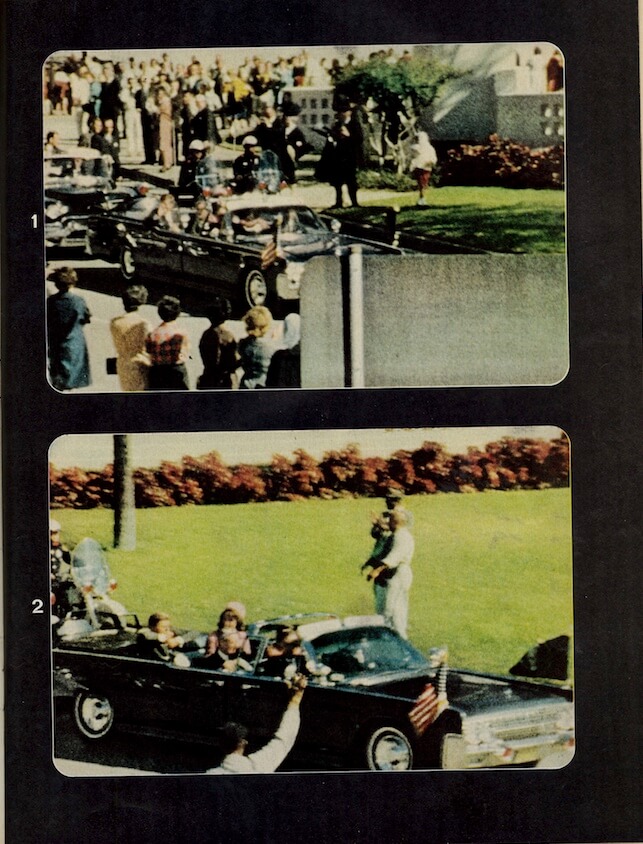
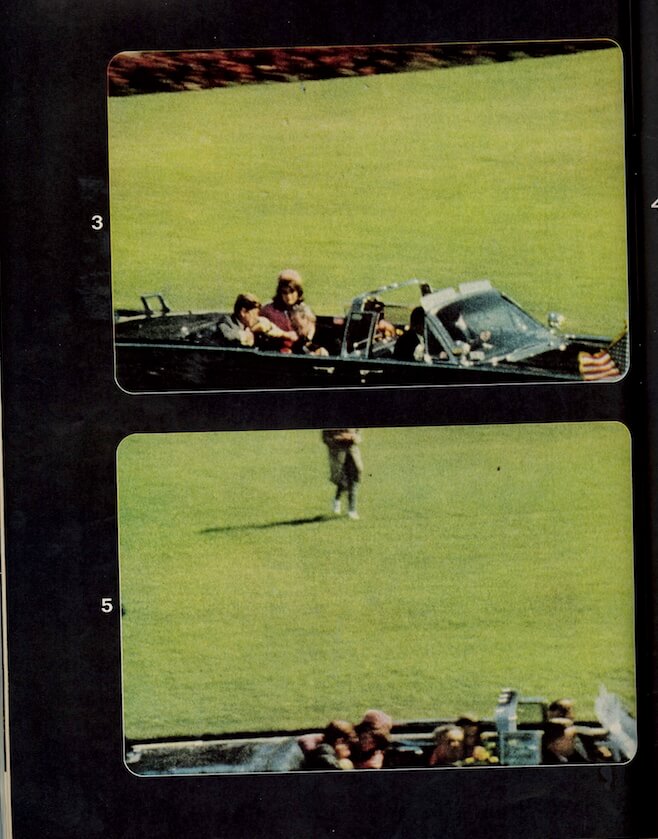
    Reasonably precise information on this reaction, known as the “auditory startle reflex,” is presented below. It is vital to “jiggle analyses,” studies of blurred images on the Zapruder film of the Kennedy assassination, based on the assumption that the blurs are caused by the sounds of shots making the photographer jerk.

    Under ideal conditions, jiggle analysis could suggest answers to some questions: When were audible shots fired? Did Zapruder react to all of them equally? If not, which shot elicited the greatest reaction and why? Is the time interval between the apparent impact on the victim and the blur on the film too long—or too short—to work with the official story?

    There are no answers in this report, but I present it in response to the number of researchers who have asked me to find at least some serviceable neurological information.

    I also present the findings of a very original researcher—Gene Case—whose inspired work led to an insight into the nervous system of the camera that is at least as interesting as the nervous system of Zapruder. These findings, published years ago in The Fourth Decade, deserve more attention.[1]

    But first, a few basics. The speed of Zapruder’s camera was 18.3 frames per second—or 54.6 milliseconds from one frame to another. The speed of sound is 1100 feet per second (fps). The muzzle velocity of a Mannlicher-Carcano is close to 2200 fps.  A Carcano bullet from the alleged sniper’s nest would strike Kennedy before the sound of the muzzle blast reached Zapruder. What happens next?

    Auditory Stimulus Response Times in Milliseconds (m/s)

    The following figures come from a study by Brown et al, published in the British journal, Brain.[2] The authors tested the latency period (time it takes to respond) of the auditory startle reflex in 12 healthy volunteers ranging in age from 18 to 80 years. While relaxing in a chair, the subjects were randomly treated about every 20 minutes to a tone burst of 124 decibels, the equivalent BANG! of a car backfire 20 feet away. The average latency period of the relevant muscle groups in milliseconds:

    Neck: 58 m/s (range 40–136 m/s)

    Paraspinal muscles: 60 m/s (range: 48–120 m/s)

    Forearm Flexors: 82 m/s (range: 60–200 m/s)

    Forearm Extensors: 73 m/s (range 62–173 m/s)

    Thumb: 99 m/s (range 75–179 m/s)

    Back of Hand: 99 m/s (range 72–176 m/s)

    The authors concluded:

    The most generalized startle response to the standard sound stimulus employed consisted of eye closure, grimacing, neck flexion, trunk flexion, slight abduction of the arms, flexion of the elbows, and pronation of the forearms.

    There was considerable variation in the degree to which this response was expressed, and in some subjects only eye closure and flexion of the neck were apparent.

    Accelerated Reaction Time

    Aniss et al found that the startle response “is more easily elicited in a state of muscular contraction.”[3] (In rare instances, the opposite occurs, i.e., muscle contraction can inhibit the startle response.) The muscles of Zapruder’s neck, trunk, arms, and hands would all have been in a state of contraction, so one might suppose he was well-primed to jump at the sound of shots—if they were loud enough compared with the ambient noise in Dealey Plaza.

    Jacqueline Kennedy’s Important Observation

    Habituation—the process of becoming so accustomed to a stimulus that it loses its effect—can take place rapidly.[4] The reflex in neck muscle is the last to habituate, according to a 1951 study still being cited.[5] The subjects of the Brown study were hit with tone bursts while relaxing in an otherwise quiet environment—and even they habituated to some extent, within two to six trials.

    Dealey Plaza was already filled with the noise of motorcycles before the shooting began, which could lead to habituation on the part of some witnesses at least. Jacqueline Kennedy makes this clear:
    You know, there is always noise in a motorcade and there are always motorcycles besides us, a lot of them backfiring. I guess there was a noise, but it didn’t seem like any different noise really because there is so much noise, motorcycles and things. But then suddenly Governor Connally was yelling…[6]

    She GUESSED there was a noise? At the time of this shot, the first, she was closer to the alleged source of the noise than Zapruder had been. On the other hand, she was also closer to the motorcycles.

    Two for the Price of One

    While ambient noise can habituate a witness to the sound of shots that are not much louder, there is something that could even prevent one from hearing a shot altogether: the sound of a shot fired immediately before. Muscles supporting the eardrum contract defensively, making one temporarily deaf.

    Thus, two shots can sound like one, creating only one startle reflex, if any, depending on the location of the sniper in relation to the photographer.  

    (Elsewhere, see description of how one shot can sound like two.)

    Impact of Bullet, Impact of Sound

    Luis Alvarez, the Nobel Laureate known mostly for “jet effect” also performed a jiggle analysis.[7] One big concern of his involved the amount of time between the impact of the bullet, and the impact of the sound.

    The expected neuromuscular reaction occurs about one-quarter to one-third of a second later, as shown by the large accelerations near 318. (I’ll adopt five frames as Mr. Zapruder’s experimentally determined reaction time.)[8]

    Alvarez did not quote any authoritative source for this claim about the latency of the “expected” neuromuscular reaction, and his explanation for its length is inappropriate:

    For those readers who are surprised that the neuromuscular response time is so long, let me recall a common ‘parlor trick’: A bets B that if A drops a vertically held dollar bill without any warning, B cannot stop its fall by pinching his fingers together, if his fingers are poised, ready to clamp together, at the bottom edge of the bill. The fact that the bill can almost never be stopped (unless A gives a precursor signal with his fingers) indicates that a nervous system ‘or hair trigger’ takes more than one-sixth of a second (3.1 frames) to respond to an optical stimulus.[9]

    Alvarez was apparently correct about the speed of this particular kind of reaction. Tests performed on baseball hero Babe Ruth showed he took 140 milliseconds to twitch at the sight of a ball on its way—as opposed to the average person’s best, 150 milliseconds.[10]

    But why compare (a) an involuntary response to an auditory stimulus with (b) a voluntary response to an optical stimulus?

    Zapruder’s “reaction time”—assuming he was normal and assuming the sound was loud enough compared with the ambient noise—would be much quicker than Alvarez has claimed, according to neurologists. There is another problem with Alvarez’ analysis, as shown by this statement:

    The human nervous system cannot transmit signals fast enough for the angular acceleration between frames 312 and 313 to have been caused by Mr. Zapruder’s muscles reacting to impulses from a brain that had been startled by the shot that killed the President.[11]

    Gene Case, mentioned earlier, noted that Zapruder’s nervous system, no matter how fast, could hardly be expected to react to a sound that had not yet arrived!

    But why the blur at Z–313? Since it was too soon to have been due to a startle reflex (unless frames are missing between 312 and 313), Alvarez found another explanation, inspired by the observation of another physicist, Enrico Fermi, in a very different context:

    Fermi has almost instantly measured the explosive yield of the first atomic bomb by observing how small pieces of paper which he ‘dribbled’ from his hand were suddenly moved away from ‘ground zero’ by the shock wave.[12]

    Alvarez concluded the blur was “caused directly by shock wave pressure on the camera body.” But, as Case noted, the speed of sound is again relevant since it takes time (1.1 Zapruder frames) for the shock wave to reach Zapruder.

    Case also doubted a shock wave from a bullet could move a three-pound camera at any distance. He bought a Carcano, drove to a quarry with a friend and fired bullets past materials of different weights hanging freely on a stick. His results were conclusive:

    The cardboard, the tinfoil and the strings were unimpressed. The shock wave from a Mannlicher Carcano bullet passing three feet away does not flutter cardboard, tinfoil or string, much less the body of a movie camera (three pounds) 75 feet away.

    “Dr. Luis Alvarez, Nobel laureate, winner of the National Medal of Science, the Medal of Merit and the Einstein Medal, was blowing it out his ass.”[13]

    Bullets Fired Behind Zapruder?

    Case then tried something that lead to a rather exciting discovery. When he fired bullets past a CAMERA—and from NEARBY—he created a blur:

    Alvarez could have been right about the cause—a shock wave—but wrong about the nature of the ‘interaction.’ The ‘interaction’ could be a vibration in the shutter mechanism or elsewhere in the workings of the camera. Firing a rifle past a VHS camcorder, I was able to record the image of the shock wave of a passing bullet. It is an extreme undulation of the picture which lasts three video frames—3/30ths of a second. Of course, an 8mm film movie camera is a very different mechanism. But vibration of the shutter in Zapruder’s camera, or of the film itself, is a plausible explanation for this triple imaging.[14]

    A shock wave [manifest on film] at 313 could only have come from behind Zapruder.[15]

    Another Startle or Shock Wave at Z–318?

    Complicating jiggle analysis is the fact that Zapruder said he heard only two shots: the head shot, and one immediately before it which appeared to cause Kennedy to “lean over.” Zapruder either did not hear, or consciously register, the first shot. As I have previously documented in the newsletter Probe,[16] several witnesses heard only one—or even no shot—before the fatal one, then they heard a flurry.

    Edited excerpt from my Probe article:

    Charles Brehm. Saw head wounded on the “second” shot, heard a third. (22H837)

    Mr. and Mrs. John Connally. Both heard last shot only after lying down in the   seat, with Mrs. Connally’s head next to his. (4H133,147)

    Chief Curry. Heard a shot after Motorcycle Officer Chaney rode up to tell him   what was happening. (4H161) The Nix film shows that Chaney was still behind   the limousine several frames after the headshot.

    Sheriff Decker. Heard first shot when a “spray of water” come Kennedy; heard one more. (9H458)

    James Foster. Saw head wounded on “second” shot; heard a third. (CD897)

    Clint Hill. Heard shot, saw head wounded, while briefly “mounted” on the limousine the first time. Apparently unknown to Hill, the head was already  wounded about 1.5 seconds earlier. (2H144)

    Jean Hill. Said she wrapped up Moorman’s first Polaroid photo and put it in her pocket before she heard any shots. (6H206) At the time, she is still in view, about four seconds after the second shot, the photo is still in her hand.

    Emmett Hudson. Saw head wounded on “second” shot; heard a third while on the ground. (7H560)  (Nix film shows him on the ground after head wounded.)

    Mary Moorman. Heard a shot for the first time as she took a Polaroid photo of Kennedy being hit in the head. She heard two or three more. (19H487)

    Royce Skelton. Heard a shot after seeing Kennedy react to headshot. (19H496)

    Mrs. Philip Willis. She said the head was wounded on the “second” shot; then heard a third. (CD 1245)

    Conclusion

    As Mrs. Kennedy put it, “I guess there was a noise.”


    [1] Case G. Scientific Slumming with Luis Alvarez. The Fourth Decade, 1996; 3(2):32–42.

    [2] Brown P, Rothwell JC, Thompson PD, Britton TC, Day BL, and Marsden CD. New observations on the normal auditory startle reflex in man. Brain 1991; 114:1891–1902.

    [3] Aniss AM, Sachdev PS, and Chee K. Effect of voluntary muscle contraction on the startle response to auditory response. Electromyography and Clinical Neurophysiology, 1998; 38:285–293.

    [4] Valls-Sole J, Valldeoriola, Tolosa E, Nobbe F. Habituation of the auditory startle reaction is reduced during preparation for execution of a motor task in normal human subjects. Brain Research 1997; 751:155–159.

    [5] Jones FP, Kennedy JL. An electromyographic technique for recording the startle pattern. Journal of Psychology, 1951; 32:63–68.

    [6] Kennedy, J. 5 WCH 180.

    [7] Alvarez L. A physicist examines the Kennedy assassination film. American Journal of Physics, 1976; 44(9):813–827.

    [8] Ibid.

    [9] Ibid.

    [10] Fuchs AH. Psychology and the Babe. Journal of the History of the Behavioral Sciences, 1998; 34(2):153–165.

    [11] Alvarez.

    [12] Ibid.

    [13] Case.

    [14] Ibid.

    [15] Ibid.

    [16] Cranor M.  Probe 1999 6(6):6–13.

  • Last Second in Dallas, part 2

    Last Second in Dallas, part 2


    Another dispute Thompson had with Vince Salandria was the author’s theory about the small hole in JFK’s throat. On the day of the assassination, Dr. Malcolm Perry said to the public that this appeared to be an entrance wound. Thompson’s idea is that it was a piece of either brain or metal ejected from Kennedy’s skull. And he includes a diagram of this on page 98. The trajectory of this projectile is hard to fathom, especially since it would be traveling through soft tissue. But also, once it went into the throat area, it would be entering into all kinds of small bones and thicker cartilage. So in addition to the trajectory, it found an exit path through that maze?

    Thompson takes Howard Brennan at his word. (pp. 98-99) Which he also did in his previous JFK book. I am not going to go into the myriad problems with Brennan as a witness. That would be redundant of too many good writers. Let me say this: today, the best one can say about Brennan is that he was looking at the wrong building. The worst one could say is that he was rehearsed and suborned. As Vince Palamara wrote in Honest Answers, Brennan refused to appear before the House Select Committee on Assassinations. Beyond that, he would not answer written questions. When they said they would have to subpoena him, he replied he would fight the subpoena. Does this sound like a straightforward, credible witness? (Palamara, pp. 186-89)

    To supplement the dubious Brennan, the author uses the testimony of the three workers underneath the sixth floor. Vincent Bugliosi used one of them in a mock trial of Lee Oswald in England in 1986. I addressed the serious problem with using these men––in Bugliosi’s case it was Harold Norman––in my book The JFK Assassination: The Evidence Today. (pp. 54-55) To make a long story short, after they were interviewed by the FBI, their stories were altered by the Secret Service. At that mock trial, Norman could have been taken apart and spat out if defense lawyer Gerry Spence had been prepared––which he was not. (For a long version of how and why this happened, see Secret Service Report 491)

    Let me add one key point about this. One of the Secret Service agents involved in this mutation was Elmer Moore, a man who––since the declassifications of the ARRB––has become infamous in the literature. There is little doubt today, in the wake of the declassified files, that Moore was an important part of the coverup. (DiEugenio, pp. 166-69) Therefore, in my view, Thompson missed another pattern––one which could have been indicated to him by Gary Aguilar or Pat Speer, in addition to myself.

    The middle part of the book narrates much of the case history from the early to late seventies. For Thompson, this means the first showings of the Zapruder film by Bob Groden at conferences, then the big national showing on ABC in 1975. This was one of the factors that spurred the creation of the HSCA in 1976. Thompson says that he was invited to the so called HSCA “critics conference.” He says this was where he first heard of the dictabelt tape of a motorcycle recording of the assassination. He takes the opportunity to tell us how the HSCA actually recovered the tape. He also explains how it worked and some of the technology behind it. (pp. 147-51) Keeping with his personal journey aspect, in this part of the book he also tells us how he decided to give up his professorship at Haverford and become a private investigator.

    From 1979 until 2006 the author tells us he was very little involved with the case. (pp. 182-83) This is kind of surprising when one thinks about it. Thompson all but leaves out the yearlong furor that took place over the release of Oliver Stone’s film JFK. Which is odd, since that was the largest period of focused attention the case got since 1975. All he says is that he was called to testify by the Assassination Records Review Board about their purchase of the Zapruder film. And he testified, properly I think, that once the Secret Service knew about the film it should have gone to Abraham Zapruder’s home and taken possession of it right there as a piece of evidence in a homicide case. (pp. 189-90) About any of the rather startling disclosures of the ARRB, I could detect little or nothing.

    He spends several pages on a conference organized by Gary Aguilar in San Francisco which featured Eric Randich and Pat Grant. It was these two men who broke open the whole mythology of Vincent Guinn’s Neutron Activation Analysis, today called Comparative Bullet Lead Analysis. I was at that conference and Thompson does a good enough job summing up their scientific findings. (pp. 190-96). As the author notes, this “junk science” had been important to the HSCA in its findings that somehow Oswald alone did the shooting, and the acoustical second shot from the front missed.


    II

    In the second half of the book Thompson more or less forsakes the personal journey motif. He concentrates on what he sees as three important pieces of evidence, which he figures are crucial to the case. I will deal with each of these as candidly and completely as I can.

    Thompson devotes Chapter 16, well over twenty pages, to the medical evidence in the JFK case. He begins this part of his book by declaring that the JFK autopsy was “botched,” in other words, whatever shortcomings there were in that procedure, they were not by design. I was rather surprised by this supposition, for the simple reason that Dr. Pierre Finck said under oath at the trial of Clay Shaw that the reason the back wound was not dissected is because the military brass in the room stopped them from doing so. He also said that James Humes, the chief pathologist, was not running the proceedings. They were being so obstructed that Humes literally had to shout out, “Who’s in charge here?” Finck testified that an Army general replied, “I am.” Finck summed up the situation like this:

    You must understand that in those circumstances, there were law enforcement officials, military people with various ranks, and you have to coordinate the operations according to directions. (James DiEugenio, Destiny Betrayed, p. 300, italics added)

    The Department of Justice––among other groups––was monitoring the Clay Shaw trial in close to real time. When Carl Eardley, the Justice Department specialist on the JFK case, heard this, he almost had a hernia. He called up another of the pathologists, Thornton Boswell, and sent him to New Orleans, since they now had to discredit Finck for revealing what had happened. Eardley later thought better of this, probably because by any standard measure, Finck had better qualifications as a forensic pathologist then Boswell did. (ibid, p. 304)

    One cannot overrate the importance of this testimony. To give just one indication of its importance: I did a pre-interview with Dr. Henry Lee for Oliver Stone’s new documentary on the JFK case. I asked him this specific question, directly related to Finck’s testimony: Can you figure out a firing trajectory without a tracking of the wound? He said that under those circumstances, it was very difficult to do. Here is a man who has worked about 8000 cases all over the world and is recognized as one of the best criminalists alive.

    The same situation applies to the skull wound, except in this case, the situation is more complex. If one talks to Lee or Cyril Wecht they will tell you there is no evidence of a brain sectioning. But the Review Board did an inquiry into this subject, and Jeremy Gunn and Doug Horne came up with some evidence that such an examination may have been done. Under the scope of this particular review, this is not the place to do an expansive analysis of their evidence. Suffice it to say I found Thompson’s excuse for this lack rather strained: the doctors did not have the time to do so such a thing. (Thompson, p. 259) Yet in the Commission’s volumes there is a brain examination, dated 12/6/63. (CE 391) And there is no mention of sectioning; two weeks was not long enough? Yet without sectioning, how can one determine the bullets’ paths? On this matter, Lee was quite animated. He put his right hand up in front of his face and said words to the effect: You have this bullet coming in at a right to left angle: it then reverses itself and goes left to right? The lack of dissection in this instance is even more perplexing because the head wounding was how Kennedy was killed. And this is why Lee’s hand was piercing the air in bewilderment.


    III

    Thompson wrote something later that stunned me. On page 258 he says that the first time the autopsy doctors learned of a tracheostomy over the anterior neck wound was when they read about it in the next day’s newspapers. That passage is undermined by Nurse Audrey Bell’s 1997 testimony to the Review Board. Bell told them that Dr. Malcolm Perry complained to her the next morning (on Saturday, November 23rd) that he had been virtually sleepless, “because unnamed persons at Bethesda had been pressuring him on the telephone all night long to get him to change his opinion about the nature of the bullet wound in the throat, and to redescribe it as an exit, rather than an entrance.” (See DiEugenio, The JFK Assassination: The Evidence Today, pp. 167-68; also this discussion)

    In a very late discovery by writer Rob Couteau, Bell’s testimony was both certified and expanded. In the days following the assassination, many reporters were milling around Dallas, and some found their way to Malcolm Perry’s home, for the reason that he and Dr. Kemp Clark had held a press conference on the day of the assassination where Clark said there was a large, gaping wound in the back of Kennedy’s skull, and Perry said the anterior neck wound appeared to be one of entrance. One of the reporters who migrated to Perry’s home was from the New York Herald Tribune and his name was Martin Steadman. He asked Perry about this issue and Perry was frank. He affirmed that it was an entrance wound. But beyond that he said he was getting calls through the night from Bethesda. They wanted him to change his story. He said that the autopsy doctors questioned his judgment about this and they also threatened to call him before a medical board to take away his license. (See further “The Ordeal of Malcolm Perry”) To put It mildly, I disagree with Thompson’s next day thesis on this point.

    Another surprising aspect of this chapter is that Thompson agrees with the Ramsey Clark Panel. That panel’s findings were released on the eve of the Clay Shaw trial. They upheld the original autopsy’s conclusions about two shots from behind; but they made about four major changes that were rather bracing. One of them was that they raised the entrance wound in the rear of Kennedy’s skull 10 mm upward, into the cowlick area. (Thompson, p. 248)

    The way Thompson mentions this in passing was, again, jarring to the reviewer, one reason being that, in all likelihood, it was Six Seconds in Dallas which caused both the Clark Panel to be formed and the rear skull wound to be raised to the cowlick area. (DiEugenio, The JFK Assassination, p. 150). As Russell Fisher, the panel’s chief pathologist later said, Attorney General Ramsey Clark got hold of an advance copy of Six Seconds in Dallas. On page 111 of that book, Thompson shows that Kennedy’s head––as depicted in the Warren Commission to illustrate the fatal wound––is not in the correct posture as shown in Zapruder frame 312. The Commission had the film; therefore, all the indications are that they fibbed about this key point.

    How did the Clark panel elevate that wound into the cowlick area? Since Thompson does not show the anterior/posterior X-ray, the reader is in the dark about this point. The answer is they largely based it on a disk-shaped white object in the rear of the skull that stands out plain as day on the X-ray. The problem with this piece of evidence is that none of the autopsy doctors, or the two FBI agents in attendance, saw it on the X-rays in the morgue the night of the autopsy; and it is not in the 1963 autopsy report. All of which is incredible, for two reasons. First, it is by far the largest fragment visible; and second, its dimensions of 6.5 mm precisely fit the caliber of ammunition Oswald was allegedly firing. (DiEugenio, The JFK Assassination, pp. 153-54)

    I could go on from there, but I won’t. As the reader can see, I did not find this chapter at all satisfactory.


    IV

    One of the key points Thompson wants to make in this book is something he has been talking about for a rather long time. It is the work of Dave Wimp on what the author calls “the blur illusion.” In fact, Thompson calls Chapter 14, “Breaking the Impasse: The Blur Illusion.” Since I took Thompson at his word about this, several years ago, at a JFK Lancer conference, I mentioned Wimp and his work. I said the forward bob by Kennedy preceding the rearward head snap did not really exist. Almost immediately after I finished my address, first Art Snyder and then John Costella disagreed with me. Snyder disagreed with me on the mathematical analysis Wimp had done. Costella disagreed on whether or not this was really an illusion. In other words: did Kennedy’s head really bob forward before jetting backward? The two disagreements gave me pause. Why? Because both men are physicists.
    Back in the sixties, Thompson first learned of this forward bob between Zapruder frames 312-313 from one of the earliest students of the film, Ray Marcus. (See page 112 of Six Seconds in Dallas, footnote 2) The author and Vince Salandria then studied this in combination with the more dramatic and lengthier rearward slam at the Archives. (Six Seconds, pp. 86-87) The issue is one of the most interesting aspects of Thompson’s first book. He goes through a few explanations of how this could have occurred. He then decides on a term that became rather famous in the critical community––the “double hit” or “double impact.” (pp. 94-95) In other words, two projectiles hit Kennedy’s skull almost instantaneously: one from behind and one from the front. The first moved him forward, the second rocked him backward. He then adds that S. M. Holland had told him the third and fourth shots sounded like they were fired almost simultaneously. He backs this up with other witnesses who heard the same thing. Thus the double impact was credible.
    Why did Thompson change his tune on this point? There seem to be three reasons for this. The first is that he felt his first thesis allowed for too precise a synchronization of the shots. No firing team could be that well trained. The second and third are complementary: Dave Wimp’s work coincided with his gravitation towards the acoustics evidence.

    Since Thompson decided to go with the acoustics, he had to dump the “double hit” he wrote about in his earlier book, because the acoustics evidence allows for only one shot from the front at Zapruder frame 312. The following shot comes from behind at Zapruder frame 328. Dave Wimp aided this new scenario by somehow making the forward bob disappear, being dismissed as an illusion.

    But if such was the case, then why did the two physicists disagree with my statement about the Wimp thesis? Snyder objected to it on mathematical grounds. He did not think that Wimp’s work had absolutely proved his thesis. He told me that there was about a 20% chance Wimp was wrong. Snyder turned out to be correct, because in a reply to Nick Nalli’s review of Last Second in Dallas, Wimp admitted his calculations were not correct. He wrote:

    That I have a blur illusion hypothesis is the result mostly of people failing to distinguish between what people are saying and what people are saying people are saying, which seems to be a pervasive problem. The issue is not about illusions but rather about bad methodology.

    Today, Wimp now seems to admit that Kennedy’s head did go forward by about an inch. Evidently, Thompson oversold this idea to at least one person: me. And since he still insists on it in his book, perhaps others.

    Costella explained why Wimp made an error in a more practical, applicable sense:

    Wimp has always made a valid observation about trying to measure the position of a single (rising or falling) edge, in the presence of blur. That is fraught, especially in the presence of unavoidable nonlinearities. What he never seems to have considered, as far as I can tell, is that if you have two opposite edges (rising then falling, or vice versa) of an object, then it is quite simple to align the center of mass of the object between any two frames, even if the edges are blurred. You can do this even if the two frames are blurred differently––that’s effectively what all stabilized versions of the film do (including his own!). It’s even simpler if you either deblur the blurred 313 to match 312 (like I did back in the day, per my animation on my website), or else blur 312 to match 313 …. What I never did is put an exact number of inches on the forward head movement. I have no idea if his smaller number is accurate or not, because I didn’t quantify. What is certain, just from the visuals, is that the head moves forward in the extant Z film. (Email of 6/15/21)

    How proficient is Costella in his study of the film? After he approached me at JFK Lancer, he took out his cell phone and showed me how he had deblurred Zapruder and the forward head bob was still there. Yes, John is a man who carries his work with him.

    G. Paul Chambers, another physicist, probably has the most sensible explanation for this aspect of the case. He has told Gary Aguilar that what likely happened is that the first shot through Kennedy’s back likely paralyzed him. When the car began to brake, his limp body then went forward. (Phone call with Gary Aguilar, 7/18/21)


    V

    “Jim, there is no motorcycle where the HSCA says there is.”

    The above quotation is taken from a phone conversation in 1994 between this reviewer and the late Dick Sprague. I chose to lead this part of my review with it because, as with the head bob, I once believed in the acoustics evidence. So when the famous photo analyst Dick Sprague said the above to me, I was surprised.

    Let me explain why I had that reaction. When I visited the now deceased HSCA attorney Al Lewis at his office in Lancaster Pennsylvania, he told me about something his former boss had done in the early days of that congressional committee. Chief Counsel Richard A. Sprague had arranged a day-long study of the photographic evidence in the JFK case. There were three presenters on hand: Bob Cutler, Robert Groden, and Dick Sprague. They went in that order. Before Cutler began, the chief counsel turned to those in attendance and said, “I don’t want anyone to leave unless I leave, and I don’t plan on leaving.” As Lewis related to me, Cutler’s presentation was about 35 minutes. Groden’s was over 90 minutes, close to two hours. Dick Sprague’s went on for four hours. By the end of Sprague’s demonstration, 12 of the 13 staff lawyers believed Kennedy had been killed by a conspiracy. (James DiEugenio and Lisa Pease, The Assassinations, p. 57)

    Such was the photographic mastery of Dick Sprague. At that time, no one had a more expansive collection of films and photos than he did. In that phone call, he told me that Robert Blakey, the second chief counsel, only called him once. It was to ask him if there was a motorcycle where the acoustics experts said there had to be one. Dick spent a lot of time going through his massive collection. He eventually replied that no, there was not. It was Groden who said that there was.

    To this day this issue has not been settled to any adequate degree. And there is simply no papering it over. Because the motorcycle has to be at a precise point near the intersection of Houston and Elm for the acoustics evidence to be genuine. Modern experts on the motorcade, like Mark Tyler, insist that Sprague was correct. And Mark argues that point effectively at the Education Forum. (See his post of June 9th) What I found severely disappointing about Thompson’s book is this: he barely deals with the issue at all. This is what he says about the highly controversial but crucial point: he writes that he and author Don Thomas found the correct motorcycle in the films of Gary Mack. Afterwards, they had a few beers and called it a night. (p. 304)

    I could hardly believe what I was reading. I actually wrote “WTF” in the margin of my notes. Somehow, this trio, not experts on the photo evidence, easily accomplished something that Dick Sprague––who was the leading authority in the field––could not do? The cavalier way Thompson deals with this important point––throwing in the phrase “having a few beers and calling it a night”––underscores just how unconvincing his treatment of it is. If it was this easy to locate and demonstrate, then why is there no picture of the proper motorcycle in proper context to accompany the “few beers and calling it a night”––straight out of Sam and Diane at Cheers––motif? I was so puzzled by this carelessness, leaning toward avoidance, that I went back and read up on the acoustics evidence.

    These sound recordings first entered the legal case during the days of the HSCA. They were offered up by Texas researchers Gary Mack and Mary Ferrell. Thompson does a good job in explaining the rather primitive technology which the Dallas police used in these recordings. There were two channels being recorded that day, simply labeled Channel 1 and Channel 2. The latter used a Gray Audograph powered by a worm gear which drives a needle into a vinyl disk. (Thompson, pp. 304-06). Channel 1 “was done by a Dictaphone that used a stylus inscribing a groove onto a blue plastic belt called a Dictabelt mounted on a rotating cylinder.” (Thompson, p. 148). Channel 1 was used for basic police operations. Channel 2 was for special events, like Kennedy’s motorcade. Back at headquarters, the dispatcher would announce each minute that passed, and each time the dispatcher spoke to a unit he would announce the time. (p. 149)

    The HSCA did two tests of the acoustics. The first was by a company called Bolt, Beranek, and Newman. The main scientist on this was James Barger, who supervised a reconstruction test in Dealey Plaza. After doing this, Barger said that there was about a 50% chance of a shot from the Grassy Knoll. The HSCA then gave those results to another team of acoustic experts: Mark Weiss and Ernest Aschkenasy . After examining this data they decided there was a much higher probability, 95%. The HSCA announced this in their final days.

    Because he is wedded to this evidence for the finale of his book, Thompson has nothing but scorn for what is today called the Ramsey Panel. The Department of Justice asked the National Academy of Sciences to review the work of the HSCA. They set up a committee named after Harvard physicist Norman Ramsey. Alvarez ended up serving on this committee. Alvarez told Barger that no matter what he said he would vote against him. (Thompson, p. 287) The panel was biased from the start and the author does a good job proving that point. For Thompson, this is why they ended up rejecting the HSCA result.

    But I want to note two things about the closing 80 or so pages of Last Second in Dallas and how an author making himself a character in his book is a double-edged sword. Thompson mentions a 2013 debate he did for CNN moderated by Erin Burnett; his opponent was Nick Ragone. (p. 276) If one can comprehend it, Ragone brought up Gerald Posner’s discredited book Case Closed. Thompson says he did not do well since he did not have any new evidence to reply with. I don’t want to toot my own horn, but if I had been there, I would have had a lot of new evidence to throw back. This is how I would have replied:

    Nick, that book came out in 1993. Which was one year before the ARRB was set up. They declassified 2 million pages of documents. Have you read them? I read a lot of them, and here is what they said.

    When asked the old chestnut, “Well why didn’t someone squeal?”, Thompson could have mentioned Larry Hancock’s book Someone Would Have Talked. He then could have said: “Larry shows that two people did talk, Richard Case Nagell and John Martino. If you don’t know about them, that is a failure of the MSM.” As a point of comparison, when Oliver Stone and I did an interview this past June with Fox, I brought about eight of these new ARRB documents with me. Fox filmed me showing them while I described what they said. They then had me send them in email form. Whether or not they will exhibit them on the show, I don’t know. But I had enough rocks in hand to play David with his slingshot.


    VI

    But the reason I think Thompson plays up the CNN experience is that he wants to show that if the acoustics evidence had been reexamined, he could have mentioned that. As noted, Thompson harshly critiques the Ramsey Panel, and much of this is warranted. But he only briefly mentions how the Weiss/Aschkenasy ––hereafter called WA––verdict was rather hastily granted a stamp of approval by the HSCA.

    What makes this kind of odd is that the author mentions Michael O’Dell more than once in the book. But he does not go into O’Dell’s rather bracing criticism of WA. O’Dell is a computer scientist and systems analyst. O’Dell wrote that the WA conclusion was based upon a motorcycle rider having his Channel 1 microphone button stuck open for a continuous five minute period. This was thought to be H. B. McLain, who first said it was and then said it was not him. What O’Dell was trying to do was to replicate what WA had done, except with much more powerful computer tools, not available back then. He wrote a report called “Replication of the HSCA Weiss and Aschkenasy Acoustic Analysis.” In his report, he found that:

    Numerous errors have been found with the data provided in the report, including basic errors involved in the measurement of delay times, waveform peaks and object position. Some of the errors are necessary to the finding of an echo correlation to the suspect Dictabelt pattern. The Weiss and Aschkenasy report does not stand up to even limited scrutiny, and the results it contains cannot be reproduced. (p. 2)

    O’Dell revealed that WA had relied on a millimeter ruler and string to map out their bullet paths on a map of Dealey Plaza. O’Dell used Adobe Photoshop to scan the same map as WA and transferred the measurements into pixels after lining them up in Excel. He found multiple critical errors in WA’s work, including those of distance measurement of buildings from other objects like the stockade fence. (See p. 3) O’Dell wrote that the microphone was positioned in the wrong place by WA. (p. 9) There were errors in the original paperwork independent of a transfer to a virtual model. For the buildings list in Dealey Plaza, items 16 and 20 were described as the same object. (p. 4) He also found out that one of the bullet paths was supposed to rebound off of object 23, yet there were only 22 structures WA had listed. (p. 5). There were objects listed in the WA table that O’Dell could not find on the map. (p. 8) But perhaps the most bracing criticism O’Dell made was that

    … the values presented in Table 4 for the Dictabelt pattern do not appear to be valid measurements of the peaks in the recording. A test that supposedly identifies a gunshot on the Dictabelt recording must, at a minimum, correctly measure the sound being tested on the Dictabelt. (p. 11)

    I could go on. But before anyone comes back at me by saying, “Why would you use something like this after what Dale Myers did with his phony cartoon based on the Zapruder film?” After all, Jim, Myers went on ABC TV and said the single bullet theory was really the single bullet fact. All I can do is reply with the following. I used O’Dell because Thompson used him. In communicating with the man I found out that Thompson had signed him to a non-disclosure agreement about his book. It ended when the work was published.

    Another series of problems with this evidence was written about by Charles Olsen and Lee Ann Maryeski in June of 2014 for Sonalysts, Inc. out of Waterford, Connecticut. They stated that although McLain had claimed he had opened up his cycle to a continuous high speed after the shooting, that is not what they determined by placing the sound on a graph: “What Figure 1 shows is a motorcycle that variously speeds up and slows down and idles during this latter period.” (6/6/2014, Olsen and Maryeski, pp. 3-4)

    Let me add one other comment. As both O’Dell, and especially Dave Mantik have pointed out, one of the virtues attributed to this evidence is the so called “order in the data.” Or as Don Thomas puts it in his book, the best test matches correspond to a topographic order in Dealey Plaza and with the dictabelt. (Hear No Evil, p. 583) But as Mantik informed me, if one looks at Thompson’s own table, if the HSCA had chosen the bullet sound at the 144.90 point in the tape, they would have had two matches to the School Book Depository that very closely matched the one to the knoll area. (Thompson, p. 155) The same thing occurred at 137.70; the TSBD could have been chosen over the knoll. (interview with Mantik, 6/26/21)

    In addition to all the above, Thompson essentially brushes over the issue of heterodyne tones. (p. 296) This is an important point that the Sonalyst report examined. It’s important because it can result in words being scrambled in pronunciation as one listens to them. Meaning that they can sound like one phrase to one person and another phrase to someone else. And this has happened. (Olsen and Maryeski, p. 9)

    Even his heralded discovery, that voices saying “Hold everything” and “I’ll check it,” occur around the assassination is odd. First, the object is to show whether or not the bullet echo correlation is real, not the voices. Also, to get a more distinct peak for “I’ll check it,” Richard Mullen, Barger’s protégé, used a narrower sampling PCC (Pattern cross correlation) window of 64. Therefore Thompson concludes this is what should have been used from the start. Yet for “Hold everything,” a wider sampling window of 512 yielded a larger net peak than did a smaller sampling window of 64. Thompson offers no explanation for this seeming paradox. (See Figures 22-6 and 22-7; 6/26/21 interview with Mantik)

    If the “Hold everything secure” phrase is at the time of the assassination, then the acoustics is invalid, since this is spoken after the assassination. “I’ll check it” would be around the time of the shots. So the two phrases are in conflict if both were valid. The first phrase is at the wrong time, the latter one is at the right time. So Thompson argues that the “Hold” phrase has been altered and is really an overdub. (Thompson, pp. 345-47)

    This has also been placed in doubt by O’Dell. (See Dictabelt Hums and the “hold everything secure” Crosstalk) The “Check” phrase, as has been argued by many, is not really crosstalk at all. The same sound does not appear on both channels. (Email communication with O’Dell, 7/25/21). And further, Sonalysts showed that the spectrograms of the phrase differ on Channel 1 and 2. (Olsen and Maryeski, p. 6)

    I could go on. But I think the point has been made. There are simply too many uncertain variables with the acoustics evidence to rely on it as having a 95% probability. Much of this is due to the innate poor quality of the recordings themselves.

    When we were making JFK Revisited, producer Rob Wilson asked me to incorporate a section on the acoustics evidence. I recommended against it. I simply noted that with all the above problems with that evidence we would be making ourselves into a bull’s eye on a target range; a whole gallery of persons would take out their bows and arrows and start unloading their quivers on us.

    As I said in Part 1, there are good things in Last Second in Dallas. And as a responsible critic I have described them. In my opinion, they are important and valuable and have stood the test of time. But it is also my opinion that there are a lot of things which seem to me to be liabilities, including what the author thinks is the culminating arc of his book––and I have described those deficits also. This is why Last Second in Dallas is a decidedly mixed bag.


    Return to Part 1

  • Last Second in Dallas, part 1

    Last Second in Dallas, part 1


    This will be a decidedly mixed review of Josiah Thompson’s new book on the JFK case, Last Second in Dallas. I hope it does not discourage anyone from buying or reading it. There are some good things in the volume. And I will try to be as fair as I can about what I think they are. But I will also not shrink from what I believe to be the book’s shortcomings.

    I

    Thompson has fashioned the book as a kind of one man’s journey into a labyrinth. He begins the book even before the Warren Report was issued. On the day Kennedy was killed, Thompson heard that a doctor performed a tracheostomy over a throat wound on President Kennedy. But yet all the news stories said that the alleged assassin worked at the Texas School Book Depository, which was behind the motorcade. In what is, in retrospect, a monumental piece of unintentional humor, Thompson went to the local FBI office to alert them to this paradox. (Thompson, p. 6)

    When the Warren Report was issued, it was received in the press and broadcast media with almost universal praise, but Thompson noticed that a curious and pesky young Philadelphia lawyer disagreed with the unanimous chorus. That was the late Vincent Salandria. Thompson, who was now a newly made professor of philosophy at Yale, decided to check up on Vince’s work. So, he consulted the Commission’s volumes of evidence and found out that Vince was correct.

    This gave him a bit of a shock. The author now tries to fill in a bit of his conservative Republican background to explain why. This is where I had my first perturbance with the book. The author writes that he thought Alger Hiss was innocent in that case. He then adds that when Allen Weinstein’s MSM endorsed book on Hiss came out, he changed his mind and agreed with Weinstein that Hiss was guilty. (Thompson, p. 9)

    For several reasons, this was puzzling to me. For one, Weinstein was later sued and settled with one of his interviewees. (Click here for details) He also promised to show some of his evidence to other Hiss scholars—he never did. He later became a sexual predator, while supposedly doing his job as chief archivist of the United States. He was protected from legal liability by the George W. Bush administration. (Click here for details) In fact, there are three relatively recent books that pretty much show that Weinstein was really a hired gun and that is how he got the job at the National Archives. One is by Joan Brady, one by Martin Roberts, and one by Lewis Hartshorn. The last shows that Whittaker Chambers, Hiss’s accuser and a man who Weinstein took at his word, was surely a pathological liar. I will return to this political aspect with Thompson later.

    During a Vietnam protest in the Philadelphia area, the author was arrested. The ACLU lawyer sent to bail him out was Salandria. Vince now introduced Thompson to the critical community. They went to NARA to view the Zapruder film and look at 35 mm slides. (Thompson, p. 10). He then visited Dealey Plaza with an Abney level tool and figured out that the angle through John B. Connally was a 27 degree down slope, which he figured most likely came from the Records building. (Thompson, p. 15)

    On the strength of this visit to Dallas, Thompson was signed by the Bernard Geis publishing company. He got a rather small advance, though they agreed to pay his expenses, but Geis knew some people at Life magazine. And they had decided to do a reinvestigation of the JFK case based on the critiques of the Warren Report by Mark Lane and Edward Epstein. (Thompson, pp. 16–17)

    What is next tells the story of Thompson’s field investigation in Dallas. This is where the author encountered witnesses in Dealey Plaza and at Parkland Hospital. Thompson interviewed hospital employees Darrel Tomlinson and O. P. Wright about the discovery of the Magic Bullet, aka CE 399. From here, he pieced together the chain of custody that linked the transport of the bullet to Washington and then the FBI lab. This led to one of the most sensational discoveries in the early days of critical research. Wright insisted that CE 399 was not the bullet he turned over to the Secret Service. The bullet he turned over was sharp nosed, not a round nosed bullet. And since Wright had worked in law enforcement for many years prior to his occupation as a security officer at Parkland Hospital, he knew the difference. (Thompson, p. 25)

    At Parkland, Thompson made another stunning discovery. This one was about the location of CE 399 when it was discovered. In all probability, it was not on Governor John Connally’s stretcher—which is where it had to be located if the Commission’s Single Bullet Theory was to hold any water. In all likelihood, it was found on a child’s stretcher and his name was Ronnie Fuller. (Thompson p. 24. For a more complete explanation, see Six Seconds in Dallas, pp. 156–65)

    From here, the book describes the witnesses in Dealey Plaza. First off are Bill and Gayle Newman who were to the limousine’s right, at the base of the grassy knoll. They were never called by the Commission, but filed affidavits and were interviewed by the FBI. (Thompson, p. 30) They may have been the closest witnesses to Kennedy’s shooting. The couple said the shots came from behind them and Kennedy was hit in the right temple, which would be clear evidence that a rifleman was behind the picket fence. But in addition to the Newmans, Thompson adds Abraham Zapruder and Emmett Hudson, who were in the same area, to this list. He later notes that it appears the FBI altered Hudson’s original statement to the Secret Service. (Thompson, p. 43) Hudson was the first witness Thompson located who indicated that there was another shot after the fatal head shot.

    II

    The author transitions over to witnesses who were further away from the limousine or not in as good a position to see or hear what had happened to JFK, but whose testimony is still important. In the cases of the motorcycle escorts, he notes that it was Bobby Hargis and B. J. Martin who were struck with blood and tissue from the fusillade. The significance of this is that they were riding to the left of Kennedy. Hargis told a reporter he was splattered with blood and the impact was so hard he thought he himself might have been hit. Later, while walking to the Sheriff’s Department, a colleague told him he had something on his lip: it was a piece of Kennedy’s brain and skull bone. (Thompson, pp. 55, 56) Martin’s cycle was also splattered with blood and flesh and he said that the left side of his helmet was also hit. In this profusely illustrated book, one can see that Martin was looking toward the president right before the firing sequence began. (Thompson, pp. 50, 58) Some have said this kind of evidence is eyewitness testimony. I disagree. It qualifies as physical evidence which indicates directionality.

    Officer Joe Smith smelled gunpowder near the underpass, but this testimony was then altered by the FBI. Smith also said he met up with a Secret Service agent, which was not possible as they were all at the hospital. (Thompson, pp. 58, 59)

    The author then proceeds to two men who have become famous to both the public and in the JFK case: Lee Bowers and S. M. Holland. Although Thompson says that Holland was more important, I believe they are of equal importance.

    Bowers was made famous by Oliver Stone’s film JFK. Memorably played by actor Pruitt Taylor Vince, in a riveting sequence he described how three cars came into the area behind the picket fence, circled around and then left by about 12:25. One of the men seemed to have some kind of electronic communication in the car. Bowers said that at the time of the shooting, something out of the ordinary, some commotion, occurred in the area behind the picket fence—where Elm Street dips down at the underpass. To be mild, Joseph Ball of the Commission did not do a good job in pursuing this line of inquiry, so Mark Lane took it up later for his film, Rush to Judgment. Bowers said he saw a flash of light or smoke “which caused me to feel like something out of the ordinary had occurred there.” (Thompson, p. 66)

    Bowers died in August of 1966. It was later discovered, through Debra Conway of JFK Lancer, that there was more to Bower’s story. Bowers had actually seen someone holding the trunk of a car open, placing something in it, and driving off. This was told to her by Olan DeGaugh, a supervisor a couple of levels above Bowers. Barney Mozley was a colleague of Bowers who replaced him on the later shift. Mozley said that Bowers was very fearful of telling all he knew: to the point of having to place a lock on his tower door so no one could interview him. But he told Mozley something which coincided with what he told DeGaugh: at the time of the shooting Bowers saw someone coming around the wooded area in a trench coat and what looked like a rifle underneath. Clearly Bowers was petrified of telling anyone about everything he witnessed.

    Holland was standing on the overpass at the time of the shooting. In his original affidavit, Holland said he heard four, perhaps five gunshot sounds. (Thompson, p. 68) Two of the shots were extremely close together. The sound came from the grassy knoll area and as he turned in that direction he saw smoke rising, so he and three companions ran there. Holland was looking for shells. What they found were a series of footprints at one end of a car. These were accompanied by muddy spots on the bumper and cigarette butts on the ground. In other words, it was as if someone was behind the fence and waiting for the motorcade. (Thompson, pp. 70–72) An obvious question was: Why would someone view the motorcade from behind the fence? (Thompson, p. 79)

    Thompson and his partner, Ed Kern, were impressed by Holland. The witness drew them a diagram of what he saw when he got to the scene. (Thompson, p.77) The episode is capped by Thompson’s photo comparison of Holland standing at the position he was that day, behind the fence, with an anomalous shape in the famous Mary Moorman photo taken from across the street looking toward the knoll. They appear to match. (Thompson, p. 80) Since the author found out that there were no trunks searched, he concludes the chapter with a postulation as to what happened: the rifleman (men) could have just opened the trunk, thrown the rifle in, milled around for a few minutes and later just walked away. This scenario would correspond with what Bowers saw.

    The next step in the Life inquiry was an interview with Dr. Charles Gregory, one of the two doctors who performed surgery on Governor John Connally; who was sitting in front of President Kennedy in the limousine. Gregory, along with his colleague Dr. Robert Shaw, both concluded that the bullet that hit Connally did not strike anything previously. They deduced this from the clean edges, and also since no cloth fibers were carried into the governor’s back wound; yet “his wrist wound was fouled with numerous fibers from his wool suit.” (Thompson, p. 85) The other key development was that Gregory thought the shot that did hit Connally came in approximately at Zapruder frames 237–240. Which again, separate it from the shot that hit Kennedy, since the timing was too late. Gregory was very accomplished. He was a field physician in the Korean War and had spent much time studying gunshot wounds.

    Thompson was disappointed by the essay eventually printed in Life. It was called “A Matter of Reasonable Doubt” and was published as the cover story on November 25, 1966. Featuring frames from the Zapruder film, which Time-Life owned, the piece was largely based upon John Connally’s estimation of when he was hit versus when JFK was. In other words, all the material reviewed, thus far, was eliminated (e.g. Bowers, Holland, the Newmans, Gregory, the splatter pattern, etc.). Beyond that, there was space given to Arlen Specter to respond and the ending included a roundup of Kennedy assassination books described with snide and smug remarks. The only book that was recommended was Edward Epstein’s Inquest, which, as most of us know, was not at all a comprehensive critique of the Commission’s evidence. What is striking about this article is that, although it stated at the end the case should be reopened, it did not include the evidence the magazine had that likely would have reopened it: the backward head snap of JFK which begins at Zapruder frame 313. As Thompson points out, it also mistakenly said that the bullet angle through Kennedy’s body matched up to Connally’s, which was not remotely true. (Thompson, p. 90).

    From here, Thompson relates his retirement by Life and his determination to create a book out of his materials. Life made it difficult by suing him over artist renditions of the Zapruder film in what became Six Seconds in Dallas. But the judge upheld his right to do so.

    III

    In this reviewer’s opinion, the approximately first hundred pages of Last Second In Dallas represent the best part of the book. Its combination of witness testimony, professional observation, and physical evidence is compelling. And this presentation is combined with another virtue. Thompson is an accomplished writer. He has a simple, supple style that is quite easy to read. He also knows how to carve out “scenes” in prose. As noted, like Six Seconds in Dallas, the book uses illustrations adroitly. For example, in addition to the one with Holland, the picture comparing the condition of CE 399 to two bullets fired into tubes of cotton is quite effective. (Thompson, p. 22)

    After giving the author his due, I must add that I did have some reservations with this part of the book. Some of it emerges from Thompson’s point of view, which is pretty much a first-person journey. Therefore, he cannot help but describe the shutting down of Life magazine’s inquiry into the JFK case. He only mentions in passing that the New York Times had fielded an inquiry and also shut it down. (Thompson, p. 92)

    There was an interesting crossover between the two inquiries. His name was Tom Bethell. Bethell ended up being a pal of Dick Billings. Billings was the member of the Life team who told Thompson the inquiry was being closed down. (Thompson, p. 91) Bethell was the Englishman who ended up working for Jim Garrison, but not before he journeyed to Texas to live and hang out with Penn Jones. Billings had been part of the infamous Bayo/Pawley raid into Cuba, an event which the author does not mention. The two B’s agreed that there was not a covert effort by the government, the Commission, or the FBI to conceal the truth in the JFK case. They also agreed that Life did not really suppress the Zapruder film, since interested parties could see it at the National Archives. This seems a bit ridiculous in light of what happened when the film was nationally viewed in 1975.

    Both Billings and Bethell were cognizant of the New York Times inquiry. Bethell said that in November of 1966 he had met up with Times reporter Martin Waldron in Dallas. Waldron had a 4–5 page questionnaire of items they were looking into as problems with the Commission. Many of these questions were about New Orleans and they focused on David Ferrie. This was independent of Jim Garrison. (Click here for details)

    This is important in two ways. Apparently, Thompson was unaware that around the time he was retired, early February of 1967, Billings was also in New Orleans. He had been tipped off by Life stringer David Chandler that Jim Garrison was investigating the JFK case. Garrison had agreed to share information with Billings in return for some photographic services. This links directly to the following quote:

    What Patsy [Swank] and I did understand was that there was a level of the Life investigation beyond our participation or understanding. I never knew what [Holland] McCombs was supposed to be doing, and it was apparent that I was not supposed to know. (Thompson, pp. 26–27)

    With the help of British researcher Malcolm Blunt, we now can shed some light on what McCombs was doing. As noted above, it seems that when the Times started delving into New Orleans, they decided to drop the case. That parallels what happened with Life. McCombs retired Ed Kern and Thompson, but Billings and Swank stayed. In fact, Swank was writing reports to McCombs on the case well into 1968. (Swank to McCombs 7/16/68) With Kern and Thompson gone, McCombs now began to turn his guns on Garrison. Why? Because as Blunt has shown, he was best of friends with Clay Shaw. (See letters of 3/9/68, 3/22/68, 6/20/68, 7/31/68 and beyond) McCombs now began to work with and encourage the likes of hatchet men like Chandler and Hugh Aynesworth. (See letter of 5/13/67 to Duffey McFadden)

    What makes this even more interesting is that, in February—around the time Thompson and Kern were cashiered—Billings had received a telegram marked confidential. It said Ferrie had been seen by two witnesses at White Rock Airport in Dallas in October and November of 1963. They also discovered a pilot in Dallas who knew Ferrie and flew to New Orleans to meet with him in 1964. (message of 2/26/67) Therefore, like the Times, Life now had interesting information about Shaw’s friend Ferrie. And make no mistake, Chandler knew of this relationship. His son emailed this reviewer in the early part of the millennium and said that his father knew that Shaw and Ferrie were friends. By May, McCombs was referring to Life’s reopening as a joke. (McFadden letter)

    In June, it got worse. McCombs was in direct contact with Ed Wegmann, Shaw’s lead lawyer. (See letters of 6/14 and 7/25/67) By 1968, Shaw was congratulating McCombs on making speeches against the critics of the Warren Report. About reading their works, Shaw wrote: “It is almost unbelievable how much nonsense I have had to absorb.” (Letter to McCombs, 6/20/68)

    The evidence adduced by Blunt would indicate that McCombs was there to ensure that what he labeled Life’s “so called reinvestigation” did not stray too far from the homestead, which was Rockefeller Center in New York City. In addition to these two inquiries, which were clearly neutered, there is a third parallel with what happened at CBS. Through the late Roger Feinman, we know those circumstances in detail, since Roger worked there. In that case, the middle level employees like Dan Schorr wanted to do a real investigation into what happened to President Kennedy. They were turned back by upper level management like Dick Salant, Bill Paley, and Frank Stanton. And then, as in the case of McCombs, John McCloy was employed as a secret consultant for the program. I know Thompson has this article since I sent it to him. (Click here for that essay)

    I bring this up for two reasons. In this book, Thompson says he and Kern were retired because Time-Life did not want to pay for a continuing inquiry plus the time to educate its reporters on the case (Thompson, p. 92) With what we know today, this is rather underplaying it, especially with Swank and Billings staying in place. I think I understand why Thompson underplays what I believe was a significant pattern. At a conference in Chicago back in 1993, we were both on a panel focusing on the media. As I recall it, he was the only person arguing that there was no broad pattern of editorial coercion on the JFK case. At that time, he chalked it up to the fact that there were too many editorial levels in the chain. When one has people like McCombs as a circuit breaker, one does not need such an institutional hierarchy.

    IV

    As Thompson transitions out of Life magazine and into the production of Six Seconds in Dallas at Bernard Geis, another rather awkward note is struck. That is this: somehow the critical community has gone off on a wild tangent and he has become isolated. Predictably, Jim Garrison gets the back of his hand. (Thompson, p. 112) He then writes the following about Vince Salandria:

    Vince Salandria, my mentor and guide to all this, was behaving like a wigged-out conspiracy theorist, rethinking raw facts to make them mean what he wanted them to mean. (Ibid)

    Since both Garrison and Salandria have passed on, I would like to say a few words in their defense. Back in late 1967, when Thompson was on his book tour, he did an interview with Pacifica radio. He said that he had just heard Garrison saying that Kennedy’s murder was really a coup d’état. Thompson then said that a coup was a shift in power and that there was precious little evidence to back that up. He then added that a good reporter could make Garrison look foolish on this point. (James DiEugenio, Destiny Betrayed, 2nd edition, p. 381)

    What makes this odd is that Thompson refers a few times in this book to his attendance at Vietnam protests, yet he does not make any connection between the sudden escalation of the war and JFK’s murder. Jim Garrison was the first critic to do this. In the view of several intelligent and documented studies, and the declassified record, he was correct: there was a shift between JFK and LBJ on Indochina. (For example, see books by David Kaiser, James Blight, John Newman, Howard Jones, and Gordon Goldstein.) Further work by scholars like Richard Mahoney, Greg Poulgrain, Robert Rakove and Philip Muehlenbeck have furthered Garrison’s thesis into areas like the Middle East and Indonesia. I have little problem referring to Kennedy’s murder as Garrison did today. (Click here as to why)

    As per Salandria, Vince was one of the very, very few people who predicted that if Robert Kennedy won the California primary he would be assassinated. I don’t think that portrays him as being “wigged out.” And I can pinpoint when he began to disagree with Thompson. The first or second time I met Vince at his home in Philadelphia, he escorted me into his study and pulled down a copy of Six Seconds in Dallas. He immediately turned to page 246 and pointed out lines he had blocked off in brackets. After a space break in the text, Thompson says that what he had written in the book did not prove a conspiracy and it did not prove Oswald was innocent. After Vince pulled the book away, he said: “Jim, that is just what he spent almost 250 pages doing! And now, in the last sentences of the text, he denies what he just did?”

    I had to admit: Vince had a point, one which got buried in all the photos and illustrations and sketches which made Six Seconds in Dallas unique. To further elucidate where Vince was coming from, by the end of the Clay Shaw trial, he had seen enough of what the likes of Holland McCombs, Dick Salant, and Punch Sulzberger were up to. And he now differed in his approach from other critics. Vince had started the whole field of micro studies in the JFK case. His early articles for Liberation and The Minority of One, were milestones in the field. (For an example, click here)

    By 1969, he did not see any further point in doing that kind of thing. Salandria had supervised the Dealey Plaza portion of Shaw’s trial where, among other things, Pierre Finck had imploded and spilled the beans on what happened at Bethesda the night of Kennedy’s autopsy. In his opinion, that part of the case was now obvious. The questions for Vince were: Why was Kennedy killed, and why in such an execution style at high noon manner, with hundreds of spectators in attendance? To Vince, it was to show that, no matter how many explications one made exposing the official story, it did not matter. Democracy had ended. The CIA and the Pentagon were now running things. To him, the escalation in Indochina and the following murders of Malcolm, King and RFK proved that, especially since the RFK case was even more obviously a conspiracy than the JFK case. Agree or disagree, I understood the position. I did not think it was “wigged out.” There was nothing wrong in trying to configure the Big Picture.

    V

    The narrative picks up with the infamous 1967 four-part CBS special and Luis Alvarez. Again, Thompson introduces this in a rather puzzling way. He writes that, “The whole CBS program was so unconvincing that I just let it slide.” (Thompson, p. 117) Which makes me wonder: Did Thompson or his editors look at Six Seconds in Dallas? That book has an appendix entitled “A Critique of the CBS News Documentary, ‘The Warren Report’”. It is written in small print, but in normal size lettering it would probably be about 5–6 pages long. This is letting CBS slide?

    But it is through this program that Thompson brings into the story the figure of scientist Luis Alvarez. There can be very little doubt that the author does a nice job in portraying him as a quite pernicious character in the JFK case. And it was not just with CBS. Alvarez’ participation in the case extended past the years of the House Select Committee on Assassinations, into the eighties. Through this long portrait, we understand a theme that Gary Aguilar and Don Thomas have written about. Namely, that for several scientists, the JFK case was not really science. Politics trumped the science they were supposed to be applying, e. g. Vincent Guinn, Tom Canning, Michael Baden. The Alvarez case is extraordinary, because of the blatancy of the falsehoods he told and because he entered into areas that he knew little or nothing about. It did not matter to Alvarez, it was all about saving the Warren Commission verdict.

    Therefore, to explain away the very fast backward movement of Kennedy’s body in the Zapruder film, Alvarez dreamed up the so-called “jet effect” theory. Thompson shows that Alvarez, to put it mildly, cooked his research on this and then lied about it. (Thompson, pp. 124–29) This was the infamous shooting of the melons experiment. It was meant to show that Kennedy’s head rocketed backward because of the explosion of blood and tissue toward the front. Alvarez announced that he did not use the Edison method in this experiment. That is, he did not try and try and try over and over until he got the desired result. But then, years later, it was revealed that this is what he did.

    At another time, to limit the shooting sequence in Dealey Plaza to just three shots, he created something called the jiggle effect. This meant that there were just three places in the Zapruder film where Abraham Zapruder “jiggled” his camera. Therefore, there were only three shots fired in Dealey Plaza. There was a big problem with this: it was false. There were six places. And Alvarez must have known it. (Thompson, p. 121) He clearly had an innate bias, since he once wrote to the author that “the critics are a bunch of nuts and that the Warren Report is essentially correct.” (Thompson, p. 119)

    But even here, I beg to disagree with some of the nuances which he uses to portray Alvarez. He writes that “no single individual ever played a more central role in preserving a mistaken view of the shooting.” (Thompson, p. 115) He says that this is not an understatement and he does not qualify it by confining it to the field of science. What are we to make then of the roles in this case of Arlen Specter, Dan Rather, Larry Sturdivan and David Belin? Rather worked on several CBS specials that were all rigged to back up the Warren Report and all appeared at certain crucial times: e. g. anniversaries, during the Church Committee inquiry, right after Oliver Stone’s JFK appeared.

    Later he writes that, “Powerful forces did not contact Alvarez and ask him to come up with his theory.” (Thompson, p 121) This seems contradicted by the work of Roger Feinman. Feinman, working from pilfered files out of CBS headquarters, showed that what happened is that the secret executive committee running CBS—the CNEC—rejected the idea of a fair and objective look at the Kennedy case. CBS President Richard Salant then sent two high level CBS employees, Les Midgley and Gordon Manning, to the San Francisco area. They met with two powerful attorneys, Bayless Manning and Edwin Huddleson. It was these two lawyers who suggested the program concept be switched around to an attack on the critics. And it was Huddleson who suggested they use Alvarez to do so. (Click here for that essay)

    It was not Alvarez who created that awful series. He was an appendage to a larger Establishment enterprise. Is it just a coincidence that, in 1971, Bayless Manning left Stanford to became the first president of the Council on Foreign Relations?


    Go to Part 2

  • Thomas, Lattimer, and Reality: A Study in Contrasts

    Thomas, Lattimer, and Reality: A Study in Contrasts


    Whenever I open a book on the Kennedy assassination, I never know what rabbit hole I’ll fall in to. And I wonder if I’ll ever be able to crawl out—especially when I start checking an author’s references.

    Lately, I’ve been browsing through Hear No Evil. Politics, Science & the Forensic Evidence in the Kennedy Association by Donald Byron Thomas—and it is full of surprises. (Please go here to see my earlier story on Thomas’s presentation of Kennedy’s throat wound.)

    Thomas, a scientist with the US federal government, has a PhD in entomology. He specializes in beetles, and is former president of the Coleopterists Society.

    This report concerns the puzzling way in which Thomas represented the work of the late John Lattimer, MD with respect to what has become known as the “Thorburn reflex position.”

    Lattimer—former head of the Department of Urology at Columbia Presbyterian Hospital, private physician to many prominent men, including J. Edgar Hoover—is the author of many articles (infomercials really) promoting the lone assassin theory,

    William Thorburn was a 19th-century neurologist who documented specific neurological consequences associated with traumas to different levels of the cervical spine. One of his articles featured a picture of a man whose arms became locked into position after damage to his spinal cord at the sixth cervical (C-6) level.

    Because the position of the man’s upper arms superficially resembled that of Kennedy’s, Lattimer seized upon the picture as “proof” Kennedy was struck at the C-6 level—that is, higher than the throat wound, establishing a downward path from the alleged sniper’s nest. (Bull NY Acad Med 53, 1977) (The back wound was actually much lower.)

    Lattimer’s co-author, distinguished neurosurgeon Edward Schlesinger, admitted to me that neither he, nor a third coauthor, neurologist H. Houston Merritt, ever saw the Zapruder film, knew very little about JFK’s reactions, and never read the manuscript that carried their names.

    They did not take its publication seriously. They knew Lattimer’s JFK stories appeared in the “Biography” or “Historical Medicine” sections in journals with lenient standards.

    So, what was the point of publishing in such journals? The answer is, doctors were not the intended audience—you were.

    Every time Lattimer published a seemingly peer-reviewed story, the mainstream press was tipped off, and quotes supporting the official view were selected and widely disseminated.

    Thomas did not accept Lattimer’s use of neurology to establish a high wound in the back of Kennedy’s neck. Yet, he gave space to it in his book—only he put together a revised version.

    You may find this report confusing. It’s about one man’s revised version of another man’s revision of history. Well, let the confusion begin!

    Lattimer’s Version of Kennedy’s Position

    Let’s start with Lattimer’s “proof” the bullet struck near the sixth cervical vertebra, a woodcut of a patient treated by William Thorburn, MD, which Lattimer claims resembled Kennedy’s, soon after he was hit for the first time:

    In his book, Kennedy and Lincoln (1980), Lattimer began his chapter on this subject with the question “Why Did the President’s Elbows Fly Up When He Was Hit?” And in all of his writings on this issue, he has used this picture to illustrate JFK’s reaction. In 1993, he said the same thing, “Finally, by frame 236, President Kennedy has assumed the reflex position illustrated by Thorburn almost 100 years ago…” (JAMA, March 24,1993, p. 1545)

    Thomas’s Version of Lattimer’s Version of Kennedy’s Position

    Here is what Don Thomas presented as Lattimer’s choice of an illustration from Thorburn’s long article on multiple cases. This is not the same Thorburn patient Lattimer used as a model. His arms are obviously not in the same position as that of the man shown above (or Kennedy’s!). Furthermore, the position below is related to damage to the seventh cervical vertebra, not the sixth.

    In the above picture, the man’s elbows are most certainly not “flying up!” Clearly, his upper arms are down by his side. But Thomas said “Lattimer proposed that Kennedy’s reaction, bringing his arms into a folded position with the elbows outward…”

    But Lattimer always said the elbows were raised. He never said JFK’s arms were in a “folded position.” And he never used the picture above.

    Kennedy’s Actual Position

    As you can see from the Zapruder frame below, Kennedy’s actual position looks like neither Lattimer’s nor Thomas’s false representation of Lattimer’s depiction of his position.

    Here is what Kennedy actually did as shown in Zapruder frame 236.

    Kennedy’s elbows are definitely up and out—much further up than in the picture Lattimer featured. But Kennedy’s elbows are bent, bringing his forearms high across his chest, while the Thorburn patient’s forearms and hands are twisted outward. In the picture Thomas falsely presented (below, middle) as Lattimer’s choice, the patient’s elbows and forearms are not up at all. Here you can compare all three:

    How Thomas Gave Appearance of Backing Up His Version of Lattimer’s Claims

    On page 318 of his book, Thomas wrote,

    Lattimer invented the ‘Thorburn position’.78 Lattimer proposed that Kennedy’s reaction, bringing his arms into a folded position with the elbows outward, was a reflex resulting from stimulation of the nerve cord at the level of the seventh cervical vertebra.79 Lattimer noted that the innervation of the upper arms, the brachial plexus, occurs at this level, and also credited a nineteenth century physician, William Thorburn, for first associating this particular anatomical posture with a lesion to the cervical spinal cord.80

    In the above passage, it is reference #79 that is the most misleading. Thomas’s words: “Updated Thorburn reaction in Lattimer (1993) JAMA March 24, 1993.”

    As mentioned earlier, Lattimer never described Kennedy’s position that way, not even in his 1993 article which Thomas says is “updated.” The only change Lattimer made was to associate the trauma to “C6-7” instead of “C-7.” And he used the same illustration that he always used. Not much of an “update.”

    For decades, Lattimer’s disinformation has been a major contaminant in the corporate media’s representation of the Kennedy assassination. (Most recently, atmospheric scientist Nicholas Nalli used some of Lattimer’s “research” to support his own pseudoscience promoting the lone nutter view on the head wound. Please go here to see these darkly amusing grotesqueries, and their illustrations.)

    Why give Lattimer’s false Thorburn story a makeover? Was he trying to restore Lattimer’s reputation with what he thought was a better Thorburn story?

    After all, Thomas does depend in part on Lattimer’s presentation of Governor John Connally’s back wound in his own efforts to promote the single bullet theory. In his book, Thomas repeats—without any revision—all the demonstrably false information Lattimer published, which I exposed long ago, in my article, “Big Lie About a Small Wound.” (I was told that Vincent Bugliosi was about to use the same false information in his book—Reclaiming History: The Assassination of President John F. Kennedy—but did not after being shown my findings.)

    In the beginning of this article, I commented on the rabbit hole nature of references. Had Thomas dropped down even one of these holes in the Connally back wound tale, he might not have repeated it. Unless he could think of a way to give it a makeover.

  • Life Magazine Warren Commission Issue, October 2, 1964

    Life Magazine Warren Commission Issue, October 2, 1964


    Findings of the Warren Commission

    “Like most of us who are interested in the Kennedy assassination, I was aware of the existence of different versions of the Life Magazine Special Warren Commission issue dated October 2, 1964. I had read that there were three versions of the issue. The explanation researchers have given for the different versions is that Life Magazine was trying to make the issue released to the public (the newsstand issue) support more clearly the lone assassin Warren Commission results.

    It turns out that I subsequently was able to confirm firsthand the existence of at least two different versions, by a bit of serendipity. I already possessed the newsstand version but wanted a copy in a better condition. I checked out the best issue on e-bay that was available and purchased it. When I received my newly acquired issue, I was surprised at this version’s Warren Commission results. They were indeed different from the newsstand issue that I previously owned. It appeared to be the first version of the three versions of this issue that Life produced.”

    The main purpose of this article is to demonstrate for the readers of Kennedys And King what those differences are. The three versions of this issue are as follows:

    • Version one [V1]: issue with different frame 6 of Zapruder film stills shown and different caption describing frame 6 shown (different from newsstsnd copy). This copy I possess.
    • Version two [V2]: issue with different frame 6 of Zapruder film stills shown (different from newsstand copy) and caption describing frame 6 the same as the newsstand copy. This is alleged since I do not own this version.
    • Version three [N]: newsstand issue. This one I possess.

    These were produced in the order shown above, with version three being the final result sent to subscribers and the newsstands.

    The following set of images are reproduced from the two versions I own. I have included here the cover of the October 2, 1964 issue, the first page of the Warren Commission article (p. 42), and the eight still frames of the Zapruder film shown directly after page 42. First, the final newsstand issue [N], with exhibits numbered one through seven:

     
    Exhibit 1: Newsstand Cover   Exhibit 2: Newsstand p. 42
     
    Exhibit 3: Newsstand Frames 1 & 2   Exhibit 4: Newsstand Frames 3 & 5
       
      Exhibit 5: Newsstand Frames 4 & 6  
     
    Exhibit 6: Newsstand Frame 7   Exhibit 7: Newsstand Frame 8

    Next, the copy of the earlier version [V1], with exhibits numbered eight through fourteen:

     
    Exhibit 8: Alternate Cover   Exhibit 9: Alternate p. 42
     
    Exhibit 10: Alternate Frames 1 & 2   Exhibit 11: Alternate Frames 3 & 5
       
      Exhibit 12: Alternate Frames 4 & 6  
     
    Exhibit 13: Alternate Frame 7   Exhibit 14: Alternate Frame 8

    The feature begins with a story by Gerald Ford on the workings of the Warren Commission. On this same page are also eight captions describing the corresponding eight still frames of the Zapruder film displayed on the next four pages.

    The difference between the two issues (I reserve comment on the putative second version [V2] since I have not seen it) centers on the frame 6 Zapruder film still and its corresponding caption. The earlier alternate version [V1] (produced before the final issue version was sent to the newsstands) shows JFK’s head and body up against the rear seat cushion, suggesting, when seen in sequence with the preceding frames, that he had moved backwards and to the left (see exhibit 12). This frame corresponds to Z-323. The caption for this frame on page 42 reads as follows: “The assassin’s shot struck the right rear portion of the president’s skull, causing a massive wound and snapping his head to one side” (see exhibit 9). The caption, however, seems to be telling you something different from what your own eyes tell you. Would you, from comparison with frame 5, exhibit 11, be led to conclude that JFK’s head was “snapping to one side” or backwards and leftwards?

    With the newsstand issue [N], this Zapruder frame has been swapped out in favor of Z-313, which shows the famous halo of red exploding on the right side of JFK’s head (see exhibit 5). The caption for this version now reads: “The direction from which shots came was established by this picture taken at instant bullet struck the rear of the president’s head, passing through, caused the front part of his skull to explode forward” [sic] (see exhibit 2).

    While arguments have been made that the preceding frame, Z-312, in sequence with this one, shows the head moving forward, that motion (which may not be due to a bullet strike) is so imperceptible as to be negligible to the normal viewer, much less one perusing a selected sequence of stills. In fact, judging from the motion of the head, there really is no unequivocal proof of a bullet strike from the rear in the film, much less so in the frame that was originally chosen to represent the fatal shot (Z-323). One can only conjecture here that this was recognized by redaction. The misleading description of what is depicted in Z-323 already raises the suspicion that the authors of the feature struggled to choose a frame for the fatal shot which would unamibiguously support the offical story. The further possibility that Z-323 might actually suggest just the opposite (motion backwards) must have eventually led them to opt for the more gruesome frame they were evidently avoiding, because the latter showed that some blood, brains and skull went forward, implying (for the non-expert, at least) a rear-to-front bullet trajectory.

    It is the substitution of this telltale frame and caption that suggests an effort to make the newsstand version of the Life issue better conform with the Warren Commission’s single assassin findings; the swap was ostensibly made both to be more visually consistent with them, and to mask from the public the motion of Kennedy’s head and body which could denote, even via a still sequence, a bullet fired from the right front.


    There is a rather bizarre déjà vu in this legerdemain by the editors of the October 2, 1964 Life issue: something very similar had already been done once before. On November 29, 1963, Life published an issue mainly dedicated to John F. Kennedy and the assassination. This was a regular issue in that it contained, along with the assassination reportage, the usual full-page ads, unrelated features, and so forth. Shortly thereafter, Life decided to excerpt and rerun the relevant material from the November 29th issue in a separate, ad hoc volume, the John F. Kennedy Memorial Edition, of about 80 pages in length (only about 20 pages less than the total number of pages in the regular issue). The date is not clearly given on the cover or credits page, but the issue appears to have been published December 14, 1963.

    As can be seen from the covers, these two versions are readily distinguishable.


    The special edition, while carrying over what was originally published on November 29 (including the insert on LBJ), has also greatly amplified the text and photos for its now multifeatured retrospective on Kennedy’s life, presidency, and assassination. But what is most noteworthy for our purposes is the difference between the two versions in their respective presentation of the Zapruder film. What was in the regular issue a black-and-white, fuller sequence of frames is swapped out for a more limited, in-color, and somewhat magnified sequence of frames. The captioning is also very different.

    The November 29, 1963 issue carries the caption for the entire sequence:

    SPLIT-SECOND SEQUENCE AS THE BULLETS STRUCK

    There is no explicit commentary on the direction of the shots in this issue, except for what has been underlined. Here is a partial reproduction of the frame sequence, which is spread out over four pages:


    The December 14th Memorial Edition, on the other hand, carries the caption for the entire sequence, now running across the first two pages of the four-page color spread:

    SPLIT-SECOND HORROR AS THE SNIPER’S BULLETS STRUCK

    One immediately notes the not-so-subtle variant, “horror”, and the addition of “the sniper’s” in the singular. The selected frames are now larger and fewer:


    One could, of course, argue that some of these changes were constrained by marketing choices. Color reproductions, something Life was famous for, would undoubtedly sell more copies. Given the relative expense of color vs. black-and-white, and the further magnification of some of the frames on the page, it might seem inevitable that parts of the previous frame sequence would be curtailed. On the other hand, the special edition contains a number of other color photos besides the full-page blow-up, also in the November 29th issue, of Jack and Jackie as they step off Air Force One at Love Field, which tends to undercut the idea that the change in the presentation of the Zapruder frames was guided by purely economic considerations. In any case, what was (quite conveniently) excised is telling: the frames following Z-323 depict JFK bouncing off the rear seat and Jackie scrambling out onto the hood, image sequences capable of raising questions in the reader about why JFK would move this way, and what Jackie actually might have been doing (other than crawling for help). The fuller sequence also hints at the embarrassing interval before Clint Hill reached the limo (we see in the special issue only three of those frames, two of which occupy the entire fourth of the four pages, not shown here). At the very least, providing answers to these questions would have embroiled the magazine in something more easily left to silence.

    But even if these frames were innocently removed as a result of some sort of design decision, one frame substitution cannot so be explained. Indeed, we may ask ourselves, how is the fatal shot indicated in the black-and-white sequence in the original issue? The captioning is vague, but given the absence of both Z-312 and Z-313, and the fact that it is one of the larger frames, the only candidate for this is Z-323 (marked in red in the reproduction above). But where is this frame in the Memorial Edition? It has once again been removed, with Z-312 (also in red, above) now being used to “demonstrate” the bullet strike to the rear of the head (Z-313 was probably considered just too shocking for public consumption at that time). Granting Life the benefit of the doubt and attributing this change to “clarifications” afforded by the passage of two weeks between the two editions, it is still remarkable that no frame from the fatal wounding sequence after Z-312—much less Z-323—is printed in the special edition.

    Aside from this sleight of hand with frame selection and elimination, the Memorial Edition also exchanges the original text for significantly modified copy, which names Oswald and clearly places him in the TSBD, firing three shots with a carbine, and in general adds details that follow the official story more explicitly. In this regard, one is tempted to reflect further on the main caption it has borrowed from the original issue, not only because it now declares the shots to be from a single gunman, but because the switch to “horror” there almost seems too glib. At first blush the new diction might suggest an effort to render more vividly the shared experience of Dealey Plaza witnesses, to invest the description with evaluative, rather than simply objective, content (and direct that judgment squarely at the sole perpetrator). But the word also serves as a trace, a verbal stand-in for what has been visually erased, naming the very emotion that is simultaneously denied the reader through a fuller graphic re-experiencing of the event. If this rhetorical ploy is not cynical in origin, its final effect is nonetheless ironic.

    That such editorial “rethinking” occurred twice at a distance of ten months, both times involving, among other things, the suppression of the same Zapruder frame (Z-323), is astonishing and, from the standpoint of what was going on internally at Time-Life, puzzling. But in connection with this peculiar repeat performance, let us not forget what Life reporter Paul Mandel wrote in the December 6, 1963 issue in another article on the assassination, “End to Nagging Rumors: The Six Critical Seconds”. Mandel realized that Kennedy’s treating doctor, Malcolm Perry of Parkland Hospital, had said the bullet hole in his throat was an entry. Since the moment of that impact was considerably past the time Kennedy’s limousine could have been in front of the Depository building, and in fact, Kennedy’s back was now facing the alleged sniper, Life and Mandel had a serious problem with directionality. They solved it by blatantly misrepresenting what is in the Zapruder film:

    Since by this time the limousine was 50 yards past Oswald and the President’s back was turned almost directly to the sniper, it has been hard to understand how the bullet could enter the front of his throat. Hence the recurring guess that there was a second sniper somewhere else. But the 8mm film shows the President turning his body far around to the right as he waves to someone in the crowd. His throat is exposed—toward to the sniper’s nest—just before he clutches it.

    As Life must have known, since they had the film, no such movement exists. On December 14, Life is still sticking to this story, as can be seen by the caption to frames 1 & 2 above:

    Past the book warehouse the President turned to his right to wave to someone (1). Just as his car passed behind the road sign shown in the foreground the first bullet struck him in the neck. He clutched at his throat (2).

    Though less clearly articulated here, one has only to read further in the issue to find Mandel’s article reprinted under a slightly different title (“First Answers to Nagging Rumors: What Lay Behind Six Crucial Seconds”), but with essentially the same text containing the crucial gloss quoted above. The only way to sustain this ruse was to omit the intermittent frames which would have given the lie to this explanation. The frame with Kennedy waving has purposely been made the focus here; interestingly, it was missing from the black-and-white sequence in the November 29th issue, which shows only three of the frames before the limousine emerges from behind the Stemmons Freeway sign. In just four more days, however, this entire charade will no longer be necessary: on December 18th, the NYT and Washington Post will relate “autopsy findings” which appear to derive either from the FBI or possibly some earlier, destroyed version of the autopsy report, where the wound in the back/shoulder does not exit and the puncture in the throat is from an exiting fragment from the head shot; see this article by Jefferson Morley from 2012.

    Together with the Mandel story, the frame sequence evidence we have presented above establishes that at least three times in less than a year Life colluded in deceiving the American public about the circumstances of President Kennedy’s assassination.

  • Bullet Trails on the Zapruder Film?

    Bullet Trails on the Zapruder Film?


    Years ago, on a shadowy website for snipers, I saw an interesting complaint. It had to do with the problem of killing people in very humid weather. The sniper was concerned about bullet trails leading back to his hidden position. These tell-tale bullet trails are condensation, not muzzle flashes, and certainly not tracers.

    The trails he was worried about are water vapor. A bullet creates a partial vacuum in its path, and a vacuum is very cold. Moisture in the air condenses around things cold. If you quickly pump an aerosol can until it’s nearly empty, it will become cold inside, and the can will “sweat,” that is, moisture in the air will condense on it.

    In dry air, any vapor trails created are quickly absorbed. But in humid weather, vapor dissipates more slowly. That’s why you can see your breath in the winter only when it’s cold enough and humid enough.

    Here is what a trail caused by a 6.5mm, 122 grain bullet traveling very fast (over 3000 feet per second) through “very humid” air looks like, as recorded by a high speed camera:


    https://www.youtube.com/watch?v=LZ2a80vxvrY

    We do not know what kind of bullets were fired at Kennedy, or their muzzle velocity, but it is doubtful they were as fast as the one above. (Weatherman Dan Satterfield told me in a private email that at 12:30 in Dallas on that day it was 66 degrees, with a west wind of 15-20 MPH. He did not know the humidity, but it had rained earlier.)


    Trails on the Zapruder Film?

    I suspected that such trails show on the Zapruder film of the Kennedy assassination, especially in frame 313. But what I claim to be bullet trails leading to the head are assumed to be matter leaving from the head—the two long, fairly straight, white lines.

    On some of the earlier copies of the film, the lines are longer. On other copies, the lines are not only shortened, they are smeared together. I have been unable to find a copy of the film as clear as the one I saw years ago, but here is a copy of frame Z-313 that isn’t bad:

    Over 20 years ago, I showed those Zapruder frames to two scientists—one from the Jet Propulsion Lab in Pasadena, California, and one from the Weizmann Institute of Science in Israel—both of whom wish to remain anonymous. Both agreed: the lines are most likely bullet trails.

    In any case, they said condensation trails from bullets had to have occurred, whether seen or not.

    Since they would not allow me to quote them by name, I asked for a textbook reference on the phenomenon. One suggested a book I could not get my hands on. The other told me to look into the work of Daniel Bernoulli—and the phenomenon of an aircraft’s “wingtip vortices”, which are easy to see:

    Go here for a fuller explanation. (Note: these are not the “contrails” that come from a jet engine’s exhaust. The wingtips are not excreting vapor, they are causing it to form.)

    (I am not the only researcher to suggest the white lines are bullet trails. In the early 90s, when I went to Jim Lesar of the Assassination Archives Research Center to tell him of my findings, he had no comment, but showed me a letter from Robert Morningstar, another researcher interested in the white lines. Morningstar’s interpretation was nothing like that of the scientists. He called them “heat tracks.”)


    Exploding Brain

    Bullet-related exploding brain looks nothing like those lines.

    Consider what happens when a bullet fired by a high powered rifle perforates the skull: the bullet goes in and out, leaving holes in the skull that are almost the same size. Milliseconds later, a process known as “cavitation” takes place. Exploding brain thrusts open the skull, creating adherent as well as loose bone fragments, and a massive wound—usually on top, regardless of where the bullet enters. This process is known as “cavitation.” How it happens:

    “With high-velocity wounds, there is … a sudden sharp increase in intracranial pressure … (and a) temporary cavity … formed by the radial motion imparted by the missile, through creation of oscillating positive and negative pressure along the path of the missile …” (Youmans, J.R. (ed.), Neurological Surgery, Vol.4, p. 2056, W.B. Saunders Company) 

    Scientists discovered the difference between holes created by cavitation, and those created by exiting bullets when they shot empty skulls. Without brain or brain simulant, there is no cavitation. And both entrance and exit wounds were almost the same size. The exit wound is usually only slightly larger because the bullet deforms or tumbles. Sometimes the bullet takes a small amount of adjacent skull with it, and then the hole is bigger.

    If exploding brain creates massive holes—and we know JFK had a massive hole at the top of his head extending into the right rear—then how could exploding brain appear as two long, rather straight, slender lines? Or, as some say, exiting bone fragments leaving the head, one behind the other?

    Fluid forced through small holes under high pressure will come out as long streams—but would such streams have the strength to blow off so much bone?

    And why would they remain in the air—afterward?

    The more visible line seen on the Zapruder film is broken into small, fairly evenly spaced, individual bits. Magnified, the bits seem to be little spirals. The most prominent one lies across Kennedy’s head in frame 313, leaning to the right at about a 50 degree angle.

    This bullet trail—if that indeed is what it is—suggests the bullet skated across Kennedy’s right temple, creating a shallow tangential wound that flipped out a flap of bone—and kept on going.


    Did Rockefeller Commissioner See Those Lines?

    An exchange between Robert Olsen of the Rockefeller Commission and John Lattimer, MD, who examined the autopsy materials (President’s Commission on CIA Activities, 1975, pages 28-30):

    Doctor, did you find any evidence whatever that would support postulating a tangential shot from the front or right front which would not have penetrated the President’s head, but merely would have glanced off the right side of his skull?.

    Lattimer said he saw no such evidence.

    What about the possibility of the President having been struck from the rear … and then that being followed, within a fraction of a second, by a tangential blow by a bullet from the front, or the right front, glancing off the right side of the head? Is there any possibility?

    Again Lattimer said he saw nothing to indicate that. But why did Olsen ask such questions?


    Following the Trail

    In the early 90s, I went on a fool’s errand to Dealey Plaza to see if I could find where that bullet trail might have led back to. The most likely spot, in my non-expert opinion: The sniper was to the left of Zapruder, firing from behind the pergola through one of the lattice holes, about midway between the left and right side of the crescent-shaped structure, concealed from behind by the parked cars. The shot would have been nearly horizontal.

    All just conjecture, of course.

  • John Allen Stern, C.D. Jackson: Cold War Propagandist for Democracy and Globalism

    John Allen Stern, C.D. Jackson: Cold War Propagandist for Democracy and Globalism


    I. “The American Century”

    In this concise and penetrating analysis of a largely forgotten Cold War propagandist and public relations figure, John Allen Stern paints a complex picture of the genesis of the Cold War, capturing not only the singular influence of C.D. Jackson on 1950s American foreign policy, but the broader contradictions of the ideological battle waged against the Soviet Union by the United States.

    As has been exhaustively portrayed in many a book on the Cold War, almost immediately following the cessation of hostilities after the Japanese surrender in August of 1945, the United States found itself alone among the world’s nations in terms of hegemonic potential, nuclear capabilities and industrial might. There exists much debate as to the actual established beginning of the Cold War, and the breaking with Franklin Roosevelt’s more friendly American/Soviet aims. Many have placed the milestone—at least thematically—shortly after Churchill’s famous March of 1946 speech in Fulton, Missouri. There Churchill decried an “Iron Curtain” descending over Europe, a phrase previously used by Nazi Foreign Minister Count Lutz Schwerin von Krosigk a year earlier. Others have pointed to George Kennan’s “Long Telegram,” sent in February, 1946 while he was the U.S. Chargé d’affaires in Moscow as the most tangible departure in U.S. Foreign policy vis-à-vis the Soviet Union for the coming decade.

    In his message to the Secretary of State, Kennan described the CCCP as, “a political force committed fanatically to the belief that with the U.S. there can be no permanent modus vivendi.” His prescription was for “a long-term, patient but firm and vigilant containment of Russian expansive tendencies.” (George Kennan, “Telegraphic Message from Moscow”, 2/22/1946)

    It may be accurate to judge the posture of U.S. policy planners towards the Soviet Union in the wake of World War II as provocative, belligerent, and essentially counter-productive to their purported goal of fostering global stability. But it is worth getting into the minds of those who had just witnessed the apocalyptic horror of an unprecedented total war, the death toll of which exceeded 60 million in only six years. The unlocking and eventual unleashing of the devastating power of atomic weaponry, coupled with the economic and ideological vacuum into which Western Europe descended after the defeat of the Nazis, presented a formidable challenge to even the most sophisticated foreign relations experts. To many, everything west of the Berlin Occupation Zone lay open to communist infiltration, particularly those nations like France with previously strong socialist factions. To others, like C.D. Jackson, the new mantle of global authority gained in the wake of the Second World War presented a unique opportunity for the United States to lead the world on a moral crusade for the hearts and minds of people in beleaguered communist territories. For those who stood at this great juncture in the 20th Century, the Soviet Union loomed like a dark shadow, poised, many felt, to marshal its forces and complete its unfinished conquest of the “free world.”

    Charles Douglas Jackson stepped into this tense scene of early Cold War uncertainty when he accepted his role as special assistant to President Eisenhower. Coming from Life—where he worked alongside Henry Luce, the publisher of this quintessentially American magazine—Jackson brought both his persuasive charm and astute political observations to the job; earning the admiration of many disparate personalities, from the president to the newly appointed director of the Central Intelligence Agency, Allen Dulles. One of the first global flash points on which Jackson cut his teeth was the coup the CIA sponsored against the democratically elected leader of Guatemala, Jacobo Árbenz, in which capacity Jackson quietly aided intelligence planners in the dissemination of disinformation preceding the overthrow. While ostensibly executed as a clandestine removal of a potential communist leader about to fall into Moscow’s waiting hands, an equally compelling financial motive from the board of directors at United Fruit was also responsible for the green-lighting of the caper. It was, after all, Sullivan and Cromwell, a top American law firm that covertly supported the Nazi war machine during WWII, who represented United Fruit. And it was also John Foster Dulles, made partner at the firm during the 1930s, who was Secretary of State under Eisenhower in the summer of 1954 when the plot was unfolding, and his brother Allen, who was Director of the CIA and also a leading board member of the firm.

    Why this familiar incident bears repeating is that throughout his monograph, Stern does an excellent job of exposing this revolving door of mid-century American politics. With a near-monopoly on credibility, magazines like Life were, along with other titans of journalism like the Washington Post and The New York Times, arbiters of truth, and promulgated to a large extent the narratives of what America stood for, what its enemies sought, and how hardworking officials in Washington were vigilantly keeping them safe in their peaceful suburban enclaves. As authors like Carl Bernstein have detailed, Luce was deeply supportive of the CIA. In a 1977 exposé entitled “The CIA and the Media,” he writes, “For many years, Luce’s personal emissary to the CIA was C.D. Jackson, a Time Inc. vice-president who was publisher of Life magazine from 1960 until his death in 1964.” (Rolling Stone, 10/22/1977) It was Life which later bought the rights, within a day of its shooting, to the infamous Zapruder film in November of 1963, and closely guarded it from the public until its eventual leak on Geraldo Rivera’s “Good Night America” show in 1975, deeming it unsuitable for the American psyche. The film—altered or original—shows President Kennedy’s head snapping dramatically back and to the left. Could that possibly have persuaded Luce and his associates in the intel community from releasing it? Honest folks that they were? But I digress.

    What’s also of note is a December 6, 1963 Life article written by Paul Mandel. This extremely telling piece of the cover-up includes statements like, “Oswald was an ex-marine sharpshooter,” and “Oswald had both the time and the ability to zero-in three times.” (Life, 12/6/1963) This is interesting, given that no one—without cheating—has been able to recreate the fantastic feat in the allotted six seconds of the Warren Commission’s official findings. This includes the legendary Carlos Hathcock, a USMC sniper during the Vietnam War who held a world record—later surpassed—for a confirmed kill at 1.4 miles. (James DiEugenio, “The Lost Bullet: Max Holland Gets Lost In Space,” 11/30/2011) When he left the service, Oswald was a poor shot according to his marksmanship performance reviews. Similarly, Mandel states unequivocally that a Clayton E. Wheat Jr., director of the NRA, actually reproduced this shot in a controlled setting for Life. He “fired an identical-make rifle with an identical sight against a moving target over similar ranges for Life last week. He got three hits in 6.2 seconds.” (“The Lost Bullet”) However, as researcher Pat Speer has observed,

    Someone at the (Warren) Commission recalled the claim in the December 6 issue of Life Magazine that Oswald’s purported shots had been duplicated by someone at the NRA, and asked the FBI to look into it. The FBI report forwarded by Hoover is quite damaging to Life’s credibility. While Life claimed the shooter was an official of the NRA, it turned out the shooter had merely been recommended by the NRA. The shooter, Clayton Wheat, moreover, admitted that he’d had 8 or 9 practice shots and had used a 7.35mm Carcano in his tests, not the 6.5 mm Carcano purportedly used by Oswald. He also acknowledged that he’d fired on a moving deer target traveling slowly, 3-5 mph, right to left over 33 feet, and not at a human head and shoulders-sized target traveling 12 mph away on an angle over a distance of 100 feet or so. He also mentioned that that he’d fired at the target from a distance of 150 feet, from approximately 10 degrees above horizontal, as opposed to firing from a distance of 160-265 feet from approximately 22-16 degrees above horizontal for the purported shots on Kennedy from the sniper’s nest. In short, he didn’t reproduce the shots at all.” (Patrick Speer, A New Perspective on the John F. Kennedy Assassination, Vol. 2, p. 22)

    Equally telling is the other blatant lie in Mandel’s piece for Life, which seeks to explain the testimony of a Parkland Hospital doctor who had told investigators that the president’s throat wound was an entrance wound. Mandel claims this was due to Kennedy’s turning and waving at the crowd: “His throat is exposed—to the sniper’s nest—just before he clutches it.” (Life, 12/6/1963) Mandel cites the then-unreleased Zapruder film as proof of this, having personally viewed it. Yet no extant version of the film actually portrays this, raising serious doubt over his conclusion.

    That C.D. Jackson, on behalf of Allen Dulles, also had a CIA asset, Isaac Don Levine, ghostwrite Marina Oswald’s story for Life is equally suspect. (Stern, p. 122) Though the piece was never published, Levine, a member of the Tolstoy Foundation, a CIA-backed anti-communist front organization with ties to C.D. Jackson’s Psychological Strategy Board going back to the 1950s, spent a full week with Marina Oswald immediately before her testimony to the Warren Commission. (George Michael Evica, A Certain Arrogance, p. 225)

    Life’s publisher Henry Luce, a dedicated and vocal anti-communist, was quick to realize the unprecedented historical opportunity afforded America in the wake of the Allied victory in Europe. No serious historian can deny that the Soviet Union, however repressive and internally corrupt it truly was, actually saved Europe from fascism. Yet this was almost never spoken of in the West, and to be honest, rarely is today. During Operation Barbarossa, the German codename for the June, 1941 invasion of the Soviet Union, Hitler sent 180 divisions (nearly 3.8 million men, 3,800 tanks, 5,400 aircraft and 18,000 artillery pieces) on a mission of conquest and racial extermination which ultimately left over 20 million Russians and Ukrainians dead, as opposed to the forty-five German divisions facing the combined British, Free French, Canadian, Australian, New Zealander, and American forces in late 1942.

    Luce and his pal Jackson, like many Americans in the wake of the Second World War, viewed the outcome as something akin to divine providence, and were quick to draft a persuasive narrative of good versus evil, of a benevolent emancipatory American intervention which paved the way for the liberation of Hitler’s Fortress Europe—a narrative which continues to persuade today. There is no denying the tremendous sacrifices of the American forces in their quest to free Europe from the dark bondage of the Nazi regime. My own grandfather, a French Resistance fighter who helped rescue downed Allied pilots, never forgot that striking image of Operation Overlord’s enormous flotilla anchored off his foggy coast. But it was not a singular effort. Hitler officially declared war on the United States on December 11, 1941, four days after the Japanese attacked Pearl Harbor. It was not until November, 1942 that the American expeditionary force touched down in North Africa to begin its actual combat operations against the Afrika Corps led by Erwin Rommel. After a slow and bloody slog across Tunisia, a 1943 invasion of Sicily and subsequent landings on the Italian mainland, a full three years had elapsed from when Soviet troops began fighting for their existence as a people until the D-Day landings in June, 1944. Stalin never forgot this. And, as history would have it, the famous image of American GIs and Soviet troops embracing on the sunny banks of the Elbe river before the Russians stormed Berlin quickly dissolved into the dreaded specter of the Red Menace in the wake of that tragic global conflagration.

    For figures like C.D. Jackson, the arc of the post-war era of the late 1940s and early 1950s represented the unfolding of Luce’s “American Century,” the title of a sensational feature Luce wrote in a February, 1941 issue of Life Magazine. This thematic portrayal and its subsequent economic, strategic and propagandistic initiatives are best summarized by Stern, who explains,

    It entailed economic liberation for the United States through the integration of American business with markets and resources worldwide, for which governmental institutions were to provide the necessary “atmosphere” for expansion. That amounted to the extension abroad of American business interests, long strapped by the backward thinking of many corporate leaders. The American Century would bring as well, political and economic unity between the United States and Western Europe, along with Japan. It promised to raise living standards around the world, especially in Africa, Southeast Asia, the Middle East and Latin America—areas soon to be collectively defined as the “Third World,”—where a wealth of natural resources made them vulnerable targets for communist incursion. Above all, the American Century was to instill among Americans a sense of destiny and mission, a conviction that our way of life was right for the world, and that it was our time to rule. (Stern, p. 25.)


    II. “It’s Not Propaganda if You Tell the Truth”

    Author Stern goes to great lengths to explain the various propaganda methods and delivery systems the United States employed in its quest to combat Soviet encroachment, both in continental Europe and the world over. Citing cases like Radio Free Europe, which C.D. Jackson actually designed and helped run, and lesser-known programs, like the comical anti-communist pamphlets shoved in balloons and floated over the Iron Curtain by the tens of thousands, he does a nice job of detailing the subtler methods of Cold War spy-craft and propaganda, and gives a compelling, if cursory exposition on the intellectual history of Western social manipulation. He states,

    C.D. Jackson and President Eisenhower would answer the bellicose cries of the saber-rattlers with a clarion call of their own. Jackson outlined his “Strategy for Survival” in a rapidly changing and dangerous world: What would win the day, he promised in sermon-like prose to a wide and diverse audience, was propaganda: ‘We had better get used to it, because goodness knows we need it, and just because Dr. Goebbels and the Kremlin have debased it, that is no reason why we cannot elevate it.’ He made palatable the idea of ‘an official propaganda organization’—which, he confessed, many citizens found dishonest and un-American—by comparing it to teaching ‘a word of wonderful meaning.’

    What is striking when one takes in the ramifications of these propaganda programs is the contempt with which many of their theorists viewed the American masses. Harold Lasswell, a longtime friend of political commentator Walter Lippmann, and himself an influential Yale law professor, is quoted in Stern’s book as arguing,We must recognize the ‘ignorance and stupidity (of) … the masses’ and not succumb to democratic dogmatisms about men being the best judges of their own interests.” (Stern, 43) This art of “manufacturing consent,” later critiqued by the likes of Noam Chomsky in an eponymous book, became a fundamental part of American society by the time the Second World War had begun to unfold.

    I should note that Edward Bernays, a cousin of Sigmund Freud, was a pioneer of American propaganda. Yet conspicuously absent from Stern’s book is a discussion of the Committee on Public Information, or “Creel Commission,” which arguably was the true genesis of full-blown American war propaganda. It employed Bernays, along with George Creel, Carl Byoir and others to sell the First World War to an isolationist general population. Though he touches on the earlier role Bernays played in Calvin Coolidge’s presidency during the mid 1920s, it’s odd that given his otherwise excellent monograph, this important propaganda think-tank, which lasted from 1917 to 1919, is not mentioned. Indeed, Josef Goebbels, the Nazi Propaganda Minister, often cited Bernays as the greatest influence in shaping his own policies in Germany, and Adolf Hitler was a great admirer of him as well, even citing the Committee on Public Information as a template for his own efforts. (Dan Nimmo and Chevelle Newsome, Political Commentators in the United States in the 20th Century: A Bio Critical Sourcebook, p. 66)

    It would also have been nice if Stern had mentioned how Hitler glossed the cover of Henry Luce’s Time Magazine in 1938 in full regalia as “Man of the Year,”; or how the Führer had actually hired New York advertising agency Carl Byoir & Associates in 1933—the same Carl Byoir of Creel Commission notoriety—to actively promote “positive images” of the Third Reich. (The Observer, 12/22/2014). These collusive links between the purported bastion of democracy in the free world, the United States of America, and one of the most violent and destructive regimes in human history, remains a curious gap in Stern’s story, and are a necessary window into comprehending the Soviet Union’s very real fear of a re-armed Germany in the wake of the Second World War.


    III. “The Hidden Hand”

    What Stern does an exceptional job of showcasing is the impasse at which more nuanced thinkers found themselves when confronted with die-hard cold warriors like the Dulles Brothers and certain members of the Joint Chiefs of Staff. An especially telling episode from 1953 is one in which a young Tom Braden, fresh out of the CIA academy, overhears Walter Bedell-Smith, now undersecretary of State, on a McCarthyist tirade regarding a new appointment to the U.S. Information Program, one of the departments of the wider public relations umbrella network described in Stern’s book. Braden recalled, “I remember walking into Allen Dulles’ office one day soon after I joined the CIA, and I could hear “Beetle” Smith, whose office door adjoined the Director’s, roaring out from beyond his front door: ‘They got that goddamned communist Nelson Rockefeller running psychological warfare.’ I went into Allen’s office and said I don’t want to work here anymore. I don’t want anything to do with this.” (Stern, p. 110).

    For figures like Jackson, who by no means sought neutralism or appeasement with the Eastern Bloc, there existed a kind of middle ground. Stern does a fine job of showing the small ways in which people like him served as a necessary buffer to the brinkmanship of the war-hawks. As he notes,

    Whereas Jackson wanted to quietly capture the loyalties of the non-aligned nations and make inroads into the Eastern Bloc, as well as strengthen our position with England and France—both of whom recognized the inherent emptiness of communist dialectics and the military threat posed by Russia, but accepted coexistence and especially trade with the Soviet States—(John Foster) Dulles opted for outright coercion and applied bullying tactics.” (Stern, p. 101)


    Time and time again this story has been repeated, and Stern’s book is a necessary primer for the arm-twisting the intelligence apparatus would employ on JFK during his brief tenure as president. What is both interesting and arguably under-reported in the scholarship, is how even a former Supreme Commander of Allied Forces in Europe like Dwight Eisenhower was feeling the pressure of his newly-formed intelligence and propaganda machine.

    As Stern notes, in 1956 the CIA had urged the president to parachute weapons and supplies to the disillusioned Hungarian protesters who had taken to the streets in open rebellion against the Soviet Union. This rebellion was largely due to Western propaganda imperatives broadcast over Radio Free Europe. When he refused, many members of the intelligence community saw only weakness, not Eisenhower’s real concerns over provoking a potential nuclear exchange between the superpowers. (Stern, pp. 3-4) Also interesting to note—and the author does—is how the figures the United States had selected to lead the failed Hungarian uprising were largely former members of the fascist Arrow Cross Party. Arrow Cross had been instrumental in WWII in aiding the Nazis’ Jewish extermination program in Hungary after the Germans captured and deposed the Hungarian Regent, Miklós Horthy, through a daring commando operation led by SS Major Otto Skorzeny. Stern argues, “In contrast, Jewish refugees from the uprising told the French Press that, ‘Soviet soldiers had saved their lives.’” (p. 4) And thus in the first chapter of the book, we see the contradictions and moral hazards inherent in the intelligence and propaganda communities’ Realpolitik approach to communism, a theme that would continue to generate blowback and further tarnish the image of the United States in the decades to come.

    While Eisenhower fully supported the CIA’s overthrows of both Mossadeq in Iran and Árbenz in Guatemala, he seemed fearful enough of a final apocalyptic showdown with the Soviet Union to pursue a watered down form of détente. And it was C.D. Jackson himself who wrote the president’s iconic “Atoms for Peace” address to the UN General Assembly in 1953. This rhetorically moving—if somewhat disingenuous—speech deserves reading, as the language is quite revealing in terms of Jackson’s power to persuade:

    … for me to say that the defense capabilities of the United States are such that they could inflict terrible losses upon an aggressor—for me to say that the retaliation capabilities of the United States are so great that such an aggressor’s land would be laid waste—all this, while fact, is not the true expression of the purpose and the hope of the United States. To pause there would be to confirm the hopeless finality of a belief that two atomic colossi are doomed malevolently to eye each other indefinitely across a trembling world. To stop there would be to accept helplessly the probability of civilization destroyed—the annihilation of the irreplaceable heritage of mankind handed down to us generation from generation—and the condemnation of mankind to begin all over again the age-old struggle upward from savagery toward decency, and right, and justice. Surely no sane member of the human race could discover victory in such desolation. Could anyone wish his name to be coupled by history with such human degradation and destruction?

    Eisenhower continues:

    We never have, and never will, propose or suggest that the Soviet Union surrender what rightly belongs to it. We will never say that the peoples of the USSR are an enemy with whom we have no desire ever to deal or mingle in friendly and fruitful relationship. On the contrary, we hope that this coming conference may initiate a relationship with the Soviet Union which will eventually bring about a freer mingling of the peoples of the East and of the West—the one sure, human way of developing the understanding required for confident and peaceful relations. Instead of the discontent which is now settling upon Eastern Germany, occupied Austria and the countries of Eastern Europe, we seek a harmonious family of free European nations, with none a threat to the other, and least of all a threat to the peoples of the USSR. (Dwight D. Eisenhower, “Atoms for Peace,” 12/8/1953)


    How much of this was purely stagecraft is debatable, and as Stern notes, many within the CIA, like Tom Braden, felt it was likely a ploy to ensure the United States remained dominant in terms of nuclear first-strike capability, and served to alleviate growing tensions with Western allies in Europe who feared a Third World War extinction event. This constant shadow play, both within the U.S. foreign policy circles and in the diplomatic tensions between the United States and the Soviet Union, are a highlight of the book. As Stern reveals, it is never really clear just where even moderates like Jackson ultimately stand within this dynamic. To be clear, this is fine contribution to scholarship, for too often a monolithic Eastern Bloc is juxtaposed against a Red-baiting West in conventional narratives of the Cold War, with figures like Jackson either relegated to tertiary roles in the grand scheme of things or altogether excluded. Even sinister figures like Allen Dulles are shown in their rare finer moments, including Stern’s vignette where Senator Joe McCarthy, the towering figure of anti-communism, responsible for the nationwide purges of purported Soviet sympathizers, is attempting to fire none other than the CIA’s own Deputy Director of Intelligence, William Bundy. His crime: contributing $400 to the Alger Hiss Defense Fund.

    Braden was in Dulles’ office one day with William Bundy, and the Director told Bundy, ‘get out of here and I’ll deal with it.’ Dulles then went directly to Eisenhower and said, in Braden’s words, he wasn’t going to ‘fuck about with this mess from Wisconsin.’ Dulles bluntly told the president ‘he would resign unless McCarthy’s attacks were stopped.’ (Stern, 99)


    IV. Ignorance is Strength

    The late American political theorist Sheldon Wolin once described the United States as an “inverted totalitarian” society. By this he contrasts its more subtle and sophisticated methods of coercion and control with the more overt and brute-force tactics seen in places like the former Soviet Union. In his prescient book Democracy Incorporated, Wolin argues,

    Antidemocracy (sic), executive predominance, and elite rule are basic elements of inverted totalitarianism. Antidemocracy does not take the form of overt attacks upon the idea of government by the people. Instead, politically it means encouraging what I have earlier dubbed ‘civil demobilization,’ conditioning an electorate to being aroused for a brief spell, controlling its attention span, and then encouraging distraction or apathy.” (Sheldon Wolin, Democracy Incorporated: Managed Democracy and the Specter of Inverted Totalitarianism, 2008, p. 239å)

    Figures like C.D. Jackson, Bernays, and Luce all served this function of the state. Stern presents a fine account of precisely how this was accomplished in mid-century America, one largely unbeknownst to the general public. With dramatically fewer outlets—no internet, for one—from which to gather a comprehensive and serious view of current events, the average American in the 1950s and early 1960s was largely dependent on what these back-channel propaganda handlers were manufacturing. Though a few independent investigative outfits like Ramparts managed to get some of the less-than-savory episodes in American foreign and domestic policies out into the world, their circulation was dwarfed by the essentially monolithic mainstream print and television media.

    What truly struck me about Stern’s book was the timeliness of its publication. As we gear up for another year of the media’s predictable fear mongering— e.g., “Russia hacked the election,” “Putin murders journalists,” “Russia has weaponized Pokemon Go” (an actual CNN headline)—it’s good to have a source like this book to connect the dots. What’s fascinating is how in the epilogue, written in 2012, he notes that, with the Soviet Union gone and Russia now no longer a threat to the West, our bogeyman has become Islamic fundamentalism. Which, of course, is true; even with the alleged murder and burial at sea of Osama Bin Laden the United States is still mired in a never-ending multiple-theater “war on terror.” But how curious that even six years ago no one in America, at least not seriously, was talking about a renewed Cold War with Russia. Certainly not your average person or generally circulated periodical. And yet just last year, in an October 2017 issue, The Economist ran a sensational cover story entitled, “A Tsar is Born: As the world marks the centenary of the October Revolution, Russia is once again under the rule of the tsar.” Vladimir Putin is featured in an artistic rendering in full 19th– Century Imperial Russian military dress: in place of his bar of ribbons we find a rectangular image of a prisoner’s hands gripping a prison cell’s iron bars, under which hangs a red sickle and hammer medal. That this iconic image symbolizes the ideological opposite of their “tsar” portrait is never explained. But that’s not the point. The point is he’s a tsar, okay? Tsar = bad. Now go watch football and check your Facebook feeds folks. It would make Edward Bernays proud.

    Silly headlines like this serve as reminders of the entrenched philosophical notion of what the 19th-century Prussian philosopher G.W. Hegel once called “negative identity,” or defining yourself by that to which you stand opposed. And CD Jackson: Cold War Propagandist for Democracy and Globalism is a painful reminder of this pernicious attitude that continues to saturate both our government and media. The insights gleaned from this short text are a truly valuable addition for U.S. historians and those interested in the creation and dissemination of propaganda in a professedly free and democratic society. To these ends, Stern succeeds in showing how one forgotten figure of the past played his hand at shaping the landscape of U.S.-Soviet relations behind the scenes.

    While it would have been nice to know more about Jackson the human being—he serves more as a cryptic cipher around which is spun an investigative exposition on the Cold War propaganda apparatus—perhaps that was exactly the author’s intent, despite the fact that the title of the book would suggest a more biographical approach to the reader. Similarly, the subject would seem to lend itself better to a more chronological narration of how the psychological warfare departments and shell companies rolled out during the Cold War evolved, with planners learning from past successes and mistakes and adapting to the exigencies of the time. The book is, in fact, strangely disjointed in its organization, and Jackson himself is curiously quoted only a few times in the body of primary source evidence the author cites. Perhaps, as Stern mentions in his introduction, this owes itself to the relative scarcity of information on him. But the omission does weaken what ostensibly is a case study of this person’s life and times.

    In conclusion, however, I must say that C.D. Jackson: Cold War Propagandist for Democracy and Globalism was a pleasure to read, and I highly recommend it to anyone wishing to fill in the gaps in Cold War historiography.

  • JFK Declassified: Tracking Oswald, Part 7

    JFK Declassified: Tracking Oswald, Part 7


    Part 6

    Part 5

    Part 4

    Part 3

    Part 2

    Part 1


    The 2017 release of JFK assassination files has shown that the national security agencies are not subject to the JFK Records Act (1992) and we, the people, have no right to know their secrets, but must settle for mostly or entirely redacted and even illegible materials. An accessory to the fact is the mainstream media, whose willful deception would have us believe that “there’s nothing here” or, if there is something, it should be a Red conspiracy.

    The History Channel did its bit by extending the infamous series JFK Declassified: Tracking Oswald 1 with a seventh part that is an in-your-face flipped bird to the public. The ineffable Bob Baer reentered the game of deception as “one of the most intelligence minds in the world.” He boasted about having his own network of former CIA and FBI agents who “can tell me what I should be looking at and what to dismiss” within the complex milieu of the newly declassified JFK files. Poor Bob. He needs to set up his own front group to mislead the global media audience about a crucial American tragedy. The Warren Commission critics going through each and every document can’t be trusted.


    Foreknowledge?

    Among the stories indicating awareness of the coming JFK assassination2, Baer purposely picked the blatant lie of Cuban defector Florentino Aspillaga3 and a dubious phone call trickily turned into an explosive discovery in the light of a memo from Jim Angleton, CIA Counterintelligence Chief, to FBI Director Hoover. It was dated on November 26, 1963 (NARA 104-10079-10262) and the gist reads thus: “At 18:05 GMT [12:05 Dallas] on 22 November [1963] an anonymous telephone call was made in Cambridge, England, to the senior reporter of the Cambridge News. The caller said only that the Cambridge News reporter should call the American Embassy for some big news and then rang off.”

    Baer’s discovery is a trick since both Angleton’s memo and the original CIA cable of 23 November 1963 from London (NARA 1993.07.22.14:03:15:250530) were already available to the HSCA forty years ago. Moreover, the British Security Service (MI-5) has never revealed the identity of the reporter, if any, who picked up the phone. The story itself has been neither published by the Cambridge newspaper nor even addressed as a topic of conversation by its staffers.4

    Since there is no quantum of proof for discerning within the range of possibilities5—from a prank with coincidental timing to a conspiratorial move—Baer’s mix of the Cambridge uncertainty with Aspillaga’s falsehood is likely the worst approach to understand who would have been behind Kennedy’s death.


    A Missing Link?

    In the fourth part, “The Cuban Connection,” Baer and his partner, former police officer Adam Bercovici, dealt with Antonio Veciana’s6 account of having seen Maurice Bishop with Oswald in Dallas in the late summer of 1963. Bercovici blurted out: “There’s your co-conspirator. He [Oswald] had on-the-ground assistance in Dallas.” Nonetheless, they withheld the critical info that Bishop was David Atlee Phillips, a covert action officer running anti-Castro operations at the CIA Station in Mexico City by that time.7

    In the seventh part, they avoid keeping track of Phillips and resort to a “document [that] alone could destroy any conversation about Oswald being a lone wolf.” Not all that much, Bob. Your document (NARA 180-10141-10191) reduces to a handwritten note from October 2, 1967, by Bernardo de Torres, the first CIA agent to infiltrate D.A. Jim Garrison’s office.8 The note merely states that some Rene Carballo, a Cuban refugee living in New Orleans, “thinks head of training camp at [Lake] Ponchartrain was ‘El Mexicano’ [who] accompanied LHO to Mex[ico] City.”

    This note was also available to the HSCA, so Baer should have used it earlier, but he even missed the primary source: the main FBI Headquarters file [62-109060] on the JFK assassination. It contains a teletype from May 11, 1967 (Section 131, pp. 19-20) about Carlos Bringuier9 advising the FBI in New Orleans that Carballo “was conducting his own investigation into the death of President Kennedy and had determined that Richard Davis was not actually in charge of the anti-Castro training camp near Lake Ponchartrain, but it was actually run by a man known as ‘El Mexicano.’ Carballo opined it was this man, ‘El Mexicano,’ who accompanied Lee Harvey Oswald to the Cuban Embassy in Mexico City.”

    The Cuban refugee Francisco Rodriguez-Tamayo, a.k.a. “El Mexicano” [The Mexican],10 is a delusional choice for both an Oswald companion11 in Mexico City and a head of a training camp elsewhere. No “fellow traveler” has been identified in the alleged Oswald’s route from New Orleans to Mexico City or during his stay there. Likewise, Richard Davis comes across the story because of the training camp at Lacombe, set up in 1962 for the Intercontinental Penetration Force (INTERPEN) and operated in the summer of 1963 by an amorphous anti-Castro group.12

    Baer had already plunged into confusion during the third part, “Oswald Goes Dark,”13 trying to shed light on him as an ex-Marine engaged in paramilitary exercises with Cuban exiles. Baer and his team went to the training camp at Belle Chasse, headquarter of the CIA operation JM/MOVE, run by Higinio “Nino” Diaz (AM/NORM-1) in 1961. In those days, Oswald was living in Minsk (Belarus).

    As leaders of the training camp at Lacombe, the Garrison probe identified Davis, Laureano Batista (AM/PALM-2) and Victor Paneque (AM/RUG-5), but in no way “El Mexicano.”14 Although any sensible citizen would prefer Garrison over Carballo, Baer recklessly keeps on forging his missing link to Oswald by attributing to “El Mexicano” a dual nature of professional assassin and Castro agent.

    For the former, Baer musters an FBI report from June 28, 1968 (NARA 124-90158-10027) about an informant saying that “El Mexicano” had been arrested in Caracas, Venezuela, “on a charge of an alleged assassination attempt against an unknown individual.” Baer doesn’t give a damn about the additional info. There was “no sufficient evidence to prosecute the case (…) except that [“El Mexicano”] had apparently entered the country illegally.”

    For the latter, Baer applies the same clumsy rule of evidence. He deems as “smoking gun” a CIA internal memo from March 19, 1963 (NARA 104-10180-10247) about the following intel furnished by “an untested source.” In El Principe prison (Havana), the source spoke briefly with death row inmate Roberto Perez-Cruzata, who asked him to tell the U.S. authorities that “El Mexicano” was “a paid agent of the Cuban government in Miami.” Perez-Cruzata added he had learned it from Major Efigenio Ameijeiras during an interrogation. Ameijeiras also told him that his anti-Cuban government activities had been reported by “El Mexicano.”

    Baer does not seem at all to be intrigued by the curious case of Major Ameijeiras, chief of Castro’s National Revolutionary Police (PNR), burning a Castro agent before a Brigade 2506 prisoner under interrogation.15 Nor did he pay attention to the follow-up by CIA, FBI, and Immigration and Naturalization Service (INS). Instead of remaining under a cloud of suspicion as Castro agent, “El Mexicano” was reported talking about bombing a ship bound for Cuba, delivering silencers along with Luis Posada-Carriles (AM/CLAVE-15) and even trafficking drugs with Ricardo “The Monkey” Morales (AM/DESK-1).


    A Russian-Cuban Probe?

    With the preconceived idea that the KGB and the Cuban Intelligence Services (CuIS) worked in tandem to kill Kennedy, and that the FBI Director Hoover covered it up to avoid a nuclear WW III, Baer continues his far-fetched story about KGB officer Valery Vladimirovich Kostikov—who served at the Soviet Embassy in Mexico City under the official cover of vice-consul—in order to pass off an ill-founded allegation as the greatest worry: “The fact that Oswald is essentially being handled by Kostikov.”

    Since the first two parts, “The Iron Meeting” and “The Russian Network,” Baer had been trying to present the Kostikov-Oswald connection as emerging from hitherto little known evidence. Yet in 1964, the Warren Report identified Kostikov as KGB officer (page 309) and established that Oswald “had dealt with [him]” (page 734). Moreover, the CIA informed the Warren Commission that “Kostikov is believed to work for Department Thirteen (…) responsible for executive action, including sabotage and assassination (Commission Document 347, p. 10).

    As a somehow sparklingly brand-new item, Baer shows a CIA memo of 23 Nov 1963 (NARA 104-10015-10056) that was partially, but well enough declassified in 1995. It was prepared by the acting chief of the CIA Soviet Russia Division, Tennent “Pete” Bagley, who linked Kostikov as officer of “the KGB’s 13th Department” with Oswald as “a KGB agent on a sensitive mission [who] can (sic) be met in official installations [as the Soviet Embassy in Mexico City] using as cover (…) some sort of open business [like requesting an entry visa in the Soviet Union].” Baer again has simply left the audience in the dark.  Both of these assumptions led straight to a Red conspiracy theory which has long been discredited and may be deemed defunct.

    For the sake of argument, let’s accept Kostikov was “head of Department Thirteen”, as Baer affirms and stresses with a flashback scene from Oleg Nechiporenko’s interview in part two. Baer conveniently forgets that his interviewee—who met Oswald as well in his capacity of KGB counterintelligence officer under official cover of vice consul—rebutted Bagley’s assumption about Oswald, which presupposes he would have been recruited before meeting Kostikov. Nechiporenko not only emphatically denied this,16 but also demonstrated that the two very brief Oswald contacts with Kostikov did not add up to agent handling. They were nothing more than the coincidental meeting of an American visa applicant with a competent Soviet consular official.17

    Both the FBI and CIA were tracking Kostikov before Oswald showed up in Mexico City, but by June 25, 1963, Angleton assured Hoover that the CIA “could locate no information” indicating he was an officer of Department Thirteen.18

    If there had been any serious concern about Oswald meeting Kostikov, Langley would have advised strengthening surveillance on both after receiving this piece of intel from the CIA station in Mexico City: “American male who spoke broken Russian said his name LEE OSWALD (phonetic), stated he at SOVEMB on 28 Sept when spoke with consul whom he believed be Valery Vladimirovich Kostikov” (MEXI 6453, 8 Oct 1963). Quite the contrary, Langley abstained from giving such an instruction and even omitted any reference to Kostikov while providing ODACID (State Department), ODENVY (FBI) and ODOATH (Navy) with the intel (DIR 74673, 10 Oct 1963).

    The following month, Oswald broke the news as prime suspect of the JFK assassination without having been grilled by the FBI, the CIA or the Secret Service about his travel to Mexico. In tune with Bagley’s allegation, Angleton changed his mind about Kostikov to deflect the attention from a CIA failure to a KGB plot. On February 6, 1976, however, Angleton recanted before the Church Committee: “There’s never been any confirmation [that Kostikov] was 13th Department.”19

    The connection between Kostikov and Oswald surfaced in a phone call to the Soviet Embassy in Mexico City on October 1, 1963. The call was taped by the CIA operation LIENVOY and made—according to its transcriber Boris Tarasoff—by “the same person who had called a day or so ago [namely Saturday 28th of September] and spoken in broken Russian:”20

    • Caller: Hello, this LEE OSWALD speaking. I was at your place last Saturday and spoke to a Consul, and they say that they’d send a telegram to Washington, so I wanted to find out if you have anything new? But I don’t remember the name of that Consul.
    • Soviet guard: KOSTIKOV. He is dark?
    • Caller: Yes. My name is OSWALD.

    Baer ignores the proven facts that since Oswald spoke fluent Russian and the FBI deduced it was not his voice on the tapes, Oswald was impersonated during both phone calls, and that CIA officer Anne Goodpasture, dubbed “the station’s troubleshooter” by Phillips, made up a fake story—which has passed into history as “The Mystery Man”—about Oswald at the Soviet Embassy, as well as hid from Langley Oswald’s visit to the Cuban Embassy. This series of facts lead immediately to the debunking of Baer’s and all other Red conspiracies. Based on the newly declassified November 24, 1963 FBI report about Oswald’s murder by Ruby (NARA 180-10110-10104), Baer emphasizes that Hoover covered up after the assassination; but the whole series deliberately overlooks that—before the assassination—the CIA had already engaged in a cover-up that had nothing to do with fear of nuclear war.

    Ironically, Baer’s suspect Fidel Castro posed the most immediate and critical challenge to Hoover’s decision to close the case after Ruby killed Oswald:

    As if it were a matter not of the President of the United States, but of a dog killed in the street, they declared the case closed with 48 hours. The case was closed when the case was becoming less closeable, when the case was becoming more mysterious, when the case was becoming more suspicious, when the case was becoming worthier of investigation from the judicial and criminal point of view.21

    Baer tries to muddle through somehow by doing a pathetic pirouette. The Soviets “hand off Oswald to the Cubans” after he showed up in Mexico City as “an opportunity” that the KGB couldn’t seize, “because there was no plausible deniability.” Sure Bob, sure. The KBG offloaded Oswald on Cuban G-2 knowing the latter had no plausible deniability either, since Oswald had visited the Cuban Embassy, which was under CIA surveillance as heavy as at the Soviet Embassy.

    So, far removed from common sense, Baer repeats the same old and silly song from Part Three22 about Mexican consular clerk Silvia Duran being a CuIS agent who met American visa applicant Lee Harvey Oswald outside the Cuban Consulate at a twist party … to put him up to killing Kennedy! Baer simply replaced the original mouthpiece for this story, the late Mexican writer Elena Garro, with her nephew Francisco Garro, as if a false allegation might come true by repetition.


    A Self-Destructive Production?

    Unwilling to delve into the body of evidence, Baer misses the chance to prevent extremely botched scenes like the discussion around Kostikov. After the voice-over narrator notes that his CIA Personality File [201-305052] “had never been released,” the telephone rings.  A 167-page portion (1965-1975) of the Kostikov 201 file (NARA 104-10218-10032) has been finally declassified, although the camera focuses on a different file number [201-820393]. Baer brought former FBI analyst Farris Rookstool III to dig deeper into the lack of coordination between the FBI and the CIA, but Kostikov was in fact under well-coordinated surveillance by both agencies. Kostikov was handling a German national living in Oklahoma, Guenter Schulz, who was a double agent codenamed TUMBLEWEED by the FBI and AEBURBLE by the CIA. Bagley’s allegation that Kostikov worked for Department Thirteen was indeed based on the intel that—together with Oleg Brykin, “a known officer” of said department—he had been “pinpointing objectives for sabotage” to Schulz. Instead of the travels to Oklahoma City listed in the index of the referred volume, Rookstool points out the travels to San Diego and Baer makes up from who knows what information that Kostikov had been there planning “some sort of assassination or sabotage.”

    In order to suggest that the KGB and the CuIS may have engaged in “massive coordination”23 to kill Kennedy, Baer brought in another media puppet, The Guardian (U.K.) foreign correspondent Luke Harding, who broached a false analogy with a joint operation by the KGB and Bulgarian State Security.  On September 7, 1978, the Bulgarian dissident Georgi Markov was mortally wounded in London by a ricin-filled pellet shot from a silenced gun concealed inside an umbrella. The problem is that this so-called “Umbrella Murder” was a far cry from the highly unlikely assassination of a Western official by the KBG and its allied services,24 and even less similar to Castro’s strategy against the U.S. dirty war. Thanks to his system-centered thinking style, Castro prevailed by carving out an ironclad personal security against the CIA assassination plots and infiltrating to the core both the CIA and the Cuban exile community.

    In this seventh part, Baer utters: “I’m not doing this for the camera.” He’s damn right. Not so much due to poor TV production, but essentially because it is self-evident that he is just muddying the waters, even at the humiliating cost of lingering over the soft-headed folly that Castro wasn’t aware of an obvious fact:  that killing a sitting U.S. President wouldn´t solve anything25—for by 1963, Operation Mongoose had been terminated—while it would surely risk everything.

    Since 1963, the CIA has been trying to blame the Kennedy assassination on Cuba.  Each time the claim has been exposed to scrutiny, it has collapsed.  It is disheartening to see that, on the occasion of the final declassification of the JFK files, 54 years on, Baer is still beating that dead horse.


    NOTES

    1 See the six-part review on this website.

    2 Some of these stories are plausible, as the tape-recorded prediction by right-wing extremist Joseph Milteer in Miami, or the incidents related to Silvia Odio in Dallas and Rose Cherami in Louisiana.

    3 See “An Apocryphal Story as Baer’s Cornerstone” in JFK Declassified: Tracking Oswald, Part 6.

    4 Cf. “Did Cambridge News reporter really take a call before the JFK assassination?,” Cambridge News, 27 Oct 2017.

    5 See Mark Bridger’s analysis, “Foreknowledge in England,” Dealey Plaza Echo, Vol. 9, Issue 2, pp. 1-16.

    6 For a biographical sketch, see Antonio Veciana: Trained to Kill Kennedy Too?

    7 On November 3, 2017, four of Phillips’ files were released. His 358-page Office of Personnel file has neither the fitness reports from 1956 to 1965 nor a single record from 1961 to 1965. The other three may be operational files, but they are so heavily redacted that no relevant data is to be found.

    8 De Torres was a private detective who worked under David “El Indio” Sanchez Morales for the CIA Station in Miami (JM/WAVE). He served as Chief of Intelligence for the Brigade 2506 and was captured during the Bay of Pigs invasion. After being released, he resumed work in the private sector. Early in the Garrison probe, he offered help dropping the name of Garrison’s friend and Miami D.A. Richard Gerstein. Shortly after Garrison asked him to find Eladio del Valle, the latter was found murdered inside his car in Miami. Garrison eventually realized De Torres was undermining the JFK investigation and working for JM/WAVE.

    9 Bringuier was a Cuban exile affiliated with the CIA-backed Student Revolutionary Directorate (DRE – AM/SPELL for the CIA). On August 9, 1963, he confronted Oswald handing out pro-Castro leaflets in New Orleans. Shortly after, he debated with Oswald on radio WDSU about the Fair Play for Cuba Committee (FPCC). He was instrumental in the first printed JFK conspiracy theory. On November 23, 1963, a special edition of DRE’s monthly magazine Trinchera [Trenches] linked Oswald to Castro under the headline “The Presumed Assassins.”

    10 On December 14, 1959, Castro lashed out against “El Mexicano” during the trial of Major Hubert Matos (AM/LIGHT-1): “Who was the first to accuse us of Communists? That captain of the Rebel Army who was arrested for abusing and getting drunk, known as ‘El Mexicano’ (…) He came to Havana, entered a military barrack, conferred on himself the rank of captain again, and as soon as he realized that his situation was untenable, he left for the United States and made the first statement of resignation from the army because the revolution was communist.” On June 25, 1959, “El Mexicano” told Stanley Ross, editor of the Spanish-language newspaper El Diario de Nueva York, that Castro had embezzled 4.5 million Cuban pesos raised for the revolution.

    11 Baer is not the first to entertain this canard. In autumn 1964, a certain Gladys Davis advised the FBI that a “El Mexicano” had brought Oswald to her former marital residence in Coral Gables, Florida, “about August or September of 1959 or possibly 1960.” “El Mexicano” replied he never had contact with Oswald. The case was put to rest because Mrs. Davis was lying in an attempt to get FBI help in a custody dispute against her former husband. Cf. FBI 105-82555 Oswald HQ File, Section 220, pp. 95 ff.

    12 “Playboy Interview: Jim Garrison,” Playboy Magazine, October 1967, p. 159 (NARA 104-10522-10109).

    13 See “Rocking the Refugee Boat” in JFK Declassified: Tracking Oswald, Part 3.

    14 Cf. Garrison Investigation – Volume I, pp. 43 ff. (NARA 1994.05.06.08:43:35:150005).

    15 Perez-Cruzata was a former PNR sergeant sentenced to fifteen years imprisonment for killing Dr. Rafael Escalona Almeida on January 10, 1959, while the latter was under arrest. Perez-Cruzata escaped from La Cabana prison on July 1, 1959, and took refuge in the U.S. His extradition was denied (Ramos v. Diaz, 179 F. Supp. 459 / S.D. Fla. 1959). He ventured to return to Cuba with the Brigade 2506 and after a summary trial in Santa Clara (central Cuba), he ended up being one of the only five prisoners executed by a firing squad on September 9, 1961.

    16 The CIA should have known it since the defection of KGB officer Yuri Nosenko on April 1964. He claimed having seen the KGB files compiled on Oswald during his stay in the Soviet Union and found Oswald was neither recruited nor used as agent. However, Nosenko’s chief handler, Pete Bagley, suspected he was a plant to convey false intel. The newly released file (NARA 104-10534-10205) about the case study on Nosenko shows he was “a bona fide defector [who was not] properly handled, [since] the variety of techniques used (…) did not conform to any generally accepted sense of the term methodology.”

    17 Cf. Nechiporenko’s book Passport to Assassination (Birch Lane/Carol Publishing, 1993, pp. 28-29, 66-81). On September 27, Kostikov promptly handed off Oswald to counterintelligence officer Nechiporenko, right after checking his documents and learning he was a re-defector from the Soviet Union. On September 28, Oswald was attended by consul Pavel Yatskov. Kostikov just walked in and briefed Yatskov about Oswald’s previous visit. Then Nechiporenko arrived, but did not take part in the meeting. The scene dramatized with Oswald at a table before three Soviet officials is simply a botch job.

    18 Admin Folder-X6: HSCA Administrative Folder, CIA reports LHO, p. 51 (NARA 124-10369-10063).

    19 Testimony of James Angleton, pp. 62 f. (NARA 157-10014-10003).

    20 Since the Mexican security police known as DFS was the CIA’s partner in the wiretapping operation, the transcripts of this and four more CIA taped calls related to Oswald are available in Spanish and some in English (NARA 104-10413-1007).

    21 Cf. live speech by Castro at the University of Havana on November 27, 1963 (Commission Exhibit 2954).

    22 See “The Twist Party” in JFK Declassified: Tracking Oswald, Part 3.

    23 Both agencies did engage in massive coordination precisely in Harding’s homeland, after around 100 KGB officers under diplomatic cover were expelled from London in September 1971. The CuIS took over some KGB operations in the UK, but none related to assassination of foreign leaders. Cf. Christopher Andrew and Oleg Gordievsky, “KGB: The Inside Story of its Foreign Operation from Lenin to Gorbachev”, Sceptre, 1991, p. 514.

    24 Cf. “Soviet Use of Assassination and Kidnapping” (NARA 104-10423-10278). Rather than killing statemen, the KGB did its best to encourage the idea that the CIA had been involved in the JFK assassination and even that its methods to kill Castro had been taken into consideration against other foreign leaders. Indira Gandhi, for instance, became obsessed with it.  Cf. Christopher Andrew and Vasili Mitrokhin, The World Was Going Our Way, Basic Books, 2005, p. 18.

    25 In 1984, Castro ordered that President Reagan be advised about an extreme right-wing conspiracy to kill him. CuIS furnished all the intel to U.S. Security Chief at United Nations. The FBI quietly proceeded to dismantle the plot in North Carolina. Cf. Nestor Garcia-Iturbe’s account in “Cuba-US: Cuban Government Save Reagan’s Life.”