Tag: WATERGATE

  • Mort Sahl: An Appreciation

    Mort Sahl: An Appreciation


    America has just lost the best friend it ever had. On October 26th, Mort Sahl—actor, writer, director, teacher, political satirist and Jim Garrison investigator—passed away in Mill Valley at age 94.

    Mort invented the modern form of political satire—hell, he transcended it. In the early 1950’s in clubs along San Francisco’s North Beach with names like the hungry i and the Purple Onion, this new young talent was riffing on the political headlines of the day in an almost jazz-like, improvisatory way. Eschewing the square looking business suit look of most comedians, Mort sported a V-neck sweater, toted the day’s newspaper, and delivered his lines in a rapid-fire staccato rhythm—like a Paul Desmond or Stan Kenton on bennies (Kenton especially was an early hero and even mentor of Mort’s). Mort’s routine would equally take the piss out of a Republican or a Democrat, it didn’t matter. Mort always took up the mantle of the loyal opposition, sometimes bringing on controversy and trouble. One night in the basement club, the hungry i, after a rather tame joke targeting Ike (“They’ve just brought out the Eisenhower jacket. It has a lapel that buttons over the mouth.”) some patrons took offense and rolled the garbage cans from outside down the club stairs which opened up onto the stage.

    Word of Mort’s brand of comedy spread rapidly, especially after influential newspaper columnist Herb Caen took up Mort’s cause (“I don’t know where Mr. Sahl came from, but I’m glad he’s here”). Established comedians and other show business people were soon coming up to see the hot new comic, with Eddie Cantor providing some early mentorship. By the end of his first year playing to packed houses at the hungry i, Mort was earning $3,000 a week—in 1954 money.

    With this success came bigger venues, college campuses, and, of course, TV. Along with that came a newer circle of friends: Sinatra and Martin, Marilyn Monroe and Arthur Miller, Hefner, Belafonte, Brando, and Julie London (“Now there was a woman,” Mort once told me, not in any way lascivious). Mort and Paul Newman had once been roommates. Mort was married early on to actress Sue Babior, but after 27 months they were divorced. Mort was soon smitten with an actress names Phyllis Kirk, best remembered at that time as Nora Charles opposite Peter Lawford’s Nick on The Thin Man TV series.

    NBC hired Mort to cover the 1956 Democratic convention. Mort was a firm supporter of the Democratic candidate Adlai Stevenson. The intellectual and eloquent former Governor of Illinois (and perennial democratic candidate) appealed greatly to Mort and the two would become lifelong friends.

    Mort also led the way in the recording of comedy albums. There were a couple of studio-recorded albums out there, but when Mort took the stage on January 26, 1958, the first modern live comedy LP, The Future Lies Ahead was born.

    Naturally, Hollywood came calling and Mort was soon co-starring with Alan Ladd (All the Young Men), Sammy Davis, Jr. (Johnny Cool), and Tony Curtis and Sharon Tate (Don’t Make Waves). Bookings at the premier venue of the time, the Copacabana, soon followed. In 1960, Mort made the cover of Time magazine.

    Mutual friends brought Mort into the Kennedys’ orbit. Mort was soon writing jokes gratis for Senator John Kennedy’s presidential campaign. After the election, Mort went back to being the loyal opposition. Jack loved it, but word got back to the old man who now considered Mort persona non grata. (“Doesn’t Sahl know the meaning of loyalty?”)

    Mort split with Phyllis Kirk and was soon linked with Dyan Cannon and later Yvonne Craig. While his career thrived, his “rebellious nature did rub some people the wrong way.” Nevertheless, he was looking forward to the 10-year anniversary of his first performance at the hungry i. The date was November 22, 1963.

    II

    To many, the assassination of President Kennedy was a life altering event, few can quantify it the way Mort later could. As Walter Cronkite led the nation in “communal crying,” the country served witness to 3 murders that weekend (JFK, Officer Tippit and accused assassin Lee Harvey Oswald at the hands of “patriotic night club owner” Jack Ruby). As Mort reported shortly after, “Oswald was killed in the basement of the Dallas Police while surrounded by 40 cops—41 if you count Ruby.”

    Within days, LBJ appointed a “blue ribbon” commission, an idea actually foisted on him by National Security State veterans Eugene Rostow and Joe Alsop. Named the Warren Commission after its reluctant and browbeaten leader, Chief Justice Earl Warren, the commission was quickly hijacked by its 2 civilian members, former CIA Director Allen Dulles (who Kennedy had fired) and Cold War stalwart John McCloy, along with various ambitious junior counsel (Arlen Specter for example) who were out to enhance their resumes. The result was preordained (lone nut Oswald killed JFK on his own) and the media reaction predictable.

    Mort smelled a rat, but began working the assassination slowly into his act. The catalyst was the credible critical work that began to emerge: Mark Lane’s Rush to Judgement, Harold Weisberg’s, Whitewash and many others. Later, he would wheel out the entire Warren Report and its 26 volumes on stage. Mort would read some of the more ridiculous and irrelevant sections from the Warren volumes (Jack Ruby’s mother’s dental chart for example). Around this time, Mort also met and married amateur athlete and the first Asian-American Playboy centerfold China Lee.

    Shortly thereafter, Mort was presented with the Nielsen ratings for his LA TV show. Ostensibly, they showed that his ratings had dropped from a 3.0 to a 1.0 share overnight. Station management told him outright that “he talked too much about the Kennedy death.” (Mark Lane had been a guest four times) Mort was fired on the spot. After a 39 week successful run, Mort was convinced “outside forces” were at work. He took to the microphone to relay his suspicions. His listeners agreed. Signs began appearing along Sunset Boulevard calling for demonstrations at KTTV. The station’s switchboard lit up and over 35,000 letters came into the mail room. Mort gave a press conference where he revealed he had received a memo from management ordering him to “lay off” the Kennedy assassination. Finally, it was admitted that KTTV had “misread” the Nielsen ratings. Although there was a drop in the first hour of the show, during the second hour the show added some 30,000 viewers. In fact, Mort had as many as 250,000 viewers per quarter hour. Instead of being fired in disgrace, Mort was given a 13-week renewal and a salary increase. His first guest after his renewal was Mark Lane.

    III

    On February 17, 1967, the New Orleans States Item ran a page one story with an above the fold banner headline that read: “DA HERE LAUNCHES FULL JFK DEATH PLOT PROBE.” The article revealed that the Orleans Parish District Attorney, Jim Garrison, was investigating a New Orleans based plot to assassinate JFK and that the office had already spent some $8,000 on travel expenses so far. On the 18th, Garrison held a press conference and announced he had a suspect—David Ferrie. A CIA contract pilot, virulent anti-communist, and mentor to young Oswald when he was in Ferrie’s Civil Air Patrol unit, Ferrie denounced the whole thing as a joke. But he was hardly doing much laughing. As he had done just after the assassination, Ferrie spent his final days engaging in activities which clearly displayed a consciousness of guilt. He eventually broke down and admitted much incriminating information to the DA’s Chief Investigator Lou Ivon. Three days later, Ferrie was found dead of “natural causes”—age 48. Garrison’s number one suspect was dead, but Garrison’s case wasn’t. He turned his attention to the man he had hoped Ferrie would implicate. On March 1, 1967, Garrison announced he had arrested the manager of the New Orleans International Trade Mart, Clay Shaw. The international media descended upon New Orleans—the whole world was watching. So was Mort Sahl.

    Mort turned to China and asked, “Is he corrupt?” (China’s brother would soon be the sheriff of neighboring Jefferson Parish). “No,” she said. “I’ve known him ten years. He’s incorruptible.” Channel 11 sent Mort down to New Orleans to get an interview. Getting in the cab in New Orleans, Mort said, “4600 Owens Boulevard.” The driver replied: “That’s Jim Garrison’s house! I’ll let you off on the corner. I don’t want to get shot.” Mort walked to the door and rang the bell. A 6’6” giant of a man wearing a bathrobe answered the door. “I’m Mort Sahl and I came down here to shake your hand.” Garrison said, “I hope you’re available to do a lot more than that.”

    Later, Garrison would take Mort down to the wine cellar at the Royal Orleans Hotel and open up his case file. Mort cleared his calendar and signed on as $1 a year investigator for the DA’s office. Sahl took an apartment in New Orleans and began punching the clock at the office like any other investigator or Assistant DA. Mort went from making millions a year to approximately $13,000. To pay the bills, Mort would play college campuses and make the occasional TV appearance. On one appearance on The Tonight Show, Mort challenged Johnny Carson to have Garrison on the show. Carson took up the challenge and Garrison was booked. Mort prepped Garrison. One can only guess who prepped Carson. Since Carson’s network NBC just ran a hit piece on Garrison, it’s not hard imagining the ringleader of that farce, Walter Sheridan, having some sort of input to Carson’s belligerence. What is known is that Carson lied about who did brief him. When Mort asked Carson who would question Garrison, Carson replied, “I will. I holed up one Saturday afternoon and read the Warren Report.” As Mort noted, it took him 27 months to read the report and its 26 volumes.

    Carson’s antagonism and constant interruptions forced NBC to issue thousands of form letters apologizing for Carson and explaining that Johnny had to play devil’s advocate. Mort replied: “The devil doesn’t need an advocate.” This only further infuriated Carson, who would never again have Mort or Garrison on his show.

    Mort had better success with Hefner and set up a lengthy interview for Garrison in the October 1967 Playboy. The interviewer, Eric Norden, gave Garrison a reasonably fair hearing. The American public had never heard this level of detail before on the subject.

    The more Mort advocated for Garrison in Hollywood, the more his “free thinking” friends started abandoning him (“Let it go, Mort”). One notable exception was the brave Art Kunkin, publisher of the L.A. Free Press, who routinely covered and interviewed Garrison.

    With the acquittal of Clay Shaw in 1969, Mort still played some clubs and talk shows, but the opportunities were drying up. With the Garrison probe winding down, the staff presented Mort with a plaque:

    To

    MORT SAHL

    The Best Friend

    John Kennedy

    Ever Had

    From

                                        Jim Garrison              Jim Alcock

                                        Andrew Sciambra     Louis Ivon

    New Orleans

    May 29, 1969

    It was time to ride on from New Orleans, but Mort found that to be a hard prospect. As he wrote in 1976:

    I’ve been trying to ride out of New Orleans for ten years. New Orleans is the most important city in America in the last hundred years. It’s where Oswald was bred, where he worked for Guy Banister and Naval Intelligence, where David Ferrie was, where Clay Shaw was, where Gordon Novel was, where the command post was. It was where Victor Marchetti first reported that he heard Richard Helms express concern over Garrison’s upcoming prosecution of Clay Shaw. It was where William Colby, addressing a convention, said that he could not deny that Shaw was a CIA agent. It was where Senator Schweiker promised to focus future investigations directly on the New Orleans area and where the lawmaker pointed out that Lee Harvey Oswald had contact with anti-Castro Cuban groups. And it was there that the District Attorney made the initial, and what was to be the only, thrust to seek justice for the fallen President. Even the Senate Intelligence Committee agrees on the significance of New Orleans in the plans to murder President Kennedy.

    IV

    With the 1970’s, Mort had a seemingly bottomless resource pool from which to draw material from. With the nation embroiled in Watergate, Mort enjoyed a brief renaissance. He released an album (Sing a Song of Watergate) bringing his unique perspective to the Watergate scandal (“With Nixon’s departure, we witnessed the second assassination of a President by the CIA in ten years”).

    During this season of inquiry (Watergate, the Pike Committee, the Church Committee, Zapruder film on TV, the House Select Committee on Assassinations, etc.), the timing was right to bring a unique voice to the airwaves of DC.

    In 1978, a commercial aired on a local DC TV station. A man was shown sitting on a park bench in front of the White House reading a newspaper. A voice intoned, “Mort Sahl is coming to WRC radio. Weekdays at 4:00.” Among others, a 22-year old kid fresh out of college and sitting at home was watching.

    I had heard of Mort Sahl, but knew very little of him or his work. I knew even less about the Kennedy assassination. At 4:00 on October 16, 1978, I tuned in. To say I was gob-smacked would be an understatement. I had never heard this kind of unique perspective on current events or dissertations on history told through a covert Cold War lens. All articulated with unbelievable wit and humor. And then there was the Kennedy assassination. Mort was not only a scholar on the event, but had much first-hand knowledge through the Kennedys, etc. A dizzying array of names I had never heard of were tossed out: Prouty, Garrison, Lane, Marcus, Flammonde, Weisberg, and literally dozens of others. Somehow I needed to gain this forbidden knowledge. I began haunting the local libraries (slim pickings), which soon turned into trips to the Library of Congress where I took notes and Xerox’d pages of rare (suppressed?) volumes. One name kept coming up more than others in Mort’s monologues: Jim Garrison. I couldn’t find his book, so I had to Xerox pages at the Library of Congress. I had more luck tracking down the 1967 Playboy interview. After reading it multiple times, the Garrison thesis made the most sense to me of all of the critical literature I had read.

    I finally worked up enough nerve to call into Mort’s show—the first and only time I would ever call into a radio show. Greeting Mort with a line that cracked him up put me at ease (“Mort, you’re like a breath of fresh carbon monoxide”). Most of Mort’s call-ins lasted about 3 minutes—we talked for 10: Garrison, Clay Shaw, New Orleans, MIGS in Cuba, movies. We covered a lot in those ten minutes. Fortunately, I had my tape deck running and taped this show and many others. I had hundreds of hours of tapes which, unfortunately, over time has been whittled down to about ten. But these ten hours are some of my most cherished possessions. The quotes are priceless and timeless. Mort’s true loves, America, women, films, and justice always shined through. It’s also amazing how prescient the man was and how little the human condition has changed over the decades:

    Mort: This is the only time in history where people join groups to become individuals.

    Mort: In a world without romance, it is better to be dead.

    Mort: Garrison had, what Freud described as, “relentless integrity.”

    Mort: (After a caller had expressed concern that Ted Kennedy would be killed if he ran for President and went after his brothers’ killers.) Imagine. You’re conceding that murders are now part of the body politic.

    Caller: If David Ferrie hadn’t died, how would it have affected the [Shaw] trial?

    Mort: It would have changed American history. I can give you my solemn word on that. It would have changed American history. The names that bear on the history of this country are names that most Americans don’t know. Names like Guy Banister and David Ferrie.

    Mort: I don’t believe Ferrie was in Dallas that day. That’s not where his post was. You know, there were several posts. New Orleans was part of it. Galveston. Several cities. It was a major operation. The assassination was the crystallization of all the people that resented Kennedy making their move, because the President had promised (many people who are in the government now can verify this) that he would remove everybody from Viet Nam and that he would split the CIA into a thousand pieces. He never lived to do it.

    Later a caller identifying himself as a 20-year CIA veteran called and berated Mort for trying to obtain information from the CIA via FOIA:

    Caller: The CIA is a damn good organization. Them and the FBI both. Thank God we’ve got these boys…with every bum coming up the street having a right to read it (FOIA releases)…You don’t have the information and you’re trying to get it and you’re not going to get it! I think your naive! How do you like that? [click]

    Mort: And I think you’re a party to murder, how do you like that?

    Mort was in the right place at the right time and evoked some of the more classic Mort lines. The Jonestown Guyana mass suicide was fresh in the headlines (“You all jump on the bandwagon very easily saying Jones is a madman. Jones is crazy. The point is you don’t ask enough questions – of yourself I might add”). The House Select Committee on Assassinations was preparing their final report (“I urge everyone listening to write to Ted Kennedy to continue the investigation. Jim Garrison was vindicated. The truth hurts, but the lies will kill you”).

    Despite having a great show that performed well in the ratings, after just five months Mort was homesick and had had enough. Mort asked for and obtained permission from NBC to quit the show. The final show aired on March 9, 1979.

    V

    Mort wanted more time to focus on his film career. He had written a comedy called How the West Was Shrunk. Mort’s friend Bob Kaufman wrote the screenplay and comic actor David Steinberg was attached to the project playing the Freudian psychiatrist who travels to the Old West to introduce the cowboys to Freudian analysis. The project never got off the ground. However, Mort would spend most of the 1980’s punching up scripts (Ordinary People, Tootsie, Sabrina, and a dozen others).

    On October 11, 1987, Mort Sahl on Broadway opened at the Neil Simon Theatre. Essentially a 90 minute stand-up performance, it nevertheless garnered good reviews. It did fair business as well, but they didn’t push it very hard. The show closed shortly after the first of the year.

    In 1988, Jim Garrison penned a second volume on his investigation: On The Trail of the Assassins. As with his first book, A Heritage of Stone, Mort is once again acknowledged. Around this time, a young filmmaker named Bob Weide began filming Mort and interviewing some of his close associates from not only Hollywood and San Francisco but New Orleans as well (Garrison made an appearance, as did his Assistant DA, now magistrate, Andrew Sciambra, who rarely gave interviews). Weide eventually sold his film to PBS, who aired it as part of the American Masters series on September 18, 1989.

    During this time Garrison’s new book had been optioned by Oliver Stone and in 1991 became the blockbuster film JFK. Mort was not a technical adviser. However, Mort had landed a weekly talk/commentary series for the fledgling Monitor Channel. Mort Sahl Live! aired on November 16, 1991. It would be the highest rated show in the short history of the Christian Science Monitor network. On April 15, 1992, the Monitor Channel was shut down.

    In 1997, as I was working on my own book Let Justice Be Done, I was invited to LA by a mutual friend of mine and Mort’s. Dinner was arranged at Ruth’s Chris in Beverly Hills. As my friend and I were finishing our martinis (in honor of Jim Garrison), Mort walked in looking a little stoop shouldered and drawn. Mort had told us he had just come from a meeting with LA District Attorney Gil Garcetti. A few months earlier Mort’s 19-year old son Mort Jr. had died of a heroin overdose. Ever skeptical, Mort wanted to ask the DA his own questions. As the dinner progressed, the mood did lighten. Mort and I agreed we would hook up again. As he left the table, Mort waved a small American flag on a stick—upside down, of course.

    In 1999, at the same time my book was published, my first daughter was born. Amid this whirlwind of events, and to my everlasting embarrassment, I had neglected to send Mort a copy of my book. Word got back to me though: Could I send Mort a copy of my book and would I inscribe it? I had to pull myself up off the floor. Here was one of the most important influences in my life essentially asking me for an autograph. Who was I for christsake? I sent Mort an inscribed book straight away, along with a copy of his book, Heartland (1976) asking for his inscription. A couple of weeks later I received the book back in the mail with this inscription: “For Bill Davy—who courageously pursued the truth—and caught it! Mort Sahl” It is probably my most valued possession.

    VI

    In the fall of 2008, Mort began teaching at Claremont McKenna College. He taught one course in screenwriting and another he called The Revolutionary’s Handbook. On the required reading list, sandwiched in between Prouty and Garrison, was my own book. I must admit feeling a little humbled to be included on a college reading list along with the likes of Prouty, Garrison, Che Guevara, Shakespeare, Aristophanes, and Henry Miller. Mort invited me out to sit in on a class as a guest speaker. I flew out planning to stay a day. I stayed four. From the airport, I drove straight away to Mort’s bungalow on campus, a perk Claremont had hooked him up with. It had been a decade since I had seen Mort and was a little taken aback. He had been fighting cancer and was legally blind in one eye. Nevertheless, his spirits were high and so was his energy (I could barely keep up). After that first day, a group of us went to dinner, Mort, myself, a mutual friend, Director of the Gould Center for Humanistic Studies at Claremont Robert Faggen, and the most promising student from Mort’s class, a young man of about 19 or 20 whose name I no longer remember. A lot of good wine and good conversation flowed that evening and I remember thinking how lucky that student was to experience something like this. This is what college should be about.

    The next three days I spent almost exclusively with Mort and it was like sitting with Socrates or something (except with a sense of humor).

    A year or two later Mort reached out again. He was doing some gigs down in Palm Beach, Florida. Did I want to come down for a few days? I was on the next flight out. Mort was playing a gig at a former theatre that was now hosting stand ups and bands on nostalgia tours (KC and the Sunshine Band had played the week before). Mort had no one in his party, so I was sort of an entourage of one. I helped him get ready for the gig, assisted with the sound check, and got him a newspaper to use as his prop. Before the gig, we went back to where Mort was staying—the Palm Beach home of General Alexander Haig. Yes, that Al Haig. The Supreme Allied Commander of the NATO forces. The Secretary of State. The Presidential Chief of Staff. The “I’m in charge” Al Haig. Mort met Haig back in 1988, when Haig was running for President because, as he told Mort, he felt George H.W. Bush was a dangerous man. Mort and he found some common ground and Mort wrote a few jokes for the short-lived Haig campaign. And while the campaign may have been short lived, Mort and Haig became fast friends. I was introduced to Haig (“call me Al”) and his lovely wife. As I remember, his adult daughter was there as well. The guys retired to the living room with snacks and iced tea. I had to pinch myself and blink a couple of times to make sure this surreal scene was real. But the general was a fine host and a conspiracy theorist too! (He tried to push the Castro did it theory, evoking a laugh from Mort). As we left, Mrs. Haig took photos of all of us. It occupies a prominent place in my office.

    The gig went off without a hitch. Mort was on top of his game and the audience agreed. After the show, we went next door to a restaurant and dined with the Haigs. Mort was feeling good and held forth at dinner, while we agreed to do this again for future gigs.

    However, I had a strange premonition that this probably going to be it as I flew back the next day. I was initially proven wrong though. Sometime later, I received another call: Mort and Dick Gregory were going to do a series of shows together at the world-famous Mister Kelly’s in Chicago. Did I want to come up and assist? Same deal like Florida. My answer: “When do you need me to leave?” Soon. I just needed to stay in a holding pattern until the deal got finalized. I also knew Dick a little, as we had met in Dallas in 1998 when we both spoke at the same conference. And, of course, I was well aware of his work. Unfortunately, the gigs fell through. Doubly unfortunate was that Florida would be the last I would see of Mort. My premonition had proved true.

    I kept track of Mort over the last few years. I was delighted to see him on Facebook and even working, doing stand-up (more sit-down at this point) every Thursday night at the Throckmorton Theatre in Mill Valley, even taking Q&A over Periscope/Twitter.

    Mort’s influence is incalculable. It certainly is for me. There are currently three books in print, all published in this century either partially or in their entirety about Mort: Last Man Standing: Mort Sahl and the Birth of Modern Comedy by James Curtis, Revel With a Cause: Liberal Satire in Postwar America by Stephen E. Kercher, and Seriously Funny: The Rebel Comedians of the 1950’s and 1960’s by Gerald Nachman. Indeed, in 2017 when I spoke at a conference at VMI’s Center for Leadership and Ethics, the moderator dedicated the program to Mort Sahl.

    Mort’s closing words from his own book Heartland resonate more clearly now than ever:

    Don’t be diverted by prefab threats. The populist suspicion of the federal government is maybe what stands between you and an unstated fascism now. My story isn’t special, but it’s strenuous. I took America at its word. We were right and we were wrong. We were right to pursue the murderers among us. We were in error in pleading our case for America in Beverly Hills and New York. Don’t appeal to the intellectuals. The hope of America is the heartland.

    Vaya con dios, pal.

  • Biden, Trump, the CIA: Reflections in a Dark Mirror, Nixon vs. Helms, 1971

    Biden, Trump, the CIA: Reflections in a Dark Mirror, Nixon vs. Helms, 1971


    Come October, President Joe Biden will make a decision on whether to release the remaining 15,834 still-repressed files that were supposed to have been released under the JFK Records Act of 1992.

    The JFK Act required that all the JFK files be made public in their entirety within 25 years, which of course, was 2017.

    But back in October 2017, President Donald Trump caved to the warnings of then-CIA director Mike Pompeo, FBI director Christopher Wray, and the National Security State, and left the remaining 15,834 files either redacted or totally under wraps.

    However, the mercurial Trump then also ordered the withheld files to be reviewed again within four years, perhaps seeking leverage over his adversaries in the intelligence communities.

    Fast forward to present, Trump has been booted from office and the betting is that Biden will also cave before the National Security State, despite the JFK assassination having happened 58 years ago.

    History is full of confounding realities. For all of his weaknesses, Trump was probably the better hope for full disclosure of the JFK records than Biden.

    For Trump was often, perhaps usually, at odds with the National Security State, variously called the “invisible government” or the “shadow government,” and, of late, “The Deep State.”

    In one of his seemingly ubiquitous running battles, Trump in 2019 detailed then-US Attorney General Robert Barr to investigate the nation’s investigative agencies, to ascertain whether elements of the Deep State illegally colluded to first try to prevent his ascendance to the White House, and then to undermine his presidency.

    At present, the criminal investigation into what is called “Russiagate” is led John Durham, now special counsel to the Justice Department and the former US Attorney for the District of Connecticut (2018–2021).

    Durham, originally tasked by Barr in May 2019 to investigate whether the invisible government had it in for Trump, has left the US Attorney’s Office with the advent of the Biden Administration, but has stayed on and is leading the criminal Russiagate investigation, as special counsel.

    Like so many modern-day Washington look-sees, the Durham inquiry promises to be interminable yet inconclusive and spun thereafter by party-based PR machines and media mouthpieces.

    Even a synopsis of the National Security State vs. Trump could consume a book. The famed Mueller investigation ended in a muddle, followed by a December 2019 report by the Department of Justice Inspector General that concluded that the FBI copiously lied to the Foreign Intelligence Surveillance Court, aka the FISA court, to gain permission to spy the former Trump campaign staffer Carter Page during the 2016 election.[1]

    To critics, Trump’s directives to Barr and Durham were the actions of a paranoid, or rank political theater. That could be. To put it mildly, Trump was and is a man of manifest flaws.

    But then, what other aspiring presidential candidate had contemporaneously written about him in the op-ed section of The New York Times, by a one-time director of the CIA: “Donald J. Trump is not only unqualified for the job, but he may well pose a threat to our national security.”[2]

    That line was penned by Michel J. Morell, professional lifer in the CIA, a onetime deputy director, and occasional acting director until his retirement in late 2013. 

    The Morell missive was run in The New York Times even before Trump became President.

    Yet Trump was hardly alone among presidents in his friction with the CIA; Presidents Harry Truman, John F. Kennedy, and Richard Nixon all had conflicts and reservations about the intelligence agency. Most famously, Kennedy has been quoted to the effect that he “wanted to splinter the CIA in a thousand pieces and scatter it to the winds,” due to the agency entangling his White House into the debacle known as the Bay of Pigs.

    Did someone say “Bay of Pigs?” That expression “Bay of Pigs” brings up Richard Nixon.

    Nixon’s Unsuccessful Struggle With the CIA

    Set the stage in 1971, with President Nixon requesting files from then-CIA Director Richard Helms. Paper files—this was largely the pre-computer days, and totally pre-internet.

    So, 50 years ago, what CIA files did Nixon want?

    “The ‘Who Shot John?’ angle,” Nixon explained to Helms, who was seated for a tête-à-tête in the Oval Office.  Nixon had circuitously outlined to Helms why he wanted to see certain files held by the intelligence agency, evidently to further illuminate the background of the assassination of President Kennedy in 1963.[3]

    All but forgotten in the voluminous White House tapes recorded by President Nixon is one of the strangest conversations ever to take place at 1600 Pennsylvania Avenue, a verbal tussle between Nixon and Helms on the morning of October 8, 1971.

    In that meeting, Nixon told Helms that he, the President—the Commander in Chief, the Chief Executive—wanted to see the CIA files on the “Bay of Pigs.”

    The end result: President Nixon never got to see those files.

    Helms sandbagged Nixon, confirming a separation of powers not pondered by the Founding Fathers nor by any sensible understanding of democratic institutions. 

    History rhymes, as they say, and Trump had wanted his AG Barr to review and then possibly make public files held by national security agencies, including the CIA.

    One could ponder if Trump, like Nixon, was effectively thwarted, meaning that the intelligence agencies remain essentially immune from Oval Office directives and oversight. 

    The Nixon-Helms Backdrop

    On that October morning 50 years ago, the cagey CIA Director Helms was mute in response to Nixon’s “The ‘Who shot John?’ angle” gambit.

    Nixon then badgered Helms with a bewildering string of questions regarding responsibility or indirect culpability for Kennedy’s death.

    “Is Eisenhower to blame? Is Kennedy to blame? Is Johnson to blame? Is Nixon to blame? Etc., etc.” asked Nixon. “It may become, not by me, a very vigorous issue but if it does, I need to know what is necessary to protect frankly the intelligence gathering and the dirty tricks department and I will protect it.”

    Nixon finished with the flourish, “I have done more than my share of lying to protect you and I believe it’s totally right to do it.”[4]

    Evidently, Helms was not moved by this Nixon soliloquy.

    The ever-scheming Nixon would later ask Helms for CIA help in derailing the Watergate investigation, by having the agency posit to the FBI that the famous Watergate break-in had actually been a CIA operation.

    Nixon advised his right-hand man and White House Chief of Staff H. R. Haldeman this way on June 23, 1973, as recorded on tape:

    Nixon: When you get in these (CIA) people when you…get these people in, say: “Look, the problem is that this [Watergate investigation] will open the whole, the whole Bay of Pigs thing…”[5]

    In other words, Nixon was implying, if the Watergate story blew open, so would the JFK assassination story.

    One interpretation of the Helms-Nixon stalemate is that Nixon wanted to know if CIA files had details on the Mafia-Cuban-CIA hit squads that had targeted Cuba-leader Fidel Castro in the late 1950s and early 1960s—efforts which Nixon had helped set up as President Dwight Eisenhower’s Vice President, along with CIA officer E. Howard Hunt, later known as the Nixon White House Watergate burglar-meister.

    Many JFK assassination researchers have concluded the anti-Castro death squads, possibly in cooperation with elements in US intelligence agencies, then turned on Kennedy after the failed CIA-sponsored 1961 Bay of Pigs invasion by Cuban exiles, in retribution for Kennedy’s decision to not provide air support for the beleaguered invaders. 

    Interestingly enough, arrested at the Watergate, on the fateful night of June 17, 1972, were five Cuban-exile operatives, including Eugenio R. Martinez, who it was revealed later was still on the receiving end of disbursements from CIA paymasters.

    H. R. Haldeman would later author a book and posit that the expression “Bay of Pigs” were Nixon code words for the JFK assassination. Certainly, if Nixon wanted to see the “Bay of Pigs” files to provide background information on “Who shot John,” then Haldeman’s intuition seems likely. To put it bluntly, Nixon was fishing for CIA files pertaining to the JFK assassination.[6]

    That October, 1971 morning, Nixon and Helms engaged in a polite, lengthy discussion about the President’s organizational and operational needs and prerogatives, to which Helms readily assented.

    But talk is cheap.

    Fast forward a year-and-a-half: Helms never coughed up vital Bay of Pigs files and White House tapes from May 18, 1973, reveal Haldeman informing Nixon that there was key memo missing “that the CIA or somebody has caused to disappear that impeded the effort to find out what really did happen on the Bay of Pigs.”

    So, in the case of Nixon vs. Helms, the CIA foiled a Presidential order to turn over files. The director of the CIA, Helms, was not answerable to the duly-elected US President.

    Of course, Nixon and Haldeman would have no way to know if many other “Bay of Pigs” files had also disappeared—national security agencies inherently have a monopoly not only on security information, but also on information about the information. 

    Ehrlichman

    The October 1971 Nixon-Helms conversation followed on the heels of an Oval Office chat between Nixon and John Ehrlichman, then Chief Domestic Adviser and previously White House Counsel.

    Ehrlichman, like Haldeman, explained to Nixon how he had been roadblocked by the CIA in his request for files and “the internal stuff.”

    Both wondered aloud how they could bring the CIA to heel and they discussed firing CIA Director Helms and replacing him with a loyalist. Then the pair discussed E. Howard Hunt, the ex-CIA officer they recently brought on-staff to the White House ostensibly to lead a “Plumbers’ Unit,” and who later organized burglaries, including the infamous Watergate break-in.

    “Helms is scared to death of this guy [E. Howard] Hunt we got working for us, because he knows where a lot of the bodies are buried,” opined Ehrlichman, in suggesting that the White House could intimidate Helms into cooperation by hinting Hunt had switched from the CIA to Team Nixon.[7]

    In the taped conversation, Ehrlichman and Nixon agreed that the CIA was pursuing “self-perpetuation” in keeping files secret—it would protect its image and could threaten that of others, with secret files.  “Helms is a bureaucrat first and he is protecting that bureau,” said Ehrlichman. Nixon retorted, “Well I am the President and the CIA is not, it [the CIA] is a self-perpetuating bureaucracy.”

    President or not, Nixon never got the files he wanted.

    The final irony is that Hunt, of whom Nixon and Ehrlichman chortled was their ace-in-the-hole against the CIA, in truth probably never stopped being a friend of the agency.

    Rob Roy Ratliff, the CIA’s liaison on the National Security Council, in 1974 provided an affidavit to the House Judiciary Committee, when it was weighing articles of impeachment against President Nixon.[8]

    Ratliff swore that Hunt, while ensconced in the White House, had used secure agency couriers to send sealed pouches to CIA Director Helms on a regular basis.

    Rather than being Nixon’s lever against the CIA, more likely Hunt was a mole for the agency, working in the White House. Like the old joke, Nixon’s paranoia did not mean no one was out to get him.

    Trump

    Of course, Trump’s relationship with the intelligence agencies and CIA was much different from Nixon’s, with no shared history in Cuba, Latin America or Iran, no alignment of fervently held ideologies, and no mutually buried bodies.

    Unlike Nixon who reveled in foreign affairs, Trump was no scholar of international relations and instinctually regarded  offshore incursions as entanglements.

    Yet Trump, like Nixon, was deeply concerned with what might be in intelligence agency files and whether the agencies answer to him, or have their own agendas, or even worse, have plans for a presidential demise.

    By many accounts, the US intelligence community and the CIA and their allies in the media strongly resist anyone from outside their sphere rendering judgment on what is secret and what is not.

    And indeed, the mass media in general sang the CIA tune during the Trump Presidency, fretting, as did The New Yorker magazine, that AG Barr would “unilaterally” declassify documents.[9] In other words, the presumption was that a President should only declassify documents if given approval by the National Security State.

    Of course, the intelligence agencies cited the well-worn and sometimes true clichés that they need to protect “sources and methods.”

    Conclusion

    Still, as in the long-ago Nixon White House, the highly politicized circumstances of the Trump Presidency muddied some underlying principles.

    Trump, like Nixon, was embattled and deeply unpopular in some circles and even considered a menace to the nation by some. Both Nixon and Trump hardly had the charm of a President Kennedy or Ronald Reagan, or even the affability of a Bill Clinton or George W. Bush.

    Yet Trump, like Nixon, was institutionally justified in his struggles with the intelligence agencies. As the elected President and Commander-in-Chief, Nixon had every right to view any file in the entire federal government. And Attorney General Barr, as deputized by Trump, had every right to look at and declassify any document at will, at Presidential direction.

    The real question remains: Will the intelligence agencies release all the relevant files to Special Counsel Durham or, like the CIA in the Nixon days, will they unilaterally withhold information?

    More speculative, but worth knowing—did  the CIA or other intelligence agencies have plants in the Trump campaign or in the Trump White House?

    And Biden?

    And looking forward: Will President Biden show the resolve necessary to release all the remaining 15,834 files that were supposed to have been released under the JFK Records Act of 1992?

    The record of Kennedy, and then Nixon, and then Trump, suggests that Biden will be unable to prevail against the National Security State, even if he tries.


    [1] Glenn Greenwald, The Inspector General’s Report on 2016 FBI Spying Reveals a Scandal of Historic Magnitude: Not Only for the FBI but Also the U.S. Media, The Intercept, 12/2/2019.

    [2] Michael J. Morell, I Ran the CIA, Now I Am Endorsing Hillary Clinton, The New York Times, 8/5/2016, see also https://www.nytimes.com/2016/08/05/opinion/campaign-stops/i-ran-the-cia-now-im-endorsing-hillary-clinton.html

    [3] Nixontapes.org. See http://nixontapeaudio.org/rmh/587-007a.mp3. See also Jefferson Morley, JFK Facts, 6/17/2014.

    [4] Ibid. 3

    [5]Smoking Gun”: Richard Nixon and Bob Haldeman discuss the Watergate break-in, June 23, 1972, Richard Nixon Presidential Library. See also Andrew Coan, Prosecuting the President: How Special Prosecutors Hold Presidents Accountable and Protect the Rule of Law, Oxford University Press, 165–166

    [6] Don Fulsom, Nixon’s Bay of Pigs Secrets, The History Reader, St. Martin’s Press.

    [7] Ibid 3

    [8] Chris Collins, Nixon’s Wars: Secrecy, Watergate, and the CIA, Eastern Kentucky University Encompass, 74.

    [9] David Rohde, “William Barr, Trump’s Sword and Shield,” The New Yorker, 1/13/2020.

  • The Mysterious Life and Death of James W. McCord

    The Mysterious Life and Death of James W. McCord


    Usually when a high profile person in the field of entertainment, politics or news passes away, it is noted with almost lighting-like immediacy. We live in the Internet world, one with a 24/7 news cycle. That cycle does not sleep. It doesn’t even nap.

    For some reason it did in June of 2017.

    On June 15, 2017, James W. McCord of Watergate fame passed away. That’s correct. He passed on nearly two years ago. (here is one confirmation; here is another) If one can believe it, you will not find an obituary for him on the web. If one checks, say Wikipedia, he is still alive. You will only find a date of death through Ancestry or Find a Grave.

    Corroboration comes from Shane O’Sullivan’s book, Dirty Tricks. According to the author, McCord’s family wanted to keep his passing quiet. (O’Sullivan, p. 405) They succeeded to a remarkable, in some ways, an unprecedented degree. The logical question, which I am not sure O’Sullivan asked, is this: What was the purpose behind all the secrecy? Since today, nearly no one knows he is dead, no one can ask his family that question. But with help from genealogist Rob Couteau, and on the ground investigation in Pennsylvania by Steve Jones and Jerry Policoff, Kennedys And King can confirm that O’Sullivan is correct. McCord passed on nearly two years ago—in mystifying silence. This is therefore the first obituary anyone will read about him. Which is startling considering the impact James Walter McCord had on modern American history.

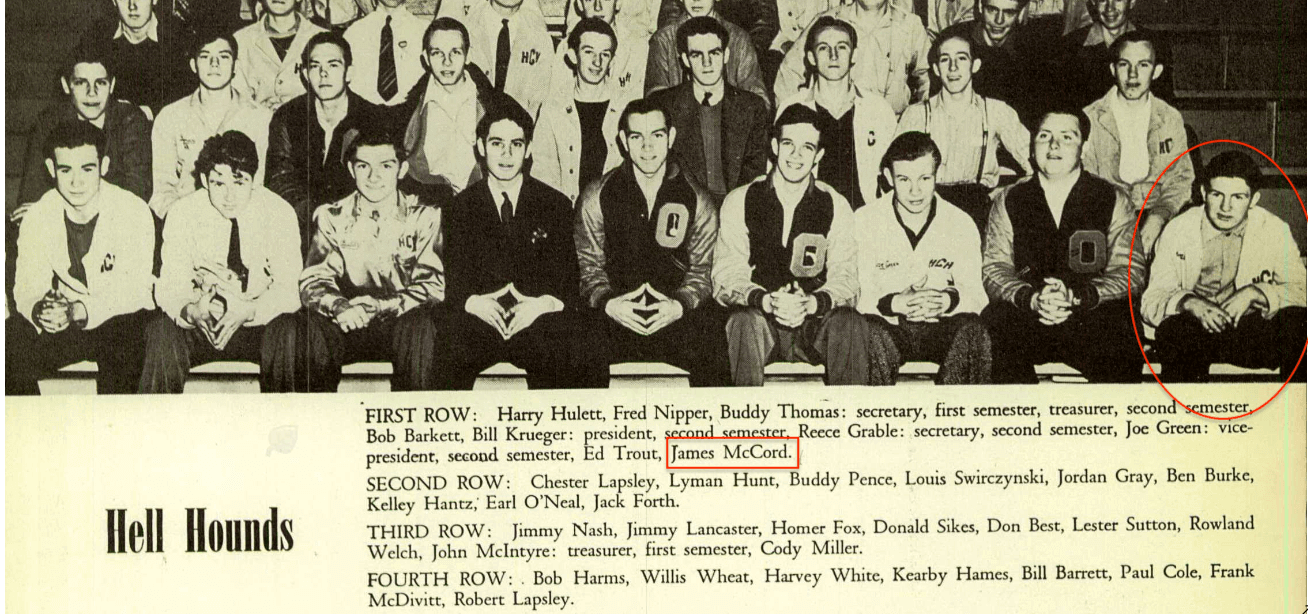
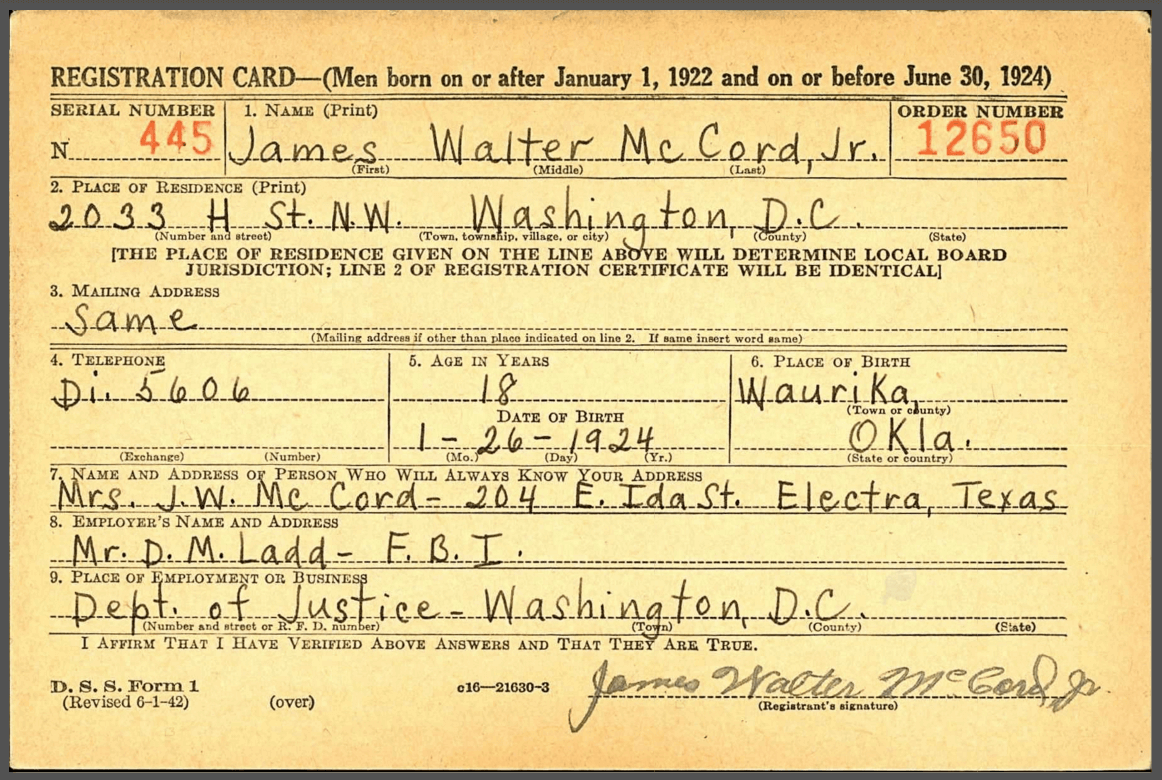
    Owing to Couteau’s work, we know that McCord’s family originated in Scotland. His great-grandfather served in the Tennessee militia during the War of 1812. McCord’s grandfather, James Allen McCord, was from Alabama and served in the Confederate army. Both his mother and father hailed from Texas. His father was a public school teacher. Although some entries place his date of birth in June, McCord was born in Waurika, Oklahoma on January 26, 1924. He attended public schools there. In 1943 he enlisted in the Army Air Corps in Miami, Florida. When that split off from the army to create the Air Force, he eventually attained Lt. Colonel status in the U. S. Air Force Reserve. After World War II, he attended Baylor before graduating from the University of Texas at Austin in 1949. He began his professional career by working briefly for the FBI. He was then employed for nineteen years by the CIA. He allegedly retired and went to work for the Committee to Reelect the President, commonly knows as CREEP, in late 1971. The man who hired him to work on the Richard Nixon campaign was Jack Caufield.

    Ambrose McCord, 
    James’s great-grandfather,
    served in the Tennessee militia
    McCord’s mother

    McCord’ high-school yearbook

    McCord’s selective service card

    McCord’s wife Sarah’s tombstone

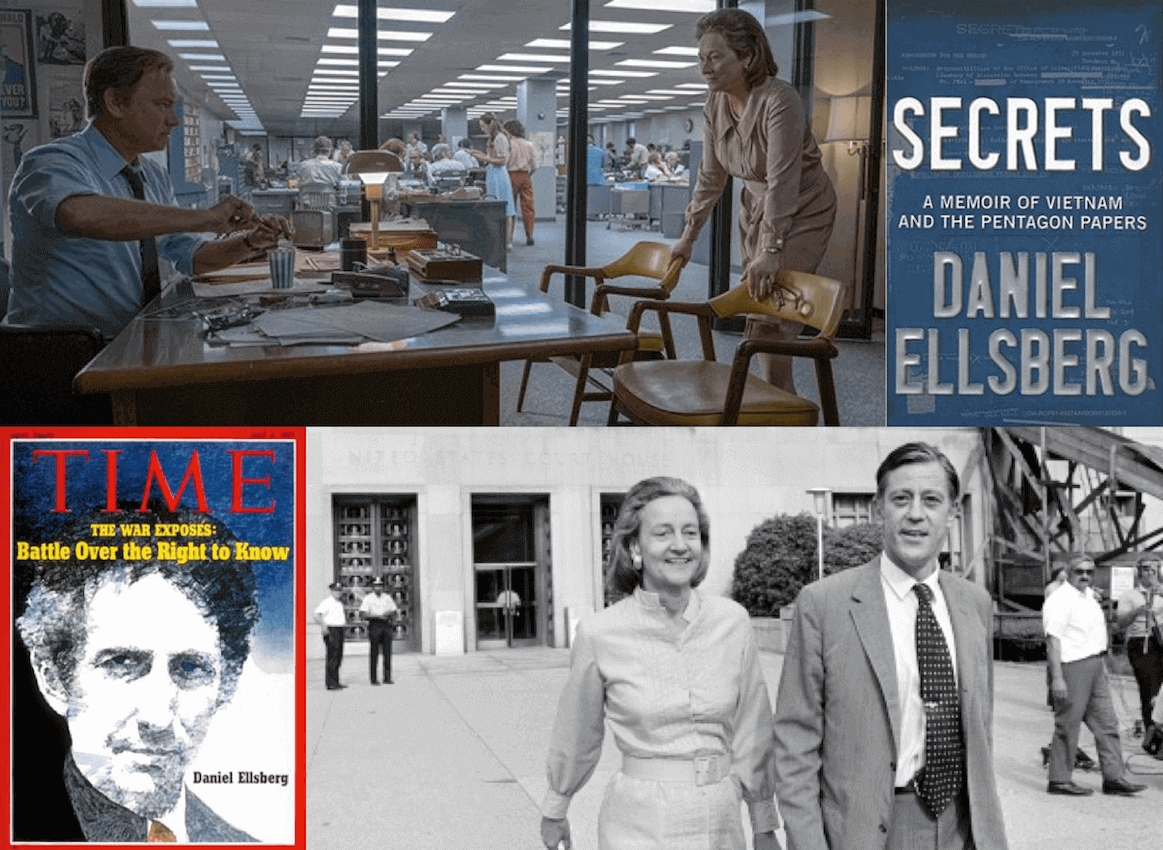
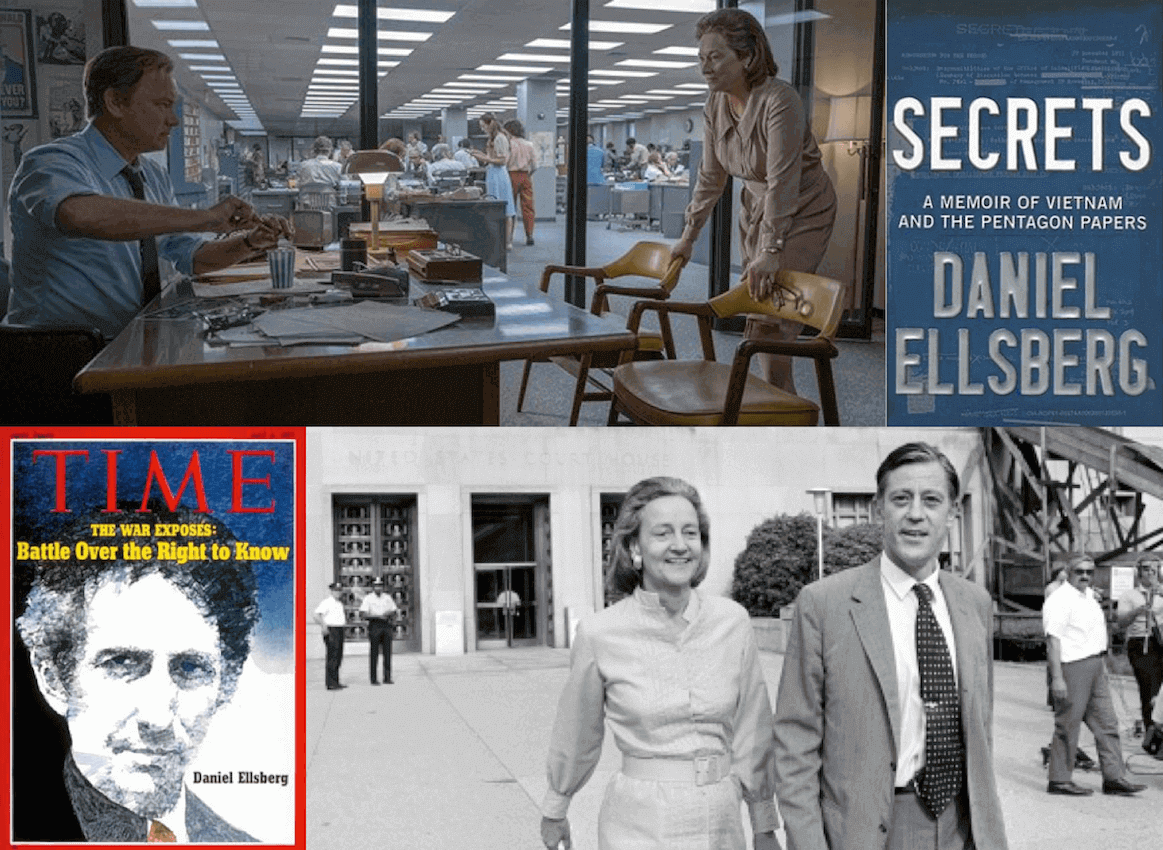
    Caufield was a former New York City police detective. He was invited by John Ehrlichman to set up a private security agency to provide intelligence on Nixon’s political opponents. It was Caufield who first suggested forming Operation Sandwedge: illegal electronic surveillance of Nixon’s political opponents focusing on their sex lives, drinking habits, tax records and marital problems. (The Telegraph, July 11, 2012) Later on, when the so-called Plumbers Unit was formed, McCord migrated there and joined Howard Hunt for their break-ins of the Democratic National Committee. It was called the Plumbers Unit because it was partly designed to plug leaks, like the Pentagon Papers. In fact, one of the first missions the unit executed was a raid on the Los Angeles office of Daniel Ellsberg’s psychiatrist. Ellsberg had leaked the Pentagon Papers to the NY Times and Washington Post. The objective was to dig up dirt on him and smear his character in the press.

    To say that McCord was a secretive and odd person understates both his character and career. He was one of the several personages who were involved in both the John F. Kennedy assassination and the Watergate caper: two seismic shocks to the system that occurred within a decade of each other. They were both so colossal in their impact that complex and multi level cover-ups ensued afterwards to conceal their true natures. In the JFK case, it took about three years to fully expose the official Warren Report as a cover-up.

    With Watergate, where McCord’s role was much more front-and-center, it took quite a bit longer. Most analysts of that expansive and complicated phenomenon would date the beginning of its true elucidation to 1984, ten years after Richard Nixon resigned the presidency. That was the year Jim Hougan published Secret Agenda, his watershed book on Watergate. Secret Agenda is now recognized as a classic in the field. Some would go even further and deem it as one of the finest pieces of investigative political reporting in the last 40 years. No objective observer can read the book without feeling the official story handed to them on Watergate was, to say the least, both faulty and incomplete.

    What was that official story composed of? It was a combination of two factors. First, the coverage by Bob Woodward and Carl Bernstein in the WashingtonPost. This was largely supervised by editor Ben Bradlee. It was made world famous by Robert Redford in his film of their bestselling book, All the President’s Men. The second element of this official story was then adduced by the Senate Watergate Committee. In the summer of 1973 that committee’s hearings were probably viewed proportionately by as many spectators as the 1954 Army/McCarthy hearings. Led by Senator Sam Ervin, the committee pretty much followed the story that had been laid out by the Washington Post. It was this unrelenting and massive media glare that paved the way for Nixon’s resignation in August of 1974.

    One of the worst things about Watergate was that the praise and fame heaped upon Ervin, Bradlee, Woodward and Bernstein left the impression that the system had worked. Through the political and journalistic process a grievous crime had been self-corrected. We all felt good. The system had purified itself.

    A few years later, Jim Hougan walked into the FBI research library and made a request. When his documents were delivered he quickly realized that someone had made a mistake. He was getting papers that were still classified. Realizing the error would be discovered, he immediately began copying hundreds of pages from the original FBI Watergate investigation, documents that had not seen the light of day. Stuffing them into his briefcase before they were recalled, he managed to take them home. They confirmed his suspicions about what had really happened.

    Hougan opens his book with an unforgettable chapter entitled “Of Hunt and McCord”. (pp. 3-26) It is clear from these pages that Hunt and McCord lied before the Ervin Committee when they said they did not know each other prior to going to work for the Plumbers. Hougan also pointed out that when Howard Hunt retired from the CIA in 1970, that was the third time he had done so. (Hougan, p. 6) At the recommendation of Director Richard Helms, he then went to work for a CIA associated PR group called the Mullen Company. That company would then be sold by Mr. Mullen to another CIA asset, Robert Bennett. Bennett and Hunt then badgered Nixon’s hatchet man at the White House, Charles Colson, into giving Hunt a job. (Hougan, p. 33) From there, Hunt went on to perform a series of alleged intelligence assignments that were so poorly conceived and badly executed that one has to wonder if they were just Keystone Kops hijinks or something worse. Yet even though Hunt was now supposedly retired and working for the White House, the CIA continued to technically support his efforts. In fact, the Agency reviewed and extended Hunt’s Top Secret security clearance prior to his retirement. (Hougan, p. 7) His security clearance was now the same one Clay Shaw had in New Orleans. (William Davy, Let Justice be Done, p. 196)

    Four months after Hunt joined the Mullen Company, James McCord decided to retire from the Agency after 19 years of service. Although he was later billed as a technician, he worked out of the Office of Security’s secretive Security Research Staff program (SRS). (Hougan, p. 9) As John Newman later discovered, it was here where McCord teamed up with David Phillips to supervise the Agency’s anti-Fair Play for Cuba Committee campaign, of which Lee Harvey Oswald had all the earmarks of being a component. (James DiEugenio, Destiny Betrayed, Second Edition, p. 158)

    Hunt reportedly worked with McCord on Manuel Artime’s “Second Naval Guerilla” operation out of Nicaragua and Costa Rica. This was attested to by Cuban exile Harry Williams to author William Turner. (Hougan, p. 10) But Hougan dug up evidence that the pair worked together even earlier than that, back in the fifties on the Asian mainland. (p. 19) He then showed that the two men had also worked together in a domestic surveillance operation in 1969. We should add one other point. When McCord arrived at CREEP, he did not have a picture of Nixon in his office. He had a photo of Richard Helms on the wall. It was inscribed, “To Jim, With deep appreciation”. The emphasis was in the original. (Hougan, p. 22. We will reveal later a possible reason for that “deep appreciation.”)

    So just from the little noted above, the questions come rapid-fire. Why did Hunt and McCord lie about not knowing each other prior to 1972? Why did the Agency let the lie stand? Were Hunt and McCord really retired when they eventually joined, respectively, the White House and CREEP? Why was Robert Bennett so eager to get Hunt into the White House? Why was McCord working for Nixon while his allegiance appears to be to Helms? But beyond that, why did it take ten years for anyone to ask these questions?

    It is not completely accurate to write that no one investigated this aspect of the caper until Jim Hougan. There actually were two inquiries that attempted to explore the role of the CIA in Watergate. The first was the minority report of the Ervin Committee. The Republicans, led by Tennessee’s Senator Howard Baker and Minority Counsel Fred Thompson, did try to inquire into things like the role of the Mullen Company and the true goal of the burglary at the Watergate complex. Thompson and Baker theorized that the burglars’ real goal was not political intelligence for the 1972 election. It may have been surveillance of Democratic Chairman Lawrence O’Brien’s representation of Howard Hughes. Nixon’s association with Hughes, and his past attempts to bribe the president, were fairly well known at the time. The White House may have feared that O’Brien had more evidence of the same. In fact, John Meier, who worked for Hughes, told Nixon’s brother Donald that he was thinking of turning over everything that he had on Hughes. This included his knowledge of a million dollar secret donation from Hughes to Nixon. According to Age of Secrets, Don then informed his brother of this. (Probe Vol. 3 No. 2, pp. 9, 11, 15)

    Besides Baker and Thompson, the other committee that explored the CIA angle was the House Committee on Intelligence. This was led by Representative Lucien Nedzi, until he controversially resigned his chairmanship. (“House Supports Nedzi”, Washington Post, June 17, 1975) This committee did produce a report that Hougan sourced several times in his book.

    But the fact was that very, very few people knew anything about these two investigations. This overall ignorance continued even when Fred Thompson published his 1975 book based on the Baker inquiry entitled, At That Point in Time. The fact that this book was all but ignored bears witness to the enormous torque created by the Washington Post, the Woodward/Bernstein best seller, and the Academy-Award-winning hit film. A veritable whirlpool was constructed, one which carried the entire MSM along with it.

    As Jim Hougan later told me, he just never thought very much of Woodward’s reporting skills. One of the most revealing sections of Secret Agenda is in Appendix V. There the author publishes documents describing Robert Bennett’s communications with his CIA case officer. It is revealed that Bennett was actively spinning reporters like Sandy Smith and Woodward away from the Agency’s association with the Mullen Company, and selling them on the angle that his newly purchased PR company was actually “clean”. For this “information”, Woodward had agreed that these stories would not be attributed to Bennett. Bennett also had access to Senator Ervin and he had been assured that the senator would conceal the Mullen Company’s overseas role in placing agents for the CIA. (Hougan, pp. 332-335)

    To put it mildly, that memorandum raised issues about Woodward’s independence and honesty. Hougan then raised questions about the Post’s major secret source. This was the man Woodward labeled “Deep Throat” in his book. Hougan specifically raised questions about the signaling system the duo would use when Deep Throat would request a nightly meeting in a parking garage. (Hougan, pp. 291-93) Hougan and others have also explored Woodward’s military background and his high-level security clearances as part of the national security state. This has led some to believe that one reason the reporter was so keen to assault Nixon was that, unlike Bernstein, Woodward was politically to the right of the president.

    Because of this enormous propaganda apparatus, both the public and press were diverted from an alternative view of James W. McCord. Far from being a mere put-upon technician, McCord may have been a central operator. Consider just two major instances in the two-year Watergate episode. After the discovery of the break-in, the case had reached an impasse at the trial of the burglars. If they all kept silent, the conspiracy would likely be limited to them only—it would not reach into the White House. But in March of 1973, McCord radically raised the stakes. He wrote a letter to Judge John Sirica stating that perjury had been committed in his courtroom and pressure had been brought to bear for the seven burglars to remain quiet. When Sirica read McCord’s letter in court, it created pandemonium. It seemed to affirm all the stories that Woodward and Bernstein had been writing, and Bradlee publishing, in the Post.

    But, in retrospect, the question should have been: If not for James McCord, would there have been a trial at all? As most analysts of the June 17, 1972 final break-in have noted, there was something odd about the way the burglars were caught. McCord had taped the locks on numerous doors to keep them open during the break-in. The security guard, Frank Wills, had found these doors and removed the tape. (Hougan, p. 196) When the burglars entered the building at about 1:10 AM, they found a previously taped door that was now stripped. McCord then conferred with higher-ups Hunt and Liddy. According to everyone but McCord, it was he who insisted on not aborting the mission. (Hougan, pp. 197-98) The door was retaped. But after McCord entered the building, he told his low-level cohorts that he himself had removed the tape on the doors. This was not true. (Probe, Vol. 3 No. 2, p. 14)

    But that is not all that McCord had done. On the previous break-in—there were four attempts in all—it appears that McCord also switched the informational photos that had been taken inside the DNC, which were supposed to be of papers inside O’Brien’s desk, to a set of innocuous ones taken inside a Howard Johnson’s hotel room. (Hougan, pp. 153, 157) He also placed a faulty bug inside O’Brien’s office. (pp 162, 166) This from a man who when he was arraigned said—truthfully—that he had been a security consultant for the CIA. These alleged faux pas made another break-in necessary.

    Wills discovered the new tape on the same door. It was almost impossible to miss it since McCord taped as many as eight doors that night—he even taped doors on floors that would never be used, like a floor above the DNC. (Hougan, p. 207) At 1:47 AM, Frank Wills called the Washington Police Department. Just a few minutes later, the police arrived at the scene. Reinforcements soon arrived. McCord, along with four Cubans recruited by Hunt, were arrested. They were Virgilio Gonzalez, Bernard Barker, Eugenio Martinez and Frank Sturgis. Things then got worse. Surprisingly, Barker and the others had been allowed to keep their hotel keys with them. And further, neither McCord nor Hunt had sterilized the hotel rooms. Therefore, when the police entered the rooms, they discovered a treasure trove of evidence. This included their notebooks with Hunt’s name and phone number, which included the abbreviation W. House next to it. (Probe Vol. 3 No. 2, pp. 14-15) Hunt was traced to the White House. Liddy was linked to CREEP.

    But the circus even went beyond that. Hunt had paid off the burglars in sequentially numbered hundred dollar bills. The money trail would lead from Miami, to Mexico City and back to CREEP. (Probe 3.2: 14-15) And that would lead to the chairman of that body, former Attorney General John Mitchell. The notebooks with Hunt’s name and phone in them would lead to Charles Colson who ran the Plumbers Unit at the White House.

    Once apprehended—as was the case with Bennett—McCord did all he could to keep the spotlight off the CIA and on the White House. His first lawyer, Gerald Alch, had proposed an Agency cover defense. (O’Sullivan, p. 268) He was later jettisoned and replaced by Bud Fensterwald. Fensterwald wasted little time in announcing, “We’re going after the president.” (Hougan, p. 307)

    When Alch first suggested his CIA defense, McCord began to write Paul Gaynor, chief of the SRS division at CIA. He advised Gaynor to pre-empt this attempt with multiple and effective leaks to the press before the CIA defense could gain traction. Meanwhile, he would keep Gaynor informed of the legal tactics planned by the defendants. (O’Sullivan, pp. 269-70) A few days later, McCord wrote Jack Caufield at the White House. McCord stated that if Watergate was dumped off on the CIA and Richard Helms was fired,

    … every tree in the forest will fall. It will be a scorched desert. The whole matter is at the precipice right now. Just pass the message that if they want it to blow, they are on exactly the right course. (Letter of December 28, 1972)

    In spite of this warning, Helms was terminated about a month later on February 2, 1973. Around six weeks after, Caufield met with McCord. He offered him money, a job and executive clemency if he would plead guilty and remain silent. Caufield said this offer came from the highest levels of the White House. (NY Times, June 23, 2012, article by Douglas Martin.) McCord refused the deal. His allegiance was to Helms and the CIA. Shortly after, he wrote the letter to Sirica about pressure being brought to bear and perjury in his courtroom. For all intents and purposes, that is what blew the case wide open.

    Because, as McCord had warned, the Nixon White house could easily be turned into a scorched desert. And it was. Through a steady stream of disclosures by people like McCord and White House counsel John Dean, the seamy underside of the Nixon White House was placed on public display. As McCord warned, it was not a pretty sight. The secret bombing of Cambodia, the August 1971 break in at Daniel Ellsberg’s psychiatrist’s office, Nixon’s attempt to form a super intelligence group to counter student protests (commonly called the Huston Plan), the proposed fire-bombing of the Brookings Institute, etc. And, in this author’s opinion, the worst went undiscovered, because this last caper, the fire bombing of the Brookings Institute, was first thought to be part of Nixon’s war against the leaking of the Pentagon Papers. As the late journalist Robert Parry discovered, such was not the case. That proposal was really designed to find out if the evidence of Nixon sabotaging President Johnson’s Vietnam peace plan was located at Brookings. Candidate Nixon had arranged for Saigon not to cooperate with President Lyndon Johnson in his attempt to arrange a truce in Indochina before he left office. This tilted the election to Nixon and extended the war. Once in office, Nixon was worried that this evidence, like the Pentagon Papers, could be leaked to the press.

    By the summer of 1973, Nixon seemed to realize what had really happened. He called up H. R. Haldeman at four in the morning, and asked him some pointed questions:

    • “Do you know anything about the Bennett PR firm, the Mullen Company?”
    • “Did you ever employ them at the White House? Were they ever retained by us for any purpose?”
    • “Did you know they were a CIA front?”
    • “Did you know that Helms ordered Bennett to hire Howard Hunt?”
    • “Did you know that Hunt was on the payroll at the Bennett firm at the same time that he was on the White House payroll?” (Probe, Vol. 3 No. 2, p. 32)

    It was too late.

    Because of his willingness to cooperate with the court and the Ervin Committee, McCord served by far the briefest prison time of the seven men directly involved with the break in: four months. Hunt served almost ten times that long. Gordon Liddy was in prison for almost five years before being pardoned by President Carter.

    Forty-five years later, the conventional view of Watergate still largely reigns in the MSM. This is partly due to Woodward’s occasional attempts to prop up that version. For instance, when FBI officer Mark Felt was close to dying, Woodward wrote a book saying that Felt was Deep Throat. In 2017, Mr. Hollywood Mythology, Tom Hanks, then had a hand in making a truly mediocre film based on an even more mediocre book about Felt.

    But, in 2009, Ed Gray, son of L. Patrick Gray, had published an interesting book about Watergate titled In Nixon’s Web. Patrick Gray had been appointed interim director of the FBI after J. Edgar Hoover died. He supervised the initial FBI inquiry into Watergate until he resigned. He passed away before he could finish the book. It was then completed by his son. In the epilogue to that volume, Ed Gray demonstrates that Deep Throat was a composite character. And he does it with Woodward’s own notes. He also proves that Mark Felt was leaking stories to the press that sunk Gray’s nomination. The reason was Felt’s own personal ambition: he wanted the Director’s position. Again, because of the MSM censorship on Watergate, very few people know these important facts.

    The idea promulgated by Hougan, that Watergate was really a trap set for Nixon, was also a part of John Meier’s book Age of Secrets. (Co-authored by Gerald Bellett) As Bellett wrote in the introduction to the Meier book:

    Watergate was a set-up, a classic ploy as old as espionage itself. In its favor it had simplicity of execution, an irresistible bait and a spy on the inside. It was flawless. So completely were the anti-Nixon conspirators in control, that they knew an intrusion into the Democratic Party’s national headquarters was being plotted, yet did nothing to prevent it. (Bellett, p. viii)

    That last sentence refers to the fact that Lawrence O’Brien was actually tipped off in advance that the Democratic National Committee was under surveillance. He was warned of this by a prominent Democrat and newspaper publisher by the name of William Haddad. (Hougan, p. 79) Haddad was apprised of this from a private investigator named A. J. Woolston Smith. Smith apparently gained the information from an agency called the November Group. This was a set of advertising executives working on Nixon’s campaign. Liddy was the agency’s incorporator and secretary. McCord was in charge of the November Group’s security. Haddad actually told a DNC representative in advance that they would be bugged and burglarized. And that McCord and Liddy were somehow involved in the effort. Further, that other operators would be recruited from Little Havana in Miami. (p. 79)

    One of the chief investigators for the FBI on the Watergate case was Angelo Lano. O’Sullivan quotes Lano from a previous interview where he stated that he always thought the caper was a set-up. He noted that the neat arrangement of the evidence the burglars left behind at the hotel felt planted—”everything was arranged like somebody knew it was gonna happen.” And Lano could not ignore the tape:

    You’ve got a guy who’s expert in key entry, burglary [Virgilio Gonzalez]. Why did they have to put the tape back on? You put the tape on one door; it wasn’t necessary to put it on six doors. There’s always been a question in my mind [about] the response of the police department—2:30 in the morning—the placement of the items in the hotel room, the tape. To this day I still think that one of those guys tipped off the police department and it was either Hunt or McCord. (O’Sullivan, pp. 404-5)

    In 2012, Max Holland published a book about Watergate called Leak. It largely focused on the FBI inquiry. Predictably, he could not find enough space to include Lano’s insightful quote.

    As more than one person said later, James McCord was not just a technician. He was an operator. But it’s something he tried to conceal. For instance, after he moved to Pennsylvania, a reader of this site got in contact with him. He asked him about his service with David Phillips and their campaign against the FPCC. McCord said he was not a part of that; it was the FBI’s function. Since the ARRB had released those documents, I said he should question him again with the papers in hand.

    But beyond that, when Lisa Pease and I were publishing Probe magazine in the nineties, we met up with former CIA pilot Carl McNabb. He said that prior to the Bay of Pigs, he had been briefed at the Miami CIA station, since he was part of the aerial facet. He noticed that McCord was in the room and he was struck by how taciturn he was. Afterward, he asked the briefer who he was. He told him his name. He then added that he was Helms’ Zap Man. McNabb later showed me the very old notes with this information recorded on it. I asked him what the term meant. He replied McCord was his liquidator.

    Which may tie in with a quite interesting piece of information in O’Sullivan’s book. Alfred Baldwin was a former FBI agent who was recruited by McCord for the Watergate operation. He was supposed to make a log of the surveillance coming out of the Democratic National Committee. O’Sullivan found out through James Rosen that McCord told Baldwin he was in Dallas on the day of the Kennedy assassination. (O’Sullivan, p. 405) If this is true, and I am not saying it is, then it makes a quite intriguing list of CIA associated personages in that city either on the day Kennedy was killed, or a few weeks prior:

    1. Allen Dulles (James Srodes, Allen Dulles: Master of Spies, pp. 554-66)
    2. William Harvey (David Talbot, The Devil’s Chessboard, p. 477)
    3. David Phillips (Dick Russell, The Man Who Knew too Much, 2003 edition, p. 272)
    4. Howard Hunt (Mark Lane, Plausible Denial, p. 152)
    5. James McCord (Shane O’Sullivan, Dirty Tricks, p. 405)
    6. Sergio Arcacha Smith (James DiEugenio, Destiny Betrayed, second edition, p. 329)
    7. Bernardo DeTorres (Gaeton Fonzi, The Last Investigation, p. 238)

    What makes the list rather striking, as I have arranged it, is that it goes from the top of the hierarchy, through the middle, down to the lower ranks, men who would act as foot-soldiers or mechanics. Does the above explain why the McCord family wished to keep the death of James McCord so quiet?

  • David Giglio interviews Jim DiEugenio on the Death of Bob Parry, and the Problems with The Post

    David Giglio interviews Jim DiEugenio on the Death of Bob Parry, and the Problems with The Post

    ohh the post

    A study in contrasts concerning the journalism of Robert Parry, whose singular groundbreaking investigative work did more than any other to shed light on the interconnected scandals of the Reagan era, vs the Washington Post, unduly celebrated by the eponymous Hanks/Spielberg film for its supposed role in publishing the Pentagon Papers.

    Listen to the audio and read the transcript at Our Hidden History.

  • Tom Hanks and Steven Spielberg  Mythologize the Washington Post

    Tom Hanks and Steven Spielberg Mythologize the Washington Post


    the paper


    For Jim’s review, published at Consortium News, see:  “The Post and the Pentagon Papers“.


    A few weeks ago Ken Burns and Lynn Novick delivered a hugely disappointing ten-part documentary entitled The Vietnam War. Tom Hanks and Steven Spielberg will now do the same for the famous Pentagon Papers case.

    Their film, entitled The Post, is not focused on Daniel Ellsberg. And it does not use his book Secrets as source material. Their film actually makes Ben Bradlee and Kate Graham the protagonists of the whole struggle to release the multi-volume, Defense Department study about how America got into, and stayed involved in the Vietnam War. It will therefore make Bradlee and Graham into some kind of hero and heroine of that hugely conflicting episode. To anyone who understands who Graham and Bradlee were, and the true story of what Ellsberg did, nothing could be further from the facts. To cite just one example: in Ellsberg’s 457 page book Secrets—which chronicles the entire affair in detail—there is exactly one glancing reference to Bradlee. There are none to Graham.

    That is because, when one understands what Ellsberg and his cohorts were up to, the Washington Post was, if not inconsequential to the affair, extraneous to Ellsberg’s strategy. Once Ellsberg made his decision to go public with the Robert McNamara commissioned Top Secret history, it was just a matter of how many newspapers would pick up the story after the New York Times initially published it. Ellsberg and his friends had made many copies of the secret history, since he anticipated that there might be legal action against the Times to stop publishing. He and his friends had arranged for many newspaper outlets to get them once the Times was enjoined by the Nixon White House with a temporary restraining order (TRO) to halt publication. Which the Times was, after three days of stories based upon the documents.

    By the time the Supreme Court decided to strike down the TRO and allow publication, almost twenty newspapers throughout the country had printed sections of the Pentagon Papers. The White House had only named four of them in their legal action: the Times, the Post, the Boston Globe and  the St. Louis Post Dispatch. But further, Senator Mike Gravel had read the Pentagon Papers into the Congressional Record on the floor of the Senate. And he then handed out copies to reporters who were there at the time. He then arranged for no other senator to be there so he could move to have the entire set committed to the record without objection. This was on the day the Supreme Court decision was delivered. What Gravel did—committing the documents into the Senate record— made the decision pretty much irrelevant. Gravel agreed to do this after three other senators—including George McGovern—and one congressman had refused to. Then Beacon Press, which came under great duress, published that version of the Pentagon Papers in a four-volume set.

    There are some heroes in this story. For example, Ellsberg, Mike Gravel, and Ellsberg’s friend Anthony Russo, who helped him copy the documents and who, like Ellsberg, risked going to jail for that act. There was also Judge Gerhard Gesell who, during two weeks of rapid, almost dizzying court hearings, ruled twice for disclosure. But Graham and Bradlee? Nothing in either of their careers merits this kind of aggrandizement. It could only happen in Tinsel Town. And in these days of MSM synergy, HBO has joined in with documentary specials on Spielberg and Bradlee.

    Below we link to a series of articles about Bradlee, Graham the Washington Post and Watergate. We do this so the reader will not be bamboozled by another Tom Hanks version of (ersatz) history.


    To counter the Hanks/Spielberg Mythology,  here is some real information on Bradlee, Graham and The Washington Post:


    Ben Bradlee


    Kate Graham


    Watergate


    Bob Woodward


  • How The Atlantic Monthly and Kurt Andersen Went Haywire

    How The Atlantic Monthly and Kurt Andersen Went Haywire


    atlanticAs this web site has explained at length, the MSM has been completely unable to deal with the assassination of President Kennedy in any kind of rational or evidentiary manner. Since the recent presidential election touched upon the JFK case, we posted two columns dealing with it. (Click here for one published during the election and here for one dealing with the aftermath) From those two articles the reader will understand the historical factors that allowed Donald Trump to claim his victory much more clearly than the long story on the current cover of the Atlantic Monthly.

    That article was written by author and radio personality Kurt Andersen. Andersen is the current host of Studio 360, a radio program carried by WNYC in New York City. I have never listened to the show, and after reading this article, I never will. It is a weekly journal devoted to arts and culture. And that is the approach Andersen took in this essay. His rather ambitious aim is to try to explain how the last fifty odd years of American history gave us Donald Trump.

    The problem is that Andersen is not a historian. In any sense of that word. And his essay does not really deal with the political or economic history of that time period. Like the program he hosts, his essay (actually an excerpt from an upcoming book) is really a cultural history. It dates, of course, from the Sixties. And on the first page, Andersen makes it clear where he is coming from and how rigged his work will be. He says that America experienced the equivalent of a national nervous breakdown in the Sixties, and in his view, we are not cured yet.

    Our intrepid chronicler now gears down into what one of his main themes will be: the danger of widespread belief in conspiracy theories. After concluding that too many people do believe in conspiracy theories, he then says that this has allowed America to mutate into a Fantasyland where the public does not know what to think or believe.

    Why does Andersen use the Sixties as the point of demarcation for his Fantasyland mutation? A few pages later the motive becomes clear. According to our guide, the Left began believing in these constructs because of the JFK assassination. He traces this back to Thomas Buchanan’s book, Who Killed Kennedy? published in 1964. He leaves out the facts that 1.) Buchanan’s book was originally published in France, which is where he was living at the time, and 2.) that other writers had addressed problems with the official story prior to Buchanan’s book being published in America. This allows Andersen to avoid the fact that it was not just Americans who had doubts about the JFK case—the rest of the world did also. And secondly, that respectable journals like The New Republic and The Nation had also voiced doubts about the JFK case before the publication of Buchanan’s book. And that, in 1966, Life Magazine actually devoted a cover story to the problems with the Warren Commission, entitled A Matter of Reasonable Doubt. Or that, in 1967, the Saturday Evening Post featured a cover story based on Josiah Thompson’s harsh critique of the Warren Commission, Six Seconds in Dallas. It was not just Buchanan and Mark Lane.

    Let us now turn to a piece of absolutely essential cultural history—which Andersen also leaves out. The late Roger Feinman showed, with CBS internal documents, that in 1967, several reporters and mangers at CBS News wished to explore the problems with the Warren Commission’s evidence. This attempt was crushed at the executive level, most notably by CBS President Dick Salant. (see Why CBS Covered Up The JFK Assassination) That counter to a genuine journalistic effort was largely motivated by the fact that Salant’s administrative assistant was Ellen McCloy, Warren Commissioner John McCloy’s daughter. By the use of both carrots and sticks, the entire trajectory of the subsequent four-night CBS special was completely reversed by this upper level decision. Feinman demonstrates step by step how this proceeded with CBS’s own documents. Somehow, Andersen did not think that was an important piece of cultural history, even though it informs us about cultural gate-keeping.

    What does Andersen think is important? Walter Sheridan’s 1967 NBC hatchet-job on Jim Garrison. No kidding. Andersen says that this infamous special, in which producer Walter Sheridan used bribes and threats to coerce witnesses, discredited Garrison’s ideas. (For an exposé of Sheridan’s reprehensible tactics, see Destiny Betrayed, second edition, pp. 235-258) Andersen ignores the fact that the program was so one-sided, so much a broadcast disgrace, that the FCC allowed Garrison to respond under the provisions of the Fairness Doctrine. Andersen also ridicules the idea that the owners of NBC, the Sarnoff family, sanctioned the program, when such has been proven to be the case. (ibid, p. 239)

    But actually, Andersen’s argument is even worse than that. It’s not enough for him to ignore what was really happening in media boardrooms, or in New Orleans. He now says that all this doubt about JFK’s death was really caused by the Jungian psychic need to reject the idea that President Kennedy could have been killed by “just one nutty loser with a mail-order rifle.” He then throws in Richard Hofstadter’s “The Paranoid Style in American Politics.” Which shows how far down he is scraping. That essay has virtually nothing to do with the JFK case. Hofstadter focuses there on the movement that brought Barry Goldwater the Republican nomination in 1964. Hofstadter tried to dismiss it as odd, eccentric rightwing solipsism. Oh, how wrong he was! For that movement would revive itself 16 years later to elect that B movie actor Ronald Reagan. Like others, Andersen just wanted to use the title as another smear device.

    On page 84, Andersen briefly halts his cascade of smears and mischaracterizations and comes up for air. After describing some American films of the seventies, e.g., Chinatown, The Parallax View and Three Days of the Condor, he allows himself this thought: “Of course, real life made such stories plausible. The infiltration by the FBI and intelligence agencies of left-wing groups was then being revealed, and the Watergate break in and its cover up were an actual criminal conspiracy.”

    Perhaps nothing shows just how much Andersen has stacked the deck than those two sentences. First of all, he carefully does not describe the expanse of the Watergate plot. When it was over, 69 people were indicted, 48 were convicted, and Richard Nixon was forced to resign in the face of certain impeachment. Later, Alexander Haig arranged a deal with former Warren Commissioner and new president Jerry Ford. Nixon would be spared a trial with a pardon. Which, according to most polls, helped sink Ford’s short-lived presidency.

    Second of all, Andersen fails to reveal how the press found out about “the infiltration by the FBI and intelligence agencies of left-wing groups”. Probably because he does not want to print the two words: “Church Committee”. If he did so, he would open up a Pandora’s Box that would largely burst the Fantasyland fairy-tale he is spinning. The Church Committee did much more than expose the infiltration of left-wing groups. It exposed CIA assassination plots against foreign leaders, like Fidel Castro and Patrice Lumumba. Further, members of that committee—i.e., Senators Gary Hart and Richard Schweiker—wrote a report that showed how the FBI and CIA had misinformed and misled the Warren Commission.

    But there is even more to this story that Andersen fails to tell. The Church Committee sprang to life because its predecessor, the Rockefeller Commission, was largely seen as ineffective. In the wake of Watergate, many in Washington—like Senator Howard Baker, and future Senator Fred Thompson—thought that the official inquiry had not fully explored the role of the CIA in that crime. Therefore the Rockefeller Commission, led by Ford’s Vice-President Nelson Rockefeller, arose. But this body was perceived by many, even the New York Times, as being a set-up. After all, Warren Commission lawyer David Belin was the chief counsel, and people like Ronald Reagan were on the Commission. Therefore, at a closed press briefing, Ford was asked why he had arranged things as he did. He replied that there were certain things that had to be concealed from the public. When asked what he meant by that, Ford blurted out, “Like assassinations.” (See James DiEugenio and Lisa Pease, The Assassinations, p. 194) Ford is very likely talking about the JFK case since, at around this same time, he revealed to French Premier Giscard d’Estaing that, while on the Warren Commission, he had determined that some kind of organization had killed Kennedy, but he could not determine which one.

    But that is not all that Andersen leaves out about the discoveries of the Church Committee. Consider the following:

    1. He does not mention the attempts by the FBI to drive Martin Luther King to suicide.
    2. He does not mention the campaign by the FBI to exterminate the Black Panthers.   (For a summary of this, see Government by Gunplay, edited by Sid Blumenthal and Harvey Yazijian)
    3. He does not mention the explorations by both the Church and Pike committees concerning CIA control of the media. This was later summarized and expanded upon by Carl Bernstein in Rolling Stone’s, “The CIA and the Media”. (Click here for that article)

    Actually, Andersen loads the dice even more. How can anyone write an essay about the 50-year decline of America’s belief in its media or institutions without mentioning the Vietnam War? Well, Andersen can. What is his longest mention of that incredibly divisive issue which essentially ripped America apart for the better part of a decade? He talks about Norman Mailer’s 1967 book, Armies of the Night, where student protesters attempted to levitate/purify the evils inside the Pentagon. Forget about 250,000 wounded Americans, and 58,000 killed, or over 4 million total dead as a result of a war that should never have been fought.   Andersen says a few pages of Mailer’s book is what we should remember about that terrible epic tragedy, during which the American public was being lied to endlessly on almost a daily basis.

    By painting such a foreshortened picture, Andersen can leave out the ten years of nightly TV broadcasts, daily newspaper headlines, and weekly magazine cover-stories which pummeled the public with words and images about the Vietnam War, Watergate and the exposes of the Church and Pike Committees. It was not the American people who suffered a nervous breakdown from frivolities like the UFO phenomenon. It was the acts of Lyndon Johnson and Richard Nixon, plus the exposure of abuses by the FBI and the CIA, that shocked the country and drove down the public’s belief in government. (See the chart in The Assassinations, p. 634) And that was a natural reaction to that continuous montage of horror stories. None of this was part of a fantasy. It was all too real.

    What Andersen does not understand, but Michael Parenti does understand, is this: Reality can be Radical. Those ten years exposed a huge systemic failure. And the media was a part of it. One only has to recall how difficult it was to get the true story about the My Lai Massacre exposed. And how the Pentagon and Richard Nixon then did all they could to pardon the killers. But further, as Nick Turse demonstrates in his book Kill Anything that Moves, there were many other atrocities that the military purposefully covered up. For as Colonel Robert Heinl wrote in a famous article in Armed Forces Journal, the American army collapsed in Vietnam by 1969. (Click here) Yet Nixon kept the war going for four more years and actually expanded it into Laos and Cambodia. That is history that Andersen, again, ignores.

    Did things get better after that? Well, there was the Iranian hostage crisis; the American backing of radical Moslems—which included Osama Bin Laden—to fight the Russian invasion of Afghanistan; Reagan’s interventions in Central America and the El Mozote Massacre (where more people died than at My Lai) and which was also covered up; the Iran Contra scandal; the heists of the 2000 and 2004 elections, which allowed the disastrous invasion of Iraq, the worst foreign policy disaster to befall this country since Vietnam. Again, somehow none of this is important to cultural historian Andersen. Maybe the author ignores it since none of it deals with the paranormal, it’s all real. But with his loaded dice, the former counts more than the latter.

    Which brings us to the payoff of the article. That includes three themes: Fake News, the rise of the Internet, and the victory of Donald Trump. I think Andersen wants us to believe that somehow the first two resulted in the last. But as anyone who watched that election closely knows, such was not the case. The whole Fake News phenomenon arose after the election. And it’s a much more complex phenomenon than Andersen portrays it to be. As he does with many issues, Robert Parry had done the best reporting on this flashpoint. (See here for an example)

    The use of the Internet probably did help Trump’s campaign, but not in the way that Andersen thinks. Steve Bannon, Trump’s chief strategist, used a little-known company called Cambridge Analytica to micro-analyze social media data and target trends and tendencies with voters. (Click here for a good article on this) Using this data he was able to detect weaknesses in Hillary Clinton’s and the Democratic Party’s supposed fortress: the Northeast Rust Belt. In an interview Bannon did the day after the election, he said Trump’s strategy was twofold: 1.) They had to hold the south, that is, North Carolina and Florida, and 2.) They had to win some states in the Rust Belt. This is why Trump visited Michigan almost twice as many times as Clinton, and why he honed his message as one of economic nationalism—rounding up illegal immigrants, building a wall, tariffs on Chinese imports—this countered Clinton’s failed use of identity politics, e.g., Alicia Machado.

    Bannon realized that Clinton could not effectively counter that Electoral College strategy. The reason being that her husband’s record on fair trade was pretty much indefensible. As many have commented, Bill Clinton was the best Republican president since Eisenhower. Bannon and Kellyanne Conway ran a very astute and pointed campaign. The Clinton campaign had much more money, many more workers, and much more favorable media. And they still lost. The problem was not just campaign tactics. Hillary Clinton simply could not fire up her own base the way that Bernie Sanders could have. Which is another factor that Andersen leaves out. Sanders outflanked the Democratic establishment almost as effectively as Trump did the GOP. Did he do that with Fake News? Or an alternative reality dealing with UFO’s and the levitation of the Pentagon? Further, according to a pre-election poll, Sanders would have beaten Trump fairly soundly. Which renders Andersen’s silly article even sillier.

    But what happened afterwards also renders the article silly. Trump’s ratings have cratered since he was elected. Is that also due to Fake News? No. It’s because America has realized that Bannon’s campaign was really a sales pitch. Which Trump, a real estate salesman, managed to deliver perfectly. Trump and the Republican Party really have no solutions to the complex issues that have assaulted this country: like the gutting of the Middle Class. Past his campaign slogans and themes, Trump simply has no vision for America. Except to make the health care problem even worse and cut more taxes for the wealthy. The real mystery about Trump is how he changed paths so radically from 2000 until today. If one recalls, when he was pondering a presidential run for the Reform Party ticket, he was much more moderate in his policies, more like a Democrat. No reporter ever tried to explain this paradox.

    Of course, Andersen mentions the Trump/Roger Stone accusations of Ted Cruz’s dad allegedly being in a photo with Oswald in New Orleans. Yet Trump endorsed the Warren Commission verdict of Oswald being the lone assassin. And it was people in the JFK community, like David Josephs, who showed that Trump was wrong about that identification.

    Yes, there is a crisis of confidence in this country. And yes, it has gotten worse over time. And, as mentioned above, for very good reasons. And as Larry Sabato showed in the polling for his book The Kennedy Half Century, and as Kevin Phillips showed in his volume, Arrogant Capitol, it began with the issuance of the Warren Report. Most people today think that the Warren Report was wrong, and something went awry with the country after the Kennedy assassination. And they are right (e.g., Vietnam).

    Andersen’s ridiculous essay is a pile of smoke and mirrors designed to distract from that fact.