Tag: WARREN REPORT

  • The Wrong Bus Transfer – Part 2

    The Wrong Bus Transfer – Part 2

    How Did Oswald Get the Wrong Bus Transfer? – Part 2

    Taking the transfer at face value, it is obvious it was punched for someone disembarking from Line 23, the Lakewood line and not Line 30, the Marsalis line. Which is what the Warren Report would have the reader believe. Officer Dhority gave this undated internal police written account of his activity on November 22, 1963.

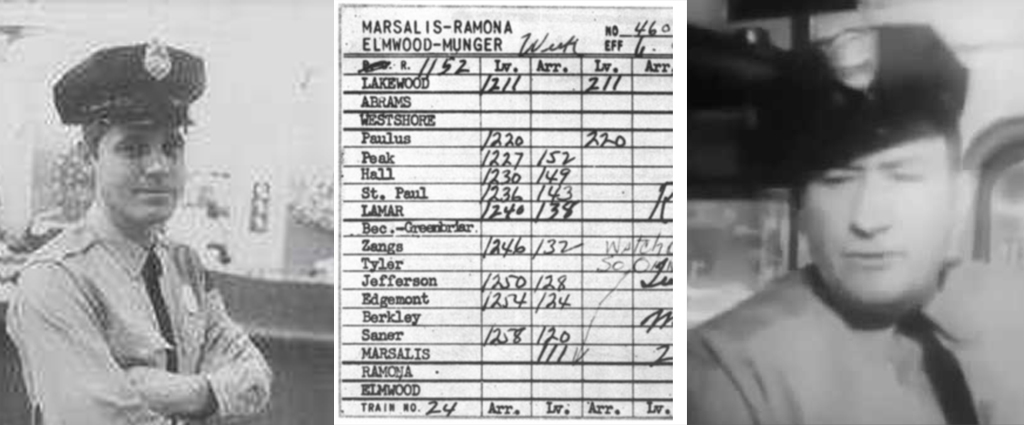
    “About 6:00pm, Lt. Wells gave C. W. Brown and myself information that Mr. C. J. McWatters was driving Piedmont Bus and was due at Commerce and Harwood at 6:15 PM. We met Mr. McWatters and carried him to the Detail Room. At 6:30 PM, Mr. McWatters made identification of Oswald as 12 man in four man line up.

    Mr. Mc Watters gave me an affidavit in the Homicide Office and identified the transfer that he had given Oswald positively.
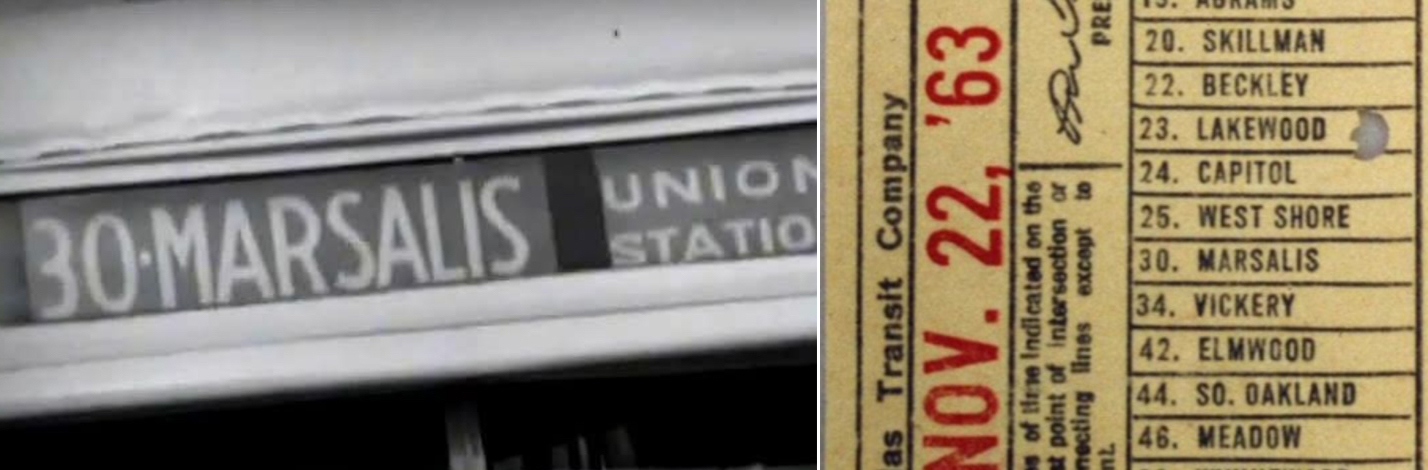


    The photos above indicate that a Lakewood bus line transfer (right photo) is irrelevant to a southbound Marsalis bus from downtown’s Union Station (left photo).

    Brown said in a similar account.

    “At approximately 6:00 pm Lt. T. P. Wells gave my partner, C. N. Dhority, and myself information that the bus driver that picked up Oswald near the scene of the President’s murder was driving the Piedmont bus #50 and would be at the Intersection of Commerce and Harwood at 6:15 pm.”

    The fact that McWatters switched lines and was approached at around 6:15 pm on November 22 by the Dallas police is relevant to unpacking the confusion. It can be deduced in several ways that the transfer DPD presented as evidence of Oswald getting off the Marsalis bus at 12:43 pm on Elm Street had instead been issued hours later when McWatters was driving the 23 Lakewood line.

    Firstly, because that is what, at face value, the transfer states.

    Secondly, McWatters’ schedule, set out in CE358, taken with the FBI route map, shows that when he was to finish his Marsalis 30 run, there is a coincident section of overlap where he would have been able to take on the Lakewood 23 run, which goes past City Hall, Downtown and back. With his Marsalis run being 40-50 minutes late, he would have finished that at approximately 3 pm, and he was then on the Piedmont Line 50 run at City Hall at 6:15 pm.

    Third, when asked by Ball about the lineup when McWatters was taken to identify Oswald, he said that the transfer was for the Lakewood trip.

    Mr. McWATTERS. They brought four men out. In other words, four men under the lights; in other words, they was all—

    Mr. BALL. All the same age?

    McWATTERS. No, sir; they were different ages, different sizes and different heights. And they asked me if I could identify any man in particular there, and I told them that I couldn’t identify any man in particular, but there was one man there that was about the size of the man. Now, I was referring back, after they done showed me this transfer at that time and I knew which trip, that I went through town on at that time, in other words, on the Lakewood trip and just like I recalled, I only put out two transfers and I told them that there was one man in the lineup was about the size and the height and complexion of a man that got on my bus, but as far as positively identifying the man I could not do it.

    Fourth, McWatters’ receipt transfer for the noontime start of his day is number 004451. As McWatters stated above, “I only put out two transfers”. Then he said it again.

    “Mr. McWatters. I only gave two transfers going through town on that trip and that was at the one stop of where I gave the lady and the gentleman that got off the bus, I issued two transfers. But that was the only two transfers that were issued.”

    And,

    “So, I said, “I sure will.” So I gave her a transfer and opened the door and as she was going out the gentleman I had picked up about 2 blocks asked for a transfer and got off at the same place in the middle of the block where the lady did.”

    Roy Milton Jones said that when he got on the bus on Elm near the Capri Theater, he was the only passenger on the bus. Then, when the bus was stopped and held up by the police, about 15 people were on it.

    Transfer 004459 is the eighth issue from that book of transfers. That is not one of only two transfers issued on the bus at the Lamar transfer point at 12:40 pm, for which one should have had number 004453 and the other 004452.

    Fifth, and the most obvious of all. Someone getting off a bus stuck in traffic isn’t going to need a transfer if their objective is to get a cab.

    I. DISCREPANCY ON TIME

    A Globe transfer can’t be altered to make it valid for longer. But a ticket can be tampered with to an earlier time by cutting off some of it. If – as the evidence suggests – DPD obtained a transfer cut for later in the afternoon from McWatters, by then driving a Line 23 bus, a 1:00 pm position could be achieved by cutting everything else off to leave a stub, just like 004459.

    For the CE381–a transfer to fit with the Commission’s timeline–Oswald would have needed to get off the bus before 12:45 pm. And it should have been punched at 12:45 pm with a 15-minute validity from then. That anomaly caused Gerald Ford to ask this.

    Representative Ford. It is 10:25 now. How would you cut it right now?

    Mr. McWATTERS. At 10:25.

    Representative Ford. Why don’t you cut one?

    Mr. McWATTERS. I have a regular cutter, you see; let’s see if he can get something that would-in other words, 10:25, I will just cut it, in other words, cut across there, and cut it, in other words, at 10:30, in other words, it would show at 10:30.

    That answer rules out cutting for 1:00 pm if someone had gotten off before 12:45 pm. Ball picked up on that, too.

    Mr. Ball. … Now, I show you this document which is the bus schedule of Marsalis-Ramona-Elwood-Munger, and it shows you leave St. Paul at 12:36 and you arrive at Lamar 12:40. The bus transfers are punched you told me for 1 o’clock. We have a transfer here that you have seen or we will show you in a few minutes as soon as it gets here, which has a punch mark of 1 o’clock. You told Senator Cooper that you usually punched within 15 minutes of the time you reached the transfer points?

    Mr. McWatters. Yes.

    Mr. Ball. If that is the case, what——

    Mr. McWatters. You mean why did I have it punched at 1 o’clock?

    Mr. Ball. Yes.

    Mr. McWatters. Because I punch it p.m. In other words, I have a punch, I am going to Lakewood, I mean I am going Marsalis and I am going back Lakewood, so I just take me two books of transfers. Instead of punching one of them a.m. and one p.m. I just punched them p.m.

    Mr. Ball. Do you punch within 15 minutes of the time you reach the transfer points?

    Mr. McWatters. That is the way that the transfers are supposed to be cut.

    Further:

    Representative Ford. This is the practice you have used for 2 years approximately?

    Mr. McWatters. That is right, when I worked that run, in other words, when I am going one way at 1 o’clock, coming back from the other end of the line I set them at 2. I am back in there at, my next trip I am back in there at Lamar Street, I think it is 1:38 but I always just set them at 2 o’clock.

    Once again, McWatters slipped out of Lakewood. But he still did not explain why a 12:40 pm arrival would be cut to 1:00 pm rather than 12:45 pm.

    II. SORTING IT ALL OUT

    From the evidence, Oswald was not identified by McWatters or Milton Jones on the Marsalis bus. And the transfer was not issued on that run, but after 2:30 pm, when McWatters was driving the Lakewood 23 run.

    Planting a transfer on Oswald with a line 23 Lakewood transfer appears to have been a blunder, caused by McWatters changing lines. But from the time of his 22 November affidavit, McWatters’ transfer number 004459 set out in the affidavit – for the wrong line – was locked in as evidence.

    The full text of that affidavit is.

    “Today, November 22, 1963 about 12:40p.m. I was driving Marsalis Bus No. 1213. I picked up a man on the lower end of town on Elm around Houston. I went on out Marsalis and picked up a woman. I asked her if she knew the President had been shot and she thought I was kidding. I told her if she did not believe me to ask the man behind her that he had told me the President was shot in the temple. This man was grinning and never did say anything. The woman said that it was not a grinning matter. I don’t remember where I let this man off. This man looks like the #2 man I saw in a line-up tonight. The transfer #004459 is a transfer from my bus with my punch mark.”

    To summarize McWatters’ pressure points, he:

    • retracted in front of the Commission itself his “positive” ID of Oswald.
    • could not give a credible reason why someone on the Marsalis 30 Line would punch Lakewood 23.
    • did not refer to the police getting on the bus on Elm Street.
    • other than indirectly, via the Dallas Morning News, did not refer to the delay on Elm being 40-50 minutes.
    • indirectly, slipped out in his testimony that other buses were being let through when he was held up on Elm.
    • could not give a credible reason why a transfer would be cut for 1:00 pm.
    • the transfer serial number is the eighth from the book, when one issued at the requisite time on Elm would have been first or second.
    • was held at the police department until 1am.

People have long speculated why Oswald would board a Marsalis bus if he was heading to 1026 N Beckley, rather than a Beckley bus, one of which was right behind and stopped right outside 1026. And where he was last seen by his landlady after leaving his room, after the assassination.

If Oswald was being framed for being on a bus to return home, then a Beckley bus might seem the obvious choice for a frame. But Oswald used the Beckley bus to get to work for 5 weeks prior. There would be the risk that a regular driver would know the real Oswald and know that he was not on his bus, especially as there was a stop right outside 1026 N. Beckley.

My assumption, based on the evidence, is that prior to November 22, 1963, the script was that Oswald was to be framed as being on a bus on the Marsalis 30 line. By the afternoon of November 22, Fritz knew that, and that is why Roger Craig’s competing story was so inconvenient and needed to be rapidly rebutted.

My prior articles for this site have implicated Sgt Gerry Hill, Sgt Davis, and Reserve Sgt. Croy, in pre-planned assassination assistance, with Captain Westbrook in overall command. I cannot assume that should taint all other cops involved in the aftermath. However, the events after Oswald’s arrest demonstrate something very wrong with Fritz’s behavior. Dallas County District Attorney Henry Wade stated this to the Commission, at Volume V, regarding Captain Fritz:

“But Fritz runs a kind of a one-man operation there where nobody else knows what he is doing. Even me, for instance, he is reluctant to tell me, either, but I don’t mean that disparagingly. I will say Captain Fritz is about as good a man at solving a crime as I ever saw, to find out who did it but he is poorest in the getting evidence that I know, and I am more interested in getting evidence, and there is where our major conflict comes in.”

Fritz was the Detective in charge of the Venice Parker murder case. Tommy Lee Walker was an African American executed in 1956 for the murder. It was later found to be a miscarriage of justice involving a forced confession. Wade had been the prosecutor.

My prior articles also set out my assumption that Oswald was supposed to have been killed at the Texas Theater. Had Oswald been killed at the Texas Theatre, then Craig would not have had the opportunity to see him in Fritz’s office. A transfer was needed as the pressure was on to give some substance to the bus side of the storyline.

An evidence-planting cop – getting “evidence” for Fritz – knowing he was looking for McWatters, might assume he was still on the same bus route, and got a transfer. Hence, McWatters was traced via the bus company. But by 6:15 pm, McWatters had twice switched lines and a transfer from a Lakewood 23 bus – the eighth he’d issued that day – was punched for the wrong line for the purpose of framing Oswald. A confusion possibly enhanced by the fact that there is a similar-sounding Lake Cliff in Oak Cliff on the Marsalis route. With a frame-up happening and with so many moving parts, it is necessary to look at the whole picture.

If the Marsalis bus McWatters was driving was not relevant at all, then why was it important to find McWatters? Things point towards McWatters’ bus being relevant because there was something to hide regarding it being singled out and boarded by the police and held up for 40-50 minutes.

It was that bus I posited that Officer Tippit was waiting for at Gloco on the south end of the Houston Street viaduct to assist a decoy on that bus. (The Beckley bus used the Commerce St Viaduct). In my other articles, I set out a scenario of Tippit ruining the plans and the impromptu killing of him that ensued, which led to deviations from the plan that resulted in an improvised planting of defective evidence. Tippit’s death was the first of several ‘cleanup’ murders.

If the departure from the bus of a person impersonating Oswald was not scripted, then an outcome of that would be that McWatters would have to be pressured not to mention how the bus was stopped by police within minutes of Kennedy’s assassination. By the time he testified to the Commission, McWatters did refer to a man and woman getting off his bus when held up in traffic on Elm.

Mr. MCWATTERS. Well, I left there that day on time because coming into town that day, I guess everybody done went to, down to, see the parade, I didn’t have over four or five passengers coming into downtown. and that was at the one stop of where I gave the lady and the gentleman that got off the bus, I issued two transfers. But that was the only two transfers that were issued.

Mr. BALL. What did the man look like who knocked on your door and got on your bus?

Mr. MCWATTERS. Well, I didn’t pay any particular attention to him. He was to me just dressed in what I would call work clothes, just some type of little old jacket on, and I didn’t pay any particular attention to the man when he got on.

And, the FBI said this of Milton Jones.

JONES advised that the bus proceeded in the direction of Houston Street and, approximately four blocks before Houston Street, was completely stopped by traffic which was backed up in this area. He recalled that at this time a policeman notified the driver the President had been shot and he told the driver no one was to leave the bus until police officers had talked to each passenger. JONES estimated that there were about fifteen people on the bus at this time and two police officers boarded the bus and checked each passenger to see if any were carrying firearms.

JONES advised that before the bus was stopped the driver made his last passenger pickup approximately six blocks before Houston Street, that one was a blonde-haired woman and the other was a dark-haired man. He said the man sat in the seat directly behind him and the woman occupied the seat further to the rear of the bus. JONES advised that when the bus was stopped by traffic, and prior to the appearance of the police officers, the woman left the bus by the rear door and the man who was sitting behind him left the bus by the front door while it was held up in the middle of the block. JONES stated he did not observe this man closely since he sat behind him in the bus, but, on the following Monday when he caught the same bus going home from school with the same driver, the driver told him he thought the man might have been LEE HARVEY OSWALD.

JONES said that after the driver mentioned this, and from his recollection of OSWALD’s picture as it appeared on television and in the newspapers, he thought it was possible it could have been OSWALD. He emphasized, however, that he did not have a good view of this man at any time and could not positively identify him as being identical with LEE HARVEY OSWALD. He said he was inclined to think it might have been OSWALD only because the bus driver told him so.

So, digesting all of that. On November 22 and 23 (Friday and Saturday), McWatters had not identified Oswald in the line-up as the person who got on and then off in Elm, but misidentified Milton Jones, who rode to near the end of the line.

But by March 1964, McWatters for the Commission and Milton Jones for the FBI did give an indistinct description of a dark-haired man who had gotten off the bus on Elm near Lamar.

A question arises whether Mary Bledsoe was on that same bus.

Both Bledsoe and McWatters referred to a man stopping the bus to tell the driver the President had been shot. Milton Jones said the man was a policeman. She also said the bus she was on was stuck, so she got onto the one behind. That fits with Milton Jones’ description of a delay and McWatters saying so, indirectly, as he said other buses were let through.

III. THE LINE-UPS

From my assumptions above, the bus transfer would have had to have been introduced as evidence sometime between approximately 3 pm and 6:30 pm. When and how?
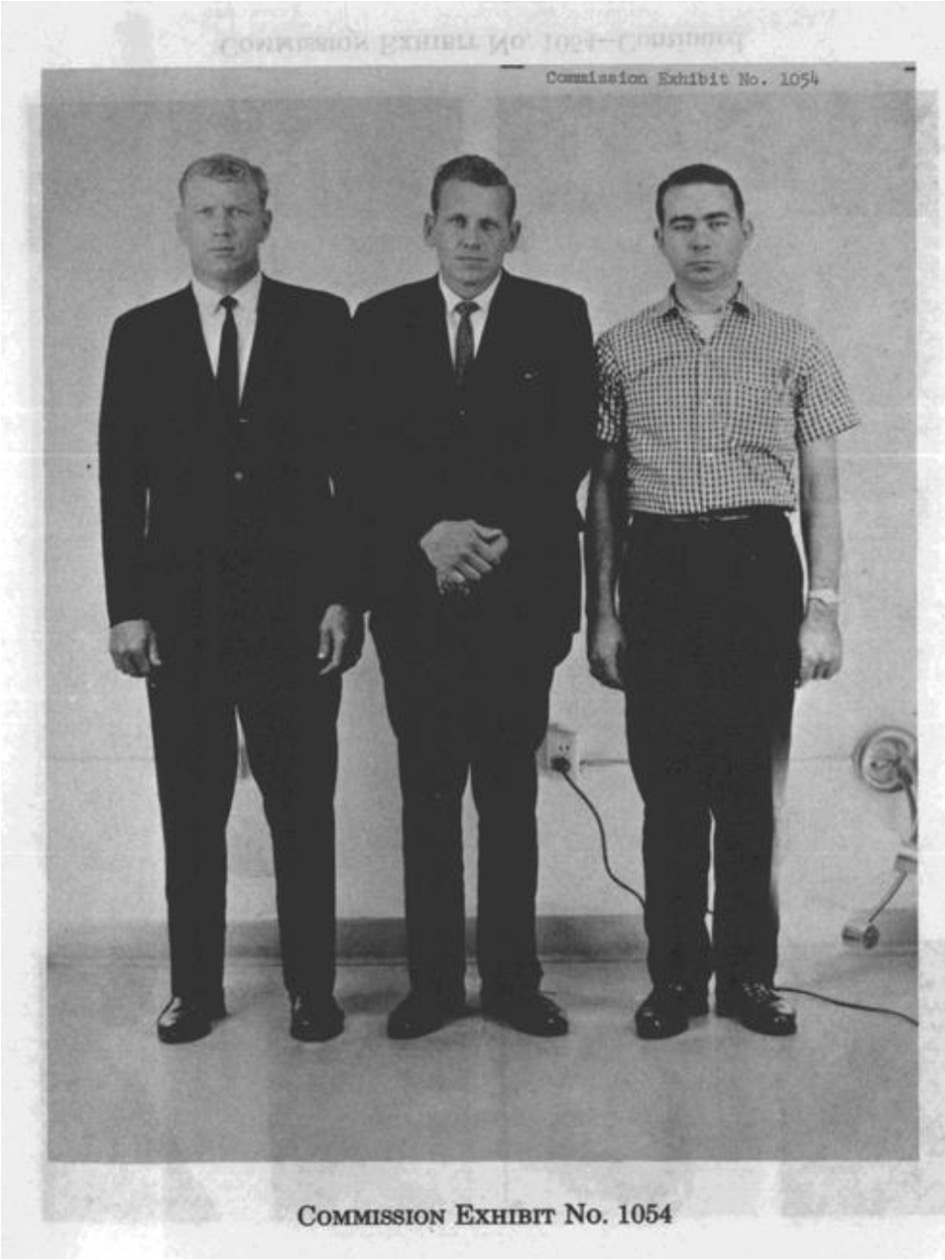
The ‘fillers’ from one of the lineups

There were three line-ups (WC Vol XXIV, p. 247) that Oswald was in on November 22. The first at 4:35 pm for Helen Markham from the Tippit murder scene. The second, around 6:30 pm, which included McWatters, Guinyard and Callaway—the last two witnesses were from the Tippit scene. The third, at 7:50 pm, were with Barbara and Virginia Davis. Detective Simms was purported to have found the transfer just before the first line-up.

From what McWatters said. The line-ups weren’t set up to achieve a positive identification. But instead, who looked the most similar? The above photograph of fillers, with two wearing suits and ties, discredits that approach.

The transfer was supposedly found in Oswald’s shirt chest pocket. But FBI agent James Bookhout, on November 23, 1963, stated that Oswald had changed his shirt:  “…that after arriving at his apartment, he changed his shirt and trousers, because they were dirty. He described his dirty clothes as being a reddish colored, long-sleeved shirt with a button-down collar and gray colored trousers”. 

If McWatters wasn’t found until 6:15 pm, then one possibility is that he punched 004459 after then, and it was not planted on Oswald until after 6:15 pm. However, by then, he was driving a Piedmont 50 bus, and by the testimonies of Dhority and McWatters, he wasn’t asked to look at the transfer until after he had “identified” Oswald in the 6:30 pm lineup.

That would explain how the McWatters situation could get out of hand if the transfer was planted before 4:35 pm, and the problem with it only emerged later. Suggesting that someone else had taken a transfer from McWatters before 4:35 pm, but after 3:00 pm, posing as a normal passenger on the Lakewood line.

The testimony of Detective Simms, who said he found the ticket on Oswald at 4:05 pm, needs to be read to get the flavor of it. The first part is clear and decisive, where he described being allocated duties at the Trade Mart for Kennedy’s luncheon speech; he then went to the Depository and then to City Hall as Oswald arrived for interrogation.

Oswald was kept in Fritz’s office rather than the neighboring interrogation room from 2:20 pm to 4:35 pm. Simms consistently pleaded a memory block of that interrogation. But Simms’ memory wasn’t lacking for the three line-ups and for the arrival of Judge Johnson for charging Oswald for the murder of Tippit.

Simms was evasive as to whether he looked at the transfer for dates and time. He just said he signed it. Ball asked Simms if he had taken contemporaneous notes, given that he had put specific details in the undated memorandum. But all he would say was that the memorandum was created in the week after Jack Ruby shot Oswald. It reads as if he either wasn’t there to observe anything or he was there but didn’t want to perjure himself by saying what he knew was untrue.

Conclusion

The Commission’s final report (Chapter 4) stated.

“When Oswald was apprehended, a bus transfer marked for the Lakewood-Marsalis route was found in his shirt pocket”

That is patently untrue. The transfer is marked for the Line 23 Lakewood (and back to Lakewood) route. To have been the Lakewood-Marsalis route, it would have had to have been marked 30 Marsalis.

If it is accepted that what Roger Craig saw was Oswald cooperating – unknowingly – in a move in which Oswald was being set up, then it is apparent there would have had to have been a decoy operation to give a counter account of Oswald’s movements.

Something Fritz was aware of by mid-afternoon of November 22, 1964.
Click here to read part 1.

  • The Wrong Bus Transfer – Part 1

    The Wrong Bus Transfer – Part 1

    How Did Oswald Get the Wrong Bus Transfer? – Part 1

    Will Fritz’s Freudian slip: Why was a bus transfer for the number 23 Lakewood Line found on Oswald if he’d been on a number 30 Marsalis Line bus?


    By the Warren Commission’s account, Lee Oswald got on and then off a Marsalis southbound bus – 12:39-12:43 pm – on Elm Street, Downtown Dallas, just before the intersection with Lamar. However, Deputy Sheriff Roger Craig said that approximately 10 minutes after Kennedy was shot (making it 12:40 pm), he saw Oswald running down the slope near the Depository and then getting into a station wagon.

    Craig’s affidavit of November 22, 1963, said the man was identical to Oswald, whom he saw again later at 5:18 pm in the office of the head of the Dallas Police Homicide Bureau, Captain Will Fritz, 3 hours after Oswald arrived at City Hall after his arrest at the Texas Theatre.

    Craig later testified to the Warren Commission at 2:35 pm, April 1, 1964, before Counsel Belin.

    Mr. BELIN – All right. Then, what did Captain Fritz say, what did you say, and what did the suspect say?

    Mr. CRAIG – Captain Fritz then asked him about the—uh—he said, “What about this station wagon?”

    And the suspect interrupted him and said, “That station wagon belongs to Mrs. Paine”—I believe that is what he said. “Don’t try to tie her into this. She had nothing to do with it.”

    And–uh–Captain Fritz then told him, as close as I can remember, that, “All we’re trying to do is find out what happened, and this man saw you leave from the scene.”

    And the suspect again interrupted Captain Fritz and said, “I told you people I did.” And–uh–yeah–then, he said–then he continued and he said, “Everybody will know who I am now.”

    By that account, Craig and Oswald himself not only ruled out Oswald being on the Marsalis bus but also linked Ruth Paine – the owner of the house in Irving where Marina Oswald lived and Oswald stayed at weekends – to that car.

    But Captain Fritz, in testifying to the Warren Commission (Vol IV, p. 202) on April 22, 1964, to Counsel Ball, said this about Craig.

    FRITZ. One deputy sheriff who started to talk to me but he was telling me some things that I knew wouldn’t help us and I didn’t talk to him but someone else took an affidavit from him. His story that he was telling didn’t fit with what we knew to be true.’

    Given that all of this relates to the afternoon of November 22, 1963, how could Fritz at that time have possibly known what Craig was telling him was not going to help him? Especially as Fritz claims Craig had only started to tell him something, and Fritz’s account of Oswald’s own story–as I show later–was fluid, inconsistent and far from truthful.

    This article explores that question. Was Fritz emitting a Freudian slip?

    Nothing appearing as evidence on November 22, 1963, provides a basis for Fritz to have dismissed what Roger Craig always maintained. What does appear in the record is a making up and suppression of evidence instead.

    I. The Other Witnesses: Cooper and Robinson

    Roy Cooper worked for a military aircraft maker, Ling-Temco-Vought (now part of Northrop Grumman). He told the FBI on November 23, 1963, that he saw a Nash Rambler pick up a man running from the direction of the Depository. Cooper said he was driving behind his boss, Marvin Robinson, who nearly collided with it. The vehicle headed under the overpass in the direction of Oak Cliff.

    Cooper told the FBI to contact Robinson at home or at the Naval Air Station at Grand Prairie. Cooper was following Robinson to drop a car off at Robinson’s house, 5120 S Marsalis, Dallas. Marvin Robinson was traced and confirmed that in an interview with the FBI the same day, November 23, 1963.

    The Commission file for Roger Craig shows that Robinson was scheduled by Commission staff to testify on April 1, 1964, at 2:30 pm to Counsel Ball, simultaneously with Deputy Sheriff Roger Craig. But his testimony does not appear in any records. Attendance was tightly managed. If a witness did not acknowledge the request to appear, by phone call, the Secret Service made contact to ensure it happened.

    Robinson had been very easily traced on November 23 via Cooper as they worked at the same air base. Robinson carried on working on aircraft even in retirement near Dallas. He was very much of fixed abode and workplace and appears at the stated address in the City Directory. There is no explanation as to why Robinson did not testify. Or if he did testify, why is that testimony missing from the records? But whatever the case, Josiah Thompson used his FBI report to telling effect in his early book, Six Seconds in Dallas. If one reads the effect that Robinson’s testimony has combined with Craig’s, which Thompson does, then one may be able to ponder the reason for his absence. (Thompson, pp. 242-43)

    The Warren Commission’s report dismissed Craig’s story on the basis that Oswald was on the bus at that same time. But the timeline of Fritz’s denial of Craig’s relevance is also important. Fritz, in testifying to the Warren Commission on April 22, 1964 to Counsel Ball, said this:

    Mr. FRITZ. He [Oswald] told me that was the transfer the busdriver had given him when he caught the bus to go home. But he had told me if you will remember in our previous conversation that he rode the bus or on North Beckley and had walked home but in the meantime, someone had told me about him riding a cab.

    And,

    So, when I asked him [Oswald] about a cab ride if he had ridden in a cab he said yes, he had, he told me wrong about the bus, he had rode a cab. He said the reason he changed, that he rode the bus for a short distance, and the crowd was so heavy and traffic was so bad that he got out and caught a cab, and I asked him some other questions about the cab and I asked him what happened there when he caught the cab and he said there was a lady trying to catch a cab and he told the busdriver, the busdriver told him to tell the lady to catch the cab behind him and he said he rode that cab over near his home, he rode home in a cab.

    Fritz was misleadingly inaccurate regarding the “someone” in the “meantime”. By cab driver William Whaley’s testimony of March 12, 1964, in Washington, and his affidavit of November 23, the cab lead, and his description of the lady, etc., didn’t appear until the next day, November 23. Whaley testified thus.

    Mr. BALL. Later that day did you-were you called down to the police department?

    Mr. WHALEY. No, sir.

    Mr. BALL. Were you the next day?

    Mr. WHALEY. No, sir; they came and got me, sir, the next day after I told my superior when I saw in the paper his picture, I told my superiors that that had been my passenger that day at noon. They called up the police and they came up and got me.

    Mr. BALL. When you saw in the newspaper the picture of the man?

    Mr. WHALEY. Yes, sir.

    Mr. BALL. You went to your superior and told him you thought he was your passenger?

    Mr. WHALEY. Yes, sir.

    So up to the point when Craig was telling Fritz something, there was nothing to provide any basis to dismiss what Craig was telling him. Indeed, Fritz’s account of Oswald changing his story of how he got to Beckley cannot be true, given that there was no cab revelation that day.

    Fritz’s peremptory dismissal of Roger Craig’s story seems to be based on Fritz making up a counter-story that is full of holes and contradictions.

    By April 1, 1964, the story that Oswald was identified on the bus was in tatters.

    II. The Misidentification of Oswald by the Bus Driver

    Without a lead to a cab on November 22, all there was to go on was the bus transfer, which was allegedly found on Oswald at around 4:05 pm on November 22, by Detective Simms, just as Oswald was taken downstairs for his first witness lineup (see later).

    The transfer lead involved driver Cecil McWatters and his Line 30 Marsalis bus. However, and counter to what Fritz had said, Oswald originally told him that the bus line wasn’t a route to Oswald’s 1026 N Beckley rooming house. The Marsalis line deviated ¾ mile before that Beckley destination, at the south end of the Houston Street Viaduct.

    This is then from the testimony of Detective Dhority taken on April 6, 1964. The lineup referred to is Oswald’s second.

    Mr. BALL. What was the first thing that you did that day with respect to the investigation of the President’s assassination?

    Mr. DHORITY. Around 6 p.m., Detective Brown and myself went out and got Mr. McWatters from the bus in front of the city hall there and brought him into the lineup and took an affidavit off of him.

    Ball then read from that affidavit taken on November 22.

    Mr. BALL. What did McWatters say to you?

    Mr. DHORITY. He identified him as the man that rode on the bus and said he wasn’t for sure exactly where he picked him up, but he said he believed that he got off shortly after he got on the bus, but after he identified him he went upstairs and looked at a transfer that Detective Sims had took out of Oswald’s pocket, and he positively identified the transfer as his transfer.

    Mr. BALL. You took McWatters’ affidavit after that, didn’t you?

    Mr. DHORITY. Yes, sir.

    Mr. BALL. Right after he had made an identification?

    Mr. DHORITY. Yes, sir.

    Mr. BALL. Of Oswald?

    Mr. DHORITY. Yes, sir.

    Mr. BALL. At that time, and I’ll show you a copy of an affidavit by McWatters, and will you take a look at that, please?

    Mr. DHORITY. [Examined instrument referred to.]

    Mr. BALL. Mr. Dhority, after the showup, did you take the affidavit from Mr. McWatters?

    Mr. DHORITY. Yes, I did.

    Mr. BALL. Now, in the affidavit here he says he picked up a man on the lower end of town on Elm and Houston and went out on Marsalis and picked up a woman, and then he mentions that as he went out, “This man was grinning and never did say anything. The woman said that it was not a grinning matter. I don’t remember where I let this man off. This man looks like the No. 2 man I saw in a lineup tonight.”.Now, you read that, didn’t you?

    Mr. DHORITY. Yes.

    But as Ball noted, the positive identification Dhority cited did not accord with what McWatters’ affidavit actually said. Nor did it accord with McWatters’ FBI statement the next day, November 23 (page 6). That FBI statement said.

    MCWATTERS stated that he went to the Dallas Police Department on November 22, 1963, and from a lineup picked a man whom he said is the only one in the lineup who resembles the man who had ridden on his bus on November 22, 1963. He stated that this man was LEE OSWALD, but emphasized that he cannot specifically identify him as being on his bus or as being the person who made the remark to the effect that the President was shot in the temple.

    He stated he “cannot be sure where this man got off the bus, but he believes it was south of Saner Avenue in Oak Cliff”.

    Saner Avenue was near the south end of the Marsalis line, over 5 miles from Elm Street. The bus was scheduled for arrival at the Saner end of the line at 12:58 pm (CE378).

    Dhority’s assertions are also discredited by what McWatters testified 25 days earlier to the Commission in Washington on March 12, 1964 (Vol II page 263), immediately after Whaley.

    McWatters withdrew any identification of Oswald entirely and said the person he’d seen on the bus was actually Roy Milton Jones, a teenager.

    Mr. BALL – Now you realize you were mistaken in your identification that night?

    Mr. McWATTERS – That is right.

    Mr. BALL – As I understand it, neither then nor now are you able to identify or say that you have again seen the man that got off your bus to whom you gave a transfer?

    Mr. McWATTERS – No, sir; I couldn’t. I could not identify him.

    Milton Jones was traced at the Commission’s request. On March 30, 1964, he told the FBI (CE2641) that the bus was held up by police boarding it on Elm Street for almost an hour and said he got off at Marsalis@Brownley at 1:45 pm. That is one block south of Saner Avenue and hence chimes with McWatters’ account. But given that is where the bus should have been circa 12:56 pm, the bus was 50 minutes late.

    All of McWatters’ police and FBI statements were silent about the delay and the police boarding causing it. But Milton Jones’ account can be corroborated on time. The Dallas Morning News of 28 November 1963, reported.

    “The cashier of the Texas Theater immediately called the police – who had just sped en masse to a false alarm at the Dallas Library branch on Jefferson, further to the east. The police sirens wailed again. Oddly enough it was at the library that McWatters, the bus driver who, unknowingly, had Oswald as a passenger earlier, had his second brush with fate. His bus pulled up at the intersection as a swarm of 10 or 15 police cars zeroed in on the library, *I couldn’t imagine what was going on” said McWatters. “Little did I know!“.

    That false sighting of Oswald at the library at Marsalis and Jefferson appears on the patrol radio around 1:30 pm. The bus should have been there at 12:50 pm (CE378), thus it was at least 40 minutes late. That would make a late arrival at Saner of 1:40 pm. Thus corroborating what Milton Jones told the FBI.

    Milton Jones told the FBI that he and McWatters talked about those events on Monday, November 25, when Milton Jones was back on the bus again.

    Milton Jones also revealed to the FBI that McWatters told him the DPD had questioned him until 1:00 am the next day.

    Seven hours is a long time to hold a witness who hadn’t actually made a positive identification of Oswald. But it would be consistent with trying to turn things into “evidence”.

    Nevertheless, Oswald was charged on November 22, 1964, for the murder of Officer JD Tippit by relying on McWatters and the bus story as the explanation for how Oswald could have gotten to 1026 N Beckley to then get to the Tippit murder scene.

    Given the discrepancies on the person, the time and the place, then the story of the bus transfer must also be in doubt.

    Rather than incriminating Oswald, the transfer actually incriminates the police. The transfer supposedly found on Oswald was not for Line 30 Marsalis, but Line 23 Lakewood.

    III. THE BUS ROUTE, TIMES AND THE TRANSFER

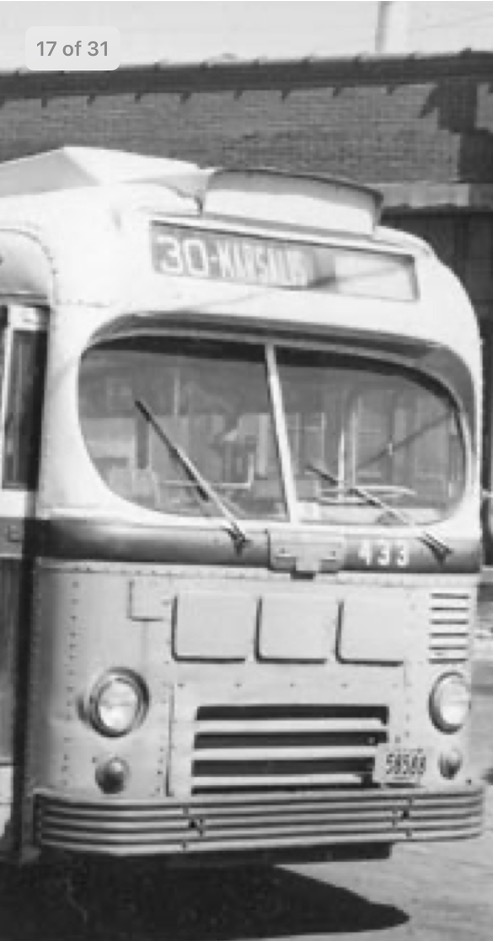
    The Line 30 Marsalis route McWatters was driving was also known as Marsalis-Munger. It was confirmed by the foreman at the bus company, Mr. JE Cook (McWatters file page 8). Munger is a district north of Downtown, as well as an intersection towards Lakewood on Gaston Avenue. He said the sign would have been set for “30 • Marsalis – Union Station” and set the signs for that for FBI photographs for the Commission.

    McWatters, in testifying to the Commission, said that he was scheduled for that run from 11:52 am until 2:27 pm, when he then switched lines.

    The bus schedule (CE378) shows that Marsalis Line 30, 1213, started its crosstown schedule at 12:11 pm from Ellsworth/Anita (Lakewood), Gaston Avenue (a long road running south to Downtown), Elm Street (Downtown), Houston Street (Dealey Plaza), North and South Marsalis Avenue (Oak Cliff), with a scheduled end at Ann Arbor (Saner district), at 12:58 pm.

    The turnaround schedule (heading to Munger) was to be back at Lakewood at 2:11 pm, then ending at Gaston@Paulus 2:20 pm, which leads to the bus transfer ticket.

    A bus transfer is a form of ticket issued when a passenger breaks a journey, enabling a follow-up journey on another connecting bus line, without paying another full fare. According to McWatters’ Warren Commission testimony, a passenger had to give a reason for getting a transfer.

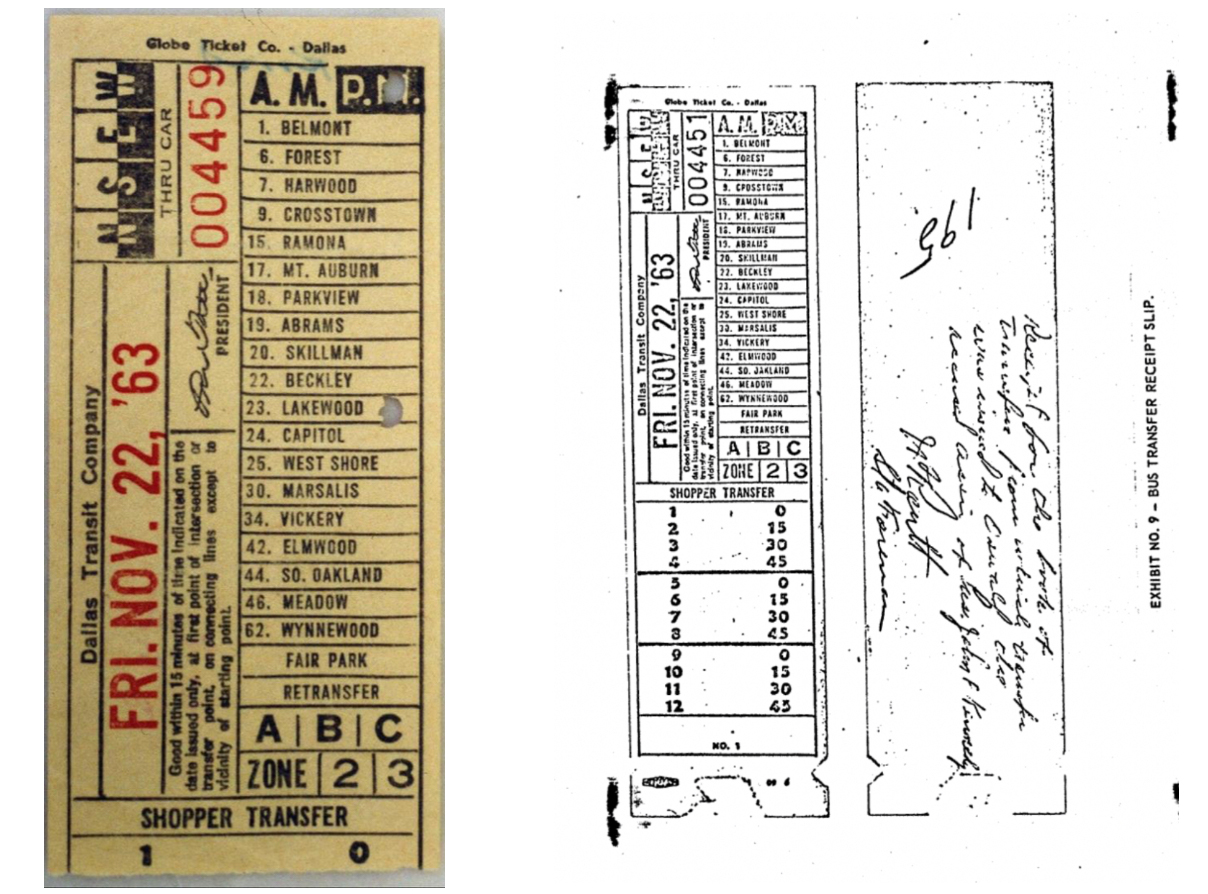
    The Commission photograph of the transfer 004459 supposedly found on Oswald, which appears as CE383-A, is blurry to read, but the one on the left is a color one via John Armstrong.

    Drivers were given books, each containing 50 transfers preprinted for the date. The first transfer was torn off and left at the depot as the receipt for taking that book. The photo on the right is transfer 004451. The 1963 Dallas transfer states it was valid “within 15 minutes from the time indicated on the first point of intersection or transfer point for connecting lines”.

    The transfer had punches for relevant boxes, except for the time, which was cut. The same ticket company, Globe Ticket Co, still exists and still sells cutters and punchers. Comparing these two transfers shows how CE381-A was cut back to the first possible time, 1:00 and punched PM. Whereas, a horizontal cut at the foot would be 12:45.

    Transfers were charged at much less than full fare. Given that an incentive to tamper would be to extend to a later time to create a cheap ride, then the cutting system is tamper-proof. All later hours and minutes are cut off. The Dallas transfer above has a list of 17 bus lines. Each Dallas bus line had a name and number. (See page 12 of this Ford Presidential Library document) This later Dallas Bus map still tallies with the routes on the Globe transfer described above. 

    A review of the names and numbers of the 17 bus lines shows that routes are not systematically named for the ends of the lines, which would require two names. Instead, for the transfers, the Dallas lines were named unsystematically on the basis of any road or district of prominence on the line, e.g., 22 Beckley, 15 Ramona, and 30 Marsalis are names of middles and not ends of bus lines. Downtown was the start of the Beckley line. Lakewood is the district where the Ramona line and the Marsalis line started/ended. But Lakewood was also the name of a line itself. Its route – 23 – is shown in the FBI dossier (page 90, top right). It ran from the Lakewood district and terminated at Downtown, Union Station, and returned to Lakewood.

    A punched hole would indicate the relevant bus line. As did boxes indicating direction of travel “NSEW”, North, South, East and West, so that a passenger could not skip paying for a return ticket by doubling backward.

    But the Dallas transfer did have a “Shopper” box which, if punched, did enable someone who had asked for that form of transfer to get a return bus ride – once they had spent more than a dollar in a participating store. McWatters said that at that time of day, transfers were usually used by elderly people shopping.

    These lines crossed the Trinity River into Oak Cliff, thus,

    • Marsalis bus Line 30. Also known as “Munger”. The one Oswald was supposed to have boarded and then disembarked from. That ran from Lakewood, along Gaston through Downtown on Elm, over Houston St Viaduct along North and South Marsalis ending at Ann Arbor/Saner and back.
    • Ramona bus Line 15. That shared the same Downtown route as Marsalis until over the river, where it branched off Marsalis, to Ramona, ending at Singing Hills.
    • Elmwood Line 42. That ended south of the river at Elmwood (not to be confused with Ellwood) and has no relevance here.
    • The Beckley bus Line 22. That started Downtown, crossed the Trinity River on the Commerce Viaduct and went down North and South Beckley to Kiest and back. That would have been the direct bus for Oswald to go to work at the Depository from his 1026 N Beckley rooming house.
    • Other buses running along Beckley, Belmont Line 1 and Skillman Line 20. CE2694.

    The above-cited lines are all visible on the CE381-A transfer.

    The ticketing system Dallas used was widespread in the USA. The Reading Bus Co ticket, for example, is explicit on the ticket that the convention was that a punch indicated the line the journey had started on.

    That is consistent with wording on CE381-A stating 15-minute validity “for connecting lines”. Plural. Meaning any lines connecting with the one disembarked from and punched for. A passenger transferring on Elm from any one of Beckley, Marsalis, Elmwood, Skillman, Bellmont or Ramona would have – at least – the five other lines to choose to transfer to.

    IV. The Question about the Wrong Punch

    The transfer, which appears as CE381-A, is punched not for the Marsalis • 30 line but the Lakewood • 23 line. The Lakewood line in either direction would be of no use to Oswald – nor anyone else – heading to Oak Cliff. Counsel Ball asked McWatters why CE381-A would be punched for [Line 23] “Lakewood”.

    McWatters gave the Commission a convoluted story about punching the hole next to “Lakewood [23]” as Lakewood was an end of the Marsalis [30] route. He said in the following (my square brackets).

    “Going that way, while at Marsalis, I would punch the Lakewood when I would leave Marsalis coming toward Lakewood [hence northbound], I would have Lakewood on the front of my bus [hence also northbound] but I would punch the transfer Marsalis.”

    This is patently absurd. Firstly, he merely described northbound journeys in a different way but punched inconsistently. Secondly, even if he had his own system of punching “Lakewood” as a destination, it couldn’t possibly be a destination from a stop on one-way Elm Street for a Line 30 Marsalis bus heading south towards Marsalis.

    McWatters seems to be trying to find excuses for punching a transfer for the Lakewood Line 23 when he was driving the Marsalis 30 Line, and as per the photograph above, with “30 Marsalis” on the sign.

    McWatters’ account of him being called to the police department for the lineup chimes with Dhority above. McWatters was only shown the – problematic – Lakewood Line 23 transfer after he had attended the Oswald lineup.

    Mr. Ball. Now, you were called down to the Dallas police department later, weren’t you?

    Mr. McWatters. Yes, sir.

    Mr. Ball. What day was it?

    Mr. McWatters. It was on the same day, the 22d.

    Mr. Ball. 22d. Do you know how they happened to get in touch with you, did you notify them that you——

    Mr. McWatters. No, sir; I didn’t know anything to that effect.

    Mr. Ball. Did they come out and get you?

    Mr. McWatters. They come out and——

    Mr. Ball. What did they ask you?

    Mr. McWatters. Well, they stopped me; it was, I would say around 6:15 or somewhere around 6:15 or 6:20 that afternoon.

    Mr. Ball. You were still on duty, were you?

    Mr. McWatters. Yes, sir.

    Mr. Ball. Still on your bus?

    Mr. McWatters. I was on duty but I was on a different line and a different bus.

    Mr. Ball. What did they ask you when they came out?

    Mr. McWatters. Well, they stopped me right by the city hall there when I come by there and they wanted me to come in, they wanted to ask me some questions. And I don’t know what it was about or anything until I got in there and they told me what happened.

    Mr. Ball. What did they tell you?

    Mr. McWatters. Well, they told me that they had a transfer that I had issued that was cut for Lamar Street at 1 o’clock, and they wanted to know if I knew anything about it. And I, after I looked at the transfer and my punch, I said yes, that is the transfer I issued because it had my punch mark on it.

    It is perplexing how the police could have deduced Lamar. There is no reference to Lamar on the transfer. Ball picked up on that, with McWatters then confirming it was impossible.

    Mr. BALL – If this transfer was issued around the Lamar area or St. Paul–Elm area, is there any place that you could punch and show that particular location?
    Mr. McWATTERS – No, sir.

    McWatters then undermined his own assertion of Lamar with this.

    Mr. Ball. When you got to the police station that day did they show you a transfer?

    Mr. McWatters. Yes, sir.

    Mr. Ball. What did you tell them about the transfer?

    Mr. McWatters. Well, I recognized the transfer as being the transfer that I had issued.

    Mr. Ball. How did you recognize it?

    Mr. McWatters. By my punch mark on it.

    Mr. Ball. And what about the line?

    Mr. McWatters. The line?

    Mr. Ball. Lakewood.

    Mr. McWatters. The Lakewood punch on it, and where it was punched and Lakewood with my punch mark on it.

    The purpose of a transfer is to convey information to a different driver on the bus that the holder chooses to board next. A system needs consistency and understandability for passengers as well as drivers. What McWatters was saying is inconsistent and incomprehensible.

    Click here to read part 2.

  • Fair Play for Burt Griffin and Leon Hubert of the Warren Commission?

    Fair Play for Burt Griffin and Leon Hubert of the Warren Commission?


    Fair Play for Burt Griffin and Leon Hubert of the Warren Commission?

    By Paul Abbott

    The Warren Commission has been undeniably and rightly vilified since its 1964 release up to and including the ultimate counterargument – 2023’s The JFK Assassination Chokeholds. Its Oswald-did-it-and-did-it-alone conclusion seemed to be arrived at first, and then the evidence seemed cherry-picked in order to make that verdict stick. But aside from Commission dissenters like Hale Boggs and Richard Russell, there were others within its ranks who tried to pursue at least a halfway decent investigation into the peripheries of the Lee Oswald orbit. 

    Leon Hubert and Burt Griffin were the two attorneys tasked with leading the Commission’s inquiry into Jack Ruby, which included how he came to kill Oswald. This involved their mobilization to Dallas – between late March to early May of 1964 – to question dozens of witnesses related to Ruby and the Oswald murder. This included employees of Ruby’s and members of the Dallas Police Department who witnessed the Oswald slaying. 

    Reading through witness statements, it was clear that both Hubert and Griffin only pushed so far when it came to scrutinizing the conditions at Dallas City Hall on the morning of 11/24/63. But Griffin did sense a weakness in Sgt. Patrick Dean and his inability to adequately address the question of whether the stairwell door from the Annex Building into the basement car park was locked. Reading that exchange it is clear that Griffin sensed that this was an alternative method of entry for Jack Ruby that morning, and he was calling out Dean for his attempts to deflect away from it. Aside from this episode, Griffin took exception to Dean’s account of how Ruby told him he entered the basement, down the Main Street ramp, just minutes after shooting Oswald. This was done, despite the lack of initial corroboration from fellow DPD personnel or from the Secret Service’s Forrest Sorrels. It all led to Griffin talking to Dean off the record during a break and imploring him to tell the truth – in a blink two times if you’re in trouble kind of way. As Griffin outlined in a subsequent memo to his WC superior, J. Lee Rankin:

    ‘ I told him (Dean) that in the two or three hours that he and I had been talking, I found him to be a likable and personable individual, and that I believed he was a capable and honest police officer… I then stressed that this investigation was of extreme importance to the National Security and that .. if there was some way that he could be induced to come forward with a forthright statement without injuring himself, the Commission would probably be willing to explore a means to afford him the protection that was necessary…’ 

    In response to the way he felt he was treated by Griffin, Dean lodged a complaint with Dallas DA Henry Wade, who conveyed this to the Warren Commission. 

    Griffin and Hubert returned to Washington from Dallas and put forth a case for either a chapter or sub-chapter to be included in the final report by the Warren Commission titled ‘The Killing of Lee Harvey Oswald’. To justify this and the numerous threads they had picked up on Jack Ruby, Griffin, and Hubert tended a report to Rankin for his consideration. It is included as verbatim below:


    May 14, 1964

    To:    J. Lee Rankin

    From:   Leon D. Hubert Jr. 
                  Burt W. Griffin

    Subject: Adequacy of Ruby Investigation

    1. Past Recommendations. In memoranda dated February 19, February 23, February 27, and March 11, we make various suggestions for extending the investigation initiated … in connection with the Oswald homicide. Shortly after March 11, 1964, we began preparation for the nearly 60 depositions taken in Dallas during the period March 21 – April 3; after we returned from Dallas we took the deposition of C.L. Crafard (two days) and George Senator (two days), worked on editing the depositions taken in Dallas, and prepared for another series of 30 other depositions taken in Dallas during the period April 13-17. On our return from Dallas, we continued the editing of the Dallas depositions, prepared the Dallas depositions exhibits for publication, and began working on a draft of the report in Area V. As a consequence of all this activity during the period March 11-May 13, we did not press for the conferences and discussions referred to in the attached memoranda. The following represents our view at the time with respect to appropriate further investigation.

    2. General Statement of Areas Not Adequately Investigated. In reporting on the murder of Lee Oswald by Jack Ruby, we must answer or at least advert to these questions:
      1. Why did Ruby kill Oswald;
      2. Was Ruby associated with the assassin of President Kennedy;
      3. Did Ruby have any confederates in the murder of Oswald?

      It is our belief that, although the evidence gathered so far does not show a conspiratorial link between Ruby and Oswald, or between Ruby and others, nevertheless evidence should be secured, if possible, to affirmatively exclude that:

      1. Ruby was indirectly linked through others to Oswald;
      2. Ruby killed Oswald, because of fear; or
      3. Ruby killed Oswald at the suggestion of others.

    3. Summary of Evidence Suggesting Further Investigation. The following facts suggest the necessity of further investigation:
      1. Ruby had time to engage in substantial activities in addition to the management of his Clubs. Ruby’s nightclub business usually occupied no more than five hours of a normal working day…. It was his practice to spend an average of only one hour a day at his Clubs between 10:00 am and 9:00 pm. Our depositions were confined primarily to persons familiar with Ruby’s Club activities. The FBI has thoroughly investigated Ruby’s nightclub operations but does not seem to have pinned down his other business or social activities. The basic materials do make reference to such other activities (see p. 27 of our report of February 18), but these are casual and collateral and were not explored to determine whether they involved any underlying sinister purpose. Nor were they probed in such a manner as to permit a determination as to how much of Ruby’s time they occupied. 
      2. Ruby has always been a person who looked for money-making ‘sidelines.’ In the two months prior to November 22, Ruby supposedly spent considerable time promoting an exercise device known as a ‘twist board.’ The ‘twist board’ was purportedly manufactured by Plastellite Engineering, a Fort Worth manufacturer of oil field equipment which has poor credit references and was the subject of an FBI investigation in 1952. We know of no sales of this item by Ruby; nor do we know if any ‘twist boards’ were manufactured for sale. The possibility remains that the ‘twist board’ was a front for some other illegal enterprise. 
      3. Ruby has long been close to persons pursuing illegal activities. Although Ruby had no known ideological political interests (see p. 35 of our report of February 18), there is much evidence that he was interested in Cuban matters. In early 1959, Ruby inquired concerning the smuggling of persons out of Cuba. He has admitted that, at that time, he negotiated for the sale of jeeps to Castro. In September 1959, Ruby visited Havana at the invitation of Las Vegas racketeer, Louis J. McWillie, who paid Ruby’s expenses for the trip and who was later expelled from Cuba by Castro. McWillie is described by Ralph Paul, Ruby’s business partner, as one of Ruby’s closest friends. Ruby mailed a gun to McWillie in early 1963. In 1961, it was reported that Ruby attended three meetings in Dallas in connection with the sale of arms to Cubans and the smuggling out of refugees. The informant identifies an Ed Brunner as Ruby’s associate in the endeavor. Shortly after his arrest on November 24, Ruby named Fred Brunner as one of his expected attorneys. Brunner did not represent Ruby, however. Insufficient investigation has been conducted to confirm or deny the report about meetings in 1962. When Henry Wade announced to the Press on November 2, 1063, that Oswald was a member of the Free Cuba Committee. Ruby corrected Wade by stating “not the Free Cuba Committee; The Fair Play for Cuba Committee. There is a difference.” The Free Cuba Committee is an existing anti-Castro organization. Earl Ruby, brother of Jack Ruby, sent an unexplained telegram to Havana in April 1962. We believe that a reasonable possibility exists that Ruby maintained a close interest in Cuban affairs to the extent necessary to participate in gun sales or smuggling. 
      4. Bits of evidence link Ruby to others who may have been interested in Cuban affairs. When Ruby’s car was seized on November 24, it contained various right-wing radio scripts issued by H.L. Hunt and a copy of the Wall Street Journal bearing the mailing address of a man who has not yet been identified. In May 1963, Early Ruby, operator of a dry cleaning business, is known to have telephoned the Welch Candy Company (owned by the founder of John Birch Society). The purpose of the call is unknown. Jack Ruby’s personal notebook contained the Massachusetts telephone number and address of Thomas Hill, a former Dallas resident, working at the Boston headquarters of the John Birch Society. Although it is most likely that all of those bits of circumstantial evidence have innocent explanations, more have yet to be explained. 
      5. Although Ruby did not witness the motorcade through Dallas, he may have had a prior interest in the President’s visit. A November 20 edition of the Fort Worth Telegram showing the President’s proposed route through Fort Worth, and the November 20 edition of the Dallas Morning News showing the President’s route through Dallas, were found in Ruby’s car on November 24. 
      6. On November 16 Jack Ruby met at the Carousel Club with Bertha Cheek, sister of Mrs. Earlene Roberts, manager of Lee Oswald’s rooming house. Mrs. Cheek said that she and Ruby discussed her lending Ruby money to open a new nightclub. Ruby was not questioned about this matter. On November 20, 1963, a woman, who may be identical to Earlene Roberts, was reported to be in San Antonio at the time of President Kennedy’s visit. The possible identification of Mrs. Roberts in San Antonio has not been checked out. In addition, the link formed by Mrs. Roberts between Oswald and Ruby is buttressed in some measure by the fact that one of Ruby’s strippers dated a tenant of the Beckley Street rooming house during the tenancy of Lee Oswald. We have previously suggested the theory that Ruby and Mrs. Cheek could have been involved in Cuban arms sales of which Oswald gained knowledge through his efforts to infiltrate the anti-Castro Cubans. Our doubts concerning the real interest of Mrs. Cheek in Jack Ruby stem from the fact that one of her four husbands was a convicted felon and one of her friends was a police officer who married one of Ruby’s strip-tease dancers. We have suggested that Ruby might have killed Oswald out of fear that Oswald might implicate Ruby and his friends, falsely or not in an effort to save his own life. We think that neither Oswald’s Cuban interest in Dallas nor Ruby’s Cuban activities have been adequately explained. 
      7. Ruby made or attempted to make contacts on November 22 and 23 with persons, known and unknown, who could have been co-conspirators. Ruby was visited in Dallas from November 21 to November 24, 1963, by Lawrence Meyers of Chicago. Meyers had visited Ruby two weeks previously. Ruby also made a long-distance call shortly after the President’s death to Alex Gruber in Los Angeles. Gruber had visited Ruby about the same time as Meyers in early November. Both Gruber and Meyers give innocent explanations. Meyers claims he was in Dallas enjoying life with a ‘dumb but accommodating broad.’ Gruber claims Ruby called to say he would not mail a dog that day, as he had promised to do. Finally between 11:35 pm and 12 midnight, Saturday, November 23, Ruby made a series of brief long-distance calls culminating with a call to entertainer Breck Wall at a friend’s house in Galveston. Wall claims Ruby called to compliment him for calling off his (Wall’s)  set at the Adolphus Hotel in Dallas. Background checks have not been made on these persons.
      8. In fact, we believe that the possibility exists based on evidence already available that Ruby engaged in illegal dealings with Cuban clients who might have had contact with Oswald. The existence of such dealings can only be surmised since the present investigation has not focused on that area. 
      9. We suggest that these matters cannot be left ‘hanging in the air.’ They must either be explored further or a firm decision must be made not to do so, supported by stated reasons for the decision. As a general matter, we think the investigation is deficient in these respects:
        1. Substantial time segments in Ruby’s daily routine from September 26 to November 22 have not been accounted for. 
        2. About 46 persons who saw Ruby from November 22 to November 24 have not been questioned by staff members, although there are FBI reports of interviews with all of these people.
        3. Persons who have been interviewed because of known associations with Ruby generally have not been investigated themselves so that their truthfulness can be evaluated. The FBI reports specifically do not attempt evaluation. The exception has been that where the FBI has been given incriminating evidence against Ruby, it has made further investigation to determine whether others might also be implicated with Ruby. In every case where there was some evidence implicating others, these other persons were interviewed and denied the incriminating allegations. Further investigation has not been undertaken to resolve the conflicts. 
        4. Much of our knowledge of Ruby comes from his friends Andrew Armstrong, Ralph Paul, George Senator, and Larry Crafard. Investigations have not been undertaken to corroborate their claims. 
    4. Specific Investigative Recommendations 
      1. We should obtain photos of all property found on Ruby’s person, in his car, or at his home or clubs, now in possession of the Dallas District Attorney. We already have photos of Ruby’s address books, but no other items have been photographed or delivered to the Commission. These items included H.L. Hunt literature and newspapers mentioned in paragraphs 3d and 3e.
      2. We should conduct staff interviews or take depositions with respect to Ruby’s Cuban activities of the following persons:
        1. Robert Ray McKeown. Ruby contacted McKeown in 1959 in connection with the sale of jeeps to Cuba. The objective of an interview or deposition of McKeown would be to obtain information on possible contacts Ruby would have made after 1959 if his interest in armament sales continued. 
        2. Nancy Perrin. Perrin claims she met with Ruby three times in 1961 concerning refugee smuggling and arms sales. She says she can identify the house in Dallas where meetings took place. Perrin now lives in Boston. Ruby admits he was once interested in the sale of jeeps at least, to Cuba. 
      3. We should obtain reports from the CIA concerning Ruby’s associations. The CIA has been requested to provide reports based on a memorandum delivered to them on March 13, 1964, concerning Ruby’s background including his past Cuban activities, but a reply has not been received as yet. 
      4. We should obtain reports from the FBI based on the requested investigation of allegations suggesting that Earlene Roberts was in San Antonio on November 21.
      5. The Commission should take the testimony of the following persons for the reasons stated:
        1. Hyman Rubenstein, Eva Grant, Earl Ruby. All are siblings of Jack Ruby. Hyman is the oldest child and presumably will be the best witness as to family history. He talked to Jack on November 22, reportedly visited Jack the weekend before the assassination, and participated in Ruby’s twist board venture. Eva lived with Jack for 3 years in California prior to World War II, induced Jack to come to Dallas in 1947, and managed the Vegas Club for Jack in Dallas from 1959 to 1963. Earl was a traveling salesman with Jack from 1942-1943; a business partner from 1946-1947, and made phone calls before November 22, 1963 and afterwards which require explanations.
        2. Henry Wade. This person can testify to the development of the testimony by Sgt. Dean and Det. Archer against Ruby and of seeing Ruby on November 22 in the Police Department building
        3. Jack Ruby
      6. We should take the deposition of the following persons for the reasons stated:
        1. Tom Howard. This person is one of Ruby’s original attorneys and is reported to have been in the police basement a few minutes before Oswald was shot and to have inquired if Oswald had been moved. He filed a writ of habeas corpus for Ruby about one hour after the shooting of Oswald. He could explain these activities and possibly tell us about the Ruby trial. We should have these explanations. 
        2. FBI Agent Hall. This person interviewed Ruby for 2.5 hours on November 24 beginning at approximately 12 noon. His report is contradictory to Sgt. Dean’s trial testimony. He also interviewed Ruby on December 21, 1963.
        3. Seth Kantor. This person was interviewed twice by the FBI and persists in his claim that he saw Ruby at Parkland Hospital shortly before or after the President’s death was announced. Ruby denies that he was ever at Parkland Hospital. We must decide who is telling the truth, for there would be considerable significance if it were concluded that Ruby is lying. Should we make an evaluation without seeing Kantor ourselves?
        4. Bill Dellar. This person claims to have seen Oswald at the Carousel Club prior to November 22, and this rumor perhaps more than any other has been given wide circulation. Should we evaluate Dellar’s credibility solely on the basis of FBI reports?
      7. The FBI should re-interview the following persons for the purposes stated:
        1. Alex Gruber. To obtain personal history to establish original meeting and subsequent contacts with Ruby; to obtain details of the visit to Dallas in November 1963, including where he stayed, how long, who saw him, etc. The FBI should also check its own files on Gruber.
        2. Lawrence Meyers (same as Gruber)
        3. Ken Dowe. (KLIF reporter) To ascertain how he happened to first contact Ruby on November 22 or 23; (Ruby provided information to KLIF concerning the location of Chief Curry), and whether KLIF gave any inducements to Ruby to work for it on the weekend of November 22-24. 
        4. Rabbi Silverman. To establish when Silverman saw Ruby at the Synagogue and obtain names of other persons who may have seen Ruby at the Synagogue on November 22 and 23. Silverman states that he saw Ruby at the 8 pm service on November 22 and the 9 am service on November 23; but both of these services lasted at least two hours and we do not know whether Ruby was present for the entire service. Silverman (and others) could ‘place’ Ruby, or fail to do so, during critical hours. 
        5. Mickey Ryan (same as Gruber plus employment in Dallas.)
        6. Breck Wall. This person was an entertainer at the Adolphus Hotel, Dallas, at the time of President Kennedy’s assassination. Ruby called him in Galveston at 11:47 pm on Saturday, November 23, 1963. He also visited Ruby at the County Jail. A background check should be conducted as to this person. 
        7. Andrew Armstrong, Bruce Carlin, Karen Bennett Carlin, Curtis Laverne Crafard, Ralph Paul, George Senator. These persons were deposed at length because of their friendship with Ruby, familiarity with Ruby’s personal and business life, and contacts with Ruby on November 22, 23, and 24. In general, each has professed to have had no knowledge of Ruby’s activities during those three days.

          Andrew Armstrong was very active in the operation of the Carousel and worked closely with Ruby for 18 months. His deposition covers Ruby’s activities and emotional state generally and particularly several hours on November 22 and 23. A background check should be conducted as to this person and selected parts of his testimony should be checked out to test his veracity.

          Karen and Bruce Carlin were the recipients of a $25 money order bought by Ruby approximately 9 minutes before Ruby shot Oswald. Marguerite Oswald testified that she believed she knew Karen Carlin. Background checks should be conducted on the Carlins.

          Crafard fled Dallas unexpectedly on Saturday morning November 23. Although we tend to believe his explanation, we believe a background check on him plus verification of some of his activities on November 23 are warranted.

          Paul is Ruby’s business partner. A background check should be conducted as to him, and his telephone calls during November should be checked out.

          George Senator, Ruby’s roommate, alleged by Crafard to be a homosexual, claims not to have seen Ruby except at their apartment Sunday morning and for a few hours early Saturday morning. The senator’s background and own admitted activities on November 22, 23, and 24 should be verified. 

    5. Other areas of Ruby Investigation which are not complete.
      1. Various rumors link Ruby which do not appear to be true; however, the materials we have are not sufficient to discredit them satisfactorily. Such rumors include: 
        1. Communist associations of Ruby
        2. Oswald’s use of a Cadillac believed to belong to Ruby;
        3. After the depositions of Nancy Perrin, Robert McKeown, and Syliva Odio have been taken, further investigation may be necessary with respect to Ruby’s Cuban associations. 
      2. Ruby’s notebooks contain numerous names, addresses, and telephone numbers. Many of these persons have either not been located or deny knowing Ruby. We believe further investigation is appropriate in some instances; however, we have not yet evaluated the reports now on hand. 
      3. We have no expert evidence as to Ruby’s mental condition; however, we will obtain transcripts of the psychiatric testimony at the Ruby trial. 
    6. Other Investigative Suggestions. We have suggested in earlier memoranda that two sources of evidentiary material have been virtually ignored:  
      1. Radio, TV, and movie recordings. Two Dallas radio stations tape-recorded every minute of air time on November 22, 23, and 24. We have obtained these radio tapes for all except a portion of November 24, and the tapes included a number of interviews with key witnesses in the Oswald area. In addition, the tapes shed considerable light on the manner in which Dallas public officials and federal agents conducted the investigation and performed in public view. We believe that similar video tapes and movie films should be obtained from NBC, CBS, ABC, UPI, and Movietone News, and relevant portions should be reviewed by staff members. Wherever witnesses appear on these films who have been considered by the Commission in preparing its report, a copy of such witnesses’ appearance should be made a part of the Commission records by introducing them in evidence. If one person were directed to superintend and organize this effort, we believe it could be done without unreasonable expenditures of Commission time and money. 
      2. Hotel and motel registrations, airline passenger manifests, and Emigration and Immigration records. Copies of Dallas hotel and motel registrations and airline manifests to and from Dallas should be obtained for the period October 1, 1963, to January 1, 1964. We believe that these records may provide a useful tool as new evidence develops after the Commission submits its report. We do not suggest these records necessarily be examined by the Commission staff at the present time. But, for example, it is likely that in the future, persons will come forward who will claim to have been in Dallas during the critical period and will claim to have important information. These records may serve to confirm or refute their claims. 


      LHHubert/smh

      Cc: Mr. Hubert

    So what of the people that Griffin and Hubert referred to in their memo? Below are those that had already testified to them in Dallas in April 1964:

    • Earlene Roberts – Oswald’s landlady in Oct & Nov ’63: was not asked about linkage to Jack Ruby through her sister, Bertha Cheek.
    • Bertha Cheek – friend of Jack Ruby and sister of Earlene Roberts: testified about investment dealings with Jack Ruby. Brief acknowledgment only that her sister was Oswald’s landlady on 11/22.
    • George Senator – Jack Ruby’s friend and roommate: testified to his friendship with Ruby, business dealings of Ruby’s and his (Ruby’s movements) across the weekend of 11/22.
    • Andrew Armstrong – employee of Jack Ruby’s: testified to Ruby’s personality, running of Carousel Club, and Ruby’s movements across weekend of 11/22.
    • Larry Crafard – employee of Jack Ruby’s who left Dallas suddenly on 11/23: testified to being employed by Ruby and his volatility.
    • Ralph Paul – business associate of Jack Ruby: testified about Ruby’s historic and current business dealings. 
    • Karen Carlin – employee of Jack Ruby: testified about Ruby’s management of the Carousel Club and Ruby’s movements across the weekend of 11/22.
    • Bruce Carlin – husband of Karen Carlin: testified about Ruby’ and Ruby’s movement across the weekend of 11/22.

    Of the people highlighted as being of further interest to Griffin and Hubert in their memo, only the people below were subsequently interviewed by the Warren Commission:

    • Henry Wade – District Attorney for Dallas: he doggedly defended Sgt. Pat Dean
    • Lawrence Meyers – friend of Jack Ruby: gave insight into Ruby’s business dealings in Dallas and his (Ruby’s) adoration for JFK
    • Nancy Perrin Rich – former employee of Jack Ruby: focused on Ruby’s volatility and links to DPD 
    • Hyman Rubenstein – Jack Ruby’s older brother: testified about Ruby’s family upbringing, Jack Ruby’s volatility, and business dealings leading up to and in Dallas
    • Earl Ruby – Jack Ruby’s younger brother: also testified about Ruby family upbringing, Jack Ruby’s volatility, business dealings leading up to and in Dallas plus handling of Ruby’s defense for shooting Oswald
    • Eva Grant – Jack Ruby’s older sister: testified on Ruby’s upbringing, Dallas business, and contact with him on weekend of 11/22.
    • FBI agent who first interrogated Ruby after the Oswald shooting: testified to the conversation that he had with Ruby at Dallas City Hall on 11/24 that didn’t include any reference by Ruby as to how he entered the basement.

    It is interesting to note in particular that Ruby’s first attorney after the Oswald slaying, Tom Howard, was also referred to as a figure of interest for Griffin and Hubert but did not testify before the Warren Commission. Howard would die suddenly in 1965, therefore he remains a mysterious figure in the grand scheme of things because:

    –  he was present in the City Hall basement when Oswald was shot

    –  it was only after Howard first spoke with Ruby a few hours later, that Ruby was first actually documented–by Forrest Sorrels– as disclosing how he entered the basement down the Main Street ramp. 

    –  and he was one of three people out of five who met at Ruby’s apartment on the night of 11/24 and would later die under sudden and mysterious circumstances.

    We have the benefit of 60 years to reflect on Griffin and Hubert’s position in May of 1964, some 4 months prior to the release of the Warren Report. As such, we know that:

    –  Burt Griffin and Leon Hubert were not allowed to return to Dallas to conduct the next round of witness depositions there. That said, they did still carry out depositions on witnesses before the Warren Commission, only they took place in Washington D.C., clearly under the close watch of the Warren Commission hierarchy.

    –  In response to his treatment by Griffin and some suspicion in some sectors of the media, Patrick Dean lodged a request to Police Chief Jesse Curry to carry out a lie detector test. This was granted but despite being allowed to write his own questions to answer, Dean failed the test. 

    • Subsequently, the Warren Commission was never told that the test took place, and therefore its results. When the House Select Committee on Assassinations found out about Dean’s failed test during its investigation 14 years later there was no trace of it to be found. 

    –  Dean was flown to Washington D.C. and received a personal assurance by Earl Warren, in the presence of Allen Dulles and J. Lee Rankin, that no member of the Commission has the right to accuse any witness of lying or falsely testifying. In short, Dean got a pass from the highest level of the Warren Commission.

    –  There was no dedicated chapter to the killing of Lee Harvey Oswald – just a section within an existing chapter. 

    –  There was no acknowledgment or further pursuit of the leads Griffin and Hubert had inferred regarding Ruby’s links to:

    • Cuban gunrunning in the late 50’s, 
    • subsequent anti-Castro Cuban associations 
    • dealings in narcotics

    –  Ruby pled for the Warren Commission to take him to Washington so he could safely reveal all he knew. 

    What this all reinforces is that the fix really was in when it came to how deep the Warren Commission investigators would be allowed to dig and how far-raising leads could be pursued. So, in effect, it not only did its best to cement Lee Harvey Oswald as the sole assassin of President Kennedy, but it also basically plied the same on Jack Ruby – only he was cast as the police-loving, shady nightclub owner who killed Oswald on his own impulsive volition. 

    Was there anything more to Ruby’s own sudden demise in early 1967 after he had been granted a retrial outside of Texas? 

    Who knows? There may be some answers to the Oswald / Ruby aspect in the remaining JFK Files.

    (Paul Abbott is the author of the book Death to Justice: The Shooting of Lee Harvey Oswald.)

  • On the Sixtieth Anniversary of the Warren Report

    On the Sixtieth Anniversary of the Warren Report


    The Warren Report was issued to the public on September 27, 1964, 60 years ago. It had been handed to President Johnson three days prior. The report is 888 pages long.  And most of the footnotes in the volume refer to materials that had not been given to the public yet.  Namely the 26 volumes of testimony and evidence. Those volumes would not be issued until about two months later.

    Yet, both CBS and NBC broadcast specials on the Warren Report on the day it was issued to the public.  How could anyone have read the 888 pages, digested it, and then put together, respectively, a 2 hour program, and a 1 hour program vouching for the validity of that report?  For that is what happened.  The NBC show was hosted by Frank McGee and supported by Tom Pettit, who was right on the scene when Jack Ruby killed Lee Oswald. The CBS special was hosted by Walter Cronkite, with Dan Rather in support.  Was doing such a thing not a violation of journalistic ethics?  It was the equivalent of taking a government press release and announcing it as factually truthful to tens of millions of people, without any review.

    But in the case of CBS, it was even worse than that.  As the documentary JFK Revisited reveals, CBS producer Bernie Birnbaum later disclosed that the network was cooperating with the Warren Commission, from a date very much prior to the release of the report.  The cooperation extended to the fact that the Commission appears to have recommended witnesses to place on the program. (Florence Graves, Washington Journalism Review, September, October 1978). But as Florence Graves reported, it was even worse than that.  For film maker Emile de Antonio and author Mark Lane viewed some of the outtakes from the CBS program in late 1965.  They told Graves that CBS led witnesses to say things on camera, some of whom were originally uttering things that contradicted the Warren Report.  In other words, far from letting the evidence speak for itself, CBS had molded that evidence to fit what was in the Warren Report, knowing that the report had to be problematic.  

    But it then got worse.  In what amounted to a cover up of this unethical practice, CBS would not allow de Antonio and Lane to use this footage in their documentary Rush to Judgment. This was even after there was an oral agreement to do so. (Mark Lane, A Citizen’s Dissent, pp. 75-79). The two protested to a CBS executive, reminding him that CBS was in the truth gathering business.  Therefore, the network should make all the facts available to the public.  Again, the network declined.  Lane concluded that CBS had begun its production with a script, and even though the Warren Report was officially released the day of the broadcast, it was clear that CBS was in bed with the Commission for a long time. (Lane, p. 77). The case of Howard Brennan is illustrative of this.  For he was not in the initial interviews CBS did. As Lane noted, “CBS, previously unprepared for …Brennan, flew him to New York and conducted an interview with him in time to meet the program’s deadline.”(Lane, p. 78). This action was complimented by one of curtailment.  As Lane wrote, “When a witness said something that challenged the script, that portion of the interview was snipped away and turned into an out-take.” (ibid)

    As Lane concluded:

    For millions of Americans, the program provided as reliable a view of the issues as would a glance at the visible portion of an iceberg reveal its true mass and shape to an inexperienced observer. (Lane, p. 78)

    As Graves noted, CBS also kept the outtakes from all of their JFK films from the House Select Committee on Assassinations (HSCA).  In fact, CBS told the HSCA they would not surrender the cut materials even if subpoenaed.  The problem with this is that CBS had previously sold such materials, and they had an oral agreement with Lane and de Antonio.  When Florence Graves asked CBS President Richard Salant about other exceptions CBS made to this rule, Salant replied “If you have real evidence in a murder, it’s a different situation.”  Salant apparently was unaware of the humorous irony in that statement.

                                                 II       

    But it was not just the TV networks who were all too eager to praise a report they had no way of cross checking.  It was also the print media, both newspapers and magazines.  Two of the worst cases of this were respectively the New York Timesand Life magazine. About 24 hours after Oswald was killed by Jack Ruby, the Times featured a headline saying “President’s Assassin Shot to death in Jail Corridor by a Dallas Citizen.” Yet Oswald always maintained his innocence while in detention;  he never had a lawyer, and of course never stood trial. But the newspaper of record was already pronouncing him as Kennedy’s murderer. On June 1, 1964, four months before the report was issued, Anthony Lewis did a preview of its contents on page one of the Times. Just a few days after the Warren Commission volumes were published the Times issued  a compendium of this testimony called The Witnesses. Anthony Lewis wrote the introduction for that book

    In the case of Life magazine, they swooped into Dallas and snatched up both Oswald’s wife and mother and stored them in a hotel.  Life then purchased the Zapruder film and kept it from the American public for twelve years. With the Zapruder film held in abeyance, on December 6, 1963 that magazine published what can only be called a deliberate canard. They wrote that the film showed Kennedy turning his body far around to his right as he waved to someone in the crowd, thus exposing his throat to the sniper behind him. The film shows no such thing happening, or even close to happening.  But there had to be an explanation for why the doctors at Parkland Hospital said they saw an entry hole in Kennedy’s neck. This supplied one—an explanation which was utterly false.

    In the initial reaction to the issuance of the Warren Report there was no examination of two major issues of large evidentiary import. The first was the mystery of Commission Exhibit 399, later deemed the Magic Bullet.  Yet, as many have stated, even members of the Commission itself—like Arlen Specter and Norman Redlich—declared that without the efficacy of that exhibit the thesis of the Warren Report falls apart.  If CE 399 did not do what the Commission said it did—namely go through both President Kennedy and Governor Connally, making seven wounds and shattering two bones while emerging virtually  unscathed—then this necessitated a second assassin.

    But perhaps even more important, if CE399 was not genuine, if it was a plant, then this would indicate a pre-planned upper level conspiracy.  And there were indications in the volumes that such was the case.  Just look at the way the Warren report handles the testimony of Darrel Tomlinson, the hospital attendant who was the first to discover the bullet on a gurney:

    Although Tomlinson was not certain whether the bullet came from, the Connally stretcher or the adjacent one, the Commission has concluded that the bullet came from the Governor’s stretcher.  That conclusion is buttressed by evidence which eliminated President Kennedy’s stretcher as a source of the bullet.  (WR, p. 81)

    If ever there was a piece of sophistry that could easily be exposed just by reading further, this was it.  And when author Josiah Thompson decided to examine this pretentious piece of pap, it fell apart on all four legs. In ten pages of analysis and investigation he shows how Specter badgered Tomlinson in a way that would not be allowed in court. How the person who Tomlinson had handed the exhibit to—security officer O. P. Wright– had no idea on which stretcher the projectile was found.  How by interviewing other attendants in the area, it is almost certain it was not found on Kennedy’s gurney, or Connally’s.  The evidence indicates it was found on the stretcher of a person unrelated to the case, a little boy named Ronald Fuller. (Thompson, Six Seconds in Dallas, pp. 154-165). Finally, the bullet that ended up in the National Archives, and labeled CE 399, was not the bullet that Mr. Wright saw and handed over to the Secret Service.  In fact, when confronted with a picture of CE 399 he starkly disagreed and pulled a sharp-nosed, lead hued bullet out of his desk to show the difference. (The Magic Bullet is round nosed and copper coated.). Thompson was so shaken by this information that he wrote:

    …CE 399 must have been switched for the real bullet sometime later in the transmission chain. This could have been done only by some federal officer, since it was in government possession from that time on. If this is true then the assassination conspiracy would have to have involved members of the federal government and been an “inside” job”. (Thompson, p. 176)

                                        III

    The second piece of evidence that should have jolted reporters attention was the Zapruder film. By the time the report was issued, it was common knowledge in media circles that Life had bought the film. It was also obvious that they were keeping it under wraps.  When the Warren Report was released, although it was clear they relied upon the film for their bullet sequencing, the actual frames were not in the report. And, as even Vincent Bugliosi admitted, they never mentioned the most startling feature in the film: at Zapruder frame 313, Kennedy’s entire body rockets backward with such force that it appears to bounce off the back seat of the limousine.  So now, in addition to the declared entrance wound in the throat, here again was powerful evidence that Kennedy was hit from the front. 

    Where was Anthony Lewis?  Why did he not go to Time-Life in New York and ask to see the film? The other place he could have seen it at was the National Archives.

    The third piece of evidence that should have set off the antennae of any reporter was the Parkland Hospital press conference that was performed in about an hour after Kennedy was pronounced dead at that institution.  At that press conference two of the physicians who worked on the president briefed the media about their efforts.  They were Dr. Kemp Clark and Dr. Malcolm Perry.  They made some rather interesting comments.  Namely that Kennedy had a large wound in the rear of his skull, and that the throat wound appeared to be one of entrance.  It is important to underline that this was on the afternoon of the assassination, one could not get any closer to the time of the actual shooting. 

    As Doug Horne discovered while working for the Assassination Records Review Board (ARRB), the Commission requested a transcript of this press conference.  The Secret Service, through chief James Rowley, said they did not have one. This was a lie.  The ARRB found a transcript which was time stamped, “Received US Secret Service, 1963 Nov. 26 AM 11:40, Office of the Chief.” (Horne, Inside the ARRB, Vol 2, p. 647). 

    In other words, just on the surface, by the time of the release of the Warren Report any investigative reporter could have found evidence to disprove the operating theses of that report.  Namely that Oswald was the sole assassin, that all the shots came from behind, and also that there was fraud in the evidence trail.  A dead giveaway about this is that O. P. Wright’s name in not in the Warren Report.

    It is very had to believe that Arlen Specter did not know the importance of O. P. Wright.  After all, Specter was in charge of the medical and ballistics evidence for the Commission. If he interviewed Tomlinson how could he not know about Wright?  It seems he did know for in a long hidden interview that author Edward Epstein concealed for about a half century, Specter told Epstein how he convinced the Commission about his Single Bullet theory.

    I showed them the Zapruder film, frame by frame, and explained that they could either accept the single-bullet theory or begin looking for a second assassin. (The JFK Assassination Chokeholds, p. 253, by James DiEugenio, Paul Bleau, Matt Crumpton, Andrew Iler and Mark Adamczyk)

    We can properly assume then that the Commission had no interest in the second alternative, searching for a second gunman. We can also properly assume that this was a decision made by expediency and not based on evidence. This is further backed up by another question Epstein asked Specter many years previous  He queried the Commission lawyer: Why did the Secret Service not arrive at the Magic Bullet concept in December while doing reconstructions? Specter replied point blank: “They had no idea at the time that unless one bullet had hit Kennedy and Connally, there had to be a second assassin.” (ibid). Why the late Edward Epstein hid this exchange for so long is a mystery. It seems to me to be of the highest relevancy as to the operating procedure of the Commission.

                                                          IV

    In addition to there being no trace of Wright in the Warren Report, there is also no mention of the two FBI agents who were at the Bethesda autopsy that evening: James Sibert and Francis O’Neill.  Specter did an interview with these men and he read their report on the autopsy.  They both expected to be called as witnesses by the Commission, but they were not.  When William Matson Law interviewed Sibert for his fine 2005 book In the Eye of History, Sibert left no doubt as to why he was not called.  He did not buy the Magic Bullet:

    …if they went in there and asked us to pinpoint where the bullet entered the back and the measurement and all that stuff, how are you going to work it?  See, the way they got the Single-bullet theory was by moving that back wound up to the base of the neck. (ibid, p. 31)

    When asked to repeat what he thought on the subject Sibert replied with, “They can’t put enough sugar on it for me to bite it.  That bullet was too low in the back.”  When specifically asked about Specter, Sibert went even further: “What a liar.  I feel he got his orders from above—how far above I don’t know.” (ibid, p. 32). The missing names of these three men from the Warren Report and the lack of any depositions from them, amid 17,000 pages of evidence and testimony, is simply inexplicable in objective terms.

    But there was still another piece of key evidence that the Commission excised from the volumes. This was the death certificate for Kennedy that was signed by Admiral George Burkley.  When finally located, that certificate placed the back wound at the third thoracic vertebra.  Considering the projectile was entering at a downward angle, that is too low for it to exit the throat. (ibid, p. 35). Again, there is no deposition of Burkley in the Warren Commission volumes.  And when asked in an interview, if he agreed with the Warren Report on the number of bullets that entered JFK’s body, he replied with this: “I would not care to be quoted on that.” (ibid, p. 36)

    From all of the above, it is difficult not to conclude that the Warren Commission was a rigged investigation.  In fact, we have that specific information from one of the most credible witnesses that the Commission actually did interview.  Her name was Sylvia Odio. The FBI went out of their way to discredit her for the Commission.  But as Gaeton Fonzi showed, the Bureau attempt was based on fraudulent information. (Gaeton Fonzi, The Last Investigation, pp. 114-15)

    When Fonzi interviewed Odio for the Church Committee, he handed in a report of that encounter.  It was dated January 16, 1976. That report was not declassified until 20 years later.  And it was due to the JFK Records Collection Act, through the ARRB. In that interview she told Fonzi what she told the Commission through attorney Wesley Liebeler: that Oswald had visited her apartment with what appeared to be two Cuban exiles in late September of 1963.  They were looking for contributors to their anti-Castro cause.  Oswald was introduced to her as Leon Oswald. Within 48 hours, the exile called Leopoldo called her back and said Oswald was kind of loco and was talking about killing Kennedy. (Fonzi report to Church Committee) 

    That visit would be strong evidence of Oswald being impersonated in Mexico City, since they days for both events appear to overlap. How credible was Odio? When she saw a picture of Oswald on TV the day of the assassination, she fainted. She also had corroborating witnesses, including her sister who was there, and three people she confided in about the event, before the assassination. The implication being that Oswald was being set up by the Cuban exiles.

    Odio told Fonzi that after she was questioned for the Commission, their attorney Wesley Liebeler asked her to go to dinner with him.  During dinner, Liebeler kept threatening her with a polygraph test.  After that, Liebeler said:

    Well, you know if we do find out that this is a conspiracy  you know that we have orders from Chief Justice Warren to cover this thing up. (Fonzi report of 1/16/76)

    Justifiably surprised, Fonzi replied with, “Liebeler said that?” Odio responded with, “Yes sir, I could swear on that.”  After her encounter with Liebeler, Odio said to herself, “Silvia, the time has come for you to keep quiet.  They don’t want to know the truth.”  

    Which most people would deem a rather natural reaction.

                                                 V

    Let us conclude with something that the Commission almost had to know about.  Because it is in the Warren Commission volumes. (Warren Commission Exhibit 3120). This was a pamphlet that Oswald was handing  out on the streets of New Orleans in the summer of 1963. This pamphlet was called “The Crime Against Cuba”.  It was written by Corliss Lamont and printed through Basic Pamphlets. The copy Oswald was handing out  came from the first edition published in 1961. Yet that pamphlet had gone through at least five editions by 1963. In fact, the CIA had ordered 45 copies of it back in 1961.  Further, when one looks at the document in the Commission volumes one will see stamped on the last page: FPCC, 544 Camp Street, New Orleans. (Volume 26, p. 783)

    When Jim Garrison discovered this document, he did something that none of the Warren Commissioners or their attorneys did.  He went to the actual location.  He noticed Mancuso’s Restaurant and went around to the other entrance to the building which was 531 Lafayette.  In one of the most memorable passages of his book, he now recalled that this was the location of “Guy Banister’s Associates Inc. Investigators”. (Jim Garrison, On the Trail of the Assassins, p. 24) Banister was a notorious rightwing fanatic who employed young students to infiltrate left leaning groups and organizations, and the FPCC on the pamphlet stood for the Fair Play for Cuba Committee.  As far as Garrison could figure, Oswald was the only member of the FPCC in New Orleans, and he actually paid people from the unemployment office to help him leaflet. (Garrison, p. 25)

    As Garrison writes, this was”…the first evidence I encountered that Lee Oswald had not been a communist or Marxist….Guy Banister…had been using Oswald as an agent provocateur.” (ibid). This began to unveil to the DA that the FBI was in on the cover up.  For they had to know that Banister had his office there, and Banister had been a former FBI agent.  This was a serious flaw with the Commission, its reliance on the FBI for about 80 per cent of its investigative capacity.

    There is no doubt today that Oswald was in Banister’s offices that fateful summer of 1963.  Numerous credible witnesses, including two INS agents, saw him there. We also know that Banister was very upset when he learned that Oswald had used his office address on his pamphlet. (James DiEugenio, Destiny Betrayed, second edition, pp. 110-114) 

    But there is even more to the pamphlet than that. Clay Shaw’s right hand man at the International Trade Mart was Jesse Core. He happened to be on the street where Oswald was leafleting the Lamont flyer. He picked one up and noticed the Camp Street address.  He drew an arrow to that address and attached a message, “note the inside back cover”. He then mailed it to the FBI. It was also Core who summoned the TV cameras to the Trade mart to capture Oswald there. (See John Armstrong, Harvey and Lee, p. 568) So how could the FBI not have known about Oswald and Banister?

    Let us also note this pertinent fact:  The hearings of the Warren Commission were closed to the public. Only Mark Lane complained about this and so his appearances were opened. Can anyone today imagine the media accepting an arrangement for such an important event by a government agency?  

    It was left to private citizens to actually read the 26 volumes and compare them to the Warren Report.  It was people like Harold Weisberg, Josiah Thompson, Sylvia Meagher and Mark Lane who now reported, with footnotes, that the emperor was wearing no clothes. The Warren Report was an elaborate fraud.  But when organizations like Life, and the NY Times made some motions to do a reinvestigation, these were sabotaged from inside.  For example in the former case by editor Holland McCombs, who just happened to be a friend of Clay Shaw’s.  It was McCombs who retired Life’s two best investigators, Ed Kern and Thompson. (Click here https://www.kennedysandking.com/john-f-kennedy-reviews/last-second-in-dallas-part-2) This is why Thompson had to publish his work in the book Six Seconds in Dallas.

    This all held a very deleterious effect on America.  As Kevin Phillips noted in his book Arrogant Capitol, the decline in the citizenry’s belief in what the government was saying began in 1964. Prior to that time it registered in the 70 percentile. From then on, exacerbated by Vietnam and Watergate, it descended into the teens. 

    No one noticed a rather crucial event.  Just three months after the Commission released the 26 volumes of testimony and evidence, President Lyndon Johnson did something that Kennedy did not, and would not do. He sent combat troops to DaNang in Vietnam.  He actually had this landing filmed. 

    In a huge piece of tragic irony, it was that event that led to his ruin.

  • JFK Records Release: Trump at it Again, Is he For Real This Time?

    JFK Records Release: Trump at it Again, Is he For Real This Time?


    The delayed final release of the JFK Assassination records has been well documented on this website. It has been covered by the media when Presidents Trump and Biden have made historical and controversial decisions to continue delay of the release of the final Protected Collection. To best of our knowledge, over 4,600 assassination records are still withheld from the American public or redacted in part.

    Why? The U.S. Government (through the notorious Warren Commission Report) continues to officially maintain that Lee Harvey Oswald assassinated President Kennedy as a “lone nut”. The Warren Report concluded that Jack Ruby assassinated Oswald on his own in a sudden “act of passion”. The Warren Report concluded that there was no evidence that Oswald and Ruby even knew each other.

    In 1979, the House Select Committee on Associations (HSCA) dug further and concluded that Kennedy was “probably” killed in a conspiracy. The HSCA also cleared various services (that the conspiracy did not involve any group like the USSR, or Fidel Castro, Organized Crime, the FBI, the CIA or Secret Service. See Final Report, pp. 1,2). However, the HSCA also found that it could not exclude the possibility that individual members of the national syndicate of organized crime or anti-Castro Cubans were involved in a probable conspiracy to assassinate President Kennedy.

    That is the context for the obvious question: Based on the conclusions of the Warren Commission and the HSCA, why the need for continued secrecy in 2024? In 2024, 60 years have passed since the assassination, and more than 30 years have passed after Congress unanimously passed the JFK Records Collection Act of 1992 (the JFK Records Act). That is another article, and that question more than deserves an answer from the President, Congress and the National Archives and Records Administration (NARA). This article explains what those offices and agencies are in fact doing (and more importantly not doing), why it is wrong, and why it is a direct violation of the JFK Records Act. We will conclude by explaining what can be done going forward to fix the ultimate problem. That problem is continued secrecy regarding the JFK Assassination records.

    I

    It is important to briefly explain the timeline of events since October 26, 2017. Why that date? That was the date established by Congress in 1992 for the mandatory final release of all government records related to the assassination of President John F. Kennedy.

    Why did Congress approve a 25-year release period in 1992, when the assassination occurred almost thirty (30) years prior in 1963? Congress found that specific reasons could warrant delay of release after 1992. And those reasons are very specific. They are listed in the JFK Records Act. Under the JFK Records Act, the President in 2017 was permitted to authorize further delay if (and only if) a specific record met the legal standard for continued withholding. In summary, the reason for delayed release must connect to a threat to current military or intelligence operations, identities of living persons or agents who could likely be harmed by release of a record, current security or protective procedures (i.e. Secret Service procedures), or the conduct of current foreign relations, the disclosure of which would demonstrably impair national security and outweigh the public interest in immediate disclosure.

    As you can see, the prevailing theme and standard used by Congress was “current”. Meaning in 1992, the reason for delaying the release of an assassination record must then have been a current and specified concern. And that reason must still have been current and a substantial threat to the “national security” of the United States as of October 2017. Otherwise, the President, by October 26, 2017, was required to either release the assassination record(s) in full and without redactions, or certify in writing the specific reason for delay (under the standards of the JFK Act) for each and every record withheld. That presidential certification was to be in an unclassified record and available to the American public. This is what Congress required. There is no reasonable debate on this, regardless of if one still believes the Warren Report or an alternative.

    It is undisputed that President Trump failed to provide a record-by-record certification for delay past October 26, 2017. In reality, Presidents Clinton, Bush (George W.) and Obama also failed to meet that duty under the JFK Records Act. Why? In all likelihood, those presidents did not receive adequate and objective advice from legal counsel on their actual duties under the JFK Act. As explained below, President Trump clearly did not receive objective or timely legal advice on this historical issue. Or the issue was perhaps too controversial for the office of the President when other matters of transparency and “national security” were more pressing in their view. The reason does not matter. The law was clear and the mandate from Congress was clear. The JFK Act was unanimously approved by Congress in 1992. In the JFK Records Act, Congress declared in 1992: “most of the records related to the assassination of John F. Kennedy are almost 30 years old, and only in the rarest of cases is there any legitimate need for continued protection of such records.”

    So what happened on October 26, 2017? We know that Trump intended to authorize the full release of all assassination records that were still withheld at that time. He said so publicly. Instead, at the eleventh hour Trump, by Executive Memorandum, authorized a 6-month delay for agencies to review any remaining withheld records and complete the declassification job. Trump then authorized another 3-year delay, which ultimately transferred responsibility to the Biden administration. Notably, Trump did not attempt to rewrite the law. By all accounts, Trump simply authorized further delay under pressure from government agencies who were determined to keep certain assassination records secret no matter the cost.

    II

    Trump’s Executive Memorandum prompted troubling reactions by Thomas Samoluk and Judge John Tunheim of the Assassination Records Review Board (ARRB). The ARRB was an independent agency established by Congress in the 1992 JFK Records Act, whose sole mission was to ensure declassification under the standards of the JFK Records Act through an accountable and enforceable process.

    Samoluk: “It is really frustrating what has happened. Because the law said that anything that was not released … needed to be released under the law by October 26, 2017. Now there is a clause that says if the president certifies, under certain conditions, that the records would not be released. I don’t think the process under the law was followed. The records have not been released in total, and I don’t think any good reasons have been given.” (James DiEugenio, JFK Revisited, p. 389)

    Judge John Tunheim: “The information (non-declassified documents) was intended to be released in 2017. Only under extreme circumstances was a president in 2017 supposed to continue to protect records. And they didn’t, as near as I can tell, they didn’t provide that certification.” (ibid, pp. 347-48)

    Then, matters got worse. Far worse. In October of 2021, Biden issued an “Executive Memorandum” authorizing another delay until December 15, 2022 for agencies and government offices to make “final decisions” on the release of withheld records. In this Memorandum, Biden empowered agencies to make their own decisions on releasing assassination records generated by their agency. Let that sink in. President Biden told agencies, the very agencies who have maintained secrecy regarding the assassination since 1963, to run the show. To release their records when they felt “comfortable” doing so.

    In June of 2023, President Biden then issued his “Maximum Transparency” Executive Memorandum. Despite the clear mandates imposed by the JFK Records Act to establish an “accountable” and “enforceable” process for full disclosure, and despite the explicit requirement that each withheld assassination record be accounted for with an unclassified identification aid, the President’s June 30, 2023 Memorandum does not identify or account for a single withheld assassination record. Biden’s “Transparency Plans” – originated by the CIA – are the opposite of transparency. It is government secrecy in its most egregious form.

    The illegality of Biden’s orders (not approved by Congress or NARA, that we know of) cannot be understated. It was a presidential attempt (unwittingly or not) to destroy the purposes of the JFK Act – a law that Biden voted in favor of when he was a senator in 1992. Trump’s orders were also in violation of the JFK Act. Biden’s were even worse – telling agencies that they could make their own declassification decisions. If this does not ensure continued secrecy, it is difficult to imagine what could.

    III

    So, here we are in the summer of 2024. To our knowledge, the agencies with this unsubstantiated “power” have done nothing. Congressional oversight committees are undoubtedly aware of this historical declassification issue, or at least they should be. To date, oversight committees have done nothing about the fact that the Office of the President has unilaterally and illegally rewrote the law with a presidential pen. They have done nothing about the fact that the President has seized control over their own Congressional records. It is critical to note that Congressional oversight committees (both House and Senate) have express legal authority under the JFK Records Act to ensure complete declassification under the standards and timeline of the JFK Records Act. In other words, when the ARRB finished its original mandate in 1998, Congressional oversight committees had the authority and duty to take whatever action necessary to ensure that agencies and government offices complied with the JFK Records Act. A historical law that was intended to restore faith in government transparency.

    This author personally attended a meeting of the Public Interest Declassification Board (PIDB) in June 2021. According to NARA’s website, the purpose of the PIDB is to advise the President regarding issues pertaining to national classification and declassification policy. The PIDB’s mandate is to promote “the fullest possible public access to a thorough, accurate, and reliable documentary record of significant U.S. national security decisions and activities.” Further, the PIDB was established by Congress to advise the President and other executive branch officials on the “identification, collection, review for declassification, and release of declassified records and materials of archival value.”

    On the June 2021 meeting agenda (of the PIDB) with respect to JFK assassination records was a) Potential John F. Kennedy Assassination Records Collection records review; b) Increase public awareness; and c) Congressional engagement. Despite an apparent attempt by the PIDB to recognize this problem, Congressional oversight committees have done nothing. President Biden (assuming he was properly advised by the PIDB) made this historical secrecy issue even worse. Rather than recognizing the critical issue, increasing public awareness and imploring Congress to engage on the issue, the Biden administration issued “Transparency Plans” that put the declassification decisions squarely in the hands of the agencies that have held assassination records close to the vest since the Warren Commission was established immediately after JFK’s assassination.

    Donald Trump Returns

    Those who seek the right to see the remaining “Protected Collection” of JFK assassination records recently learned of some seemingly positive news. Former President Trump (running for election again in November 2024) recently made a pledge on the Fox & Friends Weekend program. Trump was asked what he would do to restore the American people’s trust in government institutions. Trump was asked if he would declassify the withheld JFK assassination records. Trump said he would declassify them and that he already “did a lot of it”.

    Trump’s feelings on the matter when leaving office are also clear. Former Fox commentator Judge Andrew Napolitano was a frequent advisor to Trump during his presidency. When discussing “unfinished business” in his presidency, Judge Napolitano reminded Trump about his unfulfilled pledge in 2017 to release the remaining JFK records. Trump said to his friend and advisor Judge Napolitano: “Judge, if they showed you what they showed me, you wouldn’t have released it either.”

    It now appears that Trump was pressured and intimidated in 2017 when he had to make a historical decision on declassification and transparency. If Trump can be intimidated, then what was to stop a lifelong politician and establishment loyalist like Joe Biden? All signs appear to point to Trump’s CIA “advisors” in 2017. Tucker Carlson reported on this, before he was fired by Fox News soon thereafter.

    Is there a Path to Success in Declassification of the JFK Records?

    We have summarized the developments in this matter since 2017, starting with Trump’s first postponement decision. A lawsuit was filed in 2022 by the Mary Ferrell Foundation to enforce the JFK Records Act, but predictably the DOJ’s lawyers have strenuously defended that legal effort.

    So what is a different path to achieving full transparency and declassification on the JFK records? The path is clear and actually quite simple. It does not matter which President takes this path. It could be Trump, Biden or another candidate running in 2024. It would be more difficult for Biden because he would literally have to do a full pivot, reverse his recent Executive orders, come up with plausible reasons for doing so, and then instruct agencies (and his own Executive team) to follow the JFK Act and be accountable for that task. Trump’s path is difficult but less difficult, and I will explain why. Any President, however, can successfully overcome the continued disturbing trend of secrecy regarding the JFK assassination records, and look like a strong and decisive U.S. President while doing so.

    If Trump is elected again, he can explain what he experienced in October 2017. He can explain what he told Judge Andrew Napolitano and why. He can explain why felt that he had no choice under last minute pressure from agencies in October 2017 (and again in 2018), including pressure from the CIA.

    During this upcoming campaign Trump can explain how he received faulty legal advice from the DOJ’s Office of Legal Counsel at the eleventh hour in making his decisions on the JFK Records, which he did. Trump can obtain an objective and clinical legal analysis demonstrating how the JFK Records Act was intended (by Congress) to operate. Trump can declare with confidence, after receiving competent and objective legal counsel, that the JFK Act was NOT intended for the President–30 years after the passage of the JFK Act–to rewrite the law with a presidential pen. Trump would surely attempt to embarrass Biden regarding his more recent orders, but the issue does not change.

    Trump can acknowledge and endorse the recent Tucker Carlson reporting. Trump can pledge to rescind and reverse ALL of Biden’s executive orders on this historical issue. Trump can pledge to issue a new executive order requiring all agencies and NARA to immediately comply with provisions of the JFK Records Act that require an unclassified identification of each assassination record still withheld and why each record should still be withheld today under the standards of the JFK Act. Trump can establish a reasonable deadline for agencies and NARA to complete this ministerial work for the remaining Protected Collection. It could be 6 months, it could be 9 months. But no more arbitrary extensions or delays. Trump could then make a final and independent Presidential decision after receiving this required information from the agencies. And that decision must relate to an identifiable harm as currently posed by a specific record(s).

    What else could Trump do? He could acknowledge Jefferson Morley’s efforts and the serious problem with George Joannides. It is now undisputed that Joannides ran a CIA anti-Castro operation that was connected to Lee Harvey Oswald. It is now clear that Joannides stonewalled the HSCA in a clandestine CIA operation determined to maintain secrecy on the CIA anti-Castro operations, no matter the cost. Trump may not go there, but the history on Joannides is clearly one of the reasons why the CIA is determined to maintain secrecy in the remaining Protected Collection.

    IV

    What about Congress? They also cannot keep hiding on this issue. Imagine the breath of fresh air in the House if instead of pursuing an impeachment that will not happen, Rep. James Comer actually called the National Archives and John Tunheim and Jeff Morley to testify about why the JFK Records are still classified? That committee is controlled by the Democrats in the senate, chairman Gary Peters of Michigan. Peters could call both Trump and independent candidate Robert Kennedy Jr. They could suggest—particularly the latter—that Congress immediately establish a new ARRB to enforce the standing requirements of the JFK Act. As events have unfolded, NARA and the intelligence agencies have proved inadequate or unwilling to do the job. At this date, there needs to be a plan to guarantee accountability and enforcement. The new ARRB would locate all the crucial Final Determination Forms (originated by the first ARRB) for remaining withheld records, make INDEPENDENT final determinations (as of 2024), and provide a report to Trump or Kennedy so they can make reliable and independent decisions on his presidential certifications for complete declassification. Both men can use this during the remaining days of the campaign. What is to stop them What is to stop both men from taking these steps supported by the actual law? Would that not resonate with the public a heck of a lot more than Hunter Biden’s drug addiction? Trump and Kennedy could contrast this plan with Biden’s rewrite of the JFK Act. For once a presidential candidate could promise to do something right about the JFK records.

    If Biden is Re-Elected

    Once placed on the defensive, President Biden can take the same steps that Trump could take. However, that would require him to acknowledge that Trump made rushed decisions with pressure from agencies. It would require Biden to recognize that Trump received faulty DOJ legal advice that was aimed at delay and delay only. That his (Biden’s) team has done more legal research and now recognizes how the JFK Records Act is actually supposed to work. Biden would have to rescind and reverse his executive orders and his “Transparency Plans” and somehow explain that they were issued in good faith but they now need a substantial overhaul. That is a tall task, especially with an opponent like Trump. However, the public should eventually appreciate the transparency and a serious effort to do the job correctly.

    To be clear, this article is not an endorsement of any candidate for the Office of the President. We have done our best to report the actual record and the issues currently at hand. The Independent, Republican or the Democratic nominee can pledge to follow the JFK Records Act and get this done. Lay out an actual plan, and a clear path as suggested above.

    V

    If Robert F. Kennedy, Jr. was elected and took a similar path, he would also be following the law and erasing the history of secrecy regarding the JFK Records. He is on record that he plans to do so. On the 60th anniversary of JFK’s assassination (November 2023), RFK Jr. petitioned President Biden to release all government records concerning the assassination of his uncle. RFK Jr.’s position is squarely in line with the language and intent of the JFK Records Act of 1992. In his petition, RFK Jr. states: “The 1992 Kennedy Records Assassination Act mandated the release of all records related to the JFK assassination by 2017. Trump refused to do it. Biden refused to do it. What is so embarrassing that they’re afraid to show the American public 60 years later?” RFK Jr. simply called upon Biden to obey the JFK Act and release all assassination records to the public. The petition received more than 20,000 signatures.

    President Seizing Control Over Congressional Records

    What Trump and Biden may not know is that they have repeatedly and illegally assumed control over “non-executive branch” assassination records. These records include House and Senate records, largely originating from the House Select Committee on Assassinations (HSCA) and the Senate’s Church Committee. Congress was very careful in drafting the JFK Records Act to not yield any authority (to the President) over non-executive branch records. Section 9(d)(1) of the JFK Records Act explicitly limits presidential authority to classification decisions on executive branch records only.

    What impact does this have on the current state of the JFK assassination records still held secret in the Protected Collection? It means that any Presidential postponement of a non-executive branch record is unlawful and that by law, every single record that originated from the HSCA and the Church Committee in the 1970’s should have been fully publicly disclosed on October 26, 2017. No questions asked. No Presidential discretion.

    When Trump and Biden made their postponement decisions, Congress should have stepped in to protect their authority over their own records and processes. To date, Congress has failed to schedule any oversight hearing or call on any official to account for non-compliance under the JFK Records Act. These officials would include NARA, intelligence agencies and of course the Executive Office of the President. As mentioned before, both ARRB Chair Tunheim and Tom Samoluk, his deputy, are on record as strongly disagreeing with the stonewalling.

    The next President can simply implore Congress to unite on this historical transparency issue and take control of its own records. To follow the language and intent of the law that it passed unanimously in 1992 to ensure proper declassification and transparency. To reconvene and appoint a new independent ARRB to do the exact job it was empowered to do under the JFK Act. A job that it did well during its life span from 1994 to 1998. The ARRB simply did not have enough time, partly because of limited funding, partly due to resistance from agencies determined to maintain secrecy no matter the cost. If there is an issue for the next President on the question of immediately declassifying the JFK Records, after 61 years it is difficult to imagine what it could be.

    Conclusion

    Over4,600 assassination records are still withheld or redacted in the “Protected” JFK Collection. The President can achieve full declassification without harming any current military defense or intelligence operations. The President can do this without posing a current harm or risk to any living person who was involved in or had confidential information regarding JFK’s assassination. The President can do this job without posing a threat to current foreign relations or policies. And if there are somehow identifiable and legitimate legal reasons for postponement that still exist in 2024, the President can simply follow the law and issue record-specific certifications for each record that could still warrant continued postponement under the standards of the JFK Records Act. It’s that simple. Otherwise, the President (whoever that may be) will have to go to Congress and request that it rescind the JFK Records Act of 1992 and pass a new law that supports the recent trend of secrecy and supports Biden’s “Transparency Plans”. In this authors’ view that would be a direct reversal of the historical JFK Records Act that was intended to ensure declassification through an accountable and enforceable process. It would be fascinating to see how that would be received by the American public and the rest of the world.

    Decisive action and leadership from the President as discussed above would be based purely on the law and the result that the JFK Act was supposed to achieve – to “fully inform the American people about the history surrounding the assassination of President F. Kennedy.” That is a direct quote from Congress in the 1992 JFK Records Act.

    Regardless of how the next President acts on this issue, remember that Congressional oversight committees are not off the hook either. Congress can re-establish control of non-executive branch records related to the JFK assassination and appoint a new ARRB if the President fails to do so. That is a point that should not be ignored. The original act was one passed by congress, with Senator Joe Biden voting for it.

    There is a path for the next President to follow the existing law that governs the declassification of JFK Assassination Records. Otherwise, the President and Congress would need to work together to re-write that law and follow the existing pattern of secrecy. The choice should be easy.