Tag: WARREN DEFENDERS
-
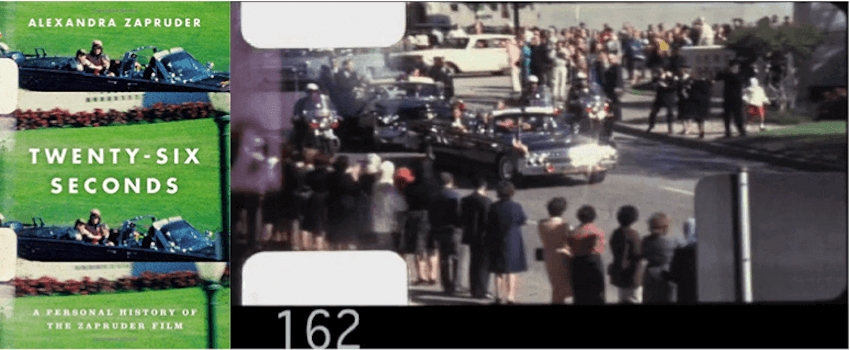
Alexandra Zapruder, Twenty-Six Seconds: A Personal History of the Zapruder Film (Part 1)

With a new book, Twenty-Six Seconds: A Personal History of the Zapruder Film, author Alexandra Zapruder offers her unique perspective to discuss issues surrounding and contained within the brief filmstrip which is the best visual record of the John Kennedy assassination. As the granddaughter of Abraham Zapruder, the man responsible for the film, the author can balance historic and technical details with a personal family story. Her status also allows for privileged access to archives and persons associated with the film, and reveals some new – albeit not earth-shattering – information. However, the book is imbued with a certain partisanship, not limited to family interests, which dulls the author’s critical thinking in some key areas. The shortcomings will seem acute to those in the critical research community, less so to those who come to the book as the personal memoir of unassuming folks who become accidentally fused with an historic event.
A self-described “conventional thinker”, Zapruder is comfortable and reasonably adept dealing with conventional narrative themes in her extraordinary tale – public and personal tragedy combine; family legacy and memory; legal and ethical questions encountered and choices made – but her annoyance with the spoiler element in this story is perceptible each time she types “conspiracy theorist”, which she does a lot.1 Current respectable mainstream opinion, it appears, continues to resist the critical literature developed since the JFK Records Act. Such denial was exemplified by Joyce Carol Oates in a review of Twenty-Six Seconds at the Washington Post, in which she categorized criticism of the Warren Commission as a “farce” which undermined “trust in the U.S. government and in authority in general that continues to this day.”2
The Zapruder Film and LIFE Magazine
Print rights for the film were purchased for LIFE Magazine by the Time Inc. media conglomerate Saturday morning November 23, less than twenty-four hours after the event. Rights for the film as a motion sequence were purchased the following day, although these latter rights would never be utilized. In total, LIFE paid $150,000 for the film. The author is somewhat defensive about this transaction, although it could be reasonably contended that after the authorities decided not to seize the film, Abraham Zapruder was simply a good businessman who negotiated a price the interested party was willing to pay. He also expressed to his family a sensitivity over the graphic presentation and felt that LIFE could be trusted to restrain any urge to exploit the images.
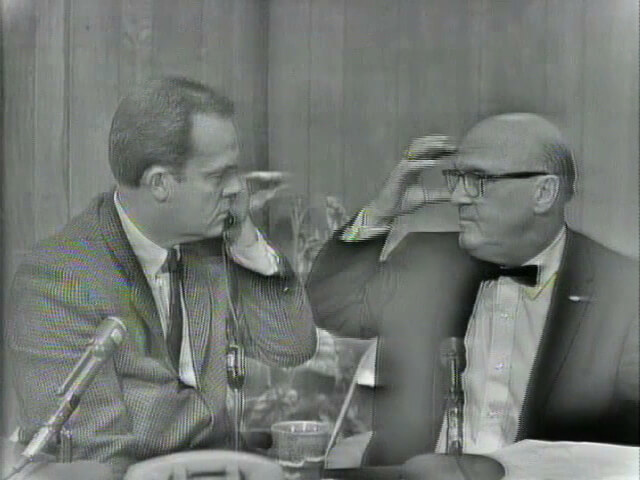
Zapruder appeared on WFAA-TV
a few hours after the shootingIn the LIFE archives, the author would years later find evidence of internal debates over how to handle the more graphic frames. Leading up to the special JFK memorial issue of LIFE, published two weeks after his death, art director Bernard Quint cautioned that “momentary opportunism displayed in the use of these details in colour will be to our everlasting discredit”, and promised to publicly resign if they were printed. Zapruder recites LIFE’s own understanding of this memorial issue: a responsible public service, sold at lower cover cost, with any profit donated to the Kennedy Library. Previously, Abe Zapruder had donated a portion of his proceeds to the family of slain police officer J.D. Tippitt. Many sides to these complexities find reflection, as author Zapruder has skills in retelling personal experiences and thought processes, and in clear description of various facets of controversies with the film. Just not all the facets.
LIFE’s JFK Memorial issue, and also the December 6 regular edition, featured a one-page article attributed to associate editor Paul Mandel titled “End To Nagging Rumors: The Six Critical Seconds”. Acknowledging there were growing rumors and doubts pertaining to the official explanation of the assassination as the work of a single lone-nut shooter, the article purported to “answer some of the hard questions” and reassure the American people that Oswald was the guilty man based on the available evidence, including the Zapruder film. Briefly discussing Mandel’s article, author Zapruder concedes that “some of his facts are mistaken” but leaves it at that without further clarifying that one of these mistaken facts is directly related to a gross misreading of the film.
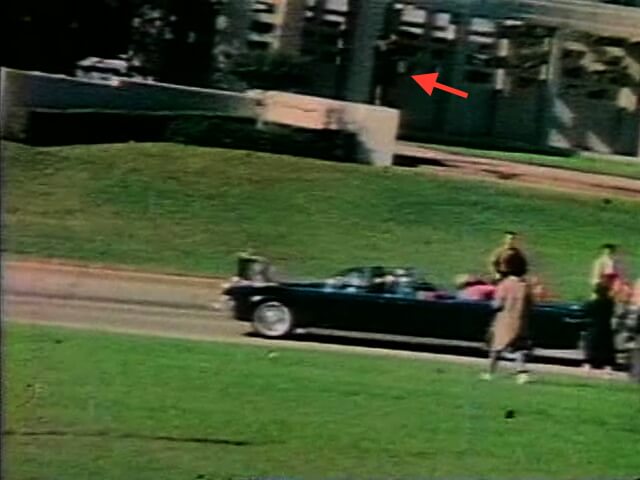
Abraham Zapruder can be seen filming
in this frame from the Nix filmOne of the featured “nagging rumors” concerned how the President could have a wound of entry in his throat, as reported to the public by Dallas Parkland Hospital doctors, when the alleged shooter was positioned directly behind during the shooting sequence. Mandel, referencing his employer’s exclusive possession, writes: “the 8mm film shows the President turning his body far around to the right as he waves to someone in the crowd. His throat is exposed – towards the sniper’s nest – just before he clutches it.” In fact, at no time during the entire filmed sequence was Kennedy ever facing back towards the alleged sniper’s nest. So how could Mandel have been so wrong? He possibly had not seen the film himself and repeated a description from another source, or there had been a conscious editorial decision to assist the government in shutting down rumors which challenged the lone-nut verdict regardless of the veracity of the published information.3 The full measure of this incident – a wholly incorrect description of what is seen in the film used to help deflect concerned inquiry as to what may have happened to JFK (and American democracy) – does not support confidence in LIFE’s responsible handling of the Zapruder film.
What could explain this? Shortly after news of the assassination broke, LIFE’s Los Angeles bureau chief Richard Stolley was assigned to Dallas where, shortly after establishing a base of operations, he received word that the assassination had been captured on 8mm film. Stolley’s persistence enabled access to Abe Zapruder that evening, and by Saturday morning a contract had been signed for the print rights to images from the film. This contract specifically excluded rights to the film as a motion sequence, although a one-week window was stipulated before Zapruder could shop those rights to others. The following day, word came from corporate headquarters, specifically from LIFE publisher C.D. Jackson, to proceed in purchasing these motion rights, which was done for an additional $100,000. That huge sum, doubling the print rights, was paid for rights not apparently as useful to Time-Life, which specialized in print-based media. In fact, Time-Life never exploited the film as a motion sequence during the whole time the film was in its possession. Nevertheless, as an internal LIFE memo cited by Zapruder states: “C.D. Jackson bought the copyright to Zapruder’s film to keep it from being shown in motion.” 4
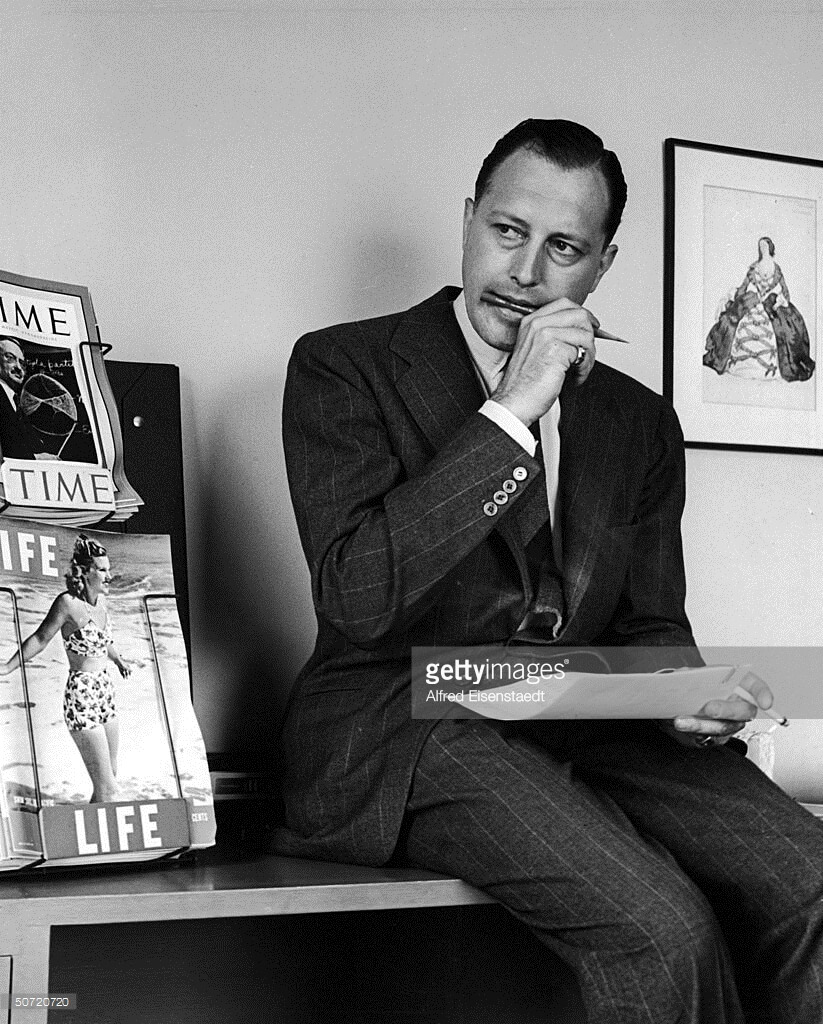
C. D. Jackson In 1977, Rolling Stone published a landmark story by renowned journalist Carl Bernstein titled “The CIA and the Media.” Using information uncovered by the Church Committee and interviews with CIA officials, Bernstein revealed to the general public a longstanding and friendly relationship whereby journalists and management from America’s established mainstream media secretly “carried out assignments for the Central Intelligence Agency.” Time Inc., parent company of LIFE, was named, along with CBS and the New York Times, as the “most valuable” organizations to the CIA. Henry Luce, the founder of Time and LIFE, was a longtime close friend to CIA Director Allen Dulles. Bernstein adds: “For many years, Luce’s personal emissary to the CIA was C.D. Jackson, a Time Inc., vice‐president who was publisher of Life magazine from 1960 until his death in 1964. While a Time executive, Jackson coauthored a CIA‐sponsored study recommending the reorganization of the American intelligence services in the early 1950s.”5
A Princeton graduate, C.D. Jackson began working for Time Magazine in 1931, he would soon be described as founder Henry Luce’s right hand man. In 1940 Jackson organized an “anti- isolationist propaganda group” called the Council For Democracy, funded by Luce and designed to counter America First movements and promote intervention in Europe; the members included Allen Dulles, Joseph Alsop, and Dean Acheson.6 Jackson served in the OSS in 1943 with Frank Wisner, later organizer of the CIA’s Operation Mockingbird.7 In 1944, Jackson was appointed Deputy Chief of the Psychological Warfare Division at Allied Supreme Headquarters. After the war he became Manager-Director at Time-Life International, while a long association with the CIA began in 1948. Jackson served the executive branch during the Eisenhower administration, advising on psychological warfare tactics. Peter Dale Scott noted that Jackson guided LIFE’s involvement in other aspects of the Kennedy assassination: “In an arrangement covered up by Warren Commission testimony, Jackson and Life arranged, at the urging of Dulles, to have Marina’s story ghost-written for Life by Isaac Don Levine, a veteran CIA publicist.”8 Author Zapruder does not bring up Jackson’s fascinating background, and claims he was motivated to purchase the motion rights after he “was personally upset by the film” and felt “the public should not see the images” because of their graphic content.9
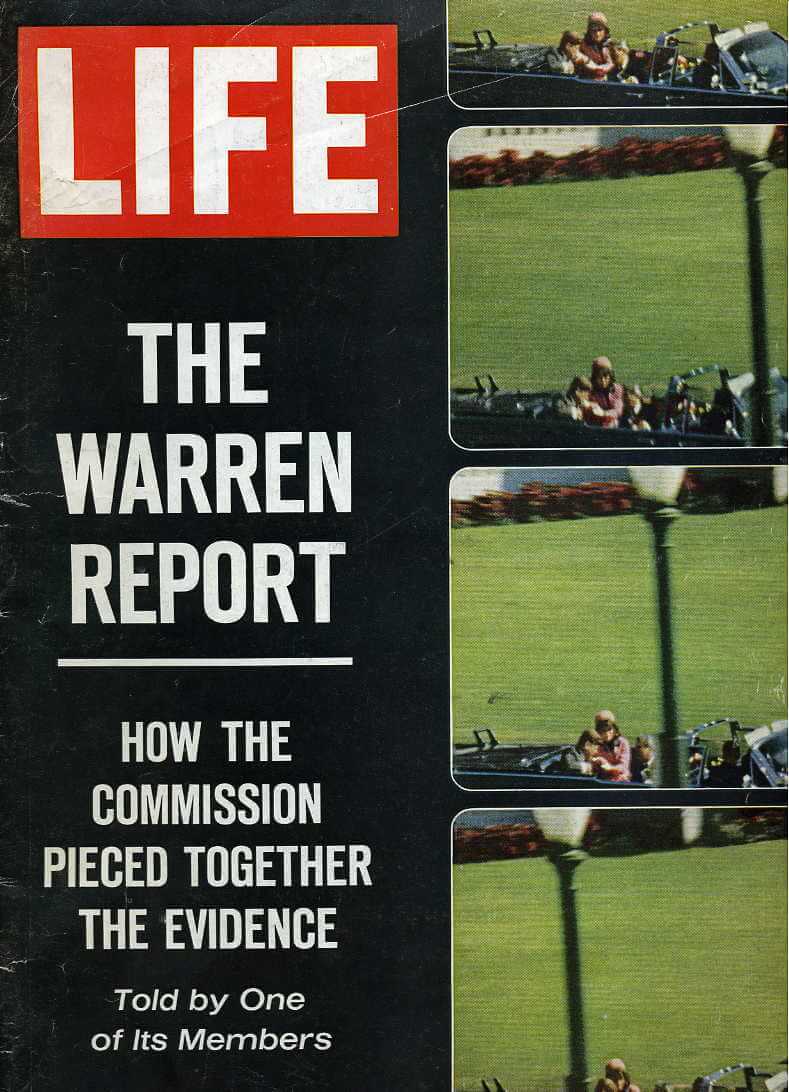 LIFE Magazine would also publish an Oswald backyard photo on its cover in February 1964, after an unauthorized leak from a contact within the Dallas Police Department, exposing millions at supermarkets and newsstands to a rather prejudicial image. This was accompanied by a long biographical article, which portrayed alleged assassin Oswald as a sociopathic loser, the position later adopted by the Warren Commission. In concert with the release of the Warren Report, LIFE’s October 2, 1964 issue featured Zapruder frames on its cover and an approving review of the Report, including an article penned by Warren Commission member Gerald Ford. Author Zapruder refers to the issue as an “examination” of the Warren Report, although the Report itself had not yet been released as the issue went to the printers.10 The issue in fact went to the printers several times, as captions below reproduced Zapruder frames were revised. In retrospect, LIFE’s coverage of the assassination, in the year immediately following, featured dodgy reporting and an eagerness to support the emerging official story, an eagerness which went beyond that of a supposedly objective “trusted” news source.
By 1966, the critics – who had actually read the Warren Report – earned a great deal of public attention publicizing many serious flaws in the assembled evidence. LIFE, as with other mainstream outlets such as CBS, decided to keep pace with public opinion and called editorially for a re-examination of the evidence. They then assembled a team to do just that for LIFE itself.11 An assistant philosophy professor named Josiah Thompson, who had developed a serious interest in the assassination, was hired as a consultant. Thompson, who had seen a second generation copy of the Zapruder film at the National Archives, now had access to the original film (“… the colors were there, the clarity was there. It was really something, really, really something”). Author Zapruder does a good job describing how competing interests suddenly came to coalesce around the film: Warren Commission critic Thompson and CBS News, which wished to broadcast the film as part of a news special, advocated public release – while LIFE’s editors resisted, insisting that their ownership of the film rights gave them the final word.
Thompson surreptitiously made his own copy of the film from LIFE’s own frame-by-frame transparencies. In 1967 he published Six Seconds In Dallas, a powerful critique of the Warren Commission’s methodologies. When LIFE refused to allow him to use frame reproductions from the Zapruder film for the book, Thompson had drawings made depicting selected frames and published those.12 LIFE sued over breach of copyright. In discussing this, author Zapruder sides with LIFE, describing Thompson’s unauthorized use of the film images as copyright infringement. Working from internal documentation, and accepting at face value the good faith of the LIFE management as they wrestled with what to do, she lays out the legal and moral supporting arguments for LIFE’s position, and asks: “so what made this circumstance different?”13
As Thompson’s case headed to court, Walter Cronkite at CBS publicly scolded LIFE for holding the film back from the public.14 Thompson and his publisher would eventually beat back the LIFE lawsuit when the judge ruled that their presentation of portions of the film fit the doctrine of “fair use”. That the Zapruder film was important and salient to the controversies surrounding the assassination was now understood by growing numbers of an increasingly skeptical public (or “small army of committed conspiracy theorists” as author Zapruder puts it). It was also becoming understood that the film contained “confusing visual information” (also Zapruder’s term) as the President is hit by the fatal shot.
Garrison Subpoenas the Zapruder Film for the Shaw Trial
The “confusing visual information” led to New Orleans prosecutor Jim Garrison’s subpoena of the film, so it could be screened as part of the trial of Clay Shaw. As later described in the movie JFK, the “back and to the left” movement of the President’s body immediately after receiving a shot at Zapruder frame 312, was thought by Garrison to be compelling proof of a conspiracy. Author Zapruder is skeptical. She offers a then contemporary analysis by physicist Luis Alvarez, known as the “jet effect”, as an “an important example of how scientific analysis, and not political bluster, could be applied to the question” of the assassination.
Discussing the Clay Shaw trial, Zapruder does her readers a great disservice by relying heavily on an obviously biased and subjective source, namely the 1970 book American Grotesque by James Kirkwood.15 Certainly, a fair-minded author would have noted the overt one-sided character of the book and at least seek out a second source for balance. Zapruder apparently did not. In fact, she allows Kirkwood’s at times harsh and demeaning descriptions to color her discussion of this event. Therefore, using Kirkwood’s take of the courtroom during the screening of the Zapruder film – “the anxious, ill-tempered and, if not bloodthirsty, most definitely morbid craning mob of voyeurs who were glued to the screen” – serves to deflect attention from the actual effect of the screening itself, and the centrality of the film to the prosecution’s analysis of the Dealey Plaza event. If unable to fit Shaw into the plot, the jurors were, in fact, convinced by the presentation that there was indeed some form of conspiracy involved in Dallas. The acknowledgment of this is muted, because the focus is instead drawn to Kirkwood’s descriptions of the courtroom viewing as representing a bloodthirsty mob: “a hungry look of salivating eagerness seemed to draw their faces to a point…”16
The genie, however, was out of the bottle, as the Zapruder film became bootlegged from a variety of sources, and public screenings were arranged at college campuses and other venues.
The Zapruder Film Goes Public

1975 – Robert Groden & Dick Gregory screen
a bootlegged copy of the Zapruder film
on national televisionAuthor Zapruder dismisses “the familiar tropes of conspiracy arguments that came from viewing the film”, without really addressing such tropes. Instead, she laments the trampling of LIFE’s property rights and engages in metaphysical reflection on possible neurological deficiencies to explain the “conspiracists.” In fact, the effect of the film on audiences in the 1970s can be seen for oneself. For the public reaction to the first televised showing is readily available in a clip from the 1975 ABC program Good Night America. On that March 6th program, Geraldo Rivera hosted Robert Groden and Dick Gregory. They then presented the film to a studio and national television audience. The gasp of the audience as the President is hit in the head is audible, a response partly to the gruesome imagery, but also to the unmistakable impression the man had been shot from the front, even as established wisdom placed the assassin directly behind. Warren Commission staff lawyer David Belin conceded during the Rockefeller Commission – one of several official inquiries of the era into the assassinations of the 1960s and the activity of intelligence agencies – that “a major portion of the public controversy concerns the Zapruder film.”17 Author Zapruder complains that the bootleg screenings in the 1970s lacked a presence “to offer a dissenting interpretation of what the film showed.” She again refers to Alvarez and his “jet effect” theory as a plausible and scientific interpretation. She is apparently unaware that Alvarez’ methods (always controversial) explaining and reproducing this effect have recently come under a rather damaging analysis.18
Much of the remainder of Twenty-Six Seconds follows the relinquishing of the original Zapruder film from Time Inc. back to the Zapruder family, its storage at the National Archives, and the legal wrangling over the film in the 1990s leading to a large payment to the family. Author Zapruder handles this aspect of the story solidly, again moving fluidly from the documentary record to personal experience as her father assumes responsibility for the family’s interests (Abraham Zapruder passed away in 1970). If not for the historic controversy which is embedded directly within the frames of this film, Alexandra Zapruder would be responsible for a decent non-fiction account of ordinary people accidentally conjoined with sudden historic events, which is certainly the story she wants to tell here. So what seems to have happened here is understandable, as the controversy is complex and multi-faceted but the author has presumably neither the time or patience to delve deeply into it, and her conventional thinking has her leery of those she identifies as “conspiracists.” The author acknowledges that she received guidance in the issues of controversy from certain advisors.
A key advisor on the subject of the assassination controversies for this book appears to be author Max Holland, a longtime reliable defender of the Warren Commission, who has been writing on the topic for major newspapers and publications such as The Nation since the 1990s, as well as appearing in mainstream cable documentaries. Holland has written five books on national security topics and has been awarded numerous Fellowships, including a Studies In Intelligence Award from the CIA in 2001.19 Holland is best known recently for his fairly well publicized contention that the first shot in the JFK assassination sequence occurred much sooner than previously believed, and at a time not captured in the Zapruder film (author Zapruder finds this theory “compelling” and backed by “extensive additional evidence.”) Zapruder says the two met in 2015, late in the writing process for Twenty-Six Seconds, and in the book’s acknowledgements Holland is praised as “one of the most thorough, careful, and thoughtful thinkers I’ve ever met … He clarified my thinking on many important issues, gently challenging me on my assumptions …” (For a differing view of Holland, see “The Lost Bullet: Max Holland Gets Lost In Space“.)
In December 2016, Zapruder provided an opinion piece to the New York Times titled “There Are No Child Sex Slaves At My Local Pizza Parlor”, which dissected a brief hysteria surrounding an armed man who thought to disrupt a purported kiddie ring fronted by a Washington D.C. area pizzeria. Although her points are well-taken as far as they go with the immediate story, she claims additional authority to speak of the phenomenon from encounters with “conspiracy theorists” who directed certain speculations at her grandfather.20 Fair enough, but Zapruder then analyzes: “If one outcome of Kennedy’s assassination was a loss of trust in government and the news media, we have now entered an era in which such suspicions have mushroomed into something far more dangerous — a rupture in the very idea of shared truth.” Which sounds alarming, and is alarming in the sense that a shared consensus reality is vital to bind our material lives within a peaceful society, but do the actions of one confused young man really portend the fracturing of reality?21 What is she talking about? In part she is talking about the Kennedy assassination and its aftermath, but in doing so Zapruder is unable to acknowledge that the loss of trust accorded the government and news media has been well earned. And that the mainstream “shared truth” of the Kennedy assassination is factually incorrect, despite what her advisors may have told her.
It may well be that the ultimate readership for Twenty-Six Seconds has little interest in formulating an opinion on the JFK assassination controversy, and would have a mild curiosity at best regarding the state of the case. Still, since the book’s accumulation of questionable activity falls heavily on the side of the “conspiracy theorists”, while investigating authorities and representatives of the mainstream media are frequently portrayed as responsible and even-handed, a rather misleading notion is presented of what the Kennedy assassination has revealed about the “trusted” stewards of the nation. It also trips up an author’s attempts at finding a poetic, or metaphoric, truth in her grandfather’s film. Utilizing Holland’s 2014 Newsweek article “The Truth Behind JFK’s Assassination”, Zapruder repeats his contention that the “film displaced Oswald’s view from the sixth-floor window”, that its necessarily partial visual record now “had to stand in for seeing the assassination through Oswald’s eyes and hearing it described in his words.” Though one might be tempted to reach for a cappuccino and ponder varieties of historical irony, what is being advanced is a purely sophist construction, as the overwhelming weight of the evidence shows that Oswald was not on the sixth floor of the TSBD at the time of the shooting and did not fire a rifle that day.22 That the author does not seem to know this will harm the book’s reputation in the future, although its more valid, and better presented, insights will likely retain some interest.
NOTES
1 Critics of the official Warren Commission findings are, as a rule in this volume, referred to as “conspiracy theorists”. Late in the proceedings, reference is briefly made to “assassination researchers”.
2 Joyce Carol Oates, “Twenty-Six Seconds of the Kennedy Assassination – and a Lifetime of Family Anguish.” Washington Post, November 17, 2016.
3 Other information in the article, such as determining the film ran at 18fps or determining frame counts between presumed shots, likely was not generated by LIFE and came to it from government sources, as discussed in Part Two of this review. Although author Zapruder is fuzzy about it, the official FBI findings were still a week away from publication as the memorial issue and Dec 6 edition were put to press, suggesting an official source contributed to handling the “nagging rumors”, as an official source assisted LIFE’s later Warren Report coverage.
4 The memo is quoted on page 194 of Twenty-Six Seconds.
5 Carl Bernstein, “The CIA and the Media.” Rolling Stone Magazine, October 20, 1977. The article is also available on Bernstein’s website. Bernstein writes: “the Agency has cut back sharply on the use of reporters since 1973 primarily as a result of pressure from the media.” As the main source of information for the article was interviews with unnamed CIA officials, the cooperation may have served as a limited hang-out after Bernstein had uncovered the story from Church Committee sources. Certainly these CIA officials go out of their way at times to identify media outlets and journalists as CIA friendly despite firm denials from the outed parties. However, the historic information – including Luce and C.D. Jackson – has never been refuted, and since publication largely confirmed through document releases.
6 In other words, Jackson was involved within an internationalist (“globalist”) Eastern Establishment milieu which lobbied for US participation in a European war, and then helped staff the OSS, create the CIA and construct the foundations of the Cold War National Security State. In the Eisenhower years, this milieu developed a foreign policy which relied on covert manipulation and regime change around the globe. John Kennedy’s nascent challenge to this world view has been focus of much recent scholarship. C.D. Jackson died in 1964.
7 Operation Mockingbird was the CIA’s program to influence the American media, and was disclosed in the 1977 Bernstein article.
8 The Marina Oswald story was not ultimately published, but she was well-paid for the rights. Peter Dale Scott, Deep Politics, p 53. See also Warren Hinckle and William Turner, Deadly Secrets: The CIA-Mafia War Against Castro and the Assassination of JFK (1981).
9 Twenty-Six Seconds, p. 97.
10 LIFE joined the New York Times and CBS News in providing instantaneous reviews, or “examinations”, of the Warren Report, all three trusted news sources referring to it appreciatively as a thorough and complete explanation of the President’s assassination, even though there had not yet been the opportunity to actually read it.
11 Both LIFE and CBS soon afterwards abandoned critical inquiry and dissolved their investigating teams. CBS would continue to create television documentaries supporting the Warren Commission, such as the 1967 multi-episode CBS News Inquiry: The Warren Report. (For an analysis of the genesis of the 1967 special, see now James DiEugenio, “Why CBS Covered Up the JFK Assassination“.)
12 Due care was taken to ensure the accuracy of the drawings, unlike certain exhibits created for the Warren Commission.
13 What made it different is the overwhelming sense that justice had not been served in the aftermath of the assassination, that it was still an open case, and that an apparent establishment cover-up of the true reasons for Kennedy’s death presented serious challenges to the American democratic system and the understanding of contemporary events. However, if one believes, as author Zapruder appears to, that the Warren Commission essentially got it right and “conspiracy theorists” have been not just historically wrong but prone to psychological malady which influences their fuzzy thinking, then accepting LIFE’s decision to effectively sequester the film becomes a lot simpler.
14 “LIFE’s decision means you cannot see the Zapruder film in its proper form, as motion picture film. We believe that the Zapruder film is an invaluable asset, not of Time Inc., but of the people of the United States.” CBS News Inquiry: The Warren Report, 1967. The program supported the basic conclusions of the Warren Commission. It is possible that CBS sought to acquire the film so that it could be “explained” to the public in a manner favorable to the official conclusions, while maintaining a plausible facade of the fearless Fourth Estate.
15 American Grotesque is notable as the source for the oft-repeated claim that Garrison’s primary motivation for prosecuting Clay Shaw was rampant homophobia.The premise for the book had been first suggested by defendant Shaw himself ahead of the trial, pitching the concept to others before Kirkwood agreed to take it on. Kirkwood and Shaw had been friends for two years ahead of this. During the trial Kirkwood was close to the extremely compromised reporters James Phelan and Hugh Aynesworth, both engaged in sabotaging the trial to the extent possible.
16 Zapruder lists the Kirkwood book, courtroom transcripts, and contemporaneous newspaper accounts as her source material for the Shaw trial, her discussion of which concludes: “The Garrison trial went down in history as a gross abuse of power … Garrison’s actions deeply discredited the conspiracy movement and drove it back underground for many years.” This opinion, not gleaned from the transcripts or newspaper accounts or Kirkwood’s book, and obviously not Zapruder’s own, is likely that of an advisor discussed below, and is challenged by more recent work from Joan Mellen and Jim DiEugenio.
17 Memorandum, David Belin to James B. Weidner. April 21, 1975.
18 Alvarez claimed, in the American Journal of Physics, September 1976, that his shooting mock-up in 1969 “showed retrograde recoil in the first test … If we had used the ’Edison Test,’ and shot at a large collection of objects, and finally found one which gave retrograde recoil, then our firing experiments could reasonably be criticized.” But Josiah Thompson, who is also a figure in Zapruder’s book, gained access to Alvarez’ experimental resources and discovered that, contrary to Alvarez’ statement, a large collection of objects were fired upon until one was found which gave retrograde recoil. Thompson’s access to the materials was provided by Paul Hoch, who is listed as an advisor for this book specifically on the jet effect. Thompson presented this new information on Alvarez and his jet effect experiments at the Passing The Torch Conference in Pittsburgh, October 2013.
19 Holland reviewed Peter Dale Scott’s Deep Politics in 1994, writing of the controversy: “The field already brims with books that conjure up fantastic conspiracies through innuendo, presumption, and pseudo-scholarship while ignoring provable but inconvenient facts …Yet there remains something truly remarkable and disturbing about Deep Politics, and it’s not that a tenured English professor wrote its opaque prose. Rather it’s that Deep Politics is a University of California Press book … this means an editorial committee consisting of 20 UC professors, including four senior historians, approved Deep Politics for publication. This peer approval by a major university press illustrates the boundless and utter disbelief in the Warren Report … and it also reveals the gross inattention given to the subject by serious historians.” One man’s “serious historian” is of course another’s “pseudo-scholar”, and Holland demonstrates through this review/article that there are few elements of the official story to which he does not subscribe, despite the obvious challenges to credulity the Warren Report invokes. Lamenting a lack of “serious historians” on this subject while casually accepting that Oswald attempted to assassinate General Walker or that Oswald’s FPCC activity in New Orleans should be taken at face value, necessarily leads to a position which praises generally poor books by Patricia Lambert or Jean Davison or Gerald Posner while positioning Scott as suffering from a “fevered imagination.” That is, Marina Oswald’s wild and ever-changing stories from 1964 regarding her husband’s alleged stalking of Walker, which is just about the only evidence that such a thing ever happened, is legitimate fact, while Scott’s carefully annotated scholarship is not. Apparently, developing pseudo-psychoanalytic theories regarding Oswald’s state of mind is a hallmark of “serious history”, while recognizing the official record can’t even place Oswald in the so-called sniper’s nest is the domain of fantasizing conspiracists.
20 Abraham Zapruder’s name has, over the years, suffered speculation of sinister relationships or agency in the assassination. As well, the Zapruder film has suffered numerous incorrect interpretations, often from viewing poor multi-generational copies. The most well-known incorrect assumption is that Secret Service driver Greer turned and shot JFK with a pistol. The fallacy of this interpretation should not disguise that Greer slowed the limousine to a crawl and turned twice to view the chaos in the seats behind him, including a direct view of the fatal shot before turning back and accelerating.
21 After all, it wasn’t so long ago a cudgel of fake facts, many promoted by the New York Times, was used to bludgeon the body politic into supporting a US Air Force-led “shock and awe” campaign in Iraq, followed by an invasion and brutally careless occupation, ending or ruining the lives of several million people, and destabilizing an entire region. For that matter, even a cursory reading of Establishment reporting on the Kennedy assassination reveals an array of poor and misleading information. Or, consider C.D. Jackson’s work in psychological warfare during the Eisenhower administration, which would include portraying a vicious right wing coup against Guatemala’s democratic government as a populist uprising.
22 We know this because at the exact time Oswald was said to have dashed down the Texas School Book Depository’s rear wooden staircase moments after the shooting, two witnesses were descending the same staircase and they saw and heard nothing at all. The bad faith by which the Warren Commission discredited the witnesses and created a wholly different timeline has been described by author Barry Ernest in his book The Girl On The Stairs. While researching this topic, Ernest discovered a Commission memo from June 1964 which confirmed the timing as stated by the witnesses, and which was subsequently buried as the Warren Commission proceeded to publish their false account. Not a single piece of hard evidence places Oswald on the sixth floor with a gun in his hand, as Dallas Police Chief Curry conceded in his own book written in 1969. Paraffin tests of Oswald’s cheek conducted by the Dallas Police on the night of the assassination did not show traces of nitrate as should be expected, and therefore show with a high degree of certainty that he did not fire a rifle.
-
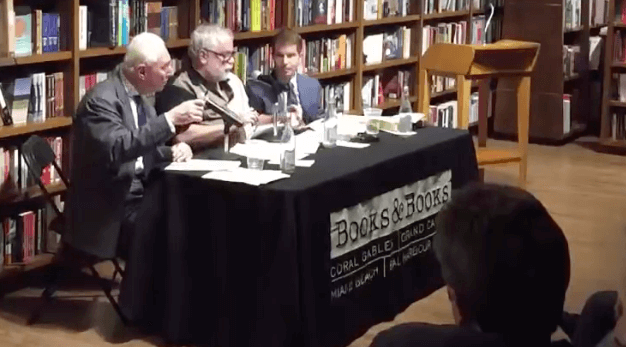
Gerald Posner vs. Roger Stone in Coral Gables
On the 54th anniversary of President Kennedy’s assassination, at a bookstore in Coral Gables, Florida two famous authors convened. They were Gerald Posner and Roger Stone. The subject was a debate over the circumstances of Kennedy’s assassination. Obviously, because of the orientation of their books on the subject, Posner defended the Warren Commission verdict while Stone argued for a conspiracy.

Robert Loomis Posner was trained as a lawyer. At age 23, he became one of the youngest attorneys ever employed by Cravath, Swaine and Moore, John McCloy’s old law firm. In 1980, he left that firm and opened a private practice with a partner. In 1986, he left that practice and became an author. In a relatively short period of time, he wrote three non-fiction books and one novel. In 1991, he was enlisted by Robert Loomis of Random House to write a response to Oliver Stone’s movie about the Kennedy assassination, JFK. The very plugged-in Loomis promised Posner that the CIA would cooperate with him on the project. (The Assassinations, edited by James DiEugenio and Lisa Pease, p. 369) And they did. Without their help, how else could an author gain access to high level defector Yuri Nosenko?

Harold Evans As was exposed in a later lawsuit by the late Roger Feinman, Random House put a major effort into selling Posner’s Case Closed. One that was personally supervised by Harold Evans, who was president of the publishing house at the time. According to information Feinman discovered in his lawsuit, it was Evans who personally approved the infamous NY Times ads for the book. This was a four-phase campaign. It began with two teaser ads that promised to name the guilty parties in the JFK assassination. It culminated with two more ads. These featured the faces of Oliver Stone, David Lifton, Robert Groden, Jim Marrs, Mark Lane and Jim Garrison under a title which boldly accused them of the charge: “Guilty of Misleading the American Public”. If the reader knows anything about advertising costs in major newspapers, he can guess what those four ads cost. (Click here for Feinman’s essay about his lawsuit against Random House.)
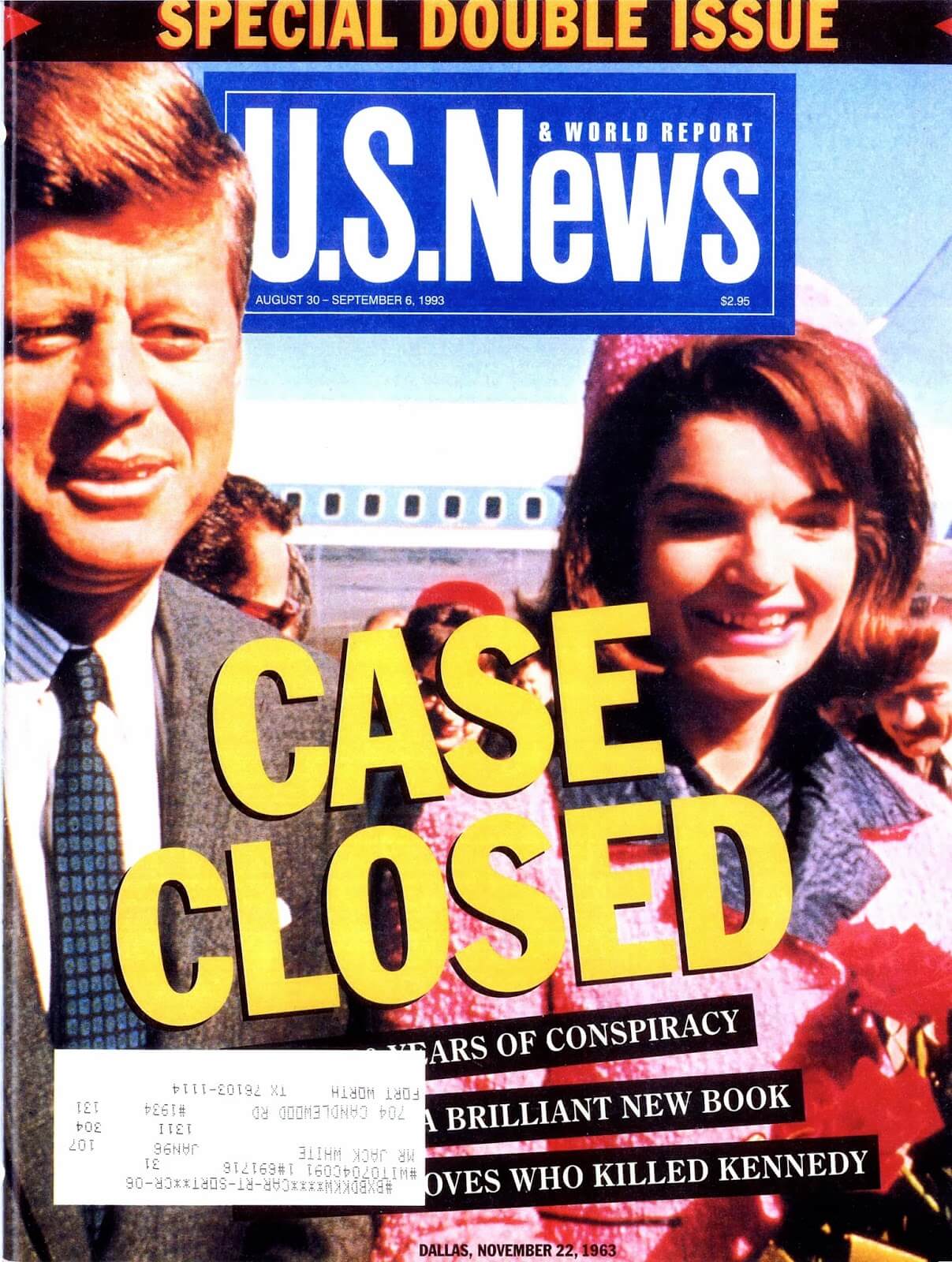
But that was not all. Apparently because Evans had previously served as a director of US News and World Report, that magazine gave Posner’s book a cover story. The book became such a cause celebre that other authors have successfully used it as a way to curry favor with the MSM, e.g., Jeff Toobin and Robert Dallek.
The problem with all this hoopla, which was designed to coincide with the 30th anniversary of the assassination, is that it was completely unwarranted. There were several reviews that showed just how flawed Case Closed was: for instance, David Wrone’s. (See also this index of items on this site.) In fact, there were so many problems with Posner’s book that activist Dave Starks put together a compendium page of articles to show that, not only was Case Closed a very bad piece of scholarship, but it might have been worse than that. In his haste to do a hatchet job on the critics, Posner may have created interviews he did not actually do. For instance, Peter Scott talked to Carlos Bringuier after Case Closed came out. Contrary to the book’s claims, Bringuier said he never talked to Posner. (Author interview with Scott in San Francisco in 1994) Same with Dealey Plaza witness James Tague, who the author clearly states he talked to on two successive days. (See Posner, paperback edition, p. 546) When Gary Aguilar talked to Tague, he said he never spoke to Posner. To use another example, although the author said he interviewed JFK’s forensic pathologist Thornton Boswell, Boswell told Aguilar he never spoke to him. (Click here for Starks’ devastating page on Posner.)
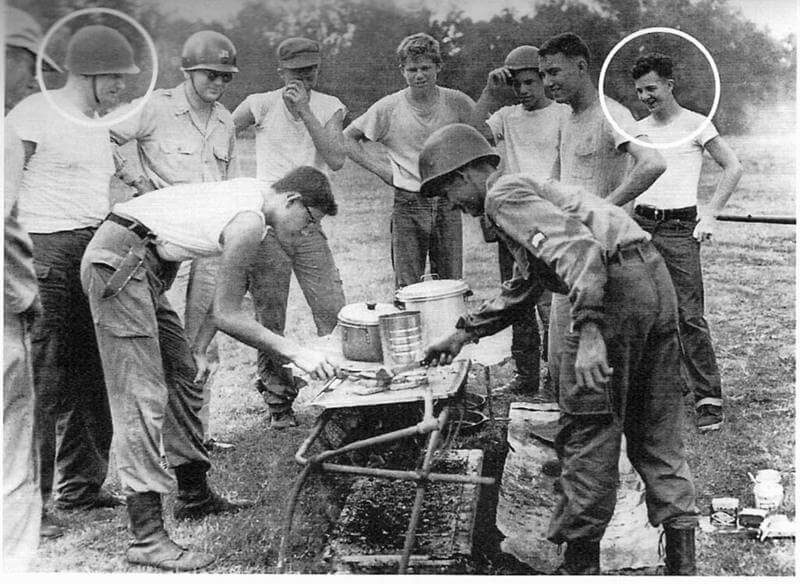
David Ferrie & Lee Oswald,
Civil Air Patrol (1955)Posner also committed some outright howlers in his much-ballyhooed book. For example, in his schematic drawings of the assassin at the Texas School Book Depository window, he has him posed as firing from an extreme left to right angle. So much so that these “Posner shots” would have ended up in the railroad yards behind the picket fence. (See Appendix A of Case Closed, paperback edition.) This makes one wonder if Posner was ever in Dallas. Because to anyone who has been to the building and peered out the sixth floor window—which was possible back then—it presents a slight right to left angle. Posner also wrote that there was no evidence to connect David Ferrie with Oswald. (Posner, p. 425) This was utterly ridiculous on many counts. But to name just one, when the book came out PBS did a special which featured a photo of Oswald and Ferrie together at a Civil Air Patrol (CAP) barbecue. They found it by questioning some other members of the CAP. Which means Posner could have done the same if he had knocked on some doors in the Crescent City. Posner also writes that there was no such personage as Clay Bertrand in New Orleans. When the JFK Act declassified both the Jim Garrison files and the papers of the HSCA, Posner again ended up with custard pie on his face. Those documents reveal that the number of witnesses who stated that Clay Shaw used the alias of Clay Bertrand was in the double digits. (Destiny Betrayed, Second Edition, by James DiEugenio, pp. 211, 387, 388)
Posner’s book showed us in excelsis just how schizoid America is on the murder of President Kennedy. It did not matter to the Powers That Be just how error-strewn Posner’s book was. It did not matter to them that he was more or less acting as a hired gun for Loomis and Evans. It did not matter to them that the book was obviously a rush job for the 30th anniversary. Or that the title was preposterous since the declassification process of the JFK Act had not even gone into effect yet. In other words, the book was saying the case was closed when, in fact, two million pages of documents were about to be declassified in the next four years.
Clearly, as representatives of the Anglo-American Establishment, the important thing for Loomis and Evans was this: They wanted to create a tangible cultural artifact to rally around at the 30th anniversary. Why? In order to beat back the tsunami effect of Oliver Stone’s JFK, which had blindsided them. Posner’s book was a concocted historical event. Today the book has been retired to the (rather large) ash heap of useless volumes on the JFK case. It has no intrinsic factual merit to it at all. It is simply an exemplar of a two-part cultural/historical phenomenon. I say two parts, because the second phase of this Jungian neurotic outbreak occurred four years later, with another Loomis client. This time the collective seizure was over Sy Hersh’s equally horrendous book. This one was a biography of John Kennedy, The Dark Side of Camelot. That bookend volume was as bad in its own way as Posner’s tome. But Oliver Stone had not just said that JFK was killed by a conspiracy. His film also stated that Kennedy was a foreign policy iconoclast who was changing things in that realm. This was true and has been proven even more accurate by recent scholarship. But that did not matter with Hersh, whose book was so bad that some critics said it should have been titled, The Dark Side of Seymour Hersh.
II
Roger Stone was born in Lewisboro, New York to a reporter mother and a father who drilled oil wells. Stone got hooked on politics when he read Conscience of a Conservative by Barry Goldwater. Although he admired Goldwater’s ideas he could not comprehend the tactics of his 1964 campaign. To put it mildly, he thought they were rather quixotic. As he told writer Matt Labash, “It’s like he was trying to lose. Going to Tennessee and coming out against the Tennessee Valley Authority? These were suicidal acts.” (Weekly Standard, November 5, 2007)

Roger Stone & Nixon Because of this, Roger Stone became more enamored with Richard Nixon as his conservative standard bearer. He deduced that Nixon was “more pragmatic, more interested in winning than proving a point.” He took a pithy aphorism from RMN: “Losers don’t legislate.” (ibid) Stone liked Nixon so much that he decided that his newly found idol had not really lost the 1960 election. He had been robbed of the presidency through electoral fraud. So he wrote Nixon a letter at his New York law firm encouraging him to run again. Nixon replied that he did not plan on doing so, but if he did, he would be in touch with young Stone. (Stone is such a Nixon fan he had his face tattooed on his back.)
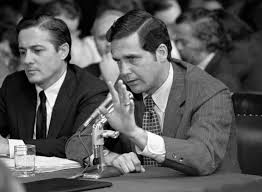
Jeb Magruder testifies
during the Watergate hearingsWhile a student at George Washington University in Washington D.C., Stone invited Jeb Magruder, deputy director of the Committee to Reelect the President, to speak at the college’s Young Republican Club. After the speaking engagement Stone asked Magruder for a job with CREEP. At age 19, Stone decided to forsake his studies and joined right in with the antics of the infamous CREEP. For instance, he planted a mole in the camp of Democratic rival Hubert Humphrey. Magruder and his cohorts were obsessed with intelligence and skullduggery, and Stone had a natural affinity for them. He once wrote a check to Nixon rival Pete McCloskey from an account inscribed as the Young Socialists Alliance. Once he got the receipt he leaked it to the reactionary newspaper Manchester Union-Leader. (ibid)
Against Senator George McGovern in the general election, Stone hired another spy he termed Sedan Chair II. But according to Stone, he did not understand the mentality of CREEP. To him it did not make any sense to take the kinds of risks they were taking when the Democratic candidate, McGovern, had so little chance of winning. After Watergate, which spelled the end of Nixon’s political career, he went to work for Bob Dole, and then for the (failed) Ronald Reagan campaign of 1976. During this period, he co-founded the National Conservative Political Action committee, which was designed to execute a GOP takeover of the Senate. Which, by recruiting men like Dan Quayle and Chuck Grassley, it did. As he noted to Jeffrey Toobin, “The Democrats were weak, we were strong.” (The New Yorker, June 2, 2008)

Donald Trump & Roy Cohn 
John Anderson (Sept. 16, 1980) In 1980, he again worked for Reagan. In that election, he joined forces with the notorious attorney Roy Cohn, sworn enemy of the late Bobby Kennedy. They decided that the best way for Reagan to beat incumbent president Jimmy Carter in New York was to help Democratic congressman John Anderson get on the ballot. This way, the Democratic Party vote would be split and therefore weakened. According to Stone, Cohn told him to get in contact with a lawyer friend he had. Once in contact, he was to ask him how much it would cost to get Anderson the Liberal party nomination in New York. Stone reported back that the price was $125,000. A couple of days later, Stone was told by Cohn to pick up a suitcase and deliver it to the lawyer. He did so, and Anderson won the Liberal Party nomination. Reagan won New York with 46% of the vote. (ibid, Labash)

Reagan’s victory in 1980 allowed Stone to enter the upper stratosphere of political campaign managing and lobbying. He now set up an office with two other GOP stalwarts, Charles Black and Paul Manafort. They would later be joined by none other than the late Lee Atwater, the man usually given credit for the Willie Horton TV ads, which helped defeat Democrat Michael Dukakis in 1988. The firm was lobbying on behalf of such people as Ferdinand Marcos, dictator of the Philippines, as well as conservative causes like the Nicaraguan Contras, and Angola’s UNITA rebels. And they advised several presidential candidates, even when they opposed each other.
Stone’s primacy in the higher circles of the GOP came to an end in 1996. He was serving as an unaccredited adviser to Bob Dole’s presidential campaign when scandal struck. And it struck through the National Enquirer. They billed the story as “Top Dole Aide Caught in Group-Sex Ring.” (op. cit., Toobin) He and his second wife had run ads for swinging partners to participate in bedroom games. (op. cit., Labash) The tabloids even got hold of the advertising photos. Stone tried his usual “Deny, deny, deny” tactics. But they did not succeed.
But in 2000, James Baker, who was running the GOP recount effort in Florida against Al Gore, brought Stone back to perform one last piece of political subterfuge. That act would have a momentous impact on America for decades into the future. It has come to be known as the “Brooks Brothers riot”.
When the Florida Supreme Court ruled that Gore could have a recount in four counties, Stone and Baker decided this had to be thwarted. Scores of Republican congressional aides—the Brooks Brothers suits—had been flown to Miami to simulate grass roots, Floridian protest against the recount. Stone stationed himself in a Winnebago outside the building where the Miami-Dade County recount was taking place. Outfitted with walkie-talkies and cell phones, he went to work using these aides to create the illusion of an indigenous attack on the building. He did this by having the congressional aides actually enter the building and demand the recount be halted. According to the New York Times, some people were struck or kicked. (11/23/2000) This scene inside the building was coupled with Stone inspired Spanish language radio warnings about carloads of Cuban exiles driving to the scene. (op. cit., Toobin) In its broad outlines, the operation resembled the CIA coup in Guatemala in 1954. Between the Brooks Brothers demonstrators and the “imminent Cuban exile assault”, the recount was discontinued. The episode likely stopped Gore from actually taking the lead for the first time. This—plus the later Antonin Scalia order granting emergency relief due to the “irreparable damage” of counting votes—ultimately led to the US Supreme Court decision stopping the recount. And that brought us George W. Bush, perhaps the worst president in history.
III

After his work for Random House on the JFK case, in 1998 Posner wrote a book on the 30th anniversary of the Martin Luther King assassination. To no one’s surprise, Killing the Dream came to the same conclusion as Case Closed—the official story was correct. One year later of course, William Pepper demonstrated in court that Posner was wrong. The jury in a civil case brought by the King family ruled that King was killed as a result of a conspiracy.

David Marwell Because of his establishment-pleasing writings, Posner became a TV and MSM presence. And he continued to write more non-fiction books. He appeared on many TV programs and also as an editorial writer for some major newspapers. According to Doug Horne in his book Inside the ARRB, the first director of the Assassination Records Review Board, David Marwell, said he found much of value in Case Closed. Consequently, he had lunch with Posner more than once. Harold Evans’ wife, Tina Brown, hired Posner as an investigative journalist for the online magazine Daily Beast. But he was forced to step down from that position in 2010 over several accusations that demonstrated that Posner was a serial plagiarist. He not only plagiarized for his articles at Daily Beast, but also in at least three of his books, e.g., Miami Babylon. (See Slate, “The Posner Plagiarism Perplex”, 2/11/2010, also Miami New Times, March 30, 2010)

Tina Brown 
Harper Lee Three years later, the late Harper Lee filed a lawsuit claiming that her literary agent’s son-in-law had directed Posner to set up a corporation to defraud Lee of her royalties from her colossal best-seller To Kill a Mockingbird. In her court filing she said that she had faulty hearing and eyesight and these had been used by Samuel Pinkus to snooker her into signing over her book copyright. Pinkus assigned the copyright to a company incorporated by Posner. (NY Post, May 4, 2013) Four months later, Posner settled the suit and was dismissed from the legal action.
After his work for James Baker in Miami, Roger Stone tended to concentrate on two new subjects. First, there was his friendship with Donald Trump. Stone was sold on the idea of Trump making a run for the presidency on the Reform Party ticket, the party created by Ross Perot. Although Trump made some overtures to run in the 2000 election, he ultimately decided against it. Stone also began to develop an avocation as an author. To say that his output has been prolific does not do him justice. In the space of about three years, beginning in late 2013, Stone has written or co-written—at last count—seven books. At least three of them rely on his relationship with Richard Nixon, who he still holds in high regard. If one looks closely, three of them rely on his relationship with Trump, who he had worked for in Trump’s 2015-16 campaign before they (allegedly) parted ways. His book about Jeb Bush, Jeb and the Bush Crime Family, was clearly meant as a broadside against the candidate most perceived as the favorite in the GOP primary campaign. His book about the Clintons, The Clintons’ War on Women, was meant as a preemptive strike against the attacks against Trump’s philandering with females.


But Roger Stone/author first came to prominence at the 50th anniversary of the JFK assassination. At that time he co-wrote a book entitled The Man Who Killed Kennedy: The Case Against LBJ. That book became a New York Times bestseller. In fact, of all the books released at the 50th, it likely sold the most copies. Since then he has stayed involved in the field. In fact, his co-writers on the two previously mentioned books come from the JFK field. They are, respectively, Saint John Hunt and Robert Morrow.
Why has Stone done this? It likely does not pay him the fees he commanded as a Washington lobbyist working in a very powerful PR firm. In a profile written by Jeff Toobin for The New Yorker, some hints for this career move are tossed out—almost inadvertently. One of the reasons Stone gives for being so enamored of Nixon is his anti-elitism. He adds Nixon was class conscious. And he identified with average people who ate TV dinners and watched Lawrence Welk. To Stone, Nixon “recognized the effectiveness of anti-elitism—a staple of American campaigns even today—as a core message.” In comparing Nixon with Reagan, Stone states that although many Republicans give Reagan credit for the defections of the working class from the Democrats, it was really Nixon who started it. Stone then zeroes in on the whole polarization concept:
Nixon figured out how to win. We had a non-elitist message. We were the party of the workingman! We wanted lower taxes for everyone across the board. They were the part of the Hollywood elite. … The point that the Democrats missed was that the people who weren’t rich wanted to be rich.
There is little doubt that Nixon, with his appeals to the Silent Majority in order to expand and lengthen the Vietnam War, did use these kinds of techniques. It’s obvious from the declassified tapes at the Nixon Library that he did not mean any of it. This was amply exposed by author Ken Hughes, among others, in his fine book Fatal Politics. And this exposure helps explain why Nixon and his family fought so long and hard not to have those tapes declassified. That book reveals that Nixon knew the war was lost in 1969. But he did not want to have South Vietnam fall on his watch. Therefore, he lied to Nguyen Van Thieu of South Vietnam to keep him in his corner while he negotiated an agreement with the north. The whole time he slaughtered tens of thousands of innocent civilians in an expanded air war over all of Indochina. The only reason for this was to announce a peace agreement on the eve of the 1972 election to make sure he had a landslide victory. This is all admitted to on these tapes in the Hughes book, and in letters he sent to Thieu in the book The Palace File.
But the relevant point for today’s scene is that this cultural anti-elite aspect was well used by both Stone and Trump during the latter’s successful presidential campaign. Trump decided to leapfrog most of the MSM, and he did this with Stone’s help. In addition to the two books mentioned above, Stone helped promote the whole mythology of Ted Cruz’s father being seen in New Orleans with Lee Oswald in the summer of 1963. Stone used the word of Judyth Baker to promote this bizarre story. And Trump went on national TV with it. (Click here for our reaction.) The Morrow/Stone book about Clinton helped Trump alleviate the impact of the compelling Access Hollywood videotape. And this whole anti-cultural-elite concept helped avoid the question of how in the heck do the interests of a billionaire real estate investor coincide with America’s shrinking middle class? With the announcement of Trump’s cabinet, we can see that, as with Nixon, the whole idea is little more than window dressing. The policies that this cabinet and the Republican Party will try to enact will gut the middle class even more.
IV
All of the above about these two men is more than relevant to their debate in Coral Gables. Because it informs us of the state of the JFK case in America today. This author would not walk across the street to see Posner speak about either the JFK or King case. Simply because he is a lawyer who is in the employ of the official story. Therefore, it does not matter if what he is saying is incomplete, dubious or just specious. This reviewer has never read any of Stone’s books for the simple reason that I have a hard time thinking that Stone could master something as complex and multi-layered as the JFK case in just a matter of 3-4 years. I am also skeptical of the case that he and others have made against Lyndon Johnson. In watching this confrontation it appears I was correct about these suspicions.
Roger Stone presented first. He led off with remarks about the avulsed rear skull wound that, for him, disappeared from the back of Kennedy’s head after he left Parkland Hospital. (This is not accurate. Gary Aguilar has shown it did not disappear, it was apparent at both the emergency room at Parkland and Bethesda Medical Center, where Kennedy’s body underwent an autopsy.) Stone later added the confusing point that the House Select Committee on Assassinations (HSCA) was convened because of Oliver Stone’s film JFK. I think Roger meant the Assassination Records Review Board (ARRB) was convened.
But he then confuses this issue even more by saying that the HSCA revealed more of Ruby’s Mafia ties, which led them to conclude organized crime involvement in the JFK case. This is not really accurate, as the HSCA did not deduce this as one of their conclusions. Chief Counsel Robert Blakey did that in his later book on the JFK case, The Plot to Kill the President (which was co-written with Dick Billings).
Stone also talked about his relationship with Senator Arlen Specter and how Specter did not have access to the autopsy materials during the Warren Commission proceedings. This needed to be qualified. As revealed by the declassified transcripts of the their executive hearings, the Warren Commission did have the autopsy materials. (Gerald McKnight, Breach of Trust, p. 171) And as Pat Speer has shown on his web site, Specter did see at least one of the autopsy photos. (See Chapter 10, “Examining the Examinations”.)
Stone also said that the alleged rifle used by Oswald was purchased for $75.00 and that no marksman was able to duplicate what he did, that is get 2 of 3 direct hits in six seconds. The latter part of this is correct, the former sum is about three times what the rifle actually cost. Stone then concluded with the Jay Harrison/Barr McClellan sponsored Mac Wallace fingerprint found on the sixth floor. He also even mentioned one Loy Factor’s involvement with Wallace and the LBJ plot.
Posner then replied. He criticized Stone’s book for having so many footnotes to other books. He therefore termed the book outdated. This is bizarre since Posner’s book is overwhelmingly reliant on the Warren Report and the accompanying volumes of evidence. He then said there was no evidence on the autopsy x-rays and photos that revealed anyone firing from anywhere except from behind and the general vicinity of the sixth floor.
Apparently, Posner was not aware of the ARRB interview with Tom Robinson who worked out of Gawler’s funeral parlor. He said there was a wound near the right temple of the president that he filled in with wax. He said it was so close to the hairline it was difficult to see. (Murder in Dealey Plaza, p. 250, edited by James Fetzer.) Author Don Thomas has also done good work with the autopsy photos, which makes this wound easier to discern. Posner also ignores the fact that, as many have indicated, if the autopsy doctors are correct and the entrance wound in the skull came in near the base, then there is no trajectory of bullet particles on the X-rays to match it up with.
Since Stone gave Posner an opening about only the Parkland doctors seeing the hole in the back of the skull, lawyer Posner took advantage of it. He said that since Kennedy’s body was not turned over at Parkland, they really didn’t see it. This is ridiculous on more than one count. First, as Gary Aguilar has shown, this avulsed wound did not “disappear” after Dallas. It was clearly observed at Bethesda, except the HSCA hid these interviews from the public. Therefore they were only declassified with the advent of the ARRB. (ibid, p. 199) And Posner talks about using dated information.
Secondly, Parkland nurse Diana Bowron actually saw this wound as she was aiding the entourage bringing Kennedy’s body into the emergency room, and she saw it again as she was prepping Kennedy’s corpse to depart. (ibid, pp. 60, 199) Neurosurgeon Kemp Clark examined Kennedy’s skull as the tracheotomy was being performed and he stated that he saw this wound. (ibid, p. 193) Nurse Audrey Bell told the ARRB that Malcolm Perry showed her this wound by turning Kennedy’s head slightly. (Interview of 4/1/97) Then, of course, there is the testimony of Secret Service agent Clint Hill who said he saw this wound in the limousine on the way to Parkland. (op. cit., Fetzer, pp. 198-99) Stone should have literally harpooned Posner for citing such specious information.
The bloviating Posner then added something just as dubious. He said that in order to argue conspiracy one must state that the X-rays and photos are altered. More baloney. Stone should have asked Posner on rebuttal, “How did the 6.5 mm fragment get on the X-rays if it’s not in the autopsy report and none of the autopsy doctors saw it that night?” He then should have asked the prosecutor, “What happened to the trail of fragments that lead pathologist Jim Humes wrote about in his report which goes from the bottom rear of the skull to the top? Those do not exist today. Why Gerald?” (Reclaiming Parkland, by James DiEugenio, pp. 152-54) Stone should also have asked the attorney, “Gerald, if all the shots came from the rear, including the head shot, why is there no blowout in the front of Kennedy’s face?”
Further, the brain was never sectioned. Therefore we do not know the path of the bullet through the skull, or if there was only one bullet. That would have been the best evidence of exactly what killed President Kennedy. But it was not done. Why?
Finally, the back wound was not dissected. So we do not know if this wound was a through and through wound–did it transit the body? If it did not, then the Single Bullet Theory Posner upholds is kaput. And according to pathologist Pierre Finck’s testimony at the Clay Shaw trial, the reason it was not tracked is that the doctors were prevented from doing so by the military brass at Bethesda.
These all indicate a cover up, if not a conspiracy. And they all would have been better evidence than the photos and X-rays. After all, one cannot photograph autopsy practices that were never performed.
Posner then said it is wrong to say that no marksman ever duplicated Oswald’s shooting feat. He said the Commission did, CBS did, and the HSCA did.
Concerning the first, I don’t know what Posner is talking about. Mark Lane and Sylvia Meagher have discussed the rifle experiments of the Warren Commission. (Meagher, Accessories After the Fact, pp. 108-10; Lane, Rush to Judgment, pp. 126-30) The FBI tried to get off three shots in six seconds, scoring two of three direct hits in the head and shoulder area. They failed. Therefore, the Commission had three military snipers try it. These tests were rigged. They were done from about twenty feet up, not sixty, as would have been the case with Oswald. The three riflemen were given as much time as they wanted to gauge the first shot, again not the case for Oswald. Third, they were firing at stationary and not moving targets. And even at that, the targets were grouped much closer together than what the Commission said was the firing series in Dealey Plaza. Fifth, these were some of the vey best marksmen in the military. They were so good they were above the best in the Marine Corps, and could qualify for the Olympics. To put it mildly, Oswald was nowhere near this quality. But even at that only one of them got the shots off in the required time. And none were able to get two of three direct hits.
Concerning CBS, apparently Posner has not read my essay based on CBS internal memoranda adduced by their employee Roger Feinman. Unlike what Posner stated, their first marksman, a famous military sniper, using a model of the 6.5 Mannlicher Carcano, could not do what Oswald did. They then brought in a team of riflemen, and let them practice for a week—which Oswald did not do in any way, shape or form. They then set up a target that eliminated the oak tree from the sixth floor, eliminated the curve in the street, and instead set up a moving sled to fire at. This last was the most important factor. Why? Because the sled posed an enlarged target, as Feinman notes, it at least doubled the target area. In other words, CBS cheated after their first marksman failed. (Click here for that information.)
Stooping to the HSCA for evidence on this subject is really hard to understand. Even for Posner. Because the HSCA did no rifle tests during its actual duration. They did not do them until after the HSCA ceased operation. Wallace Milam sent me the full memo on this episode. It turns out that Chief Counsel Robert Blakey, his assistant Gary Cornwell, and some Washington policemen went out to a rifle range. There they tried to do what the Commission said Oswald did. In their overweening ambition, at first they decided not to use the telescopic site. Which is ridiculous since the Commission said Oswald did use it. After all, why would it be attached to the rifle if it were not used? As I can inform the reader, that scope makes a huge difference. To say Oswald did what he did without it is simply preposterous. But when the policemen used only the iron sights on the rifle, they had the same problem that the Commission did. They could not maintain accuracy within the six second time interval of the Warren Commission. So what did Blakey and Cornwell do? They used something called “point aiming”. Which means not using any site at all, just pointing the rifle. When they got off two shots in under two seconds that was enough. They then deduced it was possible to do what Oswald allegedly did even though they were only 20 feet up instead of 60 feet and their accuracy results were not recorded. (The Assassinations, edited by James DiEugenio and Lisa Pease, p. 83)

Marine sniper
Carlos HathcockStone should have replied that, yes, you can do what the Commission said Oswald did. But you have to cheat. And then not tell the public about the cheating. I would have then added that Carlos Hathcock, the greatest sniper of the Vietnam War, actually did try and duplicate accurately what the Commission said Oswald did. He told author Craig Roberts that he could not do it, even though he tried more than once.
Posner actually used the fingerprint evidence on the alleged Oswald rifle to try and convict Oswald. Without telling the public that this so-called evidence was presented only after the FBI found there were no prints found on the rifle when Sebastian LaTona examined it that night. (Meagher, op. cit., pp. 120-27) Prints only showed up about a week later, and then thirty years later for a PBS special. Stone rightly pointed out that the FBI was inexplicably at the Oswald funeral parlor trying to get fingerprints off of his corpse. (Henry Hurt, Reasonable Doubt, pp. 107-09) Which is weird, since the Dallas Police already had Oswald’s fingerprints.
Posner concluded by rebutting the use of the Mac Wallace fingerprint with the work of FBI authority Robert Garrett, as is featured in Joan Mellen’s book, Faustian Bargains.
I won’t go on with my analysis since it would just be more of the same. Posner making more and more dubious claims and Stone replying with populist type experts, e.g., Judyth Baker on Cruz, and Richard Bartholomew on the Wallace print. (Yet, to my knowledge, Richard is not a fingerprint expert.) Posner actually tried to impeach Victoria Adams not seeing Oswald running down the stairs after the shooting by saying she did not see officer Marrion Baker or supervisor Roy Truly either. Again, Posner seems unaware that Miss Garner, Victoria’s supervisor, did see those two men come up the stairs after Adams and co-worker Sandy Styles went down. Further, the Warren Commission had this document in their hands, since it was dated June 2, 1964. While they were in session.
Now, obviously, if Garner saw Baker and Truly after Victoria and Sandy went down the stairs, then the two women left within seconds of the shooting, as they said they did. Yet the Warren Report says they left much later, minutes afterwards. In other words, the Commission covered up the true facts of what had occurred. Because Adams and Styles give Oswald a rock solid alibi for not being on the sixth floor when they needed him to be so. (DiEugenio, op. cit., pp. 115-20)
The most important thing that was said during this debate was that Stone would try and talk to Mr. Trump about the declassification of the final documents being held at the National Archives by the JFK Act. They are supposed to be finally disposed of in October of this year. Let us hope Mr. Stone uses his influence to see that through. It would be in keeping with his and Mr. Trump’s obeisance to conservative populism.
(The debate video is embedded below, or the reader can watch it by clicking here.)
-
Gerald Posner vs. Roger Stone in Coral Gables
On the 54th anniversary of President Kennedy’s assassination, at a bookstore in Coral Gables, Florida two famous authors convened. They were Gerald Posner and Roger Stone. The subject was a debate over the circumstances of Kennedy’s assassination. Obviously, because of the orientation of their books on the subject, Posner defended the Warren Commission verdict while Stone argued for a conspiracy.
Robert Loomis Posner was trained as a lawyer. At age 23, he became one of the youngest attorneys ever employed by Cravath, Swaine and Moore, John McCloy’s old law firm. In 1980, he left that firm and opened a private practice with a partner. In 1986, he left that practice and became an author. In a relatively short period of time, he wrote three non-fiction books and one novel. In 1991, he was enlisted by Robert Loomis of Random House to write a response to Oliver Stone’s movie about the Kennedy assassination, JFK. The very plugged-in Loomis promised Posner that the CIA would cooperate with him on the project. (The Assassinations, edited by James DiEugenio and Lisa Pease, p. 369) And they did. Without their help, how else could an author gain access to high level defector Yuri Nosenko?
Harold Evans As was exposed in a later lawsuit by the late Roger Feinman, Random House put a major effort into selling Posner’s Case Closed. One that was personally supervised by Harold Evans, who was president of the publishing house at the time. According to information Feinman discovered in his lawsuit, it was Evans who personally approved the infamous NY Times ads for the book. This was a four-phase campaign. It began with two teaser ads that promised to name the guilty parties in the JFK assassination. It culminated with two more ads. These featured the faces of Oliver Stone, David Lifton, Robert Groden, Jim Marrs, Mark Lane and Jim Garrison under a title which boldly accused them of the charge: “Guilty of Misleading the American Public”. If the reader knows anything about advertising costs in major newspapers, he can guess what those four ads cost. (Click here for Feinman’s essay about his lawsuit against Random House.)
But that was not all. Apparently because Evans had previously served as a director of US News and World Report, that magazine gave Posner’s book a cover story. The book became such a cause celebre that other authors have successfully used it as a way to curry favor with the MSM, e.g., Jeff Toobin and Robert Dallek.
The problem with all this hoopla, which was designed to coincide with the 30th anniversary of the assassination, is that it was completely unwarranted. There were several reviews that showed just how flawed Case Closed was: for instance, David Wrone’s. (See also this index of items on this site.) In fact, there were so many problems with Posner’s book that activist Dave Starks put together a compendium page of articles to show that, not only was Case Closed a very bad piece of scholarship, but it might have been worse than that. In his haste to do a hatchet job on the critics, Posner may have created interviews he did not actually do. For instance, Peter Scott talked to Carlos Bringuier after Case Closed came out. Contrary to the book’s claims, Bringuier said he never talked to Posner. (Author interview with Scott in San Francisco in 1994) Same with Dealey Plaza witness James Tague, who the author clearly states he talked to on two successive days. (See Posner, paperback edition, p. 546) When Gary Aguilar talked to Tague, he said he never spoke to Posner. To use another example, although the author said he interviewed JFK’s forensic pathologist Thornton Boswell, Boswell told Aguilar he never spoke to him. (Click here for Starks’ devastating page on Posner.)
David Ferrie & Lee Oswald,
Civil Air Patrol (1955)Posner also committed some outright howlers in his much-ballyhooed book. For example, in his schematic drawings of the assassin at the Texas School Book Depository window, he has him posed as firing from an extreme left to right angle. So much so that these “Posner shots” would have ended up in the railroad yards behind the picket fence. (See Appendix A of Case Closed, paperback edition.) This makes one wonder if Posner was ever in Dallas. Because to anyone who has been to the building and peered out the sixth floor window—which was possible back then—it presents a slight right to left angle. Posner also wrote that there was no evidence to connect David Ferrie with Oswald. (Posner, p. 425) This was utterly ridiculous on many counts. But to name just one, when the book came out PBS did a special which featured a photo of Oswald and Ferrie together at a Civil Air Patrol (CAP) barbecue. They found it by questioning some other members of the CAP. Which means Posner could have done the same if he had knocked on some doors in the Crescent City. Posner also writes that there was no such personage as Clay Bertrand in New Orleans. When the JFK Act declassified both the Jim Garrison files and the papers of the HSCA, Posner again ended up with custard pie on his face. Those documents reveal that the number of witnesses who stated that Clay Shaw used the alias of Clay Bertrand was in the double digits. (Destiny Betrayed, Second Edition, by James DiEugenio, pp. 211, 387, 388)
Posner’s book showed us in excelsis just how schizoid America is on the murder of President Kennedy. It did not matter to the Powers That Be just how error-strewn Posner’s book was. It did not matter to them that he was more or less acting as a hired gun for Loomis and Evans. It did not matter to them that the book was obviously a rush job for the 30th anniversary. Or that the title was preposterous since the declassification process of the JFK Act had not even gone into effect yet. In other words, the book was saying the case was closed when, in fact, two million pages of documents were about to be declassified in the next four years.
Clearly, as representatives of the Anglo-American Establishment, the important thing for Loomis and Evans was this: They wanted to create a tangible cultural artifact to rally around at the 30th anniversary. Why? In order to beat back the tsunami effect of Oliver Stone’s JFK, which had blindsided them. Posner’s book was a concocted historical event. Today the book has been retired to the (rather large) ash heap of useless volumes on the JFK case. It has no intrinsic factual merit to it at all. It is simply an exemplar of a two-part cultural/historical phenomenon. I say two parts, because the second phase of this Jungian neurotic outbreak occurred four years later, with another Loomis client. This time the collective seizure was over Sy Hersh’s equally horrendous book. This one was a biography of John Kennedy, The Dark Side of Camelot. That bookend volume was as bad in its own way as Posner’s tome. But Oliver Stone had not just said that JFK was killed by a conspiracy. His film also stated that Kennedy was a foreign policy iconoclast who was changing things in that realm. This was true and has been proven even more accurate by recent scholarship. But that did not matter with Hersh, whose book was so bad that some critics said it should have been titled, The Dark Side of Seymour Hersh.
II
Roger Stone was born in Lewisboro, New York to a reporter mother and a father who drilled oil wells. Stone got hooked on politics when he read Conscience of a Conservative by Barry Goldwater. Although he admired Goldwater’s ideas he could not comprehend the tactics of his 1964 campaign. To put it mildly, he thought they were rather quixotic. As he told writer Matt Labash, “It’s like he was trying to lose. Going to Tennessee and coming out against the Tennessee Valley Authority? These were suicidal acts.” (Weekly Standard, November 5, 2007)
Roger Stone & Nixon Because of this, Roger Stone became more enamored with Richard Nixon as his conservative standard bearer. He deduced that Nixon was “more pragmatic, more interested in winning than proving a point.” He took a pithy aphorism from RMN: “Losers don’t legislate.” (ibid) Stone liked Nixon so much that he decided that his newly found idol had not really lost the 1960 election. He had been robbed of the presidency through electoral fraud. So he wrote Nixon a letter at his New York law firm encouraging him to run again. Nixon replied that he did not plan on doing so, but if he did, he would be in touch with young Stone. (Stone is such a Nixon fan he had his face tattooed on his back.)
Jeb Magruder testifies
during the Watergate hearingsWhile a student at George Washington University in Washington D.C., Stone invited Jeb Magruder, deputy director of the Committee to Reelect the President, to speak at the college’s Young Republican Club. After the speaking engagement Stone asked Magruder for a job with CREEP. At age 19, Stone decided to forsake his studies and joined right in with the antics of the infamous CREEP. For instance, he planted a mole in the camp of Democratic rival Hubert Humphrey. Magruder and his cohorts were obsessed with intelligence and skullduggery, and Stone had a natural affinity for them. He once wrote a check to Nixon rival Pete McCloskey from an account inscribed as the Young Socialists Alliance. Once he got the receipt he leaked it to the reactionary newspaper Manchester Union-Leader. (ibid)
Against Senator George McGovern in the general election, Stone hired another spy he termed Sedan Chair II. But according to Stone, he did not understand the mentality of CREEP. To him it did not make any sense to take the kinds of risks they were taking when the Democratic candidate, McGovern, had so little chance of winning. After Watergate, which spelled the end of Nixon’s political career, he went to work for Bob Dole, and then for the (failed) Ronald Reagan campaign of 1976. During this period, he co-founded the National Conservative Political Action committee, which was designed to execute a GOP takeover of the Senate. Which, by recruiting men like Dan Quayle and Chuck Grassley, it did. As he noted to Jeffrey Toobin, “The Democrats were weak, we were strong.” (The New Yorker, June 2, 2008)
Donald Trump & Roy Cohn John Anderson (Sept. 16, 1980) In 1980, he again worked for Reagan. In that election, he joined forces with the notorious attorney Roy Cohn, sworn enemy of the late Bobby Kennedy. They decided that the best way for Reagan to beat incumbent president Jimmy Carter in New York was to help Democratic congressman John Anderson get on the ballot. This way, the Democratic Party vote would be split and therefore weakened. According to Stone, Cohn told him to get in contact with a lawyer friend he had. Once in contact, he was to ask him how much it would cost to get Anderson the Liberal party nomination in New York. Stone reported back that the price was $125,000. A couple of days later, Stone was told by Cohn to pick up a suitcase and deliver it to the lawyer. He did so, and Anderson won the Liberal Party nomination. Reagan won New York with 46% of the vote. (ibid, Labash)
Reagan’s victory in 1980 allowed Stone to enter the upper stratosphere of political campaign managing and lobbying. He now set up an office with two other GOP stalwarts, Charles Black and Paul Manafort. They would later be joined by none other than the late Lee Atwater, the man usually given credit for the Willie Horton TV ads, which helped defeat Democrat Michael Dukakis in 1988. The firm was lobbying on behalf of such people as Ferdinand Marcos, dictator of the Philippines, as well as conservative causes like the Nicaraguan Contras, and Angola’s UNITA rebels. And they advised several presidential candidates, even when they opposed each other.
Stone’s primacy in the higher circles of the GOP came to an end in 1996. He was serving as an unaccredited adviser to Bob Dole’s presidential campaign when scandal struck. And it struck through the National Enquirer. They billed the story as “Top Dole Aide Caught in Group-Sex Ring.” (op. cit., Toobin) He and his second wife had run ads for swinging partners to participate in bedroom games. (op. cit., Labash) The tabloids even got hold of the advertising photos. Stone tried his usual “Deny, deny, deny” tactics. But they did not succeed.
But in 2000, James Baker, who was running the GOP recount effort in Florida against Al Gore, brought Stone back to perform one last piece of political subterfuge. That act would have a momentous impact on America for decades into the future. It has come to be known as the “Brooks Brothers riot”.
When the Florida Supreme Court ruled that Gore could have a recount in four counties, Stone and Baker decided this had to be thwarted. Scores of Republican congressional aides—the Brooks Brothers suits—had been flown to Miami to simulate grass roots, Floridian protest against the recount. Stone stationed himself in a Winnebago outside the building where the Miami-Dade County recount was taking place. Outfitted with walkie-talkies and cell phones, he went to work using these aides to create the illusion of an indigenous attack on the building. He did this by having the congressional aides actually enter the building and demand the recount be halted. According to the New York Times, some people were struck or kicked. (11/23/2000) This scene inside the building was coupled with Stone inspired Spanish language radio warnings about carloads of Cuban exiles driving to the scene. (op. cit., Toobin) In its broad outlines, the operation resembled the CIA coup in Guatemala in 1954. Between the Brooks Brothers demonstrators and the “imminent Cuban exile assault”, the recount was discontinued. The episode likely stopped Gore from actually taking the lead for the first time. This—plus the later Antonin Scalia order granting emergency relief due to the “irreparable damage” of counting votes—ultimately led to the US Supreme Court decision stopping the recount. And that brought us George W. Bush, perhaps the worst president in history.
III
After his work for Random House on the JFK case, in 1998 Posner wrote a book on the 30th anniversary of the Martin Luther King assassination. To no one’s surprise, Killing the Dream came to the same conclusion as Case Closed—the official story was correct. One year later of course, William Pepper demonstrated in court that Posner was wrong. The jury in a civil case brought by the King family ruled that King was killed as a result of a conspiracy.
David Marwell Because of his establishment-pleasing writings, Posner became a TV and MSM presence. And he continued to write more non-fiction books. He appeared on many TV programs and also as an editorial writer for some major newspapers. According to Doug Horne in his book Inside the ARRB, the first director of the Assassination Records Review Board, David Marwell, said he found much of value in Case Closed. Consequently, he had lunch with Posner more than once. Harold Evans’ wife, Tina Brown, hired Posner as an investigative journalist for the online magazine Daily Beast. But he was forced to step down from that position in 2010 over several accusations that demonstrated that Posner was a serial plagiarist. He not only plagiarized for his articles at Daily Beast, but also in at least three of his books, e.g., Miami Babylon. (See Slate, “The Posner Plagiarism Perplex”, 2/11/2010, also Miami New Times, March 30, 2010)
Tina Brown Harper Lee Three years later, the late Harper Lee filed a lawsuit claiming that her literary agent’s son-in-law had directed Posner to set up a corporation to defraud Lee of her royalties from her colossal best-seller To Kill a Mockingbird. In her court filing she said that she had faulty hearing and eyesight and these had been used by Samuel Pinkus to snooker her into signing over her book copyright. Pinkus assigned the copyright to a company incorporated by Posner. (NY Post, May 4, 2013) Four months later, Posner settled the suit and was dismissed from the legal action.
After his work for James Baker in Miami, Roger Stone tended to concentrate on two new subjects. First, there was his friendship with Donald Trump. Stone was sold on the idea of Trump making a run for the presidency on the Reform Party ticket, the party created by Ross Perot. Although Trump made some overtures to run in the 2000 election, he ultimately decided against it. Stone also began to develop an avocation as an author. To say that his output has been prolific does not do him justice. In the space of about three years, beginning in late 2013, Stone has written or co-written—at last count—seven books. At least three of them rely on his relationship with Richard Nixon, who he still holds in high regard. If one looks closely, three of them rely on his relationship with Trump, who he had worked for in Trump’s 2015-16 campaign before they (allegedly) parted ways. His book about Jeb Bush, Jeb and the Bush Crime Family, was clearly meant as a broadside against the candidate most perceived as the favorite in the GOP primary campaign. His book about the Clintons, The Clintons’ War on Women, was meant as a preemptive strike against the attacks against Trump’s philandering with females.
But Roger Stone/author first came to prominence at the 50th anniversary of the JFK assassination. At that time he co-wrote a book entitled The Man Who Killed Kennedy: The Case Against LBJ. That book became a New York Times bestseller. In fact, of all the books released at the 50th, it likely sold the most copies. Since then he has stayed involved in the field. In fact, his co-writers on the two previously mentioned books come from the JFK field. They are, respectively, Saint John Hunt and Robert Morrow.
Why has Stone done this? It likely does not pay him the fees he commanded as a Washington lobbyist working in a very powerful PR firm. In a profile written by Jeff Toobin for The New Yorker, some hints for this career move are tossed out—almost inadvertently. One of the reasons Stone gives for being so enamored of Nixon is his anti-elitism. He adds Nixon was class conscious. And he identified with average people who ate TV dinners and watched Lawrence Welk. To Stone, Nixon “recognized the effectiveness of anti-elitism—a staple of American campaigns even today—as a core message.” In comparing Nixon with Reagan, Stone states that although many Republicans give Reagan credit for the defections of the working class from the Democrats, it was really Nixon who started it. Stone then zeroes in on the whole polarization concept:
Nixon figured out how to win. We had a non-elitist message. We were the party of the workingman! We wanted lower taxes for everyone across the board. They were the part of the Hollywood elite. … The point that the Democrats missed was that the people who weren’t rich wanted to be rich.
There is little doubt that Nixon, with his appeals to the Silent Majority in order to expand and lengthen the Vietnam War, did use these kinds of techniques. It’s obvious from the declassified tapes at the Nixon Library that he did not mean any of it. This was amply exposed by author Ken Hughes, among others, in his fine book Fatal Politics. And this exposure helps explain why Nixon and his family fought so long and hard not to have those tapes declassified. That book reveals that Nixon knew the war was lost in 1969. But he did not want to have South Vietnam fall on his watch. Therefore, he lied to Nguyen Van Thieu of South Vietnam to keep him in his corner while he negotiated an agreement with the north. The whole time he slaughtered tens of thousands of innocent civilians in an expanded air war over all of Indochina. The only reason for this was to announce a peace agreement on the eve of the 1972 election to make sure he had a landslide victory. This is all admitted to on these tapes in the Hughes book, and in letters he sent to Thieu in the book The Palace File.
But the relevant point for today’s scene is that this cultural anti-elite aspect was well used by both Stone and Trump during the latter’s successful presidential campaign. Trump decided to leapfrog most of the MSM, and he did this with Stone’s help. In addition to the two books mentioned above, Stone helped promote the whole mythology of Ted Cruz’s father being seen in New Orleans with Lee Oswald in the summer of 1963. Stone used the word of Judyth Baker to promote this bizarre story. And Trump went on national TV with it. (Click here for our reaction.) The Morrow/Stone book about Clinton helped Trump alleviate the impact of the compelling Access Hollywood videotape. And this whole anti-cultural-elite concept helped avoid the question of how in the heck do the interests of a billionaire real estate investor coincide with America’s shrinking middle class? With the announcement of Trump’s cabinet, we can see that, as with Nixon, the whole idea is little more than window dressing. The policies that this cabinet and the Republican Party will try to enact will gut the middle class even more.
IV
All of the above about these two men is more than relevant to their debate in Coral Gables. Because it informs us of the state of the JFK case in America today. This author would not walk across the street to see Posner speak about either the JFK or King case. Simply because he is a lawyer who is in the employ of the official story. Therefore, it does not matter if what he is saying is incomplete, dubious or just specious. This reviewer has never read any of Stone’s books for the simple reason that I have a hard time thinking that Stone could master something as complex and multi-layered as the JFK case in just a matter of 3-4 years. I am also skeptical of the case that he and others have made against Lyndon Johnson. In watching this confrontation it appears I was correct about these suspicions.
Roger Stone presented first. He led off with remarks about the avulsed rear skull wound that, for him, disappeared from the back of Kennedy’s head after he left Parkland Hospital. (This is not accurate. Gary Aguilar has shown it did not disappear, it was apparent at both the emergency room at Parkland and Bethesda Medical Center, where Kennedy’s body underwent an autopsy.) Stone later added the confusing point that the House Select Committee on Assassinations (HSCA) was convened because of Oliver Stone’s film JFK. I think Roger meant the Assassination Records Review Board (ARRB) was convened.
But he then confuses this issue even more by saying that the HSCA revealed more of Ruby’s Mafia ties, which led them to conclude organized crime involvement in the JFK case. This is not really accurate, as the HSCA did not deduce this as one of their conclusions. Chief Counsel Robert Blakey did that in his later book on the JFK case, The Plot to Kill the President (which was co-written with Dick Billings).
Stone also talked about his relationship with Senator Arlen Specter and how Specter did not have access to the autopsy materials during the Warren Commission proceedings. This needed to be qualified. As revealed by the declassified transcripts of the their executive hearings, the Warren Commission did have the autopsy materials. (Gerald McKnight, Breach of Trust, p. 171) And as Pat Speer has shown on his web site, Specter did see at least one of the autopsy photos. (See Chapter 10, “Examining the Examinations”.)
Stone also said that the alleged rifle used by Oswald was purchased for $75.00 and that no marksman was able to duplicate what he did, that is get 2 of 3 direct hits in six seconds. The latter part of this is correct, the former sum is about three times what the rifle actually cost. Stone then concluded with the Jay Harrison/Barr McClellan sponsored Mac Wallace fingerprint found on the sixth floor. He also even mentioned one Loy Factor’s involvement with Wallace and the LBJ plot.
Posner then replied. He criticized Stone’s book for having so many footnotes to other books. He therefore termed the book outdated. This is bizarre since Posner’s book is overwhelmingly reliant on the Warren Report and the accompanying volumes of evidence. He then said there was no evidence on the autopsy x-rays and photos that revealed anyone firing from anywhere except from behind and the general vicinity of the sixth floor.
Apparently, Posner was not aware of the ARRB interview with Tom Robinson who worked out of Gawler’s funeral parlor. He said there was a wound near the right temple of the president that he filled in with wax. He said it was so close to the hairline it was difficult to see. (Murder in Dealey Plaza, p. 250, edited by James Fetzer.) Author Don Thomas has also done good work with the autopsy photos, which makes this wound easier to discern. Posner also ignores the fact that, as many have indicated, if the autopsy doctors are correct and the entrance wound in the skull came in near the base, then there is no trajectory of bullet particles on the X-rays to match it up with.
Since Stone gave Posner an opening about only the Parkland doctors seeing the hole in the back of the skull, lawyer Posner took advantage of it. He said that since Kennedy’s body was not turned over at Parkland, they really didn’t see it. This is ridiculous on more than one count. First, as Gary Aguilar has shown, this avulsed wound did not “disappear” after Dallas. It was clearly observed at Bethesda, except the HSCA hid these interviews from the public. Therefore they were only declassified with the advent of the ARRB. (ibid, p. 199) And Posner talks about using dated information.
Secondly, Parkland nurse Diana Bowron actually saw this wound as she was aiding the entourage bringing Kennedy’s body into the emergency room, and she saw it again as she was prepping Kennedy’s corpse to depart. (ibid, pp. 60, 199) Neurosurgeon Kemp Clark examined Kennedy’s skull as the tracheotomy was being performed and he stated that he saw this wound. (ibid, p. 193) Nurse Audrey Bell told the ARRB that Malcolm Perry showed her this wound by turning Kennedy’s head slightly. (Interview of 4/1/97) Then, of course, there is the testimony of Secret Service agent Clint Hill who said he saw this wound in the limousine on the way to Parkland. (op. cit., Fetzer, pp. 198-99) Stone should have literally harpooned Posner for citing such specious information.
The bloviating Posner then added something just as dubious. He said that in order to argue conspiracy one must state that the X-rays and photos are altered. More baloney. Stone should have asked Posner on rebuttal, “How did the 6.5 mm fragment get on the X-rays if it’s not in the autopsy report and none of the autopsy doctors saw it that night?” He then should have asked the prosecutor, “What happened to the trail of fragments that lead pathologist Jim Humes wrote about in his report which goes from the bottom rear of the skull to the top? Those do not exist today. Why Gerald?” (Reclaiming Parkland, by James DiEugenio, pp. 152-54) Stone should also have asked the attorney, “Gerald, if all the shots came from the rear, including the head shot, why is there no blowout in the front of Kennedy’s face?”
Further, the brain was never sectioned. Therefore we do not know the path of the bullet through the skull, or if there was only one bullet. That would have been the best evidence of exactly what killed President Kennedy. But it was not done. Why?
Finally, the back wound was not dissected. So we do not know if this wound was a through and through wound–did it transit the body? If it did not, then the Single Bullet Theory Posner upholds is kaput. And according to pathologist Pierre Finck’s testimony at the Clay Shaw trial, the reason it was not tracked is that the doctors were prevented from doing so by the military brass at Bethesda.
These all indicate a cover up, if not a conspiracy. And they all would have been better evidence than the photos and X-rays. After all, one cannot photograph autopsy practices that were never performed.
Posner then said it is wrong to say that no marksman ever duplicated Oswald’s shooting feat. He said the Commission did, CBS did, and the HSCA did.
Concerning the first, I don’t know what Posner is talking about. Mark Lane and Sylvia Meagher have discussed the rifle experiments of the Warren Commission. (Meagher, Accessories After the Fact, pp. 108-10; Lane, Rush to Judgment, pp. 126-30) The FBI tried to get off three shots in six seconds, scoring two of three direct hits in the head and shoulder area. They failed. Therefore, the Commission had three military snipers try it. These tests were rigged. They were done from about twenty feet up, not sixty, as would have been the case with Oswald. The three riflemen were given as much time as they wanted to gauge the first shot, again not the case for Oswald. Third, they were firing at stationary and not moving targets. And even at that, the targets were grouped much closer together than what the Commission said was the firing series in Dealey Plaza. Fifth, these were some of the vey best marksmen in the military. They were so good they were above the best in the Marine Corps, and could qualify for the Olympics. To put it mildly, Oswald was nowhere near this quality. But even at that only one of them got the shots off in the required time. And none were able to get two of three direct hits.
Concerning CBS, apparently Posner has not read my essay based on CBS internal memoranda adduced by their employee Roger Feinman. Unlike what Posner stated, their first marksman, a famous military sniper, using a model of the 6.5 Mannlicher Carcano, could not do what Oswald did. They then brought in a team of riflemen, and let them practice for a week—which Oswald did not do in any way, shape or form. They then set up a target that eliminated the oak tree from the sixth floor, eliminated the curve in the street, and instead set up a moving sled to fire at. This last was the most important factor. Why? Because the sled posed an enlarged target, as Feinman notes, it at least doubled the target area. In other words, CBS cheated after their first marksman failed. (Click here for that information.)
Stooping to the HSCA for evidence on this subject is really hard to understand. Even for Posner. Because the HSCA did no rifle tests during its actual duration. They did not do them until after the HSCA ceased operation. Wallace Milam sent me the full memo on this episode. It turns out that Chief Counsel Robert Blakey, his assistant Gary Cornwell, and some Washington policemen went out to a rifle range. There they tried to do what the Commission said Oswald did. In their overweening ambition, at first they decided not to use the telescopic site. Which is ridiculous since the Commission said Oswald did use it. After all, why would it be attached to the rifle if it were not used? As I can inform the reader, that scope makes a huge difference. To say Oswald did what he did without it is simply preposterous. But when the policemen used only the iron sights on the rifle, they had the same problem that the Commission did. They could not maintain accuracy within the six second time interval of the Warren Commission. So what did Blakey and Cornwell do? They used something called “point aiming”. Which means not using any site at all, just pointing the rifle. When they got off two shots in under two seconds that was enough. They then deduced it was possible to do what Oswald allegedly did even though they were only 20 feet up instead of 60 feet and their accuracy results were not recorded. (The Assassinations, edited by James DiEugenio and Lisa Pease, p. 83)
Marine sniper
Carlos HathcockStone should have replied that, yes, you can do what the Commission said Oswald did. But you have to cheat. And then not tell the public about the cheating. I would have then added that Carlos Hathcock, the greatest sniper of the Vietnam War, actually did try and duplicate accurately what the Commission said Oswald did. He told author Craig Roberts that he could not do it, even though he tried more than once.
Posner actually used the fingerprint evidence on the alleged Oswald rifle to try and convict Oswald. Without telling the public that this so-called evidence was presented only after the FBI found there were no prints found on the rifle when Sebastian LaTona examined it that night. (Meagher, op. cit., pp. 120-27) Prints only showed up about a week later, and then thirty years later for a PBS special. Stone rightly pointed out that the FBI was inexplicably at the Oswald funeral parlor trying to get fingerprints off of his corpse. (Henry Hurt, Reasonable Doubt, pp. 107-09) Which is weird, since the Dallas Police already had Oswald’s fingerprints.
Posner concluded by rebutting the use of the Mac Wallace fingerprint with the work of FBI authority Robert Garrett, as is featured in Joan Mellen’s book, Faustian Bargains.
I won’t go on with my analysis since it would just be more of the same. Posner making more and more dubious claims and Stone replying with populist type experts, e.g., Judyth Baker on Cruz, and Richard Bartholomew on the Wallace print. (Yet, to my knowledge, Richard is not a fingerprint expert.) Posner actually tried to impeach Victoria Adams not seeing Oswald running down the stairs after the shooting by saying she did not see officer Marrion Baker or supervisor Roy Truly either. Again, Posner seems unaware that Miss Garner, Victoria’s supervisor, did see those two men come up the stairs after Adams and co-worker Sandy Styles went down. Further, the Warren Commission had this document in their hands, since it was dated June 2, 1964. While they were in session.
Now, obviously, if Garner saw Baker and Truly after Victoria and Sandy went down the stairs, then the two women left within seconds of the shooting, as they said they did. Yet the Warren Report says they left much later, minutes afterwards. In other words, the Commission covered up the true facts of what had occurred. Because Adams and Styles give Oswald a rock solid alibi for not being on the sixth floor when they needed him to be so. (DiEugenio, op. cit., pp. 115-20)
The most important thing that was said during this debate was that Stone would try and talk to Mr. Trump about the declassification of the final documents being held at the National Archives by the JFK Act. They are supposed to be finally disposed of in October of this year. Let us hope Mr. Stone uses his influence to see that through. It would be in keeping with his and Mr. Trump’s obeisance to conservative populism.
(The debate video is embedded below, or the reader can watch it by clicking here.)
-

Howard Willens and The American Scholar
How far the Warren Report has fallen in public estimation is an almost humorous subject. When it was first issued in the fall of 1964, the report was met with almost universal acclaim as an historically unquestionable document. All branches of the media – the press, television, periodicals and radio – accepted it with almost no reservations. Perhaps because none of the commentators had read the nearly 15,000 pages of accompanying evidence, which was not published until a month later. To show just how strange this reception was, and how lacking in rigor the media examination was, CBS prepared a two-hour documentary on the Warren Report the day it was published! Clearly, this show was being prepared in advance of the release of the report. In other words, CBS had accepted the Warren Report without reading it. Or, someone in the government passed them a copy before anyone else had it.
Yet, this mass propaganda deployment did not hold. Within three years, the majority of Americans now doubted the main tenets of the Warren Report. And that figure has never dipped below a majority in the nearly fifty years since. Which is a tribute to both the work of the critical community and the good sense of the American people. Because the members of the Warren Commission have never let up in their attempts to reinculcate the public with their fallacious verdict based upon, at best, incomplete evidence.
For instance, when Oliver Stone’s film JFK was released, David Belin appeard at the National Press Club to criticize the film. (Click here for that appearance https://www.c-span.org/video/?25215-1/kennedy-assassination-controversy). When the late Dr. Charles Crenshaw, who was in residence at Parkland Hospital in 1963, published his book Conspiracy of Silence suggesting something was awry with the autopsy of President Kennedy, Belin appeared in the pages of the Dallas Morning News to denounce his book. Years earlier, Commission attorneys David Slawson and Wesley Liebeler communicated with the Justice Department to construct a limited medical examination that would hinder Jim Garrison’s investigation in New Orleans. And as Pat Speer has shown, in all probability, before Arlen Specter passed away, he got in contact with New York TImes journalist Phil Shenon to coax him into writing his limited hangout book, A Cruel and Shocking Act. (Click here for our review)
Wesley Liebeler, Arlen Specter and David Belin have all since passed away. So today, Commission counsel Howard Willens is the most active participant in sustaining the verdict of the Warren Commission into the new millennium. In 2013, he wrote an ill-titled volume called History Will Prove Us Right. The review at this site by Martin Hay was so scathing, Willens actually replied to it on his personal web site. (Click here for Hay’s review http://www.ctka.net/reviews/willens.html, and here for Willens’ reply http://howardwillens.com/jfk_history/conspiracy-communitys-response-book/) Willens’ reply was so weak and unfounded that Martin had little trouble demolishing it also. (Click here http://themysteriesofdealeyplaza.blogspot.com/2014/06/the-watchman-waketh-but-in-vain-howard.html) Apparently, Willens did not learn his lesson. Or he is a glutton for punishment. He has sallied forward again. This time he has joined forces with survivng member Richard Mosk.
Attorneys Willens’ and Richard Mosk’s latest defense appears in, of all places, The American Scholar. This essay on their work for the Warren Commission they served on is more notable for what they omit from the official record than what they include. “What the critics often forget or ignore,” they write, “is that since 1964, several government agencies have also looked at aspects of our work” (American Scholar, Summer, 2016, p. 59). As if the Church Committee and the House Select Committee on Assassinations (HSCA) had reviewed and applauded the commission’s work. Indeed, they did look at it. But rather than plaudits, they issued stinging rebukes, principally for the commission’s having been rolled by J. Edgar Hoover, and to a lesser extent, by the CIA and the Secret Service.
“It must be said that the FBI generally exhausted its resources in confirming its case against Oswald as the lone assassin,” the HSCA concluded, “a case that Director J. Edgar Hoover, at least, seemed determined to make within 24 hours of the of the assassination.”1 In essence, the experienced investigators concluded that Hoover had divined the solution to the crime before the investigation began, and then his agents confirmed the boss’s epiphany. The intimidated commission went right along. And with good reason, only part of which Mr. Willens tells.
He admits that the “FBI had originally opposed the creation of the Warren Commission,” and that Hoover “ordered investigations of commission staff members.” But he doesn’t reveal that Hoover deployed one of his favorite dirty tricks to deal not only with lowly support staffers, such as Mr. Willens, but also with the heralded commissioners themselves. “[D]erogatory information pertaining to both Commission members and staff was brought to Mr. Hoover’s attention,” the Church Committee reported.2 (emphasis added)
Willens and Mosk also forgot to mention that Hoover had a personal spy on the Warren Commission, then Rep. Gerald Ford, who tattled on Commissioners who were (justifiably) skeptical of the Bureau’s work. “Ford indicated he would keep me thoroughly advised as to the activities of the Commission,” FBI executive Cartha DeLoach wrote in a once secret memo. “He stated this would have to be done on a confidential basis, however he thought it should be done.”3 At the bottom of the memo, Hoover scrawled, “Well handled.”4 The success of Hoover’s machinations was obvious to subsequent government investigators.
The HSCA’s chief counsel, Notre Dame Law Professor Robert Blakey, an experienced criminal investigator and prosecutor, was impressed with neither the Commission’s vigor nor its independence. “What was significant,” Blakey wrote, “was the ability of the FBI to intimidate the Commission, in light of the Bureau’s predisposition on the questions of Oswald’s guilt and whether there had been a conspiracy. At a January 27 [1964] Commission meeting, there was another dialogue [among Warren Commissioners]:
“John McCloy: ‘… the time is almost overdue for us to have a better perspective of the FBI investigation than we now have … We are so dependent on them for our facts … .’
“Commission counsel J. Lee Rankin: ‘Part of our difficulty in regard to it is that they have no problem. They have decided that no one else is involved … .’
“Senator Richard Russell: ‘They have tried the case and reached a verdict on every aspect.’
“Senator Hale Boggs: ‘You have put your finger on it.’ (Closed Warren Commission meeting transcipt.)”5
Testifying before the HSCA, the Commission’s chief counsel J. Lee Rankin shamefully admitted, “Who could protest against what Mr. Hoover did back in those days?”6 Apparently not the President’s commissioners. The HSCA’s Blakey also reported that, “When asked if he was satisfied with the (Commission’s) investigation that led to the (no conspiracy) conclusion, Judge Burt Griffin said he was not.”7 Moreover, author Gus Russo reported that Griffin also admitted that, “We spent virtually no time investigating the possibility of conspiracy. I wish we had.”8
Thus, despite their clear misgivings, rather than truly investigate, the Commissioners bowed to the notoriously corrupt and imperious Bureau chief. This policy had serious repercussions when the Commission confronted two key issues: published claims that Lee Harvey Oswald had been an FBI informant, and the possibility Jack Ruby had a relationship with organized crime.
“The Commission did not investigate Hoover or the FBI, and managed to avoid the appearance of doing so,” HSCA investigators determined. “It ended up doing what the members had agreed they could not do: Rely mainly on the FBI’s denial of the allegations (that Oswald had been a Bureau informant).”9 Hoover merely sent the Commission his signed affidavit declaring that Oswald was not an informant, and he also “sent over 10 additional affidavits from each FBI agent who had had contact with Oswald.”10 And with those self-exonerating denials, the case was closed.
About Jack Ruby: in 1964 the FBI had his phone records, yet failed to spot Ruby’s obvious, and atypical, pattern of calls to known Mafiosi in the weeks leading up to the assassination. After performing the rudimentary task of actually analyzing those calls, the HSCA determined that, if not a sworn member of La Cosa Nostra, Ruby had close links to numerous Mafiosi.11 Thus the HSCA found that the Commission was wrong in concluding that, “the evidence does not establish a significant link between Ruby and organized crime.”12
The list of Commission shortcomings the HSCA assembled is not short. A brief summary of them runs some 47 pages in the Bantam Books version of the report (pp. 289-336), which outlines what required much of the 500 pages of HSCA volume XI to cover (available on-line).13 “The evidence indicates that facts which may have been relevant to, and would have substantially affected, the Warren Commission’s investigation were not provided by the agencies (FBI and the CIA). Hence, the Warren Commission’s findings may have been formulated without all of the relevant information.”14 The Church Committee said that the problem was that “… the Commission was perceived as an adversary by both Hoover and senior FBI officials.” “Such a relationship,” Committee observed, “was not conducive to the cooperation necessary for a thorough and exhaustive investigation.”15
But the FBI did more than just withhold evidence from the Commission. Although he mentions that the FBI destroyed a note Oswald wrote to Agent Hosty and withheld that information from the Commission, Mr. Willens doesn’t mention that Agent Hosty reported that his own personnel file, and other FBI files, had been falsified.16 Nor that author Curt Gentry learned from assistant FBI director William Sullivan that there were other JFK documents at the Bureau that had been destroyed.17
Although too numerous to explore here, American Scholar readers should understand that legitimate questions persist about issues Messrs. Willens and Mosk consider settled. These include the notorious Single Bullet Theory and JFK’s hapless autopsy,18 to name but two. But if the authors cannot even be completely honest with what the HSCA and Church Committee wrote about them, then should one trust them with those two radioactive issues?
Notes
1 House Select Committee on Assassinations Final Report, p. 128. On-line at: https://www.maryferrell.org/showDoc.html?docId=800#relPageId=158&tab=page.
2 In: Final Report of the Select Committee to Study Governmental Operations, Book V, p. 47, on-line at: https://www.maryferrell.org/showDoc.html?docId=1161#relPageId=53&tab=page. Also cited by: Curt Gentry. J. Edgar Hoover – The Man and His Secrets. New York: W. W. Norton & Co., 1991, p. 549.
3 “Ford Told FBI of Skeptics on Warren Commission”, By Joe Stephens, Washington Post Staff Writer, Friday, August 8, 2008. On-line at: http://www.washingtonpost.com/wp-dyn/content/article/2008/08/07/AR2008080702757_pf.html.
4 See copy of actual memo at Mary Ferrell: http://www.maryferrell.org/showDoc.html?docId=61488#relPageId=100.
5 In: R. Blakey and R. Billings. Fatal Hour – The Assassination of President Kennedy by Organized Crime. New York: Berkley Books, 1992, p. 29. This testimony was also published in: Mark North. Act of Treason. New York: Carroll and Graf, 1991, p. 515-516.
6 House Select Committee on Assassinations, Vol. XI, p. 49, on-line at: http://www.maryferrell.org/showDoc.html?docId=83#relPageId=55&tab=page.
7 Blakey and R. Billings. Fatal Hour – The Assassination of President Kennedy by Organized Crime. New York: Berkley Books, 1992, p. 94.
8 Gus Russo. Live by the Sword. Baltimore: Bancroft Press, 1998, p. 374.
9 HSCA, Vol IX, p. 41. On-line at: http://www.history-matters.com/archive/jfk/hsca/reportvols/vol11/pdf/HSCA_Vol11_WC_2_FBI_CIA.pdf.
10 HSCA, Vol IX, p. 41. On-line at: http://www.history-matters.com/archive/jfk/hsca/reportvols/vol11/pdf/HSCA_Vol11_WC_2_FBI_CIA.pdf.
11 See excellent discussion in: House Select Committee on Assassinations Final Report, p. 148-156, on-line at: http://www.maryferrell.org/showDoc.html?docId=800#relPageId=178&tab=page.
12 Warren Report, p. 801. On-line at: http://www.archives.gov/research/jfk/warren-commission-report/appendix-16.html.
13 http://www.history-matters.com/archive/contents/hsca/contents_hsca_vol11.htm.
14 HSCA, Vol. XI, p. 59. On-line at: http://www.history-matters.com/archive/jfk/hsca/reportvols/vol11/pdf/HSCA_Vol11_WC_2_FBI_CIA.pdf.
15 In: Final Report of the Select Committee to Study Governmental Operations (Church Committee), Book V, p. 47, on-line at: https://www.maryferrell.org/showDoc.html?docId=1161#relPageId=53&tab=page.
16 James P. Hosty, Jr. Assignment: Oswald. New York: Arcade Publishing, 1996, pp. 178-180, 184-185, 243-244.
17 Curt Gentry. J. Edgar Hoover – The Man and His Secrets. New York: W. W. Norton & Co., 1991, p. 546, footnote.
18 The Chairman of the Forensics Panel of the HSCA, former New York Coroner Michael Baden, MD, has written, “Where bungled autopsies are concerned, President Kennedy’s is the exemplar.” See Baden, Michael M., Unnatural Death: Confessions of a Medical Examiner. New York: Ivy Books, published by Ballantine Books, 1989, p. 5. See also, Larry Sturdivan, The JFK Myths, chapter 10, “Bungled Autopsy,” St. Paul, MN: Paragon House, pp. 185-220.
-

John McAdams and Marquette Go to Court
John McAdams strikes a pose during his glory days at Marquette University
Readers of this web site will recall that the last time we addressed the case of John McAdams vs. Cheryl Abbate and Marquette, it was early last year. At that time, CTKA attached a link to the decision letter that the dean had made in that case. That 17-page letter was written by Richard Holz, dean of the college of Arts and Sciences at Marquette University, McAdams’ former employer. Dean Holz indicated two violations of the Faculty Statutes that the professor had violated as part of the explanation as to why he had made this decision. (Click here for the letter http://d28htnjz2elwuj.cloudfront.net/wp-content/uploads/2015/02/2015-01-30-Holz-to-McAdams.pdf)
That letter began with the statement that the university was commencing the process of revoking Professor McAdams’ tenure in order to dismiss him from the faculty. At the end of the letter, Holz added that if the professor filed a timely objection, he would be provided with more due process, which included a faculty hearing of his peers. McAdams filed the timely objection, and he was given a faculty hearing.
One year later, in January of 2016, that committee filed a long, over 100-page report to Michael Lovell, the president of the college. They decided to revise Dean Holz’s decision. They felt that McAdams should not be terminated but rather suspended without pay for a period of nine months, from April to December of this year. He would then be allowed to file for reinstatement. Lovell called the report one of the most thorough and well written faculty committee reports he had ever read. The main reason they gave for not moving for dismissal was that McAdams had not been formally reprimanded for his perceived offenses prior to this one.
In a letter to McAdams dated March 24, 2016, Lovell alerted the former instructor that he was going to abide by the report’s recommendations. Which included the judgment that McAdams be allowed to return after his suspension was served in January of 2017. This was contingent upon three conditions. First, that he accept the unanimous decision of the faulty committee. That he pledges his future behavior will abide by the faculty handbook and mission statement. And third, his expression of regret for the harm suffered by the former graduate instructor Cheryl Abbate. Upon those conditions, and after serving out the suspension, McAdams would be allowed to resume his position. Lovell ended his letter with the clear warning that if anything like this happened again, he would move to dismiss the instructor. Because this was also the recommendation of the faculty report.
Before getting to the reaction of McAdams and his legal representative, let us remind our readership of what happened that caused this, and who Cheryl Abbate was. On November 9, 2014 McAdams posted on his blog Marquette Warrior information about a conversation that Abbate had with a student in her philosophy class. According to McAdams, Abbate had limited the right to open debate in her class over the issue of homosexual marriage. The student then left the class and said he was going to file a complaint. Which he did.
There were three important issues that were distorted, ignored, or discounted by McAdams: 1.) the student lied to Abbate about taping their conversation 2.) McAdams himself was the student’s faculty advisor, and perhaps most importantly, 3.) the student was failing the class.
I must add one more key point that the faculty committee discovered, and to my knowledge has not been written about previously. In their report, at the bottom of page 43, they reveal that the student “had a leadership role in the student chapter of a national organization that encourages…confronting professors in the classroom to expose liberal bias.” The report states they did not discover this fact until after their four day hearing was concluded, and they decided not to reopen the proceedings, because there was no indication McAdams was aware of this. The report gives no evidence as to how they made that conclusion. But I should add, the report does state that the student switched to McAdams as his advisor prior to the semester in question. Which, to me, suggests the issue merited further inquiry. Because, in conjunction with this, McAdams told the committee that he was not aware that the student was failing the class. Yet, he was the young man’s faculty advisor! And further, the student told the committee that he never told McAdams that he was dropping the class for any other reason than his failing grade. (See report p. 84)

Marquette University dean Richard Holz
There are two other points in this voluminous report which are made much more clear than they had been. First, the record of McAdams’ prior attacks on students and teachers from his blog is detailed at length. The report lists at least 12 prior incidents McAdams was involved in where he attempted to intimidate both students and teachers. And he did so by naming names and reporting e-mail addresses. He even went after administrators, like deans and provosts. He actually told them that if he was reprimanded, he would do the same to them in his blog—that is name them and expose a contact email. (See report, p. 91) And during Dean Holz’ inquiry, McAdams told Holz that he had a law firm lined up and ready to sue Marquette if they disciplined him.
Note here, that no action had been taken against McAdams at this point in time. Yet he already had a legal firm set to defend him. And, as the report shows, McAdams had used this tactic against others for a number of years, one that can only be described as intimidation by threat of retaliation. This may explain why he had not been disciplined previously. If that is true, then this reveals a failing of the hierarchy at Marquette. This author was involved in the education system for well over thirty years. After reading the record, I was surprised that McAdams had not been suspended or reprimanded previously. This shows a real weakness on Marquette’s part. The report mentions this, but does not fully explore the issue. (See report, p. 100)
A second issue that the report elucidates pertains to the defense utilized by McAdams in his appearances on television, and also by his media allies, most notably Conor Friedersdorf in the Atlantic Monthly. That defense is most notably demonstrated by the title of Friedersdorf’s essay of February 9, 2015. It was called “Stripping a Professor of Tenure Over a Blog Post.”
First let us establish that, as the report shows, McAdams’ blog report of November 9, 2014 was unfair and one-sided. But yet it included graduate student Abbate’s name, a link to her web site, and her contact information. Holding her up for ridicule and providing people direct access to her was not enough for McAdams. For contrary to what McAdams and Friedersdorf said and wrote, McAdams then actively promoted his rendition of the story. He distributed copies of the audio recording to bloggers and selected journalists; the recording the student had lied about making—but had given to him. (Which is another indication of collusion between student and advisor.) McAdams then posted several follow up stories to the original one on his blog. He also arranged personal appearances on radio and television to promote the story to a national level. (See p. 56 of the report.)
What is even more fascinating about this part of the story is that two of the three journalists that McAdams provided copies of the recording to were from Fox News. One was to Todd Starnes of the Fox national network, and the other was Krystle Kacner on the local Fox affiliate TV station. (ibid) He also now began to e-mail out links to his original November 9th story to other bloggers and commentators. He even relayed requests for interviews to the student!
So, far from being a debate over academic freedom for the student, McAdams saw this as a way to make a name for himself on the national airwaves over the longstanding conservative flashpoint of “political correctness”. Like Dinesh D’Souza before him, McAdams was out to create a nationwide conflagration that went beyond the boundaries of Abbate’s classroom, or Marquette’s campus, or the readership of his blog. And it was at this point that he began to put the mental and physical health of Abbate into jeopardy. For now, because of the exposure of her identity and her contact information, Abbate began to get not just insulting messages, but also physical threats (click here to read them) to the point that Marquette had to provide her a security guard. She eventually succumbed to the ordeal and transferred to the University of Colorado. This carried a dual price. For she now had to change her dissertation project, and she had to repeat three semesters of earned credits.
Because of this, Dean Holz decided to suspend McAdams– with pay and benefits–as he investigated the matter. And he later offered McAdams an office on campus and library privileges. (See report, p. 64) The authors criticized Holz for this since there was no faculty involvement with this decision. Holz made it unilaterally. Although the authors admit that, according to the Marquette by laws, Holz was within his rights to do so.
As the report notes, at no time has McAdams ever expressed any remorse or regret over what happened to Abbate. In fact, he actually explicitly told the local Fox affiliate in February just that.
McAdams at a press conference announcing his lawsuit against Marquette University
And it is this aspect of the whole sorry episode that the faculty committee deemed most heinous and culpable. They found that McAdams had used “improperly obtained information in a way that he should have known could lead to harm, harm that could easily have been avoided.” (See report, p. 74) As the authors continue, “his use of a surreptitious recording, along with Ms. Abbate’s name and contact information, to hold Ms. Abbate up for public contempt on his blog, recklessly exposed her to the foreseeable harm that she suffered …” (ibid, p. 75) This behavior is governed by an instructor’s code of conduct which states that comments should be avoided that would cause “grave doubts concerning the teacher’s fitness for his or her position”. (ibid) As a further part of that code, instructors are to “respect the dignity of others” and “to acknowledge their right to express differing opinions.” (ibid, p. 76) This means that colleagues should not expect others to “search for unguarded moments with which to humiliate them.” (ibid) The committee also concluded that the damage done to Abbate “was substantial, foreseeable easily avoidable, and not justifiable.” (ibid, p. 82)
And the report shows that the intensity and the frequency of the attacks escalated as McAdams spread his report to other outlets especially Fox. (See report, p. 88) The amount of emails forced Abbate to close down her email account and she requested the Philosophy Department close down her email address from the Grad Student web page. In addition, the attack caused her rating on the site RateMyProfessors to be sabotaged. (ibid) This caused Abbate acute mental distress, which the report notes in detail. And, fearful for her health, she left her position at Marquette. The report notes that not only has McAdams not shown any regret, he has actually stated that Abbate benefited by becoming a martyr. (Ibid p. 58) The results of McAdams’ jihad are that other professors on campus are fearful they may be next.
The report concludes that McAdams must have known what the consequences of his campaign against Abbate were, since he had done this in the past so often. He had been quick to use his Marquette Warrior blog as a bludgeon. For instance, a student complained about McAdams’s treatment of her for promoting a production of The Vagina Monologues on campus. She went to an administrator to formally protest this. McAdams actually told the administrator that if she continued in her action, he would blog about her even more. She did, and he did. (ibid. p. 92)
The report also notes that McAdams has stated that it was necessary to name Abbate “because the norms of journalism require such identification.” (ibid, p. 94) The problem with this is that it would be a good argument if McAdams were employed by Marquette as a journalist. He is not. He is an instructor. Therefore, between the two, it’s his responsibilities as an instructor that must take precedence. (ibid) And further, even at that, the report notes his journalistic practices are highly selective.
The report ends with what I believe to be the so-called “elephant in the room” factor. It states that McAdams does not seem to be bound by norms of behavior at a university, or of academia, or any other applicable body of behavioral code. It then states, “He has instead assembled his own moral code cobbled together from various sources, to be applied as he sees fit.” (ibid, p. 104) It is this basic conflict that seems to make McAdams’ case incorrigible. McAdams and his allies try to say his case was about a single blog post. Not so. It was about a nearly 20-year pattern of behavior and a seemingly politically motivated media campaign of calumny. (The entire report can be read here http://marquette.edu/leadership/documents/20160118-MUFHC-Final-Report-Contested-Dismissal-Dr-John-C-McAdams.pdf)
McAdams and his legal team have refused to cooperate with the faculty committee. Or with President Lovell. He will make no written expression of either respecting the committee report, pledge to respect the faculty rulebook in the future, or any regrets about his behavior toward Abbate. Instead he has decided to file a lawsuit against Marquette. This was announced on May 2 of this year. In other words, McAdams would rather lose his job than make any kind of expression of regret over forcing Abbate to flee the campus or placing her well being in danger.
McAdams is being represented by a law firm called the Wisconsin Institute for Law and Liberty. General counsel Rick Eisenberg stated that McAdams is being suspended for blogging and standing up for an undergraduate student. And that, like in a Moscow show trial he must repent to return to his position. (Milwaukee Journal Sentinel, May 2, 2016)
No surprise, this firm is backed by a million dollar grant from the Bradley Foundation. And it is part of the State Policy Network. An attempt by the New Right to create a large, serpentine network of state and local mini- Heritage Foundations. As of 2011, there was 83 million dollars behind the effort. It has close ties to the Koch brothers. (http://www.sourcewatch.org/index.php/State_Policy_Network)
This, of course fits in with McAdams wider profile which the authors of the report, quite naturally, did not go into. But others, like myself have in the past. (“John McAdams and the Siege of Chicago, Part 2”) Hopefully, if there is a trial, this odd and peculiar background will emerge to place McAdams in a much more complete context which will more fully explain why he did what he did in this case. And also why he favored Fox News, and why he has this Bradley Foundation/Koch Brothers law firm at his disposal.
~ Jim DiEugenio
-

NOVA’s Cold Case: JFK – the Junk Science Behind PBS’s Recent Foray into the Crime of the Century

By Gary Aguilar and Cyril Wecht
On August 7, 2013 The Los Angeles Times offered a preview of an upcoming, PBS NOVA program on the Kennedy assassination for which the David Koch Fund for Science provided major financial support.[i][ii] “Sorry, conspiracy theorists, modern forensic science shows that John F. Kennedy was likely killed by ‘one guy with a grudge and a gun,’” it reported, quoting one of the participants, John McAdams, during a panel discussion by those featured in Nova’s “Cold Case: JFK.”[iii] Sure enough, the broadcast offered seemingly impressive scientific support for the Warren Commission’s conclusion that Lee Harvey Oswald, alone, had done it. NOVA’s ballyhooed evidence came principally from three ballistics experts – the father and son team Messrs. Lucien and Michael Haag, and from Mr. Larry Sturdivan, all longstanding, ardent anti-conspiracists. CBS was so impressed that it featured Lucien and Michael Haag in on-air interviews.[iv] But because it was presented solely in video format (still available on-line[v]) students of the case were hard pressed to assess the quality of the scholarship. Things have changed.
Apparently seeking to disseminate his findings among his professional colleagues (and to take pot shots at a fellow anti-conspiracist, Max Holland[vi]), Luke Haag got his material published in the “peer reviewed” AFTE Journal, the official outlet of The Association of Firearm and Toolmark Examiners, an organization he was once president of. If Luke Haag had expected his AFTE articles would be a kind of post NOVA victory lap, thanks to the courage and integrity of the journal’s editor, Mr. Cole Goater, his hopes have been rudely dashed.
The editor gamely published two lengthy rebuttals Cyril Wecht, MD, JD and I wrote, 26 pages in all. In their wake, it’s likely Luke Haag rues the day he ever let his junk science see the light of day. For in answer to my request to republish his AFTE material verbatim, he emailed me, “I do not grant permission for you or Cyril Wecht to reproduce or republish any of my articles from the AFTE Journal … .”[vii] Haag clearly grasps he has a lot to hide. (Although he may have succeeded in preventing us from posting his material on-line, readers can access all of them behind a paywall at the AFTE Journal, and can download for free the first one that is as of this writing available on-line.[viii])
We first heard of Haag’s material when a friend sent me (Aguilar) a copy of one of Haag’s articles in early 2015. A longstanding Warren skeptic, I could barely restrain my amusement and glee as I read it. My colleague and coauthor, Cyril Wecht, MD, JD had a similar reaction. The rest of the articles and letters proved to be no less entertaining, not least because most of the claims the Haags and Sturdivan made had long since been widely debunked and discredited. But perhaps what struck us most about this bounty of balderdash is not only how junk science continues to snooker the mainstream media, a phenomenon that’s been oft repeated since the release of the Warren Report,[ix] but also how this cornucopia of codswollop will warm the hearts of both Warren Commission loyalists and skeptics alike.
Encomiums for the articles from the pro-Warren side came quickly. Dale Myers, a Haag fan and an indefatigable defender of the lone gunman scenario, crowed, “The AFTE Journal published … outstanding articles detailing Luke and Michael Haag’s investigation into the forensic aspects of the JFK murder … (that) are sobering, instructive, and a must read for anyone interested in the science behind bullet ballistics and in particular, the JFK case.”[x] (Lucien Haag and Myers are mutual admirers; in his first (of five) articles, Haag touts Myers’ pro-Warren animation work.[xi]) Not only will Warren loyalists appreciate having much of what was shown on TV available in on-line and print format, they’re certain also to welcome some riveting new fairytales that weren’t on TV.
Especially striking among them is the fable that author Wecht, a celebrated forensic pathologist and a perennial Warren skeptic, had actually endorsed the official autopsy report in no less than the “peer-reviewed” Journal of Forensic Sciences. Another is Mr. Haag’s claim that Dr. Wecht had dismissed the Commission’s controversial “Single Bullet Theory” (SBT: the idea that one bullet caused all seven nonfatal wounds in both the President and Governor Connally) because, fabricated Haag, the forensic expert had publicly declared that “one bullet cannot go through two people.” But there’s so much more.
To buck up the controversial SBT, Lucien Haag “proved” that the bullet that struck Governor Connally had passed through JFK first. His evidence? Haag said that the missile didn’t leave a small, puncture-type wound in the Governor’s back, like a typical entrance wound. Instead, it left an oval, 3-cm long, “yawed” entry wound, the full length of Commission Exhibit, #399, the so-called “magic bullet.” The ovality of that back wound was forensic proof, Haag asserted, that the bullet had been destabilized by passing through JFK and was traveling sideways, not point forward, when it hit Connally’s back. As we pointed out, this particular myth has long been debunked.[xii] Connally’s back wound was no more oval than JFK’s skull wound, and no one has ever argued JFK’s fatal missile had been destabilized and was yawing when it took the President’s life.
Further, Mr. Haag and Mr. Sturdivan dredged up Dr. Vincent P. Guinn’s sunken Neutron Activation Analysis (NAA) ship, work that was once said to prove that all the recovered bullets and fragments came from Oswald’s rifle.[xiii] To the editor’s great credit, he allowed Dr. Wecht and I to point out in the letters pages the well-known fact that Guinn’s NAA metallurgy work had been repeatedly discredited in the “peer reviewed” scientific literature by authorities vastly better credentialed than those Haag cited. Among others, they include two Berkeley Lawrence Livermore Lab NAA metallurgy experts. In an emotional, splenetic riposte, the uncredentialed Sturdivan dismissed the credentialed scientists as mere “purported metallurgists” not real metallurgists, and that their anti-NAA work was nothing but an attempt “to trash the late Dr. Guinn’s reputation.”[xiv] In our response we pointed out what Sturdivan conveniently omitted: one of the metallurgists who he smeared, Pat Grant, Ph.D, studied under Vincent Guinn and is a credentialed NAA examiner who worked on NAA under Guinn at UC Irvine during graduate school.[xv]
Haag offered additional baloney to buttress the lone gunman scenario, including claims that:
- Duplication experiments in which human skulls were shot from above and behind with Oswald’s ammunition damaged the blasted skulls in a manner very like the damage JFK sustained. As has long been known,[xvi] and as we point out, they did no such thing. If anything, the test skulls prove that JFK was not shot in the manner the Warren Commission had alleged.
- Haag said that JFK’s “back to the left” lunge after being struck in the head from behind had been validated scientifically as due to either, or both, a “jet effect,” as Nobel Laureate Luis Alvarez had demonstrated in test firings published in in 1976 in the American Journal of Physics (AJP), or to JFK’s neuromuscular reaction to the head injuries, as explicated by the inexpert and uncredentialed Mr. Larry Sturdivan. Neither explanation holds water.
- Josiah Thompson, Ph.D. recently got the photo file of Alvarez’s shooting tests from a former Berkeley grad student who had participated in the tests, Paul Hoch, Ph.D. When he reviewed the images, Thompson discovered, as we describe, that the Nobel Laureate had misrepresented his own results: virtually all the objects he fired at flew away from the shooter, not toward him, except for the ones he reported in the AJP. Alvarez not only neglected to mention his inconvenient results, in the AJP he clearly implied there were none. (Paul Hoch never told anyone about his former professor’s contradictory results, despite having been asked about the tests for decades.)
- Sturdivan’s claim JFK was rocked backward due to what Sturdivan has variously called a “decerebrate” or a “decorticate” neuromuscular” reaction is nonsense. As we lay out, from our own professional experiences as physicians and as described in the medical literature, JFK’s motions are neither; they’re best explained (as are the skull X-ray findings) as consequence of the impact of a shot from the right front.
This is but a small sampling of the silliness that will send the spirits of both sides of the debate soaring. Neither Dr. Wecht nor I can think of a greater, single repository of nonsense, outright fabrications and junk science than what the Haags and Sturdivan have published in the AFTE journal. And but for the honesty and integrity of the editor, myriad JFK myths and falsehoods would embarrassingly have stood uncontested and uncorrected in the journal. To his everlasting credit, and AFTE’s benefit, Mr. Goater not only published an 8-page riposte Dr. Wecht and I wrote in the Summer 2015 issue in response to Haag’s first three articles, available here on-line, in the Spring 2016 issue he also published our 18-page rejoinder to the fact-challenged, choleric letters Haag and Sturdivan had put in the Journal. Included in our second riposte is the essay, “The Science Behind the Persistence of Skepticism in the Kennedy Case,” supported with over 100 citations to official and professional sources, most available on-line by clicking the provided links.[xvii]
In Haag’s defense, it must be admitted that his forensic-ballistics work was not entirely useless. He demonstrated what had previously been demonstrated and not disputed:[xviii] that one bullet can go through two men and that penetrating bullets can cause heads to explode.[xix] If he had limited his remarks to these obvious, previously established conclusions Warren skeptics and serious students of the murder would have no quarrel. But instead, no doubt through an honest ignorance of the data, and a misguided loyalty to his collaborator, Larry Sturdivan, who’s book he cites, Haag elected to repeat long-debunked, pro-Warren Commission fairy tales. One suspects his work won’t disturb the principals of the David H. Koch Fund for Science, but Haag must hold his fellow AFTE members in low regard to believe he’d get away with publishing such rubbish in their journal.
Haag’s cowardly refusal to permit our republishing his JFK material says it all. It can best be explained by his justified fear that a wider, informed public might see the shoddiness of his research and how poorly he grasps long established, fundamental facts in the Kennedy case. Although he demands his words be kept hidden behind AFTE’s paywall, his confections, falsehoods and severe limitations are clearly visible here on-line, in the two letters Dr. Wecht and I published in the AFTE Journal. For we did what mountebanks most fear: we quoted him accurately and in context.
Aguilar & Wecht — Letter to the Editor: AFTE Volume 47 Number 3 — Summer 2015
(Click here if your browser is having trouble loading the above.)
Aguilar & Wecht — Letter to the Editor: AFTE Volume 48 Number 2 — Spring 2016
(Click here if your browser is having trouble loading the above.)
[i] “Major funding for NOVA is provided by the David H. Koch Fund for Science … .” http://www.pbs.org/wgbh/nova/tech/cold-case-jfk.html
[ii] http://mediamatters.org/research/2014/08/27/myths-and-facts-about-the-koch-brothers/200570
[iii] Gelt, Jessica, Television Critics Association Press Tour: PBS’ ‘Cold Case: JFK’ opposes conspiracy theories. Los Angeles Times, August 07, 2013 http://articles.latimes.com/print/2013/aug/07/entertainment/la-et-st-pbs-cold-case-jfk-conspiracy-theorists-20130807
[iv] http://www.cbsnews.com/news/jfk-single-bullet-theory-probed-using-latest-forensics-tech/
[v] https://www.youtube.com/watch?v=NzPCca1Deto
[vi] See: Haag, L C. The Missing Bullet in the JFK Assassination. AFTE Journal, vol.47(2), Spring 2015, p. 70-74. See also, Dale Myers, “The Shot that Missed JFK: a New Forensic Study.” http://jfkfiles.blogspot.com/2015/05/the-shot-that-missed-jfk-new-forensic.html
[vii] Personal email from Lucien Haag, June 10, 2016.
[viii] N.E.D.I.A.I Journal, Vol.3 of 3, p. 6 ff. http://www.nediai.org/pdf_files/3of3-2014.pdf
See also “Response from Lucien C. Haag. AFTE Journal — Volume 48 Number 2 — Spring 2016, p. 86-91.
[ix] See Robert Hennelly and Jerry Policoff, “JFK: HOW THE MEDIA ASSASSINATED THE REAL STORY,” on-line at: http://www.assassinationresearch.com/v1n2/mediaassassination.html
See also Russ Baker, Milicent Cranor, THE MYSTERY OF THE CONSTANT FLOW OF JFK DISINFORMATION, on-line at: http://whowhatwhy.org/2015/11/24/the-mystery-of-the-constant-flow-of-jfk-disinformation/
[x] Dale Myers, “The Shot That Missed JFK: A New Forensic Study.”, 5.5.15, online at:
http://jfkfiles.blogspot.com/2015/05/the-shot-that-missed-jfk-new-forensic.html
In 2004 Myers received an Emmy Award[1] from the National Academy of Television Arts and Sciences for his computer animated recreation of the Kennedy assassination featured in ABC News’ 40th anniversary television special, Peter Jennings Reporting: The Kennedy Assassination — Beyond Conspiracy (2003). https://en.wikipedia.org/wiki/Dale_K._Myers
[xi] Haag, Lucien C., Tracking the ‘Magic’ Bullet in the JFK Assassination. AFTE Journal, Vol. 46(2), Spring 2014, p. 110. Available on-line at: http://www.nediai.org/pdf_files/3of3-2014.pdf (see p. 15)
[xii] See Milicent Cranor, “Trajectory of a Lie,” on-line at: http://www.history-matters.com/essays/jfkmed/BigLieSmallWound/BigLieSmallWound.htm
[xiii] Haag, Lucien C., Tracking the ‘Magic’ Bullet in the JFK Assassination. AFTE Journal, Vol. 46(2), Spring 2014, p. 110. Available on-line at: http://www.nediai.org/pdf_files/3of3-2014.pdf (see p. 8-9)
[xiv] Sturdivan, L. “Response from Larry Sturdivan” AFTE Journal — Volume 47 Number 3 — Summer 2015 143
[xv] See essay by Lawrence Livermore Lab‘s Pat Grant, Ph.D., on-line at http://www.maryferrell.org/pages/Essay_-_Commentary_on_Dr_Ken_Rahns_Work_on_the_JFK_Assassination_Investigation.html
[xvi] See Aguilar G, Cunningham K, HOW FIVE INVESTIGATIONS INTO JFK’S MEDICAL/AUTOPSY EVIDENCE GOT IT WRONG. On-line at: http://www.history-matters.com/essays/jfkmed/How5Investigations/How5InvestigationsGotItWrong_1b.htm
[xvii] Aguilar G, Wecht, CH. AFTE Journal. Volume 48(2) Spring 2016, p. 68-85.
[xviii] See Review of “Cold Case JFK” by David Mantik, MD, Ph.D.: http://www.ctka.net/2013/nova.html
[xix] See testimony of Larry Sturdivan to the HSCA, Vol.1, p. 401-403, on-line at: http://www.history-matters.com/archive/jfk/hsca/reportvols/vol1/pdf/HSCA_Vol1_0908_3_Sturdivan.pdf
-

Mark Lane Part III: The Ryder/Russo Graveyard Smear
Dale Myers The Dark Syde did not let Mark Lane’s passing go unnoticed or uncommented upon. At his web site, Dale Myers, also known as Mr. Single Bullet Fact, printed Keith Schneider’s New York Times obituary of May 12. Which, surprisingly, was relatively fair to the deceased. Schneider’s obituary was incomplete about Lane’s rather remarkable life. But when one is trying to do things on a deadline, such things happen. In retrospect, I would say that even my eulogy for Lane was incomplete, mainly because I tried to get it out there fast in anticipation of what I thought would be some rather negative notices. But I have to say, considering who Lane was and what he represented, the MSM really did not treat his passing that badly.
It was the Dark Syde denizens who could not present his death as objectively as Keith Schneider did. Within one day of Myer’s posting Schneider’s obituary, a non-entity named Barry Ryder jumped on the comments thread. To this person’s knowledge, Ryder has no published track record or literary trail in the JFK field. What he does is troll around amazon.com to criticize any book advocating a conspiracy in the JFK field. And he does so with saliva dripping venom and viciousness.
Without dealing with one iota of the totality of Lane’s career—Wounded Knee, the Vietnam War, the Wassaic prison scandal, James Richardson—Ryder started in with the usual Krazy Kid Oswald ranting about Lane. He actually wrote that Lane’s writings on the JFK case “have done irreparable harm to the general understanding of the murder.” In other words, writing and speaking throughout the country in 1964 and telling the public that 1) The official story was dubious; and 2) The real killers may have gotten away with the murder of the president constitutes “irreparable harm” to the public on the JFK case. Talk about Eric Blair aka George Orwell.
Then, channeling David Belin, Ryder now states that Lane made “big money” off the JFK case. As Lane revealed more than once, he made exactly $100 dollars from his original National Guardian essay published in December of 1963. He tried to sell the piece to larger venues but every single outlet turned him down. For the next three years he largely abandoned his promising and growing legal practice to live a hand to mouth existence trying to alert the public, both here and abroad, that there was a distinct probability that Oswald was not guilty. Most of the money he did make was funneled into his Citizens Commission of Inquiry.
I would like to ask a question to Mr. Ryder: Did Arlen Specter ever make that kind of sacrifice for the JFK case? Did David Slawson? Did William Coleman? Did Wesley Liebeler? Not to my knowledge. For that matter, did anyone on the Warren Commission? In comparison, the senior counsel on the Commission only worked part time even though they were being paid. Many of them left by the summer of 1964 when the job was incomplete and they had only been there for about six months. Six months of paid part-time work was too much of a sacrifice for them. After all, it was only the murder of the president. These are the kinds of men that Howard Willens of the Justice Department chose to solve the murder of President Kennedy. And the comment troll Ryder has no problem with that.
Ryder then says that Lane “showboated” before the Warren Commission. Let us be simple: Lane was treated as a hostile witness by the Commission. Anyone who reads the testimony can understand that. As Marcus Raskin wrote in 1967 in the Yale Law Journal, “Reading through the Commission Report and its record gives one the impression that Lane was put on continuous trial.” (see Volume 74, p. 583) And he was, because, as Raskin also disclosed, the FBI reports on Lane were forwarded to the Commission.
How hostile was the Commission towards Lane? Chief Counsel Lee Rankin requested that the local BAR in New York begin deliberations to discipline him. (Mark Lane, Citizen Lane, p. 155) Lane had to hire an attorney to represent him in the proceedings.
Beyond that, FBI agents followed him around almost everywhere he went. At times, they were waiting for him outside his house. (Mark Lane, A Citizen’s Dissent, p. 21) They talked to radio and TV hosts, attempting to cut Lane off the airwaves. They talked to publishers, trying to prevent anyone in America from publishing his book. It got so bad that Lane had to find a publisher in England. But even then, the CIA sent an agent there to try and sandbag the editing of the manuscript. (Citizen Lane, pgs. 164-165) Then, when the British publisher found an American outlet, the CIA tried to talk Arthur Cohen of Holt, Rinehart and Winston out of signing a contract with Lane. (ibid, p. 357) Does Mr. Ryder think that, say, David Belin had any of these problems publishing his books proselytizing for the Warren Report? No, Belin had help from the New York Times.
But it wasn’t just his profession that was at stake, it was his life. Lane had a number of death threats made against him, especially when he went on tour for his book. In other words, it was not enough for the Power Elite to illegally surveil him, to try and deprive him of his ability to earn a living. Now the man had to undergo the mental duress of death threats, with at least one attempt apparently Agency sanctioned. (ibid, pgs. 168-70)
Of course, much of this could have been prevented if the Commission had simply abided by the request of the murdered defendant’s mother, Marguerite Oswald. She wanted Lane to represent her deceased son’s interests before the Warren Commission. Rankin replied that it would not be appropriate for Lane to see the investigative files of the Commission or participate in the hearings. (CE 2033, p. 445, Vol. 24 of the WC) Then, almost risibly in retrospect, Rankin assured Lane that the Commission would pursue the case concerning Oswald as accurately and fairly as possible. (ibid)
Question for Mr. Ryder: How could that be done if Oswald had no counsel during the proceedings?
But beyond that, as everyone knows today, the Commission, during the entire time it was in session, worked in secret. The only information known about their proceedings was largely that which was leaked to the press by men like FBI Director J. Edgar Hoover, and Warren Commissioners Allen Dulles and Gerald Ford. In other words, only that which incriminated Oswald. Further, the only hearings that were open to the public were the two with Lane. And that was because he insisted they be open!
Why? Because if the case against Oswald was really an open and shut one, why not let the public see and hear the proceedings? Why not let members of the press sit in on and even record the hearings? If for no other reason than to preserve them for history. This was a point that Lane vigorously protested: the American people should be allowed to witness the investigation of their murdered president, especially since the alleged assassin had been killed while in the custody of the very police that had arrested him. But further, why was it necessary to lock up so much of the evidence for over 30 years? In fact, it took an act of Congress to declassify some of the Commission records; that act of Congresss became the JFK Act of 1994. Yet, even today, over 50 years later, there is still material being withheld. (See (http://whowhatwhy.org/2016/02/04/breaking-news-list-of-withheld-jfk-assassination-documents/)
Why Mr. Ryder?
The obvious answer to that question is that, contrary to what Ryder wants you to think, the JFK murder was not an open and shut case. Far from it. And, as we know today, the Warren Commission understood that. Commissioners Russell, Cooper, and Boggs did not buy the Magic Bullet fantasy. (James DiEugenio, Reclaiming Parkland, pgs. 258-60) Later on, Gerald Ford admitted to the French president that the Commission understood there was more to the case than Oswald. (“The Kennedy Assassination: «The dream was assassinated along with the man», Giscard says.”) Junior counsel Wesley Liebeler told Sylvia Odio that the Commission had instructions to bury any leads indicating a conspiracy. (DiEugenio, Reclaiming Parkland, p. 254) This is obviously a reflection of Warren’s first staff meeting, recorded by Commission counsel Melvin Eisenberg. (ibid, pgs. 253-54) During that initial meeting, Warren alerted the working staff about his meeting with President Johnson in which LBJ intimidated him into taking the leadership job on the Commission. How? By saying that if he did not, a nuclear war would result. In other words, the fix was in and the Commission was not going to let any defense counsel for Oswald reverse that decision. Whether it be Mark Lane or anyone else. Somehow, none of this is worth mentioning for Ryder as well as other lone-nut supporters.
Yet, Ryder does say that Dealey Plaza witness Charles Brehm was misrepresented by Lane in his book. Ryder mentions this and immediately drops it. This issue first surfaced publicly in 1967. In his book, Rush to Judgment, Lane had quoted Brehm as saying that he saw something that appeared to be part of Kennedy’s head go back and to the left as the second bullet struck him. (Lane, Rush to Judgment, p. 56) That is as far as he quotes Brehm. In fact, that is the only page of the book on which Brehm’s name appears.
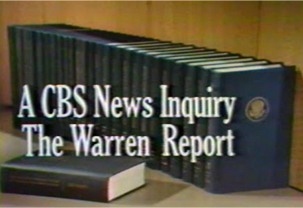
Title card from 1967 CBS Special. Instead of being an honest critique of the Warren Report, the program became a one-sided account that Krazy Kid Oswald did it all by himself. In 1967, CBS was preparing its four-night special in support of the Warren Commission. As the documents attained by former CBS employee Roger Feinman proved, this program began as an honest attempt to question the worth and value of the Warren Report. Through various decisions made by the executives at CBS, especially by president Dick Salant, it turned out to be nothing but a rather sickening four-hour panegyric for the Warren Report. This was due in large part because CBS let former Warren Commissioner John McCloy be one of the clandestine advisors—without telling the public about it. (https://consortiumnews.com/2016/04/22/how-cbs-news-aided-the-jfk-cover-up/) Lane was one of the critics that CBS targeted. They brought Brehm on the show to say that he never told Lane the shots came from the right and front of Kennedy, the grassy knoll area.
This is a non-sequitur because Lane never quotes Brehm as saying that in his book. Therefore, Brehm was not misquoted. CBS was desperate for something to throw at Lane. So they created this non-issue. And when Lane asked for time to reply to this smear, CBS declined his request. (Letter from General Counsel Leon Brooks of CBS to Lane of July 6, 1967)
Ryder then says that Lane made up an interview with Mary Woodward. Mary was another Dealey Plaza witness Lane used in his book to indicate the directionality of the shots. Again, Woodward is mentioned on just one page of Lane’s book. There, on page 41, Lane quotes her as saying she thought the shots came from behind her, which would indicate the picket fence. But if one looks at the footnote, one will see that the information does not come from an interview. It comes from a newspaper report of November 23, 1963. One really has to wonder: in his incontinent compulsion to urinate on Lane, did Ryder even read Rush to Judgment before he jumped on the web to trash his memory?
Ryder then brings up the interview Lane did with Helen Markham. Markham was a witness to the murder of police officer J. D. Tippit. The Warren Report famously gave her testimony “probative value.” Yet, as many of the Commission counsel, including Joseph Ball, argued, she was an “utterly unreliable” witness. (Edward Epstein, The Assassination Chronicles, p. 142) Ball said that her testimony was “full of mistakes.” She said she leaned into Tippit’s car, yet photos showed the windows to be closed. Markham said she talked to Tippit as he lay bleeding on the street. Yet, the autopsy showed that the policeman died instantly. She said she was the only person on the street, yet there were others on the scene. Ball did not want to use her at all. (ibid, pgs. 142-43) In fact, at a public engagement, he once famously called her an “utter screwball.”
Wesley Liebeler, a colleague of Ball’s, felt the same way and he had also examined Markham. He called her testimony “contradictory” and “worthless.” (ibid, p. 143) In the famous Libeler memorandum, he wrote that using her in the Warren Report would eventually backfire on the Commission, that no matter how the Report tried to hide her, its critics would find her and make hay with her testimony.
Which is what happened. And, as can be seen from the above, the Commission knew this in advance. Liebeler even mentioned Mark Lane as a person who would capitalize on Markham’s liabilities as a witness.
Now, anyone can read Lane’s conversation with Helen Markham. He taped it and then turned it over to the Commission and they printed it in the volumes. (See Volume 20, p. 571 ff) Since the late Vincent Bugliosi’s bloated and empty book on the JFK case was published, it has become standard fare for Commission backers to use this tape to discredit Lane. So Ryder calls this conversation “disgraceful.” Again, one has to wonder, did Ryder read the transcript in the Warren Commission? Or did he just rely on Bugliosi’s boilerplate? For instance, Bugliosi writes that Markham agreed to talk to Lane because he introduced himself as Captain Will Fritz of the Dallas Police. (Bugliosi, p. 1006) That would be pretty bad. But when one turns to the actual transcript in the Commission volumes, one can see that he introduces himself with this: “My name is Mr. Lane.” (Op cit, p. 572)
Bugliosi then goes on to write that somehow Lane did not want to give up the tape because it showed that he was unduly leading the witness. Anyone can read the transcript. First of all, this was not a legal proceeding. It was simply a private interview for an investigation Lane was doing for Marguerite Oswald. Whenever Lane suggests something to Markham from newspaper interviews she gave, he lets her dispute what the report says. And he does not then discard her revisions. In reading the transcript, one sees that the way he summarized her description of the killer of Tippit does contradict the description of Oswald. Markham said he was short, a bit heavy, and his hair was a bit bushy.
Witness Helen Markham: Perhaps one of the worst witnesses in the JFK case where both Warren Report apologists and conspiracy supporters agree was unreliable at best. Markham went on to say to Lane that no one indicated to her who she should pick out of the police lineup as the suspect she thought had killed Tippit. How can one reply to this without being needlessly cruel? Anyone, except perhaps Ryder, can read the examination by Ball of Markham on this point. Ball asked her if she recognized any of the men in the line up. She replied in the negative. Ball then asked if she recognized anyone’s face. She again replied in the negative. She then said she did not recognize any of these men in the line up. Ball then replied with this leading question: “Was there a number two man in there?” Markham, obviously cued about the number, now replied with “Number two is the one I picked. When I saw this man I wasn’t sure, but I had cold chills just run over me.” (WC Vol. 3, pgs. 310-11)
Bugliosi, somehow, found no fault with Ball’s leading of the witness here. And neither did his acolyte, Ryder. But they both found fault with Lane.
Next up for Ryder is Lane’s treatment of the testimony of Jack Ruby. To be clear, this is another Krazy Kid Oswald shibboleth. Writers like Jean Davison and John McAdams have gone out of their way to criticize Lane’s discussion of Ruby’s testimony in Rush to Judgment. For instance, Davison begins her (atrocious) book, Oswald’s Game, by saying that Lane shortened the context of Ruby’s testimony as to why he wanted to leave Dallas, which Ruby requested to do more than once. Ruby even added that his life was in danger in Dallas. (See WC Vol. 5, p. 196) Which considering the way he died, with CIA MK/Ultra doctor Louis West attending him, may likely have been true. Davison says that the reason Ruby wanted to leave Dallas was not to tell his story further but simply to take a polygraph test, and this was going to show that Ruby was not part of a conspiracy. (Davison, p. 18) Davison never addresses the issue of why a polygraph could not be done in Dallas if that was all Ruby wanted. Then Davison, like Ryder does in other regards, inserts her foot into her mouth. She writes that the test, taken in Dallas, proved he was telling the truth.
Like Ryder, this was how desperate Davison was to nail Mark Lane. Even though she was writing almost five years after the HSCA volumes had been published, she failed to note their report on this polygraph test. Their distinguished panel of experts reversed the Warren Report. They determined that Ruby was not telling the truth. Because the whole test, conducted by the FBI, was a sham. It violated at least ten standard practices in the field, including the fact that the Dallas DA’s office representative was in the room for the test—and he talked to Ruby. But further, the FBI turned down one of the biological indicators for deception on the test; it was called the GSR, Galvanic Skin Response. (For a review of this tawdry episode, which both the Commission and Davison accepted, see DiEugenio, Reclaiming Parkland, pgs. 244-46. And the reader will see there how Bugliosi covered this up.)
Without the Ryder/Davison censorship of the facts, the questions then become quite interesting. First, why did the FBI rig the test? Did J. Edgar Hoover know that Ruby was going to lie? (I mention Hoover since it is hard to think that the operator would have done this on his own.) Second, if Ruby had gone to Washington, would he have been more truthful once away from his prosecutors? Third, with an honest investigation, which the Warren Commission was not even close to being, could the results of the test have been used to try and break Ruby? After all, as Jim Marrs points out, Ruby later indicated—more than once—that there were higher forces in the country that had placed him in this position. (Marrs, Crossfire, pgs. 430-33. See also Anthony Summers, Conspiracy, p. 472)
The other reason that Commission apologists give to cloud Ruby’s testimony is that he wanted to go to Washington to discuss the issue with President Johnson. John McAdams uses this one. The problem is that Ruby brought up the Washington angle at least four times in his testimony. (See WC Vol. 5, pgs. 190, 195, 196, 210) Only near the end does he bring up Johnson’s name. Since the other requests had been turned down, Ruby may have thought if he dropped the president’s name it may have changed things. It did not.
In other words, Lane quoted Ruby accurately. He did say some provocative things and it turned out that he was lying during his polygraph test. Further, from what we know today, the Warren Commission’s description of Ruby—having no significant ties to organized crime and knowing perhaps fifty Dallas policemen—is a sick joke.

Gus Russo On the Myers blog, Gus Russo later joined Ryder. They both criticized the use of Marita Lorenz by Lane in his libel case against Howard Hunt. Whatever one thinks of Lorenz, it’s pretty obvious that Lane believed her. (See Lane’s Plausible Denial, pgs. 291-303) He also said he later talked to Gerry Hemming who backed up her story about Howard Hunt leading an assassination team to Dallas. Is the story true? Maybe, maybe not. But it was not the heart of his case against Hunt. The heart of his case was 1) There really was a CIA memo written by counter –intelligence chief James Angleton saying that Hunt needed an alibi for 11/22/63 since he was in Dallas that day (ibid, p. 167); and 2) Lane destroyed Hunt’s purported alibi on the stand. (ibid pgs. 272-283) Which leaves most objective observers with the clear implication that Hunt was in Dallas on 11/22/63. If so, why? And one may add, what was David Phillips doing there? Since he himself admitted late in life he was there. (Destiny Betrayed, Second Edition, by James DiEugenio, p. 364) And, as David Talbot reveals in The Devil’s Chessboard, why was William Harvey there in November? And is it just a coincidence that all three of those men were there along with Allen Dulles? (ibid, pgs. 197-98)
Russo has a simple reason for going after Lane: because Lane, and to a greater extent Oliver Stone, were his entrée into the MSM. As I revealed in an article for Probe magazine,Russo had been ostensibly in the Warren Commission critics’ camp for a while. But right after Stone’s film JFK came out, he began to flip sides. (Who is Gus Russo?) He first began to work with Dan Rather on his 1993 CBS special. For Newsweek, he attacked Lane and his book Plausible Denial, specifically going after Marita Lorenz. From there, it was onward and upward. In addition to Rather, Russo then worked for PBS in 1993, for the late Peter Jennings at ABC in 2003, and Tom Brokaw at NBC in 2013. In those instances, he has been well compensated. In his own words, he was flying around first class, all done in order to revivify the rotten corpse of the Warren Report. One way a media hack’s MSM ticket gets punched on the Kennedy case is by attacking Mark Lane. Russo’s career included, of course, the Dale Myers public atrocity: his computer concoction about the Single Bullet Fact for Jennings. No one who was associated with that blatant and shameless deception should attack someone like Mark Lane regarding his work with Marita Lorenz or anything else. (Click here for a course on Myersvision, as sponsored by Russo: Dale Myers: An Introduction)
Before closing out my comments on this tawdry instance of posthumous character assassination (actually more like urination), I should address one more instance of this Lane posthumous mania. One of the witnesses that Mark Lane interviewed in Dallas was Lee Bowers. Lane had read his Warren Commission testimony. It intrigued him since it looked to him as if Bowers was about to describe something he saw from his vantage point in the railroad yard behind the picket fence, up and above the grassy knoll. The subject was then changed. In his Commission testimony he described three cars coming into the area behind the fence. He then described what he called a “commotion,” one that that he was unable to describe, except that it was out of the ordinary. So much so that it attracted his eye. (WC Vol. 6, p. 288) When Lane interviewed Bowers in 1966, Bowers elaborated on this issue. He said that he saw something like a flash of light, or smoke, “in the immediate area on the embankment.” (Lane, Rush to Judgment, p. 32)
As one can see, Mark Lane was such an effective critic of the Warren Report that his ghost is haunted by its shameless defenders even in death.
Decades later, when this interview transcript was given over to a university, it became a bone of contention between the late Gary Mack and Myers because Lane left a bit of ambiguity over exactly where on the embankment Bowers was referring. It became part of a feud concerning Mack’s concept of Badge Man and Myers’ attempt to discredit it. Which side of the fence was Bowers referring to – the inside, toward the railroad yard, or the outside toward the street? Years later, Debra Conway settled the dispute. She interviewed Lee Bowers’ supervisor. He said that not even Lane got the whole story from his employee, because Bowers told him he saw one of the two men throw something metallic to the other and the second man then threw it in the car. This settled the matter, since such a thing could only have happened behind the picket fence. (E-mail communication with Conway, 6/11/16)
As one can see, Mark Lane was such an effective critic of the Warren Report that his ghost is haunted by its shameless defenders even in death. But yet, it is they who are guilty of what they say he was: namely, presenting the facts in a one-sided, polemical way. Russo did what he did because Lane was instrumental in advancing his MSM career. So there was no way he was going to let Lane’s ghost alone. But Barry Ryder is truly a bizarre and offensive piece of work. We should all be on the lookout for this strange personage in the future, a personage who does not even check the database before he unleashes his baseless invective.
Meanwhile, this will close out CTKA’s tribute to a fine lawyer, an admirable advocate for progressive causes, and a man who tried to use his skills and education to correct what was wrong around him. As the old saying goes, nobody’s perfect. But the record of Mark Lane was far above those who opposed him. So much so that he renders the attempts by the likes of Ryder and Russo to belittle him as little more than bitter flapdoodle.
UPDATE: The estimable British Warren Commission critic and CTKA contributor, Martin Hay, lends us some more info on Mr. Ryder. A while back, Ryder was doing his trolling at amazon.uk. This time about Jim Garrison’s On the Trail of the Assassins. He was posting the usual anti-Garrison sludge. Martin jumped on and began to counter each and every charge–eventually demolishing it all. A couple months later, when Martin checked back, he saw that Ryder had erased both his review and all of the comments by both himself and Martin. This is the kind of man that Mr. Single Bullet Fact aka Dale Myers, and Gus Russo cavort around with.
Unfortunately for Ryder, he will not be able to erase what I wrote here at CTKA.
-
Shenon and the CIA’s Benign Cover-Up
After failing to use a crap detector in order to provide a reasonable answer to a key question like “What Was Lee Harvey Oswald Doing in Mexico?” (Politico Magazine, March 18, 2015), Philip Shenon has returned this fall. But again without such a tool in hand. So he asserts again that the Warren Commission was not really fraudulent or wrong, but rather did not have all the facts on time.
His newest piece “Yes, the CIA Director Was Part of the JFK Assassination Cover Up” (Politico Magazine, October 6, 2015) emphasizes that CIA Director John McCone “was long suspected of withholding information from the Warren Commission. Now the CIA says he did.”
Shenon is trying to take advantage of a declassified chapter of the still classified biography of McCone written by CIA historian David Robarge in 2005. It was internally released as a report two years ago (“Death of a President: DCI John McCone and the Assassination of President John F. Kennedy,” in Studies in Intelligence 57, No. 3, September 2013). After being redacted for its public release on September 29, 2014, it´s now available at the National Security Archive.
Robarge didn´t question the Warren Commission findings, especially that Oswald was the lone gunman. Shenon adds that it’s “a view shared by ballistics experts who have studied the evidence.” In making that preposterous statement about the evidence in the case, Shenon ignored the quanta of proof to the contrary. Which was furnished by, among others, Martin Hay in his essay Ballistics and Baloney. Shenon also snubbed the fact that the WC reported a wrong Mannlicher Carcano carbine as the murder weapon, (Armstrong, Harvey and Lee, p. 477), a wrong CE 399 as the Magic Bullet (DiEugenio, Reclaiming Parkland, p. 227), and a wrong CE 543 shell (Kurtz, Crime of the Century, p. 51). And finally, as Dr. David Mantik has revealed, the current autopsy report, that is by the House Select Committee on Assassinations, wants us to think that the bullet which killed Kennedy – that is the one which struck him in the head – also has magical properties. Why? Because it struck Kennedy in the rear of the skull, then split into three parts. Miraculously, the middle part stuck in the rear of Kennedy’s skull without penetrating it. But the head and tail of this same bullet proceeded through his brain, went out the side of his head, and fell onto the front of the limousine. (See DiEugenio, Reclaiming Parkland, pp. 133-35) Nowhere in any of Shenon’s growing archive of literature on the JFK case, does he ever confront any of these disturbing, but true, facts. He just assumes that the ballistics evidence supports his thesis. It does not.
Shenon focused on Robarge´s suggestion that “the decision of McCone and Agency leaders in 1964 not to disclose information about CIA’s anti-Castro schemes might have done more to undermine the credibility of the commission than anything else that happened while it was conducting its investigation.” In other words, Shenon is again ginning up the old news about the CIA not telling the Warren Commission about the CIA-Mafia plots to kill Castro. Which has been around since the Church Committee report in 1975. In other words, for 40 years. Thusly, the former New York Times reporter persists in reopening a line of inquiry already proven fruitless: that the Kennedy brothers and the CIA compelled Fidel Castro to take a preemptive lethal action against a sitting U.S. President. As if the Cuban leader wasn´t aware that killing JFK wouldn´t solve anything, but entailed risking everything. And at the same time that President Kennedy was engaging in back-channel diplomatic moves to establish détente with Cuba, something that Lyndon Johnson, with help from the CIA, dropped after Kennedy’s death – much to Castro’s chagrin. (DiEugenio, Destiny Betrayed, Second Edition, p. 394)
For Robarge and Shenon, the cover-up by McCone and others – Deputy Director Richard Helms, Counterintelligence Chief James Angleton, former Director Allen Dulles – may have been benign under the bureaucratic impulse towards CIA self-preservation. But it was a cover-up nonetheless, since it withheld information that might have prompted an aggressive investigation about Oswald’s ties to Castro. In reality (something absent in Shenon’s writings), the CIA’s cover-up was aimed at avoiding a deep investigation of Oswald’s ties to itself and to anti-Castro Cuban exiles.
The key is not that the CIA revealed nothing about the assassination attempts on Fidel Castro, but that it revealed very little about its close tabs on Oswald: the CIA knew what he was doing and was evaluating him. As John Newman, and others, have noted, three CIA teams were watching Oswald all the way down from Moscow (1960) to Dallas (1963): the Counterintelligence Special Investigation Group (CI-SIG), Counterintelligence Operations (CI-OPS), and the Counter-Espionage unit of the Soviet Russia Division (CE-SR/6).
Oswald’s longtime friend and Civil Air Patrol colleague, David Ferrie, was also a CIA trainer for the covert operations against Castro codenamed Pluto (Bay of Pigs) and Mongoose. He blatantly lied about not knowing Oswald and having no association to any Cuban exile group since 1961.
The CIA generated an index card for Oswald in the FPCC file (100-300-011) on October 25, 1963. In early summer he was leafletting the obsolete 1961 edition of The Crimes against Cuba, of which the CIA had ordered 45 copies. He was running his own one-man chapter of the Fair Play for Cuba Committee (FPCC) in New Orleans, while the CIA and the FBI were running a joint operation against that very same committee. Oswald was really working out of Guy Banister’s office and even put his address [544 Camp Street] on some FPCC flyers. A point that Banister was quite upset about. (DiEugenio, Destiny Betrayed, Second Edition, p. 111)
Banister was not only close to Ferrie, but also to anti-Castro belligerent groups. When Gordon Novel was invited by Cuban exile Sergio Arcacha to a meeting in Banister’s office for a telethon supporting the anti-Castro cause, a certain Mr. Phillips was there, and his description aligns with CIA officer David Phillips. (ibid, p. 162) According to Cuban anti-Castro veteran Antonio Veciana, Phillips was his CIA handler, known to him as “Maurice Bishop”, and met Oswald at the Southland Building in Dallas in late summer of 1963.
Just after the assassination, Phillips vouched for a “reliable” informant who told a story about Oswald being paid in advance by a “negro with red hair in the Cuban Embassy” to kill Kennedy. In 2013, Shenon followed Phillips´ steps by including, toward the very end of his book A Cruel and Shocking Act, the long-ago discredited remake of that baleful story by Mexican writer Elena Garro: that Sylvia Duran, a Mexican employee at the Cuba Consulate, was a Castro agent who cranked Oswald up to kill Kennedy in a twist party at her brother-in-law’s house, where not only the notorious red-haired negro, but Garro herself were in attendance.
Although Robarge also reported that the CIA might somehow have been in communication with Oswald before 1963, and had secretly monitored him since his defection to the Soviet Union in 1959 (through the illegal mail-opening program HTLINGUAL), Shenon overlooks this part. He wants to bolster the “Castro-did-it” propaganda campaign, apparently planted by the CIA even before the JFK assassination. Today it is clearly being orchestrated to manage public opinion in the face of the release – as required by law – of the remaining JFK records in October 2017.
Overlooking all the sound investigation after the declassification process unleashed by the Assassination Records Review Board (ARRB), Shenon cherry-picked through Robarge´s piece in order to find “misconceptions [like] the still-popular conspiracy theory that the spy agency was somehow behind the assassination,” as if it weren´t a fact that the CIA has never produced either an Oswald photo or a tape of his voice in Mexico City.
By posing again a question highly appreciated by the CIA, “Had the [JFK] administration’s obsession with Cuba inadvertently inspired a politicized sociopath to murder John Kennedy?”, Shenon has no choice other than to distort the facts by asserting that “Robert Kennedy’s friends and family acknowledged years later that he never stopped fearing that Castro was behind his brother’s death.”
In Brothers (2007), David Talbot has demonstrated that RFK´s suspicions settled instead on a domestic conspiracy. Neither his friends nor his relatives suggested that RFK feared that Castro was behind the assassination. On the contrary, he immediately asked DCI John McCone if the CIA was involved in the killing. His other leading suspects were the Cuban exiles and the mob. And his son RFK Jr. said the same years later in a Dallas interview with Charlie Rose (during the lead-up to the 50th anniversary: see The MSM and RFK Jr.)
Shenon of course, also adds that: 1) RFK was in on the CIA-Mafia plots, and that 2) RFK was instrumental in getting Allen Dulles appointed to the Warren Commission. The first assertion was denied by the CIA in its own Inspector General Report on the plots way back in the sixties (1967). Somehow, Shenon missed both that and the Church Committee report on the subject, which also denied that the Kennedys were in on the plots. (See The Assassinations, edited by James DiEugenio and Lisa Pease, p. 327)
As for RFK using his influence with President Johnson to get Allen Dulles on the Commission, well, what can one say? Except the following: Everyone and his mother knows that LBJ and Bobby Kennedy hated each other’s guts from an early date. And it only got worse, not better, after JFK was killed. In light of that, the idea that Johnson would ask for Kennedy’s advice to man the Warren Commission is ridiculous. But further, as Leonard Mosley wrote many years ago in his book on the Dulles family, Bobby Kennedy was the prime mover in getting his brother to fire Allen Dulles in 1961. Not satisfied with that, he then asked Dean Rusk if any other member of the Dulles family was still in their employ. Rusk said yes, there was Allen’s sister, Eleanor. Kennedy demanded she also be fired since he did not want any of the Dulles family around anymore. So why would he then request that Dulles be brought back after he helped get him and his sister fired – let alone to investigate the murder of his beloved brother? (DiEugenio, Destiny Betrayed, p. 395)
Martin Hay has also chimed in on this issue in his review of Howard Willens’ book, History Will Prove us Right. There is no record of any communication by Johnson with Bobby between when the Commission idea is accepted by him and his call to Dulles. LBJ suggested a series of names to J. Edgar Hoover. When he got to Dulles, he did not say a word about Dulles being suggested by Bobby Kennedy. When he got Dulles on the phone, he told the former CIA director he wanted him to join the Warren Commission “for me”.
But as Hay writes, even more convincing is LBJ’s phone call to his mentor Senator Richard Russell. Russell asked Johnson if he was going to let Bobby nominate someone. Johnson replied with a firm and direct “No.” (see Willens review)
In a note to Jeff Morley at the web site JFK Facts, Shenon tried to defend his contention by pointing to a memo written by longtime Johnson assistant Walter Jenkins. This document was allegedly written on November 29, 1963, the day that Johnson called Dulles to appoint him to the Commission. Why do I say “allegedly”? Because as Dan Hardway notes, what Shenon does not mention is this: a handwritten notation at the bottom of this memo says, “Orig. not sent to files”. And further, it bears a stamp saying that it was received in the central files in April of 1965! Moreover, as Hardway also points out, there was a three-way call between Dulles, Johnson and Kennedy in June of 1964. This was during a racial crisis in Mississippi. Both Johnson and Kennedy had more than one opportunity to affirm that RFK had suggested Dulles for the Commission. Neither of them did. (See JFK Facts entry of October 24, 2015)
Shenon´s approach to a benign cover-up by the CIA for diverting the WC away from Castro actually seeks to turn the public away from the largely declassified Lopez Report, the monumental 300 page investigation by the HSCA of Oswald’s alleged visit to Mexico City on the eve of Kennedy’s assassination. By doing so, he deflects the genuine line of inquiry about what appears to be the intricate CIA deception prepared in advance of the JFK assassination. In any case, Shenon and other mouthpieces for the “Castro did it” diversion – or in the light version of “Castro knew it” by Dr. Brian Latell – put the CIA in a very delicate position.
If Oswald, a former Marine re-defector from the Soviet Union, was a true believer in Marx, with the zeal to engage in a variety of pro-Castro activities in New Orleans, then it’s a colossal CIA blunder that he would be allowed to travel to Mexico City and visit both the Cuban and the Soviet embassies – which were under heavy surveillance by the Agency; and that, afterward, the CIA would lose track of him, even after the former Russian defector allegedly met with a Soviet representative in their embassy. (DiEugenio, Destiny Betrayed, Second Edition, pp. 354-55) And lose track of him to such a degree that no one from the FBI, the police, or Secret Service even talked to him upon his return to Dallas, despite it being just seven weeks before President Kennedy was slated to visit the city. And incredibly, the re-defector would now actually end up on Kennedy’s parade route, thereby walking through any FBI or Secret Service security scheme in broad daylight. What does the silence on the CIA-Mafia plots have to do with any of that? What makes this drivel even worse is that reportedly, Politico dropped an excerpt from David Talbot’s important new book on Allen Dulles in order to run more of Shenon’s fabricated bombast.
Shenon even avoids addressing the most recent declassification move by the CIA at a public symposium. This was called Delivering Intelligence to the First Customer at the LBJ Library. Among the 2,500 President’s Daily Briefs (PDBs) from the Kennedy and Johnson administration released on that occasion, the one from November 25, 1963 reveals that the CIA told Johnson the same blatant lie in which Ed Lopez and Dan Hardway caught CIA Inspector General John H. Waller: “It was not until 22 November 1963 (…) that the [CIA] Station [in Mexico City] learned that [the] Oswald call to the Soviet Embassy on 1 October 1963 was in connection with his request for visa [and] also visited the Cuban Embassy.” In fact, six senior CIA officers reporting to Helms and Angleton knew all about “leftist Lee” six weeks before JFK was killed.
Shenon is simply performing another high-wire balancing act: dealing openly with CIA misdemeanors in order to hide more serious wrongdoing, and therefore supporting an unsupportable thesis; namely, that the WC was right about Oswald as the lone gunman.
See also Jim DiEugenio’s review of Shenon’s book A Cruel and Shocking Act.
-
Dale Myers: An Introduction

Dale Myers Dale Myers’ cartoon version of the Zapruder film allows viewers to study the JFK assassination “with an incredible degree of accuracy.”
Or so its creator says.
The material on this page reveals how Myers manipulated reality in an attempt to prop up the lone assassin theory:
-
Critic Pat Speer reviews Myers’ computer analysis of the assassination.
-
Robert Harris demonstrates some of the deceptive techniques Myers used.
-
Additionally, we present this review of Secrets of a Homicide.
-
Jim DiEugenio gives us a summation of Myers’ career as he navigated back and forth between the Oswald did and didn’t do it camps; ultimately becoming an unnamed co-author of VIncent Bugliosi’s rewrite of the Warren Report ironically titled Reclaiming History.
As another bonus, we have the transcript of an interview with Mr. Myers dating back to 1982. We are the first to acknowledge that, like anyone else, Dale Myers is allowed to change his mind. And he has. We’ll let Mr. Myers himself tell you the title of this interview, in the (slightly edited) sound bite attached to this notice.
“I Don’t Think Lee Harvey Oswald Pulled the Trigger” is presented for what it is worth. Researchers who flip-flop – whose public positions change from knowledge of conspiracy to professing belief in the lone nut fiction – have great propaganda value for the enemies of truth, of course. Dale Myers is not the first, and he won’t be the last.
“I Don’t Think Lee Harvey Oswald Pulled the Trigger” -