Tag: WARREN DEFENDERS

  • Fred Litwin, On the Trail of Delusion – Part One

    Fred Litwin, On the Trail of Delusion – Part One


    “One of the many blessings of this project was getting to know Hugh Aynesworth … He’s one of the great reporters in America, and it’s been an honor to know him.” ~Fred Litwin


    Anybody who is familiar with the John Kennedy assassination should realize that a writer who could make the above statement has severe objectivity problems as far as the JFK case goes. Aynesworth is the man who once said that refusing a JFK conspiracy was his life’s work. Employing Aynesworth on the Kennedy case would be like using Donald Trump on the issue of where Barack Obama was born. Yet, the above statement is a quote from the Acknowledgements section of Fred Litwin’s book about the Jim Garrison inquiry. I would like to give that quote a page number but I can’t. The reason being that those pages––and some others which have text on them––do not contain numbers. Which, in my long reviewing career, is actually a first for me. But this is just the beginning of enumerating the bizarre features of this bizarre book.

    For every Breach of Trust or JFK and the Unspeakable, there are at least a dozen volumes in the JFK field that are just plain shabby––or worse. Back in 1999, Bill Davy and I reviewed Patricia Lambert’s volume about Jim Garrison, False Witness. That was a particularly unpleasant experience. In fact, the estimable Warren Commission critic Martin Hay (deservedly) placed that book on his list of the ten all-time worst on the JFK case. But in light of Fred Litwin’s latest, Martin may have to revise and replace Lambert’s entry with Litwin’s On the Trail of Delusion. For Litwin has done something I did not think was possible: he wrote a book that is even worse than Lambert’s.

    If the reader knows anything about New Orleans and the Jim Garrison inquiry, it is fairly easy to see what Litwin is up to. The problem is––and I cannot make this point forcefully enough––too many writers and interested parties think they know the Garrison inquiry and New Orleans, when they really do not. Many of these self-proclaimed “authorities” have never even been to the city. Many more have never even bothered to look at Jim Garrison’s files. But this never stopped them from voicing their biased and rather ignorant viewpoints: e.g., the late Sylvia Meagher. This was and is a serious problem among critics, and it has caused many people to be misled about the New Orleans aspects of the case. I will further elucidate this factor later in this review.

    The above warning is apropos to what Litwin has produced. If I had to compare his latest to another volume in a related field it would probably be Thomas Reeves’ book on John Kennedy, A Question of Character. In my two part article, “The Posthumous Assassination of John F Kennedy”, I wrote that what Reeves had actually done was to compile a collection of just about every negative Kennedy book and article that came before him. He then assembled it together by chapter headings. He never fact-checked or source-checked what was in those materials and, as far as I could see, he never talked to anyone in order to clarify, or qualify, what he wrote; for example, the case of the deceitful Judith Exner. This allowed him to go exponentially further than anyone had done up to that time in smearing Kennedy. Because I knew the field and understood the game he was playing, I called it out for being what it was: so godawful that it ended up being pretty much a humorless satire.

    The difference between the JFK field of biography and Jim Garrison and New Orleans is the time element. In my above mentioned JFK essay, I noted that the character assassination of Kennedy did not begin in any serious way until after the Church Committee hearings in 1975. This was not what happened with Jim Garrison. In his case it began very soon after the exposure of his investigation by local New Orleans reporter Rosemary James. As we shall see, in one way, it began with Aynesworth.

    In my book, the second edition of Destiny Betrayed, I portrayed the real manner in which Rosemary James exposed Garrison’s inquiry. Contrary to what James tried to imply, it is not at all what Garrison wanted to occur (pp. 221-23). In fact, it was a serious body blow to his efforts. Yet, to this day, she still attacks Garrison. But again, to anyone who knows New Orleans, the smears are transparent. For instance, on a show she did In New Orleans with film-maker Steve Tyler and historian Alecia Long, she said that as soon as Shaw was indicted by Garrison, the wealthy Stern family of New Orleans dropped him like a hot potato. This is provably wrong. The Stern family hosted dinner parties for reporters sympathetic to Shaw’s defense once they arrived in New Orleans. What is surprising about this howler is that the contrary information is available throughout the forerunner to Lambert and Litwin, namely James Kirkwood’s obsolete relic of a book American Grotesque (see pp. 47, 88, 111). That book was published back in 1970. 

    But beyond that hospitality function, the Sterns owned the local NBC television affiliate WDSU. Ric Townley, who labored on the infamous 1967 NBC hatchet job on Garrison, worked for WDSU. That show’s producer, Walter Sheridan, worked through that station while he was in New Orleans. (William Davy, Let Justice be Done, pp. 78, 156) In addition to that, the Stern family helped start the Metropolitan Crime Commission, a private local watchdog organization. They also lobbied to bring in former FBI agent Aaron Kohn to be its first manager. Kohn took a large and important role in the effort to undermine Garrison; working hand in hand with Sheridan, Townley and Shaw’s lawyers. (Davy, p. 156) As we shall see, Kohn covered up an important piece of information about Shaw that would have strengthened Garrison’s case and shown the defendant to be a perjurer. So here is my question: After all this, who could use Rosemary James as a credible source on either Shaw or Garrison? The answer is, Fred Litwin can. He uses her frequently in his book. And as Thomas Reeves did, he does so without any qualifications or reservations. In other words, he doesn’t prepare the readers by informing them of the above.

    What Litwin does is a bit more ingenious than what Reeves did. In addition to his secondary sources, like James and Kirkwood, he visited certain archives. What most of these archives have in common is that they house the papers of Garrison’s critics; for instance. Life reporter Dick Billings, Washington Post reporter George Lardner, and Shaw’s friend, author James Kirkwood. He then augments this by using the papers of Shaw’s legal team, Irvin Dymond and the Wegmann brothers, Ed and William. Some of these collections, like the Historic New Orleans Collection, were found by the Assassination Records Review Board (ARRB) to be highly sanitized. (ARRB memo from Laura Denk to Jeremy Gunn, 6/7/96) Which leads to another question: What did Fred think he was going to find in these places? Something objective? Something revelatory about Shaw’s secret intelligence background with the CIA? Something about Guy Banister’s career of covert infiltration of liberal groups in New Orleans? Nope.

    There is something to this cherry picking that makes Litwin look even worse. The Wegmanns did know about the Banister undercover aspect, because Bill Wegmann worked at the law firm which handled some of Banister’s projects. In fact, Bill Wegmann notarized the papers for the incorporation of Banister’s so-called detective agency. (DiEugenio, p. 390) And that piece of quite relevant information was declassified in the nineties by the CIA, under the direction of the ARRB, even though the document dated back to 1958––that is, it took well over 30 years for it to see the light of day. This shows that Shaw’s own lawyers knew that Garrison was correct about Guy Banister. But it’s even worse than that. Bud Fensterwald later discovered through a New Orleans attorney that Banister, Shaw and former ONI operative Guy Johnson made up the intelligence apparatus for New Orleans. (Davy, p. 41) In the fifties, Guy Johnson worked with Bill Wegmann at the above-referenced law firm. Therefore, not only did Shaw’s defense team know about Banister, they likely knew about Shaw. And they still let him deny in public, and on the stand, that he was ever associated with the CIA.

    In addition to James and Aynesworth, this leads to a third complaint to the reader: Try and find this rather important connection in Litwin’s book. Any objective person would understand that this declassified evidentiary point is important to Litwin’s subject matter. Both for what it says about Banister, and what it reveals about Shaw’s attorneys. Knowing that, anyone with an ounce of objectivity would realize that the Wegmanns would not have kept it in their archives.


    II

    Right after his acknowledgements to people like Aynesworth, and a listing of the archives the author will use, Litwin begins his narrative. He does so in a way that naturally follows from these prefatory matters. He describes a report from the military which eventually allowed Garrison to be discharged from the service on his second tour in 1951. Garrison had served on very dangerous air reconnaissance missions during World War II. At a very low altitude and speed, his team searched out enemy artillery sites. They flew so low, they could have been hit by rifle fire. And once they were sighted, they were attacked by much faster German fighter planes. (Joan Mellen, Jim Garrison: His Life and Times, pp. 18-19) They therefore sustained high fatality rates.

    When Garrison reenlisted during the Korean conflict, he reported for sick call at Fort Sill. It turned out that he suffered from what used to be called “battle fatigue”, what we today call PTSD. (DiEugenio, p. 168; Mellen, pp. 36-37). What Litwin does with this is again, bizarre, but telling. He brings it up in the first paragraph of his text (p. 3, another non-numbered page). Less than one page later, Garrison is the DA of New Orleans. Clearly, what the author is trying to indicate is that somehow a mentally disabled person is now in high office. One way he does this is by leaving out the fact that after he left the service Garrison was recruited by the mayor of New Orleans, Chep Morrison. He was assigned to run the Public Safety Commission which supervised Traffic Court. (Mellen, p. 41). To put it mildly, Garrison did a crackerjack job. Mellen spends three pages showing, with facts and figures, that Garrison was such an excellent administrator that he just about revolutionized that branch. He was so good that Morrison offered him a judgeship over that court, which Garrison turned down. He said he would rather be on the DA’s staff, which Morrison then appointed him to. (Mellen, p. 44) It would appear to most objective people that Garrison had overcome any functional disability from his PTSD. Litwin eliminates this remarkable performance. I leave it up to the reader to figure out why.

    At the DA’s office, Garrison handled a variety of criminal cases: burglary, lottery operations, prostitution, homicide and fraud. (Mellen, pp. 44-45) Again, this would indicate that Garrison had overcome his PTSD. Again, Litwin eliminates it.

    Once Garrison enters into the DA’s office, we begin to understand why Litwin began his book as he did. Again, ignoring all the reforms and tangible improvements he made in the office and the praise he received for doing so, Litwin is going to strike two major themes in order to smear Garrison and his tenure. Both of these have been used before, they are nothing original. But Litwin tries to amplify them to the point of using chapter subheads to trumpet them. They are: 1) That Garrison spent much time prosecuting homosexuals; and 2) That the DA was a paranoiac about surveillance over his investigation.

    Concerning the first, this motif was first utilized by Kirkwood in his aforementioned book. What Litwin does not reveal is that Clay Shaw commissioned that book. I discovered this through a friend of novelist James Leo Herlihy on a research trip down south. Lyle Bonge knew Herlihy from his college days. Shaw asked Herlihy to write a book about Garrison and the trial. Herlihy declined, but he suggested his young friend Kirkwood. All three men were gay, and that is not a coincidence. Shaw wanted a book that would portray Garrison as having no case against him. Therefore, the product was designed to suggest Garrison was simply out to prosecute Shaw because he was a homosexual. Anyone who reads Kirkwood’s useless relic will understand this was his mission: the denigration of Garrison, and the canonization of Shaw.

    To further this concept, Litwin quotes a passage from the book on Garrison’s case co-authored by Rosemary James. The passage says that Garrison charged someone for being in a place that served liquor because the person was a homosexual. And that Garrison did this in order to attain a string of homosexual informants. (Litwin, pp. 8, 21) One would think from the reference that this information originated with reports from a primary source. When one looks it up, that is not the case. The source is Bill Stuckey. (James and Jack Wardlaw, “Plot or Politics?” pp. 21-22) Litwin does not reveal this either in his text or his references, which frees him from telling the reader who Stuckey was.

    As Bill Simpich writes, Stuckey was both a CIA and FBI informant. He was the host for two interviews that Oswald did in the late summer of 1963 in New Orleans. These were originally arranged for by Carlos Bringuier of the CIA funded Cuban Student Directorate (DRE) branch in the Crescent City. The second debate featured Bringuier and CIA asset/propaganda expert Ed Butler facing off against Oswald.

    Prior to the second debate, Stuckey was in contact with the FBI and they read him parts of Oswald’s file, including the information about his defection to the USSR. It was that information which was used to ambush Oswald since he was supposed to be representing the Fair Play for Cuba Committee. The defection exposed him as being not a fair participant but a communist. Stuckey crowed about how the debate ruined the FPCC in New Orleans. (DiEugenio, p. 162) Within 24 hours of the assassination, the DRE produced a broadsheet connecting Oswald to Castro and blaming the latter for Kennedy’s murder. In light of all this, would anyone besides Fred Litwin call Stuckey a neutral observer of the Kennedy case? But the reader does not know this because of Litwin’s excision.


    III

    The Stuckey non-mention is by no means an outlier. At the beginning of Chapter 2, Litwin prints an FBI memo. It originates with someone in Louisiana state Attorney General Jack Gremillion’s office. It strikes the same chord that Stuckey does above: Garrison was somehow doing a shakedown operation with homosexuals in New Orleans. Gremillion’s office wanted the FBI to do something about it. 

    I had to giggle while reading this. For two reasons. First of all, back in 1967, who would go to J. Edgar Hoover and the FBI on such an issue? If the point was genuine one would go to an agency like the ACLU. Or, since the state AG was above the local DA in New Orleans, why not pursue the case oneself? Which leads to my second reason for chuckling. Jack Gremillion was one of the most reactionary state AG’s there was at the time. Considering the era, that is really saying something (go here and scroll down). If there was a Hall of Shame for state AG’s not standing up for minority groups, he would be in it.

    Again, to anyone who knows the New Orleans milieu of the period, this is clearly the residue left over from the famous James Dombrowksi case. Dombrowksi ran a pro-civil-rights group called the Southern Conference Educational Fund (SCEF). It operated out of New Orleans. The SCEF was clearly a left-leaning group, and Dombrowski was a communist sympathizer. There was nothing illegal or unconstitutional about what he did. So the rightwing forces in the area, including Banister, Gremillion and Mississippi Senator James Eastland––encouraged by Hoover––decided to create a law in order to prosecute Dombrowksi. It was called the Communist Control Law. The idea was to somehow show that groups advocating for civil rights emanated from Moscow. So Gremillion raided the SCEF and arrested Dombrowski and two assistants. Garrison decided to take over the case since the SCEF was in New Orleans and he did not want Gremillion to do so. As Garrison critic Milton Brener later said, Garrison did as little as possible in order to get the case to the Supreme Court where he knew it would be thrown out. Which it was. Gremilion and his ilk did not like it. Hence the retaliatory smear. (Mellen, pp. 162-69).

    This leads to more unintentional humor. Litwin is so desperate to do something with the homosexual angle that he displays a cover from the pulp magazine Confidential (p. 85). The cover depicts Shaw waving from a car, and the title denotes some kind of homosexual ring killed Kennedy. Litwin says the author of the article, Joel Palmer, worked for Garrison. Having gone through Garrison’s extant files, I can find no evidence for that statement. What the files reveal is that Palmer, a reporter who was planning a book on the case, worked with Bill Boxley, a CIA plant in Garrison’s office. (See Garrison blind memo of 2/21/70) And he worked on furthering certain leads with Boxley that ended up being ersatz, like Edgar Bradley. (DiEugenio, pp. 278-85)

    Litwin pushes the homosexual angle so hard and down so many cul de sacs that he ends up reminding one of the Keenan Wynn/Bat Guano character in the classic film Dr. Strangelove. If one recalls, Guano thought that the attack on the military base was ordered because the commanding general had learned about a mutiny of “preverts” under him. Wynn said this with a straight face. So does Litwin. (See the first part of this film clip)

    For the record, there is not one memo I have read that shows Garrison ever outlined such a homosexual-oriented plot. At the beginning of the inquiry, there is evidence that Garrison was suspecting a militant rightwing plot. And as Garrison developed cases against Shaw and Ferrie, he was checking out leads that would connect them in the gay underworld. But nothing that either Peter Vea or Malcolm Blunt ever uncovered shows what Litwin is trying to impute to Garrison. Those two men are the two best pure archival researchers ever on the JFK case. And Vea specialized in the Garrison files.

    Beyond that, I have had authors who have written about Kirkwood call me in utter bewilderment about his book. They have asked me where he got some of the stuff he wrote about, since they could not find any back-up for it. And I have patiently explained to them what Kirkwood was up to, and how he deliberately distorted things, with Clay Shaw pushing him along. In fact, Shaw was indirectly putting out stories about Garrison being a homosexual to the FBI as early as mid-March of 1967. (FBI memo of March 16, 1967) Was the idea behind this to impute that Shaw was charged over some homosexual rivalry or rejection? That is how nutty this angle gets. This is how far Shaw would go to escape suspicion and denigrate Garrison.

    In his further attempt to smear the DA, Litwin subheads a section of the book with the following: “The Paranoia of Jim Garrison”. This is largely based on Garrison’s belief that the FBI was monitoring his phone calls. Litwin tries to dismiss this charge through––try not to laugh––Hugh Aynesworth. (p. 32) The declassified record reveals that the FBI was monitoring Garrison’s phone. (DiEugenio, p. 264) As we shall see, so was the CIA. When I revealed the name, Chandler Josey, as one of the FBI agents involved, former FBI agent Bill Turner recognized it and said he had been directly infiltrated into certain phone companies to do the tapping. What makes this worse is that Shaw’s defense team knew this was happening early on. In a multi-layered scheme, their ally, former FBI agent Aaron Kohn, was privy to the transcripts. (DiEugenio, p. 265) The reason for this was simple: Hoover did not like what Garrison was discovering since it showed up his phony investigation of the JFK case.

    Gordon Novel, who was working for Allen Dulles, had also wired Garrison’s office. (DiEugenio, pp. 232-33) Novel had sold himself as a security expert to Garrison through their mutual friend, auto dealer Willard Robertson. In a sworn deposition, Novel revealed his close relationship with Dulles. But he also said that the FBI would be at his apartment every day in order to get a briefing on what was going on at Garrison’s office. This is how worried Hoover was at the exposure of his rigged investigation of the Kennedy case. (DiEugenio, p. 233). So, in light of the declassified record, just what is there that is fanciful about Garrison saying he was being surveilled by the FBI?

    There is also nothing fanciful about another statement Litwin utilizes to smear Garrison: namely, that many of the lawyers for the other side were being paid by the CIA. Again, this has turned out to be accurate. We know today that the CIA helmed a Cleared Attorneys Panel in major cities, and there was one in New Orleans. (Letter from attorney James Quaid to Richard Helms, 5/13/67) Quaid had heard about this easy employment from his law partner Ed Baldwin. Baldwin enlisted in the anti-Garrison campaign and was busy defending people like Walter Sheridan, Ric Townley and later Kerry Thornley. There is further evidence of this in another ARRB disclosure. This one was a CIA memo of 3/13/68 which reveals that Shaw’s former partner at the International Trade Mart, Lloyd Cobb, was on the panel. Corroborating this, under oath, Gordon Novel did not just admit his cooperation with Allen Dulles, he also admitted he had lawyers who were being “clandestinely renumerated” [sic]. (DiEugenio, p. 263) So again, what is the basis for implying this statement is fanciful? The CIA itself admitted it in declassified documents.

    But Litwin is not done with his character smears. Another one of his subheads reads: “Garrison the Irrational Leftist”. (p. 24) Again, anyone who studies this case and knows New Orleans understands that Garrison was in no way a leftist prior to his involvement with the Kennedy case. He was a moderate. For instance, he was anti-ACLU. He once said that it had “Drifted so far to the left it was now almost out of sight.” (Mellen, p. 217) Even more demonstrative, he favored the Cold War. He once said in a speech that the US had to counteract communist aggression in Korea and Vietnam. (Mellen, p. 208) This is an “irrational leftist”? What changed his view on these matters was his investigation of the Kennedy case.


    IV

    As we have seen, in a variety of ways, the initial part of Litwin’s book is a rather blatant and barren attempt at character assassination. For anyone who knows New Orleans, it does not stand up to scrutiny. Therefore, we can term it an attempt to confuse the uninformed reader. We will now get to Litwin’s description of Garrison’s stewardship of the Kennedy case and the evidence underlying it. But before we do, this reviewer should comment a bit more on the format of the book.

    Litwin has placed the overwhelming majority of his reference notes at the rear, with no numbers. The standard academic procedure is to link the note at the rear to the book’s pagination. Litwin does not do this. So one has to search for the proper note by the textual lead in the chapter. Because of this unusual sourcing method, I did something I found morally offensive: I bought the paperback version of the book, for it had become too time consuming to hunt for the textual references by shifting back and forth in the electronic book version. To top it off, the book has no index. Thus, for purposes of review, unless one takes notes, this makes it difficult to locate information.

    But it is even worse than that. Because in his reference notes, he will often refer to his source with a rubric like “The Papers of George Lardner, Library of Congress”; or “Papers of the Metropolitan Crime Commission”. Again, this is not acceptable. In these kinds of references, the proper method is to annotate the information to a box number and folder title at that archives. Does Litwin really expect the reviewer to search through the online listing to find the information and then check if it is available? In sum, without an index, it’s hard to locate information; with this kind of nebulous referencing, it’s even harder to check out the information. With that in mind, let us proceed.

    Litwin begins his assault on Garrison’s methods by writing that the DA stacked the grand jury with his friends and colleagues, many from the New Orleans Athletic Club. I expected to see some primary source back-up for this, like names and terms of service. When I looked up the reference it turned out to be David Chandler (see p. 345, not numbered). Again, because Litwin doesn’t, one has to explain why this is problematic.

    Chandler was a part of the whole journalistic New Orleans wolfpack, which included Jim Phelan, Aynesworth, Billings and Sheridan. After the James disclosure, they went to work almost immediately at defaming Garrison in the press, thereby handing a pretext for governors not to extradite witnesses to New Orleans. Chandler was one of the very worst at inflicting the whole phony Mafia label on Garrison. That was another smear which turned out to be completely false. (Davy, pp. 149-67). In fact, the infamous Life magazine story of September 8, 1967 implicating Garrison with the Mob was largely written by Billings and Chandler. Chandler was a close friend of Shaw. When Garrison wanted to call Chandler in for questioning about the sources for his article, Life magazine did something rather interesting. The editors called up the governor of the state. They told him to make Chandler a part of the state trooper force thus granting him immunity. There was an ultimatum attached to the demand: if he did not do it, they would write a similar article about him. He caved. (1997 interview with Mort Sahl)

    Again, for the record, urban grand juries in Louisiana are chosen similarly to the way trial juries are chosen. They are picked randomly from voting rolls. (Louisiana Law Review, vol. 17, no. 4, p. 682) Further, Garrison did not choose or run the grand juries. He assigned that function to his deputies who ran them on a rotating basis. (1994 interview with ADA William Alford)

    But Litwin is not done with Chandler. He uses him to say that Garrison started his Kennedy investigation out of boredom. (p. 12) As we should all know, Garrison began his inquiry back in 1963 over a lead about David Ferrie. Ferrie had driven to Texas with two friends on the day of the assassination. His excuse was he wanted to go duck hunting and ice skating. The problem was that after Garrison investigated the strange journey he found out that Ferrie did not bring shotguns, and he never put on skates at the rink. He stood by a public phone and waited for a call. This took two hours. (DiEugenio, p. 176) What made it all the more fascinating is that Ferrie had called the rink owner a week before. (Davy, p. 46). Suspicious about Ferrie’s story, he turned him over to the FBI. The FBI dismissed it all and let Ferrie go. Three years later, on a plane ride with Senator Russell Long, the subject of the assassination came up. Long expressed extreme doubts about the efficacy of the Warren Report. This provoked the DA to order the report and its accompanying 26 volumes of evidence. As any criminal lawyer would, the DA found gaping holes, along with many unanswered questions. (Davy, pp. 57-58) The same reaction was later duplicated by experienced criminal lawyers Richard Sprague, Al Lewis and Robert Tanenbaum when they helmed the first phase of the House Select Committee on Assassinations. (interview with Bob Tanenbaum; interview with Richard Sprague; 1996 Interview with Al Lewis) This is what caused Garrison now to reject the FBI dismissal of Ferrie and reopen his own inquiry. Which would eventually cost him his office. It was not out of Chandlerian boredom.


    V

    The above marks a good point at which to bring up another strange presentation by Litwin. As mentioned above, in reality, Garrison was only focused on David Ferrie in his aborted 1963 inquiry. He then passed him on to the FBI. The Bureau allowed Ferrie to depart.

    This is not how Litwin presents it in his book. On page 39 he writes that the FBI and Jim Garrison were trying to find Clay Bertrand in late 1963. He then repeats this on page 41. The obvious question is: How could Garrison be looking for Bertrand in 1963 if he did not know about him? As noted above, Garrison had not studied the Commission volumes at that time, for the good reason that they would not be published until a year later. The only way I could explain this Twilight Zone temporal confusion is that Litwin is so hellbent on trying to show that Garrison was bereft of any reason to suspect anything about either Shaw or Ferrie, that he mixed the two elements together. He then minimized what had really happened or just cut it out.

    For example, Litwin writes that after Garrison questioned him, Ferrie told the FBI that Oswald might have been in his CAP unit at the time, he just was not sure. (Litwin, p. 37) He leaves it at that. This is stunning because Ferrie repeatedly perjured himself in his statement to the FBI. He said he never owned a telescopic rifle, never used one, and would not know how to use one––a blatant lie, since we know Ferrie was a trainer for both the Bay of Pigs and Operation Mongoose. (DiEugenio, p. 177) He also said he had no relations to any Cuban exile group since 1961. For the same reason as just given, this was another lie.

    In the FBI report Ferrie––and Litwin––try to have it both ways about knowing Oswald. Let us quote the report:

    Ferrie stated that does not know LEE HARVEY OSWALD and to the best of his knowledge OSWALD was never a member of the CAP Squadron in New Orleans during the period he was with that group. Ferrie said that if OSWALD was a member of the squadron for only a few weeks, as had been claimed, he would have been considered a recruit and that he (FERRIE) would not have had any contact with him. (CD 75, p. 286)

    When someone says, “to the best of his knowledge,” most people would consider that a denial. Litwin doesn’t. And in his footnote he uses the work of the late Stephen Roy to say that, well, Ferrie had literally hundreds of CAP students and he might have just forgotten about Oswald. (Litwin, p. 346)

    For a moment, let us forget the people who saw Ferrie with Oswald that summer, and this includes two INS agents among others. (Mellen, A Farewell to Justice, p. 48) From the day of the assassination, Ferrie was looking for evidence that would link him to Oswald. In the wake of the assassination, this happened three times. On the day of the assassination, he went to Oswald’s former landlady, Jesse Garner. He wanted to know if anyone had been to her home referring to his library card being found on Oswald. (HSCA interview of 2/20/78) Within days of the assassination he repeated this question with a Mrs. Doris Eames. Again, he wanted to know if Oswald, who her husband had talked to at the library, had shown him Ferrie’s library card. (NODA memorandum of Sciambra to Garrison, 3/1/68) On November 27th, Ferrie was on the phone calling the home of his former CAP student Roy McCoy. He wanted to know if there were any photos at the house depicting Ferrie in the CAP. He also asked if the name “Oswald” rang a bell. Mr. McCoy called the FBI about this episode and he quite naturally told them he thought that Ferrie was looking for evidence that would depict him with Oswald. (FBI report of 11/27/63)

    Attorneys call this kind of behavior “consciousness of guilt”. But that does not just refer to Ferrie, it also refers to the FBI. With the report by Mr. McCoy they knew Ferrie was lying to them. It is a crime to lie to an FBI agent while you are under investigation. The fact that Ferrie committed perjury did not interest J. Edgar Hoover. If it had, with a little initiative, he would have discovered the other instances indicating the lie, and he would have found the picture revealing Ferrie with Oswald that PBS discovered in 1993. What this clearly shows is that Hoover was not interested in the Kennedy case. In other words, right after Kennedy was killed, Ferrie was lying on numerous material points, and the FBI was covering up for him.

    Try and find any of this in Litwin’s book. Let me know when you locate it.

    Click here for Litwin and the Warren Report.

    Click here for Fred Litwin, On the Trail of Delusion – Part Two.

  • Litwin and the Warren Report

    Litwin and the Warren Report


    It is not possible to understand Fred Litwin’s second book on the JFK case, dealing with Jim Garrison, without addressing his first book, which tried to uphold the Warren Commission. David Mantik did an excellent job in critiquing that first work. (Click here for details) But I Was a Teenage JFK Conspiracy Freak is such a shabby book that no one person could expose the scope and depth of its tawdriness.

    One of the most startling remarks Litwin makes in the first book—and one which shows how politically slanted his work is—appears relatively early. (Since this review is based on the e-book version, the pages I quote may differ slightly for the reader.) On page 51, Litwin writes: “The authors of the Warren Report were honorable men who conducted an honest investigation and reached the right answer.”

    In this day and age, for anyone to infer that Allen Dulles and John McCloy were honorable men indicates either:

    1. Staggering ignorance
    2. The writer lives in an alternative moral universe, one outside the bounds of a normal ethical system, or
    3. The writer does not care what he writes since he has an agenda a mile long.

    In reality, there were very few prominent Americans of the 20th Century who were more utterly dishonorable than Dulles and McCloy.

    While working in the War Department during World War II, John McCloy was one of the strongest advocates for the Japanese internment. This removal and detainment of mostly American citizens was so ethically indefensible that even J. Edgar Hoover opposed it. When his opponents argued that if American citizens were deprived of property and rights, they deserved due process, McCloy replied with one of the most shocking remarks an attorney could make:

    If it is a question of the safety of the country or the Constitution of the United States, why the constitution is just a scrap of paper to me. (Jacob Heilbrunn, The New Republic, “The Real McCloy”, May 11, 1992)

    Attorney McCloy was so determined to discard the Constitution that he used unethical means to keep the victims in detention. He deleted important evidence from the record in the appeals of the case. (Ibid) To any objective person, such behavior would be relevant to his performance on the Commission. Yet one will not read about it in Litwin’s book. And, make no mistake about this affair, the “honorable” John McCloy was also a racist. In a letter to a friend, he talked about how the internment was an opportunity to “study the Japanese in these camps.” The last part of this passage is a doozy in delineating McCloy:

    I am aware that such a suggestion may provoke a charge that we have no right to treat these people as guinea pigs. But I would rather treat them as guinea pigs and learn something useful, than merely to treat them…as they have been in the past with such unsuccessful results. (Kai Bird, The Chairman, pp. 165–66)

    Whatever McCloy meant by that last statement, I don’t think anyone could describe it, in Litwin’s phrase, as honorable and honest. I should add, McCloy never admitted he could have been wrong about this shameful exercise. In the seventies, with over twenty years to think about it, he objected to any monetary compensation to those who had their rights trampled, property confiscated, and lives detoured. He called even the consideration of compensation, “utterly unconscionable.” (Op. cit, Heilbrunn)

    McCloy’s bizarre sense of justice is further exemplified by his involvement in the other theater of World War II, in Europe. McCloy objected to the bombing of the Nazi concentration camps. He replied to this proposal with another of his jarring leaps of logic. He said that even if it were possible—which it was—it could lead the Germans to do something even more vindictive. (Heilbrunn, p. 42) As many have commented about that reply: What could be worse than the Holocaust?

    This lack of mercy for the Jews of Eastern Europe made an interesting contrast with McCloy’s sympathy for the Nazis responsible for slaughtering them. McCloy was involved with the escape of Klaus Barbie out of Germany to Bolivia after the war. There, the former Gestapo chief became a drug lord. (Bird, p. 346). Even for a Nazi, Barbie was sadistic. He liked torturing his victims before killing them. A favorite method was hanging them upside down by hooks. In the deportation of French Jews to Auschwitz, Barbie decided there should be no age barrier to an early exposure to poison gas. He emptied a French orphanage of 41 children ages three to thirteen and sent them to the gas chambers.

    But aiding Barbie wasn’t enough for the man who did not want to attack and liberate Auschwitz. After the war, McCloy became High Commissioner for Germany. He decided that many of the former Nazis who had been given prison sentences deserved to be set free early. In just six weeks, McCloy reviewed 93 cases. (Bird, p. 336) In 77 of those cases, McCloy’s board recommended reductions in sentencing. In some instances, this meant commutations of death sentences. That group included 20 former SS officers who served in the Einsatzgruppen. (Heilbrunn, p. 44) The Einsatzgruppen was Hitler’s first method of Jewish extermination. In this phase of the Holocaust, the SS troops, and, at times, the regular army, would round up the victims and herd them onto a bus. They would then drive them to a rural wooded area and, in this concealed area, they would machine gun them. Somehow, some way, McCloy thought the Allies had been too hard on these killers. After viewing this record, instead of calling McCloy honest and honorable, journalist Jacob Heilbrunn had a different opinion of the man. He called him a thoroughly despicable character. (Heilbrunn, p. 41)

    Again, none of the above is in Litwin’s book, which is doubly strange. Because, as we shall see, Litwin likes playing the anti-Semite card against Commission critics. But somehow, the Jewish Litwin is able to, not just stomach all of the above, he eliminates it from the record. Only in Fred Litwin’s moral universe does endorsing the Single Bullet Theory erase crimes of the magnitude of John McCloy’s.

    What I have done with McCloy, I could also do with Dulles and Commissioner Jerry Ford. And, in fact, I have done so. (James DiEugenio, The JFK Assassination: The Evidence Today, pp. 325–41). But further, by necessity, Litwin’s term “honest and honorable” extends to the man who provided the overwhelming majority of investigative materials to the Commission. Or else how could they have come up with the “right answer”? That would be the Director of the FBI, J. Edgar Hoover. (DiEugenio, pp. 237–40) But wisely, Litwin does not directly describe Hoover as honest and honorable. Probably because, with all that is now known today about the man, if he did, the reader would start laughing and throw the book into the trash can. But the key point to understand here is that Litwin is willing to censor or curtail important information, in order to disguise who the perpetrators of the cover up actually were—some of the worst Americans of that era. If you conceal that record, then you can hide from the reader the things they would be willing to do.

    II

    In any study of the Commission, the above information is crucial, because along with Dulles and Ford, McCloy dominated that body’s inner workings—from the beginning to the end. It is also important to know that McCloy and Dulles had a personal relationship that went back over thirty years. (Bird, pp. 76–77) As opposed to Commissioners Richard Russell, John Sherman Cooper, and Hale Boggs, the Dulles/Ford/McCloy trio attended the most meetings and asked, by far, the most questions. (Walt Brown, The Warren Omission, pp. 83–87)

    This might not have mattered if, as he was presumed to be, Supreme Court Justice Earl Warren had been the real chairman and arbiter of the Commission. But that was not the case. Warren never wanted the position. He only accepted it when President Lyndon Johnson told him that if he did not accept, thermonuclear annihilation threatened the world. Warren left the White house in tears after that meeting. (James Douglass, JFK and the Unspeakable, p. 83; Mark Lane, Plausible Denial, pp. 41–42) The atomic war threat was effective. When Commission attorney Wesley Liebeler interviewed witness Sylvia Odio in Dallas, he told her that Warren had given the lawyers instructions to avoid evidence indicating a conspiracy. (Church Committee interview, 1/16/76)

    In this regard, McCloy made two comments that recall his past cover up duties with the Nazis and the Japanese internment. He once said that the Commission had been “set up to lay the dust…not only in the United States but all over the world.” He then said he thought it was important to “show the world that America is not a banana republic, where a government can be changed by conspiracy.” (Bird, p. 549) Make no mistake, as with the internment, McCloy was firm in this belief for years afterward. In 1967, he secretly intervened in the production of the CBS four-night special on the Warren Report. His daughter was the secretary to network president Dick Salant. When it looked like producer Les Midgley might explore some sensitive areas of the case, and do so in a fair manner, McCloy stepped in to stop it. He wrote a long memorandum disputing Midgley’s approach. His view prevailed. Ellen McCloy became the back-channel through which her father was a secret consultant to the program. Like the veteran prevaricator and cover up artist he was, the “honorable and honest” McCloy lied about this clandestine and unethical journalistic role for the rest of his life. (Click here for details)

    As noted above, Earl Warren had been effectively neutered when Johnson conjured up images of millions of charred bodies amid a tableau of atomic annihilation. But that was not enough for Hoover and the three managing Commissioners. Once Ford and Hoover heard of Warren’s first choice for Chief Counsel, Warren Olney, they made it clear he was not acceptable. (Gerald McKnight, Breach of Trust, pp. 41–43) After a rump meeting including Dulles, McCloy, and Ford, McCloy came up with a list and their first choice was J. Lee Rankin. One of the initial things Rankin did was to deprive the accused, but deceased, Lee Oswald of any representation before the Commission. This was in January of 1964. (See Commission Exhibit 2033)

    Richard Russell wrote a letter of resignation in February, which he did not mail to Lyndon Johnson. (Gerald McKnight, Breach of Trust, p. 291) Why did he want to resign? As the reader can see from the above, Commissioners Russell, Cooper, and Boggs—who I have called elsewhere the Southern Wing—had been more or less marginalized. Very soon, Russell had lost faith in what the controlling faction was doing. He even accused the Commission of scheduling meetings behind his back. Like every other Commission zealot, Litwin conceals this split in the Commission ranks, which allows him to write about that body as if it were a monolith. This was not the case. And one only has to read the transcript of the September 6, 1964, examination of Marina Oswald to understand that.

    In a number of ways, this was an extraordinary session. It was held at a Naval Station in Dallas. (See WC Vol. V, p. 588) Very telling is this fact: Dulles, McCloy, and Ford were not there. But beyond that, Warren was not there. It was presided over by Russell, with Boggs, Cooper, and Rankin in attendance. It is important to note that Marina Oswald was a key witness for the Commission. She had been groomed and prepared by the FBI and Secret Service before she appeared as the first witness. She then appeared twice more, once in June and once in July. Many would call Marina—along with Ruth Paine, Kerry Thornley, Carlos Bringuier, and George DeMohrenschildt—a keystone witness for the prosecution. What is remarkable about this particular session is that it is pretty clear from the start that these three Commissioners do not buy Marina. Marina’s past statements figured strongly in the dialogue and the question of perjury hung in the air. Incredibly, Marina was even asked if she knew Clay Bertrand or Sylvia Odio. As Walt Brown notes, this hearing had all the earmarks of a hostile interrogation. (Brown, p. 238) In this reviewer’s opinion, this is where a real investigation should have begun, not ended. When one reads this record, one can understand why the others were not in attendance. As Warren told the staff, it would make little sense to impugn the testimony of their chief witness to the character of Oswald, which is what Russell was doing. (Edward Epstein, The Assassination Chronicles, p. 315)

    In practical terms, this might not have been the wisest step for Russell to take. Rankin clearly told the others—the people he was really working for—about what had happened. The final executive session of the Commission was held less than two weeks later. Rankin and Company had laid a trap for Russell. By this point, Russell simply did not buy the Single Bullet Theory, which was the ballistic underpinning of the Commission’s case against Oswald. This is the idea that one bullet hit both Kennedy and Governor Connally, created seven wounds in the two men and had emerged in almost pristine condition on someone’s stretcher at Parkland Hospital. (It was, in all probability, not Connally’s gurney: see Donald Byron Thomas’, Hear No Evil, pp. 392–99) But it became the working thesis of the Commission for a simple reason: if the two men were hit by separate bullets, it would be synonymous with saying there were two assassins. (Edward Epstein, Inquest, p. 46)

    The serious split in the Commission ranks is not a new revelation. It was first described by Edward Epstein back in 1966. It is quite clear from his rather skimpy rendition of what happened at the final meeting that Russell, Boggs, and Cooper were aligned against the four other Commissioners. But there is a key issue involved that Epstein did not write about. Russell thought that his objections, and the ensuing debate, were being recorded by a stenographer. He recalled there was a woman there and he thought she was taking notes. (McKnight, p. 295) But there is no stenographic record of this meeting on hand today. A six-page summary is what constitutes the record of this hours long meeting. (Click here for details)

    It is obvious to anyone what really happened. Rankin and his allies did not wish to record this debate over the Magic Bullet. They wanted to create the illusion that the Warren Report was a unanimous document which no one had any objections to. Therefore, the public should accept it without qualifications. To do this, they deceived three members of their own committee. Since, from their World War II experience, Dulles and McCloy were familiar with how an intelligence deception worked, they probably thought up the masquerade. Rankin and Warren went along with it.

    It later turned out that Russell, Cooper, and Boggs were the first Commissioners to openly denounce the Warren Report. (DiEugenio, p. 319) We also know today that Jerry Ford secretly agreed with their verdict. (Click here for details) In reality, the Warren Report was a minority report. And who knows what would have happened if LBJ had not scared the living daylights out of Warren?

    Is any of the above honorable and honest? Outside of Litwin’s world, it would appear to be purely Machiavellian. If you don’t tell the reader about it, then you can present it as otherwise. But that is just conducting a charade. As the Commission did at their final meeting.

    III

    The very title of Litwin’s book, I Was a Teenage JFK Conspiracy Freak, strikes this reviewer as being deliberately provocative, but at least a bit ersatz. The implication of that title would be that, at one time, the author really believed that a conspiracy killed President Kennedy. Litwin says this was so, yet somehow, he does not produce any evidence to demonstrate it was in his entire book. He notes articles and talks he gave which support the Warren Commission and ridicule the critics. (Litwin, p. 143)

    For instance, Litwin attended a talk given by Commission critic Rusty Rhodes in Montreal in 1975. He then wrote a piece for the student newspaper at Concordia University criticizing Rhodes as a sensationalist. (Litwin, p. 107) In 1976, he actually argued in a piece he did for People and the Pursuit of Truth that the bullet channel from Kennedy’s back out of his neck was genuine. (Litwin, p. 143) Another example in the nineties, he met with the Dallas ’63 group in UK. He again argued against conspiracy. (Litwin, p. 148) In August of 1994, he gave a talk for this group. He again argued for the Oswald did it side. (Litwin, p. 154) He then turned that talk into a paper called, “A Conspiracy too Big? Intellectual Dishonesty in the JFK Assassination.” This paper was not about anything the Warren Commission did that was dishonest—which I have outlined in detail above. It was about the critics of the Commission, who he says “have constructed a conspiracy so massive that it ultimately falls of its own weight.” Here, Litwin sounds indistinguishable to me from say, Dan Rather on a bad day. On this evidence, if there is anything freakish about Litwin, it is his refusal to accept any evidence that the Commission was wrong—at any time in his life.

    Early in 1994, Fred Litwin indirectly met his American soul brother, Paul Hoch. Someone brought Fred past issues of Hoch’s newsletter, Echoes of Conspiracy. Litwin describes Hoch as a man who wanted to follow the facts, no matter where they led. (Litwin, p. 147) Litwin then quotes Hoch as saying that pieces of physical evidence for a conspiracy in Dealey Plaza have gotten weaker over the years. That is not a misprint. Hoch then says that the House Select Committee did tests for the Magic Bullet which critics expected to negate the Single Bullet Theory—the NAA, trajectory analysis—but they did not. He then quotes Hoch as writing that, after the HSCA, the Magic Bullet was really not a joke anymore. It had to be taken seriously.

    As I was reading this, I had a hard time figuring out what was the worst part of this passage, that Hoch would write this stuff originally; or that Litwin would quote it; or that anyone could take it seriously. First of all, the very idea that Litwin would use Paul Hoch as a kind of model for the critical community is absurd in and of itself. If anyone can show me something that Hoch has written in the last thirty years that is a valuable contribution to any kind of criticism of the Commission, I would like to see it. Hoch finding evidence that a document about Jack Ruby’s alleged employment for the HUAC being a forgery is now rendered dubious. For the basis of his judgment, the premature use of zip codes, has turned out to be erroneous. (Click here for details) Frankly, I consider his journal Echoes of Conspiracy not worth reading today; but it was pretty much not worth reading when it was written. Hoch is a commentator who took Tony Summers’ book Goddess pretty much at face value. Hoch actually accepted Tim Leary’s nuttiness about Kennedy taking LSD tabs in the White House. Like the Ruby zip codes, these have both been discredited beyond repair today. (Click here and here for details) So how does any of this portray Hoch as a man possessed? As someone who was so incontinent in his search for truth that he would follow the facts wherever they led?

    Then, there is the following. In the early nineties at a Coalition on Political Assassinations conference, Lisa Pease met up with Hoch. He tried to recommend that she read Carlos Bringuier’s book, Red Friday. (Phone communication with Pease, 12/2/2020) With this, Hoch was vouching for a man who, within 24 hours of the assassination, helped put together a broadsheet, saying Oswald killed Kennedy for Castro. Bringuier’s group, the DRE, was being paid tens of thousands per month by the CIA. (Jeff Morley, Ghost, p. 145)

    This reviewer attended a JFK conference in Chicago in 1993, at which Hoch spoke. Also in attendance at this meeting were former Warren Commission counsel Burt Griffin and former Deputy Chief Counsel for the House Select Committee on Assassinations (HSCA), Robert Tanenbaum. Griffin, of course, defended the Commission and its conclusions. Tanenbaum attacked the Commission. After both men spoke, Hoch approached me and said he thought that Griffin’s speech was better, which would mean, by deduction, that he bought the Single Bullet Theory.

    Back in 1979, Harvey Yazijian and the late Carl Oglesby published a journal for the Assassination Information Bureau. Clandestine America was interested in chronicling the work of the HSCA. At the close of that committee in 1979, they surveyed a number of interested parties to get their opinion of what the HSCA had accomplished. Hoch was one of the very few, perhaps the only one, who preferred the work of the HSCA under Chief Counsel Robert Blakey than under Blakey’s predecessor Richard Sprague, which again would place Hoch in the Magic Bullet camp. This was in 1979.

    Just like he does not produce evidence of himself being a Commission critic, Litwin does not reveal any of this about Hoch. With that in mind, as referred above, just what HSCA tests are Hoch and Litwin referring to that actually endorsed the Single Bullet Theory and saved it from ridicule? The two tests were Vincent Guinn’s Neutron Activation Analysis, today called Comparative Bullet Lead Analysis (CBLA), and Tom Canning’s work on the trajectory of Commission Exhibit 399, the Magic Bullet. CBLA was used by the HSCA to say that only two bullets hit the limousine; that the fragments’ trace elements all showed that these specimens came from Western Cartridge Company—which made the ammo for the Mannlicher Carcano rifle allegedly used by Oswald—and fragments from Connally’s wrist matched the magic Bullet, CE 399, thereby showing the Single Bullet Theory was valid.

    The problem with what Hoch said then, and with Litwin quoting him today, is rather simple: Both “tests” have been demolished. A statistician/ metallurgist team, Pat Grant and Eric Randich, took Guinn’s claims apart and rendered them into rubbish in a milestone article for a peer reviewed publication. (Journal of Forensic Sciences, July 2006, pp. 717–28) For a less complicated explanation of how this test was destructed by Grant and Randich, read Gary Aguilar’s discussion of it (Click here for details) The demolition was so complete that the FBI will never use CBLA in court again. At a conference held by Aguilar in San Francisco, Randich said the judge in a case he testified in told the Bureau if they tried to do so, he would entertain charges of perjury from the defense. Does it get any worse than that? So just what is Litwin talking about?

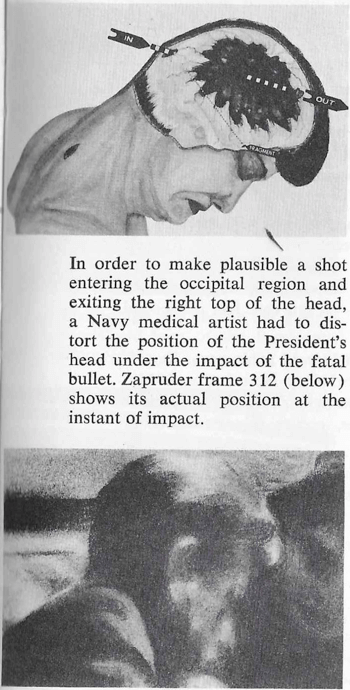
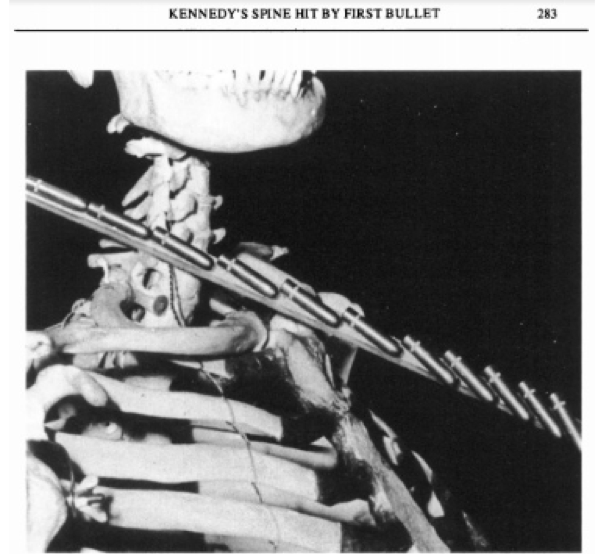
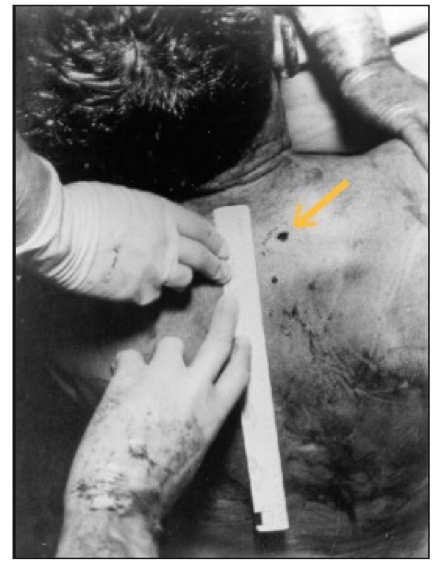
    As per Canning, his work was a non-starter from the beginning. The HSCA had secured the autopsy photos and they had an artist do illustrations of them for the volumes. It is clear from these drawings that the posterior bullet wound that first hit Kennedy struck in his back. In Tom Canning’s drawings, that wound is moved upward where the Warren Commission had placed it—in the neck. (HSCA Volume 2, p. 170) In other words, the Commission had lied about this and Canning had repeated it for trajectory purposes. Secondly, the forensic panel of the HSCA said that the magic bullet went through Kennedy at a slight upward angle. (The Assassinations, edited by James DiEugenio and Lisa Pease, p. 79) Again, if one looks at Canning’s work, he flattened that angle to pure horizontal. (HSCA, op. cit.) This is important, because Canning admitted that if his calculations were off by just one inch, he would miss the firing point by 30–40 feet, which would mean that Canning missed the alleged sniper’s nest window by anywhere from three to four floors in the Texas School Book Depository. (HSCA Vol. 2, p. 196)

    But it’s worse than that, because in his calibrations for the fatal head shot, Canning used the revised position for that rear skull entry wound. (HSCA Vol. 2, p. 167) In other words, he raised it from the original autopsy, where it was in the lower skull, up into the cowlick area, a distance of about four inches. But here is the issue: if the doctors who actually saw and handled the body at the Bethesda morgue on the evening of 11/22/63 are correct, then Canning’s calculations are off by as much as 160 feet, which would likely place the assassin who killed Kennedy across the street in the Dal-Tex Building. And this is just the beginning of the problems with Canning. In his book, Hear No Evil, Don Thomas spends over 20 pages undoing Canning and his tests. (pp. 422–448). After reading that, if anyone needs any more proof that the HSCA trajectory analysis was pure bunk, please read what Pat Speer wrote about it. (Click here for details) The reader will see that Canning’s measurements, and his positioning of entrance and exit wounds, all changed over time. But what makes it all the worse is this: his illustrations—from side to front—do not match up with each other! Therefore, if one is thinking logically, with all the declassified information on the table, Hoch’s conclusion is ass backwards. The HSCA tried every piece of junk science available and they still could not make the Single Bullet Theory work.

    IV

    Let me add a rather important point to the above relationship between Hoch and Litwin. Although Randich and Grant applied the final kibosh to Vincent Guinn’s charade, Wallace Milam actually began to protest Guinn’s technique about a decade prior to that. The late Jerry Policoff pointed out the basic problem with Canning—that his underlying information was dubious—right after the HSCA closed shop. Milam was a high school teacher. Policoff was a journalist and TV/Radio advertising salesman. Paul Hoch has a PhD in physics. Neither Speer nor Thomas has such a degree. Further, Hoch had been studying this case since the sixties, much longer than either one of them. Yet, to my knowledge, physicist Hoch never raised a complaint about the scientific methods used in the above fraudulent tests, which, in light of what Litwin is up to, makes it natural for Fred to use him as some kind of authority. When, in fact—if one does not censor the material at hand—the question Litwin should have asked him is this: Paul, what has a physicist like you been doing for four decades?

    The answer to that question, as posed by the anecdotal evidence I listed above, would suggest some kind of innate bias, a bias that overrides the scientific skills and training Hoch acquired at university. The last thing in the world Litwin wants to do is to pose—or have the reader pose—this question: How could these unskilled and untrained people figure out the forensic hoaxes that physicist Hoch could not? To avoid that obvious question, Litwin does not go within a country mile of the area, because that, in turn, would pose this question: Why would Litwin use him as an expert?

    But, as David Mantik pointed out in his 44 questions for Litwin, this is all irrelevant anyway. The phony debate over CE 399, its trajectories, and chemical composition were always an example of a dog chasing its tail. We know today that CE 399 was worse than a joke: it was a smoke and mirrors illusion. The work of the ARRB—which Litwin avoids like CV-19—has made it superfluous. It was through that work that Gary Agular and Josiah Thompson proved that the FBI lied in its alleged identification process of CE 399. Bardwell Odum—the FBI agent who the Bureau said showed the bullet to witnesses for purposes of confirmation—admitted to both men that he never did any such thing. Yet, the fraudulent document saying he did—CE 2011—is in the Commission volumes. (DiEugenio and Pease, p. 284) The chain of custody for the Magic Bullet was therefore not confirmed by the witnesses who handled it. In other words, J. Edgar Hoover—implied by Litwin to be an honest and honorable man—played the Commission, also honest and honorable men, for suckers, which considering who McCloy and Dulles really were, was probably kind of easy.

    How bad is bad? The late John Hunt proved the worst about CE 399. To further certify the (phony) chain of custody, the FBI wrote that agent Elmer Lee Todd’s initials are on that bullet. As Hunt discovered at the National Archives, this is another lie. They are not. (Click here for details) But beyond that, there is another equally serious problem with the chain of custody. Todd was supposed to have delivered CE 399 to technician Robert Frazier at the FBI lab that night. Frazier’s notes say he was in receipt of the bullet at 7:30 PM. This presents a huge problem for the evidentiary record, because Todd did not obtain the bullet until 8:50 PM. How could he have given Frazier a bullet he did not have? (Click here for details)

    The fact that Todd’s initials are not on the bullet poses the gravest questions, but by avoiding all the evidence above, Litwin can say that it’s kind of ridiculous to insinuate that there was another bullet. (Litwin, p. 216) But if one analyzes the record above, that is what the evidence trail clearly suggests. Frazier already had a bullet at 7:30 PM. Todd was in receipt of another bullet at 8:50 PM. Therefore, one could likely have been switched out for the other. Recall, CE 399 is the only whole bullet in evidence. The bullet that missed the street entirely was not officially recovered. The bullet that struck Kennedy in the head was in fragments. Since there were only three shells discovered on the sixth floor, another bullet would indicate a second shooter.

    Further complicating this issue is the fact that when author Josiah Thompson first interviewed the head of security at Parkland, O. P. Wright, Wright denied that CE 399 was the bullet he turned over to the Secret Service on 11/22/63. He said the bullet he turned over was a sharp pointed bullet, not a round one like the Commission said it was. (DiEugenio and Pease, p. 283) Is that the bullet that was made to disappear? This is what the declassified records suggest, but J. Edgar Hoover was not going to confront such skullduggery, which is why he lied about this issue. He understood early that something was seriously wrong with the evidence. When asked if Oswald was the actual killer, he replied with, “If I told you what I really know, it would be very dangerous to this country. Our whole political system could be disrupted.” (James DiEugenio, Destiny Betrayed, Second Edition, p. 246) Therefore, Hoover did what Jerry Ford did, he covered up the facts and then lied to the public, which was natural for Jerry, since he was Hoover’s stoolie on the Commission. (DiEugenio, p. 336)

    In Litwin’s world, none of the above matters. (p. 216) In fact, he quotes John McAdams saying that even if CE 399 would not be admitted at trial, it would still be “absolutely dispositive where historical judgments are concerned.” Litwin is so monomaniacal, so freight train locomotive obsessed, that he does not understand how he has just undermined his own argument by having McAdams admit it would not be admitted at trial. That is the equivalent of saying there was no chain of custody.

    The chain of custody legal standard is designed to prevent the prosecution from either altering or exchanging an exhibit. Each step in the chain, from the crime scene, to the police HQ, to the lab, back to the evidence room, and into court must be accounted for. And the identification of the exhibit cannot change. With CE 399, any chain of custody pre-trial hearing would turn into a comedy show. (Click here for details) In fact, a defense lawyer would probably not call for a hearing. He would want to have it admitted at trial and watch the jury giggle as the evidence is presented. Can one imagine showing Todd the document saying he initialed the bullet and then asking him to find his initials on it? And that would just be for starters.

    In his attempt to revive the rather downtrodden HSCA, there is another story which Litwin has to bury. That is the sea change that overtook that committee once Richard Sprague was removed. That element of the story is integral to any honest evaluation of that committee. The first chief counsel, Sprague, was a career prosecutor in Philadelphia with an impeccable legal reputation and an excellent record in court. He had every intention of treating the Kennedy assassination as a homicide case and he hired attorneys and investigators who had this kind of criminal experience. For instance, Sprague’s choice for Deputy Counsel over the Kennedy case was Bob Tanenbaum. Tanenbaum was chief of homicide in New York. He had never lost a felony case. Sprague did not last long, because it became clear he was not going to accept any of the Warren Commission’s conclusions without testing them first. He was going to do a complete reinvestigation of the JFK case, from the bottom up. (DiEugenio and Pease, pp. 56–57) He was not going to use the FBI or Secret Service as his agents. He was going to hire a whole new independent team to do a fresh inquiry. With that kind of approach, it would be inevitable that, sooner or later, he would have uncovered what Hunt, Agular, and Thompson did years later. All one needs to know about what happened to the HSCA is that it took the ARRB to show us the depth of the fraud the Magic Bullet was mired in.

    With his homicide approach, I think Sprague also would have questioned the weapon in evidence. David Mantik did a fine job posing all the questions in the record that arise by the Commission’s acceptance of the Mannlicher Carcano, serial number C2766, as the rifle used in the assassination, but I would like to add one more evidentiary problem with the acceptance of that rifle. The Commission says that Oswald mailed a coupon and money order to Klein’s Sporting Goods in Chicago from a post office in Dallas. It was supposed to have been mailed on March 12, 1963. The Commission says it arrived in Chicago a day later. But not just that. It was also sorted at Klein’s and then walked over to their bank and deposited. All in about 24 hours. (Warren Report, p. 119)

    Needless to say, Litwin does not bat an eyelash at this transaction. But I think it’s important to add, this was in the days before zip codes. It is also in the days before computers and sensors. From Dallas to Chicago is nearly 1000 miles. This reviewer mails letters inside the city of Los Angeles that take more than one day to arrive at their destination. For his upcoming documentary, JFK: Destiny Betrayed, Oliver Stone decided to conduct an experiment. He had Debra Conway of JFK Lancer mail a letter from the same post office that Oswald allegedly mailed his payment for the rifle. She mailed it to Michael LeFlem, an author for this web site, who lives a mile from where Klein’s used to be located. The letter took five days to arrive. 

    V

    Towards the end of his book, Litwin mentions this reviewer specifically. (Litwin, p. 216) He writes that in my book The JFK Assassination: The Evidence Today, that I believe I have found “discrepancies” in the chain of possession of CE 399. Discrepancies? Can the man be real? Bardwell Odum denying he ever showed the bullet to O. P. Wright, or anyone else, is not a “discrepancy.” Frazier getting the bullet before Todd gave it to him is not a “discrepancy.” The FBI lying about Todd’s initials being on the bullet is not a “discrepancy.” His initials are not there. All of this constitutes fraud and evidence alteration.

    In this same passage, he then makes a leap—actually more like a Sergey Bubka pole vault. He says that I have written that all the evidence in the case is planted. (p. 216) In his references, he does not supply a footnote as a basis for that imputation to me. (See p. 270) I do not recall ever saying such a thing. For instance, I do not believe the David Lifton/Doug Horne body alteration concept. I am an agnostic on the Zapruder film being faked. I disagreed with just about everything in each of Nigel Turner’s The Men Who Killed Kennedy installments after the initial series was broadcast in America in 1991, e. g. the theories of the late Tom Wilson. I even disagreed with some of the original broadcast. I also have severe problems with writers like Robert Morningstar and Jim Fetzer and I consider most of their ideas to be outlandish. I have written about many of these disagreements and Litwin could have found them if he wanted to.

    What I do in The JFK Assassination: The Evidence Today is simply review the core evidence in the case in light of the revelations of the ARRB and the revisions in the record made after the Warren Report. The revelations and revisions in that record were both plentiful and disturbing. After distorting what I wrote, Litwin then applies another smear: he says I have no paperwork, witnesses, not anything to back up such a sensational claim. As noted above, I don’t recall making the claim he says I made. But each claim I do make is backed up with credible evidence. In that book, concerning the subject of evidence manipulation, I only go as far as the record establishes. And that record is not something I created or embellished. It’s there in the record for all to see. The JFK Assassination: The Evidence Today has over 1800 footnotes in it, many more than the book under review. Litwin does not want the reader to know that, so he air-brushes it out.

    But let me use one example to show just how untrustworthy Litwin is. On the subterfuges around CE 399, here is the evidence I outline.

    Witnesses:

    • O. P. Wright, security chief at Parkland Hospital who gave the bullet to the Secret Service
    • Bardwell Odum, FBI agent who allegedly showed the bullet in question to witnesses at Parkland Hospital
    • Josiah Thompson, who interviewed witnesses at the hospital in November of 1966
    • Gary Aguilar, who interviewed Odum in November, 2001
    • John Hunt, who examined Robert Frazier’s 11/22/63 work product

    Paperwork:

    • Interview of Wright in Six Seconds in Dallas
    • Interview of Odum in The Assassinations
    • Complete absence of FBI 302 reports on Odum’s alleged interviews about the bullet
    • Frazier’s work product as shown in Hunt’s essays
    • Receipt for transfer of Magic Bullet from Secret Service to FBI on 11/22/63
    • Blow up pictures of the Magic Bullet at the National Archives

    This is having no witnesses or paperwork? Most people would say it is a surfeit of witnesses and paperwork. I could do the same with other examples from my book. But an important point to understand is this: Litwin does make reference to my book, which means he had it in some form. I am not an attorney, but I do know the laws of libel in California. I will be making consultations about the issue. After that, I will do a cost-benefit analysis and then decide whether or not to file an action.

    VI

    Throughout his book, Litwin makes recurring references to the sanctity and the probative value of the medical evidence in the JFK case. (See p. 177) How does he do this? As David Mantik mentioned, Litwin does not specifically describe what the 1968 Ramsey Clark Panel did to the original autopsy. Yet, anyone can read that report. (Click here for details) Before we get to the radical revisions of that panel, we must mention two points. First, that panel did not exhume Kennedy’s body. Second, they did not call in the original autopsy team—the three pathologists, the official photographer, or the radiologist—to testify. Their review was largely based on the autopsy report in the Warren Report and the photographs and x rays. The following is what the Clark Panel concluded:

    1. They raised the entrance wound in the rear of Kennedy’s skull four inches upward, i.e. almost the entire height of the skull, into the cowlick area.
    2. The above conclusion was largely based on something that none of the original autopsy doctors saw on the x rays: a large 6.5 mm object in the rear of Kennedy’s skull.
    3. They denied any particle trail rising from low in the skull and connecting to a higher trail above.
    4. They saw particles in the neck area.

    Each one of these differed with the original autopsy report from 1963, although point 4 ended up being incorrect. (As Gary Aguilar and Milicent Cranor have pointed out, later inquiries concluded these were artifacts.) The Clark Panel smudged another point of difference with the Warren Report, but the HSCA did make this clear: the wound on the president’s body was definitively lowered from the neck to the back.

    Let us refer to my book for one of the original pathologist’s reaction to one of the differences in the record, specifically point 3. The following dialogue is between ARRB chief counsel Jeremy Gunn and James Humes. It was done with an x ray in front of the witness:

    Q: Do you recall having seen an X-ray previously that had fragments corresponding to a small occipital wound?

    A: Well, I reported that I did, so I must have. But I don’t see them. (DiEugenio, p. 152)

    In other words, the present X-ray differs from his autopsy report. Let us now go to point 2, the appearance of the 6.5 mm object in the rear of the skull. When Gunn asked Humes about it, he said, “The ones we retrieved I didn’t think were the same size as this….” He then added that they were:

    Smaller, considerably smaller…I don’t remember retrieving anything of this size.  Truthfully, I don’t remember anything that size when I looked at these films. (DiEugenio, p. 153)

    When Gunn asked another pathologist, Thornton Boswell about this issue, he replied “No. We did not find one that large. I’m sure of that.” (DiEugenio, p. 153) Why is this so important? Anyone can figure that out. In addition to its size in relation to the other fragments, the 6.5 mm dimensions of the object precisely fit the caliber ammunition that Oswald allegedly fired at Kennedy. Under those circumstances, are we really to believe that three pathologists, two FBI agents, the photographer, and the radiologist did not see it the night of the autopsy? When, in fact, this is what they were looking for: evidence of bullet remnants in the body.

    One might ask: Why does Litwin not precisely deal with the Clark Panel’s modifications of the autopsy? Specifically, their raising of the rear skull wound and the appearance of the 6.5 mm object? Perhaps because, as the leader of that panel, Maryland Medical Examiner Russell Fisher, later said: the panel was formed to counter what the critics had pointed out about the Commission’s version of the autopsy. (Maryland State Medical Journal, March 1977) One way the 1968 panel did this was to raise the rear skull wound, so it would not misalign so much with both Kennedy’s positioning in the Zapruder film at frame 313 and also with where the exit wound on JFK was supposed to be: above and to the right of his right ear. Josiah Thompson had shown that the Commission had misrepresented these matters in illustrations in the volumes. (Six Seconds in Dallas, p. 111)

    What the Clark Panel did was help solve the problem of how the bullet came in: at a low point on the rear skull, on a downward angle; but exited at a higher point and, by necessity, at a rising angle. But, as David Mantik later pointed out, the Clark Panel’s “solution” left another huge problem. The base and nose of the skull bullet were found in the front of the car. (See Clark Panel Report p. 6; WR, pp. 557–58) This meant the 6.5 mm object, still in the rear of the skull, had to come from somewhere in the middle of the bullet. How could such a thing happen? Should we call it the Second Magic Bullet? Litwin does not tell the reader about this problem, so he does not have to explain it.

    In spite of all the problems in the official record, which he sidesteps, there is still another HSCA shibboleth that—in his apparent allegiance to Paul Hoch—Litwin trots out to uphold the findings of that committee, namely that the autopsy photographs were authenticated. As with so many aspects of the HSCA, the ARRB declassification process has made this issue problematic. The HSCA wrote that, even though they had not found either the camera or lens used during the autopsy, the pictures were authenticated due to features on the photos that showed internal consistency. (HSCA Vol. 6, p. 226, reference 1) In itself, this seems questionable, since there was no comparison with the original apparatus utilized at Bethesda Medical Center on 11/22/63. But, as the ARRB found out, it’s worse than that. The Pentagon had found the only camera in use at Bethesda in 1963. But when the HSCA tested it, they found that the test results disagreed with its analysis. As Gary Aguilar notes, perhaps there was a different lens and shutter attached to the camera afterwards. But when the ARRB tried to search for the actual tests performed by the HSCA on the camera, the Board could not find them. Whatever the case, the statement made by the HSCA on this matter does not align with the declassified record. (The Assassinations, edited by James DiEugenio and Lisa Pease, pp. 279–80)

    Let us go to another huge problem with the medical record, one I wrote about in The JFK Assassination. ARRB Chief Counsel Jeremy Gunn examined the official autopsy photographer, John Stringer. When he showed him photos of Kennedy’s brain, the witness was visibly puzzled. The pictures Gunn showed him were shot with a different film than what Stringer used and were performed with a different technique. The latter was betrayed by a series of numbers on the film. Stringer also said that, on the brain photos he originally saw, the cerebellum was both damaged and cut. Here it was presented as intact. When asked directly by Gunn if he would say these were the photos he took of Kennedy’s brain, Stringer replied “No, I couldn’t say that they were President Kennedy’s.” (Doug Horne, Inside the ARRB, Vol. 3, pp. 806–10) Again, can one imagine the impact of such testimony during a legal proceeding? How could the HSCA not discover this very important revelation? This new ARRB evidence leads to these questions:

    1. Who really took those photos?
    2. Why was a second set needed?

    As I demonstrated above, every single modification of the evidence I have mentioned in this review, or in my book, exists in the official records of this case. They are all there for the interested party to see. There is nothing fanciful about it. Litwin’s postulation that I had no witnesses or paperwork to support what I wrote in that regard has been shown above to be utterly false. It can only exist in his cherry-picked world. The problem with his doing that is that he leaves out proof which alters the contours of the evidence and changes the forensic conclusions in the JFK case.

    Post Script: In looking through my notes, I see that I left one point out which I think Litwin is correct about. The author dedicates the book to John McAdams and Paul Hoch. Today, for reasons stated above and throughout, I would have to agree that such a pairing is appropriate. I will deal more with this later in the series.

    Click here for Fred Litwin, On the Trail of Delusion – Part One.

  • I was NOT a Teenage JFK Conspiracy Freak

    I was NOT a Teenage JFK Conspiracy Freak


    This is a (mostly serious) review of Fred Litwin’s book:

    I was a Teenage JFK Conspiracy Freak (2018)[1]

    Fred Litwin: He is a former left-wing activist, who is now a politically conservative, gay Jewish man, who became interested in the JFK case in 1975. At age 20, he was accused of being a CIA agent. He is a marketing and sales professional, who managed the Pentium III launch in Asia. As a founder of a music company, he has released 70 CDs and collected numerous awards. He has never visited the National Archives to examine the JFK artifacts. His Garrison website is here.

    David Mantik, MD, PhD: He is a socially liberal, but fiscally conservative heterosexual male, who has no interest in marketing or sales, nor has he ever collected any awards for CDs. After 80 years, no one has ever accused him of being a CIA agent. His son is an MD, while his daughter is a Hollywood film editor. As an internist, his wife still sees octogenarians and nonagenarians. He has examined the JFK artifacts at the National Archives on nine different days and has performed hundreds of optical density (OD) measurements on the extant X-rays. His JFK website is here.

    He who has no inclination to learn more will be very apt to think that he knows enough.
    —John Powell

    The best evidence that Oswald could fire as fast as he did and hit the target is the fact that he did so.
    —Commission Counsel Wesley Liebeler

    Facts are indifferent to your beliefs, religion, ethnicity, identity group, political party, gender, family, friends, or enemies. And they don’t cease to exist just because you ignore them. Like cockroaches, they are simply there. But it is wise that you not be too indifferent to them.
    —Tyler Durden (paraphrased)

    NOTE: I used the Kindle version of Litwin’s book so page numbers are not cited. This review is mostly free of citations. However, these may be found in countless numbers at my website—scattered throughout multiple articles—or in my Amazon e-book, JFK’s Head Wounds.

    MY DIALOGUE WITH LITWIN’S BOOK

    1. LITWIN (L): “A few seconds later, a bullet hit Kennedy in the head and he moved back and to the left.

    MANTIK (M): This action is seen in the extant Zapruder film. Oddly, however, no one in Dealey Plaza recalled this event. Early viewers of the Z-film (e.g., Erwin Schwartz, Dan Rather, Deke DeLoach (at the FBI), and, possibly, even Pierre Finck) reported an opposite movement—JFK’s head moved forward! None of these early viewers reported a head snap.[2] Instead, most eyewitnesses recalled that JFK had “slouched” forward. For a dose of reality, review the recollections of James “Ike” Altgens,[3] who saw JFK struck while he (JFK) was sitting erect. Most eyewitnesses agree quite closely with Altgens, but not with the Z-film. Litwin tells his readers none of this. His carefully selective approach infests the entire book as he consistently reports items that favor his biases, while persistently ignoring contrary items.

    1. L: “Duranty even denied that there was a famine in Ukraine.” Litwin notes that Walter Duranty even won a Pulitzer Prize for his 13 essays.

    M. We agree on this one issue—the Holodomor (1932–1933) was real; it also likely killed many of my (German Lutheran) relatives in Ukraine.

    1. L: “There are quite a few factoids in the JFK assassination.” Litwin’s examples include that a Mauser was found on the Sixth Floor and that Ruby knew Oswald.

    M: Litwin is surely wrong to implicitly hint that he knows all the answers (I don’t). Well-informed researchers would surely take issue with his brazen—and all-embracing—certainty about this case. As a remarkable counterexample, during the Assassination Records Review Board (ARRB), Noel Twyman discovered a receipt for a 7.65 Mauser shell recovered from Dealey Plaza. (The shell was found between November 22 and December 2, 1963.) Several witnesses report seeing Ruby with Oswald; you can doubt them or call them liars, but it is dishonest to pretend that they don’t exist. Unfortunately, similar examples of this arrogance permeate the entire book. This does not bode well. In fact, because of this, suspicions immediately arise about all of his future claims.

    1. L: “No topic is too crazy for [Lew] Rockwell—the strange deaths of witnesses; Zapruder film alteration; JFK’s phonied-up autopsy; JFK murder was an inside job.

    M: To respond to this litany would require innumerable paragraphs (many occur below), but Litwin has merely divulged his impetuous mindset, i.e., he has lurched across the finish line without even knowing where to begin.

    1. L: Here is an ironical statement by Litwin: “And, of course, the Robert Kennedy assassination was a conspiracy as well.” Then shortly later: “And the left could never face the fact that an Israel-hating Palestinian [Sirhan] killed Robert Kennedy.

    M: Nowhere does Litwin disclose the central forensic fact (not factoid) of this case—RFK was shot at very close range, according to the forensic pathologist of record, Thomas Noguchi (not in Litwin’s book), to whom I have spoken.[4] This fatal bullet struck RFK near his mastoid—an impossible shot for Sirhan given his frontal position. Litwin’s failure to report this most fundamental forensic fact is, prima facie, an immediate and serious indictment of his overall credibility. Furthermore, Litwin does not bother to cite Lisa Pease’s masterpiece on the RFK case: A Lie Too Big to Fail (2018).[5]

    1. L: “The authors of the Warren Report were honorable men who conducted an honest investigation and reached the right answer.

    M: Contrast that statement with Litwin’s subsequent comment: “In late 1966, Jim Garrison was on a flight with Louisiana Senator Russell Long who convinced him that the Warren Commission Report was fiction.

    And here is what Earl Warren proclaimed in his Capitol rotunda eulogy that Sunday: “…an apostle of peace has been snatched from our midst by the bullet of an assassin. What moved some misguided wretch to do this horrible deed may never be known to us….Does this suggest that Warren was open to conspiracy?

    Furthermore, three members of the Warren Commission (WC)—Hale Boggs, Richard Russell, and John Cooper—thought that the single bullet theory (SBT) was improbable.[6] Russell even asked that his opposition be stated in the report, which of course was not done. Consistent with his now-predictable pronouncements, Litwin tells us none of this.

    1. L: “The rifle found on the Sixth Floor was bought by Oswald.[7]

    M: Almost certainly, Oswald did not fire a weapon that day. It is most unlikely that he owned the Mannlicher-Carcano carbine. The truly diverse arguments for this conclusion are dazzling and overpowering. The reader is referred to the exhaustive work (Harvey and Lee) by John Armstrong. An easier way to begin, though, is with Reclaiming Parkland (2013) by James DiEugenio—or with Jim’s The JFK Assassination (on Kindle). Here are only some of the bewildering conflicts in the evidence (none of them cited by Litwin).

    1. The WC was never able to prove that Oswald received the weapon through the post office.
    2. The bank deposit slip reads February 15, 1963, even though Oswald did not order the weapon until March.
    3. In the book depository, the police found a 40.2 inch carbine with a 4-power scope.
    4. Oswald ordered a 36 inch carbine in March 1963; the 40 inch weapon was not advertised for sale until April 1963.
    5. Klein’s employee, Mitchell Westra stated, “Klein’s would not have mounted scopes on 40-inch Mannlicher-Carcanos.
    6. Klein’s microfilm records disappeared.
    7. The FBI did not find Oswald’s fingerprints on the money order.
    8. The clip was still inside the weapon when it was found even though it is nearly impossible for an empty clip to remain there.
    9. The serial number was not unique—John Lattimer owned the same weapon with the same serial number (C 2766).
    10. Marina never saw Oswald with a scoped weapon.
    11. No one, other than his wife, ever saw the weapon in Oswald’s hands.
    12. The source of Oswald’s ammunition was never determined.
    13. From John Armstrong: “If Oswald mailed the letter, and if the postmarks on the mailing envelope are genuine, it means that he left JCS around 9 AM, walked 11 blocks to postal zone 12 where he dropped the letter into a mailbox, and then walked several miles back to JCS without anyone noticing he was gone.” Even more puzzling, he could instead have mailed the letter from the GPO where he supposedly purchased the money order!
    1. L: “Oswald’s right palm print was found on the rifle barrel; and his fingerprints were found on the bag used to carry the rifle to work.

    M: Litwin’s forensic knowledge of fingerprints is gravely delinquent. He has not read my summary here. He has ignored the statements of experts: “When somebody tells you, ‘I think this is a match or not a match,’ they ought to tell you an estimate of the statistical uncertainty about it”—Constantine Gatsonis, Brown University statistician. He has also ignored Carl Day, who took Oswald’s palm print; in 1964, Day refused to sign a written statement confirming his fingerprint findings. (See WC Exhibit 3145, which is the FBI interview of September 9, 1964.) When FBI expert, Sebastian Latona, got the weapon from Day, he found no prints of value, no evidence of fingerprint traces, and no evidence of a lift. Furthermore, Day took no photographs of this palm print—either before or after he supposedly lifted it. By now we are no longer surprised by Litwin’s selective editing of critical facts. (Comments on the bag follow below.)

    1. L: Regarding the Tippit murder, “…two witnesses, Virginia and Barbara Davis, saw Oswald run across their lawn and unload the shells from his gun (which of course matched the revolver found in his possession).

    M: This is a remarkably naive approach to the complexities of the Tippit murder. For a much fuller explication, read the 675-page Into the Nightmare by my fellow Badger, Joe McBride. Sergeant Gerald Hill had told Officer James Poe to mark two shells with his initials, but when Poe examined the shells for the WC, his initials had disappeared! Even Litwin’s bald-faced claim that the shells matched the gun is far from certain,[8] but we no longer expect Litwin to express even a sliver of doubt when evidence favors his biases. For example, nowhere does he mention the conundrums posed by the multiple wallets in the Tippit scenario.

    1. L. “Merriman Smith, the UPI reporter who first reported that JFK had been shot…

    M: Merriman Smith, like many, many others in Dealey Plaza, reported that the limousine had stopped. The Z-film does not show this abrupt halt, which Litwin naturally ignores.

    1. L. “After just 54 minutes of deliberation, the jury found Clay Shaw not guilty.

    M: While I have no horse in this race, it should be noted that many (perhaps all) jurors felt that Garrison had proved conspiracy. In the interest of full disclosure, Litwin should have mentioned this.

    1. L. “The second movement [JFK’s head snap] was probably caused by a neuromuscular spasm…

    M: We may now legitimately suspect deliberate obfuscation, as Litwin fails to confess this: no expert in neuroscience has ever supported this hypothesis. In fact, it has been thoroughly debunked on many prior occasions, none of which is cited by Litwin.[9] The same is true for the jet effect. Milicent Cranor, in particular, has destroyed that argument.

    1. L: “They didn’t mention that the autopsy materials—clearly the best medical evidence available—totally refuted a shot from the front.

    M: It is surely hopeful that Litwin admits that the autopsy materials are the best medical evidence—which is why I visited the Archives on nine occasions. But this does not explain why he has not visited even once—even though some materials are open to non-specialists.

    Of course, his conclusion has been overwhelmingly refuted on many occasions; see my e-book (JFK’s Head Woundsnot cited by Litwin) for a thorough demolition of this overweening claim. More discussion occurs below.

    1. L: “He [Dick Gregory] blamed pollution as the source of criminal violence in the black community.

    M: Litwin here wants to smear Dick Gregory for his supposed fringe theories. However, lead in paint (and its banning in 1978)[10] remains a viable explanation for the decline in crime in the 1990s.

    1. L: “He [Gregory] believed that World Trade Center Towers One and Two were the victims of controlled demolition.

    M: This is just another attempt to smear Gregory. This is not my area of expertise, but long lists of building experts still favor a controlled demolition. It is a bit overwrought for Litwin to trash Gregory for beliefs held by so many professionals. Nonetheless, Litwin’s great Wurlitzer of denigration will not stop.

    1. L: “I tried to counter the conspiracy factoid that he was shot from the front.

    M: This is presumptuous—after all, labeling a fact as a factoid is a step too far. On the contrary, several Parkland doctors saw an entrance wound in the high forehead. Even Thorton Boswell, one of the pathologists, clearly described this forehead site as “…an incised wound.” (Note that scalpels cause incisions, but they do not cause “wounds.”) Of course, Litwin knows none of this.

    1. 17. L: “…it [Livingstone’s book] focused on the medical evidence, which was a favorite topic of mine.

    M: Since my e-book is so intensely focused on the medical evidence (perhaps more than any other book), I would expect Litwin to be quite familiar with it. But he shows no sign of this.

    1. L: “But the autopsy X-rays and photographs only showed a small wound in the back of Kennedy’s head—evidence of an entry wound.

    M: This is a truly stunning denouement. After all, on the X-rays the radiologists could not spot an entry hole (nor could I), and James Humes, the chief pathologist, declared, “I don’t know what that [red spot] is. It could be to me clotted blood. I don’t, I just don’t know what it is, but it certainly was not a wound of entrance” (7HSCA254). So desperate was Pierre Finck that he inquired whether this was in fact a photograph of JFK! Under oath, none of the three autopsy pathologists agreed with Litwin’s conclusion. Litwin has clearly let his unshakeable preconceptions determine his diktats, but this no longer surprises us.

    1. L: “…the Zapruder film shows the back of Kennedy’s head intact after the fatal shot…

    M: The Sixth Floor Museum in Dallas houses the first-generation transparencies created by MPI in 1997 (of each frame of the extant film). While viewing these together in November 2009, Sydney Wilkinson and I promptly identified the geometric patch on the back of JFK’s head; in fact, it was so flagrant that I had to stifle a laugh. It was so childishly done that my visually gifted daughter (a current film editor, who is now at work on a JFK documentary)—at age 10—would have been embarrassed at such a crude effort. That black patch is also obvious on the images that Wilkinson obtained from the National Archives. This was a US government authorized and certified, third generation, 35 mm, dupe negative of the “forensic version” of the Z-film.

    Here is Sydney’s summary after viewing the MPI images:

    We used a loupe and a light box to look at each transparency—I was stunned at how sharp they were. When I viewed the head shot frame (Z–313), and the frames following the head shot, I felt the hair stand up on the back of my neck. In the frames that weren’t blurry—i.e., Z–313, 317, 321, 323, 335, 337 (and more), the solid, black “patch” that is clearly seen on our 6k scans (covering the lower, right back of JFK’s head) was even more obvious/egregious on the MPI transparencies—I felt as if the “patch” jumped out at me. There was no doubt in my mind that the MPI transparencies corroborated what we (including numerous film experts) saw on our scans. Most importantly, they clearly depicted what should be on the “original” Zapruder film housed at NARA.

    Has Litwin seen any of these images? If so, why is he mute? In the interest of fairness and honesty, surely he must have done this before reporting such potent (contrary) conclusions. Invoking second-hand knowledge for this issue is simply absurd.

    Alec Baldwin has reported (at a public meeting that I attended) that the Kennedy family believes that the Z-film has been altered. As a participant, is it possible that Jackie knew what really happened? In my work, I discuss one of her chief recollections—which is totally inconsistent with the extant film—but which agrees with another witness (William Manchester) who had seen the original film 75 times.

    1. L: “And his [Harrison Livingstone’s] witnesses all disagreed with each other.

    M: This is surely false. At least sixteen (16) Parkland physicians[11] viewed the back of the head photographs, and all declared that they were manifestly inconsistent with Dallas. See the images in Groden’s books for the remarkable agreement among nearly all witnesses—physicians and non-physicians.

    1. L: “…hard physical evidence like the autopsy X-rays and photographs.

    M: Since that is precisely the entire focus of my e-book, it is simply stunning that Litwin has ignored it. After all, who else has seen this “hard physical evidence” on nine different visits to the Archives, compiled three long and meticulous notebooks, taken hundreds of OD measurements, and reported on it in scrupulous detail? Surely not Litwin.

    1. L: “But Hoch was not your run-of-the-mill conspiracy freak—he actually wanted to follow the facts, no matter where they led.

    M: Of course, Paul would not now be regarded as a conspiracy freak. I am nonetheless indebted to Paul for his collegial assistance with the acoustic evidence (discussed in over 100 pages on my website). Paul has described me as the only conspiracy believer who regards the Dictabelt as irrelevant. If so, I surely am not your “run-of-the-mill conspiracy freak.” (I became aware only today (October 20, 2020) that Pat Speer has now also discounted the acoustic evidence; see his website for this discussion. Kudos to Pat!)

    1. L: “…the radiologist [John Ebersole] who took the X-rays at the autopsy verified that the X-rays at the National Archives are the same X-rays he took that night. He said that ‘none are missing, none have been added, and none have been altered.’

    M: Did Litwin speak to Ebersole?[12] I did—twice. Litwin does not describe his interview. My conversation was recorded and is now located at the National Archives. Ebersole told me that he took more than three skull X-rays (three is the official number). Independently, Jerrol Custer, the radiology technician, in a personal encounter with me (and in several subsequent telephone conversations) also reported more than three skull X-rays, including at least one oblique view. Did Litwin interview Custer? He is silent about this.

    1. L: “There were several stereo pairs and there was no indication of alteration.

    M: This is transparently false. Groden reported precisely the opposite result, and he also offered (to me) his candid opinion of Robert Blakey’s pitiable skill at this simple task. (Blakey, the Chief Counsel of the HSCA, is absent from Litwin’s book.) To correct the record (based on my multiple visits—which included extensive stereo viewing), there are not merely several stereo pairs, but every view is doubled. This means that the number of control pairs is rather large—and these pairs all show the expected stereo effect (as I observed), with one quintessential exception. Precisely where the witnesses—both at Parkland and at Bethesda—saw a large occipital hole, the stereo effect does not occur!

    1. L: “…neutron activation analysis…‘strongly indicates that a single bullet injured both men.’

    M: Later in his book, Litwin admits that this is now known to be false—so kudos to him for that somewhat delayed confession. Unfortunately, he does not likewise admit that fingerprint evidence has now fallen under a dark cloud—it is now no longer viewed as highly reliable (as the previous JFK investigations had assumed).

    1. L: “The [Forensic Pathology] panel concluded that Kennedy and Connally’s alignment in the limousine was consistent with the SBT.

    M: This is now known to be irrelevant—because the so-called Magic Bullet can no longer be regarded as authentic. This is due to the detailed detective work of Josiah Thompson and Gary Aguilar (the latter is not cited by Litwin). He also ignored the stunning work of John Hunt, who demonstrated (via detailed documents at the Archives) that two different bullets arrived at the FBI laboratory that night! Which was the Magic Bullet? Litwin does not say!

    Even Dallas Police Chief Jesse Curry became a vocal doubter of the single gunman theory: “We don’t have any proof that Oswald fired the rifle and never did. Nobody’s yet been able to put him in that building with a gun in his hand.

    And LBJ was quoted: “I never believed that Oswald acted alone ….” He added that the government “had been operating a damned Murder Inc. in the Caribbean.

    1. L: “It is highly likely that the bullet used in the attempted assassination of General Walker was a Mannlicher-Carcano bullet.

    M: Walker repeatedly claimed that CE–573, the bullet fragment supposedly retrieved from the shooting scene, was not the fragment he had held in his hand. This is just one more explicit demonstration of how Litwin—surely deliberately—restricts critical data.

    1. L: “…every forensic pathologist who had viewed the autopsy evidence had concluded that Kennedy was shot [only] from behind.

    M: None of these subsequent forensic pathologists had examined the body. This is, after all, how real autopsies are done. Pathologists almost never make post-mortem decisions based solely on second-hand evidence (i.e., photographs and X-rays). And none of them had ever taken a course on forgery in forensic evidence—because no such courses exist (to this very day).[13]

    Their conclusion, of course, was based on autopsy photographs that had no legal provenance. Even worse, the panel members did not know this. We now also know that the HSCA lied about what the Bethesda witnesses had seen, i.e., these witnesses had reported a large posterior hole in the skull, similar to the Parkland defect. In addition, these “experts” implicitly believed that X-ray films were as immutable as God himself, but now we know better (from my work). As expected, Litwin never tells his readers about the nonexistent provenance of the autopsy photographs—or about my X-ray work.

    Since Litwin has now confessed his reverence for authority (a cultural bias that supposedly died after the 17th century), he might wish to ponder these words by legendary physicist and Nobel Laureate Richard Feynman:

    Science is the belief in the ignorance of experts.[14]

    Feynman (when discussing one of his own mistakes) is also remembered for his celebrated letter to a William and Mary student (who had mistakenly relied on Feynman’s mistake):

    You should, in science, believe logic and arguments, carefully drawn, and not authorities.[15]

    If Litwin is truly such a devotee of authority, he might consider converting to Catholicism (shall we remind him that the first Pope was a Jew?), which specializes in this approach. That James Humes, the chief JFK autopsy pathologist was a Catholic, and had joined the military (considered by many to be an authoritarian institution) is not at all irrelevant to this case. Litwin might also wish to read Obedience to Authority (1974) by Stanley Milgram, which details the highly pertinent experiments he did at Yale University during 1960–1963—on the in-born propensity of the human race to obey malevolent authority figures.

    1. L: “Oswald qualified as a sharpshooter in the U. S. Marines.

    M: If so, how could Oswald miss an easy shot at Walker, but then be so precise with much more difficult shots on November 22? In fact, between May 8, 1959, and November 22, 1963, despite diligent efforts by the FBI, no evidence was ever unearthed to show that Oswald had fired a weapon during those 1,600+ days (which is even longer than US involvement in WW II). Moreover, Marine Colonel Allison Folsom, testifying before the WC, characterized Oswald (while he was in the Marines and using a Marine-issued M-1) as not a very good shot.

    1. L: “Wounds created after the heart stops pumping blood have a lighter colour and would be easily recognizable by autopsy surgeons.

    M: This statement will soon haunt Litwin. Further discussion follows below.

    1. L: “In Reclaiming History, Vincent Bugliosi’s exhaustively-researched[16] 2007 account of the assassination, Judge John Tunheim, Chairman of the ARRB, said he had examined all of the redacted material and found “nothing in any of the documents that was central to the assassination.

    M: As the ARRB was concluding, I sent Tunheim a two-page questionnaire (of 25 questions) on the medical evidence, with a request that he forward it to all board members. I had hoped thereby to assess the board members interest in—and knowledge of—the medical evidence. Tunheim agreed to do so, but I never got any response, not even from Tunheim. Douglas Horne assured me that the board members had no interest in—or knowledge of—any of the pertinent (and often new) medical evidence. In view of this, Tunheim’s above comment is nearly irrelevant. Furthermore, he has never confessed to his near total ignorance of the medical evidence.

    1. L: “Yup, [Brian] McKenna thinks the Zapruder film was faked and that this has been confirmed by ‘Hollywood special effects experts.’

    M: Attendees at the November 2019 CAPA Conference in Dallas previewed a documentary, in which highly experienced Hollywood special effects experts[17] offered their resolute opinions that the film had been altered. Also review the work of optical physicist John Costella, PhD, at his website or in our book, The Great Zapruder Film Hoax. Furthermore, multiple individuals (initially unknown to one another)[18] have seen a clearly different Z-film. More importantly, they independently agree on many of the features they saw, i.e., action not seen in the extant film. Does Litwin truly believe that these observers were all merely spinning yarns? If so, why?

    1. L: “But there’s been a sea change in the past 20 years—the percentage of people who [believe conspiracy] has been steadily declining. In 2000, only 13% believed [in the lone gunman]; by 2013 that had risen to 30%.

    M: This is an important sociological change. But who is more likely to be correct: someone closer to the event—or someone further removed? Furthermore, who is more likely to be correct: someone who has been relentlessly—November 22 after November 22—subjected to the media onslaught of lone gunman programs (as well as forced classroom teaching that it was Oswald)? I encountered this myself when I visited my daughter’s elementary school classroom. My daughter’s classmate gave a presentation on the lone gunman—with no disagreement from the teacher! On the other hand, in my peripatetic journeys around the USA while treating cancer patients (typically elderly), I routinely find no one who accepts the lone gunman theory. But US demographics have changed fundamentally in the past few decades—and they continue to change. See Appendix 2 for my further meditations on this issue—and how they even relate to the current political scene.

    1. L: “For example, the chain of possession of CE–399 [the Magic Bullet] can be traced from the time it was found to the time it ended up in the FBI laboratory.

    M: This is so riddled with falsehoods that I can only wonder if Litwin has merely feigned his anti-conspiracy arguments. Possibly he merely enjoys sowing discord and smirking at the resulting chaos. (I do not pretend to know.) In any case, the work of Josiah Thompson, Gary Aguilar, and John Hunt is devastating for Litwin’s case. Of course, Litwin seems not even to know the names of the latter two.[19]

    1. L: “His [Roland Zavada’s] 150-page report, published in 1998, was quite clear—the Zapruder film at the National archives is the original film and has not been modified.

    M: I own one of the (very few) originals of this full-color report, and I still have Zavada’s e-mail address, which was recently active. Zavada is a chemical engineer, but he is not an expert on special effects. His report offers specific and serious challenges to film alteration, including in-camera issues as well as Kodak II chemical data (e.g., characteristic curves). I have addressed some of these issues; so has David Lifton. But a lengthy, and very detailed, response has come from Douglas Horne, who worked with Zavada on this project during the ARRB. Moreover, it should be recalled that Zavada was deeply beholden to the relevant power structures—both to the ardently held anti-conspiracy biases of the ARRB (characteristic of both board members and staff), as well as his expected fealty to his former employer—the Kodak Corporation (not to mention his retirement stipend). But this is not the time or place for further discussion of these technical matters. In any case, Litwin has demonstrated no useful knowledge of these issues.

    Douglas Horne reports the following, where he recalls that Zavada was referring to Z-317:

    In a side-venue at the Adolphus hotel [Dallas, Texas] at the JFK Lancer conference in 2013, Rollie Zavada stated: “It certainly looks like a black patch…but I don’t know how it would have been done.” This indicates he had no knowledge of visual special effects, such as aerial imaging, which was certainly the technique used. Present with me [during Zavada’s statement] was Leo Zahn,[20] a Hollywood film guy who has produced countless commercials on film, including a documentary about Frank Sinatra in Palm Springs. It was Leo Zahn who asked, “What about frame 317?” That was what Rollie was forced to respond to when he made his statement, after someone put frame 317 on the screen.

    I wrote [Horne here refers to his set of five JFK books] about aerial imaging extensively in my Z-film chapter, but he [Rollie] didn’t respond to any of that in his long critique.

    Horne adds the following comments:

    The observations of Dino Brugioni during my 2011 interview of him also “outweigh” Rollie’s technical report. Dino saw the original Z film on Saturday, Nov 23, 1963 at NPIC. For two reasons, he believed it was a different film than is in the Archives today:

    (1) There is only one head shot frame in the film now (Z–313), and Dino said there were at least three more of them in the version of the film he saw; he said that there were frames missing from the film (“cut out of the film”) on 3 occasions when viewing it as a motion picture with me, and this is what he was referring to: the head shot sequence.

    (2) The head explosion Dino saw was much BIGGER than the explosion in frame 313, much higher in the air; AND it was WHITE, not red or pink or orange.

    1. L: “…John McAdams who runs the best conspiracy debunking website.

    M: It is curious, and a bit amusing, that (according to Litwin) this website is not described as the “best” overall JFK website! My own review of McAdams’s book (including critical anatomic demonstrations—and the history of optical density) is at my website. As expected, McAdams has never uttered one word in self-defense after my demoralizing (for McAdams) review.

    1. L: “But if you are looking for the ultimate debunking tome, this is it. Bugliosi demolishes every conspiracy theory systematically.

    M: Bugliosi has done no original research, interviewed no new witnesses, and has never visited the National Archives. In other words, his book is jam-packed with second-hand information. The same frailties plague Litwin’s book. Furthermore, Bugliosi seemed not to understand the nature of scientific argument or what constitutes proof; he even admitted that his knowledge of physics was minimal.

    He also admitted (pp. xxx–xxxi) that the WC should have considered conspiracy more than it did. For example, one long, but omitted document (June 1964) was titled: “Oswald’s Foreign Activities: Summary of Evidence Which Might Be Said to Show That There Was Foreign Involvement in the Assassination of President Kennedy.” So, even if one read the Warren Report, this would be missed.

    On a lovely Sunday morning, I visited Bugliosi at his house near the Rose Bowl, where I presented him with my conclusions. As expected, he never really addressed any of them. Although he described our books (edited by James Fetzer) as the only exclusively scientific books on the case, he preferred instead to address his many straw men,[21] even though he promised his readers that he would never duck serious issues.

    In short, Bugliosi’s doorstopper book is a ponderous, tendentious prosecutor’s brief. Where contrary data were fundamentally irrefutable (e.g., my optical density data from the extant JFK skull X-rays or the presence of small metallic debris near JFK’s forehead) he ignored it—or trivialized it. After all, in the face of such hard data, his task was beyond hopeless. In fact, Litwin should have been aware of Bugliosi’s feeble efforts—after all, my Bugliosi review had been published (publicly) long before Litwin’s book.

    1. L: “[Oliver] Stone repeats many other factoids [Litwin’s favorite word] in his book. He believes…that Johnson changed Kennedy’s Vietnam policies…

    M: Harvard historian Fredrik Logevall (not in Litwin’s book) does not agree with Litwin’s conclusion—at all. He is the Laurence D. Belfer Professor of International Affairs at the John F. Kennedy School of Government. Read his book, Embers of the War: The Fall of an Empire and the Making of America’s Vietnam (1999). On the contrary, he believes that Johnson immediately changed course. Has Litwin read this book, or the books by John Newman or David Kaiser or Gordon Goldstein or Jim Blight? These are all absent from his list of references (which are mostly anti-conspiracy books and articles). Perhaps Litwin really prefers to limit what he reads. After all, he seems irresponsibly ignorant in medicine, in science, and now in history.

    1. L: “We will never know exactly why Oswald killed Kennedy.

    M: We will never know why I did it either. (Oswald was born one year before me.) Looking for motives in a man who fired no shots[22] is like the 19th century search for the ether. Did Litwin fail to read Oswald’s speech (July 1963) at the Jesuit House of Studies at Spring Hill College near Mobile, Alabama? In this rather private setting, where he presumably shared his real opinions, Oswald has little good to say about communism or communists, whom he describes as “a pitiful bunch.” Despite Oswald’s absence from the Sixth Floor, it is likely that Henry Wade[23] would have gotten a conviction.[24]

    1. L: “…as well as the forward dispersal of brain matter indicating a shot from behind.

    M: Litwin is clearly out of date: both forward and backward spatter typically occur. See my review of Nick Nalli (at my website) for images of this nearly universal phenomenon. Seeing such a forward dispersal proves nothing. Furthermore, multiple Hollywood special effects experts have now publicly stated their firm views that this display was faked. See endnote 17.

    1. L: “A new wave of books continues the trend of rejecting evidence…

    M: Talk about rejecting evidence—this is the perfect description of Litwin’s own book! Although his CDs are likely quite marvelous, he has yet to demonstrate any real scientific or medical knowledge relevant to this case. Perhaps he should at least attend medical school before he makes any more mistakes.[25]

    1. L: “…two bullet fragments found in the limousine and the cartridge cases found in the sniper’s nest matched his rifle “to the exclusion of all other weapons…

    M: Although he chooses not to inform us, his conclusion is presumably based on the rifling grooves. But here again, Litwin is quite out of date. To illustrate the issue about bullet grooves, in 2000 Richard Green was shot and wounded in his neighborhood south of Boston. About a year later, police found a loaded pistol in the yard of a nearby house. A detective with the Boston Police Department fired the gun multiple times in a lab and compared the minute grooves and scratches with the casings at the crime scene. They matched, he said at a pretrial hearing, “…to the exclusion of every other firearm in the world.” So how could the detective be so certain that the shots hadn’t been fired from another gun?

    The short answer, if you ask any statistician, is that he couldn’t. There was an unknown chance that a different gun could cause a similar pattern. (Furthermore, when the HSCA tested the weapon they found differences in the land and groove impressions as originally fired by the FBI.) But for decades, forensic examiners have claimed in court that close, but not identical, ballistic markings conclusively link evidence to a suspect—and judges and juries have (gullibly) trusted their so-called expertise. Examiners have made similar statements for other pattern-type evidence, e.g., fingerprints, shoeprints, tire tracks, and bite marks.

    In 2009, a committee at the National Academy of Sciences (NAS) concluded that such claims were ill-founded. “No forensic method has been rigorously shown to have the capacity to consistently, and with a high degree of certainty, demonstrate a connection between evidence and a specific individual or source.” In other words, judges and juries have sent many people to prison (and some to their deaths) based on bogus science. This is the kind of evidence that Litwin wants us to accept.

    1. L: “…his fingerprints were found on the bag used to carry the rifle to work.

    M: This assumes that the event occurred; there are, after all, serious questions about this. The FBI had two reports on the paper used for the bag—one stated that the paper was “not identical” with the book depository paper, while the other stated that the paper had the same “observable characteristics.” The astute reader can likely guess which one was prepared last.[26] Of course, we learn none of this from Litwin. Regarding the fingerprints, we now know we should not promptly trust such evidence—even if the prints are authentic. Also see Pat Speer’s comments here.

    1. L: “A radiologist looked for differences in density, discontinuities of bone structure, and any abnormal patterns and found no evidence of alteration.

    M: Dr. Gerald McDonnel (radiologist at Good Samaritan Hospital in Los Angeles—where RFK died)…advised the HSCA that an alteration of the [X-ray] images…should be readily…discernible in a number of ways:

    1. An inexplicable difference in [optical] density (of the same object)
    2. A discontinuity in anatomical structures.
    3. Altered continuity in a pattern that is clearly abnormal.
    4. An image that is not anatomical, or that displays an impossible pathological process.

    In online PowerPoint talks, in articles, and in oral presentations I have demonstrated that most of these criteria have been met by the extant JFK autopsy skull X-rays. The three critical anomalies are the White Patch, the 6.5 mm object (inside JFK’s right orbit), and the T-shaped inscription (on one lateral X-ray). McDonnel apparently did not spot any of these incongruities. He should have included one more item: the absence of emulsion (under the T-shaped inscription) on a copy film, but he did not envision this one, as it was totally novel. But McDonnel—because he was only a physician—may play that card as an excuse. After all, he was not a medical physicist. Nonetheless he never proposed optical density measurements as an analytical technique to probe these issues. Unfortunately, he passed away (only a few miles from my Los Angeles home) just before I entered this case, or we would have had an invigorating discussion.

    THE MEDICAL EVIDENCE: MORE CONCLUSIONS

    The back wound.

    This wound was most likely caused by metallic shrapnel from a bullet that struck Elm Street. Here are at least 3 arguments in favor of this. (1) At least five witnesses (including several in the WC volumes) reported such a bullet (or even bullets) glancing off Elm Street. (2) On the autopsy X-rays, tiny metal fragments are widely scattered on both sides of JFK’s skull (as I have observed at the Archives); the fragment at the back of the head, over which the 6.5 mm fake was superimposed, is likely just one of these. (3) Low energy X-ray scattering showed metal at the holes on the rear of the shirt and coat; spectroscopic data showed that this metal was copper, consistent with a (partially) copper-jacketed fragment. On the other hand, no metal was found on the front of the shirt, so that suggests either (1) a non-metallic projectile or (2) an entry superior to the shirt. Furthermore, the pathologists reported that the back wound was very shallow (as expected for shrapnel).

    Bruising seen at the autopsy.

    It is nearly certain that the damage to JFK’s shirt collar and tie were caused by a nurse’s scalpel, not by a projectile—as the nurses agreed. That is also my impression after viewing these items at the Archives. And, for the throat wound, I have proposed a glass shard—from the windshield. These shards are limited to a very narrow scattering cone (therefore striking no other limousine occupants); and we know that three more tiny wounds (on JFK‘s cheek) had to be closed by the mortician, because they oozed embalming fluid. These were very likely caused by additional (but very tiny) glass shards. But we know more than that.

    1. We know that something struck JFK in the throat while he was on Elm St. This conclusion derives from (an oft-overlooked part of) the autopsy report. At the autopsy, bruises (bruise: injury in which small blood vessels are broken but the overlying skin remains intact) were seen in the strap muscles of the anterior neck (and in the fascia around the trachea)—and a contusion was seen at the right lung apex. (Lung contusion: bruise of the lung as a result of vascular injury.) Such bruising can only occur while the victim is alive. After death, the heart stops pumping, and the circulatory system is under no pressure—so no bruising can then occur. Therefore, both the strap muscles and the lung contusion prove that JFK’s heart was still beating when these injuries occurred—so these wounds must have occurred on Elm St. As further confirmation, notice that the incisions for the chest tubes (on the anterior chest) were specifically described (in the autopsy report) as showing no bruising. So, we have a built-in control—right on JFK’s own body—for this deduction.

    2. We can therefore also reach one more conclusion—one of momentous import: Humes and Boswell understood, while at the autopsy, that something had struck JFK in the throat, while he was on Elm Street. Surely, they recognized that bruising of the lung apex and the neck muscles could only have occurred while JFK was still alive. (At the very least, they recognized that the tracheotomy could not have caused a contusion of the lung apex.) They merely disguised their knowledge (of these pre-mortem wounds) with their bland comments about bruising—and no one was ever shrewd enough to ask them about this. Of course, they also blamed the tracheotomy incision (for obscuring the throat entry wound), but they knew better. In other words, as I have always insisted, the pathologists disclosed as much truth as their predicament could bear. But they did not want history to regard them as buffoons (which they were not), so they left these clues for us. Because they were under strict military orders, with their pensions and promotions at stake, they had to be cagey. So, their detailed descriptions of bruising (versus no bruising) were their secret cryptograms to posterity that they were not fools. We should not say otherwise.

    3. The glass shard probably caused the contusion at the right lung apex, but due to its small size, its momentum quickly dissipated, so that no exit wound should have been expected. Furthermore, a glass shard would not readily be seen on an X-ray, so the pathologists had no credible chance of identifying it.

    4. Bruising (“ecchymosis”: the passage of blood from ruptured blood vessels into subcutaneous tissue, marked by a purple discoloration of the intact skin) was also seen at the back wound. Therefore, we have yet one more argument (besides the three cited just above) for a posterior projectile that struck JFK on Elm St.—most likely shrapnel.

    5. In view of the foregoing, we can now also conclude this: No one produced fake wounds after JFK died—after all, such wounds would not have caused bruising.[27]

    More about the throat wound.

    Gary Aguilar reports: “On February 14, 1992, an emergency room physician in Baltimore, Robert Artwohl, M.D., told an interesting tale in a Prodigy online post. He stated that he had had a private conversation with Dr. Perry in 1986 … speaking with Dr. Perry that night, one physician to another in [sic], Dr. Perry stated he firmly believed the wound to be an entrance wound.”

    At the Mock Trial of Oswald in Houston, Texas, Dr. Michael Chesser reported on his own conversations with a surgical colleague of JFK’s tracheotomy surgeon, Dr. Malcolm Perry. Perry had privately advised this colleague that the throat wound had indeed been an entrance wound.

    There is yet one more witness who proves that Malcolm Perry lied to the WC. In fact, Perry had seen an entrance wound, as recently reported by his colleague, Donald W. Miller, Jr., MD, of the University of Washington. We also know that nurse Audrey Bell, a close colleague of Dr. Perry, reported her conversations with him to the ARRB. Perry had complained to Bell on Saturday morning, November 23, that he had had phone calls all night to persuade him to change his statement about the throat entry wound. Perry even initially recalled that he had spoken to Bethesda on Friday, November 22 (presumably during the autopsy). Threats had actually been made to Perry to persuade him to change his story.

    Here is an excerpt from a transcript taken during an Executive Session of the Warren Commission (27 January 1964), quoting Chief Counsel J. Lee Rankin (also not in Litwin’s book):

    We have an explanation there in the autopsy that probably a fragment came out the front of the neck, but with the elevation the shot must have come from, and the angle, it seems quite apparent now, since we have the picture of where the bullet entered in the back, that the bullet entered below the shoulder blade to the right of the backbone, which is below the place where the picture shows the bullet came out in the neckband of the shirt in front, and the bullet, according to the autopsy didn’t strike any bone at all… (Post-Mortem, Harold Weisberg 1975, p. 307.)

    Since no known version of an autopsy report—not CE–387, nor the Sibert and O’Neill report, nor any subsequent FBI report—describes a bullet emerging from the throat, this is a completely inexplicable mystery, still unresolved to this very day.

    WC loyalists’ persistent claim that ER doctors often misinterpret wounds (e.g., confusing exit for entrance) tries to evade the facts, but…

    A. Such a tiny exit wound could not be duplicated in experiments by the WC;

    B. Milton Helpern, who had done 60,000 autopsies, had never seen an exit wound that small;

    C. Before political leverage was exerted, the first scenario by the National Photographic interpretations Center (NPIC) included a throat shot at Z–190.

    Forgeries in the autopsy X-rays.

    See my PowerPoint presentation here.

    An earlier (and rather detailed) November 2009 lecture is here.

    Alteration of the autopsy photographs: JFK’s back.

    While at the Archives, I spotted what everyone else had missed (after all, nine visits do present certain advantages). On JFK’s back (of the torso) two supposedly partner photographs of JFK’s back are distinctly different; see slide 64 ff. A left-sided dark spot, near the ruler, at the level of the scapular spine is distinctly not a dark spot in its partner photograph. For discussion of these contradictory images, see my 2009 online lecture for JFK Lancer. In the real world, such contradictions can never occur. After all, these paired photographs were taken within seconds of one another—with no time for any nefarious activity. Although the Archives still claims that all autopsy photographs are authentic—and unaltered—that cannot possibly be true. (Of course, they make the same claim for the X-rays.) If one such photographic counterexample exists, then the door is wide open to alteration of any of the other autopsy photographs—most especially the one of the back of the head.

    Extra bullets and fragments.

    In 2017, we learned that a hitherto unknown bullet had been found by Dr. James Young in the JFK limousine, but Litwin’s 2018 book does not report this. What about the Belmont (FBI) memo (also missing from Litwin’s book) of a bullet found behind the ear? What about Tom Robinson’s report (to the ARRB) of about 10 bullet fragments removed from JFK’s head? What about Dennis David’s typed memo about four bullet fragments? What about that transparent plastic bag of bone and bullet fragments that James Jenkins saw lying next to JFK’s head during the autopsy? (I have interviewed both David and Jenkins.) You will not learn any of this from Litwin. And neither Dennis David nor James Jenkins appears in Litwin’s book. Of course, Tom Robinson’s account (of bullet fragments) is also missing.

    CONCLUSIONS

    For those new to my work, an excellent starting point is at my website here.

    During the heated last two months of the 1976 presidential campaign (Carter vs. Ford), 500 voters—all with strong party allegiances (this was not a random poll!)—were monitored.[28] By the end, only 16 of these characters (just 3%) had changed their minds. So, we have learned this: voters do not use reason to decide these issues—instead they use reason to preserve their biases. And when they successfully preserve their biases, they experience a rush of pleasure (as confirmed via fMRI). In other words, self-delusion feels really great! Once you identify with a political party (or, in this case, with a JFK position), you edit the world to fit your preconceptions. You do not fit your beliefs to the facts. Human beings habitually silence inner cognitive dissonance via self-imposed, self-generated ignorance, i.e., their pre-frontal cortex (the reasoning part of the brain) rules the roost. The ego-driven goal of a human brain is to protect its sacred beliefs—its goal is not to uncover truth. Litwin’s book is an awe-inspiring paradigm of just how superbly this works. Psychologists should take note. After writing his book, Litwin must have felt exceptionally delirious—and he probably still does, even should he read this review (if he does). In all probability, though, he will remain calcified—just like the (above) 97% who never changed their minds.

    The lodestone. The 6.5 mm bogus object within JFK’s right orbit (see the figure below) remains the lodestone (i.e., the focus of attraction) for this entire case, but Litwin was evidently too frightened even to introduce it. This object materialized, quite stunningly (like a magician’s rabbit), without any warning in the Clark Panel report (1969).[29] No one at the autopsy, of at least dozens of participants, knew anything about this most central “forensic” object—presumably a major bullet fragment. All three autopsy pathologists, under oath before the ARRB, denied seeing it at the autopsy. And when I asked the radiologist (John Ebersole) about it, he never again commented on the autopsy. Instead he told me that he liked to write detective stories.

    JFK’s AP autopsy skull X-ray. The vertical arrow identifies the 6.5 mm object, which was not seen at the autopsy. The horizontal arrow identifies the 7 x 2 mm metal fragment, which was removed at the autopsy.

    While at the Archives, I took optical density (OD) measurements, at 0.1 mm (sic) intervals over this object (on both the AP and the lateral X-rays). Then after I returned home, I performed similar measurements with an authentic human skull and a genuine 6.5 mm (sawed off) Mannlicher-Carcano bullet. These two data sets were dramatically different and clearly suggested that this bizarre object on JFK’s skull X-ray had been inserted into the extant X-ray via a double exposure in the darkroom—during post-autopsy shenanigans (most likely by my radiation oncology colleague, John Ebersole). I subsequently proved how easy (during that era) it would have been to alter X-rays—by producing amusing X-ray films like this “birdbrain.”[30]

    To be taken seriously today, it is incumbent on any respectable author to enlighten us about the magical 6.5 mm object. If he/she fails to do so, it is immediately obvious that he/she is not sincere about this case. Larry Sturdivan, who is surely sincere and who is one of Litwin’s references, has tried but has failed (as I have previously discussed). Litwin does not even try. This is the (lode)stone about Litwin’s neck—not Oliver Stone. CASE CLOSED.

    APPENDIX 1: Over one hundred persons and/or items missing from Litwin’s book

    1. Gary Aguilar, MD
    2. M. L. Baker
    3. Russ Baker
    4. Guy Bannister
    5. Belmont memo
    6. Jim Blight
    7. Richard Bissell
    8. Robert Blakey
    9. Malcolm Blunt
    10. Hale Boggs
    11. Abraham Bolden
    12. Floyd Boring
    13. Camp Street
    14. Charles Brehm
    15. Chester Breneman
    16. Walt Brown, PhD
    17. Adm (Dr) George Burkley
    18. Michael Chesser, MD
    19. Chicago plot
    20. Kemp Clark, MD
    21. Clinton-Jackson sightings
    22. John Cooper
    23. John Costella, PhD
    24. Roger Craig
    25. Milicent Cranor
    26. Charles Crenshaw, MD
    27. Cortlandt Cunningham
    28. Jesse Curry
    29. Jerrol Custer
    30. Dennis David
    31. Carl Day
    32. Cartha “Deke” DeLoach
    33. dented shell
    34. Howard Donahue
    35. Death Certificate (JFK)
    36. John Ebersole, MD
    37. Enfield rifle
    38. Fabian Escalante
    39. double exposure
    40. James Fetzer, PhD
    41. Pierre Finck, MD
    42. Gaeton Fonzi
    43. Robert Frazier
    44. Wesley Frazier
    45. Will Fritz
    46. Gordon Goldstein
    47. Michael Griffith
    48. Jeremy Gunn
    49. Larry Hancock
    50. Harper fragment
    51. Drs. Harper, Cairns, and Noteboom (Harper fragment)
    52. William King Harvey (i.e., not the medical scientist)
    53. Gerald Hill
    54. Harry Holmes
    55. John Hunt
    56. James Jenkins
    57. M. T. Jenkins, MD
    58. George Joannides
    59. JM/WAVE
    60. David Kaiser
    61. Nicholas Katzenbach
    62. Malcolm Kilduff
    63. Robert Knudsen
    64. Edward Lansdale
    65. Meyer Lansky
    66. William Law
    67. Robert Livingston, MD
    68. Fredrik Logevall
    69. Sylvia Lopez
    70. Joe McBride
    71. Robert McClelland, MD
    72. Richard Mahoney
    73. David W. Mantik, MD, PhD
    74. Joan Mellen
    75. Minox camera
    76. Elmer Moore (Dr. Perry’s badger)
    77. David Sanchez Morales
    78. Errol Morris
    79. Marie Muchmore
    80. Richard Case Nagell
    81. Nicholas Nalli
    82. National Photographic and Interpretation Center
    83. Fred Newcomb
    84. Bill Newman
    85. John Newman
    86. Thomas Noguchi, MD
    87. Yuri Nosenko
    88. Gordon Novel
    89. NPIC
    90. Sylvia Odio
    91. Joe O’Donnell
    92. Kenny O’Donnell
    93. Bardwell Odum
    94. Optical Density (OD)
    95. Michael Paine (Ruth was located)
    96. Vincent Palamara
    97. White Patch
    98. Lisa Pease
    99. Malcolm Perry, MD
    100. David Phillips
    101. James Poe
    102. Dave Powers (Thomas was located)
    103. Gary Powers
    104. J. Lee Rankin
    105. Dan Rather
    106. red spot
    107. Randy Robertson, MD
    108. Tom Robinson
    109. Johnny Roselli
    110. Dick Russell (the author)
    111. Quentin Schwinn
    112. Peter Dale Scott
    113. Theodore Shackley
    114. Bill Simpich
    115. Wayne Smith
    116. Pat Speer
    117. John Stringer
    118. James Tague
    119. Tampa plot
    120. Don Thomas
    121. Elmer Lee Todd
    122. Darrell Tomlinson
    123. Noel Twyman
    124. Thomas Arthur Vallee
    125. Oswald’s wallets
    126. Jack White
    127. George Whittaker
    128. O. P. Wright
    129. David Wrone
    130. James Young, MD
    131. 6.5 mm

    APPENDIX 2: The looming American demographic shift—a dystopic phantasm

    In the next 20 years the groups (born after c. 1975) inside the blue brackets (see the colored graph below) will slowly disappear as they march off the page to the right, thus leaving only those folks to the left of the blue brackets (born before c. 1975). Not only will my pre-WW II generation vanish, but even many of the postwar boomers will disappear.

    Therefore, the demographic composition of the USA will change dramatically. This will become a very different country. In particular, there will be far fewer non-Hispanic whites (like me—and like Litwin). For example, note the number of individuals at age 5—whites are not even double that of Hispanics. By contrast, at age 60 that ratio is now over 6.

    We should also expect national policies and priorities to change radically. In particular, citizens will expect more and more government aid—and voters will increasingly favor politicians who promise ever more handouts. Expect progressivism to flourish, e.g., watch for distinct movements toward national healthcare (to include illegal aliens), free public college, guaranteed jobs, universal childcare, cancellation of student debt, very high minimum wages, and perhaps even universal wearing of masks in case of more epidemics. Social media will censor all online opinions, which will become more and more acceptable. We may even abandon academic testing in schools, so that no racial (or identity) preferences can possibly occur. Likewise, employee evaluations may become obsolete, for the same reason. Productivity and efficiency will no longer be valued, but racial and cultural sensitivity will be prized—and probably rewarded.

    With this loss of productivity, American international trade advantages will be lost and these new programs will become exceedingly costly. They will require enormous tax hikes, and many new taxes, e.g., a wealth tax, steeply graduated income taxes (getting steeper year by year), much higher estate taxes, higher Social Security taxes, and whatever else our legislatures can invent. Along with this we should expect inescapable inflation—the cost of living will rise dramatically, while our standard of living plummets. Special interest groups will clash over the last free government scraps, as politically weaker groups are ignored. We may even see persistent outbreaks of violence, as civil unrest accelerates. Meanwhile, gold and silver and collectables will skyrocket, but very few individuals will be able to own them.

    The JFK assassination will increasingly be forgotten, except for the occasional lone gunman programs in November. In 20 years (by 2040), individuals who were 10 years old in 1963 (i.e., born in 1953) will celebrate their 87th birthdays; in other words, almost no one then alive will recall the actual assassination. Instead American beliefs will have been shaped by the mainstream media and by their (lone gunman) school history books. By then I will be long gone, and my website and e-book will have vanished. Quite probably John McAdams’s website and even Fred Litwin himself will also have disappeared.

    Believers in conspiracies (of any stripe) will increasingly become marginalized and will be seen as too eccentric to notice. They may even become viewed as enemies of the state. Republicans will be seen as dodos, and libertarians will be viewed as deluded dreamers. Only progressives will be welcomed to dinner parties. All others will be outcasts—like the former untouchables of Mother India. Akin to the former Soviet Union, we will have become a one party state, like California already is today. But everyone will have a job—if they want one. The question will be whether they really want it. It might just be easier to apply for (rather generous) disability benefits—or maybe everyone will have a guaranteed income, so that no one will have to work at all. All citizens can then depend on the ever-whirling government printing presses—unless China calls in our government debts. In that case, we can all get jobs in China (to work their assembly lines), although Chinese wives may be hard to find. But perhaps our newly-liberated American women will cheer this mass emigration while male toxicity—especially white masculine toxicity— disappears from the land, and perfect peace arrives at last.

    APPENDIX 3: The Z-film/X-ray Paradox

    After reading my argument (which I first publicly expressed in the 1990s), David Josephs developed the overlay figure below, which luminously illustrates the most fundamental paradox in all of the medical evidence.

    JFK’s lateral skull X-ray superimposed on Z–312, as composed by David Josephs.

    JFK’s head cannot possibly be in the correct orientation) at Z–312 to match the metallic trail across the top of the skull X-rays (the head is tilted way too far forward in the Z-film). The trajectory of this metallic trail matches neither a frontal shot at Z–312 nor a posterior shot (unless it derived from a hot air balloon far above Dealey Plaza). No one has even attempted to explain this paradox, and Litwin does not read my work, so he would know nothing about this impossible conundrum. In any case, the logical conclusion is truly terrifying for Litwin’s case: Z–312 profoundly disagrees with the X-rays. Therefore, at least either the X-ray or the Z-film must be inauthentic. I favor the X-rays (after all, the trail is authentic), which then points a lustrous accusatory finger at Z–312. Of course, this paradox was well nigh inevitable; after all, the felons who altered the Z-film had no access to the X-rays—and vice versa. CASE CLOSED.

    APPENDIX 4: The range of various-sized particles

    Dr. Michael Chesser located this enlightening research in the literature. It is well known that large particles travel farther (in mass media) than smaller particles do, but this experiment provides final confirmation (Figure 139).

    The multiple tiny metallic particles near the forehead (on JFK’s lateral skull X-rays) provide irrefutable proof of a frontal headshot. See the online lectures of Dr. Michael Chesser. I have also observed these particles during my comprehensive mapping of all metallic particles in the skull X-rays (performed while at the National Archives). There is no way that these forehead particles could derive from a posterior headshot. A forehead entry wound was reported by several Parkland physicians—and their identified site was spatially consistent with these X-ray particles. Several Bethesda witnesses also confirmed such a wound—either by direct observation (Tom Robinson at the autopsy) or via (now missing) autopsy photographs, e.g., Quentin Schwinn, Robert Knudsen and Joe O’Donnell. I have personally spoken to Schwinn and have included his simulated autopsy image in my e-book. Even Boswell, somewhat guilelessly, described an “incised wound” at this same site. Scalpels cause incisions, but they most assuredly do not cause “wounds.” CASE CLOSED.

    APPENDIX 5: Believers in a JFK conspiracy

    Does Litwin truly know more about this case than all of these individuals?

    • Lyndon Baines Johnson, President of the United States • Richard M. Nixon, President of the United States • John B. Connally, Governor of Texas • J. Edgar Hoover, Director of the FBI • Clyde Tolson, Associate Director of the FBI • Cartha DeLoach, Assistant Director of the FBI • William Sullivan, FBI Domestic Intelligence Chief • John McCone, Director of the CIA • David Atlee Phillips, CIA disinformation specialist (Chief of Covert Actions, Mexico City, 1963) • Stanley Watson, CIA, Chief of Station • The Kennedy family • Admiral (Dr.) George Burkley, White House physician • James J. Rowley, Chief of the Secret Service • Robert Knudsen, White House photographer (who saw autopsy photos) • Jesse Curry, Chief of Police, Dallas Police Department • Roy Kellerman (heard JFK speak after supposed magic bullet) • William Greer (the driver of the Lincoln limousine) • Abraham Bolden, Secret Service, White House detail & Chicago office • John Norris, Secret Service (worked for LBJ; researched case for decades) • Evelyn Lincoln, JFK’s secretary • Abraham Zapruder, most famous home movie photographer in history. • James Tague, struck by a bullet fragment in Dealey Plaza • Hugh Huggins, CIA operative, conducted private investigation for RFK • Sen. Richard Russell, member of the Warren Commission • John J. McCloy, member of the Warren Commission. • Bertrand Russell, British mathematician and philosopher • Hugh Trevor-Roper, Regius Professor of Modern History at Oxford University • Michael Foot, British MP • Senator Richard Schweiker, assassinations subcommittee (Church Committee) • Tip O’Neill, Speaker of the House (he assumed JFK’s congressional seat) • Rep. Henry Gonzalez (introduced bill to establish HSCA) • Rep. Don Edwards, chaired HSCA hearings (former FBI agent) • Frank Ragano, attorney for Trafficante, Marcello, Hoffa. • Marty Underwood, advance man for Dallas trip • Riders in follow-up car: JFK aides; • Kenny O’Donnell and Dave Powers Sam Kinney. • Secret Service driver of follow-up car Paul Landis, passenger in Secret Service follow-up car. John Marshall, Secret Service • John Norris, Secret Service • H. L. Hunt, right-wing oil baron • John Curington, H.L. Hunt’s top aide • Bill Alexander, Assistant Dallas District Attorney • Robert Blakey, Chief Counsel for the HSCA • Robert Tanenbaum, Chief Counsel for the HSCA • Richard A. Sprague, Chief Counsel for the HSCA • Gary Cornwell, Deputy Chief Counsel for the HSCA • Parkland doctors: McClelland, Crenshaw, Stewart, Seldin, Goldstrich, Zedlitz, Jones, Akin, and others • Bethesda witnesses: virtually all of the paramedical personnel All of the jurors in Garrison’s trial of Clay Shaw • Bobby Hargis, Dealey Plaza motorcycle man • Mary Woodward, Dallas Morning News (and eyewitness in Dealey Plaza) Maurice G. Marineau, Secret Service, Chicago office • Most of the American Public  •  Most of the world’s citizens.

    APPENDIX 6: Jim DiEugenio vs. Fred Litwin

    Jim Garrison vs. Fred Litwin: The Beat Goes On (part 2)

    FINAL NOTE: Perhaps the chief benefit of a review of an impoverished book (such as this) is the inclusion of resources for personal learning. John Powell (see my opening quotation) would surely have endorsed this.


    [1] I was 23 years old when JFK was killed. I was then focused on my career in physics, while later I concentrated on my medical career. During the latter period, I was also busy raising my two children—because my wife had usually absconded to the Eisenhower Hospital ER, where she served as medical director. My first significant encounter with these JFK issues was at the Los Alamos National Laboratory in the fall of 1975—via a lecture by Luis Alvarez, Nobel Laureate in Physics. But my serious JFK research did not begin until I was about 50 years old, after Oliver Stone’s movie appeared. (I did watch it once.) So, unlike Litwin, I made no contributions to this case as a teenager. As I write this (at age 80), my brain has now marinated in these medical issues for three decades.

    [2] Oddly enough, every new viewer of the extant Z-film is, above all else, stunned by the head snap. Yet today no one ever sees JFK moving forward (like Ike Altgens did).

    [3] When CBS television interviewed him in 1967, Altgens said it was obvious to him that the head shot came from behind the limousine “because it caused him to bolt forward [emphasis added], dislodging him from this depression in the seat cushion.” He added that the commotion across the street after the shooting struck him as odd, since he believed the assassin would have needed to move very quickly to get there. [He presumably meant that the (sole) assassin had to move from behind the limousine to the spot across the street—within an impossibly short time interval.]

    [4] Also see the explicit comments about the RFK case by Cyril Wecht, MD, JD, in The Life and Deaths of CYRIL WECHT (2020) by Cyril H. Wecht and Jeff M. Sewald, pp. 110–111. Wecht has just gifted this book to me.

    [5] It is possible that Litwin did not have access to this 2018 book before his own book was published in 2018. I would expect that his website has since corrected this grievous oversight, but I have not confirmed this. Someone should. I have written a complimentary online review of Pease’s book.

    [6] Even the initial FBI investigation did not accept the SBT! It should also be noted that JFK’s personal physician did not accept the SBT—Admiral George Burkley, MD, refused to agree that there had been only one shooter. Of note, Burkley had been the only physician at both Parkland and at Bethesda.

    [7] Litwin does not discuss the dented shell found on the Sixth Floor, but Howard Donahue (a firearms expert, whom I had visited in Maryland) stated that it could not have been fired that day. Josiah Thompson stated that it had three identifying marks, which showed that it had been loaded and extracted at least three previous times. Such marks were not found on the other two shells. When Donahue was queried (by Michael Griffith—also not in Litwin’s book), Donahue replied, “there were no shells dented in that manner by the HSCA…I have never seen a case dented like this.” Did Litwin interview Donahue (as I did)?

    [8] FBI agent Cortlandt Cunningham (not in the book) could not match the bullets (taken from Tippit) to Oswald’s supposed handgun (WC Volume 3, p. 465). Did Litwin actually read this?

    [9] To begin this literature tour, see my Nick Nalli review (at my website).

    [10] Leaded gasoline was banned in the US for road vehicle use in 1995.

    11] During the Mock Trial of Oswald (November 16–17, 2017) at the South Texas College of Law—Houston, Texas, the new documentary, “The Parkland Doctors,” was screened. It was palpably obvious that these seven Parkland doctors, sitting in a semicircle, totally agreed that the autopsy photographs did not agree (at all) with their Parkland recollections. Has Litwin viewed this? He does not say.

    [12] Given Litwin’s self-proclaimed infatuation with the medical evidence, it is truly astonishing that Ebersole’s name does not appear in his book.

    [13] Of the 600+ officially listed Rembrandt paintings, about half may be forgeries. Ironically, X-rays have played a major role in this detective work, but this fact seems unknown to forensic pathologists.

    [14] From his speech “What is science?” given at the 15th annual meeting of the National Science Teachers Association in 1966 (one year before I earned my PhD in physics).

    [15] Preface to the Millennium Edition of Feynman’s famous Lectures on Physics (2010), Volume I, p. vii.

    [16] See my highly negative Bugliosi review at my website. Although he praises our book (Murder in Dealey Plaza) as the most scientific on the market, he never replied to my many devastating critiques—although he did protest to me in a long telephone call. During that call, he admitted that I was the only reviewer he had ever contacted. (Naturally, the others all praised his book!) So, instead of tackling my serious medical and scientific challenges, Bugliosi instead chose to spend 16 pages in a desultory discussion of Oswald’s motive—to no real purpose.

    [17] At the time of their interviews (2013), Paul Rutan had worked for 27 years at Paramount and Garrett Smith had worked in the film industry for 37 years, with almost 25 years at Paramount. They knew visual effects when they saw them. Both said that the blood in the “head explosion” in Z-313 did not look real, but that it looked like “a cartoon” or animation. Their comments can be heard in the documentary. Smith called Z–317 “an overlay” with the blood placed on top of the original image. In 2013, Rutan advised the documentarians (Thom Whitehead and Sydney Wilkinson) on video that Z–317 was produced by “an aerial optical printer.” He added that it would have been “an overnight job.” Most researchers are now aware of the two NPIC events (i.e., the viewing of two different Z-films on two successive days by two totally different teams) but Litwit does not even cite NPIC in his book.

    [18] I have interviewed many of them. Has Litwin bothered to do this? As usual, he is mute.

    [19] On June 16, 1995, I viewed the physical CE 399 (not merely the photographs!) at the National Archives—and noted the critical missing initials (of Elmer Todd). Has Litwin done this? He does not say, even though he could have. Does he even understand why the missing initials are important? He does not say and Todd does not appear in Litwin’s book.

    [20] Leo is a fellow resident of my home town of Rancho Mirage, and he has gifted his Sinatra documentary to me.

    [21] Although some of Bugliosi’s books were outstanding, his Divinity of Doubt, despite being highly acclaimed, was woefully uninformed. Shortly before his death I sent him my review of this book. That review is also here. In turn, Bugliosi mailed me a CD of Italian music! As a purveyor of CDs, did Litwin get one from Bugliosi, too? If so, that remains secret.   

    [22] Read the nonfiction book, The Innocent Man by John Grisham, for which I wrote a lengthy review. Furthermore, the JFK case is hardly the first one with misleading evidence. The French had their own Dreyfuss Affair, where virtually all the “official evidence” pointed toward an innocent man. Litwin seems unaware that such a travesty is possible in the modern world.

    [23] He is the infamous Wade in “Roe vs. Wade.”

    [24] See my review of Wagner’s book for a discussion of Wade’s deplorable record (1951–1986) of false convictions. Many of these have now been overturned, while others still await justice. The award-winning documentary, The Thin Blue Line (1988), by another fellow (and contemporaneous) Badger, Errol Morris, exposes one of these cases. In that film, the hidden motto of Wade’s office was described as, “Any prosecutor can convict a guilty man. It takes a great prosecutor to convict an innocent man.”

    [25] Litwin, who frequently touts his passion for the medical evidence, might ponder this online Amazon review of my e-book from Gregory Henkelmann, MD (a physics major and practicing radiation oncologist for 30 years): “Dr. Mantik’s optical density analysis is the single most important piece of scientific evidence in the JFK assassination. Unlike other evidence, optical density data are as ‘theory free’ as possible, as this data deals only with physical measurements. To reject alteration of the JFK skull X-rays is to reject basic physics and radiology.”

    [26] Bugliosi supposedly solved this conflict—by claiming that the reports were from different days, thus implying that further work had clarified the situation. Unfortunately for Bugliosi (and for Litwin), both reports were created on the same day (November 30, 1963). Pat Speer has even argued (with surprising support) that the bag currently in evidence is not the original one. This issue is further confounded by the fact that the police did not photograph the bag where they say it was found; in fact, it was not photographed at all until November 26, 1963!

    [27] Ebersole told me (on a recorded call, now housed at the Archives) that phone calls occurred with Dallas during the autopsy. Parkland ENT surgeon, Malcolm Perry (who performed the tracheotomy), initially also recalled these autopsy conversations, but he later changed his story, probably under duress. Therefore, during the autopsy, despite their later denials, the pathologists knew about the throat wound.  Kathleen Cunningham (now Evans) long ago compiled a long list of supporting evidence for this conclusion.

    [28] In retrospect, with 2020 vision (a pun), this is quite astonishing, but Republican Ford won three states that are now permanent Democratic fixtures–California, Oregon, and Washington! This transformation, of course, was predictable, based on Appendix 2.

    [29] These four physicians met in Washington, DC, on February 26–27, 1968 and drafted their report on February 27, 1968. However, the Clark Panel report was not made public until January 16, 1969. Besides introducing this most fantastic 6.5 mm object, the Panel is famous for moving the posterior skull entry site superiorly by 10 cm. Although most authors do, Litwin does not mention this major repositioning. Mistakes of 4 inches do not trouble him.

    [30] Today you can merely type “jfk birdbrain image” into a browser and my faked X-ray image instantly appears.

  • Sylvia Meagher and Clay Shaw vs. Jim Garrison

    Sylvia Meagher and Clay Shaw vs. Jim Garrison


    In writing my elegy for Vincent Salandria, I reviewed his career in the JFK field, cataloguing his achievements and his characteristics as a critic—the first critic—of the Warren Report.

    In reviewing that impressive record, I was again struck by his personal relationship and his lifelong fairness to New Orleans DA Jim Garrison. What made this aspect more salient was something I may have underplayed in my article: Salandria spent decades as a practicing attorney in Philadelphia. In my article, I noted that Vince was a high school teacher in 1964 when he encountered Arlen Specter talking about the Warren Report at a Philadelphia bar association event. That was true, but Salandria taught part time. He practiced law in the afternoons, and after he retired as a teacher, he worked for the Philadelphia school system as an attorney.

    Salandria had attended law school at the University of Pennsylvania in Philadelphia. That university is a member of the Ivy League and their law school is habitually rated in the top ten of the US News and World Report rankings in the field. (For 2021, they are rated number 7). Therefore, Salandria was one of the few early critics who was also a lawyer. In fact, in the early critical period of 1964–66, aside from Mark Lane, he may have been the only one. (They would later be joined by attorney Stanley Marks of Los Angeles.) This placed him in a position to not only understand more precisely what the Warren Commission had done with the evidence, but also to understand what Jim Garrison was up against when he began his criminal investigation in New Orleans. As I noted in my requiem, Salandria told me that at his first personal meeting with Garrison he told him he probably would not succeed in his attempt to flush out the conspiracy by beginning at the lower level and leveraging them against the upper level. But he would be able to learn something about the plot by the acts of those who would try and interfere with his inquiry.

    With what the Assassination Records and Review Board declassified about New Orleans in this regard, Salandria—as he usually was—proved to be prescient in that prediction. For as we now know, very soon after Garrison’s investigation was made public, the CIA was recruiting local attorneys in New Orleans to defend certain suspects and defendants (e.g. lawyers like James Quaid, Edward Baldwin, and Steve Plotkin). In September, at the request of Director Richard Helms, the Agency assembled its first meeting of the Garrison Group. At that meeting, Ray Rocca, James Angleton’s first assistant, declared that if things were to proceed as they were, Clay Shaw would be convicted. (James DiEugenio, Destiny Betrayed, second edition, p. 270) The meeting was convened by Helms in order to consider the implications of Garrison’s actions before during and after the trial of Clay Shaw. From the declassified record, the result was that certain counter measures were now taken to obstruct, cripple, and negate Garrison’s inquiry (e.g. blocking service of subpoenas, flipping witnesses, recruiting infiltrators). (Ibid, pp. 271–85)

    I should add here another key action taken by the Agency around this time. In April of 1967, they issued worldwide a memorandum which was titled “Countering Criticism of the Warren Report”. This memo was essentially a call to action to all station chiefs to use their assets in order to attack the critics of the Commission. It even outlined techniques to use in the attacks, for instance:  accuse them of being interested in monetary gain, of having been biased from the start, or of having leftist political orientation. As author Lance deHaven Smith has noted, it was around this time that the New York Times began to use the phrase “conspiracy theorist” in a much more profuse and pernicious manner than before.

    Later—in July of 1968—the CIA distributed an attack article on Jim Garrison which had been written by Edward Epstein and published in The New Yorker. The memo advised all station chiefs to use the article in order to brief any political leaders; or assign it to assets in order to counter any attacks. This important memo, and the article’s author, should be kept in mind as we progress.

    Since Salandria predicted that things like the above would occur, and since he visited Garrison in New Orleans and served as an advisor for the Shaw trial, he appreciated what Garrison was doing in the face of the forces arrayed against him. Some others who did so were Mark Lane, Penn Jones, Maggie Field, Ray Marcus, and, at the time, Harold Weisberg. (Lane and Weisberg were actually working with the DA.)

    But there was a prominent Commission critic who, quite early, did not appreciate the warnings Salandria had issued about what Garrison was doing or the countermeasures taken against him. That critic was Sylvia Meagher of New York. At a rather early date, she staked out a position that separated her from the above writers and researchers. She also fostered a counter-movement in the critical community against Garrison. That movement would eventually include Josiah Thompson, Peter Scott, Paul Hoch, and, later, Anthony Summers.

    I am going to say some adverse things about Meagher in this regard, but I want to make it clear at the outset that none of this should detract from her achievements in the field. Her subject indexes to both the Warren Commission and the House Select Committee volumes were and are valuable assets to the research community. Her critique of the Warren Commission, Accessories After the Fact, is still one of the signal achievements in the literature on the case.

    It is one thing to expose a patently phony murder investigation, especially one that furnished the critic with 26 volumes of testimony and exhibits in order to dismantle itself—since so much of the 26 volumes contradicted, or at least compromised, the conclusions in the report. It’s quite another to try and find out what actually happened in a complex political assassination and what the smoke and mirrors were all about. As Vincent Salandria once said, the Warren Report was just too easy to tear apart. To the point that he came to think that it was designed to collapse.

    II

    Sylvia Meagher was born in New York City in 1921. Her maiden name was Sylvia Orenstein. She grew up in a rigidly orthodox Jewish home in Brooklyn. (Praise from a Future Generation, by John Kelin, p. 148) She dropped out of college and took a job as an analyst at the World Health Organization (WHO), which was directly associated with the United Nations. She briefly married her college instructor, James Meagher. He turned out to be an alcoholic, so she divorced him. (Kelin, p. 147)

    Although Gerald Posner called her a radical leftist, this was not accurate. What angered Meagher about the fifties was McCarthyism. She greatly resented President Truman’s obeisance to the Red Scare by his creation of Loyalty Boards. She was also resentful that the first Secretary General of the UN, Trgve Lie of Norway, allowed American officials to question employees of the UN and WHO in that regard. (Kelin, p. 114) He allowed the FBI to fingerprint his employees and to set up an office inside the Secretariat. As a result, many employees went before Senator Pat McCarran’s Senate Subcommittee on Internal Security and 47 went before a New York grand jury. There was a case where a woman did not take the fifth and admitted to attending a communist meeting some years prior; she was terminated. Several had to file a lawsuit for a monetary settlement, since not even Secretary General Dag Hammarskjold would rehire them. (Kelin, p. 115)

    Meagher insisted that if she was loyal enough to hire in the first place, she should not be called before a board. There was no reason in the record for her to reply to questions about who she was or what party she was loyal to. She was not fired, even though when she did appear before a board she refused to answer any questions. (Kelin, p. 118)

    Within an hour of the assassination—and perhaps because of this experience—Sylvia Meagher predicted that either a leftist or pro-Castro suspect would be arrested for the crime. But even she was surprised when it happened within 90 minutes of the assassination. (Kelin, p. 145) Unaware of how Earl Warren was coerced by President Johnson to serve as chairman of the Warren Commission, she wrote to the Chief Justice. She said, “I have no doubt whatever that you personally will do everything humanly possible to determine the truth.” (ibid)

    As we all know today, such was not even close to what Warren was about to do. Let us grant the lack of knowledge about Johnson intimidating Warren with the threat of atomic annihilation. (See Mark Lane, Plausible Denial, p. 51) One should have been able to figure out something was wrong with Warren from two early matters. First was his famous utterance that some of the material given to the Commission might not be seen in the lifetime of current reporters. (Lane, p. 53) The second giveaway was Warren’s failure to grant representation for Oswald’s interests before the Commission. The excuse for this was, again, secrecy. (See WC Volume 24, Commission Exhibit 2033) While in session, no outside attorney was going to get to see even a small percentage of the documents that the executive intelligence agencies had given the Commission.

    That second reason should have been a very clear “tell,” because of the Gideon vs. Wainwright case which Warren had just presided over in early 1963. In that case, his Supreme Court stated that a guilty verdict against Clarence Gideon had to be overturned, since the defendant had no lawyer. As a result, Gideon was granted a new trial with an attorney and he was acquitted. (James DiEugenio, The JFK Assassination: The Evidence Today, p. 309) But now, with the JFK case, Warren was willing to toss that decision aside. In other words, while in session, the proceedings would be virtually secret and Oswald would have no representation. In other words, Warren was presiding over what was pretty much a star chamber.

    After attending a lecture by Mark Lane in New York, Meagher’s interest in the case grew. Within two months of reading the Warren Report, she composed a 15,000 word critique. (Kelin, p. 146) She complained about the lack of “objective criticism” of the report. That critique was not published. In 1965, she composed her own index to the 26 volumes of testimony and exhibits that were issued about two months after the Warren Report. When this was finished, she then expanded her original critique into a book entitled Accessories After the Fact. It was published late in 1967 by Bobbs Merrill of Indianapolis.

    During this period, there was a debate in the media about the Warren Report. Surprisingly, some luminaries on the left sided with Earl Warren, for example prominent attorney and author A. L. Wirin, maverick journalist I. F. Stone, and The Nation magazine. (Kelin, p. 196; pp. 179–82; p. 195) The fact that the MSM and some of the left was arrayed against the critics made it difficult for them to get their writings out to the public. It was made all the worse by the newspaper of record in Meagher’s hometown.

    III

    Meagher lived at 299 West 12th Street, an apartment building in Greenwich Village. She was well acquainted with the New York Times. On November 25th, the headline of the self-proclaimed paper of record read as follows: “President’s Assassin Shot to Death in Jail Corridor by a Dallas Citizen.” In other words, the day after Oswald was killed, he became the assassin of President Kennedy. Not the accused assassin, or the alleged assassin, just plain the “President’s Assassin.” The man who did not even know he had been charged with Kennedy’s death, who never had an attorney, who talked for hours and always maintained his innocence while in detention. In spite of all that, the Grey Lady maintains its November 25th rubric about Oswald until today.

    But as the late Jerry Policoff proved in his milestone article about the Times coverage, that is really too mild a characterization, because the Times did not just back the Commission. It worked assiduously to promote the Warren Report. While the Commission was in session, it reported leaks denying there was evidence of a conspiracy in the case. (March 30, 1964) When the report was released in late September, the Times composed an accompanying editorial which stated that the report destroyed any basis for a conspiracy theory. (September 27, 1964) That was on the day the 888 page report was made public. In other words, the praise was already composed and in place the night before. But consider this fact: it was still almost two months prior to the 26 volumes of testimony and exhibits being published. Since the report had over 6,000 footnotes—almost all of them to those 26 volumes—how could anyone make any kind of binding analysis and evaluation of the report before they saw the testimony and exhibits It was based upon?

    But in spite of all this, in 1966, criticism of the Commission produced best-selling books by writers like Edward Epstein (Inquest) and Mark Lane (Rush to Judgment). On November 25, 1966, Life magazine ran a cover story based upon frames from the Zapruder film entitled, “Did Oswald Act Alone? A Matter of Reasonable Doubt.” Therefore, in late 1966, Times reporter Tom Wicker wrote a column in which he said that a number of impressive books had opened up questions about the Commission’s “procedures, its objectivity, and its members’ diligence.” (September 25, 1966) In the November 1966 issue of The Progressive, Times editor Harrison Salisbury admitted that some authors had produced “serious, thoughtful examinations” and convinced him that questions of major importance had gone unanswered.

    At about that time, November of 1966, the Times quietly undertook a new inquiry into the Kennedy case. It was under Salisbury’s direction. He told Newsweek, “We will go over all the areas of doubt and hope to eliminate them” (Newsweek, December 12, 1966) About a month into the inquiry, Salisbury was sent to Hanoi at the invitations of the North Vietnamese. Reporter Gene Roberts told Policoff that there really was no relation between Salisbury’s journey and the end of the quiet inquiry.

    But such was likely not the case. In 2017, the JFK Act declassified an informant’s message to them about the Salisbury investigation. The CIA had passed it on to the FBI and this version was released fifty years after the fact. Peter Kihss, who actually knew Meagher, was one of the reporters assigned to the Kennedy investigation. He told an informant that the Times was working on “a full scale expose of the Warren Report, which will find that the Warren Commission’s original findings were not as reliable as first believed.” (CIA to FBI 1/23/67, based on original report of 12/22/66) This tends to undermine both the removal of Salisbury—why not send another editor?—and what Times reporter Roberts said to Policoff.

    With the “full scale expose” squelched, the Times now went back to its “see no evil” posture. On February 28, 1968, the Grey Lady reviewed both Meagher’s Accessories After the Fact and Thompson’s Six Seconds in Dallas. The writer they used for the assignment was the man they usually utilized, Supreme Court correspondent Fred Graham. He found the Meagher book, “a bore” and he thought Thompson’s scientific approach ignored “the larger logic of the Warren Report.”

    It is important to go a bit beyond this early time frame. For on April 20, 1969, The New York Times Magazine published an article entitled, “The Final Chapter in the Assassination Controversy?” It was written by Edward Epstein, the author of the article carried in the aforementioned CIA memo from 1968. Written in the wake of Clay Shaw’s acquittal, it was a harsh attack on the critics as being politically motivated. Epstein had no problem using the word “demonologist” in this regard. In regards to Meagher and Thompson, he wrote that they brought up only two major issues: The Single Bullet Theory and the backward recoil of Kennedy’s head in the Zapruder film. Epstein replied that CBS News in their 1967 special had noted, on the observances of scientist Luis Alvarez, that there were only three “jiggles” in the Zapruder film and this confirmed the Commission’s three shot analysis. In other words, Abraham Zapruder was reacting to the sounds of the three shots and his camera shook slightly.

    There was a serious problem with Epstein’s reasoning. For as had leaked out by this time, and as CBS employee Roger Feinman later revealed, there were more than three jiggles in the film. And Epstein knew this, since he had written Meagher a letter concerning the issue. In that letter, he condemned CBS and told Meagher that she had shown that it was “extremely unlikely, even inconceivable, that a single assassin was responsible.” Meagher wrote a letter to the Times about Epstein’s deception and asked them to print it, “in the interests of fair play and of undoing a disservice to your readers that was surely unintended.” Needless to say, it was not printed.

    But as the reader can see from this analysis, it is clear that by 1968 Edward Epstein had gone from being a critic to being the MSM’s spokesman for the official story. The idea that this conversion happened in the seventies, while he was working on his book Legend, is not accurate. As we will show, there was even more in this regard.

    IV

    Sylvia Meagher worked on the index for Epstein’s book Inquest. (Kelin, p. 283) When it was published in May of 1966, she praised it in M. S. Arnoni’s journal A Minority Of One. On this, she disagreed with both Harold Weisberg and Salandria. Salandria explained what was wrong with Inquest. Epstein had conjured up his concept of “political truth,” in order to explain why the Commission did what it did. That creation now defined a spectrum on the issue. Anyone who still agreed with the Commission could be labeled as followers from “blind faith.” Anyone who specifically attacked, not the politics of what the Commission did, but the underlying forensic fraud it had assembled, these people could now be labeled “demonologists”. (Which, as we saw, Epstein did for the Times in 1969.) This would include those who understood that the Commission had fabricated a case against Oswald. Because of this jerry-built spectrum, Epstein now represented the “respectable” center of the debate. (Kelin, p. 294)

    In fact, the term “demonologist” was actually coined by Epstein. And he used it in the author’s preface to Inquest. (p. xvii) How could one decide at an early date in 1966 as to how fraudulent the Warren Report really was? Or how limited was the cooperation it received from agencies like the FBI, the CIA, the State Department, and the National Security Agency? Especially when one’s main interview subjects were the Commissioners and their working lawyers? (Epstein, p. xviii)

    We know today, and can prove, that the Warren Commission, and the agencies who served it, did do what Epstein says they did not. To use just one example, the FBI lied about the chain of possession concerning Commission Exhibit 399, perhaps the key exhibit in the case. And the Commission accepted that lie. (See The Assassinaons, edited by James DiEugenio and Lisa Pease, pp. 272–86)

    In December of 1966, Epstein was the main author of a special section of Esquire magazine, which was apparently composed for the third anniversary of Kennedy’s murder. It contained rubrics like “Who’s Afraid of the Warren Report” and “A Primer of Assassination Theories.” It was written and designed to reduce the growing public debate to the level of a satirical board game. Apparently, still enamored by Epstein at that time, Meagher contributed a brief journalistic outline called “Notes for a New Investigation”.

    Shortly after, Richard Warren Lewis and FBI informant on the JFK case, Larry Schiller, combined to write the book The Scavengers and Critics of the Warren Report. In its almost manic attempt to smear every consequential critic of the Commission—Field, Lane, Weisberg, etc.—this book might have followed the 1967 CIA memorandum. It was clearly a hatchet job all the way. It was excerpted in The New York World Journal Tribune magazine. But what is interesting is that there was an accompanying LP album to the book called “The Controversy.” (Kelin, p. 355) On that album, one can hear Epstein briefly joining in some digs at the critics. If there was one volume that attempted to “demonize” the critical community, this was it. But even months before that release, Salandria had suspected Epstein was a plant. (Letter from Meagher to Field, June 30, 1966)

    In retrospect, there was always something off balance about Epstein. For instance, he did not want to do any publicity tour for his book. (Kelin, p. 319) But when he did do a radio show in New York, it was a debate with Commission junior counsel Wesley Liebeler, who many suspect supplied much of the material for Inquest. As Meagher noted, Epstein was routed in this debate, which supplies an interesting fugue to our next point about Epstein.

    Between Thanksgiving and Christmas of 1966, there was a debate arranged in Boston about the Warren Report. Epstein was invited to be a participant, but he declined the invitation. Vince Salandria did participate and his main opponent was a young scholar named Jacob Cohen. Cohen had presented an article defending the Commission in the July 11, 1966 issue of The Nation. To say this was an interesting event does not begin to describe its importance. John Kelin does a nice job summarizing its aspects in his fine book. I will only focus on this odd fact: although Epstein declined to participate, he did show up. During a break, he approached the stage and addressed Salandria. (Kelin, p. 334) The following exchange took place:

    Epstein: What are you doing in Boston?

    Salandria: I’m telling the truth to the people. What are you up to Ed?

    E: I’ve changed Vince.

    S: You mean you made a deal? That’s OK Ed. You made a deal, that’s alright. But if you get up before a TV camera again and pretend you’re a critic, I’ll tell all about you, Ed Epstein.

    E: You know what happened.

    After that, Epstein went over to the other side of the stage and talked to Salandria’s opponents. Less than two months later, a young journalist named Joe McGinnis came to a lecture that Salandria gave in Philadelphia. Afterwards, he interviewed him at his home. He then published a smear job on Salandria in The Philadelphia Inquirer. (Kelin, pp. 336-39)

    I leave it up to the reader to decide if the two events were related.

    V

    As the reader can see, what Salandria said would happen to Jim Garrison, was actually happening to the critics already, before the exposure of Garrison’s inquiry in February of 1967. Forces were being arrayed against them, pressure was being applied to make them turn, the MSM was out to do them in. (See my discussion of the “Rita Rollins” affair in my obituary for Vince Salandria for another example.) Because Jim Garrison was a DA of a medium sized city and therefore had certain powers prosecutors have, these pressures were ratcheted upwards. I have already mentioned Helms’ formation of the Garrison Group at CIA; the Countering the Critics Memo; the Cleared Attorneys panel in New Orleans. I also believe that, when Garrison’s inquiry was made public, the decision was made at NBC to attack him through their 1967 special and certain aspects of the CBS four-night special were modified to include the DA. I will not review those two programs here, since I have dealt with them at length previously. (See Destiny Betrayed, Second Edition, by James DiEugenio, pp. 237–58; click here for the CBS essay)

    As Paris Flammonde once noted, the specific attack on Garrison began with an article by James Phelan in the Saturday Evening Post, followed by another smear by Hugh Aynesworth in Newsweek, capped off by the NBC special produced by Walter Sheridan. But I should add one detail about the last, which was sent to me recently by ace researcher Malcolm Blunt. When the Review Board was being formed in 1993, Sheridan requested his personal papers on the Garrison NBC special housed at the JFK Library be returned to him. This was made up of 13 file folders. According to my sources on the ARRB, the Board was not able to secure these papers. After Sheridan passed on in 1995, his family gave them to NBC which refused to surrender them. This would seem to indicate that, as I pointed out in Destiny Betrayed, Sheridan and NBC had a lot to hide about the techniques they used in their special in order to produce what any objective reviewer would have to consider a hatchet job.

    One of the odd things about Meagher’s reaction to Garrison’s probe is she never noted any of this. And when I write “never,” I mean never. Until the day she died, she never acknowledged these attacks as an extension, an expansion, and diversification of the techniques that had been used against the critical community already. For a person noted as being careful in her research and objective in her analysis, this makes for a jarring dissonance in any examination of her record in this regard. Because, as has been demonstrated convincingly, what Sheridan and NBC were doing was interfering with and obstructing a state sanctioned murder inquiry. And they were using a variety of illicit methods to do so, up to and including bribery and physical intimidation. (For a brief description, click here)

    As authors like Ray Marcus noted, in all of her writings and letters on the JFK case, Meagher wrote not a single sentence on any of these disruptive techniques. (Letter from Marcus to Meagher of January 18, 1968) This included physical attacks on Garrison’s witnesses. And these attacks went all the way up to and took place during the trial of Clay Shaw. (DiEugenio, Destiny Betrayed, p. 294)

    As we shall see, what makes Meagher’s reaction even more odd is that she was warned in advance of what was about to happen. Author Philip Labro told her that he thought Garrison would come up with new evidence. But he also predicted there would be an effort made to destroy the DA. (Meagher’s notes to phone call by Labro 2/25/67). Another indication of just how loaded the dice had become was Wesley Liebeler’s announcement about Garrison’s chief suspect David Ferrie. One week after the exposure of Garrison’s probe, in the New York Times of February 23, 1967, Liebeler said, “It was so clear that he was not involved that we didn’t mention it in the report.” (p. 372) Oh really? Liebeler was saying this about David Ferrie, a man who, right after the assassination, was trying to scoop up all evidence that connected him to his friend Oswald. This included a photo of the two in the Civil Air Patrol. (DiEugenio, Destiny Betrayed, p. 81) Also, Ferrie had lied his head off to the FBI during their interview with him in 1963. (ibid, p. 177) The third indication that Salandria was correct in his ominous warnings was a story seen by Ray Marcus in the Boston Herald Traveler of April 19, 1967. Reporter Eleanor Roberts wrote that a television series about the Warren Report was in production at CBS. But her sources revealed it may never be broadcast unless the producers could develop information that weakened the arguments of the Commission’s critics.

    But in the face of these formidable forces out to mutilate the facts of the JFK case, Meagher decided that it was really Jim Garrison who was the problem. In fact, as we shall see, she even compared his efforts to the Commission’s. Even though when Garrison went on Mort Sahl’s radio show in Los Angeles, the DA complained that a serious problem he was having is that witnesses did not want to come forward to speak on the record. (Kelin, p. 384)

    Meagher sent Garrison an advance section of her book entitled “The Proof of the Plot.” (ibid) It was the part of Accessories After the Fact which would focus on the Sylvia Odio incident. (See pp. 376–87). This was all well and good, but as the reader can see, virtually everything there is sourced to the Warren Report or its accompanying volumes. Garrison had ordered three sets of the Commission volumes. He had one at home, one in his office, and one in his car. And as anyone who worked with Garrison, understood—and as investigator Lou Ivon attested to—he knew the volumes quite well.

    VI

    The first thing, that Meagher went after Garrison over, was the alleged postal code found in Shaw’s address book. This contained a name and address as follows: Lee Odom, P. O. Box 19106, Dallas, Tex. Garrison noted that same numeral in Oswald’s notebook. But there the numbers were preceded by certain letters of the Cyrillic alphabet. So Garrison decided there had to be some kind of code that connected the two and that this code led one to Jack Ruby’s telephone number of WHitehall 1-5601. Meagher investigated this issue and concluded that Garrison was wrong about the matter—which he was. On May 16, 1967, she sent him a registered letter stating why this was so.

    In John Kelin’s book, he spends approximately 100 pages chronicling in detail the disputes between the critics over the New Orleans investigation. It’s pretty clear that Meagher never forgave Garrison for this error. Whereas someone like Maggie Field felt it was excusable as a mistake, Meagher went on a crusade about the issue. Instead of just discarding it and never using it again—which he did—Meagher wanted Garrison to call a press conference and explain the whole mistake. By this time, in late May, both the James Phelan and Hugh Aynesworth smear articles had been published. Millions of people had read them in the Saturday Evening Post and Newsweek. And amid all of this, Meagher wanted Garrison to join in on his own scrum.

    In fact, she said this to Harold Weisberg in a letter. And unless Garrison did this, her position was final and non-negotiable about him and his investigation. (Kelin, pp. 403-04) This ended up being the case. Without ever visiting New Orleans, without ever looking at any of Garrison’s files, without ever doing any ground work of her own in the Crescent City, Meagher had closed the book on anything and everything that would ever come out of Garrison’s inquiry. The date of that letter to Weisberg was June 1, 1967. Garrison’s investigation would continue for over a year and a half. His investigatory files would fill several four-drawer filing cabinets. Garrison would discover things that the Warren Commission either lied about, covered up, or never contemplated. But as far as Sylvia Meagher was concerned, as of June 1, 1967, Jim Garrison was now the Anti-Christ.

    And she made good on her word. She now joined the scrum. Following the lead of FBI informant James Phelan, she now wrote that Perry Russo’s testimony was “enhanced at Garrison’s suggestion.” James Phelan and Shaw’s lawyers had fouled this issue to the point that only someone who was willing to look at the original record and talk to corroborating witness Matt Herron could penetrate their camouflage. The idea that the name of Bertrand was suggested to Russo is vitiated by looking at the original transcript. If one looks at that document in the original order it was taken, one will see that Russo came up with the name and description on his own. Shaw’s lawyers reversed the order to make it appear to be something it was not. Secondly, unlike what James Phelan contended, Russo told him that he had talked to Garrison’s assistant Andrew Sciambra about that matter at his home in Baton Rouge, before he ever got to New Orleans. Phelan was accompanied to Baton Rouge by photographer Matt Herron. Phelan never wanted anyone to talk to Herron, so he misrepresented his position. This author did talk to Herron. Not only did he back up Russo, Herron said that his testimony was stronger in 1967 than it was at the trial of Clay Shaw in 1969, which would suggest that Russo had at least partly succumbed to the media battering he had gotten in the interim, much of it due to Phelan. (DiEugenio, Destiny Betrayed, pp. 246–47)

    Meagher also did not accept Vernon Bundy. (Kelin, p. 413) Bundy was the drug addict who said he saw a man who fit Shaw’s description giving a man he identified as Oswald some money at the seawall on Lake Pontchartrain in the summer of 1963. He also added that as the younger man placed the money in his pocket some leaflets fell out. After they both departed, Bundy went out and looked at the leaflets, which concerned Cuba.

    John Volz was the assistant who handled Bundy for Jim Garrison at the start of the legal proceedings against Shaw. Bill Davy and this author interviewed Volz in his law office back in 1994. It was clear that Volz was not enthusiastic about pursing the Kennedy case after the death of David Ferrie. In fact, he left Garrison’s office during the inquiry and went to work elsewhere, before returning later. But with those qualifiers, Volz was struck by two things that Bundy said. When Bundy first saw Shaw at city hall, he said that he knew this was the guy because of his slight limp. One could argue that, since this identification took place in the second week of March, 1967, Bundy could have seen Shaw in a picture after he was charged on March 1. But the picture would not reveal the limp. The experienced criminal prosecutor Volz pressed Bundy further. Since the witness said he saw flyers fall out of Oswald’s pocket and he looked at them afterwards, he asked the witness: What color were they? Bundy replied with an odd answer. He said they were yellow. When Volz checked up on this, he found out that Oswald did distribute flyers of that color that summer. (Memorandum from Volz to Garrison, March 16, 1967) And when this author visited the Historic New Orleans Collection after interviewing Volz, he saw these yellow flyers in a glass case. If one was bluffing, why use that offbeat color? The other alternative would be that Bundy somehow studied the actual exhibits in the case at NARA.

    In spite of all the above information, which Meagher did not know about and never bothered to seek out, she compared these two witnesses with the likes of the Commission’s Helen Markham and Howard Brennan. (Kelin, p. 413). To go into all the reasons as to why this is wildly unfounded would take another essay in and of itself. But to say just one thing about each:

    1. Markham was clearly an hysterical witness who actually said she talked to J. D. Tippit after he was dead for about 20 minutes. (See Mark Lane, Last Word, pp. 146–54)
    2. The best case one can make for Brennan is he was perhaps looking at the wrong building when he said he saw someone on an upper floor, but he certainly did not see Oswald.

    I believe this shows the bias Meagher had developed at a rather early stage. And it worked in two directions. It would be one thing to question certain witnesses, but Meagher—like the MSM—found any case and any accuser against Garrison to be credible. In an argument with Penn Jones, she actually referred to William Gurvich as Garrison’s chief investigator, which, for a few reasons, is utterly ridiculous. (Kelin, p. 414) It’s clear today that Gurvich was a plant inside Garrison’s office and, when Garrison suspected who he was, he “defected” to Shaw’s defense team and worked for them. But only after he stole many sets of files. He then served as a witness for CBS against Garrison during their special. He also asked to appear before the grand jury to testify against Garrison. But they had a problem with him. After making all kinds of charges against the DA, Gurvich could not produce any evidence to back them up. (DiEugenio, Destiny Betrayed, pp. 229–31) Yet somehow, Meagher found this guy credible enough to invoke in an argument?

    VII

    To show just how self-righteously far out Sylvia Meagher got in her jihad, it’s not just that she was out to attack Garrison—which she did at almost every opportunity, including radio appearances. She was also intent on defending Clay Shaw. Weisberg’s book, Oswald in New Orleans, featured an introduction by Jim Garrison. Weisberg wrote that Dean Andrews knew Clay Shaw under the alias of Bertrand. (p. 107) Meagher hammered at Weisberg for having found Shaw guilty of using the alias of Clay (or Clem) Bertrand. She concluded her blast with this: “You assertion has no foundation in fact or in law.” (Kelin, p. 424)

    Perhaps nothing else shows Meagher’s near mania about Garrison. Weisberg replied to her that, in that same book, he related how Attorney General Ramsey Clark had said that Shaw was previously investigated by the FBI at the time of the assassination and later, a Justice Department source admitted to the New York Times that Shaw and Bertrand were the same person. (Weisberg, p. 212; Davy, pp. 191–92)

    But Meagher was even more wrong than that. As Weisberg later admitted in an unpublished manuscript entitled Mailer’s Tales of the JFK Assassination, New Orleans attorney Dean Andrews had admitted to him that Shaw was Bertrand. (See Chapter 5, p. 13) But Andrews swore him to secrecy on this point, since, as he told both Garrison and Mark Lane, he feared for his life. But consider the following in relation to both The Times and Meagher’s position. Three months later, on June 2nd, the Justice Department now backtracked on their original New York Times attribution about Shaw being Bertrand. They now said that Clark had been in error and Shaw was not investigated back at the time of the assassination. (New York Times, June 3, 1967)

    Living in Greenwich Village, and with her interest in the Kennedy case, Meagher had to have been aware of both stories. How could one reconcile the differing information? Anyone with any sense would have to interpret it as Clark, not being a part of the FBI brotherhood, had blurted out something the Bureau thought he should not have said. And now, the FBI was attempting to fix that hole in their story, especially since J. Edgar Hoover did not like what Garrison was turning up on the Kennedy case. That is what a logical, objective person would conclude.

    As I have noted, in relation to Jim Garrison and Clay Shaw, Sylvia Meagher was neither logical nor objective. And she was dead wrong on this point, because the FBI did investigate Shaw back in December of 1963 in their original Kennedy assassination investigation. They did this because “several parties” had furnished them “information concerning Shaw.” (FBI memo from Cartha Deloach to Clyde Tolson of March 2, 1967) And the FBI had several sources who told them that Shaw used the alias of Bertrand. (See FBI memos of February 24, 1967 and March 22, 1967) Besides these sources, Jim Garrison had several other sources he uncovered who said that Shaw was Bertrand. (DiEugenio, Destiny Betrayed, pp. 387–88) For Meagher to tell Weisberg that this claim had no foundation is, and was, ludicrous. Its ultimate benefactor was Clay Shaw. Since he did not have to answer the rather intriguing question: Why did you call Andrews and ask him to go to Dallas and defend Oswald after he had been apprehended?

    But even beyond that, the FBI inquiry verified many of the discoveries that Garrison had made concerning both Shaw and Ferrie and the many lies they told to keep themselves out of jail. (Click this PowerPoint presentation for that evidence) I am not going to go through all the material we now know Garrison had. William Davy, Joan Mellen, and myself have all written entire books based on these newly recovered files. But just to mention a few of these subject areas: Rose Cheramie, Sergio Arcacha Smith, Freeport Sulphur, Richard Case Nagell, the Clinton/Jackson incident, and Kerry Thornley—who author Joe Biles thinks Garrison had a better case against than he did Shaw. And in all these areas, unlike what Meagher wrote to Weisberg, the evidence Garrison developed had strong foundations in both fact and law. As I noted previously, the information about these subjects were either concealed, camouflaged, or not noted by the Commission.

    The late Jerry Policoff was a friend and follower of Sylvia Meagher. He attended her funeral in New York in 1989, but even he had to admit that Meagher was simply “irrational” about Jim Garrison. He told me that she actually donated money to Shaw’s defense. On top of that, she even offered him unsolicited legal advice. In an exchange of letters they had in July of 1968, she advised Shaw that his lawyers should not introduce the Warren Report into evidence. He replied on July 8th defending the report. She promptly replied to this two days later. I think it’s necessary to cite the closing of her letter:

    You, more than any man in this country, know that it is possible for a wholly innocent man to be accused by high officials of conspiracy to murder the President. Perhaps in time and with tranquility, you will come to agree that Oswald too, was falsely accused. In closing, I should like to reiterate my confidence in your complete exoneration and my good wishes.

    Shaw must have had a good chuckle over this. Because as he knew, ten months earlier, his attorneys had arranged a deal in Washington. In meetings with the Justice Department, they had made a loose agreement to support the Commission. In return, they eventually got voluminous aid and support from Justice, the FBI, and the CIA. What makes this even worse is that, as noted above in the PowerPoint presentation, the FBI knew Shaw was lying his head off. (DiEugenio, Destiny Betrayed, p. 269ff)

    Let me close with some new information as to why Shaw was probably grinning while reading Meagher’s letters. Doug Caddy is an attorney in Houston. He has a strong interest in the JFK case. He noted online that he had a friend who lives in Houston who had told him for years about a meeting he had with Shaw. His name is Phil Dyer, and at that time—late 1972—he would regularly visit an acquaintance of his in New Orleans who was an interior designer. It was usually on weekends. The reader must comprehend that, at this time, Garrison’s case had been thrown out of court. Shaw had now gone on the offensive and filed a civil suit against Garrison. Therefore, Shaw was in the clear as far as any legal liability went. Because of the two (phony) tax cases the Justice Department had filed against him, Garrison was not going to be DA much longer. In fact, in several months, he would be voted out of office.

    Phil and his friend had a mutual female companion, who was a gynecologist. On the weekend under discussion, they were staying with her. Phil planned on leaving on Sunday after they had brunch. His friend had arranged for them to meet an acquaintance of his named Clay Shaw for that brunch. Since at this stage of his life Shaw was restoring homes and turning them over for nice profits, that relationship would make sense.

    Shaw was impeccably dressed and had sharp blue eyes. He was accompanied by an older woman. Phil recalled the Shaw trial and he came from a family who practiced hunting. So, during the conversation, and over some drinks, he asked Shaw if he knew Lee Harvey Oswald. Shaw replied that yes he did, he knew him fairly well. Phil asked him what kind of a person he was. Shaw said that he knew him to be pretty active in the French Quarter, but he was always kind of quiet around him. Phil now asked his last question about Oswald. He told Shaw that he did not think that Oswald could have done what the Warren Commission said he did, getting off those precise shots in that time sequence. Shaw said quite coolly that Phil had to understand. Oswald was just a patsy. He was also a double agent. When I told Phil that Shaw had denied knowing Oswald on the witness stand, he replied with words to the effect: if you were in his position would you have admitted knowing him? In other words, everything Shaw’s defense presented in court was false. And Shaw knew it was false. (Interview with the author on August 8, 2020)

    In retrospect, how Sylvia Meagher could equate Oswald with Clay Shaw is both baffling and shocking.

    (The notes for this essay from John Kelin’s book were from the E-book version of Praise from a Future Generation)

    (Sylvia Meagher was much better at breaking down the Warren Report and she should be remembered for that contribution. Please click here for a radio interview with her from April of 1967.)

  • Oliver Stone amid the Trolls:  Tom Fordy and The Telegraph

    Oliver Stone amid the Trolls: Tom Fordy and The Telegraph


    Unless you are aware of the timely release of Oliver Stone’s autobiography, Chasing the Light, then you will be blindsided by the most recent attack article on the famous film director.

    The Telegraph is a notoriously hard right newspaper, so much so that it is sometimes called The Torygraph. From 2018 to 2019, its popularity declined to the point that it withdrew from newspaper circulation audits. From 1980 to 2019, it has been estimated that the publication lost about 80% of its readership. It was fined in 2015 for emailing readers and urging them to vote conservative. The reason for this is, perhaps, because the publication has been owned by Conrad Black from 1986–2004 and the Barclay Brothers since 2004. Business has been so poor of late that the billionaire brothers have reportedly been looking for a buyer.

    On July 15th, The Telegraph featured an article by one Tom Fordy. Fordy is essentially a writer on films. Yet The Telegraph billed his piece, “Why Oliver Stone’s JFK in the greatest lie Hollywood ever told.” The problem with that pompous and self-righteous title is this: Fordy has no grasp of the facts he is about to address. As we shall see, he is a Warren Commission shill who might as well be writing in 1967.

    Yet in some cases, he is even worse than that. As everyone knows, the 1991 film JFK was based largely on Jim Garrison’s 1988 book On the Trail of the Assassins. That book was essentially Garrison’s memoir of his investigation into the murder of President Kennedy which he conducted through his position as DA of New Orleans Parish. Stone’s film was so cinematically powerful and its intellectual effect so shocking that it provoked the creation of a new agency of government: The Assassination Records Review Board. That board was in session from 1994–98 and declassified 2 million pages of previously redacted papers; 60,000 documents in all. It then declassified, on a timed-release schedule, thousands more.

    How uninformed is Tom Fordy? He actually writes the following:

    1. George Bush established the Assassination Records Review Board (ARRB)
    2. Which led to the release of more than 3,000 documents
    3. In 2017
    4. Though there were no major revelations

    When you can write a sentence packed with four errors in it, that tells you how trustworthy Fordy is. Plus, this: The Telegraph has little or no fact checking apparatus.

    George H. W. Bush did not establish the Board. He tried to sandbag that establishment. He let the clock run out on his appointments, so they could not be approved by Congress and begin their work of declassification. When Bill Clinton took office, he had to start the process all over. Therefore, it was he who actually established the Board and it began work in 1994.

    As mentioned, the ARRB released about 60,000 documents containing 2 million pages in four years. In other words, about 20 times more than the number Fordy lists. But it’s even more than that, since there was a “timed-release” program that allowed other documents to be declassified after 1998.

    The significance of the year 2017 is that this was when all the JFK documents were supposed to be finally declassified en toto. This meant no redactions at all. Fordy is so uninformed that he does not even understand the significance of what happened that year. Because, as he could have figured out from journalist Jeff Morley or archivist Rex Bradford, today there are still 15,000 pages still being withheld in whole or in part—in defiance of the JFK Act. That law stated that if there were any withholdings in place in 2017, there had to be a presidential explanation for doing so. Well, the government is withholding a lot of pages. There has been, to my knowledge, no presidential explanation for doing so. What is worse is that with hapless writers like Fordy, the public will never know that this is happening.

    The idea that, amid all of those hundreds of thousands of pages of documents, none of them offered any major revelations, this is either pure ignorance or pigheaded bias. And it implies that either Fordy or one of his authorities actually read all those pages. To show just how false that assumption is and how misleading Fordy’s instantly obsolete article is, consider this: the author is apparently not familiar with the Lopez Report. This was the 300 page report prepared by Dan Hardway and Ed Lopez for the House Select Committee on Assassinations. That report had access to documents and CIA officials that no one ever had access to before. Clearly, Fordy never read it. In fact, from what he writes, he never even heard of it. It had been secret up to the coming of the ARRB. It was one of their prime objectives to have it declassified.

    The so-called experts that Fordy summons on this issue are just as ignorant about that landmark report as he is. In fact, if one has read the Lopez Report, it is almost embarrassing to read what they say. Two non-entities in the field, Tom Stone and Michel Gagne, say that Oswald made mysterious visits to the Cuban and Soviet Embassies in Mexico City. They then add that perhaps someone he talked to while at those places influenced Oswald’s later actions. Tom Stone actually says, “If we could ever know who said what to Oswald in Mexico City, we’d have a solution to the case.” Stone teaches a class on the JFK case at SMU. Evidently, part of that curriculum does not consist of the Lopez Report. Because the main question one is left with after reading that report is this: Was Oswald ever in Mexico City? Why do we ask?

    1. The CIA had a number of cameras outside the Soviet and Cuban consulates. They should have captured Oswald entering and exiting those places ten times. In 57 years, the Agency has yet to produce even one picture of Oswald doing so.
    2. The Mexico City tapes capturing Oswald speaking, these are not his voice. The FBI agents in Dallas heard these CIA tapes. They were talking to Oswald at the time, they knew his voice, these tapes were not him.
    3. Virtually none of the people in the Cuban consulate who should have been able to ID Oswald were able to do so. This includes receptionist Sylvia Duran and diplomat Eusebio Azcue. Outside the consulate, student organizer Oscar Contreras also failed to identify him.
    4. The CIA had two undercover agents in the Cuban consulate. After the assassination, the CIA asked them if they had seen Oswald there. They said not they had not. This information was declassified in 2017.

    Somehow Fordy did not read any of these declassified documents and neither did any of his “experts”. They do not indicate any kind of “solution to the case”. They create a puzzle about Mexico City that Fordy wants to avoid telling his readers about.

    Ken Drinkwater has an advanced degree in philosophy. He is another of the “experts’ Fordy consulted. Drinkwater is also passing Fordy howlers, which he then prints. Drinkwater’s foot in mouth moment is when he says that Kennedy signed off on an attempted assassination of Fidel Castro. Again, this shows that neither Fordy nor Drinkwater ever read the declassified documents of the ARRB, because, in 1995, the Board issued an unredacted version of the CIA’s Inspector General Report on the plots to kill Fidel Castro. On several pages of that report, one will see the issue of presidential authorization of the Agency plots addressed. In every instance, the reply comes back in the negative. In other words, the CIA had no such presidential authorization from Kennedy or any other president, i. e. Dwight Eisenhower or Lyndon Johnson.

    As noted, Fordy writes that there were no major revelations declassified by the Review Board. I would say that the two matters I mentioned above qualify as “major revelations”. And he and his “authorities” got them both wrong. You can have little doubt about why this is so. In a November 20, 2003, article at CNN.com, Tom Stone revealed he was in the Warren Report camp. At that time at least, he thought Oswald had shot Kennedy.

    But that is in keeping with all the authorities that Fordy uses for his propaganda piece. For instance, he called up Don Carpenter for his views on Jim Garrison and Clay Shaw. Again, in writing his book on Shaw, Carpenter managed to avoid the ARRB documents on the subject. (Click here for details) His other authority on New Orleans is the late Patricia Lambert. Malcolm Blunt has recently discovered letters from Lambert to the CIA saying she was going to do all she could to explode Jim Garrison. And she needed their help on Shaw’s covert background. If she got any, it did not aid her book. (Click here for details)

    But perhaps the worst example of Fordy stooping to a source in order to attack Stone’s film is his use of the late Vincent Bugliosi. Fordy actually writes that, in his chapter on JFK, Bugliosi dismantled the film’s claims “with convincing ferocity”. One doesn’t know whether to laugh or cry at that statement. Although, with Fordy, I tend towards laughter.

    This author wrote a book length review of Bugliosi’s elephantine Reclaiming History. Elephantine is putting it mildly. For when one adds in the material on the attached CD, that book clocks in at over 2,600 pages. I was one of the very few people who read all of them and took notes. One of the worst chapters in Bugliosi’s door stop of a book is the one on New Orleans and Jim Garrison. And that chapter is even worse in light of the declassified records of the ARRB. In my volume, I minutely examined the opening third of Stone’s film in light of that newly released record. Bugliosi questioned it all. Like Fordy, he takes a carpet-bombing approach to the film. In my book, I went through the first 16 scenes in the film. I described the action in each of those scenes. I then commented on the evidence we have today for what was presented. (See The JFK Assassination: The Evidence Today, pp. 190–93) As I concluded in my scene by scene by scene analysis, there is nothing in those first 16 tableaux that one can term an excessive use of dramatic license. In fact, in a couple of instances, in light of what we know today, Stone understated the case.

    Bugliosi indulged himself in so much hyperbole and grandstanding that it is almost embarrassing to read his book today. Reclaiming History is an argument by length and invective. What Fordy used from Bugliosi is simply not supported by the factual record, for instance, on Oswald’s marksmanship. By the time Lee Harvey Oswald left the Marine Corps, he was not a good marksman. In fact, he was something of a joke at that time. This information comes from eyewitnesses who saw Oswald shoot. For example, Sherman Cooley said there was no way Oswald could have pulled off what the Commission said he did. (Henry Hurt, Reasonable Doubt, pp. 99–100)

    Fordy then says that one of the marksmen that the Commission used actually improved on what the Warren Report says Oswald did. Again, do you laugh or cry? As has been exposed since the days of Sylvia Meagher and Mark Lane, the Commission knew that duplicating the shooting sequence in Dealey Plaza was going to be quite difficult. Therefore, they cheated on their tests. Their marksmen—and, unlike Oswald, they really were expert shots—did not fire from sixty feet up, but thirty feet. And they did not fire at a moving target, but at stationary targets. Therefore, the so-called tests were invalid from the beginning. (See Sylvia Meagher, Accessories After the Fact, pp.106–09; Mark Lane Rush to Judgment pp. 125–27)

    When it comes to the presentation of Vietnam in the film, again the English professor chimes in. Tom Stone says he does not think it’s possible to know what Kennedy was going to do about Vietnam. At the beginning, Fordy writes about the long sequence with Donald Sutherland as Mr. X depicting the withdrawal from Vietnam as a piece of “hokum”. Again, Fordy has a big problem here. He is either ignorant of the ARRB work on this or he is ignoring it.

    In 1997, the Review Board declassified the records of the May 1963 Sec/Def Conference. That meeting was one of a series that Secretary of Defense Robert McNamara held on progress in Vietnam. This one was in Hawaii and all the representatives of departments from Saigon were in attendance: State, CIA, Pentagon etc. At that meeting, McNamara had alerted the attendees in advance to bring withdrawal schedules with them. McNamara then collected them and read them. He then turned around and said that the schedules were too slow. (See Probe Magazine, Volume 5 No. 3, p. 19) That batch of documents was so compelling that even the MSM was forced to admit that Kennedy had an early exit plan for Vietnam (e.g. The New York Times and Philadelphia Inquirer). From the document release, it was clear that everyone in attendance knew that Kennedy was getting out of Indochina. That withdrawal would begin in December of 1963 with a pullout of a thousand men and be completed in 1965, when all advisors would be out. (ibid)

    But Fordy, as he usually does, now gets worse. He writes that NSAM 273, which the film claims would give the military its war, by reversing Kennedy, was actually drafted before Kennedy’s assassination. What Fordy leaves out, and it is hard for him to claim ignorance, is this: NSAM 273 was not drafted by Kennedy. He never even saw it. It was drafted by National Security Advisor McGeorge Bundy and it was then modified by President Johnson. (John Newman, JFK and Vietnam, 1992 edition, pp. 445–49) It was those modifications which allowed for direct American intervention and cross border raids, allowing for expansion into Cambodia and Laos. (DiEugenio, The JFK Assassination, p. 188, op. cit. Probe Magazine, p. 19)

    But further, Fordy never mentions NSAM 288. That memorandum was signed in March of 1964. It contained a bombing list of sites in North Vietnam that numbered over 90 targets. That document was really a plan to carry the war to Hanoi, it was the design for a full scale war in Indochina. In other words, what Kennedy never even contemplated in three years, Johnson was now planning for in just three months. (DiEugenio, p. 189) Those plans were first activated five months later, after the Gulf of Tonkin incident.

    Fordy then continues by saying that Kennedy was late to civil rights. As I explained, in detail, in my four-part essay on this subject, this is a myth that the MSM has created to disguise the fact that JFK did more for civil rights in three years than FDR, Truman and Eisenhower did in nearly three decades. The truth is that Kennedy went to work on civil rights his first day in office. And the Kennedy program went down several paths until they were reasonably certain they could pass an omnibus bill. (Click here for details) He then says that Kennedy had ties with mobsters. This is another piece of malarkey that has come down the pike mainly through the horrendous book Double Cross. This has also been exposed. (Click here for details)

    Gagne then adds that, unlike what is presented in the film, if one reads the Warren Report one can see that the Single Bullet Theory trajectory is really a straight line.  How Gagne can say this is so, based upon the Warren Report, is baffling, because that report misrepresents Kennedy’s back wound by placing it in neck. Like most of the stuff in this article, this is incomprehensible, because one of the major releases of the ARRB was the final draft of the report. That draft showed that Commissioner Gerald Ford had moved up the wound in Kennedy’s back to his neck. (Click here for details) Again, this made the Associated Press and NY Times. How could a bullet fired right to left, at a downward angle, into Kennedy’s back move up through soft tissue to exit his throat? And then move right to hit Connally on the extreme right of his scapula?  Ford himself knew that the Single Bullet Theory—that one bullet went through Kennedy and Connally making seven wounds and smashing two bones—was simply not tenable. So, he altered it. Because he knew it betrayed more than one sniper.

    But perhaps the silliest part of this article is Gagne’s complaint that Oliver Stone did not “consult mainstream historians”. Thank God. If Oliver Stone had not found John Newman, he might never have known about Kennedy’s withdrawal plan. And if he had not depicted it in his film, the world might never have known about Johnson’s treachery. What is so impressive about what Newman and Stone did is that it influenced a whole fleet of modern historians who unearthed more about the withdrawal plan and other aspects of Kennedy’s reformist foreign policy (e.g. David Kaiser, Howard Jones, Robert Rakove, and Philip Muehlenbeck).

    When one encounters a point of censorship this extreme, one is not practicing journalism. This is just plain hackery, performed to bamboozle the reader.


    Addendum

    There was an equally nutty article written a bit before Fordy’s fiasco. This was by rightwing talk radio shill Howie Carr. His column was printed on July 4th in The Boston Herald.

    As everyone knows, as a result of the George Floyd murder in Minneapolis, a series of monuments and statues were torn down to reflect the public’s rage at the state of the race issue in America. Statues of historical figures like Columbus, Albert Pike, Stonewall Jackson, Jefferson Davis, and Robert E. Lee were defaced, toppled, or removed by government action. The vast majority of these were monuments to the Confederacy or their representatives. Most of the monuments were constructed during the Gilded Age. They accompanied the rise of Jim Crow in the south. And most all of them are located in the south. (Click here for details)

    In other words, as many historians have written, they were constructed as a reminder to African Americans that, although the Confederacy had lost the war, they had won the peace. Which was true. The system that was allowed to spring up in the South—Jim Crow and tenant farming—was as close as the southern plantation owners could get to slavery after the Civil War amendments were passed.

    As I, and many others, have written, this replacement system owed itself to the utter failure of Reconstruction. (Click here for details) The Republican Party controlled Reconstruction. The GOP had sprung up as an anti-slavery reaction, but generally their attitude toward the defeated Confederacy at the presidential level was grievously weak. Let us be plain:  The Confederate States of America had decided to split off from the USA and create its own nation, with its own government. Robert E. Lee made a conscious decision to stay loyal to the slave state of Virginia. Let us be plain again:  the war was about the slavery issue. The economy of the South, and its Power Elite, knew how valuable the peculiar institution was to them. The Vice President of the Confederacy, Alexander Stephens, had stated this in his famous Cornerstone Speech. He made that speech in March of 1861 in Savannah. He said “that the Negro is not equal to the white man; that slavery—subordination to the superior race—is his natural and normal condition,” to which the crowd applauded. He then went on to say that this was a scientifically proven fact. (Click here for details)

    I could go on and on, but contrary to any kind of Lost Cause mythology, this is what the Civil War was about. That Ken Burns allowed the late Shelby Foote, a southern apologist if there ever was one, by far the most talking head time on his PBS series The Civil War was a disgrace. But it was this kind of cinematic blurring of history (e.g. Gone with the Wind), that has allowed—with few exceptions—the real horror of what the South was to escape both our media and our history books. The most remarkable example being the fact that Woodrow Wilson supplied the captions for D.W. Griffith’s smash hit cinema consecration of both the South and the Klan in Birth of a Nation.

    In this author’s opinion, what should have happened after the Civil War was the following:

    1. The entire upper level of the Confederacy should have been arrested and placed on trial for treason and insurrection.
    2. The large plantations should have been divided up and given to the former slaves.
    3. An occupying army of at least 100,000 men should have been sent into the south and stayed there for 30–40 years.

    These are not at all drastic, not considering what the Confederacy had done, which resulted in about 700,000 dead. (Click here for details) As it was, during Reconstruction, the Union never had more than 20,000 troops in the South. This is what allowed the former Confederate soldiers to organize the Klan, which then turned into the Redeemer Movement. When the Compromise of 1876 occurred, the last soldiers left the South. The Redeemers were in control. They won out, through terror and lynchings and other forms of intimidation and murder. If the three steps above had been taken, that would not have happened.

    Carr is a leading rightwing author and talk radio host operating out of the New England area. Conservative talk has somehow convinced a vast stretch of Middle America and working-class America that their interests coincide with the Power Elite—the connecting point being the GOP. This is the same GOP that has practiced voter suppression to keep themselves in power by constricting the minority vote.

    Howie’s column on the leveling of Confederate monuments pulled a neat trick. It managed not to mention one single Confederate. Not Lee. Not Jackson. Not Jeff Davis. Not Stephens. No Cornerstone Speech. I am not kidding. Don’t ask me how he did it, he did it. He also never mentioned Mr. Floyd. He also never mentioned all the demonstrations or the military deployed against the peaceful demonstrators in Lafayette Park. (Click here for details)

    But then what was Howie’s column about? Are you sitting down? Good. Howie said that in all this anger and fury at tearing down remnants of the past evils of American history, somebody forgot something: the Kennedys. Yep, this is how bad conservative talk radio has become. The first president and attorney general to take real action for the civil rights of African Americans should somehow be grouped with Robert E. Lee.

    What does he base this upon? It’s the usual MSM, and rightwing BS bandied about by the likes of Sy Hersh—who he actually names in his article as a reference point.  Against all the recent scholarship in the field, he calls Kennedy a Cold Warrior and says he attempted to kill Fidel Castro, a deception I just dealt with.  He then repeats the Timothy Leary baloney about Mary Meyer giving JFK acid in the White House. This is more rubbish and I exposed it as such years ago. (The Assassinations, edited by James DiEugenio and Lisa Pease, pp. 341–42) In other words, Howie’s column is a litany of the conservative and politically motivated vendetta that is trotted out every time the reactionaries think: “Hey, things have gotten so bad that the public might be reminded of how much progress was made during the Kennedy presidency.” If you can believe it, Howie never mentions James Meredith at Ole Miss or Vivian Blaine at the University of Alabama. When Blaine was asked why she risked integrating that college with George Wallace and 900 state lawmen standing in her way, she said that she knew the Kennedys would protect her. Right after that event, JFK want on TV to deliver what many considered the greatest civil rights speech since Lincoln. Somehow Howie forgot that speech and the fact that Bobby Kennedy suggested his brother do it that night.

    Sorry Howie, not buying your baloney. Most of us do remember. With sorrow and regret. (Click here for a video of that speech)

  • Did EVEN the Warren Commission Believe Howard Brennan?

    Did EVEN the Warren Commission Believe Howard Brennan?


    Howard Leslie Brennan was born on March 20, 1919, in Oklahoma. One does not have to travel very far through the assassination literature to discover him. He appeared in front of the Warren Commission 3 times, all on the same day. There are also 2 affidavits connected to him as well. It is our job to sort through all of this and see if we can make any sense of his testimony. He was the poster boy, who supposedly identified Oswald in the sixth-floor window. So, in that sense, he is vitally important. His testimony, like so many others, is a metaphor on how the Warren Commission treated their witnesses: steered them a particular direction when they didn’t say what the Commission wanted to hear, ignored and moved on when they were obviously lying, ignored them when they said things that were at variance with what the Commission wanted to hear, or created hypotheticals that had nothing to do with the case and end up being red hearings diverting away from the real evidence at hand. Read through the testimonies of the medical personnel and see how many times Arlen Specter guides the witnesses down a path that leads nowhere, or better yet, creates hypotheticals in an attempt to get them to say something they really didn’t. Brennan will be no different. Again, keep in mind, he is their Golden Ticket, because his description eventually leads to the identification and arrest of Lee Harvey Oswald. Let’s see how this worked itself out that weekend and beyond.

    Brennan testified, on March 24, 1964, at around 9:00 a.m. in Washington, D.C. His testimony resumed twice that day in the presence of other witnesses who gave testimony on that day. This was common, as all three autopsy doctors were in the same room during each of their testimonies. It was common for the Commission, but ridiculous and should not happen in a murder investigation. Warren Commission members present for Brennan were Earl Warren, Representative Gerald Ford, John McCloy, and Allen Dulles; also present were chief counsel J. Lee Rankin, senior counsel Norman Redlich, and junior counsels David Belin and Joseph A. Ball, and finally Charles Murray, “observer.” It is interesting to note who was not there, namely Richard Russell, Hale Boggs and John Sherman Cooper. As some critics have pointed out, these three had their differences with the majority. And, in fact, Russell filed a dissenting report at the final Commission executive session meeting. Were these differences manifest in their lack of attendance?

    As noted above, also present in the hearing room were Bonnie Ray Williams, Harold Norman, James Jarman, Jr., and Roy Truly. Notice has been taken of the absurdity of such a process, as Williams, Norman, and Jarman, who were friends, were not about to criticize each other. It just was not going to happen.

    Brennan remarked that upon his arrival into Dealey Plaza, “there was a man having an epileptic fit, a possibility of 20 yards east—south of this corner. And they were being attended by some civilians and officers and I believe an ambulance picked him up.” (3H 141-142) We know that the person in question is Jerry Belknap, who did have an “apparent” seizure, but upon arriving at Parkland hospital decided to not stay but instead left. He did pay the medical expenses for his short trip to the hospital, but it remains somewhat of a mystery as to what was happening. So much so, that someone should have interviewed him and attempted to find out what was really going on with Belknap that day, if anything. It just seems odd.

    Brennan then told David Belin, who was the main interlocutor for questioning him, that he “jumped up on the top ledge.” (3H 142) The witness was referring to the retaining wall around the reflecting pool opposite the Book Depository. But it an odd statement, because his inarticulateness makes it sound like he literally jumped on the top ledge and was standing, which he wasn’t and that there is more than one ledge, which there isn’t. He simply sat down, which I will assume is what he meant in all of his unletterdness.

    The interview takes a turn and with a quick sleight of hand a moment of monumental proportion is lost. Belin shows Brennan CE-479 and notices that Brennan’s legs are not dangling on the front side, which they would be if he was sitting and facing north toward the Texas School Book Depository. Listen to the exchange:

    Mr. BELIN: All right. I hand you now what the reporter has marked as Commission Exhibit 478. (The document referred to was marked Commission Exhibit No. 478 for identification.)

    Mr. BELIN: I ask you to state, if you know, what this is.

    Mr. BRENNAN: Yes. That is the retaining wall and myself sitting on it at Houston and Elm.

    Mr. BELIN: You remember that the photographer was standing on the front steps of the Texas School Book Depository when that picture was taken on the 20th of March?

    Mr. BRENNAN: Yes; I do.

    Mr. BELIN: And the camera is pointed in what direction?

    Mr. BRENNAN: South.

    Representative Ford: Are those the positions where you were sitting on November 22?

    Mr. BRENNAN: Yes, sir.

    Warren Commission Hearings Volume XVII p. 197 (CE-477 and CE-478)

    Warren Commission Hearings Volume XVII p. 198 (CE-479)

    Howard Brennan facing east looking over his left shoulder (color slide of Z-188)

    As we shall see, this is not true, but Belin clearly let it slide, because Brennan was one of their stars. This preempted them from questioning Brennan about the real facts underlying his testimony. That function was left to researchers and they revealed the shenanigans of the witnesses and far worse, the Warren Commission itself. His testimony was not only believed that day, but was blessed with the imprimatur of the Warren Commission. Belin, had to know this was not accurate, because he noted that Brennan’s legs were “not dangling on the front side there, is that correct?” Brennan replied they were not. But Belin did not press the matter. He quickly moved on to ask Brennan what he was wearing on that fateful day. This is your next question after wondering why Brennan’s legs aren’t seen, as they should have been, had he been where he said he was sitting.

    Belin had showed him one negative, (couldn’t the FBI provide photos or at least a decent diagram for Brennan to respond to regarding his location?) or one frame from the Zapruder film—seems to be Z-188—which absolutely shows him looking east toward the jail and not north, where he is positioned during the reenactment photo shoot. Belin handed him a magnifying glass. The negative had been enlarged. (Not by much if a magnifying glass is needed, although Brennan by this time had suffered diminished eyesight due to an accident.) Listen to how Warren Commission Counsel David Belin broaches the topic:

    “This appears to be a negative from a moving picture film [Z-188, approximately—and keep in mind, the negative of which he was handed had already been published in Life magazine as a color photo]. And I will hand you a magnifying glass—the negative has been enlarged. This negative appears to be a picture of the Presidential motorcade on the afternoon of November 22nd. I ask you to state if you can find yourself in the crowd in the background in that picture.”

    From his previously noted reply, Brennan also knew that exhibits CE-477 and CE-478—which were recreations shot in March—were inconsistent with what he was swearing to. The actual photo, CE-479, shows Brennan sitting on the ledge of the reflecting pool, facing east towards Houston Street, not north toward the Texas Schoolbook Depository. Yet, note what author Richard Trask writes: “Brennan had been sitting on the concrete retaining wall by the north reflecting pool and was facing the Book Depository.” (Richard Trask, Pictures of the Pain: Photography and the Assassination of President Kennedy, p. 493) That is rubbish and Trask must know it. He has a keen eye for detail and often brings out matters that the casual reader would not necessarily notice. It is clear from a collection of Zapruder frames that Brennan was, in fact, facing east and had to lean his left arm well back to look over his shoulder to see Kennedy’s car when it was in front of the Depository. Brennan would pose, on March 20 (his birthday), sitting right in the middle of the concrete wall looking into the Depository, and again, David Belin caught him lying. Yet when the Warren Commission staffers placed Brennan for purposes of understanding his visual abilities on November 22nd, they went along with this deception. They moved him a full 90 degrees and approximately 25 feet, around the concrete wall at the north end of the reflecting pond, so that Brennan, for “witness credibility” was sitting directly in front of the door of the Texas School Book Depository, facing north.

    II

    At least one early critic seems to have noted this departure from the record. Josiah Thompson included a photo to verify that fact on page 185 of Six Seconds in Dallas. The photos on that page show the Presidential limousine passing between the center of the concrete wall and the front door of the Book Depository—and nobody is sitting there.

    Researcher Dale Myers once told me that if I only understood the geography of Dealey Plaza, then and only then, would I truly understand the testimony of Howard Brennan. In his book, With Malice, he says concerning Brennan’s placement in the Plaza as “perched atop a cement wall directly across from the Book Depository.” It gives the impression—and I know this because Myers clarified this for me in an email—that Brennan was directly across from the Depository as in CE-478. Dale Meyers is wedded as much as Belin to Brennan, let us call them the B&B’s.

    Reading Belin and Brennan is what leaves informed people aghast when they comprehend Commission assertions, and someone who did as much research as Myers should be cautious not to repeat things which have caused a large segment of the public to lose confidence in the Warren Report. Brennan’s “directly across” from the Depository statement before the Warren Commission is undermined, because the Zapruder frames in 18H always show Brennan facing east. (see 3H 142 and 18H 1-20) And he is looking toward Houston Street, with his back to the camera, and not, as he posed for the Commission, facing north, into the front door of the Texas School Book Depository. Brennan diving behind the wall as the report rang out, would be senseless if he was where the Commission said he was. He wasn’t.

    Brennan marked the inaccurate photo that he posed for to show where he “dived” “as the gunfire rang out.” It is not “behind the wall,” where Brennan portrayed himself. It’s behind the wall from where he actually was, and by diving, he could not have seen anything in the sixth-floor window, hence, another problem. If he had dived like he said he did, the distance would have been somewhere around 30 to 35 feet! When the dust settles, and it does quickly for Howard Brennan, and you make him your star witness like the Warren Commission did, all bets are off.

    His falsehoods began on the afternoon of the assassination to Sheriff Decker’s office, stating the same nonsense he blathered on about before the Commission. In Decker Exhibit 5323 (19H 454-543, passim), Brennan stated the following:

    I proceeded to watch the President’s car as it turned left at the corner where I was and about 50 yards from the intersection of Elm and Houston and to a point I would say the President’s back was in line with the last window I have previously described [when] I heard what I thought was a back fire.

    To allude that he was tracing the path of the motorcade and saw how the President could be Oswald’s target is absurd based on CE-479, where we can see exactly which direction he is facing and he is not, I repeat, he is not following the movement of the limousine as it turned from Houston onto Elm and proceeded in a westward direction.

    Howard Brennan is positioned by William Manchester “directly across from Roy Truly’s group at the warehouse entrance.” There may be some Euclidean truth to that, in that a straight line could be drawn between Truly, et al, and Brennan, but their lines of vision would most assuredly not intersect. As Brennan perjured himself in front of the Warren Commission repeatedly and was caught by Warren counsel David Belin, so Manchester accepts this falsity at face value. One rule of research: check the sources, especially original sources. A lot of embarrassment can be averted if this was done on a more regular basis. Truly, et al, were looking south. Brennan was facing east, as shown in the approximate range of Z-200—the sequence where Phil Willis is shown stepping briefly off the curb. Brennan is facing the jail and has his left arm well behind him, in order to look over his left shoulder—had he desired to see Truly and company. There is no evidence he ever did see him during the 26.55 second run of the Zapruder film.

    Belin asks him what happened after he first sat down. He goes on to explain he was people and window watching, which is okay, but when the President approached and passes by him, you would expect him, or anyone for that matter to focus on the President and the rest of the motorcade. He is asked to identify the window where he claims to have seen someone and then after some odd remarks by Brennan, he finally circles the window and places the letter A next to it. He says he saw a man in the 6th floor window and then is asked to describe what he saw. Grab your socks and hold on, you can’t make this stuff up. He says, referring to the shooter in the 6th floor window:

    He was standing up and resting against the left window sill, with gun shouldered to his right shoulder, holding the gun with his left hand and taking positive aim and fired his last shot. As I calculate a couple of seconds. He drew the gun back from the window as though he was drawing it back to his side and maybe paused for another second as though to assure himself that he hit his mark, and then he disappeared. (3H 144)

    At this point, I can assure you there is something Brennan did not know. The window is thirteen inches from the floor at its bottom and twenty-six inches from the floor at the top of its opening. Our possibilities are somewhat finite, either the shooter was kneeling down and then stood up or he shot through the glass, which is beyond ridiculous. He saw the man in the window from the waist up, even though the window opening was below the knees of a man between 5’9” and 5’11”, Oswald’s changing heights.

    Yet, according to Brennan, he was able to describe the shooter with precise accuracy and what he was thinking as well. Not sure how Brennan could possibly know the what and the why of the shooter he described. He also did not observe a scope. I’m not sure why; he described everything else with almost divine-like accuracy. But then again, he said the colored men he saw on the 5th floor “were standing with their elbows on the window sill leaning out.” (3H 144) One other thing before we leave the B&B show is that he claimed to be able to see the shooter from the hips up. This is now getting beyond ridiculous. Howard Brennan did not identify Lee Oswald and he could only have seen the window in peripheral vision from how he was positioned. By the time of his Warren Commission testimony, his vision was quite poor, mainly because of an accident involving steam after the assassination. On January 31, 1964, he was sandblasted, causing extreme damage to his vision. He was treated for something like 6 hours by a Dr. Black, who said Brennan’s eyesight was not good. He would have had trouble seeing the Book Depository, but I’m not sure his eyes were so badly damaged that he would have forgotten, by a distance of twenty to twenty-five feet where he had been sitting. (3H 147) As a side note, speaking of the Depository, there were several questions asked of Brennan regarding “the Texas School Book Depository,” but Brennan continued to testify regarding the “Texas Book Store.” His grammar and syntax are among the worst of any witness in terms of command of the English language. Similar disregard for linguistic niceties would be present in the testimony of the limo driver, William Greer, and Mary Bledsoe. With 488 witnesses who appeared before the Warren Commission, this was probably to be expected.

    III

    Brennan, at times, seems to be carefully placed that day and when he isn’t, just change the direction and he will be placed where you want him. One photo is taken from the door, straight on, to Brennan. The other is taken from behind, and he hasn’t moved. In a subsequent exhibit, he will mark the spot—behind the entirety of the cinderblock wall at the corner of Houston and Elm—where he “dove” for cover while he was admittedly watching the assassin take aim for his last shot and then depart the window. Once the assassin left, according to Brennan, he dove for cover—a dive that amounted to approximately 25 feet. The reality of where Brennan was, when coupled with the other fairy tales he told about meeting and greeting all seven commissioners present (there were four), knowing “Governor Warren” well, and the invite to meet Mrs. Kennedy, disqualify him from any pretense to credibility. It is almost as if a “mystery weekend” was going to be staged, so that it could not be overlooked in the scenario that day, to make him fit into the Commission’s preconceived evidence trail. Again, taken with all his qualifications, Brennan is a metaphor, like so many others.

    Let’s briefly mention some of the medical witnesses that fit into the metaphor scenario I have been mentioning, so you can see what I mean. When Specter is questioning Dr. Humes, the lead autopsy doctor, he was talking about the fragments in JFK’s skull and asks a question with a predetermined end. Specter asks, “Were these all fragments that were injected into the skull by the bullet?” (2H 353) It was Specter’s very slick and skillful way of limiting the inquiry to one bullet, hence we see the magic bullet in gestation. Even Humes, didn’t say this, but Specter sure did. Specter engaged in his “let’s assume for a moment,” just so there is something in the record that at least makes it look like the witness said something they really didn’t. At times, Humes seemed befuddled.

    When questioning Dr. Charles Carrico, the good doctor is telling of a 5mm by 8mm wound in the front of the neck. Commissioner Dulles asked, “Where did it enter?” Carrico: It entered—at that time we didn’t know—…” Dulles (interrupting): “I see.” (3H 361-362)

    There are times when questioning the medical witnesses Arlen Specter will engage in his ‘Let’s assume for a moment,” in which he asked Carrico, and not just him but successive medical witnesses, to make a variety of postulations. They were all the same: if the President had been shot from behind, in the rear neck, would the wound in the front be an entrance or an exit. Of course, only one answer applies in that case and it matched with what the Commission wanted to hear. (3H 362)

    When Specter was interrogating Dr. Kemp Clark, the resident neurosurgeon at Parkland Hospital, he testified to “a large, gaping wound in the right posterior part, with cerebral and cerebellar tissue being damaged and exposed. (6H 20) Clark would later comment that he thought this was an exit wound. (6H 21) A few pages later, Specter asked, “Now, you described the massive wound at the top of the President’s head, with brain protruding…” (6H 25) This all has to be seen for exactly what it is. It isn’t just Howard Brennan committing perjury and it being ignored, because it happened all through the Warren volumes. Just see how Specter directs the choir to get just the right note from each individual, so as to get the same refrain every time: all shots came from behind and the magic bullet is the only reality that explains what happened with those seven wounds to those two men.

    Before Dr. Clark is finished, Arlen Specter asks, what has to be, one of the most asinine questions out of the 109,930 that were asked to the 488 witnesses. Specter asks, “Dr. Clark, in the line of your specialty, could you comment as to the status of the President with respect to competency, had he been able to survive the head injuries which you have described and the total wound which he had?” (6H 26) Clark says the wound was massive and in the back of the head. Specter never buckles and his pressure causes Dr. Clark to realize what is happening and he actually answers this silly question, when everyone and his mother know there was no way JFK could have survived those wounds.

    The testimony of another witness, Dr. Charles R. Baxter was engaging and tended to slap back at Specter. His observations were quite telling. At one point he said, “…literally the right side of his head had been blown off. With this and the observation that the cerebellum was present—a large quantity of brain was present on the cart (6H 41). Baxter continued to describe the right side of the head and what he saw. Specter then asks, “Did you notice any bullet hole below the large opening at the top of the head?” (6H 42) There it is again, Specter was constantly referring to the top of the head when talking with the doctors, yet I don’t recall Baxter ever mentioning the top of the head. A massive wound or hole in the back of the head will not work for the Commission and Specter was not about to let that happen.

    I will mention one more example of Specter’s shenanigans. When he was questioning Dr. Ronald Jones, he continued with his back of the head reference by the doctor and then his mentioning the top of the head. Jones simply testified to the destruction to the back of JFK’s head, with brain matter hanging out. (6H 63-4, 56)

    The point of these examples is that it doesn’t matter if it was a Parkland doctor or Howard Brennan. Brennan is simply one example—but a good example, because he was their poster boy as to what was seen in the sixth-floor window and the eventual arrest of Lee Harvey Oswald—of how the Warren Commission and their disciples guided witness after witness. It was virtually always down the same path of substituting top for back, not believing the testimony or description of a witness, not recognizing perjury or doing anything about it when they did. They attempted to drive witnesses down a particular narrative road and all in the name of sustaining their lone-nut scenario and single bullet silliness. It’s easy to locate when it is happening, whether it be led by Belin or Specter or Dulles. But its retroactively reprehensible that it was fostered on the American public to conceal the fact that the perpetrators that constructed a coup in 1963.

    Lest you think it can’t get any more bizarre, let’s hearken back to Brennan and watch the metaphor continue to blossom. Brennan claimed, after Belin asked him what direction the gun was pointing, that it was 30 degrees downward and west by south. Are you serious? He doesn’t seem to be able to distinguish east from north or standing from sitting, but then we are asked to believe this man, with obvious limited intelligence, can say what direction and the degree of angularity the gun was pointed? Maybe later he would express it in terms of algebraic geometry. Yet recall, he did not observe a scope! Even though he said he saw up to 85% of the rifle. (Vol. III, p. 144)

    When Belin asked him how many shots he heard, he remarked that, “positively two. I do not recall a second shot.” (3H 144) I don’t mean to nitpick, but really, I heard positively two, but then says he doesn’t recall a second shot! Apparently, the word positively needs to be redefined. Belin tried to bail out his friend, he replies to this contradiction by saying, “You mean a middle shot between when you heard the first noise and the last noise?” How can there be a middle shot between two shots? He then adds he thought the first shot was a backfire. And he then says “…subconsciously I must have heard a second shot, but I do not recall it.” (ibid) Wisely, Belin dropped the subject and asks him for a description of the shooter.

    He describes the man he saw in the window as 5 foot 10 inches, 160-170 pounds and white. After the shots were fired, Belin asked him what he did next. Brennan said he asked a police officer, within just a few minutes of the assassination, to get him someone in charge, “a Secret Service man or an FBI.” (3H 145) The policeman took him to a Mr. Sorrels, who was sitting in an automobile in front of the TSBD. This is likely another Brennan shenanigan. Secret Service agent Forrest Sorrels went to Parkland hospital with the motorcade and didn’t return to the corner of Houston and Elm for about 25 minutes. Sorrels would subsequently testify that he did not return to Dealey Plaza until 12:55. This means that Brennan’s quite brief interval could have been no less than twenty-five minutes. Brennan would tell Sorrels, “I could see the man taking deliberate aim and saw him fire the third shot,” and said “then he just pulled the rifle back in and moved back from the window, just as unconcerned as you could be.” (Deposition of Forrest V. Sorrels, 7H 348-349)

    This raises a couple of issues. First, on the 12/3/63 Dallas police log of radio transmission, at 12:44 PM, there is a description of the suspect as being 5’ 10”, white, male about 30, weighing 165, carrying what looked like a 30-30 or some type of Winchester. As we have seen from the time factor involved, it is highly unlikely that Brennan was the source of the “description of the alleged assassin.” But then who was? The sinister quality of this is what is really unsettling. The Dallas police were also horrifying in the area of records keeping that afternoon.

    Yet Inspector Harold Sawyer got a description broadcast at 12:44, and it is usually credited to Howard Brennan’s keen observations, although we know he couldn’t have been the origin of such a description, because he was looking in a different direction and diving at the same time. And Sawyer said he did not recall who his witness was. (Michael Benson, Who’s Who in the JFK Assassination, p. 408)

    By Brennan’s account, he stated clearly that he had seen an individual with a rifle aim for a shot. Yet Sawyer’s broadcast, as it appears on the Dallas police radio logs, stated to the dispatcher, “It’s unknown whether he is still in the building or not known if he was there in the first place.” (CE-1974) How could this be Brennan?

    So, it can be stated that Brennan spoke to Sorrels, but clearly not at the time implied by the Warren Commission. And not before 12:55—after the “description of the suspect” was broadcast—if, in fact, there had been a suspect in the Texas School Book Depository Building.

    Brennan was not the source. And, in fact, after a thorough inquiry, J. Edgar Hoover declined Brennan as the source for Sawyer. (FBI memo from Rogge to Rankin 11/12/64)

    Somebody had to be given credit, so the Warren Report placed Brennan “on Elm Street directly opposite and facing the building.” (p. 5) And now the Warren Report stated that the broadcast description was “based primarily on Brennan’s observations” and that Brennan’s visual accuracy most probably led to the radio alert at 12:45 p.m. (Warren Report, pp. 5, 144, 649)

    Primarily? But if it wasn’t Brennan, then who was it? And why don’t we know “who was it”? As I have argued, Howard Brennan’s credibility has to be questioned. He would state that he only saw the assassin from the chest and upward, but that is clearly an invention by Brennan, predicated on the fact that he assumed the windows in the Texas School Book Depository were at the normal height where windows would be installed. However, to repeat, the sixth floor Depository windows were thirteen inches above the ground, which means that when “Brennan’s assassin” fired and then stood up, Brennan would have had to strain to identify the man’s knees. considering that the window he allegedly fired from began at a height of only thirteen inches above the floor, how could anyone reasonably approximate his height at slightly below six feet? You simply couldn’t.

    There is simply too much falsity in his subsequent testimony to the Warren Commission—and they caught him at it, but since his “seeing the assassin” was critical, this was overlooked. Again, Brennan, like so many others is a metaphor on how to invent, ignore and guide all of us through the labyrinth of deceit that is the Warren Report.

    Please keep in mind that Brennan later wrote a book that was posthumously published. The title of the book was Eyewitness to History, which, as seen above, is almost risible. As I mentioned earlier, he stated that he was good friends with “Governor Warren,” personally gave testimony to all seven members of the Warren Commission, which he did not. Only four were present during his testimony. And he claimed he was guarded by an FBI agent who was a JFK look-alike and doubled for JFK often. And he was asked by Chief Justice Warren if he would like to meet Mrs. Kennedy. This is a widow who was so full of grief that she wouldn’t give her only testimony to the Commission for another four months, but, of course, she would just love to have tea and crumpets with Howard.

    Nothing should surprise us about Brennan’s book or testimony. But just keep in mind: this was the Commission’s star witness. When I interviewed Professor Robert Blakey in 1998, who was the Chief Counsel for the HSCA, I asked him why they never called Brennan. He commented that he would have done more harm than good. Yet in Volume 2 of the HSCA volumes on page 3, even they, however, cannot get away from Brennan, when the same Blakey says that Howard Brennan saw a man fire one shot from the depository.

    IV

    The police lineups rear their head eventually. Oswald, as everyone should recall, protested these assemblies vociferously, because—due to his dress and age—he stuck out like a sore thumb. Brennan admitted to seeing Oswald on TV multiple times when he got home, at somewhere between 2:45 – 3:00 p.m., CST. Yet then told the police at the lineup (Brennan was escorted to the Dallas Police Station c. 6:00 p.m.) that he couldn’t positively identify anyone. (3H 148) He then revised his story and said he didn’t identify Oswald, because he thought the assassination might have been part of a Communist plot and so he feared for the safety of his family. Brennan would later state that he feared he would be a target of an international conspiracy if he identified Oswald (Deposition of Forrest V. Sorrels, 7H 354-355). Yet, if he was the courageous patriot the Warren Commission made him out to be, then we would expect him to stand his ground and take his chances. He didn’t. Accordingly, the FBI had to supply him with the “communist plot” excuse, which he then adapted. (Mark Lane, Rush to Judgment, p. 91). Yet, there is further evidence of just how suspect these line ups were. Consider the following:

    BELIN: “Do you remember how many people were in the lineup?”

    BRENNAN: “No; I don’t. A possibility seven more or less one.”

    BELIN: “All right.”

    No, it’s not even close to being all right. Brennan has just indicated the lineup was somewhere between six and eight individuals. There never was any such thing. We know there were four people in the lineup. It was only four people for each of the lineups in which Lee Harvey Oswald was a participant.

    BELIN: “Did you see anyone in the lineup you recognized?”

    BRENNAN: “Yes.”

    BELIN: “And what did you say?”

    BRENNAN: “I told Mr. Sorrels and Captain Fritz at that time that Oswald—or the man in the lineup that I identified looking more like a closest resemblance to the man in the window than anyone else in the lineup…”

    BELIN: “Were the other people in the lineup, do you remember—were they all white, or were there some Negroes in there, or what?”

    BRENNAN: “I do not remember.”

    This is Texas in 1963, three months after the March on Washington. Brennan gave a description of a man as 5’10”, 160-170 pounds, fair complexion, and slender build. Nobody reminded him that the identification was based on an individual kneeling down, allegedly firing out of a window that was thirteen inches above the level of the floor. Brennan then viewed a skewed lineup, with three better-dressed individuals and did not provide a positive identification of Oswald.

    Belin, and this is only my suspicion, actually was fed up with Brennan, with his comments about and his inaccuracy as to his own placement, which Belin challenged without calling him out on it. Belin had to be disappointed, in addition, to Brennan’s “7 person,” plus or minus, lineup, which is an illusion. So, he asked, if by chance it had been a bi-racial lineup, which is about as unlikely of an occurrence as Howard Brennan telling the truth.

    This needs a context. As Mark Lane noted in Rush to Judgment, although the Warren Report states that Brennan picked Oswald out of a line up, and as noted above, Brennan told Belin the same, this is not backed up in the actual record, that is in the exhibits in the 26 volumes. (Lane, pgs. 11, 91) It would seem to me that if someone thought he had seen the assassin of the President of the United States—before seeing him on TV and in the newspapers prior to the lineup—wouldn’t he be so charged up that he would recall every imaginable detail. Maybe not of everything, but certainly of the lineup. Well, Brennan got the number of stand ins in the lineup wrong and he could not recall if there were people of color in it. (Ian Griggs, No Case to Answer, p. 91) There is no mention in the official police record of the line ups that Brennan was present at any of them. (Commission Exhibit 2003, p. 293) Captain Will Fritz, who said he supervised all the line ups, could not recall Brennan being at one. (Volume 4, p. 237) One has to wonder, how long would Brennan have lasted under a real cross examination before the prosecution decided to withdraw him?

    In fact, prominent California attorney and junior counsel for the Warren Commission, Joseph Ball, did not believe Brennan. According to Edward Epstein, Ball based his doubt on the failure of Brennan to identify Oswald at a lineup and his similar failure to do so during an FBI interview. He then reversed himself before the Commission. (Epstein, The Assassination Chronicles, p. 143) Ball also was dubious about Brennan’s failure to describe the alleged assassin’s clothing and the fact that Brennan seemed to say the shooter was standing, when the Commission concluded he was kneeling at the window.

    V

    Notwithstanding, Joseph Ball, Howard Brennan got his “fifteen minutes.” Norman Redlich, a very important fixture on the Commission, overrode Ball’s reservations at the insistence of the Commission. (ibid, p. 144)

    Brennan said that, after Oswald had been killed, he felt at peace to come forward and identify him as the killer he saw in the 6th floor window. We have already dealt with the ridiculousness of him being able to identify the person he claimed to see, based on the height of the window, how the person would have had to position himself to fire a rifle and being able to see anything clearly on that day. I’ve sat where Brennan actually was on November 22, 1983, and I couldn’t see a damn thing in that window. Sure, it was open to a height of 13 inches, but as we have demonstrated, that would not have helped him see what he claims he saw. Apparently, Brennan was told by a Mr. Lish that film footage of him talking with the Secret Service were cut, seemingly at Brennan’s request, so the Commies wouldn’t track him down and rub out he and his family. Again, I’m speechless.

    Belin asked Brennan a series of directional and geography questions and trust me, Brennan is no Rand McNally. Near the end, McCloy asked him if he were a Bible reader and Brennan humbly says that he didn’t read it as much as he should, but that he had to wear glasses when he did. I would certainly agree that Brennan does not suffer from an overdose of Holy Writ.

    The curious case of Brennan is a little like Benjamin Button: he gets more childish and infantile as time goes by. It is often like reading the words of a child. He simply makes things up including where he was sitting, to jumping off the ledge about 30 feet, to what he actually saw in the window, to his circus antics when he went to DC to meet with the Commission. If this is their star witness bolstering their case, then they didn’t have a case my friend.

    At the end of the day, he had to be a disappointment, even to the Commission. Brennan has now become a symbol, like so many others that were interviewed by the Commission, a symbol for everything that was wrong with the Warren Report. A report based on knowing liars, suborned perjury, bizarre flights of fantasy, all incorporated into a shabby and shoddy investigation. Both Brennan and the Commission are tarred by the same brush. They simply are not kosher. Howard Brennan passed away on December 22, 1983. Like Joseph Ball, I don’t take Brennan seriously. Unlike Ball, I don’t take the Warren Report seriously either.

  • Goodbye and Good Riddance to Chris Matthews

    Goodbye and Good Riddance to Chris Matthews


    On Monday March 2nd, Chris Matthews, host of the MSNBC program Hardball, announced on the air that he was resigning after 20 years. That resignation was effective immediately. Therefore, he would not be around for the next day’s Super Tuesday primary elections. Which suggests that this was not his idea and he was forced out. Furthering this idea was how he announced his leaving, which he said was not due to his lack of interest in politics. (For the brief sign-off, click here)

    To put it mildly, Matthews has had a pretty bad last couple of weeks. Even for a dyed-in-the-wool MSM zealot, he has made some real bonehead comments. When Bernie Sanders won the Nevada caucuses, Matthews compared that victory to the Third Reich’s successful invasion of France in 1940. After the New Hampshire debate between Democratic candidates, Matthews indulged himself in a diatribe against socialists. During that tirade, in John Birch society mode, he confused socialism with communism and said that if Fidel Castro had won the Cold War, there would have been executions in Central Park and he would have been killed while others were cheering. He then added, “I don’t know who Bernie supports over these years, I don’t know what he means by socialism.” This reveals either extreme bias or a feigned ignorance, since Sanders has held political office for about 35 years.

    In another blunder, last week Matthews confused Jaime Harrison, an African American candidate for the Senate in South Carolina, with another black politician, Tim Scott, who is the GOP incumbent senator from that state. After Harrison corrected him, Chris apologized for the “mistaken identity”. Perhaps the last nail in the coffin was a column by writer Laura Bassett appearing on Saturday in the magazine GQ. In that column she complained about some sexist comments Matthews had made to her while she was in the makeup chair.

    Jimmy Carter
    Jimmy Carter
    Jimmy Carter
    Tip O’Neill

    Matthews began in Washington as an officer with the United States Capitol Police. He then became an aide for four Democratic members of Congress before he failed in an attempt to win a congressional seat in Pennsylvania. After this, he became a speechwriter for President Jimmy Carter. When Carter failed to win reelection in 1980, Matthews signed up with House Speaker Tip O’Neill. Matthews then switched over to print journalism for 15 years.

    Jimmy Carter
    H.R. Haldeman
    Jimmy Carter
    Richard Helms

    It was in his position as a columnist that Matthews now emerged as a rabid, mocking conservative member of the Washington establishment. After Oliver Stone released his film Nixon, Matthews criticized that picture for its use of a passage from H. R. Haldeman’s book The Ends of Power. In that passage, Haldeman had described a meeting with CIA Director Richard Helms in which the Bay of Pigs invasion was discussed. Helms’ reaction was so extreme that Haldeman concluded that Nixon’s use of the incident had been code for the Kennedy assassination. In a December of 1995 column, Matthews said this was all strained interpretation by Stone that Haldeman had blamed on his co-author Joe DiMona. Matthews could write this since he did not visit with DiMona. Dr. Gary Aguilar did so, and he learned why Matthews had not. DiMona told Aguilar that the book had gone through five drafts and Haldeman made many changes, but he never altered that passage. Clearly, Matthews had realized that after his films JFK and Nixon, Stone had become a lightning rod for the MSM. And if he was going to advance up the ladder, he had to join in the assault.

    Therefore in 1996, Matthews published his book entitled Kennedy and Nixon. This was supposed to be a dual biography of these two central political characters. But to anyone who knew who Matthews was, and understood the two men, there was a not so subtle subtext to the volume. Matthews was actually trying to say that, contrary to popular belief, Richard Nixon and John Kennedy had more in common than they had differences. Oliver Stone agreed that this was an unjustified interpretation. The LA Times allowed him to review the book in June of 1996. He took the author to task for his unwarranted assumption that the two were somehow chums and comrades in arms. Two weeks later, on June 30, 1996, the Times allowed Matthews to reply. The columnist said he had nothing but contempt for Stone and all but called him a liar.

    This got his ticket punched and Matthews now made the transfer into television. He first became a commentator for ABC’s Good Morning America, and then he got his own CNBC show titled Politics with Chris Matthews. That program eventually morphed into Hardball and was then placed on MSNBC.

    While the host of this program, Matthews made good on his promise to be one of the foremost bastions of the MSM. How bad could Matthews get? He even visited the disgraced Tom DeLay at his home in Sugarland, Texas after he forcibly left Washington. The alleged Democrat admitted to voting for George W. Bush in 2000. He later defended this admission by saying that he thought Al Gore was kind of strange. Is it only a coincidence that Gore was one of the high-level politicians who had no problem admitting that he thought John F. Kennedy was killed by a conspiracy?

    For, as Doug Horne writes on his blog in the wake of Matthews’s resignation, the Hardball host was one of the foremost defenders of the Warren Commission during his 20-year span. In all of those years, this writer can only recall one small exception to the rigor with which Matthews took pains to mock and ridicule those who held a different view of the JFK assassination than the Warren Report did. This was after Jesse Ventura did an interview for Playboy back in 1999.

    Jimmy Carter
    Jesse Ventura

    At that time, Governor Ventura was making the rounds of talk shows after the controversy caused by his rather bold pronouncements during that interview. One of the interviews he did was with Matthews at Harvard. (Probe, November/December 1999) When Matthews asked Ventura about his opinion of Vietnam, Ventura very soberly said that the United States should have never sided with France in that conflict. This was a mistake that prefigured our own involvement in Indochina. Matthews replied by saying the American buildup actually started under Kennedy. When Ventura stated that there were certain elements in the country that favored us going to war in Indochina, Matthews said that it was Kennedy who was giving them what they wanted from 1961-63. Ventura did not think fast enough to say, “Chris, there was not one more combat troop in Vietnam after Kennedy’s death than when he took office. So please show me the huge expenditures made by Kennedy?”

    Matthews then shifted to the assassination itself. He tried the old chestnut about having to believe in a large conspiracy if one advocated for a plot. Ventura replied that if one thinks the Dallas Police were involved, then their negligence does not denote a wide conspiracy. Ventura turned the tables and asked a question of Matthews: Why didn’t the Commission call all the witnesses who smelled smoke on the grassy knoll? To which Chris finally made his minor exception. He beat a tactical retreat by saying that he would admit the Warren Report was a rush job and he agreed with Ventura’s critique of their work. But this author has to note that Matthews’ retreat was very limited. In his book Kennedy and Nixon, he endorsed the verdict of the Commission and said that Oswald shot Kennedy.

    Towards the end of the interview, Matthews went completely off the rails. He characterized Oliver Stone’s film JFK in a completely nutty, wild manner by saying that somehow Nixon was involved in the plot depicted in the film. Since Nixon does not appear in the film except for the introduction over the credits, this is simply a smear. In fact, even if we expand this to the film Nixon, it is still not true. But Matthews really showed who he was when, near the end of the interview, he said that Stone tried to portray Kennedy as a peacenik when, in fact, he was a Cold Warrior. He then added that no one in JFK’s administration said he was trying to get out of Vietnam. Which is astonishing. For even at that time one had people like Roger Hilsman of the State Department, and Robert McNamara, Secretary of Defense, who both said such was the case. One can also add in Joint Chiefs of Staff Chairman Max Taylor, advisor Ted Sorensen, and assistants Dave Powers and Ken O’Donnell. All of these men said that Kennedy would never have gone into Vietnam with combat troops and direct American military intervention. So what was Matthews talking about?jfk no vietnam

    But this nonsense is consistent with Matthews’ book on Kennedy, titled Jack Kennedy: Elusive Hero. In that book, Matthews never mentioned NSAM 263. This was the order issued by Kennedy in October of 1963 which began a formal withdrawal from Vietnam of a thousand advisors by the end of the year and the rest of the advisors by early in 1965. If one does not mention that document, then one can say the things Matthews does. And I do not for one moment believe that Matthews did not know about it, since it was featured so prominently in Oliver Stone’s film. Matthews chose to ignore it due to his own bias against Stone.

    He is now gone, from at least MSNBC. I cannot help but wonder who will replace him, and if that person will be any kind of an improvement. I would think he or she could not be much worse.


    Link to Jim DiEugenio’s review of Jack Kennedy: Elusive Hero : https://consortiumnews.com/2012/01/03/why-mr-hardball-found-jfk-elusive/

    Link to Jim DiEugenio’s review of Bobby Kennedy: A Raging Spirit: https://consortiumnews.com/2018/06/04/distorting-the-life-of-bobby-kennedy/

  • Forensics Journal Unintentionally Proves Conspiracy in Cover-Up of JFK Assassination

    Forensics Journal Unintentionally Proves Conspiracy in Cover-Up of JFK Assassination


    Lucien C. Haag, BS, describes himself as a “former criminalist and technical director of the Phoenix Crime Laboratory, with nearly 50 years of experience in the field of criminalistics and forensic firearm examinations; president, Forensic Science Services Inc.” And he was an “expert witness” in the November 2017 mock trial of Lee Harvey Oswald, hosted by South Texas College of Law.

    In the December 2019 issue of the American Journal of Forensic Medicine and Pathology, Haag demonstrates this “expertise” with his article, The Unique and Misunderstood Wound Ballistics in the John F. Kennedy Assassination.

    When it comes to this case, his expertise seems to be in the specialty of propaganda.

    His article demonstrates scholarship below the level of a junior high school term paper. The title, like the rest of his story, is misleading. The wounds were not unique, and would have been understood had they been properly explored, and truthfully explained in previous investigations. But Haag is correct when he says the evidence is misrepresented — and he himself grossly misrepresents the evidence in crude attempts to perpetuate the government-approved narrative. His techniques include the following:

    • Presents highly misleading and sometimes outright false information to support the Warren Commission.
    • Omits documented key facts that contradict it.
    • Provides almost no references to primary sources. Instead, he uses mostly his own articles as references. In other words, his “proof” of a particular statement is … that he said it before.
    • Litters the discussion with an obstacle course of “alternate facts” and distracting irrelevancies.

    Haag focusses on promoting a slightly tarted-up version of the single bullet theory: a bullet entered high in the base of JFK’s neck, exited his throat — traveling around 1800 fps (feet per second) — struck Governor John Connally while “yawing” (tumbling), perforated his torso, then wrist, and finally created a puncture wound in his thigh.


    Bullet Probably Not Yawing

    Haag’s main “proof” the bullet first went through Kennedy is the 15 mm elliptical wound in Connally’s back.

    Haag claims its size and shape prove the bullet struck Connally while turned somewhat sideways, that is, yawing (tumbling) — presumably a result of having first gone through JFK.

    Haag does not tell you that the wound in the back of Kennedy’s skull was also 15 mm long. No one claims that bullet had been yawing.

    Obviously there are two possible explanations for an ovoid or elliptical wound:

    The bullet strikes while turned sideways.

    The bullet strikes nose-on — but at a slant, and the nose travels a bit on the surface before entering the body. This is a tangential hit.

    Had the Connally hit been a tangential one, would the bullet have made a fairly straight path through his torso? Is this why Haag created this picture of a confused bullet tumbling around inside the governor?

    There is an additional, critically important fact to understand, which is either not understood or deliberately dismissed by conspiracy advocates who draw straight wound paths through Governor Connally’s torso … A yawing, tumbling, destabilized bullet entering the Governor’s body is not at all likely to follow a straight path through his body. Because Governor Connally lived, we do not have the benefit of an autopsy report and autopsy photographs through which the actual wound path might be ascertained

    Then why not report what Connally’s thoracic surgeon said about it?

    Robert Shaw, MD testified to seeing indications of a straight path though the torso. Among his observations: the bullet created a small “tunneling wound … The bullet struck the fifth rib in a tangential way.” And it “followed the line of declination of the fifth rib.” Even more revealing was “the neat way in which it stripped the rib out without doing much damage to the muscles that lay on either side of it.” Apparently not the behavior of a tumbling bullet.

    And watch how Haag tries to trick you into thinking the FBI said the bullet was tumbling:

    The yawed entry of a de stabilized bullet was confirmed by FBI firearms expert Robert Frazier upon an examination of the governor’s suit coat, which also showed an elliptical entry hole approximately 5/8 of an inch in length.

    In fact, the FBI couldn’t even swear the hole was caused by a bullet, let alone whether it was destabilized. Here’s what Frazier actually said:

    On the hole on the back of the coat although it had the general appearance and could have been a bullet hole, possibly because of the cleaning and pressing of the garment, I cannot state that it actually is a bullet hole nor the direction of the path of the bullet, if it were a bullet hole.

    No wonder Haag gives no references to primary source materials.

    (Nor does he mention that Frederick W Light, Jr, MD, Former Chief Wound Assessment Branch, Edgewood Arsenal, testified to the Warren Commission that he was not convinced Connally was struck by a yawing bullet.)


    JFK’s Throat Wound

    Haag mentions the well-publicized smallness and roundness of JFK’s throat wound, but says nothing about its lesser known but more compelling features. Malcolm Perry, MD who performed the tracheotomy said it was approximately 5 mm (originally he said 3-5mm, later he seemed to have been persuaded to say it was a bit larger), punctate, had clean edges, not punched out (i.e. not everted) and, more important, something considered by many to be definitive of an entrance — it had a contusion ring. And figures for its small size included this bruising. (Charles Baxter, MD who assisted Perry, supported this observation.) To see more on contusion rings, please go here; and to see my own work on the throat wound, go here.

    No one can say for sure whether the wound was an exit, but I cannot find any record of an exit wound associated with such bruising. And the back wound was never proven to connect with the throat wound. It was never dissected, and could not be probed with a finger. And, while viewing the open chest from the front, an autopsy technician said there was no entrance into the chest cavity from behind, and the bullet seemed to have stopped at the apex of the right lung.

    Haag tries to sell the wound as an exit:

    There is a common expectation that exit wounds from high-velocity rifle bullets will be larger than the entrance wound … The 6.5-mm Carcano bullet is not at all likely to behave this way. As will be shown, it is extremely stable as it penetrates soft tissue, resulting in exit wounds that are little different, to no different in dimensions, from entry wounds. This was, in fact, the case insofar as President Kennedy’s first gunshot wound.

    Further below, I present reasons for why Haag’s research proves no such thing. But first you should take a look at this next specimen. But don’t step in it. Step around it:

    The Carcano bullet, and others like it, are essentially a cylinder with a blunt, hemispherical nose. In such bullets, the CG [center of gravity] and CP [center of pressure] nearly coincide so the distance between them is very small. Any destabilizing force applied to the blunt, rounded nose when such a bullet deviates slightly from its nose-forward penetration into soft tissue is quickly counteracted by a much greater correcting force aft of this bullet’s CG … many, many shots have been fired by this writer into blocks of ballistic soap, 10% ordnance gelatin, 20% ordnance …These bullets consistently remain nose-forward throughout their journey …

    The above may be true, but is a distraction from more relevant realities.


    Relation of Wound Size to Exiting Velocity

    The very small size of Kennedy’s throat wound suggested it was an entrance — but that’s not the biggest problem for the single bullet theory.

    Here’s the biggest problem: a bullet, especially a 6.5mm FMJ bullet, exiting at 1800 fps, or even 1600 fps, does not create a 5mm wound — even if it exits straight out, that is, nose-on, and not sideways.

    This was proven with experiments using steel spheres performed by Frederick W Light, Jr, MD, (mentioned above). Their shape eliminates such variables as bullet orientation (sideways vs nose-on) since the presented area of a sphere is always the same. Light said “the size of the wound at a given point in a given type of tissue depends basically on only two things: (1) the presented area of the missile at the point, and (2) velocity of the missile at the point.”

    But what sort of wound would be created by an undeformed FMJ from a centerfire rifle, exiting straight out, without tumbling, at a velocity of ~1800 fps?

    Larry Sturdivan, an Army wound expert consulted by the HSCA — and one of Haag’s sources — told me in an email that such a wound would be large with obvious lacerations radiating from the center (“stellate”). He described how these lacerations are formed:

    Poke a finger through something flexible, such as cloth or saran wrap, and you will first see a “tenting effect,” a cone, with the tip of your finger at the small end. Push forward and you tear a hole in the material, and the tear grows into a laceration as you perforate the material.

    Sturdivan said that Kennedy’s throat wound would have looked like a typical exit — i.e., much larger than 5mm, had it not been a “shored” wound.

    Haag does not mention this argument about a shored wound, but you should be aware of it, lest he try to use it in the future: Sturdivan and the late John Lattimer, another favorite source of Haag, have spread the false claim that JFK’s throat wound was kept small and prevented from being stretched outward, because it was buttressed, or “shored,” by the collar and necktie. To understand why this could not have happened in this case, please take a look at what happens when shoring occurs:

    Skin between the outgoing bullet and the buttressing material is crushed, and it becomes stuck to the material. When that material is pulled away, it creates a wide abrasion collar consisting of skin tags that resemble a peeling sunburn.

    More important — grossly visible skin is left behind on the material. (Am J Foren Med Path 1983; 4(3):199-204) The FBI closely inspected Kennedy’s shirt, inside and out, and did not report seeing any skin on it.

    Another thing. The wound was reported to have been “right above” any material that might have shored it.


    Haag’s Scam: Don’t Use Skin! Don’t Even Mention it!

    Haag assassinated many blocks of gelatin in his quest to prove that a Carcano bullet does not tumble when burrowing its way through 7 inches of the stuff. That is the assumed distance between the alleged high entrance in back to the throat. But it tumbles after it exits.

    Therefore, says he, the bullet would (1) create a small exit, and (2) then tumble its way to fulfilling its job as a magic bullet. And never mind the effect of velocity alone on the size of the wound. He won’t tell you about that, even if he knows.

    But here is yet another reason to doubt Haag’s conclusions: The behavior of skin. Entrance and exit wounds are in skin. And, according to one study, gelatin “does not replicate the significant resistance that human skin provides in preventing penetration into sub-dermal tissue.” [And presumably out of such tissue.] According to another study,

    Hydrogels prepared from water solutions containing 10-20 mass% gelatin are generally accepted muscle tissue simulants in terminal ballistic research. They, however, do not have a surface layer which simulates the effect of human skin.

    Haag said the stable Carcano bullets went through gelatin without yawing. So of course their exit holes — in that simulant — were not much larger than the bullet’s diameter.

    Haag makes much ado about this. Look, he says, no yawing during its course through the simulant, and that “proves” why Kennedy’s throat wound was an exit, though small. And look, he says, the bullet does tumble right after it exits through those 7 inches. This “proves” why Connally’s wound was the size of a tumbling bullet.

    But in none of his experiments did Haag give the bullet the job of exiting skin.

    And he does not mention the fact that when the Warren Commission had the US Army perform experiments to reproduce the assassination — they did use skin, animal skin — but they did not reproduce small exits. Most of the bullets began to yaw during their exit, after going through only 5.3 to 5.7 inches of gelatin.

    But back to Haag’s penetration of 7 inches before the bullet yawed, how many more inches were between Kennedy’s throat — and the true location of his entrance in the back? Might that longer journey, plus an exit through skin, have resulted in more yawing? (See next section.)

    In any case, if Kennedy’s throat wound had been an exit, its small size suggests the bullet that created it was nearly out of energy — and could not have gone on to perforate Connally’s torso and smash his wrist.

    (And those who say a bullet exited Kennedy’s throat wound, but did not go on to strike Connally in the back should explain where it did go.)


    Haagwash Regarding JFK’s Back Wound

    A big problem for the government-approved narrative was, and still is, the location of the back wound. It was lower than the throat wound. How could a bullet from the sniper’s nest above come down, enter the back — then go back up again?

    To solve the problem, the late John Lattimer — one of Haag’s main sources of “information” — raised the back wound to the sixth cervical vertebra (C-6), using deceitful props, false reporting on X-ray findings, and fraudulent representation of neurological implications.

    If you want to see instant proof of how much of a fraud Lattimer was, just look at the picture below. It says it all.

    lattimer skeleton

    lattimer skeleton caption

    And the caption that went with the picture demonstrates one of Lattimer’s techniques in conning people. Lattimer created this prop himself, then said — as if he were an independent observer — “It appears that the first bullet … grazed the tip of the transverse process of his sixth cervical vertebra.” Of course it did: he put it there. (Note: the fragments of bone he mentions were dismissed as artefact.)

    Haag appears to have learned from past experience that some of Lattimer’s “research” is too blatantly fraudulent, so he would not likely want you to see Lattimer’s contrivance shown above. It is conspicuously at odds with the autopsy photo below:

    backwound

    Photo credit: JFK Lancer


    Like Lattimer, Haag tried to use X-ray reports to sell the higher entrance wound: He said:

    [There was a] possible graze to the right traverse [sic] process of one of the cervical vertebrae at, or adjacent, to C6.

    As usual, he provides no reference to support this assertion. In fact, the graze, if it happened, was assumed to have occurred lower, at the first thoracic vertebra — T-1, not the higher C-6:

    “There is an undisplaced fracture of the proximal portion of the right transverse process of T-1 … There is no evidence of fracture of the cervical spine or its associated appendages.”

    And why doesn’t Haag mention what is in the autopsy report? It said the wound was “just above the upper border of the scapula.” (But numerous witnesses thought it was even lower. Kennedy’s own physician said it was at the T-3 level.)

    Haag also recycles another Lattimer hoax — the “Thorburn position.” He repeats the false claim that JFK was struck at the C-6 level, based on the way he moved his arms after being shot for the first time. He said it was a reflex, tied exclusively to C-6, as described by the surgeon, Sir William Thorburn. As Haag put it:

    When the President first reappears from behind this sign [on the Zapruder film], his arms are in a very odd position, and it looks as though he is reaching for his throat. This is not the case; rather, it has been attributed to a little-known, involuntary response first described by the English spinal surgeon and military doctor, Sir William Thorburn,1 in 1887 …

    In fact, Thorburn described an entirely different position of the arms in response to damage at C-6. At no time did Kennedy ever move his arms in a way that resembled the position of Thorburn’s C-6 patient. That patient’s arms were abducted; Kennedy’s adducted.

    (Many readers of KennedyandKings.com are already familiar with this scam. Those who are not can go here for my detailed report. And see also Donald B. Thomas’s fraudulent revision of Lattimer’s scam.)

    Aside from using deceitful means for establishing a back wound at C-6 while omitting documented information that contradicts it, Haag pretends Kennedy’s back wound controversy concerns whether it is was an entrance or exit:

    Regarding this matter of entry or exit for this singular perforating gunshot wound, it is definitively solved by Federal Bureau of Investigation (FBI) firearms examiner Robert Frazier when he notes and documents the presence of bullet wipe around the margin of the small, circular hole in the upper back of the President’s suit coat.


    Kennedy’s Head Wound

    Haag repeats the old government-approved line:

    A massive exit site with expulsion of bone, tissue, and brain matter was produced in the upper right-front of the President’s head.

    Yes, the wound was in right front and right side — but also the right rear, which he omits. Even the autopsy report says so: the wound extended into occipital bone. According to Parkland Hospital’s former chief of neurosurgery, enough occipital bone was missing to reveal a great deal of missing cerebellum.

    Haag also made this strange claim:

    The WCC Carcano bullet’s ability to totally change character into that of an expanding bullet once its nose area is breached by striking thick bone. In this situation, testing by this author and others (Lattimer2 and Sturdivan7) has shown that the nose of the full metal jacket Carcano bullet can be breeched [sic] upon striking skull bone, after which the bullet behaves much like a soft-point hunting bullet.

    But Lattimer said that, in all experiments — his and those performed by the Army — there was a “complete separation” of the copper shell and the lead core. After that, much of the bullet’s energy has been spent. So how could the jacket alone go on to do the damage of a soft-point hunting bullet? That sort of bullet does its damage immediately on contact.

    (Lattimer also claimed a complete separation of shell and lead core in the case of JFK’s head wound. But what was found in the front seat, and presumed to have been “the” head bullet, were two jacketed fragments, but that is another story.)

    Regarding JFK’s backward head movement, Haag chose not to get into this issue. Instead, he referred readers to past articles on the jet effect.

    Please go here to see my gallery of amazing scams related to this case, including my exposure of fraud — based on the omission of one fundamental fact — in all presentations of the so-called jet effect.


    Conclusion

    Haag published his article in a journal that makes the following claims about itself:

    Drawing on the expertise of leading forensic pathologists, lawyers, and criminologists, The American Journal of Forensic Medicine and Pathology presents up-to-date coverage of forensic medical practices worldwide. Each issue of the journal features original articles on new examination and documentation procedures. (Emphasis added.)

    Original? Haag is just a recycler. And what he recycles is crude pseudoscience.

    New examination? He repeated experiments performed long ago by others, and they don’t back up his conclusions with respect to Kennedy’s wounds..

    Documentation procedures? Haag violates the most basic principles of documentation. He provides no references to the primary sources that he pretends back up his misleading assertions. And he leaves out critical facts that challenge them.

    How does such an unscholarly piece get into a peer reviewed journal? Obviously its vetting process has been corrupted by the deep, insidious contamination of politics.

  • Robert A. Wagner, The Assassination of JFK: Perspectives Half A Century Later

    Robert A. Wagner, The Assassination of JFK: Perspectives Half A Century Later


    In the Courtroom with Robert Wagner

    by David W. Mantik, MD, PhD

    February 18, 2018
    Revised August 27, 2018


    NOTE: This is my second review of Wagner’s 2016 book; the first was dated December 4, 2017.1

    My first review, and Wagner’s response to it, can be found at my website: http://themantikview.com/pdf/Wagner_Response_1.pdf2


    “German judges, very respectable people, who rolled the dice before sentencing, issued sentences 50% longer when the dice showed a high number, without being conscious of it.”

    ~ The Black Swan: The Impact of the Highly Improbable (2010), Nassim Nicholas Taleb

    “If logic and reason, the hard, cold products of the mind, can be relied upon to deliver justice or produce the truth, how is it that these brain-heavy judges rarely agree? Five-to-four decisions are the rule, not the exception. Nearly half of the court must be unjust and wrong nearly half of the time. Each decision, whether the majority or minority, exudes logic and reason like the obfuscating ink from a jellyfish, and in language as opaque. The minority could have as easily become the decision of the court. At once we realize that logic, no matter how pretty and neat, that reason, no matter how seemingly profound and deep, does not necessarily produce truth, much less justice. Logic and reason often become but tools used by those in power to deliver their load of injustice to the people. And ultimate truth, if, indeed, it exists, is rarely recognizable in the endless rows of long words that crowd page after page of most judicial regurgitations.” 

    ~ How to Argue and Win Every Time (1995), Gerry Spence

    “There is no such thing as justice—in or out of court.”

    ~ Clarence Darrow3

    “Initially, Admiral Burkley said that they had caught Oswald and that they needed the bullet to complete the case and we were told initially that’s what we should do, is to find the bullet.”

    ~ J. Thornton Boswell, Testimony before the HSCA Medical Panel (9/16/1977)4


    In my first review, twenty specific Wagner statements were taken to task. This second review raises more fundamental questions about Wagner’s overall approach, discusses a host of specific JFK issues, cites Wagner’s many logical fallacies, and (again) lists many corrupted evidence items. Wagner’s response to my first review is addressed in the text below. The plan is to also post his response to this second review at my website.

    I shall first describe fundamental flaws in Wagner’s model (the legal system), and then explicitly address Henry Wade’s personal travesties in the Texas justice system. Wade was the District Attorney who would have prosecuted Oswald. I then summarize my personal encounters with the legal system—they are consistent with Darrow’s opening quote (above). We begin with a real case.


    Incompetent prosecutors and judges in the courtroom

    The Innocent Man (2006) by John Grisham relates a case in which Pontotoc County District Attorney Bill Peterson was woefully ignorant of science and was eventually voted (by the Bennett Law Firm) one of “The 10 Worst US Prosecutors of 2007.”I have written a detailed critique of this egregious miscarriage of justice.5 Grisham describes the hostile and foolish mission of the Ada (city), Oklahoma Police Department and Attorney Peterson to solve a murder case at all costs. Peterson and the police used forced “dream” confessions, untrustworthy witnesses, and hair evidence to convict Ron Williamson and Dennis Fritz. The Innocence Project aided Williamson’s attorney, Mark Barrett, in exposing the prosecution’s far-fetched case. Frank H. Seay, a US District Court judge, ordered a retrial. After eleven years on death row, Williamson and Fritz were exonerated by DNA evidence and released on April 15, 1999. According to Wikipedia, Williamson was the 78th inmate released from death row since 1973.


    Science in the courtroom

    Based on DNA evidence, the work of the Innocence Project has led to freedom for 351 wrongfully convicted persons and the discovery of 150 real perpetrators. The Innocence Project was established after a landmark study, which found that incorrect identification by eyewitnesses was a factor in over 70% of wrongful convictions. The original Innocence Project was founded in 1992 by Barry Scheck and Peter Neufeld (of O. J. Simpson fame), as part of the Cardozo School of Law of Yeshiva University in New York City.


    Reversals on appeal

    How can we decide whether the courts serve justice and truth? Well, we can ask a simple question: What happens during appeals? Here is a startling statistic: The Supreme Court reversed about 70 percent of the cases it took during 2010-15. Among cases it reviewed from the 9th Circuit Court of Appeals, it reversed about 79 percent. The reversal rate for defendant appellants (typically the so-called guilty party) was 40 percent, compared to 20 percent for plaintiff appellants. So, given this shocking rate of reversal, we can immediately question the legitimacy of Wagner’s model for discovering Truth.

    Since Wagner is concerned about Texas courts, we shall ask this: How well is Texas doing now? According to a new study, appeals court judges in Texas have become increasingly hostile to jury verdicts in civil cases, especially when the jurors rule in favor of plaintiffs.6 The report, which examined a full year of decisions during 2010-11 by the state’s 14 courts of appeals, found that these judges reversed more than one-third of all civil jury verdicts, and that they are more likely to overturn jury verdicts that favor plaintiffs than verdicts that favor defendants.

    The Texas courts of appeals also reversed 50 percent of the jury verdicts that favor plaintiffs in consumer fraud and general tort cases, but the judges overturned only 11 percent of the jury verdicts that favored defendants. This study was titled “Reasons for Reversal in the Texas Courts of Appeal.”


    Death sentences in Texas

    In the past year, the Texas Supreme Court heard three appeals from inmates on death row, and in each case the prosecutors and the lower courts suffered stinging reversals.7

    But what about Henry Wade, the man who would have prosecuted Oswald? We also know this answer, thanks to Mary Mapes:8 “When Henry Wade Executed an Innocent Man,” in D Magazine (May 2016).9 The legendary Dallas DA ran a conviction machine that was results-oriented (i.e., not truth oriented).10 In 1954, he persuaded a jury to send Tommy Lee Walker to the electric chair just three months after his arrest. But a new look at the case uncovered one of the worst injustices in Dallas history.

    Then there are the 19 convictions obtained by Wade that were later overturned. Oswald might well have been #20.11 Here is a quotation from the Associated Press.12

    DALLAS — As district attorney of Dallas for an unprecedented 36 years, Henry Wade was the embodiment of Texas justice. A strapping 6-footer with a square jaw and a half-chewed cigar clamped between his teeth, The Chief, as he was known, prosecuted Jack Ruby. He was the Wade in Roe v. Wade. And he compiled a conviction rate so impressive that defense attorneys ruefully called themselves the 7 Percent Club.13

    But now, seven years after Wade’s death, The Chief’s legacy is taking a beating.

    Nineteen convictions — three for murder and the rest involving rape or burglary — won by Wade and two successors who trained under him have been overturned after DNA evidence exonerated the defendants. About 250 more cases [in Texas] are under review [emphasis added].

    No other county in America — and almost no state, for that matter — has freed more innocent people from prison in recent years than Dallas County, where Wade was DA from 1951 through 1986.

    Current District Attorney Craig Watkins, who in 2006 became the first black elected chief prosecutor in any Texas county, said that more wrongly convicted people will go free.

    “There was a cowboy kind of mentality and the reality is that kind of approach is archaic, racist, elitist and arrogant,” said Watkins, who is 40 and never worked for Wade or met him ….

    The new DA and other Wade detractors say the cases won under Wade were riddled with shoddy investigations, evidence was ignored, and defense lawyers were kept in the dark. They note that the promotion system under Wade rewarded prosecutors for high conviction rates [emphasis added].

    “Now in hindsight, we’re finding lots of places where detectives in those cases, they kind of trimmed the corners to just get the case done,” said Michelle Moore, a Dallas County public defender and president of the Innocence Project of Texas. “Whether that’s the fault of the detectives or the DA’s, I don’t know.”
    John Stickels, a University of Texas at Arlington criminology professor and a director of the Innocence Project of Texas, blames a culture of “win at all costs.”

    “When someone was arrested, it was assumed they were guilty,” he said. “I think prosecutors and investigators basically ignored all evidence to the contrary [emphasis added]14 and decided they were going to convict these guys.”15

    And this same Henry Wade, in Wagner’s model for Truth, would have prosecuted Oswald.16


    About majority decisions

    Wagner routinely decides an issue via majority vote.17 But as a scientist I am dumbfounded—and horrified—at the fantasy of the American Physical Society voting on whether the 2012 Higgs particle was the real thing—or merely a masquerade. In this nightmare, whatever happens to objective data?

    But can we trust the majority to be right? In Indonesia the majority would vote for Islam, but in America, Christianity would win hands down. So, who is right? How does a majority vote help us here?

    Of course, the most notorious case of science on trial occurred on April 12, 1633. For espousing “heresy,” physicist Galileo Galilei was found guilty by a majority vote under the reign of Pope Urban VIII. The Catholic hierarchy finally cleared Galileo on October 30, 1992. (This date is not a joke.) The red-hot issue now though is whether his chief inquisitor, Father Vincenzo Maculano da Firenzuola, should be tried (in absentia) for “heresy.” The Church has yet to address this issue.


    Papal infallibility

    Ironically enough, this was another majority decision! Infallibility was formally defined in 1870, but bishops Aloisio Riccio and Edward Fitzgerald dissented. Before 1870, belief in papal infallibility was not a requirement for Catholic faith. Here is a painting to commemorate papal infallibility, following the definition of 1870 (Voorschoten, 1870).

    papal-infallibility
    Right to left: Pope Pius IX, Christ, and Thomas Aquinas

    Following the First Vatican Council (1869–1870) a few Catholic dissenters arose among some Germans, Austrians and Swiss. This resulted in the formation of communities in schism with Rome, so they became known as the Old Catholic Churches. The dogma of papal infallibility is rejected by Eastern Orthodoxy. The Church of England and its sister churches also reject papal infallibility—so unanimity is surely lacking. Even a few contemporary Catholics, such as Hans Küng (author of Infallible? An Inquiry) and historian Garry Wills (author of Papal Sin) deny papal infallibility. Küng has been sanctioned by the Church, but Wills has escaped (so far).


    American history

    During reconstruction, and for decades afterwards, southern juries excluded persons of color, yet these jury verdicts of murder (typically against black men) stood unchallenged—and unappealed. This was also rule by majority, just as Wagner prefers.18

    During the Vietnam War, LBJ’s “Wise Men” persistently voted (essentially unanimously) to continue the war. Meanwhile, even the protestors on the streets knew better.19 This illustrates the logical fallacy of deferring to so-called authorities, a trait often displayed by Wagner.


    Can we trust the courtroom? Some personal experiences

    Wagner overtly admits that his model for discovering Truth is the courtroom.20 So, Wagner and I are immediately at loggerheads. My model is distinctly not the courtroom. Rather, it is science—which is very different indeed. In this review I examine where such a courtroom approach might take us, especially in Texas, but first some personal comments.

    I have served several times as an expert witness—both in physics and in medicine. I have seen my mother win a modest sum in a malpractice case (against her radiation oncologist), in which expert witnesses testified on both sides. I have been a plaintiff in a civil lawsuit against a subcontractor—in which my general contractor sided with me—but I still lost the case. I have protested two traffic tickets. In the first one, I presented my phone bill, which proved that I had not used my cell phone. Such hard evidence did not matter to the judge; I still had to pay the fine. I eventually won the second case (with a generous refund from the state of California), but only after the Appellate Court recognized the lower court’s frivolous decision. That appeal should never have been necessary, and I am still trying to get my well-deserved DMV refund. With the legal aid of Bill Simpich, I have assisted my son in a suit against his landlord, which ended in a draw.21 Based on personal experience, I can say—without a moment’s thought—that justice is oddly rare in the halls of justice. Too often, basic common sense—and even truth—are deliberately excluded. Just ask any attorney what they learned about truth and justice from their philosophy courses while in law school. They will respond with blank gazes. Instead, they are primed to advocate for the views of individuals and diverse interest groups within the context of the legal system.


    Junk science in the courtroom

    In my acerbic, online critique of John McAdams, I have summarized the (dishonest) use of fingerprints in the courtroom, with special emphasis on its abuse in the Oswald matter.22 Very recently we have learned even more about junk science in the courtroom: forensic scientists have often overstated the strength of evidence from tire tracks, fingerprints, bullet marks, and bite marks.23 This is the very same evidence that Wagner so desperately wants us to accept. It is indeed noteworthy that some of this information became known while he was writing his book, but some was even known well before that. Why did he fail to inform his readers of these remarkable new developments? And John McAdams committed the same fallacy in his book.

    To illustrate the issue about bullet grooves (which Wagner heavily relies upon in the Oswald case), consider this. In 2000, Richard Green was shot and wounded in his neighborhood south of Boston. About a year later, police found a loaded pistol in the yard of a nearby house. A detective with the Boston Police Department fired the gun multiple times in a lab and compared the minute grooves and scratches with the casings at the crime scene. They matched, he said at a pretrial hearing, “ … to the exclusion of every other firearm in the world.” So how could the detective be so certain that the shots hadn’t been fired from another gun? 

    The short answer, if you ask any statistician, is that he couldn’t. There was an unknown chance that a different gun could cause a similar pattern. But for decades, forensic examiners have claimed in court that close, but not identical, ballistic markings conclusively link evidence to a suspect—and judges and juries have (gullibly) trusted their so-called expertise. Examiners have made similar statements for other pattern-type evidence, e.g., fingerprints, shoeprints, tire tracks, and bite marks.24

    In 2009 a committee at the National Academy of Sciences (NAS) concluded that such claims were ill-founded. “No forensic method has been rigorously shown to have the capacity to consistently, and with a high degree of certainty, demonstrate a connection between evidence and a specific individual or source.” In other words, judges and juries have sent (many) people to prison (and some to their deaths) based on bogus science.25 And this is the kind of evidence that Wagner wants us to accept.

    My conclusions, on the other hand, rarely rely on majority votes. Rather, actual data are preferred, such as optical density data. And if I say that an issue has been (essentially) decided, as I do in my first review of Wagner, then that conclusion is not based upon a majority vote, but rather on fundamental scientific data. (Wagner seems unaware of this distinction, or perhaps is unable or unwilling to grasp it.) A good example, of course, is the 6.5 mm (fake) object on JFK’s frontal X-ray. It matters not a whit what so-called experts say—especially since they routinely evade the actual data. But I do care about genuine experts, such as Kodak physicists.26 For example, the phrase “optical density” does not even appear in Wagner’s book. Despite this, Wagner quickly disposes of this OD data, which was taken directly from the extant X-rays at the Archives.27 Furthermore, in Wagner’s comments about my work, this distinction (i.e., majority vote vs. scientific data) persistently eludes him. Now, because neurologist Michael Chesser, MD, has validated so many of my OD data,28 we should soon be able to separate believers in science from the post-modernists. So far, Wagner has been very careful not to comment on Chesser’s observations.


    What about Wagner’s scenario for his own Marvelous Bullet?

    He is jubilant about rejecting the Magic Bullet of the Warren Commission (WC), but then instead proposes an even more marvelous (and hitherto unknown) trajectory of his own.29 (Ironically, by doing so he leaves the notion of a majority vote in the closet—his is, after all, a highly iconoclastic speculation.) He suggests that a bullet struck JFK’s back, then somehow (no cause is stated) was deflected upward, exited the throat, flew over the windshield, struck the curb, after which some particle found its way to Tague’s face, but then that bullet got lost. There are some problems with this:

    1. The pathologists, via probing, found only a superficial wound in the back. James Jenkins watched this probe as it indented the pleura—but did not penetrate the pleura.30
    2. The pathologists found no pneumothorax, i.e., the lung was not deflated by external air due to penetrating trauma of the lung.
    3. X-rays showed no pertinent damage to vertebrae or ribs.
    4. The WC printed photographs31 that showed the remarkable penetrating power of Western bullets fired from the Mannlicher-Carcano. These bullets were fired through 72.5 cm (29 inches) of gelatin blocks. The bullets passed through 1.5 blocks (22 inches) in a straight line, before the trajectory curved. So, in view of this remarkable stability, especially without striking either lung or bone, how exactly was Wagner’s Marvelous Bullet deflected to the throat? Did the thymus gland deflect it?
    5. No copper was discovered on the curb. So, where did the copper jacket go? The only reasonable possibility is that the copper was left inside of JFK’s chest or throat. Unfortunately for Wagner, the X-rays show no copper (or any other metal).

    But perhaps, in view of Wagner’s (likely limited) science background we should not be surprised by his indifference to these issues.

    Then there is Josiah Thompson’s alternate proposal (made in 1967 in Six Seconds in Dallas, and possibly no longer supported by him): the curb was struck by a fragment from the headshot. Wagner initially considers this option, but then ultimately rejects it (or maybe not—as Wagner seems ambivalent32), but without ever offering a detailed analysis. There are good reasons to reject it:

    1. This is the same bullet that (purportedly) deposited the 6.5 mm cross section on the back of JFK’s head.
    2. The nose and tail of this same bullet were found inside the limousine—meaning that these two (large) fragments did not fly far.33
    3. On the other hand, if a (separate) metal fragment struck the curb, it first had to fly through JFK’s head, zoom over the windshield, and alight on the curb. But we know that smaller fragments (which this must have been) do not travel very far through tissue, so why would that 6.5 mm “fragment” stop abruptly (at the back of JFK’s head), while this smaller Tague “fragment” flew through JFK’s brain—and well beyond?
    4. This same bullet (in this madcap scenario) must have produced the metal fragment trail across the top of the head. If that bullet entered at the cowlick site—as selected by the HSCA34—then it likely exited through the forehead! (After all, that trail intersects JFK’s forehead on the lateral X-ray.) But any rational WC loyalist would give up at this point—these loyalists see no forehead wound.
    5. Since no copper was found on the curb, the entire copper jacket must have been left inside of JFK’s head—or inside the limousine. But none was found in the limousine, and none is visible on the X-rays.

    Wagner’s basic premise.35

    As he argues for Oswald’s guilt, he is indeed a clone of Vincent Bugliosi.36 After “proving” Oswald’s guilt, Wagner (like Bugliosi) then uses this conclusion to insist on many other items:

    1. Oswald carried a package into the book depository.
    2. The wrapping paper fit the disassembled weapon.
    3. Handwriting analysis (more junk science) proved that Oswald ordered the weapon.
    4. Marina confirmed that Oswald owned a rifle (even though she never saw a scope).
    5. Oswald killed Tippit.
    6. Oswald shot at General Walker.
    7. The palm print (more junk science) belonged to Oswald.

    By taking this approach, Wagner’s house rests on very thin reeds indeed. Should only a few of his initial premises (of Oswald’s guilt) be refuted, his house would promptly collapse. Moreover, we know that much of the Oswald evidence is corrupted (although this is mostly overlooked by Wagner). So, if the reader can first accept Oswald’s guilt, then the remainder of Wagner’s book may appear conceivable. On the other hand, many readers will promptly be derailed by this approach—of overt circular reasoning.


    Wagner’s Grand Pronouncements

    The initial statements (at each number) are direct quotations from Wagner’s book. For each, my response follows.

    1. It is clear, however, that this record can be properly arranged in such a way that reconciliation occurs, so certain truths can be stipulated to by reasonable minds.

      RESPONSE: This is the lawyers’ approach. For this JFK case, on the other hand, I am only concerned with the truth, but never with reconciliation. Reconciliation is strongly recommended for social and political causes, e.g., racial injustice in South Africa. But it is grossly inappropriate for science.

    2. Oswald had visited the Cuban and Russian embassies in Mexico City.

      RESPONSE: It is quite unclear how Wagner decided so effortlessly that these Mexican appearances were the genuine article. Even J. Edgar Hoover knew that an imposter had played a role: “We have up here the tape and the photograph of the man who was at the Soviet Embassy using Oswald’s name. That picture and the tape [sent by the CIA] do not correspond to this man’s voice, nor to his appearance. In other words, it appears that there is a second person who was at the Soviet embassy down there.”37 According to Mark Lane (who had interviewed Marina), she was incredulous when FBI agents told her that Lee had been in Mexico from September 26 until October 3, 1963. She added that she had been in contact with Lee during that entire period.38 Moreover, a recent record release (too recent for Wagner’s book) states that the CIA had two informants inside the Cuban embassy. Each one told the CIA that neither had seen Oswald there during any of his supposed visits.39 Even if some of these appearances were by an authentic Oswald, most likely not all were—and that alone reveals fingerprints of an intelligence operation. It implies that Oswald was being framed as a patsy.

    3. It [Bugliosi’s book] is a well-done and impressive work, and I think for the most part, it’s right on the mark ….

      RESPONSE: It is merely a lawyer’s brief, with science mostly omitted. Many critical reviews besides mine40 concur with this conclusion. Bugliosi’s knowledge base (outside of politics and the law) was unmasked in my critical review41 of his Divinity of Doubt. His mistakes there are legion.

    4. Pure chance placed Oswald at the Texas School Book Depository (TSBD) in perfect position to kill the president …. Mrs. Paine made a phone call on Oswald’s behalf.

      RESPONSE: Marina said the reason she was advised by the Secret Service to stay away from Ruth Paine was that “she was sympathizing with the CIA.” Ruth Paine was asked more questions by the WC than anyone else. She failed to advise Oswald that he could have had a better job than the TSBD. Allen Dulles was a close friend of Michael Paine’s mother, Ruth Forbes Paine. Michael Paine worked for Bell Helicopter, where his stepfather had designed the first commercial helicopter. The Minox camera (a spy camera not available to the public) found in the Paine garage belonged to either Lee Oswald or to Michael Paine, so one of them must have had ties to American spies. On October 23, 1964, Hoover wrote the WC: “Making … such documents [about the Paines] available to the public could cause serious repercussions to the Commission.” Another potential scapegoat (see below), Thomas Arthur Vallee (most patsies have three names), also had a job that placed him directly above a presidential motorcade. What is the probability that two potential scapegoats were both positioned randomly above such a route?42

    5. Oswald hid the rifle because he knew it was easily traceable to him.

      RESPONSE: See my first review—most likely he knew nothing about the weapon. Imputing motive here demonstrates the logical fallacy of the argument from motives.

    6. If innocent, why would he immediately flee the depository to his room, collect a pistol, “go to the movies,” and then at the theater draw the pistol on arresting officers?

      RESPONSE: Possibly because he quickly realized that he had been set up? By this time, Oswald was likely merely trying to survive the day. He got his weapon from his room, but started walking five blocks south, probably to ascertain that he was not walking into a trap.

    7. WC members took the position on the fifth floor and could easily hear shell casings drop to the floor directly above them. This fact alone confirms that shots were fired from the sixth-floor window and that no planting … occurred.

      RESPONSE: Here we see another logical fallacy. Without a visual sighting, Wagner cannot possibly know whether the shells were dropped by conspirators or by Oswald. And hearing such shells surely can tell us nothing about planting of evidence.

    8. There is little question that Oswald killed Tippit.

      RESPONSE: So, in a few short sentences, Wagner dispenses with Joe McBride’s entire 674-page tome, Into the Nightmare (2013), which focuses on the Tippit murder. As expected, this book is not listed in Wagner’s “Selected Bibliography.” (If only McBride had known he could have saved himself years of hard labor.) On the other hand, WC counsel David Belin wrote: “The Rosetta Stone to the solution of President Kennedy’s murder is the murder of Officer J. D. Tippit.”43 If so, perhaps McBride was right, after all, to focus so intently on this case. After 674 pages, McBride does not accept Oswald as Tippit’s murderer. On the other hand, after a few sentences, Wagner finds Oswald guilty.

    9. … strong circumstantial evidence supports HSCA medical panel report findings that the Kennedy assassination research community has largely ignored.44

      RESPONSE: On the contrary—I have focused squarely on their findings; so also has my colleague, Gary Aguilar, MD. The panel’s conclusions, of course, were critically based on a single autopsy photograph, in which the panel placed the wound at the “red spot,” the same one that none of the pathologists saw! Furthermore, the camera/lens combination (which was located by the HSCA) did not match the photographs.45 Even worse, the panel was not told about this lack of provenance! The HSCA also claimed that all the Bethesda witnesses confirmed an intact back of the head. Only via the Assassination Records Review Board (in the 1990s) did we learn that this was a complete fabrication. On the contrary, these witnesses, via their words and their diagrams, reported a large posterior hole in the skull. Of course, based on my observations at the Archives (of JFK’s back), we also now know that at least one autopsy photograph must be a copy. But if one is a copy, the door is opened wide to more copies, especially that astounding photograph of the intact back of JFK’s head.

    10. … there is absolutely no corresponding explanation of what happened to that bullet upon its entering President Kennedy’s throat if it was fired from the front.

      RESPONSE: This is clearly false, as Wagner should have known from my work. Long ago, I proposed a glass shard from the windshield as the cause of the throat wound, and I offered several lines of evidence for this, including the perforations of JFK’s right cheek. The recently reported (additional) bullet in the limousine (i.e., described in the Dr. John Young document) may represent the windshield bullet. Furthermore, other bullet holes were seen in the presidential limousine (my roommate’s father is one source for these reports).

    11. … the bullet fragments later recovered from the presidential limousine were indisputably tied to Oswald’s rifle ….

      RESPONSE: This conclusion was based on the junk science of bullet grooves (discussed above). And now there is Dr. John Young’s bullet, found in the back of the limousine, whose grooves are unknown. (This Young document became public after Wagner’s book was published.) I have already cited Floyd Boring, who could not even initially recall finding these very same bullet fragments!

    12. The theory that a bullet was planted at Parkland Hospital is thus a highly interesting bit of intrigue but falls apart rather quickly ….

      RESPONSE: Of course, that bullet could have entered the scene well after Parkland, so this is another logical fallacy. See the brilliant analysis by John Hunt46 (of two bullets at the FBI that night), and also note the distinguished detective work of Thompson and Aguilar on the (sharp-tipped) bullet that Darrell Tomlinson found at Parkland.47 Wagner does not even cite Hunt’s work, and he simply refuses to accept the research results of Thompson and Aguilar. As expected, Hunt’s and Tomlinson’s names appear nowhere in Wagner’s book.

    13. There is no reasonable doubt that Oswald [alone] fired a rifle from the depository’s sixth-floor window.

      RESPONSE: If so, then why do American polls still strongly suspect a conspiracy? If Oswald acted alone, why then are his tax returns still being withheld for “national security reasons”? And, why did Gerald R. Ford, my fellow Michigan alumnus and fellow resident of Rancho Mirage,48 tell the former French president (Valery Giscard D’Estaing) in 1976 that “It wasn’t a lone assassin. It was a plot. We knew for sure that it was a plot. But we didn’t find who was behind it.”49 Even Dallas Police Chief Jesse Curry became a vocal doubter of the single-gunman theory: “We don’t have any proof that Oswald fired the rifle, and never did. Nobody’s yet been able to put him in that building with a gun in his hand.”50

      “We’ve never, we’ve never been able to prove that, but just in my mind and by the direction of his blood and brain from the president from one of the shots, it would just seem that it would have to [have] been fired from the front rather than behind,”51

    14. There is simply no reasonable evidence of Dealey Plaza assassins other than Oswald.52

      RESPONSE: So why did Admiral George Burkley, MD, refuse to admit that there had been only one shooter?53 Furthermore, Wagner initially admitted that he had overlooked my e-book, JFK’s Head Wounds, which contains a rather long discussion of frontal head shots. And what about that second arrest (of an Oswald doppelgänger) at the Texas Theatre? (See more discussion below.) During the Assassination Records Review Board (ARRB), Noel Twyman discovered a receipt for a 7.65 Mauser shell recovered from Dealey Plaza. And, of course, the first reported weapon in the depository was a 7.65 Mauser.54 Or was Oswald so skilled that he fired two weapons that day? Then, in 1975, a maintenance worker found a spent (and rather old) 30.06 shell casing on the roof of the Dallas County Records Building, facing Dealey Plaza. It appeared to have been used as a sabot slug, which can be used to fit smaller bullets into larger shells (e.g., a 6.5 mm bullet inside a 30.06 shell). Of course, we now also have Dr. Chesser’s recent observations of tiny metal fragments just inside the forehead bone (on the extant JFK X-rays)—surely Oswald did not fire that bullet. In corroboration of this forehead wound, Tom Robinson saw a tiny wound at precisely this site, as did Quentin Schwinn in a possible missing autopsy photograph.55 Immediately after the assassination, Robert Knudsen and Joe O’Donnell also saw such a hole in photographs. In view of these many extant clues, we would expect Wagner to be more circumspect about claiming “no reasonable evidence” of assassins other than Oswald.

    15. … most [doctors] have differing recollections and opinions on the critically important question of Kennedy’s head wounds.

      RESPONSE: This is surely false. Gary Aguilar, MD, and Robert Groden have convincingly shown the remarkable agreement among Parkland witnesses about the large posterior hole. And many Bethesda witnesses concur with these Parkland witnesses. My e-book lists up to eight Bethesda physicians who recalled a large posterior defect. And the recent documentary “The Parkland Doctors” (which Wagner viewed at the same time I did), provides overwhelming evidence that these doctors are still bewildered by that autopsy photograph (of the intact back of JFK’s head). For Wagner to claim that doctors had differing recollections about the wounds is disinformation, at the very least.

    16. … there can be no definitive account such that common ground can be found for all reasonable people.

      RESPONSE: Hmm, isn’t this the opposite of #1?

    17. Oswald had attempted to kill Major General Edwin Walker.

      RESPONSE: This is the logical fallacy of the a priori argument. In fact, the Walker ballistics evidence is very much in doubt. Walker himself claimed repeatedly that CE-573, the bullet fragment supposedly retrieved from the scene of the shooting, was not the fragment he had held in his hand and examined.56 Furthermore, how could Oswald miss such an easy shot, but then be so precise with much more difficult shots on November 22?57 Was he trying to miss on purpose, so as to create his own legend? Or had he practiced in the interim (between these two events)? Most likely, he had not. Between May 8, 1959, and November 22, 1963, despite diligent efforts by the FBI, no evidence was ever unearthed to show that Oswald fired a weapon during those 1,600+ days (which is even longer than US involvement in WW II).58 Moreover, Marine Colonel Allison Folsom,59 testifying before the WC, characterized Oswald (while he was in the Marines and using a Marine-issued M-1) as “a rather poor shot.”

    18. Oswald meticulously planned his act as much as he could in the few days available …. Oswald also planned his escape.

      RESPONSE: Here Wagner displays his ESP (as he often does). Since I have no ESP, it is difficult to critique this. Perhaps someone who has such ESP talents can do so.

    19. As of early November 1963, Oswald did not intend to kill the president.

      RESPONSE: How does Wagner know something that no one else knows? Did he conduct a séance—or is this just more supernatural ESP? Or does Wagner mean to suggest that Oswald killed JFK by accident? In any case, did Oswald misguidedly divulge to a fair number of individuals, well in advance, that he was planning this escapade?60 This eccentric throng includes John Martino, Silvia Odio, Joseph Milteer, Richard Case Nagell, Rose Cherami (prostitute), Adele Edisen (PhD in physiology from the University of Chicago61), and others.

    20. … Oswald hid in a theater until he was apprehended ….

      RESPONSE: Wagner fails to tell us about the second person (an Oswald doppelgänger), who was also captured by the police, and led out the rear door of the Texas Theatre—in handcuffs!62 This is the logical fallacy of availability, i.e., the use of easily available information, while ignoring other critical evidence. Furthermore, Oswald migrated from person to person while in the theatre, as if trying to reach his contact. Many would say that, rather than hiding, he made himself painfully obvious. James Douglass reports the following details, based on his personal interviews. Butch Burroughs saw Oswald’s arrest, but then saw a second arrest of an Oswald lookalike “three or four minutes later.” The latter was taken out the rear door, while Oswald was taken out the front door. Bernard Haire stood outside the rear door, and saw the double come out. In 1987, he was finally shocked to learn that Oswald had gone out the front door; before that, he had always thought that he had seen Oswald at the rear door. According to the Dallas Police Department’s official report (on J. D. Tippit), “Suspect was later arrested in the balcony of the Texas Theater at 231 W. Jefferson.”63 Furthermore, police detective L. D. Stringfellow also reported to Captain W. P. Gannaway: “Lee Harvey Oswald was arrested in the balcony of the Texas Theater.”64 Of course, the official version is that Oswald was arrested in the orchestra, not in the balcony.

    21. A fatal flaw overlooked by assassination researchers who promote the patsy theory is that framing a patsy requires that the patsy have no plausible or solid alibi.

      RESPONSE: Surely Wagner knows about the Chicago (patsy) plot against JFK.65 But a search of Wagner’s book fails to find “Chicago.” If other patsy plots existed against JFK, why is it so difficult to believe in yet one more?66 Furthermore, given the lies often told by many witnesses while under government duress (e.g., Kenny O’Donnell, Malcolm Perry, Sam Kinney67), and the FBI’s pastime of materially altering witness statements, why would Oswald even need an alibi?

    22. I have nothing to add to the question of Oswald’s motivation.

      RESPONSE: Did Wagner fail to read Oswald’s speech (July 1963) at the Jesuit House of Studies at Spring Hill College near Mobile, Alabama? In this rather private setting, where he presumably shared his real opinions, Oswald has little good to say about communism or communists, whom he describes as “a pitiful bunch.”68

    23. The Walker incident obviously revealed a murderous mindset (further on display with the Tippit slaying) ….

      RESPONSE: This is more ESP; see prior comments about Walker and Tippit, which come close to exonerating Oswald of both murders. This is the logical fallacy of the a priori argument.

    24. … there is no evidence of this third bullet.

      RESPONSE: My (University of Michigan) medical school roommate recently visited us. He reminded me that his father had worked at the Ford plant, where JFK’s limousine had been delivered shortly after the event. His father reported that several bullet holes were found in the limousine. Furthermore, we now have the newly discovered report of navy Dr. John Young: another bullet was found in the back of the limousine.69 In Wagner’s response to my first review, he admits that this could be the missing bullet. And what about the recollections of Sheriff Roger Craig: “One .45 mm slug was found on the south side of Elm Street, outside on the grass. It was lying amongst … part of the hair, and blood, and bone matter.”70 As expected, “Craig” does not appear in Wagner’s book.

    25. If the entire case against Oswald boils down to proving each and every facet of the case beyond a reasonable doubt, I have to acquit.

      RESPONSE: So be it.

    26. No evidence of any bullets not fired from Oswald’s rifle was located in the body of Kennedy or Connally, or in the limousine.

      RESPONSE: Well, what about Dr. Chesser’s recent observation of a hole in JFK’s forehead (on the X-ray at the Archives)? And what about Dr. Young’s bullet? What about the Belmont (FBI) memo (also missing from Wagner’s book) of a bullet found behind the ear?71 What about Tom Robinson’s report (to the ARRB) of about 10 bullet fragments removed from JFK’s head?72 What about Dennis David’s typed memo about four bullet fragments? What about that transparent plastic bag of bone and bullet fragments that James Jenkins saw lying next to JFK’s head during the autopsy? You will not learn any of this from Wagner. Neither Dennis David nor James Jenkins appears in the book,73 and Robinson’s account (of bullet fragments) is also missing. Wagner tried to use an argument from silence (i.e., absent evidence) but instead fell victim to the logical fallacy of the argument from silence (the fallacy that if sources are silent then that offers good proof of absent evidence).

    27. The question of an assassination conspiracy can be conclusively settled by determining whether three shots or more than three shots were fired, assuming that Oswald himself fired three shots.

      RESPONSE: What? —the first step is to assume that Oswald fired three shots? Some might suspect circular reasoning here.

    28. Wagner quotes Clint Hill: “I jumped from the follow-up car and ran toward the Presidential automobile. I heard a second firecracker type noise but it had a different sound … I saw the President slump more toward his left.”

      RESPONSE: Although Wagner seems oblivious to this paradox, it is a real zinger for him. Hill speaks loudly and clearly: he hears (and sees) JFK hit by a bullet well after Z-313.74 Unfortunately for Wagner, by this time Oswald has long since shot his wad (of three bullets). Yet Wagner (and Hill, too) overlooks this major paradox. My e-book includes an extensive review of the arguments for a shot well after Z-313. This includes documents, sketches and data tables—contained in the WC files! Many eyewitnesses also corroborate such a scenario. Wagner ignores all these ancient data sources.

    29. Wagner quotes David Powers: “ … there was a third shot which took off the top of the President’s head.”

      RESPONSE: Like virtually all the Dealey Plaza witnesses, Powers saw no head snap! Tip O’Neill added his own striking comments, which strongly suggest conspiracy.75 For what actually occurred, listen to James Altgens,76 who saw JFK struck while he was sitting erect! This is clearly not JFK’s orientation at Z-313. This issue is extensively discussed in my e-book. Furthermore, many witnesses saw JFK struck well after Z-313. (See footnote 75 in my e-book.)

    30. The president was struck in the head at frame 312.

      RESPONSE: No shot at Z-312—from the front or from the back—is consistent with the bullet trail on the X-rays. I have explored this issue, with detailed images in my Nalli critique. So far Wagner seems not to have grasped the spatial concepts in this argument.77

    31. Josiah Thompson refers to Milton Helpern, a prominent New York City pathologist, who said that if he were permitted to see the X-rays, he “would look for traces of metal indicating the presence of another head wound.” Wagner adds this: There is simply no evidence of a bullet entry wound to the front portion of the president’s head.

      RESPONSE: Of course, there was another head wound—an entry at the hairline, above JFK’s right orbit. This is discussed in detail in my e-book (which Wagner initially had not read). More importantly though, Mike Chesser, MD, has recently discovered precisely what Helpern had suggested: many tiny metal fragments just inside JFK’s forehead bone. Wagner was in the audience at Oswald’s Mock Trial in Houston in November 2017, when Chesser presented his findings. What Wagner thought about this amazing discovery (made directly on the extant X-rays at the Archives) remains a mystery.

    32. Wagner quotes the HSCA: “It is the firm conclusion of the panel members … there is no bullet perforation of entrance any place on the skull other than the single one in the cowlick area.”

      RESPONSE: This conclusion, of course, was based on autopsy photographs that had no legal provenance. Even worse, the panel members did not know this.78 Of course, we now also know that the HSCA lied about what the Bethesda witnesses saw, i.e., in fact they reported a large posterior hole in the skull, like the Parkland wound.79 Wagner never tells his readers about the abysmal provenance of the autopsy photographs. This is the logical fallacy of deliberate ignorance. Furthermore, Chesser has noted a hole in the forehead bone, consistent with the tiny metal fragments that he saw.

    33. Thus, by all appearances, Agent Frazier had possession of the pristine bullet before there was an opportunity for the FBI to fire Oswald’s rifle to recover a bullet to illicitly substitute for the alleged pointed-tip bullet.

      RESPONSE: This is merely a straw man argument—and it is unintentionally hilarious. Wagner has committed another logical fallacy—he merely assumes that the cover-up had no planning (because he is overly focused on Oswald). On the contrary, perhaps this bullet substitution was an original back-up plan, i.e., the bullet had already been prepared, so that no last-minute antics were required.

    34. There is no reasonable conclusion other than that Kennedy’s back wound—and the throat wound were the result of the same bullet.

      RESPONSE: First, many professional observers recalled that the back wound was far too low to exit the throat. Second, this is true poverty of imagination and illustrates the logical fallacy of the either-or argument (the false dilemma). As I have already suggested, the throat wound may have been caused by a glass shard from the windshield. The evidence of a penetrating hole in the windshield derives not only from four reliable Parkland witnesses (and one Secret Service witness), but also from the Ford Motor Company supervisor, George Whittaker, who received the windshield.80 Of course, neither “Whitaker” nor “Whittaker” appears in Wagner’s book. The back wound, of course, was likely caused by shrapnel from the street. Several WC witnesses reported that something had struck the street.81 Furthermore, clothing on JFK’s back—but not his front—tested positive (via low energy X-rays) for metal.

    35. If the X-rays were faked, how could they have been faked?

      RESPONSE: Wagner obviously failed to review my online JFK Lancer lecture (2009).82 These are indeed JFK’s X-rays, but they have been critically altered at precisely known sites. This omission by Wagner (again) demonstrates the logical fallacy of deliberate ignorance.

    36. As Dr. McDonnel explained to the HSCA, this almost inconceivable feat could not have occurred; the president’s head X-rays are authentic.

      RESPONSE: That is mostly true; the JFK X-rays are, after all, only altered at specific sites—but it is far from an inconceivable process, as I have shown. Unfortunately, McDonnel (who worked in downtown Los Angeles, only miles from me) died shortly before I entered the case, or we would have had a most interesting discussion about optical densitometry, which he never mentioned (and likely never considered). He was, after all, not a medical physicist. The argument invoked here by Wagner is the logical fallacy of the argument from incredulity (rejecting an argument merely because it initially appears incredible).

    37. There is no reasonable basis to claim that Zapruder was demonstrating the location of an entry wound.

      RESPONSE: Elsewhere Wagner seems to side with the HSCA, which concluded that the posterior bullet exited through the top of the skull. But here, paradoxically, Wagner seems to imply that a bullet exited through JFK’s temple. He can’t have it both ways. More importantly though, many, many witnesses reported an entry wound in the right temple. (See Headshot #3 in my e-book.) As expected, Wagner ignores these witnesses.

    38. The doctors [up to nine altogether] said they saw cerebellum tissue, which the autopsy photographs and X-rays indicate would have been impossible.

      RESPONSE: Wagner should view Figure 34A in my e-book. Even John Ebersole, the official autopsy radiologist (who does not appear in Wagner’s book), disagrees here with Wagner. Ebersole told me83 that he saw the posterior hole in the skull; he would also have agreed about seeing cerebellum, but Wagner ignores him. Wagner does not even disclose that Ebersole saw the posterior defect. This is the logical fallacy of the a priori argument (beginning with a false premise to reach a wrong conclusion).

    39. We know that the president’s body was not altered prior to the autopsy.

      RESPONSE: In that case, it is incumbent on Wagner to explain the astounding evidence for three different casket entries.84 Of course, he fails to do this. This is the logical fallacy of the a priori argument again (assuming a false premise to reach a conclusion). Wagner would have had a very interesting discussion about wound alteration with Robert Knudsen. According to Popular Photography (August 1977), Knudsen photographed the autopsy. He was deposed by the HSCA in 1978, and the ARRB later interviewed his family. His son Bob reported that his father told him that “hair had been drawn in” on one photograph to conceal a missing portion of the top-back of JFK’s head. Knudsen’s wife added that her husband saw wounds [in photographs] that did not represent what he had seen. Knudsen’s name does not appear in Wagner’s book.

    40. The autopsy doctors never wavered in confirming the authenticity of that photograph.

      RESPONSE: Well, not exactly. None of them recognized the “red spot” near the cowlick area.85 And they all placed the posterior entry wound far inferior to the red spot (where the photograph showed no wound) so how exactly does that authenticate the photograph? Furthermore, Humes (for the ARRB) oriented the mystery F8 photograph so that the large skull defect was located posteriorly. Consistent with that, even if the photograph (of the back of the head) shows intact scalp, that does not mean that the bone was intact. In fact, it is far more likely that both scalp and bone were absent. Wagner persistently evades this issue as well.86

    41. Boswell testified [a better word would be “speculated,” since he made this claim to the ARRB on February 26, 1996—about 32 years after the event] that the scalp was pulled forward to demonstrate the entry wound.

      RESPONSE: What entry wound is he citing? Surely not the “red spot.” But there is no other wound in the photograph! And why would anyone manipulate the scalp so that it obscured the critical missing tissue? Furthermore, it is absurd to believe that Boswell could have done that so seamlessly as to leave absolutely no trace of the large defect. Finally, we know that Boswell later elevated the back wound to please his interrogators—so how do we know that this odd statement (about pulling the scalp) is not just another sycophantic obeisance—made 32 years later? When asked if there was any scalp remaining in the right rear of the head behind the ear, Jan Gail Rudnicki (Boswell’s assistant) said, “That was gone.”87 He had previously told Mark Flanagan (05/02/1978) of the HSCA that the “back-right quadrant of the head was missing.”88

    42. Indeed, reliance on whatever Humes and Boswell said or represented through the years—after the night of the autopsy … is nothing short of perilous. [This statement appears in Wagner’s response to my first review.]

      RESPONSE: This is a stunning reversal for Wagner (who otherwise accepts their statements). It is totally inconsistent with Boswell’s speculation about pulling the scalp over the wound! It also negates Bowell’s subsequent elevation of the back wound. In Wagner’s reply to my initial review, he also admits that Humes and Boswell succumbed to political pressure. So why should we believe that Boswell was not again under political pressure—when he speculated about pulling the scalp over the large defect?

    43. … for many the HSCA’s expert panel was wrong.

      RESPONSE: No, they were merely misled. That is quite another matter. Wagner has just committed another logical fallacy (the false dilemma). The photographs, whose provenance was never established, had been altered to cover the posterior hole—as shown by stereo viewing at the Archives. Robert Groden (the photographic consultant for the HSCA) and I have both observed this in the photographs of the back of JFK’s head—at the Archives. Given Groden’s magnificent collection of photographs it is stunning that his name is also absent from Wagner’s book.

    44. … the three pathologists … were unaware of … a gunshot wound in Kennedy’s throat.

      RESPONSE: That is surely false. My good (now deceased) friend, Robert Livingston spoke to Humes on the telephone well before the autopsy—and specifically emphasized this fact. (Livingston testified to this—under oath—for the JAMA lawsuit brought by Dr. Charles Crenshaw.) In a telephone call with me, John Ebersole (the autopsy radiologist) stated that they knew about the throat wound during the autopsy—based on a telephone call with Dallas. In addition, a rather long list of evidence contradicts this disgraceful misstatement. (See footnote 101 in my e-book.) This can only be feigned ignorance by Wagner. Furthermore, Boswell himself admitted that they knew about a bullet-related wound to the throat (i.e., not just the tracheostomy).89 But it is even worse than that for Wagner. Richard Lipsey recalled that, during the autopsy, the pathologists speculated that a fragment had exited from the throat. This makes absolutely no sense unless they were aware of a throat wound. Furthermore, in a WC Executive Session,90 J. Lee Rankin (General Counsel for the WC) stated: “We have an explanation there in the autopsy [report] that probably a fragment came out the front of the neck …. ” What more needs to be said?

    45. Pathologists … were the only medically trained witnesses to examine the president’s body ….

      RESPONSE: This is clearly false. Wagner, as usual, has forgotten the official radiologist, John Ebersole, who told me, despite being the only physician responsible for reading the X-rays, that he saw a large hole at the back of JFK’s head. This can only be more deliberate ignorance by Wagner.

    46. Down in the morgue, the president’s casket was opened, and the autopsy began around eight p.m.

      RESPONSE: This is an astounding statement, which overlooks much contrary evidence that the casket first arrived at about 6:35 PM. Does Wagner not believe Custer and Reed that they were en route to the radiology suite on the fourth floor (to develop X-rays) when they saw Jackie Kennedy enter the lobby around 7 PM? (I interviewed Custer in person and on the telephone multiple times.) Does Wagner not believe Pierre Finck, who recalled that he arrived after X-rays had already been taken—or that Humes had called Finck at 8 PM and told him that they already had skull X-rays (and had viewed them)?91 And if Wagner accepts only one casket entry, which one is it? And then, how does he explain away the other two? Finally, he must account for Humes’s admission to the ARRB that the body arrived at about 6:45 PM.

    47. In total, O’Neill and Sibert’s 302 report lists twenty-six people in the autopsy room at some point during the night.

      RESPONSE: And none of them saw the 6.5 mm object on the X-rays? In his response to my first review, Wagner admits that Larry Sturdivan and I have been correct—that the 6.5 mm object was not a bullet fragment. However, he still argues that it was on the X-ray that night (as an artifact), but that none of these 26 witnesses saw it. This is sheer nonsense. Even my 5 and 7-year old children promptly identified it. I have already noted that John Ebersole, the official radiologist, abruptly curtailed our conversation as soon I asked him about this forgery.

    48. After he found the fragment, Harper took it to his uncle, who happened to be a medical doctor ….

      RESPONSE: Dr. Harper was not merely a doctor—he was a pathologist. Furthermore, he—and two other professional pathologists—confirmed that this Harper bone derived from the occiput, exactly where the large posterior hole existed. Of course, Wagner is reluctant to tell us what these pathologists concluded. I have spoken to one of them (Noteboom), who confirmed his initial findings. My e-book is focused mostly on this critical Harper fragment. For Wagner to minimize Dr. Harper’s role (and then also to omit the other two pathologists), in such a central issue, can only have been deliberate. None of these three pathologists (Harper, Cairns, and Noteboom) is cited in Wagner’s book.

    49. They made paper cutouts and fit four pieces together … such that one of the three fragments … was shown to have adjoined the Harper fragment.

      RESPONSE: Only three pieces (officially) arrived late in the autopsy. The Harper fragment was not present, but the large triangular piece (sometimes called “delta”) was present. However, it is pure inspired nonsense that these pieces fit together. Read my e-book (with images) about what an incredible misfit this proved to be.92

    50. Like so many aspects of this case, that four-inch error is more than a minor matter.

      RESPONSE: Of course, it was not a mere error—it was a deliberate obfuscation. Even my 5 and 7-year-old children would not have missed this. It is simply not conceivable that three trained pathologists would—simultaneously—make such a shameful error on an issue that is manifestly obvious on immediate inspection. At this point, Wagner has left the universe I know.

    51. The autopsy doctors simply never entertained the notion that an exit wound had been obscured by a tracheostomy.

      RESPONSE: So, why did Boswell tell the HSCA that they did know about the throat wound at the autopsy?93 And was my friend Robert Livingston lying when he recalled (under oath during the JAMA lawsuit) that he had told Humes about the throat wound? Was Ebersole senile when he told me about phone calls with Dallas during the autopsy? And was J. Lee Rankin fantasizing during the WC Executive Session when he noted a throat wound in the autopsy report? Furthermore, we now know that Malcolm Perry lied to the WC—he had seen an entrance wound, as recently reported by his colleague, Donald W. Miller, Jr., MD, of the University of Washington.94 In fact, Perry had previously told Robert Artwohl, MD, the same story.95 We also know that nurse Audrey Bell, a close colleague of Dr. Perry, reported her conversations with him to the ARRB.96 He had complained on Saturday morning, November 23, that he had had phone calls all night to persuade him to change his statement about the throat entry wound. Perry even initially recalled that he had spoken to Bethesda on Friday, November 22!97 Also see my first Wagner review for threats made to Perry.

    52. … the burning of the notes was nothing nefarious.

      RESPONSE: This is more mind reading by Wagner—how would he know what Humes was thinking? On the other hand, Douglas Horne has shown that three different versions of the autopsy report once existed, likely done on different dates. This is not nefarious? And, if not, why was this information deliberately kept hidden?98

    53. The FBI Director, Hoover, was interested in solving the crime.

      RESPONSE: Nothing, but nothing, could be more preposterous than this statement. Many agents afterward confessed that Hoover had only one goal—which was to indict Oswald. Furthermore, Nicholas Katzenbach issued a prompt statement (within hours of the murder) to Bill Moyers: “The public must be satisfied that Oswald was the assassin; that he did not have confederates who are still at large; and that evidence was such that he would have been convicted at trial.” Did Hoover fail to notice this?

    54. … the facts indicate that the Humes autopsy report was not fabricated after the fact.

      RESPONSE: So, why the three different (and secret) versions—with at least one written well after that weekend? Of course, Wagner does not tell us any of this.

    55. The brain was not properly examined and sectioned.

      RESPONSE: That is not what John Stringer said about the brain autopsy he attended; he recalled sections!99 And what about that report of a section of JFK’s brain at the Armed Forces Institute of Pathology?100

    56. … most of the seven members of the commission had full-time jobs.

      RESPONSE: This is all too reminiscent of the government’s investigation of the Challenger disaster. Perhaps solely due to the fearless and private efforts of physicist Richard Feynman, the culprit O-ring was exposed—on national television, no less. Feynman’s account of his detective adventures while in government land goes far to explain what happens when lawyers lead the charge. Feymann’s behavior was many standard deviations outside the usual government pattern—and that explains why the WC and the HSCA both failed so disastrously. It should always have been science, not consensus, but with layers of lawyers perpetually hovering about, the only target they could see was consensus.101 To really nail this to the church door though, think about this: Feynman—often proclaimed as the successor to Einstein—literally had to rewrite his own addendum (for the Challenger report) zillions of times before government officials found it acceptable.102 (And we know that Feynman can write just fine.) That is all you really need to know about government investigations. Naturally, the 9/11 Commission displayed the same mind-numbing mischief many times over. One thing is certain: the next government investigation (independent of political party) will surely repeat this process, which is happening even as I write. It will always be consensus—and so Wagner will always get his wish.

    57. … how could any conspirator assume that the crime could be made to look like it was the responsibility of just one shooter … ?

      RESPONSE: Here we have another logical fallacy: how does Wagner know what the goals of the conspirators were? What if they wanted the world to know that it was a conspiracy (as some have claimed)—in order to serve as a lesson to future American leaders? Their goals may well have been very different from those imagined for them—by the WC, or by researchers, or even by the media. This is simply more mind reading by Wagner. Imputing motives in this case demonstrates the logical fallacy of the argument from motives.

    58. … the medical evidence is not subject to error …

      RESPONSE: This is a truly bizarre statement, especially since Wagner admits that Boswell “corrected” his placement of the back wound (he elevated it—years afterwards, as if his memory had improved). If Wagner here refers to the photographs and X-rays (he doesn’t say), then that would be false—because both were subject to alteration in that era, which is another matter entirely. But Wagner evades the evidence for alteration, in which case his job becomes rather trivial. Here we see (again) the logical fallacy of the a priori argument, along with echoes of the false dilemma fallacy.

    59. No, a government-wide conspiracy was not responsible for President Kennedy’s assassination.

      RESPONSE: “Hoover knew that Nagell knew the CIA was planning to kill Kennedy in Washington around the end of the month. Nagell said he had secretly taped a meeting he attended in late August 1963 with three other low-level participants in the plot to kill Kennedy. He identified the three voices on the tape beside his own as those of Oswald, Angel, and ‘Arcacha’—very likely Sergio Arcacha Smith.”103

      “We have no evidence as to who in the military-industrial complex may have given the order to assassinate President Kennedy. That the order was carried out by the Central Intelligence Agency is obvious. The CIA’s fingerprints are all over the crime and the events leading up to it.”104

      “We know the CIA was involved, and the Mafia. We all know that.” ~ Richard Goodwin, former Deputy Assistant Secretary of State for Inter-American Affairs.105

    60. We should remember that even after half a century, there is still no hard evidence of a conspiracy.106

      RESPONSE: Well, if we take that tack, then there is still no hard evidence of Oswald’s guilt either. More to the point though, here is how Gregory Henkelmann, MD (a physics major and practicing radiation oncologist for 30 years) reviewed my e-book: “Dr. Mantik’s optical density analysis is the single most important piece of scientific evidence in the JFK assassination. Unlike other evidence, optical density data are as ‘theory free’ as possible, as this data deals only with physical measurements. To reject alteration of the JFK skull X-rays is to reject basic physics and radiology” [emphasis added]. Since Wagner had not read my e-book he also missed this crisp summation. Moreover, if optical density (obtained directly from the extant JFK X-rays at the Archives) is not “hard evidence” then what is?107


    Conclusions

    Although Wagner relies heavily on many of the following evidence items, they should never be admitted into the courtroom.108 Their provenance is highly questionable—or else they manifest outright corruption:

    1. Autopsy photographs
    2. Autopsy X-rays
    3. Oswald items (including the weapon and the Magic Bullet)
    4. Palm prints on the Mannlicher-Carcano109
    5. The Zapruder film110

    For many critics of the lone gunman theory (it is, after all, only a theory), the question of Oswald’s guilt is not primary. Most of us suspect instead that US intelligence was involved (with or without Oswald), so that is why we care about this case. That also explains why Wagner’s book is anathema to many knowledgeable researchers, i.e., they loathe his (probably naive) role as the currently fashionable Exculpator-in-Chief for the wayward American intelligence services of the 1960s.111


    ADDENDUM 1: Eighty persons and/or items missing from Wagner’s book112


    1. James Jesus Angleton
    2. John Armstrong
    3. Guy Bannister
    4. Belmont memo
    5. Russ Baker (M. L. was located)
    6. Richard Bissell
    7. Malcolm Blunt
    8. Abraham Bolden
    9. Floyd Boring
    10. Walt Brown, PhD
    11. Michael Chesser, MD
    12. Chicago (plot)
    13. John Costella, PhD
    14. Roger Craig
    15. Milicent Cranor
    16. Charles Crenshaw, MD
    17. Dennis David
    18. James DiEugenio
    19. James Douglass
    20. John Ebersole, MD
    21. Fabian Escalante
    22. Sam Giancana
    23. Robert Groden
    24. Larry Hancock
    25. Drs. Harper, Cairns, and Noteboom
    26. William King Harvey (i.e., not the medical scientist)
    27. Richard Helms
    28. Gerry Patrick Hemming
    29. E. Howard Hunt
    30. John Hunt
    31. James Jenkins (Dr. M. T. Jenkins was located)
    32. George Joannides
    33. Robert Knudsen
    34. Edward Lansdale
    35. Meyer Lansky
    36. William Law
    37. Robert Livingston, MD
    38. JM/WAVE
    39. Joe McBride
    40. Joan Mellen
    41. Minox camera
    42. Mary Moorman
    43. David Sanchez Morales
    44. Jefferson Morley
    45. Marie Muchmore
    46. Richard Case Nagell
    47. Fred Newcomb
    48. Bill Newman (John was located)
    49. Orville Nix
    50. Yuri Nosenko
    51. Paul O’Connor
    52. Joe O’Donnell (Kenny was located)
    53. Bardwell Odum
    54. Optical Density (OD)
    55. Michael Paine (Ruth was located)
    56. Vincent Palamara
    57. Lisa Pease
    58. Gary Powers (Dave was located)
    59. Fletcher Prouty
    60. Johnny Roselli
    61. Dick Russell (Richard Russell, Jr., is also absent)
    62. Quentin Schwinn
    63. Peter Dale Scott
    64. Theodore Shockley
    65. Bill Simpich
    66. Wayne Smith
    67. Larry Sneed
    68. Pat Speer
    69. John Stringer
    70. Larry Sturdivan
    71. David Talbot
    72. Tampa (plot)
    73. Don Thomas
    74. Darrell Tomlinson
    75. Noel Twyman
    76. Thomas Arthur Vallee
    77. Jack White
    78. George Whittaker
    79. O. P. Wright
    80. David Wrone

    ADDENDUM 2: More about that hole in the windshield …


    On August 3, 2018 at 7:44 PM, Vince Palamara said:

    JFK Secret Service Agent Joe Paolella, who passed away in 2017, admits that he saw a bullet hole in the windshield of President Kennedy’s bloody limousine the night of the assassination AND that Gerald Blaine [Secret Service agent] omitted this from his book, The Kennedy Detail!!! Author William Law is coming out with the book they were working on—Paolella thought there was a conspiracy, questioned Oswald’s abilities, and was no fan of Blaine’s book.

    Paolella’s video interview is here:

    http://educationforum.ipbhost.com/topic/25116-jfk-secret-service-agent-hole-in-windshield-of-limo/?page=2

    And here are the Altgens photographs:

    Altgens #6
    Altgens #7

    NOTES

    1 Also see Martin Hay’s brilliant and caustic review at the “Kennedys and King” website: https://kennedysandking.com/john-f-kennedy-reviews/robert-a-wagner-the-assassination-of-jfk-perspectives-half-a-century-later. It is unique for me to write a second review, but too much remained unsaid after the first review. Wagner’s book clearly required more attention, especially since his profound mistakes are so often duplicated by the unenlightened mainstream media.

    2 With deepest appreciation to Bernard Wilds, who maintains the website from the UK.

    3 Associated Press, “Law is ‘Horrible,’ says Darrow, 79,” New York Times, April 19, 1936.

    4 7HSCA263; this is volume 7, page 263 of the report of the House Select Committee on Assassinations.

    5 Now in my personal files.

    6 https://www.dallasnews.com/business/business/2012/04/30/texas-appellate-courts-often-reverse-civil-jury-verdicts-study-finds.

    7 “Death Sentences in Texas Cases Try Supreme Court’s Patience,”

    8 Mapes broke the Abu Ghraib prison story (which won a Peabody Award) and the story of Strom Thurmond’s unacknowledged biracial daughter. In 2005, she was fired from CBS (Dan Rather was later fired, too) for her role in essentially proving the misadventures of the junior George Bush while he was (occasionally) in the National Guard.

    9 https://www.dmagazine.com/publications/d-magazine/2016/may/henry-wade-executed-innocent-man/. “There is no way to know the exact wrongful conviction error rate. But several studies put the lower estimate in the 2%-5% range. In Texas, that could mean hundreds of wrongful convictions each year” (https://www.innocencetexas.org/the-problem/). We can only imagine the rate under Henry Wade.

    10 Wade had obviously forgotten (or more likely had never learned) the Canons of Professional Ethics, Canon 5 (1908): “The primary duty of the lawyer engaged in public prosecution is not to convict, but to see that justice is done.”

    11 Or maybe not! “Preliminary reports indicated more than one person was involved in the shooting.” ~ Dallas District Attorney Henry Wade (6 PM, November 22, 1963).

    12 http://www.nbcnews.com/id/25917791/ns/us_news-crime_and_courts/t/after-dallas-das-death-convictions-undone/.

    13 In Arthur Conan Doyle’s “The Sign of the Four, Sherlock Holmes describes his cocaine injection as “a seven-per-cent solution.” So, are these (frequently losing) defense attorneys hinting at cocaine use here? Or: defense lawyers in combat against Wade achieved one of the lowest acquittal rates in the country—was this about 7%?

    14 Government commissions on the JFK case often used this same tactic—of ignoring contrary evidence. Wagner makes a great spectacle of claiming to correct this error, but inevitably he falls victim as well.

    15 From the movie, The Thin Blue Line (1988, Errol Morris): “Prosecutors in Dallas have said for years—any prosecutor can convict a guilty man. It takes a great prosecutor to convict an innocent man.” Henry Wade was District Attorney when Randall Dale Adams, the subject of this documentary film, was (wrongfully) convicted in the murder of Robert Wood, a Dallas police officer. Adams, who received no compensation (as often happens in these cases), died of a brain tumor on October 30, 2010, nine years after the death of Wade. Due to the taxpayer-supported efforts of Wade, Adams had spent twelve (unnecessary) years in prison. Despite this (and other atrocities), the Henry Wade Juvenile Justice Center was named in Wade’s honor; wronged victims were not consulted about this. Mother Nature ruled differently, however; in 2000, she gave Parkinson’s disease to Wade. Incidentally, one of Wade’s convictions was Jack Ruby; as expected though, the appeals court also threw this one out, but Ruby died before a new trial could be held.

    16 Including his three years as assistant district attorney, he asked for death sentences 30 times, and got them in 29.

    17 “The father of liberalism: Against the tyranny of the majority. John Stuart Mill’s warning still resonates today,” The Economist, August 4, 2018 (https://www.economist.com/schools-brief/2018/08/04/against-the-tyranny-of-the-majority). Mill favored wide exposure to ideas (contrary to today’s extremes on the right and on the left), supported the vote for women, and espoused free trade, but worried that individual freedom could become more restricted under mass democracy than under the ancient despotic regimes. Mill famously referred to this as “the tyranny of the majority.”

    18 For a more recent example, read Just Mercy: A Story of Justice and Redemption (2014) by Bryan Stevenson. In 1983, a 23-year-old Harvard Law School student encounters a black man (who is innocent) on death row in Georgia.

    19 I have written a long critique of In Retrospect (1995) by Robert McNamara. In this astonishing confessional, he essentially admits that JFK would not have gone to war in Vietnam.

    20 For the Warren Commission (WC), J. Lee Rankin (the general counsel) chose twelve lawyers to lead the investigation—but no MDs, no PhDs, no engineers, and no scientists were considered worthy.

    21 Despite persistent appeals to his landlord, orally and in print, about the nightlong ruckuses of his overhead neighbors (often just before long and critical trips for medical school interviews), the revelry persisted. Ultimately, sleeping became impossible—especially after physical threats from these neighbors—so my son moved out before his lease had expired. As a result, his landlord sued him. That is called justice in America.

    22 https://kennedysandking.com/john-f-kennedy-reviews/mcadams-john-jfk-assassination-logic-how-to-think-about-claims-of-conspiracy-1. Regarding fingerprints, for Frontline in 1993, Vincent Scalese (the HSCA fingerprint expert) offered the perfect example of misleading testimony, when he used the word, “definitely”: “ … we’re able for the first time to actually say that these are definitely [sic] the fingerprints of Lee Harvey Oswald and that they are on the rifle. There is no doubt about it.” To make matters even worse, John McAdams’s oxymoronically titled book endorses this view even though, given the state of the literature in 2011, he should have known better: JFK Assassination Logic: How to Think about Claims of Conspiracy, p. 161, note 27.

    23 “Reversing the legacy of junk science in the courtroom,” by Kelly Servick, March 7, 2016: http://www.sciencemag.org/news/2016/03/reversing-legacy-junk-science-courtroom.

    24 Just this week (August 23, 2018) I observed a supposed expert on a forensic television program touting his ability to identify a criminal based on his shoeprints. In fact, he had no idea of the total universe of possible footprints. Worse yet, he was oblivious to this critical fact.

    25 “When somebody tells you, ‘I think this is a match or not a match,’ they ought to tell you an estimate of the statistical uncertainty about it.” ~ Constantine Gatsonis, Brown University statistician. We have seen this scenario before; for the HSCA, Robert Blakey once declared that neutron activation analysis was the “linchpin” of the ballistic evidence against Oswald. Unfortunately for Blakey, that evidence is no longer even permitted in the courtroom.

    26 Wagner seems to cite Randy Robertson, MD, as an expert on optical density (OD). Robertson has, however, never published anything (for the lay public—or for the peer reviewed literature) about optical density, so Wagner has thereby committed a logical fallacy (citing an opinion as authoritative). The expert opinion he should seek is from physicists at Kodak. I have discussed my (fruitful) encounters with them in Assassination Science (1998), edited by James Fetzer. Another authority he could consult (but has not cited) is Michael Chesser, MD, who spoke at the 2015 JFK Lancer Conference, well before the 2016 publication of Wagner’s book. He has corroborated my OD data on the extant JFK X-rays (while at the Archives), but Robertson has never taken even one OD measurement—despite many opportunities to do so. Furthermore, one would not expect a diagnostic radiologist to be an expert in optical density analysis; such expertise would more likely characterize a medical physicist. As obvious proof of this, none of the very many diagnostic radiologists for the government ever raised the possibility of optical density measurements (or even considered it)—and no medical physicist was ever consulted. Robertson clearly wants no part of optical density data either.

    27 Wagner, chapter 9.

    28 http://assassinationofjfk.net/category/by-dr-michael-chesser/.

    29 Wagner, chapter 5.

    30 John Stringer, the autopsy photographer, watched as Humes jabbed his finger into the back wound, but could not advance it very far (ARRB Testimony of July 16, 1996, pp. 191-192). James Sibert (FBI) also specifically recalled that pathologist Pierre Finck palpated the deep end of this wound and likewise could find no exit.

    31 Warren Report (2004) p. 421. See Commission Exhibit 844 (https://www.history-matters.com/archive/jfk/wc/wcvols/wh17/pdf/WH17_CE_844.pdf).

    32 This is the logical fallacy of “Equivocation.” Here is another curiosity from Wagner: “I wish there was [sic] more to sink our teeth into to definitively answer this important question.” Nonetheless, Wagner concludes that, one way or another, only Oswald could have caused Tague’s injury.

    33 Oddly enough, the man who found these critical fragments in the limousine (Secret Service Agent Floyd Boring) could not recall doing so! See Douglas Horne’s personal interview with Boring (Inside the ARRB, Volume IV, p. 1097). Horne also recounts that Boring found a skull fragment in the follow-up car, but then the next day, Boring’s memory had improved—he then recalled that he had instead found the fragment in the presidential limousine! Since Wagner relies heavily on these two limousine fragments, it is striking that Boring’s name does not appear in his book. According to my Kindle, “boring” occurs in the phrase “ … that Oswald was surely no boring nine-to-fiver.” Likewise, Vincent Palamara, renowned Secret Service historian, is absent from Wagner’s book. And, regarding Oswald’s less than boring career, Paul Bleau shows that Oswald had either plausible, probable, or definite intelligence links to at least 64 individuals. Does that seem like more than average? See https://kennedysandking.com/john-f-kennedy-articles/oswald-s-intelligence-connections-how-richard-schweiker-clashes-with-fake-history. Senator Richard Schweiker (The Village Voice, 1975) had stated: “We do know Oswald had intelligence connections. Everywhere you look with him, there are fingerprints of intelligence.”

    34 This was the House Select Committee on Assassinations (1976-1979).

    35 Wagner repeats his mantra so often that he might well be accused of the logical fallacy of confirmation bias.

    36 Bugliosi adores the a priori logical fallacy, i.e., beginning with a false premise to reach a wrong conclusion. Here is an example: “Because we know that Oswald was the sole gunman, we know that that there were no frontal shots.” Wagner often follows his example. Bugliosi and Wagner both present ponderous, tendentious prosecutor’s briefs. Where data is fundamentally irrefutable (e.g., OD data and Chesser’s observations) they typically ignore or trivialize it. After all, in the face of such data, no honest approach would suffice. Bugliosi is the example par excellence: he evaded nearly all my critical observations, even though he promised his readers that he would never duck serious issues. Wagner does the same with the 6.5 mm object on the AP X-ray; he is simply unable to face the issue head on.

    37 https://whowhatwhy.org/2017/11/13/jfk-files-new-light-oswald-mexico-city/. Rex Bradford notes that this portion of the tape has been erased, although LBJ’s conversations before and after this are still intact. Also see JFK and the Unspeakable: Why He Died and Why It Matters (2008) by James W. Douglass, chapter 2. Many students of the case regard this book as foundational for understanding the historical origins of the assassination—just as The Federalist Papers provide the backdrop for the founding of the US republic. Oddly enough, considering its central role, the book does not appear in Wagner’s “Selective Biography.” As I wrote this, Douglass’s book had 730 reviews while Wagner’s had 4 (counting mine). Douglass’s book was endorsed by Robert F. Kennedy, Jr.; Wagner’s was not.

    38 See footnote 686 in the book by James W. Douglass, who did not begin his twelve-year journey (of writing his book) as a believer in conspiracy. According to Wikipedia, he is a theologian and Catholic worker; he was formerly a professor of religion at the University of Hawaii.

    39 https://kennedysandking.com/john-f-kennedy-articles/max-holland-says-enough.

    40 https://www.assassinationscience.com/v5n1mantik.pdf.

    41 http://jamesfetzer.blogspot.com/2011/07/doubts-about-bugliosis-divinity-of.html and http://www.assassinationscience.com/DoubtReview.pdf.

    42 For more on (multiple) patsies in this case, see “The Three Plots to Kill JFK,” by Paul Bleau: https://kennedysandking.com/john-f-kennedy-articles/the-three-failed-plots-to-kill-jfk-the-historians-guide-on-how-to-research-his-assassination. His detailed table of patsy comparisons is particularly impressive.

    43 November 22, 1963: You Are the Jury (1973), David W. Belin, p. 466.

    44 Preface, Wagner’s book. He repeats this argument so often that it might be called the logical fallacy of “The Big Lie Technique.”

    45 https://history-matters.com/essays/jfkmed/How5Investigations/How5InvestigationsGotItWrong_1a.htm.

    46 http://www.jfklancer.com/hunt/mystery.html.

    47 https://www.history-matters.com/essays/frameup/EvenMoreMagical/EvenMoreMagical.htm and https://www.youtube.com/watch?v=aJ1ecDXbkRs. WC Exhibit 2011 (a memo) asserts that both Darrell Tomlinson and O. P. Wright told Agent Bardwell Odum that the bullet “appears to be the same one” they found on the day of the assassination, but that neither could “positively identify” it. On the other hand, Odum told Aguilar, “I didn’t show it to anybody at Parkland. I didn’t have a bullet …. I don’t think I ever saw it even.” Nonetheless, the WC relied on Exhibit 2011, so … case closed.

    48 http://jfkfacts.org/president-ford-spoke-jfk-plot-says-former-french-president/. I asked Ford to autograph his Oswald book for me, which he promptly did, reminding me (while he signed with his left hand) that he was the last surviving member of the WC. Perhaps I got lucky—he did not seem to recognize me.

    49 https://www.facebook.com/killjfk/posts/586489194733140.

    50 Dallas Morning News, November 6, 1969, Tom Johnson. Curry’s interview is on YouTube: https://www.youtube.com/watch?v=ImNhmLcrXi0.

    51 https://www.dallasobserver.com/news/declassified-jfk-documents-show-show-feud-between-fbi-and-dallas-police-10015830.

    52 Even LBJ was quoted: “I never believed that Oswald acted alone …. ” He added that the government “had been operating a damned Murder Inc. in the Caribbean”: https://www.theatlantic.com/magazine/archive/2013/08/lbj-oswald-wasnt-alone/309486/. Despite Wagner’s protests, my essay (“The Medical Evidence Decoded”) in Murder in Dealey Plaza (2000, edited by James Fetzer) includes a long list of well-informed individuals who have believed in conspiracy. Does Wagner truly know more than each one of these individuals?

    53 George Burkley’s attorney, William F. Illig, told Richard A. Sprague (1977) “ … that he has information in the Kennedy assassination indicating that others besides Oswald must have participated”: https://www.history-matters.com/archive/jfk/hsca/numbered_files/box_23/180-10086-10295/html/180-10086-10295_0002a.htm.

    54 Reclaiming Parkland (2013), James DiEugenio, p. 92.

    55 This image (a reconstruction) appears in my e-book.

    56 For his correspondence, see Justice Department Criminal Division File 62–117290–1473.

    57 http://22november1963.org.uk/lee-oswald-speech-in-alabama.

    58 As a more current example, Tiger Woods has now gone 1700+ days without a major tournament win.

    59 Frazier, R.A.: Testimony of Robert A. Frazier before the Warren Commission (http://mcadams.posc.mu.edu/russ/testimony/frazr1.htm).

    60 https://www.maryferrell.org/pages/Foreknowledge_of_the_Assassination.html.

    61 Dr. Edisen’s strange encounter occurred in April 1963, seven months before November. See A Secret Order: Investigating the High Strangeness and Synchronicity in the JFK Assassination (2013), H. P. Albarelli, chapter 3.

    62 https://ratical.org/ratville/JFK/Unspeakable/TwoLHOs.html#fn444; especially see footnote 444.

    63 Dallas Police Department Homicide Report on J. D. Tippit, November 22, 1963. See With Malice: Lee Harvey Oswald and the Murder of Officer J. D. Tippit (2013), Dale K. Myers, p. 447.

    64 Letter from Detective L. D. Stringfellow to Captain W. P. Gannaway, November 23, 1963, Dallas City Archives. See Harvey and Lee (2003), John Armstrong, p. 871.

    65 http://22november1963.org.uk/jfk-assassination-plot-chicago.

    66 The patsy was to be Thomas Arthur Vallee: http://22november1963.org.uk/jfk-assassination-plot-chicago. “Vallee” does not appear in Wagner’s book, but Vallee (like Oswald) had served at U-2 bases in Japan as well as in other covert operations in Asia. Both of their U-2 bases were prime recruitment stations for the CIA. Both men had recent intelligence connections with anti-Castro Cuban exiles. Both had relocated in the late summer and fall, and each potential scapegoat found a new job in a building overlooking an upcoming presidential motorcade route—near a dogleg turn. The registration for the New York license plate on Vallee’s car (a 1962 Ford Falcon) at the time of his arrest was classified—restricted to U.S. intelligence agencies. In January 1995, the Secret Service promptly and deliberately destroyed all records of the Chicago plot to kill JFK—even though the ARRB had previously requested access. (See chapter 5 in the book by Jim Douglass.) This was not a random act of record destruction—as duly noted by the ARRB in their final report.

    67 Gary Loucks, a former marine, first met Sam A. Kinney [Secret Service agent and driver of the follow-up limousine], in October of 1980 when he moved next door to him in Palm Springs, FL. Sam stated that he had “no doubt that a shot came from the grassy knoll and it did happen just as many witnesses described.” He said, “I saw it (the smoke) and heard it (the sound of the shot).” See https://www.intellihub.com/jfk-ss-agents-deathbed-confession/.

    68 http://22november1963.org.uk/lee-oswald-speech-in-alabama.

    69 https://whowhatwhy.org/2017/10/06/navy-doctor-bullet-found-jfks-limousine-never-reported/.

    70 Inside the ARRB, Douglas Horne (2009), Volume IV, p. 1107.

    71 http://hollywood-elsewhere.com/2013/08/out-of-the-past-the-belmont-memo/.

    72 https://www.aarclibrary.org/publib/jfk/arrb/master_med_set/pdf/md180.pdf.

    73 James Jenkins will publish his own book in October 2018: https://www.amazon.co.uk/Shoulder-History-James-Curtis-Jenkins/dp/1634242114/ref=sr_1_fkmr1_1?s=books&ie=UTF8&qid=1534799047&sr=1-1-fkmr1&keywords=Standing+at+the+cold+shoulder+of+History.

    74 http://jamesfetzer.blogspot.com/2011/01/whos-telling-truth-clint-hill-or.html and http://www.youtube.com/watch?v=lYpY8zI_wwA. In this video, Hill clearly describes such a late shot. Z-343 is when the FBI said that Clint Hill first placed his hand on the limousine—30 frames (nearly two seconds) after Z-313. According to the FBI, his foot did not reach the bumper until Z-368; both feet reached at Z-381.

    75 From Man of the House, Tip O’Neill (1987), p. 178: “I was never one of those people who had doubts or suspicions about the Warren Commission’s report on the president’s death. But five years after Jack died, I was having dinner with Kenny O’Donnell and a few other people at Jimmy’s Harborside Restaurant in Boston, and we got to talking about the assassination. I was surprised to hear O’Donnell say that he was sure he had heard two shots that came from behind the fence.”

    “That’s not what you told the Warren Commission,” I said.

    “You’re right,” he replied. “I told the FBI what I had heard, but they said it couldn’t have happened that way and that I must have been imagining things. So, I testified the way they wanted me to. I just didn’t want to stir up any more pain and trouble for the family.”

    76 https://www.youtube.com/watch?v=wNQeEClGSDc. (Begin viewing Altgens at about 4:22 minutes.) Of course, neither witnesses in Dealey Plaza, nor early viewers of the Zapruder film, reported a head snap. Altgens was hardly alone in not seeing this dramatic event. Moreover, many, many witnesses reported that JFK was erect when hit. (See Assassination Science, p. 285, for my 1998 compilation.) The head snap only appears in later versions of the film.

    77 Before completing this second review, my critique of Nicholas Nalli appeared here: https://kennedysandking.com/john-f-kennedy-articles/the-omissions-and-miscalculations-of-nicholas-nalli. Figure 10 (composed by David Josephs) contains a composite image that emasculates the WC verdict of one shot to the skull. Perhaps Wagner will grasp the overt paradox when he views this. My Nalli review was a chief cause for the delay of this second review, although during that time interval I also saw way too many cancer patients.

    78 Even worse, the HSCA panel employed no experts on forged X-rays and only rather few experts on forged photographs. Unfortunately, in 1963 (the pre-digital era) there were no experts on X-ray forgery (and few experts on photographic forgery)—especially in human forensic cases. On the other hand, if Rembrandt paintings had been in doubt (or forensic documents, for that matter), the HSCA could have located many forgery experts. For example, of Rembrandt’s supposed original 600 paintings, only 300 are now considered authentic. Even today as I write, my online search fails to identify forensic classes on detection of X-ray forgery, e.g., search on “forgery of X-rays.” So, when my critics complain that I have no forensic experience in identifying forged X-rays, who exactly do they cite instead? Surely not diagnostic radiologists, who have no training (or experience) with such forgeries. In fact, some years ago, when a patient X-ray in a trauma case was questioned as a possible forgery, Cyril Wecht asked me to visit Nebraska to view it. Surely, he would have asked someone well known in the field of X-ray forgery detection, but clearly no such experts exist. (That X-ray turned out to be authentic.)

    79 http://www.assassinationweb.com/ag6.htm.

    80 https://www.youtube.com/watch?v=ShWMSkNwNug. Evalea Glanges, MD (once the Chairperson of the Department of Surgery at John Peter Smith Hospital in Fort Worth, Texas) can be seen in the DVD, The Men Who Killed Kennedy (2003). In this live interview, she describes a through-and-through bullet hole in the windshield. In this same DVD, my friend, Bob Livingston, MD, also describes his telephone conversation (about the throat wound) with James Humes. The actual hole in the windshield can be seen in this same DVD: go to “The Smoking Guns” episode, between times 14:02 and 14:04. This consists of 84 video frames. The hole is best seen with a high definition screen, via frame by frame advance. This cannot be appreciated via YouTube. Douglas Horne comments here: https://www.lewrockwell.com/2012/06/douglas-p-horne/photographic-evidence-of-bullet-hole-in-jfk-limousine-windshield-hiding-in-plain-sight/.

    For those who still doubt, I have cited the recollections of the father of my University of Michigan Medical School roommate, i.e., JFK’s limousine indeed did go to the Ford plant (where George Whittaker worked, and where he might well have seen it). For an introduction to the windshield issue, see “The Kennedy Limousine: Dallas 1963,” by Douglas Weldon, JD, in Murder in Dealey Plaza (2000), p. 129ff. Finally, if glass shards did not cause the tiny holes in JFK’s right cheek, then some other explanation must be forthcoming. What will it be?

    81 Warren Report, p. 116 and 7H508. The latter is Volume 7, p. 508 of the accompanying WC volumes. Altogether about five witnesses recalled that something struck the street. One final comment about the windshield: my friend Robert Livingston, MD, while director of two NIH agencies (in Bethesda, MD) heard stories about multiple windshields being ordered—when only one replacement windshield was actually needed.

    82 https://www.assassinationscience.com/JFK_Skull_X-rays.htm. For a correction, see http://assassinationofjfk.net/wp-content/uploads/2014/03/Correction-David-Mantik.pdf. My presentation for the Mock Trial is here: https://statick2k-5f2f.kxcdn.com/images/pdf/david-mantik-houston-2017.pdf. I discuss the three major clues to alteration of the JFK skull X-rays (typically overlooked by government investigators): The White Patch, the 6.5 mm object, and the T-shaped inscription.

    83 Wagner admits to speaking to no witnesses.

    84 There were three mutually exclusive casket entries—with different actors at different times. Furthermore, a Coast Guard corpsman made contemporaneous notes about a wild goose chase (several times around the hospital).

    85 James Humes said, “I don’t know what that [red spot] is. It could be to me clotted blood. I don’t, I just don’t know what it is, but it certainly was not a wound of entrance” (7HSCA254).

    86 Of course, according to J. Thornton Boswell, the occipital bone was not intact under this scalp. See Boswell’s diagrams for the HSCA. John Hunt’s high-resolution photographs (of Boswell’s drawings on a skull) appear in my e-book (Figure 8B). So, the issue then reduces to a simple question: Which is more important for assessing damage from a bullet—the scalp or the bone? Supporters of the lone gunman, such as Wagner, persistently evade this question. In fact, of course, scalp was also missing—photographic alteration merely covered this defect, but it could not erase Boswell’s recollection of missing bone—nor the absence of right occipital bone on the X-rays.

    87 High Treason II (1989), Harrison Livingstone, p. 207.

    88 HSCA rec # 180-10105-10397, agency file number # 014461, p.2.

    89 Inside the ARRB, Douglas Horne, Volume III, Chapter 11.

    90 Whitewash IV: The Top Secret Warren Commission Transcript of the JFK Assassination (reissued 2013), Harold Weisberg. Also see Inside the ARRB, Douglas Horne, Volume III, p. 865. This is also available at the Mary Farrell website (search on Inside the ARRB: Appendices).

    91 See my e-book, JFK’s Head Wounds.

    92 Ibid.

    93 https://www.maryferrell.org/showDoc.html?docId=601#relPageId=1&tab=page. Also see Horne’s (confirmatory) comments in the next footnote. Boswell also confirmed their suspicion of a bullet exit via the throat wound in his ARRB testimony. Richard Lipsey, who was at the autopsy, recalled a three-shot scenario (discussed by the pathologists during the autopsy), with a bullet exiting through the throat. So, almost certainly, the pathologists were aware of the throat wound at the autopsy, although they were embarrassed to admit this.

    94 https://www.lewrockwell.com/2013/11/donald-w-miller-jr-md/jfk-thought-control-and-thought-crimes/.

    95 Gary Aguilar reports: “On 2-14-92 an emergency room physician in Baltimore, Robert Artwohl, M.D., told an interesting tale in a ‘Prodigy’ on-line post: Dr. Artwohl said that he had had a private conversation with Dr. Perry in 1986 …. speaking with Dr. Perry that night, one physician to another in [sic] Dr Perry stated he firmly believed the wound to be an entrance wound.” See https://kennedysandking.com/obituaries/malcolm-perry-md-falls-into-the-kennedy-vortex.

    96 For a wonderful summary of the medical evidence, with sources, as compiled by Rex Bradford, see https://www.history-matters.com/medcoverup.htm.

    97 https://history-matters.com/archive/jfk/wc/wcvols/wh3/html/WC_Vol3_0194b.htm

    98 Inside the Assassinations Review Board (2009), Douglas Horne, Volume III, Chapter 11, “Three Autopsy Reports—a Botched Coverup.”

    99 http://mcadams.posc.mu.edu/russ/testimony/stringer.htm, p. 150. Finck, on the other hand, recalled no sections, which is consistent with two different brain examinations (on two different dates). In his report to General Blumberg, he specifically stated that no sections had been taken. In yet one more bizarre event, Finck complained privately that his autopsy notes had disappeared (forever) immediately afterwards. In a private conversation with Cyril Wecht, he clearly suggested that events that night were a bit surreal—the implication was that all was not quite standard operating procedure. He was, however, not forthcoming about precisely what he meant. Stringer also noted that the (extant) brain autopsy film was not the brand he had used; this is also consistent with two different brain examinations.

    100 http://www.aarclibrary.org/publib/jfk/arrb/master_med_set/pdf/md260.pdf.

    101 Recall those silicone breast implants and the Dow Corning bankruptcy—which was facilitated by our “justice” system. Dow Corning ended up in bankruptcy for nine years, ending in June 2004. Eventually, several independent reviews (fortunately not managed by lawyers) showed that silicone breast implants do not cause breast cancers—or any identifiable systemic diseases. This scientific result led to a great loss of income for these lawyers.

    102 https://motherboard.vice.com/en_us/article/nz7byb/the-challenger-disasters-minority-report. See What Do You Care What Other People Think? (1988) by Richard Feynman, who wrote from the perspective of science and engineering, while the Rogers Commission wanted a (much more favorable) political conclusion. William P. Rogers, the chairman, concluded that Feynman, for telling the truth, had become “a real pain in the ass.”

    103 Richard Case Nagell had been a US counterintelligence officer from 1955 to 1959. Oswald’s path converged with Nagell’s in Tokyo, where both worked in an operation code named “Hidell.” In 1963, Nagell worked with Soviet intelligence in Mexico City. (See chapter 4 in the book by Jim Douglass.) On October 31, 1995, the ARRB mailed Nagell a letter from Washington, DC, seeking access to documents about the JFK conspiracy. The very next day (November 1, 1995) Nagell was found dead in the bathroom of his Los Angeles house. For more about Nagell (and his remarkable parallels with Oswald), see The Man Who Knew Too Much (1992), by Dick Russell (i.e., not Richard Russell, Jr., the WC member).

    104 Douglass (2008), Chapter 4.

    105 Brothers (2007) by David Talbot, p. 303.

    106 Major Ralph P. Ganis has just published The Skorzeny Papers: Evidence for the Plot to Kill JFK (2018), in which he identifies Otto Skorzeny as the long-mysterious CIA operative QJ/WIN. The latter was identified by the top-secret CIA Inspector General’s Report as the “principle asset” in the CIA’s assassination program ZR/RIFLE. Skorzeny was Hitler’s Chief of Special Forces; in that role, he often consulted directly with Hitler. At Hitler’s request, he led the famous rescue of Mussolini after “Il Duce” was deposed. After the war, he offered his services to the US. President Eisenhower was so impressed that he kept Skorzeny’s photograph on his White House desk. Ganis reports: “William Harvey and James Angleton [both counterintelligence experts] wove Otto Skorzeny into their tangled web …. ” Allen Dulles and John J. McCloy (both WC members) helped Skorzeny establish his secret network. Ganis also shows that the OAS assassin, Jean Rene Souetre (most likely the leader of the nearly successful assassination of DeGaulle), worked as one of Skorzeny’s trainers. (Since his earliest days in the Senate, JFK was publicly and passionately in favor of Algerian independence, which made him a natural enemy of the OAS.) In March-April 1963, Souetre met with E. Howard Hunt in Madrid, which was Skorzeny’s home base. In April-May 1963, Souetre probably met with Gen. Edwin Walker in Dallas. According to a May 1963 memo from CIA Deputy Director for Plans (Richard Helms), Souetre approached the CIA as the OAS “coordinator of external affairs.” It has been reported that Souetre met with William King Harvey at Plantation Key, Florida some months before JFK was killed. Credible sources suggest that Souetre trained that summer with Alpha 66, in which Antonio Veciana and David Phillips were both active. Finally, Souetre was apparently in Dallas during the main event and (per a dentist, Dr. Lawrence Alderson) was promptly deported by the FBI via private plane to Canada or Mexico. Ganis also demonstrates that the person who met with Thomas Eli Davis (who often used the alias “Oswald”) a few weeks before November 22 was Skorzeny’s business partner. And the man who assisted Davis’s escape from a North African prison was QJ/WIN (i.e., quite possibly Skorzeny himself). For a brief biography of Davis (and his gun-running connection to Jack Ruby) see http://spartacus-educational.com/JFKdavis.htm. For a judge’s recent refusal to release CIA records on Souetre, see https://www.courthousenews.com/cia-need-not-release-files-on-kennedy-assassinations/.

    107 For the history of optical density as a science, see Appendix 10 in my review of John McAdams: https://kennedysandking.com/john-f-kennedy-reviews/mcadams-john-jfk-assassination-logic-how-to-think-about-claims-of-conspiracy-1

    108 “Most JFK Medical Evidence Would Not Be Admissible at Trial,” by Douglas P. Horne: http://assassinationofjfk.net/most-jfk-medical-evidence-would-not-be-admissible-at-trial-doug-horne/.

    109 When the FBI asked Dallas Police Lt. J. C. Day to sign a statement about finding this palm print (on the Mannlicher-Carcano), he refused to do so (26H289). Day would not even claim that this palm print dated to November 22, 1963. In fact, he labeled it an “old dry print” that “had been on the gun several weeks or months” (26H831 and Conspiracy (1980), Anthony Summers, p. 54). No matter, Wagner relies heavily on this print. So did Vincent Scalese.

    110 Among the throng of suspicions about an altered Zapruder film, audio interviews from 1971 by Fred Newcomb (with four motorcycle men near JFK during the motorcade) report specific events no longer seen in the extant film: http://jamesfetzer.blogspot.com/2015/09/jfk-escort-officers-speak-fred-newcomb.html. Also see Murder from Within: Lyndon Johnson’s Plot Against President Kennedy (originally 1974), by Fred Newcomb.

    111 That the CIA was indeed ill-disciplined, reckless, and habitually ineffective is documented extensively in Legacy of Ashes (2008) by Timothy Weiner. Also see Secrecy and Democracy (1985) by Stansfield Turner, former CIA director (under Jimmy Carter). The case of Oswald’s would-be acquitter, Yuri Nosenko, as well as Nosenko’s amoral and enigmatic accuser, James Jesus Angleton, are highlighted by Turner. Despite Angleton’s unrelenting and ruthless punishment of Nosenko (three years of solitary confinement), in the end Nosenko was formally acknowledged to be a genuine defector, and was released (with financial compensation) from the CIA. Despite Angleton’s suspicions, Nosenko always claimed that the Soviets never tried to recruit Oswald.

    112 This is based on my Kindle searches. Wagner’s book contains a reading list and footnotes, but no index.

  • Plaza Man: Robert Groden vs. the City of Dallas

    Plaza Man: Robert Groden vs. the City of Dallas


    When a scribe sets out to write a review he hopes to be inspired by the topic under discussion. Inspiration makes the effort fun, even poetic. The people who end up reading the review will pick up on the good vibes and we all have a swell day. I was inspired by the documentary film Plaza Man. But not by the topic. The topic of the film is really the power and influence of the Sixth Floor Museum; and, by extension, the pernicious influence of the Power Elite in the JFK case. Pretty difficult to be inspired about that kind of subject matter. Even more difficult to be inspired by the Sixth Floor’s official hit man, the late Gary Mack.

    But odd as it may seem, I was inspired by Plaza Man, a film released in 2014 by Dutch director/ writer Kasper Verkaik. And I was inspired by the continuing fight and struggle of Robert Groden. Groden is the lonely protagonist of the film, opposed to the titanic forces that make up the awesome power of the Sixth Floor Museum. That awesome force is, of course, the Power Elite of Dallas. They are the ones who always tried to deny that Dealey Plaza, the site of JFK’s assassination, was the number one tourist attraction in the Dallas/Fort Worth area. When they could deny it no longer, they then talked of razing the Texas School Book Depository building—where from, as the Warren Report told us—Lee Oswald fired at President Kennedy. When that provoked a loud public outcry, they then pooled county funds with private and corporate money in order to buy the building. In 1989, when something called the Dallas County Historical Foundation opened the renovated site as the Sixth Floor Museum, it became a monument to the—oxymoron here—efficacy of the Warren Commission. And there has been no let-up in that message since. In fact, it was after visiting this spurious museum that the late actor Bill Paxton, and author Stephen King decided to launch film and literary projects on the JFK case. (For a review of the latter, see “Stephen King and J. J. Abrams Lay an Egg”; Paxton’s brainstorm turned into the movie bomb Parkland.)

    It’s a funny thing, this JFK case. We’re almost sixty (!) years along since the disturbing event of the President’s removal; one which literally changed the world. For the worse.

    It’s almost like watching a movie. You witness some diabolical villains concocting a murder plot. You watch as a man gets murdered. You see the politicians and the media scurry about to ram home the cover-up. You watch as their paid lackeys twist the facts and rewrite documented history. You see official investigations being hijacked by men in dark suits. Everybody can smell a rat, yet they just stand by and let it happen. Then the movie ends. Whew, you think. Thank goodness that could never happen in real life!

    But it has happened. And in just that way. What makes the whole thing even more unsettling is that it’s not just some fictional saga you could turn off as you rush to get back to your happy-go-lucky “all is right with the world” philosophy.

    This is an old story, one we’ve been over countless times; a broken record. Regardless of all our efforts, we’ve essentially been relegated to being helpless spectators; at the mercy of a diabolical evil. All we can do now is watch, in muted disgust, as they continue to make a mockery of principles we once held dear. We still believe in those principles, but they’ve become an anomaly before our very eyes. They no longer apply to real life. As much as we do not like to admit it: We’ve lost. They’ve won. As Groden notes in this film, prior to 1963, he believed in the old Western movie paradigm: the guys in white hats vanquished the guys in black hats. But that did not happen in the JFK case.

    Why was that the result? Well, they have the money. They have the power. But most of all, they control the media. As Jim DiEugenio showed with the work of CBS employee Roger Feinman, the MSM wants to preserve the cover up. Even when some of their employees wanted to do otherwise, those employees were either intimidated into knuckling under, or bought off. And management then lied about it. In the face of that level of secrecy, lies and power, there’s very little the rest of us can do about it.

    For the last twenty odd years there’s been the equivalent of a Gunfight at the O.K. Corral in the JFK case. Very few people are aware of it outside the city of Dallas. In 1995, Bob Groden left his home, wife and family in Pennsylvania. Alone, he moved to Dallas from the small town of Boothwyn. His objective was to give the Warren Commission critics a voice against the Sixth Floor Museum’s unalterable promotion of the Warren Report. By that time, the Museum was well on its way to its current status of treating hundreds of thousands of people per year, at sixteen bucks a crack, to what Michael Morrissey once called the Biggest Lie of the second half of the twentieth century: namely, that Oswald killed Kennedy. When Groden arrived is when the battle was joined. This gunfight has taken place at the intersection of Houston and Elm Street. Gary Mack was firing a bazooka, tossing out grenades, scorching the earth, using psychological warfare, setting boobytraps and snares from his walled fortress with its drawbridge and moat at the museum.

    On the other hand, Robert Groden was sitting out across the street on the legendary Grassy Knoll. He was exposed, out in the open, armed only with his books, magazines and DVDs. Talk about bringing a pea shooter to a gunfight. Bob Groden showed up armed with nothing but a deck chair, a folding card table and his research, which showed that just about everything that Mack and The Sixth Floor stood for was wrong.

    I doubt that’s where Bob thought this would all lead: a David (Groden) vs. Goliath/(Mack) mismatch. After all, as depicted in this film, he and Gary used to be friends. In fact, at one time, he considered Gary his best friend. They went on vacations together and he stayed at Gary’s home. But something happened. That something was two offers of employment. Both by the Sixth Floor. One was to Groden. He was offered the directorship from a man named Robert Hayes. The salary was $235,000 per year to start. There was one qualification. Bob had to stop saying anything about that conspiracy that killed Kennedy. Bob said, well, I can’t do that. So he did not get the job. Gary Mack was offered the opportunity to replace Conover Hunt as curator. That job did not pay as much as the one offered to Groden. But it didn’t matter to Mack. He had no reservations about reversing field on just about everything he had previously said about the JFK case. So now, the former friends became enemies. As the film shows, this went as far as the Sixth Floor having the police arrest and ticket Groden many, many times. It was a Battle Royale.

    A Battle Royale? Why should it be a battle to want to know why President Kennedy was removed, or to find out why the truth continues to be so aggressively suppressed at all costs?

    Why should it be a battle to want official documents released?

    Why should it be a battle to want to allow free, open, and wide distribution of books, articles, and documentaries? Isn’t that what democracy is all about, the free flow of information? For as Groden tells us, this is something that the Sixth Floor will not do. You will not find any of his books for sale there, or for that matter, any pro-conspiracy book.

    And this phenomenon extends outward from Dallas to New York. With very few exceptions, major publishers won’t touch the topic with a ten-foot pole. Yet they will readily green-light books written by the likes of Vincent Bugliosi, Gerald Posner, and Bill O’Reilly. An outright ban of critical books would be far too obvious. So “they” have done the next best thing—they’ve herded us outward to the farthest margins of the desolate wilderness. Way out there—where you’re free to wail away to your heart’s content—but where nobody will ever hear you.

    Do you feel you want to get the good word out? Go ahead! With very few exceptions (e.g., Robert Kennedy Jr.), here are the choices available to you: vanity presses, self-publishing, or signing with a teeny-tiny, microscopic publisher. This means no marketing, little distribution, no strong shelf presence, no inclusion on best-seller lists, no major reviews, and no major TV appearances to plug the book. But, hey, at least you can brag that you have a book out!

    Unfortunately, few will ever read it. And it’s pretty much the equivalent in other media. Same with movies. Same with documentaries. Same with articles. All pretty much blocked from public scrutiny. And without even breaking a single law. It was not always like this. As Groden notes in this film, back in 1989—the year the Sixth Floor opened—he and Harry Livingstone wrote a book called High Treason. That volume sold quite well. It was on the New York Times bestseller list for weeks, rising officially to number two. But as time has gone on, the Power Elite has pulled out all the stops to make sure something like that does not happen again.

    “Look,” they yell from their fortified garret: “How many times do we have to tell you people before you get it through your democracy-loving, thick heads. YOU MUST NOT PUT THIS STUFF OUT! PERIOD!!!!!!”

    We’ve lost. They’ve won. Everywhere except in the court of public opinion. It’s sort of like watching a heavyweight prize-fight and having the guy who was knocked out declared the winner. The Power Elite says, “The public be damned! Who cares what they think?” Well, we do. And so does Bob Groden.

    Robert Groden surely did his part. As mentioned, he replied with an emphatic “NO!” when offered the top job at the museum (it would have required that he lie through his teeth). Instead, he wrote books. He spoke out whenever and wherever he could. He got ticketed 82 times. As he relates in this film: He got handcuffed; he got thrown in jail. His commitment to the cause resulted in irreparable damage to his marriage. He wasn’t around to see his small children grow up—little kids who were too terrified to pick up the phone because of constant, anonymous threats. He lost his wife to cancer in the process.

    But, as the film shows, the most frightening display of power and intimidation broke out in Dallas in 2013, on the occasion of the fiftieth anniversary of the murder of President Kennedy. The Sixth Floor got in contact with city hall. And through Mayor Mike Rawlings—a former Pizza Hut executive—they decided to take pre-emptive action to cordon off Dealey Plaza so people like Groden could not get in. Actually, Groden and like-minded persons could not even get close to the place. In one of the most egregious deprivations of first amendment freedoms in recent history, all of Dealey Plaza was blocked off, along with every street leading into it from at least two blocks away. Gary Mack and the Sixth Floor knew that, at the fiftieth, the media would descend upon Dealey Plaza in droves from all over the world. This would offer a prime opportunity for the actual facts about Kennedy’s life and death to be disseminated by all kinds of people, who they considered heretics, to the furthest reaches of the planet.

    Gary Mack and the Sixth Floor were not going to let that happen. No way, no how. They had too much invested, in time and money, in their consecration of Allen Dulles’ fairy tale that Oswald did it. Therefore, any person who wanted to be in attendance that day in the Plaza had to submit his application in advance. His or her identity would then be passed through the Department of Homeland Security for clearance; sort of like being suspected of being a member of Al Qaeda. Only then could one enter the plaza and, at that, only a certain number of people would be allowed in. Mayor Rawlings then set up carpenter’s horses that blocked every thoroughfare going into Dealey Plaza. At every point, those obstacles were backed up by literally dozens of armed policemen. The city paid 200 of them overtime to come in that day. The police were deployed in a variety of ways: on foot, in cruiser cars, and some on horseback to guard if anyone broke through. As the film shows, the effect of watching the speeches that day was that somehow John Kennedy was not killed in Dallas on that dark day in November. All that mattered was his presidency. As if the two were not connected. That is how deep the denial extends in that city. And this is how much the MSM wants a controlled and unified message on this case. Every major broadcast media outlet reported this fabricated façade with no explanation as to how it was created: by the denial of freedom of assembly and speech. When Rawlings was asked if Robert Kennedy Jr. could speak that day, he replied, “as long as he stays on message.”

    Throughout all this, Groden never threw in the towel. On the contrary. He would have been throwing in the towel had he accepted the lucrative job which he ultimately refused. Instead, that dubious honor went to Gary Mack, who gladly accepted.

    He’s the guy who won.

    Groden lost. He’s now on the sidelines with the rest of us who don’t buy the Warren Report. That is, about 70% of the public.

    Had this been a real war, being fought to the death on some blood-spattered battlefield, and Groden and I were on the side that was being decimated, soon to be defeated, I would have preferred to go down fighting to the end—with him alongside me. Had someone said to me, “Hey, do you want to come over to the side of the winners? After all, Gary Mack is on that side. He knows people. He is GUARANTEED to win! They’ve fixed it that way!” If that would have happened, I would have spit in his face and prepared for my imminent death—with a wounded Groden beside me in the trenches. That’s what this quiet, understated film is about. But remember, it is only a coincidence that the year Mel Gibson’s Braveheart was released, 1995, was the year Groden moved to Dallas.

    Imagine for a moment that all modern-day humans were gone. The humans of a far off, future era are now in charge. Their scientists and archaeologists are looking back at the people of our generation, the same way we look back upon prehistoric cavemen. They’re trying to figure us out, striving to make sense of how we lived, how we thought. They analyze our cities, our food, our clothes, our politics, our economies, our wars, our art. Then they stumble upon the JFK murder, complete with its endless cover-up, and why it was allowed to continue on and on the way it has. What would their best and brightest make of it all?

    “Seems pretty cut and dried to me. Those ancient primitives were cowards.”

    “They did not possess bravery.”

    “Their leaders, organizers, and intellectuals should have stepped forward and protested more vehemently.”

    “Shocking that something so contrived, so blatant, could be allowed to occur without anybody intervening.”

    And they would have been absolutely correct in their assessments.

    But they would not have been referring to the losers—us.

    They would have been describing the winners.

    Plaza Man would have been a great title for a movie about a super hero; a mighty masked avenger who swoops in and rights the wrongs of society; while everybody cheers him on.

    Sadly, what Plaza Man tells us, is that real life has no time—and no place—for heroes. And anybody who dares try and thwart the arch villains will get his wings clipped. In a hurry.

    Maybe that’s why Hollywood has gone bonkers with endless movies based on comic books? Maybe we’re at the point where we’re that desperate for a super hero of our very own; one who fights for us, right here in our precious little world.

    We’ve witnessed years’ worth of covert political shenanigans, and corporate-sponsored crap of every sort on a daily basis. And while we politely discuss the unfairness of it all amongst ourselves—because, hell, even a two-year old could figure that much out!—we’re helpless to do anything about it. That’s when the fearless Plaza Man would appear out of nowhere and start bopping the bad guys on the head, administering justice, and restoring our hope for humanity along the way. “Yay! Get him, Plaza Man!”

    I suppose seeing a fictional comic book hero on a movie screen is better than nothing. And I’m afraid it’s the best we’re ever going to get.

    Don’t take my word for it—just take a look at your nearest wall calendar. My, but those pages sure keep flying off, don’t they? Just like in a scene from an old movie. Plaza Man is a filmed tribute to a guy who tried to stop those pages in mid air. And it shows the price he paid for it. It’s a film that could not be made in America. We owe thanks to Dutchman Kasper Verkaik for it being made at all. We don’t agree with everything in the film (for example, the authenticity of the McCone/Rowley memo about Oswald). But that is not what this film is about. This picture is about the maddening hypocrisy of America, its denial of first amendment rights, its refusal to acknowledge high crimes and misdemeanours in the JFK case, and how that brought on the weakening and alteration of democracy. It’s the subject Jim Garrison talked about at the end of his famous Playboy interview way back in 1967. There, he was addressing the complete sell-out by the MSM on the JFK case. And the concomitant muffling of dissent in America. He referred to “the clever manipulation of the mass media” and how it was creating a “concentration camp of the mind” that promised to be very “effective in keeping the populace in line.” The New Orleans DA warned back then that America was developing into what he called a proto-fascist state; in 1980, author Bertram Gross coined the phrase “friendly fascism” and wrote a book on the subject.

    For Garrison, the alteration of our democracy would not result in the unfurling of swastikas or the organized spectacle of massive, frenzied rallies glorifying the central government. For him the test was smaller and quite simple: “What happens to the individual who dissents?” He is not physically destroyed, because that would be too obvious, too “unfriendly”. Instead, he is marginalized, harassed, intimidated, caricatured, smeared. Which, as the DA stated, has the same effect as liquidating him.

    Plaza Man illustrates just how prescient that 1967 warning was.


    View the full-length documentary


    Addendum:  several years ago, the Washington Post ran this obituary concerning CIA officer Charles A. Briggs, Sr., which states: “A notable contribution was serving as liaison for the creation of the Sixth Floor Museum in Dallas”.