Tag: WARREN CRITICS

  • Conspiracy Theory? Why No One Believes the Warren Report

    Conspiracy Theory? Why No One Believes the Warren Report


    For most Americans, the assassination of John F. Kennedy is just a history lesson: a national calamity, to be sure, yet something that happened a long time ago. But for an ever-dwindling number it is much more than that. What happened fifty years ago on November 22 is a remembered event, as vivid as September 11, 2001: a day the world turned upside down.

    lho

    Whether or not you can remember that awful day, chances are good you don’t believe that Lee Harvey Oswald, acting alone, shot President Kennedy. Few people do. That may have something to do with Oliver Stone, whose incendiary film JFK pointed the finger of blame squarely at government insiders. But it probably has more to do with some people most have never even heard of: ordinary Americans who, back in the 1960s, were the first to demonstrate that the assassination could not have happened the way the government said it did. Their work may one day become an American legend, as familiar as the ride of Paul Revere.

    These early critics were mostly private citizens, but they shared an intense interest in an extraordinary event and a determination to do something about it. There were barely a dozen of them, at first, and they were scattered about the United States. Most did not know each other in 1963. Independently, they launched amateur investigations into one of the major events of the twentieth century. Amateur, but effective: over the years, their work has had an enormous impact on public opinion.

    Today, on the eve of its fiftieth anniversary, research into the Kennedy assassination is very much alive. Yet the issue has a serious public relations problem; when modern-day critics are acknowledged it is usually derisive. “These people should be ridiculed, even shunned,” The New York Times Book Review sneered in 2007. “It’s time we marginalized Kennedy conspiracy theorists the way we’ve marginalized smokers.”

    But the earliest critics were not conspiracy theorists, and this is an important point. They analyzed the government’s case on its merit, testing the official evidence to see whether it could stand on its own. And their analyses led to an inescapable conclusion: there had indeed been a conspiracy to assassinate President Kennedy. Who conceived and carried out that conspiracy was an entirely different question.

    lifetime
    The New York Times, Feb. 5, 1964

    A special commission concluded in 1964 that Lee Oswald, alone and unaided, killed JFK and wounded Texas Governor John Connally. They implied it was an open-and-shut case, yet its chairman, Chief Justice Earl Warren, said that for national security reasons not all of the evidence would be made public right away. “There will come a time,” he told a reporter. “But it might not be in your lifetime.”

    It didn’t seem to follow. If Oswald was indeed the lone assassin, where was the issue of national security?

    President Kennedy had come to Texas to mend political fences, with an eye toward re-election in 1964. Arriving in Dallas late on the morning of November 22, 1963, he rode in a motorcade through the city headed for the Dallas Trade Mart, where he was scheduled to speak to a business luncheon. The streets were crowded with cheering spectators. As the motorcade passed the Texas School Book Depository building in Dealey Plaza, shots rang out – ending the life of the thirty-fifth president of the United States, and touching off an enduring mystery.

    Before the day was done, the Dallas police not only arrested Lee Harvey Oswald in connection with the assassination, but also charged him with killing a police officer who had tried to arrest him soon afterward. Oswald vigorously maintained his innocence, yet authorities declared that same day the case was all but closed. “It was obvious,” one critic later said, “that even if this subsequently turned out to be true, it could not have been known to be true at that time.”

    A week later, the accused shot dead, new president Lyndon Johnson appointed a commission “to study and report upon all facts and circumstances” relating to these shocking crimes. Known popularly as the Warren Commission after its chairman, it would produce two significant works: a single-volume report and a 26-volume set of hearings and exhibits, the latter being the raw data from which the report was ostensibly derived.

    Once those materials were issued, the Warren Commission’s work was finished. But for the first generation of critics, it was just getting underway.


    Perhaps the best known of the early critics was an attorney and former member of the New York State Assembly named Mark Lane. Lane briefly represented the mother of accused assassin Lee Harvey Oswald and even appeared before the Warren Commission, which had grown curious about his investigative activity.

    lane NYT

    Disturbed that Oswald had been denied fundamental constitutional rights, Lane wrote a long defense brief on his behalf and sent it to the newly formed Warren Commission. Lane said that even though he was by then dead, Oswald, “from whom every legal right was stripped,” deserved representation before the Commission.

    The National Guardian published the brief on December 18, 1963, and The New York Times summarized it in an article that same day. A Times reporter asked if Lane planned to represent Oswald. “He would be willing to take on such a role,” the reporter wrote, “but was ‘not offering’ to do so.”

    In Texas, Lee Oswald’s mother welcomed Lane’s appearance on the scene. Marguerite Oswald saw the Times article after an Oklahoma woman named Shirley Martin sent it to her. The two women did not know each other, but Mrs. Martin, concerned that something wasn’t right, instinctively reached out. “My suspicions did not take long surfacing thanks to the Keystone Kops in Dallas,” she recalled years later. After sending the article, Mrs. Martin telephoned Mrs. Oswald about Lane. “We were both excited. Here was Richard Coeur de Lion riding to the rescue in the form of a stouthearted New York lawyer. Marguerite took it from there.”

    Mrs. Oswald contacted Lane and asked him to represent her dead son before the commission. But Lane hesitated: the obstacles before him, principally a lack of money, seemed too great. If he took the case he would almost certainly lose his sole corporate client, his bread and butter.

    “He’s being tried by the Warren Commission,” Marguerite Oswald countered. “He has no lawyer. Will you represent his interests or didn’t you mean what you wrote?”

    Lane agreed to do what he could.

    In Los Angeles, businessman Ray Marcus wrote a letter to Earl Warren shortly after the chief justice agreed to head the commission that would soon bear his name. “I join the overwhelming majority of other Americans in extending to you and to your committee my heartfelt support in the arduous and trying task that history has laid before you.”

    Raymond Marcus
    Raymond Marcus

    Marcus had already begun tracking media coverage of the assassination, and conflicting accounts of what happened fueled his skepticism. He still hoped for an honest investigation. “But with each day,” he recalled, “it was clear that that wasn’t going to be the case.”

    Within a few days of the assassination Marcus made a key observation, after Life magazine published an extraordinary series of photographs documenting the entire shooting sequence. These were frames from an eight-millimeter home movie taken by an assassination eyewitness named Abraham Zapruder. “In one of those pictures, a picture of Connally immediately after he was hit, I saw something which led me to believe that at least that shot could not have come from the Book Depository Building,” Marcus said. He couldn’t be sure from Life’s fuzzy reproductions. “But the direction in which the shoulders slumped presented a picture of the man just as he was hit, and it indicated to me that the shot could have come from the front.”

    The authorities had already said Oswald, acting alone, shot from behind the motorcade. But the Zapruder film seemed to tell a different story. For the next several years, Marcus would study its frames closely; he would emerge as an authority on the film documenting what have been called the most intensely studied six seconds in United States history.

    Harold Weisberg
    Harold Weisberg

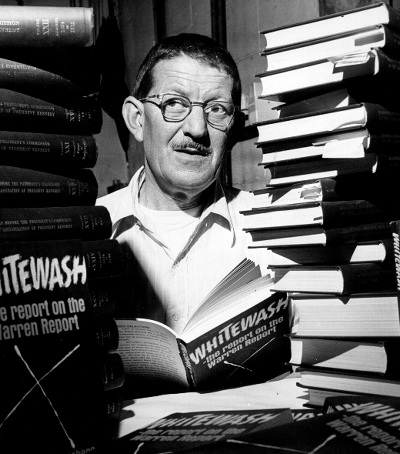
    At the time of the assassination, Harold Weisberg was trying to jump-start a writing career he had abandoned some years before. The son of Ukrainian émigrés and the first member of his family born in the United States, Weisberg was a former Senate investigator and journalist living in Maryland. He was immediately skeptical of the lone gunman story out of Dallas, so he drafted an outline for an article and sent it to his literary agent.

    The agent, Weisberg always recalled with astonishment, told him that nobody would consider publishing anything other than what the government said. “Can you understand how shocking that was to me?” he later asked. “With my background? And my beliefs about the functions of information in a country like ours?” Weisberg went on to write Whitewash and other books, all of them detailed analyses of the official case, and highly critical of the government’s handling of it.

    Other early critics included Mary Ferrell, a Dallas legal secretary; Vincent J. Salandria, an attorney in Philadelphia; Maggie Field, a housewife in Beverly Hills, California; and Sylvia Meagher, a researcher at the World Health Organization in New York, who later wrote a penetrating analysis of the case called Accessories After the Fact. Each was a product of that era some call America’s greatest generation.

    For most of these critics the assassination was nothing less than all consuming. “‘Oswald’ is the most spoken word in our house,” Salandria’s wife remarked in 1965. The objective: force a re-opening of the investigation. Although they began following and writing about the case immediately, it wasn’t until 1966 these critics began to get much media attention. Most labored in relative obscurity, and only gradually became aware of each other and their common goal. As they did, they began exchanging ideas and information by telephone, and by what today we refer to as snail mail. There was much the early critics didn’t know. But what they did know was that something was terribly wrong.

    For nearly all of the first generation critics, their initial research was simply tracking the assassination story as it was reported in the press, and noticing, in the first days and weeks, its inconsistencies.

    Like the rest, Mary Ferrell’s suspicions stirred almost immediately. At the time of the assassination she had just emerged from a Dallas restaurant not far from the scene of the crime. A passerby alerted her to what had happened. At almost the same moment police squad cars sped by, sirens blaring. “I ran into a bookstore and called my husband,” she recalled. He heard Kennedy had been shot in the head, Buck Ferrell told his wife, and no one could survive that kind of wound.

    Someone had a radio, and Mrs. Ferrell listened to the first sketchy descriptions of the wanted man. “I stood on Elm and thought that they would never find him with no more than that to go on, in an area containing over a million people.” She was thus astonished when the police arrested Lee Harvey Oswald about an hour later – and even more astonished that he did not match the broadcast description she had heard. “The Dallas Police were not gifted with ESP,” she wryly recalled. “And it just – it didn’t fit. And I said, Something is wrong. And I just, I thought, I’m going to find out what everybody said.”

    And so she sent Buck and their three sons to the loading docks of The Dallas Morning News and The Dallas Times-Herald where, in shifts, they awaited each updated edition of the daily papers. “Kind of a round robin, for four days,” Mary Ferrell remembered. “And we got every issue of every paper.”

    Mrs. Ferrell came across an article in the November 25th issue of the Times Herald hinting at something ominous. The article, “Anonymous Call Forecast Slaying During Transfer,” stated: “An anonymous telephone call to Federal Bureau of Investigation headquarters at 2:15 a.m. warned that Leo [sic] Harvey Oswald would be killed during his transfer from the city lockup to county jail.” The FBI alerted Dallas authorities – yet still Oswald was gunned down. Both papers were putting out multiple editions of each issue, but that article appeared in just one edition and there was no follow-up. “They junked that,” Mrs. Ferrell said. “There were very few copies of that that got loose.”

    Mary and Buck Ferrell
    Mary and Buck Ferrell

    Her interest further stimulated, Mrs. Ferrell continued collecting assassination-related material and never did stop. By 1970 her collection had become so vast that her husband added a room to the back of their Dallas home. “I can move all my books, papers, file cabinets, etc., out there and give the house back to Buck,” Mrs. Ferrell told a friend. She created an extensive database – originally on index cards, but in later years on a personal computer – and with another researcher, a series of chronologies that charted the people and events relating to November 22, 1963.


    In the end, the Warren Commission did not allow Mark Lane to represent the deceased accused assassin. “We are dealing with the mother of Oswald and this lawyer by the name of Lane,” Earl Warren told his commission colleagues in January 1964. “He wants to come right into our councils here and sit with us, and attend all of our meetings and defend Oswald, and of course that can’t be done.”

    A few days later, at New York’s Henry Hudson Hotel, Lane spoke about his preliminary findings to a crowd of about five hundred people. For the balance of the year he would lecture publicly about the case, at first just in New York, but soon during an ambitious lecture tour that criss-crossed the nation and even ventured as far away as Eastern Europe.

    On February 18, he was in New York for a speech that included an appearance by Marguerite Oswald. An enthusiastic crowd of 1,500 heard Mrs. Oswald say, “All I have is humbleness and sincerity for our American way of life.” She described how she tried to meet with her jailed son before he was murdered, but the Dallas police would not permit it. “Why would Jack Ruby be allowed within a few feet of a prisoner – of any prisoner – when I could not see my own son?”

    Sylvia Meagher
    Sylvia Meagher

    Among those in the hall that night was Sylvia Meagher, a 42-year-old researcher at the World Health Organization. “At that stage, I had little or no thought of doing any independent work or writing on the case,” she recalled. “I contributed both money and information unreservedly to Lane or his associates, and I would have been delighted to help in any possible way.”

    Yet she had already written a memorandum recording bitter thoughts. When the Warren Commission published its single-volume report she read it with a critical eye, and soon produced a 40-page article that she began shopping around to major magazines. “The Warren Report,” she wrote, “gives us no justification for declaring that the case is closed.”


    There were a lot of questions, just after the assassination, about how many times the President was hit, and where his wounds were located. Even after fifty years, these questions have never had definitive answers.

    Harold Weisberg was appalled that so many unanswered questions remained. “None should exist,” he declared. “This was not a Bowery bum; this was the President of the United States.” Post-mortem photographs of the late president’s wounds were never entered into evidence and the Commission members never saw them. Autopsy surgeon James Humes said he was “forbidden to talk,” and acknowledged having burned his autopsy notes. JFK’s neck wound was first reported to be one of entry, but later reported to be an exit wound. The first mention of a back wound was not made until nearly a month after the assassination. “As one version of the wounds succeeded another with dizzying speed and confusion,” Sylvia Meagher observed, “only one constant remained: Oswald was the lone assassin and had fired all the shots from the sixth floor of the Book Depository. When facts came into conflict with that thesis, the facts and not the thesis were changed.”

    The conclusion that one bullet caused multiple wounds in JFK and Texas Governor John Connally – the Single Bullet Theory – was undermined by the Warren Commission’s own evidence, the critics argued. That bullet, Commission Exhibit 399, was virtually undamaged, its appearance nearly pristine. The critics compared it to an identical bullet, Commission Exhibit 856, which had been test-fired by ballistics experts at the Army’s Edgewood Arsenal in Maryland. “The test bullet had been fired through the forearm of a cadaver,” said Ray Marcus, whose interest had expanded to include C.E. 399. That test bullet performed “only one of the multiple tasks allegedly executed by 399. Even so, the difference in the appearance of 856 and 399 is striking, as the former is grossly deformed.”

    In April 1964 Marguerite Oswald ended her relationship with Mark Lane. Almost immediately Lane formed an organization called the Citizens’ Committee of Inquiry to coordinate an independent investigation into the assassination. From its New York office, the CCI recruited a small army of volunteer investigators, some of who were dispatched to Dallas to interview assassination witnesses on Lane’s behalf.

    Vincent J. Salandria
    Vincent J. Salandria

    Among these volunteers were Vince Salandria and his brother-in-law Harold Feldman, a writer and translator. Both men were keenly interested in the assassination when it happened, and together had researched an article published in The Nation the previous January. On the morning of June 24, 1964, they left Philadelphia together in Salandria’s 1955 Buick sedan, armed with lists of names, notes, and other material supplied by Lane’s office. Feldman’s wife Immie accompanied them. Driving almost non-stop, they arrived in Dallas late the next day.

    Feldman and Salandria immediately contacted Marguerite Oswald. Media accounts had prepared them for a belligerent, uncooperative woman. “What I heard instead,” Feldman recalled, “was a pleasant ladylike welcome – not a trace of cautious ambiguity, not a second of hesitation in the warm courtesy that carried within it only a faint suggestion of loneliness.” The Feldmans and Salandria met with Mrs. Oswald over the next several days, and Marguerite even had them as overnight guests in her Fort Worth home.

    Harold Feldman, Immie Feldman, Marguerite Oswald

    (L-R): Harold Feldman,

    Immie Feldman, Marguerite Oswald

    Mrs. Oswald escorted the volunteer investigators to some of the key sites in the case. Together they visited Helen Markham, the Warren Commission’s star witness against Lee Oswald for the murder of Dallas Police Officer J.D. Tippit. Mark Lane had already spoken with Mrs. Markham by telephone, and her identification of Oswald as the killer of Tippit seemed shaky. A follow-up interview was important.

    Mrs. Markham lived in a small apartment over a barbershop. Mrs. Oswald, Salandria and the Feldmans found her at home, cradling her infant granddaughter in her arms and pacing back and forth. She declined to talk to them because, she said, she had to care for the baby. She would not let them pay for a babysitter, but did finally agree to let them return later in the day. As they spoke, Mrs. Markham allowed Marguerite to briefly hold the baby.

    Helen Markham, although a grandmother, was still young, Feldman observed – “but shabby, beaten, and spiritless.”

    They returned later that afternoon. As they approached the apartment they noticed two Dallas police cars, which had been parked right outside, pulling away.

    What happened next, Feldman later wrote, was “the most pitiful spectacle in our experience.” They knocked on the Markham apartment door. Mr. Markham was now home, and he stood barring the entrance as his wife cowered to one side.

    “I’ve never seen that kind of terror,” Salandria recalled years later. “Their teeth were actually chattering. And we could get little from them because of their terror.”

    “Please go away,” Mr. Markham had groaned. “Please go away, and don’t come back.”

    Marguerite broke in. “You’ve been threatened, haven’t you?”

    “Yes,” Mr. Markham replied. “Please, go away!”

    Shocked, they did as they were asked. As they got back out to the street and headed toward Mrs. Oswald’s car, Marguerite fought back tears. “That poor man!” she said. “He was frightened to death. What right do they have to threaten him? This is still America, by God.”

    Since alerting Marguerite Oswald to Mark Lane’s article, Shirley Martin had gone to Dallas several times to find assassination witnesses and talk to them. Not in any official capacity, of course: curiosity, and the feeling that something was not right, motivated her. Her proximity to Dallas – it was only two hundred miles away – proved an irresistible lure.

    By the summer of 1964 Mrs. Martin was in contact with Lane’s office, and Lane asked her to speak with a Dallas woman named Acquilla Clemons. Acquilla Clemons was not an eyewitness to the Tippit murder but was nearby, and witnessed some things that were at odds with what was reported in the press.

    The Warren Commission had not called Mrs. Clemons to testify, and these early Citizens’ Committee-sponsored trips first brought her story to light. There were at least three interviews with Mrs. Clemons by committee volunteers over the summer of 1964: by two Columbia University graduate students named George and Pat Nash; Salandria and the Feldmans; and Shirley Martin.

    George and Pat Nash were unimpressed with Acquilla Clemons. They wrote that her description “was rather vague, and she may have based her story on second-hand accounts of others at the scene.” Unfortunately the Nashes did not say why they doubted her.

    Salandria and Feldman interviewed Mrs. Clemons in early July. No record of their conversation appears to exist, but Salandria later said, “I thought she was entirely credible.”

    Shirley Martin
    Shirley Martin

    Shirley Martin spoke to Mrs. Clemons in August, about a month after Salandria and Feldman and the Nashes. She was not at all confident that Acquilla Clemons would talk to her. And so her daughter Vickie, who accompanied her mother, hid a tape recorder in her purse.

    For much of the conversation, Mrs. Clemons gave Mrs. Martin a lot of reasons why she didn’t want to talk to her. Mrs. Martin seemed to sense her nervousness. “I’m a private citizen,” she said. “I’m not representing any group.” Still Mrs. Clemons demurred; her employer, she said, did not want her involved in the case in any way.

    Undaunted, Shirley continued. “This friend of mine was here…I don’t know if you remember. Mr. Nash? Mr. Salandria? They talked to you?”

    “Someone came by my house about two months ago,” Mrs. Clemons replied. They promised to send her a picture of Lee Oswald, she said, but never did.

    Finally Mrs. Clemons began to talk. She described seeing two men, neither of them Oswald, in the vicinity of the Tippit killing. More than once since then, she said, the police had warned her not to talk to anyone about what she had witnessed on November 22nd.

    “So the police said you’d get a lot of publicity and you’d better not do it?”

    “Yeah, I’d better not,” Mrs. Clemons replied. “Might get killed on the way to work.”

    “Is that what the policeman said?” Shirley Martin asked.

    “Yes,” Mrs. Clemons answered. “See, they’ll kill people that know something about that…there might be a whole lot of Oswalds…you know, you don’t know who you talk to, you just don’t know.”

    “You scare me…”

    “You have to be careful,” Mrs. Clemons said. “You get killed.”


    The Warren Commission’s single-volume Report was published in September 1964, and two months later its 26 volumes of hearings and exhibits. This was the moment that the early critics had been waiting for. “I was wildly excited,” Sylvia Meagher recalled. “I opened the box. There were the 26 volumes, everything I’d been looking forward to studying for a long time.” Meagher went on to write a devastating analysis entitled Accessories After the Fact.

    The news media, too, greeted the Warren Report with great enthusiasm – but from a much different perspective. Time magazine called it “amazing in its detail [and] utterly convincing,” while The New York Times said “the evidence of Oswald’s single-handed guilt is overwhelming.” The CBS, NBC and ABC television networks all hailed the Report as the final word on President Kennedy’s assassination, and devoted much airtime to its findings.

    Mark Lane, who had been speaking publicly about the weaknesses in the government’s case since January, now began debating the Report and its validity. In October 1964 he sparred with Melvin Belli, the celebrated attorney who had unsuccessfully defended Jack Ruby for murdering Lee Oswald. Belli performed badly and was even jeered by the audience; he conceded that Lane “was bright and he had an almost encyclopedic knowledge of the facts.”

    On December 4 Lane took part in a much more important event, appearing with a Warren Commission staff attorney named Joseph Ball at a high school in Beverly Hills, California. It was the first time anyone associated with the Commission agreed to publicly defend its findings. At the time of this confrontation, the Commission’s Hearings and Exhibits had only been available for about a week.

    To help Lane prepare, several critics met a few days beforehand and began pouring over these 26 volumes. Their meetings took place at the home of Maggie Field. Most there had been in contact with Lane’s Citizens’ Committee office, but it was the first time they were meeting each other. And it was the first time many of them were getting a good look at the Warren Commission’s official evidence.

    While technically not a debate, the strengths and weaknesses in the government’s case were given a thorough airing that night before an overflow crowd of several thousand. For forty-five minutes, Lane held the audience spellbound with a summary of the deficiencies in the case against Oswald. And he assured them it was their right to know the truth. “We are going to remain with this matter until such time as the American people secure that to which we are all entitled in a free, open, and democratic society. And that is some intelligible answers to the thus far unanswered questions of Dallas on November 22.”

    But Joseph Ball assured the audience that the Commission had performed with honesty and integrity, and had found the correct answers. He emphasized his independence and impartiality. “It didn’t make any difference to me whether I discovered Oswald was the assassin or that someone else was.”

    Mark Lane, Ball charged, was picking and choosing from the evidence, and ignoring that which implicated Oswald. Lane interrupted to challenge this point, and the two argued back and forth. Each managed to call the other a liar. Finally Ball seemed to have had enough: examining Mark Lane, he declared, would only result “in a cat and dog fight.”

    “Well that’s all right,” Lane countered. “It’s about time we had a dialog in America on this question.”

    When the event was over, a reporter asked audience members about what they had witnessed. “It was like, a shocking drama,” said one. Several added that they found it troubling that someone of Joseph Ball’s stature was unable to answer many of the points Lane made. Most agreed that Lane had won. “The byproduct of his defense of Oswald,” one man said, “is to show that there has been, no matter what the motivation on the part of the Warren Commission, and many areas of government, an attempt to cover up.”


    In spite of their diverse backgrounds and political orientations, the first generation critics maintained informal, sometimes uneasy alliances with each other for several years. There were occasional meetings, most notably in October 1965, when some of the critics, including Vince Salandria and Maggie Field, gathered in Sylvia Meagher’s home.

    There was great excitement in the fall of 1966 when Republican Congressman Theodore Kupferman proposed a special committee to review the Warren Commission’s work. Nothing ever came of the freshman lawmaker’s idea. But just a few months later there was even more excitement with the electrifying news that New Orleans District Attorney Jim Garrison had launched his own investigation into the Kennedy assassination.

    Garrison freely acknowledged his debt to the work of the critics, in particular that of Mark Lane, Harold Weisberg, and a newcomer named Edward J. Epstein. Lane was among the first of the critics to get actively involved in Garrison’s investigation, lending his expertise; Harold Weisberg, Vincent J. Salandria, and others soon followed. Maggie Field raised funds for the D.A. and made plans to visit New Orleans.

    “I have repressed the occasional impulse to rush to the airport and fly to New Orleans,” Sylvia Meagher said in April 1967. But her enthusiasm was short-lived. By that summer Meagher and several others had lost all faith in Jim Garrison. It proved to be an irreconcilable issue between them, and by that fall, Meagher had severed ties with most of the other critics. For better or worse, Jim Garrison’s case ultimately failed. Afterward it seemed to many that the search for truth had been dealt a devastating setback.


    That the Warren Commission’s lone gunman theory is so widely rejected today suggests that the critics’ work proved it was wrong. And it did – yet it is also true that public skepticism has always run deep. Surveys taken within a few weeks of the assassination showed widespread doubt about the official story. The numbers have fluctuated over the years, but public opinion polls have consistently revealed this doubt. Perhaps what the critics really did was provide the details to what most Americans, in their bones, already knew.

    So who killed JFK? We still don’t know for sure, although theories abound. And while later generations of assassination researchers pursued this question with great zeal, many of the earliest critics stopped short of affixing responsibility. “After all these years,” Sylvia Meagher remarked in 1975, “I still do not know if it was the CIA, the military, LBJ, the Cubans, or the Mafia, or any combination of them. But I always knew, know, and will always know for a certainty that C.E. 399 is a fake, that the autopsy is a fraud, that much of the other hard evidence is suspect or tainted, and that the Warren Report is false and deliberately false.”

    Maggie Field once told an interviewer that finding the truth about the murder of JFK was of paramount importance. “Until we can get to the bottom of the Kennedy assassination, this country is going to remain a sick country,” she said. “No matter what we do. Because we cannot live with that crime. We just can’t.”

  • Elegy for Roger Feinman

    Elegy for Roger Feinman


    feinman
    Roger Feinman

    Roger Feinman Esq. passed away in New York City in mid-October of a heart condition. I did not meet Roger until 1993 at an ASK Symposium in Dallas. I was standing outside the main hall with John Newman when Roger approached us both and congratulated us on our recent books, Destiny Betrayed and JFK and Vietnam. He congratulated John without qualification and me with some qualification. When I got to know Jerry Policoff a bit better, I found out why mine was qualified.

    Both men had studied at the foot of the illustrious Sylvia Meagher. And as most people know, Sylvia had little time or affection for Jim Garrison. Since my book centered on Garrison, Roger had reservations about it. (Although I also learned from Jerry that Sylvia’s attitude toward Garrison changed slightly later in life.) Since Roger, like Sylvia, lived in New York, he was even closer to her than Policoff was. Having Sylvia as a mentor had its (plentiful) attributes and its drawbacks. On one hand, Sylvia had a strong devotion to core texts in the field. Consequently, one had to study the Warren Commission and House Select Committee volumes, and the supporting documents, at length and in depth. And very few people anywhere knew those volumes as well as she did. As is proven by the fact that she indexed them both. She was also a stickler for pure academic form. That is, one had to follow standard footnote and sourcing guidelines. And these should be attached to only credible sources. Finally, one should be analytical in one’s approach to the evidence in the case. For the authorities had decided much too early that Lee Harvey Oswald, and he alone, was guilty. Therefore, they had deprived the man of any kind of proper defense. One of the functions of the critical community was to balance the scales of justice in that regard.

    One of Sylvia’s drawbacks was that she rarely wanted to go beyond the core volumes. That is, she confined her approach to weighing the evidence in them and deciding the Warren Commission had not solved the crime–but actually helped cover it up. Hence the title of her excellent book Accessories After the Fact. She did not actually get out in the field and find other sources. Also, she tended to accept certain things in the Warren Report that to her, and to other first generation critics, just seemed too outlandish to question. For instance, Oswald’s possession of both the rifle and handgun as depicted in the famous backyard photographs. Consequently, when Jim Garrison began to go beyond the Warren Commission volumes in his inquiry—and to be tripped up by hidden forces both within and outside the mainstream press—she parted ways with him. She actually became one of his harsher critics. Hence Roger’s reservations about my first book. (I should note here, Sylvia was not alone in this attitude toward Garrison. Other first generation critics, like Paul Hoch and Josiah Thompson, felt the same way toward the DA.)

    As Roger began to make his own way in the field, he began to concentrate on two areas. His first area of interest was the media. He later developed a strong interest in the medical evidence. Concerning the first, Roger probably developed an interest in the media because he worked for CBS News. He was lucky enough to have secured a job there at a relatively young age as a news writer. And he had a promising future in a (then) thriving corporation. His idols there were the illustrious Edward R. Murrow, and the less famous Joe Wershba, who, ironically, died just a few months before Roger did. (http://www.cbsnews.com/stories/2011/05/16/national/main20063216.shtml)

    Wershba had assisted Murrow on his famous See it Now series, including the two segments that attacked Senator Joseph McCarthy, and helped end his demagogic and pernicious career. But Roger also noted what CBS had done to Murrow after that famous interlude. They essentially had bought him off and placed him in a gilded cage by giving him a lot of money to do innocuous celebrity interviews with people like Liberace. As Roger had deduced, William Paley and the top brass at CBS decided that no journalist, especially a crusader like Murrow, should ever have that kind of power again.

    Which makes what he did later at CBS even more admirable. Roger thoroughly understood that his company was up to its neck in the cover up of President Kennedy’s assassination. In fact, one could cogently argue that, from 1963-75, no other broadcast outlet did more to prop up the Warren Commission farce than did CBS. They prepared three news specials in that time period to support the Commission. These all came at crucial times in that time period. The first one was in 1964 to accompany the release of the Warren Report. The second was in 1967 to calm a public that was becoming anxious about what Jim Garrison was doing in New Orleans. The third was in 1975 at the time of the Church Committee exposure of the crimes of the CIA and FBI, and the Schweiker-Hart subcommittee report on the failure of those two agencies to properly relay information to the Commission.

    Instead of being quiet, playing along, and watching his bank account grow and his life prosper, Roger did something that very few of us would do. He began to write internal memoranda exposing how the practices used in the assembling of the multi–part 1967 series clearly violated the written journalistic standards of the network. As an employee, Roger had access to both the people involved in the making of that series, and through them, the documents used in its preparation. To say that these sources cinched his case is an understatement. They showed how the show’s producer, Les Midgley, had succumbed to pressure from above in his original conception of the show.

    His first idea was to show the viewer some of the points of controversy that the critics had developed. Then open up the program to a scholarly debate between some of the more prominent critics and the actual staffers on the Warren Commission. Wouldn’t it have been lovely to see Arlen Specter defend the “Single Bullet Theory” against Mark Lane? Or to listen to David Belin explain to Sylvia Meagher how the original rifle reportedly found, the Mauser, became a Mannlicher Carcano? Or to have Wesley Liebeler explain to Richard Popkin how all those reported sightings of a Second Oswald were either mistaken or didn’t matter? Even the one at Sylvia Odio’s apartment in Dallas. And to hear all this knowing that tens of millions were watching? What a great exercise in democracy: to have a thorough airing in public about the suspicious circumstances surrounding the death of President Kennedy. Especially while his successor, Lyndon Johnson, was escalating the Vietnam War to absurd and frightening heights.

    It was not to be. There was virtually no debate at all on this series. It was essentially a multi-part and one-sided endorsement of the Commission; the main talking heads being Walter Cronkite and Dan Rather. In his memoranda, Roger showed, with specific examples arranged in time sequence, how Midgley’s original conception was completely altered. Further, he named names all the way up the ladder. This included Dick Salant, president of CBS News. He then showed just how badly CBS had compromised itself to the Warren Commission forces. Midgley actually had Commissioner John McCloy act as a consultant to the program. Except this was done outside of normal channels, through his daughter, who worked at CBS and who functioned as a go-between between Midgley and McCloy. To conceal how badly CBS had compromised its own journalistic standards, Midgley then kept McCloy’s name off the program. In other words, the public never knew that CBS had consulted with a Warren Commissioner on a show that was actually supposed to judge the quality of work the Commission did. Of course, this would have been admitting to a national audience that the program was an extension of the Commission itself. And therefore was a cover up of a cover up.

    Midgley’s career was not at all hurt by his caving into pressure. In fact, it prospered. (http://articles.latimes.com/2002/jun/29/local/me-midgley29) He spent 34 years at CBS, retiring in 1980 after winning several awards. On the other hand, Roger’s was hurt. Fatally. He was first warned to stop composing and forwarding his critical memoranda about the Kennedy coverage. Unlike Midgley, Roger would not compromise. So CBS now began termination procedures against him. The procedures turned out to be successful. Roger lost his job, career, and future at CBS over his desire for them to tell the truth about the Kennedy assassination. To me, this episode is an object lesson which illustrates the fact that journalism is compromised by its managers being too close to centers of power. So much so that the Power Elite—in the person of John McCloy– then actually dictates what the truth about an epochal event is. Roger resisted the hypocrisy. He was shown the door.

    Roger then decided to go to law school. He graduated from Benjamin N. Cardozo School of Law in New York. He was a practicing lawyer for a number of years until, again, his career got caught up in the Kennedy case. The Power Elite deeply resented the impact that Oliver Stone’s 1991 film JFK had on the public. It created exactly what Midgley had been directed not to do: a public debate about Kennedy’s assassination. And the debate was everywhere, and it went on for months on end.

    Finally, Random House and Bob Loomis had had enough. Loomis, a Random House executive, now played the role of Dick Salant. He decided to orchestrate a quelling of the debate. He did this by hiring Gerald Posner to write a cover up book on the Kennedy case. Entitled Case Closed, the book was ridiculous on its face. Because Congress had not yet released 2 million pages on the Kennedy assassination. These were going to be declassified as a result of passage of the JFK Act, which was a direct result of the Stone film. So how could Posner close the case without this important information? Further, if Posner had closed the case, why was this information still being withheld?

    Loomis, and his friends in Washington and New York, helped arrange an extravaganza of a book tour for Posner the likes of which had rarely, if ever, been seen. He was featured on ABC in primetime, his book was excerpted with a cover story in US News and World Report. This was meant, of course, to distract attention from what was going to be released in those files. In order to cut off another debate. How intent was Random House to crush the critics and drown out their message? Loomis and Harold Evans, then president of Random House, decided to take out a large ad in the New York Times. It was in two parts and it was meant to deride the critics and exalt Posner and his book. The first part took the pictures of some prominent critics, like Bob Groden and Jim Garrison, and excerpted quotes from them out of context. At the top of the ad in large letters were the words: “Guilty of Misleading the American Public”. For Roger, this was one more example of corporate arrogance and the irresponsible use of power in the face of a complex and crucial event like the Kennedy case.

    So when Groden came to Roger and said he felt like his name and work had been smeared by the ad, Roger agreed to take on his case. If he had known what was in store for him, and the relationship between the judge in the case and Random House’s lawyer, he may not have done so. Because the judge clearly favored Random House, since he had been a clerk for Earl Warren. On just that basis, he should have recused himself. But he did not. When Roger protested the perceived bias, and the resultant favoritism that he felt short circuited the process and robbed his client of his day in court, he lost another career. He was disbarred.

    Roger spent the last quarter of his life in his small New York apartment working off and on as a computer programmer. He never lost his interest in the case, which had actually brought him much personal sorrow and grief. And he never lost his interest in the medical evidence. He supported the work of Dr. Randy Robertson, which he felt proved a conspiracy in the JFK case. And he criticized the work of David Lifton with a very long essay—Between the Signal and the Noise— criticizing his book Best Evidence. I had the privilege of communicating with Roger in those years via an e-mail chain set up between Milicent Cranor, Gary Schoener, Jerry Policoff, and myself. Roger never lost his spirit about what had happened to the USA as a result of the assassinations of the sixties, and he was a keen student of how the political system had evolved and declined since then. I got to see him at several conferences. It was always a pleasure to talk to him about CBS and what he had learned there through the documents he had spirited out when he left.

    One definition of the heroic is someone who sacrifices his own personal well being for a cause outside himself. Knowing full well that the odds against him triumphing are very high. Roger took that heroic gamble. Not once, but twice. He lost both times. Few of us, maybe no one, could display that kind of courage for a cause.

    For that, he should be saluted on his passing.


    (The following are links to some of Roger’s work)

    Between the Signal and the Noise (http://www.kenrahn.com/JFK/The_critics/Feinman/Between_the_signal/Preface.html)

    When Sonia Sotomayor’s Honesty, Independence and Integrity were Tested”. This article describes how Roger was disbarred over the Groden vs Random House case

    “CBS News and the Lone Assassin Story”, this is the script for Roger’s excellent visual essay on how Les Midgley’s CBS series covered up for the Warren Commission in 1967. Use this link.

    See now also “How CBS Aided the JFK Cover-up” by Jim DiEugenio.


  • Robert Groden Arrested

    Robert Groden Arrested


    groden
    Robert Groden in Dealey Plaza
    (CTKA file photo)

    Longtime Kennedy assassination critic and author Robert Groden is among Dealey Plaza vendors who are under renewed pressure from Dallas authorities.

    Groden was arrested in Dealey Plaza on June 13 and jailed for nearly nine hours.

    In a communication with CTKA, Groden discussed a posted story about a crackdown on JFK vendors in Dealey Plaza. He says he was arrested because of a complaint by the Sixth Floor Museum transferred to the Dallas Police.

    Groden says he was arrested for selling a single magazine on the grassy knoll.

    As described in the article “How Gary Mack Became Dan Rather”, Groden was ticketed by the Dallas Police Department 80 times between 1995 and 2006, and arrested on the grassy knoll for the first time in 1998. All 80 tickets (and the arrest) were thrown out of court as being invalid. Groden told CTKA that a city Judge stated, “I can’t believe that the police would arrest anyone for a class ‘C’ misdemeanor. This is ridiculous”.

    In 2003, Groden began filing a first amendment lawsuit against the city of Dallas and the police department for violation of first amendment rights of free speech, press and assembly. An agreement was reached between Mr. Groden’s attorneys and the Dallas city attorney’s office that the police would cease such ticketing actions. And for the past seven years the police and the city had honored the agreement.

    Groden theorizes that this may be because next year Dallas will be the site of the Super Bowl, drawing tens of thousands of tourists to the city. The number one tourist attraction in Dallas is Dealey Plaza. If all the other independent vendors are essentially stopped from selling anything, the Sixth Floor will be able to be the “one-stop”, so to speak, for potentially thousands of new visitors on the JFK case.

    Groden says most of the Dallas media are reporting that all of the “peddlers” in Dealey Plaza are refusing to obtain vendor permits from the city. What they fail to say, he goes on, is that there are no vender permits available from the city for printed material and that the city ordinance states that none is needed. In fact, Groden has been trying to access the process for getting one for 15 years. He hasn’t been able to find it. So up until now, although the city has ticketed him about 80 times, each attempt ultimately was dismissed and Groden returned to Dealey Plaza.

    Groden adds that the fig leaf for the crackdown is the fact that there are three or four homeless transients that frequent the area and get pushy with visitors from time to time. Groden doesn’t know these characters and has nothing to do with them. And his work is of a different quality and class than theirs. He insists there should be a legal way to differentiate between the two.

    Robert Groden is a recognized photo expert and author of The Killing of a President and several other books.

    ~Jim DiEugenio

  • Von Pein/Colbert Replies, and the Comedy Continues?


    Predictably, since we advertised it on the Billboard, David Von Pein was waiting for my article about him to appear. And the very day it was posted, Von Pein made one of his patented silly replies. Then, when I went on Len Osanic’s Black Op Radio on April 15th to discuss the essay, Von Pein replied again. It is hard to determine which response is more silly, but since the second one brings up more issues, let us use that one.

    1. Von Pein starts out by criticizing me for mispronouncing his name. To which I reply: “Excuse me!” Like this really matters in what is under discussion. DVP then tries to deny the fact that any initial criticism he made of Reclaiming History was negligible. This is ridiculous. In his first press release he relegated the “errors” he found in the book to a special section of his multi-sectioned review. He excused them with two qualifications: 1.) In such a huge and heroic undertaking, anyone could have made them, and 2.) The ones he listed were so minor that they in no way impacted on the worthiness of the volume. And Von Pein’s list was minor. None of Bugliosi’s major errors of commission or omission noted by either Rodger Remington or myself are there. Von Pein has to deny all this today because after the numerous, comprehensive and compelling polemics that have leveled Bugliosi’s book, his first press release looks so biased that it has no credibility. Which, of course, it did not in the first place. It was nothing but PR.Von Pein’s next point may be a valid one. Which, for him, is a real achievement. (For DVP, 1 in 17 is a good batting average.) He says that he has only reviewed two of the Discovery Channel JFK cover-up specials. So, accordingly, I will change the wording here.As per his pointing out any errors in Inside the Target Car, see point two above. As with Reclaiming History, they were so negligible as to be worthless. In fact, he actually got angry at me for coming up with so many errors that my review ended up being three parts long. His other point, about the front shot exploding the head, is misguided. The ammunition used here was a different type of round than the others. And therefore with the “replica heads”, which were not replicas, the explosion was bound to happen. This is nothing but obfuscation by Von Pein. Which is why he never answers the question of why the program’s military jacketed bullets did not fragment. Yet in the JFK case, the bullets did.Unlike what DVP maintains, if one reads any of the scholarly literature on the history of the Mannlicher-Carcano rifle, one will see that the 36 inch version was called a carbine, and the 40 inch version-which was a cut down of a longer rifle-was usually referred to as a short rifle. (See John Armstrong’s fine discussion in Harvey and Lee, p. 439) I don’t think a mail order sales ad calling both versions carbines qualifies as scholarly dissertation for anyone but Von Pein. In fact the use of the word “scholarly” in the same sentence with Von Pein is an oxymoron.The next point indicates the time warp that Von Pein is in. He actually scores me for not accepting all the old discredited Warren Commission evidence against Oswald. You know, like the palm print that did not arrive in Washington until a week later; the unbelievable CE 399; the dented shell that could not have been dented that day; the Walker bullet that somehow altered its caliber and color while in transit from the rifle; the shells from the bullets fired at Tippit that are missing the officer’s initials etc etc. These deceptions were all exposed decades ago by Harold Weisberg, Sylvia Meagher, Mark Lane, Josiah Thompson and others. Yet, with Von Pein, its like those books do not exist. Which shows his denial problem. Because they are the main reason that the public lost faith in the Warren Commission.He actually says that Victoria Adams and Sandra Styles could not have been on the stairs with Oswald after the shooting since they only descended a minute or two later. This is a perfect illustration of Von Pein’s denial problem. For Adams had to correct the transcript of her testimony because it lied about this specific point. She said she was on the stairs about 15 seconds after the shots. So if Oswald was descending, she would have had to have seen or heard him. She did not. (See Gerald McKnight, Breach of Trust, p. 399) Von Pein wants to revivify the lie.Von Pein tries to obfuscate his howler about Kennedy and John Connally reacting to the same shot at Z-224. So what does he do? He shows us frames Z-223, and then Z-224. You can see very little, if anything, of Kennedy in Z-223. Which is why I did not mention it. In Z-224 you can see a sliver of his hands going upward toward his neck in reaction to being hit. While Connally is sitting serenely in front, untouched. So Von Pein was wrong about both men reacting simultaneously and is now trying to cover up his error. The proof of that is this: Why didn’t he show us frames Z-224, 225 and 226?As per his celebrated departure from JFK Lancer, Von Pein tries to say that one person actually called him polite. But this was a purely relative statement. It was made in comparison to another troll named Nick Kendrick. To me, this is like differentiating between a flea and a louse.Von Pein tries to say that the quote I used by Gene Stump does not actually refer to his almost insane frequency of posts, which flooded the JFK Lancer Forum board. He says it refers to Nick Kendrick. Actually, in the copy I have of that, it is not clear if Stump is referring to Von Pein or Kendrick. But it’s irrelevant to the main point. Von Pein himself refers to the well over 2,000 posts he made at Lancer. And even a rather conservative Commission critic like Jerry Dealey noted about Von Pein that, “I did get tired of his responding to every single thread repeatedly, and always repeating the same things over and over.” (Post of 7/28/05, italics in original.) Von Pein was flooding the board to distract everyone.In his next nonsensical point, Von Pein shows his sensitivity and warm camaraderie with propagandist John McAdams. He tries to say that McAdams does not dominate alt.conspiracy.jfk and that someone like me would feel at home there. John McAdams posts at that site regularly, and it’s always to ridicule Commission critics. In fact, he is joined there by both Von Pein and Dave Reitzes. It is their home away from home-since all three have their own web sites that support the Commission and the Single Bullet Delusion. McAdams, Reitzes, and Von Pein have made that forum a flame pit since they have polarized the debate there because of their constant ridicule and invective against any kind of Commission critiques. In fact, in Lisa Pease’s appearance on Black Op Radio on May 13th, she discusses McAdams’ techniques in this endeavor. (She begins at the 41:20 mark.) I would never set foot there because of this point: there is no real debate, it is more like mud wrestling. Which is why I call it the Pigpen. And it’s why Von Pein is at home there.Von Pein tries to obfuscate the fact that one of the reasons he was booted from John Simkin’s Spartacus forum was his failure to produce a photo of himself. He says that this was not a foolproof way to keep trolls out anyway. Duh, no kidding Dave. But unless Simkin was going to run full background checks on applicants and then make them sign an oath in advance, there really is no foolproof way to become troll-proof. But the picture was one easy step in that direction. Von Pein then tries to say that he had no picture on his computer to upload. This is almost surely a lie. There IS a photo taken in 1991 of Von Pein selling chicken at what looks like Kentucky Fried Chicken. And it is on the web. Why couldn’t he have uploaded a cropped version of that photo?Von Pein tries to defend the London trial that Vincent Bugliosi participated in. I repeat what I said: it was nothing close to a real trial. You can make that judgment just on the fact that none of the three autopsy doctors were there. Secondly, the Assassination Records Review Board had not declassified the hidden records. Finally, because no actual exhibits were used, and the three pathologists were absent, the real rules of evidence could not be followed.Both Von Pein and Bugliosi ignore the 8 questions I posed at the end of my essay which prove that CE 399 was not found at Parkland Hospital. They can’t directly answer them since they pose compelling proof that the FBI lied about the provenance of the Magic Bullet. So Von Pein does what his master Bugliosi does in his book: 1.) He ignores this direct evidence and 2.)Blows smoke by countering with senseless comments and questions. Bugliosi has honed this technique to a science. In essence it asks the respondent to demonstrate exactly how the conspiracy actually worked in each and every detail. Which is ridiculous. Why? Because it shifts the burden of proof from the prosecution to the defense. In other words, it Is not enough to prove a conspiracy happened. The defense now has to demonstrate exactly how it was implemented. Which is a preposterous standard. And it implicitly shows that Bugliosi cannot uphold his own standard of proof of guilt beyond a reasonable doubt. Those 8 questions prove that Oswald was framed. Period. If they did not, then Bugliosi and DVP would either show that the facts I used are wrong or they would answer them. They do neither.Von Pein now really gets his dander up. He says that it is a dirty lie to state that he reviewed Rodger Remington’s book Biting the Elephant for amazon.com. This is more Von Peinian silliness. . And a diversion from the real point. While technically true, it ignores the fact that this is the only book by Remington that Von Pein has not reviewed at amazon.com. Rodger has written four books on the Warren Commission, Biting the Elephant is the most recent. Von Pein has reviewed the other three at Amazon. Incredibly, he either forgot this or does not think it’s important. But the real diversion is this: He reviews the books without reading them! Nothing in his reviews reveals any knowledge of the subject matter in the books. All they consist of is general boilerplate arguments against the Commission critics. But he then gives the books he has not read, and disagrees with, five star reviews! Evidently he hopes that people will then be more apt to read his propaganda. If that is not fraud, I don’t know what is.

      Von Pein says I was wrong to state that he has been promoting Reclaiming History since 2005. He says he has been doing it since 2003. In other words, promoting what was published in 2007 in 2005 isn’t good enough for DVP. He was promoting it back in 2003. He then says he is proud of that fact and that Reclaiming History will be the Bible on the JFK case for generations to come. Hmm. Sounds like Gerald Ford talking about the Warren Commission in 1964. But, alas, Reclaiming History did not even last that long.

    2. My last point here is one that absolutely typifies Von Pein and his almost embarrassing obeisance to Vincent Bugliosi. I have scored Bugliosi by saying that it appears he wrote Reclaiming History from his office. That is, he did all his interviews and investigation over the phone. Which is remarkable considering he had 21 years and a huge advance to spend. Von Pein tries to salvage this practice by saying that this does not matter since the same conversations would have taken place in person as over the phone. But if that is so, the question then becomes: Why do investigators go to crime scenes or interview witnesses and suspects face to face at all? For instance, if Bugliosi would have gone to Chicago and looked at the planned parade route there, he would not have written that the failure to fully investigate this assassination attempt had no impact on what happened in Dallas. The scenarios, as Jim Douglass found out by going there, were almost the exact same thing: an attempt by crossfire below, while a patsy above in a warehouse was elevated over the motorcade route. Incredibly, Bugliosi never went there to see that. Also, he evidently never went to the National Archives to see that, contrary to what he wrote, FBI agent Elmer Lee Todd’s initials are not on CE 399. But also, one can get a feel for a witness more readily in person than one can over the phone. For instance, when I talked to FBI agent Warren DeBrueys at his house north of New Orleans, he told me that he did not read any books on the JFK assassination. But in a break during the interview, I walked a bit around his house. Sitting on a shelf in his office were 15 books on the JFK assassination. That discovery could not have happened with a phone interview. So Von Pein is wrong.

    As is the sum total of Von Pein’s reply. But everyone should know that about Von Pein now. As Gil Jesus has noted, Von Pein is a lost and silly person. He likes to call Commission critics “kooks” and “nuts” to disguise his own imbalances. Namely, that he is in denial of the evidence. And of his own myopia and solipsistic personality. Therefore, he uses the psychological device of projection. That is, the cognitive failing is not actually his, the problem lies with the rest of the world.

    It’s not everyone else Dave. It’s you. Which is why you are the only one still relaying messages to Bugliosi’s secretary Rosemary Newton. And you will only get better once you admit that truth about yourself.

  • David Von Pein: Hosting Comedy Central Soon?


    Jon Stewart and Stephen Colbert better be looking in their rearview mirrors. They have a rival approaching. And he is even better than Colbert at impersonating the dimwitted, obnoxious, incredibly biased host that has made him famous. Why? Because he’s not acting. His name is David Von Pein and he is now proceeding at warp speed in his attempt to go beyond even Colbert’s famous caricature.

    If the reader will recall, the last time we addressed Von Pein he was trying to patch up his beloved Reclaiming History. He has to. For he had ballyhooed Vincent Bugliosi’s giant tome in almost embarrassing accolades. Even before it was published.

    To digress, it should be noted that Von Pein also does this with almost any TV show supporting the Commission. Then after the show is broadcast, he issues what is essentially a press release within hours of the air date. He notes that the show was excellently done and that it just wrecked some central tenet of the Commission critics. He has done this with almost every other Discovery Channel debacle to come down the turnpike. Then, when more credible, honest, and serious observers begin to poke holes in the production, he gradually gives ground. Until finally, he will maintain perhaps one tenet of the program as valid. He did this with the horrendous Inside the Target Car. When every point he had accepted about that atrocity was effectively speared, he finally backed off to defending just one of them. This was the simulated shot from the front with the head exploding; which he maintained as showing the head shot could not have come from the grassy knoll. To do this, he ignored a central point made by Milicent Cranor and myself: that what this actually indicated was the “replica skulls” used by host Gary Mack were anything but. Associate producer Mack essentially admitted this in his online discussion of the show when he said that the bullets they used did not fragment. Therefore the “replicas” did not provide the proper resistance, since in the Kennedy case the bullets did fragment. Von Pein can’t admit this since it vitiates both the experiment and his upholding of it. (Click here for our critiques of that phony sideshow )

    The above pattern was paralleled with Reclaiming History. Before the book was published, Von Pein said it would lay out and silence the people he despises most in this world i.e. those who find serious fault with the Warren Commission. When the volume was issued, with great alacrity, he issued his usual press release. He praised all aspects of the work. He could find no real fault in the volume’s nearly 2,700 pages. When certain critiques began to point out the clear and myriad problems with the book – which he somehow had overlooked – he began to give ground. Until finally, today, he has been placed almost completely on the defensive.

    For example, Von Pein responded to the first part of my Reclaiming History series by questioning my analysis of whether or not Oswald could have ordered the Mannlicher-Carcano rifle that is in evidence today. I spent several paragraphs in part one of my critique showing that in view of all the evidence, it is highly unlikely that he could do so.  I also posed a serious question about the transaction: the mail order company sent him the wrong rifle. Both the length and the classification were wrong. Although Oswald ordered the 36-inch model classified as a carbine, the Commission says he received the 40-inch model classified as a short rifle. Further, the House Select Committee on Assassinations discovered that Klein’s only placed scopes on the 36-inch model. Yet the 40-inch model in evidence has a scope on it. (Click here for that discussion.)

    Von Pein said he would admit all this, but he then provided a link to the mail order allegedly sent in by Oswald. Which is classic Colbert/Von Pein. Because this technique ignores all the evidence I produced in Part One to show how hard it is to believe that Oswald sent in that money order. To name just a couple of points: 1.) It does not appear the money order was ever deposited, and 2.) Why would Oswald buy the money order at the post office, yet walk over a mile out of his way to mail the envelope? All the while being unaccountably absent from work.

    To understand Von Pein, one has to go back to his online, forum appearance on the JFK Lancer site back in 2003. Even though moderator Debra Conway warned of submitting “trolling threads” there, Von Pein couldn’t help himself. In July of that year, he proclaimed Oswald guilty through what he termed a “mountain of evidence.” He then asked, how much of this overwhelming tidal wave of proof would it take to convince a person out of the notion of conspiracy? Quite a thunderous build up eh?

    But as with Chaplin’s cannon, the explosion fired the shell about two feet away. For Von Pein’s “mountain of evidence” consisted of the mildewed litany of discredited Warren Commission data. Which, of course, is not a mountain. It’s more like the San Andreas Fault. He began with the above noted specious notion that Oswald owned the rifle; and he ended with the equally specious notion that Oswald could have run down from the sixth floor to the second in time to be seen by Marrion Baker and Roy Truly right after the assassination. Some of the gems in between were that Oswald definitely killed Officer Tippit and that he also attempted to kill General Edwin Walker. My favorite point was this: “the Single Bullet Theory has still not been proven to be an impossibility.” I guess he thinks that if it’s not impossible, that means it happened. (As we shall see later, with CE 399, it is impossible.) Von Pein even wrote that at Z frame 224, both Kennedy and John Connally were reacting to the same bullet. Which Milicent Cranor, in her previously posted article “Lies for the Eyes”, showed to be a howler. In reality Kennedy is reacting and Connally is not. With a straight face, at the end of this “mountainous” listing, Von Pein wrote, “For aren’t hard facts and evidence always more believable than wild speculation and conjecture?” (Posted 7/17/03)

    As one respondent noted to Von Pein, with the work of Josiah Thompson, Sylvia Meagher, and Mark Lane, his list had been pretty much demolished by 1967. Yet he was reviving it as if it were new. Further, while listing it, he did not note any of the serious problems that those writers had pointed out. Von Pein was, of course, starting a classic “troll thread”. One that is deliberately meant to provoke others. “Trolling” was defined by Tim Campbell in his 2001 article on the subject as such: “An Internet troll is a person who delights in sowing discord on the Internet. He … tries to start arguments and upset people … To them, other Internet users are not quite human but are a kind of digital abstraction … Trolls are utterly impervious to criticism … .You cannot negotiate with them … you cannot reason with them … For some reason, trolls do not feel they are bound by the rules of courtesy or social responsibility.” Conway duly posted this article, seemingly to warn Von Pein.

    But this did not even slow Von Pein down. For, as Campbell noted, trolls are non-negotiable and impervious to criticism. In his Colbert vein, Von Pein tried to say he was making arguments that were founded in common sense and logic. (Post of 7/21/05) A few days later, the uncontrollable urge to lash out at the billions who would not accept the Single Bullet Fantasy again possessed Von Pein. He submitted a truly Colbertian post. It pictured a gift basket of books for a Commission critic. It consisted of book covers entitled – among others – Paranoia, Face Your Fear, and A Paranoid’s Ultimate Survival Guide. No joke. (Post of 7/26/05) This points out the other side of Von Pein, which is also echoed in Reclaiming History: When you cannot win your argument on the facts, you resort to smearing your opponent. And Von Pein did this not just with the general comment above, but also to individuals. As Todd Teachout noted, Von Pein made comments to members like “You are disgusting!” and “The goofy gas must be getting to you … You’re talking more like a moron with every post.” As Todd ultimately noted, the obvious intent was “to not engage in a discussion of issues here, but to attempt to stifle a discussion of the issues.” (Post of 7/22/05)

    Which was undoubtedly true. And finally, a few days later, Conway announced that she was banning Von Pein from her forum. After his belated expulsion, there followed a two-day celebration. On a small scale, it was somewhat comparable to V-E Day. But before leaving the subject of Von Pein at Lancer, it must be noted that it was there that he began to manifest his almost incontinent devotion to Reclaiming History. In fact, he began to bandy it about as a way to counteract evidentiary points in the case i.e. the avulsive hole that so many witnesses saw in the back of Kennedy’s skull. What made this odd is that he was doing it in 2005. Reclaiming History would not be published until two years hence. Quite an omniscient feat. One person questioned Von Pein’s reasoning from a different angle. He said that it was not logical for Von Pein to build up Bugliosi’s book because the author would be working with the same database everyone else was. Von Pein replied that although this may be true, Bugliosi was somehow that much smarter than everyone else and that should make the critics quiver in fear. For Reclaiming History would spell the end of their cause. Pretty hefty expectations for a book yet to be published.

    As I said, Conway eventually did the right thing and ejected him from the forum. But Von Pein had to have understood that he was breaking the posted rules of the site. For it clearly stated that members were not to use abusive language. Another rule was not to spam or harass or exploit the other members. (The gift basket of “paranoid” titles would qualify as such in my book.) But the rule that Von Pein violated with reckless abandon was the one about doing mass posts and therefore flooding the board. As Gene Stump pointed out, Von Pein did 263 posts in his first 12 days! (Post of 7/28/05) As Teachout indicated, the game for Von Pein was to dominate the forum with his antique discredited “facts”, so that instead of doing constructive work, everyone would be debating things as silly as the Magic Bullet. When that didn’t work, Von Pein’s smears and insults would be used in hopes of dividing and polarizing the place so that no actual discussion on the evidence was possible. Because anyone who believed the Commission in error could be reduced to being something less than human: a sick and paranoid conspiracy buff. (In large part, Bugliosi adapted the last technique in his book.)

    Once ejected from Lancer, Von Pein migrated over to John Simkin’s Spartacus forum. Pretty much the same thing occurred there. He was eventually ejected because of his abusive language plus his failure to post a photo of himself. Simkin required the latter to prevent trolls from entering the forum under assumed names. Which, of course, raises some interesting questions about Von Pein’s failure to do so.

    After this second ejection, Von Pein came to his senses. He realized he could not comport normally with the great mass of the public who didn’t buy the fantasy of the Single Bullet Theory. He now made his way to the place where he belonged all along: the John McAdams dominated Google group, alt.conspiracy.jfk. Why is this important? Because historically speaking, McAdams was the first person on the Internet to exhibit critical thinking skills so stilted, comprehension skills so unbalanced, cognitive skills so impaired, all combined with a basic dishonesty about these failings, to the degree that he almost seemed the victim of a neurological disease. Any strong indication of conspiracy in the JFK case, no matter how compelling, could not permeate his brain waves or synapses. McAdams hates being an outcast or labeled as a propagandist – even though he is. So he constructed a sort of hospice for people like himself who normal thinking people could not tolerate. Actually two of them. One is on his own site and one is a Google Group.

    The important thing for Von Pein is that since McAdams controls the halfway houses, almost anything goes as long as it supports the Warren Commission. Here, Von Pein could now use his previously noted wild man tactics with impunity. Another place that Von Pein frequents is the IMDB forum on Oliver Stone’s film JFK. There, to those not familiar with the facts of the case, he tried to discredit the film as a work of “fiction”. Or those who have not read the accompanying volume to the movie entitled JFK: The Book of the Film.

    But it is from alt.conspiracy.jfk that Von Pein has continued what will probably be his lifetime goal: To protect and to serve Reclaiming History. After all, Von Pein bought into the book two years before it was published. He proclaimed to all that Bugliosi would grind the likes of Sylvia Meagher, Gary Aguilar, and Philip Melanson into hamburger. To put it kindly, Reclaiming History did no such thing. In fact, as Von Pein was advised, one of the most surprising things about the book is how little new is in it. For the most part, Bugliosi just recycled all the old Krazy Kid Oswald arguments and put them between two covers. In so doing he largely relied upon that same hoary and discredited cast of characters: Michael Baden, John Lattimer, Larry Sturdivan, David Slawson. He even trotted out Gerald Ford. As I noted, though Von Pein was warned about this probability, he thought Bugliosi would pull a rabbit out of the hat. He didn’t. Because there is none to pull.

    Reclaiming History was remaindered in about a year. And it has been effectively attacked by a slew of writers: Rodger Remington, Gary Aguilar, Milicent Cranor, Michael Green, Mark Lane, Josiah Thompson and myself among them. So Von Pein is placed in the position of any troll. He has to defend what he said by protecting his hero from the justified and effective attacks on his work. In this regard, he has gotten so desperate that he communicates with Bugliosi’s secretary on a regular basis. She even asked him to host a cable TV program and take on “any and all conspiracy nuts.” Apparently, Rosemary Newton is unaware that Len Osanic personally invited Von Pein to debate me on his Black Op Radio program. I also asked him to do so. He failed to take up the challenge at either opportunity. Understandably, he would rather wage his crusade from inside the friendly confines of McAdams’ hospice (which I have elsewhere nicknamed The Pigpen) This is not very brave but – as we shall see – it is probably smart on his part. As Gil Jesus has noted, it’s from there that Von Pein can issue some of his most bizarre proclamations, like “What does ‘back and to the left’ prove? Anything?” Or this other dandy: “Let’s assume for the sake of argument that there were/are several different Mannlicher Carcano rifles with the exact same serial number on them of C2766 … my next logical question (based on the totality of evidence in this Kennedy murder case) is this one: So what?” (Jesus post at Spartacus forum 9/13/08, quoting Von Pein) Only from The Pigpen could such wild nonsense be allowed.

    And only there could the following go by without being harpooned. In August of 2009, Von Pein queried Rosemary Newton again. He wanted her to ask Bugliosi if CE 399 – the Magic Bullet – would have been admitted into evidence at trial. He also wanted to ask if the judge at the 1986 simulated posthumous Oswald trial in London had done so. In the Introduction to Reclaiming History, Bugliosi tries to insinuate that the televised trial that he (unwisely) chose to participate in was very close to an actual trial. And that it followed the standard rules of evidence. The author sidestepped the crucial fact that since the trial was in London and the core evidence is at the National Archives, things like the alleged rifle, the shells, the autopsy evidence, and CE 399, were not there to be presented in court This would not be the case at a real trial. But not only that, even though all three autopsy doctors were alive in 1986, none of them were at the trial. Could one imagine all this happening in a real, contested, high-profile trial? I can’t. In actuality, the London production did not even approach a real trial. And since all the above was lacking, the rules of evidence – by necessity – could not be followed. To point out just one failing: Any defense lawyer worth his salt would have demanded CE 399 be presented in court for the jury to view. We shall see why shortly.

    In spite of the above, on August 22nd of 2009, Bugliosi replied to Von Pein’s query about the admittance of the Magic Bullet into evidence. Significantly, the prosecutor led off by saying that the purpose of the “chain of possession requirement is to insure that the item being offered into evidence by the prosecution, or the defense, is what they claim it to be.” (Keep in mind, Bugliosi himself said this.) He then answered the first question with, yes CE 399 would be admitted. And his answer to the second question was that the judge at the London trial had admitted the bullet into evidence without seeing it! Yep, that’s what happened. A question that Von Pein/Colbert didn’t ask was: “Vince, what kind of evidentiary hearing could you have if the actual bullet wasn’t there? That would mean that the jury could not examine it. It’s the shock of seeing that bullet and then listening to both the damage it inflicted and its flight path that has convinced tens of millions of Americans that Oswald didn’t do it.”

    In his reply, Bugliosi also referred to pages 814-815 of Reclaiming History as proof that CE 399 was not fired elsewhere and then planted at Parkland. If you look up those pages you will see why Von Pein is Von Pein. For on those pages, Bugliosi is referring to the Neutron Activation Analysis test. The one which the scientific world, the FBI, and the court system has now deemed as discredited. A test which, because of the work of Bill Tobin, Cliff Spiegelman, Eric Randich and Pat Grant, will likely never be used in court again. The test which even Robert Blakey has called “junk science”. (For why, click here and here). In other words, only in the world of John McAdams, Von Pein, and Reclaiming History, are we to still use this “junk science” for bullet-lead forensic purposes. After this, Bugliosi begged off and thanked Von Pein profusely. As he should.

    In Von Pein’s previous reply to my brief noting of his treatment of the rifle issue, he protested my terming him a “cheerleader” for Reclaiming History. He said he was actually a cheerleader for the truth. But if that was the case then why didn’t Von Pein/Colbert ask Bugliosi any of the following about CE 399?

    1. “Vince, in Six Seconds in Dallas – which you have read closely – the author makes a convincing case that CE 399 was not found on Kennedy’s stretcher or John Connally’s. Nor was it on the floor. It was on the stretcher of a little boy named Ronald Fuller. If so, how did it get there?” (See pgs. 163-64)”Vince, in that same book, the author interviewed O. P. Wright, the guy who turned over CE 399 to the Secret Service. He said that the bullet he discovered was not a copper coated, round nosed, military jacketed bullet like CE 399. But a lead colored, sharp-nosed, hunting round. How could that be? And by your own definition of the chain of custody test, i.e. insuring that the item is what it is claimed to be, in light of Wright’s testimony, how would CE 399 be admitted into evidence?” (ibid p. 175)”Josiah Thompson talked to Wright’s widow many years later. She was the head of nursing at Parkland. She said other nurses turned up other bullets that day. Did you talk to her? Why wasn’t this investigated by Arlen Specter and the Commission?” (See my review of Reclaiming History, part 1, Section 4.)”Why did the FBI lie in a memo about showing CE 399 to Wright? Gary Aguilar and Josiah Thompson found out that they did not do so. Does this have anything to do with Wright’s name not being in the Warren Report?” (ibid)”In your book, in the End Notes on p. 431, you write that Elmer Lee Todd’s initials are on CE 399. John Hunt checked on this at the National Archives. Todd’s initials are not on the bullet. So it appears the FBI lied again. Did you not check this fact?” (See my Reclaiming History review, part 7, Section 3.)”Todd wrote down the time he received the bullet as 8:50 PM. But Robert Frazier wrote down that he got the bullet at 7:30 PM. Yet the FBI says he got it from Todd. How could such a thing happen? Is that dichotomy in your book? I don’t recall it.” (Ibid)

      “Vince, were all these issues addressed at that London trial? I don’t recall them being brought up. In a real trial don’t you think they would have been?”

    2. “If you had been Oswald’s defense lawyer at trial, wouldn’t you have used this information to powerful effect to show that CE 399 was not the bullet found at Parkland, and the FBI knew it? Why would you not have? Its tremendously exculpatory stuff. I would have liked to have seen the DA’s face as you wrecked his case with it.”

    Von Pein asked the author none of these questions. So much for him being a cheerleader for the truth. You can’t do that unless you find the truth. To find the truth you have to ask the right questions and honestly follow the answers. (Which is probably why Von Pein has been known to disable comments on some of his You Tube channels.)

    Von Pein/Colbert would not pose the above questions for they would indicate that 1.) The London TV proceeding that Bugliosi participated in was nothing but a show trial, and 2.) Bugliosi ignored almost all these very important questions in his book. (And concerning question number five, it doesn’t appear that Bugliosi visited the National Archives to examine the key piece of evidence that he says was admitted, sight unseen, in London.) This kind of leaves Von Pein holding the bag. I mean he has been trying to sell Reclaiming History as the Holy Grail to the JFK case for about five years. To put it mildly, it hasn’t panned out as he claimed. He can’t admit that. Since because of his unwise advertising campaign, he now has egg all over his face. So he sends out an SOS to Bugliosi. And what does he get? More egg. Maybe he’ll get an omelet next time.

    Zealot that he is, he still shills for Reclaiming History. But only from his safe haven at the McAdams’ controlled comedy central forum. There he is largely protected from the spears and arrows of the real world. Jon and Stephen, with interviews like the one described above, Von Pein is in training. Don’t look now, but he’s gaining on you.


    See als Part 2.


  • The JFK 10-Point Program

    The JFK 10-Point Program


    This essay was inspired by a conversation with Robert Mezzone, who provided invaluable feedback in its construction.

    – J.E.G.

    During the Coalition on Political Assassinations (COPA) conference in Dallas in 2007, an after-hours conversation concerning Lee Harvey Oswald became a heated discussion. I decided to play peacemaker. “Look,” I said, “At least there’s one thing we can all agree on. Lee Harvey Oswald didn’t fire any of the shots at the President.”

    The fellow next to me pipes up, “Actually, I disagree with that, I think he was one of the shooters. Now, you see, this is what happened … “

    Of course. There’s always one.

    I had another conversation recently that led me to start thinking the following: What are the basic things that 99% of Kennedy researchers can agree upon? Suppose we, as Kennedy researchers, were going to present a 10-point program the way the Black Panthers did. What sort of things would be on that?

    This is not a trivial point. It goes toward our survival in the system. It behooves us to be more organized in our presentations to the public, and to learn to master the ability to deliver succinct points which are universally recognized to be true. We have to deal with the world as it is in terms of realpolitik, and that means being able to effectively communicate our principles to the outside world.

    The downside to not coming up with some sort of organizational structure is that opposing forces are strengthened and even galvanized. It is perhaps constructive to look at another debate to see the possible outcomes.

    Zetetics

    By way of demonstrating that virtually any position can draw followers, let’s for a moment take a look at the Flat-Earth Society. They claim to practice zetetics, which in normal terms simply means “looking at things in a different way.” The concept of the flat Earth is frequently invoked in discussions about ideological dementia, but it may serve us well to remember that there really is a Flat-Earth Society, that there are people who subscribe to its tenets, and that they generate long, complex chains of reasoning that purport to debunk the theory of a Round Earth. Indeed, Alfred Russell Wallace, a contemporary of Charles Darwin, seriously studied and promoted the idea of a flat Earth. And even to this day, you can find people who seriously put forth the idea that the Earth is a flat disc, unmoving, in the center of the universe, while the other objects in the sky revolve around it in an ether rather than the vacuum of space.

    http://theflatearthsociety.org/forum/index.php

    Take a look at the forums, if you dare. There are some truly astonishing exchanges lurking there, as posters argue back and forth in continuous strings of escalating lunacy.

    Now superficially there are concepts in the JFK community that may look, from the outside, like this sort of craziness. For example, if one puts forth the theory that the President’s brain was substituted by conspirators, without going into the evidence, it probably sounds crazy to the average person. The difference between the ‘second brain’ thesis and the Flat Earth Society is that in the former example, researchers are driven toward the conclusion by the facts. Flat-Earthers, on the other hand, have to concoct elaborate theories because their fundamental premise is totally at odds with the known facts. No honest researcher into the JFK assassination begins from a standpoint of creating some bizarre theory; it isn’t the fault of researchers that so many facts turn out to have bizarre implications.

    The JFK Assassination

    Because any science allows for honest disagreement, dissension can be found in the ranks of the JFK community. And whereas Round-Earth scientists are in privileged position – they have the facts, the media, world opinion, and establishment behind them, we do not. We have the facts and arguably world opinion, but we are beset on all sides by a self-congratulating media and professional disinformationalists. And the establishment is most definitely not with us.

    There is thus a central paradox with respect to the JFK situation. The establishment thoroughly promotes the Flat-Earth idea and is forced to come up with elaborate theories (such as the Magic Bullet thesis) to overrule the known facts. Meanwhile, for those who have studied the matter, the conspiracy at the heart of the JFK assassination is as obvious and well-supported as the Round Earth.

    Bitter disagreements crop up. This was true almost from the very beginning, as John Kelin wonderfully documents in Praise from a Future Generation, which shows how the Garrison investigation drove a wedge between the earliest researchers that ended friendships and associations. From a scientific perspective, this comes as no surprise and is consistent with JFK research being a relatively “young” science. However, this chaotic state of affairs has some detrimental effects. From the standpoint of an outsider’s perspective, it can look as though nothing is agreed upon and that the JFK case is simply a haven for kooks hatching their private fantasies on one another.

    In other words, it’s a problem of public relations.

    So much valuable and astonishing research has been done, and it has been done by non-professionals as often as not over the years. What sometimes gets lost, I think, is the plot. You and I might disagree about the relative involvement of the Joint Chiefs of Staff in the Kennedy assassination, or whether James Jesus Angleton was the prime mover or Lyndon Johnson, but in any such analysis there will be large areas of agreement between us. What I have tried to do is take those large areas of agreement and put them down as ten principles. These principles should underlie any discussion of the case. These represent areas of strength for the JFK community and should be promoted to the general public.

    I would suggest that it should be these elements which should be used in public pronouncements and to inform our organizational capacity. The “hard science” of the assassination can then be done within our own structures such as COPA or CTKA or the like. For the general public, however, these are easy-to-understand and simple areas in the investigation where the facts are overwhelmingly with us.

    So I present my 10-point program:


    1. It is both legitimate and important to question the government’s investigation of the Kennedy assassination.

    I think this is the most important statement in many ways. The media continually represents that our questions are at best unimportant and at worst ridiculous. As public citizens, we have the right to ask questions of our government and doing so makes us defenders of the Constitution, not “conspiracy buffs.” For the Posners and Bugliosis of the world who would say otherwise, we need only present the following statements for their perusal:

    “I never believed that Oswald acted alone, although I can accept that he pulled the trigger.” – Lyndon Johnson 1

    (Johnson also told Senator Richard Russell that he did not believe in the single-bullet theory either.)

    “It was the greatest hoax that has ever been perpetuated.” – Richard Nixon, speaking of the Warren Commission 2

    “Hoover lied his eyes out to the [Warren] Commission – on Oswald, on Ruby, on their friends, the bullets, the gun, you name it.” – Congressman Hale Boggs, one of the seven Warren Commission members 3

    “If I told you what I really know, it would be very dangerous to this country. Our whole political system could be disrupted.” – J. Edgar Hoover, in response to the question “Do you think Oswald did it?” 4

    “Goddamn it, Georgi … doesn’t Premier Krushchev realize the President’s position? Every step he takes to meet Premier Krushchev halfway costs my brother a lot of effort … In a gust of blind hate, his enemies may go to any length, including killing him.” – Bobby Kennedy to Soviet envoy Georgi Bolshakov 5

    (Bobby later enlisted Walter Sheridan to conduct a private investigation into the assassination, and planned to reopen the case if elected President.)

    “[I] never believed that Lee Harvey Oswald assassinated President Kennedy without at least some encouragement from others … I think someone else worked with him in the planning.” – Senator Richard Russell, one of the seven Warren Commission members 6

    “One of my greatest shames as a journalist is that I still don’t know who killed Jack Kennedy.” – Hunter S. Thompson 7

    “We really blew it on the Kennedy assassination.” – Dan Rather 8

    Now the point is not that all these people make it a fact that Kennedy was assassinated in a conspiracy. But how can it be impertinent to ask questions, if all these people – who presumably have far more access than we will ever have – don’t believe fundamental conclusions of the Warren Report? The matter is not settled, and we must keep asking.


    2. The medical and photographic record of the assassination does not support the government’s position.

    What is most readily understandable about the medical evidence is that eighteen witnesses at Parkland Hospital in Dallas, most of them doctors, all describe a blowout head wound at the back of the head. The autopsy photos entered into evidence do not show this wound.

    The medical evidence is the Pandora’s Box of conspiracy research, as Cyril Wecht, Gary Aguilar, and David Mantik, among others, have shown: The X-rays don’t match the eyewitness statements. The government somehow lost Kennedy’s brain. Dr. Humes testified to the House Select Committee on Assassinations that he burned not just his autopsy notes, but the first draft of his autopsy report. In 1968, a medical panel appointed by Ramsey Clark noted a 6.5mm fragment at the upper part of the rear skull in the x-rays that no one saw the night of the autopsy. Even though x-rays were taken that night. However, regardless of what one thinks of the various theories that have come about to explain the problems proposed by the medical evidence, we can all agree on the testimony of the Parkland doctors and what the “official” autopsy photos show and their manifest disagreement.


    3. The Zapruder film fails to support the government’s designation of a lone shooter.

    A tremendous controversy rests at the heart of the analysis of the Zapruder film. On one side are those who believe that the Z-film is the final record of the assassination; while on the other, there are those who believe that it has been altered beyond recognition. We might characterize this as the Robert Groden school v. the Jim Fetzer (or Jack White) school on this issue.

    More important than this discrepancy, however, is that however one looks at the film, neither interpretation supports Lee Harvey Oswald as the lone assassin.

    The Z-film, as everyone knows, shows the President moving violently backward upon the last shot striking his head. This movement supports the idea that the fatal headshot came from the front – specifically, the area around the grassy knoll. Now Groden himself has some amazing further revelations in his study of the Z-film, which he is going to publish soon, but I will say nothing of that here.

    Fetzer and Jack White believe they can prove that the film, rather than showing the actual assassination, has been altered into a kind of cartoon. I don’t wish to go into the reasons for that here, as they can do a much better job of explicating themselves than I can. However, if the Z-film has been altered, then obviously Oswald – at minimum – had at least one accomplice, presumably a capable film technician.

    Whether the Z-film has been altered or not, it contradicts the Warren Report‘s conclusions. (Like the other topics, there are further avenues; for example, Life Magazine published Z-film stills out of order in an apparent effort to fool the public, and the film itself was largely suppressed until Groden got his new rotoscoped version on Geraldo Rivera’s television program. However, the simple premise stands.)


    4. The initial tests performed by the Dallas Police and the FBI exculpate Lee Harvey Oswald.

    This one is also very simple. The FBI performed a nitrate test on Oswald to determine whether he fired a weapon. It was positive for his hands, and negative for his face, meaning that he had not fired a rifle that day but may have fired a pistol. However, since he worked with newsprint at his job, and nitrates can be contracted from newsprint, this is not definitive. In addition, no fingerprints were found on the alleged murder weapon, the Mannlicher-Carcano rifle. The Dallas Police found a palm print on it after Oswald was already dead, and after one of the finest fingerprint analysts in America, the FBI’s Sebastian LaTona, dusted the entire rifle and found nothing of value.


    5. The ‘magic’ bullet is precisely that.

    399

    This is the bullet which must have created seven separate wounds in both Kennedy and John Connally in order for Arlen Specter’s ‘magic bullet’ theory to be correct. If this bullet did not create all those wounds, then there are more than three shots and more than one shooter.

    When this bullet was found on a stretcher in Parkland Hospital, it had no blood on it. In fact, the bullet that struck Connally left some lead permanently in his wrist, while this bullet appears to be undamaged. Dr. Cyril Wecht, former President of the American Academy of Forensic Sciences and consultant to the House Select Committee on the Assassinations (HSCA), declared that this state of affairs is simply impossible, and he should know.


    6. The photograph of the man in Mexico whom the government says is Lee Harvey Oswald cannot possibly be Lee Harvey Oswald.

    oswald other
    Left: Lee Harvey Oswald.
    Right: The guy the Warren Commission claims is Oswald in Mexico City.

    Seriously.


    7. Lee Harvey Oswald was an FBI informant known to J. Edgar Hoover, and therefore cannot be declared to be an “unknown loser.”

    One of the anti-conspiracy advocates’ favorite tricks is to paint Oswald as a loser. The poor slob was just a lonely guy who wanted to be famous, and he could have been shooting at anyone. This was Norman Mailer’s premise in writing Oswald’s Tale. It underlies the idea that Oswald shot at General Edwin Walker, who was a right-winger.

    For a poor lonely slob, however, Oswald sure got around. He went to Russia claiming to be a defector, married the niece of a Russian Colonel, and then came back. Despite being a Marine and former radar operator who threatened to give away secrets to the Soviets, he was never charged with anything, and the CIA has always unconvincingly denied debriefing him upon his return. He was paid both by the Russians, the American military, and given money by the State Department. Then he was allowed to bring his Soviet wife Marina back to the U.S. with him. All this took place during the height of the Cold War. Unusual, to say the least.

    During the Warren Commission hearings, reports were discussed that Oswald was an agent of both the FBI and CIA. For instance, Texas Attorney General Waggoner Carr and District Attorney Henry Wade told the Warren Commission that Oswald was an FBI informant, made $200 a month, and provided his informant number of 179. 9

    Dallas DA Wade told Carr that his source told him Oswald had a CIA employment number. In addition to that, a June 3, 1960 FBI memo features J. Edgar Hoover complaining that someone was using Oswald’s identity and he was requesting information on Oswald from the State Department to clarify the situation. Hoover began: “There is a possibility that an imposter is using Oswald’s birth certificate…” This is three years before the assassination. FBI employee William Walter later confirmed that, in 1963, he saw an informant file with Oswald’s name on it. Hoover would later point out to Lyndon Johnson that the person in Mexico City neither looked nor sounded liked Oswald. 10


    8. Gerald Ford has admitted to moving Kennedy’s back wound, an act that cannot be objectively reconciled with an attitude of pursuing the truth.

    On July 2, 1997, the Associated Press ran a story in which Gerald Ford admitted that he raised the back wound several inches in the Warren Commission to better convict Lee Harvey Oswald as the lone assassin. Ford stated that he was only attempting to be “more precise” and that his change had “nothing to do with conspiracy theories.” Ford thus admits to falsifying the Warren Report. 11


    9. Whatever Jim Garrison’s motivations or the eventual failure of his trial, he was right about Clay Shaw, who did turn out to be a contract agent of the CIA, and did correctly identify the link between Lee Harvey Oswald and Guy Banister.

    Whatever one thinks of Jim Garrison, and he remains a polarizing figure to this day, there are two things on which he was indisputably right:

    The first is that Clay Shaw was definitely a contract agent with the CIA. Richard Helms testified in court (very reluctantly) that Shaw had this “domestic” relationship with the agency, as Mark Lane documents in regard to the civil trial of E. Howard Hunt v. Liberty Lobby. 12

    The second is that he discovered that 531 Lafayette Street and 544 Camp Street led to the same building, which meant that the supposedly Marxist Oswald was sharing an office with rabid right-wing reactionary Guy Banister. Banister’s connections (to the Bay of Pigs invasion, among other things) blow up any notion that Oswald was either a leftist or a lone nut. 13


    10. The Mob didn’t do it. (At least, not by themselves.)

    “I don’t doubt their involvement, Bill, but at a lower level. Could the Mob change the parade route, Bill? Or eliminate the protection for the President? Could the Mob send Oswald to Russia and get him back? Could the Mob get the FBI, the CIA, and the Dallas Police to make a mess of the investigation? Could the Mob get the Warren Commission appointed to cover it up? Could the Mob wreck the autopsy? Could the Mob influence the national media to go to sleep…This was a military-style ambush from start to finish … a coup d’Ètat with Lyndon Johnson waiting in the wings …” 14

    – Kevin Costner as Jim Garrison in the film JFK

    Lamar Waldron’s fantasies aside, these questions remain just as good now as they were in 1991.

    The Mob-did-it theories have been such a fertile area for the government (cf. Robert Blakey for just one example) that I think that we, as researchers, have to put some limits on the idea. Anyone who proposes that the Mob did it on their own or that the Cuban invasion somehow backfired on JFK, barring some new and stunning evidence, is simply not one of us. The Mob position is too damaging and the evidence too scant.

    That may sound dogmatic, but let’s go back to my Flat-Earth example for a moment, with a little twist. As researchers, we’ve compiled a large assortment of facts. And when we look at the total facts involved, in order to say the Mob is the prime mover in the assassination, we are forced to ignore the larger context of the Cuban invasion, Operation Northwoods, the Vietnam War, the reduction of the oil depletion allowance, and the sheer vastness of the operation required to kill the President and cover up the piles of evidence contradicting the official story. In other words, we have to do a series of logical backflips in order to leap over all the contrary evidence, rather than accepting what is staring at us right in the face. Mob-did-it is, now and forever barring some astounding, paradigm-changing evidence, in the Flat-Earth category. Did the Mob have some level of involvement? Sure. Probably, even. Were they running the show? Absolutely not.

    The investigative process is a scientific one at its best, and that means weeding out the ideas that don’t work as well as promoting the ones that do. As Karl Popper noted, knowledge proceeds by falsification. By falsifying certain notions and promoting those where the evidence is irrefutable, we present a more unified front to the world and help to streamline and organize our public relations. It may not be to everyone’s taste, but it has to be done, if we are to ultimately win over the generations to come.


    End Notes

    1. This quote comes from the telephone recordings of the Johnson White House and was publicized in The Atlantic Monthly in 2004 by, of all people, Max Holland! http://www.theatlantic.com/doc/200406/holland

    2. This quote comes from the Nixon tapes and was first reported by the BBC. John McAdams, who operates the “Kennedy Assassination Home Page,” disputes Nixon’s meaning in this comment. The interesting thing about his discussion of the context is that I believe the additional commentary further implicates Nixon rather than absolves him, but that is a discussion for another day. http://news.bbc.co.uk/2/hi/americas/1848157.stm

    3. This quote can be found in many places, but one interesting discussion – because it occurs in a mainstream magazine – is from the November 1998 issue of Texas Monthly. http://www.texasmonthly.com/preview/1998-11-01/feature23

    4. Once again, this quote can be found many places, but one book that contains many such quotes is Larry Hancock’s Someone Would Have Talked (JFK Lancer Productions & Publications: 2006).

    5. David Talbot, Brothers (Free Press: New York 2007), 32.

    6. Gerald McKnight, Breach of Trust (University Press of Kansas: 2005), 297.

    7. Maureen Farrell, “JFK, 9/11 and Conspiracy Theories,” http://www.buzzflash.com/farrell/03/11/far03002.html

    8. David Talbot, “The Mother of All Coverups,” http://archive.salon.com/news/feature/2004/09/15/warren/

    9. Jim Garrison discussed this information in an October 1967 interview with Playboy Magazine. It was ironically first reported in Gerald Ford’s book Portrait of the Assassin.

    10. For a great discussion of the “Mexico City stuff,” see John Newman, Oswald and the CIA (Sky Horse Publishing: New York 2008), 352-391.

    11. “Gerald Ford forced to admit the Warren Report fictionalized,” Associated Press, 2 July 1997.

    12. Mark Lane, Plausible Denial (Thunder’s Mouth Press: New York 1991), 218-225.

    13. For an excellent discussion of Garrison’s New Orleans discoveries, see James DiEugenio, Destiny Betrayed (Sheridan Square Press: New York 1992), 130-146.

    14. The screenplay for JFK was written by Zachary Sklar and Oliver Stone, based on the books On the Trail of the Assassins by Jim Garrison and Crossfire by Jim Marrs.

  • When Sonia Sotomayor’s Honesty, Independence, and Integrity Were Tested


    A MEMORANDUM TO THE COMMITTEE ON THE JUDICIARY, UNITED STATES SENATE, UPON ITS HEARINGS WHETHER TO CONSENT TO THE APPOINTMENT OF THE HON. SONIA SOTOMAYOR TO BE AN ASSOCIATE JUSTICE OF THE SUPREME COURT OF THE UNITED STATES OF AMERICA

    Sonia Sotomayor’s Collaboration in a Judicial Deceit and Cover-Up While a Federal District Judge and a Member of the Second Circuit Court of Appeals Raises Troubling Questions

    WHEN THE FEDERAL JUDICIARY’S CULTURE OF COLLEGIALITY BECAME A CONSPIRACY OF SILENCE


    “The American legal system is an adversarial system of justice. What that generally is understood to mean is that parties are entitled to put their case before a judge and a jury in the way they want, have their evidence challenged and tested by their adversaries in the way their adversaries want, and the trier of fact or law then decides the issues as presented by the parties.”

    Sonia M. Sotomayor, “No Lawyer, Bad Lawyer – What’s a Judge to Do?,” Jon Newman Annual Lecture on Law and Justice, University of Hartford, October 20, 2008. pg 4.

    “Under Rules12(b)(6) and 12(c), where a motion for judgment on the pleadings or to dismiss for failure to state a claim requires the court to consider matters outside of the pleadings, the motion must be treated as a summary judgment motion, and “all parties shall be given reasonable opportunity to present all material made pertinent to such a motion by Rule 56.” Fed. R. Civ. P. 12(b)(6), (c). We have observed that . . . “[a] district court may not convert a motion under Fed. R. Civ. P. 12(b)(6) into a Rule 56 motion for summary judgment without sufficient notice to an opposing party and an opportunity for that party to respond,” Groden v. Random House, 61 F.3d 1045, 1052 (2d Cir. 1995).”

    Scaglione v. Mamaroneck Union Free School Dist., 144 Fed.Appx. 120, No. 04-1054-cv, 2005 WL 6818 (2d Cir. March 25, 2005)

    * * *

    Citations for the Cases Under Discussion

    Scaglione v. Mamaroneck Union Free School Dist., 144 Fed.Appx. 120, No. 04-1054-cv, 2005 WL 6818 (2d Cir. March 25, 2005)

    Groden v. Random House, Inc., et al., 1994 WL 45555, 1994 U.S. Dist. LEXIS 11794, 32 U.S.P.Q.2d 1266, 1994-2 Trade Cas. P70,702, 22 Media L. Rep. 2257 (S.D.N.Y. Aug. 23, 1994)(No. 94-Civ. 1974); Groden v. Random House, Inc., et al., 1994 WL 519871, 1994 U.S. Dist. LEXIS 13416 (S.D.N.Y., September 23, 1994) (No. 94 Civ. 1074 (JSM)); Groden v. Random House, Inc., et al., 1994 WL 681770, 1994 U.S. Dist. LEXIS 17296 (S.D.N.Y., December 5, 1994) (No. 94 Civ. 1074 (JSM)); aff’d 61 F.3d 1045 (2d Cir. 1995).

    * * *

    Introduction and Summary

    Probably the worst fear that any average citizen has in dealing with a local, state or federal government official is the fear of running up against a brick wall: not having a chance to tell his side of the story. When people are not allowed to present evidence on their own behalf, their basic citizenship is being denied. The authorities are saying, “Go away. We don’t want to interact with you.”

    Besides the opportunity to state our case – to present evidence – we also trust that the people who make decisions over our lives will be neutral; that, if they are not entirely free of bias, which is very difficult, they will at least be able to suppress their bias in an effort to be fair and objective. We also expect people in authority to be free of ties to the parties in dispute. Finally, we expect that, whatever the outcome of our problem, the rules – both the procedural rules and the rules that assign legal responsibility – will be applied consistently with the experience of others in the community.

    We justifiably expect these norms. When they are violated, what is important is the opportunity to appeal to other decision makers to correct any inaccuracy or unfairness. All of this assumes the integrity and the honest motives of those who exercise decision-making authority in our society.

    In the civil lawsuit that Robert J. Groden brought on February 17, 1994, against Random House, Inc., The New York Times, and Gerald Posner, each of these legitimate expectations was seriously compromised by multiple lies that were told by judges who were sworn to uphold the law and seek the truth.

    Lawyers are indoctrinated in the belief (“delusion” might be a more apt term) that judges are incapable of lying; they merely commit “error” or “abuse of discretion.”

    However, when judges falsify the procedural facts of their written opinions to conceal what actually occurred in pre-judgment proceedings – i.e., when they lie to the press, the public, the bar, and other courts about the facts of a case – the descriptive application of such lawyerly, dignified, felicitous, and neutralizing verbal formulae as “injudicious,” “unsound,” “abuse of discretion,” or “error of law” deforms language itself and camouflages something infinitely and egregiously more threatening, coercive, and destructive of the judicial process. Such linguistic anaesthetization deeply and subtly oppresses an attorney who seeks to represent his client and at the same time maintain proper decorum toward – and his future relationship with – the courts. It overlays the respective roles of supposedly neutral judges and the lawyer-advocate with a connivance, or a tacit collaborative agreement, to pretend that intentional falsehood and deception are something altogether different. It places him in conflict between his untrammeled loyalty to his client and his role as an officer of the courts.

    This Memorandum deals with what until now had been the hidden history of a legal matter that ranged between 1994 and 2000, and in which Sonia Sotomayor played a role, both as a United States District Court Judge and as a member of the United States Court of Appeals for the Second Circuit. I say “hidden history” because the matter played out just as the World Wide Web was in its infancy, and mostly in unpublished court decisions and administrative proceedings still not readily accessible to the general public or to journalists.

    While sitting as a federal district court judge, Sonia Sotomayor was also a member of an executive committee of the United States District Court for the Southern District of New York: the Committee on Grievances. In that capacity, she became intimately familiar with the facts of Robert J. Groden’s lawsuit against Random House, Inc., The New York Times, and Gerald Posner, in which I represented Bob Groden as his attorney, and she played a role in my disbarment following the Groden litigation upon the complaint of the district court judge who presided, John S. Martin, Jr. Later, as an appellate judge on the United States Court of Appeals for the Second Circuit, Sotomayor cited the appellate Opinion written in the Groden case by her mentor, Judge Jon O. Newman, almost as if her citation was an inside joke among her colleagues, knowing that Newman had falsely portrayed the facts of that case, nevertheless promoting it (and not so coincidentally, protecting her mentor’s reputation) in a deeply dishonest manner.

    When Sotomayor wrote for the Second Circuit in the Scaglione case quoted above, she knew full well that Groden had been purposely, willfully, and deliberately denied that “reasonable opportunity to present all material made pertinent” to defeat his opponents’ motion to dismiss his case. The Second Circuit has repeatedly promoted its Opinion in Groden as valid precedent for this “reasonable opportunity” principle without ever admitting to the underlying procedural facts of the Groden court record, which reveal that he was deprived of the very opportunity to which they say he was entitled.

    Sotomayor superficially appears to be a rather sympathetic figure from an earthy background. Such people, however, do not always remain loyal to their roots when ushered through the Ivy Leagues and the halls of judicial power. When Sonia Sotomayor had the chance to “speak truth to power” – indeed, when she herself was the power – when she had the chance to expose the denial of a litigant’s due process right to be heard, Sotomayor did not merely remain silent; she protected her judicial colleagues and directly participated in sinking injustice into an embarrassed silence. At a crucial moment in the history of the controversy over President John F. Kennedy’s assassination, she helped to denigrate a true patriot in American history and destroy his life; helped to destroy his attorney’s career and his life; and failed to meet the test of honesty, independence, and integrity. As accomplished a legal technocrat as she may be, the spirit of the law and justice does not reside in this woman, Sonia Sotomayor, and it is doubtful she may be trusted to perform the role of a principled legal decision-maker in the nation’s court of last resort. Public confidence in that Court’s role and function in government requires that the Senate refuse to give this nomination its consent.

    True copies of five documents indispensable to an understanding of this matter are attached to this Memorandum as exhibits.


    The Groden v. Random House, Inc. Litigation in the U.S. District Court for the Southern District of New York

    Nature of the Groden v. Random House, Inc. Lawsuit

    During two weeks in August 1993, Random House published an advertising campaign for the sale of its book, Case Closed, in The New York Times. It consisted of four separate advertisements. After twice promising readers to name “the guilty” in the assassination of President Kennedy, the last two ads named and depicted Robert J. Groden as one of six persons boldly accused of being “GUILTY OF MISLEADING THE AMERICAN PUBLIC” regarding the assassination. Each in the series of four advertisements ran in two separate editions of The Times that were disseminated nationwide. The last two advertisements attributed a quote to Groden – purported theory of responsibility for the assassination of the President. The source and origin of the quote were not otherwise specified. Beneath the photos appeared the legend in bold: “ONE MAN. ONE GUN. ONE INESCAPABLE CONCLUSION.” Readers were solicited to purchase Case Closed by Gerald Posner.

    Mr. Groden in the Fall of 1993 had a competing book of his own entering the marketplace, The Killing of a President. This had been publicized in the trade press, also some mass media, during the spring and summer of 1993. Besides this new book, Groden also produced and simultaneously released a video product for the home market, JFK: The Case for Conspiracy.

    Mr. Groden retained me in September 1993. On February 17, 1994, once his pecuniary damages appeared ascertainable, I filed a Complaint with a jury demand on his behalf in the United States District Court for the Southern District of New York against Random House, Inc., The New York Times, and Gerald Posner. Groden v. Random House, Inc. et al. was a trade regulation case in which Mr. Groden claimed violation of the New York Civil Rights Law ßß 50-51 (commercial misappropriation of name and likeness), and the federal Lanham Act ß43(a) [15 U.S.C. ß1125(a)] (false advertising).

    The Groden case did not begin as a politically-oriented case pursued for political purposes, but as a commercial case grounded in traditional commercial theories to recover commercial damages. Originally, the only issues we raised were the misappropriation of Mr. Groden’s name and photograph in the defendants’ print advertising, and the misattribution to him of a quotation that he never wrote or uttered – a quotation expressing a political conspiracy theory that Mr. Groden never espoused and does not hold.1

    In fact, both Mr. Groden and I disclaimed at the earliest opportunity any desire to make his case a platform for testing the Warren Report’s and Posner’s version of the Kennedy assassination. For example, my Memorandum of Law in Opposition to the defendants’ motion to dismiss the Complaint began:

    “The assassination of President Kennedy, which is rapidly passing from the sphere of current affairs into history, has been the subject of impassioned debate since it happened more than thirty years ago. This case is about neither the assassination nor the relative merits of that debate. Rather, it concerns the civilized norms of and proscriptions against certain forms of behavior in the commercial marketplace. That the assassination and collective memory of that event deeply touch the facts of this case, invites the constant danger that a fact pattern which, if it concerned any other subject, would be mundane, may obscure and overwhelm the very clear applicability of settled principles with unseen and unfortunate consequences.”

    Plaintiff’s Memorandum of Law in Opposition to Defendants’ Motion to Dismiss, dated May 20, 1994 (Document No. 12, Docket No. 94 CIV 01074 (JSM))

    To us, the fact that the subject of the assassination was involved was initially no more than coincidental to the fact pattern. In other words, this was a case of commercial exploitation of Groden’s personality and renown by a market competitor in an advertising campaign to sell a book that dealt only in passing with Groden himself.

    Other than to allege the falsity of the advertisement in general terms, Groden’s original Complaint did not specifically assume any burden of proving the falsity of the “One Man. One Gun. One Inescapable Conclusion” assertion in the ad as part of his Lanham Act claim. Furthermore, we did not claim that Case Closed was false, or that it falsely attacked Groden. Our position was that Posner had the right to his views, the problem involved here being one of unfair competition.

    Almost from the outset of the district court litigation, the defendants admitted that the sole purpose of their advertising campaign was to promote the sale of Case Closed. Their obvious intent was to promote the salability of the Random House book by attacking and discrediting a direct competitor (i.e., negative comparative advertising) in the marketplace for books on the subject of John F. Kennedy’s assassination.

    The thrust of the case, therefore, was to secure for Mr. Groden (and other critics of the government’s response to the assassination) the same limited protections for commercial marketing that are guaranteed to any other seller of a product or service, including communicative, without fear of having their personalities and good will with the the public exploited, and their books bulldozed, by wealthier and more powerful interests who, notwithstanding their own exercise of civil liberties, unmistakably seek also a commercial gain.

    Procedural Chronology of the Groden Case

    April 1, 1994, the defense firm notified me that they desired to make a Motion to Dismiss the Complaint under Rule 12(b)(6) of the Federal Rules of Civil Procedure, and enclosed a copy of their proposed Notice of Motion without supporting papers. A pre-motion conference with the presiding judge was set under his Individual Rules.2

    At the outset of that initial conference in chambers, the presiding judge expressed some concern whether we were “going to litigate the Kennedy assassination.” We did not regard litigating that subject as strictly required to secure Groden’s recovery under either of his pleaded causes of action. I asked, but was specifically directed by the presiding judge not to take any discovery of the defendants while their motion was pending.

    Defendants served their motion papers May 4, 1994. The final version was styled as a motion to dismiss pursuant to Rule 12(b)(6), or “in the alternative, granting summary judgment.”

    The attorneys for the parties exchanged papers on the motion, and oral argument was scheduled for June 24, 1994.

    Up to that point, the simple essence of the defendants’ arguments was that the first amendment should protect advertising for a book if it accurately reflected the book’s contents. 3 They did not claim anywhere in their briefing that the advertising campaign made a true statement about the Kennedy assassination. They did not argue anywhere that it was a statement of opinion about the Kennedy assassination. They did not so much as even suggest that one side of the assassination controversy was right or the other wrong.

    So long as they did not claim at any point in their papers that their book was true, or that what the book said about Groden was true, I was unconcerned. We were there about an ad campaign, not a book.

    Raising a New Argument and Interjecting the Milkovich Doctrine

    On June 24, 1994, during oral argument of the defendants’ motion to dismiss, their counsel, Victor A. Kovner, made a remarkable and bold new contention not contained in his briefs. The Kennedy assassination is such a controversial and seemingly irresolvable topic, he argued, that since no one has ascertained with any certainty what happened during the assassination, the ad must be taken as merely opinion. (They were apparently reluctant to expound this argument in plain written English on the public record while they were promoting Case Closed‘s strident, anti-conspiracy defense of the lone assassin thesis.) To my mixed pleasure and concern, I heard the judge say to Mr. Kovner, “You’re going to have more of a problem under the Lanham Act.” 4

    In a follow-up letter to the presiding judge dated July 5, Kovner advanced the completely new and novel suggestion that the standard laid down by the Supreme Court in Milkovich v. Lorain Journal Co., 497 U.S. 1 (1990) for distinguishing actionable statements of fact from protected opinion in common law libel cases should govern the same distinction in Lanham Act cases. Milkovich had never before been applied to a false advertising case. 5 (See Attachment No. 1.)

    In his letter to Judge Martin dated July 5, 1994, Kovner described how this came up:

    “At that argument, Your Honor addressed the issue of whether the advertisement’s headline “GUILTY OF MISLEADING THE AMERICAN PUBLIC” could be found to constitute a “false or misleading” statement actionable under ß 43 (a)(2) of the Lanham Act. Specifically, Your Honor questioned whether this statement misrepresented plaintiff’s “product” – whatever that may be – as opposed to misrepresenting defendants’ product, the book Case Closed. Since this issue was not the focus of plaintiff’s complaint or papers and thus was not discussed in detail in defendants’ moving or reply papers, the Court may find helpful supplemental briefs by the parties . . . on this limited issue.”

    Letter to The Honorable John S. Martin, Jr. from Victor A. Kovner, July 5, 1994. Joint Appendix at 206. Groden v. Random House, Inc., et al., 61 F.3d 1045 (2d Cir. 1995)(Docket No. 94-9100).

    This much we can derive from what Kovner wrote: At the oral argument, Judge Martin guided him in substance: “You’ve covered the point about the ad representing the theme of the book, but what about the ad’s attack against Groden?” This was a glaring “blind spot” in Kovner’s entire submission.

    Judge Martin’s question went to this principle of advertising construction in trade regulation jurisprudence: “Statements susceptible of both a misleading and a truthful interpretation will be construed against the advertiser.” 6 In other words, even if it were true that the ad accurately described the book, it might still be a false negative comparative advertisement as respects Groden.

    Here is the way Mr. Kovner summarized and finessed the new argument in his July 5 letter to Judge Martin:

    “Defendants’ supplemental brief would demonstrate that under both standard First Amendment analysis and false advertising cases applying ß 43(a), a verifiable false fact must be present for an action to proceed. See, Milkovich v. Lorain Journal Co., 497 U.S. 1, 110 S. Ct. 2695 (1990); . . . . Thus, finding a statement of fact in the observation that Groden’s conspiracy theory, as quoted in the advertisement, was “misleading” would require this Court to determine the truth or falsity of the conclusion of the Warren Commission.”

    Letter to The Honorable John S. Martin, Jr. from Victor A. Kovner dated July 5, 1994. Joint Appendix at 206. Groden v. Random House, Inc., et al., 61 F.3d 1045 (2d Cir. 1995) (Docket No. 94-9100).

    This issue raised by Kovner was not only outside the scope of Mr. Groden’s original Complaint, but was of a very different order of magnitude than the issues that either side had argued in their previous written submissions on defendants’ motion to dismiss. Kovner was now challenging us, in effect, with the assertion that proving the Warren Commission’s Report false was a logical requirement for Groden to prove his case, but that he could not do so because no one else had yet been able to prove it false. That assertion arguably rose to the level of injecting an issue of fact into the dispute at bar. The questions were now on the floor whether the court should/would apply the Milkovich standard to Groden’s lawsuit, and whether the advertisement stated or implied provable facts about Groden’s work that were capable of being objectively characterized as either true or false.7

    The Concept of Summary Judgment

    The key to understanding the significance of Kovner’s letter to the judge, and of what happened next in the Groden case, lies in the legal concept of “summary judgment.” Summary judgment is a method for expediting the resolution of a lawsuit without the expense and length of a trial when there are no material issues of fact outstanding between the parties. When such issues exist, they must be resolved by a trial. (When Robert Groden filed a Complaint in his lawsuit, he demanded a trial by jury. Sometimes, people ask for a trial by a judge alone.) The party seeking summary judgment bears the burden of demonstrating that there are no material issues of fact that would affect the outcome of the case, and that applying rules of law would require a judgment in his favor. The party opposing summary judgment must demonstrate either that there are factual issues for trial, or that, if there is agreement upon the facts, the law favors him instead.

    Because summary judgment has the potential of depriving a litigant of his day in court, a number of procedural rules and formal requirements have grown around it. However, exactly how much it takes to persuade a court that there either are or are not sufficient factual issues to warrant a trial was left in some doubt by a series of Supreme Court decisions in 1986, known as the Celotex, Anderson, and Matsushita “trilogy”.

    If, prior to Judge Martin’s dismissal of the case, there was any argument made by the defendants that hair-triggered summary judgment, this was it, because it challenged us to come forward with proofs. But the parties had already submitted their papers and their memoranda, and the motion had been orally argued.

    Meeting the Defendants’ New Issue

    I replied to Mr. Kovner’s letter with a letter of my own, addressed to Judge Martin and dated July 8, 1994. (See Attachment No. 2.)

    First, I noted that the defendants’ motion had been fully argued and submitted, and I objected to expanding the scope of the motion, While expressing plaintiff’s willingness to litigate further “if it will assist the Court in rendering a decision.”

    Turning to the new issue proposed by the defendants, I wrote:

    “The twin statements “Guilty of Misleading, etc.” and “One Man. One Gun. One Inescapable Conclusion” are false statements. They state facts that are objectively verifiable, and are made in connection with products and services in interstate commerce, both the plaintiff’s and the defendants’.”

    I concluded the letter with the following:

    “In oral argument, counsel raised the suggestion that, since the Kennedy assassination is such a controversial and seemingly irresolvable topic, the ad must be construed as stating an opinion. The Kennedy assassination happened over thirty years ago. Over half the population has no personal recollection of that weekend. The controversy is not a real controversy in the sense that, were the Government to reveal tomorrow that there was a conspiracy to kill the president, our lives or our society would change one iota. Also, as a private citizen, Mr. Groden is not in any position to affect the ultimate outcome of that controversy.

    “On the other hand, President Kennedy was either killed by one man or more than one man. This is, however, a matter that is capable of resolution. . . .

    “We offer to prove, through what the Government has represented to be the original autopsy X-rays of President Kennedy now reposited in the National Archives, the Zapruder film, and other demonstrative evidence, that there is a reasonable medical and scientific basis for concluding that President Kennedy was assassinated by more than one gunman, so that a jury may decide who is guilty of misleading whom. Groden cannot try the case of Oswald’s guilt or innocence in a civil action in the Southern District of New York, nevertheless, we can make a showing that there are substantial reasons to believe that Kennedy was shot by more than one gunman. Moreover, we will show that plaintiff’s belief that there was a conspiracy in the assassination is long-held, sincere, and well-founded in objective evidence. These showings would unquestionably render the advertisement false.”

    Letter to The Honorable John S. Martin from Roger Bruce Feinman, Esq. dated July 8, 1994. Joint Appendix at 209-11. Groden v. Random House, Inc., 61 F.3d 1045 (2d Cir. 1995) (Docket No. 94-9100).

    Judge Martin did not respond to my letter dated July 8, 1994. I called his chambers and asked his law secretary whether the judge would take any further submissions. I was told by his law secretary that no further submissions would be taken.

    After writing my letter to Judge Martin, I amended Mr. Groden’s Complaint as of right, served the defendants, and filed the Amended Complaint with the Clerk of the Court. The Amended Complaint added a new defendant, and furthermore contained the following additional language at paragraph 83:

    “83. The claim in the advertisement that there was only ‘one man, one gun, and one inescapable conclusion’ about the Kennedy assassination was a materially false and misleading representation of fact, either in whole or in part. There is serious and substantial cause for a reasonable doubt that one man, acting alone, shot and killed President Kennedy, and to otherwise believe that more than ‘one man, one-gun’ was involved. In the alternative, President Kennedy was in fact assassinated by at least two gunmen.”

    The Grant of Summary Judgment

    Judge Martin issued his Memorandum Opinion and Order granting summary judgment to the defendants and dismissing Mr. Groden’s case with prejudice. The defendants’ new “Milkovich argument” was central to his Opinion dealing with the Lanham Act branch of the lawsuit:

    “The issue is therefore whether or not the statement in the Advertisement, “GUILTY OF MISLEADING THE AMERICAN PUBLIC,” could be reasonably interpreted as stating or implying provable facts about plaintiff’s work. Cf. Milkovich v. Lorain Journal Co., 497 U.S. 1, 110 S. Ct. 2695 (1990)(in context of state defamation laws, distinguishing between statements,of opinion which imply false assertions of fact and statements of opinion – which merely articulate subjective assertions).”

    “The proliferation of theories about the Kennedy assassination is proof that there is no universally accepted factual answer to the question, “Who killed President Kennedy?” The statements “GUILTY OF MISLEADING THE AMERICAN PUBLIC” and “ONE MAN. ONE GUN. ONE INESCAPABLE CONCLUSION” could not reasonably be interpreted as stating anything other than a subjective belief. Therefore, the challenged statements are inherently different than the type of factual representations covered by the Lanham Act.”

    “The Court rejects plaintiff’s assertion that each statement in the Advertisement is capable of objective verification. While this may be true hypothetically, the known evidence concerning the Kennedy assassination and the extensive debate over the Warren Commission’s findings demonstrate that the actual facts will never be verifiable to everybody’s satisfaction.”

    Rule 12(b)(6) of the Federal Rules of Civil Procedure stated in pertinent part:

    “[I]f the motion shall be treated as one for summary judgment . . . all parties shall be given reasonable opportunity to present all material made pertinent to such a motion by Rule 56.”

    In his decision, Martin included the following statements:

    “Plaintiff has failed to establish any factual dispute on the threshold element of a false advertising claim: falsity.”

    And,

    “Plaintiff has failed to establish any genuine issue for trial on his false advertising claim.”

    In truth, Martin had refused to permit us the opportunity to meet the defendants’ argument with evidence, the nature and substance of which we had apprised him we were prepared to submit.

    Martin made no direct reference to, neither did he evaluate, my offer to submit those proofs that we were prepared to submit in opposition to summary judgment had we been given the opportunity. Quite the opposite, it would be fair and natural to infer from Martin’s decision that he had given Mr. Groden the opportunity to submit evidence on the Milkovich question, but that Mr. Groden was unable to meet his burden of proof, and that “the known evidence” does not admit to ascertaining the truth. This clear implication was nonetheless false.

    The Judgment, dated August 25, 1994, read:

    “[T]he Court on its own initiative having treated the motion as a motion for summary judgment … the complaint is hereby dismissed for the reasons stated in the Court’s Memorandum Opinion and Order, dated August 23, 1994.”

    (emphasis supplied). Doc. No. 15, Groden v. Random House, Inc., et al., 1994 WL 45555, 1994 U.S. Dist. LEXIS 11794, 32 U.S.P.Q.2d 1266, 1994-2 Trade Cas. P70,702, 22 Media L. Rep. 2257 (S.D.N.Y. Aug. 23, 1994)(No. 94-Civ. 01074). (See Attachment No. 3.)

    When he issued his Opinion on August 23, with its false account of the procedures leading to his award of summary judgment, Judge Martin made sure that it went to the district court’s press office, and it was immediately publicized over the wire services and other media (I first learned about it through a phone call from an Associated Press reporter). There could not have been a better way to intimidate the lawyer who had taken this case into abandoning it as hopeless as soon as he read the decision, instead of vigorously pursuing corrective remedies, nor to confront a lawyer with the implicit threat that challenging this instantly and highly publicized decision would entail challenging the honesty and veracity of the judge, with all of the dire consequences such a challenge might portend. Martin was not going to alter that decision, let alone admit that he had refused our offer to submit evidence.

    It bears repetition and bold emphasis that Martin had raised a substantive issue in Mr. Groden’s case that we did not originally raise; prodded the defendants to advance a brand new argument after their motion to dismiss had been fully argued and submitted; then undercut us at the very instant that we sought to join this new issue – his issue. He used this belated argument, for which he allowed no contradiction, as a pretext to go beyond the four corners of Groden’s original Complaint and – in the manner of a preemptive strike – undermine and denigrate the significance of what my client had attempted to accomplish for three decades. It had been a particular concern of mine to protect Groden from this exact kind of overreaching. He had come to court to redress serious economic injuries inflicted upon him by the defendants, nevertheless he ended up suffering further gratuitous injury at the hands of the presiding judge.

    “The known evidence” that he “knew” about was not identified to Mr. Groden or me before Judge Martin issued his decision, or to the public and the legal profession through the decision itself. How that “known evidence” demonstrated anything, or would if it were identified, was left unclear, so that its relevance could not be evaluated. It certainly did not include “the known evidence” that he refused to examine.

    There is no requirement that a jury verdict put an end to all public controversy and debate. The “actual facts will never be verifiable” statement was an unwarranted and indefensible question-begging assumption. Judge Martin had our written offer to submit proof, which he refused to allow before issuing his decision. Since no competent or admissible evidence concerning the Kennedy assassination was before him when he wrote these words, they clearly showed that he was proselytizing on the merits or the importance of the controversy surrounding the Kennedy assassination.

    Among the other major flaws in this argument were its fallacious appeal to ignorance – we cannot infer objective probability or improbability, let alone truth or falsity, merely from the failure to demonstrate them in the past – and its fallacious appeals to popularity and to common knowledge: The merits of something are one matter and its popularity another; the issue in the Groden case was not what is commonly known (or believed) but what is true.

    More than the mere denial of an opportunity to be heard, Martin’s false account of the procedural facts of the Groden case was an integral, indispensible, incorporeal supporting element in the overall thrust of his Opinion, which conveyed to the press, the Bar, the general public, and other courts his “message” of what the Kennedy assassination controversy supposedly meant to him. For we need not concern ourselves with truth or falsity if people will never be able to agree upon the truth in the first place. Of course, this makes the whole discussion seem pointless.

    Post-judgment Proceedings

    September 1, 1994, within ten days after Martin granted summary judgment to the defendants, I submitted to the district court on Mr. Groden’s behalf a bare Notice of Motion to Reconsider, Reargue, Alter, Amend, Modify, Vacate and Voluntarily Recuse. Pursuant to Martin’s Individual Rules, the proposed Notice of Motion was served and submitted to chambers without any supporting papers, pending a motion conference. The Notice of Motion asserted numerous errors of fact, law, or both, also several grounds for recusal. Because the document incorporated on its face the names of the witnesses whose affidavits we sought to present, among other items, it evinced our clear intent to submit to the District Court the evidence that it had prevented us from submitting before the Opinion, Order, and Judgment dismissing the action.

    Although Victor Kovner never answered the Amended Complaint, on September 8, 1994. he did write a letter to Judge Martin requesting a conference to discuss the Notice of Motion. However, for more than three weeks after service of Groden’s Notice of Motion upon both chambers and the defendants, Martin never scheduled a conference or responded in any other way.

    Meanwhile, I was informed for the first time that a parallel lawsuit directed at the Random House ad had been brought by Mark Lane in the District Court for the District of Columbia; that a motion for summary judgment was pending there; and that Groden’s defendants in New York had submitted a copy of Martin’s decision to the D.C. court.

    Now, time was of the essence. Given his extravagant ridicule of the entire subject of President Kennedy’s assassination, and his refusal to allow me to submit evidence on a question that he himself had raised, it was a foregone conclusion that Martin would deny my motion to re-open his judgment. I had to make an effort to expand the Groden record, giving Martin issues that he could not determine as matters of law absent a jury. I had to get my evidence into the appellate record of that case.

    Then, on September 23, 1994, I was telephonically notified by Martin’s law clerk that, without ever having conferred upon Mr. Groden’s motion; without having received any papers in support or in opposition; and without having heard any oral argument, the court had issued a Memorandum Opinion and Order denying the Motion to Reconsider, Reargue, Alter, Amend, Modify, Vacate and Voluntarily Recuse, and dismissing the Amended Complaint on his own initiative.8

    Addressing what he characterized as “personal attacks,” which he also called “hysterical,” Martin publicly accused me of disciplinary violations, referred his accusations to the grievance committees of both the United States District Court for the Southern District of New York and the New York State Supreme Court, Appellate Division, First Department, and ordered me to show cause why I should not be sanctioned under Rule 11 of the Federal Rules of Civil Procedure. I was ordered to submit papers by October 14. The hearing date of the Order to Show Cause was October 21.

    With the issuance of Judge Martin’s Memorandum Opinion and Order of September 23, there was still no evidence in the official record of the Groden case that we had, by way of my letter to the court dated July 8, offered to make an additional factual showing to defeat defendants’ argument that the statements in their advertising campaign should be considered mere opinion. Thus, there was still no means for Mr. Groden to seek effective appellate review of Judge Martin’s refusal to allow him to submit those proofs to defeat the grant of summary judgment. Technically, I could not have properly or permissibly advised the Second Circuit Court of Appeals that this had even occurred without “testifying” for my client dehors the record.

    I resolved to seize the occasion of responding to Judge Martin’s Order to Show Cause, and to submit to the record those proofs that he prevented me from submitting earlier to preclude summary judgment, or later in support of the Notice of Motion to Reconsider, etc., together with further proofs relating to the quotation used in the advertisement. We might not be able to require the Second Circuit to consider these materials, since they entered the record in post-judgment proceedings and Martin had shown no willingness to take cognizance of them, however, at least the materials would be in the record for the Second Circuit to see for themselves, instead of my asking them to use their imagination.

    Friday, October 14, 1994, I served and filed with Martin’s chambers a set of papers and a videotape cassette of exhibits in response to the Order to Show Cause.9 An additional set was filed with the Clerk of the Court the following week. Demonstrating the good faith and substantive factual bases for plaintiff’s Motion, I included in these papers and the videotape cassette the nature and kind of showing I would have made upon the Motion to Reconsider, etc., but which Judge John Martin prevented me from making.

    During Mr. Groden’s subsequent appeal to the U.S. Court of Appeals for the Second Circuit, this evidence was included in the Joint Appendix and record on appeal.

    Thursday afternoon, October 20, I served, and Friday morning, October 21, I filed on behalf of Mr. Groden a Motion pursuant to 28 U.S.C. ß 144. On this second disqualification motion, Judge Martin would have yet another chance to reconsider and either amend or affirm his previous findings.

    Friday afternoon, October 21, I appeared with Mr. Groden and his wife in court. The transcript, a copy of which Judge Martin later sent to the Grievance Committee of the Southern District court, which included Judge Sotomayor, shows that, while I referred more than once to Martin’s refusal to allow me to support the September 1 Notice of Motion, neither he nor defendants’ counsel contradicted that assertion in any way. (See Attachment No. 4.)

    The transcript of that hearing also shows that Judge Martin made no comment respecting the materials I submitted to his chambers one week earlier.

    By order entered December 5, 1994, Judge Martin denied the second recusal motion.

    John Martin had no less than four separate and distinct opportunities to calmly and dispassionately assess Mr. Groden’s good faith showing; after summarily dismissing his original and Amended Complaint, Martin’s option of vacating his judgment, at the very least to reconsider or amend his purported findings, subsisted to December 5, 1994, the day he filed his last substantive Memorandum Order in this case. The extended post-judgment proceedings etched a clear portrait of Martin’s repeated refusal to allow Mr. Groden a fair opportunity to be heard so that his conduct cannot be attributed to mere mistake or abuse of discretion.

    Evidence That More Than One Gunman Assassinated President Kennedy

    For readers with no interest at all in the subject of President Kennedy’s murder, the governing purpose of this section is to compare and contrast the Milkovich issue as it was raised and discussed by Judge Martin and his law school classmate, Victor A. Kovner, Esq., in the U.S. District Court for the Southern District of New York with the body of relevant, competent and admissible evidence, including medical expert affidavits and exhibits, photographs and films, scientific analysis of those films, eyewitnesses and earwitness statements, and official government documents that we submitted to the official record of Mr. Groden’s lawsuit, bearing in mind that the judge had precluded us at the outset from taking any discovery. That evidence included the following:

    1. An affidavit (JA 213-223) with accompanying illustrated exhibits (JA 224-235) from Dr. Randolph H. Robertson, M.D., the first board-certified diagnostic radiologist in private practice to have been afforded access to original X-rays and photographs from the Kennedy autopsy;
    2. An affidavit from Dr. Cyril H. Wecht, M.D., J.D., then the Coroner Of Allegheny County (Pittsburgh), and one of the most experienced and respected forensic pathologists in the world, Dr. Wecht accompanied Dr. Robertson on the last of his four examinations at the National Archives, so that Robertson could explain his findings to Wecht with the benefit of the original materiais arrayed before them. Dr. Wecht has been there before, but he is not a specialist in radiology. He concluded that his earlier stated opinion of this matter was erroneous and concurred in Dr. Robertson’s findings.
    3. Authentication of the autopsy x-rays through the sworn testimony and expert report of a reknown forensic odontologist, Dr. Lowell Levine, D.D.S. (JA 252);
    4. An Affidavit of Francis X. O’Neill, Jr., dated November 8, 1978 (JA 266). O’Neill was an FBI agent who witnessed the Kennedy autopsy;
    5. Hand drawings by Francis X. O’Neill, Jr., attested and witnessed (JA 280-281), and illustrating his observation of the gunshot wounds sustained by President Kennedy;
    6. A true copy of the official form FD-302 report by FBI Special Agents Francis X. O’Neill, Jr. and James W. Sibert, another eyewitness to the autopsy, dated November 26, 1963;
    7. A hand drawing by another autopsy eyewitnesses, Richard A. Lipsey, attested and witnessed (JA 280), depicting the wounds to President Kennedy;
    8. A hand drawing by Secret Service Agent Roy H. Kellerman attested and witnessed by staff counsel of House Select Committee on Assassinations (JA 279). Kellerman was one of the two Secret Service Agents who rode in the front bench seat of the presidential limousine during the assassination, and who both attended the autopsy;
    9. Extracts of sworn testimony before the Warren Commission of Roy H. Kellerman (JA 286), and
    10. William Greer, Special Agent, Secret Service, who drove the death limousine and also attended the autopsy (JA 291);

    11. Official contemporaneous signed statements of Secret Service Special Agent of the White House Detail, George W. Hickey, Jr. (JA 294). Hickey was riding in the Secret Service follow-up car immediately behind the presidential limousine, and witnessed the assassination;
    12. The affidavit of plaintiff Robert J. Groden, a photooptical technician and an expert on the film and photographic evidence in the Kennedy assassination who was retained as such by the House of Representatives Select Committee on Assassinations, dated October 12, 1994 (JA 236);
    13. Video Exhibits (in a videotape cassette enclosed in an envelope attached to Document 19) including:
      1. Detailed blow-ups from the Zapruder film of the assassination (Exh 2-5, 10, 11);
      2. Details from the Orville Nix film of the assassination (Video Ex 9, 11)
      3. Statements by journalists Robert MacNeil (Ex 6), an earwitness to the assassination, and Mary Woodward (Video Ex 7), an eyewitness;
      4. Statement by Bobby Hargis, the Dallas motorcycle policeman who was riding to the immediate left-rear of the presidential limousine at the time of the assassination (Video Ex 12);
      5. Interviews with assassination eyewitnesses Marilyn Willis (Video Ex 18) and Malcolm Summers (Video Ex 19);
      6. Interviews with the Parkland Hospital doctors who attempted to rescuscitate Kennedy (Video Ex 14-16);
      7. An interview with former FBI agent O’Neill (Video Ex 17); and
      8. Other narrative and visual material placing the evidence into appropriate background and context;
    14. Portions of the technical analysis of the Zapruder film by the photo-analytical consulting firm, Itek Corporation (JA 297); and
    15. Warren Commission Exhibit No. 387, the official autopsy protocol re John F. Kennedy (JA 283).

    Competent medical and scientific evidence, corroborated by eye- and ear witness accounts of the assassination, showed that President Kennedy sustained two separate missile impacts to his head, instead of one as originally reported by the Warren Commission. This meant that at least four shots were fired during the assassination, as opposed to the alleged maximum of three shots from Oswald’s alleged weapon. Further, the two head shots occurred within such a minute interval of time as to physically preclude their having been inflicted by only one gunman using any weapon then available; the minimum time to operate the bolt-action mechanism of Oswald’s alleged weapon, as repeatedly tested by law enforcement agencies and experts, is far greater than the interval between the two separate hits. [JA 416] A digital enhancement of the Zapruder film demonstrated two separate and distinct impacts to the head, and this was also corroborated by measurements of the acceleration and velocity of the president’s movements as performed by photometric specialists at the Itek Corporation.

    The first shot to strike the President’s head came from behind the limousine in which he was riding. The available evidence is somewhat more equivocal regarding the directionality of the second strike, however, it affirmatively supports the conclusion that the second shot also came from behind the limousine.

    The sworn statements of trained law enforcement eyewitnesses to the President’s autopsy [JA 266 – 283, 286 – 293] corroborate the autopsy pathologists’ contemporaneous bench drawing [JA 226-27], their official autopsy report [JA 283], and schematic representations that they later prepared for the Warren Commission [JA 232] (the commission decided not to receive the X-rays and photographs into their record) in their location of one head wound. Expert evaluation of the autopsy x-rays and photographs confirm that wound location, but establish in addition the existence of a second, separate wound to the head. [JA 213ff.] (A panel of physicians appointed by then Attorney General Ramsey Clark in 1968 noted the second wound but overlooked evidence of the first, and conjectured that the autopsy pathologists had been mistaken by a factor of four inches in their location of a bullet’s entry.) A digital enhancement of the Zapruder film demonstrates two separate and distinct impacts to the President’s head. [VIDEO EXHIBITS 3, 4, & 5] That the effects of two distinct impacts are obvious only when the resolution of the film is enhanced and it is viewed in stop motion is corroborated by measurements of the acceleration and velocity of the head during the relevant Zapruder frames, as performed by photometric specialists at the Itek Corporation. [JA 297, see also Groden Affidavit at JA 236] Fragments of skull and brain tissue are seen to eject forward at the moment of the first impact. In another filmed view of the shooting taken by Orville Nix, a major fragment is seen to fly rearward at the moment of the second impact. [VIDEO EXHIBIT 9] At that point, contrary to what we were all led to believe many years ago, the president’s wife, far from attempting to escape the limousine, frantically retrieved that fragment. [VIDEO EXHIBITS 10,11] Radiological findings further confirm what the film unequivocally portrays at frames Z315-316, the elevation of the scalp in the rear of the President’s head at the time of the second impact [See, generally, Robertson Affidavit at JA 213 and Wecht at 382].

    Earwitnesses to the assassination heard a “double-bang” at the time the President sustained his head wounds. [JA 286 – 296; VIDEO EXHIBITS 6,7, & 8]

    Although some of the witnesses interviewed on film were not formally qualified under oath, all of them were alive and available to testify or to be deposed.

    The synergistic relationship between these independent sources of data hardly merits extended discussion: The medical evidence describes what the motion picture films portray; the mathematical evidence measures what the eye perceives; and both the autopsy and the film evidence propose what the closest witnesses to the assassination actually heard. Juries decide matters of historical fact on the basis of such evidence every day. The apologists, including Posner, merely speculate that a neuromuscular spasm or “reverse jet effect” occurred. The evidence, however, affirmatively proves two shots to the head.

    With only three weeks to put this material together, I believe that I established a serious issue warranting a hearing and/or trial.10

    Interestingly, at no point during the district or appellate court litigation did either the district court judge or the defendants ever advert to the plaintiff’s initial offer to make an evidentiary showing, or to our actual submission of the evidence during post-judgment proceedings.

    The Groden case marked a turning point in the history of the controversy over President Kennedy’s assassination. Until then, the federal government, its minions, and its sycophants could boast that, despite all their sniping, the critics of the Warren Commission had never been able to produce any credible, affirmative evidence that more than one gunman was responsible for the crime. The Posner Case Closed phenomenon was to put a cap on the case, marginalize the critics, and allow organized society to carry on, at least for the foreseeable future. What neither the Warren Commission’s apologists (including Posner) nor the critics could anticipate, however, was that the emergence of a coherent and cohesive body of evidence forcing the conclusion that at least one or two additional assassns may have escaped would mandate a drastically different tact by the established order. Now, instead of championing “one man, one gun, one inescapable conclusion,” there would no longer be any conclusion: They would simply throw Posner’s book into the dustbin of history together with all the rest, and let those dwindling numbers who were still absorbed by the subject argue among themselves on the Internet.

    If the courts assume to legislate a community norm for discussion of this subject, e.g., by declaring that it is all a matter of taste and not conducive to the application of rational processes for settlement of the dispute – in other words, once confrontation according to the rules of evidence and logic is decreed unnecessary – then they bring themselves into conflict with their own institutional nature and the freedom of advocacy.

    Judge Jon O. Newman (Earl Warren’s Former Law Clerk) Covers Up

    Mr. Groden filed a complaint of misconduct against Judge Martin with the Judicial Council for the Second Circuit on or about November 4, 1994.11 It was denied by then Chief Judge Jon O. Newman, who subsequently reserved Mr. Groden’s appeal in the Random House case for himself, presided, and wrote the opinion affirming the judgment of dismissal. Judge Newman was the late Chief Justice Earl Warren’s senior law clerk (1956-57).

    It is a bitter irony that, while serving as Chairman of President Johnson’s Commission to Investigate the Assassination of President Kennedy, Earl Warren refused to receive the vital evidence pertaining to President Kennedy’s autopsy that we attempted to get Judge Martin to review thirty years later; that Martin deliberately refused to look at it; and that Warren’s former senior law clerk, Jon Newman, had it in his record-on-appeal, yet chose to cover up for Martin’s actions. Here is how he did it:

    “In any event, Groden had ample opportunity to present evidence outside the pleadings, and in fact he did so, submitting affidavits, Warren Commission testimony, and technical data concerning the Kennedy assassination.”

    Newman falsely declared that the district court had allowed us to submit our evidence, and even implied that Judge Martin had given it due consideration! Newman, who had the full record in front of him, kept from his readers that the defendants raised a new issue at the last minute, but that Martin refused to receive evidence going to that issue and, in fact, tried to prevent us from submitting it into the record of the case.

    “The District Court … rejected the Lanham Act claims because appellant had failed to present facts supporting his claims of false advertising . . .”

    He did not mention my July 8, 1994 letter to Martin.

    “In this case, Groden had sufficient notice that appellees’ motion might be converted and a sufficient opportunity to present any evidence relevant to the resolution of the action.”

    “Initially, it is doubtful that the District Court acted sua sponte, as Groden contends, since the motion before the Court explicitly sought summary judgment as an alternate form of relief to a Rule 12(b) (6) dismissal.”

    In other words, according to Newman, the judgment filed in the official court record stating that Martin had converted the defendants’ Motion on his own initiative was a false instrument, and Groden was a liar.

    Newman passed over the amendment of Mr. Groden’s Complaint to claim that more than one gunman killed President Kennedy as nothing but “… a new substantive paragraph clarifying the Lanham Act claim.”

    “Appellant thereafter moved for reconsideration of the dismissal ruling and for recusal of the District Judge. Judge Martin denied rehearing and dismissed the amended complaint, concluding that nothing new had been alleged. The recusal motion was denied for lack of any factual basis.”

    Demonstrating an intricate capacity for denial, deflection, and distortion, Newman clearly implied that Groden’s Motion had been fully litigated; in truth, Martin never held a motion conference and would not permit me to submit papers or argue the Motion.

    Finally, in his Opinion dated July 28, 1995, Judge Newman divined “[Groden’s] real interest in filing this lawsuit – an attempt to use a district court trial as a forum for ascertaining the facts concerning the Kennedy assassination.” Groden v. Random House, Inc., et al., 61 F.3d 1045 (2d Cir. 1995)

    Quite the opposite, these judges had something they wished to say about how they felt about the Kennedy assassination controversy, and the efficacy of Bob Groden’s calling, and they were not about to let evidence, or even argument, stand in the way of their pompous pronouncements.

    Newman did more than make himself an accessory to the deceit by the district court; he embellished and improved upon it.

    What Did Sonia Sotomayor Know, and When Did She Know It?

    The Hon. Sonia Sotomayor was a Judge of the United States District Court for the Southern District of New York and a member of its Committee on Grievances. Indeed, the record of the disciplinary proceeding reflects that Judge Sotomayer was one of the original recipients of a September 27, 1994 internal court memorandum that Judge John Martin wrote to his colleagues complaining against me. Judge Sotomayer is now a member of the United States Court of Appeals for the Second Circuit.

    This is not a case where the author of a judicial opinion has fallen victim to a deceit foisted upon her by her own judicial brethren. Sotomayor was all too familiar with the facts of the Groden case.

    The Committee on Grievances reviewed and deliberated upon an uncontested record consisting of documents that were submitted by both the Committee’s counsel and me. These included virtually the entire contents of the District Court’s and Second Circuit Court of Appeals’ files from the Groden v. Random House, Inc., et al., litigation. The District Court, both in its final disbarment order and while defending itself from an appeal, represented that it conducted a de novo review of these submissions, which means that it did not simply rely on briefs or selected excerpts of the record, but reviewed all the evidence submitted in the matter.

    During the Groden litigation in the District Court

    Of particular interest is a contemporaneous fax by the Grievance Committee of the full transcript of my appearance in front of Judge John Martin on October 21, 1994. (See Attachment No. 4.) (The fax header identifies the Committee Chair, Judge Robert P. Patterson, Jr., as a recipient.) Besides indicating that the Committee was secretly monitoring the Groden post-judgment proceedings, this transcript records me referring repeatedly to Martin’s refusal to allow me to submit papers in support of, or to or orally argue, the September 1 Notice of Motion, and it further reflects that neither Martin nor defendants’ counsel contradicted that assertion in any way.

    Thus, months before Newman wrote his appellate affirmance of Martin’s dismissal of the case, Sotomayor and her colleagues knew that (a) both sides in the Groden litigation had requested a pre-motion conference; (b) Martin had refused to hold one; (c) Martin had instead denied me the opportunity to submit supporting affidavits, appurtenant exhibits, and a Memorandum of Law; and (d) had denied me any opportunity to argue the Motion.

    Besides having this faxed transcript in their hands even as the Groden post-judgment litigation continued, Ms. Sotomayor and the Committee on Grievances had the same transcript in the Joint Appendix to Groden’s appeal, which was among the many documentary materials submitted to them in the subsequent disciplinary proceeding. Both in my appellate briefs and in my submissions to the Grievance Committee, I repeatedly emphasized Martin’s obstructionist conduct. Thus, upon their de novo review of the evidence and briefs, Judge Sotomayor and her colleagues had full notice and knowledge of what had occurred.

    Following the appeal in Groden to the Second Circuit

    On December 18, 1995, the widely-circulated official newspaper of the law profession in New York City, The New York Law Journal, published a full column-length letter by me, replying to an earlier article about the Groden case. (See Attachment No. 5.) Besides its publication in the newspaper, I later included a copy of this letter in my later submissions to the Grievance Committee. Here is a relevant excerpt:

    For the first time in history. substantial relevant, competent and admlssible evidence was presented to a court of law through the affidavits of medlcal experts, official government documents (including eye- and earwitness accounts), and nearly two dozen film exhibits on videocassette to support Mr. Groden’s contention that President John F. Kennedy was shot by at least two gunmen, and that the defendants’ advertising campaign was literally and explicitly false, disparaging, and anticompetitive. Initially, notwithstanding our written offer of proof, the district judge refused to allow us to submit this material in opposition to the defendants’ motion to dismiss under Rule 12(b)(6) or, in the alternative, for summary judgment.”

    (Respondent’s Exhibit 9, Letter to the Editor, “Additional Comment on Lanham Act Suit,” The New York Law Journal, December 18, 1995), In the Matter of Roger Bruce Feinman, S.D.N.Y.(Docket No. M-2-238).

    Besides having access to the entire record, it is indisputable that Ms. Sotomayor and her colleagues actually reviewed and examined it.

    De Novo Review of the Evidence

    The Committee on Grievances retained an attorney, Steven C. Krane, Esq., to defend it against my appeal from its disbarment order to the U.S. Court of Appeals. In Mr. Krane’s appellate brief and oral advocacy before that Court, he asserted both in writing and orally on behalf of the Committee on Grievances that the entire Committee had actually reviewed and examined the evidence before issuing its Order.

    In his “Brief for the Appellee,” Mr. Krane asserted: The district court “examined the evidence (including that submitted by Mr. Feinman) and made its Order.”12

    The district court conducted a “de novo review of the panel’s findings.”13

    According to the Second Circuit Court of Appeals’ audio recording of Mr. Krane’s appearance on July 17, 1998, the following colloquy occurred between the presiding member of the Court, Judge José Cabranes, and Mr. Krane:

    “BY THE COURT: Judge Patterson’s Order is on behalf of the Committee

    KRANE: Yes, it is.

    THE COURT: – on behalf of the committee of six district judges?

    MR. KRANE: Yes it is. The Findings and Recommendations were reviewed by all six judges, and Judge Patterson signed the Order as Chair at-the time of the Committee on Grievances.

    Audio tape of proceedings held by the United States Court of Appeals for the Second Circuit, Matter of Roger Bruce Feinman, Docket No. 97-6064 (July 17, 1998) (on file with Calendar Clerk, Tape #278).

    Upon information and belief, when Mr. Krane appeared before the Second Circuit Court, he acted within the scope of his representation, with full authority as an attorney on behalf of the Committee on Grievances. Accordingly, both his written and oral assertions before that Court bind the Committee as having been made by their agent, at their behest, and with their knowledge, consent, and full blessing.

    The evidence, and the conclusions that logically flow from that evidence, are therefore inescapable: Sonia Sotomayor was fully apprised and aware that Jon O. Newman filed a false account of the Groden case in his Opinion affirming the judgment of the District Court dismissing Mr. Groden’s case. She had the facts even before Newman published his Opinion. Nevertheless, she twice subscribed to that false account, first when she ratified the disbarment of Mr. Groden’s attorney, and later, when she cited and promoted Newman’s Opinion in the Groden case.

    The Deleterious Effect of Falsifying Judicial Decisions

    Lying may be entrenched in public and private life, but it has no place in judicial decisions.

    A judicial opinion is an official act on which others rely. It decides a case and pronounces the law. A judge who decides a case without weighing one party’s evidence is denying the possibility that evidence will sway him. Such a judge is unlikely to be a person of integrity.14

    Writing an opinion without presenting a truthful account of the procedure or a meaningful account of one side’s arguments is propaganda. A judge who sets out to write a decision in which he knowingly falsifies the procedural facts of the case to achieve a desired result is perforce a dishonest judge. He has filed a false instrument with the clerk of his own court. He has obstructed justice. An appellate judge who would cover-up for the wrongdoer, going so far as to applaud his action as “appropriate” in any sense of that word, would be little more than a common criminal disguised in judicial robes. The fact that a judge’s recitation of the relevant facts in his decision cannot be trusted is crippling. Lawyers throughout the country rely on these written decisions in arguing their own clients’ cases. Other judges in other state and federal courts rely on these decisions in deciding those other cases. Once it spreads through the literature (and the spread can be fairly rapid) the consequences of this kind of misrepresentation – this fiction – can be practically irreversible absent some dramatic countermeasures.

    In the final analysis, this is not a question of “disagreeing” with the decisions of the Groden courts: One must disagree with them only in the same broad sense that one must condemn all forms of willful fraud and deceit. These judges did not make mistakes; what they did, they did knowingly, intentionally, and with malice. These judicial opinions were deliberately written with the purpose and intent of deceiving their audience. They falsify the facts of the Groden case. The inference that naturally flows from this falsification is that these Judges resorted to expedient lies to gain credibility and acceptance for decisions that could not otherwise stand up to scrutiny. They are obviously documents constructed to be used for polemical purposes. They have the smell of dead fish.

    The Disciplinary Proceeding

    In a post-judgment Memorandum Decision and Order issued on September 23, 1994, District Judge John S. Martin, Jr. publicly accused me of knowingly making false accusations against him on September 1, 1994, in the 28 U.S.C. ß 455(a) recusal branch of a bare Notice of Motion to reconsider his dismissal of Mr. Groden’s complaint, and next in a letter dated September 19, 1994, that I wrote to Judge Royce C. Lamberth of the District Court for the District of Columbia. There were five recusal allegations in the motion and Judge Martin refused to comment on two of them. He also refused to allow me to support, litigate, or argue any of them.

    In that letter, I referred to Martin’s “crooked and corrupt decision in our case.” I have never seen any reason or need to retract or apologize for that characterization.

    Notwithstanding Judge Martin’s representation that he was referring his complaint to the Disciplinary Committee of the Supreme Court of the State of New York, Appellate Division, First Department, no complaint was referred to that or other state court authorities. Instead, he sent his complaint against me to each individual member of the federal district court’s own Committee on Grievances, including Judge Sotomayor, then he continued to preside over post-judgment proceedings in Groden until mid-January 1995. All the while, he apparently funneled Groden suit papers to the Committee on Grievances.

    From that point, Ms. Sotomayor and her colleagues lay in wait, detained any disciplinary action, and did not even notify me that they were coming after me – not until after the Second Circuit affirmed Judge Martin’s dismissal of Mr. Groden’s case, and after Groden’s alternate appellate remedies had expired.

    So, I argued Mr. Groden’s case to the Second Circuit without full knowledge of the Grievance Committee’s actions and future plans. Had those been timely revealed and all the facts then been known, it is a fair assumption that Mr. Groden’s appeal would have been argued differently, and possibly by another attorney. In effect, the Southern District’s Grievance Committee became a silent party to the Groden litigation.

    There is no justification in principle for using disciplinary charges as a delayed action fuse. Serious allegations of ethical violations, if meritorious, should neither be detained nor reserved for the time and forum most advantageous or convenient to a complaining judge and his judicial colleagues. The Grievance Committee never deigned to explain the delay, either in notification of the charges or the activation of the actual disciplinary proceeding.

    The Southern District court’s disciplinary procedures, which were thoroughly revised within weeks after my disbarment, had clearly contemplated proceedings that were merely reciprocal or derivative of state court and state bar association disciplinary matters. They did not permit an attorney accused of professional misconduct to compel either the testimony of non-cooperative witnesses or the production of documents not under his control. I declined to appear before a court-appointed panel of attorneys in private practice, objecting to the panel mechanism upon Article III and Appointments Clause constitutional grounds. There was no evidentiary hearing in the disciplinary matter.

    Additionally, the structure of the federal district court does not allow one judge to rule directly on the legality of another judge’s judicial acts or to deny another district judge his or her 1awful jurisdiction. This, plus the employment of “law of the case,” inter-panel accord, or presumption of regularity principles, effectively precluded me from challenging any aspect of the trial and appellate court rulings in Mr. Groden’s case. Indeed, the attorney advisory panel appears to have relied solely upon Judge Newman’s Opinion and affirmance of Judge Martin’s judgment in Groden as the basis for determining that I made false accusations against Judge Martin.

    The Grievance Committee placed the advisory panel under extraordinary pressure. Whenever I provided extensive submissions in response to the charges, they were amended expansively with new charges, until I ceased answering altogether. Under the original charges of alleged disciplinary violations, the panel was unable to adduce a shred of relevant, competent, or admissible evidence of knowing or reckless falsehood under DR 8-102(A) on any of the stated counts. They were forced to resort to other theories of professional misconduct.

    Nevertheless, despite the extraordinary and clearly improper pressure exerted upon the panel, they completely exonerated me of two complaints that Judge Martin had emphasized in his public denunciation of September 23, 1994, and concluded that my first motion for his recusal – on the grounds of Martin’s past ties to potential witnesses in Mr. Groden’s case – had sufficient factual bases.

    Immobilized by the incontrovertible documentary evidence of a judicial deceit, the panel was then reduced to the silliness of employing their brilliant and expensive prose to express their theory of what constitutes felicitous writing. Having found that it was ethically permissible for me to seek Martin’s disqualification for bias on certain grounds, the attorney advisory panel launched against my alleged rhetorical inferiority with an orgy of self-congratulation. They proposed to disbar me for want of style, taste and discernment.

    For example, if I called Martin’s disposition of the Groden case and his intemperate Memorandum Opinion of September 23, 1994, “more the products of ill will than honest intellectual inquiry,” then my bourgeois plain-spokenness, sniffed these polished and refined partners from the vaunted elite law firms, grated on their sensitive ears and offended their delicate tastes.

    I was accused essentially of failing to maintain proper decorum, as though I were a mere spectator at a football game who impulsively ran onto the field to run interference for my home team’s wide receiver and had to be ejected from the stadium.

    The disciplinary process had no other purpose than to defame and discredit me; to defuse my justifiable criticism of the judges involved in Mr. Groden’s matter; and to protect their reputations. It’s goal was to hermetically seal judicial lies perpetrated against a litigant, his attorney, the press, the Bar, the general public, and other courts. A strong indication of the urgent, imperative nature of this goal was that, despite the lack of any interpersonal contact between the Committee on Grievances or its advisory panel and me, I was precluded from ever applying for reinstatement as an attorney without producing “a psychiatric evaluation stating that Mr. Feinman is in good health.” In other words, they had no means through which to attack the credibility of my dissection of this judicial fraud, and it was apparently a struggle for them to impeach my sanity as well, albeit they gave it their best shot. Shades of “re-education” in the former Soviet Union and Communist China.

    The Culture of Collegiality

    One judge lies; the others swear by it.

    That is the sum and substance of the problem facing the Judiciary Committee and full Senate in the matter of the Sotomayor nomination.

    There is a culture of collegiality among the incumbents of the Second Judicial Circuit, grounded in the general motive to preserve and continue their future relations and interaction, both formal and informal. Although their tenure is constitutionally guaranteed, from a practical standpoint, they must rely upon one another’s cooperation. However, when this culture of collegiality – this community of interest that the federal judiciary has created – encapsulates a closing of the ranks behind two judges without any regard to whether the facts supported their rulings – much like volunteering a passcard to enjoy their gated enclave – then what becomes of due process? Of Article III judicial independence?

    In a form of emotional blackmail reminiscent of the children’s fable about The Emperor’s New Clothes, the judges who presided in the Groden matter made their colleagues their willing accomplices in order to avoid the social and political costs of exposing and condemning their deceits. They counted on the decisive role being played, not by facts, evidence or law, but by cherished beliefs and comforting assumptions about the honesty, integrity and good faith of judicial officers and the common interests they supposedly share. It is clear that Sonia Sotomayor followed and complied.

    Despite her strong familiarity with the Groden matter and subsequent disciplinary proceeding as a district court judge, she nevertheless cited to Newman’s opinion in the Groden case as an appellate judge, as though it related the true facts. She knew what had happened. She knew that she was promoting a false and fraudulent account of the procedural facts in Groden. She could have washed her hands of the fraud, and refrained from giving it practically her support. Instead, she kept silent; she went along. She put her colleagues’ reputational interests ahead of repudiating false and fraudulent judicial misrepresentations.

    Covering up must be seen for what it is: taking on a shared responsibility for her colleagues’ malfeasance.15

    If, while sitting as both a district court and a circuit court judge, Sotomayor would not expose her colleagues’ manipulation or disregard of the facts in Bob Groden’s matter, can she be trusted to perform the role of a principled legal decision-maker?

    It is not merely her truthfulness; the issue is her willingness and backbone to transcend twenty years of acculturation as a member of the federal judiciary – including the personality cult surrounding that master of mythology, Jon O. Newman – and to stand up to expose a wrong committed in her presence and with her approval. It is her ability to think and act in an independent manner, paying no special deference to her colleagues. It is her ability to withstand the stress of going it alone.

    The collegiality problem in the Second Circuit has previously reared its head in slightly different form, when Senator Bob Dole and former New York City Mayor Rudy Giuliani, among others, repeatedly criticized Judge Harold Baer, Jr., also of the U.S. District Court for the Southern District of New York, and accused him of harboring a prejudice and bias that infected his decision in a drug case.16 In the case of Carol Bayless, Baer suppressed 80 pounds of cocaine and heroin, with a street value of $4 million dollars, found in the back of a rental car with out-of-state license tags, at 5:00 a.m., after police officers observed four men loading duffel bags into the trunk of the car, and after at least one of the men fled upon seeing the police. Judge Baer incorporated into his decision on that search-and-seizure problem a personal stereotype he had about what the white police and the black street denizens of Harlem were like, and how they were prone to behave. He let that stereotype infiltrate his reasoning and judgment, and he apparently did this without having heard all of the available evidence. Because he allowed his personal and highly prejudicial generalization of life on the streets of Harlem to invade his evaluation of the issue before him, Judge Baer effectively precluded the prosecution from bringing out the truth at the trial of the matter.

    For a very brief while, the obsequious and sycophantic letter-writing, editorializing, and speechmaking hierarchy of the law profession found in Harold Baer a cause as convenient to their political agendas as it befit their unctuous sanctimony. Although Baer later admitted he had made a mistake, that was not before a tremendous public furor erupted over criticism of the judiciary as posing a grave threat to the foundations of the country. Leaders of the bench and bar rushed to publish articles condemning the criticism of judges. They stood reflexively together to defend a judge under attack, even though he had committed a grave error.

    Amid that frenzy of adulation for the federal judiciary from the vaunted dignitaries of the Bar, on March 28, 1996, four senior judges of the Second Circuit injected themselves into the public debate over the boundaries of criticism directed against federal judges by issuing what one major newspaper called an “extraordinary public statement”17 brazenly condemning criticism of federal judges. Perhaps not so coincidentally, just eight months earlier, two of the judges (Newman and Feinberg) had upheld John Martin’s rulings in the Groden matter. Although criticism of Baer posed no realistic threat to the judiciary, such attacks, they pontificated, “threaten to weaken the constitutional structure of this nation.” Embellishing their sanctimonious demagoguery, they said,

    “Attacks on a judge risk inhibition of all judges as they conscientiously endeavor to discharge their constitutional responsibilities.”18

    How did the attacks upon one threaten all? The high priests did not deign to explain.

    The judges apparently felt so strongly about the need for them to defend judges against attack that they deemed it “overriding” of the Code of Conduct for United States Judges.

    The hallmark of the Groden case, and the related disciplinary proceedings that followed it, is that, between all the federal district and appellate court proceedings, eleven district judges and a “baker’s dozen” of Second Circuit judges were exposed to the full Groden record, whose pertinent aspects were highlighted in the numerous briefs, motions, and petitions that I filed from 1994 through 2000. There wasn’t a single whistleblower concerning Groden’s attempts to meet the Martin-Kovner argument with a showing of evidence, or the lies that covered up his thwarted efforts. Not one, including Sotomayor, deemed the denial of Groden’s basic, unquestionable procedural and due process rights worthy of mention – not even in an obscure footnote. Not a single judge raised his or her voice in protest against the perversion of the judicial process. They were more concerned with their institutional priority of upholding the reputation of the federal judiciary than with a plain, ordinary citizen’s simple claim to due process – the right to present his evidence and arguments in court, and to have them weighed before losing his legal rights and more. They stood as one to protect the church of the federal judiciary in preference to exposing a rank and odious injustice. Like John Martin’s “actual facts” or Jon Newman’s “true facts” of President Kennedy’s death, the plain facts of Mr. Groden’s case lie buried beneath a small avalanche of glib citations, including that endorsed by Ms. Sotomayor during her own federal tenure.

    Nonetheless, it is Sotomayor, not her colleagues in the Second Judicial Circuit, who now stands for elevation to the nation’s court of last resort. And that is what casts her conduct in such a worrisome light. Can a judge who was willing to lend herself to a judicial lie – an outright fraud perpetrated upon a litigant, the organized Bar, the press, the public, and the courts of other jurisdictions – be trusted to sit on a court from which no further appeal can ever be taken? This is a question too critical to be left in the hands of lawyers and judges. For the sake of our democracy, it must be answered by the people themselves and their representatives in the United States Senate. Therefore, Professor Feldman’s cautionary notes merit at least a brief pause at the sound of the two-minute warning in this game. For all must understand that federal judges enjoy life tenure, and that the next Associate Justice of the Supreme Court may enjoy a tenure lasting as long as 35 years. Assuming his re-election, Mr. Obama’s maximum tenure is eight years, nevertheless, the rest of us will live with his choice for decades to come. The stakes could not be higher.

    Postscript

    Jon O. Newman continues to hear a reduced appellate caseload as a senior judge of the United States Court of Appeals for the Second Circuit.

    Although she has sat with Newman on dozens of appellate panels since she ascended to that Court nine years ago, the number of dissents from his opinions that Sonia Sotomayor has filed may be counted on the fingers of one hand.

    The Honorable John S. Martin, Jr., having failed to advance to the Second Circuit Court of Appeals or the Supreme Court of the United States, eventually became dissatisfied as a federal district judge and decided that his time was actually worth far more than a public servant’s salary – as much as $1,000 per hour, or so he proclaimed to the trade press – so he resigned from the federal bench in 2003 and returned to the private practice of law. Although he attempted to cloak his retirement from the judiciary as a “resignation in protest” against the harshness of federal sentencing guidelines, such noble pretensions contrasted starkly with his imposition of perhaps the cruelest and most unusual criminal sentence in United States history, condemning Luis Felipe, leader of the Almighty Latin King & Queens Nation, to a living death – life plus 45 years in solitary confinement, to be served incommunicado, i.e., without visitation, and completely isolated from all except his lawyer.

    Martin continues to practice law in a private partnership on Fifth Avenue in New York City.

    Due to the deaths of key witnesses during the intervening years since the Groden lawsuit, Martin was, and will likely remain, the only federal trial court judge in history who – at his own instigation, it bears emphasis in bold – was ever presented with a body of relevant, competent, and admissible evidence (medical, scientific, eyewitness. earwitness, photographic and motion picture) that two gunmen shot President Kennedy, but who turned aside and refused to even look at it, not less than four times.


    NOTES

    1. Although not identified in the ad campaign, the quote came from a 1989 book called High Treason, the product of two men, Mr. Groden and Harrison E. Livingstone. That book contained separate copyright notices, Livingstone’s clearly indicating that he owned the sole copyright to some of the work. [JA 68] Later paperback editions completely eliminated Mr. Groden’s copyright interest. [JA 300] During litigation in the U.S. District Court of Random House’s motion for summary judgment, conflicting evidence about the authorship and copyright ownership of High Treason was submitted, and there was no evidence in the record that Mr. Groden had ever held himself out to the public as co-author of the entire work, or that he had any control over the original publication and later revisions of the book.

    2. Judge Martin’s Individual Rules as then in force are reproduced in the Joint Appendix at 302-04. Groden v. Random House, Inc., et al., 61 F.3d 1045 (2d Cir. 1995)(Docket No. 94-9100).

    3. Document No. 9, “Memorandum of Law in Support of Defendants’ Motion to Dismiss For Failure to State a Claim or, in the alternative, for Summary Judgment,” Groden v. Random House, Inc., et al., 1994 WL 45555, 1994 U.S. Dist. LEXIS 11794, 32 U.S.P.Q.2d 1266, 1994-2 Trade Cas. P70,702, 22 Media L. Rep. 2257 (S.D.N.Y. Aug. 23, 19941 (No. 94-Civ. 1074).

    4. Although Martin had extensive and longstanding personal and professional ties with the Department of Justice (as Assistant Solicitor General he participated in the extradition of James Earl Ray following the assassination of Dr. Martin Luther King, Jr.; as U.S. Attorney in Manhattan he prosecuted members of the Weather Underground; and he had previously employed the in-house lawyer for Random House who was supervising both the Groden litigation and a parallel lawsuit brought by Mark Lane in the District of Columbia), during the Groden litigation Martin seemed more impressed by the “old school” ties he shared with the defendants’ lead outside counsel, his Columbia Law School classmate, Victor A. Kovner. Indeed, in a September 23, 1994, post-judgment Memorandum Order and Opinion, Martin called his connection to Kovner “a far more significant fact” in his dismissal of Groden’s lawsuit than his Justice Department connections and experiences. Kovner was Bill Clinton’s chief New York fundraiser, friend, confidant and, according to one newspaper columnist, a “judge maker”. Kovner’s wife, Sarah Schoenkopf Kovner, was Special Assistant to Clinton’s Secretary of Health and Human Services, Donna E. Shalala. One of his law partners, Laura Handman, was the wife of Clinton’s former White House Deputy Chief of Staff, Harold Ickes. The Kovners accompanied the Clintons to Israel during the Groden litigation, although their role in Mideast diplomacy was never clarified. While Kovner’s motion to dismiss Groden’s lawsuit was pending, he and Martin dined together at New York’s Waldorf-Astoria Hotel, a fact they never disclosed to Mr. Groden’s attorney.

    5. That case holds that there is no first amendment privilege for expressions of “opinion” per se, since such expressions often imply an assertion of objective fact. An allegedly libelous (hence, false and defamatory statement, is not protected under the first amendment if it states or implies assertions of fact which are provable as false. As Mr. Kovner correctly noted, therefore, the test, was “verifiability,” or whether the statement was capable of being objectively characterized as true or false.

    6. Murray Space Shoe Corp. v. FTC, 304 F.2d 270, 272 (2d Cir. 1962), citing United States v. Ninety-Five Barrels of Vinegar, 265 U.S. 438, 443 (1924) (“Deception may result from the use of statements not technically false or which may be literally true.”).

    7. Kovner’s raising an important argument for the first time in a post-submission letter under the guise of a request for further briefing did not seem to trouble the District Court, neither did it trouble the Second Circuit Court of Appeals, as we’ll see later.

    8. (Joint Appendix at 177. Groden v. Random House, Inc., et al., 61 F.3d 1045 (2d Cir. 1995)(Docket No. 94-9100))

    9. Joint Appendix 184-352. Groden v. Random House, Inc., 61 F.3d 1045 (2d Cir. 1995) (Docket No. 94-9100) and the videocassette enclosed in an envelope attached to Document 19, Groden v. Random House, Inc., et al., 1994 WL 45555, 1994 U.S. Dist. LEXIS 11794, 32 U.S.P.Q.2d 1266, 1994-2 Trade Cas. P70,702, 22 Media L. Rep. 2257 (S.D.N.Y. Aug. 23, 1994)(No. 94-Civ. 1074). (see also, Respondent’s Exhibit 5 and the videocassette submitted to the U.S.D.C.-S.D.N.Y. Grievance Committee in Matter of Roger Bruce Feinman, Docket No. M-2-238.)

    10. This case would have been for me to try, not Mr. Groden. Consistent with my duty to exercise independent judgment on behalf of my client, the evidentiary showing that we wished to make in opposition to summary judgment was entirely my work product and responsibility — conceived, ordered and compiled by me based upon my own studies of the Kennedy assassination during the past 30 years, and Mr. Groden merely assisted me in editing a videocassette of exhibits; consulting with me about the contents of his affidavits; and reviewing and signing the affidavits that I drafted for him, adding a few of his own personal touches as he and I felt appropriate.

    11. In re Charge of Judicial Misconduct, No. 94-8563 (Jud’l. Council of the 2nd Cir.).

    12. Brief for the Appellee Committee on Grievances of the United States District Court for the Southern District of New York, dated July 10, 1998, at p. 13, U.S.C.A.2d (Docket No. 97-6064).

    13. Id. at 21, n. 10.

    14. Stephen L. Carter, Integrity. Basic Books, New York: 1995

    15. Sissela Bok, “Lying: Moral Choice in Public and Private Life.” Second Vintage Books Edition (1999) at 158.

    16. See, e.g., The New York Daily News, Saturday, January 27, 1996, p. 5.

    17. The New York Times, March 29, 1996, p. B1,4

    18. Joint statement of Jon 0. Newman, J. Edward Lumbard, Wilfred Feinberg, and James L. Oakes, former chief judges of the United States Court of Appeals for the Second Circuit, March 28, 1996.

  • Pat Speer, The Mysterious Death of Number Thirty-Five

    Pat Speer, The Mysterious Death of Number Thirty-Five


    speer dvdA new video documentary on the medical evidence in the JFK case is raising the bar on Kennedy research productions.

    In The Mysterious Death of Number Thirty-Five, longtime researcher Pat Speer was aided by two skillful technicians, director Braddon Mendelson and music composer Scott Douglas MacLachlan. These two men, especially the former, were very helpful in making Speer’s documentary aesthetically pleasing.

    (One of my pet peeves in the Kennedy research field is that many independent video productions e.g. Shane O’Sullivan’s DVD RFK Must Die! look like they were made in 1965. That is, at about the skill and technical level of Emile D’Antonio’s talking head film of Mark Lane’s Rush to Judgment. With all the incredible advances in computer programming we have today, this is completely unnecessary. For a very reasonable price one can put together a slick looking production. And make no mistake, the skill in presentation makes a difference in the effective delivery of the message.)

    In this regard, Speer was well served by his cohorts. This film should serve as a model for how to represent the research community in this digital day and age. It is not in the technical stratosphere of Robert Stone’s Oswald’s Ghost, but 1.) Speer didn’t have Stone’s bucks, and 2.) Speer has actually dug beneath the surface of the Warren Commission pabulum. And what he shows us is stark, black, and even worse, proved that way by their own words and deeds.

    If you have read Part Four of my review of Vincent Bugliosi’s Reclaiming History, you can see I used some of Speer’s material in my critique of the former DA’s discussion of President Kennedy’s autopsy. Although Speer has a wider range of interest in the JFK case, he has spent most of his time studying the medical evidence. (Although this may be changing. In a recent appearance on Len Osanic’s Black Op Radio, Speer hinted that he may be doing an essay on the legitimacy of the evidence found at the so-called sniper’s nest.)

    This documentary has five major sections. The first is an examination of some of the work of Dr. Michael Baden for the House Select Committee on Assassinations (HSCA). The second section deals with how the Warren Commission made the Single Bullet Theory (SBT) work. The third part is about the reaction of the government to the critical works about the Warren Commission, which emerged in 1966-67, and how high officials forced the pathologists to switch their stories and dissimulate in public. Part four deals with the true orientation of the famous “mystery photo” of the autopsy. It is sometimes called the “skull wound” photo. It is a crucial piece of evidence since allegedly it is the only photo taken of the skull with the scalp refracted and a hole evident. The last part of the documentary is a slide show, which Pat uses to discuss various pieces of medical evidence that are quite puzzling when they stand alone. So he places them in context with other exhibits to try and explain their meaning.

    The first section is slightly humorous, in that it shows us an alleged authority tripping up over the evidentiary flip flops necessitated by upholding the official story. Speer shows us some rarely seen House Select Committee on Assassinations (HSCA) footage of Michael Baden up on a stage introducing the “Mystery photo”. One reason the picture is called that is because the photo is posed and shot so badly that it is hard to orient the picture. Therefore it is not easy to orient as part of President Kennedy’s head. Surely, Baden is clueless as to what it represents. When he placed the picture on an easel for public display, instead of placing it right side up, it was upside down. Which disorients top, bottom, left and right. We then watch as he begins to lecture about it, saying that it depicted the front of Kennedy’s skull and the defect on it was a beveled wound of exit. He actually quotes pathologist Jim Humes as saying this. Yet, pathologists Humes, and Pierre Finck both originally wrote – and we see their original typed words on screen – that they could find no exit near that point. We then see how Baden got the HSCA artist to draw an illustration of a bullet exiting at this point – above the forehead on the right side – with no bone above that trajectory. Yet, as Speer informs us, the Ramsey Clark Panel – appointed to review the medical evidence in 1968 – also wrote that there was no exit in the forehead above the right eye.

    Speer closes this section with what made these gyrations necessary. He poses this question: Why all this thrashing about by Baden in 1978? Didn’t the original autopsy team of Humes, Finck, and Thornton Boswell identify what this photo really represented? The answer to that question is: Yes, they did just that. But here’s the problem: Unlike Baden, they said the photo depicted the posterior of Kennedy’s skull. Yep, not the front, but the back. So it was imperative that Baden change the positioning of the photo. If he left it as a posterior photo it would appear as an exit in the back of the head – which meant the shot came from the front. Anything exonerating Oswald was altered by Robert Blakey’s HSCA. And Baden, like Arlen Specter, was eager to make a national name for himself. Therefore, he fumbled with the photo in public. Not really caring if it was right side up, upside down, or sideways. After all, he was just reading a script.

    The second section deals almost exclusively with the Warren Commission and their struggle to make the SBT work – whatever the cost. The night of the autopsy, the pathologists could find no exit for the back wound. And the FBI report dutifully recorded this. But as the story goes – and as I wrote in my Bugliosi review there is reason to doubt it – Humes talked to the Dallas doctors the next day and discovered a tracheotomy incision was made over a neck wound. This now became the exit for the back wound.

    Yet, at the Warren Commission executive session hearing of 1/27/64, Chief Counsel J. Lee Rankin exclaimed that the back wound was too low to match the throat wound. Knowing this, the Commission sent Specter into action. Humes and Boswell were sent to meet with a young medical illustrator named Harold Rydberg. Rydberg was supposed to draw illustrations of both the wounds in the head and the wound in the back. There was a serious problem with the meeting. Humes and Boswell came to meet him with nothing: no photos, sketches, measurements. And we know this to be true not just from Rydberg, but as Speer shows, through the notes of his commanding officer, Captain Stover. The doctors now instructed Rydberg to draw a fallacious portrait of the back wound to cure Rankin’s problem. With nothing to go by except the pathologists’ words, he did. Rydberg raised the wound in the back above the wound in the neck. (Speer even shows a Warren Commission internal memo where Specter admits there is a discrepancy between the Rydberg drawings and the actual wound locations.)

    To underline Specter’s perfidy, the film then moves to the Dallas reconstruction of the shooting. Specter later admitted that a Secret Service officer had shown him the autopsy photos that day. (There is a question about who it is. It may be Elmer Moore or Tom Kelley.) As shown in the film, the photo of Specter lining up this reconstruction used by the Commission does not reveal the accurate white dot on the model locating the back wound. But Speer shows us another photo, which does show it. And at this location, from the high sixth floor angle, the trajectory would not have exited the throat. It would have been too low. During his Warren Commission testimony of 6/4/64, FBI agent Lyndal Shaneyfelt was careful to dance around this issue saying that the trajectory “approximated” the entrance wound. But in private, Rankin was much more candid about the Commission’s aim: “Our intention is not to establish the point with complete accuracy, but merely to substantiate the hypothesis which underlies the conclusions that Oswald was the sole assassin.” (Memo of 4/27/64) Note the use of the word “hypothesis”. Rankin knows they never proved their case. Even today, it is still shocking to read something as cavalier as that about the assassination of President Kennedy. Which clearly connotes the irresponsible attribution of murder to a man who was never allowed a defense.

    The film goes on to show just how conscious the dog and pony show was. When Kelley testified before the Commission on 6/4/64, he let it slip that the wound was located in the shoulder area. Specter quickly covered up for him by saying it was actually in the neck. Speer tops this section off by repeating the declassified revelation that Commissioner Gerald Ford then changed the wording of the Warren Report by moving the location of the back wound from the back to the neck. The coda to this segment is the audiotapes of the famous phone call between LBJ and Commissioner Richard Russell. This is where they both admit that they don’t believe the SBT. Which, ipso facto, makes them conspiracy theorists.

    Section Three begins with the tumult caused in 1966-67 by the publication of books by authors who actually read the Warren Commission volumes and found them remarkably unconvincing. Speer here uses the famous memo from former Warren Commission counsel David Slawson, originally discovered by Gary Aguilar. Lawson worked in the Justice Department at the time, and he understood what was at stake – namely the undoing of the entire Commission, and the staff’s pubic disgrace and humiliation. So Slawson wanted to head the critics off at the pass. On 11/20/66 he wrote to Attorney General Ramsey Clark, “If public opinion continues to develop as it has over the past few months, we may soon be forced with a politically unstoppable demand for a free-wheeling re-investigation of all aspects.” Slawson had no intention of risking being tarred and feathered in public.

    So what Slawson and Clark helped plan was a narrowly focused counter-attack. What this consisted of was bringing in the pathologists and rehearsing them on how to address the critic’s points through the media. So in late 1966, Boswell was released from his vow of silence and allowed to talk to the press. And he now magically moved up the wound in the back to the neck so it would correspond more with the Rydberg illustration. Which, of course, it did not.

    But further, the counter-attack fostered by Slawson now also employed his boss, Warren Commissioner John McCloy. In 1966 CBS had planned to air a public debate about the Commission’s conclusions. This would give both sides equal time. But as this idea went up the corporate ladder, the concept was first smothered and then completely skewered. In 1967, McCloy was brought in to be a special, but secret adviser to the now infamous series. This Eastern Establishment paragon flew into Washington and met with people like Dean Rusk and Robert McNamara. Now, Pierre Finck was ordered back from Vietnam to join the two other autopsists for another viewing of the photos and x-rays. In January of 1967, Clark told LBJ that the doctors were defensive about their work and worried about their reputations. But he figured he could get them to sign affidavits in a couple of days. It took more cajoling and arm-twisting than that. It took five days. But by the end of January, the Mystery Photo had been reoriented. It was now rotated from the back to the front of the head.

    Jeremy Gunn of the Assassination Records Review Board interviewed the pathologists about this reversal that took place from 1966 to 1967. To say the least, they were non-committal. They now had hazy memories about how it happened. As they should have. Because the affidavits they signed were not written by them. They were written by the Justice Department. The doctors were now reduced to the level of prop masters. And they reluctantly went along with it.

    The last segment consists of Speer demonstrating through four landmarks in the photo that he has oriented the picture correctly. The autopsists originally had it right. It depicts the rear of the head. And through his study of the photo and the x-rays he believes that two shots hit the president’s head, one from the front and one from behind. The small entrance wound is down low near the base of the skull. The larger exit wound is above it. This idea, originally expressed by Ray Marcus back in the mid-sixties, gets evidentiary back-up here. The film advances evidence concerning entrance and exit holes in the photos, x-rays, and with primary documentation. The fact that the pathologists were forced to retreat by Ramsey Clark, shows them professionally compromised for the third time in just four years. The first time was by the military the evening of the autopsy. The second time was by Specter and the Commission. The third time was by Clark and his preparations for the review suggested by Slawson.

    The appendix to the documentary is a slide show in which Speer presents some fascinating exhibits in the medical evidence. These constitute neat little lessons in certain aspects of the case. In almost every instance, we see how drawings and exhibits were falsified in order to accommodate Oswald as the lone assassin. My favorite is Speer’s critique of the HSCA’s trajectory analyst Tom Canning. And how he had to alter his measurements and drawings in order to accommodate the medical evidence. Even to the point of shrinking Kennedy’s head!

    One of the best aspects of the film is the way the film-makers actually use the words of the investigators themselves to show their true intentions at the time. And this shows that the JFK/Oswald travesty was no accident. It was designed to deceive. Its not an original device by any means. It goes back to Marjorie Field’s aborted sixties book The Evidence. But it’s nice to see it used in a different medium.

    I have two main criticisms of the show. First, I disagree with some of the interpretations of the evidence and testimony. Speer is trying to show how the official story – in and of itself – exonerates Oswald. In other words, he does what he does without questioning the validity of the actual evidence. In courtroom terms, it’s called using your opponent’s evidence against him. As I showed in my aforementioned critique of Reclaiming History, I disagree about the provenance of certain aspects of the evidence. For example, the 6.5 mm fragment that no one can recall from the night of the autopsy. Speer also believes the photos are completely genuine. Even the famous back of the head photo, which looks as if the pathologists reassembled the back of JFK’s head. And afterwards, they then gave him a hair cut and combed his hair. Combed it right over that big hole that upwards of forty people saw in both Dallas and Bethesda. He may be doing this because he really believes it. Or perhaps he sees this as the safest, most acceptable, most mainstream way to challenge the official findings. Either way, in my view, it leaves certain matters unexplained. Secondly, although the documentary is good enough as far as it goes, I don’t think it covered as much as it should have. In other words, it could have been longer and therefore more complete as to the medical evidence. I hope that another installment is issued.

    But in spite of that, it’s worth owning and watching. It has new and fascinating information in it. And it also reveals just how hard the forces of the cover-up must work to keep the autopsy evidence in this case in check. Because with the revelations of the Assassination Records Review Board and the work of people like Speer and others e.g. Gary Aguilar, David Mantik, Milicent Cranor, Randy Robertson, this area has become one of the greatest liabilities for upholders of the Warren Commission. And recall, this type of evidence is usually titled by rubrics like “hard evidence” or “best evidence”. As is shown here, the so-called “best evidence” does the opposite of what the Warren Commission says it did. It exonerates Oswald and indicates conspiracy.

  • The Passing of George Michael Evica

    The Passing of George Michael Evica


    On November 10, 2007 longtime writer and researcher George Michael Evica succumbed to lung and brain cancer. He died at his home in Connecticut where he was a Professor Emeritus at the University of Hartford. Evica had taught at Brooklyn College, Wagner College, Columbia University, and San Francisco State before settling at Hartford. He taught there from 1964 until 1992 when he retired.

    evica

    In addition to writing books and articles on the JFK case, he was also associated with the Lancer group in Dallas. He helped edit their quarterly journal Kennedy Assassination Chronicles. He also served as the program chair for their annual November in Dallas conference until his retirement from that position in 1999. Further, he hosted and produced a radio program called Assassination Journal. This was a weekly radio program broadcast live on WWUH in Hartford. Evica broadcast the show from 1975 until July of 2007 when his illness forced him to stop. In the early nineties, Evica was one of the hosts and organizers of the Dallas based ASK conferences which sprung up in the wake of Oliver Stone’s film JFK.

    Evica wrote two books on the John Kennedy murder case. The first was And We are All Mortal which was published in 1978. This volume was a solid all around reference work which was quite creditable considering the time at which it was written i.e. before the published volumes of the House Select Committee on Assassinations, the release of JFK, and the declassification process of the Assassination Records Review Board. That book had several areas of emphasis that the author developed in a sober and scholarly method. Evica was one of the first to seriously look into whether or not the rifle the Warren Commission adduced into evidence could be the one the Commission said Oswald ordered. Writers like Sylvia Meagher had touched on this issue previously, but Evica explored it for five chapters and over sixty pages in this book. After this long and serious discussion, Evica came to the conclusion the rifle ordered was not the one in evidence. His work in this area would not be surpassed until John Armstrong’s even more conclusive dissertation in Harvey and Lee nearly three decades later. In his first book Evica also brought the possibility of John Thomas Masen as an Oswald imposter to the fore. He poked holes in the FBI’s spectrographic analysis of the bullet /lead evidence. Evica did a nice job of profiling David Phillips and his possible role in the plot and he concluded with a thesis that seemed to state that the conspiracy to kill Kennedy originated in the CIA/Mafia plots to kill Castro: They were reversed onto JFK when he pulled the plug on MONGOOSE. And I should add here, Evica did all this in less than 450 pages. Which seems almost nostalgic in these days of Lamar Waldron, Vincent Bugliosi, and Joan Mellen.

    When Evica resigned from Lancer, he said he was planning to write several books on the case. Unfortunately he only published one of them.

    A Certain Arrogance was published in 2006. It was both narrower and broader in scope than And We are All Mortal. It traced the history of U. S. government involvement with religious groups for both infiltration and surveillance purposes. It went back to the 1880’s to what the Rockefeller family did with Christian missionary groups in South America to quell native American unrest against economic imperialism. It then traced this kind of activity forward in time to the activities of Allen and John Foster Dulles and how this intertwined with the mushrooming activities of American intelligence. This practice was used through two world wars and into the Cold War. And in this later manifestation, the practice broadened to Liberal Protestant groups, the Unitarian Church, and the Quakers.

    Evica then connected all this to one of the most interesting and startling releases of the Assassination Records Review Board. On December 13, 1995 the Board voted to release a set of five FBI documents that the Bureau had resisted releasing for over a year. This was due to what was referred to as “third party interests”. The third party was the government of Switzerland. And how the government of Switzerland got involved with the short but epochally impacting life of Lee Harvey Oswald was where A Certain Arrogance found its focus in the JFK case. After Oswald left for Russia in 1959, his mother Marguerite sent him a series of letters with money enclosed. She got no replies. In April of 1960 she complained to the FBI about this and the possibility that Oswald could be lost in Russia. Marguerite told the FBI that she had received a letter from an official at Albert Schweitzer College in Switzerland, a man named Casparis. Casparis told her that Lee had been expected there in April of 1960. And most interestingly, while in the service, stationed in California, he had sent them a deposit and registered for the spring, 1960 session.

    Hoover began a search for the official and the college. He forwarded a cable to FBI legal representatives in Paris to find the college and Mr. Casparis. The FBI officials had no idea where the college was and had to get in contact with the federal Swiss Police. It took the Swiss authorities two months to locate the school. There was no official record of it with federal government records in Bern. As detailed in Probe (Vol. 3 No. 3) the “college” was founded in 1953 by the Unitarian Church and accommodated less than 30 international students, with apparently no Swiss nationals-which is why the Swiss government was unaware of it. Even though it had very few students, it had 68 international representatives of the college. The American representative was Robert Shact of the Unitarian Church in Rhode Island. It was he who had been in receipt of Oswald’s application to the college. Shact told the FBI that Albert Schweitzer was not actually a “college” but an “institution”. Whatever it was, it was closed down shortly after Kennedy’s murder, in 1964. And the FBI had visited again in 1963 to review the records of Oswald.

    The obvious question of course was if the institution was so obscure that neither the FBI nor the Swiss police knew of it, how on earth did Oswald ever hear of it in California? And what prompted him to apply for admittance? Further, why was he accepted and why did he then not attend? Predictably, none of these issues are explored in the Warren Report, which only mentions Albert Schweitzer in passing. (p. 689)

    It was this arresting and unaddressed religious-intelligence phenomenon that formed the focus of Evica’s final work. And I should add here that it relates not just to Oswald but other figures in the assassination landscape, like Ruth and Michael Paine, and Ruth Kloepfer. It had been ignored for too long and it took Evica to open up the issue. He will be missed.

  • The Kennedy Assassination: Was There a Conspiracy?


    from Time magazine


    David Talbot

    YES
    On Friday, Nov. 22, 1963, Robert F. Kennedy — J.F.K.’s younger brother, Attorney General and devoted watchman — was eating lunch at Hickory Hill, his Virginia home, when he got the news from Dallas. It was his archenemy, FBI chief J. Edgar Hoover, of all people, who phoned to tell him. “The President’s been shot,” Hoover curtly said. Bobby later recalled, “I think he told me with pleasure.”

    For the rest of the day and night, Bobby Kennedy would wrestle with his howling grief while using whatever power was still left him to figure out what really happened in Dallas — before the new Administration settled firmly into place under the command of another political enemy, Lyndon Johnson. While the Attorney General’s aides summoned federal Marshals to surround R.F.K.’s estate (they no longer trusted the Secret Service or the FBI) — uncertain of whether the President’s brother would be the next target — Bobby feverishly gathered information. He worked the phones at Hickory Hill, talking to people who had been in the presidential motorcade; he conferred with a succession of government officials and aides while waiting for Air Force One to return with the body of his brother; he accompanied his brother’s remains to the autopsy at Bethesda Naval Hospital, where he took steps to take control of medical evidence, including the President’s brain; and he stayed coiled and awake in the White House until early the next morning. Lit up with the clarity of shock, the electricity of adrenaline, he constructed the outlines of the crime. Bobby Kennedy would become America’s first J.F.K. assassination-conspiracy theorist.

    The President’s brother quickly concluded that Lee Harvey Oswald, the accused assassin, had not acted alone. And Bobby immediately suspected the CIA’s secret war on Fidel Castro as the source of the plot. At his home that Friday afternoon, Bobby confronted CIA Director John McCone, asking him point-blank whether the agency had killed J.F.K. (McCone denied it.) Later, R.F.K. ordered aides to explore a possible Mafia connection to the crime. And in a revealing phone conversation with Harry Ruiz-Williams, a trusted friend in the anti-Castro movement, Kennedy said bluntly, “One of your guys did it.” Though the CIA and the FBI were already working strenuously to portray Oswald as a communist agent, Bobby Kennedy rejected this view. Instead, he concluded Oswald was a member of the shadowy operation that was seeking to overthrow Castro.

    Bobby knew that a dark alliance — the CIA, the Mafia and militant Cuban exiles — had formed to assassinate Castro and force a regime change in Havana. That’s because President Kennedy had given his brother the Cuban portfolio after the CIA’s Bay of Pigs fiasco. But Bobby, who would begin some days by dropping by the CIA’s headquarters in Langley, Va., on his way to the Justice Department, never managed to get fully in control of the agency’s sprawling, covert war on Castro. Now, he suspected, this underground world — where J.F.K. was despised for betraying the anti-Castro cause — had spawned his brother’s assassination.

    As Kennedy slowly emerged from his torment over Dallas and resumed an active role in public life — running for U.S. Senator from New York in 1964 and then President in 1968 — he secretly investigated his brother’s assassination. He traveled to Mexico City, where he gathered information about Oswald’s mysterious trip there before Dallas. He met with conspiracy researcher Penn Jones Jr., a crusading Texas newspaperman, in his Senate office. He returned to the Justice Department with his ace investigator Walter Sheridan to paw through old files. He dispatched trusted associates to New Orleans to report to him on prosecutor Jim Garrison’s controversial reopening of the case. Kennedy told confidants that he himself would reopen the investigation into the assassination if he won the presidency, believing it would take the full powers of the office to do so. As Kennedy adviser Arthur Schlesinger Jr. once observed, no one of his era knew more than Bobby about “the underground streams through which so much of the actuality of American power darkly coursed: the FBI, CIA, the racketeering unions and the Mob.” But when it came to his brother’s murder, Bobby never got a chance to prove his case.


    Vincent Bugliosi

    NO
    I have found there are 32 separate reasons for concluding there was no conspiracy. Here are just a few of them:

    After 44 years of investigation by thousands of researchers, not one speck of credible evidence has ever surfaced that groups such as the CIA, organized crime or the military-industrial complex were behind the assassination, only that they each had a motive. And when there is no evidence of guilt, that fact, by itself, is very strong evidence of innocence. Moreover, the very thought of members of the military-industrial complex (Joint Chiefs of Staff, captains of industry) or the CIA or organized crime actually plotting to murder the President of the U.S. is surreal, the type of thing that only belongs, if at all, in a Robert Ludlum novel.

    I have found 53 pieces of evidence that point irresistibly to Lee Harvey Oswald’s guilt. For example, the murder weapon was Oswald’s; he was the only employee who fled the Texas School Book Depository after the shooting in Dealey Plaza; 45 min. later, he killed Dallas police officer J.D. Tippit; 30 min. after that, he resisted arrest and pulled his gun on the arresting officer.

    What’s more, during his interrogation, Oswald’s efforts to construct a defense — which included denying that he owned the rifle in question (or any rifle at all) — turned out to be a string of provable lies, all of which show an unmistakable consciousness of guilt. Only in a fantasy world can you have 53 pieces of evidence against you and still be innocent. Conspiracy theorists are stuck with this reality.

    Even assuming that the CIA or Mob or military-industrial complex decided “Let’s murder President Kennedy,” Oswald would be among the last people in the world those organizations would choose for the job. Oswald was not an expert shot and owned only a $12 mail-order rifle — both of which automatically disqualify him as a hit man. He was also a notoriously unreliable and emotionally unstable misfit who tried to commit suicide by slashing his wrists when the Soviets denied him the citizenship he sought. If the Mafia leaders, for instance, decided to kill the President of the U.S. — an act that would result in a retaliation against them of unprecedented proportions if they were discovered to be behind it — wouldn’t they use a very professional, tight-lipped assassin who had a successful track record with them, someone in whom they had the highest confidence? Would they rely on someone like Oswald to commit the biggest murder in American history?

    But let’s assume, just for the sake of argument, that the CIA or Mob decided to kill Kennedy and also decided that Oswald should do the job. It still doesn’t make any sense. After Oswald shot Kennedy and left the book depository, one of two things would have happened, the less likely of which is that a car would have been waiting for him to help him escape down to Mexico or wherever.

    The conspirators certainly wouldn’t want their killer to be apprehended and interrogated by the authorities. But the more likely thing by far is that the car would have driven Oswald to his death. Instead, we know that Oswald was out on the street with $13 in his pockets, attempting to flag down buses and cabs. What does that fact, alone, tell you?

    Three people can keep a secret but only if two are dead. Yet we are asked to believe that in 44 years, not one word of the vast alleged conspiracy, not one syllable, has ever leaked out. Additionally, the motorcade route in Dallas, which took the President right beneath Oswald’s window, wasn’t even selected until Nov. 18, just four days before the assassination. Surely no rational person can believe a group like the CIA or the Mob would hatch its conspiracy with Oswald to kill Kennedy within only four days of the President’s trip to Dallas.

    To this day, the overwhelming majority of the American people (75%) have bought into the conspiracy idea. Their reasons vary widely: general mistrust of government; the desire to imbue Kennedy’s death with deeper meaning than a random act of violence or a simple relish for intrigue. Despite the total lack of evidence, the story of a J.F.K. assassination conspiracy has captivated the nation for the past half-century and is likely to do so for many years to come.