Tag: WARREN CRITICS

  • Kevin James Shay, Death of the Rising Sun: A Search for Truth in the JFK Assassination

    Kevin James Shay, Death of the Rising Sun: A Search for Truth in the JFK Assassination


    “In 1989 I covered the opening of The Sixth Floor Museum in the former Texas Schoolbook Depository building, from where Oswald supposedly shot at the motorcade. I asked then-project director Conover Hunt why there was so little emphasis on conspiracy theories. ‘We are not here to solve this crime,’ said Hunt … That statement struck me as odd. Shouldn’t a museum that promotes this crime of the century be at least mildly interested in all aspects of the case?”

    ~Kevin James Shay, from Death of the Rising Sun (2017)


    I had been looking into the various attempts on JFK’s life when I came across an incident that was news to me. In May of 1963 JFK landed in Nashville. During a stop-over at a local high school he was approached by a man carrying a gun obscured by a paper sack. The man (whose identity was never released) was apprehended by Secret Service agents, and then (inconceivably) released. No further mention was made by the authorities of either the man, or the incident. The incident was supposedly suppressed in order to prevent any future copycat attempts. I could only find two brief mentions of this episode on the internet. One of them was in this book.

    So I went to the Amazon page where the book is listed and clicked on the link that says “Look Inside”. I read the introduction. I was impressed.

    Whenever I encounter a book about the JFK case I quickly scan it to determine if it has been packaged by a shill. If it has, then I don’t read it. Because there’s nothing more painful than having to suffer through a book about the murder of John Fitzgerald Kennedy which has the Good Housekeeping Shill of Approval on it.

    The first thing I did was consult Shay’s index—but mostly the footnotes—to view the author’s citations (there are many, many sources listed in the footnotes which you won’t find in the index). The sources he mentions are as qualified as they come: Garrison, Lane, Talbot, Douglass, Mellen, Newman, Marrs, Crenshaw, Morley, Brussell, DiEugenio, Russell, etc. He’s familiar with The Education Forum, John Simkin, Martin Hay, Gil Jesus. He’s familiar with the Fletcher Prouty Reference site.

    But mainly I was looking for certain names in particular: Gerald Posner, John McAdams, the late Gary Mack and Vincent Bugliosi, and others who make up the Wall of Shame. I was pleasantly surprised. Only one mention of Mack. Posner and Bugliosi mentioned only a scant few times. Same with McAdams.

    I felt the coast was clear—no murky water, no swamp monsters present—so I dove in.

    Why did the introduction impress me?

    Mr. Shay does not proclaim to be an “expert,” or a “researcher”. He is just a regular citizen who sensed that all was not kosher with the Official Government Explanation. He expressed natural human concern—the type most of us are born with—but which some heartless, corrupted souls are incapable of ever possessing. So he decided to look into the matter. The title of the book reflects this. It was his own personal search for the truth. The death of President Kennedy—and all the promise he represented—signified the death of a rising sun. He wanted to be able to answer his children’s questions honestly.

    As anyone who has ever looked into the Kennedy murder will tell you, it can be a complex and often daunting maze to navigate through. There are hundreds of books out there, and just as many websites and You Tube videos. It’s not unusual for one to develop myopia by focusing on one particular aspect of the crime over another. But those of us who were born with that natural human sense of right and wrong I mentioned earlier, which is what led us to this case in the first place, were simply responding to a basic, primal instinct: something smelled. And it’s equally important that we never lose sight of the outrage and disgust we first felt, and of how that disgust kept growing once we realized just how far the case has devolved into an outright mockery.

    Having said all that, here’s the catch.

    Mr. Shay decided to look at this case “from both sides”.

    Writes Shay:

    … I am some 75% certain that there was a conspiracy to kill JFK. In that vein, Oswald could have been an actual conspirator, patsy or government-hired asset who attempted to monitor and even stop the plots. I leave the door at least one-quarter open that the lone-assassin theory is correct. That’s not much, relatively speaking. But I have lived long enough to know that nothing is certain, not even death (life could continue after physical death), and taxes (see Donald Trump’s decades-long nonpayment of income taxes) … Whether he was a patsy or actually fired his rifle at Kennedy is more up in the air. If he was a shooter, he had help, and if he was trying to infiltrate and stop the plot as a government informant, he obviously didn’t do enough. But then, no one did enough.

    How anyone who has read the definitive body of material Shay has and still arrive at a figure of there being a 25% possibility that Oswald was the shooter is, frankly, baffling. My own likelihood of Oswald being the shooter would be closer to 0%. It might be higher had I never read a shred of critical information and based my opinion solely on the Warren Commission findings. And to base my opinion on the Warren Report would be silly. It’s because of our refusal to swallow such silliness that we’re all still talking about this case today. To his first point, that Oswald was somehow involved, I would venture that all of us would concur. It’s quite plain based merely on Oswald’s associations with a myriad of key players that he was up to something.

    As per Shay’s claim that he’s committed to looking at and considering the case from both sides … I, respectfully, don’t buy a word of it. I think he knows better. There are indeed two sides to this case. One side is facts. The other is deception. For him to include anything ever offered by Posner is a waste of everyone’s time. So why would he include it at all? Same with Bugliosi and the others. Similarly, for him to offer anything ever offered by Hugh Aynesworth is a compounded waste of everyone’s time. Especially when Shay later illuminates Aynesworth’s many intelligence ties, and the unscrupulous, deceitful manner by which he participated in the destruction of Jim Garrison’s case against Clay Shaw. Again—why? If I were writing a book called The Search for Truth about Who Raided My Chicken Coop at Night, I certainly wouldn’t consult the family of nocturnal weasels who lived under the shed.

    There’s an important fact about Kevin James Shay that you need to be aware of.

    He lives and works and writes in Dallas.

    Before he wrote the above passage he provided the following:

    While I haven’t been as dogged in pursuing the truth behind the JFK assassination as Penn Jones Jr., Jim Marrs, Earl Golz, Jim Garrison, David Talbot, and some others, it remains the most important and defining story I have chased in my almost four-decade journalism career. It haunts me today as much as it did in 1978. It’s more than a detective story with high-level political stakes. To truly study the Kennedy assassination and pursue the truth, you have to suspend the truth about everything you have been taught about this country, international politics, and who the good guys and bad guys are.

    You have to risk your career, reputation, and sometimes even life. You have to shuck off the laughter and ‘tin-foil hat’ comments, ignore the threats. You have to walk down a slippery slope. You have to take up a missionary’s cause without thought of monetary reward, fame, or even redemption. You have to trust no one, not even yourself. You have to reach deep within yourself to find reasons to hold onto the hope that the sun, will indeed, rise in the morning.

    One of the newspapers Shay has written for is the Dallas Morning News. I visited the Twitter page of another man who also writes for this newspaper. Not only does this man receive messages and updates from the Sixth Floor Museum, but he also provides readers the link to John McAdams’ web page.

    Then again, If I were forced to function in a mysterious and shady atmosphere, like that which continues to fester in Dallas to this very day, I might be tempted to leave the door open 25%, too. Especially if I ever hoped to work again.

    Shay lays out most of his book in a point-counterpoint fashion. He’ll describe the “official” version of a particular event … then bash it to pieces with facts. Well, sometimes. But not always.

    I do understand that he set out to write this book from the perspective of both sides. But I found this style to be a head-scratcher, and often frustrating. Simply because, and I reiterate, when someone has accumulated the knowledge that Shay has, why even bother mentioning Marina’s testimony in the first place? Or Brennan’s? We know beyond any and all doubt that so many Warren Commission testimonies were either altered, contrived, fabricated, or arrived at through coercion, witness-leading, coaching, or outright threats, to the point that almost none can be relied on as a documentation of anything that ever really happened. The same applies to the medical evidence. The same applies to the x-rays. On and on.

    The recent Houston mock trial proved what a colossal, well-crafted diversion the WC was and is. The prosecutors prefaced so many of their questions with, “Now, according to the Warren Commission,” that it literally gobbled up hours of precious time. By the time the witnesses were able to move past how their evidence or testimony compared to the Warren Report to please the prosecutors there was hardly time for anything else. If the Warren Commission report is anything at all, it’s the perfect tool for any zealous prosecutor intent on sidetracking an evidentiary proceeding, onto an off-ramp filled with red herrings, based on dubious facts that are based on a false premise, and straight into a drainage ditch.

    And yet the book still works. The farther you read, and the more he bashes the official versions to bits, the more you get a distinct whiff of just how ridiculous the official version is. He doesn’t have to hit you over the head with it. He allows you to hit yourself over the head.

    Factually, the book is pretty sound. He sprinkles in an extraordinary amount of information gleaned from a multitude of the many different go-to books that we all have in our personal libraries, as well as magazine and newspaper articles. Sometimes it’s overwhelming. It is here where the author is at his finest. The breadth and scope of what he’s compiled is quite riveting and expansive. Although he does admit that he’s not an expert and may have left a few things out. Where the book stumbles is when he offers descriptions of what the “other side” considers facts. Simply stated, those “facts” are not facts. They come from the Warren Report, Commission lawyers, or shills—many of whom have intelligence ties. Had he not included this “other side” nonsense he might have had a huge, important bestseller on his hands. But, more likely, the book would never have been published.

    There is one error that I felt was particularly egregious. It’s in the chapter about Cuba. He outlines how the CIA continually misled John and Robert Kennedy. He says both Kennedys were on board with the Cuba shenanigans, if to a lesser extent. Then JFK dies. Shay then quotes Johnson as saying that “those Kennedy boys” were running a goddamn murder incorporated in the Caribbean.

    Um, excuse me, but not only was Johnson not referring to the Kennedys when he made that comment, he never mentioned their names. Shay also gives the impression that Johnson made the comment directly after JFK was killed, implying that JFK’s alleged militancy against Cuba rebounded back to cause his own death. When in fact, Johnson didn’t make his comment until years after JFK’s death. (See, for instance, this article)

    The main reason why I am recommending this book is … because it’s out there. It’s on the shelves. It is not just researchers who buy books about the JFK assassination. Regular, everyday people buy way more copies of the same books—most of whom have no idea whatsoever about the ground-breaking progress that’s been achieved over the last fifty-four years. Zip. Zero. All they know is the false cover story they’ve been fed on TV, films or newspapers. Dutifully served up by the shills—like slop from a soup kitchen—and gift-wrapped by the morally indigent corporate media. They’re unaware of official records being destroyed, or corpses being hijacked, or autopsies being rigged, or brains going missing, or intelligence agencies blocking investigations, or bullets being switched, or Black Ops, or hit-pieces against researchers, or witnesses mysteriously dying. All they know is that a disgruntled misfit named Lee Harvey Oswald assassinated President Kennedy with a high-powered rifle, thereafter killing a police officer.

    It is for those reasons that I would much rather they bought a book like this one, than, say, one by Bill O’Reilly—or whoever the “other side’s” designated shill happens to be this week. This is why I began my article speaking about shills. Because that’s the real hurdle. We’ve laboured for over fifty years like a horde of diligent worker ants. We’ve uncovered a warehouse full of facts and information. But a gag order has been carefully and masterfully applied on a largely unsuspecting public. And they can’t even tell they’re gagging on it.

    And speaking of gags, Shay talks about how John McAdams was caught at a conference using a phoney name. Shay writes, “McAdams claimed the debunking was a ‘hobby’ for him that should be ‘fun’. Many noted that was an odd thing for a political science professor to say, since you’d think he would be interested in setting the historical record straight in such a pursuit, not having ‘fun’. McAdams also once responded to charges that he was paid by the CIA with this: ‘Those people think the CIA cares about them. It does not!’ … That led to another question: If McAdams was not associated with the CIA in some way, how did he know for sure the CIA did not care about Warren Commission critics?”

    In the Appendix he commends the people that influenced and inspired him the most. They include (among others) Jim Marrs, whose course about the JFK assassination the author attended at the University of Texas at Arlington in 1988; Mary Ferrell; Gary Shaw and the late Larry Howard (who kept the JFK Assassination Information Center going for years as a counter to the Sixth Floor Museum), and Abraham Bolden. And finally …

    There should be a special place in heaven for Jim Garrison, who went through Hell attempting to prosecute the only criminal case brought against an alleged member of a plot. Garrison’s investigation wasn’t perfect and he took some excesses, but it was amazing what he was able to uncover about a plot in the late 60s with the bulk of the government and media against him. If he had just a smidgen of help from those in powerful places, he and the staff may have broken the case wide open.

    Would it have been preferable if Kevin James Shay boldly hopped off of the fence and stopped pretending that he was just a little bit pregnant? In a perfect world it would.

    Then again, that’s easy for me to say. I’m not the one who has to live and work in Dallas.

    This baby must largely be read between the lines. Don’t throw it out with the bath water.

  • The Deceptions and Disguises of Noam Chomsky

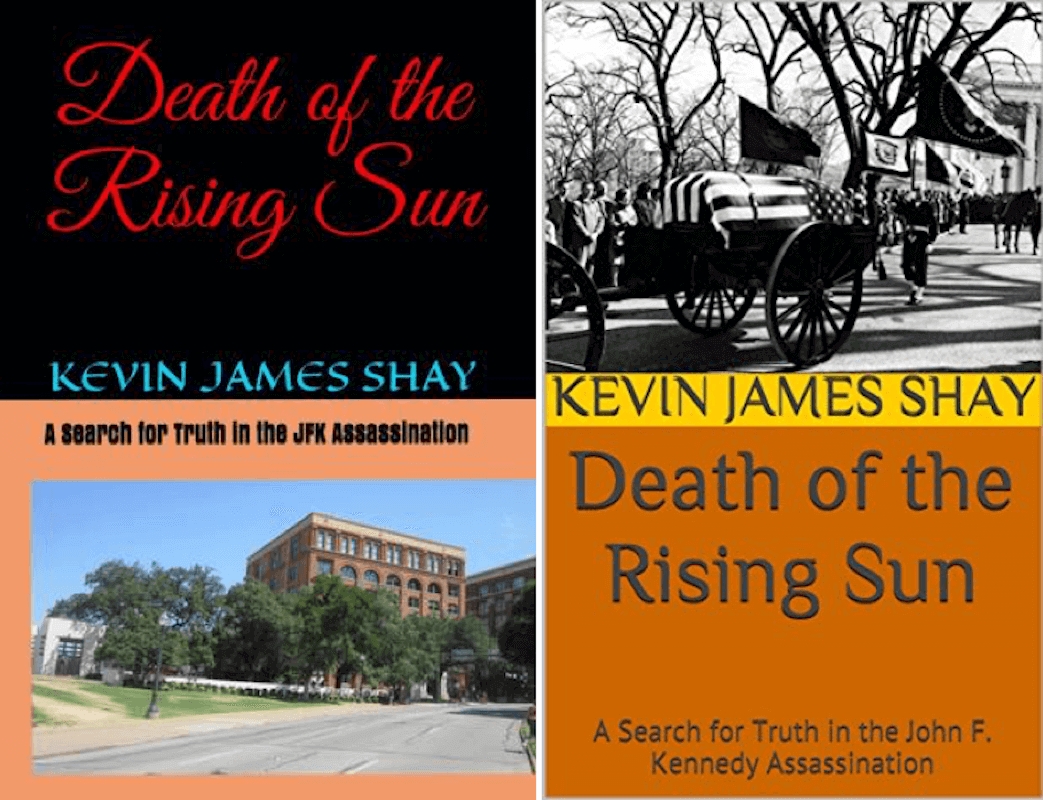
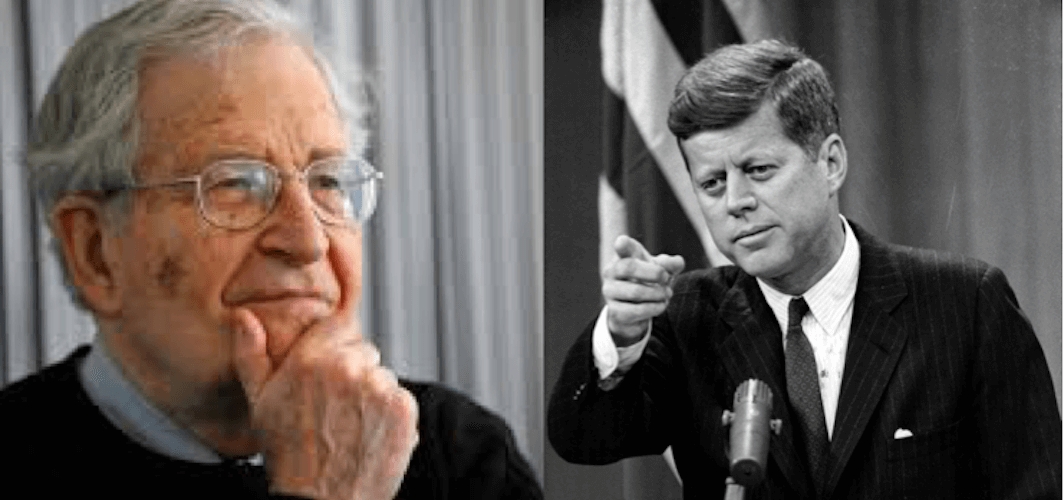
    The Deceptions and Disguises of Noam Chomsky


    One of the most telling moments in John Barbour’s new film, The American Media and the Second Assassination of John F. Kennedy, is his presentation of Noam Chomsky briefly discussing the JFK case. It’s a scene I will return to later. But along with Barbour’s depictions of Dan Rather and Bill O’Reilly, I thought these formed the most potent scenes in his film. I am glad Barbour depicted Chomsky because it reminds us just how bad the so-called American Left was and is on both the Kennedy assassination and his presidency. I once wrote an essay on this general subject based upon the work of Martin Schotz and Ray Marcus. (Click here for that essay) Like the Chomsky scene in the Barbour film, we will later return to Marcus’ revealing work on Chomsky.

    As many of us will recall, at the time of the release of Oliver Stone’s film JFK, Chomsky, along with his deceased cohort Alexander Cockburn, went on a jihad against almost everything depicted in the movie. Their critiques were as bad, in some ways worse, than those of the MSM. Their campaign was two-pronged. The first angle was to promote the idea that the Warren Commission was correct; that is, Oswald alone shot President Kennedy. In this regard, Cockburn obsequiously interviewed Warren Commission counsel Wesley Liebeler in the pages of The Nation. That interview amounted to a pattycake session, as Cockburn served up softball after softball to his performing seal Liebeler. Their second line of argument stemmed from the first: There was no high level plot because President Kennedy was no different than Dwight Eisenhower who preceded him, or Lyndon Johnson and Richard Nixon who followed him. So, with both polemicists, there was no political difference between, say, Kennedy and Nixon, Kennedy and Eisenhower, or Kennedy and Johnson. Even back in 1991, this was a difficult dual thesis to uphold. With the releases of the Assassination Records Review Board, it is well-nigh impossible to defend today. And later we will see how new evidence has forced Chomsky to modify his position. (For my discussion of Cockburn click here)

    There were so many crevices—actually Florida-sized sinkholes—in their arguments that it became apparent that both men were arguing from a preconceived position.

    That position, of course, is the approach to history common to the intellectual or academic Left. One might characterize the general tendency of such Marxist-influenced (or Neo-marxist) sociological analysis as ‘structural’ or ‘system-oriented’, in the sense that it views the actions of individuals as having little import or consequence, that the subject is merely an agent of larger cultural forces that impinge upon it. When applied specifically to the realm of politics, it leads to positing that institutions of power seek to protect and perpetuate themselves in a manner which is nearly blind to the choice or consciousness of the participants, that indeed the very status of the acting subject is suspect as a category of analysis. In its most extreme application, this theoretical perspective leaves no room for flexibility, for the notion that biography—personal background and characteristics—can make a difference, or that innovation from within the system can occur that can benefit many rather than a few. This concept differs somewhat from the “deep state” thesis, as advocates of the latter will allow for exceptions. But they will then note that the Deep State will correct the exception. In President Kennedy’s case, it was a correction by assassination. The former view is more rigid and zealous in its ideology insofar as it denies that there can be any political exceptions. As with extreme upholders of all theories, its proponents must work to erase the evidence that there ever were any exceptions. And as with any kind of inductive reasoning based upon dubious premises, this leads to the making of some thunderous—and pretentious—truisms.

    II

    Before we address some of Chomsky’s pronouncements on the Kennedy case, it is important to address some of his intellectual background, because it is very hard to adhere to such a system of thought without it leading to some thorny practical problems with specifics. This is simply because theories sometimes do not explain all that happens in the real world. Therefore their practitioners are forced to bend and mold facts and events in order to shape them to fit their doctrine. In the political field, this practice usually leads to questions of how ideology influences analysis. In other words it brings up questions of bias and balance. Chomsky’s career gives us prior illustrations of these characteristics. It is startling to note how Chomsky’s acolytes ignore them.

    The first is the fact that Chomsky has been known to butcher quotations for political advantage. A famous example being a quote by Harry Truman which Chomsky altered in his early book American Power and the New Mandarins. This was later exposed by Arthur Schlesinger in a letter to Commentary in December of 1969. Another example would be the misconstruing of the words of Harvard professor Samuel Huntington. Chomsky wrote that the professor said that he advocated demolishing in toto North Vietnamese society. Huntington corrected the record in the New York Review of Books (See 2/26/70)

    There are parallels to these kinds of ersatz presentations with Chomsky and the Kennedy case. With Kennedy, Chomsky has tried to insinuate that somehow JFK was involved with the assassination of Patrice Lumumba of the Congo. This wasn’t possible for the simple reason that Kennedy had not been inaugurated at the time Lumumba was killed. But further, as some have noted, Allen Dulles and the CIA most likely hastened their assassination plots against the African leader for the precise reason that Dulles knew Kennedy would not support them. (John M. Blum, Years of Discord, p. 23) In fact, there is a famous picture of President Kennedy getting the news of Lumumba’s death which shows just how pained he was by Lumumba’s passing.

    jfklumumba

    In and of itself, this photograph nullifies the Chomsky thesis that there was no difference between Eisenhower, LBJ, Nixon and Kennedy. For we can safely say that none of those other men would have reacted like this upon hearing of Lumumba’s death. According to the Church Committee, Eisenhower and Allen Dulles ordered the murder of Lumumba. (The Assassinations, edited by James DiEugenio and Lisa Pease, p. 326) Lyndon Johnson reversed Kennedy’s policies in the Congo. He ended up using Cuban exile pilots to wipe out the last followers of Lumumba, helping to destroy the first attempt at a democracy in post-colonial Africa, and allying the USA with the former colonizer Belgium to back Josef Mobutu. Mobutu became a dictator who enriched himself and his backers, and allowed his country to be utilized by outside imperial interests. (James DiEugenio, Destiny Betrayed, Second Edition, pp. 372-73) Nixon was Vice President under Eisenhower, and in National Security Council meetings spoke derisively and patronizingly of African leaders trying to break out of colonialism. He once said these leaders had only been out of the trees for fifty years. (Muehlenbeck, p. 6) Kennedy’s attitude on this subject, and Lumumba, was contrary to all these men. I cannot do better than to refer the reader to Richard Mahoney’s landmark book JFK: Ordeal in Africa, and the equally fine volume Betting on the Africans by Philip Muehlenbeck. (Click here for a review)

    To show just how pernicious Chomsky’s influence on some Left luminaries is on this subject, consider David Talbot’s last appearance on Democracy Now hosted by Amy Goodman. In discussing his book on Allen Dulles, The Devil’s Chessboard, he mentioned the differing views of Lumumba by Eisenhower and Kennedy. Incredibly, Goodman challenged him on this point. Talbot referred to the aforementioned picture of Kennedy as evidence of JFK’s feelings on the subject. But further, as Mahoney’s book demonstrates, the first foreign policy reversal of Eisenhower that Kennedy made once in office was on the Congo. And when Dag Hammarksjold was killed (likely murdered) in a plane crash, Kennedy decided to carry on the UN Chairman’s campaign for a free and independent Congo. (Click here) That any informed person could suggest otherwise shows both a massive ignorance and a massive bias on the subject. Yet, Goodman has hosted Chomsky many times. She reportedly vetoed an appearance by Jim Douglass.

    Chomsky has also tried to say that Kennedy approved the action plan to overthrow President Goulart of Brazil. (E-mail communication with Steve Jones, July 20, 2017) Yet, this plan did not occur until over four months after Kennedy was dead. Consider the information in A. J. Langguth’s Hidden Terrors. Although it is true that Kennedy wanted Goulart to broaden the political spectrum of his government, Langguth makes it clear that the actual Brazil overthrow was similar to the action against Jacobo Arbenz in Guatemala in 1954. A group of wealthy and powerful businessmen petitioned the White House for help in getting rid of a man they feared would endanger their investments. Langguth describes this group in detail. It was led by David Rockefeller. (p. 104) The author notes that Rockefeller’s coalition had not been accepted at the White House previous to January of 1964. But they were welcomed by President Johnson. And this made the difference. This demarcation is also noted by Kai Bird in his book, The Chairman. For it was John McCloy, the subject of Bird’s book, who was sent by Rockefeller’s group to make a deal with Goulart in February of 1964. When McCloy’s presence in Brazil was detected, it polarized forces of the left and right. (Bird, pp. 550-53) And this triggered the coup operation, codenamed Operation Brother Sam, which McCloy acquiesced in after causing. As Bird notes, Johnson’s willingness to cooperate with Rockefeller and McCloy ended Kennedy’s Alliance for Progress plan: “The Johnson administration had made clear its willingness to use its muscle to support any regime whose anti-communist credentials were in good order.” (ibid, p. 553) Further, anyone who has read Donald Gibson’s Battling Wall Street would understand the antipathy between President Kennedy and Rockefeller and why such a meeting was unlikely under Kennedy.

    III

    These two examples are good background for even worse gymnastics by Chomsky. And it brings us closer to Vietnam. In June of 1977, Chomsky co-wrote (with Edward Herman) a now infamous article in The Nation. It was titled “Distortions at Fourth Hand.” There is no other way to describe this essay except as an apologia for the staggering crimes of the collectivist Pol Pot regime that took place in Cambodia after the fall of both Prince Sihanouk and Lon Nol. At that time a book had been published called Cambodia Year Zero by François Ponchaud. It was the first serious look at the terrors that Pol Pot’s Khmer Rouge had unleashed in Cambodia. Chomsky and Herman criticized this pioneering work by saying that it played “fast and loose with quotes and numbers” and that since it relied largely on refugee reports, it had to be second hand. They then added that the book had an “anti-communist bias and message.” In retrospect, those two comments are startling, and again show a remarkable selectivity in an effort to discredit sources. In this same article, the two authors praised a book by George Hildebrand and Gareth Porter entitled Cambodia: Starvation and Revolution. They wrote that this book presented “a carefully documented study of the destructive American impact on Cambodia and the success of the Cambodian revolutionaries in overcoming it, giving a very favorable picture of their programs and policies, based on a wide range of sources.”

    In other words, not only were the authors attempting to discredit information that turned out to be true; at the same time, they were crediting information that turned out to be—to put it mildly—inaccurate. The net effect of this propaganda was to distort and conceal the efforts of a murderous regime in killing off well over one million of its citizens in an attempt to recreate a Maoist society overnight. Pol Pot’s was one of the greatest genocides per capita in modern history.

    What makes Chomsky’s performance here even worse is that two years later he and Herman were still discounting and distorting the Khmer Rouge in their book After the Cataclysm. They refer to what Pol Pot did as “allegations of genocide” (p. xi, italics added). On the same page they tried to imply that Western media created the mass executions and deaths. They later added that evidence was faked and reporting was unreliable. (pp. 166-77) They again attacked Ponchaud’s book by saying “Ponchaud’s ’s own conclusions, it is by now clear, cannot be taken very seriously because he is simply too careless and untrustworthy.” (p. 274) Later, more credible and responsible authors, like William Shawcross, demonstrated Chomsky’s pronouncements to be astonishingly wrong. They were so bad that Chomsky has never let up trying to minimize what he did. In fact, his whole emphasis on the Indonesian invasion of East Timor has been to try and demonstrate that that slaughter was really worse than what happened in Cambodia! The implication being that if that were true it would then somehow minimize his previous giant faux pas. And even in that he has lowballed the fatalities in Cambodia to do so. (For a complete and thorough expose of this subject, click here)

    Why is this important? Besides demonstrating what a poor scholar and historian Chomsky is, it shows that, contrary to his claim of being an anarchist, he went to near ludicrous extremes to soften the shocking crimes of a Maoist totalitarian regime. In any evaluation of Chomsky, this episode is of prime importance. For the simple reason that it clearly suggests that—as Ted Koppel recently said of Sean Hannity—ideology is more important to him than facts.

    A second notable aspect of Chomsky’s work is his association with the notorious Holocaust denier Professor Robert Faurisson. When Faurisson’s writing on this subject became public, he was suspended from his position at the University of Lyon. Chomsky then signed a petition in support of Faurisson’s reinstatement. He followed that up in 1980 with a brief introduction to a book by Faurisson. Chomsky later tried to say that he was personally unacquainted with Faurisson and was only speaking out for academic freedom. But, unfortunately for Chomsky and his acolytes, this was contradicted by Faurisson himself. For the Frenchman had written a letter to the New Statesman in 1979. It began with: “Noam Chomsky … is aware of the research work I do on what I call the ‘gas chambers and genocide hoax’. He informed me that Gitta Sereny had mentioned my name in an article in your journal. He told me I had been referred to ‘in an extraordinarily unfair way’.” (This unpublished letter was quoted in the October, 1981 issue of the Australian journal Quadrant.)

    Consequently, Chomsky’s later public qualifications about his reasons for signing the petition and writing the introduction ring hollow. He did know Faurisson. He was in contact with him personally, and apparently was encouraging him to defend his work.

    When he found this out, author and professor W. D. Rubinstein had a correspondence with Chomsky, which seemed to certify the worst fears about the noted linguist and Faurisson. Chomsky wrote the following: “Someone might well believe that there were no gas chambers but there was a Holocaust … ” (ibid) In defending Faurisson’s writings Chomsky then wrote that anyone who found them lacking in common sense or accepted the established history, was exhibiting “an interesting reflection of the totalitarian mentality, or more properly in this case, the mentality of the religious fanatic.” (Ibid) Rubinstein replied that to hold that there were no gas chambers but there was a Holocaust was an absurd tenet. Chomsky went ballistic. He wrote back that the respondent was lacking in elementary logical reasoning, and he was falsifying documentary evidence. He then said that the Nazis may have worked these Jews to death and then shoveled their bodies into crematoria without gas chambers. He concluded his blast with this: “If you cannot comprehend this, I suggest that you begin your education again at the kindergarten level.” (Click here for this remarkable article)

    As Werner Cohn has shown, Chomsky has tried to conceal his friendly relations with a Holocaust Denial group in France. This group included Serge Thion, Faurisson and Pierre Guillame. He seems to have gotten in contact with this group through Thion, another leftist critic of the idea of calling what Pol Pot did in Cambodia a genocide. This group ran a publishing house called La Vieille Taupe, which featured prints of Holocaust Denial literature. The petition that Chomsky signed contained the following sentence about Faurisson: “Since 1974 he has been conducting extensive independent historical research into the ‘holocaust’ question.” The framing of the last two words in that statement should jar anyone’s senses. (For an overview of Chomsky’s association with this group click here; for a specific example of his attempt to cover it up, click here.)

    As with his resistance to the Khmer Rouge genocide, Chomsky’s defense and association with Faurisson is startling to any objective person. Which again excludes his acolytes. Today, the low estimate for the fatalities caused by the crimes of the Khmer Rouge is 1.7 million. (see this NYT article from 2017) The idea that there were no mass gassings and crematoria at the Nazi death camps was thoroughly debunked at the trial of David Irving. Irving was a friend and colleague of Faurisson. That court action was instigated by Irving himself. There has been a very good web site constructed from the materials devoted to that trial. I strongly recommend reading the reports given to the court by Robert Jan van Pelt, Christopher Browning, and Richard Evans. They seem to me to be models of what scholarly research should be about.

    IV

    Before centering on the issues of Kennedy’s assassination and his presidency, it is important to discuss briefly the general issue of the Cold War, if only to place those subjects in historical context. As with many leftist polemicists, Chomsky usually does not do this. And when he does, he almost exclusively centers on what western powers did to cause the Cold War and continue it.

    Yet it would seem to most people to be important to review objectively these matters in any historical discussion of American foreign policy from 1945-1991—the obvious reason being that it was the most powerful influence on American foreign policy and world events in that time period. Every president from Harry Truman to George H.W. Bush was strongly influenced by it, to the point that almost every major foreign policy issue was colored by it. Therefore, if one is writing the history of this period, or a part of it, one has to factor this into the discussion. If not, then one can be accused of ignoring, or discounting, the historical backdrop.

    For to deprive these events of their context is to sap them of some of their meaning. Related to this, another problem with Chomsky—as noted above—is imbalance. The policy of aiding foreign countries in their resistance to communism was spelled out way back in 1947 with the Truman Doctrine. This was then endorsed by Congress, and legislation was passed to carry out the policy. One can argue whether or not the Cold War was exaggerated, whether it was too covert, even whether or not it was justified. But one cannot act as if it did not exist. Or that the communist side had no provocations to it, or had no atrocities done in its name. For how else can one explain the Korean War, Hungary in 1956, or the Russian invasion of Czechoslovakia in 1968? We can continue in this vein with the Chinese usurpation of Tibet or the crimes of Fidel Castro, or those of Josef Stalin and Mao Zedong, the latter of which are both mind-boggling.

    But as with Pol Pot in Cambodia, these things are minimized, discounted or ignored by people like Chomsky, and the late Alexander Cockburn. Almost all of the critical analysis was and is of the USA. But if things like balance and historical context are left out, then what is this kind of writing really worth?

    Which is another way of saying the following: A theoretical approach is only as good as the person who uses it. If that writer is too biased one way or the other, the result will suffer greatly. To make a point of comparison: Michael Parenti is also an advocate of the aforementioned style of analysis we have called “structural” or “systemic”. Yet he understands that there are men and women who occasionally manage to rise above the system and do some good for a great number of people. And Parenti also understands that political conspiracies do exist, and have been proven to exist. To use just one example, the heist of the 2000 election in Florida by Jeb Bush and Katherine Harris.

    Even though this crime was done in broad daylight—what with roadblocks set up to hinder people from voting—no person was even interviewed by any law enforcement arm, let alone indicted. The political result of this was horrendous: George W. Bush created a totally unjustified war in Iraq. A war that Al Gore would not have started. Not only do political conspiracies exist, if not addressed, prosecuted, and stopped, they can have terrible results for hundreds of thousands, even millions, of people. So to deny they occur is to deny reality. And as Parenti has said, reality is sometimes radical.

    A second problem with using this system-oriented approach is that—as we have seen with Cambodia—it tends to sweep all contrary facts or evidence into an ideological whirlpool. That is, facts get discounted, data gets warped, and key events are sometimes omitted. What is important is keeping the model of that oppressive structure intact. If facts or data collide with that model, it’s the facts or data that get discarded or discounted. The theoretical underpinnings of Chomsky and Edward Herman’s writings on Cambodia were to show that American and western media was distorting a communist revolution. Therefore, they repeatedly used phrases like “the alleged genocide in Cambodia”, or they wrote that “executions have numbered at most in the thousands”. (See this article) This last comment was written in 1979, when the Khmer Rouge regime had fallen and some reporters had visited the country to actually see the horrible devastation with their own eyes. At times Chomsky and Herman used Khmer Rouge sources and endorsed books that extensively sourced footnotes to Pol Pot’s government releases. This approach is a serious problem for people who actually care about things like accuracy, fairness, and completeness.

    In the wake of Oliver Stone’s JFK, what was so odd about the Chomsky/Cockburn allegiance to a point of view which privileges the critique of institutions as systems is that it disappeared upon their inquiry into Kennedy’s murder. That is, in both men’s comments on the Warren Commission and its presentation of evidence, you will nowhere find any discussion of the lives and careers of the persons who controlled that investigative body. Men like Allen Dulles, John McCloy, Gerald Ford, and J. Edgar Hoover. Yet, those four men dominated the Commission proceedings. (See Walt Brown’s book, The Warren Omission, especially pp. 84-87).

    This is odd—in two respects. First, it was these men, not Kennedy, who had played large parts in being ‘Present at the Creation’—that is, in forming and then supporting the Eastern Establishment, which was responsible for setting up and maintaining the structure of American government in the 20th century. Any critic of the way institutions of power function would surely be concerned with this detail, because in presenting that particular case, one does not have to juggle, manipulate, and distort the evidence. There are books on these men in which tons of evidence exist to make that demonstration. These four were clearly responsible for some of the worst American crimes of the 20th century. (See James DiEugenio, Reclaiming Parkland, second edition, pp. 234-40, 321-40.)

    Secondly, to somehow suppose that those four would not manipulate the evidence in a murder case is simply to ignore the reality of who they were. Yet this is the concept that both Chomsky and Cockburn supported. For instance, as mentioned earlier, Cockburn actually interviewed a junior counsel for the Warren Commission in the pages of The Nation. He never asked him one challenging question. Which is incredible considering the record of that Commission.

    Regarding Chomsky, consider an incident from 1994. Two subscribers to Probe Magazine, Steve Jones and Bob Dean, went to a meeting of the Democratic Socialist Club of Reading, Pennsylvania. Chomsky was the guest speaker. Both Jones and Dean were surprised when Chomsky seemed to veer off topic to go into a tirade against President Kennedy. When Jones and Dean tried to approach and talk to Chomsky about Kennedy afterwards, he became “very defensive and dismissive of us, brushing us off by saying that he’d seen all of the evidence.” Apparently, this meant the declassified record, and therefore there was nothing to address. (e-mail communication with Jones, 6/19/2017)

    Again, this tells us much about Chomsky’s respect—or lack of—for scholarly practice. Because, at that time, the Assassination Records Review Board had just begun declassifying two million pages of records that had previously been kept secret from the public on the JFK case. Hence no one had seen them prior to this time. Including Chomsky. So what was he talking about? The evidence the ARRB declassified concerning the actual circumstances of Kennedy’s murder make the case against Oswald pretty much insupportable. And in just about every way: concerning Oswald, Kennedy’s autopsy, the ballistics evidence, and Oswald’s alibi. (For the last, see Barry Ernest’s book, The Girl on the Stairs.)

    Further, neither Cockburn nor Chomsky seemed to be aware of the transcript of the final executive session of the Warren Commission. Sen. Richard Russell, Representative Hale Boggs, and Senator John Sherman Cooper—who I have previously called the Southern Wing—had planned on expressing their reservations at this meeting about the Single Bullet Theory. The idea that one bullet, CE 399, had gone through both Kennedy and Governor John Connally, smashing two bones, making seven wounds, emerging almost entirely unscathed, and losing almost no volume from its mass. Russell, especially, wanted his objections expressed in the record of this final meeting. Today, we have the record of that meeting. There is no trace of his, or anyone else’s, reservations about the Single Bullet Theory. For the simple reason that there was no stenographic record of that final meeting. (Gerald McKnight, Breach of Trust, p. 284) In other words, the Eastern Establishment figures—Dulles, McCloy, and Ford, likely coopted Chief Justice Earl Warren and chief counsel J. Lee Rankin into tricking the other members into believing there would be such a record. In fact, a woman was there masquerading as a stenographer. But the Commission’s contract with the stenographic company had expired three days prior. (ibid, p. 295) As Gerald McKnight writes about this matter, the obvious reason for this charade was to keep the strenuous objections of the Southern Wing out of the transcribed record, and thereby maintain the illusion that the Commission had been unanimous in its verdict on the case. In other words, here was an almost textbook case of the way institutions tend to ensure the survival of belief in the status quo, one made to order for critics on the Left.

    But in an unexplained inconsistency, both Chomsky and Cockburn dropped the structural approach in their analysis of the Commission. Even though it would seem to be perfectly suited for that type of analysis. Why? Because if one did explain who these men were and what they did with the evidence, then one could conclude that they covered up the true circumstances of Kennedy’s death, for the simple reason he was not a member of their club. Which is a direction they do not want to go in.

    Yet, David Talbot demonstrates this at length in his analysis of the conflicts between President Kennedy and Allen Dulles during 1961. These were centered on Kennedy’s Congo policy, Dulles’ backing of the revolt of the Algerian generals against French President Charles DeGaulle, and ultimately how Dulles lied to Kennedy about the Bay of Pigs operation. (Talbot, pp. 382-417) In other words, in just one year, the CIA Director had come into conflict with Kennedy over three important areas and events. Finally, Kennedy felt he had to terminate Dulles, along with both his Deputy Director Charles Cabell, and Director of Plans Richard Bissell. The first and only time in 70 years that has been done at the CIA. As Talbot also points out, after Kennedy was killed, Dulles lobbied for a position on the Warren Commission (ibid, pp. 573-74)—something that no one else did. As previously referred to, Walt Brown has shown that Dulles then became the single most active member of the Warren Commission. During a meeting with Commission critic David Lifton at UCLA in 1965, Dulles showed utter disdain for any of the evidence that the Commission had ignored or misrepresented to the public, e.g., the Zapruder film frames. (Talbot, p. 591)

    Let us use just one other example. Robert Kennedy was the first Attorney General who actually exercised some degree of control over FBI Director J. Edgar Hoover. The enmity between the two has been well chronicled by more than one author. After JFK was killed, Hoover had Bobby Kennedy’s private line to his office removed. (Anthony Summers, Official and Confidential, p. 315) The Warren Report itself says that Hoover and the FBI were responsible for the vast majority of the investigation. (See, p. xii) Therefore, why would such men—Dulles and Hoover—who clearly had no love for JFK, bend over backwards to find out the truth about his death? The fact is they did not. For example, the day after the murder, Hoover was so concerned about who killed President Kennedy that he was at the racetrack. (Summers, op. cit.) To leave out things like this, and much more, is not writing history. And it is not honest scholarship. It is depriving the reader of important information.

    V

    Chomsky operates his views of both Kennedy and his murder via inductive, closed-system reasoning. It is both banal and simplistic: since the USA operates in a sick political and economic system, no one can rise above it. Therefore, Kennedy was really no different than Nixon, Johnson, and Eisenhower. The underlying problem—as writers like Donald Gibson and Richard Mahoney have demonstrated—is that when one actually studies the record, Kennedy was not part of the Power Elite, and did not aspire to be part of it. This is why, as Donald Gibson has shown, Kennedy and David Rockefeller—the acknowledged leader of the Eastern Establishment at the time—had no time or sympathy for each other. (See Gibson’s Battling Wall Street throughout, but especially pp. 73-76) The reason Kennedy made his historic 1957 Senate speech on the impending doom of French colonialism in Algeria was because he had been in Vietnam when the French empire there was collapsing. He understood that the Vietnam conflict had not really been about communism, but about nationalism. And he said this many times, and took considerable heat for it. (See Mahoney, JFK: Ordeal In Africa, pp. 14-23)

    When Oliver Stone’s JFK came out, Chomsky made numerous statements questioning Stone’s thesis about Kennedy’s intent to withdraw from Vietnam. He eventually wrote an essay in Z Magazine on the topic. In essence, he denied all the withdrawal evidence as outlined by Fletcher Prouty and John Newman, who advised Stone on that subject. The problem for Chomsky today is that other scholars decided that Prouty and Newman were on to something. After all, Prouty actually worked on Kennedy’s withdrawal plan in September of 1963. John Newman was writing a revolutionary book on the subject entitled JFK and Vietnam, which was published in January of 1992.

    Seriously considering that evidence, these scholars then went to work. And today, a small shelf of books exists on the subject. These authors agree with the Stone/Prouty/Newman withdrawal thesis, e.g., David Kaiser’s American Tragedy, James Blight’s Virtual JFK, Gordon Goldstein’s Lessons in Disaster. One reason these new books are there is that the Assassination Records Review Board (ARRB) declassified many pages of documents that support the withdrawal thesis. This declassification process occurred in 1997. Any serious scholar has to consider new evidence when it is declassified. Chomsky did not. In 2000, in a book called Hopes and Prospects, in relation to this issue, he wrote: “On these matters see my Rethinking Camelot … . Much more material has appeared since, but while adding some interesting nuances, it leaves the basic picture intact.” (pp. 123, 295)

    In other words, the scores of pages of new ARRB documents released on the subject, the recorded tapes in the White House, and the new essays and books published, these amount to “nuances.” The “nuances” include President Johnson confessing in February of 1964 that he himself knows he is breaking with Kennedy’s policy. They include the transcripts of the May 1963 Sec/Def meeting in Hawaii where McNamara is actually executing that withdrawal plan—with no reference to a contingency upon victory. (These and other documents are included in this presentation)

    In 1997, that last piece of evidence convinced some MSM outlets, like The New York Times, that Kennedy was planning on withdrawing from Vietnam at the time of his assassination. We can go on and on. But the point is made. To any objective person, these are not “nuances”. They are integral.

    To show Chomsky’s bizarreness on this point, let us use two other instances of just how intent he is to disguise the facts and evidence of Kennedy’s withdrawal plan. One of his older excuses was to say that Kennedy’s advisors fabricated the withdrawal plan after the Tet offensive. (Z Magazine, September, 1992) Even for Chomsky, this is ridiculous. What is he saying? That Kennedy’s advisors falsified the then classified record while it was in the National Archives? That they also managed to get a voice impressionist to impersonate Johnson, McGeorge Bundy and McNamara discussing this withdrawal plan?

    Chomsky’s latest position is a sort of rear action retreat. He now admits that Secretary of Defense Robert McNamara offered up a withdrawal plan. In other words, it was McNamara’s plan, not Kennedy’s. Not so, and let us illustrate why.

    In November of 1961, a two-week long debate took place in the White House. The subject was whether or not to commit combat troops into Vietnam. Advisors Max Taylor and Walt Rostow had returned from Vietnam and made that recommendation. From all the accounts we have, Kennedy was virtually the only person arguing against that proposal. (James Blight, Virtual JFK, pp. 275-83) At its conclusion he signed off on NSAM 111 which sent 15,000 more advisors instead.

    Kennedy was disturbed that he had to carry the argument virtually alone. So he decided to ask someone who he knew agreed with him to write his own report on the subject. This was Ambassador to India, John Kenneth Galbraith. Galbraith did visit Saigon, and he did write a report recommending no combat troops in theater and a gradual American distancing. (Cable of November 20, 1961, which was followed by a longer report; Blight, p. 72, see also David Kaiser, American Tragedy, pp. 131-32) Kennedy later had this report forwarded to Secretary of Defense, Robert McNamara in April of 1962. This was the beginning of the withdrawal plan. We know this because on his trip to Vietnam in May, McNamara told General Paul Harkins to begin a training program for the army of South Vietnam so America could begin reducing its forces there. Harkins was the supreme military commander in Saigon. (Kaiser, pp. 132-34) Also, McNamara’s deputy Roswell Gilpatric revealed in an oral history that his boss had told him that he had instructions from Kennedy to begin to wind down the war. (Blight, p. 371) This culminated with the aforementioned declassified Sec/Def conference in Hawaii in May of 1963. At this meeting, McNamara requested from all departments—State, Pentagon, CIA—specific schedules beginning a withdrawal in December of 1963 and ending in the early fall of 1965. (James Douglass, JFK and the Unspeakable, p. 126)

    The idea that this plan was McNamara’s is another fanciful Chomsky invention. In addition to the evidence stated above—cables, oral history—there is another undeniable fact. In the November, 1961 debates described above, McNamara was asking for the insertion of combat troops into Vietnam. In fact, his proposal was the largest request of all. He told Kennedy to commit upward of six divisions, or about 205,000 men. And he framed the request in pure Cold War terms. If this was not done, it would lead to communist control over all of Indochina and also Indonesia. (Blight, pp. 276-77) The idea that afterwards McNamara had a personal epiphany and reversed himself on his own is simply not credible. Especially when combined with the above evidence. Plus the fact that it was Kennedy alone who was holding out against combat troops in November. And as with Kennedy, there is no mention by McNamara on any tape or any of the Sec/Def documents, or in NSAM 263, that the withdrawal plan would only be completed as the circumstances on the battlefield improve. Chomsky’s arguments against Kennedy’s withdrawal plan exist in a vacuum created by him and his acolytes.

    VI

    In Barbour’s film, Chomsky is shown at a seminar saying words to the effect that no one should care if Kennedy died as a result of a conspiracy. The problem with this statement is that, at the time of Kennedy’s death, it’s the people who Chomsky tries to stand up for—residents of the Third World—that felt a sharp pang of loss at JFK’s passing. And very few of them felt that Lee Harvey Oswald was the lone assassin. The president of Egypt, Gamel Abdul Nasser, fell into a deep depression and had the films of Kennedy’s funeral shown four times on national television. (Philip Muehlenbeck, Betting on the Africans, p. 228) Ben Bella, the premier of Algeria, phoned the American ambassador in Algiers and said, “I can’t believe it. Believe me, I’d rather it happen to me than him.” He then called in a comment to the state radio station saying that Kennedy had been a victim of “racialist and police-organized machinations”. (ibid, p. 227) When asked about Kennedy’s assassination in 1964, Achmed Sukarno of Indonesia began perspiring. He then said that he loved the man because Kennedy understood him. He ended the reverie by saying, “Tell me, why did they kill Kennedy?” (James DiEugenio, Destiny Betrayed, Second Edition, p. 374) Nehru of India called Kennedy’s murder a crime against humanity. He then said that Kennedy was “a man of ideals, vision, and courage, who sought to serve his own people as well as the larger causes of the world.” (Muehlenbeck, p. 231) Two weeks after Kennedy’s death, economist Barbara Ward visited the office of Kwame Nkrumah of Ghana. The president had a photo of John and Jackie Kennedy on his desk. With tears in his eyes he said, “I have written her, and I have prayed for them both. Nothing shocked me so deeply as this.” Months later, when the American ambassador presented him with a copy of the Warren Report, Nkrumah turned to the title page. He pointed to the name of Allen Dulles, and returned it to the ambassador with the one word comment, “Whitewash”. (Muehlenbeck, p. 229; Richard Mahoney, JFK: Ordeal in Africa, p. 235)

    But it wasn’t just the leaders of the Third World who were shaken and saddened by Kennedy’s passing. It was also its citizenry. As an editorial in West Africa magazine stated, “Not even the death of Dag Hammarskjold dismayed Africans as much as did the death of John Kennedy.” (Muehlenbeck, p. 229) In Nairobi, Kenya, six thousand people packed into a cathedral for a memorial service. A Kenyan politician said that never in his career had he seen this kind of grief registered over the death of a foreigner. (Muehlenbeck, p. 226) In the Ivory Coast, the American ambassador woke early the day after the assassination. There was someone waiting for him at his office. The man said he ran a small business about 25 miles away. He said he didn’t really know why he was there. But he tried to explain anyway: “I came here this morning simply to say that I never knew President Kennedy, I never saw President Kennedy, but he was my friend.” (Ibid, p. 228) According to author Thurston Clarke, upon learning of his passing, the peasants of the Yucatan Peninsula immediately started planting a Kennedy Memorial Garden.

    Were all these people wrong?

    But there is one person we can add to this list. His name is Noam Chomsky.

    In the time period following Kennedy’s murder, writer/researcher Ray Marcus tried to enlist several prominent academics to take up the cause of exposing the plot that killed President Kennedy. In 1966 he wrote I. F. Stone on the subject. In 1967, he approached Arthur Schlesinger about it. They both declined to take up the cause. In 1969, he was in the Boston area on an extended business function. He therefore arranged a discussion with Chomsky. Chomsky had initially agreed to a one-hour meeting in his office. Ray brought only 3-4 pieces of evidence, including his work on CE 399, the Magic Bullet, and a series of stills from the Zapruder film. Which had not been shown nationally yet.

    Soon after the discussion began, Chomsky told “his secretary to cancel the remaining appointments for the day. The scheduled one-hour meeting stretched to 3-4 hours. Chomsky showed great interest in the material. We mutually agreed to a follow-up session later in the week. Then I met with Gar Alperovitz. At the end of our one-hour meeting, he said he would take an active part in the effort if Chomsky would lead it.” (Probe, Vol. 4 No. 2, p. 25) Ray did have a second meeting with Chomsky which lasted much of the afternoon. And “the discussion ranged beyond evidentiary items to other aspects of the case. I told Chomsky of Alperovitz’ offer to assist him if he decided to lead an effort to reopen. Chomsky indicated he was very interested, but would not decide before giving the matter much careful consideration.” (ibid) A professional colleague of Chomsky’s, Professor Selwyn Bromberger, was also at the second meeting. He drove Ray home. As he dropped him off he said, “If they are strong enough to kill the president, and strong enough to cover it up, then they are too strong to confront directly … if they feel sufficiently threatened, they may move to open totalitarian rule.” (ibid)

    It is important to reflect on Bromberger’s words as Ray related what happened next. He returned to California and again asked Chomsky to take up the cause. In April of 1969, Chomsky wrote back saying he now had to delay his decision until after a trip to England in June. He said he would get in touch with Ray then. Needless to say, he never did. He ended up being a prominent critic of the Vietnam War and this ended up making his name in both leftist and intellectual circles. Reflecting on Bromberger’s words to Marcus, one could conclude that Bromberger and Chomsky decided that the protest against Vietnam, which was becoming both vocal and widespread, and almost mainstream at the time, afforded a path of less resistance than the JFK case did. After all, look at what had happened to Jim Garrison.

    But if this is correct, it would qualify as a politically motivated decision. One not made on the evidence. As Marcus writes, it was with Chomsky, “not the question of whether or not there was a conspiracy—that he had given every indication of having already decided in the affirmative … ” Marcus’ revelations on this subject are informative and relevant in evaluating Chomsky, both then and now. For purposes of our argument, it is important to know what Chomsky actually thought of the evidence when he was first exposed to it. This would seem to be a much more candid and open response than what he wrote decades later, when his writings on the subject were just as categorical, except the other way. In other words, Chomsky did a 180-degree flip on the issue of whether President Kennedy was killed by a conspiracy. And that first conviction lasted at least until 1976. Because in that year, he signed a petition to form the House Select Committee on Assassinations. That is very likely the reason that, in 1971, as co-editor of the Senator Mike Gravel edition of the Pentagon Papers, he allowed Peter Scott to write an essay addressing the question of Johnson’s alteration of Kennedy’s de-escalation plan in Vietnam.

    Try and find an interview or essay in which Chomsky admits how close he was to being the chief advocate for a public campaign to find out who really killed Kennedy. Yet, it is a fact. Maybe Chomsky changed his mind. But if that was the case, he has no right to be so smug and snide about others who came to the same conclusion he once did. Or perhaps, as Bromberger let out, he and Alperovitz and Chomsky decided that Vietnam offered an easier path to prominence. Which, undoubtedly, it did. If that was the case, then it was a practical choice, not an intellectual or moral one. And evidently, Chomsky and his friends did not realize that they could have combined the two.

    As we have seen, Chomsky’s recurrent posing as a scholar who has assimilated the entire declassified record on the JFK case, and on the Kennedy/Johnson Vietnam policies, is simply an empty pose. And this is part of a persona that, as we have seen in the case of Faurisson and Cambodia, substitutes an extreme and ingrained bias for what is supposed to be scholarly analysis. If there is any hope of reconstituting this nation around a viable set of values and principles, then the issue of the hijacking of America in the sixties through assassinations will have to be honestly confronted. As we have seen, Noam Chomsky refuses to do that—in fact he deliberately avoids it. He then adopts certain disguises and deceptions to conceal the way he once felt about the subject. Which is, in large part, why he is part of the problem, not the solution.
  • Gerald Posner vs. Roger Stone in Coral Gables

    Gerald Posner vs. Roger Stone in Coral Gables

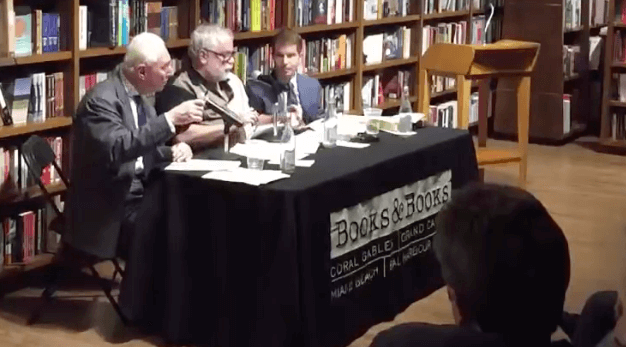
    On the 54th anniversary of President Kennedy’s assassination, at a bookstore in Coral Gables, Florida two famous authors convened. They were Gerald Posner and Roger Stone. The subject was a debate over the circumstances of Kennedy’s assassination. Obviously, because of the orientation of their books on the subject, Posner defended the Warren Commission verdict while Stone argued for a conspiracy.

    Robert Loomis

    Posner was trained as a lawyer. At age 23, he became one of the youngest attorneys ever employed by Cravath, Swaine and Moore, John McCloy’s old law firm. In 1980, he left that firm and opened a private practice with a partner. In 1986, he left that practice and became an author. In a relatively short period of time, he wrote three non-fiction books and one novel. In 1991, he was enlisted by Robert Loomis of Random House to write a response to Oliver Stone’s movie about the Kennedy assassination, JFK. The very plugged-in Loomis promised Posner that the CIA would cooperate with him on the project. (The Assassinations, edited by James DiEugenio and Lisa Pease, p. 369) And they did. Without their help, how else could an author gain access to high level defector Yuri Nosenko?

    Harold Evans

    As was exposed in a later lawsuit by the late Roger Feinman, Random House put a major effort into selling Posner’s Case Closed. One that was personally supervised by Harold Evans, who was president of the publishing house at the time. According to information Feinman discovered in his lawsuit, it was Evans who personally approved the infamous NY Times ads for the book. This was a four-phase campaign. It began with two teaser ads that promised to name the guilty parties in the JFK assassination. It culminated with two more ads. These featured the faces of Oliver Stone, David Lifton, Robert Groden, Jim Marrs, Mark Lane and Jim Garrison under a title which boldly accused them of the charge: “Guilty of Misleading the American Public”. If the reader knows anything about advertising costs in major newspapers, he can guess what those four ads cost. (Click here for Feinman’s essay about his lawsuit against Random House.)

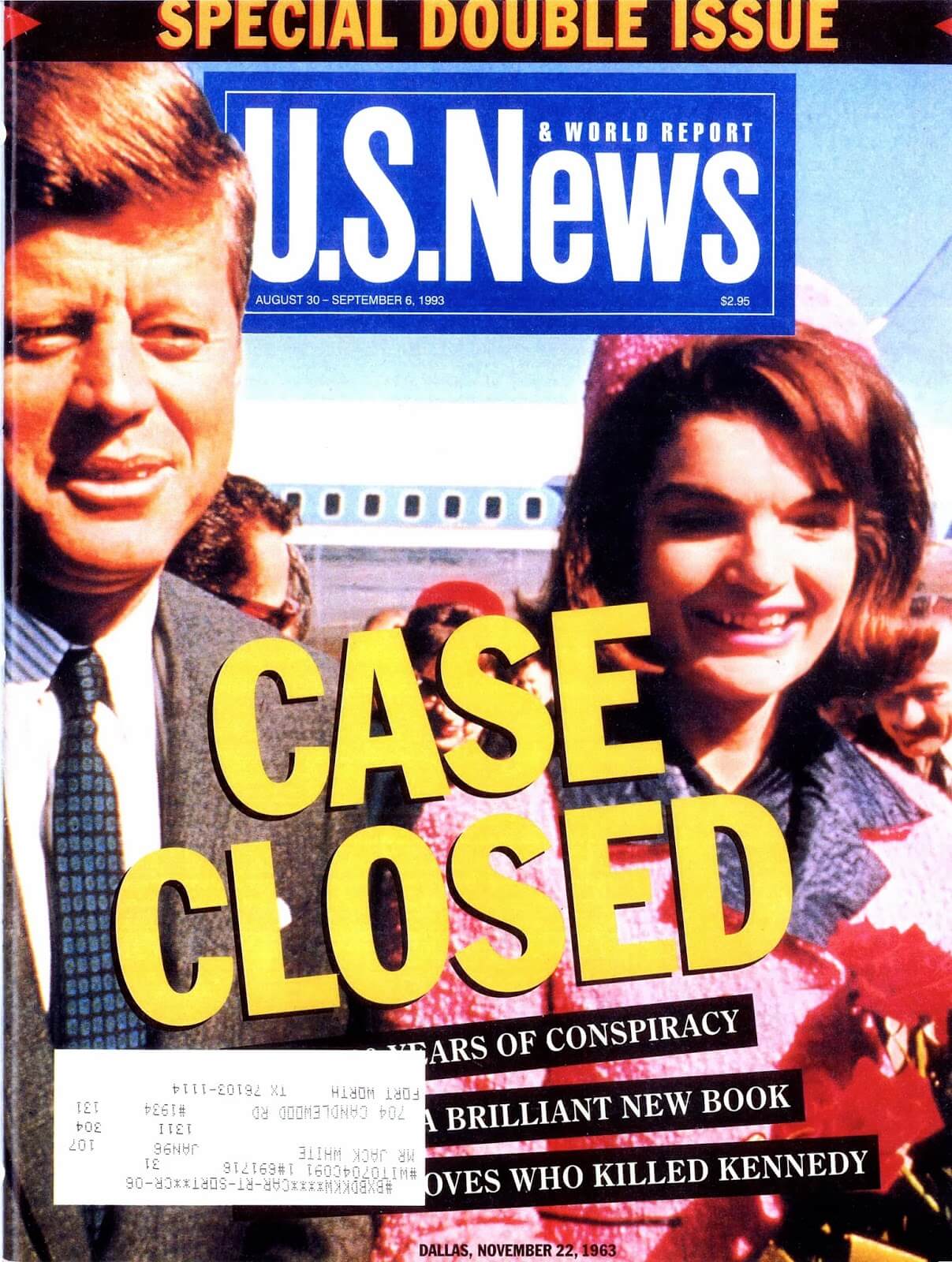
    But that was not all. Apparently because Evans had previously served as a director of US News and World Report, that magazine gave Posner’s book a cover story. The book became such a cause celebre that other authors have successfully used it as a way to curry favor with the MSM, e.g., Jeff Toobin and Robert Dallek.

    The problem with all this hoopla, which was designed to coincide with the 30th anniversary of the assassination, is that it was completely unwarranted. There were several reviews that showed just how flawed Case Closed was: for instance, David Wrone’s. (See also this index of items on this site.) In fact, there were so many problems with Posner’s book that activist Dave Starks put together a compendium page of articles to show that, not only was Case Closed a very bad piece of scholarship, but it might have been worse than that. In his haste to do a hatchet job on the critics, Posner may have created interviews he did not actually do. For instance, Peter Scott talked to Carlos Bringuier after Case Closed came out. Contrary to the book’s claims, Bringuier said he never talked to Posner. (Author interview with Scott in San Francisco in 1994) Same with Dealey Plaza witness James Tague, who the author clearly states he talked to on two successive days. (See Posner, paperback edition, p. 546) When Gary Aguilar talked to Tague, he said he never spoke to Posner. To use another example, although the author said he interviewed JFK’s forensic pathologist Thornton Boswell, Boswell told Aguilar he never spoke to him. (Click here for Starks’ devastating page on Posner.)

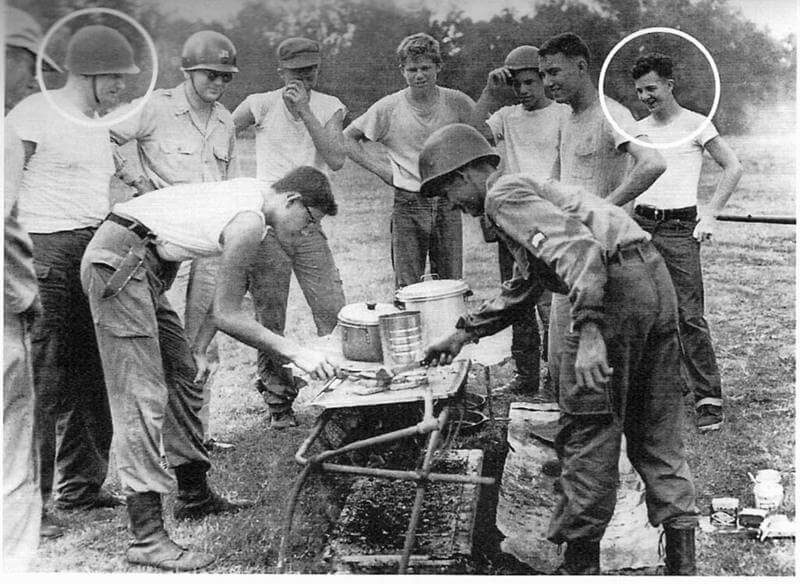
    David Ferrie & Lee Oswald,
    Civil Air Patrol (1955)

    Posner also committed some outright howlers in his much-ballyhooed book. For example, in his schematic drawings of the assassin at the Texas School Book Depository window, he has him posed as firing from an extreme left to right angle. So much so that these “Posner shots” would have ended up in the railroad yards behind the picket fence. (See Appendix A of Case Closed, paperback edition.) This makes one wonder if Posner was ever in Dallas. Because to anyone who has been to the building and peered out the sixth floor window—which was possible back then—it presents a slight right to left angle. Posner also wrote that there was no evidence to connect David Ferrie with Oswald. (Posner, p. 425) This was utterly ridiculous on many counts. But to name just one, when the book came out PBS did a special which featured a photo of Oswald and Ferrie together at a Civil Air Patrol (CAP) barbecue. They found it by questioning some other members of the CAP. Which means Posner could have done the same if he had knocked on some doors in the Crescent City. Posner also writes that there was no such personage as Clay Bertrand in New Orleans. When the JFK Act declassified both the Jim Garrison files and the papers of the HSCA, Posner again ended up with custard pie on his face. Those documents reveal that the number of witnesses who stated that Clay Shaw used the alias of Clay Bertrand was in the double digits. (Destiny Betrayed, Second Edition, by James DiEugenio, pp. 211, 387, 388)

    Posner’s book showed us in excelsis just how schizoid America is on the murder of President Kennedy. It did not matter to the Powers That Be just how error-strewn Posner’s book was. It did not matter to them that he was more or less acting as a hired gun for Loomis and Evans. It did not matter to them that the book was obviously a rush job for the 30th anniversary. Or that the title was preposterous since the declassification process of the JFK Act had not even gone into effect yet. In other words, the book was saying the case was closed when, in fact, two million pages of documents were about to be declassified in the next four years.

    Clearly, as representatives of the Anglo-American Establishment, the important thing for Loomis and Evans was this: They wanted to create a tangible cultural artifact to rally around at the 30th anniversary. Why? In order to beat back the tsunami effect of Oliver Stone’s JFK, which had blindsided them. Posner’s book was a concocted historical event. Today the book has been retired to the (rather large) ash heap of useless volumes on the JFK case. It has no intrinsic factual merit to it at all. It is simply an exemplar of a two-part cultural/historical phenomenon. I say two parts, because the second phase of this Jungian neurotic outbreak occurred four years later, with another Loomis client. This time the collective seizure was over Sy Hersh’s equally horrendous book. This one was a biography of John Kennedy, The Dark Side of Camelot. That bookend volume was as bad in its own way as Posner’s tome. But Oliver Stone had not just said that JFK was killed by a conspiracy. His film also stated that Kennedy was a foreign policy iconoclast who was changing things in that realm. This was true and has been proven even more accurate by recent scholarship. But that did not matter with Hersh, whose book was so bad that some critics said it should have been titled, The Dark Side of Seymour Hersh.

    II

    Roger Stone was born in Lewisboro, New York to a reporter mother and a father who drilled oil wells. Stone got hooked on politics when he read Conscience of a Conservative by Barry Goldwater. Although he admired Goldwater’s ideas he could not comprehend the tactics of his 1964 campaign. To put it mildly, he thought they were rather quixotic. As he told writer Matt Labash, “It’s like he was trying to lose. Going to Tennessee and coming out against the Tennessee Valley Authority? These were suicidal acts.” (Weekly Standard, November 5, 2007)

    Roger Stone & Nixon

    Because of this, Roger Stone became more enamored with Richard Nixon as his conservative standard bearer. He deduced that Nixon was “more pragmatic, more interested in winning than proving a point.” He took a pithy aphorism from RMN: “Losers don’t legislate.” (ibid) Stone liked Nixon so much that he decided that his newly found idol had not really lost the 1960 election. He had been robbed of the presidency through electoral fraud. So he wrote Nixon a letter at his New York law firm encouraging him to run again. Nixon replied that he did not plan on doing so, but if he did, he would be in touch with young Stone. (Stone is such a Nixon fan he had his face tattooed on his back.)

    Jeb Magruder testifies
    during the Watergate hearings

    While a student at George Washington University in Washington D.C., Stone invited Jeb Magruder, deputy director of the Committee to Reelect the President, to speak at the college’s Young Republican Club. After the speaking engagement Stone asked Magruder for a job with CREEP. At age 19, Stone decided to forsake his studies and joined right in with the antics of the infamous CREEP. For instance, he planted a mole in the camp of Democratic rival Hubert Humphrey. Magruder and his cohorts were obsessed with intelligence and skullduggery, and Stone had a natural affinity for them. He once wrote a check to Nixon rival Pete McCloskey from an account inscribed as the Young Socialists Alliance. Once he got the receipt he leaked it to the reactionary newspaper Manchester Union-Leader. (ibid)

    Against Senator George McGovern in the general election, Stone hired another spy he termed Sedan Chair II. But according to Stone, he did not understand the mentality of CREEP. To him it did not make any sense to take the kinds of risks they were taking when the Democratic candidate, McGovern, had so little chance of winning. After Watergate, which spelled the end of Nixon’s political career, he went to work for Bob Dole, and then for the (failed) Ronald Reagan campaign of 1976. During this period, he co-founded the National Conservative Political Action committee, which was designed to execute a GOP takeover of the Senate. Which, by recruiting men like Dan Quayle and Chuck Grassley, it did. As he noted to Jeffrey Toobin, “The Democrats were weak, we were strong.” (The New Yorker, June 2, 2008)

    Donald Trump & Roy Cohn
    JohnAnderson9 16 80
    John Anderson (Sept. 16, 1980)

    In 1980, he again worked for Reagan. In that election, he joined forces with the notorious attorney Roy Cohn, sworn enemy of the late Bobby Kennedy. They decided that the best way for Reagan to beat incumbent president Jimmy Carter in New York was to help Democratic congressman John Anderson get on the ballot. This way, the Democratic Party vote would be split and therefore weakened. According to Stone, Cohn told him to get in contact with a lawyer friend he had. Once in contact, he was to ask him how much it would cost to get Anderson the Liberal party nomination in New York. Stone reported back that the price was $125,000. A couple of days later, Stone was told by Cohn to pick up a suitcase and deliver it to the lawyer. He did so, and Anderson won the Liberal Party nomination. Reagan won New York with 46% of the vote. (ibid, Labash)

    Reagan’s victory in 1980 allowed Stone to enter the upper stratosphere of political campaign managing and lobbying. He now set up an office with two other GOP stalwarts, Charles Black and Paul Manafort. They would later be joined by none other than the late Lee Atwater, the man usually given credit for the Willie Horton TV ads, which helped defeat Democrat Michael Dukakis in 1988. The firm was lobbying on behalf of such people as Ferdinand Marcos, dictator of the Philippines, as well as conservative causes like the Nicaraguan Contras, and Angola’s UNITA rebels. And they advised several presidential candidates, even when they opposed each other.

    Stone’s primacy in the higher circles of the GOP came to an end in 1996. He was serving as an unaccredited adviser to Bob Dole’s presidential campaign when scandal struck. And it struck through the National Enquirer. They billed the story as “Top Dole Aide Caught in Group-Sex Ring.” (op. cit., Toobin) He and his second wife had run ads for swinging partners to participate in bedroom games. (op. cit., Labash) The tabloids even got hold of the advertising photos. Stone tried his usual “Deny, deny, deny” tactics. But they did not succeed.

    But in 2000, James Baker, who was running the GOP recount effort in Florida against Al Gore, brought Stone back to perform one last piece of political subterfuge. That act would have a momentous impact on America for decades into the future. It has come to be known as the “Brooks Brothers riot”.

    When the Florida Supreme Court ruled that Gore could have a recount in four counties, Stone and Baker decided this had to be thwarted. Scores of Republican congressional aides—the Brooks Brothers suits—had been flown to Miami to simulate grass roots, Floridian protest against the recount. Stone stationed himself in a Winnebago outside the building where the Miami-Dade County recount was taking place. Outfitted with walkie-talkies and cell phones, he went to work using these aides to create the illusion of an indigenous attack on the building. He did this by having the congressional aides actually enter the building and demand the recount be halted. According to the New York Times, some people were struck or kicked. (11/23/2000) This scene inside the building was coupled with Stone inspired Spanish language radio warnings about carloads of Cuban exiles driving to the scene. (op. cit., Toobin) In its broad outlines, the operation resembled the CIA coup in Guatemala in 1954. Between the Brooks Brothers demonstrators and the “imminent Cuban exile assault”, the recount was discontinued. The episode likely stopped Gore from actually taking the lead for the first time. This—plus the later Antonin Scalia order granting emergency relief due to the “irreparable damage” of counting votes—ultimately led to the US Supreme Court decision stopping the recount. And that brought us George W. Bush, perhaps the worst president in history.

    III

    After his work for Random House on the JFK case, in 1998 Posner wrote a book on the 30th anniversary of the Martin Luther King assassination. To no one’s surprise, Killing the Dream came to the same conclusion as Case Closed—the official story was correct. One year later of course, William Pepper demonstrated in court that Posner was wrong. The jury in a civil case brought by the King family ruled that King was killed as a result of a conspiracy.

    David Marwell

    Because of his establishment-pleasing writings, Posner became a TV and MSM presence. And he continued to write more non-fiction books. He appeared on many TV programs and also as an editorial writer for some major newspapers. According to Doug Horne in his book Inside the ARRB, the first director of the Assassination Records Review Board, David Marwell, said he found much of value in Case Closed. Consequently, he had lunch with Posner more than once. Harold Evans’ wife, Tina Brown, hired Posner as an investigative journalist for the online magazine Daily Beast. But he was forced to step down from that position in 2010 over several accusations that demonstrated that Posner was a serial plagiarist. He not only plagiarized for his articles at Daily Beast, but also in at least three of his books, e.g., Miami Babylon. (See Slate, “The Posner Plagiarism Perplex”, 2/11/2010, also Miami New Times, March 30, 2010)

    Tina Brown
    Harper Lee

    Three years later, the late Harper Lee filed a lawsuit claiming that her literary agent’s son-in-law had directed Posner to set up a corporation to defraud Lee of her royalties from her colossal best-seller To Kill a Mockingbird. In her court filing she said that she had faulty hearing and eyesight and these had been used by Samuel Pinkus to snooker her into signing over her book copyright. Pinkus assigned the copyright to a company incorporated by Posner. (NY Post, May 4, 2013) Four months later, Posner settled the suit and was dismissed from the legal action.

    After his work for James Baker in Miami, Roger Stone tended to concentrate on two new subjects. First, there was his friendship with Donald Trump. Stone was sold on the idea of Trump making a run for the presidency on the Reform Party ticket, the party created by Ross Perot. Although Trump made some overtures to run in the 2000 election, he ultimately decided against it. Stone also began to develop an avocation as an author. To say that his output has been prolific does not do him justice. In the space of about three years, beginning in late 2013, Stone has written or co-written—at last count—seven books. At least three of them rely on his relationship with Richard Nixon, who he still holds in high regard. If one looks closely, three of them rely on his relationship with Trump, who he had worked for in Trump’s 2015-16 campaign before they (allegedly) parted ways. His book about Jeb Bush, Jeb and the Bush Crime Family, was clearly meant as a broadside against the candidate most perceived as the favorite in the GOP primary campaign. His book about the Clintons, The Clintons’ War on Women, was meant as a preemptive strike against the attacks against Trump’s philandering with females.

    But Roger Stone/author first came to prominence at the 50th anniversary of the JFK assassination. At that time he co-wrote a book entitled The Man Who Killed Kennedy: The Case Against LBJ. That book became a New York Times bestseller. In fact, of all the books released at the 50th, it likely sold the most copies. Since then he has stayed involved in the field. In fact, his co-writers on the two previously mentioned books come from the JFK field. They are, respectively, Saint John Hunt and Robert Morrow.

    Why has Stone done this? It likely does not pay him the fees he commanded as a Washington lobbyist working in a very powerful PR firm. In a profile written by Jeff Toobin for The New Yorker, some hints for this career move are tossed out—almost inadvertently. One of the reasons Stone gives for being so enamored of Nixon is his anti-elitism. He adds Nixon was class conscious. And he identified with average people who ate TV dinners and watched Lawrence Welk. To Stone, Nixon “recognized the effectiveness of anti-elitism—a staple of American campaigns even today—as a core message.” In comparing Nixon with Reagan, Stone states that although many Republicans give Reagan credit for the defections of the working class from the Democrats, it was really Nixon who started it. Stone then zeroes in on the whole polarization concept:

    Nixon figured out how to win. We had a non-elitist message. We were the party of the workingman! We wanted lower taxes for everyone across the board. They were the part of the Hollywood elite. … The point that the Democrats missed was that the people who weren’t rich wanted to be rich.

    There is little doubt that Nixon, with his appeals to the Silent Majority in order to expand and lengthen the Vietnam War, did use these kinds of techniques. It’s obvious from the declassified tapes at the Nixon Library that he did not mean any of it. This was amply exposed by author Ken Hughes, among others, in his fine book Fatal Politics. And this exposure helps explain why Nixon and his family fought so long and hard not to have those tapes declassified. That book reveals that Nixon knew the war was lost in 1969. But he did not want to have South Vietnam fall on his watch. Therefore, he lied to Nguyen Van Thieu of South Vietnam to keep him in his corner while he negotiated an agreement with the north. The whole time he slaughtered tens of thousands of innocent civilians in an expanded air war over all of Indochina. The only reason for this was to announce a peace agreement on the eve of the 1972 election to make sure he had a landslide victory. This is all admitted to on these tapes in the Hughes book, and in letters he sent to Thieu in the book The Palace File.

    But the relevant point for today’s scene is that this cultural anti-elite aspect was well used by both Stone and Trump during the latter’s successful presidential campaign. Trump decided to leapfrog most of the MSM, and he did this with Stone’s help. In addition to the two books mentioned above, Stone helped promote the whole mythology of Ted Cruz’s father being seen in New Orleans with Lee Oswald in the summer of 1963. Stone used the word of Judyth Baker to promote this bizarre story. And Trump went on national TV with it. (Click here for our reaction.) The Morrow/Stone book about Clinton helped Trump alleviate the impact of the compelling Access Hollywood videotape. And this whole anti-cultural-elite concept helped avoid the question of how in the heck do the interests of a billionaire real estate investor coincide with America’s shrinking middle class? With the announcement of Trump’s cabinet, we can see that, as with Nixon, the whole idea is little more than window dressing. The policies that this cabinet and the Republican Party will try to enact will gut the middle class even more.

    IV

    All of the above about these two men is more than relevant to their debate in Coral Gables. Because it informs us of the state of the JFK case in America today. This author would not walk across the street to see Posner speak about either the JFK or King case. Simply because he is a lawyer who is in the employ of the official story. Therefore, it does not matter if what he is saying is incomplete, dubious or just specious. This reviewer has never read any of Stone’s books for the simple reason that I have a hard time thinking that Stone could master something as complex and multi-layered as the JFK case in just a matter of 3-4 years. I am also skeptical of the case that he and others have made against Lyndon Johnson. In watching this confrontation it appears I was correct about these suspicions.

    Roger Stone presented first. He led off with remarks about the avulsed rear skull wound that, for him, disappeared from the back of Kennedy’s head after he left Parkland Hospital. (This is not accurate. Gary Aguilar has shown it did not disappear, it was apparent at both the emergency room at Parkland and Bethesda Medical Center, where Kennedy’s body underwent an autopsy.) Stone later added the confusing point that the House Select Committee on Assassinations (HSCA) was convened because of Oliver Stone’s film JFK. I think Roger meant the Assassination Records Review Board (ARRB) was convened.

    But he then confuses this issue even more by saying that the HSCA revealed more of Ruby’s Mafia ties, which led them to conclude organized crime involvement in the JFK case. This is not really accurate, as the HSCA did not deduce this as one of their conclusions. Chief Counsel Robert Blakey did that in his later book on the JFK case, The Plot to Kill the President (which was co-written with Dick Billings).

    Stone also talked about his relationship with Senator Arlen Specter and how Specter did not have access to the autopsy materials during the Warren Commission proceedings. This needed to be qualified. As revealed by the declassified transcripts of the their executive hearings, the Warren Commission did have the autopsy materials. (Gerald McKnight, Breach of Trust, p. 171) And as Pat Speer has shown on his web site, Specter did see at least one of the autopsy photos. (See Chapter 10, “Examining the Examinations”.)

    Stone also said that the alleged rifle used by Oswald was purchased for $75.00 and that no marksman was able to duplicate what he did, that is get 2 of 3 direct hits in six seconds. The latter part of this is correct, the former sum is about three times what the rifle actually cost. Stone then concluded with the Jay Harrison/Barr McClellan sponsored Mac Wallace fingerprint found on the sixth floor. He also even mentioned one Loy Factor’s involvement with Wallace and the LBJ plot.

    Posner then replied. He criticized Stone’s book for having so many footnotes to other books. He therefore termed the book outdated. This is bizarre since Posner’s book is overwhelmingly reliant on the Warren Report and the accompanying volumes of evidence. He then said there was no evidence on the autopsy x-rays and photos that revealed anyone firing from anywhere except from behind and the general vicinity of the sixth floor.

    Apparently, Posner was not aware of the ARRB interview with Tom Robinson who worked out of Gawler’s funeral parlor. He said there was a wound near the right temple of the president that he filled in with wax. He said it was so close to the hairline it was difficult to see. (Murder in Dealey Plaza, p. 250, edited by James Fetzer.) Author Don Thomas has also done good work with the autopsy photos, which makes this wound easier to discern. Posner also ignores the fact that, as many have indicated, if the autopsy doctors are correct and the entrance wound in the skull came in near the base, then there is no trajectory of bullet particles on the X-rays to match it up with.

    Since Stone gave Posner an opening about only the Parkland doctors seeing the hole in the back of the skull, lawyer Posner took advantage of it. He said that since Kennedy’s body was not turned over at Parkland, they really didn’t see it. This is ridiculous on more than one count. First, as Gary Aguilar has shown, this avulsed wound did not “disappear” after Dallas. It was clearly observed at Bethesda, except the HSCA hid these interviews from the public. Therefore they were only declassified with the advent of the ARRB. (ibid, p. 199) And Posner talks about using dated information.

    Secondly, Parkland nurse Diana Bowron actually saw this wound as she was aiding the entourage bringing Kennedy’s body into the emergency room, and she saw it again as she was prepping Kennedy’s corpse to depart. (ibid, pp. 60, 199) Neurosurgeon Kemp Clark examined Kennedy’s skull as the tracheotomy was being performed and he stated that he saw this wound. (ibid, p. 193) Nurse Audrey Bell told the ARRB that Malcolm Perry showed her this wound by turning Kennedy’s head slightly. (Interview of 4/1/97) Then, of course, there is the testimony of Secret Service agent Clint Hill who said he saw this wound in the limousine on the way to Parkland. (op. cit., Fetzer, pp. 198-99) Stone should have literally harpooned Posner for citing such specious information.

    The bloviating Posner then added something just as dubious. He said that in order to argue conspiracy one must state that the X-rays and photos are altered. More baloney. Stone should have asked Posner on rebuttal, “How did the 6.5 mm fragment get on the X-rays if it’s not in the autopsy report and none of the autopsy doctors saw it that night?” He then should have asked the prosecutor, “What happened to the trail of fragments that lead pathologist Jim Humes wrote about in his report which goes from the bottom rear of the skull to the top? Those do not exist today. Why Gerald?” (Reclaiming Parkland, by James DiEugenio, pp. 152-54) Stone should also have asked the attorney, “Gerald, if all the shots came from the rear, including the head shot, why is there no blowout in the front of Kennedy’s face?”

    Further, the brain was never sectioned. Therefore we do not know the path of the bullet through the skull, or if there was only one bullet.  That would have been the best evidence of exactly what killed President Kennedy.  But it  was not done. Why?

    Finally, the back wound was not dissected.  So we do not know if this wound was a through and through wound–did it transit the body?  If it did not, then the Single Bullet Theory Posner upholds is kaput.  And according to pathologist Pierre Finck’s testimony at the Clay Shaw trial, the reason it was not tracked is that the doctors were prevented from doing so by the military brass at Bethesda.

    These all indicate a cover up, if not a conspiracy.  And they all would have been better evidence than the photos and X-rays. After all, one cannot photograph autopsy practices that were never performed.

    Posner then said it is wrong to say that no marksman ever duplicated Oswald’s shooting feat. He said the Commission did, CBS did, and the HSCA did.

    Concerning the first, I don’t know what Posner is talking about. Mark Lane and Sylvia Meagher have discussed the rifle experiments of the Warren Commission.  (Meagher, Accessories After the Fact,  pp. 108-10; Lane, Rush to Judgment,  pp. 126-30)  The FBI tried to get off three shots in six seconds, scoring two of three direct hits in the head and shoulder area. They failed. Therefore, the Commission had three military snipers try it. These tests were rigged. They were done from about twenty feet up, not sixty, as would have been the case with Oswald.  The three riflemen were given as much time as they wanted to gauge the first shot, again not the case for Oswald.  Third, they were firing at stationary and not moving targets.  And even at that, the targets were grouped much closer together than what the Commission said was the firing series in Dealey Plaza. Fifth, these were some of the vey best marksmen in the military. They were so good they were above the best in the Marine Corps, and could qualify for the Olympics. To put it mildly, Oswald was nowhere near this quality.  But even at that only one of them got the shots off in the required time.  And none were able to get two of three direct hits.

    Concerning CBS, apparently Posner has not read my essay based on CBS internal memoranda adduced by their employee Roger Feinman. Unlike what Posner stated, their first marksman, a famous military sniper, using a model of the 6.5 Mannlicher Carcano, could not do what Oswald did. They then brought in a team of riflemen, and let them practice for a week—which Oswald did not do in any way, shape or form. They then set up a target that eliminated the oak tree from the sixth floor, eliminated the curve in the street, and instead set up a moving sled to fire at. This last was the most important factor. Why? Because the sled posed an enlarged target, as Feinman notes, it at least doubled the target area. In other words, CBS cheated after their first marksman failed. (Click here for that information.)

    Stooping to the HSCA for evidence on this subject is really hard to understand. Even for Posner. Because the HSCA did no rifle tests during its actual duration. They did not do them until after the HSCA ceased operation. Wallace Milam sent me the full memo on this episode. It turns out that Chief Counsel Robert Blakey, his assistant Gary Cornwell, and some Washington policemen went out to a rifle range. There they tried to do what the Commission said Oswald did. In their overweening ambition, at first they decided not to use the telescopic site. Which is ridiculous since the Commission said Oswald did use it. After all, why would it be attached to the rifle if it were not used? As I can inform the reader, that scope makes a huge difference. To say Oswald did what he did without it is simply preposterous. But when the policemen used only the iron sights on the rifle, they had the same problem that the Commission did. They could not maintain accuracy within the six second time interval of the Warren Commission. So what did Blakey and Cornwell do? They used something called “point aiming”. Which means not using any site at all, just pointing the rifle. When they got off two shots in under two seconds that was enough. They then deduced it was possible to do what Oswald allegedly did even though they were only 20 feet up instead of 60 feet and their accuracy results were not recorded. (The Assassinations, edited by James DiEugenio and Lisa Pease, p. 83)

    Marine sniper
    Carlos Hathcock

    Stone should have replied that, yes, you can do what the Commission said Oswald did. But you have to cheat. And then not tell the public about the cheating. I would have then added that Carlos Hathcock, the greatest sniper of the Vietnam War, actually did try and duplicate accurately what the Commission said Oswald did. He told author Craig Roberts that he could not do it, even though he tried more than once.

    Posner actually used the fingerprint evidence on the alleged Oswald rifle to try and convict Oswald. Without telling the public that this so-called evidence was presented only after the FBI found there were no prints found on the rifle when Sebastian LaTona examined it that night. (Meagher, op. cit., pp. 120-27) Prints only showed up about a week later, and then thirty years later for a PBS special. Stone rightly pointed out that the FBI was inexplicably at the Oswald funeral parlor trying to get fingerprints off of his corpse. (Henry Hurt, Reasonable Doubt, pp. 107-09) Which is weird, since the Dallas Police already had Oswald’s fingerprints.

    Posner concluded by rebutting the use of the Mac Wallace fingerprint with the work of FBI authority Robert Garrett, as is featured in Joan Mellen’s book, Faustian Bargains.

    I won’t go on with my analysis since it would just be more of the same. Posner making more and more dubious claims and Stone replying with populist type experts, e.g., Judyth Baker on Cruz, and Richard Bartholomew on the Wallace print. (Yet, to my knowledge, Richard is not a fingerprint expert.) Posner actually tried to impeach Victoria Adams not seeing Oswald running down the stairs after the shooting by saying she did not see officer Marrion Baker or supervisor Roy Truly either. Again, Posner seems unaware that Miss Garner, Victoria’s supervisor, did see those two men come up the stairs after Adams and co-worker Sandy Styles went down. Further, the Warren Commission had this document in their hands, since it was dated June 2, 1964. While they were in session.

    Now, obviously, if Garner saw Baker and Truly after Victoria and Sandy went down the stairs, then the two women left within seconds of the shooting, as they said they did. Yet the Warren Report says they left much later, minutes afterwards. In other words, the Commission covered up the true facts of what had occurred. Because Adams and Styles give Oswald a rock solid alibi for not being on the sixth floor when they needed him to be so. (DiEugenio, op. cit., pp. 115-20)

    The most important thing that was said during this debate was that Stone would try and talk to Mr. Trump about the declassification of the final documents being held at the National Archives by the JFK Act. They are supposed to be finally disposed of in October of this year. Let us hope Mr. Stone uses his influence to see that through. It would be in keeping with his and Mr. Trump’s obeisance to conservative populism.

    (The debate video is embedded below, or the reader can watch it by clicking here.)

  • Gerald Posner vs. Roger Stone in Coral Gables

    Gerald Posner vs. Roger Stone in Coral Gables

    On the 54th anniversary of President Kennedy’s assassination, at a bookstore in Coral Gables, Florida two famous authors convened. They were Gerald Posner and Roger Stone. The subject was a debate over the circumstances of Kennedy’s assassination. Obviously, because of the orientation of their books on the subject, Posner defended the Warren Commission verdict while Stone argued for a conspiracy.

    Robert Loomis

    Posner was trained as a lawyer. At age 23, he became one of the youngest attorneys ever employed by Cravath, Swaine and Moore, John McCloy’s old law firm. In 1980, he left that firm and opened a private practice with a partner. In 1986, he left that practice and became an author. In a relatively short period of time, he wrote three non-fiction books and one novel. In 1991, he was enlisted by Robert Loomis of Random House to write a response to Oliver Stone’s movie about the Kennedy assassination, JFK. The very plugged-in Loomis promised Posner that the CIA would cooperate with him on the project. (The Assassinations, edited by James DiEugenio and Lisa Pease, p. 369) And they did. Without their help, how else could an author gain access to high level defector Yuri Nosenko?

    Harold Evans

    As was exposed in a later lawsuit by the late Roger Feinman, Random House put a major effort into selling Posner’s Case Closed. One that was personally supervised by Harold Evans, who was president of the publishing house at the time. According to information Feinman discovered in his lawsuit, it was Evans who personally approved the infamous NY Times ads for the book. This was a four-phase campaign. It began with two teaser ads that promised to name the guilty parties in the JFK assassination. It culminated with two more ads. These featured the faces of Oliver Stone, David Lifton, Robert Groden, Jim Marrs, Mark Lane and Jim Garrison under a title which boldly accused them of the charge: “Guilty of Misleading the American Public”. If the reader knows anything about advertising costs in major newspapers, he can guess what those four ads cost. (Click here for Feinman’s essay about his lawsuit against Random House.)

    But that was not all. Apparently because Evans had previously served as a director of US News and World Report, that magazine gave Posner’s book a cover story. The book became such a cause celebre that other authors have successfully used it as a way to curry favor with the MSM, e.g., Jeff Toobin and Robert Dallek.

    The problem with all this hoopla, which was designed to coincide with the 30th anniversary of the assassination, is that it was completely unwarranted. There were several reviews that showed just how flawed Case Closed was: for instance, David Wrone’s. (See also this index of items on this site.) In fact, there were so many problems with Posner’s book that activist Dave Starks put together a compendium page of articles to show that, not only was Case Closed a very bad piece of scholarship, but it might have been worse than that. In his haste to do a hatchet job on the critics, Posner may have created interviews he did not actually do. For instance, Peter Scott talked to Carlos Bringuier after Case Closed came out. Contrary to the book’s claims, Bringuier said he never talked to Posner. (Author interview with Scott in San Francisco in 1994) Same with Dealey Plaza witness James Tague, who the author clearly states he talked to on two successive days. (See Posner, paperback edition, p. 546) When Gary Aguilar talked to Tague, he said he never spoke to Posner. To use another example, although the author said he interviewed JFK’s forensic pathologist Thornton Boswell, Boswell told Aguilar he never spoke to him. (Click here for Starks’ devastating page on Posner.)

    David Ferrie & Lee Oswald,
    Civil Air Patrol (1955)

    Posner also committed some outright howlers in his much-ballyhooed book. For example, in his schematic drawings of the assassin at the Texas School Book Depository window, he has him posed as firing from an extreme left to right angle. So much so that these “Posner shots” would have ended up in the railroad yards behind the picket fence. (See Appendix A of Case Closed, paperback edition.) This makes one wonder if Posner was ever in Dallas. Because to anyone who has been to the building and peered out the sixth floor window—which was possible back then—it presents a slight right to left angle. Posner also wrote that there was no evidence to connect David Ferrie with Oswald. (Posner, p. 425) This was utterly ridiculous on many counts. But to name just one, when the book came out PBS did a special which featured a photo of Oswald and Ferrie together at a Civil Air Patrol (CAP) barbecue. They found it by questioning some other members of the CAP. Which means Posner could have done the same if he had knocked on some doors in the Crescent City. Posner also writes that there was no such personage as Clay Bertrand in New Orleans. When the JFK Act declassified both the Jim Garrison files and the papers of the HSCA, Posner again ended up with custard pie on his face. Those documents reveal that the number of witnesses who stated that Clay Shaw used the alias of Clay Bertrand was in the double digits. (Destiny Betrayed, Second Edition, by James DiEugenio, pp. 211, 387, 388)

    Posner’s book showed us in excelsis just how schizoid America is on the murder of President Kennedy. It did not matter to the Powers That Be just how error-strewn Posner’s book was. It did not matter to them that he was more or less acting as a hired gun for Loomis and Evans. It did not matter to them that the book was obviously a rush job for the 30th anniversary. Or that the title was preposterous since the declassification process of the JFK Act had not even gone into effect yet. In other words, the book was saying the case was closed when, in fact, two million pages of documents were about to be declassified in the next four years.

    Clearly, as representatives of the Anglo-American Establishment, the important thing for Loomis and Evans was this: They wanted to create a tangible cultural artifact to rally around at the 30th anniversary. Why? In order to beat back the tsunami effect of Oliver Stone’s JFK, which had blindsided them. Posner’s book was a concocted historical event. Today the book has been retired to the (rather large) ash heap of useless volumes on the JFK case. It has no intrinsic factual merit to it at all. It is simply an exemplar of a two-part cultural/historical phenomenon. I say two parts, because the second phase of this Jungian neurotic outbreak occurred four years later, with another Loomis client. This time the collective seizure was over Sy Hersh’s equally horrendous book. This one was a biography of John Kennedy, The Dark Side of Camelot. That bookend volume was as bad in its own way as Posner’s tome. But Oliver Stone had not just said that JFK was killed by a conspiracy. His film also stated that Kennedy was a foreign policy iconoclast who was changing things in that realm. This was true and has been proven even more accurate by recent scholarship. But that did not matter with Hersh, whose book was so bad that some critics said it should have been titled, The Dark Side of Seymour Hersh.

    II

    Roger Stone was born in Lewisboro, New York to a reporter mother and a father who drilled oil wells. Stone got hooked on politics when he read Conscience of a Conservative by Barry Goldwater. Although he admired Goldwater’s ideas he could not comprehend the tactics of his 1964 campaign. To put it mildly, he thought they were rather quixotic. As he told writer Matt Labash, “It’s like he was trying to lose. Going to Tennessee and coming out against the Tennessee Valley Authority? These were suicidal acts.” (Weekly Standard, November 5, 2007)

    Roger Stone & Nixon

    Because of this, Roger Stone became more enamored with Richard Nixon as his conservative standard bearer. He deduced that Nixon was “more pragmatic, more interested in winning than proving a point.” He took a pithy aphorism from RMN: “Losers don’t legislate.” (ibid) Stone liked Nixon so much that he decided that his newly found idol had not really lost the 1960 election. He had been robbed of the presidency through electoral fraud. So he wrote Nixon a letter at his New York law firm encouraging him to run again. Nixon replied that he did not plan on doing so, but if he did, he would be in touch with young Stone. (Stone is such a Nixon fan he had his face tattooed on his back.)

    Jeb Magruder testifies
    during the Watergate hearings

    While a student at George Washington University in Washington D.C., Stone invited Jeb Magruder, deputy director of the Committee to Reelect the President, to speak at the college’s Young Republican Club. After the speaking engagement Stone asked Magruder for a job with CREEP. At age 19, Stone decided to forsake his studies and joined right in with the antics of the infamous CREEP. For instance, he planted a mole in the camp of Democratic rival Hubert Humphrey. Magruder and his cohorts were obsessed with intelligence and skullduggery, and Stone had a natural affinity for them. He once wrote a check to Nixon rival Pete McCloskey from an account inscribed as the Young Socialists Alliance. Once he got the receipt he leaked it to the reactionary newspaper Manchester Union-Leader. (ibid)

    Against Senator George McGovern in the general election, Stone hired another spy he termed Sedan Chair II. But according to Stone, he did not understand the mentality of CREEP. To him it did not make any sense to take the kinds of risks they were taking when the Democratic candidate, McGovern, had so little chance of winning. After Watergate, which spelled the end of Nixon’s political career, he went to work for Bob Dole, and then for the (failed) Ronald Reagan campaign of 1976. During this period, he co-founded the National Conservative Political Action committee, which was designed to execute a GOP takeover of the Senate. Which, by recruiting men like Dan Quayle and Chuck Grassley, it did. As he noted to Jeffrey Toobin, “The Democrats were weak, we were strong.” (The New Yorker, June 2, 2008)

    Donald Trump & Roy Cohn
    JohnAnderson9 16 80
    John Anderson (Sept. 16, 1980)

    In 1980, he again worked for Reagan. In that election, he joined forces with the notorious attorney Roy Cohn, sworn enemy of the late Bobby Kennedy. They decided that the best way for Reagan to beat incumbent president Jimmy Carter in New York was to help Democratic congressman John Anderson get on the ballot. This way, the Democratic Party vote would be split and therefore weakened. According to Stone, Cohn told him to get in contact with a lawyer friend he had. Once in contact, he was to ask him how much it would cost to get Anderson the Liberal party nomination in New York. Stone reported back that the price was $125,000. A couple of days later, Stone was told by Cohn to pick up a suitcase and deliver it to the lawyer. He did so, and Anderson won the Liberal Party nomination. Reagan won New York with 46% of the vote. (ibid, Labash)

    Reagan’s victory in 1980 allowed Stone to enter the upper stratosphere of political campaign managing and lobbying. He now set up an office with two other GOP stalwarts, Charles Black and Paul Manafort. They would later be joined by none other than the late Lee Atwater, the man usually given credit for the Willie Horton TV ads, which helped defeat Democrat Michael Dukakis in 1988. The firm was lobbying on behalf of such people as Ferdinand Marcos, dictator of the Philippines, as well as conservative causes like the Nicaraguan Contras, and Angola’s UNITA rebels. And they advised several presidential candidates, even when they opposed each other.

    Stone’s primacy in the higher circles of the GOP came to an end in 1996. He was serving as an unaccredited adviser to Bob Dole’s presidential campaign when scandal struck. And it struck through the National Enquirer. They billed the story as “Top Dole Aide Caught in Group-Sex Ring.” (op. cit., Toobin) He and his second wife had run ads for swinging partners to participate in bedroom games. (op. cit., Labash) The tabloids even got hold of the advertising photos. Stone tried his usual “Deny, deny, deny” tactics. But they did not succeed.

    But in 2000, James Baker, who was running the GOP recount effort in Florida against Al Gore, brought Stone back to perform one last piece of political subterfuge. That act would have a momentous impact on America for decades into the future. It has come to be known as the “Brooks Brothers riot”.

    When the Florida Supreme Court ruled that Gore could have a recount in four counties, Stone and Baker decided this had to be thwarted. Scores of Republican congressional aides—the Brooks Brothers suits—had been flown to Miami to simulate grass roots, Floridian protest against the recount. Stone stationed himself in a Winnebago outside the building where the Miami-Dade County recount was taking place. Outfitted with walkie-talkies and cell phones, he went to work using these aides to create the illusion of an indigenous attack on the building. He did this by having the congressional aides actually enter the building and demand the recount be halted. According to the New York Times, some people were struck or kicked. (11/23/2000) This scene inside the building was coupled with Stone inspired Spanish language radio warnings about carloads of Cuban exiles driving to the scene. (op. cit., Toobin) In its broad outlines, the operation resembled the CIA coup in Guatemala in 1954. Between the Brooks Brothers demonstrators and the “imminent Cuban exile assault”, the recount was discontinued. The episode likely stopped Gore from actually taking the lead for the first time. This—plus the later Antonin Scalia order granting emergency relief due to the “irreparable damage” of counting votes—ultimately led to the US Supreme Court decision stopping the recount. And that brought us George W. Bush, perhaps the worst president in history.

    III

    After his work for Random House on the JFK case, in 1998 Posner wrote a book on the 30th anniversary of the Martin Luther King assassination. To no one’s surprise, Killing the Dream came to the same conclusion as Case Closed—the official story was correct. One year later of course, William Pepper demonstrated in court that Posner was wrong. The jury in a civil case brought by the King family ruled that King was killed as a result of a conspiracy.

    David Marwell

    Because of his establishment-pleasing writings, Posner became a TV and MSM presence. And he continued to write more non-fiction books. He appeared on many TV programs and also as an editorial writer for some major newspapers. According to Doug Horne in his book Inside the ARRB, the first director of the Assassination Records Review Board, David Marwell, said he found much of value in Case Closed. Consequently, he had lunch with Posner more than once. Harold Evans’ wife, Tina Brown, hired Posner as an investigative journalist for the online magazine Daily Beast. But he was forced to step down from that position in 2010 over several accusations that demonstrated that Posner was a serial plagiarist. He not only plagiarized for his articles at Daily Beast, but also in at least three of his books, e.g., Miami Babylon. (See Slate, “The Posner Plagiarism Perplex”, 2/11/2010, also Miami New Times, March 30, 2010)

    Tina Brown
    Harper Lee

    Three years later, the late Harper Lee filed a lawsuit claiming that her literary agent’s son-in-law had directed Posner to set up a corporation to defraud Lee of her royalties from her colossal best-seller To Kill a Mockingbird. In her court filing she said that she had faulty hearing and eyesight and these had been used by Samuel Pinkus to snooker her into signing over her book copyright. Pinkus assigned the copyright to a company incorporated by Posner. (NY Post, May 4, 2013) Four months later, Posner settled the suit and was dismissed from the legal action.

    After his work for James Baker in Miami, Roger Stone tended to concentrate on two new subjects. First, there was his friendship with Donald Trump. Stone was sold on the idea of Trump making a run for the presidency on the Reform Party ticket, the party created by Ross Perot. Although Trump made some overtures to run in the 2000 election, he ultimately decided against it. Stone also began to develop an avocation as an author. To say that his output has been prolific does not do him justice. In the space of about three years, beginning in late 2013, Stone has written or co-written—at last count—seven books. At least three of them rely on his relationship with Richard Nixon, who he still holds in high regard. If one looks closely, three of them rely on his relationship with Trump, who he had worked for in Trump’s 2015-16 campaign before they (allegedly) parted ways. His book about Jeb Bush, Jeb and the Bush Crime Family, was clearly meant as a broadside against the candidate most perceived as the favorite in the GOP primary campaign. His book about the Clintons, The Clintons’ War on Women, was meant as a preemptive strike against the attacks against Trump’s philandering with females.

    But Roger Stone/author first came to prominence at the 50th anniversary of the JFK assassination. At that time he co-wrote a book entitled The Man Who Killed Kennedy: The Case Against LBJ. That book became a New York Times bestseller. In fact, of all the books released at the 50th, it likely sold the most copies. Since then he has stayed involved in the field. In fact, his co-writers on the two previously mentioned books come from the JFK field. They are, respectively, Saint John Hunt and Robert Morrow.

    Why has Stone done this? It likely does not pay him the fees he commanded as a Washington lobbyist working in a very powerful PR firm. In a profile written by Jeff Toobin for The New Yorker, some hints for this career move are tossed out—almost inadvertently. One of the reasons Stone gives for being so enamored of Nixon is his anti-elitism. He adds Nixon was class conscious. And he identified with average people who ate TV dinners and watched Lawrence Welk. To Stone, Nixon “recognized the effectiveness of anti-elitism—a staple of American campaigns even today—as a core message.” In comparing Nixon with Reagan, Stone states that although many Republicans give Reagan credit for the defections of the working class from the Democrats, it was really Nixon who started it. Stone then zeroes in on the whole polarization concept:

    Nixon figured out how to win. We had a non-elitist message. We were the party of the workingman! We wanted lower taxes for everyone across the board. They were the part of the Hollywood elite. … The point that the Democrats missed was that the people who weren’t rich wanted to be rich.

    There is little doubt that Nixon, with his appeals to the Silent Majority in order to expand and lengthen the Vietnam War, did use these kinds of techniques. It’s obvious from the declassified tapes at the Nixon Library that he did not mean any of it. This was amply exposed by author Ken Hughes, among others, in his fine book Fatal Politics. And this exposure helps explain why Nixon and his family fought so long and hard not to have those tapes declassified. That book reveals that Nixon knew the war was lost in 1969. But he did not want to have South Vietnam fall on his watch. Therefore, he lied to Nguyen Van Thieu of South Vietnam to keep him in his corner while he negotiated an agreement with the north. The whole time he slaughtered tens of thousands of innocent civilians in an expanded air war over all of Indochina. The only reason for this was to announce a peace agreement on the eve of the 1972 election to make sure he had a landslide victory. This is all admitted to on these tapes in the Hughes book, and in letters he sent to Thieu in the book The Palace File.

    But the relevant point for today’s scene is that this cultural anti-elite aspect was well used by both Stone and Trump during the latter’s successful presidential campaign. Trump decided to leapfrog most of the MSM, and he did this with Stone’s help. In addition to the two books mentioned above, Stone helped promote the whole mythology of Ted Cruz’s father being seen in New Orleans with Lee Oswald in the summer of 1963. Stone used the word of Judyth Baker to promote this bizarre story. And Trump went on national TV with it. (Click here for our reaction.) The Morrow/Stone book about Clinton helped Trump alleviate the impact of the compelling Access Hollywood videotape. And this whole anti-cultural-elite concept helped avoid the question of how in the heck do the interests of a billionaire real estate investor coincide with America’s shrinking middle class? With the announcement of Trump’s cabinet, we can see that, as with Nixon, the whole idea is little more than window dressing. The policies that this cabinet and the Republican Party will try to enact will gut the middle class even more.

    IV

    All of the above about these two men is more than relevant to their debate in Coral Gables. Because it informs us of the state of the JFK case in America today. This author would not walk across the street to see Posner speak about either the JFK or King case. Simply because he is a lawyer who is in the employ of the official story. Therefore, it does not matter if what he is saying is incomplete, dubious or just specious. This reviewer has never read any of Stone’s books for the simple reason that I have a hard time thinking that Stone could master something as complex and multi-layered as the JFK case in just a matter of 3-4 years. I am also skeptical of the case that he and others have made against Lyndon Johnson. In watching this confrontation it appears I was correct about these suspicions.

    Roger Stone presented first. He led off with remarks about the avulsed rear skull wound that, for him, disappeared from the back of Kennedy’s head after he left Parkland Hospital. (This is not accurate. Gary Aguilar has shown it did not disappear, it was apparent at both the emergency room at Parkland and Bethesda Medical Center, where Kennedy’s body underwent an autopsy.) Stone later added the confusing point that the House Select Committee on Assassinations (HSCA) was convened because of Oliver Stone’s film JFK. I think Roger meant the Assassination Records Review Board (ARRB) was convened.

    But he then confuses this issue even more by saying that the HSCA revealed more of Ruby’s Mafia ties, which led them to conclude organized crime involvement in the JFK case. This is not really accurate, as the HSCA did not deduce this as one of their conclusions. Chief Counsel Robert Blakey did that in his later book on the JFK case, The Plot to Kill the President (which was co-written with Dick Billings).

    Stone also talked about his relationship with Senator Arlen Specter and how Specter did not have access to the autopsy materials during the Warren Commission proceedings. This needed to be qualified. As revealed by the declassified transcripts of the their executive hearings, the Warren Commission did have the autopsy materials. (Gerald McKnight, Breach of Trust, p. 171) And as Pat Speer has shown on his web site, Specter did see at least one of the autopsy photos. (See Chapter 10, “Examining the Examinations”.)

    Stone also said that the alleged rifle used by Oswald was purchased for $75.00 and that no marksman was able to duplicate what he did, that is get 2 of 3 direct hits in six seconds. The latter part of this is correct, the former sum is about three times what the rifle actually cost. Stone then concluded with the Jay Harrison/Barr McClellan sponsored Mac Wallace fingerprint found on the sixth floor. He also even mentioned one Loy Factor’s involvement with Wallace and the LBJ plot.

    Posner then replied. He criticized Stone’s book for having so many footnotes to other books. He therefore termed the book outdated. This is bizarre since Posner’s book is overwhelmingly reliant on the Warren Report and the accompanying volumes of evidence. He then said there was no evidence on the autopsy x-rays and photos that revealed anyone firing from anywhere except from behind and the general vicinity of the sixth floor.

    Apparently, Posner was not aware of the ARRB interview with Tom Robinson who worked out of Gawler’s funeral parlor. He said there was a wound near the right temple of the president that he filled in with wax. He said it was so close to the hairline it was difficult to see. (Murder in Dealey Plaza, p. 250, edited by James Fetzer.) Author Don Thomas has also done good work with the autopsy photos, which makes this wound easier to discern. Posner also ignores the fact that, as many have indicated, if the autopsy doctors are correct and the entrance wound in the skull came in near the base, then there is no trajectory of bullet particles on the X-rays to match it up with.

    Since Stone gave Posner an opening about only the Parkland doctors seeing the hole in the back of the skull, lawyer Posner took advantage of it. He said that since Kennedy’s body was not turned over at Parkland, they really didn’t see it. This is ridiculous on more than one count. First, as Gary Aguilar has shown, this avulsed wound did not “disappear” after Dallas. It was clearly observed at Bethesda, except the HSCA hid these interviews from the public. Therefore they were only declassified with the advent of the ARRB. (ibid, p. 199) And Posner talks about using dated information.

    Secondly, Parkland nurse Diana Bowron actually saw this wound as she was aiding the entourage bringing Kennedy’s body into the emergency room, and she saw it again as she was prepping Kennedy’s corpse to depart. (ibid, pp. 60, 199) Neurosurgeon Kemp Clark examined Kennedy’s skull as the tracheotomy was being performed and he stated that he saw this wound. (ibid, p. 193) Nurse Audrey Bell told the ARRB that Malcolm Perry showed her this wound by turning Kennedy’s head slightly. (Interview of 4/1/97) Then, of course, there is the testimony of Secret Service agent Clint Hill who said he saw this wound in the limousine on the way to Parkland. (op. cit., Fetzer, pp. 198-99) Stone should have literally harpooned Posner for citing such specious information.

    The bloviating Posner then added something just as dubious. He said that in order to argue conspiracy one must state that the X-rays and photos are altered. More baloney. Stone should have asked Posner on rebuttal, “How did the 6.5 mm fragment get on the X-rays if it’s not in the autopsy report and none of the autopsy doctors saw it that night?” He then should have asked the prosecutor, “What happened to the trail of fragments that lead pathologist Jim Humes wrote about in his report which goes from the bottom rear of the skull to the top? Those do not exist today. Why Gerald?” (Reclaiming Parkland, by James DiEugenio, pp. 152-54) Stone should also have asked the attorney, “Gerald, if all the shots came from the rear, including the head shot, why is there no blowout in the front of Kennedy’s face?”

    Further, the brain was never sectioned. Therefore we do not know the path of the bullet through the skull, or if there was only one bullet.  That would have been the best evidence of exactly what killed President Kennedy.  But it  was not done. Why?

    Finally, the back wound was not dissected.  So we do not know if this wound was a through and through wound–did it transit the body?  If it did not, then the Single Bullet Theory Posner upholds is kaput.  And according to pathologist Pierre Finck’s testimony at the Clay Shaw trial, the reason it was not tracked is that the doctors were prevented from doing so by the military brass at Bethesda.

    These all indicate a cover up, if not a conspiracy.  And they all would have been better evidence than the photos and X-rays. After all, one cannot photograph autopsy practices that were never performed.

    Posner then said it is wrong to say that no marksman ever duplicated Oswald’s shooting feat. He said the Commission did, CBS did, and the HSCA did.

    Concerning the first, I don’t know what Posner is talking about. Mark Lane and Sylvia Meagher have discussed the rifle experiments of the Warren Commission.  (Meagher, Accessories After the Fact,  pp. 108-10; Lane, Rush to Judgment,  pp. 126-30)  The FBI tried to get off three shots in six seconds, scoring two of three direct hits in the head and shoulder area. They failed. Therefore, the Commission had three military snipers try it. These tests were rigged. They were done from about twenty feet up, not sixty, as would have been the case with Oswald.  The three riflemen were given as much time as they wanted to gauge the first shot, again not the case for Oswald.  Third, they were firing at stationary and not moving targets.  And even at that, the targets were grouped much closer together than what the Commission said was the firing series in Dealey Plaza. Fifth, these were some of the vey best marksmen in the military. They were so good they were above the best in the Marine Corps, and could qualify for the Olympics. To put it mildly, Oswald was nowhere near this quality.  But even at that only one of them got the shots off in the required time.  And none were able to get two of three direct hits.

    Concerning CBS, apparently Posner has not read my essay based on CBS internal memoranda adduced by their employee Roger Feinman. Unlike what Posner stated, their first marksman, a famous military sniper, using a model of the 6.5 Mannlicher Carcano, could not do what Oswald did. They then brought in a team of riflemen, and let them practice for a week—which Oswald did not do in any way, shape or form. They then set up a target that eliminated the oak tree from the sixth floor, eliminated the curve in the street, and instead set up a moving sled to fire at. This last was the most important factor. Why? Because the sled posed an enlarged target, as Feinman notes, it at least doubled the target area. In other words, CBS cheated after their first marksman failed. (Click here for that information.)

    Stooping to the HSCA for evidence on this subject is really hard to understand. Even for Posner. Because the HSCA did no rifle tests during its actual duration. They did not do them until after the HSCA ceased operation. Wallace Milam sent me the full memo on this episode. It turns out that Chief Counsel Robert Blakey, his assistant Gary Cornwell, and some Washington policemen went out to a rifle range. There they tried to do what the Commission said Oswald did. In their overweening ambition, at first they decided not to use the telescopic site. Which is ridiculous since the Commission said Oswald did use it. After all, why would it be attached to the rifle if it were not used? As I can inform the reader, that scope makes a huge difference. To say Oswald did what he did without it is simply preposterous. But when the policemen used only the iron sights on the rifle, they had the same problem that the Commission did. They could not maintain accuracy within the six second time interval of the Warren Commission. So what did Blakey and Cornwell do? They used something called “point aiming”. Which means not using any site at all, just pointing the rifle. When they got off two shots in under two seconds that was enough. They then deduced it was possible to do what Oswald allegedly did even though they were only 20 feet up instead of 60 feet and their accuracy results were not recorded. (The Assassinations, edited by James DiEugenio and Lisa Pease, p. 83)

    Marine sniper
    Carlos Hathcock

    Stone should have replied that, yes, you can do what the Commission said Oswald did. But you have to cheat. And then not tell the public about the cheating. I would have then added that Carlos Hathcock, the greatest sniper of the Vietnam War, actually did try and duplicate accurately what the Commission said Oswald did. He told author Craig Roberts that he could not do it, even though he tried more than once.

    Posner actually used the fingerprint evidence on the alleged Oswald rifle to try and convict Oswald. Without telling the public that this so-called evidence was presented only after the FBI found there were no prints found on the rifle when Sebastian LaTona examined it that night. (Meagher, op. cit., pp. 120-27) Prints only showed up about a week later, and then thirty years later for a PBS special. Stone rightly pointed out that the FBI was inexplicably at the Oswald funeral parlor trying to get fingerprints off of his corpse. (Henry Hurt, Reasonable Doubt, pp. 107-09) Which is weird, since the Dallas Police already had Oswald’s fingerprints.

    Posner concluded by rebutting the use of the Mac Wallace fingerprint with the work of FBI authority Robert Garrett, as is featured in Joan Mellen’s book, Faustian Bargains.

    I won’t go on with my analysis since it would just be more of the same. Posner making more and more dubious claims and Stone replying with populist type experts, e.g., Judyth Baker on Cruz, and Richard Bartholomew on the Wallace print. (Yet, to my knowledge, Richard is not a fingerprint expert.) Posner actually tried to impeach Victoria Adams not seeing Oswald running down the stairs after the shooting by saying she did not see officer Marrion Baker or supervisor Roy Truly either. Again, Posner seems unaware that Miss Garner, Victoria’s supervisor, did see those two men come up the stairs after Adams and co-worker Sandy Styles went down. Further, the Warren Commission had this document in their hands, since it was dated June 2, 1964. While they were in session.

    Now, obviously, if Garner saw Baker and Truly after Victoria and Sandy went down the stairs, then the two women left within seconds of the shooting, as they said they did. Yet the Warren Report says they left much later, minutes afterwards. In other words, the Commission covered up the true facts of what had occurred. Because Adams and Styles give Oswald a rock solid alibi for not being on the sixth floor when they needed him to be so. (DiEugenio, op. cit., pp. 115-20)

    The most important thing that was said during this debate was that Stone would try and talk to Mr. Trump about the declassification of the final documents being held at the National Archives by the JFK Act. They are supposed to be finally disposed of in October of this year. Let us hope Mr. Stone uses his influence to see that through. It would be in keeping with his and Mr. Trump’s obeisance to conservative populism.

    (The debate video is embedded below, or the reader can watch it by clicking here.)

  • Randy Benson, The Searchers

    Randy Benson, The Searchers


    Through a Lens, Clearly: Randy Benson’s The Searchers

    Since President Kennedy’s assassination on November 22, 1963, many films have attempted to document that horrific event and unearth its meaning. The first one, of course, was filmed by Abraham Zapruder, held in place by his secretary on his famous perch in Dealey Plaza. The initial 12 year public disappearance of Zapruder’s original home movie also marked the beginning of the federal government’s attempts to cover up the true facts about the case. In addition to hiding evidence, and ignoring (and in some cases, perhaps eliminating) key witnesses, the CIA literally invented the term “conspiracy theorist” to attack those who disagreed with the official investigation. In spite of all this, there has been a modest stream of credible films and features over the last fifty-four years.

    One of the earliest, Rush to Judgment, featuring Mark Lane and directed by Emile de Antonio, appeared in 1967 and continues to be one of the better films ever made on the case. It contains some of the earliest interviews ever obtained. But these kinds of efforts have been opposed, and sometimes drowned out, by the less honorable efforts of the mainstream media on the JFK case. The major media has done a generally awful job of even reasonably objective reporting, much less showing commitment to the truth. CBS broadcast a special in 1964, on the day the Warren Report was released—without telling the public how they could possibly do that unless they knew the results well in advance. And they then agreed to go along with them without any independent analysis.

    Then, in 1967, NBC produced an infamously slanted ‘special report’ on Jim Garrison’s investigation. That hatchet job was produced by former NSA counter-intelligence chief Walter Sheridan. It was done with permission from corporate headquarters in New York to, literally, “shoot him down.” (Destiny Betrayed, by James DiEugenio, Second Edition, p. 239) Sheridan literally surveilled and harassed witnesses in order to get them to change their stories from what they had originally told Jim Garrison. They then put these witnesses on the air without telling the viewer what they had done.

    Like Old Reliable, CBS would then produce one special in 1967, and another one in 1975; the latter was designed to defuse interest in the Church Committee. With the help of memoranda obtained by the late CBS employee Roger Feinman, Jim DiEugenio has carved these productions up and shown how fundamentally dishonest they were. For instance, Dick Salant, president of CBS, beat back an attempt by his employees—e.g. Daniel Schorr and Les Midgley—to do a fair minded, probing program. By pulling rank, Salant turned the fair-minded proposal into a one-sided defense for the Warren Report. CBS then hired compromised “experts”, like urologist John Lattimer and Dallas Policeman Jerry Hill, as their consultants to make sure that is what the program ended up as (Click here https://kennedysandking.com/john-f-kennedy-articles/why-cbs-covered-up-the-jfk-assassination)

    In 1986 Vincent Bugliosi prevailed in a ridiculous “show trial” in London over an unprepared Gerry Spence. That program was later broadcast in America on Showtime. Later network productions have been as bad. In 2003, Peter Jennings hosted Beyond Conspiracy for ABC, another inane effort. That one featured the notorious duo of Gus Russo and Dale Myers. The latter helped bring us the hilarious spectacle of ABC proclaiming the Single Bullet Theory, as the Single Bullet Fact, all done by the alchemy of Myers’ computer graphics. (Click here for more on Myers https://kennedysandking.com/john-f-kennedy-articles/dale-myers-an-introduction)

    More recent years have brought about the (now deceased) Gary Mack-assisted Inside the Target Car; Oswald’s Ghost from PBS, directed by a man who had a spiritual awakening that told him Oswald was guilty; JFK: The Lost Bullet, in which Max Holland claimed he could see Oswald walking by on the Sixth Floor; and JFK: The Smoking Gun, in which an Australian detective tries to sell us on George Hickey having fired the fatal shot into JFK. The common thread in all these films is they either support a lone nut verdict or try to “solve the case” in such a way as to let the government off the hook.

    rbenson
    Filmmaker Randy Benson

    Randy Benson’s The Searchers is not one of those films. Instead, his film takes two essential tracks—on the one hand, providing a brief history of the state of the case over the last fifty years, and on the other, filling out portraits of the men and women who provided most of the breakthroughs—the “searchers” of the title. For the former track, he uses some milestones in the history of the JFK case. For example, the Garrison inquiry, the convening of the House Select Committee on Assassinations because of the 1975 broadcast of the Zapruder film on ABC, and the 1991 release of Oliver Stone’s film JFK.

    The other track Benson pursues is rather bracing in its simplicity. From about 1966, it became the strategy of the MSM not to let the Warren Commission critics speak without being interfered with, or caricatured. After Stone’s movie came out, provoking a year long firestorm, that was changed. Now the MSM simply would not place the critics on their programs at all.

    Benson counters that by simply letting the critics speak about the case without being interfered with. People like Gary Aguilar, Debra Conway, and Lisa Pease simply answer questions or address issues. And once the viewer sees this, he or she understands why it’s not done. Because without the interference, or the caricaturing, the critics would carry the day. Simply based on the strength of their arguments and their in-depth knowledge of the JFK case. Because of media censorship, these are aspects of the case that the public is not allowed to see today, but which Benson munificently supplies.

    In a more perfect world, it is the sort of film that would have been done long ago by PBS, with a substantial budget and a major release. But as we know from their Gus Russo/Dale Myers 1993 fiasco Who was Lee Harvey Oswald?, PBS is part of the MSM on this case. Instead, mirroring the struggle of the researchers, this film arrives after a fourteen-year odyssey largely by one man—Benson—and unfortunately after the deaths of two of the participants, John Judge and Mark Lane.

    The great achievement of the film is to humanize the researchers themselves. After years of being portrayed as kooks (or worse, as in Larry Schiller’s book The Scavengers and Critics of the Warren Report), here is a film that depicts them as they are. The earliest researchers were not themselves part of any government tribunal; instead, they were people who had to be coaxed away from their trust in the federal government. They were not born anarchists or people in search of fame, or money. They were housewives, lawyers, doctors, teachers, and professionals, who found—much to their chagrin—that the government was lying, and over the matter of a murdered president, they would not stand for it. The Warren Commission never thought anyone would read their 26 volumes of evidence. Surely, the reporters of the MSM did not. Or how could they issue their kudos about the Warren Report in September when the 26 volumes of evidence were not issued until October? But some interested parties did read the 26 volumes. And they noticed that the evidence in the volumes did not support the conclusions in the Warren Report. Once they took that stand based on the evidence, people like Shirley Martin, Vincent Salandria, Penn Jones, Sylvia Meagher, Mae Brussell, and Harold Weisberg simply couldn’t let it go. And it is to their credit that they did not.

    Unfortunately, while these folks were unavailable to interview (all but Salandria are now deceased, but John Kelin ably fills in some of the details on their backgrounds), the interviews that were obtained for the film are formidable. Crosscut throughout the documentary are insights from Mark Lane, John Judge, Robert Groden, Dr. Cyril Wecht, Dr. Gary Aguilar, Jim DiEugenio, Lisa Pease, Jim Marrs, Josiah Thompson, Rex Bradford, Walt Brown, and Debra Conway. And because Benson was able to shoot most of these interviews on-location with the researchers, we get to see them in contexts we might otherwise not see them. At home with Mark Lane, showing us his personal copy of the Warren volumes, or in the garage with Tink Thompson tinkering with his motorcycle, or watching Robert Groden age over the years as we see the famous footage from the 1975 Geraldo Rivera program with Dick Gregory—right up to the present as he greets people on the grassy knoll in Dealey Plaza.

    Another great strength of the film is that it is made for an audience that is not necessarily expert in all things JFK. The director made it, in his words, for “himself, before I got into all this.” In other words, he was a person who thought of himself as informed, college-educated, granted many benefits in this society, but unaware of the real history that lies underneath what is called history. We see that play out, in rough chronological order, but instead of hearing from established media, we see that history through the eyes of real historians like Judge and DiEugenio.

    At the same time, there is little attention paid to some of the great schisms that have occurred in the research community—for example, the question of the Zapruder film’s authenticity—instead focusing on the great areas of agreement between researchers. The great majority of us know that Oswald didn’t do it, and that the cover-up could only have been performed by those in positions of great power. We might argue about who that might be, but we all agree on most of the basics. It is to this majority to which this film speaks. And it makes heroes out of the ordinary men and women who chose to devote their lives to this mostly thankless duty. If they had been listened to instead of marginalized and caricatured, America might not be in the situation that it is in today.

    The latest election in the United States has revealed, more than ever before, the deep-set corruption in both our government, and our media. In a stunning turn of events, we have elected a person who is as far away from John Kennedy as one could imagine. It’s worth reflecting, for a moment, what we once had, and what we have now. For all intents and purposes, the assassination of President Kennedy began our long national nightmare, and Donald Trump seems to be only the latest chapter. This is a time when we need to look to each other and find spaces of agreement, rather than conflict, and it seems to me The Searchers aids that end.

    If The Searchers has a central thesis, it would seem to be that, on complex cases, the best work is often done by ordinary people with an extraordinary tenacity to get at the truth. Where the government has failed us, where official investigations have failed us, we might succeed. In this new age of friendly fascism, each other might be all we’ve got.


    The Searchers is currently available for purchase in a DVD edition for researchers that includes 37 hours of full interviews with all of the researchers in the movie.

  • Randy Benson, The Searchers

    Randy Benson, The Searchers


    Through a Lens, Clearly: Randy Benson’s The Searchers

    Since President Kennedy’s assassination on November 22, 1963, many films have attempted to document that horrific event and unearth its meaning. The first one, of course, was filmed by Abraham Zapruder, held in place by his secretary on his famous perch in Dealey Plaza. The initial 12 year public disappearance of Zapruder’s original home movie also marked the beginning of the federal government’s attempts to cover up the true facts about the case. In addition to hiding evidence, and ignoring (and in some cases, perhaps eliminating) key witnesses, the CIA literally invented the term “conspiracy theorist” to attack those who disagreed with the official investigation. In spite of all this, there has been a modest stream of credible films and features over the last fifty-four years.

    One of the earliest, Rush to Judgment, featuring Mark Lane and directed by Emile de Antonio, appeared in 1967 and continues to be one of the better films ever made on the case. It contains some of the earliest interviews ever obtained. But these kinds of efforts have been opposed, and sometimes drowned out, by the less honorable efforts of the mainstream media on the JFK case. The major media has done a generally awful job of even reasonably objective reporting, much less showing commitment to the truth. CBS broadcast a special in 1964, on the day the Warren Report was released—without telling the public how they could possibly do that unless they knew the results well in advance. And they then agreed to go along with them without any independent analysis.

    Then, in 1967, NBC produced an infamously slanted ‘special report’ on Jim Garrison’s investigation. That hatchet job was produced by former NSA counter-intelligence chief Walter Sheridan. It was done with permission from corporate headquarters in New York to, literally, “shoot him down.” (Destiny Betrayed, by James DiEugenio, Second Edition, p. 239) Sheridan literally surveilled and harassed witnesses in order to get them to change their stories from what they had originally told Jim Garrison. They then put these witnesses on the air without telling the viewer what they had done.

    Like Old Reliable, CBS would then produce one special in 1967, and another one in 1975; the latter was designed to defuse interest in the Church Committee. With the help of memoranda obtained by the late CBS employee Roger Feinman, Jim DiEugenio has carved these productions up and shown how fundamentally dishonest they were. For instance, Dick Salant, president of CBS, beat back an attempt by his employees—e.g. Daniel Schorr and Les Midgley—to do a fair minded, probing program. By pulling rank, Salant turned the fair-minded proposal into a one-sided defense for the Warren Report. CBS then hired compromised “experts”, like urologist John Lattimer and Dallas Policeman Jerry Hill, as their consultants to make sure that is what the program ended up as (Click here https://kennedysandking.com/john-f-kennedy-articles/why-cbs-covered-up-the-jfk-assassination)

    In 1986 Vincent Bugliosi prevailed in a ridiculous “show trial” in London over an unprepared Gerry Spence. That program was later broadcast in America on Showtime. Later network productions have been as bad. In 2003, Peter Jennings hosted Beyond Conspiracy for ABC, another inane effort. That one featured the notorious duo of Gus Russo and Dale Myers. The latter helped bring us the hilarious spectacle of ABC proclaiming the Single Bullet Theory, as the Single Bullet Fact, all done by the alchemy of Myers’ computer graphics. (Click here for more on Myers https://kennedysandking.com/john-f-kennedy-articles/dale-myers-an-introduction)

    More recent years have brought about the (now deceased) Gary Mack-assisted Inside the Target Car; Oswald’s Ghost from PBS, directed by a man who had a spiritual awakening that told him Oswald was guilty; JFK: The Lost Bullet, in which Max Holland claimed he could see Oswald walking by on the Sixth Floor; and JFK: The Smoking Gun, in which an Australian detective tries to sell us on George Hickey having fired the fatal shot into JFK. The common thread in all these films is they either support a lone nut verdict or try to “solve the case” in such a way as to let the government off the hook.

    rbenson
    Filmmaker Randy Benson

    Randy Benson’s The Searchers is not one of those films. Instead, his film takes two essential tracks—on the one hand, providing a brief history of the state of the case over the last fifty years, and on the other, filling out portraits of the men and women who provided most of the breakthroughs—the “searchers” of the title. For the former track, he uses some milestones in the history of the JFK case. For example, the Garrison inquiry, the convening of the House Select Committee on Assassinations because of the 1975 broadcast of the Zapruder film on ABC, and the 1991 release of Oliver Stone’s film JFK.

    The other track Benson pursues is rather bracing in its simplicity. From about 1966, it became the strategy of the MSM not to let the Warren Commission critics speak without being interfered with, or caricatured. After Stone’s movie came out, provoking a year long firestorm, that was changed. Now the MSM simply would not place the critics on their programs at all.

    Benson counters that by simply letting the critics speak about the case without being interfered with. People like Gary Aguilar, Debra Conway, and Lisa Pease simply answer questions or address issues. And once the viewer sees this, he or she understands why it’s not done. Because without the interference, or the caricaturing, the critics would carry the day. Simply based on the strength of their arguments and their in-depth knowledge of the JFK case. Because of media censorship, these are aspects of the case that the public is not allowed to see today, but which Benson munificently supplies.

    In a more perfect world, it is the sort of film that would have been done long ago by PBS, with a substantial budget and a major release. But as we know from their Gus Russo/Dale Myers 1993 fiasco Who was Lee Harvey Oswald?, PBS is part of the MSM on this case. Instead, mirroring the struggle of the researchers, this film arrives after a fourteen-year odyssey largely by one man—Benson—and unfortunately after the deaths of two of the participants, John Judge and Mark Lane.

    The great achievement of the film is to humanize the researchers themselves. After years of being portrayed as kooks (or worse, as in Larry Schiller’s book The Scavengers and Critics of the Warren Report), here is a film that depicts them as they are. The earliest researchers were not themselves part of any government tribunal; instead, they were people who had to be coaxed away from their trust in the federal government. They were not born anarchists or people in search of fame, or money. They were housewives, lawyers, doctors, teachers, and professionals, who found—much to their chagrin—that the government was lying, and over the matter of a murdered president, they would not stand for it. The Warren Commission never thought anyone would read their 26 volumes of evidence. Surely, the reporters of the MSM did not. Or how could they issue their kudos about the Warren Report in September when the 26 volumes of evidence were not issued until October? But some interested parties did read the 26 volumes. And they noticed that the evidence in the volumes did not support the conclusions in the Warren Report. Once they took that stand based on the evidence, people like Shirley Martin, Vincent Salandria, Penn Jones, Sylvia Meagher, Mae Brussell, and Harold Weisberg simply couldn’t let it go. And it is to their credit that they did not.

    Unfortunately, while these folks were unavailable to interview (all but Salandria are now deceased, but John Kelin ably fills in some of the details on their backgrounds), the interviews that were obtained for the film are formidable. Crosscut throughout the documentary are insights from Mark Lane, John Judge, Robert Groden, Dr. Cyril Wecht, Dr. Gary Aguilar, Jim DiEugenio, Lisa Pease, Jim Marrs, Josiah Thompson, Rex Bradford, Walt Brown, and Debra Conway. And because Benson was able to shoot most of these interviews on-location with the researchers, we get to see them in contexts we might otherwise not see them. At home with Mark Lane, showing us his personal copy of the Warren volumes, or in the garage with Tink Thompson tinkering with his motorcycle, or watching Robert Groden age over the years as we see the famous footage from the 1975 Geraldo Rivera program with Dick Gregory—right up to the present as he greets people on the grassy knoll in Dealey Plaza.

    Another great strength of the film is that it is made for an audience that is not necessarily expert in all things JFK. The director made it, in his words, for “himself, before I got into all this.” In other words, he was a person who thought of himself as informed, college-educated, granted many benefits in this society, but unaware of the real history that lies underneath what is called history. We see that play out, in rough chronological order, but instead of hearing from established media, we see that history through the eyes of real historians like Judge and DiEugenio.

    At the same time, there is little attention paid to some of the great schisms that have occurred in the research community—for example, the question of the Zapruder film’s authenticity—instead focusing on the great areas of agreement between researchers. The great majority of us know that Oswald didn’t do it, and that the cover-up could only have been performed by those in positions of great power. We might argue about who that might be, but we all agree on most of the basics. It is to this majority to which this film speaks. And it makes heroes out of the ordinary men and women who chose to devote their lives to this mostly thankless duty. If they had been listened to instead of marginalized and caricatured, America might not be in the situation that it is in today.

    The latest election in the United States has revealed, more than ever before, the deep-set corruption in both our government, and our media. In a stunning turn of events, we have elected a person who is as far away from John Kennedy as one could imagine. It’s worth reflecting, for a moment, what we once had, and what we have now. For all intents and purposes, the assassination of President Kennedy began our long national nightmare, and Donald Trump seems to be only the latest chapter. This is a time when we need to look to each other and find spaces of agreement, rather than conflict, and it seems to me The Searchers aids that end.

    If The Searchers has a central thesis, it would seem to be that, on complex cases, the best work is often done by ordinary people with an extraordinary tenacity to get at the truth. Where the government has failed us, where official investigations have failed us, we might succeed. In this new age of friendly fascism, each other might be all we’ve got.


    The Searchers is currently available for purchase in a DVD edition for researchers that includes 37 hours of full interviews with all of the researchers in the movie.

  • Dorothy Kilgallen tried to expose the truth behind the JFK assassination


    Dorothy Kilgallen was one of the very few, if not the only, mainstream reporter who actively investigated the John Kennedy assassination, and she interviewed witnesses who contradicted the Warren Report. When she died in November of 1965, her JFK file went missing. Never to be recovered. In 1975, the FBI was still asking her son if he found it.

    ~Jim DiEugenio

  • Dorothy Kilgallen tried to expose the truth behind the JFK assassination


    Dorothy Kilgallen was one of the very few, if not the only, mainstream reporter who actively investigated the John Kennedy assassination, and she interviewed witnesses who contradicted the Warren Report. When she died in November of 1965, her JFK file went missing. Never to be recovered. In 1975, the FBI was still asking her son if he found it.

    ~Jim DiEugenio