Tag: WARREN CRITICS

  • Worse Than I Thought: A Mother In History

    Worse Than I Thought: A Mother In History

    The literature on the JFK assassination is rife with dishonest books that endorse, defend, and/or excuse the findings of the Warren Commission. Nothing new about that: this has been true since publication of the Warren Report in 1964, and has carried on through a long line of apologist nonsense.

    One Commissioner and several WC attorneys cashed in on their experiences. A host of lesser, pseudo-serious WC advocates have contributed to this worthless tripe, and profitably. At the time of the assassination’s fiftieth anniversary, Vince Salandria called it a mountain of trash. All of this propaganda is meant to bury the obvious.

    Jean Stafford’s A Mother in History (Farrar, Strauss and Giroux, 1966) was an early entry into this disgraceful body of work. I have written about it before, most recently on this Kennedys and King site. What more could I possibly have to say? Do I have an unhealthy preoccupation with this slender book, ostensibly an unbiased profile of the mother of the alleged presidential assassin?

    If you Google “Jean Stafford A Mother In History” you are likely to find available copies on used book sites, along with reviews and reader opinions. Most of the opinions I found are favorable. All of them, it is safe to assume, are based solely on reading Jean Stafford’s published text. Almost certainly, none of the writers of these favorable judgments had access to some of the book’s raw material, in particular the tape-recorded Stafford-Oswald interviews. I did. Once it has been appraised, and contrasted with the published work, it is difficult to see A Mother in History as anything but a hatchet job intended to destroy Marguerite Oswald.

    The raw material to which I refer is in the Jean Stafford collection at the University of Colorado (CU) in Boulder, part of the Norlin Library’s Rare and Distinctive Collections.

    Stafford, who was from Boulder, left her papers to CU. Since she primarily wrote fiction, the source material for A Mother in History is only a small portion of that archive. This small portion includes typescripts, notes, and an interview transcript, all of which reside in one small box. Not included in the box are the interview tape recordings, which have long since been digitized.

    A Mother In History was published in three sections, simply titled I, II, and III (plus an Epilogue and appendices). A breathless jacket blurb touts Stafford’s “three incredible days” with Marguerite Oswald. That, and other indicators, clearly imply each of those three book sections correspond to one day of conversation between the author and her subject.

    There may have been three days of interviews, incredible or otherwise, but I am highly suspicious of the published chronology. An exchange on the book’s p. 36, as that purported first-day section nears its end, first got my attention. Here Stafford writes that she asked Mrs. Oswald if it would be okay to bring a tape recorder the next day. Marguerite agreed. Stafford does not say so explicitly, but the clear message is that the first day was not tape recorded.

    The audio at CU consists of six undated .mp3 files. A CU archivist told me last summer that the original reel-to-reel tapes were transferred to audio cassette in the 1970s. They were digitized sometime in the 1980s, or perhaps a little later.

    Nowhere, in the .mp3 audio, does Stafford say the day, date, or subject of her interviews. Interviewers often do; it could even be considered a best practice. It creates a record, and helps keep things in order.

    The .mp3 files at CU may be undated, but they do have sequential filenames. The first is stafford-interview-with-mrs.-oswald_-part-1-a.mp3. This particular audio begins with Stafford asking, “Tell me about your early life, Mrs. Oswald. You were born in New Orleans, weren’t you?” The transcript begins the same way. It’s an amiable first question, a likely starting point, and I’m going to go out on a limb and suggest this was, in fact, the very first of the interviews: that is, the first day, which Stafford implied was not recorded.

    As I described in my previous article, I had grown curious about a quote in the first section of the book – an unrecorded first day, readers are led to believe. Lee Harvey Oswald, Marguerite said, “spoke Russian, he wrote Russian, and he read Russian. Why? Because my boy was being trained as an agent, that’s why.”

    In Stafford’s book there was no follow-up question. This baffled me. Even an amateur journalist, like Stafford, should have enough sense to explore such an explosive statement. Surely the audio would clarify things. Instead, it revealed that Marguerite Oswald didn’t say what Stafford quoted her as saying. It is a manufactured quote.

    It’s a little complicated, so bear with me. Most of the words in that quote were, in fact, spoken by Marguerite Oswald. They were also tape recorded; I have heard the audio. But it’s a false quote, because Stafford pieced together several phrases – some of them separated by as much as three minutes. Placing it all within quotation marks implies it is verbatim – but it is not, and is thus a deception.

    I can only speculate on Stafford’s motives. That false quote does not support the lone gunman thesis. Given the magnitude of surrounding events, I cannot believe creating it was innocent. I think Stafford floated the idea of Oswald-as-agent – not a common view at the time – to characterize Marguerite Oswald as paranoid, and out of her mind.

    There are other false and manufactured quotes in A Mother In History. I have not itemized them all and don’t intend to; it would be a huge undertaking. The more I studied the source material, the more dishonesty I found.

    On page 23 of A Mother In History is the following statement, attributed to Marguerite:

    Lee purely loved animals! With his very first pay he bought a bird and a cage, and I have a picture of it. He bought this bird with a cage that had a planter for ivy, and he took care of that bird and he made the ivy grow. Now, you see, there could be many nice things written about this boy. But, oh, no, no, this boy is supposed to be the assassin of the President of the United States, so he has to be a louse. Sometimes I am very sad.

    This is a rather inconsequential matter, but it is still false. Marguerite Oswald didn’t really say it. Here is what she did say, in answer to Stafford’s question, “Did he ever have any pets?”

    Oh yes, Lee had a dog, and with his first pay he bought a bird and a cage – I have pictures of it, with ivy in it and all the food for the bird. Yes, sir. With his first pay. He had a collie shepherd dog that I had gotten for him when it was a little [bitty] puppy. And he had it all those years until we went to New York. And that dog had puppies. He gave one to his school teacher. She wrote a nice article for the newspaper saying Lee loving animals and giving her a pet.

    True, the published quote roughly parallels what she really said. But it is still false. “Lee purely loved animals” does not appear in any of the audio. There is no mention of dogs in the published quote, let alone puppies, or giving one to a school teacher.

    Nor does Marguerite say, “Sometimes I am very sad.” In fact, elsewhere in the recorded interviews, she said quite the opposite: “I’m not unhappy, Jean. You can see I’m not.”

    As I write these words, I feel like I’m in attack mode. I have listened to all the audio that is available. Can I be certain that every last recorded word from the Stafford-Oswald interviews wound up in the CU archive? Of course not. All that CU has is what Stafford gave them. She also wrote, in her book, that when Mrs. Oswald agreed to be tape recorded, she stipulated that there be two recorders so she could have a copy.

    The example about animals and pets is minor, compared to a false quote on pages 12-13 of A Mother In History. This one is presented as dialogue between interviewer and interviewee, and Jean Stafford goes in for the kill. It is intended, I am convinced, to make Marguerite Oswald appear nuts – to use a non-clinical term.

    Marguerite spoke first:

    “And as we all know, President Kennedy was a dying man. So I say it is possible that my son was chosen to shoot him in a mercy killing for the security of the country. And if this is true, it was a fine thing to do and my son is a hero.”

    “I had not heard that President Kennedy was dying,” I said, staggered by this cluster of fictions stated as irrefutable fact. Some mercy killing! The methods used in this instance must surely be unique in the annals of euthanasia.

    This exchange is not found anywhere in the interview audio or the transcript. Marguerite does not make the statement, and Jean Stafford does not make that stunned reply.

    There is something similar to this in the interviews. Unfortunately, the digitized version of the tape recording at CU ends partway through the quote. Did the original tape end there, too? No, because the corresponding transcript, which I have found to be consistently accurate, continues for several more pages. It is convoluted, but this is what Marguerite Oswald really said.

    That President Kennedy was killed by – a mercy killing – by some of his own men that thought it was the thing to do and this is not impossible and since I blame the secret service from what I saw and what I thought it could have been that my son and the secret service were all involved in a mercy killing.

    A minute or so before her “mercy killing” remark, Marguerite did say “a dying President,” but “As we all know” is an invention. She says JFK was dying because he had Addison’s disease, which he did. She also called it a kidney disorder, which it is not. Addison’s can be life-threatening, but Stafford correctly points out that it is a manageable adrenal condition. And Kennedy managed his.

    But Stafford can’t let this go without having some fun, falsely quoting Marguerite calling it Atkinson’s disease. In the audio, there is no doubt: Marguerite says Addison’s. It is rendered as Atkinson’s in the transcript. Maybe Stafford didn’t remember what Mrs. Oswald actually said, and later on trusted the error of the unknown transcriber. While accurate overall, the transcript does, in fact, garble certain words here and there; in places it reminds me of the sometimes-strange voicemail transcripts my Smartphone makes. The ethical thing would have been double-checking Marguerite’s presumed mistake, before putting it to print.

    But the point is that Marguerite Oswald did not say her son was chosen to shoot a terminally ill JFK in a mercy killing. Jean Stafford created that illusion.

    According to biographer David Roberts (Jean Stafford: A Biography, 1988) Jean Stafford later “held parties at which she played the Oswald tapes for her friends.” Roberts cites Stafford’s “fascination” with Marguerite Oswald’s voice.

    It sounds more like arrogance to me. One imagines a bunch of cocktail-quaffing intelligentsia howling with laughter over Marguerite’s unschooled chatter. But maybe not. Maybe Stafford just wanted to give some of her pals a front-row seat to history. Whatever: the image this conjures is, to me, thoroughly repulsive.

    The Stafford-Oswald interviews took place in May 1965. This is approximately ten months after Marguerite met with Harold Feldman and Vince Salandria, after which Feldman wrote “The Unsinkable Marguerite Oswald,” published in September 1964 (available online).

    If Jean Stafford had done her homework, she might have answered a question she puzzled over in her book’s Appendix III. How, she wondered, was an undereducated Marguerite Oswald able to paraphrase an obscure quote from Sigmund Freud? “Without persecution,” she told Stafford, “there would not be a persecution complex.”

    In his article Harold Feldman, a lay psychologist, said that the media consistently portrayed Marguerite Oswald “as a self-centered, domineering, paranoiac showoff with frequent delusions of persecution. It reminds me of Freud’s remark that there would be no such thing as a persecution complex if there were not real persecution.”

    Feldman, whose writing often appeared in psychoanalytic journals, wrote about Marguerite with the deference and sympathy Jean Stafford failed to summon. He observed:

    She has devoted every day since November 22, 1963, to uncovering what she believes and millions believe is a real conspiracy in which her youngest son was the fall guy. As a result, she is held up to scorn as a bitter old woman who sees snares and plots everywhere.

    And he added: “… if Ibsen is right and the strongest is the one who stands alone for integrity and honor, then Marguerite Oswald is the strongest woman in America.”

    Marguerite Oswald was an ordinary woman thrust, quite against her will, into extraordinary circumstances. In spite of tremendous obstacles, she defended her son against the Warren Commission and the mainstream media. She had few allies. Even family members, she told Jean Stafford, distanced themselves from her. “I’m alone in my fight, with no help.”

    Marguerite Oswald may have struck Stafford as eccentric, but who doesn’t have personality quirks? Jean Stafford exploited Marguerite’s to the hilt, and did so ruthlessly, in exchange for money. I could cite many more examples of the dishonesty in A Mother In History, but life is too short.

    Stafford shuffled the truth like a deck of cards, manufacturing quotes and manipulating chronology, all to create the false impression – the lie – that her subject was divorced from reality. Suffice it to say A Mother In History is even worse than I imagined when I visited the Jean Stafford archive at CU.

    But it’s been more than fifty years since publication, so the damage is done.


  • Mort Sahl: An Appreciation

    Mort Sahl: An Appreciation


    America has just lost the best friend it ever had. On October 26th, Mort Sahl—actor, writer, director, teacher, political satirist and Jim Garrison investigator—passed away in Mill Valley at age 94.

    Mort invented the modern form of political satire—hell, he transcended it. In the early 1950’s in clubs along San Francisco’s North Beach with names like the hungry i and the Purple Onion, this new young talent was riffing on the political headlines of the day in an almost jazz-like, improvisatory way. Eschewing the square looking business suit look of most comedians, Mort sported a V-neck sweater, toted the day’s newspaper, and delivered his lines in a rapid-fire staccato rhythm—like a Paul Desmond or Stan Kenton on bennies (Kenton especially was an early hero and even mentor of Mort’s). Mort’s routine would equally take the piss out of a Republican or a Democrat, it didn’t matter. Mort always took up the mantle of the loyal opposition, sometimes bringing on controversy and trouble. One night in the basement club, the hungry i, after a rather tame joke targeting Ike (“They’ve just brought out the Eisenhower jacket. It has a lapel that buttons over the mouth.”) some patrons took offense and rolled the garbage cans from outside down the club stairs which opened up onto the stage.

    Word of Mort’s brand of comedy spread rapidly, especially after influential newspaper columnist Herb Caen took up Mort’s cause (“I don’t know where Mr. Sahl came from, but I’m glad he’s here”). Established comedians and other show business people were soon coming up to see the hot new comic, with Eddie Cantor providing some early mentorship. By the end of his first year playing to packed houses at the hungry i, Mort was earning $3,000 a week—in 1954 money.

    With this success came bigger venues, college campuses, and, of course, TV. Along with that came a newer circle of friends: Sinatra and Martin, Marilyn Monroe and Arthur Miller, Hefner, Belafonte, Brando, and Julie London (“Now there was a woman,” Mort once told me, not in any way lascivious). Mort and Paul Newman had once been roommates. Mort was married early on to actress Sue Babior, but after 27 months they were divorced. Mort was soon smitten with an actress names Phyllis Kirk, best remembered at that time as Nora Charles opposite Peter Lawford’s Nick on The Thin Man TV series.

    NBC hired Mort to cover the 1956 Democratic convention. Mort was a firm supporter of the Democratic candidate Adlai Stevenson. The intellectual and eloquent former Governor of Illinois (and perennial democratic candidate) appealed greatly to Mort and the two would become lifelong friends.

    Mort also led the way in the recording of comedy albums. There were a couple of studio-recorded albums out there, but when Mort took the stage on January 26, 1958, the first modern live comedy LP, The Future Lies Ahead was born.

    Naturally, Hollywood came calling and Mort was soon co-starring with Alan Ladd (All the Young Men), Sammy Davis, Jr. (Johnny Cool), and Tony Curtis and Sharon Tate (Don’t Make Waves). Bookings at the premier venue of the time, the Copacabana, soon followed. In 1960, Mort made the cover of Time magazine.

    Mutual friends brought Mort into the Kennedys’ orbit. Mort was soon writing jokes gratis for Senator John Kennedy’s presidential campaign. After the election, Mort went back to being the loyal opposition. Jack loved it, but word got back to the old man who now considered Mort persona non grata. (“Doesn’t Sahl know the meaning of loyalty?”)

    Mort split with Phyllis Kirk and was soon linked with Dyan Cannon and later Yvonne Craig. While his career thrived, his “rebellious nature did rub some people the wrong way.” Nevertheless, he was looking forward to the 10-year anniversary of his first performance at the hungry i. The date was November 22, 1963.

    II

    To many, the assassination of President Kennedy was a life altering event, few can quantify it the way Mort later could. As Walter Cronkite led the nation in “communal crying,” the country served witness to 3 murders that weekend (JFK, Officer Tippit and accused assassin Lee Harvey Oswald at the hands of “patriotic night club owner” Jack Ruby). As Mort reported shortly after, “Oswald was killed in the basement of the Dallas Police while surrounded by 40 cops—41 if you count Ruby.”

    Within days, LBJ appointed a “blue ribbon” commission, an idea actually foisted on him by National Security State veterans Eugene Rostow and Joe Alsop. Named the Warren Commission after its reluctant and browbeaten leader, Chief Justice Earl Warren, the commission was quickly hijacked by its 2 civilian members, former CIA Director Allen Dulles (who Kennedy had fired) and Cold War stalwart John McCloy, along with various ambitious junior counsel (Arlen Specter for example) who were out to enhance their resumes. The result was preordained (lone nut Oswald killed JFK on his own) and the media reaction predictable.

    Mort smelled a rat, but began working the assassination slowly into his act. The catalyst was the credible critical work that began to emerge: Mark Lane’s Rush to Judgement, Harold Weisberg’s, Whitewash and many others. Later, he would wheel out the entire Warren Report and its 26 volumes on stage. Mort would read some of the more ridiculous and irrelevant sections from the Warren volumes (Jack Ruby’s mother’s dental chart for example). Around this time, Mort also met and married amateur athlete and the first Asian-American Playboy centerfold China Lee.

    Shortly thereafter, Mort was presented with the Nielsen ratings for his LA TV show. Ostensibly, they showed that his ratings had dropped from a 3.0 to a 1.0 share overnight. Station management told him outright that “he talked too much about the Kennedy death.” (Mark Lane had been a guest four times) Mort was fired on the spot. After a 39 week successful run, Mort was convinced “outside forces” were at work. He took to the microphone to relay his suspicions. His listeners agreed. Signs began appearing along Sunset Boulevard calling for demonstrations at KTTV. The station’s switchboard lit up and over 35,000 letters came into the mail room. Mort gave a press conference where he revealed he had received a memo from management ordering him to “lay off” the Kennedy assassination. Finally, it was admitted that KTTV had “misread” the Nielsen ratings. Although there was a drop in the first hour of the show, during the second hour the show added some 30,000 viewers. In fact, Mort had as many as 250,000 viewers per quarter hour. Instead of being fired in disgrace, Mort was given a 13-week renewal and a salary increase. His first guest after his renewal was Mark Lane.

    III

    On February 17, 1967, the New Orleans States Item ran a page one story with an above the fold banner headline that read: “DA HERE LAUNCHES FULL JFK DEATH PLOT PROBE.” The article revealed that the Orleans Parish District Attorney, Jim Garrison, was investigating a New Orleans based plot to assassinate JFK and that the office had already spent some $8,000 on travel expenses so far. On the 18th, Garrison held a press conference and announced he had a suspect—David Ferrie. A CIA contract pilot, virulent anti-communist, and mentor to young Oswald when he was in Ferrie’s Civil Air Patrol unit, Ferrie denounced the whole thing as a joke. But he was hardly doing much laughing. As he had done just after the assassination, Ferrie spent his final days engaging in activities which clearly displayed a consciousness of guilt. He eventually broke down and admitted much incriminating information to the DA’s Chief Investigator Lou Ivon. Three days later, Ferrie was found dead of “natural causes”—age 48. Garrison’s number one suspect was dead, but Garrison’s case wasn’t. He turned his attention to the man he had hoped Ferrie would implicate. On March 1, 1967, Garrison announced he had arrested the manager of the New Orleans International Trade Mart, Clay Shaw. The international media descended upon New Orleans—the whole world was watching. So was Mort Sahl.

    Mort turned to China and asked, “Is he corrupt?” (China’s brother would soon be the sheriff of neighboring Jefferson Parish). “No,” she said. “I’ve known him ten years. He’s incorruptible.” Channel 11 sent Mort down to New Orleans to get an interview. Getting in the cab in New Orleans, Mort said, “4600 Owens Boulevard.” The driver replied: “That’s Jim Garrison’s house! I’ll let you off on the corner. I don’t want to get shot.” Mort walked to the door and rang the bell. A 6’6” giant of a man wearing a bathrobe answered the door. “I’m Mort Sahl and I came down here to shake your hand.” Garrison said, “I hope you’re available to do a lot more than that.”

    Later, Garrison would take Mort down to the wine cellar at the Royal Orleans Hotel and open up his case file. Mort cleared his calendar and signed on as $1 a year investigator for the DA’s office. Sahl took an apartment in New Orleans and began punching the clock at the office like any other investigator or Assistant DA. Mort went from making millions a year to approximately $13,000. To pay the bills, Mort would play college campuses and make the occasional TV appearance. On one appearance on The Tonight Show, Mort challenged Johnny Carson to have Garrison on the show. Carson took up the challenge and Garrison was booked. Mort prepped Garrison. One can only guess who prepped Carson. Since Carson’s network NBC just ran a hit piece on Garrison, it’s not hard imagining the ringleader of that farce, Walter Sheridan, having some sort of input to Carson’s belligerence. What is known is that Carson lied about who did brief him. When Mort asked Carson who would question Garrison, Carson replied, “I will. I holed up one Saturday afternoon and read the Warren Report.” As Mort noted, it took him 27 months to read the report and its 26 volumes.

    Carson’s antagonism and constant interruptions forced NBC to issue thousands of form letters apologizing for Carson and explaining that Johnny had to play devil’s advocate. Mort replied: “The devil doesn’t need an advocate.” This only further infuriated Carson, who would never again have Mort or Garrison on his show.

    Mort had better success with Hefner and set up a lengthy interview for Garrison in the October 1967 Playboy. The interviewer, Eric Norden, gave Garrison a reasonably fair hearing. The American public had never heard this level of detail before on the subject.

    The more Mort advocated for Garrison in Hollywood, the more his “free thinking” friends started abandoning him (“Let it go, Mort”). One notable exception was the brave Art Kunkin, publisher of the L.A. Free Press, who routinely covered and interviewed Garrison.

    With the acquittal of Clay Shaw in 1969, Mort still played some clubs and talk shows, but the opportunities were drying up. With the Garrison probe winding down, the staff presented Mort with a plaque:

    To

    MORT SAHL

    The Best Friend

    John Kennedy

    Ever Had

    From

                                        Jim Garrison              Jim Alcock

                                        Andrew Sciambra     Louis Ivon

    New Orleans

    May 29, 1969

    It was time to ride on from New Orleans, but Mort found that to be a hard prospect. As he wrote in 1976:

    I’ve been trying to ride out of New Orleans for ten years. New Orleans is the most important city in America in the last hundred years. It’s where Oswald was bred, where he worked for Guy Banister and Naval Intelligence, where David Ferrie was, where Clay Shaw was, where Gordon Novel was, where the command post was. It was where Victor Marchetti first reported that he heard Richard Helms express concern over Garrison’s upcoming prosecution of Clay Shaw. It was where William Colby, addressing a convention, said that he could not deny that Shaw was a CIA agent. It was where Senator Schweiker promised to focus future investigations directly on the New Orleans area and where the lawmaker pointed out that Lee Harvey Oswald had contact with anti-Castro Cuban groups. And it was there that the District Attorney made the initial, and what was to be the only, thrust to seek justice for the fallen President. Even the Senate Intelligence Committee agrees on the significance of New Orleans in the plans to murder President Kennedy.

    IV

    With the 1970’s, Mort had a seemingly bottomless resource pool from which to draw material from. With the nation embroiled in Watergate, Mort enjoyed a brief renaissance. He released an album (Sing a Song of Watergate) bringing his unique perspective to the Watergate scandal (“With Nixon’s departure, we witnessed the second assassination of a President by the CIA in ten years”).

    During this season of inquiry (Watergate, the Pike Committee, the Church Committee, Zapruder film on TV, the House Select Committee on Assassinations, etc.), the timing was right to bring a unique voice to the airwaves of DC.

    In 1978, a commercial aired on a local DC TV station. A man was shown sitting on a park bench in front of the White House reading a newspaper. A voice intoned, “Mort Sahl is coming to WRC radio. Weekdays at 4:00.” Among others, a 22-year old kid fresh out of college and sitting at home was watching.

    I had heard of Mort Sahl, but knew very little of him or his work. I knew even less about the Kennedy assassination. At 4:00 on October 16, 1978, I tuned in. To say I was gob-smacked would be an understatement. I had never heard this kind of unique perspective on current events or dissertations on history told through a covert Cold War lens. All articulated with unbelievable wit and humor. And then there was the Kennedy assassination. Mort was not only a scholar on the event, but had much first-hand knowledge through the Kennedys, etc. A dizzying array of names I had never heard of were tossed out: Prouty, Garrison, Lane, Marcus, Flammonde, Weisberg, and literally dozens of others. Somehow I needed to gain this forbidden knowledge. I began haunting the local libraries (slim pickings), which soon turned into trips to the Library of Congress where I took notes and Xerox’d pages of rare (suppressed?) volumes. One name kept coming up more than others in Mort’s monologues: Jim Garrison. I couldn’t find his book, so I had to Xerox pages at the Library of Congress. I had more luck tracking down the 1967 Playboy interview. After reading it multiple times, the Garrison thesis made the most sense to me of all of the critical literature I had read.

    I finally worked up enough nerve to call into Mort’s show—the first and only time I would ever call into a radio show. Greeting Mort with a line that cracked him up put me at ease (“Mort, you’re like a breath of fresh carbon monoxide”). Most of Mort’s call-ins lasted about 3 minutes—we talked for 10: Garrison, Clay Shaw, New Orleans, MIGS in Cuba, movies. We covered a lot in those ten minutes. Fortunately, I had my tape deck running and taped this show and many others. I had hundreds of hours of tapes which, unfortunately, over time has been whittled down to about ten. But these ten hours are some of my most cherished possessions. The quotes are priceless and timeless. Mort’s true loves, America, women, films, and justice always shined through. It’s also amazing how prescient the man was and how little the human condition has changed over the decades:

    Mort: This is the only time in history where people join groups to become individuals.

    Mort: In a world without romance, it is better to be dead.

    Mort: Garrison had, what Freud described as, “relentless integrity.”

    Mort: (After a caller had expressed concern that Ted Kennedy would be killed if he ran for President and went after his brothers’ killers.) Imagine. You’re conceding that murders are now part of the body politic.

    Caller: If David Ferrie hadn’t died, how would it have affected the [Shaw] trial?

    Mort: It would have changed American history. I can give you my solemn word on that. It would have changed American history. The names that bear on the history of this country are names that most Americans don’t know. Names like Guy Banister and David Ferrie.

    Mort: I don’t believe Ferrie was in Dallas that day. That’s not where his post was. You know, there were several posts. New Orleans was part of it. Galveston. Several cities. It was a major operation. The assassination was the crystallization of all the people that resented Kennedy making their move, because the President had promised (many people who are in the government now can verify this) that he would remove everybody from Viet Nam and that he would split the CIA into a thousand pieces. He never lived to do it.

    Later a caller identifying himself as a 20-year CIA veteran called and berated Mort for trying to obtain information from the CIA via FOIA:

    Caller: The CIA is a damn good organization. Them and the FBI both. Thank God we’ve got these boys…with every bum coming up the street having a right to read it (FOIA releases)…You don’t have the information and you’re trying to get it and you’re not going to get it! I think your naive! How do you like that? [click]

    Mort: And I think you’re a party to murder, how do you like that?

    Mort was in the right place at the right time and evoked some of the more classic Mort lines. The Jonestown Guyana mass suicide was fresh in the headlines (“You all jump on the bandwagon very easily saying Jones is a madman. Jones is crazy. The point is you don’t ask enough questions – of yourself I might add”). The House Select Committee on Assassinations was preparing their final report (“I urge everyone listening to write to Ted Kennedy to continue the investigation. Jim Garrison was vindicated. The truth hurts, but the lies will kill you”).

    Despite having a great show that performed well in the ratings, after just five months Mort was homesick and had had enough. Mort asked for and obtained permission from NBC to quit the show. The final show aired on March 9, 1979.

    V

    Mort wanted more time to focus on his film career. He had written a comedy called How the West Was Shrunk. Mort’s friend Bob Kaufman wrote the screenplay and comic actor David Steinberg was attached to the project playing the Freudian psychiatrist who travels to the Old West to introduce the cowboys to Freudian analysis. The project never got off the ground. However, Mort would spend most of the 1980’s punching up scripts (Ordinary People, Tootsie, Sabrina, and a dozen others).

    On October 11, 1987, Mort Sahl on Broadway opened at the Neil Simon Theatre. Essentially a 90 minute stand-up performance, it nevertheless garnered good reviews. It did fair business as well, but they didn’t push it very hard. The show closed shortly after the first of the year.

    In 1988, Jim Garrison penned a second volume on his investigation: On The Trail of the Assassins. As with his first book, A Heritage of Stone, Mort is once again acknowledged. Around this time, a young filmmaker named Bob Weide began filming Mort and interviewing some of his close associates from not only Hollywood and San Francisco but New Orleans as well (Garrison made an appearance, as did his Assistant DA, now magistrate, Andrew Sciambra, who rarely gave interviews). Weide eventually sold his film to PBS, who aired it as part of the American Masters series on September 18, 1989.

    During this time Garrison’s new book had been optioned by Oliver Stone and in 1991 became the blockbuster film JFK. Mort was not a technical adviser. However, Mort had landed a weekly talk/commentary series for the fledgling Monitor Channel. Mort Sahl Live! aired on November 16, 1991. It would be the highest rated show in the short history of the Christian Science Monitor network. On April 15, 1992, the Monitor Channel was shut down.

    In 1997, as I was working on my own book Let Justice Be Done, I was invited to LA by a mutual friend of mine and Mort’s. Dinner was arranged at Ruth’s Chris in Beverly Hills. As my friend and I were finishing our martinis (in honor of Jim Garrison), Mort walked in looking a little stoop shouldered and drawn. Mort had told us he had just come from a meeting with LA District Attorney Gil Garcetti. A few months earlier Mort’s 19-year old son Mort Jr. had died of a heroin overdose. Ever skeptical, Mort wanted to ask the DA his own questions. As the dinner progressed, the mood did lighten. Mort and I agreed we would hook up again. As he left the table, Mort waved a small American flag on a stick—upside down, of course.

    In 1999, at the same time my book was published, my first daughter was born. Amid this whirlwind of events, and to my everlasting embarrassment, I had neglected to send Mort a copy of my book. Word got back to me though: Could I send Mort a copy of my book and would I inscribe it? I had to pull myself up off the floor. Here was one of the most important influences in my life essentially asking me for an autograph. Who was I for christsake? I sent Mort an inscribed book straight away, along with a copy of his book, Heartland (1976) asking for his inscription. A couple of weeks later I received the book back in the mail with this inscription: “For Bill Davy—who courageously pursued the truth—and caught it! Mort Sahl” It is probably my most valued possession.

    VI

    In the fall of 2008, Mort began teaching at Claremont McKenna College. He taught one course in screenwriting and another he called The Revolutionary’s Handbook. On the required reading list, sandwiched in between Prouty and Garrison, was my own book. I must admit feeling a little humbled to be included on a college reading list along with the likes of Prouty, Garrison, Che Guevara, Shakespeare, Aristophanes, and Henry Miller. Mort invited me out to sit in on a class as a guest speaker. I flew out planning to stay a day. I stayed four. From the airport, I drove straight away to Mort’s bungalow on campus, a perk Claremont had hooked him up with. It had been a decade since I had seen Mort and was a little taken aback. He had been fighting cancer and was legally blind in one eye. Nevertheless, his spirits were high and so was his energy (I could barely keep up). After that first day, a group of us went to dinner, Mort, myself, a mutual friend, Director of the Gould Center for Humanistic Studies at Claremont Robert Faggen, and the most promising student from Mort’s class, a young man of about 19 or 20 whose name I no longer remember. A lot of good wine and good conversation flowed that evening and I remember thinking how lucky that student was to experience something like this. This is what college should be about.

    The next three days I spent almost exclusively with Mort and it was like sitting with Socrates or something (except with a sense of humor).

    A year or two later Mort reached out again. He was doing some gigs down in Palm Beach, Florida. Did I want to come down for a few days? I was on the next flight out. Mort was playing a gig at a former theatre that was now hosting stand ups and bands on nostalgia tours (KC and the Sunshine Band had played the week before). Mort had no one in his party, so I was sort of an entourage of one. I helped him get ready for the gig, assisted with the sound check, and got him a newspaper to use as his prop. Before the gig, we went back to where Mort was staying—the Palm Beach home of General Alexander Haig. Yes, that Al Haig. The Supreme Allied Commander of the NATO forces. The Secretary of State. The Presidential Chief of Staff. The “I’m in charge” Al Haig. Mort met Haig back in 1988, when Haig was running for President because, as he told Mort, he felt George H.W. Bush was a dangerous man. Mort and he found some common ground and Mort wrote a few jokes for the short-lived Haig campaign. And while the campaign may have been short lived, Mort and Haig became fast friends. I was introduced to Haig (“call me Al”) and his lovely wife. As I remember, his adult daughter was there as well. The guys retired to the living room with snacks and iced tea. I had to pinch myself and blink a couple of times to make sure this surreal scene was real. But the general was a fine host and a conspiracy theorist too! (He tried to push the Castro did it theory, evoking a laugh from Mort). As we left, Mrs. Haig took photos of all of us. It occupies a prominent place in my office.

    The gig went off without a hitch. Mort was on top of his game and the audience agreed. After the show, we went next door to a restaurant and dined with the Haigs. Mort was feeling good and held forth at dinner, while we agreed to do this again for future gigs.

    However, I had a strange premonition that this probably going to be it as I flew back the next day. I was initially proven wrong though. Sometime later, I received another call: Mort and Dick Gregory were going to do a series of shows together at the world-famous Mister Kelly’s in Chicago. Did I want to come up and assist? Same deal like Florida. My answer: “When do you need me to leave?” Soon. I just needed to stay in a holding pattern until the deal got finalized. I also knew Dick a little, as we had met in Dallas in 1998 when we both spoke at the same conference. And, of course, I was well aware of his work. Unfortunately, the gigs fell through. Doubly unfortunate was that Florida would be the last I would see of Mort. My premonition had proved true.

    I kept track of Mort over the last few years. I was delighted to see him on Facebook and even working, doing stand-up (more sit-down at this point) every Thursday night at the Throckmorton Theatre in Mill Valley, even taking Q&A over Periscope/Twitter.

    Mort’s influence is incalculable. It certainly is for me. There are currently three books in print, all published in this century either partially or in their entirety about Mort: Last Man Standing: Mort Sahl and the Birth of Modern Comedy by James Curtis, Revel With a Cause: Liberal Satire in Postwar America by Stephen E. Kercher, and Seriously Funny: The Rebel Comedians of the 1950’s and 1960’s by Gerald Nachman. Indeed, in 2017 when I spoke at a conference at VMI’s Center for Leadership and Ethics, the moderator dedicated the program to Mort Sahl.

    Mort’s closing words from his own book Heartland resonate more clearly now than ever:

    Don’t be diverted by prefab threats. The populist suspicion of the federal government is maybe what stands between you and an unstated fascism now. My story isn’t special, but it’s strenuous. I took America at its word. We were right and we were wrong. We were right to pursue the murderers among us. We were in error in pleading our case for America in Beverly Hills and New York. Don’t appeal to the intellectuals. The hope of America is the heartland.

    Vaya con dios, pal.

  • Last Second in Dallas, part 1

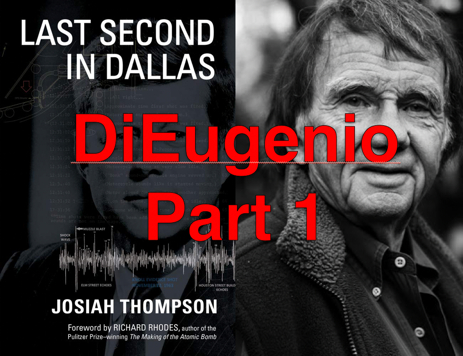
    Last Second in Dallas, part 1


    This will be a decidedly mixed review of Josiah Thompson’s new book on the JFK case, Last Second in Dallas. I hope it does not discourage anyone from buying or reading it. There are some good things in the volume. And I will try to be as fair as I can about what I think they are. But I will also not shrink from what I believe to be the book’s shortcomings.

    I

    Thompson has fashioned the book as a kind of one man’s journey into a labyrinth. He begins the book even before the Warren Report was issued. On the day Kennedy was killed, Thompson heard that a doctor performed a tracheostomy over a throat wound on President Kennedy. But yet all the news stories said that the alleged assassin worked at the Texas School Book Depository, which was behind the motorcade. In what is, in retrospect, a monumental piece of unintentional humor, Thompson went to the local FBI office to alert them to this paradox. (Thompson, p. 6)

    When the Warren Report was issued, it was received in the press and broadcast media with almost universal praise, but Thompson noticed that a curious and pesky young Philadelphia lawyer disagreed with the unanimous chorus. That was the late Vincent Salandria. Thompson, who was now a newly made professor of philosophy at Yale, decided to check up on Vince’s work. So, he consulted the Commission’s volumes of evidence and found out that Vince was correct.

    This gave him a bit of a shock. The author now tries to fill in a bit of his conservative Republican background to explain why. This is where I had my first perturbance with the book. The author writes that he thought Alger Hiss was innocent in that case. He then adds that when Allen Weinstein’s MSM endorsed book on Hiss came out, he changed his mind and agreed with Weinstein that Hiss was guilty. (Thompson, p. 9)

    For several reasons, this was puzzling to me. For one, Weinstein was later sued and settled with one of his interviewees. (Click here for details) He also promised to show some of his evidence to other Hiss scholars—he never did. He later became a sexual predator, while supposedly doing his job as chief archivist of the United States. He was protected from legal liability by the George W. Bush administration. (Click here for details) In fact, there are three relatively recent books that pretty much show that Weinstein was really a hired gun and that is how he got the job at the National Archives. One is by Joan Brady, one by Martin Roberts, and one by Lewis Hartshorn. The last shows that Whittaker Chambers, Hiss’s accuser and a man who Weinstein took at his word, was surely a pathological liar. I will return to this political aspect with Thompson later.

    During a Vietnam protest in the Philadelphia area, the author was arrested. The ACLU lawyer sent to bail him out was Salandria. Vince now introduced Thompson to the critical community. They went to NARA to view the Zapruder film and look at 35 mm slides. (Thompson, p. 10). He then visited Dealey Plaza with an Abney level tool and figured out that the angle through John B. Connally was a 27 degree down slope, which he figured most likely came from the Records building. (Thompson, p. 15)

    On the strength of this visit to Dallas, Thompson was signed by the Bernard Geis publishing company. He got a rather small advance, though they agreed to pay his expenses, but Geis knew some people at Life magazine. And they had decided to do a reinvestigation of the JFK case based on the critiques of the Warren Report by Mark Lane and Edward Epstein. (Thompson, pp. 16–17)

    What is next tells the story of Thompson’s field investigation in Dallas. This is where the author encountered witnesses in Dealey Plaza and at Parkland Hospital. Thompson interviewed hospital employees Darrel Tomlinson and O. P. Wright about the discovery of the Magic Bullet, aka CE 399. From here, he pieced together the chain of custody that linked the transport of the bullet to Washington and then the FBI lab. This led to one of the most sensational discoveries in the early days of critical research. Wright insisted that CE 399 was not the bullet he turned over to the Secret Service. The bullet he turned over was sharp nosed, not a round nosed bullet. And since Wright had worked in law enforcement for many years prior to his occupation as a security officer at Parkland Hospital, he knew the difference. (Thompson, p. 25)

    At Parkland, Thompson made another stunning discovery. This one was about the location of CE 399 when it was discovered. In all probability, it was not on Governor John Connally’s stretcher—which is where it had to be located if the Commission’s Single Bullet Theory was to hold any water. In all likelihood, it was found on a child’s stretcher and his name was Ronnie Fuller. (Thompson p. 24. For a more complete explanation, see Six Seconds in Dallas, pp. 156–65)

    From here, the book describes the witnesses in Dealey Plaza. First off are Bill and Gayle Newman who were to the limousine’s right, at the base of the grassy knoll. They were never called by the Commission, but filed affidavits and were interviewed by the FBI. (Thompson, p. 30) They may have been the closest witnesses to Kennedy’s shooting. The couple said the shots came from behind them and Kennedy was hit in the right temple, which would be clear evidence that a rifleman was behind the picket fence. But in addition to the Newmans, Thompson adds Abraham Zapruder and Emmett Hudson, who were in the same area, to this list. He later notes that it appears the FBI altered Hudson’s original statement to the Secret Service. (Thompson, p. 43) Hudson was the first witness Thompson located who indicated that there was another shot after the fatal head shot.

    II

    The author transitions over to witnesses who were further away from the limousine or not in as good a position to see or hear what had happened to JFK, but whose testimony is still important. In the cases of the motorcycle escorts, he notes that it was Bobby Hargis and B. J. Martin who were struck with blood and tissue from the fusillade. The significance of this is that they were riding to the left of Kennedy. Hargis told a reporter he was splattered with blood and the impact was so hard he thought he himself might have been hit. Later, while walking to the Sheriff’s Department, a colleague told him he had something on his lip: it was a piece of Kennedy’s brain and skull bone. (Thompson, pp. 55, 56) Martin’s cycle was also splattered with blood and flesh and he said that the left side of his helmet was also hit. In this profusely illustrated book, one can see that Martin was looking toward the president right before the firing sequence began. (Thompson, pp. 50, 58) Some have said this kind of evidence is eyewitness testimony. I disagree. It qualifies as physical evidence which indicates directionality.

    Officer Joe Smith smelled gunpowder near the underpass, but this testimony was then altered by the FBI. Smith also said he met up with a Secret Service agent, which was not possible as they were all at the hospital. (Thompson, pp. 58, 59)

    The author then proceeds to two men who have become famous to both the public and in the JFK case: Lee Bowers and S. M. Holland. Although Thompson says that Holland was more important, I believe they are of equal importance.

    Bowers was made famous by Oliver Stone’s film JFK. Memorably played by actor Pruitt Taylor Vince, in a riveting sequence he described how three cars came into the area behind the picket fence, circled around and then left by about 12:25. One of the men seemed to have some kind of electronic communication in the car. Bowers said that at the time of the shooting, something out of the ordinary, some commotion, occurred in the area behind the picket fence—where Elm Street dips down at the underpass. To be mild, Joseph Ball of the Commission did not do a good job in pursuing this line of inquiry, so Mark Lane took it up later for his film, Rush to Judgment. Bowers said he saw a flash of light or smoke “which caused me to feel like something out of the ordinary had occurred there.” (Thompson, p. 66)

    Bowers died in August of 1966. It was later discovered, through Debra Conway of JFK Lancer, that there was more to Bower’s story. Bowers had actually seen someone holding the trunk of a car open, placing something in it, and driving off. This was told to her by Olan DeGaugh, a supervisor a couple of levels above Bowers. Barney Mozley was a colleague of Bowers who replaced him on the later shift. Mozley said that Bowers was very fearful of telling all he knew: to the point of having to place a lock on his tower door so no one could interview him. But he told Mozley something which coincided with what he told DeGaugh: at the time of the shooting Bowers saw someone coming around the wooded area in a trench coat and what looked like a rifle underneath. Clearly Bowers was petrified of telling anyone about everything he witnessed.

    Holland was standing on the overpass at the time of the shooting. In his original affidavit, Holland said he heard four, perhaps five gunshot sounds. (Thompson, p. 68) Two of the shots were extremely close together. The sound came from the grassy knoll area and as he turned in that direction he saw smoke rising, so he and three companions ran there. Holland was looking for shells. What they found were a series of footprints at one end of a car. These were accompanied by muddy spots on the bumper and cigarette butts on the ground. In other words, it was as if someone was behind the fence and waiting for the motorcade. (Thompson, pp. 70–72) An obvious question was: Why would someone view the motorcade from behind the fence? (Thompson, p. 79)

    Thompson and his partner, Ed Kern, were impressed by Holland. The witness drew them a diagram of what he saw when he got to the scene. (Thompson, p.77) The episode is capped by Thompson’s photo comparison of Holland standing at the position he was that day, behind the fence, with an anomalous shape in the famous Mary Moorman photo taken from across the street looking toward the knoll. They appear to match. (Thompson, p. 80) Since the author found out that there were no trunks searched, he concludes the chapter with a postulation as to what happened: the rifleman (men) could have just opened the trunk, thrown the rifle in, milled around for a few minutes and later just walked away. This scenario would correspond with what Bowers saw.

    The next step in the Life inquiry was an interview with Dr. Charles Gregory, one of the two doctors who performed surgery on Governor John Connally; who was sitting in front of President Kennedy in the limousine. Gregory, along with his colleague Dr. Robert Shaw, both concluded that the bullet that hit Connally did not strike anything previously. They deduced this from the clean edges, and also since no cloth fibers were carried into the governor’s back wound; yet “his wrist wound was fouled with numerous fibers from his wool suit.” (Thompson, p. 85) The other key development was that Gregory thought the shot that did hit Connally came in approximately at Zapruder frames 237–240. Which again, separate it from the shot that hit Kennedy, since the timing was too late. Gregory was very accomplished. He was a field physician in the Korean War and had spent much time studying gunshot wounds.

    Thompson was disappointed by the essay eventually printed in Life. It was called “A Matter of Reasonable Doubt” and was published as the cover story on November 25, 1966. Featuring frames from the Zapruder film, which Time-Life owned, the piece was largely based upon John Connally’s estimation of when he was hit versus when JFK was. In other words, all the material reviewed, thus far, was eliminated (e.g. Bowers, Holland, the Newmans, Gregory, the splatter pattern, etc.). Beyond that, there was space given to Arlen Specter to respond and the ending included a roundup of Kennedy assassination books described with snide and smug remarks. The only book that was recommended was Edward Epstein’s Inquest, which, as most of us know, was not at all a comprehensive critique of the Commission’s evidence. What is striking about this article is that, although it stated at the end the case should be reopened, it did not include the evidence the magazine had that likely would have reopened it: the backward head snap of JFK which begins at Zapruder frame 313. As Thompson points out, it also mistakenly said that the bullet angle through Kennedy’s body matched up to Connally’s, which was not remotely true. (Thompson, p. 90).

    From here, Thompson relates his retirement by Life and his determination to create a book out of his materials. Life made it difficult by suing him over artist renditions of the Zapruder film in what became Six Seconds in Dallas. But the judge upheld his right to do so.

    III

    In this reviewer’s opinion, the approximately first hundred pages of Last Second In Dallas represent the best part of the book. Its combination of witness testimony, professional observation, and physical evidence is compelling. And this presentation is combined with another virtue. Thompson is an accomplished writer. He has a simple, supple style that is quite easy to read. He also knows how to carve out “scenes” in prose. As noted, like Six Seconds in Dallas, the book uses illustrations adroitly. For example, in addition to the one with Holland, the picture comparing the condition of CE 399 to two bullets fired into tubes of cotton is quite effective. (Thompson, p. 22)

    After giving the author his due, I must add that I did have some reservations with this part of the book. Some of it emerges from Thompson’s point of view, which is pretty much a first-person journey. Therefore, he cannot help but describe the shutting down of Life magazine’s inquiry into the JFK case. He only mentions in passing that the New York Times had fielded an inquiry and also shut it down. (Thompson, p. 92)

    There was an interesting crossover between the two inquiries. His name was Tom Bethell. Bethell ended up being a pal of Dick Billings. Billings was the member of the Life team who told Thompson the inquiry was being closed down. (Thompson, p. 91) Bethell was the Englishman who ended up working for Jim Garrison, but not before he journeyed to Texas to live and hang out with Penn Jones. Billings had been part of the infamous Bayo/Pawley raid into Cuba, an event which the author does not mention. The two B’s agreed that there was not a covert effort by the government, the Commission, or the FBI to conceal the truth in the JFK case. They also agreed that Life did not really suppress the Zapruder film, since interested parties could see it at the National Archives. This seems a bit ridiculous in light of what happened when the film was nationally viewed in 1975.

    Both Billings and Bethell were cognizant of the New York Times inquiry. Bethell said that in November of 1966 he had met up with Times reporter Martin Waldron in Dallas. Waldron had a 4–5 page questionnaire of items they were looking into as problems with the Commission. Many of these questions were about New Orleans and they focused on David Ferrie. This was independent of Jim Garrison. (Click here for details)

    This is important in two ways. Apparently, Thompson was unaware that around the time he was retired, early February of 1967, Billings was also in New Orleans. He had been tipped off by Life stringer David Chandler that Jim Garrison was investigating the JFK case. Garrison had agreed to share information with Billings in return for some photographic services. This links directly to the following quote:

    What Patsy [Swank] and I did understand was that there was a level of the Life investigation beyond our participation or understanding. I never knew what [Holland] McCombs was supposed to be doing, and it was apparent that I was not supposed to know. (Thompson, pp. 26–27)

    With the help of British researcher Malcolm Blunt, we now can shed some light on what McCombs was doing. As noted above, it seems that when the Times started delving into New Orleans, they decided to drop the case. That parallels what happened with Life. McCombs retired Ed Kern and Thompson, but Billings and Swank stayed. In fact, Swank was writing reports to McCombs on the case well into 1968. (Swank to McCombs 7/16/68) With Kern and Thompson gone, McCombs now began to turn his guns on Garrison. Why? Because as Blunt has shown, he was best of friends with Clay Shaw. (See letters of 3/9/68, 3/22/68, 6/20/68, 7/31/68 and beyond) McCombs now began to work with and encourage the likes of hatchet men like Chandler and Hugh Aynesworth. (See letter of 5/13/67 to Duffey McFadden)

    What makes this even more interesting is that, in February—around the time Thompson and Kern were cashiered—Billings had received a telegram marked confidential. It said Ferrie had been seen by two witnesses at White Rock Airport in Dallas in October and November of 1963. They also discovered a pilot in Dallas who knew Ferrie and flew to New Orleans to meet with him in 1964. (message of 2/26/67) Therefore, like the Times, Life now had interesting information about Shaw’s friend Ferrie. And make no mistake, Chandler knew of this relationship. His son emailed this reviewer in the early part of the millennium and said that his father knew that Shaw and Ferrie were friends. By May, McCombs was referring to Life’s reopening as a joke. (McFadden letter)

    In June, it got worse. McCombs was in direct contact with Ed Wegmann, Shaw’s lead lawyer. (See letters of 6/14 and 7/25/67) By 1968, Shaw was congratulating McCombs on making speeches against the critics of the Warren Report. About reading their works, Shaw wrote: “It is almost unbelievable how much nonsense I have had to absorb.” (Letter to McCombs, 6/20/68)

    The evidence adduced by Blunt would indicate that McCombs was there to ensure that what he labeled Life’s “so called reinvestigation” did not stray too far from the homestead, which was Rockefeller Center in New York City. In addition to these two inquiries, which were clearly neutered, there is a third parallel with what happened at CBS. Through the late Roger Feinman, we know those circumstances in detail, since Roger worked there. In that case, the middle level employees like Dan Schorr wanted to do a real investigation into what happened to President Kennedy. They were turned back by upper level management like Dick Salant, Bill Paley, and Frank Stanton. And then, as in the case of McCombs, John McCloy was employed as a secret consultant for the program. I know Thompson has this article since I sent it to him. (Click here for that essay)

    I bring this up for two reasons. In this book, Thompson says he and Kern were retired because Time-Life did not want to pay for a continuing inquiry plus the time to educate its reporters on the case (Thompson, p. 92) With what we know today, this is rather underplaying it, especially with Swank and Billings staying in place. I think I understand why Thompson underplays what I believe was a significant pattern. At a conference in Chicago back in 1993, we were both on a panel focusing on the media. As I recall it, he was the only person arguing that there was no broad pattern of editorial coercion on the JFK case. At that time, he chalked it up to the fact that there were too many editorial levels in the chain. When one has people like McCombs as a circuit breaker, one does not need such an institutional hierarchy.

    IV

    As Thompson transitions out of Life magazine and into the production of Six Seconds in Dallas at Bernard Geis, another rather awkward note is struck. That is this: somehow the critical community has gone off on a wild tangent and he has become isolated. Predictably, Jim Garrison gets the back of his hand. (Thompson, p. 112) He then writes the following about Vince Salandria:

    Vince Salandria, my mentor and guide to all this, was behaving like a wigged-out conspiracy theorist, rethinking raw facts to make them mean what he wanted them to mean. (Ibid)

    Since both Garrison and Salandria have passed on, I would like to say a few words in their defense. Back in late 1967, when Thompson was on his book tour, he did an interview with Pacifica radio. He said that he had just heard Garrison saying that Kennedy’s murder was really a coup d’état. Thompson then said that a coup was a shift in power and that there was precious little evidence to back that up. He then added that a good reporter could make Garrison look foolish on this point. (James DiEugenio, Destiny Betrayed, 2nd edition, p. 381)

    What makes this odd is that Thompson refers a few times in this book to his attendance at Vietnam protests, yet he does not make any connection between the sudden escalation of the war and JFK’s murder. Jim Garrison was the first critic to do this. In the view of several intelligent and documented studies, and the declassified record, he was correct: there was a shift between JFK and LBJ on Indochina. (For example, see books by David Kaiser, James Blight, John Newman, Howard Jones, and Gordon Goldstein.) Further work by scholars like Richard Mahoney, Greg Poulgrain, Robert Rakove and Philip Muehlenbeck have furthered Garrison’s thesis into areas like the Middle East and Indonesia. I have little problem referring to Kennedy’s murder as Garrison did today. (Click here as to why)

    As per Salandria, Vince was one of the very, very few people who predicted that if Robert Kennedy won the California primary he would be assassinated. I don’t think that portrays him as being “wigged out.” And I can pinpoint when he began to disagree with Thompson. The first or second time I met Vince at his home in Philadelphia, he escorted me into his study and pulled down a copy of Six Seconds in Dallas. He immediately turned to page 246 and pointed out lines he had blocked off in brackets. After a space break in the text, Thompson says that what he had written in the book did not prove a conspiracy and it did not prove Oswald was innocent. After Vince pulled the book away, he said: “Jim, that is just what he spent almost 250 pages doing! And now, in the last sentences of the text, he denies what he just did?”

    I had to admit: Vince had a point, one which got buried in all the photos and illustrations and sketches which made Six Seconds in Dallas unique. To further elucidate where Vince was coming from, by the end of the Clay Shaw trial, he had seen enough of what the likes of Holland McCombs, Dick Salant, and Punch Sulzberger were up to. And he now differed in his approach from other critics. Vince had started the whole field of micro studies in the JFK case. His early articles for Liberation and The Minority of One, were milestones in the field. (For an example, click here)

    By 1969, he did not see any further point in doing that kind of thing. Salandria had supervised the Dealey Plaza portion of Shaw’s trial where, among other things, Pierre Finck had imploded and spilled the beans on what happened at Bethesda the night of Kennedy’s autopsy. In his opinion, that part of the case was now obvious. The questions for Vince were: Why was Kennedy killed, and why in such an execution style at high noon manner, with hundreds of spectators in attendance? To Vince, it was to show that, no matter how many explications one made exposing the official story, it did not matter. Democracy had ended. The CIA and the Pentagon were now running things. To him, the escalation in Indochina and the following murders of Malcolm, King and RFK proved that, especially since the RFK case was even more obviously a conspiracy than the JFK case. Agree or disagree, I understood the position. I did not think it was “wigged out.” There was nothing wrong in trying to configure the Big Picture.

    V

    The narrative picks up with the infamous 1967 four-part CBS special and Luis Alvarez. Again, Thompson introduces this in a rather puzzling way. He writes that, “The whole CBS program was so unconvincing that I just let it slide.” (Thompson, p. 117) Which makes me wonder: Did Thompson or his editors look at Six Seconds in Dallas? That book has an appendix entitled “A Critique of the CBS News Documentary, ‘The Warren Report’”. It is written in small print, but in normal size lettering it would probably be about 5–6 pages long. This is letting CBS slide?

    But it is through this program that Thompson brings into the story the figure of scientist Luis Alvarez. There can be very little doubt that the author does a nice job in portraying him as a quite pernicious character in the JFK case. And it was not just with CBS. Alvarez’ participation in the case extended past the years of the House Select Committee on Assassinations, into the eighties. Through this long portrait, we understand a theme that Gary Aguilar and Don Thomas have written about. Namely, that for several scientists, the JFK case was not really science. Politics trumped the science they were supposed to be applying, e. g. Vincent Guinn, Tom Canning, Michael Baden. The Alvarez case is extraordinary, because of the blatancy of the falsehoods he told and because he entered into areas that he knew little or nothing about. It did not matter to Alvarez, it was all about saving the Warren Commission verdict.

    Therefore, to explain away the very fast backward movement of Kennedy’s body in the Zapruder film, Alvarez dreamed up the so-called “jet effect” theory. Thompson shows that Alvarez, to put it mildly, cooked his research on this and then lied about it. (Thompson, pp. 124–29) This was the infamous shooting of the melons experiment. It was meant to show that Kennedy’s head rocketed backward because of the explosion of blood and tissue toward the front. Alvarez announced that he did not use the Edison method in this experiment. That is, he did not try and try and try over and over until he got the desired result. But then, years later, it was revealed that this is what he did.

    At another time, to limit the shooting sequence in Dealey Plaza to just three shots, he created something called the jiggle effect. This meant that there were just three places in the Zapruder film where Abraham Zapruder “jiggled” his camera. Therefore, there were only three shots fired in Dealey Plaza. There was a big problem with this: it was false. There were six places. And Alvarez must have known it. (Thompson, p. 121) He clearly had an innate bias, since he once wrote to the author that “the critics are a bunch of nuts and that the Warren Report is essentially correct.” (Thompson, p. 119)

    But even here, I beg to disagree with some of the nuances which he uses to portray Alvarez. He writes that “no single individual ever played a more central role in preserving a mistaken view of the shooting.” (Thompson, p. 115) He says that this is not an understatement and he does not qualify it by confining it to the field of science. What are we to make then of the roles in this case of Arlen Specter, Dan Rather, Larry Sturdivan and David Belin? Rather worked on several CBS specials that were all rigged to back up the Warren Report and all appeared at certain crucial times: e. g. anniversaries, during the Church Committee inquiry, right after Oliver Stone’s JFK appeared.

    Later he writes that, “Powerful forces did not contact Alvarez and ask him to come up with his theory.” (Thompson, p 121) This seems contradicted by the work of Roger Feinman. Feinman, working from pilfered files out of CBS headquarters, showed that what happened is that the secret executive committee running CBS—the CNEC—rejected the idea of a fair and objective look at the Kennedy case. CBS President Richard Salant then sent two high level CBS employees, Les Midgley and Gordon Manning, to the San Francisco area. They met with two powerful attorneys, Bayless Manning and Edwin Huddleson. It was these two lawyers who suggested the program concept be switched around to an attack on the critics. And it was Huddleson who suggested they use Alvarez to do so. (Click here for that essay)

    It was not Alvarez who created that awful series. He was an appendage to a larger Establishment enterprise. Is it just a coincidence that, in 1971, Bayless Manning left Stanford to became the first president of the Council on Foreign Relations?


    Go to Part 2

  • A final response to the rebuttal of my review of the book Last Second in Dallas

    A final response to the rebuttal of my review of the book Last Second in Dallas


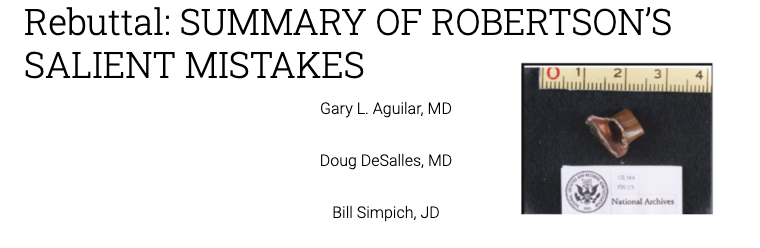
    Recently a rebuttal to my review of the book Last Second in Dallas (LSD), authored by Gary Aguilar M.D., Doug Desalles M.D., and Bill Simpich, was posted on the AARC website. The errors and false claims were so egregious that I felt I had to respond. The authors selectively chose five points in my review to respond to, where they claim my conclusions are in error. They studiously avoided any of the mathematically based arguments which were contained in the review.


    Point #1. The location of the entry wound in the shirt sleeve which carried dark wool fibers into Connally’s wrist wound.

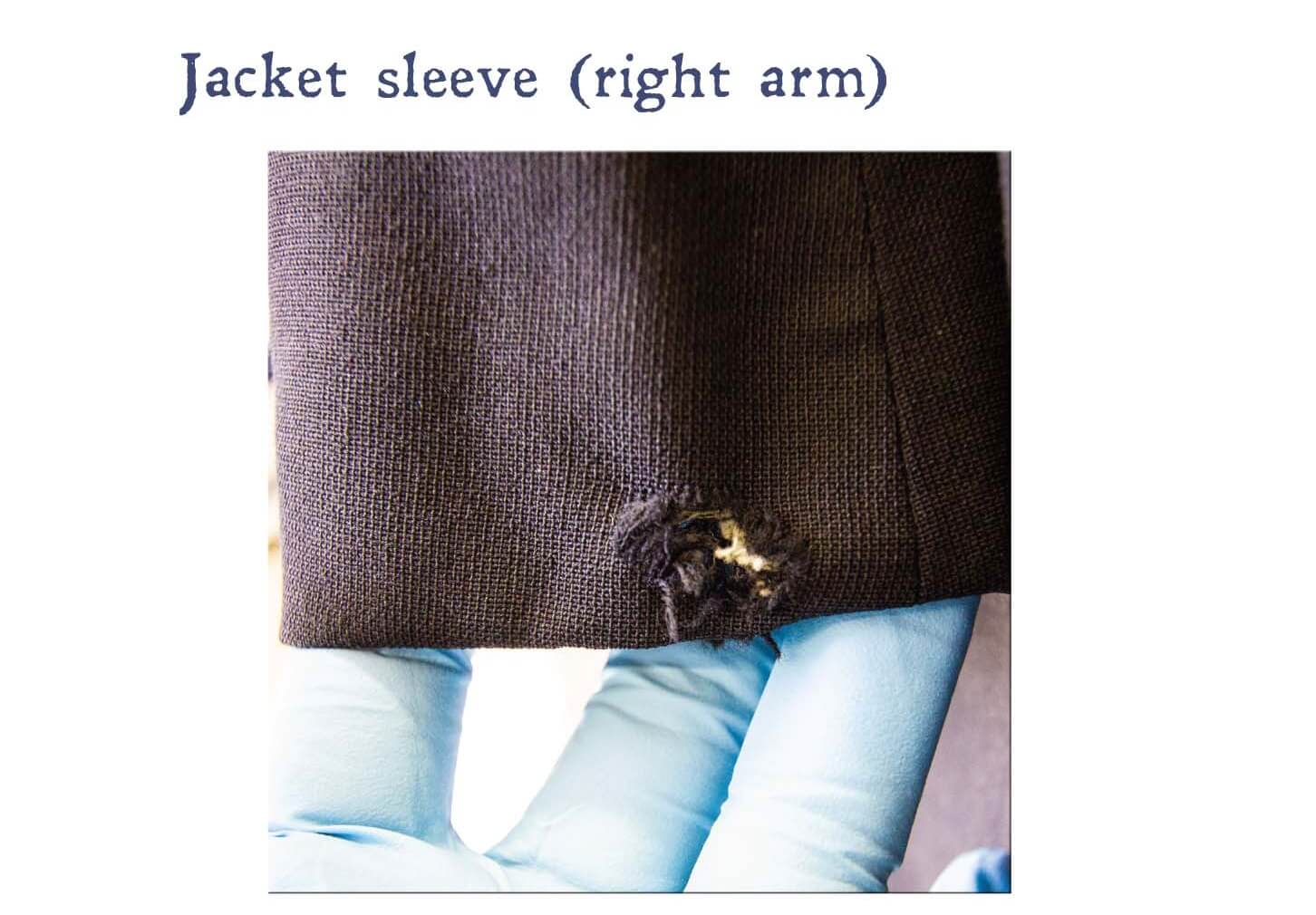
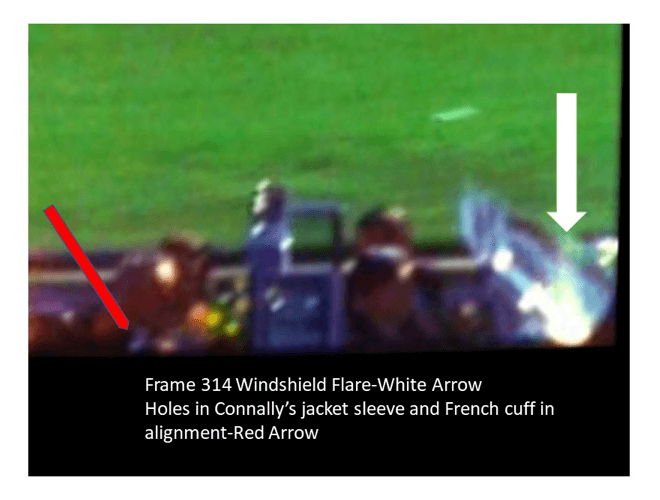
    This is a critical determination. The sine qua non for their theory is that the entry hole in the jacket sleeve and the entry hole in the shirt are in alignment at frame 328 when they claim a fragment of a bullet passed through both simultaneously. The unchallengeable photos show an entry hole in the jacket sleeve adjacent to the seam which runs on the thumb side opposite the buttons which are not seen. Another photo depicts a hole in the mid portion of the French cuff which is also on the thumb side opposite the cufflink holes which are not seen in this photo. These two holes are both located on the thumb side and I thought it would been clearly so obvious that I did not include a photo of the other hole in the jacket sleeve, which is enlightening. In the rebuttal, the authors have referenced this third photo with the claim that it depicts the actual entry hole in the shirt sleeve. It can easily be seen that this hole is immediately adjacent to the cufflink holes which are located ~ 180 degrees opposite the other two holes. Further, Dr. Gregory’s surgical report is corroborative. From HSCA Vol. VII p. 152, emphasis added, “Throughout the wound and especially in the superficial layers and to some extent in the tendon and tendon sheaths on the radial side of the arm are small fine bits of cloth consistent with fine bits of mohair.” Dr. Gregory’s diagram of the wounds clearly shows that the entry wound was on the radial, thumb side of the wrist. The sketch of the wound, albeit of the left hand, found in the postoperative notes shows that this wound was on the thumb side. If any questions persist the Texas State Library and Archives Commission webpages had the measurements of these wounds under each of the photographs. For their conjectured entry hole: “Distance of bullet hole to the right of the seam defining the cuff opening = 1 inch.” For the defect in the midportion of the French cuff: “Distance of bullet hole to the right of the seam defining the cuff opening = 5 1/4 inches; also 3 3/4 inches from the left of the cuff opening.”  With two coauthors being physicians, I would have expected the determination of radial, thumb versus ulnar to be elementary. Why did they make this ludicrous claim? Frankly, they had no other option, because they know at frame 328 the two holes on the thumb side were no longer in alignment. This misalignment at 328 destroys the sine qua non of their theory of a fragment carrying wool fibers simultaneously through these two holes. They had no other option and reflexively made the ill-formed argument that it was a hole on the other side of the wrist which was the one of entry.  As I stated in my review, this observation, in and of itself, negates the theory that a shot was fired from the Grassy Knoll to strike the head at frame 313. Having mislocated an entry wound to the wrong side of the wrist, the authors brazenly, with little style and no substance, claim that I have made a major error and that this somehow actually validates their theory when, in fact, the photographic evidence and findings at surgery do exactly the opposite and destroy their theory. While I would hope readers will continue on in reading my remarks on points 2 through 5, they need not do so. While there are numerous other errors on their part, the misalignment of the entry holes on 328 means that events could never have occurred in the sequence they claim.

    Point #2. The significance of the windshield flare at frame 314.

    It is correctly pointed out that the chrome windshield frame was already reflecting light both prior to and for several frames after 314, as a critical angle occurred for reflective surfaces. As the frames progress after 314 and the angles are changing, this maximum reflection can be seen moving up the chrome windshield frame causing previously reflecting surfaces to diminish in intensity back to baseline. At frame 314, there is the initial abrupt appearance of an increase in reflection in the lower corner of the windshield. This could only be due to a physical factor. The sun did not increase in intensity as the degree of reflection before and after this flare is the same. Some brief physical factor must have been responsible, a bullet cracking the windshield. Had it been actually due to a critical angle then this same focus of intensity should have been seen moving to other locations as the angle continuously changed. The small focus of increased reflectivity over adjacent areas was the result of a small degree of deformation of the windshield and/or frame that briefly increased the intensity over the previous and subsequent baselines. While there are qualitative differences in the flares at 314 and 328, both occur on the initial frame after known impacts at 313 and 328.  Where the author’s see an incredibly propitious timing of the angle to the sun, I see cause and effect. The refutation of point #1 means that a bullet went forward through JFK’s head with fragments simultaneously striking Connally’s aligned wrist wounds and cracking the windshield with a resultant flare over baseline at frame 314. Similarly, a bullet struck the windshield frame at 328 to cause a flare on the very next frame at 329. I see cause and effect.

    Point #3.  The significance of the forward movement of Connally’s right wrist after frame 313.

    Again, from the refutation provided on point #1, it can be concluded that a fragment from the head shot went forward at 313 to cause the wrist wound. Whether this fragment caused this movement or if it was voluntary or a combination of the both is immaterial. When he was struck at 313, the earliest voluntary motion we should see would be 4 frames later or 317. I believe I can see more of the French cuff at 317 versus 312. Connally was turning to his right and his hand was in motion prior to his wounding, which would indicate that both factors may have been at work in this forward movement. What is more important is that due this movement, from frame 323 onward, his French cuff was completely exposed and the both holes on the thumb side of the jacket sleeve and French cuff are no longer in alignment. Also immaterial is whether Connally kept holding his hat after being struck at 313. The late Senator Daniel Inouye of Hawaii had his arm blown off while fighting in WWII. Immediately afterwards he saw his disembodied hand still clutching the grenade he had been holding prior to this traumatic amputation. This is an example of decades old inconclusive claim which is pulled out when debating at what point his wrist was struck. It was 313. The alignment of the entry holes is the ultimate determinate.

    Point #4 The significance of the recovered bullet fragments.

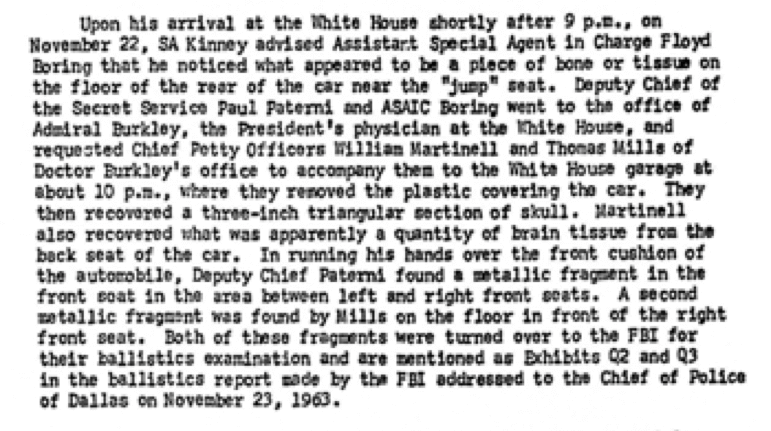
    Two major bullet fragments were recovered from the limousine, CE 567 and 569, which are purported to ballistically match Oswald’s rifle based upon evaluations, which until recently, have been human and subjective in nature. The bias of AFTE members is well known to the authors. Direct verification of Dr. Young and Mill’s claims will most likely never occur and the veracity of their claims can only be deduced from other evidence. If an independent, nonbiased ballistic comparison is performed which shows with a high degree of confidence that CE 567 and 569 came from Oswald’s rifle, then Young and Mill’s claims are in error. If so, then the bullet which struck the windshield frame fragmented and the fragments of the bullet which went forward through JFK’s head were not recovered. Frazier’s comments on the damage done by a whole bullet’s impact are simply assumptions as he readily stated in his testimony. From numerous other avenues it is known that the bullet which went forward through JFK’s head at frame 313 was fired from a distance further than the TSBD and therefore from another rifle. I trust these many avenues which indicate a different rifle more than I trust the subjective opinions of biased examiners. The NIST scans of the bullets and fragments from the assassination provides the opportunity to subject them to nonbiased computer algorithmic comparisons. If the computer analysis demonstrates that previous biased human opinions were in error, then we should not be surprised. Such was the case when numerous governmental diagnostic radiologists interpreted the postmortem skull radiographs without recognizing Puppe’s law.

    Point #5. The significance of the acoustic data.

    The sole basis for a shot being fired from the knoll to strike JFK in the head is the supposed 95%+ probability given for this shot by the analysis of Weiss and Ashkenasy. That is blindly taken for granted in LSD and by the present authors. How can we go about verifying their conclusion? Dr. Barger cautioned the HSCA that any proposed shots on the tape needed to be compared with events on the film. Since the HSCA disbanded, impacts have been identified on the film at frame 223 and 328, in addition to the previously known head wound at frame 313. This allows a mathematical synchronization of the film and tape by various measurements which the authors and I agree upon. The authors and LSD have assiduously avoided providing calculations which would validate the conclusions of Weiss and Ashkenasy. I have done the calculations and a shot purportedly fired from the Grassy Knoll to be recorded at 144.90 seconds does not synchronize with the preceding and subsequent shots recorded at 140.32 and 145.61 seconds respectively. Should we be surprised then, when other avenues of validation fail for this shot as well? The blur at 313 is a horizontal panning error not the downward deviation seen on all other blurs. The timing is too soon to be an involuntary reaction by Zapruder. The head moves initially forward. The misalignment of the entry holes at 328 proves their scenario impossible just as does the lack of synchronization. Does this mean that the acoustic evidence is invalidated? Not at all, it just means Weiss and Ashkenasy’s echolocation was in error and that things need to be thought out over again. When I first approached the acoustic evidence, I was immediately struck by the final change in the timing of Barger’s muzzle blast at 145.15, which he has a 50/50 probability to 144.90 seconds. While only ¼ of a second difference, this seemed to be a huge change in a sequence that ran 6 seconds. After calculations, I saw that Weiss and Ashkenasy’s shot didn’t synchronize and I thought outside the box. Knowing that there was a rapid forward and backward motion of the head, I conjectured that these represented two separate muzzle blasts and impacts, the first fired from behind and the second from the front, where Barger had initially found one. When I performed these calculations, I found out that, when this is taken into account, the film and tape synchronize. I have no control over the laws of math or the timing of the shots or any of the other variables. Math is reproducible and anyone with a map of Dealey Plaza, a ruler, and a calculator can arrive at the common and nondebatable conclusion that their conjectured shot does not synchronize and did not happen. This math will be the same today as it was in 1963, as well as 100 years from now.

  • Bending the Story on a Bent Bullet

    Bending the Story on a Bent Bullet


    In October of 2017, I posted this story on WhoWhatWhy, “Navy Doctor: Bullet Found in JFK’s Limousine, and Never Reported.”

    If you’re familiar with the medical evidence in the matter of John F. Kennedy’s assassination, you may know that, during the president’s autopsy, skull fragments found in the limousine and street were brought to the autopsy table. What you may not know is that something else was allegedly found in the limousine and brought up with the skull fragments—but not reported.

    Decades later, Dr. Randy Robertson, a board member of the Assassination Archives and Research Center, came upon obscure documents concerning this important piece of evidence.

    According to Navy doctor James Young, a bullet was included in an envelope with the bone fragments and he had a chance to inspect it before passing it on to the pathologists. He wasn’t sure if it was made of copper or brass, but here’s what he said about its shape:

    “…it was slightly bent on the end. It was not a straight bullet. In other words, it had hit something and it bent…”

    For more details on Young’s account, please scroll down to Appendix A.

    Recently, the very existence of that bullet has been challenged. This report is strictly in response to that specific challenge.

    It appears in one segment—point 4—of a much longer article, “Summary of Robertson’s Salient Mistakes” by Gary Aguilar, MD, Douglas DeSalles, MD, and Bill Simpich, JD.

    In Point 4, the authors focus on discrediting two people: James Young, the Navy doctor who said he saw the bullet, and Randy Robertson, who believed him.

    Issue 1

    The authors say, “Dr. Young used the term ‘slug’ to describe it and it is on this term that Robertson builds his case that a ‘whole bullet’ was found in the limousine.”

    It seems far more likely that Robertson saw the “slug” as a whole bullet simply because of Young’s description of it—which the authors do not include in their paper.  

    Young used the term “Bullet” with greater frequency than the word “slug.” He said “bullet,” about six times in the Oral History interview and three times in his letter to Gerald Ford.

    They reinforce this false premise: “After doing the Oral History interview, Young wrote to President Gerald Ford asking Ford if he knew anything about the ‘brass slug’ Chiefs Mills and Martinelli [sic] had found in the limo. Ford replied, ‘No, he didn’t know anything about it, had not heard anything about it ever.’”

    It appears that Aguilar et al. did not read much of the material, not even the short bits. “Bullet” is hard to miss in this correspondence. From Young to Ford:

    Two of the corpsmen left and returned sometime later with three varying sized pieces of President Kennedy’s skill bones. In addition, they brought back in an envelope a spent misshapen bullet which they had found on the back floor of the “Queen Mary” where they had found the pieces of skull bones. The bullet and pieces of skull were given to Dr. Jim Humes.

    I have never seen anything written about that spent bullet in the Warren Report or elsewhere. Do you recall any testimony or comments which would clarify my concerns?

    From Ford to Young:

    As a member of the Warren Commission I was very conscientious about my participation in the hearings. However, I have no recollection of “the spent bullet” you refer to.

    Young also said that he would ask Arlen Specter to “look into what happened to that bullet.” 

    The above makes it clear that Young frequently referred to a “bullet,” and much less frequently, called it a “slug.” So, why fault Randy Robertson for assuming Young was talking about a bullet when that is exactly what he called it?

    More important, whatever shape the bullet was in, it was an important piece of evidence that went unreported.

    Issue 2

    The authors assert that Young confused the little fragment (CE 569) shown below with a whole bullet:

    No ‘non-fragmented bullet with a bent tip’ ever existed. Robertson made up its existence out of an ambiguity in Young’s use of the term ‘slug.’ No ‘complete bullet’ was ever found in the limousine. Dr. Young was referring to Q3, later designated C3, and even later designated CE 569.


    How could Young have been referring to that little fragment—the base of a bullet, not the tip—when he never even saw it? He did not go down to the garage with the petty officers. Nor did those officers bring it back to the autopsy. Those fragments were turned over immediately to the FBI. And that fragment (CE 569) does not remotely resemble what Young described.

    Dr. Aguilar’s argument has all the credibility of what a man told the judge when he was being tried for shooting his mink-encased mother-in-law in the family garage. He said, “Your honor, I thought it was a raccoon!”

    Issue 3

    Aguilar et al. present a “foundational document” on the fragments discovered in the car, a document that does not mention a whole bullet—so we are to believe the bullet never existed:

    This is all Robertson says about Dr. Young and the ‘bent brass slug’ that Chief Mills or Marinelli [sic] found on the floor of the Presidential limousine. This is odd since one of the most foundational documents in the case—Commission Document 80, a 15-page document including photos and another SS Report—tells in granular detail how the various fragments were discovered on the evening of November 22nd.

    We in the research community have seen many documents that are false, misleading, incomplete, or otherwise not reliable.

    A passage in this “foundational” document contains intriguing information that may explain how the bullet, or whatever Young was talking about, could have been picked up by Martinell and carried—but unseen—because it was submerged in brain. (And this might explain why FBI firearms expert Robert A. Frazier never saw it.) (See Appendix B for a longer quote from the “foundational” document, CD 80.)

    They then recovered a three-inch triangular section of skull. Martinell also recovered what was apparently a quantity of brain tissue from the back seat of the car.

    Question 1: Could that “quantity of brain tissue” have embedded the bullet, or whatever Young called a bullet, so that it was—at the time—out of sight?

    Question 2: Whether it contained any metal or not, why didn’t Humes report that “quantity of brain tissue” when he reported the bone fragments? After all, it’s evidence. There should be a description of it, and whether it was searched for bullet fragments. (Humes reported plenty of trivia, so why not this?) Could that brain tissue have been cerebellum?

    But then Humes was quite deceitful when it came to reporting things directly related to the wounds. For instance, incredibly, he never even mentioned the gross condition of the cerebellum in the autopsy report or his testimony. Not one word on how much of it was left. We only have Parkland Hospital’s descriptions of the organ (very damaged, half of it missing…) This was one of the most talked about pieces of gore in all the literature on the head wound. I seem to be the only one concerned with this omission. (Click here for details)

    A related mystery: Clint Hill and others have said that hair was attached to the large bone fragment. That hair should have been documented, combed for bullet fragments—and used to help identify where the bone fragment came from. His hair was longish on top, but considerably shorter in back. What happened to it? 

    Question 3: Why didn’t Aguilar et al. mention this “quantity of brain” picked up by the petty officer along with the skull fragments—and not reported? It is clearly relevant.

    And here’s a discrepancy that may have a mundane explanation, but should be noted:

    Aguilar et al. said, “This ‘whole bullet’ is never mentioned in the notes FBI Agent Robert Frazier kept during his forensic examination of the limousine at the Secret Service garage between 2:00 AM and 4:30 AM on the morning of November 23rd.”

    But, according to the “foundational document,” the petty officers who picked up the bone fragments and Secret Service agents arrived much earlier—at 10:00 PM. 

    [Re the question about why the bullet was not mentioned by Frazier, the above may explain it. Or not.]

    Issue 4

    The authors try to close the case and snuff out Dr. Young’s contribution:

    Now with the whole story of what happened in the White House garage fully described in various reports, whatever Dr. Young thought he was seeing is rendered irrelevant. We know what happened. It was not just Martinelli [sic] and Mills who searched the limousine…

    “Rendered irrelevant?” Not so fast.

    “We know what happened.” Aguilar doesn’t seem aware of the simplest, most basic, most relevant facts upon which to base his theory—that Young confused the little fragment found in the front of the car with the less damaged bullet Young says was found in the back of the car and brought to the autopsy table along with the skull fragments.

    The Basic facts need repeating:

    • Young never even saw that little fragment. He stayed in the autopsy room and never went down to the garage where the limousine was, and where the front seat fragments were found. Petty officers were sent.
    • The front seat fragments were turned over to the FBI and whisked away. (Commission Exhibits 567 and 569)
    • The front seat fragments were NOT brought back to the autopsy table.
    • So how could James Young have confused a spent bullet (or any form of a bullet) with CE 569 which is the hollow base of a bullet—with no tip, bent or otherwise?

    When it comes to this case, it’s hard to know what to believe. But sometimes we know what not to believe. Considering all the deception we have seen, all the lies by major players about major issues, the planting of evidence, the destruction of evidence—why is it so hard to believe James Young?

    Aguilar et al. seem to believe official stories:

    The other bullet fragment found in the front seat area is shown in figure 31. The simplest explanation is clearly that CE 567 dropped down into the front seat area after striking the windshield at 328/329. CE 569 likewise dropped into the front seat area at 328/329 after striking the rear-facing chrome strip shown in Figure 30.

    As the authors know very well, the “stretcher bullet” was planted. Yet they trust the government version on the front seat fragments. While I have no reason to doubt that claim—I have no reason to believe it either.

    And I keep remembering something Roy Kellerman said. He’s the Secret Service agent who sat in the front passenger seat of JFK’s limousine, the place where the fragments were found. From his interview with the HSCA:

    Kellerman recalled that when he was in the car just moments after the shots he observed “a splattering of metal around me.” And he said there had to be “four or five metal fragments in the car.”

    Four or five? Had to be? But only two were reported. (I’m assuming he was not referring to tiny lead particles. Those were probably too numerous to count.) This could have an innocent explanation, but not necessarily.

    And then there’s the odd story of the undertaker who said a federal agent had shown him a glass vial filled with fragments taken from Kennedy’s head – 10 fragments. Yet, the lead pathologist said he only removed two fragments. (ARRB MD 180, p.3) (Someone else made a similar claim, but I can’t remember who.)

    In most of these cases of gross discrepancies, it’s impossible to find hard proof of who is right. But there is one thing you can prove: when a person makes a false claim about what is, or is not, in a particular document. Whether the false claim is a lie, or a mistake, is a matter of judgment.

    Personal Note

    I know all three of the authors (Aguilar, DeSalles, and Simpich) quoted above and suspect the ideas expressed in Point (4) of the larger paper are mostly those of Dr. Aguilar, whose work was trusted by the other two, but that’s just my theory. And I believe they dashed out that article too quickly, in defense of a comrade, Josiah Thompson, whose book Randy Robertson has harshly criticized. I can sympathize with this impulse. The problem is—they did it at the expense of James Young, who seems to have done nothing to deserve such disrespect. And if they succeed in snuffing out all references to this unprovable, but still interesting bit of evidence, then they also did it at the expense of future research.

    Addendum

    One theory about what happened to the bullet James Young said he saw:
    A family member of the late George Burkley, Kennedy’s personal physician, reportedly told researcher John Titus that “something relating to the assassination—something very important—was stolen from Dr. Burkley as he traveled between airports on his way to Denver.”

    Click here to read Titus’s story about what happened when he reported this to former Warren Commissioner David Slawson. And click here for more.

    Appendix A

    James Young, MD, one of Kennedy’s personal physicians who attended the autopsy, believes he witnessed something strange that was never reported anywhere, apparently.

    Soon after the autopsy, he wrote a memoir about what he saw for his children. He revisited that memoir in 2001 during an interview with the US Navy Medical Department Oral History Program.

    The lead pathologist, James Humes, MD, said bones were missing from JFK’s head, and asked two petty officers (Chiefs Thomas Mills and William Martinell) to retrieve any bone fragments left in the president’s car. (p. 53)

    They came back with an envelope that contained three pieces of skull as well as a “brass slug about half a centimeter in diameter and distorted.” Later in the interview he said:

    I came across this issue of the bullet [while looking at the memoir]…

    They picked up the bullet off of the floor in the back of the car. Well, I decided that this is something, you know, the third bullet has never been decided about ever, apparently…I went through the entire Warren Commission book…I went through the whole thing and there was nothing in it.

    Now, at that particular time nobody said anything about this. And I know what we did. We brought that in, I mean Chief Martinell and Chief Mills went…got the stuff off of the floor in the back seat, brought it back out to us and we gave that to Commander Humes at the time…

    […]

    So, the bullet, again, was a copper jacketed bullet like a military bullet?

    No, it was a brass jacket…I don’t know, maybe it was copper, I couldn’t tell. But it was that color or brass and it was slightly bent on the end. It was not a straight bullet. In other words, it had hit something and it bent…and so I called Tom Mills and I said, “Tom do you recall this situation?’ He said, ‘Yes I do’ and he said, ‘You’re exactly right.’ He said, ‘We did bring that slug out from the back…’

    The last time Young tried to talk to Mills, Mills said he didn’t want to talk about it. He’s not the only one.

    Appendix B

    From Aguilar et al.’s paper: On the Mary Ferrell site it is described as “Commission Document 80 – Secret Service Report of 06 Jan. 1964 re: Presidential car.” Below is a photocopy of a paragraph from page 2 of the Report:


  • Truth Is the Only Client

    Truth Is the Only Client


    Mainstream media has abandoned the most important murder case in world history. A Hollywood producer has personally told me, “They just don’t want to touch it anymore.” With a plethora of famous crimes being re-discovered by avid Netflix viewers, one might think JFK would be picked up somewhere. It has not. In other words, you have to “do it yourself” now. An example of this is the 2019 self-produced documentary Truth Is the Only Client, which features the surviving Warren Commission staff members. Yes, mainstream media didn’t even pick this one up. It can be watched for free on Amazon Prime.

    The film starts off by resurrecting the late prosecutor Vincent Bugliosi, who says the assassination is “the most complex murder case by far in world history. Nothing even remotely comes close.” This is true. But he follows this by saying that “conspiracy theorists” are the reason it is complex. This is not true, not even close. As journalist Jefferson Morley has said, “Suspicions of a conspiracy originated in the circumstances of the crime…It was the facts of the crime that made people think it happened in a different way than the way the Warren Report set forth.” (Jacob Carter, Before History Dies, p. 8) Also, we are researchers, not “conspiracy theorists.”

    Warren Commission assistant counsel Samuel A. Stern then spewed the now common bit of it being “so hard to accept” that a nobody killed a somebody. Nice try, but not the case. Researchers have continually pointed out the holes in the evidence or, back in the sixties, the contextual chasms in the Warren Report. And much later, they began to fill in those chasms with new evidence supplied by the Assassination Records Review Board. For instance, if Kennedy was only hit from the rear, then why did over forty witnesses at both Parkland Hospital and Bethesda Naval Medical Center see a large avulsive hole in the rear of Kennedy’s skull? (See Dr. Gary Aguilar’s essay, “How 5 Investigations into JFK’s Medical/Autopsy evidence Got it Wrong,” Section Five) And as Aguilar discovered when the records were reviewed, the House Select Committee on Assassinations misrepresented this fact in its report. (See Volume 7, p. 37) As we shall see, the man who oversaw the writing of those volumes is later featured on this program.

    Assistant counsel Burt W. Griffin declared, “If we could find a conspiracy, we’d all be national heroes!” Well, they did have 58 eyewitnesses who reported a frontal shot—but they buried them in their tens of thousands of pages of appendices and commission documents. They had the Zapruder film showing JFK being thrown to the rear—but they somehow missed that in the Warren Report. And it’s almost certain they saw the Moorman photo that seems to depict the grassy knoll gunman behind the fence—but they never published it. Maybe because as soon as you have a frontal shot, there’s a conspiracy. The staff members buried or omitted this vital evidence and, therefore, were not national heroes. However, first generation researchers Josiah Thompson, Sylvia Meagher, Harold Weisberg, and Mark Lane brought all this evidence to light and did get some national acclaim for their toil.

    Bugliosi then outlines the Warren Commission’s supposed shooting scenario and does so rather nonchalantly, as if it’s absolute fact. What he doesn’t say is that this is not actually the Commission’s shooting scenario, but rather Gerald Posner’s shooting scenario. Assistant counsel Melvin A. Eisenberg claimed Oswald’s “prints” were found on the rifle—but there was only ONE print and the only person to see this print said it was an old print. (Gary Savage, First Day Evidence, p. 108) Assistant counsel Howard P. Willens claimed that “inside the [paper] package were found remnants of the carpet in which it was kept at the Paine garage”—but he apparently forgot that the FBI could not make a positive identification. (WC 4 H p. 81) And by the way, it was a blanket, not a carpet. Bugliosi touted the long-debunked myth that Oswald was “the only worker” missing from the Texas School Book Depository, when really 17 were never in the building after 12:30. (WC 22 H pp. 632–686) Bugliosi nonchalantly says Oswald killed Patrolman J. D. Tippit, but the late researcher Larry Ray Harris showed Oswald was most likely innocent of that crime. (“November 22, 1963: The Other Murder,” Dateline: Dallas, 11/22/93) Bugliosi says Oswald “told one provable lie after another, all of which, of course, show a consciousness of guilt”—but it only shows he was involved in some way and doesn’t mean he killed the President. Bugliosi also said that “six and a half months before,” Oswald attempted to murder Maj. Gen. Edwin Walker—but the alleged bullet could not be linked with the rifle (WC 3 H p. 439) and the two witnesses said the perpetrator was not Oswald. (WC 5 H pp. 446–447; 26 H p. 438) Also, it was actually seven months before, not six.

    The film did a segment on Oswald’s life. The exposition was very similar to the 2003 Peter Jennings program Beyond Conspiracy. Like the 2003 version, this one comes out à la the official portrayal of him as a nobody, which has long been debunked in so many ways. There’s quite a remarkable and emotional interview with Ruth Paine, which, to me at least, helped seal the deal that she was not involved in the plot to kill JFK. But what she did say was striking—“I’ll help these officers in whatever way they need.” That she did.

    The Commission’s Howard Willens (and later Bugliosi) spewed the usual “there was no way for the bullet to go after exiting from the President’s neck other than into Connally”—but of course it is highly unlikely that any bullet exited JFK’s neck. For at the autopsy the back wound was probed and found to not go anywhere. (CD 7, p. 284) The bullet lodged in the back and most likely fell out. (It also would’ve smashed the first rib had it traversed where the measurements place it.)

    Willens then said something incredible:

    Governor Connally insisted then, and until his death, that he had not been hit by the same bullet that hit the President. As I have said, he was the Governor of Texas, he wanted his own bullet.

    This is an absolutely outrageous straw-man argument. In fact, there’s no evidence whatsoever to support this claim. Willens simply made it up. The truth is that, as an experienced hunter, Connally understood from the sound pattern that the bullet that struck Kennedy could not have struck him. He deliberately hid his own conclusions about what had happened and this actually helped the Commission! In 1982, Connally was at a political function in Santa Fe. Reporter Doug Thompson asked him if he thought Lee Oswald fired the gun that killed Kennedy. Without batting an eyelash Connally replied with: “Absolutely not. I do not, for one second, believe the conclusions of the Warren Commission.” Thompson asked him why he then never spoke out against the Commission. This is how Connally responded: “Because I love this country and we needed closure at the time. I will never speak out publicly about what I believe.” (Joseph McBride, Into the Nightmare, p. 418)

    The film next turned to HSCA chief counsel G. Robert Blakey, who insisted Connally’s back wound was “oval…which is an indication that it hit something else”—but Connally’s doctor testified it was a neat entry wound and was oval only after he removed damaged skin. (WC 6 H p. 85, 88) In fact, just simply look at the holes in his suit coat and shirt and they are not oval. Blakey said that, since the left side of JFK’s brain was undamaged, there couldn’t have been a frontal shot—but this ignores the possibility of a tangential headshot. To explain the head snap to the rear, Blakey says this was a neuromuscular reaction—but that only occurs when the nerve centers (at the bottom of the brain) are inflicted and JFK’s were not. The film then flashes across the screen: “No witnesses saw a gunman shooting at the President from the Grassy Knoll.” Well, of course, everyone was looking at the President, not at some random fence in the corner! Snipers are trained to not be seen.

    The film next does something amazing. It shows the apparent forward head movement between Zapruder frames 312 and 313 and acts as if this is the first time it’s being discovered! The Travel Channel had done the same thing a year before. In reality, of course, it was discovered over half a century ago by Ray Marcus. It was first written about in print by author Josiah Thompson, who has since changed his mind and concluded it was actually an optical illusion due to camera movement. (See his new book Last Second in Dallas)

    The narrator tells us, “Clearly there is no evidence of anything striking the President from the front.” This is abominably incorrect. Kennedy was thrown to the rear, the blood went back and hit the motorcycle officers, and nearly 100 eyewitnesses felt the shot came from in front on the knoll. In a panic attack, Jackie Kennedy is seen retrieving a part of her husband’s skull off the rear of the limousine. A flash of light and smoke was seen on the knoll, fresh footprints and cigarette butts were found there—coincidently where a shape appears in the Moorman photo that’s not there in later photos. So that was a person. This is all JFK 101 and none of it is mentioned in the film.

    The film touched a bit on the acoustics evidence, but ignored all the recent work that’s been done on it. Their argument was very dated.

    The film did a segment on Jack Ruby and Blakey laid out what he saw as connections between Ruby, Oswald, and the Mob. But incredibly, the narrator dismissed it all by simply saying, “I disagree.” [!] The rest of the segment is again similar to the 2003 Peter Jennings program—à la the official portrayal of Ruby. There was also an interview with right-winger Bernard Weissman, but heavily downplayed his role all while having a cute fluffy dog in his lap!

    Bugliosi avows that Oswald would’ve been “one of the last people” the CIA or Mob would pick to kill Kennedy—but of course, critics do not believe this. Critics believe Oswald was involved in the plot as a double agent who was double-crossed. Bugliosi also tells us that Blakey and ARRB chairman John R. Tunheim assured him that there was “no smoking gun” in the remaining sealed files, as if conspirators would leave behind a trace for all the world to see! Bugliosi then makes an absolutely disgusting straw-man argument: Critics “love and revere JFK, and yet they’ve devoted a good part of their life desperately trying to exonerate Lee Harvey Oswald, the very person who brutally murdered their hero JFK.” I can’t think of anything more disgusting. Critics are simply in search of the truth, NOT solely “desperately trying to exonerate” Oswald. Warren Commission staff attorney Lloyd L. Weinreb then repeated the common talking point of it being “much more acceptable to believe that there’s a conspiracy.” Staff historian Alfred Goldberg took it even further: “Belief in conspiracies is exciting…That’s what feeds their paranoia.” Again, disgusting. I repeat, people simply point out the HOLES IN THE EVIDENCE.

    In sum, there is nothing new in Truth Is the Only Client. It just repeated the same old same old, while omitting so much more. It has essentially tried to take the modern and improved Oswald-did-it narrative from Vincent Bugliosi and Gerald Posner and then declare the Warren Commission way back in 1964 got it right after all. Sorry, but it does not work that way, folks.

    The film was also way too long and quite frankly very boring. Astonishingly, it has a 100% score on Rotten Tomatoes. Yes, you heard me correctly. 100%. To put that into perspective, here is a list of famous films that do NOT have 100% on Rotten Tomatoes:

    – Casablanca

    – The Godfather

    – Gone with the Wind

    – Lawrence of Arabia

    – The Wizard of Oz

    – The Graduate

    – On the Waterfront

    – Schindler’s List

    – It’s a Wonderful Life

    – Sunset Boulevard

    – The Bridge on the River Kwai

    – Some Like It Hot

    – Star Wars

    I think we all know what this is about.

  • A Review of Last Second in Dallas by Josiah Thompson

    A Review of Last Second in Dallas by Josiah Thompson


    Just over half a century ago Josiah “Tink” Thompson published one of the seminal books on the JFK assassination, the influential Six Seconds in Dallas. Working with limited materials, he performed a pioneering initial investigation outlining many of the crucial objections to the Warren Commission’s conclusion of a single gunman. A striking finding at that time, made by Raymond Marcus, was the forward and then violently back-and-to-the-left head motion seen sequentially at 312/313 and 314/315 on the Zapruder film. Thompson’s original theory was that this indicated sequential shots, the first from behind and the second from the Grassy Knoll, striking in approximately 1/10th of a second.

    Since the 1967 publication of Six Seconds in Dallas, intense scrutiny has been placed on all aspects of the evidence. In 1978, the HSCA discovered the DPD DictaBelt tape and an analysis concluded with a 95% confidence level that the shot that first struck the head was fired from the Grassy Knoll. In 2001, Don Thomas reanalyzed Mark Weiss and Ernest Aschkenasy’s data and published a peer reviewed article in Science and Justice concluding that the probability was even higher. Impressed by this pure science, Thompson has now changed his position and believes that the first shot came from the Grassy Knoll and that a second shot to the head came from behind less than 1 second later in accordance with the original 1978 analysis.

    His new investigation, culminating in the publication of Last Second in Dallas, relies on several experts, including the distinguished Dr. James Barger who did the original acoustic analysis for the HSCA. It is to Thompson’s credit that he was able to get the reticent genius Dr. Barger to do further scientific work in the final authentication of the tape. In Last Second in Dallas, Thompson presents the reader with new observations which should erase all doubt of a single gunman in Dealey Plaza. It is a combination of the history of the case from his personal perspective of over 50 years’ experience as well as the scientific studies which have been performed with special emphasis on the acoustic evidence.

    Chapters 1 and 2 are recollections of his initial reaction to the assassination as well as his early activities in the case. Interactions with many eyewitnesses and first-generation researchers and critics are recalled. Thompson revisits some of his original observations from Six Seconds in Dallas. One concerns the circuitous journey of CE399. The eyewitness testimony of Parkland Hospital Security Director O.P. Wright claiming that the bullet he recovered had a pointed tip is revived. This is a topic which has been examined in detail, but here the focus is on Wright. The author rightfully questions the ability of CE399 to have accomplished all necessary to maintain the single bullet theory. He continues with his involvement with Life magazine, which gave him access to the sequestered Zapruder film which was crucial in the writing of Six Seconds in Dallas.

    Chapters 3 through 5 recount the eyewitness testimony confirming a shot being fired from the Knoll. Their firsthand recollections of the gunshot report, including the smoke from under the trees, the smell of gunpowder, footprints, and cigarette butts behind the fence, as well as the presence of an individual flashing a fake Secret Service agent badge, are telling memories of the day. The reader is exposed once again to many familiar names: the Newmans, Zapruder, Sitzman, Hudson, Altgens, Jackson, Chaney, Hargis, Martin, Smith, Holland, and Bowers. Many of these statements will be known to even beginning students of the assassination, but Thompson’s focus on the Knoll provides persuasive evidence beyond the acoustics that a shot was fired from the there.

    In Chapters 6–8, Thompson recalls his continuing involvement in the case and significant developments during that time period. Deservedly proud of his work on the 1966 Life magazine article “A Matter of Reasonable Doubt,” he regales in telling how this brought him to the attention of J. Edgar Hoover. He immersed himself in the case doing groundbreaking work with interviews, examination of photos and films, and ballistics, among other fields, resulting in the publication of Six Seconds in Dallas. That book documented many of the early persuasive arguments weighing against a sole gunman and it garnered a cover story in The Saturday Evening Post. Tink’s behind-the-scenes stories are both entertaining and enlightening and provide insight into his early years of assassination research and his, at times, contentious interactions with other highly respected first-generation critics. At the time of the Clay Shaw trial, the author distanced himself from other critics who were supportive of Jim Garrison’s prosecution of Shaw. For older readers, the preceding chapters may evoke memories of the heady days of fresh clues and new revelations. For younger readers, Thompson’s firsthand recollections can directly transport them back to what those times were like.

    Chapter 9 covers the involvement of Nobel prize winner Dr. Luis Alvarez, who also assumed he had a PhD in assassination “science.” Alvarez, a blatant Warren Commission apologist, is known for shooting melons, thus trying to create a reverse jet effect to explain the rearward component of JFK’s double head motion. Alvarez is one of many scientists, like Vincent Guinn, in the governmental and academic circles to have used their prestige when approaching the assassination from their individual field of expertise. Thompson recounts a long period of contentious personal communication between he and Alvarez, mainly over Alvarez’s “jiggle analysis” of the Zapruder film and “reproducing” the reverse jet effect. Critics had immediately pounced on Alvarez’s claim that a single frame horizontal blur seen at 313 reflected Zapruder’s reaction to a rifle shot, as a muzzle blast from the TSBD would not have even reached his ears yet. Ironically later in Chapter 14, a same horizontal blur will be viewed as a reaction to a shot from the Grassy Knoll, with a similar lack of success based upon similar principles. Alvarez’s attempts at shooting various objects, plus his publications, are revisited. During the writing of the book, Paul Hoch provided the author with photos and notes from the actual melon shooting sessions, which almost invariably showed objects moving forward in the direction of the bullet as had the Warren Commission tests. Thompson details the intellectual dishonesty and despicable behavior exhibited by this Nobel prize winner. I do not think the author adequately describes the enjoyment he found after obtaining Alvarez’s materials, provided by Hoch, which are now conserved at the Sixth Floor Museum.

    Chapter 10 presents a continuing autobiographical tale of his life as a renowned first-generation researcher in the 70’s and a life one could well be envious of. He highlights working abroad as well as his presence at Robert Groden’s first public viewing of the Zapruder film in 1973. He also provides a behind-the-scenes view of the drama behind its first nationwide broadcast on Geraldo Rivera’s Good Night America in 1976. The electric effect this had on the public, and the resultant efforts to get the House Select Committee on Assassinations (HSCA) created, are noted. The chapter ends with the Dallas Police Department DictaBelt tapes being given to the HSCA in 1978 by Mary Farrell and its subsequent effect on their deliberations.

    II

    A short history of the chain of possession of the tapes is detailed and extremely helpful information on how the DictaBelt recording system functioned is provided in Chapter 11. HSCA Chief Counsel Robert Blakey’s choice of James Barger to analyze the tape for the HSCA is covered. Thompson ends this chapter without revealing to the reader that prior to the involvement of Weiss and Aschkenasy, Barger gave his discovery of the muzzle blast from the Grassy Knoll at 145.15 seconds a 50/50 probability.

    Thankfully, due to his true scientific ambivalence, the HSCA brought Weiss and Aschkenasy on board and it was their work which identified an earlier muzzle blast at 144.90 seconds. Without the identification of this earlier muzzle blast, the stalemate of medical evidence of a single shot from behind versus the acoustic evidence of a single shot from the Grassy Knoll would have continued for a significant period.

    The 60 Degree Rule concerning the identification of the N waves created by a bullet’s supersonic travel is improperly explained. I brought this up with Barger, who provided a diagram he had made applicable to this when the bullet’s velocity went down to zero after impact. Most important is that when the bullet stops, the creation of the N wave stops, and it is from this point along the trajectory to the target that the 60 degrees angle is measured for a bullet traveling at Mach 2. It is not the difference in the angle between the target and microphone as stated. When applied to a Grassy Knoll shot, H. B. McLain’s microphone should not have been able to detect an N wave from any Knoll shot. Barger recently acknowledged this, but gave the explanation that it might be a reflected N wave which was recorded.

    Chapter 12 delves into the HSCA investigation quickly going over Guinn’s Neutron Activation Analysis studies (today called Comparative Bullet Lead Analysis) and their attempts to synchronize shots on the tape with the film. On p. 173, a shot sequence is attempted based upon his evaluation of the timing of muzzle blasts. The origin of each shot is not noted. Confusion is created when predicated upon the inerrancy of the acoustic analysis. Barger cautioned the HSCA that, as the number of putative shots increased, so did the possibility that one of these events might be an artifact on the tape itself and not represent an actual gunshot. His warning has not been heeded.

    Attempts are made in Table 12–2 to correlate reactions thought to be due to a first shot recorded at 137.70 seconds or approximately Zapruder frame 175. This has Phil Willis reacting to a shot at 202 which would not be fired until 204. Close attention must also be given to the coverage of the blurs. A blur at 181–182 is cited as a reaction to the first proposed shot at 137.70 seconds. None of the HSCA investigators in Table 12–1, on the previous page, identified a blur at that time. A horizontal panning error is mistaken as evidence for a startle reaction at 181/182 just as for 313. This is the only extra-acoustic evidence for this earlier shot.

    All the reactions which are cited in Table 12–2 to support such an early shot occur incident to the actual first shot near 200 recorded at the later 139.27 seconds. The HSCA photographic panel pointed to JFK’s first reaction near 200. In this same table, it is not true that Connally and Kennedy are obscured by the Stemmon’s Freeway sign after 199. Here it is correctly stated that the last shot of the first volley, recorded at 140.32 seconds, struck Connally, but in Chapter 24 p. 352 it is mistakenly claimed that the acoustic evidence indicates that it was actually the prior shot recorded at 139.27 seconds. Mathematical calculations are not provided which would allow readers to arrive at that conclusion. This equivocation stems from a failure to recognize that the first impulse, recorded at 137.70 seconds, is an artifact on the tape. A true synchronization demonstrates the shot to Connally was fired from the TSBD and was the last shot of the first volley recorded at 140.32 seconds. The first actual gunshot which struck JFK at 201, was recorded at 139.27 seconds. The artifact on the tape earlier at 137.70 seconds is a phantom muzzle blast of which Barger had warned. A successful synchronization of a Knoll shot recorded at 144.90 seconds is not presented.

    The chapter ends by briefly going over the pseudoscience of reverse jet effects and “neuromuscular” reactions which establishment scientists—like Alvarez and Larry Sturdivan—have foisted on the public to explain the backward head motion. The HSCA medical panel’s significant reservations with each is noted. Unmentioned is that the HSCA Medical Panel finally concluded that both these unlikely factors, acting simultaneously, had caused the backward head movement. Along with this is a critique of the tests performed by Alvarez with melons and the goat shooting experiments by Sturdivan at the Edgewood Army Arsenal, which helped bring the HSCA Medical Panel to its head-scratching conclusion about the cause of the violent backward head movement.

    III

    In Chapter 13, the decision of the AARB to buy the Zapruder film for 16 million dollars is mentioned. The unconscionable decision by the ARRB to gift the copyright of the film to the Sixth Floor Museum should have deserved mention as well. The comparative bullet lead analysis, NAA, done by Vincent Guinn for the House Select Committee on Assassinations is addressed as well as the excellent scientific work of Rick Randich and Pat Grant in exposing the fallibility of these tests. That work was so groundbreaking that the FBI has subsequently stopped using the procedure entirely. Warren Commission apologist Ken Rahn’s “Queen of the Forensic Sciences,” NAA, had been dethroned. While providing relief for some criminal suspects, this analysis did nothing to advance the case beside WC apologists having to admit these small lead fragments cannot be traced to any particular bullet.

    Chapter 14 begins by attempting to convince the reader that the head does not actually go forward from a bullet impact at 312/313, relying solely on head motion while ignoring contrarian observations. Even then, the author’s, Itek’s, and even David Wimp’s measurements all show forward head motion and none significant backward motion until 315 as seen on page 415. The case for the blur at 313 representing a startle reaction by Zapruder is not well made. Similar lateral blurring at frame 409 is pointed to in Photo 14–2 on page p. 198 as an example. This blur cannot be due to a gunshot report because none was fired that late. A known horizontal panning error at 409 is used as an example for what happened at 313, a supposed startle reaction. The case is completely undermined when it has already been noted on p. 117 that a blur known to be due to gunshot report at 227 is in a diagonal or downward direction just like the blurs at 318 and 331. Don Thomas is relied upon to prove that the horizontal blur at 313 was caused by an acoustic startle reaction on Zapruder’s part. Thomas’s diagram, Plate 2 on p. 214, has Zapruder reacting in ½ a frame or .027 seconds after the muzzle blast arrival. Yet, the fastest acoustic startle reaction experimentally documented by Landis and Hunt in 1939 was .06 seconds or a full Zapruder frame. Based on the other shots, Zapruder’s reaction time can be calculated to approximately 1.5 frames.

    The horizontal blur at 313 cannot be due to a startle reaction and can be correctly recognized as a horizontal panning error as can 409. The other blurs at 331 (p. 227 photo 15–25), 318 (p. 223 photo 15–7), and 227 (p. 117 photo 9–20) are all greater in degree and all show a downward not horizontal deviation of Zapruder’s camera. Here the blur at 318 is not recognized as a startle reaction, yet the HSCA investigators did. Alvarez is now invoked to claim that oscillations caused the inconvenient downward camera deviation with blur at 318. None of the other blurs show such a train of oscillations as Alvarez claimed happened at 318. No such oscillations have been reported in the medical literature. If true, the downward oscillation at 318 caused an even greater blur than the supposed original horizontal reaction at 313. A startle reaction at 318, indicating a shot origin even farther than the TSBD, is antithetical to both Alvarez and the author’s claims.

    In Chapter 15, the author, having found an ally in Dave Wimp in the previous chapter, continues with the use of chosen experts. In 2005, Keith Fitzgerald sought out Thompson to show him what he thought was a notable finding concerning JFK’s head motion. Fitzgerald pointed to a 1.7 inch forward head motion between 327/328 as evidence for a shot having struck from behind. A second bullet striking the head from behind and fragmenting provided an apparent answer for all the damage to the windshield and Connally’s wrist wound which his theory demanded. However, earlier Thompson had relied on the opinion of physicist Art Snyder that a 2.16 inch forward head motion between 312/313 caused by a bullet was impossible. Is the short .4 inch difference between these two measurements the difference between possible and impossible? No. The author selectively uses one expert, Snyder, to claim no rear entry at 313, but then readily accepts the antithetical opinion of Fitzgerald to propose an absolutely necessary rear entry at 328. This chapter acknowledges that the bullet struck at 328. Whatever force caused the earlier forward motion Fitzgerald had identified between 327/328 could not have been caused by a bullet impact occurring at 328. Perhaps it might be related to the application of the brakes and/or the effects of gravity on a near lifeless body.

    The problem for a theory of a single shot from the front at 313 means that the two points of windshield damage and Connally’s wrist wound must have all been made at the same time by fragments of a forward moving bullet at 328. Thompson is relying on Fitzgerald’s errant conclusion to reinforce his particular viewpoint. The WC testimony of Dr. Gregory is quoted here, as it was in Chapter 4 of Six Seconds in Dallas, citing his opinion that a fragment of a bullet caused Connally’s wrist wound rather than CE399. A critical revelation in the first book, omitted here, is that dark wool suit fibers were discovered in the wound. The entry holes in the jacket sleeve and French cuff must have been in alignment to have been pierced simultaneously. At frame 328, however, Connally’s French cuff is completely exposed out of the jacket sleeve. This is readily apparent in Photo 15–41 on page 233. The entry point in the jacket sleeve graphically depicted in the close-up photos is closer to the wrist than is diagrammed. In either case a bullet entering at any point in the jacket sleeve could not have entered the mid portion of the fully exposed French cuff to simultaneously carry dark suit fibers into the wound. This observation, in and of itself, makes this whole thesis untenable. See photos 1, 2, and 3.

    Attention is now directed to the windshield damage. An impact at 328 is demonstrated by a flare of reflected light one frame later at 329 as the glass was deformed by a bullet’s impact. This seems quite logical. The acoustics indicates an impact at 328, a flare from deformation is seen on the very next frame and Zapruder’s startle reaction deviating his camera downward at 331. Incontrovertible evidence is provided for a gunshot and impact less than one second after the head wounds, meaning at least two gunmen.

    This is the single most important observation in the book and, quite frankly, the history of the case. Without it, there is no convincing visual evidence for an impact at 328 as the acoustic evidence indicates. The author’s seeming agnosticism relating to this flare is curious. This critical observation is dismissed simply as a matter of coincidence with a single critical angle to the sun causing the flare coincidentally timed one frame, 1/18th of a second, after a known windshield impact. However, there was another earlier flare from the windshield at 314, smaller the first time because it was caused by only a fragment of a bullet. See photo 4, frame 314.

    Two flares, each occurring on the very next frames after separate impacts, is evidence that the first wound to the head came from behind. The dark wool fibers in Connally’s wrist wound are fully corroborative. After the fragment’s impact at 313, Connally’s right wrist and French cuff were propelled fully forward out of the jacket sleeve. At frame 328 the holes in the jacket sleeve and in the French cuff were misaligned as photo 15–41 depicts. Selective use of observations is used to arrive at conclusions. The windshield flare at 329 will be cautiously pointed to as possible evidence of an impact but a second earlier flare, indicating a bullet going forward through JFK’s head at 313 and fragmenting, will be ignored in absolute deference to the acoustics. The presence of two flares, as well as two corresponding startle reactions, answers a question left unaddressed by the WC, whether the two points of damage were made at the same or separate times. The effects of two impacts are seen in less than one second proving conspiracy. An unshakeable belief in the inerrancy of the acoustic analysis prohibits the author from acknowledging these antithetical observations of the wound to Connally’s wrist and the presence of two windshield flares. A whole bullet directly struck the windshield frame at 328 bending its tip in the process and falling back into the limo where it was later recovered during the initial limo inspection. This non-fragmented bullet with a bent tip was chronicled by autopsy attendee and WH physician James Young MD in his 2001 US Navy BUMED Oral History Interview as well as in a confidential letter sent to ex-Warren Commission member and ex-President Gerald Ford. The existence of this whole bullet is also antithetical to a bullet fragmenting after a rear impact at 328.

    The final portion of the chapter is a review of eyewitness statements with the proposition that the final shot heard was the one which is conjectured as going forward through the head at 328. The question is not if an additional shot was heard after the head exploded, the tape reliably tells us that down to the hundredths of a second. The question is whether this final shot could accomplish all that is necessary in this scenario. Connally’s exposed French cuff and the head motion beginning at 327 rather than 328 should guide us to the conclusion that it cannot.

    IV

    Chapter 16 deals with the medical evidence and, I must admit, it is not the strongest chapter. Having investigated this area for 30 years, I can say that it can seem extremely complex at first and that there are many pitfalls which can be, and are, run into in this chapter. Numerous problems with the autopsy are highlighted. Thompson believes that the controversy over the autopsy findings is related to incompetence rather than a concerted effort to hide evidence of conspiracy. This reviewer can not come to the same conclusion.

    The Parkland doctor’s testimony concerning the head wounds, which are supposedly in contradiction to the autopsy photos and x-rays is revived, indicating to some alterations or forgery. This is a longstanding rabbit hole from which some are unwilling to exit. The hole in the skull was made by bone loss. All five of the recovered skull fragments are seen being ejected on the Zapruder film. The bone loss seen on the post-mortem radiographs and photographs in the autopsy room matches the bone loss seen as it occurred on the Zapruder film taken in Dealey Plaza as the events happened. Any intervening testimony by Parkland observers which challenges this is incorrect and only goes to demonstrate the fallibility of human recollections, such as those of O.P. Wright and McClelland among many others.

    An emphasis is placed on the distribution of metallic fragments in the head seen on the lateral skull x-ray. In either scenario, back then front or front then back, there were two bullets which struck the head and both fragmented. In either case, what the lateral x-ray of the skull shows is a composite of metal particles from two bullets. These metal fragments were mobile, and many were moved out of, or about in, the skull when the temporary pressure cavity caused an explosive wound. Mobile brain tissue with enclosed metallic fragments fell out onto the gurney in Trauma Room One. The discovery of a few additional metallic fragments adds little to the discussion.

    The subject of missing autopsy photos is taken up. Waters are muddied by bringing up the 30 year old recollections of Sandra Spencer to the AARB. Spencer initially developed and briefly saw the photos on one occasion shortly after the autopsy. The photographic and documentary records do not support her recollections. The HSCA had Kodak make enhancements of the roll of film exposed to light by Secret Service agent Kellerman the night of the autopsy. These images could not have been altered. I, as well as a few others, have seen these photos at the National Archives and I can say, as they have, that it is the same body on the same table at the same time and matches the other autopsy photos in the National Archives as well as those in the public domain. In the clinical photos taken later, there is a one-to-one correspondence between the fracture pattern on the photos and the authenticated skull x-rays. Spencer’s claim of a picture of the brain next to the body on the autopsy table makes no sense from a forensic perspective. The case is also made for other missing autopsy pictures. The possibility of missing photos can never be eliminated. Would one expect autopsy physicians, who will not disclose the distance of the entry wound above the EOP, to provide clear pictures of its exact location?

    Unable to make sense of the medical evidence as a whole, the author simplifies the focus down to only three findings. The first concerns the location of the entry hole in the rear of the head. Thompson claims that the hole of entry with internal beveling was completed by the portion of the hole in a corner in the late arriving triangular Delta fragment. A good student of the medical evidence will know that he is quoting autopsy pathologist Dr. Boswell from his gaffe filled 1992 JAMA interview. The problem is that the Delta fragment had external beveling in one corner not internal beveling. None of the late arriving fragments had internal beveling. Boswell had unwittingly revealed his knowledge that the Delta fragment fit at the top rear as the Nix and Zapruder films show. The actual level of the entry hole documented by the autopsy team can be seen on page 265 photo 16–14. A fracture, created by a first bullet’s entry, is present at the autopsy team’s lower entry level. This extends upwards and anteriorly to stop the propagation of a fracture from the HSCA’s higher “entry” wound. This is Puppe’s law which states that a primary fracture will stop the propagation of a secondary fracture by virtue of the pre-existing gap in the bone.

    This was the basis for an article I submitted to the Journal of Forensic Sciences in 1996 indicating two shots to the head, the first from behind and 1/10th of a second later from the front just as Thompson proposed in 1967. This was sent out for and passed peer review, but the editors and board refused to publish it for some of the same reasons later given to Don Thomas when his paper was even refused evaluation by Journal of Forensic Sciences.

    The second finding relates to the distribution of metallic fragments in the head. These mobile fragments cannot be used as a reliable path of the bullets. The pattern of intersecting fracture lines in areas of minimally displaced skull manifesting Puppe’s law indicate that the autopsy doctors were correct in their lower entry localization.

    The third area is the proper location and orientation of the Delta fragment. In 1967 in Six Seconds in Dallas, Thompson astutely identified it sliding backwards across the trunk on the Nix film. From the previous chapter, page 232, Jackie’s detailed and accurate description of the skull fragment she recovered matches the Delta fragment. Arising from this position, the only orientation possible, determined by a portion of cranial suture, is for the metallic fragments in its one corner with external beveling to match up with the 6.5 mm lead fragment seen at the HSCA’s higher “entry” point. Any proposed shot from the front had to strike the top rear of the skull to cause external beveling and deposit a 6.5 mm metallic fragment in the skull as well as simultaneously depositing lead particles in the corresponding corner of the Delta fragment. The apparent trail of metallic fragments high on the lateral skull x-ray, Photo 16–14 p. 265, do not depict a single bullet’s precise path for reasons discussed. The lower fracture, demonstrating Puppe’s law, which has passed peer review, indicates a first shot from behind and the external beveling at the HSCA’s higher “entry” means a second shot to the head from the front impacting at the top rear: forward at 313 and nearly immediately backward at 315 just as the author had proposed in 1967. These closely spaced motions corresponding to two muzzle blasts identified one quarter second apart at 144.90 and 145.15 seconds on the acoustics belt.

    V

    In Chapter 17, Thompson reveals that, while riding his classic BMW motorcycle through the beautiful central California countryside, he had an epiphany that the acoustic evidence was the glue which could bring all the elements of the assassination together. The findings of Wimp eliminated a forward strike at 313 as did the opinion of Snyder. Discarding the opinion of Snyder, Fitzgerald’s findings were accepted as evidence for a shot entering the rear at 328. Insufficient mathematical effort has been applied. On page 277, two essential claims are made about successful synchronization of a putative Grassy Knoll shot striking at 313 with the ensuing impact at 328, a 15 frame difference, and the preceding impact at 223, a 90 frame difference. The time difference for the last two shots is .71 seconds but the math is not demonstrated nor is it stated that it needs to be lengthened by 5% to compensate for time compression as the DictaBelt recorded. .71 X 1.05 = .7455 seconds .7455 seconds X 18.3 frames/second = 13.6 frames not 15 frames. The second claim is mathematically disproven as well. Here, the stated time difference to the previous shot was 4.8 seconds, which on this occasion is correct, because they were recorded 4.58 seconds apart and 4.58 X 1.05 = 4.8 seconds. It is not explained to the reader that compensation for time compression has been made or the reason for needing to do so. 4.58 seconds X 18.3 frames/second = 88 frames not 90 frames. For the acoustic evidence to be valid, it must synchronize with the events and this is a matter of mathematical calculations. This lack of synchronization means the echolocation of Weiss and Aschkenasy is in error. This failure of synchronization is due to the failure of W&A’s echolocation of the shot’s origin. They did not fail to correctly identify the precise timing of a true positive muzzle blast. The head is struck first from behind. It is surprising that this discrepancy in frames was overlooked. In full transparency, the math calculations immediately preceding are not in any way all that needs to be taken into consideration when doing a full synchronization. The speed of bullets at distance, speed of sound, distances, Zapruder camera rate, muzzle blast delays, and time compression among other factors must be taken into consideration. Even after a full set of calculations has been performed, as I have, a Grassy Knoll shot at W&A’s 144.90 seconds does not synchronize with either the preceding or ensuing shots which each synchronize with each other. The head is first struck from behind.

    The DOJ’s response to the HSCA’s recommendation on further study of the Bronson film for movement in the 6th floor window and the acoustic evidence of recorded gunshots is reviewed. Alvarez’s timely entry into this new aspect of the assassination is noted. His activities in declining chairmanship in the Ad Hoc Committee while maintaining a dominating role as a member of the panel are detailed as are some of the panel’s inner workings. Alvarez’s scientific bias is fully exposed by recalling his previous efforts to quash satellite evidence of a nuclear explosion in the Indian Ocean in 1979 during the Carter administration. Barger’s heroic efforts in defying the Ad Hoc Committee are chronicled including threats to his professional career if he did not sign a pre-drafted statement saying he agreed with the Ad Hoc Committee’s conclusions. Alvarez is fingered as this scientific extortionist.

    Chapters 18 through 23 are an excellent historical review of the DPD tape and the Ramsey Panel’s subsequent involvement. This covers Steve Barber’s discovery of the phrase “Hold everything secure,” a statement which was made shortly after the assassination, but on the tape supposedly occurred at the same time the Barger’s putative shots had been identified. The Ramsey Panel did not then need to do any statistical challenge but instead now used the ill-timed phrase “Hold everything secure” to completely discredit the possibility that the tape was recorded in Dealey Plaza or at the time of the shooting. This controversy would persist until resurrected by a peer reviewed article by Don Thomas in Science and justice, a statistical review substantiating the echolocation done in 1978 by Weiss and Aschkenasy. Thompson provides commentary on the scientific tennis match played out on the pages of the UK based journal Science and Justice between Thomas and the remnants of the Ramsey Panel, which had been dominated by his and Barger’s old nemesis Luis Alvarez. The author carefully goes over the significance of episodes of crosstalk such as “Hold everything secure” and “I’ll check it,” some of which the Ad Hoc Committee ignored, which bolstered Thomas’s position. As with the autopsy doctors, Thompson questions whether the panel’s actions were malignant but in the end is willing to chalk it up to complicity. Many readers may disagree with this opinion after reading this section. The 2005 Ramsey Panel’s belated rebuttal in Science and Justice to Thomas’s original 2001 piece had flaws which gave Thomas the advantage. Thomas served up another rebuttal with, now author, Ralph Linsker lobbing back a final article in which he admits that valid crosstalk of the phrase “I’ll check it” could destroy their argument about the late timing of the shots.

    Thompson, in his quest for final validation of the tape, then turned to the premier expert in the field, Dr. James Barger. Barger has impeccable academic credentials and is in every manner a gentleman and a scholar. His strong ethics and belief in his findings did not allow him to bow to pressure from others in the scientific community particularly from Alvarez. His intellectual talents are readily apparent in Appendix A. It is to Thompson’s credit that he brought such a genius on board. Barger and Mullen’s scientific work for this book served up the match winning ace for its authenticity. In somewhat technical but understandable terms, the author lays out how this analysis was performed. True to his nature, Barger did not want to directly perform the tests as it might appear biased so instead he had Dr. Richard Mullen perform them. Thompson describes the suspense he felt when Mullen presented his findings to them for the first time. One can feel his electric anticipation. It turned out that “I’ll check it” was a true example of crosstalk establishing its authenticity. Thompson felt not only vindication of its authenticity but also validation for the opinions of Wimp, Snyder, Fitzgerald, Thomas, and, of course, Barger, who were all supportive of his theory. Barger had cautioned the HSCA that any putative shots must be matched to visible reactions seen on the Zapruder film. Not only must the acoustics be applied to events on the film, but the events on the film must be applied to the acoustics. Thomas’s 2001 article was only a statistical analysis of the echolocation for an initial shot to the head from the front. This proposition had not been challenged by the real time events seen on the film or a full mathematical synchronization of this proposed shot to the others.

    Previously it has been noted that there is another flare at 314, that Connally’s right wrist could not have been struck at 328 and that horizontal panning error at 313 could not have represented a startle reaction from a Grassy Knoll shot. In 1978, Barger had initially given his Grassy Knoll shot at 145.15 seconds a 50/50 probability. The logical solution to this conundrum is that Thompson was correct in 1967. Weiss and Aschkenasy did find a muzzle blast at 144.90 seconds, but their echolocation failed, and what they actually discovered was the muzzle blast for the first shot to the head from behind consistent with Puppe’s law, the first windshield flare and proper synchronization. Barger had initially and correctly identified the shot from the Grassy Knoll at 145.15 seconds. This second impact ejected the Delta fragment from an area of previously undisturbed skull at the top rear. Two closely timed shots, recorded ¼ second apart, accounted for the rapid forward and then backward motions of the head seen at 312/313 and 314/315. When these two closely recorded shots are considered, a faithful synchronization of film and tape can be, and has been, accomplished. Chapter 23 again reviews the issues and tests which led to establishing the tape’s authenticity and how good science has prevailed over bad science.

    The final chapter will be a disappointment for those who had expectations that this book would provide the exact timing and origin of all the shots. Incontrovertible evidence of conspiracy is provided, however. The film of the assassination and now the authenticated soundtrack recorded as McLain’s motorcycle traveled through Dealey Plaza should have allowed a synch to be accomplished. A purported single shot from the Grassy Knoll recorded at W&A’s 144.90 seconds does not mathematically synchronize with any of the other shots which all synchronize with themselves. Confusion related to the presence of a phantom first shot causes an inability to locate the origin of any of the shots fired in the first volley. The fourth paragraph on page 352 states that the shot to Connally’s chest came from the Dallas County Records Building, but the previous paragraph stated that the acoustics indicated this shot was fired from the TSBD. A mathematical synchronization of the shots is not accomplished. To fully synchronize the tape and film, no one avenue of investigation, not even the acoustics, is immune to challenge from other disciplines and known facts. In this regard, I find the theory that JFK’s head was initially struck from the front untenable from numerous avenues. The book’s final determination of conspiracy is left to the evidence surrounding the final volley and the most critical observation of the second windshield flare at 329.

    In many ways, this is an exceptional book. Thompson, through this work, with the assistance of Barger and Mullen, has provided a scientific basis for the authenticity of the DPD DictaBelt tape. He has brought to light one of the windshield flares only one second after the head wounds indicating an additional shot and indisputable evidence of conspiracy. We are treated to a historical life’s journey through the Kennedy assassination from its beginning continuing forward through today that readers will find both illuminating and entertaining. The scientific battle over the authenticity of the acoustic evidence and his efforts in its validation will surely be one of the hallmark moments in the history of the case and an epic victory for those who believe in true versus pseudoscience. Despite its flaws concerning the number and timing of the shots, Last Second in Dallas presents new incontrovertible evidence which demands a conclusion of conspiracy. It is highly recommended reading and should be regarded as a significant book in the history of the JFK assassination.