Tag: WARREN COMMISSION

  • Vince Foster, JFK and the Rise of Chris Ruddy

    Vince Foster, JFK and the Rise of Chris Ruddy


    One of the most nauseating characteristics of the New Right is its hypocrisy. For instance, the GOP has historically been the party of sound money and banking. Yet, in their devotion to supply-side/trickle-down economics, it was their party which ran up the national debt to heights no Democrat ever dreamed of doing. And it was a Republican administration which oversaw the worst banking/real estate crisis and economic downturn since 1929. Another example: for all of their pontificating about religion and family values, most of the GOP evangelist preachers endorse a president who had to pay off two former girlfriends to keep quiet during his election campaign.

    Which brings us to the subject of this article. On December 17th, a week before Christmas, a man named Paul F. deLespinasse wrote an article for the conservative website Newsmax. It was titled: “Conspiracy Theories Merit Only Undivided Suspicion”. Mr. deLespinasse began by saying that such theories are meant to confuse the public, “often for political purposes.” As most conservative shills do, he tried to belittle this kind of thinking with a ludicrous example. He said that Nicholas II of Russia faked his overthrow and ruled from the back room. Obviously, he concedes, he made that up out of whole cloth. But the author said since it made sense to his students, he went on and “concocted new conspiracy theories about the Kennedy assassination.” He goes on to mention two truly ridiculous ones about the JFK case. The first was that Joe Kennedy wanted to have Jackie killed so she would not divorce his son while in office. So the father hired Lee Oswald, but Oswald missed. He then writes, well maybe JFK learned that his medical problems would kill him within months. Therefore he staged his own assassination to become a martyr in order to increase the chance his brothers would follow him into office. (In both of these examples, it is still Oswald as the killer.)

    As was his intention, the author then goes on to ridicule any and all other kinds of alternate ways of thinking about certain momentous events: the 9-11 attacks, Pearl Harbor, the death of Franklin Roosevelt, the idea that America never went to the moon. Note the way he has deliberately mixed in events of genuine interest and scholarship with those that amount to piffling: JFK and the moon landings, for instance. Consequently, he concludes that the best way to remain of sound mind is just to ignore “conspiracy theories and regard their propagators as probable cranks.” Which, of course, is what the Power Elite would like the general public to think, so they can continue on their rampage, killing whatever hopes we have of recovering our democratic processes.

    The reason I mention this piece of claptrap is because it was run in Newsmax. For anyone who knows something about that business entity, the irony of the posting of this article is too rich to be ignored. It underscores the hypocrisy I just pointed out. How so? Because the CEO and founder of Newsmax is Chris Ruddy. And Newsmax would not exist if not for Ruddy’s propagation of one of the wildest and most rudderless conspiracy theories of recent decades––namely, that Vince Foster was murdered by sinister forces employed by Bill and Hillary Clinton. Why would the Clintons murder their close friend and legal colleague? Well, for any number of reasons. These would include that he was having an affair with Hillary Clinton or he was about to give away the secrets of the Whitewater scandal to Congress. But since there were no secrets to that manufactured scandal, then it must have been the first reason. Even though there was no credible evidence of that either. Note that deLespinasse did not mention the Foster case in his long listing, probably because he was aware that it was Ruddy’s hand that was feeding him.


    II

    Vince Foster was a legal and political colleague of Bill and Hillary Clinton in Arkansas. He worked with her there at the Rose Law Firm. By all accounts, he was an effective and successful lawyer. After the 1992 presidential election, the Clintons invited Foster to move to Washington and work for the Clinton administration. He did so, and this turned out to be a serious mistake on his part. Foster was a sensitive soul who was not cut out for what author James Stewart later termed the “blood sport” of Washington DC during the Clinton years.

    It is important to recall an ignored historical milestone at this point. Late in the presidency of Ronald Reagan, the Republicans had managed to achieve one of their longtime goals. They negated the Fairness Doctrine and the Equal Time provisions of FCC law. This was quickly followed by ABC moving Rush Limbaugh from Sacramento to New York and channeling him nationwide. Rupert Murdoch had now become an American citizen. His purchase of Metromedia TV and a share of 20th Century Fox around this time would be the kernel that would launch Fox TV. In other words, what David Brock termed “The Republican Noise Machine”—a huge propaganda network––was now in place, well-positioned to amplify and aggrandize the so-called Clinton Scandals.

    The first two out of the box were the Travel Office affair and the Whitewater real estate imbroglio. Foster worked as Deputy White House counsel. He was involved in the first, and tangentially in the second––which was even more of a pseudo-scandal than the first. Foster was also involved in vetting candidates for positions in the administration; for example, the Nannygate episode over the nomination of Zoe Baird for attorney general. Because of the controversy over these instances, in June and July of 1993 Foster came under political attack in the Wall Street Journal. By several different accounts, Foster was now suffering from depression and anxiety over these attacks. (Dan Moldea, A Washington Tragedy, pp. 203-12). His sister recommended he see a psychiatrist, and he called one to set up an appointment. In the meantime, his personal doctor gave him prescriptions for anti-depressants. Foster was so distraught that he thought of leaving Washington and going back to Little Rock. But he felt that this would be admitting defeat. (Moldea, p. 215). On July 20, 1993 Foster shot himself at Fort Marcy Park in Virginia with a handgun given to him by his father many years previous.

    The first investigation of his death was submitted by the U.S. Park Police on August 10, 1993. The police had been supplemented by the FBI and Justice Department. Relying on that investigation and the medical examiner’s findings, they concluded that Foster had taken his own life. But now something absolutely remarkable began to occur. And for this author, it was the first manifestation of the awesome power of the advancing rightwing media.

    To fully understand the spectacle, worthy of the Roman Colosseum, that was about to be unleashed on the national stage, one needs to outline the metamorphosis that the Republican Party had undergone. To do that, one must delve into a brief––but appropriate––historical synopsis.


    III

    Prior to the election of 1960, the two leaders of the Republican Party had been Senator Robert Taft and President Dwight Eisenhower. In 1952, those two had fought a close and bitter battle all the way to the convention for the Republican nomination for president. It was only through a questionable ploy at the convention that Eisenhower managed to win the nomination.

    There are two points that should be drawn about these men in order to understand the subject at hand. First, Taft was a non-interventionist in foreign policy, to the extent that he was opposed to American involvement in World War II, the Nuremburg Trials and the formation of NATO. Second, Eisenhower more than once said that he was not about to repeal FDR’s New Deal. When Eisenhower left office after eight years, the income tax rate was 91 per cent for the highest income earners.

    One last point needs to be made in order to delineate the dichotomy that was to come. Around this time—early to middle sixties––there was actually a moderate wing to the Republican Party. People like Senator Mark Hatfield, Governor George Romney, Senator Charles Percy, Senator Jacob Javits, Governor Raymond Shafer, Senator Charles Mathias, Governor William Scranton, Senator Margaret Chase Smith, Congressman Pete McCloskey, these and others constituted a minority, but an influential one, within the GOP. As many have noted, what began to alter the Republican Party, and eventually made its moderate wing extinct, was the Barry Goldwater campaign of 1964. That nomination brought to the forefront the extreme rightwing elements of the party—the John Birch Society types—who declared war on the moderate elements in the party. Although the Goldwater forces lost, they succeeded in establishing a beachhead in the GOP. Senator Goldwater had voted against the Civil Rights Act of 1964, was against the high taxation rate, and felt President Johnson was soft on communism. He became the first Republican nominee to consciously run on a Southern Strategy, one which was designed to break up the Democratic majority in the south by employing racist symbology. That strategy, plus the fact that Goldwater was from Arizona, began to rebuild the Republican party on a Southern/Western axis.

    This included California Governor Ronald Reagan. Reagan made a last-minute televised appeal for Goldwater in 1964. And that appeal first put him on the national political map. At that time, the highest political office Reagan had attained was president of the Screen Actors Guild.

    It was not just Reagan who supported Goldwater; it was also William F. Buckley Jr. Buckley’s Young Americans For Freedom supplied the shock troops for the Goldwater campaign. Goldwater was trounced, but Buckley and Reagan now started to pull the Republican party to the far right. In a blatant effort to exterminate them, Buckley began to defame and run against those from the moderate wing of the party: for instance, Charles Goodell and John Lindsay. The very threat of a Reagan run in 1976 provoked President Gerald Ford to perform the Halloween Massacre. That panic-stricken move, for all intents and purposes empowered the neoconservative movement and triggered the rise of Dick Cheney.

    Once Reagan won the White House in 1980, he began to meet with representatives of the Religious Right in order to incorporate them into the GOP. But as writers like Sidney Blumenthal have noted, this was really a kind of flirtation that never made it to the altar. Reagan never gave people like Jerry Falwell what they really wanted, things like prayer in school or a bill banning abortion. But allowing them tea time was enough incentive to make them attack dogs against the Democratic Party. They therefore were useful politically. (Salon, 10/24/15, article by Neil J. Young.)

    Because of all this, by the nineties, the Republican Party had undergone a stunning metamorphosis. Its philosophy had become the antithesis of Taft’s non-interventionism. The GOP now went looking for wars, such as against the Sandinistas in Nicaragua. Reagan assailed the War on Poverty by saying that the result of it was that poverty had won. This kind of talk eventually allowed his acolytes like Newt Gingrich and Paul Ryan to begin the effort to privatize Social Security. Reagan had called Medicare “socialism”. His success allowed the new GOP to do what Eisenhower said he would not: assault the New Deal. (LA Times, 12/8/2017, article by Michael Hiltzik) With the cooperation of Bill Clinton, they almost succeeded at this. (See US News and World Report, 5/29/2008, “The Pact Between Bill Clinton and Newt Gingrich”)

    The new Republican Party had cultivated a more reactionary base. Through Limbaugh-led talk radio, and people like Falwell, it traded on social conservatism, Christian fundamentalism, so-called family values, xenophobia, veiled racism and hostility toward immigrants (the anchor baby syndrome). The new GOP had no problem in depriving minority groups of their right to vote by scrubbing election rolls, which gave George W. Bush his win over Al Gore in the 2000 election heist in Florida. All of this was amplified and channeled into the Limbaugh/Fox sound machine. It was designed to appeal to what many have called “the angry white man vote.” This propaganda formula was so powerful that it managed to convince millions of working-class Americans that their interests coincided with those of billionaires like Richard Mellon Scaife and later the Koch brothers.


    IV

    The staggering force of this new apparatus broke dramatically into the open during the rightwing war against Bill Clinton.

    After the first verdict in the Foster case was rendered by the Park Police, unfounded rumors now began to circulate, like the claim Foster’s body had been moved while wrapped in a carpet and there was no exit wound, even though Foster had shot himself through the mouth. As we shall see, these were both false. In fact, the autopsy report described the exit wound at the rear of the skull. But at that time, Richard Mellon Scaife was also in the process of forming the so-called Arkansas Project—hiring people to dig up dirt on the Clintons from their Arkansas days—through the conservative magazine American Spectator, and Limbaugh was now pushing that journal on his radio show. The Foster case and Whitewater were an early instance of the powerful rightwing propaganda outlets bleeding over into the mainstream media. The first book on the Foster case was published in February of 1994, entitled, The Murder of Vince Foster. It concluded that the Clintons had Foster killed. (Moldea, p. 286)

    More importantly, Chris Ruddy was about to leave Murdoch’s New York Post, where he had already written some stories on the Foster case, for the Pittsburgh Tribune Review. That newspaper was owned by Scaife. With the creator of the Arkansas Project now his boss, Ruddy had free reign to go after the Clintons and the Foster case. After 12 years of Republicans in the White House, the conservative media barons were intent on bringing down the new Democratic president––and it did not matter how they did it. The incessant work of people like Ruddy resulted in enough buzz for the appointment of a special prosecutor. Attorney General Janet Reno appointed a respected Republican lawyer named Robert Fiske to helm that inquiry. Opening an office in Little Rock, Fiske employed 15 lawyers and 25 FBI agents. (New York Times, “Muddy Water”, March 24, 1996) After a careful inquiry, during which he interviewed 125 people, Fiske concluded that the Clintons had not wielded undue influence in the Whitewater matter and that the original police inquiry was correct about Vince Foster’s death.

    On the day that Fiske issued his report, President Clinton signed the reauthorization of the Independent Counsel law, with the difference that instead of being chosen by the Attorney General, a special prosecutor would now be picked by a panel of federal judges. The panel was led by Judge David Sentelle. Sentelle was elevated to the federal court upon the request of Senator Jesse Helms. Under the influence of Helms, Ronald Reagan duly appointed Sentelle in 1985. Reno requested Fiske be reappointed. Under the influence of Helms and fellow reactionary senator Lauch Faircloth, Sentelle and his two cohorts declined to do so. (Washington Post, 8/12/94, article by Howard Schneider). In August of 1994, they replaced Fiske with the even more conservative Ken Starr.

    The Foster case was one of the most bizarre and, at the same time, most assiduous instances of a national political paroxysm this writer can remember. The entire effort to manufacture the case was backed by the late Jerry Falwell, the late billionaire Scaife, with people like reporter Ruddy and west coast political hatchet-man Pat Matrisciana. Matrisciana produced the dubious videotape The Clinton Chronicles. That infamous video began the whole fairy tale about the “Clinton body count”. This quartet perfected a combination business/political model that rose to a grand scale, prefiguring the rise of Alex Jones. Falwell raised money for Matrisciana and Ruddy by selling their productions, which then helped produce more films. Scaife paid for the ad campaigns for Ruddy’s pamphlets on the Foster case. By 1997, Matrisciana and Ruddy had a shared bank account worth over 3 million dollars.

    Some of this massive haul was spent on paying off “witnesses” to talk about the alleged crimes of the Clintons. In other words, it was checkbook journalism. This included signing up Arkansas State Troopers Roger Perry and Larry Patterson. Their contract was designed to pay them to make statements saying that Vince Foster had not died in Fort Marcy Park in Virginia. Foster had actually died in the White House parking lot. This concoction quickly collapsed when the person who was supposed to have made a phone call revealing this––White House aide Helen Dickey––testified and proved that she did not learn of Foster’s death until late in the evening, not in the afternoon, which was when Foster’s body was discovered. As reported by Robert Parry, Starr concluded that Dickey was telling the truth and the troopers were not. (The Consortium, March 30, 1998; see also New York Review of Books, August 8, 1996, reply by Gene Lyons to Ambrose Evans Pritchard)

    Just how far would these deceptive practices go? During an infomercial, Falwell interviewed a witness in silhouetted background he labeled an investigative reporter. The mystery witness said that he knew his life was in danger because not one, but two insider witnesses had been killed before he got their stories. They both died in plane crashes. (Note, the idea of neutralized witnesses was apparently borrowed from the JFK case.) The silhouetted “investigative reporter” then asked: “Jerry, are these coincidences? I don’t think so.” It was later revealed by journalist Murray Waas that the mysterious investigative reporter was Matrisciana himself. When the scheme was later exposed, Matrisciana tried to blame the idea on Falwell. (See again Parry, cited above) With this in mind, again note the hypocrisy: the name of Matrisciana’s business outfit was Citizens for Honest Government.

    What troubled me about this outbreak of rightwing profiteering designed to increase political dementia was this: When I once mentioned it in Probe Magazine, I got a letter saying that somehow I was wrong to belittle the efforts of Ruddy and Matrisciana. The author then equated the death of Vince Foster to what had happened to President Kennedy. And that somehow, the “cover-up” around Foster’s death equated to what the Warren Commission did to JFK’s murder. I was disheartened by the letter. If one of our readers could not tell the difference between the political flackery around Foster’s death and the real criminality and cover-up around President Kennedy’s demise, then I was not doing a very good job as a writer or researcher. Either that, or the forces arrayed against me were simply too awesome to contemplate.


    V

    At around this time (1994-95), another Scaife-funded journalistic entity, Western Journalism Center (WJC), began to issue pamphlets based on Ruddy’s writings on the Foster case. These were supported by full-page ads in numerous newspapers throughout the nation, including the Washington Times, Chicago Tribune and New York Times. This writer was given one of Ruddy’s WJC reports by a friend. I immediately began to note even further that the techniques Ruddy was using were reminiscent of what the early critics of the Warren Commission had done. Ruddy was questioning the forensic basis of the prior pronouncements on the case by trying to find errors, misstatements or inconsistencies in those judgments. For example, Ruddy said that, although Foster’s body was found with the gun in his right hand, Foster was actually left-handed. Like so many other Scaife-sponsored “facts”, this turned out to be false. (Sixty Minutes, October 8, 1995). But this did remind me of the strange circumstances in the death of Gary Underhill, one of the earliest witnesses to proclaim a conspiracy in the death of President Kennedy. (Destiny Betrayed, Second Edition, p. 100) So Ruddy seemed to be imitating the early Warren Commission critics. The problem as I saw it was that there was simply no comparison between the circumstances of the two cases—in any manner. And by 1995, two more judgments had been rendered on the Foster case. One by the Senate Banking Committee and one by Congressman Bill Clinger of the Government Operations Committee. Both concluded that the original police investigation was correct. What I found striking about this was Clinger was a Republican and the Senate investigation was completed under the co-leadership of the highly partisan Republican Al D’Amato. (Starr Report on Foster, Section 2, part C)

    This point was rammed home when, once Starr replaced Fiske, Brett Kavanaugh found a way to reopen the Foster case. (See article by Charles Pierce, Esquire, August 3, 2018). As any objective observer can conclude, Ken Starr had a rather unethical reign as independent counsel. More plainly: Starr had an agenda. He also utilized questionable methods in order to fulfill that agenda. (For a rather harrowing look at those methods, see Susan McDougal’s book The Woman Who Wouldn’t Talk.) Yet, in spite of this, Starr came to the same conclusion everyone else did. (Although he delayed announcing it for well over a year to keep the controversy brewing.) But he did employ the man who many consider to be the finest criminalist in America, Henry Lee. Lee is noted for his independence. He has bucked the establishment in the OJ Simpson case and the JFK case. Lee teamed up with two other experts, Dr. Brain Blackbourne and Dr. Alan Berman, to certify that Starr agreed with Fiske.

    The beginning of Starr’s Report relies upon the work of two doctors: James Beyer and Donald Haut. Dr. Haut was at the crime scene and Dr. Beyer did the autopsy. Unlike with the JFK case, the doctors identified the wound path with no ambiguities. (Moldea, p. 30) And there was an alignment between the entrance and exit wounds. In other words, there was no impossible Single Bullet Theory to contend with. Nor, as with Kennedy’s head wound, did the bullet come in from one angle and then veer 90 degrees to the right for its exit. (Read it here)

    The Office of Independent Counsel traced the purchase of the .38 handgun as far back as 1913. Henry Lee actually determined how Foster carried the weapon that day. Lee also detected blood stains on nearby vegetation. These investigators, along with the FBI lab, also determined where the carpet fibers on Foster’s clothes came from, which was Foster’s home in Washington and the White House. These two evidentiary conclusions effectively countered Ruddy’s suppositions that, first, the weapon was not traceable, and therefore was not Foster’s; second, that Foster was killed elsewhere––or took his own life elsewhere––and then his body was transported to the park; and third, contrary to what Fiske’s critics reported, that there was a considerable amount of blood at the Fort Marcy Park scene (Moldea, p. 203), thus neutralizing reports saying there was not very much there and consequently Foster must have been killed elsewhere. (See section 6 of the report, part B; see also Moldea, pp. 312-17)

    The work of Henry Lee and forensic pathologist Brian Blackbourne was devastating to the likes of Ruddy and conservative media attack dog Reed Irvine. In addition to the above, Foster’s DNA was found on the barrel of the handgun. There was a bone chip on a nearby piece of brown paper, and through DNA testing it was proven that the chip was part of Foster’s skull. Contrary to another myth, Lee found that Foster’s shoes did contain soil materials and vegetative matter. (See again Moldea, cited above)

    The findings by Lee and Blackbourne were so compelling that when Ruddy issued his book on the Foster case—The Strange Death of Vincent Foster—even critics of conservative orientation, like Byron York and Jacob Cohen, panned the book. The American Spectator, home of the Arkansas Project, also filed a negative review of Ruddy’s volume. (Moldea, p. 320). When Scaife heard about the latter, he pulled his funding for the magazine, which indicated what the whole sorry episode was really about. Because of that, the journal went into a financial tailspin and was later sold to George Gilder. (Washington Post, May 2, 1999, “Arkansas Project Led to Turmoil and Rifts”)

    As the reader can see, the Foster case and Kennedy case are not at all forensically equivalent. Virtually every forensic aspect of the JFK case is genuinely susceptible to challenge. These are challenges that, when followed through on, prove the opposite of what the Warren Commission concluded; this is especially the case with the medical and ballistics evidence, including Oswald’s alleged possession of the rifle and handgun.

    Neither was there any credible evidence that the Foster autopsy was obstructed by officials on the scene. Or that notes were burned and the autopsy was rewritten once or twice. In the JFK case, both David Mantik and Doug Horne have argued that the autopsy we have in the JFK case is likely the third version. (See Doug Horne, Inside the ARRB, Volume 3, pp. 851-878) And this change occurred the morning of Sunday the 24th, when Jack Ruby killed Oswald, a murder which guaranteed there would be no trial for the defendant. I won’t even detail the wholesale revisions made in the Kennedy autopsy by the Ramsey Clark Panel in 1968. But the record shows there has never been a true official forensic inquiry into the JFK case. What Arlen Specter and the Warren Commission did was pretty much a pathetic disgrace. The forensic examination by the House Select Committee on Assassinations was flawed beyond recognition by its use of the junk science of Thomas Canning and the late Vincent Guinn. (The Assassinations, edited by James DiEugenio and Lisa Pease, pp. 76-82) On top of that, the HSCA concealed much of their evidence, and then misrepresented the evidence that was concealed. (Essay by Gary Aguilar in Trauma Room One, pp. 208-11) This is why, in the upcoming Oliver Stone documentary, JFK: Destiny Betrayed, the public will––for the first time, fifty-seven years after the fact––see a real forensic review of the evidence in the JFK case.


    VI

    I would like to close the crime detection part of this essay with a direct comparison of the findings of a so-called expert in forensics who participated in both the Foster and JFK cases. That man is the late Vincent Scalice. Like many who worked for the House Select Committee, Scalice came out of the New York City Police Department. He was hailed as a fingerprint expert.

    As both Sylvia Meagher and Henry Hurt have noted, there was a timing problem with the discovery of Lee Harvey Oswald’s palmprint on the barrel of the Mannlicher Carcano rifle found at the Texas School Book Depository. On the night of the assassination, there was no print announced by the Dallas Police. (Sylvia Meagher, Accessories After the Fact, p. 124) Their identification expert, Carl Day, was supposed to have been working on the rifle at the time it was taken from the police and sent to the FBI. Vincent Drain was the FBI agent who picked up the rifle from Day that evening and shipped it to Washington. Drain told author Henry Hurt that no such print was pointed out to him by Day when he picked up the rifle on the evening of the assassination. (Henry Hurt, Reasonable Doubt, p. 109)

    What makes Drain’s statement compelling is that when the rifle was examined by FBI expert Sebastian Latona, he said that there were no prints of value he could discern on the weapon. (Hurt, p. 107) Latona was probably the foremost authority on the subject at that time. In conversations with Chief of Homicide in New York, Robert Tanenbaum, he told this writer that every DA in America wanted Latona for his case, for the simple reason that his pamphlet on fingerprint analysis was used by most local police departments as an instruction guide.

    What happened after Latona came up with a negative verdict on the prints shows why the Dallas Police Department was later exposed as the single most corrupt police force in the country. (James DiEugenio, The JFK Assassination: The Evidence Today, pp. 196-98) After the rifle was returned to Dallas, DA Henry Wade announced that, presto, they now had a print on the rifle. What made the late arriving print even more suspect was this: After Oswald was killed by Jack Ruby on the 24th, his body was taken to Miller’s Funeral Home in Fort Worth. In 1978, agent Richard Harrison told Gary Mack that he had driven another agent to the funeral parlor with the alleged “Oswald rifle”. His understanding was that this other agent was to get a palm print off the corpse for “comparison purposes”. This makes no sense since Oswald had been fingerprinted three times while in detention. (Jim Marrs, Crossfire, 1989 edition, p. 444) The owner of the parlor, Paul Groody, later said it took a long time to remove all of the “black gook” from the hand of the corpse. And that convinced him the agents were there to retrieve a palm print. (Hurt, p. 107) When the Warren Commission wanted Day to sign an affidavit to the effect he had identified the print before the rifle was turned over to the FBI, Day refused to execute the document. (Marrs, p. 445) Because of these rather suspicious circumstances, no serious author on the JFK case believed the palmprint was legitimate.

    Then, in 1991, a man named Rusty Livingston entered the scene. Livingston had worked for the Dallas Police, and his nephew Gary Savage later produced a book, called First Day Evidence, based on his uncle’s remembrances and souvenirs. Livingston claimed that, in addition to the palm print, there was a fingerprint Day developed on the trigger guard. He had pictures to prove such was the case. When the late Mike Sullivan of PBS heard about this, he and his crew—which included Gus Russo and Scott Malone––hurried to talk to Rusty and Gary. And this new evidence turned out to be the final sequence for their (quite flatulent) 1993 Frontline special entitled Who Was Lee Harvey Oswald?

    Savage had tried to get a confirmation that the trigger guard prints were Oswald’s from an examiner named Jerry Powdrill. Powdrill’s examination was quite weak; he only said he could match three points. This number is four times less than the usual standard in US courts, and five times less than in British courts. (Savage, p. 109)

    Sullivan was undeterred. PBS then brought in a former FBI examiner, George Bonebrake. He said the prints were not clear enough for identification purposes. But that still did not discourage Sullivan and PBS. They now brought in Vincent Scalice. As Pat Speer notes in his fine article, “Un-smoking the Gun”, back in 1978, when working for the House Select Committee on Assassinations, Scalice said these trigger guard pictures were not defined enough for identification purposes (Volume 8, p. 248). But now, Mr. Scalice determined the prints were Oswald’s. He explained this switch by saying that he now had more and better pictures to work from.

    As Speer notes, Scalice and Savage were wrong about the new and better photos which allowed the new determination. After separating out blow-ups from originals, Speer determined that Scalice worked from all of two photos––not as PBS said, “a set”. Scalice was also wrong when he said he had only seen one photo of the trigger guard prints while with the HSCA. He had seen more than one while working for that committee. (HSCA Admin Folder M-3, pp. 5-6, at Mary Ferrell Foundation Archives.) PBS was also wrong when they said that the trigger guard prints had been ignored prior to 1993. They had been examined by the HSCA and the FBI. (See preceding link)

    But as Speer points out, although the misrepresentations above were pretty bad, they were not the worst part of the dog and pony show that Sullivan and PBS had produced. Sullivan realized PBS had a problem with the FBI work on the rifle which occurred the very evening of the assassination. So when PBS presented the program for the 40th anniversary of Kennedy’s murder in 2003, they wrote the following piece of narration: “The FBI says it never looked at the Dallas police photographs of the fingerprints ….” This statement strongly implies that when Latona examined the rifle for the Warren Commission, he did not have the DPD photos.

    Again, this is false. In his Warren Commission testimony, Latona is quite clear on this point. He states that he did examine photos of the trigger guard area that were sent by the Dallas Police. (WC Vol. IV, p. 21). And he went beyond that. He says that he examined the area with a magnifying glass. (WC Vol IV, p. 20). He then adds that he called in a photographer and took his own photos. He states that they tried everything, “highlighting, side-lighting, every type of lighting that we could conceivably think of ….” Latona also said that he then processed the entire rifle, to the point of dismantling the weapon and breaking down all its parts. He concluded that there were no prints of value on the rifle. (WC Vol IV, p. 23)

    It’s one thing to make a mistake. We all do that. But when you state as fact the opposite of what happened, then the audience has a right to suspect that the producer of the program––in this case Mr. Sullivan––has an agenda. I simply do not believe that every person involved with this program had failed to read Latona’s sworn testimony. Not when this issue was the concluding segment of the show. They had to have read it. But they were so eager to pronounce Oswald guilty that they ignored it. They did not want to explain why the best fingerprint expert the FBI had––using every technique he could muster––could not find a print on the weapon while Oswald was alive; but the most corrupt police department in America did find it after he was dead. If the case had been presented that way, then the audience would have been thinking: “Where did Day’s prints come from?” And they would have been justified in asking that question. As they would have been in asking these questions: What the heck is PBS up to? Didn’t this used to be a reputable network? And also this one: Why is Scalice going along with this cheap charade? (I strongly advise the reader to peruse the rest of Speer’s article, because, if you can believe it, the smelly evidentiary trail of this print gets even worse.)

    After retiring from the NYPD Scalice had become a forensic examiner in the private field. In other words, he was for hire. And, yes sir, after his work for PBS and Sullivan, he later took part in the Foster case. And he joined it with a vengeance. In April of 1995, he issued a report through the WJC agreeing with the idea that Foster’s body had been transported to Fort Marcy Park from an outside location. (Moldea, pp. 249-50). Part of this “analysis” was based on the phony tenet that there was not any soil found on Foster’s shoes. (Associated Press Report of 4/28/95) The problem with this, as we have seen, is that Henry Lee proved it was wrong.

    But Scalice now plunged further into the Foster mire. A few months later, he switched hats and became a document examiner, one specializing in handwriting analysis. Investment advisor James Davidson was friendly with both Ruddy and Republican stalwart Grover Norquist. He also later became a board member of Newsmax. In 1995, Davidson called a press conference. Vince Foster had written a note prior to his death. He had ripped it up and thrown it into his briefcase. It expressed his discouragement with the Washington scene and his disdain for the unfair attacks on him. It was found four days after his body was discovered. Both the Fiske and the Starr inquiries had employed authorities who determined the note was written in Foster’s hand. (See Final Report of Independent Counsel, Volume 3, Part 3, p. 278, published in 2001 and finalized by attorney Robert Ray)

    Well, to counter this, Davidson put Scalice on a panel with two other men, including one Reginald Alton from England. (Alton seems to have been a bit biased against the Clintons; see Moldea, p. 373.) Their analysis differed from the prior ones and said the note was a forgery. That analysis was vitiated by Marcel Matley in the Volume 21 No.1, Spring 1998 issue of the Journal of the National Association of Document Examiners.

    After reading the above analysis, this author is compelled to note that when Scalice offered up his confirmation statement of the Oswald fingerprint for PBS, he did not furnish any comparison charts. This would have been standard procedure for any legal proceeding. As Pat Speer wrote, this should have been easy for him to do, as exemplars of Oswald’s prints were in the record going all the way back to his Marine Corps days. Because of that, and the other points mentioned above, it is safe to suggest that, by the nineties, Scalice was pretty much planning for his retirement. Masquerading as a versatile forensic expert, he was the equivalent of a think-tank academic for hire. With the confirmation bias agreed upon during the signing.


    VII

    As the reader can see, unlike the first generation of critics in the JFK case, people like Chris Ruddy and Reed Irvine had a sugar daddy who was supplying them with bucketloads of cash. This patronage both furthered their endeavors and allowed them to be publicized via full page ads in large newspapers, thus ensuring their information would be available to millions of readers. This is almost the opposite of what happened with writers like Harold Weisberg, Mark Lane, Vincent Salandria and Sylvia Meagher. Weisberg was reduced to self-publishing his books after his first. The FBI stopped Lane from publishing Rush to Judgment in the USA, leading to its first being published in England. (Mark Lane, Citizen Lane, pp. 160-61) Whatever that first generation of critics achieved was largely due to the quality of their work, not to any promotion by wealthy rightwing backers.

    But it was that rightwing backing that kept on advancing further inquiries into the Foster case. And these further official inquiries were all done by those who would be politically in line with the likes of Ruddy and misaligned with the Clintons. Again, this is contrary to the Kennedy case. The Warren Commission was clearly politically biased from the start to attain a no-conspiracy verdict. (See James DiEugenio, The JFK Assassination: The Evidence Today, Chapter 11) Once Dick Sprague and Bob Tanenbaum left the the House Select Committee on Assassinations, Robert Blakey attempted to convict Oswald, using a lot of the same dubious evidence the Warren Commission did. (See The Assassinations, edited by James DiEugenio and Lisa Pease, pp. 63-89). Because of this innate bias, there has never been anywhere close to a real examination of the true circumstances of Kennedy’s death. This bias is furthermore why both of those inquiries proffered the ridiculous Single Bullet Fantasy as the sine qua non of their verdicts against Oswald.

    But forensics was not what the Foster case was about. It was a political crusade. So––as we have seen––facts were not important. When needed, they could simply be made up. (For some further examples of this, see the Salon 12/23/97 article by Gene Lyons.) The idea, as future Solicitor General Ted Olsen told his then ally David Brock, was to publish speculation that even they understood was false, so that it would preoccupy the White House until a new scandal came along. (Washington Monthly, article by Martin Longman, 5/24/16). Can anyone in their right senses say that this stands in any comparison to what authors and activists in the Kennedy case were doing? But the underlying results in the Clinton case seem fairly obvious: it was effective. And it clearly drove Bill Clinton to the right. Which is why he hired the likes of Dick Morris to run his political office and his 1996 campaign.

    The Clinton Wars brought some of the worst political hacks into the MSM. In addition to those I have mentioned, there were Ann Coulter, Laura Ingraham, Floyd Brown, and David Bossie. And it was these characters who further decimated the Republican Party of any political beliefs it previously held under Taft and Eisenhower. They are and were simply shock troops. As congressman Trey Gowdy recently said upon leaving congress, the GOP is about one thing: winning. And since that party has been reduced to the level of Coulter and Bossie, it is about winning through a scorched earth policy, as in the case of Donald Trump Jr. trying to revive the Foster case in 2017. (CNN Report of May 11, 2017 by Andrew Kaczynski) Along with this, there was the constant refrain from the Right that the MSM was too liberal. This, of course, was preposterous. The Power Elite, which has owned the media in America for eons, was never liberal––which is why they cooperated so completely with the cover-ups of the assassinations of the sixties. As Eric Alterman has noted, this refrain about being too liberal was the equivalent of “working the refs” in sports. You softened up the gatekeepers in order to get your message on the field. And it worked. It also caused writers who had formerly been on the left to move right in order to to gain access, one example being the late Christopher Hitchens.

    The Republican Party has become so bereft, so craven by this continuing devolution that it all but ignores the real scandals that have taken place in order to distract the public with these ersatz ones. The heist of the 2000 election, the probable stealing of the 2004 election, the Iran/Contra scandal, the importation of drugs into the USA by the CIA, these all are minimized or ignored by the GOP. In fact, during the Brett Kavanaugh confirmation hearings, Senator Lindsay Graham said the fact that the Senate allowed a sexual assault accuser to testify against Kavanaugh was one of the worst things he saw in his political career. Evidently, the Supreme Court and Roger Stone stealing the 2000 election––thus allowing the deaths of 600,000 Iraqis in a phony war––this did not count for anything to Graham. That is how bonkers that party has become. Their aim is to be constantly riling up the base, which does not really understand they are being used as lemmings to ensure policies that will make their lives worse.

    To be clear: I never voted for either of the Clintons. Since I live in the safe state of California, I could vote Green in the general election. I never voted for either one in the primaries. As Robert Reich later noted, the Clintons were really Eisenhower Republicans. I mean, can anyone imagine Bobby Kennedy attending H. L. Hunt’s funeral, like Bill Clinton did Scaife’s? (CBS News, August 3, 2014, report by Jake Miller) My point here is that the political antics that surrounded them was nothing but a cheap and tawdry circus, one which, without Scaife’s money, likely would have never existed. And when all the investigations were done, what real charges were there? Monica Lewinsky. Talk about hypocrisy, as Larry Flynt later showed: the GOP was full of similar instances. (See SF Weekly, 9/15/99, article entitled “Inside Flynt”) To take the hypocrisy of the Lewinsky matter even further: Scaife himself carried on a long affair with a call girl, one which his wife found out about and exposed. (Vanity Fair, 1/2/08, article by Michael Joseph Gross) There were two good books written on the stupidity of all this. First, there is Blood Sport by James Stewart from 1997; and then The Hunting of the President by Joe Conason and Gene Lyons, which came out in 2001. The latter was made into a documentary film in 2004.

    Chris Ruddy rode the tidal wave of ridiculousness. He was well rewarded by his backers for his incessant efforts to aggrandize nonsense and create an aura of mystery where none actually existed: to suggest there was some kind of kill squad employed by the Clintons; that Vince Foster had to have been murdered and then, James Angleton style, the murder was made to look like a suicide; and that this was all over the Whitewater real estate deal in which the Clintons lost money. Today he runs Newsmax, which employs people like Mr. deLespinasse, who ridicules all ideas about conspiracies, but conveniently passes over the Foster mythology in silence. But when Ruddy does run a story and documentary on a possible JFK conspiracy, who is it about? The poseur James Files. (Report on Newsmax by Jim Myers, August 29, 2016). Ruddy has us nailed both ways.

    Donald Trump has complained that he is the most attacked president in decades. Mr. Trump has a short memory. Bill Clinton was. Just ask Chris Ruddy how he did it. And how he benefited so much from it.

  • Public Relations and the JFK Case

    Public Relations and the JFK Case


    (Click here to open the document in another page.)

  • Destitute Cuban Studies Institute on the JFK Assassination

    Destitute Cuban Studies Institute on the JFK Assassination


    The Executive Director of the so-called Cuban Studies Institute (CSI), Pedro Roig, presents himself as an attorney and historian in posting “Castro’s Complicity in Kennedy’s Assassination.” The piece leaves much to be desired of Roig’s expertise in both legal and historic studies. It exposes the CSI as a sanctuary of shameless and mindless anti-Castro propaganda. Let’s review Roig’s endeavor to persuade without regard for truth.

    Oswald Contact with Cuban Security Agents

    • “It is now evident that Oswald made contact with Cuban intelligence officers while stationed at El Toro Marine Air Base in Santa Ana, California.”

    No, it’s not. The FBI interviewed 26 U.S. Marines acquainted with Oswald at El Toro. None of them connected Oswald to the budding Castro’s foreign intelligence. Roig cherry-picked Nelson Delgado and disguises his presumptions as quantum of proof.

    • “Under oath, Delgado stated that ‘Oswald told him he was receiving mail from Cubans and had developed contact with Cuban government officials in Los Angeles. Delgado recalled that Oswald met with an unknown visitor … and they spent about one and a half, two hours talking.’”

    Let’s summarize what Wesley J. Liebeler, assistant counsel of the Warren Commission, got from Delgado under oath, upon which Roig dares to even suggest that a Cuban handler came to a U.S. military base at night to talk with his agent Oswald.

    Liebeler: You never asked Oswald who this fellow was that he talked to?

    Delgado: No, no.

    Q: Did you connect this visit that Oswald had at that time with the Cuban Consulate?

    A: Personally, I did, because I thought it funny for him to be receiving a caller at such a late date time … After he started to get in contact with these Cuban people, he started getting little pamphlets and newspapers.

    Q: Did you have any reason to believe that these things came to Oswald from the Cuban Consulate?

    A: Well, I took it for granted that they did after I seen the envelope…

    Q: What was on this envelope that made you think that?

    A: Something like a Mexican eagle, with a big, impressive seal, you know. They had different colors on it, red and white … But I can’t recall the seal. I just knew it was in Latin, United, something like that.

    Q: You don’t know for sure whether it was from the Cuban Consulate?

    A: No. But he had told me prior, just before I found that envelope in his wall locker, that he was receiving mail from them.

    Q: Did he tell you what his correspondence with the Cuban Consulate was about?

    A: No, he didn’t.

    As earwitness, Delgado didn’t know who visited Oswald one night at El Toro; as eyewitness, he described an impressive seal that could be anything but Cuban stuff. Roig has simply recycled the failed 1975 CIA trick of giving Delgado evidential weight to dispel the growing cloud of suspicion over the CIA itself and to point the finger at Castro. Thus, Roig has only proven that the CSI comes to the JFK research community with the spurious arguments of a previous generation.

    In Oswald and the CIA (Carroll & Graf, 1995, 627 pages / Skyhorse, 2008, 696 pages), retired Major John M. Newman, who spent 20 years in U.S. Army Intelligence and became executive assistant of the National Security Agency (NSA), killed the two Delgado birds flown by the CIA with one stone. The ex-Marine Gerry Patrick Hemming told his 1960 CIA debriefers that he had met Oswald at the Cuban Consulate in Los Angeles and then confronted him about it outside the gate at El Toro the night before flying to Washington. In an interview by Dick Russell, Hemming destroyed the wild presumption of a 1959 link between Oswald and the budding Castro’s intelligence services:

    I ran into Oswald in Los Angeles in 1959, when he showed up at the Cuban Consulate. The coordinator of the 26th of July Movement [Castro’s political group] called me aside and said a Marine officer had showed up, intimating that he was prepared to desert and go to Cuba to become a revolutionary. I met with the Marine … I thought he was a “penetrator” [and] I told the 26th of July leadership to get rid of him. (Argosy, Vol. 383, No. 3, April 1976)

    In contrast to Oswald, Hemming did manage to join Castro’s army; in line with Oswald, he also exemplifies the adventurous spirit among many Americans in the early days of the triumphant Cuban revolution. Oswald was released by the U.S. Marine Corps at El Toro on September 11, 1959. On September 3-4, 1959, U.S. Ambassador Phillip Bonsal still expressed “the general sympathy with objectives of Cuban revolution and similarity with many of our own aims and aspirations.” (Foreign Relations of The U.S., 1958–1960, Volume VI, Cuba, Document 359)

    Roig hides this Zeitgeist to portray Oswald as a fully dedicated soldier for Castro: “[Delgado] testified that Oswald kept on asking him ‘how he could help Castro’”. Roig stops here, but the beat goes on with Delgado explaining: “We were on friendly terms with Cuba, you know, so this wasn’t no subversive or malintent”. Delgado clearly revealed the adventurous spirit:

    [W]e had a head start, you see. We were getting honorable discharges, while Morgan [Delgado meant Major William Morgan, who also had been infatuated with the Cuban revolution and ended up executed by firing squad under charge of rebellion against Castro] got a dishonorable discharge from the Army and he went to Castro and fought with Castro. So, we could go over there and become officers and lead an expedition to some of these other islands and free them too … [W]e would do away with Trujillo [The dictator of Dominican Republic, the Caribbean nation that shares the island of Hispaniola with Haiti].

    However, Roig keeps on building a body of evidence about a Castroite Oswald, in a way that resembles the fate of the Cuban character “Chacumbele,” who killed himself. After acknowledging that “defectors like Oswald [were] under close surveillance” by the KGB, Roig broaches a “suspicious coincidence.” In Minsk (Belarus), Oswald was directed to enroll in a Foreign Language School “adjacent to the KGB Academy, attended by Cuban security personnel.”

    The coincidence is not suspicious, but absolutely irrelevant. There is not a shred of evidence in reference to Cuban security personnel and Oswald in his KGB file, which includes daily reports of intensive surveillance, even through a peephole into his bedroom. In addressing this lack of evidence, Roig has concocted an undrinkable cocktail: Marina Oswald “testified that Oswald bragged that he had gotten close to some of the Cubans [and] remembered the Cubans with pleasant memories.”

    Marina clearly stated that Oswald knew “a Cuban family” and she had heard about 300 Cubans in Minsk, “but I never knew even a single one.” In fact, Oswald knew a man named Alfred (last name unknown) from Cuba and a picture of them together is provided by [Warren] Commission Exhibit 2612. Newman demonstrated Alfred does not provide scope for suspicions. He was a student at the University of Minsk and his parents visited him. Oswald knew him through Anita Zieger, who was courted by Alfred. She and her family—of Argentinian origin—were friends of the Oswalds in Minsk.

    Oswald’s Alleged Visits to the Cuban Consulate in Mexico City

    Roig continues his deceptive handling of the facts by masking Oswald as “a militant advocate of the Fair Play for Cuba Committee.” He also labels the FPCC “as a Communist front that supported the Castro’s Marxist-Leninist revolution.” Ironically, this remark closes his new avenue of deception for good.

    In the Spring 1963, Oswald formed a one-man New Orleans chapter of FPCC. Although its leadership warned him about “unnecessary incidents,” Oswald walked into a lair of the anti-Castro Student Revolutionary Directorate (DRE) to offer help. On August 9, he was handing out pro-Castro leaflets in downtown New Orleans. A brawl with DRE militants eventually ensued, but it was staged. Oswald had described the incident in a letter to FPCC postmarked five days before. Less than two weeks thereafter, Oswald and the local DRE head, Carlos Bringuier, met again on a debate at WDSU radio.

    Bringuier exposed Oswald as a re-defector from the Soviet Union. Oswald turned the tables by boasting about his stay there as “excellent qualification to repudiate charges that the FPCC is Communist controlled.” He stressed: “It is inconsistent with my ideals to support Communism … We do not feel that we are supporting international Communism in supporting Fidel.”

    Within a week, Oswald wrote to the Communist Party USA (CPUSA), in order to leave a paper trail of the very linkages he had denied on the air: “I am the secretary of the local brach (sic) of the FPCC, a position which, frankly, I have used to foster communist ideals.” A prime soldier for Fidel Castro does not stab him in the back.

    Roig circumvents the most burning question about Oswald in Mexico City by quoting from the unpublished autobiography of Winston Scott [CIA Chief of Station]: “Every piece of information concerning Oswald was reported immediately … These reports were made on all his contacts, with both the Cuban Consulate and the Soviets … Persons watching these embassies photographed Oswald as he entered and left; and clocked the time he spent on each visit.”

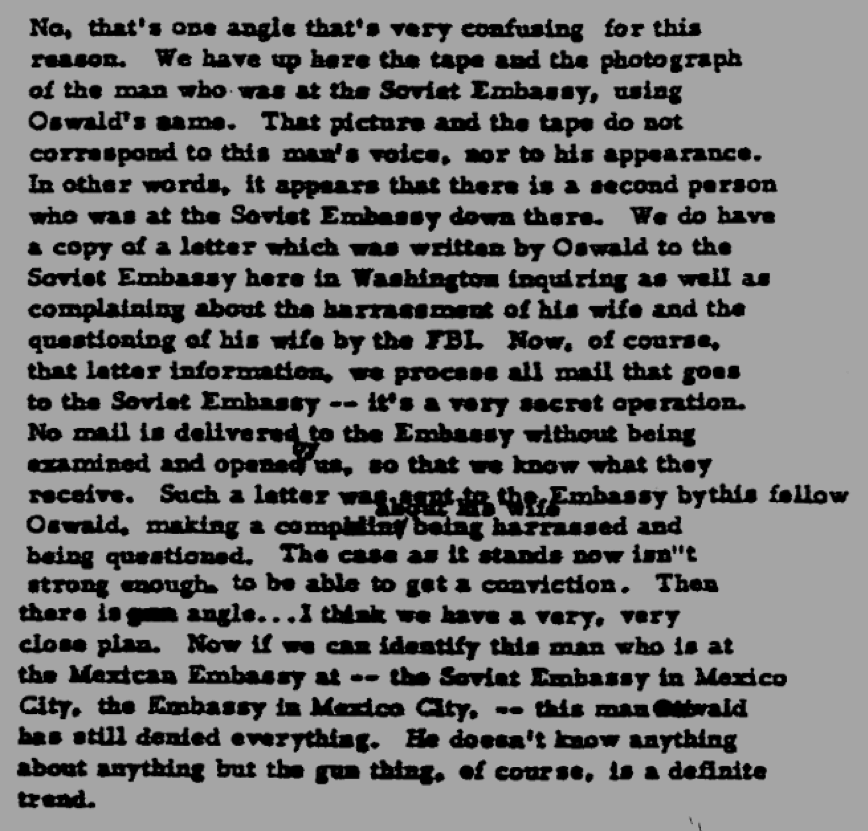
    The core factual issue is that the CIA has never produced either a photo of Oswald nor a tape with his voice on it from Mexico City. Win Scott himself overlooked Oswald in his September 1963 report on the CIA telephone tapping program LIENVOY, although an American in phone contact with both Cuban and Soviet embassies was ipso facto of operational interest. In his attempt to escape from the facts, Roig falls into a preposterous dual story:

    In March 1968, President Lyndon Johnson … requested from his close associate (sic) Marty Underwood to meet with Scott in Mexico City. The timing was excellent … In the meeting with Underwood, Scott stated that early in the morning of November 22, 1963, a small Cuban airplane landed at the Mexico City Airport. The passenger transferred to another plane, that immediately took off for Dallas, Texas. Later that evening, the same plane returned from Dallas and the individual transferred to the Cuban aircraft the flew back to Havana. After many months of investigation, the CIA was confident that the individual was Fabian Escalante.

    Just the timing reveals Roig’s ignorance. Underwood’s only trip to Mexico City occurred in 1966. During his brief meeting with Scott, according to Underwood’s own notes, there was not the slightest reference to November 22, 1963. As a White House advance man, Underwood sought help from Scott for Johnson’s upcoming visit to Mexico. (ARRB Final Report, p. 136) And Escalante—as counterintelligence officer in the Section Q of Castro’s G-2—was so busy in 1963 watching anti-Castro fighters inside Cuba or in exile that he couldn’t have timed a wet operation, id est, involving spilling blood.

    It is incredible that Roig would fall for the deceased Underwood. Because, as noted above, Underwood was exposed for telling fairy tales back in 1998 when the Final Report of the Assassination Records Review Board was published. Not only was his canard about Scott then revealed, but he had also been telling tall tales to Gus Russo and Sy Hersh for the deceitful Judith Exner. And those two willingly gobbled them up. (Ibid)

    State Department: “Do Not Implicate Cuba”

    From the bamboozler Underwood, Roig jumps to Thomas Mann, U.S. Ambassador to Mexico, who “has the answer” about what happened to the CIA files on Oswald in Mexico City. Mann “was personally ordered by the State Department, a few days after Oswald murdered President Kennedy, to shut down any investigation that would implicate Cuba’s involvement.” Roig added that a top CIA official, Tom Karamessinger (sic), memoed Scott: “Arrest of Sylvia Duran is extremely serious matter which could prejudice (us) … Request you ensure that her arrest is kept absolutely secret, that no information from her is published or leaked.”

    Roig is muddying the waters as if the report Oswald, the CIA, and Mexico City (1978), written by HSCA staffers Dan Hardway and Edwin Lopez, hasn’t gone through rounds of declassification since 1993. It became clear that the CIA knew Oswald had been impersonated by phone on September 28 and October 1. Duran was also impersonated on September 28.

    That Saturday, a caller to the Soviet Consulate identified herself as Duran and announced that “an American that was just at the Soviet Embassy … is going to talk with you.” The CIA transcriber, Boris Tarasoff, commented that the American “speaks terrible, hardly recognizable Russian.” On October 1, a caller to the Soviet Consulate identified himself as Lee Oswald. Tarasoff noted he was “the same person who had called a day or so ago and spoken in broken Russian.” Duran was arrested and harshly interrogated by the Mexican Police on November 23 and November 28. The info taken from her included that she neither met Oswald nor made any call to the Soviet Consulate on September 28.

    Duran emphasized “she had no fear [of] extradition to the United States to face Oswald.” On the contrary, the CIA was afraid [that] “any Americans [might] confront Silvia DURAN or […] be in contact with her” [DIR 85318, 11-27-63, in [Duran’s] Information – NARA Record Number: 104-10102-10145, p. 14]. That’s why neither the eyewitness Duran nor the earwitness Tarasoff were ever questioned about the call by the Warren Commission. The CIA itself, not the State Department, shut down any further investigation on a Cuban connection after its Mexico City station not only produced both a tape and a photo that weren’t Oswald’s, but also spread stories—all of them debunked—of Communist conspiracies:

    • Mexican writer Elena Garro de Paz transformed Duran from the Mexican employee, who handled Oswald’s visa request at the Cuban Consulate, into the intelligence officer of Castro, who met Oswald again at a twist party in order to put him up to killing Kennedy.
    • Nicaraguan secret agent Gilberto Alvarado watched Oswald taking $6500 in the Cuban Embassy to kill Kennedy, while Mexican credit examiner Pedro Gutierrez saw Oswald taking money outside the Cuban Embassy.
    • Cuban Embassy employee Luisa Calderon expressed foreknowledge of JFK’s assassination…

    Fidel Castro vs. John F. Kennedy

    Roig comes to his overarching issue with an “unavoidable” clash between Castro and JFK. As veteran of the Brigade 2506, he is as misguided in his analysis now as he was as a member of the force that failed twice in making a diversionary landing near Guantanamo in mid-April 1961. Roig rarefies JFK’s oath—in the December 29, 1962, ceremony at the Orange Bowl stadium (Miami) with the participants in the Bay of Pigs invasion just released from Castro’s prison—that the flag of the Assault Brigade 2506 was to “fly again in a free Havana.”

    For Roig, it was the spark that ignited Castro to engage in “a personal fight to the end” against Kennedy but that’s an utter cognitive distortion of history. On Christmas Eve 1962, the American lawyer Jim Donovan boarded the last flight with the Bay of Pigs prisoners airlifted to Miami as result of his negotiation with Castro. Just before departure, Castro’s aide Dr. Rene Vallejo broached the subject of re-establishing diplomatic relations between the two countries.

    Let’s suppose Castro was, indeed, trying to lure Kennedy. Even so, killing the sitting U.S. President offered nothing else to gain than having Johnson in the White House with no hope of more favorable U.S. policies toward Cuba. The Soviet bloc’s diplomats in Havana were aware of it. On March 31, 1963, Hungarian Ambassador János Beck set out in a secret report to Budapest that Castro was convinced “Kennedy is the best” option among the possible candidates for the U.S. presidency in 1964 (“Talks between Cuba and the USA, March 31, 1963,” in Selected Hungarian Documents on Cuba, 1960-1963,” Cold War History Research Center [Budapest]).

    The anti-Castro fighter Roig is not aware yet of who his greatest enemy was. Castro knew that killing JFK wouldn´t solve anything and entailed risking everything. His personal fight was system-centered. Accordingly, he proceeded to infiltrate both the CIA and the Cuban exile community. Thus, Castro managed to win in the dirty USA-Cuba war.

    Rolando Cubela Secade (sic): The Double Agent Chosen to Kill Fidel Castro

    Nonetheless, Roig obsessively resorted to the neither logically nor circumstantially justified hypothesis brought by Senator Robert Morgan (D / N.C.) of the Church Committee: “JFK was assassinated by Fidel Castro or someone under his influence in retaliation for our efforts to assassinate him [and] this fellow [Cubela] was nothing but a double agent.”

    This fellow [AMLASH-1 for the CIA] was involved in two assassination plots against Castro. His key co-conspirators were the CIA officer Desmond FitzGerald [Chief of the anti-Castro Task Force known as Special Affair Staff (SAS)] and the CIA golden boy Manuel Artime [Chief of the anti-Castro paramilitary group Revolutionary Recovery Movement (MRR)]. Cubela does not fit at all into the facts as double agent loyal to Castro.

    • For unveiling the Artime-Cubela plot, Castro burned his intelligence officer Juan Felaifel, who had infiltrated the CIA in 1963. Another officer, Erasmo Terrero, was gathering evidence against Cubela in Paris. On March 11, 1966 Cubela was sentenced to 25 years.
    • For unveiling the FitzGerald-Cubela plot, Castro had to wait for a July 16, 1976, report by his State Security Department (DSE) stating that the “counterrevolutionary inmate” Cubela was the CIA agent AMLASH-1 who surfaced at the Church Committee. Before that, Castro lacked intel on this 1963 CIA plot.

    At the XI World Festival of Youth and Students in Havana, Castro set up an agitprop court to prosecute the crimes committed by Yankee imperialism. On August 2, 1978, Cubela confessed to both CIA assassination plots against Castro and spelled an inconvenient truth for Roig: “It is absurd to think that a double agent would have spent 12 years in jail.” Cubela also testified before an HSCA panel in Havana. Castro rewarded him by granting the parole legally prescribed after serving half the sentence.

    The Cuban Exile Clandestine Operations

    As a fugitive from history, Roig runs so fast that he misses the two-track policy of the Kennedy administration towards Cuba after the debacle of Operation Mongoose. Roig just follows the track of (sometimes) autonomous operations by select Cuban exile groups, backed, in any event, by the CIA, and forgets the parallel track of accommodation with Castro. In fact, due to the ARRB, we now know just how feeble this activity was. For the incoming president Lyndon Johnson, CIA officer Desmond Fitzgerald wrote a report on what these operations consisted of at the time. He wrote that in the entire second half of 1963, there had been a total of five raids against Cuba. There were only fifty men involved in three cadres. In this letter, Fitzgerald admitted it was completely unrealistic to think that such a meager force would result in any real change in Cuba. He stated that they had now become counter productive, since they could not be taken seriously. And he advised they be discontinued. (Letter from Fitzgerald to McGeorge Bundy, 3/6/64)

    Ignoring this factual aspect, Roig can please himself with a pharisaic righteousness: Kennedy remained “true to his commitment to get rid of Fidel Castro,” thus ignoring Kennedy’s crackdown on other anti-Castro belligerent exiles groups. How the administration was going to overthrow Castro with fifty men is the author’s secret. Perhaps Roig was modeling his essay on the Peter Sellers comedy The Mouse that Roared?

    “Listen to Communications from Texas”

    After such an intermezzo, Roig next stages an act against intellectual integrity. The protagonist is the late Cuban defector Florentino Aspillaga, who back in 1963 was working for Castro at a listening post in Jaimanitas [a small beach town near Castro’s main residence, dubbed as Point Zero, seven miles west of Havana]. The script reads thus:

    On Friday morning, November 22, 1963, Aspillaga received precise orders: “The leadership wants you to stop all your CIA work, (repeat), All your CIA work” and listen to communications from Texas. Around 1:30 (Havana Time), “I began hearing broadcast on amateur radio bands about the shooting of President Kennedy in Dallas.”

    Roig drops the question: “Did Fidel Castro know Kennedy would be killed?” instead of asking: “Who would believe such a tale?” Castro would have never resorted to electronic intelligence to learn something that would have been instantly available through mass media. In 1963, info about anything occurring in Dallas during the JFK visit meant broadcast reports interrupting soap operas on the three national TV networks, and radio stations giving breaking news.

    Aspillaga was in fact a self-defeating storyteller. Radio amateurs must have just been chatting about what the commercial media had already reported. In late 1963, a unique witness gave conclusive evidence contradicting Aspillaga’s claim. French journalist Jean Daniel wrote a first-hand account (“When Castro Heard the News,” The New Republic, December 7, 1963). As Kennedy’s emissary, he was talking with Castro in Varadero Beach the very day of the assassination. After a phone call by Cuban President Osvaldo Dorticós, Castro got all the news “from the NBC network in Miami.” Daniel also recounted Castro was utterly shocked and turned to him saying—about the plans for rapprochement—that everything was going to change.

    Aspillaga told Dr. Brian Latell in 2007 that the CIA had learned the Jaimanitas’ story during his debriefing in 1987. However, it is not to be found among the documents—either declassified or withheld—from the National Archives and Records Administration (NARA) on the JFK assassination. The CIA would not have objected to furnishing a carefully redacted Aspillaga debriefing to the Assassination Records Review Board (ARRB).

    The Paris Meting (sic): Assurance of American support

    In this intermezzo, Roig again addresses Operation AMLASH to reinforce the discredited notion of Cubela as fake conspirator. The Castroite General Directorate of Intelligence (DGI) did not control but rather watched Cubela with a certain inefficiency. Before the Church Committee, the CIA moved to transfigure him into a double agent, even a provocateur, to hide its own shortcoming in recruiting a heavy-drinking, loquacious, third-rate Castro official who couldn’t provide any valuable service.

    The DGI manipulated Oswald’s Violent Outburst at the Cuban Consulate in Mexico City?

    Roig stages this act with an outright lie:

    Oswald requested at the Cuban Consulate in the City of Mexico a transit visa to Russia via Cuba and was denied. Oswald turned violent and began screaming “I am going to kill Kennedy.”

    As FBI super-spy Jakob “Jack Childs” informed J. Edgar Hoover, Castro himself recounted:

    I was told this by my people in the Embassy exactly how he (Oswald) stalked in and walked in and ran out. That in itself was a suspicious movement, because nobody comes to an Embassy for a visa (they go to a Consulate) [W]hen Oswald was refused his visa at the Cuban Embassy in Mexico City, he acted like a madman and started yelling and shouting on his way out, “I’m going to kill this bastard. I’m going to kill Kennedy” [Castro]was speaking on the basis of facts given to him by his embassy personnel, who dealt with Oswald, and apparently had made a full, detailed report to Castro after President Kennedy was assassinated.

    The Consulate was in a separate building from the Embassy. The Cuban diplomatic compound in Mexico City was located at Francisco Marquez Street (Colonia Condesa) with two main entrances: one to the Embassy, on the corner of Tacubaya Alley, and the other to the Consulate, on the corner of Zamora Street. Both the outgoing (Eusebio Azcue) and incoming (Alfredo Mirabal) consuls testified before HSCA that they did not hear Oswald threatening Kennedy’s life. Neither did the Mexican employee Sylvia Duran, who was consistent about it in both her interrogation by Mexican Police and her interview by the HSCA, nor did two other witnesses who had come downstairs from the Commercial Office.

    Roig’s opera seria continues as a vaudeville with a substandard duet: DGI defector Vladimir Rodriguez [dispatched by his own CIA debriefer, Harold Swenson, as lacking “any significant information” on Oswald] and Oscar Marino [an alleged former Cuban intelligence officer imported from the bestiary described by Gus Russo and Stephen Molton in Brothers in Arms (Bloomsbury USA, 2008)]. Roig closes the act by foisting two “outrageous lies [on Castro as] part of a premeditated deniability perfidy[:] that he knew nothing of Oswald’s existence before the Dallas assassination and that he was never informed of Oswald’s threatening remarks against Kennedy in the Cuban Consulate in Mexico City”. The latter is refuted by Childs’ report; the former is still wanting for any evidence.

    Fidel Castro Got Kennedy First

    Before the curtain falls, Roig concocts a Castroite Oswald with a Castro prone to react to the CIA plots against him in the spaghetti western manner summed up by Lyndon Johnson: “Kennedy was trying to get Castro, but Castro got to him first.” Such a fact-free approach thrives only on claques of people who cannot think logically or will not think logically, because they have a fanatical and counterproductive anti-Castro agenda.

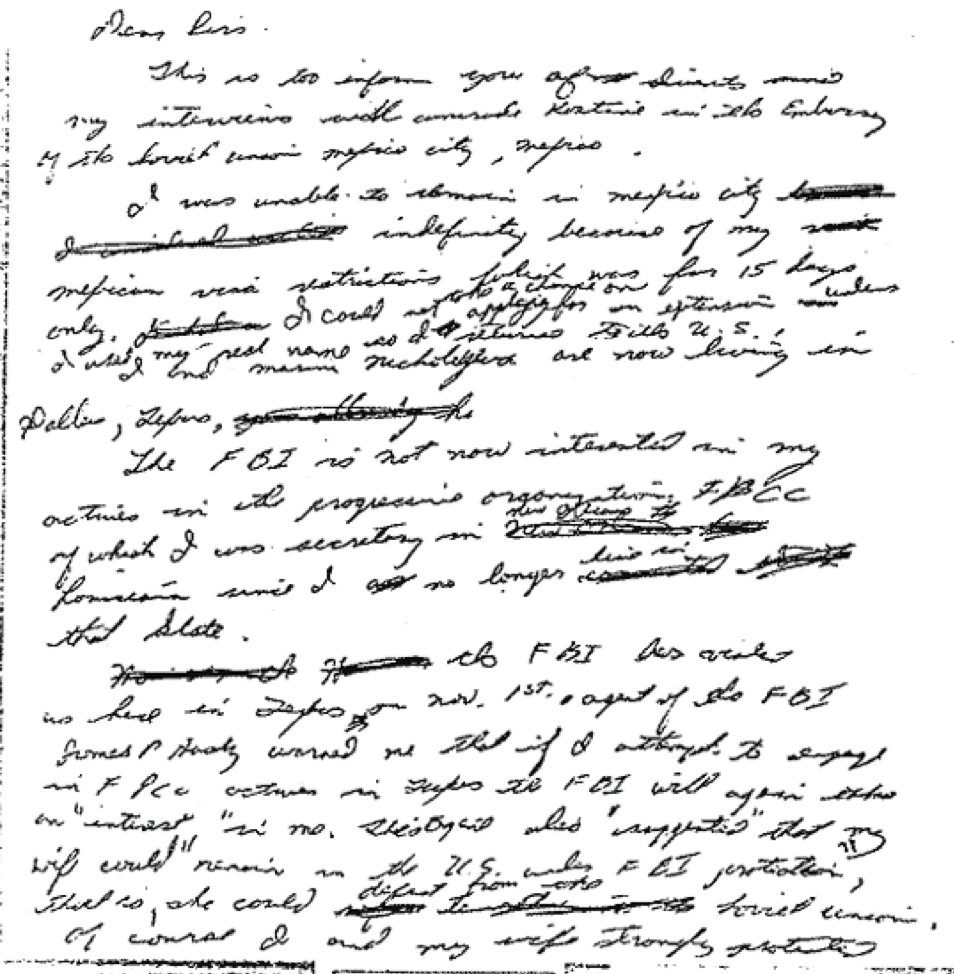
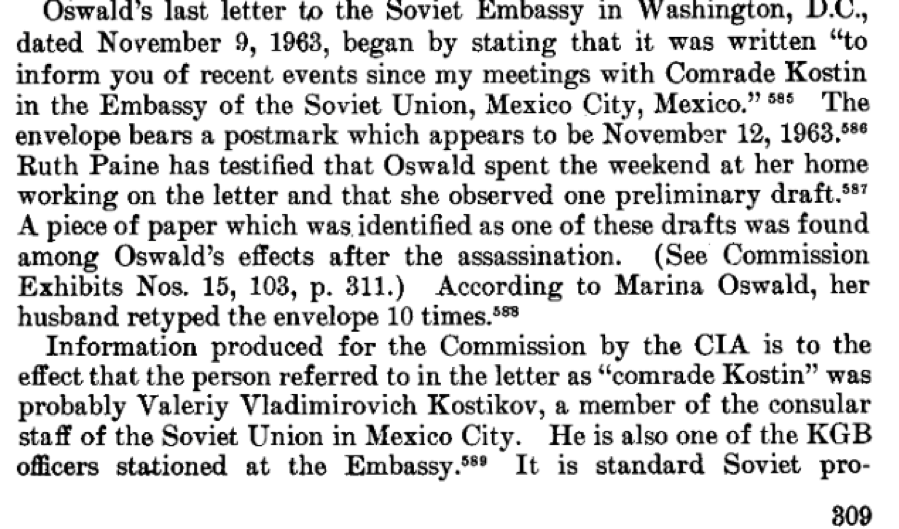
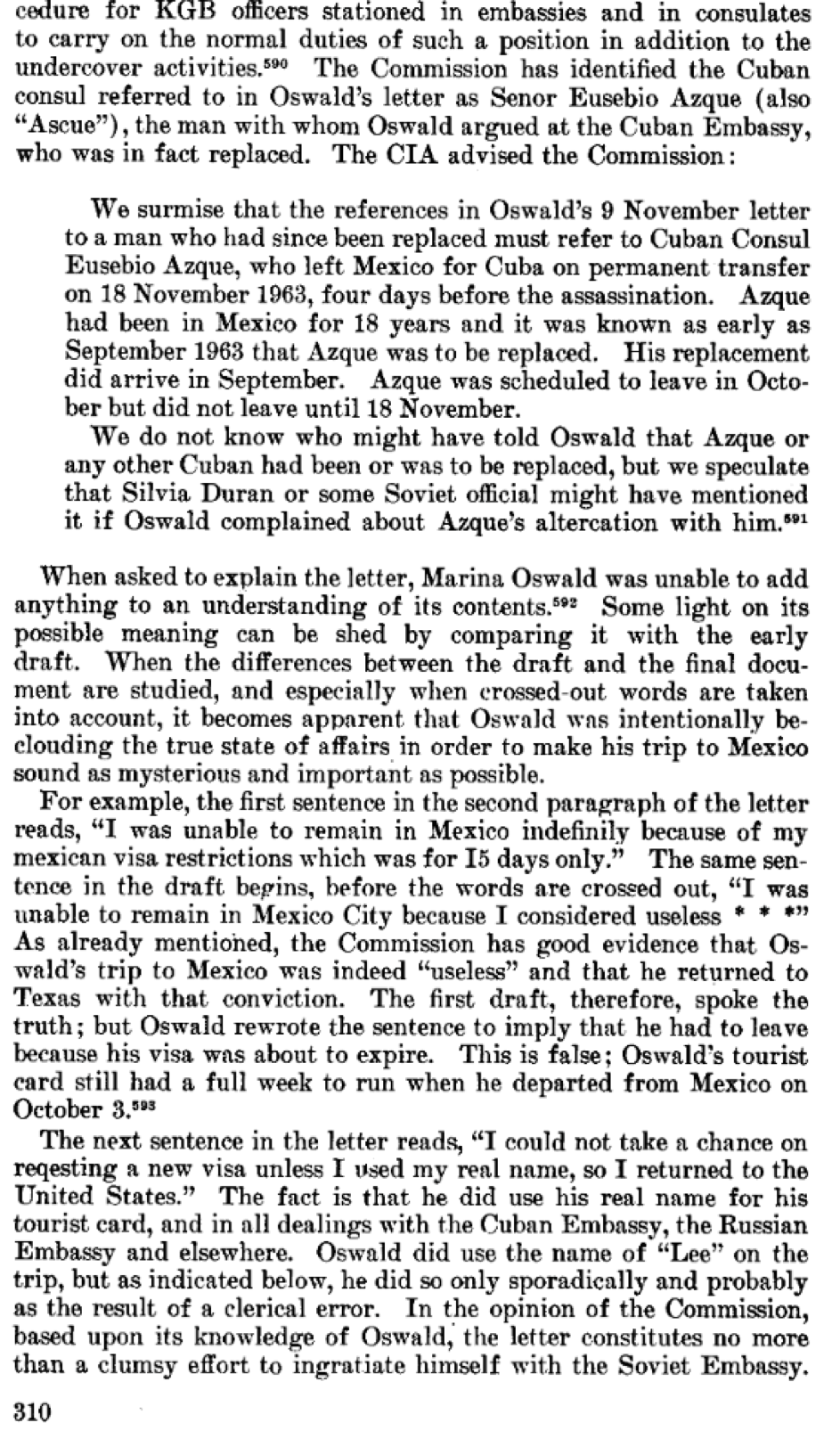
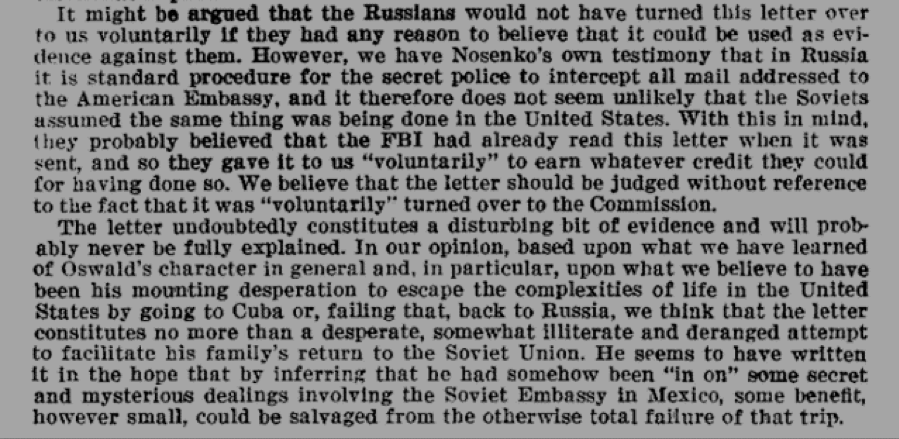
  • Oswald’s Last Letter:  The Scorching Hot Potato

    Oswald’s Last Letter: The Scorching Hot Potato


    So much time is spent in the JFK assassination debate arguing about shaky evidence that we have seen serious researchers sometimes turn on one another and lone-nut apologists then pounce and deliver their salvos portraying the research community as made up of quacks. This is even though the official HSCA conclusions, as well as the opinions of an overwhelming number of government inquiry insiders, clearly discredit the Warren Commission conclusion that Oswald and Jack Ruby both acted alone. Therefore, this author has steered clear of discussions around subjects such as Judyth Vary Baker, Madeleine Brown, James Files, the Badge Man photo, the Prayer Man photo, etc.

    My focus has always been on smoking gun evidence. There are three levels of smoking guns:

    1. Those that prove that the Warren Commission inquiry is impeached.
    2. Those that demonstrate conclusively that there was a conspiracy.
    3. Those that prove who some of the conspirators were.

    There are a number that prove the first two points:

    1. Conclusions from post-Warren Commission inquiries and statements made by the investigation insiders.
    2. Oswald during his short life had touch points with over seventy-five people with plausible intelligence links including over thirty with definite ones.
    3. Ruby had ties with the mob including some who are suspects in the assassination such as Santo Trafficante.
    4. Oswald was impersonated in Mexico City.
    5. Too many witnesses in Dealey Plaza, as well as those who inspected the president’s wounds, confirmed a front shot.
    6. The demolishing of the Single Bullet theory.
    7. The similarities in the prior plots to kill JFK.
    8. The weak security on November 22, 1963, and the behavior of some Secret Service operatives.
    9. The obvious cover-up.

    There are none at this point that prove beyond a shadow of a doubt who the conspirators were. Some do expose persons of extreme interest, these include:

    1. Oswald’s summer in New Orleans in 1963.
    2. Oswald’s and Ruby’s links to Trafficante and intelligence.
    3. The case against David Atlee Phillips.

    In this article, we will look at another important piece of evidence and let the reader decide whether it rises to the level of a smoking gun: Oswald’s last letter!

    Dueling Spins

    On the very day that Kennedy was assassinated, forces that desperately wanted the overthrow of the Castro regime went into a press relations frenzy, most likely led by CIA propaganda whizz David Atlee Phillips. The tale they were peddling was that Cuba and Russia were Oswald’s backers.

    Much has been written about the steps taken to sheep-dip Oswald in 1963, so that he could come out looking like an unbalanced Castro sympathizer: the famous backyard photos of him holding alleged murder weapons, as well as communist literature, his recruitment efforts for the Fair Play for Cuba Committee, his scapegoating in the General Walker murder attempt, and his interviews in New Orleans where he openly paints himself as a Castroite.

    Some steps, however, went further. They were designed to make Oswald seem to be in league with Cuban and Russian agents, plotters, and assassins. They came out of the assassination play-book code-named ZR Rifle, authored by exiled, CIA super-agent William Harvey. It would have given the U.S. the excuse they needed to invade Cuba. But the new President Lyndon Johnson eventually nixed this stratagem.

    Persons of interest like John Martino, Frank Sturgis, and Phillips-linked contacts (Carlos Bringuier, Ed Butler, and journalist Hal Hendrix) began a “Castro was behind it” spin to the assassination.

    Carlos Bringuier of the DRE, who had gotten into what was likely a staged fight with Oswald on Canal Street in New Orleans in August of 1963, also wrote a press release that was published the day after the assassination to position Castro as being in cahoots with Oswald.

    The DRE was actually set up under William Kent in 1960, working for David Phillips. David Morales was the group’s military case officer. Later, with Phillips in Mexico City, Kent was George Joannides supervisor. Kent’s daughter told Gaeton Fonzi that her father never mentioned Oswald except one time over dinner. He stated that Oswald was a “useful idiot”.

    Through Ed Butler and the CIA-associated INCA, Oswald’s apparent charade and his televised interview went a long way in painting his leftist persona to the public at large. INCA had been used by Phillips for propaganda purposes during the period leading up to the Bay of Pigs. Butler was quick to send recordings to key people on the day of the assassination.

    These frame-up tactics were the ones the cover-up artists wished had never occurred and worked hard to make disappear. The perpetrators of the framing of Castro offensive soon ran into stiff competition after Oswald was conveniently rubbed out. The White House and the FBI concluded, without even investigating, that both Oswald and Ruby were lone nuts. The pro-Cuba invasion forces were overmatched and their intel leaders had no choice but to fall in line.

    But it was too late, there was too much spilled milk around plan A. In time, government inquiry investigators like Gaeton Fonzi, Dan Hardway, and Eddie Lopez, along with some very determined independent researchers, would uncover leads that all pointed in the same direction: Oswald was framed to appear to be in league with Cuban and Russian agents.

    This can only lead to two possibilities. If Oswald was in cahoots with foreign agents, there was a foreign conspiracy to remove the president. In the more likely scenario that Oswald was being framed to look like he was cahoots with foreign agents, there was a domestic conspiracy to remove the president. In both cases, the lone-nut fairy-tale is obliterated.

    Spilled Milk

    Oswald and Kostikov

    On September 27, 1963, Oswald allegedly travelled to Mexico City and visited both the Cuban consulate and the Russian embassy, in a failed attempt to obtain a visa to enter Cuba. FBI agents, who had listened to tapes of Oswald phone calls made while in the Cuban consulate, and Cuban consul Eusibio Azque, confirmed that there was an Oswald imposter.

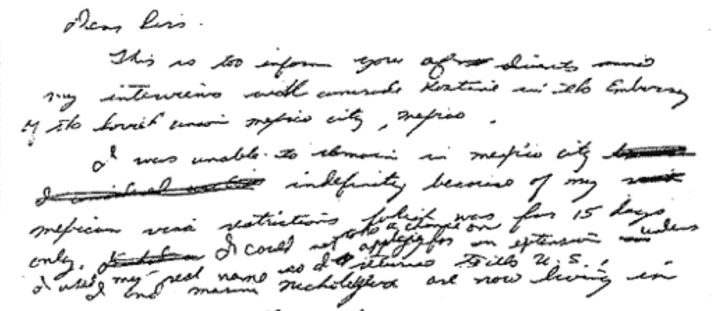
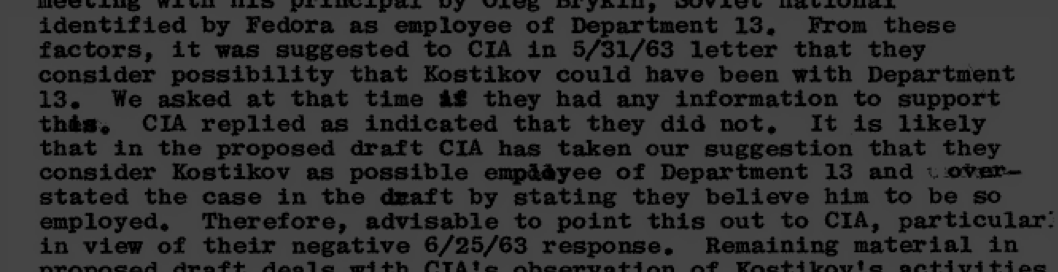
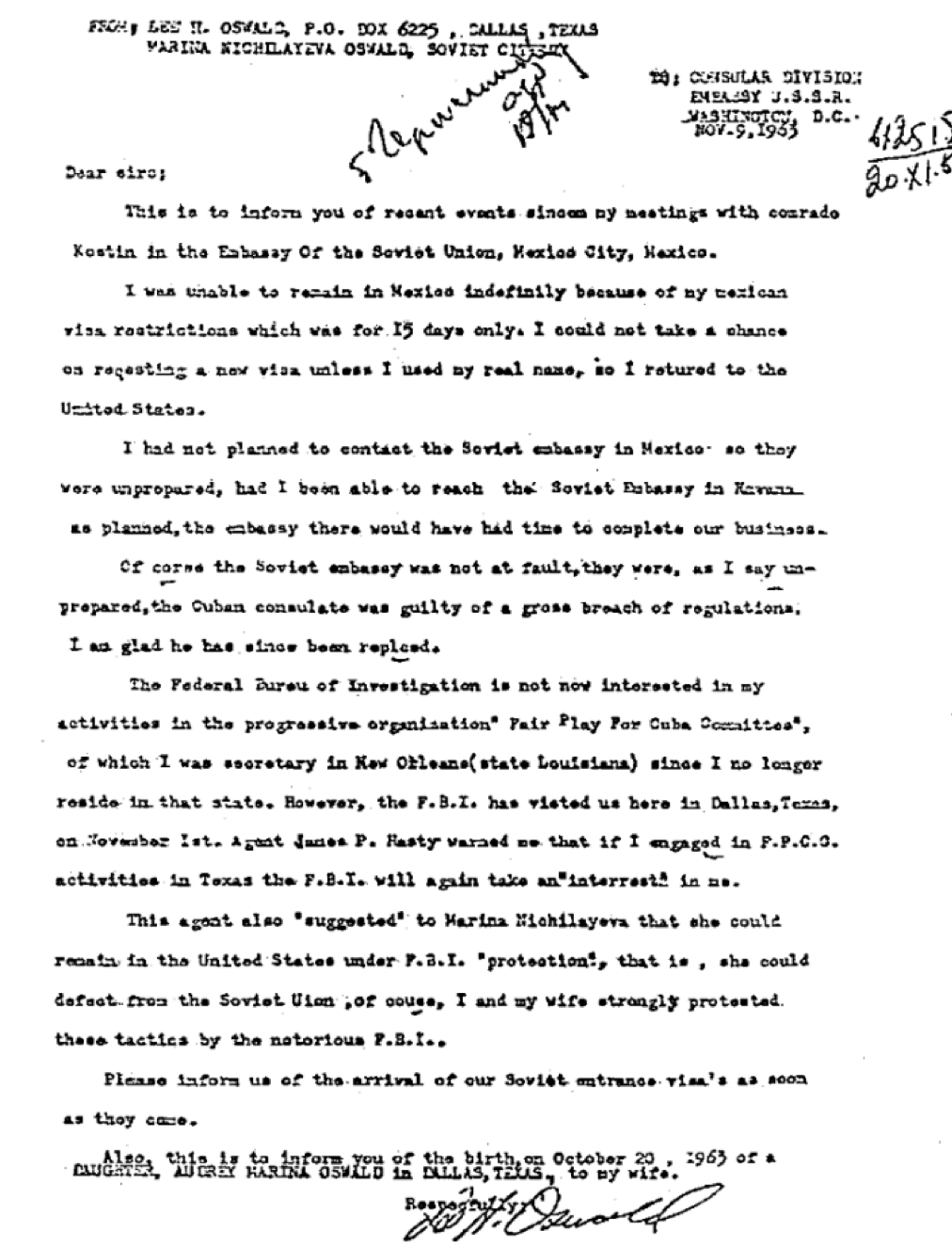
    In October 1963, the CIA produced five documents on Oswald that linked him to Valery Kostikov. One of the claims was that they had met in the Russian Embassy in Mexico City. Kostikov was later described as “an identified KGB officer … in an operation which is evidently sponsored by the KGB’s 13th Department (responsible for sabotage and assassination).” They also confirmed that they felt that there were either fake phone calls made by an Oswald impostor to Kostikov while he was allegedly in Mexico or at least faked transcripts.

    In September 1964, the case against Kostikov took a bizarre turn, when a September 1, 1964, Hoover memo (105-124016) to the CIA seemed to indicate that the CIA (James Angleton’s department) in fact had no evidence to prove Kostikov was part of the infamous Department 13.

    This means either one of two things:

    1. Angleton knew Kostikov’s connection to Department 13 was unfounded, but tried to recycle that info in November.
    2. Angleton lied to Hoover on June 25, 1963, perhaps for the same reason (to keep the lid on it until November 22).

    David Atlee Phillips’ dirty tricks

    HSCA investigator Dan Hardway hypothesizes that, because of compartmentalization, Phillips and Oswald may have found out on November 22, 1963, that Oswald was a patsy and Phillips received orders to tie the murder to Castro.

    In a critique of Phil Shenon’s work written for the AARC in 2015, Hardway expresses the opinion that the CIA is heading to what he calls a limited hang-out by admitting that Oswald may have received guidance from Cuba and that the CIA director at the time, John McCone, was involved in a benign cover-up.

    Following the assassination, it became obvious that Phillips was connected to several disinformation stories trying to link Oswald to Castro agents. HSCA investigator Hardway called him out on it:

    Before our unexpurgated access was cut off by Joannides, I had been able to document links between David Phillips and most of the sources of the disinformation that came out immediately after the assassination about Oswald and his pro-Castro proclivities. I confronted Phillips with those in an interview at our offices on August 24, 1978. Phillips was extremely agitated by that line of questioning, but was forced to admit that many of the sources were not only former assets that he had managed, in the late 50’s and early 1960’s, but were also assets whom he was personally managing in the fall of 1963. Mr. Phillips was asked, but could not explain, why the information that came from anti-Castro Cuban groups and individuals pointing to Cuban connections, all seemed to come from assets that he handled personally, but acknowledged that that was the case.

    One of these assets was Nicaraguan double agent Gilberto Alvarado who, on November 25, claimed to have witnessed Oswald being paid off to assassinate Kennedy when Oswald was in Mexico City. A tale that was quickly debunked.

    While the HSCA hearings were going on, Phillips himself made the claim to a Washington Post reporter that he had heard a taped intercept of Oswald when he was in Mexico City talking to a Russian Embassy official offering to exchange money for information (Washington Post, November 26, 1976). Something he never repeated. Phillips also tried to get Alpha 66 operative Antonio Veciana to get one of his relatives in Mexico City to attest that Oswald accepted bribes from a Cuban agent.

    Letters from Cuba to Oswald—proof of pre-knowledge of the assassination

    For this obvious frame-up tactic, it is worth revisiting what was written in this author’s article The CIA and Mafia’s “Cuban American Mechanism”.

    In JFK: the Cuba Files, a thorough analysis of five bizarre letters, that were written before the assassination in order to position Oswald as a Castro asset, is presented. It is difficult to sidestep them the way the FBI did. The FBI argued that they were all typed from the same typewriter, yet supposedly sent by different people. Which indicated to them that it was a hoax, perhaps perpetrated by Cubans wanting to encourage a U.S. invasion. However, the content of the letters and timeline prove something far more sinister according to Cuban intelligence. The following is how John Simkin summarizes the evidence:

    The G-2 had a letter, signed by Jorge, that had been sent from Havana to Lee Harvey Oswald on November 14th, 1963. It had been found when a fire broke out on November 23rd in a sorting office. “After the fire, an employee who was checking the mail in order to offer, where possible, apologies to the addressees of destroyed mail, and to forward the rest, found an envelope addressed to Lee Harvey Oswald.” It is franked on the day Oswald was arrested and the writer refers to Oswald’s travels to Mexico, Houston and Florida …, which would have been impossible to know about at that time!

    It incriminates Oswald in the following passage: “I am informing you that the matter you talked to me about the last time that I was in Mexico would be a perfect plan and would weaken the politics of that braggart Kennedy, although much discretion is needed because you know that there are counter-revolutionaries over there who are working for the CIA.”

    Escalante informed the HSCA about this letter. When he did this, he discovered that they had four similar letters that had been sent to Oswald. Four of the letters were post-marked “Havana”. It could not be determined where the fifth letter was posted. Four of the letters were signed: Jorge, Pedro Charles, Miguel Galvan Lopez, and Mario del Rosario Molina. Two of the letters (Charles & Jorge) are dated before the assassination (10th and 14th November). A third, by Lopez, is dated November 27th, 1963. The other two are undated.

    Cuba is linked to the assassination in all of the letters. In two of them, an alleged Cuban agent is clearly implicated in having planned the crime. However, the content of the letters, written before the assassination, suggested that the authors were either “a person linked to Oswald or involved in the conspiracy to execute the crime.”

    This included knowledge about Oswald’s links to Dallas, Houston, Miami, and Mexico City. The text of the Jorge letter “shows a weak grasp of the Spanish language on the part of its author.” It would thus seem to have been written in English and then translated.

    Escalante adds: “It is proven that Oswald was not maintaining correspondence, or any other kind of relations, with anyone in Cuba. Furthermore, those letters arrived at their destination at a precise moment and with a conveniently incriminating message, including that sent to his postal address in Dallas, Texas … The existence of the letters in 1963 was not publicized or duly investigated and the FBI argued before the Warren Commission to reject them.”

    Escalante argues: “The letters were fabricated before the assassination occurred and by somebody who was aware of the development of the plot, who could ensure that they arrived at the opportune moment and who had a clandestine base in Cuba from which to undertake the action. Considering the history of the last 40 years, we suppose that only the CIA had such capabilities in Cuba.”

    We will see that these letters are suspiciously similar to Oswald’s “last letter.”

    Policarpo Lopez

    Attempts to link foreign governments to the assassination were not just limited to the framing of Oswald. As reported in the article The Three Failed Plots to Kill JFK, eight alternate patsies were profiled and no fewer than five of these made strange trips to Mexico City and at least four had visited Cuba.

    One who did escape authorities to Mexico and was reportedly the lone passenger on a plane to Cuba shortly after the assassination was Policarpo Lopez. Even the HSCA found this case egregious.

    The HSCA described parts of what it called the “Lopez allegation”:

    Lopez would have obtained a tourist card in Tampa on November 20, 1963, entered Mexico at Nuevo Laredo on November 23, and flew from Mexico City to Havana on November 27. Further, Lopez was alleged to have attended a meeting of the Tampa Chapter of the FPCC on November 17 … CIA files on Lopez reflect that in early December, 1963, they received a classified message requesting urgent traces on Lopez … Later the CIA headquarters received another classified message stating that a source stated that “Lopes” had been involved in the Kennedy assassination … had entered Mexico by foot from Laredo on November 13 … proceeded by bus to Mexico City where he entered the Cuban Embassy … and left for Cuba as the only passenger on flight 465 for Cuba. A CIA file on Lopez was classified as a counterintelligence case.

    An FBI investigation on Lopez through an interview with his cousin and wife, as well as document research, revealed that … He was pro-Castro and he had once gotten involved in a fistfight over his Castro sympathies.

    The FBI had previously documented that Lopez had actually been in contact with the FPCC and had attended a meeting in Tampa on November 20, 1963. In a March 1964 report, it recounted that at a November 17 meeting … Lopez said he had not been granted permission to return to Cuba, but was awaiting a phone call about his return to his homeland … A Tampa FPCC member was quoted as saying she called a friend in Cuba on December 8, 1963, and was told that he arrived safely. She also said that they (the FPCC) had given Lopez $190 for his return. The FBI confirmed the Mexico trip (Lopez’ wife confirmed that in a letter he sent her from Cuba in November 1963, he had received financial assistance for his trip to Cuba from an organization in Tampa) … information sent to the Warren Commission by the FBI on the Tampa chapter of the FPCC did not contain information on Lopez’ activities … nor apparently on Lopez himself. The Committee concurred with the Senate Select Committee that this omission was egregious, since the circumstances surrounding Lopez’ travel seemed “suspicious”. Moreover, in March 1964, when the WC’s investigation was in its most active stage, there were reports circulating that Lopez had been involved in the assassination … Lopez’ association with the FPCC, however, coupled with the fact that the dates of his travel to Mexico via Texas coincide with the assassination, plus the reports that Lopez’ activities were “suspicious” all amount to troublesome circumstances that the committee was unable to resolve with confidence.

    Oswald’s Last Letter

    On November 18, 4 days before JFK’s assassination, the Russian Embassy received a letter dated November 9 from “Oswald”, which was uncharacteristically typed and was in an envelope post-marked November 12. The letter, as was the case for all mail sent to the Russian embassy, had been intercepted by the FBI (Hoover phone call to Johnson November 23 10:01). The envelope is addressed to Tovarish Reznekohyenko, N. (note that Tovarish means Comrade).

    Before this incriminating letter, there were at least 6 exchanges in writing between the Oswalds and the Russian Embassy between February and November 1963, where the Russian contact was Nikolai Reznichenko according a number of Warren Commission exhibits. We can assume he is also the recipient of the last letter, despite different spellings.

    The FBI sent a briefing about the letter to the FBI Dallas office who received it on the day of the assassination. The Russians, sensing they could be blamed, handed over a copy of the letter to the Americans after noting correctly that it was the only one of all the letters from Oswald that was typed and that its tone differed from all previous correspondence. As the Soviet Ambassador pointed out at the time, the tone was also quite dissimilar to anything Oswald had communicated before; it gave “the impression we had close ties with Oswald and were using him for some purposes of our own.” Their opinion was that it was either a fake or dictated to him. Previous letters were more straight to the point dealing with visa applications.

    This letter became a hot potato. One that posed problems for the Warren Commission and the HSCA, which were amplified by the different takes Ruth and Michael Paine, Marina Oswald, the CIA, and the Russians had on it and the incredible lack of depth in the Warren Commission probe.

    With time, researchers like Peter Dale Scott, James Douglass, and Jerry D. Rose pointed out several troubling points, not only in the letter itself, but also with a Ruth Paine generated handwritten draft of the letter, as well as a Russian analysis of it.

    Warren Commission Volume 16 Exhibit 16

    Letter from Lee Harvey Oswald to the Russian Embassy, dated November 9, 1963:

    Warren Commission Volume 16 Exhibit 15

    The mistake-riddled letter was linked to Ruth Paine’s typewriter. Ruth Paine and Marina Oswald testified that they had seen Oswald working on the letter shortly before it was sent and Ruth and Michael Paine both testified that they had seen a handwritten draft of the letter, which Ruth Paine handed over to an FBI official on November 23. Somehow, investigators who had combed through the Paine house had missed it. Handwriting analysis apparently confirmed it had been written by Oswald.

    For some incredible reason, by April 1964, the Warren Commission had accepted a Ruth Paine request to have Oswald’s draft returned. However, when the Dallas FBI did return it to her, she decided to send it back to the Commission, because, finally, she felt it would be more proper for it to be kept in the public archives, but would take it in the event it would not be archived. Hoover said with finality that the Commission would not hold onto it and, by May 1964, had the original sent back to Ruth Paine, which escaped further examination as to its authenticity. (JFK and the Unspeakable, p.443)

    Oswald’s draft of the letter found by Ruth Paine:

    HSCA exhibit F 500/Warren Commission exhibit 103

    The Warren Report’s descriptions of Oswald’s trip to Mexico City and his last letter are among the best examples of just how weak their investigation was and how misleading they were in their disclosures.

    It seems the only thing that they found perplexing from the letter was how a “drifter” like Oswald could have known that a consul from the Cuban consulate in Mexico City could have been replaced. So, they asked the CIA to weigh in. The CIA surmised that the consul in question was Eusebio Azque and speculated that Silvia Duran or some Soviet official might have mentioned it if Oswald had complained about an altercation with Azque.

    The Commission recognized that Kostin, who Oswald talks about, was KGB officer Valery Kostikov, but dilutes the meaning of this by stating “that it was common procedure for such KGB officers stationed in embassies to carry on normal duties along with undercover activities”.

    Buried in the appendices of the Report, we can find a memo (Warren Commission Document 347 of January 31, 1964, p. 10) by the FBI’s Ray Rocca, sent to the Commission in January 1964:

    Kostikov is believed to work for Department Thirteen of the First Chief Directorate of the KGB. It is the department responsible for executive action, including sabotage and assassination. These functions of the KGB are known within the Service itself as “Wet Affairs” (mokryye dela). The Thirteenth Department headquarters, according to very reliable information, conducts interviews or, as appropriate, file reviews on every foreign military defector to the USSR to study and to determine the possibility of using the defector in his country of origin.

    Richard Helms, while heading the CIA, went on to confirm this very important detail. Kept hidden from the public was an allegation that Oswald had met Kostikov just a few weeks earlier in Mexico City and that a likely Oswald impostor had placed a call to Kostikov that was intercepted by the CIA! This makes the reference to “unfinished business” that we can read in the letter quite suggestive.

    It is interesting to note that the letters from Cuba designed to incriminate Oswald and link him to Cuban agents use some of the same suggestive language. “Close the business”, “after the business, I will recommend you”, and “after the business I will send you your money” are some of the phrases that can be found in just one of the letters. Others talk about “the matter” or “the plan”.

    A real investigation and transparent report would have revealed a lot more about Kostikov’s explosive background and would have blown the lid off what really happened in Mexico City. It would have also delved into who the recipient of the Washington letter was and its important significance, if Plan A (blaming foreign foes for the assassination) had been pursued. Something we will discuss later.

    Instead, the report concludes its extremely hollow analysis on a whimper: “In the opinion of the Commission, based upon its knowledge of Oswald, the letter constitutes no more than a clumsy effort to ingratiate himself with the Soviet Embassy.” The truth was that, had plan A gone ahead, the letter would have been peddled as further proof of complicity between the president’s “murderer” and foreign adversaries.

    The Warren Report on the letter

    While Jim Garrison clearly suspected something unholy occurred in Mexico City, as well as with the letter, the public had to wait until 1970 to see some of the first clues about what the FBI really thought about this correspondence, when newsman Paul Scott revealed the following:

    The F.B.I. discounts the C.I.A. suggestion to the Warren Commission that Silvia Duran, a pro-Castro Mexican employee of the Cuban Embassy, might have told Oswald about Azque being removed. In her statement to Mexican officials concerning her discussion with Oswald, Mrs. Duran made no mention of Azque. And, although she was questioned at the request of C.I.A., no attempt was made to quiz her about whether she knew of Azque’s recall. This makes the C.I.A. conclusion highly dubious, to say the least.

    Although the F.B.I. still has not been able to resolve the key mystery of the Oswald letter, it has narrowed the sources of where he might have obtained information about Azque. These sources are: (1) An informant in the Cuban Embassy in Mexico City who contacted Oswald after he returned to the U.S. (2) The Central Intelligence Agency. Or (3), the Soviet Secret Police (K.G.B.) in Mexico City. Significantly, the F.B.I. probe discovered that the K.G.B. and the C.I.A. learned of Azque’s replacement at approximately the same time and not until after Oswald visited Mexico City. This finding has raised the possibility that whoever informed Oswald contacted him after he returned to Dallas from Mexico City.

    According to Paul Scott’s son Jim, his father was wiretapped for over 50 years, because of his dogged investigations into the assassination.

    The HSCA

    Perhaps the biggest blow to the Lone Nut fabrication came when the Church Committee and the HSCA investigations deciphered one of the most important ruses, which would turn the tables on the frame-up artists who concocted the aborted Plan A stratagem. This had to be kept secret.

    One thing the Lopez Report makes very clear is that an Oswald impostor made a phone call designed to lay down a trace that would be used as proof of Russian complicity in the assassination and would provide the types of motives and stratagems that were part of the ZR/RIFLE and the Joint Chiefs of Staffs Operation Northwoods play books, both which involved having adversaries blamed for their own covert acts of aggression. The letter served to authenticate the Oswald-Kostikov relationship and add a third player to the mix. The potato became scorching hot.

    This analysis needed to be buried as much and as long as possible. The HSCA did not want to be the ones exposing this in the 1970s. The world had to wait nearly 25 years for the declassification of the explosive reports concerning Oswald’s trip to Mexico City and the mysterious letter and sometimes much later for their eventual release.

    The HSCA’s conclusions about the letter were even more hypocritical than the Warren Commission’s. While they recognize that it is “disturbing”, they seem to ignore the fact that the letter had been intercepted by the FBI and do not factor in the explosive findings of their very own Lopez Report, nor the confirmations about Kostikov’s role as Russia’s head of assassinations for the Western Hemisphere. When we consider the proof that they were sitting on, that an Oswald impersonator was recorded talking to Kostikov, and that Oswald (or an impostor) was said to have actually met him, we can easily see that the context of the letter and its explosive meaning were completely sidestepped in the Report:

    While the second paragraph represents a fake opinion designed to deviate from the real implication of the letter, the first one represents a blatant deception that can be proven outright by the transcript of Hoover’s call to President Johnson the day after the assassination:

    In short, the FBI did in fact examine all mail sent to the Soviet Embassy and had a copy of the letter all along.

    The ARRB and Russians Weigh In

    Thanks in large part to Oliver Stone and his landmark JFK movie classic, the ARRB was founded in 1992 and began declassifying files shortly after on the JFK assassination. In 1996, the Lopez Report was available. By 2003, a less redacted version was released. The explosive document shed light on Oswald impersonators, missing tapes, photos, and bold-faced lying by top CIA officials. The lone drifter was not alone!

    As reported by Jerry Rose in the Fourth Decade, in 1999, Boris Yeltsin handed Bill Clinton some 80 files pertaining to Oswald and the JFK assassination. One of the memos reveals that, at the time of the assassination, Russian ambassador Anatoly Dobrynin had right away seen the letter as a “provocation” to frame Russia by the fabrication of complicity between Russia and Oswald, when none existed. “One gets the definite impression that the letter was concocted by those who, judging from everything, are involved in the president’s assassination,” Dobrynin wrote. “It is possible that Oswald himself wrote the letter as it was dictated to him, in return for some promises, and then, as we know, he was simply bumped off after his usefulness had ended.” In late November, the Russians sent the letter to U.S. Secretary of State Dean Rusk explaining why the letter was a fraud. By then, the White House was peddling the lone nut fable. Kept hidden was the fact that the FBI already had a copy of the letter.

    In his article, Rose points out that the typed letter had many more spelling errors in it than the rough draft. Very odd indeed.

    If you go back to how the Warren Commission fluffs off the alleged Kostikov/Oswald (and/or impostor) exchanges and compare it with what is written by Bagley in the CIA’s November 23rd 1963 memo (declassified in 1998), you will see a startling difference in Kostikov’s status:

    Memo of 23 November 1963 from Acting Chief, SR Division, signed by Tennant Bagley, “Chief, SR/Cl.” CIA Document #34-538

    Just one of the reasons the Warren Report was impeached! But wait, it gets worse.

    The FBI’s Reaction to the Letter and the Mysterious Tovarish Reznkecnyen

    Since the mid-1990s, there have been a few revealing writings about the letter, but very little about the FBI’s take on it.

    Now, thanks to document declassification, we can see it through a wider scope that includes troubling dovetailing facts, such as the impersonation of Oswald in Mexico City and multiple hoaxes to tie him in unequivocally with sinister foreign agents and the chief assassination officer in Mexico—Kostikov. The analysis of tape recordings and transcripts, the mysteriously disappearing evidence, the fake letters from Cuba, and the full-fledged perjury of CIA officer David Atlee Phillips during the HSCA hearings prove there was subterfuge beyond a shadow of a doubt.

    Hoover’s phone call to Johnson is already very revealing. The following FBI report (HSCA Record 180-10110-10104), released only in 2017, is nothing short of stunning. It was the one Scott wrote about in 1970. It is strongly urged that you follow the above link to understand the full implication of the report, which sheds light on the investigation mindset which preceded the whitewash. However, for this article, our attention will be on the following paragraph of the report which focuses on the letter Oswald sent to the Soviet Embassy in Washington.

    Oswald’s letter deeply troubled the FBI for a number of reasons. Its tone was one of ongoing complicity referring to “unfinished business” and convenient reminders of the alarming exchange between Oswald and Kostikov. But the letter stretches the elastic to add yet another element that has so far gone under the radar.

    The fact that the letter was sent to Tovarich Nikolai Reznichenko all of a sudden became alarming, even though the Oswalds corresponded with him several times in 1963. The FBI report clearly refers to him as “the man in the Soviet Embassy (Washington’s) in charge of assassinations.” In 1970, Scott had described him as “one of the top members of the Soviet Secret Police (K.G.B.) in the United States.”

    The significance of this report leads to many conclusions and as many unanswered questions. Hoover had already decided that Oswald acted alone and they would not “muddy the waters internationally”. The HSCA, who possessed this document, in reports debates the authenticity of the same letter that was given to Dean Rusk by the Soviet ambassador, when they knew full well of its existence and FBI worries about its explosive implications. While this author has found little corroboration about Nikolai Reznichenko’s status, or perceived status, he believes it should not be dismissed as a mistake or confusion with Kostikov. This is an official FBI report that was written in 1963. There have not been any clarifications made about this very significant statement, despite the fact that Paul Scott exposed this in 1970 and its access to HSCA investigators.

    The mere fact that he worked in the Russian embassy and that he often corresponded with a “defector” on a watch list and his Russian wife and that the last letter by Oswald addressed to him has a complicit tone while name dropping the Mexico-based KBG chief of assassinations and talking about unfinished business suggests that both the FBI and the CIA had files on him. Where are they? For him to be described by Hoover as the head of assassinations in Washington on the part of the Soviet government in an official FBI document is of utmost significance and requires an explanation.

    This is one issue that deserves more debate in the research community.

    Conclusion

    The last letter on its own, perhaps, does not rise to the level of a smoking gun that proves there was conspiracy. It is another compelling piece of evidence that does prove that the Warren Commission and the HSCA shelved important evidence and information from the public that they found bothersome.

    If one adds this letter to the other attempts to pin the blame on foreign agents, including the charade in Mexico City, false testimonies by CIA contacts, the perjury of CIA officials of interest in the case, the Policarpo Lopez incident, and the incriminating letters from Cuba, we have proof beyond a shadow of a doubt that there was conspiracy. The naysayers cannot have it both ways. Either these events were genuine, which proves an international conspiracy, or they were not, which proves a domestic conspiracy. There has been enough evidence to demonstrate that they were not genuine.

    The letter has one attribute that can play an important role, actually proving who some of the conspirators were. It pre-dates the assassination. As it refers to happenings and ruses that took place in Mexico City two months earlier that few knew about, we can narrow the scope on who was involved. When we inspect the propaganda aspect of the operation, the case against David Atlee Phillips as a person of extreme interest is almost airtight. He had many touch points with Oswald and is easy to link to all of the ruses behind the sheep dipping activities, including the incriminating last letter.


    See also Carol Hewett’s Ruth Paine “Finds” Evidence: Oswald’s Letter to the Soviet Embassy

  • NOLA Express Interview with Mark Lane

    NOLA Express Interview with Mark Lane


    In the spring of 1968, Mark Lane was in New Orleans helping Jim Garrison with his case against Clay Shaw. While there, Lane met with the editors of an alternative newspaper called NOLA Express. He granted them an interview, which became part of his FBI file. We have extracted that interview for our readers to peruse. We should note that the FBI had surveillance on Lane almost everywhere he went at this time. He was not only aiding Garrison, but he also was helping young men resist the draft.

    Rob Couteau pointed out the interview which is housed at Black Vault.


    (Click here to open the document in another page.)

    Dennis Riches has provided this typed transcription of the Mark Lane interview.


    (Click here to open the document in another page.)

  • Garrison Interview, “Some Unauthorized Comments on the State of the Union” (May 27, 1969)

    Garrison Interview, “Some Unauthorized Comments on the State of the Union” (May 27, 1969)


    This remarkable interview with Jim Garrison was done about two months after Clay Shaw was acquitted.

    It is an interview with a European publication since, for reasons he notes, Garrison had given up doing such things with the American press.

    Note that some of the things he brings up differ from his previous interview in 1967 in Playboy. For instance, quite early, he brings up the importance of Vietnam to the assassination, and he then returns to this at the end. He is now open about the role of the FBI in cooperation with the Warren Commission in the cover up. (p. 3). Right after this, he singles out Allen Dulles for his role on the Commission. He then becomes one of the first commentators to say there was a link between the murders of JFK, King, and Bobby Kennedy. He understands just how important Pierre Finck’s bombshell testimony was at the Clay Shaw trial (p. 18). He then describes the after-effects of a coup d’état and how the new government ratifies itself (p. 20). He is very pessimistic on the truth about Kennedy’s murder ever coming to light. In retrospect, what makes all this so impressive is how correct he was in the light of history on all these points. It is also enlightening to compare his ideas about the case to what others were writing and saying at the time. Most of the other critics were still concentrating on what happened in Dealey Plaza. They were not even aware of the bombshells in Finck’s testimony. But we now know the Justice Department certainly was, to the point they sent Thornton Boswell, another JFK pathologist, to New Orleans to discredit Finck, although they did not follow through on the plan.

    Our thanks to Bart Kamp and the invaluable Malcolm Blunt for this engrossing interview. Thanks also go to Prof. Dennis Riches of Seijo University, Tokyo, for providing the following, more legible transcription of the original document.

    ~ Jim DiEugenio


    (Click here to open the document in another page.)

  • Why Officer Tippit Stopped His Killer

    Why Officer Tippit Stopped His Killer

    The murder of Officer J.D. Tippit in Oak Cliff was famously cited by David Bellin, Assistant Counsel to the Warren Commission, as being the “Rosetta Stone to the solution” of the JFK assassination. (Jim Marrs, Crossfire, p. 340, all references are to the 1989 edition) “Once it is admitted that Oswald killed Patrolman J.D. Tippit,” the attorney for the commission observed, “there can be no doubt that the overall evidence shows that Lee Harvey Oswald was the assassin of John F. Kennedy.”

    Following Mr. Belin’s questionable logic might also lead one to believe the opposite to be true. Once it is shown that Oswald likely did not kill Patrolman Tippit, the case for him having shot President Kennedy and Governor Connally is, therefore, demonstrably weakened.Picture1

    “I emphatically deny these charges!” shouted Oswald to news reporters while in Dallas police custody. “I didn’t shoot anybody, no sir … I’m just a patsy!” Oswald denied his guilt in many ways and more than once. (Mark Lane, Rush to Judgment, p. 81)

    Was the suspect telling the truth?

    Sadly, within less than 48 hours, shadowy nightclub owner Jack Ruby would all but terminate the official Dallas Police investigation into the Tippit homicide when he gunned down suspect Lee Oswald in the basement of Dallas Police Headquarters. That unfathomable event, broadcast live on national television, occurred in the presence of more than 50 Dallas policemen. It was their job to ensure Oswald’s safety while he was in custody—so the suspect might be tried on charges of assassinating President Kennedy and murdering Officer Tippit.

    “We never worked on any of his (Tippit’s) murder, because there was no use making a murder case (with the suspect dead),” admitted former District Attorney Henry Wade in an interview with veteran Tippit researcher Joseph McBride. “I think we had enough evidence that Oswald did it.”

    And despite Belin’s “Rosetta Stone” reference, not only did Dallas authorities abandon the Tippit case, but the Warren Commission, according to McBride, showed “almost no real interest in solving the crime … the commission was deliberately stonewalling a serious investigation of Tippit.”

    Any “serious” investigation into Tippit’s death must begin with one fundamental and all-important question: Why did Tippit stop Oswald?

    Based on the persistence of several indefatigable private researchers and investigators who kept digging into the Tippit mystery for decades, I believe we can now attempt to answer that question. The answer, it would seem, had nothing to do with the man walking on 10th Street in Oak Cliff matching the Dealey Plaza suspect’s generic description of being a young white male of average height and weight—as was suggested by the Warren Commission.

    In the words of Sylvia Meagher, writing in her 1967 book Accessories After the Fact, “The strangeness of Tippit’s actions,” suggests that “it was not probable, perhaps not even conceivable, that Tippit stopped the pedestrian who shot him because of the description broadcast on the police radio. The facts indicate that Tippit was up to something different which, if uncovered, might place his death and the other events of those three days in a completely new perspective.” (See Meagher, pp. 260-66)

    What follows in this article is a “new perspective.”

    12:00 P.M.

    Picture2tiny

    The “strangeness” of Tippit’s actions on 11/22/63 appear to have begun even before shots rang out in downtown Dallas. Tippit, whose normal area of patrol was in Cedar Crest, patrol area #78, was apparently called to a supermarket in the 4100 block of Bonnie View Road. Respected Tippit researcher Larry Ray Harris interviewed the Hodges Supermarket manager in 1978. As described in news reporter Bill Drenas’ oft-cited 1998 article Car #10 Where are You?, the manager told Harris he had caught a woman shoplifter on 11/22/63 and had phoned police.

    It was Tippit who responded to that location at about noon, just a half hour before the assassination. The manager knew Tippit, because Tippit routinely came to the market on calls for shoplifters. The interviewee said Tippit placed the woman in his squad car and left. However, Tippit appears not to have brought the shoplifting suspect back to his nearby base of operations. No record of the woman’s arrest or information on who she was or what happened to her has ever surfaced.

    12:30 p.m.

    President Kennedy’s motorcade was scheduled to have arrived at the Dallas Trade Mart at 12:30. However, because the motorcade was running a few minutes late, President Kennedy was assassinated at 12:30, and Governor Connally was gravely injured, as the motorcade proceeded through Dealey Plaza on route to the Trade Mart. The Hodges Market in the 4100 block of Bonnie View in Tippit’s district was more than seven miles southwest of Dealey Plaza.

    12:40 p.m.

    The DPD Channel 1 dispatcher reports a shooting in the downtown area involving the President. By this time, Texas School Book Depository employee Lee Oswald has already grabbed his blue work jacket and has left the TSBD on foot. He will board a city bus, but when that bus gets stalled in traffic, Oswald will ask for a transfer, depart from the bus, and walk to a cab stand to catch a quicker ride (with cab driver William Whaley) out to nearby Oak Cliff where the young man resides.

    The DPD Channel 1 dispatcher next orders “all downtown area squads” to Dealey Plaza, code 3 (lights and sirens). By 12:44, a general description of the Kennedy suspect (slender white male, 5’10” and 160 pounds) is broadcast over both Channels 1 and 2.

    12:45 p.m.

    Murray Jackson, the dispatcher, asks Tippit to report his location. Tippit replies, according to police radio logs, that “I am about Keist and Bonnie View,” which is still within Tippit’s regular patrol district down in Cedar Crest. (Joseph McBride, Into the Nightmare, p.441) However, this may not have been the case.

    Beginning at approximately 12:45, when Officer Tippit reports he is still in his regular patrol area, Tippit will instead be seen sitting inside his squad car parked at the GLOCO gas station, strategically situated in northernmost Oak Cliff next to the Houston Street viaduct. The viaduct connects downtown Dallas and Dealey Plaza to Oswald’s neighborhood in Oak Cliff—some five miles north of Tippit’s reported position.

    Picture3tiny

    Researcher William Turner, in a 1966 article in the magazine Ramparts, claimed he located five witnesses who saw Tippit sitting in his patrol car at the gas station at this time while watching traffic coming across from downtown Dallas. (McBride, ibid) The location is only 1.5 miles from Dealey Plaza. Two of the witnesses, a husband and wife who knew the officer, say they waved at Tippit who waved back at them. The story was reportedly verified by three of the GLOCO station attendants. Dallas researchers Greg Lowrey and Bill Pulte also interviewed all five of these witnesses to confirm the story. Some said that Tippit arrived at the GLOCO as early as just “a few minutes” after the assassination.

    Was Tippit watching for Oswald to come across the viaduct on a Dallas bus? Did he see Oswald instead in the front of William Whaley’s cab? What was Tippit doing?

    12:46 p.m.

    At this time, dispatcher Murray Jackson ordered Officers Tippit and R.C. Nelson into the Central Oak Cliff area, which was odd since an assigned officer (William Mentzel) was already patrolling Central Oak Cliff. (McBride, pp. 427-30) Tippit, according to witnesses, is of course already there in the northernmost part of Oak Cliff at the gas station. (This was probably unknown to Jackson, since Tippit had just responded to the dispatcher that he was in his assigned patrol area at Bonnie View & Keist some five miles to the south). Officer Nelson instead proceeded on to Dealey Plaza, possibly following the preceding 12:42 “code 3” order for all downtown area squads to report to Dealey Plaza. (Henry Hurt, Reasonable Doubt, pp. 161-63)

    Meanwhile, Oswald will soon be crossing the Houston St. viaduct in William Whaley’s cab, heading for Oak Cliff.

    The witnesses say that after some 10 minutes of sitting at the gas station, watching traffic crossing from the downtown area, Tippit suddenly pulled out and took off south on Lancaster Avenue “at a high rate of speed.”

    12:52 or 12:53 p.m.

    Cab driver William Whaley lets Oswald out at the corner of North Beckley and Neely Street, several blocks south of Oswald’s rooming house, which the cab has already passed. Whaley had marked Oswald’s intended location on his run sheet as the 500 block of N. Beckley, even farther south and in the wrong direction from the rooming house. The 500 block of N. Beckley was, in 1963, dominated by the side parking lot of the El Chico Restaurant.

    12:54 p.m.

    Dispatcher Murray Jackson contacts Tippit, who is now about a mile from the GLOCO Station on Lancaster Street. (McBride, p. 445) Oswald and Tippit are both apparently moving in the direction of the Texas Theater.

    1:00 to 1:07 p.m.

    Texas Theater manager Butch Burroughs said Oswald entered the theater during this timeframe and later bought popcorn from him at the concession stand at approximately 1:15. (McBride, p. 520) Other movie patrons will similarly report having seen Oswald in the mostly empty theater during the start of the movie, changing seats frequently and sometimes sitting directly next to other moviegoers. Is Oswald supposed to meet someone he doesn’t know personally, perhaps his intelligence contact to whom he is expected to give a briefing?

    After 1:00 p.m.

    Picture4Employees of the Top Ten Records store, located a block and a half west of the Texas Theater on Jefferson Boulevard, later claim that Tippit parked his squad car on Bishop Street adjacent to the records store and came in hurriedly while asking to use the phone.

    A Dallas Morning News reporter interviewed former Top 10 clerk Louis Cortinas in 1981. Cortinas recalled that, “Tippit said nothing over the phone, apparently not getting an answer. He stood there long enough for it to ring seven or eight times. Tippit hung up the phone and walked off fast, he was upset or worried about something.” (McBride, p. 451)

    Had Tippit picked up Oswald near the El Chico Restaurant and then dropped him off at the Texas Theater? Had Tippit simply been watching the theater to confirm Oswald’s arrival? Or, was Tippit simply trying to contact someone to find out the latest news on the condition of President Kennedy and Governor Connally?

    1:03 p.m.

    Around this time, police dispatcher Murray Jackson tries to radio Tippit, but gets no answer. (Meagher, p. 266) Was this when Tippit was entering the Top 10 records store to place the phone call?

    Approximately 1:04 p.m.

    Several blocks east of Top 10 and the Texas Theater, an unknown young white male about 5’8” to 5’10” and 165 pounds wearing a white shirt and light tan Eisenhower jacket begins to quickly walk west on East 10th Street. The man is in such a hurry that he catches the attention of those inside of Clark’s Barber Shop at 620 E. 10th as he breezes by that establishment’s storefront window. A pedestrian, Mr. William Lawrence Smith, passes the same man as Smith walks east to lunch at the Town & Country Café just a few doors west of the barber shop. (John Armstrong, Harvey and Lee, p. 841)

    Approximately 1:05 p.m.

    As the unknown white male proceeds west and crosses the intersection of 10th and Marsalis, a major disturbance suddenly breaks out at that corner. Bill Drenas, author of the 1998 article Car #10 Where Are You?, mentioned that a person near the scene of the Tippit shooting told investigator Bill Pulte that, “If you are planning to do more research on Tippit, you should find out about the fight that took place at 12th & Marsalis a few minutes before Tippit was killed.” The interviewee spoke only on the condition of anonymity.

    Harrison Livingstone, in his 2006 book The Radical Right and the Murder of John F. Kennedy, adds more crucial detail about this mysterious neighborhood altercation. “There are neighborhood reports of a disagreement at the intersection of 12th & Marsalis,” writes Livingstone, “a few minutes before Tippit was killed. Tippit was headed precisely toward 12th & Marsalis when he left Lancaster & 8th (the report of the 12th & Marsalis argument is from someone whose identity needs to be protected).

    “The late Cecil Smith witnessed this fight which was actually at 10th & Marsalis (my emphasis). One of the two individuals was stabbed, but it was never investigated, apparently … just two blocks east from where Tippit was shortly murdered.” The fight also occurred, let it be known, at the same time and location the unknown gunman in the light jacket, white shirt, and dark trousers is passing on his way two blocks west to the fast approaching scene of the fatal Tippit shooting.

    But it was not until Dallas researchers Michael Brownlow and Professor William Pulte made public their findings in a 2015 Youtube video that we get the full scoop on this most unusual so-called “fight.”

    Picture5tinyBrownlow said it was actually three men and a woman who jumped on another man at the corner, who was then “violently” stabbed. The wounded man, bleeding profusely, was then inexplicably thrown into the back of a blue Mercury Monterey which sped away from the scene. Many people witnessed the assault. 10th & Marsalis was a commercial corner, with an auto parts store, a plumbing supply store, and other nearby businesses such as the barber shop and restaurant. It was Indian summer, pre-air conditioning days, and most of these businesses had telephones within easy reach. Neighbors and teens home from school also allegedly witnessed the noisy and bloody altercation. (See also, Joseph McBride, Into the Nightmare, pp. 447-48)

    Emergency phones calls were obviously placed to the Dallas Police, although you won’t find any mention of this incident in the DPD call logs for 11/22/63. Why not?

    Approximately 1:05:30

    Officer Tippit, now sitting once again in his patrol car outside of the Top 10 Records store, suddenly hears his police radio crackle to life. There has been a reported fight and possible stabbing at the corner of 10th & Marsalis, several blocks east of where his patrol car now sits near the corner of West Jefferson Blvd. and Bishop Avenue. A man has supposedly been stabbed and thrown into the back of a blue car which drove away from the scene. Tippit puts Car #10 into gear and moves out in a big hurry.

    Picture6tinyThe employees at Top Ten (Lou Cortinas and Dub Stark) watch through their front window as Tippit’s car goes charging through the intersection and races north up to Sunset Street where Tippit blows through the stop sign and disappears from view. (McBride, pp. 451-550)
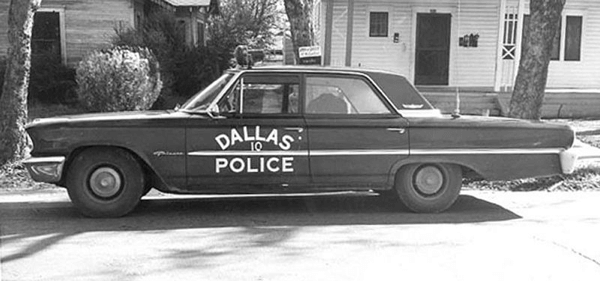
    Approximately 1:06:00

    Tippit quickly reaches 10th Street and is about to turn right, heading east towards the disturbance at the corner of 10th & Marsalis. But he instead observes a late model Chevrolet headed west on 10th. Could this be the car escaping from the scene of the fight? So instead of turning right, Tippit makes a quick decision and turns left, following the Chevy that has just passed in front of him. Within a block the officer speeds up, passes the Chevy, turns the wheel, and forces the surprised driver to come to a stop at the curb.

    Mr. James Andrews, the motorist—who had been returning to work from his lunch hour—would later give Dallas researcher Greg Lowrey (as reported in Bill Drenas’ article Car #10 Where Are You?) the following description of this bizarre event:

    Drenas writes that “The officer then jumped out of the patrol car, motioned for Andrews to remain stopped, ran back to Andrew’s car, and looked in the space between the front seat and the back seat (emphasis mine). Without saying a word, the policeman went back to the patrol car and drove off quickly. Andrews was perplexed by this strange behavior and looked at the officer’s nameplate which read ‘Tippit’ … Andrews remarked that Tippit seemed to be very upset and agitated and acting wild.” (McBride, pp. 448-49)

    Much has been made of this incident, which apparently happened just a few short moments prior to Tippit’s death. Some have reasoned that Tippit was looking for Oswald, thought to be hiding in the back of an automobile on his way to Red Bird Airport to catch a flight out of town. Others have found the story so odd that they have tended to dismiss it altogether—couldn’t have happened.

    But now that we have a report about a fight at 10th & Marsalis, a stabbing in which the victim was thrown into the back of a car which then sped away from the scene, Tippit’s “wild” actions perhaps make more sense. Tippit may have been looking for the injured stabbing victim in the back of an escaping vehicle—and he was doing so alone, with no backup. That is why he was agitated and acting upset. President Kennedy and Governor Connally have just been gunned down in Dealey Plaza and now Tippit is dealing with a violent, potentially life and death situation in adjoining Oak Cliff.

    1:07:00 p.m.

    Officer Tippit heads east on 10th Street, heading towards the scene of the reported disturbance at the corner of Marsalis. By now, according to Texas Theater Manager Butch Burroughs—as well as multiple paying customers—Lee Oswald is most definitely in the building for the start of the afternoon’s double war movie feature. (Marrs, Crossfire, pp. 352-53)

    1:08:00 p.m.

    As Officer Tippit travels east on 10th towards Marsalis, he spots a lone figure walking west just two blocks from the scene of the stabbing incident. Tippit slows Car #10 as he cruises through the intersection of 10th & Patton. Cab driver Bill Scoggins, parked near the corner in his cab while eating his lunch, notices Tippit pass in front of his cab, slow down, and suddenly pull to the curb about 100 feet past Patton Street. The officer apparently summons the young pedestrian, who is wearing the beige Eisenhower jacket, dark trousers, and white shirt, back to his patrol car.

    Picture7tinyThe young man does an about-face, turning around to approach Tippit’s car sitting at curbside. Could this young man have been a witness? A participant in the fight? He doesn’t appear to have any blood on his jacket that the officer can see. Tippit and the young man, who is now leaning over, have a brief conversation through the open vent on the passenger-side window.

    1:08:30 p.m.

    Officer Tippit, who probably does not fully believe the young man’s story about who he is and what business he has on 10th Street, decides to get out of his car to question the subject further. He adjusts his police cap, begins to walk slowly towards the front of Car #10. As he does, the man pulls a .38 revolver from under his jacket and begins to fire.

    No one sees the actual shots. A passing motorist, Domingo Benavides, is startled by the gunfire as he approaches Car #10 while traveling west on 10th. In an act of instinct and self-preservation, Benavides turns his pickup to the curb and ducks down behind the dashboard. (Lane, pp. 177-78)

    Cabbie Bill Scoggins sees Tippit fall into the street. A few seconds later, he observes the figure of the young man walking quickly towards his cab, cutting across the adjacent corner property on 10th Street. Scoggins steps out of his cab and hides behind the driver-side fender. The young man emerges from the lawn’s hedges and begins to trot south on Patton Street, still tossing the occasional empty shell to the ground. (Lane, pp. 191-93)

    Hearing no further shots, Benavides pokes his head up in time to see the gunman heading for Patton Street, inexplicably tossing a couple of shells into the bushes. Benavides will later tell police he could not positively identify the gunman and will not be taken to any of the subsequent lineups.

    1:10:00 p.m.

    The gunman turns right on Jefferson Boulevard, as seen by multiple witnesses. He stuffs the pistol back into his pants, walks briskly west for a block before cutting through a service station and turning north on Crawford Street. At this point the young gunman disappears. (Armstrong, p. 855)

    Approximately 1:25 p.m.

    Picture8tiny“Someone” hands Captain William “Pinky” Westbrook a light tan Eisenhower jacket that was allegedly thrown under a parked car behind the Texaco service station at Jefferson & Crawford. This was supposedly the jacket worn by the fleeing gunman. Westbrook, however, can’t remember the name of the officer who turned over the jacket. (Lane, pp. 200-203)

    Approximately 1:36 p.m.

    As Dallas police cars continue swarming into Oak Cliff, the unidentified young man from 10th & Patton suddenly reappears again on Jefferson Blvd. near the Texas Theater. The man, who is wearing a white shirt, either purchases a ticket or simply ducks in without paying. The time is now approximately 1:37. Once inside, the new arrival goes upstairs to sit in the theater’s balcony section. (Armstrong, pp. 858-60)

    Approximately 1:40-42 p.m.

    Dallas police are tipped off to a suspicious person who has entered the Texas Theater.

    Approximately 1:42 p.m.

    Picture9At 10th & Patton, Captain Westbrook of the DPD shows FBI special agent Bob Barrett a man’s wallet. The Dallas investigators are going through the wallet, and apparently find two pieces of ID. Westbrook asks Barrett if he knows who either Lee Harvey Oswald or Alex Hiddell are. Barrett says no. (Armstrong, p. 856) Years later, when the story about the wallet is revealed by FBI personnel, the DPD will say that Barrett’s memory is faulty, there was no wallet found at the Tippit crime scene. But a check of archived Dallas TV news footage proved the DPD wrong. Later, the story seems to change that some unidentified person in the crowd at Tippit’s murder scene must have handed the wallet to reserve cop Sgt. Kenneth Croy, the first officer on site. Only none of the many Tippit witnesses reported seeing a wallet on the ground. Croy, incredibly, never filed a written report on 11/22/63. And Croy, in his testimony before the Warren Commission, said he knew several of the officers who eventually responded to the shooting at 10th and Patton—but couldn’t remember a single name of any of them.

    1:45:43 p.m.

    The DPD Channel 1 dispatcher broadcasts a report of a suspect who “just went into the Texas Theater.” A fleet of police cars, marked and unmarked, arrive to surround the theater front and back. (Armstrong, p. 863)

    1:50-1:51 p.m.

    Picture10tinyLee Oswald, still wearing his long-sleeved brown work shirt, is subdued in the main (downstairs) section of the theater by DPD officers and is whisked out the front door to a waiting unmarked police car.(Armstrong, p. 868) Meanwhile, a second slender young white male in a white t-shirt is arrested in the balcony and brought out the back door of the theater, as observed by Bernard Haire, the owner of the hobby store two doors east of the theater. The official Dallas arrest report will indicate that Oswald was arrested in the balcony, while in fact he was actually arrested downstairs in the theater’s ground-floor main section. (Armstrong, p. 871) What happened to the second man who was taken away?

    Approximately 1:55 p.m.

    While accompanied by four Dallas detectives in an unmarked car headed for DPD’s downtown headquarters, Oswald is asked to give his name. He ignores the request. Perturbed, Detective Paul Bentley pulls a billfold from Oswald’s hip pocket and begins to examine its contents. He finds ID cards for both a Lee Oswald and an A. Hidell. “Who are you?” asks Bentley again. “You’re the detective,” Oswald finally answers back. “You figure it out.” (Armstrong, p. 870)

    But wait. They just found Oswald’s wallet at 10th & Patton, right? (Armstrong, p. 868) So Oswald carried two wallets, one of which he was good enough to leave at the Tippit murder scene? Along with four shell casings from a .38 caliber revolver?

    In the words of an old Rockford Files TV episode: “that plant was so obvious someone should’ve watered it.” No wonder the 10th & Patton wallet disappeared after a billfold was found to have been in Oswald’s possession at the theater.

    The Dallas Police knew who Oswald was before they descended on and surrounded the Texas Theater.

    Approximately 2.p.m.

    Oswald arrives at Dallas Police Headquarters to be interrogated and booked. He will be shot dead that very same weekend. To quote one bluntly sarcastic journalist: Lee Oswald miraculously managed to survive nearly 48 hours in the custody of the Dallas Police Department.”

    The DPD kept no known tapes or transcripts from the hours of interrogation undergone by their suspect. We have little idea what Oswald really said, only that he “emphatically denied these charges.” (Armstrong, p. 893)

    Ballistics

    Picture11tinyIf anyone is looking for ballistics to provide a definitive answer in the Tippit case, they will be sorely disappointed. The ballistics evidence tends to exonerate Lee Oswald as much as it implicates him. (For lengthy discussions of the following, see Henry Hurt, Reasonable Doubt, pp. 151-56 and Joseph McBride, Into the Nightmare, pp. 252-57)
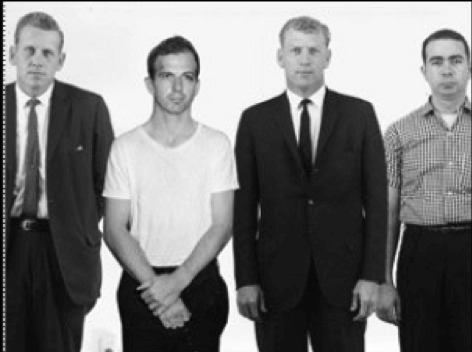
    Four shells from a .38 caliber handgun were recovered spread along the ground leading from the crime scene. The DPD officers on site at first figured these were from an automatic pistol (which automatically ejects the spent shells), not a revolver, because who would purposely remove and leave such incriminating evidence at the scene (along with a wallet full of ID)?

    The bullets found in Officer Tippit’s body at autopsy could not be matched to Oswald’s .38. And the shells so conveniently recovered at 10th & Patton could not be matched to the bullets. The shells were never properly marked by DPD, evidence was misfiled, and the chain of evidence for the ballistics was, unfortunately, suspect.

    In the words of homicide detective Jim Leavelle, the very man tasked with nailing Oswald for the Tippit murder, the ballistics in this case were quite frankly “a mess.”

    As Joe McBride notes in his book, Warren Commissioner and congressman Hale Boggs was one of the members of that body who had his doubts about their verdict. Boggs directly challenged the Tippit case ballistics when he said, “What proof do you have that these are the bullets?” (McBride, p. 258) Boggs apparently never received a satisfactory answer.

    New Orleans District Attorney Jim Garrison, who took an active role in the JFK assassination investigation in the late 1960s, believed that the ballistics evidence pointed to two shooters at 10th & Patton. Said Garrison in his October 1967 Playboy interview, “The evidence we’ve uncovered leads us to suspect that two men, neither of whom was Oswald, were the real murderers of Tippit.”

    Mr. Garrison added that, “… Revolvers don’t eject cartridges and the cartridges left so conveniently on the street didn’t match the bullets in Tippit’s body.”

    The cartridge cases—two Western-Winchester and two RemingtonPeters—simply didn’t match the bullets—three WesternWinchester, one Remington-Peters—recovered from Officer Tippit’s body.

    “The last time I looked,” noted Garrison wryly, “the Remington–Peters Manufacturing Company was not in the habit of slipping Winchester bullets into its cartridges, nor was the Winchester–Western Manufacturing Company putting Remington bullets into its cartridges.”

    Witnesses

    Picture12tinyIf the ballistics evidence in the Tippit case could rightly be characterized as messy, then the eyewitness testimony regarding the Tippit homicide would have to be labeled a toxic waste site by comparison.

    Tippit authority Joseph McBride, author of Into the Nightmare, explained the bizarre situation succinctly when he stated, “The other physical evidence is also confused and contradictory—and the eyewitness evidence is so contradictory that it seems as though there were two sets of witnesses.” (McBride, pp. 460-61)

    One set of witnesses identified Oswald as the sole murderer of Officer Tippit. The second set said they couldn’t positively identify Oswald, or could positively exclude Oswald, and saw two or more suspects acting suspiciously, and even saw one of those persons apparently involved in the shooting escape in an automobile.

    Dallas authorities, and later the Warren Commission, focused almost exclusively on the first set of witnesses—while minimizing or completely ignoring the second set.

    A good example of “witness neglect” was reported by 10th Street neighbor Frank Wright. Wright later told Tippit researchers that “I was the first person out. I saw a man standing in front of the car. He was looking toward the man on the ground (Tippit). The man who was standing in front of him was about medium height. He had on a long coat, it ended just above his hands. I didn’t see any gun. He ran around on the passenger side of the police car. He ran as fast as he could go, and he got into his car. … He got into that car and he drove away as fast as he could see. … After that a whole lot of police came up. I tried to tell two or three people (officers) what I saw. They didn’t pay any attention. I’ve seen what came out on television and in the newspaper but I know that’s not what happened. I know a man drove off in a grey car. Nothing in the world’s going to change my opinion.” (Hurt, pp. 148-49)

    Picture13Acquilla Clemons, a caregiver who worked on 10th Street, was not simply ignored the same as was Mr. Wright. Clemons, who saw two suspicious persons escape the Tippit murder scene in different directions, told investigator Mark Lane (during a taped interview) that a man she suspected was a Dallas detective or policeman visited her home on or about 11/24/63. He was carrying a sidearm. Mrs. Clemons reported that the visitor warned her “it’d be best if I didn’t say anything because I might get hurt … someone might hurt me.” (McBride, pp. 490-94)

    Picture14Warren Reynolds, a used car salesman who saw the gunman escaping west on Jefferson Boulevard, was indeed hurt—and very badly. Reynolds told news reporters the afternoon of the assassination that he had seen the fleeing gunman, but was simply too far away to have made a positive identification. The FBI finally got around to interviewing Reynolds in January, 1964, at which time the witness reiterated his original story that he had been located across Jefferson Boulevard and was simply too far from the gunman to have made a positive identification. Two nights later, someone sneaked into Reynolds’ place of business, hid in the basement, and shot Mr. Reynolds in the head with a .22 caliber rifle. Miraculously, Reynolds survived. Even more miraculously, the car salesman made such a dramatic recovery that he now found his eyesight had improved and he was able to identify Lee Oswald after all. (Hurt, pp. 147-48; McBride pp. 476-78)

    Decades later, Dallas researcher Michael Brownlow tracked down Mr. Reynolds, who was still in the business of selling cars. At first, Reynolds would not admit who he was. But after Brownlow had gained his trust, the researcher asked Mr. Reynolds why he had suddenly changed his testimony regarding his identification of Oswald.

    “Because I wanted to live,” Reynolds admitted bluntly.

    When Mark Lane came to Dallas to make the documentary Rush to Judgment, his director, Emile de Antonio, made a rather interesting observation. “There was absolutely no tension at all on the scene of the assassination (Dealey Plaza),” commented de Antonio. “… All the tension is where Tippit was killed. That’s right and this (the Tippit slaying) is the key to it.” (McBride, pp. 460-61)

    The director’s sense of what was going on in Oak Cliff was seemingly verified by an anonymous letter appearing in Playboy that was sent to the editor after Jim Garrison’s October 1967 Playboy magazine interview:

    “I read Playboy’s Garrison interview with perhaps more interest than most readers. I was an eyewitness to the shooting of policeman Tippit in Dallas on the afternoon President Kennedy was murdered. I saw two men, neither of them resembling the pictures I later saw of Lee Harvey Oswald, shoot Tippit and run off in opposite directions. There were at least half a dozen other people who witnessed this. My wife convinced me that I should say nothing, since there were other eyewitnesses. Her advice and my cowardice undoubtedly have prolonged my lifeor at least allowed me now to tell the true story

    There were four main witnesses who gave testimony that Lee Oswald had in fact been guilty. Many who’ve studied the Tippit murder have long felt that competent defense counsel would have reduced the case against Lee Oswald to shambles. If Oswald had received a fair trial, they say, he would have been exonerated of the charge he killed Officer J.D. Tippit.

    Of course, Oswald did not receive even the benefit of an unfair trial. The suspect received no trial whatsoever and was instead convicted in the court of public opinion based on government propaganda disseminated by a relentless disinformation campaign. In the words of FBI Director J. Edgar Hoover on the evening of the assassination, “The thing I am concerned about, and so is Mr. Katzenbach (Deputy U.S. Attorney General), is having something issued so we can convince the public that Oswald is the real assassin.” (McBride, p. 142)

    That “thing” mentioned by Hoover would eventually, of course, be the pre-determined, hastily prepared whitewash known as the Warren Report … with the so-called “magic” bullet as its centerpiece.

    The four crucial witnesses against Oswald in the fatal Tippit incident would be William Scoggins, Ted Calloway, Helen Markham, and—belatedly—Jack Ray Tatum.

    Taxi Driver Bill Scoggins

    Picture15William “Bill” Scoggins was seated in his cab on Patton Street. (Warren Report, p. 166) He was facing the intersection with 10th Street, when he saw Officer Tippit’s patrol car pass by in front of him. (For discussions of Scoggins’ testimony, from which this material is drawn, see Meagher, pp. 256-57 and Lane, pp. 191-93) He saw no one walk by the front of his cab. The patrol car pulled to the curb on 10th Street approximately 100 feet east of the intersection. Mr. Scoggins’ vantage point was obscured by some bushes at the edge of the corner property on 10th. He suddenly noticed a pedestrian on the 10th Street sidewalk either turn around or walk over to the police car’s passenger side window. Scoggins resumed eating his lunch when, several seconds later, gunshots suddenly rang out. Scoggins, startled, looked up in time to see the officer fall into the street. Soon after the pedestrian, now brandishing a pistol, began walking in the direction of the cab. Scoggins exited his cab, thought about running away, but immediately realized he would be in the open and could not outrun any bullets. Instead, Scoggins opted to hide behind the driver-side fender of his cab. He saw the young man cut across the lawn on the corner property, squeezing through the bushes and stepping out onto the sidewalk very near the cab. Hunkered down by the fender, Scoggins heard the man mumble something like “Poor dumb cop.” He was afraid the gunman might try to steal the cab, but instead the young man proceeded on foot south on Patton towards Jefferson Blvd., crossing Patton at mid-block.

    At the Saturday (next day) six-man police lineup, Mr. Scoggins picked Oswald as the individual he had briefly seen emerging from the bushes. However, fellow car driver William Whaley, who had driven Oswald from downtown Dallas to Oak Cliff the previous day, also attended the same lineup as Scoggins. Mr. Whaley made the following cogent observation regarding the nature of that DPD lineup. He testified before the Warren Commission that “… you could have picked him (Oswald) out without identifying him by just listening to him, because he was bawling out the policeman, telling them it wasn’t right to put him in line with these teenagers. … He showed no respect for the policemen, he told them what he thought about them. They knew what they were doing and they were trying to railroad him and he wanted his lawyer.”

    Oswald, of course, had a visibly damaged eye, the result of his encounter with the DPD. Oswald was also asked to state his name and to tell where he worked. By Saturday, when Mr. Scoggins participated in this particular lineup, every functioning adult in Dallas and across the USA knew that the lead suspect in the assassination of JFK and the murder of Officer Tippit was a young man named Lee Harvey Oswald who worked at the Texas School Book Depository.

    As Mr. Whaley duly noted, “you could have picked him out without identifying him.”

    Mr. Scoggins, as it turns out, was actually not able to pick out Oswald during a separate photo lineup. In front of the Warren Commission, Scoggins said that he was shown photos of different men by either an FBI or Secret Service agent. “I think I picked the wrong one,” the cab driver testified. “He told me the other one was Oswald.”

    It seems abundantly clear that Mr. Scoggins got only the briefest of glimpses of the gunman, while hiding in fear for his life on the opposite side of his cab. He was unable to identify Lee Oswald as the gunman in the absence of a highly tainted lineup.

    And fellow cab driver William Whaley, who saw through the sham of these tainted DPD lineups and denounced them for what they were? Within two years of his Warren Commission testimony he would become the first Dallas taxi driver since 1937, while on duty, to fall victim to a fatal traffic accident.

    Ted Calloway

    Picture16After the Tippit gunman passed Bill Scoggins’s cab on Patton Street, he soon encountered used car lot manager Ted Calloway. Calloway, a U.S. Marine Corps veteran, had heard the pistol shots and immediately began walking across the car lot towards Patton to investigate. (Warren Report, p. 169) He soon observed a young man heading south on Patton carrying a pistol in what Calloway would later describe as a “raised pistol position.” The young gunman, who noticed Calloway approach the east sidewalk on Patton, then crossed to the west side of the street to avoid the car salesman. (This following material is referenced in Meagher, p. 258 and Mc Bride, pp. 469-70)

    “Hey, man!” yelled Calloway as the suspect passed Calloway’s position. “What the hell’s going on?” The man glanced at Calloway, said something unintelligible, then continued past Mr. Calloway and towards Jefferson Boulevard, where he turned west and was soon out of sight.

    “Follow that guy,” Calloway instructed two nearby car lot employees. Calloway then hurried up to 10th Street where he saw a small crowd forming around Tippit’s prone body. Calloway next picked up the dead policeman’s handgun and told Bill Scoggins they would use Scoggins’ yellow cab to go hunt for the gunman.

    “Which way did he go?” Calloway asked Domingo Benavides, who had stopped his pickup truck only 15-20 feet from Tippit’s patrol car when he heard the gunshots. Is this not a strange question to be asked by a witness who had purportedly just seen the gunman fleeing by him on Patton Street?

    Calloway and Scoggins did indeed briefly search the neighborhood, although unsuccessfully, for Tippit’s killer. The FBI would later determine that Mr. Calloway had seen the gunman from a distance of 55-60 feet. Not nearly as close as Bill Scoggins, but Calloway had gotten a longer, clearer look.

    Calloway, a thoroughly believable, extroverted, and likeable individual, would have made an excellent witness for the prosecution. Calloway positively identified Oswald at one of the tainted DPD lineups and later told the Warren Commission how he saw Lee Harvey Oswald escaping from the scene of the crime at 10th & Patton.

    But a funny thing happened in 1986 when a television special was produced from London, On Trial: Lee Harvey Oswald. This was a mock trial featuring prosecutor Vince Bugliosi and high-profile defense attorney Gerry Spence. Spence had the difficult assignment of defending the man widely accepted to be JFK’s assassin, Lee Oswald. When Ted Calloway took the stand, he was his usual affable, loquacious self. He told the courtroom that he was 100% confident that the man he saw carrying a pistol that day was Lee Harvey Oswald.

    When Spence asked Calloway whether it was fair that Oswald was in the lineup with a bruised eye and cuts on his face and was not dressed in a shirt and tie like others beside him, Mr. Calloway said he didn’t think it mattered.

    When Spence asked Calloway whether Homicide Detective Jim Leavelle had prejudiced Oswald’s identification by telling Calloway that, “We want to try to wrap him up tight on the killing of this officer. We think he is the same one that shot the President. But if we can wrap him up real tight on killing this officer, we have got him.” Would that not be pressuring the witness?

    Ted Calloway, however, did not believe Leavelle’s statement to have been prejudicial, because the car salesman said Leavelle also told Calloway and the others to “be sure to take your time.”

    With Calloway refusing to admit he could have been mistaken or pressured in any way by police to make a positive ID, Spence had one final trick up his sleeve. The flamboyant defense attorney must have been a gambling man, because he was certainly gambling on his next move—but it worked.

    Picture17Spence’s final question for witness Ted Calloway was to ask him if he could identify someone in a particular photo. This was the infamous and controversial “Doorman” photo taken by a newsman the moment the shots rang out in Dealey Plaza. Some have speculated that the figure of this man in the doorway of the TSBD could have been Lee Oswald. It wasn’t. All evidence instead points to this man having been Billy Lovelady, a lookalike co-worker of Oswald’s at the depository.

    Calloway, mildly confused by the question and suspecting Spence was laying some sort of trap, nevertheless replied that the image being shown on the courtroom screen was “a likeness of Oswald.”

    But it wasn’t and that was just the point. At a distance of 55-60 feet, Ted Calloway could have easily mistaken Billy Lovelady (and a lot of other young, white males) for Lee Oswald. It is exactly this sort of testimony by a witness who is so “100% positive” that has led to innocent persons finding themselves on death row.

    Waitress Helen Markham

    Mrs. Helen Markham was the so-called “star” witness of the Warren Commission regarding the murder of J.D. Tippit. Mrs. Markham was the only witness in 1963 who claimed to have actually seen Lee Oswald shoot and kill Officer Tippit. Markham was hurrying to catch a bus downtown to her waitressing job when she, according to her version of events, came upon the scene of Oswald shooting Tippit from across the hood of Tippit’s patrol car. (Warren Report, pp. 167-68)

    Picture18The problem with Markham’s eyewitness testimony is that she maintained she saw many things that no other witnesses saw—things that not only did not happen, but that could not have happened.

    Markham’s testimony was considered worthless by several of the lawyers who worked for the Warren Commission. Some even considered it downright dangerous and lobbied to have Markham excluded as a witness. (Edward Epstein, The Assassination Chronicles, pp. 142-44) But the higher-ups on the commission realized that without Markham, without at least one supposed eyewitness, the already glaringly weak case against Oswald for the murder of Officer Tippit would potentially collapse. The lawyers were stuck with her. The commission deemed Markham to be a “reliable” witness, despite all evidence to the contrary. “She is an utter screwball,” stated Joseph Ball, senior counsel to the Warren Commission. He characterized her testimony as being “full of mistakes” and that it was “utterly unreliable.” (Anthony Summers, Conspiracy, p. 87)

    According to Mrs. Markham’s version of events, she was hurrying to catch a bus to work, walking south on Patton Street towards Jefferson Boulevard. (The major part of her testimony is located in Warren Commission Vol. III, pp. 306-22)

    As she approached 10th Street and was waiting for traffic to pass, Markham observed a young man crossing Patton in front of her on the opposite side of 10th Street, As the man continued walking east on 10th, a police car approached from the same direction, rolling slowly through the intersection a few seconds later. The man kept walking, and the police car kept moving slowly forward. Eventually, the patrol car pulled curbside and the officer called or motioned to the young man to approach his patrol car. The man came over and leaned in the open window on the passenger side, talking to the officer. The conversation seemed “friendly” and Markham paid it “no mind.” After several seconds, the policeman got out of his car and began to walk towards the front of his car. The young man stepped back, put his hands to his sides, and also began walking towards the front of Officer Tippit’s patrol car.

    When the policeman and the pedestrian passed the windshield and were opposite each other over the hood of the car, the man pulled out a pistol and shot Officer Tippit “in the wink of your eye.”

    The gunman then turned and began walking west back to where he had come from. As he was reaching the corner of 10th & Patton again he looked across the intersection and saw Mrs. Markham. Their eyes locked. Mrs. Markham screamed and put her hands over her face. She did so for several seconds. When she began to pull her fingers down to peek, she watched the man escaping the scene by walking across a lot and then disappearing down the alleyway that runs between 10th Street and Jefferson Boulevard. Here is a graphic of the crime scene from Tippit author Dale Myers:

    Picture19tinytinyI have taken the liberty of slightly altering this graphic by putting a circle around Mrs. Markham’s reported position. The graphic is from Mr.Myers’ book, With Malice: Lee Harvey Oswald and the Murder of Officer J. D. Tippit.
    After the gunman had disappeared down the alley, Mrs. Markham went to the policeman’s side. The injured officer tried speaking to Mrs., Markham, but she could understand little if anything he said. Mrs. Markham stayed with the policeman, alone in the middle of 10th Street, for almost 20 minutes. Then some people finally came by, and eventually some police too, and then the ambulance. She spoke with the officer until they loaded him into the ambulance and left for the hospital.

    The problems with Mrs. Markham’s story are many:

    1. The gunman, according to the other witnesses, had been walking west on 10th Street, not east as stated by Mrs. Markham. The official Dallas Police report describes the suspect as walking west.
    2. The passenger side window on Tippit’s patrol car had been rolled up. The gunman could not have leaned inside the window and rested his elbows and arms on the door as described by Mrs. Markham.
    3. All other witnesses saw the gunman flee west on Jefferson Boulevard. No one else saw the gunman go across an empty lot and disappear down the alley.
    4. All witnesses and the Dallas County coroner said that Officer Tippit was almost certainly dead when he hit the ground. It was not possible for the dead officer to have held any conversation with Mrs. Markham.
    5. A crowd formed at that scene very quickly and grew larger with each passing minute. Mrs. Markham’s assertion that she was alone in the street with Tippit for nearly 20 minutes was simply inconceivable. The ambulance came from two blocks away and retrieved Tippit’s body in probably five minutes or less. (For a good review of the problems with Markham, see McBride, pp 478-82)

    Mrs. Markham would describe the gunman as being a little bit chunky and with somewhat bushy hair. Lee Oswald had thinning hair—and at 5’9” and 130 pounds could hardly have been described as being even a “little” chunky.

    At the downtown police lineup, Mrs. Markham became hysterical and there was some discussion about bringing her to the hospital for medical attention. She was able to continue with the lineup only after someone kindly administered some ammonia to revive her and settle the poor woman’s frazzled nerves.

    Markham was able to pick Oswald out at the lineup … not because she recognized him as the gunman, but because she said that when she looked at the “number two man” in the lineup, his appearance gave her chills. Perhaps this may be explained by the fact that, while Oswald stood in that lineup next to well-dressed Dallas police detectives using fictitious names, his face looked as if he had done a few rounds with then reigning heavyweight boxing champion Sonny Liston.

    When I saw this man, I wasn’t sure but I had cold chills run all over me,” was Mrs. Markham’s description to the Warren Commission of her so-called “identification” of the suspect. This, mind you, from their “star” witness.

    No less than a half dozen times did Mrs. Markham attempt to explain to the Warren Commission that she did not know any of the men in the lineup and did not recognize any of them either. But Assistant Counsel Joseph Ball refused to settle for this: “Was there a number two man in there?” Ball asked Markham, a rather leading question posed to this witness, one that would have been immediately objected to by any competent defense attorney at a jury trial. Finally, Mrs. Markham was forced to concede that “the number two man is the one I picked.” Not because she recognized the man, but because he gave her chills. (McBride, p. 479)

    “Contradictory and worthless” was the description given by Assistant Warren Counsel Wesley Libeler regarding Mrs. Markham’s testimony. “The Commission wants to believe Mrs. Markham and that’s all there is to it,” added staff member Norman Redlich. (McBride, p. 479)

    Remember, these were the folks putting their careers on the line and being paid to “wrap him up tight”—not to exonerate the apparent sole suspect of these monumental crimes.

    Picture20Jim Garrison, in On the Trail of the Assassins, commented dryly that, “As I read Markham’s testimony, it occurred to me that few prosecutors had ever found themselves with a witness at once so eager to serve their cause and simultaneously so destructive to it.” (Garrison, p. 195) Garrison may have been onto something here. What was causing this lady’s testimony to be so strangely bizarre and baffling?

    Tippit researchers Joseph McBride, William Pulte, and Michael Brownlow have all hinted at a potential answer. At the time of the JFK assassination and J.D. Tippit’s death, Helen Markham’s son, Jimmy, was facing serious criminal charges in Dallas County. Markham, a single mother of very limited means, could do little in the way of protecting her troubled, at-risk boy. Then, suddenly, the Tippit incident occurred and Mrs. Markham was, in her words, “treated like a queen” by Dallas Police. It must have crossed Helen Markham’s mind that, if she helped the police and the Dallas authorities, her son might receive favorable treatment by the court. Worse, if she refused to help and did not identify Oswald as Tippit’s killer, it might be her son who paid the heavy, immediate price. (McBride, p. 479) But helping Dallas authorities, in this particular highest of profile cases, meant having to finger an innocent man, whether dead or not, for a crime he did not commit. Oswald was simply not the short, slightly heavy, bushy-haired cop-killer who disappeared behind Ballew’s Texaco.

    So, it may have been Mrs. Markham’s solution to this conundrum to appear to be helping the authorities while she was actually rendering her testimony useless and therefore harmless to the defendant. Save son Jimmy, but also protect Lee, the young man who was in the Texas Theater as the fatal shots rang out at 10th & Patton.

    Medical Photographer Jack Ray Tatum

    Picture21Witness Domingo Benavides, the closest passerby to the shooting of Officer Tippit, was unable to make a positive ID of the suspect, because Benavides had instinctively ducked down behind the dashboard of his pickup truck when he heard the shots. Benavides mostly saw the gunman as he was walking away, towards the corner of 10th & Patton, while tossing shell casings into bushes along the way. Benavides did report that the gunman had a haircut that was squared off in the back along the neckline of his Eisenhower jacket. Lee Oswald on that day clearly had hair that was tapered in back, not squared off. (WC, Vol 6, p. 451)
    Benavides also noticed something else that would later prove significant—a red Ford Galaxie about six car lengths ahead of his pickup, going west, that pulled over same as Benavides when the shots occurred. (HSCA Vol 12, p. 40) The red Galaxie and its driver supposedly stopped and stayed at the scene for a time—and then left as a crowd quickly gathered. No one ever got the name of this potential important witness.

    In September, 1976 the U.S. House of Representatives voted 280-65 to establish the Select Committee on Assassinations (HSCA), in order to investigate the assassinations of John F. Kennedy and Martin Luther King, Jr. This bold move was primarily caused by the first national airing in March of 1975 of the 8 mm film shot by Abraham Zapruder of the JFK assassination. Geraldo Rivera hosted the showing which took place on the ABC show Good Night America. When American citizens finally got to witness the shooting with their own eyes, their response was one of outrage, which in turn prompted the reopening of the investigation. The HSCA would not complete its work until late in 1978 and did not issue a final report and conclusion until the following year, 1979. The final conclusion of the HSCA was that President Kennedy had likely been assassinated as the result of a conspiracy.

    A reopening of the JFK assassination necessarily meant the HSCA would also be taking a second look at the Tippit murder. The case against Lee Oswald in the murder of Officer Tippit had been a house of cards from the beginning and there were those in positions of power who apparently did not wish for any second inquiry of the murky, little-investigated events at 10th & Patton on the day of JFK’s assassination.

    It was against this backdrop that a Dallas native, Jack Ray Tatum, stepped forward with the claim that he had been the driver behind the wheel of the mysterious red Ford Galaxie seen stopped near the intersection of 10th & Patton on 11/22/63.

    Mr. Tatum would proceed to tell an amazing story—perhaps one even more unbelievable than that of the unfortunate Mrs. Markham. Yet unlike that of the much-maligned waitress, it has generally, and inexplicably, been accepted as fact for more than four decades. In a filmed interview with the PBS television show Frontline in 2003, Mr. Tatum re-created his alleged experience on that fateful day in Dallas, 1963.

    While taking a detour through the neighborhood to circle back to a jewelry store on Jefferson Blvd. to buy his wife a gift, Tatum said he found himself driving north on Denver Street around 1 p.m. at which time he turned left to head west on 10th Street.

    Picture22tinyTatum explained that after he made the turn and began driving west on 10th, he noticed an individual walking in his direction (walking east towards Tatum). A Dallas police car was just pulling over to the curb. As Tatum drove towards where the squad car was now parked he noticed the young man leaning over and talking to the officer. The man had both hands in the pockets of his light-colored tan jacket. Tatum continued on to the intersection of 10th & Patton. As he was about in the middle of that intersection he heard “three, maybe four shots.” Tatum continued through the intersection and then braked to a stop.

    What Tatum describes next was seen by no other witnesses.

    Tatum looked in his rearview mirror and saw the policeman laying in the street. The gunman, still on the passenger side of the squad car, walked to the rear of Tippit’s car, hesitated, came around the back of the car, then walked up along the driver’s side of the car … and shot Tippit one final time at close range. (McBride, p. 496)

    The gunman, according to Tatum, then looked around, surveyed the situation, and started a slow run west in Tatum’s direction. Tatum put his car in gear, drove forward down 10th Street to avoid danger, and kept his eye on the gunman in the rearview mirror.

    Tatum said he could see the gunman very clearly and that the corners of his mouth curled up, like in a smile, which was distinctive and made this individual stand out. Then, Tatum delivers his punch line, the big money words the PBS audience is waiting for:

    “And I was within 10-15 feet of that individual and it was Lee Harvey Oswald.”

    Now, to the casual viewer of this PBS documentary, Mr. Tatum has just laid to rest any and all the conspiracy theories surrounding the murder of J.D. Tippit—and has apparently put the final nail in the coffin of Lee Harvey Oswald. Tatum is so smooth in his delivery, so convincing, so sincere: 10-15 feet? How could he have not identified Oswald?

    Frontline and PBS should be ashamed for having filmed this charade and then presenting it to the American public as fact. (The reader can see this interview at Youtube, under the title, “J. D. Tippit Murder Witness Jack Tatum”) Since the entire interview was shot from within Tatum’s vehicle, the viewer can’t see that, according to Tatum’s own description of events, the gunman was likely never closer than 100 feet of Mr. Tatum’s alleged position (in red). Here is the overhead satellite view of that intersection today, with the distance legend in the lower right corner (blue arrow points to 20 ft.):

    Picture23tinyAccording to a study cited by the Innocence Project, after 25 feet face perception diminishes. At about 150 feet, accurate face identification for people with normal vision drops to zero.
    Picture24Could Jack Tatum, while watching a fleeing gunman in his rearview mirror from 100 feet or more away (and remember, Tatum said he drove forward again as the gunman approached), have been able to tell that the corners of the gunman’s mouth turned up? Positively ID him as Lee Harvey Oswald? A gunman in a rearview mirror who was ducking behind trees, bushes, Mr. Scoggins’ yellow cab, and all the while brandishing a pistol?
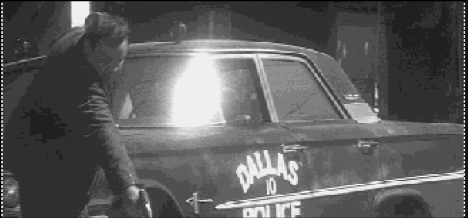
    Was Jack Ray Tatum even there? Who says so besides Jack Ray Tatum? Tatum himself admitted that “When they were getting witnesses to go to the Warren Commission, I thought, they hadn’t missed me—no one had mentioned I was there.”

    Tatum later claimed he didn’t want to get involved on 11/22/63, that they already had enough witnesses. (McBride, p. 498) And that Mrs. Markham—who Tatum said was there—(with her hands over her eyes) got a better look than he.

    Oh, yes, Mrs. Markham. Tatum first said he simply drove away and left the scene of the Tippit slaying. Later he explained that he came back to help poor Mrs. Markham, eventually driving her to a police station to give her statement. A noble gesture to be sure. Only problem is, DPD records indicate that Mrs. Markham was taken to DPD headquarters by Office George Hammer, not Mr. Tatum.

    Tatum’s assertion that “Oswald” came within 10-15 feet of him may be an exaggeration of colossal proportion. However, Tatum’s other claim that “Oswald” circled the squad car and then shot Tippit—basically point blank “execution style”—is as absurd as anything Mrs. Markham told the Warren Commission in 1964. Yes, the eyewitness testimony in general was both conflicting and contradictory. Yes, Benavides and Scoggins missed witnessing crucial pieces of the crime as they went ducking for cover. And we can only guess at what Mrs. Markham actually saw. But while the eyewitness testimony may have been difficult if not impossible to reconcile, the ear witness testimony remained extremely consistent.

    Witness after witness described Tippit as being killed by a fusillade of shots. They all heard basically the same thing: Pow pow pow pow.

    “They was fast,” remarked cabdriver Bill Scoggins, describing how the shots were fired extremely close together, in rapid succession.

    “Pow pow, pow pow,” is how neighbor Doris Holan, whose second-floor apartment overlooked the scene, described the loud bangs to researcher Michael Brownlow.

    “He shot him in the wink of your eye,” noted Mrs. Markham.

    Domingo Benavides described hearing a loud boom followed quickly by two more fast booms.

    “Bam bam – bam bam bam,” remarked Ted Calloway, likening the shot sequence to Morse code.

    Yet Mr. Tatum insisted that “Oswald” fired 3-4 shots from the front passenger side, stopped, walked to the back of the patrol car, hesitated, then walked behind the squad car, turned, and walked up the driver’s side until he stood over Tippit and fired one last bullet up-close-and-personal.

    Except, no one heard that. No one heard anything even remotely resembling that. Nobody heard shots—followed by a several second delay—followed by one final shot.

    Picture25Yet today, if you watch a documentary, movie, or television show describing Tippit’s murder, Jack Tatum’s version of events is what you are almost sure to see. But it never happened that way, couldn’t have happened that way.
    “That just didn’t happen,” Calloway told one researcher regarding Tatum’s scenario. “Boy, those shots are as clear in my ear today as the day it happened. Bam. Bam. Bam, bam, bam. Just like that.”

    Problem is, the forensic evidence showed that one of the shots was likely fired from a steep downward angle, from above the officer, unlike the other three shots. The final shot was more accurate, more deadly, and apparently done from a much closer distance.

    But the man in the light tan Eisenhower jacket didn’t have time to do what Mr. Tatum said he did. After the shots, he began almost immediately to walk in the direction of Bill Scoggins’ cab. That gunman never went around the car and stood over Tippit. Again, there was no time for that. And nobody heard that.

    Someone else was there. Someone else who also shot Tippit but escaped before the man in the light tan Eisenhower jacket started dropping shells and walking towards Patton Street. Someone such as the man in the long coat seen by Mr. Wright. The man who looked down at Tippit in the street and then ran fast to a grey 1950 or 1951 coupe and sped away.

    “Those are pistol shots!” exclaimed Mr. Calloway when the murder happened. With that the used car manager was on his feet and out the office door. “I could move,” he recalled, “and just as I got to the sidewalk—which is about thirty-feet away, I guess—I looked to my right and there’s Oswald jumping through the hedge.”

    Calloway was asked, “If someone tried to convince you that there were four shots and a short pause and then another one fired, you wouldn’t believe that?” “No, I wouldn’t,” Calloway answered, repeating the cadence he recalled, “Bam–bam–bam, bam, bam.”

    No time, no how, no way.

    So what was accomplished by Jack Tatum’s strange, belated testimony before the HSCA?

    1. It helped to repair Mrs. Markham’s highly controversial and highly criticized testimony before the Warren Commission in 1964—and helped to verify her presence (doubted by some) at that corner when the shots were fired.
    2. It reinforced the idea that the gunman had been walking east, not west, a crucial detail needed to allow Lee Oswald to have reached the scene in time to murder Officer Tippit.
    3. It explained the previously unexplainable, the forensic evidence that showed Tippit had been hit by one bullet from a different, much steeper angle which was also fired from a distance relatively closer than the other bullets.
    4. It maintained the fiction of only one gunman at the Tippit scene.
    5. It fingered Lee Oswald as that lone gunman at the Tippit scene.
    6. Most of all, it gave the HSCA a reason not to delve too deeply into the Tippit case. Which, in retrospect, is one of the HSCA’s many failures: their lack of rigor in reviewing the Tippit case.

    Today, under analysis, his testimony has the quality of paper mache. Tatum saw things no one else saw and heard things no one else heard. And his identification of Oswald simply has little or no credibility from that distance. His alleged escorting of Markham is also dubious. It’s almost as if he was a salesman. The ruse, a highly pernicious one, has apparently succeeded—at least so far. Yet, in spite of all this—and because of late Frontline producer Mike Sullivan—his twist on critical events is continually presented as fact.

    In the end, however, the HSCA still managed to “overturn” the 1964 pre-determined conclusion offered by the Warren Commission. The HSCA reported that President Kennedy was probably slain as the result of a conspiracy, and that there were likely at least two gunmen in Dealey Plaza—both in the Texas School Book Depository and behind the fence on the Grassy Knoll.

    And so now at the end of this article, we have finally come full circle … back to Counsel David Bellin’s “Rosetta Stone” logic. For if President Kennedy was assassinated in downtown Dallas as a result of a conspiracy, then it follows that Officer Tippit was likely murdered in adjoining Oak Cliff in an attempt to further that same conspiracy. 10th and Patton was a setup, the disturbance at 10th was in all likelihood a ruse. The designated patsy sat in a darkened nearby movie theater as Officer Tippit, drawn into a trap, was shot down on a quiet residential street in a Dallas suburb. All went as planned—until the scheme to kill the patsy in the movie theater fell through. That’s when the conspirators, suddenly desperate, went into all-out damage control mode and brought in Mafia bag man Jack Ruby to silence the pasty once-and-for all—live and in front of a national television audience.

    Messy, very messy.

    And in the words of Tippit author Joseph McBride, America then took a turn and walked into the nightmare. Along the way, they turned a former Marine into a patsy.

    Picture26

  • Mal Hyman, Burying the Lead: The Media and the JFK Assassination

    Mal Hyman, Burying the Lead: The Media and the JFK Assassination

    I

    Burying the Lead is an exceptionally readable history of the half-century of deception and propaganda surrounding the JFK assassination that has been promulgated by the mainstream media, who as Hyman aptly demonstrates, were instrumental in maintaining the “Big Lie”. Chronologically structured, Hyman centers his survey of the media on their coverage of events immediately after President Kennedy’s death and extends his analysis to the later congressional probes into the CIA’s dirty tricks bag, the Reagan and Bush administrations’ handling of the declassification of sensitive documents, and the eventual breakthrough event that was Oliver Stone’s 1991 film JFK, which led to a renewed public interest in the psychic trauma of the assassination and, eventually, the further release of thousands of sealed documents. The book succeeds in doing what so many like it have failed to do: 1) It circumscribes the players likely involved in the crime of the century; 2) Provides a cogent and compelling motive that even die-hard true believers in the official version of the JFK narrative will be hard pressed to refute; and 3) Manages to keep the reader not just glued to the page, but emotionally invested in a case whose repercussions directly affect us today.

    II

    Mal Hyman—former public school teacher, U.N. liaison and U.S. Congressional candidate, and current college professor—draws on a lifetime of reading and primary source research to bring readers one of the most robust and compelling sagas of the United States at mid-century. He is particularly interested in the inclusion of foreign views on both U.S. foreign policy and the conclusions of the Warren Commission. The first chapter, “Crisis Coverage,” is written in a racing, almost stream of consciousness fashion, with Hyman describing AP wires which at first were sending dramatically conflicting reports of the mayhem unfolding in Dallas following Kennedy’s assassination. From the four different rifles cited as the murder weapon—an Argentine Mauser, a .30-30, a British Enfield with a high power scope, and finally the infamous Mannlicher-Carcano; to wildly divergent motives cited (Cold War Soviets, a pathological loner, the Mob sick of harassment, a Castro revenge plot)—Hyman shows that left to their own devices, there were some serious journalists questioning the curious events and findings that afternoon in Dallas. Many accurately cited the dozens of witnesses who heard shots from the grassy knoll or the triple overpass. Some reporters tried to get a closer look at the bullet hole in the limousine’s windshield before being turned away by the Secret Service. But within hours of the assassination and the subsequent arrest of Lee Harvey Oswald, the propaganda and disinformation apparatus spooled up to high gear and successfully silenced any and all opposing narratives of those six fateful seconds in Dealey Plaza.

    Consider the following, which Hyman expounds on throughout the opening chapters: FBI Director Hoover immediately phoned a recently sworn in Lyndon Johnson to tell him “we have our man.” This is fascinating given the actual reports flooding FBI headquarters which directly contradicted this. No one, to my knowledge, can also explain unless the obvious setup was already firmly in place, just how or why Lee Harvey Oswald was picked up at the Texas Theater. No reliable witness saw him in the sixth floor window of the Texas School Book Depository building. The excuse that he was the only employee not at his post has also been refuted. The official tip-off for the APB has never been identified. People like Aquila Clemons, who witnessed the later Tippit shooting in nearby Oak Cliff, saw two people shoot the officer, neither of which resembled Oswald; automatic shell casings were first reported at the site of the Tippit shooting, yet Oswald had a .38 revolver, which does not eject shells. Law enforcement paraffin tests concluded Lee had not fired a rifle that day, regardless of his whereabouts. Why did seven police cars rush to the Texas Theater during a presidential assassination to investigate a man who didn’t pay for a movie ticket? None of it makes sense. And yet, despite all of these clearly established facts, which were known that day or shortly thereafter, the mainstream media conveyed almost none of them.

    What we got, instead, was a ready-made, Life magazine profile of a lone Marxist weirdo who, in a final disgruntled act of defiance, shot JFK—perhaps the most progressive and pro-détente president in American history—because he … um … well, he was a nut! As Michael Paine, Oswald’s Dallas acquaintance who was part of a State Department/CIA related family, told the Washington Post (a CIA-infiltrated newspaper) in the following few days:

    After the assassination there were reports that the killer took his time and aimed his rifle deliberately. That would be characteristic of Lee Oswald … He had little respect for people … He saw them as pawns. (Hyman, Burying the Lead p. 39)

    The irony of that statement really can’t be topped considering it was Michael’s FBI friendly wife Ruth Paine and himself who moved the intelligence community pawn Lee Oswald and his wife Marina into the Fort Worth area and helped him find the job in the TSBD. And the list goes on, but this minor vignette showcases what Hyman so well outlines in dramatic fashion: a massive cover-up whose perpetrators reach deep into the corporate, military, intelligence and media organizations of the United States. As he notes:

    The CIA has at times owned or subsidized more than 50 newspapers, news services, radio stations, periodicals, and other communications entities, sometimes in the country, but mostly overseas … At least 22 American news organizations had employed, though sometimes only on a casual basis, American journalists who were also working for the CIA. The organizations included ABC, CBS, Time, Life Newsweek, the New York Times, Associated Press and United Press International, the Scripps-Howard chain of newspapers, the Hearst newspaper chain, the Christian Science Monitor, the Wall Street Journal, the Louisville Courier-Journal, Forbes … College Press Service, Business International, the McLendon Broadcasting Organization, and the Copley News Services, among others. (Hyman, p.56)

    All of this was part of CIA Deputy Director of Plans Frank Wisner’s Operation Mockingbird, colloquially referred to in the agency as “Wisner’s Wurlitzer”. With this apparatus, he could make the press dance to whatever tunes best fit the intelligence community’s agenda. It’s interesting to note that propaganda was officially outlawed by Congress in the United States under the U.S. Information and Educational Exchange Act of 1948.

    Understanding that Cold War tensions might give rise to the continuing expansion of WWII-style propaganda, the Smith-Mundt Act, as it became known, enjoined the State Department to

    … tell the truth; explain the motives of the United States; bolster morale and extend hope; give a true and convincing picture of American life, methods, and ideals; combat misrepresentation and distortion; and aggressively interpret and support American foreign policy. (Sarah Nilsen: Projecting America, 1958. p. 4)

    And while this thoughtful and prescient legislation had good intentions, little did those signing it understand the monster that was forming right down the block out of the remains of the OSS.

    III

    Hyman spends a considerable amount of time balancing a fascinating and nuanced history of the formation of the CIA with the media’s contemporaneous reporting on both the agency’s dirty deeds and the critics of the Warren Commission. He also includes some previously—at least to my knowledge—unexplored clippings from international newspapers around the time of the assassination, including some prescient Indian and French takes on things like the ease with which Jack Ruby shot Oswald, the conspicuous lack of Secret Service protection in Dallas that day, and the almost cartoonish serendipity with which CE399 -the pristine magic bullet—was found in Parkland Hospital after the fact. Concurrent with his coverage of this is his survey of the history of the media’s infiltration by, and increasingly close ties with, the CIA. With only a few dissenting voices during the height of the Cold War, Hyman does an excellent job showing readers just how rare it was for anyone in a position of influence in the media to challenge the dominant narratives of the age. John Swinton, Chief of Staff for the New York Times, in a bold gesture at the 1953 New York Press Club gala, told the audience:

    There is no such thing, at this date in history, as an independent press. You know it and I know it. There is not one of you who dare to write your honest opinions, and if you did, you know beforehand that it would never appear in print … any of you who would be so foolish as to write honest opinions would be out on the streets looking for another job. (Hyman, pp. 54-55)

    The author also cites Walter Karp of Harper’s, who lamented, “It is a bitter irony of source journalism that the most esteemed reporters are precisely the most servile. For it is by making themselves useful to the powerful that they gain access to the ‘best’ sources.” (Hyman, p.46)

    And yet the vast majority of the MSM, both then and now, did precisely that. This reinforced the myths promulgated by the power elite and advanced the belief that if any major abuses of power from the top were actually as grotesque and far-reaching as what the evidence surrounding the assassination of JFK suggests, Americans would have turned on the evening news or opened the morning newspaper over breakfast to discover the truth of the matter. Let’s not forget that it was around this time that the CIA, in an internal memo, advised its embedded sources in the press to promulgate the buzzword “conspiracy theory” to discredit anyone challenging the Warren Report. As this declassified 1967 cable explains:

    Conspiracy theories have frequently thrown suspicion on our organization, for example by falsely alleging that Lee Harvey Oswald worked for us. The aim of this dispatch is to provide material for countering and discrediting the claims of the conspiracy theorists, so as to inhibit circulation of such claims in other countries.

    In other words, legitimate investigations—which by definition seek to expose conspiracies of one sort or another—are to be attacked.

    Abraham Lincoln was assassinated by an extensive conspiratorial network involving overseas agents; Austria’s Archduke Franz Ferdinand was shot by conspirators in an open car in broad daylight, which precipitated World War I; secret backroom deals between the OSS, the Vatican, U.S. politicians and other opportunists secured the release and expatriation of thousands of high-ranking Nazi war criminals to South America and the U.S. at the end of World War II. The 1954 overthrow of Jacobo Árbenz in Guatemala was a CIA-planned conspiracy involving hundreds of people sworn to secrecy. An international conspiratorial cabal involving officials from U.S., Belgium, and Katangese rebels planned the capture and murder of Patrice Lumumba seven years later. All of these are demonstrably provable conspiracies. But in the face of all that, the evidence that might erode the great shining lie surrounding the assassination of our nation’s progressive leadership in the 1960s, this evidence is shunted off as “conspiracy theories.” And, of course, no one can prove theories, which in actual scientific discourse are not qualitatively less significant than say “laws,” but actually denote a separate but equally sound paradigm based on complex natural or physical interactions rather than the direct relations of say two objects in a gravitational field. Darwin’s concept of evolution by natural selection is a theory. Newtonian gravity is a law. Einstein’s notion of General Relativity is a theory, but is understood as true. As I’ve always said, I am a proud conspiracy theorist, as should any historian be. It’s our job to investigate the relationships of human beings, some of which have ulterior motives. The above-cited memo is itself proof that conspiracies are real; a secret team of intelligence officers decided to discredit critics of a major American mystery. We were not privy to this meeting and it was intended to obfuscate the truth. A textbook conspiracy if ever there was. But only if you believe in that sort of thing.

    Hyman also does a fine job detailing the various congressional committees that during the mid to late seventies first opened Pandora’s box and discovered that the CIA’s surveillance of American citizens’ mail was just the tip of the iceberg. From assassination units, both domestic and foreign, to witch doctors like Sidney Gottlieb—who from a CIA-sponsored laboratory had cooked up his exotic poisons and killing devices—to the CIA’s bizarre but very real trauma-based mind control experiments on unwitting American subjects, it wasn’t looking good for the intelligence community. And yet, as Hyman notes, the fallout was essentially inconsequential. What could and should have been a legal mandate for the Central Intelligence Agency to come forward with its tax-payer-funded ledger of dirty deeds turned into the smug reply of people like Counterintelligence Chief James Angleton, who famously told committee members, “It is inconceivable that a secret arm of the government has to comply with all the overt orders of the government.”

    IV

    Perhaps the most significant achievement of this book, besides its comprehensiveness and exquisite delivery, is Hyman’s treatment of JFK’s foreign policy. Only a handful of authors, I feel, have sufficiently addressed just how much John Kennedy diverged, both practically and philosophically, from his Eastern Establishment colleagues and advisers in the White House and Pentagon. Hyman takes readers through each of the struggles of the Third World that faced a young JFK during his brief tenure in office, from the inherited Congo Crisis, to Sukarno’s bid to nationalize Indonesia’s natural resources, to the infamous thirteen days of the Cuban Missile Crisis, which brought the United States and the Soviet Union to the brink of nuclear war.

    There is now enough evidence, both from declassified documents and in the form of fine secondary sources, to adamantly make the case that JFK’s primary antagonism with the power elite– and what ultimately led them to assassinate him—stemmed from his radically progressive views of the developing world. While he and his brother Robert strove to effect tangible street-level change on America’s domestic race issue—and did, to a large extent through things like affirmative action, legal investigations of racist hiring practices and meetings with prominent civil rights leaders—they attempted to apply their visions of a better human future most boldly in the Third World. Consider, as Hyman does, Kennedy’s absolutely prescient analysis of the Middle East in 1951:

    The fires of nationalism are ablaze … A Middle East Command operating without the cooperation and support of the Middle Eastern countries … would intensify every anti-western force now active in the area, [and] from a military standpoint would be doomed to failure. The very sands of the desert rise to oppose the imposition of outside control on the destinies of these proud people … Our intervention on behalf of England’s oil interests in Iran directed more at the preservations of interests outside of Iran than at Iran’s own development … Our failure to deal effectively after three years with the terrible tragedy of more than 700,000 Arab refugees [Palestinians], these are things that have failed to sit well with Arab desires, and make empty the promises of the Voice of America.

    Already, just years after its creation, the CIA had overthrown the secular democratically elected leader of Iran, Mohammad Mossadeq in their first ever orchestrated coup. This ushered in nearly three decades of violent oppression and torture under Shah Reza Pahlavi, who happened to be future CIA Director Richard Helms’ pal from Swiss boarding school. The proximate motive given was that Iran was exhibiting strange communist tendencies in its decision to keep the profits of its own oil sales from Britain, a nation that had extorted billions from what it essentially viewed as a backwater desert satrapy.

    Thus was born a classic CIA playbook: using the mantra of an international communist conspiracy to disguise its ulterior motives of protecting corporate interests. Similarly, Jacobo Árbenz, the 25th president of Guatemala, exhibited these same nationalist economic tendencies in 1954. When he requested a fair return on land owned by the United Fruit Company—which had been ripping off Guatemala to the tune of millions in back taxes for years—the CIA-backed paramilitary army of Carlos Castillo-Armas marched into Guatemala City and staged a coup. With CIA assets going so far as to plant Marxist literature in Árbenz’ private study, later dumping a large crate of Soviet weapons near a beach, just in time for CIA-approved reporters to discover them. President Eisenhower presided over this operation, codenamed PBSUCCESS, which he viewed as a spectacular covert feat. Castillo-Armas, a brutal ex-chief of police who had been living in exile in Honduras, was featured on the cover of Time magazine a year later, with a glowing review of his visit to the United States entitled, “Guest from Guatemala.” (Time, Nov. 7, 1955)

    Kennedy had already recognized the folly of this behavior. Consider his 1957 speech on Algeria to the U.S. Senate:

    The most powerful force in the world today … is man’s eternal desire to be free and independent … We did not learn in Indochina … Did that tragic episode not teach us that whether France likes it or not, or has our support or not, their overseas territories are sooner or later, one by one, inevitably going to break free and look with suspicion on the Western nations who impeded their steps to independence … The time has come to face the harsh realities of the situation and to fulfill its responsibilities as leader of the free world. (Hyman, p.457)

    Secretary of State John Foster Dulles, along with brother and Director of CIA Allen Dulles, both suggested to Eisenhower that dropping nuclear bombs on the Vietnamese threatening to overtake the French forces trapped at Dien Bien Phu could win the war. To say that Kennedy’s and the viewpoints of figures like Allen Dulles slightly differed, as is so often regurgitated in the mainstream histories of his presidency, is not just inaccurate but dishonest. They were diametrically opposed. And this played out in dramatic fashion when the two were forced to work together after the 1960 election. Similarly, the author notes this sentiment of solidarity with the Third World was a theme running deeply throughout Kennedy’s tenure as both a senator and as president, not a grandstanding ploy or an appeal to the far-left voter base. As he told the Senate two years later, in 1959, regarding Central African turmoil, “Call it nationalism. Call it anti-colonialism … Africa is going through a revolution … The word is out—and spreading like wild fire in nearly a thousand languages and dialects—that it is no longer necessary to remain forever poor or forever in bondage.”

    These words eerily parallel the 1960 victory speech given by president elect Patrice Lumumba to throngs of ecstatic Congolese:

    We are deeply proud of our struggle, because it was just and noble and indispensable in putting an end to the humiliating bondage forced upon us. That was our lot for the eighty years of colonial rule and our wounds are too fresh and much too painful to be forgotten. We have experienced forced labor in exchange for pay that did not allow us to satisfy our hunger, to clothe ourselves, to have decent lodgings or to bring up our children as dearly loved ones. (“Speech at the Ceremony of the Proclamation of the Congo’s Independence, June 30, 1960”)

    President Eisenhower refused to meet with Lumumba when he flew to Washington, and later signed off on his assassination.

    Too often critics of non-mainstream JFK assassination theories smugly resort to arguing lack of motive for a non-Oswald shooter, or intelligence community backing. Why, we’ve heard again and again, would other rich white Eastern Establishment power elites assassinate one of their own? Even I, who have an extensive background in 20th-Century foreign policy, was reminded of this in my graduate training, with a few memorable professors conceding that basically Jack Kennedy was a cooler, younger version of say, Eisenhower, or a more sophisticated version of Johnson with a better tailored suit. But he was not fundamentally any less hawkish than either of his presidential bookends. Yes, Oliver Stone suggested Kennedy’s likely withdrawal of advisers from Vietnam as the contributing cause of the military-industrial complex’s decision to remove him. But, they would remind me, we all know that’s just a theory. Had they read NSAM 263? Did they not also realize there were no combat troops in Vietnam in November 1963 when Kennedy was killed? Kennedy presided over Operation Mongoose and the “failed” exile-invasion of Cuba, they often repeated, so he was no stranger to using gunboat diplomacy.  

    Let’s examine these claims, as Hyman does to a great extent in his final and excellent last chapters. As authors like James DiEugenio, Richard Mahoney, Col. Fletcher Prouty and others have shown, President Kennedy had an immediate, actionable withdrawal and de-escalation order effective upon his return from Dallas that month. This was not a verbal agreement or handshake over drinks that has been anecdotally passed through the research community. It’s all clearly spelled out in NSAM 263, a National Security Action Memorandum that concretely establishes JFK’s divergence from the Joint Chiefs of Staff and the Central Intelligence Agency’s cold warrior, Manichean view of the free and communist worlds.

    As we know through John Kenneth Galbraith’s biographer Richard Parker, Kennedy had previously tried for an appeal to Hanoi for a neutralist diplomatic solution to the Vietnam problem with Nehru of India playing the broker. As Gareth Porter showed in his book The Perils of Dominance, this effort was sabotaged by the State Department’s Averill Harriman. Similarly, we know, from a variety of his foreign policy dealings in the Third World, that President Kennedy was entirely more nuanced in his understanding of nationalism than most people in the room during briefings. Kennedy correctly understood that the quick and sloppy conflation of liberation, decolonization, or resource-redistribution movements in places like the Congo, Indonesia and ultimately, Vietnam, with Soviet Communism, was a dangerous game to play. Because it dismissed the forces of nationalism.

    The fallout from the intelligence and military communities’ efforts to prop up pro-U.S. dictators has been much explored by authors like William Blum, (Killing Hope), David Schmitz (Thank God They’re On Our Side), and Max Friedman (Rethinking Anti-Americanism), and is beyond the scope of this review to accurately survey. Suffice it to say, Hyman does an excellent job of unpacking these critical departures between an increasingly isolated John and Robert Kennedy during times like the 1962 Cuban Missile Crisis. Or to use another example, in a June 20th, 1961 meeting, General Lemnitzer and Allen Dulles “proposed an official plan for a surprise nuclear attack on the Soviet Union.” (Hyman, p. 424.) Like he did before and would do again, Kennedy, according to aides present, walked out in disgust. Around this same time, people like General Lucius Clay in West Berlin were mobilizing their tanks to make a move against the Soviets. Strategic Air Command, without the president’s authority, began deploying nuclear-equipped long-range bombers, even going so far as to cross established international airspace parallels which essentially signaled to the Soviets that this was not a routine drill. It’s amazing, at least to me, that not only did the nuclear-armed superpowers not destroy humanity during the Missile Crisis, but that the world’s most important two-week vigil landed in the lap of figures like John and Robert Kennedy. Replay the events with Eisenhower/Nixon in power. It doesn’t end well. We now know that had a full blown invasion with U.S. air support taken place it would have faced over a quarter of a million Cuban and Soviet ground troops who had dozens of tactical nuclear missiles poised to repel an amphibious invasion.

    It also cannot be stressed enough that the Bay of Pigs invasion was both thrown in his lap due to its delayed planning during the Eisenhower/Nixon administration, and designed to fail without full-blown U.S. naval and carrier-based air support—and likely the landing of 100,000 ground troops. The myth that Kennedy got “cold feet,” as my grandpa Marcel used to tell me back in Florida, was a pure creation of … wait for it … the CIA! Allen Dulles and E. Howard Hunt paid a CIA-cleared journalist to ghostwrite their completely honest, objective, 100-percent transparent evaluation of President Kennedy’s failure of nerve in Fortune magazine, a journal run by … wait for it … a CIA asset on payroll! We know this through documents revealed in Allen Dulles’ personal papers at the Princeton University collection. And Kennedy knew this intuitively. As Hyman cites him telling his friend, Undersecretary of the Navy Paul Fay:

    Now in retrospect, I know damn well they didn’t have any intention of giving me the straight world on this … Looking back at the whole Cuban mess, one of the things that appalled me was the lack of broad judgment by the heads of the military services. They wanted to fight and probably calculated that if we committed ourselves part way and started to lose, I would probably give the OK to pour in whatever else was needed. (Hyman, p. 424)

    We are arguably all still here because of JFK’s acumen during the Cuban Missile Crisis, yet this is almost never explored by the media, who portray the harrowing events and their unspectacular, negotiated resolution as somehow inevitable. Nothing could be further from the truth, and Hyman spends considerable time hammering this point home in his final chapters. Which, I should add, follow a lengthy and extremely interesting unpacking of Lyndon Johnson’s behavior after the events of Dealey Plaza, which should appeal to those on the fence regarding his culpability and seeming complicity at times with the conspirators.

    Philosophically, as Hyman conclusively shows readers, John F. Kennedy represented a psychic break from the entrenched corporate/military/industrial power elites, whose post-traumatic irrationality, myopic reductionism and retrograde colonial opportunism dominated American politics at mid-century. Shaken to the core by the implications of Soviet dominance over vast reaches of Europe and Asia in the wake of the Second World War, and seeking a much-needed bogey man to fulfill their Hegelian negative-identity criteria, by which national worth can only be defined in opposition to a foreign adversary or internal enemy, U.S. policy makers at the height of the Cold War largely viewed the Kennedys as traitors. Traitors to the great mantle of tremendous military might fortuitously bequeathed to an otherwise backwater new nation called the United States in the wake of the Second World War’s global carnage. Traitors to the corporate interests who cared little what a million Congolese suffered under CIA-backed dictators like Mobutu, so long as their diamond and cobalt mines in Katanga poured forth abundance. Traitors to the then-as-now accepted postwar view that the United States is an exceptional nation with an exceptional, quasi-religious historical mission which despite hundreds of overthrows, embargoes, assassinations, lies, and disinformation campaigns by its politicians and intelligence officers, is fundamentally well-meaning and just.

    Anyone interested in tracing the origins of this dark legacy will be doing themselves a favor by picking up Burying the Lead. It is one of those rare things: a balanced, engaging, fascinating look at the slimy underbelly of the American power structure. And the hired guns of the media who cover up for them.


    Addendum, May 30, 2019

    The John Swinton quote used in the above review is misattributed in time. John Swinton passed away in 1901. He made the statement in 1880, after he had concluded his employment with the New York Times and was working at the New York Sun. Please see the following for more information: https://www.constitution.org/pub/swinton_press.htm

  • NewsBuster: Busting Up the JFK-Assassination Research Findings

    NewsBuster: Busting Up the JFK-Assassination Research Findings


    NewsBuster is a media watchdog that styles itself as “Exposing and Combating Liberal Media Bias.” It runs as a kind of blog of the Media Research Center (MRC), founded in 1987 by American conservative writer and activist Leo Brent Bozell III, and based in Reston, Virginia. Bozell was the nephew of the late conservative columnist and TV personality William Buckley. Before starting the MRC, Bozell ran the Conservative Political Action Conference.

    This MRC blog is having a good time amidst the mainstream media meltdown as Robert Mueller’s Russia Gate probe was completed without any evidence of Trump-Putin collusion during the 2016 elections. One of its contributing writers, Jeffrey Lord, has branded the reaction of MSM against Attorney General William Bar as “grassy knoll media attack,” after Barr added to the no collusion finding that there had indeed been spying on the Trump campaign.

    According to Lord, “grassy knoll” was once upon a time an American slang reference to the “conspiracy theorists” who argued that President John F. Kennedy was not killed by the lone gunman Lee Harvey Oswald, but by “assassin or assassins firing from the grassy knoll” in Dealey Plaza. Adding insult to injury, Lord asserted that the Warren Commission “concluded otherwise as there was no proof, but this didn’t stop the conspiracy theorists.”

    Ever after, Lord pointed out, “grassy knoll” became a part of the American vernacular indicating that someone was a bit of a wacko, and a theorist of whatever was just a nutty conspiracy. He seems unaware of the fact that the Warren Report only got one thing right, as Jim DiEugenio remarked in his introduction to the series on its 50th Anniversary, namely that Jack Ruby shot Lee Harvey Oswald. And that was because the occurrence was captured live on TV.

    In contrast to Lord, most Americans refuse to swallow the Warren Commission’s pill since the very day of the killing, as Gallup has been tracking decade after decade. Nonetheless, questioning the lone gunman hypothesis has become ingrained in the American culture not as a matter of opinion, but as a simple examination of the evidence.

    Witness Accounts

    Literally hundreds of people witnessed the shooting at Dealey Plaza on November 22, 1963. The Warren Commission failed to do any rigorous and systematic analysis of their accounts. Nor did it lend any credence to those who said the shots came from the grassy knoll. A survey by History Matters found that 52 witnesses placed the source of the shots there, 48 at the Texas School Books Depository (TSBD), 5 in both locations, 4 elsewhere and 37 couldn’t tell. But most of all, 21 witnesses with crime scene training —from Secret Service men to Dallas Police officers— said their reaction to the gunfire was to go search the grassy knoll. The Warren Commission ignored all their testimonies and reported there was “no evidence” of a shot from there.

    Forensic Analysis

    Instead of focusing on the X-rays and photographs, the Warren Commission also admitted into evidence a drawing that did not accurately depict Kennedy’s head wounds. The Zapruder film contradicts the drawing, which has Kennedy leaning forward in a wrong position and the path of the bullet through the head wounds descending from back to front, as it would have been fired from the TSBD. The Zapruder film’ s frame before the fatal shot shows Kennedy in the right position and so the path of the bullet clearly rises from back to front.

    Thusly, Lord faces the devastating dilemma of all the advocates of the Warren Commission. If the drawing accurately represents Kennedy’s head wounds, then the Zapruder film was altered, hence conspiracy, hence cover-up. On the contrary, if the Zapruder film is authentic, then the drawing is a false representation, hence conspiracy, hence cover-up.

    A Homeopathic Approach

    Ironically, Lord fell into the delicate position of taking the grassy knoll reference with a blatant bias in a blog expressly devoted to expose and to combat bias.

    The grassy knoll is linked neither to a wacko, nor to a nutty conspiracy theory, but to the conspiracy fact proven (and overlooked by both the U.S. government and the MSM) by mere observation of the Zapruder film: a shot from the front entered at Kennedy’s right temple and blew out his right occipital, followed by instant back spatter and a back and to the left movement like a billiard-shot response in accordance to the basic laws of physics.

    Conspiracy and cover-up in the JFK assassination are not theoretical questions, but findings derived from serious research. What we have with Mr. Lord is a right-hand-thread wingnut trying to tighten the MSM —due to their bias on Attorney General Barr— by distorting the actual meaning of the grassy knoll in modern U.S. history, which is the claim of transparency and facts in the JFK assassination, as Lord himself is supposedly doing regarding the Trump-Russia collusion.

    Addendum

    It should be noted that in the matter of the JFK murder, left at times meets right. Michelle Goldberg has written for Salon, The Nation and The American Prospect. On April 19, 2019, Goldberg wrote an editorial for the New York Times about the Mueller Report. She wrote that she had desperately hoped for clarity,

    ….a rough public consensus on what had happened in the 2016 election and its aftermath, akin to the Warren Commission report on the assassination of President John Kennedy….A set of facts that serious people could agree on, leaving conspiracy theories at least somewhat marginalized.

    Please observe that whereas Lord praises the Mueller Report for his political agenda of exonerating President Trump, Goldberg praises it for her agenda of impeaching Trump. Which makes their mutual reference to the Warren Report even sillier. Especially with both writers holding up the report as a model of clarity capable of dispelling rumors or countering other renditions of the crime. Goldberg is even more humorous when she writes that the report presented “a set of facts that serious people could agree on”. This is the last thing the report does.

  • CBS and their 1964 JFK Cover-Up

    CBS and their 1964 JFK Cover-Up


    cbs warren reportAs most people who read this site understand, the MSM has not been trusted or admired for their work relating to the assassination of President John F. Kennedy. In fact, one can effectively argue that the major media bastions—newspapers, magazines, and broadcast media—were so biased in favor of the official story that they have little or no credibility on the case today. This began almost from the start, and continues to the present.

    One of the worst instances of the media’s obeisance to the Powers That Be concerning the JFK case occurred upon the issuance of the Warren Report. If the reader will recall, this happened in late September of 1964. The report was handed to President Lyndon Johnson on Thursday, September 24. There was an official photograph taken on that day in the Oval Office. All seven commissioners, plus Chief Counsel J. Lee Rankin, were pictured. Chief Justice Earl Warren handed LBJ the 888-page report. This was, for all intents and purposes, a photo op, as the report was not released to the public until Sunday evening, the 27th.

    A funny thing happened that Sunday evening. Both the CBS and NBC networks broadcast specials on the JFK case. Both were based upon, and endorsed, the Warren Report. This was odd in two respects. First, how could anyone have read the quite lengthy and complicated report that fast? What makes that even harder to understand is that the Warren Commission worked in almost complete secrecy. Their hearings were closed to the press and the public. The only exceptions among the approximately 500 witnesses the Commission itself interviewed were the two depositions of Mark Lane. They were excepted for the simple reason that Lane insisted his appearances be done in the open. (Walt Brown, The Warren Omission, p. 244)

    As author Seth Kantor notes, inside the Commission itself, the working staff of attorneys was pretty much kept away from the seven commissioners and the chief counsel. (Seth Kantor, The Ruby Cover-Up, p. 163) This information above leads to the conclusion that the two broadcast programs were produced by directed leaks from the top level of the Warren Commission. The only other logical possibility would be that they were done with the help of FBI Director J. Edgar Hoover, since he did the great majority of the investigative work for the Commission.

    It was very soon discovered that, although the Warren Commission tried to label itself a fact-finding committee, that rubric is not really accurate. After one studies their deliberations, their conduct of interviews, and their methods of investigation, it is quite obvious that there were significant holes in their fact-finding quest; for instance: Oswald in New Orleans, Oswald in Mexico City, Kennedy’s autopsy, Jack Ruby’s entry into the Dallas Police basement. But even with their foreclosed database, the Commission clearly produced a prosecutor’s brief. (Mark Lane, Rush to Judgment, p. 378) For two reasons, that end result was almost inescapable. First, the Commission decided that Oswald had been the lone gunman before they interviewed their first witness. (Lane, pp. 365-66) Secondly, the Commission refused to grant Marguerite Oswald the right to appoint a counsel to represent her deceased son’s interests. (Lane, p. 9) On the issue of fairness to the alleged assassin, the Commission tried to cover itself by saying that they had enlisted the services of one Walter Craig, the president of the American Bar Association, to find if the “proceedings conformed to the basic principles of American Justice.” (Sylvia Meagher, Accessories After the Fact, p. xxix) Craig only attended hearings from February 27 to March 12, 1964. Any suggestion he made in deference to Oswald’s rights is not visible in the record. As Sylvia Meagher concluded in this regard, “The whole sorry arrangement was a mockery that further compromised the Commission’s claim to impartiality.” (p. xxix)

    What is so fascinating in reading and viewing the immediate endorsement of the MSM upon issuance of the report is that none of the commentators even mentions this large lacunae in the Commission’s procedure. As any attorney will state, the whole basis of the American justice system is the adversary procedure. One of the fulcrums of that adversary procedure is the cross-examination of witnesses, the right to examine documents, the right to make objections, etc. Even in fact-finding procedures done for Congress (e.g., Watergate or Iran/Contra), there was a majority and minority counsel, so one gets something resembling an adversary procedure. To put it mildly, that did not happen with the Warren Commission. But somehow, in their eagerness to embrace the official story, the press ignored this issue with a completeness that is almost astonishing. It is made even worse by the fact that the reporter who did the immediate endorsement for the New York Times, Anthony Lewis, had just written a best-selling book on the subject. Lewis’ book was called Gideon’s Trumpet. It was about the 1963 Gideon v. Wainwright Supreme Court case. In that case, the court ruled that defendants in criminal cases must be supplied an attorney even if they could not afford one. How Lewis could turn his back on his own book is puzzling.

    The press did not just accept the Warren Report, it did not just embrace it, but as the evidence above indicates, they colluded with its creators to present it to the public as the ultimate truth about the murder of President Kennedy. Near the end of the 1964 CBS special, Walter Cronkite goes so far overboard in this regard that today it is almost embarrassing to view. Cronkite says that it is hard to imagine a more thorough inquiry could have been done, and that Oswald lied about every major point he was questioned on.

    What makes these pronouncements patently absurd is the fact that the 26 volumes of testimony and evidence the Warren Report based their conclusions on would not be published for two months: that is, November 23, 1964. Those volumes contained over 17,000 pages to inspect. With that paradox, we are left with two alternatives to ponder. Either someone on the Commission leaked both the report and its evidentiary volumes to the media, or someone associated with the inquiry gave them advance summaries of what that evidence would say. I should not have to add the serious journalistic problem in this collusion. As demonstrated above, the Commission was extremely biased in their presentation. They would not even allow a representative for Oswald. Since they worked in secret, there was no way to cross check their procedures or methodologies. So to accept at face value the Commission’s presentation was a huge gamble. People like Cronkite and Lewis risked losing the trust of the public in both the government and the media if they were wrong.

    The CBS special that was broadcast on the night of September 27 was longer than the NBC rendition. It ran for two hours. The producers interviewed a number of witnesses who the Commission relied upon for its guilty verdict: Ruth Paine, Marina Oswald, Howard Brennan, and so forth. The story about how Brennan was included on the CBS special bears mentioning. At first, he was not going to appear. This probably owes to the fact that there was a debate inside the Commission as to whether or not the man was credible, or whether his liabilities outweighed his probative value. (Edward Epstein, Inquest, p. 136) When CBS first announced its schedule of over twenty witnesses, Brennan was not included. But when the Commissioners decided that Brennan was necessary, the CBS script was revised and Brennan was sent to New York to be interviewed before the program’s deadline. This is how close the ties were between CBS and the Commission. (Mark Lane, A Citizen’s Dissent, pp. 77-78)

    In 1964, Emile de Antonio had released a cinema-vérité-style documentary about the fall of Senator Joseph McCarthy. For Point of Order de Antonio relied largely on film from the CBS kinescope archives. (Lane, A Citizen’s Dissent, p. 75) In 1966, de Antonio was working with Mark Lane on a documentary about the Kennedy assassination. It would eventually take the same title as Lane’s book, Rush to Judgment. The director got in contact with the CBS library and proposed to repeat the process of purchasing film from that network. The response from librarian Virginia Dillard was positive. (Washington Journalism Review, Sept-Oct, 1978, article by Florence Graves; hereafter referred to as Graves in WJR) Lane and de Antonio arranged to go to the CBS archives after hours and sit in front of a movieola to view the outtakes from that 1964 production.

    As Lane writes in A Citizen’s Dissent, he and de Antonio were unprepared for the interviewing techniques they saw being used. If a witness was asked where he thought the shots came from and answered with “the knoll area”, the interview was halted. There was an interim that was not accounted for and now the witness would reply that although he originally thought the shots came from the knoll, he now thought they came from the Texas School Book Depository. On the third take, the witness would be asked where he thought the shots came from and he would reply, the depository building. This would be presented as the interviewee’s answer. (Lane, A Citizen’s Dissent, p. 78)

    De Antonio described the same pattern in an interview he did for journalist Florence Graves in 1978. He said that what he recalled was people in these outtakes saying things that did not get on the program since they contradicted the official story. He then said that it was clear that the interviewer was leading the subjects to a predetermined conclusion. He summed it up with, “The interviewer was more like a prosecuting attorney leading a witness to support the state’s case.” In other words, CBS not only served as an outlet for the Commission, they even did their dirty work for them. (Graves in WJR)

    Lane and de Antonio now ordered up the outtakes they wished to use. But the next day Dillard told them the deal was cancelled. She said that CBS never sold outtakes. (Graves in WJR) This, of course, was pure malarkey. They had done so with Point of Order, and they had just agreed to do so in the JFK case. This reversal must have come down from the executive suites at the network. Either Dillard or the movieola operator had informed them what was happening. Someone like CBS president Richard Salant then overruled the Dillard agreement and the previous de Antonio precedent. The Kennedy case was that important.

    In the 1978 Florence Graves article, it is revealed that one of the producers of the 1964 CBS program, Bernard Birnbaum, admitted there were leaks from the Commission for that special. He added that some of the interviews went on for as long as an hour. But further, and perhaps most importantly, he said the production was months in the making.

    Why did Graves write her piece in 1978, 14 years after the original special aired? Because in the fall of that year, there was a controversy in the press about whether or not the House Select Committee on Assassinations (HSCA) had tried to secure these important pieces of film that had been denied to Lane and de Antonio. The Washington Post reported at the time that the HSCA had not tried to secure the 70 hours of film that CBS still had. (Washington Post, 9/17/78, report by Larry Kramer) And they used Robert Blakey, chief counsel of the HSCA, as their source. That article quoted witnesses landlady Earlene Roberts and cab driver William Whaley as saying things to CBS that contradicted what was reported by the Commission. The Post reporter speculated, as did Graves, that what the witnesses said could back up the concept of a Second Oswald, an idea that some critics had postulated as far back as 1966.

    For the Post article, the pretense that Salant was using to keep the outtakes away from Lane, de Antonio and the HSCA evolved into comparing the film with an investigative reporter’s notes. Which is hard to comprehend. The latter is tied in with the whole idea of a reporter’s need to keep certain sources secret in order to develop information that would benefit the public. Usually, arrangements are made prior to the interview about these special circumstances. Nothing like that would exist in the CBS example. Birnbaum told Graves that the only guarantee he made to the witnesses was the broadcast would not be aired until the Warren Report had been released. Also, why could a witness agree to go on camera if there was anything dealing with personal secrecy involved? In the CBS case, clearly, the value of the transmittal would greatly outweigh the value of keeping the information secret. Or as de Antonio said to Graves for the WJR article, “Does CBS have an Official Secrets Act like the CIA? What is it afraid of?… What is CBS hiding? I won’t guess.”

    For the Graves article, Salant contradicts what Blakey said about the matter. Salant told her that the HSCA did make such a request for all film, including outtakes, in both the JFK and Martin Luther King cases. This was done both orally and in writing. Graves found out from other sources that the HSCA did want the outtakes but CBS would not surrender them. Realizing that this would be a long legal battle that would detract from the investigation, the Committee decided not to issue a subpoena.

    As this site had explored before, CBS was and is one of the worst media agencies to ever broadcast on the assassination of President Kennedy. Through former employee Roger Feinman, we showed that the upper level of management vetoed and then reversed the desire of the reporters and lower managers to honestly investigate the JFK case in their 1967 four night special. In that article we intricately demonstrated how the CBS cover-up of the facts worked and how it pervaded that special. We also showed how CBS then denied that it had done the things it did, such as employing Warren Commissioner John McCloy as a secret advisor to the program. Based on Feinman’s inside information, plus the testimony of Lane and de Antonio, it is not unwarranted to suspect the worst about 1964, and Salant’s refusal to admit it in 1978. After all, Salant refused to admit the role of McCloy in the 1967 special as late as 1977, just one year before the Graves article appeared. Salant finally did admit to the McCloy role in 1992 when Jerry Policoff confronted him with written evidence of the memos McCloy wrote. (Go here for that story) In other words, Salant covered up what he knew to be true for 25 years about what McCloy had done in 1967.

    With that record, who would believe his protestations in 1978 about what had happened in 1964?


    (The author would like to thank Bart Kamp and Malcolm Blunt for the sources used in this piece.)