Tag: WARREN COMMISSION

  • Last Second in Dallas by Josiah Thompson

    Last Second in Dallas by Josiah Thompson


    It has been quite some time since a new book about the assassination of President Kennedy has piqued my interest enough for me to want to even read it, let alone write a review. Over recent years, I have grown increasingly tired of what I have come to see as an endless, false debate over the existence or non-existence of a conspiracy. More to the point, I have lost all patience for the ever-growing list of ill-supported theories, baseless claims of fakery/alteration of evidence, and the apocryphal stories that sadly appear to be firmly planted in the bedrock of most conspiracy thinking. Nonetheless, when I saw that Josiah Thompson’s long-awaited Last Second in Dallas was finally making its way into print, I immediately placed my order.

    As most readers will no doubt be aware, Thompson is the author of one of the most influential books ever written about President Kennedy’s tragic murder, Six Seconds in Dallas. First published in 1967, Six Seconds in Dallas was a rare gem that managed to garner the respect of both Warren Commission zealots and critics alike. Even the late Vincent Bugliosi―who went to great lengths in his own tediously massive tome to denigrate virtually anyone and everyone who dared disagree with the Warren Commission’s conclusions―was compelled to refer to Thompson’s first book as a “serious and scholarly” work. (Reclaiming History, p. 484) In Six Seconds, Thompson presented readers with a meticulous study of the facts and evidence available to him at the time, leading to the almost inescapable conclusion that JFK had been shot by three different gunmen firing from three separate locations. While some of the precise details of his reconstruction of the shooting have since proven to be in error, Thompson’s overarching thesis has been entirely validated by later revelations and stands to this day as the most viable explanation of events.

    Based on both the quality of Six Seconds In Dallas and my own pleasant exchanges with Thompson―during one of which he was kind enough to state that he felt my critique of Lucien Haag had the “depth and scholarly backup” to appear in a peer-reviewed journal (private email)―I was hoping for and, indeed, expecting big things from his follow-up work. It gives me great pleasure to be able to report that I was not disappointed. Last Second in Dallas is an eminently worthwhile addition to the literature that includes some game changing new research into one of the Kennedy assassination’s key pieces of evidence.

    One remarkable facet of Last Second in Dallas is that it manages to present readers with a sizeable amount of detail while remaining, for the most part, eminently readable. This is perhaps largely due to the author’s decision to structure the book as a memoir of his time studying and investigating the case rather than as simply another dry recitation of facts. It is often said that anyone old enough to remember November 22, 1963, can tell you precisely where they were and what they were doing when they first learned that President Kennedy had been shot. In Thompson’s case, he recalls being at a street corner in New Haven, Connecticut, when he saw a woman run out of a record store yelling, “Kennedy’s been shot!” (p. 4) Like the rest of the nation, he then spent the hours that followed glued to news reports, feeling “strangely numb” as a bizarre sequence of events continued to unfold in Dallas, Texas.

    The following evening Thompson and his wife, Nancy, attended a dinner party at the home of a European friend who offered his belief that Lee Harvey Oswald, the alleged Marxist-sympathiser who had been arrested within an hour of the assassination, “will never live to stand trial.” (ibid) Thompson dismissed his dinner companion’s comments off hand, remarking to his wife, “That’s just Alex. Europeans see conspiracies everywhere.” (p. 5) Yet only a matter of hours later Thompson would see his friend’s prophecy fulfilled when Oswald was gunned down by local nightclub owner, Jack Ruby, in front of news cameras in the basement of Dallas police headquarters.

    A few days later, Thompson sat in his apartment studying the black-and-white Zapruder film frames published in the latest edition of LIFE magazine and noticed a curious discrepancy between the reports that had come from Parkland Hospital suggesting Kennedy had been shot from the front and the Zapruder stills showing that Oswald’s alleged sniper’s perch on the sixth floor of the Texas School Book Depository was located directly behind the President when he was hit. The sense of unease he felt at this discovery led Thompson to the local FBI office where he found himself trying to explain the conflict to a Bureau agent who, Thompson noted, “listened politely” then “probably had a good laugh” after the author walked away. (p. 6)

    Like most Americans, Thompson initially chose not to dwell on his suspicions. But in early 1965 his doubts about the official story were reignited by a series of articles appearing in left-wing periodicals Liberation and The Minority of One, written by a Philadelphia lawyer named Vincent Salandria. Salandria was an immediate skeptic of the near-instantaneous fingering of Oswald as the lone gunman. “I’m particularly sensitive to the possibilities of governments [sic] not being as diligent as they should in situations of this sort,” Salandria explained. “I guess it comes from my Italian peasant background which always disputes governmental action and is inherently skeptical.” (John Kelin, Praise from a Future Generation, p. 32) For The Minority of One, Salandria focused his attention on the Warren Commission’s infamous Single Bullet Theory and attempted “to establish finally and objectively that Kennedy and [Texas Governor, John] Connally were wounded by separate bullets.” (Ibid, p. 273) Thompson absorbed Salandria’s arguments, compared them to the evidence contained in the Commission’s twenty-six volumes of hearings and exhibits, and found that his criticisms were valid. “The more I read,” Thompson notes, “the more interested I became.” (Thompson, p. 7)

    In January 1966, Thompson and a friend were arrested for “littering” in Delaware County after handing out anti-Vietnam war pamphlets against the wishes of the local sheriff. The pair spent a couple of hours in a cell before an American Civil Liberties Union attorney arrived to represent them. As Thompson and his fellow arrestee were brought into a squad room to meet with him, the lawyer loudly announced that he had been in touch with the Attorney General. “When the FBI agents arrive,” he said whilst looking at his watch, “I want you to tell them that not only have your civil rights been violated but you are suing for false arrest…” “He did a masterful job of bluffing,” Thompson recalled. “We were released in less than two minutes.” Once they were back out on the street, the ACLU attorney introduced himself; it was Vincent Salandria. (pp. 7–8)

    This chance meeting was something of a turning point for Thompson. Salandria brought him into the small group of critics―figures now legendary among assassination scholars like Sylvia Meagher, Harold Weisberg, Penn Jones, Shirley Martin, Cyril Wecht, and Mary Ferrell―who were working hard to identify and publicise the myriad problems with the Warren Report. Then, in the summer of 1966, Thompson and Salandria began collaborating on what was intended to be a long magazine article. The pair began making trips to the National Archives in Washington and it was there that Thompson saw the Zapruder film for the first time. “I literally gasped aloud” Thompson writes, “as I watched the president’s head explode and snap backward as if his right temple had been struck by a baseball bat.” The author knew instinctively that what he was seeing had to be the result of a shot fired from the right front. And what is more, if the film were to be shown to the American public, he knew the majority would arrive at the same conclusion. (p. 10)

    Sadly, the Thompson/Salandria collaboration did not last the summer. Natural disagreements over the evidence came to a head in an argument over the nature of the wound in Kennedy’s throat. Salandria was thoroughly convinced, based on the descriptions given by Parkland Hospital physicians, that the small, neat hole had to be a wound of entry. Thompson, on the other hand, felt that “The spinal column was only a few short inches behind that hole. Any bullet entering there must have shattered the spinal column before blowing a hole out the back of Kennedy’s neck.” (p. 97) Since there was no damage to the spine, he reasoned, there must be some other explanation for the wound.

    As Salandria recalled in an interview for John Kelin’s wonderful book Praise from a Future Generation, “I immediately quit when Thompson tried to convince me that the Kennedy throat wound was a consequence of a bit of bone exiting from the throat which emanated from the head hit.” (Kelin, p. 340) According to Kelin, Salandria felt that Thompson’s postulate tended to exculpate the government and the attorney would go on to accuse Thompson of being a covert federal agent. In March 1968, Salandria wrote Thompson a letter stating, “I feel that you should know that I consider the data on whether you are a United States government agent incomplete, but that I entertain a suspicion at this time that you are.” According to Kelin, Thompson wrote back a short reply, telling Salandria he was “out of his goddam mind.” (ibid, p. 434)

    With Salandria taking himself out of the picture, Thompson chose to carry on alone. By late August 1966, he had written a sixty-page draft that he planned to show to the editor of Harper’s magazine. Before that could happen, however, he found himself invited to lunch with publisher, Bernard Geis. “At the end of the lunch,” Thomson writes, “Geis asked [executive editor, Don] Preston to write up a contract for me. ‘You’re going to write a book for us, Thompson.’”

    II

    In October 1966, while Thompson was working on the manuscript that would become Six Seconds in Dallas, his publisher reached out to LIFE magazine to see if there was any interest in what Thompson was doing. As it turned out, following the commercial success of the books Rush to Judgment by Mark Lane and Inquest by Edward Epstein, LIFE was considering its own reinvestigation of the assassination. Thompson soon found himself teaming up with two associate editors at the magazine, Ed Kern and Dick Billings. This turned out to be an invaluable development for Thompson as it gave him access to the impressive resources of LIFE, chief among them, the Zapruder film. After viewing LIFE’s own high-quality copies of the film for the first time, Thompson was bowled over by what he saw and rushed to a phone to call his publisher’s office. “The Zapruder film is glorious” he exclaimed at the time. “You can see all the details. Connally was hit later…You can see the impact of the bullet on him. The single-bullet theory is dead…LIFE is going to break this all within a month!” (p. 19) Sadly, this would turn out not to be the case.

    When the article appeared the following month, Thompson found that he was sorely disappointed. “Much of the material we had discovered had not made it into the article,” he writes, “and what had was watered down.” (p. 90) Nonetheless, teaming up with LIFE had not only given him access to the most important record of the assassination, but it had also taken him to Dallas to conduct interviews with some the most important witnesses to both the crime and its aftermath. This research would form the basis of his own book.

    Six Seconds in Dallas was published to significant media attention in late 1967. Among its many contributions to our understanding of the assassination was a tabulation of 190 witnesses, detailing the location of each witness at the time of the shooting, how many shots they heard, and from which direction those shots appeared to come. Of those who offered an opinion, 52% believed shots had been fired from the infamous “grassy knoll” to the right front of the president’s limousine. (Six Seconds in Dallas, p. 24)

    One of the most important of those witnesses was Union Terminal Railroad supervisor, Sam “Skinny” Holland. In Last Second in Dallas, Thompson presents some fascinating and, as far as I am aware, previously unpublished excerpts from the interview he and Ed Kern of LIFE magazine conducted with Holland in November of 1966. Holland, who had been standing on the railroad overpass overlooking Dealey Plaza during the assassination, recalled hearing at least four shots, one of which came from the grassy knoll and was accompanied by a puff of smoke that drifted between the trees in front of the stockade fence. When Kern told Holland that defenders of the Warren report had suggested that whatever Holland saw could not have been rifle smoke because “rifles no longer sent out puffs of white smoke” Holland, who had carried a gun for sixteen years as a special deputy to Sheriff Bill Decker, replied, “…you fire a gun, any gun, from a light underneath this shade you’ll see a puff of smoke that’ll linger there. It’ll be, just like I say, dim, like a cigarette or maybe a firecracker smoke, but mister, if it’s powder, it’s going to smoke.” (Last Second in Dallas, p. 75)

    Holland and two other witnesses who also saw the smoke were so convinced that a shot had been fired from the knoll that, immediately after the shooting, they ran around to the spot behind the fence from where they believed the smoke had come to look for empty shells “or some indication that there was a rifleman or someone was over there.” (p. 71) What they found, according to Holland, was numerous footprints giving the impression that someone had paced back and forth and mud on a car bumper, “Exactly like someone was standing up there looking over the fence.” (p. 76)

    As well as the lengthy analysis of eyewitness accounts in Six Seconds in Dallas, Thompson went into impressive detail concerning the conflicts in the medical evidence that existed at the time, many of which have still not been resolved today. One of those has to do with the question of whether the bullet which entered Kennedy’s back also exited his throat as the Warren Commission claimed it did. Thompson pointed to the testimony of Secret Service agents and the report of two FBI agents who were present at the autopsy as indicating that it did not. (Six Seconds in Dallas, pp. 42–51) Furthermore, as alluded to above, he used the testimony of the Parkland physicians, and the descriptions of Kennedy’s brain given by the autopsy doctors, to make a case for the throat wound being the result of a fragment of bullet or bone from the head shot. (ibid, pp. 52–56)

    In addressing the ballistics evidence, Thompson pointed out that one of the empty rifle shells found on the sixth floor of the depository building had a dented lip which appeared to show that it could not have held a projectile on November 22, thus suggesting that only two shots had been fired from Oswald’s rifle. (ibid, p. 144) More crucially, he made a compelling case that Commission Exhibit 399―the so-called “magic bullet” that was alleged to have produced seven wounds in JFK and Governor Connally without sustaining any significant damage―was not found at Parkland Hospital as the Commission claimed. And, in fact, the actual bullet found at Parkland was a different caliber round that came off a stretcher that was in no way related to the assassination. (ibid, pp. 161–164)

    Perhaps the most revelatory aspect of Six Seconds in Dallas was Thompson’s analysis of the Zapruder film. Because LIFE had refused the author permission to publish stills from the actual film, he was forced to use an artist’s renderings of the individual frames, something Thompson was understandably unhappy about. Yet it had surprisingly little impact on the effectiveness of his presentation. Thompson pointed out that a dramatic change in Connally’s demeanour occurred at Zapruder frame 238 when “his right shoulder collapses, his cheeks and face puff, and his hair becomes disarranged.” (ibid, p. 71) These involuntary responses appeared to pinpoint the very moment Connally was struck and seemingly occurred much too late to be associated with the bullet which had hit the president while he was hidden from view by the Stemmons freeway sign, sometime between frames 207 and 224. Together with CE399’s lack of provenance, this effectively destroyed the single bullet theory.

    Thompson’s most important discovery, however, was related to the movement of Kennedy’s head. As noted above, on his initial viewings of the Zapruder film Thompson was struck, as most viewers are, by the violent backward movement of Kennedy’s head following the shocking explosion of his skull at frame 313, but a frame-by-frame analysis of the film revealed something else. Between frames 312 and 313, Kennedy’s head appears to move forward by at least two inches in just 1/18 of a second. (ibid, pp. 87–89) Absent any other explanation, Thompson interpreted the double movement he was seeing as evidence of two shots striking the head almost simultaneously.

    Thompson’s discovery and measurement of this rapid forward movement was accepted by Warren Commission supporters and critics alike and this would have significant ramifications for our understanding of the assassination. Firstly, because it would become a fact that had to be assimilated in all future attempts to reconstruct the shooting. And secondly because, as we shall see later in this review, it was wrong.

    III

    In Last Second in Dallas, Thompson notes that media reaction to his first book was surprisingly positive. The Los Angeles Times, for example, called it “the most forceful, graphic, and well-organized argument for reopening the assassination investigation.” Similarly, Max Lerner of the New York Post was convinced enough by Thompson’s case for three assassins to write, “It was not until this book that I became clear in my mind about some kind of collaborative shooting.” (p. 110) But there was one notable figure who was not a fan of Thompson’s work: Nobel Prize-winning physicist, Luis Alvarez.

    Alvarez had already staked his reputation on the Warren Commission’s lone gunman theory with his so-called “jiggle analysis” of the Zapruder film―a woefully inadequate study which, he claimed, demonstrated that episodes of blurring on the film showed the Commission had been correct in saying that only three shots had been fired. After being handed a copy of Six Seconds in Dallas, Alvarez set out to find a “real explanation” for the backward snap of Kennedy’s head. (p. 123) What he came up with came to be known as the “jet effect theory.”

    In a nutshell, the jet effect theory holds that the explosive exiting of blood and brain matter from the right side of Kennedy’s skull pushed the head in the opposite direction. Although Alvarez apparently dreamed up this notion almost immediately, jotting down his calculations on the back on an envelope, he would not publish his theory until September 1976. At that time, in the pages of the American Journal of Physics, Alvarez claimed to have validated his hypothesis through a series of empirical tests that involved firing rifle bullets into melons. Towards the end of the paper, Alvarez stated that “a taped melon was our a priori best mock-up of a head, and it showed retrograde recoil in the first test.” (p. 129) His work could only be reasonably criticized, he said, had he used the “Edison technique” and shot at a large assortment of objects until he found one that behaved in accordance with his theory. Yet as Thompson discovered in the early 2000s when he got his hands on the raw data from Alvarez’s shooting experiments, that was precisely what the good doctor had done.

    As Thompson details, during three separate rounds of testing, Alvarez had his rifleman fire into taped and untaped green and white melons of varying sizes, coconuts filled with Jell-O, one-gallon plastic jugs filled with Jell-O and water, an eleven-pound watermelon, taped and untapped pineapples, plastic bottles filled with water, and rubber balls filled with gelatin. The majority of these items were unsurprisingly sent hurtling downrange. Only after Alvarez reduced the size of his melons from ones weighing 4 to 7 pounds to ones weighing just 1.1 to 3.5 pounds did he get six out of seven melons to exhibit some retrograde motion. (pp. 124–125)

    The melons he settled on may have behaved in the manner Alvarez wanted, but they were not, as he claimed, a “reasonable facsimile” of a human head. To begin with, melons weighing under 3.5 pounds are less than half the weight of the average human head, which usually weighs between 10 and 11 pounds. Furthermore, as Thompson writes, “Whether a melon is taped or not, a bullet will cut through its outside like butter. A human skull is completely different. Penetrating the thick skull bone requires considerable force, and that force is deposited in the skull as momentum.” (p. 125) If carefully selecting a poor facsimile of a human head because it produced the desired effect was not enough to nullify Alvarez’s test results on its own, the Nobel laureate also rigged his experiments at the other end by using 30.06, soft-nosed hunting bullets that struck their target at 1,000 feet per second faster than “Oswald’s” 6.5 mm, full metal jacket, Mannlicher Carcano rounds could have done.

    As an explanation for the backward snap of Kennedy’s head, Alvarez’s jet effect theory is, at best, dubious science and, at worst, a deliberate charade designed to pull the wool over the eyes of the American public. Yet, as Thompson notes, it has become “part of the case’s folklore” and is still promoted today by defenders of the official story. For that reason, Thompson has done critics an invaluable service by publishing the details that Alvarez carefully omitted. Strangely, however, though Thompson devotes an entire chapter in Last Second in Dallas to Alvarez and his reaction to Six Seconds in Dallas, he makes no mention whatsoever of the equally, if not more important response by Attorney General Ramsey Clark.

    Several years ago, in a superb online essay titled How Five Investigations into the JFK Medical Evidence Got It Wrong, Dr. Gary Aguilar revealed that Ramsey Clark had somehow come into possession of the galley proofs to Six Seconds in Dallas shortly before its publication. Clark was so disturbed by what he read that he ordered the formation of a panel of medical experts that, in the words of its chairman Russell Fisher, MD, was specifically intended to “refute some of the junk that was in [Thompson’s] book.”

    On the one hand, the Clark Panel did what it was formed to do and reaffirmed the Warren Commission’s conclusions by stating that the medical evidence was consistent with Kennedy having been “struck by two bullets fired from above and behind him…” (ARRB MD1, p. 16) On the other hand, the panel’s report cast serious doubt on the reliability of the autopsy by suggesting that Kennedy’s pathologists had completely mislocated the entrance wound in the skull. According to the Clark Panel, the actual location of the wound was some four inches higher than as described in the official autopsy report!
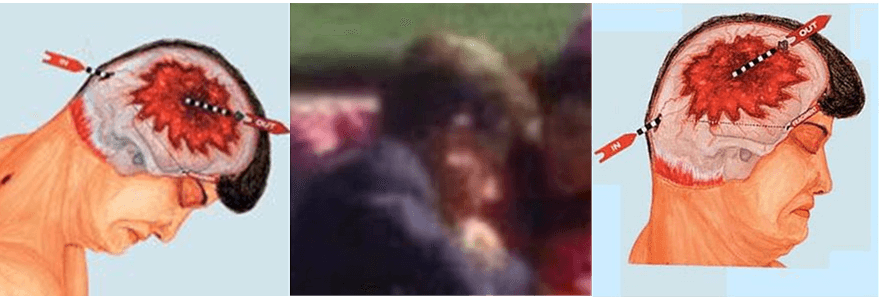
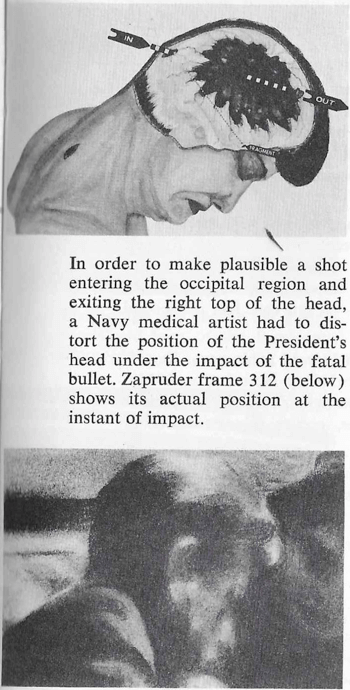
    The autopsy surgeons, James J. Humes, J. Thornton Boswell, and Pierre Finck, had concluded in their report that the bullet had entered the skull “2.5 centimeters to the right and slightly above the external occipital protuberance.” To illustrate the path this bullet took through the skull, the Commission chose not to utilise the autopsy photographs or X-rays and instead published a drawing prepared under the direction of Dr. Humes. The problem with this drawing, as Thompson had pointed out in Six Seconds in Dallas, is that it shows President Kennedy’s head tilted drastically forward in a manner that is quite different to its actual position as seen in the Zapruder film. Furthermore, correcting the head’s position created an upward trajectory (see above comparison).

    It may well be, as some critics believe, that Ramsey Clark expressed enough concern over this apparent trajectory problem that it prompted Fisher and his colleagues to move the wound up the skull to a position where, on the autopsy X-rays, the panel claimed it could see a “hole in profile” (an oxymoron if ever there was one!). This move would, of course, create a more downward trajectory, in line with Oswald’s alleged sniper’s perch on the sixth floor of the depository building. And yet the panel members were surely experienced enough to understand that the path of a bullet through the body after it strikes an object as dense as skull bone may well be significantly different to its trajectory prior to impact. Simply put, if a bullet strikes a hard surface, it is likely to deflect.

    What may have been of greater concern to the Clark Panel members was the location of bullet fragments in the cranium. The autopsy report describes a trail of metallic particles traversing a line from the entrance wound in the occiput to the presumed exit point in the right front of the head. What the X-rays revealed to Fisher and his fellow panel members, however, was that the bullet fragments are actually located in the very top of the skull. This fact tends to confirm rather than refute Thompson’s double head shot scenario because a bullet entering the EOP could not create a trail of fragments along a pathway several inches higher than the one it took. Therefore, the fragments had to have come from a different bullet. Moving the entrance wound up the head as the Clark Panel did brought it closer―though still not in line with―the fragment trail.

    Whichever of these considerations most plagued the Clark Panel, it seems clear that moving the entrance wound was done for reasons other than accuracy. Nearly three decades ago, experimental neuropathologist Joseph N. Riley, PhD―the only neuroscientist that I know of to have performed a serious study of Kennedy’s head wounds―concluded that “The original description of a rear entrance wound by Humes et al. …is most likely accurate” and that there was “little to support” the higher location. In support of this contention, Dr. Riley pointed out that the lateral X-ray shows an area of damaged skull that fully corresponds to the entrance location as described by Dr. Humes. (The Third Decade, vol 9 issue 3) In 2013, ballistics expert Larry Sturdivan and forensic pathologist Dr. Peter Cummings pointed to the very same area on the X-ray, noting that fractures clearly radiated from a point low down on the back of the skull. (NOVA Cold Case JFK)

    For their part, the autopsy doctors always maintained that the wound was correctly located in their report. While it might seem obvious that few professionals are likely to relish the prospect of owning up to such a grievous error, it must nonetheless be borne in mind that the autopsy team had more than just the X-rays and photographs to work from; they had the actual body in front of them. As Dr. Finck argued, the observations of the autopsy doctors would, therefore, seem considerably more likely to be valid than those of individuals who might subsequently study the photos and x-rays. Perhaps more importantly, the entrance location identified by Humes et al. was corroborated by independent witnesses to the autopsy. For example, Richard Lipsey, aide to US Army General Wehle, told Andy Purdy of the HSCA that the wound was located “in the lower head…just inside the hairline.” Similarly, Secret Service Agent Roy Kellerman’s Warren Commission testimony placed it at the level of the lower third of the ear, “in the hairline.” (2H81) Both men executed drawings of their observations [see below].

    All of this makes it surprising to me that Thompson appears to favour the higher location and writes matter-of-factly that “various forensic experts who studied the autopsy photos and X-rays all agreed that the autopsy had mistakenly located the hole…The true location was found to be over four inches above where the autopsy placed it.” (Last Second in Dallas, p. 262) It would appear to me that Thompson is swayed by the fact that the nine-member forensic pathology panel for the HSCA fully endorsed the Clark Panel’s higher in-shoot location. What he might not be aware of is that the majority of the HSCA panel members had enjoyed a close professional relationship with Clark Panel chairman, Russell Fisher. For example, Dr. Charles Petty had spent nine years under Fisher at the Maryland Medical Examiner’s Office. Dr. Werner Spitz had co-authored a book with Fisher, and HSCA panel chairman Dr. Michael Baden had contributed to that book. So, the obvious question that needs to be asked is just how likely was it that these men would work to actively undermine their colleague and mentor on such a prominent issue?

    Ultimately, it may be said to be inconsequential which of the proposed entrance locations Thompson chooses to accept. After all, as Dr. Riley noted, and Thompson himself suggests, “the fundamental conclusion that John Kennedy’s head wounds could not have been caused by one bullet does not depend on which [in-shoot] description is more accurate.” Indeed, the fragments in the top of the skull, the two separate and disconnected areas of damage to the cortical and subcortical regions of the brain [as observed by Dr. Riley], the rear blowout documented by the Parkland physicians, the forward and rearward ejections of wound matter, and the backward snap of Kennedy’s head simply cannot all be explained by a single bullet fired from above and behind.

    Whatever Thompson’s opinion on the in-shoot location may be, and whatever his reasons for it, I nonetheless find it surprising that the author makes no mention of the manner in which his first book precipitated the creation of the Clark panel and its revision of President Kennedy’s head wounds.

    IV

    On March 6, 1975, Geraldo Rivera’s late-night ABC TV show, Good Night America, featured photographic researcher Robert Groden showing his enhanced, stabilized version of the Zapruder film to the American public for the very first time. Thompson, who had also been asked to take part in one of Rivera’s JFK assassination segments, describes the broadcast as “a bona fide shocker…The characteristic intake of breath when an audience sees the president’s head explode and his body slammed backward was heard from coast to coast.” (pp. 138–139) Indeed, the public outcry that resulted from seeing this long-withheld evidence of a frontal shooter was tremendous. In the weeks and months that followed, Thompson worked with Groden to lobby members of congress in the hopes of establishing a committee to reinvestigate the assassination. Almost a year later, after much work from like-minded individuals, the HSCA was formed.

    In the summer of 1977, Thompson was among a group of prominent critics who were invited to a two-day conference in Washington with HSCA Chief Counsel, Robert Blakey. In retrospect, it appears as if Blakey’s reason for arranging the conference was simply to make it appear as if he had given the critics a chance to have their say. The critics, of course, had numerous ideas on what should be the focus of the committee. Yet, as historian Jim DiEugenio writes, “In looking at the declassified summary of this meeting, what is striking about it is how few of the suggestions were actually pursued or how weakly they were pursued.” (The Assassinations, p. 67)

    For his part, Thompson―whose focus has always been solely on the facts of the shooting itself―found himself largely bored by the whole affair. “The discussion veered into various claims of conspiracy,” he writes, “of which I had little interest and even less knowledge. As the discussion droned on, I found my mind wandering. Little did I know that in attending the conference, I would be present at one of the pivotal moments in the history of the whole case.” (Last Second in Dallas, p. 142) That moment came when Mary Ferrell first brought the acoustics evidence to Blakey’s attention. It was this piece of evidence that forced a conclusion of “probable conspiracy” on the committee.

    The HSCA had begun promisingly enough under the leadership of Richard Sprague. From 1966 to 1974, he was the First Assistant District Attorney of Philadelphia County, during which time he had won convictions on 69 out of the 70 homicide cases he prosecuted. While a special prosecutor for Washington County, Pennsylvania, he had also exposed the conspiracy behind the brutal murders of American labor leader Joseph Yablonski and his family, who were shot to death by three gunmen as they slept in their home in Clarksville, Pennsylvania. On top of his impressive record, Sprague had no fixed opinion about who killed Kennedy and was determined to run an unbiased, independent investigation. As Dr. Cyril Wecht commented, “Dick Sprague was the ideal man for that job with the HSCA.” (The Assassinations, p. 56) Expectations in those early days were high and, as DiEugenio writes, “The feeling on the committee, and inside the research community, was that the JFK case was now going to get a really professional hearing.” (ibid)

    Almost inevitably, Sprague’s tenure was short-lived. When the CIA began stonewalling the committee’s requests for information about a trip to Mexico City Oswald had supposedly taken two months before the assassination, Sprague said he would subpoena the Agency for the materials. What followed was a smear campaign in the pages of the Los Angeles Times, the New York Times and the Washington Post that resulted in Congress refusing to reauthorize the committee until the chief counsel was removed. To save the committee, Sprague resigned and Blakey was appointed in his place.

    Former HSCA investigator Gaeton Fonzi noted in his highly-regarded book, The Last Investigation, that Blakey “was an experienced Capitol Hill man. He had worked not only at [the] Justice [Department] but on previous congressional committees as well. So, he knew exactly what the priorities of his job were by Washington standards, even before he stepped in.” Fonzi described those priorities thusly: “The first…was to produce a report within the time and budget restraints dictated by Congress. The second was to produce a report that looked good, one that appeared to be definitive and substantial.” Yet, as Fonzi notes, “There is substance and there is the illusion of substance. In Washington, it is often difficult to tell the difference.” (Fonzi, p. 8)

    If there was one thing the HSCA report had in abundance it was the illusion of substance. This was especially true of one of the most important aspects of the committee’s case: The Neutron Activation Analysis of Dr Vincent Guinn.

    NAA is a sophisticated technique involving a nuclear reactor that can be used to measure the “parts per million” of metal impurities in bullet lead. Guinn took the bullet fragments recovered from Kennedy’s head and Connally’s wrist, together with CE399 and the larger fragments found on the floor of the presidential limousine, and subjected them to this process. He then reported to the committee that Mannlicher Carcano bullets were virtually unique amongst unhardened lead bullets because they contained varying amounts of antimony. Furthermore, he claimed, the antimony levels in an individual bullet remained constant but were different from those in other bullets from the same box. This meant it was possible to trace a fragment to a specific bullet and even to distinguish it from other bullets of the same origin. Thus, Guinn testified, he had determined that the fragments from the floor of the limousine and the ones from Kennedy’s head had all come from one bullet, and the fragments from Connally’s wrist had come from CE399. In other words, only two bullets had struck President Kennedy and Governor Connally and they were both from Oswald’s rifle.

    In Last Second in Dallas, Thompson shows that time has not been kind to Guinn’s conclusions or to NAA and bullet lead examination in general. To put it bluntly, it is now widely regarded as junk science. Comparative Bullet Lead Analysis, as the FBI called it, was used to gain convictions in hundreds of criminal cases over a span of more than two decades. But in 2002, Erik Randich―a PhD metallurgist at Lawrence Livermore National Laboratory―and several colleagues who had begun to have grave concerns about CBLA, published a serious critique of the process in the Forensic Science International journal. “Not surprisingly,” Thompson writes, “as word of these findings spread, criminal defense attorneys facing CBLA-produced evidence sought [Randich] out as an expert witness.” (p. 191)

    At first, the FBI stubbornly refused to admit that there was reason for concern, issuing a statement that said, “We’ve been employing these methods and techniques for over 20 years in the FBI crime lab. They’ve been routinely subjected to vigorous defense scrutiny in the courts and we feel very confident that all of our methods are fully supported by scientific data.” (Los Angeles Times, Feb 3, 2003) However, continued challenges forced the Bureau to put the issue to the National Academy of Sciences and a team of experts was convened to review the issue. The NAS sided with Randich. Several months later, the FBI closed its CBLA lab, ordered agents not to testify on the issue in the future, and issued a statement to say CBLA was being discontinued. “With that announcement,” Thompson writes, “CBLA was formally thrown into the dust bin of junked theories and bogus methodologies.” (p. 191)

    In July 2006, Randich and a PhD chemist named Pat Grant specifically addressed Guinn’s NAA testing of the Kennedy ballistics in the pages of the Journal of Forensic Science. After a devastating and authoritative deconstruction, Randich and Grant stated that there was “no justification for concluding that two, and only two, bullets were represented by the evidence.” And contrary to Guinn’s claims, not only could it not be established that the recovered bullet fragments were from Carcano ammunition, those fragments “could be reflective of anywhere between two and five different rounds fired in Dealey Plaza that day.”

    Sadly, as Thompson points out, Guinn’s faulty analysis “prepared the ground for many of the committee’s conclusions…Because Guinn’s results were developed very early in the HSCA’s existence, their influence was felt throughout the committee’s work.” (pp. 168–170) Indeed, the committee’s forensic pathology panel admitted that it had considered Guinn’s NAA results when reaching its own conclusions. (7HSCA179) Even the panel’s lone dissenting member, Dr. Cyril Wecht, who had long believed that Kennedy may have been struck twice in the head, felt forced to admit after the NAA testing had been completed that “the possibility based on the existing evidence is extremely remote.” (1HSCA346) The NAA results, as Thompson articulates succinctly, “amounted to a gravitational pull towards the narrative put forward by the Warren Commission.” (ibid) It seems highly probable, therefore, that the HSCA would have issued a report stating that Oswald did it alone had it not been for the aforementioned acoustics evidence, first brought to the committee’s attention by Mary Ferrell.

    The evidence in question consisted of Dallas police radio transmissions recorded on the day of the assassination. Specifically, a five-and one-half minute segment recorded by a police motorcycle in the presidential motorcade after its microphone had become stuck in the on position. Warren Commission critic Gary Shaw explained to Blakey at the critics’ conference that he and radio broadcaster Gary Mack had studied the recordings and believed they had discovered as many as seven gunshots coinciding with the time of the assassination. With this suggestion now on record, Blakey had little choice but to have the tapes analysed by acoustical experts. On the suggestion of the Society of American Acoustics, Blakey engaged the services of the Cambridge, Massachusetts firm of Bolt, Beranek and Newman, expecting that they would report back that it contained no gunshots. That would prove not to be the case.

    After securing what were believed to be the original recordings, and conducting extensive analysis and on-site testing, BBN reported back that it had discovered five impulses that precisely matched the echo patterns of gunshots fired in Dealey Plaza. One of these impulses, the fourth in sequence, matched a gunshot fired from the grassy knoll. Shocked by the results, and afraid to stray too far from the Warren Commission’s conclusions, Blakey convinced the acoustic scientists to label one of these shots as a “false alarm.”

    There is little doubt that the results of the acoustical analysis, which was completed shortly before the committee was expected to wrap up its inquiry, represented a significant problem for Blakey. As he remarked to HSCA investigator Dan Hardway after BBN delivered its report, “My god, we’ve proven a conspiracy and we’ve not investigated the conspirators.” (see Dan Hardway, Passing the Torch conference video, approx. 58:10) Ultimately, the HSCA report concluded that Oswald had fired three shots from the sixth floor of the Texas School Book Depository, causing all the injuries to President Kennedy and Governor Connally. A fourth shot, fired from the grassy knoll, had probably missed the limousine and its occupants altogether.

    Upon reading the finished report in 1979, Thompson was struck by the schizophrenic nature of its conclusions. Specifically, by the way in which the NAA and the acoustics appeared to point to two entirely different solutions. Why, he asked himself, could it still not be determined what had really happened in Dealey Plaza? “There could be only one answer” he writes. “The evidence package was contaminated.” (p. 178) When asked to contribute to a book about the committee being compiled by Peter Dale Scott, Thompson wrote a 57-page chapter that reflected his confusion and then turned away from the subject. “I came to see that I was trying to put together a puzzle in which some of the pieces did not belong. Since I had no way of knowing which pieces these were, there was nothing I could do.” (p. 179)

    V

    Decades after the HSCA report was released, Thompson realized that Guinn’s Neutron Activation Analysis was not the only puzzle piece that did not belong. An equal, if not larger, impediment to making sense of the evidence was something that Thompson himself had introduced into the record in 1967. Namely, the 2.18-inch forward movement of Kennedy’s head between frames 312 and 313 of the Zapruder film. Thompson had been unable to reconcile this movement―and his own belief that this meant two shots had struck JFK’s head almost simultaneously―with the acoustics evidence, which dictated that only one shot had been fired at frame 313.

    In 1998, Arthur Snyder, a Stanford physicist with a long-standing interest in the assassination, suggested to Thompson that his measurement was most likely in error. Snyder had performed some calculations and deduced that, in order for the president’s head to move forward 2.18-inches in one-eighteenth of a second, it would have had to have absorbed 90% of the bullet’s kinetic energy. “This was not just wildly improbable,” Thompson writes, “but impossible.” (p. 197) Several years later, he discovered the work of David Wimp, an Oregon-based systems analyst who had published a study concerning the effects of motion blurring in the Zapruder film.

    What Wimp’s analysis highlighted was a basic principle of photography that Thompson had failed to consider. Simply put, if a camera is moved when the shutter is open, the brightest areas will intrude into the darkest areas. A perfect example of this can be seen in the Zapruder frames below which show how the very bright road intrudes into the much darker street light post, making it appear as if the post has gotten considerably thinner.

    In the case of Zapruder frames 312 and 313, frame 312 is clear while 313 is smeared horizontally due to Abraham Zapruder moving his camera. As a result, all points of light in frame 313 are elongated horizontally, including the bright strip behind Kennedy which then intrudes into the back of his head.

    What the above means is that the 2.18-inch forward movement Thompson believed he had measured in 1967 is, in reality, an optical illusion produced by the blur effect. It does not exist. Kennedy’s head does move forward between frames 312 and 313 but by a much smaller amount; approximately 0.95 inches according to Wimp’s measurements. This is roughly the same amount his head had moved forward between frames 310 and 312.

    Furthermore, something else that Thompson apparently missed in 1967 is the fact that the Zapruder film shows all the occupants of the limousine moving forward at almost the same instant as Kennedy and continuing to do so after he is hurled backwards by the shot that exploded the right side of his head. (see this gif: Photobucket | Z308-323R3NS.gif) This movement is most likely a result of the limousine decelerating from 11 mph to 8 mph as the driver turned to look behind him. Clearly then, prior to his being struck by a bullet from the knoll, any forward motion Kennedy exhibited was a result of the very same force which affected everyone else in the vehicle. What all of this means, as Thompson writes, is that “the movement of JFK’s head between 312 and 313 can no longer be taken as the impact of anything.” (p. 202) The explosion of blood, brain and skull seen in frame 313 can be ascribed solely to the knoll shot captured on the Dallas police dictabelt recording.

    This realization left Thompson with one important question: when was Kennedy’s head struck from behind? The answer came for him in 2005 through a New Hampshire manufacturer’s representative named Keith Fitzgerald. What Fitzgerald had noticed was that the most dramatic forward movement of Kennedy’s head occurred 0.8 seconds after the knoll shot struck. Between Zapruder frames 327 and 330, JFK’s head moved forward 6.44 inches. (p. 221) Furthermore, during the several frames succeeding frame 327, the appearance of the head wound can be seen to change significantly. There is no dramatic explosion comparable to the one seen in frame 313 because the pressure vessel of the skull has already been compromised. However, between frames 327 and 329, additional blood and matter is seen to be driven from the front of the head. By frame 337, as Thompson shows, the wound looks significantly different from how it appeared just ten frames earlier. (see frame comparison on p. 229)

    Coincidently, Robert Groden, the man most responsible for bringing the Zapruder film to the attention of the public, has made the very same observations as Fitzgerald. In 2013, during a presentation given at the Cyril H. Wecht Institute of Forensic Science and Law, Groden showed his audience the following slide, highlighting the forward gush of blood and matter described above (pay particular attention to the obscuring of Jackie Kennedy’s lapel):

    Not coincidentally, this visual evidence of a probable second head shot at frame 327 is mirrored by the Dallas police dictabelt recording which contains the sound of a gunshot fired from behind the limousine 0.8 seconds after the sound of a gunshot fired from the grassy knoll. In other words, the exact same spacing and sequence of shots is found on both the audio and visual evidence.

    VI

    This brings us nicely to what I believe is the most valuable facet of Last Second in Dallas: Thompson’s reaffirmation of the acoustics evidence through the complete debunking of the Ramsey Panel. For those unfamiliar with the history of the acoustics evidence, the Ramsey Panel was commissioned by the Justice Department within months of the HSCA issuing its report, specifically to address the committee’s conclusion that “Scientific acoustical evidence establishes a high probability that two gunmen fired at President John F. Kennedy.” (HSCA report, p. 3) The Ad Hoc Committee on Ballistic Acoustics, to use its formal name, acted under the auspices of the National Academy of Sciences and issued a report in 1982 concluding, predictably enough, that the impulses identified by BBN were not gunshots. (Thompson, p. 300)

    To understand that the panel was never meant to give the acoustics a fair assessment but was, in fact, formed specifically for the purpose of shooting down the HSCA’s historic findings, one need only learn that the Justice Department initially offered the chairmanship to Luis Alvarez. This, of course, is the same Luis Alvarez who had previously concocted the jet effect theory in support of the Warren Commission’s conclusions and hidden the results of his own tests. He had also, as Thompson points out, served on numerous government committees dealing with matters of “national security.” (p. 286) Perhaps more crucially, he had pooh-poohed the acoustics before getting anywhere near the evidence, telling the press he was “simply amazed that anyone would take such evidence seriously.” (ibid)

    Perhaps realising that his name being so overtly connected with the panel would invite closer scrutiny of its findings, Alvarez declined the chair. Instead, he recommended his friend and colleague, Harvard physicist Norman Ramsey for the position. Nonetheless, Alvarez stayed on as a member of the panel and was, by his own account, its most active participant. (Donald Thomas, Hear No Evil, p. 618) It is readily apparent that the conclusions of the panel, which did not include a single acoustics expert, were preordained. In fact, according to Dr Barger, when he met with the panel to discuss his work, Alvarez told him that “he didn’t care what I said, he would vote against me anyway.” (Thompson, p. 287)

    The Ramsey Panel spent a year intensely scrutinising BBN’s work, looking for serious flaws and finding none. Then, in January 1981, a gift horse arrived in the form of twenty-five-year-old department store worker, Steve Barber. To understand Barber’s contribution, it is important to understand that on the day of the assassination, the Dallas police were using two radio channels that were recorded on antiquated equipment. Channel 1, which was for routine police communications, was recorded on a Dictaphone belt recorder. Channel 2, which was reserved on November 22 for the president’s motorcycle escort, used a Gray Audograph disc recorder. Both were eccentric pieces of equipment that used a stylus cutting an acoustical groove into a soft vinyl surface to make recordings.

    Listening intently to a copy of the relevant portion of the Dallas police channel 1 recording that he got free with a copy of Gallery magazine, Barber noticed something that no one else had heard. At the very point on the recording that the shot sequence occurs, Barber heard a faint voice saying, “hold everything secure.” When he checked his discovery against a copy of the channel 2 recording that he had acquired from assassination researcher Robert Cutler, Barber heard the more distinct sound of Sheriff Decker saying “hold everything secure until homicide and other detectives can get there…” What made this discovery significant was that this broadcast by Decker appeared on the channel 2 recording around one minute after the assassination.

    The Ramsey Panel seized Barber’s discovery with both hands, stating that what he had found was an instance of “crosstalk.” As the panel explained it, crosstalk was something that occurred if an open police microphone came close enough to another police radio receiver to pick up and record its transmission. Accordingly, the panel suggested that the Decker broadcast could only have been deposited on the channel 1 recording because the police motorcycle with the stuck microphone had been close to another police radio at the time the broadcast was made to pick it up. Therefore, whatever the impulses BBN analysed were, they could not be the gunshots that killed Kennedy because they occurred one minute after the assassination.

    For nearly two decades following the publication of the Ramsey Panel’s report, the acoustics was essentially a dead issue. As Thompson writes, “Among the establishment cognoscenti…the acoustics evidence could now be viewed as a scientific aberration, a regrettable mistake exposed by the distinguished scientists of the Ramsey Panel.” (p. 301) However, in 2001, a paper published in the British forensic journal, Science & Justice, reignited the debate. Its author, US federal government scientist Donald Thomas PhD, pointed out that the Ramsey Panel had overlooked a second instance of crosstalk, the “Bellah broadcast,” and that using this second broadcast to synchronize the transmissions placed the impulses “at the exact instant that John F. Kennedy was assassinated.” (see full article here: Thomas.pdf (jfklancer.com)) Three years later, Ralph Linsker of the IBM Watson Research Center and the surviving members of the Ramsey Panel responded by denying that the Bellah broadcast was crosstalk, claiming that although the same words―”I’ll check it”―appeared on both channels, their own tests showed that “they were spoken separately, and at different times.” (Thompson, p. 319) Once again, an impasse of sorts had been reached.

    Thankfully, in Last Second in Dallas, Thompson has laid this entire matter to rest. As he details across two brilliant chapters near the end of the book, Thompson reached out in 2015 to BBN’s lead scientist, James Barger, asking if he could recommend someone to perform the necessary tests on the Bellah broadcast. As Thompson notes, Dr. Barger is a “towering figure” in the field of acoustics. The very reason he and his team were recommended to the HSCA in the first place is because their work on the Kent State shooting had helped establish that the National Guard had shot first. More recently, Barger and BBN designed the Boomerang anti-sniper devices that were used on US military vehicles in Iraq.

    One of the tests upon which Linsker et al. had placed great emphasis was a process called pattern cross-correlation (PCC). In audio signal processing, PCC is used to measure the similarity between two audio samples. Software runs the two samples at various speeds and, if there is a match, will produce an obvious peak, demonstrating the level of the match. The panel noted that it had performed the PCC test on the Decker and Bellah broadcasts, alongside another instance of crosstalk in which Dallas police chief Jesse Curry can be heard to say, “You want me…Stemmons?” However, although Linsker et al. provided PCC peaks for “Hold everything secure…” and “You want me…Stemmons?”, it failed to disclose the results for “I’ll check it.”

    To review the tests performed by Linsker and the Ramsey panel, Barger recommended a veteran BBN engineer named Richard Mullen, who began by noting that Linsker et al had made the mistake of using an inappropriate sampling window. As Thompson explains, “Apparently Linsker used the same 512 sampling window for all three crosstalks. This might make sense for ‘Hold everything secure’ (2.1 seconds) or for ‘You want me…Stemmons?’ (4.0 seconds), but it is much too long for ‘I’ll check it’ (0.6 seconds).” (p. 326) When Mullen performed the PCC test himself using a more appropriate window length, the results, as Thompson writes, “showed conclusively that ‘I’ll check it’ not only is crosstalk but has a higher net PCC peak than ‘Hold everything.’ With this finding, the Linsker et al. argument from 2005 imploded―and with it the whole house of cards constructed by the 1982 Ramsey Panel.” (p. 329) Don Thomas had been absolutely correct, the Bellah broadcast placed the suspect impulses on the dictabelt at the exact moment Kennedy was killed.

    This, of course, leaves open the question of why the Decker broadcast appears on the channel 1 recording, concurrent with the sounds of the rifle shots that killed Kennedy. The answer, Thompson reveals, is that it is an overdub. Barger himself had raised this possibility and asked Mullen to examine the various background hum frequencies on both the channel 1 and channel 2 recordings to confirm or refute it.

    To understand Barger’s request, it is necessary to understand that antique analogue recorders like the Dictaphone and Audograph produced a 60-Hz background hum. But because both machines could be played back at varying speeds, if they were played back to a tape recorder using anything other than the precise, original recording speed, this would generate a unique hum frequency which would remain on all subsequent copies. Furthermore, if a tape recorder were used to make a copy of this second-generation copy, it would contain a secondary hum frequency that would, in turn, appear on all future copies.

    When Mullen analysed the background frequencies on both Dallas police channel recordings, he found two different secondary hums on channel 2 that were of the same frequency as those found on channel 1. As Dr Barger explained, the two hum frequencies on channel 2 indicated that the tapes came from a second generation Audograph disc. The fact that the Decker broadcast on channel 1 contains both of these hum frequencies is, in Barger’s words, “proof that the HOLD family of crosstalk was overdubbed onto Channel 1.” (p. 346)

    With that, Thompson, Barger, and Mullen have delivered the deathblow to the Ramsey Panel report. There is no longer any significant reason for doubting the validity of the acoustics evidence, which now stands stronger than ever as scientific proof that President John F. Kennedy was killed by a conspiracy involving multiple assassins.

    VII

    This has been a fairly lengthy review and, it is fair to say, an overwhelmingly positive one. In the interests of balance, I have looked hard in Last Second in Dallas for faulty reasoning, misstatements of fact, or other reasons to be critical. The reality, however, is that aside from my disagreement with Thompson over the location of the entry wound in the back of Kennedy’s head, and my surprise that he made no mention of how his first book influenced the creation of the Clark Panel, any criticisms I could make would be extremely minor.

    I could perhaps take exception to his characterisation of the investigation of New Orleans District Attorney Jim Garrison as a “circus” and to his opinion that the case against Clay Shaw “seemed preposterous.” (p. 112) After all, through the numerous documents relating to Garrison’s probe that were released by the Assassination Records Review Board, we now know that Garrison was correct in many of his charges. There can no longer be any reasonable doubt that Shaw was a paid asset of the CIA or that he indeed went by the alias of Clay Bertrand. Furthermore, the government-led media campaign to destroy Garrison’s reputation and hamper his investigation is now exceedingly well documented. So much so that legendary Warren Commission critic Mary Ferrell, who had been a staunch critic of Garrison for decades, was forced to concede in her later years that “he was so close and they did everything in the world to destroy him.” (Joan Mellen, A Farewell to Justice, p. 383)

    However, the reality is that these are only passing references in Thompson’s book that are by no means germane to its central considerations. Thompson fully admits that “From the outset, I had no interest in the conspiracy theories making the rounds. People could argue these things forever, yet I doubted that any of them could be proven.” (p. 27) For that reason, I would be surprised if Thompson is even aware of, let alone familiar with, much of the documentation that has cast the Garrison probe in a different light.

    There are essentially two schools of thought when it comes to how best to approach the assassination. There are those, like journalist Anthony Summers, who believe that science can provide no certainties and, therefore, the answers must lie in close studies of Oswald’s background and associations, and of the assassination’s wider political context. Then there are those, like Dr Cyril Wecht, who feel that it is through establishing the way the shooting occurred that certainty can be obtained. I, for one, do not fault Thompson for belonging to the latter camp.

    Last Second in Dallas is likely to be criticised, or outright dismissed, by those who cling to outdated arguments or unfounded beliefs, such as the inexplicably popular theory that the Zapruder film is a forgery, or that the X-rays have been altered to hide a blowout in the back of the head. In some ways I would have liked to have seen Thompson pre-empt these arguments by providing the details that establish the authenticity of the evidence. But then, in so doing, not only would he have taken casual readers down the rabbit hole unnecessarily, but he would also have given such arguments a legitimacy they do not deserve.

    In my own two decades as a student of the Kennedy assassination I have heard many silly arguments, one of them being that the acoustics evidence was “designed to fall apart.” I am sure that there are readers out there who are familiar with the intricacies of the acoustic data and, like myself, are scratching their heads wondering how on earth such a feat could possibly be achieved. In any case, I do not doubt that the type of person capable of subscribing to such nonsensical ideas will have no problem disregarding Thompson’s impressive achievement in this area, or otherwise failing to grasp its significance. But I also do not doubt that history will thank him for his efforts.

    Just as I am sure history will thank him for owning up to and correcting his own error regarding the forward movement of Kennedy’s head and, in so doing, demonstrating how perfectly the audio and visual evidence fits together. It may well be, as Thompson suggests, that the gaps and contradictions that still exist in the evidence today preclude a definitive reconstruction of the entire assassination sequence. However, I do believe it can rightly be said that Last Second in Dallas lives up to the promise of its title and establishes to a high degree of probability exactly how that final second went down. Once again, I am confident that history will thank him for it.

    And that is precisely what I intend to do.

  • Barry Ernest Replies to John Armstrong, RE: Victoria Adams

    Barry Ernest Replies to John Armstrong, RE: Victoria Adams


    In a recent website article titled “Oswald DID NOT Run Down the Stairs” (his emphasis), researcher/author John Armstrong dissects the story of Victoria Adams. He wholeheartedly upholds her account that she descended the back stairs of the Texas School Book Depository immediately after the assassination. But he takes strong exception to statements she made to me that she did not (my emphasis) see employees William Shelley and Billy Lovelady when she arrived on the first floor.

    Vicki is quoted in her Warren Commission testimony as saying Shelley and Lovelady were there. Yet those two men claimed they remained outside the Depository for some 10 minutes after the assassination. This apparent contradiction between Miss Adams’ prompt descent while claiming she saw two men still outside is what the Commission used to discredit her.

    Armstrong thinks her statement before the Commission—that she saw Shelley and Lovelady—is gospel. He contends her comments of not seeing those men made some 40 years after the fact should be viewed with skepticism and doubt.

    No one agrees more than I.

    That doubt is precisely what pushed me to search for the original transcript of her testimony. Did she really say she saw Shelley and Lovelady, or was her testimony doctored as she herself believes? I was looking for the first generation, virtually unalterable, accordion-style paper tape coded by the court stenographer. What I discovered was that this critical tape was missing from the National Archives. A later document revealed it had been destroyed by the Commission, previously on record as promising to preserve such tapes for future inspection.

    So, we don’t really know what Vicki said. Or didn’t say. Nevertheless, Armstrong maintains she was word-perfect about seeing those two men, and chastises her for telling me otherwise. He ends up calling her a “hoax.” Knowing about Vicki and her highly principled background, she is the last person who would fabricate a story.

    So why is this guy so harsh with her?

    In order to answer that, we need to understand John Armstrong.

    In 2003, he wrote a book titled “Harvey and Lee.” In it, he claims Lee Harvey Oswald was actually two people: one the publicly recognized assassin “Lee,” the other a mysterious look-alike named “Harvey.” The book was praised for its meticulous detail. But it was also criticized by some on the grounds Armstrong interpreted evidence in a way that reinforced his hypothesis.

    Part of Armstrong’s recent foray contends that both Harvey and Lee were cohorts in a plot to kill JFK. And each was present in the Depository on November 22nd. Abettors were there as well, one to help one of the pair of Oswalds escape from the sixth floor, the other to lead the other away from the crime scene.

    Enter Shelley and Lovelady…and, by extension, Victoria Adams.

    Armstrong’s scenario has Lovelady turning off electrical power in the building from a circuit box on the first floor. This allowed the sniper’s-nest shooter to pry up loose floor boards, safely crawl into the passenger elevator shaft below, then make his way into the elevator compartment and ride to freedom once Lovelady reset the power a couple minutes later. Shelley’s task was less complicated, merely escorting the other confederate out a rear door.

    Shelley and Lovelady thus had to be present on the first floor…in a New York minute. Their quick appearance at the back of the building, Armstrong surmises, “is a clear indication that either one or both of these men may have been co-conspirators.” That’s why he favors Vicki’s up-tempo descent and her supposed sighting of both men. But that’s also why he’s so critical of her when she says she really didn’t see those two after all. This is why he has to call Adams’s story a “hoax”.

    Since Vicki’s original testimony no longer exists (prompting suspicion by itself), is there other corroboration? 

    The best comes from a co-worker, Sandra Styles, who accompanied Vicki to the first floor. She was a perfect witness to not only verify the timing, but also to say who was there when the girls arrived. She was never questioned by the Warren Commission. Funny thing too is that Sandra Styles knew Shelley and Lovelady. In fact, she knew them well. When I tracked her down in 2002, she told me that Shelley and Lovelady definitely were not on the first floor. She repeated that in subsequent interviews, often emphatically. So how does Armstrong handle this?

    Adams’ co-worker, Sandra Styles, followed her from their office on the 4th floor, down the wooden stairs, and onto the 1st floor. As the two women were rushing out of the building, Styles momentarily focused her [eyes] on a policeman hurrying toward the stairs and elevator. Styles’ memory of seeing police (Officer Baker) on the first floor agreed with Adams’ statement of the time that she arrived on the first floor, which was within one minute after the shooting. Styles did not see Shelley or Lovelady, but her vivid memory of the police may explain why she paid little or no attention to other people in the area. Her focus of attention was on the policeman.

    That elucidation is unsourced. I think I know why. Sandra Styles never saw a policeman on the first floor.

    After sending Sandra that paragraph for a response, she replied that she absolutely did not see a policeman, let alone police, on the first floor that day. She had no clue about where Armstrong got his information. Her only sighting of a cop, she said, was the one sitting on a motorcycle outside the building.

    Armstrong gives excessive weight to the day-of affidavits by Shelley and Lovelady in which each imply a rapid re-entry into the Depository. But their later interviews to the FBI and Warren Commission detailing their longer stay outside are considered bogus, having been “changed” in order to avoid culpability.

    He elevates Dallas Police Officer Marrion Baker’s observation of seeing two unidentified white men on the first floor as he and building manager Roy Truly rushed toward the back staircase:

    One of these two “white men” was Bill Shelley, who stated in an affidavit to the Dallas Police that he was told “to watch the elevators and not let anyone off.” The only time that Roy Truly could have told Shelley to watch the elevators was moments before he and Officer Baker ran up the stairs—1 and 1/2 minutes after the shooting (his emphasis).

    From the first floor, Baker and Truly sped up the back stairs to the roof where the policeman felt shots may have originated. According to Truly, that round trip took about 10 minutes. It’s conceivable Truly’s request that Shelley oversee the elevators may just as likely have taken place after Truly and Baker returned to the first floor.

    Oddly, Armstrong completely ignores the one man all three individuals—Miss Adams, Miss Styles, and Officer Baker—independently told me they noticed near those elevators: a large black man. That is the only person Vicki said she saw and spoke to, not Shelley or Lovelady. That is the only person Miss Styles observed. And that is the same man Baker told me he was about to confront, a la Oswald seconds later, until Truly told him the black man was an employee.

    Shelley, Lovelady, and Miss Adams were questioned by Warren Commission staff in April 1964. Vicki went first, followed by Lovelady, then Shelley. Armstrong writes:

    The simple fact is that if Adams had not told the WC, in 1964, that she saw Shelley and Lovelady on the first floor, then the WC would have no reason to question these men about Adams.

    As Armstrong knows, for he already cited this document, the Commission had in hand a February 17, 1964, interview submitted by Dallas Police Detective James Leavelle, in which Miss Adams, for the first and only time since the assassination, is quoted as saying she saw Shelley and Lovelady. Those interested should read that section of my book which discusses the strange circumstances surrounding this unnerving interview. Particularly the detective’s explanation that Vicki had to be re-interviewed because a fire at police headquarters had destroyed her earlier file. (See The Girl on the Stairs, pp. 246–47)

    Armstrong writes that during Lovelady’s testimony, he “volunteered [his emphasis] that he saw ‘Vickie’ when he returned to the building.” That is not accurate. Here’s what Lovelady said: “I saw a girl, but I wouldn’t swear to it it’s Vickie [sic].” Armstrong’s mistake is a bad as the Commission’s conclusion: “On entering, Lovelady saw a girl on the first floor who he believes was Victoria Adams.” Shelley, by the way, said he didn’t see Vicki on the first floor, a detail Armstrong overlooks.

    In a September 1964 internal memo, Warren Commission counsel Wesley Liebeler wrote this about Vicki:

    Victoria Adams testified that she came down the stairway within about 1 minute after the shots, from the fourth floor to the first floor where she encountered two Depository employees—Bill Shelley and Billy Lovelady. If Miss Adams was on the stairway at that time, the question is raised as to why she did not see Oswald…

    But notice how Armstrong inserts additional words into Liebeler’s comment when he quotes the attorney as saying this instead:

    Victoria Adams testified that she came down the stairway, within about 1 minute after the shots, from the fourth floor to the first floor where she encountered two Depository employees—Bill Shelley and Billy Lovelady. If Adams saw these two men on the 1st floor, near the freight elevators and stairway, only one minute after the shooting, then how could Oswald have [run] down the stairs from the 6th to the 2nd floor at the same time?

    If you follow his argument, then this explains the excess verbiage.

    And although he is quick to condemn Vicki for her 40-year-old assertion, he uses as further support for his thesis a comment Buell Wesley Frazier made, which Frazier made for the first time at the 50th anniversary of JFK’s death. He said he saw Oswald emerge from the rear of the Depository shortly after the assassination.  It’s only natural to suspect he does this to support his construct.

  • James Moore, JFK, and QAnon

    James Moore, JFK, and QAnon


    James Moore is the chief business commentator and a regular columnist for the British online newspaper The Independent. The day before Valentine’s Day, Moore penned an article called “JFK’s assassination greased the wheels for QAnon and Covid-Deniers.” This was the sub-title to this column:

    The same type of thinking fuels the Kennedy conspiracy theories and the venomous fiction concocted by extreme right-wingers, that we see today. It needs to be laid to rest.

    You have to wonder, did Moore crib his column from the piece that Steven Gillon wrote for the Washington Post? Gillon’s was published on the 57th anniversary of President Kennedy’s assassination and made much the same false equivalency argument that Moore does here. (Click here for my discussion of this)

    Gillon was wrong on every point he made in his faux comparison. QAnon is not something that say, Mark Lane, would have gone within a mile of if he were alive. To compare the arguments in the two cases is simply bizarre. The initial critics of the Commission, like Mark Lane and Harold Weisberg, showed that, although the MSM accepted the Warren Commission’s work, they should not have. Because contrary to what reporters like Tom Pettit of NBC and Walter Cronkite of CBS trumpeted, the Commission had not proven its case that Lee Harvey Oswald was the lone gunman who killed President Kennedy. Yet, on the evening of the issuance of the Warren Report, both CBS and NBC, with those two reporters, stated to an unsuspecting public that the Commission had done just that.

    So here is the question I would like to post to both Gillon and Moore: How did those two men read 888 pages of the Warren Report—which was not subject indexed—and put together a broadcast show in less than 24 hours? The answer is they could not have. These two programs were in production well before the report was even issued. Therefore, what the rational reader can conclude is that both CBS and NBC were leaked the Commission’s findings well in advance of publication. And they made some kind of implicit or explicit agreement not to challenge those findings in return for the information. In fact, at the end of the CBS program, Cronkite made the stunning statement that it would be hard to imagine that a more thorough inquiry could have been done.

    In fact, it was even worse than that. For we later learned from film director Emile de Antonio and journalist Florence Graves that CBS instructed their on-camera witnesses to parrot the Commission’s conclusions. (Florence Graves, Washington Journalism Review, Sept/Oct, 1978) Documentary director de Antonio saw the outtakes from the 1964 CBS program. When a witness was asked where the shots in Dealey Plaza came from, and they replied with “the knoll area”, they were asked the question again. Only the take where the witness finally said, “the Texas School Book Depository” was shown to the public. De Antonio later told Graves, “The interviewer was more like a prosecuting attorney leading a witness to support the state’s case.” Graves found out that the CBS production was actually months in the making. (Click here for details)

    I would like to ask Mr. Moore: Is this your idea of journalism? Would you go along with such an illicit and unethical scheme to endorse an official story for the British government? Would you instruct a witness to change his story on camera? Would you produce a program endorsing a report months before that report was even published? Because that is what happened with the Warren Report.

    Recall, this was in the early period of the controversy. People like Weisberg were writing that the Commission had not proved its case beyond a reasonable doubt. It was way before the declassifications of the Assassinations Record Review Board (ARRB). What those declassifications revealed, and what authors like Gerald McKnight proved in Breach of Trust, was that there was no case against Oswald at all. The FBI, Secret Service, and CIA fed the Commission an incomplete and faulty record. The Commission accepted and published it. With the new information available after 1998, critics like McKnight, and several others, could finally prove the fraud in the Commission’s performance—to a legal standard.

    Such is not the case with QAnon. That movement has little or nothing to do with investigatory data or a court room legal standard. QAnon was begun by an anonymous poster at the 4chan website in late 2017. That website was often characterized as being extremist and racist. Who the man who started it really was, we do not know. He claimed to be a high ranking military officer. This person announced that Hillary Clinton was going to be arrested. It was part of a scenario that depicted a grand battle going on: good vs evil. President Trump and his Pentagon advisors were working to take down a global alliance of Satan worshiping pedophiles. That alliance included politicians, Hollywood celebrities, and figures in the media.

    According to QAnon, the battle will end with two great apocalyptic events. The first is The Storm, which will result in mass arrests of thousands of people; it will be a day of reckoning. The second event is the Great Awakening, the day everyone will realize that QAnon was correct. This will be the opening of a new utopian era. (Click here for details)

    Many commentators believe that the birth of QAnon was preceded and perhaps derived from the whole Pizzagate imbroglio. That resulted in an attack on Comet Ping Pong Pizza in Washington DC by a man named Edgar Maddison Welch. This occurred in December of 2016. Welch had a rifle, a handgun, and a shotgun. That fruity incident was based on similar themes: namely that the Clinton campaign was running a child molestation ring right out of the basement of the pizza shop, which had no basement. Promoters of this bizarre scenario were Donald Trump backers like Alex Jones, Michael Flynn, and his son Michael Jr. The motivation probably being that it went after Hillary Clinton. Mr. Welch actually thought she was murdering children. (See Huffpost, story by Hayley Miller, 12/16/2016; Esquire 7/24/20, article by Michael Sebastian and Gabrielle Bruney)

    There is no cognitive/intellectual relationship between what people like Mark Lane, Gerald McKnight, or Harold Weisberg did and Mr. Welch’s beliefs or what the backers of Pizzagate or QAnon do. The latter are mythological concepts. The former are based upon data and evidence. JFK writers can today demonstrate that the Commission was wrong on many key points. What can QAnon show? Another pizza shop with a child porn ring in the basement?

    As I pointed out with Gillon’s rubbish, in its historical origins, again there is no relationship between QAnon/Pizzagate and critics of the Commission. The followers of the former stem from over a decade prior to Mark Lane’s Rush to Judgement. The QAnon troop are mostly successors to the anti-government, pro-gun, rightwing militia corps. It was these groups that helped create the John Birch Society and helped found its sister association, the Minutemen. From the election of Ronald Reagan, the GOP has drifted more and more to the right, especially during the Bill Clinton presidency. At that time, party leaders like Rush Limbaugh advocated for every conspiracy theory out there about the Clintons: Whitewater, Vince Foster, the Rose Law Firm. None of which two Republican special prosecutors could convict him over. I might also add that Limbaugh, in February of 2020, dismissed CV-19 as being as innocuous as the common cold. (Rolling Stone, 2/17/2021, article by Bob Moser) This intellectually unmoored, anything-goes attitude eventually allowed QAnon to spread into the modern elected GOP (e.g. Marjorie Taylor Greene and Lauren Boebert). In my view, it was this anti-intellectual, ahistorical, politically packed attitude that led to the Insurrection of January 6, over another Limbaugh/Trump myth: a stolen election. As a consequence, eight people died—five were killed, three took their own lives. No such pattern exists for the critics of the Warren Commission, because the critical community is not fundamentally political and not based on a spurious, ethereal, ideological belief system.

    This leads us to the key sentence in Moore’s screed. He writes that “The Kennedy conspiracy has become a respectable conspiracy theory. Almost.” The idea that Kennedy’s murder was caused by a conspiracy is today not a theory. It is a forensic fact. And because of the Assassination Records Review Board (ARRB), we can show that in a number of ways with the so-called “hard evidence” (i.e. the ballistics and the autopsy). We can also demonstrate that previous inquiries were simply wrong in these aspects. And show why they are wrong.

    Moore scores Oliver Stone’s 1991 film JFK on this point. He does so using a sleight of hand trick. He says that JFK posited a combination of nine different organizations that wanted Kennedy killed. He actually includes groups that, after about six viewings of the film, I still don’t see (e.g. pro-Castro Cubans, the Russians, Hoover’s FBI, and the Mafia). What the film really says is that a combination of the Power Elite and the military schemed to kill Kennedy over his policies in Vietnam and Cuba. Most of the other groups are mentioned in passing, or posited as a part of the cover up.

    But Moore’s kind of trickery obscures the point of the film. The film was trying to show that, almost three decades later, we did not really know who killed Kennedy. As everyone recalls, except perhaps Moore, the end title card to the film said one reason for this was because the files of the HSCA were still classified over a decade after they closed shop. Why? This is a question that Moore does not want to deal with. Neither does he want to deal with what those files revealed once they were declassified. If he did, the problems with his lousy column would be exposed.

    Moore writes something just as bad just a couple of sentences later. He actually states that there is really not much reason for questioning the JFK case. Why? Because the doubts are only “backed by little more than the feeling that one man simply couldn’t have, on his own, changed history as Oswald did.”

    In other words, those 2 million pages of ARRB declassified documents, their inquiry into the medical evidence, the work of scientists and physicians like Dave Mantik, Cyril Wecht, Randy Robertson, Mike Chesser, and Gary Aguilar, all of this new writing, evidence, and analysis amounts to a feeling?

    Moore then doubles down. He now says that with all the declassifications, plus the studies by ballistics experts and physicists, all of these have concluded that the fatal bullet came from Oswald, which exposes him as a charlatan. Does Moore not know that Vincent Guinn’s Neutron Activation Analysis—the test that the HSCA relied upon to seal its case against Oswald—has now been exposed as “junk science”? (Journal of Forensic Sciences, July 2006, pp. 717–28) How about ballistics? Gary Aguilar, Tink Thompson, and John Hunt have shown that the Magic Bullet, CE 399—the Commission’s keystone of their case against Oswald—has no chain of custody to it. Thus, it would blow up in a prosecutor’s face at trial. (The Assassinations, edited by James DiEugenio and Lisa Pease, pp.282–84; and click here) This lack of knowledge further exposes Moore as indulging in ignorant quackery.

    Yet, near the end of Moore’s Comedy of Errors, he again says that both the JFK case and QAnon lead people down the same rabbit hole. Not so. With QAnon, there is no end to the rabbit hole; since it is at best a myth, at worst a hoax. In the JFK case, by following the best that has been written of late, one can find some definite evidentiary conclusions. Moore is either unaware of them or does not want to mention them, since it would blow up his column.

    The column ends the only way it could. Moore endorses Gerald Posner’s “exhaustively researched” book Case Closed. Well, if one wants to read what was essentially a rerun of the Warren Report, fine. But the remarkable thing about that book is that it was written before the creation of the Review Board. So how could it be “exhaustively researched”? The major part of Posner’s footnotes relied on the volumes of the Warren Commission. Meaning it could have been written in 1965 or ’66. Posner endorsed the Single Bullet Fantasy, which we know today did not happen. (Click here for details) We also know that there is a problem with the interviews Posner did. Some of the people who he says he interviewed do not recall talking to him. (Probe Magazine Vol. 5 No. 5, p. 14)

    Further, in the original edition of Case Closed, Posner wrote that there was no credible evidence that Oswald knew David Ferrie, a major character in the film JFK. (See p. 148) In fact, Ferrie had told the FBI he did not recall Oswald. (Commission Document 75, p. 286) Within weeks of the publication of that book, PBS Frontline produced a photo of the two men standing together at a Civil Air Patrol barbecue. In the declassified files of the HSCA, there was further evidence via affidavits of CAP members who recalled the rightwing, CIA associated Ferrie with the alleged communist Oswald at meetings. (Op. CIt. Probe Magazine, pp. 15–16)

    To top it off, we now know through at last three sources that, within days of the assassination, Ferrie was visiting and calling people to recover evidence that linked him to Oswald. (Ibid, p. 17) This included both his library card and the above-mentioned picture. In other words, far from not knowing Oswald, Ferrie was involved in the act of obstruction of justice in order not to incriminate himself in perjury. This is a rabbit hole?

    So much for Mr. Posner. And also Mr. Moore.

  • Fred Litwin, On the Trail of Delusion – Part Three

    Fred Litwin, On the Trail of Delusion – Part Three


    As I have noted throughout, Litwin’s continual reliance on some of the most dubious-in some cases, scurrilous-sources in the literature seems to indicate what his objective was. Hugh Aynesworth has admitted his goal has always been to deny a conspiracy in the JFK case. (Click here for details) As one can see from that linked article, he openly threatened the Warren Commission in order to intimidate them into a lone gunman conclusion. This was months before the Commission’s 26 volumes of evidence were published!

    Hugh wanted the Commission to portray Oswald as a homicidal maniac who was going to kill Richard Nixon. Through his friend and colleague Holland McCombs at Time-Life he learned about Garrison’s inquiry. As one can see, from the beginning, he secretly plotted to thwart the DA. He also became an FBI informant. We previously saw how he attempted to tamper with Clinton/Jackson witness John Manchester. Shaw’s lead lawyer, Irvin Dymond was very appreciative of the huge amount of work Aynesworth did for his client, which went as far as eliminating troublesome aspects to the point they did not surface at the trial.(Columbia Journalism Review, Spring 1969, pp. 38–41) In light of this sorry record, Litwin calls him a “great reporter”. That comment says much more about Litwin than it does the FBI informant who did not want his name revealed to the public.

    Another Litwin source is Harry Connick Sr. Litwin features a picture of Connick in the Introduction to his book and says he was a source for how Jim Garrison operated as a DA. That is as far as the description goes. As with Aynesworth, its what Litwin leaves out that covers both his and Connick’s tail.

    In 1973, in a close election, Harry Connick defeated Jim Garrison for DA. Over time, under Connick, New Orleans became “the city with the highest murder per capita ratio in the US.” (Probe Magazine Vol. 2 No. 5) But that’s not all. Gary Raymond, an investigator on his staff, was asked to check into the case of a local priest suspected of sodomizing children and young adults. Gary did so, and he accumulated evidence, including tapes and affidavits. The investigator recommended Connick prosecute the case. But nothing happened. Meanwhile Gary encountered one of the kids on the tapes. He asked him if he wanted to go on the record. The victim replied that his abuser had threatened his life. Raymond now wrote a three page memo outlining the case. This angered Connick because it created a paper trail. Raymond then encountered the DA at a St. Patrick’s day parade and asked him when the perpetrator would be indicted. Connick placed his finger in Gary’s chest and said, “He won’t be. Not as long as I am the DA. And you can’t do a thing about it.” Raymond had no choice but to go to the press. This began a series on what became the infamous Father Dino Cinel child abuse scandal. (Ibid, based on personal interview with Raymond)

    For obvious reasons, as mentioned throughout, one would think that this sorry episode would be mentioned by the author. As with John McCloy’s failure to intercede with the Nazi extermination program against the Jews of Eastern Europe, you will not find it in the book.

    But that’s not all. Connick was reproached by the US Supreme Court twice for violations of the Brady rule. (NY Times editorial of 2/16/2015; Slate, 4/1/2015, article by Dahia Lithwick) That rule maintains that the DA’s office must turn over any exculpatory materials it has to the defense. The cases were Connick vs. Thompson, and Smith vs Cain. (Click here for details) In the first case, the exculpatory material resulted in the defendant’s eventual acquittal. The ethical abuse in the second case was so bad that the conviction was reversed. Connick’s excuse for sending innocent people to prison for life was, “I stopped reading law books …when I became the DA.”

    This record, and the fact that Connick served as the Washington liaison to the Shaw trial, is rather consistent. Because once he was in office, he went to work setting aflame the evidence Garrison had left behind. That is not figurative language. He carted it to the incinerator. When someone protested, Connick’s reply was “Burn this sonofabitch and burn it today.” (Op. Cit, Probe Magazine) Make no mistake, Connick literally wanted every single file left on the Kennedy case torched. This reviewer is certain of that. For when he visited Connick in 1994, the DA was shown an index to a file cabinet in his office made by the HSCA. Connick called in an assistant to check if it was still there. When he was told it was, his face took on a look of surprise and he said, “We still have that stuff?” Harry Connick is a major reason we have such an incomplete record of the Jim Garrison investigation into the JFK assassination. The excision of these key factors is another instance of Litwin’s plastic surgery practices.

    I don’t know what is worse: if Litwin was ignorant of all the above, or if he knew it and decided not to tell the reader about it. In either case, Connick is in no position to tell any DA how to operate his office.


    II

    With that firmly established, the third part of the book deals with the HSCA, Oliver Stone, Permindex, and people like this reviewer. That is people who have written newer books on the Clay Shaw inquiry.

    Litwin’s chapter on the HSCA is so sketchy that its almost embarrassing. For instance, he writes that the HSCA forensic pathology panel wrote that Kennedy was shot from behind. (Litwin, p. 238) Gary Aguilar, among others, has shown that this was again achieved by the HSCA classifying key information that indicated the contrary. As he has written, “…the HSCA misrepresented the statements of its own Bethesda autopsy witnesses on the location of JFK’s skull defect.” (Trauma Room One, by Charles Crenshaw, p. 209) In other words, with the information now declassified, both sets of witnesses-those who saw Kennedy’s body in Dallas, and those who examined it at Bethesda-were on the record as depicting a rather large blown out hole in the rear of Kennedy’s skull, strongly indicating a shot from the front. What makes this worse is that when Gary did some questioning of who was responsible for writing the contrary in the HSCA report, no one would admit to it. (HSCA Vol. 7, p. 37) This would include Chief Counsel Robert Blakey, the lead medical investigator Andy Purdy, and the chair of the pathology panel Michael Baden. (Aguilar interview for the documentary, JFK: Destiny Betrayed)

    After slipping on this banana peel, Litwin now goes ahead and depicts the association of Garrison with the HSCA. He tries to impute this relationship as beginning under Blakey. Which shows he never interviewed Bob Tanenbaum, who was the first Kennedy Deputy Chief Counsel. Tanenbaum is still alive and talks to people on the phone about the JFK case. Apparently, Litwin did not think that step was historically important. This reviewer has talked to Tanenbaum many times. He was the one who approved the HSCA inquiry into New Orleans. It was he who assigned Jon Blackmer as the lead lawyer and Larry Delsa as the investigator. Delsa then recommended Bob Buras, another police detective, as his partner. They then decided to consult with Garrison, who shared what he had in his remaindered files with this team.

    In this chapter, Litwin trots out an old chestnut originated by Jim Phelan many years ago and repeated by Patricia Lambert. Namely that Bertrand’s name was implanted into Perry Russo under truth serum. What Shaw’s defense had done—and Phelan was a part of that team—was mislabel the order of the sodium pentothal sessions. As Lisa Pease noted, when read in their proper order, it’s very clear that it was Russo who brought up the name of Bertrand on his own. (Probe Magazine, Vol. 6 No. 5) This reviewer has shown these transcripts to other researchers from other fields, and once shown them, they agree. (See DiEugenio, p. 413, footnote, 116)

    Litwin concludes this chapter by using a book later written by Blakey and Billings to score Garrison. (Litwin p. 251) In other words, he passes over the origins of the HSCA New Orleans inquiry, skips over Tanenbaum, and then jumps to a “Mafia did it” book-without telling the reader it’s a Mafia did it book. Or that, in 1981, the original title of the volume was The Plot to Kill the President. If you talk to Blakey today he will tell you that there was a second shot from the front of Kennedy. This reviewer knows this since he was in email contact with him while proofreading American Values by Bobby Kennedy Jr.

    In the updated 1992 version of the 1981 book, renamed Fatal Hour, Billings refers to an episode Garrison described in On the Trail of the Assassins. This depicted Billings, the Life reporter who had gone on the famous Pawley/Bayo raid to Cuba, questioning the DA about an organized crime figure in Covington. (Garrison, pp. 163–64) Garrison questioned people in his office and they did not know who the man was. Billings used this lack of knowledge as an excuse to portray Garrison as a lax crimefighter. When Fatal Hour came out, this was now revised to say the name Billings gave Garrison was Carlos Marcello. We are to assume then that somehow Garrison had never heard of Marcello. In the files released by the ARRB, this reviewer found Garrison’s notes to this conversation. The name was not Marcello, not even close. (Personal files given to Bill Davy for an update to his book)

    What this points out is an utterly crucial issue: the sea change that took place with the HSCA after the first Chief Counsel, Dick Sprague, had been forced out. Litwin avoids this entire episode pretty much completely. Sprague and Tanenbaum were going to run a genuine homicide investigation. And both men were very experienced doing that: Sprague in Philadelphia and Tanenbaum in New York. As did Garrison, they both had quite positive records in court. (DiEugenio, pp. 173, 326) Respectively, neither the CIA, nor the FBI wanted this kind of real criminal inquiry into either the JFK case or the murder of Martin Luther King. (Personal interview with congressman Tom Downing, 1993, in Newport News) Therefore the MSM created a faux controversy over Sprague, and he was forced out in rather short order. Tanenbaum became the acting Chief Counsel.

    But the problem was, after what happened to Sprague, no one wanted the job. Sprague’s forced resignation was clearly meant as a warning shot. Or as HSCA photographic consultant Chris Sharrett said to me, “It was Garrison all over again.” (DiEugenio and Pease, p. 59) As Chief of Homicide in New York, Tanenbaum said he understood how false the Warren Report was; and he had been alerted to this first by Senator Richard Schweiker who had worked on the Church Committee. (Speech by Tanenbaum, at Chicago Midwest Symposium in 1993) The three leaders of the first phase of the Kennedy side of the HSCA-Sprague, Tanenbaum and Al Lewis-were all experienced criminal attorneys. None of them bought the Warren Report. With his background as a DA, when Lewis inspected the autopsy materials in the JFK case, he was shocked. (DiEugenio and Pease, p. 57)

    Dick Billings was not a criminal lawyer. Yet he helped write the Final Report of the HSCA concerning the JFK inquiry. In and of itself, that helps the reader understand what happened to that committee. This is the story that Litwin, almost by necessity, excludes from his book. Namely that Schweiker, Sprague, Tanenbaum, and Lewis were all on the same page. Garrison was correct, the JFK case was a conspiracy, we are now going to solve it. In fact, Schweiker told Tanenbaum that the CIA was involved in the assassination. (2019 interview with Tanenbaum by Oliver Stone and Jim DiEugenio) And, like Garrison, that effort was crushed. You won’t be able to unfold that rather sad saga if you don’t talk to anyone involved. And you certainly won’t find it in the papers of Sylvia Meagher or Patricia Lambert.


    III

    Litwin spends about 30 pages on the making of Oliver Stone’s film JFK. Again, I looked in his references for indications that he talked to anyone of importance in the making of the film. That is Oliver Stone, co-screenwriter Zach Sklar, any of the co-producers, or even an important consultant like John Newman. There was no evidence he did.

    Litwin begins with the writing of Garrison’s book, the early drafts that eventually became On the Trail of the Assassins. He tells the shopworn story of how Sylvia Meagher was hired by a major book publisher to proof Garrison’s original manuscript for publication. She thought it was a worthy effort, but she then objected to his tenet that the motorcade route was changed. This formed a big part of the rejection of Garrison’s book by that publisher. (Litwin, pp. 259–60) As her lifelong fan, the late Jerry Policoff said, due to her innate bias, Sylvia should have never been handed that assignment. But once handed it, she should have never accepted it. (Click here for details)

    Through the valuable work of Vince Palamara, we know today that Garrison was correct on this and Meagher was wrong. The motorcade route was altered. (Vince Palamara, Survivor’s Guilt, pp. 98–108) In fact, the Commission witness who Sylvia used to criticize Garrison, Forrest Sorrels, was one of the two men involved with the change—the other being Winston Lawson. It was then Lawson who stripped back the number of motorcycles riding in the motorcade, especially those bracketing either side. Further, the police were told to ride to the rear of the car. They were puzzled at this direction which was given to them at Love Field. (Palamara, pp. 131–38) As a result of Palamara’s work, the best one can say today about the Secret Service and their performance in Dallas is that it was extremely negligent. As time goes on, it more and more appears that Meagher’s expertise on the case was confined to the textual analysis of the Commission volumes

    Getting to Stone’s film itself, taking out his dog whistle, Litwin calls it a depiction of a homosexual conspiracy. (Litwin, p. 254) Which, again I think is a bizarre statement. Because, after watching the film several times, I don’t see it as that. The plot that I see is based on a military and Power Elite objection to Kennedy’s policies in Vietnam and Cuba, in that order. And, in everything I have seen or read, Shaw and Ferrie were not concerned about Indochina. In fact, this is what Garrison thought. He also believed that what he had uncovered, topped by Guy Banister, was only the local New Orleans level of the plot. In a documentary first broadcast on Pacifica radio in 1988, he said as much. He added that the character he thought was the main hand behind it all was Allen Dulles.

    Litwin must understand this because now he goes after the Stone/Garrison portrait of Kennedy not being a Cold Warrior. But not even that is enough. If the reader can believe it—and you sure as heck can by now—Litwin also says that Lyndon Johnson continued Kennedy’s policy in Vietnam! (Litwin, pp. 270–71) I didn’t know whether to laugh or cry at this. But, since it was Litwin, I chuckled. The idea that Kennedy was withdrawing from Vietnam at the time of his death was announced, not just by Oliver Stone, but back in 1997 by the New York Times and the Philadelphia Inquirer. Both papers had headlines on this ARRB created story: The former said “Kennedy Had a Plan for early exit in Vietnam.” The latter was “Papers support theory that Kennedy had plans for Vietnam pullout.” (Probe Magazine, Vol. 5, No. 3)

    The occasion for this confirmation of the thesis supplied to Oliver Stone by Fletcher Prouty and John Newman was the declassification of the records of the May 1963, SecDef conference. At this meeting in Hawaii, all arms of the American presence in Vietnam-military, CIA, State-offered their withdrawal schedules to Secretary of Defense Robert McNamara, who had previously requested them. When he had them in hand, he looked them over. He then looked up and said the schedules were too slow, they had to be speeded up. Kennedy had taken John Kenneth Galbraith’s advice and decided to leave Indochina. (Click here for details)

    But what we have today is even stronger than that. Because again, through the ARRB, we now have Johnson’s opposition to JFK and McNamara: In his own words on tape. (Tape of 2/20/64 phone call):

    I always thought it was foolish for you to make any statement about withdrawing. I thought it was bad psychologically. But you and the president thought otherwise, and I just sat silent.

    It then got worse for McNamara. Two weeks later, Johnson requested that McNamara take back what he said about a thousand man withdrawal plan in December of 1963 as being part of a complete withdrawal by the end of 1965. (Virtual JFK by James Blight, p. 310) I could go on, because it gets even worse. But the point is made. Not only did LBJ know he was breaking with Kennedy, he was trying to cover his tracks in doing so. That is, as lawyers term it, consciousness of guilt. Again, if Litwin did not know this, then he should not be writing about it. If he did know this and he deliberately concealed it then it points to the kind of writer he is and the quality of his book.

    But ignoring this new evidence on Indochina is not enough for Litwin. Again, in defiance of the new work on Kennedy, he tries to say JFK was a Cold Warrior. This is as untenable as there being no breakage in policy on Vietnam. What Kennedy was trying to do in his overall foreign policy was get back to FDR: a modus vivendi with the Soviets and a policy of neutralism in the Third World. The newest research on this subject, by Robert Rakove, Greg Poulgrain and Philip Muehlenbeck has redrawn the map on this point. It has been done so effectively that this reviewer is now convinced that the attempt to cloud that particular issue was done more deliberately than the actual cover up of Kennedy’s assassination. (Click here and here and here for details) The last instance, Johnson changing policies in Indonesia, was proclaimed by Roger Hilsman back in 1967. (To Move A Nation, p. 409) Hilsman resigned the State Department over that alteration and Johnson’s escalation of the Vietnam War. We are supposed to think that Litwin was unaware of all this.


    IV

    Taking his lead from the late Robert Sam Anson’s hoary article for Esquire, printed back in November of 1991, Litwin goes ahead and assails Fletcher Prouty on just about every score that Anson, and later Edward Epstein, could think of. Including the ridiculous accusation that Prouty did not know that Leonard Lewin’s The Report from Iron Mountain was meant as a satire. With the help of Len Osanic, I have addressed all of these goofy charges as made by Epstein. (Click here and go to the last section for details)

    Prouty was involved in the drafting of the McNamara/Taylor report in Washington. This was the plan that Kennedy was going to use to justify his withdrawal from Vietnam. Prouty’s revelations about this are bolstered by Howard Jones’ book, Death of a Generation. Except Jones states that this was done before the trip to Saigon. Jones writes that the departing party received large binders of material as they boarded the plane, “including a draft of the report they were to write afterward.” (Jones, p. 370) That material included the conclusions they were to present the president, along with statistics. This is a key piece of information. (My thanks to Paul Jolliffe for pointing this out to me.) Needless to say, Litwin does not list any of the new books about the issue of Kennedy, Johnson and Vietnam—either in his bibliography or his references. This makes sense since they rely on new documents and new interviews to further the case originally made by Prouty, Newman and Stone.

    Litwin also uses Fletcher’s interview with the ARRB against him. (Litwin, pp. 271-72) He could have easily called Len Osanic about this matter. Osanic is the web master of the best Prouty web site there is. He knew Fletcher as well as anyone. He visited him at his home in Alexandria, Virginia. When I asked him about the perceived problems the ARRB had with Prouty, he informed me of the full context. (Click here for details) Fletcher had been interviewed by both the Rockefeller Commission and the Church Committee. He was not happy with either experience. In his interview with the former, dated May 5, 1975, its odd that when Prouty started getting into matters dealing with the CIA, the interviewer wanted to go off the record. (See page four of the interview)

    When Fletcher went in for his pre-interview with the House Select Committee, he was rather surprised. The reason being that George Joannides was there. And it appeared that he was actually taking part in the investigation. Prouty was one of the few people who instantly understood what this meant. He decided he was only going to give a brief statement and not do the interview.

    Which brings us to the ARRB appearance that Litwin likes to use against the man. Prouty understood from the first couple of questions what the agenda was. So he decided to play along and give them what they wanted. He then called Len and informed him about it. Let us just discuss two issues. The first will be the whole trip to the South Pole as depicted in the film JFK. The unusual aspect about that was that Ed Lansdale was the officer who sent in his name for the mission. Lansdale was not his commanding officer. That was Victor Krulak. So why did Lansdale offer his name?

    The other point is about the lack of military protection for Kennedy in Dallas. When asked by the ARRB if he had any notes on this, Fletcher said he did not. (See page 6 of the ARRB summary of the interview) Fletcher did have the notes of the call. And Len Osanic has seen them. Prouty’s informant said that, as late as January 1964, when he reported to the 316th Field Detachment—which was very close to the 112th Military Intelligence Group in San Antonio—there were still arguments between the two commanders about why they were not detached to go to Dallas. (ARRB interview with Col. Bill McKinney 5/2/97) Especially since some of the officers there had been trained in presidential protection at Fort Holabird. McKinney called Prouty about it since Fletcher would likely have arranged the air transportation for the unit. After all, it’s a four drive from San Antonio to Dallas. Also, after the film was released, a daughter of one of the high level officers called Len. She told him that, over the assassination weekend, there was an argument at her home over this particular issue. Namely why there was no military protection forwarded to Dallas. (Interview with Osanic, 2/6/2021)

    Fletcher Prouty was vividly played by Donald Sutherland in the film JFK. During that walk he took from the Lincoln Memorial with Costner/Garrison, for the first time, the American public was given loads of information about what the CIA was doing for decades in the name of spreading democracy abroad. It turned out they were not spreading democracy. They were actually overthrowing democratically elected republics e.g. Iran, Guatemala and Congo. And in the case of Congo, planning assassination plots. This information was all communicated with exceptional cinematic skill. The Powers That Be did not like the fact that Fletcher-an inside the beltway officer-was partaking in such an exercise. And not only was he telling the public that he knew Kennedy was exiting Vietnam, but he had worked on the plans. All one has to know about how valuable he was to the disclosure of the secret government is that James McCord despised him.

    When Fletcher Prouty passed away, he was given full military honors. This included a band with a bugler playing Taps, a 21 gun salute, his body carried to chapel by caisson, and the flag folded up into a triangle and given to his widow. Like Kennedy, he was buried at Arlington. We are all lucky that a man with that standing gave so many insights to the general public. Because no one else at that level ever did.


    V

    Litwin’s book is designed to conceal who Clay Shaw really was. Therefore he does something I have never seen anyone do before; I don’t even recall Gerald Posner doing it. Right in front of the reader’s eyes he changes the spelling of a word—contract to contact—in a long hidden CIA document. He then alters the wording, concerning Shaw’s payments, to make it read as he wishes. (Litwin, p. 289) In other words, J. Kenneth McDonald, the Chief of the CIA’s History Staff, was writing a memo to CIA Director Robert Gates, and with the file in front of him, somehow he got it wrong—but Litwin got it right? (CIA Memorandum of 2/10/1992)

    But it’s worse than that. What Litwin does not tell the reader is that the CIA was so desperate to hide their association with Shaw that, as previously mentioned, they tampered with his file. Bill Davy first discovered this, and then Manuel Legaspi of the ARRB confirmed it and furthered it. (Legaspi to Jeremy Gunn, 11/14/1996; Davy, p. 200) So from what is left of the CIA records we know that Shaw was a highly paid contract agent and he had a covert security clearance for Project QKENCHANT. (For the latter, see Davy, p. 195) All of this discovery has been made possible by the ARRB. In a letter from Gordon Novel to Mary Ferrell in 1977, he revealed that the CIA had been trying to cover up their relationship with Shaw for well over a decade. (Personal Files sent to Bill Davy)

    Another of Shaw’s CIA associations is with the mysterious European entity, CMC/Permindex. This was first revealed back in the sixties, and Shaw actually admitted to it for his entry in Who’s Who in the Southwest for 1963–64. Yet, that was Shaw’s last entry in that rather illustrious series. For whatever reason, his name does not appear after the 1963-1964 edition.

    As most people know, when this organization was announced in 1956 in Switzerland, it was later booted out of the country due to a crescendo of negative newspaper articles. One of the reasons for the adverse reception was the attempt to conceal the main financial backing of the project. The State Department intervened and did some investigatory work. They found out that the true principal funding was through J. Henry Schroder’s, a bank that was closely associated with Allen Dulles and the CIA. In fact, Dulles had worked for the bank as General Counsel. (Davy, pp. 96–97) As Maurice Philipps has revealed, Ferenc Nagy, one of the key organizers of the enterprise, was a cleared CIA source and his file contained several references to his association with the World Trade Center, that is Centro Mondial Commerciale, the parent for Permindex. (Click here for details)

    The project stalled, but the State Department kept up its inquiry, now referring to it as the Permindex “scheme”. John Foster Dulles knew about the “scheme” and made no objections to it. (Michele Metta, CMC: The Italian Undercover CIA and Mossad Station, p. 114) In 1958, State now said that the model for the company was the New Orleans International Trade Mart. Further, that Shaw had shown interest in the project. (Cables of April 9, July 18, 1958) The enterprise then moved to Rome. Litwin makes reference to a 1959 CIA document saying that Nagy offered to place a CIA agent on the staff. He then says that since Shaw joined the board in 1958, the dates do not match. (Litwin, p. 293) First, placing someone on the staff is not the same as a member of the Board, and I have a hard time believing Litwin does not understand this. Secondly, we don’t know from the document when Nagy first wrote the CIA about the employment offer.

    Phillips made two groundbreaking discoveries. First, as already mentioned, about Nagy and the CIA. Secondly by going through the Louis Bloomfield archives in Canada, he found out that corporate lawyer Bloomfield served as a legal representative of the company and was soliciting funds for Permindex. What made that even more fascinating was, in doing so, he was in contact with the wealthiest families in the world at that time e.g. the Rockefellers and the Rothschilds. None of this had been previously disclosed.

    When one adds in the work of Michele Metta, then the mix gets more bracing. Let me say this upfront: in my opinion, Metta’s book is one of the finest pieces of work I have ever read in English on the Italian political scene of the sixties and seventies. Metta discovered that Gershon Peres was on the Board of Permindex from 1967-70. (Metta, p.114; see also article by Paz Marverde, at Medium, 12/12/17) Peres was the brother of Shimon Peres, on and off the Prime Minister of Israel for three years, and then president of Israel from 2007-14. In what is probably the only positive contribution by Litwin in his entire book, he appears to clear Permindex member George Mandel of being in the Jewish refugee racket. (Litwin, pp. 295–97) The problem with this is that Metta shows that Mandel was working with the Israeli spy service for years and years. (Metta, p. 114)

    I cannot begin to summarize all the quite relevant material in Metta’s book. But perhaps the most important, at least to me, is that another CMC member was instrumental in the rise of Licio Gelli, the infamous leader of the utterly fascist Propaganda Due (P2) lodge. But further, CMC and P2 shared the same office space! (Metta, p. 120, see also Marverde) Suffice it to say that with these kinds of revelations, Philip Willan, an expert on Operation Gladio, now entertains the possibility that P2 and Permindex may have been a part of that concealed “stay behind” NATO network. Which puts it above the level of the CIA.

    How does Litwin counter these powerful revelations? First, he barely mentions Metta’s book. Second, he uses Max Holland’s article in Daily Beast to say that, somehow, the Permindex story was all part of a KGB propaganda plot, issued through communist leaning papers in Italy. Holland’s article was published at the height of Russiagate mania, which has now been exposed as being, to put it mildly, a false alarm, to put it bluntly, a hoax. Holland swam right into that wave. Secondly, nothing I have referred to above relies on that material. Obviously, Phillips did not. Metta’s book is well documented and in his discoveries about CMC, are largely original research. Third, the underlying basis for Holland is the Mitrokhin archives. The well paid Russian defector has turned out to be, well, kind of unreliable. Especially on the JFK case. (Click here for details)

    The other way Litwin tries to distract from all of this is by picking up his second dog whistle. His first is homophobia; his second is anti-Semitism. Because Bloomfield was Jewish, he uses that to play the anti-Semite card. I was nauseated at Litwin’s shameless hypocrisy. As I noted in the very first part of this series, what John McCloy did on the Jewish/Nazi issue during and after World War II was unfathomable. Somehow, Litwin did not find any of that even notable. Just as Jim Garrison never said anything about Shaw being a homosexual during the two years of that being a live case, Garrison has never written anything about Bloomfield being Jewish. And although Litwin writes that Bloomfield was not in the OSS, John Kowalski, who has been through the Bloomfield archives, says he did see letters between the legendary World War II Canadian/British intelligence officer William Stephenson and Bloomfield.


    VI

    The last chapter of the book is entitled “Conclusion: The Attempt to Rehabilitate Jim Garrison”. Here, Litwin groups Bill Davy, Joan Mellen and myself under one rubric in order to belittle and attack respectively, Let Justice be Done (1995), A Farewell to Justice (2005) and Destiny Betrayed, Second Edition (2012).

    First he says the three books are incestuous. My book has over 2000 footnotes to it. Less than 2% of the references are to Bill Davy’s prior book. And even less than that are to Mellen’s A Farewell to Justice. The Davy book has about 650 references to it, evens less of his notes apply to my work in any form e.g. including essays I wrote for publication in various journals, particularly Probe Magazine. It’s preposterous to do that same comparison to Mellen’s book. For the simple reason that she employed the superb archives researcher Peter Vea, who was the Malcolm Blunt of his day. Therefore the figures for her are even smaller.

    What Litwin is trying to avoid is this: the three books are based on research, data and facts that became newly available through the ARRB. And how that unprecedented event led to more searches through phone and personal interviews, field investigation, and materials mining at other centers e.g. the AARC. This combined effort, by many more people than he lists, resulted in a plethora of new information on New Orleans. Enough to pen three books clocking in at about a thousand pages.

    Therefore, the idea of “rehabilitation” is demonstrably false. What these volumes do is redefine New Orleans, Garrison’s inquiry and its suspects. To the point that they have made books like Kirkwood’s look like a museum exhibit. And it’s not just those three works. For instance, my book uses John Newman’s Oswald and the CIA, which has important new material in it on New Orleans. It also uses Joe Biles’ work, In History’s Shadow, which did much to reopen the case of Kerry Thornley. In this particular review, I have utilized Michele Metta’s volume, which takes a quantum leap forward with Permindex/CMC. One of the main sources for my book was Probe Magazine, which I used far more than Bill Davy or Joan Mellen. That journal did many articles based upon new archival materials about New Orleans. I could go on, but my point is that Litwin’s attempt to narrow the field is simply not an accurate description as to how the database has been altered geometrically and exponentially on the subject.

    His attempt to characterize the three books as being similar in subject and theme is also inaccurate. Let Justice be Done is narrowly focused on New Orleans and Clay Shaw. So when Litwin writes that all three deal with ending the Cold War, withdrawing from Vietnam and Kennedy ushering in “a new era of peace and prosperity”, that simply does not apply to the text of Davy’s book. (Litwin, p. 311, not numbered) It only relates to the Afterword by a different author, Robert Spiegelman. It was not part of Davy’s research, themes or his ultimate aim. Mellen’s book only deals with the subject of JFK and his policies in one half of one chapter (See Chapter 11) My book is the only one that assays this topic at any length or detail. But the concept that Lyndon Johnson drastically altered Kennedy’s foreign policy is today an established fact. And Litwin can only deny it by not mentioning scholars like Robert Rakove, Greg Poulgrain, Philip Muehlenbeck, Richard Mahoney, Brad Simpson, Gordon Goldstein, David Kaiser, and James Blight—among others. Again, if he knew of this work and did not tell the reader about it, then he is not being forthright. If he didn’t know, then he should not be writing about it.

    In this final chapter, he also tries to deny, as he does throughout the book, that Shaw was Bertrand. As I have shown in the last installment, there is nothing to argue on this point anymore: Shaw was Bertrand. This is a fact. And in all probability Shaw’s defense team knew it. As we have seen, former FBI agent Aaron Kohn later made up one of his fables for the HSCA in order to disguise it. If the Bureau had been aiding Garrison, Shaw would have been decimated on the stand over this.

    In quoting Jon Blackmer’s memo on his interview with Garrison about Shaw being a part of the conspiracy or a “cut out” to the plot, he writes that I did not place it in its proper context. He then adds that it’s not a part of the HSCA Final Report. (Litwin, p. 318)

    This is another Litwin effort at a shell game. What I write about Blackmer’s memo is simple and straightforward, but it’s not part of Litwin’s agenda. And it explains why Blackmer’s work is not only absent from the Final Report, but why he was then absent from New Orleans. What I wrote is that Jon Blackmer did not matter once the leadership of the HSCA changed. (DiEugenio, p. 332) And anyone who knows this case understands that. As Gaeton Fonzi has written, once Sprague and Tanenbaum were gone, the focus shifted from the Cuban exiles and the CIA, to the Mafia. In fact, as Wallace Milam informed me back in the nineties, Blackmer was shifted out of New Orleans and his name was on a couple of autopsy memoranda. As Joan Mellen discovered when she approached him, Blackmer would not talk about his HSCA experience with her. Try and find any of this important material in Litwin’s book.

    Another part of the story that Litwin wants to eliminate in this chapter is the massive interference with Garrison’s inquiry. To show how desperate he is, in the part of my book that deals with Louis Gurvich and his work for the CIA, he says I was writing about his brother, William. He then says my source was a JFK critic and he talked to Gurvich’s niece. (Litwin, p. 318) Again, these are both wrong. My source was a military veteran and he did not say he talked to Gurvich’s niece, and neither do I. (DiEugenio, p. 331) He then says there is no evidence that Gordon Novel was being used by Allen Dulles to spy on Garrison’s office. Anyone can read the sources I use for this in my book. One of them is Novel’s own deposition for his lawsuit against Playboy magazine. There he mentioned his many and long conversations with Allen Dulles. In that sworn deposition he also admitted he communicated by telegram with Richard Helms. (DiEugenio, p. 429) In my footnotes, I also source a police interview in which Gordon admitted he stole pieces of evidence from Garrison’s office.

    Litwin also writes that the CIA did nothing to interfere with Garrison’s inquiry. (Litwin, p. 321) In my book I go into detail with declassified documents showing how the Agency planned and executed this interference. (DiEugenio, pp. 269–78)

    Litwin has to do this because this massive interference-which came on the instructions of no less than Richard Helms-would suggest the Agency was worried about what Garrison would turn up to incriminate them. (DiEugenio, p. 270) I describe how the CIA then prevented subpoenas from being honored; they directed witnesses against Shaw be talked out of their stories; and how Bob Tanenbaum saw documents from Helms’ office that directed Garrison’s witnesses be surveilled and harassed. Which they were. (DiEugenio, pp. 271–98, 294)

    Incredibly, Litwin tries to say that Shaw’s lawyers got no cooperation from either the CIA or the FBI. Perhaps Litwin did not know about the Angleton’s office “black tape” operation, revealed here for the first time. He he also leaves out the fact that Shaw’s lead lawyer, Irvin Dymond, met with the CIA station chief in New Orleans with approval from CIA HQ. (DiEugenio, p. 277) This was apparently done because in the fall of 1967 Ray Rocca, Jim Angleton’s point man on Garrison, predicted that Shaw would be convicted if all proceeded as it was. (DiEugenio, p. 270) After Dymond’s meeting, the CIA sent out memos about how they were now committed to this effort and task forces would be set up, including tasks to be done by the local New Orleans office. (DiEugenio, p. 277) The FBI joined in this by the aforementioned wiretapping of Garrison’s office. And on the eve of the Shaw trial they agreed to help the defense (DiEugenio, p.293) This covert aid is something that Shaw’s lawyers would not admit to. I know because Irvin Dymond lied to me about it in his office in 1994.

    The way that Litwin frantically dodges this issue reminded of the old adage: if a tree falls in the forest and no one hears it, did it fall? Yes it did. And Litwin can deny it all he wants. But its right there for anyone with eyes and ears to witness.

    At the end of this sorry book, if one knows what really happened in New Orleans, one has to ask: What kind of a mind and sensibility would go to such lengths to camouflage it all? Who today would trust people like Rosemary James or Shaw’s lawyers? What kind of a writer would go out of his way to use the political dog whistles of homophobia and anti-Semitism to the unprecedented extent Litwin does? When, in fact, Garrison never brought up the first, and there was no reason for him to bring up the second?

    Those questions can only be answered by reviewing Litwin’s first book, which is about his political conversion. Looming in the background of that psychic transformation is the figure of David Horowitz. With the dropping of that name, I now understood that Litwin’s work is not meant to be data or research based. It is fundamentally political. Fred Litwin is a culture warrior.

    Click here for Fred Litwin, On the Trail of Delusion – Part Two.

    Click here for Fred Litwin: Culture Warrior.

  • Fred Litwin, On the Trail of Delusion – Part Two

    Fred Litwin, On the Trail of Delusion – Part Two


    As noted at the end of Part 1, the excisions Litwin makes to whitewash David Ferrie from accusations of perjury and suspicion in the JFK case extends to key information that implicates the FBI in the JFK cover-up. In my view, what he does to exculpate Clay Shaw from any suspicion, and to eliminate his perjury, might be even worse.

    To show Litwin’s plastic surgery, let us take his treatment of Shaw’s trial. One would think that if anyone were to write about that proceeding today, two things would have to be paramount in the discussion. One would be the testimony of Pierre Finck. The prosecution’s medical expert, Dr. John Nichols, had done a good job using the Zapruder film to indicate a crossfire in Dealey Plaza. In fact, this part of the case was so effective that the defense decided to call in one of the three pathologists––Dr. Finck––who performed the very questionable autopsy on President Kennedy. The author quotes Sylvia Meagher as saying that Garrison was inept and ineffective in challenging the Warren Report at Shaw’s trial. (Litwin, p. 129) Which shows how out to lunch Meagher was on the subject of anything dealing with Jim Garrison. The reason he can include that embarrassing statement by Meagher is simple: in his entire chapter on Shaw’s trial there is no mention of Finck’s testimony. I wish I was kidding. I’m not.

    Finck’s testimony alone burst open the Warren Report. All one has to do to understand that is to read the reaction to his testimony in Washington. As Doug Horne and others on the ARRB revealed, Finck’s testimony was so devastating to the official story it rocked the Justice Department back on its heels. As revealed by the ARRB, the two men in the Justice Department who were supervising the disguise over Kennedy’s criminally bad autopsy were Carl Belcher and Carl Eardley. In 1966, under the direction of Attorney General Ramsey Clark, they were responding to requests by Warren Commission lawyers David Slawson and Wesley Liebeler. Those two Commission counsels requested aid in order to somehow, some way, do something to counter the mounting criticism of the Warren Report. (“How Five Investigations Got It Wrong”, Part 2) The Justice Department seemed amenable. For instance, in a photographic inventory review in that year, Belcher knew that certain autopsy pictures were missing. He got two of the pathologists and the official autopsy photographer to sign a document in which they knowingly lied about this fact. He then had his own role erased from the charade by taking his name off the document. (Horne, Inside the ARRB, Vol. 1, pp. 146-47)

    Realizing what the game was, upon hearing what Finck was saying on the stand in New Orleans, Eardley hit the panic button. In the second edition of Destiny Betrayed, I spend four pages describing some of Finck’s shocking disclosures at the Shaw trial. (pp. 300-03) One of the most compelling is that the pathologists were prohibited from dissecting President Kennedy’s back wound, since they were told by one of the many military higher ups in attendance not to. Because of that failure, no one will never know if that wound transited the body, or be certain what its trajectory was through Kennedy.

    According to Dr. Thornton Boswell, when Eardley heard that Finck was actually telling the truth about what happened the night of JFK’s autopsy, he was really agitated. He called another of Kennedy’s pathologists, Boswell, into his office and said, “Pierre is testifying and he’s really lousing everything up.” (DiEugenio, p. 304) The idea was to send Boswell to the Shaw trial and have him discredit Finck as “ a strange man.” Boswell actually did fly to New Orleans. When ARRB Chief Counsel Jeremy Gunn heard this testimony from Boswell, he asked: “What was the United States Department of Justice doing in relationship to a case between the district attorney of New Orleans and a resident of New Orleans?” Boswell replied that clearly, “the federal attorney was on the side of Clay Shaw against the district attorney.” (ibid) As the reader will understand by now, this crucial part of the story is missing from this book. In fact, as we shall later see, Litwin is buddies with a man, Harry Connick, who was part of the hidden political machinery that arranged it.

    Connick was the US Attorney in New Orleans at the time. At Eardley’s request, Connick reserved a hotel room for Boswell. Boswell was then escorted to Connick’s office and shown Finck’s disastrous two days of testimony. The doctor spent the evening studying it, but ultimately was not called. As Gary Aguilar has said, that was probably because Finck was better qualified in forensic pathology than Boswell, and Garrison would have pointed that out with both men under oath. (DiEugenio, p. 304)


    II

    The other point that is extremely relevant about Shaw’s trial today is the provable perjuries that Shaw recited under oath. Many of these corresponded to things he said to the press in the lead up to his trial. One was that he did not use the alias of Clay or Clem Bertrand. What Litwin does to help Shaw escape from this lie would be funny if it were not painful to read.

    As Bill Davy, Joan Mellen and I myself have enumerated, not only did Jim Garrison have witnesses to show Shaw was Bertrand; so did the FBI. When combined together, the number is in the teens. For Garrison, and others, the interest in this came through the issuance of the Warren Commission volumes and the testimony of New Orleans attorney Dean Andrews. Andrews said Oswald had been in his office with some gay mexicanos. The latter had been sent to him by a man named Clay Bertrand. (WC Vol. 11, p. 326) He was then called on 11/23/63 by Bertrand to go to Dallas to defend Oswald.

    Hoover and the FBI used every trick in the book to make this phone call go away. Even though these have been discredited, on cue, Litwin rolls them back out. As Bill Davy showed with hospital records, Andrews was not drugged at the time of the call. (Davy, p. 52). The call was also not imaginary, since three witnesses who Andrews talked to corroborated that he had told them about it. These witnesses not only said that Andrews seemed familiar with Bertrand, but Oswald had been in his office also. (Davy, pp. 51-52) Further, Andrews could not have been so familiar about details concerning Lee and Marina Oswald unless someone had told him about them. (Sylvia Meagher, Accessories After the Fact, pp. 375-76) It is true that Andrews changed his story about his description of Bertrand, once saying he was married with four kids, but this was clearly because of the pressure the FBI had placed on him, plus the fact his life had been threatened. (Mellen, A Farewell to Justice, p. 197) Andrews relayed that threat to both Mark Lane and Anthony Summers, in addition to Garrison. (Bill Turner, “The Inquest,” Ramparts 6/67: 24; Summers, Conspiracy, p. 340; Garrison, On the Trail of the Assassins, p. 82). I don’t see how that repeated threat can be discounted. Because Andrews obviously did not.

    But, beyond that, it appears the FBI was looking for Bertrand before their interview with Andrews. (Davy, p. 194) Further, in declassified FBI documents, the FBI has admitted that Shaw’s name came up in their original Kennedy inquiry back in December of 1963. That memo, written by Cartha DeLoach, said that several parties had furnished them information about Shaw at that time. (FBI Memorandum of March 2, 1967) Ricardo Davis, active in the Cuban exile community in New Orleans, told Harold Weisberg that the FBI had shown him a picture of Shaw the day after the assassination. (DiEugenio, p. 265) In a March 2, 1967 memo, the FBI admits that on February 24th, they had gotten information from two sources that Shaw is identical with Bertrand. Larry Schiller, an FBI informant on Mark Lane, told the Bureau that he had gay sources in two cities––San Francisco and New Orleans––who said that Shaw used aliases, one of them being Bertrand. (FBI memo of March 22, 1967)

    Harold Weisberg wrote an unpublished book in which he stated that Andrews told him that Shaw was Bertrand. But, consistent with the death threats, he swore him to secrecy about it. This is contained in the manuscript “Mailer’s Tales of the JFK Assassination.” (see Chapter 5, p. 13, available at the Hood College Weisberg archives) What Litwin does with this information is, even for him, bracing. He writes that Joan Mellen once wrote to Weisberg and the critic did not say this nearly as clearly as he wrote in his unpublished book. (Litwin, p. 313) What Litwin does not reveal is that one sentence later, Weisberg does make it clear. (Mellen, A Farewell to Justice, p. 197; see p. 551 for the separate references) Did Litwin stop reading before that one sentence? Mellen sources this to an interview she did with Weisberg on July 27, 2000, which Litwin ignores. I have not seen this kind of Rafael Nadal topspin since the days of Gerald Posner.

    But in the Kennedy case, things are always worse than you think they are. And thanks to Malcolm Blunt, we now know the depths of dreadfulness that Shaw’s legal team was steeped in. There has long been available an FBI memo of March 2, 1967, referred to above, issued the day after Shaw was arrested. But it had only been released in redacted form. The memo was from William Branigan to Bill Sullivan. It contained a brief biography of Shaw and said the Bureau had information in their files about Shaw’s sexual tendencies, including sadism and masochism. What had been redacted was the following information: Aaron Kohn knew that Shaw was Bertrand! In fact, in this unredacted version of the memo the FBI handprinted below the first paragraph that Shaw was also known as Clay Bertrand.

    This is startling in more than one way. First, as mentioned previously, the memo reveals that Kohn, along with another source, had told them Shaw was Bertrand on February 24, 1967. Did Kohn know that Shaw was going to be arrested? Secondly, this reveals that Shaw’s team had to know their client was lying. Because, as anyone who knows that case understands, Kohn was an integral part of that defense. It simply is not credible that he would not inform Shaw’s attorneys, the Wegmanns and Irvin Dymond, of this key fact. Third, this shows that, as I long suspected, Kohn created the whole Clem Sehrt mythology: that a lawyer Marguerite Oswald knew was known as Bertrand. He did this in consultation with the HSCA in order to detract from the fact that he himself knew Shaw was Bertrand. (see HSCA Vol. IX, pp. 99-101)

    In other words, today it is a fact that Shaw was Bertrand. The problem with the classification of the information, the lying about it, and the threats to Andrews was that Garrison could not ask Shaw the key question: Why did you call Andrews and ask him to defend Oswald? Because of this new revelation I have a question for Litwin: Did he think he was going to find this crucial information in Aaron Kohn’s files?


    III

    I am not going to go through all the perjury that Shaw committed under oath. But I want to point out another instance of the HSCA trying to conceal key information about Shaw in order to bring Garrison into question. In the HSCA Final Report, the authors vouch for the Clinton/Jackson witnesses––that is, the people who saw Oswald with Ferrie and Shaw in those two villages in the late summer of 1963 about 115 miles northwest of New Orleans. Oswald first visited two persons in the area, Edwin McGehee and Reeves Morgan. He then was seen by numerous people in line to register to vote. He was then witnessed by at least four people inside the hospital at Jackson applying for a job there. This has all been established beyond a shadow of a doubt by Garrison’s inquiry, the HSCA’s further investigation, and by private interviews done by Bill Davy, Joan Mellen and myself.

    But to show what the HSCA was up to, in that same report, a couple of pages later, out of the blue, they try and question whether it was really Shaw that was seen there. (HSCA Final Report, p. 145) That report was co-authored by Dick Billings, a man Litwin trusts and freely uses in his book. Originally, the HSCA secret files were classified until 2029. The furor around Oliver Stone’s film JFK opened them in the mid-nineties. What the HSCA report does not reveal is that the identification of Shaw was quite solid. And it is hard to comprehend how the authors of the report didn’t know it. This is due to a fact that, like other important evidentiary points, the HSCA decided to classify at the time. There was an HSCA executive session interview held with one of the key witnesses to the voter registration. Sheriff John Manchester testified that he approached the driver of the car and asked him to identify himself. The driver gave Manchester his license and told him he worked for the International Trade Mart. The license corresponded to the name the driver gave Manchester, which was Clay Shaw. (HSCA Executive Session of 3/14/78)

    Litwin’s pal, Hugh Aynesworth––who worked for Shaw’s lawyers for two years––understood just how credible these witnesses were. Through his plants in Garrison’s office, he had a copy of Manchester’s statement to the DA. Hugh drove up to Clinton with his partner, FBI informant Jim Phelan. (DiEugenio, pp. 244-45; Mellen, A Farewell to Justice, p. 235). They located Manchester. Litwin’s “great reporter” Mr. Aynesworth attempted to bribe the sheriff. He offered him a job as a CIA handler in Mexico for $38,000 per year, quite a ducal sum back then. That offer suggests who the “great reporter” was connected to. Manchester replied negatively in a rather terse and direct manner: “I advise you to leave the area. Otherwise I’ll cut you a new asshole.” (Mellen, p. 235)

    Because the HSCA found the Clinton/Jackson incident so credible, Litwin tries to say such was not the case. Like Lambert, he has to find a way to question the picture Garrison investigator Anne Dischler found. This depicted a car in proximity to the voter registration office with the New Orleans crew in it. Like Lambert, he says it could have been used as a “powerful brainwashing tool.” (Litwin, p. 121) This is ridiculous. First, that picture had to have been taken by one of the bystanders at the time of the voter registration. Under those circumstances, how could it be termed a brainwashing tool? Second, the Clinton/Jackson witnesses did not surface for Jim Garrison. They talked about the incident previously for congressman John Rarick and publisher Ned Touchstone of The Councilor. (Mellen, A Farewell to Justice, p. 227; Davy, p. 115) Reeves Morgan who, along with his two children, was the second witness to meet Oswald, called the FBI and informed them about it right after the assassination. The reply was that the Bureau was already aware of this incident. (Davy, pp. 102-03) There was clearly an agreement from the top down in the Bureau that they would deny the episode in order not to bolster Garrison and continue to hide their own negligence. But today there is little doubt that this guilty Bureau knowledge is how Oswald’s application at the hospital rather quickly disappeared. And we have this now from people in the FBI. (Mellen, A Farewell to Justice, pp. 232-34). No less than four people saw Oswald inside the hospital, directed him to the personnel office, saw him inside the office, and actually saw the employment application he filled out. (DiEugenio, p. 93)

    But for me, the capper that certifies this strange but powerful episode is this: Oswald knew the names of at least one, and more likely two, of the doctors who worked at the Jackson State Hospital. And again, the HSCA secret files proved such was the case. When Oswald was questioned by registrar of voters Henry Palmer, Palmer asked him if he had any associates or living quarters in the area. As a result of the JFK Act, amid all the documentation released on the incident, we know that Oswald replied with two names: Malcolm Pierson and Frank Silva. When the HSCA retrieved the 1963 roster of treating physicians at the hospital, both those names were on the list. (Davy, p. 107) How could Oswald have known this? One way would have been through Shaw’s well established relationship with CIA asset Dr. Alton Ochsner, who had a connection to the Jackson hospital. (Davy, p. 112)


    IV

    As I said above, I am not going to go through the entire litany of lies that Shaw uttered in order to mislead the public prior to his trial, and the jury in his testimony under oath. If the reader is interested in that aspect, he will not find the discussion in Litwin’s book. But you will be able to find it here.

    Please note that the majority of material used in that presentation was made available by the ARRB. In other words, the FBI and CIA were concealing much information which would have been valuable to Garrison. In fact, in the case of the FBI, they literally verified what Garrison was saying about both Ferrie and especially Shaw. So here is my question to Litwin: if the FBI confirmed what Garrison was investigating, then how could Garrison have been “deluded”? Was the FBI also “deluded”? Was the CIA also “deluded”? In fact, the CIA was so desperate to conceal their relationship with Shaw that they altered and destroyed much of his file. (Davy, p. 200; ARRB memo of 11/14/96 from Manuel Legaspi to Jeremy Gunn) Question: Did Litwin think he was going to find that kind of information in the files of Dick Billings or George Lardner? I think the readers can make up their own mind on that score.

    But let me pose the question in a more concrete manner. As we can see from above, Jeremy Gunn was surprised by the fact the Department of Justice was interfering with a local trial conducted by a DA. The reason being that such is usually not the case. Usually, when asked, the federal authorities will do what they can to aid a local investigation. Because of the cover-up instituted by the FBI and the CIA in the Kennedy case, that did not happen here. As the reader can see from that linked PowerPoint presentation, that cover-up applied to Shaw directly.

    Now, with all that in the record––which the author could not find in the papers of Irvin Dymond––here is my question to Fred: What if the circumstances had been normal? That is, what if Washington had been helping the DA instead of obstructing him? For example, consider Shaw saying he never used the alias of Bertrand. If Garrison had the FBI document referred to above and showed it to Shaw on the stand, can one imagine the reaction? Can one imagine the follow-up questions? “Mr. Shaw, would you say that Mr. Kohn has been aiding your defense?” And the follow up to that would be: “And he did so knowing you were lying?” The culminating question would have been: “Now that we know you are lying: Why did you call Andrews and tell him to go to Dallas to defend Oswald?” In this author’s measured and informed opinion, under those normal circumstances, Shaw would have been convicted. The problem with the JFK case is that the political circumstances around it make it so radioactive that it clouds the standard rules of evidence and procedure. In fact, as far as the normal rules of investigation and evidence go, the JFK case is the equivalent of the Bermuda Triangle.

    My interview with Phil Dyer certifies the defendant’s knowing perjury even further. After Shaw was safe, that is after the judge had thrown out Garrison’s subsequent perjury case against Shaw––which Garrison would have likely won––Shaw met up with an interior designer he knew early one Sunday afternoon in late 1972. Dyer went along with his designer pal to meet Shaw and a female friend. Phil knew a bit about the JFK case and recalled the Shaw trial. Realizing he was out of the woods, Shaw felt free to admit what had really happened. When Phil asked him if he knew Oswald, Shaw replied yes he knew him fairly well, and he was kind of quiet around him. When asked about Oswald’s culpability, and if he could have gotten those shots off as the Warren Commission said he did, Shaw replied that Oswald was just a patsy, and also a double agent. This alone demolishes Shaw’s entire defense at his trial. And Litwin’s book along with it.

    But the worst part of all of this Litwinian/Wegmann/Dymond mystification is that people in New Orleans understood it was such at the time. For example, Carlos Bringuier knew that Garrison was on to something big, and that high persons were involved in the assassination. He also knew something else. That Shaw felt confident because “he knew that these high persons would have to defend him.” (DiEugenio, p. 286) Which, as I have proven above, the FBI and CIA did. Here is the unfunny irony: Litwin uses Bringuier as a witness against Garrison in his book. (see Chapter 11: “A Tale of Three Cubans”)

    This is one reason why I fail to see the point of Litwin using early Commission critics like Paul Hoch, David Lifton and Sylvia Meagher to knock Garrison (one could add Josiah Thompson to this list). To my knowledge, at that time, none of them had access to Garrison’s files, none of them had visited New Orleans to do any field investigation, and none of them could have possibly had access to the secret FBI and CIA files that were valuable to Garrison’s case. To top it off, to my knowledge none of them later used the Freedom of Information Act to try and attain them. With those qualifications, their comments amount to sheer bombast. Therefore, what was or is the forensic value of Litwin using them in his book? Very early, actually in grade school, students learn the basic axioms of arithmetic. One of them is that since zero has no value, it does not matter how many of them you add to each other: The sum at the end of the addition is still zero. Adding Hoch to Meagher to Lifton, one still comes up with the forensic value of nothing.

    But in some ways, the use of these early critics is worse than that, because they not only bought into the MSM line on New Orleans, but with Meagher and Lifton, they contributed to it.


    V

    Which brings us to Litwin’s writings on Kerry Thornley. Litwin’s chapter on Thornley is one of the worst chapters I have read in recent years. And I don’t just mean about Thornley. It’s the worst about any subject in the recent JFK literature that I have read. The majority of his references here come from the writings of Thornley’s friend David Lifton, Adam Gorightly’s pathetic apologia for Thornley, Caught in the Crossfire, and the writings of Thornley himself. Again, what did Litwin think he was going to get from these sources? When you add in the author’s own massive bias, it makes it all the worse. For instance, Litwin tries to explain away Thornley’s extreme rightwing political views by calling him a libertarian. (p. 179) Calling Thornley a libertarian would be like calling Marjorie Taylor Greene a Republican. Thornley was so far right that an acquaintance of his in New Orleans, Bernard Goldsmith, refused to discuss politics with him. (Joe Biles, In History’s Shadow, p. 57)

    Litwin also does a neat job of downplaying Thornley’s testimony before the Commission. He doesn’t quote any of it. That’s a good way to make something of important evidentiary value disappear. No one who knew Oswald in the service supplied anywhere near the psychological/pathological/political disposition for Oswald to kill Kennedy as Thornley did––no one was even close. Thornley’s deposition in Volume 11 was 33 pages long and it was separated from the affidavits of those who knew Oswald in the service, both in Japan and at Santa Ana, California. In fact, Thornley’s highly pejorative testimony was grouped with that of New Orleans radio host Bill Stuckey, who––as we have seen––helped bushwhack Oswald in a radio debate; an affidavit by Ruth Paine, whose home produced so much incriminating evidence against Oswald; and another by Howard Brennan, the man the Commission used to place Oswald in the sixth story window of the Texas School Book Depository. That should tell the reader just how the Commission viewed Thornley––what with his depiction that Oswald wanted to die knowing he was a somebody, and Oswald wanted to go down in history books so people would know who he was 10,000 years from now. (Vol. 11, pp. 97, 98)

    This is what Kerry was there to do, and Commission lawyer Albert Jenner admitted it with Thornley right in front of him. (Vol. 11, p. 102) Jenner said he wanted Thornley to give them a motivation for Oswald. Which Kerry supplied in excelsis. To excise this is another example of Litwin’s plastic surgery. But in addition to milking Thornley to smear Oswald, the Commission also covered up areas that they should have investigated about the witness. This included topics like: did Thornley communicate with Oswald after they left each other in the service; did Thornley tell Oswald about Albert Schweitzer College in Europe, a place where Oswald was supposed to have applied to, but never attended; did Oswald meet with Thornley in New Orleans; and why did Thornley suggest that Oswald was about five inches shorter than he was when, in fact, they were approximately the same height? You will not find any of these key evidentiary points in Litwin’s chapter. But they help explain why Thornley was tracked down by both the FBI and Secret Service within about 36 hours of the assassination. Thornley himself said that the agencies had just cause to suspect he was involved in the assassination, though that line of inquiry was quickly dropped. But incriminating Oswald so thoroughly before the Commission gave him the opportunity to urinate on Kennedy’s grave at nearby Arlington Cemetery. (Garrison, On the Trail of the Assassins, p. 78)

    Litwin is so incontinent to smear Garrison that he recites the whole mildewed rigamarole about the DA suspecting that somehow John Rene Heindel––who talked to Oswald once at Atsugi air base in Japan––was lying to him and the DA was laying a perjury trap for the man through Thornley. (Litwin p. 177) This idea was furthered by Gorightly. If one reads the grand jury transcript of Heindel, it is exposed as pure bunk. What was really happening is that Thornley was so off in what he was saying about Heindel that it caused Garrison to suspect that Thornley was part of the cover-up––which he was. And Thornley did not just do his act before the Commission. In one of his many perjuries before Jenner, Thornley said that he had seen the Butler/Bringuier debate tape with Oswald while he just happened to be standing in a TV studio in New Orleans. (Volume 11, p. 100)

    Wisely, Jenner did not pursue that statement. Because it turned out to be a lie. Through the testimony of radio program director Cliff Hall, Garrison discovered that Thornley was not just loitering around WDSU TV in the wake of the assassination. He was doing the same thing his pals Bringuier and Butler were doing in the immediate aftermath of Kennedy’s murder. He was smearing Oswald as a communist in a TV interview at the station. Around this opportune time, Thornley made similar pejorative statements to the New Orleans States Item newspaper. He said Oswald was made a killer by the Marines and the accused assassin was also schizophrenic and a “little psychotic.” (New Orleans States Item, 11/27/63) This is months before his appearance before the Commission.

    But Cliff Hall said something that is probably even more relevant to the subject at hand, and it exposes Litwin’s avoidance even further. He said that he and Thornley went out for a drink after that TV interview. Before the Commission, Kerry told Jenner he had not seen Oswald in New Orleans in the summer of 1963. (WC Vol. 11, p. 109) He confessed to Hall that this was another lie. He had seen Oswald in New Orleans that summer. When Hall asked if he knew Oswald well, Thornley––like Clay Shaw––replied that he did. (Hall interview with Richard Burness, January 10, 1968)

    But in the Kennedy case, just when you think they can’t, things always get worse. And it reveals another perjury by Thornley. As I have indicated above, Thornley’s raison d’être for testifying before the Commission was to dutifully produce his portrait of Oswald as the dedicated Marxist. He came through in spades. Yet Thornley knew that this was also false. He told two witnesses that Oswald was not a communist. (see Biles, pp. 58, 59)

    As per the idea that Thornley could have been the model used in the infamous backyard photographs, no one will ever really know the truth about that aspect. But the idea that it could be Thornley was not just Garrison’s. Many years ago, in Las Vegas, it was told to a reporter for Probe magazine, Dave Manning. The information was supplied by none other than Jack Ruby’s acquaintance Breck Wall. Ruby called Wall––the local head of the American Guild of Variety Artists––four times in November of 1963. (Michael Benson, Who’s Who in the JFK Assassination, p. 469) As Bill Davy writes, “Ruby’s last long distance phone call during a weekend of frenzied phone call activity was to Breck Wall in Galveston.” (Davy, p. 46) Wall had arrived in Galveston just a few minutes after David Ferrie.

    The above points out one of the worst aspects of this book. To anyone who knows New Orleans, Litwin’s portraits of important personages are simply not realistic. They are in fact cheap caricatures. This is acceptable for someone like the late Steve Ditko, who drew Marvel comic books. It is not acceptable for someone who is passing his book off as a work in the non-fiction crime genre. This caricaturing also underlines that, as others have alerted me, Litwin likes to troll on certain forums. One message he left is that Garrison did not give his files to any archives since it would have exposed them as being empty. This is a doubly false statement. Garrison gave many of his files to Bud Fensterwald at the Assassination Archives and Research Center (AARC). Secondly, the materials used above to impeach Thornley came from Garrison’s files. Besides Hall, there are four other witnesses who saw Oswald with Thornley that summer in New Orleans. (For a further demolition of this chapter, with more of Garrison’s files, see this article)

    Thornley was lying about his association with Oswald. He was also lying about his association with those in the network around Oswald that summer in New Orleans. What is important from what I have demonstrated so far about Ferrie, Shaw and Thornley is this: When someone is lying under oath in order to exculpate themselves, those statements are not supposed to be set aside or ignored. Leaving the chimerical world of Litwin/Hoch behind, let us quote a real life colloquy from two experienced professionals on the subject:

    Q: False exculpatory statements are used for what?

    A: Well, either substantive prosecution or evidence of intent in a criminal prosecution.

    Q: Exactly. Intent and consciousness of guilt, right?

    A: That is right. (CNBC story by Arriana McLymore, 7/7/2016)

    That piece of dialogue was between two veteran prosecutors: the questioner was Trey Gowdy, the respondent was James Comey. Comey was a federal prosecutor for about 18 years and then Director of the FBI. Gowdy was a federal and state prosecutor for a combined 16 years. Through their provable lies, the consciousness of guilt was there in the cases of Thornley, Shaw and Ferrie. I don’t see how it gets worse than looking for evidence that places you with Oswald, or your own defense team covering up the truth about your alias. The point was that Garrison never got to show what the intent of the lies were. But that exchange reminds us all of what proper legal procedure is, and how it has been utterly lost in the JFK case. It was distorted beyond recognition by people with political agendas. And it began with J. Edgar Hoover and those on the Commission, like Thornley’s pal Mr. Jenner.

    After suffering through Litwin’s phantasmagoria with Thornley, I was ready to walk the book out to the trash bin behind my apartment. Instead, I decided to take a few days off. I had to in order to recover my damaged sensibilities. I gutted it up and got a second wind. I then managed to finish the book. I hope the reader appreciates that sacrificial effort.


    VI

    In the second part of the book, besides Thornley, the author deals with Carlos Bringuier, Sergio Arcacha Smith, Carlos Quiroga, Clyde Johnson, Edgar Eugene Bradley, Thomas Beckham and Robert Perrin.

    All one needs to know about the first three is this: I could detect no mention of Rose Cherami in the book. Why is that important? Because Arcacha Smith was later identified as being one of the two men in the car who disposed of Cherami near Eunice, Louisiana on the way to Dallas right before Kennedy was killed. As everyone knows, including Litwin, Cherami predicted the JFK assassination before it happened. That uncanny prognostication was based upon what Smith and his cohort, fellow Cuban exile Emilio Santana, were discussing in the car. (DiEugenio, p. 182) What made this even more fascinating was that the HSCA learned that the Dallas Police had found diagrams of the sewer system under Dealey Plaza in Arcacha Smith’s apartment after the assassination. (The Assassinations, edited by James DiEugenio and Lisa Pease, p. 237) In a 1998 Coalition on Political Assassinations conference, John Judge revealed that Penn Jones actually did crawl through that sewer system in the sixties. One should then add in the evidence that Ferrie had a map of Dealey Plaza in his desk drawer at work. (DiEugenio, p. 216) To most people, right there you have more evidence of a conspiracy. All of it made possible by Garrison’s investigation. Which leads to the question one has to ponder: Who the heck is deluded here? As we shall see, it’s not Garrison.

    Quiroga and Bringuier were associated with Oswald through the famous Canal Street confrontation between Oswald and Bringuier. The latter was the head of the DRE in New Orleans and Quiroga was his aide-de-camp. In early August, Oswald met Bringuier at his retail clothing store, insinuating he could help his anti-Castro organization. (John Newman, Oswald and the CIA, pp. 323-24) Later, when Bringuier heard Oswald was leafleting pro-Castro literature on Canal Street, he rode over and violently confronted him about this alleged betrayal. Oswald and Bringuier were arrested. Even though it was Bringuier who accosted Oswald, he posted bail, pleaded innocent and eventually walked. Oswald pleaded guilty, was booked and jailed, and was later fined in court. One of the flyers Oswald passed out on Canal was stamped with the address 544 Camp Street, Guy Banister’s office. Further, the DRE was conceived, created and funded by the CIA under the code name AMPSPELL. (Newman, pp. 325, 333)

    As indicated above, the episode is much more interesting, much more multi-layered, than what Litwin presents it as. First off, Oswald wrote about it on August 4th, five days before it happened. (Tony Summers, Conspiracy, p. 303) Second, Bringuier maintained that he had sent Quiroga over to Oswald’s apartment to return a couple of dropped leaflets and to infiltrate his group. Both Quiroga and Bringuier screwed up the timing of this mission to the Warren Commission. They said this event occurred after Oswald’s next street leafleting episode, on August 16th in front of the International Trade Mart. It happened before that. (Ray and Mary LaFontaine, Oswald Talked, p. 162) This is made more interesting by another misrepresentation. Oswald’s landlady said that when Quiroga arrived, he did not just have one or two leaflets. She described what he had as a stack perhaps 5 or 6 inches high. (LaFontaine, p. 162)

    As noted previously, things always get worse in the JFK case. When Richard Case Nagell, who tried to stop the assassination from happening, was first interviewed by Garrison’s office, he made a rather compelling revelation. He told Garrison’s representative, William Martin, that he had an audiotape of four men in New Orleans talking about an assassination plot against Kennedy. He named one of them as Arcacha; he would only describe another of the men as “Q”. Which would strongly denote Quiroga. (NODA Memo of 4/16/67 from William Martin to Garrison)

    Instead of the above, what does the author give us? More sludge from writers like Gus Russo, Shaw’s lawyers and Aaron Kohn. This includes nonsense like the claim Gordon Novel was hired by Walter Sheridan to introduce the TV producer to people in the city, and smears of Garrison’s inquiry by FBI informant Merriman Smith, who Litwin does not reveal is working with the Bureau against Garrison. (see the letter by Smith to Cartha DeLoach of 3/6/67) Or bizarre material about Garrison’s attempt to interview Arcacha Smith in Dallas, which leaves out the prime role of Aynesworth in protecting the suspect. (see LaFontaine, pp. 341-45) The capper to it all is that Litwin writes that Ferrie’s anti-Castro activities ended in 1961, when, in fact, Ferrie admitted he was involved with Operation Mongoose, which began in 1962. (NODA Interview with Herbert Wagner 12/6/67)

    As far as Clyde Johnson’s meeting with Shaw under the alias of Alton Bernard in Baton Rouge, Litwin relies on––I am not joking––Aynesworth to say Ruby was not in the city at the proper time. His other source for this, and again I am serious, is Ruby’s sister Eva Grant. (Litwin, p. 196) He also adds that there is no proper source for Johnson being beaten to a pulp on the eve of his taking the stand at the Shaw trial. In fact, the source for this is an unpublished manuscript by a former Garrison volunteer named Jim Brown. His manuscript, titled Central Intelligence Assassination, was full of inside information on the workings of Garrison’s office, including the fact that Garrison was so worried about Johnson being attacked before his appearance that he hid him outside the city at a college dormitory.

    The surveillance on Garrison’s office was so thorough that, even under those conditions, the witness was located and beaten. This may have been due to either the previously noted FBI wiretapping, or the CIA’s ultra-secret ‘black tape’ operation. This was a project originating from the office of counter-intelligence chief James Angleton. It began in September of 1967 and continued until March of 1969, at the trial’s completion. According to Malcolm Blunt, the heading ‘black tape’ indicates that it was very closely held at CIA HQ––on a need-to-know basis––and there was no field office access. The folders originally stated they would not be moved from counter-intelligence (CI) and, incredibly, not released to the public until 2017––and then only with CI approval. Which means, they were most likely deep-sixed. This is a sorry part of the story that Litwin avoids at all costs: namely the surveillance and assaults on Garrison’s witnesses before, during and immediately after the trial. This included Johnson, Nagell, police officer Aloysius Habighorst, two of the Clinton/Jackson witnesses and Dealey Plaza witness, Richard Randolph Carr. (DiEugenio, p. 294; Alex P. Serritella, Johnson Did It, p. 279)

    The cases of Perrin and Bradley were faux pas that were largely the result of another facet of the infiltration which permitted the harassment just described, and which again Litwin discounts. This would be the horrendous influence on Garrison by CIA infiltrator William Wood aka Bill Boxley. In fact, one can pretty much say that without Boxley those two episodes would not have occurred. There is little doubt today that Boxley was an agent. And in my review of his role in my book, where I included the Perrin and Bradley cases––along with other areas––I proffered substantial evidence that such was the case. (DiEugenio, pp. 278-85)

    As per Thomas Beckham and his cohort Fred Crisman, no one will ever know the truth about them. Larry Haapanen, who––surprisingly––wrote a blurb for Litwin, was not the only investigator of the duo. Former CIA pilot Jim Rose also did work on them, especially Crisman. The problem with this subject area is a common theme with the Garrison inquiry––those files, like many others, have largely disappeared. Garrison said that Boxley had taken them. (Litwin, p. 216). The DA also referred to this in the fine John Barbour documentary The Garrison Tapes. But the late JFK photo analyst Richard Sprague told this reviewer that this was not the end of their exit from the record. Sprague said that in the cache of documents the DA donated to Bud Fensterwald and the AARC, the Crisman records also managed to walk away. (1993 personal interview with Sprague in Virginia)

    I must add that I did get to see some of the late Jim Rose’s documents about Crisman and Beckham when Lisa Pease and I interviewed him in San Luis Obispo in 1996. To say the least, Crisman appeared to be an interesting character. I saw no indication in Litwin’s text describing Crisman, or in his related notes, that he ever saw these documents. Which means, to put it kindly, his analysis and conclusions in the area are incomplete. As we have seen, for Litwin, that is actually an improvement.

    Click here for Fred Litwin, On the Trail of Delusion – Part One.

    Click here for Fred Litwin, On the Trail of Delusion – Part Three.

  • Fred Litwin, On the Trail of Delusion – Part One

    Fred Litwin, On the Trail of Delusion – Part One


    “One of the many blessings of this project was getting to know Hugh Aynesworth … He’s one of the great reporters in America, and it’s been an honor to know him.” ~Fred Litwin


    Anybody who is familiar with the John Kennedy assassination should realize that a writer who could make the above statement has severe objectivity problems as far as the JFK case goes. Aynesworth is the man who once said that refusing a JFK conspiracy was his life’s work. Employing Aynesworth on the Kennedy case would be like using Donald Trump on the issue of where Barack Obama was born. Yet, the above statement is a quote from the Acknowledgements section of Fred Litwin’s book about the Jim Garrison inquiry. I would like to give that quote a page number but I can’t. The reason being that those pages––and some others which have text on them––do not contain numbers. Which, in my long reviewing career, is actually a first for me. But this is just the beginning of enumerating the bizarre features of this bizarre book.

    For every Breach of Trust or JFK and the Unspeakable, there are at least a dozen volumes in the JFK field that are just plain shabby––or worse. Back in 1999, Bill Davy and I reviewed Patricia Lambert’s volume about Jim Garrison, False Witness. That was a particularly unpleasant experience. In fact, the estimable Warren Commission critic Martin Hay (deservedly) placed that book on his list of the ten all-time worst on the JFK case. But in light of Fred Litwin’s latest, Martin may have to revise and replace Lambert’s entry with Litwin’s On the Trail of Delusion. For Litwin has done something I did not think was possible: he wrote a book that is even worse than Lambert’s.

    If the reader knows anything about New Orleans and the Jim Garrison inquiry, it is fairly easy to see what Litwin is up to. The problem is––and I cannot make this point forcefully enough––too many writers and interested parties think they know the Garrison inquiry and New Orleans, when they really do not. Many of these self-proclaimed “authorities” have never even been to the city. Many more have never even bothered to look at Jim Garrison’s files. But this never stopped them from voicing their biased and rather ignorant viewpoints: e.g., the late Sylvia Meagher. This was and is a serious problem among critics, and it has caused many people to be misled about the New Orleans aspects of the case. I will further elucidate this factor later in this review.

    The above warning is apropos to what Litwin has produced. If I had to compare his latest to another volume in a related field it would probably be Thomas Reeves’ book on John Kennedy, A Question of Character. In my two part article, “The Posthumous Assassination of John F Kennedy”, I wrote that what Reeves had actually done was to compile a collection of just about every negative Kennedy book and article that came before him. He then assembled it together by chapter headings. He never fact-checked or source-checked what was in those materials and, as far as I could see, he never talked to anyone in order to clarify, or qualify, what he wrote; for example, the case of the deceitful Judith Exner. This allowed him to go exponentially further than anyone had done up to that time in smearing Kennedy. Because I knew the field and understood the game he was playing, I called it out for being what it was: so godawful that it ended up being pretty much a humorless satire.

    The difference between the JFK field of biography and Jim Garrison and New Orleans is the time element. In my above mentioned JFK essay, I noted that the character assassination of Kennedy did not begin in any serious way until after the Church Committee hearings in 1975. This was not what happened with Jim Garrison. In his case it began very soon after the exposure of his investigation by local New Orleans reporter Rosemary James. As we shall see, in one way, it began with Aynesworth.

    In my book, the second edition of Destiny Betrayed, I portrayed the real manner in which Rosemary James exposed Garrison’s inquiry. Contrary to what James tried to imply, it is not at all what Garrison wanted to occur (pp. 221-23). In fact, it was a serious body blow to his efforts. Yet, to this day, she still attacks Garrison. But again, to anyone who knows New Orleans, the smears are transparent. For instance, on a show she did In New Orleans with film-maker Steve Tyler and historian Alecia Long, she said that as soon as Shaw was indicted by Garrison, the wealthy Stern family of New Orleans dropped him like a hot potato. This is provably wrong. The Stern family hosted dinner parties for reporters sympathetic to Shaw’s defense once they arrived in New Orleans. What is surprising about this howler is that the contrary information is available throughout the forerunner to Lambert and Litwin, namely James Kirkwood’s obsolete relic of a book American Grotesque (see pp. 47, 88, 111). That book was published back in 1970. 

    But beyond that hospitality function, the Sterns owned the local NBC television affiliate WDSU. Ric Townley, who labored on the infamous 1967 NBC hatchet job on Garrison, worked for WDSU. That show’s producer, Walter Sheridan, worked through that station while he was in New Orleans. (William Davy, Let Justice be Done, pp. 78, 156) In addition to that, the Stern family helped start the Metropolitan Crime Commission, a private local watchdog organization. They also lobbied to bring in former FBI agent Aaron Kohn to be its first manager. Kohn took a large and important role in the effort to undermine Garrison; working hand in hand with Sheridan, Townley and Shaw’s lawyers. (Davy, p. 156) As we shall see, Kohn covered up an important piece of information about Shaw that would have strengthened Garrison’s case and shown the defendant to be a perjurer. So here is my question: After all this, who could use Rosemary James as a credible source on either Shaw or Garrison? The answer is, Fred Litwin can. He uses her frequently in his book. And as Thomas Reeves did, he does so without any qualifications or reservations. In other words, he doesn’t prepare the readers by informing them of the above.

    What Litwin does is a bit more ingenious than what Reeves did. In addition to his secondary sources, like James and Kirkwood, he visited certain archives. What most of these archives have in common is that they house the papers of Garrison’s critics; for instance. Life reporter Dick Billings, Washington Post reporter George Lardner, and Shaw’s friend, author James Kirkwood. He then augments this by using the papers of Shaw’s legal team, Irvin Dymond and the Wegmann brothers, Ed and William. Some of these collections, like the Historic New Orleans Collection, were found by the Assassination Records Review Board (ARRB) to be highly sanitized. (ARRB memo from Laura Denk to Jeremy Gunn, 6/7/96) Which leads to another question: What did Fred think he was going to find in these places? Something objective? Something revelatory about Shaw’s secret intelligence background with the CIA? Something about Guy Banister’s career of covert infiltration of liberal groups in New Orleans? Nope.

    There is something to this cherry picking that makes Litwin look even worse. The Wegmanns did know about the Banister undercover aspect, because Bill Wegmann worked at the law firm which handled some of Banister’s projects. In fact, Bill Wegmann notarized the papers for the incorporation of Banister’s so-called detective agency. (DiEugenio, p. 390) And that piece of quite relevant information was declassified in the nineties by the CIA, under the direction of the ARRB, even though the document dated back to 1958––that is, it took well over 30 years for it to see the light of day. This shows that Shaw’s own lawyers knew that Garrison was correct about Guy Banister. But it’s even worse than that. Bud Fensterwald later discovered through a New Orleans attorney that Banister, Shaw and former ONI operative Guy Johnson made up the intelligence apparatus for New Orleans. (Davy, p. 41) In the fifties, Guy Johnson worked with Bill Wegmann at the above-referenced law firm. Therefore, not only did Shaw’s defense team know about Banister, they likely knew about Shaw. And they still let him deny in public, and on the stand, that he was ever associated with the CIA.

    In addition to James and Aynesworth, this leads to a third complaint to the reader: Try and find this rather important connection in Litwin’s book. Any objective person would understand that this declassified evidentiary point is important to Litwin’s subject matter. Both for what it says about Banister, and what it reveals about Shaw’s attorneys. Knowing that, anyone with an ounce of objectivity would realize that the Wegmanns would not have kept it in their archives.


    II

    Right after his acknowledgements to people like Aynesworth, and a listing of the archives the author will use, Litwin begins his narrative. He does so in a way that naturally follows from these prefatory matters. He describes a report from the military which eventually allowed Garrison to be discharged from the service on his second tour in 1951. Garrison had served on very dangerous air reconnaissance missions during World War II. At a very low altitude and speed, his team searched out enemy artillery sites. They flew so low, they could have been hit by rifle fire. And once they were sighted, they were attacked by much faster German fighter planes. (Joan Mellen, Jim Garrison: His Life and Times, pp. 18-19) They therefore sustained high fatality rates.

    When Garrison reenlisted during the Korean conflict, he reported for sick call at Fort Sill. It turned out that he suffered from what used to be called “battle fatigue”, what we today call PTSD. (DiEugenio, p. 168; Mellen, pp. 36-37). What Litwin does with this is again, bizarre, but telling. He brings it up in the first paragraph of his text (p. 3, another non-numbered page). Less than one page later, Garrison is the DA of New Orleans. Clearly, what the author is trying to indicate is that somehow a mentally disabled person is now in high office. One way he does this is by leaving out the fact that after he left the service Garrison was recruited by the mayor of New Orleans, Chep Morrison. He was assigned to run the Public Safety Commission which supervised Traffic Court. (Mellen, p. 41). To put it mildly, Garrison did a crackerjack job. Mellen spends three pages showing, with facts and figures, that Garrison was such an excellent administrator that he just about revolutionized that branch. He was so good that Morrison offered him a judgeship over that court, which Garrison turned down. He said he would rather be on the DA’s staff, which Morrison then appointed him to. (Mellen, p. 44) It would appear to most objective people that Garrison had overcome any functional disability from his PTSD. Litwin eliminates this remarkable performance. I leave it up to the reader to figure out why.

    At the DA’s office, Garrison handled a variety of criminal cases: burglary, lottery operations, prostitution, homicide and fraud. (Mellen, pp. 44-45) Again, this would indicate that Garrison had overcome his PTSD. Again, Litwin eliminates it.

    Once Garrison enters into the DA’s office, we begin to understand why Litwin began his book as he did. Again, ignoring all the reforms and tangible improvements he made in the office and the praise he received for doing so, Litwin is going to strike two major themes in order to smear Garrison and his tenure. Both of these have been used before, they are nothing original. But Litwin tries to amplify them to the point of using chapter subheads to trumpet them. They are: 1) That Garrison spent much time prosecuting homosexuals; and 2) That the DA was a paranoiac about surveillance over his investigation.

    Concerning the first, this motif was first utilized by Kirkwood in his aforementioned book. What Litwin does not reveal is that Clay Shaw commissioned that book. I discovered this through a friend of novelist James Leo Herlihy on a research trip down south. Lyle Bonge knew Herlihy from his college days. Shaw asked Herlihy to write a book about Garrison and the trial. Herlihy declined, but he suggested his young friend Kirkwood. All three men were gay, and that is not a coincidence. Shaw wanted a book that would portray Garrison as having no case against him. Therefore, the product was designed to suggest Garrison was simply out to prosecute Shaw because he was a homosexual. Anyone who reads Kirkwood’s useless relic will understand this was his mission: the denigration of Garrison, and the canonization of Shaw.

    To further this concept, Litwin quotes a passage from the book on Garrison’s case co-authored by Rosemary James. The passage says that Garrison charged someone for being in a place that served liquor because the person was a homosexual. And that Garrison did this in order to attain a string of homosexual informants. (Litwin, pp. 8, 21) One would think from the reference that this information originated with reports from a primary source. When one looks it up, that is not the case. The source is Bill Stuckey. (James and Jack Wardlaw, “Plot or Politics?” pp. 21-22) Litwin does not reveal this either in his text or his references, which frees him from telling the reader who Stuckey was.

    As Bill Simpich writes, Stuckey was both a CIA and FBI informant. He was the host for two interviews that Oswald did in the late summer of 1963 in New Orleans. These were originally arranged for by Carlos Bringuier of the CIA funded Cuban Student Directorate (DRE) branch in the Crescent City. The second debate featured Bringuier and CIA asset/propaganda expert Ed Butler facing off against Oswald.

    Prior to the second debate, Stuckey was in contact with the FBI and they read him parts of Oswald’s file, including the information about his defection to the USSR. It was that information which was used to ambush Oswald since he was supposed to be representing the Fair Play for Cuba Committee. The defection exposed him as being not a fair participant but a communist. Stuckey crowed about how the debate ruined the FPCC in New Orleans. (DiEugenio, p. 162) Within 24 hours of the assassination, the DRE produced a broadsheet connecting Oswald to Castro and blaming the latter for Kennedy’s murder. In light of all this, would anyone besides Fred Litwin call Stuckey a neutral observer of the Kennedy case? But the reader does not know this because of Litwin’s excision.


    III

    The Stuckey non-mention is by no means an outlier. At the beginning of Chapter 2, Litwin prints an FBI memo. It originates with someone in Louisiana state Attorney General Jack Gremillion’s office. It strikes the same chord that Stuckey does above: Garrison was somehow doing a shakedown operation with homosexuals in New Orleans. Gremillion’s office wanted the FBI to do something about it. 

    I had to giggle while reading this. For two reasons. First of all, back in 1967, who would go to J. Edgar Hoover and the FBI on such an issue? If the point was genuine one would go to an agency like the ACLU. Or, since the state AG was above the local DA in New Orleans, why not pursue the case oneself? Which leads to my second reason for chuckling. Jack Gremillion was one of the most reactionary state AG’s there was at the time. Considering the era, that is really saying something (go here and scroll down). If there was a Hall of Shame for state AG’s not standing up for minority groups, he would be in it.

    Again, to anyone who knows the New Orleans milieu of the period, this is clearly the residue left over from the famous James Dombrowksi case. Dombrowksi ran a pro-civil-rights group called the Southern Conference Educational Fund (SCEF). It operated out of New Orleans. The SCEF was clearly a left-leaning group, and Dombrowski was a communist sympathizer. There was nothing illegal or unconstitutional about what he did. So the rightwing forces in the area, including Banister, Gremillion and Mississippi Senator James Eastland––encouraged by Hoover––decided to create a law in order to prosecute Dombrowksi. It was called the Communist Control Law. The idea was to somehow show that groups advocating for civil rights emanated from Moscow. So Gremillion raided the SCEF and arrested Dombrowski and two assistants. Garrison decided to take over the case since the SCEF was in New Orleans and he did not want Gremillion to do so. As Garrison critic Milton Brener later said, Garrison did as little as possible in order to get the case to the Supreme Court where he knew it would be thrown out. Which it was. Gremilion and his ilk did not like it. Hence the retaliatory smear. (Mellen, pp. 162-69).

    This leads to more unintentional humor. Litwin is so desperate to do something with the homosexual angle that he displays a cover from the pulp magazine Confidential (p. 85). The cover depicts Shaw waving from a car, and the title denotes some kind of homosexual ring killed Kennedy. Litwin says the author of the article, Joel Palmer, worked for Garrison. Having gone through Garrison’s extant files, I can find no evidence for that statement. What the files reveal is that Palmer, a reporter who was planning a book on the case, worked with Bill Boxley, a CIA plant in Garrison’s office. (See Garrison blind memo of 2/21/70) And he worked on furthering certain leads with Boxley that ended up being ersatz, like Edgar Bradley. (DiEugenio, pp. 278-85)

    Litwin pushes the homosexual angle so hard and down so many cul de sacs that he ends up reminding one of the Keenan Wynn/Bat Guano character in the classic film Dr. Strangelove. If one recalls, Guano thought that the attack on the military base was ordered because the commanding general had learned about a mutiny of “preverts” under him. Wynn said this with a straight face. So does Litwin. (See the first part of this film clip)

    For the record, there is not one memo I have read that shows Garrison ever outlined such a homosexual-oriented plot. At the beginning of the inquiry, there is evidence that Garrison was suspecting a militant rightwing plot. And as Garrison developed cases against Shaw and Ferrie, he was checking out leads that would connect them in the gay underworld. But nothing that either Peter Vea or Malcolm Blunt ever uncovered shows what Litwin is trying to impute to Garrison. Those two men are the two best pure archival researchers ever on the JFK case. And Vea specialized in the Garrison files.

    Beyond that, I have had authors who have written about Kirkwood call me in utter bewilderment about his book. They have asked me where he got some of the stuff he wrote about, since they could not find any back-up for it. And I have patiently explained to them what Kirkwood was up to, and how he deliberately distorted things, with Clay Shaw pushing him along. In fact, Shaw was indirectly putting out stories about Garrison being a homosexual to the FBI as early as mid-March of 1967. (FBI memo of March 16, 1967) Was the idea behind this to impute that Shaw was charged over some homosexual rivalry or rejection? That is how nutty this angle gets. This is how far Shaw would go to escape suspicion and denigrate Garrison.

    In his further attempt to smear the DA, Litwin subheads a section of the book with the following: “The Paranoia of Jim Garrison”. This is largely based on Garrison’s belief that the FBI was monitoring his phone calls. Litwin tries to dismiss this charge through––try not to laugh––Hugh Aynesworth. (p. 32) The declassified record reveals that the FBI was monitoring Garrison’s phone. (DiEugenio, p. 264) As we shall see, so was the CIA. When I revealed the name, Chandler Josey, as one of the FBI agents involved, former FBI agent Bill Turner recognized it and said he had been directly infiltrated into certain phone companies to do the tapping. What makes this worse is that Shaw’s defense team knew this was happening early on. In a multi-layered scheme, their ally, former FBI agent Aaron Kohn, was privy to the transcripts. (DiEugenio, p. 265) The reason for this was simple: Hoover did not like what Garrison was discovering since it showed up his phony investigation of the JFK case.

    Gordon Novel, who was working for Allen Dulles, had also wired Garrison’s office. (DiEugenio, pp. 232-33) Novel had sold himself as a security expert to Garrison through their mutual friend, auto dealer Willard Robertson. In a sworn deposition, Novel revealed his close relationship with Dulles. But he also said that the FBI would be at his apartment every day in order to get a briefing on what was going on at Garrison’s office. This is how worried Hoover was at the exposure of his rigged investigation of the Kennedy case. (DiEugenio, p. 233). So, in light of the declassified record, just what is there that is fanciful about Garrison saying he was being surveilled by the FBI?

    There is also nothing fanciful about another statement Litwin utilizes to smear Garrison: namely, that many of the lawyers for the other side were being paid by the CIA. Again, this has turned out to be accurate. We know today that the CIA helmed a Cleared Attorneys Panel in major cities, and there was one in New Orleans. (Letter from attorney James Quaid to Richard Helms, 5/13/67) Quaid had heard about this easy employment from his law partner Ed Baldwin. Baldwin enlisted in the anti-Garrison campaign and was busy defending people like Walter Sheridan, Ric Townley and later Kerry Thornley. There is further evidence of this in another ARRB disclosure. This one was a CIA memo of 3/13/68 which reveals that Shaw’s former partner at the International Trade Mart, Lloyd Cobb, was on the panel. Corroborating this, under oath, Gordon Novel did not just admit his cooperation with Allen Dulles, he also admitted he had lawyers who were being “clandestinely renumerated” [sic]. (DiEugenio, p. 263) So again, what is the basis for implying this statement is fanciful? The CIA itself admitted it in declassified documents.

    But Litwin is not done with his character smears. Another one of his subheads reads: “Garrison the Irrational Leftist”. (p. 24) Again, anyone who studies this case and knows New Orleans understands that Garrison was in no way a leftist prior to his involvement with the Kennedy case. He was a moderate. For instance, he was anti-ACLU. He once said that it had “Drifted so far to the left it was now almost out of sight.” (Mellen, p. 217) Even more demonstrative, he favored the Cold War. He once said in a speech that the US had to counteract communist aggression in Korea and Vietnam. (Mellen, p. 208) This is an “irrational leftist”? What changed his view on these matters was his investigation of the Kennedy case.


    IV

    As we have seen, in a variety of ways, the initial part of Litwin’s book is a rather blatant and barren attempt at character assassination. For anyone who knows New Orleans, it does not stand up to scrutiny. Therefore, we can term it an attempt to confuse the uninformed reader. We will now get to Litwin’s description of Garrison’s stewardship of the Kennedy case and the evidence underlying it. But before we do, this reviewer should comment a bit more on the format of the book.

    Litwin has placed the overwhelming majority of his reference notes at the rear, with no numbers. The standard academic procedure is to link the note at the rear to the book’s pagination. Litwin does not do this. So one has to search for the proper note by the textual lead in the chapter. Because of this unusual sourcing method, I did something I found morally offensive: I bought the paperback version of the book, for it had become too time consuming to hunt for the textual references by shifting back and forth in the electronic book version. To top it off, the book has no index. Thus, for purposes of review, unless one takes notes, this makes it difficult to locate information.

    But it is even worse than that. Because in his reference notes, he will often refer to his source with a rubric like “The Papers of George Lardner, Library of Congress”; or “Papers of the Metropolitan Crime Commission”. Again, this is not acceptable. In these kinds of references, the proper method is to annotate the information to a box number and folder title at that archives. Does Litwin really expect the reviewer to search through the online listing to find the information and then check if it is available? In sum, without an index, it’s hard to locate information; with this kind of nebulous referencing, it’s even harder to check out the information. With that in mind, let us proceed.

    Litwin begins his assault on Garrison’s methods by writing that the DA stacked the grand jury with his friends and colleagues, many from the New Orleans Athletic Club. I expected to see some primary source back-up for this, like names and terms of service. When I looked up the reference it turned out to be David Chandler (see p. 345, not numbered). Again, because Litwin doesn’t, one has to explain why this is problematic.

    Chandler was a part of the whole journalistic New Orleans wolfpack, which included Jim Phelan, Aynesworth, Billings and Sheridan. After the James disclosure, they went to work almost immediately at defaming Garrison in the press, thereby handing a pretext for governors not to extradite witnesses to New Orleans. Chandler was one of the very worst at inflicting the whole phony Mafia label on Garrison. That was another smear which turned out to be completely false. (Davy, pp. 149-67). In fact, the infamous Life magazine story of September 8, 1967 implicating Garrison with the Mob was largely written by Billings and Chandler. Chandler was a close friend of Shaw. When Garrison wanted to call Chandler in for questioning about the sources for his article, Life magazine did something rather interesting. The editors called up the governor of the state. They told him to make Chandler a part of the state trooper force thus granting him immunity. There was an ultimatum attached to the demand: if he did not do it, they would write a similar article about him. He caved. (1997 interview with Mort Sahl)

    Again, for the record, urban grand juries in Louisiana are chosen similarly to the way trial juries are chosen. They are picked randomly from voting rolls. (Louisiana Law Review, vol. 17, no. 4, p. 682) Further, Garrison did not choose or run the grand juries. He assigned that function to his deputies who ran them on a rotating basis. (1994 interview with ADA William Alford)

    But Litwin is not done with Chandler. He uses him to say that Garrison started his Kennedy investigation out of boredom. (p. 12) As we should all know, Garrison began his inquiry back in 1963 over a lead about David Ferrie. Ferrie had driven to Texas with two friends on the day of the assassination. His excuse was he wanted to go duck hunting and ice skating. The problem was that after Garrison investigated the strange journey he found out that Ferrie did not bring shotguns, and he never put on skates at the rink. He stood by a public phone and waited for a call. This took two hours. (DiEugenio, p. 176) What made it all the more fascinating is that Ferrie had called the rink owner a week before. (Davy, p. 46). Suspicious about Ferrie’s story, he turned him over to the FBI. The FBI dismissed it all and let Ferrie go. Three years later, on a plane ride with Senator Russell Long, the subject of the assassination came up. Long expressed extreme doubts about the efficacy of the Warren Report. This provoked the DA to order the report and its accompanying 26 volumes of evidence. As any criminal lawyer would, the DA found gaping holes, along with many unanswered questions. (Davy, pp. 57-58) The same reaction was later duplicated by experienced criminal lawyers Richard Sprague, Al Lewis and Robert Tanenbaum when they helmed the first phase of the House Select Committee on Assassinations. (interview with Bob Tanenbaum; interview with Richard Sprague; 1996 Interview with Al Lewis) This is what caused Garrison now to reject the FBI dismissal of Ferrie and reopen his own inquiry. Which would eventually cost him his office. It was not out of Chandlerian boredom.


    V

    The above marks a good point at which to bring up another strange presentation by Litwin. As mentioned above, in reality, Garrison was only focused on David Ferrie in his aborted 1963 inquiry. He then passed him on to the FBI. The Bureau allowed Ferrie to depart.

    This is not how Litwin presents it in his book. On page 39 he writes that the FBI and Jim Garrison were trying to find Clay Bertrand in late 1963. He then repeats this on page 41. The obvious question is: How could Garrison be looking for Bertrand in 1963 if he did not know about him? As noted above, Garrison had not studied the Commission volumes at that time, for the good reason that they would not be published until a year later. The only way I could explain this Twilight Zone temporal confusion is that Litwin is so hellbent on trying to show that Garrison was bereft of any reason to suspect anything about either Shaw or Ferrie, that he mixed the two elements together. He then minimized what had really happened or just cut it out.

    For example, Litwin writes that after Garrison questioned him, Ferrie told the FBI that Oswald might have been in his CAP unit at the time, he just was not sure. (Litwin, p. 37) He leaves it at that. This is stunning because Ferrie repeatedly perjured himself in his statement to the FBI. He said he never owned a telescopic rifle, never used one, and would not know how to use one––a blatant lie, since we know Ferrie was a trainer for both the Bay of Pigs and Operation Mongoose. (DiEugenio, p. 177) He also said he had no relations to any Cuban exile group since 1961. For the same reason as just given, this was another lie.

    In the FBI report Ferrie––and Litwin––try to have it both ways about knowing Oswald. Let us quote the report:

    Ferrie stated that does not know LEE HARVEY OSWALD and to the best of his knowledge OSWALD was never a member of the CAP Squadron in New Orleans during the period he was with that group. Ferrie said that if OSWALD was a member of the squadron for only a few weeks, as had been claimed, he would have been considered a recruit and that he (FERRIE) would not have had any contact with him. (CD 75, p. 286)

    When someone says, “to the best of his knowledge,” most people would consider that a denial. Litwin doesn’t. And in his footnote he uses the work of the late Stephen Roy to say that, well, Ferrie had literally hundreds of CAP students and he might have just forgotten about Oswald. (Litwin, p. 346)

    For a moment, let us forget the people who saw Ferrie with Oswald that summer, and this includes two INS agents among others. (Mellen, A Farewell to Justice, p. 48) From the day of the assassination, Ferrie was looking for evidence that would link him to Oswald. In the wake of the assassination, this happened three times. On the day of the assassination, he went to Oswald’s former landlady, Jesse Garner. He wanted to know if anyone had been to her home referring to his library card being found on Oswald. (HSCA interview of 2/20/78) Within days of the assassination he repeated this question with a Mrs. Doris Eames. Again, he wanted to know if Oswald, who her husband had talked to at the library, had shown him Ferrie’s library card. (NODA memorandum of Sciambra to Garrison, 3/1/68) On November 27th, Ferrie was on the phone calling the home of his former CAP student Roy McCoy. He wanted to know if there were any photos at the house depicting Ferrie in the CAP. He also asked if the name “Oswald” rang a bell. Mr. McCoy called the FBI about this episode and he quite naturally told them he thought that Ferrie was looking for evidence that would depict him with Oswald. (FBI report of 11/27/63)

    Attorneys call this kind of behavior “consciousness of guilt”. But that does not just refer to Ferrie, it also refers to the FBI. With the report by Mr. McCoy they knew Ferrie was lying to them. It is a crime to lie to an FBI agent while you are under investigation. The fact that Ferrie committed perjury did not interest J. Edgar Hoover. If it had, with a little initiative, he would have discovered the other instances indicating the lie, and he would have found the picture revealing Ferrie with Oswald that PBS discovered in 1993. What this clearly shows is that Hoover was not interested in the Kennedy case. In other words, right after Kennedy was killed, Ferrie was lying on numerous material points, and the FBI was covering up for him.

    Try and find any of this in Litwin’s book. Let me know when you locate it.

    Click here for Litwin and the Warren Report.

    Click here for Fred Litwin, On the Trail of Delusion – Part Two.

  • Litwin and the Warren Report

    Litwin and the Warren Report


    It is not possible to understand Fred Litwin’s second book on the JFK case, dealing with Jim Garrison, without addressing his first book, which tried to uphold the Warren Commission. David Mantik did an excellent job in critiquing that first work. (Click here for details) But I Was a Teenage JFK Conspiracy Freak is such a shabby book that no one person could expose the scope and depth of its tawdriness.

    One of the most startling remarks Litwin makes in the first book—and one which shows how politically slanted his work is—appears relatively early. (Since this review is based on the e-book version, the pages I quote may differ slightly for the reader.) On page 51, Litwin writes: “The authors of the Warren Report were honorable men who conducted an honest investigation and reached the right answer.”

    In this day and age, for anyone to infer that Allen Dulles and John McCloy were honorable men indicates either:

    1. Staggering ignorance
    2. The writer lives in an alternative moral universe, one outside the bounds of a normal ethical system, or
    3. The writer does not care what he writes since he has an agenda a mile long.

    In reality, there were very few prominent Americans of the 20th Century who were more utterly dishonorable than Dulles and McCloy.

    While working in the War Department during World War II, John McCloy was one of the strongest advocates for the Japanese internment. This removal and detainment of mostly American citizens was so ethically indefensible that even J. Edgar Hoover opposed it. When his opponents argued that if American citizens were deprived of property and rights, they deserved due process, McCloy replied with one of the most shocking remarks an attorney could make:

    If it is a question of the safety of the country or the Constitution of the United States, why the constitution is just a scrap of paper to me. (Jacob Heilbrunn, The New Republic, “The Real McCloy”, May 11, 1992)

    Attorney McCloy was so determined to discard the Constitution that he used unethical means to keep the victims in detention. He deleted important evidence from the record in the appeals of the case. (Ibid) To any objective person, such behavior would be relevant to his performance on the Commission. Yet one will not read about it in Litwin’s book. And, make no mistake about this affair, the “honorable” John McCloy was also a racist. In a letter to a friend, he talked about how the internment was an opportunity to “study the Japanese in these camps.” The last part of this passage is a doozy in delineating McCloy:

    I am aware that such a suggestion may provoke a charge that we have no right to treat these people as guinea pigs. But I would rather treat them as guinea pigs and learn something useful, than merely to treat them…as they have been in the past with such unsuccessful results. (Kai Bird, The Chairman, pp. 165–66)

    Whatever McCloy meant by that last statement, I don’t think anyone could describe it, in Litwin’s phrase, as honorable and honest. I should add, McCloy never admitted he could have been wrong about this shameful exercise. In the seventies, with over twenty years to think about it, he objected to any monetary compensation to those who had their rights trampled, property confiscated, and lives detoured. He called even the consideration of compensation, “utterly unconscionable.” (Op. cit, Heilbrunn)

    McCloy’s bizarre sense of justice is further exemplified by his involvement in the other theater of World War II, in Europe. McCloy objected to the bombing of the Nazi concentration camps. He replied to this proposal with another of his jarring leaps of logic. He said that even if it were possible—which it was—it could lead the Germans to do something even more vindictive. (Heilbrunn, p. 42) As many have commented about that reply: What could be worse than the Holocaust?

    This lack of mercy for the Jews of Eastern Europe made an interesting contrast with McCloy’s sympathy for the Nazis responsible for slaughtering them. McCloy was involved with the escape of Klaus Barbie out of Germany to Bolivia after the war. There, the former Gestapo chief became a drug lord. (Bird, p. 346). Even for a Nazi, Barbie was sadistic. He liked torturing his victims before killing them. A favorite method was hanging them upside down by hooks. In the deportation of French Jews to Auschwitz, Barbie decided there should be no age barrier to an early exposure to poison gas. He emptied a French orphanage of 41 children ages three to thirteen and sent them to the gas chambers.

    But aiding Barbie wasn’t enough for the man who did not want to attack and liberate Auschwitz. After the war, McCloy became High Commissioner for Germany. He decided that many of the former Nazis who had been given prison sentences deserved to be set free early. In just six weeks, McCloy reviewed 93 cases. (Bird, p. 336) In 77 of those cases, McCloy’s board recommended reductions in sentencing. In some instances, this meant commutations of death sentences. That group included 20 former SS officers who served in the Einsatzgruppen. (Heilbrunn, p. 44) The Einsatzgruppen was Hitler’s first method of Jewish extermination. In this phase of the Holocaust, the SS troops, and, at times, the regular army, would round up the victims and herd them onto a bus. They would then drive them to a rural wooded area and, in this concealed area, they would machine gun them. Somehow, some way, McCloy thought the Allies had been too hard on these killers. After viewing this record, instead of calling McCloy honest and honorable, journalist Jacob Heilbrunn had a different opinion of the man. He called him a thoroughly despicable character. (Heilbrunn, p. 41)

    Again, none of the above is in Litwin’s book, which is doubly strange. Because, as we shall see, Litwin likes playing the anti-Semite card against Commission critics. But somehow, the Jewish Litwin is able to, not just stomach all of the above, he eliminates it from the record. Only in Fred Litwin’s moral universe does endorsing the Single Bullet Theory erase crimes of the magnitude of John McCloy’s.

    What I have done with McCloy, I could also do with Dulles and Commissioner Jerry Ford. And, in fact, I have done so. (James DiEugenio, The JFK Assassination: The Evidence Today, pp. 325–41). But further, by necessity, Litwin’s term “honest and honorable” extends to the man who provided the overwhelming majority of investigative materials to the Commission. Or else how could they have come up with the “right answer”? That would be the Director of the FBI, J. Edgar Hoover. (DiEugenio, pp. 237–40) But wisely, Litwin does not directly describe Hoover as honest and honorable. Probably because, with all that is now known today about the man, if he did, the reader would start laughing and throw the book into the trash can. But the key point to understand here is that Litwin is willing to censor or curtail important information, in order to disguise who the perpetrators of the cover up actually were—some of the worst Americans of that era. If you conceal that record, then you can hide from the reader the things they would be willing to do.

    II

    In any study of the Commission, the above information is crucial, because along with Dulles and Ford, McCloy dominated that body’s inner workings—from the beginning to the end. It is also important to know that McCloy and Dulles had a personal relationship that went back over thirty years. (Bird, pp. 76–77) As opposed to Commissioners Richard Russell, John Sherman Cooper, and Hale Boggs, the Dulles/Ford/McCloy trio attended the most meetings and asked, by far, the most questions. (Walt Brown, The Warren Omission, pp. 83–87)

    This might not have mattered if, as he was presumed to be, Supreme Court Justice Earl Warren had been the real chairman and arbiter of the Commission. But that was not the case. Warren never wanted the position. He only accepted it when President Lyndon Johnson told him that if he did not accept, thermonuclear annihilation threatened the world. Warren left the White house in tears after that meeting. (James Douglass, JFK and the Unspeakable, p. 83; Mark Lane, Plausible Denial, pp. 41–42) The atomic war threat was effective. When Commission attorney Wesley Liebeler interviewed witness Sylvia Odio in Dallas, he told her that Warren had given the lawyers instructions to avoid evidence indicating a conspiracy. (Church Committee interview, 1/16/76)

    In this regard, McCloy made two comments that recall his past cover up duties with the Nazis and the Japanese internment. He once said that the Commission had been “set up to lay the dust…not only in the United States but all over the world.” He then said he thought it was important to “show the world that America is not a banana republic, where a government can be changed by conspiracy.” (Bird, p. 549) Make no mistake, as with the internment, McCloy was firm in this belief for years afterward. In 1967, he secretly intervened in the production of the CBS four-night special on the Warren Report. His daughter was the secretary to network president Dick Salant. When it looked like producer Les Midgley might explore some sensitive areas of the case, and do so in a fair manner, McCloy stepped in to stop it. He wrote a long memorandum disputing Midgley’s approach. His view prevailed. Ellen McCloy became the back-channel through which her father was a secret consultant to the program. Like the veteran prevaricator and cover up artist he was, the “honorable and honest” McCloy lied about this clandestine and unethical journalistic role for the rest of his life. (Click here for details)

    As noted above, Earl Warren had been effectively neutered when Johnson conjured up images of millions of charred bodies amid a tableau of atomic annihilation. But that was not enough for Hoover and the three managing Commissioners. Once Ford and Hoover heard of Warren’s first choice for Chief Counsel, Warren Olney, they made it clear he was not acceptable. (Gerald McKnight, Breach of Trust, pp. 41–43) After a rump meeting including Dulles, McCloy, and Ford, McCloy came up with a list and their first choice was J. Lee Rankin. One of the initial things Rankin did was to deprive the accused, but deceased, Lee Oswald of any representation before the Commission. This was in January of 1964. (See Commission Exhibit 2033)

    Richard Russell wrote a letter of resignation in February, which he did not mail to Lyndon Johnson. (Gerald McKnight, Breach of Trust, p. 291) Why did he want to resign? As the reader can see from the above, Commissioners Russell, Cooper, and Boggs—who I have called elsewhere the Southern Wing—had been more or less marginalized. Very soon, Russell had lost faith in what the controlling faction was doing. He even accused the Commission of scheduling meetings behind his back. Like every other Commission zealot, Litwin conceals this split in the Commission ranks, which allows him to write about that body as if it were a monolith. This was not the case. And one only has to read the transcript of the September 6, 1964, examination of Marina Oswald to understand that.

    In a number of ways, this was an extraordinary session. It was held at a Naval Station in Dallas. (See WC Vol. V, p. 588) Very telling is this fact: Dulles, McCloy, and Ford were not there. But beyond that, Warren was not there. It was presided over by Russell, with Boggs, Cooper, and Rankin in attendance. It is important to note that Marina Oswald was a key witness for the Commission. She had been groomed and prepared by the FBI and Secret Service before she appeared as the first witness. She then appeared twice more, once in June and once in July. Many would call Marina—along with Ruth Paine, Kerry Thornley, Carlos Bringuier, and George DeMohrenschildt—a keystone witness for the prosecution. What is remarkable about this particular session is that it is pretty clear from the start that these three Commissioners do not buy Marina. Marina’s past statements figured strongly in the dialogue and the question of perjury hung in the air. Incredibly, Marina was even asked if she knew Clay Bertrand or Sylvia Odio. As Walt Brown notes, this hearing had all the earmarks of a hostile interrogation. (Brown, p. 238) In this reviewer’s opinion, this is where a real investigation should have begun, not ended. When one reads this record, one can understand why the others were not in attendance. As Warren told the staff, it would make little sense to impugn the testimony of their chief witness to the character of Oswald, which is what Russell was doing. (Edward Epstein, The Assassination Chronicles, p. 315)

    In practical terms, this might not have been the wisest step for Russell to take. Rankin clearly told the others—the people he was really working for—about what had happened. The final executive session of the Commission was held less than two weeks later. Rankin and Company had laid a trap for Russell. By this point, Russell simply did not buy the Single Bullet Theory, which was the ballistic underpinning of the Commission’s case against Oswald. This is the idea that one bullet hit both Kennedy and Governor Connally, created seven wounds in the two men and had emerged in almost pristine condition on someone’s stretcher at Parkland Hospital. (It was, in all probability, not Connally’s gurney: see Donald Byron Thomas’, Hear No Evil, pp. 392–99) But it became the working thesis of the Commission for a simple reason: if the two men were hit by separate bullets, it would be synonymous with saying there were two assassins. (Edward Epstein, Inquest, p. 46)

    The serious split in the Commission ranks is not a new revelation. It was first described by Edward Epstein back in 1966. It is quite clear from his rather skimpy rendition of what happened at the final meeting that Russell, Boggs, and Cooper were aligned against the four other Commissioners. But there is a key issue involved that Epstein did not write about. Russell thought that his objections, and the ensuing debate, were being recorded by a stenographer. He recalled there was a woman there and he thought she was taking notes. (McKnight, p. 295) But there is no stenographic record of this meeting on hand today. A six-page summary is what constitutes the record of this hours long meeting. (Click here for details)

    It is obvious to anyone what really happened. Rankin and his allies did not wish to record this debate over the Magic Bullet. They wanted to create the illusion that the Warren Report was a unanimous document which no one had any objections to. Therefore, the public should accept it without qualifications. To do this, they deceived three members of their own committee. Since, from their World War II experience, Dulles and McCloy were familiar with how an intelligence deception worked, they probably thought up the masquerade. Rankin and Warren went along with it.

    It later turned out that Russell, Cooper, and Boggs were the first Commissioners to openly denounce the Warren Report. (DiEugenio, p. 319) We also know today that Jerry Ford secretly agreed with their verdict. (Click here for details) In reality, the Warren Report was a minority report. And who knows what would have happened if LBJ had not scared the living daylights out of Warren?

    Is any of the above honorable and honest? Outside of Litwin’s world, it would appear to be purely Machiavellian. If you don’t tell the reader about it, then you can present it as otherwise. But that is just conducting a charade. As the Commission did at their final meeting.

    III

    The very title of Litwin’s book, I Was a Teenage JFK Conspiracy Freak, strikes this reviewer as being deliberately provocative, but at least a bit ersatz. The implication of that title would be that, at one time, the author really believed that a conspiracy killed President Kennedy. Litwin says this was so, yet somehow, he does not produce any evidence to demonstrate it was in his entire book. He notes articles and talks he gave which support the Warren Commission and ridicule the critics. (Litwin, p. 143)

    For instance, Litwin attended a talk given by Commission critic Rusty Rhodes in Montreal in 1975. He then wrote a piece for the student newspaper at Concordia University criticizing Rhodes as a sensationalist. (Litwin, p. 107) In 1976, he actually argued in a piece he did for People and the Pursuit of Truth that the bullet channel from Kennedy’s back out of his neck was genuine. (Litwin, p. 143) Another example in the nineties, he met with the Dallas ’63 group in UK. He again argued against conspiracy. (Litwin, p. 148) In August of 1994, he gave a talk for this group. He again argued for the Oswald did it side. (Litwin, p. 154) He then turned that talk into a paper called, “A Conspiracy too Big? Intellectual Dishonesty in the JFK Assassination.” This paper was not about anything the Warren Commission did that was dishonest—which I have outlined in detail above. It was about the critics of the Commission, who he says “have constructed a conspiracy so massive that it ultimately falls of its own weight.” Here, Litwin sounds indistinguishable to me from say, Dan Rather on a bad day. On this evidence, if there is anything freakish about Litwin, it is his refusal to accept any evidence that the Commission was wrong—at any time in his life.

    Early in 1994, Fred Litwin indirectly met his American soul brother, Paul Hoch. Someone brought Fred past issues of Hoch’s newsletter, Echoes of Conspiracy. Litwin describes Hoch as a man who wanted to follow the facts, no matter where they led. (Litwin, p. 147) Litwin then quotes Hoch as saying that pieces of physical evidence for a conspiracy in Dealey Plaza have gotten weaker over the years. That is not a misprint. Hoch then says that the House Select Committee did tests for the Magic Bullet which critics expected to negate the Single Bullet Theory—the NAA, trajectory analysis—but they did not. He then quotes Hoch as writing that, after the HSCA, the Magic Bullet was really not a joke anymore. It had to be taken seriously.

    As I was reading this, I had a hard time figuring out what was the worst part of this passage, that Hoch would write this stuff originally; or that Litwin would quote it; or that anyone could take it seriously. First of all, the very idea that Litwin would use Paul Hoch as a kind of model for the critical community is absurd in and of itself. If anyone can show me something that Hoch has written in the last thirty years that is a valuable contribution to any kind of criticism of the Commission, I would like to see it. Hoch finding evidence that a document about Jack Ruby’s alleged employment for the HUAC being a forgery is now rendered dubious. For the basis of his judgment, the premature use of zip codes, has turned out to be erroneous. (Click here for details) Frankly, I consider his journal Echoes of Conspiracy not worth reading today; but it was pretty much not worth reading when it was written. Hoch is a commentator who took Tony Summers’ book Goddess pretty much at face value. Hoch actually accepted Tim Leary’s nuttiness about Kennedy taking LSD tabs in the White House. Like the Ruby zip codes, these have both been discredited beyond repair today. (Click here and here for details) So how does any of this portray Hoch as a man possessed? As someone who was so incontinent in his search for truth that he would follow the facts wherever they led?

    Then, there is the following. In the early nineties at a Coalition on Political Assassinations conference, Lisa Pease met up with Hoch. He tried to recommend that she read Carlos Bringuier’s book, Red Friday. (Phone communication with Pease, 12/2/2020) With this, Hoch was vouching for a man who, within 24 hours of the assassination, helped put together a broadsheet, saying Oswald killed Kennedy for Castro. Bringuier’s group, the DRE, was being paid tens of thousands per month by the CIA. (Jeff Morley, Ghost, p. 145)

    This reviewer attended a JFK conference in Chicago in 1993, at which Hoch spoke. Also in attendance at this meeting were former Warren Commission counsel Burt Griffin and former Deputy Chief Counsel for the House Select Committee on Assassinations (HSCA), Robert Tanenbaum. Griffin, of course, defended the Commission and its conclusions. Tanenbaum attacked the Commission. After both men spoke, Hoch approached me and said he thought that Griffin’s speech was better, which would mean, by deduction, that he bought the Single Bullet Theory.

    Back in 1979, Harvey Yazijian and the late Carl Oglesby published a journal for the Assassination Information Bureau. Clandestine America was interested in chronicling the work of the HSCA. At the close of that committee in 1979, they surveyed a number of interested parties to get their opinion of what the HSCA had accomplished. Hoch was one of the very few, perhaps the only one, who preferred the work of the HSCA under Chief Counsel Robert Blakey than under Blakey’s predecessor Richard Sprague, which again would place Hoch in the Magic Bullet camp. This was in 1979.

    Just like he does not produce evidence of himself being a Commission critic, Litwin does not reveal any of this about Hoch. With that in mind, as referred above, just what HSCA tests are Hoch and Litwin referring to that actually endorsed the Single Bullet Theory and saved it from ridicule? The two tests were Vincent Guinn’s Neutron Activation Analysis, today called Comparative Bullet Lead Analysis (CBLA), and Tom Canning’s work on the trajectory of Commission Exhibit 399, the Magic Bullet. CBLA was used by the HSCA to say that only two bullets hit the limousine; that the fragments’ trace elements all showed that these specimens came from Western Cartridge Company—which made the ammo for the Mannlicher Carcano rifle allegedly used by Oswald—and fragments from Connally’s wrist matched the magic Bullet, CE 399, thereby showing the Single Bullet Theory was valid.

    The problem with what Hoch said then, and with Litwin quoting him today, is rather simple: Both “tests” have been demolished. A statistician/ metallurgist team, Pat Grant and Eric Randich, took Guinn’s claims apart and rendered them into rubbish in a milestone article for a peer reviewed publication. (Journal of Forensic Sciences, July 2006, pp. 717–28) For a less complicated explanation of how this test was destructed by Grant and Randich, read Gary Aguilar’s discussion of it (Click here for details) The demolition was so complete that the FBI will never use CBLA in court again. At a conference held by Aguilar in San Francisco, Randich said the judge in a case he testified in told the Bureau if they tried to do so, he would entertain charges of perjury from the defense. Does it get any worse than that? So just what is Litwin talking about?

    As per Canning, his work was a non-starter from the beginning. The HSCA had secured the autopsy photos and they had an artist do illustrations of them for the volumes. It is clear from these drawings that the posterior bullet wound that first hit Kennedy struck in his back. In Tom Canning’s drawings, that wound is moved upward where the Warren Commission had placed it—in the neck. (HSCA Volume 2, p. 170) In other words, the Commission had lied about this and Canning had repeated it for trajectory purposes. Secondly, the forensic panel of the HSCA said that the magic bullet went through Kennedy at a slight upward angle. (The Assassinations, edited by James DiEugenio and Lisa Pease, p. 79) Again, if one looks at Canning’s work, he flattened that angle to pure horizontal. (HSCA, op. cit.) This is important, because Canning admitted that if his calculations were off by just one inch, he would miss the firing point by 30–40 feet, which would mean that Canning missed the alleged sniper’s nest window by anywhere from three to four floors in the Texas School Book Depository. (HSCA Vol. 2, p. 196)

    But it’s worse than that, because in his calibrations for the fatal head shot, Canning used the revised position for that rear skull entry wound. (HSCA Vol. 2, p. 167) In other words, he raised it from the original autopsy, where it was in the lower skull, up into the cowlick area, a distance of about four inches. But here is the issue: if the doctors who actually saw and handled the body at the Bethesda morgue on the evening of 11/22/63 are correct, then Canning’s calculations are off by as much as 160 feet, which would likely place the assassin who killed Kennedy across the street in the Dal-Tex Building. And this is just the beginning of the problems with Canning. In his book, Hear No Evil, Don Thomas spends over 20 pages undoing Canning and his tests. (pp. 422–448). After reading that, if anyone needs any more proof that the HSCA trajectory analysis was pure bunk, please read what Pat Speer wrote about it. (Click here for details) The reader will see that Canning’s measurements, and his positioning of entrance and exit wounds, all changed over time. But what makes it all the worse is this: his illustrations—from side to front—do not match up with each other! Therefore, if one is thinking logically, with all the declassified information on the table, Hoch’s conclusion is ass backwards. The HSCA tried every piece of junk science available and they still could not make the Single Bullet Theory work.

    IV

    Let me add a rather important point to the above relationship between Hoch and Litwin. Although Randich and Grant applied the final kibosh to Vincent Guinn’s charade, Wallace Milam actually began to protest Guinn’s technique about a decade prior to that. The late Jerry Policoff pointed out the basic problem with Canning—that his underlying information was dubious—right after the HSCA closed shop. Milam was a high school teacher. Policoff was a journalist and TV/Radio advertising salesman. Paul Hoch has a PhD in physics. Neither Speer nor Thomas has such a degree. Further, Hoch had been studying this case since the sixties, much longer than either one of them. Yet, to my knowledge, physicist Hoch never raised a complaint about the scientific methods used in the above fraudulent tests, which, in light of what Litwin is up to, makes it natural for Fred to use him as some kind of authority. When, in fact—if one does not censor the material at hand—the question Litwin should have asked him is this: Paul, what has a physicist like you been doing for four decades?

    The answer to that question, as posed by the anecdotal evidence I listed above, would suggest some kind of innate bias, a bias that overrides the scientific skills and training Hoch acquired at university. The last thing in the world Litwin wants to do is to pose—or have the reader pose—this question: How could these unskilled and untrained people figure out the forensic hoaxes that physicist Hoch could not? To avoid that obvious question, Litwin does not go within a country mile of the area, because that, in turn, would pose this question: Why would Litwin use him as an expert?

    But, as David Mantik pointed out in his 44 questions for Litwin, this is all irrelevant anyway. The phony debate over CE 399, its trajectories, and chemical composition were always an example of a dog chasing its tail. We know today that CE 399 was worse than a joke: it was a smoke and mirrors illusion. The work of the ARRB—which Litwin avoids like CV-19—has made it superfluous. It was through that work that Gary Agular and Josiah Thompson proved that the FBI lied in its alleged identification process of CE 399. Bardwell Odum—the FBI agent who the Bureau said showed the bullet to witnesses for purposes of confirmation—admitted to both men that he never did any such thing. Yet, the fraudulent document saying he did—CE 2011—is in the Commission volumes. (DiEugenio and Pease, p. 284) The chain of custody for the Magic Bullet was therefore not confirmed by the witnesses who handled it. In other words, J. Edgar Hoover—implied by Litwin to be an honest and honorable man—played the Commission, also honest and honorable men, for suckers, which considering who McCloy and Dulles really were, was probably kind of easy.

    How bad is bad? The late John Hunt proved the worst about CE 399. To further certify the (phony) chain of custody, the FBI wrote that agent Elmer Lee Todd’s initials are on that bullet. As Hunt discovered at the National Archives, this is another lie. They are not. (Click here for details) But beyond that, there is another equally serious problem with the chain of custody. Todd was supposed to have delivered CE 399 to technician Robert Frazier at the FBI lab that night. Frazier’s notes say he was in receipt of the bullet at 7:30 PM. This presents a huge problem for the evidentiary record, because Todd did not obtain the bullet until 8:50 PM. How could he have given Frazier a bullet he did not have? (Click here for details)

    The fact that Todd’s initials are not on the bullet poses the gravest questions, but by avoiding all the evidence above, Litwin can say that it’s kind of ridiculous to insinuate that there was another bullet. (Litwin, p. 216) But if one analyzes the record above, that is what the evidence trail clearly suggests. Frazier already had a bullet at 7:30 PM. Todd was in receipt of another bullet at 8:50 PM. Therefore, one could likely have been switched out for the other. Recall, CE 399 is the only whole bullet in evidence. The bullet that missed the street entirely was not officially recovered. The bullet that struck Kennedy in the head was in fragments. Since there were only three shells discovered on the sixth floor, another bullet would indicate a second shooter.

    Further complicating this issue is the fact that when author Josiah Thompson first interviewed the head of security at Parkland, O. P. Wright, Wright denied that CE 399 was the bullet he turned over to the Secret Service on 11/22/63. He said the bullet he turned over was a sharp pointed bullet, not a round one like the Commission said it was. (DiEugenio and Pease, p. 283) Is that the bullet that was made to disappear? This is what the declassified records suggest, but J. Edgar Hoover was not going to confront such skullduggery, which is why he lied about this issue. He understood early that something was seriously wrong with the evidence. When asked if Oswald was the actual killer, he replied with, “If I told you what I really know, it would be very dangerous to this country. Our whole political system could be disrupted.” (James DiEugenio, Destiny Betrayed, Second Edition, p. 246) Therefore, Hoover did what Jerry Ford did, he covered up the facts and then lied to the public, which was natural for Jerry, since he was Hoover’s stoolie on the Commission. (DiEugenio, p. 336)

    In Litwin’s world, none of the above matters. (p. 216) In fact, he quotes John McAdams saying that even if CE 399 would not be admitted at trial, it would still be “absolutely dispositive where historical judgments are concerned.” Litwin is so monomaniacal, so freight train locomotive obsessed, that he does not understand how he has just undermined his own argument by having McAdams admit it would not be admitted at trial. That is the equivalent of saying there was no chain of custody.

    The chain of custody legal standard is designed to prevent the prosecution from either altering or exchanging an exhibit. Each step in the chain, from the crime scene, to the police HQ, to the lab, back to the evidence room, and into court must be accounted for. And the identification of the exhibit cannot change. With CE 399, any chain of custody pre-trial hearing would turn into a comedy show. (Click here for details) In fact, a defense lawyer would probably not call for a hearing. He would want to have it admitted at trial and watch the jury giggle as the evidence is presented. Can one imagine showing Todd the document saying he initialed the bullet and then asking him to find his initials on it? And that would just be for starters.

    In his attempt to revive the rather downtrodden HSCA, there is another story which Litwin has to bury. That is the sea change that overtook that committee once Richard Sprague was removed. That element of the story is integral to any honest evaluation of that committee. The first chief counsel, Sprague, was a career prosecutor in Philadelphia with an impeccable legal reputation and an excellent record in court. He had every intention of treating the Kennedy assassination as a homicide case and he hired attorneys and investigators who had this kind of criminal experience. For instance, Sprague’s choice for Deputy Counsel over the Kennedy case was Bob Tanenbaum. Tanenbaum was chief of homicide in New York. He had never lost a felony case. Sprague did not last long, because it became clear he was not going to accept any of the Warren Commission’s conclusions without testing them first. He was going to do a complete reinvestigation of the JFK case, from the bottom up. (DiEugenio and Pease, pp. 56–57) He was not going to use the FBI or Secret Service as his agents. He was going to hire a whole new independent team to do a fresh inquiry. With that kind of approach, it would be inevitable that, sooner or later, he would have uncovered what Hunt, Agular, and Thompson did years later. All one needs to know about what happened to the HSCA is that it took the ARRB to show us the depth of the fraud the Magic Bullet was mired in.

    With his homicide approach, I think Sprague also would have questioned the weapon in evidence. David Mantik did a fine job posing all the questions in the record that arise by the Commission’s acceptance of the Mannlicher Carcano, serial number C2766, as the rifle used in the assassination, but I would like to add one more evidentiary problem with the acceptance of that rifle. The Commission says that Oswald mailed a coupon and money order to Klein’s Sporting Goods in Chicago from a post office in Dallas. It was supposed to have been mailed on March 12, 1963. The Commission says it arrived in Chicago a day later. But not just that. It was also sorted at Klein’s and then walked over to their bank and deposited. All in about 24 hours. (Warren Report, p. 119)

    Needless to say, Litwin does not bat an eyelash at this transaction. But I think it’s important to add, this was in the days before zip codes. It is also in the days before computers and sensors. From Dallas to Chicago is nearly 1000 miles. This reviewer mails letters inside the city of Los Angeles that take more than one day to arrive at their destination. For his upcoming documentary, JFK: Destiny Betrayed, Oliver Stone decided to conduct an experiment. He had Debra Conway of JFK Lancer mail a letter from the same post office that Oswald allegedly mailed his payment for the rifle. She mailed it to Michael LeFlem, an author for this web site, who lives a mile from where Klein’s used to be located. The letter took five days to arrive. 

    V

    Towards the end of his book, Litwin mentions this reviewer specifically. (Litwin, p. 216) He writes that in my book The JFK Assassination: The Evidence Today, that I believe I have found “discrepancies” in the chain of possession of CE 399. Discrepancies? Can the man be real? Bardwell Odum denying he ever showed the bullet to O. P. Wright, or anyone else, is not a “discrepancy.” Frazier getting the bullet before Todd gave it to him is not a “discrepancy.” The FBI lying about Todd’s initials being on the bullet is not a “discrepancy.” His initials are not there. All of this constitutes fraud and evidence alteration.

    In this same passage, he then makes a leap—actually more like a Sergey Bubka pole vault. He says that I have written that all the evidence in the case is planted. (p. 216) In his references, he does not supply a footnote as a basis for that imputation to me. (See p. 270) I do not recall ever saying such a thing. For instance, I do not believe the David Lifton/Doug Horne body alteration concept. I am an agnostic on the Zapruder film being faked. I disagreed with just about everything in each of Nigel Turner’s The Men Who Killed Kennedy installments after the initial series was broadcast in America in 1991, e. g. the theories of the late Tom Wilson. I even disagreed with some of the original broadcast. I also have severe problems with writers like Robert Morningstar and Jim Fetzer and I consider most of their ideas to be outlandish. I have written about many of these disagreements and Litwin could have found them if he wanted to.

    What I do in The JFK Assassination: The Evidence Today is simply review the core evidence in the case in light of the revelations of the ARRB and the revisions in the record made after the Warren Report. The revelations and revisions in that record were both plentiful and disturbing. After distorting what I wrote, Litwin then applies another smear: he says I have no paperwork, witnesses, not anything to back up such a sensational claim. As noted above, I don’t recall making the claim he says I made. But each claim I do make is backed up with credible evidence. In that book, concerning the subject of evidence manipulation, I only go as far as the record establishes. And that record is not something I created or embellished. It’s there in the record for all to see. The JFK Assassination: The Evidence Today has over 1800 footnotes in it, many more than the book under review. Litwin does not want the reader to know that, so he air-brushes it out.

    But let me use one example to show just how untrustworthy Litwin is. On the subterfuges around CE 399, here is the evidence I outline.

    Witnesses:

    • O. P. Wright, security chief at Parkland Hospital who gave the bullet to the Secret Service
    • Bardwell Odum, FBI agent who allegedly showed the bullet in question to witnesses at Parkland Hospital
    • Josiah Thompson, who interviewed witnesses at the hospital in November of 1966
    • Gary Aguilar, who interviewed Odum in November, 2001
    • John Hunt, who examined Robert Frazier’s 11/22/63 work product

    Paperwork:

    • Interview of Wright in Six Seconds in Dallas
    • Interview of Odum in The Assassinations
    • Complete absence of FBI 302 reports on Odum’s alleged interviews about the bullet
    • Frazier’s work product as shown in Hunt’s essays
    • Receipt for transfer of Magic Bullet from Secret Service to FBI on 11/22/63
    • Blow up pictures of the Magic Bullet at the National Archives

    This is having no witnesses or paperwork? Most people would say it is a surfeit of witnesses and paperwork. I could do the same with other examples from my book. But an important point to understand is this: Litwin does make reference to my book, which means he had it in some form. I am not an attorney, but I do know the laws of libel in California. I will be making consultations about the issue. After that, I will do a cost-benefit analysis and then decide whether or not to file an action.

    VI

    Throughout his book, Litwin makes recurring references to the sanctity and the probative value of the medical evidence in the JFK case. (See p. 177) How does he do this? As David Mantik mentioned, Litwin does not specifically describe what the 1968 Ramsey Clark Panel did to the original autopsy. Yet, anyone can read that report. (Click here for details) Before we get to the radical revisions of that panel, we must mention two points. First, that panel did not exhume Kennedy’s body. Second, they did not call in the original autopsy team—the three pathologists, the official photographer, or the radiologist—to testify. Their review was largely based on the autopsy report in the Warren Report and the photographs and x rays. The following is what the Clark Panel concluded:

    1. They raised the entrance wound in the rear of Kennedy’s skull four inches upward, i.e. almost the entire height of the skull, into the cowlick area.
    2. The above conclusion was largely based on something that none of the original autopsy doctors saw on the x rays: a large 6.5 mm object in the rear of Kennedy’s skull.
    3. They denied any particle trail rising from low in the skull and connecting to a higher trail above.
    4. They saw particles in the neck area.

    Each one of these differed with the original autopsy report from 1963, although point 4 ended up being incorrect. (As Gary Aguilar and Milicent Cranor have pointed out, later inquiries concluded these were artifacts.) The Clark Panel smudged another point of difference with the Warren Report, but the HSCA did make this clear: the wound on the president’s body was definitively lowered from the neck to the back.

    Let us refer to my book for one of the original pathologist’s reaction to one of the differences in the record, specifically point 3. The following dialogue is between ARRB chief counsel Jeremy Gunn and James Humes. It was done with an x ray in front of the witness:

    Q: Do you recall having seen an X-ray previously that had fragments corresponding to a small occipital wound?

    A: Well, I reported that I did, so I must have. But I don’t see them. (DiEugenio, p. 152)

    In other words, the present X-ray differs from his autopsy report. Let us now go to point 2, the appearance of the 6.5 mm object in the rear of the skull. When Gunn asked Humes about it, he said, “The ones we retrieved I didn’t think were the same size as this….” He then added that they were:

    Smaller, considerably smaller…I don’t remember retrieving anything of this size.  Truthfully, I don’t remember anything that size when I looked at these films. (DiEugenio, p. 153)

    When Gunn asked another pathologist, Thornton Boswell about this issue, he replied “No. We did not find one that large. I’m sure of that.” (DiEugenio, p. 153) Why is this so important? Anyone can figure that out. In addition to its size in relation to the other fragments, the 6.5 mm dimensions of the object precisely fit the caliber ammunition that Oswald allegedly fired at Kennedy. Under those circumstances, are we really to believe that three pathologists, two FBI agents, the photographer, and the radiologist did not see it the night of the autopsy? When, in fact, this is what they were looking for: evidence of bullet remnants in the body.

    One might ask: Why does Litwin not precisely deal with the Clark Panel’s modifications of the autopsy? Specifically, their raising of the rear skull wound and the appearance of the 6.5 mm object? Perhaps because, as the leader of that panel, Maryland Medical Examiner Russell Fisher, later said: the panel was formed to counter what the critics had pointed out about the Commission’s version of the autopsy. (Maryland State Medical Journal, March 1977) One way the 1968 panel did this was to raise the rear skull wound, so it would not misalign so much with both Kennedy’s positioning in the Zapruder film at frame 313 and also with where the exit wound on JFK was supposed to be: above and to the right of his right ear. Josiah Thompson had shown that the Commission had misrepresented these matters in illustrations in the volumes. (Six Seconds in Dallas, p. 111)

    What the Clark Panel did was help solve the problem of how the bullet came in: at a low point on the rear skull, on a downward angle; but exited at a higher point and, by necessity, at a rising angle. But, as David Mantik later pointed out, the Clark Panel’s “solution” left another huge problem. The base and nose of the skull bullet were found in the front of the car. (See Clark Panel Report p. 6; WR, pp. 557–58) This meant the 6.5 mm object, still in the rear of the skull, had to come from somewhere in the middle of the bullet. How could such a thing happen? Should we call it the Second Magic Bullet? Litwin does not tell the reader about this problem, so he does not have to explain it.

    In spite of all the problems in the official record, which he sidesteps, there is still another HSCA shibboleth that—in his apparent allegiance to Paul Hoch—Litwin trots out to uphold the findings of that committee, namely that the autopsy photographs were authenticated. As with so many aspects of the HSCA, the ARRB declassification process has made this issue problematic. The HSCA wrote that, even though they had not found either the camera or lens used during the autopsy, the pictures were authenticated due to features on the photos that showed internal consistency. (HSCA Vol. 6, p. 226, reference 1) In itself, this seems questionable, since there was no comparison with the original apparatus utilized at Bethesda Medical Center on 11/22/63. But, as the ARRB found out, it’s worse than that. The Pentagon had found the only camera in use at Bethesda in 1963. But when the HSCA tested it, they found that the test results disagreed with its analysis. As Gary Aguilar notes, perhaps there was a different lens and shutter attached to the camera afterwards. But when the ARRB tried to search for the actual tests performed by the HSCA on the camera, the Board could not find them. Whatever the case, the statement made by the HSCA on this matter does not align with the declassified record. (The Assassinations, edited by James DiEugenio and Lisa Pease, pp. 279–80)

    Let us go to another huge problem with the medical record, one I wrote about in The JFK Assassination. ARRB Chief Counsel Jeremy Gunn examined the official autopsy photographer, John Stringer. When he showed him photos of Kennedy’s brain, the witness was visibly puzzled. The pictures Gunn showed him were shot with a different film than what Stringer used and were performed with a different technique. The latter was betrayed by a series of numbers on the film. Stringer also said that, on the brain photos he originally saw, the cerebellum was both damaged and cut. Here it was presented as intact. When asked directly by Gunn if he would say these were the photos he took of Kennedy’s brain, Stringer replied “No, I couldn’t say that they were President Kennedy’s.” (Doug Horne, Inside the ARRB, Vol. 3, pp. 806–10) Again, can one imagine the impact of such testimony during a legal proceeding? How could the HSCA not discover this very important revelation? This new ARRB evidence leads to these questions:

    1. Who really took those photos?
    2. Why was a second set needed?

    As I demonstrated above, every single modification of the evidence I have mentioned in this review, or in my book, exists in the official records of this case. They are all there for the interested party to see. There is nothing fanciful about it. Litwin’s postulation that I had no witnesses or paperwork to support what I wrote in that regard has been shown above to be utterly false. It can only exist in his cherry-picked world. The problem with his doing that is that he leaves out proof which alters the contours of the evidence and changes the forensic conclusions in the JFK case.

    Post Script: In looking through my notes, I see that I left one point out which I think Litwin is correct about. The author dedicates the book to John McAdams and Paul Hoch. Today, for reasons stated above and throughout, I would have to agree that such a pairing is appropriate. I will deal more with this later in the series.

    Click here for Fred Litwin, On the Trail of Delusion – Part One.

  • The Stanley Marks Revival: The Prophecies of Murder Most Foul! and Two Days of Infamy

    The Stanley Marks Revival: The Prophecies of Murder Most Foul! and Two Days of Infamy


    Thanks to the help and encouragement of Stanley Marks’ daughter, Roberta, Murder Most Foul! and Two Days of Infamy are now coming back into print for the first time since the late 1960s. That is right: Fifty year later. The timing seems apt. Throughout his oeuvre, Marks warned time and again of the growing threat of fascism in America, pointing repeatedly to figures like Allen Dulles, J. Edgar Hoover, and Ronald Reagan: all handmaidens in the march toward the right wing that continued in the decades after the assassination.[1] And now, in the incarnation of the forty-fifth president of the United States, we have a figure who doesn’t even bother to disguise his naked grab for power, and the phrase “coup d’état” is being spoken openly, even in the mainstream media.

    Stanley Marks circa 1934, Chicago. When he was only four years old, Stanley lost both his parents to the influenza pandemic of 1918, which infected a third of the world’s population. Stanley’s daughter, Roberta, recalls her father saying that “he never had enough food. When you see pictures of him as a youth, he was bone-thin and skinny. That is, until he married my mother, whose cooking he adored.” Stanley’s privations and experience with hunger on Chicago’s hardscrabble streets may have helped to open his eyes to a certain political awareness and helped to mold him into a lifelong FDR New Dealer.

    So much of where we are today is foreshadowed in the writing of Mr. Marks: in particular, the fueling of racism and xenophobia, the attempted erosion of civil rights, and the empowerment of the oligarchy and its principal tool of control, the police state. Speaking directly to the readers of a future generation, in 1969 Marks wrote:

    The balance of this small volume now attempts to enter the “dark world” that is slowly, oh, so slowly, being lit, although full light may take until the year 2038—if the “basic principles of American justice” have the strength to remain as principles guiding this long-suffering nation.

    This still remains a big “if”—as the nation continues to suffer while awaiting a firmer grounding in those “basic principles.”

    II

    Shortly after reading Murder Most Foul!, in his essay “The Kennedy / Dylan Sensation,” Jim DiEugenio wrote that Marks’ early “condemnation” of the Warren Report in 1967 “is a far cry from, say, Josiah Thompson, who at the end of his book [Six Seconds in Dallas; also published in 1967] said he was not really sure that the evidence he adduced justified a conspiracy.”

    It wasn’t until many months later that either of us realized just how astute a remark that really was. For, in Stanley’s second JFK-assassination book, Two Days of Infamy: November 22, 1963; September 28, 1964 (which neither of us had read yet, due to its rarity), Stanley writes:

    As will be shown, the Warren Commission proved the innocence of Lee Harvey Oswald, but his innocence can only be found if the person reading the “Report” will read the testimony in the “Hearings” or the evidence in the National Archives.

    Thus, a defense lawyer on Oswald’s behalf, because of the prestige associated with the seven commissioners, would be reduced to assume the burden that his client, Oswald, was innocent “beyond a reasonable doubt.” The author of Six Seconds In Dallas fell into this trap, for he wrote that although he believed there was more than one assassin, Oswald had to be guilty because he could not prove he was innocent! Hence, the burden of proof, as they say in law, shifted from the prosecution––the Commission––to the shoulders of Oswald. This, of course, is contrary to every principle of Anglo-American jurisprudence upon which this nation is founded.

    Now, more than fifty years after the publication of both Murder Most Foul! (September 1967) and Two Days of Infamy (March 1969), one is left to wonder to what extent Marks was aware of his own gift of prescience. And we should add that, in this March 1969 text, he was already using the term “conspirators” when referring to the assassins of the Kennedys and King. He states unequivocally: “All three were murdered as the end result of three interrelated conspiracies,” adding: “History has shown that an invisible coup d’état occurred when President Kennedy was murdered.” In 1972, after the author Joachim Joesten learned of Stanley’s work, he credited him with being one of the first Americans who dared to use the word “coup” in this context: “To my knowledge, nobody but Jim Garrison and an obscure West Coast writer named Stanley J. Marks has ever endorsed before my unswerving contention that the murder of John F. Kennedy was nothing short of a camouflaged coup d’état.

    Private Stan Marks at the army base library, circa 1945. By his late twenties Marks had accumulated a private collection of over 5,000 books.

    Stanley’s work was accomplished in the early days, well before the release of millions of pages of documents that were pried from government archives as a result of the President John F. Kennedy Assassination Records Collection Act (effective October 26, 1992). That legislative act led to the creation of the Assassination Records Review Board (ARRB). The ARRB made it possible for an author such as Gerald McKnight to create a classic tome on the Warren Commission deception, Breach of Trust (2005), with its in-depth look behind the scenes of the WC drama. But in reading through Stanley’s work, published decades earlier—although it lacks many of the details that would emerge only later—one is struck by how much in parallel his conclusions are with those of contemporary scholars such as McKnight, James Douglass (JFK and the Unspeakable; 2008), Jim DiEugenio (Destiny Betrayed, Second Edition; 2012), and Lisa Pease, whose book A Lie Too Big to Fail (2018) deals with the RFK case.

    Marks followed Two Days of Infamy with Coup d’État! Three Murders That Changed the Course of History. President Kennedy, Reverend King, Senator R. F. Kennedy (February 1970). And then, perhaps inspired by the release of Oliver Stone’s film on JFK, in his seventieth-eight year, Marks released his last assassination-related title, Yes, Americans, A Conspiracy Murdered JFK! This appeared in June 1992: just a few months before the Assassination Records Collection Act became effective. Thus, the year 1992 marks a milestone not only in JFK research, thanks to the ARRB, but in the passing of an intellectual torch from the old guard to the new.[2] One also cannot help but wonder what conclusions Stanley may have drawn if he had access to such voluminous records earlier in his life. He died seven years later, in 1999.

    Dust jacket of the first edition of Two Days of Infamy (March 1969). Marks inscribed the copy: “To my daughter Bobbie, the apple in my orchard and the filament in the bulb of her parent’s life. With Love, Daddy.” An ad for the book appeared in the July 11, 1969 edition of the Los Angeles Free Press (a popular Sixties counterculture newspaper) and included the caption: “Now available at bookstores with courage.”

    While Murder Most Foul! remains his most seminal work, as well as the most avant-garde in terms of stylistic approach, his subsequent texts continue to expand upon many of the points first raised in that book, as well as introducing fresh ideas and perspectives to the case. Therefore, it’s important to view Murder Most Foul! in the context of Marks’ complete oeuvre. For example, picking up on a theme first introduced in MMF—that is, the collective cynicism born as a result of the lies published in the Warren Commission Report, which would eventually accumulate like a growing poison in the national psyche—in Two Days of Infamy he writes:

    Perhaps it was the cynicism, inherent in citizens of all nations, that convinced the American citizenry that the “Report” issued by the Warren Commission was supported by rotten timbers incapable of supporting the truth. The suspicion increased in the same ratio and in the same speed as smog increased with the density of automobiles on a Los Angeles freeway. The American people were becoming deeply convinced that the Commission had perpetrated a gigantic, gruesome hoax the like of which concealed a conspiracy that reached into the very gut of American government and society. Today, that hoax, that whitewash feared by the people has been exposed to the light of day, for the citizenry were, and are, absolutely right in their assessment of the Warren Commission. There now exists overwhelming evidence, provable in a court of law, that the Warren Commission, either willfully or negligently, concealed the conspiracy that murdered President John F. Kennedy. This deed was committed by the Commission in “the interests of national security.”

    Later on, Marks returns to the subject of perfidy committed in the name of “national security.” And he adds that, even if Oswald was “part and parcel of the conspiracy,” he represents no more than a “piece of string [tied] around the conspiracy package.” He concludes:

    The dilemma faced by the Commission resulted in a solution based not on fact or on law, but on a phrase: “in the interests of national security.” The Commission published a series of deliberate lies, not to protect the “national interests” of the American people, but to protect those interests that had interests contrary to the interests of the president of the United States, who had the interests of all the American people whom he represented.

    That being the dilemma, it would have been far better for the Commission to have proclaimed the conspiracy even though it be directly connected to the right-wing fascist elements in the United States than have this nation live a lie.

    Thus, it was “‘in the interests of national security’ that the Commission was under an obligation to destroy any testimony regarding the possibility of shots not coming from the Book Depository.”

    This is just one example of a far-reaching, “bigger picture” perspective that Marks should be remembered for. And now, decades after these remarks first appeared, we have the latest personification of an attempt to overthrow an election in America in the figure of President Trump, whose circus-like legal actions are merely the endpoint of a line first drawn on November 22, 1963.

    It’s also tempting to reinterpret Marks’ phrase “not to protect the ‘national interests’ of the American people, but to protect those interests that had interests contrary to the interests of the president of the United States”. Did Stanley mean that JFK’s interests included the fates of those nations that were struggling to reject the yoke of neocolonialist domination, much to the chagrin of multinational corporate, oligarchic interests that had billions of dollars to lose if Kennedy was allowed to live? As far as this reactionary group was concerned, it would be out of character to make an exception for John Kennedy, when far less threatening figures were being gunned down during the global war on the left that transpired, often in a clandestine manner from 1945 to 1990 and still continues—with far less fanfare—to this day.

    Stanley with his daughter Roberta at Union Pier, Michigan, circa 1950.

    Marks adds to cynicism another deadly poison: loss of faith in the media, because of its betrayal. Back in 1967, Marks was already noting that there was no way of knowing “how many agents of the CIA now work for various organizations in the mass communication media” (MMF). In Two Days of Infamy, he again picks up this theme, adding: “The investigators of the ‘Report’ have presented the result of their investigations to the public; but the silence of the press lords to further an investigation of the Commission’s allegations has led to a further decline of the general public’s faith in all forms of mass communication.”

    Again, keep in mind that this statement was published in March of 1969. Since then, we have seen a snowballing––and then an avalanche––of mistrust in what we now refer to as the MSN; and this has occurred on both sides of the aisle, left and right. But Marks goes on to blame not only the MSN and the Warren Commission, but the critics themselves for what followed. He refers to the first generation of researchers when he says:

    The critics’ primary failure was their repeated implication that the murder of President Kennedy could not be solved unless, at the same time, they proved a conspiracy. The critics have constantly proclaimed that unless the Zapruder film, the X-Rays, and other photographic evidence was released from the National Archives, no solution could be obtained. Their demands obscure the main issue: “Was Lee Harvey Oswald the ‘sole and exclusive assassin of President Kennedy’ as charged by the Warren Commission?”

    The film, X-rays, and other photographic evidence is not the prime evidence in securing an affirmative or negative answer. That evidence is secondary.

    The prosecution, in this case the Warren Commission, must affirmatively prove three elements: (1) Lee Harvey Oswald was at the 6th floor S.E. corner window at the time the shots were fired; (2) those bullets which caused the death of President Kennedy came from a weapon he used at that time and (3) the rifle allegedly used was a functional operating lethal weapon from which those bullets were discharged.

    As we witness time and again in his assassination-related publications, no matter how far afield Marks goes to explore “bigger picture” implications, as a trained attorney, he always circles round and returns to the case at hand. Thus, two of his principal concerns are to show why Oswald could not have been convicted of being a “sole assassin” in any law court that followed the basic principles of American justice; and to prove this with specific facts, on a nuts-and-bolts legal level:

    In a court of law those three elements must be proved beyond a reasonable doubt by the evidence in the possession of the Warren Commission. Each of the three must be proved; not just one, or two, but all three.

    Thus, if Oswald was not at the S.E. corner window at the exact time those three bullets were fired, he could not be found “guilty” even though the remaining two elements be proved in the affirmative.

    If element (2) be proved in the affirmative but element (1) in the negative, then a trial judge would rule Oswald “not guilty.” If element (3) was proved affirmatively, the trial judge would still rule Oswald “not guilty” if (1) or (2) not be proven by the evidence given in court. Further, if (2) be proven but (3) proves that the rifle could not discharge those bullets because it was defective and incapable of firing bullets through its barrel, then Oswald would be found “not guilty.” A consensus does not operate in a criminal courtroom.

    Peppered throughout the text are examples of straightforward forensic evidence that any lawyer worth his salt would present to demonstrate his case against the WC conclusions. “Any attorney defending Oswald on the charge of being the ‘sole and exclusive assassin’ of President Kennedy would have an easy task to obtain a ‘not guilty’ verdict with the testimony of the physicians and federal agents that proved beyond a reasonable doubt that President Kennedy was struck in the back by a bullet striking him from an angle of fire between 45 and 60 degrees. This proved that such an angle of fire could only come from a window of the Dal-Tex Building or the County Building but not from the 6th floor of the Book Depository. Oswald was innocent.” And it is the presentation of such clear evidence that allows Marks to then expound on the risible nature of the Commission’s groundless theories:

    In spite of the testimony of the physicians and the federal agencies, the Commission decided to confuse the people by outdoing Baron Munchhausen—a paragon among liars. The Commission therefore proceeded to “produce” a “Tale of Bullet No. 399.” This “bullet,” sayeth the Commission Barons, first entered the president’s back, hesitated a moment, reversed itself, flew up his back, made a 90 degree turn, turned downward into the back of his neck, went through his neck, made another angle turn, entered the governor’s body, “tumbled” through the wrist, entered his rib cage, and came to rest when the “tumbling” lacked inertia, in his thigh! The leading Baron aide was a man by the name of Specter.

    Even after decades of rehashing the magic bullet fiasco in the voluminous assassination literature, Marks’s version leaves one with the impression of a fresh and lively spin.

    III

    Just as he does in Murder Most Foul!, by the end of Two Days of Infamy, Marks turns much of his ire on commissioner and former CIA Director Allen Dulles and for good reason. Like a prosecuting attorney delivering a summation through the use of rhetorical device, Marks’ refrain, echoed repeatedly in an imaginary courtroom, is the incredulous: “No conspiracy, Mr. Dulles?” And at one point, with a slight change in modulation, he adds: “The same Dallas police also testified that although Tippit’s clipboard was attached to his dashboard they never looked at it or read it! Do you believe that, Mr. Dulles?” (My italics.) Such passages also exemplify Marks’ lively, provocative, arch yet charming humor: a hallmark of the author’s writing that serves as a counterpoint to the sometimes strident, rage-fueled cadences that mark his discourse with an undertone of righteous indignation.

    Marks’ disdain for Dulles may be traced back to an article that appeared in Look magazine in July 1966, in which Dulles remarks: “If they found another assassin, let them name names and produce their evidence.” Stanley first quotes this in MMF, where he follows it with the remark: “This contemptuous statement directed at the American citizenry revealed the attitude of the Commission.” In Two Days of Infamy, he further qualifies it as “The most contemptuous statement ever issued by a member of any governmental commission investigating the murder of the head of his government.” But Marks cites this quote not merely to inform us of its existence, but to take up Dulles’ challenge. Indeed, the deeper one reads into Marks’ work, the more easily one can imagine that the impetus to produce such tomes grew directly from the outrage spawned by this outrageous declaration. After citing one example after another in which the Commission is caught with its pants down––or, perhaps more fittingly, called out for being an Emperor without any clothing––Marks rests his case by stating:

    The author has produced the evidence; it was the duty of Mr. Dulles and his commissioners to name the names of the assassins and the conspirators.

    That failure is theirs, not the responsibility of the American citizen.

    But Marks finds no solace in reaching this conclusion. Rather, he reminds us of a terrible truth:

    History has proven that once assassination has become the weapon to change the government, that style and form of government preceding the assassination falls beneath the hard-nailed boots of the assassins. Both right and left favor no democratic spirit in the people. The cold of Siberia and the gas ovens of the concentration camps have proved it.

    The tragedy of the Warren Commission is that they helped set those boots on the road to the destruction of American democracy.

    And how could so many have fallen prey to such a deceit? In part, this turning of a blind eye to the possibility of a conspiracy occurred because the citizens of the United States are “living in a dream world concocted by the mass communication systems.”

    One should also note that not all the ire falls upon Dulles. That other intractable head of so-called intelligence, J. Edgar Hoover, is the subject of so much justifiable vitriol that Marks was certain to have had a file opened on him by the FBI as a result. He lambasts Hoover for declaring just five months after the assassination of Bobby Kennedy that “Justice is incidental to law and order,” and adds:

    Mr. Hoover’s belief in “law and order” is on the exact same level as Hitler’s “law and order”; Stalin’s “law and order”; Mussolini’s “law and order”; Tojo’s “law and order”; Batista’s “law and order”; the Greek Colonel’s “law and order, 1968 version”; and so forth. Mr. Hoover’s basic philosophy is identical with the philosophy of any other “police state” objective.

    In 1943 Marks published a dozen essays in the Chicago Defender, one of the most celebrated African American newspapers in America. The illustration above features Marks’ weekly column, “War and Warfare.” The Defender played a key role in encouraging Blacks to leave the South and join “The Great Migration” North, to work in Chicago’s factories. During WWII it promoted the “Double V Campaign”: a proposed “Dual Victory” over both foreign and domestic “enemies” who remained opposed to racial equality and justice for all, thus incurring the wrath of J. Edgar Hoover, who tried to convince President Roosevelt to prosecute its editors for treason. Although Hoover was forced to back down, he opened files on the Defender and kept it under surveillance. Stanley’s publications eventually led to his blacklisting by the House Un-American Activities Committee.

    But Marks also views Hoover as something of a foxy figure. Since the Bureau’s memoranda and reports on the assassination were often as truthful as they were deceitful, and since the official FBI assassination report often contradicts the Warren Commission Report, Marks speculates that Hoover was attempting to have it both ways: protecting himself and the Bureau no matter what the final outcome. Indeed, Hoover’s performance was rather sly and of the type that only an attorney could truly appreciate. For example, speaking of the Mannlicher-Carcano rifle supposedly owned and used by Oswald for the assassination, Marks highlights Hoover’s brilliant use of legalese:

    In the official FBI Reports, Vol. 1 to 5, there is no statement by the Bureau that that rifle given to them was ever “used” by any rifleman. The FBI constantly referred to this rifle as being “owned” by Lee Oswald; never did they state that he “used” it for any purpose. How can a rifle discharge three bullets when the rifle has never been used?

    Note that fine line between truth and deceit: whether or not this rifle was really “owned” by Oswald, the Bureau nonetheless betrays the Commission by refusing to take that extra step of stating that it was “used” by him.

    Marks attempts to summarize this paradox of the Bureau’s seemingly shifting, alternating allegiances in the following manner:

    The federal agency that is the paradox, the Chinese puzzle, in the entire investigation is the Federal Bureau of Investigation. As has been stated in previous chapters, that Bureau overwhelmed the Commission with evidence that proved Oswald innocent in both murders. What is the puzzle is the fact although the Bureau time and time again warned the Commission that its “conclusions” would not stand the scrutiny of the light of day, that agency then turned right around and conducted itself in a manner implying they had something to hide––to conceal their possible involvement in the assassination. The Bureau was involved in suppressing the same evidence they had originally uncovered and exposed to the world! […]

    The Bureau’s conduct can only lead to a conclusion that the Bureau was operating on both sides of the fence, in the slim hope that any investigation of the “Report” would not be undertaken by a serious investigator of that “Report.” “Heads or tails,” the FBI could prove that they had given evidence, or uncovered evidence, disproving the Commission’s accusation that Oswald was the “sole and exclusive killer of President Kennedy.” What is perplexing is Mr. Hoover’s defense of the Commission in the face of that evidence and his various statements, which were obtuse or contradictory, that did nothing to add to the honor of the FBI.

    Appearing beside William Styron’s Confessions of Nat Turner, the #1 bestseller, and Rosemary’s Baby listed at #6, Murder Most Foul! somehow managed to get a brief mention in the mainstream press despite being a self-published text. The reviewer, Donald Stanley, ran a feature column with the San Francisco Examiner, and the review appeared in the December 24, 1967, edition, about three months after the publication of Murder Most Foul! This may have been the last time Marks was mentioned in any major media until recently.

    IV

    Marks’ phrase “two days of infamy” refers to the date of JFK’s murder and, ten months later, to the release of the Warren Commission Report. By grafting FDR’s “infamy” term onto these more recent dates of iniquity, the author is reminding us of the rage and indignation that rise up within many who lived through both the attack on Pearl Harbor and the coup d’état of November 22, 1963. This outrage extends beyond the personal figure of JFK and the experience of his loss. For, as Marks warns in the first chapter of Two Days: “A nation can be destroyed if its leaders can be murdered with impunity.” As a result of the Warren Commission hoax perpetrated by those ignoble seven commissioners, “The truth was never ascertained; the evidence never evaluated; and the truth uncovered was covered. Never was so much done by so many that produced so little.” Later on, with typical Marksian aplomb and incisiveness, he adds:

    The historical verdict of the Warren Commission is that the Commission proclaimed a precedent whereby it is now permissible for the president of the United States to be murdered by men who believe that the vice president, who becomes the president upon the death of the president, would be more amenable to the philosophies of the murderers.

    *   *   *

    As we were putting the final touches onto the new edition of Murder Most Foul!, Roberta Marks went through an old box in her garage that contained some of her father’s papers. Lo and behold, she unearthed a precious––and curious––document. Just a few years after Robert Kennedy’s death, Stanley Marks had received an unexpected request. On March 12, 1973, the JFK Library wrote Marks a letter requesting information on how to purchase a copy of Murder Most Foul! for their collection. And from this we may surmise that RFK’s trusted colleague, Dave Powers, who served as JFK’s personal assistant and whom RFK later placed in charge of assembling materials for the official JFK Library, would probably have been familiar with at least the title of Marks’ book.

    How to explain such an interest in this little-known work?

    The John F. Kennedy Library contacted Marks with a request to purchase a copy of Murder Most Foul! for their collection.

    Thanks to Vincent Palamara’s Survivor’s Guilt: The Secret Service and the Failure to Protect President Kennedy, I recently learned that Powers had long maintained a skeptic’s view of the Warren Commission Report. In discussing the possibility of Secret Service involvement in the conspiracy, in Survivor’s Guilt Vince writes that, in 1996, ARRB Director Tom Samoluk informed him that Dave Powers “agreed with your take on the Secret Service.” If Powers held this belief, it might explain why this unusual purchase of Murder Most Foul! was authorized for the JFK Library.

    A photo of this letter addressed to Marks, composed on U.S. General Services Administration stationery, is reproduced here and in the new edition of MMF.

    Purchase info for Two Days of Infamy here.

    Purchase info for Murder Most Foul! here.


    [1] In Two Days of Infamy, Stanley writes of Governor Ronald Reagan: “If it be morally correct for the Czech students to defy Stalinism, should not it be morally correct to defy Reaganism?”

    [2] One could also argue that since Destiny Betrayed was first published in 1992 and then completely rewritten a decade later, it serves as a symbolic bridge between the Old World of JFK research and the New.

    (Special thanks to Al Rossi.)

  • I was NOT a Teenage JFK Conspiracy Freak

    I was NOT a Teenage JFK Conspiracy Freak


    This is a (mostly serious) review of Fred Litwin’s book:

    I was a Teenage JFK Conspiracy Freak (2018)[1]

    Fred Litwin: He is a former left-wing activist, who is now a politically conservative, gay Jewish man, who became interested in the JFK case in 1975. At age 20, he was accused of being a CIA agent. He is a marketing and sales professional, who managed the Pentium III launch in Asia. As a founder of a music company, he has released 70 CDs and collected numerous awards. He has never visited the National Archives to examine the JFK artifacts. His Garrison website is here.

    David Mantik, MD, PhD: He is a socially liberal, but fiscally conservative heterosexual male, who has no interest in marketing or sales, nor has he ever collected any awards for CDs. After 80 years, no one has ever accused him of being a CIA agent. His son is an MD, while his daughter is a Hollywood film editor. As an internist, his wife still sees octogenarians and nonagenarians. He has examined the JFK artifacts at the National Archives on nine different days and has performed hundreds of optical density (OD) measurements on the extant X-rays. His JFK website is here.

    He who has no inclination to learn more will be very apt to think that he knows enough.
    —John Powell

    The best evidence that Oswald could fire as fast as he did and hit the target is the fact that he did so.
    —Commission Counsel Wesley Liebeler

    Facts are indifferent to your beliefs, religion, ethnicity, identity group, political party, gender, family, friends, or enemies. And they don’t cease to exist just because you ignore them. Like cockroaches, they are simply there. But it is wise that you not be too indifferent to them.
    —Tyler Durden (paraphrased)

    NOTE: I used the Kindle version of Litwin’s book so page numbers are not cited. This review is mostly free of citations. However, these may be found in countless numbers at my website—scattered throughout multiple articles—or in my Amazon e-book, JFK’s Head Wounds.

    MY DIALOGUE WITH LITWIN’S BOOK

    1. LITWIN (L): “A few seconds later, a bullet hit Kennedy in the head and he moved back and to the left.

    MANTIK (M): This action is seen in the extant Zapruder film. Oddly, however, no one in Dealey Plaza recalled this event. Early viewers of the Z-film (e.g., Erwin Schwartz, Dan Rather, Deke DeLoach (at the FBI), and, possibly, even Pierre Finck) reported an opposite movement—JFK’s head moved forward! None of these early viewers reported a head snap.[2] Instead, most eyewitnesses recalled that JFK had “slouched” forward. For a dose of reality, review the recollections of James “Ike” Altgens,[3] who saw JFK struck while he (JFK) was sitting erect. Most eyewitnesses agree quite closely with Altgens, but not with the Z-film. Litwin tells his readers none of this. His carefully selective approach infests the entire book as he consistently reports items that favor his biases, while persistently ignoring contrary items.

    1. L: “Duranty even denied that there was a famine in Ukraine.” Litwin notes that Walter Duranty even won a Pulitzer Prize for his 13 essays.

    M. We agree on this one issue—the Holodomor (1932–1933) was real; it also likely killed many of my (German Lutheran) relatives in Ukraine.

    1. L: “There are quite a few factoids in the JFK assassination.” Litwin’s examples include that a Mauser was found on the Sixth Floor and that Ruby knew Oswald.

    M: Litwin is surely wrong to implicitly hint that he knows all the answers (I don’t). Well-informed researchers would surely take issue with his brazen—and all-embracing—certainty about this case. As a remarkable counterexample, during the Assassination Records Review Board (ARRB), Noel Twyman discovered a receipt for a 7.65 Mauser shell recovered from Dealey Plaza. (The shell was found between November 22 and December 2, 1963.) Several witnesses report seeing Ruby with Oswald; you can doubt them or call them liars, but it is dishonest to pretend that they don’t exist. Unfortunately, similar examples of this arrogance permeate the entire book. This does not bode well. In fact, because of this, suspicions immediately arise about all of his future claims.

    1. L: “No topic is too crazy for [Lew] Rockwell—the strange deaths of witnesses; Zapruder film alteration; JFK’s phonied-up autopsy; JFK murder was an inside job.

    M: To respond to this litany would require innumerable paragraphs (many occur below), but Litwin has merely divulged his impetuous mindset, i.e., he has lurched across the finish line without even knowing where to begin.

    1. L: Here is an ironical statement by Litwin: “And, of course, the Robert Kennedy assassination was a conspiracy as well.” Then shortly later: “And the left could never face the fact that an Israel-hating Palestinian [Sirhan] killed Robert Kennedy.

    M: Nowhere does Litwin disclose the central forensic fact (not factoid) of this case—RFK was shot at very close range, according to the forensic pathologist of record, Thomas Noguchi (not in Litwin’s book), to whom I have spoken.[4] This fatal bullet struck RFK near his mastoid—an impossible shot for Sirhan given his frontal position. Litwin’s failure to report this most fundamental forensic fact is, prima facie, an immediate and serious indictment of his overall credibility. Furthermore, Litwin does not bother to cite Lisa Pease’s masterpiece on the RFK case: A Lie Too Big to Fail (2018).[5]

    1. L: “The authors of the Warren Report were honorable men who conducted an honest investigation and reached the right answer.

    M: Contrast that statement with Litwin’s subsequent comment: “In late 1966, Jim Garrison was on a flight with Louisiana Senator Russell Long who convinced him that the Warren Commission Report was fiction.

    And here is what Earl Warren proclaimed in his Capitol rotunda eulogy that Sunday: “…an apostle of peace has been snatched from our midst by the bullet of an assassin. What moved some misguided wretch to do this horrible deed may never be known to us….Does this suggest that Warren was open to conspiracy?

    Furthermore, three members of the Warren Commission (WC)—Hale Boggs, Richard Russell, and John Cooper—thought that the single bullet theory (SBT) was improbable.[6] Russell even asked that his opposition be stated in the report, which of course was not done. Consistent with his now-predictable pronouncements, Litwin tells us none of this.

    1. L: “The rifle found on the Sixth Floor was bought by Oswald.[7]

    M: Almost certainly, Oswald did not fire a weapon that day. It is most unlikely that he owned the Mannlicher-Carcano carbine. The truly diverse arguments for this conclusion are dazzling and overpowering. The reader is referred to the exhaustive work (Harvey and Lee) by John Armstrong. An easier way to begin, though, is with Reclaiming Parkland (2013) by James DiEugenio—or with Jim’s The JFK Assassination (on Kindle). Here are only some of the bewildering conflicts in the evidence (none of them cited by Litwin).

    1. The WC was never able to prove that Oswald received the weapon through the post office.
    2. The bank deposit slip reads February 15, 1963, even though Oswald did not order the weapon until March.
    3. In the book depository, the police found a 40.2 inch carbine with a 4-power scope.
    4. Oswald ordered a 36 inch carbine in March 1963; the 40 inch weapon was not advertised for sale until April 1963.
    5. Klein’s employee, Mitchell Westra stated, “Klein’s would not have mounted scopes on 40-inch Mannlicher-Carcanos.
    6. Klein’s microfilm records disappeared.
    7. The FBI did not find Oswald’s fingerprints on the money order.
    8. The clip was still inside the weapon when it was found even though it is nearly impossible for an empty clip to remain there.
    9. The serial number was not unique—John Lattimer owned the same weapon with the same serial number (C 2766).
    10. Marina never saw Oswald with a scoped weapon.
    11. No one, other than his wife, ever saw the weapon in Oswald’s hands.
    12. The source of Oswald’s ammunition was never determined.
    13. From John Armstrong: “If Oswald mailed the letter, and if the postmarks on the mailing envelope are genuine, it means that he left JCS around 9 AM, walked 11 blocks to postal zone 12 where he dropped the letter into a mailbox, and then walked several miles back to JCS without anyone noticing he was gone.” Even more puzzling, he could instead have mailed the letter from the GPO where he supposedly purchased the money order!
    1. L: “Oswald’s right palm print was found on the rifle barrel; and his fingerprints were found on the bag used to carry the rifle to work.

    M: Litwin’s forensic knowledge of fingerprints is gravely delinquent. He has not read my summary here. He has ignored the statements of experts: “When somebody tells you, ‘I think this is a match or not a match,’ they ought to tell you an estimate of the statistical uncertainty about it”—Constantine Gatsonis, Brown University statistician. He has also ignored Carl Day, who took Oswald’s palm print; in 1964, Day refused to sign a written statement confirming his fingerprint findings. (See WC Exhibit 3145, which is the FBI interview of September 9, 1964.) When FBI expert, Sebastian Latona, got the weapon from Day, he found no prints of value, no evidence of fingerprint traces, and no evidence of a lift. Furthermore, Day took no photographs of this palm print—either before or after he supposedly lifted it. By now we are no longer surprised by Litwin’s selective editing of critical facts. (Comments on the bag follow below.)

    1. L: Regarding the Tippit murder, “…two witnesses, Virginia and Barbara Davis, saw Oswald run across their lawn and unload the shells from his gun (which of course matched the revolver found in his possession).

    M: This is a remarkably naive approach to the complexities of the Tippit murder. For a much fuller explication, read the 675-page Into the Nightmare by my fellow Badger, Joe McBride. Sergeant Gerald Hill had told Officer James Poe to mark two shells with his initials, but when Poe examined the shells for the WC, his initials had disappeared! Even Litwin’s bald-faced claim that the shells matched the gun is far from certain,[8] but we no longer expect Litwin to express even a sliver of doubt when evidence favors his biases. For example, nowhere does he mention the conundrums posed by the multiple wallets in the Tippit scenario.

    1. L. “Merriman Smith, the UPI reporter who first reported that JFK had been shot…

    M: Merriman Smith, like many, many others in Dealey Plaza, reported that the limousine had stopped. The Z-film does not show this abrupt halt, which Litwin naturally ignores.

    1. L. “After just 54 minutes of deliberation, the jury found Clay Shaw not guilty.

    M: While I have no horse in this race, it should be noted that many (perhaps all) jurors felt that Garrison had proved conspiracy. In the interest of full disclosure, Litwin should have mentioned this.

    1. L. “The second movement [JFK’s head snap] was probably caused by a neuromuscular spasm…

    M: We may now legitimately suspect deliberate obfuscation, as Litwin fails to confess this: no expert in neuroscience has ever supported this hypothesis. In fact, it has been thoroughly debunked on many prior occasions, none of which is cited by Litwin.[9] The same is true for the jet effect. Milicent Cranor, in particular, has destroyed that argument.

    1. L: “They didn’t mention that the autopsy materials—clearly the best medical evidence available—totally refuted a shot from the front.

    M: It is surely hopeful that Litwin admits that the autopsy materials are the best medical evidence—which is why I visited the Archives on nine occasions. But this does not explain why he has not visited even once—even though some materials are open to non-specialists.

    Of course, his conclusion has been overwhelmingly refuted on many occasions; see my e-book (JFK’s Head Woundsnot cited by Litwin) for a thorough demolition of this overweening claim. More discussion occurs below.

    1. L: “He [Dick Gregory] blamed pollution as the source of criminal violence in the black community.

    M: Litwin here wants to smear Dick Gregory for his supposed fringe theories. However, lead in paint (and its banning in 1978)[10] remains a viable explanation for the decline in crime in the 1990s.

    1. L: “He [Gregory] believed that World Trade Center Towers One and Two were the victims of controlled demolition.

    M: This is just another attempt to smear Gregory. This is not my area of expertise, but long lists of building experts still favor a controlled demolition. It is a bit overwrought for Litwin to trash Gregory for beliefs held by so many professionals. Nonetheless, Litwin’s great Wurlitzer of denigration will not stop.

    1. L: “I tried to counter the conspiracy factoid that he was shot from the front.

    M: This is presumptuous—after all, labeling a fact as a factoid is a step too far. On the contrary, several Parkland doctors saw an entrance wound in the high forehead. Even Thorton Boswell, one of the pathologists, clearly described this forehead site as “…an incised wound.” (Note that scalpels cause incisions, but they do not cause “wounds.”) Of course, Litwin knows none of this.

    1. 17. L: “…it [Livingstone’s book] focused on the medical evidence, which was a favorite topic of mine.

    M: Since my e-book is so intensely focused on the medical evidence (perhaps more than any other book), I would expect Litwin to be quite familiar with it. But he shows no sign of this.

    1. L: “But the autopsy X-rays and photographs only showed a small wound in the back of Kennedy’s head—evidence of an entry wound.

    M: This is a truly stunning denouement. After all, on the X-rays the radiologists could not spot an entry hole (nor could I), and James Humes, the chief pathologist, declared, “I don’t know what that [red spot] is. It could be to me clotted blood. I don’t, I just don’t know what it is, but it certainly was not a wound of entrance” (7HSCA254). So desperate was Pierre Finck that he inquired whether this was in fact a photograph of JFK! Under oath, none of the three autopsy pathologists agreed with Litwin’s conclusion. Litwin has clearly let his unshakeable preconceptions determine his diktats, but this no longer surprises us.

    1. L: “…the Zapruder film shows the back of Kennedy’s head intact after the fatal shot…

    M: The Sixth Floor Museum in Dallas houses the first-generation transparencies created by MPI in 1997 (of each frame of the extant film). While viewing these together in November 2009, Sydney Wilkinson and I promptly identified the geometric patch on the back of JFK’s head; in fact, it was so flagrant that I had to stifle a laugh. It was so childishly done that my visually gifted daughter (a current film editor, who is now at work on a JFK documentary)—at age 10—would have been embarrassed at such a crude effort. That black patch is also obvious on the images that Wilkinson obtained from the National Archives. This was a US government authorized and certified, third generation, 35 mm, dupe negative of the “forensic version” of the Z-film.

    Here is Sydney’s summary after viewing the MPI images:

    We used a loupe and a light box to look at each transparency—I was stunned at how sharp they were. When I viewed the head shot frame (Z–313), and the frames following the head shot, I felt the hair stand up on the back of my neck. In the frames that weren’t blurry—i.e., Z–313, 317, 321, 323, 335, 337 (and more), the solid, black “patch” that is clearly seen on our 6k scans (covering the lower, right back of JFK’s head) was even more obvious/egregious on the MPI transparencies—I felt as if the “patch” jumped out at me. There was no doubt in my mind that the MPI transparencies corroborated what we (including numerous film experts) saw on our scans. Most importantly, they clearly depicted what should be on the “original” Zapruder film housed at NARA.

    Has Litwin seen any of these images? If so, why is he mute? In the interest of fairness and honesty, surely he must have done this before reporting such potent (contrary) conclusions. Invoking second-hand knowledge for this issue is simply absurd.

    Alec Baldwin has reported (at a public meeting that I attended) that the Kennedy family believes that the Z-film has been altered. As a participant, is it possible that Jackie knew what really happened? In my work, I discuss one of her chief recollections—which is totally inconsistent with the extant film—but which agrees with another witness (William Manchester) who had seen the original film 75 times.

    1. L: “And his [Harrison Livingstone’s] witnesses all disagreed with each other.

    M: This is surely false. At least sixteen (16) Parkland physicians[11] viewed the back of the head photographs, and all declared that they were manifestly inconsistent with Dallas. See the images in Groden’s books for the remarkable agreement among nearly all witnesses—physicians and non-physicians.

    1. L: “…hard physical evidence like the autopsy X-rays and photographs.

    M: Since that is precisely the entire focus of my e-book, it is simply stunning that Litwin has ignored it. After all, who else has seen this “hard physical evidence” on nine different visits to the Archives, compiled three long and meticulous notebooks, taken hundreds of OD measurements, and reported on it in scrupulous detail? Surely not Litwin.

    1. L: “But Hoch was not your run-of-the-mill conspiracy freak—he actually wanted to follow the facts, no matter where they led.

    M: Of course, Paul would not now be regarded as a conspiracy freak. I am nonetheless indebted to Paul for his collegial assistance with the acoustic evidence (discussed in over 100 pages on my website). Paul has described me as the only conspiracy believer who regards the Dictabelt as irrelevant. If so, I surely am not your “run-of-the-mill conspiracy freak.” (I became aware only today (October 20, 2020) that Pat Speer has now also discounted the acoustic evidence; see his website for this discussion. Kudos to Pat!)

    1. L: “…the radiologist [John Ebersole] who took the X-rays at the autopsy verified that the X-rays at the National Archives are the same X-rays he took that night. He said that ‘none are missing, none have been added, and none have been altered.’

    M: Did Litwin speak to Ebersole?[12] I did—twice. Litwin does not describe his interview. My conversation was recorded and is now located at the National Archives. Ebersole told me that he took more than three skull X-rays (three is the official number). Independently, Jerrol Custer, the radiology technician, in a personal encounter with me (and in several subsequent telephone conversations) also reported more than three skull X-rays, including at least one oblique view. Did Litwin interview Custer? He is silent about this.

    1. L: “There were several stereo pairs and there was no indication of alteration.

    M: This is transparently false. Groden reported precisely the opposite result, and he also offered (to me) his candid opinion of Robert Blakey’s pitiable skill at this simple task. (Blakey, the Chief Counsel of the HSCA, is absent from Litwin’s book.) To correct the record (based on my multiple visits—which included extensive stereo viewing), there are not merely several stereo pairs, but every view is doubled. This means that the number of control pairs is rather large—and these pairs all show the expected stereo effect (as I observed), with one quintessential exception. Precisely where the witnesses—both at Parkland and at Bethesda—saw a large occipital hole, the stereo effect does not occur!

    1. L: “…neutron activation analysis…‘strongly indicates that a single bullet injured both men.’

    M: Later in his book, Litwin admits that this is now known to be false—so kudos to him for that somewhat delayed confession. Unfortunately, he does not likewise admit that fingerprint evidence has now fallen under a dark cloud—it is now no longer viewed as highly reliable (as the previous JFK investigations had assumed).

    1. L: “The [Forensic Pathology] panel concluded that Kennedy and Connally’s alignment in the limousine was consistent with the SBT.

    M: This is now known to be irrelevant—because the so-called Magic Bullet can no longer be regarded as authentic. This is due to the detailed detective work of Josiah Thompson and Gary Aguilar (the latter is not cited by Litwin). He also ignored the stunning work of John Hunt, who demonstrated (via detailed documents at the Archives) that two different bullets arrived at the FBI laboratory that night! Which was the Magic Bullet? Litwin does not say!

    Even Dallas Police Chief Jesse Curry became a vocal doubter of the single gunman theory: “We don’t have any proof that Oswald fired the rifle and never did. Nobody’s yet been able to put him in that building with a gun in his hand.

    And LBJ was quoted: “I never believed that Oswald acted alone ….” He added that the government “had been operating a damned Murder Inc. in the Caribbean.

    1. L: “It is highly likely that the bullet used in the attempted assassination of General Walker was a Mannlicher-Carcano bullet.

    M: Walker repeatedly claimed that CE–573, the bullet fragment supposedly retrieved from the shooting scene, was not the fragment he had held in his hand. This is just one more explicit demonstration of how Litwin—surely deliberately—restricts critical data.

    1. L: “…every forensic pathologist who had viewed the autopsy evidence had concluded that Kennedy was shot [only] from behind.

    M: None of these subsequent forensic pathologists had examined the body. This is, after all, how real autopsies are done. Pathologists almost never make post-mortem decisions based solely on second-hand evidence (i.e., photographs and X-rays). And none of them had ever taken a course on forgery in forensic evidence—because no such courses exist (to this very day).[13]

    Their conclusion, of course, was based on autopsy photographs that had no legal provenance. Even worse, the panel members did not know this. We now also know that the HSCA lied about what the Bethesda witnesses had seen, i.e., these witnesses had reported a large posterior hole in the skull, similar to the Parkland defect. In addition, these “experts” implicitly believed that X-ray films were as immutable as God himself, but now we know better (from my work). As expected, Litwin never tells his readers about the nonexistent provenance of the autopsy photographs—or about my X-ray work.

    Since Litwin has now confessed his reverence for authority (a cultural bias that supposedly died after the 17th century), he might wish to ponder these words by legendary physicist and Nobel Laureate Richard Feynman:

    Science is the belief in the ignorance of experts.[14]

    Feynman (when discussing one of his own mistakes) is also remembered for his celebrated letter to a William and Mary student (who had mistakenly relied on Feynman’s mistake):

    You should, in science, believe logic and arguments, carefully drawn, and not authorities.[15]

    If Litwin is truly such a devotee of authority, he might consider converting to Catholicism (shall we remind him that the first Pope was a Jew?), which specializes in this approach. That James Humes, the chief JFK autopsy pathologist was a Catholic, and had joined the military (considered by many to be an authoritarian institution) is not at all irrelevant to this case. Litwin might also wish to read Obedience to Authority (1974) by Stanley Milgram, which details the highly pertinent experiments he did at Yale University during 1960–1963—on the in-born propensity of the human race to obey malevolent authority figures.

    1. L: “Oswald qualified as a sharpshooter in the U. S. Marines.

    M: If so, how could Oswald miss an easy shot at Walker, but then be so precise with much more difficult shots on November 22? In fact, between May 8, 1959, and November 22, 1963, despite diligent efforts by the FBI, no evidence was ever unearthed to show that Oswald had fired a weapon during those 1,600+ days (which is even longer than US involvement in WW II). Moreover, Marine Colonel Allison Folsom, testifying before the WC, characterized Oswald (while he was in the Marines and using a Marine-issued M-1) as not a very good shot.

    1. L: “Wounds created after the heart stops pumping blood have a lighter colour and would be easily recognizable by autopsy surgeons.

    M: This statement will soon haunt Litwin. Further discussion follows below.

    1. L: “In Reclaiming History, Vincent Bugliosi’s exhaustively-researched[16] 2007 account of the assassination, Judge John Tunheim, Chairman of the ARRB, said he had examined all of the redacted material and found “nothing in any of the documents that was central to the assassination.

    M: As the ARRB was concluding, I sent Tunheim a two-page questionnaire (of 25 questions) on the medical evidence, with a request that he forward it to all board members. I had hoped thereby to assess the board members interest in—and knowledge of—the medical evidence. Tunheim agreed to do so, but I never got any response, not even from Tunheim. Douglas Horne assured me that the board members had no interest in—or knowledge of—any of the pertinent (and often new) medical evidence. In view of this, Tunheim’s above comment is nearly irrelevant. Furthermore, he has never confessed to his near total ignorance of the medical evidence.

    1. L: “Yup, [Brian] McKenna thinks the Zapruder film was faked and that this has been confirmed by ‘Hollywood special effects experts.’

    M: Attendees at the November 2019 CAPA Conference in Dallas previewed a documentary, in which highly experienced Hollywood special effects experts[17] offered their resolute opinions that the film had been altered. Also review the work of optical physicist John Costella, PhD, at his website or in our book, The Great Zapruder Film Hoax. Furthermore, multiple individuals (initially unknown to one another)[18] have seen a clearly different Z-film. More importantly, they independently agree on many of the features they saw, i.e., action not seen in the extant film. Does Litwin truly believe that these observers were all merely spinning yarns? If so, why?

    1. L: “But there’s been a sea change in the past 20 years—the percentage of people who [believe conspiracy] has been steadily declining. In 2000, only 13% believed [in the lone gunman]; by 2013 that had risen to 30%.

    M: This is an important sociological change. But who is more likely to be correct: someone closer to the event—or someone further removed? Furthermore, who is more likely to be correct: someone who has been relentlessly—November 22 after November 22—subjected to the media onslaught of lone gunman programs (as well as forced classroom teaching that it was Oswald)? I encountered this myself when I visited my daughter’s elementary school classroom. My daughter’s classmate gave a presentation on the lone gunman—with no disagreement from the teacher! On the other hand, in my peripatetic journeys around the USA while treating cancer patients (typically elderly), I routinely find no one who accepts the lone gunman theory. But US demographics have changed fundamentally in the past few decades—and they continue to change. See Appendix 2 for my further meditations on this issue—and how they even relate to the current political scene.

    1. L: “For example, the chain of possession of CE–399 [the Magic Bullet] can be traced from the time it was found to the time it ended up in the FBI laboratory.

    M: This is so riddled with falsehoods that I can only wonder if Litwin has merely feigned his anti-conspiracy arguments. Possibly he merely enjoys sowing discord and smirking at the resulting chaos. (I do not pretend to know.) In any case, the work of Josiah Thompson, Gary Aguilar, and John Hunt is devastating for Litwin’s case. Of course, Litwin seems not even to know the names of the latter two.[19]

    1. L: “His [Roland Zavada’s] 150-page report, published in 1998, was quite clear—the Zapruder film at the National archives is the original film and has not been modified.

    M: I own one of the (very few) originals of this full-color report, and I still have Zavada’s e-mail address, which was recently active. Zavada is a chemical engineer, but he is not an expert on special effects. His report offers specific and serious challenges to film alteration, including in-camera issues as well as Kodak II chemical data (e.g., characteristic curves). I have addressed some of these issues; so has David Lifton. But a lengthy, and very detailed, response has come from Douglas Horne, who worked with Zavada on this project during the ARRB. Moreover, it should be recalled that Zavada was deeply beholden to the relevant power structures—both to the ardently held anti-conspiracy biases of the ARRB (characteristic of both board members and staff), as well as his expected fealty to his former employer—the Kodak Corporation (not to mention his retirement stipend). But this is not the time or place for further discussion of these technical matters. In any case, Litwin has demonstrated no useful knowledge of these issues.

    Douglas Horne reports the following, where he recalls that Zavada was referring to Z-317:

    In a side-venue at the Adolphus hotel [Dallas, Texas] at the JFK Lancer conference in 2013, Rollie Zavada stated: “It certainly looks like a black patch…but I don’t know how it would have been done.” This indicates he had no knowledge of visual special effects, such as aerial imaging, which was certainly the technique used. Present with me [during Zavada’s statement] was Leo Zahn,[20] a Hollywood film guy who has produced countless commercials on film, including a documentary about Frank Sinatra in Palm Springs. It was Leo Zahn who asked, “What about frame 317?” That was what Rollie was forced to respond to when he made his statement, after someone put frame 317 on the screen.

    I wrote [Horne here refers to his set of five JFK books] about aerial imaging extensively in my Z-film chapter, but he [Rollie] didn’t respond to any of that in his long critique.

    Horne adds the following comments:

    The observations of Dino Brugioni during my 2011 interview of him also “outweigh” Rollie’s technical report. Dino saw the original Z film on Saturday, Nov 23, 1963 at NPIC. For two reasons, he believed it was a different film than is in the Archives today:

    (1) There is only one head shot frame in the film now (Z–313), and Dino said there were at least three more of them in the version of the film he saw; he said that there were frames missing from the film (“cut out of the film”) on 3 occasions when viewing it as a motion picture with me, and this is what he was referring to: the head shot sequence.

    (2) The head explosion Dino saw was much BIGGER than the explosion in frame 313, much higher in the air; AND it was WHITE, not red or pink or orange.

    1. L: “…John McAdams who runs the best conspiracy debunking website.

    M: It is curious, and a bit amusing, that (according to Litwin) this website is not described as the “best” overall JFK website! My own review of McAdams’s book (including critical anatomic demonstrations—and the history of optical density) is at my website. As expected, McAdams has never uttered one word in self-defense after my demoralizing (for McAdams) review.

    1. L: “But if you are looking for the ultimate debunking tome, this is it. Bugliosi demolishes every conspiracy theory systematically.

    M: Bugliosi has done no original research, interviewed no new witnesses, and has never visited the National Archives. In other words, his book is jam-packed with second-hand information. The same frailties plague Litwin’s book. Furthermore, Bugliosi seemed not to understand the nature of scientific argument or what constitutes proof; he even admitted that his knowledge of physics was minimal.

    He also admitted (pp. xxx–xxxi) that the WC should have considered conspiracy more than it did. For example, one long, but omitted document (June 1964) was titled: “Oswald’s Foreign Activities: Summary of Evidence Which Might Be Said to Show That There Was Foreign Involvement in the Assassination of President Kennedy.” So, even if one read the Warren Report, this would be missed.

    On a lovely Sunday morning, I visited Bugliosi at his house near the Rose Bowl, where I presented him with my conclusions. As expected, he never really addressed any of them. Although he described our books (edited by James Fetzer) as the only exclusively scientific books on the case, he preferred instead to address his many straw men,[21] even though he promised his readers that he would never duck serious issues.

    In short, Bugliosi’s doorstopper book is a ponderous, tendentious prosecutor’s brief. Where contrary data were fundamentally irrefutable (e.g., my optical density data from the extant JFK skull X-rays or the presence of small metallic debris near JFK’s forehead) he ignored it—or trivialized it. After all, in the face of such hard data, his task was beyond hopeless. In fact, Litwin should have been aware of Bugliosi’s feeble efforts—after all, my Bugliosi review had been published (publicly) long before Litwin’s book.

    1. L: “[Oliver] Stone repeats many other factoids [Litwin’s favorite word] in his book. He believes…that Johnson changed Kennedy’s Vietnam policies…

    M: Harvard historian Fredrik Logevall (not in Litwin’s book) does not agree with Litwin’s conclusion—at all. He is the Laurence D. Belfer Professor of International Affairs at the John F. Kennedy School of Government. Read his book, Embers of the War: The Fall of an Empire and the Making of America’s Vietnam (1999). On the contrary, he believes that Johnson immediately changed course. Has Litwin read this book, or the books by John Newman or David Kaiser or Gordon Goldstein or Jim Blight? These are all absent from his list of references (which are mostly anti-conspiracy books and articles). Perhaps Litwin really prefers to limit what he reads. After all, he seems irresponsibly ignorant in medicine, in science, and now in history.

    1. L: “We will never know exactly why Oswald killed Kennedy.

    M: We will never know why I did it either. (Oswald was born one year before me.) Looking for motives in a man who fired no shots[22] is like the 19th century search for the ether. Did Litwin fail to read Oswald’s speech (July 1963) at the Jesuit House of Studies at Spring Hill College near Mobile, Alabama? In this rather private setting, where he presumably shared his real opinions, Oswald has little good to say about communism or communists, whom he describes as “a pitiful bunch.” Despite Oswald’s absence from the Sixth Floor, it is likely that Henry Wade[23] would have gotten a conviction.[24]

    1. L: “…as well as the forward dispersal of brain matter indicating a shot from behind.

    M: Litwin is clearly out of date: both forward and backward spatter typically occur. See my review of Nick Nalli (at my website) for images of this nearly universal phenomenon. Seeing such a forward dispersal proves nothing. Furthermore, multiple Hollywood special effects experts have now publicly stated their firm views that this display was faked. See endnote 17.

    1. L: “A new wave of books continues the trend of rejecting evidence…

    M: Talk about rejecting evidence—this is the perfect description of Litwin’s own book! Although his CDs are likely quite marvelous, he has yet to demonstrate any real scientific or medical knowledge relevant to this case. Perhaps he should at least attend medical school before he makes any more mistakes.[25]

    1. L: “…two bullet fragments found in the limousine and the cartridge cases found in the sniper’s nest matched his rifle “to the exclusion of all other weapons…

    M: Although he chooses not to inform us, his conclusion is presumably based on the rifling grooves. But here again, Litwin is quite out of date. To illustrate the issue about bullet grooves, in 2000 Richard Green was shot and wounded in his neighborhood south of Boston. About a year later, police found a loaded pistol in the yard of a nearby house. A detective with the Boston Police Department fired the gun multiple times in a lab and compared the minute grooves and scratches with the casings at the crime scene. They matched, he said at a pretrial hearing, “…to the exclusion of every other firearm in the world.” So how could the detective be so certain that the shots hadn’t been fired from another gun?

    The short answer, if you ask any statistician, is that he couldn’t. There was an unknown chance that a different gun could cause a similar pattern. (Furthermore, when the HSCA tested the weapon they found differences in the land and groove impressions as originally fired by the FBI.) But for decades, forensic examiners have claimed in court that close, but not identical, ballistic markings conclusively link evidence to a suspect—and judges and juries have (gullibly) trusted their so-called expertise. Examiners have made similar statements for other pattern-type evidence, e.g., fingerprints, shoeprints, tire tracks, and bite marks.

    In 2009, a committee at the National Academy of Sciences (NAS) concluded that such claims were ill-founded. “No forensic method has been rigorously shown to have the capacity to consistently, and with a high degree of certainty, demonstrate a connection between evidence and a specific individual or source.” In other words, judges and juries have sent many people to prison (and some to their deaths) based on bogus science. This is the kind of evidence that Litwin wants us to accept.

    1. L: “…his fingerprints were found on the bag used to carry the rifle to work.

    M: This assumes that the event occurred; there are, after all, serious questions about this. The FBI had two reports on the paper used for the bag—one stated that the paper was “not identical” with the book depository paper, while the other stated that the paper had the same “observable characteristics.” The astute reader can likely guess which one was prepared last.[26] Of course, we learn none of this from Litwin. Regarding the fingerprints, we now know we should not promptly trust such evidence—even if the prints are authentic. Also see Pat Speer’s comments here.

    1. L: “A radiologist looked for differences in density, discontinuities of bone structure, and any abnormal patterns and found no evidence of alteration.

    M: Dr. Gerald McDonnel (radiologist at Good Samaritan Hospital in Los Angeles—where RFK died)…advised the HSCA that an alteration of the [X-ray] images…should be readily…discernible in a number of ways:

    1. An inexplicable difference in [optical] density (of the same object)
    2. A discontinuity in anatomical structures.
    3. Altered continuity in a pattern that is clearly abnormal.
    4. An image that is not anatomical, or that displays an impossible pathological process.

    In online PowerPoint talks, in articles, and in oral presentations I have demonstrated that most of these criteria have been met by the extant JFK autopsy skull X-rays. The three critical anomalies are the White Patch, the 6.5 mm object (inside JFK’s right orbit), and the T-shaped inscription (on one lateral X-ray). McDonnel apparently did not spot any of these incongruities. He should have included one more item: the absence of emulsion (under the T-shaped inscription) on a copy film, but he did not envision this one, as it was totally novel. But McDonnel—because he was only a physician—may play that card as an excuse. After all, he was not a medical physicist. Nonetheless he never proposed optical density measurements as an analytical technique to probe these issues. Unfortunately, he passed away (only a few miles from my Los Angeles home) just before I entered this case, or we would have had an invigorating discussion.

    THE MEDICAL EVIDENCE: MORE CONCLUSIONS

    The back wound.

    This wound was most likely caused by metallic shrapnel from a bullet that struck Elm Street. Here are at least 3 arguments in favor of this. (1) At least five witnesses (including several in the WC volumes) reported such a bullet (or even bullets) glancing off Elm Street. (2) On the autopsy X-rays, tiny metal fragments are widely scattered on both sides of JFK’s skull (as I have observed at the Archives); the fragment at the back of the head, over which the 6.5 mm fake was superimposed, is likely just one of these. (3) Low energy X-ray scattering showed metal at the holes on the rear of the shirt and coat; spectroscopic data showed that this metal was copper, consistent with a (partially) copper-jacketed fragment. On the other hand, no metal was found on the front of the shirt, so that suggests either (1) a non-metallic projectile or (2) an entry superior to the shirt. Furthermore, the pathologists reported that the back wound was very shallow (as expected for shrapnel).

    Bruising seen at the autopsy.

    It is nearly certain that the damage to JFK’s shirt collar and tie were caused by a nurse’s scalpel, not by a projectile—as the nurses agreed. That is also my impression after viewing these items at the Archives. And, for the throat wound, I have proposed a glass shard—from the windshield. These shards are limited to a very narrow scattering cone (therefore striking no other limousine occupants); and we know that three more tiny wounds (on JFK‘s cheek) had to be closed by the mortician, because they oozed embalming fluid. These were very likely caused by additional (but very tiny) glass shards. But we know more than that.

    1. We know that something struck JFK in the throat while he was on Elm St. This conclusion derives from (an oft-overlooked part of) the autopsy report. At the autopsy, bruises (bruise: injury in which small blood vessels are broken but the overlying skin remains intact) were seen in the strap muscles of the anterior neck (and in the fascia around the trachea)—and a contusion was seen at the right lung apex. (Lung contusion: bruise of the lung as a result of vascular injury.) Such bruising can only occur while the victim is alive. After death, the heart stops pumping, and the circulatory system is under no pressure—so no bruising can then occur. Therefore, both the strap muscles and the lung contusion prove that JFK’s heart was still beating when these injuries occurred—so these wounds must have occurred on Elm St. As further confirmation, notice that the incisions for the chest tubes (on the anterior chest) were specifically described (in the autopsy report) as showing no bruising. So, we have a built-in control—right on JFK’s own body—for this deduction.

    2. We can therefore also reach one more conclusion—one of momentous import: Humes and Boswell understood, while at the autopsy, that something had struck JFK in the throat, while he was on Elm Street. Surely, they recognized that bruising of the lung apex and the neck muscles could only have occurred while JFK was still alive. (At the very least, they recognized that the tracheotomy could not have caused a contusion of the lung apex.) They merely disguised their knowledge (of these pre-mortem wounds) with their bland comments about bruising—and no one was ever shrewd enough to ask them about this. Of course, they also blamed the tracheotomy incision (for obscuring the throat entry wound), but they knew better. In other words, as I have always insisted, the pathologists disclosed as much truth as their predicament could bear. But they did not want history to regard them as buffoons (which they were not), so they left these clues for us. Because they were under strict military orders, with their pensions and promotions at stake, they had to be cagey. So, their detailed descriptions of bruising (versus no bruising) were their secret cryptograms to posterity that they were not fools. We should not say otherwise.

    3. The glass shard probably caused the contusion at the right lung apex, but due to its small size, its momentum quickly dissipated, so that no exit wound should have been expected. Furthermore, a glass shard would not readily be seen on an X-ray, so the pathologists had no credible chance of identifying it.

    4. Bruising (“ecchymosis”: the passage of blood from ruptured blood vessels into subcutaneous tissue, marked by a purple discoloration of the intact skin) was also seen at the back wound. Therefore, we have yet one more argument (besides the three cited just above) for a posterior projectile that struck JFK on Elm St.—most likely shrapnel.

    5. In view of the foregoing, we can now also conclude this: No one produced fake wounds after JFK died—after all, such wounds would not have caused bruising.[27]

    More about the throat wound.

    Gary Aguilar reports: “On February 14, 1992, an emergency room physician in Baltimore, Robert Artwohl, M.D., told an interesting tale in a Prodigy online post. He stated that he had had a private conversation with Dr. Perry in 1986 … speaking with Dr. Perry that night, one physician to another in [sic], Dr. Perry stated he firmly believed the wound to be an entrance wound.”

    At the Mock Trial of Oswald in Houston, Texas, Dr. Michael Chesser reported on his own conversations with a surgical colleague of JFK’s tracheotomy surgeon, Dr. Malcolm Perry. Perry had privately advised this colleague that the throat wound had indeed been an entrance wound.

    There is yet one more witness who proves that Malcolm Perry lied to the WC. In fact, Perry had seen an entrance wound, as recently reported by his colleague, Donald W. Miller, Jr., MD, of the University of Washington. We also know that nurse Audrey Bell, a close colleague of Dr. Perry, reported her conversations with him to the ARRB. Perry had complained to Bell on Saturday morning, November 23, that he had had phone calls all night to persuade him to change his statement about the throat entry wound. Perry even initially recalled that he had spoken to Bethesda on Friday, November 22 (presumably during the autopsy). Threats had actually been made to Perry to persuade him to change his story.

    Here is an excerpt from a transcript taken during an Executive Session of the Warren Commission (27 January 1964), quoting Chief Counsel J. Lee Rankin (also not in Litwin’s book):

    We have an explanation there in the autopsy that probably a fragment came out the front of the neck, but with the elevation the shot must have come from, and the angle, it seems quite apparent now, since we have the picture of where the bullet entered in the back, that the bullet entered below the shoulder blade to the right of the backbone, which is below the place where the picture shows the bullet came out in the neckband of the shirt in front, and the bullet, according to the autopsy didn’t strike any bone at all… (Post-Mortem, Harold Weisberg 1975, p. 307.)

    Since no known version of an autopsy report—not CE–387, nor the Sibert and O’Neill report, nor any subsequent FBI report—describes a bullet emerging from the throat, this is a completely inexplicable mystery, still unresolved to this very day.

    WC loyalists’ persistent claim that ER doctors often misinterpret wounds (e.g., confusing exit for entrance) tries to evade the facts, but…

    A. Such a tiny exit wound could not be duplicated in experiments by the WC;

    B. Milton Helpern, who had done 60,000 autopsies, had never seen an exit wound that small;

    C. Before political leverage was exerted, the first scenario by the National Photographic interpretations Center (NPIC) included a throat shot at Z–190.

    Forgeries in the autopsy X-rays.

    See my PowerPoint presentation here.

    An earlier (and rather detailed) November 2009 lecture is here.

    Alteration of the autopsy photographs: JFK’s back.

    While at the Archives, I spotted what everyone else had missed (after all, nine visits do present certain advantages). On JFK’s back (of the torso) two supposedly partner photographs of JFK’s back are distinctly different; see slide 64 ff. A left-sided dark spot, near the ruler, at the level of the scapular spine is distinctly not a dark spot in its partner photograph. For discussion of these contradictory images, see my 2009 online lecture for JFK Lancer. In the real world, such contradictions can never occur. After all, these paired photographs were taken within seconds of one another—with no time for any nefarious activity. Although the Archives still claims that all autopsy photographs are authentic—and unaltered—that cannot possibly be true. (Of course, they make the same claim for the X-rays.) If one such photographic counterexample exists, then the door is wide open to alteration of any of the other autopsy photographs—most especially the one of the back of the head.

    Extra bullets and fragments.

    In 2017, we learned that a hitherto unknown bullet had been found by Dr. James Young in the JFK limousine, but Litwin’s 2018 book does not report this. What about the Belmont (FBI) memo (also missing from Litwin’s book) of a bullet found behind the ear? What about Tom Robinson’s report (to the ARRB) of about 10 bullet fragments removed from JFK’s head? What about Dennis David’s typed memo about four bullet fragments? What about that transparent plastic bag of bone and bullet fragments that James Jenkins saw lying next to JFK’s head during the autopsy? (I have interviewed both David and Jenkins.) You will not learn any of this from Litwin. And neither Dennis David nor James Jenkins appears in Litwin’s book. Of course, Tom Robinson’s account (of bullet fragments) is also missing.

    CONCLUSIONS

    For those new to my work, an excellent starting point is at my website here.

    During the heated last two months of the 1976 presidential campaign (Carter vs. Ford), 500 voters—all with strong party allegiances (this was not a random poll!)—were monitored.[28] By the end, only 16 of these characters (just 3%) had changed their minds. So, we have learned this: voters do not use reason to decide these issues—instead they use reason to preserve their biases. And when they successfully preserve their biases, they experience a rush of pleasure (as confirmed via fMRI). In other words, self-delusion feels really great! Once you identify with a political party (or, in this case, with a JFK position), you edit the world to fit your preconceptions. You do not fit your beliefs to the facts. Human beings habitually silence inner cognitive dissonance via self-imposed, self-generated ignorance, i.e., their pre-frontal cortex (the reasoning part of the brain) rules the roost. The ego-driven goal of a human brain is to protect its sacred beliefs—its goal is not to uncover truth. Litwin’s book is an awe-inspiring paradigm of just how superbly this works. Psychologists should take note. After writing his book, Litwin must have felt exceptionally delirious—and he probably still does, even should he read this review (if he does). In all probability, though, he will remain calcified—just like the (above) 97% who never changed their minds.

    The lodestone. The 6.5 mm bogus object within JFK’s right orbit (see the figure below) remains the lodestone (i.e., the focus of attraction) for this entire case, but Litwin was evidently too frightened even to introduce it. This object materialized, quite stunningly (like a magician’s rabbit), without any warning in the Clark Panel report (1969).[29] No one at the autopsy, of at least dozens of participants, knew anything about this most central “forensic” object—presumably a major bullet fragment. All three autopsy pathologists, under oath before the ARRB, denied seeing it at the autopsy. And when I asked the radiologist (John Ebersole) about it, he never again commented on the autopsy. Instead he told me that he liked to write detective stories.

    JFK’s AP autopsy skull X-ray. The vertical arrow identifies the 6.5 mm object, which was not seen at the autopsy. The horizontal arrow identifies the 7 x 2 mm metal fragment, which was removed at the autopsy.

    While at the Archives, I took optical density (OD) measurements, at 0.1 mm (sic) intervals over this object (on both the AP and the lateral X-rays). Then after I returned home, I performed similar measurements with an authentic human skull and a genuine 6.5 mm (sawed off) Mannlicher-Carcano bullet. These two data sets were dramatically different and clearly suggested that this bizarre object on JFK’s skull X-ray had been inserted into the extant X-ray via a double exposure in the darkroom—during post-autopsy shenanigans (most likely by my radiation oncology colleague, John Ebersole). I subsequently proved how easy (during that era) it would have been to alter X-rays—by producing amusing X-ray films like this “birdbrain.”[30]

    To be taken seriously today, it is incumbent on any respectable author to enlighten us about the magical 6.5 mm object. If he/she fails to do so, it is immediately obvious that he/she is not sincere about this case. Larry Sturdivan, who is surely sincere and who is one of Litwin’s references, has tried but has failed (as I have previously discussed). Litwin does not even try. This is the (lode)stone about Litwin’s neck—not Oliver Stone. CASE CLOSED.

    APPENDIX 1: Over one hundred persons and/or items missing from Litwin’s book

    1. Gary Aguilar, MD
    2. M. L. Baker
    3. Russ Baker
    4. Guy Bannister
    5. Belmont memo
    6. Jim Blight
    7. Richard Bissell
    8. Robert Blakey
    9. Malcolm Blunt
    10. Hale Boggs
    11. Abraham Bolden
    12. Floyd Boring
    13. Camp Street
    14. Charles Brehm
    15. Chester Breneman
    16. Walt Brown, PhD
    17. Adm (Dr) George Burkley
    18. Michael Chesser, MD
    19. Chicago plot
    20. Kemp Clark, MD
    21. Clinton-Jackson sightings
    22. John Cooper
    23. John Costella, PhD
    24. Roger Craig
    25. Milicent Cranor
    26. Charles Crenshaw, MD
    27. Cortlandt Cunningham
    28. Jesse Curry
    29. Jerrol Custer
    30. Dennis David
    31. Carl Day
    32. Cartha “Deke” DeLoach
    33. dented shell
    34. Howard Donahue
    35. Death Certificate (JFK)
    36. John Ebersole, MD
    37. Enfield rifle
    38. Fabian Escalante
    39. double exposure
    40. James Fetzer, PhD
    41. Pierre Finck, MD
    42. Gaeton Fonzi
    43. Robert Frazier
    44. Wesley Frazier
    45. Will Fritz
    46. Gordon Goldstein
    47. Michael Griffith
    48. Jeremy Gunn
    49. Larry Hancock
    50. Harper fragment
    51. Drs. Harper, Cairns, and Noteboom (Harper fragment)
    52. William King Harvey (i.e., not the medical scientist)
    53. Gerald Hill
    54. Harry Holmes
    55. John Hunt
    56. James Jenkins
    57. M. T. Jenkins, MD
    58. George Joannides
    59. JM/WAVE
    60. David Kaiser
    61. Nicholas Katzenbach
    62. Malcolm Kilduff
    63. Robert Knudsen
    64. Edward Lansdale
    65. Meyer Lansky
    66. William Law
    67. Robert Livingston, MD
    68. Fredrik Logevall
    69. Sylvia Lopez
    70. Joe McBride
    71. Robert McClelland, MD
    72. Richard Mahoney
    73. David W. Mantik, MD, PhD
    74. Joan Mellen
    75. Minox camera
    76. Elmer Moore (Dr. Perry’s badger)
    77. David Sanchez Morales
    78. Errol Morris
    79. Marie Muchmore
    80. Richard Case Nagell
    81. Nicholas Nalli
    82. National Photographic and Interpretation Center
    83. Fred Newcomb
    84. Bill Newman
    85. John Newman
    86. Thomas Noguchi, MD
    87. Yuri Nosenko
    88. Gordon Novel
    89. NPIC
    90. Sylvia Odio
    91. Joe O’Donnell
    92. Kenny O’Donnell
    93. Bardwell Odum
    94. Optical Density (OD)
    95. Michael Paine (Ruth was located)
    96. Vincent Palamara
    97. White Patch
    98. Lisa Pease
    99. Malcolm Perry, MD
    100. David Phillips
    101. James Poe
    102. Dave Powers (Thomas was located)
    103. Gary Powers
    104. J. Lee Rankin
    105. Dan Rather
    106. red spot
    107. Randy Robertson, MD
    108. Tom Robinson
    109. Johnny Roselli
    110. Dick Russell (the author)
    111. Quentin Schwinn
    112. Peter Dale Scott
    113. Theodore Shackley
    114. Bill Simpich
    115. Wayne Smith
    116. Pat Speer
    117. John Stringer
    118. James Tague
    119. Tampa plot
    120. Don Thomas
    121. Elmer Lee Todd
    122. Darrell Tomlinson
    123. Noel Twyman
    124. Thomas Arthur Vallee
    125. Oswald’s wallets
    126. Jack White
    127. George Whittaker
    128. O. P. Wright
    129. David Wrone
    130. James Young, MD
    131. 6.5 mm

    APPENDIX 2: The looming American demographic shift—a dystopic phantasm

    In the next 20 years the groups (born after c. 1975) inside the blue brackets (see the colored graph below) will slowly disappear as they march off the page to the right, thus leaving only those folks to the left of the blue brackets (born before c. 1975). Not only will my pre-WW II generation vanish, but even many of the postwar boomers will disappear.

    Therefore, the demographic composition of the USA will change dramatically. This will become a very different country. In particular, there will be far fewer non-Hispanic whites (like me—and like Litwin). For example, note the number of individuals at age 5—whites are not even double that of Hispanics. By contrast, at age 60 that ratio is now over 6.

    We should also expect national policies and priorities to change radically. In particular, citizens will expect more and more government aid—and voters will increasingly favor politicians who promise ever more handouts. Expect progressivism to flourish, e.g., watch for distinct movements toward national healthcare (to include illegal aliens), free public college, guaranteed jobs, universal childcare, cancellation of student debt, very high minimum wages, and perhaps even universal wearing of masks in case of more epidemics. Social media will censor all online opinions, which will become more and more acceptable. We may even abandon academic testing in schools, so that no racial (or identity) preferences can possibly occur. Likewise, employee evaluations may become obsolete, for the same reason. Productivity and efficiency will no longer be valued, but racial and cultural sensitivity will be prized—and probably rewarded.

    With this loss of productivity, American international trade advantages will be lost and these new programs will become exceedingly costly. They will require enormous tax hikes, and many new taxes, e.g., a wealth tax, steeply graduated income taxes (getting steeper year by year), much higher estate taxes, higher Social Security taxes, and whatever else our legislatures can invent. Along with this we should expect inescapable inflation—the cost of living will rise dramatically, while our standard of living plummets. Special interest groups will clash over the last free government scraps, as politically weaker groups are ignored. We may even see persistent outbreaks of violence, as civil unrest accelerates. Meanwhile, gold and silver and collectables will skyrocket, but very few individuals will be able to own them.

    The JFK assassination will increasingly be forgotten, except for the occasional lone gunman programs in November. In 20 years (by 2040), individuals who were 10 years old in 1963 (i.e., born in 1953) will celebrate their 87th birthdays; in other words, almost no one then alive will recall the actual assassination. Instead American beliefs will have been shaped by the mainstream media and by their (lone gunman) school history books. By then I will be long gone, and my website and e-book will have vanished. Quite probably John McAdams’s website and even Fred Litwin himself will also have disappeared.

    Believers in conspiracies (of any stripe) will increasingly become marginalized and will be seen as too eccentric to notice. They may even become viewed as enemies of the state. Republicans will be seen as dodos, and libertarians will be viewed as deluded dreamers. Only progressives will be welcomed to dinner parties. All others will be outcasts—like the former untouchables of Mother India. Akin to the former Soviet Union, we will have become a one party state, like California already is today. But everyone will have a job—if they want one. The question will be whether they really want it. It might just be easier to apply for (rather generous) disability benefits—or maybe everyone will have a guaranteed income, so that no one will have to work at all. All citizens can then depend on the ever-whirling government printing presses—unless China calls in our government debts. In that case, we can all get jobs in China (to work their assembly lines), although Chinese wives may be hard to find. But perhaps our newly-liberated American women will cheer this mass emigration while male toxicity—especially white masculine toxicity— disappears from the land, and perfect peace arrives at last.

    APPENDIX 3: The Z-film/X-ray Paradox

    After reading my argument (which I first publicly expressed in the 1990s), David Josephs developed the overlay figure below, which luminously illustrates the most fundamental paradox in all of the medical evidence.

    JFK’s lateral skull X-ray superimposed on Z–312, as composed by David Josephs.

    JFK’s head cannot possibly be in the correct orientation) at Z–312 to match the metallic trail across the top of the skull X-rays (the head is tilted way too far forward in the Z-film). The trajectory of this metallic trail matches neither a frontal shot at Z–312 nor a posterior shot (unless it derived from a hot air balloon far above Dealey Plaza). No one has even attempted to explain this paradox, and Litwin does not read my work, so he would know nothing about this impossible conundrum. In any case, the logical conclusion is truly terrifying for Litwin’s case: Z–312 profoundly disagrees with the X-rays. Therefore, at least either the X-ray or the Z-film must be inauthentic. I favor the X-rays (after all, the trail is authentic), which then points a lustrous accusatory finger at Z–312. Of course, this paradox was well nigh inevitable; after all, the felons who altered the Z-film had no access to the X-rays—and vice versa. CASE CLOSED.

    APPENDIX 4: The range of various-sized particles

    Dr. Michael Chesser located this enlightening research in the literature. It is well known that large particles travel farther (in mass media) than smaller particles do, but this experiment provides final confirmation (Figure 139).

    The multiple tiny metallic particles near the forehead (on JFK’s lateral skull X-rays) provide irrefutable proof of a frontal headshot. See the online lectures of Dr. Michael Chesser. I have also observed these particles during my comprehensive mapping of all metallic particles in the skull X-rays (performed while at the National Archives). There is no way that these forehead particles could derive from a posterior headshot. A forehead entry wound was reported by several Parkland physicians—and their identified site was spatially consistent with these X-ray particles. Several Bethesda witnesses also confirmed such a wound—either by direct observation (Tom Robinson at the autopsy) or via (now missing) autopsy photographs, e.g., Quentin Schwinn, Robert Knudsen and Joe O’Donnell. I have personally spoken to Schwinn and have included his simulated autopsy image in my e-book. Even Boswell, somewhat guilelessly, described an “incised wound” at this same site. Scalpels cause incisions, but they most assuredly do not cause “wounds.” CASE CLOSED.

    APPENDIX 5: Believers in a JFK conspiracy

    Does Litwin truly know more about this case than all of these individuals?

    • Lyndon Baines Johnson, President of the United States • Richard M. Nixon, President of the United States • John B. Connally, Governor of Texas • J. Edgar Hoover, Director of the FBI • Clyde Tolson, Associate Director of the FBI • Cartha DeLoach, Assistant Director of the FBI • William Sullivan, FBI Domestic Intelligence Chief • John McCone, Director of the CIA • David Atlee Phillips, CIA disinformation specialist (Chief of Covert Actions, Mexico City, 1963) • Stanley Watson, CIA, Chief of Station • The Kennedy family • Admiral (Dr.) George Burkley, White House physician • James J. Rowley, Chief of the Secret Service • Robert Knudsen, White House photographer (who saw autopsy photos) • Jesse Curry, Chief of Police, Dallas Police Department • Roy Kellerman (heard JFK speak after supposed magic bullet) • William Greer (the driver of the Lincoln limousine) • Abraham Bolden, Secret Service, White House detail & Chicago office • John Norris, Secret Service (worked for LBJ; researched case for decades) • Evelyn Lincoln, JFK’s secretary • Abraham Zapruder, most famous home movie photographer in history. • James Tague, struck by a bullet fragment in Dealey Plaza • Hugh Huggins, CIA operative, conducted private investigation for RFK • Sen. Richard Russell, member of the Warren Commission • John J. McCloy, member of the Warren Commission. • Bertrand Russell, British mathematician and philosopher • Hugh Trevor-Roper, Regius Professor of Modern History at Oxford University • Michael Foot, British MP • Senator Richard Schweiker, assassinations subcommittee (Church Committee) • Tip O’Neill, Speaker of the House (he assumed JFK’s congressional seat) • Rep. Henry Gonzalez (introduced bill to establish HSCA) • Rep. Don Edwards, chaired HSCA hearings (former FBI agent) • Frank Ragano, attorney for Trafficante, Marcello, Hoffa. • Marty Underwood, advance man for Dallas trip • Riders in follow-up car: JFK aides; • Kenny O’Donnell and Dave Powers Sam Kinney. • Secret Service driver of follow-up car Paul Landis, passenger in Secret Service follow-up car. John Marshall, Secret Service • John Norris, Secret Service • H. L. Hunt, right-wing oil baron • John Curington, H.L. Hunt’s top aide • Bill Alexander, Assistant Dallas District Attorney • Robert Blakey, Chief Counsel for the HSCA • Robert Tanenbaum, Chief Counsel for the HSCA • Richard A. Sprague, Chief Counsel for the HSCA • Gary Cornwell, Deputy Chief Counsel for the HSCA • Parkland doctors: McClelland, Crenshaw, Stewart, Seldin, Goldstrich, Zedlitz, Jones, Akin, and others • Bethesda witnesses: virtually all of the paramedical personnel All of the jurors in Garrison’s trial of Clay Shaw • Bobby Hargis, Dealey Plaza motorcycle man • Mary Woodward, Dallas Morning News (and eyewitness in Dealey Plaza) Maurice G. Marineau, Secret Service, Chicago office • Most of the American Public  •  Most of the world’s citizens.

    APPENDIX 6: Jim DiEugenio vs. Fred Litwin

    Jim Garrison vs. Fred Litwin: The Beat Goes On (part 2)

    FINAL NOTE: Perhaps the chief benefit of a review of an impoverished book (such as this) is the inclusion of resources for personal learning. John Powell (see my opening quotation) would surely have endorsed this.


    [1] I was 23 years old when JFK was killed. I was then focused on my career in physics, while later I concentrated on my medical career. During the latter period, I was also busy raising my two children—because my wife had usually absconded to the Eisenhower Hospital ER, where she served as medical director. My first significant encounter with these JFK issues was at the Los Alamos National Laboratory in the fall of 1975—via a lecture by Luis Alvarez, Nobel Laureate in Physics. But my serious JFK research did not begin until I was about 50 years old, after Oliver Stone’s movie appeared. (I did watch it once.) So, unlike Litwin, I made no contributions to this case as a teenager. As I write this (at age 80), my brain has now marinated in these medical issues for three decades.

    [2] Oddly enough, every new viewer of the extant Z-film is, above all else, stunned by the head snap. Yet today no one ever sees JFK moving forward (like Ike Altgens did).

    [3] When CBS television interviewed him in 1967, Altgens said it was obvious to him that the head shot came from behind the limousine “because it caused him to bolt forward [emphasis added], dislodging him from this depression in the seat cushion.” He added that the commotion across the street after the shooting struck him as odd, since he believed the assassin would have needed to move very quickly to get there. [He presumably meant that the (sole) assassin had to move from behind the limousine to the spot across the street—within an impossibly short time interval.]

    [4] Also see the explicit comments about the RFK case by Cyril Wecht, MD, JD, in The Life and Deaths of CYRIL WECHT (2020) by Cyril H. Wecht and Jeff M. Sewald, pp. 110–111. Wecht has just gifted this book to me.

    [5] It is possible that Litwin did not have access to this 2018 book before his own book was published in 2018. I would expect that his website has since corrected this grievous oversight, but I have not confirmed this. Someone should. I have written a complimentary online review of Pease’s book.

    [6] Even the initial FBI investigation did not accept the SBT! It should also be noted that JFK’s personal physician did not accept the SBT—Admiral George Burkley, MD, refused to agree that there had been only one shooter. Of note, Burkley had been the only physician at both Parkland and at Bethesda.

    [7] Litwin does not discuss the dented shell found on the Sixth Floor, but Howard Donahue (a firearms expert, whom I had visited in Maryland) stated that it could not have been fired that day. Josiah Thompson stated that it had three identifying marks, which showed that it had been loaded and extracted at least three previous times. Such marks were not found on the other two shells. When Donahue was queried (by Michael Griffith—also not in Litwin’s book), Donahue replied, “there were no shells dented in that manner by the HSCA…I have never seen a case dented like this.” Did Litwin interview Donahue (as I did)?

    [8] FBI agent Cortlandt Cunningham (not in the book) could not match the bullets (taken from Tippit) to Oswald’s supposed handgun (WC Volume 3, p. 465). Did Litwin actually read this?

    [9] To begin this literature tour, see my Nick Nalli review (at my website).

    [10] Leaded gasoline was banned in the US for road vehicle use in 1995.

    11] During the Mock Trial of Oswald (November 16–17, 2017) at the South Texas College of Law—Houston, Texas, the new documentary, “The Parkland Doctors,” was screened. It was palpably obvious that these seven Parkland doctors, sitting in a semicircle, totally agreed that the autopsy photographs did not agree (at all) with their Parkland recollections. Has Litwin viewed this? He does not say.

    [12] Given Litwin’s self-proclaimed infatuation with the medical evidence, it is truly astonishing that Ebersole’s name does not appear in his book.

    [13] Of the 600+ officially listed Rembrandt paintings, about half may be forgeries. Ironically, X-rays have played a major role in this detective work, but this fact seems unknown to forensic pathologists.

    [14] From his speech “What is science?” given at the 15th annual meeting of the National Science Teachers Association in 1966 (one year before I earned my PhD in physics).

    [15] Preface to the Millennium Edition of Feynman’s famous Lectures on Physics (2010), Volume I, p. vii.

    [16] See my highly negative Bugliosi review at my website. Although he praises our book (Murder in Dealey Plaza) as the most scientific on the market, he never replied to my many devastating critiques—although he did protest to me in a long telephone call. During that call, he admitted that I was the only reviewer he had ever contacted. (Naturally, the others all praised his book!) So, instead of tackling my serious medical and scientific challenges, Bugliosi instead chose to spend 16 pages in a desultory discussion of Oswald’s motive—to no real purpose.

    [17] At the time of their interviews (2013), Paul Rutan had worked for 27 years at Paramount and Garrett Smith had worked in the film industry for 37 years, with almost 25 years at Paramount. They knew visual effects when they saw them. Both said that the blood in the “head explosion” in Z-313 did not look real, but that it looked like “a cartoon” or animation. Their comments can be heard in the documentary. Smith called Z–317 “an overlay” with the blood placed on top of the original image. In 2013, Rutan advised the documentarians (Thom Whitehead and Sydney Wilkinson) on video that Z–317 was produced by “an aerial optical printer.” He added that it would have been “an overnight job.” Most researchers are now aware of the two NPIC events (i.e., the viewing of two different Z-films on two successive days by two totally different teams) but Litwit does not even cite NPIC in his book.

    [18] I have interviewed many of them. Has Litwin bothered to do this? As usual, he is mute.

    [19] On June 16, 1995, I viewed the physical CE 399 (not merely the photographs!) at the National Archives—and noted the critical missing initials (of Elmer Todd). Has Litwin done this? He does not say, even though he could have. Does he even understand why the missing initials are important? He does not say and Todd does not appear in Litwin’s book.

    [20] Leo is a fellow resident of my home town of Rancho Mirage, and he has gifted his Sinatra documentary to me.

    [21] Although some of Bugliosi’s books were outstanding, his Divinity of Doubt, despite being highly acclaimed, was woefully uninformed. Shortly before his death I sent him my review of this book. That review is also here. In turn, Bugliosi mailed me a CD of Italian music! As a purveyor of CDs, did Litwin get one from Bugliosi, too? If so, that remains secret.   

    [22] Read the nonfiction book, The Innocent Man by John Grisham, for which I wrote a lengthy review. Furthermore, the JFK case is hardly the first one with misleading evidence. The French had their own Dreyfuss Affair, where virtually all the “official evidence” pointed toward an innocent man. Litwin seems unaware that such a travesty is possible in the modern world.

    [23] He is the infamous Wade in “Roe vs. Wade.”

    [24] See my review of Wagner’s book for a discussion of Wade’s deplorable record (1951–1986) of false convictions. Many of these have now been overturned, while others still await justice. The award-winning documentary, The Thin Blue Line (1988), by another fellow (and contemporaneous) Badger, Errol Morris, exposes one of these cases. In that film, the hidden motto of Wade’s office was described as, “Any prosecutor can convict a guilty man. It takes a great prosecutor to convict an innocent man.”

    [25] Litwin, who frequently touts his passion for the medical evidence, might ponder this online Amazon review of my e-book from Gregory Henkelmann, MD (a physics major and practicing radiation oncologist for 30 years): “Dr. Mantik’s optical density analysis is the single most important piece of scientific evidence in the JFK assassination. Unlike other evidence, optical density data are as ‘theory free’ as possible, as this data deals only with physical measurements. To reject alteration of the JFK skull X-rays is to reject basic physics and radiology.”

    [26] Bugliosi supposedly solved this conflict—by claiming that the reports were from different days, thus implying that further work had clarified the situation. Unfortunately for Bugliosi (and for Litwin), both reports were created on the same day (November 30, 1963). Pat Speer has even argued (with surprising support) that the bag currently in evidence is not the original one. This issue is further confounded by the fact that the police did not photograph the bag where they say it was found; in fact, it was not photographed at all until November 26, 1963!

    [27] Ebersole told me (on a recorded call, now housed at the Archives) that phone calls occurred with Dallas during the autopsy. Parkland ENT surgeon, Malcolm Perry (who performed the tracheotomy), initially also recalled these autopsy conversations, but he later changed his story, probably under duress. Therefore, during the autopsy, despite their later denials, the pathologists knew about the throat wound.  Kathleen Cunningham (now Evans) long ago compiled a long list of supporting evidence for this conclusion.

    [28] In retrospect, with 2020 vision (a pun), this is quite astonishing, but Republican Ford won three states that are now permanent Democratic fixtures–California, Oregon, and Washington! This transformation, of course, was predictable, based on Appendix 2.

    [29] These four physicians met in Washington, DC, on February 26–27, 1968 and drafted their report on February 27, 1968. However, the Clark Panel report was not made public until January 16, 1969. Besides introducing this most fantastic 6.5 mm object, the Panel is famous for moving the posterior skull entry site superiorly by 10 cm. Although most authors do, Litwin does not mention this major repositioning. Mistakes of 4 inches do not trouble him.

    [30] Today you can merely type “jfk birdbrain image” into a browser and my faked X-ray image instantly appears.

  • All in the Family: Charlotte and Jonathan Alter

    All in the Family: Charlotte and Jonathan Alter


    Charlotte Alter is a correspondent for Time magazine. She is the daughter of longtime MSM scion Jonathan Alter. Jonathan was one of the first to suggest after 9/11 that torture might have to be used since it works. He also worked on the Periscope column for Newsweek which defined what the Conventional Wisdom (CW) was on major issues. Charlotte also appears on Sirius/XM and sometimes writes for the New York Times. Here is a link to her article in Time which got her a spot on MSNBC with Chris Hayes.


    September 15, 2020

    Hi Charlotte:

    I read your recent Time article and caught your segment on the “All In with Chris Hayes” show. Please don’t lump JFK assassination researchers in with Q-Anon.

    Let me ask you some questions:

    Have you done any research into the JFK assassination?  Or are you “impenetrable” and “impervious” when it comes to facts regarding the assassinations of the 60’s?

    That “Conspiracy Theory” label is awfully convenient to throw around when you want to dismiss topics that are uncomfortable, that you know little about, or that may not be as beneficial to your career to address seriously and impartially, so:

    Which “official version” do you believe:

    1. The Warren Report from 1964 that said Oswald acted completely alone, or
    2. the findings of the US House Select Committee on Assassinations (HSCA) from 1979 which determined that there were multiple shooters (and yes, one from the Grassy Knoll)?

    Do you think that multiple shooters could be firing at the president at the same time, and that it could still not be a conspiracy? i.e., Are you a Coincidence Theorist?

    Have you read the Warren Report, or anything from its accompanying 26 volumes of hearings and evidence?

    Have you read the HSCA Report?

    Have you read any of the hundreds of books on the assassinations of the 60’s, either pro- or anti-conspiracy?

    Have you read any of the thousands of documents released by the Assassination Records Review Board (ARRB)?

    Do you know what the ARRB is or how it came into being?

    Are you aware that the ARRB was created by an Act of Congress, signed by the President?

    Can you explain why the Secret Service protection around JFK was uncharacteristically weak in Dallas, despite previous credible threats on his life during trips to Miami, Chicago, and LA?

    Certainly that could not have been an “inside job”, right?

    Do you think that conspiracies can ever exist?

    Are those who believe that Watergate was a conspiracy just “theorists”?

    Do you believe the entire King family are Q-Anon-style conspiracy nuts, because they unanimously believe that James Earl Ray was innocent of killing MLK Jr.?

    Do you believe that RFK Jr. is a Q-Anon-style conspiracy theorist because he believes that Sirhan Sirhan is innocent of killing his father? (I would guess that he’s looked into the facts of this case a bit more than you have.)

    I would expect that like most MSM’ers, you will handle these questions by not responding and tell yourself that you simply have no time for such nonsense. In that case, maybe you could try to answer them for yourself to prove that real journalists “do their research” before they spout off on TV.

    Maybe you might start to see where this “disdain for the mainstream media” comes from? Personally, I have to agree with Bob Dylan when he said If I want to find out anything I’m not going to read Time Magazine, I’m not going to read Newsweek, I’m not going to read any of these magazines, because they just got too much to lose by printing the truth, you know that.

    Regards,

    Wayne