Tag: WARREN COMMISSION

  • “Peer Reviewed” Medical/Scientific Journalism Has Been Corrupted by Warren Commission Apologists – Part 1

    “Peer Reviewed” Medical/Scientific Journalism Has Been Corrupted by Warren Commission Apologists – Part 1


    Introduction

    In his new book, Last Second in Dallas, Josiah Thompson, Ph.D. (philosophy) reported that Nobel Laureate, Luis Alvarez, committed scientific fraud involving the JFK assassination in a peer-reviewed journal, The American Journal of Physics (AJP). It was an extraordinary charge. But as physicians who have reported on the shoddy, biased work of numerous official, credentialed government-funded JFK assassination investigators,[1] we weren’t particularly surprised. We had long ago grasped that pro-Warren Commission journal articles generally fell into the category of junk science. But it was only from Thompson that we learned that the junkification of science traces all the way back to a Nobel Prize winner writing in 1976.

    The AJP may have been the first respected science outlet to publish nonsense related to JFK’s death. It wouldn’t be the last. In the years since, many respected “peer reviewed” outlets have published rubbish churned out by a small band of anti-conspiracy activists. Among the most active during the past 20 years are some of the darlings of the mainstream media and the rapidly dwindling band of Warren Commission loyalists: Mr. Larry Sturdivan, Mr. Lucien Haag, Mr. Michael Haag (father and son), and Ken Rahn, Ph.D. In the past three years, a new star has soared into the JFK-junk science heavens, Nicholas Nalli, Ph.D.

    An atmospheric chemist with no prior credentials in the JFK case, Nalli published two allegedly “peer reviewed” papers resuscitating the original, moribund theory that Alvarez had introduced in the AJP.[2] Namely, that it was a “jet effect” from Lee Oswald’s bullet that drove JFK “back and to the left.” He failed in spectacular fashion, not only because he placed his faith in Alvarez’s junk science, but also because he concocted a bit of junk science of his own. Predictably, Nalli’s paper was widely heralded. WhoWhatWhy’s Milicent Cranor, a serious student of the Kennedy case, noted that “It has been promoted in Daily Mail, Newsweek, history.com, Komsomolskaya Pravda, and several other places.”[3]

    His efforts were not without value, however, for they served as reminders of the consistency with which Commission loyalists corrupt the peer review process in support of the government. And they demonstrated, yet again, that the Warren Commission’s theory of the assassination is a flop, including the “jet effect.”

    THE “Jet Effect” and JFK:

    Nobel Laureate Luis Alavarez and Jet Effect

    America first saw the Zapruder film on March 6, 1975, when ABC broadcast Geraldo Rivera’s program, Good Night America.[4] Seeing Kennedy being blown back and to the left following the fatal shot at the infamous Zapruder frame 313 had an enormous impact on the public. To the eye, it sure looked like JFK had been struck from the right front. So how could Oswald’s shot from behind have driven JFK’s head back toward the assassin? The “scientific” answer came the following year.

    In the September 1976 issue of the AJP, Alvarez announced that, “the answer turned out to be simpler than I had expected. I solved the problem (to my own satisfaction, and in a one-dimensional fashion) (sic) on the back of an envelope.” Although JFK’s head was struck from behind, he claimed it was the jettisoning of cranial contents out of the right front side of his skull that drove it back and to the left. The ejecta, he wrote, carried “forward more momentum than was brought in by the (impact of the) bullet…as a rocket recoils when its jet fuel is ejected.”[5]

    To satisfy skeptics, including Mark Lane and Josiah Thompson who he named in the AJP, Alvarez ran experiments, and took a turn into the dark side: he shot at light weight, soft-skinned melons, not at all like bony human skulls, and he used the wrong kind of gun and the wrong kind of ammo. He declared:

    It is important to stress the fact that a taped melon was our a priori best mock-up of a head, and it showed retrograde recoil in the first test…If we had used the ‘Edison Test,’ and shot at a large collection of objects, and finally found one which gave retrograde recoil, then our firing experiments could reasonably be criticized. But as the tests were actually conducted, I believe they show it is most probable that the shot in (Zapruder) 313 came from behind the car.[6]

    Alvarez’s inventive hypothesis was subsequently buttressed by more analogous tests. This time shooting a Mannlicher Carcano, urologist John Lattimer, MD demonstrated the “jet effect” phenomenon. In 1995, in the “peer reviewed” Wound Ballistics Review, Lattimer reported that he shot both at melons as well as the backsides of filled human cadaver skulls that he perched atop ladders. Both melons and skulls recoiled back toward the shooter.[7]

    Among Warren loyalists, those unexpected results are foundational. Skeptics remain dubious. But in 2018, Alvarez and Lattimer got new, theoretical support in a paper Nalli published in the supposedly “peer-reviewed” scientific journal, Heliyon. Reaffirming “jet effect” via a withering array of complex calculations, Nalli concluded:

    It is therefore found that the observed motions of President Kennedy in the film are physically consistent with a high-speed projectile impact from the rear of the motorcade, these resulting from an instantaneous forward impulse force, followed by delayed rearward recoil and neuromuscular forces.[8]

    Unfortunately, all of this lofty “peer reviewed” research is bunkum. It, and the JFK “jet effect” theory, are not only junk science, much of it is borderline fraud.

    First, is it remotely credible that, as Alvarez claimed, a soft-shelled melon, even a tape-wrapped one, is the “best mock-up” of a bony human skull? A melon weighs about half what a human head does. A bullet would cut through it like a knife through butter. Second, it was no less than Warren loyalist John Lattimer, MD who revealed a key element of Alvarez’s work that the Nobel Laureate never mentioned in his paper. Apparently unable to get the results he wanted firing “slow,” ~2000 ft/second, jacketed Mannlicher Carcano bullets, Alvarez instead shot non-jacketed, soft-nosed .30-06 rounds, but not just any old .30-06 rounds, with their ~2800 ft/second muzzle velocity. Instead, he “hot-loaded” his cartridges to 3000 ft/sec. Only then did his melons exhibit his famous recoil “jet effect.”[9],[10],[11] Worse, Professor Alvarez also withheld other relevant information about his tests.

    A few years ago, Josiah Thompson was given access to the photo file of the original shooting tests by one of Alvarez’s former graduate students, Paul Hoch, Ph.D. (physics).[12] As Thompson reported in LSID, Alvarez had, in fact, “shot at a large collection of objects”—coconuts, pineapples, water-filled jugs, etc. The only objects that demonstrated recoil were his “a priori best mock-up of a head,” the dis-analogous melons that were struck not by Oswald’s slower, jacketed bullets, but rather by supercharged, soft-pointed rounds. (Fig. 1)

    Figure 1. Images taken from Luis Alvarez’s shooting tests. In photo at left, a rubber ball lies awaiting a bullet strike through the paper target at right. In photo at right, the rubber ball has been hit and driven in the direction of the bullet’s path, away from the shooter.

    An honest scientific report would have meticulously recounted the specifics of the testing and all of the experimental results, whether confirming or denying the author’s hypothesis. Readers are invited to scour Dr. Alvarez’s paper, which we’ve linked to, for his mentioning anywhere these other, inconvenient results. He buried them. He then devised a second test using only melons rigged from the outset to produce the “politically acceptable” result he wanted: recoil toward the rifle. (We won’t insult the intelligence of readers by recounting what happened when Alvarez’s team shot targets that were more analogous to skulls: coconuts.)

    In his recent review of Thompson’s book, Nicholas Nalli hilariously agreed with the Nobel Laureate and his student Paul Hoch, that a melon is a “reasonable facsimile” of a human head: “Hoch noted that the melons consistently exhibited a ‘retrograde motion’ toward the shooter,” he wrote, “and Alvarez thus was able to demonstrate that a recoil effect is indeed possible.” Possible, indeed, if one shoots the wrong kind of target with the wrong kind of rifle and the wrong kind of ammunition; niggling details Nalli didn’t think worth mentioning.

    Nalli also didn’t mention the significant fact that Alvarez had failed to disclose: the professor’s melons exhibited retrograde recoil only when struck by supercharged, soft-pointed hunting rounds, not by Oswald’s slower, jacketed rounds. Nor did he mention that the current authors exposed Alvarez’s chicanery in the AFTE Journal in 2016, noting that, except for the melons, everything he shot at flew away from the rifle, not toward it.[13]

    Rather than objecting to Alvarez’s unscientific, selective reporting, Nalli sneered at “CTs (who) had gotten comfortable in rejecting Alvarez as some sort of one-off ‘government shill.’”[14] And he took after Thompson for his “not-so-subtle insinuation that Alvarez had ‘cherry-picked’ his data, a decidedly unethical and unprofessional practice in science. I was dumbfounded when I read this,” Nalli added, “and I can only empathize with how Alvarez might not have taken too kindly to the gall in the accusation.”[15]

    Nalli is more upset that Thompson accurately outed Alvarez for cherry-picking than he is that Alvarez had unethically and unprofessionally cherry-picked in the first place. Although Nalli did admit that Alvarez had shot at “different targets,” he forgot to mention what Alvarez also forgot to mention: all targets but the melons fell away from the shooter. Nor does Nalli acknowledge what else Thompson discovered: this wasn’t the only time Alvarez had bent science to the political winds; or, to borrow Dr. Don Thomas’ useful euphemism, in a “socially constructive” direction.[16]

    Luis Alvarez – Some Kind of Patriot?

    LSID details that Alvarez once claimed that he had “proved” what the U.S. and Israeli government falsely claimed was true: that there had been no South African/Israeli nuclear test in the Indian Ocean—the politically sensitive, so-called “Vela Incident.”[17] But there had been one, a fact Alvarez tried to bury. The Nobel Laureate’s claim was subsequently shredded by private, government, and even military investigators,[18] a fact we also pointed out in the AFTE. So, Alvarez wasn’t a “one off government shill,” he was at least a “two-off government shill.” Predictably, Nalli says nothing about Thompson’s explosive discovery.

    Furthermore, Alvarez gave a preposterous, if politically useful, explanation for why Zapruder frame 313 was blurred. He wrote:

    [I]n the light of this background material we see that the obvious shot in frame 313 is accompanied immediately by an angular acceleration of the camera, in the proper sense of rotation to have been caused directly by shock-wave pressure on the camera body.[19]

    As is well known, “shock waves” from bullet blasts travel at the speed of sound, about 1,100 ft/sec. They expand as a cone behind the nose of the bullet as it slices through air.[20],[21] As discussed below, had Oswald’s bullet struck at 313, the expanding shock wave from that missile would not have reached Zapruder in time to blur 313. (Only a shock wave from a “grassy knoll” shot—~60 feet from Zapruder—would have been close enough to nudge the camera and blur frame 313. See below.) It’s as difficult to believe Alvarez didn’t know that as it is to credit the sincerity of Nalli’s umbrage over Thompson’s critique of Alvarez’s selectively-reported shooting results, his, ahem, cherry-picking.

    That comes as no surprise for it turns out that Nalli is himself no slouch when it comes to cherry-picking. One of his cherries of choice is the person who next picked up the “jet effect” baton after Alvarez. The aforementioned, pro-Warren urologist, John Lattimer, MD.

    Dr. John Lattimer and Jet Effect

    This time, conducting more analogous trials, John Lattimer shot human skulls to test for “jet effect.” Using a Mannlicher Carcano, he fired downward from the rear at filled human skulls that were perched atop ladders. The target skulls recoiled, but apparently not due to any “jet effect.” In his book, Hear No Evil, Donald Thomas, Ph.D. explained the obvious:

    Lattimer’s diagrams reveal that the incoming angle of the bullet trajectory sloped downwards relative to the top of the ladder, with the justification that the assassin was shooting from an elevated position…But the downward angle would have had the effect of driving the skulls against the top of the ladder with a predictable result—a rebound.”[22] (A video clip of Dr. Lattimer’s shooting tests shows the ladder rocking forward as the skull is driven against the top of the ladder.[23])

    Lattimer’s downward-shooting technique was precisely what longtime Warren loyalist Paul Hoch, Ph.D (physics) had warned against. The target should be fired upon along a horizontal trajectory, Hoch said, not at a downward angle. And the target should either be dangling from a wire or laying on a flat surface. Lattimer’s technique imparted downward and forward momentum to the skulls. That force was transmitted through to the ladder, causing it to move forward while the skull bounced backward. Unlike Dr. Lattimer’s skulls, the base of JFK’s skull and his jaw bone were not resting on a hard, flat surface. (It is also worth mention that the “wounds” sustained by the blasted skulls were not, as Dr. Lattimer reported, “very similar to those of the President.” While Nalli cites Thomas’s “Hear No Evil,” he omits any mention of Thomas’s devastating evisceration of Lattimer.)

    But there is more reason than his tendentious skull shooting technique to distrust Lattimer. In a paper published in the medical/scientific literature, he said that he had also shot melons using MCC ammo. “No melon or skull or combination,” he reported, “ever fell away from the shooter in these multiple experiments,”[24] a finding that deserves an honorable place in the Journal of Irreproducible Results.[25] By contrast, Warren loyalist Lucien Haag reported what happened when he fired Carcano bullets at melons: “…the melons (which were free to move) remained in place, and the entry and exits holes were small.”[26] Douglas Desalles, MD and Stanford Linear Accelerator physicist, Arthur Snyder, Ph.D. shot melons with MCC ammo and found the same thing: little movement in the targets, though some did roll slowly away. (Lucien Haag, however, did finally get melons to recoil. But only when he fired after clipping the tips off Carcano rounds to expose the soft lead cores, justifying doing so by arguing that the tip of Oswald’s jacketed bullet would have been breached when it struck JFK’s skull.[27] However, when the U.S. government shot human skulls, no such phenomenon was observed—see below.)

    There is a glaring omission that mars all the “peer reviewed” JFK papers by Alvarez, Lattimer, and Nalli. It is requisite, standard practice in medical/scientific publishing to acknowledge and integrate prior published research findings that are relevant to an author’s report. Writers elaborating on newly discovered aspects of the Theory of Gravity, for example, would likely give a tip of the hat to Issac Newton and Albert Einstein. Alvarez, Lattimer, and Nalli have observed this time-honored practice in the breach.

    Testing for Jet Effect

    For example, the results of Alvarez’s and Lattimer’s tests are in sharp contrast to similar, shooting tests conducted by University of Kansas’s pathology professor, Dr. John Nichols, MD, Ph.D., F.A.C.P.—as well as those performed by the U.S. government. Rather than shooting downward at skulls perched atop a flat surface, Nichols shot MCC ammo at both melons and cadaver material that were suspended by a wire. (As Warren Commission aficionado Paul Hoch, Ph.D. had recommended.) Professor Nichols’ finding? “This study did not demonstrate the jet effect and would lead us to reject the jet effect as the basis for President Kennedy’s backward head movement.”[28]

    Nalli and Lattimer have never acknowledged Professor Nichols’ studies. Nor have Alvarez, Nalli, and Lattimer ever acknowledged even the fact that truly analogous skull-shooting experiments were actually conducted for the Warren Commission in 1964 at the Aberdeen Proving Grounds by the Biophysics Lab. Larry Sturdivan, an ardent anti-conspiracist, had intimate familiarity with those studies. He described them in testimony before the House Select Committee on Assassinations. Dried human skulls filled with gelatin were used. Goat skin was placed over the backs of the skulls to simulate Kennedy’s scalp and hair. While testifying, he projected movies of the actual tests, high speed films shot at 2200 frames/second. (Fig. 2)

    Figure 2. High speed film images from Biophysics Lab skull shooting tests conducted for the Warren Commission in 1964. Note that while the bullet entered the back of the skull, the initial egress of material is thrown rearward from the point of entrance in the occiput, and that as much material appears to fly backward from the entry point as from the area of exit in the front. As the skull ruptures, the skull moves rapidly away from the shooter.

    Sturdivan swore:

    As you can see, each of the two skulls that we have observed so far have moved in the direction of the bullet. In other words, both of them have been given some momentum in the direction that the bullet was going. This third one also shows momentum in the direction that the bullet was going, showing that the head of the President would probably go with the bullet…In fact, all 10 of the skulls that we shot did essentially the same thing. They gained a little bit of momentum consistent with one or a little better foot-per-second velocity…[29]

    In his book, JFK Facts, Sturdivan reported a substantially higher velocity: “the (test) skull…moves forward at approximately 3 feet/sec, just as it must from the momentum deposited by the bullet.”[30] This higher figure is likely the more accurate, as it was not given off the cuff during testimony, but was written by Sturdivan while he was preparing his manuscript.

    While neither Alvarez, Lattimer, nor Nalli mention those results, Sturdivan did, and dismissed their telling significance. His novel explanation was that the government’s shooting tests failed to show recoil from a “jet effect,” because the Biophysics Lab had filled their target skulls with “stiff gelatin,” a claim he made without evidence, and may therefore be dismissed without evidence.[31]

    Ironically, although Sturdivan endorses the “jet effect” theory these days, he didn’t always. Sturdivan wrote in 2005:

    The question is: Did the gunshot produce enough force in expelling the material from Kennedy’s head to throw his body backward into the limousine? Based on the high-speed movies of the skull shot simulations at the Biophysics Laboratory, the answer is no.[32]

    Throwing JFK’s “body backward into the limousine” is code for the other factor besides “jet effect” that supposedly contributed to Kennedy’s rearward lurch: “neuromuscular reaction.” The current pro-government theory, which Nalli endorses, is that “jet effect” nudged JFK’s head backward a bit initially. Then a “neuromuscular reaction” took over, throwing his “body backward into the limousine.”

    Neuromuscular Reaction and JFK

    That some sort of a neuromuscular phenomenon drove Kennedy’s body backward after the “jet effect” knocked his head back has long been a staple of pro-Warren mythology. As Nalli recently put it, “The Zapruder Film…corroborates that another delayed (5–6 frame) forcing mechanism was at play (in addition to the projectile collision impulse and head cavity recoil – i.e. “jet effect”), and a neuromuscular spasm is the only physically plausible mechanism known to this author.”[33] (emphasis added)

    Larry Sturdivan and Neuromuscular Reaction

    If “Neuromuscular spasm” is the only physically plausible mechanism that Nalli knows of, it’s likely because he’s “cherry picked” the “expertise” of untrained, inexpert anti-conspiracy crusaders such as Mr. Larry Sturdivan, Mr. Lucien Haag, and Mr. Gerald Posner. Were Nalli the least bit serious, or curious, he’d have scoured and cited the work of proper authorities (e.g neurophysiologists, neurologists, perhaps even trauma surgeons). But he doesn’t. His principal “neuromuscular” sources are Sturdivan and Luke Haag who, circularly, sources Sturdivan.

    Sturdivan’s “expertise” consists of a B.S. in physics from Oklahoma State University and an M.S. in statistics from the University of Delaware.[34] His lack of training and credentials in neurophysiology, medicine, or even human biology, is evident in the shoddiness of his explications. His shamelessness is evident in his putting himself forward as an authority on a neurophysiological phenomenon he lacks the credentials to discuss.

    For example, Sturdivan has variously described Kennedy’s backward lunge as either a “decorticate”[35] or a “decerebrate” type of neuromuscular reaction, as if they were interchangeable. They’re not.[36] Nor are JFK’s motions either, as we will show, and as anyone who google-searches can discover for themselves in mere moments. In fact, we submit, JFK doesn’t exhibit any kind of “neuromuscular reaction.” But whether “neuromuscular,” “decorticate,” or “decerebrate,” some species of neurospasm has been proposed to explain Kennedy’s seemingly paradoxical rearward lunge since at least 1975.

    Neuromuscular Reaction and the Rockefeller Commission

    That year, former Warren Commissioner President Gerald Ford impaneled the Commission on CIA Activities within the United States. It is commonly referred to as the Rockefeller Commission, since Vice President Nelson Rockefeller was named chair.[37] Its creation was sparked by Seymour Hersh’s explosive revelations in the New York Times that the CIA had engaged in wildly illegal domestic operations against antiwar activists and dissidents during the Nixon years.[38] Its investigation extended into the question of whether there was evidence that JFK was “struck in the head by a bullet fired from the right front.”[39]

    Although promoted as an independent probe, there were major conflicts of interest from the beginning, not least being that a former Warren Commissioner had established it;[40] that Nelson Rockefeller was himself deeply involved in some of the CIA’s unsavory history;[41] and that former Warren Commission counsel, and anti-conspiracy activist, David Belin, JD, was named executive director. Belin vowed to absent himself from any JFK-related issues. However, he made an exception. He sat in during the discussions of Rockefeller’s medical consultants, all of whom had similar potential conflicts of interests of their own.[42] The fix was in. Out plopped a flawed study that warmed the heart of the Warren Commissioner in the White House, as well as Commission loyalists.

    Rockefeller’s experts made an astonishing number of factual errors (documented elsewhere).[43] Although error tends to be random, predictably the Rockefeller Commission’s all went in a single direction: to conclude that JFK’s backward jolt was not caused by the impact of a bullet coming from the front or right front. Drs. Spitz, Lindenberg, and Hodges said that Kennedy’s motion was caused by a violent straightening and stiffening of the entire body as a result of a seizure-like neuromuscular reaction due to major damage inflicted to nerve centers in the brain (Urologist John Lattimer picked up this theory and put it into the medical literature the following year, in 1976.[44]) Dr. Alfred Olivier, the pro-Warren consultant and Rockefeller expert, concurred. He reported that goat shooting experiments he had performed at Aberdeen Proving Grounds had demonstrated just such spasms, and that “jet effect” had also played a role in the Kennedy case.[45]

    Neuromuscular Reaction and the House Select Committee on Assassinations

    In 1979, a second group of experts, the Forensics Panel of the HSCA, also endorsed “neuromuscular reaction.” They, too, had significant conflicts of interest and they also made numerous, obvious pro-government errors (detailed elsewhere).[46] They wrote, “The (forensic) panel suggests that the lacerations of a specific portion of the brain—the cerebral peduncles as described in the autopsy report—could be a cause of decerebrate rigidity, which could contribute to the President’s backward motion.”

    However, in the next sentence, the Panel added an important caveat that would be familiar to physicians who’ve had experience with head trauma patients (including author Aguilar, who was once the admitting general surgery resident in the emergency room of a major trauma center, UCLA/Harbor General Hospital): “Such decerebrate rigidity as Sherrington described,” the Forensic Panel correctly noted, “usually does not commence for several minutes after separation of the upper brain centers from the brainstem and spinal cord.” (emphasis added)

     The panel also reported that “One panel member, Dr. Wecht, suspects that the backward head motion might be explained by a soft-nosed bullet that struck the right side of the President’s head simultaneously with a shot from the rear and disintegrated on impact without exiting the skull on the other side.” But, it added, “The remaining panel members take exception to such speculation…”[47]

    The first point worth noting is that, though properly credentialed pathologists, none of the Rockefeller or HSCA experts were neurophysiologists, or neurologists, or neurosurgeons, or even trauma surgeons familiar with what actually happens to living humans who suffer brain trauma. They were forensic pathologists whose work was supplemented by consulting radiologists. They worked on dead people, using X-rays, microscopes and lab data. In other words, when opining on the somewhat obscure neurophysiologic phenomena in the JFK case, they weren’t speaking on the basis of any professional expertise; they were like orthopedists offering their “expert” opinions on a pediatric problem.

    The Science of Neuromuscular Reactions

    That is made plain by the fact that JFK’s recoil differs from any kind of recognized “neuromuscular” etiology the pathologists had specified, both in timing and manifestation, whether decorticate or decerebrate. Rather, there are multiple, independent avenues of evidence that converge in support of author Wecht’s minority ‘suspicion’ that it was a non-jacketed, soft-pointed shell that struck JFK from the right front, driving him back and to the left.

    Decorticate posturing has been well described. The back arches rearwards, the legs extend and the arms flex inward. In decerebrate posturing the back arches and the legs extend, as they do in decorticate posturing. But the arms extend downward, parallel to the body.

    If one compares his posture at Zapruder frame 230, or in any frame after the back shot but before the head shot, Kennedy is reacting to the first shot. His elbows are raised and abducted away from his body, and his arms and hands are flexed inward toward his neck.[48] (Fig. 3)

    Figure 3. Zapruder frame 230, Kennedy is reacting to the first shot. His elbows are raised and abducted away from his body. His wrists are flexed inward across his mouth and neck.

    In the frames following the head shot, there is no “violent straightening and stiffening of Kennedy’s entire body,” as Rockefeller’s experts claimed. JFK’s head moves backward, but his back does not arch, nor do his upper arms move toward his body (adduct), but instead fall limply toward his side. And although not visible in the film, there’s no jerking motion of his body to suggest that his legs extend. Nor do his arms flex inward or extend inferiorly. They instead fall limply toward his lap. His upper body, likely paralyzed from the spinal injury caused by the first shot, passively follows his blasted cranium “back and to the left.”[49]

    From the web, below are images depicting and contrasting decerebrate and decorticate posturing. JFK assumed neither posture in reaction to the head shot. (Fig. 4)

    Figure 4. Decorticate vs. Decerebrate Postures

    Decorticate posture results from damage to one or both corticospinal tracks. The upper arms are adducted and the forearms flexed, with the wrists and fingers flexed on the chest. The legs are stiffly extended and internally rotated with planter flexion of the feet.

    Decerebrate posture results from damage to the upper brain stem. The upper arms are adducted and the forearms arms are extended, with the wrists pronated and the fingers flexed. The legs are stiffly extended, with plantar flexion of the feet.

    But while it is known that decerebrate and decorticate postures do not manifest in split seconds, as Kennedy’s reactions did, there is another, more instantaneous “neurospasm” that has been demonstrated experimentally. Sturdivan described and demonstrated a split-second, neurospastic reaction that he likened to the President’s.[50] His evidence was an Edgewood Arsenal movie that he presented to the HSCA that showed a living goat being shot through the head with a .30 caliber bullet.

    As the high-speed film rolled, he described the action: “…the back legs go out under the influence of the powerful muscles of the back legs, the front legs go upward and outward, that back (sic) arches, as the powerful back muscles overcome the those of the abdomen. That’s it.”[51]

    Edgewood Arsenal’s chief investigator, veterinarian Alfred Olivier, DVM echoed Sturdivan, with whom he had worked at Edgewood. The goats, he said, “evidenced just such a violent neuromuscular reaction. There was a convulsive stiffening and extension of their legs to front and rear commencing forty milliseconds (1/25 of a second) (sic) after the bullet entered the brain.”[52] (Except for telling it what it wanted to hear, we can think of no reason why Sturdivan, a man with no training, background, or experience, would be the expert chosen by the HSCA to explain that Dealey Plaza offered an example of this complex neurophysiological phenomenon.)

    In his book The JFK Myths, Sturdivan reproduced a series of still photographs of the goat-shooting experiment that he said demonstrated the goat’s evanescent, “JFK-like” reaction to being shot in the head. Sturdivan writes, “His (the goat’s) back arches, his head is thrown up and back, and his legs straighten and stiffen for an instant before he collapses back into his previous flaccid state.”[53] (Fig. 5)

    Figure 5. Images of a goat being shot in the head, per Larry Sturdivan. At left, image of a goat taken before being shot in the head. At right, the goat’s immediate reaction to being shot. His back arches, his upper and lower limbs splay outward and backward. Unlike JFK’s, the goat’s head does not explode.

    Elaborating to the HSCA, Sturdivan drew the Dealey Plaza parallel:

    …since all (of JFK’s) motor nerves were stimulated at the same time, then every muscle in the body would be activated at the same time. Now, in an arm, for instance, this would have activated the biceps muscle but it would have also activated the triceps muscle, which being more powerful, would have straightened the arm out. With leg muscles, the large muscles in the back of the leg, are more powerful than those in the front and, therefore, the leg would move backward. The muscles in the back of the trunk are much stronger than the abdominals and, therefore, the body would arch backward.[54]

    In essence, the goat-like posture he described as JFK’s was a brief “decerebrate” posture—back arched, arms and legs extended. In a filmed interview, Sturdivan confidently demonstrated the neurological phenomenon, arching his upper body and arms upward and backward.[55] (Fig. 6) Sturdivan’s is a specific posture that JFK never remotely manifested. (Fig. 7) Not only was Sturdivan’s a specific posture one that JFK never remotely manifested, Sturdivan’s arms aren’t ‘straightened out’ as he testified they should have been. (Fig. 6) The “neuromuscular reaction” expert’s dis-analogous posture brought to mind a particularly apt Charles Darwin quip: “Ignorance more frequently begets confidence than does knowledge.”

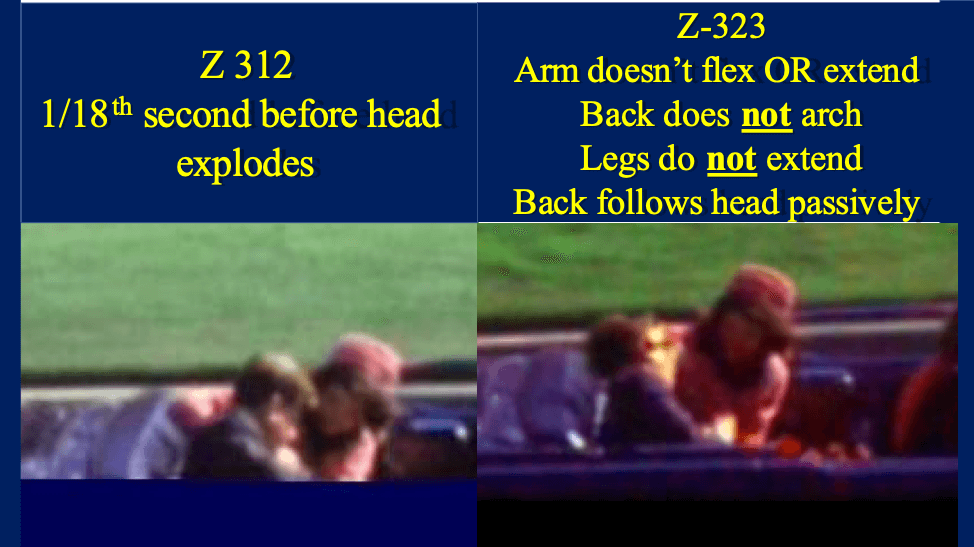
    Figure 6. Larry Sturdivan demonstrating JFK’s “neuromuscular reaction” to the fatal head shot at Zapruder. frame 313. His back is arched; his head is bent backward, and his arms are raised. Sturdivan’s posture is unlike JFK’s in frames that follow 313.
    Figure 7. Image left, 1/18th second before his head explodes: JFK’s head is tilted forward and slightly to the left. Image right, ½ second after he’s hit, it is JFK’s head that has moved backward, not his back. Unlike “Decorticate” or “Decerebrate” neuromuscular reactions, JFK’s back does not arch; his legs do not extend, his upper arms do not adduct. Rather, his back follows his head passively. His right arm neither flexes nor extends, but instead falls limply to his side.

    Furthermore, were Kennedy’s posture truly a decorticate or decerebrate reaction of some sort, it’s likely he’d have maintained that backward-arched posture. He doesn’t.

    In the Zapruder frames following frame 321, 4/9th seconds after the head shot, JFK bounces off the back seat of the limo and starts moving forward. His back then curls forward following his head, though at a slower speed than his head does. After frame 327, the advancing velocity of Kennedy’s head doubles from what it had been between frames 321 and 327, moving ahead at a faster clip than his head had rocketed rearward after the strike at 313. His back follows. Thus, Kennedy’s head and upper back not only “flexed” forward, when they should have been arching backward in decorticate or decerebrate spasm, his head also sped up, perhaps due to what Thompson has recently proposed: an acoustics matching, X-ray matching, second head shot striking JFK from behind at frame 327-8.[56] (see below)

    While there is much more that could be said, the point here is that Nalli had no reason but the obvious one to trust Sturdivan, Haag, and Posner on this. None have the requisite training or background. Nor do they grasp the neurophysiological phenomena they’ve invoked to defend the government’s preferred scenario. Moreover, they have no answer to the science-based debunkings that have previously been published. But what they do have is an allegiance to the government’s preferences.

    These are things Nalli would have known about “neuromuscular reaction” had he but followed standard scientific protocol and done a proper literature review prior to writing. If he had, he’d have addressed the AFTE piece Wecht and I wrote, the very one he cited in his own footnotes. That piece explored “neurospasm” in detail, with hot-linked footnotes to credible sources.[57] Instead, he ignored the science to stand with his cherry-picked, anti-conspiracy nonexperts. And not only on Kennedy’s reaction to the head shot. He also did so in another scientific area of the Kennedy case: Neutron Activation Analysis (NAA), a sophisticated technology once said to be able to match recovered bullet fragments to the bullets they came from.

    Neutron Activation Analysis and JFK

    On this issue, Nalli turned yet again to his Zelig—“neurospasm expert” Larry Sturdivan—who was now masquerading as an authority in another area of science in which, at best, he holds the rank of discredited amateur.

    In a junky, “peer reviewed” paper published in 2004, Sturdivan touted NAA as the Rosetta Stone: proof that all the bullets and fragments recovered from the assassination traced to but two rounds that had been firearms-matched to Oswald’s rifle.[58] Ergo, no one but Oswald could possibly have done it. That extraordinary, and seemingly dispositive, claim was first made to the House Select Committee on 8 September 1978 by NAA authority, Vincent Guinn, Ph.D.[59]

    In his review of Last Second in Dallas, Nalli touts Guinn. He writes:

    …that it was ‘highly probable’ that the fragments in Gov. Connally’s wrist were from the ‘stretcher bullet’ (CE399) found at Parkland Hospital and that the fragments from President Kennedy’s head were from the same bullet as the fragments found in the limousine, thereby providing strong evidence that only two bullets caused all the wounds.[60]

    Besides Guinn’s testimony and Sturdivan’s paper, there is other “peer reviewed” literature that backs Nalli up on NAA, including a paper written by Kenneth Rahn with Larry Sturdivan as coauthor,[61] as well as “peer reviewed” papers written by Lucien Haag touting NAA and published in the AFTE Journal.[62]

    (Nalli ignores that the government’s own evidence, and that of an FBI Agent, Bardwell Odum, have shown that the so-called “stretcher bullet” now in evidence—Warren Commission Exhibit #399—is not the same bullet that was found on a Parkland stretcher on 11/22/63. See “The Magic Bullet: Even More Magical Than We Knew?” by Aguilar and Thompson.[63])

    But Nalli did allow that, “There has apparently been some degree of legitimate dispute about the NAA findings of Guinn. However, counterarguments have since been advanced from forensic experts such as Larry Sturdivan (cf. The JFK Myths) (sic) and Luke Haag. Lacking personal expertise, I shall remain, for the time being, agnostic on Guinn’s findings. Sturdivan and Haag are not to be easily dismissed…”

    Nalli neither mentions nor alludes to what the “legitimate dispute” is all about, nor even who has disputed Guinn, Sturdivan, and Haag. He has a good, if ‘socially constructive,’ reason not to. It would be difficult to explain why untrained, uncredentialed, anti-conspiracy evangelistic “forensic experts,” Sturdivan and Haag, would also happen to have expertise on NAA that’s on par with their detractors who have, in fact, quite ‘easily dismissed’ Sturdivan and Haag (as well as Kenneth Rahn, Ph.D., Sturdivan’s coauthor).

    The ‘legitimate disputants’ Nalli didn’t think worth mentioning include the FBI’s National Laboratory, which abandoned the use of NAA to match bullets and fragments in 2005 because of its serious deficiencies;[64] two “conspiracy agnostic,” nationally recognized NAA authorities from Lawrence Livermore National Lab, Eric Randich, Ph.D. and Pat Grant, Ph.D, who debunked Guinn’s JFK claims in the prestigious Journal of Forensic Sciences[65] (Grant had studied for his Ph.D. under Guinn, among others, at UC Irvine, and bore him no malice.[66]), a distinguished professor of statistics at Texas A&M University, Clifford Spiegelman, Ph.D. and his coauthor, FBI chief lab examiner William Tobin, who, among other things, eviscerated the flawed statistical analysis the non-statistician, Sturdivan, had published supporting NAA,[67] and others.[68]

    Furthermore, Nalli had every good reason to know of these inconvenient “alternative” facts. They’ve attracted considerable interest among assassination students, and they are easily found by a google search.[69] Moreover, they were explored in extenso in a piece I wrote with coauthor Wecht that Nalli cites in his footnote #58. That article included a detailed discussion of the collapse of NAA in bullet matching studies, both in the Kennedy case and elsewhere. It also provided the citations found here, with hotlinks to the peer reviewed papers and the source documents themselves.[70]

    Moreover, Nalli fails to mention that neither Sturdivan nor Haag have any primary expertise in NAA. They have no applicable training or background, and no credible NAA research, apart from Sturdivan’s debunked statistical analysis that was demolished, without refutation, by the statistics professor at Texas A&M, by the NAA authorities at Lawrence Livermore Lab,[71] and by Stanford Linear Accelerator physicist, Arthur Snyder, Ph.D.[72]

    For Nalli to put lightweights Sturdivan and Haag on one side of the NAA scale, and these heavy-weight ‘legitimate disputants’ on the other, and say he sees an even balance is exactly the kind of anti-science, cherry picking that skeptics have learned to expect from pro-Warren “experts.” But the irony doesn’t end there.

    Referring to Thompson’s showcasing the work of the internationally recognized acoustics authority, James Barger, Nalli sniffed that “Thompson has no problem ‘appealing to authority’ when it suits him.” Barger, of course, is an actual internationally renowned authority to whom one may perfectly appropriately “appeal.” Nalli’s sources, not so much. He knowingly ignored credentialed, legitimate, published authorities, but had ‘no problem appealing to the authority’ of anti-conspiracy nonexperts who have fed him the discredited “science” he wants. Would that be the worst of Nalli’s problems. It’s not. His preposterous presuppositions are far worse.

    Nicholas Nalli’s Calculations Prove JFK Had an Extraordinary Brain

    One of Nalli’s sillier affronts to science has to do with the core of his anti-conspiracy case: how he explains physics of Kennedy’s jet recoil. After autopsy, JFK’s brain weighed 1500 grams. (Oddly the brain was not weighed during autopsy.) Nalli calculated that it must have weighed much more when he was struck, 2100 grams in fact. Why? Because his “physics based,” jet effect computations proved that a forward-jetting mass of 600 grams was physically required to give the propulsion necessary to drive Kennedy’s head rearward as fast as we see in the Zapruder film. Pure codswollop.

    What Nalli could have easily discovered in a 30-second google search, and what any legitimate “peer reviewer” would have told him, is that human brains simply don’t weigh anywhere near that much. Rather, it’s an unusual complete and undamaged brain at autopsy that even weighs as much as 1500 grams. The average weight being between 1250 grams and 1400 grams.[73] Nalli’s 2,100 gm brain “has been the cause of much merriment among the knowledgeable.” WhoWhatWhy researcher Milicent Cranor quipped, “It’s what publishers call a ‘howler.’”[74] Researcher David Mantik, MD, Ph.D. (physics) emphasized this as but one of Nalli’s myriad “Omissions and Miscalculations.”[75]

    Six months after Nalli’s paper came out, he put out a correction. “[I]t has also come to the author’s attention,” he wrote, “that the estimate used for President Kennedy’s ‘intact’ brain mass (2100 g) … was most likely too large, falling well outside of the normal range (probably more than 3σ) for human males; this is not an error per se, but rather simply an oversight.”[76] (our emphasis) “Most likely too large?” Ok. Not an error, “simply an oversight?” Ok again. But it wasn’t only Nalli’s “oversight,” it was also his “peer reviewers’” too. Did no one bother to google for even 30 seconds to check if one of Nalli’s core suppositions—JFK’s premortem brain weight—had any basis in reality?

    Unfazed, he reran calculations based on three new, hypothetical premortem brain weights: 1800 gm, 1650 gm, and 1500 gm. To get the requisite rearward thrust with these lower brain weights, Nalli simply upped the exit speeds at which he presumed the escaping brain mass must have jetted. The idea being that if a lower mass escaped at a higher velocity, it’d produce the same “jet effect” as a larger mass exiting at a lower speed. “These corrections,” he wrote, “do not affect any of the conclusions presented in the paper.” Jaw dropping.

    First, as previously noted, although not as extreme as 2100 grams, both 1800 grams and 1650 grams are also well beyond the range of a normal, complete adult human brain, both in the medical literature, as well as in the personal experience of coauthor Wecht, a forensic pathologist with over 40,000 autopsies under his belt. They might remotely be possible, but only if Kennedy had a very large cranium. As David Mantik pointed out, JFK’s head wasn’t particularly large; his hat size was average (7 3/8).[77]

    So then, how about Nalli’s third supposition, that Kennedy’s premortem brain might have weighed as little as 1500 grams? It was as preposterous as it was unsurprising that Nalli seriously proposed that Kennedy’s brain could still have weighed what it did before it was blasted, before much of it was blown all over the limousine, its occupants, the Secret Service agents, the motorcycle cops to JFK’s left and rear, all over Dealey Plaza, and even after Jackie had handed “a big chunk of the President’s brain” to Parkland’s treating anesthesiologist, Professor Marion T. (“Pepper”) Jenkins, MD.[78] We struggle to think of a clearer example of a “scientist” forcing evidence to fit his pet theory. Science is supposed to work by finding a theory that explains the evidence.

    (Outside the scope of this essay is the important question of how Kennedy’s severely blasted brain could turn up at autopsy weighing 1500 grams, which is more than an average, complete human brain. ARRB investigator Douglas Horne has suggested that two different “JFK” brains were examined during two different “supplemental” exams that were done at different times after the original autopsy. Some readers will shy from such a daring, “conspiratorial” assertion. However, can there be any doubt but that what remained of Kennedy’s actual brain didn’t weigh 1500 gms when it was pulled from his cranium? This important and fascinating issue is explored elsewhere.[79],[80])

    How Peer Reviewed Medical/Scientific Journalism is Corrupted in the Kennedy Case

    That so much pro-government nonsense got through peer review and into a scientific journal will come as no surprise to most Warren skeptics. It’s happened often. The mechanics of how this likely happened in Nalli’s case is an important and fascinating story, one that has clear traces to Nalli’s major source and most lauded collaborator, Larry Sturdivan.

    After reading Nalli’s paper in Heliyon, it occurred to us that we might try to publish one in that journal ourselves. We wrote one and put our submission through Heliyon’s required on-line portal, a now-standard process among scientific journals. After uploading it to the site, one of us (GA) followed Heliyon’s prompts to complete the process. Immediately the following asks from Heliyon popped up. GA stared at them in amazement and delight—Heliyon isn’t a real peer reviewed, scientific journal; it’s a pay-to-publish vanity journal!

    Prompt #1: Please suggest potential reviewers for this submission and provide specific reasons for your suggestion in the comments box for each person. Please note that the editorial office may not use your suggestions, but your help is appreciated and may speed up the selection of appropriate reviewers. Fill in as much contact information, ideally including a link to their Google Scholar, Scopus or institutional webpage to allow us identify the person correctly. Please avoid suggestions who have a conflict of interest, such as colleagues, collaborators, co-authors (shared publications in the last three years) or people with whom you share funding.

    “Current Suggested Reviewers List” Add Suggested Reviewer

    Prompt #2: Please identify anyone you would prefer not to review this submission. Fill in as much contact information to allow us to identify the person in our records, and provide specific reasons why each person should not review your submission in their comments box. Please note that we may need to use a reviewer you identify here, but will try to accommodate author’s wishes when we can. If you have additional concerns about this issue please indicate them in your cover letter.

    “Currently Opposed Reviewers List”

    Prompt #3: Article Publishing Charge. Heliyon is a fully Open Access journal. The journal’s costs are covered solely by author publication charges. There are no subscription fees for our readers, or page and figure charges for our authors. Accordingly, all authors of accepted articles will receive an invoice charging the article publication fee of $1,750 USD (plus VAT and local taxes where applicable).

    The journal explained its financial demand: “Heliyon has a small budget for reducing Open Access charges for authors in developing countries and others in genuine financial hardship…”

    Since Nalli doesn’t live in a developing country, nor is it likely he faces “genuine financial hardship,” it’s a safe bet that Nalli paid to have his work published, or that someone else paid for him. Given his whopping errors, it’s likely that Heliyon didn’t send it to knowledgeable, independent experts, but that Nalli picked them. And it was probably Nalli who specified whom he didn’t want reviewing it. Heliyon’s requirements prompted us to check Nalli’s acknowledgements.

    “First and foremost,” he wrote, “I am grateful to Larry M. Sturdivan (wound ballistics expert for the HSCA) (sic) for very helpful discussions pertaining to his previous work as well as for reviewing my initial drafts and providing expert feedback…I am also grateful for the critical reading and constructive professional feedback of the three anonymous peer-reviewers.” (our emphasis)

    “Anonymous peer-reviewers”? Not likely, given that Heliyon explicitly asks authors to suggest the reviewers they want. Nalli’s published rubbish proves precisely why peer review by knowledgeable, independent, anonymous reviewers is so important. Nalli’s reviewers were almost certainly uninformed, incurious, anti-conspiracy advocates. As one of us (GA) pondered this discovery, he had a déjà vu moment.

    Nalli’s charade bears a striking resemblance to an analogous episode in 2003 and 2004, in which Sturdivan had played a similar, behind-the-scenes role. In that case, Sturdivan hornswoggled a respected, legitimate “peer review” journal, Neurosurgery, into letting him collaborate with, and “peer review,” error-ridden, pro-Warren Commission work that the hapless journal editors published. It’s a fascinating tale, one that embarrassed both the journal and a respected University of California, San Diego neurosurgery professor who was left holding the bag. It also hints at a pattern: anti-conspiracists publishing under the respected mantle of “peer reviewed” scientific journalism, while violating the principles that have earned the “peer review” process deserved admiration.

    see Part 2


    [1] Aguilar G. Cunningham, K. “How Five Investigations into JFK’s Medical/Autopsy Evidence Got It Wrong.” May, 2003. Available here.

    Cyril Wecht, MD, JD. New York Times, 6/12/1975. “Doctor Says Rockefeller Panel Distorted His View on Kennedy.” Available here.

    [2] Alvarez L, “A Physicist Examines the Kennedy Assassination Film,” American Journal of Physics, Vol. 44, No. 9, September, 1976. Available here.

    [3] Cranor, M. “Scientist’s Trick ‘Explains’ JFK Backward Movement When Shot.” Available here.

    [4] “When was the Zapruder film first shown to the American people?” Available here.

    [5] Alvarez L, “A Physicist Examines the Kennedy Assassination Film,” American Journal of Physics, Vol. 44, No. 9, p. 819, September, 1976. Available here.

    [6] Alvarez L, “A Physicist Examines the Kennedy Assassination Film,” American Journal of Physics, Vol. 44, No. 9, September, 1976. Available here.

    [7] Lattimer JK, Lattimer JK, et al. “Differences in the Wounding Behavior of the Two Bullets that Struck President Kennedy; An Experimental Study,” Wound Ballistics Review, V2(2)361995. Available here.

    [8] Nalli, Nicholas. Gunshot-wound dynamics model for John F. Kennedy assassination. Heliyon. Vol. 4, No. 4, e00603, April 01, 2018. Available here.

    [9] Lattimer JK, Lattimer J, Lattimer G. “An Experimental Study of the Backward Movement of President Kennedy’s Head,” Surgery, Gynecology & Obstetrics. February, 1976, Vol. 142, pp. 246–254. Available here.

    [10] Lattimer, J. Kennedy and Lincoln. New York: Harcourt, Brace, Jovanovich, 1980, p. 250.

    [11] Lattimer JK, Lattimer J, Lattimer G. “An Experimental Study of the Backward Movement of President Kennedy’s Head,” Surgery, Gynecology & Obstetrics. February, 1976, Vol. 142, pp. 246–254. Available here.

    [12] Josiah Thompson, Ph.D. gave a public lecture in October, 2013 and projected images from Alvarez’s shooting tests. Wecht Center Symposium on the 50th Anniversary of the Assassination of President Kennedy Available here.

    [13] Aguilar G. Wecht CH. AFTE Journal, Vol. 48, No 2, Spring 2016, p. 712. Available here.

    [14] Nalli, N. “The Ghost of the Grassy Knoll Gunman and the Futile Search for Signal in Noise,” a review of J. Thompson’s book, “Last Second in Dallas,” 6.3.21. Available here.

    [15] Nalli, N R. “The Ghost of the Grassy Knoll Gunman and the Futile Search for Signal in Noise,” a review of J. Thompson’s book “Last Second in Dallas” published on 6/3/21. Available here.

    [16] Donald Byron Thomas, Hear No Evil – Social Constructivism & Forensic Evidence in the Kennedy Assassination. Ipswich, MA. Mary Ferrell Foundation Press, 2010

    [17] Thompson, Josiah, Last Second in Dallas. Lawrence, Kansas. University Press of Kansas, 2021, pp. 281–284.

    [18] * The Vela Incident – Nuclear Test or Meteoroid? National Security Archive. Available here.

    * A good summary of government evidence proving a nuclear blast in the Vela Incident is available in: Report on the 1979 Vela Incident. Available here. [“(Investigative journalist Seymour) Hersh reports interviewing several members of the Nuclear Intelligence Panel (NIP), which had conducted their own investigation of the event. Those interviewed included its leader Donald M. Kerr, Jr. and eminent nuclear weapons program veteran Harold M. Agnew. The NIP members concluded unanimously that it was a definite nuclear test. Another member—Louis H. Roddis, Jr.—concluded that ‘the South African-Israeli test had taken place on a barge, or on one of the islands in the South Indian Ocean archipelago.’” [Hersh 1991; pg. 280-281. Available here.] He also cited internal CIA estimates made in 1979 and 1980 which concluded that it had been a nuclear test.

    “The U.S. Naval Research Laboratory conducted a comprehensive analysis, including the hydroacoustic data, and issued a 300-page report concluding that there had been a nuclear event near Prince Edward Island or Antarctica [Albright 1994b].”

    [19] Alvarez L, “A Physicist Examines the Kennedy Assassination Film, American Journal of Physics Vol. 44, No. 9, p. 817. September, 1976. Available here.

    [20] The speed of sound, known as Mach 1, varies depending on the medium through which a sound wave propagates. In dry, sea level air that is around 25 degrees Celsius, Mach 1 is equal to 340.29 meters per second, or 1,122.96 feet per second.” Available here.

    [21] Robert C. Maher. “Summary of Gun Shot Acoustics,” Montana State University 4 April 2006. “A supersonic bullet causes a characteristic shock wave pattern as it moves through the air. The shock wave expands as a cone behind the bullet, with the wave front propagating outward at the speed of sound.” Available here.

    [22] Don Thomas. Hear No Evil. Ipswich, MA. Mary Ferrell Foundation Press, 2010, pp. 362–363.

    [23] Dr. John Lattimer fired at human skulls from above and behind with a rifle and ammunition identical to those Oswald used. Clicking on the image at right will download a video clip of one of Lattimer’s shooting experiments. Note that the ladder rocks forward after bullet impact, reflecting the forward momentum transfer.

    [24] Lattimer JK, Lattimer J, Lattimer G. “An Experimental Study of the Backward Movement of President Kennedy’s Head,” Surgery, Gynecology & Obstetrics. February, 1976, Vol. 142, pp. 246–254. Available here.

    [25] The Journal of Irreproducible Results 1980-2003. Available here.

    [26] Haag, L. “President Kennedy’s Fatal Head Wound and his Rearward Head ‘Snap,’” AFTE Journal, Vol. 46, No. 4, Fall 2014, p. 283; see Figure 8

    [27] Haag, L. President Kennedy’s Fatal Gunshot Wound and the Seemingly Anomalous Behavior of the Fatal Bullet. AFTE Journal, Vol. 46, No. 3, Summer 2014, p. 218ff.

    [28] John Nichols, MD shooting experiments, accessed at Baylor University. Available here.

    [29] Sturdivan LM. HSCA testimony, Vol.1:404. Available here.

    [30] Sturdivan LM. The JFK Myths. St. Paul, MN: Paragon House, 2005, p. 164.

    [31] Sturdivan LM. The JFK Myths. St. Paul, MN: Paragon House, 2005, p. 164.

    [32] Sturdivan LM. The JFK Myths. St. Paul, MN: Paragon House, 2005, p. 162.

    [33] Nalli, Nicholas. Gunshot-wound dynamics model for John F. Kennedy assassination. Heliyon. Vol. 4, No. 4, e00603, April 01, 2018. Available here.

    [34] Sturdivan LM. The JFK Myths. St. Paul, MN: Paragon House, 2005, p. xxiii.

    [35] Sturdivan LM. The JFK Myths. St. Paul, MN: Paragon House, 2005, p. 170.

    [36] Sturdivan, L. Letter to the editor. AFTE Journal. 2015 Vol. 47, No. 3, p. 143.

    [37] “Report to the President by the Commission on CIA Activities within the United States,” June, 1975. Available here.

    [38] Hersh S M, “Huge C.I.A. Operation Reported in U.S. Against Antiwar Forces, Other Dissidents in Nixon Years,” New York Times, 12.22.74. Available here.

    [39] Rockefeller Commission Report, Chapter 19, p. 257 ff. Available here.

    [40] George Washington University’s National Security Archive documented that the Rockefeller Commission “ceded its independence to White House political operatives.” Available here.

    [41] “Gerald Ford White House Altered Rockefeller Commission Report in 1975; Removed Section on CIA Assassination Plots,” National Security Archive. Available here.

    [42] See: Aguilar G, Cunningham K. A detailed discussion and source documents are available on line at: “How Five Investigations into JFK’s Medical/Autopsy Evidence Got It Wrong,” Part IV. The Rockefeller Commission. Available here.

    [43] Aguilar G, Cunningham K. “How Five Investigations into JFK’s Medical/Autopsy Evidence Got It Wrong,” Part IV. The Rockefeller Commission, 2003. Available here.

    [44] Lattimer JK, Lattimer J, Lattimer G. “An experimental Study of the backward Movement of President Kennedy’s Head,” Surgery, Gynecology & Obstretics, Vol. 142, pp. 246–254. Feb, 1976. Available here.

    [45] Rockefeller Commission Report chapter 19, p. 261–263. Available here.

    [46] Aguilar G, Cunningham K. “How Five Investigations into JFK’s Medical/Autopsy Evidence Got It Wrong,” Part V. The ‘Last’ Investigation – The House Select Committee on Assassinations, 2003. Available here.

    [47] HSCA, Vol. 7, p. 174. Available here.

    [48] Zapruder frame 230. Available here.

    [49] Zapruder frame 320. Available here.

    [50] Sturdivan LM. The JFK Myths. St. Paul, MN: Paragon House, 2005, p. 170.

    [51] Sturdivan L. HSCA testimony, p. 417. Available here.

    [52] Rockefeller Commission Report, p. 262. Available here.

    [53] Sturdivan, L M., “The JFK Myths: A Scientific Investigation of the Kennedy Assassination,” Paragon House, St. Paul, MD (2005), pp. 164, 166.

    [54] Sturdivan L. HSCA testimony. Vol. 1, p. 415. Available here. [Full quote: “Now, the extreme radial velocity imported to the matter in the President’s head, the brain tissue, caused mechanical movement of essentially everything inside the skull, including where the cord went through the foramen magnum, that is, the hole that leads out of the skull down the spinal cord. Motion there, I believe, caused mechanical stimulation of the motor nerves of the President, and since all motor nerves were stimulated at the same time, then every muscle in the body would be activated at the same time. Now, in an arm, for instance, this would have activated the biceps muscle but it would have also activated the triceps muscle, which being more powerful, would have straightened the arm out. With leg muscles, the large muscles in the back of the leg, are more powerful than those in the front and, therefore, the leg would move backward. The muscles in the back of the trunk are much stronger than the abdominals and, therefore, the body would arch backward.”]

    [55] “Larry Sturdivan Arched Dramatically Backwards.” Available here.

    [56] Thompson J. Last Second in Dallas. Op. Cit.

    [57] Nalli, Nicholas. Gunshot-wound dynamics model for John F. Kennedy assassination. Heliyon. V.4(4), e00603, April 01, 2018. Available here. See footnote #58 citing letter by G Aguilar, MD and C. Wecht, MD, JD. The actual letter, as published by the AFTE Journal. Available here.

    [58] Sturdivan L, Rahn K. “Neutron Activation and the Kennedy Assassination – Part II, Extended Benefits.” Journal of Radioanalytical and Nuclear Chemistry, Vol. 262, No. 1 (2004), p. 221.

    [59] Testimony of Dr. Vincent P. Guinn, Sept. 8, 1978, I HSCA-JFK hearings, 491ff. Available here.

    [60] Nalli, N R. “The Ghost of the Grassy Knoll Gunman,” a review of J. Thompson’s book “Last Second in Dallas” published on-line, 6/3/21. Available here.

    [61] * Rahn K, Studivan L. “Neutron activation and the JFK assassination Part I. Data and interpretation.” Journal of Radioanalytical and Nuclear Chemistry, Vol. 262, No. 1 (2004), pp. 205, 213.

    * Sturdivan L, Rahn K. “Neutron Activation and the Kennedy Assassination – Part II, Extended Benefits.” Journal of Radioanalytical and Nuclear Chemistry, Vol. 262, No. 1 (2004), p. 221.

    [62] *Haag L. “Tracking the ‘Magic’ Bullet in the JFK Assassination,” AFTE Journal, Vol. 46, No. 2, Spring 2014.

    * Authors Aguilar and Wecht published a rebuttal to Haag’s defense of NAA in the AFTE Journal. Haag doubled down on his defense of NAA in a letter published by the AFTE Journal: Haag. L. “Author’s response to Doctors Aguilar and Wecht.” AFTE Journal, Vol. 47 No. 3 (Summer 2015), p. 139.

    [63] Available here.

    [64] “FBI Laboratory Announces Discontinuation of Bullet Lead Examinations,” September 1, 2005. FBI National

    Press Office. Available here.

    Possley, M., “Study shoots holes in bullet analyses by FBI,” Chicago Tribune, 2.11.2004

    [65] * Erik Randich Ph.D., Patrick M. Grant Ph.D., Proper Assessment of the JFK Assassination Bullet Lead Evidence from Metallurgical and Statistical Perspectives. Journal of Forensic Sciences, V.51(4)717 ff.July 2006. Available here.

    * Erik Randich 1 , Wayne Duerfeldt, Wade McLendon, William Tobin. A metallurgical review of the interpretation of bullet lead compositional analysis. Forensic Sci Int. 2002 Jul 17; 127(3), pp. 174–91.

    [66] Pat Grant, Ph.D. “Commentary on Dr. Ken Rahn’s Work on the JFK Assassination Investigation.” Available here.

    [67] Cliff Spiegelman, William A. Tobin, William D. James, Simon J. Sheather, Stuart Wexler and D. Max Roundhill. CHEMICAL AND FORENSIC ANALYSIS OF JFK ASSASSINATION BULLET LOTS: IS A SECOND SHOOTER POSSIBLE?

    The Annals of Applied Statistics 2007, Vol. 1, No. 2, pp. 287–301. Available here.

    [68] * Giannelli, Paul, “Comparative Bullet Lead Analysis: A Retrospective,” Case Western Reserve, Sept., 2001. Available here.

    * William Tobin. “Comparative Bullet Lead Analysis: A Case Study in Flawed Forensics,” www.nacdl.org The Champion. Available here.

    * Charles Pillar. “Report Finds Flaws in FBI Bullet Analysis.” Los Angeles Times, 2/4/2004. Available here.

    [69] Cliff Spiegelman, Ph.D. “What new forensic science reveals about JFK assassination.” Salon.com, 12/12/2017. Available here.

    See also: Pat Grant, Ph.D. (Lawrence Livermore Laboratory). Commentary on Dr. Ken Rahn’s (NAA) Work on the JFK Assassination Investigation. Available here.

    [70] Available here.

    [71] See Pat Grant’s evisceration of NAA defender, Ken Rahn. “Commentary on Dr. Ken Rahn’s Work on the JFK Assassination Investigation.” Available here.

    [72] Arthur Snyder, Ph.D. Comments on the Statistical Analysis in Ken Rahn’s Essay: “Neutron-Activation Analysis and the John F. Kennedy Assassination.” Available here.

    [73] Brain Facts and Figures. Available here.

    [74] Cranor, Milicent. Scientist’s Trick ‘Explains’ JFK Backward Movement When Shot, 05/31/18. Available here.

    [75] Mantik, D. The Omissions and Miscalculations of Nicholas Nalli. Available here.

    [76] Nalli, N. Corrigendum to “Gunshot-wound dynamics model for John F. Kennedy assassination” [Heliyon 4 (2018) e00603], 10/1/2018. Available here.

    [77] Op cit. Available here.

    [78] “JFK in Trauma Room One: The Missing Piece: Last Moments Before Death.” A YouTube video of Parkland Professor Marion T. Jenkins, MD discussing the assassination. This quote can be heard at and after the 5 minute, 25 second mark. Available here.

    [79] Assassinations Records Review Board investigator, Doug Horne. “The Two Brain Memorandum.” Available here.

    [80] See Doug Horne, “Questions Regarding Supplementary Brain Examination(s) Following the Autopsy on President John F. Kennedy.” ARRB Memorandum for file, 8/28/1996, revised 6.2.1998. Available here.

  • The Strange, Strange Story of Governor Connally’s Shirt & Coat and Congressman Henry B. Gonzalez

    The Strange, Strange Story of Governor Connally’s Shirt & Coat and Congressman Henry B. Gonzalez


    Not only does the assassination of John F. Kennedy in 1963 remain a riddle in terms of the actual perpetrators, but innumerable aspects of the case defy explanation or are simply inexplicable. As JFK researchers know, there is seemingly not a single straight line in the entire saga and that includes the confounding topic of the Arrow-brand dress shirt and the suit-jacket worn on November 22 by Governor John B. Connally.

    As reported here, it was 50 years after the assassination that Connally’s shirt and suit were put on display by the Texas State Library & Archives Commission on mannequins inside a large glass enclosure.

    Fortunately for researchers, the physical display in Austin in 2013 was supplemented by an extensive online photograph collection of the clothing, including a picture of the rear bullet-hole in the fabric of Connally’s shirt. The hole was helpfully measured by commission staff and labelled at “3/8th by 3/8th inches.”[1]

    Longtime JFK researcher and Connally-wounding specialist Gary Murr has provided an even better photo, one that he personally authorized the shooting of, which illustrates similar measurements for the bullet-hole. It even more clearly reveals the mysterious straight lines of cloth above and below the hole.

    The straight lines alongside the bullet hole in the rear of Connally’s Arrow shirt may have been caused by technicians removing cloth for testing. Note the one-inch scale.

    In any event, the Archive and Murr photographs alone are a near death-blow to the “tumbling” or single bullet theory (SBT) theory of the JFK assassination.

    Why? The large slug from a Mannlicher Carcano rifle, of Western ammo manufacture, measured a little more than a ¼ inch in diameter and 1¼ inches in length.

    The Warren Commission Single Bullet Theory (SBT) posits that the slug, after first passing through JFK’s neck, then tumbled and plunked Gov. Connally sideways, on its long side.

    But the bullet hole in Connally’s shirt, as measured by the Archives or in the Murr photograph, is scarcely larger than the diameter of the Western ammo slug, and moreover, is no larger, and in some respects smaller, than the bullet hole in the rear of JFK’s shirt.

    No one has ever suggested a bullet tumbled as it struck JFK in the back.

    Setting that aside, let’s review the strange tale of Governor Connally’s post-JFK assassination traveling shirt and coat.

    The Journey of the Governor’s Shirt

    Long before Connally’s Arrow shirt and suit jacket ended up on display in Texas, they first, of course, visited the Parkland Memorial Hospital in Dallas on Nov. 22 1963.

    The timeline thereafter appears to be:

    1. Connally’s suit jacket and shirt, but evidently not the trousers, were then mysteriously hand-carried in bloody paper bags to Washington, D.C. by Congressman Henry B. Gonzalez, who stored them in his office closet for an estimated two weeks.

    2. Two Secret Service agents then took the garments, but not to the FBI. Evidently on orders from the White House, the clothes were sent back to Texas and Mrs. Connally. The Governor’s wife might have washed the shirt in a tub of cold water, but more likely sent the clothes to professional cleaning service.

    3. Then, possibly, the shirt and coat and other garments, were sent to the Texas Archives in Austin, Texas, although this is not verified.

    4. The Governor’s clothes were then sent back to Washington and to the Warren Commission offices on April Fool’s Day 1964, where they were examined.

    5. The Connally assassination-day clothes were then finally sent on eight days later to the FBI lab, also in Washington.

    Yes, the above journey is what happened to primary evidence—Connally’s shirt and suit jacket—in the assassination of a US President and serious wounding of a Texas Governor.

    Researcher Murr has put his gimlet eye for decades on the inexplicable journey of Connally’s clothing, and yet even he has concluded there are still unexplained holes in the story. Much of the following account rests upon the work of Gary Murr.

    Parkland Memorial Hospital

    After being shot, Connally was rushed to Parkland Memorial Hospital where the Governor’s shirt and coat were removed in preparation for surgery. A Parkland Hospital nurse testified before the Warren Commission in 1964 that she had exited the room in which Connally awaited surgery, visited an impromptu waiting room, handed two paper bags containing Connally’s coat, tie, and shirt, but not his trousers, to one Cliff Carter, and made out a receipt thereof.[2]

    Parkland Hospital Receipt

    Indefatigable researcher Murr has uncovered the probable receipt, although a description of the clothes is not on the receipt. The receipt does indicate $163.59 in cash (about $1,467 in 2021 dollars) was taken from Connally’s clothes and given to the hospital cashier. Murr points out there was yet a third paper bag, likely containing Connally’s pants, but they are not part of this story.

    Here is where the first oddity surfaces: Cliff Carter was not related to Connally, nor did he work for him. He was not even an employee of the State of Texas. He was a close aide and money-bagger for soon-to-be President Lyndon Baines Johnson. For whatever reason, Carter then had freshman U.S. Congressman Gonzalez of the 20th district in San Antonio—yes, San Antonio and not Dallas—accept the coat and shirt in the paper bags, described in many accounts as “blood soaked.” Gonzalez had been in the fateful Dallas motorcade with Connally and Kennedy, but several vehicles back.

    Now, one might think Carter and Gonzalez would make dead certain that Connally’s garments, which were valuable primary evidence in the crime of the century, would immediately find their way to either the Dallas Police Department or the FBI. As Gonzalez recounted matters later for several JFK researchers, he tried to give the clothes to someone in authority while in Dallas, but was rebuffed, and thereafter ended up on the Air Force Two jet headed back to Washington, “nearly unconscious” that he still held the two blood-soaked paper bags in his hands.[3]

    The Air Force Two jet until that very day had been LBJ’s jet and ferried the remainder of Johnson’s entourage back to Washington, excepting those already ensconced on Air Force One.

    Worth noting is that in 1961 then-Vice President LBJ, who was also perhaps still the most powerful politician in Texas, appeared at shopping centers and supermarkets in San Antonio to support Congressman Gonzalez in his first and successful bid for national office. Gonzalez was his own man, but also a Congressional freshman and an LBJ protege.

    Congressional Closet?

    As Gonzalez relates matters, upon departing Air Force Two, he returned to his office and placed the blood-soaked paper bags into his closet, untouched and unopened, where they sat for two or more weeks. Of course, FBI HQ is also in Washington DC, but Gonzalez did not send the clothes there. He also did not drive by himself one day on his way to work and deliver the clothes, but said he did try to contact authorities about the paper sacks.

    Back to Texas

    The timelines are fuzzy, but as related by the late publisher Penn Jones of the Midlothian Mirror, author Fred Newcomb, and in Murr’s research, Gonzalez said that eventually LBJ’er Cliff Carter sent two “Secret Service men” for the blood-soaked paper bags at his Washington office, but while Gonzalez was back in Texas among his constituents. An assistant in his office gave the paper bags to the Secret Service pair, but did not receive a receipt.[4]

    Researcher Murr has unearthed documents that reveal the governor’s wife had contacted the FBI on Nov. 28. Working through the authority of the governor’s office, she had asked about the location of her husband’s shirt, jacket, and other items.

    Mrs. Connally recounted one version regarding Connally’s clothes to Life magazine in 1966, “We finally located John’s shirt and suit coat, which we were concerned about because the wallet and personal papers in his breast pocket, in Congressman Henry Gonzalez’ clothes closet in Washington.” In Mrs. Connally’s 1966 account, persons unknown then delivered the Governor’s blood-soaked garments to Mrs. Connally, then residing in the Texas Governor’s Mansion.[5]

    In any event, as Mrs. Connally related to Life magazine, she had the shirt and suit jacket in her possession for “seven weeks.” Then she decided to dip the shirt into cold water several times, remove flesh and blood, and to “preserve it.”

    Investigators were not concerned about Connally’s clothes, as she recalled, in her interview with Life magazine. “I told the Secret Service, and I guess the FBI, that I had the clothes, but nobody seemed interested.” After that, she related, “someone finally came to pick up his clothes.”

    By Mrs. Connally’s 1966 account, she did not have the clothes or jacket laundered or dry-cleaned.

    And so, for decades, there was something of a mystery of who had professionally cleaned and pressed Connally’s shirt and jacket before their arrival at the Commission in Washington. Maybe there still is.

    But four decades later, and further confusing matters, Mrs. Connally also provided a second version of what happened to Connally’s assassination-day clothes. This was on the 40th anniversary of her husband’s shooting, in her book, From Love Field, published in 2003:

    Much later (after November 22), I received his clothes in the mail, unpressed and uncleaned, in exactly the same condition as when they had been cut from him at Parkland. I couldn’t bear to look at the blood, nor did I feel right about destroying them, so I told the cleaner to remove the stains as best he could but do nothing to alter the holes or other damage, which is exactly what he did.[6]

    Oddly, in her 2003 rendition of events, Mrs. Connally does not say why she wanted her husband’s clothes back.

    What Really Happened?

    Of course, at this late date there is no way to verify which account of Mrs. Connally’s is the true version; or if there is another, even truer version to be told. For the record, Connally’s clothes were not cut from his body, but merely removed, and were not sent to her in the mail.

    In addition, researcher Murr is dubious that valuables were in the Connally suit breast pocket, post-assassination. The hospital’s records that are extant indicate valuables were removed from Connally’s clothing with the cash being sent on to the hospital cashier.

    There is another puzzler: Photos commissioned by researcher Murr show the inside breast pocket of John Connally’s Oxxford Clothes-brand jacket as having been pierced by the same bullet that passed through him.

    If there had been a billfold or wallet in that breast pocket it likely would have been pierced by a bullet—and thus would also be important evidence.

    The bullet hole in the interior right side of Connally’s jacket, showing a hole through the breast pocket.

    After Mrs. Connally had the clothes professionally cleaned and pressed, it appears the shirt and suit and other items were then sent to the Texas State Archives, although Murr says this bit of the garment’s itinerary has not been verified.

    In any event, on March 30, 1964, the Warren Commission (WC) asked the Secret Service to bring Connally’s jacket and shirt to Washington for examination. By March 1964, nearly five months had passed since the assassination and no investigative body had examined Connally’s clothing. The shirt and jacket arrived at the WC on the suitable date of April 1st.

    When the WC asked Governor Connally about the condition of the clothes on April 21, 1964, he responded, “They, the Archives of the State of Texas, asked for the clothing, and I have given the clothing to them. That is where they were sent from, I believe, here, to this Commission.” Researcher Murr is dubious about Connally’s answer, noting the Governor’s lawyerly use of the qualifying word “believe.” However, there are no hard records from what location the garments were sent to the WC.

    There is an internal memo that reveals the WC examined the Connally clothes before sending the garments to the FBI. WC staffer Norman Redlich wrote on April 10th to Lee Rankin, “We have examined Governor Connally’s clothing and sent it to the FBI Lab for tests on the question of exit and entry holes.” The WC wanted some evidence to work into its single-bullet theory.

    In any event, Robert Frazier, the FBI’s lead firearms and ballistics examiner at the time, told the WC that Connally’s shirt and jacket had been subjected to “cleaning and pressing.” Thus, no trajectories could be divined from the bullet holes in the items. More importantly, the cleaning and pressing of Connally’s shirt and coat were remarkably effective and evidently removed metallic traces from the bullet holes, effectively enough that the technology of the day, spectrographic analysis, could find nothing.[7]

    Later the House Select Committee on Assassinations (HSCA) would also subject Connally’s assassination-day clothes—including his shirt—to testing and would find traces of copper, iron, and lead.

    HSCA Tests

    Nearly 15 years after the JFK murder, and after who knows how much handling by Secret Service men, spouses, dry-cleaners, WC staff, Texas Archive staff, and FBI investigators, Connally’s garments would be subjected to even more exacting tests, conducted by the Institute of Forensic Sciences in Dallas at the behest of the HSCA.[8]

    The tests were so sensitive that iron was detected near the bullet holes in Connally’s clothes, from blood that had been deposited in 1963, despite the passage of time and the professional cleaning of years earlier. Yes, evidently Connally did not have “iron poor blood,” and that iron had been detected around the bullet holes in Connally’s clothing, claimed the institute.

    Lead was found near the rear bullet hole in Connally’s shirt along with amounts of copper, but considered “trace” or too small be meaningful. However, a curiosity of the 1978 testing is that less copper but more lead was found at the rear bullet hole in Connally’s shirt than from a “back control” sample.

    Given that the WC and HSCA storyline is that a copper-jacketed bullet passed through Connally, the finding of trace amounts of lead in the rear hole in the Governor’s clothing is interesting. Copper, in amounts considered meaningful, was found “in the region of the defect in the right front,” of Connally’s suit coat. “The results would indicate that the apparent borderline copper analysis is due to the lining containing some copper. Iron, apparently from blood, was still detectable near the right front defect in the coat, despite dry cleaning,” reported the Institute of Forensic Sciences.

    The results of the 1978 testing, as usual in all matters JFK, raise more questions than answers.

    The only hole that exhibited copper in more than trace amounts was the “defect” or very small hole in the front of Connally’s jacket, where a bullet exited. But here, a control sample—that is cloth not associated with a bullet strike—first yielded an even larger amount of copper than cloth near a bullet hole. But the Southwestern Institute of Forensic Sciences said the high copper count in the control cloth was “aberrant,” as proved by repeat analyses of other control samples.

    You can’t make this stuff up. Test until you get the right results. It should be noted that the HSCA investigation, like the WC investigation, did not have a “defense counsel” who asked probing questions about evidence in question.

    Cliff Carter

    Cliff Carter, the LBJ aide who put the two bloody sacks of clothing into Congressman’s Gonzalez’s hands on November 22, is also worth pondering. Carter was regarded as a “bagman,” who would collect cash for LBJ’s campaigns, or for other expenses, and handled other dark areas for LBJ.

    According to Billy Sol Estes, Carter was also aware of the planning for the murder of Henry Marshall, a U.S. Department of Agriculture investigator who learned of Estes’ illegal scheme to illegally buy certain cotton allotments from smaller farmers. Agriculture agent Marshall was found dead in 1961 of five gunshots from a single-shot bolt-action rifle, and carbon monoxide poisoning to boot, but Texas authorities deemed the death to be a suicide. That ruling stood for decades, until a Grand Jury in 1985 reviewed the case and almost certainly corrected the ruling to murder.

    In later years, Estes, who graced the cover of Time magazine 1962, would tell unverifiable tales regarding a clutch of murders of people in LBJ’s orbit.

    But for the purposes of this story, the inquiry would be: Did Carter, even within two hours of the JFK hit, and in Parkland hospital, have presence of mind to recognize that controlling evidence could be important to the outcome of the JFK investigation?

    Did Carter actually advise Gonzalez to take the two bloody paper sacks containing Connally’s clothes and then to sit tight until further instructions were received? Thus, Gonzalez became an unwitting “cut out” man in the sequestering of primary evidence.

    Indeed, was “controlling the evidence” second nature for Carter, after having been involved in various and serious LBJ scrapes with the law, up to and including murder? In other words, gain control over evidence first and always in every untoward event, then later determine if there are advantages to withholding or releasing evidence?

    Moreover, Mrs. Connally’s tale about wanting the assassination-day shirt and suit-jacket back to retrieve a wallet also does not hold water. First, hospital records indicate Connally’s money and valuables were removed from his clothing. Secondly, if the hospital staff had missed a wallet, and left it in a suit jacket breast pocket, why did not Mrs. Connally ask for the wallet back and not bloodied clothes?

    At this late date, mind-reading Carter and divining who may have given instructions to Mrs. Connally or Gonzalez is a parlor game. Back in 1964 no one at the WC grilled Mrs. Connally, Carter, or Gonzalez about the inexplicable treatment of the bloodied sacks of clothing. Carter died in 1971, taking whatever secrets he had with him.

    Back to Gonzalez

    Of course, the JFK saga contains an unlimited amount of coincidences and many, many unusual turns of events.

    In 1976, the U.S House voted 280–65, to establish the Select Committee on Assassinations (HSCA) in order to investigate the assassinations of JFK and Martin Luther King Jr. A vote that followed the national screening of the Zapruder film on the TV show Good Night America in 1975. The chairman of the HSCA was outgoing Congressman Thomas Downing of Virginia, who harbored deep suspicions about the JFK case. And he hired a tough, well-regarded Philadelphia District Attorney, one Richard Sprague, as HSCA Chief Counsel.

    But Downing would soon retire, and he turned over the reins to Gonzalez—yes, the very same Gonzalez who 13 years prior had hand-carried Connally’s assassination-day clothes to his closet in Washington, where they mysteriously sat for two weeks.

    At first, the ascendance of Gonzalez was comforting to JFK researchers, as he also seemed dubious about the WC conclusions and the nature of the JFK case. The irony of what was to follow is almost cosmic.

    Veteran JFK researcher Jim DiEugenio interviewed Downing in his office in Newport News back in the 1990s. The former congressman showed DiEugenio the ballot that Gonzalez submitted for Chief Counsel in September of 1976 and that Sprague’s nomination had been made by Gonzalez himself.

    So, it appeared in late 1976 that the HSCA has a no-nonsense and smart chief counsel, backed by a solid chairman (the question of Connally’s clothes having been long forgotten).

    Yet as JFK researchers know, as soon as Sprague began to probe connections between Lee Harvey Oswald and the CIA, and connections between the Miami office of the CIA and anti-Castro Cuban exiles, stories began appearing in influential print publications questioning Sprague’s ethics and work history back in Philadelphia.

    Based on some rather picayune bureaucratic and procedural tensions, HSCA Chairman Gonzalez began attacking Sprague publicly, called him a “rattlesnake,” and loudly roasted him for misconduct and mismanagement. Sprague’s rather small and iffy budget was scrutinized and challenged and the Philly DA was accused of not following the Committee’s directions.

    Gonzales ultimately tried to fire Sprague, but on such flimsy grounds that the full committee overruled the firing. Nevertheless, the well was poisoned, and the erstwhile Philly DA did leave his post when he was told his departure was a condition of the HSCA obtaining future funding.

    Even Gaeton Fonzi, the superb JFK researcher who was a staffer on the HSCA under Sprague, and who authored the book, The Last Investigation, strained to explain Gonzalez’ behavior, offering little more insight than Gonzalez was “flying off the handle.”

    To this day, a good explanation of Chairman Gonzalez’ behavior at HSCA—on the surface, inexplicable—has not been rendered. The veteran researcher DiEugenio does offer up one possible explanation in his book The Assassinations: That there were moles planted on the HSCA to exacerbate the antagonism between Sprague and Gonzalez and one issue was Gonzalez and his curious role in the post-JFKA sojourns of Connally’s clothes.

    For those familiar with the history of New Orleans District Attorney Jim Garrison and his 1969 investigation of the JFKA, the possibility of moles or CIA-plants on the HSCA staff is not hard to believe—Garrison’s staff was infested with national security state operatives, some of whom actually leaked information to defense counsel for Clay Shaw, the CIA operative who Garrison suspected played a role in handling Lee Harvey Oswald.

    After both Sprague and Gonzalez left the HSCA, the new chairman was the diffident Congressman Louis Stokes of Ohio, who brought in Robert Blakey, a US Justice Department mafia prosecutor, as HSCA chief counsel.

    Blakey was entirely the wrong man for the job: an earnest civil servant and mob-hunter who, at that time, believed in, and vowed cooperation with, the CIA—the very agency, due to its extensive ties to anti-Castro Cubans and hostile relations with JFK, that was and is most suspect in regards to the JFKA.

    As I said, you can’t make this stuff up.

    Thus Gonzalez, who inexplicably kept assassination-day evidence—Connally’s clothes—in his office closet in 1963 without informing authorities, then also inexplicably helped torpedo the HSCA investigation of the JFK case 15 years later.

    Conclusion

    The WC, as it did so often when convenient, exhibited oceanic apathy regarding the strange post-JFK murder treatment of Connally’s assassination-day shirt and coat. As noted by researcher Murr, “There likewise was no effort undertaken by anyone associated with the Warren Commission to establish just who was responsible for the cleaning and pressing of components of the Governor’s clothing.” Neither the WC or HCSA asked Gonzalez how it was he chose to secretly stash Connally’s crime-day clothes, with bullet holes, in his Washington D.C. for two weeks after the JFK murder. Or why the Secret Service sent the garments to Mrs. Connally, instead of the FBI, when they retrieved the clothes from Gonzalez’ office.

    Like so many aspects of the JFK case, the tale of Connally’s shirt and coat is unfathomable and more than deeply suspicious, yet simple bungling cannot be ruled out. But when the tale of Connally’s garments is added up with too many similarly suspicious explanations of events and evidence surrounding the JFK assassination, the weight of the whole JFK murder story shifts. There are simply too many stories akin to the Connally shirt and coat tale for comfort.


    [1] Details of Governor Connally’s Damaged Clothing.

    [2] Warren Commission, Volume VI: Ruth Jeanette Standridge.

    [3] Forgive My Grief, Volume II.

    [4] Ibid.

    [5] November 25, 1966, Life, “A Matter of Reasonable Doubt.”.

    [6] “From Love Field: our final hours with President John F. Kennedy,” 2003, Nellie Connally.

    [7] Warren Commission, Volume III: Robert A Frazier.

    [8] See “Soft X-ray and Energy-Dispersive X-ray Analyses of Clothing,” Southwestern Institute of Forensic Sciences, 2/1/78, Vol. 7, HSCA.

  • Mort Sahl: An Appreciation

    Mort Sahl: An Appreciation


    America has just lost the best friend it ever had. On October 26th, Mort Sahl—actor, writer, director, teacher, political satirist and Jim Garrison investigator—passed away in Mill Valley at age 94.

    Mort invented the modern form of political satire—hell, he transcended it. In the early 1950’s in clubs along San Francisco’s North Beach with names like the hungry i and the Purple Onion, this new young talent was riffing on the political headlines of the day in an almost jazz-like, improvisatory way. Eschewing the square looking business suit look of most comedians, Mort sported a V-neck sweater, toted the day’s newspaper, and delivered his lines in a rapid-fire staccato rhythm—like a Paul Desmond or Stan Kenton on bennies (Kenton especially was an early hero and even mentor of Mort’s). Mort’s routine would equally take the piss out of a Republican or a Democrat, it didn’t matter. Mort always took up the mantle of the loyal opposition, sometimes bringing on controversy and trouble. One night in the basement club, the hungry i, after a rather tame joke targeting Ike (“They’ve just brought out the Eisenhower jacket. It has a lapel that buttons over the mouth.”) some patrons took offense and rolled the garbage cans from outside down the club stairs which opened up onto the stage.

    Word of Mort’s brand of comedy spread rapidly, especially after influential newspaper columnist Herb Caen took up Mort’s cause (“I don’t know where Mr. Sahl came from, but I’m glad he’s here”). Established comedians and other show business people were soon coming up to see the hot new comic, with Eddie Cantor providing some early mentorship. By the end of his first year playing to packed houses at the hungry i, Mort was earning $3,000 a week—in 1954 money.

    With this success came bigger venues, college campuses, and, of course, TV. Along with that came a newer circle of friends: Sinatra and Martin, Marilyn Monroe and Arthur Miller, Hefner, Belafonte, Brando, and Julie London (“Now there was a woman,” Mort once told me, not in any way lascivious). Mort and Paul Newman had once been roommates. Mort was married early on to actress Sue Babior, but after 27 months they were divorced. Mort was soon smitten with an actress names Phyllis Kirk, best remembered at that time as Nora Charles opposite Peter Lawford’s Nick on The Thin Man TV series.

    NBC hired Mort to cover the 1956 Democratic convention. Mort was a firm supporter of the Democratic candidate Adlai Stevenson. The intellectual and eloquent former Governor of Illinois (and perennial democratic candidate) appealed greatly to Mort and the two would become lifelong friends.

    Mort also led the way in the recording of comedy albums. There were a couple of studio-recorded albums out there, but when Mort took the stage on January 26, 1958, the first modern live comedy LP, The Future Lies Ahead was born.

    Naturally, Hollywood came calling and Mort was soon co-starring with Alan Ladd (All the Young Men), Sammy Davis, Jr. (Johnny Cool), and Tony Curtis and Sharon Tate (Don’t Make Waves). Bookings at the premier venue of the time, the Copacabana, soon followed. In 1960, Mort made the cover of Time magazine.

    Mutual friends brought Mort into the Kennedys’ orbit. Mort was soon writing jokes gratis for Senator John Kennedy’s presidential campaign. After the election, Mort went back to being the loyal opposition. Jack loved it, but word got back to the old man who now considered Mort persona non grata. (“Doesn’t Sahl know the meaning of loyalty?”)

    Mort split with Phyllis Kirk and was soon linked with Dyan Cannon and later Yvonne Craig. While his career thrived, his “rebellious nature did rub some people the wrong way.” Nevertheless, he was looking forward to the 10-year anniversary of his first performance at the hungry i. The date was November 22, 1963.

    II

    To many, the assassination of President Kennedy was a life altering event, few can quantify it the way Mort later could. As Walter Cronkite led the nation in “communal crying,” the country served witness to 3 murders that weekend (JFK, Officer Tippit and accused assassin Lee Harvey Oswald at the hands of “patriotic night club owner” Jack Ruby). As Mort reported shortly after, “Oswald was killed in the basement of the Dallas Police while surrounded by 40 cops—41 if you count Ruby.”

    Within days, LBJ appointed a “blue ribbon” commission, an idea actually foisted on him by National Security State veterans Eugene Rostow and Joe Alsop. Named the Warren Commission after its reluctant and browbeaten leader, Chief Justice Earl Warren, the commission was quickly hijacked by its 2 civilian members, former CIA Director Allen Dulles (who Kennedy had fired) and Cold War stalwart John McCloy, along with various ambitious junior counsel (Arlen Specter for example) who were out to enhance their resumes. The result was preordained (lone nut Oswald killed JFK on his own) and the media reaction predictable.

    Mort smelled a rat, but began working the assassination slowly into his act. The catalyst was the credible critical work that began to emerge: Mark Lane’s Rush to Judgement, Harold Weisberg’s, Whitewash and many others. Later, he would wheel out the entire Warren Report and its 26 volumes on stage. Mort would read some of the more ridiculous and irrelevant sections from the Warren volumes (Jack Ruby’s mother’s dental chart for example). Around this time, Mort also met and married amateur athlete and the first Asian-American Playboy centerfold China Lee.

    Shortly thereafter, Mort was presented with the Nielsen ratings for his LA TV show. Ostensibly, they showed that his ratings had dropped from a 3.0 to a 1.0 share overnight. Station management told him outright that “he talked too much about the Kennedy death.” (Mark Lane had been a guest four times) Mort was fired on the spot. After a 39 week successful run, Mort was convinced “outside forces” were at work. He took to the microphone to relay his suspicions. His listeners agreed. Signs began appearing along Sunset Boulevard calling for demonstrations at KTTV. The station’s switchboard lit up and over 35,000 letters came into the mail room. Mort gave a press conference where he revealed he had received a memo from management ordering him to “lay off” the Kennedy assassination. Finally, it was admitted that KTTV had “misread” the Nielsen ratings. Although there was a drop in the first hour of the show, during the second hour the show added some 30,000 viewers. In fact, Mort had as many as 250,000 viewers per quarter hour. Instead of being fired in disgrace, Mort was given a 13-week renewal and a salary increase. His first guest after his renewal was Mark Lane.

    III

    On February 17, 1967, the New Orleans States Item ran a page one story with an above the fold banner headline that read: “DA HERE LAUNCHES FULL JFK DEATH PLOT PROBE.” The article revealed that the Orleans Parish District Attorney, Jim Garrison, was investigating a New Orleans based plot to assassinate JFK and that the office had already spent some $8,000 on travel expenses so far. On the 18th, Garrison held a press conference and announced he had a suspect—David Ferrie. A CIA contract pilot, virulent anti-communist, and mentor to young Oswald when he was in Ferrie’s Civil Air Patrol unit, Ferrie denounced the whole thing as a joke. But he was hardly doing much laughing. As he had done just after the assassination, Ferrie spent his final days engaging in activities which clearly displayed a consciousness of guilt. He eventually broke down and admitted much incriminating information to the DA’s Chief Investigator Lou Ivon. Three days later, Ferrie was found dead of “natural causes”—age 48. Garrison’s number one suspect was dead, but Garrison’s case wasn’t. He turned his attention to the man he had hoped Ferrie would implicate. On March 1, 1967, Garrison announced he had arrested the manager of the New Orleans International Trade Mart, Clay Shaw. The international media descended upon New Orleans—the whole world was watching. So was Mort Sahl.

    Mort turned to China and asked, “Is he corrupt?” (China’s brother would soon be the sheriff of neighboring Jefferson Parish). “No,” she said. “I’ve known him ten years. He’s incorruptible.” Channel 11 sent Mort down to New Orleans to get an interview. Getting in the cab in New Orleans, Mort said, “4600 Owens Boulevard.” The driver replied: “That’s Jim Garrison’s house! I’ll let you off on the corner. I don’t want to get shot.” Mort walked to the door and rang the bell. A 6’6” giant of a man wearing a bathrobe answered the door. “I’m Mort Sahl and I came down here to shake your hand.” Garrison said, “I hope you’re available to do a lot more than that.”

    Later, Garrison would take Mort down to the wine cellar at the Royal Orleans Hotel and open up his case file. Mort cleared his calendar and signed on as $1 a year investigator for the DA’s office. Sahl took an apartment in New Orleans and began punching the clock at the office like any other investigator or Assistant DA. Mort went from making millions a year to approximately $13,000. To pay the bills, Mort would play college campuses and make the occasional TV appearance. On one appearance on The Tonight Show, Mort challenged Johnny Carson to have Garrison on the show. Carson took up the challenge and Garrison was booked. Mort prepped Garrison. One can only guess who prepped Carson. Since Carson’s network NBC just ran a hit piece on Garrison, it’s not hard imagining the ringleader of that farce, Walter Sheridan, having some sort of input to Carson’s belligerence. What is known is that Carson lied about who did brief him. When Mort asked Carson who would question Garrison, Carson replied, “I will. I holed up one Saturday afternoon and read the Warren Report.” As Mort noted, it took him 27 months to read the report and its 26 volumes.

    Carson’s antagonism and constant interruptions forced NBC to issue thousands of form letters apologizing for Carson and explaining that Johnny had to play devil’s advocate. Mort replied: “The devil doesn’t need an advocate.” This only further infuriated Carson, who would never again have Mort or Garrison on his show.

    Mort had better success with Hefner and set up a lengthy interview for Garrison in the October 1967 Playboy. The interviewer, Eric Norden, gave Garrison a reasonably fair hearing. The American public had never heard this level of detail before on the subject.

    The more Mort advocated for Garrison in Hollywood, the more his “free thinking” friends started abandoning him (“Let it go, Mort”). One notable exception was the brave Art Kunkin, publisher of the L.A. Free Press, who routinely covered and interviewed Garrison.

    With the acquittal of Clay Shaw in 1969, Mort still played some clubs and talk shows, but the opportunities were drying up. With the Garrison probe winding down, the staff presented Mort with a plaque:

    To

    MORT SAHL

    The Best Friend

    John Kennedy

    Ever Had

    From

                                        Jim Garrison              Jim Alcock

                                        Andrew Sciambra     Louis Ivon

    New Orleans

    May 29, 1969

    It was time to ride on from New Orleans, but Mort found that to be a hard prospect. As he wrote in 1976:

    I’ve been trying to ride out of New Orleans for ten years. New Orleans is the most important city in America in the last hundred years. It’s where Oswald was bred, where he worked for Guy Banister and Naval Intelligence, where David Ferrie was, where Clay Shaw was, where Gordon Novel was, where the command post was. It was where Victor Marchetti first reported that he heard Richard Helms express concern over Garrison’s upcoming prosecution of Clay Shaw. It was where William Colby, addressing a convention, said that he could not deny that Shaw was a CIA agent. It was where Senator Schweiker promised to focus future investigations directly on the New Orleans area and where the lawmaker pointed out that Lee Harvey Oswald had contact with anti-Castro Cuban groups. And it was there that the District Attorney made the initial, and what was to be the only, thrust to seek justice for the fallen President. Even the Senate Intelligence Committee agrees on the significance of New Orleans in the plans to murder President Kennedy.

    IV

    With the 1970’s, Mort had a seemingly bottomless resource pool from which to draw material from. With the nation embroiled in Watergate, Mort enjoyed a brief renaissance. He released an album (Sing a Song of Watergate) bringing his unique perspective to the Watergate scandal (“With Nixon’s departure, we witnessed the second assassination of a President by the CIA in ten years”).

    During this season of inquiry (Watergate, the Pike Committee, the Church Committee, Zapruder film on TV, the House Select Committee on Assassinations, etc.), the timing was right to bring a unique voice to the airwaves of DC.

    In 1978, a commercial aired on a local DC TV station. A man was shown sitting on a park bench in front of the White House reading a newspaper. A voice intoned, “Mort Sahl is coming to WRC radio. Weekdays at 4:00.” Among others, a 22-year old kid fresh out of college and sitting at home was watching.

    I had heard of Mort Sahl, but knew very little of him or his work. I knew even less about the Kennedy assassination. At 4:00 on October 16, 1978, I tuned in. To say I was gob-smacked would be an understatement. I had never heard this kind of unique perspective on current events or dissertations on history told through a covert Cold War lens. All articulated with unbelievable wit and humor. And then there was the Kennedy assassination. Mort was not only a scholar on the event, but had much first-hand knowledge through the Kennedys, etc. A dizzying array of names I had never heard of were tossed out: Prouty, Garrison, Lane, Marcus, Flammonde, Weisberg, and literally dozens of others. Somehow I needed to gain this forbidden knowledge. I began haunting the local libraries (slim pickings), which soon turned into trips to the Library of Congress where I took notes and Xerox’d pages of rare (suppressed?) volumes. One name kept coming up more than others in Mort’s monologues: Jim Garrison. I couldn’t find his book, so I had to Xerox pages at the Library of Congress. I had more luck tracking down the 1967 Playboy interview. After reading it multiple times, the Garrison thesis made the most sense to me of all of the critical literature I had read.

    I finally worked up enough nerve to call into Mort’s show—the first and only time I would ever call into a radio show. Greeting Mort with a line that cracked him up put me at ease (“Mort, you’re like a breath of fresh carbon monoxide”). Most of Mort’s call-ins lasted about 3 minutes—we talked for 10: Garrison, Clay Shaw, New Orleans, MIGS in Cuba, movies. We covered a lot in those ten minutes. Fortunately, I had my tape deck running and taped this show and many others. I had hundreds of hours of tapes which, unfortunately, over time has been whittled down to about ten. But these ten hours are some of my most cherished possessions. The quotes are priceless and timeless. Mort’s true loves, America, women, films, and justice always shined through. It’s also amazing how prescient the man was and how little the human condition has changed over the decades:

    Mort: This is the only time in history where people join groups to become individuals.

    Mort: In a world without romance, it is better to be dead.

    Mort: Garrison had, what Freud described as, “relentless integrity.”

    Mort: (After a caller had expressed concern that Ted Kennedy would be killed if he ran for President and went after his brothers’ killers.) Imagine. You’re conceding that murders are now part of the body politic.

    Caller: If David Ferrie hadn’t died, how would it have affected the [Shaw] trial?

    Mort: It would have changed American history. I can give you my solemn word on that. It would have changed American history. The names that bear on the history of this country are names that most Americans don’t know. Names like Guy Banister and David Ferrie.

    Mort: I don’t believe Ferrie was in Dallas that day. That’s not where his post was. You know, there were several posts. New Orleans was part of it. Galveston. Several cities. It was a major operation. The assassination was the crystallization of all the people that resented Kennedy making their move, because the President had promised (many people who are in the government now can verify this) that he would remove everybody from Viet Nam and that he would split the CIA into a thousand pieces. He never lived to do it.

    Later a caller identifying himself as a 20-year CIA veteran called and berated Mort for trying to obtain information from the CIA via FOIA:

    Caller: The CIA is a damn good organization. Them and the FBI both. Thank God we’ve got these boys…with every bum coming up the street having a right to read it (FOIA releases)…You don’t have the information and you’re trying to get it and you’re not going to get it! I think your naive! How do you like that? [click]

    Mort: And I think you’re a party to murder, how do you like that?

    Mort was in the right place at the right time and evoked some of the more classic Mort lines. The Jonestown Guyana mass suicide was fresh in the headlines (“You all jump on the bandwagon very easily saying Jones is a madman. Jones is crazy. The point is you don’t ask enough questions – of yourself I might add”). The House Select Committee on Assassinations was preparing their final report (“I urge everyone listening to write to Ted Kennedy to continue the investigation. Jim Garrison was vindicated. The truth hurts, but the lies will kill you”).

    Despite having a great show that performed well in the ratings, after just five months Mort was homesick and had had enough. Mort asked for and obtained permission from NBC to quit the show. The final show aired on March 9, 1979.

    V

    Mort wanted more time to focus on his film career. He had written a comedy called How the West Was Shrunk. Mort’s friend Bob Kaufman wrote the screenplay and comic actor David Steinberg was attached to the project playing the Freudian psychiatrist who travels to the Old West to introduce the cowboys to Freudian analysis. The project never got off the ground. However, Mort would spend most of the 1980’s punching up scripts (Ordinary People, Tootsie, Sabrina, and a dozen others).

    On October 11, 1987, Mort Sahl on Broadway opened at the Neil Simon Theatre. Essentially a 90 minute stand-up performance, it nevertheless garnered good reviews. It did fair business as well, but they didn’t push it very hard. The show closed shortly after the first of the year.

    In 1988, Jim Garrison penned a second volume on his investigation: On The Trail of the Assassins. As with his first book, A Heritage of Stone, Mort is once again acknowledged. Around this time, a young filmmaker named Bob Weide began filming Mort and interviewing some of his close associates from not only Hollywood and San Francisco but New Orleans as well (Garrison made an appearance, as did his Assistant DA, now magistrate, Andrew Sciambra, who rarely gave interviews). Weide eventually sold his film to PBS, who aired it as part of the American Masters series on September 18, 1989.

    During this time Garrison’s new book had been optioned by Oliver Stone and in 1991 became the blockbuster film JFK. Mort was not a technical adviser. However, Mort had landed a weekly talk/commentary series for the fledgling Monitor Channel. Mort Sahl Live! aired on November 16, 1991. It would be the highest rated show in the short history of the Christian Science Monitor network. On April 15, 1992, the Monitor Channel was shut down.

    In 1997, as I was working on my own book Let Justice Be Done, I was invited to LA by a mutual friend of mine and Mort’s. Dinner was arranged at Ruth’s Chris in Beverly Hills. As my friend and I were finishing our martinis (in honor of Jim Garrison), Mort walked in looking a little stoop shouldered and drawn. Mort had told us he had just come from a meeting with LA District Attorney Gil Garcetti. A few months earlier Mort’s 19-year old son Mort Jr. had died of a heroin overdose. Ever skeptical, Mort wanted to ask the DA his own questions. As the dinner progressed, the mood did lighten. Mort and I agreed we would hook up again. As he left the table, Mort waved a small American flag on a stick—upside down, of course.

    In 1999, at the same time my book was published, my first daughter was born. Amid this whirlwind of events, and to my everlasting embarrassment, I had neglected to send Mort a copy of my book. Word got back to me though: Could I send Mort a copy of my book and would I inscribe it? I had to pull myself up off the floor. Here was one of the most important influences in my life essentially asking me for an autograph. Who was I for christsake? I sent Mort an inscribed book straight away, along with a copy of his book, Heartland (1976) asking for his inscription. A couple of weeks later I received the book back in the mail with this inscription: “For Bill Davy—who courageously pursued the truth—and caught it! Mort Sahl” It is probably my most valued possession.

    VI

    In the fall of 2008, Mort began teaching at Claremont McKenna College. He taught one course in screenwriting and another he called The Revolutionary’s Handbook. On the required reading list, sandwiched in between Prouty and Garrison, was my own book. I must admit feeling a little humbled to be included on a college reading list along with the likes of Prouty, Garrison, Che Guevara, Shakespeare, Aristophanes, and Henry Miller. Mort invited me out to sit in on a class as a guest speaker. I flew out planning to stay a day. I stayed four. From the airport, I drove straight away to Mort’s bungalow on campus, a perk Claremont had hooked him up with. It had been a decade since I had seen Mort and was a little taken aback. He had been fighting cancer and was legally blind in one eye. Nevertheless, his spirits were high and so was his energy (I could barely keep up). After that first day, a group of us went to dinner, Mort, myself, a mutual friend, Director of the Gould Center for Humanistic Studies at Claremont Robert Faggen, and the most promising student from Mort’s class, a young man of about 19 or 20 whose name I no longer remember. A lot of good wine and good conversation flowed that evening and I remember thinking how lucky that student was to experience something like this. This is what college should be about.

    The next three days I spent almost exclusively with Mort and it was like sitting with Socrates or something (except with a sense of humor).

    A year or two later Mort reached out again. He was doing some gigs down in Palm Beach, Florida. Did I want to come down for a few days? I was on the next flight out. Mort was playing a gig at a former theatre that was now hosting stand ups and bands on nostalgia tours (KC and the Sunshine Band had played the week before). Mort had no one in his party, so I was sort of an entourage of one. I helped him get ready for the gig, assisted with the sound check, and got him a newspaper to use as his prop. Before the gig, we went back to where Mort was staying—the Palm Beach home of General Alexander Haig. Yes, that Al Haig. The Supreme Allied Commander of the NATO forces. The Secretary of State. The Presidential Chief of Staff. The “I’m in charge” Al Haig. Mort met Haig back in 1988, when Haig was running for President because, as he told Mort, he felt George H.W. Bush was a dangerous man. Mort and he found some common ground and Mort wrote a few jokes for the short-lived Haig campaign. And while the campaign may have been short lived, Mort and Haig became fast friends. I was introduced to Haig (“call me Al”) and his lovely wife. As I remember, his adult daughter was there as well. The guys retired to the living room with snacks and iced tea. I had to pinch myself and blink a couple of times to make sure this surreal scene was real. But the general was a fine host and a conspiracy theorist too! (He tried to push the Castro did it theory, evoking a laugh from Mort). As we left, Mrs. Haig took photos of all of us. It occupies a prominent place in my office.

    The gig went off without a hitch. Mort was on top of his game and the audience agreed. After the show, we went next door to a restaurant and dined with the Haigs. Mort was feeling good and held forth at dinner, while we agreed to do this again for future gigs.

    However, I had a strange premonition that this probably going to be it as I flew back the next day. I was initially proven wrong though. Sometime later, I received another call: Mort and Dick Gregory were going to do a series of shows together at the world-famous Mister Kelly’s in Chicago. Did I want to come up and assist? Same deal like Florida. My answer: “When do you need me to leave?” Soon. I just needed to stay in a holding pattern until the deal got finalized. I also knew Dick a little, as we had met in Dallas in 1998 when we both spoke at the same conference. And, of course, I was well aware of his work. Unfortunately, the gigs fell through. Doubly unfortunate was that Florida would be the last I would see of Mort. My premonition had proved true.

    I kept track of Mort over the last few years. I was delighted to see him on Facebook and even working, doing stand-up (more sit-down at this point) every Thursday night at the Throckmorton Theatre in Mill Valley, even taking Q&A over Periscope/Twitter.

    Mort’s influence is incalculable. It certainly is for me. There are currently three books in print, all published in this century either partially or in their entirety about Mort: Last Man Standing: Mort Sahl and the Birth of Modern Comedy by James Curtis, Revel With a Cause: Liberal Satire in Postwar America by Stephen E. Kercher, and Seriously Funny: The Rebel Comedians of the 1950’s and 1960’s by Gerald Nachman. Indeed, in 2017 when I spoke at a conference at VMI’s Center for Leadership and Ethics, the moderator dedicated the program to Mort Sahl.

    Mort’s closing words from his own book Heartland resonate more clearly now than ever:

    Don’t be diverted by prefab threats. The populist suspicion of the federal government is maybe what stands between you and an unstated fascism now. My story isn’t special, but it’s strenuous. I took America at its word. We were right and we were wrong. We were right to pursue the murderers among us. We were in error in pleading our case for America in Beverly Hills and New York. Don’t appeal to the intellectuals. The hope of America is the heartland.

    Vaya con dios, pal.

  • Alecia Long Lays an Egg

    Alecia Long Lays an Egg


    The Assassination Records Review Board did some good work in New Orleans. For one, they made available the Clay Shaw trial transcript, which made James Kirkwood’s book, American Grotesque, obsolete. Today, in these post ARRB days, with 2 million pages of declassified documents available, Kirkwood’s wildly biased book—towards the end he actually compared Garrison’s assistants to the guards at the Nazi death camps—is a museum piece. In 2021, any writer on the New Orleans scene has to tell the reader about what the ARRB record reveals about things like AMSPELL (CIA code name for the DRE, Student Revolutionary Directorate), about David Phillips and the Fair Play for Cuba Committee (FPCC), about CIA officer George Joannides, about Oswald’s false friend Kerry Thornley, etc. In fact, kennedysandking.com has led the way on many of these issues. (Click here for the FPCC and click here for Thornley)

    What makes Alecia Long’s book, Cruising for Conspirators, rather shocking is this: 23 years after the closing of the ARRB, she deals with none of these matters. Her book looks backward to Kirkwood—which means 1970. The ARRB uncovered many, many new documents from the FBI and CIA about the Crescent City and there were literally thousands of pages from Jim Garrison’s inquiry that finally entered the public domain. With all this new material now available, why would anyone—except maybe Paul Hoch—want to even pick up Kirkwood? But Long does something even worse. She uses Hugh Aynseworth. And while doing the latter, she does not tell the reader what these declassified documents reveal about the man. Namely that Aynseworth was a secret, and prolific, FBI informant on the JFK case.

    This serves as a good introduction for what is to follow.

    I

    Unlike what Long depicts, photographer Lyle Bonge told Romney Stubbs and myself in the mid-nineties that Shaw was actively involved in pursuing a writer to compose a book on his case. He first tried to get Bonge’s longtime friend, James Leo Herlihy, to do such a volume. Herlihy declined, but he told Shaw that he knew a young up-and-coming writer who would probably be willing to take the assignment. And that is how then novelist Kirkwood wrote his book. It was, for all intents and purposes, commissioned by Shaw. And this is why it has today, an almost ludicrous, impenetrable Maytag dryer spin to it.

    As opposed to what Long implies, Shaw was quite active in smearing Garrison, while portraying his indictment as completely unwarranted. He had previously gotten a friend of his to go to the FBI and spread rumors that somehow Garrison was involved in an approach to a 14-year-old boy. (FBI memo of March 16, 1967) This is most likely a reference to the so-called Bezou incident, which Long writes about. (Long, p. 178, all references to eBook version) Long says that the alleged episode at the New Orleans Athletic Club is shrouded because of grand jury secrecy. Not so. This reviewer talked to Bill Alford in his office back in 1994. Alford was the assistant DA who was running the grand jury at the time. As he related, Shaw’s lawyers had planted a ringer on the grand jury who would repeatedly bring this up. The grand jury chair said, fine, bring in the witness. No one showed. The pattern repeated itself twice more. Again, no one showed up. As Alford said to me, you can repeat this kind of stuff over and over, but if no one shows up what is one to make of it?

    And Shaw was not just on the offensive with the homophobic smear. He was also involved in witness harassment and obstruction of justice. Either Long did not read the following memo from Garrison’s files or she chose to ignore it. Nina Sulzer worked in the Sheriff’s Department and was a friend of Clay Shaw’s. In May of 1967, Sulzer entered the prison to talk to Vernon Bundy. During the preliminary hearing Bundy said that he had seen a man he identified as Shaw approach Oswald with an envelope in hand and leaflets in his pocket at the seawall near Lake Pontchartrain. Sulzer began talking to Bundy, telling him he was on the losing side and pointing out articles in magazines like Newsweek and Saturday Evening Post attacking Garrison. She was there for about twenty minutes working him over. She accused him of taking rewards and asked what they were doing for him. Bundy denied both charges and said, “There is no one doing nothing for me.” He then added, he did not want anyone doing anything for him. Sulzer then went further. She concluded by saying, “You’ll see, somebody will get you out there.” After this, Sulzer was tracked to a residence where Shaw was staying and spent about three hours with him. (William Davy, Let Justice be Done, pp. 126–27) Because of the above, and much more, many of us are not predisposed to comparing Shaw with a suffering Jesus Christ, which, quite literally, Long does. (Long, p. 76)

    Quoting Shaw’s lawyers, she writes that somehow Garrison bartered for Bundy’s testimony by dropping narcotics charges against him which could have resulted in a five-year sentence. (Long, p. 118) This is contradicted by memos in Garrison’s files. His office contacted local narcotics officers. Bundy was in prison on a voluntary basis, in order to break his drug habit. The most serious crime he committed was breaking into cigarette machines. (Davy, p. 125; also 1995 interview with investigator Gary Raymond by the reviewer) Back then, a pack of cigarettes cost about 30 cents.

    But more importantly, this reviewer interviewed assistant DA John Volz in 1994. Volz was a skeptic on Garrison’s JFK case, but the DA assigned him to interview Bundy. Volz decided to test the witness. He asked him: When you picked up the leaflet that Shaw had dropped, what color was it? Bundy had a rather unusual reply: he said it was yellow. Volz was impressed by this reply, since he had checked some of the flyers distributed in New Orleans and some were yellow. After conducting the interview, this reviewer visited the Royal New Orleans Collection. In a glass case was one of the yellow flyers the authorities had collected. Long lists the Royal New Orleans Collection, today, called the Historic New Orleans Collection, in her bibliography.

    II

    But Long goes off the rails even before she gets to New Orleans. Somehow, she feels she has to pay lip service to the Warren Commission, so she describes Jack Ruby’s shooting of Oswald in about two paragraphs and calls him, “an eccentric local nightclub owner with a history of violent volatility…” (Long, p. 32) Well, I guess that’s one way to dispose of Mr. Ruby. Another way is to buy into his polygraph test for the Commission, which, no surprise, she does, even though the House Select Committee on Assassinations, and author Don Thomas, exposed that test as being so fundamentally flawed as to be worthless. (Long, p. 67 and Don Thomas, Hear No Evil, pp. 537–53)

    And she abides by this Commission standby: Lee Oswald, as a boy in New York, pulled a pocket knife on his stepbrother’s wife and threatened her. (Long, p. 33) Greg Parker did a nice job in casting doubts on this story and showing how it appears to have been created by the FBI with some witness coaching. (Parker, Lee Harvey Oswald’s Cold War, pp. 129–35)

    But the above is just her warm up about Oswald. She mentions his days in the Civil Air Patrol—without bringing up David Ferrie. (Long, p. 34) That is quite a disappearing act, because many people who have written about Oswald consider his friendship with Ferrie to be a key event in his life. For instance, Greg Parker spends about seven pages on the topic. (Parker, pp. 223–29) And he describes the powerful influence that Ferrie had on some of his CAP students. With Oswald, this included an apparent charade: Ferrie masqueraded as a Marine Corps recruiter, in order to convince Oswald’s mother to have her son join the service before he was age eligible. (See Parker, pp. 232–33; Davy, p. 6)

    Long deals with Oswald’s entire military service in five lines. This allows her to skip over crucial issues. For instance, if Oswald was intent on joining the Marines, why was he writing letters to the Socialist Party of America? This was just two weeks before he enlisted. (Parker, p. 249) In that letter, Oswald said he was a Marxist and had been studying Marxist principles for over a year. Does Long know any students at LSU who studied Marxism and joined the Marines? To most objective observers, this double agent masquerade would suggest the influence of Ferrie. She also fails to bring up the military matters of his Russian language test and his association with the U2 spy plane. (Philip Melanson, Spy Saga, pp. 8–12) Was it just a coincidence that, when he left the service, he hightailed it to Russia and offered them radar secrets? (Melanson, p. 13)

    Long then spends all of one sentence on Oswald’s journey to and his stay in the USSR. This radical ellipsis allows her to avoid questions like: How did Oswald know that, in all of Europe, the city of Helsinki granted the fastest visas into Russia? Secondly, how did the impoverished Marine afford to stay in two five-star hotels when he got to Helsinki? (James DiEugenio, Destiny Betrayed, second edition, pp. 137–39)

    I could go on and on. My point is that Long seems intent on discounting or avoiding all the earmarks that, in the words of Senator Richard Schweiker, branded Oswald with the “fingerprints of intelligence.” (Henry Hurt, Reasonable Doubt, p. 192) This includes the fact that the KGB did not believe he was a genuine defector. And this is why they shipped him out of Moscow to Minsk and surrounded him with a ring of human and electronic surveillance. (DiEugenio, pp. 144–49) As John Newman will state in Oliver Stone’s upcoming JFK Revisited, Tennent Bagley, a veteran CIA counter intelligence officer, agreed with the KGB on that. Upon Oswald’s return to Texas, the most influential figure for him was George DeMohrenschildt. And before George died, he admitted that he would never have befriended Oswald on his own. He was told to do so by the Dallas CIA station chief, J. Walton Moore. (DiEugenio, pp. 152–53)

    All of this is important information, and not just in understanding Oswald, but because it helps explain a fundamental paradox about Oswald’s life after he returned from the Soviet Union. One that Long does not in any way make explicit. Why, in 1962 and 1963, did the Warren Commission’s Marxist abide amidst two of the most right-wing communities in America? This would be, of course, the White Russians in Dallas/Fort Worth and the Cuban exiles in New Orleans. As many writers have shown—Phil Melanson, Jeff Morley, John Newman—both of these groups were tied in with the CIA and FBI. One example: when the wife of one of the White Russians saw the book Das Kapital at Oswald’s apartment; the couple called the FBI about it. The FBI told them not to worry, “Oswald was alright.” (Harold Weisberg, Whitewash II, p. 46)

    III

    Another character slighted by Long is Guy Banister. And, like many things in the book, this is weird. Why? Because back in May of 1989, in an interview with Dave Mendelsohn of Pacifica Radio, Jim Garrison said that, as far as the New Orleans aspect of the conspiracy went, Banister was the most important personage. The duality of the pinko Marine Oswald, which Long plays down, fits in adroitly with what Banister was doing in the Crescent City—which she also plays down.

    As one of his preoccupations, Banister had taken up the habit of recruiting spies on local college campuses. These would be conservative students who would infiltrate leftist groups. How did Banister find his way into this occupation? After retiring from the FBI in 1955, he came to New Orleans to work for Mayor Shep Morrison. Morrison wanted him to serve as a kind of ombudsman over his problematic police force. The mayor then shifted him over to study communist subversion with the aid of the conservative Senator James Eastland of the Senate Security Sub-Committee. (Davy, p. 12)

    In January of 1958, Banister filed articles of incorporation to open a private detective service. It is notable that the articles were written up by William Wegmann, the brother of Ed Wegmann, Clay Shaw’s attorney. It gets even more interesting, because Banister forwarded for clearance the names of prospective student spies to attorney Guy Johnson, who was a partner to Bill Wegmann. (Letter from Johnson to Wegmann, 1/5/59) Through an informant to Garrison’s office, George Eckert, the DA learned that the former FBI agent never really severed himself from government service, which is why he could charge such low investigative fees. (Davy, p. 14) For instance, one of his spies, Dan Campbell, said “Banister was a bagman for the CIA and was running guns to Alpha 66 in Miami.” (Campbell interview with the reviewer, 9/6/94) Joe Oster, who used to work for Banister, remembered his boss calling Washington and speaking directly to J. Edgar Hoover. (HSCA interview with Oster, 1/27/78) Another former Banister employee saw George Lincoln Rockwell, who ran the American Nazi party, in Banister’s office. (NODA interview with Vernon Gerdes, 10/30/68)

    This is all ignored by Long, as is the following information from Tommy Baumler, an attorney who had worked for Banister as one of his student spies. In 1981, Baumler told researcher Bud Fensterwald that “Clay Shaw, Banister, and Guy Johnson made up the intelligence apparatus of New Orleans.” He also stated that Shaw and Banister were close and that Oswald worked for Banister. (Baumler interview with Fensterwald, 12/30/81) Guy Johnson was with the Office of Naval Intelligence and was Shaw’s first criminal lawyer after Garrison indicted him. As everyone except Long seems to know, Banister was involved with preparations for the Bay of Pigs invasion. (Davy, p. 26) Later, according to HSCA Deputy Counsel Bob Tanenbaum, he was also involved with training for Operation Mongoose. (Probe Magazine, July/August, 1996, p. 24) In fact, at a hearing that David Ferrie called to try and salvage his position with Easten Airlines, Banister said,

    I have had high-ranking Cuban refugees in my office asking me how to go underground and I gave them diagrams for that. I have talked to military and leaders from the various provinces of Cuba that have slipped out and slipped back. (Grievance hearing for Ferrie, 8/5/1963, p. 841)

    Now that we have established the profile of the pinko Marine and the role of Guy Banister in New Orleans subterfuge from the fifties on to 1963, let us turn to Oswald in New Orleans at that time, which, no surprise, Long also wants to discount. She does this by relying on two sources to filter the raw data, namely the FBI and the HSCA. But today, with the declassifications of the ARRB, plus the further work done on this subject since then, it’s not possible to deny the association of Oswald with Banister or his 544 Camp Street address.

    For example, in April of 1968, Garrison’s office interviewed George Higginbotham, who was familiar with Banister and 544 Camp Street in 1962 and 1963. He said he kidded Banister about sharing a building with people passing out leaflets on the street, to which the former FBI man replied: “Cool it, one of them is one of mine.” (NODA memo of interviews, April 12, 16, 17 of 1968) Recently, this writer wrote an article in which I quoted a man named Richard Manuel, who worked in New Orleans in the mid-sixties. He knew two men who worked near Banister’s office and saw him at Mancuso’s coffee shop with Oswald. (ARRB notes of Manuel call of 2/1/96) Dan Campbell, a student spy and Cuban exile trainer for Banister, saw Oswald come into the 544 Camp Street office one day that summer to use the phone. (DiEugenio interviewed Campbell in both New Orleans and Los Angeles in 1994) His brother, Allen Campbell, also worked out of the Camp Street office. He recalls Banister’s secretary, Delphine Roberts, going to see her boss to tell him about Oswald’s leafleting. She got the same reaction that Higginbotham did: Don’t worry, he’s with us. (DiEugenio interview with Allen in New Orleans, 1994) William Gaudet was a CIA asset who had an office in Clay Shaw’s International Trade Mart. He told the HSCA that he had observed Banister talking to Oswald on a street corner. (HSCA Report, p. 219) Two INS agents were tracking illegal Cubans in New Orleans at the time. They got onto to David Ferrie’s association with them. They followed Ferrie to 544 Camp Street and observed Oswald going in also. (DiEugenio, p. 113) With all the above, and more that I left out, her strategy, borrowed from the HSCA—to insinuate that somehow Jack Martin, who worked for Banister, and his secretary, Delphine Roberts, were insufficient—gets turned upside down. Their testimony is bolstered by these other corroborating witnesses.

    IV

    Harold Weisberg is an author that Long knocks almost as badly as she smears Jim Garrison, but she does not give Harold credit for uncovering some rather interesting information about Oswald in New Orleans. When Marina Oswald was sequestered at the Inn of the Six Flags in Dallas, she was interrogated by the Secret Service. They asked her questions about her husband: about whether he owned a rifle, a handgun, or had been to Mexico City. But they also asked her about a “Mr. Farry.” And also if she knew about a Leonard Reisman at Tulane University, who was part of the Committee for Peaceful Alternatives. (Weisberg, p. 19)

    As a reader later wrote to Harold, what makes these questions so startling is that they seem to have been asked on November 24th, before Garrison brought Ferrie in for questioning. “Farry” is obviously a misspelling for Ferrie. In other words, the FBI was on to Ferrie before the DA even talked to him. But it’s the Reisman query that is perhaps even more crucial, because as John Newman points out in his book on Oswald, this leafleting at Tulane was done while the pinko Marine was in his undercover mode in New Orleans. That is when Banister was secretly trying to smoke out suspected Cuban sympathizers in the Crescent City. (John Newman, Oswald and the CIA, pp. 309, 331–32) This was before Oswald got into an overt and direct conflict with a CIA funded Cuban exile group run by Agency officer and psychological warfare expert George Joannides.

    With that, let us proceed to place another layer over all this New Orleans activity. One that Long completely avoids. That is the CIA’s operations against the Fair Play for Cuba Committee (FPCC) and in support of the DRE, the Student Revolutionary Directorate. Oswald was the only member of the FPCC in New Orleans. He stamped Banister’s office address—544 Camp Street—on one (or more) of the pamphlets he passed out that summer in the Crescent City. Beginning in 1961, that particular pamphlet went through several printings and the CIA ordered copies of the first edition, which is the printing that Oswald had in New Orleans. According to Roberts’ first interview with the HSCA, Banister was very upset about Oswald placing his address on his pamphlets. (Bob Buras interview with Roberts, 7/6/78)

    It is even more provocative than that. And again, Long somehow missed it. The FBI knew about Oswald’s faux pas. After retrieving several of Oswald’s pamphlets, they did two things to conceal the association of Banister with Oswald from the Warren Commission. They either used the alternative address for Banister’s office, which was 531 Lafayette Street or, in their messages to headquarters, they scratched out the fact that Oswald had actually stamped the Camp Street address on his flyers. (Newman, p. 310; Tony Summers, Official and Confidential, p. 325) It would appear that J. Edgar Hoover was trying to conceal Oswald’s association with his former agent, because, as John Newman has written, both the FBI and CIA had ongoing operations against the FPCC at this time. (Newman, pp. 241–44)

    The man who began those CIA operations against the FPCC was David Phillips. And according to Howard Hunt’s testimony to the HSCA, it was also his friend Phillips who started up the DRE. (Interview of 11/3/78, p. 77) As we all know AMSPELL—the CIA code name for the DRE—collided with Oswald’s FPCC during a mild ruckus on Canal Street in August. After which, Oswald was arrested, apparently for receiving a punch from local DRE leader Carols Bringuier. After this, Oswald was part of a broadcast debate between Bringuier and Ed Butler, manager of the anti-communist organization Information Council for the Americas. It was these activities, and the photos and films of his leafleting, that got injected into the media very quickly after the assassination. They provided a public image and background for Oswald. And it was this which the Commission and the press used to incriminate him, as well as his alleged journey to Mexico City, which incredibly, Long just leaves out.

    As Jeff Morley has pointed out, immediately after the JFK shooting, Bringuier placed stories about Oswald in the Miami Herald and Washington Post. About 24–48 hours after the assassination, Bringuier and the DRE published a broadsheet clearly suggesting Oswald had killed Kennedy for Castro. In other words, CIA assets were shaping the story at the start. That publication was at the CIA’s expense, as the DRE was being subsidized to the tune of $51,000 per month by the Agency. George Joannides was the case officer. He later lied about this to the HSCA, when he came back to stymie their investigation of Oswald in 1978. (Morley, Miami New Times, 4/12/2001). Needless to say, the other immediate result was the long time CIA goal of the destruction of the Fair Play for Cuba Committee.

    As many authors have pointed out, what is so notable about the confrontation on Canal Street is that Oswald wrote about it to the New York City branch of the FPCC about a week before it happened. (Click here for Paul Bleau’s fine article) What we did not know prior to Paul’s milestone two-part essay was another fact that is important to understand Oswald’s role in the street theater. The host of the debate was local radio personality Bill Stuckey. Stuckey had written to the FBI in April of 1962 about their knowledge of any FPCC chapter in New Orleans. (FBI Memo of April 6, 1962) Beyond that, Paul also discovered that Oswald had written the Fair Play for Cuba Committee in New York, not in 1963, but in 1962.

    To cap it all off, there is evidence Phillips was in Banister’s office in late 1960 planning a TV telethon to benefit the Cuban exiles with Banister and Butler. (Davy, pp. 21–24)

    From all the above, and more, one can understand why CIA officer William Kent, who worked out of the Miami JM/WAVE station, once said that Oswald was a useful idiot. You will learn almost all of this from Paul Bleau’s article. You will learn virtually none of it from Alecia Long. In other words, there is more current and cogent information about Oswald in New Orleans in Paul Bleau’s two-part essay than there is in Long’s entire book. Whether this failing is by design or a matter of poor scholarship is a question only she can answer.

    V

    Then what is Long’s book about? For one, it’s the weirdest interpretation of the Warren Report I have ever read. She writes that the Commission placed the sex lives of Oswald and Ruby under scrutiny for what that could mean as far as motivation went. (Long, p. 65)

    This is balderdash. I am quite familiar with the Warren Report and I do not recall anything like this in those nearly 900 pages. Long later uses the testimony of Dean Andrews about Oswald as her source. Yet Andrews is shuffled on and off stage in that report in the space of one paragraph. (Warren Report, p. 325) The other reference she uses is another throwaway paragraph about the Commission searching for a nexus point between Oswald and Ruby. In going through a list of possibilities, they wrote that there was not any homosexual relationship between the two men. (Warren Report, p. 364) Two paragraphs out of 900 pages is grasping at straws.

    In further desperation, she trots out the whole White Russian rigamarole about Oswald having problems satisfying his wife. Long writes that perhaps this was because Oswald harbored a hidden preference. She then says this was an obvious question. (Long, p. 66) Obvious to who? After several pages of these eccentric and groundless comments, it struck me that Long was grafting her own agenda onto the facts—to such a degree as to be solipsistic. And when I saw her describing the Jack Gremillion complaint to the FBI about a homosexual ring in New Orleans that the DA was using, I understood the idea behind the book. (Long, p. 58) And also why she discounted Banister: he was not gay.

    State Attorney General Gremillion was a notorious racist and rabid McCarthyite. He opposed Garrison and his treatment of the famous James Dombrowski case, because Dombrowski was an active leftist who supported civil rights in the New Orleans area. Garrison took control of the case, in order to guide it to the highest court to invalidate the phony charges grafted onto a Gremillion/Eastland/Banister fabrication: the state’s Communist Control Law. Garrison thought this was unconstitutional. Dombrowski was smeared as a communist, because he was standing up for the civil rights of African Americans. In 1965, the Supreme Court ruled against Gremillion. (Click here for details) It is clear that Gremillion greatly resented what the DA had done and he retaliated with this almost incomprehensible complaint, which he filed with, of all agencies, the FBI. For a scholar to side with riffraff like Gremillion in order to smear Garrison indicates that she has lost her compass.

    When one combines that with the fact that she fails to give the reader a full portrait of Shaw and his association with the CIA, how can one come to any other conclusion? There is no mention of the ARRB declassified documents that reveal Shaw had a covert security clearance. (Davy, p. 195) Or that he was a highly valued and well-paid contract agent for the CIA. (Joan Mellen, Our Man in Haiti, pp. 54–55) Or that the Agency tried to hide all of this. Going as far as destroying Shaw’s 201 file. (Click here for details) Need I also add that I could not detect any mention of Shaw and Permindex, which after the release of Michele Metta’s important book on the subject, is again, quite a disappearing act.

    Throughout, Long tries to deny that Shaw was Clay Bertrand. In an amazing piece of sleight of hand, she even acknowledges the FBI memo which states such was the case—and further that the Bureau knew Shaw was Bertrand before Garrison arrested him, data they had from two sources. One being Aaron Kohn, a staunch Shaw ally. (FBI memo of March 2, 1967) I could detect nothing in the text concerning the FBI inquiry back in December of 1963, where Cartha DeLoach wrote to Clyde Tolson that Shaw’s name “had come up in our investigation…as a result of several parties furnishing information concerning Shaw.” (DeLoach memo of 3/2/67, italics added) Lawrence Schiller, a prolific FBI informant on the JFK case, sent information to the Bureau that he had several sources in New Orleans and San Francisco saying that Shaw went by other names, including Clay Bertrand. (FBI memo of March 22, 1967) At the Shaw trial, FBI agent Regis Kennedy admitted that he was investigating the Kennedy case prior to his interview with Dean Andrews and that he was searching for Bertrand as part of that investigation. He was then stopped from answering any other questions by Washington. (Trial transcript, 2/17/69)

    The information about Shaw using the Bertrand alias was common knowledge in the French Quarter. But many sources did not want to tell Garrison about it due to their resentment over his prior crusade against B girl drinking, which caused a lot of economic dislocations there. Two such witnesses were Barbara Bennett and Rickey Planche, the latter bought a house Shaw had owned previously. (Jim Garrison: His Life and Times-The Early Years, by Joan Mellen, p. 117) Need I add that she also ignores Andrews’ own secret admission to Weisberg that Shaw was Bertrand. (Mailer’s Tale, Weisberg unpublished manuscript, Chapter 5, p. 11) Only by eliding all this data from one’s text can one write that the identity of Bertrand remained a mystery. (Long, p. 59)

    VI

    Another important aspect of Oswald in New Orleans that Long discounts is Oswald’s leafleting in front of Shaw’s International Trade Mart in mid-August. This also had some interesting telltale points to it. First, Bringuier and his right hand man Carlos Quiroga said that they went to see Oswald in an attempt to infiltrate his FPCC “group” after the ITM incident. The visit occurred before it happened. And Quiroga arrived with a stack of flyers about a half foot thick. In other words, the DRE appears to have been supplying Oswald with his leaflets in preparation for the incident. Secondly, the reason we have films of the event is that Shaw’s first assistant at the ITM, Jesse Core, had summoned the cameras. (Davy, p. 38) Beyond that, it was this leafleting episode that caused George Higginbotham to alert Banister, and his reply was “One of them is one of mine.” (Oswald had hired two helpers from the unemployment office to aid him.) But there was something else to note. In addition to calling the cameras for the ITM incident, Jesse Core picked up a pamphlet from the prior Canal Street episode, the one which got Oswald arrested. He noted that it had Banister’s address on it. He mailed it from the Trade Mart to the FBI with a message attached: “note the inside back cover.” (John Armstrong, Harvey and Lee, p. 568) This would suggest that both Shaw and Core knew about Oswald’s mistake. How would they know unless they were aware of Banister’s operation? Which recalls the work done for Banister by Bill Wegmann and Guy Johnson. But further, the FBI then knew about Oswald at 544 Camp Street before the assassination.

    In light of all the above, for Long to say that the connection of Banister, Oswald, Ferrie, and Shaw was a Garrison innovation which relied on our culture’s suspicions about homosexuals—this is simply fruity. (See p. 90) If one leaves out everything I wrote above about the CIA, then maybe you can sidestep someone with that bunk. But since the first two were not gay, it’s kind of hard to buy. But what makes it harder is all the relevant material she leaves out, like the fact that Ferrie was so desperate to separate himself from Oswald in the wake of the assassination that he committed obstruction of justice and perjury. He went to two sources to see if they recalled Oswald using his library card and he called a former CAP cadet to find any picture he might have depicting him with Oswald. He then lied to the FBI about not recalling Oswald. (See The JFK Assassination: The Evidence Today, by James DiEugenio, pp. 175–77; Destiny Betrayed, pp. 176–77) Those four instances indicate, as prosecutors term it, consciousness of guilt. I won’t even discuss the illustration of Dealey Plaza that Ferrie had in his desk at work. (Destiny Betrayed, p. 216) And then there were Ferrie’s admissions to investigator Lou Ivon right before he died about his association with both Oswald and Shaw and Shaw’s hatred of JFK. (Davy, p. 66) In the face of this, Long is again ludicrous in saying that Garrison had little evidence against Ferrie. (Long, p. 111)

    We can do the same with Shaw. Since he committed perjury as many as six times on the stand during his trial. Long admits that Shaw lied about his CIA association to the press. She does not admit he did the same under oath at his trial. (Click here for details)

    Let us conclude this silly, utterly superfluous book with this. Long quotes Shaw as saying: Well if I was innocent, why didn’t we just go to trial and get it over with back in 1967? (Long, p. 138) Well Alecia, that might have something to do with another declassified document you missed. It describes 24 folders the CIA titled Black Tape. James Angleton collected them from September of 1967 until March of 1969. He then deemed them classified until 2017. Is it just a coincidence that the beginning date matches the first meeting of the Garrison Group at CIA, which was specifically set up to counter Garrison? At that meeting, Ray Rocca, Angleton’s assistant, said that if things proceed as they are, Shaw would be convicted. (Destiny Betrayed, pp. 269–71) When they set up the Garrison Group and the Black Tape files, the Agency made sure things did not proceed that way, which makes Shaw’s comment likely more revealing than he meant it. (ibid, pp. 271–85)

    But that is the kind of book this is. It’s an almost humorous diversion created for one purpose. It wants us to forget virtually everything we have learned about New Orleans since the creation of the ARRB back in 1994. Sorry Alecia, no sale. It was too difficult to get those files opened in the first place. And when they were opened, we understood why Angleton wanted them closed for fifty years. Consciousness of guilt.

  • Revising the JFK Cover Up: via Malcolm Blunt

    Revising the JFK Cover Up: via Malcolm Blunt


    As I have stated before, British researcher Malcolm Blunt is perhaps the most valuable continuing source of new information on the JFK case. (Click here for details) I am lucky enough to be a recipient of his work, which he sends me by both snail mail and through email via his friend and colleague Bart Kamp. On his web site, Bart stores much of Malcom’s archival work. (Click here for details)

    Some of the recent mailings I have received from Malcolm are thematically linked enough to form a mosaic about the construction of the cover up about the JFK case. As most of us today understand, Lee Harvey Oswald had all the earmarks of being a combination CIA agent provocateur/FBI informant. Through the stellar work of HSCA researcher Betsy Wolf, we have noted that someone in the Agency seems to have rigged Oswald’s file even before his official defection to the USSR. (Click here for details) But further, the whole concept of Oswald’s creation of the Fair Play for Cuba Committee in New Orleans now seems to have served as a kind of Venus flytrap enclosing around the alleged assassin. Paul Bleau explained this in riveting new detail with help from some new Malcolm Blunt documents. If you have not read his two-part milestone article, do so today.

    The Warren Commission did next to nothing in excavating the issue of Oswald being an intelligence agent. Allen Dulles had a central role in this. After a rumor surfaced in Dallas about Oswald being an FBI informant, there was an emergency meeting of the Commission. Dulles, since he had been former CIA Director, had a prime role in the discussion. After stating how difficult it would be to prove someone was an informant or undercover agent, Dulles added that, “I would believe Mr. Hoover, some people might not.” And that was the general conclusion of the January 27, 1964 emergency meeting. (Peter Grose, Gentleman Spy, p. 546) The Commission ended up accepting denials of the issue from both the FBI and the CIA. What they did not know was that Dulles was coordinating the replies behind the scenes. (Grose, pp. 547–48; see also Gerald McKnight’s Breach of Trust for the FBI/CIA coordination, p. 93)

    There is a possibility it may have been a slightly different story if Earl Warren had been able to appoint his first choice as Chief Counsel. But as we know, Warren Olney was not in the cards for Warren. In many renditions of how Warren was frustrated in his choice of his longtime friend and colleague, commentators credit J. Edgar Hoover, John McCloy, and Gerald Ford for the parry. But this might not be accurate.

    In what is now a completely declassified document, Cartha DeLoach wrote up a two-page memorandum on his private conference with Commissioner Gerald Ford. (DeLoach to John Mohr, 12/12/63) The congressman wanted his information to be kept in the strictest confidence. DeLoach said it would be. Ford started by saying he was disturbed by Warren’s conduct of the Commission. He said that at their first meeting, Warren attempted to appoint Olney as Chief Counsel. The congressman then described what happened:

    Ford stated that after the mention of Olney’s name by the Chief Justice, at their first meeting, Allen Dulles, former Director of CIA, protested quite violently. Because of Dulles’ protest, the other members told Warren that they would like to know more about Olney prior to giving their consent.

    In other words, the initial violent reaction to Olney was not begun, as previously reported, through Hoover and John McCloy, but actually by Dulles. And if one looks over Olney’s past performance, one can get an idea of why Dulles would object to him. (Click here for details) Olney appears to have been a dogged criminal investigator who was not afraid of going after government officials, including several congressmen.

    In the DeLoach memo, Ford says this dispute spread itself over the Commission’s first two meetings. At the second session, representative Hale Boggs and Ford joined Dulles in opposing Olney. Warren was now stymied. He relented and settled on Lee Rankin. As Gerald McKnight has noted, “Rankin was a supremely cautious bureaucrat, a consummate insider, not a boat-rocker like Olney.” (McKnight, p. 45) Rankin centralized control of the Commission so there was very little interplay between the staff lawyers and the Commission members. The man who served as the courier between Rankin and the staff was Howard Willens.

    II

    Willens had been appointed by Nicholas Katzenbach out of the Justice Department. The acting AG picked him, when he thought Olney would be appointed by Warren. According to McKnight, Katzenbach chose Willens as a backstop, because he too did not like the possible appointment of Olney. (ibid, p. 42) It’s easy to understand why. Katzenbach had already written his infamous memo about what he saw as the Commission’s function. (Click here for details) Those functions were to certify Oswald as the assassin, show that he did not have confederates still at large, and demonstrate that he would have been convicted at trial. He also wanted the FBI to lead the inquiry.

    Katzenbach’s memo was carried out. And make no mistake, Howard Willens was a major player in carrying his water. Sylvia Meagher once wrote in a letter that the Commission was about to falter in the summer of 1964. By that time, David Belin, Leon Hubert, and Arlen Specter had left. (Philip Shenon, A Cruel and Shocking Act, p. 404) Only David Slawson, Burt Griffin, and Wesley Liebeler were there regularly into the autumn. As Griffin later told the House Select Committee on Assassinations, one of the reasons Hubert may have left is because Willens did such a lousy job in facilitating their requests for information to the CIA. (HSCA Vol. XI, pp. 271, 276, and especially 279–86)

    After these departures, Willens decided to bring in reinforcements. To say they were green recruits does not get the import across. Murray Laulicht had not even taken his law school exams when Willens approached him. The night he got his degree, he left for Washington to work for the Warren Commission. (Shenon, p. 404) Further, his field of concentration was in trusts and estates, yet his assignment was to complete the Commission’s biography of Jack Ruby! This is how little Willens thought of the Commission’s aims. Laulicht told Philip Shenon he had no problem with the Commission’s version of Ruby walking down the Main Street ramp to kill Oswald, which today is a concept that is all but indefensible. (James DiEugenio, The JFK Assassination: The Evidence Today, pp. 222–230)

    But that was not enough for Willens. Unlike Laulicht, Lloyd Weinreb had graduated from law school and clerked for one year on the Supreme Court. Lloyd was surprised when he got to the Commission offices, because there were so many empty desks in front of him, so many had gone. (Shenon, p. 405) What was going to be the 24-year-old’s main assignment? Albert Jenner had given up trying to complete a biography of Oswald. Willens was determined it be done. Even if he had to hire people who were pretty much legal amateurs. Weinreb admitted that when he started going through FBI and CIA files, many pages were missing. This did not bother Willens. And he had to understand that, as opposed to a veteran attorney like Leon Hubert, someone as inexperienced as Weinreb would not raise a ruckus.

    Willens also understood how the Commission really worked. When Jeff Morley had parts of Willens’ working Commission diary on his web site, the lawyer was describing a sensitive matter he had to get agreement on from the Commission membership. As Willens stated, once he talked to Warren he then just needed to talk to the other three members. If anyone needed any more proof about how the Commission worked, there it was. Did Willens forget how to count? There were seven members of the Warren Commission. But he understood that the three southern members—Hale Boggs, John Sherman Cooper, and Richard Russell—had more or less been marginalized by the three much more powerful members: Dulles, Ford, and John McCloy. This split in the ranks—neatly covered up by spokesmen like Dulles in the press—would break into the open in the early seventies, when those three southern members would end up denouncing the Warren Report.

    Howard Willens was a very effective part of what became the entire Warren Commission facade. In retrospect, it’s hard to think of how Katzenbach could have chosen someone better to carry out the demands of his November 25, 1963, memorandum. As can be seen in the recent Fox web special JFK: The Conspiracy Continues, Howard is still at it.

    III

    The Warren Commission would have never been accepted by the public unless it was supported by the media. At that time, in 1964, the major media consisted largely of big city newspapers, the major magazines, and the three TV networks. There was one reporter who went beyond the call of just being a New York Times Anthony Lewis type flack for the Warren Report. Today, it is fair to name Hugh Aynseworth as the most active journalistic participant in the entire JFK assassination cover up. In fact, it would be more accurate to label him a participant in journalistic guise.

    Aynseworth worked for the Dallas Morning News at the time of the assassination. He later claimed that, on that day, he was in the following places: 1.) Dealey Plaza 2.) the scene of patrolman J. D. Tippit’s murder and 3.) the Texas Theater where Oswald was arrested. But that was not enough for Hugh. He also said that he was in the Dallas Police Department basement when Oswald was killed. Sort of like getting four aces in five card poker. It was obvious from all this bravado that Hugh was going to make a career out of the JFK case. (Click here for details)

    This started even before the Warren Report was issued. In a column published on July 21, 1964, Hugh’s colleague Holmes Alexander wrote that, since he did not trust Earl Warren, Aynesworth was conducting his own inquiry. In that column, it appears likely that Aynesworth created the myth that Oswald had threatened to kill Richard Nixon. This was something that not even the Commission could buy into. (Warren Report, pp. 187–88) The column ended with a threat. Either the Warren Report would jibe with Aynesworth’s findings or there would be “some explaining to do.”

    As this writer has shown, Holland McCombs of Life magazine was the overseer of that publication’s aborted reinvestigation into the JFK case. In February of 1967, he terminated the efforts of Josiah Thompson and Ed Kern. (Thompson, Last Second in Dallas, pp. 26–27). In my review of Thompson’s new book, I presented evidence that those two were retired, while Patsy Swank and Dick Billings stayed on the case. (Click here for details) In this author’s opinion, that was not just happenstance. Thompson and Kern were turning up evidence that the Commission was wrong: Kennedy’s assassination was the result of a conspiracy. The problem for McCombs was simple. A Life stringer, David Chandler, had discovered that New Orleans DA Jim Garrison had reopened the Kennedy case. As noted in that review, McCombs was best of friends with Clay Shaw. Therefore, after cashiering Kern and Thompson, McCombs began to sponsor Chandler and Aynseworth.

    As we all know, the eventual article that Life magazine published as a result of what McCombs referred to sneeringly as “a reinvestigation” was a pretty weak bowl of porridge. (Life magazine, 11/25/66 “A Matter of Reasonable Doubt”) None of the very interesting material that Thompson and Kern had dug up was used. The article essentially centered on the testimony of John Connally; that he was hit by a different shot than struck Kennedy.

    But as noted in my review, McCombs did not just neuter the work of his better reporters on the JFK case. Due to his friendship with Shaw, he now began to communicate with the defendant’s lawyers and to urge on the work of his pal Hugh Aynesworth. (Letter by McCombs to Duffey McFadden of 5/13/67) Aynesworth wrote one of the first, most extreme and wild attacks on Garrison. This appeared in the May 15, 1967, issue of Newsweek. Something that Hugh never admitted, at least in public, is that he sent an advance rough draft of this article to both the White House and the FBI. (Western Union teletype of May 13, 1967) In that message, he ended with these words: “I intend to make a complete report of my knowledge available to the FBI, as I have done in the past.” In other words, Hugh was admitting he was a continuing informant for J. Edgar Hoover.

    Aynesworth essentially placed himself in the middle of Clay Shaw’s defense team for at least two years, and probably longer. In addition to the work he did for the FBI, there was evidence he also was in touch with the CIA. Accompanied by his colleague and fellow FBI informant James Phelan, Hugh drove up to the Clinton/Jackson area. Through the sources he had developed in Jim Garrison’s office—perhaps Tom Bethell and Bill Boxley—he knew how damaging these witnesses would be to Shaw at trial. They placed Shaw with both Dave Ferrie and Oswald. The witness Aynesworth figured as potentially the most incriminating was Sheriff John Manchester, because Manchester had actually approached and talked to Shaw and the defendant had shown him his identification. Aynesworth wanted Manchester to leave the state and stay gone until after the trial. What was in it for the sheriff? The presumed Newsweek reporter said, “You could have a job as a CIA handler in Mexico for $38,000 a year.” Today that would be over three hundred thousand dollars. We can easily assume this was significantly more than what Manchester was making in that rather small town.

    The sheriff did not take kindly to an attempt at obstruction of justice and what had all the appearances of being an Agency sponsored bribe. In no uncertain terms, he told Aynesworth the way he felt about the offer: “I advise you to leave the area. Otherwise I’ll cut you a new asshole!” (Joan Mellen, A Farewell to Justice, p. 235) Irvin Dymond, Shaw’s lead defense attorney, was very much appreciative of all the subterfuge Aynesworth was attempting on his client’s behalf. After all, he was saving Dymond a lot of work. In one of the most revealing and insightful statements about the reporter’s real role, Dymond went as far as to say that Aynesworth eliminated troublesome aspects to the point that they did not surface at the trial. (Columbia Journalism Review, Spring 1969, pp. 38–41, italics added) In other words, Aynesworth was so wired into the DA’s office that he would get to potential witnesses and suspects before Garrison could secure them. This reviewer inadvertently stumbled upon this meme many years ago. Julian Buznedo was a friend and colleague of David Ferrie’s. In discovering material about him in Garrison’s files, I phoned him in Denver to talk about his interview with the DA’s representatives. He told me that a week or so prior to that interview two men visited him in suits and ties, as he recalled, they either were from the FBI or Secret Service. (Interview with Buznedo, August of 1995)

    This is how plugged in Aynseworth likely was with the feds.

    IV

    After having dinner with Shaw, on August 2, 1968, Aynseworth wrote a note to the defendant on Newsweek stationary. That note shows just how inserted Aynseworth was into Shaw’s legal team, not just as a tactician working outside, but as a strategist from the inside. He is advising Shaw and his personal attorney Ed Wegmann to bring in another counsel. In that regard, he said he was going to try and talk with none other than Percy Foreman about this possibility. Foreman was a highly publicized and effective defense attorney, who would soon sell James Earl Ray down the river in Memphis over the assassination of Martin Luther King.

    Besides Aynseworth, the only other “journalist” who did as much to sabotage Garrison’s inquiry into the JFK case was probably Walter Sheridan. (For a chronicle of Sheridan’s misdeeds, see Destiny Betrayed, second edition, by James DiEugenio, pp. 237–43) Sheridan had worked for the FBI, the Office of Naval Intelligence, and rose to a high position in the National Security Agency before joining the Justice Department and working for Robert Kennedy. (ibid, pp. 255–56) He then went to NBC and worked on several documentaries, one of them being the infamous hatchet job on Garrison broadcast in the summer of 1967. As we shall now see, it appears that both Aynseworth and Sheridan combined in attempting to spread some rather ugly mythology in order to smear both the Kennedys and Garrison.

    Let me first quote a CIA memo of May 8, 1967, from Richard Lansdale to the Counter-Intelligence staff. Lansdale says that the source for the following information is Sheridan. Sheridan had arranged a trip to Washington for Alvin Beaubouef, who was one of two companions who accompanied David Ferrie on his mysterious trip to Texas on November 22, 1963. The lawyer Sheridan arranged for Alvin, Jack Miller, has told the CIA that Beaubouef, “…would be glad to talk with us or help in any way we want.” But as striking as that statement is, it is not the most interesting part of the memo. Sheridan also conveyed the following:

    …it is said that Garrison is going to subpoena an FBI agent and a former FBI agent. The thesis that Garrison is allegedly trying to develop is that Oswald was a CIA agent, was violently anti-Communist, and was recruited by CIA for an operation, approved by President Kennedy, the purpose of which was to assassinate Fidel Castro. The thesis further has it that when Oswald assassinated President Kennedy, it became necessary to show him as a Communist in order to conceal the original plan.

    It is further alleged that Garrison has said that he has letters signed by CIA representatives or by Senator Robert Kennedy which authorize certain Americans to work with Cubans for the assassination of Castro.

    As has been proven by the declassification of the CIA’s Inspector General report, President Kennedy never knew about such Castro assassination plots, let alone authorized them. (Click here for the IG Report, see pages 132–33) In all the years I have studied the New Orleans inquiry, Garrison never claimed to have such letters. This was a ploy used by the likes of Layton Martens, one of Ferrie’s friends, in order to try and deter Garrison. Sheridan has now altered the evidence record, in order to somehow make Garrison into an enemy of the Kennedys. To show how bad the information was, when the FBI learned of this information, J. Edgar Hoover acknowledged to Attorney General Ramsey Clark that the CIA replied with the rather pointed rejoinder that no such letters ever existed. (FBI memo of 5/17/67)

    Did Aynseworth pick up a few tricks in constructing fear and paranoia from his buddy Sheridan? Perhaps. In another FBI memo dated a few months later, December 27, 1967, Aynseworth appears to be playing a similar misleading banjo. On December 22, 1967, one of the owners of the giant industrial firm Brown and Root got a phone call from Aynseworth. The “reporter” told George Brown that he had documents revealing Garrison was going to reveal that Brown was involved with the CIA in covering up the plot to kill Kennedy and they were doing it for President Johnson. This one is, of course, meant to demonstrate the old MSM meme that somehow there was no rhyme or reason to the Garrison inquiry. That it was just a wild mélange of accusations bouncing around between the CIA, President Johnson, and Texas business titans. It’s the technique that Johnny Carson used at the beginning of his interview with Garrison on The Tonight Show. Again, I have never seen any such documents. The only way they could possibly exist is through either the manuscript of Farewell America or the musings of CIA infiltrator Bill Boxley. But this is how determined Aynseworth was to somehow get people in high places to fear and distrust the DA.

    It should be noted, to this author’s knowledge, Sheridan and his family never gave up his files to the NBC program The JFK Conspiracy: The Case of Jim Garrison. Sheridan passed on in 1995. So he was around for the congressional hearings dealing with the JFK Act, the attempts to pass that act, and the early part of the Assassination Records Review Board (ARRB) being functional. In fact, he requested those files be returned to him from the JFK Library in October of 1993. According to interviews this writer did with Deputy Chief Counsel Tom Samoluk and Chairman of the ARRB John Tunheim, even though they requested these documents, they were unable to garner them. When the Board tried to get them from Sheridan’s family after his death, they sent them back to NBC. One of the last things the Board did, in September of 1998, was to designate to the National Archives that these were considered Kennedy assassination related files. (Letter from General Counsel Ronald Haron, to Amy Krupsky at NARA, 9/24/98)

    V

    As time has gone on and more files from the House Select Committee on Assassinations (HSCA) have been recovered due to declassification, we see just how problematic the work of that committee was. The latest example being Tim Smith’s tour-de-force article about their diddling with the autopsy illustrations. What makes Smith’s essay so powerful is that he actually shows the reader the documents revealing that HSCA attorney Andy Purdy, researcher Mark Flanagan, and pathologist Dr. Michael Baden were all aware of and cooperating with this alteration of Kennedy’s rear skull wound. This shows just how obsessed the HSCA was in raising that wound from low in the skull to four inches higher, into the cowlick area. (Click here for Tim’s article) After all, they had to have a way to account for the 6.5 mm object which now appeared on the x-rays, which no pathologist or FBI agent saw the night of the autopsy.

    In those same HSCA volumes, specifically Volume 10, there is a discussion of the issue of Guy Banister, Oswald, and Dave Ferrie at 544 Camp Street. With the declassification of the HSCA files, we can see that, again, there are some real problems with this report. I won’t go into all of them, that would take another long essay in and of itself. But, for example, in their all too brief review of Kerry Thornley, they conclude that Thornley was telling the truth when he said that he never had any contact with his Marine buddy Oswald after Kerry left the service. (See HSCA Vol. 10, p. 125) Apparently, Thornley’s father had died or the committee never got in contact with the Los Angeles County Sheriff’s office, because Kerry’s dad had told them that Oswald had been in correspondence with Thornley and some of the letters were of recent vintage. (Mellen, p. 276, based on report of 11/26/63) Allen Campbell, who worked out of Guy Banister’s office, told Joan Mellen that Oswald had been in contact with Thornley in the summer of 1963. (Mellen, p. 276; for a detailed expose of just how bad the HSCA was on this subject, click here)

    In that HSCA volume, the report also says that the branch of the Cuban Revolutionary Council in New Orleans had left its office at 544 Camp Street in January or February of 1962. But yet, the owner of the building, Sam Newman, was inconsistent on this point. On November 25, 1963, he told the FBI that he rented space to the CRC in March of 1963 and they were there for 4–5 months. Two days later, he changed his story. He now told the New Orleans Police that they had left 15 months previous. (DiEugenio, Destiny Betrayed, second edition, p. 113)

    In a newly discovered letter from Sam Newman, it appears that the HSCA should not have trusted the Cuban exiles in that organization for information on this issue, because Sam Newman wrote a letter to Dr. Tony Varona of the CRC in Miami on March 9, 1962. He says that he is owed money for the rent at that time, but the space is still being used. So, unlike what the HSCA report states, the exiles were not out in January or February. What is even more odd about this letter is that Newman knows Varona’s exact address and he talks to him like this is not the first time he did so. This tends to undermine the whole façade of naivete about the group at his building that Newman tried to convey to both Jim Garrison and the HSCA. (Ibid, DiEugenio, pp. 113–114) So as of now, with this new evidence, it is indefinite as to when the CRC left Sam Newman’s building.

    Further, in that same volume, on page 125, it mentions Mancuso’s Coffee Shop. This was on the ground floor of the Newman Building. The report say that Jack Mancuso did see Guy Banister at his place, but not Oswald. Again, the HSCA inquiry was apparently incomplete, for a man named Richard Manuel was in contact with Anne Buttimer of the Review Board in 1995. Manuel later got in contact with the Board’s Jeremy Gunn. He told Gunn that he moved to New Orleans in the mid-sixties and worked in advertising on Lafayette Street near the Newman building. His company owned a print shop and he got to know two men who worked there who were New Orleans natives. These two men, Ray Ohlman and Lloyd Reisch, also knew Banister. They frequented Mancuso’s. And they had seen Banister with Oswald at the coffee shop. (ARRB Notes of Manuel call dated 2/1/96)

    VI

    Gladys and Arthur Johnson owned the boarding house where Oswald lived at on North Beckley Avenue in Dallas. Oswald lived there after his return to Texas from New Orleans in October and November of 1963. Oswald seemed like a nice, friendly young man and he got along with their grandchildren. One of whom was named Pat Hall, who was eleven at the time. Pat’s brothers were younger than she was and they played catch with Lee. Pat recalled him watching TV with the other boarders.

    Stella Fay Puckett was Gladys Johnson’s daughter. She was the owner of Puckett Photography. That place of business was directly across from the Texas Theater. On November 22, 1963, she was at work when she saw a fleet of cruiser cars out her front window. She then noted the officers forcibly pushing a man into a police car. She did not know who this man was, but she did recognize his face, because she had seen him tossing the football with her young sons in the front yard of the Beckley address.

    After watching the officers push Oswald into the police car, Stella Fay called her mother up at the family business, Johnson’s Café, but they were not there. She later learned that the news of Kennedy’s assassination had disturbed them so much that they closed the café and went to the Beckley Avenue address. Stella then called the boarding house. When Gladys answered, Stella said to her, “One of your boarders is being arrested for something.” She was quite surprised at her mother’s reply: “Well, that explains why the FBI is here searching his room.” (Sara Peterson and K. W. Zachry, The Lone Star Speaks, pp. 173–75)

    This is doubly surprising, because the official story has Oswald registered at the boarding house under the name of O. H. Lee. (Warren Report, p. 737) But also, as Peterson and Zachry point out, the address that Oswald had given to his employer at the Texas School Book Depository was not Beckley Avenue. He had left the address of the Ruth and Michael Paine residence in Oak Cliff and this is where his wife Marina was staying. The hired landlady Earlene Roberts and the Johnson couple did not recognize their boarder as Lee Oswald until they saw his name on TV. (Peterson and Zachry, p. 176)

    Let us set the time. Oswald was arrested at approximately 1:50pm. (Warren Report, p. 179) At that time, no one knew who he was until, according to the official story, the officers driving him to the police station secured his wallet. At 2:15, Captain Will Fritz told Sgt. Gerald Hill that they needed to swear out a warrant to search Oswald’s residence on Fifth Street in Irving, which was the Paine residence. In reply, Hill told Fritz that Oswald was already at police headquarters. (Warren Report, pp. 179–80) In other words, the police, as late as 2:15, thought Oswald was living at the Paine home. How did the FBI know where he really was at about 1:55, 20 minutes earlier, right after his arrest?

    There is more. After about the first week of March, Earlene Roberts picked up in the middle of the night and left. She never returned. She waited until all the boarders were in bed and then left with destination unknown. She did not leave a phone call, much less a resignation letter. (Peterson and Zachry, pp. 176–77)

    What makes this even more interesting is that Roberts’ sister was Bertha Cheek. (Warren Report, p. 363) Cheek was upset Earlene had left with no notice but said she did not know where she went. Cheek also owned a boarding house in Dallas. Jack Ruby had approached her in the fall of 1963 about a business proposition. The Warren Commission brough this issue up, and in its usual manner, disposed of it in short order. (ibid) This is a relationship that Jim Garrison found interesting, because it was a point which could provide a nexus for Ruby knowing Oswald.

    Garrison pursued this possibility. In November of 1964, a man named Raymond Acker, who worked for Southwestern Bell, came to the Dallas Police. He was waving a handful of phone company records, which he said constituted proof that Ruby had called Oswald. The DPD confiscated the records and told Raymond to go home and shut up. Acker had a pretty decent job in management at that time. He did shut up. He then got a promotion that moved him out of Dallas. In fact, he became a company Vice President and General Manager. He was number four on their executive listing in 1967. (NODA Memorandum of 9/18/67, Matt Herron to Garrison)

    Acker was fearful of losing his job if the story ever came out. With that at one end, and the oh so corrupt Dallas Police at the other, the lead seemed like a dead end, but not quite. Chuck Boyles was a local disc jockey who ran a night talk show at station KLIF. Chuck knew little about the JFK case, but understood it was an attention magnet for his audience. One evening a local phone operator called in. She would not say who she was for fear she would get terminated. In fact, her husband was telling her to hang up as she was talking. She said she was an operator in the Whitehall area, which was where the boarding house phone was located.

    She said even though these were local calls she had made records of them. She had to, since Ruby would use the emergency break in technique if someone else was using the Beckley Avenue phone. After her husband got her off the line, she called Boyles back and talked to him privately.

    As John Armstrong noted, there is no indication that the FBI ever checked phone company records for emergency calls between the two. (Harvey and Lee, p. 769) As we can see, and as more material gets discovered, from the Commission obstruction by Allen Dulles, to the crucial role of Howard Willens, to the attempts by pseudo journalists to falsely involve the Kennedy brothers in the Castro assassination plots, to more probable evidence of a Banister/Oswald relationship, to the likely knowledge of the FBI about Oswald, the cover up about almost every aspect of the Kennedy case is even worse than anyone thought.

  • A Presumption of Innocence: Lee Harvey Oswald, Part 3

    A Presumption of Innocence: Lee Harvey Oswald, Part 3


    Part 1

    Part 2

    I. The Disposition and Discovery of the Shells

    The discovery of the rifle shells on the sixth floor that go by the labels Commission Exhibits 543, 544, and 545 add more controversy into the investigation of the murder of President John F. Kennedy.

    The shells, which the Commission concluded had been used in the assassination, were discovered, according to the Warren Report, by Deputy Sheriff Luke Mooney. According to the report:

    Around 1pm, Deputy Sheriff Luke Mooney noticed a pile of cartons in front of the window in the south-east corner of the sixth floor. Searching that area, he found at approximately 1:12 p.m. three empty cartridge cases on the floor near the window. (WR, p. 79)

    A few obvious questions arise with regard to the subsequent discovery of the alleged “Snipers Nest” and the shells allegedly contained therein.

    1. With various witnesses reporting to the police in the immediate aftermath of the Presidents murder that they had indeed witnessed a rifle in the possession of a man or men on the upper floors, then why did the Dallas police not immediately converge upon the book depository’s sixth floor? Instead, the police decided to commence a floor by floor canvass of the building in search of a gunman or evidence linked to the crime. This was in spite of the various witness testimonies to a man (men) with a rifle on the upper floors.
    2. Why did it take Mooney 12 minutes between his discovery of the alleged “sniper’s nest” to his apparent discovery of the three spent cartridges? According to Mooney’s testimony once he had ventured down from the seventh floor:

    LM – So I went back down. I went straight across to the south-east corner of the building, and I saw all these high boxes. Of course, they were stacked all the way around over there. And I squeezed between two. And the minute I squeezed between these two stacks of boxes, I had to turn myself sideways to get in there—that is when I saw the expended shells and the boxes that were stacked up looked to be a rest for a weapon. (WCH, Vol. III, pp. 283284)

    Mooney’s testimony refutes the information contained in the Warren Report regarding the 12-minute discovery between the “Shield of Cartons” and the expended shells. And in reference to the earlier quoted testimony, “the minute I squeezed between these two stacks of boxes…that is when I saw the expended shells.” (ibid) It would seem that the authors of the report were too busy to re-acquaint themselves with the testimony which was deposed before them, choosing instead to print in error that 12 minutes had elapsed between the discovery of the shield of cartons and the discovery of the shells.

    In reference to Fritz and his conduct in handling the evidence, we find the following printed within the Report:

    When he was notified of Mooney’s discovery, Capt. J W. Fritz, chief of the homicide bureau of the Dallas Police Department, issued instructions that nothing be moved or touched until technicians from the police crime laboratory could take photographs and check for fingerprints. (WR, p. 79)

    This account is disputed by cameraman for WFFA TV Tom Alyea, who was present on the sixth floor after the assassination. Alyea stated that:

    After filming the casings with my wide-angle lens, from a height of 4 and half ft., I asked Captain Fritz, who was standing at my side, if I could go behind the barricade and get a close-up shot of the casings.

    He told me that it would be better if I got my shots from outside the barricade. He then rounded the pile of boxes and entered the enclosure. This was the first time anybody walked between the barricade and the windows.

    Fritz then walked to the casings, picked them up and held them in his hand over the top of the barricade for me to get a close-up shot of the evidence. I filmed between 3–4 seconds of a close-up shot of the shell casings in Captain Fritz’s hand.

    Fritz did not return them to the floor and he did not have them in his hand when he was examining the shooting support boxes. I stopped filming and thanked him. I have been asked many times if I thought it was peculiar that the Captain of Homicide picked up evidence with his hands.

    Actually, that was the first thought that came to me when he did it, but I rationalized that he was the homicide expert and no prints could be taken from spent shell casings. Over thirty minutes later, after the rifle was discovered and the crime lab arrived, Capt. Fritz reached into his pocket and handed the casings to Det. Studebaker to include in the photographs he would take of the sniper’s nest crime scene.

    We stayed at the rifle site to watch Lt. Day dust the rifle. You have seen my footage of this. Studebaker never saw the original placement of the casings so he tossed them on the floor and photographed them. Therefore, any photograph of shell casings taken after this is staged and not correct. (https://www.jfk-online.com/alyea.html)

    It should be noted that Alyea also said that the shells were in close proximity to each other at first appearance. There are two other witnesses who back him on this: Roger Craig and Mooney. (Cover-Up, J. Gary Shaw with Larry Harris, p. 70) That is not the way they appear in the Commission volumes. (Commission Exhibit 512) Once the “official crime scene” photographs were taken, Lt. Day and Detective Sims proceeded to collect the shells from the sixth floor.

    II. Chain of Custody of the Shells

    During his testimony before the Commission, Day stated what course of action he took in relation to preserving the shells as evidence.

    Mr. Belin – All right. Let me first hand you what has been marked as “Commission Exhibit,” part of “Commission Exhibit 543, 544,” and ask you to state if you know what that is.

    Mr. Day – This is the envelope the shells were placed in.

    Mr. Belin – How many shells were placed in that envelope?

    Mr. Day – Three.

    Mr. Belin – It says here that, it is written on here, “Two of the three spent hulls under window on sixth floor.

    Mr. Day – Yes, sir.

    Mr. Belin – Did you put all three there?

    Mr. Day – Three were in there when they were turned over to Detective Sims at that time. The only writing on it was “Lieut. J. C. Day.” Down here at the bottom.

    Mr. Belin – I see.

    Mr. Day – Dallas Police Department and the date.

    Mr. Belin – In other words, you didn’t put the writing in that says two of the three spent hulls.

    Mr. Day – Not then. About 10 o’clock in the evening this envelope came back to me with two hulls in it. I say it came to me, it was in a group of stuff, a group of evidence, we were getting ready to release to the FBI. I don’t know who brought them back. Vince Drain, FBI, was present with the stuff, the first I noticed it. At that time there were two hulls inside. I was advised the homicide division was retaining the third for their use. At that time, I marked the two hulls inside of this, still inside this envelope.

    Mr. Belin – That envelope, which is a part of Commission Exhibits 543 and 544?

    Mr. Day – Yes, sir; I put the additional marking on at that time.

    Mr. Belin – I see.

    Mr. Day – You will notice there is a little difference in the ink writing.

    Mr. Belin – But all of the writing there is yours?

    Mr. Day – Yes, sir.

    Mr. Belin – Now, at what time did you put any initials, if you did put any such initials, on the hull itself?

    Mr. Day – At about 10 o’clock when I noticed it back in the identification bureau in this envelope.

    Mr. Belin – Had the envelope been opened yet or not?

    Mr. Day – Yes, sir; it had been opened.

    Mr. Belin – Had the shells been out of your possession then?

    Mr. Day – Mr. Sims had the shells from the time they were moved from the building or he took them from me at that time, and the shells I did not see again until around 10 o’clock.

    Mr. Belin – Who gave them to you at 10 o’clock?

    Mr. Day – They were in this group of evidence being collected to turn over to the FBI. I don’t know who brought them back.

    Mr. Belin – Was the envelope sealed?

    Mr. Day – No, sir.

    Mr. Belin – Had it been sealed when you gave it to Mr. Sims?

    Mr. Day – No, sir; no. (WCH, Vol. IV, pp. 25354)

    Belin also elicits the following:

    Mr. Belin – Your testimony now is that you did not mark any of the hulls at the scene?

    Mr. Day – Those three; no, sir. (WCH, Vol. IV, p. 255)

    Further, in his testimony, Day states he recognizes CE 543, because it has the initials GD on it. Surprisingly, Day failed to acknowledge the other defining characteristic on 543. Contained on the lip of the shell is a dent, which has led many experts to conclude that this shell could not have held a bullet which was fired during the assassination. But he did admit that this very peculiarly dented shell was not sent to the FBI the night of the assassination. It is surprising that after Day admits this, Belin does not ask the obvious question: Why was it not sent up?

    Mr. Belin – Now, I am going to ask you to state if you know what Commission Exhibit 543 is?

    Mr. Day – That is a hull that does not have my marking on it.

    Mr. Belin – Do you know whether or not this was one of the hulls that was found at the School Book Depository Building?

    Mr. Day – I think it is.

    Mr. Belin – What makes you think it is?

    Mr. Day – It has the initials “G.D.” on it, which is George Doughty, the captain that I worked under.

    Mr. Belin – Was he there at the scene?

    Mr. Day – No, sir; this hull came up, this hull that is not marked came up, later. I didn’t send that. (WCH, Vol. IV, p. 255)

    Note what Day seems to be saying. He says it was marked by someone who was not at the crime scene. Again, Belin asks for no clarification as to when Doughty marked the shell. What makes this questioning even more off key is that Belin admits that he pre-interviewed Day in Dallas. And now Day has changed his story. At that prior interview, he admits that he told Belin that he did initial the shells. He now tells Belin that after he thought it over, no he did not mark any of them at the scene. (Ibid, p. 255). At this point, Belin actually said he should strike everything and start all over again.

    It later got even worse. In a letter to the Commission dated April 23, 1964, Day then throws his identification of CE 543 and their subsequent chain of custody into serious doubt:

    Sir:

    In regard to the third hull which I stated has GD for George Doughty scratched on it, Captain Doughty does not remember handling this.

    Please check again to see if possibly it can be VD or VED for Vince Drain.

    Very truly yours,

    J. C. Day

    Through Day’s testimony, we elicit that he did not mark the shells at the scene of the crime even though they were in his possession. Furthermore, he placed these unmarked shells into an unsealed envelope.

    This is a weird situation. And Belin does not seem to bat an eyelash while he is discovering it or the fact that the witness changed his story. Under these circumstances, how could Day swear under oath that the shells being presented in evidence against Oswald were the same ones allegedly found in the aftermath of the president’s murder? When he neglected to mark them at the scene and then proceeded to place them in an unsealed, unmarked envelope?

    III. Tom Alyea writes to the ARRB

    Lt. Day’s testimony is also disputed by press photographer Tom Alyea. He was the first such cameraman allowed entry into the crime scene. In a letter to the ARRB’s Tom Samoluk dated 8-15-97, Alyea states that:

    Regarding the perjured testimony given to the Warren Commission Investigators by members of the Dallas Police Department. I understand there were several cases, but the one I checked for myself by reading the printed testimony in the Warren Report, involves Lt. Day and Det. Studebaker. These are the two crime lab men who dusted the evidence on the 6th floor. Their testimony is false from beginning to end.

    This is what should have happened. According to Tom Alyea, Fritz was the first detective on the scene to come into contact with the shells. Fritz should have marked these shells at the scene in accordance with the chain of custody. Fritz then gave the shells to Det. Studebaker.

    Studebaker should have then proceeded to mark these shells at the scene. But what the evidence seems to indicate is that Studebaker then threw the shells down on the floor of the south east corner window and captured the “crime scene” photos.

    Lt. Day then retrieved the shells from the floor with help from Det. Sims. Day should have marked these shells at the scene and then put them into a sealed envelope, clearly stating what lay therein. Instead, Day gave up possession of the shells without adding his markings, which in turn lay in an unmarked, unsealed envelope.

    The envelope remained unsealed when Day took back possession of these hulls at 10 p.m. on 11/22/63. Sims should have marked the shells at the crime scene while in his possession. But yet, Sims did not even recall picking up the shells. In a remarkable exchange with David Belin, he admitted that in his first Commission interview with Joe Ball, he did not mention doing this. In fact, at that time, he attributed the carrying of the envelope with the shells to Lt. Day. When Ball asked him if he took possession, he denied it. (WCH, Vol. VII, p. 163)

    There had to have been a conference between Belin and Ball about this and Sims must have been made aware of their worries. Because two days after the April 6th Ball interview, Sims was recalled. This is what worried them: Belin knew that Day was going to testify that he turned over the unsealed envelope with shells to Sims. Therefore, they needed Sims on the record for this transfer. (WCH, Vol. IV, p. 256) Therefore, when he was returned to the stand, this time his questioner was Belin. And in almost no time flat, Belin is asking Sims about this specific point: the chain of custody of the shells. Sims now says that two days ago, he did not recall who brought the shells to the police station. But now, mirabile dictu, he says it was him! (WCH, Vol. VII, p. 183) So he has done a virtual 180 degree turn on this. After this pirouette, Belin asks Sims: Well, how did you remember that it was you who brought the cartridges to the station? Sims replies that, in the interval, he talked to Captain Will Fritz and his partner E. L. Boyd; they helped refresh his memory as to what happened.

    So, in handling the most important pieces of evidence in the biggest case he ever worked on, Sims forgot he brought the cartridge cases to the station. But then, thanks to Will Fritz, he now recalled he did. But even then, this was included in his testimony:

    Mr. Belin – Do you remember whether or not you ever initialled the hulls?

    Mr. Sims – I don’t know if I initialled the hulls or not. (WCH, Vol. VII, p. 186)

    There are established rules in the judicial system that every police department must follow with regards to the preservation of evidence. By no stretch of the imagination did the Dallas Police comply with any of them. It is a fact that had Oswald been permitted to stand trial Commission Exhibits 543/544/545 would have been a focus of serious questioning by defense counsel.

    For example, in addition to all the above, there is the dent problem that CE 543 presents. Ballistics expert Howard Donahue has said this cartridge could not have been used to fire a bullet that day since the weapon would not have discharged properly. (Bonar Menninger, Mortal Error, p. 114) People like Gerald Posner, Vince Bugliosi, and Robert Blakey have said, well it could have been dented in the firing. Donahue replied to this by saying, “There were no shells dented in that manner by the HSCA…I have never seen a case dented like this.” (Letter dated September 11, 1996, emphasis in original.) Both Josiah Thompson and British researcher Chris Mills tried in every way to dent a 6.5 mm Western Cartridge case like this one was. They failed. Mills concluded that the only way it could be done was through loading empty shells, and only on rare occasion. (James DiEugenio, The JFK Assassination: The Evidence Today, p. 95)

    If only that were the end of it. Thompson wrote in Six Seconds in Dallas that CE 543 contained three identifying marks revealing it had been loaded and extracted at least thrice before. (Thompson, p. 144) These were not found on the other cartridge cases. But it’s even more puzzling than that. As Thompson wrote:

    Of all the various marks discovered on this case, only one set links it to the follower. Yet the magazine follower marks only the last cartridge in the clip… (Thompson, p. 145)

    The last cartridge in the clip was not this one. It was the live round.

    IV. Lt. Day versus Sebastian Latona

    With the alleged discovery of the Mannlicher Carcano on the sixth floor in the aftermath of the president’s murder, the rifle was bound to be subjected to fingerprint analysis by the Dallas police. Lt. Day, who had applied fingerprint powder to the rifle on the sixth floor, had apparently discovered partial prints near the trigger guard of the weapon. Day testified to that effect.

    John McCloy – When was the rifle as such dusted with fingerprint powder?

    Lt. Day – After ejecting the live round, then I gave my attention to the rifle. I put fingerprint powder on the side of the rifle over the magazine housing. I noticed it was rather rough. I also noticed there were traces of two prints visible. I told Captain Fritz it was too rough to do there, it should go to the office where I would have better facilities for trying to work with the fingerprints.

    JM – But you could note with your naked eye or with a magnifying glass the remnants of fingerprints on the stock?

    JCD – Yes, sir; I could see traces of ridges, fingerprint ridges, on the side of the housing. (WCH, Vol. IV, p. 259)

    Upon the discovery of such incriminating evidence it would be logical to assume that Day would leave the depository, post haste, to process the latent prints found upon the suspected murder weapon. These prints could have been paramount for the Dallas police in their case in unmasking the President’s murderer. But while Day indeed had left the depository with the rifle, he opted to return to the Depository without processing the prints in order to conduct a press tour of the sixth floor. Thus, meaning that valuable evidence lay unprocessed whilst Day played tour guide to the media!

    Later that night Day eventually proceeded to take photographs of the latent prints found on the rifle. These were taken around 8pm on 11/22/63. (Sylvia Meagher, Accessories after the Fact, p. 122) Day was alleged to have been ordered by Chief of Police Jesse Curry to “go no further in the processing of the rifle,” because the evidence pertaining to the murder was to be sent to the FBI crime lab in Washington DC. (Meagher, p. 122) The assassination of President Kennedy would not fall under federal jurisdiction until after the public killing of Lee Oswald. So why was the bulk of the core evidence being transferred to the FBI on 11/23/63? Amongst the evidence sent to the FBI were negatives of the partial prints, along with the Mannlicher itself. Here is what FBI fingerprint expert Sebastian Latona said with regards to the partial prints found on the trigger guard:

    SL – There had, in addition to this rifle and that paper bag, which I received on the 23rd—there had also been submitted to me some photographs which had been taken by the Dallas Police Department, at least alleged to have been taken by them, of these prints on this trigger guard which they developed. I examined the photographs very closely and I still could not determine any latent value in the photograph. (WCH, Vol. IV, p. 21)

    He then goes on to describe that:

    SL – I made arrangements to immediately have a photographer come in and see if he could improve on the photographs that were taken by the Dallas Police Department. Well, we spent, between the two of us, setting up the camera, looking at prints, highlighting, sidelighting, every type of lighting that we could conceivably think of, checking back and forth in the darkroom—we could not improve the condition of these latent prints. So, accordingly, the final conclusion was simply that the latent print on this gun was of no value. (WCH, Vol. IV, p. 21)

    Latona then concluded the following about his overall attempt to garner any such print evidence from the rifle.

    SL – I was not successful in developing any prints at all on the weapon. (WCH, Vol. IV, p. 23, we shall return to this testimony later)

    The latent prints were, therefore, deemed to be valueless by the FBI. And valueless they remained until 1993 when author Gary Savage co-published a book with former Dallas police officer Rusty Livingston titled First Day Evidence. Savage was the nephew of Livingston. This publication would claim that not only did the Dallas Police have evidence of Oswald’s “palm-print” on C2766, but they also had a partial print, identified as Oswald’s, near the trigger guard of the weapon. According to researcher Pat Speer, Savage came to this conclusion by

    …working with a fingerprint examiner named Jerry Powdrill, [of the West Monroe, Louisiana, Police Department, who] claimed that the most prominent print apparent on the DPD’s photos of the trigger guard matched Oswald’s right middle finger on three points, and shared “very similar characteristics” on three more. Powdrill said, moreover, that this gave him a “gut feeling” the prints were a match. (Pat Speer, Chapter 4e: Un-smoking the Gun)

    “Gut feelings” do not always produce forensically sound and reliable evidence.

    In 1993 PBS aired the Frontline series program, “Who Was Lee Harvey Oswald?” Up for evaluation was the partial print found near the trigger guard which First Day Evidence claimed belonged to Oswald. PBS decided to run Rusty’s pictures through various fingerprint experts. Their first two experts, Powdrill and George Bonebrake, would not go on the record as saying such prints were Oswald’s. There simply were not enough points of identification. For example, in the British system, fifteen points are necessary. In the USA, depending on which state you are in, it’s between eight and twelve. Powdrill, for example, could only find three. (Gary Savage, First Day Evidence, p. 109)

    What makes this notable is the following, Bonebrake was a longtime veteran in the fingerprint field. In fact, according to the book Forensic Evidence, Science and Criminal Law by Terrence Kiely, Bonebrake worked for the FBI as a fingerprint examiner from 1941–78. In his last three years with the Bureau, he was in charge of its latent print section. He supervised 100 examiners and 65 support people. He then went into private practice. (Click here for another source)

    Come hell or high water, Frontline was determined to use this alleged Oswald fingerprint. We shall see how determined they were. But first let us pose some queries that the late producer of the show, Mike Sullivan, should have asked Rusty. Recall, the Dallas Police were getting all kinds of challenges about any prints of value from the media back in 1963–64. Since the illustrious Latona had declared there were none he could find, very few people accepted the Lt. Day palm print on the stock of the rifle. For one, the palm print on the barrel “was under the wooden stock of the rifle and could not be disturbed unless the weapon was disassembled.” (Meagher, p. 121) So would this not protect it from any kind of disturbance? How could the FBI have missed it?

    Secondly, unlike the rest of the rifle, there was no trace of powder on the area the palmprint was supposed to be. Although Latona did get pictures from the Dallas Police of their examination of the rifle, there were none for where this palm print was alleged to be located. Further, there was “no verbal or written notification by Lt. Day calling attention to it.” (Meagher, p. 122) Day tried to excuse this by saying he took no pictures of the palm print since he had been directed to give the evidence over to the FBI. As Meagher notes there is a serious problem with this statement. Day was working on the rifle at 8 PM. He did not get the order about the FBI from Curry until “shortly before midnight.” (Meagher, p. 122) Four hours is a long time to remove the wooden stock and take a photo. Also, why did the police not photograph the palm print before lifting it? Latona testified this was common practice.

    As Henry Hurt later wrote, even J. Lee Rankin, the Commission’s chief counsel doubted the authenticity of the palm print. He even suggested that it may have come from “some other source.” (Hurt, p. 108) Vincent Drain, the courier to the FBI from Dallas, told Hurt in 1984, that Day never indicated to him anything about such a print. He said “I just don’t believe there was ever a print.” Drain said there was lot of pressure on the DPD. This pressure got to the police which is why DA Henry Wade took until Sunday night, after Oswald was killed, to say someone had found a palm print on the rifle. So, it took nearly two days and the murder of Oswald for Wade to be informed of the palm print? And then it took another two days for it to be sent to the FBI. Finally—and this is telling—when the Warren Commission asked Day to sign an affidavit that he had identified the print before the rifle was turned over to the FBI, Day refused to do so. (Jim Marrs, Crossfire, p. 445)

    Because of all the above, and more, no credible researcher took the palm print as being legitimate.

    V. The Sullivan/Scalice Dog and Pony Show

    As written above, in the midst of all the dubious points about the palmprint, in 1993 PBS and Frontline were determined to use Rusty’s other print, the one on the trigger guard. How did producer Mike Sullivan get around the morass presented above? Right off the bat, Sullivan should have called Rusty into his office and asked the following questions:

    Sullivan – You knew all the problems that the Commission was having with the FBI about the palm print. If you had this other alleged fingerprint laying around, why did you not send that one to the Commission?

    Rusty – Well…

    Sullivan – Alright, but then why not send it to either Jim Garrison or Clay Shaw’s lawyers for use at the Shaw trial in 1969? I mean that went on for two years and was all over the media.

    Rusty – Well…

    Sullivan – Alright, but then why not send it to the Church Committee? They had a sub-committee that was inquiring into the JFK case. My God that was the lead story on the nightly news for months on end, it was in all the papers and news magazines. Jack Anderson wrote about it. You couldn’t have missed that.

    Rusty – Well…

    Sullivan – Alright, but then why not send it to the House Select Committee on Assassinations? They were around for three years!

    Rusty – Well Mike…

    Does anyone think that an experienced TV producer like the late Mike Sullivan was not aware of the value of asking such questions? Especially after Powdrill and Bonebrake refused to go on camera. The latter told Frontline that the prints were not clear enough to make an identification of anyone. “They lack enough characteristic ridge detail to be of value for identification purposes,” (Speer, Chapter 4e: Un-smoking the Gun)

    As we shall see, it is utterly bizarre that it was Vince Scalice who finally did decide to go on camera. And this shows just how desperate Mike Sullivan and Frontline were. Why? Because Scalice posed serious liabilities as an authority, because he had previously studied these prints in 1978 for the HSCA. At that time, he came to the same opinion that the other two Frontline experts had. It was this earlier opinion which he and Sullivan tried to obfuscate out of the record. (See HSCA, Vol. 8, p. 248)

    As Speer has noted, Scalice, after viewing Livingston’s copies of the prints, now proclaimed to PBS FRONTLINE:

    I took the photographs. There were a total of four photographs in all. I began to examine them. I saw two faint prints, and as I examined them, I realized that the prints had been taken at different exposures, and it was necessary for me to utilize all of the photographs to compare against the inked prints. As I examined them, I found that by maneuvring the photographs in different positions, I was able to pick up some details on one photograph and some details on another photograph. Using all the photographs at different contrasts…I was able to find in the neighbourhood of about eighteen points of identity in the two prints.

    Further from the PBS transcript:

    When Vincent Scalice examined photographs of the trigger guard prints in 1978 for the House Select Committee on Assassinations, he apparently only had the one or two Dallas police photographs that were part of the Warren Commission files. “I have to assume,” says Scalice, “that my original examination and comparison was carried out in all probability on one photograph. And that photograph was apparently a poor quality photograph, and the latent prints did not contain a sufficient amount of detail in order to effect an identification. I know for a fact that I did not see all these four photographs in 1978, because if I had, I would have been able to make an identification at that point in time.” (Speer, Chapter 4e: Un-smoking the Gun)

    Note the use of words like “apparently,” phrases like “I have to assume” and “in all probability.” Amid all this Scalice is claiming that, back in the day, the HSCA only furnished him with one photograph and this exhibit was substantially lacking in pictorial quality in order for him to make a positive identification as to the origin of the print.

    There is a serious problem with Scalice’s statement. The records of the HSCA don’t support it. Consider the following:

    Captioned: Red’d FBI 11/22/63

    6-5 mm Mannlicher-Carcano Rifle

    Photos of Latents on rifle

    Contents 8 small negs w/10 small prints.

    (HSCA Admin Folder M-3, p. 6)

    So how could Scalice claim to work from only one “poor quality photograph” when the HSCA, who had employed him to ID the partial prints, had 8 small negatives with 10 small prints of the partials on the trigger guard? That number and date suggests that the HSCA had both the FBI and DPD prints of this area.

    The other problem is this new technique Scalice was trying to sell. As Gil Jesus, a former investigator with experience in fingerprinting, has said: that is not the way it’s done. One does not piece partials together. One analyzes each individual partial and you compare it to the whole print. As Gil concluded, what Scalice claimed he did was like using a door of a Dodge, the hood of a Chevy and fender of a Ford, and then you claim it’s a Cadillac. (Gil Jesus posting on the Education Forum, July 15, 2021)

    But further, in some quarters, the Livingston pictures were hailed as being a new “set.” Note that Scalice said he had four different pictures. When one separates the blow ups from the originals, this is not the case. It is very likely that the actual photos Livingston produced were just two. (Click here for details) PBS also tried to say the trigger guard prints had been ignored prior to 1993. This was also false. They had been examined by both the FBI and the HSCA. And it is with that statement that Mike Sullivan and Frontline probably committed their most grievous journalistic sin. For at the 40th anniversary of Kennedy’s murder in 2003, they wrote the following piece of narration: “The FBI says it never looked at the Dallas police photographs of the fingerprints…”

    In his Warren Commission testimony, Latona said the opposite. He stated that he did examine photos of the trigger guard area sent by the DPD. (WCH, Vol. IV, p. 21) In fact, the FBI’s Gemberling Report states that at least three of these were sent to FBI headquarters. But Latona went beyond that. He said he examined the area with a magnifying glass. (WCH, Vol. IV, p. 20) He then called in a photographer and took his own pictures. He tried everything, “highlighting, side-lighting, every type of lighting that we could conceivably think of…” He then broke down the weapon into its assembly parts. It was at this point that he concluded there were no prints of value on the rifle. (WCH, Vol. IV, p. 23)

    It is one thing to be in error. Everyone makes mistakes. But when a program states as fact the contrary of what happened, then the public has the right to suspect that Mr. Sullivan and Frontline had an agenda. Does anyone really think that everyone involved in the program failed to read Latona’s sworn testimony?

    In a court of law, Vincent Scalice would have been required to produce evidence which would support his new and revised conclusions and explain why he had reversed himself. He would have to show a chart with photos of the (new) 18 points of identification between the prints on the rife, C2766, and those of the accused Lee Harvey Oswald. He would have had to explain why he could do it now, but not before. And also, why Powdrill, Bonebrake, and Latona could not do what he did.

    Yet Scalice never offered up any evidence to support his conclusions. No charts were produced by Scalice, or by PBS. These are necessary in order to show, irrefutably, the points of comparison between a print of Lee Oswald and that of the latent print on C2766. Supplementary material such as an evidence chart is a basic fundamental requirement in order to evaluate an “expert” opinion. And like many of the other pronouncements of “evidence” against the accused, these proclamations almost never hold up under any sort of scrutiny. At a trial, with a knowledgeable attorney and an opposing authority, Scalice would have been in a very sorry position.

    But, at the foot of Mike Sullivan, Scalice had learned how to sell himself in the world of partisan politics. Two years down the line he joined the board of Newsmax. Now, as a document examiner, he said that the note Vince Foster had written and placed in his briefcase before shooting himself was really a forgery.

    This is what the JFK case does to the fields of legal identification and examination. The late Mike Sullivan has a lot to answer for in this regard, because PBS was duplicating the same evidentiary hijinks on the 50th anniversary. And these were also exposed as empty subterfuges of the actual facts. (Click here for details)

    By his work in 1993, Mike Sullivan helped transform PBS into the equivalent of a forensic circus on the JFK case.

  • Kennedy’s Avenger?

    Kennedy’s Avenger?


    Dan Abrams and his writing partner David Fisher have now written their fourth book. The first three were about trials involving Abraham Lincoln, Teddy Roosevelt, and John Adams. All three books dealt with cases that presidents participated in as either advocates or defendants. Kennedy’s Avenger is about the trial of Jack Ruby for murdering Lee Harvey Oswald. Since Oswald did not shoot President John Kennedy, I don’t quite get the connection to the previous books. But since Abrams is a dyed in the wool, enthusiastic upholder of the MSM, one comprehends why fairly soon.

    Kennedy’s Avenger is an all-out defense of the Warren Report. And it takes very little time or analysis to come to that conclusion. By page 22, the book says Oswald killed Kennedy in a Warren Report, three-shot scenario. Oswald then shot patrolman J. D. Tippit. The authors follow that up with the following:

    Although no one made the connection at that time, it was later proven that a bullet fired from the same rifle Oswald had used to assassinate Kennedy had ripped into General Walker’s home seven months earlier, barely missing Walker. (p. 23)

    Like the two other cases, the authors present this as a fact they do not have to prove to the reader. The problem is simple: it’s not a fact, because the rifle found in the Texas School Book Depository handled different ammunition than the bullet originally described in the Walker shooting. The original bullet at the Walker scene was described in both police and newspaper reports as 30.06 in caliber. (James DiEugenio, The JFK Assassination: The Evidence Today, p. 100) Further, the original police report described the projectile as being steel jacketed. The ammo for the alleged Oswald rifle was copper jacketed. In the nearly eight months that the Dallas Police investigated the Walker shooting, there was never any hint that Oswald was a suspect. In fact, the police thought that two men were involved. (ibid, pp. 102–03) This was largely based on the testimony of witness Kirk Coleman, who ran out of his nearby house the second he heard a shot being fired. He saw two men driving away in separate cars. According to the Commission, Oswald did not drive. Therefore, just from the above evidence, how could Oswald be involved? But if you don’t tell the reader how the FBI and the Commission made their phony case, then you do not have to explain how it contradicted the actual evidence.

    Considering what we know today, Abram’s coinciding description of Oswald is quite shallow. It lasts about a paragraph. (Abrams, p. 23) The shooting of Oswald takes up about a page. Recall, this is really the main topic of the book, and it gets all of one page! (Abrams, pp. 24–25) Right after this, the book devotes about another page to a cliched description of Ruby, as “one of those likable characters who always had a smile and a scheme.” (Abrams, p. 25) And then, about as fast as they can get it in, the authors recite the holy creed about Ruby’s shooting of Oswald: Ruby felt compelled to kill the assassin due to sympathy for Mrs. Kennedy; “he did not want her to go through the ordeal of returning to Dallas for the trial of Oswald.” (Abrams, p. 26)

    Everyone, except maybe Abrams and Fisher, knows that this was exposed as fraudulent way back in 1967 by Newsweek. (3/27/67 p. 21; HSCA Report, p. 158) The House Select Committee on Assassinations described this pretext as “a fabricated legal ploy.” And we know this from Ruby himself. Ruby passed a note to one of his lawyers, Joe Tonahill, at his murder trial and it exposes the title of this book as unsound. It read:

    Joe, you should know this. Tom Howard told me to say that I shot Oswald so that Caroline and Mrs. Kennedy wouldn’t have to come to Dallas to testify.

    Tom Howard was Ruby’s first lawyer. The night Ruby shot Oswald, Howard was at a meeting that took place at Ruby’s apartment with Ruby’s roommate George Senator and two reporters. (Michael Benson, Who’s Who in the JFK Assassination, pp. 200–201) But it’s even more interesting than that. Howard entered the basement of the Dallas Police Department a bit after 11:20 AM. After Oswald was brought into the basement, the attorney told a policeman, “That’s all I wanted to see.” Ruby then shot Oswald. (CE 2002, p. 73)

    As the reader can see, it’s what Abrams leaves out that is the real story. But before we expose much more of what is not there, let us deal with what the authors actually write.

    II

    Jack Ruby and his family decided they needed a higher profile attorney than Howard to deal with all the media coverage of the trial. They contacted some of the emerging superstars of the court room from that era (e.g. Percy Foreman and Jake Ehrlich). They finally decided on Melvin Belli. (Abrams, p. 32) Belli was surely one of the most accomplished lawyers of that time. In addition to his achievements in court, he had written 18 books. The silver haired, silver throated, exquisitely dressed Belli cut quite an impressive figure in court. Belli arrived in Dallas on December 10th. His local associates were to be Tonahill and Phil Burleson. The former would try some of the case and advise Belli about Texas law; Burleson was their appeals specialist.

    As the book notes, after Belli’s first meeting with his client, he decided that something was imbalanced with Ruby. (Abrams, p. 38) And it was probably this—plus Belli’s vast background in medical law—that caused him to bypass the defense Howard was going to use. That was murder without malice (i.e. Ruby was “overtaken by the passion of the moment”) and, if successful, this could have amounted to spending no more than five years in prison. (Abrams, p. 29)

    But at the second bail hearing, Belli introduced something that would eventually be the key to his defense. Ruby he said recalled going down the ramp and seeing Oswald, but he did not recall anything else until the officers subdued him. (Abrams, p. 49) Some doctors labeled this as being in a “fugue state.” Belli was going to show that Ruby “suffered from a rare form of epilepsy and had been legally insane when he killed Oswald.” (ibid) The epilepsy Ruby was afflicted with was a newly discovered form. It was called psychomotor epilepsy.

    Going with his high risk, Hail Mary type of defense, Belli understood that he had to get the trial moved out of town. He could never get a neutral enough jury in Dallas to give him a fair shake. And here Abrams and Fisher do a decent job, much better than Mark Shaw, in describing just how unfair Judge Joe Brown was to the defense.

    Brown clearly looked at this trial as being an opportunity for him to become at least a local, if not a state, celebrity. He hired Sam Bloom, probably the most famous PR man in Texas to represent him. (Abrams, p. 38) With that kind of conflict of interest, he was not going to let his golden moment get away from him. Therefore, when Belli moved for a change of venue—based on the prior Billy Sol Estes case—Brown looked askance on the perfectly justified motion. According to the authors, Brown ultimately decided the motion when he learned he could not move with the trial. (Abrams, pp. 55, 85) Even Henry Wade, the local DA, thought that the media frenzy made a fair trial unlikely. (Abrams, p. 61)

    But in his pursuit of a star turn, Brown ignored the obvious. For instance, the chair of the board of directors of the Dallas Crime Bar Association said the only way to vindicate Dallas was to convict Ruby. (Abrams, p. 71) Ruby’s neighbor told the court she knew Ruby could not get a fair trial, because the newspapers had run stories quoting her saying things she did not say. (Abrams, p. 79) When Judge Brown ordered Ruby to Parkland Hospital for psychiatric tests, the hospital refused to run them. Belli thought this was due to Wade and his assistant Bill Alexander. When he posed that direct question, Wade objected and Brown upheld the objection. (Abrams, p. 73) And this was a real problem with the trial. The prosecution made many, many objections, some of which were made before the defense even finished their questions. No matter what, Brown sustained almost all the objections by the DA. (Abrams, p. 78)

    Brown also denied bail for Ruby. (Abrams, p. 66) To try to counteract Brown’s rulings, Ruby’s lawyers and siblings published a two-part article entitled “My Story,” which was released in many newspapers. Ruby specifically denied he was a gangster or racketeer or any kind of underworld character. In reply to any other conspiracy charges, he said that he was not a communist and he did not know Oswald. He also wrote that he had not “been employed by anyone to ‘silence’ Oswald.” (Abrams, p. 67) Of course, if any of these suspicions were true, it would be highly unlikely that Ruby would admit to them. Just as it would not be likely that his lawyers or family would either.

    But Abrams agrees with what was in those columns. Ruby was none of those things. He writes that in order to deal with mushrooming rumors, “President Johnson announced the creation of a fact-finding commission, headed by Chief Justice Earl Warren, to investigate the assassination.” (Abrams, p. 68) He then says that Warren took the job because LBJ told him he had to in order to prevent divisions in the country.

    In light of the declassified record, neither of these statements is accurate. It was not Johnson’s idea to create the commission. It was pressed on him by outside forces, namely, Eugene Rostow of Yale and journalist Joseph Alsop. LBJ was quite reluctant to create a federal commission and actually thought it should remain a state matter, which, legally, was the correct procedure. But after Ruby shot Oswald, men like Rostow and Alsop thought things had spun out of control and Washington had to stop what appeared to be a modern version of Tombstone. (The Assassinations, edited by James DiEugenio and Lisa Pease, pp. 8–15) According to both Warren and LBJ, the clinching arguments the president used to convince a very reluctant Chief Justice to head the commission was that if he did not there would be an atomic war with the Russians that could kill 40 million people. LBJ based this nuclear scenario on reports he was getting from the CIA about what Oswald had allegedly been doing in Mexico City. (Washington Post, 9/23/93, article by Walter Pincus; HSCA Vol. 11 p. 7) By avoiding this kind of underlying data, Abrams saves himself from posing some intriguing questions like: Was Oswald even in Mexico City? And if he was not what was the point of the reports?

    III

    For all intents and purposes, with no change of venue, and Brown’s bias, there was no way the defense was going to get a fair shake. Belli’s all or nothing defense made it even more difficult. But as the authors note, Belli had made a strong case for appeal. (Abrams, p. 85)

    Abrams touches on another problem for the defense before the trial began. In the first jury call up of 500 people, there was not a single Catholic, Jew, or member of a union. (Abrams, p. 59) Considering there were about 700,000 people living in Dallas at the time, this seems improbable.

    This gave the authors a convenient opportunity to review the once hidden record of DA Henry Wade. Yet, in the entire book, there is no mention of Errol Morris’ The Thin Blue Line. It was that film, plus the Lenell Geter case which first revealed the horrible corruption of the Dallas DA’s office under Wade. (Click here for the former and here for the latter) In the Geter case, Wade convicted the defendant for armed robbery, even though nine witnesses placed him at work, fifty miles away, that day.(Washington Post, 2/3/87, story by James McBride) In the Morris film involving defendant Randall Adams, the appeals court overturned Wade’s conviction due to improper jury selection. Wade then asked the governor to commute Adams’ sentence so a new trial would not be granted. But there was a hearing anyway and the judge ruled that the DA withheld key evidence about witnesses and that the real killer had charges dropped against him in another county after he testified against Adams. The daughter of another witness also got this kind of deal: charges dropped against her for the mother’s testimony against Adams. (D Magazine, April of 1998, article by Sally Giddens)

    Those were by no means isolated incidents. No other county has had as many felony cases reversed on appeal due to DNA evidence than Dallas. (Click here for details) In fact, Dallas had more cases overturned than some states did. (James DiEugenio, The JFK Assassination: The Evidence Today, p. 196)

    But if the authors opened up this door, then the reader would have to question their assumptions about the Kennedy case and the Tippit case, because those two murders were solved by the DA in less than 24 hours. And Wade was pronouncing Oswald’s guilt in the JFK case to the world at that time, which, of course, all went up in smoke when Ruby shot Oswald on NBC TV.

    During the voir dire process, that is when the attorneys interviewed potential jurors to be impaneled, Brown allowed people who had seen Ruby’s shooting of Oswald live to be on the jury. Belli objected since Texas law disallowed a witness to a crime to be on a jury. (Abrams, p. 90) Belli, as he would be continuously, was overruled. The authors do note that Texas law allowed only married men and women who owned property to be on juries at this time. The very few African-Americans who qualified were treated as second class citizens by the prosecution: they were called by their first names. (Abrams, p. 94) Needless to say, Belli ran out of peremptory challenges. When he asked Brown to give him 15 more, Brown granted him three. In other words, after denying a change of venue, Brown failed to begin to even the scales against bias. (Abrams, p. 96) When jury selection was all over, the tally was 8 men, 4 women, all white Protestants, four college graduates, and 11 of them saw the shooting. (Abrams, p. 102)

    With the defense that Belli had chosen, in 1964, the M’Naghten rule applied. This meant that the defendant was acting under such a defect of reason that he did not know what he was doing and could not tell the difference between right and wrong. Therefore, the prosecution had to show that Ruby had acted with intent. The trial opened on March 4, 1964. Belli made several motions that day before the first witness was called. Every one of them was denied. (Abrams, p. 112) There were no opening statements.

    IV

    The prosecution attempted to establish Ruby at the offices of the Dallas Morning News at the time of Kennedy’s assassination. They called three witnesses, yet, through Belli’s skillful cross examination, none of them could place Ruby in their sights at the exact moment of the shooting. (pp. 115–118) This had to be done circumstantially. Wade then tried to trace Ruby’s movements the rest of the day. Two things are interesting about this part of the book, one the authors describe, one they leave out. It turns out that very late that night, reporter Bill Duncan got a call from Jack Ruby. Ruby wanted to know if the reporter wished to talk to Wade, he then put the DA on the line. Belli played this up for all if was worth on cross examination. Less than 48 hours before the defendant killed Oswald, he was in the office of the man now prosecuting him. (Abrams, p. 120) Later, in court, Wade actually said he had never seen Ruby before that night. (Abrams, p. 127)

    Using reporter Wes Wise, the future mayor, the prosecution then placed Ruby outside the county jail on Saturday afternoon. This was about an hour before the first announced transfer to that destination. (Abrams, p. 123) At this point in the trial, the authors write that Belli was doing a bit too well. Therefore, Wade decided to take over the lead in the trial. The book does not reveal that Wade let Alexander go in 1967. This was after Alexander stated that Warren should not be impeached, he should be executed, preferable by hanging. Alexander also once said about JFK’s murder: “And as far as anybody giving a particular rat’s ass about John Kennedy getting his ass wiped in Dallas, who cares?” (DiEugenio, p. 198)

    The prosecution then called parking lot attendant Garnett Claude Hallmark. Ruby had parked his car in his lot on Saturday afternoon. He then made a phone call which Hallmark overheard. He told the person on the other end that Oswald would be transferred soon, but he did not know when; but when he was, he would be there. (Abrams, p. 128) For the Commission, Hallmark clarified this as being Ruby’s phone call with disc jockey at KLIF radio, Ken Dowe. The witness said he was about two feet away from Ruby while he let him use his office phone. Ruby was referring to what he thought would be a transfer on that day, Saturday. (WC Vol. XV, pp. 488–89)

    Doyle Lane then placed Jack Ruby at Western Union on Sunday. Belli tried to explain that, since he was there at 11:17 and could not know when the transfer was going to occur, this eliminated premeditation and therefore malice. (Abrams, p. 130) The prosecution then brought Ray Brantley to the stand and he testified he sold the handgun to Ruby which the accused used to shoot Oswald.

    At this point, the prosecution wanted to insert the testimony of certain police officers as to what Ruby allegedly said after his shooting of Oswald. Belli and Tonahill vigorously objected on the doctrine of self- incrimination. At that time, in Texas, after the point the defendant was arrested, his words could not be used against him. (Abrams, p. 133) Brown overruled the objection and decided it was part of the Res gestae, or part of the felonious act.

    Let me add this point: Wade and Alexander had lined up more than one witness who was willing to state that Ruby made incriminating remarks right after he shot Oswald. And this may have had an influence on the defense that Belli decided to follow. In this instance, Jim Leavelle said that Ruby uttered the words “I hope the sonofabitch dies” after shooting him. But the defense ended up finding ways to either counter or discount this kind of testimony. For instance, Detective L. C. Graves said he never heard Ruby say what Leavelle said he did. And it was Graves who snatched the weapon from Ruby’s hand. (Abrams, pp. 145–46) Officer Don Archer also stated he heard these kinds of incriminating statements from Ruby, yet as Belli examined him, he admitted he did not mention these statements to the FBI. (Abrams, p. 153) Thomas McMillon, Archer’s partner, said that Ruby leaped forward and said, “You rat sonofabitch, you shot the president!” Ruby then shot Oswald. Belli later demonstrated that this was far-fetched, since McMillon was separated from Ruby by three people and was looking the wrong way when Ruby burst forth. (Abrams, p. 159)

    V

    A man who became a very controversial witness also took the stand to testify against Ruby. This was Sgt. Patrick Dean. The book designates that Dean was in charge of security that day for the basement transfer. (Abrams, p. 173) And if the reader can comprehend it, that is all the book says about this crucial subject—which we will discuss a bit later. Dean testified that Ruby told him, “He…had thought about this two nights prior, when he saw Harvey Oswald on the show up stand.” Belli objected wildly and asked for a mistrial on the grounds that Ruby had been arrested at least ten minutes earlier. (Abrams, p. 174) No surprise, Judge Brown allowed it.

    One of the most serious flaws in this book is that it takes place in a time warp. That is, Abrams and Fisher wrote the book as if nothing had happened on this case since. In fact, much had happened. For example, the HSCA concluded that Ruby likely had help getting into the basement and he likely did not come down the Main Street ramp. He came in through an unsecured door off an alley to the rear. (James DiEugenio, The JFK Assassination: The Evidence Today, pp. 227–228) If that door was not secured, it was very likely due to Dean’s negligence, or perhaps his cooperation.

    What retroactively sheds light on Dean is this: he failed his department polygraph—even though he wrote his own questions! When the HSCA tried to find Dean’s polygraph test, they could not locate it. For these reasons, the Committee concluded that Dean was very likely a key figure in Oswald’s shooting. In fact, while subduing Ruby, Dean reportedly said, “Man, you got me in one hell of a shape,” to which Ruby apologized at the time. Dean failed to arrange a deposition with the HSCA and would not reply to written questions. (DiEugenio, p. 229)

    But one does not even need to go that far forward in time. Commission counsel Burt Griffin, one of two men on the Ruby case, strongly suspected Dean was lying to his question about whether or not Ruby could have gotten into the basement through that door. Dean said he would have needed a key to get in. When the HSCA investigated this issue, they found three witnesses on the custodial staff who denied such was the case. Griffin finally lost all patience with Dean. He wrote a memo saying that:

    1. Dean was derelict in securing all doors to the basement.
    2. He had reason to think Ruby did not come down the ramp.
    3. He suspected Dean was part of a cover up and advised Ruby to say he came down the Main Street ramp even though he knew he did not. (DiEugenio, pp. 229–230)

    In fact, the authors must know all this. Since they have Seth Kantor’s biography of Ruby in their bibliography. The HSCA found a new witness, Don Flusche, who said he was leaning up against his car outside the Main Street ramp at the time of Oswald’s transfer. He watched the whole thing and he knew Ruby. He said Ruby was nowhere near the ramp, let alone walking down it, before the shooting. (DiEugenio, pp. 227–228). All this leaves the question: did Dean leave that door unsecured for Ruby to enter the building?

    There is one last point which should be made about this key issue. After he got into the basement, Ruby insisted that he was not hiding behind anyone prior to Oswald entering the foyer. This is a lie. (See the film Evidence of Revision, Part 7, nine minute mark) He is seen hiding behind Blackie Harrison and, when this was conveyed to him, Ruby exploded in rage. The day Harrison was scheduled to be polygraphed about Oswald’s murder, he was on tranquilizers to disguise his reactions. His test turned out inconclusive. (DiEugenio, p. 229) To put it mildly, all of this puts a different spin on what Dean said under oath. In fact, it reveals just how bad the DPD was and how dedicated Wade was to cover it all up. But somehow, the authors were not interested in any of it.

    VI

    Because of Belli’s defense, perhaps the most important part of the trial was the duel between each side’s authorities. Belli used Dr. Roy Schafer, Dr. Martin Towler, Dr. Manfred Guttmacher, and Dr. Fredrick Gibbs. The key witness was Gibbs, who was given credit for discovering the sickness and was an expert in reading EEG’s. Wade brought in his own experts, like Dr. Robert Schwab, Dr. Francis Forester, and Dr. Roland MacKay, but one of the problems with Belli’s case is that his star authority, Gibbs, would not say whether or not Ruby knew right from wrong when he shot Oswald. (Abrams, p. 321)

    Brown concluded his poor stewardship of the trial with his charge to the jury. Tonahill called it “a road map to a verdict of guilty of cold-blooded murder.” Burleson wrote up 36 pages of suggested corrections. It took seventeen minutes to read the charge to the jury. Very few of Burleson’s corrections made it. (Abrams, pp. 322–24)

    As the reader can understand by now, although Belli and Tonahill put up a valiant fight, it was pretty much doomed by Judge Brown, but the defense never let up. In his summation, Burleson asked: why were none of these incriminating statements by Ruby in the first day police reports? (Abrams, p. 331) Tonahill said the reason the prosecution was so hotly after Ruby is that they let Oswald be shot on national TV. And he hammered home the message that police witnesses were not trustworthy. He even hinted that perhaps the police were in cahoots with Ruby, to which Wade wildly objected. (Abrams, p. 334)

    The prosecution rebutted Tonahill by saying his was the oldest defense in the book, “If you can’t defend the defendant, prosecute the prosecutor.” (Abrams, p. 336) Belli stressed the learned knowledge of Gibbs and the instability of Ruby. Wade stressed to the jury that they had to put a price on the laws of the state. Ruby had to pay for shooting an unarmed, handcuffed man in the stomach. He then said Ruby did what he did to be in the limelight. He then asked the jury to show Ruby the same mercy Ruby showed Oswald. (Abrams, pp. 342–43)

    Needless to say, after Brown paved the way for them, the jury agreed with the prosecution. They gave Ruby the death penalty. Belli sensed this would occur and counseled Ruby that they had tried the case for an appeal and they would win on appeal. But even at that, Belli exploded when he heard the verdict and his incendiary remarks were squarely aimed at Brown. He told Brown he had blood on his hands.(Abrams, pp. 348–50)

    Burleson prepared a good appeal, which Brown denied. Brown then retired from the case. The Texas appellate court overturned the verdict on appeal in October of 1966. One of the issues they dealt with was the wrongful admittance of Dean’s testimony, which they asked to be struck from the record. A new trial was scheduled for Wichita Falls in February of 1967, but Ruby was admitted to Parkland Hospital in December of 1966 with cancer. He died on January 3, 1967.

    As per Ruby’s rather fast acting and late detected cancer, although the book says that Ruby’s psychiatrist said he had delusions and was paranoid, there is no mention of who he was. (Abrams, p. 355) His name was Louis Jolyon West. West had worked for and with the CIA in their MK ULTRA program, doing experiments in drug induced hypnoprogramming. (Tom O’Neill, Chaos, pp. 359–65) West even wrote a letter to Earl Warren saying that Ruby had acted in an irrational and unpremeditated manner in order to prove that Jews loved the president and were not cowards. West edited lines from another psychiatrist’s report about Ruby’s running guns into Cuba. (Abrams, p. 386)

    I think we all know why a CIA asset like West would do the last. And why the authors would simply ignore the fact. As Henry Hurt noted in his book Reasonable Doubt, Ruby was involved in these kinds of illegal weapons operations with a man named Thomas Eli Davis. (Hurt, pp. 400–05) In fact, Ruby even told his lawyers about this, since he feared it would surface in the papers. On the day of Kennedy’s assassination, Davis was in Algiers and was using the name ‘Oswald.’

    Let me conclude with two points that, again, although important, are not dealt with by Abrams. In Chapter 18, the book deals with the polygraph test that Ruby insisted on taking. The book agrees with the official verdict about that test revealing no area of deception. What the book does not say is that the HSCA commissioned a study of the records of that test. That three man expert panel concluded Ruby’s test broke about 10 different accepted protocols of polygraph technique. (DiEugenio, pp. 267–70) They deduced that, contrary to what the Commission wrote, Ruby had lied during the test. The report is blistering. It strongly suggests the test was so worthless it was probably rigged.

    If such was the case, the rigging was done through the FBI, which relates to the issue of why Ruby was at the Western Union station, across the street from the Dallas Police Department, right before the Oswald transfer. Belli and Ruby always insisted that Karen Bennett, one of Ruby’s strippers, had asked Ruby for a small advance on the weekend. After examining this issue with the help of Greg Parker, this reviewer came to a different conclusion. Both the FBI and Secret Service worked on Karen and her common law husband Bruce Carlin to massage them into saying that this Sunday morning call was from them to Ruby. This was after Ruby had advanced her five dollars through a third party the night before. The agents were so insistent on making the couple say it was their idea that they literally harassed Bruce at work to the extent he lost a job. The couple would get calls in the middle of the night. Karen had been interviewed seven times before she appeared before the Commission. They were one of the few Commission witnesses who brought a lawyer with them. (DiEugenio, pp. 225–27) The bottom line is this: Karen first stated that it was Ruby’s idea for the Sunday call, and even Leon Hubert, the Commission lawyer on the Ruby case, once agreed with her.

    If Ruby arranged for the call, if he came in through an unsecured door, if he was hiding behind Harrison before springing forward to shoot Oswald, this indicates a much different picture than either the defense, the prosecution, or Abrams presents. And this is what makes Kennedy’s Avenger a superfluous book.

  • A Presumption of Innocence: Lee Harvey Oswald, Part 2

    A Presumption of Innocence: Lee Harvey Oswald, Part 2


    Part 1

    CE 399

    How does one go about verifying the authenticity of Commission Exhibit 399? That is a very important question. Had Lee Harvey Oswald survived long enough to see a public trial, no doubt one of the most important pieces of evidence against him would have been the nearly pristine bullet found on a stretcher at Dallas’s Parkland Hospital in the wake of the president’s murder. One of the most important aspects of any criminal case is verification of physical evidence which is being presented in a court of law. This high-profile murder case is no exception; therefore the provenance of CE 399 must be explored if we are to make a determination as to its authenticity. This exploration begins through the study of the variety of documentation and witness statements relating to this core evidence. This legal doctrine behind this exploration is termed ‘chain of possession.’ In relation to CE 399, we want to determine:

    1. Who found the bullet?
    2. Who took possession of the bullet?
    3. What documentation and markings exist in relation to the bullet?
    4. What do the witnesses say about the bullet?

    The discovery of the bullet is credited to Parkland maintenance employee Darrell C Tomlinson. Mr Tomlinson was in the process of moving a stretcher which was blocking an area in front of an elevator in the hospital’s emergency department. Tomlinson stated before the Commission that:

    Mr. TOMLINSON.  I pushed it back up against the wall.

    Mr. SPECTER.      What, if anything, happened then?

    Mr. TOMLINSON.  I bumped the wall and a spent cartridge or bullet rolled out that apparently had been lodged under the edge of the mat.

    (Testimony of Darrell C Tomlinson)

    Upon the retrieval and inspection of this bullet, Tomlinson handed it over to Mr. O. P. Wright, who was Parkland’s personnel director. Mr Wright was a retired Dallas deputy chief of police, in charge of patrol division in the 1950’s. Upon close inspection of this bullet, Wright sought out a Secret Service agent. That agent was Richard E Johnson. Agent Johnson kept in his possession the Parkland bullet until he had flown back to Washington D.C. with the slain president’s body. Once in Washington, Johnson handed over possession of the bullet to chief of the Secret Service, James Rowley. In turn, Rowley handed the bullet over to FBI agent Elmer Lee Todd. Todd, who is alleged to have placed his markings upon the bullet, handed the bullet over to Robert Frazier of the FBI crime lab. That is the official explanation as to how the bullet found in Dallas ended up in Washington D.C. on 11/22/63.   Let us examine some of the participants in this chain:

    Tomlinson => Wright => Johnson => Rowley => Todd => Frazier

    Darrell C Tomlinson

    Tomlinson appeared before the Warren Commission on March 20th, 1964. Amazingly, Mr. Tomlinson was not shown CE 399 during his hearing and consequently was not asked to ID it as the bullet that he found on the stretcher at Parkland Hospital on 11/22/63. This is strange behaviour from the Commission as Mr. Tomlinson was an important witness to the identification of this key piece of evidence.

    According to one memo (Commission Exhibit 2011, p.2), on June 12, 1964, Darrell C. Tomlinson, maintenance employee, Parkland Hospital, Dallas, Texas, was shown Exhibit C1 (CE 399), a rifle slug, by Special Agent Bardwell D. Odum of the Federal Bureau of Investigation. To quote from that report, “Tomlinson stated it appears to have been the same one he found on a hospital carriage at Parkland Hospital on November 22, 1963, but he cannot positively identify the bullet as the same one he found and showed to Mr. O. P. Wright.” Did Tomlinson at least concede that CE 399 resembled the bullet he held in his possession that day?

    O P Wright

    As incredible as it sounds, Mr. Wright was not called to testify before the Commission. According to an FBI Memo which was printed in the Warren Commission hearings (Commission Exhibit 2011, p.2), on June 12, 1964: “O. P. Wright, Personnel Officer, Parkland Hospital, Dallas, Texas, advised Special Agent Bardwell D. Odum that Exhibit C1 (CE 399), a rifle slug, shown to him at the time of the interview, looks like the slug found at Parkland Hospital on November 22, 1963. He advised he could not positively identify C1 (CE 399) as being the same bullet which was found on November 22, 1963.” But does the evidentiary record support the notion that Wright conceded that the Parkland bullet looked like CE 399?

    In November of 1966, Josiah Thompson visited Tomlinson and Wright at Parkland Hospital in Dallas. Thompson later asked Wright to describe the bullet he got from Tomlinson on 11/22/63. Wright described the bullet he obtained as having a “pointed tip.” (Six Seconds in Dallas, p. 175)

    In reference to an earlier re-enactment done with Tomlinson, Wright stated to Thompson that the stretcher bullet looked “like the one you got there in your hand,” referencing the .30 calibre projectile used for the re-enactment. (Thompson, Last Second in Dallas, p. 24)

    This description from Wright must bring into question Wright’s alleged concession to Odum that CE 399 looked like the bullet he had in his possession that day. When Thompson showed Wright a picture of CE 399, similar bullets from Oswald’s alleged rifle and CE 606, similar bullets from Oswald’s alleged revolver, Wright denied that any of these resembled the bullet Tomlinson found on 11/22/63. 

    Thompson stated that later, while getting ready to leave Parkland, Wright approached him and said, “Say, that single bullet photo you kept showing me … was that the one that was supposed to have been found here?” Thompson replied “Yes.”  Thompson states that Wright “looked right at me, his face expressionless, and said, ‘Uh…huh.’ Then Wright turned and went back to his office.” (Last Second in Dallas, p. 26)

    To Thompson, Wright had rejected CE 399 as the bullet Tomlinson handed over to him that day. Tomlinson also could not identify CE 399 as the bullet he found on the stretcher on 11/22/63.

    In a declassified document dated 6/20/64 from Gordon Shanklin, SAC Dallas, to FBI Director J Edgar Hoover, Shanklin states: “Neither Parkland’s DARRELL C. TOMLINSON, nor O. P. WRIGHT, can identify this bullet.”

    So as of June 20th 1964, the FBI knew that neither Tomlinson nor Wright could identify CE 399 as being the bullet which came from a stretcher at Parkland Hospital on 11/22/63. 

    Richard E Johnson

    Richard E Johnson was another important witness whose testimony the commission neglected to hear. Maybe it is because, contained within the document CE 2011, we find the following information with regard to his identification of CE 399:

    On June 24, 1964, Special Agent Richard E. Johnson, United States Secret Service, Washington, D.C., was shown Exhibit C1 (CE 399), a rifle bullet, by Special Agent Elmer Lee Todd, Federal Bureau of Investigation. Johnson advised he could not identify this bullet as the one he obtained from O. P. Wright, Parkland Hospital, Dallas Texas, and gave to James Rowley, Chief, United States Secret Service, Washington D.C., on November 22, 1963. (Commission Exhibit 2011, Volume XXIV, p. 412)

    James Rowley SS Chief

    On June 24, 1964,  James Rowley, Chief, United States Secret Service, Washington, D.C., was shown exhibit C1(CE 399), a rifle bullet, by Special Agent Elmer Lee Todd. Rowley advised he could not identify this bullet as the one he had received from Special Agent Richard E. Johnson and gave to Special Agent Todd on November 22, 1963. (Commission Exhibit 2011, Volume XXIV, p.  412)

    Elmer Lee Todd

    On June 24th, 1964, Special Agent Elmer Lee Todd, Washington D.C. … identified C1 (CE 399), a rifle bullet, as being the same one he had received from James Rowley, Chief, United States Secret Service, Washington D.C. … on November 22, 1963. This identification was made from initials marked thereon by Special Agent Todd at the Federal Bureau of Investigation Laboratory upon receipt, November 22, 1963. (Commission Exhibit No. 2011, Volume XXIV, p.  413)

    So according to CE 2011, SA Elmer Todd was able to identify CE 399 because of the initials Todd had placed upon the bullet to establish chain of custody.  

    Well respected Kennedy researcher John Hunt wanted to establish if the bullet which sits in the National Archives today in fact bears the marking of Special Agent Elmer Lee Todd. Hunt managed to put together an illustration using photographs of CE -399.” He was thenable to track the entire surface of the bullet using four of NARA’s preservation photos.”

    As Hunt states in his fine essay on this subject:

    There is no question but that only three sets of initials appear on CE -399. There is likewise no question that they have all been positively identified:  RF was Robert Frazier, CK was Charles Killion, and JH was Cortland Cunningham … It can be stated as a fact that SA Elmer Lee Todd’s mark is not on the historical CE -399 bullet.” (Phantom Identification of the Magic Bullet: E. L. Todd and CE-399)

    We also find further collaboration for Hunt’s work from Dr David Mantik. At NARA in June 1994, Mantik and astronomer Steve Majewski confirmed that Todd’s initials are not on the historical CE 399.  In an email communication with me, Mantik stated, “The other initials are precisely as described by John Hunt.”

    Robert Frazier FBI

    Another of John Hunt’s masterclasses comes in the form of the essay, “The Mystery of the 7:30 Bullet.” Hunt discovered through his examination of Robert Frazier’s detailed notes that the Parkland bullet was recorded as “Reed Elmer Todd, 11/22/63 – 7:30 p.m.” According to Frazier himself, he took custodianship of the bullet from Todd as of 7:30 p.m. on 11/22/63.

    However, upon further analysis of the documentation, Hunt came across an envelope which was filled out by SA Elmer Lee Todd upon receipt of the bullet from Chief Rowley. This documentation states:

    Received from Chief Rowley, USSS, 8:50 p.m. 11/22/63 E. L. Todd. (The Mystery of the 7:30 Bullet)

    Question: How could Todd have given Frazier the stretcher bullet at 7:30 p.m. when Todd had not yet received that bullet from Chief Rowley until 8:50 p.m.? This discrepancy further casts the authenticity of the prosecution’s evidence into the most serious doubt.


    Gary Aguilar and Josiah Thompson Track Down Odum

    Dr Gary Aguilar and Josiah Thompson tracked down former FBI agent Bardwell Odum. The following encounter is well documented in their fine essay, “The Magic Bullet: Even More Magical Than We Knew?” (The Assassinations, edited by James DiEugenio and Lisa Pease, pp. 282-84)

    On September 12th 2002, Aguilar phoned Odum and the two conversed about various things, but naturally the discussion turned to the assassination of John Kennedy. Odum agreed to look over various documents for Aguilar. Mr. Odum was sent three separate documents. The three were CE 2011, which states that Odum had shown CE 399 to Tomlinson and Wright at Parkland, the FBI airtel dated June 12, 1964, and the three-page FBI memo dated July 7, 1964. After a few weeks, Aguilar phoned Odum back. During that second phone call, Bardwell Odum then made the following statements: “Oh I never went to Parkland Hospital at all. I don’t know where you got that?” When Gary Aguilar asked Odum about CE 399, Odum replied, “I didn’t show it to anybody at Parkland. I didn’t even have any bullet. I don’t know where you got that from, but it is wrong.” (The Magic Bullet: Even More Magical Than We Knew?)

    Mr. Odum then went on to state that he never even saw CE 399, let alone had it in his possession. What makes it all worse is that Mr. Odum was a personal friend of O. P. Wright. Surely if Odum had at any time taken possession of this important piece of evidence relating to the murder of President Kennedy and presented it to his friend for identification purposes, then Odum would have remembered, would he not have?

    Summary 

    It is pretty clear that CE 399 would have been an evidentiary debacle for a prosecuting attorney trying Lee Oswald. In order for evidence to be ruled as admissible in a court of law, the item must have an intact chain of possession. If a certain piece of evidence does not meet that standard, then this evidence is wide open to serious questioning by a defense attorney. Why would any prosecutor want Tomlinson, Wright, Johnson, and Rowley to testify that CE 399 was not the bullet each of them took possession of that day? Why would the prosecution want Todd testifying that he had indeed marked the Parkland bullet, when the historical CE 399 which sits in evidence today does not bear his marked initials? Why would the prosecution want Frazier to take the stand and testify under oath that he had received the bullet from Todd at 7:30 pm, when the bullet from Dallas wouldn’t be received by Todd until 8:50 pm?

    Mark Lane, quoting Mark Twain, summed it up best:  “Who so clinging from a rope by his hands severeth it above his hands must fall. It being no defense to claim that the rest of the rope is sound.”


    C 2766 Palm Print

    Leaving behind CE 399, I now would like to turn our attention to another piece of evidence which is cited against Lee Oswald: the alleged presence of his palm print upon the rifle claimed as the murder weapon of John Kennedy. This alleged discovery of the print was made by J. C. Day of the Dallas police on 11/22/63. Even at that early stage it is alleged that Day had tentatively identified the palm print as coming from the main suspect, Lee Oswald. (Sylvia Meagher, Accessories After the Fact, p. 123) Is there any photographic evidence in existence of the print on C2766? The shocking but unsurprising answer to that question is there is no contemporaneous photographic evidence. Standard practice is to photograph a lift before an attempt at its removal is made. This step is taken to safeguard against the possibility of losing the print. Take, for example, the statements of FBI Fingerprint Expert Sebastian Latona: “Primarily, our recommendation in the FBI is simply in every procedure to photograph and then lift.” (Meagher, p. 123)  The absence of any contemporaneous photograph of the print on the rifle is even more dumbfounding when we learn that Lieutenant Day attended an advanced latent print school conducted in Dallas by the Federal Bureau of Investigation. (Meagher, p. 123)

    There are photographs of other partial prints taken by Day which were found on the exterior of the rifle. These prints were found to be valueless by the FBI.  Day claimed that he had taken these photographs around 8 p.m. on 11/22/63.

    Day claimed that he did not take a photograph of the most important latent palm print because he was given orders by Dallas Police Chief Jesse Curry to “go no further with the processing.” However, prior to his Commission testimony, Day related to the FBI that he received these orders from Curry shortly before midnight. So by his own admission, Day had almost 4 hours to photograph the print he identified as Oswald’s before receiving the orders from Chief Curry. (Commission Exhibit 3145)

    Why, then, did he not photograph the latent print? He must have known that this would be important evidence in any trial of Oswald. Not only is there no evidence that the palm print was ever present on the rifle, but when the FBI received the weapon and tested it for prints, they found no evidence of any fingerprint traces and no evidence of a lift ever being performed. (Henry Hurt, Reasonable Doubt, p. 107) Day testified that “the print on the gun … still remained on there … there was traces of ridges still on the gun barrel.” (WC Vol. 4, pp. 261-62) Which is in stark contrast to the findings by the FBI.

    There is also no independent collaboration to Day’s alleged lifting of the print, as Day claimed to be alone when he attempted the lift. (CE 3145)

    Day also apparently neglected to inform FBI agent Vincent T. Drain. Drain transferred the rifle to Washington D.C. on 11/23/63.  Day said he informed Drain he had indeed found a palm print on the rifle which he believed was Oswald’s. As Henry Hurt wrote, Drain clearly disputes this:  he says Day never showed him any such print or left any indication on the rifle where to look for it. (Hurt, p. 109)

    Once the rifle arrived in Washington D.C., FBI hair and fibre expert Paul Stombaugh examined it, stating, “I noticed immediately upon receiving the gun that this gun had been dusted for latent fingerprints prior to my receiving it. Latent fingerprints powder was all over the gun.” (Meagher, p. 121)

    In Accessories After the Fact, Sylvia Meagher states, “How could powder survive on the gun from Dallas to Washington, but every single trace of powder and the dry ridges which were present around the palm print on the gun barrel under the stock vanish?” (Meagher, p. 122)

    Now when Capt. Will Fritz was asked on Saturday, November 23, if Oswald’s prints were found on the rifle, he stated “No sir.”  Chief Curry also made no mention of this important discovery to the media. (Meagher, p. 124) In fact, the first mention of a palm print discovered on the rifle was announced on 11/24/63 by Dallas DA Henry Wade. (Hurt, p. 108) This was after the rifle was back in Dallas and after Oswald was murdered. The following is very hard to swallow:  Day allegedly informed Fritz and Curry on 11/22/63 that he had found a palm print on the rifle which allegedly was used in the killing of President Kennedy and that he had tentatively identified the palm print as coming from the main suspect, Lee Oswald. (Meagher, p. 124)

    With this powerful information in their arsenal, neither Fritz, Curry nor Wade, who were guilty of making many fraudulent and prejudicial statements of “fact” against the accused, offered not once to the assembled media on 11/22 or 11/23 that the existence of Oswald’s palm print had indeed been found on the suspected murder weapon.

    The statements emanating from law enforcement officials were so prejudicial against Oswald that they warranted comment from various sources, one of these being Attorney Percy Foreman. According to the St Louis Post Dispatch, Foreman suggested that “authorities are running a serious risk of jeopardizing their case against Oswald by failing to observe his constitutional rights.” He went on to state: “Officials may have already committed reversible error in the case by permitting the accused to undergo more than 24 hours of detention without benefit of legal counsel.” Citing grounds for reversal, Foreman further asserted: “Under recent decision of the United States Supreme Court, Federal procedural guarantees must be observed in state prosecutions. Their abridgment can be grounds for a reversal or even a conviction. This is a new law. They could get a conviction in Texas and get it thrown out on appeal, but it takes a long time for these dim-witted law enforcement officers to realize it.”  (St Louis Post Dispatch, 11/24/63)

    After Oswald’s murder, all the evidence pertaining to the murder of President Kennedy was transferred from Dallas to Washington for good on November 26th. Day’s alleged lift of the palm print on the rifle did not reach Washington until November 29th. Why did this important piece of evidence not arrive with the others? (Meagher, p. 123)

    In his book Reasonable Doubt, Henry Hurt interviewed retired FBI agent Vincent T Drain. Remember, Drain was the man who transferred the rifle from Dallas to Washington in the early hours of 11/23/63. When Drain was asked about the authenticity of the palm print, he replied: “I just don’t believe there was ever a print.” He noted that there was increasing pressure on the Dallas police to build evidence in the case. Asked to explain what might have happened, Agent Drain said, “All I can figure is that it (Oswald’s print) was some sort of cushion because they were getting a lot of heat by Sunday night. You could take the print off Oswald’s card and put it on the rifle. Something like this happened.” (Hurt, p. 109)

    From Latona’s testimony it appears that the FBI never did find any of Oswald’s prints on C 2766. Latona confirmed Oswald’s prints from pictures supplied to him by the Dallas Police on November 29th. (WC Vol. 4, pp. 24-25). To put it mildly, any accomplished defense attorney would have moved for what is called an evidentiary hearing prior to any trial of Oswald on both these pieces of evidence. He would likely have had both declared inadmissible. If not, he would have demonstrated to any jury that they were worthless as evidence since no chain of custody existed with either one. Beyond that, people were lying in order to create the illusion of a chain.


    Part 3

  • Last Second in Dallas, part 1

    Last Second in Dallas, part 1


    This will be a decidedly mixed review of Josiah Thompson’s new book on the JFK case, Last Second in Dallas. I hope it does not discourage anyone from buying or reading it. There are some good things in the volume. And I will try to be as fair as I can about what I think they are. But I will also not shrink from what I believe to be the book’s shortcomings.

    I

    Thompson has fashioned the book as a kind of one man’s journey into a labyrinth. He begins the book even before the Warren Report was issued. On the day Kennedy was killed, Thompson heard that a doctor performed a tracheostomy over a throat wound on President Kennedy. But yet all the news stories said that the alleged assassin worked at the Texas School Book Depository, which was behind the motorcade. In what is, in retrospect, a monumental piece of unintentional humor, Thompson went to the local FBI office to alert them to this paradox. (Thompson, p. 6)

    When the Warren Report was issued, it was received in the press and broadcast media with almost universal praise, but Thompson noticed that a curious and pesky young Philadelphia lawyer disagreed with the unanimous chorus. That was the late Vincent Salandria. Thompson, who was now a newly made professor of philosophy at Yale, decided to check up on Vince’s work. So, he consulted the Commission’s volumes of evidence and found out that Vince was correct.

    This gave him a bit of a shock. The author now tries to fill in a bit of his conservative Republican background to explain why. This is where I had my first perturbance with the book. The author writes that he thought Alger Hiss was innocent in that case. He then adds that when Allen Weinstein’s MSM endorsed book on Hiss came out, he changed his mind and agreed with Weinstein that Hiss was guilty. (Thompson, p. 9)

    For several reasons, this was puzzling to me. For one, Weinstein was later sued and settled with one of his interviewees. (Click here for details) He also promised to show some of his evidence to other Hiss scholars—he never did. He later became a sexual predator, while supposedly doing his job as chief archivist of the United States. He was protected from legal liability by the George W. Bush administration. (Click here for details) In fact, there are three relatively recent books that pretty much show that Weinstein was really a hired gun and that is how he got the job at the National Archives. One is by Joan Brady, one by Martin Roberts, and one by Lewis Hartshorn. The last shows that Whittaker Chambers, Hiss’s accuser and a man who Weinstein took at his word, was surely a pathological liar. I will return to this political aspect with Thompson later.

    During a Vietnam protest in the Philadelphia area, the author was arrested. The ACLU lawyer sent to bail him out was Salandria. Vince now introduced Thompson to the critical community. They went to NARA to view the Zapruder film and look at 35 mm slides. (Thompson, p. 10). He then visited Dealey Plaza with an Abney level tool and figured out that the angle through John B. Connally was a 27 degree down slope, which he figured most likely came from the Records building. (Thompson, p. 15)

    On the strength of this visit to Dallas, Thompson was signed by the Bernard Geis publishing company. He got a rather small advance, though they agreed to pay his expenses, but Geis knew some people at Life magazine. And they had decided to do a reinvestigation of the JFK case based on the critiques of the Warren Report by Mark Lane and Edward Epstein. (Thompson, pp. 16–17)

    What is next tells the story of Thompson’s field investigation in Dallas. This is where the author encountered witnesses in Dealey Plaza and at Parkland Hospital. Thompson interviewed hospital employees Darrel Tomlinson and O. P. Wright about the discovery of the Magic Bullet, aka CE 399. From here, he pieced together the chain of custody that linked the transport of the bullet to Washington and then the FBI lab. This led to one of the most sensational discoveries in the early days of critical research. Wright insisted that CE 399 was not the bullet he turned over to the Secret Service. The bullet he turned over was sharp nosed, not a round nosed bullet. And since Wright had worked in law enforcement for many years prior to his occupation as a security officer at Parkland Hospital, he knew the difference. (Thompson, p. 25)

    At Parkland, Thompson made another stunning discovery. This one was about the location of CE 399 when it was discovered. In all probability, it was not on Governor John Connally’s stretcher—which is where it had to be located if the Commission’s Single Bullet Theory was to hold any water. In all likelihood, it was found on a child’s stretcher and his name was Ronnie Fuller. (Thompson p. 24. For a more complete explanation, see Six Seconds in Dallas, pp. 156–65)

    From here, the book describes the witnesses in Dealey Plaza. First off are Bill and Gayle Newman who were to the limousine’s right, at the base of the grassy knoll. They were never called by the Commission, but filed affidavits and were interviewed by the FBI. (Thompson, p. 30) They may have been the closest witnesses to Kennedy’s shooting. The couple said the shots came from behind them and Kennedy was hit in the right temple, which would be clear evidence that a rifleman was behind the picket fence. But in addition to the Newmans, Thompson adds Abraham Zapruder and Emmett Hudson, who were in the same area, to this list. He later notes that it appears the FBI altered Hudson’s original statement to the Secret Service. (Thompson, p. 43) Hudson was the first witness Thompson located who indicated that there was another shot after the fatal head shot.

    II

    The author transitions over to witnesses who were further away from the limousine or not in as good a position to see or hear what had happened to JFK, but whose testimony is still important. In the cases of the motorcycle escorts, he notes that it was Bobby Hargis and B. J. Martin who were struck with blood and tissue from the fusillade. The significance of this is that they were riding to the left of Kennedy. Hargis told a reporter he was splattered with blood and the impact was so hard he thought he himself might have been hit. Later, while walking to the Sheriff’s Department, a colleague told him he had something on his lip: it was a piece of Kennedy’s brain and skull bone. (Thompson, pp. 55, 56) Martin’s cycle was also splattered with blood and flesh and he said that the left side of his helmet was also hit. In this profusely illustrated book, one can see that Martin was looking toward the president right before the firing sequence began. (Thompson, pp. 50, 58) Some have said this kind of evidence is eyewitness testimony. I disagree. It qualifies as physical evidence which indicates directionality.

    Officer Joe Smith smelled gunpowder near the underpass, but this testimony was then altered by the FBI. Smith also said he met up with a Secret Service agent, which was not possible as they were all at the hospital. (Thompson, pp. 58, 59)

    The author then proceeds to two men who have become famous to both the public and in the JFK case: Lee Bowers and S. M. Holland. Although Thompson says that Holland was more important, I believe they are of equal importance.

    Bowers was made famous by Oliver Stone’s film JFK. Memorably played by actor Pruitt Taylor Vince, in a riveting sequence he described how three cars came into the area behind the picket fence, circled around and then left by about 12:25. One of the men seemed to have some kind of electronic communication in the car. Bowers said that at the time of the shooting, something out of the ordinary, some commotion, occurred in the area behind the picket fence—where Elm Street dips down at the underpass. To be mild, Joseph Ball of the Commission did not do a good job in pursuing this line of inquiry, so Mark Lane took it up later for his film, Rush to Judgment. Bowers said he saw a flash of light or smoke “which caused me to feel like something out of the ordinary had occurred there.” (Thompson, p. 66)

    Bowers died in August of 1966. It was later discovered, through Debra Conway of JFK Lancer, that there was more to Bower’s story. Bowers had actually seen someone holding the trunk of a car open, placing something in it, and driving off. This was told to her by Olan DeGaugh, a supervisor a couple of levels above Bowers. Barney Mozley was a colleague of Bowers who replaced him on the later shift. Mozley said that Bowers was very fearful of telling all he knew: to the point of having to place a lock on his tower door so no one could interview him. But he told Mozley something which coincided with what he told DeGaugh: at the time of the shooting Bowers saw someone coming around the wooded area in a trench coat and what looked like a rifle underneath. Clearly Bowers was petrified of telling anyone about everything he witnessed.

    Holland was standing on the overpass at the time of the shooting. In his original affidavit, Holland said he heard four, perhaps five gunshot sounds. (Thompson, p. 68) Two of the shots were extremely close together. The sound came from the grassy knoll area and as he turned in that direction he saw smoke rising, so he and three companions ran there. Holland was looking for shells. What they found were a series of footprints at one end of a car. These were accompanied by muddy spots on the bumper and cigarette butts on the ground. In other words, it was as if someone was behind the fence and waiting for the motorcade. (Thompson, pp. 70–72) An obvious question was: Why would someone view the motorcade from behind the fence? (Thompson, p. 79)

    Thompson and his partner, Ed Kern, were impressed by Holland. The witness drew them a diagram of what he saw when he got to the scene. (Thompson, p.77) The episode is capped by Thompson’s photo comparison of Holland standing at the position he was that day, behind the fence, with an anomalous shape in the famous Mary Moorman photo taken from across the street looking toward the knoll. They appear to match. (Thompson, p. 80) Since the author found out that there were no trunks searched, he concludes the chapter with a postulation as to what happened: the rifleman (men) could have just opened the trunk, thrown the rifle in, milled around for a few minutes and later just walked away. This scenario would correspond with what Bowers saw.

    The next step in the Life inquiry was an interview with Dr. Charles Gregory, one of the two doctors who performed surgery on Governor John Connally; who was sitting in front of President Kennedy in the limousine. Gregory, along with his colleague Dr. Robert Shaw, both concluded that the bullet that hit Connally did not strike anything previously. They deduced this from the clean edges, and also since no cloth fibers were carried into the governor’s back wound; yet “his wrist wound was fouled with numerous fibers from his wool suit.” (Thompson, p. 85) The other key development was that Gregory thought the shot that did hit Connally came in approximately at Zapruder frames 237–240. Which again, separate it from the shot that hit Kennedy, since the timing was too late. Gregory was very accomplished. He was a field physician in the Korean War and had spent much time studying gunshot wounds.

    Thompson was disappointed by the essay eventually printed in Life. It was called “A Matter of Reasonable Doubt” and was published as the cover story on November 25, 1966. Featuring frames from the Zapruder film, which Time-Life owned, the piece was largely based upon John Connally’s estimation of when he was hit versus when JFK was. In other words, all the material reviewed, thus far, was eliminated (e.g. Bowers, Holland, the Newmans, Gregory, the splatter pattern, etc.). Beyond that, there was space given to Arlen Specter to respond and the ending included a roundup of Kennedy assassination books described with snide and smug remarks. The only book that was recommended was Edward Epstein’s Inquest, which, as most of us know, was not at all a comprehensive critique of the Commission’s evidence. What is striking about this article is that, although it stated at the end the case should be reopened, it did not include the evidence the magazine had that likely would have reopened it: the backward head snap of JFK which begins at Zapruder frame 313. As Thompson points out, it also mistakenly said that the bullet angle through Kennedy’s body matched up to Connally’s, which was not remotely true. (Thompson, p. 90).

    From here, Thompson relates his retirement by Life and his determination to create a book out of his materials. Life made it difficult by suing him over artist renditions of the Zapruder film in what became Six Seconds in Dallas. But the judge upheld his right to do so.

    III

    In this reviewer’s opinion, the approximately first hundred pages of Last Second In Dallas represent the best part of the book. Its combination of witness testimony, professional observation, and physical evidence is compelling. And this presentation is combined with another virtue. Thompson is an accomplished writer. He has a simple, supple style that is quite easy to read. He also knows how to carve out “scenes” in prose. As noted, like Six Seconds in Dallas, the book uses illustrations adroitly. For example, in addition to the one with Holland, the picture comparing the condition of CE 399 to two bullets fired into tubes of cotton is quite effective. (Thompson, p. 22)

    After giving the author his due, I must add that I did have some reservations with this part of the book. Some of it emerges from Thompson’s point of view, which is pretty much a first-person journey. Therefore, he cannot help but describe the shutting down of Life magazine’s inquiry into the JFK case. He only mentions in passing that the New York Times had fielded an inquiry and also shut it down. (Thompson, p. 92)

    There was an interesting crossover between the two inquiries. His name was Tom Bethell. Bethell ended up being a pal of Dick Billings. Billings was the member of the Life team who told Thompson the inquiry was being closed down. (Thompson, p. 91) Bethell was the Englishman who ended up working for Jim Garrison, but not before he journeyed to Texas to live and hang out with Penn Jones. Billings had been part of the infamous Bayo/Pawley raid into Cuba, an event which the author does not mention. The two B’s agreed that there was not a covert effort by the government, the Commission, or the FBI to conceal the truth in the JFK case. They also agreed that Life did not really suppress the Zapruder film, since interested parties could see it at the National Archives. This seems a bit ridiculous in light of what happened when the film was nationally viewed in 1975.

    Both Billings and Bethell were cognizant of the New York Times inquiry. Bethell said that in November of 1966 he had met up with Times reporter Martin Waldron in Dallas. Waldron had a 4–5 page questionnaire of items they were looking into as problems with the Commission. Many of these questions were about New Orleans and they focused on David Ferrie. This was independent of Jim Garrison. (Click here for details)

    This is important in two ways. Apparently, Thompson was unaware that around the time he was retired, early February of 1967, Billings was also in New Orleans. He had been tipped off by Life stringer David Chandler that Jim Garrison was investigating the JFK case. Garrison had agreed to share information with Billings in return for some photographic services. This links directly to the following quote:

    What Patsy [Swank] and I did understand was that there was a level of the Life investigation beyond our participation or understanding. I never knew what [Holland] McCombs was supposed to be doing, and it was apparent that I was not supposed to know. (Thompson, pp. 26–27)

    With the help of British researcher Malcolm Blunt, we now can shed some light on what McCombs was doing. As noted above, it seems that when the Times started delving into New Orleans, they decided to drop the case. That parallels what happened with Life. McCombs retired Ed Kern and Thompson, but Billings and Swank stayed. In fact, Swank was writing reports to McCombs on the case well into 1968. (Swank to McCombs 7/16/68) With Kern and Thompson gone, McCombs now began to turn his guns on Garrison. Why? Because as Blunt has shown, he was best of friends with Clay Shaw. (See letters of 3/9/68, 3/22/68, 6/20/68, 7/31/68 and beyond) McCombs now began to work with and encourage the likes of hatchet men like Chandler and Hugh Aynesworth. (See letter of 5/13/67 to Duffey McFadden)

    What makes this even more interesting is that, in February—around the time Thompson and Kern were cashiered—Billings had received a telegram marked confidential. It said Ferrie had been seen by two witnesses at White Rock Airport in Dallas in October and November of 1963. They also discovered a pilot in Dallas who knew Ferrie and flew to New Orleans to meet with him in 1964. (message of 2/26/67) Therefore, like the Times, Life now had interesting information about Shaw’s friend Ferrie. And make no mistake, Chandler knew of this relationship. His son emailed this reviewer in the early part of the millennium and said that his father knew that Shaw and Ferrie were friends. By May, McCombs was referring to Life’s reopening as a joke. (McFadden letter)

    In June, it got worse. McCombs was in direct contact with Ed Wegmann, Shaw’s lead lawyer. (See letters of 6/14 and 7/25/67) By 1968, Shaw was congratulating McCombs on making speeches against the critics of the Warren Report. About reading their works, Shaw wrote: “It is almost unbelievable how much nonsense I have had to absorb.” (Letter to McCombs, 6/20/68)

    The evidence adduced by Blunt would indicate that McCombs was there to ensure that what he labeled Life’s “so called reinvestigation” did not stray too far from the homestead, which was Rockefeller Center in New York City. In addition to these two inquiries, which were clearly neutered, there is a third parallel with what happened at CBS. Through the late Roger Feinman, we know those circumstances in detail, since Roger worked there. In that case, the middle level employees like Dan Schorr wanted to do a real investigation into what happened to President Kennedy. They were turned back by upper level management like Dick Salant, Bill Paley, and Frank Stanton. And then, as in the case of McCombs, John McCloy was employed as a secret consultant for the program. I know Thompson has this article since I sent it to him. (Click here for that essay)

    I bring this up for two reasons. In this book, Thompson says he and Kern were retired because Time-Life did not want to pay for a continuing inquiry plus the time to educate its reporters on the case (Thompson, p. 92) With what we know today, this is rather underplaying it, especially with Swank and Billings staying in place. I think I understand why Thompson underplays what I believe was a significant pattern. At a conference in Chicago back in 1993, we were both on a panel focusing on the media. As I recall it, he was the only person arguing that there was no broad pattern of editorial coercion on the JFK case. At that time, he chalked it up to the fact that there were too many editorial levels in the chain. When one has people like McCombs as a circuit breaker, one does not need such an institutional hierarchy.

    IV

    As Thompson transitions out of Life magazine and into the production of Six Seconds in Dallas at Bernard Geis, another rather awkward note is struck. That is this: somehow the critical community has gone off on a wild tangent and he has become isolated. Predictably, Jim Garrison gets the back of his hand. (Thompson, p. 112) He then writes the following about Vince Salandria:

    Vince Salandria, my mentor and guide to all this, was behaving like a wigged-out conspiracy theorist, rethinking raw facts to make them mean what he wanted them to mean. (Ibid)

    Since both Garrison and Salandria have passed on, I would like to say a few words in their defense. Back in late 1967, when Thompson was on his book tour, he did an interview with Pacifica radio. He said that he had just heard Garrison saying that Kennedy’s murder was really a coup d’état. Thompson then said that a coup was a shift in power and that there was precious little evidence to back that up. He then added that a good reporter could make Garrison look foolish on this point. (James DiEugenio, Destiny Betrayed, 2nd edition, p. 381)

    What makes this odd is that Thompson refers a few times in this book to his attendance at Vietnam protests, yet he does not make any connection between the sudden escalation of the war and JFK’s murder. Jim Garrison was the first critic to do this. In the view of several intelligent and documented studies, and the declassified record, he was correct: there was a shift between JFK and LBJ on Indochina. (For example, see books by David Kaiser, James Blight, John Newman, Howard Jones, and Gordon Goldstein.) Further work by scholars like Richard Mahoney, Greg Poulgrain, Robert Rakove and Philip Muehlenbeck have furthered Garrison’s thesis into areas like the Middle East and Indonesia. I have little problem referring to Kennedy’s murder as Garrison did today. (Click here as to why)

    As per Salandria, Vince was one of the very, very few people who predicted that if Robert Kennedy won the California primary he would be assassinated. I don’t think that portrays him as being “wigged out.” And I can pinpoint when he began to disagree with Thompson. The first or second time I met Vince at his home in Philadelphia, he escorted me into his study and pulled down a copy of Six Seconds in Dallas. He immediately turned to page 246 and pointed out lines he had blocked off in brackets. After a space break in the text, Thompson says that what he had written in the book did not prove a conspiracy and it did not prove Oswald was innocent. After Vince pulled the book away, he said: “Jim, that is just what he spent almost 250 pages doing! And now, in the last sentences of the text, he denies what he just did?”

    I had to admit: Vince had a point, one which got buried in all the photos and illustrations and sketches which made Six Seconds in Dallas unique. To further elucidate where Vince was coming from, by the end of the Clay Shaw trial, he had seen enough of what the likes of Holland McCombs, Dick Salant, and Punch Sulzberger were up to. And he now differed in his approach from other critics. Vince had started the whole field of micro studies in the JFK case. His early articles for Liberation and The Minority of One, were milestones in the field. (For an example, click here)

    By 1969, he did not see any further point in doing that kind of thing. Salandria had supervised the Dealey Plaza portion of Shaw’s trial where, among other things, Pierre Finck had imploded and spilled the beans on what happened at Bethesda the night of Kennedy’s autopsy. In his opinion, that part of the case was now obvious. The questions for Vince were: Why was Kennedy killed, and why in such an execution style at high noon manner, with hundreds of spectators in attendance? To Vince, it was to show that, no matter how many explications one made exposing the official story, it did not matter. Democracy had ended. The CIA and the Pentagon were now running things. To him, the escalation in Indochina and the following murders of Malcolm, King and RFK proved that, especially since the RFK case was even more obviously a conspiracy than the JFK case. Agree or disagree, I understood the position. I did not think it was “wigged out.” There was nothing wrong in trying to configure the Big Picture.

    V

    The narrative picks up with the infamous 1967 four-part CBS special and Luis Alvarez. Again, Thompson introduces this in a rather puzzling way. He writes that, “The whole CBS program was so unconvincing that I just let it slide.” (Thompson, p. 117) Which makes me wonder: Did Thompson or his editors look at Six Seconds in Dallas? That book has an appendix entitled “A Critique of the CBS News Documentary, ‘The Warren Report’”. It is written in small print, but in normal size lettering it would probably be about 5–6 pages long. This is letting CBS slide?

    But it is through this program that Thompson brings into the story the figure of scientist Luis Alvarez. There can be very little doubt that the author does a nice job in portraying him as a quite pernicious character in the JFK case. And it was not just with CBS. Alvarez’ participation in the case extended past the years of the House Select Committee on Assassinations, into the eighties. Through this long portrait, we understand a theme that Gary Aguilar and Don Thomas have written about. Namely, that for several scientists, the JFK case was not really science. Politics trumped the science they were supposed to be applying, e. g. Vincent Guinn, Tom Canning, Michael Baden. The Alvarez case is extraordinary, because of the blatancy of the falsehoods he told and because he entered into areas that he knew little or nothing about. It did not matter to Alvarez, it was all about saving the Warren Commission verdict.

    Therefore, to explain away the very fast backward movement of Kennedy’s body in the Zapruder film, Alvarez dreamed up the so-called “jet effect” theory. Thompson shows that Alvarez, to put it mildly, cooked his research on this and then lied about it. (Thompson, pp. 124–29) This was the infamous shooting of the melons experiment. It was meant to show that Kennedy’s head rocketed backward because of the explosion of blood and tissue toward the front. Alvarez announced that he did not use the Edison method in this experiment. That is, he did not try and try and try over and over until he got the desired result. But then, years later, it was revealed that this is what he did.

    At another time, to limit the shooting sequence in Dealey Plaza to just three shots, he created something called the jiggle effect. This meant that there were just three places in the Zapruder film where Abraham Zapruder “jiggled” his camera. Therefore, there were only three shots fired in Dealey Plaza. There was a big problem with this: it was false. There were six places. And Alvarez must have known it. (Thompson, p. 121) He clearly had an innate bias, since he once wrote to the author that “the critics are a bunch of nuts and that the Warren Report is essentially correct.” (Thompson, p. 119)

    But even here, I beg to disagree with some of the nuances which he uses to portray Alvarez. He writes that “no single individual ever played a more central role in preserving a mistaken view of the shooting.” (Thompson, p. 115) He says that this is not an understatement and he does not qualify it by confining it to the field of science. What are we to make then of the roles in this case of Arlen Specter, Dan Rather, Larry Sturdivan and David Belin? Rather worked on several CBS specials that were all rigged to back up the Warren Report and all appeared at certain crucial times: e. g. anniversaries, during the Church Committee inquiry, right after Oliver Stone’s JFK appeared.

    Later he writes that, “Powerful forces did not contact Alvarez and ask him to come up with his theory.” (Thompson, p 121) This seems contradicted by the work of Roger Feinman. Feinman, working from pilfered files out of CBS headquarters, showed that what happened is that the secret executive committee running CBS—the CNEC—rejected the idea of a fair and objective look at the Kennedy case. CBS President Richard Salant then sent two high level CBS employees, Les Midgley and Gordon Manning, to the San Francisco area. They met with two powerful attorneys, Bayless Manning and Edwin Huddleson. It was these two lawyers who suggested the program concept be switched around to an attack on the critics. And it was Huddleson who suggested they use Alvarez to do so. (Click here for that essay)

    It was not Alvarez who created that awful series. He was an appendage to a larger Establishment enterprise. Is it just a coincidence that, in 1971, Bayless Manning left Stanford to became the first president of the Council on Foreign Relations?


    Go to Part 2