Tag: WARREN COMMISSION
-
These Are Your Witnesses?
Priscilla Johnson McMillan has been against Oswald from the start. But who is she? And why wasn’t the public allowed to know until 1993?
Hugh Aynesworth The former Dallas newspaper reporter says rejecting a conspiracy in the JFK assassination is his life’s work.
Gerald Posner As Harold Weisberg once said, “All hail Gerald Posner!” Find more evidence of faulty research on the part of ABC, in a collection of articles examining the author of Case Closed.
Ed Butler Among the suspect talking heads from the ABC special was an anti-Communist activist with links to Lee Harvey Oswald.
-
Death of the NAA Verdict
Since the time of the House Select Committee on Assassinations (HSCA), Oswald-did-it-advocates have trumpeted the neutron activation analysis test as the crown jewel of their case against the accused assassin. Former Chief Counsel of the HSCA, Robert Blakey leaked the results of the NAA testing to the press in advance of its actual presentation in the public hearings in a clear attempt to influence media coverage of his verdict against Oswald. Let me quote from The Assassinations in this regard:
Guinn’s findings were very important to Blakey. He leaked them to the press early in 1978 as the final nail in the HSCA’s verdict against Oswald. It was the rigorous scientific analysis that he so much admired and enthroned. And it showed that the single bullet theory was not just possible but that it actually happened.
Yet today, after the peer reviewed and published work of Erik Randich and Patrick Grant (Journal of Forensic Science, July 2006), Blakey is singing a different tune. The work of these two men has been so destructive of both the HSCA analysis and their NAA interpretation that Blakey now has termed the whole exercise “junk science”. Further, the FBI has made the decision they will not use the process in court again. To understand why this astonishing retreat has taken place in broad daylight, let’s go back to the beginning.
According to the Warren Commission, the FBI had done what was called “spectrographic analysis” on some of the ballistics evidence in the JFK case. According to Henry Hurt’s discussion of this in his book Reasonable Doubt, both the FBI and the Commission were maddeningly vague about the results of the analysis. According to Hurt, this issue was to be addressed by the last witness called by the Commission, who was involved in the spectrographic analysis. Yet, during his interview, the commissioners never asked him a question on the issue. The Warren Report then noted that there were similarities in the metal composition of some of the bullet fragments. With the actual analysis not present and these vague generic terms in play, most considered that what the FBI did was not of any forensic value.
But it was later revealed that the FBI had gone beyond spectography to a much finer testing of the bullet fragments for trace metal testing of what the lead cores were made out of: namely neutron activation analysis. Yet although this kind of testing is much more exact for analysis of what metals are in the bullet lead and to what degree, according to Hurt, there is no mention of it in the Warren Report or the accompanying volumes of evidence and testimony. But in a later declassified letter from J. Edgar Hoover to the Commission, the so-called 1964 NAA tests were noted. Although Hoover tries to put the best face on the results, the sum total of his letter was that they were inconclusive. (Hurt, p. 81)
The whole NAA issue seemed to be a dead end. But that did not discourage HSCA Chief Counsel Robert Blakey. Blakey decided to do a “retest” of the compositional analysis of the lead cores of the bullets involved in the case for the HSCA in September of 1977. Dr. Vincent Guinn, a nuclear chemist at Cal Irvine, did the testing and the HSCA called him as a witness at its public hearings. Guinn was called upon on September 8, 1978. The difference between what Hoover had reported, or not reported, in 1964 and what Guinn and the HSCA declared in 1978 was startling. The scientific test called NAA went from being “inconclusive” to showing that:
- Only two bullets struck the presidential limo and its occupants, thereby upholding the Warren Commission.
- All bullet lead trace metal analysis showed that the ammunition came from Western Cartridge Company’s Mannlicher-Carcano (WCC MC) manufacture. This would seem to link the ammunition to the alleged rifle found on the sixth floor.
- Fragments from Connally’s wrist were “matched” with CE 399, or the stretcher bullet that allegedly went through Kennedy also. This would seem to indicate the Warren Commission was right about the single bullet theory.
In fact, the HSCA went out of its way to take a crack at Cyril Wecht here using Guinn’s testimony. Wecht had passionately argued that one bullet could never have remained as intact as CE 399 if it had done all the damage in two men this bullet was supposed to have done. On the basis of the new NAA testing, counsel Jim Wolf asked Guinn if Wecht was right on this point. Guinn replied: “Well, I think that is his opinion; but like many opinions and many theories, sometimes they don’t agree with the facts.” (HSCA, Vol. 1, p. 505) This was where the matter was left at the conclusion of the HSCA in 1979. Bullet lead analysis by NAA was taken seriously and Guinn and Blakey’s “findings” bolstered the Warren Commission. Advocates like Gerald Posner in his book Case Closed summarized the NAA as such: “Guinn’s finding ended the speculation that CE 399 had been planted on the stretcher, since there was now indisputable evidence that it had traveled through Connally’s body, leaving behind fragments.” Ken Rahn and Larry Sturdivan wrote in an academic journal that, “The NAA results were the most important new physical evidence that surfaced as a result of the House Select Committee on Assassinations investigation. It knits together the core physical evidence into an airtight case against Lee Oswald.”
The first serious broadside against Guinn and the NAA was issued by Wallace Milam at the COPA Conference in Washington in 1994. Milam questioned the very basis of Guinn’s conclusions. Guinn had said that the metallic make-up of WCC MC could vary widely from bullet to bullet, the term for this being “heterogeneous” or irreproducible. But Guinn also added that the metallic make-up of a single MC bullet was not; the term for this was “homogeneous”. But Milam showed that Guinn’s data did show large variations within a single bullet, especially in the measure of the trace element antimony, which Guinn placed much weight on. He also noted that his testimony on this issue seemed to contradict a paper he wrote that very same year in Transactions of the American Nuclear Society. There he wrote that: “In the U. C. Irvine INAA background studies of the Mannlicher-Carcano ammunition, it was found that this bullet lead is remarkably heterogeneous somewhat within a given bullet.” (Emphasis added) Yet, for the HSCA, Guinn seemed to place the efficacy of the findings on the intra-bullet lead being homogenous or uniform and consistent throughout. And really, if this were not the case, then Guinn’s whole testimony would dissolve.
Milam’s logic was penetratingly simple on this point. In the 1964 tests the FBI had taken microscopic samples from the same bullet and come up with different concentrations of antimony ranging from 636 parts per million (PPM) all the way up to 1125 PPM. With this wide range of data within one bullet, then it would be possible to match varying PPM values to differing fragments if one were to allow a large enough variance. And it appears that this variance is what led the Bureau to declare the earlier NAA results “inconclusive”.
Milam’s discussion was well informed, pointed, and well documented. (It is available online at the site Electronic Assassinations Newsletter, under the title “Blakey’s linchpin”.) Later on Art Snyder, a physicist, questioned the statistical analysis used by Guinn. Interestingly, although Guinn prepared such an analysis, when challenged to assign a probability number for the certainty of his work, he declined. (For instance, the two acoustical analysts for the HSCA gave their work a 95% probably certainty statistic.) Snyder later commented that Guinn probably did not assign such a figure because the number would have been too high, signaling a high probability of error due to the high variables involved in his findings.
In the face of these two trenchant attacks on the Guinn/Blakey analysis, Warren Commission defenders like Rahn and Sturdivan continued to defend the viability of the NAA analysis, saying that somehow Milam had misinterpreted Guinn’s work. (Yet, when Milam challenged Rahn to a simple test comparing heterogeneity and homogeneity in WCC MC bullets, Rahn declined.) Rahn and Sturdivan will not be able to ignore the content of the new work by Randich and Grant. It goes beyond the estimable critiques of Milam and Snyder to question the underlying tenets of Guinn’s NAA analysis.
This new analysis shows that although the critiques of Milam and Snyder are valid, they don’t go far enough. The reason being that neither of them, or Guinn for that matter, was a metallurgist. Which Randich is. (And as Randich told me, Guinn should have had a metallurgist consulting him in his work.) The following startling facts have been left out of the debate over NAA.
Randich and Grant declare that a major fault in the HSCA work is Guinn’s tenet that WCC MC lead “was found to differ sharply from typical bullet leads.” This is not the case: WCC MC bullets do not differ sharply from most bullet leads. They are much like other metal-jacketed leads. The MC lead seemed different to Guinn because he compared it to unjacketed handgun rounds. In his talk in San Francisco of July 15, 2006, Randich said that outside of .38 and .22 handguns, most bullet manufacturers use the same lead alloy. (He put the figure at about 75%.) This is shocking. What it says is that the lead alloy for MC ammunition, far form being unique, is the same that say, Remington would use. So one of the pillars of Guinn’s work, the singular identifiability of MC ammunition, has now fallen.
Randich and Grant also discussed a crucial phenomenon in lead smelting called “segregation”, i.e. how the lead and trace elements distribute themselves through the heating and cooling process. During this process, the lead, because it is heavier, stays in the center, while the antimony “floats” to the edges. So depending on where one draws the sample from, that particular location will determine the levels of antimony. Further, copper tends to coagulate in clumps, so if you drew a sample from just one spot you might get a high concentration of copper. If you drew it from a few millimeters away, you could get a very low concentration. In fact, this is precisely what happened to Guinn. Which is why he tended to ignore his copper findings in favor of antimony and silver.
Randich and Grant also concluded that Guinn’s sampling number for his conclusions was way too small to allow for the possibility of random matches. Randich said that the FBI held until recently that you could not get random matches with NAA analysis. It was later determined that they had never looked for any. After 2004, when Randich became a witness against them, they did look and they found one.
Perhaps the most arresting piece of evidence produced by the duo was a chart measuring the trace elements of the five pieces of evidence Guinn analyzed: the bullet left in the rifle at the so-called “sniper’s nest”, the bullet that Oswald allegedly fired at General Walker, and the three samples from the Kennedy assassination. The values varied widely, but especially for the “sniper’s nest” bullet and the Walker bullet. Peter Dale Scott looked at this chart and surmised that it looked like those two bullets came from a different gun or type of ammunition. Right before this chart was placed on the overhead, Randich was talking about how trace metal values can vary widely in a particular run if one of the ingots used for the metals has been replaced on the production line. I asked him if he was then saying that theoretically all of those bullets, with their wide trace metal values, could come from one box. He replied that yes, they could. I then asked him, “Then what’s the basis for this science?” He replied, “You’re talking to the choir.” Today, this new analysis is so convincing that the man that originally sponsored it and then advocated it to convict Oswald, Robert Blakey, has now joined the choir. Unfortunately, like many things in this case, the truth has emerged 28 years too late.
It is relevant to remind the reader of two other relatively recent discoveries in the bullet evidence field. The work of Josiah Thompson and Gary Aguilar has shown that CE 399 was not positively identified by the two witnesses who the Warren Commission relied upon for their alleged identification. So there is no positive proof that the “magic bullet” was the one found on the stretcher at Parkland Hospital. Secondly, the painstaking work of John Armstrong in his book Harvey And Lee raises the most serious questions about whether or not Oswald actually ordered the alleged murder weapon. That work, when combined with the writings of Randich and Grant, has undone the so-called “core physical evidence” against Oswald. Far from composing an “airtight” case against Oswald, the most serious questions need to be asked about the origins of this evidence, and where the linkage to Oswald can be found. Like the medical evidence in the nineties, these new developments in the bullet and rifle evidence have left both the HSCA and the Warren Commission foundering in a sea of questions and doubt.
(Stuart Wexler will be writing another article for this site on the dubious validity of Guinn’s NAA study with new evidence and analysis questioning the statistical basis of his work.)
-
Old theory, new doubt
(from the Pittsburgh Tribune – August 25, 2006)
Scientists at the Lawrence Livermore Laboratory studying the assassination of President John F. Kennedy have done what many thought impossible — their research suggests that the single-bullet theory is even less credible than it seems.
And by extension, it further casts doubt on the credibility of Arlen Specter, the U.S. senator who, in another career, invented the magic bullet scenario — a tumbling, direction-changing projectile that long has defied the laws of physics and common sense.
The Pennsylvania Republicrat, who at the time was an assistant district attorney in Philadelphia, was an assistant counsel for the Warren Commission, charged by President Lyndon Johnson with investigating the crime.
Pat Grant, director of Livermore’s Forensic Science Center, and metallurgist Erik Randich say that key evidence such as the crime scene bullet fragments might have been misinterpreted. They contend the so-called chemical fingerprints that supposedly identified which bullets the fragments came from are anything but conclusive. Those “chemical fingerprints” are not the equivalent to the one-of-a-kind human fingerprints; they’re more like generic tire tracks.
And because of that, the scientists say there could have been one to five bullets instead of the three supposedly fired by alleged assassin Lee Harvey Oswald. Mr. Specter’s lone-gunman theory is that much closer to being disproved.
Librarians always should be prepared to move “Passion for Truth,” Specter’s ironically titled book about finding JFK’s single bullet, to where many believe it always should have been:
The fiction section.
-
Challenge to lone gunman theory
(from the Contra Costa Times)
By Betty Mason
LIVERMORE – More than four decades after his death, John F. Kennedy’s assassination remains the hottest cold case in U.S. history, and the clues continue to trickle in. Now Lawrence Livermore Laboratory scientists say a key piece of evidence supporting the lone gunman theory should be thrown out.
A new look at clues gleaned from studies of crime-scene bullet fragments shows they may have been misinterpreted.
“It basically shatters what some people call the best physical evidence around,” said chemist Pat Grant, director of the lab’s Forensic Science Center.
Grant and Livermore Lab metallurgist Erik Randich found that the chemical “fingerprints” used to identify which bullets the fragments came from are actually more like run-of-the-mill tire tracks than one-of-a-kind fingerprints.
“I’ve spoken with people on both sides of the conspiracy divide and there’s no question but that (Randich and Grant’s) work is going to be very difficult, if not outright impossible, to refute,” said Gary Aguilar, a San Francisco ophthalmologist and single-bullet skeptic who has studied the Kennedy assassination for more than a decade. “It looks impregnable.”
The government’s claim that Lee Harvey Oswald alone killed Kennedy spawned a vitriolic debate between conspiracy theorists and lone gunman supporters that rages to this day.
In 1964, the Warren Commission, established by President Lyndon B. Johnson to investigate the assassination, concluded that Oswald fired just three shots from the Texas School Book Depository in Dallas: The first missed entirely. The second passed through the president’s neck, into Texas Governor John Connally’s body under his right arm, out through his chest and then splintered his wrist and wounded his left thigh. The third fatally hit Kennedy in the head.
Single-bullet theory
Even though three bullets were involved, this scenario became known as the “single-bullet theory” because it requires the second bullet to account for all the nonfatal injuries to both Kennedy and Connally.The injuries to Kennedy’s neck and to Connally happened within a split second of each other. So either the injuries to both men came from a single bullet from Oswald or from at least two bullets from more than one shooter. Oswald’s rifle couldn’t have fired two shots in such rapid succession.
So in order for Oswald to be the lone gunman, it had to be a single bullet.
Skeptics and believers alike say the bullets amount to the most important piece of physical evidence for the single-bullet theory. Throwing it out is like removing a leg from a four-legged table.
“Warren Commission defenders consider this evidence central to the single-bullet theory,” Aguilar said.
But Grant and Randich say the bullet lead analysis was faulty. Both Randich and Grant are forensic scientists at Livermore Lab but researched the JFK case on their own time. Their work is the latest chapter in an ongoing saga.
Lead impurities
In the immediate aftermath of the assassination, the FBI analyzed five bullet fragments recovered from the limousine, the governor’s wrist, the president’s brain and from a hospital stretcher.The FBI used a technique known as “neutron activation” analysis to find the precise composition of the fragments. By determining the exact amounts of impurities in the lead, such as antimony and silver, they hoped to be able to tell which fragments came from the same bullet. But the FBI decided it couldn’t draw any conclusions from the results.
In 1976, the U.S. House of Representatives formed an assassination committee to investigate the deaths of JFK and Martin Luther King Jr. The move was largely a response to hundreds of books, documentaries and magazine pieces questioning the government’s version of the JFK assassination, as well as public outcry following the first airing of Abraham Zapruder’s home movie of the assassination on the television show, “Good Night America.”
The committee called in nuclear chemist Vincent Guinn, one of the world’s foremost experts on neutron activation, to reanalyze the bits of bullet lead.
Unlike the FBI, Guinn drew a very clear conclusion. He said the antimony in the fragments clearly showed they all came from two, and only two, bullets of the type used by Oswald’s gun, which supports the Warren Commission’s lone gunman theory.
According to Guinn, one set of fragments from the president’s brain and the limousine in front of the president had around .06 percent antimony, and all came from the bullet that killed JFK. The other set of fragments from the governor’s wrist and a nearly intact bullet found on a stretcher at the hospital had closer to .08 percent antimony and were pieces of the infamous “single bullet.”
Based on evidence including the bullet lead, the committee concluded in 1979 that both shots had come from Oswald’s gun.
They did not, however, rule out the possibility of a conspiracy. In fact, they strongly suspected a second shooter was present that day, but based on Guinn’s data, any second shooter had missed the target.
Or maybe not.
“It turns out that if you really analyze the results correctly, then the results are wrong,” said Grant.
Fatal flaw
Randich and Grant’s study grew out of work Randich did in 2002 that exposed a fatal flaw in the FBI’s use of bullet-lead evidence to connect suspects with crime scenes in thousands of criminal cases during the past three decades.The FBI claimed that like a fingerprint, each batch of lead has a unique chemical signature, so the specific amounts of impurities in a lead bullet could match it with other bullets from the same batch. For example, if bullets at a suspect’s house were found to have the same impurity signature as a bullet or fragment found at a murder scene, it was treated as evidence tying the suspect to the crime.
Randich’s training as a metallurgist told him there was something wrong with this reasoning.
“I realized these people could put my sons in jail with bogus science,” he said. “I thought I ought to do something about it.”
By analyzing years of data kept by lead smelters, Randich found that batches are not unique, and bullets from different batches of bullets poured months or years apart could have the same chemical signature. And bullets poured from the start of a batch could differ slightly, but measurably, from those at the end.
He has testified in about a dozen cases. Because of his work, courts now reject bullet-lead analysis and the FBI no longer uses it as evidence.
JFK case problems
The JFK case has similar problems.According to Guinn, the type of bullets used by Oswald happened to have highly variable amounts of antimony.
Guinn said the variation between bullets of this type was so great that he could use it to tell individual bullets apart, even from the same batch of lead.
Randich and Grant say that assumption is dead wrong.
They analyzed the same type of bullets and showed that within a single bullet, there is a significant variation in impurities on a microscopic scale. The range of concentrations of impurities in each bullet is large enough to make small fragments from different parts of the same bullet have very different chemical fingerprints.
Some of the fragments in the JFK case are so small that the differences in antimony could be explained entirely by this microscopic variation, instead of by differences between bullets, they said. Randich and Grant’s study was published in July in the Journal of Forensic Sciences.
One to five bullets
“We don’t know if there were two bullets,” said Randich. “There could have been two bullets, but the lead composition data shows there could be anywhere from one to five bullets.”The bullet found on the stretcher is missing some lead, but not enough to account for all the other fragments. So there had to be more than one bullet. But Grant and Randich say there is no way to tell how many more, at least from the bullet lead.
Losing Guinn’s bullet-lead evidence is a major blow to the single-bullet theory.
That evidence “knits together the core physical evidence into an airtight case against Lee Oswald,” according to a 2004 paper by Larry Sturdivan and Ken Rahn in an issue of Journal of Radioanalytical and Nuclear Chemistry that celebrated Vincent Guinn after his death. “It is, thus, the key to resolving the major controversies in the JFK assassination and putting the matter to rest,” the paper said.
Rahn, an atmospheric chemist recently retired from the University of Rhode Island, stands by this statement and Guinn’s research despite Randich and Grant’s study.
He says he believes it is possible that microscopic variation occurs within bullets of this type, but Grant and Randich can’t say for sure whether it happened in the JFK bullets because they didn’t analyze those particular fragments.
Rahn thinks it is far more likely the fragments fell into two distinct groups, one with .06 percent antimony and the other with .08 percent, because they came from two distinct bullets.
This fits the Warren Commission’s conclusion that Oswald was the lone shooter, and two of the three bullets he shot hit the occupants of the president’s limousine, Rahn said.
Grant counters that the two groups of bullet fragments might not actually be that distinct. The margin of error associated with the antimony analysis means that, statistically, the concentrations are too close to separate into groups.
Although Randich and Grant’s research doesn’t solve the Kennedy assassination, it certainly does weaken the case for a lone gunman.
“In recent years, the (bullet) fragment evidence has become one of the key struts supporting the single-bullet theory,” Aguilar said. “Randich and Grant have knocked this slat out from under the theory.”
-
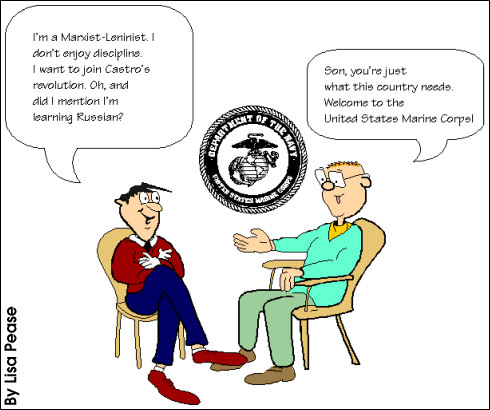
The Official Story: Oswald Joins the Marines
Oswald: “I’m a Marxist-Leninist. I don’t enjoy discipline. I want to join Castro’s revolution. Oh, and did I mention I’m learning Russian?
Recruiter: “Son, you’re just what this country needs. Welcome to the United States Marine Corps!
-
Script of “CBS News, ABC News, and the Lone Assassin Theory”
(Click here if your browser is having trouble loading the above.)
-
Russo, Myers and the Father of the Magic Bullet
IntroductionIn his book, Gus Russo coined a fantastic new phrase that most people familiar with the Kennedy case would call an oxymoron: The Single Bullet Fact. On the ABC special, Myers used this same term. The phrase has its origins in the Warren Commission’s theory that one bullet, Commission Exhibit 399, went through President Kennedy and Governor John Connally making seven wounds and fracturing two bones, gyrating side to side and up and down on vertical and horizontal planes, and then emerging virtually unscathed at Parkland Hospital, allegedly on the stretcher of Connally. Since the Commission said there were only three shells found on the sixth floor of the Texas School Book Depository, and one bullet injured a bystander named James Tague, and one killed Kennedy by striking his head, this left only one bullet to account for the rest of the wounds. Consider the language the Warren Report uses to express this idea and you will see why responsible people call it a theory: “…one shot passed through the President’s neck and then most probably passed through the Governor’s body…” (Page 111) The reason that most people find this hedged language offensive is that, as Cyril Wecht has stated, the SBT is the backbone of the Warren Report. Without it, the report collapses and you have a conspiracy.
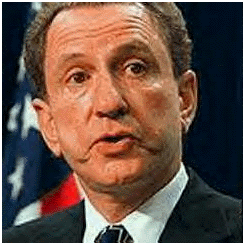
Arlen Specter (pictured above), a young Philadelphia attorney, who handled the actual ballistics and medical evidence for the Warren Commission, put together the underpinnings of the Single Bullet Theory. In his book of memoirs he labels the SBT the Single Bullet Conclusion, thereby leaving the impression that the evidence he gathered pointed strongly only to that tenet. It is always good to revisit original sources. Which apparently, Russo and Myers and Jennings did not do in preparing their documentary. This is understandable considering Specter’s public appearance on the 40th anniversary of the most important case he ever worked on. We render a description of his performance at the Unviersity of Duquesne’s recent anniversary conference on Kennedy’s assassination below.
In the interest of public fairness, we ask Mr. Jennings to get the video of this rather gentle colloquy and play it on his nightly news show. We would then like to have Mr. Russo and Mr. Myers respond to the very same questions. In evidentiary terms, those few moments would be worth more than all the “irrefutable” two hours of ABC’s specious special.
The description below originated as an email; we present it with the permission of its author.
Hi,
The conference in Pittsburgh was fantastic! Have you heard about what happened to Arlen Specter? I would have gladly paid 5 times the admission fee just to see what I was so privileged to see — Arlen getting publicly humiliated. Frankly I was absolutely amazed that he showed up in person. But after he gave a droning talk in which he mentioned how the single bullet theory has now been proven to be single bullet “fact” thanks to ABC, he actually stayed for the Q&A and was sitting on the panel with Mark Lane (who the whole time was grinning ear to ear like a kid in a candy store — after 40 long years, he was finally getting a chance to challenge Specter in public), Jim Lesar, and a few others. People were lined up for a mile at the mike to ask questions. But they never had a chance (my friend Bob was going to ask him how he sleeps at night) because just the few preliminary questions by Lesar, who was the moderator, turned the former Yale debate champion into a babbling idiot.
Lesar first asked Specter how he would put the magic bullet into evidence. When Specter fumbled that one, Lesar pointed out that there was no chain of evidence that would have held up in court and Specter said, “I know a bullet when I see one, and that was a bullet.” Then Lesar asked him who he would call as his witness to put Oswald in the sniper’s nest. Specter didn’t know! Then Lesar pointed out that not only was Howard Brennan their main witness, but he was their only witness, and that he changed his testimony 3 or 4 times and couldn’t identify Oswald in a police line-up that evening. Specter said, “Well, I’ll have to go back and look at the Warren Report again to refresh my memory on that one.”
At this point Specter’s assistant (bodyguard? office hack? whatever you call these people) jumped on the stage waving his arms like a referee stopping a boxing match when a boxer is getting pounded mercilessly, and says that Mr. Specter has to leave for another appointment. At this point Specter incredibly waved him off in a show of bravado and said that he had come to answer questions. Then Mark Lane asks him why he always asked leading questions of the medical witnesses and pointed out that, again, this would not have been permissible if Oswald had actually been tried in a court of law. Specter vehemently denied that he ever led any witnesses at which point Lesar mentioned that the day before they showed on the big screen many examples from the WC testimony where he actually did lead witnesses.
At that point Specter let out a huge sigh and let out a groan, slumped down in his chair, and literally turned white as a ghost. (My friend Greg sitting next to me jabbed me in the ribs and told me that he thought Specter was going to faint!) The place was so silent you could hear a pin drop. Then his bodyguard once again jumped on the stage and waved his arms repeating his prior assertion that Mr. Specter had to leave — and this time Arlen gladly jumped off and they hustled out a side door.
This whole scene was absolutely incredible. The conference was open to attorneys for continuing education credits. I would estimate that of the 1,400 in attendance at least several hundred were sitting in the section reserved for lawyers. They learned more about their government in those 15 minutes than they ever could from any class they ever took. It was a priceless moment that I shall never forget. One of those extremely rare moments when the emperor is indeed stripped of his clothes and exposed naked for all to see. Feel free to forward this to anyone you know who is interested in this who wasn’t there. And make sure to get the video when it comes out.
-
Gus, Will You Please Make Up Your Mind?
Gus Russo has been at work on the JFK case for the past 15 years. To those around him, he has jumped around in his conclusions quite frequently and violently. So much so, that it is hard to measure what he really believes about this case and why or why not. This is particularly puzzling because since 1998 there have been approximately 2 million pages of new files that have been released by the Assassination Records Review Board. Many of these new documents have been very important in resolving disputes that have existed for a long time. For example, Chief Counsel Jeremy Gunn’s investigation of the medical evidence — that is, the interviews he conducted with some very important people at President Kennedy’s autopsy in Bethesda, Maryland — are extraordinarily illuminating to anyone seriously investigating a homicide. Yet, if one examines Russo’s book there is not a mention of them in the entire text. This is important for what it tells us about the book and Russo, but also because it tells us why Russo arrived at where he did on his long and digressive and interesting journey.
In the late 1980’s Russo was friendly with Boston area researcher Edgar Tatro. (This relationship would be sustained up until the issuance of JFK: The Book of the Film. Russo worked on this book with Oliver Stone’s chief researcher, Jane Rusconi. He promised Tatro he would be credited prominently in the book since he called him many times for information. Tatro was not mentioned as often as he should have been and this began their split.) As anyone who knows him will attest, Tatro is a prime proponent of the school that Lyndon Johnson was behind the John Kennedy assassination. At this time, Russo befriended Tatro and asked if he would be willing to take a sabbatical from his educator’s position to serve as the consultant to a documentary film he was proposing to several financial backers. According to Tatro, Russo actually got as far as presenting the idea to these backers, but for some reason the proposal fell through. So, one could assume that since Russo was pushing this idea he probably believed it. But wait.
In the early 1990’s the word got out that Oliver Stone was producing a big-budget film based on Jim Garrison’s book, On the Trail of the Assassins. Now anyone who knew Garrison, or his publisher, Sheridan Square Press, would know that the book had to propose that the Central Intelligence Agency —especially the so-called Old Boys Network within it — was the main perpetrator behind the Kennedy assassination. At this time, Russo was investigating the shadowy European trade company PERMINDEX, of which Clay Shaw was a member. He was also extolling the fact that he had outfoxed a clerk at the National Archives and had listened to a previously classified tape of the so-called Fenton Report. This referred to a suspect in the Garrison investigation who had been tracked down by House Select Committee investigators Cliff Fenton, Bob Buras, and L. J. Delsa and had discussed his role in an apparent meeting, and other actions, at which the murder of JFK had been discussed. As mentioned above, Stone later hired Russo to help Rusconi produce the book which contained much of the backup material for the screenplay. So many deduced from all this that Russo believed the CIA was the prime force behind the killing of Kennedy. But wait.
At a conference in Dallas in 1992, Russo discussed the story of Delk Simpson, a military officer who had been mentioned by writer Robert Morrow and had been pursued reportedly by attorney Bernard Fensterwald. He actually made a presentation with former military intelligence analyst John Newman. Newman’s book JFK and Vietnam mainly blamed the military for the intelligence deception that Kennedy had seen through when he decided that the U.S. would have to withdraw from Vietnam. So now people assumed that Russo had shifted gears and thought the assassination was led by the military with perhaps a hand from the CIA. But wait.
A year later, at a conference in Chicago, Russo now ridiculed the idea that Oswald could have been an intelligence operative. This basically knocked out the idea of a military-intelligence type of conspiracy. He now said that the research community should be following leads that pertained to the Mafia and the Cuban exile community. Sort of what people like Robert Blakey — Chief Counsel of the House Select Committee on Assassinations — may have proposed today. Yet, at the same time, someone read him his blurb for Robert Morrow’s final book on the case, First Hand Knowledge. Russo essentially said that he stood by the positive blurb. The problem here was that Morrow’s book included a conspiracy of the Mafia, the Cubans and the CIA, which was led on the ground by Clay Shaw. So perhaps now Russo was advocating a kind of “grand conspiracy” theory crossing through two or three different structures. But wait.
In the same year, Russo was one of the two reporters on the PBS Frontline special, “Who Was Lee Harvey Oswald?” This show was erratic and unfocused yet by the end it clearly went along with the verdict of the Warren Commission, i.e. that Oswald did it alone. Was Russo now throwing all his years of hunting for an antidote to the Warren Commission away? Was he now embracing the thoroughly discredited Warren Commission? It appeared that way. But wait.
In 1998 Russo penned his book which was supposedly based on the declassified files of the ARRB. Now he twisted the Warren Commission thesis a bit. He now seemed to be saying that Oswald was not really a demented sociopath, which is what the Warren Commission leans on. He now seemed to be saying that he was manipulated by agents of Fidel Castro into believing that Kennedy felt that Castro’s regime had to be removed. The pro-Castro Oswald could not stomach that thought and he did what he did in Dealey Plaza.
If you have been counting, depending on what you make of Russo’s performance at the Chicago Conference, that is either six or seven camps that Russo has been in. Yet he discounts each step of his Pilgrim’s Progress. He forgets his previous beliefs as quickly as a good cornerback forgets the 70 yard touchdown completed over his head. This is OK for football, but it is not OK for investigative journalism which tries to build an edifice that recognizes and tries to reconcile into an understandable paradigm all the evidence about a complex and important event. There is no sign of this in Russo’s work. Or else he would not have ignored the vital medical evidence mentioned above. What makes it even worse is that Russo does not even mention his previous beliefs today. For instance, it is difficult to find anywhere where he mentions that he worked on the Stone book with Rusconi. The only way one can find out about the LBJ phase is through Tatro. No one can recall him mentioning it at any talk he gave at a national researcher’s conference in the nineties.
The natural question is: Did he believe any of these himself? Or when he found he could not find a foolproof theory did he then decide that it was easier and more lucrative to side with the Establishment and the Warren Commission, knowing that people like Peter Jennings and David Westin would never divulge his past conspiracy delvings, or maybe not even ask about them?
Unfortunately for Jennings and Westin, some people knew Russo way back when he was a musician, before Jennings and Westin started flying him around the country first class for their “exhaustive” and “irrefutable” investigation.
-
ABC Lies
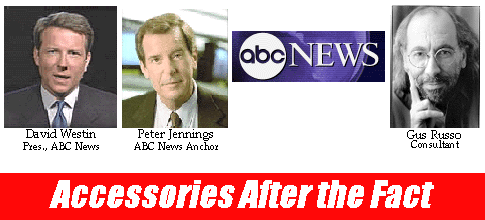
Why did David Westin and Peter Jennings hook up with Gus Russo for November 22, 2003? In order to keep the myth alive about this man:
Introduction
The following articles are meant to examine and explore the relationship between the three men above and the 40th anniversary of the Kennedy assassination. How did it come to pass that ABC President David Westin, the late Peter Jennings, and writer and researcher Gus Russo met, approved and then decided to concoct a huge deception that is meant to recycle and resuscitate a forty year old lie that very few people believe? We try to do that here in order for the reader to fully understand what and why ABC did on November 20, 2003.
We trace and describe some previous network specials on the subject and how they were influenced and controlled by high officials inside and outside the government. Former Warren Commissoner John McCloy exerted enormous influence over a four-part 1967 CBS special on the assassination itself, and the CIA and Sarnoff family (owners of NBC at the time) had direct ties to a 1967 NBC special on Jim Garrison. We also trace the recent history of ABC, especially the momentous event that Andy Boehm and Jim DiEugenio describe in the 2003 Introduction and original 1987 article entitled “The Seizing of the American Broadcasting Company.” This piece describes in detail an example of how the government can influence what is shown — and not shown — on the broadcast airwaves that are theoretically controlled by the citizens of this country. We suggest the reader examine this bloc of articles first.
We then move on and show as directly as we can how ABC came to the lamentable decision to produce a documentary that is simply insupportable by the facts, circumstances, and evidence. This bloc of articles includes a profile of ABC News President David Westin — how he came to power and how his regime has differed markedly from his legendary predecessor Roone Arledge. We then describe the career of a reporter who sets a paradigm and precedent for ABC’s actions on this case, reporter John Stossel who, although billed originally as a consumer advocate, is something short of that. We then examine aspects of the career of the chief consultant on this special, Gus Russo: his career in the Kennedy research field, his differing beliefs at times, and his dubious claim of a Pulitzer nomination. We then connect Russo to the main players behind the November 20th special, Jennings and Mark Obenhaus. We do this through the previous production of theirs based upon the controversial and specious book by Seymour Hersh, The Dark Side of Camelot.
Finally, we begin to dissect some of the work of Russo and his friend Dale Myers, upon whom ABC has relied. We especially try to examine the work of Myers on the computer simulation he has had for sale for many years, and Russo’s work on the most important aspect of any murder case, the medical and autopsy evidence. These are the most important aspects of any serious inquiry into a murder case. If those conclusions are faulty, everything that follows from it must be wrong.
The questions we ask here are two quite serious ones. Did ABC, through Westin, Jennings, and Obenhaus rig the deck to arrive at a preconceived conclusion? And if they did, why did they?
But also, through this detailed inquiry we hope to posit some wider, broader, more universal queries about the media itself. Is it possible for any huge network which works so closely with the government to be expected to tell the truth about any highly controversial and influential event in which it plays a controlling role? Who do people at the top of the network ladder serve today? And if they do not serve the public, what alternative does the public have in pursuing factual truth about these events? And does this pursuit of facts not available through the mainstream media, automatically place them in opposition to the media and the government? The exploration of those questions based on accurate information are meant to encourage a democratic debate about the state of our media today.
Articles
The Networks and the Politics of the JFK Case This link leads to several articles demonstrating the media’s shoddy history in covering the JFK case:
JFK: How the Media Assassinated the Real Story exposes the media’s shameful performance in the decades since President Kennedy’s assassination.
Shoot Him Down: NBC, the CIA and Jim Garrison examines NBC’s hatchet job on then-Orleans Parish District Attorney Garrison when the DA’s assassination investigation was in full swing.
Why ABC? A group of articles examinating ABC and some of those associated with the ABC News special.
Gus Russo Articles examining ABC’s chief consultant, and a surprising turn by Arlen Specter.
These Are Your Witnesses? An analysis of Peter Jennings and his witnessess, and what ABC did not disclose about them and why.
The “irrefutable” Mr. Myers Critiques of Dale Myers’ “irrefutable” computer simulation.