Tag: WARREN COMMISSION

  • Open Letter to Rachel Maddow re Show on Gun Control


    March 29, 2013

    Dear Rachel:

    Many of us, including me, have admired much of your work on radio and television since 2004, when you were perhaps the very best show on Air America. We then followed you as you became a regular guest on MSNBC’s Keith Olbermann’s show and CNN’s Paula Zahn show. Therefore, we were glad when Keith pushed for you to have your own show on MSNBC. You deserved it. You were a great advocate for progressive causes and puncturing MSM shibboleths and sacred cows.

    Which makes it disturbing that you would do what you did on your March 13th program. A common joke among the vast majority who understand the truth about President Kennedy’s assassination is this:

    “You know 85% of the public doesn’t buy the Warren Commission hogwash about Lee Oswald being the lone assassin of President Kennedy. Unfortunately, the 15% who do all work at the New York Times, Washington Post, LA Times, NBC, CBS, ABC, and Fox.” Should we add now, MSNBC?

    Everyone knows that Chris Mathews made his career by attacking Oliver Stone’s films JFK and Nixon. And he spares no opportunity to say that he believes the Oswald myth and to knock anyone who does not. (But he wisely has no one on his show to present the other side as he does so.) We also know that Bill O’Reilly got his position at Fox by agreeing with Roger Ailes that he would drop his JFK investigatory reports he had done for Inside Edition. (Which were actually pretty good.) He now literally lies about the case in his book Killing Kennedy and on his show.

    Most of us thought that we would never see you do something like that. But yet you did use the whole Warren Commission lie about Oswald to promote gun control on March 13th. Many of us agree with the gun control cause especially after Sandy Hook and Aurora. But we would never promote something as bad as the Warren Commission to promote a common good. Especially when it’s not at all necessary.

    We all understand that there is an unwritten agreement when you make it big on TV that you cannot touch things like the JFK case. In other words you can have an open debate with anyone, no matter how far out about anything under the sun. But not the JFK assassination. Fine. Maybe you are uninformed about the facts. Maybe you like your newfound fame and fortune. That is all understandable. But is there an unwritten clause in your contract that you have to go out of your way to promote a lie as big as the Warren Commission? I doubt it.

    As you mentioned on your ill-advised show, this is the fiftieth anniversary of President Kennedy’s death. He was probably the last real Democrat to occupy that office. And he actually proclaimed he was a liberal. A word the right has successfully stamped out of the political lexicon, along with the word conspiracy. If you do visit this topic again later on, let it be in the spirit of free and open inquiry. Tell your bosses that is what you are really about—all the time, on any subject. There are many people who are articulate and convincing about how bad the Commission really was and what happened to this country afterwards. And the thing is, many people want to hear this side of the story: 85% of us.

    Sincerely,

    Jim DiEugenio, CTKA

    {aridoc engine=”iframe”}https://www.youtube.com/embed/prtUkzyO0I0?autoplay=0{/aridoc}

  • The MSM and RFK Jr.: Only 45 years late this time

    The MSM and RFK Jr.: Only 45 years late this time


    The evidence at this point I think is very,
    very convincing that it was not a lone gunman.

    Robert F. Kennedy Jr.
    Jan. 11, 2013


    On the evening of January 11th, Charlie Rose interviewed Robert Kennedy Jr. and his sister Rory in Dallas at the Winspear Opera House. This was part of Mayor Mike Rawlings hand chosen committee’s year long program of celebrating the life and presidency of John F. Kennedy. In fact, Rawlings introduced the program. He probably did not like how it turned out, for during this interview Kennedy Jr. said that his father thought the Warren Report was a “shoddy piece of craftsmanship” and he was “fairly convinced” that others were involved. Robert Jr. himself thought that the evidence in the JFK case, “…at this point I think is very, very convincing that it was not a lone gunman.”

    To my knowledge, this is the first time that a member of the Kennedy family has stated these sentiments in public. Kennedy Jr. went further and backed up the idea, widely held by many that RFK “publicly supported the Warren Commission report but privately he was dismissive of it.” He added “He was a very meticulous attorney. He had gone over reports. He was an expert at examining issues and searching for the truth.”

    RFK, JR. Charlie Rose
    The Associated Press

    Once this story hit the wires, it created a mini-sensation. Cable and network news programs did segments on it; hundreds of Internet outlets and newspapers carried the story. This really sums up how cloistered and controlled our news media is even today, with cable channels and the Internet now on the scene. The only thing new about this story is what I mentioned above: the fact that a member of the Kennedy family was saying it in public. As of this writing, there is no official transcript available of this interview, nor is there an audio or videotape which seems odd since it was recorded in front of cameras. Since Dallas Mayor Rawlings was there as the taboo subject was mentioned maybe it is not so odd. But clearly, people should contact Rawlings’ office and ask that this interview be placed on the web immediately. Therefore, people can write articles based upon the actual exchange instead of reporters’ stories about the exchange.

    The fact that RFK did not buy into the Warren Report, and he only endorsed it in public for political reasons, this has been established for quite some time. In 2007 David Talbot, in his book Brothers, clearly showed that Bobby Kennedy never bought into the Oswald-did-it line. That from the moment he learned of his brother’s death he suspected a plot had been behind it. (Click for a review)

    He “publicly supported the Warren Commission report but privately he was dismissive of it.” He added “He was a very meticulous attorney. He had gone over reports. He was an expert at examining issues and searching for the truth.

    RFK, Jr. about his father Robert Kennedy

    A decade previous to Talbot, in 1997, Tim Naftali and Aleksandr Fursenko published the fine book, One Hell of a Gamble,a study of the Missile Crisis from the Russian point of view. In that volume, the authors first wrote about William Walton’s now famous mission to Moscow in 1964. Walton was ostensibly going as a goodwill ambassador for cultural exchanges, but his real objective was to carry a message to Nikita Khrushchev from Robert and Jackie Kennedy. That message was that, although the American media had jumped on this lone gunman idea, they thought that President Kennedy had been killed by a domestic conspiracy… one that was politically motivated from the rightwing. That because of this assassination, the attempts at détente that Kennedy and Khrushchev had made would now have to be placed on hiatus. Johnson was much too pro-big business to pursue that ideal. Therefore, RFK would soon resign. When he became president, the effort at reconciliation would then continue. (Talbot, p. 12)

    However, way before that book, there had been instances during Jim Garrison’s inquiry into the Kennedy assassination that indicated Robert Kennedy was quite interested in what the New Orleans DA was uncovering. In this author’s current book, Destiny Betrayed (Second Edition) I note an instance where RFK was in California staying at a friend’s house in 1968. Family friend Mort Sahl was also there. That night, Sahl had to leave for a performance. When he got back, his then wife told him that RFK peppered her with questions about what Garrison was digging up. (Sahl was working for Garrison.) Richard Lubic, a campaign worker for Bobby Kennedy in 1968 told another Garrison investigator, Bill Turner, that RFK said that if he were elected president, he would like to reopen the Warren Commission inquiry. (Talbot, p. 359) In Harold Weisberg’s original manuscript of Oswald in New Orleans, he wrote about being in contact with someone in Bobby Kennedy’s 1968 campaign. He communicated to Weisberg that RFK had real doubts about the Warren Commission. Weisberg told his contact if this were the case RFK should voice his concerns in public, making sure he would not be assassinated because of his belief. After Bobby was killed, Weisberg wrote that never was a seer less happy with the fulfillment of his prophecy.

    In other words, anyone looking for evidence of this could have found it many years previous. Only in our media, especially in the MSM, could any such story be considered news. From a sociological point of view it is interesting to note two factors that figured in the reaction.

    Charlie Rose has built a career out of being the alleged thinking man’s talk show host and he actually began hosting such programs on Dallas’ KXAS-TV in the seventies. He then worked for CBS News in the eighties and began the present version of his talk show on PBS in the nineties. But while doing his show he also worked for the CBS program Sixty Minutes II from 1999 until 2005. Therefore Rose was the perfect choice from the Dallas power elite point of view. All this would indicate that he is pretty much a canned establishment figure. How much of an establishment figure is he? Well, he has attended several Bilderberg Conferences of late. His second wife is the stepdaughter of CBS founder Bill Paley. It will be a cold day in Hades if one ever catches anything on his snooze fest that seriously counters the established American Conventional Wisdom. Therefore Rose was the perfect choice from the Dallas power elite point of view.

    Consequently, when his guest began uttering such heresies in public, Rose automatically kicked into damage control mode. When the son mentioned that his father went into a long funk after JFK was killed, Rose (understanding his next ticket to a Bilderger Conference depended upon his stemming this tide) quickly suggested if this was because RFK felt “some guilt because he thought there might have been a link between his very agressive efforts against Organized Crime?”. This question was, of course, an attempt to simultaneously:

    1. Turn the crime inward on the Kennedy clan by focusing on RFK’s ambitious drive against the Mafia, and
    2. Pin the assassination on an acceptable culprit. One made acceptable by the likes of Robert Blakey, namely the Cosa Nostra.

    Rose’s response was unwarranted. There are any number, or even combination of reasons RFK may have sunk into emotional quicksand. As indicated above, he clearly understood that his brother’s large and looming foreign policy agenda would now go unfulfilled. RFK may also have come to an understanding, realizing the enormous pressure now placed upon him, to become something he was not: a political candidate. He also had to have realized that, in fact, he had no choice but to do so because his power base had now been pretty much circumscribed by President Johnson and J. Edgar Hoover. In fact, this idea was mentioned by the son when he said, “As soon as Jack died, he lost all his power.” Further, after this point, Hoover “never spoke to him again.”

    But RFK Jr. then returned to this Mafia theme when he said one of the things that pricked his father’s curiosity was the phone records of Oswald and Ruby. These contained many calls to organized crime figures. Therefore, his father “was fairly convinced at the end of that there had been involvement by somebody.” Again, Rose jumped in and did his bit: “Organized crime, Cubans.” To which, RFK Jr. (thankfully) replied, “Or rogue CIA.”

    Rose’s initial reaction was the first attempt to channel the story down a certain acceptable path. Rawlings’ decision not to release a recording is another. But the third is the reaction of the Dallas Morning News to it. In about one week they wrote three articles based on the interview. In these articles, dating from January 11th to the 14th, the paper consulted with their official propaganda mouthpiece Gary Mack. Mack tried to cast aspersions on the credibility of RFK Jr. by saying that there really could not be any Oswald phone calls since there is no record of him having a personal phone service. Bill Kelly quickly and effectively countered this deliberate obfuscation. (http://jfkcountercoup.blogspot.com/2013/01/oswald-and-ruby-phone-records-rfk-jr.html) One of the Morning News writers, Rodger Jones, then tried to confuse things even further by saying that, well, RFK Jr. said that Bobby’s interest first began during the Garrison inquiry. Yet, according to David Talbot, Bobby Kennedy actually started his inquiry back in 1963. This spin control ignores two things: 1.) According to Garrison volunteers, like Mort Sahl, the Attorney General clearly did have an interest in Garrison’s investigation, and 2.) Since RFK Jr. was still something of a child in 1963, it is much more likely that four years later, as an adolescent, he would more clearly recall such a matter.

    In further comments, Mack said that it appears that some members of the Kennedy clan have decided to say one thing in public, “But apparently, privately, some members. . . have raised questions about areas of the assassination.” Well, from the material I have presented here, its pretty clear that the Kennedy family did have doubts from a very early date. In fact, we can go back even further, to Arthur Schlesinger’s massive biography of the Attorney General, Robert Kennedy and His Times. In that biography, published back in 1978, Schlesinger made clear that Kennedy thought the Warren Report was a subpar and unsatisfactory effort. And further that CIA Director John McCone told him that two assassins were involved in the shooting. (pgs. 643-44)

    Further demonstrating how only in the MSM can the fairy tale exist that RFK and the Kennedy family abided by the Warren Commission, consider the words of Kennedy cousin Kerry McCarthy to Debra Conway in 1997. McCarthy was a speaker at Lancer’s November in Dallas conference. She told Conway that, whatever the Kennedys say in public about the JFK murder, when you visit their homes, you will see several of the JFK assassination books lining their shelves.

    Chris Lawford, son of Peter Lawford and Pat Kennedy, more or less explained why this was so. In his book, Symptoms of Withdrawal, he wrote that the day after the assassination, “I woke up [and] found my father sitting at the flagpole where I used to raise the presidential flag when Uncle Jack came to visit. He was crying like a baby. Strangers held a vigil on the beach outside my parents’ house for days after the assassination.” Pat Kennedy now started drinking with a new seriousness, and the couple was divorced shortly afterwards.

    It takes a long time to come to grips with that kind of pain. And who wants to deal with it in public? At this talk, Robert Jr. finally did. He also praised one of the books the clan had on their shelves, JFK and the Unspeakable by James Douglass. This is one of the few books on the case that has managed to make its way out of the JFK assassination niche. It has sold well now for four years, and there are now over 100,000 copies of it for sale in various formats, including audio book. Bobby Kennedy Jr. liked this book so much that, after he read it, he called Douglass and congratulated him on a job well done. Maybe that was the first sign of recovering from a family trauma that has lasted for well over four decades. And maybe now the MSM can wake up and say, well, if the Attorney General thought the Warren Report was shot full of holes, maybe it was. Thanks to his son for making that moment possible.

    As mentioned above, the fact that this interview is not on the Internet is a disgrace. Please contact Mayor Mike Rawlings and tell him that, in the interest of democracy, history, and proper journalism, it should be posted immediately.

    Phone: 214-670-4054

    Fax: 214-670-0646

    Address: Dallas City Hall, 1500 Marilla Street, Room 5EN, Dallas Texas, 75201

    or send an email to Chris Heinbaugh, Vice President of External Affairs | AT&T Performing Arts Center

    ~Jim DiEugenio


    Articles online:


  • Notes on Lunch with Arlen Specter on January 4, 2012

    Notes on Lunch with Arlen Specter on January 4, 2012


    Truly, to tell lies is not honorable; but where truth entails tremendous ruin, to speak dishonorably is pardonable.

    Sophocles


    On January 4, 2012 at 11:25 a.m. I arrived at the Oyster House restaurant in Philadelphia for a meeting with former U.S. Senator Arlen Specter. He had called me a week or so earlier and suggested we have lunch.

    We met, shook hands, and seated ourselves at a table. I thanked him for suggesting having lunch with me.

    I told him that I viewed his work on the Kennedy assassination as very likely having saved my life. I also wanted him to know that if I had been given his Warren Commission assignment, and if I knew then what I know now about power and politics in our society, I would have done what he did. Of course, as a pacifist peace activist with socialist leanings, such as I was and am, I would never have been selected for Specter’s job with the Warren Commission. Arlen Specter was neither a pacifist nor a peace activist. He was a lawyer. I believe that Specter did not know that after the assassination of President Kennedy he was no longer a citizen of a republic but rather was a subject of the globally most powerful banana republic.

    But if I had been chosen for his assignment, i.e. to frame Lee Harvey Oswald as Kennedy’s killer, I would have done what Specter did. As a lawyer I would have been obligated to serve the best interests of my client, the U.S. government. My assignment would have been to cover up the state crime, the coup. I said that not to do that work and not to steer the society away from the ostensible plot to kill President Kennedy, which plot had as its central theme a pro-Castro and pro-Soviet origin, would have resulted in terrible political consequences.

     …if I had been chosen for his assignment, i.e. to frame Lee Harvey Oswald as Kennedy’s killer, I would have done what Specter did. As a lawyer I would have been obligated to serve the best interests of my client, the U.S. government. 

    ~ Vincent Salandria

    salandria
    Vincent Salandria

    I told Specter that the American people could never have accepted my view of the assassination as a covert military-intelligence activity supported by the U.S. establishment – not then, and not now. They would have readily accepted as truth the leftist-plot script that the assassins employed. Even now, most Kennedy assassination critics will not accept my view of a U.S. national security state military-industrial killing. I explained that my very bright and rational wife could and would not completely accept my version of the meaning of the Kennedy assassination.

    The U.S. national security state’s killing of Kennedy was cloaked in the Oswald myth. That myth included a supposed U.S. defector to the Soviet Union who headed up a Fair Play for Cuba Committee, and who before the assassination allegedly sought a Cuban passport. Therefore, the myth pointed an accusing finger at Fidel Castro and the Soviets.

    If the U.S. public had been convinced that Castro and the Soviets were behind the killing of Kennedy, then the military would have considered the killing an act of war, and a military dictatorship in the U.S. would have probably resulted.

    Oswald, a U.S. intelligence agent whose past had been molded by the C.I.A., could have been cast into whatever his intelligence masters chose. If the Oswald myth had completely unraveled and had exposed the joint chiefs to the U.S. public as the criminals behind the coup, they, the joint chiefs, would never have quietly surrendered their newly acquired power. I believe that instead, they would have sought to preserve and exploit their newly acquired status of possessing ultimate power over the U.S. arms budget and foreign policy. I believe that they would have proclaimed a national security emergency and imposed martial law. They would have declared a state of emergency, to a state of war, and would have designated the replacement for President Kennedy as a unitary president. We now have been made to understand that the unitary president is unhampered by constitutional separation of powers and the restraints of the bill of rights. In short, the unitary president is a euphemism for the correct political designation of a dictator.

    Specter asked me what I thought was the reason for the assassination. In reply I asked whether he had read the correspondence between President Kennedy and Nikita Khrushchev. He had not. I explained that my reading of the correspondence convinced me that Kennedy and Khrushchev had grown very fond of one another. I saw them as seeking to end the Cold War in the area of military confrontation. They were in my judgment seeking to change the Cold War into a peaceful competition on an economic rather than military basis, testing the relative merits of a free market and command economy. I saw the U.S. military intelligence and its civilian allies as being opposed to ending the Cold War.

    I told him that I concluded that there was also a conflict between Kennedy and our military on the issue of escalation in Vietnam. In order to deter the efforts of Kennedy and Khrushchev to accomplish a winding down of the Cold War, the C.I.A, with the approval of the U.S. military, killed Kennedy.

    I said that I believed the assassination was committed at the behest of the highest levels of U.S. power. I said that I did not use sophisticated thinking to arrive at my very early conclusion of a U.S. national-security state assassination. I told him that I think like the Italian peasant stock from which I came. We use intuition.

    … if Oswald was the killer, and if the U.S. government were innocent of any complicity in the assassination, Oswald would live through the weekend.  But if he was killed, then we would know that the assassination was a consequence of a high level U.S. government plot. 

    Vincent Salandria

    I explained that the day after the Kennedy assassination I met with my then brother-in-law, Harold Feldman. We decided that if Oswald was the killer, and if the U.S. government were innocent of any complicity in the assassination, Oswald would live through the weekend. But if he was killed, then we would know that the assassination was a consequence of a high level U.S. government plot.

    Harold Feldman and I also concluded that if Oswald was killed by a Jew, it would indicate a high level WASP plot. We further decided that the killing of Oswald would signal that no government investigation could upturn the truth. In that event we as private citizens would have to investigate the assassination to arrive at the historical truth.

    Specter uniformly maintained a courteous, serious and respectful demeanor, as did I. He asked me whether I had talked to Mark Lane frequently. I told him that I had spoken to him, and that I had spoken to essentially every assassination critic then active. I described meeting Mark Lane at a dinner in Philadelphia at a lawyer’s home. The dinner was in 1964. I could not recall the name of the lawyer host. I related that Spencer Coxe, the Executive leader of the Philadelphia branch of the American Civil Liberties Union, was also present.

    At that dinner I informed Lane that I was interested in Oswald as a likely U.S. intelligence agent provocateur. Lane was not interested in the concept of Oswald as a possible U.S. intelligence asset. Specter asked me what Lane believed regarding the assassination. I said that at that time he believed there was a plot, but he did not name who the plotters were and did not discuss what he thought the reason was for the killing. I did say that later, Lane got a jury to decide for Lane’s client who had said that E. Howard Hunt was in Dallas on the date of the Kennedy assassination. Lane’s client had been sued for libel. He described the case in his 1991 book Plausible Denial.

    In 1964, after his work with the Warren Commission was completed, Specter had been honored for this association at a meeting of the Philadelphia Bar Association. He asked me what I remembered about that event. I told him that I attended with my copy of the Warren Report and directed some questions at him regarding the shots, trajectories and wounds in the Kennedy assassination. After the meeting some of my colleagues at the bar asked me to write an article. That night I did so. I sent the article to Theodore Vorhees, the Chancellor of the Philadelphia Bar Association, and asked him to have it published. He sent it back and asked me to tone it down. I did so. He got it published in The Legal Intelligencer.

    Specter recalled that in our confrontation I had accused him of corruption. He said that he had asked me at that time whether I would change the charge to incompetency. I had refused. I told him that I could not change it to incompetency because I knew then from his public record, as I know now, that he was not incompetent. My charge was reiterated in the Legal Intelligencer article, which described the Warren Commission’s work as speculation conforming to none of the evidence. I said the Warren Report did not have the slightest credibility, committing errors of logic and being contrary to the laws of physics and geometry.

    Specter, during our 2012 lunch, asked me whether I thought that the Warren Commission was a set up. I answered that probably not all of the Commissioners knew it was a set up, but that Dulles and Warren knew. I also told him that I thought that McGeorge Bundy was privy to the plot. Specter did not respond to this.

    I explained that I did not discuss with friends my view of the assassination and my conception of how controlled our society is. I said that I did not discuss with my friends matters such as we were discussing because people are just not ready to accept my view of the assassination and the tight control over our society. I said that I had nothing to offer to people in terms of solutions to the mess we are in. I related how last year, when I had a blood condition and thought I was going to die, my big regret was the mess of a society we were bequeathing to our children.

    Specter commented: “Washington is in chaos.” I told him that I was deeply concerned about whether we are going to bomb Iran. Specter said, “We are not going to bomb Iran.”

    I offered an example of how out of control the society is. I pointed out that he had been against escalation in Afghanistan. While Obama was supposed to be meditating over whether or not to escalate the U.S. forces there, Generals McChrystal and Petraeus were speaking to the press telling the world that we were going to escalate. These statements by the generals were made while Vice President Biden was speaking publicly against escalation. I said that I thought McChrystal and Petraeus should have been court martialed for violating the chain of command. I then said that I don’t think Obama any longer has power over the military, despite the ostensible constitutional chain of command.

    I told Specter that I knew there was a conspiracy to kill Kennedy notwithstanding his single-bullet theory because the holes in the custom-made shirt and suit jacket of Kennedy could not have ridden up in such a fashion to explain how a shot from the southeast corner of the sixth floor of the Texas Book Depository Building, hitting Kennedy at a downward angle of roughly 17 degrees, and hitting no bone, could have exited from his necktie knot. I told him that Commission Exhibit 399 was a plant.


    sbt 1 sbt 2
    CE399

    CE 399

    Specter creating the “Single Bullet Theory” for the Warren Commission


    I admitted that I had coached Gaeton Fonzi before his interview with him on the questions that he should ask Specter. Specter asked me where Fonzi is. I told him that he lives in Florida, and that he is sick with Hodgkin’s disease. Specter said he was a good reporter. I told Specter that Fonzi was a great investigative reporter.

    I told Specter that my very smart wife does not accept my political thinking regarding the nature of the power in control of the country and the world. Specter asked me about my wife. I told him that she is Jewish. She is a graduate of Swarthmore College. She studied at the University of Chicago and accomplished all but the dissertation in Russian Literature there. She owns and manages 41 apartments around Rittenhouse Square. Her father was a fellow traveler. He was subpoenaed before the House Un-American Activities Committee. He retained Abe Fortas as his lawyer. The hearing was cancelled. He was a philanthropist who financed the Youth Ruth Wing of the Jerusalem Museum and a college and high school in Israel.

    I suggested to Specter that he was selected to perform the hardest assignment of the Warren Commission because he was a Jew. The government could have selected a right WASP lawyer for the job. I said that I had received less criticism for my work on the assassination than he had received for his work on the Commission and as senator. He related how in Bucks County in a speaking engagement a man had risen and shouted at him that he should resign because he was too Jewish. I told him that I thought that he was a good senator. He replied that being a senator was a good and interesting job.

    So how is it that Arlen Specter’s work on the Warren Commission saved my life? If I had been successful in arousing public opposition to the National Security State, whom I viewed at the President’s true killers, then the National Security State, possessing supreme power after its successful coup, would have liquidated any effective dissent. In 1966, after a public forum on the Warren Commission’s evidence, I was advised by Brandeis Professor Jacob Cohen that I would have to be killed. I viewed Professor Cohen as speaking for the assassins.

    The Warren Report quieted the public. And as it developed, I was completely ineffective. There was no need to dispose of me. So, I consider my life was saved by the effectiveness of Arlen Specter’s work and the ineffectiveness of my own.

    As we were leaving the Oyster House I gave Specter a copy of James W. Douglass’s book, JFK and the Unspeakable. I said it was the best book on the assassination, and that it was dedicated to a friend of mine and me.

    Specter was smiling broadly as we left. I told him that he had a great smile, but that he did not sport it often in public. I asked him whether he was in good health. He said he was, and seemed optimistic about his well-being. I don’t know whether he was then aware of his illness. In dealing with his protracted struggle against very serious afflictions he displayed remarkable fight and courage.

    Knowing what I know now, and being then, as now, committed to historical truth, I would have not changed my earliest statement that the Kennedy assassination was a crime of the U.S. warfare state. But I would not have endeavored to rally people to confront, as I did, the assassins. I know now that the U.S. public never did want to accept the U.S. warfare state as the criminal institutional structure that it is. I know now, that even if the U.S. public ever was ready to accept the true historical meaning of the Kennedy assassination, that there are and have been no institutional structures open to them with which they could hope to countervail successfully the Kennedy killers, the enormous power of the U.S. empire and its warfare state.

    I know that my efforts to convince people to oppose Kennedy’s assassins were feckless. But was that same effort of a small community of people to establish the historical truth of the Kennedy assassination valueless? I think not. I feel that historical truth is the polestar which guides humankind when we grope for an accurate diagnosis of a crisis. Without historical truth, an accurate diagnosis of the nature and cause of crisis, we would have no direction on how to move to solve societal disease.

    Knowing what I know now, would I change my harsh criticisms of Arlen Specter? Yes, I would. Specter was a superior lawyer who enlisted his services to the U.S. government. The Warren Commission Report, through its lies, served to calm the U.S. public in a period of great crisis. If any serious domestic or foreign effort had been made to counter the coup, the weaponry commanded by the state criminals would have resulted in catastrophic loss of life. Therefore, in my judgment of Arlen Specter I defer to the wisdom of Sophocles, who said: “Truly, to tell lies is not honorable; but where truth entails tremendous ruin, to speak dishonorably is pardonable.”


    1. JFK and the Unspeakable: Why He Died and Why It Matters

  • Transcript of conversation between Joseph Alsop and LBJ, 11/25/1063


    (Click here if your browser is having trouble loading the above.)

  • The Connally Bullet

    The Connally Bullet


    One of the most contentious issues of the JFK debate has always been the question of the validity of CE-399, the bullet which the government claimed, passed through President Kennedy and Governor Connally. Critics have argued that it was not possible for the bullet to have passed through both victims and emerged in near pristine condition. Perhaps more significantly, CE-399 contained no traces of blood or tissue when examined under a microscope.

    CE399side

    Government defenders countered with the argument that tests have proven that it was not impossible for a bullet to remain in good condition under such circumstances and that it was also possible that there would be no evidence of blood or tissue. As such, the debate has remained in stalemate for nearly half a century. But in more recent times, a far stronger case against the legitimacy of CE399 has emerged. As we shall see, it also happens to be a conclusive indictment of the integrity of J. Edgar Hoover’s FBI.

    Our study begins at Parkland hospital with the discovery of a bullet by orderly, Darrell Tomlinson. Tomlinson told the Warren Commission that he returned Governor Connally’s stretcher from the second floor back to the ground floor, and then parked it behind another stretcher that was in front of the door to a rest room. During his testimony, he illustrated the positions of the two stretchers, producing the following diagram:

    stretcherdiagram

    Tomlinson labelled the two stretchers, “A” and “B”, in response to Specter’s request:

    Mr. SPECTER. Will you mark with a “B” the stretcher which was present at the time you pushed stretcher “A” off of the elevator?

    Specter also asked him to label the rest room in the diagram as “C” and explain how he acquired the bullet,

    Mr. SPECTER. Where is the men’s room located on this diagram?

    Mr. TOMLINSON. It would be right there (indicating) beside the “B” stretcher.

    Mr. SPECTER. Would you draw in ink there the outline of that room in a general way?

    Mr. TOMLINSON. Well, I really don’t know.

    Mr. SPECTER. And would you mark that with the letter “C”?

    Mr. SPECTER. That’s fine. What happened when that gentleman came to use the men’s room?

    Mr. TOMLINSON. Well, he pushed the stretcher out from the wall to get in, and then when he came out he just walked off and didn’t push the stretcher back up against the wall, so I pushed it out of the way where we would have clear area in front of the elevator.

    Mr. SPECTER. And where did you push it to?

    Mr. TOMLINSON. I pushed it back up against the wall.

    Mr. SPECTER. What, if anything, happened then?

    Mr. TOMLINSON. I bumped the wall and a spent cartridge or bullet rolled out that apparently had been lodged under the edge of the mat.

    Mr. SPECTER. And that was from which stretcher?

    Mr. TOMLINSON. I believe that it was “B”.

    Clearly, Tomlinson was stating that the bullet was on a different stretcher than the one he brought down on the elevator. Nonetheless, Specter repeatedly badgered him to change his story, but could only manage to get his inconvenient witness to say that he wasn’t sure. But Tomlinson further confirmed what happened, in this NOVA documentary, narrated by Walter Cronkite. (move the timeline to 30:10)

    http://www.youtube.com/watch?v=cvqCtaBkyyE

    Tomlinson passed the bullet to his supervisor, Mr. O.P. Wright who also examined it and in an interview with Josiah Thompson, was adamant that it was shaped much differently than CE-399. This is from Josiah Thompson’s classic book, Six Seconds in Dallas.

    Before any photos were shown or he was asked for any description of #399 (Wright) said:

    ‘That bullet had a pointed tip.’ I said, ‘Pointed tip?’ He said, ‘Yeah, I’ll show you.  It was like this one here,’ he said, reaching into his desk and pulling out the .30 caliber  bullet pictured in Six Seconds.  After Thompson showed Wright the various bullet photos  and finally #399, Wright asked, “Is that the bullet I was supposed to have had?”.

    Wright’s and Tomlinson’s unanimous rejection of CE-399 was further confirmed by this top secret FBI airtel, which was never shown to the Warren Commission.

    WFO (FBI Washington Field Office), neither DARRELL C. TOMLINSON, who found bullet at Parkland Hospital, Dallas, nor O. P. WRIGHT, Personnel Officer, Parkland Hospital, who obtained bullet from TOMLINSON and gave to Special Service, at Dallas 11/22/63, can identify bullet.

    Instead, the FBI told the commission that the two civilians had been interviewed by special agent Bardwell Odum, who was told by the men, that the stretcher bullet “appears to be the same one”. But when Josiah Thompson and Dr. Gary Aguilar contacted the National Archives, they found no record of such an interview, in spite of the fact that the FBI was required to document interviews like that. And when they contacted Bardwell Odum in person, he denied ever conducting such an interview and stated that he had never even seen CE399.

    Wright gave the bullet to Secret Service agent, Richard Johnson, who in turn, passed it on to his supervisor, James Rowley. Not surprisingly, both of those men also refused to corroborate CE399, a fact which even the FBI had to admit, stating in Commission exhibit 2011, that the two agents “could not identify” it. It is interesting that the FBI never reported the reason why the two agents refused to corroborate this dubious piece of evidence. Like FBI agents, Secret Service agents were required to initial forensic evidence, and it is hard to imagine them being negligent in such an important case. By far, the best explanation for their denial is that not only did the stretcher bullet look much different than the original, but their initials were nowhere to be found on CE-399. And they were not the only ones whose initials were missing.

    The next step in the chain of possession took place when Rowley passed the bullet to FBI agent, Elmer Todd. Todd was adamant that he initialed the stretcher bullet, as he was required to do. But when researcher, John Hunt examined extreme closeup photos of CE-399, he was able to identify initials that were written in later, but could find no trace of Todd’s. This is from his article on the subject:

    There is no question but that only three sets of initials appear on CE-399. There is likewise no question that they have all  been positively identified: RF was Robert Frazier, CK was Charles Killion, and JH was Cortland Cunningham. (See Figure 5.) It can be stated as a fact that SA Elmer Lee Todd’s mark is not on the historical CE-399 bullet.

    The entire article can be found here: http://www.jfklancer.com/hunt/phantom.htm

    The only logical conclusion which can be drawn from this evidence is that the bullet Tomlinson found on the stretcher in front of the rest room door had nothing to do with the assassination. Parkland was (and is) the largest hospital in Dallas and processes hundreds of gunshot victims every year. Doctor McClelland testified that Parkland,

    “receives all of the indigent patients of this county, many of whom are involved frequently in shooting altercations, so that we do see a large number of that type patient almost daily”.

    But it appears that the FBI didn’t think about that when they received the stretcher bullet at their labs on Friday night. And when they discovered that the bullet didn’t match Oswald’s rifle, they panicked. It was quite simple to fire a round from the alleged murder weapon into water or cotton wadding and use that bullet to replace the one that Tomlinson found. That would explain the near pristine condition of the bullet, the absence of blood and tissue, the missing initials of SA Todd, and those of the two Secret Service agents, as well as the adamant rejection of that bullet by Tomlinson and Wright.

    But there is an even better reason why we can be quite certain that CE399 was not the bullet that wounded Governor Connally. The real bullet was found on the second floor and recovered by a nurse, who then passed it on to officer Bobby Nolan, who then delivered it to the Dallas Police department. The confirmation of this begins with Governor Connally. This is from his autobiography entitled, “In History’s shadow”.

    “..the most curious discovery of all took place when they rolled me off the stretcher, and onto the examining table. A metal object fell to the floor, with a click no louder than a wedding band. The nurse picked it up and slipped it into her pocket. It was the bullet from my body, the one that passed though my back, chest and wrist and worked itself loose from my thigh.

    There was enormous significance to that scrap of metal, but I can’t be certain how many years later I understood the importance of it. I have always believed that three bullets found their mark. What happened in the hospital demonstrated how easily a bullet could have been swept aside and lost..

    What the governor obviously didn’t realize however, is that the bullet was not “swept aside”. Certainly, the nurse who recovered it would not have just discarded the most important piece of forensic evidence she had ever handled. As it turned out, the Dallas District attorney arrived at the hospital, eager to find out how his old friend, Governor Connally was doing. It seems that he arrived at about the same time that the surgery on the governor was completed, when he ran into that same nurse who found the bullet. This is from an interview of Dallas District attorney, Henry Wade, by the Dallas Morning News.

    I also went out to see (Gov. John) Connally, but he was in the operating room. Some nurse had a bullet in her hand, and said this was on the gurney that Connally was on. I talked with Nellie Connally a while and then went on home.

    Q: What did you do with the bullet? Is this the famous pristine bullet people have talked about?

    A: I told her to give it to the police, which she said she would. I assume that’s the pristine bullet.

    The nurse promptly carried out the district attorney’s instructions, passing the bullet to the nearest uniformed officer in sight, who happened to be Dallas Hwy Patrolman, Bobby Nolan, who was standing in the hallway talking to Connally aide, Bill Stinson. This is from my interview of Nolan in 2010.

    I was talking to a man who was one of governor Connally’s aides. His name was – I think it was either Stinton or Stimmons (Bill Stinson). And he was an aide to the Governor. And she came up and told him that she had the bullet that came off of the gurney. Now I don’t know what gurney. I think they meant Governor Connally’s gurney. And she said, “What do you want me to do with it?” He and I were just sitting there in the hallway talking to me and said, “Give it to him”

    Q. Was it a bullet fragment or a complete bullet?

    Nolan: I don’t know. It was a  – they told me that it was a bullet. And I don’t know if it was a fragment of a bullet or a whole bullet because it was in a little, small brown envelope. And it was sealed and it was about, I’d say 2 by 3 inches. And it was in that envelope when I got it and I never did look at it or anything.”

    Q. Now when the nurse gave it to you, did she describe it as a bullet fragment or as a bullet.

    Nolan: Uh no. She just said it was a bullet. That’s all.

    Nolan delivered the bullet to the Dallas Police department that evening, and the next morning, was interviewed by the FBI, who reported (emphasis is mine), Bobby M. Nolan, Texas highway patrolman, Tyler district, was interviewed relative to a bullet fragment removed from the left thigh of Governor Connally, which was turned over to him at Parkland Hospital in Dallas for delivery to the FBI.

    Nolan stated his instructions were apparently not clear at the outset and that following contact with his superior officers while at the Dallas Police Department, he turned the bullet fragment over to Captain Will Fritz [Dallas Police Department.] at approximately 7:50 p.m. He stated he had no further information concerning the matter and that his only participation in this series of events was the acceptance of the fragment and delivery of same to Captain Fritz.
    Obviously, Nolan told the FBI, exactly what the nurse told him – that the envelope contained a bullet from Governor Connally’s gurney, which as the Governor himself stated, had fallen out from the wound in his “thigh”.

    So, by Saturday, the FBI had already received the bullet that Tomlinson found and had plenty of time to analyze it and confirm that it was not from Oswald’s rifle. A second Connally bullet would provide indisputable proof of multiple snipers.

    At roughly the same time that this nurse was passing the bullet from Connally’s leg to Nolan, nursing supervisor, Audrey M. Bell was processing four tiny fragments that were removed from the governor’s wrist by Dr. Gregory. She told the HSCA and later, the ARRB that she removed the fragments from a container on the scrub nurse’s desk and placed them into an envelope, which she filled out and then gave to two plain clothed agents who came into her office. She was unsure whether they were from the Secret Service or the FBI, but was certain they were not in uniform. She said that both she and one of the agents, initialed the envelope and that the two of them then signed a receipt. All of this was standard operating procedure at Parkland, which Bell had carried out hundreds of times in the past.

    Audrey Bell was interviewed the next day (11/23/63) by the FBI, as she herself confirmed in her ARRB interview. But when she was shown a copy of the associated FBI report, she was adamant that the FBI was wrong. This is from ARRB document MD184, which summarized her interview,

    When shown an FBI FD-302 dated November 23,1963 (Agency File Number 000919, Record # 180-l 0090-10270), she felt it was inaccurate in two respects: it quotes her as turning over “the metal fragment (singular),” whereas she is positive it was multiple fragments – it says she turned over the fragment to a Texas State Trooper, whereas she recalls turning it over to plainclothes Federal agents who were either FBI or Secret Service.

    To corroborate her denial, Bell suggested that they look at the receipt she was required to fill out, which she had passed on to Parkland administrator, Jack Price. Of course, that receipt had to have been confiscated by the FBI, since it was critical to confirming the chain of custody. This is more from MD184,

    She independently recalled filling out a receipt on 1l/22/63 for the fragments, on half-page sized paper with red lettering in the letterhead, which was signed for by one of two men in civilian clothes (whom she thought were Federal agents) who accepted the fragments. She said she personally delivered the original of this receipt to Parkland Hospital Administrator Jack Price. (ARRB staff promised to try to locate this document, and promised that if located, we would mail her a photocopy for verification purposes.)

    But according to the National Archives, there is no record of the ARRB ever finding that receipt and the Archives were not able to find it either. So Bell’s receipt, which would have confirmed the name of at least one of the men she gave the envelope to, and which had to have been taken by the FBI, seems to have evaporated.

    This is the FBI report, allegedly from their interview dated, 11/23/63 with Audrey Bell.

    FBI report bell

    One thing that is beyond dispute is that the FBI’s references to a single fragment, could not be true. It makes no sense that Bell told them that. Even if we speculate that she was hopelessly confused, the envelope which the FBI tells us was filled out by Bell, clearly states that it contained “Bullet fragments” from Connally’s “Right arm”. And we can easily see that the clear plastic container that was in the envelope, contained four tiny particles.

    ce842

    The only logical explanation for why the FBI would have deliberately misrepresented Bell by claiming she reported only a single fragment is that the interviewer was not really concerned about the envelope that she actually handled. They were much more concerned about another envelope which did indeed, contain a single bullet or fragment (very likely, a badly mangled bullet) from Governor Connally’s thigh. In order to make that inconvenient bullet and envelope go away, they only needed to claim that the envelope Bell gave to one of their agents, was the one that Nolan received. All that was missing was the three capital letters from Nolan’s initials, which could be easily forged and copied onto CE-842.

    The other FBI claim that Bell denied, was that she passed the envelope to the fully uniformed officer Nolan. If we believe the FBI, then we must believe that Bell not only forgot that she gave her envelope to Nolan on 11/22, but that she also forgot that she told the FBI that, the next day. She also would have to have suffered the delusion that she gave the envelope to plain clothed officers who came into her office.

    All of these discrepancies have to have been the result of either deliberate deception by the FBI or a hopelessly incompetent and forgetful Audrey Bell. If Bell was the problem, then she not only forgot virtually every aspect of how she processed those bullet fragments on 11/22/63, but during the minutes between filling out that envelope and her encounters with DA Wade and officer Nolan, she forgot that she had just written “bullet fragments” from the “Right arm” and told both of those men that it contained a single bullet from Governor Connally’s gurney, that originated in his left thigh. And then Nolan somehow didn’t notice that the envelope he carried around the rest of the day and turned in to the DPD, was clearly labelled as containing multiple fragments from the right arm.

    As we ponder the possibility that this was a scam on the part of the FBI, we might think that the people who worked with nurse Bell would provide an answer for us. Surely, if she had really told the FBI that she gave the fragments to Nolan, others would have known about it. But as I looked at the statements by those who should have known, I found absolutely no one who claimed either first hand knowledge, one way or the other, or even a second hand claim that Bell told them who she gave them too. This is what Dr. Charles Gregory told the Warren Commission,

    Mr. SPECTER – What did you do, Dr. Gregory, with the missile fragments which you removed from his wrists?

    Dr. GREGORY – Those were turned over to the operating room nurse in attendance with instructions that they should be presented to the appropriate authorities present, probably a member of the Texas Rangers, but that is as far as I went with it myself.

    And this is the HSCA’s report of what Dr. Gregory told them,

    He (Doctor Gregory) stated he did not on his own knowledge know, however, but he had been advised [that] Miss Bell obtained a receipt from State Trooper Bob Nolan [a State of Texas highway patrol officer] and transferred the metal fragment to him in accordance with instructions from the Governor’s office at Parkland Hospital.

    As a full time emergency room physician, at Parkland, it seems strange that he could never provide a straight answer, regarding this nurse who worked with him every day. Why is it that he could only answer that he “had been advised”? And why was the source of his advice, unnamed?

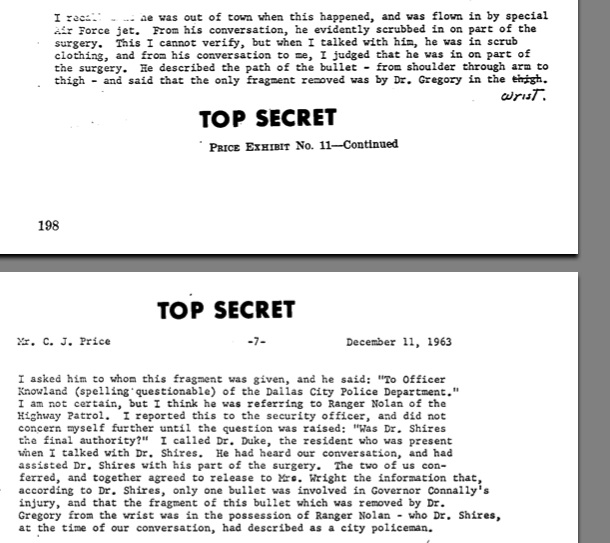
    At the request of Dr. Burkley, the President’s physician, Parkland Doctor, Kemp Clark researched and prepared a report on 11/23/1963, describing events at the hospital related to the treatment of Connally and President Kennedy. For many years, it was filed away as “Top Secret”. In this section, he describes what Drs. Shires and Duke, who assisted Gregory, told him. In the first sentence of the cited segment, “he” refers to Shires.

    pricereport

    It seems that Shires’ initial statement, which was later altered, was that officer Nolan was given a single fragment from the “thigh”, since the word was later crossed out and replaced by “wrist”. But look at the oblique description of how Dr. Clark and Dr. Duke, came to the politically correct conclusion that Nolan was given wrist fragments:

    “I called Dr. Duke, the resident who was present when I talked with Dr. Shires. He had  heard our conversation, and had assisted Dr. Shires with this part of the surgery. Two of us conferred, and together agreed to release to Mrs. Wright the information that according to Dr. Shires, only one bullet was involved in Governor Connally’s injury and that the fragment of this bullet which was removed by Dr. Gregory from the wrist was in the possession of Ranger Nolan.”

    The wording here is fascinating and much more informative for what it doesn’t say than what it does. Notice that there is no straightforward declaration that Bell passed the wrist fragments to Nolan – only that the doctors, “agreed to release to Mrs. Wright the information that..”.

    And why was there, just one day after the assassination, this concern that “only one bullet was involved in Governor Connally’s injury”?

    That sounds much more like something the FBI would be worried about than the doctors.

    And why were they parroting the FBI’s mistaken claim that this was just a single fragment, rather that multiple fragments, as was clearly written on the envelope Bell was supposed to have filled out?

    And why is there no mention anywhere in the report about what supervisor, Audrey Bell had to say? She was on duty that day and just a buzz on the intercom, away. Why wasn’t she asked? Had she actually said what the FBI claimed she said, she would have been eager to confirm that she gave the wrist fragments to Nolan.

    It would not have been possible for the FBI to have pulled this scam, without the help of a least a doctor or two and probably, the nurse who actually recovered the Connally bullet. Of course, the notion that Parkland doctors or nurses were involved in a sinister coverup, is absurd. What is not so absurd however, is that like many others, they were told that if the investigation proved that there was a conspiracy, it would point to Fidel Castro and lead us into a crisis that could incite a nuclear, world war. In 1963, nuclear war was a fear that we all had to live with, every day of our lives. It was powerful enough to make even the most honest person, tell a little white lie if he was convinced that it was for the benefit of humanity.

    The notion that Bell handed over an envelope containing Connally’s wrist fragments to officer Nolan, fails in pretty much every conceivable way. Not only does that contradict what both Bell and Nolan told us, but there is no statement on record by any of her coworkers that she did such a thing, and no record of any of them even claiming that she said she did such a thing. But perhaps, what is stranger yet, is that no one claims to have even asked her. What is easily proven however, is that the FBI falsely claimed that Bell was processing only a single fragment. It is preposterous to think that she told them such a thing. What makes infinitely more sense is, that they needed to make an envelope go away, which really DID contain a single, large fragment or bullet. But they could not do that if her envelope only contained tiny, almost microscopic particles. And so they falsely quoted her, saying that she dealt with a single, metal fragment. And of course, their claim that she stated that she turned her single fragment over to officer Nolan, is equally preposterous.

    Nolan’s envelope was turned in at approximately 8:30PM on 11/22/63. From then on, the FBI had unrestricted access to the evidence and the right to open and inspect it. Whatever was really in Nolan’s envelope, had to have been known to the FBI, prior to their interviews of Nolan and Bell. If it had really contained tiny particles, they certainly would have said so, instead of referring to what could only have been, the singular content of the envelope Nolan delivered.

    The nurse who spoke to district attorney Wade and gave an envelope to Nolan could not have been Audrey Bell. Three men, Governor Connally, DA Henry Wade, and officer Bobby Nolan, all confirmed that this nurse recovered a bullet from Connally’s gurney and then showed it to Wade, before turning it over to officer Nolan. The envelope Bell processed, was given to an FBI agent, which is why it was never delivered to the Dallas police department, or at least, why there is no surviving record that it was.

    In contrast to all of these very solid corroborations, we have 100% denial by the four men who examined the bullet that Tomlinson found, that it was CE399. Unlike many other issues related to the case, this one is not a tough call. It seems that J. Edgar Hoover agreed, because in recordings of telephone conversations between him and LBJ, he suggested that Connally was wounded because he came between the President and an assassin, and that if Connally had not come between them, JFK would have taken his bullet.

    LBJ: How did it happen they hit Connally?

    JEH: Connally turned to the President, when the first shot was fired and I think that in turning.. it was where he got hit.

    LBJ: If he hadn’t turned he probably wouldn’t have gotten hit?

    JEH: I think that is very likely.

    LBJ: Would the President’ve gotten hit by the second one?

    JEH: No, the President wasn’t hit with the second one.

    LBJ: I say, if Connally hadn’t been in his way?

    JEH: Oh, yes, yes. The President would no doubt have been hit!

    Today, we know that that scenario was not correct, but it is hard to imagine Hoover believing that Connally was hit by a different assassin, unless he had seen evidence for such a thing. The bullet or large fragment that Nolan turned in, was obviously, not from Oswald’s rifle. If it was, the FBI would have flaunted it as absolute proof of the accused assassin’s guilt. Instead, it provided absolute proof that Connally was hit by a bullet from a different assassin. Until recently, only Hoover and a handful of others, were aware of that.

    (proofing and other assistance by Alan Dale.)

  • The Real Wikipedia? The Wikipedia Fraud Pt. 3: Wales Covers Up for the Warren Commission

    The Real Wikipedia? The Wikipedia Fraud Pt. 3: Wales Covers Up for the Warren Commission


    Part 1

    Part 2

    Addendum


    As with many aspects of John F. Kennedy’s assassination, when one enters the term “Warren Commission” into Yahoo, the first site that comes up is the citation on Wikipedia. This is unfortunate.

    For as JP Mroz has delineated in detail in two previous articles, Jimmy Wales invention of the so-called “People’s Encyclopedia” has not worked out quite as one would expect. In fact, to those interested in the assassination of President Kennedy, it has pretty much been an echo of the MSM. That is, it has been protective of the Warren Commission, selective in its source material, and as Mroz proved in his first article, it even used false evidence to connect Oswald to the alleged murder weapon.1 When Wikipedia was exposed on this, they then tried to cover their tracks.2

    There are two things quite odd about this stance. First, it does not at all accord with being a “People’s Encyclopedia”. Because the great majority of citizens do not believe the Warren Commission, it does not accurately reflect public opinion.3 Second, it does not accurately reflect the most recently declassified material on the Commission either. For with the work of the Assassination Records Review Board, the criticism of the Commission has become even more heated.4 For instance, Commissioner Gerald Ford arbitrarily moved up the position of the wound in Kennedy’s back5 to align with the Commission’s most controversial invention: the Single Bullet Theory. As recent books have shown, the Commission’s performance in accurately recording witness testimony has been shown to be even more problematic than most thought.6

    Because of all this, Wikipedia has resorted to censorship in order to keep up its show of deference for the Warren Commission and its now thoroughly discredited 888-page report. As Mroz pointed out in his first article, the man in charge of the censorship office at Wikipedia on the JFK case is Robert Fernandez of Tampa, Florida. (Screen name of Gamaliel.) Fernandez is most proud of his (disgraceful) Lee Harvey Oswald page—a page that seems to have been composed with the cooperation of the infamous John McAdams.7 As Mroz further pointed out, the censorship at Wikipedia on this subject is pretty much total. And it is conducted in three ways.

    First, the sources used in the footnoting are severely limited in their scope. The vast majority of the footnotes come from either official sources, or those who support the official story e.g. Vincent Bugliosi’s book “Reclaiming History.”8 This of course severely impacts the contents of the articles.

    Second, the “Back Talk” pages (where people try to comment and edit articles) are patrolled by the staffers who work for Wikipedia. Since the organization is a hierarchy, these staffers ultimately enforce Gamaliel’s line. In his articles on Wiki, Mroz detailed his interaction with one of these staffers, which very much illustrated this point. John McAdams is perhaps the most frequent party involved in these discussions.9 The fact that his site is often used in the final articles contributes to the traffic flow at his (abominable) web page.

    Third, although the actual “References” or “Further Reading” category at the bottom of the article may contain certain books critical of the official story, this is, for all intents and purposes, simply a fig leaf to disguise the actual control of the contents. For, as we shall see here, there is very little relationship between the titles listed in the Reference section and the actual sources in the material, as none of the reference book’s information seems to be utilized on the page, perhaps this section should be labeled “Find-the-Relation-Yourself Reading.” Additionally, there are valuable sources that you will simply never see listed even in the Reference/Further Reading section e.g. John Armstrong’s “Harvey and Lee,” or articles from “Probe Magazine.”10

    As the reader can see, far from being a “People’s Encyclopedia,” regarding the John F. Kennedy assassination, Wikipedia is nothing but a tightly controlled, one-sided, and unrelenting psy-op. Jimmy Wales might as well have turned the editorship of these pages over to say, former Warren Commission counsel Arlen Specter, who must be quite pleased with Wales and Wikipedia, who have done little more than cover up for him.

    I

    All of JP Mroz’ work in this field provides good background for the Wikipedia entry on the Warren Commission. The best thing that one can say about it is that it is relatively short. But in every other aspect it is a typical Wales/Gamaliel production.

    It begins with the actual appointment of the Commission by President Johnson.11 It deals with this very important decision in—get this—one sentence! So in other words, one never understands a key point about Johnson’s decision: He originally did not want to appoint a so-called “blue-ribbon panel.” This decision was imparted on the White House by forces that were not even in the government at this time. As Donald Gibson exposed so magnificently for “Probe Magazine”12 there were two men who were responsible for suggesting the idea on the White House staff: Eugene Rostow and Joe Alsop.13 They began their siege right after Jack Ruby killed Oswald.

    rostow
    Eugene Rostow
    stew joe alsop
    Joseph Alsop, standing
    Stewart Alsop, seated


    What we know as a fact is that Johnson initially planned to resolve the matter of an investigation into the assassination by turning over the FBI report to a Texas Committee of Inquiry. That was one reason that he sent his private attorney to meet with the Texas Attorney General. Johnson floated that idea with Stewart Alsop on the evening of Nov. 25, telling him he had spent most of the day putting together how it was going to work, implying he had met with Texas AG Carr. But after a long and forceful call from Joe Alsop, his allegiance to the Texas inquiry was loosened.14 Alsop’s advice to the President to expand a plan for a Texas “inquiry” to include at least two non-Texas jurists and to leave the Attorney General’s office out of the Texas group all together.

    25 two non Texas jurists


    Alsop also assured LBJ, “I’m not talking about an investigative body, I am talking about a body which will take all evidence the FBI has amassed when they have completed their inquiry and produce a report…” This is ultimately what the Warren Commission accomplished.15

    not talking about an investigative body

    This points out how effective the Wales/Gamaliel policy of limiting sourcing material is. So to imply, as this entry does, that the Warren Commission was Johnson’s original idea is not really accurate. The declassified phone calls by the Assassination Records Review Board show that it was not that simple.16

    As I exposed in my discussion of “Reclaiming History,” this whole issue of Johnson being maneuvered and cajoled into creating something he did not originate is mostly cut out of Bugliosi’s book.17 Although Bugliosi clearly had read Gibson’s article, which was excerpted in the book “The Assassinations,”18 he completely eliminated the call to LBJ by Alsop. Yet, anyone who reads the transcript of that call will understand this was a most important step in changing President Johnson’s mind on the issue. Needless to say, this article uses Bugliosi’s book as an important source.

    This is a crucial point. Why? Because the process had been covered up before. Since the House Select Committee on Assassinations had not declassified the phone calls (that Gibson used in his article), the actual circumstances of the Commission’s creation were shrouded in secrecy for decades—not only the creation, but also the purpose.

    What Wiki is leaving out of its story is that the Warren commissioners later said they didn’t agree with what they handed to the President and the American people, but they were convinced they stopped World War III by going along with the FBI’s investigation. Eventually, even the HSCA agreed with this in their final report, that they were convinced they stopped WW3. As we all know even the HSCA “concluded in their final report that the Commission was reasonably thorough and acted in good faith, but failed to adequately address the possibility of conspiracy.”19

    Therefore, the Commission idea had been credited to other persons previously e.g. Abe Fortas, Nicolas Katzenbach.20 Some even attributed it to Johnson himself, but it was actually instigated by people outside the government who were accurately labeled as members of the Eastern Establishment.

    lyndond johnson and abe fortas
    LBJ with Abe Fortas

    The next Wiki paragraph contains a rather amusing piece of understatement. It says that “some major officials were opposed to forming such a commission, and several commission members took part only with extreme reluctance.” This most likely refers to Chief Justice Earl Warren’s resistance to head the commission that would eventually take his name.21 Again, by leaving out certain important details, Wikipedia disguises a dark but very significant truth.

    Warren was reluctant to chair such a commission because he did not think it appropriate to give it the imprimatur of the Supreme Court. In fact, in an interview Warren gave to the LBJ Library, he specifically cited this as a reason for turning down Katzenbach’s first overture on the subject.22 Warren continued by saying that Johnson then called him in personally. The president said he was greatly disturbed by the rumors going around the world about a conspiracy, perhaps involving Castro or the Russians. And that if these continued to grow, it could catapult the world into a nuclear war. Johnson then told Warren that he had just talked to Secretary of Defense Bob McNamara, and if such a thing occurred, a first strike by the Soviets would cost the USA as many as sixty million lives. Johnson then said that he had all the members of the Commission now set up. But there was one thing missing: “I think this thing is of such great importance that the world is entitled to have the thing presided over by the highest judicial officer of the United States. You’ve worn a uniform; you were in the Army in World War I. This job is more important than anything you ever did in the uniform.”23 According to some sources, Warren left the meeting so emotionally distraught that he had tears in his eyes.24

    In a transcribed conversation that Johnson had with Senator Richard Russell, he went into a bit more detail about the process.25 He said that once Warren was in his office, he refused the offer two more times. Johnson then decided to play his ace card. He said he pulled out a piece of information given to him by FBI chief J. Edgar Hoover. This concerned Oswald in Mexico City. Johnson said, “Now, I don’t want Mr. Khrushchev to be told tomorrow and be testifying before a camera that he killed this fellow…and that Castro killed him.” Johnson then confirmed that Warren did start to weep.26

    Johnson then used the same technique on Russell. He said, “…we’ve got to take this out of the arena where they’re testifying that Khrushchev and Castro did this and did that and check us into a war that can kill 40 million Americans in an hour….”27

    The important point to note here is the material Johnson used to seal the deal with Warren. Clearly, this was the information about Oswald’s visits to the Russian and Cuban consulates in Mexico City and his alleged talk with Valery Kostikov at the Soviet consulate. Kostikov would be revealed to be a secret KGB agent in charge of assassinations in the Western Hemisphere.

    Incredibly, Wikipedia leaves all of the above out. Yet it is of utmost importance in relation to what will happen inside the Commission, because Johnson’s intimidation tactics worked all too well with Warren. At the very first Warren Commission executive session meeting of December 5th, the former District Attorney of Alameda County, California came out as meek as a kitten. In his opening remarks this is what he said:

    1. He did not want the Commission to employ any of their own investigators.
    2. He did not want the Commission to gather evidence. Instead he wished for them to rely on reports made by other agencies like the FBI and Secret Service.
    3. He did not want their hearings to be public. He did not want to employ the power of subpoena.
    4. Incredibly, he did not even want to call any witnesses! He wanted to rely on interviews done by other agencies.
    5. He then made a very curious comment, “Meetings where witnesses would be brought in would retard rather than help our investigation.”28

    What Warren meant by this and why he said it seems to be of the utmost importance in figuring out what he did and what his role was on the Commission.

    But whatever his ultimate meaning, it is clear that Warren had been neutered by Johnson’s warning of impending nuclear doom. Here is the Chief Justice of the United States saying that his fact finding commission on the murder of President Kennedy should not have any of its own investigators, should not hold public hearings, should not have subpoena power, and should not even call any witnesses! Because these things would “retard rather than help our investigation.” Just what kind of murder investigation could one have without these elements?

    Now, it is true that two of these strictures were taken back later. That is, the Commission did eventually have subpoena power and they did call witnesses. But the reason this was done was because the FBI report submitted by Hoover a few days later was incredibly shabby in every way. The Commission members knew it would never fly, even with the MSM. But yet, the FBI report is the kind of thing Warren was willing to tolerate at the start. This is how cowed he was. By leaving out these details, Wikipedia conceals the truth of how bad the Commission was, what its intentions really were, and why.

    But it’s actually even worse than that. Recall what Johnson used to intimidate Warren into his cover up stance of doing no investigation. It was information given to him by Hoover about Oswald’s alleged activities in Mexico City. Again, the ARRB went further in this regard. As John Newman discovered in the released documents, Hoover later realized he had been gulled by the CIA about this subject, that is, Oswald’s activities in Mexico. Seven weeks later, in the margin of a document describing CIA operations in the USA, Hoover wrote “OK, but I hope you are not being taken in. I can’t forget the CIA withholding the French espionage activities in the USA, nor the false story re Oswald’s trip to Mexico only to mention two instances of their double dealing.”29 (italics added) After all, Hoover’s agents discovered that the tapes sent by the CIA to Dallas supposedly recording Oswald’s consulate visits did not contain Oswald’s voice on them.30

    So if properly informed, most readers would understand that Johnson used false information to neutralize Warren. Whether LBJ did this knowingly, or whether like Hoover, he did not understand at the time, that is a secondary question to this discussion. The point is that any reader of Wikipedia would not be aware of any of it. They would only know that some members of the Commission were “extremely reluctant” to take part, without understanding who they were, why they were reluctant, and how they were then coerced into joining up and most of all, how that coercion, the threat of nuclear war, compromised the Commission from the very start. After all, Warren was told that if he probed too deeply, thermonuclear war was in the wings.

    So on the two key points in how the Commission was started—whose idea it was, and how certain members were convinced to join—Wikipedia has told us literally nothing. When, in fact, there is a lot to tell.

    II

    From here, the Wikipedia entry now lists the seven members of the Commission, General Counsel, J. Lee Rankin, the assistant counsels and then the staff positions. They do not differentiate between the senior and junior counsel members. Nor do they indicate that the two sets of counsels worked in tandem with each other in certain areas of inquiry. For instance, Leon Hubert was a senior counsel who worked with junior counsel Burt Griffin on the case of Jack Ruby. The entry also does not define what certain staff members did, like Alfredda Scobey, or who interfaced with the working members and the actual Commission members.

    The next section is rather nebulously entitled “Method.” This could refer to any number of things like how the inner workings of the Commission were structured, or how the staff members prepared to interview a witness. It refers to neither. In a long direct quote from Bugliosi’s “Reclaiming History,” the entry seeks to defend against the closed nature of the proceedings. Bugliosi makes the distinction between “closed” and “secret” hearings. The Warren Commission was the former not the latter. In other words, if a witness wanted to talk about his testimony with others he could, and the transcripts were eventually published.

    Talk about damning with faint praise. President Johnson announced the appointment of the Warren Commission to the public. There was much publicity about this appointment, photo opportunities, personal profiles, etc. It was announced that by law that the Commission would issue a report. Everyone knew they were conducting closed hearings. How on earth could a fact-finding inquiry about President Kennedy’s death then be held in secret? Who would have believed such a proceeding? Especially after Ruby shot Oswald on national TV.

    What would have been much more interesting, honest, and relevant was to reveal here what Howard Roffman did in his fine book, “Presumed Guilty.”31 Roffman discovered that by January 11, 1964 Rankin had put together an outline for investigation that had some rather revealing headings:

    • Lee Harvey Oswald as the Assassin of President Kennedy.
    • Lee Harvey Oswald: Background and Possible Motives
    • Murder of Tippit
    • Evidence Demonstrating Oswald’s Guilt

    In dealing with the charges of conspiracy, which were already floating around, Rankin wrote the following rubric: Refutation of Allegations.32 In reality this outline was all too revealing about the actual methodology behind the Commission. For the simple reason that at this point in time Rankin had just assembled a staff and not a single witness had been heard. Yet, clearly, the Commission had made up its mind as to who the chief—and only—suspect was. In other words, the evidence would now be fit into a scenario of Oswald’s guilt. And no matter how ridiculous that scenario got, Rankin and the Commission would stick with it.

    And it got pretty ridiculous. Oswald getting off three shots from a manual bolt-action rifle in six seconds, no problem. A single bullet going through both Kennedy and Governor John Connally, making seven wounds and shattering two bones yet emerging almost unscathed and discovered on the wrong stretcher at Parkland Hospital. No problem. No employee of the Texas School Book Depository placing Oswald on the 6th floor near the time of the shooting, no problem. We can just get Mr. Givens to change his story and, in all probability, lie to us.33

    I could go on and on. But this was the real methodology of the Warren Commission—to fit a square peg into a round hole. If the evidence did not fit, it did not really matter. The question then becomes: How did such a thing occur? Wikipedia does not have to answer that since they never describe the bizarre evidentiary details. But one thing they could have done under the rubric “method” is to note that the Commission never provided a defense counsel for the dead Oswald. In most fact-finding committees in Washington for example, each side gets a counsel: majority and minority. That did not happen here. In fact, it was explicitly refused. When Marguerite Oswald requested Mark Lane to represent her son’s interests before the Commission, the request was denied.34

    Now, as any attorney or judge will tell you, if there is no adversary procedure, any kind of legal hearing becomes a phony sideshow. Why? Because there is no real check on what the prosecution can do. This is why rules of procedure and evidence have evolved over time—to make sure that a modicum of fairness presides over the proceedings. The method of the Warren Commission from a legal standpoint was so bizarre as to be unrecognizable. Not only were Oswald’s interests not represented by a lawyer, there actually was no judge to control the questioning and decide on the legality and admissibility of exhibits. And since there was no defense, there was no cross examination of so-called expert testimony.

    In sum, as former HSCA photographic analyst Chris Sharrett has said, the Nazis at Nuremburg got more justice than Oswald. And as anyone who surveys the Nuremburg trial proceedings can see, this is certainly true. But in not describing the actual circumstances of the Warren Commission’s method, Wikipedia can avoid that accurate comparison.

    Another point that the entry avoids is in describing the personalities who made up the Commission. There is no mention that Allen Dulles was fired by President Kennedy as CIA Director because Kennedy felt Dulles had deceived him about the Bay of Pigs operation. There is no mention of John McCloy’s national security background or his part in the illegal Japanese internment during World War II. Nor is there mention of how he helped Klaus Barbie escape from Europe to South America. Or how as High Commissioner of Germany, he and Dulles cooperated in placing former Nazi Reinhard Gehlen in charge of West Germany’s intelligence apparatus. And, of course, there is no mention in the entry about Gerald Ford’s role as an FBI informant on the Commission for Cartha De Loach. These are all common knowledge today. Yet somehow, with Wikipedia, they do not exist.

    There is one other point about “method’ that should be noted. As most informed people realize today, the idea that the Warren Commission was a solid bloc, united on each and every question concerning Oswald and the evidence, this is a myth. Sen. Richard Russell was so disappointed by the proceedings that not only did he stop coming to hearings, he started his own private investigation.35 By the end he had the two other southern commissioners, Sen. Cooper and Rep. Boggs, halfway convinced that the whole thing was a dog and pony show. And in fact, Russell refused to sign the Commission report since he did not buy the Single Bullet Theory. Rankin tricked him into signing onto somewhat modified language penned by McCloy on condition that his reservations were recorded. They were not recorded.36

    For Fernandez and Jimmy Wales, that trenchant fact of deception, which tells us so much about the Commission’s ‘method’, is not worth elucidating the reader about.

    I wonder why?

    III

    The entry then goes to a large heading which will contain five subheads. The large heading is titled ‘Aftermath’. The five small headings grouped underneath it are: Secret Service, Commission Records, Criticisms, Witness testimony, and Other Investigations.

    Wikipedia’s first and only sentence dealing with the Secret Service reads as follows: “The specific findings prompted the Secret Service to make numerous modifications to their security procedures.” This is accurate, but again an understatement. The first part of the Warren Report, titled Summary and Conclusions, ends with a list of 12 Commission recommendations. Of the 12, eight are squarely aimed at the Secret Service.37 These are expanded upon at greater length later on in the volume.38 The most obvious and famous one was to make the assassination of a president a federal crime.

    What is interesting about these recommendations is this: The Commission named virtually no specific failures by the Secret Service in its report. For instance, although tacitly admitting that the FBI should have relayed information about Oswald so he would have been on the Secret Service Watch List, the Commission goes out of its way not to assign blame for this thundering failure.39 What Wikipedia does not tell the reader is that Hoover actually did blame someone. He secretly suspended 17 agents for this precise reason: the failure to monitor and relay proper information about Oswald to other authorities. But further, the Commission did not take time to explain the circumstances of several agents drinking liquor at Pat Kirkwood’s bar early on the morning of the 22nd.40 Nor did they say anything about the Secret Service altering the protection in the motorcade by lessening the number of side motorcycles and dropping men from the rear bumper of the Kennedy limo.41 Third, there was no criticism of the very questionable decision by Winston Lawson to maintain the almost insane dogleg through Dealey Plaza, which constituted a virtual assassin’s dream of an ambush. And fourth, the Commission never comes close to mentioning the most serious Secret Service lapse of all: the failure to relay the evidence of a plot to kill Kennedy in Chicago to the advance detail in Dallas. Because of the marked similarities of Chicago to Dallas—riflemen firing from tall buildings after the limo has exited an expressway—this would have made the Secret Service alter the parade route. Additionally, they probably would even have picked up Oswald since his profile was so similar to the patsy in the Chicago plot, Thomas Vallee42.

    We can understand why the Commission never went into any explanation of the above. It’s harder to understand why Wikipedia did not.

    The entry then describes the release of documents that had been previously classified by the Commission. It is true that the Commission published 26 volumes of testimony and exhibits. But it is also true that nowhere to be found in those volumes were any of the internal working papers of the Commission or any transcript of their executive session hearings. Therefore, one could gain no insight into how these men came to their rather strange conclusions. What actually began the declassification process was when author Edward Epstein revealed in his 1966 book Inquest, that the FBI report on Kennedy’s death did not utilize the “Single Bullet Theory,” and did not account for the hit to James Tague. In that same year, the Freedom of Information Act was passed. And since it was aimed at declassifying executive branch documents, the interested public now began to see how the inner workings of the Commission were navigated.

    The next heading is titled “Criticisms.” This is how it begins: “In the years following the release of its report and 26 investigatory evidence volumes in 1964, the Warren Commission has been frequently criticized for some of its methods, omissions, and conclusion.” Well, yep, I guess you could say that. It would be sort of like saying that George W. Bush sustained some criticism for invading Iraq. The criticism has been so overwhelming that every major thesis of the Commission has been rendered dubious. And the Commission’s methodology has been shown to be so unfair and agenda driven as to be an insult to any kind of true fact-finding mission. Since it had no true investigative staff of its own, it was largely reliant on the FBI. And since J. Edgar Hoover had decided upon Oswald’s guilt within 48 hours, there was no way he would reverse field.

    The next heading is ‘Witness Testimony’. Let me quote the entirety of the contents under this: “There were many criticisms about the witnesses and their testimonies. One is that many testimonies were heard by less than half of the commission and that only one of 94 testimonies was heard by everyone on the commission.”

    It’s true that the attendance record for the Commission to be sitting en toto and hearing a witness was sparse. But this is rather a minor failing. Since, for example, commission lawyers interviewing people in say Dallas or New Orleans heard the majority of live testimony. In fact, as Walt Brown has pointed out, the actual Commission itself heard about twenty per cent of the testimony.43

    The far more serious criticisms of the testimony are:

    1.  As Barry Ernest shows in his “The Girl on the Stairs,” a book about Texas School Book Depository employee Victoria Adams, witness testimony was manipulated in more than one way. It was falsely discredited, some of it was altered, and some of it was ‘off the record’.

    2.  The Commission, e.g. Adams’ friend Sandra Styles, never called certain witnesses.

    3.  Key witnesses are never even mentioned in the Warren Report, e.g. O. P. Wright, the man who co-discovered a bullet at Parkland Hospital, which later became CE 399, the Magic Bullet.

    4.  Key witnesses were never interviewed at all, e.g. Guy Banister, the man who employed Oswald in the summer of 1963 from his 544 Camp Street office.

    5. Important witnesses were asked far too few questions e.g. Thornton Boswell, one of the three pathologists who examined President Kennedy’s body for autopsy was asked only 14 questions.[44]

    6.  Important witnesses were never asked crucial questions, e.g. pathologist James Humes was never asked why he did not dissect the track of the back wound in President Kennedy.

    These failures all seem to indicate an investigative body that did not really want to find all the facts, or even the most important ones. Further they reveal a commission that had its mind made up early, and then tapered their inquiry in a dishonest way to shore up that very early decision.

    The last heading is called “Other Investigations.” What happens here is a recurrent ploy by Fernandez/Gamaliel. He tries to imply that somehow the Commission was correct by adding that other investigations of the case “agreed” with the original one. Yet, he cannot bring himself to say that not even the FBI agreed with the Commission since it did not buy the “Single Bullet Theory.” The Ramsey Clark Panel is mentioned, but this was not even an inquiry but was a review of the medical evidence, and it changed the location of the head wound in JFK by raising it up four inches on the skull thereby forming a second “Magic Bullet.” Because according to this panel, the head and tail of this projectile were found in the front of the car and the middle was left in the rear of Kennedy’s skull. The Rockefeller Commission was run by Warren Commission counsel David Belin and investigated only a very few elements of the crime. The House Select Committee on Assassinations was altered in midstream by the fact that its original Chief and Deputy Counsel were replaced when it was clear they were going to run a full and honest inquiry into the case.

    But further, this entry does not even mention the Schweiker-Hart report for the Church Committee. This report reviewed the performance of the FBI and CIA for the Warren Commission and found it clearly lacking to the point that, what the two bodies left out had a negative effect on the performance of the Commission. Also not mentioned by Wikipedia is the investigation of New Orleans DA Jim Garrison, which surely differed in conclusions from the Commission. Finally and inexplicably, Wiki does not mention the Assassination Records Review Board that declassified tens of thousands of documents and conducted its own inquiry into the medical evidence. This inquiry concluded that the original autopsy performance left many unanswered questions about Kennedy’s death, including whether or not the photos taken now in the National Archives actually depict Kennedy’s brain.45 By deliberately leaving out these three bodies, Wikipedia/Gamaliel can falsely imply that each and every official inquiry that followed agreed or backed up the Commission.

    In the hands of Mr. Fernandez, Wikipedia has shown itself to be as bad, if not worse, than the “New York Times” on the subject of President Kennedy’s death. And it does this by using the same shameful techniques of censorship that the “Times” used.

    CTKA will continue to expose Fernandez and Wikipedia as long as they continue to misinform the public and to censor key facts about the murder of President Kennedy. We hope our readership spreads the word far and wide about these troubling practices. If Wiki cannot be trusted with the JFK case, what controversial subject in contemporary history can it be trusted with? And should it be taken seriously at all?

    Notes


    3 Wiki’s own page on the Kennedy assassination links to a 2003 Gallup poll reporting that 75% of Americans do not believe that Lee Harvey Oswald acted alone. http://en.wikipedia.org/wiki/John_F._Kennedy_assassination#cite_note-132

    5 “Gerald Ford’s Terrible Fiction” http://www.jfklancer.com/Ford-Rankin.html

    6 See Barry Ernest’s book, The Girl on the Stairs, CreateSpace, 2011, for the most recent example.

    8 Bugliosi, Vincent. Reclaiming History: The Assassination of President John F. Kennedy. Norton, 2007, 1632 p. ISBN 0393045250.

    10 Armstrong’s Harvey and Lee, or articles from Probe Magazine.

    11 LBJ did ultimately become involved with selecting the members and coerced most of them to join. http://www.maryferrell.org/wiki/index.php/Walkthrough_-_Formation_of_the_Warren_Commission

    12 Gibson, Donald. “The Creation of the Warren Commission,” Probe Vol. 3 No. 4, “The Creation of the Warren Commission”

    13 Vol. 3 No. 4 p. 27).  Rostow actually proposed ‘a commission of seven or nine people … to look into the whole affair of the murder of the President.’ (Ibid)  That fall, in a staff shuffle, he went to the State Department as chairman of the Policy Planning Council at the State Department. In 1964, President Johnson gave him the additional duty of U.S. member of the Inter-American Committee on the Alliance for Progress, with the rank of ambassador.

    “[Joseph and Stewart] were columnists with a huge reach. They were in 200 newspapers with a combined circulation of 25 million, and they wrote consistently for the “Saturday Evening Post,” and the “Washington Post.” So they had an immense reach in a country that had 170 million people, maybe 180 million people.” From a review by Eric Alterman of “I’ve Seen The Best Of It” by Joseph W. Alsop with Adam Platt, in the Columbia Journalism Review, May/June 1992.

    15] The FBI took over the case from the Dallas authorities and conducted a brief investigation; the Warren Commission subsequently relied upon the FBI as its primary investigative arm. http://www.maryferrell.org/wiki/index.php/JFK_Documents_-_FBI

    16 See Mary Ferrell Foundation for audio and transcripts of the calls with LBJ and others. http://www.maryferrell.org/wiki/index.php/Walkthrough_-_Formation_of_the_Warren_Commission

    17 Part 9 of my Bugliosi review, Part 9, now in Reclaiming Parkland.

    18 DiEugenio, James, Lisa Pease and Judge Joe Brown The Assassinations: Probe Magazine on JFK, MLK, RFK, and Malcolm X, 2003, Feral House pp. 3-17.

    19“ The Warren Commission failed to investigate adequately the possibility of a conspiracy to assassinate the President. This deficiency was attributable in part to the failure of the commission to receive all the relevant information that was in the possession of other agencies and departments of the Government.” HSCA Report, p. 256. Read more here: http://michaelgriffith1.tripod.com/failed.htm

    20 Fortas, Washington attorney and LBJ confidant since the 1930s. Mary Ferrell Foundation, Nov 29, 1:15PMPhone call between President Johnson and Abe Fortas http://www.history-matters.com/archive/jfk/lbjlib/phone_calls/Nov_1963/html/LBJ-Nov-1963_0231a.htm
    LBJ and advisor Fortas bandy about several names as possible Commissioners. After mentioning some possibilities include General Norstadt and James Eastland, at the end of the call LBJ selects the seven Commissioners named later that day to serve on the President’s Commission.

    21 Member Cooper initially refused to serve also. See History Matters http://www.history-matters.com/archive/jfk/lbjlib/phone_calls/Nov_1963/html/LBJ-Nov-1963_0309a.htm Cooper’s Wiki page has a limited mention of his serving on the Warren Commission, listing only, “He was a member of the Warren Commission, which investigated the assassination of John F. Kennedy,” and at the very bottom of the page under a hidden link that simply takes the reader back to the Wiki Warren Commission page with a listing of members, etc. http://en.wikipedia.org/wiki/Richard_Russell,_Jr.

    22Transcript, Earl Warren Oral History Interview I, 9/21/71, by Joe B. Frantz, Internet Copy, LBJ Library, pg. 11. http://www.lbjlib.utexas.edu/johnson/archives.hom/oralhistory.hom/Warren-E/Warren-e.PDF

    23 ibid., p. 11

    24 Lane, Mark, Plausible Denial, p. 42.

    25 Transcript of phone call of 11/29/3 between the President and Senator Richard Russell. History Matters http://www.history-matters.com/archive/jfk/lbjlib/phone_calls/Nov_1963/html/LBJ-Nov-1963_0308a.htm

    26 Transcript of phone call of 11/29/63 between President Johnson and Joe Alsop. Mary Ferrell Foundation http://www.maryferrell.org/mffweb/archive/viewer/showDoc.do?docId=838

    27 ibid.

    28 ibid., pp. 1, 2.

    29 The Assassinations, op cit, p. 224.

    30 ibid.

    31 Rothman, Howard, Presumed Guilty: Lee Harvey Oswald in the Assassination of President Kennedy, 1975. http://www.american-buddha.com/presumeguiltyintro.htm

    32 DiEugenio, James, Destiny Betrayed, pp. 96-97

    33 Meagher, Sylvia, Accessories After the Fact, pp. 65-69.

    34 Lane, Mark,Rush to Judgment, p. 9.

    35 Russell, Dick, On the Trail of the JFK Assassins, pp. 126-27

    36 McKnight, Gerald, Breach of Trust, p. 295.

    37 Warren Report, titled Summary and Conclusions pp. 25-26

    38 ibid., pp. 454-69.

    39 ibid., p. 458.

    40 Marrs, Jim, Crossfire, p. 246.

    41 Horne, Doug, Inside the ARRB, Vol. V, pp. 1403-1409.

    42 “The allegation, as outlined by James Douglass in ‘JFK the Unspeakable,’ Thomas Arthur Vallee was being set up and framed as a possible patsy, had JFK been assassinated in Chicago Nov. 1, 1963. The former USMC had a basic covert operational background similar to Oswald, and appears to have been set up in a similar fashion.” Bill Kelly on the Education Forum.

    43 Brown, Walt, The Warren Omission, p. 79.

    44 Ibid, p. 260.

    45 See Washington Post 11/10/98. Also, “Investigations” Mary Ferrell Foundation http://www.maryferrell.org/wiki/index.php/Investigations

  • The Real Wikipedia? Part Two: Please, Mr. Wales, Remain Seated


    Part 1

    Addendum

    Part 3


    Through the Looking Glass

    A nation that is afraid to let its people judge the truth and falsehood in an open market is a nation that is afraid of its people.

    ~John F. Kennedy

    Since the posting of our exposé on Wikipedia, Will the Real Wikipedia Please Stand Up?, to CTKA last July, we’ve been keeping an eye on Wikipedia’s “most proud1 author – the main gatekeeper of its Lee Harvey Oswald entry – Robert “Rob” Fernandez of Tampa, Florida (Wiki-screen-name: Gamaliel). And it seems he’s been hard at work. That is evident from a review of the changes that Gamaliel/Fernandez has made to the LHO entry during the intervening eight months. Given those elapsed months and the changes we’ve witnessed, we thought the time ripe to revisit the situation.

    To see clearly now what exactly has changed, let’s start with what’s most conspicuous. Perhaps the onset of the winter inspired a bit of bulking-up, because the most noticeable difference between Wikipedia’s LHO entry of last July and the current one (March 2011) is the number of footnotes: Whereas last July’s entry weighed in with 158 notes, the current entry shows a total of 195 – a hefty 19 per cent increase. And yet, as a quick perusal of the following table shows, the Table of Contents for the two differing LHO entries reveals very little substantive change between the summer and winter entries:


    Wikipedia LHO Table of Contents – Summer 2010 Wikipedia LHO Table of Contents – Winter 2011
    • 1 Biography
      • 1.1 Childhood
      • 1.2 Marine Corps
      • 1.3 Defection to the Soviet Union
      • 1.4 Dallas
      • 1.5 Attempt on life of General Walker
      • 1.6 New Orleans
      • 1.7 Mexico
      • 1.8 Return to Dallas
      • 1.9 Shootings of JFK and Officer Tippit
      • 1.10 Capture
      • 1.11 Police interrogation
      • 1.12 Death
    • 2 Official Investigations
      • 2.1 Warren Commission
      • 2.2 Ramsey Clark Panel
      • 2.3 House Select Committee
    • 3 Other investigations and dissenting theories
      • 3.1 Fictional trials
    • 4 Backyard photos
    • 5 References
    • 6 Further reading
    • 7 External links
    • 1 Biography
      • 1.1 Childhood
      • 1.2 Marine Corps
      • 1.3 Defection to the Soviet Union
      • 1.4 Dallas
      • 1.5 Attempt on life of General Walker
      • 1.6 New Orleans
      • 1.7 Mexico
      • 1.8 Return to Dallas
      • 1.9 Shootings of Kennedy and Tippit
      • 1.10 Capture
    • 2 Police interrogation
      • 2.1 Death
    • 3 Official investigations
      • 3.1 Warren Commission
      • 3.2 Ramsey Clark Panel
      • 3.3 House Select Committee
    • 4 Other investigations and dissenting theories
      • 4.1 Fictional trials
    • 5 Backyard photos
    • 6 Notes
    • 7 References
    • 8 Further reading
    • 9 External links


    In fact, a quick comparison of the above table reveals that the basic structure of Gamaliel’s/Fernandez’s2 LHO entry shows no substantive change whatsoever. Yes, there are two “new” sections that have been added to the article. But even a cursory review of these “new” sections reveals that they are anything but: Each has been created from former sections. The current section, 2 Police interrogation, is simply the former section, 1.11 Police jnterrogation, now renumbered; and the current section, 6 Notes, is nothing more than a recompilation of 15 source citations that have been taken from the former section, 5 References.

    Same Old “Truthiness

    But what about the 19 per cent increase in the article’s source materials? Might we expect that by increasing the citations of his source material, Fernandez might have tilted the balance of available evidence even slightly toward the light of objectivity? Could there be any possibility that a 19% increase in cited source material might translate to a corresponding increase in the article’s veracity?

    Fat chance.

    Yes. Fernandez is up to his same old tricks. He’s simply shoveling the same old… well… probably the best way to complete that thought is by reiterating a conclusion from last summer’s exposé:

    Wikipedia’s LHO entry is anything but a carefully crafted piece of disinformation.

    In other words, the entry remains the same crude model that it was eight months ago: It merely buttresses the bulk of its lies through a continuing policy of blanket censorship. Rest assured. All remains safe in Wiki-World. There is absolutely no chance that these additional source materials will ever risk “overwhelm[ing] the text” of Fernandez’s LHO entry.

    As we also noted this past July:

    … about 90% [of the LHO entry’s notes] are to the Commission, and the likes of Gerald Posner, The Dallas Morning News, and Vincent Bugliosi. There is not one footnote to the files of Jim Garrison or the depositions of the Assassination Records and Review Board. In fact, the ARRB does not exist for Gamaliel/Fernandez. Which is stunning, since they enlarged the document base on Oswald and the Kennedy case by 100%. But since much of their work discredited the Commission, it gets the back of Fernandez’s hand.

    And the situation remains much the same today. As with last summer’s version, the current Wikipedia LHO article has not a single reference to The Assassination Records Review Board (ARRB). This in itself is both revealing and, at the same time, unbelievably bizarre: Revealing, in that the omission of any mention of the ARRB betrays a rather transparent attempt by Fernandez to avoid any source materials that would impugn his favorite source, i.e., the 1964 Warren Commission; and unbelievably bizarre, in that the very idea that any article on Lee Harvey Oswald written in 2011 might attempt to dodge the ARRB by simply pretending as if it never existed is, well, pushing the idea of what is Orwellian beyond the extreme. Because what this tells us about the degree of contempt that Fernandez and the folks at Wikipedia have for their readership is everything we need to know: Right in line with Allen Dulles‘ famous quote that “The American people don’t read,” the folks at Wikipedia count on an ill-informed readership. For only a readership that is unaware of its own country’s history would be gullible enough to accept Fernandez’s idea of the ARRB as non-existent.

    Predictably, the overwhelming weight of source materials for Fernandez’s LHO entry still comes largely from the Warren Commission Report (WCR) and the House Select Committee on Assassinations (HSCA). These source materials are filled out for the most part by the likes of Gerald Posner, Vincent Bugliosi, Max Holland, PBS Frontline, the Dallas Morning News, and (no surprise) John McAdams’ own site, The Kennedy Assassination Home Page. In other words, Fernandez – and his wiki-compadres – adhere to the same old conventional mainstream media view of the assassination, i.e., Oswald as “lone gunman.”

    So even after an increase of some 19% of cited source material, as well as the seeming addition of two “new” sections, it seems as if nothing of substance has changed. It appears that Fernandez, in line with his self-professed prideful control as a JFK assassination information censor, simply felt the need to “rearrange the furniture.” Why? We can only guess. But without a doubt, some kind of update to the Wikipedia LHO entry was long overdue. As noted in the conclusions from our exposé of this past July:

    The purpose of Wikipedia’s LHO entry[?] … [T]o keep the reader safely within the sanitized walls of the Warren Commission’s 1964 duplicities that still attempt to peg Lee Harvey Oswald as the lone assassin.

    And judging from the changes that Fernandez has made, it would appear that he felt that those retro-fitted-1964-sanitized-walls were beginning to show the wear and tear of age. After all, we certainly had shined a spotlight on the gaping cracks. So perhaps a little spackling touch-up to the walls along with, perhaps, an eye for a fashionable Feng Shui arrangement of the furniture was in order. Yes, as it turns out, surface appearances seem to have been Fernandez’s primary concern. … Or were they?

    Are Fernandez’s recent changes merely cosmetic? Let’s pull back the curtain and take a closer look. Perhaps in doing so we’ll continue to shed light on important details that Fernandez (and those at Wikipedia who continue to support a policy of blanket censorship in regard to the JFK assassination) apparently would like to remain shrouded in darkness – at least, that is, for the uninitiated Wikipedia reader.

    Here Today…

    I think that one of the great strengths of the open collaborative approach is the fast and powerful destruction of untenable conspiracy theories. It is quite easy to watch a pseudo-documentary like “Loose Change” and to find it compelling, until you back up and do some homework with the help of sites like Wikipedia. ~Jimbo Wales,[1]02:48, 7 July 2006 (UTC); from the “9/11 Conspiracy Theories Page” of campaigns.wikia3

    So what exactly has changed within Wikipedia’s LHO entry since last summer?

    In order to answer that question, i.e., for the purpose of comparison, one needs to have access to the version of the LHO entry from last July. And quite fortunately for our readership, we took Daniel Brandt’s prescient warning concerning Fernandez’s reputation to heart. Recall that Brandt went to the trouble of saving an old webpage of Fernandez’s that Fernandez had forgotten to take down. Why? :

    “I moved it to my site as soon as I discovered it, because I knew he would whitewash it.” explains Brandt. (emphasis added)

    But certainly Wikipedia must have the means of preventing any one of its administrators from “whitewashing” its data. Right?

    As it turns out, Fernandez’s reputation for “whitewashing” appears to be the perfect fit for the policies of Wikipedia’s central governing bureaucracy – the Wiki-anti-elitist-elite – which, the reader may recall, number no more than 1.4% of all active registered users.4 Back in the day, when Wikipedia had a “circulation” of no more than 5000 unique daily visitors,5 and so had yet to appear at the top of just about every Google search,6 Jimmy Wales was already thinking ahead to the problems of control over the data of his “people’s encyclopedia.” And dreaming about a “cabal membership” and the special powers it would retain:

    I have this idea that there should be in the software some concept of “old timer” or “karma points”. This would empower some shadowy mysterious elite group of us to do things that might not be possible for newbies. Editing the homepage for example.7 (emphasis added)

    Yes, granting special editing privileges to a small select group of experienced users in order that Wikipedia might then be able to protect itself from, say, malicious cases of vandalism would be hard to argue against. But what if that same privileged group of elect administrators – Jimmy Wales’ own “shadowy mysterious elite group” – were to use their special editing capabilities to, say, permanently delete compromising information that manifestly exposes “the project” as one whose policies support dissemination of disinformation? Or, viewed from another angle, what if the elite members of Wales’ privileged “cabal” were to exercise a form of permanent suppression of information by using their special editing powers to selectively toss anything that they wish to keep from their readers down the Wiki-memory-hole?

    Now that kind of censorship would certainly be an attractive feature to a supposedly “open collaborative approach” that surreptitiously seeks a “fast and powerful destruction of [so-called] untenable conspiracy theories.”

    Undoubtedly, Wikipedia, now too, makes Cass Sunstein “most proud.”

    Going…

    Just how large and empowered would Wales’ proposed “shadowy mysterious elite group” now be? That’s anyone’s guess. As to their numbers, it’s a safe bet that Wales’ exclusive “cabal” is composed of an even more selective group of Wiki-admins than the governing bureaucracy we have called “the Wiki-anti-elitist-elite”8 – in other words, just a small fraction of the less than 1.4% of all active registered users. As to the question of empowerment, one must look to ultimate objectives. For in order for Jimmy Wales to achieve his dreamed-of control over information while at the same time keeping up the surface appearance of egalitarianism, he needs to rely upon a very small select group – his inner circle – to ensure such authoritarian control. It is to such a small select group that Wales undoubtedly entrusts the finality of decisions on all Wikipedia content.

    Would such finality on decision-making include the outright whitewashing of data? You bet. And based upon our own observations of changes to the Wikipedia LHO page – yes, we have witnessed information from that page disappear down the Wiki-memory-hole – it’s also a very safe bet that Fernandez has found his way into Wales’ elite inner-circle where “cabal membership” has its privileges.

    So, given both Wikipedia’s and Fernandez’s reputation for censorship, we were not about to have our diligent efforts in exposing the blatant lies of Wikipedia’s LHO entry “whitewashed” away. In line with the old adage, “Forewarned is forearmed,” we took the precaution of backing up the LHO entry from last July. In fact, our Wikipedia exposé from last July does not reference the current Wikipedia LHO entry, which, over time, is (of course) subject to change. Instead, all references to Wikipedia’s LHO page within the CTKA article of last summer are now a “frozen snapshot in time” of the LHO entry from last July.9

    You see, anticipating Fernandez’s penchant for “whitewashing,” we backed up Wikipedia’s LHO page from last July (–July 5th, to be exact) before we posted our original article. It will soon become clear to the reader just how important that backed-up version of the LHO entry from last July truly is in exposing Fernandez’s (and thus Wikipedia’s) hand.

    Going…

    Of all of the lies that Fernandez expected his LHO entry readers to swallow – whether lies of commission or omission – undoubtedly the most egregious that we had brought to light was his deliberate planting of outright false evidence against Oswald. Last July, as we combed through the Wikipedia LHO entry in order to shed light on its failings, we came across the following inset and accompanying caption buried about half-way through the article and on the far-right side of the page:


    200px CE795

    Fake selective service (draft) card in the name of Alek James Hidell, found on Oswald when arrested. A.Hidell was the name used on both envelope and order slip to buy the murder weapon (see CE 773) [114], and A. J. Hidell was the alternate name on the post office box rented by Oswald, to which the weapon was sent.[115]


    Here, Fernandez asserts that Oswald’s Dallas P. O. box allowed for the delivery of the alleged murder weapons because the alias to which these weapons were sent – A.J. Hidell – was supposedly on Oswald’s application for his Dallas P.O. box as an alternate name. But even Fernandez’s beloved Warren Report could not save him here. And he had to have known it. Because Oswald’s Dallas P.O. box application, which the Warren Report catalogues as “Cadigan Exhibit No. 13,”10 contains no alternate names whatsoever. What this all means is that the weapons shipped to Oswald’s Dallas P.O. box by Klein’s Sporting Goods could not have been retrieved by Oswald because existing U.S. Post Office regulations would not have permitted him to do so.

    So what did Fernandez do? He simply planted false evidence. As seen in the above inset, he tried to pass off Oswald’s application for his New Orleans P. O. box – an application that did have both A.J. Hidell and Marina Oswald listed as alternates – as Oswald’s Dallas P.O. application. This “switcheroo” ostensibly allowed Fernandez to get around the pesky problem of USPS regulations that would have made it impossible for Oswald to have retrieved the alleged murder weapons. And Fernandez’s calculated planning behind such planting of false evidence becomes apparent when one considers that:

    • By placing this outright lie within an inset to the entry, Fernandez was, for all intents and purposes, “hiding it in plain sight.” Why? Given our own empirically reasoned conclusion that Fernandez has by now found his way into the exclusive membership of Jimmy Wales’ “shadowy mysterious elite group,” then it follows that Fernandez must be keenly aware of the demographics of his readership: Most visits to Wikipedia are “bounces,” i.e., one page views only. And each of those single-page-visits – made mostly by “childless people under 35 [years of age]… who browse from school and work”11 – average less than one minute. So on a first (and, probably, only) read-through, it’s a safe bet that most of the above cited demographic will be quickly scanning most Wikipedia articles that they view. They will not be reading for depth. (Not that you’re likely to find any depth in any Wikipedia article.) Unless a sidebar to an article is specifically designed for allure, whether through color, size, or some other eye-catching scheme, then, the readership that constitutes Wikipedia’s demographic is not at all likely to focus much attention on a black-and-white inset and caption.
    • Add to this the fact that the eye reads left-to-right and then quickly back to the left, and the likelihood that Wikipedia readers might take the time to actually read this inset – placed strategically half-way through the article and on the far-right of the page – diminishes even further.
    • Out of the small percentage of Wikipedia readers who might happen to take the time to read the above inset, how many would then be likely to check out Fernandez’s assertion that “A. J. Hidell was the alternate name on the post office box rented by Oswald, to which the weapon was sent[115]” by actually linking to the footnote?
    • And then, given this same demographic, how many of those readers do you suppose would link through to the cited primary source material – what Fernandez claims is CE 697 (i.e., Commission Exhibit 697)?
    • And out of that acutely culled readership, how many who actually link through to what Fernandez claims is CE 697 would be perceptive enough to realize the game that Fernandez is playing here? That is: How many would be discerning enough to understand that Fernandez’s cited source material is, first of all, not CE 697 at all, but in fact CE 818 and CE 819 (though these Commission Exhibits do in fact appear on page 697 of Volume XVII) and secondly, that these Commission Exhibits have nothing at all to do with Oswald’s Dallas P.O. box, but are instead for his New Orleans P. O. box – the P.O. box to which the alleged murder weapons were never sent.

    You get the picture. Fernandez is well aware of his readership’s demographic and obviously and contemptuously takes them for dupes. And when the jig is up, the game is over, what does he do? He pulls a “Minitrue.”

    Down the Wiki-memory-hole.

    …Gone!

    Fernandez simply wiped out any trace of evidence that he had planted that lie about Oswald’s Dallas P.O. box. But not before his hand was forced.

    Yes, we were keeping an eye on Fernandez. And we were curious as to how this “most proud” author would respond – if at all – to having his lie exposed for all to see. The narrative of events immediately following the posting of our exposé to CTKA provides further insight into the inner-workings of Wikipedia, Fernandez, and Jimmy Wales’ “elite cabal.” The reader should bear in mind that even though we had already taken the precaution of backing-up our own copy of Wikipedia’s LHO entry to the CTKA server (from July 5th, 2010), when our exposé was first posted to CTKA last July 15th, we still intentionally linked directly to the Wikipedia site for all references to the LHO entry. We then sat back and watched.

    As judged by a number of the entries to the most widely-read message boards, it seemed that the article had generated enough interest that some were prompted to actually try their own hand at directly editing Wikipedia’s LHO entry. No doubt, this spike in activity served to focus the spotlight with an even greater intensity, not only upon Fernandez’s policy of blanket censorship, but also upon his outright planting of false evidence. In was only a matter of days before we began to take note of Fernandez’s response.

    The first thing that we noticed was that Fernandez began to play with an arbitrary renumbering of the LHO entry’s footnotes. Why? Keep in mind that, because we had at first decided to link directly to Wikipedia for all references to its LHO entry, a renumbering of these footnote references within that LHO entry would place them “out of synch” with the former numbering in our article, making it difficult – if not impossible – for CTKA readers to follow the trail of evidence that we had carefully presented in exposing Fernandez’s planting of false evidence. In other words, by changing the numbering of key references to the Dallas P.O. box within the Wikipedia LHO entry, e.g., footnote 115, Fernandez was now, in effect, forcing CTKA readers to link to information that had absolutely nothing to do with Oswald’s Dallas P.O. box and the delivery of the alleged murder weapons. Was Fernandez covering his tracks?

    It certainly appeared that way. And we weren’t about to let him get away with it. So after about three weeks of watching him play with the renumbering of footnotes, and having already backed-up the Wikipedia LHO entry from July 5th, 2010, we simply updated the CTKA article to now directly reference that backed-up version of the LHO entry that we held on the CTKA server. Thus, the LHO footnote numbers were now once again “in synch” with the July 5th, 2010 version that our exposé referenced. An attempt to confuse CTKA readers through a renumbering of footnotes was simply not going to work. Fernandez would have to try another tack. Which, of course, he did.

    But even with his alternate tack, Fernandez still – as we shall see – comes up short. And quite predictably, though Fernandez did decide to keep the inset with reference to Oswald’s “fake selective service (draft) card in the name of Alek James Hidell,” all reference to A.J. Hidell as an alternate name on the Dallas P.O. box has – pfft – now vanished from the Wikipedia LHO entry.

    Down the Wiki-memory-hole.


    The Fast and Powerful Destruction of Untenable Conspiracy Theories Cover-Ups

    Here’s how the inset and caption now appear:

    200px CE795

    Fake selective service (draft) card in the name of Alek James Hidell, found on Oswald when arrested. A.Hidell was the name used on both envelope and order slip to buy the murder weapon (see CE 773),[138] and A. J. Hidell was the alternate name on the New Orleans post office box rented June 11, 1963, by Oswald.[139] Both the murder weapon and the pistol in Oswald’s possession at arrest had earlier been shipped (at separate times) to Oswald’s Dallas P.O. Box 2915, as ordered by “A. J. Hidell”.[140]


    Clearly, when Fernandez here cites A.J. Hidell as an alternate name, he is now not being deceptive because he is now correctly referring to Oswald’s New Orleans P.O. box – the P.O. box that had both A.J. Hidell and Marina as alternate names, but also the box to which the alleged murder weapons were never sent. By doing so, Fernandez, for all intents and purposes, has backed down. And though there’s nary a trace of his having done so, his planted false evidence against Oswald (i.e., reference to Oswald’s Dallas P.O. box as the one with A.J. Hidell as an alternate) has now been removed from the Wikipedia LHO entry.

    But does this removal of planted false evidence mean that Jimmy Wales’ “people’s encyclopedia” might now be turning over a new leaf? Would Wales – with Fernandez as his entrusted LHO gatekeeper – ever possibly let slide what he considers “one of the greatest strengths of [his] open collaborative approach?” –i.e., “the fast and powerful destruction of untenable conspiracy theories?”

    Observing how Fernandez proceeds to cover his tracks tells us all that we need to know about how “untenable” he and his boss Wales consider JFK “conspiracy theories.” Because the problem that presents itself now to Fernandez (and Wales’ “open collaborative approach”) is this:

    • If Hidell’s name was not an alternate to Oswald’s Dallas P.O. box, and USPS regulations would have prevented delivery of any item with an addressee not listed on the box (either as a primary name or alternate), then how could Oswald have retrieved those alleged murder weapons sent from Klein’s Sporting Goods and addressed to A.J. Hidell at Oswald’s Dallas P.O. box?
    • And without the ability to have retrieved those alleged murder weapons from his Dallas P.O. box, then how could Oswald be tied to the murders of either JFK or Officer Tippit?

    Convenient (not to mention suspicious) Mimicry

    So how does Fernandez manage to get around this problem? Apparently, the same way his beloved Warren Commission did: Following their lead, Fernandez, too, lies and misleads. Take note of the last sentence of the above revised caption:

    Both the murder weapon and the pistol in Oswald’s possession at arrest had earlier been shipped (at separate times) to Oswald’s Dallas P.O. Box 2915, as ordered by “A. J. Hidell”.[140]

    Here Fernandez suggests by implication that Oswald must have retrieved the alleged murder weapons from his Dallas P.O. box, even though there is absolutely no evidence that he in fact did so, and even though strong evidence in fact exists that he could not have. But to uncover that strong evidence, one must upend the Wikipedia demographic by actually following Fernandez’s planted footnote 140, which currently reads as follows:

    This box had been rented by Oswald in Dallas under his own name of Oswald, but postal inspector Harry D. Holmes of the Dallas Post office testified that a notice of receipt for any package would have been left in a Dallas P.O. box, no matter who the listed-recipient for the package was, and thereafter anyone presenting the notice for the package to the office window, demonstrating they had access to the box, would have been able to receive any package for the box, without identification. See http://www.aarclibrary.org/publib/jfk/wc/wr/html/WCReport_0073a.htm Warren Report p. 121 of 912.

    Here we can clearly observe Fernandez’s means of retreat, because though footnote 140 unequivocally states that the “box had been rented by Oswald in Dallas under his own name,” Fernandez then proceeds to fall back on the Warren Commission’s own means for tying the alleged murder weapons to Oswald, i.e., “postal inspector Harry D. Holmes of the Dallas Post Office,” who effectively testified that despite USPS regulations,12 USPS would have delivered the alleged murder weapons to Oswald’s P.O. box, and Oswald must have retrieved them.

    To support his summary of Inspector Holmes’ testimony before the Warren Commission, Fernandez provides a link to page 121 of the Warren Commission Report (WCR). The pertinent paragraph from the Report that Fernandez has summarized in his footnote 140 reads as follows:

    It is not known whether the application for P.O. box 2915 [Oswald’s Dallas P.O. box] listed “A. Hidell” as a person entitled to receive mail at this box. In accordance with postal regulations, the portion of the application which lists names of persons, other than the applicant, entitled to receive mail was thrown away after the box was closed on May 14, 1963. Postal Inspector Harry D. Holmes of the Dallas Post Office testified, however, that when a package was received for a certain box, a notice is placed in that box regardless of whether the name on the package is listed on the application as a person entitled to receive mail through that box. The person having access to the box then takes the notice to the window and is given the package. Ordinarily, Inspector Holmes testified, identification is not requested because it is assumed that the person with the notice is entitled to the package.13

    If we are to believe the above WCR summary, then how can one account for the fact that, for another box Oswald rented, “the portion of the application [i.e., Oswald’s] which lists names of persons, other than applicant, entitled to receive mail” was not “thrown away after the box was closed” – as the above WCR summary states – but is in fact an exhibit preserved and catalogued by the Commission itself?14

    But beyond this glaring inconsistency, in order to fully appreciate the extent of Postal Inspector Harry D. Holmes’ false testimony that the above summary provides, one must first grasp two straightforward USPS regulations that were in effect at the time, and which Harry D. Holmes, in his capacity as a US Postal Inspector had to have known about:

    • USPS regulation no. 355.111 states that: “Mail addressed to a person at a PO Box who is not authorized to receive mail shall be endorsed ‘addressee unknown’ and returned to sender.”15
    • USPS regulation 846.53a In 1963, it was legal to ship firearms through the US mail as long as both shipper and receiver were in compliance with this regulation, which required the completion of USPS form 2162. The Post Office processing the shipment of firearms was required to retain the associated completed and signed 2162 forms for a period of four years.16

    If we are to believe Holmes, then, when it came to Oswald’s Dallas P.O. box, both of the above USPS regulations were simply ignored. A weapons delivery from Klein’s Sporting Goods, Chicago, Illinois to A.J. Hidell, P.O. Box 2915? And A.J. Hidell’s name is not on the application for P.O. Box 2915? Not a problem according to Holmes: “[W]hen a package was received for a certain box, a notice is placed in that box regardless of whether the name on the package is listed on the application as a person entitled to receive mail through that box.” And as far as any identification for retrieval of the alleged weapons, well according to the above WCR summary, Holmes tells us that “[o]rdinarily… , identification is not requested because it is assumed that the person with the notice is entitled to the package.” In other words USPS regulation no. 355.111 was routinely ignored by Holmes and his staff of Dallas postal workers.

    As to regulation 846.53a, the above WCR summary – as well as all of Holmes’ actually WCR testimony itself17 – simply ignores it altogether! And can it be any wonder why? Either Holmes would have had to have produced the retained 2162 forms related to the shipments from Klein’s or he would have had another song and dance on his hands. And from the looks of the results of their partnering with him,18 neither David Belin nor Wesley Liebeler seemed to have much confidence in Holmes’ “stage presence.” So, as far as regulation 846.53a went, it looks as if it was “mums the word.” From the get-go.

    Thus, whereas we would normally expect that the testimony of a government officer would uphold regulations, here Inspector Holmes’ testimony is put to the exact opposite purpose, i.e., to show that, in the case of delivery and receipt of items for Oswald’s P.O. box, USPS regulations were effectively ignored. How convenient. (Not to mention suspicious.) Especially when one has ample insight into the motivation of Inspector Holmes’ “testimony.”

    The Ministry of Silly Dances

    But before taking a tumble down the rabbit hole that leads to a greater appreciation of US Postal Inspector Harry D. Holmes’ motivation, a few side-steps are in order.

    As we’ve already taken note, it’s not very likely that the average Wikipedia reader would have even read through to the details of the Fernandez’s current footnote 140. And further, that if they had come this far, Fernandez expects his readers to accept Inspector Holmes’ testimony as the final word on the matter. So in the interest of exposing what must be one of the most untenable of untenable cover-ups, let’s continue to buck such Wiki-complacency. To get to the source of the matter, let’s not settle for the mere summary of a summary of Holmes’ testimony as Wikipedia and Fernandez would have us do. Let’s instead inspect a portion of Inspector Holmes’ actual testimony.19 Specifically, let’s focus in on the following telling exchanges between Holmes and Assistant Counsel to the Commission, Wesley Liebeler:

    Mr. Liebeler: So the package would have come in addressed to Hidell at Post Office Box 2915, and a notice would have been put in the post office box without regard to who was authorized to receive mail in it?

    Mr. Holmes: Actually, the window where you get the mail is all the way around the corner and in a different place from the box, and the people that box the mail, and in theory – I am surmising now because nobody knows. I have questioned everybody, and they have no recollection. The man [i.e., the P.O. box holder] would take this card out [of his P.O. box]. There is nothing on this card. There is no name on it, not even a box number on it. He comes around and says, “I got this out of my box.” And he [i.e., the postal clerk] says, “What box?” “Box number so and so.” They look in a bin where they have this box by numbers, and whatever the name on it, whatever they gave him, he just hands him the package, and that is all there is to it.20 (emphasis added)

    Notice the leading questioning that Liebeler uses here. Erle Stanley Gardner would probably have thought twice before allowing any of his fictional courtroom counsel such license. Clearly, even before Holmes answers Liebeler’s question about Oswald’s Dallas P.O. box, we already know what his answer will be. And even more clearly, Holmes’ cued response is contradicted by U.S. Postal regulation no. 355.111, which unequivocally states that “Mail addressed to a person at a PO Box who is not authorized to receive mail shall be endorsed ‘addressee unknown’ and returned to sender.”

    What this tells us is that Holmes – whose authoritative position as a US Postal Inspector required him to oversee the correct execution of USPS regulations – had to have known that he was being evasive and misleading in his testimony. What immediately ensues is most interesting. Almost as if grabbing at the proverbial fig leaf for some form of cover, Liebeler and Holmes then engage in the following curious dance of words:

    Mr. Liebeler: Ordinarily, they won’t even request any identification because they would assume if he got the notice out of the box, he was entitled to it?
    Mr. Holmes: Yes, sir.
    Mr. Liebeler: Is it very possible that that in fact is what happened in this case?
    Mr. Holmes: That is the theory. I would assume that is what happened.
    Mr. Liebeler: On the other hand, is it possible that Oswald had actually authorized Hidell to receive mail through the box?
    Mr. Holmes:
    Could have been. And on the other hand he had this identification of Hidell’s in his billfold, which he could have produced and showed the window clerk. Either way he got it.21 (emphasis added)

    Again, quite clearly, Liebeler establishes himself as the leading partner in this courtroom minuet apparently designed not to reveal but to obscure. Because any deposition of a Postal Inspector taken by any reputable counsel about Oswald’s ability to have retrieved those alleged murder weapons from his Dallas P.O. box would want to fully explore the USPS regulations in place at the time. The questions that should have been committed to the record during Liebeler’s deposition of Holmes, then, are questions such as: What are the regulations that govern the delivery and retrieval of items from a USPS P.O. box? What about the delivery and retrieval of firearms? In regard to Oswald’s Dallas P.O. box 2915, were these regulations correctly followed? If not, then why not? And so on …

    But as far as Liebeler and Holmes were concerned, direct questions such as these would have been steps in the wrong direction. They obviously had a much different pas de deux in mind: One that waltzed around real issues by offering “theory,” assumption, and hypothetical conjecture about Oswald’s actions in regard to his alleged retrieval of weapons from his Dallas P.O. box. And what amazes most here is this pair’s absolute brazenness – one that bears no shame whatsoever – about passing off “theory,” assumption, and conjecture as an actual sealing of Oswald’s guilt.

    Could Holmes have shown any more eagerness in following Liebeler’s lead than he does in the above exchange? Though Liebeler does not explicitly say so, his question to Holmes (with its built-in telegraph-cued response) – that no identification would be required of someone retrieving an item from a P.O. box – strongly insinuates that, in the case of Oswald’s Dallas P.O. box, existing USPS regulations would have either been ignored or overlooked (by Holmes and his Dallas P.O. staff), thus allowing for Oswald’s retrieval of the alleged murder weapons. At the same time, Liebeler’s clever twist of words here shields Holmes from any immediate accusation that Holmes was at all derelict in his duty as a US Postal Inspector. And without any hesitation, Holmes grabs for that shield and runs with it: “Yes, sir,” he accedes. He then practically trips over himself in his apparent eagerness to please his inquisitor. Though Holmes’ responses are merely “theory,” assumption, and conjecture – all of which could not possibly stand as any meaningful evidence against Oswald’s retrieval of the alleged murder weapons – Holmes finally and triumphantly asserts his verdict: “Either way he [Oswald] got it [i.e., the Mannlicher Carcano – the alleged murder weapon – from his Dallas P.O. box].” (!)

    Talk about circular thinking that leads to a presupposed conclusion. Apparently, as with his command of USPS regulations, logic was not a strong suit for US Postal Inspector Harry D. Holmes.

    But there’s more to Holmes’ story than is revealed in his silly dances with Commission Assistant Counsel Wesley J. Liebeler. Much more.

    The Many Faces of Harry D. Holmes

    At the JFK Lancer Conference of November 1997, Ian Griggs, a retired Ministry of Defence Police Officer, noted JFK assassination researcher, and a founding member of the UK research group, Dealey Plaza UK, presented a case study of Holmes entitled The Four Faces of Harry D. Holmes. In his presentation, Griggs makes a fairly convincing case for Holmes having greater knowledge of and contact with Oswald than we might reasonably expect from a Dallas Postal Inspector.

    What supports Griggs’ case? Firstly, Griggs admits to having benefitted from the earlier work of Sylvia Meagher and George Michael Evica, both of whom had written about Holmes’ work as an FBI informant. And as Griggs points out, though there is no documentary evidence that explicitly ties Holmes to the FBI, there is one document in particular – CE 1152 – that upon close examination does in fact reveal that in 1963 Holmes was indeed working clandestinely as an informant for Hoover’s FBI. 22 “Confidential Informant T-7” must be Holmes, says Griggs, because CE 1152 “contains many precise details which can only have been known to Harry D. Holmes in his capacity as a Dallas Postal Inspector.”

    There’s only one little aside here: CE 1152 primarily refers to Oswald’s Dallas P.O. box 6225 (which Oswald had rented from November 1, 1963 through December 31, 1963). Only in passing does CD 1152 mention Oswald’s P.O. box 2915 – the box to which the alleged murder weapons were said to have been sent. And this passing mention is of no real consequence in regard to Holmes as an FBI informant relative to Oswald’s P.O. Box 2915:

    Informant [Confidential Informant T-7] concluded by saying that on November 24, 1963, OSWALD admitted renting P.O. Box 6225 and P.O. Box 2915 in Dallas, Texas. He also admitted to informant that he had rented P.O. Box 30061 in New Orleans, Louisiana. OSWALD did not make any mention to informant concerning his use of this box nor did he admit receiving a gun at any time through any of the aforementioned Post Office Boxes.

    The point being made here is that proving that Holmes must be “Confidential Informant T-7” does not directly connect Holmes’ surveillance of Oswald’s Dallas P.O. Box 2915 – the one to which the alleged murder weapons were supposed to have been sent. And without such a connection, then the significance of Holmes’ surveillance of Oswald both in regard to time and place is significantly reduced.

    Other researchers have, however, made a case for Holmes being “Dallas confidential informant T-2” referred to within Special Agent James Hosty’s23 report of September 10, 1963:

    On April 21, 1963 Dallas confidential informant T-2 advised that LEE H. OSWALD of Dallas, Texas was in contact with the Fair Play for Cuba Committee in New York City at which time he advised that he passed out pamphlets for the Fair Play for Cuba Committee. According to T-2, OSWALD had a plackard [sic] around his neck reading “Hands off Cuba Viva Fidel”.24

    Now if Holmes is also indeed Hosty’s mysterious “confidential informant T-2,” then this raises the question: How, in the entirety of his two depositions taken before the Commission, could Holmes not have provided more telling information in regard to the delivery of weapons to Oswald’s Dallas P.O. Box 2915? After all, if Holmes had been keeping such a careful watch over Oswald and his P.O. Box 2915 in the spring of ’63, then how did he and his staff miss the delivery of a revolver and an Italian carbine to that same box? These questions aside, from CD 1152 alone it is evident that Postal Inspector Harry D. Holmes was in fact an FBI informant – at least in regard to Oswald’s Dallas P.O. Box 6225. And this very fact, especially when viewed in light of his silence on the issue of USPS regulation 846.53a and the corresponding lack of any 2162 forms that would have detailed exactly who had retrieved the alleged murder weapons from P.O. Box 2915, serves to taint his testimony. –Severely.

    But wait. There’s even more.

    According to his own testimony, Holmes played an essential part in the investigation of the postal money order that Oswald was alleged to have drawn in order to purchase the alleged murder weapon, i.e., the Mannlicher Carcano. On Saturday morning of 11/23/63 – less than 24 hours after Kennedy’s death and just hours after the Dallas police had announced finding an Italian rifle which they had designated as the murder weapon – Holmes sent his secretary out “to purchase about a half dozen books on outdoor-type magazines such as Field and Stream, with the thought that I might locate this gun to identify it, and I did.”25 Holmes then took a keen interest in attempting to tie the Mannlicher Carcano to Oswald by tracing the money order that had been used to purchase the rifle.26 That postal money order was finally identified as order no. 2,202,130,462, with a corresponding postmark (from the envelope on which it was sent) of Mar 12 10:30 am Dallas, Tex. 12.

    But there’s just one small problem with that postal money order that Harry D. Holmes worked so diligently at locating: Postal records show that the money order was purchased on the morning of March 12, 1963 between the hours of 8:00 am – when that post office opened – and 10:30 am – the time of the postmarked envelope. And work records from his employer at that time, Jaggars-Chiles-Stovall, Inc., show that Oswald was at work – present and accounted for – during that very time.27

    Deeper Down the Rabbit Hole

    The next items, taken from Holmes’ own Warren Commission testimony, are simply beyond the bizarre:

    • Holmes witnessed the assassination from the 5th floor of the Terminal Annex Building – the site of his Dealey Plaza office – with the aid of binoculars.28
    • Holmes, by the invitation of Capt. Will Fritz, was one of the few people permitted in the room during Oswald’s final interrogation on Sunday morning, 11/24/63. Moments after this final interrogation, Oswald was shot dead by Jack Ruby in the basement of the Dallas Police Headquarters, while surrounded by a phalanx of Dallas’ finest as he was being moved to the county jail.29
    • Under questioning by Commission Assistant Counsel David Belin, Holmes produced one of the infamous “Wanted for Treason” posters, which, according to Holmes had been obtained from one of the postal collection boxes. When Belin requested that the poster be marked as an exhibit, Holmes replied that he wanted to keep the original. The commission complied with Holmes’ request, marking a photocopy of Holmes’ original poster as “Holmes Exhibit 5” and returning the original to Holmes.30

    Clearly, and as judged by his own testimony, Harry D. Holmes’ interest in the JFK assassination supersedes what we might normally have expected of a US Postal Inspector. And when this apparently eccentric interest is coupled with the proof of his being an FBI informant, together with his total silence concerning USPS regulation 846.53a and related form 2165 in regard to Oswald’s Dallas P.O. Box 2195, then the picture that takes shape is one of his cooperative involvement in a cover-up.

    But don’t ever expect to find such information within that “sum of all knowledge,” Wikipedia. Because such information might tend to bring about the fast and powerful destruction of untenable cover-ups.

    I Can See Clearly Now

    “Who controls the past controls the future. Who controls the present controls the past.”

    ~Inner Party member O’Brien in George Orwell’s 1984

    Jimmy Wales would have us “Imagine a world in which every single person is given free access to the sum of all knowledge.”

    “That’s what we’re doing,”31 he insists.

    – Really Mr. Wales?

    As we have seen, both through his own statements as well as through the actions of Fernandez – a Wiki-admin obviously empowered with the privileges of “karma points” granted exclusively to “cabal membership,” Wales’ idea of “free access to the sum of all knowledge” in reality turns out to be “free access to [any information that my own “shadowy mysterious elite group” and I deem to be an acceptable part of] the sum of all knowledge.”

    In other words, as far as Wikipedia goes, everything apparently hinges on the question of control. The control of the past and the future through present illusion. Through the Looking Glass.

    Imagine such a world? The very idea that Wales and his own “shadowy mysterious elite group” of information brown-shirts could ever impose any kind of dictatorial control over the free-flow of information is absurdity itself. No, Wales supposed “control” is, in reality, trompe-l’oeil, appearance, illusion, pseudo-control. Because, as we have demonstrated through these exposés, real information is out there, available for all who demonstrate the tenacity and discernment necessary for finding it; for all with that desire to become empowered by its truth. Those creaking-cracking Wiki-walls offer no real resistance to the resolute. Yes, ultimately, Wales and his “cabal” are powerless to staunch the free flow of information that leads to such authentic empowerment.

    What Jimmy Wales and his elitist cabal do count on, however, is the game of numbers, the demographics. Gleaming most proudly at his baby – the 27 volume Warren Commission Report – Allen Dulles32 is said to have gloated, “The American people don’t read.” And though Wales and company no doubt dream about the possibility of a functionally illiterate America, it seems evident that they’ll settle for a nation of “one-page bouncers.” That is where the attack and assault upon knowledge will continue to be waged: Upon pounding waves of superficially trivial data, all equally valid and valued, all queued up and ready for presentation with the same safe “neutral point of view” designed to eradicate any connection to anything having any genuine cultural depth or politically empowering meaning, and with each viewer of the assault inured to his separation of what has been taken from him: inquisitiveness, discovery, critical reasoning, and even perhaps, an understanding of his own country’s history and thus his true place in the world.

    Public education is key. Is it any wonder then that the country is witnessing the beginnings of what is arguably the biggest assault ever in its history upon public employee unions? –which includes the livelihoods and futures of just about every public school teacher in the nation? But make no mistake here. Because though it should now be apparent that it’s “open season” upon public school teachers in America, they themselves are not the ultimate target, but simply a means to an end. The real battle here is against pupils, parents, families. And though there is certainly cause for hope in empowering the resolute-to-be, there is at the same time at least as much cause for concern about those who would deny the resolute-to-be their means to ever truly be.

    Can you ever imagine JFK and his administration being associated with the likes of “No Child Left Behind,” or its current successor “Race to the Top?” (If, without any hesitation, you’ve answered in the affirmative, then you’re either too young to remember or you’re now one of the inured.) –That’s how much this country has changed since his abrupt removal through state execution on 11/22/63.

    But ironically, it’s JFK – not Dulles, Wales, his “elite cabal,” or even Barack Obama or Arne Duncan – who has the final word here, because what JFK has to say about the true nature of that supposed “open collaborative project,” “people’s encyclopedia,” “sum of all knowledge,” is this:

    A nation that is afraid to let its people judge the truth and falsehood in an open market is a nation that is afraid of its people.

    Through its policy of blanket censorship, its misleading presentation of evidence, its planting of false evidence, and then the hiding of its withdrawal of that false evidence – all of which we have demonstrated in regard to the Wikipedia’s coverage of Lee Harvey Oswald and the JFK assassination – it follows that Wikipedia is a source of (dis)information that, evidently, fears letting its readers “judge the truth and falsehood in an open market.”

    Thus it follows: Wikipedia fears an educated readership.

    –An encyclopedia that “fears an educated readership,” isn’t that a contradiction of terms? You bet.

    “Imagine a world in which every single person is given free access to the sum of all knowledge. That’s what we’re doing.”

    – Really Mr. Wales?

    “Will the real Wikipedia please stand up?”

    Mr. Wales, we understand. You may remain seated.


    Notes

    1. from Gamaliel‘s/Fernandez’s Wiki-user page: “What I’m proudest of and spent more time working on than anything else are my contributions to Lee Harvey Oswald. The Oswald entry is even mentioned in a newspaper article (broken link) on wikipedia. If you want to witness insanity firsthand, try monitoring these articles for conspiracy nonsense.”

    2. From here on out, we’ll use the real name – Fernandez

    3. Please see: http://campaigns.wikia.com/wiki/9/11_conspiracy_theories

    4. For a detailed explanation of how this less than 1.4% figure was arrived at, please see section IV: Poking Around the Hive within Will the Real Wikipedia Please Stand Up?

    5. i.e., October, 18, 2001

    6. Current estimates – March 2011 – rank Wikipedia as the 8th most visited site in the world, with upwards of 8 million unique daily visitors. (http://www.alexa.com/siteinfo/en.wikipedia.org/wiki/Main_Page)

    7. Jimmy Wales, A proposal for the new software, memo of October, 18, 20011

    8. Ibid. (section IV: Poking Around the Hive within Will the Real Wikipedia Please Stand Up?)

    9. We invite the reader to compare last July’s LHO entry with the current entry, i.e., as of March 2011.

    10. WCH, Vol. XIX, p. 286.

    11. Ibid. (http://www.alexa.com/siteinfo/en.wikipedia.org/wiki/Main_Page)

    12. U.S. Postal regulation no. 355.111 clearly states that “Mail addressed to a person at a PO Box who is not authorized to receive mail shall be endorsed ‘addressee unknown’ and returned to sender.”

    13. WCR, p.121.

    14. WCH, Vol. XIX, p. 286. See also the New Orleans application at: Vol. XVII, p. 697

    15. John Armstrong, Harvey and Lee: How the CIA Framed Oswald, (Quasar Books, 2003), p. 453

    16. John Armstrong, Harvey and Lee: How the CIA Framed Oswald, (Quasar Books, 2003), p. 452

    17. Postal Inspector Harry D. Holmes’ complete testimony to the Warren Commission is found in WCH, Volume VII, pp. 289 – 308 (taken by Assistant Counsel, David Belin on April 2, 1964) and pp. 525 – 530 (taken by Assistant Counsel, Wesley Liebeler on July 23, 1964).

    18. Ibid., WCH, Vol. VII, pp. 289 – 308 (taken by Assistant Counsel, David Belin on April 2, 1964) and pp. 525 – 530 (taken by Assistant Counsel, Wesley Liebeler on July 23, 1964).

    19. Ibid.

    20. WCH, Vol. VII, p. 528.

    21. Ibid.

    22. WCH, Vol. XXII, pp. 185 – 186.

    23. Yes, the very same FBI SA James Hosty, Jr. who admitted to destroying a note that Lee Harvey Oswald had dropped off at the Dallas FBI office days prior to the JFK assassination.

    24. Commission Document 11, p. 2.

    25. WCH, Vol VII, p.294. Actually, the ad which Holmes did identify was from the November 1963 issue of Field and Stream, whereas the Commission finally settled on Oswald’s use of the ad from the February 1963 issue of The American Rifleman.

    26. Please see WCH, Vol. VII, pp. 293- 296.

    27. Please see WCH, Vol. XXIII, p. 605. Further, as Armstrong points out, in order to have completed his morning errand of March 12, 1963, Oswald would first have needed to walk 11 blocks from his place of employment to get to the post office where he allegedly purchased the postal money order. And then, the postmark zone 12 indicates that Oswald would have to have walked several miles west in order to have mailed it.

    28. WCH, Vol. VII, pp. 290 – 292.

    29. WCH, Vol. VII, pp. 296 – 301.

    30. WCH, Vol. VII, p. 307.

    31. Jimmy Wales, Wikipedia Founder Jimmy Wales Responds, Slashdot.com interview with Wales, July 28, 2004.

    32. For more on Dulles and the Warren Commission, don’t miss Jim DiEugenio’s A Comprehensive Review of Reclaiming History, Pt. 8: Bugliosi Hearts the Warren Commission: or how the author learned to like Allen Dulles, Gerald Ford and John McCloy (now in Reclaiming Parkland).

  • The Impossible One Day Journey of CE 399


    (with a little help from J. Edgar Hoover)

    In 1966, Ray Marcus wrote a very important monograph called The Bastard Bullet. It detailed the journey of the bullet found by hospital attendant Darrell Tomlinson and chief of security O. P. Wright at Parkland Hospital to FBI headquarters on the evening of November 22, 1963. Marcus’ work was exemplary for that time. But since then, and with help from the Assassination Records Review Board, more information has emerged that fills in some of the cracks and crevices in that incredible journey. Specifically this is the work of Gary Aguilar and Josiah Thompson in the essay entitled “The Magical Bullet of the Kennedy Assassination” (The Assassinations, edited by James DiEugenio and Lisa Pease) and two essays at the JFK Lancer site by John Hunt: “Phantom Identification of the Magic Bullet” and “The Mystery of the 7:30 Bullet”.

    With this new work in mind, let us update the work of Ray Marcus in regard to the impossible journey of CE 399 on the day President Kenendy was shot. Keeping in mind, that as Dr. Cyril Wecht has noted, the Single Bullet Theory is the “sine que non” of the Warren Commission. Without it, the Commission’s verdict collapses and you hae a conspiracy. And without the Commission’s shiny copper coated, virtually pristine CE 399, there is no Single Bullet Theory.

    1. CE 399 begins its magical journey at Parkland Hospital. A bullet rolls out from under a mat and lodges against the side of the gurney. (Mark Lane, Rush to Judgment, p. 79) Question: How did it get under the mat? Remember, the Commission will later say this bullet was in John Connally’s body last. No one has ever answered this question.
    2. Even Vincent Bugliosi admits that the stretcher it originated from is under question. (Reclaiming History, End Notes, p. 426) But Bugliosi understates the problem here. The weight of the evidence says that the gurney it was found on belonged to neither President Kennedy nor Governor John Connally. (Sylvia Meagher, Accessories After the Fact, pgs. 174-176; Josiah Thompson, Six Seconds in Dallas, pgs. 154-64) It would be a physical impossibility for the bullet to somehow jump from Ron Fuller’s stretcher—where Thompson concludes it was found on- to someone else’s.
    3. When hospital attendant Darrell Tomlinson notices it, the bullet has no blood or tissue on it. (Meagher, p. 173) Yet the Commission will say that this bullet went through two men and caused seven wounds.
    4. But yet, it’s even worse than that. Why? Because the Commission will eventually say that the last resting place of this bullet was in the thigh of Governor Connally. How could 1.) The bullet reverse trajectory and work its way out? 2.) How could it emerge out of a wound it already made? Most pathologists will tell you that entry wounds slightly shrink afterwards. 3.) Further, how could it have no blood or tissue on it if it traversed backwards?
    5. Tomlinson picks up the bullet at about 1:45 PM and takes it to security officer O. P. Wright. (Thompson, p. 156) Wright is very familiar with firearms since he was with the sheriff’s office previously. (ibid, p. 175) Wright gets a good look at the bullet, he notes it as a lead colored, pointed nosed, hunting round. (ibid) This is extremely important since this bullet will change shape and color by the end of its journey.
    6. This bullet will be passed through to Secret Service officers Richard Johnsen and Jim Rowley. (Hunt, “The Mystery of the 7:30 Bullet; http://www.jfklancer.com/hunt/mystery.html) Yet neither of them will initial the bullet. (Hunt, “Phantom Identification of the Magic Bullet”; http://jfklancer.com/hunt/phantom.htm) And later, neither positively identified it. (Aguilar, p. 282)
    7. At the White House, Rowley turns a bullet over to FBI agent Elmer Todd. They sign a receipt. The time of the transfer is 8:50 PM on the 22nd. (Hunt, “The Mystery of the 7:30 Bullet”)
    8. Yet as John Hunt shows, agent Robert Frazier at the FBI lab enters the stretcher bullet’s arrival into his notes at 7:30! (ibid) As Hunt notes, if Frazier and Todd can both tell time, something is really wrong here. Frazier has received a bullet that Todd has not given him yet.
    9. But it’s even worse. For in an FBI document it says that Todd’s initials are on the bullet. (CE 2011, at WC Vol. 24, p. 412) Yet as Hunt has amply demonstrated, they are not there. (Hunt, “Phantom Identification of the Magic Bullet”) In other words, no one who carried this bullet in transit for law enforcement purposes–Johnsen, Rowley, Todd–put their initials on it. When that is what they are trained to do.
    10. Later on, J. Edgar Hoover realizes he has a problem. So he writes up a document saying that agent Bardwell Odum visited Parkland, and Wright and Tomlinson did identify the bullet in June of 1964. (Aguilar, p. 282)
    11. But later, when visited by Gary Aguilar and Tink Thompson, this is exposed as another in the long line of Hoover generated lies in this case. For Odum did no such thing, and he says he would have recalled doing so since he and Wright were friends. (ibid, p. 284)
    12. The night of the assassination, the FBI calls Tomlinson about midnight. They tell him to be quiet about what he found that day. Since what he found that day was a lead colored, sharp nosed hunting round, they must not want him to tell anyone about the bullet. (Jim Marrs, Crossfire, p. 365; David Lifton, Best Evidence, p. 591) A natural question to ask is: Why? A natural answer is: Because they have realized that the original bullet will not match the Mannlicher-Carcano rifle now attributed to Oswald.
    13. When Wright composes his affidavit for the WC, incredibly, he leaves out his co-discovery of the bullet and his giving it to the Secret Service. (Lifton, ibid) Even though Johnsen recorded this and its in the volumes. (Thompson, p. 155) Since he was a former law enforcement officer, to leave something like that out, he was probably directed to.
    14. When it comes time to write the Warren Report, Wright’s name is not in it. And there is no evidence Arlen Specter interviewed him.
    15. In late 1966, we find out why Specter avoided him. Thompson interviews him and he rejects CE 399 as the bullet he gave Johnsen. Twice. (Thompson, p.175) Interestingly, in Reclaiming History, Vincent Bugliosi leaves this powerful incident out of his discussion of the issue. (Bugliosi, End Notes, pgs. 426-27, 544-45)

    To say that the chain of evidence rule has been violated in this case is a monumental understatement. Former Chief of Homicide in New York, attorney Bob Tanenbaum once said that it would be embarrassing to present this material to a jury for the prosecution. For me, the most incriminating elements is the evidence that the FBI knew that CE 399 was not the original bullet i.e. the call to Tomlinson, the fake Odum document, possibly the influence over Wright to leave it out of his affidavit, Specter avoiding Wright in the Commission inquiry.

    So from the beginning, with its reverse trajectory out of the thigh of Connally, to its incredible tunneling under a mat, to its leaping out of Ron Fuller’s stretcher and magically knowing it has to be on the governor’s, to its shocking ability to alter its form and color, and then to actually crack the time barrier and be in Frazier’s office before Todd gives it to him, the Impossible Journey of CE 399 is even more magical than anyone ever could imagine.

    What is truly incredible about the above demonstration is that I have left all the other arguments about the Magic Bullet out i.e. weight and trajectory etc. To me, in the face of the above, they are irrelevant. The CE 399 we know was not found at Parkland. And that ends this argument.

    Everything else—the computer simulations, the drawings etc.—is irrelevant. As Shakespeare said, it is sound and fury signifying nothing. At the time of the assassination, CE 399 as we know it today, did not exist.

  • Arlen Specter: The Death of Mr. Magic Bullet

    Arlen Specter: The Death of Mr. Magic Bullet


    It finally happened. One of the most blatant political opportunists in contemporary American history tried to pull one too many tricks. Except this time, someone was there to call him on it. On May 18th, Arlen Specter’s inglorious 30 year reign as a Pennsylvania senator finally came to an overdue end. Except, unlike what he was promised by his odd Democratic partners, he met his Waterloo in the primary election. It wasn’t supposed to be that way for the maestro of the Single Bullshit Theory.

    single ballot
    Courtesy Richard Bartholomew
    Copyright 2010 Bartholoviews Cartoons

    As we reported in April and May, some of the heavy hitters in the Democratic Party had promised Arlen Specter a clear field in the primary if he switched parties and ran as a Democrat. As we noted then, this was a dumb decision made by myopic men – Gov. Ed Rendell, President Obama, Vice-President Joe Biden, and Senator Harry Reid. They were so short-sighted that they could not see the forest for the trees. The reason Specter opted out of the GOP was simple: he knew he could not win the Republican primary against Pat Toomey. So the question then became: if he could not beat Toomey in the primary, was he a good bet to beat him in the general election? Probably not, since most Democrats would be lukewarm about the turncoat, and he would have little GOP support after defecting. So from the Democrats’ point of view, would it not be better to back a true Democrat who would not have those problems and therefore stood a better shot at beating the well-funded right-wing Republican?

    The inside-the-Beltway crowd didn’t see it that way. To them, it’s all a club card game anyway. If Arlen was willing to bend, why not take him? After all, he’s one of the guys. He’s been in Washington for 30 years. So the Powers That Be decided to arrange a strange deal with the author of the Warren Commission’s Single Bullet Fantasy. This was especially disturbing to many at CTKA. Why? Because it was the endorsement of then Senator Obama at American University by the late Ted Kennedy and Caroline Kennedy which gave him a rocket boost against Hillary Clinton in his race for the Democratic nomination. The other point that was bothersome was that, as noted above, it was unnecessary. The Democrats could have won the seat without Specter.

    Evidently, Representative Joe Sestak wasn’t in on the deal. Very shortly after the nauseating announcement was made in Washington, Sestak put out the word that he was seriously thinking of challenging Mr. Magic Bullet. According to Jerry Policoff, CTKA’s man on the ground in Pennsylvania, the White House and the Democratic Establishment did all they could to discourage Sestak from running, and ruining their shameful bargain. According to Policoff, they gave Sestak the carrot and stick treatment: they offered him the Secretary of Navy job and when he said no they threatened to wreck his political career. Which sounds pretty much like the kind of politics played by Governor Rendell, who is a Richard Daley type. When Sestak refused to back off, the state media – largely played by Rendell – tried to picture him as Don Quixote: a deluded man tilting at windmills. You know, he didn’t know he was DOA. As he likes to do, Specter basked in the temporary national limelight. Obama praised him for an act of “courage” in switching parties, helped him raise money, and even said to a crowd at a rally, “I love Arlen Specter.” (The Daily Beast, 5/19/10)

    It was all an illusion staged by Rendell and his ill-informed Washington cohorts. Part of the illusion was this: the Democratic electorate in Pennsylvania is much more progressive than its leadership i.e. Rendell. The other part is that Sestak is a good campaigner who could raise considerable amounts of money. This helped raise his local profile statewide rather quickly. The third part is that Specter is an old man whose two bouts with cancer have left him both looking his age, and not as mentally sharp as he was. Therefore, the more people saw of the two, the better Sestak started to look to them. Another advantage was that Specter had had a difficult time beating Toomey in the 2004 GOP primary. Being the stronger campaigner, Sestak looked like he had a better chance at winning in the fall.

    So, according to Policoff, Rendell’s illusion began to slowly dissipate. And when Sestak began to close the huge gap between he and Specter – which once was as much as 40 points – more and more Democratic Clubs and local committees began to break from Rendell’s machine and endorse Sestak. In fact, Policoff’s own Lancaster country committee did just that.

    Sestak hoarded a lot of his money until he had cut Specter’s lead down to the 15-20 point range. He then unleashed a flurry of TV ads that were well-chosen. One was a highly effective two-parter which showed just how duplicitous Specter was. It first depicted Specter shaking hands with George Bush Jr; during which Bush calls Specter a team player he can count on. The trailing ad was Obama shouting out his love for Specter and saying, “You know he’s going to fight for you!” Another ad showed Specter essentially saying that he had switched parties in order to get re-elected. Sestak then came in to say that Specter’s conversion was merely political and done to save one person’s job – his own. This whole series of ads was powerful in its effect. Especially since Specter had little defense against it. What epitomized the opportunism was when Obama nominated Elena Kagan to the Supreme Court. Why? Because Specter had voted against her as Solicitor General. But since he was now a Democrat, he said he was open to voting for her. Unlike with his lies and deceptions on the Warren Commission, Specter was out in the open, left unprotected by the political establishment and the media.

    Towards the end, Specter tried to ask for help from the White House. But sensing the political winds, they offered none. They understood they had erred. And they were not going to double down just because they had given their word to him. In the last week, Specter tried to explain his switch by saying that the GOP had moved to the right, and he had always actually been a Democrat at heart. He even tried to invoke the memory of JFK when he said, “I have been a John F. Kennedy Democrat. I have returned to the party of my roots. What’s wrong with that.” (NY Times, 5/11/10) To anyone who has studied the arc of his career, for Specter to make such a comment is nauseating. If Specter had really been a JFK Democrat, he would never have agreed to mastermind the Commission’s medical and ballistics cover up about his death. Secondly, it was after he won the Philadelphia DA job in 1965, as a registered Democrat on the Republican ticket, that he then switched to the GOP. He figured it would be easier to hold it that way.

    So Arlen Specter got his ultimate comeuppance. Much too late of course. He had already done a lot of damage. The startling thing is that he still wanted to be in the arena at all. The man has been through a debilitating struggle with cancer. He has been re-elected four times. He is 80 years old. But evidently, Specter had grown used to being in the spotlight and enjoyed having an easy job with perks that paid well.

    Of course, what this says about today’s Democratic Party is quite disturbing. Why the White House would want to be associated with the likes of Specter and Blanche Lincoln is baffling. That they would cooperate in a shabby deal with the likes of Specter tells us a lot about what the Democratic Party has become since 1968. As I wrote in the Afterword to The Assassinations, after the death of Robert Kennedy, the Democratic Party split in half between its liberal and moderate wings. Richard Nixon knew how to capitalize on the split, hence his infamous Southern Strategy. The Democrats – now toothless because of the deaths of JFK, MLK, Malcolm X, and RFK – lost its bearings. It, and the country, now drifted to the center – and then to the right. Therefore the only two Democratic presidents between 1968 and 2008 were the southerners, Jimmy Carter and the Democratic Leadership Council’s own Bill Clinton.

    Obama and his advisers don’t read a lot of history. For him to back both Specter and Arkansas senator Blanche Lincoln shows a White House and president out of tune with the times and its own electorate. That is proven by what Sestak and Lt. Governor Bill Halter have done in spite of the aid to their opponents by the White House and the Democratic Senatorial Campaign Committee. If the White House and the DSCC had either remained neutral – which they should in a primary – or backed the insurgents, Sestak would have won even bigger, and there would likely be no run-off between Halter and Lincoln. He would have won the primary outright.

    But as I wrote, the Democratic Party has never really recovered from the assassinations of the sixties. And Obama is not the transformational candidate many hoped he would be. In fact, he is a cautious and pragmatic man. The new president had a truly golden opportunity when he got elected. With the country facing the biggest economic blowout since 1929, with all three pillars of the economy on their back – housing, autos, and the stock market – he had the opportunity to be another Franklin Roosevelt. He could have launched a Second New Deal to get America back to work. He could have revived the economy and eliminated forever the nation’s reliance on fossil fuels. In fact, as revealed by GOP operative James Pinkerton, this is what the Republican establishment truly feared. For how could they vote against giving laid off Americans real jobs in a new energy market? And if it worked, and they had voted against it, they would be discredited in a way they could not easily recover from.

    Much to the relief of the Republicans, the White House did not make that choice. Which makes the backroom deal with Specter kind of predictable. Though still reprehensible. Which indicates that the Democratic Party is still sleepwalking through its nightmare. So entranced that they were not even aware they were dancing with a man who helped cause it.

    Well, at least the man who created the see-through cover story about President Kennedy‘s death is finally gone. Unfortunately, on the evidence of their ill-advised tango with him, the Democratic Party is not even close to being resuscitated. Specter and the Warren Commission did that good of a job in beginning the funeral.

  • David Von Pein: Hosting Comedy Central Soon?


    Jon Stewart and Stephen Colbert better be looking in their rearview mirrors. They have a rival approaching. And he is even better than Colbert at impersonating the dimwitted, obnoxious, incredibly biased host that has made him famous. Why? Because he’s not acting. His name is David Von Pein and he is now proceeding at warp speed in his attempt to go beyond even Colbert’s famous caricature.

    If the reader will recall, the last time we addressed Von Pein he was trying to patch up his beloved Reclaiming History. He has to. For he had ballyhooed Vincent Bugliosi’s giant tome in almost embarrassing accolades. Even before it was published.

    To digress, it should be noted that Von Pein also does this with almost any TV show supporting the Commission. Then after the show is broadcast, he issues what is essentially a press release within hours of the air date. He notes that the show was excellently done and that it just wrecked some central tenet of the Commission critics. He has done this with almost every other Discovery Channel debacle to come down the turnpike. Then, when more credible, honest, and serious observers begin to poke holes in the production, he gradually gives ground. Until finally, he will maintain perhaps one tenet of the program as valid. He did this with the horrendous Inside the Target Car. When every point he had accepted about that atrocity was effectively speared, he finally backed off to defending just one of them. This was the simulated shot from the front with the head exploding; which he maintained as showing the head shot could not have come from the grassy knoll. To do this, he ignored a central point made by Milicent Cranor and myself: that what this actually indicated was the “replica skulls” used by host Gary Mack were anything but. Associate producer Mack essentially admitted this in his online discussion of the show when he said that the bullets they used did not fragment. Therefore the “replicas” did not provide the proper resistance, since in the Kennedy case the bullets did fragment. Von Pein can’t admit this since it vitiates both the experiment and his upholding of it. (Click here for our critiques of that phony sideshow )

    The above pattern was paralleled with Reclaiming History. Before the book was published, Von Pein said it would lay out and silence the people he despises most in this world i.e. those who find serious fault with the Warren Commission. When the volume was issued, with great alacrity, he issued his usual press release. He praised all aspects of the work. He could find no real fault in the volume’s nearly 2,700 pages. When certain critiques began to point out the clear and myriad problems with the book – which he somehow had overlooked – he began to give ground. Until finally, today, he has been placed almost completely on the defensive.

    For example, Von Pein responded to the first part of my Reclaiming History series by questioning my analysis of whether or not Oswald could have ordered the Mannlicher-Carcano rifle that is in evidence today. I spent several paragraphs in part one of my critique showing that in view of all the evidence, it is highly unlikely that he could do so.  I also posed a serious question about the transaction: the mail order company sent him the wrong rifle. Both the length and the classification were wrong. Although Oswald ordered the 36-inch model classified as a carbine, the Commission says he received the 40-inch model classified as a short rifle. Further, the House Select Committee on Assassinations discovered that Klein’s only placed scopes on the 36-inch model. Yet the 40-inch model in evidence has a scope on it. (Click here for that discussion.)

    Von Pein said he would admit all this, but he then provided a link to the mail order allegedly sent in by Oswald. Which is classic Colbert/Von Pein. Because this technique ignores all the evidence I produced in Part One to show how hard it is to believe that Oswald sent in that money order. To name just a couple of points: 1.) It does not appear the money order was ever deposited, and 2.) Why would Oswald buy the money order at the post office, yet walk over a mile out of his way to mail the envelope? All the while being unaccountably absent from work.

    To understand Von Pein, one has to go back to his online, forum appearance on the JFK Lancer site back in 2003. Even though moderator Debra Conway warned of submitting “trolling threads” there, Von Pein couldn’t help himself. In July of that year, he proclaimed Oswald guilty through what he termed a “mountain of evidence.” He then asked, how much of this overwhelming tidal wave of proof would it take to convince a person out of the notion of conspiracy? Quite a thunderous build up eh?

    But as with Chaplin’s cannon, the explosion fired the shell about two feet away. For Von Pein’s “mountain of evidence” consisted of the mildewed litany of discredited Warren Commission data. Which, of course, is not a mountain. It’s more like the San Andreas Fault. He began with the above noted specious notion that Oswald owned the rifle; and he ended with the equally specious notion that Oswald could have run down from the sixth floor to the second in time to be seen by Marrion Baker and Roy Truly right after the assassination. Some of the gems in between were that Oswald definitely killed Officer Tippit and that he also attempted to kill General Edwin Walker. My favorite point was this: “the Single Bullet Theory has still not been proven to be an impossibility.” I guess he thinks that if it’s not impossible, that means it happened. (As we shall see later, with CE 399, it is impossible.) Von Pein even wrote that at Z frame 224, both Kennedy and John Connally were reacting to the same bullet. Which Milicent Cranor, in her previously posted article “Lies for the Eyes”, showed to be a howler. In reality Kennedy is reacting and Connally is not. With a straight face, at the end of this “mountainous” listing, Von Pein wrote, “For aren’t hard facts and evidence always more believable than wild speculation and conjecture?” (Posted 7/17/03)

    As one respondent noted to Von Pein, with the work of Josiah Thompson, Sylvia Meagher, and Mark Lane, his list had been pretty much demolished by 1967. Yet he was reviving it as if it were new. Further, while listing it, he did not note any of the serious problems that those writers had pointed out. Von Pein was, of course, starting a classic “troll thread”. One that is deliberately meant to provoke others. “Trolling” was defined by Tim Campbell in his 2001 article on the subject as such: “An Internet troll is a person who delights in sowing discord on the Internet. He … tries to start arguments and upset people … To them, other Internet users are not quite human but are a kind of digital abstraction … Trolls are utterly impervious to criticism … .You cannot negotiate with them … you cannot reason with them … For some reason, trolls do not feel they are bound by the rules of courtesy or social responsibility.” Conway duly posted this article, seemingly to warn Von Pein.

    But this did not even slow Von Pein down. For, as Campbell noted, trolls are non-negotiable and impervious to criticism. In his Colbert vein, Von Pein tried to say he was making arguments that were founded in common sense and logic. (Post of 7/21/05) A few days later, the uncontrollable urge to lash out at the billions who would not accept the Single Bullet Fantasy again possessed Von Pein. He submitted a truly Colbertian post. It pictured a gift basket of books for a Commission critic. It consisted of book covers entitled – among others – Paranoia, Face Your Fear, and A Paranoid’s Ultimate Survival Guide. No joke. (Post of 7/26/05) This points out the other side of Von Pein, which is also echoed in Reclaiming History: When you cannot win your argument on the facts, you resort to smearing your opponent. And Von Pein did this not just with the general comment above, but also to individuals. As Todd Teachout noted, Von Pein made comments to members like “You are disgusting!” and “The goofy gas must be getting to you … You’re talking more like a moron with every post.” As Todd ultimately noted, the obvious intent was “to not engage in a discussion of issues here, but to attempt to stifle a discussion of the issues.” (Post of 7/22/05)

    Which was undoubtedly true. And finally, a few days later, Conway announced that she was banning Von Pein from her forum. After his belated expulsion, there followed a two-day celebration. On a small scale, it was somewhat comparable to V-E Day. But before leaving the subject of Von Pein at Lancer, it must be noted that it was there that he began to manifest his almost incontinent devotion to Reclaiming History. In fact, he began to bandy it about as a way to counteract evidentiary points in the case i.e. the avulsive hole that so many witnesses saw in the back of Kennedy’s skull. What made this odd is that he was doing it in 2005. Reclaiming History would not be published until two years hence. Quite an omniscient feat. One person questioned Von Pein’s reasoning from a different angle. He said that it was not logical for Von Pein to build up Bugliosi’s book because the author would be working with the same database everyone else was. Von Pein replied that although this may be true, Bugliosi was somehow that much smarter than everyone else and that should make the critics quiver in fear. For Reclaiming History would spell the end of their cause. Pretty hefty expectations for a book yet to be published.

    As I said, Conway eventually did the right thing and ejected him from the forum. But Von Pein had to have understood that he was breaking the posted rules of the site. For it clearly stated that members were not to use abusive language. Another rule was not to spam or harass or exploit the other members. (The gift basket of “paranoid” titles would qualify as such in my book.) But the rule that Von Pein violated with reckless abandon was the one about doing mass posts and therefore flooding the board. As Gene Stump pointed out, Von Pein did 263 posts in his first 12 days! (Post of 7/28/05) As Teachout indicated, the game for Von Pein was to dominate the forum with his antique discredited “facts”, so that instead of doing constructive work, everyone would be debating things as silly as the Magic Bullet. When that didn’t work, Von Pein’s smears and insults would be used in hopes of dividing and polarizing the place so that no actual discussion on the evidence was possible. Because anyone who believed the Commission in error could be reduced to being something less than human: a sick and paranoid conspiracy buff. (In large part, Bugliosi adapted the last technique in his book.)

    Once ejected from Lancer, Von Pein migrated over to John Simkin’s Spartacus forum. Pretty much the same thing occurred there. He was eventually ejected because of his abusive language plus his failure to post a photo of himself. Simkin required the latter to prevent trolls from entering the forum under assumed names. Which, of course, raises some interesting questions about Von Pein’s failure to do so.

    After this second ejection, Von Pein came to his senses. He realized he could not comport normally with the great mass of the public who didn’t buy the fantasy of the Single Bullet Theory. He now made his way to the place where he belonged all along: the John McAdams dominated Google group, alt.conspiracy.jfk. Why is this important? Because historically speaking, McAdams was the first person on the Internet to exhibit critical thinking skills so stilted, comprehension skills so unbalanced, cognitive skills so impaired, all combined with a basic dishonesty about these failings, to the degree that he almost seemed the victim of a neurological disease. Any strong indication of conspiracy in the JFK case, no matter how compelling, could not permeate his brain waves or synapses. McAdams hates being an outcast or labeled as a propagandist – even though he is. So he constructed a sort of hospice for people like himself who normal thinking people could not tolerate. Actually two of them. One is on his own site and one is a Google Group.

    The important thing for Von Pein is that since McAdams controls the halfway houses, almost anything goes as long as it supports the Warren Commission. Here, Von Pein could now use his previously noted wild man tactics with impunity. Another place that Von Pein frequents is the IMDB forum on Oliver Stone’s film JFK. There, to those not familiar with the facts of the case, he tried to discredit the film as a work of “fiction”. Or those who have not read the accompanying volume to the movie entitled JFK: The Book of the Film.

    But it is from alt.conspiracy.jfk that Von Pein has continued what will probably be his lifetime goal: To protect and to serve Reclaiming History. After all, Von Pein bought into the book two years before it was published. He proclaimed to all that Bugliosi would grind the likes of Sylvia Meagher, Gary Aguilar, and Philip Melanson into hamburger. To put it kindly, Reclaiming History did no such thing. In fact, as Von Pein was advised, one of the most surprising things about the book is how little new is in it. For the most part, Bugliosi just recycled all the old Krazy Kid Oswald arguments and put them between two covers. In so doing he largely relied upon that same hoary and discredited cast of characters: Michael Baden, John Lattimer, Larry Sturdivan, David Slawson. He even trotted out Gerald Ford. As I noted, though Von Pein was warned about this probability, he thought Bugliosi would pull a rabbit out of the hat. He didn’t. Because there is none to pull.

    Reclaiming History was remaindered in about a year. And it has been effectively attacked by a slew of writers: Rodger Remington, Gary Aguilar, Milicent Cranor, Michael Green, Mark Lane, Josiah Thompson and myself among them. So Von Pein is placed in the position of any troll. He has to defend what he said by protecting his hero from the justified and effective attacks on his work. In this regard, he has gotten so desperate that he communicates with Bugliosi’s secretary on a regular basis. She even asked him to host a cable TV program and take on “any and all conspiracy nuts.” Apparently, Rosemary Newton is unaware that Len Osanic personally invited Von Pein to debate me on his Black Op Radio program. I also asked him to do so. He failed to take up the challenge at either opportunity. Understandably, he would rather wage his crusade from inside the friendly confines of McAdams’ hospice (which I have elsewhere nicknamed The Pigpen) This is not very brave but – as we shall see – it is probably smart on his part. As Gil Jesus has noted, it’s from there that Von Pein can issue some of his most bizarre proclamations, like “What does ‘back and to the left’ prove? Anything?” Or this other dandy: “Let’s assume for the sake of argument that there were/are several different Mannlicher Carcano rifles with the exact same serial number on them of C2766 … my next logical question (based on the totality of evidence in this Kennedy murder case) is this one: So what?” (Jesus post at Spartacus forum 9/13/08, quoting Von Pein) Only from The Pigpen could such wild nonsense be allowed.

    And only there could the following go by without being harpooned. In August of 2009, Von Pein queried Rosemary Newton again. He wanted her to ask Bugliosi if CE 399 – the Magic Bullet – would have been admitted into evidence at trial. He also wanted to ask if the judge at the 1986 simulated posthumous Oswald trial in London had done so. In the Introduction to Reclaiming History, Bugliosi tries to insinuate that the televised trial that he (unwisely) chose to participate in was very close to an actual trial. And that it followed the standard rules of evidence. The author sidestepped the crucial fact that since the trial was in London and the core evidence is at the National Archives, things like the alleged rifle, the shells, the autopsy evidence, and CE 399, were not there to be presented in court This would not be the case at a real trial. But not only that, even though all three autopsy doctors were alive in 1986, none of them were at the trial. Could one imagine all this happening in a real, contested, high-profile trial? I can’t. In actuality, the London production did not even approach a real trial. And since all the above was lacking, the rules of evidence – by necessity – could not be followed. To point out just one failing: Any defense lawyer worth his salt would have demanded CE 399 be presented in court for the jury to view. We shall see why shortly.

    In spite of the above, on August 22nd of 2009, Bugliosi replied to Von Pein’s query about the admittance of the Magic Bullet into evidence. Significantly, the prosecutor led off by saying that the purpose of the “chain of possession requirement is to insure that the item being offered into evidence by the prosecution, or the defense, is what they claim it to be.” (Keep in mind, Bugliosi himself said this.) He then answered the first question with, yes CE 399 would be admitted. And his answer to the second question was that the judge at the London trial had admitted the bullet into evidence without seeing it! Yep, that’s what happened. A question that Von Pein/Colbert didn’t ask was: “Vince, what kind of evidentiary hearing could you have if the actual bullet wasn’t there? That would mean that the jury could not examine it. It’s the shock of seeing that bullet and then listening to both the damage it inflicted and its flight path that has convinced tens of millions of Americans that Oswald didn’t do it.”

    In his reply, Bugliosi also referred to pages 814-815 of Reclaiming History as proof that CE 399 was not fired elsewhere and then planted at Parkland. If you look up those pages you will see why Von Pein is Von Pein. For on those pages, Bugliosi is referring to the Neutron Activation Analysis test. The one which the scientific world, the FBI, and the court system has now deemed as discredited. A test which, because of the work of Bill Tobin, Cliff Spiegelman, Eric Randich and Pat Grant, will likely never be used in court again. The test which even Robert Blakey has called “junk science”. (For why, click here and here). In other words, only in the world of John McAdams, Von Pein, and Reclaiming History, are we to still use this “junk science” for bullet-lead forensic purposes. After this, Bugliosi begged off and thanked Von Pein profusely. As he should.

    In Von Pein’s previous reply to my brief noting of his treatment of the rifle issue, he protested my terming him a “cheerleader” for Reclaiming History. He said he was actually a cheerleader for the truth. But if that was the case then why didn’t Von Pein/Colbert ask Bugliosi any of the following about CE 399?

    1. “Vince, in Six Seconds in Dallas – which you have read closely – the author makes a convincing case that CE 399 was not found on Kennedy’s stretcher or John Connally’s. Nor was it on the floor. It was on the stretcher of a little boy named Ronald Fuller. If so, how did it get there?” (See pgs. 163-64)”Vince, in that same book, the author interviewed O. P. Wright, the guy who turned over CE 399 to the Secret Service. He said that the bullet he discovered was not a copper coated, round nosed, military jacketed bullet like CE 399. But a lead colored, sharp-nosed, hunting round. How could that be? And by your own definition of the chain of custody test, i.e. insuring that the item is what it is claimed to be, in light of Wright’s testimony, how would CE 399 be admitted into evidence?” (ibid p. 175)”Josiah Thompson talked to Wright’s widow many years later. She was the head of nursing at Parkland. She said other nurses turned up other bullets that day. Did you talk to her? Why wasn’t this investigated by Arlen Specter and the Commission?” (See my review of Reclaiming History, part 1, Section 4.)”Why did the FBI lie in a memo about showing CE 399 to Wright? Gary Aguilar and Josiah Thompson found out that they did not do so. Does this have anything to do with Wright’s name not being in the Warren Report?” (ibid)”In your book, in the End Notes on p. 431, you write that Elmer Lee Todd’s initials are on CE 399. John Hunt checked on this at the National Archives. Todd’s initials are not on the bullet. So it appears the FBI lied again. Did you not check this fact?” (See my Reclaiming History review, part 7, Section 3.)”Todd wrote down the time he received the bullet as 8:50 PM. But Robert Frazier wrote down that he got the bullet at 7:30 PM. Yet the FBI says he got it from Todd. How could such a thing happen? Is that dichotomy in your book? I don’t recall it.” (Ibid)

      “Vince, were all these issues addressed at that London trial? I don’t recall them being brought up. In a real trial don’t you think they would have been?”

    2. “If you had been Oswald’s defense lawyer at trial, wouldn’t you have used this information to powerful effect to show that CE 399 was not the bullet found at Parkland, and the FBI knew it? Why would you not have? Its tremendously exculpatory stuff. I would have liked to have seen the DA’s face as you wrecked his case with it.”

    Von Pein asked the author none of these questions. So much for him being a cheerleader for the truth. You can’t do that unless you find the truth. To find the truth you have to ask the right questions and honestly follow the answers. (Which is probably why Von Pein has been known to disable comments on some of his You Tube channels.)

    Von Pein/Colbert would not pose the above questions for they would indicate that 1.) The London TV proceeding that Bugliosi participated in was nothing but a show trial, and 2.) Bugliosi ignored almost all these very important questions in his book. (And concerning question number five, it doesn’t appear that Bugliosi visited the National Archives to examine the key piece of evidence that he says was admitted, sight unseen, in London.) This kind of leaves Von Pein holding the bag. I mean he has been trying to sell Reclaiming History as the Holy Grail to the JFK case for about five years. To put it mildly, it hasn’t panned out as he claimed. He can’t admit that. Since because of his unwise advertising campaign, he now has egg all over his face. So he sends out an SOS to Bugliosi. And what does he get? More egg. Maybe he’ll get an omelet next time.

    Zealot that he is, he still shills for Reclaiming History. But only from his safe haven at the McAdams’ controlled comedy central forum. There he is largely protected from the spears and arrows of the real world. Jon and Stephen, with interviews like the one described above, Von Pein is in training. Don’t look now, but he’s gaining on you.


    See als Part 2.