Tag: WARREN COMMISSION

  • A new look at the enigma of the Backyard Photographs, Parts 1-3

    A new look at the enigma of the Backyard Photographs, Parts 1-3


    Part 1:  What are the Backyard Photos?
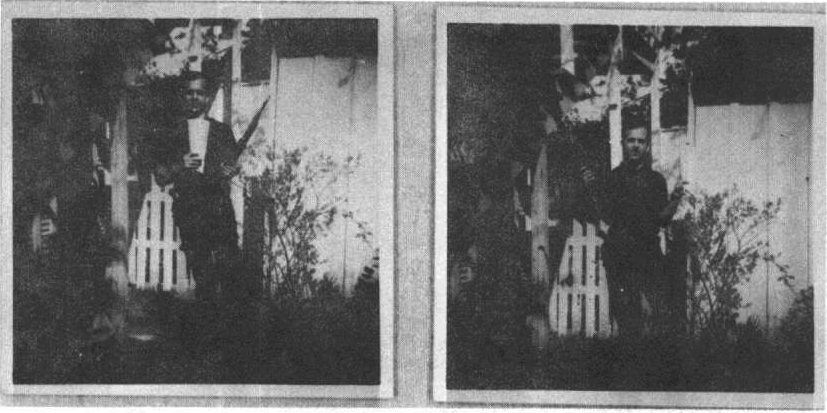
    The backyard photos are among the most contentious items in the record of the JFK case. These portraits of the accused assassin Lee Oswald are strikingly odd, as his clothing, posture, demeanor, and accessories combine to strange effect. There is something undefinably askew in the photographs, and it’s not just that the socialist papers are so at odds, or the firearms are out of context in the domestic yard setting, or that the Oswald figure seems bent at an unnatural angle. There’s a certain patness to the incriminating content, with the future accused man apparently posing with the future murder weapons and signaling a radical political bent which could present motive for his murderous action. This patness encourages a view that the photos are “too good to be true” and the elements of incrimination too obvious, such that the photos may be forgeries, as the accused assassin himself had stated. The oddness of the photos, immediately apparent, supports this view.

    Most discussion of the backyard photos falls within partisan divides: supporters of the government’s version of events tend to accept both the authenticity of the photographs and the narrative of their creation, while critics point to inconsistencies and details within the photos which suggest they are forged composites. This divide has tended to polarize discussion of the backyard photos – they are authentic! they are fake! – such that many salient issues which could assist an understanding of these strange images get overlooked. A review of the backyard photos and their context as developed in the official record can assist in bringing such issues to the foreground.

    Backyard Photos Discovered Amongst Oswald’s Possessions

    At 4:30 PM (CST) November 23, 1963, the Dallas Police Identification Bureau received two negatives matching photographic prints showing “Lee Harvey Oswald holding rifle with scope.” Earlier in the afternoon, Dallas Police detectives had undertaken a second search at Ruth Paine’s home in Irving, Texas, concentrating on the small one-car garage where seabags, suitcases and boxes belonging to Lee Oswald were stored. The Investigation Report (CE Stovall D) states ”found by Dets. Rose was two snapshots and negatives showing Oswald holding the rifle (murder weapon) and wearing a pistol in a holster on his right hip (Tippitt murder weapon).”

    The Identification Bureau would create copies from the negatives, including an 8×10 enlargement of the backyard photo later identified as 133A (CE134). An hour later, at approximately 6 PM, Lee Oswald underwent another round of questioning and was confronted with the enlargement. Oswald rejects it as a fake, claiming “somebody has superimposed my face on that picture” (Rose WC testimony). Oswald is subsequently shown the found print of the second photograph, 133-B, which he dismisses as simply a smaller version of the larger doctored print. He accuses the Dallas police of being responsible for the creation of a fake photograph and states he will not discuss this photograph further without the advice of an attorney. Oswald assures his interrogators that he was familiar with photographic processes and would, in the fullness of time, demonstrate the technique used to create this composite.

    At this same time, the content of the photos was being leaked to reporters. The Dallas Police had been under pressure all day to explain their certainty the suspect was indeed the president’s assassin. At a press scrum, Police Chief Jesse Curry’s announcement of the other big discovery of the day, the Klein’s order letter for the mail order rifle, was upstaged by inquiries regarding these photos:

    Q. These are the photographs of the revolver and the rifle?

    A. There is a photograph of him with a revolver on his hip and holding a rifle in his hand.

    Q. Does it look like the one you have, that you think is the murder weapon?

    A. It does.

    Q. Does it have a telescopic sight?

    A. It does.

    Q. Is he aware of this?

    A. I don’t believe he knows all this as yet. I think the captain is talking to him about this at the present time …

    Q. Did he have in his hand a copy of the communist publication The Worker? With a headline “Be Militant”?

    A. It seems there’s two papers there. On one you can see the words Be Militant. On the other you see The Worker …

    Q. Do you consider the case shut tight now, Chief?

    A. We will continue to work on it and get every shred of evidence that’s possible.

    The link of the alleged murder weapons with the suspect, although more tenuous than initially portrayed, was publicized as a major breakthrough and helped harden opinion that Oswald was the assassin ahead of his own murder. The presence of radical left wing literature in the photos also helped solidify a portrait of Oswald as a dangerous communist. Curry’s misreading of a newspaper banner – Be Militant instead of The Militant – is indicative of a particular frame of reference, and explains a note jotted by reporter Seth Kantor: “Ask Fritz … 501 Elm is place that processed photo. What are details of photo (showing gun & Daily Worker head: “Be Militant.” (CE Kantor 3)1

    Backyard Photo Leaked To the Media

    In early 1964, the backyard photo identified as 133-A was sold and/or released to several newspapers and magazines, resulting in wide public dissemination, most notably on the cover of Life Magazine’s February 21 issue. The release of the photo was considered a serious breach of the Warren Commission’s confidentiality, and the FBI was tasked with investigating “how the press got hold of the photo.” The FBI responded energetically, focusing resources in numerous cities.

    Officially, an FBI summary (CE1788) would report that Dallas Police officials Will Fritz, George Doughty, George Lumpkin and Carl Day, acknowledge multiple copies of both backyard photos were made for investigation purposes immediately after the assassination, but they knew nothing concerning the dissemination to the media. Captain Fritz would refer to information published in the March 2 edition of Newsweek, claiming that Life Magazine and the others bought their copy of the photo from representatives of Marina Oswald.

    An internal FBI memorandum dated March 25, 1964 is far less circumspect, stating: “Based on our investigation it would appear all of the photographs emanated from the Dallas Police Department.” The Dallas Police, as the HSCA would later confirm, “made numerous copies and did not control the dissemination.” Life Magazine negotiated a price of $5000 with Marina Oswald’s business agents for the publication rights to the photo, but the photo itself came from “an enterprising young man in the Dallas Police Department.” Life had an “original copy negative” of the photo, made in Dallas. (Shaneyfelt Exhibit 10)2

    Retouching photographs ahead of publication, for reasons of aesthetics or for technical quality, was routine practice in the print media. Eventually, inconsistencies from this work between various published versions of the photo became publicized by critics, and the Warren Commission was compelled to apply additional resources addressing this issue. Getting to the bottom of the controversy allowed the Commission to appear resolute in debunking yet another dark rumor. In all, the unauthorized February leak of the photo worked well for the Commission and the generation of the official story. The cover of the February 21 issue of Life single-handedly stamped the image of Oswald brandishing a rifle and militant socialist literature into the consciousness of millions of persons (several Warren Commission witnesses refer to “the picture published In Life” when discussing a backyard photo). In Life’s accompanying nine page “clinical study” of Lee Oswald’s biography, lone nut behavior patterns are emphasized and left-wing connections identified.

    The Warren Commission and the Backyard Photos

    Using the witness testimony of Marina Oswald bolstered by technical reports from the FBI’s photographic specialist Lyndal Shaneyfelt, the Warren Commission would assert that the backyard photos were taken by Marina at her husband’s request, using an Imperial Reflex camera which was owned by Oswald, and that this probably occurred on March 31, 1963. Further, the Warren Report determined that the rifle seen in the photographs was the same rifle found on the sixth floor of the School Book Depository and believed to have been used to kill the President.3

    The FBI’s Shaneyfelt used a comparative negative technique to determine that the Imperial Reflex camera in evidence had taken the backyard photographs. Snapping a new picture using this camera allowed for a comparison of this new negative with the backyard photo negative 133-B. Unique marks and scratches created by the camera on the edge of the image could be identified, and then checked against other negatives to find similarities which could link them to this same camera. Shaneyfelt also identified a photo taken near General Edwin Walker’s home, found among Oswald’s possessions, with this camera.

    Following the publication of the Warren Report, the backyard photos came under sustained criticism. Mark Lane discussed issues related to the February photo leak in Rush To Judgement, while Sylvia Meagher offered a substantive critique of the logic of the backyard photos, and the shortcomings with the evidence, in Accessories After The Fact. Researchers versed in photography challenged the authenticity of the photographs themselves, proposing that some form of superimposition was utilized to create a fraudulent Oswald snapshot, a view which gained momentum as it was discovered that this had been Oswald’s position while in custody. In the mid-1970s, as interest in the case was building ahead of the HSCA, news documentaries produced by the BBC in Britain and CBC in Canada featured photographic experts who concurred that fakery was evident.

    New Backyard Photos introduced to the Record

    The House Select Committee on Assassinations asked a specially convened photographic panel to examine controversies associated with the backyard photos, particularly (if not solely) the question of their authenticity. The panel would examine the photos from a primarily technical basis, using forensic techniques to determine “evidence of fakery”, reproducing to some extent work done by the FBI’s Shaneyfelt in 1964, but with more sophisticated techniques. The panel would also identify and describe the various prints in the record, as new versions of the photos appeared through sources connected with the Dallas Police, including, incredibly, a previously unknown third backyard photo (designated 133-C).

    133-A de Mohrenschildt The de Mohrenschildt backyard photo was apparently discovered in February 1967 by Jeanne de Mohrenschildt, inside the sleeve of a record album found at a Dallas storage unit the de Mohrenschildts had secured ahead of their move to Haiti in April 1963. The record album, an instructional Russian/English language LP, had been lent by Jeanne to Marina Oswald, and was found with similar albums inside a box which had been placed in the storage locker sometime after the de Mohrenschildt’s departure, perhaps through Everett Glover and Michael Paine.

    The photo was deemed a first generation print of 133-A (although some researchers believe the Oswald figure’s arms are held higher), with markedly higher detail and resolution compared to the originally discovered prints. On the back side of the photo are two inscriptions. One says “To my friend George from Lee Oswald 5/IV/63.” The other, written in darker ink, is Russian cyrillic translated as “hunter of fascists ha-ha-ha!!!” This second inscription appears to have been written over the top of other writing which had been erased. The HSCA commissioned a handwriting expert who determined that the first inscription matched Lee Oswald’s known handwriting. The second inscription was thought to have been written by Marina Oswald. The subject was broached during an interview, with the now Mrs Porter, on September 13, 1978:

    Mr. McDONALD … do you recognize the handwriting?

    Mrs. PORTER. No, I don’t … you have certain way of writing, habit of writing certain letters, so I know for sure that I could not, I do not write certain letter that way. So at first I thought it was maybe my handwriting, but after I examine it, I know it is not … this is something like maybe foreigner would try to write it, you know, to copy Russian language.4

    In his manuscript “I Am A Patsy”, George de Mohrenschildt described how he viewed the photo as a “gift from the grave” from Lee Oswald. If it was a “gift”, an assumption since the print’s origin and presence inside the record album remain mysterious, then, presuming the April 5 1963 inscription date correct, Oswald passed on an opportunity to present it directly when the de Mohrenschildts apparently paid a social visit the following weekend, what would turn out to be their last meeting.

    Ruth Paine testified to the Garrison Grand Jury convened in New Orleans on April 18, 1968 that she had met the de Mohrenschildt’s only twice, once at the Everett Glover party in February 1963 where she was first introduced to the Oswalds, and a second time in 1967 precipitated by the discovery of the photo. “They called and asked Michael and me to come have dinner with them … he said he found in his luggage the same picture that appeared in Life Magazine of Oswald holding the rifle and the gun on his hip, and it gave him such a turn, it was afterward, after the assassination, and we just talked generally of the events.” Considering the centrality of both the de Mohrenschildts and the Paines to the Oswald’s lives in 1962-63, talking “generally of the events” appears as an understatement.

    Jeanne deMohrenschildt passed the print on to the HSCA in 1977, shortly after her husband’s apparent suicide (which remains controversial).

    133-C Dees In late December 1976, a print of what was termed an “additional view” of the backyard pose was passed to the House Select Committee by Mrs Geneva Dees. According to a staff summary of an interview with Mrs Dees, the print “had been acquired by her former husband, Roscoe White, now deceased, while employed with the Dallas Police at the time of the assassination.” Roscoe White has assumed some notoriety for numerous reasons, including that his tenure with the DPD began only a few weeks before the assassination, assigned to the Identification Bureau where the backyard negatives would be delivered. White, according to his family members, had experience with “trick photography”. Previously he had been in proximity with Oswald in the late 1950s, as they were occasionally in the same places while serving with the Marines.

    133-C Dees was deemed by the panel as a first-generation print, which would indicate the corresponding negative was also in possession of the Dallas Police. This negative is not in the record. The existence of this third pose, as a print or negative, is not accounted for anywhere in the official recounting of the investigation or the generated paperwork. However, when the Dallas Police and Secret Service photographed a recreation of the backyard photos on location a week after the assassination, the pose struck by the photographed officer was that seen in 133-C. Astonishingly, the House Select Committee expressed muted, at best, curiosity regarding this photo and the missing negatives.

    133-A Stovall / 133-C Stovall These prints were delivered to the HSCA in April 1978 through Richard Stovall, who had been one of the Dallas Police detectives involved with the search of the Paine household in November 1963. These were also deemed first-generation prints, created from negatives which are not in the record.

    According to the HSCA photographic panel’s analysis, the backyard photo prints in the record were created using at least four different processes, representing at least five unique printing events.

    The two prints originally found among Oswald’s possessions were described by the panel as “drugstore or photofinisher prints because they appeared to have been produced on the type of commercial photo printing machine used by photofinishers for camera stores, drugstores and mass-produced prints.” The prints are small (3”x3”), with a white border and markings consistent with an automated commercial machine. The de Mohrenschildt print is larger (5”x5”) and described as “probably made in a high quality enlarger with a high quality lens” due to its increased resolution. The panel notes that “the entire negative area is printed” (showing more picture than the cropped “drugstore” print), and that the print had yellowed, “indicating that it was not adequately fixed or washed during the development process”. Another print of 133-A (Stovall), was larger (5”x8”) and cropped on the sides. The two prints of 133-C (Stovall / Dees) were 8”x10”, the same size as the blow-up print shown to Oswald a few hours after discovery (CE134).

    Although the HSCA panel does not directly speculate, their review indicates that the original roll of film which exposed the backyard photos was processed at a common commercial photofinisher, the de Mohrenschildt version possibly created by Oswald at his Jaggars-Chiles-Stovall workplace, and the other prints were created at various times at Dallas Police headquarters.5

    The HSCA Panel Determines The Backyard Photos are Authentic
    The House Select photography panel’s real work, as evidenced by their report’s exhaustive detail, was to determine the authenticity of the backyard photos. Questions concerning the photos which were non-technical in nature were therefore not addressed. The panel implicitly accepts two crucial assumptions: 1) the Imperial Reflex Duo-Lens camera identified as having produced the photographs was “Oswald’s camera”; 2) Marina Oswald operated that camera to produce the photos.

    Stressing that the panel conducted their forensic analysis of the backyard photos utilizing the best available materials – the one negative and the seven known first generation prints – the Photograph Authentication section of the HSCA Report details results of digital image processing examining consistency in the film grain, stereoscopic techniques to determine if superimposition had been applied, and photogrammetry to establish measurements of objects and shadows. These are all accepted and proven techniques for forensic examination of photographs. The panel also undertook numerous controlled experiments to examine specific points advanced by critics: identical heads from photo to photo, inconsistent body proportions, unnatural and inconsistent shadows, and unnatural lines in the vicinity of the subject’s chin. The result of this analysis: “Careful examination of the photographs with respect to lighting, perspective, sharpness, distortion, grain pattern, density, and contrast revealed no evidence of fakery.”

    Malcolm Thomson, the British photographic expert who determined for the BBC that the photos had been faked, and also the unnamed Canadian analyst who did the same for CBC, were then contacted. Both men were presented with the panel’s findings and asked to respond. Thomson, noting the thoroughness by which the panel had investigated the issue, “deferred to the panel’s conclusions”, and added that he had been working from generational copies rather than first generation prints. The Canadian analyst also replied that he had been examining “very poor copies”.

    Thomson, however, did maintain that the subject’s chin in the backyard photographs was “suspiciously different” and that a well-done fake would be difficult to detect, digital image processing or not. Indeed, both the FBI’s Shaneyfelt in 1964 and the HSCA panel in 1978 concede that a determined skillful forger with access to high quality equipment and then also to the Imperial Reflex camera in evidence, could have faked the backyard photos. Therefore, a categorical assertion of “authenticity” is not possible, and that someone may have superimposed Oswald’s face onto another man’s body cannot be ruled out.
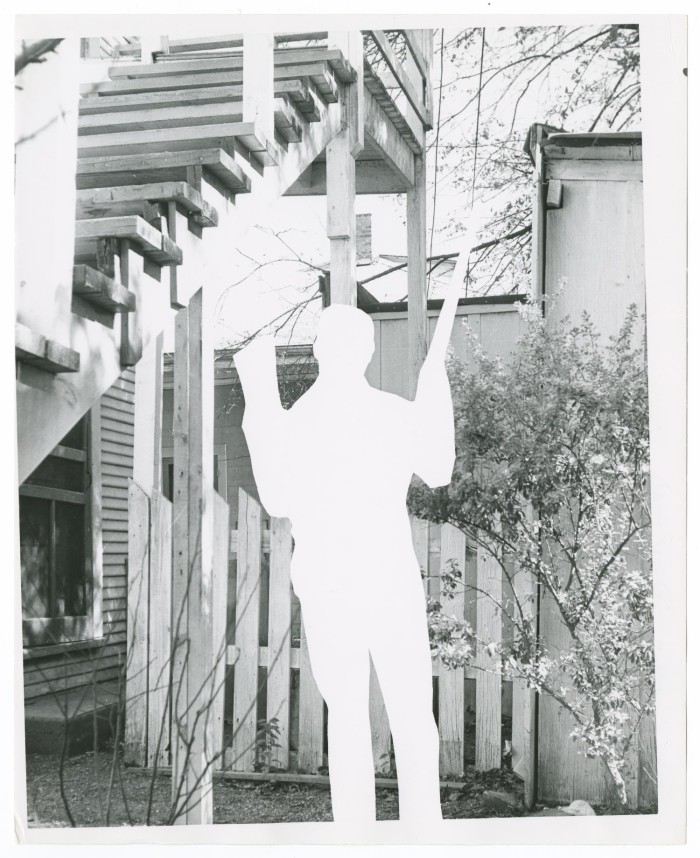
    A counterfeiter creating such forgeries would require: access to the Neely Street backyard; assistance from at least one other person; access to a Mannlicher-Carcano rifle and a pistol; access to the specific issues of The Worker and The Militant; access to the Imperial-Reflex camera; and access to a photo featuring Oswald’s face (or two or three similar photos of Oswald ) for superimposition. Dallas Police recreations staged at the location on November 29,1963 show mature flowered plants behind the subject and therefore date the backyard photos themselves, or at least a photo of the backyard used for a later composite, as generated some months ahead of the assassination. The counterfeiter would likely possess knowledge of a plot involving Oswald. Alternatively, it cannot be ruled out that photos were taken in the Neely St backyard featuring an unknown male subject for a reason unrelated to the future assassination, possibly with Oswald’s assistance, and then later appropriated for another purpose by superimposing Oswald’s face.

    In light of the panel’s extensive forensic work, using the existing negative and first generation prints, the weight of probability does support these photos as “real”, absent a technical challenge to this analysis or specific information regarding a forgery operation. However, regardless of the thoroughness by which the House Select Committee’s panel approached its subject, by limiting its investigation solely to the authenticity of the photos themselves, the panel bypassed two equally compelling questions which bear weight especially if the photos are considered “authentic”: was the camera which was identified as having taken the photos actually “Oswald’s camera”, and did Marina Oswald actually take the photos?


    Part 2:  Was the Imperial Reflex Actually Oswald’s Camera?

    The official investigations accept without question the attribution of the Imperial Reflex camera as owned by Lee Oswald. The Warren Commission refers exclusively to the “Oswald camera”. The HSCA Report references “Oswald’s camera”, as does the House Select testimony of Cecil Kirk from the photography panel.

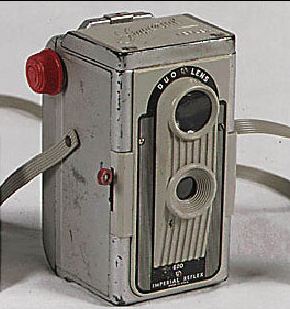
    The camera itself was described in the Warren Report as “a relatively inexpensive, fixed-focus, one-shutter speed, box-type camera, made in the United States”. (WR p593) That description, while accurate, sells the camera a little high, as it could also be described as a cheap all-plastic body wrapping a minimal array of flimsy elements. The lower lens sent light to the film plane, while the upper lens sent an inverted image to the viewer, which was accessible by popping open the top plate. The small red lever at the front opened the shutter, and the larger red knob at the back advanced the film.

    This Imperial Reflex camera does not appear in the inventories of Oswald’s possessions seized by the Dallas Police at the Paine address in Irving and the North Beckley room in the Dallas neighbourhood of Oak Cliff. Investigations determined that Oswald owned a “Russian camera” and an “American camera”. A Russian-made Cuera-2 camera appeared in the inventories, as did an American-made camera called a Stereo Realist. The Imperial Reflex camera only came to light, in the possession of Robert Oswald, about three months after the assassination and presumably after it had been determined that the Stereo Realist camera could not be linked with the backyard photos.

    Russian Cuera-2 camera “American” Stereo Realist camera


    A timeline of events as the ownership of the cameras was developed is illuminating:

    11/28/63 “(Marina) was asked whether she or Lee had any cameras and she replied that Lee bought one camera in Russia and a second one in the United States … She added that she was not proficient with operating any cameras as she never had an opportunity to do so.” (CE1792)
    12/2/63 “(Marina) said that they had two cameras, one Russian and one American, but she does not recall with which camera she took the (backyard) photograph.” (CE1401)
    1/29/64 “The other camera owned by the OSWALDS was a United States made camera which LEE HARVEY OSWALD had owned prior to his entry into the U.S. Marine Corps and this was the camera which he had taken pictures with when he was in the Marine Corps … (Marina) said the ‘Cuera-2’ camera appears to be the Russian camera and the ‘Realist’ appears to be the American made camera.” (CE1155)
    2/16/64 “ROBERT LEE OSWALD … viewed photos of a Stereo Realist camera and and a Cuera-2 camera and advised that he did not recognize either of the cameras as having been the property of LEE HARVEY OSWALD, but also stated he was not familiar enough with the cameras … to either state that the cameras in question did or did not belong to LEE HARVEY OSWALD.” (CE2557)
    2/17/64 “(Marina) was also shown the photograph of the Stereo Realist … She stated it was not the property of OSWALD as far as she knew. She advised to her knowledge she had never seen this camera … ” (CE1156)
    2/18/64 “(Marina) advised that she believed she took the photograph with the American camera which OSWALD owned … She said the American camera had a greyish color, somewhat like aluminum. It was a box-type camera … She can recall that she sighted the camera by looking down into the viewer at the top of the camera … ” (CE1404)
    2/19/64 “RUTH PAINE … advised that approximately three weeks after the assassination … ROBERT OSWALD … came to her residence and requested that they take all the remaining property belonging to LEE HARVEY OSWALD … she pointed out to them the boxes and other materials in her garage belonging to the OSWALDS and they removed this property.” (CE2557)
    2/24/64 “ROBERT LEE OSWALD made available a Duo-Lens Imperial Reflex camera made in the United States of America. It is aluminum colored … ROBERT OSWALD advised that in about 1957, LEE HARVEY OSWALD purchased a camera at about the time he first went into the U.S. Marine Corps … About 1959 … he left this camera with ROBERT at Fort Worth, Texas. In about August 1962 … LEE HARVEY OSWALD regained possession of this camera from ROBERT.” (CE2557)
    2/25/64 “Imperial Reflex camera obtained from ROBERT LEE OSWALD … was exhibited to MARINA OSWALD at which time she identified it as the camera belonging to LEE HARVEY OSWALD with which she had taken the picture of OSWALD holding the rifle and newspaper and wearing the pistol.” (CE2557)

    Robert Oswald would claim he “had never made this camera available to authorities before February 24, 1964, because he had never been asked for it previously and he could see no evidentiary value … of this cheap camera … He stated that it had never occurred to him that anyone would be interested in the camera.” (CE2557) This is after he had been specifically interviewed about and shown photos of cameras (February 16). It would also turn out to be the second instance in which a subjective judgment apparently kept this camera away from the sweep of the investigation. Marina Oswald temporarily stayed with Robert Oswald in February 1964, coinciding with the FBI’s determined efforts. She was thereby in the same house as the Imperial Reflex and, a week later, she suddenly recalled the camera was “aluminum” colored and that it was sighted “by looking down into the viewer”.6

    The FBI Closes The Circle

    The discovery of the Imperial Reflex would create something of a loose end in the developing official narrative since it was unclear how the camera could have been overlooked during the thorough Friday and Saturday searches of the Paine residence the previous November. On February 19, 1964, the same day Ruth Paine advised that a box of miscellaneous items was passed to Robert Oswald (five days before the camera was “found”), the FBI interviewed Irving Police detective John McCabe, who had attended both searches of the Paine household. According to the FBI, McCabe is “certain that he saw a light gray box camera in a box in Mrs PAINE’s garage. MCCABE stated that this camera was in a box which contained books and photographs belonging to LEE HARVEY OSWALD. MCCABE stated that he searched this box and did not take the camera since he did not consider it to be of evidentiary value.” (CE2557)

    On March 14, Dallas Police Detectives John Adamcik, Richard Stovall, Gus Rose and Henry Moore – who conducted the searches of the Paine residence – are interviewed by the FBI. They are shown a photograph of the Imperial Reflex camera. “None of these officers could recall ever seeing this camera and did not recall seeing it during a search of the garage at the PAINE residence. They all stated that if it had been discovered during the search, they would have brought it in.” (CE2557)
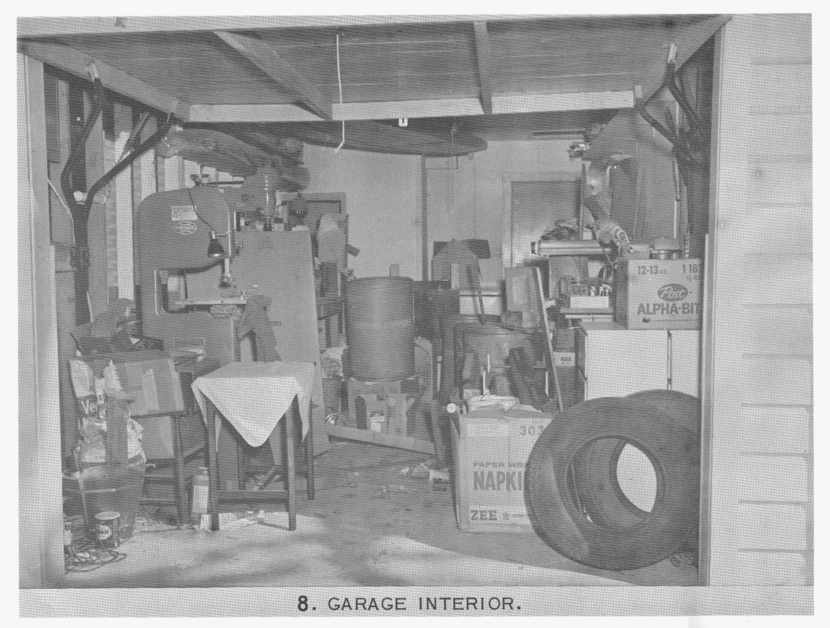
    The Paine’s garage

    McCabe is interviewed again by the FBI on March 23. He tells of “going through a box containing some books, some pictures, and a camera. He took the camera out of the box, put it on a dresser and searched the box in detail, and then put the camera back in the box.” He is shown a photograph of the Imperial Reflex camera received from Robert Oswald a month earlier and “he stated the camera in this photograph appeared identical with the one he described … in his opinion the Dallas Police Officers, who were also participating in the search, did not see this camera and did not search this particular box. He stated he had already searched the box and told them so. He did not point out the camera to them.” (CE2557)

    On March 23/24,1964, the four Dallas officers are also interviewed once more. They “all advised that during the search of the PAINE residence they recalled that there were several boxes in the garage at the PAINE residence and that all boxes were searched by one of the officers participating in the search … all stated that they definitely did not see the Imperial Reflex camera … or any other camera in the PAINE garage.” (CE2557)

    McCabe was at the Paine household as a representative of the Irving Police Department since the Paine home was so located, but the Dallas detectives were responsible for the search. How could a camera be found inside a box which also contained photographs “belonging” to the suspect, and yet be considered of no evidentiary value? In McCabe’s March 23 interview he says the camera “appeared in such poor condition that he believed it was not capable of taking pictures.” The box handed to Robert Oswald by Ruth Paine, in which the camera was said to be found, was presumably the same box searched by McCabe. This box was itemized by the FBI. It contained thirteen books, including six Russian books and a book on Marxism, some random items such as dice and a pencil sharpener, but no photos or pictures are listed. The original inventory list from November 23, 1963 (CE Stovall D) notes a “grey metal box containing miscellaneous Russian literature and some slide negatives”, but no camera.

    McCabe was not called before the Warren Commission nor does he personally appear in the record again. He does feature in the one anomaly in the testimony of the Dallas Police officers regarding the discovery of the backyard photos. Gus Rose (but no one else) gives McCabe some agency in the search: “I found two negatives first that showed Lee Oswald holding a rifle in his hand, wearing a pistol at his hip, and right with those negatives I found a developed picture … and Detective McCabe was standing there and he found the other picture – of Oswald holding the rifle.”
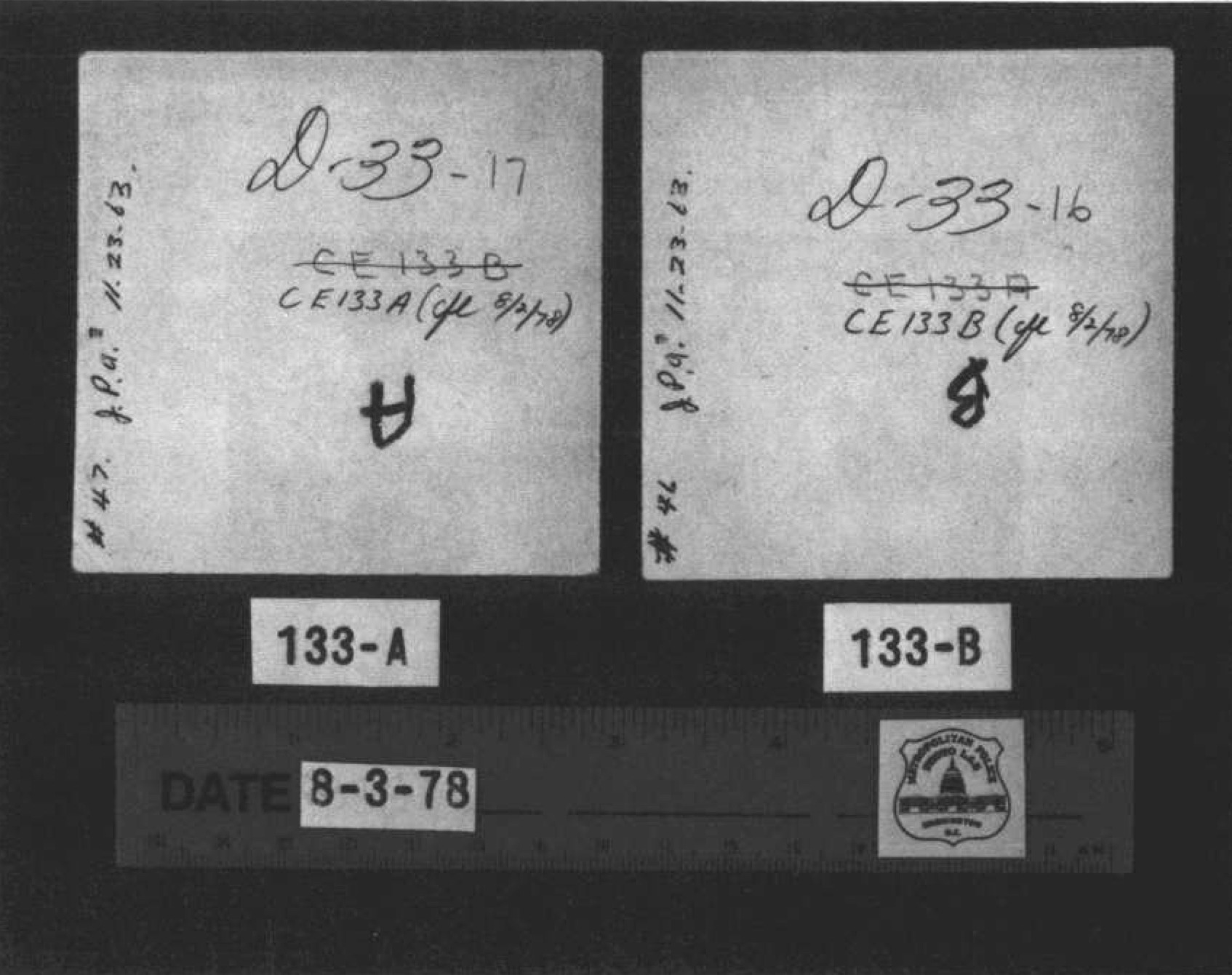
    Adamcik’s initials on the left side

    In June 1964, Special Agent Bookhout of the FBI met with Gus Rose to apparently re-establish where the backyard photos were discovered. “Rose identified same as being two photographs in a packet of forty-seven photographs found by him in a box during a search of the garage at the residence of Mrs Ruth Paine … ” A few days later, Bookhout met with Detective Adamcik who “stated these are two photographs from a packet of forty-seven photographs found in the search … Adamcik stated since he was present at the search he had numbered each photograph on the back and placed his initials thereon.” Adamcik’s initials appear on the back of the drugstore prints of both 133-A and 133-B, as do the numbers 46 and 47.

    It is hard to reconcile Rose’s account of McCabe finding one of the prints with the alternate story that the prints were found inside a packet. It is possible that Rose had become aware that McCabe had supposedly found something in the garage, and so stated McCabe found one of the prints in a bid to be helpful (if ultimately confused).7

    Oswald’s Photographs

    The House Select Committee’s photographic panel sought to buttress the identification of the Imperial Reflex as “Oswald’s camera” by applying the unique signature test – the markings on the edges of the negatives exposed in that camera – to other photographs found amongst Oswald’s possessions. Panel leader Cecil Kirk authored the following paragraph:

    “In regard to the allegation that this camera had been used only to take the incriminating backyard pictures of Lee Harvey Oswald, the panel examined all of the photographic material in the National Archives that was listed as having been taken from the effects of Lee and Marina Oswald … Most of these were family-type snapshots, including scenes of an older child and baby in a crib, Marina Oswald playing with a child, and Lee Oswald holding an infant. The frame edge markings appearing on the negatives to these photographs and the camera scratch marks appearing directly on the pictures were studied and found to be entirely consistent with both the original test materials and the Oswald backyard pictures which were exposed in the Oswald Imperial Reflex camera.” (HSCA Report p. 161)

    Edge markings negative 133-B Edge markings JFK Exhibit 189
    “Lee Oswald holding child”

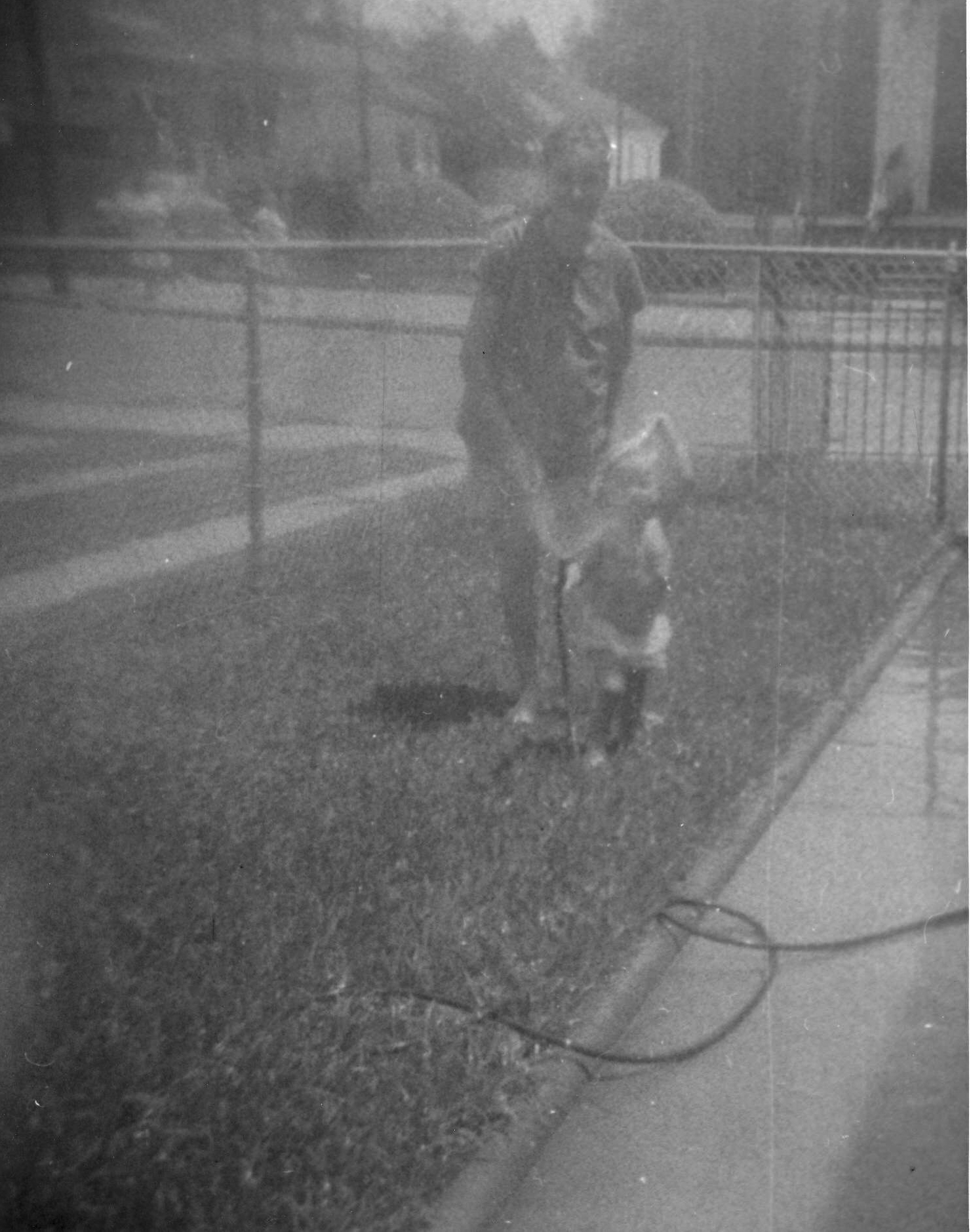
    Serving as an example of a photo “entirely consistent” with the Imperial Reflex is a photograph taken in New Orleans, JFK Exhibit F-189, in which Oswald’s young daughter June is pictured posing before the screened porch in the courtyard of the Magazine Street apartment. Numbered pointers show identified scratches or markings which appear to match the scratches and markings found on the backyard photos. This photograph is one of a New Orleans set, “family-type snapshots” which include photos that could be described as “Marina Oswald playing with a child” (and a set to which negatives were recovered). Of the other photographs specifically mentioned in the Kirk’s description of the Oswald photographs, the known snapshots of “Lee Oswald holding an infant” originate from Russia, while the “scenes of an older child and a baby in a crib” seem to refer to separate photos of either an older child or a baby in a crib which originate from Russia and later a few from Dallas and New Orleans. According to Robert Oswald, the Imperial Reflex (or whatever “American camera” Lee Oswald owned) stayed with him until Lee’s return to Fort Worth in 1962 and so could not have been used in Russia.

    Cecil Kirk’s paragraph appears to have been carefully worded, such as a lawyer might do, to imply something without actually saying it. Here, the description of “family-type snapshots” is followed by an analysis of frame edge markings, implying that all of the specific snapshots referred to were “studied” and found to have the same markings as the Imperial Reflex. But Kirk is referring to the frame edge markings “on the negatives to these pictures”, and the New Orleans set represent the only “family-type snapshots” identified as having negatives at the Archives, where only about two dozen negatives were on file in the first place. In describing a “match”, Kirk is referring to one photograph/negative – JFK Exhibit F-189. “It is our opinion that the same camera produced the baby picture.”

    Mr GOLDSMITH: What were the panel’s overall conclusions regarding the frame edge marks and camera scratch marks that it evaluated?

    Sergeant KIRK: That it is a reliable source of identification and it is our opinion that the camera did indeed produce these photographs.

    Mr GOLDSMITH: When you say these photographs, you are referring to the backyard pictures?

    Sergeant KIRK: The backyard pictures and the baby picture. (HSCA Vol II p. 371)

    The assertion in the HSCA report that “many” photos and negatives were linked to the Imperial Reflex camera is technically true, but appears to refer only to four photos and one photo group: the three backyard photos, one photo of General Walker’s house, and the multiple photos included in the New Orleans set.8
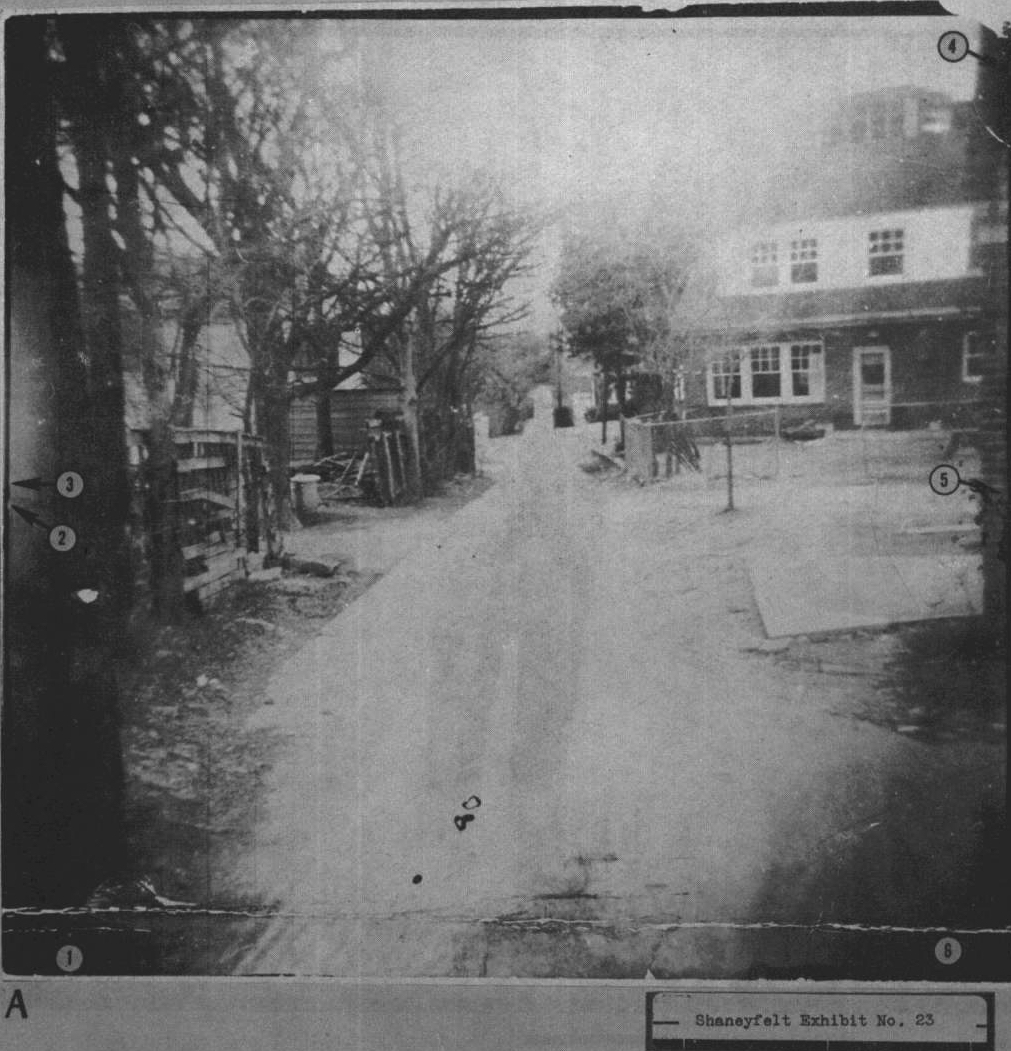
    Shaneyfelt Exhibit 23: “Walker” photo

    What of the photographs “listed as having been taken from the effects of Lee and Marina Oswald”? To say that “most” of these photos consisted of “family-type snapshots” is something of a stretch. Some of the family photos, for example, are scenes of Oswald’s mother or his brother Robert’s family, which had been forwarded to him while overseas. Others are of friends in Russia, or friends in the Marine Corps. Altogether, family-type snapshots – understood as photos of Lee Oswald and his immediate family (Marina and his children) – are relatively few and most of them date from the Soviet Union.

    On December 3, 1963 FBI agents visited Marina Oswald with a group of forty-seven photographs for her identification. These pictures had been delivered to the FBI from Captain Fritz of the Dallas Police Department, and were described as “among the effects of LEE HARVEY OSWALD.” The two backyard photos are listed in this group as photos 46 and 47. (CE1401) This collection of photographs appear to be the contents of the “packet” in which the backyard photos were discovered, referred to by Rose and Adamcik in June 1964. The forty-seven photograph group is also mentioned in a report generated investigating the leak of 133-A in February 1964 (CE1788). The December 3 report lists photographs by number, accompanied by Marina Oswald’s description of their content. The majority of these photographs are from Russia. Three photos predate the Russian trip – one labeled Oswald in 1952; one of Oswald and John Pic, and one from Japan. The two backyard photos alone postdate the Russian trip.

    June Oswald at Elsbeth St

    On January 31,1964 FBI agents visited Marina Oswald with a collection of over 350 images for her identification, mostly photographs but also some postcards (CD443). The photographs are numbered within groups, with some photos duplicated from the packet shown to Marina in December, but the backyard photos not among them. Only two photographs, both from Elsbeth Street, were of immediate Oswald family and dwelling in Dallas (Item 11 P4, Item 33 P6).

    June Oswald Neely St balcony

    On March 19, 1964 FBI agents again visited Marina Oswald to exhibit for her identification another group of photographs, 448 in total – of which about 300 were determined to belong to the Paines. A different filing system again is used to list and describe the photographs (CIA Oswald 201 file Volume 32). Of this group – approximately one hundred and fifty Oswald photos, with many duplications from the previous presentations – only six are linked to the first four months of 1963: one photo from Elsbeth Street (65-7), three of June Oswald at the Neely address (B3-13, B3-17, B3-29),and the two backyard photos (D33-16, D33-17).9

    From the record, excluding the backyard photos, there appear to be only six Oswald family-type snapshots from the first months of 1963 and, from the record, very few others from Oswald’s entire stay in Dallas in 1962-63. Oswald was known to complain that he couldn’t find the proper film for his Russian camera, but he seems to have been adverse to using his “American camera” despite having a young child, the subject of most of the few photos which do exist.

    None of the photos in the record from this time period, including the photos of the Walker house attributed to Oswald, have the dimensions or borders of the backyard photos known as 133-A and 133-B. The “drugstore” finishing is unique to these photos.10 The automated machines of the era maneuvered an exposed roll of film to fix the negatives and then create the prints, so it is likely the backyard photos were originally processed using this method. Given the absence of any other photos from the period with a “drugstore” finish, did Oswald orchestrate the backyard photo shoot and then process a roll of film which contained only three exposures? Assuming the official narrative is correct and the photos were taken on the last day of March 1963, why wouldn’t Oswald develop the three negatives at Jaggars-Chiles-Stovall? Perhaps he felt the content of the photos might prove awkward, as he had earlier been told not to bring Russian literature to work after he was seen reading one of his subscription periodicals.11 This is assuming that Oswald was the person responsible for the processing of these photos. The two originally discovered backyard photos, as “drugstore” prints, are an anomaly amidst the Oswald photographs.

    Did Lee Oswald Have A Working “American Camera” In Dallas?

    Marina Oswald was asked about her late husband’s photographic habits during a Deposition for the HSCA:

    Q. Did he like photography?

    A. I don’t think so. That is a very expensive hobby.

    Q. To your knowledge … did he own a camera?

    A. I really don’t remember.

    Q. Did he own any kind of –

    A. I remember in Russia, he took pictures. It was our camera or somebody’s camera but I know he was taking pictures. I do believe it was our camera because he was carrying it with him.

    Q. When you lived in Texas did he own a camera?

    A. I don’t recall but, according to some pictures we had he might have because he had some pictures that were taken recently, I mean during our living there. I do believe he probably had. (HSCA September 20, 1977)

    This theme was picked up again some eleven months later:

    Q. Did Lee photograph pictures of you and your daughters at any time?

    A. In this country?

    Q. Yes.

    A. Yes; in Dallas once, on a balcony, he took a picture of my daughter.

    Q. Any other times?

    A. Possibly.

    Q. Do you recall now any other times?

    A. Well, we took a picture once at the bus station through this thing called the photomat where you put a quarter or a dime or whatever price in it and maybe Lee took pictures of me during our life together; yes.

    Q. Do you have any memory of these specific pictures being taken?

    A. No. (HSCA August 9, 1978)

    Marina Oswald is not saying she witnessed Lee operating a camera while in Dallas, but offering an assumption, since she had seen photos of her daughter June filmed on the balcony at 214 Neely Street in March or April 1963, then Lee must have been responsible.12

    Ruth Paine also was not sure a camera was available to Oswald in Dallas.

    Mr. JENNER – Was there any picture taking during the period, during the fall of 1963, either in New Orleans or in Irving or in Dallas?

    Mrs. PAINE – Not by either Lee or Marina that I heard of.

    Mr. JENNER – And did you hear any conversation between them in your presence or with you with respect to his or they having a snapshot camera or other type of camera to take pictures?

    Mrs. PAINE – No; the only reference to a camera was made by Lee when he held up and showed me a camera he had bought in the Soviet Union and said he couldn’t buy film for it in this country. it was a different size.

    Mr. JENNER – Did they ever exhibit any snapshots to you?

    Mrs. PAINE – Yes; a few snapshots taken in Minsk.

    Mr. JENNER – But no snapshots of any scenes in America that they had taken?

    Mrs. PAINE – No.

    Mr. JENNER – Or people?

    Mrs. PAINE – No. (WC March 21, 1964)

    The New Orleans Photo Set

    In contrast to the sparse number of Oswald family-type snapshot originating from Dallas in early 1963, at 4905 Magazine Street in New Orleans a set of eleven photos are taken in the courtyard, probably within a relatively few minutes. Negatives from these photos were said to be found amongst Oswald’s possessions, and later used by the HSCA photography panel to identify a match to the Imperial Reflex camera.

    There are a few occasions in the Oswald photographic collection when multiple pictures cover an event – Lee Oswald ironing baby clothes on a suitcase during the last days in Minsk, or the Oswalds at the train to begin the journey back to America13 – but eleven photos at a single location represents a burst of photographic enthusiasm not seen elsewhere.

    The New Orleans photo set is a domestic scene: toddler June Oswald poses before the Magazine Street apartment for two wider photos, then the photographer comes in closer near the gate and fence with a distinct driveway behind, then June joins Marina, who is barefoot and comfortable in black shirt and shorts.14 The lawn is wet with spray from a garden hose, which June picks up and aims about her. The mood is casual and happy. The photos are undated, but Marina’s visible pregnancy is consistent with early second trimester dating these photos to the first month in New Orleans, May-June 1963. This was a time, according to the available testimonies, of tension and disagreement for the Oswalds:
    Mr. PREYER … .just before he went to New Orleans, what was his treatment of you?

    Mrs. PORTER. Well, he was quite brittle, sometime toward me.

    Mr. PREYER. That was family quarreling?

    Mrs. PORTER. Quite constantly. (HSCA September 13, 1978)

    This state of affairs was evident to others. Ruth Paine: “when I took her to New Orleans in May, he was very discourteous to her, and they argued most of that weekend.” (WC March 18, 1964). Mrs Jesse Garner, the landlady at Magazine Street also witnessed tensions:

    Mr. LIEBELER – Did you ever try to talk to Marina Oswald?

    Mrs. GARNER – Yes; I did when she would be outside hanging clothes. I tried to talk to her and to the baby, I talked to both, and she would put her hands over her eyes and start crying. I asked her how she felt, and she would just do like this with her shoulders.

    Mr. LIEBELER – She shrugged her shoulders?

    Mrs. GARNER – Yes … And another thing, she would nod, try to tell you hello when he wasn’t there, but if he was there like they was sitting on the steps or something, or they would go through the drive and he was there, she wouldn’t even look at you.

    Mr. LIEBELER – She was more friendly and outgoing when Oswald wasn’t there?

    Mrs. GARNER – Yes; when he was there, she wouldn’t have nothing to say.

    If Lee Oswald did not suddenly find peace with his wife and take this unusual set of photos, who could have? There were very few known visitors at this address, and the casual nature of the photos strongly suggests the photographer was known and familiar to the subjects (Marina and June). The photo set was shown to Marina Oswald during an HSCA Deposition on August 9, 1978:

    Q. I now would like to show you, Mrs. Porter, six photographs and see if you can identify these for us.

    A. This is a picture of me and my daughter June when she was a child. I do not know where they were taken though …

    Q. Do you recall when this was taken?

    A. No.

    Q. Do you know if people took pictures of you apart from Lee?

    A. Well, I don’t recall the picture taking incident, period. I don’t know who took the picture.

    Q. Did Lee take pictures of you?

    A. I don’t know. I don’t remember.

    Q. You don’t remember?

    A. No; it could have been in New Orleans because I was expecting a baby then …

    Q. Mrs. Porter, do you remember the incident when these pictures were taken?

    A. No.

    There is one person who had been present at the Magazine Street apartment and was friendly with Marina, familiar to June, and who could be linked with the Imperial Reflex camera. That is Ruth Paine, who arrived in New Orleans with Marina Oswald on Saturday May 11, 1963, and stayed through Tuesday morning May 14. On Sunday, the Oswald and Paine families (Ruth Paine had her own two children along) toured the French Quarter. On Monday, Lee Oswald would have gone to his job at the Reilly Coffee Company, leaving Marina and Ruth Paine together at the Magazine Street apartment.

    Ruth Paine would visit this apartment again for several days in September 1963. For the Warren Commission she could draw a sketch of the interior and exterior layout of 4905 Magazine Street (CE403). She referred to the courtyard area where the photos were taken several times in her testimony:

    Mrs. PAINE – … Lee showed her, of course, all the virtues of the apartment that he had rented. He was pleased that there was room enough, it was large enough that he could invite me to stay, and the children, to spend the night there. And he pointed out this little courtyard with grass, and fresh strawberries ready to pick, where June could play … Marina was definitely not as pleased as he had hoped. I think he felt – he wanted to please her. This showed in him.

    Mr. JENNER – Tell us what she said. What led you to that conclusion?

    Mrs. PAINE – She said it is dark, and it is not very clean. She thought the courtyard was nice, a grass spot where June could play, fenced in.

    Mrs. Garner, the landlady, remembered Ruth Paine’s visits from observing her station wagon parked out front. She did not see Paine personally, but told the Warren Commission that her husband did.

    Ruth Paine sketched the Magazine St layout for the Warren Commission

    Mr. LIEBELER – Did your husband see that person?

    Mrs. GARNER – Yes; my husband.

    Mr. LIEBELER – At this time.

    Mrs. GARNER – Yes; my husband saw her and spoke to her. I never did see her.

    Mr. LIEBELER – You say your husband had talked to her. Did he tell you what she had said?

    Mrs. GARNER – No; I never asked him and he never said nothing. (WC April 6, 1964)

    At the close of her testimony, Mrs Garner is addressed by Liebeler: “I do want to thank you for the patience that you and your husband have shown to me and for the cooperation you have given us in coming down here and testifying. On behalf of the Commission I want to thank you both very much.” If Mr Garner had testified and perhaps been asked the circumstance of his conversation with Ruth Paine it is not in the record. Despite his apparent presence during his wife’s appearance before Liebeler, there is no transcript of any interview with Jesse Garner from April 6, even as it would have been as relevant, if not more so, than what his wife could offer. Instead, a brief affidavit focused specifically and exclusively on his contacts with Lee Oswald is executed on May 3, 1964.

    The New Orleans photo set is not listed among the group of photographs shown Marina Oswald on January 31, 1964. The photo set is listed and identified as among the group of photographs shown to Marina on March 20, a group which included many photographs belonging to the Paines.

    If the Imperial Reflex camera was not Oswald’s – and the evidence assembled by the Warren Commission and the HSCA does little to install confidence in this assertion – its provenance can be located in circles close to Oswald, as seen with the backyard photos and the New Orleans set,15 and can be linked, directly or indirectly, with Ruth Paine.


    Part 3:  Did Marina take the Backyard Photos?

    The narrative establishing the origin of the backyard photos is based largely on Marina Oswald’s recollection, but official investigators have often been skeptical of her stories. Her memory lapses tend to recur or intensify unpredictably, spiked by sudden detailed recollections of incidents which are often incredible or absurd (i.e. Lee Oswald’s attempt to assassinate Nixon or wandering busy Oak Cliff for target practice with the rifle jammed in a raincoat). There are moments in her testimonies and interviews where she appears dumb and largely unaware, other times when she is fairly lucid. If there is a pattern, at least in the months following the assassination, it’s the memory lapses and absurd stories occur most frequently over incidents which critics over the years have suspected never actually happened.16
    The problem accepting Marina’s fuzzy account of the creation of the backyard photos is partly a psychological one: how is it possible for her to be so vague about details when the event itself was so highly unusual and possibly indicative of a dark turn in her husband’s life? It was purportedly the first and only time she had ever operated a camera, but later she could barely recall the procedure. Supposedly her husband appeared before her wearing strange wardrobe and brandishing firearms which she had not been previously aware.17 Yet Marina tells the Warren Commission: “I didn’t attach any significance to it at the time.” (WC February 3, 1964) The backyard photo session was apparently never mentioned to Ruth Paine, even as tension in the Oswald’s marriage was a frequent topic of conversation during their burgeoning friendship. Marina’s handwritten narrative about her life with Lee, filled with anecdotal episodes from their marriage, does not mention the backyard photo-taking at all (CE993/994).18

    The Warren Commission – through Commission lawyers Rankin and Liebeler – never questioned Marina Oswald with the intent of extracting details on the creation of the backyard photos, content to have her briefly recount her story of being interrupted by her husband while hanging diapers. The interviewers for the HSCA did a better job trying to tease specific information to help clarify the veracity of the story. These interviews occurred some fourteen to fifteen years after the fact so her already vague recollections are all the more challenged.

    A. I do believe it was a weekend and he asked me to take a picture of him and I refused because I don’t know how to take pictures. That is the only pictures I ever took in my whole life. So we argued over it and I thought the pose, or whatever he was wearing was just horrible, but he insisted that I just click, just push the button and I believe I did it twice and that was it …

    Q. And you recall testifying about these same two photographs when you testified to the Warren Commission?

    A. Yes; I remember them asking if I ever took the pictures and I had completely forgotten because it was only once in my life and I didn’t know who to take pictures. Yes, when they showed me that, yes, I did take the pictures …

    Q. What did he tell you to do with the camera as far as taking the pictures?

    A. He just told me which button to push and I did.

    Q. Did you hold it up to your eye and look through the viewer to take the picture?

    A. Yes. … (HSCA Deposition September 20, 1977)

    The interviewer is well aware the Imperial Reflex camera said to have taken the pictures featured a viewer at the top of the camera that one looks down into, and that the camera is held mid-body rather than raised to the eye. He is also aware that the shutter is opened by pushing down on a small lever, a different mechanical activity than simply pushing a button. Marina Oswald’s recollections cast doubt on her story, as the operation of the Imperial Reflex is so different than most consumer cameras that it should not be easily forgotten.

    Marina Oswald did, once, describe accurately the camera’s mechanics, as accounted in an FBI summary from February 18, 1964, when agents were keenly focused on locating the backyard camera and a week after Marina temporarily stayed with Robert Oswald in the house where the camera would be later be “found”. The summary ascribed to her, compared with her other statements on the topic, is absurdly detailed and contains information never repeated: “She said the American camera had a greyish color, somewhat like aluminum. It was a box-type camera … She can recall that she sighted the camera by looking down into the viewer at the top of the camera … ” (CE 1404)

    Q. When you took the first picture you held it up to your eye?

    A. Yes; that is what I recall.

    Q. What did you do next?

    A. I believe he did something with it and told me to push it again.

    Q. The first time you pushed it down to take the picture?

    A. Yes.

    Q. And the first time, what happened before you took the second picture?

    A. He changed his pose.

    Q. What I am getting at is, did you give the camera to him so he would move the film forward or did you do that?

    A. He did that.

    Q. So you took the picture and handed the camera to him?

    A. Yes.

    Q. What did he do?

    A. He said, “Once again,” and I did it again.

    Q. So he gave you back the camera?

    A. For the second time; yes.

    Q. Did he put the rifle down?

    A. You see, that is the way I remember it.

    Q. Did he put the rifle down on the ground between ––

    A. I don’t remember. (HSCA Deposition September 20, 1977)

    Marina Oswald is being asked whether her husband freed his hands by placing the rifle to ground, to support a developing hypothesis of the photo shoot. The HSCA photographic panel would surmise that the three photos were taken in a particular order, and that Lee’s need to move the film forward in the camera and otherwise instruct his wife resulted in the rifle and literature appearing in one set of hands, then the other, and then again as the first. Observing the photos in this presumed order (133-C followed by B followed by A) allowed the panel to state the “photographic technique improved appreciably during the sequence”, implying that the learning curve of the novice Marina Oswald was this way visible.19

    The Peter Gregory Interview

    Peter Gregory was a member of the Dallas area White Russian community and one of the first persons to meet with Lee Oswald on his return from the Soviet Union in June 1962. Gregory, a consultant in the oil industry, taught Russian part-time in Fort Worth. Oswald sought a reference for his language skills. Gregory’s son Paul befriended both Lee and Marina, and the Oswalds were gradually introduced to a wider community of Russian speaking persons over the course of social visits into the autumn of 1962. In the aftermath of the assassination, Gregory was enlisted to provide translation services as Marina Oswald appeared before investigators.20

    Peter Dale Scott, in his book Deep Politics And the Death of JFK, discusses the Russian language interpreters recruited for initial interviews with Marina Oswald. The first, Ilya Mamantov, was recruited by Army Intelligence officer Jack Crichton five hours after the assassination. Peter Gregory was brought in the following day.21 Scott notes that both men, as interpreters, had occasion to add words, or otherwise misrepresent what Marina was actually saying, as deliberately adding adjectives “dark” and “scopeless” to her vague descriptions of a rifle. (WCD 344 p22-23)

    On November 27, 1963 Secret Service agent Leon Gopadze, Russian speaking and newly assigned to the Dallas investigation from Washington, joined the FBI’s Hosty and Brown to interview a tired and uncooperative Marina Oswald at the Six Flags Inn. During the interview, Marina was informed, through Gopadze, “the Government needs her cooperation and this might help her” remain in the United States. She was “asked how she intended to make a living … She was then told that her cooperation with the Government could also be of assistance.” (CE1791)

    The following day, Gopadze solicited assistance from Peter Gregory, whose presence he felt would be “beneficial” to enabling a more cooperative attitude from Marina Oswald. Gopadze had reviewed Gregory’s interpretive work recorded during interviews with her on November 23 (WCD 344). Gopadze’s review noted that Gregory had added words and rephrased certain statements, but his interpretive work was characterized as flawless in a later report (CE1792). Gopadze and Gregory met at the Six Flags Inn, discussed “mutual personal background,” and then Gregory described his introduction to Lee Oswald and subsequent interaction with the Oswalds. Gregory was characterized by Gopadze as “very patriotic, and loyal to this country.”

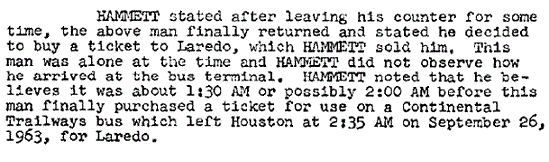
    Immediately following this briefing, Gregory conducted what was described as a private interview with Marina Oswald. According to the summary, this interview was largely concerned with reviewing biographical information already on the record. Gopadze determines that Marina “was very sincere in her statements and that she was furnishing the information voluntarily without trying to hold anything back.”22 Gopadze then joins Gregory and Marina Oswald as the interview continues, possibly on Gopadze’s initiative, covering Lee Oswald’s frugality, his membership in a hunter’s club in Russia, and then a perhaps pointed question about an “Inter Club” in Leningrad.23 She is asked about Lee’s purported trips to Washington and Mexico (answering in the negative) and then was asked “whether she or Lee had any cameras.” Marina replies there was a Russian camera and an American camera: “one was a small camera and the other was a box camera”. This is one of two occasions, with the absurd February 18, 1964 summary from the FBI, that the descriptive term “box camera” was used by Marina Oswald.

    According to the summary of this November 28 meeting, after a few more questions Marina became “very much concerned that Mr Gregory and I had any doubts as to her sincerity and truthfulness … ’I hope you believe me, as I swear by God, this is the truth’.” Moments later, a measure of Marina Oswald’s willingness to be cooperative and truthful was revealed:

    “Before showing Marina Oswald photographs of Lee Oswald holding the rifle, she was forewarned to tell me the truth about the photographs. She replied she would. At this time two photographs of Lee holding the rifle, a newspaper, and a revolver strapped at his side were shown to her and by seeing them it seemed somewhat of a shock to her. She started crying, but after composing herself, she said that the pictures were taken while they were living in the duplex on Neely Street at Dallas, Texas, as she recognized the background of the picture. She was then asked who took the picture. Marina hesitatingly said she didn’t think she knew but immediately stated that there was no use telling a lie, and added that it was taken by her upon Lee’s request, even though she did not know how to operate the camera. The operation of the camera was explained to her by Lee who also measured the distance where she should stand when taking the photographs. After Marina Oswald examined the pictures it was pointed out to her Lee was holding a rifle containing the scope and she said honestly that she does not remember noticing the scope but that it was Lee’s rifle and the same one she had previously seen in their apartment in New Orleans. The fact that Lee had a revolver in a holster on his right side was pointed out to her but she said she did not notice the revolver while taking the picture as Lee was dressed in black and it would be hard to see. She said the reason Lee asked her to take the photographs was for the purpose of sending photographs to the Militant magazine to show that he was ready for anything … ” (CE1792)

    This is the first recitation of the backyard photo story and Marina Oswald is strangely detached from the images, recognizing “the background of the picture” rather than her supposed personal involvement in the photo’s creation, and having to examine the pictures while things she didn’t know are pointed out to her. She claims to recognize the rifle, but as one “previously seen in their apartment in New Orleans.” Marina was consistent during her post-assassination interviews that she had first seen a rifle associated with her husband in New Orleans, and here maintains that position even as she is viewing a picture featuring a rifle taken previous to traveling there.24

    This begins the phenomenon of Marina Oswald’s recovered memories, later to illuminate the Walker shooting, Lee and the rifle, the trip to Mexico City and so on. They begin shortly after the private interview with Peter Gregory, and one day after the subtle threat to “cooperate” with the government and its representatives. The appearance of the descriptive term “box camera” shortly before the first telling of the backyard story suggests the private Gregory interview may have been less concerned with retelling already known biographical detail, and more concerned with laying out terms of cooperation. If “box camera” was introduced to Marina from an outside source, how this descriptive information was known many weeks ahead of the camera’s later discovery raises serious questions.25

    The Destroyed Photo of Oswald with a Rifle

    Two days later, on November 30, 1963, Marina Oswald tells Secret Service Special Agent Gopadze “when she was shown, by the reporting agent, pictures of Lee Oswald holding a rifle she did not advise at that time that she had the same pictures but in smaller sizes pasted in her family album but that upon the suggestion of Mrs. Marguerite Oswald she destroyed them upon learning that her husband was a prime suspect in the shooting of the President.” (CE1787) This seems to confirm that a photo of Oswald holding a rifle was in Marina’s possession on the evening of the assassination and was destroyed either that night or the following day.26 It also seems to confirm that Marina began to identify or confuse, correctly or incorrectly, the destroyed photo with the backyard photos.

    In testimony before the Warren Commission, Marina displays her confusion:

    Mrs. OSWALD. … I had even forgotten that I had taken two photographs. I thought there was only one. I thought that there were two identical pictures, but they turned out to be two different poses. (WC, February 3, 1964)

    What is she referring to? The source of her confusion may be knowledge she handled one photograph of her husband, with a rifle, on the evening of the assassination, and later was advised she took two backyard photos (actually it would have been three, the fact of which demonstrates that the “two photograph” event was a construct created by her interviewers).

    The most often told destroyed photo story features one photograph. Marina Oswald secured the photo from her personal effects after she had returned, along with mother-in-law Marguerite Oswald, to Ruth Paine’s house from Dallas Police headquarters the evening of the assassination. In the photo, Oswald is seen holding a rifle. Apparently there was an inscription, on the front or back, which said in English: “To my daughter, June”.27 Marina, fearful that the photograph be considered incriminating, showed it to Marguerite, who recommended she destroy it. The photo was apparently destroyed at either Ruth Paine’s home that evening, or at the Executive Inn the following day. It was burned in an ashtray, or ripped into pieces and flushed down the commode, or a combination of the two.

    Marguerite Oswald told the Warren Commission that in the photo Oswald was holding the rifle above his head with both hands. If this was a backyard photo then it would represent a unique pose and therefore be a fourth photo, with Oswald posing this time without the literature.

    Mrs. OSWALD … And she came out with a picture a picture of Lee, with a gun. It said, “To my daughter June”-written in English … I say to my daughter … anybody can own a rifle, to go hunting. You yourself probably have a rifle … I think my son is all agent all the time no one is going to be foolish enough if they mean to assassinate the President, or even murder someone to take a picture of themselves with that rifle, and leave that there for evidence. (Marguerite Oswald, WC testimony, February 10, 1964)

    Sylvia Meagher speculated back in 1967 that the destroyed photo could have originated from Oswald’s time in Minsk, associated with his membership in a hunting club. Marguerite Oswald’s Warren Commission testimony could support this as she is shown the two backyard photos (Commission Exhibits 133-A , 133-B, and the blowup 134):

    Mr. RANKIN … I will show you some photographs. Maybe you can tell me whether they are the ones that you are referring to. Here is Commission’s Exhibit 134.

    Mrs. OSWALD. No, sir, that is not the picture.

    Mr. RANKIN. And 133, consists of two different pictures.

    Mrs. OSWALD. No, sir, that is not the picture. He was holding the rifle and it said, “To my daughter, June, with love.” He was holding the rifle up.

    Mr. RANKIN. By holding it up, you mean ––

    Mrs. OSWALD. Like this.

    Mr. RANKIN. Crosswise, with both hands on the rifle?

    Mrs. OSWALD. With both hands on the rifle.

    Mr. RANKIN. Above his head?

    Mrs. OSWALD. That is right.

    Mr. RANKIN. Did you ever see these pictures, Exhibits 133 and 134?

    Mrs. OSWALD. No, sir, I have never seen those pictures.

    This appearance before the Commission occurred before the Life Magazine cover flooded the newsstands or her answer should have been more precise, such as a picture like or unlike the one on the cover of Life (as other witnesses referred to specifically). The backyard photos are distinct for Oswald’s clothing and the location, so Marguerite Oswald’s reply “I have never seen those pictures” implies that whatever the destroyed picture was, it was not a backyard photo.

    Marguerite’s observation “anybody can own a rifle, to go hunting” may also be indicative of another origin for the destroyed photo. There is one known photograph of Lee Oswald with a rifle, apparently taken during leave from the Marines in 1958, which was in the possession of his brother Robert. Some of Robert’s photographs had been forwarded to Lee while he was in the Soviet Union. Did Marina have a copy of this photo misremembered by Marguerite, or an alternate of this photo in which the rifle was held above his head?

    Regardless, Marina Oswald’s initial response to the backyard photos does not indicate she was responsible or even that she had seen them previously.


    Notes

    1  501 Elm Street is the Dal-Tex Building. Since the two photos and their corresponding negatives were said to be found inside a “packet”, perhaps that packet had an identifier listing this address. Did the Dal-Tex building have a tenant in 1963 which could process photos in the fashion associated with the originally discovered backyard photos?

    2  The original negative of 133-A went missing while in the possession of the Dallas Police department. It would later be claimed (i.e. First Day Evidence) that only one negative was found at the Paine residence, and that the copies disseminated by the Dallas Police were generated from the two prints, not the negative(s). However, it is hard to get around the clear ID of two negatives made by the officers who found these photos, and the Identification Bureau paperwork from 4:30 PM which unambiguously records two negatives.

    3  Shaneyfelt, the FBI man charged with investigating the photographs, did not actually make a positive identification between the rifle seen in the photographs and the rifle in evidence. He said it had “the same general configuration” and that “all appearances were the same”, and he noted that a notch or groove in the stock which “appears very faintly in the photograph” perhaps matched a similar notch found on the rifle in evidence, but it was not enough to make a “positive identification to the exclusion of all other rifles of the same general configuration.” The Warren Commission was responsible for claiming the positive identification, using deductive reasoning based on the timing of the receipt of the mail order firearms and the receipt of the two newspapers seen in the photographs.

    4  Marina used the phrase “ha! ha!” in a handwritten narrative included in the Warren Commission’s exhibits (CE993) The handwriting and punctuation does not appear similar to that of the inscription on the back of the photo:


    Did Marina have a habit of using the exclamatory phrase “Ha! ha!”? She maintained of the inscription: “it would sound like me.” Who would have known that? For the Warren Commission, Ruth Paine would describe her Russian language skills: “My writing would be with fewer mistakes, because I can think about it more in putting it down, but still very many mistakes occur in it.” (WC March 18, 1964) Author Gus Russo, in his book Live By The Sword, speculated that the phrase was actually written by Jeanne de Mohrenschildt, but this photo was not known to her until its discovery in 1967.

    5  Dennis Orfstein worked with Oswald at J-C-S and told the Warren Commission that Oswald had enquired about creating enlargements from his personal negatives and he showed Oswald the steps involved. Orfstein said that employees would use the J-C-S equipment for small personal jobs from time to time. According to Orfstein, Oswald initially created an enlargement of a landscape photograph from Minsk. There has long been speculation that Oswald used the J-C-S facilities to create not just the de Mohrenschildt print, but several identification cards and perhaps more backyard prints. This may be so, but Orfstein described the photography work space at J-C-S as a common area, so any work Oswald may have done would have been either in the presence of other workers or risking interruption by other workers.

    6  This process, where little or zero knowledge or remembrance of an event on the part of Marina Oswald, gradually expands to extensive and detailed knowledge, often buttressed by newly discovered evidence, recurs during the investigation over topics such as the rifle, Oswald’s alleged attempt on Walker, and Oswald’s alleged visit to Mexico City.

    7  If this should seem an outlandish proposition, then it is best to point out that both Rose and Stovall described finding a photo of General Walker’s house (CE5), amongst Oswald’s possessions, with the license plate already removed or blacked out from the parked car. Rose “stated he definitely recalls that this photograph, marked as Commission Exhibit 5, was one of the photographs recovered from the PAINE residence and that it had been mutilated at the time they had recovered the box containing the photographs.“ (CE1351) This cannot be true, as an evidence photo published in Jesse Curry’s memoir showed the Walker photo with the licence plate still intact. Gus Rose would later appear in an unfavourable light in Errol Morris’ film “The Thin Blue Line”.

    8  The HSCA panel did not examine the photographs of the Walker residence found amongst Oswald’s effects, but previously, for the Warren Commission, the FBI’s Shaneyfelt had identified markings on one of these photographs as matching the Imperial Reflex. (WR p. 596) There has been a tendency to claim all the Walker photos were linked to the Imperial Reflex, but it was only the one, which had been printed with the image edge of the negative visible. Since the story of Oswald’s ‘American camera” was that he had it in Japan, left it with brother Robert while in Russia, and then retrieved it, the HSCA should have examined the photos from the Marines/Japan looking for these same consistencies, but there is no indication they did.

    9  The Neely Street balcony photos of June Oswald appear to have been taken on two separate occasions, as her garment is long-sleeved for two photos and short sleeved in the other. According to Marina, the blanket laid out on the balcony floor on which June sits would later serve as the blanket which allegedly wrapped the rifle as it sat in the Paine’s garage.

    10  There should be a “drugstore” print of 133-C as well, which has never come to light.

    11  The automated commercial printers would produce the prints with no one needing to closely handle or see them.

    12  During her testimony before the Warren Commission on February 4, 1964 Marina is asked to describe Lee’s performance as a father. She replies: “He would walk with June, play with her, feed her, change diapers, take photographs everything that fathers generally do.” Four days previous she had been shown a photo collection by the FBI which included the Neely Street balcony photos.

    13  Neither of these photo groups were actually photographed by Lee Oswald, as he often appears in the photos. Many of the Russian photos in Oswald’s collection feature him as a subject, so these photos were either passed on to him or were taken by someone else using his camera.

    14  Marina may be wearing a pair of “maternity shorts” as mentioned by Ruth Paine: “When she was with me in the spring, late April to the 9th of May, she had some money from Lee for her own expenses, and she used a portion of this, I would think a rather large portion, buying a pair of maternity shorts … I know they cost nearly $5, and this was quite a large expenditure and quite a thrill. These were bought in Irving.” (WC March 21, 1964) Soon after her return to Irving from New Orleans, Marina wrote to Ruth and referred to her domestic situation with “The love is gone!”

    15  This holds even if the backyard photos are conclusively determined to be forgeries, since the signature of the Imperial Reflex camera establishes it as part of the counterfeiting.

    16  Marina’s memory problems are not consistent. For context, consider her response during Warren Commission testimony dated July 24, 1964 as she is shown the photograph of the Walker house (CE5) in which the licence plate of a vehicle had been removed: “I think when the Commission showed me this picture the number was there … I would have remembered this black spot if it were there at the time the Commission showed me this.. When the FBI first showed me this photograph I remember that the license plate, the number of the license plate was on this car, was on the photograph … It had the white and black numbers. There was no black spot that I see on it now … I would have remembered it if there were a black spot on the back of the car where the license plate would be…I remember very distinctly that there was a license plate on this car. When this business about General Walker came up I would have remembered this black spot … This black spot is so striking I would have remembered it … There was no hole in the original when they showed it to me I’m positive of it.”

    17  The set of black clothes was not found amongst Oswald’s possessions, and Marina was never questioned about this wardrobe.

    18  Ending with a plea she be allowed to stay in the United States, Marina’s narrative is a saccharine version of events which often reads like the work of a ghost writer. Lee Oswald is portrayed as a classical music lover, sweet and gentle except when he’s not. Like when he’s shooting at General Walker.

    19  This proposed order is supported, according to the panel, by minute but visible changes in shadow location. The panel determined that “the camera was aimed about 70º east of north. The shadows in the photographs indicate that the Sun was behind and to the right of the camera. Since this would place the Sun in the southwestern sky, it was afternoon, and the Sun was going down.” This would time the photo shoot as mid-to-late afternoon. A learning curve operating this camera, with the inverted viewer, would be likely true for anyone.

    20  In November 1963, before the assassination, Marguerite Oswald apparently attended one of Gregory’s Russian classes, and then phoned him early on the morning of November 24 seeking assistance in relocating herself, Marina, and the two children. Gregory was travelling in a vehicle with them when word broke that Lee had been shot. Later, he told the Warren Commission, Ruth Paine contacted him seeking assistance writing “Russian letters”.

    21  “Chapter 17 – Army Intelligence And The Dallas Police.” Peter Dale Scott, Deep Politics And the Death of JFK. According to Scott, Ilya Mamantov and Peter Gregory had known each other for years and “had worked together to set up a CIA-subsidized anti-communist ‘church’ in Dallas.”

    22  CE1792. How Gopadze could determine Marina’s sincerity is not clear, as this interview was supposedly conducted by Gregory alone.

    23  John Armstrong has speculated that, in the Soviet Union, Marina Oswald was part of various “honey trap” scenarios directed at foreign officials, and complications related to this activity in Leningrad in 1959 resulted in her relocation to Minsk, where she would later meet Oswald. Armstrong notes during this time, a number of foreigners would marry Soviet women, bring them back to their home country, and then promptly face divorce proceedings. Marina began separating herself from Oswald, and sharing stories of physical abuse, within four months of their arrival in the United States.

    24  The only confirmation of the “Oswald rifle” at the Neely house was from Jeanne de Mohrenshildt, who allegedly saw it during their final visit just before Easter 1963. But in her first statement on the subject, to representatives of the State Department in Haiti December 1963, de Mohrenschildt said the rifle sighting associated with Oswald happened in the Fall of 1962.

    25  If this is what indeed happened, the fact “box camera” could have been known to Gregory, or shared with Gregory by Gopadze during their briefing ahead of the session with Marina. If Marina’s “recovered memories” were the result of coaching, it would not necessarily be in the form of specific lies to parrot. Presenting purported evidence or sharing “established” information with the suggestion that her “cooperation” would help to clarify, could set out a blueprint of what to say, while making it appear less a lie and more a reaction or embellishment to information she has been assured was true. Marina’s testimony is full of asides which seem to refer to such a practice.

    26  There are several differing stories told by both Marina Oswald and Marguerite Oswald. John Armstrong’s Harvey and Lee, pp. 497-498 reviews these stories.

    27  Much later, when the inscription on the back of the de Mohrenschildt backyard photo came to light, a presumption was made that Lee Oswald made habit of inscribing certain prints of backyard photos because, allegedly, he was proud of the image. But an inscription addressed to his young daughter on a backyard photo is difficult to believe, as it is so perverse.

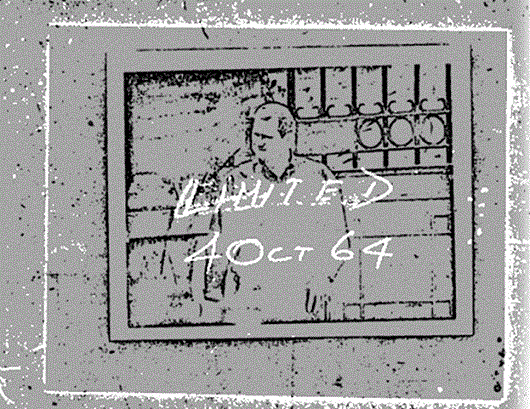
  • Legacy of A Lie

    Legacy of A Lie


    The following is an excerpt from Pat Speer’s on-line book, A New Perspective on the Kennedy Assassination. “Legacy of a Lie” is a sub-section of Chapter 10, “Examining the Examinations” (scroll down from the top to find it); it takes a hard look at the claim made by Howard Willens that Robert Kennedy obstructed the Warren Commission’s access to the autopsy photos and X-rays, and uncovers it as a fabrication.

    Reprinted here with permission of the author.

    legacyofaliefixed

    The 50th anniversary of Kennedy’s assassination added another chapter to our ongoing discussion of Kennedy’s back wound, and the probability Warren Commission counsel (and future Senator) Arlen Specter deliberately lied about its location to help prop up the single-assassin conclusion.

    In his 2013 book, A Cruel and Shocking Act, New York Times reporter Philip Shenon revealed that he talked to Specter shortly before his death in October 2012 and asked him about his viewing the back wound photo before the May 1964 re-enactment. Specter’s answer to Shenon was most illuminating, but the substance that was illuminated was strangely missed by Shenon. Specter reportedly told Shenon that he’d assumed Warren had asked Secret Service Inspector Thomas Kelley to show him the photo in order to “placate” him. Well, heck, that rules out Specter’s not saying anything about the photo to the rest of the commission because he didn’t want Warren to know he saw the photo.

    And that’s just the beginning. Reportedly, Specter also told Shenon that the photo he wanted to see in order to confirm the relative accuracy of the face sheet (which showed a wound on the back) and the Rydberg drawings (which showed a wound at the base of the neck) “resolved nothing” as the photo failed to show Kennedy’s face. Reportedly, Specter then proceeded to complain that “I know what evidence is” and that his being shown the photo (which shows a wound on the back) in that manner was a “bunch of horseshit.”

    Sounds like Specter knew what his seeing the photo and doing nothing about it would mean for his legacy…

    Still, his influence over Shenon seems apparent. When discussing Specter’s 3-11-64 meeting with the autopsy doctors (which Shenon mistakenly places on 3-13-64), Shenon reports: “As the autopsy continued, the pathologists could see that the muscles in the front of the president’s neck had been badly bruised–proof, they thought, that the bullet had passed through his neck and then exited out the front.” But this, as we’ve seen, is gobbledygook. Humes made this clear in his testimony. The bruising of the strap muscles led Humes to suspect the neck wound was a missile wound. Period. It was not “proof” the bullet exited out the front. Perhaps in the elderly Specter’s desperately defensive mind…but that doesn’t count for much and an experienced journalist like Shenon should have known as much. Specter’s original memo on this meeting, we should recall, presented a different scenario: “They noted, at the time of the autopsy, some bruising of the internal parts of the President’s body in the area but tended to attribute that to the tracheotomy at that time.” It’s really quite clear, then. As “the autopsy continued,” the doctors did not see the bruising of the strap muscles as “proof” the bullet came from behind, Specter should not have told Shenon as much, and Shenon should not have repeated something which a mere modicum of research–such as reading Specter’s memo on the meeting–would have proved to be inaccurate.

    And that’s not the last time Shenon, presumably unwittingly, buys into Specter’s re-writing of history. A few pages later, while discussing Humes’ testimony, Shenon discusses Specter’s attempts at gaining access to the autopsy photos. He relates: “Humes had tried to be helpful by bringing along diagrams of the president’s wounds prepared by a Navy sketch artist at Bethesda, but both he and Specter knew the drawings were based on Humes’ imperfect memory.” Well, this hides that 1) these drawings were created at the request of Joseph Ball, as well as Specter; 2) Ball had previously noted that the back wound appeared to be lower than the throat wound, and that this was a problem for the Oswald-did-it scenario; 3) the back wound in these drawings was now much higher than the throat wound; and 4) Specter induced testimony from Humes which suggested the measurements obtained at autopsy were used in the creation of these drawings, and that the drawings were therefore reasonably accurate.

    It seems likely, then, that Shenon was too enamored with Specter to find what needed to be found, and see what needed to be seen. Specter had provided him access, and was thus granted a free pass. His questionable behavior was never even questioned.

    It seems likely, for that matter, that Shenon wasn’t the only one determined to defend Specter and the commission.

    2013 also saw the release of History Will Prove Us Right, former Warren Commission attorney (and Specter college chum) Howard Willens’ spirited defense of the commission. I took an interest in this book in October of that year, and was put in contact with Willens through an intermediate. Within our first exchanges, Willens was friendly enough; he readily acknowledged that the wound in the photo shown Specter was a back wound, and not a wound on the back of the neck. And yet, he expressed no interest in second-guessing Specter’s actions while working for the commission. Not unlike Shenon with Specter, I suppose, I gave him a pass.

    In November, however, I saw him on CNN, in its Bugliosi-fueled program The Assassination of President Kennedy. There, he described the back wound of our discussions as a wound “in the back of the neck.” This surprised me. I wrote Willens pointing out his mistake, and received a response in which he acknowledged it as a mistake and once again admitted it was a back wound, and not a wound in or on the back of the neck. I once again gave him a pass.

    I was probably being too generous. A 12-11-13 article in the Hudson Hub Times reported on a recent appearance by Willens at the Hudson Library in which he discussed the assassination. When asked about the commission’s mistakes, he acknowledged: “Some of the diagrams were inaccurate.” He then added: “Someone testified Kennedy was shot in the back of the neck but it was the back of the upper shoulder.” Well, this came as another surprise. Was Willens really trying to push that the Rydberg drawings were inaccurate because the commission had been deceived by “someone’s” inaccurate testimony? Now, one, this was but weeks after Willens himself had made an appearance on CNN in which he himself claimed Kennedy was shot in the back of the neck. So that’s strange right there. I mean, was he also trying to blame “someone” for his more recent mistake? And, two, well, by blaming this mistake on “someone”, Willens was concealing that this someone was Dr. James Humes, Kennedy’s autopsist, and that Humes had been asked by the commission to explain how a bullet striking Kennedy’s back could have exited his throat, and that he then, and only then, started claiming the wound was really in the back of the neck, and that, furthermore, oh yeah, Earl Warren and Arlen Specter at the very minimum looked at the autopsy photo, and knew for a fact this wound was really in the shoulder, and not the neck, well before the commission’s report, in which this wound was repeatedly called a wound on the back of the neck, was published.

    And Willens knew all this, moreover, because I had discussed this with him in a series of emails written but weeks before his appearance at the Hudson Library.

    When I finally got around to reading Willens’ book, for that matter, I found much much more that was suspicious.

    On page 53, while discussing the Warren Commission’s review of the FBI’s report on the assassination, Willens relates: “One major issue that came up right away was the bureau’s preliminary finding regarding the bullets that struck President Kennedy and wounded Governor Connally. The FBI concluded that two bullets had struck the president and a third had wounded Connally. To support this assessment, the FBI relied in part on the initial, but inaccurate, information from Parkland Hospital that the first bullet that hit Kennedy had not exited from his body.”

    Well, geez, as pointed out by writer Martin Hay in his devastating review of Willens’ book, this is one of the most disturbingly inaccurate passages ever written about the medical evidence by a supposedly credible source. The Parkland doctors thought the throat wound was an entrance, and wondered if this bullet lodged in Kennedy’s body. The FBI, in its report, made no reference whatsoever to this wound, and discussed instead a shallow back entry wound, which the autopsy doctors told them represented a wound made by a bullet that DID NOT enter the body.

    Willens’ “error”, then, concealed that the autopsy doctors, upon whom the commission relied, could not find a passage into Kennedy’s body for the bullet the commission would later claim passed through both Kennedy and Connally.

    And this was no isolated incident, mind you, but the beginning of a disturbing pattern in which Willens concealed problems with the commission’s work, and Specter’s work in particular, from his readers.

    Throughout his chapters on April and May, 1964, Willens describes Specter’s attempts at gaining access to the autopsy materials. When one reads these chapters, however, one can’t help but get the feeling he’s hiding something. Here are a few of the things Willens avoids:

      • On page 170, Willens quotes liberally from Norman Redlich’s April 27 memo describing the need for a re-enactment of the shooting. He skips over the following passage, however, in which Redlich’s higher purpose is highlighted: “We have not yet examined the assassination scene to determine whether the assassin in fact could have shot the President prior to frame 190. We could locate the position on the ground which corresponds to this frame and it would then be our intent to establish by photography that the assassin could have fired the first shot at the President prior to this point. Our intention is not to establish the point with complete accuracy, but merely to substantiate the hypothesis which underlies the conclusions that Oswald was the sole assassin.”


      • On page 150, Willens briefly discusses the April 30 Executive Session of the commission, and relates “Warren also seemed receptive to Rankin’s proposal that a doctor and a commission member examine the autopsy photographs and X-rays so as to ensure the accuracy of the testimony of the autopsy doctors who did not have those materials available when they testified, but that the materials would not be included in the public record of the commission’s proceedings.” Note that he writes “seemed.” Well, this avoids that Warren did not “seem” to agree, but did agree that such an inspection could occur. That this inspection was forthcoming is also avoided by Willens’ failure to cite that “Rankin’s” proposal was brought about by a memo from Specter, in which Specter stressed the necessity of viewing the photo of Kennedy’s back wound so that the precise location of the wound and the precise trajectories of the shots could be calculated during the re-enactment. Willens makes no mention, moreover, of the May 12 memo from Specter which starts off “When the autopsy photographs and x-rays are examined, we should be certain to determine the following…” and thereby suggests that Specter had been told such an inspection was about to take place.


      • Despite referencing Specter’s 2000 memoir Passion for Truth a whopping 19 times, including one reference to the page in which Specter discusses his viewing the photo of Kennedy’s back wound on May 24, 1964, the day of the re-enactment, Willens never admits that Specter saw such a photo, and that the chalk mark used in the re-enactment to designate Kennedy’s back wound location was quite clearly marked in accordance with the photo shown Specter. (Willens subsequently told me that he attached no importance to Specter’s viewing of the photo.)


      • On page 173, when discussing the re-enactment, moreover, Willens writes “it wasn’t simply the alignment of the two victims that strongly suggested it. (The single-bullet theory.) The angle of the bullet trajectory was also consistent with the bullet exiting Kennedy’s neck and striking Connally’s back.” Uhhh, wait a second. The purpose of the re-enactment was NOT to determine if the angle of trajectory from the sniper’s nest was consistent with a bullet exiting Kennedy’s neck and then striking Connally’s back, it was to determine if the angle was consistent with a bullet hitting Kennedy in the back where he was actually hit, then exiting from his neck where a tracheotomy wound was noted at autopsy, and THEN hitting Connally in the back where he was wounded. By removing Kennedy’s back wound location from this series of wounds, Willens had taken a short-cut, a short-cut that wouldn’t have been necessary, of course, if the back wound had actually aligned with the other wounds…


    Now let’s look at what Willens does tell us…

      • On page 199, Willens writes: “Securing testimony from Mrs. Kennedy had been difficult, but getting our hands on the autopsy photographs and X-rays proved even more so. Although the public might accept our delicate handling of Mrs. Kennedy, we doubted they would be sympathetic to our failure to get the hard evidence that the autopsy materials represented. The Kennedy family had deep, long-term, emotional interests at stake but, for us, it was much more difficult to take a pass on this issue. We all believed we could not back down. Most of the staff was convinced that the commission’s failure to consider these materials carefully in its report would be used to attack our competence and integrity. Specter had taken the testimony of the three autopsy doctors three months earlier, at a time when neither he nor the doctors had access to the autopsy photos and X-rays. He and others were satisfied that the testimony of the doctors did accurately reflect the trajectory of the bullets and the nature of the wounds suffered by both Kennedy and Connally. However, the corpsman’s sketch introduced during this testimony was inaccurate as to the location of the wounds and to that extent inconsistent with that testimony.” WAIT. WHAT? While trying to defend the integrity of commission’s staff, Willens lets on that they knew the “corpsman’s” sketch–an obvious reference to CE 385–was inaccurate and inconsistent with the testimony of the doctors. Well, geez, this is interesting, seeing as NONE of these bastions of competence and integrity EVER said ANYTHING to indicate they’d thought the “corpsman’s” drawings were inaccurate in the years after the assassination. And worse, far worse, this suggests that when Dr. Boswell in 1966 and Dr. Humes in 1967 went public, at the urging of the Johnson Administration Justice Department, to claim their review of the autopsy photos proved the drawings were accurate, “most” of the Warren Commission’s staff knew they were blowing smoke.


      • Willens then proceeds to describe the memos written by Specter when he was preparing for the re-enactment. Willens then admits “At the commission meeting of April 30, Rankin obtained Warren’s approval to try and obtain access to the X-rays and photos.”


      • On page 200, he continues: “Unknown to Specter, the question of the commission’s access to these materials was still unresolved when I met with Katzenbach on June 17.” Well, this avoids that Specter was shown the back wound photo on May 24. In our personal correspondence, Willens told me Specter never told him he saw such a photo during the life of the commission, nor at any other time. And he also claimed that as of 1966 he didn’t even know Specter had been shown the photo. But Willens had clearly read Specter’s book. And he’d clearly taken notes. This leads me to suspect, then, that when writing his own book Willens knew full-well that Specter had viewed the back wound photo, and that he knew how this would appear to his readers, and that he thereby opted to leave this out of his narrative.


      • Willens continues: “I understood at this time that the attorney general had agreed to let Warren and Rankin see the autopsy materials. I urged Katzenbach to get Kennedy’s approval for Specter rather than Rankin to examine them. I told him it was very important to have the most knowledgeable lawyer on the staff assume this responsibility and that Specter was known to the attorney general as the prosecutor who had successfully won the Roy Cohn Teamster case in Philadelphia.” Well, this is also kinda suspicious. Specter’s memos and the transcript of the April 30 executive session of the Warren Commission reflect that Specter’s–and Rankin’s–interest was in getting Dr. Humes access to the autopsy materials in order to confirm the accuracy of his testimony and the exhibits he’d had created. Willens mentions this on page 150. So why is Willens on page 200 telling his readers that the issue was getting Specter access to these materials? Was Willens trying to avoid that Warren had prohibited Dr. Humes–the man who’d pulled Kennedy’s brain from his skull–from taking a quick peek at a photo of Kennedy’s back?


      • “Katzenbach raised the question a few days later with Kennedy, who decided that Warren could view these materials on behalf the commission, but that no one else could be present and the X-rays and photographs would remain in the possession of the custodian who brought them. Kennedy was understandably wary of an opportunity to copy them.” Now, this is strange. Katzenbach was deposed by the HSCA’s Gary Cornwell on 8-4-78. He told Cornwell that Robert Kennedy’s attitude towards the Warren Commission’s investigation was as follows: “He found parts of it distasteful, maybe what Jackie did, I do not know, the whole autopsy business, revealing all that medical information he just found extremely distasteful. I would say I would have also under the circumstances. With respect to that kind of matter, he would ask ‘Is it necessary?’ and I would say ‘Yes, it is. You know, we do not have to circulate those pictures around to everybody. Competent people have to examine them,’ and so forth, and he would accept that.” (HSCA 3 p 738). 14 years after discussing the autopsy photos with Robert Kennedy, Katzenbach testified that Robert Kennedy accepted that competent people needed to examine them! Now here Willens, 35 years later, comes along to tell us that Katzenbach was not telling us the truth, and that Robert Kennedy had actually limited the number of people who could look at the photos to one–Earl Warren–who quite obviously lacked the competence to interpret them. Yikes. Either Willens was offering up a much-delayed correction to Katzenbach’s testimony, when he was no longer around to argue, or he was to defending Warren (and the Warren Commission), at the expense of Katzenbach and Robert Kennedy. In any event, this concern led me to ask Willens if he could publish any memos he’d written on Katzenbach’s meeting with Robert Kennedy. He responded: “I did not prepare any report other than what might be in my personal journal on the subject, which would reflect only what I reported in the book about my conversation with Katzenbach and the concerns of the staff.”


      • But this was misleading. There is no such report in Willens’ journal. On 4-03-14, Willens published his personal journal on his website. His entry for 6-14-64 reads, in part: “(2) I spoke to the Deputy regarding the need for an appropriate member of the staff to gain access to the photographs made at the autopsy which the Attorney General was reluctant to have anyone see. At this time the Attorney General had agreed that the pictures could be seen by the Chief Justice, Mr. Rankin and one of the autopsy doctors.” Now, wait a second. This is interesting right here. RFK had said it was okay for Dr. Humes to look at the photos? So why did Willens leave this out of his book? Was he preparing his readers for when he subsequently claimed RFK said that Warren and Warren alone could look at the photos? In his journal, Willens continues: “I told Mr. Katzenbach that Mr. Rankin had no need or interest to see these pictures, but that it was important that one of the members of the staff, Mr. Specter, who had been working in this area, be given access to these pictures. I mentioned the fact that Mr. Specter was known to the Attorney General as the prosecutor who tried the Ray Cohn case in Philadelphia and indicated to Mr. Katzenbach that he was a reliable person. Mr. Katzenbach said he would discuss it with the Attorney General on Friday, June 19, when the Attorney General returned to town.” And that’s it. There is no follow-up entry reporting on the results of Katzenbach’s discussion with Kennedy. Nothing. Nada. Bupkus. It follows, then, that Willens’ claim Katzenbach told him RFK said Warren had to look at the photos alone has no basis other than Willens’ faint recollections of a discussion almost half-a-century before, written for a book designed to defend Warren and his commission.


      • It’s actually worse than that. In 1967, Edward J. Epstein, the author of Inquest, a 1966 book on the Warren Commission, for which Willens was interviewed, was himself interviewed for The Scavengers and Critics of the Warren Report, a stinging rebuke to his book written by Richard Lewis and Lawrence Schiller. On page 101, Epstein is quoted as follows: “The most interesting thing is that the Commission never saw the autopsy pictures and X rays, which are the basic evidence…When I was interviewing the lawyers, they all said they didn’t see these, because Bobby Kennedy had refused to show them. But one of the lawyers, Howard Willens, checked his files and found Senator Kennedy never refused. It was Warren who didn’t want to see them.” So, hmmm, which are we to believe? Howard Willens’ 50 years-on memories of something he never mentioned previously? For which he created no memos? And took no notes? Or Edward Epstein’s 1 year-on memory of a discussion with Willens, for which Willens consulted his files? I would go with the latter.


      • And it’s even worse than that. On August 17, 1992, U.S. News and World Report published an account of the Warren Commission’s investigation, written with the input of the commission’s staff, including Willens. The article reported: “the Kennedy family resisted releasing images of JFK’s mutilated corpse, in part to avoid further pain. Indeed, Robert Kennedy refused invitations to testify. ‘I don’t care what they do,’ he told an aide. ‘It’s not going to bring him back.’ With no photos to show the paths of the bullets, Warren decided to use drawings, based on the autopsy surgeons’ recollections. Staffers complained that he was being too deferential to the Kennedys. Unknown to the young lawyers, Willens, who worked for RFK at Justice, kept pushing for access to the photos and X-rays. RFK has often been portrayed as blocking their release. But in mid-June he agreed to let Warren, Rankin and the autopsy doctors review them.” Now, Willens was the obvious source for this passage. And it is in keeping with his journal–that Kennedy initially agreed Warren, Rankin, and a doctor could view the images. But it says nothing of what Willens later pushed in his book–the part not in his journal–that RFK subsequently told Katzenbach Warren would have to view the photos all by his lonesome. Well, it follows then that Willens had pulled this part out of a dark place…and that he probably should have washed his hands afterwards.


      • In any event, in History Will Prove Us Correct, Willens continues: “Warren promptly arranged to have the materials brought to his chambers at the Supreme Court. He looked at them reluctantly and only briefly. He reported back to Rankin, and presumably the other commission members, that the photographs were so gruesome that he did not believe that they should be included among the commission’s records.” Well, wait a second. This is late June ’64. On April 30, Warren and the commissioners had agreed that one of them should view the photos in the company of Dr. Humes. On May 24, Specter was shown the back wound photo. Specter told Shenon, moreover, that he suspected Warren had arranged for him to see the photo. Well, then, isn’t if far more likely that Warren viewed the photos before allowing Specter to see the photo of the back wound, and at least a month before Willens presents him as viewing the photos? I mean, what’s going on here? Why would Specter be pushing to see the autopsy materials in mid-June, weeks after he’d decided not to put his viewing of the back wound photo on the record, and weeks after he’d actually drawn testimony from Secret Service agent Thomas Kelley and FBI agent Lyndal Shaneyfelt suggesting both that the “inaccurate” “corpsman’s” drawing was used during the re-enactment, and that the re-enactment supported its accuracy? Is Willens simply wrong, or is he blowing smoke? There is, of course, no mention of Warren’s viewing the photos in Willens’ personal journal.


      • “Due to Warren’s extreme distaste for these materials and his previous commitment to publishing everything relied on by the commission, Rankin concluded that there was no possibility of Specter being permitted to view these materials to confirm the accuracy of Humes’ earlier testimony.” Well, this is another head-scratcher. It totally avoids that 1) the transcript of the April 30 executive session of the commission reveals that Warren and Rankin AGREED that they could view the autopsy materials without publishing them, as long as they were using them to confirm previous testimony, and 2) the issue was not whether Specter would be allowed to view the materials, but whether Dr. Humes–the man for whom the materials had been created in the first place–could view the materials.


      • On page 201, Willens further claims: “Specter did not learn that Warren had examined the autopsy materials until long after the commission report was filed.” Now, this is interesting. If true, it suggests that Specter was afraid to say anything when shown the back wound photo in Dallas, and only later came to suspect Warren was behind his being shown the photo. If true, this suggests a surprising scenario, one so ironic it just might be true–that Specter was afraid to correct the record after seeing the back wound photo because he assumed Warren would not approve of this correction, while Warren took Specter’s silence as an indication no correction was necessary.


    There’s also this to consider. In his posthumously-published memoirs, Earl Warren writes: “In the last few years, although conspiratorial theories have borne no fruit, an attack has been made on the fact that pictures of the badly mutilated head of the President taken for the doctors do not appear in the records of the Commission now on file in the National Archives. It has been contended that the reason these pictures were not filed was because they would show that the shots which struck the President did not come from behind and above him. While I have never before entered into that discussion, I feel that it is appropriate to do so because I am solely responsible for the action taken, and still am certain that it was the appropriate thing to do. The President was hardly buried before people with ghoulish minds began putting together artifacts of the assassination for the purpose of establishing a museum on the subject. They offered as much as ten thousand dollars for the rifle alone…They also, of course, wanted the pictures of his head…I saw the pictures when they came from Bethesda Naval Hospital, and they were so horrible that I could not sleep well for nights. Accordingly, in order to prevent them from getting into the hands of these sensationmongers, I suggested that they not be used by the Commission…

    First, note the self-righteousness. Second, note that Warren focuses our attention on the photos of the head wound, and how horrible they are. Well, this totally avoids that he also prevented the public from seeing a photo of the back wound, or even a tracing of a photo of the back wound, or even a drawing made by someone who’d recently looked at a photo of the back wound. Third, note that he fails to admit that others had argued and that he’d agreed that the photos could be viewed by Dr. Humes and a commissioner without being published by the commission. Fourth, note how he says he “suggested” the photos not be used by the commission, when he in fact made the decision all by his lonesome, against the previously-stated wishes of his fellow commissioners. Well, when someone self-righteously tells us something that fails to acknowledge or align with the known facts I call that lying.

    Chief Justice Earl Warren lied about his reasons for not letting Humes view the photos. Arlen Specter lied about his reasons for not telling people what was shown in the photo he saw. And now we have Howard Willens risking his own reputation to cover for them…

    Which brings us back to Warren… Fifth, note that Warren says nothing of Robert Kennedy’s requesting he view the photos alone.

    Well, this suggests the possibility that Warren and Specter weren’t the only liars working for the commission…

    And yet… I suspect Howard Willens is not lying, at least in the way most would assume he is lying, where he knows he’s lying.

    Let me explain. While Willens’ many “errors” smell like lies, they seem, to me, too brazen, and more probably a reflection of Willens’ innate inability to come to grips with the many problems with the single-bullet theory, the theory upon which the Warren Commission’s conclusions–and thus, Willens’ reputation–rests. In our private correspondence, he insisted that he attached no importance to Specter’s viewing of the autopsy photo, as he believed the location of the back wound in the photo to be fully compatible with the single-bullet theory. He had no interest in discussing this any further, of course. To his mind, the single-bullet theory works. Period. End of debate. Well, to my mind, this qualified him as a man in denial, terrible, terrible, denial, who is constitutionally unable to process and honestly present the medical evidence.
    So…at least for now, I’m giving the old man a pass…sort of. I mean, I know a lot of old geezers, myself included, who would much rather be called a liar than someone whose brain is unable to understand their own history.

    I am being generous on this. When one reflects on the comments of the Warren Commission’s staff over the years, one is struck by an astounding fact. None of them have ever publicly acknowledged that Warren and Specter admitted they’d looked at a photo showing the wound to be in the back, and then said nothing when the commission subsequently published drawings in which it was presented at the base of the neck. In fact, as Willens, they have twisted themselves into knots to avoid doing so. As but one example, in his final book on the subject, Final Disclosure, David Belin admitted that Warren had made a mistake in not “submitting the physical evidence” (which in this context means the autopsy photos and x-rays) “to us” (which in this context means the staff). He then suggests this was because Warren had yielded to “the desires of the Kennedy family”, and that the family had thereby “denied” the commission the opportunity to study the “best evidence”. He then claims “Warren directed that the physicians furnish us their own drawings, which depicted what the photographs and x-rays showed” and concludes “this shortsighted decision helped breed the various false theories of assassination sensationalists.”

    Well, heck. Let’s fill in what he leaves out. Final Disclosure was written in 1988. By 1988, it had already been established that 1) Warren and Specter had both seen the back wound photo before the publication of the commission’s exhibits misrepresenting the location of the wound, and had had plenty of opportunity to correct this “mistake”; 2) it was not the Kennedy family but Warren himself who made the decision to withhold the photos and x-rays from both the staff outside Specter, and the doctors who’d created the photos and x-rays, for their own use; and 3) the problem was not that drawings that “depicted what the photographs and x-rays showed” were submitted instead of the photos, but that the drawings were created after Rankin said the commission would be seeking “help” from the doctors in explaining how the shots came from above, and that the back wound in these drawings was, hmmm, at the base of the neck, inches higher on the back than depicted in the photos, and that this “mistake” just so happened to “help” explain how the shots came from above.

    It seems clear, then, that Belin, in 1988, the 25th anniversary of the assassination, and then, Willens, in 2013, the 50th anniversary of the assassination, were running cover for Warren and Specter, and the commission as a whole. Belin, I suspect, knew exactly what he was doing. Willens, I’m not so sure.

    Specter, well, he’s in even worse shape than Belin.

    Yes…to be clear, while it seems possible the octogenarian Willens was only deeply confused about the medical evidence, it seems near certain that a thirty-something Specter LIED about the back wound location. The back wound photo Specter begged to see and was finally shown shows a wound on the back, inches below the “base of the back of the neck,” where Specter long claimed it resided–even after viewing the photo. When taken in conjunction with Specter’s related behavior–his failure to tell the Warren Commission the back wound was not where it is shown in the Rydberg drawings, his taking testimony (which he knew to be untrue) suggesting that the accuracy of the Rydberg drawings had been confirmed by the May 1964 re-enactment, and his deferring to the accuracy of the autopsy measurements when speaking to U.S. News in 1966 (when the question related to the accuracy of the Rydberg drawings)–his repeatedly claiming the wound was at the base of the neck when it was inches lower on the back makes it abundantly clear that he lied, with the intention to deceive, in order to support the accuracy of the Rydberg drawings and convince the public the back wound was in a location consistent with his “Single-Bullet Conclusion.”

  • Ed Souza, Undeniable Truths


    I was looking forward to Ed Souza’s book on the JFK case. Souza has had a long career in the field of law enforcement. He has served as a police officer, a homicide investigator, and today he works as an instructor. It’s always good to get a viewpoint on the JFK case from a man who has spent his professional life in the field of forensics. For the simple reason that, in the normal course of murder investigations, the myriad anomalies that appear all over the JFK case, don’t occur. Therefore, I was eager to see how a professional in the ranks would confront them. As Donald Thomas showed in his book Hear No Evil, the previous course of some law enforcement professionals had been to avoid or discount those anomalies at all costs. To the point of revising the strictures of previous professional practice.
    I

    At the beginning of his book, Undeniable Truths: The Clear and Simple Facts Surrounding the Murder of President John F. Kennedy, I was pleased by Souza’s approach. And also on the evidence he was relying upon to prove his points. For example, in his introduction he reveals that, unlike some other previous investigators, Souza had actually visited Dallas more than once. While there he took many photographs with which he illustrates his book. And from his experience there on the ground, he had concluded “one man with a rifle could not have committed this crime alone.” He then comments that the sixties turned out to be the “decade of death”, not just for three important and progressive leaders – John Kennedy, Martin Luther King, and Bobby Kennedy – but also for the United States as we knew it. Most people would agree, the author is off to an auspicious start.
    Souza opens Chapter 1 by proclaiming that neither the Dallas Police nor the Secret Service fulfilled their first professional duty at the venue of the crime. Neither one of them secured the crime scene. The Texas School Book Depository was not immediately locked down. And the Secret Service actually took a pail and sponge to the presidential limousine at Parkland Hospital. (p. 1, all references to e book version.) He also notes that for the official version to be true, with Oswald firing from behind President Kennedy, the mass of blood and tissue from Kennedy – or a large part of it – should have gone forward, onto the rear of the front seat, and the backs of the two Secret Service agents in front of him. Yet, once one looks at the extant photos of the limousine, much of this matter seems to be behind the president and beside him. (p. 3) Souza writes that things like this strike him as odd. Because in all the years he investigated homicides for the LAPD, he never encountered the laws of physics violated as in the JFK case. (p. 5)

    He continues in this vein by saying, if the official version is true – that is, all the shots coming from the rear – then why was the back of Kennedy’s head blown out? (ibid) And, beyond that, why is the president’s face intact? (p. 9) He brings up a point that has received scant attention. If one goes to Dealey Plaza and looks at the kill zone from, say, a block or two away from the side, the angle from the sixth floor to the first shot seems too steep for what the Warren Commission says it is. And recall, in the FBI report on the autopsy, the angle of the back wound into Kennedy is registered as 45 degrees, or more than twice the dimensions the Commission says it is. (p. 7) And like Ryan Siebenthaler, and Doug Horne, Souza brings up the possibility that there may have been more than one wound in Kennedy’s back. (Click here and scroll down) He completes Chapter 1 by bringing up two more salient points. First, from his military records, Oswald had no training at all in aiming at and hitting moving targets. (p. 10) Secondly, there appears to be a time lapse between when Kennedy experiences his throat wound and the instant that John Connally is being hit for the first time. (He could have added here, that in the intact film – with the excised frames restored – it appears that JFK is hit before he disappears behind the Stemmons Freeway sign.)

    Again, so far, so good. These all seem to me to be truths that are pretty much backed up by the evidentiary record. And they contravene the official story.

    In Chapter 2, Souza now begins to hone in on the medical evidence, an aspect of the case that has become a real thorn in the side of Warren Commission advocates. He begins by quoting some of the Parkland Hospital witnesses, those who saw Kennedy immediately after the assassination in the emergency room. Dr. Gene Coleman Akin said that the throat wound appeared to be one of entrance, and the rear of Kennedy’s skull, at the right occipital area, was shattered. He further added that this head wound had all the earmarks of being an exit wound. (pp. 19-20) Nurse Diana Bowron talked about a large hole in the rear of Kennedy’s skull. (p. 23) Dr. Charles Carrico also witnessed a large, gaping wound in the right occipital/parietal area that was 5-7 centimeters in diameter, and was more or less circular in shape. (pp. 24-25)

    As Milicent Cranor has pointed out, Kemp Clark is an important witness. For the simple facts that he was a neurosurgeon and he officially pronounced Kennedy dead. Souza dutifully quotes Clark as describing a large, avulsive wound in the right posterior part of the skull, with cerebral and cerebellar tissue being damaged and exposed. (pp. 26-28)

    Souza concludes this part of his case with Margaret Hencliffe and Ronald Jones. Nurse Hencliffe stated that the bullet hole in the neck was an entrance wound. Doctor Jones also stated the neck wound was one of entrance and the rear head wound was an exit. Or to be explicit, Jones said: “There was a large defect in the backside of the head as the president lay in the cart with what appeared to be brain tissue hanging out of his wound ….” (p. 32)

    In summing this all up, the author states that twenty witnesses in Dallas said there was a hole in the back of Kennedy’s head. Further, at least seven of these witnesses saw cerebellum, which means the wound in the rear of the skull extended low in the head. Not only does this indicate a shot from the front, but if Kennedy had been shot from the rear, there would have been an exit in the front of the skull. Yet, on the autopsy photos, there is no such wound. (p. 33)

    From here, Souza now goes to the civilian witnesses in Dealey Plaza. He begins with two deceptive quotes from the Warren Report. The first is this one: “No credible evidence suggests that the shots were fired from the railroad bridge over the triple underpass, the nearby railroad yards, or any other place other than the Texas School Book Depository.”

    The second one is as follows: “In contrast to the testimony of the witnesses who heard and observed shots from the Depository, the Commission’s investigation has disclosed no credible evidence that any shots were fired from anywhere else.” (p. 42)

    Souza calls both of these statements lies. He then lists several witnesses who proffered evidence of shots from the front, specifically the grassy knoll: Sam Holland, Richard Dodd, patrolman J. M Smith (who really is not a civilian), James Simmons, Austin Miller, and , of course, the capper to all of this, the railroad crane worker, Lee Bowers. Bowers, of course, goes beyond giving evidence of shots from the front. With his observations of the phased timing of three cars coming in behind the picket fence and in front of the railroad yard, Bowers may have actually seen some of the preparations for the hit team operation. (See pp. 43-50)

    Souza then lists witnesses who say the second and third shots were fired almost on top of each other. And some of these men are police officers – Seymour Weitzman and Jesse Curry – and one was an unintended victim; John Connally. Others he lists as indicating shots came from the front are either spectators or part of the motorcade: Bill and Gayle Newman, Dave Powers, Ken O’Donnell, and J.C. Price. He notes that Powers and O’Donnell, worked for Kennedy, and were intimidated into changing their testimony. Price actually saw a man running from the fence to the TSBD, and was not called as a witness by the Commission. (See pp. 50 ff.)

    Again, all of this is fine. Like a responsible legal investigator, Souza has collected valid physical evidence from the crime scene, linked it with the autopsy evidence, and then corroborated it with witness statements. Its been done before, but Souza performs it with skill and brio and he brings in a few witnesses others have ignored.

    II

    Unfortunately, we have now reached the high point of the book. And we are only about twenty per cent into the text. For here, in my view, Souza now makes a tactical and strategic error. He shifts gears ever so slightly. He now begins to try and go one step up the investigative ladder. That is, how did the actual operation work? For about the next fifty pages the book now becomes a decidedly mixed bag – which the first fifty pages were not. Also, mistakes now begin to creep into the book – mistakes which should have been rather easily detected if a proofreader or fact checker had been employed.

    Let us begin with the better material. In order to show that something was going on inside the TSBD, the author uses witnesses like Arnold Rowland, Carolyn Walther and Toney Henderson to reveal the possibility that there may have been more than one gunman in the building Oswald worked in, and that they may have been elsewhere in the Texas School Book Depository. Most readers are familiar with Rowland and Walther, who both say they saw suspicious persons elsewhere than the sixth floor. Henderson said she saw two men on the sixth floor about five minutes before the shooting, and one had a rifle. We know it was five minutes before the shooting because she said an ambulance had just left the front of the building. This had to have been the transport for the man who had the epileptic seizure. And that occurred at 12:24 PM (p. 59)

    Souza then moves to the presence of Secret Service officers in Dealey Plaza post-assassination, when in fact none were actually there at that time. He uses law enforcement witnesses like DPD patrolman Joe Smith and Sgt. D. V. Harkness to demonstrate this point. And he culminates his case against the Warren Commission by using Chief of Police Jesse Curry to criticize the incredibly bad autopsy given to President Kennedy. (p. 117)

    But in this section of the book, the author now begins to do two things that will mar the rest of the work. He begins to rely on some rather dubious witnesses – who he apparently does not know are dubious. And he also begins to make some errors. Concerning the former, it is one thing to use a dubious witness, but if one is going to do so, one must be willing to shoulder the load of rehabilitating him or her. Souza does not do that. Therefore, when he used the rather controversial Gordon Arnold, and coupled that with the even more controversial Badgeman photo, I began to frown. (Click here for a brief expose of this controversy. Click here for a discussion of the Gordon Arnold debate.)

    He then mentioned the testimony of a man whose evidence he did not footnote. He calls him Detective De De Hawkins. Souza says this officer met two men in suits outside the TSBD who said they were from the Secret Service. (see p. 69) I had never seen this name anywhere. So I went searching for it. I could not find it in the Warren Report. I could not find it in Walt Brown’s The Warren Omission, which lists every single witness interviewed by the Commission. I began to panic when I could not find him in Michael Benson’s quite useful encyclopedia Who’s Who in the JFK Assassination. After looking in Ian Griggs’ book No Case to Answer and Jim Marrs’ Crossfire I was about to give up, since those books are strong on the Dallas Police aspect. I then decided to look at the late Vince Bugliosi’s behemoth Reclaiming History, which, although not a good book, has a very good index to its over two thousand pages of text. I came up empty again. Either Souza made a serious error, or he found someone who no one else has found. If the latter, he should have noted the interview.

    But if this was a mistake, it’s not the only one in the book. Not by a long shot. On page 89, Souza begins a brief discussion of the controversy between FBI agent Vince Drain and DPD officer J. C. Day about a print being found on the alleged rifle used in the assassination – except, it’s not, as Souza writes, a fingerprint, but a palm print. On page 95 of his book, he puts quotation marks around words attributed to Pierre Finck discrediting the magic bullet. When I looked up his source, the words were not in quotes; they were a paraphrase. (Benson, p. 137)

    In Chapter 6, properly entitled “The Autopsy Cover Up”, Souza makes three errors in the space of about one page. He says the autopsy doctors wrote that the president had a small hole in the upper right rear of his skull, which was an entrance wound. The hole was in the lower part of the right rear. He then says that there was a large hole in the right front part of the president’s head. According to the autopsy, it’s on the right side of the head, forward and above the ear. He also says that Dr. Charles Crenshaw was the first attending physician at Parkland Hospital to work on the president. (p. 100) But in looking at Crenshaw’s book, Trauma Room One, one will read that, before Crenshaw ever got inside the emergency room, Malcolm Perry and Chuck Carrico had already placed an endotracheal tube down the president’s throat. (Crenshaw, p. 62) Once Crenshaw got there, Perry made an incision for a tracheotomy.

    It was in this chapter that I felt that Souza began to lose control of his subject. Since the release of Oliver Stone’s film JFK, there has been a deluge of books and essays published on the medical aspects of the Kennedy case. In fact, Harrison Livingstone quickly published a sequel to High Treason called High Treason 2. David Lifton’s Best Evidence, the book and DVD, was back on the shelves.

    Why? Because, Stone, for the first time, exposed a large public audience to the utter failure of the Kennedy pathologists. Largely relying on the devastating testimony of Dr. Pierre Finck at the trial of Clay Shaw in New Orleans, hundreds of thousands of viewers now began to see that President Kennedy’s autopsy was not meant to find the cause of death. Because the pathologists were controlled by the military, neither Kennedy’s head wound nor his back wound was tracked for transience or directionality. For many people, including the autopsy doctors, it was a shocking thing to witness.

    Now, some of this subsequently published material on the autopsy material has been good and valuable. But there has been so much of it that it is easy to lose track of where the weight of the evidence lies. For example, Souza uses Paul O’Connor to say there was no brain in Kennedy’s skull to remove. (Souza p. 102) Yet many witnesses at Parkland Hospital said that, although Kennedy’s brain was damaged, a sizable portion of it was still present. And James Jenkins, among several others, who was at Bethesda that night, says about two thirds of it was intact. Here, Souza is relying on an outlier, not the weight of the evidence. (For a catalog of these witnesses see James DiEugenio, Reclaiming Parkland, p. 137) Further, Souza seems overly reliant on the work of Lifton. This was understandable decades ago, but today, there are several other authors who have done very good work on the medical side of the JFK case e.g. Milicent Cranor, David Mantik, Gary Aguilar. I could find none of these very respectable names in Souza’s book. I don’t understand why they aren’t there.

    III

    And to me, from here on in, the bad begins to outweigh the good in Undeniable Truths. Thus rendering the book’s title ironic.

    In Chapter 7, in a discussion of the attempted shooting of General Edwin Walker, Souza calls him a “former right-wing radical.” In 1963, Walker was anything but a “former” extremist. He then says the Walker shooting happened “just prior to the assassination ….” (Souza, p. 113) I think most people would say that a time-span of nearly eight months is not “just prior” to the assassination. According to the work of Secret Service authority Vince Palamara, the presidential motorcade route was not finally decided upon by the Secret Service and Dallas Mayor Earl Cabell’s office. (Souza, p. 115) It was decided upon by the Secret Service, and a small delegation from the White House, including advance man Jerry Bruno and presidential assistant Ken O’Donnell.

    From approximately this point on, Souza now begins to try and dig into the how, why, and who behind the assassination. And for me, the more he tried to do this, the more his book dissipated. This kind of exploration has to be handled quite gingerly, for the simple fact that the Kennedy assassination literature is not formally peer reviewed. Further, there is no declassified library for the likes of Sam Giancana or H. L. Hunt. One therefore has to be very discerning, scholarly and careful in picking over this evidence. It constitutes a giant swamp with large areas of quicksand beneath. To put it mildly, I was disappointed that Souza exhibited very little discernment in this part of his book.

    One startling example: he actually takes the book Double Cross by Chuck Giancana seriously as a source. This 1992 confection was clearly a commercially designed project; one that was meant to capitalize on the giant national controversy created by Oliver Stone’s film. And the idea that Sam Giancana was behind the JFK murder is simply a non-starter today. That book is currently considered a fairy tale. Yet Souza uses it as a source, and even recommends it to the reader. (See pp. 183, 295)

    Souza also considers the long series made by British film-maker Nigel Turner, The Men Who Killed Kennedy, as “one of the best documentaries on this subject.” (See pp. 300-02) I could hardly disagree more. Moreover, Souza heartily recommends Turner’s segment in the series called “The Guilty Men”, which featured none other than Barr McClellan. Apparently Souza missed the fact that in McClellan’s book, Blood. Money and Power, the author had Oswald on the sixth floor of the depository firing a shot at Kennedy, which elsewhere Souza says Oswald could not have done, because Oswald was not on the sixth floor. (p. 165)

    Souza is so enamored with the untrustworthy and irresponsible Nigel Turner that he can write, “It is a clear and solid fact that Malcolm Wallace’s fingerprint was found in the so-called sniper’s nest on the sixth floor ….” (p. 223) No, it is not such a fact. And, with state of the art computer scanning, Joan Mellen will show that in her upcoming book. But further, Souza is so uncritical about the Kennedy literature that he does not even take Turner to task for buying into the discredited Steve Rivele’s French Corsican mob concept in his first installment, and then switching horses and buying into Barr McClellan’s Texas/LBJ concept in his 2003 series. To me, Nigel Turner wasted one of the best opportunities anyone ever had in the Kennedy field to get a large segment of the truth in this case out to the public. Instead, Turner settled for the likes of Tom Wilson, Judy Baker, Rivele, Barr McClellan, et al. But Souza stands by this dilettante and poseur. And I shouldn’t even have to add the following: by this part of the book, Souza is also vouching for the likes of Madeleine Brown.

    If you can believe it, Souza says that Howard Hunt operated out of 544 Camp Street in 1963. (Souza, p. 175) This is a ridiculous overstatement. There is some evidence that Hunt was in New Orleans to set up the Cuban Revolutionary Council with Sergio Arcacha Smith, but that was not in 1963. (William Davy, Let Justice be Done, p. 24) And the idea that he “operated” Guy Banister’s office in 1963 is completely divergent from the adduced record. Yet Souza is so feverish in his conspiratorial invention that he doesn’t realize he is also writing that Sam Giancana enlisted Guy Banister in setting up Oswald. (See p. 182) That is due to his reliance on Chuck Giancana and Double Cross. How “all in” is Souza with this facetious book? He also quotes Giancana as saying that he knew George DeMohrenschildt, and the Chicago mobster enlisted George in helping to set up Lee Harvey Oswald. If someone can show me any evidence of this outside of the Chuck Giancana fantasy, I would like to see it.

    Now, right on this same page, and in this same section, Souza – in a book on the JFK case – groups Howard Hunt with Richard Nixon as potential players in the JFK case. Like the work of John Hankey, who Souza is now beginning to resemble, the author bases this simply on the fact that Hunt was one of the burglars caught at the Watergate complex in 1972. Souza then quickly shows that he is as circumspect on Watergate as he is on the overview of the JFK case. For he now says that Nixon ordered the Watergate break-in. Like many of his weighty disclosures, he does not footnote this. Probably because there is simply no credible evidence ever found by either the court system or the Senate Watergate Committee that Nixon did any such thing. Souza then compounds this by writing that Charles Colson was one of the planners of the break-in who Nixon hung out to dry. Again, there has never been any credible evidence adduced to substantiate this claim.

    I don’t have to go any further do I? As the reader can see, a book that started out promising, obeying the laws of criminal forensics, has now all but sunk in the lake of specious Kennedy assassination folklore. Souza’s book now began to remind me of nothing more than that monumental, nonsensical and misleading tract commonly called the Torbitt Document, more precisely entitled Nomenclature of an Assassination Cabal. As I argued in the second edition of Destiny Betrayed, that pamphlet looks today like a deliberate attempt at misdirection. It was designed to confuse and to stultify by amassing a large number of names and agencies in front of the reader and stirring them up in a blender. The problem being that there was very little, if any, connective tissue to the presentation, and even less genuine underlying evidence. (See Destiny Betrayed, second edition, pp. 323-24)

    I can assure the reader that I am not exaggerating by drawing that comparison. Just how unsuspecting is Souza? Because Chuck Giancana used Dallas police officer Roscoe White in his fable Double Cross, Souza uses White as one of the assassins in Dealey Plaza! (See page 187) The whole Roscoe White matter was exposed as another financially motivated fraud back in the nineties in an article entitled “I Was Mandarin” in Texas Monthly (December 1990). And that was not the only place it was exposed. Apparently, Souza was not aware of these exposures. Or if he was, he wanted to keep the mythology alive. Either way, it does not reflect very well on his professional scholarship or the quality of his book.

    As I have often said, what we need today is more books based upon the declassified files of the Assassination Records Review Board. And any book that does not utilize those records to a significant degree should be looked upon with an arched eyebrow. I have also said that, if everyone killed Kennedy – the Mob, LBJ, Nixon, the Dallas Police, the CIA – then no one killed Kennedy. Giving us a smorgasbord plot is as bad, maybe worse, than saying that Oswald killed Kennedy. It leads to a false conclusion that, in its own way, is just as pernicious as the Warren Commission’s.

    About the first fifty pages of Undeniable Truths is pretty much undeniable. The next fifty pages are a decided mixture of truth and question marks. Most of the last 200 pages do not at all merit the title. In fact, that part is, in large measure, nothing more than conjecture. And much of that conjecture is ill-founded.

  • Philip Shenon’s Crap Detector


    Shortly after Ernest Hemingway won the Nobel Prize (1954), Time Magazine writer Bob Manning visited him in Cuba to do a cover story interview. A decade later, Manning joined The Atlantic Monthly. He revisited his notes and published “Hemingway in Cuba” in the August 1965 issue of that periodical. One remembrance from that piece was Hemingway’s notion of fiction writing as “to produce inventions that are true.” Hemingway elaborated: “Every man should have a built-in automatic crap detector (…) If you’re going to write, you have to find out what’s bad for you.”

    Philip Shenon, a veteran investigative journalist who spent most of his career at The New York Times, uses this machine for nonfiction writing on the JFK assassination. But in reverse, as a way of bringing forward the detected crap as good arguments for supporting his nonsensical hypothesis. Which is, “Oswald did it, Castro helped.”

    After Shenon’s crap detector worked flat out in A Cruel and Shocking Act (Henry Holt and Co., 2013), it is now doing overtime in the new paperback edition of the book by Picador (2015). From its afterword Shenon has just drawn an essay, “What Was Lee Harvey Oswald Doing in Mexico?” (Politico Magazine, March 18, 2015). Here Shenon does his, by now, usual high wire balancing act about how the Warren Commission was not really fraudulent or wrong, it just did not have all the facts it should. And therefore “historians, journalists and JFK buffs…would be wise to look to Mexico City.” What balderdash.

    Why? Because Shenon deliberately ignores all the sound and provocative investigations that have been conducted about Mexico City since the creation of the declassification process by the Assassination Records Review Board. These inquiries would include, among others, the integral and seminal “Lopez Report” done for the House Select Committee on Assassinations, John Newman’s work in Oswald and the CIA, John Armstrong in his book Harvey and Lee, Jim DiEugenio in the second edition of Destiny Betrayed and Bill Simpich in State Secret. All of these authors; along with the most recent investigator, David Josephs–get the back of Shenon’s hand. As if nothing they produced has any relevance at all to the mystery of what Lee Harvey Oswald was doing in Mexico City; or if he even went there. Because, as both Josephs and Armstrong conclude, he did not; at least not the way the Warren Commission and FBI say he did.

    Which brings up another dubious point about Shenon’s piece. In it, he writes that the FBI never adequately investigated Oswald’s voyage to Mexico City. This is simply not true. With ample evidence, both John Armstrong and David Josephs demonstrate that the FBI did investigate this aspect of Oswald’s life as well as they could. The problem was that the evidence trail they found was so full of holes, and so patently falsified by both the CIA and the Mexican authorities that it was almost made to fall apart upon any rigorous review. To use just one example: to this day, no one knows how Oswald even got out of New Orleans to Houston on the first leg of his journey. Or when he actually left the Crescent City. Its not that the FBI did not investigate this aspect. They did. But they could not find any ticket made out to Oswald from New Orleans to Houston or New Orleans to Laredo, which is where the official story has Oswald headed after Houston. The FBI did an extensive check on the two bus lines that could have gotten Oswald out of New Orleans after he closed his post office box and cashed his unemployment check. They could not come up with anything to substantiate Oswald’s travel to Houston. (See Commission Document 1553, based upon Bureau investigation by agent Stephen Callender.)

    Or how about this one by our New York Times veteran. He writes that the CIA had Oswald under surveillance in Mexico City. If that is the case then why, when the FBI got the audiotapes of Oswald in Mexico, the tapes did not match Oswald’s voice? (James DiEugenio, Destiny Betrayed, Second Edition, p. 357) And why has the Agency never been able to produce a photo of Oswald entering the Cuban or Soviet embassies there? Why did they send a photo of a person who was clearly not Oswald to the Warren Commission? And why did the Commission then print it in its volumes? (ibid, p. 354) Shenon tries to cover up this lacuna by saying that there is evidence some people saw a photo, and maybe station chief Win Scott saw a photo of Oswald in Mexico City at the time. For instance, if Mexico City station chief Win Scott saw a photo of Oswald why did he then not show it to David Slawson and Bill Coleman of the Warren Commission, when they visited him? They were there for that express purpose: to inquire about Oswald’s activities in Mexico City. (ibid, p. 360)

    Shenon fails to point up the reason we know about all these problems in the evidentiary record about Oswald and Mexico City. We know about them because of the work of Dan Hardway and Ed Lopez of the House Select Committee on Assassinations. While preparing their 300-page report about Oswald in Mexico City, they found the work of Slawson and Coleman to be completely inadequate. They then got access to the CIA cable traffic record to and from Mexico City for the period of September,1963 to November 22nd. This is something the Warren Commission never even thought of doing. Their report is largely based upon that traffic; along with the records of the raw data as produced by the CIA’s electronic and photographic surveillance of the two embassies. This latter record, is again, something that Slawson and Coleman never even approached as evidence while they were there. This is why, in the Warren Report and in the Slawson-Coleman report, one comes away very puzzled over two further lacunae. Neither source record mentions either David Phillips or Anne Goodpasture. Both of these people had cleared access to the surveillance raw data out of the embassies. And there is evidence that both of them helped falsify the record of Oswald allegedly being there. (ibid, pgs. 354-55) If Slawson and Coleman had done their jobs correctly this information and falsification could have been caught back in 1964. Shenon does not mention these facts.

    Nor does Shenon measure Slawson’s hoary canard about how any plot could not have been a far flung or complex one since Oswald did not get his job at the Texas School Book Depository until October, and the motorcade route was not announced until November. Shenon ignored the facts that the first announcement about Kennedy’s trip to Texas was made April 23, 1963. It was made by Lyndon Johnson in Dallas and reported in the Herald Tribune the next day. This was echoed with a specific note to Kennedy from a local Dallas resident already working on the visit. Again, Dallas is mentioned in the note dated June 12, 1963. There is also a story in the same paper in September which also states Kennedy will be coming to Dallas. Further, people organizing the visit that fall knew it would have to be late in November due to scheduling problems. In other words, maybe be Commission was in the dark about this, and the public. But not people in the White House, advance man Jerry Bruno, or the business and political elite in the Dallas-Fort Worth areas. (See the online essay “Why JFK Went to Texas” by Joe Backes) Further, Shenon fails to mention that the failed Chicago plot to kill JFK mirrored, in its design and mechanics, the successful Dallas one. If that is not complex planning in advance, I don’t know what is. (See Jim Douglass, JFK and the Unspeakable, pgs. 202-18) Could Castro have really done all of this maneuvering in two cities?

    Instead our intrepid NY Times veteran peoples his mission of twisting conspiracy “facts” against Castro with the following “experts:”

    – Thomas Mann, U.S. Ambassador in Mexico; who “suspected” and “was under the impression…”

    – Winston Scott, CIA Chief of Station in Mexico City, who also “suspected…”

    – David Slawson, WC investigator, who “believes” and has another “suspicion…”

    – Clarence Kelley, FBI Director, who “came to believe”

    – William Sullivan, FBI Assistant Director, who “admitted huge gaps” in the record

    – David Belin, WC staff lawyer, who “came to believe…”

    – Charles William Thomas, U.S. diplomat, who “was told by a friend…”

    – And finally, “people who suggest that Oswald had many more contacts with people in Mexico City who might have wanted to see JFK dead…”

    Let’s summarize. None of the Shenon’s sources brought a single quantum of proof for turning plausible his Castro hypothesis. Their suspicions, impressions, beliefs, admissions, second-hand tales, and suggestions are linked to long-ago debunked stories. For sticking with them along the substantiation of his hypothesis, Shenon must concoct, among others, these facts:

    “Oswald had visited Mexico City (…) apparently to obtain a visa that would allow the self-proclaimed Marxist to defect to Cuba.”

    Knowing that appearances deceive, Shenon fabricates this one to get around the fact; proven by both CIA transcripts of taped phone calls and eyewitnesses at the Cuban Consulate; that “Oswald” asked the Cubans for an in-transit visa with the declared intention of going to the Soviet Union. For defecting to Cuba, he would have only needed to say it at the spot. Shenon simply hides that Marxist Lee in Mexico City perfectly blends with Castroite Harvey in New Orleans due to a CIA-FBI joint operation to discredit the Fair Play for Cuba Committee (FPCC). As Jim DiEugenio discusses in Destiny Betrayed Oswald was not connected with Castro, but with the CIA and anti-Castro Cuban exiles. (See especially pgs. 101-66)

    “Oswald’s six-day trip to Mexico was never adequately investigated by the CIA… and the State Department.”

    Shenon is correct here. But not in his nonsense that the plot to kill Kennedy was hatched in Mexico by Castro agents, and the U.S. agencies covered it up to avoid World War III. The cover up by the CIA started before the assassination, as John Newman has so thoroughly established since Oswald and the CIA. When CIA officers like James Angleton began to bifurcate the Oswald file in advance of the trip to Mexico. (See Newman, p. 393)

    “And in fact, lots of evidence has accumulated over the years to suggest [it] would be wise to look to Mexico City.”

    Shenon is writing as if the HSCA’s Mexico City Report, also known as the Lopez Report (1978) wouldn’t have been almost fully declassified in 2003. It provides lots of collusion going on with the CIA in regard to Oswald in Mexico City, from phony cables to senior officers blatantly lying on facts as they were happening before the JFK assassination. It’s almost as if Shenon does not want the reader to know about this bombshell report.

    “Much evidence about Oswald’s Mexico trip; including CIA tape recordings of wiretaps of Oswald’s phone calls in Mexico; never reached the [Warren] Commission.”

    That’s half-true. These tapes not only never reached the WC, but also have been never produced by the CIA, even though their transcripts were found. Since the CIA remained silent before the assassination about calls indicating that Oswald had been impersonated, no tapes at all is a conspiracy fact; as Gaeton Fonzi crystal clearly explained in The Last Investigation (Thunder’s Mouth Press, 1993; that turns Shenon’s hypothesis into excrement. (See Fonzi, p. 294)

    “If Oswald openly boasted about his plans to kill JFK among people in Mexico, it would undermine the official story that he was a lone wolf whose plans to kill the president could never have been detected by the CIA or FBI.”

    FBI super spy Jack Childs reported on his mission (SOLO-15) to Cuba in March 1964 that Castro himself had told him: “When Oswald was refused his visa at the Cuban Embassy in Mexico City, he acted like a madman and started yelling and shouting on his way out, ‘I’m going to kill this bastard. I’m going to kill Kennedy’.” Shenon recycles this discredited report and magnifies such an outburst; at the Embassy, not at the Consulate; as an assassination plan. Even though the HSCA already put the issue to rest in its Final Report (1979): “Nothing in the evidence indicated that the threat should have been taken seriously, if it had occurred, since Oswald had behaved in an argumentative and obnoxious fashion.” (italics added) And, in fact, as both John Newman and Arnaldo M. Fernandez have shown, it likely did not happen. (See section six of the following review for details, http://www.ctka.net/reviews/shenon.html)

    Shenon’s “Oswald did it, Castro helped” must match with the notorious fact that a former Marine, re-defector from the Soviet Union, who had openly engaged into pro Castro activism in New Orleans, according to Shenon, this man was spotted by the CIA in Mexico City on September 27, 1963, as soon as he visited the Cuban and the Soviet diplomatic compounds. Since the CIA and the FBI missed him as a security risk in Dallas by the time of JFK visit, Castro could have helped the killing only in a conspiracy of silence with the CIA. Thus, Shenon’s crap detector didn’t find out what’s good for him.

    “State Department and CIA records declassified in recent years show that the agencies rebuffed Thomas in his requests for a new investigation.”

    That’s another half-truth. Thomas’ request was rebuffed on the grounds that the subjacent story; told by his friend, Mexican writer Elena Garro; was mere crap, like all the other allegations of red conspiracies in Mexico City made by Gilberto Alvarado, Pedro Gutierrez, Salvador Diaz-Verson, Vladimir Rodriguez Lahera, Antulio Ortiz Ramirez, Marty Underwood… etc. Shenon interweaves some of these, and other inventions that are not true, in order to arrive beforehand at a fact-free analysis on the Castro connection. As Hemingway told Manning, “no good book has ever been written that [way].” Accordingly, Shenon’s latest essay on the JFK assassination is another cruel and shocking act against his readership. But before leaving it at that, let us add one other pertinent and disturbing fact about Shenon and his latest diversion from the truth.

    Why did he write such a book? In his original 2013 edition, Shenon wrote that his inspiration for writing the volume was a call he got from a junior counsel to the Commission. Once he agreed to the project, this unnamed counsel then got him in contact with the other surviving staffers. According to researcher Pat Speer, the mysterious caller was none other than Arlen Specter, Mr. Single Bullet Theory himself. Since Specter died in 2012, and Shenon’s book was first published in 2013, it turns out that; via Shenon–the Philadelphia lawyer was continuing the JFK cover up from his grave.

    with Jim DiEugenio

  • Mexico City, Part 4 – Leaving Mexico, Part 1

    Mexico City, Part 4 – Leaving Mexico, Part 1


    Mystery Man with Oct 4 1964 notation – see p5

    INTRO

    In virtually every research piece related to Mexico City from Sept 25 – Oct 4, 1963 there exists an acceptance that the Oswald killed by Jack Ruby actually took the trip, while the calls from the Cuban Embassy themselves, especially Saturday the 28th’s activity, are understood as neither Oswald or Silvia Duran.

    One must accept that the famous and published “Mystery Man” photo in question was taken on October 4th. The FBI claims the reason for its existence was related to Ruby, and proving Marguerite Oswald was not shown a photo of Ruby in Mexico. If Oswald’s movements were actually closely watched as Win Scott claims; no one in their right mind associates our Oswald with the man in the photo. This only comes from the self-incriminating “This is LEE OSWALD” phone statement and the translator’s claim the voices are the same as the “others” from previous calls, on which the caller did not state his name.

    If the desire of a PLAN was to leave evidence of this trip to implicate Oswald at some later date, the job was poorly done; as there does not appear to be any significant evidence to corroborate the stamped dates on the famous tourist visa; the FM-8, with any travel evidence along the way. In fact, the evidence, as I will show, makes it appear that either a tourist visa was created after the fact, or the means of travel had nothing to do with buses. If an Oswald crossed into and out of Mexico on the dates reflected on that stamped visa, it was not a result of the bus trips offered, or the witnesses who place him on these buses. In fact, the original information on these dates of travel come from a completely different source.

    If Lee or some other impersonator was to establish that Oswald traveled from New Orleans to Mexico City, a 4-part bus ticket for the full round trip would fit the bill. What we find instead are elements of the CIA, FBI and DFS working together to piece together the elements of the trip based on the TIMINGS of the transportation and the events attributed to this Oswald rather than the physical evidence.

    The concerns over this Mexico Trip immortalized in the October CIA cables were front and center in the minds of many on the evening of Nov 22. That the name “OSWALD” was transcribed in a CIA/DFS operation of extreme sensitivity, and connected with information on one Lee HENRY Oswald by CIA HQ , one who had little if anything to do with the photos which would ultimately be associated with the name. Some claim this was part of a mole hunt on the part of the CI-SIG section of Angleton’s CIA.

    What is ultimately the purpose of the calls and the evidence related to them may never been known.

    One certainty remains though; Ms. Sylvia ODIO and her sister were truthful about our Oswald at their home on Sept 27th when the EVIDENCE tries to suggest he is in transit to Mexico in the days immediately after Ruth Paine takes his family away. In this truth we find once again that the FBI is more than willing to create evidence of their own as well as believe the evidence the CIA created to fit the desired conclusion. Surely a CI/SIG mole hunt at the Mexican CIA station would have little if anything to do with the lack of evidence related to the trip itself. With relative ease the authorities found the records of anyone and everyone who may have traveled WITH this Oswald; just not the evidence for his travel.

    If an innocent loner was traveling to Mexico innocuously to get he and his wife back to the USSR, to Odessa for the birth of their 2nd child in mid-Oct; there would be little if anything to hide in the way of travel arrangements. The record shows the numerous attempts Marina and Harvey took to secure a Russian visa thru normal channels. Instead we find that CIA assets inside and outside the Mexican government conspired to create a story of travel which fits the need yet could not overcome the lack of its reality.

    In our final article we will show who these assets are, what they were doing in these early hours and days after 11/22 and how the most contradictory of evidence can be accepted without a question in the face of what our non-Oswald entity is doing in Mexico City.

    CE3097: Vaccination card supposedly found at Beckley

    Oswald’s stamp kit practice pad shows the signs of what would appear on the FPCC handbills and the date June 8, 1963 which I could never understand until the Mexico connection to the requirement that those returning to the US must either get vaccinated or show a valid certificate of vaccination was found. It is quite obvious that the stamped letters on these forms match the stamp kit. Problem being this kit was never found or listed on the DPD inventories prior to Nov 26th nor do we see the DPD initials on either side of this card which ALL items sent to DC had; not all of them had these initials when the evidence was returned. This kit only comes into existence when all the items are returned to Dallas by the FBI on Nov 26th; in other words, it was never found in Oswald’s possessions, it was added to his inventory after the fact.

    To Recap Part 2b:

    – The TRAVEL portion of the Mexico Trip was “correctly established by the WC” so much so that the HSCA (or any other subsequent investigation) did not bother to even attempt to analyze this information and accepted it at face value (in fact few if any researchers have deeply analyzed this travel which the WCR claims put Oswald at the Cuban Embassy making calls starting Sept 27th at 10:37am… his bus supposedly arrived at 10am)

    – The photos of the “Mystery Man” were all taken AFTER the evidence establishes this man left Mexico City – before 8am Oct 2nd and that a call to the Embassy attributed to Oswald was made on Oct 3rd when Oswald was in Dallas at a Texas Employment Commission meeting.

    – The document which informs us that the only NEW ORLEANS to Houston bus Oswald could have been on to corroborate the McFarlands’ statement about his being on the Houston to Laredo bus was backdated from September 21, 1964 to December 10, 1963.

    – The statement of the McFarlands is the ONLY evidence which specifically places Oswald on the bus from Houston to Laredo. The McFarlands were not called to testify.

    – The passport with all the Russian stamps as mentioned by an Australian woman, Ms. Mumford, either had to be the 1959 passport, not the newest passport from June 1963 which had no stamps at all CE 1969; a completely different passport entirely; or the information was provided her about the passport which places Oswald in Russia. The normally tight-lipped Oswald behaved as contrary to his persona as possible as told by the McFarlands and Ms. Mumford.

    – David Atlee Phillips arrives in Mexico as Chief of CUBAN OPERATIONS on October 7th According to Tad Szulc, his biographer, E. Howard Hunt was Temporary Chief of the Mexico Station during the summer of 1963.

    – Many, many more Mexican INS inspectors were working at Nuevo Laredo on Sept 26th than are acknowledged by the FBI evidence while the McFarlands are checked into Mexico by neither Maydon nor Ramos while supposedly being on the same bus as Oswald. The mode of transportation for BOWEN and OSWALD was not stated in the FM-11.

    – Bowen/Osborne does not corroborate the evidence by stating that is was not OSWALD sitting next to him on the bus from Nuevo Laredo to Mexico City. (Note: we will find the same thing occurring on the Mexico City to Laredo trip; those on the acceptable bus who were asked did not recall anyone matching Oswald’s description)

    – While the pre-assassination evidence shows the person traveling was known as H.O. LEE, the post-assassination evidence shows that the name was treated as if it was L.H. OSWALD for alphabetization and investigative purposes.

    – ARTURO BOSCH changed the Transporte Frontera passenger manifest from a 1pm NOVEMBER 1 departure to a 2pm OCTOBER 2 departure and added the name “OSWLD” and “Laredo” to the manifest (among other things). We come to learn that Mexican Presidential Officials were at the Frontera bus line office (Mexico City to Nuevo Laredo) before they came to the Flecha Rojas offices (Nuevo Laredo to Mexico City) to take that evidence “soon after the assassination.”

    – A conflict exists between the bus schedule times of the Flecha Rojas bus which states it leaves Monterrey at 3:30pm and the Continental bus schedule which shows its sister bus leaves Monterrey at 7:30. Mumford claims to have taken the 7:30 “Del Norte” bus (corroborated by McFarland’s statement about them getting on the bus in the evening of Sept 26th) which arrived in Mexico at 10am Sept 27th. Anyone traveling on the 3:30pm bus would have arrived at 6am in Mexico City.

    – There is no evidence offered about a 7:30 Del Norte bus from Monterrey to Mexico City other than as a result of an inquiry by SS Inspector Kelly asking SAIC Sorrels about travel from Dallas or Houston to Laredo. The bus schedule shows a bus leaving Monterrey at 7:30pm and arriving in Mexico at 9:45am Sept 27th. Sadly, the only piece of evidence for this portion of the trip is one of the documents taken “soon after the assassination” – the baggage manifest listing Lee H Oswal(j/t) leaving Nuevo Laredo at 2pm Sept 26th with one piece of checked luggage.

    OPENING EYES: THE EVIDENCE IS THE CONSPIRACY

    In virtually the same manner as the “Oswald at the window with a rifle” evidence was created and submitted as evidence circumstantially incriminating Oswald, the evidence for this trip to and from Mexico follows the same M.O. We can definitely understand the need not to tip the Cubans or Russians regarding one of the, if not THE world’s largest communication interception operation by either publishing the Mystery Man’s photo or by publishing anything in the report which would divulge sources and means. This carefulness cannot be said for the travel portion of this trip, the location of his stay or in the activities he would have engaged while there. These details of the Mexico story take a backseat to the serious events related to his supposed time there and the events recorded which would incriminate our man Oswald. Their relative unimportance in the scheme of things makes them that much more easy to hide them in plain sight within the evidence.

    While speculation is grand, there remains not a stitch of corroborated evidence that our, or any Oswald, existed outside of the hotel or the Cuban/Russia embassy/consulate. There is also no corroborated evidence it was actually Oswald at the hotel or government buildings at all.

    The orchestrated removal of Richard Sprague from leading the House Select Committee’s investigation into the assassination of JFK had more to do with the CIA’s evidence from Mexico than anything else. From Gaeton Fonzi’s, The Last Investigation, we learn from Sprague that the CIA’s Secrecy Agreement was born out of Sprague’s desire to see ALL the Mexico City evidence; the “In Mexico” incriminating evidence of which we come to find there are thousands upon thousands of pages all with the same conclusion: we really don’t have the evidence to corroborate that any one person took any part of this trip, so they created some.

    Before we proceed, let’s take a moment and take a mindset break. In 1963 the average citizen did not exhibit the same levels of paranoia towards their government as we see today. And for good reason, “Conspiracies” were something the Commies ran when trying to steal our secrets and upset our way of life. Who believes anything we’re told anymore? Today we KNOW conspiracies are part of how government is, was and always will be run. In 1963, the US government was still the good guys to the everyday person. The WCR and a handful of wolves within the democracy would change all that forever.

    The stay in Mexico itself is defined by CIA/DFS documentation and FBI reports. In the Mary Ferrell Warren Commission Documents (CIA/FBI/SS/State) database alone there are over 1200 references to “MEXICO,” with thousands of other references in a variety of other locations related to the CIA’s Mexico records. What we have not finally concluded is whether a real person actually traveled in and out of Mexico at the start and end of these activities; whether there is a direct connection between the man claimed to be traveling to and from Mexico and the activities at the Cuban and Russian consulates/embassies; or whether select parts or the entirety of the Mexico visit evidence was created in reports and provided in testimony to tell a story.

    To begin, we will look at how the evidence of the trip ended with Oswald in Dallas. Then we can address a call on the morning of Nov 23rd which must convey the start and end dates of this trip as well as which border crossing was used when, according to records reviewed to date, there was no communication between the CIA and anyone else related to this trip from Oct 24th thru Nov 22nd; especially nothing having to do with the travel aspect such as mode of transport, location of border crossing, hotel, etc…

    Treasury’s INS officers in Laredo (or Washington DC for that matter) were made aware of these dates and that specific border crossing (especially given that the photos are from Oct 4th yet the info offered pointed to his leaving on the 2nd) from an “unnamed governmental agency.” We will attempt to prove that the limited knowledge of those following the request of this “unnamed governmental agency,” who asked Lester Johnson of the INS to call Mr. PUGH, Mr. KLINE and Mr. MAY in Laredo, had to have come to them from a very small circle of possibilities.

    Keep in the back of your mind the real possibility that the CIA and FBI knew our Oswald was in Dallas, as most of the affiliated Cubans were connected to the CIA, and more specifically David Phillips. They may have even sent him there as part of his infiltration into Communist organizations in order to keep him out of the way.

    Yet, on the return, before our man Oswald reaches Laredo, Texas, he must first travel from Mexico City thru Monterrey and arrive in Nuevo Laredo, across the border, exchange his Del Norte ticket #13688, and proceed on.

    Strangely, the evidence first received from confidential Mexican sources describes an entirely different trip than what was finally settled upon by the WCR and FBI.

    LEAVING MEXICO

    Before we actually get into the buses and other travel evidence, we should address the evidence regarding the date of the Mystery Man photo published in the WCR, since one has such a huge bearing on the other. In this Russ Holmes exhibit we see the Same Mystery Man photo yet now with the date October 1 on the back instead of October 2. So far this is the only document I have found which connects these photos with a date other than October 2nd, 4th or 15th.

    This CIA chronology of photos is taken from Russ Holmes’ work files shows that no photos were taken on October 1, 1963; that instead they were taken on the 2nd, 4th and 15th of October by LIMITED, LILYRIC and LIONION…

    Every single image we are shown of the mystery man was taken after the travel plans attributed to him take him from Mexico City. There are numerous photos of the WHITE SHIRTED mystery man at the above referenced and offered link; all dated October 2 at 12:22pm. One can understand now how a bus had to be found which left AFTER these photos were taken; the FRONTERA manifest was changed to reflect just such a departure time: 2pm Oct 2nd. Later in this paper we will learn why the FRONTERA bus was used at first.

    But let’s not get ahead of ourselves. For now we’ll stay with the Official Oct 2nd 8:30am Del Norte departure which makes the Mystery Man timings all the more confusing and complex. Bill Simpich’s State Secret, and many other articles, delve deeply into the potential reasons for the Mystery Man interest and what might have been going on at the Mexico Station. For this series though we will stay with the evidence that tries to corroborate Oswald’s trip out of Mexico City NOT by auto, but by Del Norte to Greyhound buses.

    MEXICO CITY TO LAREDO OCT 1, 2 OR 3- DEL NORTE

    While we can talk about our traveling Oswald asking PEDRO RODRIGUEZ LEDESMA to call for a taxi between 6:30 and 7am for his leaving early in the morning of the 2nd (while evidence suggests he left the 1st and did not stay at the hotel that night), the taxi evidence winds up recapped in FBI reports which only have the most dubious of corroboration. This man signaled with his hands and said “taxi” which PEDRO interpreted as his not being able to speak Spanish. We are to believe that Pedro does not know the name of the taxi driver nor his passenger’s destination and simply left this gringo in a cab without any word of help. We are to remember from his arrival that the bus terminals are within a short walk of the hotel and that no one sees this man with more than a small brown zippered bag. The report of this activity is contained within CE2121 p56 and CE2532 p13-14:

    We will learn a bit later that the Hotel Registry was also taken “soon after the assassination” by the same person… But I get ahead of myself. The FBI said they had to search through 1600 hotels to find where he stayed while a main Mexican contact provides the hotel registry “soon after the assassination.”

    The evidence offered begins with this Sept 30th receipt #14618 for Mr. H O LEE to travel on the Del Norte line from Mexico City on October 2nd leaving at 8:30am. CE 2530:

    (Note: As we know, our Oswald was pretty good at causing disturbances both real and contrived. If the CIA needed a memory to stand out in witnesses’ minds (think Azcue and the argument) Oswald was their man yet these impressions where not left with anyone with whom he came in contact as they could have been.)

    From the ARRB’s release “Trip to Mexico” p4:

    What I find strange about this “receipt” is that the logo at the top covers the name of the business and does not look like part of the original. Also, the normal two-hole punch in these exhibits seems to only have one hole punched with the other covered by this black area. Finally, the translation says the name of the travel agent was “Agencia de Viajes Transportes Chihuahuenses”

    But that is not what it says:

    The result of this purchase is shown in CE 2536 which in turn becomes the basis for the Greyhound exchange transaction which occurs in Laredo, TX. Once again we will find discrepancies between the dates of the purchase, the dates of travel, and the date of the exchange. What I will proceed to show now is that ticket #13688 was never issued or used, yet represents the only argument against the FM-11 stating Oswald left Mexico in an auto. CE 2123 p674 is the WCR copy of the FM-11 page in question. Please notice that Mr. LEE is alphabetized as Mr. Oswald even though all of the travel plans for the exit from Mexico are made out to H.O. LEE.

    When the ticket stub for the Mexico City to Laredo portion of the trip, FBI D-237, is found in a suitcase in the possession of Marina Oswald (which had been at the Paines at the time of the assassination) the creation of this travel evidence comes full circle and is laid once again at the feet of Marina and Ruth.

    WCD1518 p33 (below) is an FBI report which states that Marina informed Wesley Liebeler that she had found a bus ticket stub for the Mexico City to Laredo portion of the trip only 9 months after the fact.

    Also found in this one suitcase:

    – Paperback pamphlet (English and Spanish tourist guide) from the week of September 28 to Oct 4, 1963 supposedly with Oswald’s writing inside

    – The book, “Learning Russian”

    – A guide map to Mexico City printed in Mexico DF; Marina confirms this was Oswald’s (how exactly is unknown and one would think that Ruth’s place and Oswald’s belongings had been picked over pretty well by then)

    – A paperback pamphlet “FIESTA BRAVA” also published in Mexico

    – A Russian library pass good at libraries in Russia.

    The image below these descriptions is a composite of FBI D-202, the 2 stubs provided by the Mexican Authorities:

    And D-237:

    These, the envelope they came in, the seat #12 Chihuahuenses ticket #13688 passenger manifest with an “X” thru it and the receipt for their purchase are the sum total of the evidence which gets our Oswald from Mexico City to Laredo Texas aboard Del Norte bus #332 leaving at 8:30am, getting to Monterrey at 9:30pm and arriving at Laredo around 2am. This timing will come into play later when Mr. Voorhees, a passenger supposedly on this bus, makes his statement about when he arrives in and leaves Monterrey.

    It was determined that D-202 was attached to D-237 at some point using the magic FBI evidence confirmation pixie dust. (Or the fact that they themselves separated them?)

    So, Okay. There IS a bus that is scheduled to leave and arrive when it needs to if ANY of this evidence is authentic. But we did not start with Del Norte.

    FRONTERA FIRST; THEN NOT SO MUCH

    We are to remember that the evidence which FIRST was associated with this trip from Mexico City to Laredo comes from the Arturo Bosch altered FRONTERA passenger manifest. Eventually, when it was decided that our man Oswald was NOT on the FRONTERA 340 bus at 2pm, it was dropped like a hot potato.

    Yet thru March/April 1964 it was believed that this evidence was accurate. WCD 684 p2-CE2122 even though the rest of CE2122 is dedicated to explaining away the conflicting evidence for what is seen on this manifest. There is no mention of ARTURO BOSCH or his handiwork in this Exhibit. CE2122 p5:

    CE 2470 (below) lets us know that ALVARADO was interviewed extensively on Dec 7th; again no mention of BOSCH in this report (which appear to be confined to info from WCD 1084). In this earlier Feb 15th report we are informed that officials simply could not find a ticket to cover Oswald’s travel on FRONTERA bus #340 leaving Mexico at 2pm.

    CE2471 dated February 20, 1964 reinforces that FRANCIS ALVARADO from the Transportes FRONTERA terminal in Mexico City was interviewed and had no explanation for “OSWLD” or the other changes to the FRONTERA manifest. It also confirms that this information was received between Dec 7 and Dec 17, 1963.

    CE2471 p1:

    As we continue thru this mountain of back-peddling muck we need to remember that the evidence says that our Oswald was at Odio’s on Sept 27th and in Dallas from the 27th of Sept “possibly” thru Oct 4th when he finally calls Marina.

    (NOTE: FBI 124-10230-10450 dated Nov 27th is a memo from J.B. Garcia to Legat which tells us that he spoke with SA CHAPMAN in Laredo and “no pertinent info had yet been developed re: exact time or specific mode of travel of subject” [Oswald]. Now while that is no great revelation considering what we know at this point yet the more interesting thing to me is the last sentence of the memo where CHAPMAN advises that “Dallas had info subject was in Dallas [Oct 4 notation] and made LD call to another city in Texas (Irvin or Irvine).” Marina did get a call from Harvey on the 4th asking her to ask Ruth to come get him as he’s been in Dallas QUOTE a few days UNQUOTE. Marina supposedly was so mad about his not contacting her sooner she said no and Oswald hitchhiked to Irving)

    How is it possible that Dallas is aware of a call from a payphone to Marina on the 4th of October; which did actually happen; yet cannot pull it together enough to find authentic evidence of this massive bus trip.

    Our Oswald did not make this trip in the manner suggested nor is there any authenticated evidence which links our Oswald to being in Mexico. With this understanding we may better see the iterations the FBI went thru to find the means of travel to and from Mexico City while we operate under the conclusion that IF an imposter (or even our Harvey) went on this trip they would have left a wake of easily found evidence taking him from New Orleans to Mexico and onto Dallas.

    What could have caused the FBI to cling so tightly to FRONTERA as the means of transportation given what they learned from ALVARADO and LOPEZ in early December? Well, a few pages after CE2122’s “BACKGROUND OF INQUIRY” lets us know that the “OSWLD” on the FRONTERA manifest is “clear evidence” that Oswald took that bus leaving at 1pm (sic), CE2122 tells us that the check with Transportes Del NORTE turned up “completely negative results” for any record of LEE, HARVEY or OSWALD on the only two buses Del Norte offers to Laredo.

    With only Flecha Rojas and FRONTERA left as bus related options for Oswald to not leave Mexico in an AUTO, the FBI was running out of options. We must remember that we are offered EVIDENCE that Oswald was on both these buses without regard for why either or both of this fraudulent evidence even exists. Furthermore, once FRONTERA id dropped, “WHY” this evidence was created by Mexican Authorities is never explored.

    CE2121, WCD1084 and WCD1063 make up as large portion of the haystack in which the FBI attempted to hide the needle which was that Oswald did not take the trip as offered. Any other option includes either outside help to get him into Mexico (although there is very thin evidence he actually was there) or he was impersonated purposefully. If the person the FBI claims was OSWALD left by AUTO, either driving himself or with others, conspiracy possibilities as to the purpose of the trip come more clearly into focus. This also fits more neatly into the Duran, Alvarado, CIA/DFS games. When our Oswald becomes a LONE NUT, this wonderful corroborative evidence for a conspiracy involving Castro gets flushed. Since the FBI could not allow these options to surface, and the photos are taken at 12:22 on Oct 2nd, we are treated to the mid-March declaration that our man Oswald was on the FRONTERA bus.

    So here we are in mid-March, Del Norte investigations have resulted in no information to show H.O. LEE or Lee H. Oswald purchased or traveled on a Del Norte bus. ALL other investigations into travel produced negative results related to Oswald. By default, the FBI stays with the FRONTERA bus leaving Mexico at 2pm (not 1pm as stated above) and arriving in Laredo at 7am, Oct 3rd.

    – that is until it was realized that leaving Mexico City at 2pm on the 2nd of October (which describes the created FRONTERA manifest departure time) would not get Oswald to Dallas in time for his Texas Employment Commission meeting in the afternoon of the Oct 3rd . The following is yet another mid-March FBI report dealing with the conflicts brought about by retrofitting Oswald onto buses which do not fit with the timing; the same thing occurred for the 4:40pm to 12:20pm bus out of New Orleans to Houston. Since the 12:20 was the only bus that arrives close to the right time, Oswald must have been on it. It’s not that there is no evidence for these trips, just that the evidence was created, altered or never offered, or in fact contradicts the reality of this travel.

    Like finding out about Tague and changing 3 shots to 2 shots, discovering the conflicts of working Oswald piece-meal thru this trip caused the same changes and impossible explanations.

    Well prior to these March revelations is a report from Dec 3, 1963. The driver of FRONTERA BUS #340 leaving at 2pm on Oct 2 FRANCISCO SAUCEDA VELEZ tells us his bus does not arrive until 6:45am in Laredo and that his relief driver was old and tired so he drove all the way thru to Laredo. Eugenio GARCIA tells us that the stubs of all tickets sold in Mexico City make their way back to Monterrey in 2-3 months yet the ticket sold to OSWALD was never received. Mr. GARCIA also mentions that “agents of the Presidencia had picked up all information re OSWALD’s trip… Including the “talonario” (block of ticket stubs)

    It is not until Mid-March again that the FBI figures out FRONTERA cannot possibly be the bus he left Mexico City riding. Furthermore, it is Del Norte that has the relationship with Greyhound.

    The problem being that this FBI report (at Armstrong’s Baylor collection p 2 below) states the conflict and somehow mixes up the 2pm FRONTERA departure time and the Del NORTE 8:30-9am departure (if they got the information from the above report they may have missed it was a FRONTERA report and not Del Norte). The FRONTERA trip was not expected to arrive in Laredo until the morning (6:45am) of October 3rd which in turn would be too late an arrival for Oswald to travel the remaining 10-12 hours from Laredo thru San Antonio to Dallas to arrive by the time he is seen at the TEC and then check into the YMCA by 4:30pm.

    For the FBI’s story to continue to work, Oswald MUST arrive in Laredo, process his exchange ticket and get on a bus leaving before 3am; and even that is cutting it close to try and have Oswald at the Dallas TEC before 4:30 and check into the YMCA between 4:30 and 5:00.

    The following offers the evidence which put Oswald in Dallas in the afternoon of Oct 3rd:

    Baylor Armstrong collection TEC folder p40-43:

    Only one Greyhound bus leaves Laredo TX and arrives in Dallas with enough time; bus #1265 leaving Laredo at 3am. We will of course examine the evidence which places Oswald on this bus shortly.

    Yet, the evidence offered states Oswald left by “AUTO”. This is an image of the photostat of a TYPED COPY of the original FM-11 information given to US Customs official CASH on Nov 23rd. The FM-11 as mentioned and partially shown above is the Mexican Immigration alphabetized by day master list created from the cancelled FM-8 tourist visas and will be discussed at length later in this article. (Typed FM-11 info – Hood collection)

    And here is the line from the FM-11 CE2123 p676 from which the Oct 3rd information was supposedly taken:

    This information in turn MUST come from the FM-8; the Mexican tourist visa. Now, I have to stop here for a second since I recently had an “Aha” moment related to this visa. The application for this visa from Sept 17th and addressed in part 1 of this series was always shown one way, with the CE# sticker at the bottom and the signature cut off… CE2481 p677. The next page though is SAME EXHIBIT yet adjusted to show the entire bottom of the exhibit while losing the header, Application # and the serie (sic) number 24085 seen on the visa. CE2481 p678. The following is a composite of the two copies of the application which to me appears to suggest that an FM-5 was applied for with a different number and Oswald’s signature while 24085, without his signature could have been created after the fact. These are COPIES of COPIES of COPIES which make alteration virtually impossible to detect.

    An FM-8 is good for 15 days after entering Mexico. An FM-5 is good for 6 months after entry. The Oswald FM-8’s have typed on them “VALIDA POR 15 DIAZ” yet the bottom of this “other” copy of the application states that this tourist card would be good for a “six month stay.”

    Fast forward a few more days and we have a report over Hoover’s name which squarely puts Oswald on the Del Norte bus at 9am Oct 2nd. On April 7th two ticket stubs for seat #12 on the Del Norte bus at 9am are acknowledged. These tickets (as shown above) bear the number 13688 and are related to this early morning departure of Del Norte bus 332. (Even though the search from Del Norte produced no results)

    Can THIS finally be the evidence which corroborates the FM-11 info about “Viaja en Auto” being a typographical error based on a mistake by a clerk?

    THE SHIFT TO DEL NORTE, TICKET #13688 & THE GREYHOUND EXCHANGE

    WCD 828 p1 (below) offers the evidence that on April 7th D-202, the #13688 ticket stubs and envelope prove that Oswald was on bus #332 and #373.

    Can these ticket stubs with seat #12 (or is it seat #2 with a “1” added later?) be connected to Oswald?

    As mentioned above, in late August 1964 Marina finds the corroborating evidence for Del Norte bus ticket #13688. WCD 1518 p34 (below) discusses the details of what would ultimately become FBI D-237.

    In an undiscovered, small brown suitcase which was in Ruth’s garage on 11/22 yet was neither opened or inventoried by the DPD, Dallas Sheriffs or FBI during the previous 9 months, we find pamphlets specific to that one week along with other Mexico related travel documents that were again, not found until August 1964. No matter for these could at least get Oswald to Laredo which in turn allows us to connect this arrival via Del Norte to the Greyhound Exchange order CE2537. CE 2537 p761:

    The only major discrepancy found here is the DATE OF SALE and stamp of October 1, 1963, when according to the evidence offered, this passenger actually purchased this exchange order from the travel agency mentioned at the bottom of this order on September 30th as shown above in CE 2530. It was also during this transaction that Del Norte ticket #13688 was supposedly purchased.

    WCD 785 p15 (below) is a recap of ticket #13688 which jumps to the conclusion that the Greyhound bus exchange order is what connects seat #12 to H.O. LEE.

    CE 2531 (below) shows the recording of this sale and transfer from the Del Norte bus where he supposedly used ticket #13688 from Mexico City to Laredo, to a Greyhound bus from Laredo to Dallas for one “Mr. H. O. Lee.” So far so good, right? The FBI may have finally gotten one right! Yet we both know that wasn’t going to happen here. Let’s find out why.

    For all this evidence to be authentic and to represent something that actually happened, our traveler had to have been on the Del Norte 8:30am bus using #13688 in the first place. Once again we come to find that while the TIMING WORKS, there is no corroboration that an Oswald was on these buses.

    The next part of this final article will look at the evidence which attempts to corroborate that Oswald was on these buses.


    The Evidence IS the Conspiracy, Table of Contents


  • Mexico City, Part 3 – The Trip Down, Part 2

    Mexico City, Part 3 – The Trip Down, Part 2


    At this point we’ve shown:

    -Oswald in New Orleans while simultaneously in and around Dallas with Jack Ruby during the summer of 1963

    -The New Orleans Oswald working with anti-Castro forces while publically being recognized as pro-Castro

    -The Dallas Oswald was seen with Maurice Bishop aka CIA’s David Phillips

    -The Dallas Oswald visited Robert McKeown requesting to purchase scoped rifles at ridiculously high prices

    Ruth Paine and children arrive in New Orleans to whisk Marina and child away to Irving, TX leaving Oswald alone to his own devices 3 days before Nagell’s predicted assassination dates of Sept 26-29.

    -The Lee Harvey Oswald who left 4905 Magazine a mess and owing back rent carried two suitcases onto a downtown bus the evening of Sept 24th only to return the following day in order to retrieve and cash a $33 unemployment check from the Texas Employment Commission.

    -The FBI could not locate Oswald for the evening of Sept 24th, nor could they find any record of Oswald leaving New Orleans on ANY bus which could get him to Houston in time to perform activities the evidence shows he did.

    -The Australian women who spoke with Oswald on the Monterrey to Mexico City leg of the trip claims to have purchased Transporte del Norte bus tickets yet describe a journey that has been documented to have occurred on a Flecha Rojas bus. The WCR simply states she was wrong about the bus line. (We will show in this article how Mumford, Bowen nor the McFarlands could have been on this Flecha Rojas bus leaving Monterrey and in turn presented or was given a fabricated story)

    -Witnesses claim to have seen Oswald sitting on this bus with Mr. Bowen aka Albert Osborne.

    -The man representing himself as Lee Oswald presumably purchased a Houston to Laredo Ticket after midnight in Houston.

    -There is no record of a bus ticket purchased which would carry Oswald from Nuevo Laredo to Mexico City.

    In this part we will continue to examine evidence related to the bus travel to and from Mexico, testing the theory that this evidence does not corroborate the Commission’s conclusion, and even suggests that the entire body of evidence getting Oswald in and out of Mexico was created just for that purpose.

    The “Lopez Report,” an excellent reexamination of the WCR’s Mexico trip focusing on the Embassy/Consulate visits and transcripts but offers the following and little else related to evidence of Oswald’s travels into and out of Mexico. This is from page 3 of the introduction.

    Asking whether Oswald was proficient with a rifle evades the evidence that he was not at the window and the rifle was never in his possession. Discussing whether an OSWALD may be our Oswald performing this or that act in Mexico while the evidence does not support his having traveled by the means the FBI evidence suggests seems to me two sides of the same conspiracy. Since the FBI/CIA presents evidence of an Oswald in Mexico, he must have traveled to Mexico and NOT been at Odio’s.

    We will present FBI/CIA evidence this same Oswald calls the Soviet Military Attache again at 3:39pm on October 3rd when our Oswald is at the Texas Employment Commission in Dallas. According to the evidence, the very first call on Sept 27 at 10:33am was also to the Soviet Military Attache and NOT the Embassy or Consulate. This call dealt specifically with what Win Scott tells us about Oswald; he was attempting to get visas to Odessa (how Oswald has the number to the Soviet Military Attache in Mexico City remains a mystery). This call on the 3rd confirms we are dealing with an imposter and the fact these mystery man photos are taken on Oct 2nd, 4th and beyond, and not on the 27th, 28th or the 1st strikes me as yet another very strange inclusion to the evidence for no “apparent” reason.

    We will be concluding this series in the next and final article with a look at this “In Mexico” evidence to determine whether this evidence corroborates my developing theory that whoever was in Mexico playing Oswald had nothing whatsoever to do with the person claimed to be on these bus(es)s or in that hotel. Another thread running through this whodunit involves the inner workings of a plot not entirely related yet conveniently available for CYA within the assassination investigation.

    Thanks to Russ Holmes’ collection at Mary Farrell’s site we have info about Mexico akin to the autopsy’s Sibert/O’Neill report with truths seen thru the eyes of evidence rather than the filter of deception. The following image from Oct 4 becomes Odum Exhibit #1 – Vol 20; with a touch of widening it appears; and the CIA has the chutzpah to claim this is Lee HENRY Oswald without mentioning this is 2 days after he supposedly left. One has to wonder about the purpose of this photo at all other than as a breadcrumb in a trail.

    The FBI could not admit Oswald had entered Mexico under unknown circumstances as this would trigger thoughts of a conspiracy. On Sept 26th an innocent man was supposedly traveling to Mexico. It is concluded he takes a bus from his home and has no visible means to secure or drive an automobile. In fact, Lee Harvey Oswald needs to take a series of buses from New Orleans to Mexico City as he is both alone and does not drive. A journey of biblical proportion way back in the day… just extremely long bus rides for our purposes.

    NUEVO LAREDO TO MONTERREY TO MEXICO CITY

    There is no record in Evidence which shows that H.O. LEE (his Mexican travelling aka) bought a bus ticket on Flecha Rojas bus #516 leaving Nuevo Laredo at 2pm Sept 26th arriving in Mexico City 10am Sept 27th after stopping in Monterrey.

    The Evidence will show that the Australian women who speak with Lee Oswald could not have been on the same bus which left Monterrey at 3:30pm and arrives in Mexico City at 10am. We will attempt to show it is highly likely her and other first-hand witness testimony about these bus rides and the stay in Mexico is fabricated like pieces of a jigsaw to form a picture in the minds of those observing. A loosely bound together series of lies which becomes a story potentially needed in a few weeks to silence remorseful or inquisitive thoughts.

    The baggage manifest for the Flecha Rojas bus trip from Nuevo Laredo thru Monterrey to Mexico City and the entrance stamp on his tourist visa (FM-8) is the physical evidence offered by the WCR to place Oswald on this bus or, in fact, anywhere else on Sept 26th/27th.

    CE2482 – Flecha Rojas baggage manifest:

    WCD 306 p.4 suggests that the man claiming to be Oswald had to have shown these girls the passport taken to Russia in 1959 since Oswald’s June 1963 passport would not have these Russian stamps. The one with the 1959 photo of LEE Oswald does not match the man’s photo from only one week later and as I will show, does not match the arrested image of Oswald. (Under the premise the story was provided to aid with the self-incrimination of Oswald; none of this actually happened. What the props were in this fictitious account is of no consequence)

    WCD 306 p.5 offers the FBI’s version of how Mumford and Winston realized that the Oswald in Dallas on Nov 22 was the Oswald they remembered from the trip to Mexico City. Interesting how this man from New Orleans tells them:

    Miss MUMFORD. No, I can’t really put it into his words; not at that stage. He then proceeded to tell us about himself.

    Mr. BALL. What did he say?

    Miss MUMFORD. I will have to refer to notes. Oh, yes; the first thing he told us was that he was from Fort Worth, in Texas

    The man Ruby killed arrived in NJ from Russia on June 13, 1962. He went to 7313 Davenport in Ft. Worth to stay with his brother ROBERT. His “mother” quits a job and moves to Ft. Worth to be near her “son.” Oswald leaves Ft. Worth about 4 months later for Dallas (604 Elsbeth) where he lives until May 1963 when he moves to NOLA (4907 Magazine).

    Robert Oswald lived in and around Fort Worth most of his civilian life up to the Mexico Trip. We will be offering a tidbit of evidence in the final article via US INS thru Mexican INS at Miguel Aleman that Oswald’s brother entered Mexico at Miguel Aleman the same day Lee enters at Nuevo Laredo.

    The Oswald Ruby killed could generously be called tight-lipped, loner, unto oneself and detached when in non-intelligence related activities like cover-work and home life. Yet for this scenario we are fully expected to believe he is a self-incriminating chatter-box with suggestions of communist leanings as if something important hinged upon the performance… or it was one really good story provided witnesses and without corroboration.

    The Evidence IS the Conspiracy. Why was this Dallas/NOLA boy talking about his home in Fort Worth…?

    The only constant related to Ft. Worth TX is 2220 Thomas across the street from STRIPLING JR HIGH where Marguerite lived in 1947 and was living on Nov 22, 1963; and where Robert Oswald lived in and around during the months/years prior to the Mexico Trip. Harvey Oswald was living at 4963 Collinwood in Ft. Worth with his “mom” when he joined the Marines; depending on which records you believe.

    For some reason, the Oswald referred to by Ms. Mumford has his voided 1959 passport rather than (or in addition to) the reissued new one from June 1963. The photo from the June 1963 passport: CE1969

    The following is a simple 4 step transition of a photo of the arrested Oswald and the image attached to Oswald’s 1959 passport. I’ve sized and lined up the left eyebrow on both men to be identical. The obviously have similarities yet there remains an incredible amount about those images that do not match at all including the size of the head, the location/slope of the shoulders, the location of the mouth and nose related to the eyes, and the position of the ears.

    (Disclaimer: Images used are from the offered and available evidence from the JFK assassination. Nothing was done to change aspect ratio and everything was done to be as exact as possible)

    When Mumford (and Winston) ID Oswald via that FBI report as “Texas” they were referring to images of Oswald after the assassination. Images of the man Ruby kills. I have to ask a rhetorical here; If you were shown the 4th image at the far right above and then saw Oswald’s image on TV and newspapers would you make the same connection and say they were the same man; or just the same name was used?

    How comfortable would you be with this identification when the investigative body writes their report without ever showing the witness a photo of the accused to confirm his identity? In my mind this helps build our case that this testimony of the self-incriminating Oswald is a puzzle piece and not the true account of what occurred.

    (May 19, 1964)
    Mr. BALL. Well, you were shown pictures of a man (Bowen/Osborne) later on by the Federal Bureau of Investigation agent, were you not?

    Miss MUMFORD. Yes.

    Mr. BALL. And they showed you pictures of Oswald, didn’t they; Lee Harvey Oswald?

    Miss MUMFORD. No.

    Mr. BALL. You didn’t ever see a picture of Oswald?

    (Miss MUMFORD. No.

    Evidence now follows which shows that Mumford at the very least, and possibly the McFarlands as well, were provided with their recollection of Oswald on that bus to support the FBI’s story. Only Mumford testified, while the McFarlands only offer a 1 page affidavit. We do not have any direct testimony from Ms. Winston; only the recap by our old friends the FBI. Bringing this full circle, the man the WCR claims sat next to Oswald, Mr. Osborne, claims it was NOT OSWALD who sat next to him on the trip into Mexico. The WCR chose not to believe him.

    NOLA to HOUSTON before HOUSTON to LAREDO – A Simple Sleight of Hand

    I need to correct something from part 2a. I mistakenly dated the first identification of buses from New Orleans to Mexico as Dec 16th from WCD 183 p22 when in reality it was from Dec 10th. What this means is the FBI asked Mr. Green of Continental which buses went from NOLA thru Houston to Mexico on the 10th and the reply was the 4:40pm and 8:15pm buses.

    The WCR source-less criteria for our Oswald taking this bus is that it is the only one leaving after 8am on the 25th and arriving in Houston before midnight.

    WCD 231 p12, embedded in the following image which I used in part 2a and dated Dec 16th, is from a Dec 24th report and advises that there is a bus from NOLA to Houston at 12:20pm that arrives at 10:50pm on the 25th.

    As luck would have it, by catching this error I stumbled upon an amazing example of how the Evidence IS the Conspiracy. The following is CE2533 taken from WCD 231 p12 which stands alone. I used it above to show that according to the FBI’s evidence Mr. Green tells us of a 12:20pm bus to Houston on the 16th of Dec only 6 days after telling us how the 4:40 and 8:15pm buses are the only buses to Houston which then go on to Mexico via Laredo and Monterrey. One could assume from this information that GREEN remembered something about the 12:20 bus that only goes to Houston and is not part of a complete trip to Mexico or Laredo yet could serve the purpose of getting Oswald to Houston at the right time.

    CE2534 which follows CE2533 is the Secret Service report on travel from DALLAS to Houston and then how the bus gets from Houston to Laredo by 1:30pm on the 26th and will be used near the conclusion of this article to corroborate how the FBI pulled off some of its Mexico Evidence charade.

    Next is CE 2464 – again stand-alone – referred to as “FBI report of investigation conducted on December 16, 1963, of schedule of Continental Trailways buses from New…” [Orleans to Houston TX]. The way CE2463 ends with a paragraph beginning with “On December 9, 1963…” CE2463 final page – Dec 9th one is given the impression CE2464 follows naturally both from the investigation and the dates.

    So here we are. Two identical stand-alone WCE’s showing the same exact thing; that there were two more buses leaving NOLA on the 25th of Sept headed to Houston yet not part of a complete purchasable trip to Mexico City or Laredo. Both show what looks to be the body of an FBI report without the reports details at the bottom: On, of, File #, by and Date Dictated

    Those two WCR Exhibits above are copies of a re-typed version of the information from a DATED and correctly copied source FBI report from the Warren Commission’s 1555 “Documents.” A great many of the WC Exhibits originate with info from these “working papers” of the FBI’s investigation. MFF WCD listing.

    To establish that the FBI and WC knew from the Dec 24th report that Oswald would be put on the 12:20pm bus from New Orleans to Houston which would serve the purpose of Oswald’s fictitious trip, it APPEARS they used the following report from SEPTEMBER 21, 1964 and simply added a more appropriate date for their needs.

    This is the SA Callender report of Sept 1964 we find in Warren Commission Document #1553 (of 1555) which appears to be the source report for the discovery of the 12:20 bus. WCD 1553 p6:

    Let’s take this in. On Dec 10th Major GREEN, terminal manager for Continental bus lines tells us of the only two buses from New Orleans through Houston to Mexico leaving when it needs to in order to complete the timeline. The 4:40pm bus investigation determined that Oswald was not on that bus while the WCR as shown above, says he “probably” took the 12:20pm. Ten months later; which puts into question how much of this Dec 16th report (or any other report) was compiled prior to its date; Major GREEN includes 2 new buses. The report was already written. “Probably the 12:20pm to Houston” almost works with the Twiford story and gets our Oswald character to Houston and Laredo “correctly” so that HAS TO BE the bus he took.

    What would be the purpose of re-interviewing GREEN in September 1964 if the information about the buses was already in FBI hands on December 16th? There is no contact report for GREEN on the 16th, only the copy of WCD 1553 p.6.

    I believe this clearly proves that the FBI backdated this report, while at some point a predetermined conclusion regarding Oswald’s travel was made (provided) and dumped into the festering vat of all the other lies from which the official explanation scoops. The absurdity that we are expected to believe Oswald piecemealed his way to Mexico City by specifically NOT purchasing the full round trip ticket in New Orleans but first the trip to Houston (for which no evidence is offered), then to Laredo (for which no direct evidence is offered), Nuevo Laredo to Monterrey and Mexico City (for which false evidence was created), Mexico City back thru Monterrey to Laredo (offered thru Mexican authorities and Marina Oswald), and finally Laredo to Dallas thru San Antonio is par for our expectations course. We are at the very simplest expected to believe that any normal processes of business or procedure, physics or reality were suspended for Mr. Oswald.

    In each one of these WC Documents related to his travel to and from Mexico one would think the summary would start out something like, “Oswald purchased a X-part bus ticket #XXX in New Orleans on the XYZ bus line leaving at such a time and arriving when it did”. For it seems that there are no problems knowing for certain the names of witnesses who say they were NOT on the buses with him. Passenger after passenger is identified and questioned and this lone bright white man just traveling to Mexico is not only elusive but travels like a ghost. What we find as we do in every area of the case is that the FBI must offer pounds of paper to NOT SAY upon what they base their pre-determined conclusions.

    With the FBI inserting the line, “On December 16, 1963…” to information from 10 months later to support a conclusion not referenced or footnoted to anything in the WCR, I believe we can proceed safe in the knowledge that this Evidence IS the Conspiracy. It would take a project in itself to cross check Commission Exhibits with their source Warren Commission documents to see how many such deliberately fraudulent acts were committed. What we do see easily are the differences between complete FBI report records with authorship, dates and signatures and Commission Exhibits that only show the photo-copied body of the report.

    It is this author’s view that the PHYSICAL evidence cannot get Oswald from New Orleans to Mexico City on Sept 27, 1963 because he was visiting Sylvia Odio in Dallas during this time period. There is very little to offer for not believing the testimony of Sylvia and her sister Annie in their identification of Harvey Oswald as the “Leon Oswald” who visited her apartment. Even if wrong, the implication that this was yet another imposter is no less comforting.

    This re-typing of an earlier date on a subsequent report is indicative of the Conspiracy in that it establishes either:

    1. The impersonation was real and part of incriminating Oswald/CIA/FBI/??? while not necessarily connected to the assassination (yet very effective at forcing cooperation) OR

    2. We have a CI/OP to create the proper trail of fictitious evidence implicating Oswald as an agent of a foreign government which may be more naturally connected to the assassination, if needed. (Peter Dale Scott’s Phase 1 – ALL of this evidence is second hand or worse and exhibits the tell-tale signs of a Maurice Bishop/David Atlee Phillips Op for which he was famous. Phillips comes to Mexico City on Oct 7 – the first “Oswald in Mexico” memo goes out Oct 8)

    Whether an Oswald was on any bus between New Orleans and Mexico City is a matter of faith in the FBI’s evidence from the Mexican authorities with the CIA’s oversight. If this evidence is as trustworthy as the CIA’s regarding our Oswald calling the Russian and Cuban Consulates/Embassies and what we read in the WCR; the entirety of OSWALD in MEXICO may very well have been a hoax.

    According to our witnesses, an “Oswald” possibly bought a ticket to Laredo in Houston and boarded bus #5133 in Houston leaving at 2:30am and was noticed around 6am as they approached Laredo.

    The following affidavit was executed By John Bryan McFarland and Meryl McFarland on May 28, 1964.

    Q. When and where did you first see the man later identified as Lee Harvey Oswald?

    A. We changed buses at Houston. Texas, at 2:00 a.m. September 26th and it was probably about 6:00 a.m. after it became light that we first saw him.

    Q. How many suitcases was Oswald carrying when he boarded the bus at Houston, Texas, or any or-her time?

    A. We did not see him carrying any suitcases at any time (McFarland).

    The WC chose only to offer a short affidavit from the McFarlands as corroborative evidence for Oswald being on the bus, through Laredo to Nuevo Laredo and onto Monterrey since the testimony of Albert Osborne (BOWEN; which will be discussed below) contradicts this evidence by claiming the man next to him was NOT OSWALD.

    No matter how many different ways the FBI tried, there was simply no (real or imagined) evidence available which gets Oswald from New Orleans to Houston in order to buy the Houston to Laredo ticket on Continental Trailways, and no evidence of a ticket for the Nuevo Laredo to Mexico City portion of the trip. So instead of stating the obvious, that Oswald did not make this trip in this manner, the FBI is desperate to find evidence to connect New Orleans to this Houston departure. The 12:20pm special fit the bill while, as I believe we’ve proven, creating more breadcrumbs from which to follow the conspiracy trail.

    Is it realistic to assume that the September 24, 1964 WCR’s written conclusion on page 731 about the 12:20 bus from NOLA would not be discovered until September 21, 1964? WCR p731:

    CROSSING INTO MEXICO

    With our grain of sand irritating the evidence in such a way as to make ALL of the reporting suspect, we continue to explore how the Evidence IS the Conspiracy.

    The WCR/FBI/STATE DEPT. information about Oswald’s crossing into Mexico from the US comes exclusively from the same Mexican (Intelligence) authorities who worked side-by-side, first with the FBI’s Special Investigation Service* and later with the CIA. There exists no US record of Oswald’s crossing or returning. Eugene Pugh, as reported by the Herald Tribune 11/26/63, was the man in charge of the US Customs Office in Laredo at the time and claims to have said this regarding the checking of Oswald thru INS while entering AND EXITING Mexico, “This was not the usual procedure, but US Immigration (INS) had a folder on Oswald’s trip.” (We will return to Mr. Pugh and chain of command later)

    *This seems an especially appropriate moment to review the Bureau’s role in the earliest development of US intelligence capabilities. One of the most interesting, but least documented, chapters in the history of the FBI is the experience of its Special Intelligence Service (SIS) during World War II. Established in 1940, the FBI’s SIS was the first foreign-intelligence bureaucracy in US history, created years before the Central Intelligence Agency and even before the Agency’s forerunner, William “Wild Bill” Donovan’s Office of Strategic Services (OSS). Excerpt from “New Insights into J. Edgar Hoover’s Role – The FBI and Foreign Intelligence” by G. Gregg Webb (Map is from the FBI’s SIS History Vol 1 showing a presence in both Monterrey and Mexico City prior to the creation of the CIA and even OSS)

    (Continental Bus terminal – The US/Mexico border at Laredo/Nuevo Laredo)

    Our familiar FM-8, the tourist visa, with the dated entrance stamp from Sept 26th and reference to Helio Tuexi Maydon who worked from 6am-2pm on the 26th remains the ONLY physical detail in the evidence that Oswald entered Mexico at this time. WCD 598 2nd p2:

    WCD 1063 p15 identifies the two Mexican INS workers between 6am and 2pm who would process visitors to Mexico as MAYDON and RAMOS.

    They were working when the bus carrying Oswald, M/M McFarland and John Bowen aka Albert Osborne dropped them off in Laredo, TX before these passengers cross into Mexico and secured Nuevo Laredo transportation. Maydon and Ramos should be the only two Mexican Immigration inspector’s names seen stamped on FM-5/8’s for all persons entering Mexico at Nuevo Laredo at that time. We find once again that this is simply not true. Yet before continuing to that, we have the expected excuses for why standard procedure, which could help identify Mr. Oswald as the passenger, was not performed (as opposed to Mr. LEE).

    CE 2193 – March 16, 1964:

    Those who were going on to points in Mexico made their way across the border and would presumably be processed in Mexico by one or the other of these men, RAMOS or MAYDON. At least according to SA Chapman’s report.

    Also dated March 16th is WCD 676. WCD 676 – Bowen is a breakdown of the FM-5 and FM-8 tourist visas which were stamped on Sept 26th and become the FM-11 master sheet. One can reasonably expect to see SOME of the names of the passengers on the baggage manifest for Flecha Rojas bus #516 to Monterrey/Mexico City. Bowen and the McFarland’s are shown to have been processed yet additional Mexican Immigration Inspectors are listed. The McFarland’s inspector is not mentioned as being on duty with Maydon and Ramos while Bowen was supposedly processed by Maydon.

    (ELEVEN additional Inspector names not mentioned as working these same hours yet named as having processed tourists on the FM-11: Antonio Ramon Guajardo, Manuel Buentello Ortegon, Zeferino Frumencio Gonzalez Perez, Alberto Arzamendi Chapa, Pedro Castro Romero, Hector Raga Lopez, Felipe Gonzalez Echazarreta, Jesus Govea Herrera, Jorge Luis Solalinde L., Eduardo De Leon Siller & Raul Luevana Trujillo).

    One has to wonder why all these other Inspectors were left off by SA Chapman when, if you go thru WCD 676 you will see these other men processed FM-5’s and FM-8’s on the 26th of Sept. The cooperation of one or two to support a story is obviously much easier than a dozen.

    Looking thru the rest of WCD 676’s listings we come to find that not a single name other than BOWEN, McFARLAND and OSWALD are both on the FM-11 and the Flecha Rojas baggage manifest. CE2463 is the re-typed Flecha Rojas manifest which states that 18 passengers boarded bus #516 in Nuevo Laredo. We must then assume from this information that the other 14 passengers did not come thru Mexican Immigration that morning or did not travel with a bag to check. That all 14 of these passengers were already on the Mexican side and boarded bus #516 going thru Monterrey to Mexico City while traveling with only a carry-on.

    The above report explaining MAYDON’s failure to record info – CE 2193 – March 16, 1964 – created on Nov 30, 1963 is dated March 9, 1964 and basically tells us that the Form Mexican Immigration FM-11, created from Oswald’s FM-8 tourist visa acquired Sept 17th in New Orleans which should have had these three vital pieces of information but did not, could not have had that information. The FM-11 is created from the original and duplicate of the FM-8 and FM-5 tourist visas. Like so many other pieces of evidence, the WC does not offer any comparison images of FM-8’s (15-day tourist visas) to see what standard practice looks like. The FM-8 should have the time of entry, mode of transportation, nationality, and the corresponding number for the FM-11 based on that day’s alphabetical listing of entries. Oswald would have been #45 based on them placing him under “O” for Oswald even though all the documents related to this trip state his name as Mr. LEE, H.O. LEE or LEE, Harvey Oswald.

    From all the Mexican Evidence offered we must accept that according to THEIR RECORDS the man’s name was H.O. LEE as it is listed below. It appears that only after 11/22 does Mr. LEE get treated as if his name was Mr. OSWALD all along and what should be standard operating procedure does not occur in his case. CE2469 goes on to show that one “PAULA RUSIONI” while listed on the del Norte manifest does not appear on any other documentation and could simply not be located. Both the following Exhibits, CE2470 & CE2471 attempt to explain more about the created “Frontera bus line” evidence by regurgitating other reports.
    Never explained is the switch from Mr. LEE to “OSWLD” on each and every created piece of evidence… somebody forgot to follow the script.

    806-Moore, 807-LEE, 808-Ouellet.

    Why would Mr. LEE be filed between MO and OU?

    WCD 676 p20 – HARVEY OSWALD LEE #807:

    Figuring out that Mr. LEE, placed in the “O” spot, should have had the number 45 on his tourist visa was simple matter of finding the starting number for FM-8’s and counting. 807 minus 762 equals 45.

    WCD 676 p11:

    The number 45 should be written on the face of this original FM-8 when it was organized for the chronological and alphabetical FM-11 when in fact we should see the number 38 if Mr. LEE was filed correctly as #800, just before Mr. Mason. WCD 676 #799-#800:

    The speed with which these records were found and removed (on the 23rd; Trust me, we’ll get there) and the fact we learn that his travel was recorded in Mexican documents as H.O. LEE and not OSWALD is very difficult to reconcile. More amazing is the lack of a “mode of transportation” for Bowen/Osborne. He was claimed to be on the same bus sitting next to Oswald with the McFarlands also on the bus. They entered Mexico at the same time and have the same destination as Oswald and the McFarlands. Unless of course the theory is correct and these actions never took place.
    The question that keeps coming to my mind is whether the evidence of Oswald being on this bus as told by the witnesses is a complete fabrication to corroborate fraudulent physical evidence (Flecha Rojas baggage list CE2482) or the truthful telling of information they actually experienced. Since there is little if any evidence for Oswald having been anywhere in Mexico other than what was offered by the Mexican government and CIA/FBI documents; the concept that Mumford and the McFarlands were provided with a plausible story of their encounter with Oswald is not far-fetched. And it appears that Albert Osborne, the man the WCR states sat next to Oswald on the trip from Nuevo Laredo to Mexico City, did not make that statement at all. Bowen claims there are no other English speaking people on the bus. We find that while the evidence names BOWEN, the WCR only names Osborne while not once mentioning Bowen. WCR p733:

    CE2195 – Bowen, who happens to be on the same bus to Mexico City as Osborne (hmm) claims that even after seeing a photo of OSWALD, he does not ID him as the man next to him and proceeds to provide a detailed description of said man in direct contradiction to the aforementioned witnesses.

    On the Nuevo Laredo through Monterrey to Mexico City leg of the trip we get yet more confirmation that this is the same man all along, as Bowen also claims this person traveled with only a small brown zippered bag which was parroted by hotel staff as well as Ms. Mumford and Winston. Yet Bowen/Osborne had told us that is was NOT OSWALD carrying this bag and making this trip. How can they both be correct and why would Bowen/Osborne do that if he was “helping?”

    Well my friends, we have seen time and time again where witness statements supporting the “official story” and what actually occurred rarely matched. At this point we can be reliably sure that incriminating evidence (self-incriminating especially) against Oswald brings with it asterisks, footnotes, side-stepping and confusion. In our situation where the Evidence IS the Conspiracy, nothing can be accepted at face value.

    We repeatedly bring up the single piece of luggage since Oswald is known to have left New Orleans with 2 suitcases while not a single witness; no matter how hard the FBI tried; connects our Mexico Oswald with more than this single zippered bag. It is not stated he did NOT have an additional bag, there is only the late arrival of the suitcase from the Paine garage as evidence and the intimations of these few key witnesses. Even the library books returned on October 3rd in New Orleans add to the mystery, since on October 3rd it is claimed that Oswald was in a Dallas YMCA after traveling the many, many hours it takes from Mexico City.

    BOWEN/OSBORNE AND THE PASSENGER ID PROBLEM

    McFarland interview:

    Q. Did you see Oswald speaking to any other persons?

    A. Yes. We observed him conversing occasionally with two young Australian women who boarded the bus on the evening of September 26th at Monterrey, Mexico. He also conversed occasionally with an elderly man who sat in the seat next to him for a time.

    (As we will show later in this article; McFarland’s statement about “the evening” corroborates Mumford’s 7:30 del Norte departure time from her testimony and conflicts with the departure time for the Flecha Rojas bus from Monterrey)

    Yet, while it was obvious that these descriptions referred to the same man, the WCR attempts to separate Bowen from Osborne so as to claim that is was BOWEN and not Osborne on the bus. What we find in fact is the WCR claiming it was OSBORNE and not BOWEN on the bus to Mexico City with Oswald even though there is no record in evidence which refers to BOWEN as Mr. OSBORNE and as the man on that bus.

    (A thorough look at Bowen/Osborne can be found here: http://hobrad.angelfire.com/osborne.html. “From Grimsby with Love The Travels of ‘the Reverend’ Albert Alexander Osborne” by Ronald L. Ecker June, 2005.) The photo on the left was his 1963 passport photo. On the right is from an unknown date.

    Mr. BALL. Now, who were the English-speaking people that you mentioned? Will you describe them?

    Miss MUMFORD. There was a young English couple who were traveling down to the Yucatan to study the Indians and their way of life. There was an elderly English gentleman in his mid or late-sixties, I should imagine. He told us during the journey that he had lived on and off in Mexico for 25 years. Then there was the young Texan, Lee Harvey Oswald, and Patricia and myself.

    So what are we to make of this conflicting evidence? CE2195 devotes over 85 pages to the investigation of Bowen/Osborne the man identified by the WCR as the one sitting next to Oswald on his trip to from Nuevo Laredo to Mexico City. Yet we come to learn that the name BOWEN does not appear in the WC report and the evidence that places Osborne on the bus is the Flecha Rojas baggage manifest listing BOWEN with no reference to Osborne. It would appear yet again the FBI is trying to give the impression of two different people when there was only one, or at least make the distinction confusing without the rest of the investigation’s documents.

    It would seem that by default the WC report and evidence equates Bowen to Osborne as the same person even though they attempt to make it seem they are two different people for the McFarlands to identify. This same person seems to be identified by Mumford and the McFarlands as being on the same bus with them.

    Mr. BALL. But they showed you pictures of a man, did they not?

    Miss MUMFORD. Yes; they showed us two pictures the first time, one picture I was fairly certain was the same gentleman. The other picture. whom they said was the same man, I couldn’t give that description–I couldn’t say definitely that it was him or even the same man. The second time the FBI official showed me a photo was some weeks or months later, and I could make a definite what is the word I want?

    Mr. BALL. Identification?

    Miss MUMFORD. Identification of that picture.

    Mr. BALL. What did you tell the agent?

    Miss MUMFORD. Well, that third picture on the second time he had showed it to me, was, I was certain, the same man

    SIDE TRIP…

    One of the strange “coincidences” related to Osborne is the name on the receipt for 1000 FPCC flyers from June 4, 1963 CE1410 – Osborne FPCC. Oswald had just started working at Reily Coffee across the street in early May. The printing on the rough draft appears like printing we’ve seen associated with Oswald yet it was not Oswald who dropped off the order, paid, or picked it up. The crossing back and forth between block and script writing will have to be saved for another Evidence Is the Conspiracy article.

    If this is the same Osborne, it may explain why BOWEN/OSBORNE tries to distance himself from OSWALD. One would think though, that if Osborne is in the know regarding FPCC in New Orleans, he would corroborate the McFarland’s and Mumford, not contradict them.

    WHAT THEY KNEW & WHEN

    WCD 78 p1 tells us that by Nov 23th the FBI had information that the Mexican Officials were able to find and relay information from the “official records” of the Mexican government which they had been alerted to no later than the early morning of Nov 23rd. A few pages later the FBI tells us that according to their Mexican confidential sources, Oswald was on the Transportes Frontera bus #340 leaving Mexico City at 1pm Oct 2nd. This information not only turns out to be wrong but specifically created by a Mexican Presidential Staff Official Arturo Bosch in front of the bus line personnel. (Part 3 will delve deeper into the evidence related to Mr. Bosch)

    While we may compliment the FBI for not immediately claiming on Dec 5th the information in the following report was accurate, we are still left wondering at whose request the evidence collected was changed to reflect that Oswald was definitely on the Frontera bus based on “confidential Mexican sources.”

    .

    How about a simple passenger list or record of ticket purchases which would include all passengers regardless of baggage? Well my friends, we will begin to see a pattern emerging related to all the Mexican sourced evidence. Not only were originals taken but so were the file duplicates at the home office. The FBI likes to use the term “borrowed.” We will also see how these early erroneous reports of Oswald associated with the Frontera bus line were in fact created for that purpose after Mexican officials are somehow able to locate all these MASTER records within a day of the assassination.

    On March 19th and 24th we learn that the original and duplicate copy of the Sept 26-27th PASSENGER MANIFEST/LIST (not the baggage list) had been borrowed by Mexican Investigators and not returned.

    WCD 1084 p106:

    Again in April we learn that yet another confidential source tries to get these passenger lists FROM THE MONTERREY Flecha Rojas terminal only to be informed they too were “picked up” “shortly after the assassination.”

    WCD979 p2:

    As reports relating to Mexico poured into FBI HQ during March and April 1964 it appears as if any and all evidence related to this trip and these specific buses are taken from their original source locations within hours or “shortly after the assassination.” One has to wonder how the Mexican authorities knew so quickly where to look, and which documents needed “review and analysis.”

    In the next part of this series we will show that, other than the October cables from Mexico City, which do not mention any form of transportation or dates of travel, there is no communication in evidence which relates these days of travel or any attempt to ascertain how & when this travel occurred. That is until the morning of Nov 23rd.

    The “results of investigation” mentioned in Kemmy’s report which they refer to below is that they are NEGATIVE concerning any corroboration for Oswald entering or leaving Mexico which is recapped in the summary of WCD 188 on page 1.

    Pages 10-12 of FBI Agent Kemmy’s report (WCD 188 p10) is the typed version of CE2482 – the Flecha Rojas BAGGAGE list with Bowen, OSWALT, and McFarland.

    This is the synopsis from page 1 of WCD-188 (WCD 188 Summary) which, like all the Mexican documents states the result of investigation to corroborate Oswald on ANY mode of transportation into and out of Mexico as NEGATIVE.

    In both CE2532 and CE2121 p32 (the NY Times account of the trip) we find the FBI concluding that this Oswald traveling as H.O. LEE, took a 2:30pm 9/26 Flecha Rojas bus from Nuevo Laredo to Mexico City.

    The 2 to 2:30 departure time for this Flecha Rojas bus from Nuevo Laredo conflicts with the next bus’ departure time from Monterrey as we will show shortly.

    One also has to wonder about the reference in WCD 762’s title page (WCD 762 p2) which claims that the BAGGAGE list is now the PASSENGER MANIFEST CE2482 – Flecha Rojas Baggage List given that we learn that this PASSENGER list was never found along with the reasons why.

    WCD 1084, from June 10, 1964, is a 200 page report that reinforces among many things that these records were not available, nor were the duplicates at HQ. WCD 1084 continues with ALEJANDRO SAUCEDO describing what he experienced not long after the assassination when these unknown authorities take their desired records.

    WCD 1084 p106-108 In Summary:

    -Alejandro SAUCEDO, manager Flecha Rojas bus terminal Mexico City, tells us that “soon after the assassination” the Flecha Rojas evidence was taken by “unidentified investigators” of the Mexican Government. He felt the name LEE HARVEY OSWALD did not appear thereon.

    -SAUCEDO claims these men were only interested in the info related to bus #516 on Sept 26th.

    -These men tell SAUCEDO that THEY WERE JUST AT FRONTERA where they located the PASSENGER list for Oswald’s departure from Mexico City.*

    -Mr. SAUCEDO, as told by the same informant: T-12, added on April 2nd that the two men who took the evidence were Policia Federal Judicial (PJF) and that they already had Flecha Rojas duplicate from Nuevo Laredo.

    -On March 24th, a week or so earlier, the DFS Assistant Director BARRIOS informs us that the DFS did NOT conduct an investigation with regards to Oswald’s travel. *We come to find only a few pages prior in this same report that the FRONTERA evidence was “corrected” by Arturo Bosch of the Mexican Presidential Staff. WCD 1084 p103:

    -Rather than BARRIOS looking in the direction of the PJF for these records, he asks the Mexican INS to find the docs. As of May 1, 1964 the Mexican INS was making every effort to find them. Other than the Baggage Manifest which incorrectly gives Bowen 2 seats, no Flecha Rojas documentation has ever been offered.

    WCD 1084 p106, 107 and 108:

    Please note that “shortly after the assassination” as mentioned in most of the statements related to these travel documents, the “Policia Federal Judicial” appear at the Flecha Rojas terminal specifically looking for bus 516 of Sept 26th. How again would they have known?

    In addition, p.108 states that on April 9, 1964 these passenger lists were made available on instructions from SAUCEDO. In the next sentence we are told that the passenger list for bus 516 on Sept 26 was NOT located when it was later looked for in its appropriate location. We wonder how it was so easy to find all these other bus passengers to ask questions about Oswald yet impossible to find Oswald’s records.

    Also in the next chapter, we will be looking into the actual ticket stubs offered as evidence for Oswald’s Monterrey to Nuevo Laredo portion of the trip. Stubs found by Marina in a batch of personal belongings which were at the Paine’s on Nov 22nd. These were found in August, 1964. Evidence will be presented to show that these items are complete forgeries and created solely to incriminate Marina’s dead husband.

    US EVIDENCE OF US TRAVEL

    So what US records would there have been to show Lee Harvey/Henry Oswald left the US via the Laredo-Nuevo Laredo bridge shown on page 1 of this paper? What physical evidence can be offered from strictly US sources to confirm Oswald traveled from Houston to Laredo, crossed the bridge leaving the US and had or purchased a ticket for the Nuevo Laredo to Mexico City portion of the trip?

    As we recall from part 2a a Mr. Hammett from Continental Trailways claims to recall someone looking like Oswald coming to his counter around midnight asking about the Houston-Laredo trip. He returns at about 1:30am to complete purchase of this ticket even though he could purchase a ticket to take him all the way to Mexico City. (when Mr. Green first offers bus schedules out of NOLA he mentions the only two buses which originate in NOLA and go all the way thru to Laredo…)

    It was reported in Agent Dalrymple’s report of Feb 20, 1964 that a bus ticket from Houston to Laredo was purchased between Sept 24 and Sept 26 as a result of an interview with Mr. Hammett showing him the auditor’s stub for ticket #112230 and photos of OSWALD and of a small zippered bag; there was no mention of another suitcase. (WCD640 p5):

    The information regarding ticket # 112230 is discovered on January 9, 1964 and is referred to in WCD640 as “Previous investigation at the Continental Bus Terminal in Houston” (same link as above).

    WCD332 p4:

    We also come to learn that like the New Orleans purchase, the Houston purchase could have been for the entire trip if desired, not just for a small portion of the trip. This evidence suggests that our Oswald had to purchase yet another ticket in Nuevo Laredo for the Flecha Rojas or Transporte del Norte bus to Mexico City thru Monterrey. The WCR as quoted above states that Oswald was on the Flecha Rojas bus at 2:30pm from Nuevo Laredo to Monterrey then on to Mexico City based solely on the baggage manifest and the statements of Ms. Mumford and the McFarlands. The WCR also states he crossed into Mexico between 1:30 and 2pm. Below is a current “travel agency” in Mexico where anyone crossing the bridge can purchase a bus ticket to destinations in Mexico; you can even see it says “DEL NORTE” under the window.

    In essence, the way the WCR tells the story of the trip, Oswald, instead of purchasing a 3 or 4-part ticket from New Orleans to Mexico City, supposedly buys a NOLA to Houston ticket on bus #5121 leaving at 12:20pm because it is the only bus which arrives in Houston with enough time for the second. In Houston he supposedly buys a ticket to Laredo, again when he could have bought a ticket for the entire trip to Mexico City, yet based on the testimony of the Twifords he would have arrived in Houston well after Mrs. Twiford says he called. The evidence for the Houston to Laredo trip consists of the ticket stub from the only Houston to Laredo ticket purchased between Sept 24 and Sept 26, and the word of the McFarlands. McFarland affidavit:

    Q. When and where did you first see the man later identified as Lee Harvey Oswald?

    A. We changed buses at Houston, Texas, at. 2:00 a.m. September 26th and it was probably about 6:00 a.m. after it became light that we first saw him.

    Something a bit strange about the affidavit is in response to the 2 questions about checking his luggage; they are identical. (One of the distinct possibilities is that this Oswald was not on the bus to Mexico City and that the information provided by Mumford and the McFarlands; which contradicts Bowen/Osborne as to whether Oswald was even on that bus; was provided to them or written for them in advance, so it could add to Oswald’s pile of conveniently incriminating evidence). Can we consider this a typo when H.O. LEE’s “luggage” was such a problem for the FBI?

    Q. Did Oswald check any luggage with the bus company so it would have been carried underneath the bus in the baggage compartment?

    A. We never actually saw him check any luggage in with the bus company. But in the bus station at Mexico City the last we saw of him was waiting at the luggage check-out place obviously to collect some luggage.

    Q. What kind of luggage was he carrying?

    A. We did not notice but presume he must have been carrying some hand luggage.

    Q. Did he check any suitcases or other packages at a place en route to Mexico City or otherwise dispose of them?

    A. We never actually saw him check any luggage in with the bus company, but in the bus station at Mexico City the last we saw of him was waiting at the luggage check-out place obviously to collect some luggage.

    Obviously.

    This statement rings about as true as Michael Paine’s declaration about the rifle being in his garage. It HAD to be there since it was so obvious. What is visually obvious and what is reality does not often mesh especially when incriminating evidence is needed.

    Finally, in Nuevo Laredo, he MUST buy a ticket on the Flecha Rojas bus to Mexico City; unless he had purchased one in Laredo for which, of course, there is no evidence. (Flecha Rojas is the sister company to Continental in Mexico while del Norte and Greyhound share the same type of relationship) Once again witnesses MUST be wrong about what they remember. Bowen/Osborne states that Oswald was NOT the person sitting next to him and Ms. Mumford tells us that she and Ms. Winston took the Transporte del NORTE bus to Monterrey and then Mexico City. Mumford Testimony:

    Miss MUMFORD. Well, we traveled by bus on a scheme which allowed us to travel on Trailways buses for a period of 3 months for a certain amount. We just got on and off at various places we wanted to see: For instance, Washington, D.C.; Miami, where we stayed a week; then we went across to New Orleans, down through Texas to Laredo, and from Laredo we crossed the border also by bus and went to Monterrey.

    We spent one day in Monterrey and left by bus at 7:30 p.m. at Monterrey, and it was on that bus that we met Lee Harvey Oswald. (NOTE: Let’s remember what McFarland said… the Australian girls boarded the bus in the evening of Sept 26)

    Miss MUMFORD. Well, the ticket we had on this deal enabled us only to travel in the States, not in Mexico. So, we bought the ticket on the bus at Laredo and that enabled us to stop off in Monterrey. But the ticket was from Laredo to Mexico City.

    Mr. BALL. And from what company did you buy the ticket?

    Miss MUMFORD. As far as I can remember, it was a bus company called Transporter del Norte.

    Mr. BALL. Now, you got on the bus at Monterrey on the evening of September 26 at 7:30 p.m., you just told me?

    Miss MUMFORD. Yes.

    Mr. BALL. And what was the company that operated that bus, do you know?

    Miss MUMFORD. That was also Transporter del Norte.

    Miss MUMFORD. Oswald was the first one we spoke to. He left his seat and came down to the back of the bus to speak to us.

    Mr. BALL. That was after the bus had left Monterrey?

    Miss MUMFORD. Yes… Then we arrived in the Mexico City bus station and he didn’t speak to us, attempt to speak to us at all. He was one of the first off the bus and the last I remember seeing him he was standing across the end of the room.

    WCD1245 p274 is the beginning of the typed version passenger list #11889 for Flecha Rojas bus #516 for passengers who ONLY got on in Monterrey (i.e. Mumford and Winston). Their names, as expected, do not appear on this list.

    Except as we just read, Mumford claims it was a del Norte bus leaving Monterrey at 7:30pm on which they met “Texas” aka Lee Oswald. If bus #516 leaves Nuevo Laredo at 2pm and it is 135 miles to Monterrey on a bus that travels no more than 40-50 mph it appears impossible for bus #516 to arrive in Monterrey, load and unload passengers, and leave by 3:30pm only 1.5 hours later.

    The evidence shows that 1) Mumford claims she was on a 7:30pm del Norte bus out of Monterrey, that 2) the 516 Flecha Rojas bus thru Monterrey leaves at 3:30pm AND 3) the originals and duplicates of these manifests were taken “shortly after the assassination.” This adds further corroboration that the person claiming to be OSWALD was also not on the Flecha Rojas bus leaving Nuevo Laredo at 2-2:30pm or the Flecha Rojas bus leaving Monterrey at 3:30 on September 26th. The FBI once again has no physical evidence of how this Oswald gets from Nuevo Laredo to Mexico City and the physical evidence they do offer IS the conspiracy.

    CE 2534-p731 XXV was an attempt by the Secret Service (Inspector Kelley asking SAIC Sorrels on AUGUST 27, 1964) to see what the schedules of Continental buses from DALLAS to Laredo and for HOUSTON to Laredo.

    Note: AUGUST 1964?? We saw above how the FBI dated a Sept 1964 report to Dec 16, 1963. With as much evidence as I’ve posted that is dated between Nov 22nd and April 30th which spells out which buses, when and where; I find it disconcerting to see this ongoing “Oswald’s travel to and from Mexico” investigation still producing evidence as the Report is being printed. The trouble, and what the FBI and WCR compilers banked upon, is that the only way to become aware of this conflicting evidence is to have it all spread out before you. By spreading the evidence across thousands of documents, most of which was never included in the report of the Hearings/Exhibits section published later, it would take years and years before these conflicts could be presented easily as in a paper like this.

    Oswald’s name was witnessed being added to the Flecha Rojas baggage manifest after the fact and that Oswald may or may not have even been in Mexico at all is a realistic possibility. The other realistic possibility is that as records showed, this person entered and left Mexico in an “auto.” Since Oswald was known not to drive or have a license, and that the trip to Mexico had the very specific result of implicating (or trying to implicate ala Alvarado and to some extent the hijacked testimony of Pedro Gutierrez Valencia) Oswald in the assassination, he was either helped into and out of Mexico suggesting a conspiracy; he drove himself and therefore the FBI knew very little about this man, he traveled in and out of Mexico by some other manner which left no trace OR the evidence was created by instruction to certain criteria, certain dates, certain activities.

    As we’ve shown, the original and duplicate of the Flecha Rojas passenger list for bus 516 from Nuevo Laredo to Mexico City were taken from both the Mexico City and Nuevo Laredo Flecha Rojas records “shortly after the assassination” by Mexican Authorities. Again I must ask myself, “David, if the information related to these BUS trips was not known by the FBI until Dec 6th at the very earliest, (a Dec 5, 1963 teletype from San Antonio to Hoover stated that, “Investigation to date has failed to establish subject returned to US on October 3 last or entered Mexico on September 26 last”), how did these Mexican Authorities know to “borrow” the Flecha Rojas baggage manifest for bus #516 leaving Nuevo Laredo at 2pm on the 26th as early as the morning of November 23rd?

    Well, the truth of the matter is found in WCD 462 p3-4 dated January 29, 1964. Mr. Kline, Assistant Agent in Charge US Customs, Laredo TX receives a call from LESTER JOHNSON, Assistant Commissioner of Customs in Washington DC on the morning of November 23rd and is directed to inquire about the alleged trip by OSWALD on Sept 26th and his return on October 3rd.

    We will investigate the activities and evidence related to the directions given the US INS in Laredo, TX from November 22-23 along with a more detailed analysis of the conflicting evidence regarding Oswald’s leaving Mexico and arriving in Dallas. We will show that the ticket in evidence from Mexico City to Laredo, for which there is exchange evidence onto a Greyhound bus thru San Antonio to Dallas, is a forgery and no such ticket was ever used or issued by Oswald or anyone else.

    Since so much has been written about the transcripts and lack of Oswald photos from Sept 27th thru the 1st of Oct, I will not be going into the subject in deep detail. I will instead attempt to show that this travel evidence is all a fabrication like the phone calls of Saturday the 28th, that there was no Oswald on these buses at all but someone unrelated given credit for being him, and this traveling ghost was not the same person who the evidence says called and visited embassies during those 3 days.


    The Evidence IS the Conspiracy, Table of Contents


  • Introduction to the Warren Commission at Fifty: Worse Now than Ever


    This visual essay was put together for the 2014 JFK Lancer Conference. It is a more brief and visual version of my literary Five Plaques proving the Warren Commission is inoperable today.

    The main idea behind it is that today, the Commission is not just untenable. Today, it is almost ludicrous. With the recent diary entry of Howard Willens we now have it in writing that the Commission was made up of four, not seven, members. That those four men; John McCloy, Allen Dulles, Jerry Ford and Earl Warren; gave absolutely free rein to young lawyers like Arlen Specter to ignore any and all rules of evidence in a homicide case. We also now know that even after the work of the ARRB in the nineties, key evidence is still being discovered, like crucial omissions from the Air Force One Tapes.

    Further, after the ARRB we made discoveries based on their work that now completely negates the whole legend of the Magic Bullet, labeled by the Warren Commission as CE 399. To the point we can now demonstrate with both exhibits and eyewitness testimony that the FBI lied about this crucial evidence. And, without any legs to stand on, it alone destroys the Commission verdict. We owe thanks to Gary Aguilar, Tink Thompson and especially John Hunt for finally exposing the FBI fraud around this artifact.

    And on and on and on. With the rifle, with the alleged photos and drawings of Kennedy’s brain, with the testimony of Marrion Baker on the first day (which was changed by the Dallas Police and the Warren Commission), with the questionable testimony of Wesley Frazier and Linnie Randle, and the Bureau’s rigging of Jack Ruby’s polygraph, this is an exposed record today of horror and shame. The investigation of John Kennedy’s murder was worse than non-existent. It was a fraud. And for writers like Philip Shenon to defend that fraud today is disgraceful.

    Read this new record at your own risk.


    {aridoc engine=”google” width=”400″ height=”300″}images/ppt/JimDWC-Lancer2014.pptx{/aridoc}


    Version in .pdf