Tag: WARREN COMMISSION

  • Robert A. Wagner, The Assassination of JFK: Perspectives Half A Century Later

    Robert A. Wagner, The Assassination of JFK: Perspectives Half A Century Later


    Like many other students of the Kennedy case, I had never heard of the 2016 book The Assassination of JFK: Perspectives Half A Century Later until author Robert A. Wagner appeared as an advisor to the prosecution at the CAPA-organized mock trial of Lee Harvey Oswald last November. Having now read the book I can safely say that, despite the modest praise it received from Kirkus Reviews, it does not represent any kind of lost gem.

    When approaching a book like this one, which proffers a lone nut solution to the assassination, one of the first questions I am compelled to consider is whether or not it provides an honest, even-handed presentation. Throughout his book Wagner does go to some effort to appear objective. Yet this stance is hard to reconcile with the tendentious and insupportable declaration he makes in the book’s preface that “There is no reasonable doubt that Oswald fired a rifle from the depository’s sixth-floor window.” (p. 16) It’s hard to imagine that Wagner could have made a more ridiculous statement. In reality there has been nothing but reasonable doubt that Oswald pulled the trigger ever since the Warren Commission issued its report in 1964. The overwhelming majority of intelligent, freethinking individuals who have studied this case are aware that there is not a single piece of evidence against Oswald that can withstand scrutiny and Wagner clearly understands this fact too. To avoid having to defend it, he writes, “If the entire case against Oswald boils down to proving each facet of the case beyond a reasonable doubt, I have to acquit.” (p. 60)

    So instead of breaking the case down or examining individual pieces of evidence in detail―something which would be disastrous for his position―Wagner suggests it is much more beneficial to view the evidence from a “contextual perspective” of his own making. He then introduces the notion of a “filter through which any aspect of the case should be evaluated” which, he writes, “… involves laying out the key facts related to Oswald’s actions that no one seriously disputes.” (p. 61) From there Wagner treats readers to a list of 24 items he calls “stipulated facts” that he wants his readers to believe point strongly to Oswald’s guilt. The problem with these stipulated facts is that they are, in some cases, no such thing and, in others, entirely stripped of their own important context.

    Take for example item number 1: “On the morning of the assassination of the president, Oswald went to work but left behind his wedding ring and virtually all of his cash for [his wife] Marina to find.” (Wagner, p. 62) While this may indeed be true, and may appear to suggest that Oswald had something untoward planned that day, Wagner is withholding some very important details from his readers that paint Oswald’s actions in a very different light. Namely that the Oswald marriage had been on the rocks for quite some time before that morning. The pair had actually been separated for about two months, with Lee living in a rooming house in Dallas and Marina staying at the home of Ruth Paine in Irving. On the evening before the assassination, Lee turned up at the Paine home unannounced to apologize for an argument he and Marina had had over the phone the previous Sunday, but she gave him the cold shoulder. He begged her repeatedly to come live with him in an apartment in Dallas but she refused. The notoriously miserly Oswald even tried appealing to his wife’s materialistic side by offering to buy her a washing machine but still she would not budge. In the end he went to bed alone; hurt and angry. (Warren Report, p. 421, hereafter abbreviated as WR.) Viewing Oswald’s decision to leave behind his wedding ring and cash―along with an instruction to buy shoes for his daughter, June―in this context, I’m sure most readers will agree it likely had more to do with his marital difficulties than any imminent plan to assassinate the President.

    A similar example is item number 10 on Wagner’s list that states that “Marina Oswald confirmed her husband owned a rifle.” This again is technically accurate. Yet Marina also gave information that cast doubt on the claim that the rifle her husband owned was in fact the Mannlicher-Carcano allegedly found on the sixth floor of the Texas School Book Depository building. According to the Warren Commission, when the Carcano in question was shipped by Klein’s Sporting Goods in Chicago it already had the telescopic sight attached. Yet Marina told the Commission that when she first saw her husband’s rifle in their Neely Street apartment, “it did not have a scope on it.” (WC Vol. 1, p.13. henceforth abbreviated as 1H13) In fact she told the Secret Service a little over a week after the assassination that “until she saw the rifle with a scope on TV the other day she did not know that rifles with scopes existed.” (CD 344, p. 24)

    Ownership of the Carcano is of course an important issue. More crucial, however, is the question of possession. One genuine stipulated fact that Wagner elected not to divulge is that Oswald did not have possession of the Carcano for at least two months preceding the assassination and absolutely no one can vouch for its whereabouts during that time. Perhaps more importantly, there exists no proof whatsoever that Oswald handled the weapon on the day of the assassination.

    Wagner’s list includes the claim that Oswald’s palm print was found on the Carcano. To suggest that this belongs on a list of facts that are not in dispute is, at best, risible. The release of formally classified internal memoranda has shown that even the Warren Commission queried whether the print in question was “a legitimate latent palm impression removed from the rifle barrel or whether it was obtained from some other source …” When the rifle was sent to the FBI laboratory on the evening of the assassination the Bureau experts saw not even a trace of a palm print. A few days later, after Oswald was murdered in the basement of police headquarters, Dallas Police Lieutenant J.C. Day suddenly came forward claiming he had lifted the print before the rifle had been passed on to the FBI. He’d just forgotten to tell anyone, including Vince Drain, the FBI agent whom he gave the rifle to that evening. (Henry Hurt, Reasonable Doubt, p. 109) Yet when the FBI asked Day to make a signed written statement about finding the print he declined to do so. (26H829) To call this a suspicious set of circumstances would be a serious understatement. [Intriguingly, even Day would not claim that the palm print placed the Mannlicher-Carcano in Oswald’s hands on November 22, 1963. In fact, he labeled it an “old dry print” that “had been on the gun several weeks or months.” (26H831; Anthony Summers, Conspiracy, p. 54)]

    Wagner also attempts to pass off as a stipulated fact the hotly contested claim that shell casings fired from Oswald’s revolver were found at the scene of the murder of police officer J.D. Tippit. It is utterly inconceivable that Wagner could be unaware of the controversy surrounding those shells, which goes right back to the first generation critics of the Warren Report. For example, Mark Lane pointed out numerous problems with them in his bestselling 1966 book Rush to Judgment (a book which is listed in Wagner’s bibliography). To begin with, the shells do not match the bullets recovered from Tippit’s body. As Lane writes, “… three of the four bullets removed from Tippit’s body were manufactured by Winchester-Western, while just two of the shells found at the scene were manufactured by that company, and although only one Remington-Peters bullet was taken from Tippit’s body, two shells of that manufacture were found at the scene.” (Lane, p. 200)

    Two of these shells were allegedly found at the scene by eyewitness Domingo Benavides and handed over to Dallas police officer J.M. Poe who, in accordance with correct procedure, should have marked them with his initials. Yet, as Lane notes, when he was shown the shells from Oswald’s revolver during his Warren Commission testimony, Poe “was unable to find his initials on them …” Additionally, “[Sergeant W.E.] Barnes, the police laboratory representative [who was the next officer to handle the shells], was also unable to find his initials …” As for the other two shells, these were “purportedly found by Barbara Davis and Virginia R. Davis, neither of whom could identify either of them when asked to.” (Lane, p. 198) Needless to say, the mismatching of bullets and shells and the lack of a proper chain of evidence has led critics to raise the possibility that the real shells were switched for ones fired from Oswald’s pistol. This notion is seemingly supported by a Dallas police radio broadcast made from the scene of the crime that noted, “The shell at the scene indicates that the suspect is armed with an automatic .38 rather than a pistol.” (17H417) Whether the critics are correct or not, there is little doubt that if Oswald had lived to face trial his defense attorney would have raised these very issues and argued that the Tippit ballistics should be thrown out for lack of proof. And if the presiding judge followed the rules of evidence correctly this is most likely what would have happened.

    Not only does Wagner’s list of “stipulated facts” feature numerous contestable assertions like the ones above; it also includes claims that have no bearing whatsoever on Oswald’s guilt in the Kennedy murder. One item on the list is related to the unproven allegation that Oswald took a shot at General Edwin Walker some seven months before the assassination. Five more are concerned entirely with Jack Ruby’s murder of Oswald, which has absolutely nothing do with whether or not Oswald was at the sixth floor window with a rifle. (In fact, one can effectively argue the contrary: Ruby shot Oswald because the conspirators were afraid that he would reveal how he was framed.) I can only assume these were included in an attempt to pad out a rather pathetic inventory.

    There is much more that could be said about Wagner’s supposed stipulated facts, but it’s not necessary. Just from the examples above it should be apparent that it is little more than a grouping of factoids, irrelevancies and things presented without proper context. It would be a simple matter to do as Wagner does, cobble together 24 carefully selected claims with no frame of reference and hold them up as a “filter through which any aspect of the case should be evaluated,” but it would be just as worthless as what Wagner presents. At the end of the day the available evidence simply does not prove that Oswald pulled the trigger.


    II

    The issue of Oswald’s guilt will no doubt be debated forever. Wagner believes it is a “threshold question” in determining the existence of a conspiracy. It isn’t. If the forensic evidence demonstrates that there was more than one gunman in Dealey Plaza, then it makes little difference whether or not Oswald was one of them. It is for this very reason that I personally stopped being overly concerned with Oswald’s role some time ago. There is, in fact, an overwhelming body of evidence comprised of eyewitness, photographic, medical and acoustical evidence that points very clearly to multiple shooters. And despite his best efforts, Wagner simply cannot make this body of evidence go away.

    The author provides very little meaningful discussion of the medical evidence as it relates to Kennedy’s crucial head wounds. What little he does offer is largely confined to the age-old and entirely fruitless argument about the location of the largest defect in JFK’s skull. This particular debate has been raging for over five decades among those who incorrectly believe the large, explosive wound was one of exit and therefore its location tells us something about the direction in which the bullet was travelling. It doesn’t. As ballistics expert Larry Sturdivan explained in his book The JFK Myths, “… whether the explosion was more to the side or back is completely irrelevant” because it was not caused by an exiting bullet but by “… the internal pressure generated by its passage …” (Sturdivan, p. 171) Sturdivan noted that a similar type of explosion would have occurred whichever direction the bullet had travelled and was able to provide stills from filmed experiments proving his point. (As Milicent Cranor has pointed out, Dr. Vincent Di Maio, a prominent authority on wound ballistics, has also demonstrated this important medical point.)

    Having helped propagate the myth that the location of the skull defect is crucial to understanding the direction from which the fatal bullet came, Wagner goes on to suggest that “It is simply impossible for people to still believe that President Kennedy was shot from the front …” (Wagner, p. 284) This he derives from the report of the “distinguished medical panel” convened by the House Select Committee on Assassinations in the late 1970s that concluded that JFK was shot only from the rear. Wagner writes of having “great respect for the opinions of qualified people who have expertise that I do not have … Far be it from me to take issue with their findings,” (pp. 9-10) Later he adds the claim that “No credible forensic pathologist who has ever viewed these materials has said differently.” (p. 284)

    Not only is this false―one of the panel’s own members is a former President of the American Academy of Forensic Science who vehemently disagrees with the majority findings to this day―it is quite plainly nothing more than an appeal to authority. Wagner is essentially using the credentials of the panel members as proof of their analysis and arguing that only a similarly qualified individual can prove them wrong. Which is nonsense. As was proven with the media’s promotion of the credentials of the members of the Warren Commission to indicate that their conclusions simply had to be correct.

    The collective credentials of neither the panel nor those of its critics matter anywhere near as much as what the panel itself claimed and what the evidence actually shows. Because the truth is, no matter how many distinguished individuals suggest otherwise, the medical evidence never has supported the notion of a single Carcano bullet striking the head from the rear. To understand this fact, it is instructive to take a look at how the evidence has been misrepresented and manipulated by the government and its chosen experts over the last five decades.

    Kennedy’s autopsy surgeons reported finding a through-and-through entrance hole low down in the right rear of the skull, a trail of metallic fragments in the brain, and a massive bony defect encompassing almost the entire right side of the head. Lead pathologist Dr. James J. Humes explained in his Warren Commission testimony that he had been unable to find a point of exit on the skull itself because “We did not have the bone.” (2H353) However, a late-arriving bone fragment contained a beveled notch that the doctors interpreted to be a portion of the exit wound. (Ibid 254) From this Humes and his colleagues concluded that a bullet had entered the back of the skull 2.5 cm to the right and slightly above the external occipital protuberance [EOP], fragmented extensively, and exited somewhere on the right side. The diagram to the left was prepared by a Navy artist under the direction of Dr. Humes.
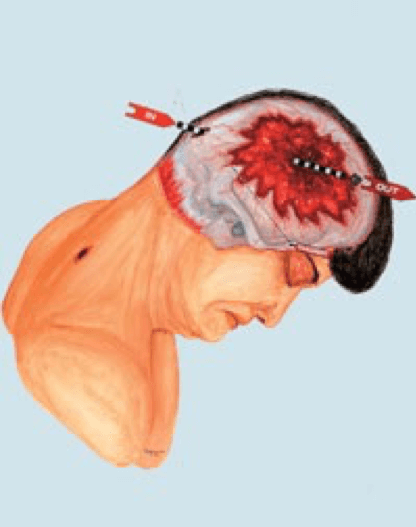
    One of the Rydberg diagrams,
    prepared under the direction
    of Dr. Humes

    This was the official version of Kennedy’s head wound for several years before Attorney General Ramsey Clark got his hands on the galley proofs to Josiah Thompson’s groundbreaking book Six Seconds in Dallas. Thompson used the available evidence to make a case for two shots striking the head almost simultaneously; one from the rear and one from the right front. Clark was apparently sufficiently disturbed by what he read that he asked Maryland Chief Medical Examiner Dr. Russell Fisher to convene a panel that would, in Fisher’s words, “refute some of the junk that was in [Thompson’s] book.” From all appearances, Fisher was someone who could be relied upon to reach the “right” conclusion. As Jim DiEugenio explained in his excellent book Reclaiming Parkland, Fisher was once asked to review the mysterious death of CIA officer John Paisley, whose body was found floating in Chesapeake Bay. DiEugenio writes:

    Understandably, the original coroner who saw the body said he was murdered because he was shot through the head, had indications of rope burns on his neck, and was weighted down with two diving belts when the body was recovered. As one commentator observed, “Strapping on two sets of diving belts, jumping off the boat with a gun in hand, and then shooting yourself in the water is, to be charitable, a weird way to commit suicide.” Further, the fatal head wound was through the left side of the brain. Yet, Paisley was right-handed. Finally, no blood, brain tissue, weapon, or expended cartridge was found on board Paisley’s boat. Did he take all of this with him when he jumped overboard? None of this was a problem for Fisher. He ruled the case a suicide. (DiEugenio, pp. 126-127)

    When Fisher and his colleagues on the “Clark Panel” came to view Kennedy’s post-mortem skull X-rays, they encountered a sizeable problem. The bullet fragments that Dr. Humes said traversed a line from the entrance wound in the occiput to just above the right eye were actually located several inches higher, near the very top of the skull. This discovery confirmed rather than refuted Thompson’s two-shot scenario because a bullet entering near the EOP simply could not leave fragments along a path several inches above the one it took. Therefore, the fragments clearly indicated that two separate missiles had struck the head, just as Thompson had argued. Unperturbed, the Clark Panel found a creative solution to their dilemma: they moved the entrance wound four inches up the back of the head!

    I only wish I was making this up.

    Fisher and his colleagues essentially suggested that the autopsy doctors were so thoroughly inept that they were unable to tell the top from the bottom of the skull. Never mind the fact that the pathologists had the actual body in front of them or that there were at least four independent witnesses―Secret Service Agent Roy Kellerman, FBI Agent Francis O’Neil, Richard Lipsey (aide to U.S. Army General Wehle), and Bethesda photographer John Stringer―who also recalled seeing the entrance wound low down in the back of the skull. And never mind that the X-rays show a clear defect with radiating fractures right where the autopsy doctors placed the wound. None of this matters because the Clark panel said it could see a “hole in profile” 10 cm higher up. Wrap your head around that oxymoron if you can.

    In 1975, another “independent” panel of experts reviewed the autopsy materials, this time on behalf of the Rockefeller Commission, whose Executive Director was none other than former Warren Commission lawyer David Belin. The membership of the medical panel left little doubt about its loyalties or the pre-ordained nature of its conclusions. Dr. Werner Spitz and Dr. Richard Lindenberg were both close professional associates of Dr. Russell Fisher, having worked under him at the Maryland State Medical Examiner’s Office. Dr. Fred Hodges worked alongside Clark Panel radiologist Russell Morgan MD at John Hopkins University in Baltimore. Pathologist Lt. Col. Robert R. McMeeken was a colleague of one of Kennedy’s autopsy surgeons, Dr. Pierre Finck, at the Armed Forces Institute of Pathology. And Dr. Alfred Olivier had previously served as the ballistics expert for the Warren Commission.

    Renowned forensic pathologist Dr. Cyril Wecht was quite rightly very critical of the make-up of the Rockefeller panel. As he stated in a telephone conversation with Rockefeller Commission Senior Counsel Robert Olsen, given their strong ties to the government and especially to Dr. Russell Fisher, “it was wholly unrealistic to expect that anybody on this panel would express views different from those expressed by the Ramsey Clark Panel in 1968 …” (Olsen, memo to file, April 19, 1975) Later, in a public press release, Dr. Wecht—alongside Professor of Criminalistics, Herbert MacDonell, and President of the American Academy of Forensic Sciences, Dr. Robert Joling—charged that the Commission had “set up a panel of governmental sycophants to defend the Warren Report.” Which makes perfect sense since former Warren Commissioner Gerald Ford was the president who appointed the Rockefeller Commission.

    Fisher’s influence extended past the Rockefeller panel to the HSCA. As researcher Pat Speer pointed out, six of the HSCA’s nine forensic experts had enjoyed a professional relationship with Fisher. For example, the panel included Rockefeller alumnus Dr. Werner Spitz who, as previously noted, had worked under Fisher at the Maryland State Medical Examiner’s Office. The same was true of Dr. Charles Petty, who had worked in Fisher’s office for nine years. The Chairman of the HSCA panel, Dr. Michael Baden, had himself contributed to the Spitz and Fisher book, Medicolegal Investigation of Death. Hardly surprising, then, that the panel went along with Fisher’s elevated, revised, and therefore more lone-nut-friendly in-shoot location.

    The HSCA panel did not go so far as to say it could see a “hole in profile” on the X-rays, making reference instead to a “sharp disruption of the normal smooth contour of the skull … with suggested beveling …” (7HSCA107) It did, however, claim that a red spot, seen high up in the “cowlick” area in the autopsy photographs of the back of the head, represented the actual wound of entrance. Yet when the panel tried to impress this interpretation on the autopsy surgeons, it was flatly disputed. Referring to the “red spot”, Dr. Humes told the panel members, “I don’t know what that is … I can assure you that as we reflected the scalp to get to this point, there was no defect corresponding to this in the skull at any point. I don’t know what that is. It could be to me clotted blood. I don’t, I just don’t know what it is, but it certainly was not any wound of entrance.” (7HSCA254) But Humes’ pleas fell on deaf ears. Baden and his colleagues were not about to go against Fisher and they were not about to admit that the rear entrance wound and the location of bullet fragments could not be reconciled with a single bullet.
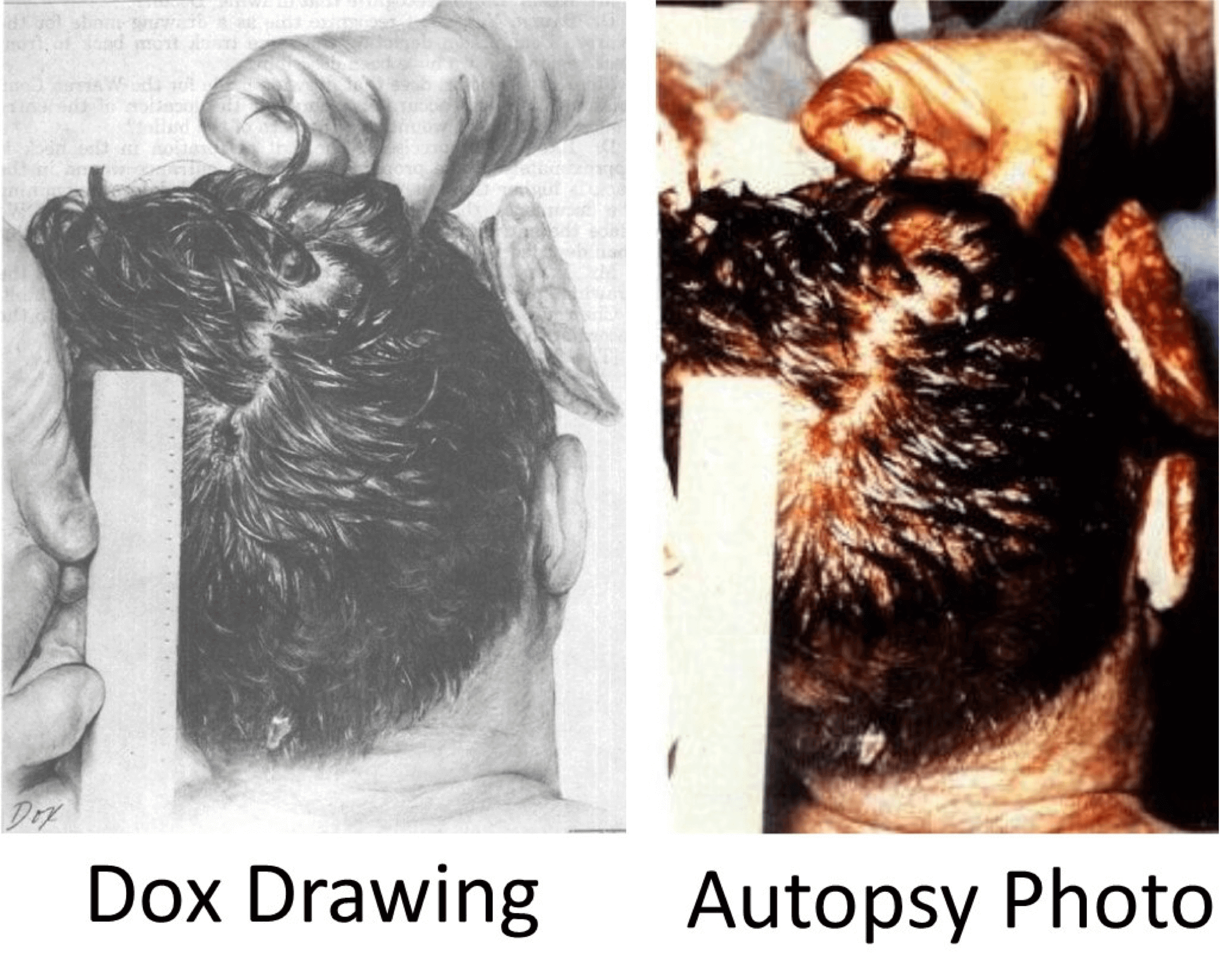
    The lengths to which the HSCA panel were willing to go to push the higher entrance wound location were revealed in 2003 by a then newly declassified document Dr. Randy Robertson presented at a JFK conference in Pittsburgh. The HSCA had not published the autopsy photographs of the back of the head and instead utilized a lifelike drawing of the photo prepared by professional medical illustrator Ida Dox. The immediately obvious difference between the photo and Dox’s drawing is that in the drawing the “red spot” has been greatly accentuated to look more like a bullet wound. This, as Robertson revealed, was done at Dr. Baden’s direction. Robertson discovered a note from Baden to Dox that said “Ida, you can do much better.” Attached to the note was a picture of a typical entrance wound from Spitz and Fisher’s Medicolegal Investigation of Death. In other words, Baden was actually instructing her to make the “red spot” look more like an entrance wound than it really did in the photographs. (DiEugenio, p. 157)

    To recap, Kennedy’s autopsy surgeons said that a trail of bullet fragments traversed a line from an entrance wound near the EOP to a presumed exit site on the right side. Whether this was a deliberate lie or a mistake made because Dr. Humes did not have access to the X-rays when he wrote his report is not known. Regardless, the rear entrance wound and the trail of fragments above are not connected and, therefore, almost certainly were caused by separate missiles. When the Clark Panel—which was specifically tasked with refuting conspiracy arguments—discovered this discrepancy, it attempted to diminish the problem by moving the in-shoot four inches up the skull. The Rockefeller experts played along and the HSCA panel furthered the deception by hiring a medical illustrator to create a fallacious depiction of the back of Kennedy’s head. And these are the actions of the “distinguished” professionals in whom Wagner wants his readers to put their faith.

    It should be noted at this point that even if one decides that, for some unfathomable reason, the three autopsy doctors and four independent eyewitnesses all shared the same delusion—that the appearance of a defect with radiating fractures at the very location specified in the autopsy report is mere coincidence, and that the Clark Panel was right about the entrance wound being 10 cm higher—this still does not adequately explain the bullet fragments. The reasons are twofold: firstly, even the proposed higher entrance location lies around 5 cm below the rear end of the fragment trail. And secondly, the number, size, and distribution of those fragments are wholly inconsistent with a Carcano bullet entering the head from behind.

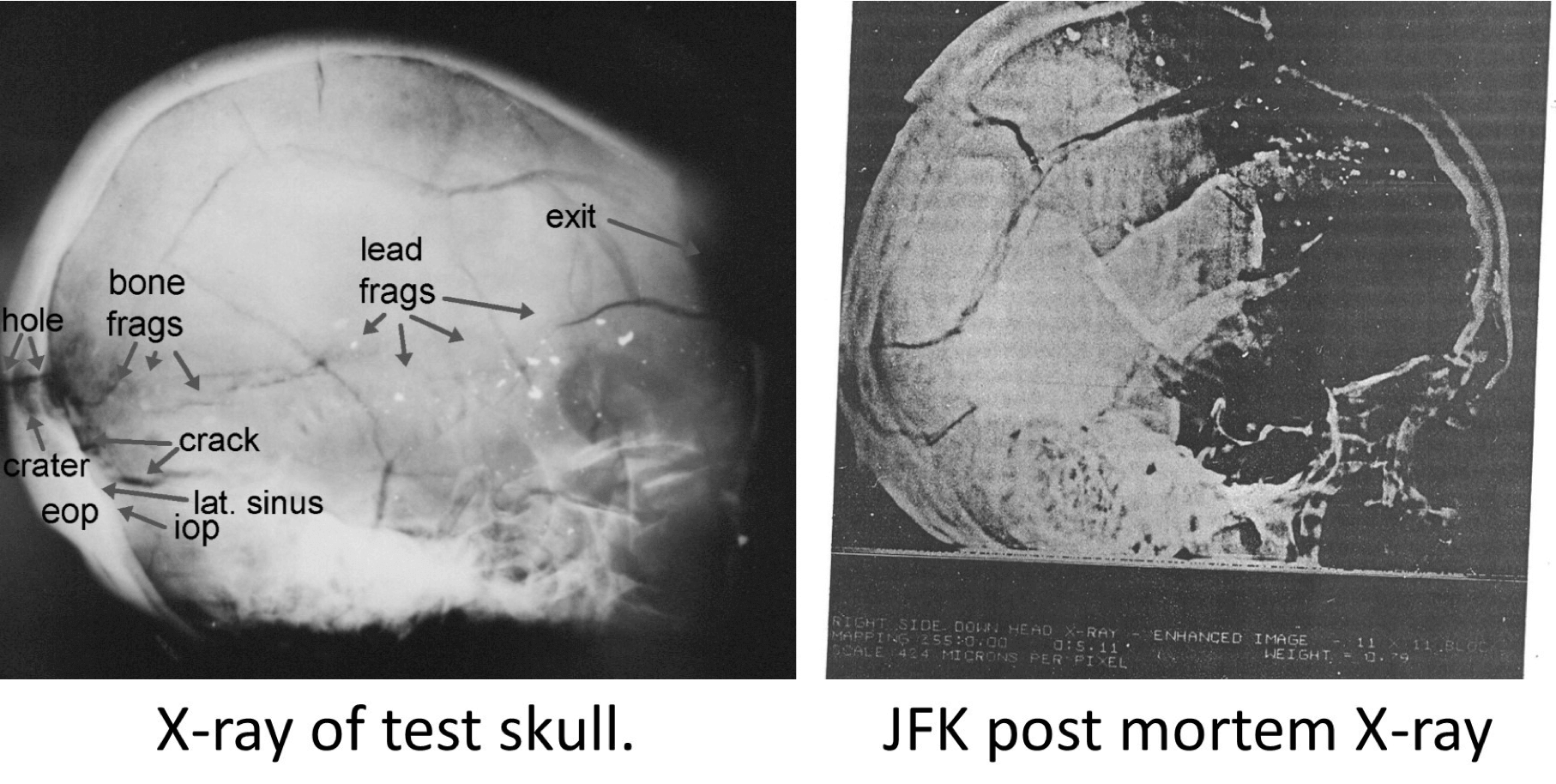
    The bullets fired by “Oswald’s” Mannlicher-Carcano rifle were full metal jacket, military ammunition. The behavior of such bullets has been long understood. The well-regarded textbook Gunshot Wounds by Vincent Di Maio notes that “the presence of small fragments of metal along the wound track virtually rules out full metal-jacketed ammunition.” (Di Maio p. 334) Carcano bullets in particular were put to the test at Edgewood Arsenal in 1964 on behalf of the Warren Commission. There, wound ballistics experts took 10 rehydrated human skulls, filled them with a ballistic gelatin to simulate the brain and coated the outside with a soft tissue substitute. A rifleman then fired from a distance of 90 yards (the distance from the book depository to JFK at the time of the head shot) into the approximate entry site specified in the autopsy report. These experiments were filmed and the resultant skulls were X-rayed.

    The X-rays of these test skulls showed precisely how Carcano bullets behave when striking a human head. As expected, there was no “lead snowstorm” effect as seen on President Kennedy’s post mortem X-rays. The Carcano bullets deposited only a few small fragments along the lower portion of the skull and this did not occur until after the jackets had ruptured, about midway through the cranium. This pattern is nothing like the trail of dozens of tiny, sometimes dust-like fragments running almost horizontally from one end to the other near the very top of JFK’s skull. Clearly, then, this trail of metallic debris was not left behind by full-metal-jacket Carcano ammunition.

    Not only does the presence of these fragments tell us that the skull was struck by a second, non-Carcano bullet; the pattern of their distribution gives us a clue as to the direction of travel. When a bullet strikes bone and disintegrates into fragments, the smaller, dust-like particles are found closer to the entry point and the larger ones are found closer to the exit. This is because, as Sturdivan noted in his HSCA testimony, “A very small fragment has very high drag in tissue” (1HSCA401), whereas fragments with greater mass have greater momentum, enabling them to travel further. What we see in JFK’s autopsy X-ray is that the smaller particles are located near the right temple and the larger ones are found near the upper, right rear of the skull. Therefore, the bullet appears to have been heading front to back.
    Further evidence of a double headshot was supplied by Joseph N. Riley Ph.D, a neuroscientist specializing in neuroanatomy and experimental neuropathology. Dr. Riley pointed out that one important issue not sufficiently addressed by the HSCA was that there were two separate and distinct areas of damage to the President’s brain, in the cortical and subcortical regions, and “no evidence of continuity” between the two. “An entrance wound located in the posteromedial parietal area [as proposed by the Clark and HSCA panels] … cannot account for the subcortical damage. An entrance wound in the occipital region, as determined by the autopsy prosectors, may account for the subcortical damage but cannot account for the dorsolateral cortical damage.” As Dr. Riley concluded, “The cortical and subcortical wounds are anatomically distinct and could not have been produced by a single bullet. The fundamental conclusion is inescapable: John Kennedy’s head wounds could not have been caused by one bullet.” (Riley, “The Head Wounds of John F. Kennedy: One Bullet Cannot Account for the Injuries”, The Third Decade, Volume 9, Number 3)


    III

    The “great respect” Wagner has for those who possess expertise he himself lacks, apparently doesn’t extend as far as the acoustics experts utilized by the HSCA. After extensive experimentation and analysis, these experts concluded that a Dallas police dictabelt recording from the day of the assassination proved that a gunshot had been fired from the grassy knoll. Although the two independent teams of scientists with whom the committee consulted were among the most highly recommended and respected acoustical experts in the United States at that time, Wagner has no problem dismissing their conclusions with little more than a wave of the hand. He writes of how their findings were “challenged almost immediately”, adding that a study commissioned in 2013 by author Larry J. Sabato “completes the debunking of the HSCA’s acoustic evidence.” (Wagner, p. 101) In point of fact, Sabato’s study does no such thing. Before explaining why, let us do what Wagner dares not do: let us discuss the facts that led the HSCA’s experts to their conclusions.

    On November 22, 1963, the Dallas police utilized two radio channels. Channel 1 was for routine communications and channel 2 was for the police escort of the presidential motorcade. These transmissions were recorded at police headquarters; channel 1 by a Dictaphone belt recorder and channel 2 by a Gray Audograph disc recorder. In 1978, when the Cambridge, Massachusetts firm of Bolt, Baranek and Newman studied the recordings, it discovered that Ch-2 was not in use at the time the shots were fired. However, for approximately 5 1⁄2 minutes between 12:28 PM and 12:33 PM, the Ch-1 recording was dominated by the sound of a motorcycle motor, owing to the fact that the microphone on a patrolman’s radio had become stuck in the “On” position. BBN realized that, if the motorcycle had been part of the presidential escort, then the gunshots might very well have been captured over the open microphone and deposited in the background of the Ch-1 recording.

    The acoustics experts isolated a ten second sequence of the recording that occurred two minutes into the motorcycle segment—at approximately 12:30 PM—and contained six high amplitude sound impulses that it determined could have represented the muzzle blast of a rifle and its succeeding echoes. On-site testing was then conducted in Dealey Plaza with 36 microphones being placed along the parade route on Houston and Elm Streets. Test shots were fired from the Texas School Book Depository and the Grassy Knoll and recorded at each of the microphones. These test recordings were subsequently compared to the suspect impulses on the dictabelt, at which point it was discovered that five of the impulses matched the unique echo patterns of rifle shots fired in Dealey Plaza. The fourth in sequence matched a shot fired from the Grassy Knoll. (8HSCA101)

    Whilst it would seemingly be possible for some type of random stray noise pattern to closely match one of the test shots, the odds of that happening in all five cases would have to be extremely remote. Fortunately, there was an aspect to BBN’s results that put any such possibility to rest. Namely, what leading expert on the acoustics evidence Dr. Donald Thomas calls the “order in the data.”

    There are 125 different ways to sequence five events. If the impulses on the dictabelt were not truly gunfire recorded by a motorcycle travelling in the Presidential motorcade, and instead represented some form of random static, then the matches to the test data could have fallen in any one of 125 different random sequences. However, the matches were not random. They fell 1-2-3-4-5, which is the only correct order for a microphone travelling north on Houston Street and West on Elm Street:
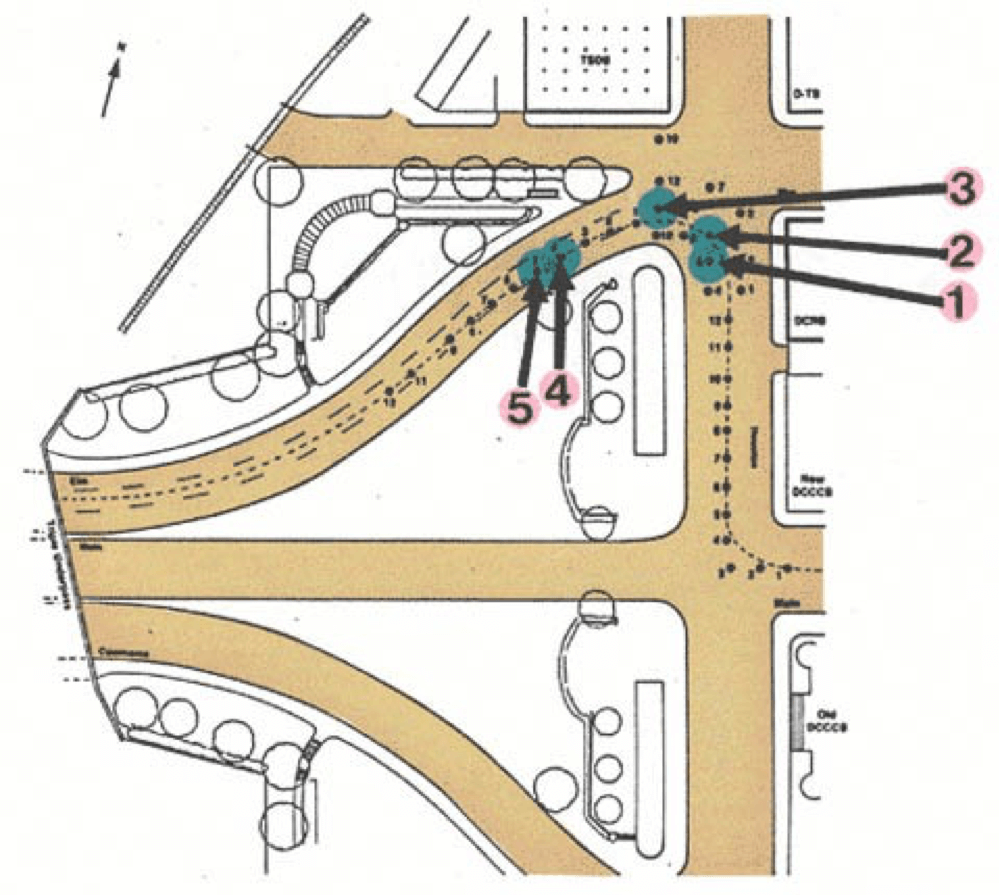
    This map depicts the key microphone locations in Dealey Plaza used by the HSCA. A shot at Zapruder frame 175 could not have been fired by Oswald due to the obstruction of an oak tree. (Thompson p. 35) The 5 and 1/2 minute segment during which impulses occur was between 12:28 and 12:34, owing to dispatcher’s notations.

    Not only was the order of the matches correct, the spacing of the matching microphones was a remarkable fit with the time between the suspect impulses on the dictabelt recording. The first three impulses were clustered together, falling approximately 1.7 and 1.1 seconds apart. This was followed by a space of 4.8 seconds before the final two impulses arrived very close together, 0.7 seconds apart. The matching microphone locations exhibited the exact same pattern. The first three matches occurred at microphones that were grouped at 18 ft increments on Houston Street. There was then a 78 ft gap before the last two matches occurred at two consecutive microphones on Elm Street:

    And it wasn’t just the order and spacing that matched. The distance from the first matching microphone to the last was 143 feet and the time between the first and last suspect impulse on the tape was 8.3 seconds. In order for the motorcycle with the stuck microphone to cover 143 feet in 8.3 seconds it would need to be travelling at a speed of approximately 11.7 mph, which fully corresponds with the FBI’s conclusion that the Presidential limousine was averaging 11.3 mph on Elm Street. (Warren Report, p. 49)

    Armed with the above, the HSCA asked its photographic consultant, Robert Groden, to search the archival footage of the motorcade to see if he could find the motorcycle with the stuck microphone.

    There is, unfortunately, no known film or photograph that shows the acoustically required positions during the assassination. However, Groden was able to find one officer, H.B. McClain, who was in the right positions shortly before and after the shooting so that he could have been responsible for recording the shots. When McClain was called to testify before the committee he confirmed Groden’s analysis by stating that the microphone on his bike did indeed have a tendency to get stuck in the open position. (5HSCA637)

    It is apparent that in at least three ways the evidence validates the hypothesis that the sounds on the dictabelt were gunshots captured by a motorcycle in the presidential motorcade, travelling north on Houston Street and west on Elm. When the HSCA and its acoustic experts saw the above correlations, they had every reason to believe they had found the shots that killed Kennedy on the Ch-1 recording, because these sorts of correlations do not occur by chance; not in the real world. The odds against it are astronomical.

    And there’s more.

    One of the most important witnesses to the assassination was railroad worker S.M. Holland who had been standing with several others on the railroad overpass when he heard what he thought sounded like three shots from the area of the book depository and one from the knoll. Concurrent with the shot from the knoll, Holland saw a puff of white smoke drift out from under the trees. Holland and two others who saw the smoke were so sure a shot had come from behind the fence that, as soon as Kennedy’s limousine disappeared under the overpass, they ran to the very spot from which the smoke appeared to have come. It took them a couple of minutes to reach the area and, not surprisingly, they found nothing more than footprints and a muddy bumper, as if someone had stood on it to see over the fence.

    In 1966, Josiah Thompson interviewed Holland for his book, Six Second in Dallas. Thompson had been studying the famous Polaroid taken by Mary Moorman that showed the area of the grassy knoll around the time of the fatal headshot. Wanting to see if “the hypothesis of a shot from the stockade fence” could be “validated by the Moorman picture”, he compared it to another photograph taken from her position some time later. What he discovered was that an “anomalous shape” appeared along the fence line in Moorman’s photograph that was not present in the comparison picture. Thompson took Holland “to the assassination site and asked him to stand in the position where he found the curious footprints and saw the smoke.” Taking himself back to Moorman’s position, Thompson saw that, remarkably, Holland’s head “appeared in the exact position defined by the shape” in the Polaroid. (Thompson, p. 127)

    What does this have to do with the acoustics evidence? Well, a little over a decade after Thompson interviewed Holland, the HSCA asked Professor Mark Weiss of Queens College, New York, and his associate Ernest Aschkenasy, to refine BBN’s analysis of the Grassy Knoll shot. Asked to pin down the location of the gunman, Weiss and Aschkenasy’s analysis pointed to a spot behind the fence, approximately 8 feet left of the corner. This just so happens to be the very same spot in which Holland had stood in 1966 and in which the anomalous shape appears in Moorman’s picture. (8HSCA29) Which means there is agreement between the dictabelt recording, the eyewitness observations, and the Moorman photograph.

    Yet further confirmation of the validity of the acoustics evidence comes from its remarkable synchronization with the Zapruder film. Although there is clearly a degree of subjectivity to interpreting the film, there is a general consensus that Kennedy was probably first struck whilst hidden from Zapruder’s view by the Stemmons Freeway sign, and Governor Connally was hit very shortly after reappearing from behind it. If we align the grassy knoll shot with the explosion of Kennedy’s head at frame 313, then the preceding shots perfectly fit this hypothesis. The third shot in sequence falls at approximately frame 224, just three frames after Connally reappears, and the second shot lands at approximately frame 208, just as Kennedy’s head disappears behind the sign. If there is an exit from Connally’s chest at Z frame 224, then the Zapruder film features the exact same 4.8 second gap between shots as is found on the dictabelt.

    Wagner has nothing to say about any of this. Instead, as previously noted, he cites a study performed on behalf of Larry Sabato by the Connecticut-based firm, Sonalysts, claiming their report “completes the debunking” of the acoustics evidence. Yet, just like Wagner, Sabato and Sonalysts also make no mention of the above. How one can debunk something without even addressing it is difficult to comprehend. Regardless, Sonalysts claimed that their own analysis of the motorcycle noise showed that its speed was inconsistent with a motorcycle travelling in the motorcade. Their data shows that the bike with the stuck microphone was travelling slowly for only around 40 seconds and was going fast or fluctuating the rest of the time. In order for this to concur with the HSCA analysis, the motorcycle needed to be going slowly whilst in Dealey Plaza. Sonalysts argues, however, that the assassination occurred one minute earlier, when the motor noise was fast and loud.

    But this conclusion is not derived from any original research by Sonalysts. It is instead based on a 1982 report commissioned by the National Research Council, which suggested that an instance of “crosstalk” on the Ch-1 and Ch-2 recordings proved that the impulses on the dictabelt were not coincident with the time of the assassination. Yet the NRC report was shown to be in error by Dr. Thomas in a 2001 paper published in the British forensic journal Science & Justice. Dr. Thomas pointed out that the NRC panel had overlooked a second instance of cross-talk, the “Bellah broadcast”, and that using that particular simulcast to synchronize the transmissions placed the impulses “at the exact instant that John F. Kennedy was assassinated”.

    If, as Dr. Thomas suggests, we use the Bellah cross-talk as the tie-point between the recordings, then the Sonalysts study of the motorcycle noise actually fits perfectly with the HSCA analysis and all five impulses fall within the 40 second interval in which the motor sounds indicates the bike was moving slowly. The Bellah broadcast occurs on Ch-1 concurrent with a drop in motorcycle noise by approximately 75 decibels, two seconds before the first shot. Furthermore, Sonalysts reported hearing multiple motorcycles just before the motor noise increased. This fits well with a series of photographs showing McClain travelling slowly on Elm Street approximately 28 seconds after the head shot, passing the parked motorcycle of officer Bobby Hargis. Officer J.W. Courson, who had been riding around 100 feet behind McClain, catches up to him very quickly thereafter and the pair speed off together out of the plaza. The motorcycle noise identified by Sonalysts is, then, supportive of the acoustic data.

    Wagner quotes Sabato as reporting that his experts found “other clusters of impulses” on the dictabelt that were “very similar” to those identified as gunfire by BBN and Weiss & Aschkenasy. (Wagner, p. 102) Those who have studied BBN’s report will realize that Sabato and Sonalysts are blowing smoke. BBN inspected the entire recording looking for potential gunshots based on waveform and used several a priori criteria to identify the gunfire. Firstly, the waveforms were required to include 10 impulses louder than the motorcycle motor. Secondly, the length of the impulses had to be 1/5 to 1⁄2 a second. Thirdly, there had to be at least three shots. And finally, they had to occur within a timespan of no less than 4 1⁄2 seconds and no greater than 15 seconds. BBN discovered and reported other isolated solitary waveforms and long duration waveforms. But there was only one place on the entire recording in which all of BBN’s criteria were met and that was the segment containing five impulses that subsequently matched the precise echo patterns of gunshots fired in Dealey Plaza.

    Wagner and his lone nut cohorts may not like it but over the course of 40 years the analysis of the Dallas police dictabelt by the HSCA’s experts has survived several challenges and stands to this day as scientific evidence of multiple gunmen in Dealey Plaza. Those like Wagner who continue to ignore the order in the acoustic data, as well as the dictabelt’s remarkable concordance with the eyewitness and photographic record, rely on authors like Sabato and their faulty and lazy technical data.


    IV

    The one way in which Wagner’s book sets itself apart from virtually every other lone gunman tome is unusual. The author rejects the single bullet theory. What makes this even more odd is that Wagner admits that he is an admirer of the late Vincent Bugliosi and his book Reclaiming History, which upheld the Magic Bullet. In fact, it could be said that the primary theme of the book is that not only is the SBT provably wrong, but that for the last nearly five and a half decades writers and researchers on both sides of the debate have been wrong to stipulate that the SBT is integral to the lone gunman hypothesis. But rejecting the SBT whilst maintaining that Oswald acted entirely alone leaves Wagner with some insurmountable problems.

    To begin with, Wagner cannot convincingly account for the magic bullet itself, CE399. The author insists that there was no conspiracy to frame Oswald before or after the fact; therefore he is forced to contend that CE399 is a legitimate piece of assassination evidence and that it was responsible for all of Governor Connally’s wounds. (p. 122) I dare say this is something most sensible researchers are unlikely to take very seriously given that the totality of the evidence argues persuasively against it.

    Wagner appears to accept the Warren Commission’s assertion that the virtually pristine bullet was found by senior hospital engineer, Darrell Tomlinson, when it rolled off of a stretcher that had previously been occupied by Governor Connally. Yet this conclusion was not one Tomlinson himself fully endorsed. After Connally had been rushed into the trauma room and transferred to the operating table his stretcher was placed on the elevator. Tomlinson then took it to the ground floor and placed it next to another gurney. A few minutes later, he bumped one of the two stretchers against the wall and a bullet rolled onto the floor. Tomlinson made it clear in his testimony before the Commission that he did not know which of the two stretchers the bullet rolled off from. And when Arlen Specter attempted to push him into identifying it as Connally’s, Tomlinson responded, “I’m going to tell you all I can, and I’m not going to tell you something I can’t lay down and sleep at night with either.” (6H134) One thing Tomlinson did note was that the stretcher the bullet came from contained one or two bloody, rolled up sheets, “a few surgical instruments … and a sterile pack or so.” (6H131) This appears to eliminate Connally’s stretcher because Tomlinson testified that, when he wheeled it off of the elevator, it contained only sheets and “a white covering on the pad.” (6H129) This is corroborated by the testimony of Parkland Nurse Jane Wester, who explained that after Connally was placed on the operating table she personally removed all but the sheets from his stretcher. (6H122-3)

    The finest critical review of this central issue is still contained in Josiah Thompson’s 1967 volume, Six Seconds in Dallas. After analyzing testimony and then including pictures, witness sketches, emergency room rosters, and concluding with a map, Thompson makes a compelling case that CE 399 was found on the stretcher of a young boy named Ronald Fuller. (pp. 154-65)

    Not only does the evidence suggest that Tomlinson’s bullet came from a stretcher unrelated to the care of Governor Connally, it also indicates that he found an entirely different bullet from CE399. As Gary Aguilar and Josiah Thompson detailed in their groundbreaking essay, The Magic Bullet: Even More Magical Than We Knew?, both Tomlinson and O.P. Wright—the Parkland Personnel Director who took charge of the bullet and passed it along to the Secret Service—were unable to identify CE 399 as the bullet they found. In fact, Wright told Thompson in an interview in 1966 that, unlike the round-nosed Carcano round, the bullet found at Parkland had a “pointed tip”. He even made a point of showing Thompson a pointed tip, .30 caliber round from his own desk drawer that he insisted more closely resembled the one that had rolled off the stretcher. (Thompson, p. 175)

    On top of this, the next two men to handle the bullet, Secret Service Agent Richard Johnsen and Secret Service Chief James Rowley, were also unable to identify CE399. And as if that weren’t enough, the fifth link in the bullet’s chain of possession, FBI Agent Elmer Todd, recalled marking it with his initials before handing it over to Robert Frazier at FBI HQ. But as scrupulous JFK researcher John Hunt has established, Todd’s initials are nowhere to be found on CE399. What’s more, Hunt pointed out that Frazier had marked the time he received CE399 on his November 22 laboratory worksheet as “7:30 PM.” But Todd had also written the time he received the bullet on the envelope that contained it as “8:50 PM.” (see Hunt’s online essay, Phantom Identification of the Magic Bullet: E.L. Todd and CE399).

    How could Frazier receive a bullet from Todd at FBI HQ one hour and 20 minutes before Todd was handed the same bullet at the White House by Chief Rowley? Something is most definitely wrong with this picture. Based on the above, it appears that there were actually two separate bullets in Washington that day—CE399 and the pointed-tip missile found at Parkland Hospital—and that one was used to pin the blame for Kennedy’s assassination squarely on Lee Oswald’s shoulders while the other was made to disappear.

    Wagner reveals in a footnote that he is at least aware of Aguilar and Thompson’s essay and the implication that the pointed tip round was substituted for CE399, so he tries to nullify the problem. He argues that because Frazier told the Commission he had received CE399 on November 22, 1963, but the rifle wasn’t in Washington until the following day, there was no “opportunity for the FBI to fire Oswald’s rifle to recover a bullet to illicitly substitute for the alleged pointed-tip bullet.” (Wagner, fn. p. 191) Of course, since Aguilar and Thompson never argued that the Bureau was responsible for firing the pristine bullet, this is little more than a straw man argument. Even so, the fact that Frazier said he received CE399 on November 22 does not actually make it so. Whatever Frazier claimed, the fact remains that, as demonstrated above, the bullet lacks anything even remotely resembling a proper chain of custody. When CE399 allegedly appeared in Frazier’s laboratory at 7:30 pm on November 22, 1963, it appears to have come from nowhere.

    Questions of provenance aside, the condition of the magic bullet is simply not compatible with Governor Connally’s wounds. The bullet (or bullets) that struck Connally entered his back, destroyed 10 cm of his fifth rib, punctured his right lung, smashed through his right wrist, and punctured his left thigh, depositing fragments in the wrist and thigh along the way. Common sense would dictate that any missile responsible for all of those injuries would be significantly mutilated. Yet as Wagner himself writes, “The only discernible damage to the pristine bullet was some distortion at its base …” (p. 118) He quotes Michael Baden as stating that it would be “very difficult” to take a hammer and flatten the base of CE399 to the degree that it is and from that concludes that “the distortion of the bullet’s base was probably not caused merely by the bullet being fired out of the rifle.” (p. 119) But Baden’s musings and the inference Wagner draws from them are largely irrelevant. In the mid-1980s, author Henry Hurt test-fired a Carcano bullet into water and published pictures of the result in his mostly worthwhile book, Reasonable Doubt. Hurt’s bullet looked incredibly similar to CE399, flattened base end and all.
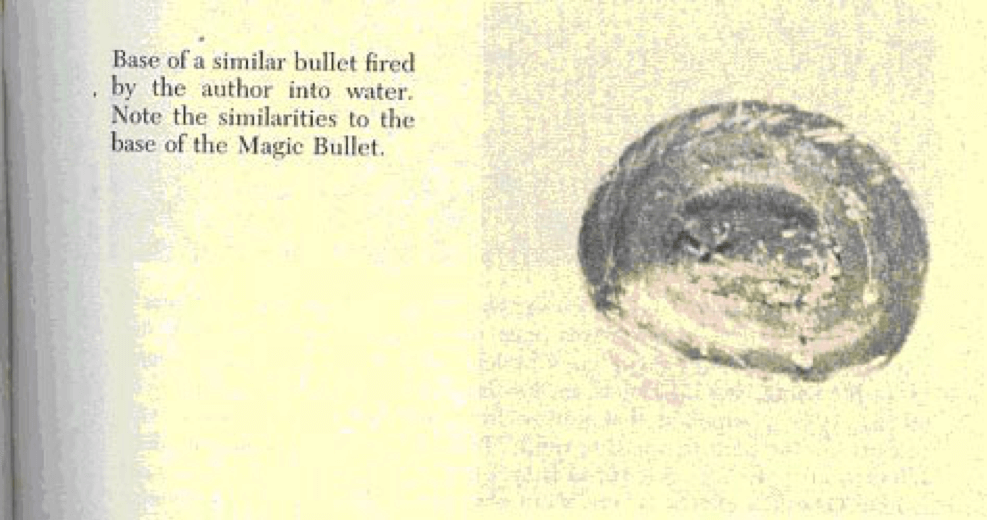
    I am sure most people would struggle to accept the notion that a bullet which broke two bones and pierced several layers of skin and flesh is going to end up looking almost indistinguishable from a bullet fired solely into water. And since Wagner lists Hurt’s book in his bibliography, but doesn’t mention the test bullet, I’m guessing he recognizes the absurdity of the claim also.

    The author also fails to mention the fact that the ballistics experts at Edgewood Arsenal, who performed the previously mentioned skull experiments on behalf of the Warren commission, also attempted to replicate the wounds suffered by Governor Connally. Seen in the picture below, CE853 is a bullet that was fired through the rib of a goat. It is severely flattened with its lead core extruding from its base. CE856 was fired through the wrist of a human cadaver and it exhibits the “mushrooming” effect typical of a bullet that has struck bone. Each of these bullets has broken only one of the two bones attributed to CE399 which, as you can see, looks virginal by comparison.
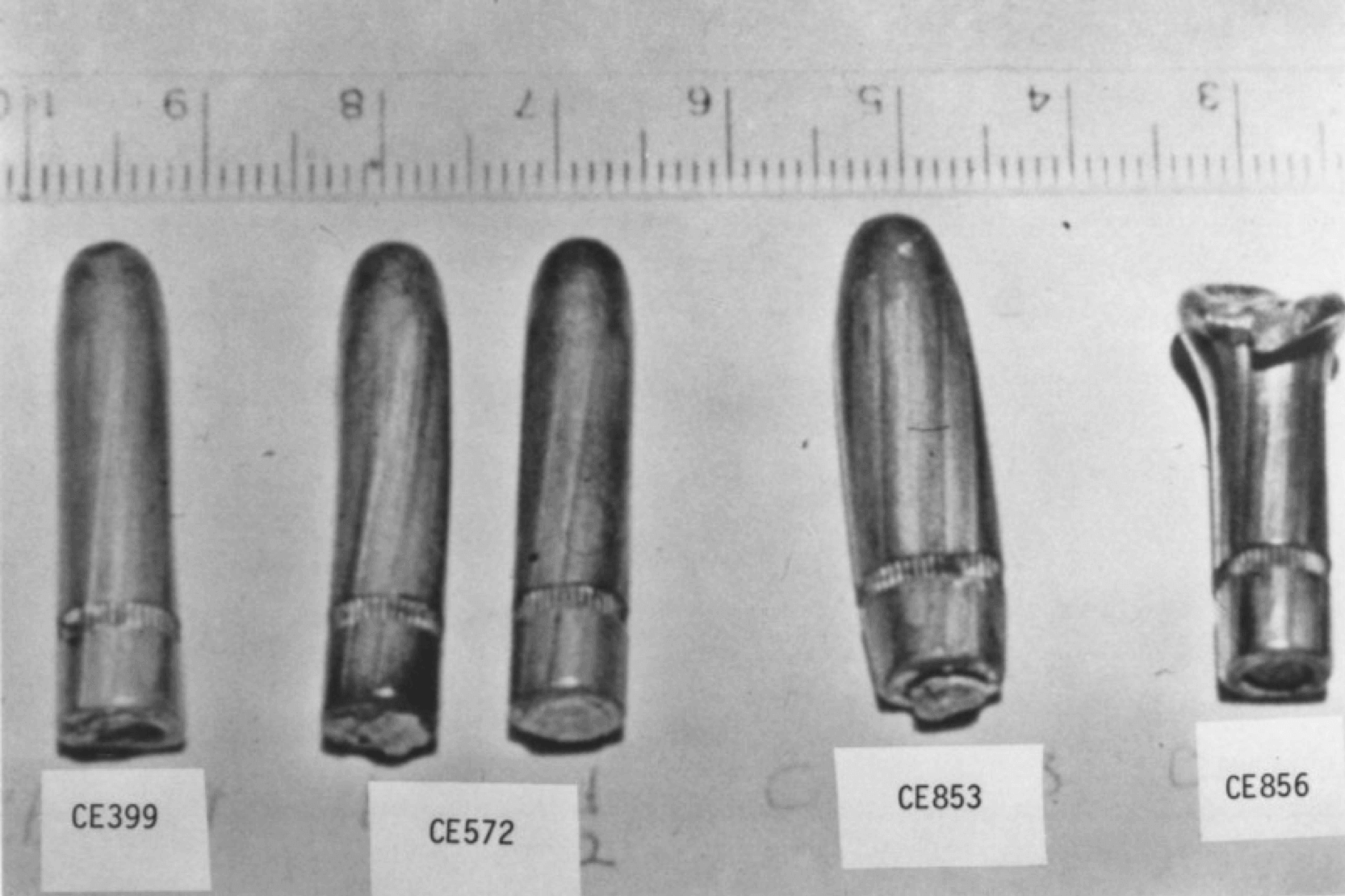
    The Edgewood test bullets show us exactly what happens to Carcano bullets when they strike bone and readily demonstrate the absurdity of suggesting that CE399 was responsible for all of Connally’s wounds.

    It is also important to mention that Connally’s wrist surgeon, Dr. Charles F. Gregory, explained in his Warren Commission testimony that the amount of cloth and debris carried into the wrist indicated it had been struck by “an irregular missile”. In his second appearance before the Commission, Dr. Gregory expanded on this point, noting “that dorsal branch of the radial nerve, a sensory nerve in the immediate vicinity was partially transected together with one tendon leading to the thumb, which was totally transected.” This, he said, “is more in keeping with an irregular surface which would tend to catch and tear a structure rather than push it aside.” (4H124) Wagner writes that Gregory conceded it was “possible” for CE399 to have produced Connally’s wrist wound if it had entered backward. (Wagner, p. 118) This is true, but it’s also apparent that Dr. Gregory did not consider the idea very likely. In fact, later in his testimony he noted that the two mangled bullet fragments found on the floor of the limousine were more likely the type of missile “that could conceivably have produced the injury which the Governor incurred in the wrist.” (p. 128)


    V

    Wagner may stumble badly trying to account for CE399, but it is in trying to create a halfway plausible single shooter scenario without the SBT that he falls flat on his face. The author writes of how researchers have “fixated” on the SBT for five decades and have, as a result, “blindly herded around the dogma” that the SBT is “required to sustain the lone-gunman explanation for the assassination …” This, he assures readers, is not the case, and “the evidence … carefully considered, demonstrates quite the opposite.” But if Wagner actually produces any such “evidence” in his book, then somehow, I managed to miss it.

    Warren Commission lawyer Norman Redlich once remarked to author Edward Epstein that “To say that they [President Kennedy and Governor Connally] were hit by separate bullets, is synonymous with saying that there were two assassins.” (Epstein, Inquest, p. 38) Redlich’s colleagues on the Commission’s staff all understood this to be the case, which is precisely why Arlen Specter dreamed up the theory in the first place. As previously noted, the Zapruder film shows that Kennedy’s first clear reaction to his non-fatal wounds begins as he reappears from behind the Stemmons Freeway sign, around frame 225. Connally’s most obvious reaction occurs a little over 10 frames later when his right shoulder drops dramatically and his cheeks puff, giving the impression of someone who has had the wind knocked out of him. Connally’s doctors believed that he was probably struck around frame 236 (5H114, 128) and it was established that he was no longer in a position to receive a shot from the “sniper’s nest” after frame 240. (5H170)

    An FBI re-enactment in Dealey Plaza showed that a gunman on the sixth floor would have had his view of the limousine blocked by the foliage of an oak tree between frames 166 and 210. Based on this, the Commission reasoned that Kennedy was probably not struck before frame 210 “since it is unlikely that the assassin would deliberately have shot at him with a view obstructed by the oak tree when he was about to have a clear opportunity.” (WR, p. 98) If Kennedy was struck at or after frame 210, then there were no more than 30 frames between that shot and the one that hit Connally. This created a problem for the Commission because Oswald’s rifle could not be fired that quickly. Examination of the sixth floor Carcano had established that the time required to fire a shot, work the bolt, and squeeze off another round was a minimum of 2.3 seconds or the equivalent of 42 Zapruder frames. (3H407)

    And this wasn’t the only impediment to the Commission’s predetermined lone gunman conclusion. If the first shot was fired at frame 210 and the last was fired at 313, that gave Oswald only 5.6 seconds in which to fire three rounds and score three hits—something even the Commission’s top marksmen were unable to accomplish in the allotted time; even though they cheated: they fired at stationary targets from thirty feet up, not sixty feet. (Sylvia Meagher, Accessories After the Fact, p. 108)

    Perhaps more importantly, the evidence strongly suggested that one or more shots had missed the limousine and its occupants altogether. At least two witnesses, Royce Skelton and Virginia Baker, recalled seeing a bullet hit the street in front of the President’s car (WR, p. 116, 7H508). Additionally, bystander James Tague, who was standing near the triple underpass on the south side of Main Street, received an injury to his face after a missile struck the curb near his feet. (WR, p.116)

    In the end, the Commission staff realized that the only way out of this box—without admitting to more than one gunman—was to suggest that Kennedy and Connally were both hit by the same bullet. Although the Warren Report stated that it was “not necessary to any essential findings of the Commission to determine just which shot hit Governor Connally” (WR, p. 19), virtually everyone who has a firm grasp of the facts and circumstances outlined above agrees that the Commission was blowing smoke; the SBT is absolutely integral to the lone gunman hypothesis.

    What, then, does Wagner offer in order to overturn this long-stipulated fact? How does he reconcile the evidence with a single shooter, three-shot/three-hit scenario? Well, if you can believe it, Wagner proposes that Oswald went against common sense and fired his first shot at frame 160, milliseconds before his view was about to be obscured by a tree. This is not an uncommon supposition among lone nut theorists who want to give Oswald more time to fire three shots. The difference is that the majority of those folks propose that this first shot was the one that missed, whereas Wagner suggests this first bullet actually struck President Kennedy. That’s right, according to Wagner, when we see JFK in the Zapruder film, still waving and smiling at bystanders as he disappears behind the Stemmons Freeway sign, a bullet has already entered his back, grazed the transverse process of his first thoracic vertebra (likely inducing spinal shock), and ripped its way through his trachea. He just didn’t know it yet.

    Needless to say, Wagner has nothing of substance to advance in support of this silliness. He quotes Dr. Baden as stating that he and his colleagues on the HSCA pathology panel “have all had experience in which persons have been seriously injured and not known they were injured for a few minutes.” (Wagner, p. 54) And he makes reference to a viewing of the Zapruder film held by the Commission’s staff for its medical and ballistics experts in which the possibility of a delayed reaction by “as much as two seconds” was discussed and considered possible, if not likely. (p. 239) And that’s it. That is all Wagner can provide; an appeal to authority that does not reconcile itself with Kennedy’s specific wounds or his reactions as seen in the Zapruder film.
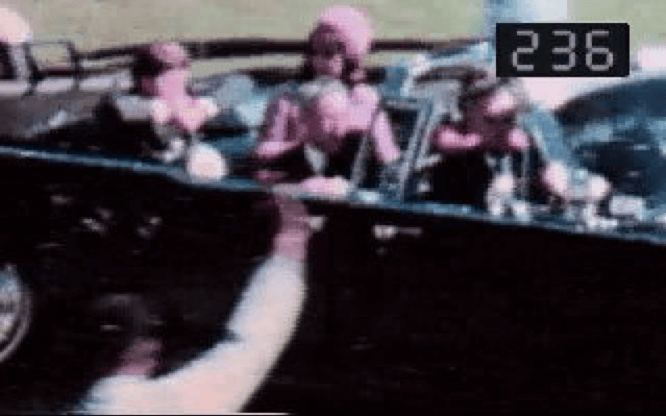
    What we see in the film is that immediately after JFK reappears from behind the sign, he exhibits what is almost certainly an involuntary reaction. The Commission wrote that “When President Kennedy again came fully into view in the Zapruder film at frame 225, he seemed to be reacting to his neck wound by raising his hands to his throat.” (WR, p. 98) This myth that the President clutched at his throat has unfortunately persisted ever since, despite the fact that the film shows no such thing. In reality, Kennedy’s hands appear to ball up into fists and rise up in front of his face, while his elbows fly outwards and upwards above his shoulders, to the level of his ears.

    I invite the reader to place his or her hands to their own throat and notice how the elbows naturally stay down and rest against the torso. The pose which JFK adopts in the film is nothing like this. His reaction is awkward and unnatural and is best explained as a result of spinal trauma.

    The HSCA medical panel reported that Kennedy’s post mortem X-rays showed what appeared to be a fracture of the transverse process of the first thoracic vertebra, which, Dr. Baden testified, “could have been caused by the bullet striking it directly or by the force of the cavity created by the bullet passing near to it.” (1HSCA305) As Dr. Thomas has reported, the medical literature is clear that blunt trauma to the vertebra can be transmitted to the spinal cord and that the effects of such injuries are immediate. (Thomas, Hear No Evil, p. 315) It should be readily apparent, then, that the notion that President Kennedy continued smiling and waving to bystanders for 3.5 seconds before exhibiting any obvious reaction to his spinal cord injury is simply not worthy of consideration.

    What’s more, in his attempt to push a three shot/three hit scenario, Wagner fails to even mention the witnesses who saw a bullet hit the street, let alone adequately account for the wounding of James Tague. The best that he can come up with is to reference the suggestion made by Josiah Thompson in Six Seconds in Dallas that the curb may have been struck by a fragment from the head shot. But with all due respect to my friend Tink Thompson, this always was the weak point of his reconstruction. The nose and tail of the bullet, which entered the back of Kennedy’s head, were both found on the floor of the limousine. To accept Thompson’s postulate, we must believe that, after the bullet exited the right side of Kennedy’s head, a small fragment from its middle somehow made it 270 feet to his front left and had enough velocity remaining to cause very visible damage to the curb. That such a thing is even possible has never been established. And, quite frankly, it strains credulity. (Thompson, p. 232)

    A missed shot has always been the explanation which best fits the evidence; that is precisely why it has gained wide acceptance. But the problem with this is that there was no copper found on the curb beneath Tague where the projectile hit before ricocheting upward. (DiEugenio, p. 135) This lack of copper, from a supposed copper-jacketed bullet, has led writers like Gerald Posner and Bugliosi to embrace increasingly wild scenarios to account for the completely stripped off outer coating.

    Recognizing this fact, and being faced with the very short interval between the wounding of Kennedy and Connally, is why the Commission’s staff knew it needed the SBT. Without the Magic Bullet there had to be at least four shots and a second gunman. In fact, the missed shot together with the two shots to JFK’s head, the one to his upper back, and the one to Governor Connally, gives us a total of five shots. Which—in a prime example of how the forensic evidence in this case, properly interpreted, fits together remarkably well—is the very same number as found on the Dallas police dictabelt recording.


    VI

    Ultimately, The Assassination of JFK: Perspectives Half A Century Later offers little to justify its existence. In fairness, Wagner does spend considerable time supplying details which invalidate the Single Bullet Theory, and some might argue that this information makes the book worthwhile. However, it is my opinion that the author has nothing to say on the SBT that has not been said before, and better, by authors and researchers who were not hampered by his insistence that Oswald acted alone. Ironically, although the main purpose of the book is seemingly to argue that the SBT is not vital to the lone gunman theory, Wagner ends up demonstrating the opposite. His suggestion that Kennedy was struck by a bullet 3.5 seconds before exhibiting a clear reaction is dubious on its face and completely untenable when taking into account the true nature of the President’s injuries.

    Wagner’s own musings on the assassination consistently fail to convince because the facts are simply not on his side. It is for that reason that he has little choice but to carefully select the details and expert opinions that suit his arguments, while frequently utilizing straw man arguments, appeals to authority, and circular reasoning to deal with those he cannot ignore. His use of such tactics stands in stark contrast to his stated intention to “offer all sides of analysis for each significant point and not to advocate only those facts that support my conclusions.” (p. 13) One simply cannot make a claim, like the acoustics evidence has been debunked, without even mentioning the order in the data and then still claim objectivity.

    In what is perhaps the most exasperating of Wagner’s methods, he imagines he is somehow privy to the thoughts and plans of Lee Harvey Oswald: “Oswald could imagine the firing line he would negotiate as the limousine continued on Elm Street … he visualized the movement of the President’s limousine from the vantage point of the sixth floor … Oswald would have known that by choosing a firing path that followed the motorcade as it went past the building, he would have to negotiate the canopy of an oak tree … Oswald also planned his escape … He wanted to elude capture or worse … He knew he was trading his life for the President’s, a trade he was willing to make. The worst outcome he could imagine would be to trade his life for a failed assassination.” (pp. 23-25) Needless to say, neither Wagner nor anyone else could possibly know whether any one of these thoughts ever entered Oswald’s head. Yet that doesn’t stop him from presenting these imaginings as if there was no doubt about it.

    This review has, of necessity, focused quite heavily on what Wagner left out of his book. This was unavoidable because omission of relevant and/or contradictory fact is undoubtedly one of the author’s greatest sins. And make no mistake, Wagner simply cannot claim to be unaware of the controversy surrounding issues like the palm print on the rifle or the shells allegedly found at the Tippit murder scene because they are discussed at length in books he himself references. Nonetheless, he presents what suits his theory as if it is established fact and keeps the troublesome details to himself.

    It is for these reasons, and many more, that I can think of no one to whom I would recommend The Assassination of JFK: Perspectives Half A Century Later. It is a sad reality that there have been well over a thousand books written about the Kennedy assassination, and surprisingly few of them have been genuinely worthwhile. There is a long list of books about which it can be rightly said they have added nothing to our understanding of JFK’s murder because their authors placed their conclusions first and then twisted, warped, and distorted the details to fit. Wagner’s book undoubtedly belongs on that list.

  • Max Holland Says Enough!

    Max Holland Says Enough!


    holland naraOn December 12th, Max Holland unleashed another volley in his gaseous but incontinent war against all those who remain doubtful about the official version of President Kennedy’s assassination. That is, those who do not buy the Warren Commission Report. What was the occasion for this sallying forward on his black horse? Holland didn’t like all the attention that the media had been paying to the JFK case. There had been a recent two-week debate on whether or not—in keeping with the congressionally passed law—all the documents left over from the Assassination Records Review Board (ARRB) should finally be released to the public in complete and unredacted form. What disturbed Holland is that this debate extended over into the MSM. Exaggerating only slightly, Holland’s complaint was that he was not allowed to dominate the press and air waves for that two-week period.

    It does not take long for the maestro of misinformation to get to his polemical point. In paragraph five he says the newly released documents tell us nothing we did not already know. Therefore, in the cozy comfort of the pages of the Weekly Standard, he can pronounce that this whole national cacophony has been, in Max’s terms—borrowing from a famous English playwright—Much Ado about Nothing.

    Which, right off the bat, tells us that Holland is up to his old tricks. The main one he uses is this: he does not reveal anything new or important to his readership, so he can then make ersatz pronouncements, like the above. In fact, his web site, Washington Decoded, specializes in this technique when dealing with the JFK case. Let us take some examples to show just how blindfolded Holland is.

    Most objective observers would say that the revelation that Mayor Earle Cabell of Dallas—brother of Deputy Director of the CIA Charles Cabell—was a CIA asset would be of some importance. Especially since President Kennedy was murdered in Dallas under rather suspicious circumstances. Another document released a few weeks ago says that an electronics store owner told the FBI that Jack Ruby had been in his shop a couple of weeks before the assassination. Ruby’s companion at the time was Lee Oswald. Ruby told Oswald to write down the proprietor’s name for a complementary pass to his club. Needless to add, the Warren Commission concluded that Ruby and Oswald did not know each other. A third revelation is one that corrodes the Warren Commission mythology of Oswald being in Mexico City. The CIA had two informants inside the Cuban Embassy there. That embassy was supposed to have been visited by Oswald more than once while the alleged assassin was in Mexico City. The two informants told the CIA that neither one of them had seen Oswald at all while he was supposed to have been in that domicile. Again, this raises the most serious doubts about the Commission and its inquiry into Oswald and Mexico City. And this was an important part of the Commission’s indictment of Oswald since they used this information to portray Oswald as a communist, trying to get to Russia through Cuba. But if Oswald was not there, and in fact was being impersonated, this would alter that portrait in a 180-degree manner.

    One last example: it turns out that Jim Garrison was correct about Clay Shaw. The latest documents, even before this last release by NARA, revealed that Shaw was a highly valued and compensated CIA contract agent, a fact that the Agency had done all it could to conceal from the public. (Joan Mellen, Our Man In Haiti, pp. 54-55) It now turns out that the internal deception by the CIA about Shaw appears to have gone even further. One of the ARRB releases from when it was active, 1994 to 1998, revealed that the Agency had destroyed something called Shaw’s ‘Y’ files. It now appears that the destruction of Shaw’s files extended even further, into his 201 file. (See this ARRB memo) As I have written about this matter previously, this trail of mangled files concerning Shaw affirms something that the late Gordon Novel wrote about back in the seventies. Namely that in 1964, while the Warren Commission was in session, the CIA began a cover-up about Shaw’s true Agency status that would continue through the days of the House Select Committee on Assassinations, 15 years later.

    But further, some of the new releases have been enlightening about the rôle of the media in going along with this cover up. There have been fascinating revelations about the New York Times, CBS, and NBC acceding to the demands of the official story, in some cases, even after concluding the official story was wrong! Does it get much worse than that? How does one maintain a democracy when the press decides it will not pursue the facts about the murder of a president? (See “The Newly Declassified JFK Assassination Files” )

    Therefore, right at the start, as he usually does, Holland fails the smell test for any responsible journalist: He is not being candid with the reader.

    From there, Holland goes into a mini history/summary of what the ARRB did in its four years of active existence. Holland broaches the comical when he writes that, in its dealings with intelligence agencies, the “Secret Service was probably the most difficult agency, in that it actually tried to classify documents in an effort to keep some information secret.” As more than one reporter has documented, the Secret Service actually destroyed documents from a crucial period of time—1963—while the ARRB bill was being enacted. (See ARRB Final Report, p. 149) According to Doug Horne, who worked for the ARRB, this caused a significant disturbance within the Board as to how public they should make what they considered a deliberate defiance of the law.

    Holland then concludes that many of the still classified CIA documents fall under the rubric of NBR, or “Not Believed Relevant”. The insinuation here seems to be that critics are confusing that category with those “Postponed in Full”, and thus are exaggerating the number of documents the ARRB deemed relevant but which have not yet seen the light of day in fully unredacted form. NBR was a curious designation that the ARRB accepted as a reason for maintaining secrecy. But Holland’s assertion is not correct. The NBR documents clearly constitute a separate group, a fact which anyone can figure out by just looking at how many exist. According to Freedom of Information attorney Jim Lesar, they run into the tens of thousands. And surprisingly, according to John Newman, the Cabell document mentioned above was originally classified as NBR. The latter has always been distinguished from those the ARRB “postponed”, and their counts understood to be separate.

    Another dubious point the author states is that if the ARRB had stumbled across any fact that challenged the official verdict, the release would have been instantly approved. The curious point about this statement is that it comes from David Marwell, the former ARRB Executive Director. As everyone who followed the ARRB knows—but Holland does not reveal—Marwell did not endure the entire four years of the ARRB. He left after something more than two years and was replaced by Chief Counsel Jeremy Gunn. But while Marwell was there, he struck up friendly relationships with the likes of Gerald Posner, Gus Russo and, of course, Max Holland. (Doug Horne, Inside the ARRB, p. 13) In fact, Holland quotes Marwell as having been disappointed in the splurge of coverage during the October 26th period, because according to Holland, Marwell thought the goal of the ARRB was “not just preservation and transparency but closure.” If Marwell really said that, it shows why he was meeting with those three authors.

    On the other hand, Gunn was less cordial with these types of authors, and he was more critical of the official story, especially the medical aspects of it. In fact, the work Gunn and Horne did on this part of the assassination is one of the most enduring legacies of the ARRB. And, in and of itself, in Marwell’s terms, it challenges the official verdict. But as Horne explains, Marwell is what the Board wanted:

    There is no doubt in my mind that had David expressed concern about even the possibility of any kind of conspiracy or cover-up in the Kennedy assassination during his job interview, he would not have been hired by the Board members as their staff Executive Director, no matter what kind of archival or administrative experience was in his resume. (Horne, p. 13)

    As Horne observed, the majority of the ARRB staff thought the Warren Commission had gotten the story correct. They therefore looked upon their function “as simply an exercise in restoring public trust in government by opening sealed records.” (Horne, p. 13) The most important evidence indicating that attitude was in relation to the above point. Most objective commentators would say that one of the most important achievements of the Board was its inquiry into the medical evidence. Just the new evidence Gunn surfaced concerning the mystery surrounding Kennedy’s brain was worth that effort. But as Horne tellingly wrote, “Not one Board member attended one medical witness deposition, and I was reliably informed by Jeremy Gunn that not one Board Member read the transcript of any medical deposition during he active lifespan of the ARRB.” (p. 17)

    As more and more shortcomings of the ARRB become evident over time, this essential problem that Horne first exposed becomes rather important: Did the Board perform a zealous inquiry into pursuing its mandate, and was it equipped by law to do so? When one considers the cases of Terri Pike and the Air Force One tapes, the verdict would appear to be in the negative. (See “The Railroading of LCDR Terri Pike” and “ARRB Search for AF1 Radio Tapes”) And, in fact, one achievement of the 2017 effort at declassification is that some commentators are now reconsidering their original verdict on the ARRB in light of the newly declassified record.

    One of the silliest parts of Holland’s silly essay is when the tries to use the Board’s work as proof that the Warren Commission verdict was left intact. Because the way he does this is, as is his technique, to ignore what the Board did. Or to assume that either Marwell or the Board would be cognizant of each and every document that the Board declassified. We know, however, that they did not read the vast majority of those 2 million pages. Take this example: he writes that the Board never found any evidence that anyone but Oswald fired the shots in Dealey Plaza. Yet during the ARRB session, Noel Twyman found a receipt for a 7.65 Mauser shell recovered from Dealey Plaza. This ties in with the first identification of a rifle found at the Texas School Book Depository being a 7.65 Mauser rifle. (James DiEugenio, Reclaiming Parkland, p. 92) Did Oswald have two rifles, and did he fire them both that day?

    Holland goes on to further embarrass himself by saying that nothing the ARRB discovered indicated more than two shots entered Kennedy, or that they entered in any direction except from behind. If anything shows that Holland, in addition to Marwell, did not read the records of the Gunn medical inquiry, that statement does. The results of Gunn’s inquiry have given birth to both books and critical essays that prove just those points. To offer one example, Dr. David Mantik entered the Kennedy case after Oliver Stone released his 1991 film JFK. Much of his work is based upon the newly declassified ARRB records and the Gunn inquiry. In 2015, he published a valuable e-book on Kennedy’s head wounds. I would recommend that book to anyone interested in the case. The evidence in it contradicts both of Holland’s silly shibboleths. In fact it reduces them to nonsense. (See David Mantik, John F. Kennedy’s Head Wounds: A Final Synthesis, available at amazon.com)

    But since no one edited this piece at Weekly Standard, Holland was allowed to continue in his nonsensical vein. He then goes on to say that there was never any evidence of involvement by Oswald in any conspiracy; that Oswald never worked for the FBI or CIA; and neither agency had any evidence that should have landed Oswald on the Secret Service’s Security Index prior to the assassination (which would have removed him from the Dealey Plaza area on the day Kennedy was killed).

    Now, one area that the ARRB did a decent job in was the collection of the records of the late New Orleans DA Jim Garrison. Those records go beyond anything that was in Garrison’s book On the Trail of the Assassins. They caused the writing of Bill Davy’s book Let Justice be Done, Joan Mellen’s book A Farewell to Justice and the revision of this author’s book, Destiny Betrayed. In the light of those documents, the associations of Oswald with Clay Shaw, Guy Banister, and David Ferrie—who all worked with the CIA—are simply undeniable today. That activity, teamed with the aborted plot to kill Kennedy in Chicago, and what Oswald allegedly did in Mexico City, all of these should have brought Oswald to the attention of the Secret Service. But there were certain odd things that prevented that from happening. Like, for instance, the FBI removing their FLASH warning on Oswald’s file on October 9, 1963, just after Oswald’s alleged return from Mexico City to Dallas. That warning had been in effect since 1959. The Warren Commission expressed no curiosity as to its removal. In fact, they did not report its removal at all. (James DiEugenio, Destiny Betrayed, second edition, p. 356)

    But, beyond that, consider this as to a relationship between Oswald and the CIA. Pete Bagley was an assistant to CIA counter-intelligence chief James Angleton for many years. British researcher Malcolm Blunt became friends with him a few years before Bagley died in 2014. In an email communication with this writer, Blunt conveyed something that seems of the utmost importance to this question. Bagley asked Blunt to map the routing of the first cables about Oswald as they went through the CIA. When Bagley asked Blunt if a pattern like that betrayed whether or not Oswald’s defection to Russia was witting or unwitting, Blunt said he was not sure; but he guessed unwitting. Bagley said he was wrong. A routing pattern like that, around all the places the files should have gone, betrayed that Oswald’s defection was witting—meaning the CIA expected it and was planning in advance. So much for there being no connection between Oswald and the CIA.

    Holland then writes that the excessive coverage on October 26th betrayed a logical inconsistency. He says that since there had been plenty of time to go over the paper trail, why would the federal government ever release documents on the Kennedy case; why not just destroy them? Again, Holland discloses no such inconsistency, he just ignores that this appears to be what the CIA did in regards to Clay Shaw. (For other destroyed records, see “What you won’t find in the final JFK assassination records”)

    To show the reader just how extreme Holland is, he acknowledges that he did not like many of the so-called experts the MSM used at the time in question. Many other people did not appreciate it because these talking heads showed that they knew very little about what was still being withheld, and what had already been declassified. A good example of this would be the large amount of material that the CIA was still leaving classified about assassination suspect David Phillips. (See “The Intelligence Community Flips Off America”) Dan Hardway, who worked for the HSCA, did a nice article on this issue. He should know, since while working for the House Select Committee on Assassinations, he drew up a bill of indictment for perjury in relation to Phillips’ patently false testimony. Yet this was not mentioned on any broadcast this viewer saw. (Hardway revealed the fact of this indictment at the Cyril Wecht Conference in Pittsburgh in 2013)

    But Holland does not object to the commentators on those grounds. He actually states that any criticism of the CIA, the FBI or the ARRB was unwarranted. In other words, the idea that Philip Shenon—a very popular guest at the time—tried to propagate, that the CIA somehow screwed up by not reporting Oswald to the Secret Service, not even that is merited by Holland. In Holland’s solipsistic universe, historian Michael Beschloss is irresponsible when he says there are still mysteries about the JFK case and documents in the files can explain them. Holland does not even think that anything Oswald said or did in Mexico City amounted to an intelligence failure by the CIA or FBI. As John Newman wrote in his book Oswald and the CIA, even former CIA employees—like Jane Roman— admitted such was the case. But this is the second CIA employee ignored by Holland, since they both defeat his argument.

    Consider what Holland is saying: Oswald was a former defector to Russia who returned to America with a Russian wife, whose uncle was in the Soviet NKVD. Oswald then goes to Mexico City seven weeks before the assassination. There, he reportedly talks to the alleged KGB head of assassinations in the Western Hemisphere, Valery Kostikov. While there, Oswald arranges for a visa that would take him from Cuba to Russia. He then returns to Dallas and gets a job on the President’s parade route about a month in advance of Kennedy arriving there. And somehow, none of that should have been reported by the CIA to the FBI or Secret Service. Even though the CIA had about seven weeks to process it before the assassination. With this, Holland resembles the late Leslie Nielson as Lt. Frank Drebin, telling the spectators, “Nothing to see here!” as the building behind him explodes in flames.

    But we would not be dealing with Max Holland if something written by him did not mention the late Mark Lane. Holland found space to actually repeat his ridiculous charge about Lane’s volunteer Kennedy research group being funded by the KGB. If anything shows just how irresponsible Holland is, this phony charge does, because it was effectively demolished by Lane himself. (See “How Max Holland Duped the Daily Beast”) But Holland then extends this to say that it was Earl Warren who decided to take the ideological charge out of Kennedy’s murder by saying Oswald was only a lonely communist and there was no Cuban or Russian control.

    Even for Holland, this is pretty bad. As anyone who has read the declassified record of the Warren Commission, it was President Johnson who told Warren that he had to remove Oswald from any sphere of influence by Cuba or Russia, or else nuclear holocaust was threatened. After that pronouncement, Warren was reported leaving the White House in tears. Warren was effectively neutralized after this. He did not want the Warren Commission to perform any kind of active investigation at all. He even ventured that maybe they should not even call any witnesses. (DiEugenio, Destiny Betrayed, p. 359) As recently revealed by Bill Davy at a talk at VMI, Warren told a judicial colleague at a conference in Florida that he bitterly resented what Johnson had done to intimidate him. He admitted that the Commission had been a cover-up, and he was ashamed of it. (See “Bill Davy at the VMI Seminar”) One should add that to Gerald Ford’s later conversation with French president Valéry Giscard d’Estaing in 1976, where Ford revealed that there was an organization that killed Kennedy. We already knew that Warren Commissioners John Sherman Cooper, Hale Boggs and Richard Russell publicly defected from that original verdict within just a few years. In fact, as Gerald McKnight revealed in his book, they had to be duped into going along with it in the first place. (James DiEugenio, Reclaiming Parkland, pp. 317-20) Which means that of the original seven members of the Warren Commission, five of them were either intimidated or conned into going along with the 1964 verdict. This leaves Holland siding with the likes of Allen Dulles and John McCloy, because they are the only two who are left today.

    Because of his rigorous use of censorship, Holland can close with both an unwarranted assumption and a large crevice in his argument. Concerning the latter, he does not detail the fact that even to this day, NARA is issuing documents that are heavily redacted, sometimes illegible, with many containing pages that are completely blank, as well as issuing cover pages that have no accompanying report attached. If Holland was not going to detail all of this, then what was the point of his article?

    Secondly, he now says that the two-week publicity binge given to the issue was so unwarranted that it reveals something has gone a bit mad with the country. This idea seems swiped from Kurt Anderson’s historically phony article that made the cover of Atlantic Monthly from September 2017. (See “How The Atlantic Monthly and Kurt Andersen Went Haywire”)

    To somehow blame the state of America today on the still classified state of the record in the JFK case tells us very little about the former. But it tells us a lot about Max Holland’s JFK mania.

  • The Newly Declassified JFK Assassination Files

    The Newly Declassified JFK Assassination Files


    October 26, 2017 was supposed to be the last day for secrecy in the John F. Kennedy assassination. After 54 years, all the files on that case were finally supposed to be open to the public. In fact, President Trump actually tweeted about this occasion twice, saying how much he looked forward to it. This was a good indication that all the files would now be declassified, since only the president could halt that process.

    But on October 26th, President Trump gave in to last minute pleas from the CIA and FBI. He decided not to declassify everything. He now said that he would delay things until April of 2018 so that only very small bits of information like an agent’s real name or address would be concealed. The media then told us that only 300 documents would be deferred until that new release date of April, 2018. As we shall see, this often quoted 300 number is simply wrong and vastly understates what is still being withheld.

    Richard Helms

    The mainstream media (MSM) has been guilty of futher distortions. On a few occasions, they have reported old information as if it were new: for instance, regarding a memorandum written by FBI Director J. Edgar Hoover about convincing the public that Oswald was the lone assassin (see further below); or the transcript of then Ambassador to Iran Richard Helms’ testimony to the Rockefeller Commission which is supposedly cut off just as he is responding to the question of whether Oswald was a CIA asset. In both cases, this information has been known for some time; in the latter, the full document providing Helms’ response (in the negative) has been long available. As much as one might be inclined to excuse journalists for not being deeply familiar with the case, and thus unaware that they were inappropriately sensationalizing, it is hard to pardon the smugness with which the media asked us, for the most part, and without adequate knowledge, to accept their word that there was not anything really interesting in these releases. Like Lt. Frank Drebin in The Naked Gun, they were telling us, “Move on. Nothing to see here.”

    Having actually reviewed many of these documents, I would respectfully disagree. One might ask, for instance, why the following (old) information, which has resurfaced through the release of either previously unseen documents, or of documents which have had previous deletions removed, was not mentioned. Might it possibly be because some of it concerns the mainstream media—specifically, how they cooperated with the FBI, the Warren Commission, and perhaps the CIA, in order to uphold in the public eye the dubious tenets of the Warren Report?

    Consider the following previously withheld documents:

    • In an FBI document dated 2/1/67, it is noted that information received from the CIA reveals that The New York Times had lost faith in the Warren Report and was working on a full-scale exposé of its tenets, which it did not consider reliable anymore. That information was attained by talking to an informant of that Agency (the former head of the FPCC, Richard Thomas Gibson) who knew a reporter on the Times. We have actually had this information in nuce for a while: see the original memo from the Director of Plans to Hoover, in which the informant’s name is redacted, but in which the source at the Times, reporter Peter Khiss (misspelled ‘Kihss’ in the documents) is revealed.
    • An FBI teletype dated 12/11/63 reveals that NBC was preparing a program on the JFK case, but the producer’s policy would be to televise only “those items which are in consonance with” the FBI report.

    Then, there are the following documents which were re-released but with redactions now filled in:

    • A document which contains the minutes of a meeting on December 6, 1963, between LBJ and CIA Director John McCone; while the missing information which has now been filled in is of much interest (there were discussions at this point about the banning of underground tests, and the situations in Cambodia and Malaysia), one bit of “old” information contained here, and which again has gone largely unnoticed, is striking: a highly reliable CIA source reported that Russian intelligence was trying, through an Indian intermediary, to prod LBJ, RFK and Earl Warren into a thorough investigation of President Kennedy’s assassination.
    • A CIA memorandum which was actually classified as OPEN IN FULL and already figured in the 1995 ARRB releases, but which has oddly received little attention, reveals that on November 23, 1963, Deputy Director of Plans Richard Helms wrote the FBI that voice comparisons of calls made to the Soviet Embassy in Mexico City had indicated the caller on September 28 was the same one as the caller identifying himself as Oswald on the October 1 call. This clashes with the story coming out of Mexico City by then, which was that no voice comparisons had been done because the recording of the 9/28 call had been destroyed before the second call on 10/1. But what is even more curious about this memo is that by November 23rd, the FBI already knew that the voice on the tape claiming to be Lee Oswald was not the same as that of the man in custody in Dallas.
    • Making the above document even more interesting is a CIA Mexico City cable from just three days later. This information has also been available for some time. The Agency had two informants in the Cuban embassy in Mexico City. Neither recalled Oswald being there at any time. Yet the Warren Report said he was there on three occasions. Was he or wasn’t he? Again, if the MSM does not tell you about these reports, then that question cannot be raised. (In the re-released version, John Whitten’s name, formerly not visible, now appears, but the identities of the two assets, whose cryptonyms were LITAMIL-7 and LITAMIL-9, had already been deciphered.)
    Roger Feinman

    These five documents alone raise some troubling questions. One being, how can we uphold a democracy when broadcast agencies like NBC collude with intelligence agencies to spin the facts about the murder of the president? Or when the New York Times decides that it does not believe the Warren Report, but then goes on to say that it does? What happened to that full-blown exposé of the Warren Commission that the Times was planning? Well, perhaps the same as what happened to a CBS special critical of the Warren Report. We know through the late CBS employee Roger Feinman that CBS reporters wanted to do a special critical of the Commission. But due to pressures from above, the reporters were discouraged from that, and CBS decided to do a four-night segment supporting the Warren Report. (See “How CBS News Aided the JFK Cover-Up”)

    CBS correspondent
    Eddie Barker

    What happened at CBS is further elucidated in another declassified teletype from the FBI recovered by researcher Bill Davy (available prior to the current releases in Section 30 of the FBI Warren Commission HQ Liaison File 62-109090). This memo reveals that as early as January of 1967, CBS had decided to slant its upcoming late June multi-night documentary into, quite literally, a hatchet job. CBS was going to take books critical of the Warren Commission, like Mark Lane’s Rush to Judgment, and, as the memo, says, “tear them apart”. The informant providing this information to the Bureau was Eddie Barker, a local Dallas CBS correspondent who would appear on the CBS program. Barker, quite naturally, requested anonymity. But he added that the documentary would not be critical of the FBI and would support the Warren Report. Barker understood that the executives at CBS had already been in contact with members of the Warren Commission. He specifically mentioned Warren Commissioners John McCloy, Allen Dulles, and former Chief Counsel J. Lee Rankin. It was his opinion that they would cooperate with the production, which had not actually begun yet. One would think all this would be an interesting question for members of the so-called New Media like Rachel Maddow, or Josh Marshall, to address. But as we shall see, they did not.

    Media specials and articles in places like Politico have also recently recast the spotlight on Oswald’s alleged visit to Mexico City. Ever since 1964, there have been serious issues with the way the Warren Report treated this supposed trip. One problem is that the CIA, which had covert multi-camera photo surveillance on both the Cuban and Russian embassies Oswald visited, could not produce a single photo of alleged assassin Oswald entering or exiting either building—even though he made a total of five combined visits to both places. That would mean the Agency should have ten pictures of Oswald in Mexico City. But as early as November 23, 1963, the CIA reported that it could find no picture of Oswald entering either place.

    Noteworthy in this regard is the original rough draft of Warren Commission lawyer David Slawson’s report on the Warren Commission visit to Mexico City, which has also been re-released (it was previously released with restrictions in the 90s). Present in this version is a description of the meeting that Slawson, William Coleman and Howard Willens had with station chief Winston Scott. They inquired if Scott had a photo of Oswald at either the Russian or Cuban embassy. Scott replied in the negative. He said this was due to lack of manpower, funding and proper lighting supplements (see both the previous and current releases at pp. 25-26). There is no way to characterize that reply as less than a deception. From the declassified Lopez Report, however, we know that the CIA had full-time coverage of both embassies during operating hours, and that Oswald did not enter either embassy at night (see Oswald, The CIA and Mexico City: The Lopez-Hardway Report [Mary Ferrell Foundation, 2003], esp. pp. 12-46). This information tends to bring Scott into the web of the cover-up about Mexico City, the CIA and Oswald.

    David Phillips
    Anne Goodpasture

    The two documents referred to earlier deepen this mystery. On November 23, 1963, CIA officer Richard Helms forwarded the above-mentioned memo to the Director of the FBI, J. Edgar Hoover. In it Helms wrote that voice comparisons made of phone intercepts at the Russian Embassy in late September and early October indicated that these conversations are “probably the person who identified himself as Lee Oswald on 1 October 1963.” There are two serious problems with this statement by Helms. First, the CIA officer in Mexico City, David Phillips, would later tell the HSCA that no voice comparisons were made, since the tapes had routinely been destroyed within seven or eight days of their origination. (Destiny Betrayed, Second Edition, p. 354) This is, in fact, what the first cable [MEXI 7023, 11/23/63, para 2] from Anne Goodpasture suggested, at least for the 9/28 recording. Goodpasture then followed this with another cable [MEXI 7025, 11/23/63, para 4] suggesting that it was the translator (Boris Tarasoff) of the two calls who connected the two speakers, i.e., that he “recognized” the 10/1 caller to be the same as the 9/28 one. Tarasoff, however, testified to the HSCA that he did no voice comparisons per se (see further Oswald, The CIA and Mexico City, pp. 164-167).

    Boris Tarasoff

    But secondly, and perhaps more importantly, the FBI had already discovered on the day they got the Helms memo that the voice on the tape was not the same as that of the man held in custody in Dallas. In fact, Hoover had already memorialized that fact in a memorandum, and also in a phone call with President Lyndon Johnson. (Destiny Betrayed, p. 357) So where did Helms get his information from? And what was it based on? And why in heaven’s name is the MSM reporting that it was Oswald in communication with the Russian embassy, when the FBI determined that the voice on the tapes was not him? But further, the other document shows us that the CIA informants inside the Cuban embassy had told the Agency they had no knowledge of a visit by Oswald at any time. These kinds of evidentiary problems have led some to believe, with justifiable cause, that Oswald was impersonated, both at the consulates and on the phone, in Mexico City. But if the public is not informed of the facts in these documents then they cannot even begin to comprehend that thesis.

    Nikita Khrushchev with JFK
    Washington correspondent
    Drew Pearson

    Or the following fact: the CIA knew that Russian Premier Nikita Khrushchev did not believe the official story about Oswald and, in fact, was quite dismissive about it in discussions with Washington reporter Drew Pearson. Pearson and his wife had met Khrushchev and his wife in late May, 1964, while on vacation in Cairo. Pearson met with the CIA station chief there afterwards and told him about their conversations on the subject and how Khrushchev did not believe American security forces could be so inept. Pearson added that he could make no headway at all trying to change the Russian couple’s understanding. The Russian leader thought a right-wing coup had taken place. Apparently, Khrushchev felt this way from the start, since there is the previous report from December 6, 1963, that the KGB was trying to tell President Johnson, Chief Justice Earl Warren and Attorney General Robert Kennedy that no stone should be left unturned in their inquiry into Kennedy’s assassination. This report joins others on Charles DeGaulle, Fidel Castro, and Achmed Sukarno, adding to the list of world leaders who did not believe the lone gunman solution to the assassination.

    DeGaulle, Sukarno and Castro all questioned the lone gunman explanation

    Let us step back now a moment to review how we have arrived at our present state of knowledge. In 1998 the Assassination Records Review Board (ARRB) closed its doors after four years. It had been created due to the uproar over Oliver Stone’s film JFK. At the end of that film, it was revealed that the files of the 1979 House Select Committee on Assassinations (HSCA)—the last inquiry into Kennedy’s death—were classified until 2029. Few people knew about this massive classification, or that the HSCA had concluded that Kennedy was killed as a result of a probable conspiracy. Assaulted by thousands of phone calls and telegrams due to their exposure to these facts, Congress created the ARRB to begin to declassify two million pages of Kennedy assassination related documents.

    John Tunheim and members of the ARRB meet with President Clinton


    It is clear today that the Board had neither the lifespan nor funding to properly complete its assignment. That assignment was not only to declassify all federal files, but also to search other repositories and seek out hidden pieces of evidence that could elucidate the circumstances of Kennedy’s murder. For the last three weeks—actually longer—we have been watching the leftover residue of their work, which results from the fact that the enabling legislation for the Board said there should be nothing still withheld 25 years after the law was passed in 1992. This clause in the legislation is what this furious debate has been all about.

    The MSM did an unsatisfactory job in covering the four-year life of the Board. There were some rather sensational discoveries unearthed by that body. Some authorities would state that this new information altered the calculus of the Kennedy case. But the public never heard of it because the MSM either did not know about it, or they did know about it and failed to make it public. (See “The State of the JFK Case 50 Years Out”)

    That poor prior performance has been repeated for the last three weeks. It spiraled upward into a paroxysm of chattering nabobs on Thursday, October 26th. The congressional legislation that gave birth to the Board allowed them to, at their close, grant what they called “postponements” to certain documents: that is, a document’s release would be delayed for say two years or ten years. The most sensitive documents would be given the longest postponement, which would be 25 years past the signing of the legislation, i.e., October 26, 2017. The most commonly based exemptions were if a document endangered an agent’s identity, or if it could cause the exposure of an ongoing operation. The usual numbers given for such 20-year postponements are 3,571 documents withheld in full, and approximately 32,900 still redacted in part. This past July, Martha Murphy, who is running the release project at the National Archives, declassified 441 documents in full. On October 26, contrary to what was commonly passed off in the media, there were only 52 of those documents released to the public. In the two releases since, there have been very few added to that sum. As of today, there are still over 2,700 JFK classified documents that the public has never seen!

    Rex Bradford

    These numbers come from Rex Bradford at the Mary Ferrell Foundation, and Gary Majewski, who has been a consultant on this project at the kennedysandking.com website. They have been confirmed by Jim Lesar, a Washington Freedom of Information Act attorney. One reason that the public was so misinformed is that none of the TV hosts consulted with Lesar or Bradford, who know much more about the subject than anyone the MSM used as authorities. In other words, only 52 of the “withheld in full” documents were declassified on Thursday, October 26th; and only 2,800 of the over 28,600 documents “released with deletions” were re-released on that day. What this means is, that amid all of the media hoopla, about 2% of the former, and less than 10% of the latter were finally released. And here we are, 54 years after Kennedy was killed. Twenty years after the Board closed down. In retrospect, what President Trump did was probably about the worst thing he could have done. Because if he had followed the law, it is very likely that everything would have been declassified on that day.

    Jim Lesar

    What makes that failure even more important is another aspect of that Thursday release. Shockingly, several of the 52 withheld in full documents still contained redactions! For instance, a 1975 CIA document describes an Agency training camp set up outside of New Orleans in advance of the Bay of Pigs invasion. In scanning over the document, I have discovered there are easily 25 deletions still in it. The reason the document may be important is that Oswald’s New Orleans friend David Ferrie was one of the trainers at this base, and CIA officer David Phillips—a suspect in the JFK murder—was in charge of sterilizing it after the invasion. (William Davy, Let Justice be Done, pp. 30-31)

    But on top of that, many of the released documents are not just redacted; they contain many pages that are completely blank. And the CIA is getting very good at doing this. Now they do not even black out, or white out pages. It looks like they just photocopy a blank page over and over, or cover the entire document page with a blank sheet, so one cannot decipher anything. For example, one CIA document on Jim Garrison is supposed to be 11 pages long. Yet 8 of those pages are blanked out completely.

    In addition to that lengthy redaction, there is a fascinating memo from the internal email messages of the ARRB about even more extensive concealment. In a message dated November 14, 1996, the Board is describing its approach to the CIA about documents concerning Clay Shaw and the New Orleans CIA station. In its final paragraph, it is revealed that the Board intended to ask for information about the destruction of Shaw’s 201 file. If this is accurate, then it is something that no one has ever revealed before. The closest anyone has come to it is the discovery in Bill Davy’s book Let Justice be Done that a certain “Y file” of Shaw’s had also been destroyed (p. 200). If both statements are true, and both of these refer to separate files, then they lend credence to what Gordon Novel wrote to researcher Mary Ferrell in a letter during the House Select Committee proceedings in 1977. He stated that during the Warren Commission hearings, the CIA had deliberately concealed Shaw’s true status with the Agency. Novel would appear to be a good source since he was hired by Allen Dulles to infiltrate Garrison’s office (Destiny Betrayed, Second Edition, pp. 232-33).

    Beyond the outright concealment of pages or destruction of files, there are documents that the National Archives admits are simply illegible. But they declassify them anyway. Calling them illegible does not do justice to how bad they really are (see this example). Even if one scanned them using OCR software, that would not improve readability, since there is so little to recognize in them.

    Another way the law is being circumvented is that in some of these releases the cover sheet describes a report, giving the reader the originating agency, the author and the subject, and listing a page count. But it does not then include the report itself! This has been done several times (see, for example, this CIA file).

    Earle Cabell, CIA asset
    and mayor of Dallas on 11/22/63
    Soviet defector Yuri Nosenko

    There is still another category of documents that has not been discussed by the MSM. This category was labeled by the Board as “NBR”, Not Believed Relevant. It is fairly clear today that this rubric was abused. For instance, one of the most fascinating July releases was on Earle Cabell, the mayor of Dallas in 1963. It was revealed that he was a CIA asset at the time of the assassination. According to former intelligence analyst John Newman, that document was previously classified as NBR. How anyone could deem such information irrelevant is unfathomable. Lesar told this author that files on Yuri Nosenko were also deemed irrelevant. Nosenko was the Soviet defector who arrived in America in 1964 and said that the KGB had never recruited Oswald while he was in the USSR for approximately three years. CIA officer James Angleton then more or less had him imprisoned and tortured for nearly 36 months to try and make him admit he was sent over to mislead the CIA about Oswald. Author Edward Epstein, an Angleton idolater, wrote a book—Legend—endorsing Angleton over Nosenko and portraying Oswald as a communist spy. Again, it is extremely puzzling to think Nosenko documents would be labeled as irrelevant. Luckily, Murphy declassified many of the Nosenko documents and the Cabell document. But, according to Lesar, there are tens of thousands of these NBR documents that the Review Board allowed to be deferred. They must be located and declassified.

    In its vapid coverage of the JFK releases, the MSM largely ignored things that were new and important, and focused, as we have already mentioned, on papers which had been released before in whole or in part. Two of the worst examples of this kind of presentation were by representatives of the so-called New Media, i.e., cable television and online journalism.

    Rachel Maddow
    Tom Pettit

    Rachel Maddow reran a segment that had been filmed back in 1993 featuring deceased newsman Tom Pettit. Pettit visited the National Archives on the first day of the ARRB declassification. He apparently did not understand the difference between documents that were declassified and ones that were already among the exhibits of the Warren Commission, that flawed 1964 investigation into President Kennedy’s assassination, because he pointed to documents in the latter as if they had been newly declassified that day. (See this full report on that segment)

    Nicholas Katzenbach

    On October 27th, Josh Marshall at Talking Points Memo discussed an 11/24/63 memorandum written by FBI Director J. Edgar Hoover (alluded to above) in which he stated that he was concerned that something must be issued in order to convince the public that Oswald is the real assassin. That document is a forerunner to the famous and long ago declassified document which would be typed the next day by Assistant Attorney General Nicholas Katzenbach, who Hoover had talked to the night of the 24th, after Oswald had been shot. Marshall then said that this did not necessarily indicate that Hoover had any doubts about the case and that it was not incriminating of his investigation.

    Josh Marshall

    Apparently, Marshall was unaware of one of the keystones of the JFK case, namely the Single Bullet Theory, aka the Magic Bullet. Hoover never bought into that dictum. Which is why the original FBI report on the JFK case was not included in the Warren Commission volumes. The Warren Commission’s shooting scenario maintains that one shot, aimed at his skull, killed Kennedy; a second shot went through both Kennedy and Texas Governor John Connally, making seven wounds, and smashing two bones in the two men; and one shot missed the limousine by 200 feet, hitting the curb on a different street, and dislodging the concrete upwards, cutting the face of bystander James Tague. Hoover rejected this and said all three shots hit both men in the car. How did he manage to bypass the shot that ricocheted upward and hit Tague? He quite literally erased it. He had it carved out, pasted over and shipped back to Washington. (James DiEugenio, Reclaiming Parkland, p. 252) In other words, Hoover tried to make his verdict stick by altering the evidence. A rather important point which Marshall either is unaware of, or does not want his readers to know about.

    The two men who know the state of these documents best, Bradford and Lesar, were nowhere to be seen on the domestic MSM. (Although Bradford did get on abroad.) Instead, we had people like Gerald Posner, Larry Sabato, and Philip Shenon, who conveyed none of the important information that would have explained what was really happening, or what was in the new documents.

    Media darlings Gerald Posner, Larry Sabato & Philip Shenon

    But there is an even larger story here about the pernicious effects of secrecy and how it has worked in the JFK case. And it’s one that no one has written about. Ramon Herrera is a computer information technology expert with a strong interest in the JFK case. He decided to clone the entire records database of the online JFK collection at the National Archives. He used some revolutionary “scraping” software he developed together with a friend from abroad. The process lasted a week and he repeated it four times, then wrote programs to compare the results, record number by record number, to make sure they were identical. With this exact copy in hand, he then extended the capability which NARA provides by making the field “Current Status” searchable. That allowed him to count the number of records for each of the three categories: “Postponed in Full”, “Released with Deletions” and “Open”. Herrera came up with a remarkable discovery. His number of records classified “Postponed in Full” is over three times as large as the official number: 9,718. One reassuring aspect of his work is that his number of “Released with Deletions” documents is very close to NARA’s. This would seem to indicate that either the Archives records on the JFK case are wrong, or Martha Murphy has not updated her database to insure a proper count of what has been released and what is being withheld.

    What all of this reveals is that the ARRB process was, in large part, subverted. The Review Board did some good and valuable work. But as Lesar told this writer, Congress wanted to get rid of the public pressure, but they also wanted to do it fast and cheap. But when one is dealing with a subject that strikes at the heart of the national security state—as the JFK case does—there is no fast and cheap way to approach it. For the simple reason that the executive intelligence agencies understand the technique of waiting an opposing agency out; that is, the CIA knew it was going to be with us long after the Board left. In fact, British researcher Malcolm Blunt found an Agency internal document which contained words to that effect. Written in late 1995, the author wrote that the Agency considered the Board not so much a releasing agency—but as one setting dates for future review: in other words, as a review and postpone apparatus. In many ways, that seems to have been the case, so the Agency packed in as many postponed documents as they could. It also appears that with what President Trump did on October 26th, there will be a lot of court hearings for Jim Lesar to attend to clean up the mess that Trump and the media made of this momentous occasion.

    But as Lesar informed me, there might even be instances that he cannot salvage. While trying a case directly related to the ARRB process, the attorney was advised to visit a sitting general. The general told him that after the Board disbanded, there were a lot of burning parties going on in Washington. That is how deep the secrets of the JFK case go in the capital. Which is why the MSM has never been able to deal with the subject.


  • Rachel Maddow, JFK and Easy Money

    Rachel Maddow, JFK and Easy Money


    In the lead up to the final declassification of the long awaited secret files on President Kennedy’s assassination, there were literally dozens of TV broadcast segments alerting the public to what President Trump had decided to do and what it all meant. Not one of these programs went beyond the surface of the event. And most of them relied on nothing but general information, questionable guests, and past clichés about the case to create their segments. Incredibly, the MSM even trotted out Mr. Plagiarism, Gerald Posner, for some appearances. No one noted that Posner has not done any work of the JFK case in twenty years. And his discredited book Case Closed was written and published before the creation of the Assassination Records Review Board (ARRB) in 1994. Therefore, not only was Posner not familiar with the current batch of declassified files, he was not aware of what was in the two million pages declassified from 1994-1998. But that did not stop Michael Smerconish from hosting him on his CNN show as an authority.

    But probably the worst of the segments happened to be one of the longest ones, timing in at almost ten minutes. This took place on October 25th, the day before the documents were supposed to be released. It was on MSNBC’s Rachel Maddow Show.

    MSNBC has a reputation, and a niche, in cable television as being a liberal haven. Compared to say Fox, that is true. But many would question just how liberal, and honest, the cable network is. For instance, Melissa Harris-Perry was an acute, well-informed host who really tried to book rarely heard voices onto her program. In fact, her show was the only Sunday talk show that did not utilize a majority of white males as guests. After four years, she was forced out in early 2016. She concluded that, since she was an African-American female, they did not want to hear her comments on election returns that year. Try and find anything online, or anywhere else, that Maddow said or wrote about Perry’s highly publicized dispute with management. My other point would be this: How liberal and honest can MSNBC be if Chris Matthews is the longstanding bellwether of the network? This is the man who actually wrote a book—Kennedy and Nixon—that tried to equate the political career of John Kennedy with that of Richard Nixon. He then wrote a completely inadequate biography of JFK. In all the years I listened to the Bay-area blowhard, I never heard anything but inside-the-beltway pabulum from the man. For this he makes five million a year. Nice work if you can get it.

    Maddow has followed the Matthews paradigm on the Kennedy case, and she has also steered away from Perry’s dangerous list of guests. Her show on October 25th is a prime exhibit for what is wrong with cable news. It also demonstrates why the so-called cable revolution—begun by Ted Turner back in 1979—has been such a disappointment. Maddow’s program started off with her spoken intro to the subject of the long delayed release of the JFK assassination files. She began by showing footage of Oswald being held in detention. (To her credit, she did say Oswald was the “alleged” assassin.) She then said that as Oswald was being transferred in the basement of the Dallas jail, he was shot and killed. She added that NBC had a reporter there covering that event. His name was Tom Pettit . She then ran the NBC footage of Jack Ruby shooting Oswald. Pettit said three times that “Oswald has been shot”, and he topped it off with, “There’s no question Oswald has been shot.”

    After this memorable footage was shown, Maddow said not one word about it. She just left it with Pettit ’s rather vapid and repetitive, “Oswald has been shot.” No comment on how Jack Ruby entered the building, or how the House Select Committee on Assassinations concluded that the Warren Commission was dead wrong when they wrote Ruby came down the Main Street ramp. No observations on how the Dallas Police covered up that Ruby had help entering the building, and that even the Warren Commission suspected such was the case. (Reclaiming Parkland, by James DiEugenio, pp. 229-30) Nor did she mention that the night before, Oswald had attempted to make a call to one John Hurt in North Carolina, a former military intelligence officer. But that call was aborted on orders of the Secret Service. Nor did she say that Ruby had called the police the night before and warned dispatcher Billy Grammer not to transport Oswald the next day or “We are going to kill him.” (ibid, p. 224, italics added) Maddow did not even state that this event meant there would be no trial for Oswald, and thus he would not have any defense against the Dallas Police charges. Nor did she say that when the Warren Commission was constructed, they failed to give Oswald any defense at all, while violating almost every protection constitutionally afforded to the accused.

    Instead of any of that, which seems pretty important in setting the table for the JFK case, what did Maddow talk about instead? Well, Maddow seems to think Tom Pettit is more important then the murder of Oswald by Jack Ruby. She now mentioned his presidential interviews and some of the broadcast awards he had garnered. She chose to do that because she wanted to set up something that was really kind of inexcusable. The Pettit synopsis was used to bridge the time gap from 1963 to the release of Oliver Stone’s film JFK in 1991. She described the film as positing a theory for a broader conspiracy in the Kennedy case. She then added that there had always been theories like that, without describing any of the evidence that Stone’s film advanced. Including how Ruby actually did get into the police basement.

    Our hostess then added that Stone’s film caused the enactment of the JFK Act in 1992. But she did not say that the last title card of the film noted that the files of the House Select Committee on Assassinations—which shuttered in 1978—were classified for over fifty years. The exposure of that fact embarrassed some of the people who were involved with that classification, like Committee Chairman Louis Stokes. And this caused hearings to be held on Capitol Hill to declassify the remaining files and let Americans see what was being kept secret. Besides missing much of that, she then added something completely unwarranted. She said the idea behind this law was to “tamp down some of the assassination conspiracy theories”. The idea behind the law was to eliminate the secrecy that enshrouded one of the most pivotal events of the second half of the twentieth century. To let the public in on what, until then, only certain people in the executive intelligence community were allowed to know. And thus let the public make up its own mind about the matter. The irony of her pronouncements here is that they were all done against the background of scenes from Stone’s film.

    From here, Maddow then segued to 1993. And we now saw why she built up Tom Pettit . Because she now cuts to Pettit ’s original segment from the first day that the JFK Act declassified any of the long secret files. This was before the Assassination Records Review Board was even constructed. Consequently, if one attempted on that day to see these files, more often than not, what you would get is a RIF notice. Which meant that the file had been tagged by its originating agency—be it the FBI, CIA, or State Department—and it would remain secret until the yet to be appointed Review Board ordered it declassified. And the vast majority of the 2 million pages that were to be declassified had to go through that process.

    Why did she choose to show this particular report? Because Pettit ’s segment is pretty much worthless. He shows us documents that he does not even know had already been declassified and are a part of the Warren Commission volumes. And he relates facts that anyone with any familiarity with the case would have already known. For example, that Oswald had defected to the Soviet Union and returned with a Russian wife. Pettit would then smugly and stupidly say, “We already knew that.” Which would be a little like saying that President Kennedy was killed in Dallas in 1963; but we already knew that.

    Pettit began his report by saying the documents released that day showed that the CIA was deeply involved in the JFK investigation. This is false on two counts. The two chief investigative arms of the Warren Commission were the FBI and the Secret Service. The CIA was mainly involved with Oswald in Russia and Mexico. (And also trying to get information on foreign authors the Commission wanted to discredit, like Thomas Buchanan and Joachim Joesten.) What is quite puzzling about the Warren Commission is that the CIA produced little about Oswald in either country. In fact, as was demonstrated in the documents released this past July by the National Archives, the Agency, in the immediate days after the assassination, could not find any evidence that Oswald had been in Mexico City. This failure was driving them to distraction. Because they were stuck with audiotapes, allegedly of Oswald’s voice, in the Cuban and Russian consulates in Mexico City. So the question now became: How did the CIA capture his voice, but have no evidence he was there? And the answer to this was that—as the FBI soon discovered—it was not Oswald’s voice on the tapes. So the Agency decided to turn over this evidentiary problem about Oswald being in Mexico City to their friends in the Mexican government, specifically the Interior Department.

    Yet, in another document released this past July—which Maddow or her staff could have easily attained—it is shown that the men involved in running that investigation were not at all cooperative with the Warren Commission representatives sent to investigate the crime. In fact, as the rough draft of Commission lawyer David Slawson’s report reveals, he, William Coleman and Howard Willens were given the run around by the officers running the Mexican arm of the investigation. (Slawson Report “Trip to Mexico City” 4/22/64) This is an important point that was smudged in the final draft of Slawson’s report, which was declassified twenty years ago by the ARRB. Again, Maddow’s staff could have easily gotten hold of that report, too. The reports would have shown that the three Warren Commission representatives had all of one meeting with the man running the inquiry in Mexico. That man, Luis Echeverria, would soon become the President of Mexico.

    In reading that rough draft, they also would have learned that CIA station chief Winston Scott lied to the Commission attorneys on a key point: Namely, why he could produce no pictures of Oswald in Mexico City. (Slawson report, p. 25) Scott told his visitors that the reasons there were no photos were that the CIA was limited to daylight hours, there was not enough manpower, lack of funds, and no artificial light. This was nonsense. To take just one example: the Soviet consulate was covered by (at least) two cameras. One operated from 2 PM until darkness each day except Sunday (when the consulate was not open). The other operated from dawn to 2 PM, except Sunday. Since today we know that Oswald was supposed to be at the Soviet consulate on Friday and Saturday before 2 PM, the CIA should have four photos of him. (See John Newman, Oswald and the CIA, p. 356; DiEugenio, p. 292) Scott was blowing smoke at the Commission—which is understandable on his part. What is not understandable is that the three investigators readily accepted it.

    But since neither Maddow nor her staff has looked at these July 2017 hidden files, she sticks with Tom Pettit back in 1993. What does Tom tell us? Well, I hate to inform Rachel of this, but Tom misinformed his audience. He told them that in these declassified files it is revealed that Oswald returned home by bus from Mexico City under the name of H. O. Lee. Tom is wrong here on two points. That information was not declassified in 1993. It is in the Commission volumes, labeled as Commission Exhibit 2530 Commission Exhibit 2530. So when Pettit then adds his refrain, “We already knew that.” Well duh? Tom, it’s in the 26 volumes, so why are you showing it to us? But there is something even worse about CE 2530, and Pettit was not going to tell us about it. And Maddow’s staff did not fact check his 24 year old report.

    As noted above, the CIA decided to solve its problem about Oswald being/or not being in Mexico City by turning over its inquiry to Echeverria, who was a friend and colleague of Scott. (Jefferson Morley, Our Man In Mexico, pp. 262, 275) The FBI did not join this inquiry until February. A point that surprised even the Commission lawyers in Mexico. (Slawson rough draft, p. 65) When the Bureau did finally arrive, they had problems with what Echeverria had done. For instance, there was no record of Oswald leaving Mexico through the border by bus, but there was a record he left by car. (FBI cable to Mexico City 3/12/64) The Bureau did not want that information to stand because Oswald had no car and probably could not drive, implying Oswald was with someone. After a while, the FBI finally thought they located the buses Oswald used to leave Mexico. But they could not locate his name on a bus manifest. (ibid) Through a confidential informant, they then discovered that his name was supposed to be on a reservation request made out by a travel agency. But when they found the travel agency and the reservation number, the woman said that particular form was blank. Then another confidential source showed up at the travel agency and discovered a carbon of this form with O. H. Lee’s name on it. But when the FBI checked on the exchange of this form for a ticket, the attendant said the man she recalled exchanging it was tall with a great deal of hair. This could not have been Oswald. (John Armstrong, Harvey and Lee, p. 685)

    This is what Tom Pettit did not tell us about “what we already knew” because he didn’t know it. And this is the quality of the fact-checking Maddow’s staff did. If you can believe it, based on Pettit ’s fraudulent first day report, Rhodes scholar Maddow labeled the entire ARRB process “a bust”. This about a four year long inquiry that declassified 2 million pages of documents, produced Chief Counsel Jeremy Gunn’s milestone inquiry into the medical evidence, and yielded a largely unredacted version of the finest study of Mexico City, the HSCA’s Lopez Report. That report makes Slawson’s two Mexico City reports look like kindergarten coloring books. But again, the viewer does not know this since Maddow and her staff likely never read the Lopez Report. Which, again, they could have easily secured if they called the National Archives.

    Maddow concluded by guesting another alleged authority, author and former New York Times reporter Philip Shenon; even though Shenon had been on MSNBC three days earlier. One thing she could have asked Shenon is: Why in your book A Cruel and Shocking Act, do you say that Earl Warren, in some kind of deal with the Kennedys, refused to have the Commission look at the autopsy X rays and photos? First of all, the Kennedys had no control over the autopsy evidence in 1964; it was the property of the Secret Service. Secondly, during an exchange in the Commission’s executive session hearings, it was revealed to John McCloy that the Commission did have a secured room that housed this evidence. (Gerald McKnight, Breach of Trust, p. 171)

    But there is no way she was going to ask Shenon about the problems with his book. She then began to characterize those interested in this subject as being “crazy” about the next day’s release. There was not one comment on why on earth it would be necessary to keep 3100 files and tens of thousands of documents secret 54 years after Kennedy was killed. In other words, it was the critics who were touched, not those who want secrecy ad infinitum. When she asked Shenon just what was going to be released, he escaped into some gas about how much the government knew about Oswald. When in fact, just by looking at the National Archives spreadsheet, one can see that there are documents on the CIA/Cuban exile base JM/WAVE, the alleged CIA assassination program ZR/Rifle, and files on suspects like Bill Harvey, David Phillips, Howard Hunt and James Angleton. Harvey, Phillips and Hunt were all in Dallas in November for no apparent reason.

    But Shenon was allowed to spew his usual pap about how the CIA and FBI somehow knew that Oswald was talking about killing the president in advance. As I showed near the end of my review of Shenon’s ersatz book, the evidence he uses for this was all created after the fact by the most dubious sources and in the most dubious places. And it has been decimated by experts like John Newman and Arnaldo Fernandez.

    The wrap up to all this was so condescending, it was almost a parody. Maddow asked Shenon something like: how much crazinesss do you expect about this tomorrow? (The second time she used the C-word in regard to those who are interested in the case.) And also, do you expect a lot of tumult tomorrow? To which Shenon said, sight unseen, that a lot of the documents should be difficult to decipher, but it would be like Christmas for the army of conspiracy theorists looking for material to support their concepts. When I used the word parody above, I meant that the back-and-forth was parodic of the two conversants. Because Maddow never asked Shenon about his bizarre theory that somehow Castro controlled Oswald through Silvia Duran in Mexico City at the Cuban consulate and she knew he was ready to strike for Fidel.

    But if Maddow and her staff had done their homework, and really wanted to educate and interest their audience, she would have confronted Shenon with a record declassified this past July. It was an FBI document, dated February 1, 1967. The Bureau’s William Brannigan had discovered through the CIA that Shenon’s employer, The New York Times, had now lost faith in the Oswald-did-it confection. They were now engaged in a “special project involving a full-scale exposé of the Warren Report.” The memo said that this Times project would conclude that the Commission’s conclusions were not reliable. That investigative project was never enacted. And one can only guess that when the Agency got that report, they forwarded it to former Warren Commissioner Allen Dulles, who got in contact with Arthur Sulzberger, publisher of the Times, because Dulles was a good friend of the family. Since Maddow is part of that mediaocracy, this would have been too far outside the confines for her to bring up. In fact it would have blown up the whole segment.

    Maddow’s show was pretty much symptomatic of the MSM’s attitude toward these releases. It was Leslie Nielson/Frank Drebin time from The Naked Gun. Well if you ignore what happened in Vietnam, Cambodia and Indonesia just two years after Kennedy was killed, then yep it’s just a board game for kids on Christmas. But personally, I think it’s pretty difficult to ignore the deaths of about 5.5 million people, most of them innocent, defenseless civilians. It’s like asking someone to forget about the Holocaust.

    What these shows do is all too easy. In this one Maddow’s staff fished out some archival footage from NBC, did some research on Pettit, got permission to show parts of JFK and called up Shenon. As shown above, it results in nothing but aimless and uninformed banter. Great for the highly paid participants, but a disservice to the causes of public information, history and democracy. On this issue, all of these recent programs, not just Maddow’s, are pretty much indistiguishable from the likes of Bill O’Reilly or Sean Hannity. In the cause of journalistic irresponsibility, on the subject of JFK, left meets right. The hosts and producers simply don’t know anything and really don’t care to learn. Which is bad since, as shown above, it is an epochal subject. But unfortunately, it strikes at the feet of the Power Elite, the one that Shenon and Maddow work for and prosper at.

    I don’t really mean to single out Maddow. As I said, I did not see one good program in this ongoing boring and ultimately stultifying circus. But I did want to show that even some of the most promising figures in the media have succumbed to the radioactivity of the JFK case. Maddow attended Stanford and Oxford. She has a Ph. D. in philosophy. But as director Martin Ritt once said of actor Richard Burton, “I don’t care how talented he is. It’s how he uses that talent that concerns me.” Whatever promise Maddow showed in her early days back at WRSI in Northampton Mass. or at Air America, she has now settled into a formulaic, smooth oiled-rail routine at MSNBC. I’d wish her well on that success, but it’s not the success I had imagined for her.

  • William Turner speaks with Hal Verb and Elsa Knight Thompson

    William Turner speaks with Hal Verb and Elsa Knight Thompson


    Listen to the audio on YouTube.


    Moderator

    I am in the studio with William Turner, staff writer of Ramparts Magazine, and author of a forthcoming book, Police USA, which will be published by Putnam, Invisible Witness, Bobbs Merrill, and The Garrison Case, Award Books. Mr. Turner is a former FBI agent. He wrote the essay “The Inquest” in June Ramparts, outlining Garrison’s case, and the “The Press Versus Garrison” in the September Ramparts. This is not Mr. Turner’s first appearance in our studio. Quite a number of years ago now, several years ago, Mr. Turner appeared over this station when he was originally in the process of leaving the FBI, and us no more popular with the authorities. And so, he’s been a lot of places, and done a lot of things since then.

    The second person we have with us is Mr. Harold Verb, who is a reporter for The Berkeley Barb, and has also been doing some work at San Francisco State, conducting a seminar, I believe, on the assassination of President Kennedy, and the Warren Commission report.

    Now, what we’ve asked these two to come and chat with us about is what’s going on in New Orleans, and what role Jim Garrison has played in this, where it is now, and how they estimate its significance, its relevance, is it more than simply a theory that Mr. Garrison is working with? Perhaps you could bring us up to date on some of the facts, Mr. Turner.

    William Turner

    I’d be glad to talk about Jim Garrison’s case. Actually, Garrison first got into the assassination investigation the day after the assassination. On that Saturday, he called what he termed a brainstorming session of his staff, and they went over any possible New Orleans angles, or persons who were erratic enough to have been involved in a conspiracy. At that time, they came up with the name of David William Ferrie, who you will recall died this year, on February 22nd, after he became involved in Garrison’s current investigation.

    Now, at that time, Ferrie had a rather mysterious trip to the state of Texas, leaving the afternoon of the assassination. And on that trip, he went first to Houston by car, where he appeared at an ice skating rink, and according to the owner now, he stood by the telephone for several hours on that Saturday afternoon. He apparently received a call, and then went to Galveston.

    Now, Garrison was waiting for him when he got back on Sunday to New Orleans, and picked him up, and turned him over to the FBI for interrogation, because of the very suspicious nature of this trip. In other words, Garrison thought it was a very curious trip, by a curious man, at a curious time.

    The FBI released him, and apparently the reason was that, number one, Ferrie had not left on that trip until well after the assassination; say, five or six hours. And also, because they determined that his small airplane was not airworthy at the time, and therefore, he couldn’t have been in on an escape plan. Now, there the matter rested, and as Garrison puts it, he said, “I had confidence in the competency of the FBI.” He himself is a former agent of the FBI. He was in approximately a year. And interestingly enough, he was in the same office that I was in, Seattle.

    So, it was not until last fall when he was riding a plane to New York with Senator Russell Long of Louisiana, that his interest was renewed. Apparently, they were discussing the various books that had come out, and Senator Long the statement that he really believed that there was more to it than Oswald. And they conversed on it. When Garrison got back to New Orleans, he went into virtual seclusion, pouring over The Warren Report and its volumes, and he quietly launched his inquiry. And on the basis of the initial returns in this inquiry, he became convinced that, indeed, there was an assassination plot, and that the assassination plot had at least one aspect in New Orleans.

    So, that is how he got started on it, and as you know, it’s still going on.

    Elsa Knight Thompson

    Well in what form is it still going on? Would one of you … How is he proceeding at this point, and where does he intend to … Has it just simply become a private investigation now? There’s nobody up for trial at the moment, is there?

    William Turner

    Well, yes; there is. Clay Shaw is scheduled for trial. But, let me put it this way, that Shaw was arrested … I believed it was the latter part of February. And through all kinds of legal maneuvering … maneuvering is a word that the judge down there, not mine. It’s been postponed and held off, and a trial date has not yet been set. However, Garrison stresses that he does not believe that Shaw is at the center of any web of conspiracy, that he is a peripheral participant in this. And therefore, he has a motion in open court to speed up the trial of Shaw so that he can sort of clear the decks with his own investigation.

    As it is, he was held up with all these legal motions in the Shaw case. He does not have a greatly enlarged staff, and they have their normal criminal case load to handle. And he also has been subjected to attacks from Life Magazine, which insinuates that he is somehow sympathetic to organized crime, which is laughable; because probably of all the district attorneys in the nation, he has done more to clean up organized crime than anyone. By NBC, CBS, the bulk of the national media, the mass media, and therefore, he would like to be able to devote more time to the investigation.

    But, he does have an investigation. He’s got main files that are set up somewhat like the FBI’s. He has an archivist to handle the Garrison archives. He has men who are specializing in the Kennedy assassination investigation, and I’ve spent a total of two weeks inside his office down there, and every day, there’s a new angle.

    Elsa Knight Thompson

    Well, tell me, in as much as there must be quite a few people who wish he would dry up and blow away, can he as prosecuting attorney just sit there and utilize that much taxpayer’s money to follow up on something simply because he believes in it? Is there any chance or possibility of actual either legal or political pressure to make him stop this?

    William Turner

    There have been all kinds of pressures brought to bear. Now, Garrison was carrying on his inquiry in secret. This is the best way, of course, to carry on an inquiry; at least in its initial stages. Now, the States-Item newspaper in New Orleans checked the disbursements of his office and found that there were what they consider these exorbitant travel expenses. People were going to Miami, they were going to Chicago, San Francisco. And this is the way they got wind of what he was doing, and they broke it in the paper.

    Well, Garrison, at that time … Number one, there was a loud hue and cry that he was expending public funds on a wild goose chase. Now, he didn’t want to come out and release all his evidence to substantiate that it was not a wild goose chase. Therefore, they formed a group, businessmen in New Orleans formed a group, called Truth or Consequences, Incorporated; which is privately financing the assassination investigation. They signed up and contributed so much a month, and this is what is really subsidizing his assassination investigation.

    Elsa Knight Thompson

    But, through the prosecuting attorney’s office, or separate from the prosecuting attorney’s office?

    William Turner

    Well, through the office. Through the office. Now, you’ve mentioned pressures brought to bear. You get in his office down there, and you almost feel like you’re in maybe a Russian embassy on US soil, the way he’s been treated. For one thing, there is an organization down there called the Metropolitan Crime Commission. An ex-FBI agent by the name of Aaron Kohn is the head of this.

    Now, of course, this is again, a privately subsidized operation, and Mr. Kohn has to have organized crime around in order for himself to exist. And it seems that, since Garrison’s investigation has come up, Kohn has been inordinately active in trying to say that there’s organized crime in the parish of Orleans. He’s been called before the grand jury down there several times to try and specify what he means by this, and he’s been unable to do so.

    Nevertheless, that is one pressure point. As I mentioned, the national press is another pressure point. Bobby Kennedy’s former investigator Walter Sheridan was down there from the inception of Garrison’s investigation, and he has attempted … There is a legal allegation that he has attempted public bribery in getting to Garrison’s witnesses. It is alleged that Perry Russo, who is a key witness in the Shaw case, was offered some money by Sheridan. Sheridan allegedly told him that, “We’ll get you to California, and they won’t be able to extradite you from there.” And various other types of either intimidation or lures. They’ve been using the carrot and stick down there.

    Elsa Knight Thompson

    Yes, Hal.

    Hal Verb

    Yes. One of the things that Bill has mentioned are these different pressure points, and he’s pointed out the press, nationally and locally, has not given the Garrison case a fair shake. We can speak about the local press here. I think the only fair shake that they have given Garrison is that there is no news that is covered in the local press here that gives space to anything he says to counter the charges that are against him. I’ll specifically mention one. For example, when Life Magazine said that Garrison had been connected with the mafia, and this was reported in the press, Garrison had an instant reply to that, and he said, “I don’t even know Carlos Marcello,” and that was the specific individual who Life Magazine had tied him in with. “I wouldn’t even know him if he were sitting right here next to me.”

    Now, this thing has never even appeared locally; I doubt if there are a few people here in the Bay Area, or in the whole state for that matter, who even know about this remark. This is typical; NBC, CBS will present their program, giving their version of what they say are both sides of the story, when in fact, it is only one side.

    Elsa Knight Thompson

    Yes. I believe you had something about some TV coverage that you wanted to talk about. Would this be the time that you would like to go into that a little more fully?

    Hal Verb

    Yes. There seems to have been what I would regard as a massive attempt to, if not obstruct the investigation, to at least put obstacles in the way of it that would prevent Garrison’s case from really coming to court, or at least having his say, with respect to what he has presented. For example, CBS presented a four part series late in the summer, I think it was the end of June, in which they references specifically to Garrison’s case. And one of the things that they mentioned was the kind of attempts that were by Garrison’s office, allegedly, what they said to bribe and intimidate witnesses.

    And, for example, they pointed to a writer for the … This is a quote from one of the transcripts that I have of the four part series. They said there was a writer for the Saturday Evening Post who said he had read transcripts of what went on at those sessions. Now, the fact is that there were never any such transcripts, and this writer had actually seen Sciambria’s notes. And what this writer was trying to show was that this particular person had written a document, or statements, in which he had said that a key witness, Perry Raymond Russo, had lied about what he had presented as evidence.

    The fact is that this was never the case, because there were in fact memorandums that were prepared, and that this writer actually was aware of the existence of these memorandums. Now, this did not get into TV coverage.

    Elsa Knight Thompson

    Well. Where would you like to go from here on this? What is Garrison’s theory? You say that the man, Shaw … Ferrie, is dead. There seem to be an awful lot of dead people connected with the whole situation …

    William Turner

    The tabulation goes on and on.

    Elsa Knight Thompson

    Yes. So, Ferrie’s dead, whatever it was he was supposed to be doing. Now, what about Shaw, and what is Garrison’s overall …

    William Turner

    Well, all right. In broad terms, it is this … And I think that this will also explain the orchestrated attack on him. Garrison believes that Oswald, number one, was a CIA agent, and that he probably had been trained at the Atsugi base in Japan when he was in the Marine Corps. This would have been back around 1957, ’58. Atsugi, reportedly, is a U2 installation. And in the restricted documents … there’s still classified documents in the archives … There’s a very tantalizing one entitled “Oswald’s access to U2 information”.

    Now, necessarily, this means that when Oswald went to the Soviet Union, he was a CIA operative. And, of course, there is liberal evidence to back this up; most of it suggestive, rather than direct. But, for one thing, when he came back, he told a fellow employee in Dallas, where he was working in a photographic lab, about the disbursement of Soviet military forces, how they did not intermingle, or armored divisions with infantry. And then, he said, “I didn’t notice any vapor trails over Minsk.” Minsk is where he was when he was in the Soviet Union, for most of his stay.

    Now, Garrison believes that Oswald’s leftist activity in New Orleans and Dallas, his attempts to insinuate himself into the confidence of the Fair Play for Cuba Committee, the Socialist Workers Party, the Communist Party USA, was nothing more than an attempt to erect a facade. Such a façade would have given him, perhaps, easier access to communist countries. It would have given him, once in, a freer movement.

    Now, when Oswald went to the Soviet Embassy … or, excuse me, the Cuban embassy in Mexico City, he very careful listed all these affiliations with these groups; which, of course, existed only in his own mind. He never was formally accepted into any of them.

    Now, who was Oswald then, if he was not really a leftist; who was he? Well, Garrison’s evidence will show that Oswald was affiliated with a group in New Orleans, which was anti-Castro in nature, and was paramilitary in nature, that was composed … down in that area, there is a tremendous cross-pollination of people who are members of the Minutemen, who are Cuban exiles, violently opposed to Castro, who are even members of the KKK. And it was with one of these factions with whom Oswald was traveling.

    Now, with that in mind, how does the CIA come into it? Because Garrison believes that CIA is the reason that there is this orchestrated attack on him. Well, very simply, it was the CIA which sponsored these anti-Castro groups, which were supposed to, even after the Bay of Pigs failure, never relinquish their dreams of re invading Cuba. And, as a matter of fact, these groups were very active, and training in the environs of New Orleans. Garrison found one of their bases where one of the founders of the Minutemen had been arrested by the FBI and secretly let go. His name never appeared in the newspapers.

    These people became very disenchanted with President Kennedy after what they call all his promises about freeing Cuba, and not coming through. And then, his apparent rapproachment with Cuba, which was in the works at the time of the assassination, was being handled through the Cuban ambassador, Carlos Lechuga and the United Nations, and through an intermediary, an ABC newswoman, who was on very close personal terms … Lisa Howard; very close personal terms with Castro.

    So, what Garrison believes is these anti-Castro groups, which had been nurtured by the CIA, one of the factions, a spin off from this group, got out of hand, set up Oswald as the patsy, and assassinated Kennedy in Dealey Plaza. And Dealey Plaza ––

    Elsa Knight Thompson

    In other words, he doesn’t think the CIA ordered Kennedy’s assassination, but simply that a group that had been involved and financed by the CIA, went its own way …

    William Turner

    Right. The CIA, by its very nature, is compartmentalized, or cellular … They used to talk about communist party cells, and how one didn’t know the other. And this is exactly the structure the CIA, and it’s very easy for one of these CIA cells to become so involved in deceit, duplicity, assassination, murder, to go off and do something like this. And the operation at Dealey Plaza had all the earmarks of a paramilitary type of ambush. No question about it.

    Elsa Knight Thompson

    And Ferrie and Shaw were involved in that group? Is that …

    William Turner

    Now the legal allegations against Shaw are that he conspired, it’s a conspiracy charge, in New Orleans with David Ferrie and Oswald to assassinate the president. Garrison’s legal bill in particular states that a session in which they discussed and planned an assassination … talk, or particulars, culminated in what happened at Dealey Plaza. And, as I said before however, Garrison has gone no farther in his charges on Shaw. However, he has independent evidence to back up Shaw’s identity as Clay Bertrand, as you may know that is a big bone of contention; Shaw says he is not Clary Bertrand. Garrison says he is.

    Now, Clay Bertrand comes into this way; immediately after the assassination, a New Orleans attorney, Dean Andrews, who had handled what he calls the “gay swishers” in New Orleans, and also Oswald … Oswald apparently wanted his discharge changed; said that, immediately after the assassination, he received a phone call from this man whom he knew as Clay Bertrand. And Clay Bertrand was a man who had referred Oswald to his office. And he said that Bertrand asked him if he would defend Oswald against the assassination charges. Of course, before anything further could be done, Oswald himself was killed.

    Now, as I say, it is part of Garrison’s allegations that Clay Shaw is in fact the man using the name Clay Bertrand; and this he intends to prove in court. Also, the facts of the conspiracy. One of the allegations, and to prove this, is that Clay Shaw met in Baton Rouge with Jack Ruby and with Oswald. And he has a witness that will testify to this. So, this is the case against Shaw, which as I say, is up for … It has not yet been set on the calendar, but will come off late this year, or early next.

    Elsa Knight Thompson

    Does he have any witnesses who claim to have been a member of this group themselves? Or, is this all inferential evidence? Do you know whether or not anyone within the little right wing CIA, whatever you want to call it, type group that this plot took place in according to him; is there anyone who was a part of that, that he has been able to get as a witness?

    William Turner

    Unfortunately, no. Because, obviously, these people would be accessories before the fact, at the very least, if not participants, accessories after the fact. And certainly, you talked about the mysterious deaths; these people would not be very prone to talk, knowing what the penalty might be.

    Elsa Knight Thompson

    Well, but he must have found it out some way. I wondered, if by any chance, it was a question of someone from the group informing even if, for reasons that would be very obvious, that this would be protected.

    William Turner

    Let me put it this way, then, that there have been people who have been within the group, or on the periphery of it, who have been able to give him at least part of a story. No one has come ––

    Elsa Knight Thompson

    Well, that’s what I was at. I wasn’t expecting that anyone who had helped to plan the assassination of the president would come along and say, “I was a member of a conspiracy.”

    William Turner

    Like former Minutemen, for example. Yes, there have been a couple of those.

    Elsa Knight Thompson

    Because, for example, as far as I know, it’s never been absolutely proven that such a group existed, and that Oswald was a member of it. Well, anybody who had ever been in that group would be a valuable witness to that much.

    William Turner

    This is true.

    Elsa Knight Thompson

    I was wondering what the depth was on the witness situation.

    William Turner

    Yeah. There has been no one, unfortunately, who has been able to tell them that, “Yes, I was in this group. Yes, I was part of the assassination team at Dealey Plaza. Yes, so and so and so and so shot from behind the grass …”

    Elsa Knight Thompson

    No, I understand that, Bill. But, the point is that sometimes you have a group that might be composed of, say, 10 or 15 people, and that doesn’t mean that there wouldn’t be a minority, even within so small a group, that was doing something. But, at least that any one of those 15 people could testify, the people who belong to this group, and who normally came to our meetings were so and so, so and so. And if Oswald, and Ferrie, and Shaw were three of them, then that much would be established. It was that kind of evidence, I was thinking.

    William Turner

    Right Elsa. There have been a couple of cracks in this little structure. There have been.

    Elsa Knight Thompson

    Well, that looks as if he’s gotten that far, anyway.

    William Turner

    Yes, he has.

    Elsa Knight Thompson

    And with this, does he think this is involved … Well, you mentioned the fact that there was Cuban participation in these groups.

    William Turner

    Cuban exile.

    Elsa Knight Thompson

    Yes.

    William Turner

    Yes, right.

    Hal Verb

    May I make a point about this?

    Elsa Knight Thompson

    Yes.

    Hal Verb

    Very early in the … when the whole case about Garrison’s investigation broke, there were charges that pro-Castro Cubans had somehow been involved. And some of the press had picked up the story that, at first, Garrison ––

    Elsa Knight Thompson

    This is pro-Castro Cubans?

    Hal Verb

    This is pro-Castro Cubans.

    Elsa Knight Thompson

    Yes. This is the, “Was he right? Was he left?”

    Hal Verb

    Riight. The pro-Castro elements were involved in the assassination, and the press allegedly stated, or stated that, allegedly, Garrison had actually conceived of this as possibly one of the elements in the conspiracy. I’m talking about certain sections of the press. The fact is that, at no time was this a possibility when Garrison launched his investigation. In fact, through all of the investigations that he has conducted, there’s one thing that does stand out, and that is that Oswald, who does play, of course, an important role in this whole case, all his associations during his entire trip, both through New Orleans and Dallas, were with elements that can be considered paramilitary, right wing groups, and that all his associations were primarily of a right wing, extremist nature.

    There is no evidence to show that he was, as the press had identified him, as a leftist. This was merely a cover ––

    Elsa Knight Thompson

    Well, I guess it did come out that he had made approaches to certain left wing groups. But, I remember that, within days, or at least very shortly after the assassination, that there was also a news item about the fact that, at one time, he had volunteered to train people to go in on the Bay of Pigs invasion. In other words, a completely contrary story. Now, that hit the press sometime very quickly after the assassination, and then died. I never saw anything more about that, but I clearly remember this, because it made a great deal more sense in the context of what one knew about Oswald, than the other story. And so, I do remember it.

    Hal Verb

    Yes. I think what you’re referring to is an incident when Oswald had approached a anti-Castro refugee by the name of Carlos Bringuier, in New Orleans. And, apparently, it’s my belief that when Oswald had done this, he had blown his cover, so to speak, about his connections with the CIA, at this particular point. Because Bringuier had become immediately suspicious of Oswald, that he was a double agent.

    Now, while he was in New Orleans, Oswald managed to get himself a lot of publicity. I think this was on the part of an expected cover that he was expected to assume. He got on a program, on radio, WDSU, in which he debated a person who was connected with a group called INCA, which was the Information Council of the Americas Now, this group was connected with right wing, anti-Castro refugees, and had extensive operations in connection with Latin American revolutions.

    Now, the thing about this INCA group is that a number of individuals who connected with this particular group, one of them, for example, is a man by the name of Mario Bermudez, who is the man who helped arrange the trip for Clay Shaw when he was here in San Francisco. Now, if you’ll recall, one of the things that Perry Raymond Russo had said in his testimony before the grand jury, was that part of the ploy that was to be executed on the day of November 22nd, when President Kennedy was killed, part of this plot would have to have the principals of the case in other cities at the time, so that no suspicion would be drawn upon them.

    It was just curious to see that this man, Bermudez, is arranging a trip for Clay Shaw, the man who has now been charged with conspiring to kill the president. And here is this group, INCA, which manages to arrange this particular debate with Oswald while he’s in New Orleans.

    Elsa Knight Thompson

    With Oswald taking a view contrary, at that point, to the right wing view. Is that ––

    Hal Verb

    On this program, he took a view that he was a leftist who identified with the Castro revolution.

    Elsa Knight Thompson

    Yes. That’s what I mean. Yes. Quite. But, there was … I do distinctly remember seeing the item that he had … In spite of the fact that he was supposed to be on this Friends of Cuba … What was the name of the committee? You know …

    William Turner

    Fair Play for Cuba.

    Elsa Knight Thompson

    Fair Play for Cuba, and so on; that he also had been in … had volunteered, at one time, to train people to go in on the Bay of Pigs invasion, Cuban exiles. Which, would be ––

    William Turner

    This is probably the Carlos Bringuier episode, because he appeared voluntarily at Bringuier office. Bringuier was probably one of the best known of the anti-Castro exiles down there. And, as a sign of good faith, he presented Bringuier with his Marine Corps drill manual, or field manual. And Bringuier felt that he couldn’t be trusted, and maybe was a plant, and had nothing more to do with him. Although, that little altercation, where Bringuier, when Oswald was out in front of the International Trade Mart with his Fair Play for Cuba hand bills, and Bringuier comes up, and his little altercation. And Oswald said, “Well, go ahead; hit me if you want, Carlos.” It almost sounds like it was staged; that Oswald really was trying to say, “Well, I’m on your side.” All the evidence points that way.

    Elsa Knight Thompson

    Well, everything that one has ever read would give one the impression, certainly, that Oswald, whether by design, and whether on behalf of just himself, or other people, was certainly playing both sides of the street.

    William Turner

    Oh, yeah.

    Elsa Knight Thompson

    And so, you therefore have your choice as to which side of the street he was really in the pay of.

    William Turner

    Well, why would Oswald be associating with a guy like Jack Ruby, and Garrison has abundant evidence to show that he was. Why would he be associating with a man like that, who really is apolitical, on the surface, at least. This isn’t somebody that Oswald would just pick up and associate with, because he didn’t really like nightlife all that much to go to the Carousel Club.

    Elsa Knight Thompson

    What role does Garrison figure Ruby did play in it?

    William Turner

    Garrison feels that Ruby was manipulated in this thing, probably by the Dallas police. Now, Dallas police is too general; probably by key people within the Dallas police. And, for example, Hal mentioned Jim Phelan’s article in the Saturday Evening Post, which made Garrison look a little ridiculous. And one of the means of ridicule that Phelan used in this was to quote Garrison as saying that you have to look at this through  the looking glass, almost like Lewis Carroll. And this was a source of great hilarity. But, it’s really true; you do have to look at certain aspects of it in the looking glass. You have to look at Oswald in the looking glass. You have to look at Ruby.

    His facade was that he would go around in the time between the assassination and his own killing of Oswald, and he’d go down to the postal box, where [Bernard] Weissman’s answers to his advertisement, the black bordered ad, “Wanted for Treason”, President Kennedy, was coming in, and said, “Oh, isn’t that awful?” And draw attention to himself there. He would go out in the middle of the night and call up one of his employees, Larry Crafard, at the club, and go out and photograph the billboard that says, “Impeach Earl Warren” … “Isn’t that awful?” And these tender remarks about Jacqueline Kennedy, about sparing her the ordeal; in other words, this was an attempt to draw attention to the fact that he was really very pro Kennedy, and very incensed that anybody would kill Kennedy, and therefore, it creates a certain illusion. And that’s what Garrison means by the looking glass.

    Elsa Knight Thompson

    Yes. I can see that. But, where does he think Ruby really was? Does he think that Ruby was a part of this conspiracy?

    William Turner

    Oh, certainly.

    Elsa Knight Thompson

    And it’s obvious that if there were a conspiracy, that Mr. Oswald was very definitely the patsy.

    William Turner

    Yeah. Well, for example ––

    Elsa Knight Thompson

    Whatever he expected to be, that’s what he was.

    William Turner

    Yeah. I’ll illustrate by the statement of one witness, sworn statement, in Garrison’s files. I can’t name the man, but it really doesn’t make any difference, he’s evaluated as probably a reliable witness. This man was an artist, sort of a transient artist. He’d go from town to town, and then he got a little bit on the shorts in Dallas, and he went into the Dallas … Or, no; he went into the H.L. Hunts son’s business office, and asked if he could give him a little dough, or something, and H.L. Hunt’s son said, “Well, I don’t give out any … You go down to the Dallas police department, give them your social security number, and they’ll take care of you.”

    Now, this man said he went down there, he gave his social security number, the officer fixed him up with some kind of a chit that would get him a full tank of gas, and he was given a little pocket money. And he said, at that point, Jack Ruby came up, and said, “Well, maybe I can get you at least a temporary job.” And he said that Ruby gave him a certain amount of money, a nominal sum, and said, “You go down to Alexandria, Louisiana, and check in the Bentley Hotel there, and somebody’ll contact you further.”

    Now, this man, and his wife corroborates this, they went, and the hotel records corroborate it; they went to the Bentley hotel … At least they corroborate that they checked in there fine. His story is that he was no sooner in there, than he was contacted by a man, his phone rang, “Come down to the lobby,” and it was Oswald. And Oswald conferred with him, and made a, what at the time, he considered a very cryptic statement, to the effect that very soon, some Catholic leaders will be killed. Which, he interpreted …

    Elsa Knight Thompson

    Well, what could Oswald say he was supposed to do, or anything? What did they confer about?

    William Turner

    He said he’d be contacted further. He was just confirming that he arrived, and then there was no further contact. And after a few days, this guy left. Now, the whole annals of this thing is filled with these kinds of fits and starts, they seemed. But, there was another incident; a man by the name of Donald Norton, who claims that he is a former CIA “unpeople” who worked for CIA on certain assignments, said, number one, that at one time, he was sent to Atlanta, and that he met a man at the Atlanta Airport, who gave him … He was a courier. Norton was a courier. He was to deliver this amount of money to Havana. And this was in ’58, before Castro got to power. And that the man who gave him the money was an Eastern Airlines pilot named Hugh Ferris.

    Well, he later identifies Hugh Ferris as being Dave Ferrie, and Ferrie was indeed an Eastern Airlines pilot. He also said he was on another courier assignment to Monterrey, Mexico. And that, in the course of this assignment, he delivered money to Oswald, a man he now identifies as Lee Oswald. This was in September of ’62. And then took documents from Oswald, he doesn’t know what they were, and delivered them to Calgary, Alberta, Canada, where a man gave him the password, “It’s a fine day in Tulsa.” And it was an oil firm employee. And he delivered the documents to him. He got paid by the assignment. He said he got $5,000 for that assignment.

    Now, again, this man has been subjected ––

    Elsa Knight Thompson

    You think it all happens on TV, but I guess it doesn’t.

    William Turner

    I can guarantee ––

    Elsa Knight Thompson

    I mean, it’s just beyond ––

    William Turner

    –– that this thing is almost surrealistic. At times, I feel it’s too James Bond-ish to be true. But, the facts are there, and it really is the way it’s turning out.

    Elsa Knight Thompson

    And he feels, then, that all of this, or at least a good deal of it, can be brought to light during the trial of this guy Shaw, if he can get ––

    William Turner

    No, he doesn’t. Garrison has made a statement; he says, “I just hope the American people don’t think that the Shaw trial is going to bring out everything. And actually, we can only introduce what is material and relevant.” And, as he said, Shaw is not at the center of this at all. Shaw was off to the side somewhere. Ergo, he won’t be able to tell the whole story at this trial. And I know that he has a couple of other arrests in mind. But, this, of course, as I say, he is so freighted now, with the Shaw trial, and with this attack against him, that he just has to clear the decks.

    Elsa Knight Thompson

    And he wants to get the Shaw trial over with before he starts on what he considers to be the next step in ––

    William Turner

    Yeah. He’s made a motion in open court. And again, the attempt to abort the Shaw trial is very evident. And again, Shaw himself seems to have CIA connections. Now, the foreign press has reported this. I have not read word one about it in the domestic press. But, in 1958, Shaw was on the board of directors of a Rome corporation called the World Trade Center. Now, Shaw, through his attorney, admits he was on this board of directors. He said, however, he was merely asked to be on it by his own broad of directors at the International Trade Mart.

    Now, on this board of directors are some very strange people. One of them is a secretary of the Italian neo-fascist party. Another is the son-in-law of Nazi finance minister, Hjalmar Schacht. Another is a fellow who is now an executive of the Bank of Montreal, and he’s a former OSS major, by the name of LM Bloomfield. This group was kicked out of Italy, the World Trade Center, because although it seemed to have plenty of money, it never did any ostensible business, and they suspected, the Italian police, that it was a CIA front. It is now headquartered in Johannesburg, South Africa, under the same name; probably a more friendly climate.

    It also had a subsidiary corporation in Switzerland, which likewise, was ousted by the Swiss police, because it was suspected of being a conduit for funds for the OAS Movement; the Algeri-Français movement in Algeria. So, I must say that if Mr. Shaw can explain this in terms of his innocently being asked to go on the board, I will have to say then that the entire board of directors of the International Trade Mart in New Orleans are either extremely naive, or involved with the CIA.

    Elsa Knight Thompson

    Yes, Hal.

    Hal Verb

    May I just make this point? Bill has brought up an interesting point, and that is the deeper you get involved in this, the more the connections you see, not only with respect to quasi legal, and also secret groups, such as the CIA, and other operations, but you can see this involves the connections of people who are more or less in a position where they can use people for certain ends.

    Now, for example, Clay Shaw, we’ll say, is in a position as director of the International Trade Mart, to oversee operations of the second largest sea port in this country. Now, even Gordon Novel, who was one of the witnesses that Garrison is seeking to extradite from another state, and in fact has had very little success … which, Bill has mentioned that there have been obstructions. One of the things he’s had difficulty in is getting people extradited from different states. There are three states now that have refused to extradite material witnesses in this case.

    Anyway, Gordon Novel, who was a very interesting character in this whole case, who also has admitted publicly that he has CIA connections, is reported to have said that Clay Shaw himself probably was connected with the CIA. So, what I’m trying to say here is that you can understand why, then, the Shaw trial would be blocked from coming to court, because the connections that are involved here go very deep within the government, as I see it. This is my belief why that trial is being obstructed. Not only in so far as Shaw’s involvement in the assassination, I think it has a lot to do with connections that the government has set up.

    Elsa Knight Thompson

    Now, I would think that Mr. Garrison’s life was not worth much on the open market if he proceeds with this. Does he travel with a bodyguard? Does he feel secure? And what motivates this man? Now, you’ve met him, you’ve talked to him; what’s he in this for? You hear the crack, “Well, it’s a lot of cheap publicity. He can’t prove anything. But, it’s putting him on the front pages of all the papers,” and all this kind of thing. I would suspect that it was also, “I want to put him in his coffin.”

    William Turner

    Well, I believe that this could be the case, Elsa. When I first went down to New Orleans, after his case broke, I really had some reservations about what a Southern prosecuting attorney was going to  be like, and what his motives might be.

    Elsa Knight Thompson

    It did seem a little unlikely, the whole thing, when it first began to break.

    William Turner

    It did seem a little unlikely. I have now come to the conclusion that Jim Garrison is an unusual man, in an unusual place, at an unusual time. Now, the allegations have been bandied around that he got into this thing for political ends. And I can only say that, if this was his motivation, that he is extremely ignorant of how politicians get elected.

    Elsa Knight Thompson

    So, I should think it would indicate rather bad judgment.

    William Turner

    Extremely bad judgment. Now, as I say, I was prepared to meet a Southern prosecuting attorney. I had a stereotype in my mind, which is always bad, but I did. And I ran into a man who was unusual in any region of the country. Garrison was at Dachau, and I think this made an indelible impression on him. Now, before the … He’s also extremely well ––

    Elsa Knight Thompson

    What do you mean he was at Dachau?

    William Turner

    With the Allied Armies that came upon Dachau. Yeah, I’m sorry. I should have elucidated a bit on that. And I think that the residual sight there just indelibly impressed him. Because when he wrote an introduction to a very well accepted criminology book, before this whole investigation came up … Now, understand that the very fact that he was asked to write this introduction is somewhat an honor. Before this, he was well known in criminology circles. It is a very sensitive and historically based introduction, and he goes back to Dachau, and the apathy of the German people that permitted this to happen. And he draws a parallel with the Kitty Genovese case in New York, where 36 people watched in their windows as this girl was slowly killed.

    And he talks about this lack of commitment, and lack of involvement. And maybe I just read the tail end of this allegory that he brings up at the end of his introduction, and he’s talking about some extraterrestrial being who happens upon our self-destroyed Earth at some future date, and happens upon this human skull, and here’s what Garrison writes in his allegory; he puts the words in the mouth of this being:

    “Alas, poor man; a fellow of most infinite jest, of most excellent fancy. Where are your gibbets now? Your thumb screws, and your gallows? Your treasured hates and your cruelties? What happened to your disinterested millions? Your uncommitted and uninvolved; your preoccupied and bored? Where today are their private horizons and their mirrored worlds of self? Where is their splendid indifference now?”

    Now, this is Garrison, really, when you talk to the man. We were both in the FBI, and he asks me about a particular weapon that’s in a photograph, and I said, “I don’t know what it is, Jim. Matter of fact, I don’t like guns.” And he said, “Isn’t that funny? I don’t either.” So, he’s a rather unusual prosecutor, and he’s an extremely sensitive man. He told me a year ago, before this whole thing started, he said, “I was, vis-à-vis Vietnam, I was what you might call a mild hawk. I’m really a dove now. This whole thing has changed my thinking.”

    Now, if this is a fool, or a knave, or a political opportunist, so be it, but I just don’t believe it. And I think that the press has portrayed him in this light, and they have portrayed him in this light in a very calculated manner. And I think that we have a very definite problem here in New Orleans. As Garrison puts it, “I am probably the only prosecutor, not defendant, that has been convicted in the press prior to trial.” And if they can silence Garrison … And when I say “they”, I mean the orchestrated attack obviously from Washington, obviously involving the mass media; if they can silence Garrison, I’m afraid they’ll be able to silence anyone. If they can portray him in an unfair light, I think they can do it to anyone. And I think that there’s over and above, or maybe parallel to the issue of who killed Kennedy, there is this issue of the press in the United States. And it’s completely slanted coverage of what is going on down there.

    Elsa Knight Thompson

    Is there anything else you would like to say about what you envisage as the future progress of this, before we close the interview? Either of you? Or, both of you?

    William Turner

    Well, I think that, as I say, every day, there seems to be a new development in Garrison’s case; not that it makes the papers, but internally. I have seen his evidence, practically all of it, at any rate. Because having researched the Minutemen a year and a half ago, and the Minutemen being involved in this thing, I would suppose that much of the information I have is valuable to his investigation. I would say that he has a very excellent case. It gets better every day. And if … As we both stated, that if we were back in the FBI, and we had 6,000 agents around the country, and we could get on that teletype and mark it urgent, and send out these leads that this assassination conspiracy would be solved inside of three weeks, and the conspirators would be in jail.

    But, as I’ve outlined to you, Garrison has very limited jurisdiction, only within the parish of Orleans. He has encountered all kinds of obstructionist tactics from the FBI, from the national press, from the governors of the various states, from people within his own bailiwick, even from an infiltrator in his own organization, who CBS gave national coverage to, and CBS has yet to report that Dean Andrews has been convicted of perjury.

    Elsa Knight Thompson

    Dean Andrews, I take it, was the man you referred to as having infiltrated the Garrison ––

    William Turner

    No. William Gurvich is the one who infiltrated down there, and then went on and made some very anti-Garrison statements, and saying that the man didn’t have a case. And CBS interrupted its four part series to put Gurvich on. But, they didn’t interrupt their series the next night to report that Gurvich had been allowed to testify as to what factual material he had before the grand jury in New Orleans, and the grand jury decided that he didn’t have any facts. They didn’t interrupt their program for that.

    Elsa Knight Thompson

    Well, what about the man who was convicted of perjury? Because I don’t know who he is.

    William Turner

    Dean Andrews is the attorney in New Orleans who … I originally told you that Clay Shaw is alleged to be Clay Bertrand. Dean Andrews is the attorney who Bertrand referred Oswald to, and he’s the one that got the phone call the day after the assassination, from Clay Bertrand, to defend Oswald. And, at the ––

    Elsa Knight Thompson

    And did he perjure himself about this?

    William Turner

    Yes. It was about this. He was very … With no qualifications at all, he told the Warren commission that he could positively identify this Clay Bertrand, and if he ever got his hands on him, he’d drag him right in. So, he’s hauled before some kind of a hearing down there to see whether he can identify Clay Shaw or not as Clay Bertrand, and he says, “I wouldn’t be able to identify anyone as whether it was Clay Bertrand or not.” He’s completely changed his story.

    And when Mark Lane tried to interview him, well, this was two years ago; why, first he said, “Yes. Fine. Come on up.” And by the time Mark Lane got to his office, he said, “Gosh, I’m sorry; I can’t discuss anything about it. I called Washington, and they have, in effect, told me that if I say anything, I’ll get a hole in my head.” So, he said, “I’ll take you to dinner, though.”

    So, this is the kind of thing that constantly comes up; this intimidation of witnesses, trying to either bribe them, or lure them to tell a different story.

    Elsa Knight Thompson

    Yes, Hal.

    Hal Verb

    Yes. Bill mentioned Bill Gurvich. I want to show the very subtle ways in which the press can distort the picture. CBS had presented Bill Gurvich. And, in fact, the press throughout the country had presented Bill Gurvich as Garrison’s chief investigator. Now, the fact is that Gurvich was never the chief investigator. As a matter of fact, if I’m not correct, Bill, isn’t the assistant ranking district attorney the chief investigator for ––

    William Turner

    Yeah. Garrison’s office doesn’t really have a pecking order there, but Charles Ward is the senior district … But, they have a man, a detective, posted from the New Orleans Police Department who really is the chief investigator. His name is Louis Ivon.

    Hal Verb

    That’s correct.

    William Turner

    And he succeeded a man by the name of Pershing Gervais when Gervais resigned a year or two ago.

    Hal Verb

    Right. Now, CBS, in presenting this, didn’t present Gurvich’s real relationship to this Garrison investigation. He wasn’t on the payroll. He had volunteered his information, or his services. And this, of course, did not come out in the CBS interview. Another curious and interesting thing about this is the timing of Gurvich’s resignation, or declining to associate himself any further with this investigation. When did this occur? This occurred at the end of June of this year, 1967, when at the very time, the Associated Press, and CBS, and NBC were all coming out with their programs. I don’t think that this timing is just accidental; in my own view, I think this was a deliberate timing, to create the impression that Garrison was a totally discredited figure, and that his investigation had no validity to it.

    Elsa Knight Thompson

    But, I gather from all the detailed information and statements that you have given, and also the overall complexion of what you both had to say, that you feel that Garrison has a case, and that this is a man of high ideals and integrity who is attempting to do something that he believes in. Would that be ––

    William Turner

    I definitely feel that Garrison is a very committed man, and that he feels that this is very definitely a conspiracy here, and that come hell or high water, it’s his duty to investigate that conspiracy, to bring to justice those who were involved in it, and at least as far as his own jurisdiction in Orleans parish is concerned. And it would have been far more in his own interest, as far as political aspirations, any future aspirations, to have merely said, when Ferrie died, “Well, there goes my chief witness. That’s my case,” and forget it. He would have had a much better chance at becoming Louisiana senator, or whatever these aspirations are supposed to be. And I certainly hope he does have political ambitions, because I’d like to see a man of his caliber in high office.

    Elsa Knight Thompson

    Well, as I understand it, he says that he’s going to go on with this if it takes him the next 30 years. But, I believe that now our time is up, and I want to thank you very much, William Turner and Hal Verb, for coming in to our studios.


    This transcript has been edited for grammar and flow.


  • The Larry and Phil Show, Part 3

    The Larry and Phil Show, Part 3


    On July 25th of this year, in The Washington Post, Larry Sabato and Philip Shenon co-authored a column in which they both recommended that President Trump not grant any appeal that an agency of government could make to delay any final releases of JFK-related assassination documents. When the Assassination Records Review Board closed its doors in 1998, they allowed that any document that they had exempted from release would have to be declassified in 2017. Included in that legal exemption were documents endangering an agent in place, or an ongoing operation. It was hard to believe 35 years after Kennedy’s assassination such a risk could be run. But the ARRB did allow for a large number of documents to be so withheld. It is well-nigh impossible to think that excuse could exist 54 years later. And it is also hard to fathom that, even if it did, that danger would outweigh the benefits to the public of finally getting to look at what the government had kept hidden from them on the JFK case. After all, many intelligent commentators have held that the secrecy about Kennedy’s death in 1963 provoked a corrosive effect upon the public’s belief in the government’s credibility.

    Which is almost the exact argument that Sabato and Shenon used in their July article. They wrote:

    We know we speak for an army of historians, political scientists, journalists, and concerned citizens … when we say that it is time for the federal government to release everything …. This is the moment for full transparency about a seminal event that cost many Americans’ trust in their government.

    Although Sabato and Shenon got the number of documents released in July wrong, they were correct in saying that the July release was only a partial one. At that time, the National Archives had planned on doing more partial releases until the last day the law allowed for a final release, which was October 26, 2017. The authors advised that the president not listen to any possible appeal from the CIA, the FBI, the Secret Service or any other intelligence agency that wished to further delay declassification. They wrote that when it came to JFK’s murder, there were no secrets worth keeping at this late date. As for the necessity of keeping any spy’s identity secret, “logic suggests that almost all those people are now dead …”

    Sabato and Shenon closed with their usual two standard trademarks. First, that somehow 21st-century forensic science has demonstrated Oswald was the lone assassin, and that if there was a conspiracy, Oswald was still the trigger man. But they closed with a request to Trump that he must release these last documents, for if the message is that the USA cannot “tell the truth about the murder of the president, it could not be expected to be honest about anything else.”

    About ten days later, the duo printed another article, this time in the online journal Politico. Here they wrote that they had reviewed some of the documents released in July—although the evidence in the article suggested they had only read one. And that release revealed that somehow the CIA may have known that Oswald had killed Kennedy to avenge the CIA/Mafia plots to kill Castro. The idea that Oswald was inspired by Cuban propaganda to kill JFK is quite old. In fact, there was an entire book written about it in 1970 by Albert H. Newman, a former Newsweek correspondent. In 1984, that hoary idea was then repeated by Jean Davison in her equally bad and error-filled book Oswald’s Game. (See my review) Shenon then repeated the “Oswald was inspired by Castro” premise in his book A Cruel and Shocking Act. That volume was timed for release on the 50th anniversary of JFK’s death.

    In this new article, the authors again repeated their claim that somehow 21st century forensic science had proven that Oswald acted alone. More than one person—most notably forensic pathologist Cyril Wecht—has appealed to Sabato and Shenon to please make public their evidence backing up that forensic claim. For the only instance of any such “21st century” testing was done by the father and son team of Lucien and Michael Haag for the PBS series Nova; it was entitled Cold Case: JFK. That program was literally skewered by Gary Aguilar and Wecht in a twenty-page reply published in a professional forensic journal over two installments. (“NOVA’s Cold Case: JFK – the Junk Science Behind PBS’s Recent Foray into the Crime of the Century”) The Haags were so thoroughly thrashed that they have refused to debate either Aguilar or Wecht in public. Even though Aguilar has offered to pay their air fare and hotel bill. This author knows of no other such 21st century demonstration.

    But the idea behind the August 3rd story, that somehow the CIA only suspected a motive for what Oswald did and had no active role in the cover up, this was also quite questionable. And it was taken up by more than one commentator. (For an example, see “New Files Confirm the JFK Investigation Was Controlled by the CIA – Not ‘Botched’ as Some Pretended”) It is clear today that the CIA was deliberately obstructing more than one attempt to find out the truth about Oswald and the assassination. To name three examples, it has now been shown that they obstructed the Warren Commission, the Garrison investigation, and the House Select Committee on Assassinations. Nevertheless, Sabato and Shenon did not say anything in this column to revise or retract their previous plea for full disclosure of the ARRB documents.

    Just two days ago, however, on October 16th, they seemed to hit an off-key note. In another co-authored article for Politico, the headline reads, “The JFK Document Dump Could be a Fiasco”. The authors mentioned that the National Archives had altered their original schedule, which was to release the final JFK documents in a staggered schedule over three months. One obvious reason this was done was so the CIA, FBI, Secret Service and other executive intelligence agencies could buy time to convince the White House to grant their appeals for delay.

    But the authors criticize the decision on different grounds. They write that “with everything public at once, pandemonium is all but guaranteed, since major news organizations around the world will want to know, almost instantly, what is in the documents that is new and potentially important.” They warn that the result could be that many journalists will “reach overly hasty, cherry-picked conclusions from individual documents.” The other alternative would be for them to “throw up their hands, assuming that the confusion over the documents is simply more proof of why it is impossible to know the full truth about JFK’s death.” What makes that last statement seem a bit prejudicial is the article’s opening sentence. There Sabato and Shenon proclaim, “The federal government’s long campaign to try to choke off rampant conspiracy theories about the November, 1963 assassination of President John F. Kennedy is threatening to end this month in massive confusion, if not chaos.” They then prognosticate the worst nightmare possible for them, especially if Trump decides on further delay: it “will simply help fuel a new generation of conspiracy theories.”

    This author does not follow that logic. For the simple reason that with one lonely exception, Sabato and Shenon—over three installments—have never mentioned or reviewed a single document that was released from the July disbursement. So if you always ignore what was disbursed, how can the pattern of disbursement have an impact on the content of the disbursement?

    One reaction to their writing would be: Why aren’t Shenon and Sabato actually reviewing the files and describing what is in them? Another would be, why has no MSM outlet done something similar? In fact, the only lengthy discussion of any of the newly released July documents was by this author on Black Op Radio on September 14, 2017. (Click here and scroll down to that date) With the help of researcher Gary Majewski, host Len Osanic and I shared some of these delayed secrets with the audience. Which made for a most appreciative reaction.

    But there is also a conclusion about the remaining documents that Sabato and Shenon seem to want to avoid. That is this: contrary to their standard refrain, maybe there is material in those long hidden papers that contravenes their recurring thesis: namely, that there is nothing of real importance there that would alter the tenets of the Warren Commission. Is that not one logical conclusion for continued classification after 54 years? Why, after over a half century, and so much controversy and damage to their reputations, would the CIA, FBI, or Secret Service still want to conceal records on the JFK case? In light of the fact of how much suspicion such secrecy has already created, why not walk down the path described by Sabato and Shenon in their first article: full disclosure? Especially when some senators and congressman have already recommended that path as the only wise one to take.

    After the July release, many people complained about a long download time. There seems to be something more than just computer efficiency that made NARA alter their schedule. The evidence would suggest that there are people in high positions who want to maintain the cover-up about Kennedy’s assassination. If so, why? And if Trump agrees with that plea, the public will need to be fully informed as to why he went along with it.

    This author would like to say he trusts that Sabato and Shenon will report that possible outcome accurately. But by their past record in all this, he has some reservation about the matter.

  • Eugene Dinkin: The Saga of an Unsung Hero

    Eugene Dinkin: The Saga of an Unsung Hero


    Few people risk their job, their reputation and their life for an important mission. But that is what Eugene B. Dinkin did. For that reason, I believe Mr. Dinkin deserves the critical community’s respect and admiration. Maybe more than that. Yet how many people, even in the research community, know who he is? If one turns to a standard reference book on the JFK case, Michael Benson’s Who’s Who in the JFK Assassination, the man merits only three desultory lines that tell us nothing about him. In the first edition of the late Jim Marrs’ Crossfire, which is really a desk compendium on the JFK case, there is no mention of him.

    So who is Eugene B. Dinkin and what exactly did he do involving the assassination of President Kennedy? Dinkin was a young American soldier who was serving in the United States Army in 1963. If he is a hero, and this author thinks he is, why have we not heard about him?

    One reason is this: the Warren Commission hid his name and the information he had gathered in an attempt to warn the President about a plot prior to November 22, 1963. Fifteen years later, he tried to get his information to the House Select Committee on Assassination to help solve the crime, but they also hid this information.

    I first got a hint of Private First Class Dinkin when, in the early Nineties, I saw a file that referenced an Army man who had information about the murder of the President. The file was dated from the Seventies, but it did not include Dinkin’s name. I was left to wonder who the person was and what he knew. Then in the mid-Nineties Congress passed the JFK Records Act, mandating that the CIA, FBI, U. S. Secret Services and other agencies release their holdings on the assassination to the National Archives. That mandate also covered the material that the Warren Commission and the HSCA had collected. (The U.S. Army should also have released their files, but it was learned that they had destroyed their files sometime in the 1970’s, which is an important story for another time.)

    Once bundles of files came to the archives, I went there looking for all that I could find on the twenty-some witnesses who took film or photos in and around Dealey Plaza on November 22, 1963. (That is a topic for another interesting story.) In the back of my mind, the Army soldier file lurked. So with the kind assistance of the personnel at the Archives, we came up with Dinkin’s name and a trove of documents about his story.

    Regular Army Private First Class Dinkin was serving in Metz, France in the 599th Ordinance Group. He held a secret security clearance for his job in the crypto-section of his unit. Prior to enlisting he had attended the University of Chicago. He and his family had lived in Chicago. His studies at the university included psychology. His duties at Metz would have included deciphering cable traffic from the European Commands, NATO and so forth.

    In September, 1963, Dinkin noticed material in the Army newspaper, Stars and Stripes, and other print publications, that was negative toward the president and his policies and implied that he was a weak president in dealing with the Russians. The examples that he found became more negative, the suggestion being that if he were removed as president it would be a good thing. By mid-October Dinkin had found enough information—some of it subliminal—that he was convinced that a plot was in the works. One driven by some high ranking members of the military, some right-wing economic groups, and with support by some national media outlets.

    He did not tell his superior officers about this information—given that he believed that the military was involved. He did tell quite a few Army friends and some others that I will note shortly. This information probably got back to Army authorities because Dinkin was transferred to the Army Depot in Metz, France, where his duties did not require a secret clearance.

    Dinkin’s studies forced him to conclude that the plot would happen around November 28, 1963, and that the assassination would be blamed on “a Communist or a Negro”. He then sent a registered letter to Attorney General Robert Kennedy. When he got no reply, he decided on other options.

    In late October, 1963, Dinkin gathered up the material that he found that had psychological sets, which Dinkin would be sensitive to because of his college studies. Psychological sets are a batch of information that is used to induce a particular state of mind in an individual being exposed to the sets. The sets can be a series of pictures, events, written statements or combinations of the aforementioned examples that are used by advertisers and others to implant ideas into the mind of the people being exposed to them. In advertising, of course, the goal would be to get you, the target audience, to be interested enough in the product or service that you would buy it.

    In the case of the psychological sets being used against President Kennedy, the goal was to get American citizens to believe that President Kennedy was a weak, Communist-sympathizer, whose murder would not be a bad thing. Additionally, Dinkin concluded that sets were placed in print media to implant into citizens’ consciousness the recognition of Oswald, Ruby and various other assassination artifacts.

    On October 25, 1963, Dinkin left Metz and went to the United States Embassy in Luxembourg, where he tried to see Mr. Cunningham, Chargé d’Affaires at the embassy. He sent word to Mr. Cunningham that he had information concerning a plot to assassinate the president, and at one point he was able to speak to Mr. Cunningham by phone. Mr. Cunningham refused to see him or to review the newspapers and other data that he had collected that would advance his assertions. While he was at the Luxembourg Embassy, Dinkin spoke to an unnamed Marine Corps guard about his research. Not being successful in his attempt to get authorities to pass on his warning, he went back to his unit at the Army Depot.

    After he returned from Luxembourg, his superiors informed him that he was to undergo a psychological evaluation on November 5, 1963. Due to this impending development, Dinkin went absent without official leave from his unit and travelled to Geneva, Switzerland to try to present his information to some higher authority.

    In Switzerland, he went to the newspaper Geneva Diplomat and tried to speak to the editor. Dinkin also tried to talk to a Mr. DeWhirst, a Newsweek reporter, but he would not listen to the information. Dinkin then went to Time-Life publications and was able to speak to the secretary who was located in Zurich.

    On November 6, 1963, Dinkin went to the press room of the United Nations office in Geneva. There he told reporters about the plot. One reporter, Alex des Fontaines, a stringer for Time-Life and Radio Canada, later told authorities that he and a female reporter both recalled Dinkin talking about his assassination information, which prompted Des Fontaines to file the story on November 26, 1963.

    In 1977, when the House Select Committee on Assassinations was re-investigating the murders of President Kennedy and Dr. Martin Luther King, Dinkin related some of his ordeal in a letter to Jacqueline Hess, one of the chief investigators for the Committee. He wrote that on November 6, 1963, he had told the Tass News Agency representative about his forecast of the assassination. Dinkin said on November 7th and 8th that he was in Frankfurt and Bonn, Germany and had been a cryptographic operator at the 599th Ordinance Company, Metz, France. He wrote that his secret clearance had been revoked at the time messages were going across teletype lines. He noted to Hess that he had never decoded any illicit cryptographic message that appeared to relate to the JFK assassination. Six months after Dinkin wrote to Hess at the HSCA, he received a form letter, but not from Hess. It was from the HSCA Chief Counsel Robert Blakey.

    An FBI Airtel from the Paris Legation to FBI Director Hoover of February 27, 1964 gives additional information about the FBI’s knowledge of Dinkin’s activities in Geneva in

    early November 1963. The Airtel noted that on November 8, 1963—over two weeks before Kennedy’s assassination—a Bern Airtel contained references to Dinkin’s activities and stated that since his statements and actions apparently received considerable publicity, his case might have already come to the Bureau’s attention. If that had not already occurred, it certainly would now be that the FBI was onto it. From these intelligence documents, and his attempts to meet embassy personnel, we know that a significant number of people, some of them officials of the United States government, either met Dinkin and/or heard Dinkin’s information. They all failed to investigate it thoroughly, report it to the Secret Service, or report it to the White House.

    About a month after the assassination, with the Warren Commission in process, Eugene Dinkin’s mother wrote a letter to the Attorney General’s office. In her December 29, 1963, letter she noted that she was writing on behalf of her son. She stated that, through his semantic studies, her son knew how the assassination was planned. Mrs. Dinkin wondered if the Attorney General could arrange someone to talk with Eugene so that perhaps some important information could come of this. She ended the letter by hoping that the Attorney General would look into this matter. She gave her son’s location as Walter Reed Army Hospital, right there in Washington, D. C.

    Mrs. Dinkin’s letter was answered by Assistant Attorney General Herbert J. Miller Jr. Which was unfortunate, because, as writers like James DiEugenio have shown, Miller was an important part of the cover up. (See The Assassinations, edited by James DiEugenio and Lisa Pease, pp. 35-40) He replied in keeping with that pose.

    In his one paragraph answer, Miller lied to Mrs. Dinkin three times. He said the matter was entirely in the jurisdiction of the Department of the Army. This was not true; the FBI had been given authority on November 29, 1963 by an executive order of the White House to investigate all matters pertaining to the murder of the President. The FBI is the investigative arm of the Justice Department. Miller’s second false statement was that his

    (Miller’s) department had no authority to take action. Obviously wrong, since the Justice Department houses the FBI. His third lie was that the Attorney General had only asked him to acknowledge Mrs. Dinkin’s letter. Early after the assassination, Attorney General Robert Kennedy came to CIA Director John McCone and asked him if the Agency was involved in any way in his brother’s death. From that indication, Robert Kennedy would have been very interested in hearing what PFC Dinkin knew about the murder.

    Agency cables of November 12 and 18 to CIA Director McCone should have made him interested in getting more knowledge about Dinkin or, at the minimum, alerting the Secret Service about Dinkin’s information. Neither Director McCone nor anyone from the CIA passed this knowledge on to the President or the Secret Service in time to foil the plot. The CIA and the FBI had at least 2 weeks, from November 8 to 22, to warn the Secret Service and the President. They did not do so. On November 13, 1963, after he had returned to base in Metz, Dinkin was confined to the “Psych Ward” where, on the evening of November 22nd, he was questioned by a Secret Service agent and asked if the plot was from the left or right. Dinkin said that it was “from the right”.

    On December 5, 1963, Dinkin was sent to Walter Reed Hospital. There he underwent numerous psychiatric tests. He told the FBI that he was aware that the Army psychiatrist had declared him to be “psychotic” and “paranoiac”. Dinkin was at Walter Reed for 4 months. There he was given extensive therapy, including being asked to record lists of words. Dinkin had been recently discharged from the Army prior to an interview by the FBI on April 1, 1964.

    The FBI interviewed Dinkin in Chicago on April 1, 1964. He told them that he had been discharged from the Army. He then related the details about his pre-knowledge of the assassination. He told the agents that he first became aware of the plot to assassinate President Kennedy in September, 1963. At that point Dinkin felt that he did not have enough facts to support his view, but by October he believed he had enough information to substantiate his theory.

    So, on October 16, 1963, he wrote a letter to Attorney General Robert Kennedy setting forth his information, and signed the letter with his own name. He got a friend to send the registered letter because Eugene thought the letter might be intercepted if he showed his own name and address on the envelope. In the letter he requested that he be interviewed by a representative from the Justice Department. (He got no response, but since we know that Asst. Attorney General Herbert Miller answered Mrs. J. Dinkin’s letter to Attorney General Bobby Kennedy, it is likely that Miller intercepted this letter as well.) Dinkin informed the agents who interviewed him that he had told a number of people about his research. He listed the following individuals as having heard the plot details prior to November 22, 1963: PFC Dennis DeWitt, PFC Larry Pullen, Sergeant Walter Reynolds , a Dr. Afar, an Army psychology teacher at Metz, and R. Thomas, a student attending Friebourg University in Switzerland.

    After Dinkin returned from his leave to Switzerland and Germany on November 8, he was placed in detention until November 13. While there, Dinkin was contacted by a white male who identified himself verbally as a representative of the Defense Department. This individual asked Dinkin for the location of the material that he had compiled as proof of his prediction of the assassination of President Kennedy. He added that he desired to obtain these proofs and furnish Dinkin a receipt for the papers. Eugene told the FBI agents that he instructed the man where the papers were located at the base, at which time the man left. This was prior to the assassination.

    Dinkin stated that upon his release from custody, he discovered that all of his notes were missing. He presumed that the individual mentioned previously had taken them. Dinkin never received a receipt for his papers. Dinkin reasserted to the FBI agents that he believed that there had been a plot perpetrated by a “military group,” and abetted by newspaper personnel working with the group that plotted to assassinate President Kennedy.

    After November 13, 1963, Dinkin was taken to Landstuhl Hospital in Germany for a psychological evaluation, and was subsequently transferred to Walter Reed Naval Hospital, where he remained for four months until he was discharged. At this point in April, 1964, Dinkin had given the FBI agents enough information for them to verify his story. They could have interviewed the individuals with whom Eugene had consulted about his assassination information. Additionally, the FBI could have interviewed the white male from the Defense Department. The FBI could have easily identified him because the CID detention center at Metz would have kept a visitor log and no one would have been able to visit a prisoner without signing in and showing identification.

    So far in my ongoing research, I have found no indication that the FBI did anything that was called for to either corroborate Dinkin’s story or refute it. Hopefully when more materials are released in a few days to the National Archives at College Park, Maryland, we will get a complete picture of the Dinkin saga.

    Dinkin filed a civil suit in New York against the Army and others. Writer Dick Russell references that action in his book as Civil Action No. 75C 1015 U.S. District Court for Eastern District of New York. There is no information in the record of which I am aware that has indicated that Dinkin was contacted by the Warren Commission, despite their having been made aware of him by the FBI. Also, there is no record that the Secret Service or the Justice Department contacted him for detailed interviews, even though these agencies knew of Dinkin while the investigation of the assassination was ongoing.

    As noted above, on February 23, 1977, when the HSCA was reinvestigating the murder of the President, Dinkin wrote a letter to Jacqueline Hess, Deputy Chief Researcher. Dinkin noted to Hess that he felt that the enclosed material, which he called Media Demonstrations, could be used as evidence to discover the source of the crime. He noted that studies in perception, brain research, mass hysteria, and subliminal advertising should be used as a reference framework for understanding the exhibits that he enclosed. Dinkin mentioned that further examples of the demonstrations that he sent could be gotten from a civil action he had filed at the U.S. District Court, Eastern District, Brooklyn, N.Y.

    Dinkin followed up with another letter dated March 10, 1977. In this letter to Jacqueline Hess, he noted some errors in the material sent by Richard Helms, CIA Deputy Director of Plans, to the Warren Commission back in 1964, that related to his activities in Switzerland and Germany during the time he was attempting to warn authorities about the assassination. He again stated to Hess that he believed that the exhibits that he had sent could be pertinent to the HSCA investigation. With the 23 examples that Dinkin enclosed with his February letter, he provided written descriptions for how to interpret the demonstrations.

    Demonstration 2, for instance, is comprised of photos from the October 15, 1963 and October 18, 1963 editions of Stars and Stripes. The headline on the October 15th story is “Prospective Bosses Fire Jack With Enthusiasm”. The photo attached to the story is of Jack Pierce, an unemployed California man who has been fired 73 times. The man in the photo has a vague resemblance to Oswald. President Kennedy was often referred to as Jack, so the headline could be processed to mean getting rid of Jack Kennedy. The California man’s name reinforces this subliminal message: pierce Jack -with a bullet. The October 18th story includes a picture of an Army specialist named Clinton Pierce. This photo of Pierce has a vague resemblance to Oswald. Pierce’s job is operating heavy equipment, and the story is about his toy collecting hobby. The caption under his photo is, “so who needs a Jack?” This again could be taken to mean Jack is unnecessary and can be gotten rid of. The last name of the Army specialist is “Pierce”, again a reference to putting a hole in something.

    The other demonstrations include a number of different types of psychological sets that create a variety of assassination related images in the mind of the reader/viewer. In researching the murder of President Kennedy I have found a number of examples similar to those that Dinkin discovered.

    The July 2, 1963 edition of Look Magazine has a caption in the upper right-hand corner of the cover page that reads, “Why Kennedy’s in Trouble”. The caption is written in red, the color of blood. The main part of the Look cover is of Pope John kneeling in prayer. The caption and the Pope taken together could suggest the Pope praying at a funeral mass. The title of the story inside, “Why there is trouble on the New Frontier”, has the words “New Frontier” also in blood red. The story itself was critical of many of the President’s decisions on a variety of issues. JFK when first elected was likened to a new Adam, but the article focuses on the New Frontier’s lack of success in getting domestic programs passed, which suggests the fall of Adam. The article included phrases like “a dark breeze blowing through the Washington political community,” “the bloodstained frontier,” “woes descended on the head of the President,” and “White House unfurled the white flag,” suggesting the fall of the new Adam.

    I have found additional demonstrations in the February 2, 1963, June 8, 1963, and the November 16, 1963, November 23, 1963 issues of Saturday Evening Post, and the July 5, 1963 issue of Life. I have not located all copies of Hearst publications dated between March, 1963 and November, 1963, so there might be more examples of psychological sets out there that were intended to predispose citizens to accept aspects of the assassination of President Kennedy. Writer Dick Russell included quite a bit of Dinkin’s information in his book The Man Who Knew Too Much. Noel Twyman also covered some of Dinkin’s story in Bloody Treason. Neither of these writers used the psychological set examples that Dinkin sent to the HSCA, probably indicating that they had not seen them.

    Russell obliquely refers to material in publications as part of a cover story that Dinkin came up with to account for where he thought he had learned about the plot. This idea surfaced during the Jim Garrison investigation where, like many leads, Dinkin’s name first appeared. Russell writes that some of the military associates Garrison’s investigators talked to told the DA that while he was hospitalized, Dinkin was made to recite a cover story. This may be because when Garrison dug deeper into Dinkin he discovered that one of his functions as a code breaker was to decipher messages from the French OAS. (Dick Russell, The Man Who Knew too Much, Second Edition, p. 352) Which is interesting, since the OAS despised Kennedy for his alliance with Charles DeGaulle against their efforts to overthrow the French leader, and also Kennedy’s early advocacy for independence for the French colony of Algeria, which they violently resisted. As Henry Hurt later discovered, a member of the OAS (Secret Army Organization) was in Fort Worth the morning of the assassination, and in Dallas that afternoon. He was picked up within 48 hours and expelled back to France. (Hurt, Reasonable Doubt, pp. 414-19)

    This, of course, is only a theory. But it remains such because neither the FBI, nor the Warren Commission, ever investigated the Dinkin case. And there is no evidence that the HSCA, even though they knew he was alive, ever tried to interview him. Even though it was a fact that he predicted Kennedy’s assassination well in advance of his murder. If that was not an important lead, then what was? Such was the quality of the inquiries into the JFK assassination.


    Sources:


    1. Warren Commission Document 788
    2. HSCA CIA cable 11/12/63
    3. HSCA CIA cable 11/18/63
    4. CIA Text Document (Russ Holmes File) 11/29/63
    5. FBI File Paris Legation 02/27/64
    6. CIA Text Document (Russ Holmes File) 05/19/64
    7. DOJ Document 12/29/63, HSCA Letter 02/23/77
    8. HSCA Letter 08/10/77


    (Click here if your browser is having trouble loading the above.)


    Read now the follow-up obituary, The Death of Eugene B. Dinkin

  • Bill Davy at the VMI Seminar

    Bill Davy at the VMI Seminar

    Alan Dale:

    I have the honor of being your host, your emcee. I’d like to begin by introducing our first speaker. William Davy is a longtime researcher and writer, a respected contributor to Probe Magazine. He’s been published as an essayist and reviewer. He’s the author of a monograph on Clay Shaw, which he further developed into his illuminating and much admired work, Let Justice Be Done: New Light on the Jim Garrison Investigation. Please welcome Bill Davy.

    Bill Davy:

    Thank you. Thank you, thank you, Lee, and good evening everybody. Just give me a second to get settled here and get my eyes on. Okay. All right.

    The topic of my presentation tonight are the new documents and the Season of Inquiry. By the Season of Inquiry, I’m talking about essentially the 1970s. It really was a season of inquiry. We have Watergate, of course, the Pike Committee, the Rockefeller Commission, the Church Committee, and House Select Committee on Assassinations. It seemed like at the time the politicians in the country in general were more interested in uncovering the political state. Pardon the term. Present company excluded, of course.

    We’re going to go into some of the documentary evidence, but oftentimes when I’ve given talks to, say, a less sophisticated audience, just to start off, I’ve asked the question, “What do you feel is the government’s official position on the JFK assassination?” and people will say something like, “Well, Oswald did it,” or, “That Warren Commission thing.” I say, “No, that’s not the official position at all. The official position of the federal government is that JFK was killed by a conspiracy.”

    It’s right there. That is the copy … Or it’s right here. It’s the final report of the House Select Committee on Assassinations. God knows there’s all kinds of problems with the HSCA. You can do a whole symposium on some of the in-fighting and backstabbing and so forth.

    But that aside, they did some good work, and a lot of that good work found its way into the report itself. I just want to take a quick look at some of the findings of the report. I hate talking at people because everybody can read, but a few of these are worth noting.

    First, “The committee believes on the basis of the evidence available to it that President John F. Kennedy was probably assassinated as result of a conspiracy.” Further, “The committee found that, to be precise and loyal to the facts it established, it was compelled to find that President Kennedy was probably killed as a result of a conspiracy.” Compelled to find, pretty strong language, even though they keep slipping the ‘probably’ in there.

    We’re talking about the scientific evidence here. The evidence available to the committee indicated that it was “probable that more than one person was involved in the president’s murder. That fact compels acceptance.” Again, with the compelling. “And it demands a reexamination of all that was thought to be true in the past.”

    Further, they conclude, “Neither Oswald nor Ruby turned out to be loners, as they’d been painted in the 1964 investigation,” and indeed in the media, ongoing as a matter of fact.

    “The committee found that the CIA-Mafia-Cuban plots had all the elements necessary for a successful assassination conspiracy: people, motive, and means; and the evidence indicated that the participants might well have considered using the resources at their disposal to increase their power and alleviate their problems by assassinating the president.”

    Again, talking about the scientific evidence. “Scientific acoustical evidence establishes a high probability that two gunmen fired at President John F. Kennedy. Other scientific evidence does not preclude the possibility of two gunmen firing at the president.” They’re talking about the stuck open mic of the motorcycle policeman who essentially recorded the assassination as it happened.

    Further, in talking about the photographic evidence, “A fleshtone comparison performed by analyzing measurements of color values,” and this is on Willis photograph number five. “A fleshtone comparison performed by analyzing measurements of color values on an object located behind the west end of the retaining wall,” this is on the grassy knoll, “confirmed that the image perceived was actually a human being.” They found photographic evidence of a human being behind the retaining wall on the grassy knoll.

    “The panel did perceive ‘a very distinct straight-line feature’ near the region of this person’s hands, but it was unable to deblur the image sufficiently to reach any conclusion as to whether the feature was in fact a weapon,” but they found a person and they found what appeared to be a weapon behind the grassy knoll.

    “During the course of its investigation, the committee developed several areas of credible evidence and testimony indicating a possible association in New Orleans and elsewhere between Lee Harvey Oswald and David W. Ferrie.” I’ll assume most people know who David Ferrie is, so we don’t have to go down that road.

    “The committee found that the Clinton witnesses … ” This may require a little explanation. What they’re talking about here is the town of Clinton, Louisiana, which is just outside of Baton Rouge. It was uncovered during the Garrison Investigation and the subsequent Shaw trial that Lee Harvey Oswald was seen in Clinton, Louisiana at a voter registration incident with not only David Ferrie but Clay Shaw as well.

    “The committee found that the Clinton witnesses … ,” and there was a whole cross-section of people up there testifying to this. “The committee found that the Clinton witnesses were credible and significant. It was the judgment of the committee that they were telling the truth as they knew it.”

    “If the witnesses were not only truthful but accurate as well in their accounts,” they’re talking about the Clinton witnesses, “they established an association of an undetermined nature between Ferrie, Shaw, and Oswald less than three months before the assassination.” “The committee was, therefore, inclined to believe that Oswald was in Clinton, Louisiana in late August, early September ’63 and that he was in the company of David Ferrie, if not Clay Shaw.”

    “The committee also found that there was at least the possibility that Oswald and Guy Banister were acquainted.” Banister, Ferrie, and Shaw were a triumvirate of suspects and intelligence operatives that had come into the orbit of the Garrison investigation. Anybody who’s seen Oliver Stone’s film, JFK, certainly knows who these players are. The committee found that there was at least a possibility that Oswald and Banister were acquainted. We’ll show later that that was more than a possibility.

    “The committee obtained independent evidence that someone might have posed as Oswald in Mexico in late September and early 1963.” This was the imposter down in Mexico City. Dr. Newman will probably be covering some of that later.

    On the Warren Commission, the committee found that it “failed to investigate adequately the possibility of a conspiracy to assassinate the president”, that it “presented as conclusions in its report in a fashion that was too definitive”. It “overstated the thoroughness of its investigation”, and that “It is a reality to be regretted that the commission failed to live up to its promise.”

    A summary of the House Select Committee’s conclusions. President Kennedy’s assassination was the result of CIA-Mafia-anti-Castro conspiracy. A gunman fired from the grassy knoll. Oswald was associated with Ferrie, Shaw, and Banister. Oswald was impersonated in Mexico City. The Warren Commission was a failure. Does that remind you of anybody? The House Select Committee’s conclusions vindicated Jim Garrison.

    Further vindication of Garrison comes in the form of the Church Committee. This is a rather misleading title document of Oswald in New Orleans. It’s 155 pages and there’s very little in it on Oswald in New Orleans. Again, this comes from the files of the Church Committee. This is the cover sheet: Oswald in New Orleans. One that’s of importance for us here is this interview with Wendell Roach.

    Now Mr. Roach at that time was in charge of the INS in New Orleans. That was the Immigration and Naturalization Service. It’s since become part of DHS, known as ICE and Customs and Border Patrol. But back before 9/11, it was known as INS. Wendell Roache was in charge of the New Orleans office. They interviewed Roach and … According to Roache, the INS’ role was to determine who was an alien and prevent unauthorized border crossings, et cetera. As part of their duties, they had the responsibility of surveilling these various Cuban groups in New Orleans, and there were a ton of them at the time, mainly these anti-Castro groups.

    The INS had them under surveillance. Included in the surveillance was the group of nuts, as he calls them, headed by David Ferrie. Roache knew the details of Ferrie’s dismissal from Eastern Airlines, various sordid details of his private life, et cetera. As part of surveilling these Cuban groups, they picked up surveillance on David Ferrie because he was closely aligned with these anti-Castro groups.

    As they were surveilling Ferrie and the anti-Castro groups, they picked up surveillance of Lee Harvey Oswald. As we can see here, Roache revealed that during the course of their surveillance, they picked up Lee Harvey Oswald going into the offices of Ferrie’s group. The offices of Ferrie’s group was at 544 Camp Street, which was Guy Banister’s office. Oswald had used that address and stamped that address on the literature that he was handing out in New Orleans. He was seen going into the offices of Ferrie’s group, Banister’s office, and Oswald was known to be one of the men in the group.

    Here you have an investigative body of the United States government in the person of Wendell Roache admitting that in the course of their surveillance, routine surveillance, they picked up David Ferrie associating with Lee Harvey Oswald, and the two of them going into Guy Banister’s office. Let’s see if we can blow this up a little bit.

    He also said that the anti-Castro Cubans have been trained by a six-foot ex-marine out of Lake Pontchartrain. He could be referring to Gerry Patrick Hemming here. Just throw that out there because he mentions … He goes out of his way mentioning a six-foot ex-marine.

    His take on Garrison was that Garrison had something: I read his reports in the newspaper, and they were correct. He received good intelligence, whether he was using it for politics or not. Roache noted that Garrison was all eyes and ears in the French Quarter.

    Further, he adds a little something extra to the Oswald story. When Oswald was arrested for the street scuffle with Carlos Bringuier in the summer of 1963, he was taken into custody. As the official record shows, the first thing he did he asked for an FBI agent, which was suspicious in and of itself.

    But there was an extra part of this story that hadn’t been revealed, at least I’d never heard of it until I found this document, and that is when they took him into custody, Oswald would only speak in Russian. When the NOPD had him, they assumed he was a Russian. They called INS. Of course, they would have responsibility for foreign aliens and so forth.

    One of Roache’s associates, this guy, David Smith, went to the police station, and he recognized Oswald as being part of the Banister-Ferrie group and said, “Look, this guy’s an American.” Once Oswald had been outed, he stopped with the Russian. It was then at that point he asked to see an FBI agent, but it was not until the INS guy had come in and said, “We recognize him from our surveillance of David Ferrie and Guy Banister.”

    When the Church Committee investigators finally tracked down Roache and they finally got a hold of him, this is what he said: “I’ve been waiting 12 years for you guys. I’ve been waiting for 12 years to talk someone about this.” No one ever bothered to run him down, talk to him. Maybe he didn’t volunteer the information either, but it’s rather shameful that the FBI and the Warren Commission, who were assigned to investigate the New Orleans angle, didn’t even come across this, and this is a representative of the federal government.

    As they were interviewing him over the phone, the Church Committee investigator was letting him go on and Roache began talking about Oswald. He said, “I saw him around frequently. I recall that he had an office in … ” As you can see, the interviewer cut him off. I was thinking to myself, “What are you doing?” Oswald was just obviously getting ready to say … I’m sorry. Roache was getting ready to say that they had seen Oswald had an office in Guy Banister’s building. It was obviously where he was going with that, but the investigator cut him off.

    Unfortunately that is about it in the files for Roache. I could not find any more follow up from the Church Committee. There was no transition of this evidence over to the House Select Committee. It’s just a shameful lack of follow up on this committees and that we’ve got a body of the federal government, the INS, who had seen Oswald in the company of David Ferrie and Guy Banister. Again, vindicating what Jim Garrison had been saying all along.

    Now what I want to do here is shift gears a little bit in that I’ll talk about … Again, this is out of the files of the Church Committee, because I think that’s been an unmined area for a lot of the researchers.

    This is the testimony of Scott Breckenridge. Scott Breckenridge was a counsel for the CIA. He had written the inspector general’s report on the CIA assassination plots. It was written by Breckenridge and Greer and signed off by the IG Ehrman .

    It came out of a Drew Pearson column that had appeared in The Post at the time. It was in response to a newspaper column by Drew Pearson, which had talked about Castro plots and how they may have backfired on the president, and Bobby Kennedy may be haunted by this. At any rate, the IG began their investigation of the assassination plot against Castro. This is some of what they came up with in the testimony of Breckenridge.

    First of all, he states that the only person to have seen that report was Richard Helms. It was written for Helms. Ehrman was the inspector general who signed off on it and Greer was the other author of it. Helms returned the report to the inspector general.

    What actually happened was they had one original and one copy. Helms ordered the copy destroyed and the one original got put in Helm’s safe at CIA headquarters. It left one copy of the IG report. For obvious reasons, Helms did not want that getting out.

    First of all, Helms didn’t like the report. One of the IG’s conclusions was that they concluded that the elimination of a dominant figure in government will not necessarily cause the downfall of the government. In other words, they’re saying assassination will not necessarily cause the downfall of a government. Helms didn’t like that. He liked assassinations. He thought it could lead to the downfall of a government.

    Further on, they’re talking about Phase I and Phase II plots against Castro. Phase I were the CIA-Mafia plots pre-JFK and ended under Eisenhower. Phase II were also CIA-Mafia plots. They began around November ’61, some time between November ’61 and April ’62. This is the William Harvey ZR/RIFLE-type plots.

    Some of the earlier plots to assassinate Castro were concurrent with the Bay of Pigs invasion. In other words, at the Bay of Pigs operation, a major component of that was the assassination of Castro. This information was never shared with the president, as it goes on here. Was that ever authorized by the White House, the president, and the Department of Defense? Answer: We have no record for it. Castro assassination plots, with the Bay of Pigs: not authorized. This goes on. This speaks, again, about the Bay of Pigs and the assassination plots.

    Breckenridge says, “I don’t think we ever found a clear record of the original authorization.” Senator Baker then asks, “Is it fair to say that Phase I of this operation included a plan for assassination of the leader of a foreign state without any authority from any agency or branch of government outside of the CIA?” Answer: “It is fair to say that our records did not disclose such authority.”

    On the question of presidential authority for these plots, as I note in my marginalia here, the answer is unequivocal. There was none. The president did not authorize any of this activity, and this is coming right from the CIA’s own inspector general report. That’s why this is key, I believe.

    Further, they’re talking about Sheffield Edwards. This is the briefing of Phase II by Helms and Sheffield Edwards to Robert Kennedy. They told him at the time that phase I was obviously pre-JFK and had stopped and that phase II, they did not notify him about, even though it was an ongoing operation. They told him that there were no current assassination plots.

    Then they’re asking who within the CIA approved the making of these false statements to Attorney General Kennedy, making of the false statements to RFK? Sheffield Edwards and Helms knew and approved making false statements to RFK. This would indicate that Colonel Edwards knew and that Mr. Helms knew, and knew that they were making false statements to RFK when they told him that phase I had been switched off and there was no phase II going on. Let’s see who we have here.

    This is CIA Director McCone. He had not been advised of any of the CIA assassination plots. In other words, they were worried that he would have stopped the assassination plots had he known, McCone. .. .so they didn’t tell him. It was just the director of the CIA. Helms and Sheffield Edwards and Harvey withheld all this information from the CIA director.

    Outside of phase I and phase II, there were other Castro assassination plots. As you can see, Breckenridge says yes in response to that. There was one plot about blowing up an electric plant in Havana while trying to get into position to assassinate Castro. That was an adjunct to these Phase I and Phase II plots, a sort of off the books, off the shelf kind of thing.

    There was another CIA plot where there was an assassin who tried three times and didn’t get into Cuba. After the Bay of Pigs occurred, he went on to some other activity. That was all that Breckenridge had, but there were other CIA plots to kill Castro prior to the Bay of Pigs with this one assassin trying three times.

    Again, they’re talking about other plots here, dropping in Cuban rifles with silencers to be used to kill Castro, correct. Also talking about the syringe with poison. This was actually a poison pen that was given to a CIA assassin. He was told that he had the approval, the tacit approval, of RFK to proceed with the assassination of Castro. That was Desmond Fitzgerald who was telling this to AMLASH, Rolando Cubela, code name AMLASH.

    Here they’re talking about other miscellaneous schemes prior to August 1960. It was when Kennedy wasn’t even in office yet. Again, Castro assassination plots ongoing prior to JFK even taking office.

    “We find no evidence of any of these schemesap proved at any level higher than division, if that.” Breckenridge: “That is correct.” There was no approvals as we see. There was no approval by the executive for any of these operations.

    This was something I didn’t know about. “Our record is not too conclusive, but when Mr. Colby,” they’re talking about William Colby taking over as CIA director in August of ’63, “instructed that if it had not already been terminated, it should be terminated.” They’re talking about the ZR/RIFLE assassination plots within the CIA.

    Apparently, as late as 1973, this was still an ongoing operation. It was still on the books. They didn’t know if it had been switched off or not. We’ll touch a little bit more on ZR/RIFLE in just a second.

    One thing I want to mention here, this gets brought up a lot in the context of Garrison and Garrison being mobbed up under the thumb of various mafiosos. They like to cite thi:s that the CIA knew about Garrison talking with Johnny Roselli in Las Vegas, and it was disturbing to them.

    First of all, Garrison was investigating the assassination of the president. He should be talking to Johnny Roselli. Certainly, the House Select Committee wanted to talk to him, and they did. After that, his remains ended up in an oil barrel floating outside of Miami. At any rate, what they were disturbed about was not that Garrison was mobbed up, they were concerned that Roselli was probably spilling the beans on the Castro plots to Garrison.

    It says here, they’re quoting from another CIA document, “Unhappily, it now appears that Garrison may also know this.” They’re talking about the Castro plots. Garrison may also know it because Roselli was spilling the beans to him. That’s what they were worried about, not that he was mobbed up, which he was not. That’s what they were disturbed about.

    They’re talking about Desmond Fitzgerald and the AMLASH plot and the poison pen that was given to AMLASH, and told that he had the assurances of Robert Kennedy, this was approved by RFK. F.A.O. Schwarz Jr., who was a counsel, asks, “There was no approval sought from Robert Kennedy?” Breckenridge: “That is correct.” They didn’t even ask for approval from RFK. They just went ahead and did it.

    This goes on to mention that there was a contingency fund of about $100,000 that could be used for these type of operations, off the book-type operations, unvouchered funds that could be used for assassination plots, foreign or domestic, and no one would be the wiser.

    This is actually one of the pages from the IG report itself. In the report, they ask, “Can the CIA state or imply that it was merely an instrument of policy?” CIA: “Not in this case. While it was true that phase II was carried out in an atmosphere of intense Kennedy pressure, such is not true of the earlier phase. Phase I was initiated in ’60 under the Eisenhower administration.” Again, phase II was never revealed to RFK or JFK. That’s just the second page of that. I just want to move on quickly.

    I mentioned the ZR/RIFLE program. That was the assassination program run by William Harvey. This is a document from the CIA. In 1976, probably as the HSCA was ramping up, they did a review of the ZR/RIFLE file. In so doing, they found these various ZR/RIFLE files, and note the early date pre-JFK. There’s a ZR/RIFLE administrative financial folder dated October 13th, 1960, and they’re talking about using one of their assets QJ/WIN back in 1959. As you can see, the ZR/RIFLE program predates JFK by quite a significant period. That’s just a continuation of that.

    Hale Boggs was a member of the Warren Commission. He was a congressman from New Orleans. A lot of people like to cite him as one of the Warren Commissioners who didn’t believe the conclusions, didn’t believe the magic bullet theory.

    Well, the FBI released these documents. In 1967, Boggs asked for a meeting with Deke DeLoach, who was J. Edgar Hoover’s right hand, if you will. He met with the Boggs in Boggs’ office. Boggs stated Garrison was making New Orleans and Louisiana the laughing stock of the world. He, Boggs, next praised the FBI and indicated that he had always been completely satisfied regarding the FBI’s thoroughness. He said that he wouldn’t be certain that Garrison had nothing which might bring disgrace upon him, Boggs, and his home state, et cetera.

    Here Boggs has reread much of the Warren Commission report just to make absolutely certain there were no loopholes. He stated he had found none. Boggs was no advocate of the Warren Commission and he was certainly no advocate of Garrison as he was informing on him to the FBI.

    Further discreditation of Garrison in the critical community came in a 1967-1968 broadcast by CBS. It was hosted by Dan Rather, Walter Cronkite, and their Dallas CBS reporter, Eddie Barker. It turns out that Eddie Barker was an FBI informant. “On this date, Eddie Barker, special agent in charge of contact, and news director of KBLD Radio and TV Dallas, advised me confidentially that CBS was planning a five-hour documentary. He stated the primary purpose of this was to take the books which are critical of the Warren report, particularly Rush to Judgment, and tear them apart.”

    He indicated in this document that he was not going to be critical of the FBI and, in fact, would support the Warren Report. He requested that this information be kept confidential and that he would give more details at a later date. Very accommodating of CBS.

    Finally, I’ll just conclude here something that’s not out of the files, but was actually in Vanity Fair magazine a few years ago. Yeah, 2009 actually. In it, they’re talking about William Manchester who wrote the book The Death of a President. Earl Warren went to Manchester and gave him the first draft of the commission’s report, of the Warren Report, and said, “Here. We’d like you to read it and approve its findings on behalf of the Kennedys.” Now is that any way to run an investigation? You’re having the Warren Report, the report with your name on it, vetted by the family of the murdered president? That’s a disgrace, frankly.

    This I apologize for the illegibility of, but this was an article from a magazine called Marin Life in 1977. It was written by a reporter named Richard Raznikov. Jim DiEugenio, who’ll be on later, can vouch, as I can, that if Raznikov dug this up, it’s as good as gold.

    What he revealed … It’s a little hard to read; it’s a little hard to read here … Earl Warren had attended a judicial conference in the State of Florida. At that conference, he confided to Raznikov’s source, who was a federal judge and a friend of Warren’s, that he, Warren, was ashamed of himself and of what the Commission had done and that the whole thing had been a whitewash, and he had been coerced into it by President Lyndon Johnson, which we knew.

    Again, this is from an unnamed source, but I have every confidence in this report of Richard Raznikov. If he’s got a source that said it, you can be pretty damn sure that he said it. You even have Earl Warren, the man whose name is on the cover of the Warren report, revealing that the whole thing was a cover up, a whitewash, and that he was actually ashamed.

    I was reading the inscription on the way in today out there, and it says, “Your services as informed citizens will be necessary to the peace and prosperity of the world.” That really touched me, and I hope that my little presentation tonight has helped you be a more informed citizenry. Thank you for your time. Thank you.


    This transcript has been edited for grammar and flow.


  • How The Atlantic Monthly and Kurt Andersen Went Haywire

    How The Atlantic Monthly and Kurt Andersen Went Haywire


    atlanticAs this web site has explained at length, the MSM has been completely unable to deal with the assassination of President Kennedy in any kind of rational or evidentiary manner. Since the recent presidential election touched upon the JFK case, we posted two columns dealing with it. (Click here for one published during the election and here for one dealing with the aftermath) From those two articles the reader will understand the historical factors that allowed Donald Trump to claim his victory much more clearly than the long story on the current cover of the Atlantic Monthly.

    That article was written by author and radio personality Kurt Andersen. Andersen is the current host of Studio 360, a radio program carried by WNYC in New York City. I have never listened to the show, and after reading this article, I never will. It is a weekly journal devoted to arts and culture. And that is the approach Andersen took in this essay. His rather ambitious aim is to try to explain how the last fifty odd years of American history gave us Donald Trump.

    The problem is that Andersen is not a historian. In any sense of that word. And his essay does not really deal with the political or economic history of that time period. Like the program he hosts, his essay (actually an excerpt from an upcoming book) is really a cultural history. It dates, of course, from the Sixties. And on the first page, Andersen makes it clear where he is coming from and how rigged his work will be. He says that America experienced the equivalent of a national nervous breakdown in the Sixties, and in his view, we are not cured yet.

    Our intrepid chronicler now gears down into what one of his main themes will be: the danger of widespread belief in conspiracy theories. After concluding that too many people do believe in conspiracy theories, he then says that this has allowed America to mutate into a Fantasyland where the public does not know what to think or believe.

    Why does Andersen use the Sixties as the point of demarcation for his Fantasyland mutation? A few pages later the motive becomes clear. According to our guide, the Left began believing in these constructs because of the JFK assassination. He traces this back to Thomas Buchanan’s book, Who Killed Kennedy? published in 1964. He leaves out the facts that 1.) Buchanan’s book was originally published in France, which is where he was living at the time, and 2.) that other writers had addressed problems with the official story prior to Buchanan’s book being published in America. This allows Andersen to avoid the fact that it was not just Americans who had doubts about the JFK case—the rest of the world did also. And secondly, that respectable journals like The New Republic and The Nation had also voiced doubts about the JFK case before the publication of Buchanan’s book. And that, in 1966, Life Magazine actually devoted a cover story to the problems with the Warren Commission, entitled A Matter of Reasonable Doubt. Or that, in 1967, the Saturday Evening Post featured a cover story based on Josiah Thompson’s harsh critique of the Warren Commission, Six Seconds in Dallas. It was not just Buchanan and Mark Lane.

    Let us now turn to a piece of absolutely essential cultural history—which Andersen also leaves out. The late Roger Feinman showed, with CBS internal documents, that in 1967, several reporters and mangers at CBS News wished to explore the problems with the Warren Commission’s evidence. This attempt was crushed at the executive level, most notably by CBS President Dick Salant. (see Why CBS Covered Up The JFK Assassination) That counter to a genuine journalistic effort was largely motivated by the fact that Salant’s administrative assistant was Ellen McCloy, Warren Commissioner John McCloy’s daughter. By the use of both carrots and sticks, the entire trajectory of the subsequent four-night CBS special was completely reversed by this upper level decision. Feinman demonstrates step by step how this proceeded with CBS’s own documents. Somehow, Andersen did not think that was an important piece of cultural history, even though it informs us about cultural gate-keeping.

    What does Andersen think is important? Walter Sheridan’s 1967 NBC hatchet-job on Jim Garrison. No kidding. Andersen says that this infamous special, in which producer Walter Sheridan used bribes and threats to coerce witnesses, discredited Garrison’s ideas. (For an exposé of Sheridan’s reprehensible tactics, see Destiny Betrayed, second edition, pp. 235-258) Andersen ignores the fact that the program was so one-sided, so much a broadcast disgrace, that the FCC allowed Garrison to respond under the provisions of the Fairness Doctrine. Andersen also ridicules the idea that the owners of NBC, the Sarnoff family, sanctioned the program, when such has been proven to be the case. (ibid, p. 239)

    But actually, Andersen’s argument is even worse than that. It’s not enough for him to ignore what was really happening in media boardrooms, or in New Orleans. He now says that all this doubt about JFK’s death was really caused by the Jungian psychic need to reject the idea that President Kennedy could have been killed by “just one nutty loser with a mail-order rifle.” He then throws in Richard Hofstadter’s “The Paranoid Style in American Politics.” Which shows how far down he is scraping. That essay has virtually nothing to do with the JFK case. Hofstadter focuses there on the movement that brought Barry Goldwater the Republican nomination in 1964. Hofstadter tried to dismiss it as odd, eccentric rightwing solipsism. Oh, how wrong he was! For that movement would revive itself 16 years later to elect that B movie actor Ronald Reagan. Like others, Andersen just wanted to use the title as another smear device.

    On page 84, Andersen briefly halts his cascade of smears and mischaracterizations and comes up for air. After describing some American films of the seventies, e.g., Chinatown, The Parallax View and Three Days of the Condor, he allows himself this thought: “Of course, real life made such stories plausible. The infiltration by the FBI and intelligence agencies of left-wing groups was then being revealed, and the Watergate break in and its cover up were an actual criminal conspiracy.”

    Perhaps nothing shows just how much Andersen has stacked the deck than those two sentences. First of all, he carefully does not describe the expanse of the Watergate plot. When it was over, 69 people were indicted, 48 were convicted, and Richard Nixon was forced to resign in the face of certain impeachment. Later, Alexander Haig arranged a deal with former Warren Commissioner and new president Jerry Ford. Nixon would be spared a trial with a pardon. Which, according to most polls, helped sink Ford’s short-lived presidency.

    Second of all, Andersen fails to reveal how the press found out about “the infiltration by the FBI and intelligence agencies of left-wing groups”. Probably because he does not want to print the two words: “Church Committee”. If he did so, he would open up a Pandora’s Box that would largely burst the Fantasyland fairy-tale he is spinning. The Church Committee did much more than expose the infiltration of left-wing groups. It exposed CIA assassination plots against foreign leaders, like Fidel Castro and Patrice Lumumba. Further, members of that committee—i.e., Senators Gary Hart and Richard Schweiker—wrote a report that showed how the FBI and CIA had misinformed and misled the Warren Commission.

    But there is even more to this story that Andersen fails to tell. The Church Committee sprang to life because its predecessor, the Rockefeller Commission, was largely seen as ineffective. In the wake of Watergate, many in Washington—like Senator Howard Baker, and future Senator Fred Thompson—thought that the official inquiry had not fully explored the role of the CIA in that crime. Therefore the Rockefeller Commission, led by Ford’s Vice-President Nelson Rockefeller, arose. But this body was perceived by many, even the New York Times, as being a set-up. After all, Warren Commission lawyer David Belin was the chief counsel, and people like Ronald Reagan were on the Commission. Therefore, at a closed press briefing, Ford was asked why he had arranged things as he did. He replied that there were certain things that had to be concealed from the public. When asked what he meant by that, Ford blurted out, “Like assassinations.” (See James DiEugenio and Lisa Pease, The Assassinations, p. 194) Ford is very likely talking about the JFK case since, at around this same time, he revealed to French Premier Giscard d’Estaing that, while on the Warren Commission, he had determined that some kind of organization had killed Kennedy, but he could not determine which one.

    But that is not all that Andersen leaves out about the discoveries of the Church Committee. Consider the following:

    1. He does not mention the attempts by the FBI to drive Martin Luther King to suicide.
    2. He does not mention the campaign by the FBI to exterminate the Black Panthers.   (For a summary of this, see Government by Gunplay, edited by Sid Blumenthal and Harvey Yazijian)
    3. He does not mention the explorations by both the Church and Pike committees concerning CIA control of the media. This was later summarized and expanded upon by Carl Bernstein in Rolling Stone’s, “The CIA and the Media”. (Click here for that article)

    Actually, Andersen loads the dice even more. How can anyone write an essay about the 50-year decline of America’s belief in its media or institutions without mentioning the Vietnam War? Well, Andersen can. What is his longest mention of that incredibly divisive issue which essentially ripped America apart for the better part of a decade? He talks about Norman Mailer’s 1967 book, Armies of the Night, where student protesters attempted to levitate/purify the evils inside the Pentagon. Forget about 250,000 wounded Americans, and 58,000 killed, or over 4 million total dead as a result of a war that should never have been fought.   Andersen says a few pages of Mailer’s book is what we should remember about that terrible epic tragedy, during which the American public was being lied to endlessly on almost a daily basis.

    By painting such a foreshortened picture, Andersen can leave out the ten years of nightly TV broadcasts, daily newspaper headlines, and weekly magazine cover-stories which pummeled the public with words and images about the Vietnam War, Watergate and the exposes of the Church and Pike Committees. It was not the American people who suffered a nervous breakdown from frivolities like the UFO phenomenon. It was the acts of Lyndon Johnson and Richard Nixon, plus the exposure of abuses by the FBI and the CIA, that shocked the country and drove down the public’s belief in government. (See the chart in The Assassinations, p. 634) And that was a natural reaction to that continuous montage of horror stories. None of this was part of a fantasy. It was all too real.

    What Andersen does not understand, but Michael Parenti does understand, is this: Reality can be Radical. Those ten years exposed a huge systemic failure. And the media was a part of it. One only has to recall how difficult it was to get the true story about the My Lai Massacre exposed. And how the Pentagon and Richard Nixon then did all they could to pardon the killers. But further, as Nick Turse demonstrates in his book Kill Anything that Moves, there were many other atrocities that the military purposefully covered up. For as Colonel Robert Heinl wrote in a famous article in Armed Forces Journal, the American army collapsed in Vietnam by 1969. (Click here) Yet Nixon kept the war going for four more years and actually expanded it into Laos and Cambodia. That is history that Andersen, again, ignores.

    Did things get better after that? Well, there was the Iranian hostage crisis; the American backing of radical Moslems—which included Osama Bin Laden—to fight the Russian invasion of Afghanistan; Reagan’s interventions in Central America and the El Mozote Massacre (where more people died than at My Lai) and which was also covered up; the Iran Contra scandal; the heists of the 2000 and 2004 elections, which allowed the disastrous invasion of Iraq, the worst foreign policy disaster to befall this country since Vietnam. Again, somehow none of this is important to cultural historian Andersen. Maybe the author ignores it since none of it deals with the paranormal, it’s all real. But with his loaded dice, the former counts more than the latter.

    Which brings us to the payoff of the article. That includes three themes: Fake News, the rise of the Internet, and the victory of Donald Trump. I think Andersen wants us to believe that somehow the first two resulted in the last. But as anyone who watched that election closely knows, such was not the case. The whole Fake News phenomenon arose after the election. And it’s a much more complex phenomenon than Andersen portrays it to be. As he does with many issues, Robert Parry had done the best reporting on this flashpoint. (See here for an example)

    The use of the Internet probably did help Trump’s campaign, but not in the way that Andersen thinks. Steve Bannon, Trump’s chief strategist, used a little-known company called Cambridge Analytica to micro-analyze social media data and target trends and tendencies with voters. (Click here for a good article on this) Using this data he was able to detect weaknesses in Hillary Clinton’s and the Democratic Party’s supposed fortress: the Northeast Rust Belt. In an interview Bannon did the day after the election, he said Trump’s strategy was twofold: 1.) They had to hold the south, that is, North Carolina and Florida, and 2.) They had to win some states in the Rust Belt. This is why Trump visited Michigan almost twice as many times as Clinton, and why he honed his message as one of economic nationalism—rounding up illegal immigrants, building a wall, tariffs on Chinese imports—this countered Clinton’s failed use of identity politics, e.g., Alicia Machado.

    Bannon realized that Clinton could not effectively counter that Electoral College strategy. The reason being that her husband’s record on fair trade was pretty much indefensible. As many have commented, Bill Clinton was the best Republican president since Eisenhower. Bannon and Kellyanne Conway ran a very astute and pointed campaign. The Clinton campaign had much more money, many more workers, and much more favorable media. And they still lost. The problem was not just campaign tactics. Hillary Clinton simply could not fire up her own base the way that Bernie Sanders could have. Which is another factor that Andersen leaves out. Sanders outflanked the Democratic establishment almost as effectively as Trump did the GOP. Did he do that with Fake News? Or an alternative reality dealing with UFO’s and the levitation of the Pentagon? Further, according to a pre-election poll, Sanders would have beaten Trump fairly soundly. Which renders Andersen’s silly article even sillier.

    But what happened afterwards also renders the article silly. Trump’s ratings have cratered since he was elected. Is that also due to Fake News? No. It’s because America has realized that Bannon’s campaign was really a sales pitch. Which Trump, a real estate salesman, managed to deliver perfectly. Trump and the Republican Party really have no solutions to the complex issues that have assaulted this country: like the gutting of the Middle Class. Past his campaign slogans and themes, Trump simply has no vision for America. Except to make the health care problem even worse and cut more taxes for the wealthy. The real mystery about Trump is how he changed paths so radically from 2000 until today. If one recalls, when he was pondering a presidential run for the Reform Party ticket, he was much more moderate in his policies, more like a Democrat. No reporter ever tried to explain this paradox.

    Of course, Andersen mentions the Trump/Roger Stone accusations of Ted Cruz’s dad allegedly being in a photo with Oswald in New Orleans. Yet Trump endorsed the Warren Commission verdict of Oswald being the lone assassin. And it was people in the JFK community, like David Josephs, who showed that Trump was wrong about that identification.

    Yes, there is a crisis of confidence in this country. And yes, it has gotten worse over time. And, as mentioned above, for very good reasons. And as Larry Sabato showed in the polling for his book The Kennedy Half Century, and as Kevin Phillips showed in his volume, Arrogant Capitol, it began with the issuance of the Warren Report. Most people today think that the Warren Report was wrong, and something went awry with the country after the Kennedy assassination. And they are right (e.g., Vietnam).

    Andersen’s ridiculous essay is a pile of smoke and mirrors designed to distract from that fact.

  • The Larry and Phil Show

    The Larry and Phil Show


    As most of us know, the National Archives began a premature release of JFK assassination documents on July 25th. The legal target date had previously been late October. For whatever reason, NARA decided to begin early. As I noted in my Open Letter to Martha Murphy and John Mathis, the first week was marked by many problems. Most of which, in my opinion, could have been avoided.

    Anyone familiar with the JFK case understands that these documents are the leftover residue from the work of the Assassination Records Review Board (ARRB). Formed to declassify all the records in the JFK case, that citizens’ panel ceased operations in 1998. But they specified that, by law, certain documents could be exempted from their declassification efforts. They also stated, however, that 2017 would be the termination date for those documents.

    There were many valuable documents that the ARRB declassified, dealing both with the Kennedy presidency, and Kennedy’s assassination. Concerning the former, the ARRB declassified the records of the SecDef conference of May 1963, which cinched the case that President Kennedy had assigned Robert McNamara to implement his withdrawal plan from Vietnam. (James DiEugenio, Destiny Betrayed, Second Edition, p. 366) Concerning the latter, the ARRB declassified the Lopez Report, which raises the most profound questions about Oswald’s alleged trip to Mexico seven weeks before the assassination. Chief Counsel of the ARRB, Jeremy Gunn, conducted a long inquiry into the medical evidence in the Kennedy assassination. The highlight of this was the testimony of official photographer John Stringer. Under oath, Stringer told Gunn that he did not take the photos of Kennedy’s brain at NARA. (James DiEugenio, Reclaiming Parkland, p. 164)

    Unfortunately for the public, there was little fanfare attended to both the process and the discoveries of the ARRB. There were some sporadic stories, for instance, about the Vietnam withdrawal plans and Operation Northwoods, but generally speaking, the MSM did not explain the task of the ARRB, nor did it inform the public about the gold in the treasure trove of documents—over two million pages—that finally saw the light of day after over 30 years of secrecy.

    Last week’s early batch of releases also featured some bracing documents. For instance, there was a document revealing the CIA status of Dallas Mayor Earle Cabell. Another one showed that, by the seventies, Collins Radio was quite close to the CIA. Collins Radio relates to the assassination through both George DeMohrenschildt and Carl Mather. And this is only from a first glance through several thousands of pages of newly declassified documents.

    Which brings us to the Larry and Phil Show. I refer here to the commentary on this NARA release by authors Larry Sabato and Phil Shenon. These two men penned two largely irrelevant books at the time of the fiftieth anniversary of Kennedy’s assassination: respectively, The Kennedy Half Century, and A Cruel and Shocking Act, told us very little that was new about either the Kennedy presidency or the facts of his assassination. (For a review of the former, click here, for a review of the latter, click here) What is exceptional about that fact is this: Both men wrote their books over a decade past the closing down of the ARRB. Yet one would be hard pressed to show how those millions of documents, or Gunn’s extensive medical inquiry, figured into those two books, both of which, unsurprisingly, came to the conclusion that none of the documents mattered. Neither did Jeremy Gunn’s inquiry. The Warren Commission was right all along. Lee Oswald killed JFK; the Magic Bullet lived.

    Nevertheless, that conclusion did not jibe with the information dispersed by the ARRB. To cite one example, the new files proved that FBI Director J. Edgar Hoover had lied about key witnesses identifying the Magic Bullet as the projectile recovered from Parkland Hospital (DiEugenio, Reclaiming Parkland, p. 90).  Even though, as Jeremy Gunn’s inquiry proved, the autopsy doctors 1.) could not find a pathway through Kennedy’s back to exit the Magic Bullet through the neck, and 2.) could not connect their malleable probes inserted through the body at a downward trajectory, which is necessary to make the Single Bullet Theory possible. In fact, James Jenkins, an autopsy assistant, later said it simply was not possible to pass the probe through the front wound. (ibid., pp. 140-41)

    In spite of the above, the underlying Sabato-Shenon message was this: The ARRB did not matter. Sixty thousand documents did not matter. Two million pages did not matter. If you mostly bypass it all, yeah, they don’t. Censorship makes almost anything work.

    Well, Larry and Phil are at it again. On July 25th, the day of the early release of the JFK documents, the two authors published a joint editorial in the Washington Post. In that article they stated that only President Trump could stop any of the still classified JFK documents from being released in full. Which meant that an agency, like the FBI, would have to appeal to the president to halt declassification of a document, or a set of documents. Trump’s option would be either to sustain or deny the request. They urged Trump not to sustain any such request. But the plea was couched in some peculiar padding. For instance, Larry and Phil say that Oswald’s journey to Mexico City was not fully explored by the Warren Commission. It would be more proper to state that it really was not explored at all by the Commission, as the ARRB-declassified David Slawson/William Coleman report reveals. When one compares that 36-page document with the 300-page Lopez Report, one sees just how empty the Warren Commission version of Mexico City was.

    In the last three paragraphs, the authors reveal their real point. They actually write that “21st century forensic science demonstrates that Oswald was almost certainly the lone gunman in Dallas …” What on earth can they be speaking of? Can they really be referring to the work of Lucian and Michael Haag, which was part of the media circus for the fiftieth anniversary on PBS? Can Larry and Phil not be aware that Gary Aguilar and Cyril Wecht completely eviscerated the work of those two men in a forensic journal—to the point that neither one will appear in public to debate Aguilar, even though he has offered to pay their plane fare and hotel accommodations? (Click here to read all 31 pages of this demolition) If not to this program, then I have no idea what they are referring to, since as stated above, the work of the ARRB has spelled finis to the Magic Bullet.

    But if one combines that with the closing, one gets an idea of what their agenda really is. And it’s not pretty. At the end, in urging Trump to declassify it all, they write that if he does, he will “show that the government no longer has anything to hide.” If one combines their enigmatic “21st century forensic science” with this last plea, then one gets the drift: Let it all loose, since Oswald did it anyway.

    That agenda was confirmed in Politico on August 3, 2017. Both men wrote an article one week after the initial release of documents. Here they correct a faux pas they made the week before. There, they implied that the first release was of only 441 documents. Here, they correct that by saying it was 441 documents that had been withheld in full, and 3,369 other documents that had been partly redacted. And the grand total would have been well over ten thousand pages of material. In other words, it is a formidable pile of records which no one could have possibly read before they wrote this story. If it was published on August 3rd, it was likely started at least two days in advance. But further, the article does not mention any of the numerous problems with the release that many researchers, including this author, have previously noted: the fact that many of the documents are illegible, some are still being withheld in full, some still have redactions in place, etc. It is very odd that if one really was interested in what these documents contained, one would not note any of these problems. But they did not.

    Yet, in spite of all of that, they can write that none of the documents “released last week undermines the Warren Commission’s finding that Oswald killed Kennedy … .” How could they possibly write such a thing if no person has actually read and annotated these thousands of pages? In fact, some of them are still being released as fully classified. Any real analysis of that size of a release would take weeks, if not a month to accomplish. But further, as has been proven by their track record, neither Sabato nor Shenon would print such material if it was there anyway. In addition to the material above “undermining” the single bullet theory, neither man discussed Jeremy Gunn’s medical review or John Stringer’s bombshell testimony of him not taking the photos of JFK’s brain at NARA. The latter would then necessitate the questions: 1.) Who did take the photos, and 2.) Why would they need to be substituted? That is a territory they do not want to venture into—or they lose their MSM face time. And they value that way too much. After all, that is why they get printed in the Washington Post, and Politico, which was started by two former reporters from the Washington Post.

    What do they give us instead? The bulk of the story is comprised of Shenon’s usual, mildewed ideas that somehow, some way, agents of Fidel Castro influenced Oswald, and that the CIA became curious about this story, and decided—years later—that they had missed this angle. If Shenon and Sabato had been serious and sober authors, they would have qualified this by saying that, among others, David Phillips actually pushed the Cuban angle at first, but the story was discredited. (See Who’s Who in the JFK Assassination, by Michael Benson, pp. 11-12)   It was later discovered that each story associated with the Castro/Oswald angle could be traced to a Phillips asset, a fact which made the CIA officer very nervous under questioning by Dan Hardway of the House Select Committee on Assassinations. (See The Last Investigation, by Gaeton Fonzi, pp. 292-293)

    The game that Sabato and Shenon are playing is pretty clear for any discerning reader. They are urging the president not to deny declassification of any document that the ARRB allowed to be delayed, since that could lead some pesky and curious researchers to say that, “Look, the government is hiding something!” Trust us in this plea. Because we won’t print anything that negates the official story anyway. After all, look what we did in our books.

    The legacy of Shenon and Sabato is that they shamelessly continue their own JFK cover-up fifty-four years after Kennedy was murdered.