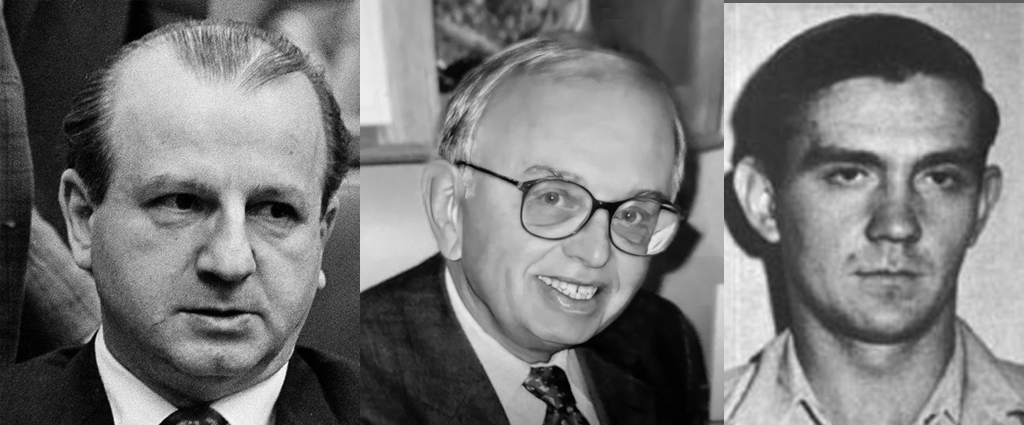
Tag: WARREN COMMISSION

  • Larry Crafard – The Leads the Warren Commission Lost – Part 2

    Larry Crafard – The Leads the Warren Commission Lost – Part 2

    Larry Crafard – The Leads the Warren Commission Lost – Part 2

    By John Washburn

    LEAD V

    Crafard’s alibi for November 22

    Crafard, when interviewed by the FBI on November 29, 1963, claimed he was sleeping at the Carousel Club during Kennedy’s assassination on November 22. He stated he overslept and was awakened by a phone call from Armstrong at 11:30 am and then again in person between 12:30 and 12:45 pm.

    With Ruby detained for Oswald’s murder, Andrew Armstrong managed the Carousel Club. An African American who handled the bar and cash takings, Armstrong was interviewed by FBI Agents Lish and Wilson on November 25, 1963 (CE5310-A). His testimonies are consolidated as CE5310 A-G here.

    That first interview focused on Jack Ruby, his reactions to Kennedy’s assassination, and a list of club employees. Crafard was not mentioned.

    Agent Lish (CE5310-B) visited Armstrong again that day, and Crafard was of interest, likely after Patterson’s lead. The second interview revealed Crafard had left on Saturday, and his whereabouts were unknown. But Armstrong found and handed over Crafard’s notebook, entered into evidence as CE5230. A typewritten transcript of it was made on November 27, which is on file but not included in the Commission’s evidence.

    FBI Agents Peggs and Zimmerman then made a third visit on November 26 (p.288 WC files, no exhibit). Because Armstrong had found a letter from Crafard’s cousin, Gail Cascadden, which listed her address as Box 303, Harrison, Michigan. Page 288 includes the notebook transcription and a typed copy of Gail’s letter. It was that letter which enabled the FBI to trace Crafard to rural Michigan, where he was found on November 28.

    Only on January 23, 1964, to Agents Sayer and Clements (CE5310-G), did Armstrong provide an alibi for Crafard regarding November 22, 1963. But Armstrong did not then (nor ever) mention Crafard’s claim of being awakened at 11:30 am.

    Armstrong’s improbable journey

    Armstrong lived at Dixon Circle, Dallas, over 4 miles due east from Downtown.

    Armstrong testified on April 14, 1964, that his regular working hours were from 1:00 pm to 1:00 am, and he typically left home at noon to catch the bus from Dixon Circle to Downtown. That would have been the 12/50 bus route along Scyene Road (Dallas City bus map). Armstrong said that he usually unlocked the club just before 1:00 pm and stocked the refrigerator so that the beers would be cold later in the day.

    In his January 23, 1964, FBI statement, Armstrong said that on November 22, 1963, he boarded a bus near his home at 11:53 pm, arrived at Main and Akard at 12:25 pm, missed the motorcade, but saw it was west at Main and Lamar before walking to the Carousel, arriving at 12:30 pm. The Carousel Club was on Commerce near Field, one block south of Field and Main. It would be a 2–3-minute walk from Main and Field to the Carousel.

    He said he took his jacket off and went to the men’s room. When he left there, he said he was curious about hearing sirens and hence got a transistor radio and listened to KLIF Dallas. Then he heard the President had been shot and tried to wake Crafard, but Crafard did not wake. He listened for two minutes more, then heard the President had gone to Parkland. Then he woke Crafard.

    He said that 15 minutes later, Ruby called from the Dallas Morning News and asked, “Had he heard the news?” He then said if “anything happens to Kennedy, the club will close.” He carried on listening until the announcement that Kennedy was dead at 1:30. He said Ruby arrived at 1:45-2:00 pm. Ruby said “what a terrible thing,” and the club would close for 3 days. Ruby made calls. Then he heard the announcement of the death of Tippit. (CE5310-G p320.)

    If Armstrong was on a westbound bus on Main Street, missing the motorcade but still seeing part of it further down (by his description, three blocks down), then there is a very narrow time window in which his arrival can have occurred.

    The Motorcade – running 5 minutes late – entered Main Street at Harwood (at City Hall) at 12:25 pm and was at Field and Main at 12:27 pm, Main and Houston at 12:29, and Kennedy was assassinated on Elm at 12:30 pm.

    If Armstrong was on a bus ahead of the motorcade, he would have observed the entire event. So, to have just missed it, Armstrong would have had to have arrived on Main immediately after the motorcade had, approximately 12:26 pm. But when he testified to the Commission, he claimed to have arrived at the Carousel at 12:15-12:20 pm. That places him at least 5-10 minutes ahead of the motorcade, and he wouldn’t have missed any of it.

    Further, if Armstrong could get from Dixon Circle to Main Street on a noon bus that could get him to the Carousel that quickly, then, on a normal working day, he would be arriving over half an hour too early for his 1:00 pm arrival. Added to which a noon bus from Dixon Circle would be hard pushed to arrive on Main in 20 minutes, even in normal day traffic conditions.

    But Armstrong then undermined his account even further. He testified he got up at 9 am, took the noon bus to see the parade, and stopped at Moore’s Barbers on the way. Merely adding the haircut time would have made it impossible for him to reach Main Street until well after 12:30 pm.

    The Dallas City Directory shows there were two Moore’s Barber Shops, 1124 S Haskell and 1125 Stonewall. Both of those were several blocks north of the Scyene bus route, a ten-minute walk. That detour would add an extra 20 minutes.

    This is what Armstrong said to the Commission about the barbers.

    Mr. HUBERT. And you got to the club about what time?

    Mr. ARMSTRONG. It must time been about 12:15-12:20, or something like that, because when I got downtown I could see portions of the parade, you know, like I got off of the bus at Main and Field- at Main and Akard, I’m sorry, which is the usual stop, I always get off at Main and Akard, and further down you could see portions of the parade, but I felt that I had missed the parade I didn’t realize that I had missed the parade until I was in the barber shop and thought, well, maybe I’ll get downtown, I said to myself, and I will see some portion of it, but when I got downtown I was surprised to see that the parade had moved forward – further down.

    Anyone who’d left home at noon and intended to stop by the barbers shouldn’t have been the least bit surprised. With the motorcade scheduled for 12:20 pm on Main, he could not have made it.

    Crafard and the sleep story

    Hubert asked Armstrong if he had called Crafard to wake him up (Crafard’s 11:30 am call claim). Armstrong said no and added that he didn’t usually wake him even if he was asleep upon arrival.

    Armstrong’s account of the events at the Carousel Club was also inconsistent. On January 23, 1964, he told the FBI that he went to the restroom when he heard sirens and learned of the assassination via a transistor radio. He ran to wake Larry, found the door open, but despite his efforts, Larry fell back asleep. Armstrong then returned to the restroom without waking Larry.

    Gary DeLaune, a news anchor at KLIF radio in Dallas, Texas, was the first to break the news at 12:40 pm. CBS-TV, with sound only, started at 12:45 pm. WFAA Dallas started live TV at 12:45 pm with Bill and Gayle Newman, the closest civilian eyewitnesses to the fatal shot to Kennedy’s head.

    Armstrong then said he heard further reports, and 2 minutes later, he went to wake Larry up, and this time, Larry got up and dressed.

    That places Armstrong in the restroom from 12:15 pm to 12:40 pm on one account (for the Commission) and 12:30 pm-12:40 pm on the other (for the FBI).

    However, Armstrong’s inconsistent and impossible ‘alibis’ for Crafard were blown apart by Crafard himself when he testified in Washington on 8th, 9th and 10th April 1964. WC Vol XIV.

    Crafard was actually an early riser.

    Mr. HUBERT. Do you drink much?
    Mr. CRAFARD. Very seldom. I drank, I think, three or four different times while I was there that I drank a beer or two, that was all.
    Mr. HUBERT. So that your heavy sleep on the morning of the 22d couldn’t be attributed to the fact that you had a hangover?
    Mr. CRAFARD. No.
    Mr. HUBERT. Or that you were suffering from any overindulgence in alcohol?
    Mr. CRAFARD. No, sir.
    Mr. HUBERT. You don’t take any kind of sleeping pills or anything like that?
    Mr. CRAFARD. No, sir.
    Mr. HUBERT. So this was just normal sleep?
    Mr. CRAFARD. Yes.
    Mr. HUBERT. And his call failed to wake you?

    Mr. CRAFARD. I left the 23d of November, I believe it was.
    Mr. HUBERT. What were your hours there?
    Mr. CRAFARD. Any hours. I would just get up, I usually got up about 8 o’clock in the morning and I would be lucky if I would get to bed before 3:30, 4 o’clock.
    Mr. HUBERT. How come you would get up so early?
    Mr. CRAFARD. Get the club cleaned up.
    Mr. HUBERT. Wasn’t there a man to help?
    Mr. CRAFARD. I took care of that mostly myself

    Mr. CRAFARD. If I started cleaning up at 9 o’clock I would be finished by 11:30.

    Mr. HUBERT. In other words, you had 2 1/2 hours?

    Mr. CRAFARD. Yes.

    Mr. HUBERT. Were you then usually free?

    Mr. CRAFARD. No. Jack would come in about 11:30 and be there 2 or 3 hours. After he left I had to stay there and answer the phone.

    Mr. HUBERT. What was the purpose of keeping you around the club after your cleanup job was over?
    Mr. CRAFARD. So far as I understand just mostly answer the phone.
    Mr. HUBERT. Were there many phone calls to be answered?
    Mr. CRAFARD. There was quite a few that would come in–generally, usually, people calling in, would start calling in about 1 o’clock for reservations.

    The cold beer story

    Then, contrary to Armstrong’s account of leaving home at noon on November 22, 1963, Crafard’s testimony put Armstrong arriving at the club at 9:30 am.

    Mr. CRAFARD. Andy woke me that morning. He come in early. Andy always put the beer in and he come in early to do that so that he could have the rest of the day off.

    Mr. HUBERT. What time did Andy come in?

    Mr. CRAFARD. I think it was about 9:30 or something like that.

    Mr. HUBERT. Came in personally?

    Mr. CRAFARD. Yes. He was there when the President was shot.

    Mr. HUBERT. Were you asleep when he came in?

    Mr. CRAFARD. I was asleep when he came in.

    Mr. HUBERT. Did you waken up when he came in?

    Mr. CRAFARD. I didn’t wake up—Andy woke me up and told me that the President had been shot.

    There seems to be some confusion here. And Hubert should have clarified it. Because if Armstrong came in that early, he could not have told Crafard about the JFK murder. Jack Ruby did little to help.

    Ruby on June 7, 1964, told the Warren Commission party at the jail, regarding his actions when he was at the Dallas Morning News: “I could have called my colored boy, Andy, down at the club. I could have-I don’t know who else I would have called, but I could have. Because it is so long now since my mind is very much warped now.”

    If Crafard was at the club and Armstrong was having a half day, then Ruby would have expected to have called Crafard. Did Ruby think that Crafard was not going to be there?

    Crafard didn’t even sleep at the club towards the end

    Stripper Karen Carlin ‘Little Lynn’, who testified before Hubert on April 15, 1964 (WC Vol XIII), said Crafard did not sleep at the club. She said she worked at the Carousel for 2 months before the assassination, to the end of December 1963, and she worked 7 days a week.

    Mr. Hubert. Do you remember a man that stayed there and slept on the premises?

    Mrs. Carlin. No; I don’t know of anyone that did. Andrew was the only one I knew that ever spent the night there, and that was just because he would say so the next evening. He said, “I am tired.” He said, “I had to stay here all night.”

    Mr. Hubert. I might add that this man Larry’s full name was Curtis Laverne Crafard.

    Mrs. Carlin. Yes. That was a little young boy, the one that worked the lights.

    Mr. Hubert. He stayed on the premises?

    Mrs. Carlin. Yes. But he stayed next door most of the time. I know he was sleeping there for a while, but Jack put a stop to it.

    Mr. Hubert. You mean Jack wouldn’t let him sleep in the club?

    Mrs. Carlin. Jack didn’t like him sleeping there, because there was too many things gone.

    Mr. Hubert. Then he made him go next door?

    Mrs. Carlin. He went next door. I don’t know who was next door or what it was next door, but he went next door.

    Mr. Hubert. But what you heard was that this man had, Crafard, Curtis Laverne Crafard had been staying on the premises, but that Jack had put a stop to it and made him move to some place next door, but you don’t know which next door?

    Mrs. Carlin. Yes.

    Mr. Hubert. Who did you hear this from?

    Mrs. Carlin. It was from Larry. He was taking care of the dogs or something.

    Mr. Hubert. He told you he had to move out?

    Mrs. Carlin. Yes.

    Mr. Hubert. Out of the premises altogether?

    Mrs. Carlin. No. He just said, “I am going to have to move. I can’t stay here. I don’t know where I am going to get the money, but I am going to have to move.”

    Mr. Hubert. That must have happened just before the assassination of the President?

    Mrs. Carlin. Yes. After that I didn’t see Larry no more.

    Mr. Hubert. So to your knowledge he never did actually move, but just said he was going to have to move, and he informed you that Jack had told him he would have to move?

    Mrs. Carlin. Yes.

    Mr. Jackson. When you say move, you mean move out at night and not sleep there?

    Mrs. Carlin. Yes.

    Mr. Hubert. That is what I meant, to move next door, I think is what you meant?

    Mrs. Carlin. Yes.

    (The Jackson who interjected was her attorney.)

    In her FBI statement of November 26, 1963, taken at the Carousel Club to agents Peggs and Zimmerman (Tuesday) CE5318, Carlin said that she’d last seen Ruby at the club the night before the assassination.

    By all that, Carlin didn’t see Crafard at the club after he’d moved out of it, and that was before the assassination.

    “Next door”, may have been the Colony Club. Crafard’s not being at the Carousel Club would be due to his working at the Vegas Club near Lucas B&B, which is where he was seen by Mary Lawrence, as confirmed in Crafard’s November 28, 1963, FBI statement. But Crafard, when he testified, left out any mention of working at the Vegas Club before the assassination.

    Mr. CRAFARD. I have tried to think of what I was doing before, the night before [the assassination], a couple nights before, or something like that. I don’t recall anything out of the ordinary.
    Mr. HUBERT. If it was the ordinary, then I suppose it would have been that the club closed up at its usual hour.
    Mr. CRAFARD. As far as I recall, yes.
    Mr. HUBERT. And you were still sleeping there?
    Mr. CRAFARD. Yes; I was still sleeping there.
    Mr. HUBERT. So you would have gone to sleep?
    Mr. CRAFARD. Yes, sir.
    Mr. HUBERT. And then I suppose Ruby would have wakened you?
    Mr. CRAFARD. Andy woke me that morning. He come in early. Andy always put the beer in and he come in early to do that so that he could have the rest of the day off.

    Was Armstrong trying to give Crafard an alibi? But in doing so, Armstrong got tied in knots and created a highly improbable travel time scenario for himself, which Crafard himself seemed confused about.

    Armstrong testified at Ruby’s trial in March 1964 and told the Warren Commission he spoke with Crafard, who also testified for Ruby, in a courtroom corridor. That brief interaction likely did not give them time to align their stories.

    Crafard and the TV

    Crafard claimed to be watching TV after the assassination. Hubert tested him.

    Mr. HUBERT. It was a Dallas station or a Fort Worth station?
    Mr. CRAFARD. It is one there they call the Dallas-Fort Worth, WWTV12, I think it is.
    Mr. HUBERT. KLRD, is that what it is?
    Mr. CRAFARD. I don’t know what station it is. I am not sure whether it was WWTV.
    Mr. HUBERT. How long did you stay there watching?
    Mr. CRAFARD. We turned it up real loud where we could hear it and then listened to his radio, too, where we would hear both of them.
    Mr. HUBERT. Go ahead, what happened next?
    Mr. CRAFARD. I don’t recall exactly what was said except the fact that the President had been shot.
    Mr. HUBERT. How long did you continue to watch it?
    Mr. CRAFARD. We watched it right up until–most of the day, I think, we had the television on there, then, most of the day.

    A remarkably vacant memory for some very eventful testimony by, for example, Bill and Gayle Newman, taking up much of the coverage.

    In CE2430, a very late interview with the FBI on August 27, 1964. Crafard stressed that he was with Ruby when they both heard of the death of Tippit – by name – and the death of Kennedy.

    However, Kennedy’s death was announced at approximately 1:35 pm by TV and around 1:25 pm by radio. There was no announcement of the death of Tippit by name before Oswald’s arrest at the Texas Theatre at 1:50 pm. Indeed, by 2:00 pm, the DPD radio tapes show that Tippit’s wife had not been told.

    Whereas Armstrong in his FBI interview of January 23, 1964 CE5310-G says, correctly, that the name of Tippit didn’t appear until after the official announcement of the death of Kennedy. He said Ruby arrived 15-20 minutes after the official announcement of that, and then made one or two phone calls in about 5 minutes. It was after this, when KLIF mentioned the names of Tippit and Armstrong, he said that Ruby told him he knew Tippit. There is no mention of Crafard.

    LEAD VI

    Crafard and the police badge

    There is also this detail in Karen Carlin’s FBI statement,

    “She said that LARRY attempted to impress her by showing her a badge and telling her that he was a policeman.”

    In my “Death of Tippit article, I suggested that Tippit was waiting at Gloco, the end of the Houston Street Viaduct, to pick up whoever was on the Beckley bus, acting out the narrative that it was the way Oswald was making a getaway from Downtown. When Oswald most likely had actually been driven to the Theater in a Rambler.

    It is also important to remember why Karen Carlin was asked to testify. She was a key witness for the official line that it was her telephoning Ruby for her wages that caused him to be at Western Union opposite City Hall at 11:15 am on November 24 (Sunday), where he then happened on the transfer of Oswald.

    However, she actually said two things contrary to that line. She testified that Ruby said on Saturday, November 23, 1963, “I don’t know when I will open. I don’t know if I will ever open back up. And he was very hateful.”

    That seems to suggest premeditation by Ruby, perhaps having an inkling of the consequences of what he was going to do next, to Oswald.

    Also, when she testified to the Commission, she said that Ruby had said to her on the telephone on the morning of November 24 (she in Fort Worth, he at his apartment on South Ewing), “Well I have to go downtown anyway”.

    Ruby himself, when he testified after his trial, said. “So my purpose was to go to the Western Union–my double purpose but the thought of doing, committing the act wasn’t until I left my apartment.”

    Having a ‘double purpose’ in going to Western Union also indicates premeditation.

    LEAD VII

    The incredible journey. How did Crafard get to Michigan?

    Crafard said he took Routes 66 and 77, passing by Oklahoma City, St Louis, MO, then the outskirts of Chicago, IL. From there to Lansing, MI, Mount Pleasant and then Clare, MI, where he arrived at 9:00 pm on Monday, November 25, and stayed with his cousin, Clifford Roberts. A total distance of 1,282 miles.

    Crafard said that the 59-hour trek began when he decided to leave Downtown Dallas at 11-11:15 am on November 23 (Saturday). He had only $7 on him, he was carrying two bags, and he walked 15-18 blocks until he hitched a ride.

    Remarkably, he said the first ride was from a person he knew from the State Fair, but did not know his name.

    Mr. HUBERT. Did you walk there?
    Mr. CRAFARD. I walked out about 15 or 18 blocks, I think it is, and a guy I had met out at the fair picked me up. He saw me.
    Mr. HUBERT. Did you arrange for him to pick you up?
    Mr. CRAFARD. No; he was going by, he saw me, and he recognized me.
    Mr. HUBERT. What is his name?
    Mr. CRAFARD. How’s that?
    Mr. HUBERT. What is his name?

    Mr. CRAFARD. I don’t remember what his name is. He worked out there for a while. I never did know his name. I don’t think he knew my name. He recognized me as having worked out there.
    Mr. HUBERT. You were on the highway hitchhiking at that time?
    Mr. CRAFARD. That’s right.
    Mr. HUBERT. Did you have a bag?
    Mr. CRAFARD. Yes.
    Mr. HUBERT. How large was it?
    Mr. CRAFARD. It was a regular satchel and I had another bag

    Hubert elsewhere displayed incredulity about the tale of rides and the fact that Crafard said he had $7 on leaving Dallas. But he still had $3 left when he left Clare on Tuesday to go to Harrison. –This was to visit his aunt Esther Eaton and cousin Gale Cascadden – where he stayed the Tuesday night and then hitched to Kalkaska (another 85 miles) to stay with his sister Cora Ingersoll, Wednesday night. It was there that he was traced by the FBI, and he was interviewed on the 29th ( the day after Thanksgiving), in the morning at nearby Bellaire, MI.

    Assuming that the first ride from Dallas was around noon, with Crafard saying he arrived in St Louis around 6:00 am on Sunday, then that was 705 miles in 18 hours, averaging 39 mph. 

    Then he said he did St Louis to the Chicago outskirts. I measure that distance as Country Club Hills, where the road bears to Michigan, at about 284 miles. He told Hubert he arrived there at 2 pm on Sunday. That’s 8 hours, averaging 35.5 mph and the whole Dallas to Chicago journey averages 37.6 mph. After that, his description of getting from the Chicago outskirts to Clare breaks down as: to Lansing, 212 miles, then Mount Pleasant, 69 miles and then Clare, 16 miles, arriving 9 pm, Monday.

    That’s 31 hours, averaging 9 mph. Had he averaged 35 mph, he could have done it in 8 hours. But Crafard did not describe any long stops, sleepovers, or waits for lifts. He described near continuous travel. Hubert picked up that the final 16 miles from Mt Pleasant to Clare, according to Crafard, took 12 hours.

    Mr. HUBERT. Then there is some mistake in timing of about 12 hours.

    Mr. CRAFARD. That is what I was saying. I’ve lost some time there

    Mr. HUBERT. It may be that you are making a mistake, Larry. Let’s see if we can’t refresh your memory from the time you got that last long hitch that took you to Mount Pleasant because you remember getting to Mount Pleasant at night, about 8:30.

    Mr. CRAFARD. Yes.

    Mr. HUBERT. And that, you say, is a run of what–about 5 hours, 6 hours?

    Mr. CRAFARD. I don’t believe it would take that long.

    Mr. HUBERT. So if you got there at about 8:30 at night, then either you didn’t get any hitches for a long period of time, or else something else happened.

    Mr. CRAFARD. I’m just trying to—-

    Mr. HUBERT. Because you told us, and if it is not so, why we want you to correct it. Everybody can make mistakes.

    Mr. HUBERT. You said that you picked up this ride at a point 60 miles outside of Lansing and into Mount Pleasant prior to dawn on the 25th. Now, maybe that is wrong. Maybe you got that ride late in the day. Let’s put it this way. Was that a continuous ride straight on?

    Mr. CRAFARD. It carried me straight on through to Mount Pleasant.

    Mr. HUBERT. Did you stop at all?

    Mr. CRAFARD. Not that I can recall. It isn’t that long a run across there.

    Mr. HUBERT. Did you stop for lunch or anything of that sort?

    Putting all into context. Crafard got from Dallas to the Chicago end of Lake Michigan in 1 day 2 hours, 77% of the distance. But he took 1 day, 7 hours to travel 23% of the trip, within Michigan itself. Hubert spotted that the most egregious time discrepancies occur from when he said he missed Chicago by bypassing it.

    Mr. HUBERT. He didn’t take you through Chicago?

    Mr. CRAFARD. No; I bypassed most of Chicago.

    Mr. HUBERT. How did you do that?

    Mr. CRAFARD. On a couple alternate routes.

    Mr. HUBERT. With hitchhikers?

    Mr. CRAFARD. Different rides.

    Mr. HUBERT. Different rides?

    Mr. CRAFARD. Yes.

    Mr. HUBERT. How many?

    Mr. CRAFARD. I got three or four different rides in Chicago.

    Mr. HUBERT. With these several rides around Chicago, bypassing it, how long did it take you to get around Chicago?

    Mr. CRAFARD. Probably 2 or 3 hours.

    Mr. HUBERT. And these were all short ones?

    Mr. CRAFARD. Yes.

    We can almost see Hubert raising his eyebrows.

    When did Crafard hear Ruby had shot Oswald?

    Ruby shot Oswald on live TV at 11:21 am on Sunday. By Crafard’s described journey, Oswald was shot when Crafard would have been heading to Chicago; then he had 3-4 rides bypassing it, then he took the one to Lansing. That is 5-6 rides, with the opportunity to hear the radio news of the big story, or any of the drivers commenting on it if they’d already heard it.

    Earl Ruby testified (Vol XIV) that he heard at noon that day, whilst on a phone call, that Oswald had been shot. He turned on the radio and, within 10 or so minutes, learned that his brother Jack had done it.

    Therefore, anyone first hearing of the shooting after 12:30 pm on Sunday, November 24, 1963, would know that Oswald was shot, and Ruby had done it. To know the former but not the latter could only have occurred early, between 11:21 am and 12:30 pm.

    So, when did Crafard say he heard that Oswald was shot, and Jack Ruby was the person who did it?

    Mr. HUBERT. When did you first hear that Oswald had been shot?
    Mr. CRAFARD. I had heard that Oswald had been shot Sunday evening.
    Mr. HUBERT. Where?
    Mr. CRAFARD. It must have been while I was getting through Chicago.
    Mr. HUBERT. Where did you hear that?
    Mr. CRAFARD. Over the radio.
    Mr. HUBERT. What radio?
    Mr. CRAFARD. The car radio.
    Mr. HUBERT. Did you know that Ruby had done it?
    Mr. CRAFARD. No; I didn’t find out who had done it until the following Monday, the following morning, Monday.
    Mr. HUBERT. Where did you find that out?
    Mr. CRAFARD. I heard that over the radio.
    Mr. HUBERT. As a matter of fact, Larry, I suppose all of those cars you were in had radios, didn’t they?
    Mr. CRAFARD. A lot of people don’t listen to the radio when they are riding like that. That was the first I’d heard of it—was Sunday evening, the first I heard Oswald had been shot.
    Mr. HUBERT. Sunday afternoon, wasn’t it?
    Mr. CRAFARD. How is that?
    Mr. HUBERT. You said it was while you were working your way through Chicago.
    Mr. CRAFARD. Yes.
    Mr. HUBERT. Which took you two or three different cars; about 2 hours or so?
    Mr. CRAFARD. Yes.
    Mr. HUBERT. It was in one of those that you heard it?
    Mr. CRAFARD. Yes.
    Mr. HUBERT. There was no announcement that Ruby had done it?
    Mr. CRAFARD. I don’t believe so, because I didn’t know Ruby had done it until Monday morning.
    Mr. HUBERT. How did you find that out?
    Mr. CRAFARD. I heard that over the news.
    Mr. HUBERT. In a car?
    Mr. CRAFARD. Yes.
    Mr. HUBERT. During the night when you were driving from Chicago to Lansing, during the period from 5 in the afternoon to about midnight, didn’t you hear any radio announcements about any of this matter?
    Mr. CRAFARD. No.
    Mr. HUBERT. Did that car have a radio in it?
    Mr. CRAFARD. I believe so
    .

    Crafard tried to extract himself from that muddle by changing the time he said he was ‘passing’ Chicago to Sunday evening. But in doing so, he created another problem for himself by claiming he didn’t know it was Ruby who shot Oswald until Monday. Clearly, if Crafard had only found out Sunday evening that Oswald was shot, then that news would have also informed him that Ruby did it. After all, Ruby was very well known within the DPD.

    I suggest the reason for the inconsistencies and likely deceptions — which Hubert was having problems with — is because Crafard didn’t bypass Chicago in a hitched ride. He was taken to Chicago itself, and he stayed overnight on Sunday. This was more likely a camouflaged getaway. I would also suggest that Crafard was going to meet someone there clandestinely.

    Because his story did not add up, Crafard was questioned again in the morning of April 10, and put his time of his arrival in Chicago 20 hours later to late morning Monday 24th.

    Mr. GRIFFIN. On that basis, what time would you say that you arrived in Chicago?
    Mr. CRAFARD. It probably would put me in Chicago sometime Monday, about 10:30 or 11 o’clock in the morning.
    Mr. GRIFFIN. When you arrived in Chicago, then you knew that Ruby had killed Oswald?
    Mr. CRAFARD. Yes.
    Mr. GRIFFIN. And what time did you arrive in Lansing, Mich.?
    Mr. CRAFARD. I believe it was about 6:30 or 7 o’clock Monday evening.
    Mr. GRIFFIN. When you arrived in Chicago did you make any effort to call any of the Rubensteins?
    Mr. CRAFARD. No.
    Mr. GRIFFIN. Did that occur to you?
    Mr. CRAFARD. No; that arrival in Lansing would have been about 3:30 or 4 o’clock. It would have been a couple hours earlier
    .

    Despite the ‘correction’ of 20 hours, his times are still all over the place, and he created no reason to know Oswald was shot without knowing Ruby did it. Griffin was rightly suspicious that Crafard was meeting people in Chicago.

    The Man he recognised – with no description

    In that session, when Crafard was asked more about the man, he said he recognised him from the State Fair, and who drove him out of Dallas. But he couldn’t say whether he had hair, or was bald, or wore glasses or not.

    Mr. GRIFFIN. How old would you say this man was?
    Mr. CRAFARD. I would say he was probably in at least his middle forties, more likely in his late forties.
    Mr. GRIFFIN. Was he bald or did he have hair?
    Mr. CRAFARD. I don’t really remember.
    Mr. GRIFFIN. Was he a graying man or what color was his hair?
    Mr. CRAFARD. I don’t remember that either.
    Mr. GRIFFIN. Do you remember if he wore glasses?
    Mr. CRAFARD. No.
    Mr. GRIFFIN. Do you remember what kind of a car he owned?
    Mr. CRAFARD. I believe he had a Chevy. I am not sure.
    Mr. GRIFFIN. How would you describe his physical build, anything remarkable about it?
    Mr. CRAFARD. No; not that I could think of.
    Mr. GRIFFIN. Was he a thin man?
    Mr. CRAFARD. He was about medium build for a man his age and height.

    A question arises as to why Crafard held to the only $7 story, a point of detail that seems, again, improbable. I can only conclude that having little money was essential to the central story he’d hitchhiked, whilst also ruling out the possibility he’d used public transportation. Travel by public transport could invoke a search for witnesses, and would firm up the times.

    The lone fish journey does serve a purpose: it distances him from a team effort. From all that I outlined above, it is more likely that Crafard didn’t hitchhike at all. In my view, he was driven to Chicago and then told to lie low with relatives in remote Michigan, with the hitchhiking story as a cover.

    Having been asked how Crafard knew the route to Michigan from Dallas without a map, he said he’d done it previously, but then gave an irrelevant answer about a prior hitch to Sacramento and Bakersfield with his wife and two babies. That led to more questions about why Crafard’s wife wanted to take her 2 babies (one his, one by a prior marriage) hitchhiking.

    It’s impossible to stitch most things Crafard said to make something sensible out of it. But this was the man who was deceptive about getting to Dallas, the dates when that was, and clung to a dubious story about what he was doing on November 22.

    But the Warren Commission Final Report stated:-

    “An investigation of Crafard’s unusual behavior confirms that his departure from Dallas was innocent.”

    And,

    “Although Crafard’s peremptory decision to leave Dallas might be unusual for most persons, such behavior does not appear to have been uncommon for him. His family residence had shifted frequently among California, Michigan, and Oregon. During his 22 years, he had earned his livelihood picking crops, working in carnivals, and taking other odd jobs throughout the country.”

    That conclusion avoids the fact that Hubert and Griffin exposed Crafard’s account as being full of bizarre improbabilities that seem like cover stories. Working for the FAA in Nevada is excluded from that summary, as was his regular presence in Dallas.

    Whoever drafted those assertions wasn’t reflecting the underlying evidence.
    Click here to read part 1.

  • Larry Crafard – The Leads the Warren Commission Lost – Part 1

    Larry Crafard – The Leads the Warren Commission Lost – Part 1

    Larry Crafard – The Leads the Warren Commission Lost – Part 1

    By John Washburn

    This article focuses on Curtis LaVerne “Larry” Crafard. Crafard had worked for Jack Ruby from mid-October 1963 at the Carousel and Vegas clubs. Ruby purportedly recruited him from a fairground.


    Crafard said he left Dallas late on the morning of November 23, 1963. This would be Saturday, the day after the assassination. He said he did not take his wages owed. He stated that he hitchhiked 1,175 miles to Clare, Michigan. Crafard’s departure was before Ruby had shot Oswald on Sunday, and hence before Ruby was in the spotlight.

    In my prior articles for K&K I postulated that Crafard had a role in the assassination of Kennedy, not as an assassin but impersonating Oswald as part of a frame. An element of that being to act out a fake getaway for Oswald, by getting a downtown bus to Oak Cliff. With Oswald himself having been duped into going to the Texas Theater in a station wagon where he was to be eliminated.

    With that, I assumed things went wrong when Tippit, who was supposed to intercept and protect Crafard’s movement once in Oak Cliff, got cold feet and had to be eliminated. Crafard then had to be taken off the bus and then act out an impromptu part at the Tippit murder scene to make it appear Oswald had done it. It was the mishaps around that which meant Oswald was not killed at the Theater.

    To examine whether that supposition is supportable, Crafard’s movements need to be addressed over an extended period of time, with particular attention to November 22, 1963 itself.

    LEAD I

    Crafard was mistaken for Oswald


    A Commission memorandum from Counsels Leon Hubert and Burt Griffin on March 6, 1964, preparing for interviews in Dallas in April 1964, speculated that Curtis Laverne “Larry” Crafard, an employee of Jack Ruby, was used as a look-alike imposter to set up Oswald as a ‘patsy’. What evidence had accumulated for them to think that impersonation might be an issue?

    There had been several reported sightings of Oswald at the Carousel Club in October/November 1963. Hence, indicating a pre-assassination link to the club’s owner, Jack Ruby.

    But any mystery about such sightings should have gone away after a memorandum from Naval Intelligence, not released until September 2017, which dealt with what Robert “Bob” Kermit Patterson, 23, ex US Navy, told the Resident Agent “RA” of Naval Intelligence, Dallas at 13:30 hours on November 26, 1963 (Tuesday).

    Patterson co-owned Contract Electronics, 2533 Elm St, Dallas, and was taken to the FBI that same day, CE2830. Patterson said that he had seen Ruby with Oswald in his shop about two weeks prior to the 26th.

    He said the person had a tattoo on his right forearm, was wearing tight-fitting blue jeans and no jacket, 5’8”-9” tall, 150 lb. He said his colleagues Donald Stuart and Charles Arndt were of the same view. He said Ruby had discussed matters concerning his club and its sound systems. Patterson was shown photographs of six different men and picked out Oswald. Patterson described a 4 by 5-inch notebook and said the names of Stuart and Patterson were added into it by the person on the instruction of Jack Ruby so that Ruby could issue them with passes for the club.

    From getting that lead at lunchtime on November 26, the FBI made several visits to the Carousel Club. It took just six hours for the FBI to establish that Crafard was being mistaken for Oswald, and to issue a request that Crafard be traced, interviewed and photographed.

    That request appears in an FBI teletype message of November 27, 1963. (The term “DASH VICTIM” in the teletype is code for the killing of Oswald.). A short account of that also appears in “the Taylor Memorandum” of November 27, 1963 (Wednesday), where Rear Admiral Taylor, Director of the Office of Naval Intelligence, wrote to Admiral McDonald about the Patterson lead.

    A memorandum from CIA officer (later Director) Richard Helms of February 24, 1964 to Hubert and Griffin also said that “Crafard fled Dallas area Saturday. November 23, located in rural parts of Michigan November 28”. (Unpublished WC, Andrew Armstrong file, page 331). ‘Fled’ is not a word to describe someone leaving in normal circumstances.

    The FBI traced Crafard to Michigan via his cousin, Gale Cascadden. She lived in rural northern Michigan (her mother was the sister of Crafard’s father). She said to the FBI on December 16, 1963, that he seemed uninterested in the fact that Ruby had shot Oswald. She also said she and her parents did not understand why Crafard had left Dallas. When she asked him why he’d left, she said he changed the subject. (CE 2429).

    However, none of that information from Naval Intelligence, nor the teletype, appears in Commission files.

    Absent that information from Naval Intelligence, the only route from published Warren Commission records to deduce that Kermit Patterson was the prime lead is to note the similarity between Patterson’s account of November 26, 1963 (Tuesday) in CE2830, and Crafard’s FBI statement of November 28, 1963 (Thursday), taken at Bellaire, Michigan CE5226. The photographs taken of Crafard appear as CE 451, 453 to 456.

    In that statement, Crafard gave examples of what he did for Ruby, he said:

    …on a few occasions during the daytime, he would accompany RUBY around the Dallas area.” “On another occasion, approximately three weeks ago, he went with RUBY when RUBY checked about some sound equipment for the club. This was at an electronics company in about the 2200 or 2300 block of Elm Street.  They were there ten or fifteen minutes and did not purchase anything. this occasion he, CRAFARD, was wearing a suit and he feels they were there at about 3:00 PM or 4:00 PM.”

    Patterson in Dallas on November 26, 1963 (Tuesday) had therefore described a situation which aligned with Crafard’s FBI statement of November 28, 1963 (Thursday) in Michigan, and vice versa.

    Donald Stuart was interviewed by the FBI on November 27, 1963, and confirmed a similar situation. But he was less certain that the person was Oswald. An FBI record of some of Ruby’s personal effects has passes duly recorded for Donald Stuart, pass number #170, and Robert Patterson #171. Thus, by Tuesday, November 26, 1963, the investigating authorities had information to attach to the mystery of some of the Oswald sightings – including at the Carousel Club.

    Mistaken identity, as opposed to false identity, is not uncommon. But what is inexplicable, unless there was something to cover up about Crafard looking like Oswald, is that all other people who came forward afterwards with similar leads were ruthlessly discredited by the Dallas Police and the FBI.

    The sightings reported by Litchfield, Kittrell, Crowe, Lawrence, Friedman and Jarnagin

    Griffin and Hubert noted in their Memorandum to Rankin of March 6, 1964, that Wilburn Litchfield told the FBI on December 2, 1964 – CE3149 – that in early November 1963, at Ruby’s Carousel Club, he’d seen a man who said he was from California in a V-necked sweater, ‘sloppily dressed’, 5’7”-5’9” who looked like Oswald.

    Litchfield had been playing poker on November 24, 1963 (Sunday). He said that he and his associates saw Ruby shoot Oswald on TV, which triggered his memory of seeing Oswald at the Carousel.

    Litchfield didn’t say it was Oswald; indeed, he said the person had acne scar pockmarks on the right side of his chin. That doesn’t fit Oswald. But that does match Crafard, who had also been brought up in California. Hubert and Griffin even recognised, in their joint memo of March 6, 1964, that although the DPD tried to discredit Litchfield, the facts stacked up.

    “It is also known that an employee of Ruby, Larry Crafard, closely resembles Oswald. Litchfield’s story checks out, moreover in other significant details including the description of a man resembling Alex Gruber of Los Angeles, California who is known to have visited Ruby at the Carousel during the period to which Litchfield refers.”

    Litchfield did have a criminal record. Associates of his (CE2889) confirmed what Litchfield said, but the FBI report said that one associate had said Litchfield was a “con man”. But so what, given that his story checked out?

    The ‘sloppy’ dress also matches Laura Kittrell’s evidence (see part 3 of my K&K Death of Tippit article). She said that Oswald himself on October 4, 1962 “looked very military as neat as a pin” and was “trim, energetic, compact and well-knitted” but the second person she saw on October 22, 1963 presenting himself as Oswald behaved badly and said he was “a trifling, shirtless, good-for-nothing lout who sprawled oafishly over his chair”. Thus, in her case, that was an active impersonation of someone purporting to be Oswald.

    William Crowe was a ventriloquist who did a memory man act with the stage name of ‘Bill DeMar’.

    He said he told a newsman he had been at the Carousel Club and saw a man who looked like Oswald, who worked for Ruby at the club. His story broke that day – November 22, 1963 – with the Associated Press agency. He was then interviewed by the FBI in Dallas that same day (page 5 of the Commission file for Crowe).

    He said he had performed at the Carousel Club in early November 1963 and asked 20 members of the audience to call the name of an object, so he could then relay them back by memory.

    He said that after seeing Ruby shoot Oswald on TV, he went to the Carousel Club within the hour, as he was concerned about his equipment stored there. He said he saw a newsman and a television man also trying to gain access, given the shooting of Oswald.

    Thereafter he said he’d been misquoted, and only said the person looked like Oswald. He also said he’d been on stage with lights shining in his eyes. In testifying to the Commission on 2 June 1964, before Hubert, Crowe was shown photographs of Oswald and Crafard. He stated it was a possibility that the man he saw was Crafard.

    Crowe was being discredited as late as June 1964 for being an attention seeker wanting to promote his memory act – CE2995.

    Even CBS reporter Dan Rather (later to be CBS evening news anchor) got dragged into it. KRLD Dallas on November 24, (Sunday) reported that Rather had seen Oswald at the Carousel Club. The Crowe file, held by the Warren Commission, on page 42 has a note of June 11, 1964, setting out how Dan Rather was interviewed by agents after the KRLD report.

    Dan Rather stated that he went to the Carousel Club after Ruby had shot Oswald. He came across Crowe trying to get into the Carousel Club to get his personal effects. Crowe told Rather that he’d seen Oswald there.

    Page 50 has the FBI testimony of Pauline Churchill, manager of the Shady Oaks Motel, Dallas, dated June 12, 1964. She confirmed Crowe was staying at the motel and rushed into her office within 15 minutes of Ruby shooting Oswald to tell her it had happened. Dan Rather and Churchill thus vouched for the spontaneity of Crowe. But Rather said (CE3101) that he thought Crowe was making it up.

    Waitress Mary Lawrence told the FBI on December 6, 1963, that she had served Oswald and Ruby together at the Lucas B&B café, Downtown Dallas, at around 2:15 am on the morning of the assassination. A few days after, she received an anonymous telephone call “telling her to get out of town or she would die”.

    When shown a photograph of Oswald, she said the person she saw had a small scar near his mouth on the right or left-hand side. The FBI Bellaire report states that Crafard had a small scar on his lip. So, Litchfield and Mary Lawrence, rather than trying to make up a story to fit with it being Oswald, did the opposite by describing scarring that Oswald didn’t have.

    An internal DPD memorandum and a more comprehensive record described her as a compulsive liar. The police memo was used to discredit her on the basis that Jack Ruby was banned from there and hence could not have been seen there.

    But Gloria Fillmon told the FBI on December 17, 1963, CE2379, that she had worked for three weeks in November 1963 as a champagne girl at the Carousel Club. She left because Ruby wanted her to be a stripper. She said a day or two before the assassination, at 3 am, Jack Ruby, Crafard, and she had eaten at Lucas B&B, Ruby and she picking up Crafard on the way. Hence, Ruby likely was not banned. Making that even more probable is that Lucas B&B was at the junction of Oak Lawn and Bowser. It was next to the Vegas Club, Ruby’s other outfit. The neon tower sign is still there.

    Crafard’s November 28, 1963, FBI interview (CE5226) states that he worked on the evening of November 21, at the Vegas Club, and went with Jack Ruby to Lucas B&B at 2:30 am on November 22, just as Mary Lawrence said.

    If that weren’t enough corroboration. He also said he went there with Ruby and a woman called “Gloria” at around 3:45 am on November 21, just as Gloria Fillmon said. Hence, DPD and the FBI were calling people liars for saying things for which the DPD and the FBI had had parallel evidence to corroborate and had known the cause of since Patterson’s lead of November 26, 1963.

    Bob Barrett and James Bookhout of the FBI, on December 26, 1963, followed a lead (CE2991) from the incarcerated Jack Ruby, who said Edward Rocco of Cabaret Magazine, who had been a visitor to the club, could be mistaken for Oswald. Ruby obviously knew Oswald’s appearance, given that he’d shot him from close range in the abdomen.

    Rocco was a photographer who had stayed a week in Dallas to take photographs of the Club. Rocco led the FBI to Terry Friedman. Friedman was interviewed by the FBI on July 1, 1964 (CE2991) when he said Rocco had shown him a photograph of the Carousel Club, and Friedman said he thought a person in the front row was Oswald. Out of all of that blossomed numerous photographs of the Carousel Club, included in CE5303.

    The Commission did not publish the photographs in another exhibit ‘Exhibit 5212’, but the Mary Ferrell Foundation now has. The reason they were not published was given as their “questionable taste and negligible relevance”. Questionable taste by ’60s standards is correct. Negligible relevance is not. What Exhibit 5212 contains are several photographs showing Larry Crafard, wearing a suit, seated in the front row at the Carousel Club.

    Therefore, Ruby’s false lead regarding Rocco being the Oswald look-alike still led to an outcome, the photographer was traced, and the photographs were obtained. Ultimately, Ruby revealed for posterity the photographic proof that it was Crafard who could be mistaken for Oswald. Was Ruby dropping clues deliberately?

    LEAD II

    An attorney saw ‘Oswald’/Crafard at the Carousel Club on 4 October 1963 discussing a plot to kill Governor Connally.


    Carroll Jarnagin was a criminal law attorney; CE2821 is his FBI report of December 6, 1963, the day after he had written a letter to Hoover. He asked to be kept anonymous. That report merely calls him “Witness”.

    The report said that on October 4, 1963 (Friday), he’d been using the phone booth at the back of the Carousel Club and overheard Jack Ruby talking to Oswald. The matter being discussed was a contract to kill the Governor of Texas, John Connally. He said he then ended his call to eavesdrop on what else was being said.

    Jarnagin had contacted Hoover directly in his letter of December 5, 1963, as he wanted to avoid local press publicity. A good reason for that was that he was an attorney in the criminal justice system and was dating a stripper, Shirley Maudin.

    The DPD put him through a polygraph test on March 2, 1964, which he failed, having been taken by Officer Paul Bentley (who had also been at Oswald’s arrest). Bentley was the chief polygraph examiner for the DPD and concluded Jarnagin had made the story up and had been intoxicated at the club. The DPD and Hoover concluded he was an attention seeker.

    But that just begs more questions. Why would someone seeking attention end his letter to Hoover asking not to be identified? Why not simply test whether he was yet another person who had actually seen Crafard? Why would someone seeking to raise attention regarding the assassination of the President talk about a plot to kill Connally instead?

    People who are intoxicated tend not to remember very much from that time. A tribute piece in a newspaper on his death does say he dedicated his last 14 years to working with Alcoholics Anonymous. Whether he was an alcoholic in 1963 is not known. But alcoholics tend to have a high tolerance of alcohol and don’t necessarily display symptoms of drunkenness.

    The FBI file, which has information to discredit him, states that Shirley Maudin, on December 9, 1963, said that he wasn’t drunk. Jarnagin appears to have been treated in the same way that Kittrell, Crowe, Litchfield and Lawrence were.

    DA Henry Wade knew Jarnagin personally, and in his Warren Commission testimony of June 8, 1964 (WC Vol V), Wade went out of his way not to discredit him too much and avoided using his name.

    Mr. Wade. I didn’t use him as a witness [in the Ruby trial] and after giving him the polygraph I was satisfied that he was imagining it. I think he was sincere, I don’t think he was trying–I don’t think he was trying to be a hero or anything. I think he really thought about it so much I think he thought that it happened, but the polygraph indicated otherwise.

    Had Jarnagin attended Ruby’s trial, his evidence would have been discussed in open court. He may also have encountered Crafard himself, who gave evidence in person at that trial as a character witness for Ruby.

    In his letter of December 5, 1963, Jarnagin also claimed the man he thought was Oswald was called H. L. Lee. But Oswald was alleged to use the alias of Alek Hiddell, and the alleged room booking at 1026 N Beckley was O. H. Lee.

    As my article on that subject for K&K, “Oswald, Beckley and the Tippit wallet”, sets out, there was a Herbert Leon Lee staying at 1026 N Beckley. The FBI, tracking of telephone calls from the telephone box opposite 1026 N Beckley, was in an FBI report (page 23) dated December 9, 1963.

    Therefore, rather than embellishing facts gained as an ordinary member of the public after the event, Jarnagin was coming up with accurate information that was not widely known.

    Two questions emerge from that. How could Jarnagin, in raising ‘H.L. Lee’ on December 5, 1963, have picked at random the name of someone who was at the very place Oswald had stayed at – 1026 N Beckley? How could Jack Ruby have known on October 4, 1963, that an HL Lee would be associated with 1026 N Beckley? A place that Oswald only moved into on October 14, but whose housekeeper was the sister of Ruby associate Bertha Cheek.

    This, from a Dallas Police report, set out more of what Jarnagin said.

    “The man who asked to see Jack Ruby is dressed in a tan jacket, has brown hair, needs a haircut, is wearing a sport shirt, and is about 5’ 9” or 10” in height, his general, appearance is somewhat unkempt, and he does not appear to be dressed for night clubbing.”

    A tan jacket has come up before. This, from my “Death of Tippit” series of articles, is from Dallas Morning News reporter Jim Ewell. He had arrived at the Tippit murder scene and wrote.

    “There was another police car there as they were examining a jacket next to the curb which had apparently been located by one of the policemen after Oswald had thrown it down as he ran toward Jefferson. I had a jacket just like it. I remember it as being a light tan windbreaker. I was with Westbrook as we all went over to examine the jacket because it was the only tangible thing we had at the moment that belonged to the killer. In fact, I held the jacket in my hands. I remember that they were talking about a water mark on it that was obviously made by a dry cleaning shop”.

    A post from Education Forum member Gil Jesus shows that the discarded jacket described and presented in monochrome photographs as CE162 as gray, was in fact tan. My Death of Tippit article for K&K also sets out how the evidence submission document, had a strip strategically placed so as to obscure that it was Captain Westbrook who found it. That document also described that tan jacket as gray. Thus, Jarnagin’s detail of a “tan jacket,” matches a jacket found that Captain Westbrook incorrectly reported as gray.

    The jacket is by Maurice Holman of California, and Litchfield had said the person he saw was raised in California. The jacket Crafard was wearing when photographed in Michigan also appears similar. Jarnagin also said that the person said he had been hitchhiking. Oswald’s history has no evidence of hitchhiking. Crafard’s story did.

    The possibility that Crafard was talking to Ruby about killing Governor Connally appears to have been a step in a very inconvenient direction.

    Lead III

    Crafard ‘s tall tales about when he arrived in Dallas, and his work after he left the military.


    Crafard portrayed himself as an easy come, easy go, itinerant hitchhiker acting as a barker for “How Hollywood Makes Movies” (HHMM), a side show at the October Texas State Fair, Dallas, which ran until it flopped. He then went to work for Jack Ruby at the Carousel Club before leaving on November 23, 1963.

    Crafard, in his November 28, FBI interview, said Bob Craven ran HHMM and employed him, and HHMM accounted for him being in Dallas on October 15, living in a tent, and that he stayed with its replacement, a rock and roll show, until approximately October 30, still living in a tent. He said he then moved to work with Ruby on November 1, having first met Ruby on or about October 21. However, Crafard’s story sits alongside conflicting accounts of others regarding the dates involved.

    Robert Craven, a co-producer of HHMM, confirmed to the FBI on November 27, 1963 (Wednesday) that the show ran from October 5 to October 15, with the troupe arriving on September 29, presumably for stage set up and rehearsals. CE1534.

    The Craven interview makes no mention of Crafard, but the interview was before Crafard was found from the Patterson lead. (Unfortunately, the FBI record is truncated at the end.)

    October 4 would be too early for Jarnagin, or anyone, to have seen Crafard as an employee of Ruby at the Club. But Jarnagin didn’t describe an employee, but an unkempt visitor wearing a tan jacket.

    HSCA Vol 9-3G page 1093 has a timeline for Jack Ruby. That states the State Fair opened on October 5, and Ruby visited the side show 3-5 times that day. It states HHMM closed on October 15, 1963, and on October 20, the State Fair closed. It also states Crafard was building a cloakroom at the Carousel Club using lumber from the failed HHMM side show that day.

    Andrew Armstrong, the barman at the Carousel Club, testified he met Crafard when the HHMM show closed and borrowed equipment was returned to the club by Armstrong and Crafard, Crafard showered at the club and moved in.

    An FBI document CE2348 has information regarding Marvin Gardner’s, the show’s electrical technician, interview on November 29, 1963 (Friday).

    Gardner said HHMM ran from October 5, 1963, to closure on October 15, 1963. He said the performers and producers left town on the 16th. He said Crafard was a barker working outside the tent, and when the show folded, Crafard worked outside the tent where a rock and roll show took its place.

    Crafard’s true timeline

    Crafard, in his first FBI statement on November 28, put his working for HHMM as October 15 rather than October 5. He said he worked for Ruby from November 1, but there is evidence he was actually working at the Carousel from October 16.

    With the true timeline, it is possible that what Jarnagin saw on October 4, 1963, was Crafard meeting Ruby, as the fair and show were already in town, both commencing the next day.

    Crafard was also deceptive about his activities from when he left the military in November 1959. Crafard testified on 8, 9 and 10 April 1964 in Washington, before Hubert and Griffin. This is from April 8, when he describes his short time in the military.

    Mr. CRAFARD. I was in Fort Ord for 2 months and then I went to Presidio, San Francisco, where I was stationed at an air defense school for a period of 2 months and then I was assigned to D Battery, 2d Missile Battalion, San Francisco Defense Organization. From there I went to Germany in April of 1959. I was transferred to Germany to Deisley Kersne, and I was stationed with the D Battery, 2d Missile Battalion there. I stayed there until November of 1959 then I was transferred back to the United States where I was discharged November 10, 1959.
    Mr. HUBERT. How long did you serve altogether?
    Mr. CRAFARD. Thirteen months

    Crafard then described staying with his sister in Michigan for 7 months (which takes things up to July 1960) working casually in pulp wood cutting. He then went to his father’s in Dallas, Oregon, for fruit picking for a month, then a cannery for six months and then, worked with carnivals.

    For 1961, he described various fairground jobs, and he extended his account up to 1962, with casual work in California and Dallas, Oregon (as opposed to Dallas, Texas).

    But this remarkable question was then posed, which blew that apart.

    HUBERT. Now, we have some information that you worked for Federal Aviation Agency through July and October of 1960 in Los Angeles?
    Mr. CRAFARD. Yes; in Los Angeles–I believe they were out of Los Angeles, where I worked for them that was over in Nevada.
    Mr. HUBERT. What kind of work did you do?
    Mr. CRAFARD. Surveyor’s assistant. I had forgotten I had worked for them.

    Nevada isn’t Oregon. A surveyor’s assistant for the FAA isn’t fruit picking.

    Hubert then sprung this on him.

    Mr. HUBERT. Do you remember working for the Teer Plating Co., Dallas, Tex.

    Mr. CRAFARD. Yes. Let’s see, I believe it was, I am not certain of that.

    Mr. HUBERT. That was between April and June of 1961, was it not?

    Mr. CRAFARD. I believe so. The way I have traveled around, I had a lot of jobs I even forgot about almost.

    Teer Plating was based on Wyche Boulevard in Dallas, between Love Field Airport and Parkland Hospital. The places in Dallas where Kennedy had arrived and then departed from life. Making it all the more strange that Crafard hadn’t remembered that, given the significance of those places on November 22, 1963.

    Capping all of that, it wasn’t until Hubert then brought up that Crafard had also been in Dallas, Texas in 1961 working for Ablon Poultry that Crafard revealed that he was married, and had met his wife in Amarillo, Texas, in 1961.

    Mr. HUBERT. Did you ever work for Ablon Poultry Co.?

    Mr. CRAFARD. Yes, sir; that was after I was married.

    Mr. HUBERT. That was where?

    Mr. CRAFARD. In Dallas, Tex. At that time I was residing at the Letot Trailer Park with my wife and family.

    Mr. CRAFARD. I was married June of 1962.

    Mr. HUBERT. So your wife lived with you for some time in Dallas, Oreg.?

    Mr. CRAFARD. For about 6 months we was living in Dallas, Oreg., from June 10 until I believe in December.

    Mr. HUBERT. Where were you married?

    Mr. CRAFARD. I was married in Dallas, Oreg.

    Mr. HUBERT. Where was your wife from?

    Mr. CRAFARD. Originally from Texas.

    Mr. HUBERT. Where did you meet her?

    Mr. CRAFARD. I met her in Amarillo, Tex.

    Mr. HUBERT. When? How long before you married?

    Mr. CRAFARD. I believe it was in 1961.

    Mr. HUBERT. What part of 1961?

    Mr. CRAFARD. In the spring, I believe, it would have been in March of 1961.

    Crafard’s approach on each occasion he was caught out is interesting. Rather than doubling down, he gives in. He seems to be confident in knowing he can get away with it.

    The HSCA timeline also sets out that Crafard was in Dallas from March 10, 1963, and from March 21 was at Ablon Poultry and Eggs.

    Meyer Ablon was interviewed by the FBI on December 20, 1963, and that interview appears as CE1275. Ablon was an associate of Ruby and had also owned the Chateau Nightclub, Dallas. Ablon Poultry and Eggs was on Canton Street at the Farmers Market, 7/10th mile from the Carousel Club.

    The story that Crafard was mainly in Oregon after leaving the military was not an accurate one.

    LEAD IV

    Crafard didn’t hitch to Dallas or arrive with the State Fair. He was driven from Memphis by a staff sergeant of an airbase.


    How Crafard got to Dallas in October 1963 also has irregularities

    Mr. CRAFARD. I traveled to Dallas, Tex.

    Mr. HUBERT. How did you travel?

    Mr. CRAFARD. With a friend of mine, Mickey Spillane.

    Mr. HUBERT. Mickey who?

    Mr. CRARARD. Mickey Corday.

    Mr. HUBERT. How do you spell the last name?

    Mr. CRAFARD. C-o-r-d-a-y.

    Mr. HUBERT. How did you travel?

    Mr. CRAFARD. Traveled down in his car.

    Mr. HUBERT. Where is he from, do you know?

    Mr. CRAFARD. I don’t know where his home is.

    Mr. HUBERT. Did you know him prior to this time?

    Mr. CRAFARD. I had seen him prior to this time and heard of him prior to this time.

    Mr. HUBERT. I mean it wasn’t a hitchhike?

    Mr. CRAFARD. No, sir; I met him at the fairgrounds in Dallas, Tex., or in Memphis.

    Crafard appears to be playing Griffin with the ‘Mickey Spillane’ (a character from detective fiction). Hubert was astute in breaking the hitchhiker narrative. But also, how can Crafard have met the man who took him on a 9-hour drive to Dallas fairgrounds, at the Dallas fairgrounds?

    The fair that came to Dallas in late September 1963, opening on October 5, had come from Midway, Texas. But if Crafard was driven from Memphis, TN. Midway is not on the route.

    Greg Parker and Mark Groubert writing in an article have identified that a Michael Cordray was a staff sergeant at Carswell Air Force Base in Fort Worth (which is 30 miles from Dallas) and specialized in B-52s and radar systems. The US Air Force had used B-52s in sonic boom tests conducted in Nevada.

    Despite his efforts to camouflage his jobs and locations, Crafard’s job history mirrors Oswald’s—low-level positions mixed with roles involving military connections that might require clearance.

    Click here to read part 2.

  • The Washington Post’s Bomb on George Joannides

    The Washington Post’s Bomb on George Joannides

    The Washington Post’s Bomb on George Joannides

    Has the tide turned in mainstream media?

    By: Paul Bleau

    Jefferson Morley spoke with me two days before the story broke. He gave me a scoop. The Washington Post was about to publish an article about a subject he had been working on for years, namely, a story about a mysterious CIA officer named George Joannides. The Post was about to unmask him as an officer who oversaw a Cuban exile group that had direct contact with the alleged lone-nut assassin of JFK, Lee Harvey Oswald. This group, the DRE, had multiple interactions with Lee Harvey Oswald during the all-important summer that preceded the murder in 1963. Joannides would have had to have been informed about these suspicious incidents. This propaganda expert instructed DRE operatives to communicate Oswald’s pro-Castro bona fides to the FBI and media after the assassination. He would later be inserted by the CIA as their liaison for part of the HSCA 1976 investigation. He and the CIA had lied about his profile, and Joannides used his role to obstruct the efforts of HSCA investigators.

    Jeff asked for advice and my help in creating a buzz around this. So, I gladly did, not because Jeff and I are close collaborators, nor because I do not have concerns about the Washington Post and mainstream media as a whole when it comes to talking about their bête noire, nor that I do not have some misgivings about the current focus of the Luna task force on declassification. I helped because the Joannides story is newsworthy and helps tilt the playing field even more in favor of those fighting for the truth. I was convinced that the upcoming article would be a milestone because of the position that a world-leading mainstream media outlet would stake.

    Very simply, we gave a heads-up to key contacts about a scoop on what was about to break. The reactions were immediate: Jeff received many calls, and I was invited by local media for two interviews about the story. Feedback from researcher contacts varied between expressions of mistrust, interest, and offers to spread the news.

    Now that I have seen the article, gone through my interviews, and had a number of exchanges about the pros and cons of the coverage, it seems an opportune moment to discuss the article and the Luna task force’s work.

    The importance of the article

    This article is quite important, despite what anybody may say to attack it. No matter how much one feels disdain towards mainstream media complacency over sixty years, the fact that one of the U.S.’s most important media outlets on political affairs wrote what they did is nothing short of monumental. It is the suspicious mutism of sixty years on this tragedy by the fourth estate that renders what was written by the Washington Post so very compelling.

    Let’s be honest. Mainstream media should have denormalized the Warren Commission narrative of a lone nut assassin scenario still peddled by disinformation artists, history books, and many in the media decades ago. Some instance, in 1975 when the Zapruder film was shown to the world on Good Night America; or a few years later when the House Select Committee on Assassinations concluded there was a probable conspiracy; or when declassified documents released by the Assassination Records Review Board the mid-nineties showed that there were a combined total of over 40 witnesses to wounds proving a frontal shot, at both Parkland Hospital in Dallas, where JFK was first treated after being hit, and at Bethesda Medical Center, where the autopsy was conducted; or later when the declassified Lopez Report confirmed that Oswald was impersonated in Mexico City shortly before the assassination and that CIA officials lied and obfuscated about this; and even just recently during the Luna task force congressional hearings where we heard important witnesses and Anna Luna herself decimate the Warren Commission findings with blistering statements…. Mainstream media has largely steered clear of these inconvenient truths.

    Researchers know all about Operation Mockingbird, the CIA’s program for manipulating the press and gaslighting the public, which likely lost some of its clout with the entry of the new Trump team. Currently, the media must be conflicted by the prospect of exposing their own weak performance on this issue over six decades. With the levy breaking and the traditional malarkey about JFK becoming a growing source of ridicule, the recently declassified Joannides document may have provided an opening to jump ship… Ha! This was not known until now, and it proves the (now defanged) CIA lied and hid stuffErgo, it is not our fault, and Luna and Tulsi will not turn on us for saying what is quickly becoming an official government narrative through Miss Luna herself! May as well be the first to spill the beans!

    Is this what is happening? Is the Washington Post showing courage or simply reading the writing on the wall? I don’t know! And I don’t care. A Rubicon of truth has been crossed and will be archived forever. The tables have turned. Now, the real whack jobs are the late Vince Bugliosi and his Keystone Cop disciples who are trying to spin this. They are flailing away. Front page news on the U.S.’s third-largest print media, with 130,000 subscribers to their paper edition and 2.5 million digital subscribers, is nothing to scoff at. Jeff Morley and Congresswoman Luna deserve kudos for bringing us to where we now are. The lone-nut apologists are marginalized, if not a laughingstock, and serious researchers who were a target of derision are vindicated.

    Unprecedented information quality from a news giant

    While the importance of the bearer of news cannot be understated, it is the impact of what was written that will echo far and wide, and hopefully for a long time.

    Some are telling me that while WaPo may have been the ones to break the Watergate story, they are also the ones who shielded the CIA from negative fallout by underplaying the significance of just who the burglars were and their ties to intelligence. My answer to them is that no matter what they may have done or omitted to do in the past, this clearly cannot be interpreted as a redux with what we have seen so far. We will ascertain whether this story has legs and where it may or may not go later. But I see no problem with the all-important first impressions.

    Consider: The title, subtitle and first paragraph are explosive!

    “The CIA reveals more of its connections to Lee Harvey Oswald

    New documents show an officer known only as Howard managed a Cuban group that interacted with Oswald in the months before the JFK assassination.

    For more than 60 years, the CIA claimed it had little or no knowledge of Lee Harvey Oswald’s activities before the assassination of President John F. Kennedy in November 1963. That wasn’t true, new documents unearthed by a House task force prove.”

    The reader now knows for certain that Oswald was no lone nut and that he was on the CIA radar, and the CIA lied about this. The article goes on to explain the Joannides, aka Howard, affair described above. The quotes come from a variety of important sources, and they are damaging.

    Jefferson Morley, a longtime JFK researcher and former Washington Post reporter, who first sued the CIA for their assassination files in 2003: “The burden of proof has shifted. There’s a story here that’s been hidden and avoided, and now it needs to be explored. It’s up to the government to explain.” And, “At least 35 CIA employees handled reports on Oswald between 1959 and 1963, including a half dozen officers who reported personally to [counterintelligence chief James] Angleton or deputy director Richard Helms.”

    “Joannides began to change the way file access was handled,” committee staff member Dan Hardway testified before Luna’s task force in May. “The obstruction of our efforts by Joannides escalated over the summer [of 1978]. … It was clear that CIA had begun to carefully review files before delivering them to us for review.”

    Rolf Mowatt-Larssen, a former CIA counterintelligence officer who has delved deeply into the case, said, “This looks a hell of a lot like a CIA operation.” He said a plausible theory was rogue CIA officers created the conspiracy to assassinate Kennedy, unknown to the agency, and that “the CIA covered it up not because they were involved, but because they were trying to hide the secrets of that period.”

    “We are getting closer to the truth about Oswald and the CIA, but I do think there is more to come,” said Senior U.S. District Judge John R. Tunheim of Minneapolis, who chaired the assassinations review board in the 1990s. “The Joannides disclosures are most important, I think.”

    And how about Congresswoman Luna for a grand finale: “There was a rogue element that operated within the CIA, outside the purview of Congress and the federal government, that knowingly engaged in a cover-up of the JFK assassination. I believe this rogue element intentionally turned a blind eye to the individuals that orchestrated it, to which they had direct connections. I think this rogue element within the CIA looked at JFK as a radical. They did not like his foreign policy, and that’s why they justified turning a blind eye to his assassination and those involved.”

    Of note: not one single voice still peddling the lone nut fairy tale is heard from in this article. Perhaps the Post did question some and found them to be lacking in credibility, or could not find a credible dissenting voice to come forward, or simply has come to the conclusion that there is no added value for their readers to hear from empty cans that make a lot of noise.

    If one has worked many years arguing that there was a conspiracy with slow progress being made, what more can one ask for? I ask the skeptics among us: Do you think punches were pulled so far on this particular story to spare the CIA? Has there ever been an article from mainstream media that has gone this far in discrediting the official narrative and their snake oil sales reps? Do you not prefer this coverage over the lopsided coverage lone scenario peddlers used to get? Who looks like foolish tale spinners now? Chalk this up as a win.

    Concluding remarks

    For all the reasons mentioned above and my personal experience with media questioning me about the significance of the Post article, I am convinced that this represents a real victory for our side. It reverses the tables on the disorganized opponents of the truth, and it puts pressure on the whole media industry to state their positions and dig deeper.

    I do have some concerns about where all this goes.

    The article says there is more to come and highlights what Joannides’ field reports on Oswald, the DRE, and the Fair Play for Cuba may reveal. When will we get these?

    Congresswoman Anna Luna is being attacked by the very same forces that many researchers believe are being backed by the CIA. We know the CIA devised a game plan to counter Warren Commission critics, and there are many signs that they still rear their ugly heads. Luna and those advising her need to take advantage of this singular moment in time to unravel these dirty tricks and hopefully reveal and critique the disinformation network. This will defend Luna’s reputation and agenda and pre-empt the sneaky character assassination attempts before they take hold.

    The current information release effort is impressive. Other voices need to be heard, including specialists respected for their knowledge and professionalism, and excluding loose-cannon know-it-alls as well as lone-nut water carriers. There is a legitimate fear, I believe, by some that the Luna task force endeavors are too centric on CIA misdirection and a couple of individuals rather than focused on the mechanics of the conspiracy. My analysis of files, including many recent ones, points in directions worthy of more exploration. They say a lot about the who, what, when and why of it all. Anna Luna needs guidance, and the gatekeepers, yes, this includes you Jeff, need to know what lanes to occupy and who should be brought in. It seems to me that people like Jim DiEugenio and Malcolm Blunt could be credible advisors who could enrich Luna’s sources of information.

    It would be an error to try to find a limited hangout to protect the image of the CIA. This will only prolong the pain. On the other hand, the marketer in me understands that perception is reality and reputational risk is high. However, there are more than enough examples of rebranding and new imaging efforts that have successfully saved products and organizations that were in a tailspin. Many have gone on to see these thrive. Old Spice did it, George Bush Junior was born again, and CIA 1963 no longer exists, just like those who created the Gulf of Tonkin incident. In this volatile world, CIA 2025 is needed more than ever.

    Finally, this murder is not solved. Investigations have been continuously sabotaged. Obstruction of justice in this case has been around for more than sixty years. There are still many stones that have been left unturned. A new investigation is in order, a genuine one. The Department of Justice right now has serious credibility issues due to the Epstein debacle. To lead one, I nominate Congresswoman Luna. Jefferson Morley needs to be complemented by a synergetic mind who excels in areas where Jeff is less at ease. Here, I would suggest Jim DiEugenio, who, through his research network, knows who the specialists are on the Secret Service, the Tippit assassination, Jack Ruby, the JFK Act, etc. What a formidable team this would be!

    (Tom Jackman’s Washington Post article may be viewed here, but you may have to create a free account to view)

  • The JFK Files Volume II: Pieces of the Assassination Puzzle

    The JFK Files Volume II: Pieces of the Assassination Puzzle

    The JFK Files Volume II: Pieces of the Assassination Puzzle

    By Jeffrey Meek

    Jeffrey Meek is the only writer I know who is allowed to pen a regular column on the JFK case. He writes for the Hot Springs Village Voice newspaper. He has now published his second collection of articles from that paper and added two long essays he wrote for the new version of George magazine. I have previously reviewed his first collection on this site. (Click here for that critique https://www.kennedysandking.com/john-f-kennedy-articles/the-jfk-files-pieces-of-the-assassination-puzzle)

    The main title of this anthology is The JFK Files, Part 2. This second collection leads off with an interview of the late Jim Gochenaur. People who have watched Oliver Stone’s JFK Revisited will know who Jim was. Jim was interviewed by the Church Committee. As the witness says here, and he said to Stone off-camera, that interview transcript went missing. When he arrived in Washington, he was first interviewed by staffers Paul Wallach and Dan Dwyer, and then by Senator Richard Schweiker himself. Schweiker, of course, made up half of the subcommittee running the inquiry into the JFK case for Senator Frank Church. The other half is Senator Gary Hart.

    What makes that loss even odder is that the man he was interviewed about, Secret Service agent Elmer Moore, was also brought in for an interview. The transcript of that interview is available. Jim met Moore back in early 1970 in Seattle when he was doing an academic assignment concerning the JFK case. The following year, he went to visit Moore in his office. Moore agreed to talk to him about his Secret Service inquiry into the JFK case, which began about 72 hours after Kennedy was killed. But he would only speak to him on condition that he took no notes or made no tapes, and he understood that if anything he said appeared in public, Moore would deny it. (p. 5)

    Since most of this site’s readers have seen Stone’s documentary, I will not repeat the things that Jim said on camera for this review. There are some things that Stone and I did not cover in that interview (we did that one jointly). For example, Jim told Jeff that Moore considered George DeMohrenschildt—nicknamed The Baron–a key player in the case. But unfortunately for Moore, he could not get access to him once President Johnson put the FBI in charge of the investigation. Moore also told Jim that he could not understand why Captain Will Fritz did not make a record of his questioning of Oswald, since he knew that there were two stenographers on hand for the Dallas Police. (p. 6). Moore also had a print copy of one of the infamous backyard photographs of Oswald with a rifle and handgun. Jim noted that one could easily see a line through Oswald’s chin. I don’t have to inform the reader why that is of central importance.

    Jim was also interviewed by the House Select Committee on Assassinations (HSCA). Strangely, that was only a phone interview. Even though the HSCA lasted much longer than the Church Committee and was a direct investigation of the JFK case, the Church Committee was chartered with only inquiring about the performance of the FBI and CIA for the Warren Commission. But further, Jim said they were more interested in another acquaintance he made in Seattle, namely, former FBI agent Carver Gayton. Gayton had told him that he knew James Hosty–whom he met after the assassination. The former Dallas agent told Carver that Oswald was an FBI informant. (p. 11) This action by the HSCA is odd since Jim always insisted that Moore was a more important witness than Gayton was. This two-part interview with Jim Gochenaur is one of the volume’s three or four high points. Made all the more important and poignant since Jim has passed.

    II

    Another interesting interview that Jeff did was with a man named Lee Sanders. Sanders was on the Dallas Police force at the time they were participating in a reconstruction of the assassination. This was for the acoustics testing that the HSCA did towards the end of their term. Sanders was involved with crowd and traffic control during a five-day assignment. Live ammunition was being used in these tests. (p. 49)

    Sanders said that the DPD’s best marksman, a man named Jerry Compton, took part in the tests. He and an FBI sharpshooter took their shots from the sixth floor of the Texas School Book Depository. Between test firings, Compton would come down out of the building. Sanders overheard Compton say that they were having problems repeating what the Warren Commission said Lee Oswald had done. As Meek writes, “The scuttlebutt from other officers was that there must have been other shooters.” (p. 49). Sanders then added, “We just didn’t think that one guy could have done this. We didn’t say that in public because it wouldn’t have been good for your career, not if you wanted to stay in good stature with the department.”

    Meek interviewed former Commission counsel Burt Griffin about his 2023 book, JFK, Oswald and Ruby: Politics, Prejudice and Truth. As an interviewing journalist, Meek is rather merciful with Griffin. His technique was to let him burn himself. Griffin tells Jeff that Jack Ruby shot Oswald out of anti-Semitism. He wanted to be seen as an avenger due to the infamous black bordered ‘Wanted for Treason’ ad in the papers. That was signed by a Bernard Weissman. This is Griffin’s money quote about Jack Ruby: “He was convinced at the time, and for the rest of his life, that antisemites were involved, with the goal being to blame the Jews for the president’s assassination.” (p. 56) Griffin properly labels this as his conclusion. He then adds that Jews were being blamed for the attack on General Walker in April of 1963. He then states, “So, antisemitism was an important factor in Dallas at the time.”

    Griffin then continues in this nonsensical vein by saying that there is no evidence that anyone else was involved in the JFK assassination except Oswald. He then adds the antique adage that the Commissioners always use: that the Commission’s goal was to locate a conspiracy. And if he could have done so he would have had an acclaimed political career. Meek does not say if he giggled during these comments. I assume he did not. His goal was to keep Griffin spouting these absurdities, which Griffin did by using Howard Brennan as a reliable eyewitness to the assassination.

    Something puzzling comes up next. It appears to be Griffin who surfaces the fact that the Commission has Jack Ruby entering the basement through the Main Street ramp. The book says that Sgt. Patrick Dean was the head of security, and Dean said no, Ruby did not come down that ramp. ( Meek, p. 57) But if one reads the Warren Commission volumes, one will see that it was Dean who was the first person to say that Ruby proclaimed he did come down the Main Street ramp. And this was right after the shooting. This information is also contained in Paul Abbott’s recent book about the shooting of Oswald by Ruby. (Death to Justice, pp. 226-27) In fact, Abbott implies that Dean might have manufactured this quote by Ruby since, initially at least, no one else heard it. It did not catch on as a cover story for the DPD until November 30th. (ibid) In fact, according to one disputed journalistic account, Dean even said he saw Ruby come down the ramp, which was not possible. (Abbott, p. 229).

    But here it states that Dean said that Ruby did not come down that ramp. It was then this dispute that caused a blow-up between Griffin and Dean. (Meek, p. 57). But yet in Seth Kantor’s book on Ruby he has excerpts from some of Griffin’s contemporaneous memos. This is what one of them says:

    If Dean is not telling the truth concerning the Ruby statement about coming down the Main Street ramp, it is important to determine why Dean decided to tell a falsehood about the Main Street ramp. (p. 288)

    In that memo, Griffin wrote that he thought Ruby came in some other way. And that Dean, who was responsible for security that day, “is trying to conceal his dereliction of duty.” In fact, Griffin even theorized that Dean “simply stated to Ruby he came down the Main Street ramp.” Evidently, through the intervening decades, something got lost in translation or dissipated down the memory hole.

    III

    One of the most fascinating tales in the book was not directly told to Meek. He relates it from an MSNBC show in 2013, an interview with HSCA staffer Christine Neidermeier. She said there was a lot of pressure for the committee to downplay any talk about conspiracy. It also became clear that it was going to be difficult getting straight answers from the CIA, and to a lesser extent, the FBI. (p. 69)

    She then related that she got a call from a man she thought was an FBI agent. Because he seemed to know everything she had told another agent. One of the things she said was that she leaned toward the conspiracy verdict since the HSCA could not duplicate what Oswald did in their rifle tests. The caller then revealed that he knew all about her classes at Georgetown, and also some of her friends. He then said that, with such a bright future ahead of her, maybe she should rethink her position. Niedermeier said this call rocked her back on her heels.

    Three other highlights of the book are interviews by Meek with Morris Wolff, Dan Hardway and Marie Fonzi.

    Wolff was a Yale Law School graduate who was employed by Attorney General Bobby Kennedy in his Office of Legal Counsel, where he worked on civil rights, and also contributed to the famous Peace Speech at American University. (Meek, pp 74-75) According to Morris, he was also a bicycle messenger between the AG and the president when Bobby wanted to get around J. Edgar Hoover. After JFK was killed, Bobby suggested that he go over to the staff of moderate Senate Republican John Sherman Cooper. According to Morris, when Cooper served on the Warren Commission, he was strongly opposed to the Single Bullet Theory. (p. 71)

    The interview with Dan Hardway was for a three-part review of the investigations of the JFK case by the federal government. HSCA staffer Dan tells Jeff that, at first, he and his partner Ed Lopez were stationed at CIA headquarters and allowed to have almost unrestricted access to requested files. That changed in 1978 when Scott Breckenridge, the main CIA liaison, told the HSCA that they were bringing in a new helper, namely George Joannides. George was coming out of retirement. And he assured the HSCA that he had nothing to do with the JFK case back in the sixties. (p. 150)

    As most everyone knows, this was false. Joannides was a CIA propaganda officer who was instrumental in running the Directorio Revolucionario Estudiantil (DRE) faction of anti-Castro Cubans in New Orleans. And they had many interactions with Oswald in the summer of 1963. It was around the arrival of Joannides that Dan and Ed were moved out of the CIA offices and into a new building with a safe, and then a safe inside the larger safe. They would now have to wait for files and would get them with missing sentences. They would then have to turn over both the files and their notes into the safe at night. This might indicate that the pair were getting too close to Oswald’s association with the CIA and what really happened in Mexico City, which were the subjects they were working on.

    IV

    The closing three-part essay is an exploration of the life and career of the late Gaeton Fonzi. It is greatly aided by the extensive cooperation Meek had with his widow, Marie. Gaeton Fonzi began as a journalist, first for the Delaware County Daily Times and then for Philadelphia magazine. It was his meetings in Philadelphia with first Vince Salandria and then Arlen Specter that got him interested in the JFK assassination. After consulting with Vince, he was prepared to ask Specter some difficult questions about the Single Bullet Theory, which was the backbone of the Warren Report. Fonzi was troubled by Specter’s halting replies to his pointed questions. (pp. 172-73). He then wrote an article about this for Philadelphia called “The Warren Commission, The Truth and Arlen Specter.”

    In 1972, Gaeton moved south to Florida. He began working for Miami Monthly and Gold Coast. In 1975, he got a phone call that would have a great impact on his life and career. Senator Richard Schweiker was from the Philadelphia area and had apparently heard about Fonzi’s article about Specter. He and Senator Gary Hart now made up a subcommittee of the Church Committee. Their function was to evaluate the performance of the CIA and FBI in aiding the Warren Commission. Schweiker was inviting Gaeton to join as chief investigator, which he did.

    In only one year, that committee made some compelling progress. The combination of their discoveries and the broadcast showing on ABC of the Zapruder film helped cause the HSCA to be formed. Fonzi continued his work there and was hot on the trail of CIA officer David Phillips. That pursuit actually began under Schweiker. And when the HSCA began, the first Deputy Counsel on the Kennedy side, Robert Tanenbaum, went to visit the senator. After a general discussion, Schweiker asked Tanenbaum’s assistant to leave the room. The senator then opened a drawer and pulled out a folder made up largely of Fonzi’s work. He handed it to Tanenbaum and said, “The CIA killed President Kennedy.” (click here https://www.kennedysandking.com/john-f-kennedy-articles/robert-tanenbaum-interviewed-by-probe) That file is what got Fonzi the job with the HSCA.

    As we all know, once Tanenbaum and Chief Counsel Richard Sprague were forced to resign, the writing was on the wall for that committee. And Fonzi did a very nice job outlining this in his memorable book, The Last Investigation. That book was presaged by a long article Fonzi did for Washingtonian magazine, which had a significant impact on the critical community. (p. 174) Fonzi clearly implied in both the article and the book that the findings in the HSCA report were not supported by the research that the committee conducted. When the Assassination Records Review Board ordered the HSCA files declassified, this was proven out in spades.

    A column that Meek apparently got a lot of reaction to involved an interview with this reviewer. It was about John Kennedy’s evolving foreign policy views from 1951 until his death. This included his visit to Saigon and his signal 1957 speech on the Senate floor about the French crisis in Algeria. (p. 103) No speech Kennedy made up to that time elicited such a nationwide reaction as the Algeria address. The Africans now looked to Kennedy as their unofficial ambassador. Meek follows through on this with the Congo crisis: how Kennedy favored Patrice Lumumba, while Belgium and the CIA opposed him. This was at least partly the cause of Lumumba’s death in January of 1961, about 72 hours before Kennedy was inaugurated.

    There are two essays that I find problematic. The first is with Antoinette Giancana, daughter of Chicago Mafia chieftain Sam Giancana. As I have been at pains to demonstrate, the Mob had nothing to do with either Kennedy’s primary win in West Virginia or the result in the general election in Illinois. Dan Fleming proved the former in his important book Kennedy vs Humphrey, West Virginia, 1960. He conducted extensive interviews and found no evidence of any Mafia influence on anyone. And he also outlines three official investigations of that election, on a state level, on a federal level, and one by Senator Barry Goldwater, which all came up empty. As per Illinois, Professor John Binder did a statistical study showing that, in the wards controlled by Giancana, not only did the results not show his support for Kennedy, they indicated the contrary: that he might have discouraged voting for candidate Kennedy. That essay first appeared in Public Choice, and it has been preserved at Research Gate.

    The second essay I find problematic is the one dealing with the whole Ricky White/Roscoe white imbroglio from the early nineties. In August of 1990, Ricky White was presented as the son of the Grassy Knoll shooter, namely Roscoe White. Roscoe was also supposed to have killed Patrolman J. D. Tippit. Meek bends over backwards to be fair to Ricky White. I will not take up space to deal with all the problems with this story. But for a contrary view, I include a link to Gary Cartwright’s 1990 article critiquing this concept. (https://www.degruyterbrill.com/document/doi/10.7560/711990-014/html?lang=en)

    All in all, Jeff Meek has done some good work. We are lucky to have him toiling in the vineyards of the JFK case oh so many years afterwards. I hope he keeps it up.

  • The Nothingburgers? Nope.

    The Nothingburgers? Nope.

    The Nothingburgers? Nope.

    The MSM is at it again. The New York Times, for example, is saying that there is nothing notable in the declassified files released by executive order of President Trump. Well, if you know anything about the case, that is not an accurate statement. Which is what one would expect from The Grey Lady about the JFK case.

    I make no claim to having gone through all 77,000 pages of these documents. But I did go through a few hundred files at random. I have already explained the paramount importance of Arthur Schlesinger’s memorandum about President Kennedy’s desire to reorganize the CIA in the wake of the Bay of Pigs fiasco. (Click here https://www.kennedysandking.com/john-f-kennedy-articles/the-schlesinger-memo-jfk-v-cia) That plus the revelations by attorney Andre Iler about how the CIA did not want anyone to see that memo anywhere near in its entirety—a matter which I noted before the Luna Committee– is an important story in and of itself. (Click here for that addendum https://www.kennedysandking.com/john-f-kennedy-articles/the-schlesinger-memo-jfk-v-cia-addendum)

    When these newly declassified files appeared, they were not in OCR form, that is, they were not accessible by optical character recognition. Which meant they were not easily accessible for search functions. But the Mary Ferrell Foundation, under Rex Bradford, has cured that problem, and Rex has also arranged them by agency. He deserves credit for doing so.

    In appearances on Len Osanic’s Black Op Radio, Coast to Coast with Richard Syrett, and Katie Helper’s podcast with Oliver Stone, I have shown that, just in a random sample—before Rex made the files truly accessible– there were several notable things in these files. Which I believe have been ignored by the MSM. So let us take up some of them.

    First, as most people engaged in this case know, Fidel Castro was very curious about what happened to President Kennedy. Within 24 hours of the assassination, he went on Cuban TV and said he had suspicions about who Oswald really was. He predicted he was a likely FBI undercover agent. He also predicted that Cuba would be blamed for the assassination. (Click here for that speech https://www.kennedysandking.com/john-f-kennedy-articles/fidel-castro-s-first-speech-on-the-jfk-assassination-11-23-1963) Five days later, he was talking to a group of students. He detoured from his original subject and said that he was familiar with rifles from his experience in the Cuban revolution against Batista. He could not understand why an assassin would use a manual bolt-action rifle. (Click here for that speech https://www.kennedysandking.com/news-items/castro-figured-out-the-jfk-case-in-five-days-speech-of-november-27th-1963)

    Well, according to the new documents, in 1969, Castro was still bothered by the JFK assassination. He was speaking to another group of students, explaining all the problems with the Oswald scenario. After which, he ordered a reconstruction. He wanted his three best marksmen to try and duplicate what Oswald did.

    None of them could do it. To my knowledge, this is the third time this was attempted—and it was the third failure. In his book, Kill Zone: A Sniper Looks at Dealey Plaza, Craig Roberts describes consulting with Carlos Hathcock about the subject. He asked Carlos if he thought Oswald could have done what the Commission said he did. Hathcock was the greatest sniper of the Vietnam War. He had 95 confirmed kills. He was so lethal that Hanoi put a bounty on his head. For about two decades, he held the record for the longest kill shot: he hit a man from a mile and a half away. After he retired from the service, he opened up a SWAT team school with an obstacle course. He replied to Roberts that they had tried it more than once. And they did everything according to the book. They could not accomplish what Oswald did.

    As I noted in my article about the CBS special of 1967, their original sniper could not achieve it either. So what they did was they cheated in the tests by enlarging the target. (Click here for that story https://www.kennedysandking.com/john-f-kennedy-articles/why-cbs-covered-up-the-jfk-assassination) If America had an objective media on the JFK case, this latest revelation about Castro would be more dirt on the grave of the Warren Commission.

    Another fascinating memo has been noted by some other critics and on YouTube. As most of our readers know, one of the most incriminating pieces of information that the CIA released in the wake of Kennedy’s assassination was that, while in Mexico City, Oswald had met with a Soviet agent under diplomatic cover, namely Valeri Kostikov. And further, that Kostikov was secretly a part of the KGB’s Department 13, which handled liquidations in the Western Hemisphere. (The Assassinations, edited by James DiEugenio and Lisa Pease, p. 223). This then suggested that Oswald had killed Kennedy for the USSR.

    Well, in 1971, the CIA wrote a memo about this subject. In that memo, they said they had no credible evidence that Kostikov was part of Department 13. To say that this is fascinating is really an understatement. Because it would seem to indicate that the CIA, in 1963, was using the Kostikov story as a prop in an attempt to frame Oswald. In fact, J. Edgar Hoover, just a few weeks after the assassination, wrote a note saying that the FBI should not trust the CIA anymore since the Agency had given them a “false story re Oswald’s trip to Mexico….” (ibid., p. 224). If this recently declassified memo is accurate, it would appear to be incriminating of the Agency.

    Related to this, in blind memos the CIA wrote during the House Select Committee on Assassinations, this is the way they referred to Oswald in Mexico City. Referring to the visit to the Soviet embassy, it was “Oswald allegedly visited the Soviet Embassy.” Referring to the visitor himself, it was “alleged to be Oswald”.

    During that House Select Committee on Assassinations inquiry, it turns out that Chief Counsel Robert Blakey made requests to the Agency for the reasons they would open a 201 file on any subject. He then asked for the Oswald file at the CIA, prior to the opening of the 201 file.

    This is indicative that Blakey was aware of the work of his investigator, Betsy Wolf. Wolf’s monumental discoveries about the Oswald file were first unearthed by Malcolm Blunt. They were not declassified by the ARRB. They were placed on a time-stamped basis and not released until the new millennium. They were featured in Vasilios Vazakas’ seven-part series “Creating the Oswald Legend”, most prominently in Part 4. (Click here for that essay https://www.kennedysandking.com/john-f-kennedy-articles/creating-the-oswald-legend-part-4)

    Wolf’s work was only released in handwritten notes form. To my knowledge, they were not typed up into official memoranda. Why they were not is inexplicable. For, as revealed in these requests by Blakey, they are of utmost importance. Therefore, it is perfectly logical as to why the MSM does not note Blakey’s requests or why he made them. Because they have no idea what Wolf was pursuing.

    Wolf was given the assignment of analyzing the Oswald file at the CIA. After requesting all the charters and taking notes on them, she figured out what the Oswald file should do. As noted above, Blakey then requested the file. Wolf was surprised to discover that it did not do what it should have. It did not go to the Soviet Russia (SR) division as, according to its own charters, it should. It went to the OS division, or Office of Security. Further, no 201 file was opened on Oswald for 13 months. This is why Blakey was asking for the reasons a 201 file is opened, because Wolf has discovered there was not one on Oswald, even though the CIA knew he had defected and had threatened to turn over radar secrets to Moscow.

    Once Wolf got this list, she determined that there should have been a 201 file opened on Oswald. She called in CIA retirees to discuss her quandary. They all agreed with her: 1.) Oswald’s file should have gone to the SR division, and 2.) There should have been no 13-month delay in the opening of the 201 file. She eventually got to the then-current OS Director, Bob Gambino. He said: It did not matter how many documents came in or if they were pre-stamped. If the client has gone to the first gate, the Office of Mail Logistics, then the papers will go there and there only.

    In other words, someone had rigged Oswald’s file from the time he went to Russia. Why? How did they even know about him? And why did Blakey not include this vital information in the HSCA volumes? He seems to have known about Wolf’s work due to these specific requests.

    Let me briefly make note of two other matters of interest. On November 23rd, 1963, the newest tanks Castro had were rolled into the area next to Havana. The information in this informant’s notes did not say if this was related to the JFK case. But it might be since Castro said in his speech that day that he thought Washington would blame the murder of JFK on Cuba. Secondly, the Warren Commission was very curious about Oswald’s activities in Helsinki, Finland. Assistant Counsel David Slawson was especially interested in how quickly he had been given an entrance visa.

    Just based on this very limited review, there should have been stories about the following:

    1. If three reconstructions, of what Oswald was supposed to do, first-rate marksmen all failed. How likely is it that Oswald was the lone assassin?
    2. Did the CIA, perhaps James Angleton, put out a false story about Oswald and Kostikov in 1963 in order to incriminate the Soviets? After all, Richard Case Nagell said that the Russians thought this would be the case. (Dick Russell, The Man Who Knew Too Much, pp. 153-54)
    3. Did the CIA itself, during the HSCA hearings, think that there may have been an impostor for Oswald in Mexico City? Let us not forget, David Phillips said words to this effect in a debate with Mark Lane in the fall of 1977. (Lane, Plausible Denial, pp. 75-87)
    4. Betsy Wolf and likely Robert Blakey knew that the Oswald file at the CIA had been rerouted almost at the time he defected to the Soviet Union. Should not a journalist have asked both Wolf and Blakey about this highly suspicious matter?
    5. Did the Warren Commission and David Slawson ever wonder how on earth did Oswald know that Helsinki was the one capital in Europe that issued Soviet visas with extreme speed? Should this question not have been in the Warren Report? (The WR adroitly avoids this question, see p. 258)

    Any interested reader can please indicate to me when the MSM addresses these matters. On past experience, I will not hold my breath for that moment.

  • Fair Play for Burt Griffin and Leon Hubert of the Warren Commission?

    Fair Play for Burt Griffin and Leon Hubert of the Warren Commission?


    Fair Play for Burt Griffin and Leon Hubert of the Warren Commission?

    By Paul Abbott

    The Warren Commission has been undeniably and rightly vilified since its 1964 release up to and including the ultimate counterargument – 2023’s The JFK Assassination Chokeholds. Its Oswald-did-it-and-did-it-alone conclusion seemed to be arrived at first, and then the evidence seemed cherry-picked in order to make that verdict stick. But aside from Commission dissenters like Hale Boggs and Richard Russell, there were others within its ranks who tried to pursue at least a halfway decent investigation into the peripheries of the Lee Oswald orbit. 

    Leon Hubert and Burt Griffin were the two attorneys tasked with leading the Commission’s inquiry into Jack Ruby, which included how he came to kill Oswald. This involved their mobilization to Dallas – between late March to early May of 1964 – to question dozens of witnesses related to Ruby and the Oswald murder. This included employees of Ruby’s and members of the Dallas Police Department who witnessed the Oswald slaying. 

    Reading through witness statements, it was clear that both Hubert and Griffin only pushed so far when it came to scrutinizing the conditions at Dallas City Hall on the morning of 11/24/63. But Griffin did sense a weakness in Sgt. Patrick Dean and his inability to adequately address the question of whether the stairwell door from the Annex Building into the basement car park was locked. Reading that exchange it is clear that Griffin sensed that this was an alternative method of entry for Jack Ruby that morning, and he was calling out Dean for his attempts to deflect away from it. Aside from this episode, Griffin took exception to Dean’s account of how Ruby told him he entered the basement, down the Main Street ramp, just minutes after shooting Oswald. This was done, despite the lack of initial corroboration from fellow DPD personnel or from the Secret Service’s Forrest Sorrels. It all led to Griffin talking to Dean off the record during a break and imploring him to tell the truth – in a blink two times if you’re in trouble kind of way. As Griffin outlined in a subsequent memo to his WC superior, J. Lee Rankin:

    ‘ I told him (Dean) that in the two or three hours that he and I had been talking, I found him to be a likable and personable individual, and that I believed he was a capable and honest police officer… I then stressed that this investigation was of extreme importance to the National Security and that .. if there was some way that he could be induced to come forward with a forthright statement without injuring himself, the Commission would probably be willing to explore a means to afford him the protection that was necessary…’ 

    In response to the way he felt he was treated by Griffin, Dean lodged a complaint with Dallas DA Henry Wade, who conveyed this to the Warren Commission. 

    Griffin and Hubert returned to Washington from Dallas and put forth a case for either a chapter or sub-chapter to be included in the final report by the Warren Commission titled ‘The Killing of Lee Harvey Oswald’. To justify this and the numerous threads they had picked up on Jack Ruby, Griffin, and Hubert tended a report to Rankin for his consideration. It is included as verbatim below:


    May 14, 1964

    To:    J. Lee Rankin

    From:   Leon D. Hubert Jr. 
                  Burt W. Griffin

    Subject: Adequacy of Ruby Investigation

    1. Past Recommendations. In memoranda dated February 19, February 23, February 27, and March 11, we make various suggestions for extending the investigation initiated … in connection with the Oswald homicide. Shortly after March 11, 1964, we began preparation for the nearly 60 depositions taken in Dallas during the period March 21 – April 3; after we returned from Dallas we took the deposition of C.L. Crafard (two days) and George Senator (two days), worked on editing the depositions taken in Dallas, and prepared for another series of 30 other depositions taken in Dallas during the period April 13-17. On our return from Dallas, we continued the editing of the Dallas depositions, prepared the Dallas depositions exhibits for publication, and began working on a draft of the report in Area V. As a consequence of all this activity during the period March 11-May 13, we did not press for the conferences and discussions referred to in the attached memoranda. The following represents our view at the time with respect to appropriate further investigation.

    2. General Statement of Areas Not Adequately Investigated. In reporting on the murder of Lee Oswald by Jack Ruby, we must answer or at least advert to these questions:
      1. Why did Ruby kill Oswald;
      2. Was Ruby associated with the assassin of President Kennedy;
      3. Did Ruby have any confederates in the murder of Oswald?

      It is our belief that, although the evidence gathered so far does not show a conspiratorial link between Ruby and Oswald, or between Ruby and others, nevertheless evidence should be secured, if possible, to affirmatively exclude that:

      1. Ruby was indirectly linked through others to Oswald;
      2. Ruby killed Oswald, because of fear; or
      3. Ruby killed Oswald at the suggestion of others.

    3. Summary of Evidence Suggesting Further Investigation. The following facts suggest the necessity of further investigation:
      1. Ruby had time to engage in substantial activities in addition to the management of his Clubs. Ruby’s nightclub business usually occupied no more than five hours of a normal working day…. It was his practice to spend an average of only one hour a day at his Clubs between 10:00 am and 9:00 pm. Our depositions were confined primarily to persons familiar with Ruby’s Club activities. The FBI has thoroughly investigated Ruby’s nightclub operations but does not seem to have pinned down his other business or social activities. The basic materials do make reference to such other activities (see p. 27 of our report of February 18), but these are casual and collateral and were not explored to determine whether they involved any underlying sinister purpose. Nor were they probed in such a manner as to permit a determination as to how much of Ruby’s time they occupied. 
      2. Ruby has always been a person who looked for money-making ‘sidelines.’ In the two months prior to November 22, Ruby supposedly spent considerable time promoting an exercise device known as a ‘twist board.’ The ‘twist board’ was purportedly manufactured by Plastellite Engineering, a Fort Worth manufacturer of oil field equipment which has poor credit references and was the subject of an FBI investigation in 1952. We know of no sales of this item by Ruby; nor do we know if any ‘twist boards’ were manufactured for sale. The possibility remains that the ‘twist board’ was a front for some other illegal enterprise. 
      3. Ruby has long been close to persons pursuing illegal activities. Although Ruby had no known ideological political interests (see p. 35 of our report of February 18), there is much evidence that he was interested in Cuban matters. In early 1959, Ruby inquired concerning the smuggling of persons out of Cuba. He has admitted that, at that time, he negotiated for the sale of jeeps to Castro. In September 1959, Ruby visited Havana at the invitation of Las Vegas racketeer, Louis J. McWillie, who paid Ruby’s expenses for the trip and who was later expelled from Cuba by Castro. McWillie is described by Ralph Paul, Ruby’s business partner, as one of Ruby’s closest friends. Ruby mailed a gun to McWillie in early 1963. In 1961, it was reported that Ruby attended three meetings in Dallas in connection with the sale of arms to Cubans and the smuggling out of refugees. The informant identifies an Ed Brunner as Ruby’s associate in the endeavor. Shortly after his arrest on November 24, Ruby named Fred Brunner as one of his expected attorneys. Brunner did not represent Ruby, however. Insufficient investigation has been conducted to confirm or deny the report about meetings in 1962. When Henry Wade announced to the Press on November 2, 1063, that Oswald was a member of the Free Cuba Committee. Ruby corrected Wade by stating “not the Free Cuba Committee; The Fair Play for Cuba Committee. There is a difference.” The Free Cuba Committee is an existing anti-Castro organization. Earl Ruby, brother of Jack Ruby, sent an unexplained telegram to Havana in April 1962. We believe that a reasonable possibility exists that Ruby maintained a close interest in Cuban affairs to the extent necessary to participate in gun sales or smuggling. 
      4. Bits of evidence link Ruby to others who may have been interested in Cuban affairs. When Ruby’s car was seized on November 24, it contained various right-wing radio scripts issued by H.L. Hunt and a copy of the Wall Street Journal bearing the mailing address of a man who has not yet been identified. In May 1963, Early Ruby, operator of a dry cleaning business, is known to have telephoned the Welch Candy Company (owned by the founder of John Birch Society). The purpose of the call is unknown. Jack Ruby’s personal notebook contained the Massachusetts telephone number and address of Thomas Hill, a former Dallas resident, working at the Boston headquarters of the John Birch Society. Although it is most likely that all of those bits of circumstantial evidence have innocent explanations, more have yet to be explained. 
      5. Although Ruby did not witness the motorcade through Dallas, he may have had a prior interest in the President’s visit. A November 20 edition of the Fort Worth Telegram showing the President’s proposed route through Fort Worth, and the November 20 edition of the Dallas Morning News showing the President’s route through Dallas, were found in Ruby’s car on November 24. 
      6. On November 16 Jack Ruby met at the Carousel Club with Bertha Cheek, sister of Mrs. Earlene Roberts, manager of Lee Oswald’s rooming house. Mrs. Cheek said that she and Ruby discussed her lending Ruby money to open a new nightclub. Ruby was not questioned about this matter. On November 20, 1963, a woman, who may be identical to Earlene Roberts, was reported to be in San Antonio at the time of President Kennedy’s visit. The possible identification of Mrs. Roberts in San Antonio has not been checked out. In addition, the link formed by Mrs. Roberts between Oswald and Ruby is buttressed in some measure by the fact that one of Ruby’s strippers dated a tenant of the Beckley Street rooming house during the tenancy of Lee Oswald. We have previously suggested the theory that Ruby and Mrs. Cheek could have been involved in Cuban arms sales of which Oswald gained knowledge through his efforts to infiltrate the anti-Castro Cubans. Our doubts concerning the real interest of Mrs. Cheek in Jack Ruby stem from the fact that one of her four husbands was a convicted felon and one of her friends was a police officer who married one of Ruby’s strip-tease dancers. We have suggested that Ruby might have killed Oswald out of fear that Oswald might implicate Ruby and his friends, falsely or not in an effort to save his own life. We think that neither Oswald’s Cuban interest in Dallas nor Ruby’s Cuban activities have been adequately explained. 
      7. Ruby made or attempted to make contacts on November 22 and 23 with persons, known and unknown, who could have been co-conspirators. Ruby was visited in Dallas from November 21 to November 24, 1963, by Lawrence Meyers of Chicago. Meyers had visited Ruby two weeks previously. Ruby also made a long-distance call shortly after the President’s death to Alex Gruber in Los Angeles. Gruber had visited Ruby about the same time as Meyers in early November. Both Gruber and Meyers give innocent explanations. Meyers claims he was in Dallas enjoying life with a ‘dumb but accommodating broad.’ Gruber claims Ruby called to say he would not mail a dog that day, as he had promised to do. Finally between 11:35 pm and 12 midnight, Saturday, November 23, Ruby made a series of brief long-distance calls culminating with a call to entertainer Breck Wall at a friend’s house in Galveston. Wall claims Ruby called to compliment him for calling off his (Wall’s)  set at the Adolphus Hotel in Dallas. Background checks have not been made on these persons.
      8. In fact, we believe that the possibility exists based on evidence already available that Ruby engaged in illegal dealings with Cuban clients who might have had contact with Oswald. The existence of such dealings can only be surmised since the present investigation has not focused on that area. 
      9. We suggest that these matters cannot be left ‘hanging in the air.’ They must either be explored further or a firm decision must be made not to do so, supported by stated reasons for the decision. As a general matter, we think the investigation is deficient in these respects:
        1. Substantial time segments in Ruby’s daily routine from September 26 to November 22 have not been accounted for. 
        2. About 46 persons who saw Ruby from November 22 to November 24 have not been questioned by staff members, although there are FBI reports of interviews with all of these people.
        3. Persons who have been interviewed because of known associations with Ruby generally have not been investigated themselves so that their truthfulness can be evaluated. The FBI reports specifically do not attempt evaluation. The exception has been that where the FBI has been given incriminating evidence against Ruby, it has made further investigation to determine whether others might also be implicated with Ruby. In every case where there was some evidence implicating others, these other persons were interviewed and denied the incriminating allegations. Further investigation has not been undertaken to resolve the conflicts. 
        4. Much of our knowledge of Ruby comes from his friends Andrew Armstrong, Ralph Paul, George Senator, and Larry Crafard. Investigations have not been undertaken to corroborate their claims. 
    4. Specific Investigative Recommendations 
      1. We should obtain photos of all property found on Ruby’s person, in his car, or at his home or clubs, now in possession of the Dallas District Attorney. We already have photos of Ruby’s address books, but no other items have been photographed or delivered to the Commission. These items included H.L. Hunt literature and newspapers mentioned in paragraphs 3d and 3e.
      2. We should conduct staff interviews or take depositions with respect to Ruby’s Cuban activities of the following persons:
        1. Robert Ray McKeown. Ruby contacted McKeown in 1959 in connection with the sale of jeeps to Cuba. The objective of an interview or deposition of McKeown would be to obtain information on possible contacts Ruby would have made after 1959 if his interest in armament sales continued. 
        2. Nancy Perrin. Perrin claims she met with Ruby three times in 1961 concerning refugee smuggling and arms sales. She says she can identify the house in Dallas where meetings took place. Perrin now lives in Boston. Ruby admits he was once interested in the sale of jeeps at least, to Cuba. 
      3. We should obtain reports from the CIA concerning Ruby’s associations. The CIA has been requested to provide reports based on a memorandum delivered to them on March 13, 1964, concerning Ruby’s background including his past Cuban activities, but a reply has not been received as yet. 
      4. We should obtain reports from the FBI based on the requested investigation of allegations suggesting that Earlene Roberts was in San Antonio on November 21.
      5. The Commission should take the testimony of the following persons for the reasons stated:
        1. Hyman Rubenstein, Eva Grant, Earl Ruby. All are siblings of Jack Ruby. Hyman is the oldest child and presumably will be the best witness as to family history. He talked to Jack on November 22, reportedly visited Jack the weekend before the assassination, and participated in Ruby’s twist board venture. Eva lived with Jack for 3 years in California prior to World War II, induced Jack to come to Dallas in 1947, and managed the Vegas Club for Jack in Dallas from 1959 to 1963. Earl was a traveling salesman with Jack from 1942-1943; a business partner from 1946-1947, and made phone calls before November 22, 1963 and afterwards which require explanations.
        2. Henry Wade. This person can testify to the development of the testimony by Sgt. Dean and Det. Archer against Ruby and of seeing Ruby on November 22 in the Police Department building
        3. Jack Ruby
      6. We should take the deposition of the following persons for the reasons stated:
        1. Tom Howard. This person is one of Ruby’s original attorneys and is reported to have been in the police basement a few minutes before Oswald was shot and to have inquired if Oswald had been moved. He filed a writ of habeas corpus for Ruby about one hour after the shooting of Oswald. He could explain these activities and possibly tell us about the Ruby trial. We should have these explanations. 
        2. FBI Agent Hall. This person interviewed Ruby for 2.5 hours on November 24 beginning at approximately 12 noon. His report is contradictory to Sgt. Dean’s trial testimony. He also interviewed Ruby on December 21, 1963.
        3. Seth Kantor. This person was interviewed twice by the FBI and persists in his claim that he saw Ruby at Parkland Hospital shortly before or after the President’s death was announced. Ruby denies that he was ever at Parkland Hospital. We must decide who is telling the truth, for there would be considerable significance if it were concluded that Ruby is lying. Should we make an evaluation without seeing Kantor ourselves?
        4. Bill Dellar. This person claims to have seen Oswald at the Carousel Club prior to November 22, and this rumor perhaps more than any other has been given wide circulation. Should we evaluate Dellar’s credibility solely on the basis of FBI reports?
      7. The FBI should re-interview the following persons for the purposes stated:
        1. Alex Gruber. To obtain personal history to establish original meeting and subsequent contacts with Ruby; to obtain details of the visit to Dallas in November 1963, including where he stayed, how long, who saw him, etc. The FBI should also check its own files on Gruber.
        2. Lawrence Meyers (same as Gruber)
        3. Ken Dowe. (KLIF reporter) To ascertain how he happened to first contact Ruby on November 22 or 23; (Ruby provided information to KLIF concerning the location of Chief Curry), and whether KLIF gave any inducements to Ruby to work for it on the weekend of November 22-24. 
        4. Rabbi Silverman. To establish when Silverman saw Ruby at the Synagogue and obtain names of other persons who may have seen Ruby at the Synagogue on November 22 and 23. Silverman states that he saw Ruby at the 8 pm service on November 22 and the 9 am service on November 23; but both of these services lasted at least two hours and we do not know whether Ruby was present for the entire service. Silverman (and others) could ‘place’ Ruby, or fail to do so, during critical hours. 
        5. Mickey Ryan (same as Gruber plus employment in Dallas.)
        6. Breck Wall. This person was an entertainer at the Adolphus Hotel, Dallas, at the time of President Kennedy’s assassination. Ruby called him in Galveston at 11:47 pm on Saturday, November 23, 1963. He also visited Ruby at the County Jail. A background check should be conducted as to this person. 
        7. Andrew Armstrong, Bruce Carlin, Karen Bennett Carlin, Curtis Laverne Crafard, Ralph Paul, George Senator. These persons were deposed at length because of their friendship with Ruby, familiarity with Ruby’s personal and business life, and contacts with Ruby on November 22, 23, and 24. In general, each has professed to have had no knowledge of Ruby’s activities during those three days.

          Andrew Armstrong was very active in the operation of the Carousel and worked closely with Ruby for 18 months. His deposition covers Ruby’s activities and emotional state generally and particularly several hours on November 22 and 23. A background check should be conducted as to this person and selected parts of his testimony should be checked out to test his veracity.

          Karen and Bruce Carlin were the recipients of a $25 money order bought by Ruby approximately 9 minutes before Ruby shot Oswald. Marguerite Oswald testified that she believed she knew Karen Carlin. Background checks should be conducted on the Carlins.

          Crafard fled Dallas unexpectedly on Saturday morning November 23. Although we tend to believe his explanation, we believe a background check on him plus verification of some of his activities on November 23 are warranted.

          Paul is Ruby’s business partner. A background check should be conducted as to him, and his telephone calls during November should be checked out.

          George Senator, Ruby’s roommate, alleged by Crafard to be a homosexual, claims not to have seen Ruby except at their apartment Sunday morning and for a few hours early Saturday morning. The senator’s background and own admitted activities on November 22, 23, and 24 should be verified. 

    5. Other areas of Ruby Investigation which are not complete.
      1. Various rumors link Ruby which do not appear to be true; however, the materials we have are not sufficient to discredit them satisfactorily. Such rumors include: 
        1. Communist associations of Ruby
        2. Oswald’s use of a Cadillac believed to belong to Ruby;
        3. After the depositions of Nancy Perrin, Robert McKeown, and Syliva Odio have been taken, further investigation may be necessary with respect to Ruby’s Cuban associations. 
      2. Ruby’s notebooks contain numerous names, addresses, and telephone numbers. Many of these persons have either not been located or deny knowing Ruby. We believe further investigation is appropriate in some instances; however, we have not yet evaluated the reports now on hand. 
      3. We have no expert evidence as to Ruby’s mental condition; however, we will obtain transcripts of the psychiatric testimony at the Ruby trial. 
    6. Other Investigative Suggestions. We have suggested in earlier memoranda that two sources of evidentiary material have been virtually ignored:  
      1. Radio, TV, and movie recordings. Two Dallas radio stations tape-recorded every minute of air time on November 22, 23, and 24. We have obtained these radio tapes for all except a portion of November 24, and the tapes included a number of interviews with key witnesses in the Oswald area. In addition, the tapes shed considerable light on the manner in which Dallas public officials and federal agents conducted the investigation and performed in public view. We believe that similar video tapes and movie films should be obtained from NBC, CBS, ABC, UPI, and Movietone News, and relevant portions should be reviewed by staff members. Wherever witnesses appear on these films who have been considered by the Commission in preparing its report, a copy of such witnesses’ appearance should be made a part of the Commission records by introducing them in evidence. If one person were directed to superintend and organize this effort, we believe it could be done without unreasonable expenditures of Commission time and money. 
      2. Hotel and motel registrations, airline passenger manifests, and Emigration and Immigration records. Copies of Dallas hotel and motel registrations and airline manifests to and from Dallas should be obtained for the period October 1, 1963, to January 1, 1964. We believe that these records may provide a useful tool as new evidence develops after the Commission submits its report. We do not suggest these records necessarily be examined by the Commission staff at the present time. But, for example, it is likely that in the future, persons will come forward who will claim to have been in Dallas during the critical period and will claim to have important information. These records may serve to confirm or refute their claims. 


      LHHubert/smh

      Cc: Mr. Hubert

    So what of the people that Griffin and Hubert referred to in their memo? Below are those that had already testified to them in Dallas in April 1964:

    • Earlene Roberts – Oswald’s landlady in Oct & Nov ’63: was not asked about linkage to Jack Ruby through her sister, Bertha Cheek.
    • Bertha Cheek – friend of Jack Ruby and sister of Earlene Roberts: testified about investment dealings with Jack Ruby. Brief acknowledgment only that her sister was Oswald’s landlady on 11/22.
    • George Senator – Jack Ruby’s friend and roommate: testified to his friendship with Ruby, business dealings of Ruby’s and his (Ruby’s movements) across the weekend of 11/22.
    • Andrew Armstrong – employee of Jack Ruby’s: testified to Ruby’s personality, running of Carousel Club, and Ruby’s movements across weekend of 11/22.
    • Larry Crafard – employee of Jack Ruby’s who left Dallas suddenly on 11/23: testified to being employed by Ruby and his volatility.
    • Ralph Paul – business associate of Jack Ruby: testified about Ruby’s historic and current business dealings. 
    • Karen Carlin – employee of Jack Ruby: testified about Ruby’s management of the Carousel Club and Ruby’s movements across the weekend of 11/22.
    • Bruce Carlin – husband of Karen Carlin: testified about Ruby’ and Ruby’s movement across the weekend of 11/22.

    Of the people highlighted as being of further interest to Griffin and Hubert in their memo, only the people below were subsequently interviewed by the Warren Commission:

    • Henry Wade – District Attorney for Dallas: he doggedly defended Sgt. Pat Dean
    • Lawrence Meyers – friend of Jack Ruby: gave insight into Ruby’s business dealings in Dallas and his (Ruby’s) adoration for JFK
    • Nancy Perrin Rich – former employee of Jack Ruby: focused on Ruby’s volatility and links to DPD 
    • Hyman Rubenstein – Jack Ruby’s older brother: testified about Ruby’s family upbringing, Jack Ruby’s volatility, and business dealings leading up to and in Dallas
    • Earl Ruby – Jack Ruby’s younger brother: also testified about Ruby family upbringing, Jack Ruby’s volatility, business dealings leading up to and in Dallas plus handling of Ruby’s defense for shooting Oswald
    • Eva Grant – Jack Ruby’s older sister: testified on Ruby’s upbringing, Dallas business, and contact with him on weekend of 11/22.
    • FBI agent who first interrogated Ruby after the Oswald shooting: testified to the conversation that he had with Ruby at Dallas City Hall on 11/24 that didn’t include any reference by Ruby as to how he entered the basement.

    It is interesting to note in particular that Ruby’s first attorney after the Oswald slaying, Tom Howard, was also referred to as a figure of interest for Griffin and Hubert but did not testify before the Warren Commission. Howard would die suddenly in 1965, therefore he remains a mysterious figure in the grand scheme of things because:

    –  he was present in the City Hall basement when Oswald was shot

    –  it was only after Howard first spoke with Ruby a few hours later, that Ruby was first actually documented–by Forrest Sorrels– as disclosing how he entered the basement down the Main Street ramp. 

    –  and he was one of three people out of five who met at Ruby’s apartment on the night of 11/24 and would later die under sudden and mysterious circumstances.

    We have the benefit of 60 years to reflect on Griffin and Hubert’s position in May of 1964, some 4 months prior to the release of the Warren Report. As such, we know that:

    –  Burt Griffin and Leon Hubert were not allowed to return to Dallas to conduct the next round of witness depositions there. That said, they did still carry out depositions on witnesses before the Warren Commission, only they took place in Washington D.C., clearly under the close watch of the Warren Commission hierarchy.

    –  In response to his treatment by Griffin and some suspicion in some sectors of the media, Patrick Dean lodged a request to Police Chief Jesse Curry to carry out a lie detector test. This was granted but despite being allowed to write his own questions to answer, Dean failed the test. 

    • Subsequently, the Warren Commission was never told that the test took place, and therefore its results. When the House Select Committee on Assassinations found out about Dean’s failed test during its investigation 14 years later there was no trace of it to be found. 

    –  Dean was flown to Washington D.C. and received a personal assurance by Earl Warren, in the presence of Allen Dulles and J. Lee Rankin, that no member of the Commission has the right to accuse any witness of lying or falsely testifying. In short, Dean got a pass from the highest level of the Warren Commission.

    –  There was no dedicated chapter to the killing of Lee Harvey Oswald – just a section within an existing chapter. 

    –  There was no acknowledgment or further pursuit of the leads Griffin and Hubert had inferred regarding Ruby’s links to:

    • Cuban gunrunning in the late 50’s, 
    • subsequent anti-Castro Cuban associations 
    • dealings in narcotics

    –  Ruby pled for the Warren Commission to take him to Washington so he could safely reveal all he knew. 

    What this all reinforces is that the fix really was in when it came to how deep the Warren Commission investigators would be allowed to dig and how far-raising leads could be pursued. So, in effect, it not only did its best to cement Lee Harvey Oswald as the sole assassin of President Kennedy, but it also basically plied the same on Jack Ruby – only he was cast as the police-loving, shady nightclub owner who killed Oswald on his own impulsive volition. 

    Was there anything more to Ruby’s own sudden demise in early 1967 after he had been granted a retrial outside of Texas? 

    Who knows? There may be some answers to the Oswald / Ruby aspect in the remaining JFK Files.

    (Paul Abbott is the author of the book Death to Justice: The Shooting of Lee Harvey Oswald.)

  • The Death of Tippit – Part 3

    The Death of Tippit – Part 3


    The Death of Tippit – Part 3

    By John Washburn

    My prior articles covered unusual movements of particular police officers in the period up to the death of Tippit and the 20 or so minutes immediately afterward. 

    The focus of this article is whether those officers also display peculiarities in the period up to and including the arrest of Oswald at the Theater.

    THE MOBIL GARAGE AT 10TH AND BECKLEY

    In my William Mentzel article, I gave a reason why Tippit would drive from Top Ten Records to E 10th Street via Sunset Avenue rather than the more obvious route via West 10th.  I deduced that because the Sunset route was the route Louis Cortinas said he took to get from Top Ten Records to the Tippit murder scene at 400 block E10th, on hearing of the shooting there. The route via Sunset would avoid the traffic lights at W 10th Street and Zang Boulevard. Those at Top Ten Records who saw Tippit leave there said he left at speed, hence it follows that Tippit would also have gone for the fastest route.

    I posited that he rendezvoused with Mentzel at E 10th and Beckley at 1:07 pm before then setting off to an ambush further east along E 10th approximately two minutes later. [https://www.kennedysandking.com/john-f-kennedy-articles/the-missing-calls-of-officer-mentzel-pt-1]

    The testimony of Officer Hutson (credit to Education Forum member Steve Thomas) reveals that there was a Mobil gas station at 10th and Beckley. This map shows the current site.

    WashburnTippit3 1

    Notes to map

    *The red dotted line is the route Louis Cortinas took from Top Ten Records (green spot) after he heard Tippit had been shot.

    “M” is the red site of the Mobil gas station. 

    The yellow dotted line is the Lansing alley, which runs parallel with E 10th and Jefferson.

    The blue spot is Beckley and Jefferson, where – per CE 2645 – Mentzel said he was after Tippit was shot. 

    The blue spot is also where Hawkins, Hutson and Baggett were, heading towards the Texas Theater before officers were alerted to go there by radio call at 1:45 pm. 

    The peach colored spot is where Sgt. Jerry Hill placed himself in his radio call at 1:21 pm, Twelfth and Beckley. 

    The purple spot is Hardy’s Shoe Store, where the fugitive was seen before purportedly entering the Texas Theater at approximately 1:45 pm. 

    HUTSON, HAWKINS AND BAGGETT

    The testimony of Officer Hutson (Vol VII p 26)  was taken at 9:00 am April 3, 1963 by Counsel Belin. Hutson said that he arrived at that gas station with officers Hawkins and Baggett. Hutson said the other two officers got out of the car to make a landline call and were inside the premises when the alarm regarding a suspect at the Marsalis Library came over the patrol radio. Hutson said he sounded the siren to get their attention. That event occurred at approximately 1:30 pm.

    Hutson had appeared in my prior article because his Warren Commission testimony contradicted Reserve Sgt. Croy’s description of traffic conditions on Main Street. Hutson’s testimony set out how he, as a three-wheel motorcycle patrol officer, hitched a car ride with Hawkins and Baggett after he’d arrived in Oak Cliff. He did that as his clutch had burnt out.

    Hutson’s testimony indicates that he arrived at the 400 block of E Jefferson sometime before 1:30 pm and then went to the Mobil location with Hawkins and Baggett from where he heard the library call (which turned out to be a false alarm) on patrol radio at 1:30 pm. 

    Hutson’s testimony also indicates there may be calls missing from the tape and transcripts. He said, “I believe they gave us a call for us to call. I mean, their number to call in.” 

    No such calls remain on transcribed tapes. 

    Contrast that with Officer Hawkins, who omitted any mention of the Mobil incident. His testimony (WC Vol VII, p. 91) was taken at 9:50 am on 3 April 1963 by Counsel Ball.  I set out the relevant extract so as to convey the lack of precision in his movements and the glaring omission of the incident at the Mobil Garage.

    Mr. BALL. Tell me, did you receive any instructions as to what to do?

    Mr. HAWKINS. No, sir, I did not.

    They called—I heard a citizen come in on the radio and state that an officer had been shot, and it looked like he was dead.

    We had just finished the accident at this time, and I was driving an officer, Baggett, and I proceeded to Oak Cliff to the general vicinity of the call after checking out with the dispatcher, stating that we were proceeding in that direction.

    We arrived in Oak Cliff, and there were several squads in the general vicinity of where the shooting had occurred- different stories had come out that the person was- the suspect had been seen in the immediate vicinity.

    Mr. BALL. Did you go to 10th and Patton?

    Mr. HAWKINS. We drove by 10th and Patton—we didn’t stop at the location.

    Mr. BALL. What did you do then?

    Mr. HAWKINS.  We circled the vicinity around Jefferson and Marsalis and in that area, talking to several people on the street, asking if they had seen anyone running up the alley or running down the street, and then they received a call, or I believe Officer Walker put out a call that he had just seen a white man running to the Oak Cliff Library, at which time we proceeded to this location. Officer Hutson had gotten into the car with us when we arrived in Oak Cliff, and there were three of us in the squad car- Officer Baggett, Officer Hutson, and myself.

    Mr. BALL. Hutson is also a patrolman?

    Mr. HAWKINS. Yes, sir.

    Mr. BALL. A uniformed patrolman?

    Mr. HAWKINS. Yes, sir; he is a three-wheel officer. We went to the library, and this turned out to be an employee of the library who had heard of the news and was apparently running in the library to tell the other employees there.

    We then, after this checked out, we then continued circling in the area around 10th and Patton and Marsalis and Jefferson.

    We then heard on the police radio that a suspicious person was at the TexasTheatre, and at this time, we proceeded to the theatre.

    Ball – one of the more challenging of all counsel – would not have been aware of this omission because Hawkins’ testimony was taken in the same hour with different counsel.

    Hawkins, referring to ‘circle[d] the vicinity of Marsalis and Jefferson’, which is where the library was, avoids the fact he’d been half a mile west at the gas station and that Hutson had to set off the siren to get him out of the shop  

    Hawkins’ actions also need to be seen in the light of the call he put out on Channel 2, DPD time 1:30 pm. Bear in mind that there is no reference to Westbrook directly or indirectly before this call on either Channel 1 or 2.

    221 (Patrolmen R. HAWKINS and E. R. BAGGETT) Can you give Captain WESTBROOK any information as to where he was shot?

    Dispatcher (Henslee). Repeat. 

    221 (Patrolmen R. HAWKINS and E. R. BAGGETT) Can you give Captain WESTBROOK any information as to where this happened?

    Dispatcher (Henslee). In the 400 block of East 10th near Patton.

    15 (Captain C. E. TALBERT). Did you say he was DOA (Dead On Arrival) at Methodist?

    The wording indicates Hawkins was with Westbrook in person to make that call on his behalf. But Hawkins’ question is extraordinary given that Westbrook, by his Warren Testimony, already knew the location where Tippit was shot. It had been on patrol radio, and Owens drove him there. Hawkins also knew the location. He’d been to 10th and Patton and drove by the murder scene.

    The dispatcher seems to have done a double take. The first question, “where was he shot” could be interpreted as was he “shot in the head”?  But the rephrasing the second time around, “where this happened,” removed such ambiguity.  

    Hawkins should have wondered why he had to ask the same question twice. As we shall see, Hawkins is also a person of interest as he handcuffed Oswald on arrest. 

    It is not possible to ascertain whether by 1:30 pm, Channel 2 DPD time was in step with real time or Channel 1’s still tampered time. However, there is a benchmark. 

    Both Channels had a command to cut sirens on Hines Boulevard. The odd Westbrook call was a minute before that. The library call – where Hutson places them at Mobil – was a minute after the Hines call. That odd call on Channel 2, therefore, times as approximately 1:28 pm, which fits with Westbrook’s second arrival in Oak Cliff.

    To recap on the calls that were on Channel 1.

    1:29     The Hines cut sirens call.

    1:30     CT Walker. “223, he’s in the library at Jefferson — east 500 block Marsalis and Jefferson”. That is the time Hutson, Hawkins, and Baggett were at the Mobil gas station, 10th and Beckley.

    1:31     Owens. “We’re all at the library”.

    1:35     Westbrook (550) made a call “What officer have you got commanding this area over here where this officer was shot?” area over here where this officer was shot?” Then Owens and others return to 410 E 10th. There is then more WFAA-TV (Reiland) footage, which showed Westbook, Poe, Owens, and Croy examining a wallet at the scene. 

    Westbrook testified that after the library incident, he was in the vicinity of Crawford Street and Storey Street. Those locations are, respectively, two blocks and one block from the Mobil gas station. He gave the Warren Commission no clear reason why he would have been there. 

    Mr. BALL. Now, you came from the library—where is that library?

    Mr. WESTBROOK. The library is at Marsalis and Jefferson, sir. It must be here on Turner Plaza, right here.

    Mr. BALL. You drove west on Jefferson, did you?

    Mr. WESTBROOK. We drove west on Jefferson.

    Mr. BALL. And you got out of the car where?

    Mr. WESTBROOK. We got out of the car about here [indicating].

    Mr. BALL. At what street?

    Mr. WESTBROOK. It was between two streets, and I would say it was between this Storey and Crawford.

    Mr. BALL. Why did you get out of the car at that time?

    Mr. WESTBROOK. Just more or less searching- just no particular reason- just searching the area.

    Mr. BALL. You were just looking around to see what you could see?

    Mr. WESTBROOK. Yes, and at this time, I had a shotgun—I had borrowed a shotgun from a patrolman.

    Mr. BALL. Where did you go when you got out of the car?

    Mr. WESTBROOK. I walked through, and this is a car lot or a parking area, right along in here, and I don’t know whether I am wrong on my location or not, but I think I’m right.

    SUMMARY

    Summarising all of that in order to try to make some sense of it. 

    Westbrook arrived in Oak Cliff twice. The first time, he arrived with Owens. He then went back to the Depository, returning in Car 207. On his second arrival in an unmarked car, he made contact with Hawkins, and at approximately 1:28 pm, he asked Hawkins to put out a call on Channel 2, which gave the impression this was his first arrival in Oak Cliff. 

    Hawkins then went to the Mobil gas station and made a landline call. Westbrook was then in the area towards the Mobil gas station. Thereafter, Westbrook was present for the discovery of a planted wallet at the Tippit murder scene, and then Westbrook also discovered a jacket.

    Westbrook later tried to cover up the finding of the jacket and the wallet. Hawkins covered up making a call from the Mobil garage and placed himself six blocks away to the east. 

    WESTBROOK, THE JACKET, and WALLET

    Westbrook’s subterfuge is betrayed by the Reiland TV film (the wallet) and the submission to the Warren Commission regarding the jacket. As Henry Hurt so ably pointed out, this jacket had two laundry marks on it.  The FBI visited over 700 establishments in Dallas and New Orleans.  They could not find one that could match either mark. (Reasonable Doubt, p. 151) Further, the FBI could not find any other article of Oswald’s clothing with a laundry or dry-cleaning mark. As Hurt also notes, the Commission made no mention of the extensive –and failed- FBI effort to find a match.  In a real investigation, Westbrook would have been pointedly interrogated about this lacuna.

    The evidence would seem to suggest a situation whereby Hawkins, Westbrook, and others were communicating to put the final phase of the original plan in place. As many have theorized, the plan being the elimination of Oswald at the Texas Theater; after the appearance of a decoy to give the impression that Oswald had arrived on his own shortly before his arrest.  Were that the intended plan, then there would be the unexpected difficulty of more officers being in the area due to the impromptu killing of Tippit, and the decoy being on the run from the Tippit murder scene.

    An operation like that would require two things. A group of accomplice officers would need to be the first to arrive at the Texas Theater, to secure the decoy and deal with Oswald. Meanwhile, other officers would need to be distracted to go elsewhere by false alarms. 

    There is support for both in the evidence. 

    From Hutson’s testimony:

    Mr. Hutson. Yes, sir. Then, we left that location as we were proceeding west on East Jefferson, and as we approached the 100 block of East Jefferson, the radio dispatcher said that a suspect had just entered the Texas Theater.

    The 100 block of E Jefferson was just two blocks east of the Theater, which was in the 200 block of W Jefferson. East and West Jefferson meet at Beckley. That indicates Hawkins was already headed west towards the Texas Theater before the radio dispatch call at 1:45 pm made it a place of interest. 

    However, Hawkins said of that,

    We then heard on the police radio that a suspicious person was at the Texas Theatre, and at this time we proceeded to the theatre.”

    Hawkins omitted that he was headed towards the Texas Theater, before the call on police radio.  

    NO FUGITIVE BUT FALSE ALARMS

    There were also false alarms. It is relevant which officers made those false alarms. 

    For the fugitive – by the Warren Commission version of events – to have got to the Texas Theater on foot, he would have had to cross the six lanes of Zang Boulevard and the four lanes of Beckley Avenue. Either crossing would be conspicuous. Also, something Commission zealots do not like to admit, the distance from 10th and Patton to the theatre is significantly less than from the Beckley boarding house to the Tippit murder scene. It was possible to get there in 10-11 minutes.

    Assistant Counsel Liebeler commented on that. 

    “Then I was surprised to learn that the police radio did not send out information about the suspect being in the Texas Theater until 1:45, about 30 minutes after the police first learned of the Tippit killing from Benavides over Tippit’s radio. What were Oswald and Brewer doing during this 30 minutes? Oswald was strangely inactive during this period, considering all that he had done in the 45 minutes following the assassination.”

    Let us speculate: a reason for the lack of detection in that half hour because the fugitive was being held safely – in a vehicle – before the final part of the tableau was played out?

    Altogether, there were four false alarms directing police to the east and north of the Tippit murder scene, away from Beckley and Zang. Each false alarm was made by a person of interest, and as covered later, each person was one of the early arrivals at the theater.

    1. The furniture stores in 400 block E Jefferson, the alarm led by Hill,
    2. Officer McDonald put out a call telling people to go to the (Abundant Life) Church at E10th and Crawford, 
    3. CT Walker put out an announcement that the fugitive was in the Library at Marsalis and Jefferson. 
    4. At approximately 1:40 pm, Westbrook (using 550) put out an announcement: 550: …and work to North Jefferson. We’ve got a witness that seen him go north.

    BACK TO MENTZEL

    Despite Tippit being shot in Mentzel’s district 91, Mentzel himself made no declaration on the radio of where he was until after Oswald was arrested.

    Until the Texas Theater (west of Beckley and Zang) became a point of interest after 1:40 pm, it’s difficult to see why Mentzel would – legitimately – stay away from the area of action, which was east of Beckley and Zang. 

    Mentzel didn’t play an overt role in the arrest of Oswald, but he was in the vicinity of the theater. That’s apparent because after Oswald was arrested, Mentzel offered, over patrol radio, to deal with the car CT Walker had left behind at the theater. Walker having got into the car which carried Oswald to City Hall.

    Again, let us speculate: could the purpose of Hill’s call “12th and Beckley” have been to signal to confederates that the fugitive had been picked up safely? 12thand Beckley was 250 yards from Hardy’s Shoe Store, 213 W Jefferson, two blocks north and one block west. Was Mentzel harboring the fugitive, having rendezvoused with Hill?

    But prior to that, in my Mentzel article, there was a gap in my assumption as to the form of a trigger that could have caused Tippit to head east at the right time after a rendezvous with Mentzel. The “right time” being after the components of the ambush were in place.

    I had deduced that Tippit was taking landline instruction from the phone at Top Ten Records, on East Jefferson.  Tippit merely needed to listen rather than saying anything.  This was at approximately 1:00 pm, departing two or three minutes later at speed. 

    Mentzel, per CE 2645, was talking on the landline at Luby’s Cafeteria, also on E Jefferson, a short distance to the west of Top Ten Records. I assumed a rendezvous at the 10th and Beckley (the Mobil Gas station) as that would account for several things.  

    Firstly, why did Tippit leave Top Ten at speed only to then drive slowly along E 10th to his demise? The inference I drew was that he may have gotten new instructions by a rendezvous.

    Secondly, Edgar Tippit, the victim’s father,  told author Joe McBride that an officer–all but certain Mentzel–was working with his son during Tippit’s last minutes alive. (McBride, Into the Nightmare, pp. 427-30) Both men were a short distance apart at Top Ten and Luby’s, close enough for a simple rendezvous.

    However, if the objective was to get Tippit to 10th and Beckley as a trap, then Mentzel would hardly be able to walk up to Tippit to say, “let’s go to E10th and Beckley”. The fact that there was a landline at the gas station at E 10th and Beckley ameliorates the problem. Mentzel, or possibly Tippit himself, would have been able to make a landline call from there, and that would have been the trigger for Tippit to head east.

    Mentzel’s story that he was using the landline at Luby’s to get through to DPD HQ provided some cover for his having been seen using that landline.  Similarly, Mentzel’s statement in CE 2645 that he was cruising in the area of Zang and W10th would give a degree of cover if it were to come out he’d been seen at the gas station on Beckley and E10th (those two locations are 150 yards apart). 

    WHY DID TOP TEN ONLY EMERGE IN 1981?

    The story regarding Tippit and Top Ten records didn’t come out until Earl Golz wrote about it in 1981. Some Dallas police officers must have known about Tippit and Top Ten. Louis Cortinas said he drove straight to the Tippit murder scene on hearing on the radio he had been shot. It would be apparent to him that he’d been one of the last people to see Tippit alive. Wouldn’t he have reported that at the scene?

    But this memorandum from 3 December 1963 was sent by Carl Walters, a clerk to the Warren Commission, to the FBI Special Agent in Charge, Dallas Office. It concerns a phone call from a “John D Whitten” stating that Oswald was seen in Top Ten Records the morning of the assassination.

    WashburnTippit3 2

    The Memorandum has the annotation “No Action – Oswald was at work all morning 11/22/63”. 

    So, Top Ten Records was a place of interest in December 1963, and that memorandum provided evidence that Oswald was impersonated on the morning of the assassinations at a place in proximity to the Texas Theater. I return to this point later since there is also evidence that police officers searched the Texas Theater on the morning of the assassination. 

    Interestingly, a John Whitten was a CIA officer assigned by CIA Director Richard Helms to review the CIA records on Oswald. Was he the source of the information? There is no – local – John Whitten in the Dallas City Directory for 1963. Researcher Bill Simpich thinks it is.

    Whitten’s preliminary finding that Oswald acted alone was delivered by Helms to President Lyndon Johnson the day Oswald was shot by Jack Ruby, 24 November 1963 [https://www.history-matters.com/essays/frameup/WhatJaneRomanSaid/WhatJaneRomanSaid_5.htm]

    Whitten continued the investigation with a staff of 30. On December 6, Whitten read an FBI report on Oswald showing that the FBI had information about Oswald’s links with pro-Castro Cuban groups, which neither the FBI nor Helms had communicated to his investigation. He complained to Helms and James Angleton that this information rendered his initial conclusion “completely irrelevant”.

    Helms took the investigation away from Whitten and handed it to Jim Angleton.

    Whitten testified to the HSCA in 1979 that as soon as he learned he had been denied key files on Oswald, he complained to Helms. That was around Christmas time 1963. 

    Whitten was never promoted again and took off to Vienna in self-imposed exile.  According to Jeff Morley, he became a singer.

    THE ARREST – THE OFFICERS ENTERING THE TEXAS THEATER

    A document for the FBI, written by James Bookhout, of 30 November 1963 states that Officers CT Walker, Hutson, McDonald and Hawkins were in on the arrest of Oswald.[https://s3.amazonaws.com/NARAprodstorage/opastorage/live/9/4607/7460709/content/arcmedia/dc-metro/rg-272/605417-key-persons/mcdonald_m_n/mcdonald_m_n.pdf]

    But Westbrook put himself there by his own account, as did Hill.

    CT Walker on 2 December 1963 said [https://texashistory.unt.edu/ark:/67531/metapth339462/] he entered with Hutson and McDonald but omitted Hawkins. 

    Hawkins on 2 December 1963 said  [https://texashistory.unt.edu/ark:/67531/metapth338399/m1/1/] he entered with Hutson, McDonald, and CT Walker.

    McDonald on 3 December 1963 said [https://texashistory.unt.edu/ark:/67531/metapth340009/] he entered with “three others”. 

    Hutson on 3 December 1963 said [https://texashistory.unt.edu/ark:/67531/metapth338138/m1/1/] he entered with Hawkins and CT Walker but omitted McDonald.

    By the time of their Warren Commission testimonies, there were some changes to what these people said. Only CT Walker said the same as in December 1963. McDonald named three officers and said he entered with CT Walker, Hutson and Hawkins. Hutson again said he had entered with Hawkins but clarified that CT Walker and McDonald were joining them on the floor of the theater.  Hutson’s testimony is clearly articulated, internally consistent, and consistent with radio. It undermines those superior officers, displaying a pattern of inconsistent accounts. 

    Jerry Hill, in his 5 December 1963 statement, stated [https://texashistory.unt.edu/ark:/67531/metapth337082/m1/1/] that he entered the front of the theater with Agent Bob Apple (there was no Warren testimony for Apple to check against). He immediately went to the balcony. Hill said Captain Talbert was there and asked if the roof had been checked. In that statement, Hill also said that the radio message that a suspect was in the theater came out at 1:55 pm. However, that call was, in fact, at 1:45 pm, and even the tampered DPD tape had corrected the time by then. 

    McDonald said 2:00 pm was the time of entering the Texas Theater. That’s wrong – the time of entry was 1:50 pm. By 2:00 pm, Oswald was already being taken to City Hall. CT Walker said the 1:45 pm radio call was at 2:00 pm. Hawkins and Stringer were silent on the time. 

    Contrast that with the 3 December 1963 statement of Hutson, who correctly puts the time of the 1:45 pm call as 1:45 pm. 

    For Hill, McDonald, and CT Walker to all be adding 10-15 minutes to the real time is consistent with parties adding time to make the time of Tippit’s shooting appear later than it was. But in so doing, they did not realize that there would later be transcripts where the time stamps would synchronise with real time.  Because by 1:45 pm, those events were publicly verifiable. 

    Making matters worse for Hill, McDonald, and CT Walker, is the fact that the three-quarter hour of 1:45 pm is a pretty easy time to remember.

    HUTSON PULLED A GUN

    Back to Hutson’s testimony, which said: [https://texashistory.unt.edu/ark:/67531/metapth338138/]

    Mr. Hutson. Yes, sir. Then, we left that location as we were proceeding west on East Jefferson, and as we approached the 100 block of East Jefferson, the radio dispatcher said that a suspect had just entered the Texas Theatre.

    …then……

    Mr. HUTSON. We pulled up to this location, and I was the first out of the car to hit the ground. As I walked up to the fire exit doors, Officers Hawkins and Baggett were getting out of the car, and the door to the theater opened, and this unknown white male was exiting. I drew my pistol and put it on him and told him to put up his hands and not to make a move, and he was real nervous and scared and said: “I am not the one. I just came back to open the door. I work up the street at the shoe store, and Julia sent me back to open the door so you could get in.” I walked up and searched him briefly, and I could see by the description and his clothes that he wasn’t the person we were looking for. Then I entered the theater from this door, and Officer Hawkins with me, and Officer Baggett stayed behind to cover the fire exit door. We walked down the bottom floor of the theater, and I was joined there by Officer Walker by me, and as we walked up the north aisle from the center section, I observed Officer McDonald walking up the south aisle from the center section, and we observed two suspects sitting near the front in the center section.

    Mr. BELIN. You were on the right center or the left center?

    Mr. HUTSON. I was on the left center.

    Mr. BELIN. That would be the left center,

    Hutson testified at 9:00 pm on April 3, 1964. CT Walker testified on the same day at 1:30 pm. Both of these testimonies were taken by Belin. The timing of those testimonies is relevant. Belin asked Walker whether anyone drew a gun on entry. But Walker, despite claiming to have entered with Hutson, only referred to himself as having a gun. 

    McDonald testified that he drove to the front of the theater and then walked to the rear of the theatre, where he met Hutson, Hawkins, and CT Walker. But McDonald too failed to mention the incident of the pulling of the gun. 

    That indicates that only Hutson and Hawkins initially entered the theater, but CT Walker and McDonald for some reason pretended that they’d entered at the same time. 

    WESTBROOK

    Westbrook’s discrepancies were again legion. He said to the Warren Commission and in a report dated 3 December 1963 [https://texashistory.unt.edu/ark:/67531/metapth338798/] that he, Stringer, and FBI Agent Barrett (there was no Warren testimony for either of those two) went in a squad car with an unknown officer driving to the rear alley of the theater. Westbrook failed to mention Hutson and the gun incident with the shoe shop employee Brewer. Westbrook also said that there were two or three cars at the rear. But Hawkin’s 1:47 pm radio message said that there were five cars at the rear. 

    Barrett, on November 23, 1963, filed an FBI report. [page 3: https://s3.amazonaws.com/NARAprodstorage/opastorage/live/9/4607/7460709/content/arcmedia/dc-metro/rg-272/605417-key-persons/mcdonald_m_n/mcdonald_m_n.pdf] He refers to entering via the front and made no reference to Westbrook.

    Ewell said that Westbrook drove him to the front of the theater with Stringer in an unmarked car.

    However, Sgt. Stringer, on 3 December 1963, said that he was questioning a boy in the 100 block of S Patton with an officer when the alert at the Texas Theater came through. And that officers Hawkins and Baggett drove him to the alley at the rear of the theater. [https://texashistory.unt.edu/ark:/67531/metapth337160/m1/1/]

    Stringer lied. Firstly, he was not at South Patton the minute before the Texas Theater call came through. He was on Crawford Street putting out the message on the radio regarding the examination of the jacket. Second, he did not arrive with Bagget and Hawkins; Hutson did. Third, he made no mention of Hutson pulling the gun on the person who opened the theater rear door.

    By that, Westbrook and Stringer were both lying about the method of arrival and the point of entry. No one else supports either of their accounts other than Hawkins. Who, by the time of his Warren Commission testimony, had changed his December story to add Westbrook.

    “Mr. BALL. Where did you park?

    Mr. HAWKINS. I parked my squad car in the alley at the rear of the theater.

    Mr. BALL. Then, what did you do? 

    Mr. HAWKINS. Officer-I believe Officer McDonald was at the back door at the time, and Officer Hutson and Captain Westbrook and Officer Walker and myself went in the rear door. All went to the rear door, and at this time we saw a white male there and began talking to him and he identified himself as being the manager of a shoe store next door and that he was the person who had noted the suspicious acting on the suspect, and he at that time was brought into the rear of the theater and on the stage.” 

    To summarize: Hawkins had put out a strange call for Westbrook and then made a land-line call from the Mobil garage at 10th and Beckley at 1:30 pm. Hawkins’ car was the closest to the theater at the time of the 1:45 pm call, already heading towards it. CT Walker and McDonald were in the theater very soon after (or possibly before, via the front). Westbrook was pretending he had entered the back of the theater, avoiding the fact he’d driven and parked at the front. All of those irregularities indicate that there was more going on than merely the arrest of Oswald. 

    A HYPOTHESIS

    It might be that certain officers – all of whom later lied on one matter or other – did not need to rely on the message on patrol radio that a person had entered the Texas Theater if they already knew what was to happen next.

    Those officers were Westbrook, McDonald, Hill, CT Walker, and Hawkins. Four of whom had issued false alarms, and one had made a landline call from the Mobil gas station.

    That then takes us back to the proposition that there were two persons of interest in the Texas Theater. Oswald, who–according to employee Butch Burroughs–had been there from just after 1 pm on the first floor; and the decoy, who entered at about 1:40 pm and went to the balcony. With that, Oswald was taken out of the front, the other out the back. 

    Is there further evidence for this hypothesis? Yes. The choreography of officer movements and the layout of the theater are relevant.

    THE BALCONY, DOWNSTAIRS, THE FRONT AND THE BACK

    The first radio reports had the suspect being in the balcony of the Texas Theater. Butch Burroughs said Oswald was in the theater from just after 1:00 pm. Bernard Haire said an Oswald lookalike was taken out of the back. Officer Stringfellow filed a report saying Oswald was arrested in the balcony.

    The balcony of the Texas Theater was accessed from stairs at the front of the Jefferson Street foyer, or by an external fire exit in the alley at the rear. The main floor of the theater was accessed either from the main doors at the back of the foyer or ground level fire exits opening to the alley at the rear. It was also possible to get from the outside front to the outside back, and vice versa, via an outside tunnel alley. 

    It is not disputed that Oswald was arrested on the first floor and left via the front. But if the fugitive was in the balcony and taken out via the back, the question is who went up there to deal with that and who assisted with that person being taken out the back.

    Hill admitted he went in via the front and up to the balcony. Westbrook seems to have covered up that he, too, entered via the front. McDonald seems to have parked at the front, and then either gone in via the front entrance, or used the rear entrance via the tunnel alley. 

    Hutson’s testimony reveals an odd command from Westbrook:

    Mr. HUTSON. The gun was taken from the suspect’s hand by Officer McDonald and somebody else. I couldn’t say exactly. They were all in on the struggle, and Officer Hawkins, in other words, he simultaneously, we decided to handcuff him. We had restrained him after the pistol was taken, but he was still resisting arrest, and we stood him up and I let go of his neck at this time and took hold of his right arm and attempted to bring it back behind him, and Officer Hawkins and Walker and myself attempted to handcuff him. At this time, Sgt. Jerry Hill came up and assisted as we were handcuffing. Then Captain Westbrook came in and gave the order to get him out of here as fast as you can and don’t let anybody see him, and he was rushed out of the theater. I was in the row of seats behind. I saw Officer Walker and Sgt. Jerry Hill had hold of him, and that is the last I ever saw him. 

    As emphasized: Why would Westbrook say, “don’t let anybody see him”? That order was not obeyed for Oswald. Oswald was seen and filmed leaving the front of the theater. Did Hutson overhear Westbrook referring to a second person who would be taken out the back?

    But before dealing with that, another question arises. Why did the Theater staff not inform the audience and shut for the day once it was apparent the President had been shot and was dead? Wouldn’t such an outcome be a risk to any plan to make the theater the place for Oswald’s arrest?

    The testimony of Julie Postal, the ticket seller, has points of interest regarding that theory:

    Mrs. POSTAL. No, sir; I was looking up, as I say, when the cars passed, as you know, they make a tremendous noise, and he ducked in as my boss went that way to get in his car.

    Mr. BALL. Who is your boss?

    Mrs. POSTAL. Mr. John A. Callahan.

    Mr. BALL. Where did you say he was?

    Mrs. POSTAL. Yes; I say, they bypassed each other, actually, the man ducked in this way, and my employer went thataway, to get in his car.

    By that, Callahan, who managed the theater, not only didn’t shut the theater, but got in his car after Postal purportedly saw someone “duck in”.  Elsewhere, she had denied seeing someone duck in herself, but here she said he passed Callahan. That oddity can’t be dismissed as just her observation. Detective LT Cunningham said:

    We were questioning a young man who was sitting on the stairs in the balcony when the manager told us the suspect was on the first floor. (Report to Chief J. E. Curry 12/03/63)

    Detective John B. Toney said: There was a young man sitting near the top of the stairs, and we ascertained from manager on duty that this subject had been in the theater since about 12:05 PM. (Report to Chief J. E. Curry 12/03/63)

    However, Julia Postal testified that the Theater opened at 12:45 pm. The “manager” can’t have been Butch Burroughs, he wasn’t the manager, and he said he saw no one that early. (Jim Marrs, Crossfire, pp. 353-54) 

    Greg Parker has published some background to the ownership of the Texas Theater [https://gregrparker.com/wp-content/uploads/2022/06/Texas-Theatre-mysteries-5-1.pdf?595453&595453] which links Callahan and the theater ownership to right-wing interests. Why would Callahan absent himself from the scene of a major event, which had caused his staff to call the police, at precisely the point it was heating up?

    LAURA KITTRELL

    Laura Kittrell was a Texas Employee Commission employee who had interviewed Oswald in connection with his seeking work in October 1962 and again in October 1963.

    She gave a dossier of evidence to the HSCA, “the Kittrell manuscript”. The handwritten notes at the beginning are transcribed in type towards the end [https://digitalcollections-baylor.quartexcollections.com/Documents/Detail/sightings-of-lho-oct.-1963/687524?item=687528].

    Kittrell’s father, William Henderson Kittrell, had been secretary of the Democratic Executive Committee of Texas, and she took 22 November 1963 off work to attend the Kennedy lunch at the Trade Mart. She said when she returned to her office the following week, her files had been taken by the FBI. She said that all the records relating to her interviews with Oswald in October 1963 were omitted from the Warren Commission report.

    Kittrell thereafter took an interest in the assassination and interviewed Tom Bowden, the former caretaker of the Texas Theater, in 1976. He told her something remarkable: that on the morning of the assassination, police officers searched the theater. (See page 166 of the dossier). 

    The dossier also shows how Kittrell’s interest was active well before the Warren Commission had reported. 

    A Department of Justice Attorney, Barefoot Sanders, sent information from Kittrell to Warren Commission Counsels Jenner and Liebeler on April 9, 1964, stating, “I enclose a message of some length which I had the Secret Service pick up from Miss Laura Kittrell. Since this seems to concern an area of inquiry of the Commission in which you two are interested, I am forwarding it to you for your consideration and perusal” (page 5 of the dossier).

    The dossier shows she wrote to J Edgar Hoover, and that on December  26, 1963, she wrote to Senator Robert Kennedy. She wrote to Robert Kennedy again on June 4, 1965, in frustration that she had not been called to testify for the Warren Commission. Her letter to Kennedy was sent from his office to Hoover, who wrote to Kennedy on August 27, 1965, stating, “there is some question as to her emotional stability”. 

    Hoover’s response also casts doubt as to whether she had contact with the Secret Service. But the letter from Barefoot Sanders confirms that she had. 

    The attachment Sanders sent is missing from the dossier. The letter from Hoover downplays her father’s political connections. But page 156 of the dossier shows Earl Golz of the Dallas Morning News stating that the father was prominent and had been acquainted with Roosevelt, Truman, and John F Kennedy. The effect of Hoover’s inaccurate letter to Robert Kennedy was to cast doubt on Kittrell and throw him off the scent. The Warren Commission files do not have a file for Kittrell. Kittrell said that the first person she met in October 1962 was Oswald but that the second person she met in October 1963 didn’t have the same bearing (page 166 of the dossier). 

    She said that Oswald himself on  October 4, 1962 “looked very military as neat as a pin” and was “trim, energetic, compact and well-knitted” but the second person she saw on 22 October 1963 behaved badly and said he was “a trifling, shirtless, good-for-nothing lout who sprawled oafishly over his chair”. She was trained in asking questions to identify potential Social Security fraud.

    As Kittrell’s interest can be pinned with certainty as early as December 1963, then her statements and interest cannot be put down to ‘conspiracy theories’ that grew as a result of the Warren Commission report. The report wasn’t published until September 1964. 

    Kittrell said that the first Oswald in 1962 was the person all now know as Oswald. She said he had taken an aptitude test twice and on the verbal reasoning part of that test scored 126 and 127. She said that was the level expected from a college graduate, as the normal range was 100-120.

    Kittrell also noted that Oswald’s second child was born on 20th October 1963. She stated that it was quite strange for him to be at the Employment Commission on 22nd October 1963, given that plus the fact he already had a job at the Depository. She, therefore, suspected fraud of some kind. 

    BURT GRIFFIN AND CRAFARD

    That all indicates that at some time before 9 April 1964, Kittrell had independently reached the same conclusion as some Commission staff. What was it?

    A memo from Burt Griffin to staff, March 13, 1964, stated that Laverne “Larry Crafard” was one of four persons who they suspected might be impersonating Oswald. [https://www.kennedysandking.com/john-f-kennedy-articles/the-tippit-tapes-a-re-examination]

    The dossier contains an FBI document dated  August 17, 1965 (page 37 of the dossier), which summarizes the issues. That document states that Kittrell later saw a photograph of Crafard in the Warren Commission papers, and she said he was the person she had interviewed as “Oswald” in October 1963.  It was Counsel Jenner who had asked Ruth Paine on March 20, 1964 (Vol III  p 94) whether Oswald resembled Crafard, and she said he did. 

    Further, the Commission Staff note of March 10, 1964, had specifically asked for questioning regarding any discrepancies in the appearance and habits of Oswald at 1026 N Beckley and at Mary Bledsoe’s house (see my earlier article)

    [https://www.kennedysandking.com/john-f-kennedy-articles/mary-bledsoe-and-the-bus-part-2]

    Especially relevant is the Commission staff giving attention to Crafard being a possible decoy for the set-up of Oswald. But not calling Kittrell to the stand. The dossier shows that Kittrell was asked by the person she interviewed in October 1963 if she had visited the State Fair. She said no. Crafard told the FBI that he came to Dallas with the State Fair on 15 October 1963 and was a roustabout for a side show. (Crafard Exhibit 5226, Warren Commission, [https://history-matters.com/archive/jfk/wc/wcvols/wh19/pdf/WH19_Crafard_Ex_5226.pdf] ). If it was Crafard, did he ask that question to ensure she would not remember seeing him in that role?

    If what Kittrell said is true, then she would indicate two things.

    Firstly, Crafard–as the Commission suspected–was impersonating Oswald in Dallas in November 1963. 

    Secondly, on the morning of 22 November 1963, the manager of the Texas Theater was in some way made aware of the police using his building for some purpose later in the day.

    Overall, Kittrell’s actions and attention would make redundant any plan to involve her in painting a story of an unstable Oswald.  She would be a woman who not only wasn’t duped but was dangerous.

    PUTTNG IT ALL TOGETHER

    The evidence I have set strongly suggests a group of police officers involved in the planned assassination of Kennedy involving:

    • getaway operations, as set out in earlier articles,
    • safe movement of Oswald in a Rambler to the Texas Theater (likely assisted by Officer Nelson),
    • staking out the Texas Theater (Mentzel),
    • evidence planting at the depository (led by Hill).

    That was supplemented by a decoy operation which involved the Marsalis bus. Otherwise, why single it out? That element of the operation was supposed to involve Tippit who, as with the other patrol officers, was under the command of Sgt. Hugh Davis. 

    A plan to have Oswald portrayed as a decoy lone assassin – who would be eliminated at the Texas Theater having been duped – would require another decoy. Oswald would carry the risk of absconding if he made his own way to the Texas Theater, if he figured what was really happening. But securing Oswald’s passage by chaperoning him goes against a lone nut narrative. That is why a second decoy would be needed to give the appearance that Oswald had made his own way to the Theater, via 1026 N Beckley, walking and on public transport. 

    The purpose of visiting 1026 N Beckley would be to explain how ‘Oswald’ had managed to acquire a jacket (having left the Depository without one) as well as a pistol. 

    I posit that the Texas Theater operation was supposed to involve Tippit, Mentzel and McDonald, (all under the command of Sgt. Davis), CT Walker and Hawkins (both traffic division). Walker, like Mentzel, was in the area of Oak Cliff at the time of the assassination of Kennedy, near E Jefferson and E10th. Captain Westbrook had the seniority to be the center of co-ordinated corruption of the DPD for that plan. 

    The successful operation in Dallas may have been a back-up “off the shelf” operation for the prior unexecuted plans to assassinate Kennedy in Chicago on November 2, 1963, and in Tampa on November 18, 1963. The other two may also have been dress rehearsals for the successful attempt in Dallas.

    Per Exhibit 5002, Hill was not formally allocated to Westbrook’s bureau for November. But Hill was working out of Westbrook’s office. Was Hill’s role one of shifting the allocation of officers and leaning on officers to participate?

    If Tippit had turned mid-operation, then he would have become a liability to everyone else involved. From 12:30 pm, everyone with any involvement would be guilty of conspiracy to assassinate the President. It would follow that Westbrook would have to go along with and organise an operation to improvise and associate the decoy with the ambush of Tippit. Hutson not going along with that is more evidence that he was not a confederate. Was his chance presence in Hawkins’ car – due to his burned-out clutch – and thence his presence for the arrest of Oswald a factor in Oswald not being killed in the Texas Theater? 

    Indeed, was the absence of Tippit also a problem? If his role was protecting the decoy on the way to the theater, then it would follow that he would be the right person to deal with the decoy at the theater. According to work done by Bill Drennas, Tippit himself was seen at Top Ten Records on the morning of the assassinations. [https://www.jfk-assassination.net/top10.htm]

    If Oswald had been killed at the Theater, then there would have been no TV coverage of him saying he was a “patsy”. There would have been no identity parades. Jack Ruby would not have needed to kill him. Jack Ruby’s role would have been invisible. So would Larry Crafard’s presence in Dallas. 

    What is certain is that Hutson’s presence in Hawkins’ car has enabled us to observe that Hawkins was lying. Just as Owens’ evidence shows that Croy, Hill, and Westbrook were lying, too.

    WHERE WAS DAVIS?

    In addition to that, there is a missing officer to consider, Sgt. Hugh Davis. CE 2645 says: 

    “On May 27, 1964. HUGH F. DAVIS, Sergeant, Dallas, Texas, Police Department, advised that on November 22, 1963, he was the supervising sergeant assigned to Districts 80 and 90, of Platoon 2, which was working the 7:00 am to 3:00 pm. shift that month. Sergeant DAVIS advised he recalled at the time of the assassination call he was driving Unit Number 179, an unmarked car, and was dispatched thereafter to the Texas School Book Depository at Elm and Houston Streets, where he remained until 3:45 P.M. that afternoon. Sergeant DAVIS advised that the course of his travels took him nowhere near 1026 North Beckley in the Oak Cliff section of Dallas, Texas, on November 22, 1963.”

    The reference to Districts 80 and 90 omitted that Davis had – by the testimony of Owens – taken over control of Tippit (District 78). There is a further discrepancy concerning the command and supervision of southwest Dallas that day. That is apparent from a study of the patrol district numbers and call sign system.

    Southwest Dallas comprised patrol districts 71-99, Downtown 101-119, Northwest 21-39, and Northeast 41-69. Call signs that ended in zero, being 20, 30, 40, 50, 60, 70, 80, 90, 100, 110, were for supervisory use for the next 9 numbers. So, call sign 70 would be the supervisor for 71-79 districts, etc. There were no districts 00 to 09 or 11 to 19. Those were used for senior officers higher up the chain of command. Because Owens replaced southwest Dallas Lieutenant Fulgham, Owens was allocated call sign 19. 

    Call sign 70 was allocated to Sgt Samuel E Varner, reported in CE 5002 as in “Special Enforcement Detail”. 80 was allocated to Sgt Hugh Davis. 90 wasn’t allocated that day as Davis was in overt control of 81-89 and 91-99. 

    Therefore, by that system, Sgt. Varner (70) was in supervisory charge of districts 71-79, hence Tippit (78). Sgt. Owens (19) was in commanding charge of Varner and Davis.

    Looking back to what Owens said to the FBI on 20 May 1963. [https://www.kennedysandking.com/john-f-kennedy-articles/the-tippit-tapes-a-re-examination]

    “Sergeant OWENS advised he could not furnish any information as to when or how TIPPIT’s assignment from District 78 had been changed as he, OWENS, had gone to lunch and had not returned during the time that TIPPIT’s assignment had been changed.”

    Owens then stated that Tippit’s command (78) changed to the same command as Angell (81). That was the command of Davis. 

    Varner makes no impact on the patrol radio tapes. Varner also has no mention in CE2645. By what Owens said and the absence of Varner in any patrol radio traffic, it seems Davis took supervisory control over all of southwest Dallas, 70s, 80s, and 90s. On the basis that Davis was in charge of so many officers, one would expect a radio presence from him. 

    Davis (80) said “Clear” at 12:38 pm. There is then a call to 80 (Davis) at 12:42 pm, 80 says “80 Code 5,” which is en route. That call is missing from all transcripts, including the independent Shearer/Kimball transcript. That call was 30 seconds before Angell announced he was “still Lansing and 8th”. There is then no message from Davis for the rest of the day. 

    The next mention of Davis is from Owens at 1:42 pm, who asked, “is 80 in service?”. Despatch then called “80”, Owens then said “think he was called to Elm and Central. We need somebody to notify the officer’s wife”. There are then no more calls to, from, or about Davis. 

    Hence, Davis was invisible from 12:42 pm (by what remains on the tapes). That is extraordinary given what was going on in Southwest Dallas and given he had supervisory control of all officers there, including the one who was shot. 

    The matter of contacting a dead officer’s wife isn’t trivial. So why would someone supervising an out-of-the-ordinary number of patrol officers be incommunicado at the Depository? Was Davis, being the covert commander of Tippit, the person Tippit wished to meet face to face after he left Gloco, heading down Lancaster at speed?  Was this who Mentzel was communicating with?

    If Westbrook and Hill set up the decoy element of the ambush of Tippit, then someone would have likely been setting up the killing itself. Witnesses at the murder scene said that Tippit behaved as if he knew the person who shot him. Could it have been someone on the force like policeman Harry Olsen? (McBride, p.584 ) The drive from Olsen’s house-guarding location near Lansing and 8th to the murder scene was just 500 yards via the Lansing alley.

    The positions of Lewis (35) and Parker (56) also require similar analysis to the above. There was no supervisor with call sign 50, which is who Parker should have been accountable to. Sgt. Putnam (60), as a possible substitute for 50 was allocated to other duties.

    Bearing in mind that Parker was supposed to be 20 miles away in Garland, northeast Dallas, it is odd that immediately after the radio blackout at 12:30 pm, the Dispatcher asked at 12:33 pm, “Anyone know where 56 is?” That is not an obvious priority question given that the President had just been shot in Downtown Dallas. Making matters worse, when Parker did reply at 12:44 pm, he said he was at “East Jefferson”. Far out of the district and in Southwest Dallas.

    Childon (30) would have been in supervisory control of Lewis, but he had no presence on the radio. That could be explained by the fact that the 31-39 patrol districts contained both the Trade Mart (the intended location for Kennedy’s luncheon speech) and Love Field Airport. The patrolling of Northwest and Downtown Dallas was understandably distracted by the visit of Kennedy. Southwest Dallas was not..

    I have previously concluded that the Dispatcher Murray Jackson cannot have made the 12:45 pm radio call to Tippit and Nelson. This order sent Tippit to an area in Oak Cliff that was far away from where he was supposed to be.  It also sent patrolman Roger Nelson there, but he never arrived.  The order was not on the first transcript sent to the Warren Commission, which left the question: what was TIppit doing so far out of his area? I also conclude that there were so many irregularities regarding out-of-position officers and silent officers that Jackson could not have been unaware of them all.

    Why did Jackson not question why there were so many discrepancies occurring in the 71-99 patrol districts of southwest Dallas? That being the part of Dallas with no exposure to any part of the planned Kennedy visit and motorcade. Those were discrepancies which occurred before the assassination of Kennedy, and then before, as well as after, the assassination of Tippit. 

    Warren Commission apologists tend to take all police officer evidence as fact and then discredit the inconvenient evidence of those ordinary members of the public who contradicted the Warren Commission line. 

    But any version of events that doesn’t take account of Tippit’s changed command, his actual locations, the lies of particular police officers, as well as tampered tapes will never get close to the truth. 

    Click here to read part 1.

  • The Death of Tippit – Part 2

    The Death of Tippit – Part 2


    The Death of Tippit – Part 2 – The Timeline and Tapes

    By John Washburn

    Both Hill and Westbrook’s testimonies confuse the sequences and timelines of particular events. The discovery of the jacket behind Ballew is a particularly relevant marker, as are the various false alarms. Hill even put the jacket discovery in the wrong place.

    To help unpick the confusion, listed below are events from the 12:44 All Points Bulletin (APB) to the time officers announced they were outside the Texas Theater. 

    Times are taken from the DPD tapes, adjusted to real-time between 12:54 and 1:16 pm (where time was tampered slowly) and again after 1:16 where time was tampered fast.

    12:44          APB with description of suspect

    12:48          Hill “enroute” to TSBD, in car 207 arrives by 12:50 pm 

    12:53         Tippit says he’s at “Lansing 8th” 

    12:56         260 (Harkness) “Get us 508 (Barnes – Crime Lab) down to Texas School Book Depository”. Shells have been found.

    12:56         508 (Barnes) is en route to deal with the shells found and ‘crime scene’. 

    1:00           Unanswered call to Tippit

    1:04           “91 clear” Mentzel. (Per CE2645 at Luby’s) time 3 minutes difference)

    1:04           “78” Tippit. Appears twice on CD 280 transcript but disappears in subsequent transcripts. (1:07 DPD time 3 minutes difference)

    1:07           Mentzel is asked to do traffic call. Does not go to accident as offloads to Nolan. Is at Beckley and 10th per CE 2645, a Mobil gas station (1:11 DPD time 4 minutes difference)

    1:09           Tippit was shot, driving eastwards from direction of Beckley and 10th, the Mobil gas station.

    1:10           Bowley at the shooting scene arrived having left RL Thornton School Singing Hills at 12:55 pm with daughter (a 13–15-minute drive mainly on freeway). Waits for safety until making radio call (Bowley affidavit of 2 December 1963)

    1:10           Fugitive ran onto Jefferson (Lewis, Patterson, Russell, and Reynolds FBI interviews and Warren Commission testimony of Reynolds.) 

    1:11           Lewis called DPD. Russell arrived at murder scene. Said Police car arrived in 5 minutes

    1:11/1:12  Bowley call. (1:18/1:19 DPD time 7-8 minutes difference). Ambulance arrives exactly 1 minute after Bowley has given the location as, “What’s, what, 404 E10th” 15 seconds after he started his call.

    1:14           “Suspect running west on Jefferson”. (Lewis has phoned and Dispatch put the call out) (19:30 DPD time 5:30 minutes difference)

    1:14           “19 is en route” (DPD time 1:19-1:20)

    1:15           “19 will be en route shortly”

    1:16           “85 (RW Walker): “We have a description on this suspect over here on Jefferson, last seen about 300 block of East Jefferson. He’s a white male, about 30, 5’8”; black wavy hair, slender, wearing a white jacket, white shirt, and dark slacks”. (DPD 1:22).

    1:16           Poe and then Owens arrive at 410 E10th. “105, we’ve arrived”. “19 is code 6”. (1: 22. DPD 6 minutes difference*). Westbrook and Alexander were with Owens.

    1:20           279 says “got jacket in parking lot of garage across from Dudley Hughes.”. (DPD 1:25 5 minutes difference*). Westbrook had found the jacket under a car.

    1:20           Hill says on patrol radio he’d already been at the scene and saw the ambulance pass in front when Hill was on his way. 

    1:21           Hill says at 12th Beckley with ‘a witness’. (DPD 1:26-1:27 5 minutes difference*)

    1:21           Owens is at Ballew “One of the men here at the service station that saw him seems to think he’s in this block, the 400 block of East Jefferson behind this service station. Would you give me some more squads over here?”
    DPD (DPD 1:26 5 minutes difference*) told Warren Commission a jacket had been thrown down. Russell for second FBI interview said he went back to that scene with a policeman.

    1:28           111 (Officer Pollard said suspect was seen running west in the alley between Jefferson and 10th) (DPD 1:32 4 minutes difference*)

    1:29           Owens. “We’re shaking down these old houses here in 400 Block E Jefferson.” (DPD 1:33 4 minutes difference*). Per WC testimony Owens stayed outside covering. Per WFAA-TV Dallas footage (Reiland the reporter – see later), Hill instigated that search, and then the search moved to the Marsalis Library) *

    1:29           Channel 2 221 (Patrolmen R. HAWKINS and E. R. BAGGETT) Can you give Captain WESTBROOK any information as to where he was shot?

    1:29           McDonald “Send squad over here to Tenth and Crawford to check out this church basement” *.” (DPD 1:33 1:27 4 minutes difference*)

    1:30           CT Walker. “223, he’s in the library at Jefferson — east 500 block Marsalis and Jefferson” * (DPD 1:34 4 minutes difference). That is the time Hutson, Hawkins, and Baggett (see later) were at the Mobil gas station, 10th and Beckley.

    1:31           Owens. “We’re all at the library” (DPD 1:34 3 minutes difference)

    1:35           Westbrook (550) made a call “What officer have you got commanding this area over here where this officer was shot?” Then Owens and others return to 410 E 10th. There is then more WFAA-TV (Reiland) footage which showed Westbrook, Poe, Owens, and Croy examining a wallet at the scene. 

    1:40           Westbrook put out a call “and work to North Jefferson. We’ve got a witness that seen him go north. *

    1:41           Hill 550/2: The shells at the scene indicate that the suspect is armed with an automatic .38, rather than a pistol.

    1:42           Hill (550/2) put out a call on Channel 2. “A witness reports that he was last seen in the Abundant Life Temple about the 400 block. We are fixing to go in and shake it down”*

    1:42           Owens (19) asks where 80 (Davis is).

    1:44           Hill (550/2) put out a call on Channel 2. “No that’s not the right one.” The Abundant Life Temple was a false alarm.

    1:44           Stringer (551 put out a call on Channel 2. “The jacket the suspect was wearing over here on Jefferson bears a laundry tag with the letter B 9738. See if there is any way you can check this laundry tag.” Per Ewell that was at the curb of Crawford Street.

    1:45           Radio call that suspect seen entering Texas Theater.

    1:47           Hawkins (call sign 211) put out a call “there’s about five squads back here [rear of the Texas Theater] with me now”. 

    The asterisked events at 1:29,1:30,1:40 and 1:42 were all false alarms (covered later).

    II

    As set out in my Tippit Tapes article [https://www.kennedysandking.com/john-f-kennedy-articles/the-tippit-tapes-a-re-examination] time was tampered with before the shooting of Tippit with the effect of placing Bowley’s call at 1:11 pm as 1:18-1:19 pm. After 12:55 pm most time stamps are missing, and a few erroneous time stamps appear. Time was slowed down. The reason for that is that anyone leaving 1026 N Beckley at 1:04 pm on foot couldn’t have arrived to kill Tippit at 1:09 pm. 

    Researcher Dale Myers says he timed the tape and a stopwatch and put Bowley’s call as at 1:17 pm 41 seconds. However, it’s difficult to reconcile that exercise with the Minnesota Library version of the patrol radio tapes on YouTube. [https://www.youtube.com/watch?v=k1-CXd9qdIQ&t=1551s]

    That tape starts at 12:15 pm and runs for 1 hour 1 minute with a minute of a stuck repeat just before Bowley’s call which was 3 ½ minutes before the end of the tape. Hence by simple arithmetic, with only an hour of calls, there could be no events on the tape that occurred after 1:15 pm. Bowley’s is 56 ½ minutes from the start, making it 1:11 pm. 

    The tape has a 7-minute discrepancy by 1:11 pm which gradually accumulates after 12:54 pm when time stamps begin to disappear systematically. A real interval of 17 minutes was stretched to 24 minutes. 

    With time having been sped up, the opposite effect can be observed after Bowley’s call. The consequences of that are apparent in at least two places. By the speeded-up tampered time, Owens appears to have arrived only 3 minutes after the start of Bowley’s call. But in real time it took 4-5 minutes. Owens appears, by DPD time, to have arrived at the library false alarm only one minute after he was “shaking down the houses” in 400 E Jefferson, and simultaneously to CT Walker calling the false alarm. But in real time the interval is 2 minutes.

    That can be explained as the tamperers needing to resynchronize with real-time at approximately 1:45 pm because of third-party verifiability of the time of events at the Texas Theater. Time speeds up, thus a real interval of 34 minutes is condensed to 27 minutes.

    The 3 December 1963 statement of Hutson correctly put the time of the 1:45 pm call saying a suspect had entered the Texas Theater as 1:45 pm. This is where real-time and DPD time resynchronized in the first transcript, Secret Service Copy CD-290.

    But on  December 5, 1963, Hill said that the radio message that a suspect was in the theater was 1:55 pm. McDonald said on December 2, 1963, that 2:00 pm was the time of entering the Texas Theater. C.T. Walker said on 2 December 1963 the 1:45 pm radio call was 2:00 pm.

    The date of those officers asserting these false timings is relevant. The first transcript appeared as Secret Service Copy CD-290 dated December 3, 1963. That version did have a 1:45 pm time stamp as the relevant time. But time stamps for 1:18, 1:40, and 1:45 present in CD 290 disappear in the 6 March and 11 August transcripts and from the tape. The 1:45 call sits midway between the 1:44 and 1:46 time stamps in these later versions.

    By that evidence, the tampering strategy was still fluid in the first week of December 1963. Therefore some officers, who presumably knew they had to add 10 minutes to time to give a false account for Tippit’s time of death, carried on adding 10 minutes to the time of events at the Texas Theater not knowing that time would end up not tampered! 

    Only Hutson didn’t lie on time and as set out later Hutson was only in on Oswald’s arrest by chance. Was Hutson a reason why Oswald left the Texas Theater alive?

    OWENS’ VS EWELL’S ACCOUNT VS WESTBROOK’S

    Back to the discrepancies in how people arrived at the Tippit murder scene.

    Ewell said:- “I left the location at the School Book Depository and jumped into a car driven by Captain Westbrook with Sergeant Stringer. I rode in the back seat as we sped across into Oak Cliff by taking the Houston Street Viaduct right beside the Dallas News.

    When we arrived in Oak Cliff, I got a chance to go into a convenience store, McCandles’ Minute Market it was called in those days, just down from the Marsailles [sic] Public Library, and I did get to make a phone call to the city desk asking them to send me a photographer. They didn’t know what I was doing in Oak Cliff. This particular editor was too overpowered by what was going on downtown to pay any attention to what I was trying to tell him, and I know I came out saying, “You know I’ve got to have a photographer out here!”

    As I stepped out of this convenience store, next door to it was a two-story boarding house, and there I saw Bill Alexander with an automatic pistol stalking across the balcony very carefully. Alexander always impressed me because, being an assistant district attorney, he was one of those guys from the prosecutor’s office that you saw with the cops. He was a squad car prosecutor. You very seldom saw the district attorney outside of his office.

    From there we proceeded to a side street down from where they said J.D. Tippit had been shot not far from East Jefferson. There was another police car there as they were examining a jacket next to the curb which had apparently been located by one of the policemen after Oswald had thrown it down as he ran toward Jefferson. I had a jacket just like it. I remember it as being a light tan windbreaker. I was with Westbrook as we all went over to examine the jacket because it was the only tangible thing we had at the moment that belonged to the killer. In fact, I held the jacket in my hands. I remember that they were talking about a water mark on it that was obviously made by a dry cleaning shop.

    They were discussing it when the report came in that the person they thought might be the police officer’s assailant had gone into the Texas Theatre. Now we were on East Jefferson, so I’m thinking that we were about five blocks from that location. Immediately, Captain Westbrook and Sergeant Stringer ran back to their car, which was across the street, and I ran to jump in the backseat. By that time, they were already turning out and accelerating. When I got in the backseat with the door still hanging open, I came out of the car hanging onto the door. They slowed down long enough for me to get back in, as I could have been flung out against the gravel into a curb if I hadn’t held on.

    Anyway, when we arrived at the Texas Theatre, we parked right in front and everybody jumped out and went into the lobby. There were other police cars getting there, too. I was very familiar with the Texas Theatre, having lived close by back when we were a younger married couple. At that time, they had some kind of stairway up to the balcony, and I remember somebody kept shouting, “Turn on the house lights! Will somebody please turn on the house lights?”

    At 1:44 pm there was this call on Channel 2, which corroborates what Ewell said, which is particularly relevant to time. 

    551 (Sergeant H.H. Stringer)         “The jacket the suspect was wearing over here on Jefferson bears a laundry tag with the letter B 9738. See if there is any way you can check this laundry tag.”

    The place Ewell describes his arrival, “McCandles Minute Market”, and where he made a phone call can be deduced. It was adjacent to the building Alexander was investigating, a “furniture store”. 409 E Jefferson was described in the 1961 Dallas Directory as “One Stop Drive in Grocery” (later to become Dean’s Dairy Way). Next to that, westwards, was 401 E Jefferson, the Texaco garage. Next to it eastwards 413 ½ an apartment building, and then 417 S&J Used Furniture Exchange. 

    Ewell’s account is consistent with patrol radio and also WFAA-TV reporter Ron Reiland. Reiland in the TV film described Sgt. Hill as instigating the search of what Reiland called “antique shops”. Reiland says:-. 

    “Another man, Officer Hill, and several others ran into the front of the building with drawn pistols. I ran around the back of the building with my camera in hopes that if they flushed this man that we were looking for, he would come out the back door right into the face of the camera.”

    This is from the WFAA-TV broadcast, “A Year Ago Today”, November 22, 1964, at 36.20 minutes. [https://youtu.be/DBOvB5RKDOo?si=TYNIGZLvlzZb0DJa]

    Ewell describes the examination of the jacket on the curb, which would be Crawford Street. Ewell was not describing the discovery of the jacket as that occurred in the parking lot near the alley before 1:21 pm.

    Ewell’s description of events around the time of his arrival – which he said was with Westbrook driving – places it no earlier than the events around 1:30 pm (real-time). Whereas Owens said he arrived in Oak Cliff with Westbrook and that time was 1:16 pm. 

    Owens and Ewell could both have been telling the truth if Westbrook had done the journey twice in quick succession. The first journey was exactly as Owens said, and arriving at 1:16 pm in Owens’ car. The second journey was exactly as Jim Ewell said, and for that second journey, Westbrook had acquired the unmarked car that Ewell said Westbrook later drove to the front of the Texas Theatre. 

    A need, and the means, for Westbrook to go back to the Depository would be car 207. The car would have to be removed from Oak Cliff, or else it would stick out like a sore thumb. I therefore posit that Westbrook very shortly after arriving with Owens rendezvoused with car 207 (Hill) somewhere near the alley west of Crawford and took car 207 back to the Depository. 

    If Westbrook revealed how he’d arrived twice it would destroy the alibi for car 207. That explains why in his evidence he would conflate the two journeys into one. Thus turning Owens into an unknown officer, leaving out Ewell and Alexander, but adding Stringer. 

    By doing that, Westbrook would also have to lie about his method of arriving at the Texas Theater. He couldn’t admit – which was Ewell’s account – that he’d driven the unmarked car parked at the front. That would undermine everything, including his dubious story of walking from City Hall. 

    WESTBROOK – THE ALLEY AND THE JACKET

    In the extract of his testimony above Westbrook omitted his activities during the 14 minutes after he had arrived with Owens (1:16 pm). Westbrook first tried to mention only the library debacle (1:30 pm). Counsel Ball was aware of that omission, so he asked a question he knew the answer to.

    Mr. BALL. So, what did you do after that?

    Mr. WESTBROOK. I went back to the city hall and resumed my desk.

    Mr. BALL. Did you ever find some clothing?

    Mr. WESTBROOK. That was before, Mr. Ball.

    Mr. BALL. When was that?

    Mr. WESTBROOK. Actually, I didn’t find it-it was pointed out to me by either some officer that-that was while we were going over the scene in the close area where the shooting was concerned. Someone pointed out a jacket to me that was laying under a car and I got the jacket and told the other to take the license number.

    Mr. BALL. When did this happen? You gave me a sort of a resume of what you had done. But you omitted this incident.

    Mr. WESTBROOK. I tell you what-this occurred shortly-let me think just a minute. We had been to the library and there is a little bit more conversation on the radio-I got on the radio and I asked the dispatcher about along this time, and I think this was after the library situation, if there had been a command post set up and who was in charge at the scene, and he, told me Sergeant Owens, and about that time we saw Sergeant Owens pass. 

    Mr. BALL. What do you mean by “command post”?

    Westbrook was struggling. Why? Because the call announcing that the jacket of the fugitive was found in the parking lot of Ballew Texaco Service Station, 401 E Jefferson, was ten minutes earlier than the library incident – at approximately 1:20 pm. (Call sign 279 being Officer Mackie or Griffin.) 

    279   We believe we’ve got this suspect on shooting this officer out here. Got his white jacket. Believe he dumped it on this parking lot behind this service station at 400 block East Jefferson across from Dudley Hughes and he had a white jacket on. We believe this is it.

    DIS:   10-4. You do not have the suspect. Is that correct?

    279: No, just the jacket, laying on the ground. 

    DIS:   10-4.

    Having been caught out Westbrook then said:

    Mr. BALL. Was that before you went to the scene of the Tippit shooting?

    Mr. WESTBROOK. Yes, sir; that was before we went to that scene.

    Mr. BALL. That was after you left the library?

    Mr. WESTBROOK. After we left the library. I got out of the car and walked through the parking lot.

    Mr. BALL. What parking lot?

    Mr. WESTBROOK. I don’t know-it may have been a used-car lot.

    Mr. BALL. On what street?

    Mr. WESTBROOK. It was actually on Jefferson, but the place where this jacket was found would have been back closer to the alley, Mr. Ball.

    Mr. BALL. The alley of what?

    Mr. WESTBROOK. Between Jefferson and whatever the next street is over there.

    Mr. BALL. Tenth Street is the street north.

    Mr. WESTBROOK. What street?

    Mr. BALL. You see, the street directly north of Jefferson is 10th Street.

    Mr. WESTBROOK. It would be between Jefferson and 10th Street?

    Mr. BALL. And where with reference to Patton?

    Mr. WESTBROOK. Well, it would be toward town,

    Westbrook was obfuscating and changing the subject and there is a sense of exasperation in the tone of Ball. Westbrook couldn’t have gone to the parking lot to find the jacket after the library incident, as the jacket had been found before. What occurred after the library incident was it being discussed on Crawford Street. 

    But making matters worse for him he: did find the jacket. An FBI report of 3 December 1963 states:

    “Captain Doughty stated that this jacket was found by Captain Westbrook of the Dallas Police Department in an open parking lot west of Patton Street between 10th and Jefferson Streets, Dallas, Texas.”

    [https://www.maryferrell.org/showDoc.html?docId=10672#relPageId=209&search=%22doughty%22_and%20%22westbrook%22]

    Washburn P2 1 policerecord
    The police record of the jacket was filed by Westbrook at 3 pm on the 22nd. Note it has Westbrook’s name at the top. [https://texashistory.unt.edu/ark:/67531/metapth339366/m1/1/]

    But the same document submitted to the Warren Commission has Westbrook’s name obscured by a tilted strip attached over his name, in a way no other documents are.  (Vol XXIV CE2003, p117.) [https://www.history-matters.com/archive/jfk/wc/wcvols/wh24/pdf/WH24_CE_2003.pdf]Washburn P2 2 policerecord

    If one looks carefully, only the words at the top “SUBMITTED TOO”, survived for the Warren Commission. The words “DPD Personnel Office” have not survived, despite being darker ink strikes in the original DPD version of the document. Those words cannot have been obscured accidentally, merely by a strip placed over those words at that angle. Nor by a parallel strip, as the words “OFFICER” and “OF” would also have survived. 

    The words on the strip that say it was released from “our” – DPD – Crime Lab on 28 November 1963 are superfluous. Both versions lower down state that the evidence was released to Vince Drain of the FBI on 28 November 1963.

    III

    For the HSCA in 1978, Westbrook admitted to finding the jacket. He said: “[he] was behind this location [Ballew] with Stringer when they found the jacket under the parked car across the alley from the rear of the church. Doesn’t recall disposition of the jacket.”

    So, by this, Westbrook found the jacket in the parking lot. Before the radio call at 1:20 pm, announcing it had been found. If Westbrook for the HSCA was correct, then how did Stringer arrive? Was he the other person in car 207 with Hill that tooted outside 1026 N Beckley?

    When Westbrook was interviewed by author Larry Sneed in 1988 he’d again forgotten Stringer’s name. But he placed himself finding the jacket having been in the alley. 

    “…I started walking up the alley, and I can’t even remember who the officers were at the time, one officer, whether he was with me or whether he was coming the other way, I can’t recall; but he said, ‘Look! There’s a jacket under the car.’ I think it was an old Pontiac sitting there if I remember right. So, I walked over and reached under and picked up the jacket, and this eventually turned out to be Oswald’s jacket.”

    To summarise. Westbrook, who had arrived at the scene with Owens, has a hole in his story, concerning his whereabouts from 12:45 pm to 1:11 pm and then again after 1:16 pm to at least 1:30 pm. He tried to not mention the jacket to Ball and is defensive when it is brought up. He oscillates between the finding of the jacket just before 1:21 pm, with the discussion of the jacket at 1:44 pm. That is consistent with his conflating his two arrivals.

    All references on patrol radio Channel 1 describing the fugitive who ran down Patton and then E Jefferson including the finding of the jacket at 1:21 pm say it was white and that the fugitive had a white shirt. There was no mention of tan, gray, or any other color. But the jacket Westbrook submitted as evidence with the cleaning tag was gray. Jacket-less Oswald himself was wearing a brown shirt when arrested.

    If Westbrook falsified the jacket submission in his submission of 3:00 pm on November 22, 1963, it would follow he may have falsified other evidence submitted at the same time. The question, therefore, arises whether Westbrook did find a jacket before 1:20 pm because he’d rendezvoused with car 207 and essentially planted it to then announce finding it. A corollary then arises: whether by the time he’d left Oak Cliff and then come back, he had a reason to switch the jacket. (A reason for there being two jackets is offered later.) 

    A map is useful to place the alley into perspective, as it’s the same alley where Doris Holan saw a police car shortly before Tippit was shot.

    Reference the FBI photograph below. (Note: because the photograph was taken from the north looking south, normal east-west and north-south directions are reversed.) 


    That alley (shown in the diagram below as a yellow line, my addition) is the same alley that runs behind 410 E 10th, then crosses Patton, to run behind Ballew Texaco. The red dot in the diagram below (again my addition) is the apartment block from where Doris Holan saw a police car with two policemen in it around the time Tippit was killed. The dotted element of the yellow line represents the 50 yards from the rear of 410 E 10th to where the jacket was found.


    The FBI produced the photograph and captions. The fugitive was last seen by people at Ballew Texaco running into the alley. The FBI drew the route for the fugitive (black dotted line) avoiding the alley and then running along Jefferson. But the jacket was found in the rear parking lot of Ballew Texaco Service Station, near the alley. 


    Officer Griffin said on the radio “They say he’s running west in the alley between Jefferson and Tenth”.


    There is also a false assumption regarding the FBI’s black dotted line for Tippit’s route. Given that he left Top Ten Records via Bishop and Sunset, the route to arrive would be along E 10th from Beckley, not coming down from Crawford Street. 


    Given that per the Commission transcripts, Tippit’s last location was “Lancaster and 8th” at 12:54 pm and the (falsified) time of his shooting at 1:16 pm, there could be no basis to know what he was doing in the intervening 22 minutes to deduce a route to E10th via Crawford. 

    Washburn P2 3 map

    WESTBROOK AND THE WALLET

    Westbrook omitted another incident from his testimony. At approximately 1:35 pm, WFAA-TV Dallas filmed police officers looking at a wallet Owens was holding. The news coverage referred to it as Oswald’s wallet.

    FBI agent Bob Barrett asked him, ‘Do you know who Lee Harvey Oswald is?’ And, ‘Do you know who Alek Hidell is?’

    Barrett confirmed that in this video interview of 22 February 2011. [https://emuseum.jfk.org/objects/33007] At 34 minutes in, Barrett describes driving to the Tippit murder scene in his own car and seeing Westbrook with the wallet in his hand. 

    FBI Agent Hosty said: “Westbrook called Barrett over and showed him the wallet and [the] identifications…Westbrook took the wallet into his custody [and] Barrett told me [Hosty] that if I had been at the scene with Westbrook, I would have immediately known who Oswald was.”

    There is no reference to any wallet on the radio tapes, the Warren Commission Report, papers, or police records. It does not feature in the evidence in CE 2003 that was filed by Westbrook at 3:00 pm on 22 November 1963. 

    The account that Westbrook found the wallet is consistent with the radio call from Westbrook at 1:35 pm asking where Owens is, Owens then returning to the murder scene from the library to deal with it, and then Westbrook – inconveniently – being filmed. 

    Westbrook discovering the wallet that no other bystander or officer had found in the previous 26 minutes after Tippit was shot is suggestive of more evidence planting. And in this case then losing it before 3:00 pm, as it does not appear in the report that recorded the finding of the jacket filed at 3:00 pm. The official account was that the link with Oswald and 1026 N Beckley as an address was not made until after 3:00 pm when police and sheriffs arrived at the Paine residence in Irving. 

    But Earlene Roberts said the police arrived looking for Oswald at 1026 N Beckley shortly after 1:30 pm (Affidavit of Earlene Roberts, 5 December 1963 https://history-matters.com/archive/jfk/wc/wcvols/wh7/pdf/WH7_Roberts_aff.pdf). She had been joined by Mr. and Mrs. Johnson, who timed their arrival 10 minutes after hearing Kennedy was dead from the radio as they were sitting in their car. CBS Radio put its announcement out at 1:22 pm, faster than Walter Cronkite on US network TV at 1:38 pm.

    Not only did the Johnsons put the police there just after 1:30 pm, but Mr Johnson said it was for the murder of Tippit. 

    Mr. BELIN, All right. In any case, this man, O. H. Lee, came to rent a room from you or from your wife?

    Mr. Johnson. Yes.

    Mr. BELIN. Could you describe how you came to find out that this man had another name other than O. H. Lee?

    Mr. Johnson. Well, it was when the officers came looking for him.

    Mr. BELIN. When was this?

    Mr. Johnson. Uh-after Tippit was shot, the police_____

    Mr. BELIN. This would have been on November 22, 1963.

    Mr. Johnson. Yes.

    Mr. BELIN. And can you state what happened?

    Mr. Johnson. Well, they just came down there looking for-uh-Oswald.

    Mr BELIN. Did they say what his full name was?

    Mr. Johnson. Yes I believe they did.

    Mr Belin. Lee Harvey Oswald.

    Mr Johnson. I believe they did.

    The Warren Commission files have a note of 8 March from Norman Redlich which says 

    it would appear that the lead to 1026 N. Beckley would have had to come from some source other than the Paines.

    [https://s3.amazonaws.com/NARAprodstorage/opastorage/live/6/4606/7460606/content/arcmedia/dc-metro/rg-272/605417-key-persons/johnson_a_c_mr/johnson_a_c_mr.pdf]

    Note how Counsel Belin doesn’t press on Redlich’s point. Instead, Belin changed the subject after Johnson’s reference to “after Tippit was shot the police ___” by the inane interruption as to whether this was 22 November. The effect of what Belin did was to change the question from the time to the irrelevant matter of the date.

    Westbrook planting “Oswald’s” wallet at the Tippit murder scene after 1:30 pm could have caused detectives to go to 1026 N. Beckley shortly after that. But the wallet by 3 pm was ‘forgotten’. Oswald had a wallet on him on his arrest and two wallets point to a frame-up.

    A CONJURING TRICK?

    A plan to kill Oswald inside the Texas Theater may have failed for a simple reason. Too many decent officers moved into Oak Cliff as a result of their rational response to the murder of a colleague. Some of those reached the Texas Theater, including Officer Hutson (covered later). Hutson was in physical contact with Oswald for the arrest.

    A reason for two jackets – and Oswald was not wearing a jacket on arrest – can be explained by linking with the ill thought through planting of the wallet at the Tippit murder scene. Oswald was not wearing a jacket on arrest. Whoever left 1026 N Beckley had put on a jacket. It would be a logical part of a frame-up to need to have a second jacket for Oswald. That jacket would merely need to be said to have been “found” under the seat; as if Oswald had taken it off in the cinema–with the wallet in it. A frame-up would be complete by taking a dead Oswald’s own wallet from his pants pockets.

    If the function of a second jacket was to perpetrate that stunt, then that particular jacket wouldn’t need to be submitted as evidence, nor be identical, given the darkened cinema. The logical one to present as evidence would be the one that the decoy had been wearing in broad daylight. Once he was secure that jacket could have been switched. The wallet with ID in it would in any case be the immediate point of focus. 

    It would have helped the narrative if the decoy entering the theater had a jacket on because the evidence indicates that Oswald himself on entry didn’t. It would connect Oswald to what the decoy was wearing.

    But the unplanned murder of Tippit caused an ill-thought-through mistake, The decoy wouldn’t be expected to ditch a jacket as the decoy wasn’t intended to participate in a tableau to frame Oswald for the murder of Tippit. That scenario can explain why Westbrook planted the wallet on his second return and later changed the jacket as well as that jacket. It is therefore posited that the muddle over wallets and jackets was a result of improvisation messing up the intended conjuring trick.

    Given Westbrook first arrived by car with Owens, he couldn’t have carried the spare jacket – with the wallet inside –with him. It would be an obvious plant. But by approximately 1:30 pm Westbrook had acquired the spare jacket and the wallet. 

    HILL AT 12th AND BECKLEY

    There is a further issue. At 1:21 pm under call sign 550/2 and attributed to Hill is:

    I’m at Twelfth and Beckley now. Have a man in the car with me that can identify the suspect if anybody gets him.


    Twelfth and Beckley is 0.6 miles away from the Tippit murder scene, and 0.4 miles from Ballew. There is no further reference on the radio to this witness. 

    Hill testified regarding his response to what Owens said on the radio at 1:21 pm:

    At this time, about the time this broadcast came out, I went around and met Owens. I whipped around the block. I went down to the first intersection east of the block where all this incident occurred, and made a right turn, and traveled one block, and came back up on Jefferson.

    That is describing Hill moving around the sides of the blocks that contained Ballew. But if Hill was meeting Owens at Ballew at 1:21 pm, he couldn’t be at 12th and Beckley at the same time. 12th and Beckley is not close to where the witness and action was at Ballew Texaco, as it was a total of 6 blocks away. 

    If Hill had indeed found a witness to the fugitive on the run he would not have made the mistake of mixing up Dudley Hughes’s parking lot with that of Ballew. Hill avoided any mention of 12th and Beckley in his Warren Commission testimony. That leads to an indication that Hill, by, 1:21 pm, was at 12th and Beckley, and was lying to cover that up. 12th and Beckley is closer to where Mentzel put himself (see later).

    A cop lying persistently in a way that was inconsistent with other honest officers must have been both comfortable being blatant and able to bat off any officer challenging him. Did Hill intimidate officers?

    A researcher and Warren Commission advocate Dale Myers – rather than identifying Hill’s pattern of inconsistencies – has tried to explain that 12th and Beckley call as Hill carrying Harold Russell. [https://educationforum.ipbhost.com/topic/26874-the-wallet-at-the-tippit-scene-a-simpler-solution/page/4/]

    Russell worked at Warren Reynolds’ garage which was near the Tippit murder scene where Jefferson is crossed by Patton. Russell was a witness to the fugitive on the run. Russell did not refer to being in a police car in his first FBI statement of 21 January 1964. Myers instead relies on Russell’s FBI interview of 23 February 1964. Russell did then refer to being in a police car. 

    However, that doesn’t help the case to account for that call of Hill. Russell had run to the scene of the shooting of Tippit and said that he went in a police car from the Tippit murder scene to the location where Russell had last seen the assailant – which was Ballew at 401 E Jefferson – with officers, plural.

    He stated the officers, whose names he did not know, put him in a patrol car and had him point to the area where he had last seen the man with the pistol. RUSSELL stated at this point he left the officers and then went in a nearby drug store and then went about his business and thought no more about it.


    [https://nara-media-001.s3.amazonaws.com/arcmedia/dc-metro/rg-272/605417-key-persons/russell_harold/russell_harold.pdf])


    Per the 1961 Dallas City Directory, the nearest drugstore was Skillern’s and Sons, 325 E Jefferson at the junction with Crawford, 10 yards from Ballew. The person to take Russell was Owens. Owens in this call at 1:21 pm was at Ballew, within 5 minutes of arriving at the Tippit murder scene.

    One of the men here at the service station that saw him seems to think he’s in this block, the 400 block of East Jefferson behind this service station. Would you give me some more squads over here?

    That is not evidence of Hill taking Russell to 12th and Beckley and being there at 1:21 pm. The said researcher also made a song and dance as to how witnesses at Ballew could have known a police officer had been shot by the fugitive, and also made a mystery of who had made the call to police regarding the fugitive. But the answer appears in the same FBI files that the researcher used to vindicate Hill. 

    Reynolds’ employee LJ Lewis made the call. [https://nara-media-001.s3.amazonaws.com/arcmedia/dc-metro/rg-272/605417-key-persons/russell_harold/russell_harold.pdf]

    While Warren Reynolds ran to Ballew, Russell ran to the murder scene. Owens then took Russell to Ballew arriving by 1:21 pm.  By which time a jacket was found. There’s no mystery in that. The mystery is why Hill was at 12th and Beckley at 1:21 pm and why Hill was dissembling. 

    Another red flag is that Lewis was asked to change his story by a letter from the Commission on 21 August 1964. [www.history-matters.com/archive/jfk/wc/wcvols/wh21/pdf/WH21_PattersonBM_Ex_B.pdf]

    The outcome of the revised affidavit is that Lewis was supposed to have made the call to the police before he saw the fugitive, i.e. merely in response to hearing the shots. But the revision actually makes matters worse. For Lewis to have seen the fugitive after making the labored call, due to the confusion at DPD HQ, the fugitive would have had to linger whilst Lewis made his call.

    Of all the things the Warren Commission could have followed up on 21 August 1964 it is very odd it had to be this. And rather than dealing with a ‘discrepancy’ where none existed, it created one. 

    FOG AND WITNESS INTIMIDATION

    Hagiographical accounts of a tainted police force tend to miss the bigger picture. Indeed, Warren Commission apologists go to great lengths to suggest that Earlene Roberts got the number of the police car ‘207’ wrong. But for her to choose three digits at random which not only matched a DPD police car in service that day but matched the car used by the prevaricator Hill–and given an alibi by the persistently dubious Westbrook–would be statistically improbable. 

    The question arises whether Hill and others ever influenced or intimidated witnesses and researchers who might have challenged the circumstances of the Tippit shooting. Someone intimidated, Acquilla Clemons, an important witness to the Tippit murder. And she said they were police.

    What is also relevant is that all four witnesses at Reynolds Motors were intimidated. They were Reynolds, Lewis, Patterson, and Russell. 

    Warren Reynolds himself was shot in the head on 23 January 1963 and survived. He had told the FBI on 21 January 1964 that he could not identify Oswald as the fugitive. He told the FBI on 3 March 1963 that General Walker had asked to see him, He did not oblige then, but then did see Walker on 8 July 1963. He then appeared before the Warren Commission on 22 July 1963 and said he now did recognize Oswald.

    Why would General Walker be involved in such matters? Unless of course, he had an interest in keeping the lid on things. 

    General Edwin Walker was the only US General to resign in the 20th century. He was a far-right segregationist whom Robert Kennedy had committed to a mental institution. Walker was arrested for promoting a race riot at Ole Miss. riots at University of Mississippi. This was after the admission of a black student into the all-white university. Walker claimed that every US President since 1933 had been a communist. Walker had failed to secure the Democratic nomination to be Governor of Texas to John Connally. Such was the then Southern Democratic Party.

    Harold Russell’s FBI statement of 23 February 1964 also addresses intimidation directly. (Note. He wrongly assumed that being shot in the head meant being dead). 


    RUSSELL stated about one month ago WARREN REYNOLDS, brother of the lot owner, was found shot to death at the car lot. RUSSELL stated after that he began to get worried about what he had seen, because WARREN REYNOLDS had also seen what he had seen the day of the President’s’ death and had gone in the direction where the man with the pistol had gone. When he had disappeared on Jefferson Street and had followed the man with the pistol down the street. RUSSELL stated last Monday JOHNNY REYNOLDS fired him and told him he was firing him because “he did not want to find him shot on the lot like WARREN REYNOLDS “. RUSSELL stated he did not question REYNOLDS and left the lot, but since then has worried that someone is out to shoot him like REYNOLDS because of what he saw. RUSSELL stated he had not received any threats of any kind and did not know if his life was in danger, but was worried about it because of what he saw.”

    It is also interesting the reference by Reynolds to “what he saw” rather than merely a matter of identification, which would be “who he saw”. Did Reynolds in looking up the alley, or Russell, see a police car in the alley? There were other witnesses who failed to identify Oswald. Was there something else about what Reynolds saw, that Russell also knew?

    What Reynolds, LJ Lewis, Pat Patterson, and Russell saw was clearly a problem. One was shot, one thought he would be too and moved out of Dallas, and the other two had to make late adjustments to their prior testimony. Patterson on 25thAugust had to say he recognised Oswald when he previously hadn’t. [www.history-matters.com/archive/jfk/wc/wcvols/wh21/pdf/WH21_PattersonBM_Ex_B.pdf]

    From August 1964 the Commission had ceased to be an investigation of the facts and was seeking to twist facts and plug gaps to make things fit the narrative of their conclusions. Something now known to have been written into its unpublished terms of reference.

    There was other substantial witness intimidation besides at the car lot. As we have seen Aquila Clemons, who saw the shooting of Tippit, said two men were involved. They ran off in different directions and neither was Oswald. She was visited afterward by a policeman who told her to shut up. Domingo Benavides—another witness to the Tippit killing had a brother who was shot dead in a bar in Dallas in 1964. (Michael Benson, Who’s Who in the JFK Assassination, p. 37) Benavides put that down to mistaken identification of himself. 

    As John Kelin notes in his last essay ad Kennedys and King, Helen Markham was another witness who was intimidated. Markham said she put her hands over her eyes on witnessing Tippit being shot. By chance, she also worked at Eat Well Café right by the Carousel Club and Larry Crafard ate there every day.

    Assistant Counsel Liebeler flagged the problem with Markham in this way:

    I forgot to mention that some question might be raised when the public discovers that there was only one eyewitness to the Tippit killing, that is, one person who saw Oswald kill him. All the rest only saw subsequent events. Mrs.Markham is nicely buried there, but I predict not for long. [https://aarclibrary.org/publib/jfk/hsca/reportvols/vol11/pdf/HSCA_Vol11_WC_3E2_Liebeler.pdf]


    But what Liebeler didn’t deal with is the fact that Helen Markham told Officers Poe and Jez on their arrival at the scene that “When she went to the aid of the officer the suspect had threatened to kill her.” Officers Poe and Jez filed a report on 22 November to that effect. [http://www.cultor.org/Documents/JFK-Dallas/Box%201/0090-001.gif]

    LET US CONJECTURE

    There has to be a reason why Westbrook and Croy prevaricated. The benefit to Westbrook of the improbable claim that he had walked may be that some officers had seen him on the street along a part of Elm, at a time later than his arrival at the Depository by car with Stringer. That later time thus connected to Westbrook and Croy getting the decoy off the Marsalis bus, with Westbrook then returning to the Depository and Croy headed to 1026 N Beckley.

    Mary Bledsoe (who lived on Marsalis, hence would get a Marsalis bus) said because of the delay to her bus she caught a bus that was behind. On the basis that drivers were disciplined if their buses ran early, then the second Marsalis bus she caught couldn’t have been running early. By that, the McWatters bus was late enough to fall behind the schedule of the next bus. 

    With at least a 10-minute interval between buses, then the hold-up at the time and point “Oswald” got off was not less than 10 minutes. But the lady got to Union Station before 1:00 pm. That places disembarkation somewhere between 12:50 pm and 12:55 pm, later than the Warren Commission timeline. That gives a timescale that would fit with alternative arrangements for moving the decoy being triggered at approximately 12:46 pm. 

    It would be logical that if there was an impromptu operation to take the decoy off the bus, and car 207 was not used for that, then another car would have dropped the decoy off. Croy’s car.

    All of that sits Westbrook arriving at the Depository by or before 12:57 pm having dealt with getting the decoy off the bus who was then taken away by Croy. That timeline would have given Westbrook from 12:57 pm to 1:11 pm time to consider his next steps whilst he was at the Depository. 

    By that Hill can have been given verbal command – presumably by Westbrook – at the Depository. Hill then left at 1:02 pm in car 207 and went to 1025 N Beckley.

    The 12:44 pm APB description of Oswald would mean that any decoy looking similar couldn’t be waiting outside the rooming house for the indeterminate period it might take for his ride to arrive. Car 207 would need to toot to indicate it had arrived and it was safe to come out. 

    Rationally too would be Croy staking out the rooming house – to ensure that the decoy did not get cold feet and disappear.

    If Hill was in position behind 410 E 10th at 1:07 pm, that would sit with Tippit at 10thand Beckley Mobil garage – where I suggested Mentzel was, being told to set off east along 10th at 1:07 pm.

    By that assumption then it would be Hill and the other officer (Croy or Stringer) who were also seen by Doris Holan in the rear alley behind 410 E 10th. And one or both were also seen by Virginia Davis immediately after she’d called the police before the ambulance arrived.

    Then when the news of Tippit’s murder was put out on the radio, Westbrook got into Owens’ car with Bill Alexander, arriving at 410 E10th at 1:16 pm. Then immediately after arrival, running in the direction of the alley to rendezvous with the occupants of car 207. Planting a jacket. Westbrook then returned car 207 to the Depository, returning to Oak Cliff at approximately 1:29 pm, this time with Ewell and Stringer in Westbrook’s unmarked car. The round trip would take 8-9 minutes.

    Trying to move the decoy by car as quickly as possible in order to allow for the elimination of Tippit as soon as possible explains the difficulty the Warren Commission had in replicating those movements, on the assumption it was lone Oswald doing all that by foot, bus, foot, cab, foot and again on foot.

    With the decoy no longer in car 207, the only car for him to have been transferred to was Mentzel’s car directly, or via Hill if he had borrowed Poe’s car.

    As I showed in my article on Mentzel, Mentzel was at 10th and Beckley, the Mobil garage, from 1:07 pm. The alley behind E10th ends at Beckley at the piece of land that the garage sat on. Hill’s call makes sense if it was either to advertise to Mentzel where he was, or to advertise to confederates that the switch of cars had occurred. 

    HILL AND THE SHELLS

    At approximately 1:41 pm and 3-4 minutes before it was announced that a suspect had entered the Texas Theater, Hill said on the radio. 

    The shells at the scene indicate that the suspect is armed with an automatic .38, rather than a pistol.

    The phraseology Hill used is also unnecessary. If someone thinks someone has been shot with an automatic, then they are shot with an automatic. There’s no need to say, “rather than a pistol”, any more than say “rather than a rifle” or “rather than a shotgun”. Hill’s comment suggests he knew that Oswald would have a pistol and not an automatic, and that was a problem.

    Apologists for Hill have also argued that he mistook the shells of a pistol for an automatic. But that isn’t consistent with his emphatic ruling out of a non-automatic weapon. Hill denied to the Commission that he had made that call which by the timing of the transcript was 1:40 pm.

    Mr. BELIN. Now, also turning to Sawyer Deposition Exhibit A, I notice that there is another call on car No. 550-2. Was that you at that time, or not, at 1:40 p.m.? Would that have been someone else?

    Mr. HILL. That probably is R. D. Stringer [note the manuscript has A.B Stringer, the relevant Stringer is HH Stringer, there was an RD Stringer in the force who does not feature that day: Author’s note ].

    Mr. BELIN. That is not you, then, even though it has a number 550-2?

    Mr. HILL. Yes; because Stringer quite probably would have been using the same call number, because it is more his than it was mine. Really, but I didn’t have an assigned call number, so I was using a number I didn’t think anybody would be using, which is call 550-2, instead of the Westbrook to Batchelor as it indicates here.

    By that deception –which as we shall see was deliberate–he wriggled out of answering the question of automatic versus pistol. 

    How do we know it was deliberate? Because later in life Hill admitted, in his 1993 Sixth Floor Museum interview, that he did make that call. He said that it was because of the close proximity of the shells at the murder scene that he assumed they were from an automatic. (Shells from an automatic are self-ejected). But that fails too. Only two shells were found near each other and those were yards apart.

    The expression that code “550/2” was “more his [Stringer] than mine” is very odd. None of the police transcripts put calls out as 500/2 as Stringer. The only call of Stringer was the one on Channel 2 using 551. Hill also testified:

    I told Poe to maintain the chain of evidence as small as possible, for him to retain these at that time, and to be sure and mark them for evidence, and then turn them over to the crime lab when he got there, or to homicide

    Despite that command to maintain the chain of custody, it was Hill and Westbrook who broke the chain of custody of the pistol that was purportedly retrieved from Oswald but failed to go off as the firing pin was bent. Hill took the pistol from the Texas Theater and kept it until placing it on Field’s desk. But the personnel department—where Hill was working from at the time– isn’t a crime lab or homicide department. (Michael Benson, Who ‘s Who in the JFK Assassination, p. 185)

    The cartridges that Officer Poe had acquired at the Tippit murder scene and marked with his initials disappeared. There were no marks on the ones presented as evidence. This is made even more odd by the fact that Hill allegedly told the officer to mark them for evidence. (Benson, p. 364)

    Hill’s confidence in his prevarications on KCRC Radio on 22 November 1963 about his time of arrival at the Tippit murder scene would have been based on his not knowing Earlene Roberts had seen car 207.  And also not knowing there would be a Commission that would have patrol radio transcripts and decent officer testimonies which contradicted his account. 

    Hill said in his interview for the Sixth Floor Museum in 1993 that he was working in Westbrook’s office not only dealing with applications but “investigating complaints”. The personnel office would be an ideal place to lean on officers by holding things against them. He may have had the power to make any officers uncomfortable without their being a collaborator. 

    A question is why didn’t Hill and Westbrook synchronize their stories as to how they got from the Depository to the Tippit murder scene? There is an answer. Westbrook, by not naming the officer who drove, created wriggle room for forgetfulness as an excuse. Had he and Hill synchronized their false stories to a consistent one, then the uncovering of one as false would bring down the other, proving they were in league. Placed in an invidious position an imperfect option may be the least worst choice. 

    Click here to read part 3.

  • The Death of Tippit – Part 1

    The Death of Tippit – Part 1


    The Death of Tippit – Part 1 – Where was Westbrook?

    By John Washburn

    This article follows on from my prior articles. [https://www.kennedysandking.com/john-f-kennedy-articles/the-tippit-tapes-a-re-examination] and [https://www.kennedysandking.com/john-f-kennedy-articles/the-missing-calls-of-officer-mentzel-pt-1] These identified problems with the DPD tapes and transcripts, as well correcting misinformation regarding the timing of Officer J. D. Tippit being seen at Gloco gas station.

    I have not regurgitated or revised anyone else’s prior analysis. I’ve used source data.

    The Dallas Police Department in 1963 operated from City Hall, at Harwood and Commerce/ Main Streets. It was the parking basement of City Hall where Jack Ruby shot and killed Lee Oswald on 24 November 1963. The Presidential motorcade turned right at Main Street by City Hall, passing at 12:25pm. 

    This three-part series sets out the irregular movements of a handful of police officers in Downtown Dallas from City Hall; from around 12:45pm to the time police were alerted to the murder of Tippit and then proceeded to that scene at 410 E 10th, Oak Cliff.

    The command structure of southwest Dallas for 22 November 1963 was changed with Lieutenant Fulgham being sent to traffic school at Northwestern University, Illinois. Sgt. Calvin Owens stood in for him. But overt control over Tippit was changed at some time before 12:30 pm to covert control by Sgt Hugh Davis.

    Owens’ Warren Commission testimony has the advantage that it is wholly consistent with what is on the radio tapes and in CE 2645, the allocation of cars and the modified command structure on 22 November 2022. Indeed, Owens was the only person who revealed to the Warren Commission that Tippit’s command had changed over the lunch break. 

    Owens asked difficult questions on the radio after Tippit was shot: such as what was he doing in Oak Cliff? His evidence conflicts with that of superior officers who had testimonies that were self-contradictory. His questions also provide reinforcing evidence that the 12:45 pm radio call from dispatcher Murray Jackson calling Tippit to Oak Cliff was an after-the-event fake. Owens wouldn’t have needed to ask had he heard that call. Jackson would have been able to answer if in real time he had given such an instruction.

    Owens also asked, on patrol radio in the hour after Tippit was shot, why no one had contacted Tippit’s wife and asked where was Sgt. Davis, the covert supervisor of Tippit. Davis never replied. Why? Where was Davis? 

    None of those irregularities that Owens was dropping out were followed up on by the Commission.

    Officer Thomas Alexander Hutson displays similar consistency as Owens. He let several cats out of the bag, including that Officers Hawkins and Baggett made a landline call from the Mobil gas station at 10th and Beckley at approximately 1:30pm. That is the location my Mentzel article [https://www.kennedysandking.com/john-f-kennedy-articles/the-missing-calls-of-officer-mentzel-pt-1] placed Mentzel and Tippit at 1:07pm, two minutes prior to Tippit being shot. 

    Owens and Hutson are a litmus test of how officers ought to act and testify. 

    II

    Contrast this to Captain William Westbrook, head of DPD Personnel. His testimony displays either deliberate lies, or the forgetfulness and cognitive dissonance of someone not suited for gainful employment in any police role. If infiltration of DPD needed a senior person with the power to co-opt, coerce and corrupt then Westbrook fits the requirements. His testimony lends itself to suspicion. 

    Westbrook’s testimony regarding 22 November 1963 included not being able to remember the name of police officers who drove him to the Tippit murder scene–and later to the Texas Theater (which is and was actually a cinema). This is despite a journalist being in the same car as Westbrook on both occasions, saying the driver was Westbrook himself. The evidence presented here helps explain why Westbrook would have done that. There are also problems with the accounts of how Westbrook, Reserve Sgt. Kenneth H Croy and Sgt. Jerry Hill got to the Tippit murder scene and what they were doing once there. 

    Hill was a patrol officer and former head of press relations with DPD. He said he had been seconded to Westbrook’s Personnel Department to ‘investigate complaints’ shortly before 22 November 1963 and to vet “prospective police officers”. Hill was an odd choice for any ethical role (as covered later). He was reported to the FBI by a news reporter in California for false statements made on radio news the evening of 22 November 1963.

    Hill tried to attach alibis for himself as a shadow to Sgt. Owens – to account for how Hill got to the Tippit murder scene. Alibis that Owens did not reciprocate. As covered later, appropriating other people’s movements was a recurring trait of Hill.

    Sergeant Owens said in his Warren Commission testimony that he drove his patrol car taking Westbrook and Assistant District Attorney Bill Alexander. Three in a car. (WC Vol. II, p. 78).

    Hill’s Commission testimony said that he went with Owens driving, DA Bill Alexander and Jim Ewell (a Dallas Morning News reporter) over Commerce Viaduct, and then down Beckley. No mention of Westbrook, but four in a car (WC Vol. VII, p. 43).

    Westbrook said in his Warren Commission testimony he went with Sergeant Henry Stringer (his deputy in the personnel office) and an unknown officer who drove. Three in a car. (WC Vol. VII, p. 109).

    Jim Ewell said he went with Stringer and Westbrook and said Westbrook drove them over Houston Viaduct past his office at the newspaper. Three in a car and an entirely different route. [https://www.patspeer.com/chapter-4c-shining-a-light-on-day]

    Adding to that are discrepancies as to how Westbrook got to the Texas Theater for the arrest of Oswald, and who he was with. 

    Ewell said Westbrook took him and Stringer in an unmarked car parked at the front of the theater. Westbrook said he arrived with Sgt. Stringer and FBI Agent Bob Barrett, an unknown squad car driver and parked in the alley at the back. Stringer, in his report of 3 December 1963, said he met an unknown officer in 100 block S Patton who drove him to the rear of the Texas Theater. [https://texashistory.unt.edu/ark:/67531/metapth340278/m1/1/]

    This was an exchange between three Warren Commission staff as the final report was being drafted:

    ‘How critical of the Dallas police should we be?”. ‘We can’t be critical enough.’: ‘That’s just the problem. If we write what we really think, nobody will believe anything else we say. They’ll accuse us of attacking Dallas’ image. The whole report will be discredited as controversial. We’ve just got to tone it way down.’(William Manchester, The Death of a President t, p. 426)

    Despite any “toning down” the Warren Report begs question after question concerning some DPD officers. But the Warren Commission was a case of changing facts to fit a theory, and some DPD witnesses were allowed to make up facts by lying without effective challenge. DPD was protected from being investigated itself. 

    The ace syndicated journalist and razor-sharp star of What’s My Line Dorothy Kilgallen wrote on 29 November 1963:

    “The case is closed, is it? Well, I’d like to know how in a big smart town like Dallas, a man like Jack Ruby – operator of a striptease honky tonk – could stroll in and out of police headquarters as if it were a health club at a time when a small army of law enforcers was keeping a “tight security guard” on Oswald. Security! What a word for it.”

    Witness evidence is not circumstantial; but in any criminal case, a key question is which witnesses to believe. Hence credible police investigation should seek out lies. The DPD didn’t do that –and remarkably – liars included a small coterie of police officers. At the Sergeant level and above to Captain. 

    A reason for committing perjury is to avoid revealing worse offenses.

    The approach taken here has been to:

     1) identify the stated movements of all relevant police officers from 12:45 pm to the entry into the Texas Theater at 1:45 pm 

    2) identify statements and testimonies that are in direct conflict with each other, and 

    3) reconcile those with the timeline per the patrol radio tapes, with weight against those officers who provably lie, and weight in favour of those that do not 

    4) take statements by members of the public at face value, unless there are signs of coercion. 

    The purpose of that is to assess what were the underlying actions and movements that certain officers needed to obscure. Core assumptions carried from the evidence in my prior articles are as follows. 

    1. Roger Craig and Butch Burroughs were correct. Oswald left Dealey Plaza by Rambler and was in the Texas Theater just after 1:00 pm and remained there until he was arrested. 
    2. Earlene Roberts did see police car 207 outside 1026 N Beckley and it tooted just before the person left at approximately 1:04 pm. 
    3. There was an imposter acting as a decoy on the Marsalis bus. That person got off the bus after 12:50 pm, several minutes later than the Warren Commission’s timeline. Because the bus was held up longer because of the backup of traffic on Elm Street. There was no person of relevance in William Whaley’s cab. 
    4. Tippit left Gloco gas to go to the vicinity of Lansing Street and 8th Street where off-duty Officer Olsen was (that patrol district was depleted of its normal patrol officers). Mentzel rendezvoused with Tippit at 10th and Beckley at 1:07 pm (real-time). Tippit was shot at approximately 1:09 pm. 

    If there was premeditated involvement of some police officers in assisting the Kennedy assassination then Tippit’s murder was either similarly premeditated or it was spontaneous. For it to be spontaneous then Tippit, under the covert command of Sgt. Hugh Davis, must have done something whilst at or shortly after leaving Gloco to spark it, which both upset the role he was supposed to play and necessitated his murder. 

    I posit that Tippit’s role was to assist a decoy who was playing out Oswald as a supposed ‘lone nut’ fleeing by bus. But that Tippit backed out when he heard on patrol radio that Kennedy had been shot in the head. Tippit then became a major risk to the conspirators. 

    Bill Simpich says that events “went south” after the assassination of Kennedy. That is consistent with an assassination that went as planned but was followed by muddled events that weren’t planned. 

    If Tippit was murdered without police involvement then it is difficult to explain why there were so many irregularities in how certain officers arrived at the murder scene and what they did when they were there. 

    Let’s see how those assumptions play out. 

    OWENS AND POE

    By the DPD radio only two police cars left the Depository in response to T. F. Bowley’s 1:11 pm call stating Tippit had been shot. Those were the cars of Officer JM Poe with Officer LB Jez (call sign 105) and Sgt. Owens (call sign 19) said he took Westbrook and Deputy DA Bill Alexander. 

    Owens said he left the Depository on hearing Bowley’s call and his time of arrival at the Tippit murder scene per the radio (see later) fits with his testimony. He arrived at 1:16 pm, seconds after Officer Poe (call sign 105) who also left from the depository in car 94. Owens’ testimony is wholly consistent with his calls on the tapes, and ambulance travel time.

    Poe, like Owens, gave inconvenient testimony. Poe said he’d marked the bullet cartridges found at the Tippit murder scene, which were identified as from an automatic weapon. The cartridges, by the time of the Commission, had no such markings. Thus the story that they could have come from the nonautomatic pistol found on Oswald is now questionable.

    Poe also submitted a report (covered later) with Owens on 22 November 1963 regarding murder scene witness Helen Markham. As first responders, she told them that the assailant threatened to kill her. No other subsequent statements or testimony raised that. She never raised that again. Why? If the assailant had been Oswald it would be relevant evidence. But if the assailant wasn’t the dead  Oswald then was she intimidated in giving later evidence?

    PART-TIME RESERVE SERGEANT KENNETH HUDSON CROY


    Croy, owner of a Mobil gas station in Oak Cliff, and a rodeo performer, is an example of putting a DPD hat on someone with all the implied trust that carries. But his testimony takes any credibility relying on that status away. 

    Much of Croy’s testimony was made off the cuff because he was only supposed to testify regarding his role on 24 November for the shooting of Oswald. It was only because Croy let slip to the female Commission stenographer that he’d been at the Tippit murder scene that he was then asked about his movements on 22 November. He filed no report on his activities that day. He made no (surviving) announcements on patrol radio. 

    His role on 24 November is not fully covered here, other than to say that the level of questioning by Counsel Griffin indicates doubts as to his version of events. Griffin was one of the more curious questioners.

    Croy was the officer who organized the roster on 24 November 1963 for those in City Hall regarding the transfer of Oswald to the County Jail. He can be seen on TV footage standing immediately behind Jack Ruby. Croy moves the press pack forward and then Ruby shoots Oswald. Croy forgot the names of officers present despite compiling the roster for who would be present.

    Croy’s evidence of 10 am 26 March 1964 (WC Vol XII) warrants a large extract, as his obfuscation and self-contradiction cannot be paraphrased. What is relevant are his said locations and timings. 

    Mr. GRIFFIN. Well, now, tell me about the conversation that you had with our court stenographer here prior to coming in here, about Tippit?

    Mr. CROY. Oh, it was at the scene over where Officer Tippit was killed, at the scene.

    Mr. GRIFFIN. Were you at the scene when Tippit was there?

    Mr. CROY. Yes.

    Mr. GRIFFIN. Unassigned?

    Mr. CROY. Yes.

    Mr. GRIFFIN. I take it you are nodding your head?

    Mr. CROY. Yes.

    Mr. GRIFFIN. What time were you at the scene where Tippit was killed?

    Mr. Croy. I watched them load him in the ambulance.

    Mr. GRIFFIN. I see. Were you on reserve duty that day?

    Mr. CROY. Yes. I was stationed Downtown in the, I believe it was the 1800 or 1900 block of Main Street.

    Mr. GRIFFIN. Were you in a patrol car?

    Mr. CROY. No; I was on foot.

    Mr. GRIFFIN. Were you in uniform?

    Mr. CROY. In uniform.

    Mr. GRIFFIN. Where were you at the time President Kennedy was shot?

    Mr. Croy. Sitting in my car at the city hall. I would guess, I don’t know, because I didn’t know he was shot until, I guess, several minutes after it was.

    Mr. GRIFFIN. Is that where you were located when you heard he was shot?

    Mr. CROY. No. I was on Main Street trying to go home.

    Mr. GRIFFIN. You were driving your car down Main Street?

    Mr. CROY. Yes.

    Mr. GRIFFIN. About where were you on Main Street?

    Mr. CROY. Griffin.

    Mr. GRIFFIN. Griffin Street?

    Mr. CROY. Yes.

    Mr. GRIFFIN. What did you do when you heard that President Kennedy had been shot?

    Mr. CROY. I didn’t do anything. I was right in the middle of the street with my car hemmed in from both sides. I couldn’t go anywhere.

    Mr. GRIFFIN. As soon as you got unhemmed, what did you do?

    Mr. CROY. I went by the courthouse there and there were several officers standing there, and I asked if they needed any help.

    Mr. GRIFFIN. Did you drive your car to the courthouse?

    Mr. CROY. Yes.

    Mr. GRIFFIN. Which courthouse?

    Mr. CROY. There was only one courthouse.

    Mr. GRIFFIN. There is a county courthouse?

    Mr. CROY. There is.

    Mr. GRIFFIN. There is a Federal courthouse, also, but this is the one right there by the plaza and near the Texas School Book Depository?

    Mr. CROY. The old red courthouse.

    Mr. GRIFFIN. On Houston Street?

    Mr. CROY. Yes.

    Mr. GRIFFIN. Was that the corner of Houston and Main?

    Mr. CROY. Houston and Main and Elm.

    Mr. GRIFFIN. How long after you heard that President Kennedy was shot did you arrive there?

    Mr. CROY. Oh, I guess it took me at least 20 minutes to drive those few blocks.

    Mr. GRIFFIN. What time would you say it was when you arrived at the courthouse?

    Mr. CROY. I don’t know.

    Mr. GRIFFIN. Who did you see when you arrived there?

    Mr. CROY. Oh, there was some officers standing on the corner, I don’t know.

    Mr. GRIFFIN. Did you inquire of somebody there if you could be of assistance?

    Mr. CROY. Yes.

    Mr. GRIFFIN. Whom did you inquire of?

    Mr. CROY. I don’t know. They were just standing on the corner, and I asked if I could be of any assistance.

    Mr. GRIFFIN. Then, what did you do?

    Mr. CROY. I proceeded on home.

    Mr. GRIFFIN. Which way did you drive home?

    Mr. CROY. Out Thornton to Colorado, and Colorado to-I can’t think of the street. It was Marsalis.

    Mr. GRIFFIN. Was that-

    Mr. CROY. Or Zangs

    Mr. GRIFFIN. Thornton to Zangs?

    The route Croy said he took to go home wasn’t his way home; which would have been due south from City Hall, not due west. And Inspector Sawyer’s testimony (Vol. VI, p. 315) contradicts Croy’s description of traffic conditions on Main Street. 

    Sawyer said he passed down Main from the same blocks after the motorcade passed City Hall. He arrived at the Depository at 12:42 pm. But he also put out a call on the radio stating that any officers on crowd duties on Main (which included Croy) should report to the Depository. He said the only traffic issues on Main were caused by dispersing pedestrians crossing the road.

    Officer Hutson also did the same route for the same time period. He said (Vol. VII, p. 26) that he went down Main, on his three-wheeler motorcycle to collect road signs after the passing of the motorcade at Main and Harwood (City Hall). Like Sawyer, he said the issue was pedestrians, not traffic.

    Jim Ewell said Officer Valentine had driven him and Hill from City Hall to the Depository in “probably less than two minutes” that too was approximately 12:45 pm (as per Ewell above link [https://www.patspeer.com/chapter-4c-shining-a-light-on-day]). 

    Croy said he was on Main Street hemmed in on both sides. That is demonstrably false. Main Street was not only not obstructed it was two-way, with two lanes in each direction. It was Elm Street which was three lanes one-way and became obstructed until traffic was released. Croy therefore seems to have indirectly revealed that he was actually on Elm Street, even further off his route home. Was he trying to conceal that? 

    III

    Croy’s reference to Griffin Street is interesting. If Croy wasn’t at Griffin and Main Street, but was at Griffin and Elm, then he can be placed close to where the Marsalis bus was held up and the person –a policeman in civilian clothes, who can’t have been uniformed Croy himself–got out of the car to tell the driver of the bus that Kennedy had been shot. 

    Croy then said policemen in Dealey Plaza told him he wasn’t needed. But Inspector Sawyer had commanded on the radio that all officers on crowd duties were needed in Dealey Plaza. 

    Croy next said he was at Colorado and Zang where he heard the radio call and got to the Tippit murder scene as Tippit’s body was being loaded into the ambulance. But the ambulance was dispatched after a phone call from a neighbor before the patrol radio call of 1:11 pm from Temple Bowley. The ambulance only had to travel 300 yards from the Dudley Hughes Funeral Home in the 400 block of E Jefferson and it arrived at the end of Bowley’s announcement and stayed less than a minute. Dudley Hughes said that from taking the call to delivering Tippit to Methodist Hospital took under 5 minutes. The autopsy request was timed as 1:15 pm. So how could Croy have gotten there by reacting to that call?

    Added to that, the immediate neighbor to 410 E10th, Virginia Davis telephoned the police as soon as the shooting had occurred.  She then went outside. The police were already there and the ambulance arrived after that. (WC Vol VI p454). She said:

    Mr. BELIN. All right, after this, did police come out there?

    Mrs. Davis. Yes; they were already there.

    Mr. BELIN. By the time you got out there?

    Mrs. DavIs. Yes, sir.

    Mr. BELIN. Then what did you do?

    Mrs. Davis. Well, we just stood out there and watched. You know, tried to see how it all happened. But we saw part of it.

    Mr. BELIN. Then what did you do?

    Mrs. Davis. We stood out there until after the ambulance had come and picked him up.

    With that in mind, did Croy arrive even earlier? That is before the Bowley radio call had been put out? Or was another police officer either in the vicinity or else very close by when the murder happened? The latter is consistent with Doris Holan seeing police officers in a car at the rear of 410 E10th at the time Tippit was shot. (Joe McBride, Into the Nightmare, pp. 494-95) 

    Croy may have been present for the impromptu shooting of Tippit. At best he arrived when he said he did but was covering for another officer (or officers) who were there earlier. 

    Croy then said he discharged himself from that scene to go home. He said he then happened to be driving by one block from the Texas Theater when the police first entered. He said he saw action at the front and back but Oswald was not by then arrested. He gave a more detailed description of the action and its progress than would be expected of someone driving on a major thoroughfare (Zang) looking sideways at something happening a block away. 

    Croy was asked how he knew that Oswald had not been arrested by then. That tripped him up. He changed his story mid-flow to say he’d been at the Tippit murder scene and had then headed to the Texas Theater because of what he heard on the radio. He was asked why he left that scene (his third self-discharge of the day). He said he wasn’t needed. How would he know if he didn’t stop? 

    Croy said he then went to Austin’s Barbecue –two miles further south from the Texas Theater.  He wanted to meet his wife for lunch. He added that she would be cross if he was late. 

    When asked how he had arranged lunch he introduced another story.  He said his wife’s car passed him by in Dealey Plaza and that he asked her if she wanted lunch, conversing with her through a car window. 

    Ponder this:  Mrs. Croy had been in Dealey Plaza minutes after the President had been shot. And this was followed by the murder of a Dallas policeman.  Would not Croy being late for lunch be a bit trivial? 

    To say the least, Croy’s behaviour from at least 12:30 pm to after 2:00 pm is rather unusual.  

    WESTBROOK’S OFFICE AND CAR 207

    Deputy Chief of Police Charles Batchelor testified on 23 March 1963 and produced Batchelor Exhibit CE 5002. [https://www.aarclibrary.org/publib/jfk/wc/wcvols/wh19/pdf/WH19_Batchelor_Ex_5002.pdf] That is a pamphlet of DPD personnel for November 1963. It states that the Personnel Bureau comprised at officer level, Captain W.R. Westbrook (In Charge), Sgt H.H. Stringer (Deputy), WM McGee, Detective, Joe Fields, Detective and Patrolman JL Carver.

    Hill claimed to have been working in Westbrook’s Bureau on the day of the assassination.  But he does not appear in CE 5002 as being attached to it for November 1963. He is shown as a patrol Sergeant for the Downtown subdistrict, 8:00 am to 4:00 pm day shift.

    Also, there is Earlene Roberts’ observation of car 207 outside Oswald’s boarding house tooting at 1:04 pm. This was in her FBI statement of 29 November 1963.  It caused the need for CE 2645, an inventory of officers and cars as an attempt to rule them out of being in the vicinity of 1026 N Beckley around 1:00 pm. CE 2645 is useful evidence as it can be used to identify other discrepancies with cars and officer movements.

    Some Warren Commission apologists have sought to say Earlene Roberts was confused in her Warren Commission testimony as to the car number. Well, she wasn’t confused on 29 November 1963, nor was Westbrook’s statement 5 days later. Westbrook said on 4 December 1963 car 207 was Officer Valentine’s car and it had been parked at the Depository. His statement doesn’t actually confirm that it stayed at the Depository after Valentine had arrived in it.[https://texashistory.unt.edu/ark:/67531/metapth340243/]

    Hill was driven from City Hall to the Depository by Officer Valentine (call sign 104) in car 207 with reporter Jim Ewell. They arrived in about 2 minutes by a circuitous route to avoid the traffic. The arrival was also photographed. (Source: Ewell and CE 2645).  

    washburn hillarrival

    Hill (using code 550/2) announced they were en route on the radio, immediately before the 12:48 pm time stamp. “550/2 and 104 en route to Elm and Houston, code 3.” That time fits with departure being triggered by the 12:44 pm APB with an alleged Oswald-like description in it, and its mention of the Depository. Assistant Warren Commission Counsel Wesley Liebeler said of that alert in internal correspondence about a draft of the Commission’s report on September 6, 1963: 

    Following that quote it says that Brennan’s description “most probably” led to the radio alert sent out to police in which the assassin was described. Can’t this be more definite? One of the questions that has been raised is the speed with which the assassin was described, the implication being that Oswald had been picked out as a patsy before the event. The Dallas police must know what led to the radio alert and the description. If they do we should be able to find out. If they do not know, the circumstances of their not knowing should be discussed briefly.

    Sgt Gerald Hill said in his testimony:

    At this time I went back to the personnel office and told the captain that Inspector Sawyer requested assistance at Elm and Houston Streets. The captain said, “Go ahead and go.” 

    “And he turned to another man in the office named Joe Fields and told him to get on down there. “I got on the elevator on the third floor and went to the basement and saw a uniformed officer named Jim M. Valentine doing, as he said, “Nothing in particular.” And I said, “I need you to take’ me down to Elm Street.” “The President has been shot.” 

    We started out of the basement to get in his car, and a boy named Jim E. Well [sic Ewell], with Dallas Morning News, had parked his car in the basement and was walking up and asked what was going on, and we told him the President was shot.”

    Of all the cars in all the DPD force, Earlene Roberts had come up with that one.

    HILL – “THE BIG EXPANSION MOVE”

    Hill said in 1993 for the Sixth Floor Museum that his transfer to [https://www.jfk.org/collections-archive/gerald-jerry-l-hill-oral-history/] Westbrook’s department was because the presidential visit was a ‘big expansion move for the police department’. An odd turn of phrase. 

    When then asked what his role in the presidential visit was, he said “absolutely nothing”. Does this not seem like a contradiction?

    Hill in that interview confirms he went with Officer Valentine to the Depository, but he puts his movements earlier than is apparent from the radio. By the radio, he is en route after 12:45 pm at 12:47 pm. Per Ewell, the ride took 2 minutes [https://kenrahn.com/JFK/History/The_deed/Sneed/Ewell.html] 

    Hence Hill arrived at the Depository by approximately 12:50 pm. Hill was photographed leaning out of the window of the Sixth Floor of the Depository. Thus that could have been as early as 12:50 pm. Hill claimed to have found the snipper’s nest and three shells on the Sixth Floor after 1:00 pm with two deputy Sheriffs. Were that true then he’s ruled out of being in car 207 after 1:00 pm. But it wasn’t true.

    Deputy Sheriff Like Mooney testified as being the first person to see the shells on the Sixth Floor. (Vol 3 p 19) And he testified Captain Fritz was then the first person to handle them. Mooney places the time as “approaching 1 pm” and testified that he then “hollered down” to get the crime lab on the scene. He made no mention of Hill and said he stayed there “not over 15 or 20 minutes”. Nor did Captain Fritz – head of Homicide mention Hill. Mooney’s time and story are corroborated by the radio call by Sgt. Harkness at 12:56 calling for Barnes (508 – Crime Lab section). Barnes 30 seconds later is signaled as en route. 

    Hill’s story fits a pattern of his appropriating other people’s events and playing with timings. If Hill is lying, and it sure seems like he is, then he doesn’t have an alibi after 1:00 pm. But created a false one.

    HOW DID HILL ARRIVE IN OAK CLIFF?

    Hill’s time and method of arrival at the Tippit murder scene – he said to the Warren Commission it was with Sgt. Owens, DA Alexander, and reporter Ewell – is also a tangled web.  And this is so through his various accounts. Which are rendered dubious by the evidence of Owens, Ewell, and Poe. In fact, no one said they went with Hill. 

    One problem for Hill is that the testimony of Owens is consistent with the patrol radio. But Hill’s is not. Owens’ testimony was that the trigger for his departure was Bowley’s first call (which was at 1:11 pm).

    Mr. OWENS. No. I told Inspector Sawyer that I was assigned to Oak Cliff and an officer was involved in the shooting, and I was taking off, so I proceeded. I got in my car, and Captain Westbrook and Bill Alexander, an assistant District attorney, also was in the car with me and we started out to-I think the call came out at 400 East 10th or 400 East Jefferson. There was confusion there where the situation was. It was corrected and we went to the scene of the shooting.

    By the radio the clarification of the precise address whilst Owens was on his way was at 1:13 pm. Owens arrived at 1:16 pm.  He was the second car responder at the scene, announcing his arrival seconds after Officer Poe, who was carrying Officer Jez. Both Owens and Poe left the Depository, and the most direct route would be over Commerce Street Viaduct, down N Beckley Avenue. Poe’s Commission account was:

    Mr. BALL. And what did you find when you got there?

    Mr. POE. We found-.

    Mr. BALL. What did you see?

    Mr. POE. Found the squad car parked toward the curb, and a pool of blood at the left-front wheel of the car. The ambulance had already picked him up and the officer had already left the scene when we arrived. We had – I don’t know how many people there were. Looked like 150 to 200 people around there; and Mrs. Markham, I talked to her first” and we got a description of the man that shot Tippit.

    Poe doesn’t mention Owens’ car already being there, which is consistent with the radio calls placing Poe (car 105) arriving a few seconds before Owens (both 1:20 pm by the tape time). 

    But Hill testified on the basis he’d arrived with Owens.

    “Tippit had already been removed. The first man that came up to me, he said, “The man that shot him was a white male about 5’10”, weighing 160 to 170 pounds, had on a jacket and a pair of dark trousers, and brown bushy hair.” At this point, the first squad rolled up, and that would have been Squad 105 which had been dispatched from Downtown. An officer named Joe Poe, and I believe his partner was a boy named Jez. I told him to stay at the scene and guard the car and talk to as many witnesses as they could find to the incident, and that we were going to start checking the area.”

    Hill cannot have been speaking to witnesses before Poe turned up, as Owens, at the earliest, arrived simultaneously with Poe’s arrival. That is in line with Owens never putting Hill in his car anyhow. And there were no other cars announcing arrival at the scene – within a 5-minute window – before or after the arrival of Poe and Owens. This leaves open the possibility that Hill was there already, but is trying to disguise his presence.

    HILL INVESTIGATED FOR LYING ON NEWS RADIO

    Making matters worse for Hill is that his unpublished Commission file has an FBI note reporting that he had given a false story at 6:45 pm on 22 November 1963 to KCRC-Radio Sacramento. For KCRC he said he went to the murder scene with the ‘acting lieutenant’ (Owens). Hence missing out on Ewell and Alexander. This is the transcript of what he told KCRC:

    That call came out – the Acting Lieutenant in Oak Cliff and I were together standing there talking to the Inspector and he ordered us – being that we had all the police in town pulled down there on Elm Street – he ordered us to leave this investigation of the President’s shooting and go to Oak Cliff. We did. When we got out there the officer had already been picked up. We got a description of the suspect and started following his path as best we could.


    We had information that he was in one of two houses that were vacant over on East Jefferson. We went in over there and called for some more help to cover the buildings and everything. We shook those down and he wasn’t there, and then we got a report that he was in the library at (inaudible) and Jefferson”.

    [https://s3.amazonaws.com/NARAprodstorage/opastorage/live/70/4605/7460570/content/arcmedia/dc-metro/rg-272/605417-key-persons/hill_gerald_l/hill_gerald_l.pdf]

    That event can be timed as 1:29 pm (DPD time, 1:33 pm) as Owens said.

    DISP           Do you have any information for us, 19?

    19                None. We’re shaking down these old houses out down here in the 400 block of East Jefferson right now.


    But if Hill arrived with Owens that day he’d have had a similar timeline of events to that of Owens. One thing Hill missed out on is the discovery of the discarded jacket sometime before 1:21 pm. Hill did not offer to KCRC at 6:45 pm on 22 November 1963 any explanation of what he did in the intervening 13 minutes.

    That KCRC transcript came to the attention of the Commission via Chet Casselman of KSFO on 10 June 1964. And that file has an FBI note of 8 June 1964 where Hill had to admit that some of what he said on the radio was so-called hearsay and false. He had said:

     “The man [Oswald], I understand has resorted to violence before and possibly shot another policeman somewhere”.

    Given that Oswald was young and spent a good deal of his adult life outside of the USA and in the Marines, the idea that he had previously shot a policeman could not be credible. Shooting a policeman in the US in 1963 was a rare occurrence. Overall, Hill’s radio interview shows more concern about pinning Oswald for the shooting of Tippit than Kennedy. 

    HILL AND THE JACKET IN THE WRONG PLACE

    Hill’s story of arriving, and the first action being the search of the houses for KCRC was not the starting point of what he claimed to have done in his testimony to the Warren Commission.  But his testimony flounders. Per the radio transcript witnesses said the man on the run had immediately run down Patton, west along E Jefferson, and then cut through Ballew Texaco Service Station and run into the alley behind. There was then a search of houses in E Jefferson, then there were false alarms regarding the entry to a church and then the library.

    The first radio call in that sequence was from Officers Griffin and Mackie at 1:20 pm. It said: “We believe we’ve got this suspect on shooting this officer out here. Got his white jacket. Believe he dumped it on this parking lot behind this service station at 400 block East Jefferson across from Dudley Hughes and he had a white jacket on. We believe this is it.”

    But Hill said to the Commission  (and note he is shown the radio transcript): 


    Mr. HILL. All right, I took the key to Poe’s car. Another person came up, and we also referred him to Poe, that told us the man had run over into the funeral home parking lot. That would be Dudley Hughes’ parking lot in the 400 block of East Jefferson-and taken off his jacket.

    Mr. BELIN. You turned this man over to Poe, too?

    Mr. HILL. Yes, sir.

    Mr. BELIN. I notice in the radio log transcript, which is marked Sawyer Deposition Exhibit A, that at 1:26 p.m., between 1:26 p.m., and 1:32 p.m., there was a call from No. 19 to 531. 531 is your home number, I believe? Your radio home station?

    Mr. HILL. Yes.

    Mr. BELIN. That says, “One of the men here at the service station that saw him seems to think he is in this block, 400 block East Jefferson, behind his service station. Give me some more squads over here.” “Several squads check out.” Was that you?

    Mr. HILL. That was Owens.

    Mr. BELIN. Were you calling in at all?

    Mr. HILL. No. That is Bud Owens.

    Mr. BELIN. You had left Owens’ car at this time?

    Mr. HILL. I left Owens’ car and had 105 car at this time.

    Mr. BELIN. Where did you go?

    Mr. HILL. At this time, about the time this broadcast came out, I went around and met Owens. I whipped around the block. I went down to the first intersection east of the block where all this incident occurred, and made a right turn, and traveled one block, and came back up on Jefferson.

    Mr. BELIN. All right.

    Mr. HILL. And met Owens in front of two large vacant houses on the north side of Jefferson that are used for the storage of secondhand furniture. By then Owens had information also that some citizen had seen the man running towards these houses. At this time Sergeant Owens was there; I was there; Bill Alexander was there; it was probably about this time that C. T. Walker, an accident investigator got there; and with Sergeant Owens and Walker and a couple more officers standing outside, Bill Alexander and I entered the front door of the house that would have been to the west—it was the farthest to the west of the two shook out the lower floor, made sure nobody was there, and made sure that all the entrances from either inside or outside of the building to the second floor were securely locked. Then we went back over to the house next door, which would have been the first one east of this one, and made sure it was securely locked, both upstairs and downstairs. There was no particular sign of entry on this building at all. At this point we came back out to the street, and I asked had Owens received any information from the hospital on Tippit. And he said they had just told him on channel 2 that he was dead. I got back in 105’s car, went back around to the original scene, gave him his car keys back, and left his car there, and at this point he came up to me with a Winston cigarette package.”

    “The next place I went was, I walked up the street about half a block to a church. That would have been on the northeast corner of 10th Street in the 400 block west of the shooting, and was preparing to go in when there were two women who came out and said they were employees inside and had been there all the time. I asked them had they seen anybody enter the church, because we were still looking for possible places for the suspect to hide. And they said nobody passed them, nobody entered the church, but they invited us to check the rest of the doors and windows and go inside if we wanted to. An accident investigator named Bob Apple was at the location at that time, and we were standing there together near his car when the call came out that the suspect had been seen entering the Texas Theatre.”

    A giveaway that Hill is not reliable here is that the jacket was not discarded in the parking lot of Dudley Hughes, it was found in the parking lot of Ballew Texaco Service Station which was across Jefferson Boulevard (opposite) from Dudley Hughes.

    What Hill appears to have done is misread the transcript that was given to him at the testimony session and was trying to attach his movements to that misunderstanding. Hence, he turned the 1:20 pm call regarding the jacket at the Ballew Texaco Service Station parking lot opposite Dudley Hughes to the jacket being at Dudley Hughes parking lot, something that did not happen. 

    Someone who’d been in on the real action wouldn’t make such a mistake by misreading a transcript. It would be held in their head. Hill made the same mistake later in his testimony when he was questioned about Oswald after his arrest:

    Mr. BELIN. Any jacket?

    Mr. HILL. No, sir; he didn’t have a jacket on at this time.

    Mr. BELIN. All right, go ahead.

    Mr. HILL. I understand a light-colored jacket was found in the parking lot of the funeral home, as a man had previously stated, but I don’t recall actually seeing this jacket.


    HILL AND THE FALSE AMBULANCE STORY


    There is a further problem with Hill’s testimony. This was Owens (19) at approximately 1:21 pm (1:26 DPD time), having arrived at the scene. 

    DISPATCH: 19, where did the officer go?

    19:               I saw some squads going towards Methodist real fast. I imagine that’s where he is.

    That stacks up and Owens was driving. But Hill (using 550/2) had said a minute earlier per the transcript. 

    DISPATCH: Have you been to the scene?

    550/2:           The officer was already gone when I got there. He was driving car number 10.

    DISPATCH: Do you know what ambulance took him? We had three going.

    550/2:         No. Dudley Hughes passed in front of me going to Beckley. He looked like he might have had him.

    The need for two calls is odd if Hill and Owens had been in the same car. Also odd is the phrase “passed in front of me” as if he was driving, and “the officer was already gone when I got there”, if Hill had been with Owens. It would be “we.” 

    The only cars arriving from Downtown able to have seen the Dudley Hughes ambulance would have been Poe’s or Owens. But Owens made no reference to an ambulance, merely squad cars heading in the direction of the hospital. That indicates that by the time Owens was on Beckley the ambulance had already reached the hospital. That is consistent with Tippit having arrived at the hospital at approximately 1:14 pm and being declared dead on arrival by 1:15 pm.

    But there is yet another problem. Hill said the ambulance ‘passed in front’ but an ambulance traveling north on Beckley to Methodist wouldn’t pass in front. Paths would cross. 

    By the time of his Warren Commission testimony, Hill had corrected the “passed in front” to “passed us”. But he claims to have used 19 (Owens’ number) when the number Hill had used was 550/2. His testimony was:

    “In the process of getting the location straight, and I think it was at this point I was probably using 19 call number, because I was riding with him, we got the information correctly that the shooting had actually been on East 10th, and we were en route there.

    We crossed the Commerce Street viaduct and turned, made a right turn to go under the viaduct on North Beckley to go up to 10th Street. As we passed, just before we got to Colorado on Beckley, an ambulance with a police car behind it passed us en route to Methodist Hospital.”

    Belin clearly gave Hill an easy ride. Hill’s testimony was at odds on that point with the radio transcript, and once again Hill was appropriating something Owens had done. Hill observing Poe as the first squad car to roll up does make sense if Hill had already arrived in car 207 and parked in the rear driveway of 410 E 10th, accessed by Lansing Alley having dropped the decoy off at a point to the east of the murder scene. That is also consistent with what Virginia Davis said about seeing policemen immediately after she’d called the police, after Tippit was shot, before the ambulance arrived.

    Remember, Croy and Hill lied about what they did before and after Tippit was shot. Croy in particular lied about being “hemmed in on both sides” on Main Street, whilst what he described in terms of lane configuration was Elm Street, and Griffin is near where the Marsalis bus was on Elm when “Oswald” (I posit the decoy) got off. 

    Hill lied on KCRC to make Oswald look like a serial cop killer. Hill’s biggest problem though was admitting he saw Poe’s car “roll-up”. That would not have happened if he’d arrived with Owens.

    On the evidence outlined, Hill had arrived at the Tippit murder scene in car 207 shortly before Tippit was shot and rendezvoused with Westbrook who arrived with Owens, then Westbrook could have told Hill what he saw on his journey in Owens’ car. But Hill only got half the story and hence put an incorrect statement on the radio at 1:20 pm concerning the ambulance. Hill’s aim in doing that was likely to create an alibi to account for how he had got to the scene.

    To test that assumption further, Westbrook is relevant, as is what Hill did next. 

    WESTBROOK THE FORGETTER

    Westbrook said in his Commission testimony of 6 April 1963:

    “Mr. WESTBROOK. I was in my office and Mrs. Kinney, one of the Dispatchers, came into the office and told us, and of course-it’s the same as everybody says- we didn’t believe it until a second look at her and I realized it was so, and so, there’s a little confusion right here because everybody became rather excited right quick, but somebody, and I don’t know who it was, came into my office and said they needed some more men at this Texas Depository Building. You know, I didn’t review my report before I came over here I didn’t have a chance. I just came off of vacation and they hit me with this this morning as soon as I got to the office. I can’t recall whether or not it was the Dispatcher’s office, but I think it was-somebody in the Dispatcher’s office had told us they needed some more men at the Texas Depository Building; so I sent the men that were in my office, which were then Sergeants Stringer and Carver, and possibly Joe Fields and McGee, if they were in there; it seems like McGee was, and I think- I sent them to the building, and then I walked on down the hall spreading the word and telling the other people that they needed some men down there, and practically everybody left immediately. I sat around a while-really not knowing what to do because of the-almost all of the commanding officers and supervisors were out of the city hall and I finally couldn’t stand it any longer, so I started to the Texas Depository Building, and believe it or not, I walked. There wasn’t a car available, and so I walked from the city hall to the Depository Building, and I would stop on the way down where there would be a group of people listening to somebody’s transistor radio and I would stop and catch a few false reports, you might say, at that time, until I reached the building. Do you want me to continue on?”

    So, by that, Hill who was assigned to Westbrook, left his office at approximately 12:45 pm with Valentine then driving him. 

    Westbrook continued:

    Mr. Westbrook. After we reached the building, or after I reached the building, I contacted my sergeant Sgt. R. D. Stringer [sic, it is HH Stringer per the Batchelor Exhibit, R D Stringer was a different officer and not a sergeant], and he was standing in front and so then I went into the building to help start the search and I was on the first floor and I had walked down an aisle and opened a door onto an outside loading dock, and when I came out on this dock, one of the men hollered and said there had been an officer killed in Oak Cliff.

    Well, then, of course, I ran to my radio because I am the personnel officer, and that then became, of course, my greatest interest right at that time, and so, Sergeant Stringer and I and some patrolman—I don’t recall his name-then drove to the immediate vicinity of where Officer Tippit had been shot and killed.

    Of course, the body was already gone, the squad car was still there, and on one occasion as we were approaching this squad car, a call came over the radio that a suspicious person had been sighted running into the public library at Marsalis and Jefferson, so we immediately went to that location and it was a false-it was just one of the actually—-it was one of the employees of the library who had heard the news somewhere on the radio and he was running to tell the other group about Kennedy.

    So, we returned to the scene and here I met Bob Barrett, the FBI agent, and Sergeant Stringer and Barrett and I were together, and then an eyewitness to the shooting of the officer from across the street, a lady, came to the car, and she was telling us how this happened.

    Mr. BALL. Where was your car parked at that time?

    Mr. Westbrook. It wasn’t my car—we didn’t have one. I don’t know where this officer went after he let us out at the scene.

    Mr. BALL. An officer drove you down to the scene?

    Mr. Westbrook. An officer drove us to the scene.

    Mr. BALL. Where were you when this lady came up who was an eyewitness?

    Mr. Westbrook. We were at the squad car-Tippit’s squad car-it had never been moved.

    Mr. BALL. You were near 10th and Patton?

    Mr. Westbrook. And she was telling us what had occurred.

    Mr. BALL. Do you remember her name?

    Mr. Westbrook. No; the other officers got it.

    Westbrook trips himself up more than once. He said he “ran to his radio”, but he’d previously said he didn’t have a car as he’d walked. He refers to stopping on the way for the ““false reports as you might say””. How would he know they were false? 

    How could he “start the search” at the Depository? Searching was already underway before 1:00 pm and after a 20-minute plus walk, he couldn’t have started it. (As covered later, the three shells were found before 12:56 pm). His “believe it or not” is defensive. 

    Westbrook slipped out “we reached” and then corrected it to “I reached”. Also, if Stringer was already “out the front” then the “I contacted” him makes no sense. Another issue is that with so many officers sharing vehicles to get to the Depository the line that there were no cars available is not credible. 

    Researcher and Warren Commission advocate Dale Myers says that:

    Sgt. Henry H. Stringer told me in 1983 that Captain Westbrook rode with him from city hall to the depository along with two other officers – Frank M. Rose, Burglary and Theft Bureau (driving) and Joe Fields, a detective in the Personnel Bureau. They split up upon arrival and helped searched [sic] the TSBD (films support Stringer’s recollection), then got back together just before the call came over the radio about the Tippit shooting. 

    Of course, Stringer’s twenty-year-old recollection isn’t as strong as Westbrook’s sworn 1964 testimony, but who knows? More important, in the big scheme of things, what does it matter?[http://jfkfiles.blogspot.com/2020/11/westbrook-croy-and-tippit-murder.html?m=1]

    Myers downplays discrepancies that actually matter a lot. If Stringer was correct then he confirms that Westbrook’s forgetfulness extended beyond forgetting who he’d travelled with, to forgetting whether he walked for 20 minutes or not. And getting all that wrong under oath, plus forgetting people’s names, all this despite being head of personnel. In the “big scheme of things” the fact is that testimonies of certain senior police officers were unreliable. 

    There is also a non-sequitur in the Myers extract. The first paragraph (without references in support) claims that there was photographic evidence to back Stringer’s recollection. But by the paragraph immediately afterward things were shrugged off to a ‘but who knows’ about Stringer’s recollection. 

    Myers’ approach to vindicating the Warren Commission has the recurring naïve assumption that all police officers were clean and all their testimony was correct. The above demonstrates that this cannot be assumed. Either Stringer, Westbrook, or both were unreliable. In putting out information to support the Warren Commission theory, Myers actually throws up anomalies that serve to undermine it. 

                               THE DPD AND THE STOPPED BUS

    Dallas’ overturned prosecutions conducted under the now notorious District Attorney Henry Wade sit with a crime clear-up rate that is consistent with the routine practice of rigging of evidence against defendants. Wade, DA in 1963, had had a prosecution conviction rate of 100% until he lost Roe v Wade (1970).  Wade had withheld evidence in cases where convictions were later overturned. (James DiEugenio, The JFK Assassination: The Evidence Today, pp. 196-98)

    Had Westbrook with his “sat around a while” and “couldn’t stand it any longer” left as early as 12:50 pm – on foot stopping to hear “false reports”– then he would have arrived after at least 1:10 pm. Adding on “contacting Stringer” with some dwell time at the Depository, his timeline makes it difficult for him to have arrived by the time of Bowley’s call at 1:11 pm and immediately get into the car with the very fast responder Owens. 

    Assuming there is also some truth in what Stringer said, then Westbrook didn’t walk but arrived by car at the Depository earlier than his walking story implies, and sought to disguise that, and then departed with Owens. 

    Any credible independent police investigation with maps, blackboards/whiteboards, would have seen through the problems with the movements of certain police officers immediately, merely on the basis of the above. So should the Commission. 

    Owens actually gave a very strong alibi for Westbrook’s presence when Tippit was shot – which also rules out Westbrook being in car 207 just before Tippit was shot. But Westbrook did not take it up. That begs the question what was Westbrook doing before and after Tippit was shot that made him prevaricate? If all he was doing was covering for Hill, then his own misrepresentations wouldn’t need to be so elaborate before Tippit was shot.

    Westbrook was working in civilian clothes that day. He had also just returned to work, saying he had been on vacation. 

    Mr. BALL. Do you wear a uniform? 

    Mr. WESTBROOK. Well, it is optional. I don’t wear one. 

    Mr. BALL. On November 22, 1963, were you assigned any special duty? 

    Mr. WESTBROOK. No, sir; other than just my own routine duties. 

    Mr. BALL. What were those duties that day? 

    Mr. WESTBROOK. 8 15 to 5 15. 

    Mr. BALL. And were you in uniform on that day?

    Mr. WESTBROOK. No, sir. 

    It is peculiar for Ball to have brought up the uniform. But he asked that question after Cecil McWatters testified on 26 March 1964 and 6 days after Milton Jones’ FBI statement. Westbrook’s plain clothes could account for McWatters saying a man stopped the bus, whilst Milton Jones said it was a policeman. Did Ball suspect it might be Westbrook? Croy had given his remarkable testimony prior on 26 March 1963, ten days before Westbrook appeared.

    McWatters had told the story of the man stopping the bus which appeared in the Dallas Morning News on 28 November 1963. He said that the man was in work clothes and about 55. Westbrook was an old-looking 46. 

    It is therefore posited that Hill and Westbrook likely knew who the intended suspect should be; and that the 12:44 pm APB was itself false evidence from within City Hall and the trigger for what was to follow next. Which was evidence planting at the Depository to frame not only Oswald, but set up the Depository as the origin of all the shots at the motorcade. 

    Tippit’s covert position at Gloco immediately after 12:30 pm and Angell, Parker, Lewis, and Nelson in covert positions on other viaduct exits indicate something was planned of the nature of assistance for getaways. To assist in a getaway at a low level merely needs to turn a blind eye. 

    If Tippit turned at or before 12:45 pm, and drove to the area of Lansing and 8th, for a rendezvous with his controllers less than two minutes from Gloco, then it would be imperative to get the decoy off the bus and get him to 1026 N Beckley by whatever means as quickly as possible. That being needed to keep alive the false narrative that Oswald had reached 1026 N Beckley of his own accord.

    There has to be a reason why that particular Marsalis bus was singled out, boarded, and held up for over 40 minutes. 

    Click here to read part 2.

  • Mary Bledsoe and the Bus – Part 2

    Mary Bledsoe and the Bus – Part 2


    Mary Bledsoe and the Bus Pt. 2

    By John Washburn

    If it was Larry Crafard on the Marsalis bus and the purpose of that journey was to give the impression that a lone Lee Oswald was stopping at 1026 N Beckley to pick up a gun, and be witnessed by Earlene Roberts, then the question arises why Earlene Roberts wouldn’t have realised it wasn’t Oswald she saw if it was Oswald who was staying there. 

    The Commission Staff note of 10 March 1964 (page 24, of the Mary Bledsoe file – Click here for document) from Counsels Leon Hubert and Burt Griffin asked David Belin and Joe Ball to investigate whether the behaviour patterns of the person who stayed at 1026 N Beckley matched those of the person who stayed at Mary Bledsoe’s house. 

    “In light of our memorandum of 6 March and our previous observations with respect to Earlene Roberts, Mrs. Bledsoe should be carefully examined to ascertain the following:

    Whether or not Oswald’s pattern of activities as a roomer while at the Bledsoe house differ in any particular respect from his pattern of activity as described by Mrs. Roberts and Mrs. Johnson at 1026 N. Beckley”

    A reason behind all of that conjecture was the link between Jack Ruby and Larry Crafard and the link between Jack Ruby and Bertha Cheek, the sister of Earlene Roberts. 

    The note also says about William Whaley the taxi driver who took Oswald to Beckley that Counsel should be: 

    “Carefully questioning Whaley with respect to his identification of Oswald including questioning as to identifying scars, marks, dress which might distinguish between Oswald and Crafard or any other persons who may resemble Oswald”. 

    There is no evidence Ball or Belin did that. There is also nothing in Earlene Roberts’ testimony session of 8 April 1964 where habits were questioned, such as Oswald speaking Russian. Mary Bledsoe on 2 April 1964 for example did refer to Oswald speaking to his wife on the telephone in a foreign language.

    But the glaring omission – particularly in the light of what Mary Bledsoe and Roy Milton Jones said – is that neither Mary Bledsoe, Earlene Roberts nor Mr. & Mrs. Johnson—who owned the Beckley residence– were shown photographs of Crafard and Oswald to clear up any confusion. 

    That is even more extraordinary given this exchange with Ruth Paine on 20 March 1964, hence before Mary Bledsoe and Earlene Roberts testified. (Vol III p94)

    Mr. JENNER. There have been marked as Commission’s exhibits in this series 451 and 453 to 456, a series of five colored photographs purporting to be photographs of one Curtis LaVerne Crafard, taken on the 28th day of November 1963.

    Mrs. Paine would you be good enough to look at each of those, and after you have looked at them, I wish to ask you a question.

    Mrs. PAINE. I have looked at them all.

    Mr. JENNER. Calling on your recollection of the physiognomy and appearance of Lee Oswald, do you detect a resemblance between the man depicted in those photographs, the exhibit numbers of which I have given, and Lee Oswald?

    Mrs. PAINE. Yes; I do.

    Mr. JENNER. To the best of your present recollection, do you recall whether you have ever seen the person whose features are reflected on those photographs?

    Mrs. PAINE. No; I have not seen him.

    The CHAIRMAN. May I see those, please?

    Mrs. PAINE. Should I say that one picture in particular struck me as looking similar to Lee?

    Mr. JENNER. Yes. When the Chief Justice has concluded his examination I will have you pick out that one in particular. Thank you, sir. When you see it will you give the exhibit number which appears on the reverse side?

    Mrs. PAINE. Exhibit No. 153. Clearly the shoulders are broader than with Lee, but it is a quality about the face that recalls Oswald to my mind. Click here for photo.

    So, a line of inquiry that Oswald, who was already suspected of being been impersonated in Mexico City, this was complemented by what Ruth Paine said and again by Mary Bledsoe’s observation of a “distorted face”.  Milton Jones’ “dark hair” observation was closed down at just the point it was leading somewhere.

    II

    Crafard himself was interviewed by Counsel Griffin on 9 April 1964. There’s no mention of him looking like Oswald. That date unfortunately avoided him coming face to face with either Bledsoe, the Johnsons or Roberts whilst waiting to testify. They had testified in the days before. 

    Furthermore, when it did come to the cross examination of Mary Bledsoe and Earlene Roberts the Commission failed to identify that the person who stayed at 1026 N. Beckley and the person who stayed at Mary Bledsoe’s had different luggage.

    Lee Harvey Oswald lived at Mary Bledsoe’s house from 7 October to 14 October (affidavit of 23 November 1964) and he moved out on Monday 14 October 1963, between 9 and 10am. 

    This is her Commission testimony of 2 April 1964.

    Mr. BALL. Let me ask you some questions before we commence the grocery store part of it. When you first saw him, did he have his luggage with him?

    Mrs. BLEDSOE. Yes.

    Mr. BALL. What did he have with him?

    Mrs. BLEDSOE, A bag.

    Mr. BALL. Will you describe the bag?

    Mrs. BLEDSOE. I don’t remember where, seemed like it was a kind of a duffelbag.

    Mr. BALL. The kind the men in the service put their clothes in?

    Mrs. BLEDSOE. Yes; and had some on his arm, these coathangers, you know.

    Mr. BALL. Had some things on a coathanger?

    Mrs. BLEDSOE. And had a clock.

    Mr. BALL. Had what?

    Mrs. BLEDSOE. A clock, wrapped up.

    Mr. BALL. What color was this duffelbag?

    Mrs. BLEDSOE. I think it was blue.

    Mr. BALL. That was the only bag he had with him?

    Mrs. BLEDSOE. No, he went off to town and got another one.

    Mr. BALL. Then he went off to town and brought another bag back, would you describe that?

    Mrs. BLEDSOE. No, I didn’t pay any attention to it.

    Mr. BALL. Was it leather or-

    Mrs. BLEDSOE. I couldn’t say.

    Mr. BALL. Could you give me any idea of the size of it?

    Mrs. BLEDSOE. Well, it was big. About like that [indicating].

    Mr. BALL. About like that, you mean, oh, 3 feet long, 2 feet, 2½?

    Mrs. BLEDSOE. No; about like that.

    Mr. BALL. About-

    Mrs. BLEDSOE. As well as I remember.

    Mr. BALL. About 2 feet long? Was it brown?

    Mrs. BLEDSO. I just couldn’t remember. I didn’t pay any attention to it.

    Mr. BALL. Do you remember the color?

    Mrs. BLEDSOE. No.

    Mr. BALL. Do you remember him carrying it into the room?

    Mrs. BLEDSOE. Yes; I remember he went in.

    Mr. BALL. Now-

    Mrs. BLEDSOE. But, I didn’t pay any attention. He rented the room, and I didn’t pay any attention.

    Mr. BALl. Did he carry it by a handle, or in his arms?

    Mrs. BLEDSOE. I guess he carried it by a handle, but I don’t know.

    Mr. BALL. He brought two bags into this room?

    Mrs. BLEDSOE. Yes; wasn’t but one when he come in, but next time he went off-

    Mr. BALL. He brought another one back?

    How did he come out there, do you know?

    Mrs. BLEDSOE. I don’t know. I don’t know whether he come here-he come and just knocked on the door. I was in the backyard.

    Mr. BALL. After he moved, after he put his bags in his room, did he leave?

    Mrs. BLEDSOE. No; he said–—

    Mr. BALL. I mean, did he leave to go Downtown to get the other bag?

    NIrs. BLEDSOE. Uh-huh, and come back.

    Mr. BALL. Did you see him leave?

    Mrs. BLEDSOE. No; I didn’t see him.

    Mr. BALL. The time he went to get the other bag, did you see him?

    Mrs. BLEDSOE. No.

    III

    Earlene Roberts, the Beckley manager, puts Oswald as moving in on 14 October 1963 between 5pm and 6pm. In her testimony of 8 April 1964 there was this exchange. 

    Mr. Ball. Did you rent it to him, or did Mrs. Johnson?

    Mrs. Roberts. I rented the room to him.

    Mr. Ball. You did?

    Mrs. Roberts. She talked to him, and she had to go back to work and that was what I was supposed to do, I rented the rooms she didn’t know what vacancies she had.

    Mr. Ball. Did you have “room for rent” sign out in the front?

    Mrs. Roberts. Yes.

    Mr. Ball. What time of day did he come in there?

    Mrs. Roberts. Oh, it was in the early afternoon—I imagine between 1 and 2 o’clock when he came in and looked at the room; and he rented it and paid for it; and then left, and went and got his things and I don’t know-it must have been around 5 or 6 o’clock when he come back in.

    Mr. Ball. You say he went and got his things-what did he have with him at first when he came there?

    Mrs. Roberts. Just a little satchel bag and some clothes on a hanger.

    Mr. Ball. What kind of a satchel bag?

    Mrs. Roberts. One of them little zip kinds.

    Mr. Ball. What color was it?

    Mrs. Roberts. It was just-don’t ask me that for I can’t answer that. It was just a dark bag is all I know.

    The light amount of luggage begs the question as to how often the inhabitant of Room 0, 1026 N Beckley actually stayed there. It was so small that it was normally used for grandchildren of Earlene Roberts when visiting.

    That evidence that there was an imposter is additional to the evidence of Deputy Sheriff Roger Craig who said he saw a man who he thought was Oswald getting into a Nash Rambler at approximately 12:40pm. Then there were the statements by Texas Theater manager Butch Burroughs that Oswald entered the Theater just after 1:00 pm and then bought popcorn, thus 40 minutes before the fugitive Oswald was said to have entered. The arrest record from Officer Stringfellow said Oswald was arrested in the balcony of the Texas Theater. But Oswald was arrested on the floor and then taken out the front. Adjacent shoe owner Bernard Haire said he had seen Oswald taken out the back entrance and was shocked when years later he saw the photograph of him being taken out the front.

    There is even more evidence in the statements of Mary Lawrence, she told the FBI on 5 December 1963 and the DPD on 30 January 1964 that she had seen Oswald with Ruby in the early morning of 22 November in Lucas B&B Downtown Dallas.  She came forward having seen a photograph of Oswald on TV. She said that he had dark hair and she could identify Oswald if he had a scar on his cheek. That detail describes Crafard. A few days after the assassination she received an anonymous telephone call “telling her to get out of town or she would die”. Click here for document.

    With Beckley there was another Jack Ruby connection, as Ruby associate Bertha Cheek was the sister of Earlene Roberts.  Ruby could have been aware of the accommodations there – and the presence of a housekeeper. Roberts does describe different behaviour to that Mary Bledsoe did. He wouldn’t talk.

    “Mr. BALL. Did you ever talk to him about anything?

    Mrs. ROBERTS. No ; because he wouldn’t talk.

    Mr. BALL. Did he say “Hello”?

    Mrs. ROBERTS. No.

    Mr. BALL Or, “Goodbye”?

    Mrs. ROBERTS. No.

    Mr. BALL. Or anything?

    Mrs. ROBERTS. He wouldn’t say nothing.

    Mr. BALL. Did you ever speak to him?

    Mrs. ROBERTS. Well, yes-I would say, “Good afternoon,” and he would just maybe look at me-give me a dirty look and keep walking and go on to his room.”


    Mrs. ROBERTS. He would leave on Friday nights-he did say this much-he said, “Now, over weekends I will be out of town.” He didn’t say what town. He said, “I will be going out of town visiting friends.” He would leave Friday morning for work and he wouldn’t come back any more until Monday afternoon.”


    That is a different behaviour to that described by Mary Bledsoe. Oswald had registered with her as Lee Oswald, not as in 1026 N Beckley, H Lee. And Oswald had discussed his wife and family in Irving, and showing photographs;  which isn’t “friends”, and isn’t the behaviour of someone who “wouldn’t say nothing”. But a problem. if Crafard was an impersonator, was if he opened his mouth, having lost his front teeth in a recent fight. 

    Remember: the Commission timeline that needed Oswald to be on the bus for only 4 minutes. Then it required Oswald getting a cab at 12:48 pm from Greyhound bus station on Lamar Street.  Then to be taken by driver William Whaley to the 700 block of N Beckley. 

    Was this probable?  Was it even possible?


    THE CAB

    William Whaley – eyewitness

    The Commission timeline required a pickup of Oswald at 12:48pm by cab from Greyhound Bus Station at Lamar. That was decided despite the trip sheet manifest showing a 12:30pm pick-up which dropped someone off in the 700 block of N Beckley–6 blocks and 600 yards south of 1026 N Beckley–for a fare of 95 cents (CE382).

    A leading question from Counsel Ball led Whaley to say he might be 15 minutes out as he rounded things to the quarter hours/15 minutes. But other rides on the same sheet show that answer to be untrue. It is also doesn’t explain why a 12:48 pm pick-up would be marked as 12:30pm, as on the rounding basis it would be 12:45pm.

    However, there is another comment that that scotches the time of 12:48 pm. Whaley’s, trip sheet manifest (CE370) has a 12:00 noon time reservation pick-up from the Travis Hotel for a 12:15 pm drop off at Continental bus station (code #16#) for the minimum fare of 55 cents. With another 55 cents ride at 12:15pm from there dropping off at 12:30pm at Greyhound bus station. 

    What is relevant here is whether the actual time of what he marked as a 12:30 pm pickup can also be determined by other means. And it can. This is from Whaley’s testimony (WH Vol 16), and another leading question that gets an inconvenient answer. 

    “Mr. Ball. Were you standing at the Greyhound, at your cab stand at the Greyhound, long before you picked up another passenger?

    Mr. Whaley. No, sir, there was no one at the Greyhound stand and when I unloaded at the door I just pulled up about 30 feet to the stand and stopped and then I wanted a package of cigarettes, I was out so I started to get out and I saw this passenger coming so I waited for him.”

    But he is asked about that journey. He mentions sirens going (the result of the assassination). 

    Mr. Whaley. He said, “May I have the cab?” I said, “You sure can. Get in.” And instead of opening the back door he opened the front door, which is allowable there, and got in.

    Mr. Ball. Got in the front door?

    Mr. Whaley. Yes, sir. The front seat. And about that time an old lady, I think she was an old lady, I don’t remember nothing but her sticking her head down past him in the door and said, “Driver, will you call me a cab down here?” She had seen him get this cab and she wanted one, too, and he opened the door a little bit like he was going to get out and he said, “I will let you have this one,” and she says, “No, the driver can call me one.” So, I didn’t call one because I knew before I could call one, one would come around the block and keep it pretty well covered.

    Mr. Ball. Is that what you said?

    Mr. Whaley. No, sir; that is not what I said, but that is the reason I didn’t call one at the time and I asked him where he wanted to go. And he said, “500 North Beckley.” Well, I started up, I started to that addressand the police cars, the sirens was going, running crisscrossing everywhere, just a big uproar in that end of townand I said, “What the hell. I wonder what the hell is the uproar?” And he never said anything. So I figured he was one of these people that don’t like to talk so I never said any more to him. But when I got pretty close to 500 block at Neches and North Beckley which is the 500 block, he said, “This will do fine,” and I pulled over to the curb right there. He gave me a dollar bill, the trip was 95 cents. He gave me a dollar bill and didn’t say anything, just got out and closed the door and walked around the front of the cab over to the other side of the street. Of course, traffic was moving through there and I put it in gear and moved on, that is the last I saw of him.

    An immediate observation is what sort of fugitive offers to give their cab up? But, by the Commission account, the 12:48 pm pick up of Oswald would have been immediately after a 12:48 pm drop off of the (12:15pm) ride from Continental bus station. 

    But Kennedy was shot at 12:30pm and there are Downtown sirens on the DPD police tape immediately after the tape resumes from jamming at 12:33pm. 

    Whaley’s comments on first hearing sirens when he had started his journey to 500 N Beckley indicates there were no remarkable sirens at the time of his 12:30 pm drop off – when he started to get out of his car.  But sirens appeared in the early part of the 12:30 pm pick up. That couldn’t have occurred at 12:48 pm as the sirens would have already been going for at least 15 minutes.

    IV

    Finally, the Commission questioning with this leading question shot itself in the foot with this exchange.  The 12:15 pick-up for 12:30pm drop-off hadn’t even been 15 minutes but 9. 

    Mr. BALL. In other words, it took you about 15 minutes to go – 

    Mr. WHALEY. It actually took about nine minutes, sir.

    Mr. BALL. And you put the trip ending Greyhound around 12:30?

    Mr. WHALEY. Yes, sir.

    By the arguments the Commission was using to fix the times to suit the timeline then the 12:15pm pick-up – being only 9 minutes – would have been out by 24 minutes, 12:39pm rather than the 12:15pm recorded. 

    The story that Oswald took a cab past 1026 N Beckley to the 700 block and then doubled back was explained away by the Commission as some kind of spy craft like technique. But the simple explanation could be that there was no passenger of relevance. Just someone else who got a cab at 12:30 pm who intended to go to 500 N Beckley but got out earlier when the meter showed 95 cents as they wanted to use only a dollar. 

    Indeed, the person to quote Whaley “got out and closed the door and walked around the front of the cab over to the other side of the street.” That’s not someone who is heading back to the 1,000 block, that is someone got out and is still heading to their intended destination of the 500 block.

    Whaley’s first of two sessions with Ball was on 12 March 1964. He gave evidence again on 8 April 1964. This time Belin was  the attorney (WH Vol. II, pp. 253, 292. Vol. VI, p. 428).

    Mr. BELIN. I will take you back to November 22. You turned south on Beckley and then where did you go as you turned south on Beckley?

    Mr. WHALEY. I went right up on Beckley headed toward the 500 block.

    Mr. BELIN. Then what happened?

    Mr. WHALEY. When I got to Beckley almost to the intersection of Beckley and Neely, he said, “This will do right here.” and I pulled up to the curb.

    Mr. BELIN. Was that the 500 block of North Beckley?

    Mr. WHALEY. No, sir; that was the 700 block.

    Mr. BELIN. You let him out not at the 500 block but the 700 block of North Beckley?

    Mr. WHALEY. Yes, sir.

    Mr. BELIN. Had you crossed Neely Street yet when you let him off?

    Mr. WHALEY. No, sir.

    Mr. BELIN. About how far north of Neely Street did you let the man off?

    Mr. WHALEY. About 20 feet.

    In his FBI statement of 29 November 1963, Whaley said he arrived back at Union Station from his N Beckley trip, at 12:45pm as he checked by his watch. He also confirmed that the 12:30 pm passenger “angled south” when he exited the vehicle at 700 block N Beckley. Click here for document.

    So Whaley was back at 12:45bpm before he had picked Oswald up at 12:48pm! If it was in fact 1:00 pm then his watch would have to have been 15 minutes slow. But if it was 15 minutes slow he would have been 15 minutes late for his reserved ride at 12:00 noon at the Travis Hotel.

    V

    It also slipped out that his ID of Oswald in a line up was predetermined. 

    “Mr. WHALEY. I signed that statement before they carried me down to see the lineup. I signed this statement, and then they carried me down to the lineup at 2:30 in the afternoon.

    Mr. BELIN. You signed this affidavit before you saw the lineup?

    Mr. WHALEY. Well, now, let’s get this straight. You are getting me confused.

    Mr. BELIN. Now, I will put it this way. There was an FBI reporter, FBI interviewer with you?

    Mr. WHALEY. Yes, sir; there was.

    Mr. BELIN. And there was an interview with the Dallas Police Department?

    Mr. WHALEY. Yes. And Bill Alexander from the District attorney’s office was there, also.

    Mr. BELIN. All right, now, the last sentence.

    Mr. WHALEY. Let me tell you how they fixed this up. They had me in the office saying that. They were writing it out on paper, and they wrote it out on paper, and this officer, Leavelle, I think that is his name, before he finished and before I signed he wanted me to go with him to the lineup, so I went to the lineup, and I come back and he asked me which one it was, which number it was, and I identified the man, and we went back up in the office again, and so then they had me sign this. That is as near as I can remember.”

    Also, Whaley’s separate testimony to Ball on 12 March 1964 has information relating to condition of the passenger’s clothing.

    Mr. BALL. Did he look dirty? 

    Mr. WHALEY. He looked like his clothes had been slept in, sir, but he wasn’t actually dirty. The T-shirt was a little soiled around the collar but the bottom part of it was white. You have to know those winos, or they will get in and ride with you and there isn’t nothing you can do but call the police, the city gets the fine and you get nothing. 


    Oswald, even on arrest, didn’t photograph looking like his clothes had been slept in, or a wino. A simple explanation for why someone looks like they’ve slept in their clothes when picked up from a Greyhound Bus station is because they have just arrived off an overnight Greyhound bus!

    There is also unmistakable evidence Whaley was intimidated by the DPD. What normal witness is subject to having to pose for a sideways mugshot? Whaley was. Given that DPD licensed cabs in Dallas it’s hardly surprising he might say what was wanted. But in cross examination he let inconvenient things slip. The same as Mary Bledsoe and Cecil McWatters did. Click here for document.

    The story of the cab is not only not credible, but the number of holes in it would indicate it wasn’t part of something that was pre-planned. The need to make up a taxi ride to deal with ‘Oswald’ getting off the bus adds weight to a presumption that the need for the person to get off the bus was because of an enforced change of plans. Again, consistent with Tippit messing up plans.

    By 12:45pm it had been announced on the police radio that the President’s head “was practically blown off”. That would be a reason for someone getting cold feet. Bill Simpich has said that it seems that “things went south after Kennedy was shot”. 

    If it wasn’t Oswald on the bus, and if there was no taxi ride, but the person did go to 1026 N Beckley and was there by 1:00 pm, then there is one strong possibility. That person was driven there following the police intervention to get “Oswald” off the bus.

    That will be covered by the next article. 


    Washburn CrafardAndOswald

    (Photo of Crafard on left and Oswald on right)