Tag: VIETNAM
-
JFK: A President Betrayed
Last November was the 50th anniversary of John F. Kennedy’s assassination. It provoked one of the most bizarre, depressing and extreme displays of MSM irresponsibility in recent memory. Even though respected pollster Peter Hart found that 75% of the public still believed that the Warren Commission verdict of Lee Oswald as the lone assassin was wrong, this meant nearly nothing to the media. Show after show, news segment after news segment proceeded as if we were still in 1964, and the Warren Commission had not been utterly discredited. This culminated with an absolutely Orwellian spectacle in Dallas on November 22nd. Mayor Mike Rawlings was clearly in the pocket of the Dallas Morning News and The Sixth Floor Museum. Rawlings literally blockaded Dealey Plaza. He had called up about 200 policemen to place wooden barriers around the site at incoming intersections. Only those who had been awarded tickets by a (pre-screened) lottery were allowed in the Plaza itself. There, inside the Missile Crisis type blockade, he and a few others gave some of the dullest and most pointless speeches ever made in the name of murdered president John F. Kennedy. It was one of the most wasted opportunities in recent history. There was literally a colony of media trailers on the site. With nothing to report; which, of course, was the aim of the whole exercise.
There was one documentary that managed to break through the physical and mental blockade. Unfortunately it had very limited exposure through Direct TV. This was Cory Taylor’s JFK: A President Betrayed. Taylor’s film is now available at Amazon Instant and also for DVD purchase. After the reader sees it, I think he or she will agree that this was, by far and away, the best original production for anyone to see last November. And that is not at all a purely negative statement, that is, because most everything else was so poor. There are many good things in Taylor’s film.
Taylor had previously mostly worked in television. Although he has several producer credits, he has worked mostly as an editor. And almost all of that work has been on documentaries and reality TV. But in looking through his credits, Taylor’s past work shows a strong social conscience, something lacking in Hollywood today. Therefore, we were lucky to have someone like him approach the Kennedy case at the 50th anniversary.
That last statement is a bit misleading. For Taylor does not really approach the Kennedy case from a forensic or investigative viewpoint. What he does in his two-hour documentary is take a look at Kennedy’s foreign policy during his presidency, and try to show how some people within his own administration opposed it. To me, it is clear that the main inspiration for the film is the influential Jim Douglass tome, JFK and the Unspeakable.
One of the main attributes of the film is that it uses some credible, and new, sources as interview subjects. And it bypasses the accepted mainstream historians who have, in reality, done little real research on JFK. Or, even worse, ignored Kennedy’s genuine interests. Therefore, to Taylor’s credit, one will not see the likes of Robert Dallek, Richard Reeves or Larry Sabato pontificating boringly and deceptively in this film. Some of the main academics in the documentary are University of Texas professor Jamie Galbraith, son of Kennedy aide and later Ambassador to India John K. Galbraith; Gareth Porter, a lecturer, journalist, and author who has written four books on the Vietnam War; former Wall Street journalist and editor Frederick Kempe, author of Berlin 1961; University of New Orleans professor Gunter Bischof, a specialist in Eastern European history. In addition to that, we see journalist Michael Dobbs, author of one of the better studies of the Missile Crisis, One Minute to Midnight, Peter Kornbluh, author and editor of Bay of Pigs Declassified, and Robert Schlesinger, son of Kennedy aide Arthur Schlesinger. This collection of commentators all makes for a notable improvement over the usual Dallek/Reeves/Sabato banal tendentiousness.
But where Taylor has really done some interesting work is in the direct witnesses he has secured. For instance, Taylor interviews the interpreters at the Vienna Summit Conference, the late Viktor Sukhodrev (translator for Nikita Khrushchev) and Alex Akalovsky (interpreter for President Kennedy). In addition to Sukhodrev, there is also Sergei Khrushchev, son of the former Russian premier. Also on screen is the rather seldom seen Thomas L. Hughes. Hughes was an assistant to Chester Bowles in the Kennedy administration, and later succeeded Roger Hilsman as director of Intelligence and Research at the State Department. Lawyer Willam Vanden Heuvel was an advisor to Attorney General Robert Kennedy, and later wrote a book about RFK. Finally, in a real surprise, Taylor tracked down Andrea Cousins and Candis Cousins Kerns. These are the daughters of Saturday Review editor Norman Cousins. Cousins had been a tireless advocate for nuclear disarmament since, literally, the day after Hiroshima. As Douglass pointed out in his book, Cousins served as a kind of go-between between the Vatican, the Kremlin and the White House in their mutual efforts to construct a Nuclear Test Ban Treaty. He then wrote about it in his (much ignored) 1972 book, Improbable Triumvirate. It’s quite a promising roster. And it does not disappoint.
II
With actor Morgan Freeman narrating, the film begins with a brief discussion of a meeting Kennedy had on July 20, 1961 with, among others, CIA Director Allen Dulles and JCS Chairman Lyman Lemnitzer. The subject was the feasibility of a nuclear surprise attack on Russia in the fall of 1963. Apparently, Dulles and Lemnitzer figured that such a first strike would eliminate all the Russian missiles and bombers accumulated at that time. And therefore, push back against their imminent effort to match the atomic arsenal of the USA. In other words, America would now be the unchallenged superpower as far as nuclear arms went. Kennedy asked some probing questions about Russian casualties. He then closed the meeting by asking the attendees not to talk about the discussion. Afterwards he said to Secretary of State Dean Rusk, “And we call ourselves the human race.”
This episode was first written about in that fine journal, The American Prospect back in 1994. A brief memorandum of the meeting had just been declassified in June of 1993. A little over a year later, Galbraith co-wrote the article with Heather Purcell, which the magazine featured as its cover story. As Dulles noted during the meeting, the fall of 1963 would be the optimum time for such an attack since America would be at its greatest advantage for strategic missiles vs. the Soviets. The backdrop to this meeting was the interim between the Vienna Conference and the Berlin Crisis. In fact, about two weeks later, Kennedy would make a speech in which he declared that the Russians would not drive the USA out of Berlin. Therefore, this opening is quite appropriate in that it shows Kennedy’s national security advisors trying to egg him on to do something incredibly violent; in fact, probably apocalyptic; while he quietly, yet resolutely resists. All against the backdrop of rising Cold War tensions, this time in Germany. This pattern will repeat itself a year later. But, in 1962, the backdrop will be Cuba.
After this episode, Taylor now sets the historical era by introducing previous presidents Truman and Eisenhower and the beginnings of both the Cold War and the Nuclear Age. Kempe comments that the exit meeting at the White House between Eisenhower and Kennedy featured a 70-year-old president giving way to the youngest president ever elected. Vanden Heuvel comments that Kennedy quite consciously planned the New Frontier as a distinct break from Eisenhower. Sid Davis, a reporter of the time, says that in covering Kennedy, he found him to be very well versed on foreign policy and also quite articulate about his ideas.
The film now addresses the Bay of Pigs fiasco. Taylor writes that Kennedy had been misled about the operation, but he does not get specific as to how. Which is odd, since Kornbluh edited what I think is one of the very best volumes on the subject, Bay of Pigs Declassified. There is a comment in the film as to how the planners at CIA though that the US would commit militarily but Kennedy would not. Further, one of the commentators, journalist Evan Thomas, actually says there was a lack of air cover. As more than one person, including myself, has explained in detail, the whole lack of air cover myth was manufactured afterwards by the CIA to shift the blame for the debacle from them to Kennedy. (See Chapter 3 of Destiny Betrayed, Second Edition, especially pgs. 54-56). Also, there is no mention of the investigations that took place afterwards, and how these caused Kennedy to fire Director Allen Dulles, Deputy Director Charles Cabell, and Director of Plans Dick Bissell. This was important because it was these inquiries that led JFK to conclude that the plan was never meant to succeed. That the enterprise was contingent upon him caving in and sending in the Marines. Which is what Allen Dulles eventually confessed to in a famous essay published years later based upon his notes for an article he was going to co-write for a magazine. (ibid, p. 47) Even considering the time restrictions, this is probably the most unsatisfactory of the episodes. To repeat, I am surprised Kornbluh was not used more at this point.
From here, the film now goes to the Berlin Crisis of 1961. Kempe states that, upon Kennedy’s inauguration, Khrushchev made some small moves toward an accommodation with the USA. Sergei Khrushchev chimes in and says that his father wanted to improve relations with the Americans under Kennedy. But, as the film notes, Kennedy was bothered by a speech Khrushchev had made about starting small wars of national liberation throughout the globe. And this is how Taylor sets up the third major episode, which is the Vienna Conference and the Berlin Crisis.
The Soviets were losing about ten thousand emigres per month in Berlin. As Bischof informs us, that was the approximate amount of German citizens flowing from the east to the western part of Berlin in 1961. This was not just a public embarrassment, but it was a serious loss to the economy of East Germany. For as both Bischof and Kempe state, it was mostly the cream of the east; that is educated, professional people; that were fleeing. When the Vienna summit was arranged, the Russians had this subject, Berlin, at the top of their agenda. The Kennedy brothers wanted to tell Khrushchev that the Bay of Pigs had been a mistake, and they were ready to talk about improving relations. But, as Bischof and Sukhudrev explain, the meeting got off on the wrong foot. Khrushchev made a comment about Kennedy’s youth, comparing it to his son who had died in World War II. Then, the discussion turned ideological. As Bischof explains, Khrushchev, a thorough communist ideologue, naturally had the advantage there. From this, Khrushchev now turned to Berlin. The Russian threatened to isolate, even blockade West Berlin. Khrushchev was that desperate to get some kind of overall treaty on the issue. Like Stalin, he did not like the fact that West Berlin was a part of East Germany. Therefore causing the huge refugee problem. As the film notes, Khrushchev actually became vocally belligerent about the issue, even threatening war. To which Kennedy replied, “It will be a cold winter.”
Upon his return to Washington, Kennedy was clearly worried about Berlin. He brought in Dean Acheson, Truman’s Secretary of State. Acheson was the Democratic equivalent of John Foster Dulles, though not quite as extreme. There then came a battle of memoranda. Acheson prepared the hard line reaction to the threat. Arthur Schlesinger prepared the soft line. Acheson wanted to declare a national emergency, raise taxes, and prepare a troop build-up. In other words, a preparation for war in Germany. Kennedy was determined not to back down, but he essentially split the difference between Schlesinger and Acheson. He called out the reserves, but there was no enlistment drive. He went on television, but did not declare a national emergency. And he did not raise taxes for a military buildup.
We all know what happened. The Russians backed down from both the war threat, and the isolation of West Berlin. They decided to solve their emigre problem by constructing the Berlin Wall. This was a very sad and drastic solution, and the film shows how it separated families in Berlin. But as Kennedy commented, better a wall and not a war. Acheson had a different reaction. As Gareth Porter notes, Acheson said to a small circle of like-minded individuals, “Gentlemen, you may as well face it. This nation is without leadership.” He later stated the same sentiments in a letter to his former boss, Harry Truman.
III
As the film notes, when the crisis was over, the Russians broke a pledge to Kennedy. They resumed atmospheric nuclear testing. Although the film does not specify it, this was not just another test. In October of 1961, the Tsar Bomba explosion took place. That bomb had a yield of 55 megatons. To this day it is by far the largest atomic blast ever. The Russians were now saying two things: 1.) We are resuming testing because there was no agreement on Berlin, and 2.) We are making progress in catching up to your atomic arsenal. In other words, the Dulles/Lemnitzer warning about the nuclear advantage being dissipated was coming to fruition. The USSR was closing the gap.
In reaction, and reluctantly, Kennedy decided to resume testing. At this point, I wish Taylor had included some key information. As Jeffrey Sachs pointed out, the West German government had previously requested atomic weapons from Kennedy. To Konrad Adenauer’s chagrin, JFK had not given them to Bonn. In retrospect, and in spite of the strain it placed on West German diplomacy, that seems like a wise decision on his part.
The film turns to the debate over inserting combat troops into Vietnam. This formally took place in the White House in November of 1961. Porter briefly mentions Kennedy’s knowledge and experience of the failed French struggle in Indochina in the fifties. And then, for me, the film reaches a dramatic high point. Taylor plays a black and white video clip of Rep. John F. Kennedy from 1953. Kennedy says that there will not be peace in the area until the French hand over more control to the people of Vietnam. Until they do, the communists will have the advantage in the struggle since they are not seen as an imperial power. He then demands that the people of Vietnam be given a promise of independence before the United States intervenes there. If not, any American attempt to intercede will be futile.
It’s really good that Taylor dug up this clip. It’s one that not even I had seen before. But this is only one warning among many that Kennedy had given in public about Southeast Asia. (ibid, pgs. 25-31) And I wish that Taylor had mentioned the man who had caused Kennedy to make those perceptive comments. He was State Department official Edmund Gullion. Gullion had met with congressman Kennedy in Saigon in 1951 and explained to him how France could not win the war. That conversation, as proven by Taylor’s clip, greatly impacted Kennedy. (ibid, p. 21) When he became president, Kennedy brought Gullion into the White House to manage the immense Congo crisis.
The film now returns to the result of the troop debate. Vanden Heuvel and Galbraith comment that because of his beliefs about colonial struggle, Kennedy was not willing to insert troops into Vietnam. Only advisors would be sent, so that the USA would not be actually fighting the war in the front ranks. But as Porter adds, this decision also met with internal resistance. For almost all of Kennedy’s advisors wanted him to commit combat troops, and the Pentagon thought it could win in Vietnam.
IV
The last part of the film deals with three main topics: the Missile Crisis, the rapprochement attempts by Kennedy with Cuba ad Russia afterwards, and Kennedy’s issuance of NSAM 263, the orders to remove all American personnel from Vietnam.
Dobbs is a main interviewee for the first segment. He introduces it by saying that the Pentagon was not satisfied with the results of the Bay of Pigs. They wanted an all out invasion of Cuba and they submitted plans for this to Kennedy in early 1962. The Russians were worried about this possibility. So later in the year Khrushchev made the decision to move all three levels of the Russian nuclear armada onto the island, i.e. bombers, submarines and land based missiles. (There is a large debate about precisely what the motive was. For the simple reason that the amount of weapons the Russians moved onto the island was much more than enough to deter an invasion. It actually constituted a first strike capability).
The main problem with the deployment was it was done in secret. Therefore when it was discovered, it was perceived as an attempt at a surprise attack. As most of us know by now, the Joint Chiefs, and most everyone else, wanted a show of force. Either tactical air strikes, a full invasion, or a combination of both. As Dobbs comments, Kennedy deserves much credit; he actually uses the accolade “greatness”; for not giving into the hawks and persevering through intense pressure to get a negotiated settlement. This consisted of a no invasion pledge, and a mutual withdrawal of atomic weapons: the Russians from Cuba and the Americans from Turkey.
In the aftermath of the crisis–which had brought the world to the brink of atomic warfare–Kennedy decided it was now necessary to attain some kind of detente with the USSR. So he began to move forward, with the help of Cousins, in order to attain some kind of nuclear test ban treaty. It’s here that the two daughters of Norman Cousins now take some screen time to talk about certain events in April of 1963. In what has to be a film first, they discuss; with pictures; a meeting they and their father had with Khrushchev at his private resort on the Black Sea, a kind of Camp David for the premier.
They also reveal why Kennedy agreed to this informal back channel: Because he was very conscious of the power of the Pentagon and how they would look askance at formal talks toward detente. Khrushchev told the girls to take a dip in his pool while he talked to their father about Kennedy’s request. Khrushchev told Cousins that although he was interested in nuclear disarmament and detente, he was as much hemmed in by his own hawks as Kennedy was. Cousins concluded that what was necessary was for Kennedy to make a bold move, perhaps a speech, to break through the impasse. He therefore told Kennedy that a meeting of the Central Committee was scheduled for June of 1963. That would be a good time for some kind of milestone speech, one about the necessity of peace in an atomic world. This, of course, was the origin of Kennedy’s famous American University speech, which figures so importantly in the Douglass book.
We then shift to the other back channel Kennedy had constructed in 1963. This was with Castro. Kornbluh, who discovered some long secret documents in the early nineties, reviews this whole movement by Kennedy with the Cuban leader through a series of intermediaries. These maneuverings ended with a mission by French journalist Jean Daniel to Castro with a direct message from Kennedy about how he felt detente could be achieved. Kennedy said it was not really important to him that Castro was a communist. He could deal with that. Castro was overjoyed at this message and was jubilant about the possibilities. Which, as he predicted, were all dashed with the news of Kennedy’s assassination in Dallas.
Finally, there is the Vietnam strand. Porter and Galbraith talk about two documents. The first is the set of papers discovered by the former about Averill Harriman’s thwarting of Kennedy’s attempt to get an agreement about Vietnam through India. This had been at the initiative of John K. Galbraith, who was the ambassador there at the time. In fact, Jamie Galbraith says that this was one of the purposes Kennedy had in mind when he moved his father out of the White House. When Galbraith wrote to Kennedy and said he had everything in place for negotiations to begin, Kennedy handed over the assignment to Averill Harriman, Assistant Secretary of State for Far Eastern Affairs. Harriman said he would send Kennedy’s memo–which included instructions on how to begin negotiations–by cable the next week. (Douglass, p. 119)
But Harriman did not forward Kennedy’s instructions as he wished. He actually changed the language from one of de-escalation, to one of threatening escalation. When Harriman’s assistant tried to restore the cable to its original intent, Harriman killed the communication altogether. (ibid)
But Kennedy still forged forward in his attempt to disengage from Vietnam. Galbraith talks about the issuance of NSAM 263 in October of 1963, which ordered all American advisors to be removed from Vietnam by 1965. He also relates Kennedy’s discussions with assistant Mike Forrestal just before he was assassinated. He told Forrestal he wanted a complete review of American policy in Vietnam, including how we ever got involved there. Considering Kennedy’s view of the French experience in 1951, this could only mean one thing.
The film ends with an attempt to summarize Kennedy’s presidency. Journalist Evan Thomas says he symbolized the good image of public service, the image that faded with the escalation in Vietnam and then with Watergate. Andrea Cousins says that Kennedy should be remembered for his willingness to risk going against the grain. Her sister Candis concludes that Kennedy took a stand in the face of the nuclear threat. Even though he knew it would be difficult, and perhaps even dangerous.
All in all, this is one of the better documentaries about Kennedy’s presidency. My only regret about it is that, although it presents much of the information from the Douglass book on screen for the first time, the Douglass book is not state of the art any more. Books by Philip Muehlenbeck and Robert Rakove have, in some significant ways, superseded it. (See here and here). These two books show that Kennedy’s foreign policy was even more revolutionary than depicted here.
But that is a cavil. This film is much worth seeing. And it deserved a much larger platform than it got last year. Right now, it’s the best screen depiction of Kennedy’s foreign policy that I know of.
You can buy this video by clicking here. It can also be viewed here. [Note: the film was also subsequently shown on Netflix.]
-
Jeff Greenfield, If Kennedy Lived
Many years ago, in an America that seems very remote from the country we inhabit today, Jeff Greenfield co-wrote an interesting and valuable book. That book was co-written with journalist Jack Newfield. Both men had worked for Senator Robert Kennedy. In 1972, they published a book entitled A Populist Manifesto. It was subtitled, “The Making of a New Majority”. The book’s title echoed off of the Marx/Engels volume, A Communist Manifesto. It wasn’t quite as extreme as that volume, since the American populist movement was never communist in nature. But there is no doubt it had a leftist agenda. For instance, it decried the failures of the tax code to properly collect tax receipts from corporate giants like General Electric. The overall aim was to forge a new majority: a “coalition of self-interest” among the young urban middle class, poor racial minorities, and the Democratic labor movement. There was no denying the egalitarian theme of the book. The aim was to redistribute wealth and power through things like medical insurance for all, reorganization of the legal system, the splitting up of giant corporations, nationalization of large major public utilities, reducing national defense expenditures, and, ironically, in light of Greenfield’s position today, diversification of the broadcast media.
As I said, I read the book as a young man. At the time I was working in the George McGovern campaign. I recall wrestling with several of its large, radical ideas. Many of which seemed attractive and almost common sensical to me. And back in the political environment of 1972, neither the title, nor the ideas, seemed out of place. But, of course, in a huge landslide, Richard Nixon crushed George McGovern later that year. And if one follows the career of Mr. Greenfield, it appears that the Yale Law School graduate got the message. Greenfield was 25 when his boss Senator Robert Kennedy was gunned down in Los Angeles. He was 29 when he co-wrote A Populist Manifesto. Socially and culturally, Woodstock signaled the end of the sixties: the anger and frustration of the betrayal and murders of the sixties would now transmute into an ethos of rock music and drugs. But in historical terms, the McGovern campaign was really the last stand for the sixties liberalism Bobby Kennedy represented in 1968. In fact, at the 1968 Democratic convention, McGovern was nominated as a kind of stand-in for Robert Kennedy’s constituency. And Frank Mankiewicz, who announced the death of RFK in Los Angeles, was one of the top managers of McGovern’s campaign. The Democratic Party has never really been the same since. Neither has the nation.
As noted above, after his boss was killed and McGovern was swamped, Greenfield got the message. Books like A Populist Manifesto were not the way to get your ticket punched in a polity headed by RFK’s antithesis, Richard Nixon. Greenfield then went to work for several years in the office of political consultant David Garth. Garth was one of the most successful consultants in the history of New York City. He was a key figure-perhaps the key figure– in helping to elect Mayors John Lindsay, Ed Koch, Rudy Giuliani and Michael Bloomberg. Garth was a master of the use of television and what came to be called, “the sound bite”. Garth kept a low profile for himself. He shunned publicity and operated under the radar as he molded the city’s fate. Therefore, he was something of a political chameleon who worked for both Democrats and Republicans. Whatever his own political beliefs were, they remained a mystery. But its safe to say this: If Greenfield was now working for a man who’s main goal was winning, and if some of his winners included the likes of Giuliani, then its pretty clear that the law school graduate was now moderating the ideas he once advocated in A Populist Manifesto.
After his work for Garth, Greenfield was now ready to start on a third career. With the lessons learned in Garth’s office, he repackaged himself as a “political analyst”. And he now sold himself as such to the media. He started at ABC News in the eighties, working primarily on Nightline. He then went to CNN for about a decade. In 2007, he was hired as a “political correspondent” at CBS. Today, he does things like conduct public discussions in New York with people like Fox’s Charles Krauthammer and Time’s Joe Klein. In other words, after starting his career as being concerned with challenging the establishment, Greenfield has now become a part of that establishment. To see this in bold letters, one has to go no further than his book on the 2000 election heist in Florida, Oh Waiter: One Order of Crow. That tome just might be one of the very worst published on that disastrous election: superficial, breezy, lazy, and worst of all, accepting of almost everything the MSM broadcast about the episode. If one wants to see just how bad Greenfield’s book really is, just read Greg Palast’s The Best Democracy Money Can Buy, or Jews for Buchanon by John Nichols. The first actually shows how the conspiracy to steal that election worked; the second is a good catalogue on all the irregularities which occurred during the entire months long drama. Which, of course, concluded with one of the worst Supreme Court decisions in recent memory. In 2005, Lance Dehaven-Smith wrote The Battle for Florida, a very good retrospective on all the failures of local and federal government that allowed a crime like this to occur. All of these works, and many more, make Greenfield’s book look like a grade school reader. And let us not forget, it was the heist of this election from Al Gore that directly caused the invasion of Iraq in 2003. Which was a completely manufactured and unnecessary war. That war’s repercussions are still being felt today. In both Iraq and the USA. Greenfield’s book does not even begin to fill in the outlines of that crime or its epic tragic results.
All of the above is appropriate background to Greenfield’s attempt at an alternative history of the Kennedy presidency. Before we address the work itself, the reviewer should note a bit about the genre. Alternative history tries to imagine what the world would have been like if some crucial event had not occurred. There are two ways to approach the subject. One is in a fact based, scholarly manner in which alternative information is argued and debated for value. A good example of this would be James Blight’s excellent book about whether or not President Kennedy would have pulled out of Vietnam, Virtual JFK. A looser, more narrative type of alternative history would be exemplified by Philip Roth’s The Plot Against America. In that book, a fine novelist reimagines America if isolationist and closet anti-Semite Charles Lindbergh had been elected president in 1940. According to Roth, Lindbergh then negotiated a non-aggression understanding with Hitler and embarked on his own Jewish pogroms. The second method allows for more fictional devices and looser interpretations.
Greenfield’s is much more in the second category than in the first. In fact, he wrote a previous book of alternative history called Then Everything Changed in 2011. I did not read that book, and after reading this one I am glad I did not. First, Greenfield does not have the literary gifts to do this kind of thing well. As noted above, Philip Roth was a fine novelist. To put it kindly, Jeff Greenfield is not. There is very little in this book to mark the gifts of fine narrative construction. Some traits a good novelist should have are the ability to draw characters, to depict credible and memorable dialogue, to make a narrative flow, to construct a believable backdrop to his story, and to build drama (and perhaps suspense). For me Greenfield’s book is written at the level of The Novel 101 in all of those categories. And even at that level, it is the work of only an average student. Therefore, intrinsically, the book has very little gripping power.
Which leaves us with the choices Greenfield made in his version of a Kennedy presidency that lasted two terms. First of all, Greenfield has Kennedy surviving the assassination attempt because the Secret Service put the plexiglass bubble top on the limousine. Kennedy then goes on to Parkland Hospital where his life is saved by the doctors there. In his version, Oswald is then shot at the Texas Theater. Robert Kennedy then ponders if anyone else was involved in the murder attempt. But according to Greenfield, he is the only man of consequence who does so. In fact, one of the more bizarre things about the book is this: it’s President Kennedy who tries to discourage Bobby from investigating the case. In other words, Greenfield has JFK offering up the Warren Commission’s case against Oswald.
This takes us up to about the end of Chapter 2. And even at this early point in the book, any responsible reviewer has to note some odd choices Greenfield made. In the author’s introduction to the book, remembering who Greenfield is and was, he says two predictable things about what will follow. First, he finds the case against Oswald to be compelling. Remember, this is a Yale Law School graduate saying this. Secondly, he is not going to be writing a hagiography about the Kennedys. These two qualifications clearly mark the book throughout. And the first one seriously discolors the opening two chapters.
For instance, although Greenfield’s version of Oswald, like the real Oswald, never had a trial, its pretty clear where Mr. MSM stands on that issue. In his discussion of the Women’s Center or the Trade Mart as Kennedy’s ultimate speaking destination that day, he writes that if the former had been chosen, there would have been no sixth floor sniper. The author has Oswald also killing Officer Tippit. At the Texas Theater, Greenfield has Oswald pulling a gun before he is killed by Officer McDonald. As more than one commentator has demonstrated, including Gil DeJesus, this whole scenario, with Oswald trying to take a shot at a policeman, was very likely manufactured by the Dallas Police to make Oswald appear like a belligerent defendant who was capable of killing someone. (See here for the case.)
But along the way in these opening two chapters, Greenfield shows us even further how questionable and weakly scaffolded his alternative history really is. In depicting the assassination, he says that Roy Kellerman’s first reaction was to throw himself over President Kennedy. One wonders how many times the author has seen the Zapruder film. Because there is no evidence on that film for Kellerman ever contemplating any such act. And further, he would have had to throw himself over Governor John Connally to get to Kennedy.
And Greenfield has no qualms about walking over the dead body of his former boss. In his discussion of who Robert Kennedy may have thought killed his brother, he writes that the Attorney General knew about the CIA plots to kill Castro. As many, many others have written the problem with this is that is clashes with the best evidence we have on the matter. That is the CIA’s own Inspector General report, which says such was not the case. (The Assassinations, edited by James DiEugenio and Lisa Pease, pgs. 327-28) And also, there is J. Edgar Hoover’s memorandum of his meeting with Robert Kennedy. Hoover had stumbled upon the plots 2 years later and alerted RFK to his knowledge of Sam Giancana’s participation in them. This occurred when the Bureau found out about Robert Maheu’s illegal attempts to help Gianacana with a personal problem. When the FBI found out about their past association with the CIA plots to kill Castro, Hoover briefed RFK about the matter. Kennedy revealed nothing but surprise and anger. (ibid, p. 327) When he called in the CIA for further briefing, the same reaction was exhibited. As the briefer wrote, “If you have seen Mr. Kennedy’s eyes get steely and his jaw set and his voice get low and precise you get a definite feeling of unhappiness.” (ibid) The CIA had to brief him because he didn’t know about the plots.
As this reviewer noted in his essay, “The Posthumous Assassination of John F. Kennedy”, since about 1975 and the Church Committee hearings, there has been an orchestrated, never-ending campaign to reverse both the CIA’s and the Committee’s finding in this regard. Which was that the CIA planned and executed these plots independently. Greenfield goes along with this campaign against his former boss.
In Chapter 3, Greenfield has Vice-President Lyndon Johnson resigning office over scandals involving his former assistant Bobby Baker and insurance salesman Don Reynolds. In Greenfield’s scenario, Abe Fortas and Clark Clifford go to Johnson and tell him that Bobby Kennedy is bringing pressure on Life Magazine to go ahead and publicize these charges against Johnson. Therefore, Johnson resigns in January of 1964. Its clear that Greenfield got most of his material for this episode from Robert Caro’s book, The Passage of Power.
In Chapter 4, Greenfield has President Kennedy, now healed, returning to Washington and addressing congress. But he also returns to the idea of Robert Kennedy wrestling with the possibility that Oswald may not have been working by himself. But they way the author presents this is classic MSM cliché:
It was unimaginable to him that a single insignificant twerp of a man like Lee Harvey Oswald could have struck the most powerful figure in the world. But the more he and his team of investigators looked, the harder it was to fit any of the likely suspects with the facts.
Note first, Greenfield uses the whole banal adage of the psychological difficulty of accepting a loser like Oswald as the assassin of a great man like Kennedy as his starting point. In other words, it’s not the evidence that is the problem, it’s the paradigm. Well, a writer can do that if he recites the whole warmed over Warren Commission creed as gospel.
Which is what Greenfield does next. He presents the whole Commission case to the reader. Just as someone like Arlen Specter, or more in line with Greenfield’s profession, Tom Brokaw, would. He says CE 399, the Magic Bullet, was traced to the rifle found on the sixth floor. He then adds that the rifle was traced to Oswald who ordered it under an assumed name. He then goes even further and writes that it was this rifle which Oswald used to fire on retired General Edwin Walker. Then, apparently using Howard Brennan, Greenfield writes that witnesses saw a man fitting the Oswald description on the sixth floor moments before the assassination. He then tops it all off with a crescendo that would have had David Belin beaming. He writes that it was an undeniable fact that Oswald shot and killed Officer Tippit, and had tried to kill the officer who arrested him at the Texas Theater.
Now to go through this whole litany of half-truths and outright deceptions would take much more length and depth than this book deserves. I have already linked to a source which discredits the last claim. But briefly, to say that the Tippit case leaves no room for doubt is a bit daffy. For instance, the bullets used in that shooting could never be matched to the alleged revolver used by Oswald. (James DiEugenio, Reclaiming Parkland, p. 101) And further, there is no evidence that Oswald ever picked up that handgun from Railroad Express Agency, as the Commission says he did. (ibid, p. 104) And perhaps Greenfield does not know it, but someone dropped Oswald’s wallet with an Alek Hidell alias in it at the Tippit scene. Because according to the Warren Commission, the Dallas Police took Oswald’s wallet in the car driving away from the Texas Theater. (ibid, pgs. 101-102) And to say that Oswald shot at Walker ignores the fact that Oswald was never accused of doing that until eight months afterwards. And the only way you can accuse him of that is by changing the bullet that was recovered from the scene of Walker’s house. (ibid, pgs. 79-80) Further, the best witness to the Walker shooting, young Kirk Coleman, said he saw two men escaping from the scene after the shooting. Both drove separate cars and neither resembled Oswald. Further, according to the Commission, Oswald did not drive.
To further cut off any possibility of a conspiracy, Greenfield writes that Oswald’s only link to anti-Castro Cubans was a clumsy attempt to infiltrate them. This, of course, refers to Oswald’s confrontation with Carlos Bringuier on Canal Street. An incident which drew a lot of publicity for Oswald, even though it was quite innocuous. But this can only be categorized as the “only link” if one disregards a rather important piece of evidence. Namely the Corliss Lamont pamphlet which was stamped with the address “544 Camp Street”. This was found among Oswald’s belongings upon his arrest for the altercation with Bringuier. As anyone who has studied this case knows, that stamped address was a ticking bomb. Because it happened to be one of the addresses to Guy Banister’s office. And that office housed many Cuban exiles. Further, there were numerous credible witnesses who placed Oswald at that address and/or with Banister. And since Banister was involved with both the Bay of Pigs invasion and Operation Mongoose, Oswald had many opportunities to intersect with Cubans working for the CIA, for example Sergio Arcacha Smith. (See Destiny Betrayed, Second Edition, by James DiEugenio, pgs. 109-16)
As noted above, one of the most repugnant parts of the book is that the author actually has President Kennedy trying to talk the Attorney General out of investigating further. So in addition to smearing RFK with the Castro plots, he tries to put the seal of approval on the preposterous Warren Report with John F. Kennedy speaking from the grave.
From here, Greenfield now covers all the MSM tracks. Like Philip Shenon, he writes that the FBI and CIA were careless in their surveillance of Oswald. And this is what allowed him to kill President Kennedy. He specifically says the CIA lost track of Oswald when he returned to Dallas. In the sentence before this, Greenfield writes something artfully inaccurate. He says that Oswald had visited the Cuban and Russian embassies in Mexico City “just a few months before the shooting of the president.” (p. 60 of the e-book edition.) Oswald was in Mexico City seven weeks before the assassination. Not a few months. But that “error” makes it easier to say the CIA lost track of him in the meantime. When, according to the Commission, Oswald returned to Dallas right after leaving Mexico City. This allows Greenfield to avoid the whole can of worms that Mexico City opens up for defenders of the official story.
Greenfield then notes the whole James Hosty incident with the destroyed note allegedly left at FBI HQ in Dallas by Oswald before the assassination. Hosty was ordered to deep-six the note about three days after the assassination. Greenfield writes that if this information about Oswald leaving a threatening note at FBI HQ had been given to the Secret Service, they may have been interested in knowing Oswald’s whereabouts during the motorcade. Well, maybe, maybe not. After all, what happened with the Secret Service in the wake of the thwarting of the plot to kill Kennedy in Chicago? Answer: Nothing. (Jim Douglass, JFK and the Unspeakable, p. 266) Greenfield avoids that problem by not mentioning a word about the Chicago attempt.
The above summarizes the lengths Greenfield goes to in camouflaging the true circumstances of Kennedy’s murder. Let us now review what the author does with his version of Kennedy’s two terms in the presidency. Make no mistake, for the most part, Greenfield continues the agenda he showed on the assassination as he deals with Kennedy’s presidency. For instance, the author provides a brief and sketchy annotation section at the end in which he lists some of the sources he used in the book. Two of his main sources for Kennedy’s presidency are Richard Reeves’ President Kennedy: Profile of Power, and Nick Bryant’s The Bystander: John F. Kennedy and the Struggle for Black Equality. Again, if one wanted to present a Fox version of President Kennedy, one could hardly do better than this choice. First for his overall presidency, second for his civil rights campaign.
Dealing with the latter, in my review of Larry Sabato’s book, The Kennedy Half Century, I demonstrated just how much Kennedy did for the civil rights struggle in less than three years. And how this was previewed by what he did in the senate. I also named three good books on this subject. All of them are ignored by Greenfield. I then presented the evidence that Kennedy had done more for civil rights in less than one term in office than the previous 18 presidents had done in a century. A combination of the regressive right and the loopy left (Bryant was the foreign correspondent for the The Guardian), wants to disguise that historical fact. They cannot. (Click here for that review and scroll to section 3.)
As for Reeves, his book was so bad I couldn’t finish it. It seemed to me to largely be a response by an establishment journalist to the depiction of Kennedy as shown in Oliver Stone’s film JFK. And when Tom Brokaw presented his 2-hour special on Kennedy’s assassination last year, Reeves was trotted out to neutralize the effect of NSAM 263 on the Vietnam War. Reeves said that if only concerned things like cooks and kitchen help. Which is nothing but fiction. But these are the kinds of people who Greenfield uses as sources in his book.
So its little surprise that the image presented of Kennedy here is that of a moderate conservative. For instance, because he does not want to be perceived as being too “out there” on civil rights, Greenfield’s Kennedy proposes a welfare-to-work program. This way he can negate any white backlash by saying the program is not targeted or black Americans. At his 1964 acceptance speech, Kennedy names a new theme for his second term. He dumps the title New Frontier for the New Patriotism. Greenfield actually then has Kennedy using a line from Ronald Reagan: “Are you better off than you were four years ago?”
But that is not enough for Greenfield. He actually has Kennedy proclaiming, “This is a conservative country at heart…Why can’t these damn conservatives understand a tax cut will give us so much growth, we’ll actually have more revenue. Its so obvious.” If Kennedy ever said anything like this, I have never come across it. The story behind Kennedy’s tax cut was not at all similar to what the Reagan tax cut was. Walter Heller, a Keynesian economist, designed Kennedy’s tax cut. Heller would have never gotten within ten miles of Reagan’s White House. Why? Because he used to poke fun at Milton Friedman. Kennedy’s tax cut was designed to speed up both growth and productivity. It was not weighted towards the upper classes. In fact it slightly favored the working class and middle class. After discussing the issue with Heller, Kennedy thought this was the best way to get the economy moving immediately, with a demand-side stimulus program. (In fact, Kennedy first thought of a New Deal type government-spending program.) And if Kennedy ever thought the program would pay for itself, I have never seen that quote either. In fact, it did not. (See Timothy Noah, The New Republic, 10/12/2012) As for promoting his tax cut, this speech is about as far as he went rhetorically in catering to the business class. (http://www.presidency.ucsb.edu/ws/?pid=9057)
Greenfield’s take on Vietnam is a decidedly mixed bag. He does have Kennedy withdrawing from Southeast Asia and flying to Moscow to cement a deal about this. But this is only after he writes “As president, he had pressed the military for a more assertive strategy in Vietnam.” Since the Pentagon wanted to insert combat troops, and Kennedy refused to do so, then this “assertive strategy” did not amount to much. In fact, it was fairly marginal. He then adds, “In his inclination to take the offensive, Kennedy was reflecting a long-standing national consensus that the loss of any territory to a communist insurgency was a threat to every other nation in the region.” In other words, Kennedy was a believer in the Domino Theory. As no less than McGeorge Bundy concluded after much study of the declassified records, this is simply not true. (See Gordon Goldstein’s Lessons in Disaster, a good book that, predictably, Greenfield ignores.) In fact, Greenfield actually implies that the reason Kennedy did do a deal in Vietnam was so the government of South Vietnam could not do one first.
According to Greenfield, Kennedy could not get his civil rights bill through congress. (An idea that is neutralized by Thurston Clarke who used interviews with congressional leaders of the time for his information.) So LBJ calls Kennedy and recommends going with a crew of black Americans who were war heroes to shame congress into acting. As the reader can see, Greenfield is now stage-managing JFK like Dick Morris did Bill Clinton.
Greenfield does mention that Kennedy was going to try an opening to Red China. (p. 174) And this, plus the Vietnam deal, ignites a plot to get rid of Kennedy. Headed by James Angleton, it threatens to expose his dalliance with Mary Meyer to the press. And, of course, Greenfield buys the Timothy Leary drug angle to this story also. One which Leary himself forgot about for almost two decades. The plotters decide to use reporter Clark Mollenhoff to expose the story. But Bobby Kennedy hears about it first. He then brings pressure on the newspaper not to print the tale. This kills the story.
But because people in the press heard about what RFK had done, they give the Kennedys a bad press until 1968. Therefore, RFK does not run in 1968. The two men who do run are Hubert Humphrey and a man who Greenfield apparently very much admires, Ronald Reagan. We don’t learn who won. At the very end, Jackie Kennedy decides to leave her husband.
This is the worst kind of alternative history. Because it’s an alternative that is seriously colored by the view from the present. More specifically, those who won and those who lost. With a decided bias in favor of those who won. Therefore it tells us more about today than about the past. What makes it offensive is that the author got his start in politics by working for one of those who lost. And today, that seems to mean little to him.
Here, Jeff Greenfield shows us just how bad the MSM can be. Even with the freedom to write an imaginary history, he still can’t come close to telling the truth.
-
Thurston Clarke, JFK’s Last Hundred Days
Thurston Clarke has now written three books in a row on the Kennedys. Since 2004, he has written two books on President Kennedy and one on Senator Robert Kennedy. The subtitle of his present book is “The Transformation of a Man and the Emergence of a Great President”. I disagree with the both the title and the subtitle.
First of all, it would have been grand if Clarke had really just focused on the last hundred days of the Kennedy administration. For Kennedy was doing some remarkable things both at home and abroad in the last three months of his presidency. And although Clarke addresses some of them adequately, he also ignores some of them completely. For instance, there is not one sentence in the book about the epochal Congo crisis. One which both UN chairman Dag Hammarskjold and President Kennedy dealt with – Kennedy for the entire three years he was in office. This is even more bewildering since two years before Clarke published his book, Susan Miller released her milestone volume on the death of Hammarskjold, Who Killed Hammarskjold? That book was so compelling in its argument for foul play that it caused a new United Nations inquiry into the case. That inquiry recommended the case be reopened.
Clarke also does not mention the name of Achmed Sukarno, the president of Indonesia in 1963. A man who Kennedy understood and appreciated as a leader of the Non-Aligned nations movement. A movement which Kennedy respected and was in agreement with. In fact, with almost no exceptions, there is not anything in the book of any substance about Kennedy’s policies toward these Third World nations in Asia and Africa. Even though there have now been three crucial books written on the subject: Richard Mahoney’s JFK: Ordeal in Africa in 1983, Philip Muehlenbeck’s Betting on the Africans, and Robert Rokave’s Kennedy, Johnson and the Nonaligned World, the last two both published in 2012. And considering the miracles of speed in the publishing world these days, Clarke could have consulted both of the latter for his book. Evidently, he wasn’t interested. Which is surprising since he studied at the University of London’s School of Oriental and African Studies.
But by largely ignoring these aspects of Kennedy’s life and presidency, he can keep up the idea that somehow Kennedy was “transformed” in his last hundred days. Even though Kennedy broke with Eisenhower’s policies in Congo and Indonesia in 1961. (Destiny Betrayed, Second Edition, pgs. 28-33) Even though, in a rather jarring vacuum, he never explains how or why this alleged transformation took place in those last 100 days. Further, Clarke does not really isolate the last hundred days of Kennedy’s presidency. He often wanders astray from the book’s titled focus. In his discussion of the creation of the back channel to Fidel Castro, which Kennedy was working very hard on toward the end, he flashes back to when it began, which was after the Missile Crisis. (Clarke pgs. 190-92) Another example: In his discussion of Kennedy’s Vietnam policy, he actually flashes all the way back to Representative Kennedy’s visit to Saigon in 1951. (Clarke, p. 54)
That visit in 1951 to Saigon was a puzzling one for Clarke to include. Because what he is referring to there is the meeting between Kennedy, his brother Robert, and American diplomat Edmund Gullion. Mahoney first depicted this episode in his milestone book. And to his credit, Clarke explains its importance in the development of young JFK’s thinking. For Gullion explained to the young congressman that the French attempt to recolonize Vietnam would not succeed. Mainly because the desire by the Vietnamese to be free of imperial influence was now too strong. Therefore, it could not be muzzled. As Mahoney explained, this discussion had a very strong impact on Kennedy’s thinking. And he now began to rebel against the established orthodoxies of the leading statesmen of the Democrats (Dean Acheson) and the Republicans (John Foster Dulles). But in spite of this, when Clarke then addresses some of the things Kennedy said in the presidential race in 1960, he writes that “Kennedy’s cold war rhetoric was not an act” and that he “subscribed to the domino theory… ” (p. 56)
Yet to show how muddled his presentation is, directly after this, Clarke says something that contradicts what he just wrote. He notes that, soon after he was elected, it became clear to Kennedy’s staff that, if Kennedy was a cold warrior, “he was a fairly non violent one … ” (ibid) He goes on to add that Kennedy talked tough in certain situations, but when push came to shove, he would not commit combat troops. Which, to most people, would seem to indicate that he was not really a cold warrior. And, in fact, Clarke later uses a revealing quote from National Security Advisor McGeorge Bundy in this regard. Bundy told his assistant Marcus Raskin, “You know there are only two pacifists in the White House, you and Kennedy.” (p. 217) Bundy, who should know, also told author Gordon Goldstein for the book Lessons in Disaster, that Kennedy did not buy into the domino theory. That book was published in 2009. Clarke includes it in his bibliography. Apparently, he missed, or forgot, that important passage. That Clarke wanted to have it both ways on this indicated to me that he was a rather compromised author.
Another telltale issue in this regard was his use of Ellen Rometsch. Rometsch was born in East Germany and was a member of the communist party there. She then fled to West Germany. She married a pilot who was later stationed to Washington. While there, she began to attend a social club called the Quorum Club. This was set up by Lyndon Johnson’s former aide Bobby Baker. When Baker got into legal trouble with the Justice Department, Rometsch now became a political football between Baker and the Kennedys. Was she really a spy? Did she have an affair with JFK? Clarke keeps up this trail of innuendo throughout a large part of the book. It isn’t until near the end that he finally has to write that an FBI inquiry ultimately found that there was no connection between the woman and anyone in the White House. (p. 267) This is the same conclusion that researcher Peter Vea came to after going through all the FBI papers on the subject he could find at the National Archives. Why did the author waste our time and his if he knew the end result?
In addition to using Bobby Baker as a source, Clarke also uses people like Traphes Bryant. Bryant was the dog keeper at the White House. He later wrote a trashy book about his days there. But Clarke then goes beyond that. He actually sinks to David Heymann levels. I never thought I would see the day when a mainstream historian would use a book by Tempest Storm, who, no surprise, also claimed she had an affair with Kennedy. But, if you can believe it, Clarke does so. Author Jerry Kroth once wrote that if one bought into all the women who said they had affairs with JFK, one gets into the same problem writers have with James Dean. The actor simply did not live long enough to have all those affairs. Well, Kennedy wasn’t in the White House long enough to have that many affairs. (Kroth checked the number. With Mimi Alford, who Clarke also buys into, its now up to 33.)
And then there is Ben Bradlee. Clarke has done some fairly extensive archival research. And he also did some notable interviews. So its puzzling why he would also include references to Ben Bradlee’s 1975 book Conversations with Kennedy. First of all, Bradlee had a complex relationship with JFK. Some would call it ambiguous, in the sense that it is hard to figure out. Although Bradlee and Kennedy were supposed to be friends, Bradlee’s book is not really a friendly tome. He begins the book by saying that he thought the effect Kennedy had on the populace was due more to flash and dash than any real substance. (Probe, Vol. 4 No. 6, p. 30) He then says that he thought Kennedy was the recipient of a good press while in office. Both of these assertions are quite specious. For instance, Professor Donald Gibson, in his underrated book Battling Wall Street, examines the kind of stories that appeared in the magazines controlled by Henry Luce: Time, Life and Fortune. For instance, it the last publication which was used by Allen Dulles to get out his self-serving cover story for the debacle at the Bay of Pigs. (DiEugenio, Destiny Betrayed, pgs. 53-55). It was that journal which Dulles and Howard Hunt used to issue the black propaganda that President Kennedy had cancelled the so-called D-Day air strikes. And it was this loss of nerve that had doomed the invasion. When in fact, these strikes had never been approved and were contingent of the Cuban exiles securing a beachhead, which they never did. (ibid, pgs. 45-46) This is only one example among many which belies the idea that Kennedy was the recipient of “good press”.
Bradlee writes that he did not think that foreign policy was Kennedy’s particular field of expertise. (ibid, Probe, p. 30.) Which was ridiculous for even 1975. Especially considering the horrendous results that occurred after Johnson reversed almost every one of Kennedy’s major policy shifts. (See DiEugenio, pgs. 367-77) But none of this deterred Clarke from using the unreliable Bradlee as a source, sometimes for almost an entire page of material. Even when what the Washington Post editor is saying clearly does not align with the other facts in Clarke’s book.
Consider what Clarke writes on page 284 about Kennedy and Vietnam and then Kennedy and the Dominican Republic. Concerning the former, Bradlee writes that in looking at a photo of American servicemen dancing with bar girls in Saigon, JFK said, “If I was running things in Saigon, I’d have those G.I.’s in the front lines tomorrow.” Clarke does not ask the obvious question about his source: Mr. Bradlee, your friend Kennedy had three years to put those advisors into the front lines as combat troops and he did not. So why would he say that to you, and to no one else? Bradlee then tops this one. And Clarke dutifully parrots it. Bradlee comments on the coming to power of leftist Juan Bosch in the Dominican Republic. The Washington Post editor says that Kennedy was torn “about whether to order the CIA to orchestrate an antigovernment student demonstration there.” If you can believe it, Bradlee counters JFK by saying, “How would you feel if the Soviets did the same thing her?” Bradlee then tops himself by saying Kennedy had no reply to this. And Clarke buys into all of it.
That story by Bradlee is even more ridiculous than the one Clarke recited about Vietnam. And like the inclusion of people like Bryant, Tempest Storm and Baker, it shows just how well Clarke knows how to honor the sacred cows of the MSM in order to stay a part of the club. The problem is that when one does this, the historian jettisons what is supposed to be his real task: informing the reader of the true facts about his subject. Someone like Gibson does care about the facts. Therefore in his book, which Clarke does not source at all, Gibson understands that Kennedy actually liked Juan Bosch of the Dominican Republic. He even advised him on how to run his economy. Once Bosch was overthrown by the rightwing powers on the island with the military in cahoots, Kennedy immediately spearheaded a program of diplomatic and economic sanctions against the new regime. It actually began within hours of him hearing about the overthrow. Kennedy actually led this growing hemisphere wide movement which was picking up steam at the time of his death. Within one month, the Dominican Republic was wincing at the isolation Kennedy had condemned them to. (Gibson, Battling Wall Street, pgs. 78-79)
Like several other policies, this one was actually reversed by President Johnson. When Bosch was threatening to retake his office, Johnson, Dean Rusk and Assistant Secretary Thomas Mann began to justify intervention by saying that communists were involved in the revolt. Bosch denied all this and said there was hardly any communist influence in the Dominican Republic at all. (ibid, p. 79) Therefore, within 18 months, Johnson reversed Kennedy’s policy and invaded the Dominican Republic to prevent Bosch from returning to power. If Clarke had taken a more expansive view of who Kennedy was, and how he looked at the so-called “non-aligned world”, he would not have been a sucker for the likes of the CIA friendly Ben Bradlee.
II
To give Clarke his due, there are some good things in the book. For instance, he makes it fairly clear just how important the 1963 test ban treaty was to Kennedy. For Kennedy told Ted Sorenson that he would have gladly forfeited his re-election bid as long as the treaty passed. (p. 30) And later on, Clarke notes just how hard Kennedy worked to make sure the treaty passed. Which it did by a resounding 80-19 vote. (p. 194) Kennedy was so enamored of this achievement that he started to campaign on it, in of all places, the western states. Even at the home of the Minuteman missiles. (p. 198) And once it was secured of passage, Soviet foreign minister Andrei Gromyko wanted more agreements made with the Russians. President Kennedy in turn suggested a mutual cooperation in the space race. (pgs. 101-103) To my knowledge, Clarke is the first MSM author to mention this fact. And he stays with the argument throughout most of the book. In fact, Clarke notes a discussion Kennedy had with James Webb of NASA trying to figure if the space program could achieve just about all that was needed by being unmanned. (p. 175) Finally, Kennedy ordered Webb to seek cooperation with the USSR in space. (p. 308) In furtherance of detente, Clarke also mentions the 1963 wheat deal to the Russians that Kennedy rammed through. Among many, Lyndon Johnson was critical of this move. He actually called it the worst mistake that Kennedy ever made. (p. 221)
Clarke devotes some time to the fact that, as a senator, Kennedy wrote a brief book (actually a pamphlet) called A Nation of Immigrants. It has been almost completely ignored by just about everyone in the discussion of Kennedy’s presidency. Clarke calls it “possibly the most passionate, bitter, and controversial book ever written by a serious presidential candidate.” (p. 156) The book celebrated the whole idea of the “melting pot” of America. But it also criticized the bias that contemporary immigration laws had toward Europeans, especially Anglo-Saxons. In fact, Kennedy concluded the book with a rapier attack on the 1958 status of American immigration laws. He first quoted the famous words on the base of the Liberty Bell: “Give me your tired, your poor, your huddled masses yearning to breathe free.” Kennedy added to this by saying that until 1921 this was relatively accurate. But after then, it was more appropriate to add, “as long as they come from Northern Europe, are not too tired or to poor or slightly ill, never stole a loaf of bread, never joined a questionable organization, and can document their activities for the last two years.” (p. 157)
Kennedy understood that the present immigration laws made it difficult for people from eastern and southern Europe to get to the USA, and made it all but impossible for Asians to enter the country. By being blind to race and ethnicity, Kennedy’s immigration bill tried to redress these injustices. It was finally passed after his death. (p. 355)
Clarke brings up another point that should be well known about Kennedy’s foreign policy. It has been mentioned in some previous books, like James Blight’s Virtual JFK. It was commonly known through Kennedy’s diplomatic corps that, in his second term, President Kennedy had planned on extending an olive branch to communist China. As Clarke notes, “His intention to change U.S. China policy was not a secret. He had told Marie Ridder that it was on his agenda for his second term, and Dean Rusk said they often discussed it, and he thought Kennedy would have reached out to the Chinese in 1965.” (p. 320)
Clarke also has some incisive commentary on the extremely underrated Walter Heller. Heller was Kennedy’s chair of the Council of Economic Advisors. Kennedy was determined to get the economy into high gear since he thought the Eisenhower years were sluggish in economic performance. He and Heller brainstormed on how to get a Keynesian stimulus into the economy at the lowest possible cost to the consumer and the producer. They first discussed a large government-spending plan. But they figured they would not get the votes in congress for it. (Timothy Noah, The New Republic, 10/12/12) They finally decided on a tax cut on the marginal rates of income. Heller said this might produce a short-term deficit but it would eventually produce a long-term surplus. What made this proposal even more daring was the fact that the economy was already growing when Heller proposed it. Further, unemployment was only at 5%. In other words, many other presidents would have been satisfied with what they had. But as Clarke notes, Kennedy was determined to double the growth rate of Eisenhower, “preside over 8 recession free years, and leave office with the nation enjoying full employment.” (p. 178) The package worked extremely well. It eventually brought down unemployment to 3.8% in 1966. And tax revenue actually increased in 1964 and 1965. Heller’s design worked marvelously until President Johnson decided to greatly expand the Vietnam War without raising taxes. Heller knew this would cause an inflationary spiral. So he resigned.
I wish Clarke had discussed a rather important historical point here. Since the birth of Arthur Laffer’s “supply-side” fantasies, many Republicans have used the Heller model to advocate tax cuts as being the magic elixir of the economy. Heller would laugh at them. Heller despised Milton Friedman and his acolytes; he used to poke fun at them. When Heller proposed the tax cut, marginal rates were at over 90%. He brought the top rate down to 70%. The bottom 85% got almost 60% of the benefits of the cuts. Therefore, it was not a cross the board tax cut. And it was not supply side oriented; it was demand oriented, since most of the benefits went to the middle and working class. That is a far cry from what Ronald Reagan proposed and passed. In fact, the top rate was twice as high after Heller’s cut than what the Reaganites proposed. Reagan’s cuts really were supply side oriented since most of the benefits went to the top end. (ibid, Noah)
But with today’s grotesquely lopsided income distribution, any kind of Laffer style across the board tax cut will benefit the rich and ultra rich to a disproportionate degree. Further, there was still an effective corporate tax rate in 1963, and a significant capital gains tax. In other words, with Heller’s plan, the money saved in taxes would really go into consumer spending and investment. Not into Thorstein Veblen type conspicuous consumption. And as Donald Gibson has shown, Kennedy’s other economic policies rewarded the reinvestment and expansion of business. He did not reward globalization. Further, as his confrontation with Johnson showed, Heller was not at all for ballooning the deficit in the long run in order to exercise a short-term stimulus.
Clarke also addresses a point that needs to be corrected. Lyndon Johnson did not originate the War on Poverty. Kennedy understood that a tax cut would not do the trick with alleviating poverty. In fact, he made the specific point about this in his State of the Union address in 1963. Heller was also concerned with this issue and warned JFK that America was experiencing a “drastic slowdown in the rate at which the economy is taking people out of poverty.” (p. 243) Heller decided this could not be remedied unless a specific program was devised to address it. About this proposed program Kennedy said, “Walter, first we’re going to get your tax cut, and then we’re going to get my expenditure program.” (ibid) He then told Heller, that the attack on poverty would be a part of his 1964 campaign.
The book also reminds us that Kennedy’s Secretary of Health, Education and Welfare, Anthony Celebrezze, presented a Medicare Plan to congress in November of 1963. (p. 311) And Clarke goes on to add that, in large part, Johnson’s Great Society was a compendium of leftovers from Kennedy’s proposals and initiatives. (p. 355) And contrary to what Robert Caro wrote in his disappointing book The Passage of Power, there really was no mystery about what was going to happen with Kennedy’s agenda. His bills, including the tax cut bill and his civil rights bill, were going to pass. Unlike what Caro implies, Kennedy was good friends with Republican Senator Everett Dirksen, and he had already targeted him as the key vote for the civil rights bill. (p. 356) In fact, this was all known back in 1964. Because Look magazine had done an extensive survey about whether or not Kennedy’s program was going to pass if he had lived. This survey including dozens of interviews and the result showed that the Kennedy program was going to pass in 1964. It may have taken a bit longer, but there was little doubt it was going to pass.
I should add one other interesting anecdote in the book. In 1961, a man named Ted Dealey was the publisher of the Dallas Morning News. Dealey had gone to the White House that year and told Kennedy that he and his advisors were a bunch of “weak sisters”. He added that “We need a man on horseback to lead this country, and many people in the southwest think you are riding Caroline’s tricycle.” (p. 339) Kennedy replied to this indirectly in a speech a few weeks later. Noting that Dealey had not served in World War II, he said that many people who have not fought in wars like the idea – until they are engaged in it. He added, that they call for a “man on horseback”, since they do not really trust the people. Very acutely, he then said they tend to equate democracy with socialism and socialism with communism. Kennedy concluded with “let our patriotism be reflected in the creation of confidence in one another, rather than in crusades of suspicion.”
III
With that anecdote about Ted Dealey included, I was surprised at what Clarke did near the end of the book. He starts to include things about the Secret Service that appear lifted from Gerald Blaine’s book, The Kennedy Detail, a volume that Vince Palamara all but eviscerated on this web site. For example Clarke says that Kennedy refused to place the bubble top on the limousine in Dallas. (p. 341) Yet Clarke does not include things like the attempt to kill Kennedy in Chicago, or the fact that the Secret Service was drinking hard liquor until three in the morning the evening before the assassination at Pat Kirkwood’s after hours bar. To his credit, Clarke does not say that three shots ran out in Dealey Plaza. But he does not say that Kennedy’s body slammed backward and to his left at the moment the fatal bullet struck. (p. 346)
Clarke also mangles a couple of other events that occurred near the end. Although he is generally sound on Kennedy’s decision to withdraw from Vietnam, somehow he does not mention perhaps the most important find by the Assassination Records Review Board in this regard. Namely the record of the May, 1963 gathering in Hawaii called the Sec/Def meeting. (Probe, Vol. 5 No. 3, p. 18) The record of this meeting showed that Kennedy had already decided to withdraw from Vietnam even before the formal issuance of NSAM 263 in October, 1963. Which is why he himself directed the editing of the Taylor/McNamara report upon which that NSAM was based. (In an offbeat passage, Clarke has Bobby Kennedy editing the report. But both John Newman and Fletcher Prouty say that this was done by Victor Krulak and RFK, but at President Kennedy’s direction. See John Newman, JFK and Vietnam, p. 401)
Then there is what Clarke does with his handling of the so-called “coup cable” of August 24, 1963, and its attendant results. The two best treatments of this whole episode that I know of are by John Newman in his 1992 book, and by Jim Douglass in JFK and the Unspeakable. Newman is very good on the sending of the cable. Douglass is good on what happened in Saigon between Ambassador Henry Cabot Lodge and CIA officer Lucien Conein to ensure the worst possible result i. e. the killing of both Ngo Dinh Diem and his brother. Clarke is much too brief and sketchy about how the cable to Saigon ambassador Henry Cabot Lodge was sent, and what Lodge’s role was at the other end when he got it. Clarke spends about a page on these matters. (pgs. 90-91) Newman spends about six pages on the issue. (pgs. 345-51) And although Newman does minimal interpreting of the data he presents, he gives the reader enough information to see what was really happening between the lines.
There was a faction inside the State Department that wanted to get rid of Diem, mainly because he could not control his brother Ngo Dinh Nhu. Nhu was chief of South Vietnam’s security apparatus. He had chosen to perform numerous crackdowns on Buddhist pagodas, and this had caused a national crisis in South Vietnam. It had culminated in the June 11th self-immolation of Buddhist monk Thich Quang Duc. That event was announced in advance and was captured with American news cameras rolling. (Newman, p. 333) This crisis was ratcheted upward by the rather bizarre description of this shocking event by Nhu’s wife as a “barbecue”. That internationally televised event caused many in Washington to lose faith in the ability of Diem to lead his country against the growing effectiveness of the Viet Cong rebellion in the countryside.
The faction inside the State Department who wished to be rid of Diem was led by Roger Hilsman, Averill Harriman, and Michael Forrestal. But it is clear from Newman’s discussion of the sending of the cable that this group had allies elsewhere e.g. in the CIA and in Saigon. Two South Vietnamese generals had met with CIA official Lucien Conein on the 21st and asked him if the USA would support a move against Diem. And Lodge had talked to both Harriman and Forrestal before leaving for Saigon. He understood they were not satisfied with Diem. Further, the sending of the ‘coup cable’ had been presaged by what Harriman had done the previous year with a peace feeler from North Vietnam. One that Kennedy wished to follow up on through John Kenneth Galbraith in India. In Gareth Porter’s book, The Perils of Dominance, he makes it clear that Harriman had deliberately distorted Kennedy’s instructions to Galbraith in order to sabotage a neutralization solution. (Porter, pgs. 167-69)
The plotters waited until a weekend when nearly all the major principals in government were out of town. This included Kennedy, Secretary of State Dean Rusk, Secretary of Defense Robert McNamara, CIA Director John McCone, McNamara’s assistant Roswell Gilpatric and Krulak. With those six out of the direct loop, and Lodge in Vietnam, the circumstances were now optimal. On the 24th, Lodge had sent in some cables that seemed to indicate the military wanted to move against Diem. (Newman, p. 346) Once these cables came in, Hilsman, Harriman and Forrestal went to work drafting what came to be known as the Saturday Night Special. This cable said that Lodge should tell Diem to remove Nhu. If he did not, and reforms were not made, “We face the possibility that Diem himself cannot be preserved.” (ibid) The cable said that if Diem would not cooperate, “then we are prepared to accept the obvious implication that we can no longer support Diem.” Then came the kicker, “You may also tell appropriate military commanders we will give them direct support in any interim period of breakdown…” (ibid) It should be noted that Hilsman said that Rusk had cooperated with the drafting of the cable and actually inserted the sentence about support for the generals. Rusk vehemently denied this to author William Rust. (ibid, p. 347)
When Kennedy was contacted in Boston, Forrestal told him it was urgent to get the cable out that night, for events were beginning to come unglued in Saigon. Kennedy asked that the cable be cleared by the other principals, and he specifically named McCone, probably since he knew McCone would not support it. McCone did not sign off on the cable. But the cabal told Kennedy that he had. Neither did Chairman of the Joint Chiefs Maxwell Taylor. (Ibid, p. 349) In fact, Taylor was not shown Cable 243 until after it was sent to Saigon. Once he saw it, he immediately realized that “the anti-Diem group centered in State had taken advantage of the absence of principal officials to get out instructions which would never have been approved as written under normal circumstances.” (ibid) But yet, Taylor did not call Kennedy to tell him he was being maneuvered into a corner.
When the cable arrived in Saigon, Lodge ignored the wording about going to Diem and advising him about dismissing his brother. Instead, he went straight to the generals. On the 29th, Lodge then cabled Rusk that “We are launched on a course from which there is no respectable turning back. The overthrow of the Diem government. There is no possibility in my view that the war can be won under the Diem administration.” As Lodge told Stanley Karnow for the PBS special Vietnam: A Television History, Kennedy sent him a cancellation cable on the 30th. He now said that Lodge should not play any further role in encouraging the generals.
But Lodge, who had just been sent to Saigon as ambassador to South Vietnam, seems to have had his mind made up upon his arrival. John Richardson was the CIA station chief there when Lodge arrived. Since Richardson supported Diem, and understood where Lodge was heading with him, there was tension between the two. Lodge eventually got Richardson removed from his post. (Washington Post, October 6, 1963) As Jim Douglass notes, this paved the way for the coup to go forward in early November, and then for Conein and Lodge to cooperate with the generals on the assassination of the brothers. (Douglass, pgs. 207-10)
Almost every major point made above is somehow lost on Clarke. From the failure to get McCone to sign on, to the ultimate cooperation between Lodge and Conein to ensure the generals knew where the Nhu brothers were trying to hide and then escape. Which resulted in their deaths.
Clarke also mangles the last month of Kennedy’s Cuba policy. He says that even in November, after the back channel to Castro was in high gear, Kennedy was still trying to overthrow Fidel. Yet, as many authors have pointed out, the anti-Castro efforts by this time had dribbled down to almost nothing. In the entire second half of 1963, there were five authorized raids into Cuba. The entire corps of commandoes the CIA could call upon totaled 50 men. (Destiny Betrayed, Second Edition, p. 70) Question for Clarke: How does one overthrow a government with 50 men? Desmond Fitzgerald, who ran the Cuba desk in 1963 agreed. He later said that this effort was completely inadequate to the task and recommended it be scrapped. (ibid)
Further, Clarke also says that Castro was trying to subvert democracy elsewhere in November. And he uses the Richard Helms anecdote from his book, A Look over My Shoulder. This is where Helms goes to, first RFK, and then JFK, with what he says is proof of an arms shipment into Venezuela by Castro. (Helms, pgs. 226-27) Somehow, Clarke does not understand that neither Kennedy was at all impressed with this so-called “discovery”. Probably because, like former CIA officer Joseph B. Smith, they understood that the Agency likely planted the shipment to divert Kennedy’s back channel. (Smith, Portrait of a Cold Warrior, p. 383)
In summary, this is a kind of odd book. Even for the MSM. Clarke and his cohorts seem to be just catching up to what people in the know understood about Kennedy decades ago. But only now, in 2013 can this be revealed. But even then, it must be accompanied by the usual MSM rumor-mongering and dirt. (In addition to Rometsch, and Storm, Clarke throws in Marlene Dietrich.) I guess, under those restrictive circumstances, this is the best one can expect from someone who trusts the likes of Ben Bradlee.
-

General Giap Knew
In mid-August 2011, I traveled to India for a short stay of less than a week. I remained in the nation’s capital of New Delhi and especially visited one elderly relative to get his insights before I traveled onward to Vietnam. My relative’s name is Jatindra Nath Chaudhry, and he was India’s first Ambassador to Vietnam, from 1950-1955. Since India had traditionally been in the forefront of the Third World anti-colonial movement (as well as a leader amongst the Non-Aligned nations), India recognized North Vietnam as the official Vietnamese government and Hanoi as its capital. While posted there, Ambassador Chaudhry also happened to be India’s youngest ambassador at the time (in his twenties). He soon formed a long-lasting acquaintanceship with Indian Prime Minister Jawaharlal Nehru who had appointed him.
I visited Ambassador Chaudhry for over one hour and had an excellent discussion with him about his experiences in Vietnam as well as his advice for my pending trip to Hanoi. He provided me with a handwritten note as well as nearly a dozen historic black-and-white photographs from his time in Vietnam. Some of the priceless photos included images of his officially receiving the International Control Commission delegations that arrived in Hanoi in 1954 after the Geneva Agreement. One such photograph also featured himself standing behind a table at which were seated North Vietnamese Prime Minister Phan Van Dong, Indian Prime Minister Nehru, and the legendary Chairman Ho Chi Minh himself. Another photograph featured Ambassador Chaudhry visiting then-Saigon on a token diplomatic visit to briefly meet South Vietnamese President Ngo Dinh Diem (and to whom, in the photo, he is presenting a small gift as a goodwill gesture). I was delighted with the photographs and the fruitful discussion from Ambassador Chaudhry. Before parting ways, he told me that he had rarely met Ho Chi Minh, and that he met General Vo Nguyen Giap on only a few occasions as well (in the 1950s while as Indian Ambassador, and most recently in 1984 when Gen. Giap visited India himself). He also told me that after he returned to India from Vietnam, he later befriended President Kennedy’s Ambassador to India, the distinguished economist John Kenneth Galbraith. He added that he was invited to dinners and other gatherings with Prime Minister Nehru and Ambassador Galbraith, and that quite often Nehru had verbally cautioned Galbraith to get America out from a dire situation in Vietnam. He said these things with the best intentions for the United States and its young president. I thanked Ambassador Chaudhry for these insights and his gift of vitally historic photographs and soon departed for Vietnam.
Vietnam During the Vietnam War
By late August, I arrived in Hanoi, Vietnam, a city with perhaps the highest degree of humidity I have ever experienced. Nevertheless, it was an eye-opening journey to visit a defiant capital that, through the ages, had been besieged by, but proudly resisted the French, the Japanese, the Americans, and even the long-ago marauding armies of Genghis Khan. Within a few days of my arrival, I managed to visit two different places that would aid me in my goal of trying to contact and meet legendary General Vo Nguyen Giap. Mindful that General Giap’s centenary birthday celebration was in two days time on August 25, 2011, I visited a temporary exhibit in downtown Hanoi featuring photographs of his life and military campaigns. While there, I talked with a young exhibit organizer who got me in touch with an American expatriate who had been in Vietnam since the height of the war in the late 1960s and early 1970s. Her name was Lady Borton and she had come to Vietnam as a Quaker relief worker many decades earlier to assist in humanitarian efforts. First working in South Vietnam, she was eventually trusted enough to be invited across the border into the North and assist in relief efforts there.
General Giap I telephoned Lady Borton (her actual name birth name, not a British-sounding title) and soon met her at her office in Hanoi. She gave me guidance about traveling the city but cautioned that meeting General Giap would be nearly impossible. She also mentioned that he had been placed in the permanent care of Military Hospital 108 in Hanoi where the staff could keep a 24-hour watch on his fragile health. When I asked if he was facing life-threatening conditions, she replied no, that he simply needed assisted living. She added that he was still cognizant and often read daily. Thanking her, I nevertheless arrived at my next destination the following day, the Indian Embassy in Hanoi. Armed with full determination as well as Ambassador Chaudhry’s handwritten note and historic photographs, I set out to meet the right authorities who would aid in my quixotic quest to meet General Vo Nguyen Giap.
At the Indian Embassy, I was initially told to schedule an appointment with the Defense Attache for the following day. I did so and arrived the next day to meet the colonel (name withheld due to his insistence on keeping the arrangement discreet) who was then the current military attache to the embassy. I presented him the personalized note given by Ambassador Chaudhry on my behalf as well as the one dozen historic black-and-white photos from 1950s Vietnam during his official tenure there. The colonel gazed intently at the photos and was both intrigued and pleased with the historic images, commenting that he was seeing many of them for the first time. In fact, he said, even the embassy and its archives did not have many such photos. He asked me permission to have the pictures photocopied on the embassy’s in-house copier and I quickly gave my assent. We then returned to the subject of the purpose of my visit. Beneath a giant framed wall photo depicting Prime Minister Nehru standing with Ho Chi Minh, I conferred with the colonel on how best to approach the possibility of meeting General Giap. He remarked that he had once met the famed general himself a few years earlier when he first arrived as attache to the embassy. However, the general’s health had declined since then and he was thus placed in the care of Hospital 108 by his family. The colonel counseled that it was highly unlikely that I would be able to meet Gen. Giap because the family wanted his health and privacy kept out of the public eye (to such an extent that only the Vietnamese Prime Minister and the nation’s top military leaders were allowed to visit him at his hospital suite). Sensing my disappointment, the colonel did suggest one final option. He mentioned the name of one native Vietnamese employee at the embassy who not only assisted the Indian staff in communications with the Vietnamese local officials and government, but who also happened to be a close family friend of General Giap’s youngest son. I was told once more to arrive at the embassy for a special and discreet appointment with a certain individual to help facilitate the possibility of meeting either General Giap or his family. I held my breath and waited to see how things would unfold.
I arrived for the final time at the Indian Embassy to meet a middle-aged Vietnamese gentleman who had been a lifelong friend of Vo Hong Nam, General Giap’s youngest son. Throughout our conversation, this helpful gentleman kindly corrected me when I mentioned the names of historical figures in Vietnam’s turbulent twentieth century history (for instance, Diem was pronounced “Xiem” and Giap was pronounced “Jop” or “Zop”). As the appointment ended, this helpful fellow provided me with the email address of General Giap’s son, Mr. Vo Hong Nam, and suggested that I send an email right away explaining my background (such as being related to Ambassador Chaudhry) as well as my intentions for meeting with the family. The rest would be up to the son on whether I would be allowed to visit him at the family home or not. The Vietnamese gentleman wished me good luck as I thanked him and immediately left to compose a proper email requesting a meeting. After sending off the email by evening, I waited in nervous anticipation the next day for any form of reply. Soon enough, it came from Mr. Vo Hong Nam himself, who told me to pay him a visit on the afternoon of September 4, 2011. He also provided me his telephone number and address. I was elated that, at long last, I could now finally meet the immediate family of one of the great military figures in twentieth century world history.
I set out on Sunday, September 4, 2011, for the home of General Vo Nguyen Giap. Located in a residential area some distance from downtown, my taxi wandered past neighborhoods of people out on their bicycles or taking leisurely walks. I soon arrived at a massive compound with a gated entry. I got out and walked up to the curbside guardhouse booth out of which stepped a fully-uniformed Vietnamese soldier who asked me in halting English my name and the purpose of my visit. I explained my appointment to meet with Gen. Giap’s son. No sooner had he dialed the direct line to the house, that off in the distance I saw a man in slacks and shirtsleeves leaving the home and approaching us via the long oval-shaped driveway that led to the front gates. Soon enough I was waved inside and walked halfway across the driveway to meet up and shake hands with Mr. Vo Hong Nam, the youngest son of General Vo Nguyen Giap. He gave me a quiet welcome and smile and pointed toward the side route by which to enter the house. I glanced once more at the massive driveway and sprawling front lawn, remembering that his had been the residence of the French governor prior to Dien Bien Phu.(1) Arguably one of the largest houses in Hanoi, it was, in the aftermath of the battle, given as a well-earned award from Ho Chi Minh to his victorious general and right-hand man, the ever-loyal and indefatigable Vo Nguyen Giap.
Once inside, I was taken to a small sitting room decorated with Southeast Asian art and furniture. After initial greetings and pleasantries, Mr. Vo Hong Nam asked me about my interest in Vietnam, etc. Before further explaining my intent of writing a book on President Kennedy’s final year in office, I first opened the packet of photos given to me by Ambassador J.N. Chaudhry. Detailing exactly how the former ambassador was related to me, I also mentioned two other relatives who had served at high levels in India’s previous administrations. One relative from my father’s side, Baldev Singh, had been India’s first Minister of Defense. And another from my mother’s side, Balram Jakhar, had been Speaker of the Parliament before eventually becoming Minister of Agriculture, then retiring as governor of India’s largest province in 2009. Vo Hong Nam then looked with deep interest at the old black-and-white photos, especially the ones depicting the International Control Commission delegations arriving in Hanoi in 1954. I saved the best one for last. Having had it framed, I gave it as a gift to Mr. Vo. It was the photo of Ambassador Chaudhry standing behind the three great anti-colonial Asian legends, and Mr. Vo himself said their names out loud as he pointed to each one from left to right, “Pham Van Dong, Jawaharalal Nehru, and Ho Chi Minh”. He smiled at the framed photo. Unfortunately I did not have one of his illustrious father, but I explained that Ambassador Chaudhry had met him on a few occasions in the 1950s as well as most recently in India in 1984.
I next asked the key request which had been the main purpose of my entire trip. I asked Mr. Vo if it was in any way possible to visit his elderly father at Hospital 108. He emphatically shook his head and said “no”. Recognizing the tone of finality to his reply, I did not argue the point further. I did, however, congratulate him on the fact that his father had recently celebrated his 100th birthday, and that he was indeed the greatest military figure of the twentieth century. He thanked me for my sincere remarks. We then moved on to the heart of the discussion and the reasons for my visit. I reminded him that I was interested in writing about President Kennedy’s final year in office and how transformational the year 1963 truly was. When I conceded that President Kennedy had not been quite perfect in his earlier foreign policy, Mr. Vo immediately interjected and said with a firm nod of his head, “Cuba!” I was a bit taken aback at his blunt assertion but realized that he was technically right (at least in the context of 1961 and the Bay of Pigs, although this was not the proper time nor place to argue that it had been Richard Nixon’s and Allen Dulles’ plan carried over from 1960). I then moved on and discussed other events from 1963 such as the iconic self-immolation of Buddhist monk Thich Quang Duc as well as the Nov. 1-2, 1963, coup against Ngo Dinh Diem and his brother Nhu. I asked Mr. Vo for his advice about looking through government or newspaper archives for these critical events and he said to hold on for a moment. He picked up a phone and explained that he was dialing the editor of the prominent “Nhan Dan” newspaper, which had been the official paper of record in Hanoi and the North since independence. After conferring with the editor and then interrupting once to ask me specifically, “Do you only need headlines from 1963?” (to which I replied yes), he soon ended the inquiry by phone. I quickly realized that this was the personal power and connections that only the son of someone with the stature of General Giap could carry.
He then stated in a very clear and firm voice,
President Kennedy was withdrawing from Vietnam in late 1963.
I then moved on to the penultimate topic regarding 1963, the change in Southeast Asia policy, specifically for Vietnam, that President Kennedy was carefully but confidently carrying out. When I mentioned this vital policy to Mr. Vo, I said, “President Kennedy was finally changing his foreign policy in regards to Vietnam in 1963”, and before I could even finish my sentence, Mr. Vo interrupted and added, “He was withdrawing from Vietnam.” Momentarily surprised by what I had just heard, I then quickly asked him to repeat what he had just said so as to be sure I had heard right. He then stated in a very clear and firm voice, “President Kennedy was withdrawing from Vietnam in late 1963.” I was beyond a loss for words and sat transfixed at what I had just heard. The son of General Vo Nguyen Giap, sitting just a few feet across from me, had just unequivocally confirmed what many scholars and experts had pieced together and been saying for years, only to be dismissed by the Establishment as “wishful thinkers” and starry-eyed idealists or, in some cases, as “Kennedy apologists”. Some had even been challenged as to the validity of their sources although many correctly cited the available U.S. government record from the Kennedy Administration papers as well as the National Security Action Memorandums (NSAMs) signed by President Kennedy in October 1963. Yet, here was the most astonishing and perhaps unimpeachable source of proof, right in front of my eyes. What could be a more credible and original direct source than the former “enemy”, General Vo Nguyen Giap (represented by his son), confirming that its rival’s leader, U.S. President John F. Kennedy, was indeed logistically carrying out a de-escalation policy for American personnel to withdraw in phases (until there would be virtually no military advisors left by 1965). Most likely General Giap’s military and intelligence operatives and analysts had to have discovered this by tracking the patterns of oppositional foreign (American) troop movements and the quantifiable logistical reductions that were visibly ensuing. It may also be likely that word of President Kennedy’s NSAMs might have somehow leaked and reached North Vietnam, who probably rejoiced with relief at hearing that a potential deadly foe was withdrawing from the embattled homeland (with only future promises of financial aid and war materiel to sustain South Vietnam). Nevertheless, I was both amazed and grateful for Mr. Vo’s candid statement and assessment regarding that most crucial and pivotal period of the Kennedy Presidency.
As the hour drew to a close, I realized it was time to leave, and I was most satisfied that my discussions with Mr. Vo Hong Nam ended with a most unexpected yet reaffirming statement regarding President Kennedy and his intentions for America and Vietnam. I never knew that I would be leaving the home of Vietnam’s most famous and victorious general with an added insight and gem of historical knowledge. This was more than proof enough for all the naysayers and critics who doubted the slain president’s true peaceful intentions. Although he could not speak beyond the grave for himself, such living participants and legendary foreign figures could bear witness to that era and the dynamic breakthroughs that were in the midst of occurring. As I profusely thanked Mr. Vo for his time and honesty, I rose to shake his hand and then realized that I should definitely snap a photograph of my hospitable host while situated in his historic and noteworthy residence. In Vietnamese, he called out for someone and soon a young woman in her late teens appeared. Likely his daughter, he asked her to hold my camera and take a photograph of us standing next to a large marble bust of his famous father. I thanked her and then he and I proceeded out the door by which we came.
As we were walking out towards the lush green backyard and landscaping, I again sensed the historical significance of the residence and asked if Chairman Ho Chi Minh had visited here often and if he remembered him. Although he was just a young teen himself at the time of Chairman Ho’s death, he said, “Yes, I remember him well”. Walking back to the front of the house and the enormous driveway, a middle-aged woman appeared in a low front balcony of the house. She said “hello” and was holding a camera herself. I said “hello” as well and then asked Mr. Vo if that was his wife and he nodded yes. He then spoke again in Vietnamese, and she responded by waving us together and to hold still. She then snapped a picture of us together before disappearing back into the balcony. As we passed a gate separating the house from the driveway, I realized I should take one final photo of Mr. Vo myself. He complied and stood at the foot of the gateway, with the fabled house behind him. He then motioned for me to likewise stand where he was, to thus take a similar photo of me standing in front of his house. After that, we walked the length of the driveway to the front gates where he saw me off. He asked for the guard in the booth to call another taxi for me, and then I thanked him one final time for his revealing insights and to give my sincerest regards to his legendary father. We shook hands one last time and then he turned and left.
Soon enough, a taxi came and as I got in, I took one last look at the brush with history that I had just experienced. I had been fortunate enough to visit the home and son of Dai Tuong Vo Nguyen Giap, the most victorious general of the twentieth century, a man whose starting ambition in life was to be a history teacher until the cruel realities of fate had changed his destiny. And the realization crystallized that we once had a president who was willing to make a truce with these strong and resilient people, whose leader Ho Chi Minh had visited America on the eve of World War I and had even translated our Declaration of Independence into Vietnamese at the end of World War II in an effort to forge a friendship with the United States. How foolish and tragic of us to have rejected his olive branch, only to learn the hard way that these were a people who could not be subjugated. Alas, we once had a young president not so long ago who had come to this realization himself.
1. Henri Hoppenot, Diplomat and High Commisioner of France in South Vietnam Apr1955 – 21 Jul 1956
-

Noam Chomsky’s Sickness unto Death
Noam Chomsky’s attempt to obfuscate President Kennedy’s policy to withdraw from Vietnam turned out to be rather unsuccessful. If one recalls, at the time that Oliver Stone’s JFK was released, Chomsky wrote an article for Z Magazine and then published a book called Rethinking Camelot. Beneath all the excess verbiage, Chomsky was saying the following:- That NSAM 263, issued in October 1963, did not actually mean what it said. Namely that Kennedy was planning on removing all American advisors from Vietnam.
- NSAM 273, signed by LBJ after Kennedy’s death, did not actually impact or alter NSAM 263.
- All the witnesses that John Newman, Fletcher Prouty and Peter Scott adduced to bolster the fact that Kennedy was withdrawing from Vietnam, these men were all either biased or wrong.
- Vice-President Johnson was not really all that bad of a guy. And there was no real break in Vietnam policy when he took over. After all, he and Kennedy were essentially the same man in the sphere of foreign policy.
To put it mildy, Chomsky’s attempt to promulgate this line was not effective. Especially when the Assassination Records and Review Board unearthed even more documents supporting Kennedy’s plan. These were enough to influence even the mainstream media into writing news articles about Kennedy’s plan to withdraw from Vietnam. (Probe Vol. 5 No. 3 pgs. 19-21) These new documents were released by the ARRB on December 22, 1997. Within days, the New York Times headlined a story with, “Kennedy Had a Plan for Early Exit in Vietnam.” The Associated Press story read, “New Documents Hint that JFK Wanted U.S. out of Vietnam.” The Philadelphia Inquirer story was bannered, “Papers support theory that Kennedy had plans for a Vietnam pullout.”
The work of the ARRB on the Vietnam issue also influenced academia. Scholars like Howard Jones, David Kaiser and Gordon Goldstein wrote a number of new books. Each of them ignored Chomsky and endorsed the Newman/Prouty/Scott view as expressed in the Stone film. This culminated in a milestone event. In 2005 a group of nearly 20 authorities on the subject met at St. Simons Island off the coast of Georgia. After two days of reviewing documents and debating the subject, a vote was taken. Half the attendees said Kennedy would not have escalated in Vietnam as Johnson did. (Virtual JFK, edited by James Blight, p. 210) This conference resulted in both a book and film, Virtual JFK, which argued that President Kennedy and Vice-President Johnson had different views on the war. Wisely, and pointedly, Chomsky was not invited to this conference.
Soundly defeated on this issue, Chomsky did not retreat with his tail between his legs. Instead, he has now navigated to a different aspect of Kennedy’s foreign policy: Cuba.
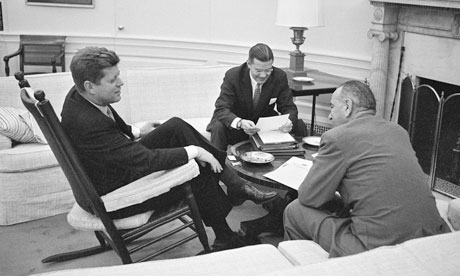
President John F Kennedy in his office during a meeting with Secretary of Defense Robert McNamara and Vice-president Lyndon B Johnson, at the White House in Washington, DC, 1961.
Photograph: Henry Burroughs/AP
This year is the fiftieth anniversary of the Cuban Missile Crisis. Chomsky has chimed in with an article for The Guardian of London. (It can be read here). This article confirms what has been clear to many for a long time. Chomsky is not a historian. And when he gets anywhere near having to deal with the Kennedy assassination, or Kennedy’s presidency, his work is so bad as to be embarrassing. In that regard, he is really a polemicist. Polemicists, by definition, can’t write good or accurate history. And for anyone who did not understand that, this useless article proves it once more.
Today, there have been at least three books published based upon the actual transcripts of the deliberations of the so-called ExComm. That is, the committee of Kennedy’s advisers assembled to discuss paths of action during the thirteen days that constituted the crisis. The first was The Kennedy Tapes by Ernest May and Philip Zelikow. The second, Averting ‘The Final Failure’ is by Kennedy archivist Sheldon Stern. The third is called The Presidential Recordings, edited by May, Zelikow and Tim Naftali.
These books are absolutely essential to understanding who President Kennedy really was. Because in this instance, you actually do not have to rely upon memoirs, or memoranda written later. You actually have the words of the participants as spoken right in front of you. And for any objective person, these discussions show just how different Kennedy was from the vast majority of his advisors. This includes Vice-President Johnson, National Security Advisor McGeorge Bundy, and Secretary of State Dean Rusk. At one stage or another these three men all advocated armed intervention to resolve the crisis. And Johnson did not even like the ultimate resolution to the crisis: withdrawal of the American Jupiter missiles from Turkey in exchange for the Russian withdrawal of the missiles from Cuba. He talks about it as leaving the impression “that we’re having to retreat. We’re backing down.” (May and Zelikow, p. 586) Johnson said this even though the Polaris missiles–which were to later serve the same purpose as the Jupiters–were much more modern in both range and accuracy. And since they were submarine launched, they were more difficult to detect and preemptively target. Towards the end of the crisis, Johnson was actually using Kennedy’s nationally televised speech of October 22nd–in which he alerted the pubic to the danger of the Russian installed missiles–against him. The vice-president was saying that the public was going to be disappointed in Kennedy’s performance when compared to his words: “The president made a fine speech. What else have you done?” Even Johnson’s rather friendly biographer, Bob Caro, points out in The Passage of Power that, compared to JFK, during these discussions, Johnson was much more militant in tone and confrontational in approach.
What does Chomsky say about this most important Kennedy/Johnson juxtaposition? Not a word. Which is about what he said in comparing the policies carried out by President Johnson in Vietnam after Kennedy was killed. In the game of poker, this is called a ‘tell’. Or as Peter Scott terms it, it’s a negative template. Chomsky won’t touch this evidence since it pretty much disintegrates his argument that there was no difference between Kennedy and Johnson in foreign policy.
So Chomsky now devises another way to attempt to explain why Kennedy sounded so much more dovish during these debates than nearly anyone else in the room. He says that since Kennedy had ordered the installation of the taping system, he knew they were being recorded while the others did not. Again, Chomsky leaves out two important points here. The first is the reason Kennedy ordered the recording devices installed in the first place. As professor Ernest May has stated more than once–for example on ABC’s Nightline–he installed the system because he was upset about how many participants had misrepresented what they said during the discussions leading up to the Bay of Pigs invasion. With the taping system, there could be no argument about who said what and when. Secondly, these tapings were not made public for nearly four decades after Kennedy’s death. If there was some kind of plan to get them out sooner–and show how statesmanlike JFK was compared to everyone else–it was not very effective.
But the point which Chomsky again avoids is this: Kennedy sounds dovish and level-headed here just as he did during the debates in November of 1961 over whether or not to send combat troops into Vietnam. (See the notes of military attaché Howard Burris dated 11/15/61 in the book Virtual JFK, pgs. 281-83) In other words, it is all of a piece, because it’s the same man. And the taping system is irrelevant to the issue. Why? Because it was not installed in 1961. In that instance, as he was during the Missile Crisis, Kennedy was virtually alone in holding out against the commitment of combat troops to Southeast Asia. And almost every commentator has noted this point, from David Kaiser to Gordon Goldstein. For his own personal, polemical reasons, Chomsky cannot.
Another piece of flapdoodle that Chomsky tries to peddle here is the actual cause of the crisis. He says that the Russians moved the missiles onto the island in reaction to Operation Mongoose, the secret war against Cuba. To preserve this mythology, Chomsky ignores two pieces of evidence. First, the subterfuge Khrushchev practiced in transporting the weapons across the Atlantic, and second the size and scale of the deployment. Concerning the latter, the eventual arsenal was to consist of the following: 40 land based ballistic missile launchers and sixty missiles. The missiles were of both the medium (1,200 miles) and long–range variety (2,400 miles). These missiles were much more powerful than those used against Hiroshima and Nagasaki. The 9 missile sites were to be protected by 140 air-defense missile launchers. In addition there were to be 40 IL-28 bombers, each capable of carrying a nuclear weapon. This air arm would be supplemented by a submarine pen made up of 11 subs, 7 of them capable of launching nuclear missiles. In other words, the Russians could now threaten America with a nuclear missile arsenal capable of hitting the 100 largest American cities by land, sea and air.
In addition to this, there was to be a Russian army of 45, 000 troops, with 250 tanks, supplemented by a wing of the latest Russian fighter aircraft, the MiG 21. There were also 80 nuclear-capable cruise missiles for coastal defense. Each of these had the explosive capability of the bombs dropped on Japan in 1945. (May and Zelikow, pgs. 676-77) And, as Kennedy later discovered through U2 photography, the Russians had even given the Cubans a number of Luna ground to ground rockets with a 30 mile range and 2 kiloton warheads. Because of their short range these were termed tactical nukes since they could be used in battlefield circumstances. (ibid, p. 475)
With these facts on the table, here is my question to the former MIT professor: What use would these nuclear weapons be against a speedboat full of Cuban exiles with rifles, grenades and dynamite sent in to blow up a power plant? Would this not be equivalent to the antique analogy of using a cannon to kill a fly in your house? Why blow up your house trying to kill a fly? Could the Russians and Cubans be this stupid?
Which relates to the subterfuge. What made Kennedy so suspicious about the deployment was the secrecy surrounding it. Multiplying that was the Russians lying about it. For instance, to choose just one instance, Russian Foreign Minister Andrei Gromyko lied to Kennedy on October 17th by saying that this was only a defensive deployment. If the aim was simply to try and neutralize Mongoose, then all that was needed was the conventional forces. And Khrushchev would have won a great international propaganda victory by announcing a Cuban-Russian military alliance in public, for instance at the United Nations. He could have claimed the diplomatic high ground by saying that this was purely a defensive alliance to defend Cuba from external aggression. If the idea was to fend off a possible invasion then the tactical nukes would have done the trick. And again, an alliance made in public would have been sympathetic to most of the world.
But he did not. There is no evidence he even contemplated such a public announcement. Why? Because the real motive behind the massive deployment was much wider in scope. It was a way for the Russians to close the missile gap. At the time, only twenty of the Soviet long-range missiles could hit the USA from Russian territory. With what was going into Cuba, the Russians now had a formidable first-strike effort stationed 90 miles away from Miami. And anyone who understands the nuclear terminology of that day will understand how important a credible first strike force was. Secondly, once the secret installation was complete, Khrushchev could then announce it and ask for the thorn in his side to be removed: namely West Berlin. (See Slate, “What the Cuban Missile Crisis Should Teach Us”, by Fred Kaplan. See also May and Zelikow, pgs. 678-79, 691)
This had been something that had seriously bothered the Russians since the days of the Berlin Airlift of 1948-49. And, more recently, Khrushchev had hectored Kennedy about it at their summit meeting in Vienna in 1961. This would be a significant change in the political calculus of Europe. What Chomsky does by covering up these key facts is to falsely blame President Kennedy while excusing some very irresponsible and reckless gambling by Nikita Khrushchev.
Chomsky continues in this jingoistic mode when he then names what he thinks should be called the most dangerous moments of the crisis. One of them is on October 27th, when the U. S. Navy, trying to enforce Kennedy’s blockade, had orders to make the Russian submarines surface before they violated the quarantine line. Each Russian submarine carried a nuclear tipped torpedo. American destroyers were to drop depth charges to make the subs surface. Naturally, Chomsky does not reveal the actual instructions given to the American destroyers. They first were to drop “four or five harmless explosive sound signals”, after which the subs should emerge and proceed due east. And, in fact, the State Department told European governments about this technique, including the Russians, in advance. (National Security Archive, Briefing Book No. 399) The problem was that the Russian subs were not getting much information from Moscow and never got this message. They were monitoring Miami stations instead, which of course were carrying much more militant messages. (New York Times, 10/22/12)
The other moment that Chomsky details is the round the clock B 52 bombers holding their fail safe points in the sky in case of an attack. He states that one pilot, Don Clawson, revealed that there was little control over these flights from Strategic Air Command, and that a rogue pilot could have easily started nuclear war. Chomsky does not say that his source for this is an almost do it yourself book published nine years ago by Clawson himself. The book is a rollicking memoir written 40 years after the fact. In other words, there was no formal input from SAC HQ about what measures really were in place in case this occurred. And Chomsky did not crosscheck his source to see if there was. (This last is a recurrent polemical practice of Chomsky’s.)
If anyone were to list the most dangerous moments of the crisis, they would have to include three events that need no cross checking. For they have been in the record for decades. The first would be the episode that caused the only fatality by enemy fire during the entire 13-day crisis. That would be the death of Rudolf Anderson. Anderson was America’s top U-2 pilot in 1962. The plane he was flying was clearly marked with Air Force insignia. Khrushchev had assured Kennedy that the Russians would only fire if fired upon. (May and Zelikow, p. 571) The U-2 was a surveillance plane. It was not furnished with missiles or machine guns, only cameras under its wings. And everyone knew that. But, apparently, the Cubans decided to use their Russian furnished surface to air missile sites (SAM’s) near Banes, Cuba to knock the plane down and kill Anderson.
The information about Anderson’s death was turned over to President Kennedy during an ExComm meeting at 4 PM on October 27th, the day before the crisis ended. (ibid) It gave needed ballast to the hawks in attendance, e.g. General Maxwell Taylor and Assistant Secretary of Defense, Paul Nitze. (ibid, pgs. 571-73) It also seems to have been one of the reasons why Defense Secretary Robert McNamara became more militant during the last two days of the crisis. (The other factor influencing McNamara seems to be Johnson’s not very subtle war mongering.) Following the news of Anderson’s death, there were pleas by Taylor, Bundy and Nitze to immediately take out the SAM sites. (ibid, pgs. 571-72) McNamara moved to take out the Banes SAM site and begin a much larger air attack against the island on the 31st. (ibid, pgs. 571, 575) Kennedy dutifully listened to these proposed courses of action due to this provocation. He then skillfully bent the discussion around to formulating a reply to Khrushchev’s letter requesting a deal for the Jupiters. (ibid, p. 576) There ended up being no retaliation to this reckless shoot down of an unprotected surveillance pilot. (Which, one could argue, was really tantamount to murder.) In fact, there was actually a contingency plan in place which necessitated an agreed upon retaliation. Kennedy overruled that plan and held back the air strike. (ibid, p. 695)
Another dangerous moment came when Castro actually wanted to launch nuclear missiles against the USA. (ibid, p. 688) In other words to strike first, therefore surely starting a chain reaction leading to nuclear Armageddon. Or as Fidel Castro put it none too subtly to the Russian representative, he was ready to launch against the USA and risk incinerating Cuba in a counter attack. Alexander Alekseev was shocked. But he dutifully relayed the message to Moscow. (The Armageddon Letters, edited by James Blight and Janet Lang, p. 116) At the conclusion of the crisis, Khrushchev chastised Castro for even proposing such an act under these circumstances. He characterized such a proposal to carry out a nuclear first strike against enemy territory as “very alarming”. He continued with: “Naturally you understand where that would lead us. It would not be a simple strike, but the start of thermonuclear world war.” (May and Zelikow, op cit.)) Apparently, since Castro was and is a Marxist, in Chomsky’s book, these kind of inexcusable acts are to be ignored. To dramatize the polemicist’s double standard: Imagine what Chomsky would say if President Kennedy was on record uttering such a thing. But not only does Chomsky not comment on this nutty request by Castro, he does something even worse. He does not tell the reader about it. That act of censorship tells you all you need to know about Chomsky’s fairness and honesty in this article.
There was another nominee for most dangerous moment. And again, you will not find it in Chomsky’s article. During the crisis, CIA officer William Harvey—a man who despised the Kennedys—secretly dispatched several teams of Cuban exile paratroopers onto the island. (Larry Hancock, Nexus, p. 80) Harvey never fully revealed what the mission of these men actually was. But since he constantly assailed the Kennedys for not having the guts to get rid of Castro once and for all, one can imagine what he had in mind. Furthering this thesis was the fact that these men were on a secret radio frequency, so that when Bobby Kennedy found out about it, he could not recall them directly. (ibid, p. 70) RFK was enraged when he found out what Harvey had done. And this was the beginning of the end for Harvey’s storied CIA career. The reason Chomsky will not touch this incident is that it violates another aspect of his special and peculiar ideology. Namely, his belief that the CIA only performs functions requested by the president. Yet, under Kennedy, the CIA often enacted autonomous actions.. (And there are many examples in both Hancock’s book and Jim Douglass’ JFK and the Unspeakable.) But Chomsky cannot admit this, no matter how foolish it makes him look. Because it would indicate that, 1.) The CIA and President Kennedy had different aims, and 2.) The Agency did not just enact policy. At times, it made its own.
Let us continue with just how bad the Marxist leadership was leading up to and during the crisis. On September 4th, after getting preliminary intelligence reports about construction on Cuba, Kennedy had specifically warned the Russians about using the island as a forward base in the Americas. And he told Russian ambassador Anatoly Dobrynin that he would not tolerate purely offensive weapons in Cuba. He then said the same in public. (Blight and Yang, pgs. 58-59) In his reply to Kennedy’s warning, Khrushchev again lied. He said the only nuclear missiles he had trained on the USA were based in Russia. (ibid, p. 62) In July of 1962, Castro asked him: What would happen if the USA discovered the installation in progress before it was completed? Khrushchev responded with a reply so ridiculous that it must have disheartened Fidel. The Russian premier said he would send out the Baltic fleet as a show of support. (May and Zelikow, p. 677) This silly response, from a man who held the fate of the world in his hands, showed that Khrushchev had not thought through all the possibilities the dangerous installation entailed. To top it all off, the premier tried to end game the worst scenario. That is the Americans launching a counterforce attack on the Cuban missiles. The premier felt that even if this was 90% effective, “even if one or two big ones were left—we could still hit New York, and there wouldn’t be much of New York left.” When Khrushchev was ousted from office in 1964, his irresponsible actions before and during the crisis were named as prime reasons for his removal. (May and Zelikow, p. 690) Again, none of this is deemed worth mentioning by Chomsky. Probably because in his world no Marxist can do anything wrong.
Chomsky also tries to imply that the resolution to the crisis was done by the Russians alone. He mentions the arrival of Khrushchev’s letter of October 26th at the State Department. This letter outlined a deal that would entail the removal of the Russian missiles in return for a pledge by Kennedy not to invade Cuba. The Russians later added that they also wanted the Jupiter missiles removed. Kennedy agreed to both parts of the deal. But what Chomsky leaves out is that Kennedy himself proposed the Jupiter swap more than a week before. At an ExComm morning meeting of October 18th he specifically proposed a direct trade of the Jupiters in Turkey for the Russian missiles in Cuba. (May and Zelikow, p. 137) On October 23rd he authorized his brother Robert to create a back channel to Russian Ambassador Dobrynin through Russian representative Georgi Bolshakov. (ibid, pgs. 343-46) This culminated in a formalization of the Jupiter deal as an adjunct to the no-invasion pledge. Chomsky criticizes Kennedy for not announcing this at the time. He leaves out the fact that JFK anticipated that Castro would create problems with verifying the removal of all arms of the nuclear triad from Cuba. And therefore it would take awhile for the Russians to complete their part of the deal. He was correct about this. It took over a month to complete the negotiations for verification. (May and Zelikow, pgs. 664-66)
Chomsky’s failings as a historian are nowhere more obvious then in his discussion of Cuban-American relations in 1962-63. For instance, he writes that a plot to assassinate Castro was apparently initiated on the day of Kennedy’s murder. Chomsky is referring to the so-called AM/LASH plot. This maneuvering of the CIA with disenchanted Cuban national Rolando Cubela was not initiated in November of 1963. It had been going on for many months. And it had nothing to do with the Kennedys. (James DiEugenio, Destiny Betrayed, Second Edition, p. 73) The CIA deliberately kept it secret from JFK since they knew he would not approve it. Chomsky cannot admit this, even though it’s true, because it again shows the CIA and Kennedy at cross-purposes. He follows this by saying Mongoose was terminated in 1965. Wrong again. Mongoose was ended on November 29, 1962 at an NSC meeting of that day. (See Volume XI of Foreign Relations of the United States, Document 217) Chomsky mentions an attack on Cuba of November 8th. What he does not say is this was a response to a devastating Cuban attack in Venezuela that “had reportedly destroyed or disrupted one-sixth of the [oil] refining capacity of Venezuela….” (May and Zelikow, p. 639. Chomsky adds a reference to a contemplated invasion of Venezuela here. This appears to be fabricated since there is no such mention of any such event in the transcripts.)
But the real point is that Kennedy began to dismantle Mongoose almost immediately after the Russian removal was verified. Cuban exile operations were severely curtailed, stipends were withdrawn, and groups were disbanded. By mid-1963, for all intents and purposes,Mongoose had been all but eliminated. As CIA official Desmond Fitzgerald wrote to President Johnson in 1964, in the second half of 1963 there were all of five raids against Cuba. The entire commando force consisted of fifty men. (Op, cit. DiEugenio, p. 70) Kennedy had clearly decided to pursue back channel negotiations with Castro with the goal of achieving normalization of relations with Cuba. The goal appeared to be in sight when Castro got the news of Kennedy’s death. He then turned to Kennedy’s representative Jean Daniel and said, “Everything is changed. Everything is going to change.” Castro was correct. Johnson showed no interest in continuing Kennedy’s goal of détente with Cuba. (ibid, pgs. 73-75) When Chomsky writes that the majority of Americans favor normalization of relations with Cuba, yet our leaders dismiss this opinion, one does not know whether to laugh or cry. Johnson cut off Kennedy’s eleven months of negotiations to achieve just that. And no American president since has ever come as close as JFK did to doing just that. And Castro himself admitted this at the time.
The silliest part of this all too silly article is toward the end. Chomsky writes that war was avoided in 1962 “by Khrushchev’s willingness to accept Kennedy’s hegemonic demands.” When he writes something like that, one wonders if, unawares, Chomsky has Alzheimer’s disease. It was Khrushchev’s attempt to establish hegemony over West Berlin that originated the crisis. It was his insistent ignoring of Kennedy’s warnings over this first strike capability that brought the crisis to fruition. It was the premier’s lies about his intent that exacerbated it all. It was Castro’s orders to kill an American pilot that almost escalated the crisis beyond saving. And it was Castro who wanted to launch a first strike that would have led to Armageddon. The deal that Kennedy had contemplated all along was a good one for the Russians. Cuba stayed protected as a Marxist bastion, as it has to this day. After negotiations with NATO ally Turkey the Jupiters were removed. All that the USA got was the removal of a first strike threat—one which should have never been installed. And needless to say the Russians eventually caught up and actually surpassed America as a nuclear power. Gaining no real advantage at a great financial cost.
Chomsky has now been proven both wrong and misleading on both Kennedy and Vietnam, and the Missile Crisis. But it’s worse than that. Chomsky simply has no regard for facts or evidence in the two cases. The mark of a good historian is that he provides balance and proper context first. He then produces the totality of the evidence, or close to it. His conclusion then follows inductively from the evidence. Chomsky violates each one of these strictures. Which is why his conclusion is so easily reduced to absurdity. In fact, his performance here is so bad, that when linked to his record in defending Pol Pot, his friendly ties to Holocaust deniers, and his flip-flop on the question of Kennedy’s assassination, the best thing his friends and colleagues can do is advise him to retire. The man is 84 years old. And his mental faculties seem to be failing him. Rather than embarrass himself further, it would be better if he spent the twilight of his life fishing off the Massachusetts coast. That would be better for him, the historical record, and us.
-
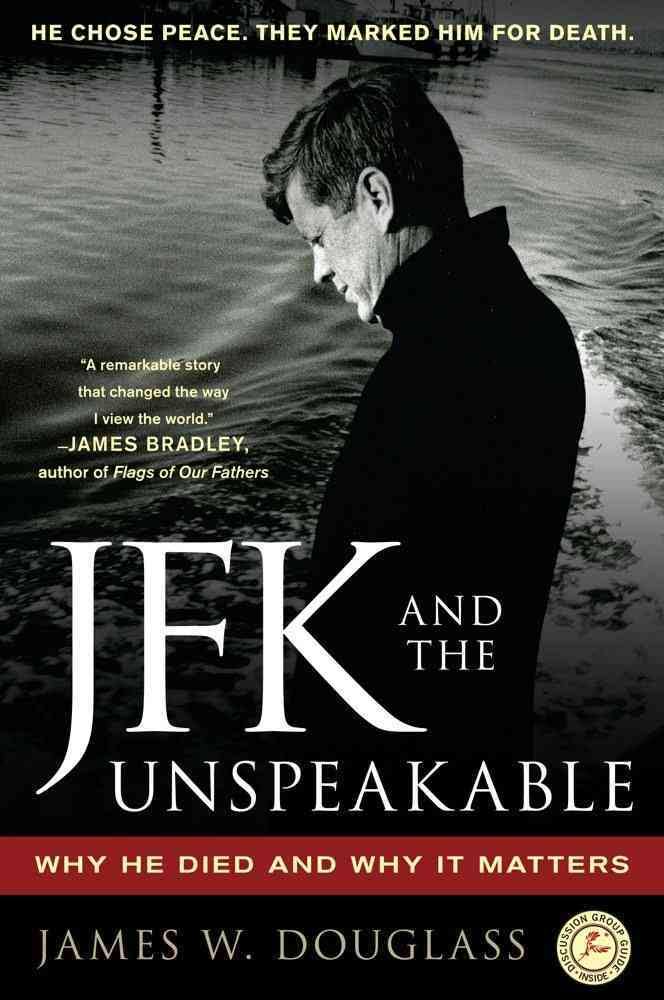
James W. Douglass, JFK and the Unspeakable
This book is the first volume of a projected trilogy. Orbis Books has commissioned James W. Douglass to write three books on the assassinations of the 1960’s. The second will be on the murders of Malcolm X and Martin Luther King, while the third will be on the assassination of Bobby Kennedy.
This is one of the few books on the Kennedy case that I actually wished was longer. In the purest sense, Jim Douglass is not a natural writer. But it seems to me he has labored meticulously to fashion a well organized, thoroughly documented, and felicitously composed piece of workmanship that is both comprehensible and easy to read. These attributes do not extend from simplicity of design or lack of ambition. This book takes in quite a lot of territory. In some ways it actually extends the frontier. In others it actually opens new paths. To achieve that kind of scope with a relative economy of means, and to make the experience both fast and pleasant, is quite an achievement.
I should inform the reader at the outset: this is not just a book about JFK’s assassination. I would estimate that the book is 2/3 about Kennedy’s presidency and 1/3 about his assassination. And I didn’t mind that at all, because Douglass almost seamlessly knits together descriptions of several of Kennedy’s policies with an analysis of how those policies were both monitored and resisted, most significantly in Cuba and Vietnam. This is one of the things that makes the book enlightening and worthy of understanding.
One point of worthwhile comparison would be to David Talbot’s previous volume Brothers. In my view, Douglass’ book is better. One of my criticisms of Talbot’s book was that I didn’t think his analysis of certain foreign policy areas was rigorous or comprehensive enough. You can’t say that about Douglass. I also criticized Talbot for using questionable witnesses like Angelo Murgado and Timothy Leary to further certain dubious episodes about Kennedy’s life and/or programs. Douglass avoided that pitfall.
One way that Douglass achieves this textured effect is in his quest for new sources. One of the problems I had with many Kennedy assassination books for a long time is their insularity. That is, they all relied on pretty much the same general established bibliography. In my first book, Destiny Betrayed, I tried to break out of that mildewed and restrictive mold. I wanted to widen the lens in order to place the man and the crime in a larger perspective. Douglass picks up that ball and runs with it. There are sources he utilizes here that have been terribly underused, and some that haven’t been used before. For instance, unlike Talbot, Douglass sources Richard Mahoney’s extraordinary JFK:Ordeal in Africa, one of the finest books ever written on President Kennedy’s foreign policy. To fill in the Kennedy-Castro back channel of 1963 he uses In the Eye of the Storm by Carlos Lechuga and William Attwood’s The Twilight Struggle. On Kennedy and Vietnam the author utilizes Anne Blair’s Lodge in Vietnam, Ellen Hammer’s A Death in November, and Zalin Grant’s Facing the Phoenix. And these works allow Douglass to show us how men like Henry Cabot Lodge and Lucien Conein did not just obstruct, but actually subverted President Kennedy’s wishes in Saigon. On the assassination side, Douglass makes good use of that extraordinary feat of research Harvey and Lee by John Armstrong, the difficult to get manuscript by Roger Craig, When They Kill a President, plus the work of little known authors in the field like Bruce Adamson and hard to get manuscripts like Edwin Black’s exceptional essay on the Chicago plot. Further, he interviewed relatively new witnesses like Butch Burroughs and the survivors of deceased witnesses like Thomas Vallee, Bill Pitzer and Ralph Yates. In the use of these persons and sources, Douglass has pushed the envelope forward.
But it’s not just what is in the book. It is how it is molded together that deserves attention. For instance, in the first chapter, Douglass is describing the Cuban Missile Crisis at length (using the newest transcription of the secretly recorded tapes by Sheldon Stern.) He then segues to Kennedy’s American University speech. At this point, Douglass then introduces the figure of Lee Harvey Oswald and his relation to the U-2 (p. 37). This is beautifully done because he has been specifically discussing the U-2 flights over Cuba during the Missile Crisis, and he subliminally matches both Kennedy and Oswald in their most extreme Cold War backdrops. He then switches back to the American University speech, contrasting its rather non-descript reception in the New York Times with its joyous welcome in Russia, thus showing that Kennedy’s efforts for dÈtente were more appreciated by his presumed enemy than by the domestic pundit class.
These artful movements would be good enough. But the design of the book goes further. As mentioned above, in his first introduction of Oswald Douglass mentions the Nags Head, North Carolina military program which launched American soldiers into Russia as infiltrators. Near the end of the book (p. 365), with Oswald in jail about to be killed by Jack Ruby, Douglass returns to that military program with Oswald’s famous thwarted phone call to Raleigh, North Carolina: the spy left out in the cold attempting to contact his handlers for information as how to proceed. But not realizing that his attempted call will now guarantee his execution. Thus the author closes a previously prepared arc. It isn’t easy to do things like that. And it doesn’t really take talent. One just has to be something of a literary craftsman: bending over the table, honing and refining. But it’s the kind of detail work that pays off. It maintains the reader’s attention along the way and increases his understanding by the end.
II
One of the book’s most notable achievements is the 3-D picture of the Castro-Kennedy back channel of 1963. Douglass’ work on this episode is detailed, complete, and illuminating in more ways than one. From a multiplicity of books, periodicals, and interviews, the author produces not opinions or spin on what happened. And not after the fact, wishy-washy post-mortems. But actual first-hand knowledge of the negotiations by the people involved in them.
It started in January of 1963. Attorney John Donovan had been negotiating the release of the Bay of Pigs prisoners when Castro’s physician and aide Rene Vallejo broached the subject of normalizing relations with the USA (p. 56). Right here, Douglass subtly tells us something important. For Vallejo would not have broached such a subject without Castro’s permission. In approaching these talks, Dean Rusk and the State Department wanted to establish preconditions. Namely that Cuba would have to break its Sino/Soviet ties. Kennedy overruled this qualification with the following: “We don’t want to present Castro with a condition that he obviously cannot fulfill.” NSC assistant Gordon Chase explained Kennedy’s intercession, “The President himself is very interested in this one.” (pgs. 57-58)
Because the State Department was cut in at the start, the CIA got wind of the opening. Douglass makes the case that David Phillips and the Cuban exiles reacted by having the militant group Alpha 66 begin to raid Russian ships sailing toward Cuba. Antonio Veciana later stated that Phillips had arranged the raids because, “Kennedy would have to be forced to make a decision and the only way was to put him up against the wall.” (p. 57) The initial raid was followed by another a week later.
Phillips did indeed force Kennedy into making a decision. At the end of March, the Justice Department began to stop Cuban exiles from performing these raids off of American territory. This resulted in crackdowns and arrests in Florida and Louisiana. And it was this crackdown that provoked a bitter falling out between the leaders of the CIA created Cuban Revolutionary Council and President Kennedy. Dr. Jose Miro Cardona stated that the “struggle for Cuba was in the process of being liquidated” for “every refugee has received his last allotment this month, forcing them to relocate.” (p. 59) The CRC had been a special project of both Phillips and Howard Hunt. As the Associated Press further reported in April, “The dispute between the Cuban exile leaders and the Kennedy administration was symbolized here today by black crepe hung from the doors of exiles’ homes.” (Ibid)
Clearly, Kennedy was changing both speeds and direction. At this time, Donovan visited Castro and raised the point of Kennedy clamping down on the exile groups. Castro replied to this with the provocative statement that his “ideal government was not to be Soviet oriented.” (p. 60) When newscaster Lisa Howard visited Castro in late April, she asked how a rapprochement between the USA and Cuba could be achieved. Castro replied that the “Steps were already being taken” and Kennedy’s limitations on the exile raids was the first one. (p. 61)
As Douglass observes, every Castro overture for normalization up to that point had been noted by the CIA. And CIA Director John McCone urged “that no active steps be taken on the rapprochement matter at this time.” (p. 61) Deftly, the author points out that– almost simultaneous with this–Oswald inexplicably moves from Dallas to New Orleans to begin his high profile pro-Castro activities. And later that summer, CIA case officers will secretly meet with Rolando Cubela to begin another attempt on Castro’s life.
Oblivious to this, the back channel was now picked up and furthered by Howard and William Attwood. Howard reported that Castro was even more explicit now about dealing with Kennedy over the Russian influence in Cuba. He was willing to discuss Soviet personnel and military hardware on the island and even compensation for American lands and investments. The article she wrote at this time concluded with a request that a government official be sent to negotiate these matters with Fidel. (p. 70) This is where former journalist and then diplomat Attwood stepped in. Knowing that Attwood had talked with Castro before, Kennedy instructed him to make contact with Carlos Lechuga. Lechuga was Cuba’s ambassador at the United Nations, and Kennedy felt this would be a logical next step to continue the dialogue and perhaps set some kind of agenda and parameters. Howard arranged the meeting between the two opposing diplomats. Attwood told Lechuga that Kennedy felt relations could not be changed overnight, but something “had to be done about it and a start had to be made.” (p. 71) Lechuga replied that Castro had liked Kennedy’s American University speech and he felt that Castro might OK a visit by Attwood to Cuba. This, of course, would have been a significant milestone.
A funny and revealing thing happened next. Both sides alerted the other that they would be making boilerplate anti-Cuba and anti-America speeches. (Adlai Stevenson would be doing the anti-Cuba one at the UN.) This clearly implies that the players understood that while relations were warming in private, motions had to be gone through in public to please the pundit class.
Howard then requested that Vallejo ask Castro if Fidel would approve a visit by Attwood in the near future. Attwood believed this message never got through to Castro. So Kennedy decided to get the message to Castro via Attwood’s friend, French journalist Jean Daniel. (p. 72) What Kennedy told Daniel is somewhat stunning. Thankfully, and I believe for the first time in such a book, Douglass quotes it at length. I will summarize it here.
Kennedy wanted Daniel to tell Castro that he understood the horrible exploitation, colonization, and humiliation the history of Cuba represented and that the people of Cuba had endured. He even painfully understood that the USA had been part of this during the Batista regime. Startlingly, he said he approved of Castro’s declarations made in the Sierra Maestra Mountains. He added, “In the matter of the Batista regime, I am in agreement with the first Cuban revolutionaries. That is perfectly clear.” Daniel was somewhat taken aback by these sentiments. But, Kennedy continued, the dilemma now was that Cuba — because of its Soviet ties — had become part of the Cold War. And this had led to the Missile Crisis. Kennedy felt that Khrushchev understood all these ramifications now, after that terrible thirteen days.
The president concluded with this, “…but so far as Fidel Castro is concerned, I must say I don’t know whether he realizes this, or even if he cares about it.” Kennedy smiled and then ended Daniel’s instructions with this: “You can tell me whether he does when you come back.”
Daniel then went to Havana. On November 19th Castro walked into his hotel. Fidel was fully aware of the Attwood/Lechuga meetings. He was also aware of Kennedy’s briefing of Daniel. He had found out about this through Howard. In fact, he had told her he did not think it would be a good idea for him to meet Attwood in New York. He suggested that the meeting could be arranged by picking up Attwood in Mexico and flying him to Cuba. Castro also agreed that Che Guevara should be left out of the talks since he opposed their ultimate aim. Attwood said that Lechuga and he should meet to discuss a full agenda for a later meeting between himself and Castro. This was done per Kennedy’s instructions, and JFK wanted to brief Attwood beforehand on what the agenda should be. Things were heading into a higher gear.
Daniel was unaware of the above when Castro walked into his room for a six-hour talk about Kennedy. (pgs. 85-89) I won’t even attempt to summarize this conversation. I will only quote Castro thusly, “Suddenly a president arrives on the scene who tries to support the interest of another class … ” Clearly elated by Daniel’s message, Castro and the journalist spent a large part of the next three days together. Castro even stated that JFK could now become the greatest president since Lincoln.
On the third day, Daniel was having lunch with Fidel when the phone rang. The news about Kennedy being shot in Dallas had arrived. Stunned, Castro hung up the phone, sat down and then repeated over and over, “This is bad news … This is bad news … This is bad news.” (p. 89) A few moments later when the radio broadcast the report stating that Kennedy was now dead, Castro stood up and said, “Everything is changed. Everything is going to change.” (p. 90)
To say he was prophetic is putting it mildly. Attwood would later write that what it took 11 months to build was gone in about three weeks. By December 17th it was clear that President Johnson was brushing it all aside. Retroactively, Attwood came to conclude that it had all really ended in Dealey Plaza. He finalized his thoughts about the excellent progress made up to that point with this: “There is no doubt in my mind. If there had been no assassination we probably would have moved into negotiations leading toward normalization of relations with Cuba.” (p. 177)
Douglass has done a real service here. Gus Russo will now have an even more difficult time in defending the thesis of his nonsensical book. No one can now say, as the authors of Ultimate Sacrifice do that these negotiations were “headed nowhere.” And if they do, we will now know what to think of them.
III
Equally as good as the above is Douglass’ work on Kennedy and Vietnam. Especially in regards to the events leading up to the November coup against Ngo Dinh Diem and the eventual murder of both he and his brother Ngo Dinh Nhu.
Taking a helpful cue from David Kaiser’s American Tragedy, Douglass begins his discourse by analyzing Kennedy’s single-minded pursuit of a neutralization policy in neighboring Laos. (pgs. 98-101) Douglass exemplifies just how single-minded JFK was on this by excerpting a phone call the president had with his point man on the 1962 Laos negotiations, Averill Harriman: “Did you understand? I want a negotiated settlement in Laos. I don’t want to put troops in.” (p. 104)
Unfortunately, no one felt the same way about Vietnam. Except President Kennedy. The Pentagon, the CIA, Lyndon Johnson and the Nhu brothers all looked askance at Laos as a model for Vietnam. (p. 106) Even the one general that JFK favored, Maxwell Taylor, told him to send in combat troops as early as 1961. (Ibid) After Taylor’s visit there, Ambassador Frederick Nolting wired Kennedy that “conversations over the past ten days with Vietnamese in various walks of life” showed a “virtually unanimous desire for introduction US forces in Viet Nam.” (p. 107) In other words, his own ambassador was trying to sell him on the idea that the general populace wanted the American army introduced there. Finally, both Secretary of Defense Bob McNamara and his assistant Ros Gilpatric also joined the chorus. As Taylor later recalled, no one was actually against it except President Kennedy “The president just didn’t want to be convinced … . It was really the President’s personal conviction that U.S. ground troops shouldn’t go in.” (Ibid) But in 1961, Kennedy was not yet ready to withdraw. So he threw a sop to the hawks and approved a new influx of 15, 000 advisers.
In April of 1962, John K. Galbraith sent a memo to Kennedy proposing a negotiated settlement with the North Vietnamese. The Joint Chiefs, State Department, and Harriman vigorously opposed the idea. It was too much like Laos. (pgs 118-119) But Kennedy liked the proposal. And in the spring of 1962 he instructed McNamara to initiate a plan to withdraw American forces from South Vietnam. In May of 1962, McNamara told the commanders on the scene to begin to plan for this as the president wanted to see the blueprint as soon as it was ready.
To put it mildly, the military dragged its heels. It took them a year to prepare the outline. In the meantime Kennedy was telling a number of friends and acquaintances that he was getting out of Vietnam. Douglass assembles quite an impressive list of witnesses to this fact: White House aide Malcolm Kilduff, journalist Larry Newman, Sen. Wayne Morse, Marine Corps Chief David Shoup, Canadian Prime Minister Lester Pearson, Asst. Sec. of State Roger Hilsman, Sen. Mike Mansfield, Congressman Tip O’Neill, and newspaper editor Charles Bartlett, among others. Mansfield, for one, wrote that Kennedy had become unequivocal on the subject of withdrawal by the end of 1962. (p. 124)
In May of 1963, at the so-called SecDef meeting in Honolulu, the generals in Vietnam finally presented their withdrawal plan. McNamara said it was too slow. He wanted it revised and speeded up. In September, Kennedy and McNamara announced the order — NSAM 263 — to begin the withdrawal. It consisted of the first thousand troops to be out by the end of the year. Which, of course, would be reversed almost immediately after his death. (See Probe, Vol. 5 No. 3 p. 18.)
The parallel story that Douglass tells — with grim skill and painful detail — is of the tragic demise of the Nhu brothers. It is the clearest and most moving synopsis of that sad tale that I can recall. It begins in May of 1963 with the famous bombing of the Hue radio station during a Buddhist holiday. A Buddhist rally was in progress there to protest another discriminatory edict passed by the Catholic Diem. The importance of this bombing, and the subsequent firing into the crowd–which left seven dead and fifteen wounded–cannot be minimized. As many commentators have noted, this localized incident mushroomed into a full-blown political crisis, spawning huge strikes and large street demonstrations. The twin explosions that shook the building were first blamed on the Viet Cong. Then on the South Vietnamese police. Which enraged the Buddhist population against Diem even further since his brother Nhu was in charge of the security forces. It was a milestone in the collapse of faith by the State Department in Diem. And it eventually led them to back the coup of the generals against the Nhu brothers.
What Douglass does here is introduce a new analysis based on evidence developed at the scene. Because of the particular pattern of destruction on both the building and the victims, the local doctors and authorities came to the conclusion that it had to have been caused by a certain plastic explosive — which only the CIA possessed at the time. A further investigation by a Vietnamese newspaper located the American agent who admitted to the bombing. (p. 131) This puts the event in a new context. Douglass then builds on this in a most interesting and compelling manner.
As mentioned above, the Hue atrocity caused even the liberals in the State Department to abandon Diem. So now Harriman and Hilsman united with the conservative hawks in an effort to oust him. In late August, they manipulated Kennedy into approving a cable that gave the go-ahead to a group of South Vietnamese generals to explore the possibility of a coup. (Afterwards, at least one high staffer offered to resign over misleading Kennedy about McNamara’s previous approval of the cable.) The leading conservative mounting the effort to dethrone Diem was Henry Cabot Lodge. Kennedy had planned to recall Ambassador Nolting and appoint Edmund Gullion to the position. And, as readers of the Mahoney book will know, Gullion was much more in tune with Kennedy’s thinking on Third World nationalism. He had actually tutored him on the subject in 1951 when Congressman Kennedy first visited Saigon. But Secretary of State Dean Rusk overruled this appointment, and suggested Lodge for the job. Lodge lobbied hard for the position because he wanted to use it as a springboard for a run for the presidency in 1964.
Many, including myself, have maintained that if there was a black-hatted villain in the drama of Saigon and the Nhu brothers in 1963, it was Lodge. Douglass makes an excellent case for that thesis here. Before moving to Saigon, Lodge consulted with, of all people, Time-Life publisher Henry Luce. He went to him for advice on what his approach to Diem should be. (p. 163) Kennedy’s foe Luce advised Lodge not to negotiate with Diem. Referring him to the work of a journalist in his employ, he told Lodge to engage Diem in a “game of chicken”. What this meant was that unless Diem capitulated on every point of contention between the two governments, support would be withdrawn. The ultimate endgame would be that there would be nothing to prop up his rule. And this is what Lodge did. With disastrous results.
From the time of the August cable, Lodge plotted with CIA officer Lucien Conein to encourage the coup and to undermine Diem by ignoring him. Even though, as Douglass makes clear, this is contrary to what JFK wanted. Kennedy grew so frustrated with Lodge that he sent his friend Torby McDonald on a secret mission to tell Diem that he must get rid of his brother Nhu. (p. 167)
It was Lodge who got John McCone to withdraw CIA station chief John Richardson who was sympathetic to Diem. Lodge wanted McCone to replace him with Ed Lansdale. Why? Because Lansdale was more experienced in changing governments. Richardson was withdrawn but no immediate replacement was named. So in September of 1963, this essentially left Lodge and Conein in charge of the CIA’s interaction with the generals. And it was Conein who had been handling this assignment from the beginning, even before Lodge got on the scene. Around this time, stories began to emanate from Saigon by journalists Richard Starnes and Arthur Krock about the CIA being a power that was accountable to no one.
It was Lodge, along with establishment journalist Joe Alsop — who would later help convince Johnson to create the Warren Commission — who began the stories about Diem negotiating a secret treaty with Ho Chi Minh. (p. 191) This disclosure — looked upon as capitulation– further encouraged the efforts by the military for a coup. In September, Kennedy accidentally discovered that the CIA had cut off the Commodity Import Program for South Vietnam. He was taken aback. He knew this would do two things: 1.) It would send the South Vietnamese economy into a tailspin, and 2.) It would further encourage the generals because it would convey the message the USA was abandoning Diem. (p. 195)
On October 24th, the conspirators told Conein the coup was imminent. JFK told Lodge he wanted to be able to stop the coup at the last minute. (Conein later testified that he was getting conflicting cables from Washington: the State Department was telling him to proceed, the Kennedys were telling him to stop.) At this time Diem told Lodge he wanted Kennedy to know he was ready to carry out his wishes. (p. 202) But Lodge did not relay this crucial message to Kennedy until after the coup began.
The rest of Douglass’ work here confirms what was only suggested in the Church Committee Report. Clearly, Conein and Lodge had sided with the generals to the ultimate degree. And, like Lenin with the Romanov family, the generals had decided that Diem and his brother had to be terminated. Lodge and Conein helped the coup plotters to facilitate the final bloody outcome. In turn, by using the Alsop-Lodge story about the Diem/Ho negotiations, the CIA egged on the murderous denouement. (p. 209) Not knowing Lodge was subverting Kennedy’s actual wishes, Diem kept calling the ambassador even after the coup began. This allowed Lodge to supply his true location to Conein after the brothers had fled the bombed presidential castle. So when the brothers walked out of the Catholic Church they had taken refuge in, they thought the truck that awaited them was escorting them to the airport. But with the help of their two American allies, the generals had arranged for the truck themselves. And the unsuspecting Nhu brothers walked into the hands of their murderers.
Kennedy was so distraught by this outcome he decided to recall Lodge and fire him. He had arranged to do this on November 24th. Instead, President Johnson called the ambassador back with a different message: the US must not lose in Vietnam. (p. 375)
These are the best twin summaries on Kennedy’s 1963 Vietnam and Cuba policies that I have seen between the covers of one book. After his death, the negotiations with Cuba would disappear forever. And, with even more alacrity, Lyndon Johnson now embarked on an escalation into a disastrous war in Southeast Asia whose price, even today, is incalculable. Douglass makes a convincing case that neither would have occurred if JFK had lived. I leave it to the reader to decide whether those two irrevocable alterations directly and negatively impacted the lives of tens of millions in America, Cuba, and Southeast Asia.
IV
Generally speaking, Douglass has done a good job of choosing some of the better evidence that has appeared of late to indicate a conspiracy. What he does with Ruth and Michael Paine, especially the former, is salutary.
Michael Paine did not just work at Bell Helicopter. He did not just have a security clearance there. His stepfather, Arthur Young, invented the Bell helicopter. His mother, Ruth Forbes Paine Young, was descended from the Boston Brahmin Forbes family — one of the oldest in America. She was a close friend of Mary Bancroft. Mary Bancroft worked with Allen Dulles as a spy during World War II in Switzerland. This is where Dulles got many of his ideas on espionage, which he would incorporate as CIA Director under Eisenhower. Bancroft also became Dulles’ friend and lover. She herself called Ruth Forbes, “a very good friend of mine.” (p. 169) This may explain why, according to Walt Brown, the Paines were the most oft-questioned witnesses to appear before the Commission.
Ruth Paine’s father was William Avery Hyde. Ruth described him before the Warren Commission as an insurance underwriter. (p. 170) But there was more to it than that. Just one month after the Warren Report was issued, Mr. Hyde received a three-year government contract from the Agency for International Development (AID). He became their regional adviser for all of Latin America. As was revealed in the seventies, AID was riddled with CIA operatives. To the point that some called it an extension of the Agency. Hyde’s reports were forwarded both to the State Department and the CIA. (Ibid)
Ruth Paine’s older sister was Sylvia Hyde Hoke. Sylvia was living in Falls Church, Virginia in 1963. Ruth stayed with Sylvia in September of 1963 while traveling across country. (p. 170) Falls Church adjoins Langley, which was then the new headquarters of the Central Intelligence Agency, a prized project of Allen Dulles. It was from Falls Church that Ruth Paine journeyed to New Orleans to pick up Marina Oswald, who she had been introduced to by George DeMohrenschildt. After she picked Marina up, she deposited her in her home in Irving, Texas. Thereby separating Marina from Lee at the time of the assassination.
Some later discoveries made Ruth’s itinerary in September quite interesting. It turned out that John Hoke, Sylvia’s husband, also worked for AID. And her sister Sylvia worked directly for the CIA itself. By the time of Ruth’s visit, Sylvia had been employed by the Agency for eight years. In regards to this interestingly timed visit to her sister, Jim Garrison asked Ruth some pointed questions when she appeared before a grand jury in 1968. He first asked her if she knew her sister had a file that was classified at that time in the National Archives. Ruth replied she did not. In fact, she was not aware of any classification matter at all. When the DA asked her if she had any idea why it was being kept secret, Ruth replied that she didn’t. Then Garrison asked Ruth if she knew which government agency Sylvia worked for. The uninquiring Ruth said she did not know. (p. 171) This is the same woman who was seen at the National Archives pouring through her files in 1976, when the House Select Committee was gearing up.
When Marina Oswald was called before the same grand jury, a citizen asked her if she still associated with Ruth Paine. Marina replied that she didn’t. When asked why not, Marina stated that it was upon the advice of the Secret Service. She then elaborated on this by explaining that they had told her it would look bad if the public found out the “connection between me and Ruth and CIA.” An assistant DA then asked, “In other words, you were left with the distinct impression that she was in some way connected with the CIA?” Marina replied simply, “Yes.” (p. 173)
Douglass interpolates the above with the why and how of Oswald ending up on the motorcade route on 11/22/63. Robert Adams of the Texas Employment Commission testified to having called the Paine household at about the time Oswald was referred by Ruth — via a neighbor– to the Texas School Book Depository (TSBD) for a position. He called and was told Oswald was not there. He left a message for Oswald to come down and see him since he had a position available as a cargo handler at a regional cargo airline. Interestingly, this job paid about 1/3 more than the job Oswald ended up with at the TSBD. He called again the next day to inquire about Oswald and the position again. He was now told that Lee had already taken a job. Ruth was questioned about the Adams call by the Warren Commission’s Albert Jenner. At first she denied ever hearing of such a job offer. She said, “I do not recall that.” (p. 172) She then backtracked, in a tactical way. She now said that she may have heard of the offer from Lee. This, of course, would seem to contradict both the Adams testimony and common sense. If Oswald was cognizant of the better offer, why would he take the lower paying job?
In addition to his work on the true background of the Paines, which I will return to later, Douglass’ section on the aborted plot against Kennedy in Chicago is also exceptional. The difference between what Douglass does here and what was done in Ultimate Sacrifice is the difference between confusion and comprehension. After they were informed of a plot, the police arrested Thomas Vallee on a pretext. Interestingly Dan Groth, the suspicious officer in on the arrest of Vallee, was later part of the SWAT team that assassinated Black Panthers Fred Hampton and Mark Clark in 1969. (p. 204) Groth took several lengthy leaves from Chicago to Washington for special training under the auspices of the FBI and CIA. Groth never had a regular police assignment, but always worked counter-intelligence, with an early focus on the Fair Play for Cuba Committee. (Ibid)
Thomas Vallee, the presumed patsy, is just as interesting. The Chicago version of Oswald had suffered a severe concussion during the Korean War. It was so debilitating, he was discharged and then collected disability payments. When he got home he was in a bad car crash and suffered serious head injuries, which caused him to slip into a two-month coma. (p. 205) He was later diagnosed as mentally disturbed with elements of schizophrenia and paranoia. The CIA later recruited him to train Cuban exiles to assassinate Castro. It was these connections which probably helped maneuver him to be in a warehouse overlooking President Kennedy’s parade route for a scheduled visit to the Windy City. After his arrest, and the cancellation of the early November visit, the police tried to track down his license plate. They found out they couldn’t. (p. 203) The information was “locked”. Only the FBI could “unlock” it.
I should also note the author’s probing of the enduring mystery of Carl Mather and Collins Radio. This originates from the sighting of an Oswald double about ten minutes and eight blocks from his arrest at the Texas Theater. Around 2:00 PM, auto mechanic T. F. White noticed a Ford Falcon that first drove past, and then parked oddly in the lot of El Chico Restaurant. Which was across the street from White’s garage. He told his boss about the man in the car who seemed to be hiding. White walked over to get a closer look. About ten yards away from the car, he stopped as the man in the white T-shirt looked right at him. (p. 295) Before he left the lot, he wrote down the license plate number of the car. When he went home that night and saw Oswald’s face on TV, he told his wife that this was the man he saw in the Falcon.
Local Dallas broadcaster and future mayor Wes Wise heard about White’s experience. When he interviewed him, White gave him the license number. Wise called the FBI. The Bureau traced the license to one Carl Mather of Garland, Texas. But the license number was on Mather’s Plymouth, not a Falcon.
Mather did high-security communications work for Collins Radio, a major contractor for the CIA. How major and sensitive? Collins had outfitted raider ships for sabotage missions off the coast of Cuba. They also installed communication towers in Vietnam. Further, Mather had installed electronics equipment on Air Force Two. (p. 297) After Wise’s call, the Bureau wanted to talk to Mather. But Mather didn’t want to talk to the Bureau. So they talked to his wife Barbara. She surprised the G-men by saying her husband had been a close friend of J. D. Tippit. How close? When Tippit was shot, his wife phoned them. Many years later, the HSCA also wanted to talk to Mather. He didn’t want to talk to them either. They persisted. He relented upon one condition: he wanted a grant of immunity from prosecution. But he still had no explanation for how his license ended up on a car with an Oswald double in it right after Oswald’s arrest. This is all interesting, even engrossing, on its own. But the author takes it further. Citing the valuable work of John Armstrong, he then builds a case that there were two Oswalds at the Texas Theater on November 22, 1963. One was arrested and taken out the front door. The second Oswald was hiding in the balcony and later escorted out the back by the police. Before anyone gets too dismissive, there are two Dallas Police Department reports that refer to Oswald being in the balcony of the theater. (p. 293) And there are two witnesses who saw an Oswald lookalike escorted out the rear: Butch Burroughs and Bernard Haire. (I should add here, in a 4/8/08 interview I did with Armstrong for this review, he said there was a sheriff’s officer who also saw this second Oswald on the stairs between the mezzanine and the first floor.) The author postulates that the man who exited the rear is the man who ended up in the Falcon. He then wraps this up by saying that this double was ultimately flown out of Dallas on a military transport plane. This is based on the testimony of retired Air Force officer Robert Vinson. It is contained in a 52-page affidavit given to his attorney James P. Johnston of Wichita, Kansas.
I would like to conclude this section by noting Douglass’ attention to the pain and suffering inflicted upon those who have tried to tell the truth as they knew it about the JFK case. Their only misfortune being that what they saw and knew was not conducive to the Warren Commission’s mythology.
Most of us are aware of what happened to Richard Case Nagell. How he was railroaded and incarcerated after he was arrested in El Paso, Texas on September 20, 1963. (pgs. 152-158) But Douglass sheds light on what happened to three other important witnesses. Jim Wilcott and his wife worked for the Agency out of the Tokyo station. On the day of the assassination, Wilcott pulled a 24-hour security shift. That evening, more than one employee told him that the CIA had to have been involved in Kennedy’s killing. When Wilcott asked how they knew this, the response was that they had handled disbursements for him under a cryptonym. Also, he had been trained by the Agency as a double agent at Atsugi. (pgs. 146-147) Later, both Jim and his wife quit the Agency. They then went public with their knowledge. Jim lost his private sector job, started receiving threatening phone calls, and had the tires on his car slashed.
Abraham Bolden was a Secret Service agent who had asked to leave the White House in 1961. He did not care for the lackadaisical practices of the White House detail. (p. 200) On October 30, 1963 Bolden was in Chicago when the local agents were briefed on what they knew about an attempt being planned on JFK’s life there. After Vallee’s arrest and the foiling of the plot, Bolden felt a foreboding about Kennedy’s upcoming trip to Dallas. When Kennedy was killed, Bolden noted the similarities between what had occurred in Dallas and what almost occurred in Chicago. In May of 1964 he was in Washington for a Secret Service training program. (p. 215) He tried to contact the Warren Commission about what he knew. The day after his call to J. Lee Rankin, he was sent back to Chicago. Upon his arrival he was arrested. The pretense was that he was trying to sell Secret Service files to a counterfeiter. Upon his arraignment he was formally charged with fraud, obstruction of justice, and conspiracy. (Ibid) Needless to say, Bolden was convicted based upon perjured testimony. (The phony witness later admitted this himself.) He was imprisoned at Springfield where he was placed in a psychiatric unit. (p. 216) He was given mind-numbing drugs. But other inmates alerted him to the nature of the drugs in advance. So he knew how to fake taking the pills. While in prison, his family endured a bombing of their home, setting fire to their garage, and a sniper shooting through their window. Mark Lane, while working for Garrison, visited him in 1967. Lane then wrote about Bolden’s knowledge of the plot in Chicago. When the prison authorities learned about this, they placed Bolden in solitary confinement. He was finally released in 1969.
Compared to the fate of Ralph Yates, Bolden did all right. On November 20, 1963 Yates was making his rounds as a refrigerator mechanic for the Texas Butcher Supply Company in Dallas. That morning he picked up a hitchhiker on the R. L. Thornton Expressway. The man had a package with him that was wrapped in brown paper. When Yates asked him if he would prefer to place it in the back of the pickup, the passenger said no. They were curtain rods and he would rather keep them in the cab. (p. 351) The conversation rolled around to the subject of Kennedy’s upcoming visit. The man asked Yates if he thought it was possible to kill Kennedy while he was there. Yates said that yes, it was possible. The hitchhiker then asked if Yates knew the motorcade route. Yates said he did not, but it had been in the paper. The man asked if he thought it would now be changed. Yates said that he doubted it. The passenger asked to be let off at a stoplight near Elm and Houston. Yates then returned to his shop and told his colleague Dempsey Jones about the strange conversation. (p. 352)
After the assassination, Yates noted the hitchhiker’s resemblance to Oswald. So he volunteered his experience with him to the FBI. They brought him back for a total of four interviews. It became clear they did not want to believe him. The reason being that Oswald was not supposed to be on the expressway at that time. They finally gave him a polygraph test. The agents then told Yates’ wife that, according to the machine, her husband was telling the truth. But, they concluded, the reason was that “he had convinced himself that he was telling the truth. So that’s how it came out.” (p. 354) The FBI told Yates that he needed help. So they sent him to Woodlawn Hospital, where he was admitted as a psychiatric patient. To quote the author, “From that point on, he spent the remaining eleven years of his life as a patient in and out of mental health hospitals. ” (Ibid) Such was the price for disturbing the equilibrium of the official story.
V
In this last section, I want to tie together four strands Douglass deals with. I also want to suggest how they fit together not just in a conspiratorial design, but a design against this particular president.
In addition to his elucidation of the Castro/Kennedy back channel, Douglass also deals with Kennedy’s back channel to Khrushchev. Kennedy had gotten off to a rocky start with the Russians because of the Bay of Pigs debacle and the roughness of the 1961 Vienna summit. But toward the end of 1961, he and the Russian premier had established a secret correspondence. The first letter was delivered by Georgi Bolshakov to Pierre Salinger wrapped in a newspaper. (p. 23) Khrushchev seemed to be trying to tell Kennedy that although he may have seemed unreasonable in Vienna, he was dead set against going down a path to war that would lead to the death of millions. The letter was 26 pages long, and Khrushchev mentioned hot spots on the globe like Laos and Berlin. Kennedy dutifully responded. And the correspondence went on for a year. It was then supplemented by two unlikely cohorts: Pope John XXIII, and Saturday Review editor Norman Cousins. Cousins had been the intermediary between John and the premier. When Kennedy heard of this, he decided to have Cousins carry messages to Khrushchev for him also. In fact, it seems that it was actually Cousins who provided the impetus for Kennedy to make his remarkable American University speech of June 10, 1963. (p. 346)
This speech is one of the centerpieces of the book. Douglass prints it in its entirety as an appendix. (pgs. 382-388) He also analyzes it at length in the text. (pgs. 41-45) Khrushchev was ecstatic about the speech. He called it, “the greatest speech by any American president since Roosevelt.” (p. 45) So inspired was he that he countered the speech and the renewed correspondence in multiple terms: 1.) A limited test ban treaty 2.) A non-aggression treaty between NATO and the Warsaw Pact, and 3.) He encouraged Castro in his back channel with Kennedy. Douglass places much importance on the last and he uses Russian sources, including Khrushchev’s son, to bolster it. (pgs 68-69)
There was another person at the time tiring of the Cold War and his role in it. Except he had a much lower profile than the four luminaries depicted above. His name was Lee Harvey Oswald. As Marina once said, Oswald “liked and approved of the President and he believed that for the United States in 1963, John F. Kennedy was the best president the country could hope to have.” (p. 331) At the New Orleans Public Library, he checked out William Manchester’s profile of JFK, Portrait of a President, Kennedy’s own Profiles in Courage, and a book called The White Nile. The last he read only because Manchester noted that Kennedy had read it recently. (Ibid) When Kennedy spoke on the radio about the test ban treaty, Lee listened intently and told Marina that he was making an appeal for disarmament. Curiously, he also informed his wife that Kennedy would actually like to pursue a more gentle policy with Cuba. But unfortunately he was not free to do so at the time. Doesn’t sound like the Krazy Kid planning on murdering JFK does it?
The night after Kennedy’s test ban speech, Oswald gave a speech of his own at Spring Hill College in Mobile, Alabama. His cousin, Eugene Murret was a seminarian there and he invited him to talk about his experiences in the Russian system. Douglass uses Oswald’s notes on the speech to inform us what he was thinking at the time. And, for the man depicted by the Warren Commission, its extraordinary. Away from New Orleans, away from his handlers, away from scripted situations arranged by others, Oswald said some surprising things. He first chided his audience. Sounding like JFK, the man he admired, he warned them that military coups are not a far away thing in some banana republic in South America. It could happen here, in the USA, their own country. (Ibid) Which organization could do such a thing? He said it could not come from the army, because of its many conscripts, its large and cumbersome structure, its huge network of bases. Amazingly, he specifically mentioned Kennedy relieving Edwin Walker of his command as evidence it would not come from there. Walker, the man he derisively dismisses here, is the man he was already supposed to have tried to shoot!
He then said that from his experience in both Russia and America, “Capitalism doesn’t work, communism doesn’t work. In the middle is socialism and that doesn’t work either.” (p. 473) He concluded that by returning to the USA, he was choosing the lesser of two evils. This does not remotely suggest the ideological zealot debating Ed Butler about the merits of Marxism, who was passing out flyers begging for fair treatment for Cuba, who got into street fights with anti-Castro Cubans who perceived him as a defender of Fidel. Here, in a secluded place, many miles away from Clay Shaw, David Ferrie, and Guy Banister, he sounds like a spy ready to come in from the cold. Ready to retire to a desk job under the president he admired.
But his handlers weren’t ready to retire him just yet. As Ruth Paine left her stay in Falls Church to head south to pick up Marina, Oswald allegedly embarked on what Philip Melanson called his Magical Mystery Tour to Mexico. The object of this final charade of course was to depict Oswald as trying to obtain visas for Cuba and the Soviet Union. As Douglass describes it, this utterly intriguing journey is multi-layered. What Oswald seems to think he is doing is the final act of what he did in New Orleans: discrediting the FPCC. Which had been an operation the CIA had that was ongoing. As John Newman has pointed out, David Phillips and James McCord were in on it. But there was also something else going on here. After the fact, the CIA seems to have tried to create a questionable trail, one that would suggest Oswald was trying to get into contact with Valery Kostikov. Kostikov worked at the Soviet consulate but was also a KGB agent who the FBI had discovered was involved in assassination plots. (p. 76) But as the author demonstrates here, the record of this trip is so fraught with inconsistencies, improbabilities, conflicting testimony and outright deception that it “inadvertently revealed more about the CIA” than about Oswald. (p. 75)
The author notes the witnesses at the Cuban embassy who could not identify the man they saw as Oswald. Using the fine work of Newman, Douglass shows that at least some of the calls attributed to Oswald are dubious. (p. 76) He also adroitly notes that, prior to the assassination, the CIA held this alleged Kostikov/Oswald association close to its vest. If they had not, then it is highly probable that Oswald would not have been on the president’s motorcade route on 11/22. Which, shortly after his return, was insured by the Paines not telling Oswald about the other job offer. Douglass astutely relates the final way his presence there was ultimately clinched. A man at the Bureau, Marvin Gheesling, deactivated Oswald’s FLASH warning on 10/9/63. This meant that Oswald was not placed on the Security Index in Dallas. Again, if he would have been on this list, it is very likely the Secret Service would have had him under surveillance prior to November 22nd. Hoover was furious when he found out what Gheesling had done. He had him censured and placed on probation. On the documents censuring him he wrote, “Yes, send this guy to Siberia!” (p. 178) Later, on the marginalia of another document, he wrote that the Bureau should not trust the CIA again because of the phony story the Agency had given them about Oswald in Mexico City. (Ibid)
As others have noted, the combination of Oswald moving around so much plus the late-breaking, dubious, but explosive details of the Mexico City trip, all caused the system to overload in the wake of the JFK assassination. On November 23rd, after talking to Hoover by phone and John McCone in person, Johnson was quite clear about his fear of nuclear war. He told his friend Richard Russell that the question of Kennedy’s murder had to be removed from the Mexico City arena. Why? Because “they’re testifying that Khrushchev and Castro did this and did that and kicking us into a war that can kill forty million Americans in an hour.” (p. 231) The manufactured trail in Mexico helped freeze any real attempt to search for the actual facts of this case. It was too dangerous. And there was a second built-in element that curtailed any real investigation. The fact that the FBI was short changed on information about Oswald — by the files not getting from New Orleans to Dallas quickly enough, and by the CIA withholding crucial information about Oswald in Mexico City — this helped pitch the Bureau into a CYA mode. For clearly, their surveillance of Oswald had been faulty. His activities in New Orleans, his alleged attempts to contact Kostikov in Mexico, his threatening message left at the Dallas FBI office, all of these should have put him on the Security Index.
But as Donald Gibson has noted, the safety valve to all this soon emerged. First, Jock Whitney’s New York Herald Tribune put out the cover story about a disturbed Oswald being a “crazed individual” with “homicidal fantasies”. (Probe, Vol. 7 No. 1 p. 19) This, of course, began to detract from the Oswald as the Marxist-motivated, Kostikov-employed assassin. It created a new profile for Oswald. He was now the lonely and disturbed sociopath. As Gibson further showed, a day after this, the lobbying effort of Eugene Rostow, Dean Acheson, and Joe Alsop would convince Johnson to create the Warren Commission. (Probe, Vol. 3 No. 4 p. 8) And at one of its very early meetings, Allen Dulles passed out a book promoting this particular view of American assassinations.
If all Douglass had written about the technique of the cover-up was the above, he would have done a salutary and exceptional job. But he has gone further. And this makes his writing on the subject both new and even more valuable. Carol Hewett once wrote a quite interesting article (Probe, Vol. 4 No. 3) about how Ruth Paine “discovered” Oswald’s alleged letter to the Russian embassy in Washington. The date of this letter is November 9th. In the letter Oswald writes about “recent events” in Mexico with a man he calls Comrade Kostin. (This has usually been taken to mean Kostikov, although Hewett pointed out that there actually was a Soviet agent named Kostin.) Oswald went on to write, “I had not planned to contact the Soviet embassy in Mexico so they were unprepared, had I been able to reach the Soviet embassy in Havana as planned, the embassy there would have had time to complete our business.” (p. 228, Douglass’ italics.) The author comments, “here the letter deepens the Soviet involvement in the plot and extends the complicity to Cuba.” In other words, “the business” would have been part of a co-conspiracy between the two communist countries. Further, Oswald betrayed knowledge in the letter that Eusebio Azcue, an employee at the Cuban consulate, had been replaced. But this did not happen until November 18 –the day the letter arrived at the Soviet embassy. How Oswald knew this would happen in advance has never been adequately explained.
In his call to Johnson on November 23rd, Hoover mentioned the letter. But he played down its more explosive and conspiratorial elements. (p. 229) But it was not until 1999, when Boris Yeltsin turned over long-secret documents to President Clinton, that we got the contemporaneous Soviet reaction to the arrival of this letter. The Soviet diplomats considered it a clear provocation against them. (p. 230) They also considered it a deception, since they had no such ties to Oswald. They also noted it was typed yet other letters that he wrote to them were handwritten. They thus concluded it was a forgery. Or perhaps someone had dictated it to him–perhaps as a completion of the FPCC counter-intelligence operation. But most significantly, the Soviets felt the letter was “concocted by those … involved in the President’s assassination.” (p. 230) To disown it, they turned it over to the State Department on November 26th.
But, by then, the FBI already had two copies of the letter. One from a mail intercept program and one via Ruth Paine. Ruth Paine gave FBI agent Jim Hosty her handwritten copy of the letter on November 23rd. As Hewett pointed out, how and why she copied this letter was a matter of a long colloquy spread over three days between her and the Warren Commission. Altogether, she gave three different reasons as to why she copied the letter. She finally decided on this: since Oswald left it on her secretary desk, he must have wanted her to read it! The shifting and unconvincing excuses all seem a way to disguise and obfuscate one simple but revealing fact: she was spying on Oswald. And this spying went as far as copying his private correspondence without his permission. (For who she is spying and why is, of course, never broached.) Further, her copy of the letter differs in some interesting ways from the typewritten one. As the author notes, it de-emphasizes Oswald’s contacts with the communist embassies. Instead, it emphasizes his differences with the FBI. It also replaces the pregnant phrase “time to complete our business” with phrases like “time to assist me” referring to a travel process. (p. 233) Amazingly, it was this Ruth Paine version of the letter — not the one Oswald allegedly typed and mailed — that the Warren Commission used in its analysis of what the correspondence meant. The Commission then returned Oswald’s rough draft, the one Ruth copied, not to Marina, but to Ruth. According to Carol Hewett, Ruth’s handwritten copy is nowhere to be found today. (Hewett interview, 4/8/08)
There are many fascinating aspects to Ruth Paine’s role with this letter. So many that one could write a lengthy essay about it. One thing I wish to point out here. The FBI could not make their version of the letter public since it would have revealed their intercept program. Clearly, the State Department did not want to reveal their version. Because by November 26th, Johnson had decided to bury the allegations about Oswald in Mexico City to avoid the threat of conflagration. But by Ruth Paine’s spying on Oswald, it was possible to circulate a softer version of the letter, thus further labeling him a communist who had problems with American authority. Douglass has finally brought this episode, and Ruth Paine’s role in it, into bold relief.
I do have some reservations about the book. Let me note them briefly. Douglass, like several others before him, couldn’t resist mentioning and misinterpreting David Morales’ remarks as quoted by Gaeton Fonzi in The Last Investigation. (p. 57) Second, he places more faith in some assassination witnesses than I do, e.g. Ed Hoffmann. And I disagree with his characterization of JFK as a ‘cold warrior” who “turned” during the Missile Crisis. If Kennedy was actually a cold warrior when he entered office, he would have sent in the Navy and Marines to complete the job at the Bay of Pigs. Which is what a real cold warrior, Richard Nixon, told him to do. He also would have sent combat troops into Vietnam in 1961, when all of his advisers said it was necessary.
But overall, and overwhelmingly, this is a rich, rewarding, and reverberating book. One that does two things that very few volumes in the field do: it both illuminates and empowers the reader. I strongly recommend purchasing it. It is the best book in the field since Breach of Trust.
-
David Halberstam, The Best and the Brightest, Part 2
David Halberstam and The Second Biggest Lie Ever Told:
A Look Back at The Best and the Brightest
Part Two: Halberstam and Johnson
Halberstam in Vietnam 
LBJ with Vietnam model As I noted in Part 1 of this retrospective review of The Best and the Brightest, one of the most surprising lacunae in this celebrated book is that David Halberstam never mentions or references National Security Action Memorandum 263. This was President Kennedy’s directive that ordered the beginning of the US military withdrawal from Vietnam. This was to begin in December of 1963 with the removal of a thousand troops, and then continue in a phased way until 1965, when it would be completed i.e. all American troops would be back home. It is quite odd that in a book that spends over 300 pages discussing Kennedy’s policy on Vietnam, Halberstam could not find the space to mention this important directive. Especially in light of the fact that it had been in the works for quite awhile. Halberstam does mention that Kennedy had told John K. Galbraith to give him a report about Vietnam. But he confines this report to the dustbin by saying that Galbraith was mere window dressing and was on the periphery of Kennedy’s administration. (Halberstam, p. 152) When in fact, as mentioned in Part 1, the opposite was true about Galbraith’s report. It was the origin point for Kennedy’s instructions to Bob McNamara to begin a withdrawal plan.
But there is something equally surprising about what Halberstam leaves out of his discussion of President Johnson’s conduct of the war. Except this lacuna comes at the beginning of his review of LBJ’s policy, not at the end. And because of that, it makes it even more significant. That is this: Halberstam never mentions or references National Security Action Memorandum 273. This is very surprising since as many writers have noted, NSAM 273 altered NSAM 263, at the same time it tried to state that it was not doing so. In his milestone book on the subject, John Newman spends over four pages discussing just how significant a change in policy Johnson’s new directive was. (JFK and Vietnam, pgs. 445-449) To name three of the most significant alterations:
- It allowed for direct US Navy involvement in OPLAN 34 patrols off the coast of North Vietnam. This would result in the Tonkin Gulf incident.
- It allowed for expanded American operations into Laos and Cambodia.
- While saying it would honor the troop reductions in NSAM 263, it did not. They were not carried out and the number of American advisers actually rose in the months after Kennedy’s murder.
For an author to write nearly 700 pages on Kennedy, Johnson and Vietnam, and to never even mention NSAM’s 263 and 273–let alone discuss them–this is so bizarre as to be inexplicable. Again, it is censorship of such an extreme degree that it distorts history.
But it is indicative of what Halberstam does to cloud the break in policy that occurred after Kennedy’s death. Take another instance: the first Vietnam meeting after Kennedy’s death. This happened just 48 hours after the assassination, on November 24th. (Newman pgs. 442-45) It is very difficult to locate this meeting in Halberstam’s book. In fact, you will not find it where you would expect to, in Chapter 16, the first one dealing with LBJ’s presidency. Where you will find a mention of it is at the end of Chapter 15, on pages 298-99. Where, ostensibly, Halberstam is wrapping up his view of Kennedy and Vietnam. By placing it there, Halberstam connotes some kind of continuity between the two men. What he does with the meeting constitutes even more censorship and distortion.
He clearly tries to imply that this meeting was between only Johnson and Saigon ambassador Henry Cabot Lodge. (Halberstam, p. 298) And that Lodge had returned to Washington to give a report on deteriorating conditions in Vietnam. Not so. Kennedy brought Lodge back to Washington for the express purpose of firing him. (James Douglass, JFK and the Unspeakable, pgs. 374-75) Part of the reason for the termination was Lodge’s role in the demise of Ngo Dinh Diem and his brother Nhu. This is a continuation of Halberstam’s misrepresentations about Lodge. For he also says that Kennedy appointed him ambassador so as to involve the GOP in what could end up as a disaster. (Halberstam, p. 260) False. Kennedy didn’t want to appoint Lodge at all. He wanted his old friend Edmund Gullion as Saigon ambassador. This was vetoed by Dean Rusk who wanted Lodge appointed. (Douglass, pgs. 150-52)
The point is that with Kennedy now dead, Lodge was not fired. He delivered his message to Johnson about how bad things were in Saigon. He then took part in a larger meeting—one that is completely absent from The Best and the Brightest. As John Newman notes, this meeting was attended by Secretary of State Dean Rusk, Defense Secretary Robert McNamara, Under Secretary of State George Ball, National Security Advisor McGeorge Bundy, and CIA Director John McCone. It was led by Johnson. (Newman, p. 442) In other words, the entire national security apparatus was on hand to hear a new tone and attitude on the subject of Vietnam. Phrases that JFK would never have uttered. LBJ said things like, “I am not going to lose in Vietnam”, “I am not going to be the president who saw Southeast Asia go the way that China went” , “Tell those generals in Saigon that Lyndon Johnson intends to stand by our word”. (ibid) The change was so clear that McCone wrote in his notes: “I received in this meeting the first “President Johnson tone” for action as contrasted with the “Kennedy tone”. (ibid, p. 443) Demarcating a break with the past, LBJ also said that he had “never been happy with our operations in Vietnam” (ibid) In his book, In Retrospect, McNamara said that Johnson’s intent was clear at this meeting. Instead of beginning to withdraw, LBJ was going to win the war. (p. 102) This message then filtered downward into each department. Which was a reversal of the message Kennedy had been giving after the May 1963 SecDef meeting in Hawaii. Back then, the generals and everyone else understood that any proposal for overt action would invite a negative Presidential decision. (Probe Vol. 5 No. 3)
Question: Are we to believe that Halberstam, in his 500 interviews, did not interview any of these men about this meeting?
Now, Johnson understood that McNamara was the key to securing his desired change in policy. Since McNamara had been the point man behind the scenes and to the media about Kennedy’s intent to withdraw. So in February of 1964, LBJ made sure McNamara would be on board the new train. In a declassified tape that is transcribed in the James Blight book, Virtual JFK, LBJ told McNamara, “I always thought it was foolish for you to make any statements about withdrawing. I thought it was bad psychologically. But you and the president thought otherwise, and I just sat silent.” (Blight, p. 310) For those who have heard this tape, one of the most shocking things about it is McNamara’s near-silent bewilderment as to what is happening. And in another conversation two weeks later, LBJ actually wants McNamara to take back or rephrase what he said in 1963 about the initial thousand man withdrawal. (ibid)
These conversations completely vitiate another argument that Halberstam likes to make throughout the book. Namely that Johnson was somehow subservient to the advisors left over from Kennedy’s cabinet. In one of the most dubious passages in the book, Halberstam says that LBJ was in awe of these men and judged them by their labels. (Halberstam, p. 303) As he usually does, he then tops this silliness by saying that McNamara was the most forceful figure on Vietnam policy in early 1964. (p. 347) The strong implication being that somehow LBJ bowed to his advisers in making decisions on Vietnam. The evidence adduced above—avoided by Halberstam—completely undermines that thesis. Clearly, by the evidence of this first meeting, and the taped talks with McNamara, Johnson is the one commandeering them. In fact, as we shall see, LBJ often decided to proceed with steps in his escalation plan without their advice at all. And this was one thing that led to the exodus from the White House by McCone, Ball, Bundy and McNamara.
Virtually all of the above, clearly indicating a break in policy, is notably absent from The Best and the Brightest. In Halberstam’s defense, one can argue that some of these taped conversations had not yet been declassified. But on the other hand, the man said he did 500 interviews. He had to have talked to someone at that November 24th meeting besides Lodge. Did he not even talk to Ken O’Donnell and Dave Powers? They had both been with Kennedy for years, from the beginning of his political career. They were in the White House for these decisions on Vietnam under both Kennedy and Johnson. They could have told Halberstam about NSAM 263, McNamara’s announcement about the thousand-troop withdrawal, and the plans for complete withdrawal by 1965. They also would have told him that Johnson changed all this within days of taking office. How do we know they would have told him so? Because they wrote about all this in their book about Kennedy, Johnny We Hardly Knew Ye. Which was published in 1972, the same year that The Best and the Brightest was published. (O’Donnell and Powers, pgs. 13-18)
Halberstam covered his tracks well. By not listing the interviews he did, the author prevented anyone from checking on 1.) Whom he actually talked to, and 2.) What they told him.
II
As noted above, Halberstam eliminates Kennedy’s NSAM 263, the discussion and announcement about it, and NSAM 273, which LBJ used to partially subvert it. He also, for all intents and purposes, virtually discounts the November 24th first Vietnam meeting held by President Johnson–which also signaled a drastic change in policy. A change that was later noted by McGeorge Bundy: “The President has expressed his deep concern that our effort in Vietnam be stepped up to highest pitch.” (Gordon Goldstein, Lessons in Disaster, p. 105) As Goldstein astutely notes, the changes in tone, attitude, and emphasis were not just rhetorical. Within a little over three months, Kennedy’s withdrawal plan would be more than assigned to oblivion. A whole new plan for waging war would be put in its place.
Goldstein does a nice job summarizing the steps that Johnson took to get there. He first sent McNamara to Saigon to render a report on the conditions in country. Since McNamara got the message at the 11/24 meeting, and since the intelligence reports had now been altered to reflect true conditions, at Christmas 1963, McNamara brought back a negative report. (ibid, p. 107) One month later, after McNamara relayed this report, the Joint Chiefs sent a proposal to Johnson on how to save the day: bombing of the north and insertion of combat troops. (ibid, p. 108) As Goldstein writes, “Exactly two months after Kennedy’s death, the chiefs were proposing air strikes against Hanoi and the deployment of US troops, not just in an advisory role, but in offensive operations against the North. The Joint Chiefs of Staff were proposing…the initial steps to Americanize the Vietnam War.” (ibid, p. 108) LBJ turned down this proposal. Not for the reasons Kennedy had years before. But because he did not have congress on board as a partner. At least not yet. (ibid, p. 109) But he did order the preparation of NSAM 288.
First proposed in early March during a discussion between the Joint Chiefs and Johnson, NSAM 288 included both air and naval elements, to directly participate in the targeting of up to 94 military and industrial sites. In addition, it proposed the mining of harbors, imposition of a naval blockade, and in case China intervened, the use of nuclear weapons. (ibid, p. 108) In other words, it was a full order of battle. Thus, LBJ had achieved in a bit over three short months what Kennedy had resisted for three years.
It takes Goldstein about ten pages to proceed from Kennedy’s assassination to the construction of NSAM 288. It takes Halberstam over fifty pages to do the same. How does he delay this for so long?
With a very disturbing and recurring characteristic of the book: the insertion of the mini-biography. Often, whether its apropos or not, Halberstam completely stops the narrative flow of the book to insert a biography of someone. Whether or not that person is relevant to the story at that time, or really had any influence over events is not important. Chapter 16 is where the author begins his discussion of Johnson’s presidency. But NSAM 288, even though it was proposed a bit over three months after LBJ took the oath, is not in that chapter. What does Halberstam deem as being more important than LBJ’s plan for American forces to directly attack North Vietnam? Well, for starters, how about a biography of Dean Rusk. This goes on for about fifteen pages. (Halberstam pgs. 307-322) He actually calls Rusk a liberal. (p. 309) He then praises him at Kennedy’s expense. (p. 322) This is a man who JFK was actually going to fire. But then, as he often does, Halberstam tops himself. After this, he segues into a biography of, if you can believe it, Dean Acheson! I yawned and sighed through these biographical pages. To me it was nothing but pointless filler. And it accents a real weakness in Halberstam: He loved hearing himself talk. Whether what he was saying was relevant or not. In reality, what these two mini-biographies do is slow down the impact of Johnson’s fast reversal of policy. Because what LBJ is now planning—direct US attacks on North Vietnam—is something that Kennedy never even contemplated.
Let me add two points here as to what Halberstam actually does with all this filler and obfuscation. By giving us all this irrelevant biography, he seems to be saying that knowing that Dean Rusk admired George Marshall is somehow more important than describing to the reader NSAM 273. Or showing how this directive impacted NSAM 263. In other words, when writing history, most documents do not matter. Which is the opposite of what most historians think: the documented historical record supersedes an oral recall.
For two reasons. First, memory can always be faulty. Second, depending on who is doing the remembering, memory can be selective. But by leaving out so many important documents, and by not describing key events, like LBJ’s first meeting on Vietnam, Halberstam can foster absurd tenets. One of the most absurd comes at the very end of Chapter 16, which is supposed to be about LBJ’s early handling of the war. It is not. But the author ends the chapter by saying that 1964 was a lost year, and much of the loss was the fault of Dean Rusk. (p. 346)
Both of these proclamations—that 1964 was a lost year, and it was attributable to Rusk—are just plain false. Many authors—like Fredrik Logevall– would argue that 1964 was the key year of the war. Johnson was not just stopping Kennedy’s withdrawal, but he was mapping out plans to use American forces in theater. Which amounts to a sea change. Second, Rusk had little to do with this. It was done by Johnson in cooperation with the Pentagon. After LBJ had turned McNamara around.
As we have seen, and will see, Rusk was not even a major player in what was happening that year. The major player was Johnson. And far from being lost, LBJ was putting his plans together for the Americanization of the Vietnam War.
III
Another way that Halberstam camouflages the difference on Vietnam between Kennedy and Johnson is by using another preposterous proclamation. At the beginning of Chapter 16 he writes the following: “The decision in those early months was to hold the line on Vietnam. To hold it down and delay decisions.” (p. 303) Question for Mr. Halberstam: You yourself say that NSAM 288 was constructed in March of 1964. How was that holding the line on Vietnam? It completely broke with Kennedy’s previous policy. How could you not notice that?
Actually, it is worse than that. NSAM 288 is only half the story. What LBJ did with it afterwards is the other half. This is another part of the story that Halberstam both misrepresents and underplays.
After NSAM 288 was orally accepted by Johnson from the Chiefs, he then called McGeorge Bundy. (Goldstein pgs. 108-09. In itself that sequence of events tells us something.) Although he had accepted NSAM 288 in principle, he saw two impediments to utilizing it. First, he did not have a congressional resolution on his side. Therefore he had no legislative partner to go to war with. Secondly, he told Bundy, “And for nine months I’m just an inherited—I’m a trustee. I’ve got to win an election. “ (ibid, p. 109) This, of course, is what happened—in that order. Johnson got his resolution. He won his election by campaigning as a moderate peace candidate . After lying to the public about his intentions, he then went to war.
In reading The Best and the Brightest, these steps all seem haphazard, coincidental, willy-nilly. This impression is achieved because the author never makes clear one of the most important aspects of Johnson’s alterations to NSAM 273. As John Newman points out, when LBJ was presented with the rough draft of the directive, he altered it in more ways than one. Paragraph seven had originally stated that South Vietnam should begin to build a maritime war apparatus . Johnson’s alterations now allowed for the USA to plan and execute its own maritime operations against the North. (Newman, JFK and Vietnam, p. 446) This alteration, specifically requested by Johnson, now paved the way for direct American attacks via a covert action plan called OPLAN 34 A. This was submitted to the White House one month later.. (ibid) This plan included a joint CIA/Pentagon action that allowed for American destroyers to patrol the coast of North Vietnam accompanied by small attack boats piloted by South Vietnamese sailors. The idea was that the smaller boats would fire on the north and the American destroyers would then record the North Vietnamese response to figure out what capabilities the enemy had.
Clearly, the concept of the idea was a provocation to the North. It was inviting them to attack us in retaliation. As Edwin Moise points out, LBJ approved it because he had already made the decision that NSAM 288 would be carried out in the near future. This was his way of negating any attacks from hawkish GOP presidential contenders like Barry Goldwater or Richard Nixon. (Moise, Tonkin Gulf and the Escalation of the Vietnam War, p. 26) As Moise delineates, LBJ then further refined NSAM 288’s planning to include war campaign time intervals and the passage of a congressional resolution. (Moise, p. 27)
This was all finalized in May and June of 1964, with the finishing touches placed on it by William Bundy. In June, Johnson began to lobby certain key members of congress for its passage. (Moise, p. 26) It is important to recall, this is almost two months before the Tonkin Gulf incident. In fact, on June 10th, McNamara said, “that in the event of a dramatic event in Southeast Asia we would go promptly for a congressional resolution.” (ibid) But since LBJ had to play the moderate in order to get re-elected, Bill Bundy added that the actual decision to expand the war would not be made until after the election. (Moise p. 44) This, of course, was a lie. With the writing of NSAM 288—something unthinkable under Kennedy–the decision to expand the war was already made. But since it was classified, the lie had wings. The actual campaign to fight the war was delayed only for political reasons. As Newman pointed out, Johnson was concealing his escalation plan so as not to lose his 1964 electoral base in the Democratic Party.
Just about all of this is either absent from, or seriously discounted by Halberstam. Clearly, these events were not haphazard. They were connected in a straight line: the alterations to NSAM 273 led to OPLAN 34A; the drafting of NSAM 288 led to the lobbying for passage of a congressional resolution. All that was needed now was for the provocation strategy to succeed. That is for the “dramatic event” to take place so the resolution could be pushed through congress.
This all renders ridiculous Halberstam’s idea that “the decision in those early months” was to hold the line on Vietnam. It also renders superfluous Halberstam’s insistence on giving us biographies of Dean Acheson and John Paton Davies in lieu of what the Johnson administration was really working on in the three months after Kennedy was murdered i.e. planning for America’s entry into the war.
IV
As noted previously, with all the above in place, what was needed was a “dramatic event”. Halberstam says that the Gulf of Tonkin incident traces back to January of 1964., when the plans for OPLAN 34A were being worked out. (p. 408) As noted above, this is false. Because those January plans would not have been contemplated under President Kennedy. They actually originated in the alterations Johnson made to the draft of NSAM 273 in November of 1963. Bundy told Newman that these alterations were directed by Johnson since LBJ “held stronger views on the war than Kennedy did.” (Newman, p. 445)
Halberstam also mischaracterizes the purpose of these covert operations. He writes that they were meant to “make Hanoi pay a little for its pressure on the South, to hit back at the enemy, to raise morale in the South….” (Halberstam p. 408) Again, this is wrong. As Edwin Moise writes, outside of the South Vietnamese sailors on the fast attack speedboats, everything about these so-called DESOTO patrols was American. An important part of the mission was to “show the flag.” (Moise, p. 55) The North Vietnamese knew that the South Vietnamese did not have destroyer ships. Further, the destroyers violated the territorial waters of North Vietnam. Thus, as many authors have written, the design and action of these missions was a provocation. It was a way for the USA to get directly involved in a civil war. (Moise,p. 68) Even people in Johnson’s administration, like John McCone and Jim Forrestal, later admitted they were such. (Goldstein, p. 125)
Halberstam then completely screws up the tandem nature of the missions. The destroyers and the speedboats worked together. The speedboats made the attacks. The destroyers were then meant to monitor the reactions in order to locate things like radar capability. Halberstam tries to separate the two from each other and he even tries to say the destroyers actually simulated attacks. (Halberstam, p. 411)
To finish off his poor representation of what happened at Tonkin, he actually tries to insinuate that Johnson wanted to wait for more accurate information about what happened. (Halberstam, p. 412-13) In fact, after taking the August 2nd incident quite lightly, Johnson ordered a second mission the next day, which included violating territorial waters. (Moise, 105) He then marched down to Bundy’s office before he even knew what happened on the second patrol. (Goldstein, p. 126) He told Bundy to take out the draft resolution prepared by his brother William. Bundy told him, “Mr. President, we ought to think about this.” Johnson replied, “I didn’t ask you what you thought, I told you what to do.” (ibid)
Now, there is another aspect of Tonkin Gulf that demonstrates just how intent Johnson was on protecting his right flank during an election year. Johnson took out the target list from NSAM 288 and picked out what he wanted to hit. It was late at night. But since he wanted to get on national television, he made the announcement on live TV anyway. This announcement alerted North Vietnam to the incoming planes, so they prepared their anti-aircraft batteries. Because of Johnson’s desire to announce the attacks on TV before they took place, two pilots were shot down. (Moise, p. 219) After the air sorties, a jubilant Johnson said, “I didn’t just screw Ho Chi Minh, I cut his pecker off.” (Logevall, p. 205)
Johnson then lied to Sen. Bill Fulbright of the Senate Foreign Relations Committee. Fulbright was running the hearings on the Gulf of Tonkin Resolution. Johnson told him that OPLAN 34A was a South Vietnam operation. (Moise, p. 227) This did the trick. The resolution sailed through both houses almost without a nay vote. Johnson’s plan to get congress on board as his war partner had worked. LBJ proudly proclaimed about his congressional resolution that it was like grandma’s nightie. It covered everything. (Logevall, p. 205)
What was the total destruction caused by the North Vietnamese attacks? One bullet through one hull. And the second attack, the one LBJ would not wait to hear about, did not occur. In other words, over one bullet in a hull, Johnson was ready to go to war. This was the man who proclaimed repeatedly that “We seek no wider war.” (Logevall, p. 199)
How dim is Halberstam on this whole scenario for war? He quotes Walt Rostow as saying that things could not have turned out better if they had been planned that way. (Halberstam, p. 414) The author does not note the irony. They had been planned that way.
Keeping all this in mind, let us recall what Halberstam wrote in introducing the Johnson administration and their attitude toward Vietnam. He wrote that they decided not to deal with Vietnam in 1964 but to keep their options open. (p. 307)
He apparently wrote that with a straight face.
V
Now, as both Logevall and Goldstein note, Johnson had opportunities to begin negotiations throughout 1964. Goldstein concisely points out that there were other views being expressed at this time about Vietnam. Luminaries like journalist Walter Lippmann, French Premier Charles DeGaulle, and Senator Richard Russell were all pushing for a neutralization plan, something like Kennedy had done in Laos. DeGaulle specifically warned George Ball that the longer the USA stayed in Vietnam, the more painful and humiliating their exit would be. Not only did Johnson ignore their entreaties, as time went on he began to feel personal hostility towards journalists and heads of state who tried to press him on this issue. (Logevall, Choosing War, pgs. 143, 176) He even ostracized people inside the White House who advised him against escalation e.g. Vice President Hubert Humphrey. (ibid, p. 170) All this, even though the North made it clear that it was willing to talk. They actually offered a cease-fire in return for negotiations, which included the NLF—the political arm of the Viet Cong—at the table. (ibid, p. 163) Other countries, like Canada, asked to broker a meeting. Leaders like U Thant at the UN tried to get talks going. Johnson would not seriously entertain these. (Logevall, p. 211)
As Logevall makes clear in his book, Johnson was so intent on getting America directly involved in Vietnam, he seriously contemplated attacking the North in May of 1964. (ibid, p. 147) But national opinion did not favor such an attack at the time. So Johnson did something that Halberstam either does not know about, or he deliberately ignored. He ordered a propaganda campaign to change attitudes on a US war in Vietnam. Run out of the State Department, it was two pronged. One axis was aimed at domestic opinion, and the other at foreign opinion. It was actually memorialized in NSAM 308. (ibid, p. 152) In other words, the administration was now trying to psychologically indoctrinate the public, and international opinion, into accepting a war climate with Hanoi. In fact, when Halberstam’s liberal, Dean Rusk, visited Williams College in June, he called South Vietnam as important to America and the free world as West Berlin. (Logevall, p. 168) Rusk also tried to pick up international allies for the coming conflict he understood was around the corner. He was remarkably unsuccessful.
As Logevall makes clear, LBJ and Bill Bundy had already targeted a date for the direct American intervention in Vietnam. It was in January of 1964. (Logevall, p. 217) This, of course, was after the election. Yet, by the summer of 1964, Johnson had reports on his desk telling him just how difficult the war would be. And this is actually something Halberstam does a good job at. There was one report which told him that a bombing campaign would have little effect on the North since there were few industrial centers to hit. ( Halberstam, p. 356) There were two studies concerning the effect of combat troops in country. They both said it would take over 500, 000 men 5-10 years to subdue the enemy. (pgs. 370, 462) In the face of all this, Johnson still refused to contemplate negotiations or withdrawal. And he pressed forward with his propaganda campaign and his plans for war. Being advised in advance, what it would cost and that American air power would not have a deciding impact. And as Logevall acutely notes, Johnson kept all of this from the public so it would not become an election issue. Goldwater became the war candidate and LBJ the peace candidate. In the last days of his campaign Johnson said he wanted to “stay out of a shooting war” and that he was working for a peaceful solution. (Logevall, p. 250) On the campaign trail he also repeated the axiom that he was not going to “send American boys to fight a war Asian boys should fight for themselves.” (ibid, p. 253)
Of course, the opposite was the case. But Halberstam cannot bring himself to admit that LBJ lied his head off about his true intentions in Vietnam. He makes excuses for him, saying that he misremembered certain details in his book The Vantage Point. Halberstam also says that the changes that took place in 1964 took place “very subtly”. (Halberstam p. 361) There is nothing subtle about lying a country into a war. Logevall manages an honesty that Halberstam cannot match: “If an American president had ever promised anything to the American people, then Lyndon Johnson had promised to keep the United States out of the war in Vietnam.” (Logevall, p. 253)
The exact opposite happened. In another key event that Halberstam could not find with his 500 interviews, on the day of the election, Johnson’s war planning committee met to begin debating how to implement the plans for an expanded American war in Vietnam. (Logevall, p. 258) This from the candidate who had just said that he was seeking no wider war.
The truly incredible thing about this is that as late as November of 1964, LBJ could still have gotten out. He had huge Democratic majorities in both houses of congress that would have covered him on this. Many popular and influential senators did not favor American entry e.g. Mike Mansfield, Frank Church, Gaylord Nelson, Bill Fulbright, Richard Russell etc. Lippmann was still advising him from his newspaper column not to attack the North. Knowing LBJ was preparing for war, both England and France advised him not to. Only 24% of the public favored sending in combat troops, while over half favored withdrawal. Most of the major newspapers favored not going to war, including the New York Times and Washington Post. (Logevall, pgs. 277-284) Later on even Bill Bundy admitted that Johnson could have gotten out at this point without taking a huge hit in popularity. (ibid, p. 288) Again, in patching together his phony “inevitable tragedy” scenario, Halberstam ignores all this. The apparent reason being that it does not support his thesis of inevitability.
What it really tells us is that Vietnam was inevitable because Lyndon Johnson made it so.
VI
Halberstam takes every opportunity he can to disguise and obfuscate what was really happening in 1964. In addition to the instances written about above, in a passage describing 1964 as it progressed and ended, he actually begins the paragraph with this: “In the country and in the government, however, there was no clear sense of going to war.” (p. 399) From his 500 interviews, the author still did not understand that yes, most of the country did not understand we were going to war. That’s because President Johnson understood he had to be elected in order to go to war. But Johnson, and his upper echelon, sure as heck knew we were going to war.
On this same page, Halberstam makes one of the most dubious parallels in this entire book. He says that the planning for Vietnam was derived from the Cuban Missile Crisis. (Halberstam, p. 399. He actually says this more than once.) This makes me wonder if he ever read anything about the Missile Crisis. Because there was no planning for the Missile Crisis. It was an emergency, impromptu thirteen-day crisis situation. And it could have immediately triggered an exchange of nuclear weapons. For as we know today, if Kennedy had decided to invade, the Russians had given Castro tactical atomic weapons. And these were under the control of the Cubans, not the Russians.
On the other hand, American entry into Vietnam had been talked about by three administrations since 1954 and the Battle of Dien Bien Phu. There was no compelling crisis since Vietnam posed no immediate threat to the USA. For the simple reason that it was so distant and Hanoi had no nuclear weapons. Further, during the Missile Crisis, from the beginning, Kennedy asked for the input of all his advisers about the issue. Realizing that the vast majority of them—most of all the Pentagon—wanted to attack Cuba in some way, he decided on the least provocative action, the naval blockade. He then decided to go around his Cabinet, including Johnson, and arrange a back channel to the Russians to reach a settlement. All in less than two weeks.
This is almost a negative template of what happened with LBJ and Vietnam. As seen above, from the first meeting, Johnson was not soliciting input. He was dictating what his advisers would do. He then, for thirteen months, exhibited no real desire to negotiate. Instead, he put together a battle plan. And he then tried to indoctrinate the country to it. At the first and slightest provocation, in the Tonkin Gulf, he then used American air power. And in Johnson’s case, the provocation was made by the USA. Kennedy had two opportunities during the Missile Crisis to do this: a U-2 shoot down and a Russian ship firing at an American ship. He did not. Even though the Russians had created the provocation by moving in the missiles. And, of course, there was no American attack, and it all ended peacefully. In fact, many believe it inaugurated a new attempt at détente between Russia, Cuba and the USA.
Again, Halberstam ignores all these salient points to argue something that seems contrary to the actual facts. I think he does this to imply that somehow there was continuity between Kennedy and Johnson here. In other words, LBJ had not just Kennedy’s advisers, he used his model. Even though he did not.
Now, as discussed above, the administration had already planned to begin the war in January of 1965. Yet even in January, Sen. Russell made a speech asking for a third country mediator to arrange a settlement. (Logevall, p. 300) At this time, Johnson was actually cabling Ambassador Maxwell Taylor to start getting Americans out of South Vietnam since the war was impending. (ibid) Finally realizing that LBJ was about to begin direct and sustained American offensives, several senators requested open hearings: George McGovern, Mike Mansfield, Richard Russell, Fulbright, Everett Dirksen, Albert Gore, Wayne Morse, Ernest Gruening, Gaylord Nelson etc. (Logevall, p. 305) Johnson sent Rusk to talk to Fulbright in order to stifle any open debate in the Senate. Johnson could not begin his long planned for war with open hearings attracting the attention of the national media. And it was this delay that probably made Johnson miss his January target date by a month.
Halberstam leaves the above out of his narrative and instead describes the McGeorge Bundy visit to South Vietnam and the famous attack at Pleiku in early February while Bundy was there. (Halberstam, p. 520) This attack by the Viet Cong injured and killed several American advisers, and wounded scores more. (Goldstein, p. 155) Bundy sent back a memo on this incident that recommended air strikes as retaliation. Halberstam makes this Bundy memo into a huge milestone of American involvement in the war. He actually calls it one of the most memorable and important documents on the road to American commitment in Vietnam. In a startling passage, he writes that the paper trail on Vietnam was really not all that important because Johnson liked to use the phone. He essentially discounts use of the Pentagon Papers. (Halberstam, p. 524) But he says the Bundy/Pleiku memo was an exception, and of paramount importance.
This is simply not true. For two reasons. First, as we have seen, American direct involvement in Vietnam had been decided on months before. Chester Cooper worked on the NSC staff and then under Averill Harriman under both Kennedy and Johnson. He said about this trip, “The problem was Johnson had already made up his mind. For all practical purposes, he had dismissed the option of de-escalating and getting out, but he didn’t want to say that he had, so the rationale for [Bundy’s] trip was this was going to be decisive.” Cooper then adds, but Johnson had “damn well decided already what he was going to do.” (Logevall, p. 319)
The second problem with Halberstam giving the Pleiku memo so much weight is that Bundy had been a hawk from the beginning. Back in 1961, during Kennedy’s two-week debate over sending in combat troops, Bundy had drafted his “swimming pool memo” to the president. It is called that because Bundy began with this: “But the other day at the swimming pool you asked me what I thought and here it is. We should now agree to send about one division when needed for military action inside Vietnam…I would not put in a division for morale purposes.” (Goldstein, p. 62) Bundy then went on to make an utterly astonishing statement: “Laos was never really ours after 1954. South Vietnam is and wants to be.” (ibid) He then continued by saying that most everyone else, including Johnson, wanted to insert ground troops. Therefore Kennedy’s reluctance puzzled him: “I am troubled by your most natural desire to act on other items now, without taking the troop decision. Whatever the reasons, this has now become a sort of touchstone of our will.” (ibid, p. 63)
There is little doubt that this memo convinced Kennedy that he had to go around Bundy to accomplish his goal of withdrawing from Vietnam. Which he did. I could not locate this memo in Halberstam’s book. Neither could I find the fact that Bundy had sent a rough draft to Johnson of the February 1964 Pleiku Memo on the second day of his trip. Yet, the attack on Pleiku occurred on the fourth and last day. (Logevall, p. 320) Finally, when Bundy got back to Washington, Johnson had his memo recommending retaliation in his hand. He looked up from his bed at his National Security Advisor and said, ”Well, isn’t that all decided?” (Goldstein, p. 158)
Goldstein then adds something important that Halberstam completely misses. Johnson recalled all copies of Bundy’s Pleiku report. He in fact told Bundy to lie about its existence. (ibid) Why? Because what Bundy was actually proposing was an air campaign. Johnson did not believe in a war that was based from the sky. As Goldstein writes, Johnson used to say that “Ol’ Ho isn’t gonna give in to any airplanes.” (Goldstein, p. 159) But Saigon Ambassador Maxwell Taylor was opposed to ground troops. (ibid)
The way Johnson finessed this was to go ahead and begin the bombing campaign in February. He knew two things would follow. First, the air campaign would not be effective. Second, that theater commander Gen. Westmoreland would then request ground troops for air base security. And this is what happened. Therefore, amid great fanfare, the first American ground troops arrived at Da Nang air base in March. Incredibly, as late as February 7th, the day before he approved Flaming Dart, the air retaliation for Pleiku, and a week before he approved the massive air barrage called Rolling Thunder, Johnson said in a speech that he was still not seeking a wider war. (Logevall, p. 346)
It therefore took just eight months from the Tonkin Gulf incident to begin a full-scale war against North Vietnam. And the only reason it took that long is because Johnson had to lie around the election campaign. How does Halberstam slow this incredible galloping pace into slow motion? His usual technique. The insertion of the biography. Between Tonkin and Flaming Dart come two long biographies. The first is of Lyndon Johnson and takes up almost all of Chapter 20, or nearly thirty pages. The second biography is of Max Taylor and it subsumes almost all of Chapter 21, or nearly 15 pages. (If you can believe it, the biography of Taylor is just about twice as long as Halberstam’s discussion of the key Gulf of Tonkin incident.) With 45 pages of mostly filler, you can sure slow down things. Everything necessary to the narrative about these men could have been told in about five pages.
After Da Nang the insertion of more combat troops came with amazing speed. Three weeks later Westmoreland requested 20,000 more men. And the mission was altered from base protection to offensive operations. Westmoreland then asked for 82,000 more men. By the end of 1965, less than one year after LBJ’s election, there were 175,000 combat troops in country. Under Kennedy there were none. Incredibly, Halberstam never notes the difference.
There is another key part of Johnson’s escalation that Halberstam leaves out. It is this: Eisenhower backed him. (Goldstein p. 161) Ike informed Johnson that “he would use any weapons required, adding that if we were to use tactical nuclear weapons, such use would not in itself add to the chance of escalation.” (ibid) As McGeorge Bundy later said, because Johnson was a Cold Warrior and believer in the Domino Theory, he genuinely thought it was crucial to guard South Vietnam for the greater security purposes of Southeast Asia. The two people from whom he gained the most ballast and support from for this mission were Eisenhower and Dean Rusk. (Bundy referred to Rusk as Johnson’s “totally discreet and loyal cultural cousin”. Ibid) But Eisenhower was even more important than Rusk. Johnson felt that with Ike behind him, the dissidents were harmless. And further, Eisenhower stood by Westmoreland’s recommendations from the field. Because Eisenhower was also a believer in the Domino Theory LBJ considered him his most important single political ally. (ibid, p. 162) This is an important part of Johnson’s psychology as he went to war. I think Halberstam leaves it out in order to make it more of a purely Democratic Party affair.
And there is another key point that Halberstam leaves out. See, 1965 was only the beginning. Because Johnson believed in a land war, he granted the Pentagon each troop request. And as the number began to soar way beyond 175,000 the exodus of former Kennedy staffers began: McCone, Bundy, Ball, and McNamara. This is a phenomenon that Halberstam barely notes. Because it completely undermines one of his theses: That LBJ was in awe of these men and listened to them. (Halberstam, p. 435) This is simply not the case. For instance, even in February of 1964, McNamara questioned a further commitment. (Logevall, p. 127) This is why he had to be talked around by LBJ. As Logevall writes, contrary to what Halberstam postulates, Johnson was not at all intimidated by Bundy, McNamara, and certainly not his pal Rusk. He either overrode them or simply ignored them. For example, Bundy wanted Johnson to be more candid with the public about the true circumstances of the war. Johnson refused. But further, after 1965, when LBJ continued to commit tens of thousands of combat troops, it became clear that Johnson was not listening to his Cabinet. The meetings were pro forma. Because Westmoreland had a secret telegram channel to LBJ. (Goldstein, pgs 214-15) It was through this channel that Westmoreland would make a request, Johnson would grant it, and then he would call a meeting on it. It was all designed to give his advisors the illusion of being heard when they really were not. And this is a main reason why they left one by one.
VII
One of the main motifs of The Best and the Brightest is the idea that the collapse of China in 1949 stigmatized the Cold War to such a degree that the USA could not risk losing another Far Eastern country. And the fact that this occurred under President Truman made it a special problem for the Democratic Party. There is little doubt that this is the case for President Johnson. (See Logevall pgs. 76-77) But try and find a quote like this from President Kennedy. Having read several books on the specific subject, that is Kennedy and Vietnam, I cannot recall one by JFK that relates Vietnam to the fall of China. But you can find a slew of quotes that show that Johnson was a dyed in the wool Cold Warrior. For example: “Lyndon Johnson is not going to go down as the president who lost in Vietnam. Don’t you forget that.” (Logevall, p. 77) On February 3, 1964, before Pleiku and Flaming Dart, Johnson told a newspaper reporter that if he chose to withdraw the dominoes would start falling over. “And God Almighty, what they said about us leaving China would just be warming up compared to what they’d say now.” (James Blight, Virtual JFK, p. 211)
But the great quote on this is what Johnson said in the book Lyndon Johnson and the American Dream. (by Doris Kearns, p. 264) He compared withdrawal in Vietnam to what Neville Chamberlain did at Munich. In other words it would have been appeasement. He then said that, “And I knew that if we let Communist aggression succeed in taking over South Vietnam, there would follow in this country a national debate…that would shatter my presidency, kill my administration, and damage our democracy.” This quite naturally led to a comparison with China and the rise of McCarthyism. And after comparing them LBJ said the loss of Vietnam would have been worse. Kennedy would never have said any such thing. And this is the main reason that Johnson did what he did in Vietnam. But if you discount Kennedy’s early foreign policy views on Algeria, the Congo and Third World nationalism (which I showed Halberstam did in Part 1), and you downplay just what a Cold Warrior LBJ was, then you can further disguise the split in policy.
In fact, Halberstam glides over an example of this without commenting on it. In 1965, Johnson sent troops to the Dominican Republic to thwart a leftist rebellion against a military junta that had displaced the liberal Juan Bosch. He threatened the rebel leader thusly, “Tell that son of a bitch that unlike the young man who came before me, I am not afraid to use what’s on my hip.” (Halberstam, p. 531) The author makes no comparison comment on this quote. Yet it tells us something about both LBJ and Halberstam. For Kennedy did intercede in the Dominican Republic. It was through diplomatic means and economic sanctions. But it was for Juan Bosch. And it was Kennedy’s actions which, in part, started the rebellion. (Donald Gibson, Battling Wall Street, pgs. 78-79) Johnson sent troops in to back the military junta that Kennedy was against, thereby reversing his policy. Can Halberstam really be ignorant of this? Or does he understand that it undermines his thesis, and this is why he makes no note of it?
At the end of the book Halberstam tells us that after narrowly beating Gene McCarthy in the New Hampshire primary in 1968, Johnson got the news that he would do even worse in Wisconsin. He then decided to withdraw his candidacy. (Halberstam p. 654) The author then ends the main text of the book by summing up what happened to Max Taylor, Bob McNamara, and McGeorge Bundy. That is, how Vietnam scarred their careers. What he does not say is that none of it would have happened had Kennedy not been assassinated. In fact, that is what all three said later, that Kennedy would not have committed combat troops to Vietnam.
So as expressed by Mary McCarthy in her January 1973 New York Review of Books critique, the thesis of the book is simply wrong. That is that somehow the Eastern Elitism of the Bundy brothers, combined with the whiz kid can-do mentality of McNamara produced the debacle of Vietnam. The declassified record shows something else. That Kennedy understood that McGeorge Bundy was too hawkish on Vietnam and he decided to go around him. And he had given McNamara the assignment of implementing his withdrawal plan. After he was killed, Johnson then stopped all this and brought in hawks like Walt Rostow and Bill Bundy. By eliminating the primacy of Kennedy and Johnson, what Halberstam is proposing here is sort of like saying that Oliver North ran the Iran/Contra enterprise.
That was a cover story of course. And what Halberstam does here is essentially a cover story. But it’s a dual cover story. In his book, Halberstam describes a public debate over Vietnam that McGeorge Bundy participated in against LBJ’s wishes. Bundy, the man who Halberstam praises as being so brilliant and perceptive, did not do very well. (Halberstam, p. 620) That is because he really did not understand what was going on in Vietnam. In fact, from the Eisenhower to Nixon administrations, very few men in the whole saga did understand it. There were other people out there who understood what was really happening in Vietnam at a much earlier date. But they were not heard from.
This fact would have told us something quite telling about the power structure in America and how the Eastern Establishment controlled it. Namely, that many of these men were not nearly as wise, insightful, or perceptive as their sales image said they were. And in fact, they could not be even if they wanted to since this would not advance their careers. In a real way, the Eastern Establishment wanted the Cold War to persist. Even if it produced something as monstrous as Vietnam. And they wanted Vietnam to persist. After all, there were billions to be made.
President Kennedy, since he had been there as early as 1951, understood what was really happening. Which is why he wanted to get out. Halberstam’s book covers up both these truths: that the cabal entrusted to lead is entirely overrated, and that Kennedy was not one of them. He does so because it’s a truth too radical for someone like Halberstam. Who was never the kind of writer who pushed the envelope. What makes it worse is this: He never tried to amend it. Even after the declassified documents showed that Kennedy was going to withdraw and Johnson stopped it. This, I think, speaks to his intent.
Michael Morrissey once wrote an essay on this subject which he titled, “The Second Biggest Lie Ever Told”. He explained this as the idea that what Johnson did in Vietnam was a continuation of what Kennedy had done. Morrissey then explained that the biggest lie ever told was that Oswald shot Kennedy. Clearly, the two are inextricably linked.
The Best and the Brightest played a large role in cementing that second biggest lie. And in my view, as I showed in Part One, the deception was purposeful. Therefore this is not just an obsolete book. It is an intentionally misleading one.
Back to part One
-

David Halberstam, The Best and the Brightest, Part 1
David Halberstam and The Second Biggest Lie Ever Told:
A Look Back at The Best and the Brightest
Part One: Halberstam and Kennedy
David Halberstam works at his office
in New York City on May 14, 1993David Halberstam died in April of 2007 in Menlo Park, California. He was killed in a three car accident on his way to interview former NFL quarterback Y. A. Tittle for a book he was writing on the famous 1958 NFL Championship game. He was also there to deliver a speech at UC Berkeley about what “it means to turn reporting into a work of history.” (San Francisco Chronicle, 4/23/07)
Halberstam wrote several books about the sports world, seven to be exact, or about a third of his total output. But he also wrote a number of books that were concerned with contemporary history. For instance, he wrote The Fifties, an examination of that decade, The Children, a chronicle of the Nashville Student Movement of 1959-62, and The Coldest Winter, about America in the Korean War.
Halberstam won a Pulitzer Prize in 1964 for his reporting on Vietnam. And he wrote two books on that subject: The Making of a Quagmire (1965), and The Best and the Brightest (1972). To read the two books today is a bit schizophrenic. In the first book, the author criticizes the Kennedy administration for, as Bernard Fall wrote, not getting in early enough, fighting smarter, being more aggressive, and therefore making the other side practice self deception. (NY Times, 5/16/65) A major source for that book was Lt. Col. John Paul Vann. Vann had argued very early for the introduction of American combat troops. He had also argued that unless this was done soon, the war was lost since the military was concealing just how bad the Army of South Vietnam (ARVN) really was. For that book, Halberstam was so much in Vann’s camp that he actually seemed to think that the introduction of American forces would actually win the war. (See the Introduction to the 2008 edition by Daniel Singal, p. xi) But in his second book on the subject, he argued the contrary: that America should have never gotten involved in Vietnam, Kennedy should have never sent in advisers, and President Johnson should have never made his huge military commitment.
The Best and the Brightest clearly made Halberstam’s career. Previewed in two national magazines, between hardcover and paperback sales the book sold nearly 1.8 million copies. When it was first published, with one notable exception, it was met with nearly universal critical acclaim from every quarter. For about two decades, this book served as the standard popular reference work on American involvement in Vietnam. It had such a large impact on the American psyche that it created the way that many Americans saw the war and forged a paradigm through which other authors wrote about it. It would not be much of an exaggeration to say that The Best and the Brightest created a sort of Jungian cyclorama which America stood in front of and visualized the tale of American involvement in Vietnam, which the author wrote was the greatest national tragedy since the Civil War. (Halberstam, p. 667. Unless otherwise noted, all references to the book will be from the original hardcover edition.)
So how did Halberstam begin writing the book, and how did his perceptions change from 1965 to 1972? In 1967 Halberstam left the New York Times, and went to work at Harper’s. There he wrote a profile of National Security Adviser McGeorge Bundy. In his 2001 preface to the Modern Library edition of this book, the author wrote that it was this article that gave him the idea to do a book about how and why America had gone to war in Vietnam and also about the architects of that involvement. Securing an advance from Random House, he spent the next four years writing the book. In other words, he started his book at the time that Lyndon Johnson’s massive military escalation program was failing in a spectacular way. It was a time when Johnson’s war policies were being criticized by both houses of congress, much of the news media, and by a whole generation of young Americans. The latter were taking to the streets to protest the thousands of young Americans being slaughtered in the rice paddies of Vietnam, before they were even allowed to vote at home.
Clearly, John Paul Vann’s advice to Halberstam, and those who would listen to him in the Pentagon, was not followed correctly. Obviously, Halberstam took notice, and he altered his viewpoint. Because of that new viewpoint, plus the promotion by Random House, plus the length of the book – well over 600 pages – and its scope, stretching back to the late 1940’s, the book’s publication was a matter of perfect timing. Americans wanted to read about how their country got involved in an epic foreign disaster. And they wanted more than their newspaper’s day-by-day accounts, more than 400 word editorials, more than just grandstanding by ideologues of the left or right.
Halberstam gave that to them – and more. In its original hardcover printing the book runs to 672 pages of text. It has a six-page bibliography, which is divided up chronologically. But the heart and soul of The Best and the Brightest is the legwork the author did in securing scores of interviews which pepper the book. (The author notes the final tally as 500. Halberstam, p. 669)
And here emerges one of the first and most serious problems with the volume. The book is not footnoted. Therefore, one does not know where the information one is reading comes from. Does it emerge from a book, magazine article, or an interview? One does not really know. But even worse, Halberstam decided not to even list the names of the people he talked to. Which is really kind of surprising. Especially in light of the fact that so much of the book’s material is based on those sources. This is an important point since Vietnam had become such a controversial subject by the time of the book’s writing. It would have been instructive to know where the author was getting his information, since, in the wake of an epic foreign policy disaster, many people had a lot at stake in covering their tracks.
Halberstam tried to explain away this curious decision in his Author’s Note at the end of the volume. He first writes that because of the political sensitivity of the subject, a writer’s relation to his source was under challenge. Secondly, he had talked to Daniel Ellsberg, and been subpoenaed by a grand jury in the Pentagon Papers case. What he does not say is that the Pentagon Papers had already been published in book form by the time his work appeared. In other words, the court challenge had failed. Further, from what I can see, there is nothing in his book that came from classified documents. (As we shall see, this is a serious failing of the volume.) Therefore, in any academic discussion of this book, one must weigh Halberstam’s decision to conceal sources against the value of full disclosure. That is, would the reader have benefited from knowing where certain information came from more than the source would have benefited from anonymity. As we shall see, because of the overall thesis of the book, it necessitated full disclosure.
What is that thesis? As I wrote above, there was one review of the book that was thoroughly and scintillatingly negative.
This was by Mary McCarthy in the New York Review of Books. (Sons of the Morning, 1/25/73) Let me quote her and then give my refinement to it: “If a clear idea can be imputed to the text, though, it is that an elitist strain in our democracy, represented by the “patrician” Bundy brothers, once implanted in Washington and crossed with the “can-do” mentality represented by McNamara, bred the monster of Vietnam.” As she notes later, what Halberstam was trying to do with his book was to create the image that Vietnam was an inevitable tragedy that America walked into. And by 1966, there was no turning back, since by then the trap had been sprung. LBJ had overcommitted, and he would continue to do so until he had 540,000 combat troops in country. And that huge army would be completely undermined by the shocking effectiveness of the Tet offensive, which some have called the greatest American intelligence failure of the 20th century.
As we begin to analyze this book, it is important to keep McCarthy’s review in mind. There is no doubt that Halberstam was stung by it. Since he brought it up in his author’s note for the 2001 edition. The key word to remember here is “inevitable.” There can be little doubt that the ultimate effect of the Vietnam War was tragic for both America and Vietnam. But was it inevitable? McCarthy did not think so. Further, she felt that Halberstam had rigged the deck to make it seem that way. She felt that Johnson could have gotten out before he escalated, but that withdrawal for LBJ was never a serious option. She was absolutely right on this point as Fredrick Logevall proved in his fine examination of Johnson’s conduct of the war in 1964-65, Choosing War: The Lost Chance for Peace and the Escalation of War in Vietnam.
We must note here that McCarthy wrote her withering review in January of 1973. This was after the publication of the Pentagon Papers, but many years before any serious declassification of further documents on the war. That declassification process was accelerated by the release of Oliver Stone’s film JFK. This declassification process has cemented McCarthy’s view of LBJ in regards to Vietnam – he never seriously contemplated withdrawal or a negotiated settlement until 1968. But this declassified record, plus the works built upon that record, shed much light on Halberstam’s discussion of Johnson’s predecessor, President Kennedy, and his conduct of the war. As we shall see, Halberstam’s discussion of Kennedy is as lacking in detail, perspective, and honesty as is his portrayal of Johnson.
II
One of the oddest things about The Best and the Brightest is its historical imbalance. The book deals with American involvement in Vietnam from its origins – the aid given to the French in the first Indochina War – up to the Nixon administration, when the book was published. So the book spans a time period of 22 years, from 1950 to 1972. But when one examines its actual contents, the overwhelming majority of pages deal with American involvement under Presidents Kennedy and Johnson. And when I say overwhelming majority, it is literally that. In this entire nearly seven-hundred-page book, the author spends 19 pages on what happened in Vietnam before Kennedy took over; he spends all of three pages on what Nixon did after the election of 1968. (Check for yourself if you don’t believe me: the pages are 79-85, 136-49, 662-65) If you do the arithmetic, this comes to less than three per cent of the book. Yet, as I said, this period amounts to 15 years, twice as long as the Kennedy and Johnson presidencies. And the years before and after contain key parts of the story. It is quite surprising to me that no review of this book that I have seen has ever brought up this important point – not even Mary McCarthy’s. To me, there is really not an excuse for this. The book was published in the middle of 1972. So the author had four years of looking at and reading about what Nixon had done.
And make no mistake, Nixon had done a lot. The figure of 540,000 combat troops in country came under Nixon, in February of 1969. To aid his Vietnamization program – the turning over of land combat operations to the ARVN – Nixon ordered the expansion of the war with the bombing of Cambodia. He and Henry Kissinger then sent combat troops into that country. This caused the collapse of Prince Sihanouk’s government. And as authors like William Shawcross have shown, it was this overthrow that eventually led to the coming of the Khmer Rouge and the horrible atrocities of Pol Pot. Nixon also sent ARVN ground troops into Laos in 1971. As Jimmy Carter said in his famous Playboy interview, more bombs were dropped on Cambodia and Vietnam under Nixon than under LBJ.
Further, it was the Nixon administration that did all it could to cover up the fact that the My Lai massacre was part of the huge CIA program of civilian assassination secretly known as Operation Phoenix. This was done by rigging both the military investigation into the atrocity, and by commuting Lt. William Calley’s sentence from life in prison to house arrest. This was done by Nixon himself.
Finally, as Tony Summers proves in his biography of Nixon, it was Nixon and his backers who deliberately scuttled any kind of peace agreement that Johnson was attempting before he left office. As Jon Weiner notes, this was done for two reasons: 1.) It increased Nixon’s chances of winning a very close election, and 2.) It kept the proxy government alive in South Vietnam, with the contingent promise that they would get a better deal under Nixon. As Professor Weiner notes, this bit of realpolitik treachery probably allowed the war to drag on for years and led to the deaths of around 20,000 Americans and about a million Vietnamese.
This is some of what Halberstam left out at one end. What about the other end? That is what came before Kennedy and Johnson? This crucial period of early American involvement covers a continuum of eleven years prior to Kennedy’s inauguration. How can one possibly deal with that initial investment in an adequate way in 19 pages? I don’t think any scholar in this field would say that you could. There have been entire books written on just that subject: early American involvement in Vietnam prior to the Kennedy administration. In fact, the entire first volume of the Pentagon Papers, the Gravel Edition, deals with precisely that. It is over 300 pages long.
The initial American involvement is usually traced from the decision by President Truman and Secretary of State Dean Acheson to recognize the newly propped up French proxy government in Vietnam led by their stand-in Bao Dai. This was done by a letter in February of 1950 which contained both their signatures. (And it also recognized French hegemony in Laos and Cambodia.) As Halberstam points out, this was done in response to the fall of China the year before to Mao Zedong’s communists. With the outbreak in Korea, the commitment was accelerated into a relatively small amount of aid to the French military. As the rebellion against the French, led by Ho Chi Minh and his military chief Vo Nguyen Giap, picked up steam, President Eisenhower and his Secretary of State John Foster Dulles greatly ramped this aid upwards. It is common knowledge today that by 1953, the USA was paying about 75 per cent of the bill to fight the French Indochina War. It was Eisenhower and Dulles who actually gave the French direct aid in air cover in both 1953 and 1954. In fact, at the climactic battle of Dien Bien Phu, 24 CIA pilots flew American planes under French insignia. This mission was a much smaller version of what the French had actually requested from Dulles, and which Vice President Richard Nixon agreed to. As John Prados outlines in his two books The Sky Would Fall, and Operation Vulture, the proposed American plan was to have the Seventh Fleet use 150 fighters to cover the bombing mission of 60 B-29s. The bombing included a contingency plan to use three tactical atomic weapons. How close did it come to happening? Reconnaissance flights were done by the Air Force over the proposed bombing site. President Eisenhower decided he needed approval from London to go ahead with the mission. This was not forthcoming. So, at the last minute, Ike vetoed it.
From here, it was John Foster Dulles who actually controlled the Geneva Agreements, which ended the First Indochina War in 1954. Dulles coordinated what was essentially a damage control operation. The USA did not sign these agreements, which gave them a fig leaf to violate them. The key point was that the country was to be temporarily divided at the seventeenth parallel and free elections were to be held in 1956 to unify the country under one leader. Dulles knew that the North Vietnamese communist Ho Chi Minh would win these elections in a landslide. So even though Dulles’ representative at the conference read a statement saying that the USA would honor the agreement, and that America would not use force to upset the agreement, this was all a sham. (See Vietnam Documents: American and Vietnamese Views of the War, edited by George Katsiaficas, pgs. 25, 42, 78) Within weeks of the peace conference, Dulles and his CIA Director brother Allen had begun a massive covert operation to guarantee that Ho Chi Minh would not unify the country under communist rule. (ibid, pgs. 26, 73, 132 )They began a colossal propaganda program to scare a million Catholics in the north into fleeing to the south. Why? Because the man the Dulles brothers put in charge of that operation, master black operator Ed Lansdale, decided that the French stand-in, Bao Dai, had to go. Lansdale searched for an American stand-in. He found him at Michigan State. His name was Ngo Dinh Diem and he was a Catholic. He had also been a French sympathizer. Lansdale rigged a plebiscite vote in 1955 to get Diem and his brother Ngo Dinh Nhu into power. As predicted, and instructed, Diem then cancelled the unification election of 1956.
All of this is absolutely central in understanding what was to come later. For it was these events – Dulles’ play-acting at Geneva, the almost immediate covert operation by Lansdale, the choice of Diem, Lansdale’s fraudulent election that brought him to power – these are what formed the basis of the original direct American commitment. Without them, there very likely would have been no further American involvement in Vietnam. Or if there were, it would have been of a radically different character and degree.
To say that Halberstam gives these crucial events short shrift is an understatement. And a huge one. If you can believe it, he deals with them in less than two pages. (See pgs. 148-49) Recall, this is a book of almost 700 pages. Yet it grossly discounts what was probably the most important series of events in the growing American commitment to South Vietnam. Why do I say that it was so important? Because Lansdale and Dulles chose a poor long-term candidate for leadership in Diem. Especially when one contrasts him with Ho Chi Minh.
Many, many writers have described the myriad failures of Diem’s rule: He was a dictator who put thousands of people to death and imprisoned thousands more. He was a blatant nepotist who placed unqualified family members in positions of power. These members then proved to be totally corrupt and enriched themselves at the government trough. As opposed to Ho Chi Minh, he and his family dressed, acted, and worshipped like Westerners. So in addition to the above practices, they could never win over the mass of peasants in the countryside. What antagonized the peasantry even more is that Diem put a halt to the redistribution of land, which had begun after 1954.
Diem’s unpopularity resulted in two assassination attempts and a coup attempt by 1962. Consequently, with such a leader in place, the American commitment had to mushroom. For the simple reason that Diem inspired very little allegiance to his cause. Mainly since his cause was the perpetuation of his, and his family’s power. This was exhibited by the many cases of election fraud that took place under his aegis.
By 1960, Diem’s rule posed so many serious problems – for both him and America – that even the American ambassador in Saigon was asking him to make fundamental changes in order to survive. (David Kaiser, American Tragedy: Kennedy, Johnson, and the Origins of the Vietnam War, p.64) For Diem was so unpopular in the countryside that an insurgency was growing against him. The insurgency was called the Viet Cong. In fact, in 1960 the CIA predicted that unless Diem made reforms away from one man rule, secret police forces, and corruption in high places, the Viet Cong insurgency would grow and “almost certainly in time cause the collapse of the Diem regime”, perhaps in as soon as a year or so. (ibid) It got so bad that in October of 1960 Ambassador Durbrow requested permission to speak to Diem about retiring his brother Nhu abroad, and even suggesting that the USA needed new leadership in Saigon. Diem resisted the entreaty and blamed all of his problems on the communists. (ibid, pgs. 64-65) But Durbrow did not relent. He angrily confronted Diem again in December. (ibid, p. 65)
At this point, the ARVN consisted of about 150, 000 men and the USA had about 700 advisers in country. Yet, even with all that, and as early as October of 1960, the CIA was saying that Diem could not survive much longer. He had to make democratic reforms. Which he resisted.
Halberstam knew all of this. Because he won his Pulitzer Prize largely based on his early reporting from Saigon, which included much material on how poorly Diem and his family were running the government. In fact, he devoted much of his first book to this subject. But surprisingly, this part of the story – the conditions produced by Diem’s rule in South Vietnam prior to 1961 – is largely absent from The Best and the Brightest. This makes for another instance of imbalance. For one cannot understand the situation the Kennedy administration encountered upon entering office without that information.
III
There is a third curious imbalance in The Best and the Brightest. John F. Kennedy served as president for less than three years before he was assassinated in Dallas in 1963. Lyndon Johnson served as president for over five years, from November of 1963 until January of 1969. Further, as everyone who knows anything understands, it was Johnson who oversaw the enormous, almost staggering, military escalations: the rocket and bombing barrages, the buildup of the Republic of South Vietnam Air Force until it was the seventh largest in the world, the digging out of Cam Ranh Bay so it could become a huge Navy and Air Force base, the placement of over 500, 000 combat troops in South Vietnam, and the killing of hundreds of thousands of Vietnamese civilians and soldiers, as well as over thirty thousand American troops. Nothing even resembling this happened while Kennedy was in office, and there is no record of his ever contemplating any of these things. Yet Halberstam’s discussion of Kennedy’s Vietnam policy is 301 pages long. His discussion of Johnson’s policy is 356 pages long. Again, in light of the above, this is inexplicable. Clearly, there was very much more to write about in Vietnam under Johnson, and in every way imaginable. Yet Halberstam chose not to. In fact, after page 588 – after Johnson makes the first big troop commitments – there is very little description of the many further escalations LBJ made. For example, of the bombing campaign that made South Vietnam look like the surface of the moon by 1967. Again, this is a curious editorial decision made by Halberstam.
In fact, in rereading the book for the second time, I began to take notes on all these rather odd and quirky Halberstam decisions: virtually ignoring the circumstances of the initial commitment, ignoring what Richard Nixon did later, greatly minimizing the deficiencies of the Diem regime, and granting almost equal space to both the Kennedy and Johnson policies. The net effect of all this is to:
- Make Vietnam a Democratic Party war, and
- To give American involvement under Kennedy almost the same weight as involvement under Johnson.
The problem with this of course is that it is a complete distortion of history. As detailed above, the original commitment was made under President Eisenhower, and it was engineered by John Foster Dulles. And when President Kennedy was killed, there was not one more combat troop in Vietnam than when he was inaugurated. Johnson reversed that with remarkable speed – in a bit more than one year. And by 1968, LBJ had a half million combat troops in country. Which is something that, as we shall see, Kennedy refused to do at all.
But this is just the beginning of what Halberstam leaves out in order to make his thesis work, namely that Vietnam was a peculiarly tragic American inevitability. For instance, John Newman begins his masterly book JFK and Vietnam: Deception, Intrigue, and the Struggle for Power, with a memorable scene. Just six days after his inauguration, Assistant National Security Adviser, Walt Rostow hands President Kennedy a pessimistic report on Vietnam. The report was commissioned by the Eisenhower administration but not acted upon by them. It was written by Ed Lansdale, the man who John Foster Dulles sent to Vietnam to prop up Diem. Quite understandably, Lansdale did not see the problems in Vietnam as Elbridge Durbrow did. He saw them as Diem did: it was the Communists fault, and to resist them he needed more American help. (Newman, p. 3) Lansdale agreed with the CIA: If there were not fast and large American intervention, Vietnam would be lost within a year or so. Since he was a total Cold Warrior, Lansdale’s report then added that if Vietnam fell, Southeast Asia “would be easy picking for our enemy.” (ibid, p. 4) So the Ugly American was now invoking the dreaded Domino Theory in order to get Kennedy to act. It is only suitable that it was Rostow who showed the report personally to Kennedy. Because as many commentators have shown, on Vietnam, Rostow and Lansdale were two peas in a pod: They both wanted direct American intervention in Saigon.
Halberstam also includes this episode in his book. But it appears on page 128. Newman understands its true significance, and since he is interested in demonstrating Kennedy’s true actions on Vietnam, it serves for him as a perfect jumping off point. The young president is confronted with imminent collapse in South Vietnam. The two people pushing this emergency angle on him are trying to get him to eventually commit American forces to the theater. What happens to them? By November of 1961, Kennedy understood what an unmitigated hawk Rostow was and shipped him out of the White House to the Policy Planning Office at State. (Virtual JFK, by James Blight, p. 181) Ed Lansdale, who was covetous of the ambassadorship to South Vietnam, did not get it. (Newman, p. 3) In fact, like Rostow, Kennedy shipped him out of the Vietnam sphere altogether and into running anti-Cuba operations.
But further, and a point that is almost completely missed by Halberstam, this was the first request in the White House to send combat troops to South Vietnam. In his book Lessons in Disaster: McGeorge Bundy and the Path to War in Vietnam, Gordon Goldstein counts it as the first such request. He then lists seven more such requests for combat troops in the next nine months. Each one was turned down. (Goldstein, pgs. 52-58) This is significant of course for what it tells us about Kennedy. Try and find this information in Halberstam’s book.
Now, another highlight of Newman’s book is Kennedy’s receiving of the Taylor/Rostow report and the discussion that ensued afterwards. All the 1961 requests for combat troops caused Kennedy to send Rostow and military adviser Max Taylor to Vietnam to report back on the conditions there. As authors Newman and Blight note, this report started a two-week debate in the White House over the issuance of combat troops to save Diem and South Vietnam. Almost everyone in the room wanted to send combat troops. But Kennedy was adamantly opposed to it. So opposed that he recalled copies of the Final Report and then leaked reports to the press that Taylor had not recommended any such thing – even though he had. (Newman, p. 136) Further, Air Force Colonel Howard Burris took notes on this debate. They are contained in the James Blight book. (pgs. 282-83) They are worth summarizing in this discussion of Halberstam.
Kennedy argued that the Vietnamese situation was not a clear-cut case of aggression as was Korea. He stated that it was “more obscure and less flagrant.” Therefore America would need its Allies since she would be subject to intense criticism from abroad. Kennedy then brought up how the Vietnamese had resisted the French who had spent millions fighting them with no success. He then compared Vietnam with Berlin. Whereas in Berlin you had a well-defined conflict that anyone could understand, Vietnam was a case that was so obscure that even Democrats would be hard to convince on the subject. What made it worse, is that you would be fighting a guerilla force, and “sometimes in phantom-like fashion.” Because of this, the base of operations for US troops would be insecure. Toward the end of the discussion, Kennedy turned the conversation to what would be done next in Vietnam, “rather than whether or not the US would become involved.” And Burris notes that during the debate, Kennedy turned aside attempts by Dean Rusk, Robert McNamara, McGeorge Bundy, and Lyman Lemnitzer to derail his thought process.
The Burris memo is a pretty strong declaration of Kennedy’s intent not to introduce combat troops into Vietnam. Either Halberstam never interviewed Burris or, if he did, he chose not to include the memo in the book. Whatever the reason, this impressive and defining speech is not in The Best and the Brightest.
John Newman examined this debate and came to a rather logical and forceful conclusion about it: “Kennedy turned down combat troops, not when the decision was clouded by ambiguities and contradictions…but when the battle was unequivocally desperate, when all concerned agreed that Vietnam’s fate hung in the balance and when his principal advisers told him that vital US interests in the region and the world were at stake.” (Newman, p. 138) As Newman notes, it does not get much more clear than that.
But Halberstam discounts this certitude. What he tends to concentrate on is the issuance of NSAM 111 on November 22, 1961. Kennedy had turned down the hawks’ request for troops. But he did grant them around 15, 000 more advisers on the ground to see if this would fend off the growing insurgency.
IV
At the end of the debate Kennedy did something else that, again, Halberstam completely missed, or chose to ignore. Because it is not in his book. Realizing that his advisers and he were in opposition to each other over Vietnam, he decided to go around them on the issue. He first sent John K. Galbraith to Vietnam to put together a report that he knew would be different than the one that Taylor and Rostow had assembled. (Blight p. 129) He then gave this report to Defense Secretary Robert McNamara in private. The instructions were to begin to put together a plan for American withdrawal from Vietnam. (ibid) The evidence about this is simply undeniable today. In addition to Galbraith, we also have this from Roswell Gilpatric, McNamara’s deputy, who in an oral history, talked about Kennedy telling his boss to put together a plan “to unwind this whole thing.” (ibid, p. 371) In addition to Gilpatric and Galbraith, Roger Hilsman also knew about the plan since another McNamara employee, John McNaughton, told him about it. (NY Times, 1/20/92) It’s clear that McNamara did tell the Pentagon to put together this plan since it was presented to him finally at the May 1963 SecDef conference in Honolulu. (Jim Douglass, JFK and the Unspeakable, pgs. 288-91) He criticized it as being too slow.
Now, the record of that particular meeting in Hawaii was not declassified until the ARRB did so in 1997. But today it’s there for all to see in black and white. When it was released, even the NY Times and Philadelphia Inquirer had to acknowledge it. So we cannot hold it against Halberstam that he did not have this plan or the records of this meeting. On the other hand, the man says he did 500 interviews. Are we really to believe that he did not talk to Galbraith, Hilsman, or Gilpatric? And that if he did, they all forgot to tell him about this?
Now, with McNamara finally formulating a withdrawal plan, and the situation in Vietnam getting worse in 1963, Kennedy decided to activate the plan. In late September of 1963, he sent McNamara and Taylor to Saigon in order to make another report to him about the progress of the war. McNamara, of course, understood what Kennedy wanted. In keeping with Kennedy’s wishes, he asked several military advisers if their mission would be substantially reduced by 1965. (Newman p. 402) And as he also knew, Kennedy would have to keep Taylor under guard. And he did. As Newman and Fletcher Prouty (JFK: The CIA, Vietnam, and the Plot to Assassinate John F. Kennedy, pgs. 260-265) have demonstrated, the Taylor-McNamara Report was not really written by them. It was a complete back-channel operation from Washington. And the final arbiter of what went in the report was President Kennedy. One can pretty much say that instead of the two travelers presenting Kennedy with their report, the president presented his report to them. (ibid, p. 401) Consequently, the report delivered a rosy picture of what was going on in Vietnam and stated that because of this, American forces could be withdrawn by the end of 1965. It also said that this withdrawal would begin in December of 1963 with the removal of a thousand American advisers. (Newman p. 402)
Now, Taylor did not want to include the thousand-man withdrawal in the report. Kennedy insisted on it. (ibid, p. 403) The Bundy brothers objected to completing the withdrawal by the end of 1965. Kennedy, through McNamara, insisted on that also. (ibid, p. 404) In his discussion of this meeting over the report, Newman makes clear that it was Kennedy who applied the pressure to sign on to it to his mostly reluctant cabinet. Predictably, he then sent McNamara to announce the withdrawal plan to the awaiting press. As McNamara proceeded outside to address the media, Kennedy opened his door and yelled at him, “And tell them that means all of the helicopter pilots too!” (Ibid, p. 407) This, of course, became the basis for National Security Action Memorandum 263, Kennedy’s order for the withdrawal to begin.
What Halberstam does with this crucial information is nothing less than shocking. Here is how he explains McNamara’s escalating role in 1962-63, “He became the principal desk officer on Vietnam in 1962 because he felt that the President needed his help.” (Halberstam p. 214) This is bizarre on its face. But in light of what we know today, it is faintly ludicrous. But Halberstam, as was his characteristic, then doubled down on this unfounded stretch. On the very next page, the author says that McNamara had no different assumptions than the Pentagon did. And further “that he wanted no different sources of information. For all his idealism, he was no better and perhaps in his hubris a little worse than the institution he headed. But to say this in 1963 would have been heresy….” (Halberstam p. 215)
What McNamara would have said in 1963 was that he was not working for the Pentagon. He was working for President Kennedy and Kennedy had told him to start winding down the war and have us out in 1965. In fact, McNamara did say this to the people mentioned above, he said it to the press in October of 1963 on Kennedy’s orders, and he said it during a meeting with Kennedy and McGeorge Bundy. (Blight, pgs. 100, 124) As noted above, Halberstam missed all of these.
Or did he? For besides misrepresenting McNamara, the author does something even worse. There is no mention of NSAM 263 to be found in his culminating chapter on the Kennedy administration. Halberstam does mention the debate over the mention of withdrawal in the actual report. (p. 285) But he does not say that the report was the basis for the NSAM ordering withdrawal. And he does not say that the report was supervised by President Kennedy and presented as a fait accompli to Taylor and McNamara. Further, he never mentions that it was Kennedy who got the recalcitrant members of his staff to sign on to the report.
And Halberstam misses the whole point about the rosy estimate of the American war effort in Vietnam. He tries to write it off as all wishful thinking so Kennedy can put off decisions into the indefinite future. (p. 286) As Newman makes clear in his book, Kennedy understood that the intelligence reports were wrong. But he was using them to hoist the military on its own petard. The military understood this too late, and they tried to change their reports and even backdated them. (Newman, pgs. 425. 441) But there was enough left of them for Kennedy to pull off his bit of subterfuge. In fact, McNamara understood this and asked certain agencies in the State Department to give him more optimistic estimates, which he could use to figure the withdrawal plan around. (Blight, p. 117) Halberstam mentions that the intelligence figures changed in November 1963, but he never makes the connection as to why. (p. 297)
How does Halberstam sum up Kennedy’s stewardship of Vietnam? He writes that it “was largely one of timidity.” (p. 301) Well, if one eliminates Kennedy’s withdrawal plan and NSAM 263, if one misrepresents what McNamara was doing, if one cuts out the SecDef Conference of May 1963, and the fact that Kennedy stage-managed the Taylor-McNamara Report to announce his withdrawal plan – if one does all that, then I guess you can use the word “timid” to describe Kenendy’s Vietnam policy. But that is also practicing censorship of the worst kind: it is spinning facts in order to arrive at a preconceived conclusion. The one Mary McCarthy characterized as Vietnam being an inevitable American tragedy.
If it appears that I am being tough on Halberstam here, I’m really not. Because there is no giving him the benefit of the doubt on this one. Halberstam says he read the Pentagon Papers. He writes that, “…they confirmed the direction in which I was going….” (p. 669) Yet in Volume 2, Chapter 3, of the Gravel Edition of the Pentagon Papers, the following sentences appear:
Noting that “tremendous progress” had been made in South Vietnam and that it might be difficult to retain operations in Vietnam indefinitely, Mr. McNamara directed that a comprehensive long range program be developed for building up SVN military capability and for phasing out the U.S. role. He asked that the planners assume that it would require approximately three years, that is, the end of 1965, for the RVNAD to be trained to the point that it could cope with the VC. On July 26, the JCS formally directed CINPAC to develop a Comprehensive Plan for South Vietnam in accordance with the Secretary’s directive.
Does it get much more clear than that? These sentences appear right at the beginning of the volume. But they are part of a chapter entitled, “Phased Withdrawal of US Forces, 1962-64.” This chapter goes on for forty pages of the volume, 160-200. The best assumption one can make here is to say Halberstam was just plain lying about reading the Pentagon Papers. On the other hand, if he did read them, he could not have missed this. He had to cut it out precisely for the opposite reason he gives: they did not confirm the direction in which he was going. In fact, they actually contradicted it. Kennedy did have a withdrawal plan going in late 1963, one that Halberstam does not spell out or even seriously mention. And if he had not been assassinated, he may have completed it after his reelection.
But this would have completely messed up the thesis of the book. And it would have rendered pointless all those boring mini-biographies of the men involved in Vietnam decision-making. (The one on McNamara goes on for 25 pages, 215-240) But this perhaps explains why Halberstam very much soft-peddles – or does not mention at all – Kennedy’s actions in the Congo, where he favored leftist rebel leader Patrice Lumumba; or his speeches going back as far as 1951 assailing the boilerplate Cold War platitudes of both Acheson and John Foster Dulles; or his attacks on French colonialism in both Vietnam and Algeria. If he had not short-changed these, or eliminated them, then Kennedy’s withdrawal plan would make even more sense to the reader.
But then the epic American tragedy of Vietnam would not have been “inevitable.” And Halberstam would have had to have written another book. One in which he had to give credit to Kennedy for his wisdom and foresight in knowing when to run around his cabinet. In fact, in the taped conversation noted above between Kennedy, McNamara, and Bundy, this point is dramatically illustrated. For when McNamara mentions the withdrawal plan, Bundy reveals that he does not know anything about it. Yet, recall, Halberstam started his book based on a profile of McGeorge Bundy and his influence on the Vietnam War. When, in fact, the truth was that Kennedy understood that Bundy was too hawkish and decided to go around his National Security Advisor. Bundy did not realize what Kennedy had done until he heard the conversation played back to him three decades later. (Blight, p. 125)
Yet Bundy is the man that Halberstam felt controlled the decisions on Vietnam. This is how flawed The Best and the Brightest was at its inception. The author proceeded anyway. Even when the Pentagon Papers ruined his thesis.
In Part Two, we will study Halberstam’s treatment of Johnson’s helming of the war.
-
Gordon Goldstein, Lessons in Disaster
Virtual JFK 3
Part One of this essay reviews the film accompanying this book, which has the same title.
Part Two of this essay reviews the book accompanying this film, which has the same title.
See the Virtual JFK web site
In my discussion of the book Virtual JFK: Vietnam if Kennedy Had Lived I first mentioned the name of Gordon Goldstein. Goldstein was to be the co-author, with McGeorge Bundy, of a book Bundy was going to write about his experiences with Presidents Kennedy and Johnson over the Vietnam War. That book was never completed because Bundy died before it was finished. The two had worked on it together for a bit less than two years. From the description of the travail here, plus what Goldstein was able to salvage, it would have been a real contribution to the literature. After Bundy passed away, Goldstein wanted to complete the book on his own. But Bundy’s widow would not allow it. So what he decided to do was to compose this memoir of his many months working with Bundy, and to also offer his own view on the Vietnam issue. Lessons in Disaster is not the book that might have been, but it’s still an interesting effort that is worth reading. Among other things, it gives us an insight into what one of the people directly involved in an epic tragedy thought of that terrible episode many years later. Or as Bundy said to Goldstein before they started, “I was part of a great failure. My wish now is that we had done less.” (p. 24)
It is interesting to note how this effort began. In 1995, Robert McNamara published his book In Retrospect. In that book, he admitted to three things: 1.) The Vietnam War was a huge mistake 2.) He had determined by April1966 that it could not be won in a military sense (McNamara p. 261), and 3.) President Kennedy would not have Americanized the war and escalated it as President Johnson did ( ibid p. 96).
(Let me interject something here as a personal sidelight. Although McNamara does not specifically mention John Newman in that book, Newman told me that he had several talks with McNamara before he started writing it. John was surprised at how many things McNamara had forgotten about, especially from the Kennedy years. I asked him how that could be so: How McNamara could have not recalled how different Kennedy’s plans had been? Newman replied, “Jim, if you were part of a decision that eventually took the lives of over 58,000 Americans and over two million Vietnamese, you would want to forget about the option you discarded too.”)
When In Retrospect created the controversy it did, Bundy was asked to appear on a TV show to discuss the book. He did so. During the program, one of the other guests spoke up in defense of McNamara. He said, “You have a guest on your program, McGeorge Bundy, who was certainly as complicit as McNamara. I don’t know why McNamara should take all the heat.” (Goldstein, p. 22) A few days later, McNamara called Goldstein, and the book project began. Goldstein had worked with the former National Security Adviser while completing his Ph. D. in International Relations at Columbia. Unfortunately, Bundy died in the fall of 1996 before the book was completed. Before the two started in earnest, Bundy told Goldstein something that was to pithily sum up everything that followed, “Kennedy didn’t want to be dumb. Johnson didn’t want to be a coward.”
McGeorge Bundy was Boston Brahmin. He was born there in 1919. His mother was related to the Lowell family, which was an institution in the area. His father Harvey was educated at Yale, where he was a member of Skull and Bones, and then went to Harvard Law School. In 1931, Mac Bundy joined his brothers Bill and Harvey Jr., at the famous boarding school of Groton, whose motto was “To serve is to rule.” (p. 7) Past attendees had been people like Dean Acheson and Franklin Roosevelt. After achieving a perfect SAT score, he went to Yale and joined Phi Beta Kappa. Like his father he joined Skull and Bones. After graduating, Bundy went to Harvard for post graduate work. During World War II, he joined the Navy and became an aide to Rear Admiral Alan Kirk. After the war, he co-authored a book with Secretary of State Henry Stimson. In 1948, he worked on the presidential campaign of Tom Dewey as a speech writer. After that he went to the Council on Foreign Relations to do a paper on the Marshall Plan with the help of Allen Dulles and Dwight Eisenhower. (p. 11) In 1949 he took a teaching position at Harvard in the Government Department. In 1953, at the young age of 34, he became Dean of Harvard faculty. It is here that Bundy met Senator John Kennedy, who was a member of the Harvard Board of Overseers. (p. 14) When Kennedy won the election for president in 1960, Bundy became his National Security Adviser. There is little doubt that, as Goldstein mentions, he revolutionized the position. He actually brought it out of the shadows and made it a position of primacy in the Cabinet.
Bundy left the White House in 1966 to run the Ford Foundation. While there, the Pentagon Papers were published. Two Bundy assistants tried to coax him into making pubic the memos he had written under Johnson expressing the doubts he had about the war at the time. (p. 17) Bundy, out of the loyalty he felt to LBJ, decided not to. ( I should note here something the author leaves out of his outline of Bundy’s career. In a famous article published in the seventies in Penthouse, it was revealed that Bundy was the secretary of the Bilderberger Group, working directly under David Rockefeller.)
In 1979, Bundy left the Ford Foundation and, amid great controversy—since, due to his involvement with Vietnam, most of the faculty did not want him there—became a professor of history at New York University. While there in 1984 he talked to journalist David Talbot about the subject. He told Talbot that he did have doubts about the war, “and it can be argued that I didn’t press hard enough.” (p. 19) He did not go any farther and told him he would sort it out later. He did with Goldstein.
II
One of the reasons I have detailed the remarkable pedigree of Bundy is that it proves the opposite of what one would expect. Namely that things like Ivy League credentials, secret societies, upper class origins, and Eastern Establishment connections really don’t mean that much on their own. Why? Because Bundy was not a good National Security Adviser. Although Richard Goodwin and Arthur Schlesinger tried to talk Bundy out of it, Bundy OK’d the Bay of Pigs invasion to Kennedy. (p. 38) Even though Bundy possessed a memo that the operation would not succeed unless it was fully supported by the CIA and Pentagon, he did not forward it to the Oval Office. (p. 40) Bundy offered to resign in the wake of that fiasco but Kennedy would not accept his resignation. He probably should have. Because later in1961, Bundy was one of the advisers urging Kennedy to commit American troops to Vietnam. Then in 1962, Bundy first backed air strikes to solve the Cuban Missile Crisis. He then switched to McNamara’s suggestion of a quarantine around Cuba during the Missile Crisis. He then switched back to the Pentagon plan for surgical air strikes, 800 of them. (pgs. 72-73) Although he later said that he switched at Kennedy’s request, this reason never surfaced until many years after. As Goldstein notes, at the time, Ted Sorenson said that Kennedy was actually a bit disgusted with his National Security Adviser.
But as Bundy noted to Goldstein, one thing to note about Kennedy’s management of the Bay of Pigs was this: Under very strong pressure from the CIA and the Pentagon, Kennedy did not commit the American military to save the day. (p.44) Bundy also noted another pattern to Goldstein. During the Laotian crisis of the same year, the Pentagon wanted JFK to commit combat troops because if not, as Admiral Arleigh Burke said, all of Southeast Asia would be lost. (p. 46) Again, Kennedy did not go along. After calling for a high alert on Okinawa, Kennedy instructed Averill Harriman to produce a diplomatic solution. (p. 45) And he was so appalled by the advice he was getting that he now requested both Sorenson and Bobby Kennedy sit in on National Security Council meetings. (p. 46) Bundy told Goldstein that, after the way Kennedy handled Laos, he saw that, unlike many others—for instance, LBJ—President Kennedy had not bought into the Domino Theory. The idea that if one country went communist, it would take several nearby nations with it.
Goldstein does a nice job at this point in sketching the background of the Vietnam crisis as Kennedy first inherited it. After the French defeat at Dien Bien Phu, Ngo Dinh Diem then rigged the plebiscite in order to succeed the proxy French emperor Bao Dai. But as the communist insurgency in the countryside grew larger, Diem’s security forces, led by his brother Nhu, became more brutal and repressive. Captured rebels were beaten, had their legs broken, and females were raped. (p. 51) In 1959, Diem restored the guillotine. Traveling courts in the countryside were now authorized to behead convicted communists. (ibid) Goldstein sums up the scene upon Kennedy’s ascendancy to the White House: “By 1961, as Kennedy assumed power in Washington, the situation in South Vietnam was characterized by an ascending nationalist and communist movement and an oppressive regime that was progressively losing control of the country and credibility with its people.” (ibid)
What follows is one of the highlights of the book. Goldstein enumerates the number of times Kennedy turned down requests to commit combat troops to save the day before the White House debate over the Taylor/Rostow mission in November of 1961. He starts out with the request of Gen. Ed Lansdale in January of 1961. (p. 52) In April of 1961, McNamara suggested the same. (p. 53) That same month, Kennedy rejected a backdoor: he refused combat troops as trainers. (p. 54) He was asked twice in May and turned down both requests. (ibid) By July he had turned down a total of six requests. (p. 55)
On July 15th, Max Taylor and Walt Rostow again requested combat troops. Bundy kept notes on this colloquy which Goldstein prints here. He wrote, “Questions from the president showed that the detailed aspects of this military plan had not been developed … the president made clear his own deep concern with the need for realism and accuracy in … military planning. He had observed in earlier military plans with respect to Laos that optimistic estimates were invariably proven false in the event … He emphasized the reluctance of the American people and of many distinguished leaders to see any direct involvement of US troops in that part of the world.” Rostow and Taylor tried to argue back but Kennedy said, “Gen. DeGaulle, out of painful French experience, had spoken with feeling of the difficulty of fighting in this part of the world.” Vice-President Johnson then called for a firmer military commitment to the region, including Laos. Kennedy resisted by saying, “Nothing would be worse than an unsuccessful intervention in the area, and that he did not have confidence in the military practicability of the proposal which had been put before him.” (pgs 56-57) This now made seven rejections of American direct intervention in seven months.
On October 11th, Deputy Defense Secretary Alexis Johnson joined the push for combat troops. Again, Kennedy did not agree. But he did authorize a mission to South Vietnam by Max Taylor and Walt Rostow. (p. 57) At this time, the hawks in the White House begin to leak stories that Kennedy would now probably commit troops to Vietnam. When Kennedy saw the stories, he himself leaked a story denying it. (ibid)
On October 20th, Frederick Nolting, the American ambassador in Vietnam, requested combat troops for flood relief purposes. Taylor was on the scene, and he agreed with the request—if he did not put Nolting up to it. Kennedy consulted with an agricultural expert and turned it down. Taylor then talked to the press about the issue. Kennedy telegrammed Taylor to stop doing so. (p. 58)
When Kennedy received the Taylor/Rostow report, it again requested the sending of combat troops to Vietnam. And it couched the request in dire terms. It said if such a commitment was not made, the fall of South Vietnam would likely follow. (p. 60) The formal White House debate over the recommendation was taken up on November 7th. In addition to Taylor and Rostow, Defense Secretary McNamara, Secretary of State Dean Rusk, Bundy, and the entire Joint Chiefs of Staff told Kennedy to send combat troops. On November 15th, Kennedy closed the debate. At this point, Goldstein makes two cogent observations. There were only two people in the entire White House who sided with Kennedy on this issue. They were George Ball and John Kenneth Galbraith. When Ball personally approached Kennedy since he thought he might be weakening and could give in, Kennedy replied to him: “George, you’re just crazier than hell. That just isn’t going to happen.” (p. 62) And after this debate, Kennedy told Galbraith he was going to send him to Saigon. He wanted him to render a report also. (p. 61) Knowing what it would say, he would only give it to McNamara. And McNamara would now become Kennedy’s point man on his withdrawal plan. The third result of this debate was Kennedy’s issuance of National Security Action Memorandum (NSAM) 111, which increased the number of advisers to above 15,000, with no provision for combat troops.
When Bundy reviewed all the above with Goldstein, he was impressed with both Kennedy’s insight and his steadfastness. He also told Professor James Blight, one of the co-editors of the fine book Virtual JFK, that Kennedy simply did not think that combat troops would work in South Vietnam. Because he did not see the struggle as a conventional war but as a classic counter-insurgency conflict. Bundy and Goldstein came to the conclusion that much of this was instilled in Kennedy from his visit to Vietnam in the early fifties during the last throes of the French imperial war there. (p. 235) Another strong influence was his discussion of the issue with Douglas MacArthur. The general told Kennedy it would be foolish to fight a large land war in Southeast Asia. He told him that he could pour a million men into the struggle and still be outnumbered. (p. 235) Alexis Johnson was skeptical of MacArthur’s stance but he admitted that it made a profound effect on President Kennedy. Max Taylor agreed with him. He said MacArthur’s analysis made a “hell of an impression on the President.” (ibid) Kennedy later told Bundy’s assistant Michael Forrestal “that the odds against an American victory over the Viet Cong were 100 to 1.” (p. 239) Since, as Bundy said, Kennedy did not buy into the Domino Theory, those odds were simply not worth it. Consequently, Bundy saw these ten rejections in eleven months as Kennedy’s final decision on the issue. And Bundy described a following meeting in January of 1962 in Palm Beach, Florida where Kennedy emphasized the advice and support role to be played by the Americans. (p. 71) That was a line Kennedy was not going to cross. And he didn’t.
III
After receiving Galbraith’s report, McNamara went to work on putting together the withdrawal plan. While he did that, the increased advisory team sent in by NSAM 111 managed to keep the lid on a deteriorating situation. But in 1963, things started going downhill fast. In January of that year, the Viet Cong defeated a regular detachment of the South Vietnamese army at the battle of Ap Bac. (p. 72) As things began to spiral downward, the reactions of the Ngo brothers worsened. Diem demanded that all public gatherings, even funerals, would have to have official state sanction. He even asked for total control over all anti-guerilla operations from the US. Then the epochal Hue crisis broke out in June. In response to a discriminatory edict passed by Diem, a huge Buddhist rally took place in the city of Hue. After a day of speeches, a radio station was bombed with many protesters standing outside. In the resultant chaos, shots were fired into the crowd. Several people were killed and even more were wounded. (The best account of this incident is by Jim Douglass, in JFK and the Unspeakable, pgs. 128-131) As a result of the crackdown ordered by Diem’s brother, Ngo Dinh Nhu, one of the monks leading the demonstration set himself on fire. (Goldstein, p. 75) This horrifying image was captured on both film and photograph and was relayed all over the world. Making it worse was the heinous reaction of Nhu’s wife, Madame Nhu (aka The Dragon Lady). She ridiculed his martyrdom as a “barbecue” and said if any others did the same “we shall clap our hands”. (ibid p. 76) Unfortunately for her, seven others did do the same. (ibid) This chain reaction mushroomed into a huge political crisis since it spawned marches, demonstrations, work stoppages and hunger strikes. (Douglass, p. 133) In reply, Nhu ended up arresting over 1,400 Buddhists.
It was against the backdrop of this image of a collapsing government and an intractable leader that a small cabal in Washington and Saigon decided to take the next step and remove Diem and his brother from power. Goldstein does a decent job describing the events that led to the eventual coup and deaths of the brothers. (pgs. 76-81) But the best, most detailed description of how it began is by John Newman in his masterful book, JFK and Vietnam. There had been a small group in State and on Bundy’s staff that was waiting for an event like this to get rid of Diem. The group consisted of Averill Harriman and Roger Hilsman at State, and Michael Forrestal of the NSC. While Kennedy was away, Hilsman began sending cables to his ally William Trueheart in the Saigon embassy threatening to ostracize Diem. This was in defiance of Kennedy’s wishes. (Newman, p. 336) But once Henry Cabot Lodge had arrived as the new ambassador in Saigon, this group took an even bolder step.
As with the sending of the threatening message, they waited until a strategic moment when all the principals of government were out of town. This came on the weekend of August 24-25th. JFK, McNamara, Bundy, Rusk, and CIA Director John McCone were all out of Washington. Three cables came in from Lodge and the CIA officer in contact with the South Vietnamese army, Lucien Conein. The message was that the Army was unhappy with the Ngo brothers and if the USA indicated to the generals that it “would be happy to see Diem and/or Nhu go, and the deed would be done.” Lodge added that he did not think it would be that easy. It could be a “shot in the dark”. (Newman, p. 346) This was all that Hilsman-Harriman-Forrestal needed. They sent a cable back on the 24th. It said that Diem must be given a chance to oust Nhu, “but if he remains obdurate, then we are prepared to accept the obvious implication that we can no longer support Diem. You may also tell appropriate military commanders we will give them direct support in any interim period of breakdown … ” (ibid)
Forrestal was given the job of getting this cable cleared. He read it to Kennedy over the phone. Kennedy did not understand why it had to be sent that day. But he said to see if others would OK it, especially McCone. Kennedy probably said this because he knew McCone would not approve it. (ibid p. 347) But, in fact, McCone was never shown the cable. (ibid, p. 351) The cabal also fudged getting Chairman of the Joint Chiefs Maxwell Taylor to approve it. Hilsman and Forrestal concocted a story that said that no clearance from the Defense Department was required, meaning McNamara and Alexis Johnson. And further, that Taylor had approved it without question. Neither of these is true. (ibid p. 348) In fact, Taylor never approved the cable. When he saw it he perceptively thought, ” … my first reaction was that the anti-Diem group centered in State had taken advantage of the absence of the principal officials to get out instructions which would never have been approved as written under normal circumstances. ” (ibid p. 349) He also thought it would have never even been passed around if Bundy had been in town. Yet, Taylor did not call Kennedy to tell him what he thought was actually happening. The cable was sent that Saturday night.
On Monday, Kennedy was upset at what had happened: “This shit has got to stop!” When Forrestal offered to resign Kennedy replied with, “You’re not worth firing. You owe me something, so you stick around.” (ibid, p. 351) But the problem now was that in Saigon, Lodge had immediately jumped on the cable. And, seemingly as if he was part of the plan, he bypassed putting pressure on Diem to fire his brother Nhu, and instead he went straight to the generals. This was on Sunday, the 25th, less than 24 hours after getting the Saturday night cable. (ibid, p. 350) Bypassing Diem was a crucial switch from the original cable, which said that Diem was to be given a chance to oust his brother Nhu. (ibid, p. 346) So now, by the end of Sunday the 25th, the effort to overthrow Diem was in motion with almost irreversible momentum. Even though Kennedy advised Lodge that he was against it and wanted to work with Diem, even though RFK was against it also, Lodge and Conein had cast their lot with the coup plotters. (Goldstein, pgs. 81, 86-88) This ended, of course, with the coup finally succeeding in early November. With the cooperation of Lodge and Conein, the Ngo brothers were not just ousted, they were killed. (Douglass deals with this episode exceedingly well on pgs. 206-210) The death of the brothers deeply troubled Kennedy both morally and religiously. He ordered a complete review of how the August 24th cable was sent, why it was so urgent to do on the weekend, and why it was skewed so much in favor of the generals. (Goldstein p. 90)
In the aftermath of the coup, Bundy felt that perhaps the USA was now more committed to South Vietnam. But Kennedy did not waver from his withdrawal plan as helmed by McNamara. Goldstein quotes McNamara as saying to his biographer, “I believed that we had done all the training we could. Whether the South Vietnamese were qualified or not to turn back the North Vietnamese, I was certain that if they weren’t it was not for lack of training. More training wouldn’t strengthen them; therefore we should get out. The president agreed.” (ibid p. 84) Therefore in early October, NSAM 263 was issued. This stated that the US would withdraw a thousand advisers by the end of 1963. The White House announcement coupled with this issuance said that it was the first step in the eventual removal of the bulk of American personnel by the end of 1965. (Newman, p. 402) And after November coup, Kennedy said in a speech on November 14th that he did not want the US to put troops in Vietnam. His intent was to bring the Americans home. (Goldstein, pgs 95-96)
As Goldstein notes, this was all changed by what happened in Dallas a week later.
IV
Like most current scholarship, Goldstein describes the sea change that took place on the Vietnam issue after Johnson took over. Bundy told Goldstein that LBJ was not going to jeopardize his election by losing any aspect of the Cold War. (pgs. 98-99) He also told Goldstein that he did not really want to serve under LBJ, but he felt he had to until at least November of 1964. Bundy, and others, felt the real successor to JFK was Bobby Kennedy. (ibid)
The National Security Advisor states that there is no doubt that, from the first day, Johnson was preoccupied with Vietnam. (p. 105) For instance, Rusk said, “The President has expressed his deep concern that our effort in Vietnam be stepped up to the highest pitch, and that each day we ask ourselves what more we can do to further the struggle.” (p. 105) McCone said, “Johnson definitely feels that we place too much emphasis on social returns; he has very little tolerance with our spending so much time being “do-gooders”. (ibid) Johnson told McNamara that the USA was not doing everything it should in Vietnam. (p. 106) He sent McNamara to Saigon in order to give him a ground level report. Right before Christmas of 1963, McNamara returned with a bad report. (ibid, p. 107) The South Vietnamese had been lying about their progress in the war. A month after that, the Joint Chiefs sent a proposal to the White House recommending bombing the North and the insertion of US combat troops.
This is quite interesting of course. Not just because of the speed of the reversal. That has been noted by several other authors. But because the fulcrum of Kennedy’s strategy had been to partly base his withdrawal strategy on the false reports he knew he was getting from South Vietnam. In fact, this was one of the main themes of Newman’s milestone book. Namely, that Kennedy knew these were wrong. But he was going to utilize them to base his withdrawal plan on. But the Pentagon and the CIA finally understood what Kennedy was up to and began to change these reports. And they backdated the changes to July, 1963. (Newman, pgs 425, 441) McNamara had to have known this, since Kennedy had appointed him to run the withdrawal plan. But like the others, he understood a new sheriff was in town. So McNamara presented to LBJ the revised figures, the ones done as a reaction to Kennedy’s withdrawal strategy. In light of this, the Joint Chiefs of Staff (JCS) responded with plans for both an American air and land war in Vietnam. On March 2, 1964 the JCS passed a new war proposal to the White House. This one was even more ambitious. It included bombing, the mining of North Vietnamese harbors, a naval blockade, and possible use of tactical atomic weapons, in case China intervened. (Goldstein, p. 108)
Johnson said he was not ready for this proposal since he did not have congress yet as a partner and trustee. (ibid, p. 109) But he did order the preparation of NSAM 288. This was essentially a target list of bombing sites that eventually reached 94 possibilities. (Edwin Moise, Tonkin Gulf and the Escalation of the Vietnam War, pgs 24-25) By May 25th, with both Richard Nixon and Barry Goldwater clamoring for bombing of the north, LBJ had made the decision that the US would directly attack North Vietnam at an unspecified point in the future. (ibid, p. 26) In fact, the specific campaign, with the steps involved leading to a continuous air campaign, had already been mapped out in time intervals. This plan included the passage of a congressional resolution. (ibid, p. 27) The rough draft of the resolution was drawn up by a young lawyer in the State Department. (ibid) In June, Mac Bundy’s brother, William Bundy, finalized it. That month, Johnson began to lobby certain people in congress in advance. ( ibid, p. 26) On June 10th, McNamara said, “that in the event of a dramatic event in Southeast Asia we would go promptly for a congressional resolution.” (ibid) But Bill Bundy added, the actual decision to expand the war would not be made until after the election. (ibid, p. 44) This is precisely what happened.
As Goldstein points out, there were other views being voiced at the time. People like Sen. Richard Russell, journalist Walter Lippmann, and French Premier DeGaulle were all pushing for a neutralization plan. It’s interesting to compare Johnson’s reaction to DeGaulle with Kennedy’s. Whereas Kennedy took DeGaulle’s opinion very seriously, Johnson told Bundy to call DeGaulle and get him to take back his appeal for neutralization. (Goldstein, p. 111) Considering all of the above, the only thing Johnson needed now was a casus belli—the “dramatic event” McNamara spoke of. LBJ himself had planted the seed for one.
As John Newman notes, when Johnson became president, he altered the rough draft of NSAM 273 in more than one way. The most significant alteration was probably to paragraph seven. (Newman, p. 446) In the rough draft prepared by Bundy, it allowed for maritime operations against the north—but only by the government of South Vietnam. (ibid, p. 440) This was changed by LBJ. He struck the sentence specifying that maritime operations be done by the South Vietnamese government. (ibid, p. 446) Probably because this would have taken time, since South Vietnam had no sophisticated navy to speak of. As Newman writes, “This revision opened the door to direct US attacks against North Vietnam, and CINCPAC OPLAN 34-63, which became OPLAN 34A, was promptly submitted to the White House…” (ibid)By December 21, 1963—less than one month after Kennedy was killed—McNamara presented Johnson with a paper entitled “Plans for Covert Action into North Vietnam”. (ibid) One of the actions was to couple OPLAN 34A with DESOTO patrols in the Tonkin Gulf, all along the coast of North Vietnam. OPLAN 34 A consisted of hit and run strikes by small, quick patrol boats manned by South Vietnamese sailors. But outside of that, almost everything else about those missions was American in origin. The DESOTO patrols were completely American. These were destroyers manned with intelligence collecting machines to collect data on where things like North Vietnamese radar installations and torpedo boat harbors were. In other words, they worked in tandem.
The first naval operations went into effect in February of 1964. (Moise, , p. 6) The destroyer used at that time was called the Craig. The destroyer used for the second set of missions, beginning in July, was the Maddox. An important part of the mission was to “show the flag”. (Moise, p. 55) And part of that was violating the claim the North Vietnamese made about the limits of their territorial waters. They said the limit was twelve miles. Yet on the July/August missions both the attacking patrol boats and the Maddox were in violation of that limit. Not just in relation to the mainland, but also relative to the islands off the coast, which were also attacked. (Moise, p. 68) As many authors have concluded, the design and action of the mission was a provocation. (ibid, p. 68) In fact, people inside the White House, like Forrestal and McCone, later agreed it was. (Goldstein, p. 125)
There were two incidents that took place in the first week of August, which gave Johnson the pretext to pass his resolution. On August 2nd the Maddox was attacked by three North Vietnamese torpedo boats. Although torpedoes were launched, none hit. The total damage to the destroyer was one bullet through the hull. (Moise, p. 80) When the Defense Department briefed the senators on this first incident, they misrepresented it. They said the North Vietnamese fired first, that the USA had no role in the patrol boat raids, that the ships were in international waters, and there was no hot pursuit. These were all wrong. (Ibid, p. 87)
At this point, Captain Herrick of the Maddox suggested the missions be stopped. They were not. And the mission was given direct orders to violate the twelve mile territorial waters claim. Which they did. (ibid, p. 95) LBJ himself authorized the new OPLAN 34A attack on August 3rd. (ibid, p. 105) On this particular DESOTO patrol, the Turner Joy joined the Maddox. On August 4th, the Turner Joy reported that torpedo boats were approaching her. This message was relayed to Washington. McNamara used these messages in his discussion with Johnson. The Turner Joy then opened fire, eventually expending 300 shells. It was later discovered that they were firing at nothing. No attack took place that night. And in fact, the records of the Turner Joy were later altered ” to make the evidence of an attack seem stronger than it actually was …” (ibid, p.147)
The morning he first heard of the second incident, Johnson marched down to his National Security Advisor’s office. Bundy told Goldstein that this, in itself, was quite unusual. (Goldstein, p. 126) LBJ then told Bundy, “Get the resolution your brother drafted.” Bundy replied, “Mr. President, we ought to think about this.” Johnson said, “I didn’t ask you what you thought, I told you what to do.” (ibid) That exchange should throw the final pile of dirt on the myth of Johnson as the “reluctant warrior”
But it’s actually worse than that. Because today there is a debate on whether this exchange took place after the phony news of an actual attack, or whether Johnson talked to Bundy just upon hearing that the torpedo boats were approaching. According to Goldstein’s chronology, LBJ told Bundy to get the resolution out before any of the phony news of an attack got to him. (ibid pgs 126-127) Which would mean of course that the attack, which did not occur, was superfluous to Johnson. He was going to use the non-event to get his pre-planned resolution through congress. And in fact, during a meeting on August 5th, Bundy actually said that the evidence for the first attack had stood up, but the evidence for the second attack was questionable. (White House Memorandum. 5 August, 1964.) In 2003, the National Security Archive, released a memo saying that on August 4th, Herrick had actually relayed a message to McNamara saying that the evidence for the second attack was doubtful. McNamara later believed that LBJ did what he did because he did not want to be attacked by the hawks as being weak or indecisive. In other words, he was protecting his right flank. (Moise, p. 211) But at the same time, by campaigning with slogans like “I will not send American boys to fight a war Asian boys should be fighting”, he disguised his real designs from his Democratic base. (Goldstein, p. 129)
Sticking with his plan, Johnson took out the target list prepared by NSAM 288. He ordered air strikes that very day. But before the planes actually hit their targets, Johnson went on national television to announce the retaliation late on the night of August 4th. This alerted the North Vietnamese anti-aircraft batteries. So in the wee hours of August 5th, two pilots were shot down. (ibid, p. 219) But in another sense, the air strikes did the trick. Johnson’s approval ratings on his handling of the war went up drastically. (ibid p. 226) Afterwards, Johnson continued to deceive congress. He told Sen. William Fulbright that OPLAN 34A was a South Vietnamese operation. ( ibid p. 227) The Tonkin Gulf resolution was passed by both houses, almost unanimously. The whole idea in ramming it through was to change the outline of the event from a provocation by the US into America being a victim of North Vietnamese aggression.
On August 7th, LBJ sent a message to Maxwell Taylor. He wanted a whole gamut of possible operations presented to him for direct American attacks against the North. This was received in the White House two days later. The target date for a systematic bombing campaign against the North was set for January of 1965. (Moise, p. 244) As we will see, Johnson missed this target by one month.
After Johnson ordered the reprisal bombing for the non-existent second attack, the government of North Vietnam met. They decided that direct American military intervention in the South was on its way. They also concluded that a continuous bombing campaign was also probable. They decided the public had to be made aware of the coming onslaught. In September, they also began to send the first North Vietnamese regulars down the Ho Chi Minh Trail. (Moise, p. 251)
All the above was made possible by the alterations in NSAM 273, which Johnson made four days after Kennedy was killed. In other words, LBJ was going to war over one bullet in a destroyer’s hull.
V
The last part of Lessons in Disaster describes Bundy’s slightly less than two years in the White House as Johnson implemented his plan to Americanize the war. If ever there was a case for dramatizing John Newman’s axiom about 1964, it is in these pages. Newman said that Kennedy was using the 1964 election to disguise his withdrawal plan; Johnson used the election to disguise his intervention plan. In fact LBJ had once said, Vietnam could not be lost before the election, but it also could not blossom into an all-out war before it either. (Goldstein, p. 133) In fact, CIA analyst Ray Cline had told Bundy that if America waited to intervene until after the election, it would still allow time to save the day. (ibid pgs. 136-37)
For this book, Bundy threw himself into a review of Vietnam policy, especially under Johnson. The State Department had issued a report saying that a sustained aerial war would not be effective there. And it would not stop Hanoi from aiding the Viet Cong. Bundy ignored these warnings. He favored an air campaign. So did Max Taylor. LBJ disagreed. He told Taylor, “I have never felt this war will be won from the air, and it seems to me that what is much more needed and would be more effective is larger and stronger use of Rangers, and Special Forces, and Marines, or other appropriate military strength on the ground and on the scene.” (ibid, p. 151) Gen. William Westmoreland, the commander in South Vietnam, also agreed in a ground war. In February of 1965, Bundy was touring the country. The Viet Cong attacked an officers HQ in Pleiku, where several Americans were killed and even more injured. Bundy recommended air strikes in retaliation. When Bundy got back to Washington, he asked Johnson about his recommendation. LBJ replied, “Well, isn’t that all decided?” (ibid p. 158) And it had been. Operation Flaming Dart quickly escalated into Rolling Thunder, the greatest aerial bombardment campaign the world had ever seen. Johnson wanted Eisenhower’s approval for it first. He got it in spades. Eisenhower even recommended tactical nukes if necessary. (p. 161) The Domino Theory was quite powerful.
The only person actually arguing with Johnson, in both public and private, was Vice-President Hubert Humphrey. When he addressed a long memo to Johnson arguing against escalation on quite practical grounds e.g. the instability of the South Vietnamese government, LBJ went ballistic. He barred him from any future meetings on Vietnam, and actually wanted surveillance put on him to see who he was talking to. (p. 162)
Once the air war escalated, Westmoreland argued for troops to protect the air base at Da Nang. Interestingly, Taylor argued against it since it would break the line in the sand that Kennedy had drawn. (p. 163) LBJ sided with Westmoreland. And the first American combat troops arrived in Vietnam in March of 1965. Within two months of his inauguration, Johnson had begun both the air and land war he had been planning for over a year.
Johnson’s next step was to ask the Secretary of the Army how many troops it would take to win the war. The response was 500,000 men and at least five years, probably more. (p. 165) On April 1st, just three weeks after the Da Nang landing, Johnson began to pour in the combat troops he felt he needed to win. The first contingent was of 20,000 men, and LBJ specifically changed their mission from base protection to offensive operations. By April 20th, Westmoreland was asking for an increase to 82,000 troops. He got them. (p. 171) At this point, Taylor understood what Johnson’s aim was: He was going to give the military all the men it needed as fast as possible to win the war. He was right. Westmoreland asked for more combat troops on June 7th. He got 42,000 more. He then asked for 52,000 after that. He got them also. By the end of 1965, Johnson’s first 11 months in office, there were over 175,000 combat troops in Vietnam. Under Kennedy there had been none.
Bundy understood by the end of 1965 that Westmoreland was committed to a war of attrition. He felt he did not do enough analysis of what the war was devolving into. He didn’t press the story of what the real prospects for success were. He didn’t measure the strengths and weaknesses of each side. He didn’t ask: What kind of war will this be?, or How many losses will we sustain? (pgs. 178, 182) He had become a staff officer aiding his commander instead of a detached analyst measuring options in advance and giving the president the ups and downs of each option he takes. He felt that one of his greatest failures was that he never commissioned a detailed study as to what it would cost the USA in every aspect to completely secure South Vietnam. He failed to do this because he was initially in favor of intervention. He later told Goldstein that it was a serious error and he failed to ever address it. (p. 185) Bundy felt that another failure of his was that he did not understand that in this kind of war, numerical success did not equal military victory. Therefore Westmoreland’s famous “body count” tally was not a good barometer of how the war was actually progressing. (p. 188) The incredible thing was that the worse it got, the more people like Eisenhower and Rusk urged Johnson on. And the more troops LBJ committed. But yet, Westmoreland wanted still more. By the second half of 1965, he wanted a doubling of the troop commitment, and a tripling of the air war. (pgs. 201-202) This is where Bundy and Johnson began to part company. Another issue where they parted was on how much to tell the American public. Bundy thought Johnson had to sell the war more to keep America committed. Johnson wanted to keep it low profile. (p. 198)
But there was something else that bothered Bundy about Johnson’s constant escalation. That’s because he found out the reason the military always got what they wanted. It was because the White House debates were nothing but a piece of choreographed stagecraft. The director being Lyndon Johnson, on instructions from Westmoreland. Bundy discovered that Westmoreland had a secret telegram channel to Johnson. Through this he would make a request, and Johnson would then OK it. It was at this point that LBJ would call the meeting on the requested escalation—after it had been approved. (pgs. 214-15) It was all meant to give people like him the feeling that they had a say in the decision, when they really did not. The decision was a fait accompli.
Bundy felt that both he and Johnson got caught up in the whole war of attrition fallacy: That even if they achieved only a stalemate, that was better than losing because it would show the world the USA was not a paper tiger. (pgs. 221-222) This was the level of sophistication that was guiding the decisions of this great epic tragedy by the end of 1965.
After it was all over, and the recriminations and many books had been written about it, Bundy decided to look back on his role in the debacle. One of the first books he read was David Halberstams’s The Best and the Brightest. A book in which he figured prominently. Although he thought it was an entertaining and informative read, he concluded that the central thesis was just wrong. (pgs. 148-49) It was not the advisers—the best and brightest—who did the staff work who got us into the Vietnam War. It was the difference in the men who occupied the Oval Office. It was the difference between Kennedy and Johnson.
And with that, Lessons in Disaster joins a growing list of books that now almost fill up a shelf. In fact, we have now had two in the last year: Goldstein’s and Virtual JFK. It’s a shame it took so long for the truth to arrive. But finally, as Michael Morrissey wrote years ago, the second biggest lie about Kennedy’s assassination can be laid to rest.