Tag: VIETNAM
-

Edmund Gullion, JFK, and the Shaping of a Foreign Policy in Vietnam
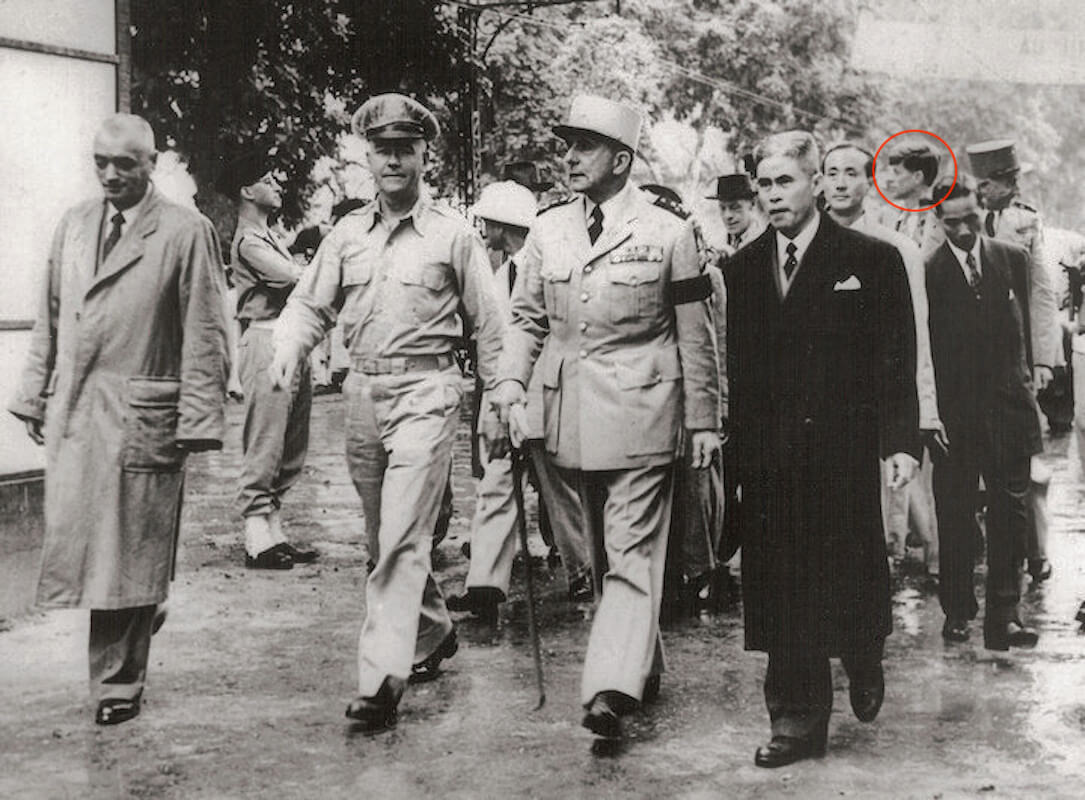
In the 1951 photograph above, General Jean de Lattre de Tassigny is leading a contingent through the streets of Saigon at a time when France was engaged in a losing cause during the First Indochina War. In the back of the pack, a young congressman from Massachusetts, John F. Kennedy, is observing the conditions on the ground in a war effort that was at the time receiving substantial American aid. Kennedy’s younger brother Robert accompanied him on the trip. RFK later ran on an anti-war platform at the height of the Vietnam War, shortly before his assassination in 1968. This study explores the impact of the 1951 trip to Vietnam on John F. Kennedy, his association with the diplomat Edmund Gullion, and the evolving vision of JFK for American foreign policy in Vietnam, which was articulated in a major address given in 1954.
Edmund Gullion (1913-98) enjoyed a distinguished career as a diplomat followed by a second life in academia as Dean of the Fletcher School of Law and Diplomacy at Tufts University, where he trained a generation of foreign officers. As a Southeast Asian specialist, he held senior positions at the American Embassy in Saigon from 1949-52 during the First Indochina War. At a time when the Truman administration was ramping up aid for France in an effort to salvage its colonial outpost in Southeast Asia, Gullion was an advocate of Vietnamese independence. Later, at a critical juncture in America’s involvement in Vietnam in 1963, Gullion asked a colleague, “Do you really think there is such a thing as a military solution for Vietnam?”1
Gullion was also a confidant of the young Congressman and World War II hero John F. Kennedy, who visited Saigon in 1951. Congressman Kennedy was there to observe up close the conditions of a foreign colonial war in progress, in preparation for his run for the Senate the next year against Henry Cabot Lodge. Later, he used Gullion as a sounding-board as he was shaping his own views on America’s role in Southeast Asia and the Third World. During his presidency, JFK appointed Gullion as ambassador to the Congo.2 Gullion’s oral interviews and the words of JFK himself help to shed light on the congressman’s formation as a statesman in the period before he acceded to the presidency. The year 1954 is an especially important crossroads in the history of Vietnam and a turning point for JFK in articulating a foreign policy for Southeast Asia.
Young John F. Kennedy was an inveterate traveler. When he was a Harvard student, he took time out to travel to Europe, the Balkans, and the Middle East in 1939, witnessing first-hand the ominous signs of the coming war. During the war itself, he survived an attack on his PT boat in the Solomon Islands, heroically rescuing a badly burned crew member and guiding his men to safety until they were rescued. At the close of the war in 1945, he worked as a journalist, attending the United Nations Conference on International Organization in San Francisco and the Potsdam Conference. As a congressman from Massachusetts, Kennedy embarked on a seven-week, 25,000-mile trip in 1951. Accompanied by his brother Robert and his sister Patricia, Kennedy visited Israel, Pakistan, Iran, India, Singapore, Thailand, French Indochina (Vietnam), Korea, and Japan. Upon his return home, he conveyed to the press that his goal for the trip was to learn “how those peoples regarded us and our policies, and what you and I might do in our respective capacities to further the cause of peace.”3
At the time, he described in a radio interview what he believed should be the primary goal of combatting communism in the Third World, which was “not the export of arms or the show of armed might but the export of ideas, of techniques, and the rebirth of our traditional sympathy for and understanding of the desires of men to be free.”4 When Kennedy met with Indian Prime Minister Jawaharlal Nehru, he asked Nehru for his view on the current war in French Indochina. Nehru replied that the military and financial assistance provided to the French by the United States was a “bottomless hole” because the war was an example of doomed colonialism.5 Upon arriving in Vietnam, the Kennedy entourage observed Charles de Gaulle and the top brass of the French military as the war was in progress. But, more significantly, the young Congressman was to have a fateful meeting with an American consular officer named Edmund Gullion.
II
While the French were optimistic about retaining their colonial empire with American support, Gullion had recognized in 1951 that they would not prevail. Kennedy had known Gullion since 1947 when they had conferred about a speech the congressman was to give on foreign policy. Now, they met privately on the top of the Hotel Majestic in Saigon. Earlier in the day, Kennedy had been told by the French commander, General Jean de Lattre de Tassigny, that with 250,000 troops, it would be impossible for the French to lose.6 But as JFK listened to the twilight mortar shells exploding in the distance from the artillery of the Viet Minh, Gullion informed him that
In twenty years there will be no more colonies. We’re going nowhere out here. The French have lost. If we come in here and do the same thing, we will lose, too, for the same reason. There’s no will or support for this kind of war back in Paris. The homefront is lost. The same thing would happen to us.7
Congressman Kennedy would never forget the prophetic words of Gullion. A decade later, in the now famous debates in the White House in November of 1961, he recalled them to his cabinet members. As John Newman and James Blight have described, these men were pressing him as commander-in-chief to augment military advisors in Vietnam with American combat troops, a request that JFK adamantly rejected.8
When Kennedy returned from his 1951 trip, it was clear that he was deeply affected by the words of Gullion. Robert Kennedy later recalled that the experience had been “very very major” [sic] in shaping his older brother’s vision for American foreign policy in the countries he had visited.9 In describing this period in Kennedy’s life, historian Herbert S. Parmet writes that,
… at a time of containment as the sine qua non of meeting the spread of the ‘international Communist conspiracy,’ Jack Kennedy was evolving into a spokesman for a more sophisticated view. He was beginning to call attention to the soft spot of the Western cause, to the frustration of a region that had long contended with colonial domination.10
In March of 1952, Kennedy spoke to an audience in Everett, Massachusetts, voicing his opposition to sending American troops to assist the French in Indochina. In April, he addressed a Knights of Columbus chapter in nearby Lynn, stating that “we should not commit our ground troops to fight in French Indochina.”11 In an editorial in The Traveler,the Congressman received praise for taking a stand against the status quo: “Mr. Kennedy is doing a service in prodding our conscience.”12 It was clear in 1952 that Kennedy was as outspoken of American aid to the French as he was against the French colonial war itself.
Gullion returned to Washington in 1953, at which time he renewed his association with Kennedy, who had recently been elected to the Senate. They had many conversations and bonded in their minority opinion about the policy of pouring aid into the French war effort in Indochina. The State Department even suspected Gullion of contributing to Kennedy’s speeches on foreign policy. But Gullion recalls an independently minded Kennedy, who not only did not require Guillon’s assistance as a speechwriter, but was shaping a vision entirely on his own. In reflecting on his meetings with Kennedy in an oral history interview in 1964, Gullion modestly recalled that from the very first speech in which Kennedy had sought Gullion’s aid in 1947, the young politician was thinking for himself:
Actually, it was a very realistic and an advanced kind of perspective that he had, and it was his own. My own contributions to it were factual, and I volunteered some opinions and some sentences, but I was somewhat surprised and, I suppose, my own very youthful egoisms somewhat checked when I saw the finished product and realized how much of this was Kennedy and how little of it was mine. It was quite an interesting product.13
Gullion also recalled that after his 1951 trip, Kennedy’s “stance on Indochina certainly went against the prevailing opinion …. Now when he came back he prepared an address in the Senate which was one of his most important.”14 In his work on this major address, Kennedy conferred with Gullion, and, once again, his views were “entirely his own,” according to Gullion.15
JFK’s speech in the Senate came at a turning point in the modern history of Vietnam in the year 1954. After a brutal, fifty-seven day standoff in northwestern Vietnam, Dien Bien Phu fell to the forces of Ho Chi Minh on May 7. With aid from the Chinese and Russians, the Viet Minh commander Võ Nguyen Giáp had amassed troops and, most importantly, heavy artillery that negated the formidable French airpower. The collapse and surrender of the French that followed were the result of Giáp’s brilliant tactical campaign at Dien Bien Phu. In July, French Prime Minister Pierre Mendès-France put his signature to the Geneva Accords that effectively marked the end of French control of Indochina. The Geneva agreement stipulated that in the nation’s transition to independence, there would be a temporary partition of the country pending a national election to be held in the summer of 1956.
But the United States never signed the Geneva agreements, and almost immediately, the CIA aggressively began to transform Vietnam with the same zeal that had just effected regime changes in Iran and Guatemala. Now, to counter Ho Chi Minh in the north, the search was on for a United States backed leader in the south, whose rise to power would be facilitated by the CIA specialist in black operations, Edward Lansdale. In early 1954 and prior to the French defeat at Dien Bien Phu, Ngo Dinh Diem was made prime minister of Vietnam by France’s longstanding puppet ruler Bao Dai. Within the next two years, Diem would take control of South Vietnam through the sophisticated psychological warfare and propaganda campaigns of Lansdale.16 With Diem in place, Secretary of State John Foster Dulles was able to boast that, “We have a clean base there now, without a taint of colonialism. Dien Bien Phu was a blessing in disguise.”17 The elections that were to unify Vietnam never occurred in 1956, because the United States knew that Ho Chi Minh would be elected in a landslide. Instead, the partition between North and South Vietnam was no longer “temporary,” the North Vietnamese were identified as the “communists,” and, propped up by American economic and military support, the “free” nation of South Vietnam under Diem came into existence.18
III
As the turbulent events of 1954 were unfolding in Vietnam, and a month before Dien Bien Phu collapsed, John F. Kennedy rose to deliver an address in the Senate on April 6, 1954. The structure of the speech was a detailed, year-by-year recapitulation of the massive American support given to the struggling French mercenary army through administrations of both a Democrat (Truman) and a Republican (Eisenhower). Kennedy had done his homework for the speech. This included sending a list of forty-seven detailed questions to Secretary of State John Foster Dulles about the purpose of American involvement in Vietnam.19 But Kennedy was not aware that the United States national security network had already recognized the futility of American intervention in Vietnam by 1954. In 1971, the release of the secret Pentagon Papers revealed that in 1954,
… unless the Vietnamese themselves show an inclination to make individual and collective sacrifices required to resist Communism, which they have not done to date, no amount of external pressure and resistance can long delay complete Communist victory in Vietnam.20
With that knowledge, the Eisenhower administration continued its unalloyed engagement in Vietnam.
On the floor of the Senate, Kennedy prefaced his chronological survey by demanding the government’s accountability to the American people for adventurism and potential war in Vietnam:
If the American people are, for the fourth time in this century, to travel the long and tortuous road of war—particularly a war which we now realize would threaten the survival of civilization—then I believe we have a right—a right which we should have hitherto exercised—to inquire in detail into the nature of the struggle in which we may become engaged, and the alternative to such struggle. Without such clarification the general support and success of our policy is endangered.21
Kennedy was most likely expressing to Eisenhower his personal outrage when he had learned that secret discussions had occurred about deploying atomic warfare in Vietnam to support the fading French prospects of victory. In his speech, Kennedy’s concerns for disclosure were being raised prior to the outcome of the battle of Dien Bien Phu and months before the American subversion of the Geneva Accords that resulted in the artificial division of Vietnam against the will of the Vietnamese people. As he was speaking in the Senate, there was as yet no design for a portion of Vietnam to become an American client state led by a puppet ruler like Diem. It was precisely such a scenario that Kennedy feared.
Kennedy then went on to warn of the dangers of an American military commitment to Vietnam in the wake of the French struggle he had observed in 1951, based on his first-hand experience and the perspectives he had gleaned from Edmund Gullion:
But to pour money, materiel, and men into the jungles of Indochina without at least a remote prospect of victory would be dangerously futile and self-destructive. I am frankly of the belief that no amount of American military assistance in Indochina can conquer an enemy which is everywhere and at the same time nowhere, “an enemy of the people” which has the sympathy and covert support of the people.22
In hindsight, the prophetic nature of Kennedy’s 1954 address underscores a set of lessons that would eventually be learned the hard way by the policymakers after the horrific number of American and Vietnamese casualties during the war that unfolded between 1965-75. Kennedy closed his address by issuing a warning about the potential consequences of military adventurism in Vietnam, including a nod to Thomas Jefferson’s prudence and caution, prior to leaping into the unknown with a military entanglement abroad:
The time to study, to doubt, to review, and revise is now, for upon our decisions now may well rest the peace and security of the world, and, indeed, the very continued existence of mankind. And if we cannot entrust this decision to the people, then, as Thomas Jefferson once said: “If we think them not enlightened enough to exercise their control with a wholesome discretion, the remedy is not to take it from them but to inform their discretion by education.”23
This coda to Kennedy’s speech could have been a road map to the future to avoid what became the tragedy of the Vietnam War.
IV
JFK’s tour-de-force Senate address of 1954 was not political grandstanding. Rather, it was a carefully formulated examination of the question of American intervention in Vietnam at a pivotal moment for both nations. Prior to the Senate speech, Kennedy had spoken to the Cathedral Club in Brooklyn, New York, stressing that the French could not withstand the united forces of Ho Chi Minh, who “has influence penetrating all groups of society because of his years of battle against French colonialism.”24 As he would say again in late 1961 to his advisors, the situation was far different from the recent Korean conflict, wherein an independent government in the south was threatened by the invading communists from the north. Even before the Geneva Accords had mandated free elections to unify Vietnam and before Eisenhower began to use the expression “domino theory,” Kennedy had identified the unique circumstances of Vietnam’s long struggle for independence, as distinct from a nation that America could potentially “lose” to communism.
After the Senate speech, Kennedy followed up with a television appearance, indicating that the French could not possibly retain Indochina and that again, as he would say seven years later, “American intervention with combat troops would not succeed.”25 In another 1954 speech in Los Angeles, Kennedy asserted that the American people “have been deceived for political reasons on the life and death matters of war and peace.”26 He reiterated this theme before the Whig-Cliosophic Society of Princeton University and the Executives Club in Chicago, stressing above all the importance of recognizing independent movements for nationhood in the Third World and distinguishing them from the global expansion of communism. In response to Vice President Richard Nixon’s call to send American ground troops into Vietnam, Kennedy responded that if we were to do that, “We are about to enter the jungle to do battle with the tiger.”27 By the end of 1954, an imaginary line would be drawn across Vietnam as a result of the Geneva Accords. But a very different line was being drawn in the sand by John F. Kennedy: one that proscribed American military intervention. The 1954 Senate speech, which was addressed to President Eisenhower, was a prescient warning about repeating the mistakes of the French. Ultimately, it was advice that was ignored after the death of President Kennedy by his successors, Lyndon B. Johnson and Richard M. Nixon.
In Adlai Stevenson’s bid to unseat Eisenhower as president, Kennedy delivered speeches in support of Stevenson in the run-up to the 1956 presidential election. But when he discussed foreign policy, Kennedy refused to engage in partisan politics. In describing American interference in the developing nations of Africa and Southeast Asia, Kennedy observed that
… the tragic failure of both Republican and Democratic administrations since World War II to comprehend the nature of this revolution, and its potentialities for good and evil, has reaped a bitter harvest today. And it is by rights and by necessity a major foreign policy campaign issue that has nothing to do with anti-communism.28
After such speeches, the Stevenson election team asked Kennedy to refrain from making further foreign policy remarks in the course of the campaign. Senator Kennedy was unsuccessful in his quest for the nomination of Vice President on the Stevenson ticket. Which was probably a blessing in disguise.
During the late 1950s, the focus of Southeast Asian foreign policy of the Eisenhower administration was on preventing the nation of Laos from becoming the first fallen domino. During the 1960 presidential campaign, Kennedy stressed that we would never succeed in Laos against “guerrilla forces or in peripheral wars … We have been driving ourselves into a corner where the choice is all or nothing.”29 As a senator, Kennedy had recognized that “public thinking is still being bullied by slogans which are either false in context or irrelevant to the new phase of competitive coexistence in which we live.”30 By the time he was elected President in 1960, Kennedy had the wisdom to see beyond the Cold War slogans of “the domino theory,” “godless communism,” and “Soviet master plan.” In his first year in office as President, Kennedy traveled to Vienna for a summit with Khrushchev. While en route, he was warmly received in Paris by President Charles de Gaulle. After Kennedy presented de Gaulle with a gift of an original letter written from George Washington to the Marquis de Lafayette, de Gaulle proffered advice to Kennedy on Vietnam, telling him that intervention in Southeast Asia would be “a bottomless military and political quagmire.”31
This counsel reflected the lessons learned by de Gaulle himself from Dien Bien Phu and Algeria. But John F. Kennedy hardly needed this advice from de Gaulle, as his thinking about the emerging nations of Africa, the Middle East, and Southeast Asia had been formed after a decade of close study and hands-on experience during his travels. His 1954 address in the Senate could be a blueprint even today for correcting the misguided American attempts at “nation building” abroad.32 From the time he traveled to Vietnam until his death, Kennedy had the clarity of thinking to understand that the struggle in Vietnam was the story of nationalism, not a Cold War intrigue. And the thinking that informed his vision was guided at the outset by the words he had heard in 1951 from Edmund Gullion.
Afterword
The history of the Vietnam War is invariably delineated by historians as a continuum of escalating involvement from the administrations of Eisenhower to Kennedy to Johnson to Nixon in the form of an incremental progression.33 This essay challenges that notion as apparent in the vision of John F. Kennedy, one that vehemently opposed conventional warfare in Vietnam. According to JFK’s speechwriter Theodore Sorensen, Vietnam was
… not central to the foreign policy of the Kennedy presidency. Berlin was, Cuba, the Soviet Union, but not Vietnam. Vietnam was a low-level insurrection at that point.34
While there were sixteen thousand military advisors in Vietnam at the time of his assassination on November 22, 1963, Kennedy had resisted the pressure to send in combat forces. According to Sorensen, Kennedy listened to his hawkish advisors, “but he never did what they wanted.”35 Similarly, Võ Hong Nam, the son of the North Vietnamese general Võ Nguyên Giáp, informed researcher Mani Kang, in an interview in 2011, that “President Kennedy was finally changing his foreign policy in regards to Vietnam in 1963” and “he was withdrawing.”36
The military historian John M. Newman observes that “at 12:30 P.M., on Friday, November 22, the rifle shots rang out in Dealey Plaza that took the president’s life. His Vietnam policy died with him.”37 Lyndon Johnson’s decision to use the Gulf of Tonkin affair as the pretext to send combat troops into Vietnam, escalate the war, prop up a string of South Vietnamese dictators in a client state, and, finally admit failure, when choosing not to run for reelection as President in 1968, has tended to erase the memory of JFK’s goal of withdrawing all military advisors no later than 1965.
Speaking before a large gathering at the LBJ Library on May 1, 1995, Robert McNamara, JFK’s Secretary of Defense and, later, one of the principal policymakers of the Vietnam War under LBJ, recalled the strategic meetings of the National Security Council (NSC) on October 2 and October 5, 1963, wherein, against the will of the majority of the NSC committee members, President Kennedy had made the determination for complete withdrawal of United States military advisors from Vietnam by December 31, 1965. Historian James DiEugenio has effectively summarized the psychology that JFK was using against a powerful national security network that opposed his plan for withdrawal from Vietnam:
Kennedy had based his withdrawal plan on taking advantage of the differences between what the real battlefield conditions were and what the Pentagon said they were. Knowing that the American-backed South Vietnam effort there was failing, the Pentagon was disguising this with a whitewash of how bad things really were. Therefore, Kennedy was going to hoist the generals on their own petard: If things were going so well, then we were not needed anymore.38
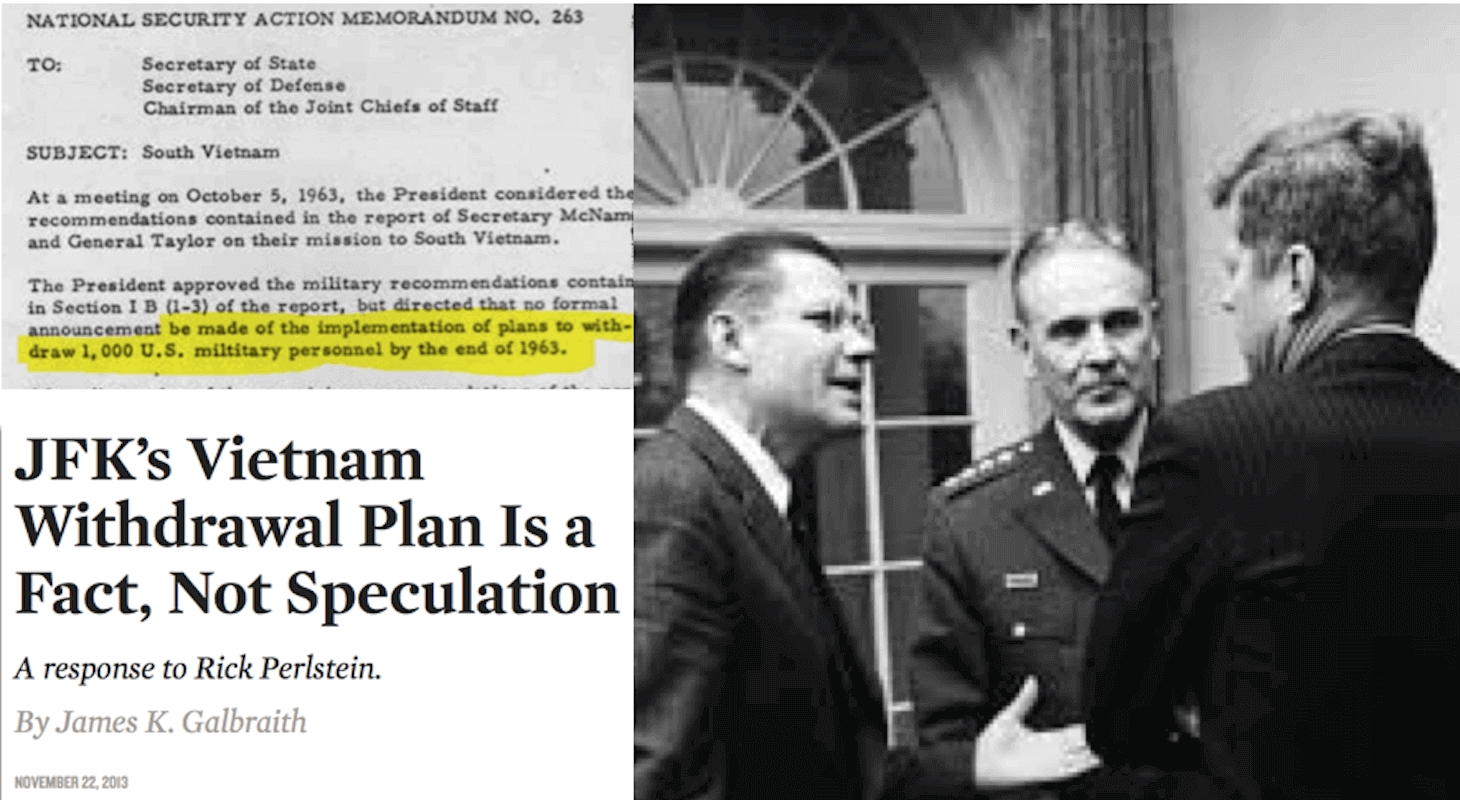
In Kennedy’s plan, the initial phase-out of one thousand advisors would be accomplished by the end of 1963. A public announcement would be made to set these decisions “in concrete.”39 McNamara’s recall of the NSC meeting was corroborated when, in the late 1990s, the Assassination Records Review Board (ARRB) released tape recordings of key meetings during the Kennedy presidency, including those of the National Security Council sessions of October 2 and October 5, 1963, wherein all of McNamara’s points were confirmed. McNamara’s voice appears on the tape, stating, “We need to get out of Vietnam, and this is a way of doing it.”40 Shortly after the NSC meetings, JFK approved the Top Secret National Security Action Memo 263. Declassified in the early 1990s, the document identifies the first phase of the withdrawal of one thousand U.S. military personnel by the end of 1963. The combination of contemporary eyewitness testimony, oral history, recollections of statesmen, tape recordings of meetings, documentary evidence, and, above all, President Kennedy in his own words, points to his capacity as commander-in-chief to steer the United States away from what became the tragedy of the Vietnam War following his assassination.
Notes
1 Wolfgang Saxon, “Edmund Asbury Gullion, 85, Wide-Ranging Career Envoy,” obituary, The New York Times, March 31, 1998. (https://www.nytimes.com/1998/03/31/world/edmund-asbury-gullion-85-wide-ranging-career-envoy.html)
2 At a critical stage in the crisis of the Diem regime in Vietnam in the summer of 1963, JFK wanted to appoint Gullion as ambassador in Saigon. But Secretary of State Dean Rusk opposed the nomination of Gullion in favor of an opposition party member, the Republican Henry Cabot Lodge. In an effort to show bipartisan unity, JFK went along with Rusk. But the appointment of Lodge was a grave mistake that eventually JFK would regret. Robert Kennedy had also preferred the selection of Gullion, warning his brother that Lodge would create “a lot of difficulties in six months.” RFK’s words were prophetic, especially at the time of the CIA-backed assassination of Ngo Dinh Diem that occurred six months later and unbeknownst to the President. James W. Douglass, JFK and the Unspeakable: Why He Died and Why It Matters (Mary Knoll, NY: Orbis Books, 2008), 151.
3 Robert Dallek, An Unfinished Life: John F. Kennedy—1917-1963 (New York: Little Brown and Company, 2003), 165.
4 Dallek, 167.
5 Dallek, 168.
6 Douglass, 93.
7 Douglass, 93.
8 Kennedy’s advisors included Robert McNamara, Dean Rusk, McGeorge Bundy and his brother William, and Eugene Rostow and his brother Walt. These were the men identified by journalist David Halberstam as “the best and the brightest” of the intellectuals in JFK’s administration. After the president’s assassination, these civilian policy makers would be complicit with Lyndon Johnson as the chief architects of the disastrous war in Vietnam.
9 Herbert S. Parmet, Jack: The Struggles of John F. Kennedy (New York: The Dial Press, 1980), 228.
10 Parmet, 228.
11 Parmet, 228.
12 Parmet, 228.
13 Oral History with Edmund A. Gullion, July 17, 1964.
14 Oral History with Edmund A. Gullion, July 17, 1964.
15 Oral History with Edmund A. Gullion, July 17, 1964.
16 The clandestine operation of Lansdale has been documented with great thoroughness by Talbot and Douglass, as per bibliography.
17 Richard Mahoney, JFK: Ordeal in Africa (Oxford and New York: Oxford University Press, 1983), 139. Quoted in James DiEugenio, Destiny Betrayed—JFK, Cuba, and the Garrison Case, second edition (New York: Skyhorse Publishing, 2012), 24.
18 The 1958 bestselling novel The Ugly American, written by Eugene Burdick and William J. Lederer, exposed the smooth tactics of counterintelligence, propaganda, and force exerted by American operatives to win “hearts and minds” in a fictitious Southeast Asian nation. The thinly veiled portrait of Lansdale was apparent in the wily character of Colonel Edwin Hillendale, whose psychological ploys sought to convert the nation to the American way. Senator John F. Kennedy loved the novel and purchased one hundred copies for distribution to the entire United States Senate. He also paid for a large advertisement of the book in The New York Times.
19 Mahoney, 15.
20 The Complete Pentagon Papers, The New York Timesonline, 1945-67 (http://www.documentcloud.org/documents/205509-pentagon-papers-part-iv-a-4.html)
21 John F. Kennedy, Senate Address on Indochina, April 6, 1954 (https://www.jfklibrary.org/Research/Research-Aids/JFK-Speeches/United-States-Senate-Indochina_19540406.aspx)
22 John F. Kennedy, Senate Address on Indochina, April 6, 1954. Shortly after the period in which Edmund Gullion was stationed in Vietnam, Charlton Ogburn became an intelligence officer in Southeast Asia, writing memos to the State Department and warning of the dangers of military involvement in Vietnam. His voice was completely ignored by the overconfident civilian leaders in Washington. Ogburn believed that the reach of the authorities was “totalitarian” in nature, a reality that was grasped by Plato, who may have been the first to identify the amorphous power of the “State” in the example of ancient Athens. For Ogburn, Vietnam was a “laboratory” for understanding how dogma is wielded by authority figures. He later recalled that “we lost over fifty thousand lives in Vietnam because the authorities could not be budged. Their appraisal of themselves was based on their being right …. They had to be right.” The passage of time would prove Ogburn to be correct in his assessment of Vietnam. Writing in 1989, Andrew Jon Rotter in The Path to Vietnam—Origins of the American Commitment to Southeast Asia (Ithaca, New York: Cornell University Press, 1989) refers to Ogburn’s dispatches to State Department officials as “startling and prophetic” in his early critique of the false assumptions guiding U.S. policy. Ogburn concluded one of his memos to Dean Rusk with a statement that spoke for the rights of Third World nations caught up in the Cold War. Referring to the people of Southeast Asia, Ogburn wrote, “Darn it, they are the ones who are threatened with a fate worse than death—not we.” Around the same time, John F. Kennedy was making virtually the same argument in his Senate speech of April 4, 1954.
23 John F. Kennedy, Senate Address on Indochina, April 6, 1954.
24 Parmet, 281.
25 Parmet, 286.
26 Parmet, 285.
27 Parmet, 285.
28 Remarks of Senator John F. Kennedy at the Los Angeles World Affairs Council Luncheon at the Biltmore Hotel on September 21, 1956. (https://www.jfklibrary.org/Research/Research-Aids/JFK-Speeches/Los-Angeles-CA-World-Affairs-Council_19560921.aspx)
29 Arthur Schlesinger, Jr., A Thousand Days—John F. Kennedy in the White House (New York: Fawcett, 1965), 310-11.
30 Quoted in James DiEugenio, Destiny Betrayed—JFK, Cuba, and the Garrison Case, second edition (New York: Skyhorse Publishing, 2012), 25.
31 Dallek, 397. Prior to acceding to the presidency, Kennedy paid a visit to General Douglas MacArthur who, like de Gaulle, advised him to “never get involved in a land war in Asia.” (https://www.cnn.com/2016/09/08/politics/caroline-kennedy-axe-files)
32 As observed by biographer David Talbot, “Kennedy’s thinking about the historical imperative of Third World liberation was remarkably advanced. Even today, no nationally prominent leader in the United States would dare question the imperialistic policies that have led our country into one military nightmare after another. Kennedy understood that Washington’s militant opposition to the world’s revolutionary forces would only reap ‘a bitter harvest.’” Talbot, The Devil’s Chessboard—Allen Dulles, the CIA, and the Rise of America’s Secret Government (New York: Harper Collins, 2015), 362.
33 In the popular Steven Spielberg film The Post, the screenwriters lump together on multiple occasions the American Presidents from Eisenhower to Nixon, suggesting that each President was on board with military intervention in Vietnam, as the American commitment grew exponentially from one administration to the next. But the historical record suggests that this was not the case during Kennedy’s thousand-day presidency.
34 David Talbot, Brothers—The Hidden History of the Kennedy Years (New York: Free Press, 2007), 215.
35 Talbot, Brothers, 215.
36 Mani Kang, “General Giap Knew,” Kennedys and King, August 30, 2013. (https://kennedysandking.com/john-f-kennedy-articles/general-giap-knew)
37 John M. Newman, JFK and Vietnam—Deception, Intrigue, and The Struggle for Power (self-published, 2016), 458.
38 James DiEugenio, Reclaiming Parkland—Tom Hanks, Vincent Bugliosi, and the JFK Assassination in the New Hollywood (New York: Skyhorse Publishing, 2016), 188.
39 James K. Galbraith, “Exit Strategy: In 1963, JFK Ordered a Complete Withdrawal From Vietnam,” Boston Review (September 1, 2003).
40 Galbraith.
Works Cited Bibliography
The Personal Papers of Edmund A. Gullion. The John F. Kennedy Library, Boston, Massachusetts (https://archive2.jfklibrary.org/EAGPP/EAGPP-FA.xml )
Historic Speeches of John F. Kennedy. The John F. Kennedy Library, Boston, Massachusetts (https://www.jfklibrary.org/JFK/Historic-Speeches.aspx )
The Complete Pentagon Papers, The New York Timesonline, 1945-67 (http://www.documentcloud.org/documents/205509-pentagon-papers-part-iv-a-4.html )
Dallek, Robert. An Unfinished Life: John F. Kennedy—1917-1963. New York: Little Brown and Company, 2003.
DiEugenio, James. Destiny Betrayed—JFK, Cuba, and the Garrison Case, Second Edition. New York, Skyhorse Publishing, 2012.
DiEugenio, James. Reclaiming Parkland—Tom Hanks, Vincent Bugliosi, and the JFK Assassination in the New Hollywood. New York: Skyhorse Publishing, 2016.
Douglass, James W. JFK and the Unspeakable: Why He Died and Why It Matters. Mary Knoll, NY: Orbis Books, 2008.
Galbraith, James K. “Exit Strategy: In 1963, JFK Ordered a Complete Withdrawal From Vietnam,” Boston Review, September 1, 2003.
Mahoney, Richard. JFK: Ordeal in Africa. Oxford and New York: Oxford University Press, 1983.
Newman, John M. JFK and Vietnam—Deception, Intrigue, and the Struggle for Power, second edition. Self-published, 2016.
Parmet, Herbert S. Jack: The Struggles of John F. Kennedy. New York: The Dial Press, 1980.
Rotter, Andrew Jon. The Path to Vietnam—Origins of the American Commitment to Southeast Asia. Ithaca, New York: Cornell University Press, 1989.
Saxon, Wolfgang. “Edmund Asbury Gullion, 85, Wide-Ranging Career Envoy. “ Obituary, The New York Times, March 31, 1998.
Schlesinger, Arthur, Jr. A Thousand Days—John F. Kennedy in the White House. New York: Fawcett, 1965.
Talbot, David. Brothers—The Hidden History of the Kennedy Years. New York: Free Press, 2007.
Talbot, David. The Devil’s Chessboard: Allen Dulles, the CIA, and the Rise of America’s Secret Government. New York: Harper Perennial, 2016.
-

Does Paul Street get paid for this junk?
I really hope the answer to the question posed by this article’s title is no. Why? Because Street’s latest exercise in fruitiness is nothing but a recycling of two previous columns he wrote. His current article, which was supposed to be a salute to the memory of Martin Luther King, is really no such thing. It is actually a cheapening of King’s memory, because Street chose to elevate King at the same time that he denigrates President Kennedy. But beyond that, the article is ironically titled, “Against False Conflation: JFK, MLK and the Triple Evils”, since Street himself is guilty of conflating one column he did in January on King with another he did in February on Kennedy. The latter was posted at Truthdig; the former at Counterpunch. What he does in his current effort at the latter site is largely a cut-and-paste job of the two articles. Which is what I mean about hoping he does not get paid for this stuff.
I demolished his February piece on Kennedy at length already. (See Paul Street Meets Jane Hamsher at Arlington for the ugly details) But what he does now is make believe that demolition did not happen, and he simply modifies it slightly to serve as the first part of his worthless essay. So if he is getting paid, it’s easy money.
When I heard of what he had done, I emailed Counterpunch and asked if I could reply on site. After four days I received no reply. Therefore, I will reply here again. And to place Street on warning: whenever I hear about more of his nonsensical writing on the subject, I will reply in the future. Especially since his scholarship is so bad that this is like shooting fish in a barrel. In fact, Kennedys and King may end up with a special section called “Street is a Dead End”.
As I stated, Street slightly modified the first part of his hatchet job on President Kennedy. He opens his article by aseerting that he does not pretend to know the full stories behind who killed Kennedy or King. But he cannot help but list the lone gunman option first. Anyone who has the slightest interest in the subject would howl with laughter at anyone who would proffer that option today. That Street leaves it open tells us a lot about the argument he wishes to make. For if he did admit that JFK was killed by a high-level plot, it would tend to undermine his nonsensical thesis.
This is especially true in light of the fact that so many of President Kennedy’s policies were altered and then reversed after his death. For example, there were no American combat troops in Vietnam on the day Kennedy was killed. By the end of 1965, not only were there 175,000 combat troops in theater, but also Rolling Thunder—the greatest air bombardment campaign in history—was operating over North Vietnam. We can make other comparisons to the same effect from the scholarly literature that Street refuses to consult. For example, by reading Richard Mahoney’s JFK: Ordeal in Africa, one can see that a very similar trend followed in Congo. By reading Lisa Pease’s essay about the giant conglomerate Freeport Sulphur, one can see the same trend line in Indonesia. (See JFK, Indonesia, CIA & Freeport Sulphur) By reading just a few pages from Donald Gibson’s masterful volume, Battling Wall Street, one can see that it occurred in the Dominican Republic as well. (See pages, 76-79) By reading Robert Rakove’s fine overview of Kennedy’s revolutionary foreign policy, one can see that the same thing happened in the Middle East, where Kennedy favored Gamel Abdel Nasser. After his death, Johnson and Nixon moved back to favoring Iran and Saudi Arabia, with disastrous results. (See Kennedy, Johnson and the Non Aligned World.) The story of Africa outside the Congo also followed a similar plot line. And the reader can see that by reading Philip Muehlenbeck’s Betting on the Africans.
What is remarkable about Street’s articles is that there is no evidence at all in any of them that he read any of this material. Consequently, in addition to the ignorance he shows on the subject, there is also a tinge of arrogance involved. Does he think that since he knows better, somehow he is above reading the latest scholarship on the subject? Well, that is one way that he can keep his screeds coming, isn’t it?
The other point that he implies with his opening is that the assassinations of the Sixties are not really linked in any way. Again, this is quite a difficult thesis to swallow. Lisa Pease and I wrote a 600-page book on that very subject called The Assassinations. There, with rather intricate and up-to-date evidence, we tried to show how the four major assassinations of the decade—President Kennedy, Malcolm X, King, Robert Kennedy—all shared similar characteristics in both their outlines and design, and in the cover-ups afterwards. We also offered a final essay in which we tried to show that it was the cumulative effect of those murders that brought us to the election of 1968: the coming of Richard Nixon and the rise of the hard right to power—a phenomenon that drastically altered the social and economic landscape of this country, and from which it may never recover. One only needs to look at what happened after Nixon left office: how Jerry Ford allowed Donald Rumsfeld and Dick Cheney to bring the Committee on the Present Danger into the White House and do battle with the CIA over their estimate of the Soviet Threat, an unprecedented event. The people they brought in—Paul Nitze, Paul Wolfowitz—thought as Rumsfeld and Cheney did: namely, that Henry Kissinger, Nixon, and Alexander Haig were too moderate. (See Jerry Sanders, Peddlers of Crisis.)
That remarkable, little noted occasion had two effects. First, it gave birth to the neoconservative movement, and its later cast of characters, e.g., Jeanne Kirkpatrick and Richard Perle. Second, it was the final burial of Kennedy’s progressive, visionary foreign policy. And I do not just mean his attempt at détente with Cuba and the USSR. I also mean his attempt to mold a policy concerning the Third World which was not bound to Cold War ideology, but which was characterized instead by an effort to understand and ameliorate the problems of nations coming out of the debilitating state of European colonialism.
Indonesia and Congo offer the two most notable examples. And if Street had done a little bit of reading on the subject he would have known better. For as Susan Williams wrote in her study of the murder of Dag Hammarskjold, Harry Truman made a curious comment when he heard about the UN Secretary General’s death. He said, “Dag Hammarskjold was on the point of getting something done when they killed him. Notice, I said ‘When they killed him.’.” (Susan Williams, Who Killed Hammarskjold?, p. 232) Why on earth did Truman say this? We did not learn why until Australian scholar Greg Poulgrain published another book Street has never read. It is called The Incubus of Intervention. In examining how Kennedy’s Indonesian policy was opposed by Allen Dulles, the author talked to George Ivan Smith, a close friend and colleague of Hammarskjold’s at the United Nations. Smith revealed that Hammarskjold and Kennedy were secretly cooperating not just on the Congo, but on the problem of Dutch occupation of West Irian, which Indonesian leader Achmed Sukarno felt should be a part of Indonesia. Smith added that Kennedy had let former Democratic president Truman in on that cooperation. That is why Truman made the comment he did. (Poulgrain, pp. 77-78. For a fuller discussion of the Hammarskjold/Kennedy nexus, see Hammarskjold and Kennedy vs. The Power Elite)
What is so remarkable—in fact, admirable—about this revelation is this: Kennedy kept his pledge to Hammarskjold even after the UN Secretary General was killed! As anyone who reads Mahoney’s book, or Lisa Pease’s essay, or Poulgrain’s book will see, Kennedy was diligent throughout his abbreviated term on both fronts. He personally visited the United Nations on two occasions to ensure that the UN would not forget what Hammarskjold was doing in Congo after he died. And Kennedy allowed American troops into battle to stop the secession of the Katanga province, a move sponsored by Belgium and, to a lesser extent, by England. (See Desperate Measures in the Congo)
The same was true of Indonesia. Kennedy stuck by Sukarno until the end. He engineered the ceding of West Irian to Indonesia under the negotiated guidance of his brother Robert. President Kennedy had also arranged a state visit to Jakarta in 1964, in part to stave off the confrontation between Sukarno and the United Kingdom over the creation of the Malaysia federation. When Sukarno wanted to expel foreign corporations, Kennedy negotiated new agreements with them so that Indonesia would benefit from the profit split, which JFK requested be 60/40 in Indonesia’s favor. After Sukarno was overthrown, that split was 90/10 in favor of the companies. (Poulgrain, p. 242) Without Kennedy, Sukarno lasted less than two years. President Johnson now backed Malaysia in the dispute with Sukarno, and consequently, Sukarno withdrew from the United Nations. As Lisa Pease notes in her above-referenced article, President Johnson altered Kennedy’s policy towards Sukarno very quickly, and within 12 months the CIA started to plot his overthrow.
These are just two examples. But they typify President Kennedy’s overall foreign policy. If Street can show me another president since him who did these kinds of things in two separate instances—that is, attempt to foster a revolutionary, nationalist government against European imperialists, and work with the United Nations to do so—I would very much like to hear about them.
Ignoring the above two cases, Street brings up Vietnam in relation to the issue of Kennedy and the Third World. Here Street says that there has been since 1991 an ongoing debate on whether Kennedy was going to withdraw. He states that the debate was between Oliver Stone and Jamie Galbraith on one side, and Noam Chomsky and Rick Perlstein on the other. He then claims that, somehow, the latter two writers have won that debate. First off, Chomsky has not done any new work on Vietnam since before 1991. But secondly, other authors have done new and important work that is based on new material. Real historians like Howard Jones, David Welch and David Kaiser have uncovered new evidence to make the original argument, first offered by John Newman in 1992, even stronger. For Street to even bring up Perlstein shows just how threadbare he is. For Perlstein did nothing but reiterate Chomsky’s dated, musty and unconvincing polemics. To note just one difference in the quality of scholarship: Welch offered up declassified tapes of Lyndon Johnson actually admitting that he knew Kennedy was withdrawing from Indochina and thus had to cover up the fact he was breaking with that policy. (Welch, Virtual JFK, pp. 304-14) I ask the reader, how much more proof does one need? Well, how about Assistant Secretary of Defense Roswell Gilpatric revealing that his boss Robert McNamara told him that Kennedy had given him orders to wind down the war? (Welch, p. 371) Is Street, who was not there, going to say he knows better than Johnson and Gilpatric, who were in the room?
This relates to the overall comparison of King with the Kennedys. As anyone who studies American history understands, after the Civil War, the states of the former confederacy passed local and state laws which created the conditions of segregation throughout the southeast: from Texas to the Atlantic Ocean. No one wanted to challenge these laws out of fear of violent retribution from white terrorist groups, but also because of the political price that was going to be exacted. The most that any president did was Harry Truman, who decided to integrate the armed forces. Which really did not cost him much politically, since it was invisible stateside.
From the beginning, the Kennedys decided that they were going to take the issue on, no matter what the price. They decided they were going to use the Brown vs. Board decision as a legal basis to break down the structure of segregation. Kennedy announced this before he was elected. And he stated he was prepared to lose every southern state at the Democratic Convention because of that stand. (Harry Golden, Mr. Kennedy and the Negroes, p. 95) Which, of course, completely contradicts Street’s dictum that the Kennedys were constricted on civil rights because of votes in the South.
But prior to that, during the debate over the 1957 civil rights act, Kennedy stressed the prime role of Title 3 in the bill. That clause allowed the Attorney General to enter into a state to enforce school desegregation. When Kennedy, in no uncertain terms, came out for Title 3, he began to lose support in the South. It got worse when he made a speech in Jackson, Mississippi—let me repeat: Jackson, Mississippi—where he reiterated that he supported the Brown vs. Board decision as the law of the land. (Golden, p. 95) Again, this is before he entered the White House.
It did not change once he was elected. Kennedy had his civil rights advisor Harris Wofford draft a long memorandum on how to strategically attack the segregation problem. Wofford advised that the president use a series of executive actions to forge a path and build momentum until it was possible to pass a bill over a filibuster in the Senate. (Irving Bernstein, Promises Kept, p. 47) To anyone who studies Kennedy’s presidency, it is common knowledge that this memorandum furnished the design of his plan to attack the bastions of southern racism.
His brother, Attorney General Robert Kennedy, understood this out of the gate. To the Kennedys, civil rights were simply a matter of doing the right thing. As RFK said, “it was the thing that should be done.” (Robert Kennedy in his Own Words, edited by Edwin Guthman and Jeffrey Schulman, p. 105) The Attorney General announced this in public at his famous Law Day speech at the University of Georgia in May of 1961. In other words, three months after the inauguration, RFK went into the Deep South and said he was going to support Brown vs. Board in the courts. Does Street think this helped him get votes for his brother in the South?
Quite the contrary. But, as many have noted, what these pronouncements did was provide a catalyst for the civil rights movement. They finally had someone in the White House who was on their side. This sparked King and his allies to incite even larger displays of civil disobedience. As Bobby Kennedy noted later, the emerging images and films of Bull Connor’s actions to stamp out the Birmingham demonstration were the impetus that made his civil rights bill possible. JFK used to joke about it by calling it ‘Bull Connor’s Bill’. (Guthman and Schulman, p. 171) It was that, plus Kennedy’s showdown with Governor Wallace at the University of Alabama, that provoked Bobby Kennedy to suggest his brother go on national television and make his famous speech about civil rights. That powerful oration was then followed by the Kennedys helping King arrange the March on Washington in August of 1963. (Bernstein, pp. 103; 114-15) This provided the ballast to start Kennedy’s civil rights bill on its path through Congress.
One of the most bizarre things Street says in his article is that, somehow, the Kennedys were responsible for things like the killing of civil rights workers in the South. In his mad crusade, is he trying to blame the Kennedys for the rise of the Klan? That began about ninety years before Kennedy entered the White House. Or is Bobby Kennedy to be blamed for J. Edgar Hoover’s lack of rigor in counteracting white racists? As Burke Marshall, who was in charge of the civil rights division at Justice, once noted, it was Bobby Kennedy who had to push Hoover and the FBI into investigating civil rights matters. (Guthman and Schulman, p. 139)
In his zealous jihad, Street can do what he wants to rewrite history and rearrange the make-up of government bodies. He can blame the whole Reconstruction Era on President Kennedy. He can ignore what Hoover failed to do. He can discount all the previous Attorney Generals before RFK. He can erase the record of all the presidents from Lincoln to Kennedy who did next to nothing on civil rights issues. He can cast a blind eye to the virtual inaction of President Eisenhower and Vice President Nixon in the six years after Brown vs. Board. But there is one simple truth that no one can deny: the Kennedys did more for civil rights in three years than all the previous 18 presidents did in nearly a century. That is an ineradicable fact.
And Street’s hero, Martin Luther King, knew it. This is why, in March of 1968, King told his advisors that he would be behind Bobby Kennedy in the election. At this time, both McCarthy and President Johnson were in the race, but RFK had not formally declared. King preferred Bobby Kennedy over McCarthy for the specific reason that Kennedy had a stronger record on civil rights than the Minnesota senator. And he knew Kennedy would withdraw from Vietnam. (Martin Luther King, Jr: The FBI File, edited by Michael Friedly and David Gallen, p. 572)
But further, as Arthur Schlesinger revealed through Marian Wright, it was Bobby Kennedy who gave King the idea for the Poor People’s Campaign in Washington. He suggested it to her, and then she relayed it to King. (Schlesinger, Robert Kennedy and His Times, pp. 911-12) So much for Street’s charge that the Kennedys never wanted to redistribute wealth. King very much liked what RFK offered as a candidate. As he told his inner circle, Bobby Kennedy could become an outstanding president and there was no question that King was going to formally endorse him. (Schlesinger, p. 912) But I am sure Street would say: Well, King was wrong about that one. Even though he was there.
The judging of presidents is a comparative exercise. There is no absolute standard to propose. Mother Theresa, or an equivalent, would not have been a viable candidate. With the declassification process we have had—and which Street is apparently oblivious to—presidents like Johnson and Nixon have looked worse, Nixon much worse. But the more documents we get on JFK, the better his administration appears. Street does not read them, so he does not know. But whether he denies it or not, the bottom line is simple: King was right.
It’s always nice to be able to hoist a pretentious gasbag on his own petard.
-

Noam Chomsky Needs an Intervention
Does Noam Chomsky have permanent foot-in-mouth disease? It looks like that. In his latest, he almost outdoes himself. Yet his acolytes still print his nonsensical meanderings. The question, as we shall see, is why. On March 22nd, Lynn Parramore at Alternet posted an interview Chomsky had done with her at the blog of the Institute of New Economic Thinking. Apparently neither Parramore nor Alternet believe in fact checking anything before they post it. Since they do not, then we must.
Parramore asked the professor emeritus about what he sees as continuities in politics and international relations. Citing Thucydides’ History of the Peloponnesian War, the esteemed linguist said that a general rule would be “the powerful do what they wish and the weak suffer what they must.” When asked how he saw the rule being modified, Chomsky immediately started in on something that was false in and of itself and even more false as a mode of historical comparison. And Parramore did not just fail to call him out on anything; she never even asked a clarifying question.
Chomsky said that there had been “some steps towards imposing constraints and limits on state violence. For the most part, they come from inside.” He then said that if you looked at the actions Kennedy and Johnson carried out in Vietnam, “they were possible because of almost complete lack of public attention.” He then went on to say that it was hard to stage an anti-war demonstration back in 1966 because it would be broken up with the support of the press.
Where does one begin with such malarkey? First of all, note how the linguist immediately equates what Johnson did in Vietnam with what Kennedy did. Parramore did not ask: But Mr. Chomsky, there were no combat troops in Vietnam under Kennedy, and there was no Operation Rolling Thunder—the greatest air bombing campaign in history—under Kennedy. It was LBJ who instituted both. I, for one, would have liked to hear Chomsky answer that. But it was not to be. In reality, there was not a heck of a lot to protest until after Kennedy was killed.
In fact, the protests really began in 1964. Maybe Chomsky forgot this, but planning began in March at Yale for demonstrations in May. The New York City socialist journal, The National Guardian, then announced its support for this movement. And in May, there were coordinated demonstrations all across the country including New York City, San Francisco, Seattle and Madison, Wisconsin. And, I don’t know how he missed it, but also in Boston. This was two years before Chomsky says it could not be done. That same month, the first draft card burning protest took place in New York City. That fall, Mario Savio began the free speech movement at UC Berkeley. This was a milestone in both campus organization and demonstrations. In December of that year, there was another coordinated series of anti-war demonstrations by several leftist groups. This time they occurred in more than a dozen cities across the country, from San Francisco to, again—need I add—Chomsky’s Boston. Maybe Chomsky was not part of these, and so he thinks they could not have happened without him?
I won’t even begin to enumerate all the demonstrations that took place in 1965. It would take up too much space. But to name just one, the Students for a Democratic Society sponsored a march in April in Washington DC that had 25,000 participants. It was hosted by journalist I.F. Stone and featured entertainers like Joan Baez, Judy Collins and Phil Ochs. But the point is made: this is what a poor and slanted historian Chomsky is.
The reason these demonstrations began to spread that year—and to grow in size and scope—was simple. President Johnson had now openly broken with Kennedy’s policy of no direct American military intervention in Indochina, something that professor James Blight has shown LBJ, in his own words, had been planning to do almost from the week after Kennedy had been killed. (See Blight, Virtual JFK, pp. 304-14) This is what most historians call the cause-and-effect view of historical events. Chomsky can avoid it since he pretty much simply denies the events took place. And the questioner lets his adulteration of history slide.
Chomsky then adds that by 1966, South Vietnam had been pretty much destroyed and the war had spread to other areas of Indochina. Again, to put it mildly, such a general statement is dubious. Operation Rolling Thunder had only been ongoing for a year and those bombing campaigns targeted the North. Further, when the North mounted the Tet Offensive in January of 1968, General Giap’s forces invaded well over thirty cities, all in the South. Therefore, many major population centers were in existence at that time—which was two years beyond when the professor says the country had been pretty much destroyed. What Chomsky is trying to state—that by the first year of Johnson’s escalation the country had been leveled—is pure polemical hyperbole. Which is why polemicists make very bad historians.
The other part of the statement, that the war had spread to others areas, specifically Cambodia and Laos, is, for Chomsky, relatively accurate. Johnson almost immediately exceeded the limits Kennedy had formed in cross-border intelligence operations. (John Newman, JFK and Vietnam, pp. 447-48) But the actual air strikes against Cambodia and Laos did not begin until mid-December of 1965. These were sporadic in nature, and meant to disrupt supply lines into South Vietnam. Johnson’s Ambassador to India, Chester Bowles, visited Prince Sihanouk of Cambodia in December of 1967 to tell him that America had no desire to run any kind of military operations against Cambodia. (William Shawcross, Sideshow, p. 70) As any serious student of the war in Indochina knows, the expansion of the war into Cambodia and Laos did not begin in earnest until Richard Nixon was elected president. Within two months of his inauguration, the secret bombing of Cambodia had begun. It would go on for fourteen months. Within a year of its advent, Sihanouk would be deposed. This was the beginning of the rise to power of the Khmer Rouge.
As the reader can see, Chomsky likes to use a loose form of historical revisionism. He transfers events that took place under LBJ to Kennedy; and those that took place under Nixon to Johnson. His is a kind of “anything goes” philosophy of historical study. Chomsky sticks everything into a blender and he comes out with a milkshake. Unfortunately for him, real historians do not work like this. A large part of what people like David Kaiser and John Newman have done is to draw distinctions so that there can be clear discernment of who was responsible for what.
From here, Chomsky does something that is bizarre. He says that the Reagan administration tried to duplicate what Kennedy had done in Vietnam by the issuance of a White Paper about Central America. But somehow the White Paper was proven faulty by the Wall Street Journal and therefore there was no invasion of Central America. First of all, Kennedy never issued any “White Paper” about Vietnam. What I think Chomsky is referring to here is the 1961 Taylor/Rostow report which Kennedy used to debate the merits of American involvement in South Vietnam. Kennedy ended up overruling its recommendations. Against the advice of almost all of his advisors, he refused to enter combat troops into Vietnam. (Newman, p. 138) But prior to that, as Gordon Goldstein notes in his book, Lessons in Disaster, Kennedy had rejected at least seven previous attempts to do the same. (See pp. 47-65) At the same time, Kennedy then dispatched John Kenneth Galbraith to Saigon to write a report to counter Taylor/Rostow. That report was then delivered to Secretary of Defense Robert McNamara in April of 1962. (David Kaiser, American Tragedy, p. 132) This constituted the beginning of Kennedy’s withdrawal plan. That plan culminated the next year with NSAM 263, which ordered the withdrawal of a thousand advisors. (Newman, p. 407) How one can compare a White House-commissioned and -backed public White Paper with a private trip report that the president himself ended up not just rejecting, but countering—this is Chomsky’s secret.
Unchallenged by Parramore, Chomsky then jumps to the American invasion of Iraq. Here, Chomsky gets even stranger. He actually tries to say that the demonstrations against the Iraq War were successful. No joke. That in some way, President Bush and Secretary of Defense Rumsfeld were restrained by these protests. Did Chomsky somehow forget ‘Shock and Awe’, Fallujah, Haditha?
It’s a little surprising that Chomsky could write such a thing in the wake of two important articles that were just published at Consortium News about the Iraq War. On March 22nd, Nicolas J. S. Davies wrote an important essay which tries to estimate the total casualties that had been sustained by the Iraq War after 15 years. He came to the conclusion that the figure is about 2.4 million. The number is not final since the war is still going on. The invasion caused an explosion of terrorism and the creation of ISIS which demanded a new battle for Mosul. How can this be considered a success for the pre-war demonstrations? As I argued in my four-part review of the Burns-Novick PBS series The Vietnam War, one can make a cogent argument that the massive 1968-69 anti-war demonstrations did help bring an end to the war because, as Jeffrey Kimball has shown, they discouraged Nixon from implementing his plans for a large expansion of the war effort. But this was almost five years after Johnson committed American combat troops. As a point of comparison, there was one anti-war demonstration in 2008, the fifth anniversary of the Iraq invasion.
The other article at Consortium News is by Nat Parry, the son of the site’s late founder Bob Parry. His article tries to measure just how bad the war has been for Iraq. As Parry notes, at the time of the 2003 invasion, “Iraq was a country that had already been devastated by a US-led war a decade earlier and crippling economic sanctions that caused the death of 1.5 million Iraqis.” But in addition to forgetting that, Chomsky also managed to forget that on the first day of the war America hurled 400 cruise missiles at Baghdad. On the second day, this was repeated. Then an air bombing campaign ensued which entailed 1,700 air sorties. To accompany the invasion, there were 10,800 cluster bombs dropped. Many of these were fired into urban areas in March and April of 2003. In Bush’s mad attempt to kill Saddam Hussein, four bombs were dropped on a residential restaurant, leaving a 60-foot crater.
Although the assault was officially over in April of 2003 and President Bush made his Mission Accomplished speech on May 1st, the war against the resistance was just beginning. Then there was also the residue of the illegal weapons that had been used, like phosphorus and depleted uranium. These kinds of weapons, plus the nighttime bombing that the Pentagon and CIA had kept from the press junkets at Fallujah, Ramadi and Mosul, hid the fact that, as Parry describes them, those three cities had been largely reduced to rubble. By 2014, a former CIA Director had conceded that the nation of Iraq had basically been destroyed. As Michael Hayden stated, “I think Iraq has pretty much ceased to exist.” Hayden went on to say that it was now broken up into parts, which he did not think could be placed back together again.
This was not the case with Vietnam. The war ended in 1975 and the country was reunified. Ten years later, Vietnam welcomed American investment. Does anyone think this will happen anywhere in the near future with Iraq? So what was Chomsky talking about with the “success” of those 2003 demonstrations? And the limitations placed on warfare? Can the man be serious?
As I have pointed out previously, Noam Chomsky is not a historian. He is a propagandist. Historians try to find the truth about an historical event or era by sifting through the facts: documents, exhibits and testimony. They then create a thesis by inductive reasoning from the evidence. Chomsky does not do this. He creates a conclusion first, and then grabs onto anything he can think of to sustain it. Which is why, as I have shown, he is easy to disprove.
But for me, that is not the worst part. The worst part are the people (like David Barsamian) and the forums (like Democracy Now) that have allowed him to ramble on, with no checks or balances on his blathering. The man needs an intervention, but none of his backers feel strong enough to give him one. Probably because they have been lulled into a zombie-like state by listening too long to his sputtering pontifications.
-
Alec Cockburn Lives: Matt Stevenson, JFK and CounterPunch
The late Alexander Cockburn was an influential figure on the American Left for a long time. Born in Ireland, he moved to London and became both a journalist and author in his early twenties. About ten years later, in 1972, he moved to America and became a regular columnist for The Village Voice. In 1984 he moved over to The Nation. In 1993 he helped establish the bimonthly journal CounterPunch. He stayed an integral part of CounterPunch until his death at age 71 in 2012.
Cockburn had a loyal following on the Left and this allowed him to publish about 20 books. I could never understand his appeal, as I learned little from either reading his columns or his books. He seemed to me to be more of a showman and self- promoter than a serious author or researcher. To me, his ambition was to be a trendsetter on the Left. Yet at the same time he did very little to justify that ambition or do anything to establish, configure, or revivify the Left. I felt that way about him both before and after his attacks on Oliver Stone’s film JFK. One of those polemics actually featured an interview with Wesley Liebeler of the Warren Commission. He never once challenged one thing Liebeler said.
Cockburn specifically attacked one of the central features of Stone’s film: namely, the thesis that, at the time of his murder, President Kennedy was intending to withdraw from Vietnam. In advancing that thesis, Stone had relied on the work of both the late Fletcher Prouty and Dr. John Newman. Newman published a volume in 1992 that was the first book-length treatment of the subject. JFK and Vietnam was a milestone in modern American historical studies. It confronted one of the most established shibboleths of both the Left and Right: Lyndon Johnson continued John Kennedy’s Vietnam policy. Not only did the book disprove that concept, it demolished it. To the point that, after reading it, one had to think: How did that myth ever get started?
The answer to that question was in some of the tapes declassified by the Assassination Records Review Board. The culprit was Lyndon Johnson. As shown in James Blight’s valuable book Virtual JFK, knowing that Kennedy was withdrawing, President Johnson deliberately set out to conceal that fact by coopting Secretary of Defense Robert McNamara, to the point that he even wanted McNamara to write a memo saying that he did not really mean it when he announced American advisors were coming home from Indochina. The verbatim transcripts of these conversations are sometimes startling. (See Blight, pp. 304-10) But Virtual JFK is not the only new book that abides by the Newman/Prouty thesis. Other books published since that time do the same, and with new evidence; e.g., David Kaiser’s American Tragedy, Gordon Goldstein’s Lessons in Disaster, and Jim Douglass’ JFK and the Unspeakable, to name just three. But further, in surveying those books, one will note that all of Kennedy’s military and national security advisors are on record as stating that President Kennedy was not going to enter combat troops into Indochina. This would include Secretary of Defense McNamara, National Security Advisor McGeorge Bundy, and Chairman of the Joint Chiefs, Maxwell Taylor.
In addition to those three men, there is the written evidence of the withdrawal plan: National Security Action Memorandum 263, and the Taylor/McNamara report. The latter was the underlying basis for the former, which ordered the withdrawal of a thousand advisors by the end of 1963, and the rest by 1965. As both Prouty and Newman showed, that report was not written by Taylor or McNamara. It was written by General Victor Krulak and Prouty himself in Washington under the supervision of Bobby Kennedy, who was carrying out the orders of President Kennedy. (Newman, p. 401) It was then jetted out to Hawaii and handed to Taylor and McNamara in bound form. (Douglass, p. 187) That is how determined President Kennedy was to control the report so he could base his withdrawal order upon it.
As Jim Douglass demonstrated in his popular book, there were several witnesses JFK had confided in about his intent to withdraw from Vietnam. Two examples would be the Prime Minister of Canada, Lester Pearson, and journalist Charles Bartlett. (Douglass, pp. 181, 188) As Douglass also noted, in his last conversation about the subject, right before he left for Dallas, Kennedy confided in someone who wanted to commit combat troops in theater, but who later admitted he was wrong about this and Kennedy was right. This was National Security Council assistant Michael Forrestal. Forrestal stated that Kennedy told him the USA had virtually no chance of winning and he wanted to educate his advisors to that point of view, so that they, like he, would begin to question the underpinnings of American intervention there. (Douglass, p. 183)
Perhaps the most important document declassified by the ARRB was the record of the May, 1963 Sec/Def meeting in Hawaii. That document was declassified in late 1997. It actually made headlines in the MSM—for example, The New York Times and Philadelphia Inquirer. McNamara had requested timelines for each department’s withdrawal from Vietnam. When he got them at this meeting, he rejected them as being too slow. (Douglass, p. 126)
Professor James K. Galbraith has recently done a similar summary of the case for Kennedy’s withdrawal plan. The evidence in this regard is today so plentiful that Galbraith uses a number of items not mentioned here. But still, there are elements of what this author calls the doctrinaire Left that resists this evidence. In addition to the founders of CounterPunch, there are also Tom Blanton and John Prados of the National Security Archive at George Washington University. Blanton is a case study in himself. When Michael Dobbs’ book on the Cuban Missile Crisis, One Minute to Midnight, was published in 2009, Blanton used the occasion to say that Dobbs now showed it was not JFK who saved the world from Armageddon, but a Soviet submarine commander. This was in spite of the fact that Dobbs had said on national television that Kennedy’s conduct of that crisis marked him for greatness. And anyone can see this if they read a previous book on that event, The Kennedy Tapes. That book is a near complete account of the discussions during the 13-day episode that has led even MSM authors like Fred Kaplan to pay homage to JFK’s stewardship.
But there seems to be an almost unwritten law with the doctrinaire Left that the more one holds out against appreciating JFK, the more credence one has. This idea seems to me to be utterly silly as it is both anti-historical and anti-intellectual. One relatively recent example of this was displayed by another co-founder of CounterPunch, author Ken Silverstein. In 2015, Silverstein went public with an offer he said was made to him by Bobby Kennedy Jr. Kennedy was preparing a book on the Michael Skakel case and he asked Silverstein to be his researcher. Silverstein turned him down and said words to the effect that he would not be part of a cover up since Skakel was obviously guilty. Silverstein made a retroactive fool of himself, since Kennedy’s fine book on that case showed that Skakel had been the victim of an almost maniacal frame-up. That effort was led by the likes of Dominick Dunne and Mark Fuhrman. (See my review)
The occasion for the preceding discussion is a recent article in CounterPunch. As part of a kind of Indochina travelogue series written by Matthew Stevenson, the author brings up Kennedy’s Vietnam policy. The title reveals the puerility of the piece: “Why Vietnam Still Matters: JFK Should have Known Better”. After an introduction describing smog problems today in Vietnam, Stevenson gets to the main theme of the piece. He describes Kennedy’s withdrawal plan as nothing but “often-heard speculation”. In other words, all that I have described above—NSAM 263, the rewriting of Taylor/McNamara, the Sec/Def meeting of May 1963, the testimony of Bundy, McNamara, and Taylor—all that and more somehow does not mean what it says.
But Stevenson goes further than that. He traces Kennedy’s record back to his 1951 trip to Saigon. At that time France was involved in a war to regain control of its former Indochina colony. Stevenson does two very tricky things in this part of his piece. It would seem impossible today to describe that 1951 journey without mentioning Kennedy’s discussion with State Department official Edmund Gullion. But Stevenson manages to do so. That discussion was first described by Richard Mahoney 35 years ago in his seminal book, JFK: Ordeal in Africa. Gullion told Kennedy that France would not win the war because Ho Chi Minh had inspired the Viet Minh to such an extent they would rather die than return to a state of colonialism. France could not win a war of attrition in Vietnam because the home front would not support it. (Mahoney, p. 108) The strong influence this conversation had on Kennedy is evidenced by the fact that he called Gullion into the White House in 1961 to become, first his point man on, and then the ambassador to, Congo. Throughout that three-year struggle, Gullion advised Kennedy not to give in to the imperial designs of Belgium and England. Which Kennedy did not. Kennedy stayed true to the secret alliance he had made with U. N. Secretary General Dag Hammarskjold and ultimately approved a United Nations military mission there to hold Congo together in the face of Belgian/British efforts to break off the wealthy region of Katanga. (See Hammarskjold and Kennedy vs the Power Elite) That policy was altered and then reversed after Kennedy’s death by the CIA and President Johnson. (Mahoney, pp. 225-31) If you don’t mention Gullion, one does not have to mention his White House influence or relate this key angle of Kennedy’s foreign policy.
The other trick he uses is to present a long quote from David Halberstam’s obsolete book The Best and the Brightest. What Halberstam always wanted everyone to forget, and what Stevenson goes along with is this: Halberstam wanted more, not less, American involvement in Indochina up to at least 1965. That is when he published his book The Making of a Quagmire. That book was perhaps the most extreme condemnation of American policy in Vietnam written to that point in time. And it was an attack from the Right! Kennedy knew that Halberstam’s reporting made it more difficult to execute his withdrawal plan, because it asserted that America was losing. Kennedy was using the false intelligence reports that America was winning to implement his withdrawal plan. This is why he was upset with Halberstam’s and Neil Sheehan’s reporting in 1962-63. Again, Stevenson does not elucidate this state of affairs. (See part 2 of my review of the Burns and Novick Vietnam documentary)
After this alchemy, Stevenson then writes that Kennedy changed his tune on the issue in the mid-fifties. He can say this because he ignores Kennedy’s great Algeria speech made on the floor of the Senate in June of 1957. That speech assailed the French colonial war in Algeria and explicitly stated that the US should not ally itself with that conflict since we saw what happened to France three years earlier in Vietnam. (Mahoney, pp. 20-24) As Mahoney notes, Kennedy was attacked on all sides for this speech, including by the leaders of his own party like Dean Acheson. Now it is true that Kennedy tried to make the best of Ngo Dinh Diem. But Senator Kennedy had little or nothing to do with his installation. That was done by the Eisenhower administration, i.e., CIA Director Allen Dulles and Secretary of State John Foster Dulles. And it is strange that they are absent from this article. Because it was those two men, along with Vice-President Richard Nixon and President Eisenhower who made the commitment to install Diem. As Anthony Summers noted in his biography of Nixon, it was Nixon who first said America should commit combat troops to save the French from defeat in 1954. It was Foster Dulles who proposed using atomic weapons at Dien Bien Phu. A policy that Senator Kennedy strongly objected to. (Mahoney, p. 16) It was Foster Dulles and Eisenhower who then reneged on the Geneva Accords that were supposed to reunite the country after national elections. The Eisenhower administration then backed up Diem for five years as he and his family usurped all power and began to imprison tens of thousands of dissidents in the cities and summarily execute rebels in the countryside. In other words, Kennedy was presented with a problem that should not have been there if the free elections allowed for by the Geneva Accords had been held.
One of the most ignorant statements in the article is the following: “Kennedy could only view Vietnam and Diem through the prism of the Cold War.” This is ridiculous. Kennedy had decided not to bail out the Bay of Pigs operation. He had opted for a neutralist solution in Laos. As noted above, the record today shows that he was willing to leave Vietnam after the 1964 election.
After this, another statement of colossal ignorance follows. Stevenson writes that although it was LBJ who sent in combat troops and started Rolling Thunder, he was “singing from Kennedy’s hymnal together with his choir.” If anything shows the utter intellectual bankruptcy of Stevenson’s piece it is this statement. As shown above, if this happened, Johnson was unaware of it. As Virtual JFK shows, Johnson consciously overturned Kennedy’s policy and then coopted McNamara into going along with that change. I mean, how much clearer can it be than this taped conversation: “I always thought it was foolish for you to make any statements about withdrawing. I thought it was bad psychologically. But you and the president thought otherwise, and I just sat silent.” (Blight, p. 310) This plainly indicates LBJ knew that Kennedy was withdrawing and that McNamara was his point man on that plan. LBJ was so opposed to it that he thought it was “foolish”. He suffered through it because he was in a subordinate position. If one needed any more proof, in another conversation, just two weeks later, Johnson asked McNamara to take back his announcement of the withdrawal plan! (Blight, p. 310) The idea that Rolling Thunder and the troop insertion were “singing from Kennedy’s hymnal” is utter and complete malarkey. It’s a statement made not with support from the record but in defiance of the record.
To conclude his piece of piffling, the author brings up the overthrow of Diem and the subsequent assassination of him and his brother Nhu. The author actually quotes Roger Hilsman and Averell Harriman—whom he calls Harrison—in the drafting of the infamous “coup cable” of August 1963. He then says that Kennedy went along with the telegram.
Again, this is not writing history. It is fulfilling an agenda. There are two good sources for what happened with this cable. The first is in JFK and Vietnam by John Newman. The second is by James Douglass in JFK and the Unspeakable. Newman clearly delineates the maneuvering in the State Department by those who wished to be rid of Diem. (pp. 345-51) This included Hilsman, Harriman and Forrestal. Which is why it is not good to use them as sources. After the South Vietnamese defeat at the Battle of Ap Bac, this circle had become convinced that Diem could not win the war. (Newman, pp. 302-04) They therefore hatched a plot to deceive Kennedy into approving their plan to confront Diem with an ultimatum. As Newman describes it, they waited for the weekend of August 24, 1963, when most of the principals in the cabinet were out of town. They then manipulated the phones to get approval for a cable to Diem. They told Kennedy that CIA Director John McCone had approved the cable. This was false. (Newman, p. 348) The cable essentially told the ambassador to tell Diem that, in light of the Buddhist crisis, he must begin to discard his brother Nhu as commander of the security forces. If he did not, America would look elsewhere for leadership. If Diem refused, then the ambassador should inform the military commanders of the situation.
The new ambassador in Saigon was Henry Cabot Lodge. As Douglass notes, Lodge disobeyed the instructions on the cable. He showed it to the military before he showed it to Diem. (Douglass, p. 164) When Kennedy returned to the White House on Monday, he was enraged when he found out what had happened. He said, “This shit has got to stop!”. When Forrestal offered to resign, Kennedy barked back, “You’re not worth firing. You owe me something … .” (Douglass, pp. 164-65) As Lodge later stated in the 1983 PBS series, “Vietnam: A Television History,” Kennedy sent him a cable that cancelled the coup. And it did not go through, at least at that time. (Newman, p. 355) But since Lodge had shown the cable to the generals, there was a perceived incentive for them to proceed at a later time.
There had always been a question as to what ignited the coup that took place several weeks later. It turns out that Jim Douglass was correct on this point. In his book, he describes a meeting between Kennedy and AID officer David Bell in September. At that meeting Bell informed the president that the CIA had already cut off the commodity support program to Saigon. Kennedy asked him to repeat what he just said. Bell did so. Kennedy then asked him, “Who the hell told you to do that?” Bell replied that it was done automatically when deficiencies mounted with a client government. Kennedy shook his head and muttered, “My God, do you know what you’ve done?” (Douglass, p. 192)
William Colby was the Far East chief at the time of the Diem overthrow. Prior to that he had been the CIA chief of station in Saigon. His top-secret testimony on the matter before the Church Committee in 1975 was declassified last year by order of the JFK Act. He confirmed that the suspension of the commercial import credit program was the critical factor in reigniting the coup. (Colby testimony, June 20, 1975, p. 37)
But getting all of this wrong, and ignoring the declassified record, this is still not enough for Stevenson. He then says that with the killing of Diem and his brother Nhu, America took ownership of the war and the debacles that were to follow. As we have seen, before Kennedy left for Dallas, he told Forrestal America had virtually no chance to win, and when he returned he wished to lead a discussion of how the USA had even gotten involved. This was after the overthrow of Diem. On November 14, 1963 Kennedy replied to a reporter’s question that an upcoming meeting in Hawaii was about how we can bring Americans home. He then added, “Now that is our object, to bring Americans home, permit the South Vietnamese to maintain themselves as a free and independent country.” (Gordon Goldstein, Lessons in Disaster, p. 96) In other words, America had done as much as it could do to aid Saigon. And Kennedy was not going to commit American combat troops to save the day. Again, those comments were made after the Diem overthrow. It was Johnson’s decision to enter combat troops into Vietnam. There were none in theater at the time of Kennedy’s death. There were 175,000 there at the end of 1965. And Bobby Kennedy, who knew what his brother was up to in 1963, tried to convince Johnson not to militarize the conflict. (John Bohrer, The Revolution of Robert Kennedy, p. 70)
Stevenson ends his piece with some of the most unimaginable nonsense that I have recently read on the subject. He says that Kennedy was not able “to separate the Cold War or the lessons of Munich from regional or local politics.” In Mahoney’s book, one will read an entire chapter on how Kennedy did just that from 1951-57 in written and oral communications for the entire world to see. This culminated in his Algeria speech in 1957. After that he became a hero in Africa and the unofficial ambassador to that continent, while working hard as both senator and president to decolonize the continent. The idea that somehow Kennedy thought about losing Vietnam being the equivalent to Neville Chamberlain appeasing Hitler at Munich, is actually laughable, since that is precisely what he planned on doing after the 1964 election. He could not do it before, since it would create too many political liabilities. (Ken O’Donnell and Dave Powers, Johnny We Hardly Knew Ye, p. 16)
Can Stevenson really not know how ignorant he is revealing himself to be? It was not Kennedy, but Johnson who voiced that opinion of Vietnam. He did so in quite literal terms, to his biographer Doris Kearns. He told Kearns the following:
Everything I knew about history told me that if I got out of Vietnam and let Ho Chi Minh run through the streets of Saigon, then I’d be doing exactly what Chamberlain did in World War II. I’d be giving a big fat reward to aggression. And I knew that if we let communist aggression succeed in taking over South Vietnam, there would follow in this country an endless national debate … that would shatter my presidency, kill my administration and damage our democracy. (Blight, p. 211)
In other words, not only does Stevenson attribute a false psychology to Kennedy—there is, in fact, no evidence that Kennedy ever valued Vietnam as a prime national security interest of the USA—but it was actually Johnson who thought that way about the matter. And that was the difference in the two men and their conduct of the war. If Stevenson was not aware of this then he is simply ignorant of important matters. To the point that his essay finally descends into a grotesque parody of the facts.
CounterPunch is at times a valuable journal. In fact, I used some information from it for my book JFK: The Evidence Today, which will be released in early April. But apparently they cannot outgrow the legacy of Alec Cockburn, which they perceive as some kind of banner of lefty bona fides. As seen above, what Cockburn represented on Kennedy and Vietnam was a gross distortion of historical fact. Which is a shame when it’s done by the Left as well as the Right.
Note: the interested reader might wish to consult an essay I wrote 18 years ago, on Cockburn’s misrepresentations in reaction to the Oliver Stone movie, “Alexander Cockburn and Noam Chomsky vs. JFK: A Study in Misinformation”, at Lisa Pease’s Real History Archives.
-
New York Historical Society Features Exhibit on MLK and RFK
Rebel Spirits: Robert F. Kennedy and Martin Luther King Jr., February 16, 2018 through May 20, 2018
-

David Giglio interviews Jim DiEugenio on the Death of Bob Parry, and the Problems with The Post
A study in contrasts concerning the journalism of Robert Parry, whose singular groundbreaking investigative work did more than any other to shed light on the interconnected scandals of the Reagan era, vs the Washington Post, unduly celebrated by the eponymous Hanks/Spielberg film for its supposed role in publishing the Pentagon Papers.
Listen to the audio and read the transcript at Our Hidden History.
-
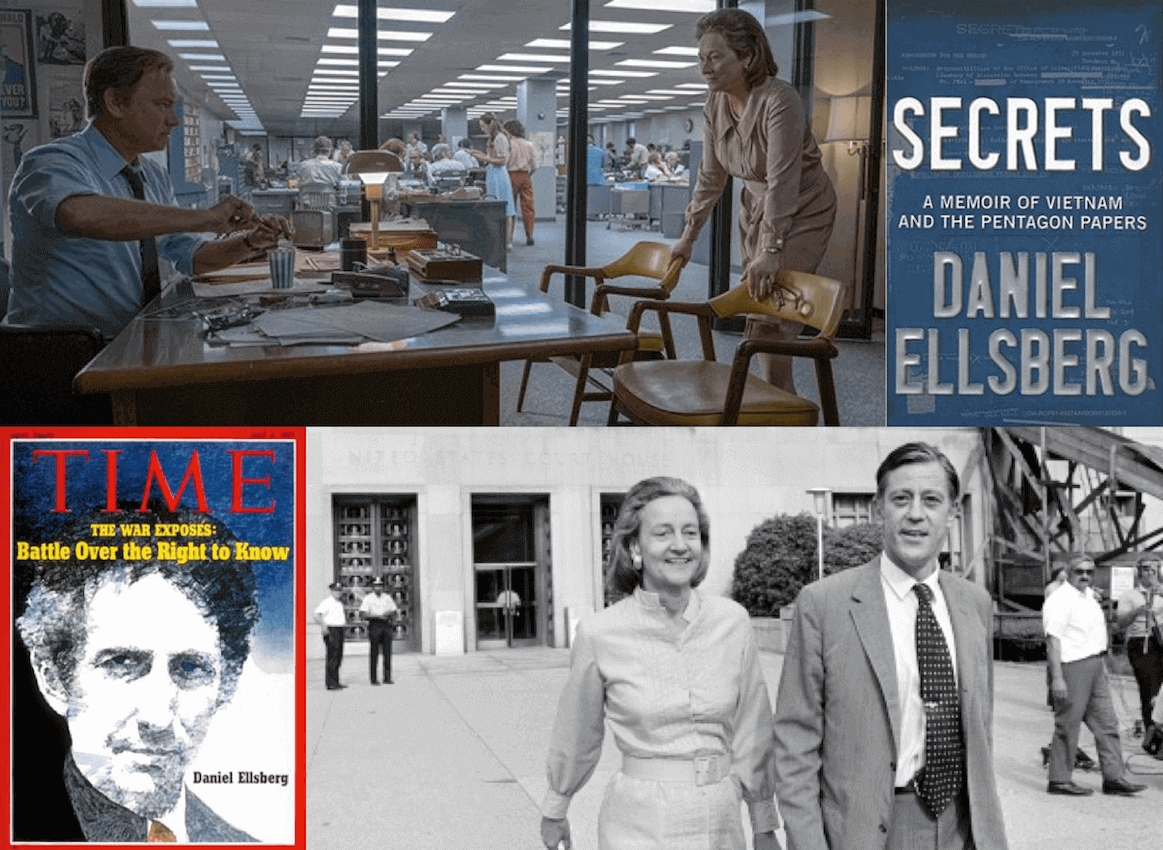
Tom Hanks and Steven Spielberg Mythologize the Washington Post
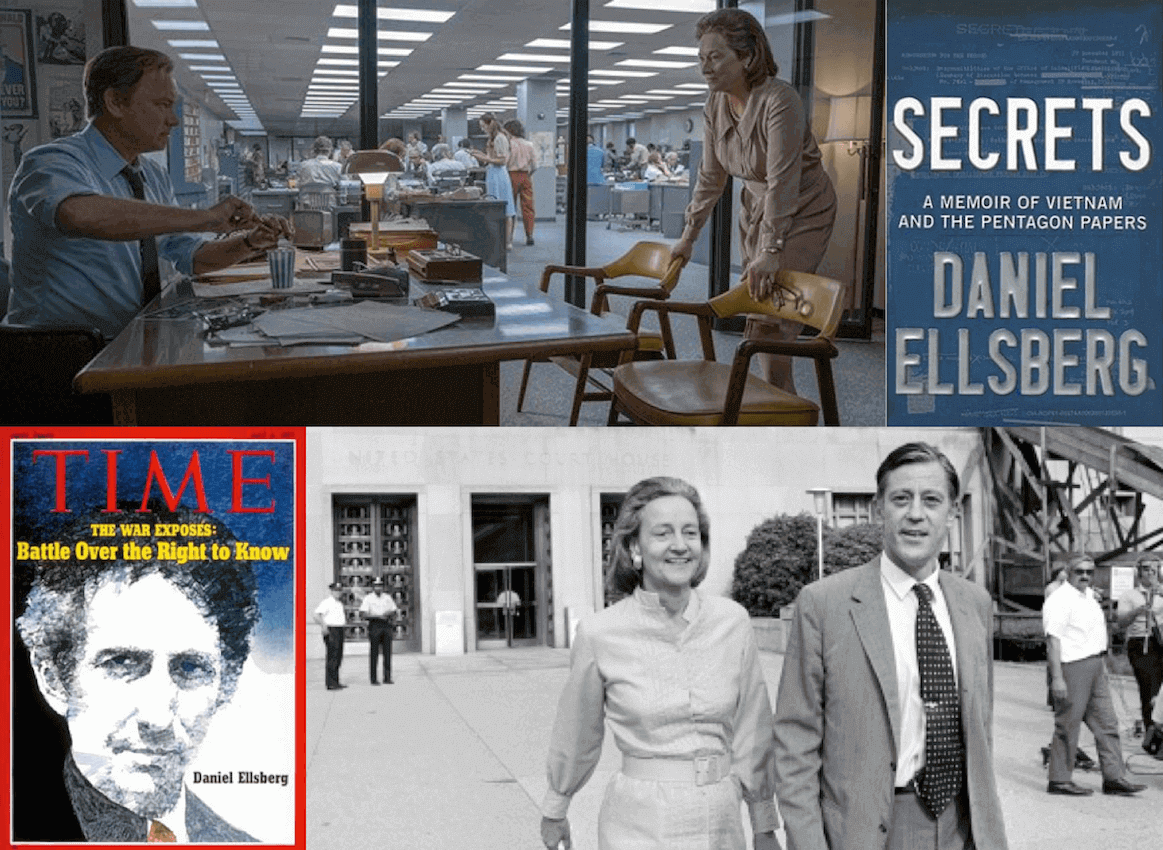
For Jim’s review, published at Consortium News, see: “The Post and the Pentagon Papers“.
A few weeks ago Ken Burns and Lynn Novick delivered a hugely disappointing ten-part documentary entitled The Vietnam War. Tom Hanks and Steven Spielberg will now do the same for the famous Pentagon Papers case.
Their film, entitled The Post, is not focused on Daniel Ellsberg. And it does not use his book Secrets as source material. Their film actually makes Ben Bradlee and Kate Graham the protagonists of the whole struggle to release the multi-volume, Defense Department study about how America got into, and stayed involved in the Vietnam War. It will therefore make Bradlee and Graham into some kind of hero and heroine of that hugely conflicting episode. To anyone who understands who Graham and Bradlee were, and the true story of what Ellsberg did, nothing could be further from the facts. To cite just one example: in Ellsberg’s 457 page book Secrets—which chronicles the entire affair in detail—there is exactly one glancing reference to Bradlee. There are none to Graham.
That is because, when one understands what Ellsberg and his cohorts were up to, the Washington Post was, if not inconsequential to the affair, extraneous to Ellsberg’s strategy. Once Ellsberg made his decision to go public with the Robert McNamara commissioned Top Secret history, it was just a matter of how many newspapers would pick up the story after the New York Times initially published it. Ellsberg and his friends had made many copies of the secret history, since he anticipated that there might be legal action against the Times to stop publishing. He and his friends had arranged for many newspaper outlets to get them once the Times was enjoined by the Nixon White House with a temporary restraining order (TRO) to halt publication. Which the Times was, after three days of stories based upon the documents.
By the time the Supreme Court decided to strike down the TRO and allow publication, almost twenty newspapers throughout the country had printed sections of the Pentagon Papers. The White House had only named four of them in their legal action: the Times, the Post, the Boston Globe and the St. Louis Post Dispatch. But further, Senator Mike Gravel had read the Pentagon Papers into the Congressional Record on the floor of the Senate. And he then handed out copies to reporters who were there at the time. He then arranged for no other senator to be there so he could move to have the entire set committed to the record without objection. This was on the day the Supreme Court decision was delivered. What Gravel did—committing the documents into the Senate record— made the decision pretty much irrelevant. Gravel agreed to do this after three other senators—including George McGovern—and one congressman had refused to. Then Beacon Press, which came under great duress, published that version of the Pentagon Papers in a four-volume set.
There are some heroes in this story. For example, Ellsberg, Mike Gravel, and Ellsberg’s friend Anthony Russo, who helped him copy the documents and who, like Ellsberg, risked going to jail for that act. There was also Judge Gerhard Gesell who, during two weeks of rapid, almost dizzying court hearings, ruled twice for disclosure. But Graham and Bradlee? Nothing in either of their careers merits this kind of aggrandizement. It could only happen in Tinsel Town. And in these days of MSM synergy, HBO has joined in with documentary specials on Spielberg and Bradlee.
Below we link to a series of articles about Bradlee, Graham the Washington Post and Watergate. We do this so the reader will not be bamboozled by another Tom Hanks version of (ersatz) history.
To counter the Hanks/Spielberg Mythology, here is some real information on Bradlee, Graham and The Washington Post:
Ben Bradlee
- “Ben Bradlee’s Not Such ‘A Good Life’, Part 1”, at Consortium News
- “Ben Bradlee’s Not Such ‘A Good Life’, Part 2”, at Consortium News
- “Ben and Jack: Not a Love Story”, Probe 4.6, September-October 1997
- “The Posthumous Assassination of John F. Kennedy” (see in particular Part 1, pp. 11, 29 in the attached original)
Kate Graham
- “Unmasking the Washington Post”, Probe 3.2, January-February 1996
Watergate
- “The Watergate Saga: The Official Version vs the Reality”, Probe 3.2, January-February 1995
- “From Dallas to Watergate: It’s Déjà-Vu All Over Again”, Probe 3.2, January-February 1995
- “Rearranging the Watergate Myth”, at Consortium News
Bob Woodward
- “Government Flaks? Bob Woodward and James Phelan”, by Lisa Pease, with a sidebar, “The Deceptions of All the President’s Men”, Probe 3.2, January-February 1996; these have been reposted separately on this site as: “Bob Woodward” and “Adrian Havill, Deep Truth”
-
The Vietnam War and the Destruction of JFK’s Foreign Policy (Part 2)
Part 2: 1963-1975
What happens next, of course, is that Johnson essentially passes NSAM 273 which had been drafted for JFK at his Honolulu conference at which Kennedy said, “When these guys get back, we’re going to have a long discussion about how the heck we ever got into Vietnam.” LBJ rewrites this and he orders three important revisions in the rough draft that McGeorge Bundy had written. One of them was that they would be able to use American naval equipment to raid the north coast of Vietnam and the other two were to make it easier to do special forces cross-border operations into Cambodia and Laos.
In other words, what you were going to have now was the beginning of the Gulf of Tonkin incident because South Vietnam didn’t have any navy. South Vietnam itself couldn’t do those raids coupled with the destroyer communications missions, what they called the DESOTO patrols, which is going to result in the Gulf of Tonkin incident.
Second of all, this now spreads the war across the borders into Laos and Cambodia which Kennedy really didn’t want to do. He wanted to keep [Cambodian Prince] Sihanouk in Cambodia and he wanted to try and keep Laos neutral.
If you can believe it, and by now you can, Burns and Novick don’t mention NSAM 273 and how it altered Kennedy’s policies. After the election, when Johnson then is elected president in a landslide in which he campaigned essentially on the idea that we’re not going to send American boys to fight a war that Asian boys should, he uses this incident in the Tonkin Gulf as a war declaration.
I’m going to go with that just briefly because I think everybody listening to this understands what the Tonkin Gulf incident was. These patrols that I mentioned, these raids by the South Vietnamese army aboard these American sponsored patrol ships, they were coupled with American destroyers decked out with high-tech communications equipment to find radar spots and communication spots along the North Coast of Vietnam off the Tonkin Gulf. They were clearly … even George Ball who worked for Johnson in the State Department, and even McGeorge Bundy, later said that they were designed as provocations.
When the North Vietnamese went ahead and counter attacked the raids, they actually put one machine gun bullet into one of the destroyer’s hulls then, of course, there was a so-called second attack, which never really happened. That was enough pretext for Johnson to use as a way to attack the North which is, by the way, what he wanted to do since March of 1964 when he signed NSAM 288, which more or less reversed NSAM 263 and which mapped out certain targets that we would use. He sends these airplane jet sorties over North Vietnam, bombing petroleum refineries and also navy shipyards. I think it was something like at least 65 sorties. Two guys were shot down, one was killed, one was taken prisoner. That signaled to Hanoi that Johnson planned to go to war in Vietnam.
Giap actually admitted towards the end of his life, through his son, that he understood Kennedy was withdrawing at the end of 1963. (https://kennedysandking.com/john-f-kennedy-articles/general-giap-knew) This new signal told the North to start planning for a war because Johnson’s attitude was completely different.
And that, of course, is what happened. Once Johnson won the landslide election, then very shortly after that he began to militarize this, by the way, I should say over Bobby Kennedy’s protests.
There’s a really nice book out by a guy named John Bohrer called The Revolution of Robert Kennedy, where for the first time that I know of, it’s revealed that Bobby Kennedy did not agree with what Johnson was doing, and he did not agree as early as 1964. Everybody says it’s 1967, but that was only when Bobby Kennedy, this is in public; privately, he was trying to discourage Johnson from militarizing the war. That’s what Johnson’s intent was.
In early 1965, he begins to send all kinds of bombing planes into South Vietnam. I think about 90 some bombers come over from Thailand. Of course, if you’re going to put all these bomber planes in there, the Viet Cong are going to raid them – which they did. That was the excuse for sending in the first American combat troops.
I think there was something like 5,000 who went ashore at Da Nang in March of 1965 and then that increased amazingly by the end of the year if you can believe it, by the end of 1965 there’s 175,000 combat troops in the country. Amazing escalation.
Operation Rolling Thunder which was, like I said, the biggest bombing campaign the world had ever seen. You got to wonder what the hell is there to bomb? The reason you bombed Germany or Japan was because there was an industrial base that supplied the war machines of both countries; but how the heck can you bomb rice fields and palm trees? There really wasn’t a heck of a lot of industrial base in North Vietnam to bomb, or in South Vietnam. Of course you ended up killing a heck of a lot of civilians.
By the way, I should add that when I did some research on this, the numbers I found go way beyond what the Defense Department admitted. I found a study that was made by a British medical group that actually went to Vietnam today and they went ahead and they interviewed, they went door to door, which is what you’re supposed to do with epidemiological work on this. You want to actually try and talk to people in the field. When they asked them, “How many members of your family did you lose when it was all over?” meaning to anything, not just bombing but also stepping on mines and things like that, they came to the rather astonishing figure – these revised figures – that between both the military casualties and the civilian casualties that the number is 4 million, which is amazing in a country of 35 million people. Which means that about one-tenth of the population was killed during this crazy, senseless, nutty war.
Let me add that this is one of the reasons Kennedy did not want to send combat troops in because he said, “How do you fight an enemy that is both everywhere and nowhere and at the same time has the support of the people? How do you send American combat troops in to fight that kind of a war?”
Johnson and Westmoreland, who was the guy who … Westmoreland was the general that Johnson chose to be the commanding officer in Vietnam; they didn’t seem to understand that. They never came to a kind of tactical and strategic decision about how to fight the war except to try and overpower the enemy with this terrific artillery fire and air power, and it didn’t work.
All it did was essentially kill a lot of civilians, not win over the population for us, in fact it did the opposite; and it bombed to smithereens the beautiful ecology of that country. This went on: ’65, ’66, and ’67. By this time, the United States had something like 525,000 combat troops in country. By the way, when I say that figure, once Johnson made his decision to escalate, he asked the Joint Chiefs of Staff: he said “Tell me how many men it’s going to take and how long to win this war?” And they actually told him they said 500,000 men, five to ten years to do it.
Johnson finally hit the 500,000 number in 1967, 1968, around that time; 500,000 combat troops in the country and it still didn’t work. The horrible thing of course is that as it didn’t work, the American army begin to collapse, began to fall apart internally, because they knew there really wasn’t any plan to win the war.
Colonel Robert Heinl wrote a wonderful article in which he described this, called Collapse of the Armed Forces in Indochina. (https://msuweb.montclair.edu/~furrg/Vietnam/heinl.html) He reported all the drug abuse, because in addition to not being able to win the war, the United States got involved through the CIA, Air America, in this Golden Triangle Opium Trade in which President Thieu knew about it and Vice-president Ky was a part of it. By the way, Burns and Novick don’t mention that involvement at all.
What happened is that many of these soldiers either begin to smoke pot or do heroin and then it got to be a business. It began to be refined because you refine opium into heroin and then it began to be shipped to Marseille a great French seaport on the Mediterranean, and then some of it got into the United States. There had been reports that some of it came in in the body bags of dead American soldiers. I’m not positive that happened, but I’ve seen reports that it happened. There was a report that Hoover talked about it in one of his memos but I’ve never actually seen the memo. That’s how bad this thing got as the American army began to collapse. And then of course began what the military termed “fragging”.
As the American soldiers begin to see that there was no way to win this war, they began to do two things. They began to take it out on the civilian population by slaughtering many unarmed civilians; and then also by taking it out on their commanding officers. If they got a mission message the night before that they knew was hopeless, instead of going through with the mission, they would just go ahead and toss a grenade in the commanding officer’s cabin.
There were numerous … Heinl in his article said that … I think it’s from 1969 to 1971. There were well over 200 instances of that happening in Vietnam. You can’t run an army, I don’t have to tell anybody – even people who want to defend this war to this day and there’s still some people who do – that you can’t run an army like that. You can’t run an army, if you got that many people mutinying.
The American army began to collapse, and then, of course, you have the Tet Offensive. The Tet Offensive took place at the beginning of 1968 and at the time when Johnson and Westmoreland were saying that there’s light at the end of the tunnel. Well, the massive size and scope of the Tet Offensive, in which the Viet Cong raided almost every major city in South Vietnam, in which they actually had Viet Cong inside the American Embassy in Saigon; and there was a famous picture, and Burns and Novick didn’t show this picture. There’s a famous picture of an American diplomat shooting a handgun at a Viet Cong rebel running through the courtyard. That picture got published in Life Magazine.
Then the American people said “We can’t even defend our own American Embassy in Saigon?” Like I said, these raids took place all throughout South Vietnam, from the northern part to the southern part. That showed the American public that we weren’t winning the war, and Johnson refused to admit this.
At a famous meeting after the Tet Offensive, he called in his advisors and he called in some elder statesmen like Bob Lovett and Dean Acheson. He brought in the Pentagon to try and explain how United States had not lost Tet; we actually won: because we killed so many more of the enemy than they killed of us. And Acheson walked out. When Johnson called him up later and said: Why did you walk out, Dean? Acheson said something like: I’m not going to listen to any of this crap anymore. I’m not going to listen to some commissioned officer coming over and giving me the message that Pentagon wants to deliver. I actually want to see the raw reports.
That began to turn Johnson around. A couple of weeks later he sent a new Secretary of Defense, because McNamara had quit by now. One by one all the Kennedy people quit; Pierre Salinger, John McCone, McGeorge Bundy, George Ball, and then McNamara. One by one they all left. He appointed his own Secretary of Defense, Clark Clifford. He went over to the Pentagon and he talked about this on more than one occasion. He said words to the effect: When I started these interviews I was a hawk; after two weeks of asking these guys questions based on the documents they gave me, I realized that I had made a terrible mistake. Today, I have no problem saying that I could not have been more wrong about Vietnam.
At the end of that two-week review, he went back to Johnson and he said, “There’s no way we’re going to win this war. My best advice to you is to get out of this thing.” That’s when Johnson went on TV, I think it was the end of March 1968, and he shocked the country and he said he was not going to run again, as he was going to devote the rest of his time to trying to get a peace treaty in Vietnam.
OHH:
’68 is such an important year. Can you just give us a little chronology of the assassinations, the riots in Chicago, and these other things you were talking about?
James DiEugenio:
1968 is one of the most … I mean to call it pivotal doesn’t do it justice. It’s really epochal because you had so many key events happening in that one year that there’s no way around it: Individually they changed the shape of history. Put it together, they completely shifted history around.
In the beginning of 1968, of course we had the Tet Offensive. That leads to Johnson going on the air and saying he’s not going to run again, which is a shock to everybody. Then a week later, you had the assassination of Martin Luther King in Memphis, just a week later. Then you had McCarthy and Bobby Kennedy both running for president and slowly but surely Bobby Kennedy takes a lead. It looks like he’s going to win the nomination because he won this great victory in California. Then that night, which I think is almost exactly one month after … no, no, excuse me, two months after King is assassinated, then Bobby Kennedy is assassinated.
In many ways, in many ways, anybody who studies history should be able to tell you this: With the death of Bobby Kennedy you really, I don’t think we’re exaggerating this at all, you really had the death of the 60s. That was it. With him went all the hopes and dreams and the aspirations, whether well-founded or not, of that whole generation of people who really wanted to see the promises of the New Frontier, the promises of the civil rights movement, the promises of a new approach to foreign policy, the promises of a more equitable country. That was over with his death and that’s what made it so shocking.
That led to the Chicago Convention. At that convention, you essentially had what was the RFK/King wing of the Democratic Party led by all those young people and people of color protesting against the Richard Daley/Lyndon Johnson wing of the Democratic Party. You had that split that was dramatized by the violence which I think most people who study that, that was really a planned attack by Daley who wanted to put down this uprising that he saw.
It was really kind of a street battle which the networks really didn’t do a heck of a good job broadcasting. But there had been a lot of private pictures taken of what those cops were doing to those kids. It was really brutal. It leaked over to the convention where you had Abraham Ribicoff, a Kennedy guy, looking right at Daley and saying, “If George McGovern won this thing” – because McGovern was the guy they put up at the last minute in place of Bobby Kennedy to represent the Robert Kennedy wing of the party—“We wouldn’t have this Gestapo tactics in the streets of Chicago.”
You can see Daley, you can read his lips when he says “F – – K. You”; and the Democratic Party splintered apart at that convention. Then of course, you had Nixon … and I’ve said this more than once, Nixon essentially hijacked Johnson’s peace plan. Because he began to perceive this as a way that Johnson was going to become the peace president and win the election for Hubert Humphrey, his vice president who, after Kennedy was killed, won the nomination in Chicago.
He sabotaged it, quite literally, there’s no other way around this. The evidence today is overwhelming that he sabotaged the peace talks that Johnson was trying to sponsor by having an emissary, Madame Chennault, the wife of Claire Chennault, and Bui Diem who was President Thieu’s Ambassador in Washington. They told President Thieu not to cooperate with Johnson’s peace plan. If they held out, they would get a better deal from Nixon.
What’s important to remember about that is you have to really understand how treacherous Nixon was. I don’t think that the Burns-Novick special got that close to it. At that time Nixon is having Chennault and Diem report to John Mitchell, who’s going to be his attorney general, and who was his campaign manager. Nixon knows about the meeting of Lovett and Acheson and Clark Clifford in Washington that took place in January and February. He tells people working on his speeches … literally he says, because he has heard about that meeting and he says: We know the war can’t be won, but we can’t let on to that. We have to make like it can be won to have more leverage in the campaign.
Here’s a guy who knows that the Vietnam War was lost, who sabotages Johnson’s attempt to end it for purely political purposes, and then once he becomes president due to this … because, see, on the eve of the election, I think four or five days before the election, President Thieu made a 27-minute speech – and by the way, Burns and Novick don’t tell you this either – he made a 27-minute speech in Saigon that was carried by all three networks. Back in those days you had ABC, NBC, and CBS, and if you had those three, everybody in the country is watching it because that’s all there was except for PBS which had a very small audience.
They all televised Thieu’s speech, in which he made it clear that he was not going to cooperate with Johnson’s plan because he perceived this as a sell-out to South Vietnam. Even people who worked for Nixon said that that speech won the election for him because Humphrey was coming on very strong in October and that speech put the stop to Humphrey’s rally.
That’s what happened in 1968 and that’s how Nixon became president.
It was an unbelievable, mind-boggling year and it all happened in the space of a matter of months. That’s what put Richard Nixon in the White House. It’s a bloody shame what happened as a result of that because Nixon and Kissinger passed a paper around the first weeks they were in the White House, it’s called NSSM1, which means National Security Study Memorandum. They wanted to know what people thought about in the foreign policy apparatus, what people thought about the Vietnam War.
Johnson had replaced Westmoreland with Creighton Abrams at this time. Even Creighton Abrams, in his response, said words to the effect that: in my opinion you cannot win a military victory. All you have is a stalemate there.
In other words, knowing that the best he could do was get a long stalemate and knowing the American people will never stand for that, Nixon begins to expand the air war into Laos and Cambodia. For political purposes, he then began to draw down the number of troops there.
In other words, you were doing a balancing act. You were getting out American combat troops, trying to turn the war over to South Vietnam; and at the same time you’re increasing and expanding the focus of the air war. What that did, of course, is it destabilized Cambodia and Laos.
I don’t have to tell about it, what happened in Cambodia, because once the air war began to rain down, it began to help the Chinese Marxist rebels led by Pol Pot. I shouldn’t say that because most people, if you try and classify who Pol Pot was, nobody really knows what the heck he was. He is seen to be like an agrarian revolutionary who wanted to empty whole cities out and bring them to the countryside in a crazy, restructuring of society.
As the bombing campaign picked up, Pol Pot’s forces strengthened. When Sihanouk brought in his Prime Minister Lon Nol, a military guy, when he went on vacation, Lon Nol staged a coup. Of course, Lon Nol encouraged Nixon because he was keeping what they were doing, and the country got destabilized even more and the bombing went inland. What happened, of course, was this built up Pol Pot’s forces until he was able to lay siege to Lon Nol’s new government, a horrible, horrible situation that resulted.
This went on, this expansion of the war, Nixon knowing that he really can’t win but trying to find a way to get the best agreement he can, and at the same time he’s polarizing and deceiving the public in America. He’s going to sell out President Thieu because once he realizes that he can’t win the war, he also knows he has to get out before the election or else people are going to ask him … rather, excuse me, he has to arrange to have the defeat come after the election or people are going to say, “You kept us here for four years for nothing.” He begins to create something called “the decent interval”.
The decent interval is something that both Nixon and Kissinger lied about in both their books; in Nixon’s book, No More Vietnams and Kissinger’s book, The White House Years. They denied that this thing existed, but it did exist. In fact, Kissinger even wrote about it in his notebooks he took over to China and he talked about it with Zhou Enlai. And Zhou Enlai communicated it to North Vietnam.
The decent interval was this concept: Saigon could fall but it had to fall after the American troops were gone, because then we could blame it on President Thieu and the South Vietnamese army, and it wouldn’t be blamed on us.
That’s how treacherous these guys were. That’s how bad these guys were. The countless tons of bombs … by the way, Nixon dropped more bombs in Indochina than Johnson did, and it was by of wide margin, just so he could ensure that he’d win the 1972 election and humiliate … these guys hated what they perceived as a liberal media and leftist intellectuals, and so that’s what they were doing. That’s what they were doing. That’s what they did it for. That’s what it went on for.
What happens, of course, is that there is the Easter Offensive in the spring of ’72 that undoubtedly would have taken the country over at that time. It was a massive tank attack from the north, but then Nixon and Kissinger called in the American Air Force from as far away as Thailand and that stopped the Easter Offensive.
Then, when Nixon thought he had a peace agreement in the fall of 1972 and Kissinger brought the agreement back to President Thieu, and President Theiu went into a rage because he looked at it and it only mentioned three countries in Indochina; Cambodia, Laos, and Vietnam. In other words, Nixon and Kissinger were essentially saying: We know that it’s all over and we know that the country is going to be united again with the north and you’re not going to be a part of it. Thieu flew into a rage and Kissinger couldn’t handle him. He let him write out a list of demands and he brought the demands back to Le Duc Tho, who was the negotiator in Paris, with Kissinger.
It was a list of 60 demands. Le Duc Tho says: Look, I can’t settle every one of these in one-on-one with you. I got to take them back to Hanoi and I have to discuss a few of them with the Politburo there. Kissinger didn’t want to admit that he wasn’t making any headway because Nixon had already relieved Kissinger of his duties with Thieu, and he appointed Alexander Haig to run that aspect. Kissinger said that the North Vietnamese were being deliberately belligerent, and so Nixon ordered the Christmas Bombing which went on for something like 13 days. The North was so outraged by this…
There is a mythology on what people, like the military, that says somehow that it was the Christmas Bombing that brought Le Duc Tho back to the negotiating table. First of all, Le Duc Tho was going to return to the negotiating table anyway. What Nixon did that for was to try and show President Thieu that he would use American military power if there were any violations of the agreement. That’s what that was for. Then, Hanoi got so angry because they didn’t want to return to the negotiating table. Nixon had to ask them to come back. They didn’t want to come back. The Chinese had to convince them to go back. China basically said: Look, Nixon has lost something like 12 points in his approval ratings because of that bombing. He is in deep trouble over this Watergate thing, which is not going to go away. All you have to do is wait them out and you can take the whole country because they’re going to have to leave.
Also, Congress has start cutting funding for the war.
After the shootings at Kent State and Jackson State, the Gulf of Tonkin Resolution was repealed, and now the liberals in Congress and even some Republicans were so sick of this thing that they started to cut off the funding for the war. The Peace Movement accomplished that, which of course Burns and Novick don’t tell you that in their documentary; but they did achieve that. A very significant achievement.
So Le Duc Tho went back to Paris and the agreements were signed in January of 1973. Nixon’s big thing was always peace with honor. Well, first of all, there was no peace and there was no honor. The fighting continued, each side trying to get an advantage. There was nothing honorable about it because polarizing the country and selling out your ally at the same time, there’s no honor in doing that.
Then, of course, in 1975 Nixon is finally out of office due to the Watergate Scandal like the Chinese predicted. Kissinger is running the evacuation of South Vietnam, and everybody remembers the famous image of the American helicopter at the top of … some people say it’s the American Embassy but actually I think it’s a CIA station building. That helicopter there with all the Vietnamese trying to get on the helicopter. Some of them didn’t get on. The United States left. President Jerry Ford and Kissinger left about 500 people there.
That’s the image that everybody remembers about America leaving Vietnam. That night, Kissinger got on the phone with an old friend of his from academic circles when he was at Harvard and said: Thank God it’s all over. We should have never been there. In other words, that’s what he really thought. That’s what Kennedy was saying – we should have never had American combat troops there, we should have never had this huge military mission there.
It always amazed me that Nixon and Kissinger were looked up to as these foreign policy mavens. When, in fact, they were nothing but dyed-in-the-wool Cold Warriors, who manipulated the Cold War for political purposes.
To show you how stupid Nixon and Kissinger were, in the ’80s when Gorbachev took over the Soviet Union, after he met with Reagan … Reagan really liked him. He thought this guy is a real reformer. Margaret Thatcher, the right-wing nut from England actually said we can work with Mr. Gorbachev. Reagan called in Nixon and he then called in Kissinger and he told them: I think I can really work with this guy. I don’t think he’s one of those old hard line communist apparatchiks. Nixon didn’t believe it. He told him, “Yes he is. That’s how he got the power.” And then he told, as he was leaving, he told Reagan’s assistants: “Whatever you do, don’t leave Reagan in the same room with Gorbachev alone.”
Kissinger said the same thing, How can you be that wrong about two important things, like the Vietnam War and that great moment in history which Reagan partly bungled because of the advice from those two guys? It has always puzzled me how Nixon and Kissinger, how the mainstream media made them out to be these foreign policy gurus when in fact they were nothing except a dressed up John Foster Dulles.
I’ll take Kennedy any day of the week.
OHH:
Right. Just from what happened in Vietnam, and just because you brought up Pol Pot. Eventually it was the Vietnamese themselves that had to go get rid of Pol Pot because of what he had done.
James DiEugenio:
Correct. See, that’s something that Burns and Novick don’t even touch on. The horrible genocide that took place in Cambodia because of the Nixon-Kissinger bombing campaign. When Pol Pot took over, God knows … I usually go by a million people but if you go ahead and find that … because there was this investigation I think a few years ago, this long series of trials and investigations that went on. They actually put the figure much higher than that. They actually put the figure at about two million that perished by Pol Pot in Cambodia.
And you’re exactly right. It got so horrible in Cambodia that the North Vietnamese had to go in, and it was they that overturned the Pol Pot tyranny, not us.
OHH:
Right. When you think about what you just said with … you have Cambodia, two million people; you have Vietnam, four million people I don’t think you can take out from this whole thing the Indonesian massacres of 1965 because it’s obvious at the whole domino theory, so you’re talking about seven million people in the course of 20 years, whatever it was.
James DiEugenio:
No, that all happened. The vast amount of casualties in Vietnam all happened from about 1966 onward and you had the overthrow of Sukarno in ’65, right? In the period of about a decade, you had the … going by the latest figures, the latest figures that I could find, when you add in Vietnam, Cambodia, and Indonesia. What did you say, seven million?
OHH:
Just roughly from what you had said earlier…
James DiEugenio:
Yeah, that’s what I would say. I would say a rough estimate would be about seven million. That might be wrong, that might be too high, it might be too low but it’s around, from the latest figures I could find, the most accurate figures I could find, it’s about seven million.
At the very least, it’s five and a half million. And all because of the reversals of Kennedy’s policies in both Indochina and Indonesia. Because Kennedy, as people who read my website and keep up on Greg Poulgrain’s work, the wonderful scholar on Indonesia from Australia, Kennedy was backing Sukarno all the way to the end. I’m talking 1963, and he planned on visiting Indonesia in 1964.
Kennedy went as far as to arrange nationalization deals for Sukarno, because he thought Sukarno was getting screwed by these big petroleum companies. He actually got on the phone and relayed his message: I want a much more generous split to go to Indonesia. They wanted 90/10 in favor of the company. Kennedy insisted 60/40 in the favor of the Indonesian government.
That was the whole difference because we know what happened in Indonesia after. Under Johnson, it just became a pig out in which tens of thousands of people, hundreds of thousands of people were slaughtered and Suharto gave the government over to the big corporations, most of them being Americans.
OHH:
Let’s end on this. I want to put Kennedy’s policies in perspective a little bit. Do you feel that there’s any resemblance between his idea of what America’s foreign policy should be and what FDR’s vision for the post-war world should have been?
James DiEugenio:
I think they’re pretty similar when I look at this. When I see what FDR’s foreign policy was and what he wanted to do with the Soviet Union and what he wanted to do in the third world. I think they’re pretty much similar.
Roosevelt wanted to keep that grand alliance together after the war: that is between United States, England, and the Soviet Union. He felt he could control Stalin at least in the international field and so he wanted to keep that together after the war. He tried to understand the Soviet Union’s insecurity about Eastern Europe. Now in the third world, Roosevelt did not want any more of the colonialism, this brutal colonialism that actually went in and made the native people even worse off than they were before the colonial state took over. He actually said that to one of his advisors: We can’t tolerate a situation in which the native people are in worse conditions after the Europeans come in than they were before.
Those two things I think are pretty similar to what Kennedy’s ideas were, certainly by 1963. In my opinion, what you had here is you had Kennedy trying to go ahead and turn back American foreign policy by rebelling against what the Dulles Brothers had done and restoring it back to Roosevelt. Then what you have when Johnson and then Nixon took over, you had essentially the overthrow of Kennedy’s reform policy and you went back to what the Dulles Brothers were.
By the way, let me add one I’m pretty sure about, I’m right about this. At one time before the Burns-Novick series came on, I was going to do a very long two-part essay for kennedysandking,com, and this was going to be my central idea. I was going to go ahead and demonstrate, because most authors all they do is compare Kennedy with Johnson: what did Johnson do to Kennedy’s foreign policy? I was going to take it all the way through Nixon and Kissinger. And I was going to do it in four central areas: Vietnam, Pakistan and India, Indonesia and the Middle East. I actually spent a lot of time on this. I spent about four months doing research on it.
Then, when the Burns-Novick thing came on I said, “Well, I can do it this way. I can do it with just focusing on this and this is going to be a big media event so more people will probably read this if I just focus it on Vietnam”, but I did do the preliminary research and so I’m pretty sure that I’m right about this. That was the historical contour: Kennedy was going back to Roosevelt and then after Kennedy was assassinated, Johnson and Nixon went back to Dulles. They repealed almost all the good things that Kennedy had done, and they went back to more or less a Dulles-Eisenhower paradigm.
To complete that thought – to show you how bad it got – once Nixon left office Jerry Ford, Mr. Warren Commission cover-up, took over. He brought in Don Rumsfeld and Dick Cheney. Those guys thought that Kissinger was too moderate, if you can believe it. They thought he was too moderate. That was the historical beginning of the Neocon movement, the Neoconservative movement that eventually swept through Washington. That was the complete elimination and destruction of whatever was left of Kennedy’s foreign policy once those guys took power. Because we saw what happened first with the Reagan administration and then with both the Bushes. They did so much damage to the American image abroad that … I don’t really honestly … I don’t think you can even salvage it anymore. In my opinion that’s what happened.
Kennedy’s Foreign Policy today is essentially in a museum.
OHH:
Right.
James DiEugenio:
It’s dead and buried and you can study it for historical purposes. But that series of events from Johnson to Nixon to Ford spelled the end of that kind of view of American foreign policy throughout the world. It’s like that book that Kennedy liked so much, The Ugly American. Did you know that? That he was a big fan of that book?
OHH:
No, no.
James DiEugenio:
It was a classic back then. It was trying to show how misguided American foreign policy was, and they made a movie out of it with Marlon Brando. It was how misguided American foreign policy was in the Third World. Kennedy liked it so much he bought a hundred copies and he gave it to everybody else in the Senate, so they could read it so they would understand, in a fictional form, what was happening.
That view that America could not be a controller, we had to let those people in the Third World have a degree of freedom and democracy for themselves; that we we’re going to lose them to either fascism or communism. That was all dead and buried then, and that’s what happened. I sincerely believe that that was the case from the work I did on this.
OHH:
Can you give a list of books if people want to dig more into this issue?
James DiEugenio:
To find out about Kennedy’s foreign policy?
OHH:
Yeah.
James DiEugenio:
Okay. A really good one I believe is [by] Robert Rakove and it’s called Kennedy Johnson, and the Nonaligned World;
[A second one is:] Betting on the Africans by Philip E. Muehlenbeck.
The third one is The Incubus of Intervention by Greg Poulgrain.
The last one is JFK: Ordeal in Africa by Richard Mahoney.
OHH:
Is there anything you want to add, tag on at the end here?
James DiEugenio:
No. I think we did a pretty good job covering it. There’s a lot of information in this interview that’s not in those essays, so I think we did a pretty good job on it and I got to actually be more explicit about what my original message was going to be.
OHH:
Great. You’re such a wealth of knowledge so it’s always great to hear you go over all these things. Let me … is that Colby interview, is that in the new JFK releases?
James DiEugenio:
Yes.
OHH:
Great. I’ll dig that up at some links on there. Thanks for talking once again, and I really appreciate you taking the time.
James DiEugenio:
Okay.
This interview was edited for grammar, flow and factual accuracy.

